US11557734B2 - Organic electroluminescence device and polycyclic compound for organic electroluminescence device - Google Patents

Organic electroluminescence device and polycyclic compound for organic electroluminescence device Download PDF

Info

Publication number
US11557734B2
US11557734B2 US17/085,124 US202017085124A US11557734B2 US 11557734 B2 US11557734 B2 US 11557734B2 US 202017085124 A US202017085124 A US 202017085124A US 11557734 B2 US11557734 B2 US 11557734B2
Authority
US
United States
Prior art keywords
group
formula
substituted
independently
ring
Prior art date
Legal status (The legal status is an assumption and is not a legal conclusion. Google has not performed a legal analysis and makes no representation as to the accuracy of the status listed.)
Active, expires
Application number
US17/085,124
Other versions
US20210313521A1 (en
Inventor
Ryuhei FURUE
Hirokazu Kuwabara
Current Assignee (The listed assignees may be inaccurate. Google has not performed a legal analysis and makes no representation or warranty as to the accuracy of the list.)
Samsung Display Co Ltd
Original Assignee
Samsung Display Co Ltd
Priority date (The priority date is an assumption and is not a legal conclusion. Google has not performed a legal analysis and makes no representation as to the accuracy of the date listed.)
Filing date
Publication date
Application filed by Samsung Display Co Ltd filed Critical Samsung Display Co Ltd
Assigned to SAMSUNG DISPLAY CO., LTD. reassignment SAMSUNG DISPLAY CO., LTD. ASSIGNMENT OF ASSIGNORS INTEREST (SEE DOCUMENT FOR DETAILS). Assignors: FURUE, RYUHEI, KUWABARA, HIROKAZU
Publication of US20210313521A1 publication Critical patent/US20210313521A1/en
Application granted granted Critical
Publication of US11557734B2 publication Critical patent/US11557734B2/en
Active legal-status Critical Current
Adjusted expiration legal-status Critical

Links

Images

Classifications

    • H01L51/0072
    • HELECTRICITY
    • H10SEMICONDUCTOR DEVICES; ELECTRIC SOLID-STATE DEVICES NOT OTHERWISE PROVIDED FOR
    • H10KORGANIC ELECTRIC SOLID-STATE DEVICES
    • H10K85/00Organic materials used in the body or electrodes of devices covered by this subclass
    • H10K85/60Organic compounds having low molecular weight
    • H10K85/631Amine compounds having at least two aryl rest on at least one amine-nitrogen atom, e.g. triphenylamine
    • CCHEMISTRY; METALLURGY
    • C07ORGANIC CHEMISTRY
    • C07DHETEROCYCLIC COMPOUNDS
    • C07D455/00Heterocyclic compounds containing quinolizine ring systems, e.g. emetine alkaloids, protoberberine; Alkylenedioxy derivatives of dibenzo [a, g] quinolizines, e.g. berberine
    • C07D455/03Heterocyclic compounds containing quinolizine ring systems, e.g. emetine alkaloids, protoberberine; Alkylenedioxy derivatives of dibenzo [a, g] quinolizines, e.g. berberine containing quinolizine ring systems directly condensed with at least one six-membered carbocyclic ring, e.g. protoberberine; Alkylenedioxy derivatives of dibenzo [a, g] quinolizines, e.g. berberine
    • H01L51/0067
    • HELECTRICITY
    • H10SEMICONDUCTOR DEVICES; ELECTRIC SOLID-STATE DEVICES NOT OTHERWISE PROVIDED FOR
    • H10KORGANIC ELECTRIC SOLID-STATE DEVICES
    • H10K50/00Organic light-emitting devices
    • H10K50/10OLEDs or polymer light-emitting diodes [PLED]
    • H10K50/11OLEDs or polymer light-emitting diodes [PLED] characterised by the electroluminescent [EL] layers
    • HELECTRICITY
    • H10SEMICONDUCTOR DEVICES; ELECTRIC SOLID-STATE DEVICES NOT OTHERWISE PROVIDED FOR
    • H10KORGANIC ELECTRIC SOLID-STATE DEVICES
    • H10K50/00Organic light-emitting devices
    • H10K50/80Constructional details
    • H10K50/805Electrodes
    • HELECTRICITY
    • H10SEMICONDUCTOR DEVICES; ELECTRIC SOLID-STATE DEVICES NOT OTHERWISE PROVIDED FOR
    • H10KORGANIC ELECTRIC SOLID-STATE DEVICES
    • H10K85/00Organic materials used in the body or electrodes of devices covered by this subclass
    • H10K85/60Organic compounds having low molecular weight
    • H10K85/615Polycyclic condensed aromatic hydrocarbons, e.g. anthracene
    • HELECTRICITY
    • H10SEMICONDUCTOR DEVICES; ELECTRIC SOLID-STATE DEVICES NOT OTHERWISE PROVIDED FOR
    • H10KORGANIC ELECTRIC SOLID-STATE DEVICES
    • H10K85/00Organic materials used in the body or electrodes of devices covered by this subclass
    • H10K85/60Organic compounds having low molecular weight
    • H10K85/631Amine compounds having at least two aryl rest on at least one amine-nitrogen atom, e.g. triphenylamine
    • H10K85/633Amine compounds having at least two aryl rest on at least one amine-nitrogen atom, e.g. triphenylamine comprising polycyclic condensed aromatic hydrocarbons as substituents on the nitrogen atom
    • HELECTRICITY
    • H10SEMICONDUCTOR DEVICES; ELECTRIC SOLID-STATE DEVICES NOT OTHERWISE PROVIDED FOR
    • H10KORGANIC ELECTRIC SOLID-STATE DEVICES
    • H10K85/00Organic materials used in the body or electrodes of devices covered by this subclass
    • H10K85/60Organic compounds having low molecular weight
    • H10K85/631Amine compounds having at least two aryl rest on at least one amine-nitrogen atom, e.g. triphenylamine
    • H10K85/636Amine compounds having at least two aryl rest on at least one amine-nitrogen atom, e.g. triphenylamine comprising heteroaromatic hydrocarbons as substituents on the nitrogen atom
    • HELECTRICITY
    • H10SEMICONDUCTOR DEVICES; ELECTRIC SOLID-STATE DEVICES NOT OTHERWISE PROVIDED FOR
    • H10KORGANIC ELECTRIC SOLID-STATE DEVICES
    • H10K85/00Organic materials used in the body or electrodes of devices covered by this subclass
    • H10K85/60Organic compounds having low molecular weight
    • H10K85/649Aromatic compounds comprising a hetero atom
    • H10K85/654Aromatic compounds comprising a hetero atom comprising only nitrogen as heteroatom
    • HELECTRICITY
    • H10SEMICONDUCTOR DEVICES; ELECTRIC SOLID-STATE DEVICES NOT OTHERWISE PROVIDED FOR
    • H10KORGANIC ELECTRIC SOLID-STATE DEVICES
    • H10K85/00Organic materials used in the body or electrodes of devices covered by this subclass
    • H10K85/60Organic compounds having low molecular weight
    • H10K85/649Aromatic compounds comprising a hetero atom
    • H10K85/657Polycyclic condensed heteroaromatic hydrocarbons
    • H10K85/6572Polycyclic condensed heteroaromatic hydrocarbons comprising only nitrogen in the heteroaromatic polycondensed ring system, e.g. phenanthroline or carbazole
    • H01L51/5012
    • H01L51/5237
    • HELECTRICITY
    • H10SEMICONDUCTOR DEVICES; ELECTRIC SOLID-STATE DEVICES NOT OTHERWISE PROVIDED FOR
    • H10KORGANIC ELECTRIC SOLID-STATE DEVICES
    • H10K50/00Organic light-emitting devices
    • H10K50/80Constructional details
    • H10K50/805Electrodes
    • H10K50/81Anodes
    • HELECTRICITY
    • H10SEMICONDUCTOR DEVICES; ELECTRIC SOLID-STATE DEVICES NOT OTHERWISE PROVIDED FOR
    • H10KORGANIC ELECTRIC SOLID-STATE DEVICES
    • H10K50/00Organic light-emitting devices
    • H10K50/80Constructional details
    • H10K50/805Electrodes
    • H10K50/81Anodes
    • H10K50/818Reflective anodes, e.g. ITO combined with thick metallic layers
    • HELECTRICITY
    • H10SEMICONDUCTOR DEVICES; ELECTRIC SOLID-STATE DEVICES NOT OTHERWISE PROVIDED FOR
    • H10KORGANIC ELECTRIC SOLID-STATE DEVICES
    • H10K50/00Organic light-emitting devices
    • H10K50/80Constructional details
    • H10K50/84Passivation; Containers; Encapsulations

Definitions

  • One or more aspects of embodiments of the present disclosure relate to an organic electroluminescence device and a polycyclic compound used therein.
  • Organic electroluminescence displays are actively being developed as image display apparatuses. Unlike liquid crystal displays, organic electroluminescence displays are so-called self-luminescent display apparatuses, in which holes and electrons respectively injected from a first electrode and a second electrode recombine in an emission layer, and a luminescent organic compound in the emission layer emits light to implement display.
  • Organic electroluminescence devices having high luminous efficiency and/or long life span are desired for display applications, and new materials for an organic electroluminescence device capable of stably attaining such characteristics are desired.
  • One or more aspects of embodiments of the present disclosure are directed toward an organic electroluminescence device exhibiting excellent luminous efficiency.
  • One or more aspects of embodiments of the present disclosure are directed toward a polycyclic compound as a material for an organic electroluminescence device having high efficiency characteristics.
  • an organic electroluminescence device including a first electrode, a second electrode disposed on the first electrode, and an emission layer disposed between the first electrode and the second electrode, and including a polycyclic compound represented by Formula 1, wherein the first electrode and the second electrode each independently include any one selected from among silver (Ag), magnesium (Mg), copper (Cu), aluminum (Al), platinum (Pt), palladium (Pd), gold (Au), nickel (Ni), neodymium (Nd), iridium (Ir), chromium (Cr), lithium (Li), calcium (Ca), LiF/Ca, LiF/AI, molybdenum (Mo), titanium (Ti), indium (In), zinc (Zn), tin (Sn), and ytterbium (Yb), a compound of two or more thereof, a mixture of two or more thereof, or an oxide thereof:
  • n may be 1 or 2
  • Z may be a substituent including at least one fluorine group or at least one cyano group, or an aromatic ring group including at least one nitrogen atom as a ring-forming atom
  • b1 and b3 may each independently be an integer of 1 to 4
  • b2 may be 1 or 2
  • R 1 to R 3 may each independently be a hydrogen atom, a deuterium atom, a halogen atom, a substituted or unsubstituted oxy group, a substituted or unsubstituted alkyl group having 1 to 20 carbon atoms, a substituted or unsubstituted aryl group having 6 to 30 ring-forming carbon atoms, or a substituted or unsubstituted heteroaryl group having 3 to 30 ring-forming carbon atoms.
  • Z may be a cyano group, a fluorine group, an alkyl group substituted with at least one fluorine group, a phenyl group substituted with at least one cyano group or at least one trifluoromethyl group, a substituted or unsubstituted pyridine group, a substituted or unsubstituted pyrimidine group, or a substituted or unsubstituted triazine group.
  • Formula 1 may be represented by Formula 2 or Formula 3:
  • Z 1 and Z 2 may each independently be a substituent including at least one fluorine group or at least one cyano group, or an aromatic ring group including at least one nitrogen atom as a ring-forming atom
  • b4 may be 1 or 2
  • b5 may be an integer of 1 to 4
  • R 4 and R 5 may each independently be a hydrogen atom, a deuterium atom, a halogen atom, a substituted or unsubstituted oxy group, a substituted or unsubstituted alkyl group having 1 to 20 carbon atoms, a substituted or unsubstituted aryl group having 6 to 30 ring-forming carbon atoms, or a substituted or unsubstituted heteroaryl group having 3 to 30 ring-forming carbon atoms
  • b1 to b3, R 1 to R 3 , and Z may each independently be the same as defined in Formula 1.
  • Formula 2 may be represented by Formula 2-1:
  • f1 may be 1 or 2
  • Y 1 to Y 3 may each independently be a nitrogen atom or CW 2
  • W 1 and W 2 may each independently be a hydrogen atom, a deuterium atom, a halogen atom, a cyano group, a substituted or unsubstituted alkyl group having 1 to 20 carbon atoms, or a substituted or unsubstituted aryl group having 6 to 30 ring-forming carbon atoms
  • b1, b3, R 1 and R 3 may each independently be the same as defined in Formula 2.
  • Formula 3 may be represented by Formula 3-1:
  • Y 11 to Y 16 may each independently be a nitrogen atom or CW 13 , g1 and g2 may each independently be 1 or 2, W 11 to W 13 may each independently be a hydrogen atom, a deuterium atom, a halogen atom, a cyano group, a substituted or unsubstituted alkyl group having 1 to 20 carbon atoms, or a substituted or unsubstituted aryl group having 6 to 30 ring-forming carbon atoms, and b1, b3, b5, R 1 , R 3 , and R 5 may each independently be the same as defined in Formula 3.
  • Z may be represented by any one of Z-1 to Z-13:
  • Ph is a phenyl group.
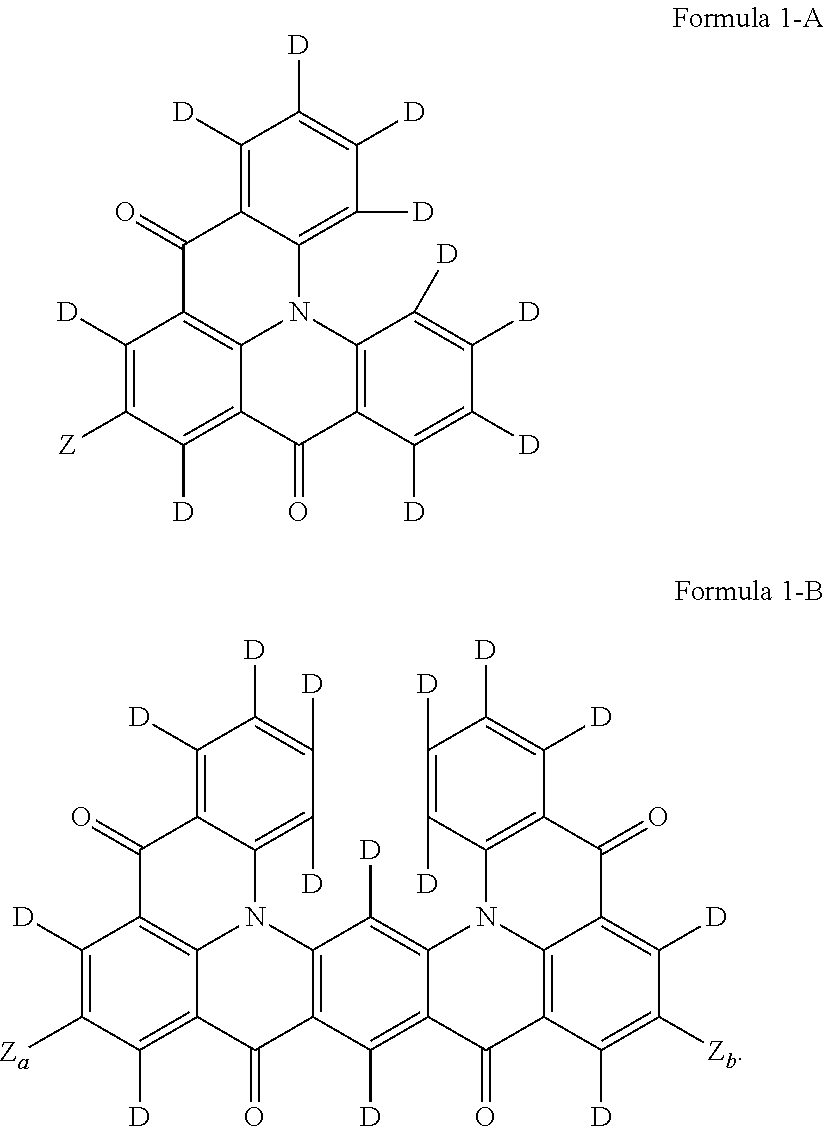
  • Formula 1 may be represented by Formula 1-A or Formula 1-B:
  • Z a and Z b may each independently be a substituent including at least one fluorine group or at least one cyano group, or an aromatic ring group including at least one nitrogen atom as a ring-forming atom, and in Formula 1-A, Z may be the same as defined in Formula 1.
  • the organic electroluminescence device may further include a capping layer on the second electrode, and the capping layer may have a refractive index of about 1.6 or more.
  • the emission layer may be to emit delayed fluorescence.
  • the emission layer may be to emit light having a central wavelength of about 430 nm to about 470 nm.
  • One or more example embodiments of the present disclosure provide a polycyclic compound represented by Formula 1.
  • FIG. 1 is a cross-sectional view schematically illustrating an organic electroluminescence device according to an embodiment of the present disclosure
  • FIG. 2 is a cross-sectional view schematically illustrating an organic electroluminescence device according to an embodiment of the present disclosure
  • FIG. 3 is a cross-sectional view schematically illustrating an organic electroluminescence device according to an embodiment of the present disclosure.
  • FIG. 4 is a cross-sectional view schematically illustrating an organic electroluminescence device according to an embodiment of the present disclosure.
  • an element when an element (or a region, a layer, a portion, etc.) is referred to as being “on,” “connected to,” or “coupled to” another element, it means that the element may be directly disposed on/connected to/coupled to the other element, or that a third element may be disposed therebetween.
  • an element when an element is referred to as being “directly on,” “directly connected to,” or “directly coupled to” another element, there are no intervening elements present.
  • FIGS. 1 to 4 are cross-sectional views schematically illustrating organic electroluminescence devices according to embodiments of the present disclosure.
  • a first electrode EL 1 and a second electrode EL 2 are disposed to face each other and an emission layer EML is disposed between the first electrode EL 1 and the second electrode EL 2 .
  • the organic electroluminescence devices 10 each further include a plurality of organic layers between the first electrode EL 1 and the second electrode EL 2 in addition to the emission layer EML.
  • the plurality of organic layers may include a hole transport region HTR and an electron transport region ETR.
  • the organic electroluminescence devices 10 according to embodiments may each include the first electrode EL 1 , the hole transport region HTR, the emission layer EML, the electron transport region ETR, and the second electrode EL 2 , sequentially stacked.
  • the organic electroluminescence device 10 of an embodiment may include a capping layer CPL disposed on the second electrode EL 2 .
  • FIG. 2 illustrates a cross-sectional view of an organic electroluminescence device 10 of an embodiment, in which the hole transport region HTR includes a hole injection layer HIL and a hole transport layer HTL, and the electron transport region ETR includes an electron injection layer EIL and an electron transport layer ETL.
  • FIG. 3 illustrates a cross-sectional view of an organic electroluminescence device 10 of an embodiment, in which the hole transport region HTR includes the hole injection layer HIL, the hole transport layer HTL, and an electron blocking layer EBL, and the electron transport region ETR includes the electron injection layer EIL, the electron transport layer ETL, and a hole blocking layer HBL.
  • FIG. 4 illustrates a cross-sectional view of an organic electroluminescence device 10 of an embodiment including a capping layer CPL disposed on the second electrode EL 2 .
  • the first electrode EL 1 may have conductivity.
  • the first electrode EL 1 may be formed of a metal alloy and/or a conductive compound.
  • the first electrode EL 1 may be an anode.
  • the first electrode EL 1 may be a pixel electrode.
  • the first electrode EL 1 may be a transmissive electrode, a transflective electrode, or a reflective electrode.
  • the first electrode EL 1 may include a transparent metal oxide (such as indium tin oxide (ITO), indium zinc oxide (IZO), zinc oxide (ZnO), and/or indium tin zinc oxide (ITZO)).
  • ITO indium tin oxide
  • IZO indium zinc oxide
  • ZnO zinc oxide
  • ITZO indium tin zinc oxide
  • the first electrode EL 1 When the first electrode EL 1 is a transflective electrode or the reflective electrode, the first electrode EL 1 may include Ag, Mg, Cu, Al, Pt, Pd, Au, Ni, Nd, Ir, Cr, Li, Ca, LiF/Ca, LiF/AI, Mo, Ti, In, Zn, Sn, Yb, a compound thereof, or a mixture thereof (e.g., a mixture of Ag and Mg).
  • the first electrode EL 1 may have a multilayer structure including a reflective film or a transflective film formed of the above-described materials, and a transparent conductive film formed of indium tin oxide (ITO), indium zinc oxide (IZO), zinc oxide (ZnO), indium tin zinc oxide (ITZO), etc.
  • the first electrode EL 1 may have a three-layer structure of ITO/Ag/ITO, but is not limited thereto.
  • the thickness of the first electrode EL 1 may be about 1,000 ⁇ to about 10,000 ⁇ , for example, about 1,000 ⁇ to about 3,000 ⁇ .
  • the hole transport region HTR is provided on the first electrode EL 1 .
  • the hole transport region HTR may include at least one of a hole injection layer HIL, a hole transport layer HTL, a hole buffer layer, or an electron blocking layer EBL.
  • the thickness of the hole transport region HTR may be, for example, about 50 ⁇ to about 15,000 ⁇ .
  • the hole transport region HTR may have a single layer formed of a single material, a single layer formed of a plurality of different materials, or a multilayer structure including a plurality of layers formed of a plurality of different materials.
  • the hole transport region HTR may have a single layer structure of a hole injection layer HIL or a hole transport layer HTL, or may have a single layer structure formed of a hole injection material and a hole transport material.
  • the hole transport region HTR may have a single layer structure formed of a plurality of different materials, or a structure in which a hole injection layer HIL/hole transport layer HTL, a hole injection layer HIL/hole transport layer HTL/hole buffer layer, a hole injection layer HIL/hole buffer layer, a hole transport layer HTL/hole buffer layer, or a hole injection layer HIL/hole transport layer HTL/electron blocking layer EBL are stacked in order from the first electrode EL 1 , but embodiments are not limited thereto.
  • the hole transport region HTR may be formed using any suitable method (such as a vacuum deposition method, a spin coating method, a cast method, a Langmuir-Blodgett (LB) method, an inkjet printing method, a laser printing method, and/or a laser induced thermal imaging (LITI) method).
  • a vacuum deposition method such as a vacuum deposition method, a spin coating method, a cast method, a Langmuir-Blodgett (LB) method, an inkjet printing method, a laser printing method, and/or a laser induced thermal imaging (LITI) method.
  • LB Langmuir-Blodgett
  • LITI laser induced thermal imaging
  • the hole injection layer HIL may include, for example, a phthalocyanine compound (such as copper phthalocyanine), amino)-phenyl]-biphenyl-4,4′-diamine (DNTPD), 4,4′,4′′-[tris(3-methylphenyl)phenylamino]triphenylamine] (m-MTDATA), 4,4′,4′′-tris(N,N-diphenylamino)triphenylamine (TDATA), 4,4′,4′′-tris ⁇ N,-(2-naphthyl)-N-phenylamino)-triphenylamine (2-TNATA), poly(3,4-ethylene dioxythiophene)/poly(4-styrene sulfonate) (PEDOT/PSS), polyaniline/dodecylbenzene sulfonic acid (PANI/DBSA), polyaniline/camphor sulfonic acid (PANI/CSA), polyaniline/poly(
  • the hole transport layer HTL may further include, for example, a carbazole-based derivative (such as N-phenyl carbazole and/or polyvinyl carbazole), fluorene-based derivatives, N,N′-bis(3-methylphenyl)-N,N′-diphenyl-[1,1-biphenyl]-4,4′-diamine (TPD), triphenylamine-based derivatives (such as 4,4′,4′′-tris(N-carbazolyl)triphenylamine (TCTA)), N,N′-di(1-naphthalene-1-yl)-N,N′-diphenyl-benzidine (NPB), 4,4′-cyclohexylidene bis[N,N-bis(4-methylphenyl]benzenamine] (TAPC), 4,4′-bis[N,N′-(3-tolyl)amino]-3,3′-dimethylbiphenyl (HMTPD), 1,3-
  • the thickness of the hole transport region HTR may be about 50 ⁇ to about 10,000 ⁇ , for example, about 100 ⁇ to about 5,000 ⁇ .
  • the thickness of the hole injection layer HIL may be, for example, about 30 ⁇ to about 1,000 ⁇ , and the thickness of the hole transport layer HTL may be about 30 ⁇ to about 1,000 ⁇ .
  • the thickness of the electron blocking layer EBL may be about 10 ⁇ to about 1,000 ⁇ .
  • the hole transport region HTR may further include, in addition to the above-described materials, a charge generating material to increase conductivity.
  • the charge generating material may be dispersed substantially uniformly or non-uniformly in the hole transport region HTR.
  • the charge generating material may be, for example, a p-dopant.
  • the p-dopant may be selected from quinone derivatives, metal oxides, are cyano group-containing compounds, but is not limited thereto.
  • Non-limiting examples of the p-dopant include quinone derivatives (such as tetracyanoquinodimethane (TCNQ) and/or 2,3,5,6-tetrafluoro-7,7,8,8-tetracyanoquinodimethane (F4-TCNQ)), metal oxides (such as tungsten oxide and/or molybdenum oxide), etc., but is not limited thereto.
  • quinone derivatives such as tetracyanoquinodimethane (TCNQ) and/or 2,3,5,6-tetrafluoro-7,7,8,8-tetracyanoquinodimethane (F4-TCNQ)
  • metal oxides such as tungsten oxide and/or molybdenum oxide
  • the hole transport region HTR may further include at least one of a hole buffer layer or an electron blocking layer EBL in addition to the hole injection layer HIL and the hole transport layer HTL.
  • the hole buffer layer may compensate for a resonance distance of the wavelength of light emitted from an emission layer EML to increase light emission efficiency.
  • Materials that may be included in the hole transport region HTR may be included in the hole buffer layer.
  • the electron blocking layer EBL is a layer that serves to prevent or reduce electrons from being injected from the electron transport region ETR to the hole transport region HTR.
  • the emission layer EML is provided on the hole transport region HTR.
  • the thickness of the emission layer EML may be, for example, about 100 ⁇ to about 1000 ⁇ or about 100 ⁇ to about 400 ⁇ .
  • the emission layer EML may have a single layer formed of a single material, a single layer formed of a plurality of different materials, or a multilayer structure having a plurality of layers formed of a plurality of different materials.
  • the emission layer EML may include a polycyclic compound of an embodiment.
  • substituted or unsubstituted may refer to a state of being unsubstituted, or of being substituted with at least one substituent selected from the group consisting of a deuterium atom, a halogen atom, a cyano group, a nitro group, an amine group, a silyl group, an oxy group, a thio group, a sulfinyl group, a sulfonyl group, a carbonyl group, a boron group, a phosphine oxide group, a phosphine sulfide group, an alkyl group, an alkenyl group, an alkynyl group, an alkoxy group, a hydrocarbon ring group, an aryl group, and a heterocyclic group.
  • each of the listed substituents may be further substituted or unsubstituted.
  • a biphenyl group may be interpreted as an aryl group, or as a phenyl group substituted with a phenyl group.
  • non-limiting examples of a halogen atom include a fluorine atom, a chlorine atom, a bromine atom, and an iodine atom.
  • an alkyl group may be a linear, branched or cyclic alkyl group.
  • the number of carbon atoms in the alkyl group may be 1 to 50, 1 to 30, 1 to 20, 1 to 10, or 1 to 6.
  • Non-limiting examples of the alkyl group include a methyl group, an ethyl group, an n-propyl group, an isopropyl group, an n-butyl group, a s-butyl group, a t-butyl group, an i-butyl group, a 2-ethylbutyl group, a 3,3-a dimethylbutyl group, an n-pentyl group, an i-pentyl group, a neopentyl group, a t-pentyl group, a cyclopentyl group, a 1-methylpentyl group, a 3-methylpentyl group, a 2-ethylpentyl group, a 4-methyl-2
  • an aromatic ring group may be an aryl group, or a heteroaryl group derived from an aromatic hydrocarbon ring.
  • an aryl group may be any functional group or substituent derived from an aromatic hydrocarbon ring.
  • the aryl group may be a monocyclic aryl group or a polycyclic aryl group.
  • the number of ring-forming carbon atoms in the aryl group may be 6 to 30, 6 to 20, or 6 to 15.
  • Non-limiting examples of the aryl group include a phenyl group, a naphthyl group, a fluorenyl group, an anthracenyl group, a phenanthryl group, a biphenyl group, a terphenyl group, a quaterphenyl group, a quinquephenyl group, a sexiphenyl group, a triphenylenyl group, a pyrenyl group, a benzofluoranthenyl group, a chrysenyl group, etc.
  • a heteroaryl group may include at least one of boron (B), oxygen (O), nitrogen (N), phosphorus (P), silicon (Si), or sulfur (S) as a heteroatom.
  • B boron
  • O oxygen
  • N nitrogen
  • P phosphorus
  • Si silicon
  • S sulfur
  • the heteroaryl group may be a monocyclic heteroaryl group or a polycyclic heteroaryl group.
  • the number of ring-forming carbon atoms in the heteroaryl group may be 2 to 30, 2 to 20, or 2 to 10.
  • Non-limiting examples of the heteroaryl group include a thiophene group, a furan group, a pyrrole group, an imidazole group, a triazole group, a pyridine group, a bipyridine group, a pyrimidine group, a triazine group, a triazole group, an acridyl group, a pyridazine group, a pyrazinyl group, a quinoline group, a quinazoline group, a quinoxaline group, a phenoxazine group, a phthalazine group, a pyrido pyrimidine group, a pyrido pyrazine group, a pyrazino pyrazine group, an isoquinoline group, an indole group, a carbazole group, an N-arylcarbazole group, an N-heteroarylcarbazole group, an N-alkylcarbazol
  • an oxy group may be an alkoxy group or an aryl oxy group.
  • an alkoxy group may include a linear, branched, or cyclic alkyl group.
  • the number of carbon atoms in the alkoxy group is not particularly limited, but for example, may be 1 to 20 or 1 to 10.
  • Non-limiting examples of an oxy group include methoxy, ethoxy, n-propoxy, isopropoxy, butoxy, pentyloxy, hexyloxy, octyloxy, nonyloxy, decyloxy, benzyloxy, etc.
  • An emission layer EML of an organic electroluminescence device 10 of an embodiment may include a polycyclic compound of an embodiment represented by Formula 1:
  • n may be 1 or 2.
  • the polycyclic compound of an embodiment may be at least a 5-membered ring system, formed by fusing a 4-membered ring group to a benzene ring.
  • the polycyclic compound of an embodiment may be at least a 9-membered ring group, formed by fusing two 4-membered ring groups to a (the same) benzene ring.
  • Z may be a substituent including at least one fluorine group or at least one cyano group, or an aromatic ring group including at least one nitrogen atom as a ring-forming atom.
  • the substituent including at least one fluorine group or at least one cyano group may be a cyano group, a fluorine group, or e.g., an aryl or alkyl group including at least one cyano group and/or fluorine group as a substituent.
  • Z when Z includes a fluorine group as a substituent, Z may be a trifluoromethyl group, a phenyl group substituted with a trifluoromethyl group, or a phenyl group substituted with a fluorine group.
  • Z may be a phenyl group substituted with a cyano group.
  • Z may be a cyano group, a fluorine group, an alkyl group substituted with at least one fluorine group, a phenyl group substituted with at least one cyano group or at least one trifluoromethyl group, a substituted or unsubstituted pyridine group, a substituted or unsubstituted pyrimidine group, or a substituted or unsubstituted triazine group.
  • Z may be an electron withdrawing group.
  • Z may be a fluorine group or a cyano group.
  • Z may be a methyl group substituted with a fluorine group (e.g., a fluoromethyl group), or a phenyl group substituted with one or two cyano groups (e.g., a dicyanophenyl group).
  • Z may be a phenyl group substituted with one or two trifluoromethyl groups (e.g., a trifluoromethylphenyl group or a bis-trifluoromethylphenyl group).
  • Z may be a triazine group substituted with two phenyl groups, a pyrimidine group substituted with two phenyl groups, or a pyridine group substituted with two phenyl groups.
  • b2 may be 1 or 2.
  • b1 and b3 may each independently be an integer of 1 to 4.
  • b2 is 2, a plurality of R 2 's may be the same or different from each other.
  • b1 is an integer of 2 or more, a plurality of R 1 's may be the same or different from each other.
  • b3 is an integer of 2 or more, a plurality of R 3 's may be the same as or different from each other.
  • R 1 to R 3 may each independently be a hydrogen atom, a deuterium atom, a halogen atom, a substituted or unsubstituted oxy group, a substituted or unsubstituted alkyl group having 1 to 20 carbon atoms, a substituted or unsubstituted aryl group having 6 to 30 ring-forming carbon atoms, or a substituted or unsubstituted heteroaryl group having 3 to 30 ring-forming carbon atoms.
  • a plurality of R 1 's may be the same.
  • the four R 1 's may all be deuterium atoms.
  • b3 a plurality of R 3 's may all be the same.
  • the two R 3 's may all be deuterium atoms.
  • this is an example, and embodiments are not limited thereto.
  • Z may be represented by any one of Z-1 to Z-13.
  • the polycyclic compound of an embodiment may include any one of Z-1 to Z-13 as an electron withdrawing group.
  • Ph is a phenyl group.
  • the polycyclic compound according to an embodiment may be used as a light emitting material to emit deep blue light having a central emission wavelength ( ⁇ max ) in a wavelength range of about 470 nm or less.
  • the polycyclic compound of an embodiment represented by Formula 1 may be a light emitting material having a central emission wavelength in a wavelength range of about 430 nm to about 470 nm.
  • Formula 1 may be represented by Formula 2.
  • Formula 2 shows the case where n is 1, and the polycyclic compound of an embodiment is a 5-membered fused aromatic ring system is fused.
  • b1 to b3, R 1 to R 3 , and Z may each independently have the same descriptions as those described in Formula 1.
  • b1 may be 4, and the four R 1 's may each be a hydrogen atom or a deuterium atom, and may be the same.
  • b2 may be 2, and the two R 2 's may each be a hydrogen atom or a deuterium atom, and the two R 2 's may be the same.
  • b3 may be 4, and the four R 3 's may each be a hydrogen atom or a deuterium atom, and may be the same.
  • Z is an electron withdrawing group, and may include at least one nitrogen atom or a fluorine atom.
  • Formula 2 may be represented by Formula 2-1:
  • Y 1 to Y 3 may each independently be a nitrogen atom or CW 2 .
  • Y 1 to Y 3 may all be nitrogen atoms, or CW 2 .
  • One or two of Y 1 to Y 3 may be a nitrogen atom.
  • a plurality of W 2 's may be the same or different.
  • W 1 and W 2 may each independently be a hydrogen atom, a deuterium atom, a halogen atom, a cyano group, a substituted or unsubstituted alkyl group having 1 to 20 carbon atoms, or a substituted or unsubstituted aryl group having 6 to 30 ring-forming carbon atoms.
  • a plurality of W 2 may all be hydrogen atoms.
  • a ring group including Y 1 to Y 3 may be a substituted phenyl group.
  • the ring group including Y 1 to Y 3 may be a phenyl group substituted with at least one cyano group or at least one trifluoromethyl group.
  • the ring group including Y 1 to Y 3 may be a substituted or unsubstituted triazine group.
  • the ring group including Y 1 to Y 3 may be a substituted or unsubstituted pyrimidine group.
  • the ring group including Yi to Y 3 may be a substituted or unsubstituted pyridine group.
  • f1 may be 1 or 2.
  • the two W 1 's may all be the same as or different from each other.
  • f1 may be 2
  • the two W 1 's may simultaneously be a cyano group, a fluorine group, a trifluoromethyl group, or a phenyl group.
  • Formula 1 may be represented by Formula 3.
  • Formula 3 shows the case where n is 2, and the polycyclic compound of an embodiment is a 9-membered aromatic fused ring system.
  • Z 1 and Z 2 may each independently be a substituent including at least one fluorine group or at least one cyano group, or an aromatic ring group including at least one nitrogen atom as a ring-forming atom.
  • Z 1 and Z 2 may each independently be a cyano group, a fluorine group, an alkyl group substituted with at least one fluorine group, a phenyl group substituted with at least one cyano group, at least one fluorine group or at least one trifluoromethyl group, a substituted or unsubstituted pyridine group, a substituted or unsubstituted pyrimidine group, or a substituted or unsubstituted triazine group.
  • Z 1 and Z 2 may each be an electron withdrawing group.
  • Z 1 and Z 2 may each independently be represented by one of Z-1 to Z-13.
  • Z 1 and Z 2 may be the same as each other.
  • Z 1 and Z 2 may simultaneously be a cyano group, a fluorine group, or a trifluoromethyl group.
  • Z 1 and Z 2 may simultaneously be a phenyl group substituted with one or two cyano groups, a phenyl group substituted with one or two fluorine groups, or a phenyl group substituted with one or two trifluoromethyl groups.
  • Z 1 and Z 2 may simultaneously be a triazine group substituted with two phenyl groups, a pyrimidine group substituted with two phenyl groups, or a pyridine group substituted with two phenyl groups.
  • Z 1 and Z 2 may be different from each other.
  • Z 1 and Z 2 may be a phenyl group substituted with one cyano group, and a phenyl group substituted with one fluorine group, respectively.
  • Z 1 and Z 2 may be a phenyl group substituted with two cyano groups, and a phenyl group substituted with one cyano group, respectively.
  • Z 1 and Z 2 may be a phenyl group substituted with one fluorine group, and a phenyl group substituted with two cyano groups, respectively.
  • Z 1 and Z 2 may be a phenyl group substituted with two cyano groups, and a phenyl group substituted with two fluorine groups, respectively.
  • Z 1 and Z 2 may be a phenyl group substituted with a cyano group, and a phenyl group substituted with a trifluoromethyl group, respectively.
  • Z 1 and Z 2 may be a triazine group substituted with two phenyl groups, and a phenyl group substituted with one cyano group, respectively.
  • Z 1 and Z 2 may be a pyrimidine group substituted with two phenyl groups, or a phenyl group substituted with one cyano group, respectively.
  • Z 1 and Z 2 may be a pyridine group substituted with two phenyl groups, and a phenyl group substituted with one cyano group, respectively.
  • b4 may be 1 or 2.
  • the two R 4 's may be the same as or different from each other.
  • b5 may be an integer of 1 to 4.
  • a plurality of R 5 's may all be the same as or different from each other.
  • R 4 and R 5 may each independently be a hydrogen atom, a deuterium atom, a halogen atom, a substituted or unsubstituted oxy group, a substituted or unsubstituted alkyl group having 1 to 20 carbon atoms, a substituted or unsubstituted aryl group having 6 to 30 ring-forming carbon atoms, or a substituted or unsubstituted heteroaryl group having 3 to 30 ring-forming carbon atoms.
  • the two R 4 's may all be the same as a hydrogen atom or a deuterium atom.
  • the four R 5 's may all be the same as a hydrogen atom or a deuterium atom.
  • R 1 to R 3 and Z may each independently have the same descriptions as those described in Formula 1.
  • Formula 3 may be represented by Formula 3-1:
  • Y 11 to Y 16 may each independently be a nitrogen atom or CW 13 .
  • Y 11 to Y 16 may all (e.g., simultaneously) be nitrogen atoms, or CW 13 .
  • a ring group including Y 11 to Y 13 and a ring group including Y 14 to Y 16 may all (e.g., simultaneously) be a substituted or unsubstituted triazine group, or a substituted or unsubstituted phenyl group.
  • two of Y 11 to Y 13 may be nitrogen atoms
  • two of Y 14 to Y 16 may be nitrogen atoms.
  • a ring group including Y 11 to Y 13 and a ring group including Y 14 to Y 16 may all (e.g., simultaneously) be a substituted or unsubstituted pyrimidine group.
  • one of Y 11 to Y 13 may be a nitrogen atom
  • one of Y 14 to Y 16 may be a nitrogen atom.
  • a ring group including Y 11 to Y 13 and a ring group including Y 14 to Y 16 may all (e.g., simultaneously) be a substituted or unsubstituted pyridine group.
  • g1 and g2 may each independently be 1 or 2.
  • the two W 11 's may be the same as or different from each other.
  • the two W 12 's may be the same as or different from each other.
  • W 11 to W 13 may each independently be a hydrogen atom, a deuterium atom, a halogen atom, a cyano group, a substituted or unsubstituted alkyl group having 1 to 20 carbon atoms, or a substituted or unsubstituted aryl group having 6 to 30 ring-forming carbon atoms.
  • W 11 and W 12 may each independently be a cyano group, a fluorine group, a trifluoromethyl group, or a phenyl group.
  • the two W 11 's may each (e.g., simultaneously) be a cyano group, a fluorine group, a trifluoromethyl group, or a phenyl group.
  • the two W 12 's may each (e.g., simultaneously) be a cyano group, a fluorine group, a trifluoromethyl group, or a phenyl group.
  • At least one of a ring group including Y 11 to Y 13 or a ring group including Y 14 to Y 16 may be a substituted or unsubstituted phenyl group.
  • a ring group including Y 11 to Y 13 and a ring group including Y 14 to Y 16 may each (e.g., simultaneously) be a substituted or unsubstituted phenyl group.
  • one of a ring group including Y 11 to Y 13 and a ring group including Y 14 to Y 16 may be a substituted or unsubstituted phenyl group, and the other may be a nitrogen-containing ring group.
  • one of a ring group including Y 11 to Y 13 or a ring group including Y 14 to Y 16 is a substituted or unsubstituted phenyl group, and the other ring group is a substituted or unsubstituted triazine group, a substituted or unsubstituted pyrimidine group, or a substituted or unsubstituted pyridine group.
  • the nitrogen-containing ring group may be substituted with a phenyl group.
  • the ring group including Y 11 to Y 13 may be a phenyl group substituted with one cyano group
  • the ring group including Y 14 to Y 16 may be a phenyl group substituted with one fluorine group.
  • the ring group including Y 11 to Y 13 may be a phenyl group substituted with one fluorine group
  • the ring group including Y 14 to Y 16 may be a phenyl group substituted with two cyano groups.
  • the ring group including Y 11 to Y 13 may be a phenyl group substituted with two cyano groups
  • the ring group including Y 14 to Y 16 may be a phenyl group substituted with two fluorine groups.
  • the ring group including Y 11 to Y 13 may be a phenyl group substituted with one cyano group
  • the ring group including Y 14 to Y 16 may be a phenyl group substituted with one or two trifluoromethyl groups.
  • the ring group including Y 11 to Y 13 may be a triazine group substituted with two phenyl groups, a pyrimidine group substituted with two phenyl groups, or a pyridine group substituted with two phenyl groups
  • the ring group including Y 14 to Y 16 may be a phenyl group substituted with one cyano group.
  • R 1 , R 3 , and R 5 may each independently have the same descriptions as those described in Formula 3
  • Formula 1 may be represented by Formula 1-A or Formula 1-B.
  • “D” in Formula 1-A and Formula 1-B represents a deuterium atom.
  • the polycyclic compound of an embodiment may be a 5-membered fused ring system, and Formula 1-A shows the case where n is 1 in Formula 1.
  • b1 is 4, b2 is 2, b3 is 4, and a plurality of R 1 to R 3 are all deuterium atoms.
  • R 1 's, two R 2 's, and four R 3 's are all deuterium atoms, it may be represented by Formula 1-A.
  • Z may be the same as described in Formula 1.
  • Formula 1-B shows the case where n is 2 in Formula 1.
  • the polycyclic compound of an embodiment is a 9-membered fused ring system having a deuterium atom as a substituent.
  • Z 1 and Z 2 may all (e.g., simultaneously) be electron withdrawing groups.
  • Formula 1-B may all be substituted with deuterium atoms (e.g., completely deuterated), except for Z, which is an electron withdrawing group in Formula 1.
  • Z a and Z b may each independently be a substituent including at least one fluorine group or at least one cyano group, or an aromatic ring group including at least one nitrogen atom as a ring-forming atom.
  • Z a and Z b may be the same as each other.
  • Z a and Z b may both (e.g., simultaneously) be a cyano group.
  • the polycyclic compound of an embodiment may be a 5- or 9-membered fused ring system including an electron withdrawing group as a substituent and having a nitrogen atom and a carbonyl group as a ring-forming atom to reduce efficiency drop. Without being bound by the correctness of any theory or explanation, it is believed that the polycyclic compound of an embodiment may decrease efficiency drop by delocalizing multiple resonances (e.g., because of increased resonance delocalization) in the 5- or 9-membered aromatic fused ring system. Accordingly, the polycyclic compound of an embodiment included in an emission layer of the organic electroluminescence device of an embodiment may contribute to improving the efficiency drop phenomenon.
  • the polycyclic compound of an embodiment may be any one of the compounds represented in Compound Group 1.
  • An organic electroluminescence device 10 according to an embodiment may include at least one polycyclic compound among the polycyclic compounds represented in Compound Group 1 in an emission layer EML.
  • the polycyclic compound of an embodiment may be a thermally activated delayed fluorescence (TADF) material.
  • TADF thermally activated delayed fluorescence
  • the polycyclic compound of an embodiment represented by Formula 1 may be a blue thermally activated delayed fluorescence dopant.
  • the emission layer EML may be to emit delayed fluorescence.
  • the emission layer EML may be to emit thermally activated delayed fluorescence (TADF).
  • TADF thermally activated delayed fluorescence
  • the emission layer EML may include a host and a dopant, and may include the polycyclic compound of an embodiment as a dopant.
  • the emission layer EML may include a host for delayed fluorescence emission and a dopant for delayed fluorescence emission, and may include the polycyclic compound of an embodiment as a dopant for delayed fluorescence emission.
  • the emission layer EML may include at least one of the polycyclic compounds represented by Compound Group 1 as a thermally activated delayed fluorescence dopant.
  • the emission layer EML may be a delayed fluorescence emission layer, and the emission layer EML may include any suitable host material and the polycyclic compound of an embodiment.
  • the polycyclic compound may be used as a TADF dopant.
  • the emission layer EML may include any suitable host material.
  • the emission layer EML may include, as a host material, tris(8-hydroxyquinolino) aluminum (Alq3), 4,4′-bis(N-carbazolyl)-1,1′-biphenyl (CBP), poly(N-vinyl carbazole) (PVK), 9,10-di(naphthalene-2-yl)anthracene (ADN), 4,4′,4′′-tris (carbazol-9-yl) triphenylamine (TCTA), 1,3,5-tris(N-phenylbenzimidazole-2-yl)benzene (TPBi), 3-tert-butyl-9,10-di(naphth-2-yl)anthracene (TBADN), distyrylarylene (DSA), 4,4′-bis(9-carbazolyl)-2,2′-dimethyl-biphenyl (CDBP), 2-methyl-9,10-
  • the emission layer EML may further include any suitable dopant material.
  • the emission layer EML may further include, as a dopant, styryl derivatives (e.g., 1,4-bis[2-(3-N-ethylcarbazolyl)vinyl]benzene (BCzVB), 4-(di-p-tolylamino)-4′′-[(di-p-tolylamino)styryl]stilbene (DPAVB), and N-(4-((E)-2-(6-((E)-4-(diphenylamino)styryl)naphthalen-2-yl)vinyl)phenyl)-N-phenylbenzenamine (N-BDAVBi), perylene and derivatives thereof (e.g., 2,5,8,11-tetra-t-butylperylene (TBP), pyrene and derivatives thereof (e.g., 1,1-dip
  • the organic electroluminescence device 10 of an embodiment may include a plurality of emission layers.
  • the plurality of emission layers may be sequentially stacked, and for example, the organic electroluminescence device 10 including a plurality of emission layers may be to emit white light.
  • the organic electroluminescence device including a plurality of emission layers may be an organic electroluminescence device having a tandem structure.
  • at least one emission layer EML may include the polycyclic compound of an embodiment.
  • an electron transport region ETR is provided on the emission layer EML.
  • the electron transport region ETR may include at least one of a hole blocking layer HBL, an electron transport layer ETL, and an electron injection layer EIL, but the embodiment of the present disclosure is not limited thereto.
  • the electron transport region ETR may have a single layer formed of a single material, a single layer formed of a plurality of different materials, or a multilayer structure including a plurality of layers formed of a plurality of different materials.
  • the electron transport region ETR may have a single layer structure of an electron injection layer EIL or an electron transport layer ETL, or may have a single layer structure formed of an electron injection material and an electron transport material.
  • the electron transport region ETR may have a single layer structure formed of a plurality of different materials, or may have a structure in which an electron transport layer ETL/electron injection layer EIL and a hole blocking layer HBL/electron transport layer ETL/electron injection layer EIL are stacked in order from the emission layer EML, but is not limited thereto.
  • the thickness of the electron transport region ETR may be, for example, about 300 ⁇ to about 1,500 ⁇ .
  • the electron transport region ETR may be formed using any suitable method (such as a vacuum deposition method, a spin coating method, a cast method, a Langmuir-Blodgett (LB) method, an inkjet printing method, a laser printing method, a laser induced thermal imaging (LITI) method, etc.)
  • a vacuum deposition method such as a vacuum deposition method, a spin coating method, a cast method, a Langmuir-Blodgett (LB) method, an inkjet printing method, a laser printing method, a laser induced thermal imaging (LITI) method, etc.
  • the electron transport region ETR may include an anthracene-based compound.
  • the electron transport region may include, for example, tris(8-hydroxyquinolinato) aluminum (Alq3), 1,3,5-tri[(3-pyridyl)-phen-3-yl]benzene, 2,4,6-tris(3′-(pyridin-3-yl)biphenyl-3-yl)-1,3,5-triazine, 2-(4-(N-phenylbenzimidazolyl-1-ylphenyl)-9,10-dinaphthylanthracene, 1,3,5-tri(1-phenyl-1H-benzo[d]imidazol-2-yl)benzene (TPBi), 2,9-dimethyl-4,7-diphenyl-1,10-phenanthroline (BCP), 4,7-diphenyl-1,10-phenan
  • the thickness of the electron transport layer ETL may be about 100 ⁇ to about 1,000 ⁇ and may be, for example, about 150 ⁇ to about 500 ⁇ . When the thickness of the electron transport layer ETL satisfies the above-described range, satisfactory electron transport properties may be obtained without a substantial increase in driving voltage.
  • the electron transport region ETR may be a halogenated metal (such as LiF, NaCl, CsF, RbCI, and/or RbI), a lanthanide metal (such as Yb), a metal oxide (such as Li 2 O and/or BaO), or lithium quinolate (LiQ), but is not limited thereto.
  • the electron injection layer EIL may be formed of a mixture of an electron transport material and an insulating organo-metal salt.
  • the organo-metal salt may be a material having an energy band gap of about 4 eV or more.
  • the organo-metal salt may include, for example, metal acetates, metal benzoates, metal acetoacetates, metal acetylacetonates, and/or metal stearates.
  • the thickness of the electron injection layers EIL may be about 1 ⁇ to about 100 ⁇ , and about 3 ⁇ to about 90 ⁇ . When the thickness of the electron injection layers EIL satisfies the above-described range, satisfactory electron injection properties may be obtained without a substantial increase in driving voltage.
  • the electron transport region ETR may include a hole blocking layer HBL.
  • the hole blocking layer HBL may include, for example, at least one of 2,9-dimethyl-4,7-diphenyl-1,10-phenanthroline (BCP) or 4,7-diphenyl-1,10-phenanthroline (Bphen), but is not limited thereto.
  • the second electrode EL 2 is provided on the electron transport region ETR.
  • the second electrode EL 2 may be a common electrode or a cathode.
  • the second electrode EL 2 may be a transmissive electrode, a transflective electrode, or a reflective electrode.
  • the second electrode EL 2 may include a transparent metal oxide, for example, indium tin oxide (ITO), indium zinc oxide (IZO), zinc oxide (ZnO), and/or indium tin zinc oxide (ITZO).
  • the second electrode EL 2 may include Ag, Mg, Cu, Al, Pt, Pd, Au, Ni, Nd, Ir, Cr, Li, Ca, LiF/Ca, LiF/AI, Mo, Ti, In, Zn, Sn, Yb, a compound thereof, or a mixture thereof (e.g., a mixture of Ag and Mg).
  • the second electrode EL 2 may have a multilayer structure including a reflective film or a transflective film formed of the above-described materials, and a transparent conductive film formed of indium tin oxide (ITO), indium zinc oxide (IZO), zinc oxide (ZnO), indium tin zinc oxide (ITZO), etc.
  • ITO indium tin oxide
  • IZO indium zinc oxide
  • ZnO zinc oxide
  • ITZO indium tin zinc oxide
  • the second electrode EL 2 may be connected with an auxiliary electrode.
  • the resistance of the second electrode EL 2 may decrease.
  • a capping layer CPL may be further disposed on the second electrode EL 2 of the organic electroluminescence device 10 of an embodiment.
  • the capping layer CPL may include, for example, ⁇ -NPD, NPB, TPD, m-MTDATA, Alq3, CuPc, N4,N4,N4′,N4′-tetra(biphenyl-4-yl) biphenyl-4,4′-diamine (TPD15), 4,4′,4′′-tris(carbazol-9-yl)triphenylamine (TCTA), N,N′-bis(naphthalen-1-yl), etc.
  • the capping layer CPL may include an amine compound.
  • the capping layer CPL may include at least one of the compounds CPL1 or CPL2:
  • the capping layer CPL may have a refractive index of about 1.6 or more.
  • the capping layer CPL may have a refractive index of about 1.6 or more.
  • Compound 1 according to Example may be synthesized by, for example, Reaction Formulae 1-1 to 1-4.
  • Compound 15 according to Example may be synthesized by, for example, Reaction Formulas 2-1 to 2-4:
  • Compound 21 according to Example may be synthesized by, for example, Reaction Formula 3:
  • the luminous characteristics of a polycyclic compound of an embodiment and organic electroluminescence devices of an embodiment including a polycyclic compound of an embodiment in an emission layer were evaluated as follows. A method of manufacturing an organic electroluminescence device for evaluation is described below.
  • the organic electroluminescence devices of Examples 1 to 3 were manufactured using Compounds 1, 15, and 21, respectively, as a dopant material for an emission layer.
  • Comparative Examples 1 and 2 are organic electroluminescence devices manufactured using Comparative Example Compounds X-1 and X-2, respectively, as a dopant material for an emission layer.
  • a 5.0 mM toluene solution was prepared of each of the Examples and Comparative Examples, and the luminous properties of each were evaluated using a JASCO V-670 spectrometer. Luminous spectra were measured at room temperature and 77K.
  • the photoluminescent quantum yield (PLQY) of the 5.0 mM toluene solution was measured using HAMAMATSU Quantaurus-QY. Table 2 shows the maximum emission wavelength (Amax) in the emission spectrum measured at room temperature and full width at half maximum (FWHM) in the emission spectrum.
  • Compounds 1, 15, and 21, which are polycyclic compounds of an embodiment each have a maximum emission wavelength of about 470 nm or less and emit deep blue light therefrom.
  • the full width at half maximum (FWHM) in the emission spectra of Compounds 1, 15, and 21, which are polycyclic compounds of an embodiment are confirmed to be narrow to about 35 nm or less.
  • Compounds 1, 15, and 21 of Examples each have a large value of quantum efficiency (PLQY) compared to Comparative Example Compound X-2, and thus it can be seen that the luminous efficiency is excellent.
  • Comparative Example Compounds X-1 and X-2 each have a maximum emission wavelength of about 470 nm or less, and thus it can be seen that deep blue light is emitted therefrom. However, it can be seen that Comparative Example Compounds X-1 and X-2 each have a full width at half maximum of about 37 nm or more, and the Comparative Example Compounds have a greater full width at half maximum than Example Compounds. For example, it can be seen that Comparative Example Compounds emit light having a lower color purity than Example Compounds. In addition, it can be seen that Comparative Example Compound X-2 has lower quantum efficiency (PLQY) than Example Compounds.
  • PLQY quantum efficiency
  • the polycyclic compounds of an embodiment include at least one electron withdrawing group as a substituent, thereby improving the efficiency drop phenomenon and emitting deep blue light having high color purity when compared to the Comparative Example Compounds.
  • ITO On a glass substrate, ITO was patterned to a thickness of about 1500 ⁇ , washed with ultra-pure water, cleaned with ultrasonic waves, irradiated with UV for 30 minutes, and then ozone-treated. Thereafter, HAT-CN was deposited to a thickness of 100 ⁇ , ⁇ -NPD was deposited to a thickness of 800 ⁇ , and mCP was deposited to a thickness of 50 ⁇ to form a hole transport region.
  • each emission layer polycyclic compounds of an embodiment or Comparative Example Compounds and mCBP were co-deposited at 1:99 to form a layer having a thickness of 200 ⁇ .
  • the emission layers formed by co-deposition in Examples 1 and 2 were deposited by mixing Compounds 1 and 15, respectively, with mCBP, and in Comparative Examples 1 and 2, Comparative Example Compounds X-1 and X-2, respectively, were mixed with mCBP and deposited.
  • a layer having a thickness of 300 ⁇ was formed of TPBi and a layer having a thickness of 50 ⁇ was formed of LiQ to form an electron transport region.
  • a second electrode having a thickness of 1000 ⁇ was formed of aluminum (Al).
  • a capping layer having a thickness of 700 ⁇ was formed of CPL1 on the second electrode.
  • the hole transport region, the emission layer, the electron transport region, and the second electrode were formed using a vacuum deposition apparatus.
  • Table 3 shows the evaluation results of the organic electroluminescence devices of Examples 1 to 3 and Comparative Examples 1 and 2.
  • Table 3 shows maximum emission wavelength (Amax), external quantum efficiency (EQE max , 1000 nit) of the manufactured organic electroluminescence devices by comparison.
  • the maximum emission wavelength (Amax) refers to the wavelength representing the maximum value in the emission spectrum
  • the external quantum efficiency (EQE max , 1000 nit) refers to a luminance of 1000 cd/m 2 .
  • the organic electroluminescence devices of Examples 1 to 3 emit deep blue light having a short wavelength, and exhibit high efficiency characteristics compared to the organic electroluminescence devices of Comparative Examples 1 and 2.
  • RISC reverse intersystem crossing
  • the organic electroluminescence device of Comparative Example 2 emits short wavelength light, but has a low external quantum efficiency.
  • the Example Compounds each include a phenyl group substituted with at least one cyano group as an electron withdrawing group, and thus multiple resonances (e.g., resonance structures) may be delocalized in a polycyclic aromatic ring system. Because the multiple resonances are delocalized on the Example Compounds, it is seen that the organic electroluminescence device of Example 2 has improved efficiency drop at high luminance, compared to the organic electroluminescence device of Comparative Example 1.
  • the polycyclic compound of an embodiment includes an electron withdrawing group as a substituent in a 5- or 9-ring aromatic fused ring system containing a nitrogen atom and a carbonyl group as a ring-forming atom, and thus multiple resonances are delocalized, and the efficiency drop is improved at high luminance.
  • the polycyclic compound of an embodiment may be included in an emission emitting layer of the organic electroluminescence device of an embodiment, thereby contributing to improving the efficiency drop at high luminance.
  • An organic electroluminescence device of an embodiment may exhibit improved device characteristics of high efficiency in a blue wavelength range.
  • a polycyclic compound of an embodiment may be included in an emission layer of an organic electroluminescence device to contribute to making the organic electroluminescence device have high efficiency.
  • any numerical range recited herein is intended to include all sub-ranges of the same numerical precision subsumed within the recited range.
  • a range of “1.0 to 10.0” is intended to include all subranges between (and including) the recited minimum value of 1.0 and the recited maximum value of 10.0, that is, having a minimum value equal to or greater than 1.0 and a maximum value equal to or less than 10.0, such as, for example, 2.4 to 7.6.
  • Any maximum numerical limitation recited herein is intended to include all lower numerical limitations subsumed therein and any minimum numerical limitation recited in this specification is intended to include all higher numerical limitations subsumed therein. Accordingly, Applicant reserves the right to amend this specification, including the claims, to expressly recite any sub-range subsumed within the ranges expressly recited herein.

Landscapes

  • Physics & Mathematics (AREA)
  • Chemical & Material Sciences (AREA)
  • Spectroscopy & Molecular Physics (AREA)
  • Engineering & Computer Science (AREA)
  • Materials Engineering (AREA)
  • Optics & Photonics (AREA)
  • Organic Chemistry (AREA)
  • Electroluminescent Light Sources (AREA)

Abstract

An organic electroluminescence device includes a first electrode, a second electrode, and an emission layer disposed between the first electrode and the second electrode, wherein the emission layer includes a polycyclic compound having a fused ring system and represented by Formula 1 to achieve high efficiency and improved efficiency drop characteristics in an emission wavelength range:
Figure US11557734-20230117-C00001

Description

CROSS-REFERENCE TO RELATED APPLICATION
This application claims priority to and the benefit of Korean Patent Application No. 10-2020-0037415, filed on Mar. 27, 2020, the entire content of which is hereby incorporated by reference.
BACKGROUND
One or more aspects of embodiments of the present disclosure relate to an organic electroluminescence device and a polycyclic compound used therein.
Organic electroluminescence displays are actively being developed as image display apparatuses. Unlike liquid crystal displays, organic electroluminescence displays are so-called self-luminescent display apparatuses, in which holes and electrons respectively injected from a first electrode and a second electrode recombine in an emission layer, and a luminescent organic compound in the emission layer emits light to implement display.
Organic electroluminescence devices having high luminous efficiency and/or long life span are desired for display applications, and new materials for an organic electroluminescence device capable of stably attaining such characteristics are desired.
In recent years, in order to implement a highly efficient organic electroluminescence device, technologies pertaining to phosphorescence emission (which uses energy in a triplet state) and/or delayed fluorescence emission (which uses singlet excitons generated by the collision of triplet excitons (triplet-triplet annihilation, TTA)) are being developed, and materials for thermally activated delayed fluorescence (TADF) are being developed.
SUMMARY
One or more aspects of embodiments of the present disclosure are directed toward an organic electroluminescence device exhibiting excellent luminous efficiency.
One or more aspects of embodiments of the present disclosure are directed toward a polycyclic compound as a material for an organic electroluminescence device having high efficiency characteristics.
One or more example embodiments of the present disclosure provide an organic electroluminescence device including a first electrode, a second electrode disposed on the first electrode, and an emission layer disposed between the first electrode and the second electrode, and including a polycyclic compound represented by Formula 1, wherein the first electrode and the second electrode each independently include any one selected from among silver (Ag), magnesium (Mg), copper (Cu), aluminum (Al), platinum (Pt), palladium (Pd), gold (Au), nickel (Ni), neodymium (Nd), iridium (Ir), chromium (Cr), lithium (Li), calcium (Ca), LiF/Ca, LiF/AI, molybdenum (Mo), titanium (Ti), indium (In), zinc (Zn), tin (Sn), and ytterbium (Yb), a compound of two or more thereof, a mixture of two or more thereof, or an oxide thereof:
Figure US11557734-20230117-C00002
In Formula 1, n may be 1 or 2, Z may be a substituent including at least one fluorine group or at least one cyano group, or an aromatic ring group including at least one nitrogen atom as a ring-forming atom, b1 and b3 may each independently be an integer of 1 to 4, b2 may be 1 or 2, and R1 to R3 may each independently be a hydrogen atom, a deuterium atom, a halogen atom, a substituted or unsubstituted oxy group, a substituted or unsubstituted alkyl group having 1 to 20 carbon atoms, a substituted or unsubstituted aryl group having 6 to 30 ring-forming carbon atoms, or a substituted or unsubstituted heteroaryl group having 3 to 30 ring-forming carbon atoms.
Z may be a cyano group, a fluorine group, an alkyl group substituted with at least one fluorine group, a phenyl group substituted with at least one cyano group or at least one trifluoromethyl group, a substituted or unsubstituted pyridine group, a substituted or unsubstituted pyrimidine group, or a substituted or unsubstituted triazine group.
Formula 1 may be represented by Formula 2 or Formula 3:
Figure US11557734-20230117-C00003
In Formula 3, Z1 and Z2 may each independently be a substituent including at least one fluorine group or at least one cyano group, or an aromatic ring group including at least one nitrogen atom as a ring-forming atom, b4 may be 1 or 2, b5 may be an integer of 1 to 4, R4 and R5 may each independently be a hydrogen atom, a deuterium atom, a halogen atom, a substituted or unsubstituted oxy group, a substituted or unsubstituted alkyl group having 1 to 20 carbon atoms, a substituted or unsubstituted aryl group having 6 to 30 ring-forming carbon atoms, or a substituted or unsubstituted heteroaryl group having 3 to 30 ring-forming carbon atoms, and in Formulas 2 and 3, b1 to b3, R1 to R3, and Z may each independently be the same as defined in Formula 1.
Formula 2 may be represented by Formula 2-1:
Figure US11557734-20230117-C00004
In Formula 2-1, f1 may be 1 or 2, Y1 to Y3 may each independently be a nitrogen atom or CW2, W1 and W2 may each independently be a hydrogen atom, a deuterium atom, a halogen atom, a cyano group, a substituted or unsubstituted alkyl group having 1 to 20 carbon atoms, or a substituted or unsubstituted aryl group having 6 to 30 ring-forming carbon atoms, and b1, b3, R1 and R3 may each independently be the same as defined in Formula 2.
Formula 3 may be represented by Formula 3-1:
Figure US11557734-20230117-C00005
In Formula 3-1, Y11 to Y16 may each independently be a nitrogen atom or CW13, g1 and g2 may each independently be 1 or 2, W11 to W13 may each independently be a hydrogen atom, a deuterium atom, a halogen atom, a cyano group, a substituted or unsubstituted alkyl group having 1 to 20 carbon atoms, or a substituted or unsubstituted aryl group having 6 to 30 ring-forming carbon atoms, and b1, b3, b5, R1, R3, and R5 may each independently be the same as defined in Formula 3.
Z may be represented by any one of Z-1 to Z-13:
Figure US11557734-20230117-C00006
In Z-10 to Z-13, Ph is a phenyl group.
Formula 1 may be represented by Formula 1-A or Formula 1-B:
Figure US11557734-20230117-C00007
In Formula 1-B, Za and Zb may each independently be a substituent including at least one fluorine group or at least one cyano group, or an aromatic ring group including at least one nitrogen atom as a ring-forming atom, and in Formula 1-A, Z may be the same as defined in Formula 1.
In some embodiments, the organic electroluminescence device may further include a capping layer on the second electrode, and the capping layer may have a refractive index of about 1.6 or more.
The emission layer may be to emit delayed fluorescence.
The emission layer may be to emit light having a central wavelength of about 430 nm to about 470 nm.
One or more example embodiments of the present disclosure provide a polycyclic compound represented by Formula 1.
BRIEF DESCRIPTION OF THE DRAWINGS
The accompanying drawings are included to provide a further understanding of the present disclosure, and are incorporated in and constitute a part of this specification. The drawings illustrate example embodiments of the present disclosure and, together with the description, serve to explain principles of the present disclosure. In the drawings:
FIG. 1 is a cross-sectional view schematically illustrating an organic electroluminescence device according to an embodiment of the present disclosure;
FIG. 2 is a cross-sectional view schematically illustrating an organic electroluminescence device according to an embodiment of the present disclosure;
FIG. 3 is a cross-sectional view schematically illustrating an organic electroluminescence device according to an embodiment of the present disclosure; and
FIG. 4 is a cross-sectional view schematically illustrating an organic electroluminescence device according to an embodiment of the present disclosure.
DETAILED DESCRIPTION
The present disclosure may be modified to have many alternate forms, and thus selected embodiments will be illustrated in the drawings and described in more detail. It should be understood, however, that the description is not intended to limit the present disclosure to the particular forms disclosed, but rather, is intended to cover all modifications, equivalents, and alternatives falling within the spirit and scope of the present disclosure.
In the present disclosure, when an element (or a region, a layer, a portion, etc.) is referred to as being “on,” “connected to,” or “coupled to” another element, it means that the element may be directly disposed on/connected to/coupled to the other element, or that a third element may be disposed therebetween. When an element is referred to as being “directly on,” “directly connected to,” or “directly coupled to” another element, there are no intervening elements present.
Like reference numerals refer to like elements throughout, and duplicative descriptions thereof may not be provided. Also, in the drawings, the thickness, the ratio, and the dimensions of elements may be exaggerated for an effective description of technical contents.
As used herein, the singular forms “a,” “an,” and “the” are intended to include the plural forms as well, unless the context clearly indicates otherwise. The term “and/or” includes any and all combinations of one or more of the associated listed items. Further, the use of “may” when describing embodiments of the present disclosure refers to “one or more embodiments of the present disclosure”.
It will be understood that, although the terms “first”, “second”, etc. may be used herein to describe various elements, these elements should not be limited by these terms. These terms are only used to distinguish one element from another. For example, a first element could be alternatively termed a second element, and, similarly, a second element could be alternatively termed a first element, without departing from the scope of example embodiments of the present disclosure. The terms of a singular form may include plural forms unless the context clearly indicates otherwise.
In addition, terms such as “below,” “lower,” “above,” “upper,” and/or the like are used to describe the relationship of the configurations shown in the drawings. The terms are used as relative concepts, and are described with reference to the direction indicated in the drawings.
Unless otherwise defined, all terms (including technical and scientific terms) used herein have the same meaning as commonly understood by those of ordinary skill in the art to which the present disclosure pertains. It is also to be understood that terms defined in commonly used dictionaries should be interpreted as having meanings consistent with the meanings in the context of the related art, unless expressly defined herein, and should not be interpreted in an ideal or overly formal sense.
It should be understood that the terms “includes,” “including,” “comprises,” “comprising,” and/or “have” are intended to specify the presence of stated features, integers, steps, operations, elements, components, or combinations thereof in the disclosure, but do not preclude the presence or addition of one or more other features, integers, steps, operations, elements, components, or combinations thereof.
Hereinafter, organic electroluminescence devices according to embodiments of the present disclosure and polycyclic compounds included therein will be described with reference to the accompanying drawings.
FIGS. 1 to 4 are cross-sectional views schematically illustrating organic electroluminescence devices according to embodiments of the present disclosure. Referring to FIGS. 1 to 4 , in each of the organic electroluminescence devices 10 according to embodiments, a first electrode EL1 and a second electrode EL2 are disposed to face each other and an emission layer EML is disposed between the first electrode EL1 and the second electrode EL2.
The organic electroluminescence devices 10 each further include a plurality of organic layers between the first electrode EL1 and the second electrode EL2 in addition to the emission layer EML. The plurality of organic layers may include a hole transport region HTR and an electron transport region ETR. For example, the organic electroluminescence devices 10 according to embodiments may each include the first electrode EL1, the hole transport region HTR, the emission layer EML, the electron transport region ETR, and the second electrode EL2, sequentially stacked. In some embodiments, the organic electroluminescence device 10 of an embodiment may include a capping layer CPL disposed on the second electrode EL2.
Compared to FIG. 1 , FIG. 2 illustrates a cross-sectional view of an organic electroluminescence device 10 of an embodiment, in which the hole transport region HTR includes a hole injection layer HIL and a hole transport layer HTL, and the electron transport region ETR includes an electron injection layer EIL and an electron transport layer ETL. Compared to FIG. 1 , FIG. 3 illustrates a cross-sectional view of an organic electroluminescence device 10 of an embodiment, in which the hole transport region HTR includes the hole injection layer HIL, the hole transport layer HTL, and an electron blocking layer EBL, and the electron transport region ETR includes the electron injection layer EIL, the electron transport layer ETL, and a hole blocking layer HBL. Compared to FIG. 2 , FIG. 4 illustrates a cross-sectional view of an organic electroluminescence device 10 of an embodiment including a capping layer CPL disposed on the second electrode EL2.
The first electrode EL1 may have conductivity. The first electrode EL1 may be formed of a metal alloy and/or a conductive compound. The first electrode EL1 may be an anode. In some embodiments, the first electrode EL1 may be a pixel electrode. The first electrode EL1 may be a transmissive electrode, a transflective electrode, or a reflective electrode. When the first electrode EL1 is a transmissive electrode, the first electrode EL1 may include a transparent metal oxide (such as indium tin oxide (ITO), indium zinc oxide (IZO), zinc oxide (ZnO), and/or indium tin zinc oxide (ITZO)). When the first electrode EL1 is a transflective electrode or the reflective electrode, the first electrode EL1 may include Ag, Mg, Cu, Al, Pt, Pd, Au, Ni, Nd, Ir, Cr, Li, Ca, LiF/Ca, LiF/AI, Mo, Ti, In, Zn, Sn, Yb, a compound thereof, or a mixture thereof (e.g., a mixture of Ag and Mg). In some embodiments, the first electrode EL1 may have a multilayer structure including a reflective film or a transflective film formed of the above-described materials, and a transparent conductive film formed of indium tin oxide (ITO), indium zinc oxide (IZO), zinc oxide (ZnO), indium tin zinc oxide (ITZO), etc. For example, the first electrode EL1 may have a three-layer structure of ITO/Ag/ITO, but is not limited thereto. The thickness of the first electrode EL1 may be about 1,000 Å to about 10,000 Å, for example, about 1,000 Å to about 3,000 Å.
The hole transport region HTR is provided on the first electrode EL1. The hole transport region HTR may include at least one of a hole injection layer HIL, a hole transport layer HTL, a hole buffer layer, or an electron blocking layer EBL. The thickness of the hole transport region HTR may be, for example, about 50 Å to about 15,000 Å.
The hole transport region HTR may have a single layer formed of a single material, a single layer formed of a plurality of different materials, or a multilayer structure including a plurality of layers formed of a plurality of different materials.
For example, the hole transport region HTR may have a single layer structure of a hole injection layer HIL or a hole transport layer HTL, or may have a single layer structure formed of a hole injection material and a hole transport material. In some embodiments, the hole transport region HTR may have a single layer structure formed of a plurality of different materials, or a structure in which a hole injection layer HIL/hole transport layer HTL, a hole injection layer HIL/hole transport layer HTL/hole buffer layer, a hole injection layer HIL/hole buffer layer, a hole transport layer HTL/hole buffer layer, or a hole injection layer HIL/hole transport layer HTL/electron blocking layer EBL are stacked in order from the first electrode EL1, but embodiments are not limited thereto.
The hole transport region HTR may be formed using any suitable method (such as a vacuum deposition method, a spin coating method, a cast method, a Langmuir-Blodgett (LB) method, an inkjet printing method, a laser printing method, and/or a laser induced thermal imaging (LITI) method).
The hole injection layer HIL may include, for example, a phthalocyanine compound (such as copper phthalocyanine), amino)-phenyl]-biphenyl-4,4′-diamine (DNTPD), 4,4′,4″-[tris(3-methylphenyl)phenylamino]triphenylamine] (m-MTDATA), 4,4′,4″-tris(N,N-diphenylamino)triphenylamine (TDATA), 4,4′,4″-tris{N,-(2-naphthyl)-N-phenylamino)-triphenylamine (2-TNATA), poly(3,4-ethylene dioxythiophene)/poly(4-styrene sulfonate) (PEDOT/PSS), polyaniline/dodecylbenzene sulfonic acid (PANI/DBSA), polyaniline/camphor sulfonic acid (PANI/CSA), polyaniline/poly(4-styrene sulfonate) (PANT/PSS), N,N′-di(naphthalene-1-yl)-N,N′-diphenyl-benzidine (NPB), triphenylamine-containing polyether ketone (TPAPEK), 4-isopropyl-4′-methyldiphenyliodonium tetrakis(pentafluorophenyl)borate, dipyrazino[2,3-f: 2′,3′-h]quinoxaline-2,3,6,7,10,11-hexacarbonitrile (HAT-CN), etc.
The hole transport layer HTL may further include, for example, a carbazole-based derivative (such as N-phenyl carbazole and/or polyvinyl carbazole), fluorene-based derivatives, N,N′-bis(3-methylphenyl)-N,N′-diphenyl-[1,1-biphenyl]-4,4′-diamine (TPD), triphenylamine-based derivatives (such as 4,4′,4″-tris(N-carbazolyl)triphenylamine (TCTA)), N,N′-di(1-naphthalene-1-yl)-N,N′-diphenyl-benzidine (NPB), 4,4′-cyclohexylidene bis[N,N-bis(4-methylphenyl]benzenamine] (TAPC), 4,4′-bis[N,N′-(3-tolyl)amino]-3,3′-dimethylbiphenyl (HMTPD), 1,3-bis(N-carbazolyl)benzene (mCP), etc.
The thickness of the hole transport region HTR may be about 50 Å to about 10,000 Å, for example, about 100 Å to about 5,000 Å. The thickness of the hole injection layer HIL may be, for example, about 30 Å to about 1,000 Å, and the thickness of the hole transport layer HTL may be about 30 Å to about 1,000 Å. For example, the thickness of the electron blocking layer EBL may be about 10 Å to about 1,000 Å. When the thicknesses of the hole transport region HTR, the hole injection layer HIL, the hole transport layer HTL and the electron blocking layer EBL satisfy the above-described ranges, satisfactory hole transport properties may be achieved without a substantial increase in driving voltage.
The hole transport region HTR may further include, in addition to the above-described materials, a charge generating material to increase conductivity. The charge generating material may be dispersed substantially uniformly or non-uniformly in the hole transport region HTR. The charge generating material may be, for example, a p-dopant. The p-dopant may be selected from quinone derivatives, metal oxides, are cyano group-containing compounds, but is not limited thereto. Non-limiting examples of the p-dopant include quinone derivatives (such as tetracyanoquinodimethane (TCNQ) and/or 2,3,5,6-tetrafluoro-7,7,8,8-tetracyanoquinodimethane (F4-TCNQ)), metal oxides (such as tungsten oxide and/or molybdenum oxide), etc., but is not limited thereto.
As described above, the hole transport region HTR may further include at least one of a hole buffer layer or an electron blocking layer EBL in addition to the hole injection layer HIL and the hole transport layer HTL. The hole buffer layer may compensate for a resonance distance of the wavelength of light emitted from an emission layer EML to increase light emission efficiency. Materials that may be included in the hole transport region HTR may be included in the hole buffer layer. The electron blocking layer EBL is a layer that serves to prevent or reduce electrons from being injected from the electron transport region ETR to the hole transport region HTR.
The emission layer EML is provided on the hole transport region HTR. The thickness of the emission layer EML may be, for example, about 100 Å to about 1000 Å or about 100 Å to about 400 Å. The emission layer EML may have a single layer formed of a single material, a single layer formed of a plurality of different materials, or a multilayer structure having a plurality of layers formed of a plurality of different materials.
In an organic electroluminescence device 10 of an embodiment, the emission layer EML may include a polycyclic compound of an embodiment.
In the present description, the term “substituted or unsubstituted” may refer to a state of being unsubstituted, or of being substituted with at least one substituent selected from the group consisting of a deuterium atom, a halogen atom, a cyano group, a nitro group, an amine group, a silyl group, an oxy group, a thio group, a sulfinyl group, a sulfonyl group, a carbonyl group, a boron group, a phosphine oxide group, a phosphine sulfide group, an alkyl group, an alkenyl group, an alkynyl group, an alkoxy group, a hydrocarbon ring group, an aryl group, and a heterocyclic group. In some embodiments, each of the listed substituents may be further substituted or unsubstituted. For example, a biphenyl group may be interpreted as an aryl group, or as a phenyl group substituted with a phenyl group.
In the present description, non-limiting examples of a halogen atom include a fluorine atom, a chlorine atom, a bromine atom, and an iodine atom.
In the present description, an alkyl group may be a linear, branched or cyclic alkyl group. The number of carbon atoms in the alkyl group may be 1 to 50, 1 to 30, 1 to 20, 1 to 10, or 1 to 6. Non-limiting examples of the alkyl group include a methyl group, an ethyl group, an n-propyl group, an isopropyl group, an n-butyl group, a s-butyl group, a t-butyl group, an i-butyl group, a 2-ethylbutyl group, a 3,3-a dimethylbutyl group, an n-pentyl group, an i-pentyl group, a neopentyl group, a t-pentyl group, a cyclopentyl group, a 1-methylpentyl group, a 3-methylpentyl group, a 2-ethylpentyl group, a 4-methyl-2-pentyl group, an n-hexyl group, a 1-methylhexyl group, a 2-ethylhexyl group, a 2-butylhexyl group, a cyclohexyl group, a 4-methylcyclohexyl group, a 4-t-butylcyclohexyl group, an n-heptyl group, a 1-methylheptyl group, a 2,2-dimethylheptyl group, a 2-ethylheptyl group, a 2-butylheptyl group, an n-octyl group, a t-octyl group, a 2-ethyloctyl group, a 2-butyloctyl group, a 2-hexyloctyl group, a 3,7-dimethyloctyl group, a cyclooctyl group, an n-nonyl group, an n-decyl group, an adamantyl group, a 2-ethyldecyl group, a 2-butyldecyl group, a 2-hexyldecyl group, a 2-octyldecyl group, an n-undecyl group, an n-dodecyl group, a 2-ethyldodecyl group, a 2-butyldodecyl group, a 2-hexyldocecyl group, a 2-octyldodecyl group, an n-tridecyl group, an n-tetradecyl group, an n-pentadecyl group, an n-hexadecyl group, a 2-ethylhexadecyl group, a 2-butylhexadecyl group, a 2-hexylhexadecyl group, a 2-octylhexadecyl group, an n-heptadecyl group, an n-octadecyl group, an n-nonadecyl group, an n-eicosyl group, a 2-ethyleicosyl group, a 2-butyleicosyl group, a 2-hexyleicosyl group, a 2-octyleicosyl group, an n-henicosyl group, an n-docosyl group, an n-tricosyl group, an n-tetracosyl group, an n-pentacosyl group, an n-hexacosyl group, an n-heptacosyl group, an n-octacosyl group, an n-nonacosyl group, an n-triacontyl group, etc.
In the present description, an aromatic ring group may be an aryl group, or a heteroaryl group derived from an aromatic hydrocarbon ring.
In the present description, an aryl group may be any functional group or substituent derived from an aromatic hydrocarbon ring. The aryl group may be a monocyclic aryl group or a polycyclic aryl group. The number of ring-forming carbon atoms in the aryl group may be 6 to 30, 6 to 20, or 6 to 15. Non-limiting examples of the aryl group include a phenyl group, a naphthyl group, a fluorenyl group, an anthracenyl group, a phenanthryl group, a biphenyl group, a terphenyl group, a quaterphenyl group, a quinquephenyl group, a sexiphenyl group, a triphenylenyl group, a pyrenyl group, a benzofluoranthenyl group, a chrysenyl group, etc.
In the present description, a heteroaryl group may include at least one of boron (B), oxygen (O), nitrogen (N), phosphorus (P), silicon (Si), or sulfur (S) as a heteroatom. When the heteroaryl group contains two or more heteroatoms, the two or more heteroatoms may be the same as or different from each other. The heteroaryl group may be a monocyclic heteroaryl group or a polycyclic heteroaryl group. The number of ring-forming carbon atoms in the heteroaryl group may be 2 to 30, 2 to 20, or 2 to 10. Non-limiting examples of the heteroaryl group include a thiophene group, a furan group, a pyrrole group, an imidazole group, a triazole group, a pyridine group, a bipyridine group, a pyrimidine group, a triazine group, a triazole group, an acridyl group, a pyridazine group, a pyrazinyl group, a quinoline group, a quinazoline group, a quinoxaline group, a phenoxazine group, a phthalazine group, a pyrido pyrimidine group, a pyrido pyrazine group, a pyrazino pyrazine group, an isoquinoline group, an indole group, a carbazole group, an N-arylcarbazole group, an N-heteroarylcarbazole group, an N-alkylcarbazole group, a benzoxazole group, a benzimidazole group, a benzothiazole group, a benzocarbazole group, a benzothiophene group, a dibenzothiophene group, a thienothiophene group, a benzofuran group, a phenanthroline group, a thiazole group, an isoxazole group, an oxazole group, an oxadiazole group, a thiadiazole group, a phenothiazine group, a dibenzosilole group, a dibenzofuran group, etc.
In the present description, an oxy group may be an alkoxy group or an aryl oxy group.
In the present description, an alkoxy group may include a linear, branched, or cyclic alkyl group. The number of carbon atoms in the alkoxy group is not particularly limited, but for example, may be 1 to 20 or 1 to 10. Non-limiting examples of an oxy group include methoxy, ethoxy, n-propoxy, isopropoxy, butoxy, pentyloxy, hexyloxy, octyloxy, nonyloxy, decyloxy, benzyloxy, etc.
In the present description,
Figure US11557734-20230117-C00008

refers to a position to be connected.
An emission layer EML of an organic electroluminescence device 10 of an embodiment may include a polycyclic compound of an embodiment represented by Formula 1:
Figure US11557734-20230117-C00009
In Formula 1, n may be 1 or 2. For example, when n is 1, the polycyclic compound of an embodiment may be at least a 5-membered ring system, formed by fusing a 4-membered ring group to a benzene ring. When n is 2, the polycyclic compound of an embodiment may be at least a 9-membered ring group, formed by fusing two 4-membered ring groups to a (the same) benzene ring.
In Formula 1, Z may be a substituent including at least one fluorine group or at least one cyano group, or an aromatic ring group including at least one nitrogen atom as a ring-forming atom.
The substituent including at least one fluorine group or at least one cyano group may be a cyano group, a fluorine group, or e.g., an aryl or alkyl group including at least one cyano group and/or fluorine group as a substituent. For example, when Z includes a fluorine group as a substituent, Z may be a trifluoromethyl group, a phenyl group substituted with a trifluoromethyl group, or a phenyl group substituted with a fluorine group. When Z includes a cyano group as a substituent, Z may be a phenyl group substituted with a cyano group. However, this is an example, and embodiments are not limited thereto.
Z may be a cyano group, a fluorine group, an alkyl group substituted with at least one fluorine group, a phenyl group substituted with at least one cyano group or at least one trifluoromethyl group, a substituted or unsubstituted pyridine group, a substituted or unsubstituted pyrimidine group, or a substituted or unsubstituted triazine group. Z may be an electron withdrawing group.
For example, Z may be a fluorine group or a cyano group. Z may be a methyl group substituted with a fluorine group (e.g., a fluoromethyl group), or a phenyl group substituted with one or two cyano groups (e.g., a dicyanophenyl group). Z may be a phenyl group substituted with one or two trifluoromethyl groups (e.g., a trifluoromethylphenyl group or a bis-trifluoromethylphenyl group). Z may be a triazine group substituted with two phenyl groups, a pyrimidine group substituted with two phenyl groups, or a pyridine group substituted with two phenyl groups.
In Formula 1, b2 may be 1 or 2. b1 and b3 may each independently be an integer of 1 to 4. When b2 is 2, a plurality of R2's may be the same or different from each other. When b1 is an integer of 2 or more, a plurality of R1's may be the same or different from each other. When b3 is an integer of 2 or more, a plurality of R3's may be the same as or different from each other.
R1 to R3 may each independently be a hydrogen atom, a deuterium atom, a halogen atom, a substituted or unsubstituted oxy group, a substituted or unsubstituted alkyl group having 1 to 20 carbon atoms, a substituted or unsubstituted aryl group having 6 to 30 ring-forming carbon atoms, or a substituted or unsubstituted heteroaryl group having 3 to 30 ring-forming carbon atoms.
For example, when b1 is 4, a plurality of R1's may be the same. For example, the four R1's may all be deuterium atoms. When b3 is 2, a plurality of R3's may all be the same. For example, the two R3's may all be deuterium atoms. However, this is an example, and embodiments are not limited thereto.
Meanwhile, Z may be represented by any one of Z-1 to Z-13. The polycyclic compound of an embodiment may include any one of Z-1 to Z-13 as an electron withdrawing group.
Figure US11557734-20230117-C00010
In Z-10 to Z-13, Ph is a phenyl group.
The polycyclic compound according to an embodiment may be used as a light emitting material to emit deep blue light having a central emission wavelength (λmax) in a wavelength range of about 470 nm or less. For example, the polycyclic compound of an embodiment represented by Formula 1 may be a light emitting material having a central emission wavelength in a wavelength range of about 430 nm to about 470 nm.
According to an embodiment, Formula 1 may be represented by Formula 2. Formula 2 shows the case where n is 1, and the polycyclic compound of an embodiment is a 5-membered fused aromatic ring system is fused.
Figure US11557734-20230117-C00011
In Formula 2, b1 to b3, R1 to R3, and Z may each independently have the same descriptions as those described in Formula 1.
For example, b1 may be 4, and the four R1's may each be a hydrogen atom or a deuterium atom, and may be the same. b2 may be 2, and the two R2's may each be a hydrogen atom or a deuterium atom, and the two R2's may be the same. b3 may be 4, and the four R3's may each be a hydrogen atom or a deuterium atom, and may be the same. Z is an electron withdrawing group, and may include at least one nitrogen atom or a fluorine atom.
In some embodiments, Formula 2 may be represented by Formula 2-1:
Figure US11557734-20230117-C00012
In Formula 2-1, Y1 to Y3 may each independently be a nitrogen atom or CW2. For example, Y1 to Y3 may all be nitrogen atoms, or CW2. One or two of Y1 to Y3 may be a nitrogen atom. When all of Y1 to Y3 are CW2, or when two of Y1 to Y3 are CW2, a plurality of W2's may be the same or different.
W1 and W2 may each independently be a hydrogen atom, a deuterium atom, a halogen atom, a cyano group, a substituted or unsubstituted alkyl group having 1 to 20 carbon atoms, or a substituted or unsubstituted aryl group having 6 to 30 ring-forming carbon atoms.
When all of Y1 to Y3 are CW2, or when two of Y1 to Y3 are CW2, a plurality of W2 may all be hydrogen atoms. For example, when all of Y1 to Y3 are CW2, a ring group including Y1 to Y3 may be a substituted phenyl group. The ring group including Y1 to Y3 may be a phenyl group substituted with at least one cyano group or at least one trifluoromethyl group.
When all of Y1 to Y3 are nitrogen atoms, the ring group including Y1 to Y3 may be a substituted or unsubstituted triazine group. When two of Y1 to Y3 are nitrogen atoms, the ring group including Y1 to Y3 may be a substituted or unsubstituted pyrimidine group. When one of Y1 to Y3 is a nitrogen atom, the ring group including Yi to Y3 may be a substituted or unsubstituted pyridine group.
In Formula 2-1, f1 may be 1 or 2. When f1 is 2, the two W1's may all be the same as or different from each other. For example, f1 may be 2, and the two W1's may simultaneously be a cyano group, a fluorine group, a trifluoromethyl group, or a phenyl group.
In Formula 2-1, b1, b3, R1, and R3 may each independently have the same descriptions as those described in Formula 2.
In an embodiment, Formula 1 may be represented by Formula 3. Formula 3 shows the case where n is 2, and the polycyclic compound of an embodiment is a 9-membered aromatic fused ring system.
Figure US11557734-20230117-C00013
In Formula 3, Z1 and Z2 may each independently be a substituent including at least one fluorine group or at least one cyano group, or an aromatic ring group including at least one nitrogen atom as a ring-forming atom. Z1 and Z2 may each independently be a cyano group, a fluorine group, an alkyl group substituted with at least one fluorine group, a phenyl group substituted with at least one cyano group, at least one fluorine group or at least one trifluoromethyl group, a substituted or unsubstituted pyridine group, a substituted or unsubstituted pyrimidine group, or a substituted or unsubstituted triazine group. Z1 and Z2 may each be an electron withdrawing group. Z1 and Z2 may each independently be represented by one of Z-1 to Z-13.
In some embodiments, Z1 and Z2 may be the same as each other. For example, Z1 and Z2 may simultaneously be a cyano group, a fluorine group, or a trifluoromethyl group. For example, Z1 and Z2 may simultaneously be a phenyl group substituted with one or two cyano groups, a phenyl group substituted with one or two fluorine groups, or a phenyl group substituted with one or two trifluoromethyl groups. For example, Z1 and Z2 may simultaneously be a triazine group substituted with two phenyl groups, a pyrimidine group substituted with two phenyl groups, or a pyridine group substituted with two phenyl groups.
In some embodiments, Z1 and Z2 may be different from each other. For example, Z1 and Z2 may be a phenyl group substituted with one cyano group, and a phenyl group substituted with one fluorine group, respectively. For example, Z1 and Z2 may be a phenyl group substituted with two cyano groups, and a phenyl group substituted with one cyano group, respectively. For example, Z1 and Z2 may be a phenyl group substituted with one fluorine group, and a phenyl group substituted with two cyano groups, respectively. For example, Z1 and Z2 may be a phenyl group substituted with two cyano groups, and a phenyl group substituted with two fluorine groups, respectively. For example, Z1 and Z2 may be a phenyl group substituted with a cyano group, and a phenyl group substituted with a trifluoromethyl group, respectively. For example, Z1 and Z2 may be a triazine group substituted with two phenyl groups, and a phenyl group substituted with one cyano group, respectively. For example, Z1 and Z2 may be a pyrimidine group substituted with two phenyl groups, or a phenyl group substituted with one cyano group, respectively. For example, Z1 and Z2 may be a pyridine group substituted with two phenyl groups, and a phenyl group substituted with one cyano group, respectively.
In Formula 3, b4 may be 1 or 2. When b4 is 2, the two R4's may be the same as or different from each other.
b5 may be an integer of 1 to 4. When b5 is an integer of 2 or more, a plurality of R5's may all be the same as or different from each other.
R4 and R5 may each independently be a hydrogen atom, a deuterium atom, a halogen atom, a substituted or unsubstituted oxy group, a substituted or unsubstituted alkyl group having 1 to 20 carbon atoms, a substituted or unsubstituted aryl group having 6 to 30 ring-forming carbon atoms, or a substituted or unsubstituted heteroaryl group having 3 to 30 ring-forming carbon atoms.
For example, when b4 is 2, the two R4's may all be the same as a hydrogen atom or a deuterium atom. When b5 is 4, the four R5's may all be the same as a hydrogen atom or a deuterium atom.
In Formula 3, b1 to b3, R1 to R3 and Z may each independently have the same descriptions as those described in Formula 1.
In some embodiments, Formula 3 may be represented by Formula 3-1:
Figure US11557734-20230117-C00014
In some embodiments in Formula 3-1, Y11 to Y16 may each independently be a nitrogen atom or CW13. Y11 to Y16 may all (e.g., simultaneously) be nitrogen atoms, or CW13. For example, a ring group including Y11 to Y13 and a ring group including Y14 to Y16 may all (e.g., simultaneously) be a substituted or unsubstituted triazine group, or a substituted or unsubstituted phenyl group. In some embodiments, two of Y11 to Y13 may be nitrogen atoms, and two of Y14 to Y16 may be nitrogen atoms. For example, a ring group including Y11 to Y13 and a ring group including Y14 to Y16 may all (e.g., simultaneously) be a substituted or unsubstituted pyrimidine group. In some embodiments, one of Y11 to Y13 may be a nitrogen atom, and one of Y14 to Y16 may be a nitrogen atom. For example, a ring group including Y11 to Y13 and a ring group including Y14 to Y16 may all (e.g., simultaneously) be a substituted or unsubstituted pyridine group.
g1 and g2 may each independently be 1 or 2. When g1 is 2, the two W11's may be the same as or different from each other. When g2 is 2, the two W12's may be the same as or different from each other.
W11 to W13 may each independently be a hydrogen atom, a deuterium atom, a halogen atom, a cyano group, a substituted or unsubstituted alkyl group having 1 to 20 carbon atoms, or a substituted or unsubstituted aryl group having 6 to 30 ring-forming carbon atoms.
For example, W11 and W12 may each independently be a cyano group, a fluorine group, a trifluoromethyl group, or a phenyl group. When g1 is 2, the two W11's may each (e.g., simultaneously) be a cyano group, a fluorine group, a trifluoromethyl group, or a phenyl group. When g2 is 2, the two W12's may each (e.g., simultaneously) be a cyano group, a fluorine group, a trifluoromethyl group, or a phenyl group.
In some embodiments, at least one of a ring group including Y11 to Y13 or a ring group including Y14 to Y16 may be a substituted or unsubstituted phenyl group. For example, a ring group including Y11 to Y13 and a ring group including Y14 to Y16 may each (e.g., simultaneously) be a substituted or unsubstituted phenyl group. In some embodiments, one of a ring group including Y11 to Y13 and a ring group including Y14 to Y16 may be a substituted or unsubstituted phenyl group, and the other may be a nitrogen-containing ring group. For example, one of a ring group including Y11 to Y13 or a ring group including Y14 to Y16 is a substituted or unsubstituted phenyl group, and the other ring group is a substituted or unsubstituted triazine group, a substituted or unsubstituted pyrimidine group, or a substituted or unsubstituted pyridine group. When one of a ring group including Y11 to Y13 or a ring group including Y14 to Y16 is a nitrogen-containing ring group, the nitrogen-containing ring group may be substituted with a phenyl group.
For example, the ring group including Y11 to Y13 may be a phenyl group substituted with one cyano group, and the ring group including Y14 to Y16 may be a phenyl group substituted with one fluorine group. For example, the ring group including Y11 to Y13 may be a phenyl group substituted with one fluorine group, and the ring group including Y14 to Y16 may be a phenyl group substituted with two cyano groups. For example, the ring group including Y11 to Y13 may be a phenyl group substituted with two cyano groups, and the ring group including Y14 to Y16 may be a phenyl group substituted with two fluorine groups. For example, the ring group including Y11 to Y13 may be a phenyl group substituted with one cyano group, and the ring group including Y14 to Y16 may be a phenyl group substituted with one or two trifluoromethyl groups. For example, the ring group including Y11 to Y13 may be a triazine group substituted with two phenyl groups, a pyrimidine group substituted with two phenyl groups, or a pyridine group substituted with two phenyl groups, and the ring group including Y14 to Y16 may be a phenyl group substituted with one cyano group.
In Formula 3-1, b1, b3, b5, R1, R3, and R5 may each independently have the same descriptions as those described in Formula 3
According to an embodiment, Formula 1 may be represented by Formula 1-A or Formula 1-B. “D” in Formula 1-A and Formula 1-B represents a deuterium atom.
The polycyclic compound of an embodiment may be a 5-membered fused ring system, and Formula 1-A shows the case where n is 1 in Formula 1. In Formula 1-A, b1 is 4, b2 is 2, b3 is 4, and a plurality of R1 to R3 are all deuterium atoms. For example, in Formula 1, when four R1's, two R2's, and four R3's are all deuterium atoms, it may be represented by Formula 1-A.
Figure US11557734-20230117-C00015
In Formula 1-A, Z may be the same as described in Formula 1.
Formula 1-B shows the case where n is 2 in Formula 1. The polycyclic compound of an embodiment is a 9-membered fused ring system having a deuterium atom as a substituent. In Formula 1-B, Z1 and Z2 may all (e.g., simultaneously) be electron withdrawing groups. For example, Formula 1-B may all be substituted with deuterium atoms (e.g., completely deuterated), except for Z, which is an electron withdrawing group in Formula 1.
Figure US11557734-20230117-C00016
Za and Zb may each independently be a substituent including at least one fluorine group or at least one cyano group, or an aromatic ring group including at least one nitrogen atom as a ring-forming atom. In some embodiments, Za and Zb may be the same as each other. For example, Za and Zb may both (e.g., simultaneously) be a cyano group.
The polycyclic compound of an embodiment may be a 5- or 9-membered fused ring system including an electron withdrawing group as a substituent and having a nitrogen atom and a carbonyl group as a ring-forming atom to reduce efficiency drop. Without being bound by the correctness of any theory or explanation, it is believed that the polycyclic compound of an embodiment may decrease efficiency drop by delocalizing multiple resonances (e.g., because of increased resonance delocalization) in the 5- or 9-membered aromatic fused ring system. Accordingly, the polycyclic compound of an embodiment included in an emission layer of the organic electroluminescence device of an embodiment may contribute to improving the efficiency drop phenomenon.
The polycyclic compound of an embodiment may be any one of the compounds represented in Compound Group 1. An organic electroluminescence device 10 according to an embodiment may include at least one polycyclic compound among the polycyclic compounds represented in Compound Group 1 in an emission layer EML.
Figure US11557734-20230117-C00017
Figure US11557734-20230117-C00018
Figure US11557734-20230117-C00019
Figure US11557734-20230117-C00020
Figure US11557734-20230117-C00021
The polycyclic compound of an embodiment may be a thermally activated delayed fluorescence (TADF) material. The polycyclic compound of an embodiment represented by Formula 1 may be a blue thermally activated delayed fluorescence dopant.
In the organic electroluminescence device 10 of an embodiment, the emission layer EML may be to emit delayed fluorescence. For example, the emission layer EML may be to emit thermally activated delayed fluorescence (TADF).
In an embodiment, the emission layer EML may include a host and a dopant, and may include the polycyclic compound of an embodiment as a dopant. For example, in the organic electroluminescence device 10 of an embodiment, the emission layer EML may include a host for delayed fluorescence emission and a dopant for delayed fluorescence emission, and may include the polycyclic compound of an embodiment as a dopant for delayed fluorescence emission. In some embodiments, the emission layer EML may include at least one of the polycyclic compounds represented by Compound Group 1 as a thermally activated delayed fluorescence dopant.
In an embodiment, the emission layer EML may be a delayed fluorescence emission layer, and the emission layer EML may include any suitable host material and the polycyclic compound of an embodiment. For example, in an embodiment, the polycyclic compound may be used as a TADF dopant.
The emission layer EML may include any suitable host material. For example, the emission layer EML may include, as a host material, tris(8-hydroxyquinolino) aluminum (Alq3), 4,4′-bis(N-carbazolyl)-1,1′-biphenyl (CBP), poly(N-vinyl carbazole) (PVK), 9,10-di(naphthalene-2-yl)anthracene (ADN), 4,4′,4″-tris (carbazol-9-yl) triphenylamine (TCTA), 1,3,5-tris(N-phenylbenzimidazole-2-yl)benzene (TPBi), 3-tert-butyl-9,10-di(naphth-2-yl)anthracene (TBADN), distyrylarylene (DSA), 4,4′-bis(9-carbazolyl)-2,2′-dimethyl-biphenyl (CDBP), 2-methyl-9,10-bis(naphthalen-2-yl)anthracene (MADN), bis[2-(diphenylphosphino)phenyl]ether oxide (DPEPO), hexaphenyl cyclotriphosphazene (CP1), 1,4-bis(triphenylsilyl)benzene (UGH2), hexaphenylcyclotrisiloxane (DPSiO3), octaphenylcyclotetrasiloxane (DPSiO4), 2,8-bis(diphenylphosphoryl)dibenzofuran (PPF), 3,3′-bis(N-carbazolyl)-1,1′-biphenyl (mCBP), 1,3-bis(carbazolyl-9-yl)benzene (mCP), etc. However, embodiments of the present disclosure are not limited thereto, and in addition to the presented host materials, any suitable delayed fluorescence host material may be included.
In the organic electroluminescence device 10 of an embodiment, the emission layer EML may further include any suitable dopant material. In an embodiment, the emission layer EML may further include, as a dopant, styryl derivatives (e.g., 1,4-bis[2-(3-N-ethylcarbazolyl)vinyl]benzene (BCzVB), 4-(di-p-tolylamino)-4″-[(di-p-tolylamino)styryl]stilbene (DPAVB), and N-(4-((E)-2-(6-((E)-4-(diphenylamino)styryl)naphthalen-2-yl)vinyl)phenyl)-N-phenylbenzenamine (N-BDAVBi), perylene and derivatives thereof (e.g., 2,5,8,11-tetra-t-butylperylene (TBP), pyrene and derivatives thereof (e.g., 1,1-dipyrene, 1,4-dipyrenylbenzene, 1,4-bis(N,N-diphenylamino)pyrene, etc.
In some embodiments, the organic electroluminescence device 10 of an embodiment may include a plurality of emission layers. The plurality of emission layers may be sequentially stacked, and for example, the organic electroluminescence device 10 including a plurality of emission layers may be to emit white light. The organic electroluminescence device including a plurality of emission layers may be an organic electroluminescence device having a tandem structure. When the organic electroluminescence device 10 includes a plurality of emission layers, at least one emission layer EML may include the polycyclic compound of an embodiment.
In the organic electroluminescence device 10 of an embodiment illustrated in FIGS. 1 to 4 , an electron transport region ETR is provided on the emission layer EML. The electron transport region ETR may include at least one of a hole blocking layer HBL, an electron transport layer ETL, and an electron injection layer EIL, but the embodiment of the present disclosure is not limited thereto.
The electron transport region ETR may have a single layer formed of a single material, a single layer formed of a plurality of different materials, or a multilayer structure including a plurality of layers formed of a plurality of different materials.
For example, the electron transport region ETR may have a single layer structure of an electron injection layer EIL or an electron transport layer ETL, or may have a single layer structure formed of an electron injection material and an electron transport material. In some embodiments, the electron transport region ETR may have a single layer structure formed of a plurality of different materials, or may have a structure in which an electron transport layer ETL/electron injection layer EIL and a hole blocking layer HBL/electron transport layer ETL/electron injection layer EIL are stacked in order from the emission layer EML, but is not limited thereto. The thickness of the electron transport region ETR may be, for example, about 300 Å to about 1,500 Å.
The electron transport region ETR may be formed using any suitable method (such as a vacuum deposition method, a spin coating method, a cast method, a Langmuir-Blodgett (LB) method, an inkjet printing method, a laser printing method, a laser induced thermal imaging (LITI) method, etc.)
When the electron transport region ETR includes the electron transport layer ETL, the electron transport region ETR may include an anthracene-based compound. However, embodiments of the present disclosure are not limited thereto, and the electron transport region may include, for example, tris(8-hydroxyquinolinato) aluminum (Alq3), 1,3,5-tri[(3-pyridyl)-phen-3-yl]benzene, 2,4,6-tris(3′-(pyridin-3-yl)biphenyl-3-yl)-1,3,5-triazine, 2-(4-(N-phenylbenzimidazolyl-1-ylphenyl)-9,10-dinaphthylanthracene, 1,3,5-tri(1-phenyl-1H-benzo[d]imidazol-2-yl)benzene (TPBi), 2,9-dimethyl-4,7-diphenyl-1,10-phenanthroline (BCP), 4,7-diphenyl-1,10-phenanthroline (Bphen), 3-(4-biphenylyl)-4-phenyl-5-tert-butylphenyl-1,2,4-triazole (TAZ), 4-(naphthalen-1-yl)-3,5-diphenyl-4H-1,2,4-triazole (NTAZ), 2-(4-biphenylyl)-5-(4-tert-butylphenyl)-1,3,4-oxadiazole (tBu-PBD), bis(2-methyl-8-quinolinolato-N1,O8)-(1,1′-biphenyl-4-olato) aluminum (BAlq), beryllium bis(benzoquinolin-10-olate (Bebq2), 9,10-di(naphthalene-2-yl)anthracene (ADN), 1,3-bis[3,5-di(pyridin-3-yl)phenyl]benzene (BmPyPhB) or a mixture thereof. The thickness of the electron transport layer ETL may be about 100 Å to about 1,000 Å and may be, for example, about 150 Å to about 500 Å. When the thickness of the electron transport layer ETL satisfies the above-described range, satisfactory electron transport properties may be obtained without a substantial increase in driving voltage.
When the electron transport region ETR includes the electron injection layer EIL, the electron transport region ETR may be a halogenated metal (such as LiF, NaCl, CsF, RbCI, and/or RbI), a lanthanide metal (such as Yb), a metal oxide (such as Li2O and/or BaO), or lithium quinolate (LiQ), but is not limited thereto. In some embodiments, the electron injection layer EIL may be formed of a mixture of an electron transport material and an insulating organo-metal salt. The organo-metal salt may be a material having an energy band gap of about 4 eV or more. The organo-metal salt may include, for example, metal acetates, metal benzoates, metal acetoacetates, metal acetylacetonates, and/or metal stearates. The thickness of the electron injection layers EIL may be about 1 Å to about 100 Å, and about 3 Å to about 90 Å. When the thickness of the electron injection layers EIL satisfies the above-described range, satisfactory electron injection properties may be obtained without a substantial increase in driving voltage.
As described above, the electron transport region ETR may include a hole blocking layer HBL. The hole blocking layer HBL may include, for example, at least one of 2,9-dimethyl-4,7-diphenyl-1,10-phenanthroline (BCP) or 4,7-diphenyl-1,10-phenanthroline (Bphen), but is not limited thereto.
The second electrode EL2 is provided on the electron transport region ETR. The second electrode EL2 may be a common electrode or a cathode. The second electrode EL2 may be a transmissive electrode, a transflective electrode, or a reflective electrode. When the second electrode EL2 is a transmissive electrode, the second electrode EL2 may include a transparent metal oxide, for example, indium tin oxide (ITO), indium zinc oxide (IZO), zinc oxide (ZnO), and/or indium tin zinc oxide (ITZO).
When the second electrode EL2 is a transflective electrode or a reflective electrode, the second electrode EL2 may include Ag, Mg, Cu, Al, Pt, Pd, Au, Ni, Nd, Ir, Cr, Li, Ca, LiF/Ca, LiF/AI, Mo, Ti, In, Zn, Sn, Yb, a compound thereof, or a mixture thereof (e.g., a mixture of Ag and Mg). In some embodiments, the second electrode EL2 may have a multilayer structure including a reflective film or a transflective film formed of the above-described materials, and a transparent conductive film formed of indium tin oxide (ITO), indium zinc oxide (IZO), zinc oxide (ZnO), indium tin zinc oxide (ITZO), etc.
In some embodiments, the second electrode EL2 may be connected with an auxiliary electrode. When the second electrode EL2 is connected with the auxiliary electrode, the resistance of the second electrode EL2 may decrease.
In some embodiments, a capping layer CPL may be further disposed on the second electrode EL2 of the organic electroluminescence device 10 of an embodiment. The capping layer CPL may include, for example, α-NPD, NPB, TPD, m-MTDATA, Alq3, CuPc, N4,N4,N4′,N4′-tetra(biphenyl-4-yl) biphenyl-4,4′-diamine (TPD15), 4,4′,4″-tris(carbazol-9-yl)triphenylamine (TCTA), N,N′-bis(naphthalen-1-yl), etc. However, embodiments are not limited thereto, and the capping layer CPL may include an amine compound. For example, the capping layer CPL may include at least one of the compounds CPL1 or CPL2:
Figure US11557734-20230117-C00022
In some embodiments, the capping layer CPL may have a refractive index of about 1.6 or more. For example, for light in a wavelength range of about 550 nm to about 600 nm, the capping layer CPL may have a refractive index of about 1.6 or more.
Hereinafter, with reference to Examples and Comparative Examples, a compound according to an embodiment of the present disclosure and an organic electroluminescence device of an embodiment will be described in more detail. The Examples are illustrated only for understanding, and the scope of the present disclosure is not limited thereto
EXAMPLES 1. Synthesis of Polycyclic Compound of Example
First, a process of synthesizing a polycyclic compound according to this embodiment will be described in more detail with respect to Compounds 1, 15, and 21 as examples. The processes of synthesizing a polycyclic compound are provided as examples, and a process of synthesizing a compound according to an embodiment of the present disclosure is not limited to the Examples.
(1) Synthesis of Compound 1
Compound 1 according to Example may be synthesized by, for example, Reaction Formulae 1-1 to 1-4.
Synthesis of Intermediate Compound A
Intermediate Compound A was synthesized by Reaction Formula 1-1
Figure US11557734-20230117-C00023
Dimethyl 2-chloro-5-iodoisophthalate (30 g, 85 mmol), Cu(OAc)2 (0.31 g, 1.7 mmol), Ph3PO (0.95 g, 3.4 mmol), and Ag2O (19.7 g, 85 mmol) were added to DMF (280 mL), and the mixture was heated and stirred at 130° C. for 15 hours. Water was added, filtration was performed through diatomaceous earth (Celite) for liquid separation, and an organic layer was concentrated. Purification by silica gel column chromatography was performed to obtain Compound A (20.3 g, yield 94%).
Synthesis of Intermediate Compound B
Intermediate Compound B was synthesized by Reaction Formula 1-2:
Figure US11557734-20230117-C00024
Compound A (20 g, 80 mmol), diphenylamine (15 g, 88 mmol), Cu (1.5 g, 24 mmol), CuI (0.76 g, 4 mmol), and K2CO3 (0.77 g, 12 mmol) were added to orthodichlorobenzene (ODCB, 320 mL), and the mixture was heated and stirred at 160° C. for 8 hours. Water was added, filtration was performed through diatomaceous earth (Celite) for liquid separation, and an organic layer was concentrated. Purification by silica gel column chromatography was performed to obtain Compound B (27 g, yield 87%).
Synthesis of Intermediate Compound C
Intermediate Compound C was synthesized by Reaction Formula 1-3:
Figure US11557734-20230117-C00025
Compound B (25 g, 65 mmol) and NaOH (5.2 g, 130 mmol) were added to ethanol (EtOH, 300 mL) and pure water (300 mL), and stirred at room temperature for 2 hours. Toluene was added to perform liquid separation, and an organic layer was concentrated to obtain Compound C (22 g, yield 95%).
Synthesis of Compound 1
Compound 1 was synthesized by Reaction Formula 1-4:
Figure US11557734-20230117-C00026
Compound C (2.9 g, 8.0 mmol), SOCl2 (4.3 g, 8.4 mmol), and DMF (0.80 mL) were added to CHCl2 (80 mL) and heated to reflux for 3 hours. Thereafter, tin (IV) chloride (16.2 mL, 8.4 mmol) was added, and further heated to reflux for 3 hours. After lowering the temperature to room temperature, the resultant was added dropwise to 1M of NaOH to perform liquid separation, and an organic layer was concentrated. Purification by silica gel column chromatography was performed to obtain Compound 1 (2.20 g, yield 85%).
(1) Synthesis of Compound 15
Compound 15 according to Example may be synthesized by, for example, Reaction Formulas 2-1 to 2-4:
Synthesis of Intermediate Compound D
Intermediate Compound D was synthesized by Reaction Formula 2-1:
Figure US11557734-20230117-C00027
Dimethyl 5-bromo-2-iodoisophthalate (15 g, 38 mmol), N1,N3-diphenylbenzene-1,3-diamine (4.9 g, 19 mmol), Cu (0.15 g, 0.16 mmol), CuI (0.19 g, 0.64 mmol), and K2CO3 (5.3 g, 38 mmol) were added to ODCB (320 mL), and the mixture was heated and stirred at 80° C. for 2 hours. Water was added, filtration was performed through diatomaceous earth (Celite) for liquid separation, and an organic layer was concentrated. Purification by silica gel column chromatography was performed to obtain Compound D (11 g, yield 75%).
Synthesis of Intermediate Compound E
Intermediate Compound E was synthesized by Reaction Formula 2-2:
Figure US11557734-20230117-C00028
Compound D (11 g, 14 mmol) and NaOH (2.3 g, 56 mmol) were added to 150 mL of ethanol and 150 mL of pure water, and heated and stirred at room temperature for 2 hours. Toluene was added to perform liquid separation, and an organic layer was concentrated to obtain Compound E (9.9 g, yield 95%).
Synthesis of Intermediate Compound F
Intermediate Compound F was synthesized by Reaction Formula 2-3:
Figure US11557734-20230117-C00029
Compound E (6.0 g, 8.04 mmol), SOCl2 (4.26 g, 8.44 mmol), and DMF (0.8 mL) were added to CHCl2 (80 mL) and heated to reflux for 3 hours. Thereafter, tin (IV) chloride (16.2 mL, 8.44 mmol) was added, and further heated to reflux for 3 hours. After lowering the temperature to room temperature, the resultant was added dropwise to 1M of NaOH to perform liquid separation, and an organic layer was concentrated. Purification by silica gel column chromatography was performed to obtain Compound F (4.06 g, yield 75%).
Synthesis of Compound 15
Compound 15 was synthesized by Reaction Formula 2-4:
Figure US11557734-20230117-C00030
Compound F (9.8 g, 15 mmol), 4-bromobenzonitrile (4.7 g, 32 mmol), bis (dibenzylidene acetone)palladium (0) (Pd(dba)2, 0.27 g, 0.29 mmol), tri-tert-butyl phosphonium tetrafluoro borate (P(tBu)3HBF4), 0.34 g, 1.2 mmol), and sodium tert-butoxide (NaOtBu, 2.1 g, 22 mmol) were added to toluene (200 mL), and the mixture was heated and stirred at 80° C. for 2 hours. Water was added, filtration was performed through diatomaceous earth (Celite) for liquid separation, and an organic layer was concentrated. Purification by silica gel column chromatography was performed to obtain Compound 15 (7.3 g, yield 70%).
(2) Synthesis of Compound 21
Compound 21 according to Example may be synthesized by, for example, Reaction Formula 3:
Figure US11557734-20230117-C00031
Compound F (9.8 g, 15 mmol), (4,6-diphenyl-1,3,5-triazin-2-yl) boronic acid (8.8 g, 32 mmol), bis (dibenzylidene acetone) palladium (0) (Pd(dba)2, 0.27 g, 0.29 mmol), tri-tert-butyl phosphonium tetrafluoro borate (P(tBu)3HBF4), 0.34 g, 1.16 mmol), and sodium tert-butoxide (NaOtBu, 2.1 g, 22 mmol) were added to toluene (200 mL), and the mixture was heated and stirred at 80° C. for 2 hours. Water was added, filtration was performed through diatomaceous earth (Celite) for liquid separation, and an organic layer was concentrated. Purification by silica gel column chromatography was performed to obtain Compound 21 (10 g, yield 69%).
2. Evaluation of Polycyclic Compounds and Manufacture and Evaluation of Organic Electroluminescence Devices
The luminous characteristics of a polycyclic compound of an embodiment and organic electroluminescence devices of an embodiment including a polycyclic compound of an embodiment in an emission layer were evaluated as follows. A method of manufacturing an organic electroluminescence device for evaluation is described below.
The organic electroluminescence devices of Examples 1 to 3 were manufactured using Compounds 1, 15, and 21, respectively, as a dopant material for an emission layer. Comparative Examples 1 and 2 are organic electroluminescence devices manufactured using Comparative Example Compounds X-1 and X-2, respectively, as a dopant material for an emission layer.
The compounds used in Examples 1 to 3 and Comparative Examples 1 and 2 are shown in Table 1:
TABLE 1
Figure US11557734-20230117-C00032
Compound 1
Figure US11557734-20230117-C00033
Compound 15
Figure US11557734-20230117-C00034
Compound 21
Figure US11557734-20230117-C00035
Comparative Compound X-1
Figure US11557734-20230117-C00036
Comparative Compound X-2

Evaluation of Luminous Properties of Compounds
A 5.0 mM toluene solution was prepared of each of the Examples and Comparative Examples, and the luminous properties of each were evaluated using a JASCO V-670 spectrometer. Luminous spectra were measured at room temperature and 77K. In addition, the photoluminescent quantum yield (PLQY) of the 5.0 mM toluene solution was measured using HAMAMATSU Quantaurus-QY. Table 2 shows the maximum emission wavelength (Amax) in the emission spectrum measured at room temperature and full width at half maximum (FWHM) in the emission spectrum.
TABLE 2
Item λmax (nm) FWHM (nm) PLQY (%)
Compound 1 460 35 89
Compound 15 467 27 91
Compound 21 465 20 88
Comparative 464 37 89
Compound X-1
Comparative 440 45 30
Compound X-2
Referring to Table 2, it can be seen that Compounds 1, 15, and 21, which are polycyclic compounds of an embodiment, each have a maximum emission wavelength of about 470 nm or less and emit deep blue light therefrom. The full width at half maximum (FWHM) in the emission spectra of Compounds 1, 15, and 21, which are polycyclic compounds of an embodiment, are confirmed to be narrow to about 35 nm or less. In addition, Compounds 1, 15, and 21 of Examples each have a large value of quantum efficiency (PLQY) compared to Comparative Example Compound X-2, and thus it can be seen that the luminous efficiency is excellent.
Comparative Example Compounds X-1 and X-2 each have a maximum emission wavelength of about 470 nm or less, and thus it can be seen that deep blue light is emitted therefrom. However, it can be seen that Comparative Example Compounds X-1 and X-2 each have a full width at half maximum of about 37 nm or more, and the Comparative Example Compounds have a greater full width at half maximum than Example Compounds. For example, it can be seen that Comparative Example Compounds emit light having a lower color purity than Example Compounds. In addition, it can be seen that Comparative Example Compound X-2 has lower quantum efficiency (PLQY) than Example Compounds.
The polycyclic compounds of an embodiment include at least one electron withdrawing group as a substituent, thereby improving the efficiency drop phenomenon and emitting deep blue light having high color purity when compared to the Comparative Example Compounds.
Manufacture of Organic Electroluminescence Devices
On a glass substrate, ITO was patterned to a thickness of about 1500 Å, washed with ultra-pure water, cleaned with ultrasonic waves, irradiated with UV for 30 minutes, and then ozone-treated. Thereafter, HAT-CN was deposited to a thickness of 100 Å, α-NPD was deposited to a thickness of 800 Å, and mCP was deposited to a thickness of 50 Å to form a hole transport region.
Next, in the forming of each emission layer, polycyclic compounds of an embodiment or Comparative Example Compounds and mCBP were co-deposited at 1:99 to form a layer having a thickness of 200 Å. For example, the emission layers formed by co-deposition in Examples 1 and 2 were deposited by mixing Compounds 1 and 15, respectively, with mCBP, and in Comparative Examples 1 and 2, Comparative Example Compounds X-1 and X-2, respectively, were mixed with mCBP and deposited.
Thereafter, on the emission layers, a layer having a thickness of 300 Å was formed of TPBi and a layer having a thickness of 50 Å was formed of LiQ to form an electron transport region. Then, a second electrode having a thickness of 1000 Å was formed of aluminum (Al). A capping layer having a thickness of 700 Å was formed of CPL1 on the second electrode.
Figure US11557734-20230117-C00037
In an embodiment, the hole transport region, the emission layer, the electron transport region, and the second electrode were formed using a vacuum deposition apparatus.
Evaluation of Organic Electroluminescence Device Characteristics
Table 3 shows the evaluation results of the organic electroluminescence devices of Examples 1 to 3 and Comparative Examples 1 and 2. Table 3 shows maximum emission wavelength (Amax), external quantum efficiency (EQEmax, 1000 nit) of the manufactured organic electroluminescence devices by comparison. In the characteristic evaluation results of Examples and Comparative Examples shown in Table 3, the maximum emission wavelength (Amax) refers to the wavelength representing the maximum value in the emission spectrum, the external quantum efficiency (EQEmax, 1000 nit) refers to a luminance of 1000 cd/m2.
TABLE 3
Item Dopant material λmax (nm) EQEmax, 1000 nit (%)
Example 1 Compound 1 460 8.2
Example 2 Compound 15 465 19.8
Example 3 Compound 21 463 17.5
Comparative Comparative 466 5.3
Example 1 Compound X-1
Comparative Comparative 450 3.2
Example 2 Compound X-2
Referring to the results of Table 3, it can be seen that the organic electroluminescence devices of Examples 1 to 3 emit deep blue light having a short wavelength, and exhibit high efficiency characteristics compared to the organic electroluminescence devices of Comparative Examples 1 and 2. In the case of Example Compounds, reverse intersystem crossing (RISC) is more easily generated when compared to Comparative Example Compound X-1, and thus the organic electroluminescence devices of Examples 1 to 3 including the polycyclic compound of an embodiment have high external quantum efficiency.
The organic electroluminescence device of Comparative Example 2 emits short wavelength light, but has a low external quantum efficiency.
The Example Compounds each include a phenyl group substituted with at least one cyano group as an electron withdrawing group, and thus multiple resonances (e.g., resonance structures) may be delocalized in a polycyclic aromatic ring system. Because the multiple resonances are delocalized on the Example Compounds, it is seen that the organic electroluminescence device of Example 2 has improved efficiency drop at high luminance, compared to the organic electroluminescence device of Comparative Example 1.
The polycyclic compound of an embodiment includes an electron withdrawing group as a substituent in a 5- or 9-ring aromatic fused ring system containing a nitrogen atom and a carbonyl group as a ring-forming atom, and thus multiple resonances are delocalized, and the efficiency drop is improved at high luminance. The polycyclic compound of an embodiment may be included in an emission emitting layer of the organic electroluminescence device of an embodiment, thereby contributing to improving the efficiency drop at high luminance.
An organic electroluminescence device of an embodiment may exhibit improved device characteristics of high efficiency in a blue wavelength range.
A polycyclic compound of an embodiment may be included in an emission layer of an organic electroluminescence device to contribute to making the organic electroluminescence device have high efficiency.
As used herein, the terms “substantially,” “about,” and similar terms are used as terms of approximation and not as terms of degree, and are intended to account for the inherent deviations in measured or calculated values that would be recognized by those of ordinary skill in the art.
Any numerical range recited herein is intended to include all sub-ranges of the same numerical precision subsumed within the recited range. For example, a range of “1.0 to 10.0” is intended to include all subranges between (and including) the recited minimum value of 1.0 and the recited maximum value of 10.0, that is, having a minimum value equal to or greater than 1.0 and a maximum value equal to or less than 10.0, such as, for example, 2.4 to 7.6. Any maximum numerical limitation recited herein is intended to include all lower numerical limitations subsumed therein and any minimum numerical limitation recited in this specification is intended to include all higher numerical limitations subsumed therein. Accordingly, Applicant reserves the right to amend this specification, including the claims, to expressly recite any sub-range subsumed within the ranges expressly recited herein.
Although the present disclosure has been described with reference to example embodiments of the present disclosure, it will be understood that the present disclosure should not be limited to these embodiments, but that various changes and modifications can be made by those skilled in the art without departing from the spirit and scope of the present disclosure.
Accordingly, the technical scope of the present disclosure is not intended to be limited to the contents set forth in the detailed description of the specification, but is intended to be defined by the appended claims and equivalents thereof.

Claims (20)

What is claimed is:
1. An organic electroluminescence device comprising:
a first electrode;
a second electrode on the first electrode; and
an emission layer between the first electrode and the second electrode, and comprising a polycyclic compound represented by Formula 1,
wherein the first electrode and the second electrode each independently comprise one selected from Ag, Mg, Cu, Al, Pt, Pd, Au, Ni, Nd, Ir, Cr, Li, Ca, LiF/Ca, LiF/Al, Mo, Ti, In, Zn, Sn, and Yb, a compound of two or more thereof, a mixture of two or more thereof, and an oxide thereof:
Figure US11557734-20230117-C00038
and
wherein in Formula 1,
n is 1 or 2,
Z is a substituent containing at least one fluorine group or at least one cyano group, or an aromatic ring group containing at least one nitrogen atom as a ring-forming atom,
b1 and b3 are each independently an integer of 1 to 4,
b2 is 1 or 2, and
R1 to R3 are each independently a hydrogen atom, a deuterium atom, a halogen atom, a substituted or unsubstituted oxy group, a substituted or unsubstituted alkyl group having 1 to 20 carbon atoms, a substituted or unsubstituted aryl group having 6 to 30 ring-forming carbon atoms, or a substituted or unsubstituted heteroaryl group having 3 to 30 ring-forming carbon atoms.
2. The organic electroluminescence device of claim 1, wherein Z is a cyano group, a fluorine group, an alkyl group substituted with at least one fluorine group, a phenyl group substituted with at least one cyano group or at least one trifluoromethyl group, a substituted or unsubstituted pyridine group, a substituted or unsubstituted pyrimidine group, or a substituted or unsubstituted triazine group.
3. The organic electroluminescence device of claim 1, wherein Formula 1 is represented by Formula 2 or Formula 3:
Figure US11557734-20230117-C00039
and
wherein in Formula 3,
Z1 and Z2 are each independently a substituent containing at least one fluorine group or at least one cyano group, or an aromatic ring group containing at least one nitrogen atom as a ring-forming atom,
b4 is 1 or 2,
b5 is an integer of 1 to 4,
R4 and R5 are each independently a hydrogen atom, a deuterium atom, a halogen atom, a substituted or unsubstituted oxy group, a substituted or unsubstituted alkyl group having 1 to 20 carbon atoms, a substituted or unsubstituted aryl group having 6 to 30 ring-forming carbon atoms, or a substituted or unsubstituted heteroaryl group having 3 to 30 ring-forming carbon atoms, and
in Formulae 2 and 3, b1 to b3, R1 to R3, and Z are each independently the same as defined in Formula 1.
4. The organic electroluminescence device of claim 3, wherein Formula 2 is represented by Formula 2-1:
Figure US11557734-20230117-C00040
and
wherein in Formula 2-1,
f1 is 1 or 2,
Y1 to Y3 are each independently a nitrogen atom or CW2,
W1 and W2 are each independently a hydrogen atom, a deuterium atom, a halogen atom, a cyano group, a substituted or unsubstituted alkyl group having 1 to 20 carbon atoms, or a substituted or unsubstituted aryl group having 6 to 30 ring-forming carbon atoms, and
b1, b3, R1 and R3 are each independently the same as defined in Formula 2.
5. The organic electroluminescence device of claim 3, wherein Formula 3 is represented by Formula 3-1:
Figure US11557734-20230117-C00041
and
wherein in Formula 3-1,
Y11 to Y16 are each independently a nitrogen atom or CW13,
g1 and g2 are each independently 1 or 2,
W11 to W13 are each independently a hydrogen atom, a deuterium atom, a halogen atom, a cyano group, a substituted or unsubstituted alkyl group having 1 to 20 carbon atoms, or a substituted or unsubstituted aryl group having 6 to 30 ring-forming carbon atoms, and
b1, b3, b5, R1, R3, and R5 are each independently the same as defined in Formula 3.
6. The organic electroluminescence device of claim 1, wherein Z is represented by any one of Z-1 to Z-13:
Figure US11557734-20230117-C00042
and
wherein in Z-10 to Z-13, Ph is a phenyl group.
7. The organic electroluminescence device of claim 1, wherein Formula 1 is represented by Formula 1-A or Formula 1-B:
Figure US11557734-20230117-C00043
and
wherein in Formula 1-B,
Za and Zb are each independently a substituent containing at least one fluorine group or at least one cyano group, or an aromatic ring group containing at least one nitrogen atom as a ring-forming atom, and
in Formula 1-A, Z is the same as defined in Formula 1.
8. The organic electroluminescence device of claim 1, further comprising a capping layer on the second electrode, the capping layer having a refractive index of about 1.6 or more.
9. The organic electroluminescence device of claim 1, wherein the emission layer is to emit delayed fluorescence.
10. The organic electroluminescence device of claim 1, wherein the emission layer is to emit light having a central wavelength of about 430 nm to about 470 nm.
11. The organic electroluminescence device of claim 1, wherein Formula 1 is any one of the compounds represented by Compound Group 1:
Figure US11557734-20230117-C00044
Figure US11557734-20230117-C00045
Figure US11557734-20230117-C00046
Figure US11557734-20230117-C00047
Figure US11557734-20230117-C00048
12. A polycyclic compound represented by Formula 1:
Figure US11557734-20230117-C00049
wherein in Formula 1,
n is 1 or 2,
Z is a substituent containing at least one fluorine group or at least one cyano group, or an aromatic ring group containing at least one nitrogen atom as a ring-forming atom,
b1 and b3 are each independently an integer of 1 to 4,
b2 is 1 or 2, and
R1 to R3 are each independently a hydrogen atom, a deuterium atom, a halogen atom, a substituted or unsubstituted oxy group, a substituted or unsubstituted alkyl group having 1 to 20 carbon atoms, a substituted or unsubstituted aryl group having 6 to 30 ring-forming carbon atoms, or a substituted or unsubstituted heteroaryl group having 3 to 30 ring-forming carbon atoms.
13. The polycyclic compound of claim 12, wherein Z is a cyano group, a fluorine group, an alkyl group substituted with at least one fluorine group, a phenyl group substituted with at least one cyano group or at least one trifluoromethyl group, a substituted or unsubstituted pyridine group, a substituted or unsubstituted pyrimidine group, or a substituted or unsubstituted triazine group.
14. The polycyclic compound of claim 12, wherein Formula 1 is represented by Formula 2 or Formula 3:
Figure US11557734-20230117-C00050
and
wherein in Formula 3,
Z1 and Z2 are each independently a substituent containing at least one fluorine group or at least one cyano group, or an aromatic ring group containing at least one nitrogen atom as a ring-forming atom,
b4 is 1 or 2,
b5 is an integer of 1 to 4,
R4 and R5 are each independently a hydrogen atom, a deuterium atom, a halogen atom, a substituted or unsubstituted oxy group, a substituted or unsubstituted alkyl group having 1 to 20 carbon atoms, a substituted or unsubstituted aryl group having 6 to 30 ring-forming carbon atoms, or a substituted or unsubstituted heteroaryl group having 3 to 30 ring-forming carbon atoms, and
in Formulae 2 and 3, b1 to b3, R1 to R3, and Z are each independently the same as defined in Formula 1.
15. The polycyclic compound of claim 14, wherein Z1 and Z2 are the same.
16. The polycyclic compound of claim 14, wherein Formula 2 is represented by Formula 2-1:
Figure US11557734-20230117-C00051
and
wherein in Formula 2-1,
f1 is 1 or 2,
Y1 to Y3 are each independently a nitrogen atom or CW2,
W1 and W2 are each independently a hydrogen atom, a deuterium atom, a halogen atom, a cyano group, a substituted or unsubstituted alkyl group having 1 to 20 carbon atoms, or a substituted or unsubstituted aryl group having 6 to 30 ring-forming carbon atoms, and
b1, b3, R1 and R3 are each independently the same as defined in Formula 2.
17. The polycyclic compound of claim 14, wherein Formula 3 is represented by Formula 3-1:
Figure US11557734-20230117-C00052
and
wherein in Formula 3-1,
Y11 to Y16 are each independently N or CW13,
g1 and g2 are each independently 1 or 2,
W11 to W13 are each independently a hydrogen atom, a deuterium atom, a halogen atom, a cyano group, a substituted or unsubstituted alkyl group having 1 to 20 carbon atoms, or a substituted or unsubstituted aryl group having 6 to 30 ring-forming carbon atoms, and
b1, b3, b5, R1, R3, and R5 are each independently the same as defined in Formula 3.
18. The polycyclic compound of claim 12, wherein Z is represented by any one of Z-1 to Z-13:
Figure US11557734-20230117-C00053
and
wherein in Z-10 to Z-13, Ph is a phenyl group.
19. The polycyclic compound of claim 12, wherein Formula 1 is represented by Formula 1-A or Formula 1-B:
Figure US11557734-20230117-C00054
and
wherein in Formula 1-B,
Za and Zb are each independently a substituent containing at least one fluorine group or at least one cyano group, or an aromatic ring group containing at least one nitrogen atom as a ring-forming atom, and
in Formula 1-A, Z is the same as defined in Formula 1.
20. The polycyclic compound of claim 12, wherein Formula 1 is any one of the compounds represented by Compound Group 1:
Figure US11557734-20230117-C00055
Figure US11557734-20230117-C00056
Figure US11557734-20230117-C00057
Figure US11557734-20230117-C00058
Figure US11557734-20230117-C00059
US17/085,124 2020-03-27 2020-10-30 Organic electroluminescence device and polycyclic compound for organic electroluminescence device Active 2041-07-17 US11557734B2 (en)

Applications Claiming Priority (2)

Application Number Priority Date Filing Date Title
KR10-2020-0037415 2020-03-27
KR1020200037415A KR102840148B1 (en) 2020-03-27 2020-03-27 Organic electroluminescence device and polycyclic compound for organic electroluminescence device

Publications (2)

Publication Number Publication Date
US20210313521A1 US20210313521A1 (en) 2021-10-07
US11557734B2 true US11557734B2 (en) 2023-01-17

Family

ID=77809066

Family Applications (1)

Application Number Title Priority Date Filing Date
US17/085,124 Active 2041-07-17 US11557734B2 (en) 2020-03-27 2020-10-30 Organic electroluminescence device and polycyclic compound for organic electroluminescence device

Country Status (3)

Country Link
US (1) US11557734B2 (en)
KR (1) KR102840148B1 (en)
CN (1) CN113451536A (en)

Families Citing this family (1)

* Cited by examiner, † Cited by third party
Publication number Priority date Publication date Assignee Title
KR102854617B1 (en) 2020-12-08 2025-09-05 삼성디스플레이 주식회사 Light emitting device and fused polycyclic compound for light emitting device

Citations (6)

* Cited by examiner, † Cited by third party
Publication number Priority date Publication date Assignee Title
DE19808088A1 (en) 1998-02-20 1999-08-26 Syntec Ges Fuer Chemie Und Tec New tris(hydroxynaphthylazo) bridged triphenylamine pigments for electrophotographic charge generating layer
JP2012507507A (en) 2008-10-31 2012-03-29 グレイセル・ディスプレイ・インコーポレーテッド Novel compound for organic electronic material and organic electronic device including the same
US8932731B2 (en) 2005-09-12 2015-01-13 Merck Patent Gmbh Compounds for organic electronic devices
WO2018047639A1 (en) 2016-09-07 2018-03-15 学校法人関西学院 Polycyclic aromatic compound
WO2018159662A1 (en) 2017-02-28 2018-09-07 国立大学法人九州大学 Compound, light emitting material and organic light emitting element
WO2018212169A1 (en) 2017-05-16 2018-11-22 学校法人関西学院 Polycyclic aromatic compound

Family Cites Families (1)

* Cited by examiner, † Cited by third party
Publication number Priority date Publication date Assignee Title
CN109456326A (en) * 2018-12-10 2019-03-12 苏州大学 Organic electroluminescence device, the triarylamine derivative of carbonyl bridging and its application

Patent Citations (11)

* Cited by examiner, † Cited by third party
Publication number Priority date Publication date Assignee Title
DE19808088A1 (en) 1998-02-20 1999-08-26 Syntec Ges Fuer Chemie Und Tec New tris(hydroxynaphthylazo) bridged triphenylamine pigments for electrophotographic charge generating layer
US8932731B2 (en) 2005-09-12 2015-01-13 Merck Patent Gmbh Compounds for organic electronic devices
JP5813707B2 (en) 2005-09-12 2015-11-17 メルク パテント ゲーエムベーハー Compounds for organic electronic devices
JP2012507507A (en) 2008-10-31 2012-03-29 グレイセル・ディスプレイ・インコーポレーテッド Novel compound for organic electronic material and organic electronic device including the same
KR101506919B1 (en) 2008-10-31 2015-03-30 롬엔드하스전자재료코리아유한회사 Novel compounds for organic electronic material and organic electronic device using the same
WO2018047639A1 (en) 2016-09-07 2018-03-15 学校法人関西学院 Polycyclic aromatic compound
KR20190051003A (en) 2016-09-07 2019-05-14 가꼬우 호징 관세이 가쿠잉 Polycyclic aromatic compound
US20190256538A1 (en) 2016-09-07 2019-08-22 Kwansei Gakuin Educational Foundation Polycyclic aromatic compound
WO2018159662A1 (en) 2017-02-28 2018-09-07 国立大学法人九州大学 Compound, light emitting material and organic light emitting element
US20190378997A1 (en) 2017-02-28 2019-12-12 Kyushu University, National University Corporation Compound, light emitting material and organic light emitting element
WO2018212169A1 (en) 2017-05-16 2018-11-22 学校法人関西学院 Polycyclic aromatic compound

Non-Patent Citations (1)

* Cited by examiner, † Cited by third party
Title
Yuan, Yi., et al., "The Design of Fused Amine/Carbonyl System for Efficient Thermally Activated Delayed Fluorescence: Novel Multiple Resonance Core and Electron Acceptor", Advanced Optical Materials, 2019, vol. 7, Issue 7, 1801536, 6pp.

Also Published As

Publication number Publication date
KR102840148B1 (en) 2025-08-01
KR20210121350A (en) 2021-10-08
US20210313521A1 (en) 2021-10-07
CN113451536A (en) 2021-09-28

Similar Documents

Publication Publication Date Title
US12167683B2 (en) Organic electroluminescence device and polycyclic compound for organic electroluminescence device
US12035617B2 (en) Organic electroluminescence device and organometallic compound for organic electroluminescence device
US11839150B2 (en) Organic electroluminescence device and condensed cyclic compound for organic electroluminescence device
US11889752B2 (en) Organic electroluminescence device and polycyclic compound for organic electroluminescence device
US11844274B2 (en) Organic electroluminescence device and compound for organic electroluminescence device
US20210175431A1 (en) Organic electroluminescence device and condensed polycyclic compound for organic electroluminescence device
US11605788B2 (en) Organic electroluminescence device and polycyclic compound for organic electroluminescence device
US20200381634A1 (en) Organic electroluminescence device and fused polycyclic compound for organic electroluminescence device
US20220029106A1 (en) Organic electroluminescent element and polycyclic compound for organic electroluminescent element
US11424417B2 (en) Organic electroluminescence device and compound for organic electroluminescence device
US11800793B2 (en) Organic electroluminescence device and polycyclic compound for organic electroluminescence device
US11800786B2 (en) Organic electroluminescence device and polycyclic compound for organic electroluminescence device
US11335862B2 (en) Organic electroluminescence device and polycyclic compound for organic electroluminescence device
US11569457B2 (en) Organic electroluminescence device and polycyclic compound for organic electroluminescence device
US11557734B2 (en) Organic electroluminescence device and polycyclic compound for organic electroluminescence device
US12022733B2 (en) Organic electroluminescence device and monoamine compound for organic electroluminescence device
US11805695B2 (en) Organic electroluminescence device and polycyclic compound for organic electroluminescence device
US12052915B2 (en) Organic electroluminescence device and polycyclic compound for organic electroluminescence device
US12279527B2 (en) Organic electroluminescence device and fused polycyclic compound for organic electroluminescence device
US11527726B2 (en) Organic electroluminescence device and compound for organic electroluminescence device
US12426499B2 (en) Organic electroluminescence device and fused polycyclic compound for organic electroluminescence device

Legal Events

Date Code Title Description
AS Assignment

Owner name: SAMSUNG DISPLAY CO., LTD., KOREA, REPUBLIC OF

Free format text: ASSIGNMENT OF ASSIGNORS INTEREST;ASSIGNORS:FURUE, RYUHEI;KUWABARA, HIROKAZU;REEL/FRAME:054223/0309

Effective date: 20201026

FEPP Fee payment procedure

Free format text: ENTITY STATUS SET TO UNDISCOUNTED (ORIGINAL EVENT CODE: BIG.); ENTITY STATUS OF PATENT OWNER: LARGE ENTITY

STPP Information on status: patent application and granting procedure in general

Free format text: DOCKETED NEW CASE - READY FOR EXAMINATION

STPP Information on status: patent application and granting procedure in general

Free format text: NOTICE OF ALLOWANCE MAILED -- APPLICATION RECEIVED IN OFFICE OF PUBLICATIONS

STPP Information on status: patent application and granting procedure in general

Free format text: PUBLICATIONS -- ISSUE FEE PAYMENT VERIFIED

STCF Information on status: patent grant

Free format text: PATENTED CASE