US11555089B2 - Rotaxane and polyurethane using the same - Google Patents

Rotaxane and polyurethane using the same Download PDF

Info

Publication number
US11555089B2
US11555089B2 US16/405,791 US201916405791A US11555089B2 US 11555089 B2 US11555089 B2 US 11555089B2 US 201916405791 A US201916405791 A US 201916405791A US 11555089 B2 US11555089 B2 US 11555089B2
Authority
US
United States
Prior art keywords
crown ether
rotaxane
cyclic structure
chain
polyurethane
Prior art date
Legal status (The legal status is an assumption and is not a legal conclusion. Google has not performed a legal analysis and makes no representation as to the accuracy of the status listed.)
Active, expires
Application number
US16/405,791
Other versions
US20190367659A1 (en
Inventor
Toshiyuki Tarao
Mami Tanaka
Toshikazu Takata
Jun Sawada
Current Assignee (The listed assignees may be inaccurate. Google has not performed a legal analysis and makes no representation or warranty as to the accuracy of the list.)
Sumitomo Rubber Industries Ltd
Tokyo Institute of Technology NUC
Original Assignee
Sumitomo Rubber Industries Ltd
Tokyo Institute of Technology NUC
Priority date (The priority date is an assumption and is not a legal conclusion. Google has not performed a legal analysis and makes no representation as to the accuracy of the date listed.)
Filing date
Publication date
Application filed by Sumitomo Rubber Industries Ltd, Tokyo Institute of Technology NUC filed Critical Sumitomo Rubber Industries Ltd
Assigned to SUMITOMO RUBBER INDUSTRIES, LTD., TOKYO INSTITUTE OF TECHNOLOGY reassignment SUMITOMO RUBBER INDUSTRIES, LTD. ASSIGNMENT OF ASSIGNORS INTEREST (SEE DOCUMENT FOR DETAILS). Assignors: TAKATA, TOSHIKAZU, SAWADA, JUN, TANAKA, MAMI, TARAO, TOSHIYUKI
Publication of US20190367659A1 publication Critical patent/US20190367659A1/en
Application granted granted Critical
Publication of US11555089B2 publication Critical patent/US11555089B2/en
Active legal-status Critical Current
Adjusted expiration legal-status Critical

Links

Images

Classifications

    • CCHEMISTRY; METALLURGY
    • C08ORGANIC MACROMOLECULAR COMPOUNDS; THEIR PREPARATION OR CHEMICAL WORKING-UP; COMPOSITIONS BASED THEREON
    • C08GMACROMOLECULAR COMPOUNDS OBTAINED OTHERWISE THAN BY REACTIONS ONLY INVOLVING UNSATURATED CARBON-TO-CARBON BONDS
    • C08G18/00Polymeric products of isocyanates or isothiocyanates
    • C08G18/06Polymeric products of isocyanates or isothiocyanates with compounds having active hydrogen
    • C08G18/28Polymeric products of isocyanates or isothiocyanates with compounds having active hydrogen characterised by the compounds used containing active hydrogen
    • C08G18/40High-molecular-weight compounds
    • C08G18/48Polyethers
    • C08G18/4854Polyethers containing oxyalkylene groups having four carbon atoms in the alkylene group
    • CCHEMISTRY; METALLURGY
    • C08ORGANIC MACROMOLECULAR COMPOUNDS; THEIR PREPARATION OR CHEMICAL WORKING-UP; COMPOSITIONS BASED THEREON
    • C08GMACROMOLECULAR COMPOUNDS OBTAINED OTHERWISE THAN BY REACTIONS ONLY INVOLVING UNSATURATED CARBON-TO-CARBON BONDS
    • C08G18/00Polymeric products of isocyanates or isothiocyanates
    • C08G18/06Polymeric products of isocyanates or isothiocyanates with compounds having active hydrogen
    • C08G18/28Polymeric products of isocyanates or isothiocyanates with compounds having active hydrogen characterised by the compounds used containing active hydrogen
    • C08G18/2805Compounds having only one group containing active hydrogen
    • C08G18/285Nitrogen containing compounds
    • CCHEMISTRY; METALLURGY
    • C07ORGANIC CHEMISTRY
    • C07DHETEROCYCLIC COMPOUNDS
    • C07D323/00Heterocyclic compounds containing more than two oxygen atoms as the only ring hetero atoms
    • CCHEMISTRY; METALLURGY
    • C08ORGANIC MACROMOLECULAR COMPOUNDS; THEIR PREPARATION OR CHEMICAL WORKING-UP; COMPOSITIONS BASED THEREON
    • C08GMACROMOLECULAR COMPOUNDS OBTAINED OTHERWISE THAN BY REACTIONS ONLY INVOLVING UNSATURATED CARBON-TO-CARBON BONDS
    • C08G18/00Polymeric products of isocyanates or isothiocyanates
    • C08G18/06Polymeric products of isocyanates or isothiocyanates with compounds having active hydrogen
    • C08G18/08Processes
    • C08G18/10Prepolymer processes involving reaction of isocyanates or isothiocyanates with compounds having active hydrogen in a first reaction step
    • CCHEMISTRY; METALLURGY
    • C08ORGANIC MACROMOLECULAR COMPOUNDS; THEIR PREPARATION OR CHEMICAL WORKING-UP; COMPOSITIONS BASED THEREON
    • C08GMACROMOLECULAR COMPOUNDS OBTAINED OTHERWISE THAN BY REACTIONS ONLY INVOLVING UNSATURATED CARBON-TO-CARBON BONDS
    • C08G18/00Polymeric products of isocyanates or isothiocyanates
    • C08G18/06Polymeric products of isocyanates or isothiocyanates with compounds having active hydrogen
    • C08G18/08Processes
    • C08G18/10Prepolymer processes involving reaction of isocyanates or isothiocyanates with compounds having active hydrogen in a first reaction step
    • C08G18/12Prepolymer processes involving reaction of isocyanates or isothiocyanates with compounds having active hydrogen in a first reaction step using two or more compounds having active hydrogen in the first polymerisation step
    • CCHEMISTRY; METALLURGY
    • C08ORGANIC MACROMOLECULAR COMPOUNDS; THEIR PREPARATION OR CHEMICAL WORKING-UP; COMPOSITIONS BASED THEREON
    • C08GMACROMOLECULAR COMPOUNDS OBTAINED OTHERWISE THAN BY REACTIONS ONLY INVOLVING UNSATURATED CARBON-TO-CARBON BONDS
    • C08G18/00Polymeric products of isocyanates or isothiocyanates
    • C08G18/06Polymeric products of isocyanates or isothiocyanates with compounds having active hydrogen
    • C08G18/28Polymeric products of isocyanates or isothiocyanates with compounds having active hydrogen characterised by the compounds used containing active hydrogen
    • C08G18/2805Compounds having only one group containing active hydrogen
    • C08G18/2815Monohydroxy compounds
    • C08G18/283Compounds containing ether groups, e.g. oxyalkylated monohydroxy compounds
    • CCHEMISTRY; METALLURGY
    • C08ORGANIC MACROMOLECULAR COMPOUNDS; THEIR PREPARATION OR CHEMICAL WORKING-UP; COMPOSITIONS BASED THEREON
    • C08GMACROMOLECULAR COMPOUNDS OBTAINED OTHERWISE THAN BY REACTIONS ONLY INVOLVING UNSATURATED CARBON-TO-CARBON BONDS
    • C08G18/00Polymeric products of isocyanates or isothiocyanates
    • C08G18/06Polymeric products of isocyanates or isothiocyanates with compounds having active hydrogen
    • C08G18/28Polymeric products of isocyanates or isothiocyanates with compounds having active hydrogen characterised by the compounds used containing active hydrogen
    • C08G18/30Low-molecular-weight compounds
    • C08G18/32Polyhydroxy compounds; Polyamines; Hydroxyamines
    • C08G18/3203Polyhydroxy compounds
    • C08G18/3206Polyhydroxy compounds aliphatic
    • CCHEMISTRY; METALLURGY
    • C08ORGANIC MACROMOLECULAR COMPOUNDS; THEIR PREPARATION OR CHEMICAL WORKING-UP; COMPOSITIONS BASED THEREON
    • C08GMACROMOLECULAR COMPOUNDS OBTAINED OTHERWISE THAN BY REACTIONS ONLY INVOLVING UNSATURATED CARBON-TO-CARBON BONDS
    • C08G18/00Polymeric products of isocyanates or isothiocyanates
    • C08G18/06Polymeric products of isocyanates or isothiocyanates with compounds having active hydrogen
    • C08G18/28Polymeric products of isocyanates or isothiocyanates with compounds having active hydrogen characterised by the compounds used containing active hydrogen
    • C08G18/30Low-molecular-weight compounds
    • C08G18/38Low-molecular-weight compounds having heteroatoms other than oxygen
    • C08G18/3819Low-molecular-weight compounds having heteroatoms other than oxygen having nitrogen
    • C08G18/3823Low-molecular-weight compounds having heteroatoms other than oxygen having nitrogen containing -N-C=O groups
    • C08G18/3831Low-molecular-weight compounds having heteroatoms other than oxygen having nitrogen containing -N-C=O groups containing urethane groups
    • CCHEMISTRY; METALLURGY
    • C08ORGANIC MACROMOLECULAR COMPOUNDS; THEIR PREPARATION OR CHEMICAL WORKING-UP; COMPOSITIONS BASED THEREON
    • C08GMACROMOLECULAR COMPOUNDS OBTAINED OTHERWISE THAN BY REACTIONS ONLY INVOLVING UNSATURATED CARBON-TO-CARBON BONDS
    • C08G18/00Polymeric products of isocyanates or isothiocyanates
    • C08G18/06Polymeric products of isocyanates or isothiocyanates with compounds having active hydrogen
    • C08G18/28Polymeric products of isocyanates or isothiocyanates with compounds having active hydrogen characterised by the compounds used containing active hydrogen
    • C08G18/65Low-molecular-weight compounds having active hydrogen with high-molecular-weight compounds having active hydrogen
    • C08G18/66Compounds of groups C08G18/42, C08G18/48, or C08G18/52
    • C08G18/6666Compounds of group C08G18/48 or C08G18/52
    • C08G18/667Compounds of group C08G18/48 or C08G18/52 with compounds of group C08G18/32 or polyamines of C08G18/38
    • C08G18/6681Compounds of group C08G18/48 or C08G18/52 with compounds of group C08G18/32 or polyamines of C08G18/38 with compounds of group C08G18/32 or C08G18/3271 and/or polyamines of C08G18/38
    • C08G18/6685Compounds of group C08G18/48 or C08G18/52 with compounds of group C08G18/32 or polyamines of C08G18/38 with compounds of group C08G18/32 or C08G18/3271 and/or polyamines of C08G18/38 with compounds of group C08G18/3225 or polyamines of C08G18/38
    • CCHEMISTRY; METALLURGY
    • C08ORGANIC MACROMOLECULAR COMPOUNDS; THEIR PREPARATION OR CHEMICAL WORKING-UP; COMPOSITIONS BASED THEREON
    • C08GMACROMOLECULAR COMPOUNDS OBTAINED OTHERWISE THAN BY REACTIONS ONLY INVOLVING UNSATURATED CARBON-TO-CARBON BONDS
    • C08G18/00Polymeric products of isocyanates or isothiocyanates
    • C08G18/06Polymeric products of isocyanates or isothiocyanates with compounds having active hydrogen
    • C08G18/70Polymeric products of isocyanates or isothiocyanates with compounds having active hydrogen characterised by the isocyanates or isothiocyanates used
    • C08G18/71Monoisocyanates or monoisothiocyanates
    • CCHEMISTRY; METALLURGY
    • C08ORGANIC MACROMOLECULAR COMPOUNDS; THEIR PREPARATION OR CHEMICAL WORKING-UP; COMPOSITIONS BASED THEREON
    • C08GMACROMOLECULAR COMPOUNDS OBTAINED OTHERWISE THAN BY REACTIONS ONLY INVOLVING UNSATURATED CARBON-TO-CARBON BONDS
    • C08G18/00Polymeric products of isocyanates or isothiocyanates
    • C08G18/06Polymeric products of isocyanates or isothiocyanates with compounds having active hydrogen
    • C08G18/70Polymeric products of isocyanates or isothiocyanates with compounds having active hydrogen characterised by the isocyanates or isothiocyanates used
    • C08G18/72Polyisocyanates or polyisothiocyanates
    • C08G18/73Polyisocyanates or polyisothiocyanates acyclic

Definitions

  • the present invention relates to a novel rotaxane and a polyurethane using the same.
  • JP 2012-224559 A discloses a rotaxane and a polymer using the same as a crosslinking agent, wherein the rotaxane comprises a wheel component composed of two crown ether molecules each having at least one polymerization active group; and an axis component piercing through a hole portion of the wheel component and represented by a general formula (I) [R 1 -R 2 —N + H 2 —R 3 —N + H 2 —R 2 -R 4 ].2X ⁇ (I) (In the formula, R 1 is a monovalent group having bulkiness equal to or larger than the hole of the crown ether, R 2 is a linear chain portion consisting of a divalent group and piercing through the hole of the crown ether, R 3 is a divalent group, R 4 is a monovalent group having bulkiness complementary to the hole of the crown ether, and X ⁇ is a monovalent anion).
  • JP 2017-160164 A discloses a rotaxane compound and a rotaxane network polymer using the same, wherein the rotaxane compound is composed of at least one cyclic molecule and one chain molecule piercing through the at least one cyclic molecule, where either one molecule of the at least one cyclic molecule and the one chain molecule has at least one reactive group selected from the group consisting of a nitrile oxide group and an azido group.
  • the object of the present invention is to provide a novel rotaxane and a polyurethane using the same.
  • the present invention provides a rotaxane having a crown ether and a chain molecule piercing through the cyclic structure of the crown ether, wherein the rotaxane has a structure with a hydroxyl group existing at one terminal of the chain molecule and a hydroxyl group bonding to the cyclic structure of the crown ether.
  • the present invention further provides a polyurethane comprising a polyisocyanate component and a rotaxane component as a constituent component, wherein the rotaxane component has a crown ether and a chain molecule piercing through the cyclic structure of the crown ether, wherein the rotaxane has a structure with a hydroxyl group existing at one terminal of the chain molecule and a hydroxyl group bonding to the cyclic structure of the crown ether.
  • the present invention also provides a polyurethane at least comprising a first urethane short chain and a second urethane short chain, wherein the first urethane short chain bonds to a cyclic structure of a crown ether at one terminal of the first urethane short chain, the second urethane short chain pierces through the cyclic structure of the crown ether of the first urethane short chain, and has blocking structures on both sides of the cyclic structure of the crown ether to prevent disassociation of the cyclic structure of the crown ether of the first urethane short chain from the second urethane short chain.
  • a novel polyurethane different from the conventional polyurethane is provided.
  • FIG. 1 is an illustrative figure schematically illustrating a structure of the rotaxane according to the present invention
  • FIG. 2 is an illustrative figure schematically illustrating a structure of the polyurethane according to the present invention
  • FIG. 3 is an illustrative figure schematically illustrating a structure of the polyurethane according to the present invention
  • FIG. 4 is an illustrative figure schematically illustrating a structure of the polyurethane according to the present invention.
  • FIG. 5 is an illustrative figure schematically illustrating a structure of the polyurethane according to the present invention.
  • FIG. 6 is an illustrative figure schematically illustrating a structure of the polyurethane according to the present invention.
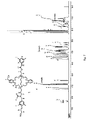
  • FIG. 7 is a 1 HNMR spectrum of one example of the rotaxane according to the present invention.
  • FIG. 8 is a MALDI-TOF-MS spectrum of one example of the rotaxane according to the present invention.
  • FIG. 9 is an SS curve of the polyurethane No. 10, 11 and 12.
  • FIG. 10 is an amplification figure of FIG. 9 .
  • the rotaxane according to the present invention has a crown ether and a chain molecule piercing through the cyclic structure of the crown ether, wherein the rotaxane has a structure with a hydroxyl group existing at one terminal of the chain molecule and a hydroxyl group bonding to the cyclic structure of the crown ether.
  • FIG. 1 is an illustrative figure schematically illustrating a structure of the rotaxane according to the present invention.
  • a rotaxane 1 has a crown ether 3 and a chain molecule 5 piercing through the cyclic structure of the crown ether 3 , wherein the rotaxane has a structure with a hydroxyl group 7 existing at one terminal of the chain molecule and a hydroxyl group 9 bonding to the cyclic structure of the crown ether 3 .
  • the chain molecule 5 has a chain portion 5 a with a little steric hindrance piercing through the cyclic structure of the crown ether 3 , and blocking structures 5 b located on both terminal sides of the chain portion 5 a with a little steric hindrance to prevent disassociation of the cyclic structure of the crown ether 3 from the chain molecule.
  • the cyclic structure of the crown ether 3 is sandwiched between the two blocking structures 5 b , and thus does not dissociate from the chain molecule 5 .
  • the rotaxane according to the present invention is characterized in that the cyclic structure of the crown ether 3 is rotatable around and movable along the chain portion 5 a with a little steric hindrance of the chain molecule 5 , and hydroxyl groups exist at the terminal of the chain molecule and on the cyclic structure of the crown ether, respectively.
  • the two existing hydroxyl groups enable the rotaxane according to the present invention to be used as, for example, a raw material for a polyurethane, polyester, and the like.
  • the cyclic structure of the crown ether is rotatable around and movable along the chain portion with a little steric hindrance of the chain molecule, the resultant polymer can disperse stress, thereby exerting excellent mechanical properties.
  • the inner pore of the crown ether is preferably larger than the chain portion with a little steric hindrance of the chain molecule, and is preferably smaller than the blocking structure of the chain molecule.
  • the rotaxane according to the present invention comprises a crown ether having a hydroxyl group.
  • the crown ether is a cyclic ether.
  • the crown ether has a cyclic structure having an inner pore at the center, and the oxygen atom existing on the cyclic structure faces toward the inner pore.
  • the oxygen atom of the cyclic structure of the crown ether electrostatically interacts with the cation, and the cation is taken into and kept in the inner pore.
  • the crown ether is known as a so-called host-guest compound.
  • the rotaxane according to the present invention preferably has one cyclic structure of the crown ether.
  • the atom constituting the cyclic structure of the crown ether preferably includes a carbon atom and an oxygen atom.
  • the number of the atoms constituting the cyclic structure of the crown ether is preferably 12 or more, more preferably 15 or more, and is preferably 34 or less, more preferably 32 or less.
  • the number of the oxygen atoms is preferably 4 or more, more preferably 6 or more, and is preferably 12 or less, more preferably 10 or less.
  • One to three atoms of the oxygen atoms constituting the cyclic structure may be optionally replaced with NH. NR, or S.
  • a benzene ring is preferably introduced in the cyclic structure of the crown ether. If the benzene ring is introduced, a functional group is easily introduced in the cyclic structure of the crown ether.
  • the number of the introduced benzene ring is preferably, but not limited to, 1 to 4.
  • crown ether examples include dibenzo-24-crown-8,24-crown-8, benzo-24-crown-8, and dicyclohexyl-24-crown-8. Among them, dibenzo-24-crown-8 and benzo-24-crown-8, each of which has a benzene ring in the cyclic structure, are preferable.
  • the hydroxyl group bonding to the cyclic structure of the crown ether may bond directly or indirectly to the cyclic structure.
  • the “bonding indirectly” means bonding, e.g. via an alkylene chain having 1 to 10 carbon atoms.
  • the hydroxyl group bonding to the cyclic structure more preferably bonds to the cyclic structure via an alkylene chain having 1 to 6 carbon atoms.
  • the number of the hydroxyl group bonding to the cyclic structure of the crown ether preferably ranges from 1 to 5, more preferably 2 or less, and even more preferably 1.
  • the hydroxyl group bonding to the cyclic structure of the crown ether preferably bonds directly or indirectly to the benzene ring introduced in the cyclic structure of the crown ether.
  • the hydroxyl group preferably bonds to the benzene ring of the cyclic structure of the crown ether via an alkylene chain having 1 to 10 carbon atoms.
  • a plurality of hydroxyl groups are introduced in the cyclic structure of the crown ether, a plurality of hydroxyl groups may be introduced in one benzene ring, or a plurality of benzene rings each having one hydroxyl group introduced may be disposed.
  • the cyclic structure of the crown ether of the rotaxane according to the present invention preferably has two or less benzene rings each having one hydroxyl group introduced, more preferably has one benzene ring having one hydroxyl group introduced.
  • the rotaxane according to the present invention has a chain molecule piercing through the cyclic structure of the crown ether.
  • the chain molecule preferably has a chain portion with a little steric hindrance and piercing through the cyclic structure of the crown ether, and blocking structures on both terminal sides of the chain portion with a little steric hindrance to prevent disassociation of the cyclic structure of the crown ether from the chain molecule.
  • Examples of the chain portion with a little steric hindrance include an alkylene chain, a polyester chain, a polyether r chain, and a polyacrylic chain.
  • the chain molecule preferably has an alkylene chain, more preferably has an alkylene chain having 3 to 30 carbon atoms, and even more preferably has an alkylene chain having 4 to 25 carbon atoms as the chain portion with a little steric hindrance.
  • the blocking structures for preventing disassociation of the cyclic structure of the crown ether from the chain molecule are formed on both terminal sides of the chain portion with a little steric hindrance of the chain molecule to sandwich the cyclic structure of the crown ether.
  • the blocking structure is not particularly limited, as long as it has a more bulky structure than the inner pore of the crown ether, and examples thereof include alkylbenzene, dialkylbenzene, trityl, terphenyl, anthracene, bistrifluoromethylbenzene, fullerene and porphyrin.
  • the hydroxyl group existing at one terminal of the chain molecule may bond directly or indirectly to the blocking structure.
  • the “bonding indirectly” means bonding to the blocking structure, e.g. via an alkylene chain having 1 to 10 carbon atoms.
  • the rotaxane according to the present invention is preferably a diol having two hydroxyl groups, or a triol having three hydroxyl groups.
  • the rotaxane according to the present invention preferably has a structure represented by the following structural formula (1).
  • R 1 represents an alkylene chain having 3 to 30 carbon atoms.
  • R 2 , R 3 , R 4 , R 5 may be identical to or different from each other, and represent an alkyl group having 1 to 10 carbon atoms.
  • R 6 represents an alkylene chain having 1 to 10 carbon atoms.
  • R 7 represents a single bond or an alkylene chain having 1 to 6 carbon atoms.
  • the crown ether structure in the structural formula (1) is dibenzo-24-crown-8, and has two benzene rings in the crown ether structure.
  • the cyclic structure of the crown ether is preferably rotatable around and movable along the alkylene chain portion of R 1 .
  • R 1 is preferably a linear alkylene chain having 3 to 30 carbon atoms with a little steric hindrance.
  • the alkylene chain represented by R 1 preferably has 4 or more carbon atoms, more preferably 6 or more carbon atoms, and even more preferably 8 or more carbon atoms, and preferably has 28 or less carbon atoms, more preferably 26 or less carbon atoms, and even more preferably 24 or less carbon atoms. If the number of carbon atoms falls within the above range, the resultant polyurethane has better mechanical properties.
  • R 1 examples include ethylene group, propylene group, butylene group, pentylene group, hexylene group, heptylene group, octylene group, nonylene group, decylene group, undecylene group, dodecylene group, tridecylene group, tetradecylene group, pentadecylene group, hexadecylene group, heptadecylene group, and octadecylene group.
  • the alkylene group may be linear or branched, and is preferably linear.
  • R 2 , R 3 , R 4 , R 5 may be identical to or different from each other, and represent an alkyl group having 1 to 10 carbon atoms.
  • R 2 , R 3 , R 4 , R 5 are preferably an alkyl group having 2 to 9 carbon atoms.
  • Examples of the alkyl group having 1 to 10 carbon atoms include methyl group, ethyl group, propyl group, butyl group, pentyl group, hexyl group, heptyl group, octyl group, nonyl group, and decyl group.
  • R 2 , R 3 , R 4 , R 5 may be linear, branched or cyclic.
  • Re is preferably an alkylene group having 1 to 10 carbon atoms, more preferably an alkylene group having 2 to 9 carbon atoms.
  • alkylene group examples include ethylene group, propylene group, butylene group, pentylene group, hexylene group, heptylene group, octylene group, nonylene group, and decylene group.
  • the alkylene group may be linear or branched, and is preferably linear.
  • R 7 is a single bond or an alkylene group having 1 to 10 carbon atoms.
  • R 7 is the single bond, it means that the hydroxyl group bonds directly to the benzene ring of the crown ether.
  • R 7 is more preferably an alkylene group having 2 to 9 carbon atoms.
  • Examples of the alkylene group include ethylene group, propylene group, butylene group, pentylene group, hexylene group, heptylene group, octylene group, nonylene group, and decylene group.
  • the alkylene group may be linear or branched, and is preferably linear.
  • the method for producing the rotaxane according to the present invention comprises: a step (1) of providing a chain molecule, a step (2) of preparing a crown ether, and a step (3) of making the chain molecule pierce through the cyclic structure of the crown ether and simultaneously blocking a terminal of the chain molecule.
  • the step (1) of providing the chain molecule preferably comprises the following steps:
  • a step (1-4) of forming an ionic center in the chain molecule is a step (1-4) of forming an ionic center in the chain molecule.
  • the step (1-1) of protecting the hydroxyl group of the blocking agent having the hydroxyl group is preferably performed as follows.
  • Dialkylhydroxy benzaldehyde is used as the blocking agent, and is reacted with a halogenated alcohol to obtain a reaction product 1 (dialkylhydroxyalkyloxo benzaldehyde).
  • a halogenated alcohol for example, chloroethanol is suitably used.
  • the reaction is preferably carried out, for example, at a temperature range of from 70° C. to 130° C. for 1 hour to 36 hours in N,N-dimethylformamide (DMF).
  • a basic reagent for deprotonating dialkylhydroxy benzaldehyde is preferably used. Examples of the basic reagent include K 2 CO 3 .
  • reaction product 1 is reacted with triisopropylsilyl chloride to obtain a reaction product 2 (dialkyltriisopropylsilyloxoalkyloxo benzaldehyde).
  • reaction product 2 dialkyltriisopropylsilyloxoalkyloxo benzaldehyde
  • the reaction is preferably carried out, for example, at a temperature range of from 20° C. to 50° C. for 5 hours to 15 hours in N,N-dimethylformamide (DMF).
  • the reaction is preferably carried out in the presence of a nucleophilic catalyst.
  • the nucleophilic catalyst include imidazole.
  • reaction product 2 is reacted with an aminoalkylcarboxylic acid ester to obtain a reaction product 3 having —C ⁇ N— bond.
  • the aminoalkylcarboxylic acid ester may be used as a hydrochloride.
  • the reaction is preferably carried out, for example, at a temperature range of from 90° C. to 110° C. for 12 hours to 48 hours in toluene.
  • An aminoalkylalcohol may be used instead of the aminoalkylcarboxylic acid ester. In this case, the following step (e) can be omitted.
  • reaction product 4 having —CH—NH— bond.
  • reducing agent for example, NaBH 4 , NaBHaCN, NaBH(OAc) 3 , or the like are preferably used.
  • the reaction is preferably carried out, for example, at a temperature range of from 0° C. to 30° C. for 2 hours to 16 hours in methanol.
  • the ester bond of the reaction product 4 is reduced to obtain a reaction product 5 having a hydroxyl group at the terminal of the alkyl chain.
  • the ester moiety of the carboxylic acid is methylolated.
  • the reducing agent for example, LiAlH 4 .
  • the reaction is preferably carried out, for example, at a temperature range of from 10° C. to 40° C. for 8 hours to 16 hours in tetrahydrofuran.
  • the reaction product 5 is ionized with an ammonium salt to obtain a reaction product 6 (chain molecule) having an ionic center formed.
  • the ammonium salt is not particularly limited, and examples thereof include ammonium hexafluorophosphate, ammonium trifluoromethanesulfonate, and ammonium trifluoroacetate, and ammonium hexafluorophosphate is preferable. Specifically, nitrogen of the —CH—NH— bond produced in (d) is cationized.
  • the reaction product 6 is a chain molecule having a blocking structure only at one terminal, having an ionic center, and having a hydroxyl group at another terminal (the side opposite to the blocking structure). The ionic center is preferably formed on the blocking structure side of the chain molecule.
  • the step (2) of preparing the crown ether preferably comprises the following steps.
  • the aldehyde is reduced to generate a methylol group (a hydroxyl group bonding to, via a methylene group,) on the benzene ring of the crown ether.
  • the reaction between the hydroxyl group and the triisopropylsilyl chloride is preferably carried out, for example, at a temperature range of from 20° C. to 50° C. for 5 hours to 20 hours in DMF.
  • the protection reaction of the hydroxyl group is preferably carried out in the presence of a nucleophilic catalyst. Examples of the nucleophilic catalyst include imidazole.
  • the step (3) of making the chain molecule pierce through the cyclic structure of the crown ether and simultaneously blocking the terminal of the chain molecule preferably comprises the following steps:
  • a step (3-4) of removing the protection agent to generate the hydroxyl group is a step (3-4) of removing the protection agent to generate the hydroxyl group.
  • the hydroxyl group terminal of the reaction product 6 that is the chain molecule is made pierce through the cyclic structure of the crown ether of the reaction product 7, and simultaneously the ionic center of the reaction product 6 and the cyclic structure of the crown ether are electrostatically bonded.
  • the reaction product 6 that is the chain molecule is being in a state of piercing through the cyclic structure of the crown ether, the cationized nitrogen atom in the reaction product 6 is electrostatically kept by the opening of the cyclic structure of the crown ether.
  • the cation of the chain molecule exists at a location near the blocking structure blocking one terminal of the chain molecule.
  • the cyclic structure of the crown ether electrostatically bonds to the chain molecule at the location near the blocking structure blocking one terminal of the chain molecule.
  • dehydrated dichloromethane is added in a mixture of the reaction product 6 and the reaction product 7, and ultrasonic radiation is conducted to form the complex.
  • the hydroxyl group existing at another terminal of the reaction product 6 that is the chain molecule is reacted with the blocking agent to obtain a reaction product 8.
  • a bulky polyisocyanate is preferably used.
  • dialkylphenyl isocyanate is preferably used.
  • the dialkylphenyl isocyanate include 3,5-dimethylphenyl isocyanate, 3,5-di-tert-butylphenyl isocyanate, mesitylene isocyanate, 3,5-dimethoxyphenyl isocyanate, and 3,5-bistrifluoromethylphenyl isocyanate.
  • the blocking reaction can be carried out, for example, at a temperature range of from 10° C. to 30° C.
  • reaction is preferably carried out in the presence of a conventional catalyst (excluding a basic catalyst) used in a reaction between an isocyanate group and a hydroxyl group.
  • a conventional catalyst excluding a basic catalyst
  • the reaction is preferably carried out, for example, in the presence of dibutyltin dilaurate.
  • the cationized nitrogen of the chain molecule is preferably neutralized, and acetylated by a reaction with acetic acid anhydride.
  • the neutralizing agent triethylamine, diisopropylethylamine, and DBU (1,8-diazabicyclo[5.4.0]undec-7-ene) can be used.
  • the reaction is preferably carried out, for example, at a temperature range of from 40° C. to 60° C. for 12 hours to 36 hours in tetrahydrofuran (THF). By this reaction, the ionic center of the reaction product 6 disappears, thus the electrostatic bonding between the chain molecule and the cyclic structure of the crown ether is eliminated.
  • the triisopropylsilyl group protecting the hydroxyl group is eliminated to regenerate the hydroxyl group.
  • a hydroxyl group is generated at one terminal of the chain molecule, and a hydroxyl group bonding to the cyclic structure of the crown ether is generated.
  • the reaction is preferably carried out, for example, at a temperature range of from 20° C. to 50° C. for 4 hours to 10 hours in tetrahydrofuran (THF).
  • THF tetrahydrofuran
  • TBAF tetra n-butyl ammonium fluoride
  • TBAF provides a fluoride ion source necessary for the deprotection of silylether.
  • the polyurethane according to the present invention comprises a polyisocyanate component and the rotaxane component of the present invention as a constituent component, wherein the rotaxane component has a crown ether and a chain molecule piercing through the cyclic structure of the crown ether, wherein the rotaxane has a structure with a hydroxyl group existing at one terminal of the chain molecule and a hydroxyl group bonding to the cyclic structure of the crown ether.
  • the polyurethane according to the present invention comprises (A) a polyisocyanate component and (B) a rotaxane component as a constituent component.
  • the polyurethane is a polyurethane having a plurality of urethane bonds, obtained by a reaction between (A) the polyisocyanate component and (B) the rotaxane component.
  • the polyisocyanate component is not particularly limited, as long as it has two or more isocyanate groups, and examples thereof include an aromatic polyisocyanate, an alicyclic polyisocyanate, and an aliphatic polyisocyanate.
  • aromatic polyisocyanate examples include 2,4-toluene diisocyanate, 2,6-toluene diisocyanate, a mixture of 2,4-toluene diisocyanate and 2,6-toluene diisocyanate (TDI), 4,4′-diphenylmethane diisocyanate (MDI), 1,5-naphthylene diisocyanate (NDI), 3,3′-bitolylene-4,4′-diisocyanate (TODI), xylylene diisocyanate (XDI), tetramethylxylylenediisocyanate (TMXDI), and para-phenylene diisocyanate (PPDI).
  • TDI 2,4-toluene diisocyanate
  • MDI 4,4′-diphenylmethane diisocyanate
  • NDI 1,5-naphthylene diisocyanate
  • TODI 3,3′-bitoly
  • alicyclic polyisocyanate or aliphatic polyisocyanate examples include 4,4′-dicyclohexylmethane diisocyanate (H 12 MDI), hydrogenated xylylenediisocyanate (H 6 XDI), hexamethylene diisocyanate (HDI), isophorone diisocyanate (IPDI), and norbomene diisocyanate (NBDI).
  • H 12 MDI 4,4′-dicyclohexylmethane diisocyanate
  • H 6 XDI hydrogenated xylylenediisocyanate
  • HDI hexamethylene diisocyanate
  • IPDI isophorone diisocyanate
  • NBDI norbomene diisocyanate
  • the polyisocyanate may be used solely or as a mixture of at least two of them.
  • the aromatic polyisocyanate is preferably used as (A) the polyisocyanate component.
  • Use of the aromatic polyisocyanate enhances the mechanical property of the obtained polyurethane and provides a cover having an excellent abrasion resistance.
  • a non-yellowing type polyisocyanate e.g. TMXDI, XDI, HDI, H 6 XDI, IPDI, H 12 MDI and NBDI
  • H 12 MDI 4,4′-dicyclohexylmethane diisocyanate
  • the polyurethane according to the present invention may further contain (C) a polyol component.
  • the polyol component is not particularly limited, as long as it differs from (B) the rotaxane component and has a plurality of hydroxyl groups, and examples thereof include a low molecular weight polyol and a high molecular weight polyol.
  • low molecular weight polyol examples include a diol such as ethylene glycol, diethylene glycol, triethylene glycol, propanediol (e.g. 1,2-propanediol, 1,3-propanediol, 2-methyl-1,3-propanediol, and the like), dipropylene glycol, butanediol (e.g.
  • the high molecular weight polyol examples include a polyether polyol such as polyoxyethylene glycol (PEG), polyoxypropylene glycol (PPG), and polyoxytetramethylene glycol (PTMG); a condensed polyester polyol such as polyethylene adipate (PEA), polybutylene adipate (PBA), and polyhexamethylene adipate (PHMA); a lactone polyester polyol such as poly- ⁇ -caprolactone (PCL); a polycarbonate polyol such as polyhexamethylene carbonate; and an acrylic polyol.
  • a polyether polyol such as polyoxyethylene glycol (PEG), polyoxypropylene glycol (PPG), and polyoxytetramethylene glycol (PTMG)
  • PEG polyoxyethylene glycol
  • PPG polyoxypropylene glycol
  • PTMG polyoxytetramethylene glycol
  • PEG polyoxyethylene glycol
  • PPG polyoxypropylene glycol
  • PTMG polyoxy
  • the number average molecular weight of the high molecular weight polyol for example, is preferably 400 or more, more preferably 1,000 or more, without particular limitation. If the number average molecular weight of the high molecular weight polyol is excessively low, the obtained polyurethane is hard.
  • the upper limit of the number average molecular weight of the high molecular weight polyol is preferably 10,000, more preferably 8,000, without particular limitation.
  • the number average molecular weight is measured by gel permeation chromatography (GPC), using polystyrene as a standard material, N,N-dimethyl formamide (DMF) in which 5 mM of LiBr is added (30° C., flow: 0.7 mL) as an eluate, and two of TSK-GEL SUPERH2500 (available from Tosoh Corporation) as a column.
  • GPC gel permeation chromatography
  • the constituent ratio of (A) the polyisocyanate component, (B) the rotaxane component and (C) the polyol component constituting the polyurethane is as follows.
  • a molar ratio (NCO/OH) of the isocyanate group (NCO) of the polyisocyanate component to the total hydroxyl group (OH) of (B) the rotaxane component and (C) the polyol component is preferably 0.9 or more, more preferably 0.95 or more, and even more preferably 1.0, and is preferably 1.2 or less, more preferably 1.1 or less, and even more preferably 1.05 or less. If NCO/OH falls within the above range, a polyurethane having a high molecular weight is obtained.
  • a molar ratio (B/C) of (B) the rotaxane component to (C) the polyol component is preferably 0.01 or more, more preferably 0.03 or more, and even more preferably 0.05 or more, and is preferably 1.0 or less, more preferably 0.9 or less, and even more preferably 0.8 or less.
  • the polyurethane according to the present invention may further contain (D) a polyamine as a constituent component, in addition to (A) the polyisocyanate component, (B) the rotaxane component and (C) the polyol component.
  • the polyamine is not particularly limited, as long as it has at least two amino groups.
  • examples of the polyamine include an aliphatic polyamine, an alicyclic polyamine, and an aromatic polyamine.
  • Examples of the aliphatic polyamine include ethylenediamine, propylenediamine, butylenediamine, and hexamethylenediamine.
  • Examples of the alicyclic polyamine include isophoronediamine and piperazine.
  • the constitutional embodiment of the polyurethane according to the present invention is not particularly limited, and examples thereof include an embodiment where the polyurethane is formed from (A) the polyisocyanate component and (B) the rotaxane component; an embodiment where the polyurethane is formed from (A) the polyisocyanate component, (B) the rotaxane component and (C) the polyol component; and an embodiment where the polyurethane is formed from (A) the polyisocyanate component. (B) the rotaxane component, (C) the polyol component and (D) the polyamine component.
  • the polyurethane according to the present invention may be either a thermoplastic polyurethane or a thermosetting polyurethane.
  • the thermoplastic polyurethane is a polyurethane exhibiting plasticity by heating and generally means a polyurethane having a linear chain structure of a high-molecular weight to a certain extent.
  • the thermosetting polyurethane is a polyurethane obtained through a curing reaction between a relatively low molecular weight prepolymer and a curing agent when using. By controlling the number of the functional group of the prepolymer or the curing agent to be used, a thermosetting polyurethane having a three-dimensional crosslinked structure is formed.
  • a thermoplastic polyurethane is preferred.
  • Examples of the method for synthesizing the polyurethane according to the present invention include a one-shot method and a prepolymer method.
  • the one-shot method is a method of reacting a polyisocyanate component and a polyol component or the like at one time.
  • the prepolymer method is a method of reacting a polyisocyanate component and a polyol component or the like in multiple steps, e.g. a method of synthesizing a urethane prepolymer having a relatively low molecular weight, followed by further polymerization to have a higher molecular weight.
  • the method for synthesizing the polyurethane according to the present invention by the prepolymer method will be described.
  • the prepolymer method for example, (A) the polyisocyanate component, (B) the rotaxane component and (C) the high molecular weight polyol component are reacted to synthesize a prepolymer, and subsequently the obtained prepolymer is reacted with a low molecular weight polyol to perform a chain extension reaction.
  • (B) the rotaxane component may be used as a chain extender.
  • the synthesis of the prepolymer and the chain extension reaction are collectively simply referred to as “synthesis of polyurethane”, unless specified otherwise.
  • the temperature at which the synthesis reaction of the polyurethane is carried out is preferably 10° C. or more, more preferably 30° C. or more, and even more preferably 50° C. or more, and is preferably 200° C. or less, more preferably 150° C. or less, and even more preferably 100° C. or less.
  • the reaction time is preferably 10 minutes or more, more preferably 1 hour or more, and even more preferably 3 hours or more, and is preferably 32 hours or less, more preferably 16 hours or less, and even more preferably 8 hours or less.
  • the synthesis reaction of the polyurethane is preferably conducted in an atmosphere of dry nitrogen.
  • a conventional catalyst may be used.
  • the catalyst include a monoamine such as triethylamine and N,N-dimethylcyclohexylamine; a polyamine such as N,N,N′,N′-tetramethylethylene diamine and N,N,N′,N′′,N′′-pentamethyldiethylene triamine; a cyclic diamine such as 1,8-diazabicyclo-[5.4.0]-7-undecene (DBU) and triethylenediamine; and a tin-based catalyst such as dibutyl tin dilaurylate and dibutyl tin diacetate.
  • DBU 1,8-diazabicyclo-[5.4.0]-7-undecene
  • These catalysts may be used solely, or two or more of these catalysts may be used in combination.
  • the tin-based catalyst such as dibutyl tin dilaurylate and dibutyl tin diacetate is preferable, and in particular, dibutyl tin dilaurylate is suitably used.
  • the present invention includes a polyurethane at least comprising a first urethane short chain and a second urethane short chain, wherein the first urethane short chain bonds to a cyclic structure of a crown ether at one terminal of the first urethane short chain, the second urethane short chain pierces through the cyclic structure of the crown ether of the first urethane short chain, and has blocking structures on both sides of the cyclic structure of the crown ether to prevent disassociation of the cyclic structure of the crown ether of the first urethane short chain from the second urethane short chain.
  • FIG. 2 is an illustrative figure schematically illustrating the polyurethane.
  • a polyurethane 20 comprises a first urethane short chain 21 and a second urethane short chain 23 .
  • the first urethane short chain 21 bonds to a cyclic structure 25 of a crown ether at one terminal of the first urethane short chain 21 .
  • the second urethane short chain 23 pierces through the cyclic structure 25 of the crown ether of the first urethane short chain 21 .
  • the second urethane short chain 23 comprises a chain portion 29 with a little steric hindrance and piercing through the cyclic structure 25 of the crown ether, and blocking structures 27 on both terminal sides of the chain portion 29 with a little steric hindrance to prevent disassociation of the cyclic structure 25 of the crown ether from the second urethane short chain 23 .
  • the cyclic structure 25 of the crown ether of the first urethane short chain 21 is blocked by being sandwiched between the two blocking structures 27 with a large steric hindrance, which prevents the cyclic structure 25 of the crown ether from disassociating from the second urethane short chain 23 .
  • first urethane short chain 21 and the second urethane short chain 23 are connected by a steric hindrance other than a covalent bond.
  • the cyclic structure 25 of the crown ether is rotatable around and movable along the chain portion 29 with a little steric hindrance, thus when a load is applied to the resulting polyurethane, the stress can be dispersed.
  • a chain molecule serving as an element constituting a final polyurethane is referred to as a urethane short chain.
  • the urethane short chain is preferably, for example, a urethane prepolymer obtained by a reaction between a polyisocyanate and a polyol.
  • the polyurethane according to the present invention is preferably a polyurethane where the above exemplified urethane short chain 21 is connected repeatedly via a steric hindrance between the cyclic structure and the blocking structure other than via a covalent bond.
  • FIG. 3 shows a repeating unit constituting the polyurethane according to the present invention, n is an integer of 1 or more, n is preferably 50 or more, more preferably 100 or more.
  • FIG. 4 is an illustrative figure schematically illustrating the polyurethane according to the present invention further comprising a third urethane short chain 31 in addition to the first and second urethane short chains.
  • the third urethane short chain 31 bonds to a cyclic structure 25 of a crown ether at one terminal of the third urethane short chain 31 .
  • the first urethane short chain 21 pierces through the cyclic structure 25 of the crown ether of the third urethane short chain 31 , and blocking structures 27 are formed on the first urethane short chain 21 and on both sides of the cyclic structure 25 of the crown ether to prevent disassociation of the cyclic structure 25 of the crown ether of the third urethane short chain 31 from the first urethane short chain 21 .
  • the urethane short chain 21 has a cyclic structure 25 of a crown ether at one terminal and two sterically bulky blocking structures 27 at another terminal.
  • a urethane chain 23 located at one terminal of the polyurethane may not have a cyclic structure of a crown ether.
  • a urethane chain 31 constituting another terminal of the polyurethane may not have a blocking structure for blocking a cyclic structure 25 of a crown ether.
  • FIG. 5 is an illustrative figure schematically illustrating another embodiment of the polyurethane according to the present invention further comprising a third urethane short chain 31 in addition to the first and second urethane short chains.
  • Both terminals of the first urethane short chain 21 bond to a cyclic structure 25 of a crown ether.
  • the first urethane short chain 21 crosslinks the cyclic structure 25 of the crown ether blocked by the second urethane short chain 23 and the cyclic structure 25 of the crown ether blocked by the third urethane short chain 31 .
  • FIG. 6 is an illustrative figure schematically illustrating another embodiment of the polyurethane according to the present invention further comprising a third urethane short chain 31 in addition to the first and second urethane short chains.
  • the second urethane short chain 23 has blocking structures 27 at one terminal thereof to block a cyclic structure 25 of a crown ether bonding to the first urethane short chain 21 .
  • the second urethane short chain 23 has blocking structures 27 at another terminal thereof to block a cyclic structure 25 of a crown ether bonding to the third urethane short chain 31 .
  • the crown ether to which the urethane short chain bonds is a cyclic ether.
  • the crown ether has a cyclic structure having an inner pore at the center, and the oxygen atom existing on the cyclic structure faces toward the inner pore.
  • the oxygen atom of the cyclic structure of the crown ether electrostatically interacts with the cation, and thus the crown ether takes and keeps the cation in the inner pore.
  • the crown ether is known as a so-called host-guest compound.
  • the atom constituting the cyclic structure of the crown ether preferably includes a carbon atom and an oxygen atom.
  • the number of the atoms constituting the cyclic structure of the crown ether is preferably 12 or more, more preferably 15 or more, and is preferably 34 or less, more preferably 32 or less.
  • the number of the oxygen atoms is preferably 4 or more, more preferably 6 or more, and is preferably 12 or less, more preferably 10 or less.
  • One to three atoms of the oxygen atoms constituting the cyclic structure are optionally replaced with NH, NR, or S.
  • a benzene ring is preferably introduced in the cyclic structure of the crown ether.
  • the urethane short chain preferably bonds to the benzene ring of the cyclic structure of the crown ether.
  • crown ether examples include dibenzo-24-crown-8,24-crown-8, benzo-24-crown-8, and dicyclohexyl-24-crown-8. Among them, dibenzo-24-crown-8 and benzo-24-crown-8, each of which has a benzene ring in the cyclic structure, are preferable.
  • the blocking structure for preventing disassociation of the cyclic structure of the crown ether from the chain molecule is located on both terminal sides of the chain portion with a little steric hindrance of the chain molecule to sandwich the cyclic structure of the crown ether.
  • the blocking structure is not particularly limited, as long as it has a more bulky structure than the inner pore of the crown ether, and examples of the blocking structure include alkylbenzene, dialkylbenzene, trityl, terphenyl, anthracene, bistrifluoromethylbenzene, fullerene and porphyrin.
  • the number average molecular weight of the polyurethane according to the present invention is preferably 10,000 or more, more preferably 20,000 or more, and even more preferably 40,000 or more. If the number average molecular weight is equal to or higher than the above lower limit, the properties acting as a macromolecule are exerted.
  • the molecular weight dispersity (PDI) is preferably 4.0 or less, more preferably 3.0 or less.
  • MALDI-TOF-MS was measured with AXIMA-CFR available from Shimadzu in a linear-positive ion mode, by using dithranol as a matrix and sodium trifluoroacetate as a cationization agent.
  • Measuring conditions are as follows.
  • RI differential refractometer
  • Modulus of elasticity was calculated by proximately linearizing any linear region within 10% strain among the results of a tensile test (SHIMADZU EZ-S, sample shape: #JIS 7, tensile speed: 40 mm/min, 25° C.).
  • the rotaxane was synthesized according to the method shown in the following scheme 1 and scheme 2.
  • tetra n-butylammonium fluoride (TBAF) (1M tetrahydrofuran (THF) solution) (9.2 mL) and dehydrated tetrahydrofuran (THF) (20 mL) were added, and stirred at room temperature for 8 hours.
  • the obtained rotaxane diol was used to synthesize a polyurethane.
  • HDI hexamethylene diisocyanate available from Wako Pure Chemical Corporation
  • PTHF1000 polytetrahydrofuran (number average molecular weight: 1000) available from Sigma-aldrich Corporation
  • PTHF1400 polytetrahydrofuran (number average molecular weight: 1400) available from Sigma-aldrich Corporation
  • PTHF2000 polytetrahydrofuran (number average molecular weight: 2000) available from Sigma-aldrich Corporation
  • PTHF2900 polytetrahydrofuran (number average molecular weight: 2900) available from Sigma-aldrich Corporation
  • Butanediol available from Wako Pure Chemical Corporation

Landscapes

  • Chemical & Material Sciences (AREA)
  • Organic Chemistry (AREA)
  • Health & Medical Sciences (AREA)
  • Chemical Kinetics & Catalysis (AREA)
  • Medicinal Chemistry (AREA)
  • Polymers & Plastics (AREA)
  • Polyurethanes Or Polyureas (AREA)
  • Heterocyclic Compounds That Contain Two Or More Ring Oxygen Atoms (AREA)
  • Compositions Of Macromolecular Compounds (AREA)

Abstract

An object of the present invention is to provide a novel rotaxane and a polyurethane using the same. The present invention provides a rotaxane having a crown ether and a chain molecule piercing through the cyclic structure of the crown ether, wherein a hydroxyl group exists at one terminal of the chain molecule, and a hydroxyl group bonds to the cyclic structure of the crown ether. The present invention further provides a polyurethane using the rotaxane as a polyol component.

Description

FIELD OF THE INVENTION
The present invention relates to a novel rotaxane and a polyurethane using the same.
DESCRIPTION OF THE RELATED ART
A polymer having a rotaxane structure can disperse a stress due to the movability of the macromolecular chain at crosslinking points, and thus exhibits excellent toughness. Examples of the crosslinked polymer using the rotaxane include those disclosed in JP 2012-224559 A and JP 2017-160164 A.
JP 2012-224559 A discloses a rotaxane and a polymer using the same as a crosslinking agent, wherein the rotaxane comprises a wheel component composed of two crown ether molecules each having at least one polymerization active group; and an axis component piercing through a hole portion of the wheel component and represented by a general formula (I) [R1-R2—N+H2—R3—N+H2—R2-R4].2X (I) (In the formula, R1 is a monovalent group having bulkiness equal to or larger than the hole of the crown ether, R2 is a linear chain portion consisting of a divalent group and piercing through the hole of the crown ether, R3 is a divalent group, R4 is a monovalent group having bulkiness complementary to the hole of the crown ether, and X is a monovalent anion).
JP 2017-160164 A discloses a rotaxane compound and a rotaxane network polymer using the same, wherein the rotaxane compound is composed of at least one cyclic molecule and one chain molecule piercing through the at least one cyclic molecule, where either one molecule of the at least one cyclic molecule and the one chain molecule has at least one reactive group selected from the group consisting of a nitrile oxide group and an azido group.
SUMMARY OF THE INVENTION
The object of the present invention is to provide a novel rotaxane and a polyurethane using the same.
The present invention provides a rotaxane having a crown ether and a chain molecule piercing through the cyclic structure of the crown ether, wherein the rotaxane has a structure with a hydroxyl group existing at one terminal of the chain molecule and a hydroxyl group bonding to the cyclic structure of the crown ether.
The present invention further provides a polyurethane comprising a polyisocyanate component and a rotaxane component as a constituent component, wherein the rotaxane component has a crown ether and a chain molecule piercing through the cyclic structure of the crown ether, wherein the rotaxane has a structure with a hydroxyl group existing at one terminal of the chain molecule and a hydroxyl group bonding to the cyclic structure of the crown ether.
The present invention also provides a polyurethane at least comprising a first urethane short chain and a second urethane short chain, wherein the first urethane short chain bonds to a cyclic structure of a crown ether at one terminal of the first urethane short chain, the second urethane short chain pierces through the cyclic structure of the crown ether of the first urethane short chain, and has blocking structures on both sides of the cyclic structure of the crown ether to prevent disassociation of the cyclic structure of the crown ether of the first urethane short chain from the second urethane short chain.
According to the present invention, a novel polyurethane different from the conventional polyurethane is provided.
BRIEF DESCRIPTION OF THE DRAWINGS
FIG. 1 is an illustrative figure schematically illustrating a structure of the rotaxane according to the present invention;
FIG. 2 is an illustrative figure schematically illustrating a structure of the polyurethane according to the present invention;
FIG. 3 is an illustrative figure schematically illustrating a structure of the polyurethane according to the present invention;
FIG. 4 is an illustrative figure schematically illustrating a structure of the polyurethane according to the present invention;
FIG. 5 is an illustrative figure schematically illustrating a structure of the polyurethane according to the present invention;
FIG. 6 is an illustrative figure schematically illustrating a structure of the polyurethane according to the present invention;
FIG. 7 is a 1HNMR spectrum of one example of the rotaxane according to the present invention;
FIG. 8 is a MALDI-TOF-MS spectrum of one example of the rotaxane according to the present invention;
FIG. 9 is an SS curve of the polyurethane No. 10, 11 and 12; and
FIG. 10 is an amplification figure of FIG. 9 .
DESCRIPTION OF THE PREFERRED EMBODIMENT
First, the rotaxane according to the present invention will be explained. The rotaxane according to the present invention has a crown ether and a chain molecule piercing through the cyclic structure of the crown ether, wherein the rotaxane has a structure with a hydroxyl group existing at one terminal of the chain molecule and a hydroxyl group bonding to the cyclic structure of the crown ether.
FIG. 1 is an illustrative figure schematically illustrating a structure of the rotaxane according to the present invention. A rotaxane 1 has a crown ether 3 and a chain molecule 5 piercing through the cyclic structure of the crown ether 3, wherein the rotaxane has a structure with a hydroxyl group 7 existing at one terminal of the chain molecule and a hydroxyl group 9 bonding to the cyclic structure of the crown ether 3. The chain molecule 5 has a chain portion 5 a with a little steric hindrance piercing through the cyclic structure of the crown ether 3, and blocking structures 5 b located on both terminal sides of the chain portion 5 a with a little steric hindrance to prevent disassociation of the cyclic structure of the crown ether 3 from the chain molecule. The cyclic structure of the crown ether 3 is sandwiched between the two blocking structures 5 b, and thus does not dissociate from the chain molecule 5. The rotaxane according to the present invention is characterized in that the cyclic structure of the crown ether 3 is rotatable around and movable along the chain portion 5 a with a little steric hindrance of the chain molecule 5, and hydroxyl groups exist at the terminal of the chain molecule and on the cyclic structure of the crown ether, respectively.
The two existing hydroxyl groups enable the rotaxane according to the present invention to be used as, for example, a raw material for a polyurethane, polyester, and the like. In addition, since the cyclic structure of the crown ether is rotatable around and movable along the chain portion with a little steric hindrance of the chain molecule, the resultant polymer can disperse stress, thereby exerting excellent mechanical properties. The inner pore of the crown ether is preferably larger than the chain portion with a little steric hindrance of the chain molecule, and is preferably smaller than the blocking structure of the chain molecule.
The rotaxane according to the present invention comprises a crown ether having a hydroxyl group. The crown ether is a cyclic ether. Generally, the crown ether has a cyclic structure having an inner pore at the center, and the oxygen atom existing on the cyclic structure faces toward the inner pore. The oxygen atom of the cyclic structure of the crown ether electrostatically interacts with the cation, and the cation is taken into and kept in the inner pore. In other words, the crown ether is known as a so-called host-guest compound. The rotaxane according to the present invention preferably has one cyclic structure of the crown ether.
The atom constituting the cyclic structure of the crown ether preferably includes a carbon atom and an oxygen atom. The number of the atoms constituting the cyclic structure of the crown ether is preferably 12 or more, more preferably 15 or more, and is preferably 34 or less, more preferably 32 or less. In addition, among the number of the atoms constituting the cyclic structure, the number of the oxygen atoms is preferably 4 or more, more preferably 6 or more, and is preferably 12 or less, more preferably 10 or less. One to three atoms of the oxygen atoms constituting the cyclic structure may be optionally replaced with NH. NR, or S.
A benzene ring is preferably introduced in the cyclic structure of the crown ether. If the benzene ring is introduced, a functional group is easily introduced in the cyclic structure of the crown ether. The number of the introduced benzene ring is preferably, but not limited to, 1 to 4.
Specific examples of the crown ether include dibenzo-24-crown-8,24-crown-8, benzo-24-crown-8, and dicyclohexyl-24-crown-8. Among them, dibenzo-24-crown-8 and benzo-24-crown-8, each of which has a benzene ring in the cyclic structure, are preferable.
The hydroxyl group bonding to the cyclic structure of the crown ether may bond directly or indirectly to the cyclic structure. The “bonding indirectly” means bonding, e.g. via an alkylene chain having 1 to 10 carbon atoms. The hydroxyl group bonding to the cyclic structure more preferably bonds to the cyclic structure via an alkylene chain having 1 to 6 carbon atoms. In addition, the number of the hydroxyl group bonding to the cyclic structure of the crown ether preferably ranges from 1 to 5, more preferably 2 or less, and even more preferably 1.
The hydroxyl group bonding to the cyclic structure of the crown ether preferably bonds directly or indirectly to the benzene ring introduced in the cyclic structure of the crown ether. In a more preferable embodiment, the hydroxyl group preferably bonds to the benzene ring of the cyclic structure of the crown ether via an alkylene chain having 1 to 10 carbon atoms. In the case that a plurality of hydroxyl groups are introduced in the cyclic structure of the crown ether, a plurality of hydroxyl groups may be introduced in one benzene ring, or a plurality of benzene rings each having one hydroxyl group introduced may be disposed. The cyclic structure of the crown ether of the rotaxane according to the present invention preferably has two or less benzene rings each having one hydroxyl group introduced, more preferably has one benzene ring having one hydroxyl group introduced.
The rotaxane according to the present invention has a chain molecule piercing through the cyclic structure of the crown ether. The chain molecule preferably has a chain portion with a little steric hindrance and piercing through the cyclic structure of the crown ether, and blocking structures on both terminal sides of the chain portion with a little steric hindrance to prevent disassociation of the cyclic structure of the crown ether from the chain molecule. Examples of the chain portion with a little steric hindrance include an alkylene chain, a polyester chain, a polyether r chain, and a polyacrylic chain. Among them, the chain molecule preferably has an alkylene chain, more preferably has an alkylene chain having 3 to 30 carbon atoms, and even more preferably has an alkylene chain having 4 to 25 carbon atoms as the chain portion with a little steric hindrance.
The blocking structures for preventing disassociation of the cyclic structure of the crown ether from the chain molecule are formed on both terminal sides of the chain portion with a little steric hindrance of the chain molecule to sandwich the cyclic structure of the crown ether. The blocking structure is not particularly limited, as long as it has a more bulky structure than the inner pore of the crown ether, and examples thereof include alkylbenzene, dialkylbenzene, trityl, terphenyl, anthracene, bistrifluoromethylbenzene, fullerene and porphyrin.
The hydroxyl group existing at one terminal of the chain molecule may bond directly or indirectly to the blocking structure. The “bonding indirectly” means bonding to the blocking structure, e.g. via an alkylene chain having 1 to 10 carbon atoms.
The rotaxane according to the present invention is preferably a diol having two hydroxyl groups, or a triol having three hydroxyl groups.
Specifically, the rotaxane according to the present invention preferably has a structure represented by the following structural formula (1).
[Chemical formula 1]
Figure US11555089-20230117-C00001
In the formula (1), R1 represents an alkylene chain having 3 to 30 carbon atoms. R2, R3, R4, R5 may be identical to or different from each other, and represent an alkyl group having 1 to 10 carbon atoms. R6 represents an alkylene chain having 1 to 10 carbon atoms. R7 represents a single bond or an alkylene chain having 1 to 6 carbon atoms.
The crown ether structure in the structural formula (1) is dibenzo-24-crown-8, and has two benzene rings in the crown ether structure.
In the structural formula (1), the cyclic structure of the crown ether is preferably rotatable around and movable along the alkylene chain portion of R1. From this viewpoint, R1 is preferably a linear alkylene chain having 3 to 30 carbon atoms with a little steric hindrance. The alkylene chain represented by R1 preferably has 4 or more carbon atoms, more preferably 6 or more carbon atoms, and even more preferably 8 or more carbon atoms, and preferably has 28 or less carbon atoms, more preferably 26 or less carbon atoms, and even more preferably 24 or less carbon atoms. If the number of carbon atoms falls within the above range, the resultant polyurethane has better mechanical properties.
Examples of R1 include ethylene group, propylene group, butylene group, pentylene group, hexylene group, heptylene group, octylene group, nonylene group, decylene group, undecylene group, dodecylene group, tridecylene group, tetradecylene group, pentadecylene group, hexadecylene group, heptadecylene group, and octadecylene group. The alkylene group may be linear or branched, and is preferably linear.
R2, R3, R4, R5 may be identical to or different from each other, and represent an alkyl group having 1 to 10 carbon atoms. R2, R3, R4, R5 are preferably an alkyl group having 2 to 9 carbon atoms. Examples of the alkyl group having 1 to 10 carbon atoms include methyl group, ethyl group, propyl group, butyl group, pentyl group, hexyl group, heptyl group, octyl group, nonyl group, and decyl group. R2, R3, R4, R5 may be linear, branched or cyclic.
Re is preferably an alkylene group having 1 to 10 carbon atoms, more preferably an alkylene group having 2 to 9 carbon atoms. Examples of the alkylene group include ethylene group, propylene group, butylene group, pentylene group, hexylene group, heptylene group, octylene group, nonylene group, and decylene group. The alkylene group may be linear or branched, and is preferably linear.
R7 is a single bond or an alkylene group having 1 to 10 carbon atoms. When R7 is the single bond, it means that the hydroxyl group bonds directly to the benzene ring of the crown ether. R7 is more preferably an alkylene group having 2 to 9 carbon atoms. Examples of the alkylene group include ethylene group, propylene group, butylene group, pentylene group, hexylene group, heptylene group, octylene group, nonylene group, and decylene group. The alkylene group may be linear or branched, and is preferably linear.
Specific examples of the rotaxane according to the present invention include a rotaxane with R1═C12H24, R2═R3=R4═R5═CH3, R6═C2H4, and R7═CH2.
The method for producing the rotaxane according to the present invention comprises: a step (1) of providing a chain molecule, a step (2) of preparing a crown ether, and a step (3) of making the chain molecule pierce through the cyclic structure of the crown ether and simultaneously blocking a terminal of the chain molecule.
The step (1) of providing the chain molecule preferably comprises the following steps:
a step (1-1) of protecting a hydroxyl group of a blocking agent having the hydroxyl group,
a step (1-2) of bonding the chain molecule to the blocking agent to produce a chain molecule having a blocking structure only at one terminal,
a step (1-3) of introducing a hydroxyl group to another terminal of the chain molecule, and
a step (1-4) of forming an ionic center in the chain molecule.
Specifically, the step (1-1) of protecting the hydroxyl group of the blocking agent having the hydroxyl group is preferably performed as follows.
(a) Dialkylhydroxy benzaldehyde is used as the blocking agent, and is reacted with a halogenated alcohol to obtain a reaction product 1 (dialkylhydroxyalkyloxo benzaldehyde). As the halogenated alcohol, for example, chloroethanol is suitably used. The reaction is preferably carried out, for example, at a temperature range of from 70° C. to 130° C. for 1 hour to 36 hours in N,N-dimethylformamide (DMF). In addition, in the reaction, a basic reagent for deprotonating dialkylhydroxy benzaldehyde is preferably used. Examples of the basic reagent include K2CO3.
(b) The obtained reaction product 1 is reacted with triisopropylsilyl chloride to obtain a reaction product 2 (dialkyltriisopropylsilyloxoalkyloxo benzaldehyde). By this reaction, the hydroxyl group of the blocking agent is protected. The reaction is preferably carried out, for example, at a temperature range of from 20° C. to 50° C. for 5 hours to 15 hours in N,N-dimethylformamide (DMF). The reaction is preferably carried out in the presence of a nucleophilic catalyst. Examples of the nucleophilic catalyst include imidazole.
(c) The reaction product 2 is reacted with an aminoalkylcarboxylic acid ester to obtain a reaction product 3 having —C═N— bond. The aminoalkylcarboxylic acid ester may be used as a hydrochloride. The reaction is preferably carried out, for example, at a temperature range of from 90° C. to 110° C. for 12 hours to 48 hours in toluene. An aminoalkylalcohol may be used instead of the aminoalkylcarboxylic acid ester. In this case, the following step (e) can be omitted.
(d) The —C═N— bond of the reaction product 3 is reduced to obtain a reaction product 4 having —CH—NH— bond. As the reducing agent, for example, NaBH4, NaBHaCN, NaBH(OAc)3, or the like are preferably used. The reaction is preferably carried out, for example, at a temperature range of from 0° C. to 30° C. for 2 hours to 16 hours in methanol.
(e) The ester bond of the reaction product 4 is reduced to obtain a reaction product 5 having a hydroxyl group at the terminal of the alkyl chain. By this reaction, the ester moiety of the carboxylic acid is methylolated. As the reducing agent, for example, LiAlH4. LiBH4, or the like are preferably used. The reaction is preferably carried out, for example, at a temperature range of from 10° C. to 40° C. for 8 hours to 16 hours in tetrahydrofuran.
(1-4) The reaction product 5 is ionized with an ammonium salt to obtain a reaction product 6 (chain molecule) having an ionic center formed. The ammonium salt is not particularly limited, and examples thereof include ammonium hexafluorophosphate, ammonium trifluoromethanesulfonate, and ammonium trifluoroacetate, and ammonium hexafluorophosphate is preferable. Specifically, nitrogen of the —CH—NH— bond produced in (d) is cationized. The reaction product 6 is a chain molecule having a blocking structure only at one terminal, having an ionic center, and having a hydroxyl group at another terminal (the side opposite to the blocking structure). The ionic center is preferably formed on the blocking structure side of the chain molecule.
The step (2) of preparing the crown ether preferably comprises the following steps.
Step (2-1) of Protecting the Hydroxyl Group of the Crown Ether Having the Hydroxyl Group
(a) Monoformyl crown ether is reduced to form a hydroxyl group, and the hydroxyl group is reacted with triisopropylsilyl chloride to obtain a reaction product 7 having a cyclic structure of the crown ether whose hydroxyl group has been protected. As the reducing agent, for example, NaBH4, NaBH3CN, NaBH(OAc)3, or the like are preferably used. The reduction reaction is preferably carried out, for example, at a temperature range of from 0° C. to 30° C. for 2 hours to 6 hours in methanol. By this reduction reaction, the aldehyde is reduced to generate a methylol group (a hydroxyl group bonding to, via a methylene group,) on the benzene ring of the crown ether. In addition, the reaction between the hydroxyl group and the triisopropylsilyl chloride is preferably carried out, for example, at a temperature range of from 20° C. to 50° C. for 5 hours to 20 hours in DMF. By this reaction, the hydroxyl group of the crown ether is protected. In addition, the protection reaction of the hydroxyl group is preferably carried out in the presence of a nucleophilic catalyst. Examples of the nucleophilic catalyst include imidazole.
The step (3) of making the chain molecule pierce through the cyclic structure of the crown ether and simultaneously blocking the terminal of the chain molecule preferably comprises the following steps:
a step (3-1) of making the terminal where the hydroxyl group exists, of the chain molecule having the blocking structure only at one terminal and having the ionic center, pierce through the cyclic structure of the crown ether, and electrostatically bonding the cyclic structure of the crown ether and the ionic center of the chain molecule,
a step (3-2) of allowing the hydroxyl group of the chain molecule to react with a blocking agent,
a step (3-3) of eliminating the electrostatic bonding between the ionic center of the chain molecule and the cyclic structure of the crown ether structure, and
a step (3-4) of removing the protection agent to generate the hydroxyl group.
Step (3-1) of making the terminal where the hydroxyl group exists, of the chain molecule having the blocking structure only at one terminal and having the ionic center, pierce through the cyclic structure of the crown ether, and electrostatically bonding the cyclic structure of the crown ether and the ionic center of the chain molecule
(1) The hydroxyl group terminal of the reaction product 6 that is the chain molecule is made pierce through the cyclic structure of the crown ether of the reaction product 7, and simultaneously the ionic center of the reaction product 6 and the cyclic structure of the crown ether are electrostatically bonded. In other words, when the reaction product 6 that is the chain molecule is being in a state of piercing through the cyclic structure of the crown ether, the cationized nitrogen atom in the reaction product 6 is electrostatically kept by the opening of the cyclic structure of the crown ether. The cation of the chain molecule exists at a location near the blocking structure blocking one terminal of the chain molecule. Thus, the cyclic structure of the crown ether electrostatically bonds to the chain molecule at the location near the blocking structure blocking one terminal of the chain molecule. Specifically, dehydrated dichloromethane is added in a mixture of the reaction product 6 and the reaction product 7, and ultrasonic radiation is conducted to form the complex.
Step (3-2) of Allowing the Hydroxyl Group Terminal of the Chain Molecule to React with the Blocking Agent
(a) The hydroxyl group existing at another terminal of the reaction product 6 that is the chain molecule is reacted with the blocking agent to obtain a reaction product 8. As the blocking agent, for example, a bulky polyisocyanate is preferably used. For example, dialkylphenyl isocyanate is preferably used. Examples of the dialkylphenyl isocyanate include 3,5-dimethylphenyl isocyanate, 3,5-di-tert-butylphenyl isocyanate, mesitylene isocyanate, 3,5-dimethoxyphenyl isocyanate, and 3,5-bistrifluoromethylphenyl isocyanate. The blocking reaction can be carried out, for example, at a temperature range of from 10° C. to 30° C. for 2 hours to 6 hours in dichloromethane. In addition, the reaction is preferably carried out in the presence of a conventional catalyst (excluding a basic catalyst) used in a reaction between an isocyanate group and a hydroxyl group. The reaction is preferably carried out, for example, in the presence of dibutyltin dilaurate. By this reaction, the cyclic structure of the crown ether is sandwiched between and hence blocked by the two blocking structures of the chain molecule.
Step (3-3) of Eliminating the Electrostatic Bonding Between the Chain Molecule and the Cyclic Structure of the Crown Ether
The cationized nitrogen of the chain molecule is preferably neutralized, and acetylated by a reaction with acetic acid anhydride. As the neutralizing agent, triethylamine, diisopropylethylamine, and DBU (1,8-diazabicyclo[5.4.0]undec-7-ene) can be used. The reaction is preferably carried out, for example, at a temperature range of from 40° C. to 60° C. for 12 hours to 36 hours in tetrahydrofuran (THF). By this reaction, the ionic center of the reaction product 6 disappears, thus the electrostatic bonding between the chain molecule and the cyclic structure of the crown ether is eliminated.
Step (3-4) of Removing the Protection Agent to Generate the Hydroxyl Group
The triisopropylsilyl group protecting the hydroxyl group is eliminated to regenerate the hydroxyl group. By this elimination reaction, a hydroxyl group is generated at one terminal of the chain molecule, and a hydroxyl group bonding to the cyclic structure of the crown ether is generated. The reaction is preferably carried out, for example, at a temperature range of from 20° C. to 50° C. for 4 hours to 10 hours in tetrahydrofuran (THF). In this elimination reaction, for example, tetra n-butyl ammonium fluoride (TBAF) is preferably used. TBAF provides a fluoride ion source necessary for the deprotection of silylether.
The polyurethane according to the present invention comprises a polyisocyanate component and the rotaxane component of the present invention as a constituent component, wherein the rotaxane component has a crown ether and a chain molecule piercing through the cyclic structure of the crown ether, wherein the rotaxane has a structure with a hydroxyl group existing at one terminal of the chain molecule and a hydroxyl group bonding to the cyclic structure of the crown ether.
The polyurethane according to the present invention comprises (A) a polyisocyanate component and (B) a rotaxane component as a constituent component. The polyurethane is a polyurethane having a plurality of urethane bonds, obtained by a reaction between (A) the polyisocyanate component and (B) the rotaxane component.
(A) The polyisocyanate component is not particularly limited, as long as it has two or more isocyanate groups, and examples thereof include an aromatic polyisocyanate, an alicyclic polyisocyanate, and an aliphatic polyisocyanate. Examples of the aromatic polyisocyanate include 2,4-toluene diisocyanate, 2,6-toluene diisocyanate, a mixture of 2,4-toluene diisocyanate and 2,6-toluene diisocyanate (TDI), 4,4′-diphenylmethane diisocyanate (MDI), 1,5-naphthylene diisocyanate (NDI), 3,3′-bitolylene-4,4′-diisocyanate (TODI), xylylene diisocyanate (XDI), tetramethylxylylenediisocyanate (TMXDI), and para-phenylene diisocyanate (PPDI). Examples of the alicyclic polyisocyanate or aliphatic polyisocyanate include 4,4′-dicyclohexylmethane diisocyanate (H12MDI), hydrogenated xylylenediisocyanate (H6XDI), hexamethylene diisocyanate (HDI), isophorone diisocyanate (IPDI), and norbomene diisocyanate (NBDI). The polyisocyanate may be used solely or as a mixture of at least two of them.
In view of improving the abrasion resistance, the aromatic polyisocyanate is preferably used as (A) the polyisocyanate component. Use of the aromatic polyisocyanate enhances the mechanical property of the obtained polyurethane and provides a cover having an excellent abrasion resistance. In addition, in view of improving the weather resistance, as (A) the polyisocyanate component, a non-yellowing type polyisocyanate (e.g. TMXDI, XDI, HDI, H6XDI, IPDI, H12MDI and NBDI) is preferably used, 4,4′-dicyclohexylmethane diisocyanate (H12MDI) is more preferably used. Since 4,4′-dicyclohexylmethane diisocyanate (H12MDI) has a rigid structure, the mechanical property of the resulting polyurethane is enhanced, and thus a polyurethane having an excellent abrasion resistance is obtained.
The polyurethane according to the present invention may further contain (C) a polyol component. (C) The polyol component is not particularly limited, as long as it differs from (B) the rotaxane component and has a plurality of hydroxyl groups, and examples thereof include a low molecular weight polyol and a high molecular weight polyol.
Examples of the low molecular weight polyol include a diol such as ethylene glycol, diethylene glycol, triethylene glycol, propanediol (e.g. 1,2-propanediol, 1,3-propanediol, 2-methyl-1,3-propanediol, and the like), dipropylene glycol, butanediol (e.g. 1,2-butanediol, 1,3-butanediol, 1,4-butanediol, 2,3-butanediol, 2,3-dimethyl-2,3-butanediol, and the like), neopentyl glycol, pentanediol, hexanediol, heptanediol, octanediol, 1,4-cyclohexanedimethylol, aniline diol, and bisphenol A type diol; a triol such as glycerin, trimethylolpropane, and hexanetriol; and a tetraol or a hexol such as pentaerythritol and sorbitol.
Examples of the high molecular weight polyol include a polyether polyol such as polyoxyethylene glycol (PEG), polyoxypropylene glycol (PPG), and polyoxytetramethylene glycol (PTMG); a condensed polyester polyol such as polyethylene adipate (PEA), polybutylene adipate (PBA), and polyhexamethylene adipate (PHMA); a lactone polyester polyol such as poly-ε-caprolactone (PCL); a polycarbonate polyol such as polyhexamethylene carbonate; and an acrylic polyol.
The number average molecular weight of the high molecular weight polyol, for example, is preferably 400 or more, more preferably 1,000 or more, without particular limitation. If the number average molecular weight of the high molecular weight polyol is excessively low, the obtained polyurethane is hard. The upper limit of the number average molecular weight of the high molecular weight polyol is preferably 10,000, more preferably 8,000, without particular limitation. It is noted that the number average molecular weight is measured by gel permeation chromatography (GPC), using polystyrene as a standard material, N,N-dimethyl formamide (DMF) in which 5 mM of LiBr is added (30° C., flow: 0.7 mL) as an eluate, and two of TSK-GEL SUPERH2500 (available from Tosoh Corporation) as a column.
The constituent ratio of (A) the polyisocyanate component, (B) the rotaxane component and (C) the polyol component constituting the polyurethane is as follows. A molar ratio (NCO/OH) of the isocyanate group (NCO) of the polyisocyanate component to the total hydroxyl group (OH) of (B) the rotaxane component and (C) the polyol component is preferably 0.9 or more, more preferably 0.95 or more, and even more preferably 1.0, and is preferably 1.2 or less, more preferably 1.1 or less, and even more preferably 1.05 or less. If NCO/OH falls within the above range, a polyurethane having a high molecular weight is obtained.
A molar ratio (B/C) of (B) the rotaxane component to (C) the polyol component is preferably 0.01 or more, more preferably 0.03 or more, and even more preferably 0.05 or more, and is preferably 1.0 or less, more preferably 0.9 or less, and even more preferably 0.8 or less.
The polyurethane according to the present invention may further contain (D) a polyamine as a constituent component, in addition to (A) the polyisocyanate component, (B) the rotaxane component and (C) the polyol component. The polyamine is not particularly limited, as long as it has at least two amino groups. Examples of the polyamine include an aliphatic polyamine, an alicyclic polyamine, and an aromatic polyamine. Examples of the aliphatic polyamine include ethylenediamine, propylenediamine, butylenediamine, and hexamethylenediamine. Examples of the alicyclic polyamine include isophoronediamine and piperazine.
The constitutional embodiment of the polyurethane according to the present invention is not particularly limited, and examples thereof include an embodiment where the polyurethane is formed from (A) the polyisocyanate component and (B) the rotaxane component; an embodiment where the polyurethane is formed from (A) the polyisocyanate component, (B) the rotaxane component and (C) the polyol component; and an embodiment where the polyurethane is formed from (A) the polyisocyanate component. (B) the rotaxane component, (C) the polyol component and (D) the polyamine component.
The polyurethane according to the present invention may be either a thermoplastic polyurethane or a thermosetting polyurethane. The thermoplastic polyurethane is a polyurethane exhibiting plasticity by heating and generally means a polyurethane having a linear chain structure of a high-molecular weight to a certain extent. The thermosetting polyurethane is a polyurethane obtained through a curing reaction between a relatively low molecular weight prepolymer and a curing agent when using. By controlling the number of the functional group of the prepolymer or the curing agent to be used, a thermosetting polyurethane having a three-dimensional crosslinked structure is formed. As the polyurethane according to the present invention, a thermoplastic polyurethane is preferred.
Examples of the method for synthesizing the polyurethane according to the present invention include a one-shot method and a prepolymer method. The one-shot method is a method of reacting a polyisocyanate component and a polyol component or the like at one time. The prepolymer method is a method of reacting a polyisocyanate component and a polyol component or the like in multiple steps, e.g. a method of synthesizing a urethane prepolymer having a relatively low molecular weight, followed by further polymerization to have a higher molecular weight.
Next, the method for synthesizing the polyurethane according to the present invention by the prepolymer method will be described. In the prepolymer method, for example, (A) the polyisocyanate component, (B) the rotaxane component and (C) the high molecular weight polyol component are reacted to synthesize a prepolymer, and subsequently the obtained prepolymer is reacted with a low molecular weight polyol to perform a chain extension reaction. It is noted that (B) the rotaxane component may be used as a chain extender. In the following, in the description regarding the synthesis conditions of the polyurethane, the synthesis of the prepolymer and the chain extension reaction are collectively simply referred to as “synthesis of polyurethane”, unless specified otherwise.
The temperature at which the synthesis reaction of the polyurethane is carried out is preferably 10° C. or more, more preferably 30° C. or more, and even more preferably 50° C. or more, and is preferably 200° C. or less, more preferably 150° C. or less, and even more preferably 100° C. or less. In addition, the reaction time is preferably 10 minutes or more, more preferably 1 hour or more, and even more preferably 3 hours or more, and is preferably 32 hours or less, more preferably 16 hours or less, and even more preferably 8 hours or less.
The synthesis reaction of the polyurethane is preferably conducted in an atmosphere of dry nitrogen.
In synthesizing the polyurethane, a conventional catalyst may be used. Examples of the catalyst include a monoamine such as triethylamine and N,N-dimethylcyclohexylamine; a polyamine such as N,N,N′,N′-tetramethylethylene diamine and N,N,N′,N″,N″-pentamethyldiethylene triamine; a cyclic diamine such as 1,8-diazabicyclo-[5.4.0]-7-undecene (DBU) and triethylenediamine; and a tin-based catalyst such as dibutyl tin dilaurylate and dibutyl tin diacetate. These catalysts may be used solely, or two or more of these catalysts may be used in combination. Among them, the tin-based catalyst such as dibutyl tin dilaurylate and dibutyl tin diacetate is preferable, and in particular, dibutyl tin dilaurylate is suitably used.
The present invention includes a polyurethane at least comprising a first urethane short chain and a second urethane short chain, wherein the first urethane short chain bonds to a cyclic structure of a crown ether at one terminal of the first urethane short chain, the second urethane short chain pierces through the cyclic structure of the crown ether of the first urethane short chain, and has blocking structures on both sides of the cyclic structure of the crown ether to prevent disassociation of the cyclic structure of the crown ether of the first urethane short chain from the second urethane short chain.
FIG. 2 is an illustrative figure schematically illustrating the polyurethane. A polyurethane 20 comprises a first urethane short chain 21 and a second urethane short chain 23. The first urethane short chain 21 bonds to a cyclic structure 25 of a crown ether at one terminal of the first urethane short chain 21. The second urethane short chain 23 pierces through the cyclic structure 25 of the crown ether of the first urethane short chain 21. The second urethane short chain 23 comprises a chain portion 29 with a little steric hindrance and piercing through the cyclic structure 25 of the crown ether, and blocking structures 27 on both terminal sides of the chain portion 29 with a little steric hindrance to prevent disassociation of the cyclic structure 25 of the crown ether from the second urethane short chain 23. The cyclic structure 25 of the crown ether of the first urethane short chain 21 is blocked by being sandwiched between the two blocking structures 27 with a large steric hindrance, which prevents the cyclic structure 25 of the crown ether from disassociating from the second urethane short chain 23. In other words, the first urethane short chain 21 and the second urethane short chain 23 are connected by a steric hindrance other than a covalent bond. The cyclic structure 25 of the crown ether is rotatable around and movable along the chain portion 29 with a little steric hindrance, thus when a load is applied to the resulting polyurethane, the stress can be dispersed.
Herein, a chain molecule serving as an element constituting a final polyurethane is referred to as a urethane short chain. The urethane short chain is preferably, for example, a urethane prepolymer obtained by a reaction between a polyisocyanate and a polyol.
The polyurethane according to the present invention is preferably a polyurethane where the above exemplified urethane short chain 21 is connected repeatedly via a steric hindrance between the cyclic structure and the blocking structure other than via a covalent bond. FIG. 3 shows a repeating unit constituting the polyurethane according to the present invention, n is an integer of 1 or more, n is preferably 50 or more, more preferably 100 or more.
FIG. 4 is an illustrative figure schematically illustrating the polyurethane according to the present invention further comprising a third urethane short chain 31 in addition to the first and second urethane short chains. The third urethane short chain 31 bonds to a cyclic structure 25 of a crown ether at one terminal of the third urethane short chain 31. The first urethane short chain 21 pierces through the cyclic structure 25 of the crown ether of the third urethane short chain 31, and blocking structures 27 are formed on the first urethane short chain 21 and on both sides of the cyclic structure 25 of the crown ether to prevent disassociation of the cyclic structure 25 of the crown ether of the third urethane short chain 31 from the first urethane short chain 21.
In this case, the urethane short chain 21 has a cyclic structure 25 of a crown ether at one terminal and two sterically bulky blocking structures 27 at another terminal. A chain portion 29 with a little steric hindrance exists between the two blocking structures 27.
It is noted that, as shown in FIG. 4 , for example, a urethane chain 23 located at one terminal of the polyurethane may not have a cyclic structure of a crown ether. Similarly, a urethane chain 31 constituting another terminal of the polyurethane may not have a blocking structure for blocking a cyclic structure 25 of a crown ether.
FIG. 5 is an illustrative figure schematically illustrating another embodiment of the polyurethane according to the present invention further comprising a third urethane short chain 31 in addition to the first and second urethane short chains. Both terminals of the first urethane short chain 21 bond to a cyclic structure 25 of a crown ether. In other words, the first urethane short chain 21 crosslinks the cyclic structure 25 of the crown ether blocked by the second urethane short chain 23 and the cyclic structure 25 of the crown ether blocked by the third urethane short chain 31.
FIG. 6 is an illustrative figure schematically illustrating another embodiment of the polyurethane according to the present invention further comprising a third urethane short chain 31 in addition to the first and second urethane short chains. The second urethane short chain 23 has blocking structures 27 at one terminal thereof to block a cyclic structure 25 of a crown ether bonding to the first urethane short chain 21. The second urethane short chain 23 has blocking structures 27 at another terminal thereof to block a cyclic structure 25 of a crown ether bonding to the third urethane short chain 31.
The crown ether to which the urethane short chain bonds is a cyclic ether. Generally, the crown ether has a cyclic structure having an inner pore at the center, and the oxygen atom existing on the cyclic structure faces toward the inner pore. The oxygen atom of the cyclic structure of the crown ether electrostatically interacts with the cation, and thus the crown ether takes and keeps the cation in the inner pore. In other words, the crown ether is known as a so-called host-guest compound.
The atom constituting the cyclic structure of the crown ether preferably includes a carbon atom and an oxygen atom. The number of the atoms constituting the cyclic structure of the crown ether is preferably 12 or more, more preferably 15 or more, and is preferably 34 or less, more preferably 32 or less. In addition, among the number of the atoms constituting the cyclic structure, the number of the oxygen atoms is preferably 4 or more, more preferably 6 or more, and is preferably 12 or less, more preferably 10 or less. One to three atoms of the oxygen atoms constituting the cyclic structure are optionally replaced with NH, NR, or S.
A benzene ring is preferably introduced in the cyclic structure of the crown ether. The urethane short chain preferably bonds to the benzene ring of the cyclic structure of the crown ether.
Specific examples of the crown ether include dibenzo-24-crown-8,24-crown-8, benzo-24-crown-8, and dicyclohexyl-24-crown-8. Among them, dibenzo-24-crown-8 and benzo-24-crown-8, each of which has a benzene ring in the cyclic structure, are preferable.
In the urethane short chain, the blocking structure for preventing disassociation of the cyclic structure of the crown ether from the chain molecule is located on both terminal sides of the chain portion with a little steric hindrance of the chain molecule to sandwich the cyclic structure of the crown ether. The blocking structure is not particularly limited, as long as it has a more bulky structure than the inner pore of the crown ether, and examples of the blocking structure include alkylbenzene, dialkylbenzene, trityl, terphenyl, anthracene, bistrifluoromethylbenzene, fullerene and porphyrin.
The number average molecular weight of the polyurethane according to the present invention is preferably 10,000 or more, more preferably 20,000 or more, and even more preferably 40,000 or more. If the number average molecular weight is equal to or higher than the above lower limit, the properties acting as a macromolecule are exerted. In addition, the molecular weight dispersity (PDI) is preferably 4.0 or less, more preferably 3.0 or less.
EXAMPLES
Next, the present invention will be described in detail by way of examples. However, the present invention is not limited to the examples described below. Various changes and modifications without departing from the spirit of the present invention are included in the scope of the present invention.
[Test Method]
[1HNMR]
NMR was measured with a Bruker AVANCEIIIHD500 spectrometer.
[MALDI-TOF-MS]
MALDI-TOF-MS was measured with AXIMA-CFR available from Shimadzu in a linear-positive ion mode, by using dithranol as a matrix and sodium trifluoroacetate as a cationization agent.
[Molecular Weight]
Molecular weight was obtained by size exclusion chromatograph. Number average molecular weight, weight average molecular weight and dispersity were values based on polystyrene conversion.
Measuring conditions are as follows.
Column: TOSOH TSKgel G2500H and G4000H
Pump: Intelligent HPLC pump PU-2080 available from JASCO Corporation
Eluate: N,N-dimethyl formamide (DMF) in which 5 mM of LiBr was added (30° C., flow: 0.7 mL)
Detector: RI (differential refractometer)
[Modulus of Elasticity]
Modulus of elasticity was calculated by proximately linearizing any linear region within 10% strain among the results of a tensile test (SHIMADZU EZ-S, sample shape: #JIS 7, tensile speed: 40 mm/min, 25° C.).
[Yield]
Yield was calculated from the weight charged in the reaction and the weight of the dried sample (vacuum dried at 80° C. for 12 hours).
Yield (%)=100×weight of dried sample/weight charged in reaction
The rotaxane was synthesized according to the method shown in the following scheme 1 and scheme 2.
Figure US11555089-20230117-C00002
Figure US11555089-20230117-C00003

(1) Synthesis of Chain Molecule
Synthesis of 21
In 3,5-dimethyl-4-hydroxybenzaldehyde (13.8 g: 91.9 mmol), 2-chloroethanol (15.0 g, 187 mmol) and potassium carbonate (24.2 g, 175 mmol), N,N-dimethylformamide (DMF) (130 mL) was added, and stirred at 100° C. for 2.5 days. Disappearance of the raw materials (Rf: 0.6) was confirmed by TLC (ethyl acetate/hexane=1/2 (v/v)), and the solvent was removed by distillation. The residue was dissolved in dichloromethane, filtered to remove an inorganic salt, and then washed (1M HCl aq.→sodium bicarbonate water for 2 times→saturated sodium chloride solution), to obtain a crude product 21 (14.8 g).
Synthesis of 22
In the crude product 21 (total amount obtained above), imidazole (13.0 g, 190 mmol) and triisopropylsilyl chloride (TIPS-Cl) (32.6 mL, 29.4 g, 152 mmol), DMF (150 mL) was added, and stirred at room temperature for 10 hours. Disappearance of the raw materials (Rf: 0.2) was confirmed by TLC (ethyl acetate/hexane=1/1 (v/v)), and the solvent was removed by distillation. The residue was dissolved in dichloromethane, and washed (sodium bicarbonate water for 2 times→saturated sodium chloride solution), to obtain a crude product 22 (21.1 g).
Synthesis of 25
In the crude product 22 (total amount obtained above) and a hydrochloride 23 (17.6 g, 66.2 mmol), toluene (100 mL) was added, and stirred at reflux (100° C. at night) for 2 days. After the reaction, the solvent was removed by distillation. Methanol (300 mL) was added in the residue, and NaBH4 (9.14 g, 242 mmol) was added therein under an ice bath condition and directly stirred overnight. Disappearance of the imine peak was confirmed by 1HNMR, and the solvent was removed by distillation. The residue was dissolved in dichloromethane, washed (saturated sodium chloride solution→methanol for 2 times), and purified with silica gel column chromatography (ethyl acetate/hexane=1/3→1/1→chloroform/methanol=20/1→10/1→9/1 (v/v)), to obtain 25 (32.7 g, 58.0 mmol).
1HNMR (500 MHz, 298 K, CDCl3): δ7.21 (s, 2H), 4.01 (t, J=4.6 Hz, 2H), 3.90 (s, 2H), 3.80 (t, J=4.6 Hz, 2H), 3.66 (s, 3H), 2.72 (t, J=8.4 Hz, 2H), 2.29 (s, 6H), 2.29 (t, 2H), 1.89-1.79 (m, 2H), 1.65-1.55 (m, 2H), 1.35-1.00 (m, 35H) ppm.
Synthesis of 26
In lithium aluminum hydride (LAH) (4.20 g, 111 mmol), dry tetrahydrofuran (THF) (500 mL) was added, and dry tetrahydrofuran (THF) solution (50 mL) of 25 (No. 953, total amount) was slowly added dropwise under an ice bath condition, and directly stirred overnight. After the reaction, sodium sulfate aqueous solution, methanol and pure water were used to inactivate (quench) the unreacted lithium aluminum hydride (LAH), filtrated to remove Al salt, and purified with silica gel column chromatography (dichloromethane/methanol=1/0→39/1→20/1 (v/v)), to obtain a white product 26 (13.6 g, 25.4 mmol, 25%).
1HNMR (500 MHz, 298 K, CDCl3): δ6.95 (s, 2H), 4.03 (t. J=5.2 Hz, 2H), 3.85 (t. J=5.2 Hz, 2H), 3.66 (s, 2H), 3.64 (t, J=6.6 Hz, 2H), 2.62 (t. J=7.3 Hz, 2H), 2.28 (s, 6H), 1.60-1.47 (m, 4H), 1.38-1.23 (m, 16H), 1.19-1.06 (m, 21H) ppm.
Synthesis of 27
In 26 (2.19 g, 4.09 mmol), chloroform (CHCl3) (30 mL) was added to dissolve 26, and the resulting solution was moved to a separatory funnel. NH4PF6 (3.33 g, 20.4 mmol) aqueous solution (30 mL) was added, and mixed by strong shaking. After the operation was repeated, drying was performed with sodium sulfate, to obtain a yellow solid 27 (2.34 g, 3.43 mmol, 84%).
1HNMR (500 MHz, 298 K, CDCl3): δ7.02 (s, 2H), 4.03 (t, J=5.2 Hz, 2H), 3.97 (br, 2H), 3.86 (t, J=5.2 Hz, 2H), 3.61 (t, J=6.6 Hz, 2H), 2.82 (t, J=7.9 Hz, 2H), 2.30 (s, 6H), 1.67-1.58 (m, 4H), 1.37-1.19 (m, 16H), 1.19-1.05 (m, 21H) ppm.
(2) Preparation of Crown Ether
Synthesis of 29
In monoformyl crown ether 28 (4.60 g, 9.65 mmol), methanol (80 mL) was added, and NaBH4 (1.80 g, 47.6 mmol) was added and directly stirred for 5 hours under an ice bath condition. Disappearance of the aldehyde peak was confirmed by 1HNMR, and the solvent was removed by distillation. Water was added in the residue, the residue was extracted (dichloromethane for 2 times) and washed (sodium bicarbonate water→saturated sodium chloride solution), and the solvent was removed again by distillation to dry the residue. Subsequently, in imidazole (1.64 g, 24.1 mmol) and triisopropylsilyl chloride (TIPS-Cl) (4.1 mL, 3.72 g, 19.3 mmol), N,N-dimethylformamide (DMF) (20 mL) was added and stirred at room temperature for 20 hours, followed by further performing the reaction at 35° C. for 5 hours. After the solvent was removed by distillation, the residue was dissolved in dichloromethane, washed (ammonium chloride aqueous solution→sodium bicarbonate water→saturated sodium chloride solution), and purified with silica gel column chromatography (ethyl acetate/hexane=1/1), to obtain a white solid 29 (4.74 g, 7.46 mmol, 77%).
1HNMR (500 MHz, 298 K, CDCl3): δ6.92 (s, 1H), 6.90-6.85 (m, 4H), 6.83-6.82 (br, 2H), 4.74 (s, 2H), 4.18-4.12 (m, 8H), 3.94-3.89 (m, 8H), 3.86-3.82 (m, 8H), 1.21-1.12 (m, 3H), 1.11-1.06 (m, 18H) ppm.
(3) Preparation of Rotaxane
Synthesis of Rotaxane 30 Having a Triisopropylsilyl (TIPS) Group on Each of the Cyclic Structure and the Chain Molecule
In the axis component 27 (2.55 g, 3.74 mmol) and the wheel component 29 (2.49 g, 3.92 mmol), dehydrated dichloromethane (10 mL) was added, and ultrasonic radiation was conducted to form a complex. Subsequently, 3,5-dimethylphenylisocyanate (0.92 g, 6.3 mmol) and dibutyl tin dilaurate (DBTDL) (some drops) were added, and stirred at room temperature for 10 hours to perform terminal blocking. Completion of the terminal blocking was confirmed by MALDI-TOF-MS, and methanol was added to inactivate (quench) the excessive isocyanate. After the reaction solution was fully dried with an evaporator and subsequently a vacuum line, triethylamine (TEA) (9.90 g, 97.8 mmol), acetic acid anhydride (4.00 g, 39.2 eq.) and dehydrated tetrahydrofuran (THF) (10 mL) were added to dissolve the residue, and stirred at 45° C. for 2 days. After termination of the reaction was confirmed by MALDI-TOF-MS and the solvent was removed by distillation, ethyl acetate was added, and the residue was washed (ammonium chloride aqueous solution for 1 time→sodium bicarbonate water for 1 time→saturated sodium chloride solution for 1 time), and purified with silica gel column chromatography (dichloromethane/ethyl acetate=10/1), to obtain a rotaxane 30 having triisopropylsilyl (TIPS) group on each of the cyclic structure and the chain molecule (4.17 g, 3.06 mmol).
Synthesis of Rotaxane Having a Hydroxyl Group on Each of the Cyclic Structure and the Chain Molecule (Hereinafter Referred to as “Rotaxane Diol” Occasionally)
In the rotaxane 30 (total amount), tetra n-butylammonium fluoride (TBAF) (1M tetrahydrofuran (THF) solution) (9.2 mL) and dehydrated tetrahydrofuran (THF) (20 mL) were added, and stirred at room temperature for 8 hours. After termination of the reaction was confirmed by MALDI-TOF-MS and the solvent was removed by distillation, ethyl acetate was added, and the residue was washed (NH4Cl aq.x2, brine), and purified with silica gel column chromatography (Eluent: ethyl acetate/dichloromethane=1/3→ethyl acetate/methanol=30/1 (v/v)) and separatory GPC (Eluent: chloroform), to obtain a rotaxane diol (1.79 g, 1.71 mmol, 44%).
1HNMR (500 MHz, 298K, CDCl3): δ8.34 (d, J=28.1 Hz, 1H), 7.16 (s, 2H), 6.91-6.78 (m, 9H), 6.51 (s, 1H), 4.62-4.58 (m, 2H), 4.44 (d, J=29.6 Hz, 2H), 4.36-4.30 (m, 2H), 4.22-4.05 (m, 8H), 3.97-3.78 (m, 12H), 3.59-3.56 (m, 8H), 3.25 (dt, J=80.9, 7.9 Hz, 2H), 2.27 (d, J=11.7 Hz, 6H), 2.14 (d, J=27.9 Hz, 3H), 2.09 (s, 6H), 1.58-1.47 (m, 2H), 1.47-1.38 (m, 2H), 1.28-0.92 (m, 16H) ppm.
1HNMR (500 MHz, 298 K, CDCl3) measurement result of the obtained rotaxane diol is shown in FIG. 7 . In addition, MALDI-TOF-MS measurement spectrum is shown in FIG. 8 .
The obtained rotaxane diol was used to synthesize a polyurethane.
Synthesis Conditions and Properties of the Obtained Polyurethane are Shown in Tables 1-4 in Combination
TABLE 1
Synthesis of prepolymer Chain extension reaction Molecular weight
PTHF Rotaxane Temp. Time Temp. Time Yield Mn Mw
Pu No. 1000 diol HDI (° C.) (h) Butanediol (° C.) (h) (%) (KDa) (KDa) PDI
1 1 2 25 3 1 25 24 37 35 50 1.43
2 1 2 Rt. 3 1 Rt. 24 38 39 58 1.49
3 1 2 25 8.5 1 or more 25 17 20 29 1.44
4 1 2 Rt. 10 1 Rt. 27 73 62 93 1.50
5 0.9 0.1 2 25 7 1 25 15.5 64 11 22 2.06
6 1.5 2 25 7 0.5 25 15.5 80 20 36 1.84
7 1.2 2 25 12 0.8 25 12 or 51 28 43 1.54
more
8 0.9 0.1 2 60 8 1 60 16 72 8.3 14 1.65
9 0.8 0.1 2 60 8 1 60 16 73 8.4 15 1.78
Raw material ratio: molar ratio
Rt: Room temperature
TABLE 2
Synthesis of prepolymer Chain extension reaction Molecular weight
PTHF Rotaxane Temp. Time Rotaxane Temp. Time Yield Mn Mw
Pu No. 2900 diol HDI (° C.) (h) diol Butanediol (° C.) (h) (%) (KDa) (KDa) PDI
10 1 2 25 12 1 25 12 or 79 84 130 1.55
more
11 1 2 60 6 0.1 0.9 60 12 or 68 53 73 1.37
more
12 0.9 0.1 2 60 6 1 60 12 or 63 52 71 1.37
more
Raw material ratio: molar ratio
TABLE 3
Synthesis of prepolymer Molecular weight
Rotaxane Temp. Time Temp. Time Yield Mn Mw
Pu No. PTHF2000 diol HDI (° C.) (h) Butanediol (° C.) (h) (%) (KDa) (KDa) PDI
13 1 2 60 14 1 60 12 60 54 97 1.78
14 0.9 0.1 2 60 14 1 60 12 14 31 47 1.53
15 1 2 60 6 1 60 16 80 35 65 1.85
16 1 2 60 6 1 60 13 83 43 82 1.93
Raw material ratio: molar ratio
TABLE 4
Synthesis of prepolymer Chain extension reaction Molecular weight
PTHF Rotaxane Temp. Time Rotaxane Temp. Time Yield Mn Mw
Pu No. 1400 diol HDI (° C.) (h) diol Butanediol (° C.) (h) (%) (KDa) (KDa) PDI
17 0.95 0.05 2 60 4.5 1 60 6 83 17.3 31.0 1.79
18 0.975 0.025 2 60 4.5 1 60 6 96 18.1 33.8 1.87
19 0.985 0.015 2 60 4.5 1 60 6 94 16.0 27.6 1.72
20 0.99 0.01 2 60 4.5 1 60 6 89 18.1 46.3 2.56
21 1 2 60 4.5 1 60 6 91 12.1 24.3 2.01
22 1 2 60 4.5 0.015 0.985 60 6 94 17.1 30.4 1.77
23 1 2 60 4.5 0.025 0.975 60 6 91 10.4 21.6 2.07
24 1 2 60 4.5 0.05 0.95 60 6 95 17.8 33.4 1.87
Raw material ratio: molar ratio
HDI: hexamethylene diisocyanate available from Wako Pure Chemical Corporation
PTHF1000: polytetrahydrofuran (number average molecular weight: 1000) available from Sigma-aldrich Corporation
PTHF1400: polytetrahydrofuran (number average molecular weight: 1400) available from Sigma-aldrich Corporation
PTHF2000: polytetrahydrofuran (number average molecular weight: 2000) available from Sigma-aldrich Corporation
PTHF2900: polytetrahydrofuran (number average molecular weight: 2900) available from Sigma-aldrich Corporation
Butanediol: available from Wako Pure Chemical Corporation
Films were prepared from the obtained polyurethanes 10, 11, 12, 13, 15-24, and mechanical properties thereof were measured. Results are shown in Table 5. S-S curves of the polyurethanes 10, 11, 12 are shown in FIGS. 9-10 .
TABLE 5
Mechanical properties
Young's
Thickness of modulus of Breaking Breaking Breaking
film elasticity elongation stress energy
Pu No. (μm) (MPa) (%) (MPa) (MJ/m3)
10 240 10 1020 38 130
11 460 3.2 1060 32 130
12 390 2.7 1090 24 120
13 230 21 1090 50 220
15 260 4.3 1160 26 160
16 150 4.6 1020 32 150
17 270 10 50 2.6 0.9
18 270 13 120 4.0 3.7
19 290 12 100 3.2 2.5
20 330 11 90 3.6 2.2
21 260 22 60 3.2 1.4
22 300 11 50 2.6 1.0
23 330 8.2 150 3.3 3.8
24 310 14 40 2.6 0.8
It is known from Table 5 and FIGS. 9-10 that the polyurethane according to the present invention having a rotaxane introduced is soft and tough.
This application is based on Japanese Patent application No. 2018-103437 filed on May 30, 2018, the content of which is hereby incorporated by reference.

Claims (11)

The invention claimed is:
1. A rotaxane having a crown ether and a chain molecule piercing through the cyclic structure of the crown ether, wherein the rotaxane has a structure with a hydroxyl group existing at one terminal of the chain molecule and a hydroxyl group bonding to the cyclic structure of the crown ether.
2. The rotaxane according to claim 1, wherein the crown ether has a cyclic structure having a benzene ring, and the hydroxyl group bonds to the benzene ring of the cyclic structure.
3. The rotaxane according to claim 1, wherein the rotaxane is a diol having two hydroxyl groups.
4. The rotaxane according to claim 1, having a structure represented by the following structural formula (1):
Figure US11555089-20230117-C00004
in the formula (1), R1 represents an alkylene chain having 3 to 30 carbon atoms;
R2, R3, R4, R5 may be identical to or different from each other and represent an alkyl group having 1 to 10 carbon atoms;
R6 represents an alkylene chain having 1 to 10 carbon atoms; and
R7 represents a single bond or an alkylene chain having 1 to 6 carbon atoms.
5. A polyurethane comprising a polyisocyanate component and a rotaxane component as a constituent component, wherein the rotaxane component is a rotaxane having a crown ether and a chain molecule piercing through the cyclic structure of the crown ether, wherein the rotaxane component has a structure with a hydroxyl group existing at one terminal of the chain molecule and a hydroxyl group bonding to the cyclic structure of the crown ether.
6. The polyurethane according to claim 5, wherein the crown ether has a cyclic structure having a benzene ring, and the hydroxyl group bonds to the benzene ring of the cyclic structure.
7. The polyurethane according to claim 5, wherein the rotaxane is a diol having two hydroxyl groups.
8. The polyurethane according to claim 5, wherein the polyurethane further comprises a polyol component in addition to the rotaxane component.
9. The polyurethane according to claim 8, wherein the polyol component includes a high molecular weight polyol and/or a low molecular weight polyol.
10. A polyurethane at least comprising a first urethane short chain and a second urethane short chain,
wherein the first urethane short chain bonds to a cyclic structure of a crown ether at one terminal of the first urethane short chain,
the second urethane short chain pierces through the cyclic structure of the crown ether of the first urethane short chain, and has blocking structures on both sides of the cyclic structure of the crown ether to prevent disassociation of the cyclic structure of the crown ether of the first urethane short chain from the second urethane short chain.
11. The polyurethane according to claim 5, wherein the rotaxane has a structure represented by the following structural formula (1):
Figure US11555089-20230117-C00005
in the formula (1), R1 represents an alkylene chain having 3 to 30 carbon atoms;
R2, R3, R4, R5 may be identical to or different from each other and represent an alkyl group having 1 to 10 carbon atoms;
R6 represents an alkylene chain having 1 to 10 carbon atoms; and
R7 represents a single bond or an alkylene chain having 1 to 6 carbon atoms.
US16/405,791 2018-05-30 2019-05-07 Rotaxane and polyurethane using the same Active 2041-04-10 US11555089B2 (en)

Applications Claiming Priority (3)

Application Number Priority Date Filing Date Title
JPJP2018-103437 2018-05-30
JP2018103437A JP7100314B2 (en) 2018-05-30 2018-05-30 Rotaxane and polyurethane using it
JP2018-103437 2018-05-30

Publications (2)

Publication Number Publication Date
US20190367659A1 US20190367659A1 (en) 2019-12-05
US11555089B2 true US11555089B2 (en) 2023-01-17

Family

ID=68692826

Family Applications (1)

Application Number Title Priority Date Filing Date
US16/405,791 Active 2041-04-10 US11555089B2 (en) 2018-05-30 2019-05-07 Rotaxane and polyurethane using the same

Country Status (2)

Country Link
US (1) US11555089B2 (en)
JP (1) JP7100314B2 (en)

Families Citing this family (2)

* Cited by examiner, † Cited by third party
Publication number Priority date Publication date Assignee Title
CN111909337B (en) * 2020-08-14 2022-04-26 广州市白云化工实业有限公司 Crosslinking agent, polyurethane prepolymer and single-component polyurethane adhesive
CN120365528B (en) * 2025-06-27 2025-09-02 杭州之江有机硅化工有限公司 A toughened polyurethane based on double non-covalent interaction and its preparation method and application

Citations (4)

* Cited by examiner, † Cited by third party
Publication number Priority date Publication date Assignee Title
JP2012224559A (en) 2011-04-15 2012-11-15 Bridgestone Corp Rotaxane, crosslinking agent, crosslinking method, crosslinked polymer, and method of decomposing the crosslinked polymer
US20130223886A1 (en) * 2011-12-19 2013-08-29 Canon Kabushiki Kaisha Charging member, electrophotographic process cartridge, and electrophotographic apparatus
JP2017160164A (en) 2016-03-09 2017-09-14 ダイキン工業株式会社 Rotaxane compounds
US20190322815A1 (en) * 2017-01-18 2019-10-24 Sumitomo Chemical Company, Limited Molded article and method of producing the same

Patent Citations (4)

* Cited by examiner, † Cited by third party
Publication number Priority date Publication date Assignee Title
JP2012224559A (en) 2011-04-15 2012-11-15 Bridgestone Corp Rotaxane, crosslinking agent, crosslinking method, crosslinked polymer, and method of decomposing the crosslinked polymer
US20130223886A1 (en) * 2011-12-19 2013-08-29 Canon Kabushiki Kaisha Charging member, electrophotographic process cartridge, and electrophotographic apparatus
JP2017160164A (en) 2016-03-09 2017-09-14 ダイキン工業株式会社 Rotaxane compounds
US20190322815A1 (en) * 2017-01-18 2019-10-24 Sumitomo Chemical Company, Limited Molded article and method of producing the same

Non-Patent Citations (4)

* Cited by examiner, † Cited by third party
Title
Poster of Sawada et al., "Synthesis and Mechanical Property of Polyurethane Having Rotaxane Structure as Diol Component", The Society of Rubber Science and Technology, May 30, 2018, 1 page.
Poster of Sawada et al., "Synthesis and Mechanical Property of Rotaxane-based Polyurethane", Polymer Preprints, vol. 67, No. 1, May 8, 2018, 1 page.
Sawada et al., "Synthesis and Mechanical Property of Polyurethane Having Rotaxane Structure as Diol Component", The Society of Rubber Science and Technology, May 30, 2018, 1 page.
Sawada et al., "Synthesis and Mechanical Property of Rotaxane-based Polyurethane", Polymer Preprints, vol. 67, No. 1, May 8, 2018, 1 page.

Also Published As

Publication number Publication date
JP7100314B2 (en) 2022-07-13
JP2019206501A (en) 2019-12-05
US20190367659A1 (en) 2019-12-05

Similar Documents

Publication Publication Date Title
US5959059A (en) Thermoplastic polyether urethane
JP5381977B2 (en) Method for producing hydroxy compound, and method for producing prepolymer and polyurethane
US4960849A (en) Polyurethane from a copolyether of tetrahydrofuran and 3-alkyl tetrahydrofuran
CN115322330B (en) Thermoplastic and elastomeric polyurethanes produced from bio-based 1,5-pentamethylene diisocyanate
Sardon et al. Homogeneous isocyanate-and catalyst-free synthesis of polyurethanes in aqueous media
EP0530806B1 (en) Polyurethane polyol and polyurethane coating composition employing it
CN106496485A (en) A kind of epoxide modified the moon/non-ionic water polyurethane resin and preparation method thereof
CN103589135A (en) Preparation method of polyvinyl alcohol modified waterborne polyurethane
Li et al. Aliphatic thermoplastic polyurethane-ureas and polyureas synthesized through a non-isocyanate route
US11555089B2 (en) Rotaxane and polyurethane using the same
JPS6339007B2 (en)
JP2885872B2 (en) Aliphatic copolycarbonates and polyurethanes containing said units
KR101116291B1 (en) Method for manufacture high water permeable solvent free polyurethane adhesive
EP3981814B1 (en) Polyol composition comprising anhydrosugar alcohols and anhydrosugar alcohol polymer
CN115785369B (en) Polyurethane chain extender and high-strength polyurethane
CN100460434C (en) Self-emulsifying water-thinned anion polyurethane emulsion and its prepn process
JP7360667B2 (en) Rotaxane polyurea crosslinked product, rotaxane polyurea urethane crosslinked product, and manufacturing method thereof
CN109021196A (en) A kind of organic silicon type polyurethane damping material and preparation method thereof
JP2880250B2 (en) Method for producing non-yellowing type polyurethane urea elastomer by spray molding
CN107501539B (en) Aldehyde functional polyether polyol copolymer and its preparation method and application
EP1130040A1 (en) Energetic copolyurethane thermoplastic elastomers
JP7360666B2 (en) Rotaxane polyurea, rotaxane polyurea/urethane, and manufacturing methods thereof
Oprea et al. Synthesis of polyether urethanes with a pyrimidine ring in the main chain
Wdowicka et al. Polyurethanes (III): Polyaddition Products of 4, 4'-Bis (2-hydroxyethylenethio) diphenyl Ether and 2, 4-Tolylene Diisocyanate
CN107674193B (en) Aldehyde functional polyether polyol and preparation method and application thereof

Legal Events

Date Code Title Description
FEPP Fee payment procedure

Free format text: ENTITY STATUS SET TO UNDISCOUNTED (ORIGINAL EVENT CODE: BIG.); ENTITY STATUS OF PATENT OWNER: LARGE ENTITY

AS Assignment

Owner name: TOKYO INSTITUTE OF TECHNOLOGY, JAPAN

Free format text: ASSIGNMENT OF ASSIGNORS INTEREST;ASSIGNORS:TARAO, TOSHIYUKI;TANAKA, MAMI;TAKATA, TOSHIKAZU;AND OTHERS;SIGNING DATES FROM 20190408 TO 20190411;REEL/FRAME:049118/0422

Owner name: SUMITOMO RUBBER INDUSTRIES, LTD., JAPAN

Free format text: ASSIGNMENT OF ASSIGNORS INTEREST;ASSIGNORS:TARAO, TOSHIYUKI;TANAKA, MAMI;TAKATA, TOSHIKAZU;AND OTHERS;SIGNING DATES FROM 20190408 TO 20190411;REEL/FRAME:049118/0422

STPP Information on status: patent application and granting procedure in general

Free format text: DOCKETED NEW CASE - READY FOR EXAMINATION

STPP Information on status: patent application and granting procedure in general

Free format text: NON FINAL ACTION MAILED

STPP Information on status: patent application and granting procedure in general

Free format text: RESPONSE TO NON-FINAL OFFICE ACTION ENTERED AND FORWARDED TO EXAMINER

STPP Information on status: patent application and granting procedure in general

Free format text: NON FINAL ACTION MAILED

STPP Information on status: patent application and granting procedure in general

Free format text: RESPONSE TO NON-FINAL OFFICE ACTION ENTERED AND FORWARDED TO EXAMINER

STPP Information on status: patent application and granting procedure in general

Free format text: FINAL REJECTION MAILED

STPP Information on status: patent application and granting procedure in general

Free format text: RESPONSE AFTER FINAL ACTION FORWARDED TO EXAMINER

STPP Information on status: patent application and granting procedure in general

Free format text: NOTICE OF ALLOWANCE MAILED -- APPLICATION RECEIVED IN OFFICE OF PUBLICATIONS

STPP Information on status: patent application and granting procedure in general

Free format text: PUBLICATIONS -- ISSUE FEE PAYMENT VERIFIED

STCF Information on status: patent grant

Free format text: PATENTED CASE