US11555082B2 - P-boronophenylalanine derivative and composition containing same, and kit for producing said derivative and composition - Google Patents
P-boronophenylalanine derivative and composition containing same, and kit for producing said derivative and composition Download PDFInfo
- Publication number
- US11555082B2 US11555082B2 US16/963,864 US201916963864A US11555082B2 US 11555082 B2 US11555082 B2 US 11555082B2 US 201916963864 A US201916963864 A US 201916963864A US 11555082 B2 US11555082 B2 US 11555082B2
- Authority
- US
- United States
- Prior art keywords
- group
- bpa
- independently
- groups
- linker
- Prior art date
- Legal status (The legal status is an assumption and is not a legal conclusion. Google has not performed a legal analysis and makes no representation as to the accuracy of the status listed.)
- Active, expires
Links
Images


Classifications
-
- C—CHEMISTRY; METALLURGY
- C08—ORGANIC MACROMOLECULAR COMPOUNDS; THEIR PREPARATION OR CHEMICAL WORKING-UP; COMPOSITIONS BASED THEREON
- C08F—MACROMOLECULAR COMPOUNDS OBTAINED BY REACTIONS ONLY INVOLVING CARBON-TO-CARBON UNSATURATED BONDS
- C08F8/00—Chemical modification by after-treatment
- C08F8/42—Introducing metal atoms or metal-containing groups
-
- A—HUMAN NECESSITIES
- A61—MEDICAL OR VETERINARY SCIENCE; HYGIENE
- A61K—PREPARATIONS FOR MEDICAL, DENTAL OR TOILETRY PURPOSES
- A61K41/00—Medicinal preparations obtained by treating materials with wave energy or particle radiation ; Therapies using these preparations
- A61K41/009—Neutron capture therapy, e.g. using uranium or non-boron material
- A61K41/0095—Boron neutron capture therapy, i.e. BNCT, e.g. using boronated porphyrins
-
- A—HUMAN NECESSITIES
- A61—MEDICAL OR VETERINARY SCIENCE; HYGIENE
- A61K—PREPARATIONS FOR MEDICAL, DENTAL OR TOILETRY PURPOSES
- A61K31/00—Medicinal preparations containing organic active ingredients
- A61K31/69—Boron compounds
-
- A—HUMAN NECESSITIES
- A61—MEDICAL OR VETERINARY SCIENCE; HYGIENE
- A61K—PREPARATIONS FOR MEDICAL, DENTAL OR TOILETRY PURPOSES
- A61K47/00—Medicinal preparations characterised by the non-active ingredients used, e.g. carriers or inert additives; Targeting or modifying agents chemically bound to the active ingredient
- A61K47/50—Medicinal preparations characterised by the non-active ingredients used, e.g. carriers or inert additives; Targeting or modifying agents chemically bound to the active ingredient the non-active ingredient being chemically bound to the active ingredient, e.g. polymer-drug conjugates
- A61K47/51—Medicinal preparations characterised by the non-active ingredients used, e.g. carriers or inert additives; Targeting or modifying agents chemically bound to the active ingredient the non-active ingredient being chemically bound to the active ingredient, e.g. polymer-drug conjugates the non-active ingredient being a modifying agent
- A61K47/56—Medicinal preparations characterised by the non-active ingredients used, e.g. carriers or inert additives; Targeting or modifying agents chemically bound to the active ingredient the non-active ingredient being chemically bound to the active ingredient, e.g. polymer-drug conjugates the non-active ingredient being a modifying agent the modifying agent being an organic macromolecular compound, e.g. an oligomeric, polymeric or dendrimeric molecule
- A61K47/58—Medicinal preparations characterised by the non-active ingredients used, e.g. carriers or inert additives; Targeting or modifying agents chemically bound to the active ingredient the non-active ingredient being chemically bound to the active ingredient, e.g. polymer-drug conjugates the non-active ingredient being a modifying agent the modifying agent being an organic macromolecular compound, e.g. an oligomeric, polymeric or dendrimeric molecule obtained by reactions only involving carbon-to-carbon unsaturated bonds, e.g. poly[meth]acrylate, polyacrylamide, polystyrene, polyvinylpyrrolidone, polyvinylalcohol or polystyrene sulfonic acid resin
-
- A—HUMAN NECESSITIES
- A61—MEDICAL OR VETERINARY SCIENCE; HYGIENE
- A61K—PREPARATIONS FOR MEDICAL, DENTAL OR TOILETRY PURPOSES
- A61K47/00—Medicinal preparations characterised by the non-active ingredients used, e.g. carriers or inert additives; Targeting or modifying agents chemically bound to the active ingredient
- A61K47/50—Medicinal preparations characterised by the non-active ingredients used, e.g. carriers or inert additives; Targeting or modifying agents chemically bound to the active ingredient the non-active ingredient being chemically bound to the active ingredient, e.g. polymer-drug conjugates
- A61K47/51—Medicinal preparations characterised by the non-active ingredients used, e.g. carriers or inert additives; Targeting or modifying agents chemically bound to the active ingredient the non-active ingredient being chemically bound to the active ingredient, e.g. polymer-drug conjugates the non-active ingredient being a modifying agent
- A61K47/56—Medicinal preparations characterised by the non-active ingredients used, e.g. carriers or inert additives; Targeting or modifying agents chemically bound to the active ingredient the non-active ingredient being chemically bound to the active ingredient, e.g. polymer-drug conjugates the non-active ingredient being a modifying agent the modifying agent being an organic macromolecular compound, e.g. an oligomeric, polymeric or dendrimeric molecule
- A61K47/59—Medicinal preparations characterised by the non-active ingredients used, e.g. carriers or inert additives; Targeting or modifying agents chemically bound to the active ingredient the non-active ingredient being chemically bound to the active ingredient, e.g. polymer-drug conjugates the non-active ingredient being a modifying agent the modifying agent being an organic macromolecular compound, e.g. an oligomeric, polymeric or dendrimeric molecule obtained otherwise than by reactions only involving carbon-to-carbon unsaturated bonds, e.g. polyureas or polyurethanes
- A61K47/60—Medicinal preparations characterised by the non-active ingredients used, e.g. carriers or inert additives; Targeting or modifying agents chemically bound to the active ingredient the non-active ingredient being chemically bound to the active ingredient, e.g. polymer-drug conjugates the non-active ingredient being a modifying agent the modifying agent being an organic macromolecular compound, e.g. an oligomeric, polymeric or dendrimeric molecule obtained otherwise than by reactions only involving carbon-to-carbon unsaturated bonds, e.g. polyureas or polyurethanes the organic macromolecular compound being a polyoxyalkylene oligomer, polymer or dendrimer, e.g. PEG, PPG, PEO or polyglycerol
-
- A—HUMAN NECESSITIES
- A61—MEDICAL OR VETERINARY SCIENCE; HYGIENE
- A61K—PREPARATIONS FOR MEDICAL, DENTAL OR TOILETRY PURPOSES
- A61K47/00—Medicinal preparations characterised by the non-active ingredients used, e.g. carriers or inert additives; Targeting or modifying agents chemically bound to the active ingredient
- A61K47/50—Medicinal preparations characterised by the non-active ingredients used, e.g. carriers or inert additives; Targeting or modifying agents chemically bound to the active ingredient the non-active ingredient being chemically bound to the active ingredient, e.g. polymer-drug conjugates
- A61K47/51—Medicinal preparations characterised by the non-active ingredients used, e.g. carriers or inert additives; Targeting or modifying agents chemically bound to the active ingredient the non-active ingredient being chemically bound to the active ingredient, e.g. polymer-drug conjugates the non-active ingredient being a modifying agent
- A61K47/62—Medicinal preparations characterised by the non-active ingredients used, e.g. carriers or inert additives; Targeting or modifying agents chemically bound to the active ingredient the non-active ingredient being chemically bound to the active ingredient, e.g. polymer-drug conjugates the non-active ingredient being a modifying agent the modifying agent being a protein, peptide or polyamino acid
- A61K47/64—Drug-peptide, drug-protein or drug-polyamino acid conjugates, i.e. the modifying agent being a peptide, protein or polyamino acid which is covalently bonded or complexed to a therapeutically active agent
- A61K47/645—Polycationic or polyanionic oligopeptides, polypeptides or polyamino acids, e.g. polylysine, polyarginine, polyglutamic acid or peptide TAT
-
- A—HUMAN NECESSITIES
- A61—MEDICAL OR VETERINARY SCIENCE; HYGIENE
- A61K—PREPARATIONS FOR MEDICAL, DENTAL OR TOILETRY PURPOSES
- A61K49/00—Preparations for testing in vivo
-
- A—HUMAN NECESSITIES
- A61—MEDICAL OR VETERINARY SCIENCE; HYGIENE
- A61K—PREPARATIONS FOR MEDICAL, DENTAL OR TOILETRY PURPOSES
- A61K49/00—Preparations for testing in vivo
- A61K49/06—Nuclear magnetic resonance [NMR] contrast preparations; Magnetic resonance imaging [MRI] contrast preparations
- A61K49/08—Nuclear magnetic resonance [NMR] contrast preparations; Magnetic resonance imaging [MRI] contrast preparations characterised by the carrier
- A61K49/10—Organic compounds
- A61K49/12—Macromolecular compounds
- A61K49/126—Linear polymers, e.g. dextran, inulin, PEG
-
- A—HUMAN NECESSITIES
- A61—MEDICAL OR VETERINARY SCIENCE; HYGIENE
- A61K—PREPARATIONS FOR MEDICAL, DENTAL OR TOILETRY PURPOSES
- A61K9/00—Medicinal preparations characterised by special physical form
- A61K9/0012—Galenical forms characterised by the site of application
- A61K9/0019—Injectable compositions; Intramuscular, intravenous, arterial, subcutaneous administration; Compositions to be administered through the skin in an invasive manner
-
- A—HUMAN NECESSITIES
- A61—MEDICAL OR VETERINARY SCIENCE; HYGIENE
- A61P—SPECIFIC THERAPEUTIC ACTIVITY OF CHEMICAL COMPOUNDS OR MEDICINAL PREPARATIONS
- A61P35/00—Antineoplastic agents
-
- C—CHEMISTRY; METALLURGY
- C08—ORGANIC MACROMOLECULAR COMPOUNDS; THEIR PREPARATION OR CHEMICAL WORKING-UP; COMPOSITIONS BASED THEREON
- C08F—MACROMOLECULAR COMPOUNDS OBTAINED BY REACTIONS ONLY INVOLVING CARBON-TO-CARBON UNSATURATED BONDS
- C08F16/00—Homopolymers and copolymers of compounds having one or more unsaturated aliphatic radicals, each having only one carbon-to-carbon double bond, and at least one being terminated by an alcohol, ether, aldehydo, ketonic, acetal or ketal radical
- C08F16/02—Homopolymers and copolymers of compounds having one or more unsaturated aliphatic radicals, each having only one carbon-to-carbon double bond, and at least one being terminated by an alcohol, ether, aldehydo, ketonic, acetal or ketal radical by an alcohol radical
- C08F16/04—Acyclic compounds
- C08F16/06—Polyvinyl alcohol ; Vinyl alcohol
-
- C—CHEMISTRY; METALLURGY
- C08—ORGANIC MACROMOLECULAR COMPOUNDS; THEIR PREPARATION OR CHEMICAL WORKING-UP; COMPOSITIONS BASED THEREON
- C08F—MACROMOLECULAR COMPOUNDS OBTAINED BY REACTIONS ONLY INVOLVING CARBON-TO-CARBON UNSATURATED BONDS
- C08F8/00—Chemical modification by after-treatment
- C08F8/12—Hydrolysis
-
- C—CHEMISTRY; METALLURGY
- C08—ORGANIC MACROMOLECULAR COMPOUNDS; THEIR PREPARATION OR CHEMICAL WORKING-UP; COMPOSITIONS BASED THEREON
- C08G—MACROMOLECULAR COMPOUNDS OBTAINED OTHERWISE THAN BY REACTIONS ONLY INVOLVING UNSATURATED CARBON-TO-CARBON BONDS
- C08G69/00—Macromolecular compounds obtained by reactions forming a carboxylic amide link in the main chain of the macromolecule
- C08G69/02—Polyamides derived from amino-carboxylic acids or from polyamines and polycarboxylic acids
- C08G69/08—Polyamides derived from amino-carboxylic acids or from polyamines and polycarboxylic acids derived from amino-carboxylic acids
- C08G69/10—Alpha-amino-carboxylic acids
-
- C—CHEMISTRY; METALLURGY
- C08—ORGANIC MACROMOLECULAR COMPOUNDS; THEIR PREPARATION OR CHEMICAL WORKING-UP; COMPOSITIONS BASED THEREON
- C08G—MACROMOLECULAR COMPOUNDS OBTAINED OTHERWISE THAN BY REACTIONS ONLY INVOLVING UNSATURATED CARBON-TO-CARBON BONDS
- C08G69/00—Macromolecular compounds obtained by reactions forming a carboxylic amide link in the main chain of the macromolecule
- C08G69/48—Polymers modified by chemical after-treatment
Definitions
- the present invention relates to a p-boronophenylalanine derivative (hereinafter also referred to as “BPA derivative”), a composition containing the same, and a kit for producing the same.
- BPA derivative p-boronophenylalanine derivative
- Boron neutron capture therapy is a method that involves accumulating boron ( 10 B) in a diseased part and performing neutron irradiation thereon to cause a nuclear reaction which locally generates ⁇ -rays that kill target cells. Accumulation of boron in the diseased part is performed by administering a boron drug.
- Drugs that have been applied to humans to date include a boron cluster of mercaptoundecahydrododecaborate (BSH), which is a first generation boron drug, and p-boronophenylalanine (BPA), which is a second generation boron drug.
- BSH mercaptoundecahydrododecaborate
- BPA p-boronophenylalanine
- NPL1 third generation boron drugs in which a boron cluster is loaded on a carrier such as a liposome, polymer, polymer micelle, etc.
- BSH has excellent solubility in water but has poor tumor selectivity.
- Third generation boron drugs containing BSH can selectively deliver boron to tumors due to the enhanced permeability and retention effect (EPR effect) by using carriers such as liposomes, polymers, and polymer micelles.
- EPR effect is generally realized by a carrier exhibiting long term retention in the blood, it is difficult to increase the tumor/blood boron concentration ratio when third generation boron drugs are used.
- BPA phenylalanine structure
- LAT1 amino acid transporter 1
- NPL2 tumor cells
- first generation and third generation boron drugs it is difficult to increase the capacity thereof to accumulate in tumors while maintaining the tumor/normal tissue boron concentration ratio and tumor/blood boron concentration ratio at a high level. On the other hand, this can be achieved at a certain time with second generation BPA.
- the method in PTL 1 can improve the water solubility of BPA but cannot resolve the problem of early elimination of BPA from tumor cells.
- a method has been carried out in which BPA was administered by drip to maintain the intratumoral boron concentration at a level required for treatment while neutron irradiation of a diseased part was performed.
- BPA was administered by drip to maintain the intratumoral boron concentration at a level required for treatment while neutron irradiation of a diseased part was performed.
- neutron irradiation of a diseased part was performed.
- normal tissue is exposed to radiation.
- the object of the present invention is to resolve the problem of early elimination of BPA from tumor cells such that selective accumulation and long term retention of boron in tumors are realized, while achieving an excellent tumor/normal tissue boron concentration ratio and tumor/blood boron concentration ratio.
- the present invention encompasses the following ⁇ 1> to ⁇ 21>.
- a p-boronophenylalanine derivative comprising:
- X 1 to X 4 are each independently H, 18 F, or 19 F.
- X 1 to X 4 are each independently H, 18 F, or 19 F,
- L 1 and L 2 are each independently a linker or absent
- R 1 and R 2 are each independently hydrogen, a hydroxy group, a carboxyl group, an amino group, a C 1-10 alkyl group that may be substituted with a halogen, a C 1-10 alkoxy group that may be substituted with a halogen, a thiol group, a cyano group, an azide group, a —CH(OA 1 ) 2 , or a detectable label,
- a 1 is a C 1-6 alkyl group
- n 1 to 2,000
- the order of the repeating units is arbitrary.
- L 3 and L 4 are each independently a linker or absent
- R 3 and R 4 are each independently hydrogen, a hydroxy group, a carboxyl group, an amino group, a C 1-10 alkyl group that may be substituted with a halogen, a C 1-10 alkoxy group that may be substituted with a halogen, a thiol group, a cyano group, an azide group, a —CH(OA 1 ) 2 , or a detectable label,
- a 1 is a C 1-6 alkyl group
- R 5a are each independently a group represented by (IV-a) or (IV-b) below,
- R 5b are each independently a group selected from the group consisting of groups represented by the following formulas (IV-c) to (IV-g),
- X 1 to X 4 each independently represent H, 18 F or 19 F,
- Y + represents H + , an alkali metal ion, or a tetra-C 1-6 alkyl-ammonium ion
- the order of the repeating units is arbitrary.
- L 5 and L 6 are each independently a linker or absent
- R 6 and R 7 are each independently a hydrogen, a hydroxy group, a carboxyl group, an amino group, a C 1-10 alkyl group that may be substituted with a halogen, a C 1-10 alkoxy group that may be substituted with a halogen, a thiol group, a cyano group, an azide group, a —CH(OA 1 ) 2 or a detectable label,
- a 1 is a C 1-6 alkyl group
- R 8a is a group represented by (VI-a) below,
- R 8b are each independently a group selected from the group consisting of groups represented by formulas (VI-b) to (VI-h) below,
- X 1 to X 4 are each independently H, 18 F, or 19 F,
- the order of the repeating units is arbitrary.
- L 11 and L 12 are each independently a linker or absent
- R 15 and R 16 are each independently hydrogen, a hydroxy group, a carboxyl group, an amino group, a C 1-10 alkyl group that may be substituted with a halogen, a C 1-10 alkoxy group that may be substituted with a halogen, a thiol group, a cyano group, an azide group, a —CH(OA 1 ) 2 or a detectable label,
- a 1 is a C 1-6 alkyl group
- R 17a is a group represented by the formula (XXI-a) below,
- R 17b are each independently a group selected from the group consisting of groups represented by formulas (XXI-b) to (XXI-h) below,
- X 1 to X 4 are each independently H, 18 F, or 19 F,
- the order of the repeating units is arbitrary.
- X 1 to X 4 are each independently H, 18 F or 19 F,
- L 13 and L 14 are each independently a linker or absent
- R 18 and R 19 are each independently a hydrogen, a hydroxy group, a carboxyl group, an amino group, a C 1-10 alkyl group that may be substituted with a halogen, a C 1-10 alkoxy group that may be substituted with a halogen, a thiol group, a cyano group, an azide group, a —CH(OA 1 ) 2 or a detectable label,
- a 1 is a C 1-6 alkyl group
- R 20 are each independently a C 1-10 alkyl group that may be substituted with a halogen, an —NR 21 R 22 group, or the following group,
- R 21 and R 22 are each independently a hydrogen or a C 1-10 alkyl group that may be substituted with a halogen
- the order of the repeating units is arbitrary.
- a composition comprising the p-boronophenylalanine derivative according to any one of ⁇ 1> to ⁇ 11>.
- composition according to ⁇ 12> for treating tumors The composition according to ⁇ 12> for treating tumors.
- composition according to ⁇ 12> for diagnosing and detecting tumors The composition according to ⁇ 12> for diagnosing and detecting tumors.
- a kit for producing the composition according to any one of ⁇ 10> to ⁇ 12> or for producing the p-boronophenylalanine derivative according to any one of ⁇ 1> to ⁇ 9> comprising a compound represented by formula (VII)
- X 1 to X 4 are each independently H, 18 F or 19 F, and
- a tumor treatment method comprising administering to a subject in need thereof an effective dosage of the p-boronophenylalanine derivative according to any one of ⁇ 1> to ⁇ 11>.
- a tumor diagnosis or detection method comprising administering to a subject in need thereof an effective dosage of the p-boronophenylalanine derivative according to any one of ⁇ 1> to ⁇ 11>.
- p-boronophenylalanine derivative of the present invention By using the p-boronophenylalanine derivative of the present invention, selective accumulation, and long-term retention of boron in tumors can be realized, while achieving an excellent tumor/normal tissue boron concentration ratio and tumor/blood boron concentration ratio.
- FIG. 1 shows the measurement result of 11 B-NMR (500 MHz, D 2 O) for 11 B-BPA, Fru- 11 B-BPA and PVA- 11 B-BPA.
- FIG. 2 shows confocal microscopy images of BxPC3 cells treated with Cy5-PVA-BPA and Fru-BPA.
- the controls are BxPC3 cells that were not treated with any of the samples (Lysotracker for staining and BPA detection reagent (DAHMI) were added).
- DHAMI BPA detection reagent
- FIG. 4 - 1 shows the results of intracellular uptake of Cy5-PVA and Cy5-PVA-BPA when BCH was not added.
- the P-value was calculated by the t-test. * p ⁇ 0.05, ** p ⁇ 0.01.
- FIG. 4 - 2 shows the results of intracellular uptake of Cy5-PVA and Cy5-PVA-BPA when BCH was added.
- the P-value was calculated by the t-test. * p ⁇ 0.05, ** p ⁇ 0.01.
- FIG. 5 - 1 shows the results of accumulation in tumors of PVA-BPA and Fru-BPA in CT-26 transplanted mice.
- the P-value was calculated by the t-test. * p ⁇ 0.05, ** p ⁇ 0.01.
- FIG. 5 - 2 shows the tumor/blood accumulation ratio of PVA-BPA and Fru-BPA in CT-26 transplanted mice.
- the P-value was calculated by the t-test. * p ⁇ 0.05, ** p ⁇ 0.01.
- FIG. 6 - 1 shows the results of accumulation in tumors of PVA-BPA and Fru-BPA in BxPC3 transplanted mice.
- the P-value was calculated by the t-test. * p ⁇ 0.05, ** p ⁇ 0.01.
- FIG. 6 - 2 shows the tumor/blood accumulation ratio of PVA-BPA and Fru-BPA in BxPC3 transplanted mice.
- the P-value was calculated by the t-test. * p ⁇ 0.05, ** p ⁇ 0.01.
- FIG. 7 shows a CLSM image of a CT26 tumor six hours after intravenous injection of Cy5-PVA-BPA. Red: Cy5; Blue: Hoechst33342 (nucleus); Green: DyLight488 (blood vessels).
- FIG. 8 - 1 shows the relative change in size of tumors over time after administration of the samples.
- the P-value was calculated by Bonferroni's multiple comparison test. * p ⁇ 0.05, ** p ⁇ 0.01.
- FIG. 8 - 2 shows Kaplan-Meier curves of relative tumor size after sample administration.
- FIG. 9 - 1 shows images of HE stained tumors after treatment with Control (COLD).
- FIG. 9 - 2 shows images of HE stained tumors after treatment with Control (HOT).
- FIG. 9 - 3 shows images of HE stained tumors 3 hours after treatment with Fru-BPA (HOT).
- FIG. 9 - 4 shows images of HE stained tumors 3 hours after treatment with PVA-BPA (HOT).
- FIG. 10 - 1 shows the 19 F-NMR spectrum of 19 F-BPA.
- FIG. 10 - 2 shows the 19 F-NMR spectrum of Fru- 19 F-BPA.
- FIG. 10 - 3 shows the 19 F-NMR spectrum of PVA- 19 F-BPA.
- FIG. 11 shows the results of accumulation in tumors of PVA- 19 F-BPA and Fru- 19 F-BPA.
- Fru-BPA represents the results for Fru- 19 F-BPA
- PVA-BPA represents the results for PVA- 19 F-BPA.
- FIG. 12 - 1 shows the results of accumulation in tumors of PEG-P[Lys(Fru)/Lys]-BPA.
- FIG. 12 - 2 shows the tumor/blood accumulation ratio of PEG-P[Lys(Fru)/Lys]-BPA.
- FIG. 13 - 1 shows the relative change in size of tumors over time after administration of the samples. The statistically significant difference was calculated by Fisher LSD on the 18th day.
- FIG. 13 - 2 shows the neutron beam irradiation group extracted from FIG. 13 - 1 .
- the statistically significant difference was calculated by Fisher LSD on the 18th day.
- Polymer-BPA refers to PEG-P[Lys(Fru)/Lys]-BPA.
- FIG. 14 - 1 shows the accumulation in tumors of P[Asp(Glucamine)/Asp]-BPA.
- FIG. 14 - 2 shows the tumor/blood accumulation ratio of P[Asp(Glucamine)/Asp]-BPA.
- FIG. 15 shows the relative change in size of tumors over time after administration of the samples.
- FIG. 17 shows the evaluation results of the coupling constants in EXAMPLE 19.
- (A), (B), and (C) respectively represent N 3 —P[Lys(Gluconate)/Lys]_(A), N 3 —P[Lys(Gluconate)/Lys]_(B), and N 3 —P[Lys(Gluconate)/Lys]_(C).
- FIG. 18 shows confocal microscopy images of BxPC-3 cells treated with Cy5-P[Lys(Gluconate)/Lys](C)-BPA and Sorbitol-BPA.
- Polymer refers to “Cy5-P[Lys(Gluconate)/Lys](C)”.
- FIG. 19 shows the results of accumulation in tumors of N 3 —P[Lys(Gluconate)/Lys]_(A)-BPA ((A)-BPA in the figure), N 3 —P[Lys(Gluconate)/Lys] (B)-BPA ((B)-BPA in the figure), N 3 —P[Lys(Gluconate)/Lys]_(C)-BPA ((C)-BPA in the figure), mPEG10k-P[Lys(Gluconate)/Lys]_-BPA ((D)-BPA in the figure) and Sorbitol-BPA.
- FIG. 20 shows the relative change in size of tumors over time after administration of the samples in EXAMPLE 22.
- FIG. 21 shows Kaplan-Meier curves of relative tumor size after sample administration in EXAMPLE 22.
- C 1-10 alkyl group refers to a linear or branched alkyl group having 1 to 10 carbon atoms.
- Examples of the C 1-10 alkyl group include methyl, ethyl, n-propyl, isopropyl, n-butyl, isobutyl, sec-butyl, tert-butyl, n-pentyl, isopentyl, neopentyl, 1-ethylpropyl, n-hexyl, isohexyl, 1,1-dimethylbutyl, 2,2-dimethylbutyl, 3,3-dimethylbutyl, 2-ethylbutyl, n-heptyl, n-octyl, n-nonyl, and n-decyl.
- C 1-10 alkyl groups include C 1-8 alkyl groups, C 1-7 alkyl groups, Ct-6 alkyl groups, C 1-5 alkyl groups, and C
- C 1-10 alkoxy group refers to a group wherein an oxygen atom is bonded to a C 1-10 alkyl.
- Examples of the C 1-10 alkoxy group include methoxy, ethoxy, propoxy, isopropoxy, butoxy, isobutoxy, sec-butoxy, tert-butoxy, pentyloxy, isopentyloxy, neopentyloxy, 1-ethylpropoxy, hexyloxy, isohexyloxy, 1,1-dimethylbutoxy 2,2-dimethylbutoxy, 3,3-dimethylbutoxy, 2-ethylbutoxy, heptyloxy, octyloxy, nonyloxy, and decyloxy.
- C 1-10 alkoxy groups include C 1-8 alkoxy groups, C 1-7 alkoxy groups, C 1-6 alkoxy groups, C 1-5 alkoxy groups, and C 14 alkoxy groups.
- halogen atom refers to fluorine atoms, chlorine atoms, bromine atoms or iodine atoms.
- C 1-10 alkyl group that may be substituted with a halogen includes “C 1-10 alkyl groups” wherein the substitutable hydrogen atoms therein are substituted with one or more, for example, one to five halogen atoms.
- Specific examples include difluoromethyl, trifluoromethyl, 2,2,2-trifluoroethyl, 3,3,3-trifluoropropyl, 4-fluorobutyl, and 4,4,4-trifluorobutyl.
- C 1-10 alkoxy group that may be substituted with a halogen includes “C 1-10 alkoxy groups” wherein the substitutable hydrogen atoms therein are substituted with one or more, for example, one to five halogen atoms.
- Specific examples include difluoromethoxy, trifluoromethoxy, 2,2,2-trifluoroethoxy, 3,3,3-trifluoropropoxy, 4-fluorobutoxy, and 4,4,4-trifluorobutoxy.
- C 1-40 alkylene group refers to a linear or branched alkyl group having 1 to 40 carbon atoms. Specific examples include a methylene group, ethylene group, propylene group, butylene group, pentylene group, hexylene group, heptylene group, octylene group, nonylene group, decylene group, undecylene group, dodecylene group, tridecylene group, tetradecylene group, pentadecylene group, hexadecylene group, heptadecylene group, octadecylene group, nonadecylene group, icosanylene group, henicosanylene group, docosanylene group, tricosanylene group, tetracosanylene group, pentacosanylene group, hexacosanylene group, heptacosanylene group, octacosanylene group, non
- C 6-14 arylene group refers to a divalent group comprising an aromatic carbocycle having 6 to 14 carbon atoms, for example, a phenylene group, naphthylene group, and anthracenylene group.
- “5- to 10-membered heteroarylene group” refers to a divalent group comprising a 5- to 10-membered aromatic heterocycle.
- the aromatic heterocycle include a pyrrole ring, indole ring, thiophene ring, benzothiophene ring, furan ring, benzofuran ring, pyridine ring, quinoline ring, isoquinoline ring, thiazole ring, benzothiazole ring, isothiazole ring, benzisothiazole ring, pyrazole ring, indazole ring, oxazole ring, benzoxazole ring, isoxazole ring, benzisoxazole ring, imidazole ring, benzimidazole ring, triazole ring, benzotriazole ring, pyrimidine ring, uridine ring, pyrazine ring, and pyridazine ring.
- oxo group refers to a group that forms a carbonyl group with the carbon atom to which it is bonded.
- polymer refers to a compound having at least 2 repeating units, preferably 3 repeating units, more preferably at least 5 repeating units, and even more preferably at least 10 repeating units.
- “pharmaceutically acceptable salt” refers to a salt of a free compound that is pharmaceutically acceptable and has desired pharmacological activities.
- the “pharmaceutically acceptable salt” is not particularly limited but may be, for example:
- a salt of an inorganic acid such as sulfuric acid, hydrochloric acid, hydrobromic acid, phosphoric acid or nitric acid;
- a salt of an organic acid such as acetic acid, oxalic acid, lactic acid, tartaric acid, fumaric acid, maleic acid, citric acid, benzenesulfonic acid, methanesulfonic acid, p-toluenesulfonic acid, benzoic acid, camphorsulfonic acid, ethanesulfonic acid, glucoheptonic acid, gluconic acid, glutamic acid, glycolic acid, malic acid, malonic acid, mandelic acid, galactaric acid, or naphthalene-2-sulfonic acid;
- an organic acid such as acetic acid, oxalic acid, lactic acid, tartaric acid, fumaric acid, maleic acid, citric acid, benzenesulfonic acid, methanesulfonic acid, p-toluenesulfonic acid, benzoic acid, camphorsulfonic acid, ethanesulfonic acid,
- a salt of one or a plurality of metal ions such as lithium ions, sodium ions, potassium ions, calcium ions, magnesium ions, zinc ions, aluminum ions; or
- a salt of an amine such as ammonia, arginine, lysine, piperazine, choline, diethylamine, 4-phenylcyclohexylamine, 2-aminoethanol, or benzathine.
- tumor refers to a cell population which exhibits uncontrolled proliferation due to genetic mutation and include benign and malignant tumors.
- malignant tumor can be used interchangeably for the term “cancer”.
- cancer is used in a broad sense to include cancers which are carcinomas of epithelial origin, sarcomas, and hematological malignancies such as leukemia.
- cancers which are carcinomas of epithelial origin include gastric cancer, colon cancer, gallbladder cancer, bile duct cancer, pancreatic cancer, duodenal cancer, kidney cancer, prostate cancer, ovarian cancer, uterine cancer, breast cancer, skin cancer, hepatocellular cancer, tongue cancer, esophageal cancer, and pharyngeal cancer but are not limited thereto.
- sarcomas include fibrosarcoma, malignant fibrous histiocytoma, cutaneous fibrosarcoma, liposarcoma, myosarcoma, angiosarcoma, Kaposi's sarcoma, lymphangiosarcoma, synovial sarcoma, and osteosarcoma but are not limited thereto.
- hematological malignancies include leukemia, malignant lymphoma, and multiple myeloma but are not limited thereto.
- tumor cells are cells that form tumors and refer to cells that typically proliferate abnormally independently of normal surrounding tissue (namely cells that have become cancerous).
- subject refers to any mammal.
- the “subject” is not particularly limited but includes, for example, humans, primates, mice, rats, dogs, cats, cows, horses, pigs, sheep, goats, and camels.
- the subject is preferably human.
- the BPA-derivative of the present invention includes a polymer linked directly or via a linker to the BPA-derived group represented by formula (I) below:
- X 1 to X 4 are each independently H, 18 F, or 19 F.
- the BPA derivative of the present invention binds to an amino acid transporter (in particular LAT1) on tumor cells via the group represented by formula (I) present on the BPA derivative.
- the BPA-derivative of the present invention is taken up into the tumor cell by endocytosis.
- the BPA-derivative of the present invention allows the selective accumulation of boron in tumor cells.
- the BPA-derivative of the present invention is transported to the endosome.
- the cell excretion rate of boron from tumor cells is comparatively lower than when BPA is used alone.
- boron can be retained for an extended period in tumor cells.
- the BPA-derivative of the present invention can achieve an excellent tumor/normal tissue boron concentration ratio and tumor/blood boron concentration ratio.
- the three-dimensional structure of the group represented by formula (I) is not particularly limited provided the selective uptake of the BPA-derivative into tumor cells is not obstructed thereby, and the form of the three-dimensional structures may be represented by formula (I-a) or (I-b) below. Further, both the following groups represented by formula (I-a) and (formula I-b) may be incorporated into the BPA-derivative of the present invention.
- the group in formula (I) is preferably the group represented by formula (I-a) having an L-phenyalanine moiety.
- the BPA-derivative of the present invention can be used for the diagnosis and detection of tumors using, for example, PET (positron emission tomography). If at least one of the X 1 to X 4 in formula (I) is 19 F, the BPA-derivative of the present invention can be used for the diagnosis and detection of tumors using, for example, 19 F-MRI.
- the manner by which the group of formula (I) is linked to the polymer or the linker is not particularly limited.
- a boronic acid moiety may be reacted with a diol moiety present on the polymer or linker to form the boronic ester structure represented by the following formulas (VIII-a) to (VIIIc).
- X 1 to X 4 are each independently H, 18 F, or 19 F.
- triol borate structure is the structure represented by, for example, formula (IV-a) below.
- X 1 to X 4 are each independently H, 18 F, or 19 F, and
- Y + is, for example, H + , an alkali metal ion, or a tetra-C 1-6 alkyl-ammonium ion.
- boronic ester structure may be formed wherein a hydroxy group is bonded to boron in an aqueous solution.
- Such boronic ester structures have structures represented by, for example, formulas (IV-b) and (IV-c) below.
- X 1 to X 4 are each independently H, 18 F, or 19 F, and
- Y + is, for example, H + , an alkali metal ion, or a tetra-C 1-6 alkyl-ammonium ion.
- a boronic acid moiety may be reacted with a dicarboxylic acid moiety present on the polymer or linker to form a structure such as the one represented by formula (VIII-d) below.
- X 1 to X 4 are each independently H, 18 F, or 19 F.
- the number of groups represented by formula (I) in the BPA derivative of the present invention is not particularly limited provided the effect of the BPA derivative is not inhibited.
- the lower limit of the number of the aforementioned groups is, for example, 1, 2, 3, 4, 5, 10, 15, 20, 25, 30, 35, 40, 45, 50, 60, 70, 80, 90, or 100
- the upper limit of the number of the aforementioned groups is, for example, 200, 300, 400, 500, 600, 700, 800, 900, 1000, 2000, 3000, or 5000.
- the number of the aforementioned groups is preferably 2 or more. When the number of groups represented by formula (I) in the BPA derivative of the present invention is 2 or more, the groups represented by formula (I) may be the same or different.
- the binding capacity of the BPA derivative of the present invention to amino acid transporters is significantly increased compared to the binding capacity of a single BPA to an amino acid transporter. More preferably, the number of groups represented by formula (I) is 2 to 5000, 2 to 2000, 2 to 1000, 2 to 500, 2 to 300, 2 to 200, 10 to 5000, 10 to 2000, 10 to 1000, 10 to 500, 10 to 300, or 10 to 200. Note that the reaction between boronic acid and a hydroxy group is an equilibrium reaction.
- the number of groups represented by formula (I) contained in the BPA derivative of the present invention varies depending on the concentration of boronic acid and polymer in the solution that forms the BPA derivative of the present invention.
- the polymer contained in the BPA derivative of the present invention is not particularly limited provided the effect of the BPA derivative is not inhibited.
- the polymer may be linear or branched and may take the form of a homopolymer or copolymer. In the case of copolymers, the copolymer may be a random copolymer or a block copolymer.
- the polymer contained in the BPA derivative of the present invention is preferably a water-soluble polymer.
- Polymers that may be used in the BPA derivative of the present invention include, for example, polyvinyl alcohol, polyurethane, polyester, polyamide, polycarbonate, polyimide, polyether, polyacrylate, polyacrylamide, polysiloxane, polyvinyl, polypeptide, polysaccharide, polynucleotide, and copolymers thereof.
- the polymer is a polyvinyl alcohol, polyester, polyether, polyacrylate, polyacrylamide, polypeptide, polysaccharide, and copolymers thereof. More preferably, the polymer is a polyvinyl alcohol or a polypeptide.
- the lower limit of the number average molecular weight of the BPA derivative of the present invention is, for example, 1,000 Da, 2,000 Da, 3,000 Da, 4,000 Da, 5,000 Da, 6,000 Da or 7,000 Da (preferably 5,000 Da), and the upper limit thereof, although not particularly limited, is, for example, 1,500,000 Da, 1,000,000 Da, 500,000 Da, 300,000 Da, 100,000 Da, 70,000 Da or 50,000 Da.
- the number average molecular weight of the BPA derivative of the present invention is preferably 1,000 Da or more, more preferably 3,000 Da to 150,000 Da, and even more preferably 6,000 Da to 70,000 Da.
- the number average molecular weight is a value determined by a calculation based on the integrated value of the 1 H-NMR spectrum.
- the linker When the group represented by formula (I) is linked to the polymer via a linker, the linker contains a group that can bind to BPA.
- the group is a hydroxy group or a carboxyl group.
- the linker contains at least 2 hydroxy groups or at least 2 carboxyl groups.
- the linker is not particularly limited provided the function of the BPA derivative of the present invention is not inhibited but may be, for example, a C 1-40 alkylene group substituted with 2 hydroxy groups.
- the methyl groups in the C 1-40 alkylene group may be substituted with 1 to 10 oxo groups
- the methylene groups in the C 1-40 alkylene group may be substituted with 1 to 10 halogens
- the methylene groups in the C 1-40 alkylene group may be substituted with 1 to 10 hydroxy groups
- adjacent methylene groups may be joined to one another through 1 to 10 unsaturated bonds
- 1 to 20 methylene groups may be exchanged for NH, N(C 1-10 alkyl), O, S, C 6-14 arylene, or 5- to 10-membered heteroarylene.
- the linker includes, for example, polyols (e.g.
- linker includes, for example, the compounds represented by formula (X-a) and formula (XII-a) below.
- the BPA derivative of the present invention may contain at least one type of detectable label.
- a “detectable label” is any atom or compound that can be detected by any existing detection means.
- the detection means is not particularly limited but may include, for example, visual inspection, the use of optical inspection equipment (e.g. an optical microscope, fluorescence microscope, phase contrast microscope, in vivo imaging equipment), X-ray equipment (e.g. simple X-ray equipment, CT (computer tomography) equipment), MRI (magnetic resonance imaging) equipment, nuclear medicine examination equipment (e.g. scintigraphy equipment, PET (positron emission tomography) equipment, SPECT (single photon emission computed tomography) equipment), ultrasonic examination equipment and thermography equipment.
- optical inspection equipment e.g. an optical microscope, fluorescence microscope, phase contrast microscope, in vivo imaging equipment
- X-ray equipment e.g. simple X-ray equipment, CT (computer tomography) equipment
- MRI magnetic resonance imaging
- the detectable label is not particularly limited but may, for example, include fluorescent labels, luminescent labels, contrast agents, metal atoms, compounds containing one or more metal atoms, radioisotopes, compounds containing one or more radioisotopes, nanoparticles, and liposomes.
- the position at which the detectable label is introduced into the BPA derivative of the present invention is not particularly limited.
- the detectable label may be introduced at the terminal groups of the polymer or may be introduced directly or via a linker to a substituent (e.g. a hydroxy group) located within the polymer.
- Labels suitable for detection by visual inspection or by using optical inspection equipment include, for example, various fluorescent and luminescent labels.
- Specific fluorescent labels are not particularly limited but, for example, CyTM series (e.g. CyTM 2, 3, 5, 5.5, 7, etc.), DyLightTM series (e.g. DyLightTM 405, 488, 549, 594, 633, 649, 680, 750, 800, etc.), Alexa Fluor® series (e.g. Alexa Fluor® 405, 488, 549, 594, 633, 647, 680, 750, etc.), HiLyte Fluor® series (e.g. HiLyte FluorTM 488, 555, 647, 680, 750, etc.), ATTO series (e.g.
- IRDye® e.g. IRDye® 700DX
- ATTO 488, 550, 633, 647N, 655, 740, etc. FAM, FITC, Texas Red, GFP, RFP, Qdot, IRDye® (e.g. IRDye® 700DX) may be used.
- luminescent labels are not particularly limited but, for example, luminol, luciferin, lucigenin, and aequorin may be used.
- Labels suitable for detection by using X-ray equipment include, for example, various contrast agents.
- Specific contrast agents are not particularly limited but, for example iodine atoms, iodine ions, and iodine-containing compounds may be used.
- Labels suitable for detection by using MRI equipment include, for example, various metal atoms or compounds containing 1 or more types of metal atom, e.g., a complex containing one or more metal atoms.
- the labels are not particularly limited but may include, for example: gadolinium (III) (Gd (III)), yttrium-88 ( 88 Y), indium-111 (111 In); complexes thereof with ligands such as diethylenetriaminepentaacetic acid (DTPA), tetraazacyclododecane-1,4,7,10-tetra acetic acid (DOTA), (1,2-ethanediyldinitrilo) tetraacetic acid (EDTA), ethylenediamine, 2,2′-bipyridine (bipy), 1,10-phenanthroline (phen), 1,2-bis(diphenylphosphino) ethane (DPPE), 2,4-pentanedione (acac), oxa
- Examples of labels suitable for detection by using nuclear medicine inspection equipment include, for example, various radioisotopes and compounds containing one or more of the radioisotopes, e.g., a complex of one or more radioisotopes.
- the radioisotopes are not particularly limited but may include, for example, technetium-99m ( 99m Tc), indium-111 ( 111 In) iodine-123 ( 123 I), iodine-124 ( 124 I), iodine-125 ( 125 I), iodine-131 ( 131 I), thallium-201 ( 201 Tl), carbon-11 ( 11 C), nitrogen-13 ( 13 C), oxygen-15 ( 15 O), fluorine-18 ( 18 F), copper-64 ( 64 Cu), gallium-67 ( 67 Ga), krypton-81m ( 81m Kr), xenon-133 ( 133 Xe), strontium-89 ( 89 Sr), yttrium-90 ( 90 Y).
- the compounds that contain radioisotopes are not particularly limited but may include, for example, 123 I-IMP, 99m Tc-HMPAO, 99m Tc-ECD, 99m Tc-MDP, 99m Tc-tetrofosmin, 99m Tc-MIBI, 99m TcO 4 —, 99m Tc-MAA, 99m Tc-MAG3, 99m Tc-DTPA, 99m Tc-DMSA, 18 F-FDG.
- Labels suitable for detection by using ultrasonic examination equipment are not particularly limited but may include, for example, nanoparticles or liposomes.
- the BPA derivative of the present invention is a compound represented by formula (II) below or a pharmaceutically acceptable salt thereof.
- X 1 to X 4 are each independently H, 18 F or 19 F,
- L 1 and L 2 are each independently a linker or absent
- R 1 and R 2 are each independently hydrogen, a hydroxy group, a carboxyl group, an amino group, a C 1-10 alkyl group that may be substituted with a halogen, a C 1-10 alkoxy group that may be substituted with a halogen, a thiol group, a cyano group, an azide group, a —CH(OA 1 ) 2 or a detectable label,
- a 1 is a C 1-6 alkyl group
- n 1 to 2,000
- the order of the repeating units is arbitrary (i.e., the copolymer may be a random copolymer or a block copolymer).
- m and n represent the degree of polymerization.
- the lower limit of m is 0 but is preferably 0, 1, 2, 3, 4, 5, 6, 7, 8, or 9.
- the upper limit of m is 3,998 but is preferably 3,998, 3,500, 3,000, 2,500, 2,000, 1,500, 1,000, 900, 800, 700, 600, 500, 400, 300, 200, 100, 50, 40, 30, 20, or 10.
- the lower limit of n is 1 but is preferably 1, 2, 3, 4, 5, 6, 7, 8, 9, or 10.
- the upper limit of n is 2,000 but is preferably 2,000, 1,990, 1,980, 1,970, 1,960, 1,950, 1,900, 1,800, 1,700, 1,600, 1,500, 1,400, 1,300, 1,200, 1,100, or 500.
- the lower limit of (m+2n) is 10 but is preferably 10, 20, 30, 40, or 50.
- the upper limit of (m+2n) is 4,000 but is preferably 4,000, 3,500, 3,000, 2,500, 2,000, 1,500, 1,000, 900, 800, 700, 600, 500, 400, 300, or 200.
- m and n can be calculated by quantification based on the integrated value of the 1 H-NMR spectrum.
- L 1 and/or L 2 when they are linkers, are not particularly limited but may, for example, be a C 1-40 alkylene group.
- the methyl groups in the C 1-40 alkylene group may be substituted with 1 to 10 oxo groups
- the methylene groups in the C 1-40 alkylene group may be substituted with 1 to 10 halogens
- adjacent methylene groups may be joined to one another through 1 to 10 unsaturated bonds, and from among the methylene groups in the alkylene group, 1 to 20 methylene groups may be exchanged for NH, N(C 1-10 alkyl), O, S, C 6-14 arylene, 5- to 10-membered heteroarylene, or polyoxyalkylene having a degree of polymerization of 2 to 2,000, 2 to 1,000, 2 to 500, 2 to 400, 2 to 300, 2 to 200, 2 to 100, 2 to 50, or 2 to 10.
- the linker may have, for example, the following structure.
- w is 1 to 2,000 and Z is a C 1-5 alkylene group.
- linker may have, for example, the following structure.
- w is 1 to 2,000 and Z is a C 1-5 alkylene group.
- the BPA derivative of the present invention is a compound represented by formula (III) below or a pharmaceutically acceptable salt thereof.
- L 3 and L 4 are each independently a linker or absent
- R 3 and R 4 are each independently hydrogen, a hydroxy group, a carboxyl group, an amino group, a C 1-10 alkyl group that may be substituted with a halogen, a C 1-10 alkoxy group that may be substituted with a halogen, a thiol group, a cyano group, an azide group, a —CH(OA 1 ) 2 or a detectable label,
- a 1 is a C 1-6 alkyl group
- R 5a are each independently a group represented by (IV-a) or (IV-b) below,
- R 5b are each independently a group selected from the group consisting of groups represented by formulas (IV-c) to (IV-g) below,
- X 1 to X 4 each independently represent H, 18 F or 19 F,
- Y + represents H + , an alkali metal ion, or a tetra-C 1-6 alkyl-ammonium ion (for example, tetramethylammonium, tetraethylammonium, tetra-n-propylammonium, tetra-n-butyl ammonium, tetra-n-pentyl ammonium, tetra-n-hexyl ammonium),
- the order of the repeating units is arbitrary (i.e., the copolymer may be a random copolymer or a block copolymer).
- R 5a are each independently” means that when there is a plurality of repeating units, there is also a plurality of R 5a which are in the repeating units, but these R 5a may be the same or different from each other.
- R 5b are each independently” also has the same meaning.
- the lower limit of p is 0 but is preferably 0, 1, 2, 3, 4, 5, 6, 7, 8, or 9.
- the upper limit of p is 299 but is preferably 299, 290, 280, 270, 260, or 250.
- the lower limit of q is 1 but is preferably 1, 2, 3, 4, 5, 6, 7, 8, or 9.
- the upper limit of q is 300 but is preferably 300, 290, 280, 270, 260, or 250.
- the lower limit of r is 0 but is preferably 0, 1, 2, 3, 4, 5, 6, 7, 8, or 9.
- the upper limit of r is 299 but is preferably 299, 290, 280, 270, 260, or 250.
- the lower limit of (p+q+r) is 10 but is preferably 10, 20, or 30.
- the upper limit of (p+q+r) is 300 but is preferably 300, 290, 280, 270, 260, or 250.
- p, q, and r can be calculated by quantification based on the integrated value of the 1 H-NMR spectrum.
- L 3 and/or L 4 when they are linkers, are not particularly limited but may, for example, be a C 1-40 alkylene group.
- the methyl groups in the C 1-40 alkylene group may be substituted with 1 to 10 oxo groups
- the methylene groups in the C 1-40 alkylene group may be substituted with 1 to 10 halogens
- adjacent methylene groups may be joined to one another through 1 to 10 unsaturated bonds, and from among the methylene groups in the alkylene group, 1 to 20 methylene groups may be exchanged for NH, N(C 1-10 alkyl), O, S, C 6-14 arylene, 5- to 10-membered heteroarylene, or polyoxyalkylene having a degree of polymerization of 2 to 2,000, 2 to 1,000, 2 to 500, 2 to 400, 2 to 300, 2 to 200, 2 to 100, 2 to 50, or 2 to 10.
- the linker may have, for example, the following structure,
- w is 1 to 2,000 and Z is a C 1-5 alkylene group.
- linker may have, for example, the following structure
- w is 1 to 2,000 and Z is a C 1-5 alkylene group.
- the BPA derivative of the present invention is a compound represented by formula (V) below or a pharmaceutically acceptable salt thereof,
- L 5 and L 6 are each independently a linker or absent
- R 6 and R 7 are each independently hydrogen, a hydroxy group, a carboxyl group, an amino group, a C 1-10 alkyl group that may be substituted with a halogen, a C 1-10 alkoxy group that may be substituted with a halogen, a thiol group, a cyano group, an azide group, —CH(OA 1 ) 2 or a detectable label,
- a 1 is a C 1-6 alkyl group
- R 8a are each independently a group represented by (VI-a) below,
- R 8b are each independently a group selected from the group consisting of the groups represented by formulas (VI-b) to (VI-h) below,
- X 1 to X 4 are each independently H, 18 F, or 19 F,
- the order of the repeating units is arbitrary (i.e., the copolymer may be a random copolymer or a block copolymer).
- R 8b are each independently” means that when there is a plurality of repeating units, there is also a plurality of R 8b which are in the repeating units, but these R 8b may be the same or different from each other.
- the lower limit of s is 0 but is preferably 0, 1, 2, 3, 4, 5, 6, 7, 8, or 9.
- the upper limit of s is 299 but is preferably 299, 290, 280, 270, 260, or 250.
- the lower limit of t is 1 but is preferably 1, 2, 3, 4, 5, 6, 7, 8, or 9.
- the upper limit of t is 300 but is preferably 300, 290, 280, 270, 260, or 250.
- the lower limit of u is 0 but is preferably 0, 1, 2, 3, 4, 5, 6, 7, 8, or 9.
- the upper limit of u is 299 but is preferably 299, 290, 280, 270, 260, or 250.
- the lower limit of (s+t+u) is 2 but is preferably 2, 3, 4, or 5.
- the upper limit of (s+t+u) is 300 but is preferably 300, 290, 280, 270, 260, or 250.
- s, t, and u can be calculated by quantification based on the integrated value of the 1 H-NMR spectrum.
- L 5 and/or L 6 when they are linkers, are not particularly limited but may, for example, be a C 1-40 alkylene group.
- the methyl groups in the C 1-40 alkylene group may be substituted with 1 to 10 oxo groups
- the methylene groups in the C 1-40 alkylene group may be substituted with 1 to 10 halogens
- adjacent methylene groups may be joined to one another through 1 to 10 unsaturated bonds, and from among the methylene groups in the alkylene group, 1 to 20 methylene groups may be exchanged for NH, N(C 1-10 alkyl), O, S, C 6-14 arylene, 5- to 10-membered heteroarylene, or polyoxyalkylene having a degree of polymerization of 50 to 500.
- the linker may have, for example, the following structure,
- w is 1 to 2,000 and Z is a C 1-5 alkylene group.
- linker may have, for example, the following structure
- w is 1 to 2,000 and Z is a C 1-5 alkylene group.
- the BPA derivative of the present invention is a compound represented by formula (IX) below or a pharmaceutically acceptable salt thereof.
- L 7 and L 8 are each independently a linker or absent
- R 9 and R 10 are each independently hydrogen, a hydroxy group, a carboxyl group, an amino group, a C 1-10 alkyl group that may be substituted with a halogen, a C 1-10 alkoxy group that may be substituted with a halogen, a thiol group, a cyano group, an azide group, a —CH(OA 1 ) 2 or a detectable label,
- a 1 is a C 1-6 alkyl group
- R 11a is represented by formula (X-a) below,
- R 11b are each independently a group represented by formula (X-b) below,
- X 1 to X 4 each independently represent H, 18 F or 19 F,
- Y + represents H + , an alkali metal ion, or a tetra-C 1-6 alkyl-ammonium ion (for example, tetramethylammonium, tetraethylammonium, tetra-n-propylammonium, tetra-n-butyl ammonium, tetra-n-pentyl ammonium, tetra-n-hexyl ammonium),
- the order of the repeating units is arbitrary (i.e., the copolymer may be a random copolymer or a block copolymer).
- R 11b are each independently” means that when there is a plurality of repeating units, there is also a plurality of R 11b which are in the repeating units, but these R 11b may be the same or different from each other.
- e, f, and g represent the degree of polymerization.
- the lower limit of e is 0 but is preferably 0, 1, 2, 3, 4, 5, 6, 7, 8, or 9.
- the upper limit of e is 299 but is preferably 299, 290, 280, 270, 260, or 250.
- the lower limit of f is 1 but is preferably 1, 2, 3, 4, 5, 6, 7, 8, or 9.
- the upper limit of f is 300 but is preferably 300, 290, 280, 270, 260, or 250.
- the lower limit of g is 0 but is preferably 0, 1, 2, 3, 4, 5, 6, 7, 8, or 9.
- the upper limit of g is 299 but is preferably 299, 290, 280, 270, 260, or 250.
- the lower limit of (e+f+g) is 10 but is preferably 10, 20, or 30.
- the lower limit of (e+f+g) is 300 but is preferably 300, 290, 280, 270, 260, or 250.
- e, f, and g can be calculated by quantification based on the integrated value of the 1 H-NMR spectrum.
- L 7 and/or L 8 when they are linkers, are not particularly limited but may, for example, be a C 1-40 alkylene group.
- the methyl groups in the C 1-40 alkylene group may be substituted with 1 to 10 oxo groups
- the methylene groups in the C 1-40 alkylene group may be substituted with 1 to 10 halogens
- adjacent methylene groups may be joined to one another through 1 to 10 unsaturated bonds, and from among the methylene groups in the alkylene group, 1 to 20 methylene groups may be exchanged for NH, N(C 1-10 alkyl), O, S, C 6-14 arylene, 5- to 10-membered heteroarylene, or polyoxyalkylene having a degree of polymerization of 2 to 2,000, 2 to 1,000, 2 to 500, 2 to 400, 2 to 300, 2 to 200, 2 to 100, 2 to 50, or 2 to 10.
- the linker may have, for example, the following structure.
- w is 1 to 2,000 and Z is a C 1-5 alkylene group.
- linker may have, for example, the following structure
- w is 1 to 2,000 and Z is a C 1-5 alkylene group.
- the BPA derivative of the present invention is a compound represented by formula (XI) below or a pharmaceutically acceptable salt thereof,
- L 9 and L 10 are each independently a linker or absent
- R 12 and R 13 are each independently hydrogen, a hydroxy group, a carboxyl group, an amino group, a C 1-10 alkyl group that may be substituted with a halogen, a C 1-10 alkoxy group that may be substituted with a halogen, a thiol group, a cyano group, an azide group, a —CH(OA 1 ) 2 or a detectable label,
- a 1 is a C 1-6 alkyl group
- R 14a is represented by the formula (XII-a) below,
- R 14b are each independently represented by the formula (XII-b) below,
- X 1 to X 4 each independently represent H, 18 F or 19 F,
- Y + represents H + , an alkali metal ion, or a tetra-C 1-6 alkyl-ammonium ion (for example, tetramethylammonium, tetraethylammonium, tetra-n-propylammonium, tetra-n-butyl ammonium, tetra-n-pentyl ammonium, tetra-n-hexyl ammonium),
- the order of the repeating units is arbitrary (i.e., the copolymer may be a random copolymer or a block copolymer).
- R 14b are each independently” means that when there is a plurality of repeating units, there is also a plurality of R 14b which are in the repeating units, but these R 14b may be the same or different from each other.
- h, i, and k represent the degree of polymerization.
- the lower limit of h is 0 but is preferably 0, 1, 2, 3, 4, 5, 6, 7, 8, or 9.
- the upper limit of h is 299 but is preferably 299, 290, 280, 270, 260, or 250.
- the lower limit of i is 1 but is preferably 1, 2, 3, 4, 5, 6, 7, 8, or 9.
- the upper limit of i is 300 but is preferably 300, 290, 280, 270, 260, or 250.
- the lower limit of k is 0 but is preferably 0, 1, 2, 3, 4, 5, 6, 7, 8, or 9.
- the upper limit of k is 299 but is preferably 299, 290, 280, 270, 260, or 250.
- the lower limit of (h+i+k) is 10 but is preferably 10, 20, or 30.
- the lower limit of (h+i+k) is 300 but is preferably 300, 290, 280, 270, 260, or 250.
- h, i, and k can be calculated by quantification based on the integrated value of the 1 H-NMR spectrum.
- L 9 and/or L 10 when they are linkers, are not particularly limited but may, for example, be a C 1-40 alkylene group.
- the methyl groups in the C 1-40 alkylene group may be substituted with 1 to 10 oxo groups
- the methylene groups in the C 1-40 alkylene group may be substituted with 1 to 10 halogens
- adjacent methylene groups may be joined to one another through 1 to 10 unsaturated bonds, and from among the methylene groups in the alkylene group, 1 to 20 methylene groups may be exchanged for NH, N(C 1-10 alkyl), 0, S, C 6-14 arylene, 5- to 10-membered heteroarylene, or polyoxyalkylene having a degree of polymerization of 2 to 2,000, 2 to 1,000, 2 to 500, 2 to 400, 2 to 300, 2 to 200, 2 to 100, 2 to 50, or 2 to 10.
- the linker may have, for example, the following structure,
- w is 1 to 2,000 and Z is a C 1-5 alkylene group.
- linker may have, for example, the following structure
- w is 1 to 2,000 and Z is a C 1-5 alkylene group.
- the BPA derivative of the present invention is a compound represented by formula (XX) below or a pharmaceutically acceptable salt thereof,
- L 11 and L 12 are each independently a linker or absent
- R 15 and R 16 are each independently hydrogen, a hydroxy group, a carboxyl group, an amino group, a C 1-10 alkyl group that may be substituted with a halogen, a C 1-10 alkoxy group that may be substituted with a halogen, a thiol group, a cyano group, an azide group, a —CH(OA 1 ) 2 or a detectable label,
- a 1 is a C 1-6 alkyl group
- R 17a is a group represented by formula (XXI-a) below,
- R 17b are each independently a group selected from the group consisting of the groups represented by formulas (XXI-b) to (XXI-h) below,
- X 1 to X 4 are each independently H, 18 F, or 19 F,
- the order of the repeating units is arbitrary (i.e., the copolymer may be a random copolymer or a block copolymer).
- R 17b are each independently” means that when there is a plurality of repeating units, there is also a plurality of R 17b which are in the repeating units, but these R 17b may be the same or different from each other.
- x, y, and z represent the degree of polymerization.
- the lower limit of x is 0 but is preferably 0, 1, 2, 3, 4, 5, 6, 7, 8, or 9.
- the upper limit of x is 299 but is preferably 299, 290, 280, 270, 260, or 250.
- the lower limit of y is 1 but is preferably 1, 2, 3, 4, 5, 6, 7, 8, or 9.
- the upper limit of y is 300 but is preferably 300, 290, 280, 270, 260, or 250.
- the lower limit of z is 0 but is preferably 0, 1, 2, 3, 4, 5, 6, 7, 8, or 9.
- the upper limit of z is 299 but is preferably 299, 290, 280, 270, 260, or 250.
- the lower limit of (x+y+z) is 10 but is preferably 10, 20, or 30.
- the lower limit of (x+y+z) is 300 but is preferably 300, 290, 280, 270, 260, or 250.
- x, y, and z can be calculated by quantification based on the integrated value of the 1 H-NMR spectrum.
- L 11 and/or L 12 when they are linkers, are not particularly limited but may, for example, be a C 1-40 alkylene group.
- the methyl groups in the C 1-40 alkylene group may be substituted with 1 to 10 oxo groups
- the methylene groups in the C 1-40 alkylene group may be substituted with 1 to 10 halogens
- adjacent methylene groups may be joined to one another through 1 to 10 unsaturated bonds, and from among the methylene groups in the alkylene group, 1 to 20 methylene groups may be exchanged for NH, N(C 1-10 alkyl), O, S, a C 6-14 arylene, 5- to 10-membered heteroarylene, or a polyoxyalkylene having a degree of polymerization of 2 to 1,000, 2 to 500, 2 to 400, 2 to 300, 2 to 200, 2 to 100, 2 to 50, or 2 to 10.
- the linker may have, for example, the following structure,
- w is 1 to 2,000 and Z is a C 1-5 alkylene group.
- the BPA derivative of the present invention is a compound represented by formula (XXII) below or a pharmaceutically acceptable salt thereof
- X 1 to X 4 are each independently H, 18 F or 19 F,
- L 13 and L 14 are each independently a linker or absent
- R 18 and R 19 are each independently hydrogen, a hydroxy group, a carboxyl group, an amino group, a C 1-10 alkyl group that may be substituted with a halogen, a C 1-10 alkoxy group that may be substituted with a halogen, a thiol group, a cyano group, an azide group, —CH(OA 1 ) 2 or a detectable label,
- a 1 is a C 1-6 alkyl group
- R 20 are each independently a C 1-10 alkyl group that may be substituted with a halogen, an —NR 21 R 22 group, or the following group,
- R 21 and R 22 are each independently a hydrogen or a C 1-10 alkyl group that may be substituted with a halogen
- the order of the repeating units is arbitrary.
- a, b, and c represent the degree of polymerization.
- the lower limit of a is 1 but is preferably 1, 2, 3, 4, 5, 6, 7, 8, or 9.
- the upper limit of a is 3,998 but is preferably 3,998, 3,500, 3,000, 2,500, 2,000, 1,500, 1,000, 900, 800, 700, 600, 500, 400, 300, 200, 100, 50, 40, 30, 20, or 10.
- the lower limit of b is 0 but is preferably 0, 1, 2, 3, 4, 5, 6, 7, 8, or 9.
- the upper limit of b is 3,997 but is preferably 3,997, 3,500, 3,000, 2,500, 2,000, 1,500, 1,000, 900, 800, 700, 600, 500, 400, 300, 200, 100, 50, 40, 30, 20, or 10.
- the lower limit of c is 1 but is preferably 1, 2, 3, 4, 5, 6, 7, 8, 9, or 10.
- the upper limit of c is 2,000 but is preferably 2,000, 1,990, 1,980, 1,970, 1,960, 1,950, 1,900, 1,800, 1,700, 1,600, 1,500, 1,400, 1,300, 1,200, 1,100, or 500.
- the lower limit of (a+b+2c) is 10 but is preferably 10, 20, 30, 40, or 50.
- the upper limit of (a+b+2c) is 4,000 but is preferably 4,000, 3,500, 3,000, 2,500, 2,000, 1,500, 1,000, 900, 800, 700, 600, 500, 400, 300, or 200.
- a, b, and c can be calculated by quantification based on the integrated value of the 1 H-NMR spectrum.
- L 13 and/or L 14 when they are linkers, are not particularly limited but may, for example, be a C 1-40 alkylene group.
- the methyl groups in the C 1-40 alkylene group may be substituted with 1 to 10 oxo groups
- the methylene groups in the C 1-40 alkylene group may be substituted with 1 to 10 halogens
- adjacent methylene groups may be joined to one another through 1 to 10 unsaturated bonds, and from among the methylene groups in the alkylene group, 1 to 20 methylene groups may be exchanged for NH, N(C 1-10 alkyl), O, S, a C 6-14 arylene, 5- to 10-membered heteroarylene, or polyoxyalkylene having a degree of polymerization of 2 to 2,000, 2 to 1,000, 2 to 500, 2 to 400, 2 to 300, 2 to 200, 2 to 100, 2 to 50, or 2 to 10.
- the linker may have, for example, the following structure,
- w is 1 to 2,000 and Z is a C 1-5 alkylene group.
- the BPA derivative of the present invention can be produced by introducing the group represented by formula (I) to a polymer applying any of various publicly known methods.
- X 1 to X 4 are each independently H, 18 F, or 19 F, and
- X 1 to X 4 are each independently H, 18 F, or 19 F, are mixed in water or a water-containing solvent (for example, a phosphate buffered saline) and reacted, for example, at 4 to 100° C. for 10 minutes to 1 hour to produce the BPA derivative.
- a water-containing solvent for example, a phosphate buffered saline
- the composition of the present invention comprises the BPA derivative of the present invention.
- the composition of the present invention may further comprise pharmaceutically acceptable carriers, diluents, buffers, excipients and combinations thereof.
- the composition of the present invention may be used to treat, diagnose, and detect tumors.
- the route of administration is not particularly limited but may include intravenous, subcutaneous, intramuscular, intra-articular, intraperitoneal, and intraocular administration. Further, the dosage is appropriately selected depending on the type of illness and the age, weight, and sex of the subject.
- the kit of the present invention comprises a compound represented by formula (VII) below,
- X 1 to X 4 are each independently H, 18 F, or 19 F, and
- X 1 to X 4 are each independently H, 18 F, or 19 F.
- the polymer that can form the group represented by formula (I) through a reaction with the compound represented by formula (VII) may be linear or branched and may take the form of a homopolymer or copolymer. In the case of copolymers, the copolymer may be a random copolymer or a block copolymer.
- the polymer is preferably a water-soluble polymer.
- the polymer may comprise, for example, polyvinyl alcohol, polyurethane, polyester, polyamide, polycarbonate, polyimide, polyether, polyacrylate, polyacrylamide, polysiloxane, polyvinyl, polypeptide, polysaccharide, polynucleotide, and copolymers thereof.
- the polymer contains a polyvinyl alcohol, polyester, polyether, polyacrylate, polyacrylamide, polypeptide, polysaccharide, or copolymers thereof, and more preferably, the polymer contains polyvinyl alcohol or polypeptide.
- the polymer that can form the group represented by formula (I) through a reaction with the compound represented by formula (VII) may have a moiety that forms the group represented by formula (I) when reacted with the compound represented by formula (VII) linked to a side chain. This moiety can constitute a linker between the polymer and the group represented by formula (I).
- the polymer that can form the group represented by formula (I) through a reaction with the compound represented by formula (VII) may be represented by formulas (XV-a) to (XV-g) below.
- the definition of the symbols in the formulas and the ranges thereof are as described above.
- the kit of the present invention may include instructions on the method of producing the BPA derivative of the present invention.
- the kit may also include instructions on the method of using the BPA derivative of the present invention to treat, diagnose, and detect tumors.
- Vinyl acetate a commercial product (Wako, Wako special grade) distilled under an argon atmosphere was used.
- the target PVAc was obtained as a light yellow solid at a yield of 2.97 g.
- the resulting PVAc was analyzed by 1 H-NMR and GPC.
- the obtained PVA was analyzed by 1 H-NMR and GPC. From 1 H-NMR, it was determined that the saponification rate was 99% by mol. Moreover, it was confirmed that the GPC curve of the obtained PVA was unimodal. Note that “*” and “**” in the above chemical formulas have undetermined structures.
- D-fructose (also referred to as “Fru” below): Wako Pure Chemical Industries, Ltd.
- Fluorescence spectrophotometer (FP8300): JASCO Corporation
- the 11 B-BPA solution, Fru- 11 B-BPA solution and PVA- 11 B-BPA solution were prepared to the following concentrations using 10 mM PBS (140 mM NaCl, pH 9.5).
- FIG. 1 The result of the 11 B-NMR spectroscopy is illustrated in FIG. 1 .
- the peak with the highest signal intensity was for the BPA solution (br, 2.1 ppm to 10.0 ppm).
- the peaks for the PVA-BPA solution and Fru-BPU solution are clearly different from the BPA solution signal, and in addition, because the signal intensity of BPA itself decreased it was qualitatively determined that the PVA and BPA were binding.
- the equilibrium constant K 0 of ARS-BPA was calculated from the obtained fluorescence intensity.
- the apparent relative equilibrium constant K 1 of each compound (diol [2OH] concentration equivalent)-BPA was calculated using these results and the aforementioned K 0 value. The results are illustrated below in table 1.
- Methylamine Tokyo Chemical Industry Co., Ltd.
- Hoechst® 33342 Thermo Fischer Scientific.
- BPA 4-Bromo-L-phenylalanine
- DAHMI Produced according to the method described in Springsteen G., et al., Acs Sensors 1, 1394-1397 (2016).
- Cell strainer Falcon cell strainer 35 ⁇ m for 5 mL tubes
- BxPC3 cells human pancreatic cancer cell line: American Type Culture Collection (Manassas, Va.)
- FCM Flow Cytometer
- CLSM Confocal Laser Scanning Microscope
- BxPC3 cells were inoculated in a glass base dish (AGC Technoglass) at 5 ⁇ 10 4 cells/dish and precultured for 24 hours.
- BxPC3 cells were inoculated in a petri dish at 5 ⁇ 10 6 cells/well and precultured for 24 hours.
- FIG. 3 - 1 compared to Fru-BPA, PVA-BPA exhibits approximately three times the intracellular boron concentration.
- the LAT1 inhibitor BCH(2-aminobicyclo [2.2.1] heptane-2-carboxylic acid) was used, the intracellular uptake of both Fru-BPA and PVA-BPA was significantly reduced.
- FIG. 3 - 2 shows that by performing an additional 30 minutes of incubation, the Fru-BPA significantly reduced the intracellular boron concentration. In contrast thereto, PVA-BPA exhibited extremely high boron concentrations even after performing additional incubation.
- Cryostat Leica CM 3050S, Leica Microsystems, Nussloch GmbH, Germany O.C.T compound: Sakura Finetek Japan, Inc.
- Hoechst® 33342 Thermo Fischer Scientific
- BxPC3 cells human pancreatic cancer cell line: American Type Culture Collection (Manassas, Va.)
- CT26 cells mouse colon cancer cell line: American Type Culture Collection (Manassas, Va.)
- CLSM Confocal Laser Scanning Microscope
- Subcutaneous tumor models were prepared by subcutaneously injecting CT26 cells into BALB/c mice at 2.0 ⁇ 10 5 cells/mouse and subcutaneously injecting BxPC3 cells into BALB/c nude mice at 5.0 ⁇ 10 6 cells/mouse. Once the tumor size had reached about 200 mm 3 , 200 ⁇ L of the following samples were slowly administered through the tail vein (BPA 8 mg/mouse).
- BPA 8 mg/mouse
- mice were dissected, blood was collected, and the tumors were removed. Blood and various organs were placed in a 10 mL falcon tube, and 1 mL of 70% nitric acid was added. Thereafter, each sample was incubated at 50° C. for 15 minutes, 70° C. for 15 minutes, and 90° C. for 1 hour. The samples were diluted to 10 mL with pure water, filtered through a hydrophobic filter, then evaluated using ICP-MS. The results of pharmacokinetic analysis of CT-26 transplanted mice are illustrated in FIGS. 5 - 1 and 5 - 2 and the results of pharmacokinetic analysis of BxPC3 transplanted mice are illustrated in FIGS. 6 - 1 and 6 - 2 .
- PVA-BPA showed excellent tumor accumulation in all tumors and could maintain high intratumoral boron concentration for a long time. Also, the tumor/blood ratio was comparable to that of conventional Fru-BPA.
- CT-26 cells were subcutaneously implanted (2.0 ⁇ 10 5 cells/mouse) near the right thigh of BALB/c mice, and 250 ⁇ L of the following samples were slowly administered through the tail vein of mice with a tumor size of about 50 to 100 mm 3 (BPA 10 mg/mouse).
- neutron irradiation was performed for 50 minutes only around the right thigh of the mouse 3 hours and 6 hours after the sample administration.
- the day of irradiation set as the first day, the tumor diameter was measured every 2 to 3 days with electronic calipers and the body weight was measured with an electronic balance for a total of 25 days.
- the measured tumor diameter was used in an elliptic volume approximation formula (ab 2 ⁇ 1 ⁇ 2, where a is the long side and b is the short side) to give the tumor volume.
- Fru-BPA (HOT) 3h (n 8): injected with Fru-BPA then irradiated with neutrons 3 hours thereafter.
- PVA-BPA (HOT) 3h (n 4): injected with PVA-BPA then irradiated with neutrons 3 hours thereafter.
- Subcutaneous tumor models were prepared by subcutaneously injecting CT26 cells into BALB/c mice at 2.0 ⁇ 10 5 cells/mouse. Once the tumor size had reached about 200 mm 3 , 200 L of the following samples were slowly administered through the tail vein of the mice ( 19 F-BPA 8 mg/mouse).
- mice were dissected and the tumors were removed.
- the tumors were placed in a 10 mL falcon tube, and 1 mL of 70% nitric acid was added thereto. Thereafter, each sample was incubated at 50° C. for 15 minutes, 70° C. for 15 minutes, and 90° C. for 1 hour.
- the samples were diluted to 10 mL with pure water, filtered through a hydrophobic filter, then the amount of boron was quantified using ICP-MS. The results are illustrated in FIG. 11 . Since PVA- 19 F-BPA is retained in the tumor at a high concentration for a long time, it is expected to improve the signal/noise ratio in 19 F-MRI.
- DMSO Dimethyl sulfoxide
- MeO-PEG-NH2 (PEG molecular weight: 10 KDa): NOF corporation
- Trifluoroacetic acid Wako Pure Chemical Industries, Ltd.
- TSK-gel superAW3000, superAW4000, and superAWL-guard column TSK-gel superAW3000, superAW4000, and superAWL-guard column (Tosoh Corporation)
- PEG-PLys 1.2 g of PEG-PLys (TFA) was dissolved in a mixture of aqueous NaOH solution (5M)/water/methanol (10 mL/5 mL/35 mL) and stirred for 20 hours at 35° C. This was then dialyzed twice against 0.01 N HCl and three times against pure water (MWCO of dialysis membrane: 6 to 8 kDa). This was then freeze-dried and 600 mg of PEG-PLys was obtained.
- 5M aqueous NaOH solution
- water/methanol 10 mL/5 mL/35 mL
- BxPC3 cells human pancreatic cancer cell line: American Type Culture Collection (Manassas, Va.)
- CT26 cells mouse colon cancer cell line: American Type Culture Collection (Manassas, Va.)
- BxPC3 cells were subcutaneously injected into BALB/c nude mice at 1 ⁇ 10 7 cells/mouse. Once the tumor size had reached about 200 mm 3 , the following sample was intravenously injected.
- mice were dissected, blood was collected, and the tumors were removed.
- the tumors were placed in a 10 mL falcon tube, and 1 mL of 70% nitric acid was added. Thereafter, each sample was incubated at 50° C. for 15 minutes, 70° C. for 15 minutes, and 90° C. for 1 hour.
- the samples were diluted to 10 mL with pure water, filtered through a hydrophobic filter, then the amount of boron was quantified using ICP-MS. The results are illustrated in FIGS. 12 - 1 and 12 - 2 .
- CT-26 cells were subcutaneously implanted (2.0 ⁇ 10 5 cells/mouse) near the right thigh of BALB/c mice, and 250 ⁇ L of the following samples were slowly administered through the tail vein of mice with a tumor size of about 15 to 150 mm 3 (BPA 10 mg/mouse).
- neutron irradiation was performed for 50 minutes only around the right thigh of the mouse 3 hours and 6 hours after the sample administration.
- the day of irradiation set as the first day, the tumor diameter was measured every 2 to 3 days with electronic calipers and the body weight was measured with an electronic balance for a total of 25 days.
- the measured tumor diameter was used in an elliptic volume approximation formula (ab 2 ⁇ 1 ⁇ 2, where a is the long side and b is the short side) to give the tumor volume.
- PEG-P[Lys(Fru)/Lys]-BPA (COLD) (n 4): injected with only PEG-P[Lys(Fru)/Lys]-BPA.
- Fru-BPA (HOT) 3h (n 7): injected with Fru-BPA then irradiated with neutrons 3 hours thereafter.
- PEG-P[Lys(Fru)/Lys]-BPA (HOT) 3h (n 6): injected with PEG-P[Lys(Fru)/Lys]-BPA then irradiated with neutrons 3 hours thereafter.
- PEG-P[Lys(Fru)/Lys]-BPA (HOT) 6h (n 5): injected with PEG-P[Lys(Fru)/Lys]-BPA then irradiated with neutrons 6 hours thereafter.
- FIGS. 13 - 1 and 13 - 2 The change in tumor size over time is shown in FIGS. 13 - 1 and 13 - 2 .
- PEG-P[Lys(Fru)/Lys]-BPA showed a significant inhibitory effect on tumor growth in neutron capture therapy compared to Fru-BPA.
- DMSO Dimethyl sulfoxide
- BLA-NCA NanoCarrier Co., Ltd.
- Subcutaneous tumor models were prepared by subcutaneously injecting CT26 cells into BALB/c mice at 2.0 ⁇ 10 5 cells/mouse. Once the tumor size had reached about 200 mm 3 , 200 ⁇ L of the following sample was slowly administered through the tail vein of the mice (BPA 8 mg/mouse).
- mice After a predetermined time from administration of the sample, blood was collected, the mice were dissected, and the tumors were removed. The tumors were placed in a 10 mL falcon tube, and 1 mL of 70% nitric acid was added thereto. Thereafter, each sample was incubated at 50° C. for 15 minutes, 70° C. for 15 minutes, and 90° C. for 1 hour. The samples were diluted to 10 mL with pure water, filtered through a hydrophobic filter, then the amount of boron was quantified using ICP-MS. The results are illustrated in FIGS. 14 - 1 and 14 - 2 and suggest that the use of P[Asp(glucamine)/Asp]-BPA may improve accumulation properties in the tumor and the tumor/blood accumulation ratio.
- BxPC3 cells were subcutaneously injected (5 ⁇ 10 6 cells/mouse) near the right thigh of BALB/c mice, and 250 ⁇ L of the following samples were slowly administered through the tail vein of mice with a tumor size of about 500 mm 3 (BPA 10 mg/mouse).
- Neutron irradiation was performed for 50 minutes only around the right thigh of the mouse 3 hours after sample administration. With the day of irradiation set as the first day, the tumor diameter was measured over time with electronic calipers and the body weight was measured with an electronic balance for a total of 55 days. The measured tumor diameter was used in an elliptic volume approximation formula (ab 2 ⁇ 1 ⁇ 2, where a is the long side and b is the short side) to give the tumor volume.
- ab 2 ⁇ 1 ⁇ 2 where a is the long side and b is the short side
- PVA-BPA HAT
- BxPC3 cells were subcutaneously injected (5 ⁇ 10 6 cells/mouse) near the right thigh of BALB/c mice, and 250 ⁇ L of the following samples were slowly administered through the tail vein of mice with a tumor size of about 15 to 150 mm 3 (BPA 10 mg/mouse).
- neutron irradiation was performed for 50 minutes only around the right thigh of the mouse 3 hours and 6 hours after the sample administration.
- the day of irradiation set as the first day, the tumor diameter was measured every 2 to 3 days with electronic calipers and the body weight was measured with an electronic balance for a total of 25 days.
- the measured tumor diameter was used in an elliptic volume approximation formula (ab 2 ⁇ 1 ⁇ 2, where a is the long side and b is the short side) to give the tumor volume.
- PEG-P[Lys(Fru)/Lys]-BPA (HOT) (n 8): injected with PEG-P[Lys(Fru)/Lys]-BPA then irradiated with neutrons 3 hours thereafter.
- the change in tumor size over time is shown in FIG. 16 .
- the solvent was evaporated from the dialyzed sample solution with a rotary evaporator and then dried under reduced pressure overnight.
- the dialyzed sample was placed in a 500-mL pear-shaped flask, and the solvent was removed by freeze drying to obtain a white solid of N 3 -PLys_(A). From 1 H-NMR, the degree of polymerization of the obtained compound was 64.4.
- mPEG 10k -NH 2 a polyethylene glycol having an —OMe group at one terminal and an —NH 2 group at the other terminal and having a number average molecular weight of 10,000 (hereinafter referred to as mPEG 10k -NH 2 ).
- 1.00 g (0.100 mmol) of mPEG 10k -NH 2 was weighed, added to a two-necked pear-shaped flask, and dissolved in 2 mL of benzene. Next, the solvent was evaporated off by freeze drying. 10 mL of distillation-purified DMSO was added thereto under an argon atmosphere and freeze-dried product was dissolved.
- NCA-Lys(Tfa) was weighed under an argon atmosphere and added to a separate two-necked pear-shaped flask. 16 mL of distillation-purified DMSO was added thereto and the NCA-Lys(Tfa) was dissolved.
- the NCA/DMSO solution was added to the PEG/DMSO solution using a syringe, and the mixture was stirred in a water bath at 40° C. for 2 days.
- the reaction solution was added dropwise to 500 mL of diethyl ether and purified by the reprecipitation method. The precipitate was collected by suction filtration and dried under reduced pressure overnight to obtain a white solid.
- the obtained polymer was added to a 100 mL pear-shaped flask and 100 mL of methanol, 2 mL of 5 M aqueous sodium hydroxide solution, and 8 mL of ultrapure water were added thereto and stirred overnight in a 40° C. water bath.
- the dialyzed sample solution was added to a 500-mL pear-shaped flask, and the solvent was removed by freeze drying to obtain 1.3 g of a white solid of mPEG10k-PLys. From 1 H-NMR, the degree of polymerization of the obtained compound was 52.1.
- the dialyzed solution was filtered with a 0.45 ⁇ m filter and thereafter the solvent was evaporated by freeze drying to obtain 2.5 g of a white solid of N 3 —P[Lys(Gluconate)/Lys]_(A).
- the introduction rate of gluconic acid into the polymer was 98.0%.
- Mn 19,763.
- the polydispersity index (PDI) was 1.22.
- the dialyzed solution was filtered with a 0.45 m filter and thereafter the solvent was evaporated by freeze drying to obtain 1.8 g of a white solid of mPEG10k-P[Lys(Gluconate)/Lys].
- the introduction rate of gluconic acid into the polymer was 98.9%.
- the polydispersity index (PDI) was 1.16.
- D-fructose Wako Pure Chemical Industries, Ltd.
- Fluorescence spectrophotometer (FP8300): JASCO Corporation
- N 3 —P[Lys(Gluconate)/Lys] synthesized in EXAMPLE 18 has high binding strength to BPA.
- the binding strength was about 4 times higher than that of sorbitol, which has a high binding strength among sugar compounds, and about 500 times higher than that of glucose, which is often present in the blood. From these results it is expected that the N 3 —P[Lys(Gluconate)/Lys]-BPA will exhibit high stability in blood.
- the sample was purified using a PD-10 column (GE Healthcare), the collected sample solution was freeze-dried to evaporate the solvent, and 97 mg of Cy5-P[Lys(Gluconate)/Lys](C) was obtained as a blue solid.
- BxPC-3 cells were inoculated at 5 ⁇ 10 4 cells/well on an 8-well plate (Lab-Tek Chambered #1.0 borosilicate Coverglass system) for microscopic observation and incubated overnight at 37° C. under a 5% CO 2 atmosphere (culture medium: RPMI-1640 containing 10% FBS and 1% Penicilin-Streptmycin). After incubation, the culture medium was removed using an aspirator, and 500 ⁇ L of the following sample solutions were added.
- the above sample solutions were adjusted to a 10-fold concentration with a phosphate buffer (10 mM NaH 2 PO 4 , 140 mM NaCl, pH 7.4) and then diluted with RPMI culture medium before use.
- the sample solutions were added thereto and then incubated for 1 hour. Thereafter, the sample solutions were removed using an aspirator, and 20 ⁇ M DAHMI, 50 nM LysoTracker Green/PBS solution (500 ⁇ L) was added and incubation was performed for 30 min. Thereafter, the solutions were removed using an aspirator and washing was performed three times with PBS 500 ⁇ L. After washing three times, 500 ⁇ L of PBS was added thereto, and then fluorescence was observed with a confocal microscope. The results are illustrated in FIG. 18 .
- Cy5-P[Lys(Gluconate)/Lys](C) was localized in the endosome, not in the entire cytoplasm. Since Cy5-P[Lys(Gluconate)/Lys](C) was localized with BPA, this suggests that Cy5-P[Lys(Gluconate)/Lys](C)-BPA is incorporated into cells by endocytosis.
- N 3 P[Lys(Gluconate)/Lys]_(A), N 3 —P[Lys(Gluconate)/Lys]_(B), N 3 —P[Lys(Gluconate)/Lys]_(C) and mPEG10k-P[Lys(Gluconate)/Lys] synthesized in EXAMPLE 18
- CT26 cells mouse colon cancer cell line: American Type Culture Collection (Manassas, Va.)
- Subcutaneous tumor models were prepared by subcutaneously injecting CT-26 cells into BALB/c mice at 1.0 ⁇ 10 5 cells/mouse. Once the tumor size had reached about 200 mm 3 , 200 L of the following samples solutions (pH 7.4) were administered to the mice through the tail vein (BPA 10 mg/mouse).
- the following sample solutions were prepared by dissolving sugar or polymer and BPA in an appropriate amount of ultrapure water, adding aqueous sodium hydroxide solution and making the solution alkaline, completely dissolving the solute and then adding hydrochloric acid to adjust the pH to 7.4, adding ultrapure water, diluting the solutions to the final concentrations shown below, and performing filter sterilization using a 0.22 m filter.
- mice were dissected and the tumors were removed.
- the tumors were placed in a 14 mL tube (PP round tube, Falcon), and 1 mL of nitric acid (1.42) was added. Thereafter, each sample was incubated at 50° C. for 15 minutes, 70° C. for 15 minutes, and 90° C. for 1 hour.
- Ultrapure water was added up to 10 mL. After filtration through a hydrophobic filter, the amount of boron was quantified using ICP-MS. The results of pharmacokinetic analysis of CT-26 transplanted mice are illustrated in FIG. 19 .
- CT-26 cells were subcutaneously implanted (1.0 ⁇ 10 5 cells/mouse) near the right thigh of BALB/c mice, and 200 ⁇ L of the following samples were slowly administered through the tail vein of mice with a tumor size of about 50 to 100 mm 3 (BPA 10 mg/mouse).
- neutron irradiation was performed for 50 minutes only around the right thigh of the mouse 2.5 hours after sample administration.
- the day of irradiation set as the first day, the tumor diameter was measured every 2 to 3 days with electronic calipers and the body weight was measured with an electronic balance for a total of 30 days.
- the measured tumor diameter was used in an elliptic volume approximation formula (ab 2 ⁇ 1 ⁇ 2, where a is the long side and b is the short side) to give the tumor volume.
- Control only irradiated with neutrons.
- Sorbitol-BPA (HOT): injected with sorbitol-BPA then irradiated with neutrons 2.5 hours thereafter.
- N 3 P[Lys(Gluconate)/Lys](B)-BPA (HOT): injected with N 3 —P[Lys(Gluconate)/Lys](B)-BPA then irradiated with neutrons 2.5 hours thereafter.
- N 3 P[Lys(Gluconate)/Lys](C)-BPA (HOT): injected with N 3 —P[Lys(Gluconate)/Lys](C)-BPA then irradiated with neutrons 2.5 hours thereafter.
- CDI purchased from Sigma Aldrich
- DMSO purchased from Wako Pure Chemical Industries, Ltd.
- DMSO-d 6 purchased from Wako Pure Chemical Industries, Ltd.
- BxPC3 cells American Type Culture Collection (Manassas, Va.)
- BxPC3 cells were subcutaneously injected into a BALB/c nude mouse at 5 ⁇ 10 6 cells/mouse. Once the tumor size had reached about 200 mm 3 , the following sample was intravenously injected (BPA 8 mg/mouse).
- mice Six hours after intravenous injection, the mice were euthanized by cervical dislocation, and then dissected to remove the tumors.
- the tumors were placed in a 10 mL falcon tube, and 1 mL of 70% nitric acid was added. Thereafter, each sample was incubated at 50° C. for 15 minutes, 70° C. for 15 minutes, and 90° C. for 1 hour.
- the samples were diluted to 10 mL with pure water, filtered through a hydrophobic filter, then the amount of boron was quantified using ICP-MS.
- P[VA(RGD)/VA]-BPA showed a high accumulation of 6.2 ⁇ 2.4% dose/g tumor in the tumor even 6 hours after administration.
- boron-based diagnostic agent it is possible to deliver a large amount of boron in a tumor-selective manner in BNCT. Further, this can be applied to fluorine-modified BPA as a diagnostic agent and can also be used as a boron-based diagnostic agent.
Landscapes
- Health & Medical Sciences (AREA)
- Chemical & Material Sciences (AREA)
- Medicinal Chemistry (AREA)
- Life Sciences & Earth Sciences (AREA)
- General Health & Medical Sciences (AREA)
- Animal Behavior & Ethology (AREA)
- Public Health (AREA)
- Veterinary Medicine (AREA)
- Organic Chemistry (AREA)
- Chemical Kinetics & Catalysis (AREA)
- Pharmacology & Pharmacy (AREA)
- Epidemiology (AREA)
- Polymers & Plastics (AREA)
- General Chemical & Material Sciences (AREA)
- Bioinformatics & Cheminformatics (AREA)
- Engineering & Computer Science (AREA)
- Nuclear Medicine, Radiotherapy & Molecular Imaging (AREA)
- Proteomics, Peptides & Aminoacids (AREA)
- Molecular Biology (AREA)
- Dermatology (AREA)
- Radiology & Medical Imaging (AREA)
- Medicinal Preparation (AREA)
- Pharmaceuticals Containing Other Organic And Inorganic Compounds (AREA)
- Peptides Or Proteins (AREA)
- Medicines That Contain Protein Lipid Enzymes And Other Medicines (AREA)
- Medicines Containing Antibodies Or Antigens For Use As Internal Diagnostic Agents (AREA)
- Compositions Of Macromolecular Compounds (AREA)
- Addition Polymer Or Copolymer, Post-Treatments, Or Chemical Modifications (AREA)
Abstract
Description
- [PTL 1] Japanese Unexamined Patent Publication (Kokai) No. 2009-51766
- [NPL1] Luderer M. J. et al., Phar. Res., 32, 2824-2836 (2015)
- [NPL2] Wongthai P. et al., Cancer Sci. 106, 279-286 (2015)

wherein,
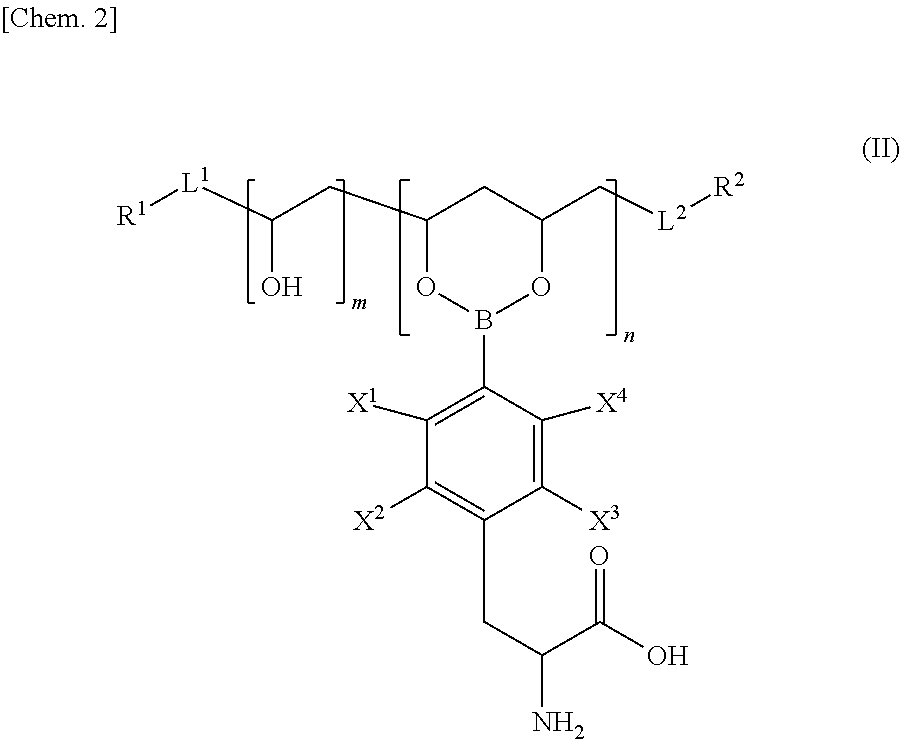
wherein,

wherein,

wherein, the arrows indicate a bond with NH,

wherein

wherein,

wherein, the arrow indicates a bond with a carbonyl carbon,


wherein,

wherein

wherein, the arrow indicates a bond with NH,


wherein,

wherein,

wherein, the arrow indicates a bond with a carbonyl carbon,

wherein,

wherein


wherein

wherein

wherein

wherein

wherein, the arrows indicate a bond with an adjacent atom.

wherein

wherein, w is 1 to 2,000 and Z is a C1-5 alkylene group.

wherein, w is 1 to 2,000 and Z is a C1-5 alkylene group.

wherein

wherein, the arrows indicate a bond with NH,


wherein

wherein, w is 1 to 2,000 and Z is a C1-5 alkylene group.

wherein, w is 1 to 2,000 and Z is a C1-5 alkylene group.

wherein

wherein, the arrow indicates a bond with a carbonyl carbon,


wherein

wherein, w is 1 to 2,000 and Z is a C1-5 alkylene group.

wherein, w is 1 to 2,000 and Z is a C1-5 alkylene group.

wherein

wherein, the arrow indicates a bond with NH,

wherein

wherein, w is 1 to 2,000 and Z is a C1-5 alkylene group.

wherein, w is 1 to 2,000 and Z is a C1-5 alkylene group.

wherein

wherein, the arrow indicates a bond with NH,

wherein

wherein, w is 1 to 2,000 and Z is a C1-5 alkylene group.

wherein, w is 1 to 2,000 and Z is a C1-5 alkylene group.

wherein

wherein, the arrow indicates a bond with NH,


wherein

wherein, w is 1 to 2,000 and Z is a C1-5 alkylene group.

wherein

wherein, the arrow indicates a bond with a carbonyl carbon,

wherein, w is 1 to 2,000 and Z is a C1-5 alkylene group.

wherein

wherein,

wherein

wherein,


-
- Solution A: ARS (9.0×10⁻⁶ M)
- Solution B: ARS (9.0×10⁻⁶ M)+BPA (2.0×10⁻³ M)
- Solution C: ARS (9.0×10⁻⁶ M)+BPA (2.0×10⁻³ M)+PVA (diol concentration=5.0×10⁻¹ M)
- Solution D: ARS (9.0×10⁻⁶ M)+BPA (2.0×10⁻³ M)+fructose (0.8×10⁻¹ M)
- Solution E: ARS (9.0×10⁻⁶ M)+BPA (2.0×10⁻³ M)+glucose (0.8×10⁻¹ M)
| TABLE 1 | ||||
| Glucose | PVA | Fructose | ||
| (diol)-BPA | (diol)-BPA | (diol)-BPA | ||
| Relative equilibrium | 1.0 | 1.9 | 46 |
| constant (K1) | |||


<Reagents>
11-Azide-3,6,9-trioxaundecane-1-amine: Sigma Aldrich
Methoxy-PEG10k-NH2: NOF Co.
NCA-L-Lys(Tfa): Chuo Kasei Co.
D-glucono-1,5-lactone: Tokyo Chemical Industry Co.
Triethylamine (TEA): Nacalai Tesque
Dimethyl sulfoxide (DMSO): DMSO purchase from Wako Pure Chemical Industries, Ltd., was distillation-purified under an argon atmosphere and used.
Methanol: Wako Pure Chemical Industries, Ltd.
Benzene: Nacalai Tesque
Diethyl ether: Kanto Chemical Co.
5 mol/L aqueous sodium hydroxide solution: Wako Pure Chemical Industries, Ltd.
5 mol/L hydrochloric acid: Nacalai Tesque
Heavy water (0.05% by weight 3-(trimethylsilyl)propionic-2,2,3,3-d4 acid, sodium salt:Sigma Aldrich
<Equipment>
NMR (Nuclear Magnetic Resonance): BRUKER AVANCE III 400 (400 MHz, BRUKER BioSpin)
GPC (Gel Permeation chromatography): JASCO Corporation
Detector: RI-2031
(1-1)
Synthesis of N3-Plys_(A)
-
- Solution A: ARS (9.0×10⁻⁶ M)
- Solution B: ARS (9.0×10⁻⁶ M), BPA (2.0×10⁻³ M)
- Solution C1: ARS (9.0×10⁻⁶ M), BPA (2.0×10⁻³ M), Sorbitol (0.05 M)
- Solution C2: ARS (9.0×10⁻⁶ M), BPA (2.0×10⁻³ M), Glucose (1.5 M)
- Solution C3: ARS (9.0×10⁻⁶ M), BPA (2.0×10⁻³ M), Fructose (0.1 M)
- Solution C4: ARS (9.0×10- M), BPA (2.0×10⁻³ M), N3—P[Lys(Gluconate)/Lys]_(A) (0.01 M: side chain gluconic acid standard)
- Solution C5: ARS (9.0×10⁻⁶ M), BPA (2.0×10⁻³ M), N3—P[Lys(Gluconate)/Lys]_(B) (0.01 M: side chain gluconic acid standard)
- Solution C6: ARS (9.0×10⁻⁶ M), BPA (2.0×10⁻³ M), N3—P[Lys(Gluconate)/Lys]_(C) (0.01 M: side chain gluconic acid standard)
-
- Sorbitol-BPA: BPA (3.03 mM), Sorbitol (3.64 mM)/10% PBS-90% RPMI culture medium Cy5-P[Lys(Gluconate)/Lys](C)-BPA: BPA (3.03 mM), Cy5-P[Lys(Gluconate)/Lys](C)·(3.64 mM: side chain gluconic acid standard)/10% PBS-90% RPMI culture medium
-
- N3—P[Lys(Gluconate)/Lys]_(A)-BPA (BPA 240 mM)
- N3—P[Lys(Gluconate)/Lys]_(B)-BPA (BPA 240 mM)
- N3—P[Lys(Gluconate)/Lys]_(C)-BPA (BPA 240 mM)
- mPEG10k-P[Lys(Gluconate)/Lys]-BPA (BPA 240 mM)
- Sorbitol-BPA (BPA 240 mM, Sorbitol 288 mM)
-
- N3—P[Lys(Gluconate)/Lys](B)-BPA (BPA 240 mM)
- N3—P[Lys(Gluconate)/Lys](C)-BPA (BPA 240 mM)
- Sorbitol-BPA (BPA 240 mM, Sorbitol 288 mM)

<Reagents>
Claims (15)


Applications Claiming Priority (4)
| Application Number | Priority Date | Filing Date | Title |
|---|---|---|---|
| JP2018028007 | 2018-02-20 | ||
| JPJP2018-028007 | 2018-02-20 | ||
| JP2018-028007 | 2018-02-20 | ||
| PCT/JP2019/006158 WO2019163790A1 (en) | 2018-02-20 | 2019-02-19 | p-BORONOPHENYLALANINE DERIVATIVE AND COMPOSITION CONTAINING SAME, AND KIT FOR PRODUCING SAID DERIVATIVE AND COMPOSITION |
Publications (2)
| Publication Number | Publication Date |
|---|---|
| US20210040244A1 US20210040244A1 (en) | 2021-02-11 |
| US11555082B2 true US11555082B2 (en) | 2023-01-17 |
Family
ID=67687664
Family Applications (1)
| Application Number | Title | Priority Date | Filing Date |
|---|---|---|---|
| US16/963,864 Active 2039-06-06 US11555082B2 (en) | 2018-02-20 | 2019-02-19 | P-boronophenylalanine derivative and composition containing same, and kit for producing said derivative and composition |
Country Status (9)
| Country | Link |
|---|---|
| US (1) | US11555082B2 (en) |
| EP (1) | EP3757137B1 (en) |
| JP (1) | JP7219925B2 (en) |
| KR (1) | KR102780263B1 (en) |
| CN (1) | CN111712524B (en) |
| AU (1) | AU2019223540B2 (en) |
| CA (1) | CA3091722A1 (en) |
| TW (1) | TWI804579B (en) |
| WO (1) | WO2019163790A1 (en) |
Families Citing this family (6)
| Publication number | Priority date | Publication date | Assignee | Title |
|---|---|---|---|---|
| US11990499B2 (en) | 2020-08-24 | 2024-05-21 | PlayNitride Display Co., Ltd. | Display apparatus and method of fabricating the same |
| CN112599510B (en) * | 2020-08-24 | 2022-11-08 | 錼创显示科技股份有限公司 | Miniature LED display matrix module |
| CN113004515B (en) * | 2021-03-02 | 2023-02-24 | 厦门大学附属中山医院 | Hyaluronic acid-like polyamino acid derivative, and preparation method and application thereof |
| EP4497476A4 (en) | 2022-03-23 | 2026-03-11 | Univ Kumamoto Nat Univ Corp | BORONIC ACID-CONTAINING MODIFIED POLYROTAXAN |
| CN116407488B (en) * | 2023-04-19 | 2024-03-08 | 东莞市人民医院 | Skin patch for boron neutron capture treatment, preparation method and application thereof |
| CN116637191B (en) * | 2023-06-01 | 2025-08-26 | 山东大学 | Carrier-free self-assembled nanoparticles based on boron neutron capture therapy and their preparation method and application |
Citations (2)
| Publication number | Priority date | Publication date | Assignee | Title |
|---|---|---|---|---|
| US6169076B1 (en) * | 1999-03-31 | 2001-01-02 | Glcosyn Pharmaceuticals, Inc. | P-Boronophenylalanine complexes with fructose and related carbohydrates and polyols |
| US20170326236A1 (en) | 2016-05-11 | 2017-11-16 | Huan NIU | Ion implantation of neutron capture elements into nanodiamond particles to form composition for neutron capture therapy usage |
Family Cites Families (5)
| Publication number | Priority date | Publication date | Assignee | Title |
|---|---|---|---|---|
| EP1534347B1 (en) * | 2002-07-22 | 2009-12-02 | Psimei Pharmaceuticals Plc | Conjugates of n-hydroxypropymethacrylamide-methacrylate copolymer with nuclide activation agent and/or anti-cancer compounds |
| JP2006096870A (en) * | 2004-09-29 | 2006-04-13 | Stella Chemifa Corp | Boron-containing compound |
| JP5026761B2 (en) * | 2006-10-06 | 2012-09-19 | 公立大学法人大阪府立大学 | Hapten compounds and antibodies |
| JP5345771B2 (en) | 2007-08-27 | 2013-11-20 | 公立大学法人大阪府立大学 | Liquid composition containing p-boronophenylalanine and sorbitol |
| JP6083738B2 (en) * | 2013-03-06 | 2017-02-22 | 公立大学法人大阪市立大学 | Composition for boron neutron capture therapy and method for producing the same |
-
2019
- 2019-02-19 JP JP2020500974A patent/JP7219925B2/en active Active
- 2019-02-19 CA CA3091722A patent/CA3091722A1/en active Pending
- 2019-02-19 US US16/963,864 patent/US11555082B2/en active Active
- 2019-02-19 EP EP19757034.4A patent/EP3757137B1/en active Active
- 2019-02-19 CN CN201980013104.7A patent/CN111712524B/en active Active
- 2019-02-19 WO PCT/JP2019/006158 patent/WO2019163790A1/en not_active Ceased
- 2019-02-19 AU AU2019223540A patent/AU2019223540B2/en active Active
- 2019-02-19 KR KR1020207019920A patent/KR102780263B1/en active Active
- 2019-02-20 TW TW108105628A patent/TWI804579B/en active
Patent Citations (4)
| Publication number | Priority date | Publication date | Assignee | Title |
|---|---|---|---|---|
| US6169076B1 (en) * | 1999-03-31 | 2001-01-02 | Glcosyn Pharmaceuticals, Inc. | P-Boronophenylalanine complexes with fructose and related carbohydrates and polyols |
| US20170326236A1 (en) | 2016-05-11 | 2017-11-16 | Huan NIU | Ion implantation of neutron capture elements into nanodiamond particles to form composition for neutron capture therapy usage |
| TW201739460A (en) | 2016-05-11 | 2017-11-16 | 牛寰 | Implanting neutron capture elements into nanodiamonds by ion implantation to form a composition for neutron capture therapy |
| US10799587B2 (en) | 2016-05-11 | 2020-10-13 | Huan NIU | Ion implantation of neutron capture elements into nanodiamond particles to form composition for neutron capture therapy usage |
Also Published As
| Publication number | Publication date |
|---|---|
| WO2019163790A1 (en) | 2019-08-29 |
| AU2019223540A1 (en) | 2020-09-10 |
| US20210040244A1 (en) | 2021-02-11 |
| EP3757137A1 (en) | 2020-12-30 |
| EP3757137A4 (en) | 2021-11-24 |
| JP7219925B2 (en) | 2023-02-10 |
| EP3757137B1 (en) | 2022-09-07 |
| CA3091722A1 (en) | 2019-08-29 |
| AU2019223540B2 (en) | 2024-08-08 |
| CN111712524B (en) | 2023-04-21 |
| RU2020127562A3 (en) | 2022-04-27 |
| TW201938173A (en) | 2019-10-01 |
| JPWO2019163790A1 (en) | 2021-02-12 |
| TWI804579B (en) | 2023-06-11 |
| KR102780263B1 (en) | 2025-03-14 |
| CN111712524A (en) | 2020-09-25 |
| RU2020127562A (en) | 2022-03-22 |
| KR20200123089A (en) | 2020-10-28 |
Similar Documents
| Publication | Publication Date | Title |
|---|---|---|
| US20210040244A1 (en) | p-BORONOPHENYLALANINE DERIVATIVE AND COMPOSITION CONTAINING SAME, AND KIT FOR PRODUCING SAID DERIVATIVE AND COMPOSITION | |
| Cai et al. | Enzyme-sensitive biodegradable and multifunctional polymeric conjugate as theranostic nanomedicine | |
| Ou et al. | Enzyme/pH-sensitive polyHPMA–DOX conjugate as a biocompatible and efficient anticancer agent | |
| Chen et al. | Reactive oxygen species-activated self-amplifying prodrug nanoagent for tumor-specific Cu-chelate chemotherapy and cascaded photodynamic therapy | |
| Guo et al. | Reductive microenvironment responsive gadolinium-based polymers as potential safe MRI contrast agents | |
| Zhong et al. | A smart polymeric platform for multistage nucleus-targeted anticancer drug delivery | |
| Ye et al. | Cellular uptake and antitumor activity of DOX-hyd-PEG-FA nanoparticles | |
| Kelkar et al. | Near infrared fluorescent nanoparticles based on hyaluronic acid: Self-assembly, optical properties, and cell interaction | |
| CN102188717B (en) | Self-emulsifying doxorubicin nanometer medicament and preparation method thereof | |
| Chen et al. | Enzyme/pH-sensitive dendritic polymer-DOX conjugate for cancer treatment | |
| CN113583178B (en) | Branched sugar-containing polymer-based nanoparticle, and preparation method and application thereof | |
| Strasser et al. | Degradable bottlebrush polypeptides and the impact of their architecture on cell uptake, pharmacokinetics, and biodistribution in vivo | |
| US8961949B2 (en) | Polymer-metal complex composite having MRI contrast ability and MRI contrasting and/or antitumor composition using the same | |
| Zheng et al. | Dual-responsive nanoparticle system for enhanced blood-brain barrier crossing and glioblastoma penetration | |
| Ruan et al. | Non-invasive imaging of breast cancer using RGDyK functionalized fluorescent carbonaceous nanospheres | |
| Sun et al. | Multi-activated polymeric micelles with charge-conversion and ROS-controlled drug release for efficient cancer therapy | |
| EP3960242B1 (en) | Conjugate and cancer therapeutic agent | |
| TW201008946A (en) | Camptothecin polymer derivative and uses of the same | |
| Kopansky-Groisman et al. | Near-infrared fluorescent activated polymeric probe for imaging intraluminal colorectal cancer tumors | |
| RU2797343C2 (en) | Pair-borphenylalanine derivative and a composition containing these, and a kit for obtaining the mentioned derivative and composition | |
| CN117298294B (en) | Antibody modified drug-loaded nano micelle and preparation method and application thereof | |
| CN114904012B (en) | Active oxygen self-supplementing amphiphilic block copolymer-drug conjugate, preparation method and application thereof | |
| HK40031008A (en) | P-boronophenylalanine derivative and composition containing same, and kit for producing said derivative and composition | |
| HK40031008B (en) | P-boronophenylalanine derivative and composition containing same, and kit for producing said derivative and composition | |
| CN108186672A (en) | The preparation and application of α-polyglutamic acid-CDDP complex |
Legal Events
| Date | Code | Title | Description |
|---|---|---|---|
| AS | Assignment |
Owner name: TOKYO INSTITUTE OF TECHNOLOGY, JAPAN Free format text: ASSIGNMENT OF ASSIGNORS INTEREST;ASSIGNORS:NISHIYAMA, NOBUHIRO;NOMOTO, TAKAHIRO;INOUE, YUKIYA;AND OTHERS;SIGNING DATES FROM 20200624 TO 20200630;REEL/FRAME:053276/0090 Owner name: STELLA PHARMA CORPORATION, JAPAN Free format text: ASSIGNMENT OF ASSIGNORS INTEREST;ASSIGNORS:NISHIYAMA, NOBUHIRO;NOMOTO, TAKAHIRO;INOUE, YUKIYA;AND OTHERS;SIGNING DATES FROM 20200624 TO 20200630;REEL/FRAME:053276/0090 |
|
| FEPP | Fee payment procedure |
Free format text: ENTITY STATUS SET TO UNDISCOUNTED (ORIGINAL EVENT CODE: BIG.); ENTITY STATUS OF PATENT OWNER: SMALL ENTITY |
|
| FEPP | Fee payment procedure |
Free format text: ENTITY STATUS SET TO SMALL (ORIGINAL EVENT CODE: SMAL); ENTITY STATUS OF PATENT OWNER: SMALL ENTITY |
|
| STPP | Information on status: patent application and granting procedure in general |
Free format text: APPLICATION DISPATCHED FROM PREEXAM, NOT YET DOCKETED |
|
| STPP | Information on status: patent application and granting procedure in general |
Free format text: DOCKETED NEW CASE - READY FOR EXAMINATION |
|
| STPP | Information on status: patent application and granting procedure in general |
Free format text: NON FINAL ACTION MAILED |
|
| STPP | Information on status: patent application and granting procedure in general |
Free format text: RESPONSE TO NON-FINAL OFFICE ACTION ENTERED AND FORWARDED TO EXAMINER |
|
| STPP | Information on status: patent application and granting procedure in general |
Free format text: NOTICE OF ALLOWANCE MAILED -- APPLICATION RECEIVED IN OFFICE OF PUBLICATIONS |
|
| STPP | Information on status: patent application and granting procedure in general |
Free format text: AWAITING TC RESP., ISSUE FEE NOT PAID |
|
| STPP | Information on status: patent application and granting procedure in general |
Free format text: PUBLICATIONS -- ISSUE FEE PAYMENT VERIFIED |
|
| STCF | Information on status: patent grant |
Free format text: PATENTED CASE |
|
| CC | Certificate of correction |