US11552323B2 - Biofuel cell - Google Patents
Biofuel cell Download PDFInfo
- Publication number
- US11552323B2 US11552323B2 US17/134,186 US202017134186A US11552323B2 US 11552323 B2 US11552323 B2 US 11552323B2 US 202017134186 A US202017134186 A US 202017134186A US 11552323 B2 US11552323 B2 US 11552323B2
- Authority
- US
- United States
- Prior art keywords
- anode
- biofuel cell
- cathode
- biochar
- soil
- Prior art date
- Legal status (The legal status is an assumption and is not a legal conclusion. Google has not performed a legal analysis and makes no representation as to the accuracy of the status listed.)
- Active, expires
Links
- 239000002551 biofuel Substances 0.000 title claims abstract description 38
- 230000000813 microbial effect Effects 0.000 claims abstract description 63
- 239000002699 waste material Substances 0.000 claims abstract description 23
- 240000001085 Trapa natans Species 0.000 claims abstract description 22
- 235000014364 Trapa natans Nutrition 0.000 claims abstract description 22
- 239000010903 husk Substances 0.000 claims abstract description 22
- 239000007772 electrode material Substances 0.000 claims abstract description 13
- OKTJSMMVPCPJKN-UHFFFAOYSA-N Carbon Chemical compound [C] OKTJSMMVPCPJKN-UHFFFAOYSA-N 0.000 claims description 57
- 239000000446 fuel Substances 0.000 claims description 37
- 241000196324 Embryophyta Species 0.000 claims description 26
- 239000002689 soil Substances 0.000 claims description 22
- 239000011148 porous material Substances 0.000 claims description 18
- XLYOFNOQVPJJNP-UHFFFAOYSA-N water Substances O XLYOFNOQVPJJNP-UHFFFAOYSA-N 0.000 claims description 15
- 239000012528 membrane Substances 0.000 claims description 7
- 230000008901 benefit Effects 0.000 abstract description 6
- 238000004064 recycling Methods 0.000 abstract description 5
- 238000002360 preparation method Methods 0.000 description 17
- 238000000034 method Methods 0.000 description 11
- 229910052799 carbon Inorganic materials 0.000 description 10
- 229910002804 graphite Inorganic materials 0.000 description 9
- 239000010439 graphite Substances 0.000 description 9
- CURLTUGMZLYLDI-UHFFFAOYSA-N Carbon dioxide Chemical compound O=C=O CURLTUGMZLYLDI-UHFFFAOYSA-N 0.000 description 8
- 238000003763 carbonization Methods 0.000 description 8
- 239000002002 slurry Substances 0.000 description 8
- JIAARYAFYJHUJI-UHFFFAOYSA-L zinc dichloride Chemical compound [Cl-].[Cl-].[Zn+2] JIAARYAFYJHUJI-UHFFFAOYSA-L 0.000 description 8
- 230000004913 activation Effects 0.000 description 7
- 230000000052 comparative effect Effects 0.000 description 7
- 239000005416 organic matter Substances 0.000 description 7
- HEMHJVSKTPXQMS-UHFFFAOYSA-M Sodium hydroxide Chemical compound [OH-].[Na+] HEMHJVSKTPXQMS-UHFFFAOYSA-M 0.000 description 6
- 239000007788 liquid Substances 0.000 description 6
- 239000002033 PVDF binder Substances 0.000 description 5
- 238000004458 analytical method Methods 0.000 description 5
- 239000003795 chemical substances by application Substances 0.000 description 5
- 238000010586 diagram Methods 0.000 description 5
- 238000002474 experimental method Methods 0.000 description 5
- 229920002981 polyvinylidene fluoride Polymers 0.000 description 5
- 241000588724 Escherichia coli Species 0.000 description 4
- PXHVJJICTQNCMI-UHFFFAOYSA-N Nickel Chemical compound [Ni] PXHVJJICTQNCMI-UHFFFAOYSA-N 0.000 description 4
- 239000011230 binding agent Substances 0.000 description 4
- 239000006229 carbon black Substances 0.000 description 4
- 239000001569 carbon dioxide Substances 0.000 description 4
- 229910002092 carbon dioxide Inorganic materials 0.000 description 4
- 239000003575 carbonaceous material Substances 0.000 description 4
- 238000006243 chemical reaction Methods 0.000 description 4
- 239000004744 fabric Substances 0.000 description 4
- 239000003337 fertilizer Substances 0.000 description 4
- 235000015097 nutrients Nutrition 0.000 description 4
- 238000003756 stirring Methods 0.000 description 4
- 239000011592 zinc chloride Substances 0.000 description 4
- QVGXLLKOCUKJST-UHFFFAOYSA-N atomic oxygen Chemical compound [O] QVGXLLKOCUKJST-UHFFFAOYSA-N 0.000 description 3
- 239000002482 conductive additive Substances 0.000 description 3
- 238000001035 drying Methods 0.000 description 3
- 238000004519 manufacturing process Methods 0.000 description 3
- 244000005700 microbiome Species 0.000 description 3
- 229910052760 oxygen Inorganic materials 0.000 description 3
- 239000001301 oxygen Substances 0.000 description 3
- 238000005554 pickling Methods 0.000 description 3
- 230000008569 process Effects 0.000 description 3
- 238000007873 sieving Methods 0.000 description 3
- 239000000126 substance Substances 0.000 description 3
- 239000008399 tap water Substances 0.000 description 3
- 235000020679 tap water Nutrition 0.000 description 3
- 238000005406 washing Methods 0.000 description 3
- 244000292211 Canna coccinea Species 0.000 description 2
- 235000005273 Canna coccinea Nutrition 0.000 description 2
- RTAQQCXQSZGOHL-UHFFFAOYSA-N Titanium Chemical compound [Ti] RTAQQCXQSZGOHL-UHFFFAOYSA-N 0.000 description 2
- 230000001580 bacterial effect Effects 0.000 description 2
- 239000002041 carbon nanotube Substances 0.000 description 2
- 229910021393 carbon nanotube Inorganic materials 0.000 description 2
- 230000005611 electricity Effects 0.000 description 2
- 239000006260 foam Substances 0.000 description 2
- 238000000227 grinding Methods 0.000 description 2
- 230000007774 longterm Effects 0.000 description 2
- 238000006241 metabolic reaction Methods 0.000 description 2
- 229910052751 metal Inorganic materials 0.000 description 2
- 239000002184 metal Substances 0.000 description 2
- 229910052759 nickel Inorganic materials 0.000 description 2
- 230000029553 photosynthesis Effects 0.000 description 2
- 238000010672 photosynthesis Methods 0.000 description 2
- 239000002994 raw material Substances 0.000 description 2
- 239000007787 solid Substances 0.000 description 2
- 229910001220 stainless steel Inorganic materials 0.000 description 2
- 239000010935 stainless steel Substances 0.000 description 2
- 238000012360 testing method Methods 0.000 description 2
- 239000010936 titanium Substances 0.000 description 2
- 229910052719 titanium Inorganic materials 0.000 description 2
- 235000005074 zinc chloride Nutrition 0.000 description 2
- 241000894006 Bacteria Species 0.000 description 1
- RYGMFSIKBFXOCR-UHFFFAOYSA-N Copper Chemical compound [Cu] RYGMFSIKBFXOCR-UHFFFAOYSA-N 0.000 description 1
- LKDRXBCSQODPBY-VRPWFDPXSA-N D-fructopyranose Chemical compound OCC1(O)OC[C@@H](O)[C@@H](O)[C@@H]1O LKDRXBCSQODPBY-VRPWFDPXSA-N 0.000 description 1
- 229920000557 Nafion® Polymers 0.000 description 1
- KWYUFKZDYYNOTN-UHFFFAOYSA-M Potassium hydroxide Chemical compound [OH-].[K+] KWYUFKZDYYNOTN-UHFFFAOYSA-M 0.000 description 1
- 241000863432 Shewanella putrefaciens Species 0.000 description 1
- BQCADISMDOOEFD-UHFFFAOYSA-N Silver Chemical compound [Ag] BQCADISMDOOEFD-UHFFFAOYSA-N 0.000 description 1
- 239000012190 activator Substances 0.000 description 1
- 229910052782 aluminium Inorganic materials 0.000 description 1
- XAGFODPZIPBFFR-UHFFFAOYSA-N aluminium Chemical compound [Al] XAGFODPZIPBFFR-UHFFFAOYSA-N 0.000 description 1
- 238000004364 calculation method Methods 0.000 description 1
- 229910052802 copper Inorganic materials 0.000 description 1
- 239000010949 copper Substances 0.000 description 1
- 238000011161 development Methods 0.000 description 1
- 238000009826 distribution Methods 0.000 description 1
- 230000000694 effects Effects 0.000 description 1
- 238000003487 electrochemical reaction Methods 0.000 description 1
- 238000004146 energy storage Methods 0.000 description 1
- 230000007613 environmental effect Effects 0.000 description 1
- PCHJSUWPFVWCPO-UHFFFAOYSA-N gold Chemical compound [Au] PCHJSUWPFVWCPO-UHFFFAOYSA-N 0.000 description 1
- 229910052737 gold Inorganic materials 0.000 description 1
- 239000010931 gold Substances 0.000 description 1
- XLYOFNOQVPJJNP-ZSJDYOACSA-N heavy water Substances [2H]O[2H] XLYOFNOQVPJJNP-ZSJDYOACSA-N 0.000 description 1
- 238000007731 hot pressing Methods 0.000 description 1
- 230000003993 interaction Effects 0.000 description 1
- 238000004502 linear sweep voltammetry Methods 0.000 description 1
- 230000028744 lysogeny Effects 0.000 description 1
- 239000000463 material Substances 0.000 description 1
- 238000005259 measurement Methods 0.000 description 1
- 230000002503 metabolic effect Effects 0.000 description 1
- 239000000203 mixture Substances 0.000 description 1
- 238000012986 modification Methods 0.000 description 1
- 230000004048 modification Effects 0.000 description 1
- 239000012299 nitrogen atmosphere Substances 0.000 description 1
- 238000010248 power generation Methods 0.000 description 1
- 229910052709 silver Inorganic materials 0.000 description 1
- 239000004332 silver Substances 0.000 description 1
- 239000010802 sludge Substances 0.000 description 1
- 239000002351 wastewater Substances 0.000 description 1
Images


Classifications
-
- H—ELECTRICITY
- H01—ELECTRIC ELEMENTS
- H01M—PROCESSES OR MEANS, e.g. BATTERIES, FOR THE DIRECT CONVERSION OF CHEMICAL ENERGY INTO ELECTRICAL ENERGY
- H01M8/00—Fuel cells; Manufacture thereof
- H01M8/16—Biochemical fuel cells, i.e. cells in which microorganisms function as catalysts
-
- H—ELECTRICITY
- H01—ELECTRIC ELEMENTS
- H01M—PROCESSES OR MEANS, e.g. BATTERIES, FOR THE DIRECT CONVERSION OF CHEMICAL ENERGY INTO ELECTRICAL ENERGY
- H01M8/00—Fuel cells; Manufacture thereof
- H01M8/10—Fuel cells with solid electrolytes
- H01M8/1004—Fuel cells with solid electrolytes characterised by membrane-electrode assemblies [MEA]
-
- Y—GENERAL TAGGING OF NEW TECHNOLOGICAL DEVELOPMENTS; GENERAL TAGGING OF CROSS-SECTIONAL TECHNOLOGIES SPANNING OVER SEVERAL SECTIONS OF THE IPC; TECHNICAL SUBJECTS COVERED BY FORMER USPC CROSS-REFERENCE ART COLLECTIONS [XRACs] AND DIGESTS
- Y02—TECHNOLOGIES OR APPLICATIONS FOR MITIGATION OR ADAPTATION AGAINST CLIMATE CHANGE
- Y02E—REDUCTION OF GREENHOUSE GAS [GHG] EMISSIONS, RELATED TO ENERGY GENERATION, TRANSMISSION OR DISTRIBUTION
- Y02E60/00—Enabling technologies; Technologies with a potential or indirect contribution to GHG emissions mitigation
- Y02E60/30—Hydrogen technology
- Y02E60/50—Fuel cells
Definitions
- the invention relates to a biofuel cell, and particularly relates to a biofuel cell using a biochar prepared from a waste Trapa natans husk as an electrode material.
- a biofuel cell is a battery system that uses organisms (such as natural bacteria, etc.) to cause electrochemical reactions. Particularly in the crisis of increasingly scarce energy, the biofuel cell has become an emerging battery.
- the biofuel cell has developed into various types of battery systems, such as a microbial fuel cell (MFC) and a plant microbial fuel cell (PMFC).
- MFC microbial fuel cell
- PMFC plant microbial fuel cell
- a microbial fuel cell mainly converts chemical energy into electrical energy using an organic matter in the metabolic environment of a microbial community.
- the metabolic reaction of Escherichia coli ( E. coli ) attached to the anode terminal with organic matter may produce carbon dioxide, protons, and electrons, wherein the electrons are transmitted to the anode terminal via an external circuit to form a current, and the electrons and the protons reach the cathode terminal to be combined with oxygen to form water.
- the reaction formulas are as follows: Anode: C 6 H 12 O 6 +6H 2 O ⁇ 6CO 2 +24H + +24 e ⁇ Cathode: 4H + +4 e ⁇ +O 2 ⁇ 2H 2 O
- a plant microbial fuel cell generates electrons as energy sources resulting from the interaction between the roots of plants grown in the soil and the microorganisms nearby. Specifically, the nutrients produced by plants during photosynthesis are released into the soil via the roots of the plants. Therefore, the microbial community located around the roots produce electrons, carbon dioxide, and protons in the reaction of decomposing sugar-containing nutrients, wherein the electrons are transferred to the anode terminal via an external circuit to form a current, and the electrons and the protons are combined with oxygen upon reaching the cathode terminal to form water.
- the reaction formula is shown in the previous paragraph.
- the above biofuel cells generally have the issue of low output power, and in order to increase power density, expensive materials are often used.
- the invention provides a biofuel cell that not only improves the power density of the biofuel cell, but also achieves the economic benefits of waste recycling.
- the biofuel cell of the invention includes an anode, a cathode, and a microbial community. At least one of the anode and the cathode contains a biochar prepared from a waste Trapa natans husk as an electrode material, and the anode is located in the microbial community.
- the biofuel cell may be a microbial fuel cell.
- the microbial community is attached to a surface of the anode.
- a specific surface area of the biochar may be 200 m 2 /g or more.
- the microbial fuel cell may further include a proton exchange membrane disposed between the anode and the cathode and adjacent to the anode.
- the biofuel cell may be a plant microbial fuel cell.
- the biofuel cell may further include a soil housed in a container and a plant planted in the soil, wherein the microbial community exists in the soil, and the anode is disposed around a root of the plant.
- a water may also be added to the container to make a water surface higher than the soil, so that the cathode is disposed at a junction of the soil and the water.
- a specific surface area of the biochar is 200 m 2 /g or more.
- the anode is the biochar and the cathode is an activated carbon.
- a total volume of a micropore of the biochar is greater than a total volume of a mesopore, wherein the micropore refers to a pore having a pore size less than 2 nm, and the mesopore refers to a pore having a pore size between 2 nm and 50 nm.
- the biofuel cell of the invention uses a biochar prepared from a Trapa natans husk as an electrode material, and if waste Trapa natans husk is used as a raw material, the cost is low, the economic benefits of waste recycling may be achieved, and the biofuel cell of the invention is environmentally friendly. Moreover, it is found through experiments that the biochar prepared by the Trapa natans husk may significantly increase the power density of the biofuel cell. Moreover, when the biochar applied to a plant microbial fuel cell, a fertilizer is not needed (the fertilizer may be a solid fertilizer or a liquid fertilizer) to generate electricity for a long time, thus achieving the prospect of being a sustainable energy.
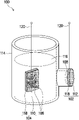
- FIG. 1 is a diagram of a biofuel cell according to the first embodiment of the invention.
- FIG. 2 is a diagram of a biofuel cell according to the second embodiment of the invention.
- FIG. 3 is a graph of current density and power density of the microbial fuel cells of Experimental examples 1 to 3 and Comparative example 1.
- FIG. 4 is a diagram of the plant microbial fuel cell of Experimental example 4.
- FIG. 5 is a graph of current density and voltage/power density of the plant microbial fuel cells of Experimental example 4 and Comparative example 2.
- FIG. 6 is a graph of the power density of the plant microbial fuel cell of Experimental example 4 after long-term testing.
- FIG. 1 is a diagram of a biofuel cell according to the first embodiment of the invention.
- the biofuel cell of the present embodiment such as a microbial fuel cell 100 , includes a cathode 102 , an anode 104 , and a microbial community 106 .
- a proton exchange membrane 108 is disposed between the cathode 102 and the anode 104 and is adjacent to the cathode 102 .
- the invention is not limited thereto; in another embodiment of the microbial fuel cell, the proton exchange membrane 108 may be omitted.
- At least one of the cathode 102 and the anode 104 contains a biochar 110 prepared from a Trapa natans husk as an electrode material.
- the anode 104 contains the biochar 110 prepared from a waste Trapa natans husk; and the cathode 102 adopts an activated carbon 112 , such as a carbon nanotube, a commercial activated carbon, or activated carbon prepared from other recycled wastes.
- an activated carbon 112 such as a carbon nanotube, a commercial activated carbon, or activated carbon prepared from other recycled wastes.
- the method of fabricating the biochar 110 is, for example, fabricating the biochar 110 into activated carbon using a physical activation method or a chemical activation method.
- a physical activation method such as a water vapor activation method or a carbon dioxide activation method
- a chemical activation method such as using a pore-forming agent
- the pore-forming agent is, for example, potassium hydroxide (KOH), zinc chloride (ZnCl 2 ), or sodium hydroxide (NaOH) or the like.
- the weight ratio of the waste Trapa natans husk to the pore-forming agent may be between 1:1 and 1:10, and the carbonization temperature is, for example, 600° C. to 1000° C. Then, after carbonization, secondary grinding may be performed, and processes such as pickling, washing, drying, and sieving may be performed in order to obtain the biochar 110 .
- the carbon material prepared according to the above method has high surface area (for example, the specific surface area is 200 m 2 /g or more, preferably 1000 m 2 /g or more, more preferably 1700 m 2 /g or more), a porous structure, and good electrical conductivity.
- the total volume of the micropore of the biochar 110 is greater than the total volume of the mesopore, wherein the micropore refers to a pore having a pore size less than 2 nm, and the mesopore refers to a pore having a pore size between 2 nm and 50 nm.
- the total volume of the macropore of the biochar 110 is 0.5% or less of the total volume of all the pores (i.e., macropore, mesopore, and micropore), and is preferably close to 0, wherein the macropore refers to a pore having a pore size greater than 50 nm.
- the microbial community 106 is located between the cathode 102 and the anode 104 , and the anode 104 is located in the microbial community 106 .
- the microbial community 106 is attached to the surface of the anode 104 .
- the microbial community 106 may be applied to a variety of single microbial systems, such as E. coli, Shewanella putrefaciens , etc., or a diverse microbial system in wastewater sludge.
- a container 114 is used to load a liquid 116 containing a microbial community and an organic matter or a solid containing an organic matter, so that the microbial community in the liquid 116 is adsorbed on the surface of the anode 104 , and the organic matter in the liquid 116 may be reacted with the microbial community 106 .
- the cathode 102 and the anode 104 usually have a conductive plate 118 , so that the activated carbon 112 and the biochar 110 are respectively coated on the conductive plate 118 .
- the conductive plate 118 is, for example, carbon cloth, graphite felt, carbon felt, graphite paper, carbon paper, graphite brush, carbon brush, stainless steel mesh, or nickel foam.
- the microbial community 106 attached to the surface of the biochar 110 undergoes a metabolic reaction with the organic matter in the liquid 116 to release carbon dioxide, protons, and electrons, wherein the electrons are transferred to the cathode 102 via an external circuit 120 to form a current and is supplied to an external device (not shown), and the protons reach the cathode 102 via the proton exchange membrane 108 .
- the electrons and the protons are combined with external oxygen at the cathode 102 to form water.
- the power density of the microbial fuel cell 100 of the present embodiment may be as high as 5000 mW m ⁇ 2 or more.
- waste Trapa natans husk may be recycled as the electrode material of the microbial fuel cell 100 , thus not only achieving the effects of environmental friendliness and waste recycling, but also achieving better power generation performance than a traditional anode prepared by activated carbon. Therefore, the invention is an important development application for sustainable energy and meets the key points of circular economy.
- FIG. 2 is a diagram of a biofuel cell according to the second embodiment of the invention.
- the biofuel cell of the present embodiment such as a plant microbial fuel cell 200 , includes a cathode 202 , an anode 204 , a microbial community 206 , a soil 210 placed in a container 208 , and a plant 212 planted in the soil 210 .
- the microbial community 206 generally exists in the soil 210 .
- more water 214 may be added to the container 208 to make the water surface higher than the soil 210 , so that the cathode 202 is disposed at the junction of the soil 210 and the water 214 , and the anode 204 is disposed around a root 212 a of the plant 212 .
- At least one of the cathode 202 and the anode 204 contains a biochar 216 prepared from a Trapa natans husk as an electrode material.
- the anode 204 contains the biochar 216 prepared from a waste Trapa natans husk; and the cathode 202 adopts an activated carbon 218 , such as a carbon nanotube, a commercial activated carbon, or activated carbon prepared from other recycled wastes.
- the method of fabricating the biochar 216 is, for example, after the waste Trapa natans husk is collected, washed, and ground, the waste Trapa natans husk is directly fabricated into a carbon material by high-temperature carbonization. After the carbonization, the waste Trapa natans husk may be ground again, and then processes such as pickling, washing, drying, and sieving are performed in order to obtain the biochar 216 .
- the specific surface area of the carbon material prepared according to the above method is about 200 m 2 /g or more.
- the biochar 216 is as provided in the method of fabricating the biochar ( 110 ) in an embodiment to fabricate a porous carbon material having a high surface area (for example, a specific surface area of 1000 m 2 /g or more).
- the cathode 202 and the anode 204 usually both have a conductive plate 220 , wherein the conductive plate 220 is, for example, carbon cloth, graphite felt, carbon felt, graphite paper, carbon paper, graphite brush, carbon brush, stainless steel mesh, or nickel foam.
- the activated carbon 218 and the biochar 216 are respectively coated on the conductive plate 220 .
- the activated carbon 218 is coated on a side in contact with the water 214
- the biochar 216 is coated on a side facing the cathode 202 .
- the activated carbon 218 and the biochar 216 may also be coated on all surfaces of each of the conductive plates 220 .
- the cathode 202 and the anode 204 may be connected to an external device (not shown) via a metal conductive line 222 , wherein the metal conductive line 222 is, for example, a copper line, an aluminum line, a silver line, a gold line, a titanium line, etc.
- the nutrients of the plant 212 produced by photosynthesis are released into the soil 210 via the root 212 a of the plant 212 , the microbial community 206 located around the root 212 a generates electrons in the reaction of decomposing sugar-containing nutrients, and current is collected by the cathode 202 and the anode 204 and sent to an external device (such as an energy storage equipment).
- an external device such as an energy storage equipment.
- a biochar was fabricated in the same way as in Preparation example 1, but the carbonization temperature was changed from 600° C. to 800° C.
- a biochar was fabricated in the same way as in Preparation example 1, but the carbonization temperature was changed from 600° C. to 1000° C.
- V macro refers to total macropore volume.
- V meso refers to total mesopore volume.
- V micro refers to total micropore volume.
- V total refers to the total volume of micropore, mesopore, and macropore.
- CAC CAC
- a conductive additive carbon black
- a binder polyvinylidene fluoride (PVDF)
- PVDF polyvinylidene fluoride
- the biochar of Preparation example 1 a conductive aid (carbon black), and a binder (PVDF) were mixed into a slurry at a weight ratio of 8:1:1 (stirring for one day), and then the slurry was coated on a carbon cloth having a working area of 1 ⁇ 1 cm 2 as the anode and cultivated together with E. coli DH5a, so that the bacterial colony was attached to the surface thereof.
- a conductive aid carbon black
- PVDF binder
- the resulting cathode, the proton exchange membrane, and the anode were assembled into the microbial fuel cell shown in FIG. 1 , wherein a lysogeny broth (LB) was used as an organic matter, and the bacterial liquid volume was 40 ml.
- LB lysogeny broth
- a microbial fuel cell was fabricated in the same manner as in Experimental example 1, and the anode of Preparation example 1 was changed to the anode of Preparation example 2.
- a microbial fuel cell was fabricated in the same manner as in Experimental example 1, and the anode of Preparation example 1 was changed to the anode of Preparation example 3.
- a microbial fuel cell was fabricated in the same manner as in Experimental example 1, but the anode of Preparation example 1 was changed to an electrode material containing CAC, similarly to the cathode.
- Linear sweep voltammetry (LSV) analysis was performed on the microbial fuel cells of Experimental examples 1 to 3 and Comparative example 1 respectively to first obtain the open circuit voltage and the current density of the microbial fuel cells, and then calculation was performed according to the above values to obtain the current density and power density graphs of FIG. 3 .
- LSV Linear sweep voltammetry
- the power densities of Experimental examples 1 to 3 were all greater than the power density of the microbial fuel cell using CAC as the electrode material.
- the microbial fuel cell of Experimental example 2 had the highest power density (5639.5 mW m ⁇ 2 ), presumably because the microbial fuel cell of Experimental example 2 adopted an anode having a high total micropore volume ratio (71.9%) (Preparation example 2).
- a biochar was used as the electrode material of the cathode, and the values obtained by surface structure analysis were: S BET of 200.76 m 2 /g, average pore size of 2.29 nm, V macro of 0.00097 m 2 /g, V meso of 0.01195 m 2 /g, V micro of 0.088 m 2 /g, and V total of 0.10092 m 2 /g. Then, the biochar, a conductive additive (carbon black), and a binder (PVDF) were mixed into a slurry at a weight ratio of 8:1:1 (stirring for one day), then the slurry was coated on a graphite felt having a working area of 12 ⁇ 12 cm 2 as the anode.
- CAC a conductive additive (carbon black), and a binder (PVDF) were mixed into a slurry at a weight ratio of 8:1:1 (stirring for one day), then the slurry was coated on a graphite felt having a working area of 12 ⁇ 12 cm 2 as the cathode.
- PVDF binder
- Canna indica was grown in wetland soil with tap water and configured into a microbial fuel cell as shown in FIG. 4 , wherein the height of the container was 20 cm and the bottom area thereof was 16.8 ⁇ 16.8 cm 2 .
- the anode biological facing up
- the cathode CAC facing up
- the anode was about 5 cm away from the bottom of the container, the distance between the anode and the cathode was about 7 cm, and the water surface of the tap water was 3 cm above the cathode.
- a conductive line (not shown) braided with a titanium line was provided on the uncoated surface of the anode and the cathode to electrically couple a measuring equipment to the anode and the cathode.
- an external resistance (R) was connected in series with the above plant microbial fuel cells in order from large to small (5000 ⁇ to 100 ⁇ ), the load voltage of the external resistance of each serial connection was measured after every half an hour, and then the circuit was opened for one hour, then the above steps were repeated.
- a biochar prepared from a waste Trapa natans husk is used as the electrode material, so the raw material cost is low, the economic benefits of waste recycling may be achieved, and the biochar is environmentally friendly. Moreover, experiments have found that whether the biochar prepared from a waste Trapa natans husk is used in a microbial fuel cell or a plant microbial fuel cell, the power density of the biofuel cell may be significantly increased. In addition, when applied to a plant microbial fuel cell, electricity may be generated for a long time for the prospect of being a sustainable energy source.
Landscapes
- Life Sciences & Earth Sciences (AREA)
- Chemical & Material Sciences (AREA)
- Engineering & Computer Science (AREA)
- Manufacturing & Machinery (AREA)
- Sustainable Development (AREA)
- Sustainable Energy (AREA)
- Chemical Kinetics & Catalysis (AREA)
- Electrochemistry (AREA)
- General Chemical & Material Sciences (AREA)
- Biochemistry (AREA)
- Microbiology (AREA)
- Inert Electrodes (AREA)
Abstract
Description
Anode: C6H12O6+6H2O→6CO2+24H++24e −
Cathode: 4H++4e −+O2→2H2O
| TABLE 1 | ||||||
| Average | ||||||
| SBET | pore size | Vmicro | Vmeso | Vmacro | Vtotal | |
| (m2/g) | (nm) | (cm3/g) | (cm3/g) | (cm3/g) | (cm3/g) | |
| CAC | 832.0 | 2.41 | 0.27574 | 0.19458 | 0.00246 | 0.47278 |
| (58.3%) | (41.2%) | (0.5%) | ||||
| Preparation | 1372.1 | 2.16 | 0.35848 | 0.37323 | 0.0001 | 0.73181 |
| example 1 | (49.0%) | (51.0%) | ||||
| Preparation | 1748.8 | 2.05 | 0.63728 | 0.24895 | 0.00009 | 0.88632 |
| example 2 | (71.9%) | (28.1%) | ||||
| Preparation | 2527.9 | 2.18 | 0.78934 | 0.54795 | 0.00629 | 1.34358 |
| example 3 | (58.7%) | (40.8%) | (0.5%) | |||
Vmacro refers to total macropore volume.
Vmeso refers to total mesopore volume.
Vmicro refers to total micropore volume.
Vtotal refers to the total volume of micropore, mesopore, and macropore.
Claims (11)
Applications Claiming Priority (2)
| Application Number | Priority Date | Filing Date | Title |
|---|---|---|---|
| TW109139119A TWI751781B (en) | 2020-11-10 | 2020-11-10 | Biological fuel cell |
| TW109139119 | 2020-11-10 |
Publications (2)
| Publication Number | Publication Date |
|---|---|
| US20220149413A1 US20220149413A1 (en) | 2022-05-12 |
| US11552323B2 true US11552323B2 (en) | 2023-01-10 |
Family
ID=80809146
Family Applications (1)
| Application Number | Title | Priority Date | Filing Date |
|---|---|---|---|
| US17/134,186 Active 2041-08-17 US11552323B2 (en) | 2020-11-10 | 2020-12-25 | Biofuel cell |
Country Status (2)
| Country | Link |
|---|---|
| US (1) | US11552323B2 (en) |
| TW (1) | TWI751781B (en) |
Families Citing this family (1)
| Publication number | Priority date | Publication date | Assignee | Title |
|---|---|---|---|---|
| TWI854813B (en) * | 2023-09-01 | 2024-09-01 | 國立清華大學 | Plant microbial fuel cell |
Citations (7)
| Publication number | Priority date | Publication date | Assignee | Title |
|---|---|---|---|---|
| US20110180749A1 (en) * | 2008-09-29 | 2011-07-28 | The Nisshin Oillio Group, Ltd. | Battery component and battery |
| CN103972521A (en) | 2013-02-05 | 2014-08-06 | 索尼公司 | Electrode material, electrode, and battery |
| CN105845947A (en) | 2016-05-31 | 2016-08-10 | 常州大学 | Method for preparing microbial fuel cell electrode material employing rape stalks |
| US20170362719A1 (en) * | 2016-06-17 | 2017-12-21 | Ut-Battelle, Llc | Bioelectrochemical biorefining for the conversion of hydrogenous matter to hydrogen gas and other useful products |
| CN108862238A (en) | 2018-09-06 | 2018-11-23 | 天津工业大学 | A kind of biomass waste material Shell of Water Chestnut base hard charcoal and its preparation method and application |
| TWI695540B (en) | 2019-07-26 | 2020-06-01 | 國立清華大學 | Microbial fuel cell and method of manufacturing the same |
| CN111342101A (en) | 2020-04-01 | 2020-06-26 | 广东工业大学 | Anode photosynthetic solar fuel cell system |
-
2020
- 2020-11-10 TW TW109139119A patent/TWI751781B/en active
- 2020-12-25 US US17/134,186 patent/US11552323B2/en active Active
Patent Citations (7)
| Publication number | Priority date | Publication date | Assignee | Title |
|---|---|---|---|---|
| US20110180749A1 (en) * | 2008-09-29 | 2011-07-28 | The Nisshin Oillio Group, Ltd. | Battery component and battery |
| CN103972521A (en) | 2013-02-05 | 2014-08-06 | 索尼公司 | Electrode material, electrode, and battery |
| CN105845947A (en) | 2016-05-31 | 2016-08-10 | 常州大学 | Method for preparing microbial fuel cell electrode material employing rape stalks |
| US20170362719A1 (en) * | 2016-06-17 | 2017-12-21 | Ut-Battelle, Llc | Bioelectrochemical biorefining for the conversion of hydrogenous matter to hydrogen gas and other useful products |
| CN108862238A (en) | 2018-09-06 | 2018-11-23 | 天津工业大学 | A kind of biomass waste material Shell of Water Chestnut base hard charcoal and its preparation method and application |
| TWI695540B (en) | 2019-07-26 | 2020-06-01 | 國立清華大學 | Microbial fuel cell and method of manufacturing the same |
| CN111342101A (en) | 2020-04-01 | 2020-06-26 | 广东工业大学 | Anode photosynthetic solar fuel cell system |
Non-Patent Citations (32)
Also Published As
| Publication number | Publication date |
|---|---|
| US20220149413A1 (en) | 2022-05-12 |
| TW202220261A (en) | 2022-05-16 |
| TWI751781B (en) | 2022-01-01 |
Similar Documents
| Publication | Publication Date | Title |
|---|---|---|
| Senthilkumar et al. | Retracted Article: PEDOT/NiFe 2 O 4 nanocomposites on biochar as a free-standing anode for high-performance and durable microbial fuel cells | |
| Lu et al. | Highly efficient urea oxidation via nesting nano-nickel oxide in eggshell membrane-derived carbon | |
| Tian et al. | KOH activated N-doped novel carbon aerogel as efficient metal-free oxygen reduction catalyst for microbial fuel cells | |
| Gajda et al. | Microbial Fuel Cell stack performance enhancement through carbon veil anode modification with activated carbon powder | |
| Mishra et al. | Highly efficient hydrogen evolution by self-standing nickel phosphide-based hybrid nanosheet arrays electrocatalyst | |
| Xin et al. | High electricity generation and COD removal from cattle wastewater in microbial fuel cells with 3D air cathode employed non-precious Cu2O/reduced graphene oxide as cathode catalyst | |
| Tang et al. | Ni3S2 nanosheets array supported on Ni foam: A novel efficient three-dimensional hydrogen-evolving electrocatalyst in both neutral and basic solutions | |
| Pan et al. | All-solid-state sponge-like squeezable zinc-air battery | |
| Yue et al. | Surface engineering of hierarchical Ni (OH) 2 nanosheet@ nanowire configuration toward superior urea electrolysis | |
| Wu et al. | Mesoporous carbon derived from pomelo peel as a high-performance electrode material for zinc-bromine flow batteries | |
| Wang et al. | Bimetallic hybrids modified with carbon nanotubes as cathode catalysts for microbial fuel cell: Effective oxygen reduction catalysis and inhibition of biofilm formation | |
| Mahmoud et al. | Power generation using spinel manganese–cobalt oxide as a cathode catalyst for microbial fuel cell applications | |
| Chen et al. | A hierarchically structured urchin-like anode derived from chestnut shells for microbial energy harvesting | |
| Feng et al. | Functional biomass‐derived materials for the development of sustainable batteries | |
| Gautam et al. | Electrocatalyst materials for oxygen reduction reaction in microbial fuel cell | |
| Long et al. | Nano-flower like CoFe-layered double hydroxide@ reduced graphene oxide with efficient oxygen reduction reaction for high-power air-cathode microbial fuel cells | |
| CN101355170A (en) | Application of manganese dioxide in preparation of microbial fuel cell cathode | |
| CN106207239A (en) | The synthetic method of a kind of N doping porous carbon and the application in terms of anode of microbial fuel cell thereof | |
| US11158866B2 (en) | Microbial fuel cell with activated carbon anode derived from waste coffee ground and method of manufacturing the same | |
| Liu et al. | Enhanced performance of microbial fuel cell using carbon microspheres modified graphite anode | |
| CN107394217A (en) | A kind of nitrating, p-doped biomass carbon material synthetic method and its application in terms of microorganism fuel cell cathode | |
| CN113637997A (en) | A kind of preparation method of Co2P/CuP2/NF hydrogen evolution and oxygen evolution electrocatalyst | |
| CN109850896A (en) | Preparation method and application of a kind of raw water hyacinth biomass carbon porous electrode material | |
| Liu et al. | In situ growth of nanoflowers Zn-HHTP@ Ni/Co-3DHFLM modified air cathode MFC enhances power generation performance | |
| Liu et al. | Low-cost marine biomass carbon as a high-performance electrocatalyst for vanadium redox flow battery |
Legal Events
| Date | Code | Title | Description |
|---|---|---|---|
| AS | Assignment |
Owner name: NATIONAL TSING HUA UNIVERSITY, TAIWAN Free format text: ASSIGNMENT OF ASSIGNORS INTEREST;ASSIGNORS:LIN, FANG-YI;LIN, YAO-YU;HSU, CHIA-CHIEH;AND OTHERS;SIGNING DATES FROM 20201125 TO 20201203;REEL/FRAME:054748/0661 |
|
| FEPP | Fee payment procedure |
Free format text: ENTITY STATUS SET TO UNDISCOUNTED (ORIGINAL EVENT CODE: BIG.); ENTITY STATUS OF PATENT OWNER: SMALL ENTITY |
|
| FEPP | Fee payment procedure |
Free format text: ENTITY STATUS SET TO SMALL (ORIGINAL EVENT CODE: SMAL); ENTITY STATUS OF PATENT OWNER: SMALL ENTITY |
|
| STPP | Information on status: patent application and granting procedure in general |
Free format text: DOCKETED NEW CASE - READY FOR EXAMINATION |
|
| STPP | Information on status: patent application and granting procedure in general |
Free format text: NOTICE OF ALLOWANCE MAILED -- APPLICATION RECEIVED IN OFFICE OF PUBLICATIONS |
|
| STPP | Information on status: patent application and granting procedure in general |
Free format text: PUBLICATIONS -- ISSUE FEE PAYMENT RECEIVED |
|
| STPP | Information on status: patent application and granting procedure in general |
Free format text: PUBLICATIONS -- ISSUE FEE PAYMENT VERIFIED |
|
| STCF | Information on status: patent grant |
Free format text: PATENTED CASE |