US11548983B2 - Polybenzimidazole, precursor polyamide thereof, and method for producing same - Google Patents
Polybenzimidazole, precursor polyamide thereof, and method for producing same Download PDFInfo
- Publication number
- US11548983B2 US11548983B2 US16/646,599 US201816646599A US11548983B2 US 11548983 B2 US11548983 B2 US 11548983B2 US 201816646599 A US201816646599 A US 201816646599A US 11548983 B2 US11548983 B2 US 11548983B2
- Authority
- US
- United States
- Prior art keywords
- group
- polybenzimidazole
- substituent
- polyamide
- individually
- Prior art date
- Legal status (The legal status is an assumption and is not a legal conclusion. Google has not performed a legal analysis and makes no representation as to the accuracy of the status listed.)
- Active, expires
Links
- 229920002480 polybenzimidazole Polymers 0.000 title claims abstract description 130
- 239000004693 Polybenzimidazole Substances 0.000 title claims abstract description 128
- 239000004952 Polyamide Substances 0.000 title claims abstract description 123
- 229920002647 polyamide Polymers 0.000 title claims abstract description 123
- 239000002243 precursor Substances 0.000 title claims abstract description 35
- 238000004519 manufacturing process Methods 0.000 title claims abstract description 23
- 125000001424 substituent group Chemical group 0.000 claims abstract description 48
- 125000000962 organic group Chemical group 0.000 claims abstract description 31
- 125000004435 hydrogen atom Chemical group [H]* 0.000 claims abstract description 23
- 125000002947 alkylene group Chemical group 0.000 claims abstract description 17
- 239000012528 membrane Substances 0.000 claims abstract description 10
- 239000005518 polymer electrolyte Substances 0.000 claims abstract description 10
- -1 tetramine compound Chemical class 0.000 claims description 58
- 238000005227 gel permeation chromatography Methods 0.000 claims description 37
- 125000003118 aryl group Chemical group 0.000 claims description 32
- 125000001997 phenyl group Chemical group [H]C1=C([H])C([H])=C(*)C([H])=C1[H] 0.000 claims description 16
- 125000001797 benzyl group Chemical group [H]C1=C([H])C([H])=C(C([H])=C1[H])C([H])([H])* 0.000 claims description 15
- 238000000034 method Methods 0.000 claims description 14
- 125000005843 halogen group Chemical group 0.000 claims description 11
- 125000001820 oxy group Chemical group [*:1]O[*:2] 0.000 claims description 10
- 125000003545 alkoxy group Chemical group 0.000 claims description 8
- 125000001153 fluoro group Chemical group F* 0.000 claims description 8
- 239000004793 Polystyrene Substances 0.000 claims description 7
- 230000000379 polymerizing effect Effects 0.000 claims description 7
- 229920002223 polystyrene Polymers 0.000 claims description 7
- 239000000446 fuel Substances 0.000 claims description 5
- 229910052731 fluorine Inorganic materials 0.000 abstract description 8
- YCKRFDGAMUMZLT-UHFFFAOYSA-N Fluorine atom Chemical compound [F] YCKRFDGAMUMZLT-UHFFFAOYSA-N 0.000 abstract description 5
- 239000011737 fluorine Substances 0.000 abstract description 5
- SECXISVLQFMRJM-UHFFFAOYSA-N N-Methylpyrrolidone Chemical compound CN1CCCC1=O SECXISVLQFMRJM-UHFFFAOYSA-N 0.000 description 184
- IJGRMHOSHXDMSA-UHFFFAOYSA-N Atomic nitrogen Chemical compound N#N IJGRMHOSHXDMSA-UHFFFAOYSA-N 0.000 description 113
- 229920000642 polymer Polymers 0.000 description 106
- 239000010408 film Substances 0.000 description 101
- OKKJLVBELUTLKV-UHFFFAOYSA-N Methanol Chemical compound OC OKKJLVBELUTLKV-UHFFFAOYSA-N 0.000 description 66
- ZMXDDKWLCZADIW-UHFFFAOYSA-N N,N-Dimethylformamide Chemical compound CN(C)C=O ZMXDDKWLCZADIW-UHFFFAOYSA-N 0.000 description 61
- 229910052757 nitrogen Inorganic materials 0.000 description 59
- FXHOOIRPVKKKFG-UHFFFAOYSA-N N,N-Dimethylacetamide Chemical compound CN(C)C(C)=O FXHOOIRPVKKKFG-UHFFFAOYSA-N 0.000 description 54
- IAZDPXIOMUYVGZ-UHFFFAOYSA-N Dimethylsulphoxide Chemical compound CS(C)=O IAZDPXIOMUYVGZ-UHFFFAOYSA-N 0.000 description 48
- 230000004580 weight loss Effects 0.000 description 46
- 230000003287 optical effect Effects 0.000 description 42
- 239000002244 precipitate Substances 0.000 description 42
- WYURNTSHIVDZCO-UHFFFAOYSA-N Tetrahydrofuran Chemical compound C1CCOC1 WYURNTSHIVDZCO-UHFFFAOYSA-N 0.000 description 40
- 238000006243 chemical reaction Methods 0.000 description 38
- 238000005160 1H NMR spectroscopy Methods 0.000 description 35
- 238000005033 Fourier transform infrared spectroscopy Methods 0.000 description 35
- CSCPPACGZOOCGX-UHFFFAOYSA-N Acetone Chemical compound CC(C)=O CSCPPACGZOOCGX-UHFFFAOYSA-N 0.000 description 31
- IAZDPXIOMUYVGZ-WFGJKAKNSA-N Dimethyl sulfoxide Chemical compound [2H]C([2H])([2H])S(=O)C([2H])([2H])[2H] IAZDPXIOMUYVGZ-WFGJKAKNSA-N 0.000 description 28
- KWGKDLIKAYFUFQ-UHFFFAOYSA-M lithium chloride Chemical compound [Li+].[Cl-] KWGKDLIKAYFUFQ-UHFFFAOYSA-M 0.000 description 28
- 238000000967 suction filtration Methods 0.000 description 28
- 230000015572 biosynthetic process Effects 0.000 description 27
- 239000002904 solvent Substances 0.000 description 26
- 238000003786 synthesis reaction Methods 0.000 description 26
- 230000009477 glass transition Effects 0.000 description 24
- 238000002834 transmittance Methods 0.000 description 24
- 230000000704 physical effect Effects 0.000 description 22
- 239000011521 glass Substances 0.000 description 20
- YLQBMQCUIZJEEH-UHFFFAOYSA-N tetrahydrofuran Natural products C=1C=COC=1 YLQBMQCUIZJEEH-UHFFFAOYSA-N 0.000 description 20
- 150000005690 diesters Chemical class 0.000 description 18
- 238000006116 polymerization reaction Methods 0.000 description 17
- 238000001226 reprecipitation Methods 0.000 description 16
- JYEUMXHLPRZUAT-UHFFFAOYSA-N 1,2,3-triazine Chemical compound C1=CN=NN=C1 JYEUMXHLPRZUAT-UHFFFAOYSA-N 0.000 description 15
- ABWQLBWYPYHBHW-UHFFFAOYSA-N 4,6-dimethoxy-1h-1,3,5-triazin-2-one Chemical group COC1=NC(O)=NC(OC)=N1 ABWQLBWYPYHBHW-UHFFFAOYSA-N 0.000 description 14
- 125000006367 bivalent amino carbonyl group Chemical group [H]N([*:1])C([*:2])=O 0.000 description 14
- 238000010438 heat treatment Methods 0.000 description 13
- GSNUFIFRDBKVIE-UHFFFAOYSA-N DMF Natural products CC1=CC=C(C)O1 GSNUFIFRDBKVIE-UHFFFAOYSA-N 0.000 description 12
- 125000001931 aliphatic group Chemical group 0.000 description 12
- XLYOFNOQVPJJNP-UHFFFAOYSA-N water Substances O XLYOFNOQVPJJNP-UHFFFAOYSA-N 0.000 description 11
- CPFKVVLZVUUQGV-UHFFFAOYSA-N 4-[2-(3,4-diaminophenyl)-1,1,1,3,3,3-hexafluoropropan-2-yl]benzene-1,2-diamine Chemical compound C1=C(N)C(N)=CC=C1C(C(F)(F)F)(C(F)(F)F)C1=CC=C(N)C(N)=C1 CPFKVVLZVUUQGV-UHFFFAOYSA-N 0.000 description 10
- 230000008034 disappearance Effects 0.000 description 10
- 238000003763 carbonization Methods 0.000 description 9
- 239000012153 distilled water Substances 0.000 description 9
- HEDRZPFGACZZDS-UHFFFAOYSA-N Chloroform Chemical compound ClC(Cl)Cl HEDRZPFGACZZDS-UHFFFAOYSA-N 0.000 description 8
- 125000000623 heterocyclic group Chemical group 0.000 description 8
- 125000000217 alkyl group Chemical group 0.000 description 7
- 229910052799 carbon Inorganic materials 0.000 description 7
- HSTOKWSFWGCZMH-UHFFFAOYSA-N 3,3'-diaminobenzidine Chemical compound C1=C(N)C(N)=CC=C1C1=CC=C(N)C(N)=C1 HSTOKWSFWGCZMH-UHFFFAOYSA-N 0.000 description 6
- GQILCMONWYJNFP-UHFFFAOYSA-N 4-[2-(3-amino-4-anilinophenyl)-1,1,1,3,3,3-hexafluoropropan-2-yl]-1-n-phenylbenzene-1,2-diamine Chemical compound NC1=CC(C(C=2C=C(N)C(NC=3C=CC=CC=3)=CC=2)(C(F)(F)F)C(F)(F)F)=CC=C1NC1=CC=CC=C1 GQILCMONWYJNFP-UHFFFAOYSA-N 0.000 description 5
- OKTJSMMVPCPJKN-UHFFFAOYSA-N Carbon Chemical compound [C] OKTJSMMVPCPJKN-UHFFFAOYSA-N 0.000 description 5
- 239000000654 additive Substances 0.000 description 5
- 230000000996 additive effect Effects 0.000 description 5
- 230000000052 comparative effect Effects 0.000 description 5
- 238000009413 insulation Methods 0.000 description 5
- 239000000463 material Substances 0.000 description 5
- 239000010453 quartz Substances 0.000 description 5
- VYPSYNLAJGMNEJ-UHFFFAOYSA-N silicon dioxide Inorganic materials O=[Si]=O VYPSYNLAJGMNEJ-UHFFFAOYSA-N 0.000 description 5
- HEDRZPFGACZZDS-MICDWDOJSA-N Trichloro(2H)methane Chemical compound [2H]C(Cl)(Cl)Cl HEDRZPFGACZZDS-MICDWDOJSA-N 0.000 description 4
- 125000003277 amino group Chemical group 0.000 description 4
- 125000002029 aromatic hydrocarbon group Chemical group 0.000 description 4
- 150000001875 compounds Chemical class 0.000 description 4
- 125000004093 cyano group Chemical group *C#N 0.000 description 4
- 238000000465 moulding Methods 0.000 description 4
- 238000006068 polycondensation reaction Methods 0.000 description 4
- CYSGHNMQYZDMIA-UHFFFAOYSA-N 1,3-Dimethyl-2-imidazolidinon Chemical compound CN1CCN(C)C1=O CYSGHNMQYZDMIA-UHFFFAOYSA-N 0.000 description 3
- 125000006615 aromatic heterocyclic group Chemical group 0.000 description 3
- 125000005740 oxycarbonyl group Chemical group [*:1]OC([*:2])=O 0.000 description 3
- 229920002577 polybenzoxazole Polymers 0.000 description 3
- HXJUTPCZVOIRIF-UHFFFAOYSA-N sulfolane Chemical compound O=S1(=O)CCCC1 HXJUTPCZVOIRIF-UHFFFAOYSA-N 0.000 description 3
- 125000000565 sulfonamide group Chemical group 0.000 description 3
- 125000000472 sulfonyl group Chemical group *S(*)(=O)=O 0.000 description 3
- AGGKEGLBGGJEBZ-UHFFFAOYSA-N tetramethylenedisulfotetramine Chemical compound C1N(S2(=O)=O)CN3S(=O)(=O)N1CN2C3 AGGKEGLBGGJEBZ-UHFFFAOYSA-N 0.000 description 3
- 239000004604 Blowing Agent Substances 0.000 description 2
- UXVMQQNJUSDDNG-UHFFFAOYSA-L Calcium chloride Chemical compound [Cl-].[Cl-].[Ca+2] UXVMQQNJUSDDNG-UHFFFAOYSA-L 0.000 description 2
- AFVFQIVMOAPDHO-UHFFFAOYSA-N Methanesulfonic acid Chemical compound CS(O)(=O)=O AFVFQIVMOAPDHO-UHFFFAOYSA-N 0.000 description 2
- NBIIXXVUZAFLBC-UHFFFAOYSA-N Phosphoric acid Chemical compound OP(O)(O)=O NBIIXXVUZAFLBC-UHFFFAOYSA-N 0.000 description 2
- 125000000732 arylene group Chemical group 0.000 description 2
- 125000002619 bicyclic group Chemical group 0.000 description 2
- 239000006227 byproduct Substances 0.000 description 2
- 239000001110 calcium chloride Substances 0.000 description 2
- 229910001628 calcium chloride Inorganic materials 0.000 description 2
- 150000001721 carbon Chemical group 0.000 description 2
- 230000018044 dehydration Effects 0.000 description 2
- 238000006297 dehydration reaction Methods 0.000 description 2
- RTZKZFJDLAIYFH-UHFFFAOYSA-N ether Substances CCOCC RTZKZFJDLAIYFH-UHFFFAOYSA-N 0.000 description 2
- 125000005842 heteroatom Chemical group 0.000 description 2
- 239000012535 impurity Substances 0.000 description 2
- AMXOYNBUYSYVKV-UHFFFAOYSA-M lithium bromide Chemical compound [Li+].[Br-] AMXOYNBUYSYVKV-UHFFFAOYSA-M 0.000 description 2
- 125000002950 monocyclic group Chemical group 0.000 description 2
- 125000004433 nitrogen atom Chemical group N* 0.000 description 2
- 150000002894 organic compounds Chemical class 0.000 description 2
- 239000003960 organic solvent Substances 0.000 description 2
- 125000000951 phenoxy group Chemical group [H]C1=C([H])C([H])=C(O*)C([H])=C1[H] 0.000 description 2
- 229910052698 phosphorus Inorganic materials 0.000 description 2
- 239000011574 phosphorus Substances 0.000 description 2
- 239000011541 reaction mixture Substances 0.000 description 2
- 150000003839 salts Chemical class 0.000 description 2
- 125000000475 sulfinyl group Chemical group [*:2]S([*:1])=O 0.000 description 2
- 230000002194 synthesizing effect Effects 0.000 description 2
- 125000004149 thio group Chemical group *S* 0.000 description 2
- OFOBLEOULBTSOW-UHFFFAOYSA-N Malonic acid Chemical compound OC(=O)CC(O)=O OFOBLEOULBTSOW-UHFFFAOYSA-N 0.000 description 1
- OAICVXFJPJFONN-UHFFFAOYSA-N Phosphorus Chemical compound [P] OAICVXFJPJFONN-UHFFFAOYSA-N 0.000 description 1
- 125000002252 acyl group Chemical group 0.000 description 1
- 125000004442 acylamino group Chemical group 0.000 description 1
- 125000004423 acyloxy group Chemical group 0.000 description 1
- 239000000853 adhesive Substances 0.000 description 1
- 230000001070 adhesive effect Effects 0.000 description 1
- 125000002723 alicyclic group Chemical group 0.000 description 1
- 229910000147 aluminium phosphate Inorganic materials 0.000 description 1
- 125000004397 aminosulfonyl group Chemical group NS(=O)(=O)* 0.000 description 1
- 238000004458 analytical method Methods 0.000 description 1
- 239000012300 argon atmosphere Substances 0.000 description 1
- 239000012298 atmosphere Substances 0.000 description 1
- 125000004429 atom Chemical group 0.000 description 1
- QRUDEWIWKLJBPS-UHFFFAOYSA-N benzotriazole Chemical compound C1=CC=C2N[N][N]C2=C1 QRUDEWIWKLJBPS-UHFFFAOYSA-N 0.000 description 1
- 239000012964 benzotriazole Substances 0.000 description 1
- 235000010290 biphenyl Nutrition 0.000 description 1
- 239000004305 biphenyl Substances 0.000 description 1
- 238000011088 calibration curve Methods 0.000 description 1
- 125000003917 carbamoyl group Chemical group [H]N([H])C(*)=O 0.000 description 1
- 125000001951 carbamoylamino group Chemical group C(N)(=O)N* 0.000 description 1
- 125000004432 carbon atom Chemical group C* 0.000 description 1
- 125000003178 carboxy group Chemical group [H]OC(*)=O 0.000 description 1
- 238000005266 casting Methods 0.000 description 1
- 239000007795 chemical reaction product Substances 0.000 description 1
- 239000003795 chemical substances by application Substances 0.000 description 1
- 229910052801 chlorine Inorganic materials 0.000 description 1
- 125000001309 chloro group Chemical group Cl* 0.000 description 1
- 238000009833 condensation Methods 0.000 description 1
- 230000005494 condensation Effects 0.000 description 1
- 239000012043 crude product Substances 0.000 description 1
- 238000004455 differential thermal analysis Methods 0.000 description 1
- YWEUIGNSBFLMFL-UHFFFAOYSA-N diphosphonate Chemical compound O=P(=O)OP(=O)=O YWEUIGNSBFLMFL-UHFFFAOYSA-N 0.000 description 1
- 230000000694 effects Effects 0.000 description 1
- 239000003480 eluent Substances 0.000 description 1
- 125000004185 ester group Chemical group 0.000 description 1
- 125000001301 ethoxy group Chemical group [H]C([H])([H])C([H])([H])O* 0.000 description 1
- 238000001125 extrusion Methods 0.000 description 1
- 125000003709 fluoroalkyl group Chemical group 0.000 description 1
- 229910052736 halogen Inorganic materials 0.000 description 1
- 150000002367 halogens Chemical class 0.000 description 1
- 239000012210 heat-resistant fiber Substances 0.000 description 1
- 125000002887 hydroxy group Chemical group [H]O* 0.000 description 1
- 239000012442 inert solvent Substances 0.000 description 1
- 229910017053 inorganic salt Inorganic materials 0.000 description 1
- 238000005259 measurement Methods 0.000 description 1
- 229910052751 metal Inorganic materials 0.000 description 1
- 239000002184 metal Substances 0.000 description 1
- 239000007769 metal material Substances 0.000 description 1
- 229940098779 methanesulfonic acid Drugs 0.000 description 1
- 125000000956 methoxy group Chemical group [H]C([H])([H])O* 0.000 description 1
- 238000002156 mixing Methods 0.000 description 1
- 239000000203 mixture Substances 0.000 description 1
- 125000000449 nitro group Chemical group [O-][N+](*)=O 0.000 description 1
- 239000012299 nitrogen atmosphere Substances 0.000 description 1
- 239000012788 optical film Substances 0.000 description 1
- 125000004430 oxygen atom Chemical group O* 0.000 description 1
- ZUOUZKKEUPVFJK-UHFFFAOYSA-N phenylbenzene Natural products C1=CC=CC=C1C1=CC=CC=C1 ZUOUZKKEUPVFJK-UHFFFAOYSA-N 0.000 description 1
- DLYUQMMRRRQYAE-UHFFFAOYSA-N phosphorus pentoxide Inorganic materials O1P(O2)(=O)OP3(=O)OP1(=O)OP2(=O)O3 DLYUQMMRRRQYAE-UHFFFAOYSA-N 0.000 description 1
- 239000002861 polymer material Substances 0.000 description 1
- 229920000137 polyphosphoric acid Polymers 0.000 description 1
- 125000000020 sulfo group Chemical group O=S(=O)([*])O[H] 0.000 description 1
- 229910052717 sulfur Inorganic materials 0.000 description 1
- 125000004434 sulfur atom Chemical group 0.000 description 1
- 238000002411 thermogravimetry Methods 0.000 description 1
- 230000000930 thermomechanical effect Effects 0.000 description 1
- 239000010409 thin film Substances 0.000 description 1
- 125000004306 triazinyl group Chemical group 0.000 description 1
- 238000000870 ultraviolet spectroscopy Methods 0.000 description 1
Classifications
-
- H—ELECTRICITY
- H05—ELECTRIC TECHNIQUES NOT OTHERWISE PROVIDED FOR
- H05K—PRINTED CIRCUITS; CASINGS OR CONSTRUCTIONAL DETAILS OF ELECTRIC APPARATUS; MANUFACTURE OF ASSEMBLAGES OF ELECTRICAL COMPONENTS
- H05K1/00—Printed circuits
- H05K1/02—Details
- H05K1/03—Use of materials for the substrate
- H05K1/0313—Organic insulating material
- H05K1/032—Organic insulating material consisting of one material
- H05K1/0346—Organic insulating material consisting of one material containing N
-
- C—CHEMISTRY; METALLURGY
- C08—ORGANIC MACROMOLECULAR COMPOUNDS; THEIR PREPARATION OR CHEMICAL WORKING-UP; COMPOSITIONS BASED THEREON
- C08G—MACROMOLECULAR COMPOUNDS OBTAINED OTHERWISE THAN BY REACTIONS ONLY INVOLVING UNSATURATED CARBON-TO-CARBON BONDS
- C08G73/00—Macromolecular compounds obtained by reactions forming a linkage containing nitrogen with or without oxygen or carbon in the main chain of the macromolecule, not provided for in groups C08G12/00 - C08G71/00
- C08G73/06—Polycondensates having nitrogen-containing heterocyclic rings in the main chain of the macromolecule
- C08G73/18—Polybenzimidazoles
-
- C—CHEMISTRY; METALLURGY
- C08—ORGANIC MACROMOLECULAR COMPOUNDS; THEIR PREPARATION OR CHEMICAL WORKING-UP; COMPOSITIONS BASED THEREON
- C08G—MACROMOLECULAR COMPOUNDS OBTAINED OTHERWISE THAN BY REACTIONS ONLY INVOLVING UNSATURATED CARBON-TO-CARBON BONDS
- C08G69/00—Macromolecular compounds obtained by reactions forming a carboxylic amide link in the main chain of the macromolecule
- C08G69/02—Polyamides derived from amino-carboxylic acids or from polyamines and polycarboxylic acids
- C08G69/26—Polyamides derived from amino-carboxylic acids or from polyamines and polycarboxylic acids derived from polyamines and polycarboxylic acids
-
- C—CHEMISTRY; METALLURGY
- C08—ORGANIC MACROMOLECULAR COMPOUNDS; THEIR PREPARATION OR CHEMICAL WORKING-UP; COMPOSITIONS BASED THEREON
- C08J—WORKING-UP; GENERAL PROCESSES OF COMPOUNDING; AFTER-TREATMENT NOT COVERED BY SUBCLASSES C08B, C08C, C08F, C08G or C08H
- C08J5/00—Manufacture of articles or shaped materials containing macromolecular substances
- C08J5/18—Manufacture of films or sheets
-
- H—ELECTRICITY
- H01—ELECTRIC ELEMENTS
- H01M—PROCESSES OR MEANS, e.g. BATTERIES, FOR THE DIRECT CONVERSION OF CHEMICAL ENERGY INTO ELECTRICAL ENERGY
- H01M8/00—Fuel cells; Manufacture thereof
- H01M8/10—Fuel cells with solid electrolytes
- H01M8/1016—Fuel cells with solid electrolytes characterised by the electrolyte material
- H01M8/1018—Polymeric electrolyte materials
- H01M8/1039—Polymeric electrolyte materials halogenated, e.g. sulfonated polyvinylidene fluorides
-
- H—ELECTRICITY
- H01—ELECTRIC ELEMENTS
- H01M—PROCESSES OR MEANS, e.g. BATTERIES, FOR THE DIRECT CONVERSION OF CHEMICAL ENERGY INTO ELECTRICAL ENERGY
- H01M8/00—Fuel cells; Manufacture thereof
- H01M8/10—Fuel cells with solid electrolytes
- H01M8/1016—Fuel cells with solid electrolytes characterised by the electrolyte material
- H01M8/1018—Polymeric electrolyte materials
- H01M8/1069—Polymeric electrolyte materials characterised by the manufacturing processes
- H01M8/1072—Polymeric electrolyte materials characterised by the manufacturing processes by chemical reactions, e.g. in situ polymerisation or in situ crosslinking
-
- H—ELECTRICITY
- H01—ELECTRIC ELEMENTS
- H01M—PROCESSES OR MEANS, e.g. BATTERIES, FOR THE DIRECT CONVERSION OF CHEMICAL ENERGY INTO ELECTRICAL ENERGY
- H01M8/00—Fuel cells; Manufacture thereof
- H01M8/10—Fuel cells with solid electrolytes
- H01M8/1097—Fuel cells applied on a support, e.g. miniature fuel cells deposited on silica supports
-
- H—ELECTRICITY
- H05—ELECTRIC TECHNIQUES NOT OTHERWISE PROVIDED FOR
- H05K—PRINTED CIRCUITS; CASINGS OR CONSTRUCTIONAL DETAILS OF ELECTRIC APPARATUS; MANUFACTURE OF ASSEMBLAGES OF ELECTRICAL COMPONENTS
- H05K1/00—Printed circuits
- H05K1/02—Details
- H05K1/03—Use of materials for the substrate
- H05K1/0313—Organic insulating material
- H05K1/0353—Organic insulating material consisting of two or more materials, e.g. two or more polymers, polymer + filler, + reinforcement
- H05K1/0373—Organic insulating material consisting of two or more materials, e.g. two or more polymers, polymer + filler, + reinforcement containing additives, e.g. fillers
-
- H—ELECTRICITY
- H05—ELECTRIC TECHNIQUES NOT OTHERWISE PROVIDED FOR
- H05K—PRINTED CIRCUITS; CASINGS OR CONSTRUCTIONAL DETAILS OF ELECTRIC APPARATUS; MANUFACTURE OF ASSEMBLAGES OF ELECTRICAL COMPONENTS
- H05K1/00—Printed circuits
- H05K1/02—Details
- H05K1/03—Use of materials for the substrate
- H05K1/0393—Flexible materials
-
- C—CHEMISTRY; METALLURGY
- C08—ORGANIC MACROMOLECULAR COMPOUNDS; THEIR PREPARATION OR CHEMICAL WORKING-UP; COMPOSITIONS BASED THEREON
- C08J—WORKING-UP; GENERAL PROCESSES OF COMPOUNDING; AFTER-TREATMENT NOT COVERED BY SUBCLASSES C08B, C08C, C08F, C08G or C08H
- C08J2379/00—Characterised by the use of macromolecular compounds obtained by reactions forming in the main chain of the macromolecule a linkage containing nitrogen with or without oxygen, or carbon only, not provided for in groups C08J2361/00 - C08J2377/00
- C08J2379/04—Polycondensates having nitrogen-containing heterocyclic rings in the main chain; Polyhydrazides; Polyamide acids or similar polyimide precursors
-
- H—ELECTRICITY
- H01—ELECTRIC ELEMENTS
- H01M—PROCESSES OR MEANS, e.g. BATTERIES, FOR THE DIRECT CONVERSION OF CHEMICAL ENERGY INTO ELECTRICAL ENERGY
- H01M8/00—Fuel cells; Manufacture thereof
- H01M8/10—Fuel cells with solid electrolytes
- H01M2008/1095—Fuel cells with polymeric electrolytes
-
- H—ELECTRICITY
- H01—ELECTRIC ELEMENTS
- H01M—PROCESSES OR MEANS, e.g. BATTERIES, FOR THE DIRECT CONVERSION OF CHEMICAL ENERGY INTO ELECTRICAL ENERGY
- H01M2300/00—Electrolytes
- H01M2300/0017—Non-aqueous electrolytes
- H01M2300/0065—Solid electrolytes
- H01M2300/0082—Organic polymers
-
- Y—GENERAL TAGGING OF NEW TECHNOLOGICAL DEVELOPMENTS; GENERAL TAGGING OF CROSS-SECTIONAL TECHNOLOGIES SPANNING OVER SEVERAL SECTIONS OF THE IPC; TECHNICAL SUBJECTS COVERED BY FORMER USPC CROSS-REFERENCE ART COLLECTIONS [XRACs] AND DIGESTS
- Y02—TECHNOLOGIES OR APPLICATIONS FOR MITIGATION OR ADAPTATION AGAINST CLIMATE CHANGE
- Y02E—REDUCTION OF GREENHOUSE GAS [GHG] EMISSIONS, RELATED TO ENERGY GENERATION, TRANSMISSION OR DISTRIBUTION
- Y02E60/00—Enabling technologies; Technologies with a potential or indirect contribution to GHG emissions mitigation
- Y02E60/30—Hydrogen technology
- Y02E60/50—Fuel cells
Definitions
- the invention relates to colorless and transparent polybenzimidazoles soluble in a variety of organic solvents and having a high glass transition temperature and a low permittivity, precursor polyamides thereof, and methods for producing these.
- Polybenzimidazole has excellent heat resistance, mechanical properties, and adhesiveness and is used in a variety of fields in the form of articles such as heat-resistant fibers, molded articles, and adhesives.
- Application of polybenzimidazole for polymer electrolyte membranes for fuel cells is examined in recent studies (for example, see Patent Literature 1).
- Polybenzimidazole is synthesized and produced by melt- and solid-state polycondensation of an aromatic tetramine and an aromatic diphenyl dicarboxylate (for example, see Non-Patent Literature 1).
- solution polycondensation Another simple and easy method for synthesizing polybenzimidazole developed is solution polycondensation. Specifically, this is a direct polymerization technique in which an aromatic tetramine and an aromatic dicarboxylic acid are subjected to solution polycondensation using polyphosphoric acid or a mixture of phosphorus pentoxide and methanesulfonic acid as a polymerization solvent and as a condensation agent. This technique involves a disadvantage of a residual phosphorus compound in polybenzimidazole and an issue relating to handling of phosphoric acid after the polymerization.
- a known method for synthesizing polybenzoxazole without halogens and phosphorus is an active diester technique. This method provides poly(o-hydroxyamide), which is a polybenzoxazole precursor, using a benzotriazole-based active diester or a triazine-based active diester (for example, see Patent Literature documents 3 and 4).
- poly(o-hydroxyamide) precursor synthesized by this technique and polybenzoxazole obtainable from this precursor are reported to contain a significantly small amount of impurities and are useful for applications such as electric/electronic components and optical components.
- the invention aims to provide a fluorine-containing polybenzimidazole having excellent heat resistance as well as excellent solubility in solvents, electric insulation, and colorless transparency.
- the inventors performed studies to solve the above problems, and found that polycondensation of a mildly reactive dicarboxylic acid derivative compound and a fluorine-containing aromatic tetramine can provide a polyamide, and this polyamide can be used to provide a polybenzimidazole, thereby completing the invention.
- the invention relates to a polybenzimidazole containing a repeating unit represented by the following formula (1):
- R f is —SO 2 —, —O—, —CO—, an alkylene group optionally containing a substituent, or a group represented by the following formula:
- two Xs are each individually a hydrogen atom or a monovalent organic group
- R 1 is a divalent organic group.
- R f is preferably a fluorine-substituted alkylene group.
- R f is also preferably —C(CF 3 ) 2 —.
- the polybenzimidazole preferably has a number average molecular weight by gel permeation chromatography (GPC) of 2000 or higher in a polystyrene standard equivalent.
- the invention also relates to a polybenzimidazole precursor polyamide (hereinafter, also simply referred to as polyamide) containing a repeating unit represented by the following formula (2):
- R f is —SO 2 —, —O—, —CO—, an alkylene group optionally containing a substituent, or a group represented by the following formula:
- two Xs are each individually a hydrogen atom or a monovalent organic group
- R 1 is a divalent organic group.
- R f is preferably a fluorine-substituted alkylene group.
- R f is also preferably —C(CF 3 ) 2 —.
- the polybenzimidazole precursor polyamide preferably has a number average molecular weight by gel permeation chromatography (GPC) of 2000 or higher in a polystyrene standard equivalent.
- the invention also relates to a polyamide production method for producing the polybenzimidazole precursor polyamide, the method including: a step (1-1) of polymerizing a tetramine compound (3) represented by the following formula (3) and a dicarboxylic acid derivative compound (4) represented by the following formula (4) to provide the polybenzimidazole precursor polyamide containing a repeating unit represented by the formula (2),
- R f is —SO 2 —, —O—, —CO—, an alkylene group optionally containing a substituent, or a group represented by the following formula:
- Xs are each individually a hydrogen atom or a monovalent organic group
- R 1 is a divalent organic group
- R 2 and R 3 are each individually OH, a linear or branched alkoxy group, an aromatic oxy group optionally containing a substituent, or a halogen atom.
- R f is preferably a fluorine-substituted alkylene group.
- R f is also preferably —C(CF 3 ) 2 —.
- the invention also relates to a polybenzimidazole production method for producing the polybenzimidazole, the method including:
- R f is —SO 2 —, —O—, —CO—, an alkylene group optionally containing a substituent, or a group represented by the following formula:
- two Xs are each individually a hydrogen atom or a monovalent organic group; and R 1 is a divalent organic group,
- R f is —SO 2 —, —O—, —CO—, an alkylene group optionally containing a substituent, or a group represented by the following formula:
- two Xs are each individually a hydrogen atom or a monovalent organic group
- R 1 is a divalent organic group
- R 2 and R 3 are each individually OH, a linear or branched alkoxy group, an aromatic oxy group optionally containing a substituent, or a halogen atom.
- R f is preferably a fluorine-substituted alkylene group.
- R f is also preferably —C(CF 3 ) 2 —.
- the invention also relates to a film containing the polybenzimidazole.
- the invention also relates to a flexible wiring board including the film.
- the invention also relates to a printed circuit board including the film.
- the invention also relates to a polymer electrolyte membrane for a fuel cell, the polymer electrolyte membrane including the film.
- the polybenzimidazole of the invention has excellent heat resistance as well as excellent solubility in solvents, electric insulation, colorless transparency, and flexibility.
- the polybenzimidazole can suitably be used for applications such as films, polymer electrolyte membranes, and resist materials.
- the polyamide of the invention can suitably be used as a material of the polybenzimidazole of the invention.
- the polyamide production method of the invention can suitably provide the polyamide of the invention.
- the polybenzimidazole production method of the invention can suitably provide the polybenzimidazole of the invention.
- the film of the invention contains the polybenzimidazole of the invention, and thus has excellent heat resistance, high solubility in solvents, high transparency, and low permittivity. Accordingly, the film can suitably be used for applications such as flexible wiring boards, printed circuit boards, optical components, polymer electrolyte membranes for fuel cells, and resist materials.
- aromatic group herein means a monovalent group containing an aromatic ring and encompasses an aromatic hydrocarbon ring group and an aromatic heterocyclic group unless otherwise mentioned.
- the aromatic hydrocarbon ring group preferably includes a 6-membered aromatic hydrocarbon ring.
- the aromatic hydrocarbon ring group may be monocyclic, bicyclic, or tricyclic.
- the aromatic heterocyclic group preferably includes a 5- or 6-membered aromatic heterocycle.
- the aromatic heterocycle contains one or more hetero atoms.
- the hetero atoms include a nitrogen atom, an oxygen atom, and a sulfur atom. Preferred among these is a nitrogen atom.
- the aromatic heterocyclic group may be monocyclic, bicyclic, or tricyclic.
- substituteduent herein means a group that can substitute for another atom or group unless otherwise mentioned.
- substituteduent include an aliphatic group, an alicyclic group, an aromatic group, a heterocyclic group, an acyl group, an acyloxy group, an acylamino group, an aliphatic oxy group, an aromatic oxy group, a heterocyclic oxy group, an aliphatic oxycarbonyl group, an aromatic oxycarbonyl group, a heterocyclic oxycarbonyl group, a carbamoyl group, an aliphatic sulfonyl group, an aromatic sulfonyl group, a heterocyclic sulfonyl group, an aliphatic sulfonyloxy group, an aromatic sulfonyloxy group, a heterocyclic sulfonyloxy group, a sulfamoyl group, an aliphatic sulfon
- the invention relates to a novel polybenzimidazole containing a repeating unit represented by the formula (1).
- R f is —SO 2 —, —O—, —CO—, an alkylene group optionally containing a substituent, or a group represented by the following formula:
- Xs are each individually a hydrogen atom or a monovalent organic group.
- the substituent is preferably a halogen atom, more preferably a fluorine atom.
- the alkylene group may be either linear or branched, and the number of carbon atoms constituting the alkylene group is preferably 1 to 6.
- one or a plurality of the hydrogen atoms may be replaced by fluorine. More preferably, all hydrogen atoms are replaced by fluorine.
- the fluorine-substituted alkylene group preferably has a carbon number of 1 to 6, more preferably 1 to 3.
- fluorine-substituted alkylene group examples include —CHF—, —CF 2 —, —CF 2 CH 2 —, —CF 2 CF 2 —, —CH 2 CF 2 —, —CH 2 CH 2 CF 2 —, —CH 2 CF 2 CH 2 —, —CH 2 CF 2 CF 2 —, —CF 2 CH 2 CH 2 —, —CF 2 CF 2 CH 2 —, —CF 2 CH 2 CF 2 —, —CF 2 CH 2 CF 2 —, —CF 2 CF 2 CF 2 —, —C (CF 3 ) H—, —C (CF 3 ) F—, —C (CH 3 ) F—, —C (CF 3 ) 2 —, —C (CF 3 ) (CH 3 )—, —C (CF 3 ) FCF 2 —, —C (CF 3 ) FCH 2 —, —C (CF 3 ) HCH 2
- R f is preferably a fluorine-substituted alkylene group. Preferred are —C(CF 3 ) 2 — and —CF 2 CF 2 —. More preferred is —C(CF 3 ) 2 —.
- the monovalent organic group is a monovalent group containing a carbon atom or a group obtainable by removing one hydrogen atom from an organic compound.
- Examples of the monovalent organic group include an aliphatic hydrocarbon group optionally containing a substituent and an aromatic group optionally containing a substituent.
- the monovalent organic group examples include lower alkyl groups having a carbon number of 1 to 10, particularly 1 to 6, such as —CH 3 , —C 2 H 5 , and —C 3 H 7 ; fluorine atom-containing lower alkyl groups having a carbon number of 1 to 10, particularly 1 to 6, such as —CF 3 , —C 2 F 5 , —CH 2 F, —CH 2 CF 3 , and —CH 2 C 2 F 5 ; a phenyl group (containing no substituent); a benzyl group (containing no substituent); groups obtainable by replacing 1 to 5 hydrogen atoms by fluorine atoms in a phenyl or benzyl group, such as —C 6 F 5 and —CH 2 C 6 F 5 ; and groups obtainable by replacing 1 to 5 hydrogen atoms by —CF 3 in a phenyl or benzyl group, such as —C 6 H 5-n (CF 3 ) n and —CH 2 C 6 H 5-n
- Xs are each preferably a monovalent organic group, more preferably an aromatic group optionally containing a substituent.
- R 1 is a divalent organic group.
- the divalent organic group is a divalent group containing a carbon atom or a group obtainable by removing two hydrogen atoms from an organic compound.
- Examples of the divalent organic group include an alkylene group optionally containing a substituent and optionally containing an ether bond; and an arylene group optionally containing a substituent and optionally containing an ether bond.
- the substituent that the alkylene group or the arylene group optionally contains is preferably a halogen atom or an alkyl group optionally substituted with a halogen atom, more preferably a fluorine atom or a fluorinated alkyl group.
- R 1 is preferably any of the following:
- n is an integer of 1 to 8.
- one type of R 1 may be present or multiple types thereof may be present.
- the repeating unit represented by the formula (1) preferably includes a repeating unit represented by the following formula (1-1):
- one type of the repeating unit represented by the formula (1) may be present or multiple types thereof may be present.
- the polybenzimidazole of the invention preferably has a number average molecular weight of 2000 or higher.
- the number average molecular weight is more preferably 10000 or higher, while preferably 500000 or lower, more preferably 200000 or lower.
- the number average molecular weight can be determined by gel permeation chromatography (GPC).
- the polybenzimidazole of the invention preferably has a weight average molecular weight by gel permeation chromatography (GPC) of 5000 or higher in a polystyrene standard equivalent.
- the weight average molecular weight is more preferably 10000 or higher, while preferably 1000000 or lower.
- the invention also relates to a novel polybenzimidazole precursor polyamide containing a repeating unit represented by the formula (2).
- two Xs are each individually a hydrogen atom or a monovalent organic group; and R 11 is a divalent organic group.
- X, R f , and R 1 are defined as described above.
- the repeating unit represented by the formula (2) preferably includes a repeating unit represented by the following formula (2-1):
- one type of the repeating unit represented by the formula (2) may be present or multiple types thereof may be present.
- the polyamide of the invention preferably has a number average molecular weight of 2000 or higher.
- the number average molecular weight is more preferably 10000 or higher, while preferably 500000 or lower, more preferably 200000 or lower.
- a polyamide having a number average molecular weight of lower than 2000 may have poor film formability and insufficiently exhibit its properties as a polybenzimidazole precursor polyamide.
- a polyamide having a number average molecular weight of higher than 500000 may have so high a molecular weight that the polyamide may have poor solubility in solvents and poor molding processibility.
- the number average molecular weight can be determined by gel permeation chromatography (GPC).
- the polyamide of the invention preferably has a weight average molecular weight by gel permeation chromatography (GPC) of 5000 or higher in a polystyrene standard equivalent.
- the weight average molecular weight is more preferably 10000 or higher, while preferably 1000000 or lower.
- the polyamide of the invention can suitably be produced by a production method including a step (1-1) of polymerizing a tetramine compound (3) represented by the following formula (3) and a dicarboxylic acid derivative compound (4) represented by the following formula (4) to provide a polybenzimidazole precursor polyamide containing a repeating unit represented by the formula (2).
- This production method is also one aspect of the invention.
- two Xs are each individually a hydrogen atom or a monovalent organic group.
- X and R f are defined as described above.
- the tetramine compound (3) is preferably any of a compound represented by the following formula (3-1):
- R 1 is a divalent organic group
- R 2 and R 3 are each individually OH, a linear or branched alkoxy group, an aromatic oxy group optionally containing a substituent, or a halogen atom.
- R 1 is defined as described above.
- the alkoxy group for R 2 and R 3 preferably has a carbon number of 1 to 12, more preferably 1 to 6.
- the substituent that the aromatic oxy group for R 2 and R 3 optionally contains is preferably an alkoxy group, an alkyl group, a fluoroalkyl group, a halo group (halogen atom), a nitro group, a cyano group, or an ester group, more preferably an alkoxy group.
- Examples of the aromatic oxy group for R 2 and R 3 include a phenoxy group (containing no substituent) and a triazinyloxy group optionally containing a substituent.
- R 2 and R 3 are each preferably OH, a phenoxy group (containing no substituent), a methoxy group, an ethoxy group, a chlorine atom, and a group represented by the following formula:
- 0.5 to 1.5 mol of the dicarboxylic acid derivative compound (4) is preferably used for 1 mol of the tetramine compound (3).
- the polymerization of the step (1-1) can be performed in a solvent.
- the solvent has a characteristic of being substantially non-reactive with the dicarboxylic acid derivative compound (4) and favorably dissolving the tetramine compound (3) and is a good solvent against a polybenzimidazole precursor polyamide that is a reaction product.
- a solvent include, but are not limited to, dimethyl sulfoxide (DMSO), N,N-dimethylformamide (DMF), N,N-dimethylacetamide (DMAc), N-methyl-2-pyrrolidone (NMP), 1,3-dimethylimidazolidone (DMI), sulfolane, tetrahydrofuran (THF), and acetone.
- NMP N-methyl-2-pyrrolidone
- DMI 1,3-dimethylimidazolidone
- the polymerization of the step (1-1) can also be performed in the presence of an additive.
- an additive for example, in order to provide a polybenzimidazole precursor polyamide having a high molecular weight, an inorganic salt such as lithium chloride or calcium chloride may be added. Preferred among these is lithium chloride.
- the additive is preferably usually used in an amount of 10% by mass or less, more preferably 5% by mass or less, relative to the amount of the solvent used.
- the tetramine compound (3) is dissolved in an inert solvent, the dicarboxylic acid derivative compound (4) is added thereto, and they are reacted while stirred in an inert atmosphere such as nitrogen, whereby a polybenzimidazole precursor polyamide can be obtained.
- the polymerization temperature is preferably ⁇ 50° C. to 100° C., more preferably ⁇ 30° C. to 50° C.
- the polymerization duration in the step (1-1) is preferably 0.1 to 50 hours, more preferably 1 to 24 hours.
- the reaction mixture may be put into a poor solvent such as methanol or water so that the polymer is separated, and then the polymer may be purified by reprecipitation so that by-products and inorganic salts are easily removed, whereby a polybenzimidazole precursor polyamide having high purity can be obtained.
- a poor solvent such as methanol or water
- the polybenzimidazole of the invention can suitably be produced by a production method including: a step (1-1) of polymerizing a tetramine compound (3) represented by the formula (3) and a dicarboxylic acid derivative compound (4) represented by the formula (4) to provide a polybenzimidazole precursor polyamide containing a repeating unit represented by the formula (2); and a step (1-2) of dehydrocyclizing the polybenzimidazole precursor polyamide to provide a polybenzimidazole containing a repeating unit represented by the formula (1).
- This production method is also one aspect of the invention.
- the step (1-1) is the same as described above.
- the polyamide obtained in the step (1-1) in the form of a crude product may be supplied as it is to the step (1-2), or may be isolated and purified after the step (1-1) and before the step (1-2).
- the dehydrocyclization of the step (1-2) can be performed by heating the polyamide, whereby a polybenzimidazole having high purity can be obtained.
- the heating temperature is preferably 250° C. to 550° C., more preferably 350° C. to 470° C.
- the heating duration is preferably 0.1 to 2 hours, more preferably 0.2 to 1 hours.
- the dehydrocyclization of the step (1-2) can be performed in the air, in a nitrogen or argon atmosphere, or under reduced pressure.
- the polybenzimidazole of the invention can also suitably be produced by a production method including a step (2-1) of polymerizing a tetramine compound (3) represented by the formula (3) and a compound (5) represented by the following formula (5) to provide a polybenzimidazole containing a repeating unit represented by the formula (1).
- R 1 is a divalent organic group; and two Ys are each individually —CN or —COOR 4 (wherein R 4 is H, a linear or branched alkyl group, or an aromatic group optionally containing a substituent). R 1 is defined as described above.
- the alkyl group for R 4 preferably has a carbon number of 1 to 6, more preferably 1 to 3.
- Examples of the aromatic group for R 4 include a phenyl group optionally containing a substituent and a triazinyl optionally containing a substituent.
- Y is preferably —CN among these.
- step (2-1) 0.5 to 1.5 mol of the compound (5) is preferably used for 1 mol of the tetramine compound (3).
- the polymerization of the step (2-1) is preferably performed in the absence of a solvent. Still, the polymerization may be performed in a solvent.
- the solvent in the case of polymerization in a solvent is preferably an organic solvent. Examples thereof include dimethyl sulfoxide (DMSO), N,N-dimethylformamide (DMF), N,N-dimethylacetamide (DMAc), N-methyl-2-pyrrolidone (NMP), 1,3-dimethylimidazolidone (DMI), and sulfolane. Preferred among these are N-methyl-2-pyrrolidone (NMP) and sulfolane.
- the polymerization of the step (2-1) can also be performed in the presence of an additive.
- the additive include lithium chloride and calcium chloride. Preferred among these is lithium chloride.
- the additive is preferably usually used in an amount of 10% by mass or less, more preferably 5% by mass or less, relative to the amount of the solvent used.
- the polymerization temperature in the step (2-1) is preferably 10° C. to 400° C., more preferably 70° C. to 300° C.
- the polymerization pressure in the step (2-1) is preferably 0.01 to 1.0 MPa, more preferably 0.05 to 0.2 MPa.
- the polymerization duration in the step (2-1) is preferably 0.1 to 60 hours, more preferably 3 to 40 hours.
- the reaction mixture may be put into a poor solvent such as methanol or water so that the polymer is separated, and then the polymer may be purified by reprecipitation so that by-products and inorganic salts are easily removed. Thereby, a polybenzimidazole having high purity can be obtained.
- a poor solvent such as methanol or water
- the polybenzimidazole of the invention has excellent heat resistance as well as excellent solubility in solvents, electric insulation, colorless transparency, and flexibility.
- the polybenzimidazole can suitably be used for applications such as films, polymer electrolyte membranes, and resist materials. Preferred among these are films.
- the polybenzimidazole of the invention has excellent solubility in solvents, and thus can be easily formed into a thin film.
- the polybenzimidazole of the invention also has flexibility that a film needs to have.
- the film can be produced by molding the polybenzimidazole of the invention by a known film molding technique such as extrusion molding, calender molding, or solution casting.
- a solution of the aforementioned polyamide of the invention may be cast and heated. In this case, generation of a polybenzimidazole by dehydrocyclization of the polyamide and film formation can be achieved simultaneously.
- the invention also relates to a film containing the aforementioned polybenzimidazole of the invention.
- the film of the invention has high solubility in solvents, high transparency, and low permittivity.
- the polybenzimidazole precursor polyamide is dissolved in a solvent such as N,N-dimethylacetamide (DMAc) or tetrahydrofuran (THF) at a concentration of 15 to 20% by mass, the solution is cast on a glass plate, and then heated for dehydrocyclization.
- a solvent such as dimethyl sulfoxide (DMSO), N,N-dimethylformamide (DMF), or N-methyl-2-pyrrolidone (NMP) and the solution may be treated as described above, whereby a cast film may be produced.
- the film of the invention preferably has a d-line refractive index (n d ) of 1.70 or lower, more preferably 1.65 or lower.
- the refractive index is a value determined using Model 2010/M Prism Coupler available from Metricon Corp.
- the film of the invention has a low permittivity and excellent insulation.
- the permittivity ( ⁇ ) of the film is preferably 3.2 or lower, more preferably 3.0 or lower.
- a film formed from a solution of the polybenzimidazole of the invention or the polyamide mixed with a blowing agent can be a foamed film having a much lower permittivity.
- An example of the blowing agent is 2-hydroxy-4,6-dimethoxy-1,3,5-triazine decomposable at low temperature (170° C. or higher).
- the film of the invention preferably has a thickness of 5 to 100 ⁇ m, more preferably 10 to 40 ⁇ m.
- the film of the invention can suitably be used as a base film of a flexible wiring board or a printed circuit board, or an optical film, for example.
- a flexible wiring board or a printed circuit board including the film of the invention is also one aspect of the invention.
- a polymer electrolyte membrane for a fuel cell including the film of the invention is also one aspect of the invention.
- FT-IR FT/IR-4200 available from JASCO Corp.
- GPC High performance GPC system HLC-8220GPC available from Tosoh Corp. (column: TSK-GEL ( ⁇ -M) available from Tosoh Corp., column temperature: 45° C., detector: UV-8020, wavelength: 254 nm, eluent: N-methyl-2-pyrrolidone (NMP) (containing 0.01 mol/L lithium bromide), calibration curve: polystyrene standard, column flow rate: 0.2 mL/min)
- NMP N-methyl-2-pyrrolidone
- DSC Differential scanning calorimeter
- TMA Thermomechanical analysis
- DMA 7100 available from Hitachi High-Tech Science Corp.
- TG/DTA Thermogravimetry/differential thermal analysis
- UV-1800 available from Shimadzu Corp.
- a 100 mL three-neck flask equipped with a stirrer, a thermometer, and a nitrogen inlet tube was dried with a heat gun under a nitrogen stream, and then charged with 1.290 g (2.50 mmol) of 2,2-bis(3-amino-4-anilinophenyl)hexafluoropropane (PhTA) and 5 mL of NMP. These components were completely dissolved. The system was then cooled down to 10° C. Thereto was added 1.341 g (2.50 mmol) of a triazine-based active diester (OBBT), and the components were allowed to react at 10° C. for six hours.
- OBBT triazine-based active diester
- the reaction solution was put into 500 mL of methanol so that a polymer precipitate was obtained.
- the polymer precipitate was collected by suction filtration and dried under reduced pressure at room temperature for 12 hours.
- the crude yield was 99%.
- the dry polymer was dissolved in NMP, and then purified by reprecipitation in methanol, whereby 2-hydroxy-4,6-dimethoxy-1,3,5-triazine as a leaving component was removed.
- the polymer precipitate was collected by suction filtration and dried under reduced pressure at room temperature for 12 hours. Thereby, a flaky pale yellow PA (OBBT-PhTA) (actual yield: 1.31 g, percent yield: 71%) was obtained.
- 1 H-NMR was performed to confirm generation of the polyamide.
- Solubility 20 wt % dissolved in NMP, DMAc, DMF, DMSO, and THF
- the polyamide was dissolved in DMAc to provide a polymer solution at a concentration of 20 wt %.
- This polymer solution was cast on a glass plate and dried in a desiccator under reduced pressure at room temperature for six hours.
- the workpiece was dried in a vacuum oven at 60° C. for six hours, at 100° C. for six hours, at 150° C. for one hour, at 200° C. for one hour, and at 250° C. for one hour. Thereby, a flexible, colorless and transparent polyamide film (21 ⁇ m) was produced. This film was used to evaluate the thermal properties and optical properties.
- Weight loss by dehydrocyclization 4.0% weight loss from 300° C. (theoretical value: 4.9%)
- n d d-Line refractive index (n d ): 1.643 (in-plane), 1.643 (out-of-plane)
- a 100 mL three-neck flask equipped with a stirrer, a thermometer, and a nitrogen inlet tube was dried with a heat gun under a nitrogen stream, and then charged with 1.183 g (1.50 mmol) of 2,2-bis-3-amino-4-(bistrifluoromethylanilinophenyl)hexafluoropropane (Vs8) and 3 mL of NMP. These components were completely dissolved at room temperature. Thereto was added 0.805 g (1.50 mmol) of a triazine-based active diester (OBBT), and the components were allowed to react at 20° C. for six hours.
- OBBT triazine-based active diester
- the reaction solution was put into 500 mL of distilled water so that a polymer precipitate was obtained.
- the polymer precipitate was collected by suction filtration and dried under reduced pressure at room temperature for 12 hours.
- the crude yield was 92%.
- the dry polymer was dissolved in NMP, and then purified by reprecipitation in methanol.
- the polymer precipitate was collected by suction filtration and dried under reduced pressure at room temperature for 12 hours. Thereby, a powdery pale yellow PA (OBBT-Vs8) (actual yield: 1.61 g, percent yield: 42%) was obtained.
- 1 H-NMR was performed to confirm generation of the polyamide.
- Solubility 20 wt % dissolved in NMP, DMAc, DMF, DMSO, and THF
- the polyamide was dissolved in DMAc to provide a polymer solution at a concentration of 20 wt %.
- This polymer solution was cast on a quartz plate and dried in a desiccator under reduced pressure at room temperature for six hours.
- the workpiece was dried in a vacuum oven at 60° C. for six hours, at 100° C. for six hours, at 150° C. for one hour, at 200° C. for one hour, and at 250° C. for one hour. Thereby, a colorless and transparent polyamide film was produced. This film was used to evaluate the optical properties.
- Weight loss by dehydration 3.0% weight loss from 290° C. (theoretical value: 3.6%)
- Cut-off wavelength 350 nm
- a 100 mL three-neck flask equipped with a stirrer, a thermometer, and a nitrogen inlet tube was dried with a heat gun under a nitrogen stream, and then charged with 1.290 g (2.50 mmol) of 2,2-bis(3-amino-4-anilinophenyl)hexafluoropropane (PhTA) and 5 mL of NMP. These components were completely dissolved. The system was then cooled down to 10° C. Thereto was added 1.111 g (2.50 mmol) of a triazine-based active diester (IPBT), and the components were allowed to react at 10° C. for six hours.
- IPBT triazine-based active diester
- Solubility 20 wt % dissolved in NMP, DMAc, DMF, DMSO, THF, and acetone
- the polyamide was dissolved in DMAc to provide a polymer solution at a concentration of 20 wt %.
- This polymer solution was cast on a glass plate and dried in a desiccator under reduced pressure at room temperature for six hours.
- the workpiece was dried in a vacuum oven at 60° C. for six hours, at 100° C. for six hours, at 150° C. for one hour, at 200° C. for one hour, and at 250° C. for one hour. Thereby, a flexible, colorless and transparent polyamide film (23 ⁇ m) was produced. This film was used to evaluate the thermal properties and optical properties.
- Weight loss by dehydration 4.5% weight loss from 300° C. (theoretical value: 5.5%)
- n d d-Line refractive index (n d ): 1.634 (in-plane), 1.634 (out-of-plane)
- a 100 mL three-neck flask equipped with a stirrer, a thermometer, and a nitrogen inlet tube was dried with a heat gun under a nitrogen stream, and then charged with 1.290 g (2.50 mmol) of 2,2-bis(3-amino-4-anilinophenyl)hexafluoropropane (PhTA) and 5 mL of NMP. These components were completely dissolved. Thereto was added 1.111 g (2.50 mmol) of a triazine-based active diester (TPBT), and the components were allowed to react at 40° C. for six hours.
- TPBT triazine-based active diester
- the reaction solution was put into 500 mL of methanol so that a polymer precipitate was obtained.
- the polymer precipitate was collected by suction filtration and dried under reduced pressure at room temperature for 12 hours.
- the crude yield was 93%.
- the dry polymer was dissolved in NMP, and then purified by reprecipitation in methanol, whereby 2-hydroxy-4,6-dimethoxy-1,3,5-triazine as a leaving component was removed.
- the polymer precipitate was collected by suction filtration and dried under reduced pressure at room temperature for 12 hours. Thereby, a powdery pale yellow PA (TPBT-PhTA) (actual yield: 1.29 g, percent yield: 80%) was obtained.
- 1 H-NMR was performed to confirm generation of the polyamide.
- Solubility 20 wt % dissolved in NMP, DMAc, DMF, DMSO, THF, and acetone
- the polyamide was dissolved in DMAc to provide a polymer solution at a concentration of 20 wt %.
- This polymer solution was cast on a glass plate and dried in a desiccator under reduced pressure at room temperature for six hours.
- the workpiece was dried in a vacuum oven at 60° C. for six hours, at 100° C. for six hours, at 150° C. for one hour, at 200° C. for one hour, and at 250° C. for one hour. Thereby, a flexible, transparent polyamide film (22 ⁇ m) was produced. This film was used to evaluate the thermal properties and optical properties.
- Weight loss by dehydrocyclization 4.9% weight loss from 280° C. (theoretical value: 5.6%)
- n d d-Line refractive index (n d ): 1.642 (in-plane), 1.640 (out-of-plane)
- a 100 mL three-neck flask equipped with a stirrer and a nitrogen inlet tube was dried with a heat gun under a nitrogen stream, and then charged with 1.290 g (2.50 mmol) of 2,2-bis(3-amino-4-anilinophenyl)hexafluoropropane (PhTA) and 5 mL of NMP. These components were completely dissolved. Thereto was added 1.301 g (2.50 mmol) of a triazine-based active diester (DCPT), and the components were allowed to react at 10° C. for six hours.
- DCPT triazine-based active diester
- Solubility 20 wt % dissolved in NMP, DMAc, DMF, DMSO, THF, and acetone
- the polyamide was dissolved in DMAc to provide a polymer solution at a concentration of 20 wt %.
- This polymer solution was cast on a glass plate and dried in a desiccator at room temperature for six hours.
- the workpiece was dried in a vacuum oven at 60° C. for six hours, at 100° C. for six hours, at 150° C. for one hour, at 200° C. for one hour, and at 250° C. for one hour. Thereby, a flexible pale yellow polyamide film (28 ⁇ m) was produced. This film was used to evaluate the thermal properties and optical properties.
- Weight loss by dehydrocyclization 4.9% weight loss from 280° C. (theoretical value: 5.0%)
- n d d-Line refractive index (n d ): 1.660 (in-plane), 1.653 (out-of-plane)
- the reaction solution was put into 500 mL of methanol so that a polymer precipitate was obtained.
- the polymer precipitate was collected by suction filtration and dried under reduced pressure at room temperature for 12 hours.
- the crude yield was 99%.
- the dry polymer was dissolved in NMP, and then purified by reprecipitation in methanol, whereby 2-hydroxy-4,6-dimethoxy-1,3,5-triazine as a leaving component was removed.
- the polymer precipitate was collected by suction filtration and dried under reduced pressure at room temperature for 12 hours. Thereby, a powdery pale yellow PA (HPBT-PhTA) (actual yield: 1.83 g, percent yield: 85%) was obtained.
- 1 H-NMR was performed to confirm generation of the polyamide.
- Solubility 20 wt % dissolved in NMP, DMAc, DMF, DMSO, THF, and acetone
- the polyamide was dissolved in DMAc to provide a polymer solution at a concentration of 20 wt %.
- This polymer solution was cast on a quartz plate and dried in a desiccator under reduced pressure at room temperature for six hours.
- the workpiece was dried in a vacuum oven at 60° C. for six hours, at 100° C. for six hours, at 150° C. for one hour, at 200° C. for one hour, and at 250° C. for one hour. Thereby, a colorless and transparent polyamide film (7 ⁇ m) was produced. This film was used to evaluate the thermal properties and optical properties.
- Weight loss by dehydrocyclization 4.0% weight loss from 280° C. (theoretical value: 4.1%)
- Cut-off wavelength 363 nm
- n d 1.586 (in-plane), 1.586 (out-of-plane)
- a 100 mL three-neck flask equipped with a stirrer, a thermometer, and a nitrogen inlet tube was charged with 0.162 g (5 wt % relative to NMP) of lithium chloride, dried with a heat gun under a nitrogen stream, and then charged with 3 mL of NMP. These components were completely dissolved. Next, 0.910 g (2.50 mmol) of 2,2-bis(3,4-diaminophenyl)hexafluoropropane (TA) was added thereto and dissolved therein.
- TA 2,2-bis(3,4-diaminophenyl)hexafluoropropane
- OBBT triazine-based active diester
- the reaction solution was put into 500 mL of methanol so that a polymer precipitate was obtained.
- the polymer precipitate was collected by suction filtration and dried under reduced pressure at room temperature for 12 hours.
- the crude yield was 99%.
- the dry polymer was dissolved in NMP, and then purified by reprecipitation in methanol, whereby 2-hydroxy-4,6-dimethoxy-1,3,5-triazine as a leaving component was removed.
- the polymer precipitate was collected by suction filtration and dried under reduced pressure at room temperature for 12 hours. Thereby, a powdery pale yellow PA (OBBT-TA) (actual yield: 0.58 g, percent yield: 38%) was obtained.
- 1 H-NMR was performed to confirm generation of the polyamide.
- Solubility 20 wt % dissolved in NMP, DMAc, DMF, DMSO, THF, and acetone
- the polyamide was dissolved in DMAc to provide a polymer solution at a concentration of 20 wt %.
- This polymer solution was cast on a glass plate and dried in a desiccator under reduced pressure at room temperature for six hours.
- the workpiece was dried in a vacuum oven at 60° C. for six hours, at 100° C. for six hours, at 150° C. for one hour, at 200° C. for one hour, and at 250° C. for one hour. Thereby, a flexible, colorless and transparent polyamide film (20 ⁇ m) was produced. This film was used to evaluate the thermal properties and optical properties.
- Weight loss by dehydrocyclization 5.5% weight loss from 300° C. (theoretical value: 6.0%)
- d-Line refractive index (nd) 1.643 (in-plane), 1.621 (out-of-plane)
- Solubility 20 wt % dissolved in NMP, DMAc, DMF, DMSO, THF, and acetone
- the polyamide was dissolved in DMAc to provide a polymer solution at a concentration of 20 wt %.
- This polymer solution was cast on a glass plate and dried in a desiccator under reduced pressure at room temperature for six hours.
- the workpiece was dried in a vacuum oven at 60° C. for six hours, at 100° C. for six hours, at 150° C. for one hour, at 200° C. for one hour, and at 250° C. for one hour. Thereby, a flexible, colorless and transparent polyamide film (20 ⁇ m) was produced. This film was used to evaluate the thermal properties and optical properties.
- Weight loss by dehydrocyclization 5.6% weight loss from 300° C. (theoretical value: 6.0%)
- n d d-Line refractive index (n d ): 1.638 (in-plane), 1.632 (out-of-plane)
- a 100 mL three-neck flask equipped with a stirrer and a nitrogen inlet tube was charged with 0.542 g (5 wt % relative to NMP) of lithium chloride, dried with a heat gun under a nitrogen stream, and then charged with 10 mL of NMP. These components were completely dissolved. Next, 0.911 g (2.50 mmol) of 2,2-bis(3,4-diaminophenyl)hexafluoropropane (TA) was added thereto and dissolved therein.
- TA 2,2-bis(3,4-diaminophenyl)hexafluoropropane
- TPBT triazine-based active diester
- the reaction solution was put into 500 mL of distilled water so that a polymer precipitate was obtained.
- the polymer precipitate was collected by suction filtration and dried under reduced pressure at room temperature for 12 hours.
- the crude yield was 99%.
- the dry polymer was dissolved in NMP, and then purified by reprecipitation in distilled water, whereby 2-hydroxy-4,6-dimethoxy-1,3,5-triazine as a leaving component was removed.
- the polymer precipitate was collected by suction filtration and dried under reduced pressure at room temperature for 12 hours. Thereby, a powdery pale yellow PA (TPBT-TA) (actual yield: 1.09 g, percent yield: 88%) was obtained.
- 1 H-NMR was performed to confirm generation of the polyamide.
- Solubility 20 wt % dissolved in NMP, DMAc, DMF, DMSO, THF, and acetone
- the polyamide was dissolved in DMAc to provide a polymer solution at a concentration of 20 wt %.
- This polymer solution was cast on a glass plate and dried in a desiccator under reduced pressure at room temperature for six hours.
- the workpiece was dried in a vacuum oven at 60° C. for six hours, at 100° C. for six hours, at 150° C. for one hour, at 200° C. for one hour, and at 250° C. for one hour. Thereby, a flexible, colorless and transparent polyamide film (27 ⁇ m) was produced. This film was used to evaluate the thermal properties and optical properties.
- Weight loss by dehydrocyclization 7.2% weight loss from 280° C. (theoretical value: 7.3%)
- n d d-Line refractive index (n d ): 1.663 (in-plane), 1.632 (out-of-plane)
- the reaction solution was put into 500 mL of distilled water so that a polymer precipitate was obtained.
- the polymer precipitate was collected by suction filtration and dried under reduced pressure at room temperature for 12 hours.
- the crude yield was 99%.
- the dry polymer was dissolved in NMP, and then purified by reprecipitation in distilled water, whereby 2-hydroxy-4,6-dimethoxy-1,3,5-triazine as a leaving component was removed.
- the polymer precipitate was collected by suction filtration and dried under reduced pressure at room temperature for 12 hours. Thereby, a powdery pale yellow PA (DCPT-TA) (actual yield: 1.32 g, percent yield: 88%) was obtained.
- 1 H-NMR was performed to confirm generation of the polyamide.
- Solubility 20 wt % dissolved in NMP, DMAc, DMF, DMSO, THF, and acetone
- the polyamide was dissolved in DMAc to provide a polymer solution at a concentration of 20 wt %.
- This polymer solution was cast on a glass plate and dried in a desiccator under reduced pressure at room temperature for six hours.
- the workpiece was dried in a vacuum oven at 60° C. for six hours, at 100° C. for six hours, at 150° C. for one hour, at 200° C. for one hour, and at 250° C. for one hour. Thereby, a flexible, colorless and transparent polyamide film (8 ⁇ m) was produced. This film was used to evaluate the thermal properties and optical properties.
- Weight loss by dehydrocyclization 6.0% weight loss from 280° C. (theoretical value: 6.0%)
- Cut-off wavelength 379 nm
- n d d-Line refractive index (n d ): 1.680 (in-plane), 1.628 (out-of-plane)
- the reaction solution was put into 500 mL of distilled water so that a polymer precipitate was obtained.
- the polymer precipitate was collected by suction filtration and dried under reduced pressure at room temperature for 12 hours.
- the crude yield was 77%.
- the dry polymer was dissolved in NMP, and then purified by reprecipitation in distilled water, whereby 2-hydroxy-4,6-dimethoxy-1,3,5-triazine as a leaving component was removed.
- the polymer precipitate was collected by suction filtration and dried under reduced pressure at room temperature for 12 hours. Thereby, a powdery pale yellow PA (HPBT-TA) (actual yield: 1.15 g, percent yield: 64%) was obtained.
- 1 H-NMR was performed to confirm generation of the polyamide.
- Solubility 20 wt % dissolved in NMP, DMAc, DMF, DMSO, THF, acetone, and methanol
- the polyamide was dissolved in DMAc to provide a polymer solution at a concentration of 20 wt %.
- This polymer solution was cast on a quartz plate and dried in a desiccator under reduced pressure at room temperature for six hours.
- the workpiece was dried in a vacuum oven at 60° C. for six hours, at 100° C. for six hours, at 150° C. for one hour, at 200° C. for one hour, and at 250° C. for one hour. Thereby, a colorless and transparent polyamide film (7 ⁇ m) was produced. This film was used to evaluate the thermal properties and optical properties.
- Weight loss by dehydrocyclization 4.9% weight loss from 280° C. (theoretical value: 5.0%)
- n d 1.574 (in-plane), 1.564 (out-of-plane)
- a 100 mL three-neck flask equipped with a stirrer, a thermometer, and a nitrogen inlet tube was charged with 0.162 g (5 wt % relative to NMP) of lithium chloride, dried with a heat gun under a nitrogen stream, and then charged with 3 mL of NMP. These components were completely dissolved. Next, 0.536 g (2.50 mmol) of 3,3′-diaminobenzidine (DAB) was added thereto and dissolved therein.
- DAB 3,3′-diaminobenzidine
- OBBT triazine-based active diester
- the reaction solution was put into 500 mL of methanol so that a polymer precipitate was obtained.
- the polymer precipitate was collected by suction filtration and dried under reduced pressure at room temperature for 12 hours.
- the crude yield was 89%.
- the dry polymer was dissolved in NMP, and then purified by reprecipitation in methanol, whereby 2-hydroxy-4,6-dimethoxy-1,3,5-triazine as a leaving component was removed.
- the polymer precipitate was collected by suction filtration and dried under reduced pressure at room temperature for 12 hours. Thereby, a powdery brown PA (OBBT-DAB) (actual yield: 0.67 g, percent yield: 61%) was obtained.
- 1 H-NMR was performed to confirm generation of the polyamide.
- Solubility 20 wt % dissolved in NMP, DMAc, DMF, and DMSO
- the polyamide was dissolved in DMAc to provide a polymer solution at a concentration of 20 wt %.
- This polymer solution was cast on a glass plate and dried in a desiccator at room temperature for six hours.
- the workpiece was dried in a vacuum oven at 60° C. for six hours, at 100° C. for six hours, at 150° C. for one hour, at 200° C. for one hour, and at 250° C. for one hour. Thereby, a flexible brown polyamide film (16 ⁇ m) was produced. This film was used to evaluate the thermal properties and optical properties.
- Weight loss by dehydrocyclization 8.0% weight loss from 300° C. (theoretical value: 8.2%)
- n d d-Line refractive index (n d ): 1.811 (in-plane), 1.718 (out-of-plane)
- a 100 mL three-neck flask equipped with a stirrer, a thermometer, and a nitrogen inlet tube was charged with 0.650 g (5 wt % relative to NMP) of lithium chloride, dried with a heat gun under a nitrogen stream, and then charged with 12 mL of NMP. These components were completely dissolved.
- 0.536 g (2.50 mmol) of 3,3′-diaminobenzidine (DAB) was added thereto and dissolved therein.
- DAB 3,3′-diaminobenzidine
- IPBT triazine-based active diester
- Solubility 20 wt % dissolved in NMP, DMAc, DMF, and DMSO
- the polyamide was dissolved in DMAc to provide a polymer solution at a concentration of 20 wt %.
- This polymer solution was cast on a glass plate and dried in a desiccator at room temperature for six hours.
- the workpiece was dried in a vacuum oven at 60° C. for six hours, at 100° C. for six hours, at 150° C. for one hour, at 200° C. for one hour, and at 250° C. for one hour. Thereby, a flexible brown polyamide film (17 ⁇ m) was produced. This film was used to evaluate the thermal properties and optical properties.
- Weight loss by dehydrocyclization 8.9% weight loss from 300° C. (theoretical value: 9.0%)
- Cut-off wavelength 384 nm
- n d d-Line refractive index (n d ): 1.780 (in-plane), 1.686 (out-of-plane)
- a 100 mL three-neck flask equipped with a stirrer and a nitrogen inlet tube was charged with 0.812 g (5 wt % relative to NMP) of lithium chloride, dried with a heat gun under a nitrogen stream, and then charged with 15 mL of NMP. These components were completely dissolved.
- 0.536 g (2.50 mmol) of 3,3-diaminobenzidine (DAB) was added thereto and dissolved therein.
- the system was cooled down to ⁇ 10° C.
- Thereto was added 1.111 g (2.50 mmol) of a triazine-based active diester (TPBT) was added.
- the reaction solution was put into 500 mL of methanol so that a polymer precipitate was obtained.
- the polymer precipitate was collected by suction filtration and dried under reduced pressure at room temperature for 12 hours.
- the crude yield was 91%.
- the dry polymer was dissolved in NMP, and then purified by reprecipitation in methanol, whereby 2-hydroxy-4,6-dimethoxy-1,3,5-triazine as a leaving component was removed.
- the polymer precipitate was collected by suction filtration and dried under reduced pressure at room temperature for 12 hours. Thereby, a powdery yellow PA (TPBT-DAB) (actual yield: 0.66 g, percent yield: 77%) was obtained.
- 1 H-NMR was performed to confirm generation of the polyamide.
- Solubility 20 wt % dissolved in NMP, DMAc, DMF, and DMSO
- the polyamide was dissolved in DMAc to provide a polymer solution at a concentration of 20 wt %.
- This polymer solution was cast on a glass plate and dried in a desiccator at room temperature for six hours.
- the workpiece was dried in a vacuum oven at 60° C. for six hours, at 100° C. for six hours, at 150° C. for one hour, at 200° C. for one hour, and at 250° C. for one hour. Thereby, a flexible yellow polyamide film (8 ⁇ m) was produced. This film was used to evaluate the thermal properties and optical properties.
- Weight loss by dehydrocyclization 9.7% weight loss from 280° C. (theoretical value: 10.5%)
- Cut-off wavelength 433 nm
- n d d-Line refractive index
- the polybenzimidazole precursor polyamides of the respective examples exhibited high solubility in solvents such as NMP and DMAc.
- the polyamide films each had a cut-off wavelength of 333 to 382 nm, which indicates excellent transparency.
- the refractive indexes thereof were 1.567 to 1.655 and the permittivities thereof were as low as 2.70 to 3.01.
- Dry PA (OBBT-PhTA) was dissolved in DMAc to provide a polymer solution at a concentration of 20 wt %.
- This polymer solution was cast on a glass plate and dried in a desiccator under reduced pressure at room temperature for six hours.
- the workpiece was subjected to heat treatment in a vacuum oven at 60° C. for six hours, at 100° C. for six hours, at 150° C. for one hour, at 200° C. for one hour, at 250° C. for one hour, at 300° C. for one hour, at 350° C. for one hour, and at 420° C. for 10 minutes.
- FT-IR and 1 H-NMR were performed to confirm disappearance of amide bonds, progress of a dehydrocyclization reaction, and generation of a polybenzimidazole. The physical properties of this film are shown below.
- Solubility 20 wt % dissolved in NMP, DMAc, DMF, THF, and chloroform
- n d d-Line refractive index (n d ): 1.641 (in-plane), 1.640 (out-of-plane)
- Solubility 20 wt % dissolved in NMP, DMAc, DMF, THF, and chloroform
- n d d-Line refractive index (n d ): 1.630 (in-plane), 1.628 (out-of-plane)
- Dry PA (TPBT-PhTA) was dissolved in DMAc to provide a polymer solution at a concentration of 20 wt %.
- This polymer solution was cast on a glass plate and dried in a desiccator under reduced pressure for six hours.
- the workpiece was subjected to heat treatment in a vacuum oven at 60° C. for six hours, at 100° C. for six hours, at 150° C. for one hour, at 200° C. for one hour, at 250° C. for one hour, at 300° C. for one hour, at 350° C. for one hour, and at 410° C. for 10 minutes.
- FT-IR was performed to confirm disappearance of amide bonds, progress of a dehydrocyclization reaction, and generation of a polybenzimidazole. The physical properties of this film were determined. The results are shown below.
- Solubility 20 wt % dissolved in NMP, DMAc, DMF, THF, and chloroform
- Cut-off wavelength 330 nm
- n d d-Line refractive index (n d ): 1.640 (in-plane), 1.638 (out-of-plane)
- Dry PA (HPBT-PhTA) was dissolved in DMAc to provide a polymer solution at a concentration of 20 wt %.
- This polymer solution was cast on a quartz plate and dried in a desiccator under reduced pressure for six hours.
- the workpiece was subjected to heat treatment in a vacuum oven at 60° C. for six hours, at 100° C. for six hours, at 150° C. for one hour, at 200° C. for one hour, at 250° C. for one hour, at 300° C. for one hour, at 350° C. for one hour, and at 410° C. for 10 minutes.
- a colorless and transparent polybenzimidazole film (7 ⁇ m) was produced.
- FT-IR and 1 H-NMR were performed to confirm disappearance of amide bonds, progress of a dehydrocyclization reaction, and generation of a polybenzimidazole. The physical properties of this film are shown below.
- Solubility 20 wt % dissolved in NMP, DMAc, DMF, THF, chloroform, and acetone
- Cut-off wavelength 340 nm
- n d 1.580 (in-plane), 1.582 (out-of-plane)
- Dry PA (OBBT-TA) was dissolved in DMAc to provide a polymer solution at a concentration of 20 wt % was prepared.
- This polymer solution was cast on a glass plate and dried in a desiccator under reduced pressure at room temperature for six hours.
- the workpiece was subjected to heat treatment in a vacuum oven at 60° C. for six hours, at 100° C. for six hours, at 150° C. for one hour, at 200° C. for one hour, at 250° C. for one hour, at 300° C. for one hour, at 350° C. for one hour, and at 410° C. for 10 minutes.
- a colorless and transparent polybenzimidazole film (20 ⁇ m) was produced.
- FT-IR was performed to confirm disappearance of amide bonds, progress of a dehydrocyclization reaction, and generation of a polybenzimidazole. The physical properties of this film are shown below.
- Solubility 20 wt % dissolved in NMP, DMAc, and DMF
- Carbonization yield 66% (in nitrogen, 800° C.)
- n d d-Line refractive index (n d ): 1.657 (in-plane), 1.633 (out-of-plane)
- Example 7 The polymerization solution obtained in Example 7 was cast as it is on a glass plate and dried in a desiccator under reduced pressure at room temperature for six hours.
- the workpiece was subjected to heat treatment in a vacuum oven at 60° C. for six hours, at 100° C. for six hours, at 150° C. for one hour, at 200° C. for one hour, at 250° C. for one hour, at 300° C. for one hour, at 350° C. for one hour, and at 410° C. for 10 minutes. Thereby, a colorless and transparent polybenzimidazole film (13 ⁇ m) was produced.
- FT-IR was performed to confirm disappearance of amide bonds, progress of a dehydrocyclization reaction, and generation of a polybenzimidazole. The physical properties of this film are shown below.
- Cut-off wavelength 351 nm
- n d d-Line refractive index (n d ): 1.630 (in-plane), 1.627 (out-of-plane)
- Solubility 20 wt % dissolved in NMP, DMAc, DMF, and DMSO
- n d d-Line refractive index (n d ): 1.644 (in-plane), 1.633 (out-of-plane)
- Solubility 20 wt % dissolved in NMP, DMAc, DMF, DMSO, and THF
- n d 1.583 (in-plane), 1.568 (out-of-plane)
- Dry PA (OBBT-DAB) was dissolved in DMAc to provide a polymer solution at a concentration of 20 wt %.
- This polymer solution was cast on a glass plate and dried in a desiccator under reduced pressure for three hours.
- the workpiece was subjected to heat treatment in a vacuum oven at 60° C. for six hours, at 100° C. for six hours, at 150° C. for one hour, at 200° C. for one hour, at 250° C. for one hour, at 300° C. for one hour, at 350° C. for one hour, and at 410° C. for 10 minutes.
- FT-IR was performed to confirm disappearance of amide bonds, progress of a dehydrocyclization reaction, and generation of a polybenzimidazole. The thermal properties and optical properties of this film are shown below.
- Solubility 20 wt % dissolved in NMP and partially dissolved in DMAc, DMF, and DMSO
- Cut-off wavelength 400 nm
- n d d-Line refractive index (n d ): 1.825 (in-plane), 1.735 (out-of-plane)
- Solubility partially dissolved in NMP, DMAc, DMF, and DMSO
- Carbonization yield 82% (in nitrogen, 800° C.)
- Cut-off wavelength 401 nm
- n d d-Line refractive index (n d ): 1.851 (in-plane), 1.695 (out-of-plane)
- the polybenzimidazoles of the respective examples exhibited high solubility in solvents such as NMP and DMAc.
- the polybenzimidazole films each had a cut-off wavelength of 330 to 352 nm, which indicates excellent transparency.
- the refractive indexes thereof were 1.573 to 1.641 and the permittivities thereof were as low as 2.72 to 2.96.
- the polybenzimidazole of the invention has excellent heat resistance as well as excellent solubility in solvents, electric insulation, colorless transparency, and flexibility.
- the polybenzimidazole can suitably be used for applications such as films, polymer electrolyte membranes, and resist materials.
Landscapes
- Chemical & Material Sciences (AREA)
- Engineering & Computer Science (AREA)
- Chemical Kinetics & Catalysis (AREA)
- Manufacturing & Machinery (AREA)
- Medicinal Chemistry (AREA)
- Organic Chemistry (AREA)
- Polymers & Plastics (AREA)
- Health & Medical Sciences (AREA)
- General Chemical & Material Sciences (AREA)
- Microelectronics & Electronic Packaging (AREA)
- Life Sciences & Earth Sciences (AREA)
- Electrochemistry (AREA)
- Sustainable Energy (AREA)
- Sustainable Development (AREA)
- Materials Engineering (AREA)
- Macromolecular Compounds Obtained By Forming Nitrogen-Containing Linkages In General (AREA)
- Fuel Cell (AREA)
Abstract
Description
- Patent Literature 1: JP 2012-124161 A
- Patent Literature 2: JP H09-208699 A
- Patent Literature 3: JP H09-183846 A
- Patent Literature 4: JP 2011-256219 A
- Non-Patent Literature 1: Toshinari NAKAJIMA, Nobuyuki GOTO, “Tainetsu-sei Kobunshi Zairyo (Heat-resistant polymer materials)”, Seisan Kenkyu, 1969, Vol. 21, No. 9, pp.536-541

wherein


wherein

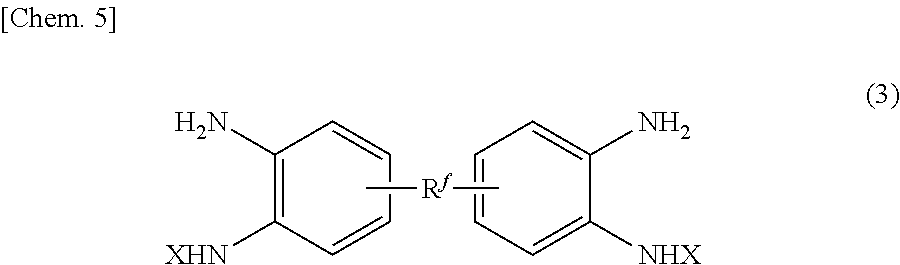
wherein

and two Xs are each individually a hydrogen atom or a monovalent organic group,

wherein

wherein


wherein

and

wherein


and two Xs are each individually a hydrogen atom or a monovalent organic group.

and —(CF2)n— (wherein n is an integer of 1 to 8).

(wherein X and R1 are defined as described above) and a repeating unit represented by the following formula (1-2):

(wherein X and R1 are defined as described above).


(wherein X and R1 are defined as described above) and a repeating unit represented by the following formula (2-2):

(wherein X and R1 are defined as described above).


(wherein X is defined as described above) and a compound represented by the following formula (3-2):

(wherein X is defined as described above).

Y—R1—Y (5)


Claims (26)


Applications Claiming Priority (4)
| Application Number | Priority Date | Filing Date | Title |
|---|---|---|---|
| JP2017178244 | 2017-09-15 | ||
| JP2017-178244 | 2017-09-15 | ||
| JPJP2017-178244 | 2017-09-15 | ||
| PCT/JP2018/034148 WO2019054471A1 (en) | 2017-09-15 | 2018-09-14 | Polybenzimidazole, precursor polyamide thereof, and method for producing same |
Related Parent Applications (1)
| Application Number | Title | Priority Date | Filing Date |
|---|---|---|---|
| PCT/JP2018/034148 A-371-Of-International WO2019054471A1 (en) | 2017-09-15 | 2018-09-14 | Polybenzimidazole, precursor polyamide thereof, and method for producing same |
Related Child Applications (2)
| Application Number | Title | Priority Date | Filing Date |
|---|---|---|---|
| US17/728,757 Division US11655339B2 (en) | 2017-09-15 | 2022-04-25 | Polybenzimidazole, precursor polyamide thereof, and method for producing same |
| US18/077,346 Division US11932729B2 (en) | 2017-09-15 | 2022-12-08 | Polybenzimidazole, precursor polyamide thereof, and method for producing same |
Publications (2)
| Publication Number | Publication Date |
|---|---|
| US20200291181A1 US20200291181A1 (en) | 2020-09-17 |
| US11548983B2 true US11548983B2 (en) | 2023-01-10 |
Family
ID=65723375
Family Applications (3)
| Application Number | Title | Priority Date | Filing Date |
|---|---|---|---|
| US16/646,599 Active 2039-05-29 US11548983B2 (en) | 2017-09-15 | 2018-09-14 | Polybenzimidazole, precursor polyamide thereof, and method for producing same |
| US17/728,757 Active US11655339B2 (en) | 2017-09-15 | 2022-04-25 | Polybenzimidazole, precursor polyamide thereof, and method for producing same |
| US18/077,346 Active US11932729B2 (en) | 2017-09-15 | 2022-12-08 | Polybenzimidazole, precursor polyamide thereof, and method for producing same |
Family Applications After (2)
| Application Number | Title | Priority Date | Filing Date |
|---|---|---|---|
| US17/728,757 Active US11655339B2 (en) | 2017-09-15 | 2022-04-25 | Polybenzimidazole, precursor polyamide thereof, and method for producing same |
| US18/077,346 Active US11932729B2 (en) | 2017-09-15 | 2022-12-08 | Polybenzimidazole, precursor polyamide thereof, and method for producing same |
Country Status (7)
| Country | Link |
|---|---|
| US (3) | US11548983B2 (en) |
| EP (1) | EP3666814A4 (en) |
| JP (1) | JP7085737B2 (en) |
| KR (1) | KR102357048B1 (en) |
| CN (1) | CN111108145B (en) |
| TW (1) | TWI763922B (en) |
| WO (1) | WO2019054471A1 (en) |
Families Citing this family (4)
| Publication number | Priority date | Publication date | Assignee | Title |
|---|---|---|---|---|
| TWI763922B (en) | 2017-09-15 | 2022-05-11 | 日商大金工業股份有限公司 | Polybenzimidazole, its precursor polyamide and their manufacturing method |
| JP7096931B2 (en) * | 2020-05-11 | 2022-07-06 | ダイキン工業株式会社 | Fluorinated amide compounds, fluorinated nitrogen-containing heterocyclic compounds and fluorinated compounds |
| CN117255779A (en) * | 2021-04-27 | 2023-12-19 | 大金工业株式会社 | Bisdiaminophenyl compounds, cross-linking agents, compositions and molded articles |
| WO2025143101A1 (en) * | 2023-12-28 | 2025-07-03 | 株式会社クレハ | Compound, polymer, curing agent, curable composition, and cured product |
Citations (20)
| Publication number | Priority date | Publication date | Assignee | Title |
|---|---|---|---|---|
| US3951920A (en) | 1971-09-13 | 1976-04-20 | Teijin Limited | Permselective polymeric membrane prepared from polybenzimidazoles |
| SU527453A1 (en) | 1975-03-27 | 1976-09-05 | Предприятие П/Я М-5885 | Method for preparing fluorinated polybenzimidazoles |
| US4537974A (en) | 1984-09-26 | 1985-08-27 | Hughes Aircraft Company | Diethynylated phenylbenzimidazole compounds |
| US4877849A (en) | 1987-08-17 | 1989-10-31 | Hoechst Celanese Corporation | Oxyformylated substituted polybenzimidazole article |
| US5028728A (en) * | 1987-02-10 | 1991-07-02 | Hoechst Aktiengesellschaft | Process for the preparation of reaction products of 2,2-bis-(4-hydroxphenyl)-hexafluoropropane and new derivatives of this type |
| US5262056A (en) | 1992-11-30 | 1993-11-16 | Board Of Regents, The University Of Texas System | Polyamides and polypyrrolones for fluid separation membranes |
| JPH09183846A (en) | 1995-08-31 | 1997-07-15 | Siemens Ag | Process for producing poly-o-hydroxyamide and poly-o-mercaptoamide |
| JPH09208699A (en) | 1996-02-07 | 1997-08-12 | Hoechst Ind Kk | Low-metal polybenzimidazole material and its preparation |
| JP2006339064A (en) | 2005-06-03 | 2006-12-14 | Samsung Yokohama Research Institute Co Ltd | Polybenzimidazole-based proton conductive polymer membrane, method for producing the same, and fuel cell using the same |
| WO2007008327A2 (en) | 2005-07-11 | 2007-01-18 | Pbi Perforance Products, Inc. | A process for a two stage melt polymerization for the production of polybenzimidazole |
| US7396615B1 (en) | 1998-12-25 | 2008-07-08 | Basf Fuel Cell Gmbh | Method for production of polyelectrolyte membranes and fuel cell |
| US20090136818A1 (en) | 2005-06-03 | 2009-05-28 | Fusaki Fujibayashi | Proton Conducting Polymer membrane, Method for Production Thereof and Fuel Cell Therewith |
| CN101456964A (en) | 2008-12-23 | 2009-06-17 | 东华大学 | Method for preparing aromatic polybenzimidazole resin film |
| KR20110107549A (en) | 2010-03-25 | 2011-10-04 | 한남대학교 산학협력단 | Polybenzimidazole containing silicon in the main chain and a method for preparing the same |
| JP2011236155A (en) | 2010-05-10 | 2011-11-24 | Nippon Kayaku Co Ltd | Active ester of triazine dicarboxylate and polyamide resin obtained by using the same |
| JP2011256219A (en) | 2010-06-04 | 2011-12-22 | Nippon Kayaku Co Ltd | Polybenzoxazole resin, and precursor resin thereof |
| JP2012124161A (en) | 2011-12-01 | 2012-06-28 | Basf Fuel Cell Gmbh | Method for manufacturing polymer electrolyte membrane, and fuel cell |
| JP2013051145A (en) | 2011-08-31 | 2013-03-14 | Toyobo Co Ltd | Method for operating fuel cell |
| JP2016025058A (en) | 2014-07-24 | 2016-02-08 | 日本化薬株式会社 | Material for forming nonaqueous battery electrode, binding composition and article using the same |
| CN106928481A (en) | 2017-04-06 | 2017-07-07 | 上海交通大学 | The optimization preparation method of Kapton |
Family Cites Families (8)
| Publication number | Priority date | Publication date | Assignee | Title |
|---|---|---|---|---|
| KR0181315B1 (en) * | 1989-11-28 | 1999-05-15 | 미리엄 디이 메코너헤이 | Quaternary ammonium polyarylamides |
| JP2003055457A (en) * | 2001-08-22 | 2003-02-26 | Toyobo Co Ltd | Sulfonic acid-containing ion-conductive polybenzimidazole |
| JP2009191184A (en) * | 2008-02-15 | 2009-08-27 | Toyobo Co Ltd | Method for producing polybenzazole |
| CA2811166C (en) * | 2010-09-14 | 2019-10-01 | Council Of Scientific & Industrial Research | Quarternised polybenzimidazole |
| CN102604095B (en) * | 2012-03-01 | 2013-10-16 | 中国工程物理研究院激光聚变研究中心 | N-substituted polybenzimidazole amide compound and preparation method thereof |
| US9283523B2 (en) * | 2012-05-25 | 2016-03-15 | Pbi Performance Products, Inc. | Acid resistant PBI membrane for pervaporation dehydration of acidic solvents |
| JP6461470B2 (en) * | 2013-11-27 | 2019-01-30 | 宇部興産株式会社 | Polyimide precursor composition, polyimide production method, polyimide, polyimide film, and substrate |
| TWI763922B (en) | 2017-09-15 | 2022-05-11 | 日商大金工業股份有限公司 | Polybenzimidazole, its precursor polyamide and their manufacturing method |
-
2018
- 2018-09-14 TW TW107132418A patent/TWI763922B/en active
- 2018-09-14 EP EP18856890.1A patent/EP3666814A4/en active Pending
- 2018-09-14 WO PCT/JP2018/034148 patent/WO2019054471A1/en not_active Ceased
- 2018-09-14 CN CN201880059269.3A patent/CN111108145B/en active Active
- 2018-09-14 US US16/646,599 patent/US11548983B2/en active Active
- 2018-09-14 KR KR1020207010435A patent/KR102357048B1/en active Active
- 2018-09-14 JP JP2019542300A patent/JP7085737B2/en active Active
-
2022
- 2022-04-25 US US17/728,757 patent/US11655339B2/en active Active
- 2022-12-08 US US18/077,346 patent/US11932729B2/en active Active
Patent Citations (23)
| Publication number | Priority date | Publication date | Assignee | Title |
|---|---|---|---|---|
| US3951920A (en) | 1971-09-13 | 1976-04-20 | Teijin Limited | Permselective polymeric membrane prepared from polybenzimidazoles |
| SU527453A1 (en) | 1975-03-27 | 1976-09-05 | Предприятие П/Я М-5885 | Method for preparing fluorinated polybenzimidazoles |
| US4537974A (en) | 1984-09-26 | 1985-08-27 | Hughes Aircraft Company | Diethynylated phenylbenzimidazole compounds |
| US5028728A (en) * | 1987-02-10 | 1991-07-02 | Hoechst Aktiengesellschaft | Process for the preparation of reaction products of 2,2-bis-(4-hydroxphenyl)-hexafluoropropane and new derivatives of this type |
| US4877849A (en) | 1987-08-17 | 1989-10-31 | Hoechst Celanese Corporation | Oxyformylated substituted polybenzimidazole article |
| US5262056A (en) | 1992-11-30 | 1993-11-16 | Board Of Regents, The University Of Texas System | Polyamides and polypyrrolones for fluid separation membranes |
| JPH09183846A (en) | 1995-08-31 | 1997-07-15 | Siemens Ag | Process for producing poly-o-hydroxyamide and poly-o-mercaptoamide |
| US5807969A (en) | 1995-08-31 | 1998-09-15 | Siemens Aktiengesellschaft | Preparation of poly-O-hydroxyamides and poly O-mercaptoamides |
| JPH09208699A (en) | 1996-02-07 | 1997-08-12 | Hoechst Ind Kk | Low-metal polybenzimidazole material and its preparation |
| US5932688A (en) | 1996-02-07 | 1999-08-03 | Hoechst Japan Limited | Polybenzimidazole material with low metallic concentration and a process for production thereof |
| US7396615B1 (en) | 1998-12-25 | 2008-07-08 | Basf Fuel Cell Gmbh | Method for production of polyelectrolyte membranes and fuel cell |
| JP2006339064A (en) | 2005-06-03 | 2006-12-14 | Samsung Yokohama Research Institute Co Ltd | Polybenzimidazole-based proton conductive polymer membrane, method for producing the same, and fuel cell using the same |
| US20090136818A1 (en) | 2005-06-03 | 2009-05-28 | Fusaki Fujibayashi | Proton Conducting Polymer membrane, Method for Production Thereof and Fuel Cell Therewith |
| WO2007008327A2 (en) | 2005-07-11 | 2007-01-18 | Pbi Perforance Products, Inc. | A process for a two stage melt polymerization for the production of polybenzimidazole |
| CN101223211A (en) | 2005-07-11 | 2008-07-16 | Pbi性能产品公司 | Two-stage melt polymerization process for the production of polybenzimidazole |
| CN101456964A (en) | 2008-12-23 | 2009-06-17 | 东华大学 | Method for preparing aromatic polybenzimidazole resin film |
| KR20110107549A (en) | 2010-03-25 | 2011-10-04 | 한남대학교 산학협력단 | Polybenzimidazole containing silicon in the main chain and a method for preparing the same |
| JP2011236155A (en) | 2010-05-10 | 2011-11-24 | Nippon Kayaku Co Ltd | Active ester of triazine dicarboxylate and polyamide resin obtained by using the same |
| JP2011256219A (en) | 2010-06-04 | 2011-12-22 | Nippon Kayaku Co Ltd | Polybenzoxazole resin, and precursor resin thereof |
| JP2013051145A (en) | 2011-08-31 | 2013-03-14 | Toyobo Co Ltd | Method for operating fuel cell |
| JP2012124161A (en) | 2011-12-01 | 2012-06-28 | Basf Fuel Cell Gmbh | Method for manufacturing polymer electrolyte membrane, and fuel cell |
| JP2016025058A (en) | 2014-07-24 | 2016-02-08 | 日本化薬株式会社 | Material for forming nonaqueous battery electrode, binding composition and article using the same |
| CN106928481A (en) | 2017-04-06 | 2017-07-07 | 上海交通大学 | The optimization preparation method of Kapton |
Non-Patent Citations (10)
| Title |
|---|
| Extended search report dated Aug. 4, 2021, from the European Patent Office in counterpart application No. 18856890.1. |
| International Preliminary Report on Patentability with a Translation of Written Opinion in International Application No. PCT/JP2018/034148, dated Mar. 17, 2020. |
| International Search Report of PCT/JP2018/034148 dated Dec. 18, 2018 [PCT/ISA/210]. |
| James J. Kane et al., "Synthesis of New Nitrogen Substituted Polybenzimidazoles", Materials Research Society, 1989, vol. 134, pp. 133-140 (8 pages total). |
| K.J. Scariah et al., "Synthesis and Properties of New Polybenzimidazoles and N-Phenyl Polybenzimidazoles with Flexibilizing Spacers on the Polymer Backbone", Journal of Polymer Science, vol. 25, 1987, pp. 2675-2687, (13 pages total). |
| Kane et al., "Synthesis of N-Substitiuted Polybenzimidazoles by Cyclodehydrogenation of Precursor Poly(Schiff Bases)", Polymer Preprints, Aug. 1991, vol. 32, No. 3, pp. 232-233 (3 pages total). |
| Kane et al; "New Approaches to the Synthesis of N-Substituted Polybenzimidazoles"; Abstracts of Papers of the American Chemical Society, 1990; pp. 709-710. |
| Korshak et al., "Synthesis and Investigation of Polybenzimidazoles Containing Alkyl Substituents in Aromatic Nuclei", Journal of Polymer Science: Part A-1, 1971, vol. 9, pp. 1027-1043 (17 pages total). |
| Lau et al., "Synthesis of Polyer Intermediates Containing the Hexafluoroisopropylidene Group via Functionalization of 2,2-Diphenylhexafluoropropane", Journal of Polymer Science: Polymer Chemistry Edition, 1982, vol. 20, pp. 2381-2393 (13 pages total). |
| Toshinari Nakajima et al., "On the Thermally Stable Polymers as Industrial Material (Polybenz Imidazole)", 1969.9, pp. 536-541, vol. 21, No. 9. |
Also Published As
| Publication number | Publication date |
|---|---|
| US11932729B2 (en) | 2024-03-19 |
| CN111108145A (en) | 2020-05-05 |
| US20220251299A1 (en) | 2022-08-11 |
| EP3666814A1 (en) | 2020-06-17 |
| KR102357048B1 (en) | 2022-02-08 |
| TW201920376A (en) | 2019-06-01 |
| CN111108145B (en) | 2023-09-15 |
| US20200291181A1 (en) | 2020-09-17 |
| JP7085737B2 (en) | 2022-06-17 |
| TWI763922B (en) | 2022-05-11 |
| EP3666814A4 (en) | 2021-09-01 |
| US11655339B2 (en) | 2023-05-23 |
| KR20200047701A (en) | 2020-05-07 |
| US20230128992A1 (en) | 2023-04-27 |
| WO2019054471A1 (en) | 2019-03-21 |
| JPWO2019054471A1 (en) | 2020-08-20 |
Similar Documents
| Publication | Publication Date | Title |
|---|---|---|
| US11932729B2 (en) | Polybenzimidazole, precursor polyamide thereof, and method for producing same | |
| US20150045481A1 (en) | Asymmetric Diamine Compounds Containing Two Functional Groups and Polymers Therefrom | |
| KR20150056779A (en) | Polyimide and molded body thereof | |
| KR102736887B1 (en) | Polymer including triazine ring, and thermoplastic article and optical component including the same | |
| US20140255710A1 (en) | Polyimide precursor, polyimide, polyimide film, and method for manufacturing triazine compound used for manufacturing same | |
| US7109287B2 (en) | Space environmentally durable polyimides and copolyimides | |
| Liu et al. | New poly (amide-imide) s with trifluoromethyl and chloride substituents: Synthesis, thermal, dielectric, and optical properties | |
| US20230099704A1 (en) | Fluorinated amide compound, compound containing fluorinated nitrogen-containing heterocyclic ring, and fluorinated compound | |
| Wang et al. | Synthesis and properties of new fluorinated polyimides derived from an unsymmetrical and noncoplanar diamine | |
| US6054554A (en) | Soluble polyimide resin comprising polyalicyclic structure | |
| US6342638B1 (en) | Triarylphosphine oxide derivatives containing fluorine substituents | |
| KR102941323B1 (en) | Polycarbonate and optical elements comprising the same | |
| JP2025032249A (en) | Resin raw material composition | |
| EP4108704A1 (en) | Polyimide copolymer and polyimide film using the same | |
| US11180612B2 (en) | Triazine ring-containing polymer, and thermoplastic article and optical component including the same | |
| CN108997580B (en) | A kind of polyetherimide containing anthrone and trifluoromethyl structure and preparation method thereof | |
| US7282553B2 (en) | Flexible isopropylidene and tetramethyl-containing fluoropolyamide and fluoropolymide and preparation method thereof | |
| KR101421405B1 (en) | A compound having trifluorovinyl ether group, copolymer comprising the same, preparation method thereof and optical films or display substrate using the same | |
| Liu et al. | Synthesis and characterization of novel aromatic poly (ester amide) s containing pendant trifluoromethylphenoxy groups | |
| JP2021024930A (en) | Method for producing polyamic acid solution, method for producing polyimide resin and method for producing polyimide film | |
| US20260139096A1 (en) | Thermoplastic resin and optical member | |
| KR102820633B1 (en) | Poly(urethane-ester) copolymer, polymer resin composition, optical lens and optical articles comprising the same | |
| KR20150011898A (en) | Polyaminosulfone resin | |
| KR20240011147A (en) | Materials and melt-processed products for melt processing | |
| KR20210070218A (en) | Triazine ring-containing polymer, and thermoplastic article and optical part including same |
Legal Events
| Date | Code | Title | Description |
|---|---|---|---|
| AS | Assignment |
Owner name: DAIKIN INDUSTRIES, LTD., JAPAN Free format text: ASSIGNMENT OF ASSIGNORS INTEREST;ASSIGNORS:OISHI, YOSHIYUKI;NOGUCHI, TSUYOSHI;KANBARA, TADASHI;SIGNING DATES FROM 20200116 TO 20200227;REEL/FRAME:052093/0347 Owner name: NATIONAL UNIVERSITY CORPORATION, IWATE UNIVERSITY, JAPAN Free format text: ASSIGNMENT OF ASSIGNORS INTEREST;ASSIGNORS:OISHI, YOSHIYUKI;NOGUCHI, TSUYOSHI;KANBARA, TADASHI;SIGNING DATES FROM 20200116 TO 20200227;REEL/FRAME:052093/0347 |
|
| FEPP | Fee payment procedure |
Free format text: ENTITY STATUS SET TO UNDISCOUNTED (ORIGINAL EVENT CODE: BIG.); ENTITY STATUS OF PATENT OWNER: LARGE ENTITY |
|
| STPP | Information on status: patent application and granting procedure in general |
Free format text: APPLICATION DISPATCHED FROM PREEXAM, NOT YET DOCKETED |
|
| STPP | Information on status: patent application and granting procedure in general |
Free format text: DOCKETED NEW CASE - READY FOR EXAMINATION |
|
| STPP | Information on status: patent application and granting procedure in general |
Free format text: NON FINAL ACTION MAILED |
|
| STPP | Information on status: patent application and granting procedure in general |
Free format text: RESPONSE TO NON-FINAL OFFICE ACTION ENTERED AND FORWARDED TO EXAMINER |
|
| STPP | Information on status: patent application and granting procedure in general |
Free format text: NON FINAL ACTION MAILED |
|
| STPP | Information on status: patent application and granting procedure in general |
Free format text: RESPONSE TO NON-FINAL OFFICE ACTION ENTERED AND FORWARDED TO EXAMINER |
|
| STPP | Information on status: patent application and granting procedure in general |
Free format text: NOTICE OF ALLOWANCE MAILED -- APPLICATION RECEIVED IN OFFICE OF PUBLICATIONS |
|
| STPP | Information on status: patent application and granting procedure in general |
Free format text: PUBLICATIONS -- ISSUE FEE PAYMENT VERIFIED |
|
| STCF | Information on status: patent grant |
Free format text: PATENTED CASE |