US11535642B2 - Trehalose analogues - Google Patents
Trehalose analogues Download PDFInfo
- Publication number
- US11535642B2 US11535642B2 US17/306,701 US202117306701A US11535642B2 US 11535642 B2 US11535642 B2 US 11535642B2 US 202117306701 A US202117306701 A US 202117306701A US 11535642 B2 US11535642 B2 US 11535642B2
- Authority
- US
- United States
- Prior art keywords
- compound
- trehalose
- alktmm
- tmm
- compounds
- Prior art date
- Legal status (The legal status is an assumption and is not a legal conclusion. Google has not performed a legal analysis and makes no representation as to the accuracy of the status listed.)
- Active
Links
- ANRSURVVNPJDJG-GAGAFNQMSA-N CCC(=O)[Y]CC1O[C@H](O[C@H]2OC(CC)[C@@H](O)C(O)[C@H]2O)C(O)[C@@H](O)[C@@H]1O Chemical compound CCC(=O)[Y]CC1O[C@H](O[C@H]2OC(CC)[C@@H](O)C(O)[C@H]2O)C(O)[C@@H](O)[C@@H]1O ANRSURVVNPJDJG-GAGAFNQMSA-N 0.000 description 5
- 0 *C(CCC)C(CCC)C(C)C Chemical compound *C(CCC)C(CCC)C(C)C 0.000 description 3
- PGOONGKTFDLOPQ-NXZCPFRHSA-N C#CC(C)C.CC(C)CC(=S)Cc1ccc(-c2c3ccc(=O)cc-3oc3cc(O)ccc23)c(C(=O)O)c1.CC(C)N=[N+]=[N-].CC(C)NC(=O)OC1CC/C=C/CCC1 Chemical compound C#CC(C)C.CC(C)CC(=S)Cc1ccc(-c2c3ccc(=O)cc-3oc3cc(O)ccc23)c(C(=O)O)c1.CC(C)N=[N+]=[N-].CC(C)NC(=O)OC1CC/C=C/CCC1 PGOONGKTFDLOPQ-NXZCPFRHSA-N 0.000 description 1
- JPFXVEHYMOLESG-BREBYFSCSA-N C#CCC(=O)NCC1O[C@H](O[C@H]2OC(CC)[C@@H](O)C(O)[C@H]2O)C(O)[C@@H](O)[C@@H]1O.CC(=O)NCC1O[C@H](O[C@H]2OC(CO)[C@@H](O)C(O)[C@H]2O)C(O)[C@@H](O)[C@@H]1O.CCC(=O)NCC1O[C@H](O[C@H]2OC(CC)[C@@H](O)C(O)[C@H]2O)C(O)[C@@H](O)[C@@H]1O.CCC1O[C@H](O[C@H]2OC(CNC(=O)CN=[N+]=[N-])[C@@H](O)[C@H](O)C2O)[C@H](O)C(O)[C@@H]1O.CCC1O[C@H](O[C@H]2OC(CNC(C)=O)[C@@H](O)[C@H](O)C2O)[C@H](O)C(O)[C@@H]1O Chemical compound C#CCC(=O)NCC1O[C@H](O[C@H]2OC(CC)[C@@H](O)C(O)[C@H]2O)C(O)[C@@H](O)[C@@H]1O.CC(=O)NCC1O[C@H](O[C@H]2OC(CO)[C@@H](O)C(O)[C@H]2O)C(O)[C@@H](O)[C@@H]1O.CCC(=O)NCC1O[C@H](O[C@H]2OC(CC)[C@@H](O)C(O)[C@H]2O)C(O)[C@@H](O)[C@@H]1O.CCC1O[C@H](O[C@H]2OC(CNC(=O)CN=[N+]=[N-])[C@@H](O)[C@H](O)C2O)[C@H](O)C(O)[C@@H]1O.CCC1O[C@H](O[C@H]2OC(CNC(C)=O)[C@@H](O)[C@H](O)C2O)[C@H](O)C(O)[C@@H]1O JPFXVEHYMOLESG-BREBYFSCSA-N 0.000 description 1
- KHMGBUMBDOAXIH-SSLOOPPHSA-N C#CCC(=O)NCC1O[C@H](O[C@H]2OC(CO)[C@@H](O)C(O)[C@H]2O)C(O)[C@@H](O)[C@@H]1O.CC(=O)NCC1O[C@H](O[C@H]2OC(CO)[C@@H](O)C(O)[C@H]2O)C(O)[C@@H](O)[C@@H]1O.CCC1O[C@H](O[C@H]2OC(CNC(C)=O)[C@@H](O)[C@H](O)C2O)[C@H](O)C(O)[C@@H]1O.CCC1O[C@H](O[C@H]2OC(CNC(C)=O)[C@@H](O)[C@H](O)C2O)[C@H](O)C(O)[C@@H]1O.CCC1O[C@H](O[C@H]2OC(CNC(C)=O)[C@@H](O)[C@H](O)C2O)[C@H](O)C(O)[C@@H]1O Chemical compound C#CCC(=O)NCC1O[C@H](O[C@H]2OC(CO)[C@@H](O)C(O)[C@H]2O)C(O)[C@@H](O)[C@@H]1O.CC(=O)NCC1O[C@H](O[C@H]2OC(CO)[C@@H](O)C(O)[C@H]2O)C(O)[C@@H](O)[C@@H]1O.CCC1O[C@H](O[C@H]2OC(CNC(C)=O)[C@@H](O)[C@H](O)C2O)[C@H](O)C(O)[C@@H]1O.CCC1O[C@H](O[C@H]2OC(CNC(C)=O)[C@@H](O)[C@H](O)C2O)[C@H](O)C(O)[C@@H]1O.CCC1O[C@H](O[C@H]2OC(CNC(C)=O)[C@@H](O)[C@H](O)C2O)[C@H](O)C(O)[C@@H]1O KHMGBUMBDOAXIH-SSLOOPPHSA-N 0.000 description 1
- UHXBQDXREHWVEC-LOVUPKJRSA-N C#CCC(=O)OCC1O[C@H](O[C@H]2OC(CC)[C@@H](O)C(O)[C@H]2O)C(O)[C@@H](O)[C@@H]1O.CC(=O)OCC1O[C@H](O[C@H]2OC(CO)[C@@H](O)C(O)[C@H]2O)C(O)[C@@H](O)[C@@H]1O.CCC(=O)OCC1O[C@H](O[C@H]2OC(CC)[C@@H](O)C(O)[C@H]2O)C(O)[C@@H](O)[C@@H]1O.CCC1O[C@H](O[C@H]2OC(COC(=O)CN=[N+]=[N-])[C@@H](O)[C@H](O)C2O)[C@H](O)C(O)[C@@H]1O.CCC1O[C@H](O[C@H]2OC(COC(C)=O)[C@@H](O)[C@H](O)C2O)[C@H](O)C(O)[C@@H]1O Chemical compound C#CCC(=O)OCC1O[C@H](O[C@H]2OC(CC)[C@@H](O)C(O)[C@H]2O)C(O)[C@@H](O)[C@@H]1O.CC(=O)OCC1O[C@H](O[C@H]2OC(CO)[C@@H](O)C(O)[C@H]2O)C(O)[C@@H](O)[C@@H]1O.CCC(=O)OCC1O[C@H](O[C@H]2OC(CC)[C@@H](O)C(O)[C@H]2O)C(O)[C@@H](O)[C@@H]1O.CCC1O[C@H](O[C@H]2OC(COC(=O)CN=[N+]=[N-])[C@@H](O)[C@H](O)C2O)[C@H](O)C(O)[C@@H]1O.CCC1O[C@H](O[C@H]2OC(COC(C)=O)[C@@H](O)[C@H](O)C2O)[C@H](O)C(O)[C@@H]1O UHXBQDXREHWVEC-LOVUPKJRSA-N 0.000 description 1
- SZJZTZYOUMRYJG-ZCEWNOAOSA-N C#CCC(=O)OCC1O[C@H](O[C@H]2OC(CO)[C@@H](O)C(O)[C@H]2O)C(O)[C@@H](O)[C@@H]1O.CC(=O)OCC1O[C@H](O[C@H]2OC(CO)[C@@H](O)C(O)[C@H]2O)C(O)[C@@H](O)[C@@H]1O.CCC1O[C@H](O[C@H]2OC(COC(C)=O)[C@@H](O)[C@H](O)C2O)[C@H](O)C(O)[C@@H]1O.CCC1O[C@H](O[C@H]2OC(COC(C)=O)[C@@H](O)[C@H](O)C2O)[C@H](O)C(O)[C@@H]1O.CCC1O[C@H](O[C@H]2OC(COC(C)=O)[C@@H](O)[C@H](O)C2O)[C@H](O)C(O)[C@@H]1O Chemical compound C#CCC(=O)OCC1O[C@H](O[C@H]2OC(CO)[C@@H](O)C(O)[C@H]2O)C(O)[C@@H](O)[C@@H]1O.CC(=O)OCC1O[C@H](O[C@H]2OC(CO)[C@@H](O)C(O)[C@H]2O)C(O)[C@@H](O)[C@@H]1O.CCC1O[C@H](O[C@H]2OC(COC(C)=O)[C@@H](O)[C@H](O)C2O)[C@H](O)C(O)[C@@H]1O.CCC1O[C@H](O[C@H]2OC(COC(C)=O)[C@@H](O)[C@H](O)C2O)[C@H](O)C(O)[C@@H]1O.CCC1O[C@H](O[C@H]2OC(COC(C)=O)[C@@H](O)[C@H](O)C2O)[C@H](O)C(O)[C@@H]1O SZJZTZYOUMRYJG-ZCEWNOAOSA-N 0.000 description 1
- PDPLUNKFYMCYFE-KFYNVICBSA-N C#CCCC(=O)OCC1O[C@H](O[C@H]2OC(CC)[C@@H](O)C(O)[C@H]2O)C(O)[C@@H](O)[C@@H]1O.C#CCCCCC(=O)OCC1O[C@H](O[C@H]2OC(CO)[C@@H](O)C(O)[C@H]2O)C(O)[C@@H](O)[C@@H]1O.C#CCCCCCCCCCC(=O)OCC1O[C@H](O[C@H]2OC(CO)[C@@H](O)C(O)[C@H]2O)C(O)[C@@H](O)[C@@H]1O.CCC1O[C@H](O[C@H]2OC(COC(=O)CN=[N+]=[N-])[C@@H](O)[C@H](O)C2O)[C@H](O)C(O)[C@@H]1O.CCCCCC(=O)OCC1O[C@H](O[C@H]2OC(CO)[C@@H](O)C(O)[C@H]2O)C(O)[C@@H](O)[C@@H]1O.Cc1ccc2c(-c3ccc(CC(=S)CCC(=O)OCC4O[C@H](O[C@H]5OC(CO)[C@@H](O)C(O)[C@H]5O)C(O)[C@@H](O)[C@@H]4O)cc3C(=O)O)c3ccc(=O)cc-3oc2c1.[N-]=[N+]=NCCCCCCCCCC(=O)OCC1O[C@H](O[C@H]2OC(CO)[C@@H](O)C(O)[C@H]2O)C(O)[C@@H](O)[C@@H]1O Chemical compound C#CCCC(=O)OCC1O[C@H](O[C@H]2OC(CC)[C@@H](O)C(O)[C@H]2O)C(O)[C@@H](O)[C@@H]1O.C#CCCCCC(=O)OCC1O[C@H](O[C@H]2OC(CO)[C@@H](O)C(O)[C@H]2O)C(O)[C@@H](O)[C@@H]1O.C#CCCCCCCCCCC(=O)OCC1O[C@H](O[C@H]2OC(CO)[C@@H](O)C(O)[C@H]2O)C(O)[C@@H](O)[C@@H]1O.CCC1O[C@H](O[C@H]2OC(COC(=O)CN=[N+]=[N-])[C@@H](O)[C@H](O)C2O)[C@H](O)C(O)[C@@H]1O.CCCCCC(=O)OCC1O[C@H](O[C@H]2OC(CO)[C@@H](O)C(O)[C@H]2O)C(O)[C@@H](O)[C@@H]1O.Cc1ccc2c(-c3ccc(CC(=S)CCC(=O)OCC4O[C@H](O[C@H]5OC(CO)[C@@H](O)C(O)[C@H]5O)C(O)[C@@H](O)[C@@H]4O)cc3C(=O)O)c3ccc(=O)cc-3oc2c1.[N-]=[N+]=NCCCCCCCCCC(=O)OCC1O[C@H](O[C@H]2OC(CO)[C@@H](O)C(O)[C@H]2O)C(O)[C@@H](O)[C@@H]1O PDPLUNKFYMCYFE-KFYNVICBSA-N 0.000 description 1
- XURQYRNNOHVKMF-ZRJGGZJASA-N C#CCCC(=O)OCC1O[C@H](O[C@H]2OC(CO)[C@@H](O)C(O)[C@H]2O)C(O)[C@@H](O)[C@@H]1O Chemical compound C#CCCC(=O)OCC1O[C@H](O[C@H]2OC(CO)[C@@H](O)C(O)[C@H]2O)C(O)[C@@H](O)[C@@H]1O XURQYRNNOHVKMF-ZRJGGZJASA-N 0.000 description 1
- POTVXOWIFWCTAN-UHFFFAOYSA-N C#CCCC(C)(C)C Chemical compound C#CCCC(C)(C)C POTVXOWIFWCTAN-UHFFFAOYSA-N 0.000 description 1
- XOYUZQNZOYHYSY-ORFFAWHASA-N C#CCCCC1(CCCCCCCCC(=O)OCC2O[C@H](O[C@H]3OC(CO)[C@@H](O)C(O)[C@H]3O)C(O)[C@@H](O)[C@@H]2O)N=N1.C#CCCCCC(=O)OCC1O[C@H](O[C@H]2OC(CO)[C@@H](O)C(O)[C@H]2O)C(O)[C@@H](O)[C@@H]1O.Cc1ccc2c(-c3ccc(CC(=S)CCCCCCCCCCC(=O)OCC4O[C@H](O[C@H]5OC(CO)[C@@H](O)C(O)[C@H]5O)C(O)[C@@H](O)[C@@H]4O)cc3C(=O)O)c3ccc(=O)cc-3oc2c1.Cc1ccc2c(-c3ccc(CC(=S)NCCCCC(=O)OCC4O[C@H](O[C@H]5OC(CO)[C@@H](O)C(O)[C@H]5O)C(O)[C@@H](O)[C@@H]4O)cc3C(=O)O)c3ccc(=O)cc-3oc2c1.O=C(CCCCCCCCCNC(=O)OC1CC/C=C/CCC1)OCC1O[C@H](O[C@H]2OC(CO)[C@@H](O)C(O)[C@H]2O)C(O)[C@@H](O)[C@@H]1O Chemical compound C#CCCCC1(CCCCCCCCC(=O)OCC2O[C@H](O[C@H]3OC(CO)[C@@H](O)C(O)[C@H]3O)C(O)[C@@H](O)[C@@H]2O)N=N1.C#CCCCCC(=O)OCC1O[C@H](O[C@H]2OC(CO)[C@@H](O)C(O)[C@H]2O)C(O)[C@@H](O)[C@@H]1O.Cc1ccc2c(-c3ccc(CC(=S)CCCCCCCCCCC(=O)OCC4O[C@H](O[C@H]5OC(CO)[C@@H](O)C(O)[C@H]5O)C(O)[C@@H](O)[C@@H]4O)cc3C(=O)O)c3ccc(=O)cc-3oc2c1.Cc1ccc2c(-c3ccc(CC(=S)NCCCCC(=O)OCC4O[C@H](O[C@H]5OC(CO)[C@@H](O)C(O)[C@H]5O)C(O)[C@@H](O)[C@@H]4O)cc3C(=O)O)c3ccc(=O)cc-3oc2c1.O=C(CCCCCCCCCNC(=O)OC1CC/C=C/CCC1)OCC1O[C@H](O[C@H]2OC(CO)[C@@H](O)C(O)[C@H]2O)C(O)[C@@H](O)[C@@H]1O XOYUZQNZOYHYSY-ORFFAWHASA-N 0.000 description 1
- BPFPHXSYIKDEGT-JLNDNHFESA-N C#CCCCCC(=O)CCC1O[C@H](O[C@H]2OC(CO)[C@@H](O)C(O)[C@H]2O)C(O)[C@@H](O)[C@@H]1O.CCCCCCC(=O)CCC1O[C@H](O[C@H]2OC(CO)[C@@H](O)C(O)[C@H]2O)C(O)[C@@H](O)[C@@H]1O Chemical compound C#CCCCCC(=O)CCC1O[C@H](O[C@H]2OC(CO)[C@@H](O)C(O)[C@H]2O)C(O)[C@@H](O)[C@@H]1O.CCCCCCC(=O)CCC1O[C@H](O[C@H]2OC(CO)[C@@H](O)C(O)[C@H]2O)C(O)[C@@H](O)[C@@H]1O BPFPHXSYIKDEGT-JLNDNHFESA-N 0.000 description 1
- KATQPVFBRLOQGO-WNTQTTKOSA-N C#CCCCCC(=O)NCC1O[C@H](O[C@H]2OC(CO)[C@@H](O)C(O)[C@H]2O)C(O)[C@@H](O)[C@@H]1O.[N-]=[N+]=NCC1O[C@H](O[C@H]2OC(CO)[C@@H](O)C(O)[C@H]2O)C(O)[C@@H](O)[C@@H]1O Chemical compound C#CCCCCC(=O)NCC1O[C@H](O[C@H]2OC(CO)[C@@H](O)C(O)[C@H]2O)C(O)[C@@H](O)[C@@H]1O.[N-]=[N+]=NCC1O[C@H](O[C@H]2OC(CO)[C@@H](O)C(O)[C@H]2O)C(O)[C@@H](O)[C@@H]1O KATQPVFBRLOQGO-WNTQTTKOSA-N 0.000 description 1
- WHQXAWMSBXZXRS-UHFFFAOYSA-N C#CCCCCC(C)(C)C Chemical compound C#CCCCCC(C)(C)C WHQXAWMSBXZXRS-UHFFFAOYSA-N 0.000 description 1
- HAIDJSAWEDQQPD-UHFFFAOYSA-N C#CCCCCCCCCC(C)(C)C Chemical compound C#CCCCCCCCCC(C)(C)C HAIDJSAWEDQQPD-UHFFFAOYSA-N 0.000 description 1
- DBYXHIJNWVNXBM-ZTQWZASZSA-N C#CCCCCCCCCCC(=O)OCC1O[C@H](O[C@H]2OC(CO)[C@@H](O)C(O)[C@H]2O)C(O)[C@@H](O)[C@@H]1O Chemical compound C#CCCCCCCCCCC(=O)OCC1O[C@H](O[C@H]2OC(CO)[C@@H](O)C(O)[C@H]2O)C(O)[C@@H](O)[C@@H]1O DBYXHIJNWVNXBM-ZTQWZASZSA-N 0.000 description 1
- PSEDRCMWTBGYMF-KFRSVZTCSA-N C.C#CCCCCC(=O)OCC1O[C@H](O[C@H]2OC(CO)[C@@H](O)C(O)[C@H]2O)C(O)[C@@H](O)[C@@H]1O.CC1[C@@H](O[C@H]2OC(CO)[C@@H](O[Si](C)(C)C)C(O[Si](C)(C)C)[C@H]2C)OC(CO)[C@@H](C)[C@@H]1C Chemical compound C.C#CCCCCC(=O)OCC1O[C@H](O[C@H]2OC(CO)[C@@H](O)C(O)[C@H]2O)C(O)[C@@H](O)[C@@H]1O.CC1[C@@H](O[C@H]2OC(CO)[C@@H](O[Si](C)(C)C)C(O[Si](C)(C)C)[C@H]2C)OC(CO)[C@@H](C)[C@@H]1C PSEDRCMWTBGYMF-KFRSVZTCSA-N 0.000 description 1
- VJSHTXRRTITYLA-QDONGAJXSA-N C.CC1[C@H](C)C(CO)O[C@H](O[C@H]2OC(CO)[C@@H](C)[C@H](C)C2C)[C@@H]1C.NCC(=O)OCC1O[C@H](O[C@H]2OC(CO)[C@@H](O)C(O)[C@H]2O)C(O)[C@@H](O)[C@@H]1O Chemical compound C.CC1[C@H](C)C(CO)O[C@H](O[C@H]2OC(CO)[C@@H](C)[C@H](C)C2C)[C@@H]1C.NCC(=O)OCC1O[C@H](O[C@H]2OC(CO)[C@@H](O)C(O)[C@H]2O)C(O)[C@@H](O)[C@@H]1O VJSHTXRRTITYLA-QDONGAJXSA-N 0.000 description 1
- RGMGBALZCOORRJ-WRJKWTRFSA-M C.CCC(=O)NCC1O[C@H](O[C@H]2OC(CO)[C@@H](O)C(O)[C@H]2O)C(O)[C@@H](O)[C@@H]1O.CCC(=O)O.I[IH]I.NCC1O[C@H](O[C@H]2OC(CO)[C@@H](O)C(O)[C@H]2O)C(O)[C@@H](O)[C@@H]1O.[V]I Chemical compound C.CCC(=O)NCC1O[C@H](O[C@H]2OC(CO)[C@@H](O)C(O)[C@H]2O)C(O)[C@@H](O)[C@@H]1O.CCC(=O)O.I[IH]I.NCC1O[C@H](O[C@H]2OC(CO)[C@@H](O)C(O)[C@H]2O)C(O)[C@@H](O)[C@@H]1O.[V]I RGMGBALZCOORRJ-WRJKWTRFSA-M 0.000 description 1
- OFQOTERKBZFBFJ-FXFRERKYSA-N CC(=O)OCC1O[C@H](O[C@H]2OC(CO)[C@@H](O)C(O)[C@H]2O)[C@@H](O)C(C)(O)[C@@H]1O Chemical compound CC(=O)OCC1O[C@H](O[C@H]2OC(CO)[C@@H](O)C(O)[C@H]2O)[C@@H](O)C(C)(O)[C@@H]1O OFQOTERKBZFBFJ-FXFRERKYSA-N 0.000 description 1
- ARYLSWSFJMUYEN-SNAWJCMRSA-N CC(C)(C)CCCNC(=O)OC1CC/C=C/CCC1 Chemical compound CC(C)(C)CCCNC(=O)OC1CC/C=C/CCC1 ARYLSWSFJMUYEN-SNAWJCMRSA-N 0.000 description 1
- SCTJXTYDIKWVOM-FVKSNFJMSA-N CCC(=O)NCC1O[C@H](O[C@H]2OC(CC)[C@@H](O)C(O)[C@H]2O)C(O)[C@@H](O)[C@@H]1O Chemical compound CCC(=O)NCC1O[C@H](O[C@H]2OC(CC)[C@@H](O)C(O)[C@H]2O)C(O)[C@@H](O)[C@@H]1O SCTJXTYDIKWVOM-FVKSNFJMSA-N 0.000 description 1
- NDVWDTBAZDIMQT-GMINXHCWSA-N CCC(=O)NCC1O[C@H](O[C@H]2OC(CC)[C@@H](O)C(O)[C@H]2O)C(O)[C@@H](O)[C@@H]1O.CCC(=O)OCC1O[C@H](O[C@H]2OC(CC)[C@@H](O)C(O)[C@H]2O)C(O)[C@@H](O)[C@@H]1O Chemical compound CCC(=O)NCC1O[C@H](O[C@H]2OC(CC)[C@@H](O)C(O)[C@H]2O)C(O)[C@@H](O)[C@@H]1O.CCC(=O)OCC1O[C@H](O[C@H]2OC(CC)[C@@H](O)C(O)[C@H]2O)C(O)[C@@H](O)[C@@H]1O NDVWDTBAZDIMQT-GMINXHCWSA-N 0.000 description 1
- WTMQAKMDMRCTIX-FVKSNFJMSA-N CCC(=O)OCC1O[C@H](O[C@H]2OC(CC)[C@@H](O)C(O)[C@H]2O)C(O)[C@@H](O)[C@@H]1O Chemical compound CCC(=O)OCC1O[C@H](O[C@H]2OC(CC)[C@@H](O)C(O)[C@H]2O)C(O)[C@@H](O)[C@@H]1O WTMQAKMDMRCTIX-FVKSNFJMSA-N 0.000 description 1
- GXCTZKITYRAZID-CCZAGHDTSA-N CCC1O[C@H](O[C@H]2OC(CCC(C)=O)[C@@H](O)[C@H](O)C2O)[C@H](O)C(O)[C@@H]1O Chemical compound CCC1O[C@H](O[C@H]2OC(CCC(C)=O)[C@@H](O)[C@H](O)C2O)[C@H](O)C(O)[C@@H]1O GXCTZKITYRAZID-CCZAGHDTSA-N 0.000 description 1
- ATWISEHEXAEGKB-UHFFFAOYSA-N CCCCCCCCCCC(C)(C)C Chemical compound CCCCCCCCCCC(C)(C)C ATWISEHEXAEGKB-UHFFFAOYSA-N 0.000 description 1
- RISREEKEGNCRNL-LKDMYZKVSA-N CN(C)c1ccc(/N=N/c2ccc(C(=O)CCCCCCCCCCC(=O)OC3CC(O)[C@@H](O)[C@@](O)(O[C@H]4OC(COC(=O)CCCCCCCCCCC(=S)Nc5ccc(-c6c7ccc(=O)cc-7oc7cc(O)ccc67)c(C(=O)O)c5)[C@@H](O)[C@H](O)C4O)O3)cc2)cc1 Chemical compound CN(C)c1ccc(/N=N/c2ccc(C(=O)CCCCCCCCCCC(=O)OC3CC(O)[C@@H](O)[C@@](O)(O[C@H]4OC(COC(=O)CCCCCCCCCCC(=S)Nc5ccc(-c6c7ccc(=O)cc-7oc7cc(O)ccc67)c(C(=O)O)c5)[C@@H](O)[C@H](O)C4O)O3)cc2)cc1 RISREEKEGNCRNL-LKDMYZKVSA-N 0.000 description 1
- NOOWPCMYEWGPJG-WJVOALPHSA-N CN(C)c1ccc(/N=N/c2ccc(C(=O)CCCCCCCCCCC(=O)OCC3O[C@H](O[C@H]4OC(COC(=O)CCCCCCCCCCC(=S)Nc5ccc(-c6c7ccc(=O)cc-7oc7cc(O)ccc67)c(C(=O)O)c5)[C@@H](O)[C@H](O)C4O)[C@H](O)C(O)[C@@H]3O)cc2)cc1.CN(C)c1ccc(/N=N/c2ccc(C(=O)ON3C(=O)CCC3=O)cc2)cc1 Chemical compound CN(C)c1ccc(/N=N/c2ccc(C(=O)CCCCCCCCCCC(=O)OCC3O[C@H](O[C@H]4OC(COC(=O)CCCCCCCCCCC(=S)Nc5ccc(-c6c7ccc(=O)cc-7oc7cc(O)ccc67)c(C(=O)O)c5)[C@@H](O)[C@H](O)C4O)[C@H](O)C(O)[C@@H]3O)cc2)cc1.CN(C)c1ccc(/N=N/c2ccc(C(=O)ON3C(=O)CCC3=O)cc2)cc1 NOOWPCMYEWGPJG-WJVOALPHSA-N 0.000 description 1
- DSDQKJGNYGSJEB-UHFFFAOYSA-N O=C=O.[H]c1cc(NC(=S)NCCCC(C)(C)C)ccc1-c1c2ccc(=O)cc-2oc2cc(O)ccc12 Chemical compound O=C=O.[H]c1cc(NC(=S)NCCCC(C)(C)C)ccc1-c1c2ccc(=O)cc-2oc2cc(O)ccc12 DSDQKJGNYGSJEB-UHFFFAOYSA-N 0.000 description 1
- YZBGUZXXYLMUGJ-ZRJGGZJASA-N [N-]=[N+]=NCCCCC(=O)OCC1O[C@H](O[C@H]2OC(CO)[C@@H](O)C(O)[C@H]2O)C(O)[C@@H](O)[C@@H]1O Chemical compound [N-]=[N+]=NCCCCC(=O)OCC1O[C@H](O[C@H]2OC(CO)[C@@H](O)C(O)[C@H]2O)C(O)[C@@H](O)[C@@H]1O YZBGUZXXYLMUGJ-ZRJGGZJASA-N 0.000 description 1
- MPLRTFWWGTZFKW-DMNQMHPVSA-N [N-]=[N+]=NCCCCCCCCCC(=O)OCC1O[C@H](O[C@H]2OC(CO)[C@@H](O)C(O)[C@H]2O)C(O)[C@@H](O)[C@@H]1O Chemical compound [N-]=[N+]=NCCCCCCCCCC(=O)OCC1O[C@H](O[C@H]2OC(CO)[C@@H](O)C(O)[C@H]2O)C(O)[C@@H](O)[C@@H]1O MPLRTFWWGTZFKW-DMNQMHPVSA-N 0.000 description 1
Images


Classifications
-
- C—CHEMISTRY; METALLURGY
- C07—ORGANIC CHEMISTRY
- C07H—SUGARS; DERIVATIVES THEREOF; NUCLEOSIDES; NUCLEOTIDES; NUCLEIC ACIDS
- C07H7/00—Compounds containing non-saccharide radicals linked to saccharide radicals by a carbon-to-carbon bond
- C07H7/06—Heterocyclic radicals
-
- C—CHEMISTRY; METALLURGY
- C12—BIOCHEMISTRY; BEER; SPIRITS; WINE; VINEGAR; MICROBIOLOGY; ENZYMOLOGY; MUTATION OR GENETIC ENGINEERING
- C12Q—MEASURING OR TESTING PROCESSES INVOLVING ENZYMES, NUCLEIC ACIDS OR MICROORGANISMS; COMPOSITIONS OR TEST PAPERS THEREFOR; PROCESSES OF PREPARING SUCH COMPOSITIONS; CONDITION-RESPONSIVE CONTROL IN MICROBIOLOGICAL OR ENZYMOLOGICAL PROCESSES
- C12Q1/00—Measuring or testing processes involving enzymes, nucleic acids or microorganisms; Compositions therefor; Processes of preparing such compositions
- C12Q1/02—Measuring or testing processes involving enzymes, nucleic acids or microorganisms; Compositions therefor; Processes of preparing such compositions involving viable microorganisms
- C12Q1/04—Determining presence or kind of microorganism; Use of selective media for testing antibiotics or bacteriocides; Compositions containing a chemical indicator therefor
-
- C—CHEMISTRY; METALLURGY
- C12—BIOCHEMISTRY; BEER; SPIRITS; WINE; VINEGAR; MICROBIOLOGY; ENZYMOLOGY; MUTATION OR GENETIC ENGINEERING
- C12Q—MEASURING OR TESTING PROCESSES INVOLVING ENZYMES, NUCLEIC ACIDS OR MICROORGANISMS; COMPOSITIONS OR TEST PAPERS THEREFOR; PROCESSES OF PREPARING SUCH COMPOSITIONS; CONDITION-RESPONSIVE CONTROL IN MICROBIOLOGICAL OR ENZYMOLOGICAL PROCESSES
- C12Q1/00—Measuring or testing processes involving enzymes, nucleic acids or microorganisms; Compositions therefor; Processes of preparing such compositions
- C12Q1/02—Measuring or testing processes involving enzymes, nucleic acids or microorganisms; Compositions therefor; Processes of preparing such compositions involving viable microorganisms
- C12Q1/04—Determining presence or kind of microorganism; Use of selective media for testing antibiotics or bacteriocides; Compositions containing a chemical indicator therefor
- C12Q1/16—Determining presence or kind of microorganism; Use of selective media for testing antibiotics or bacteriocides; Compositions containing a chemical indicator therefor using radioactive material
-
- G—PHYSICS
- G01—MEASURING; TESTING
- G01N—INVESTIGATING OR ANALYSING MATERIALS BY DETERMINING THEIR CHEMICAL OR PHYSICAL PROPERTIES
- G01N33/00—Investigating or analysing materials by specific methods not covered by groups G01N1/00 - G01N31/00
- G01N33/02—Food
- G01N33/04—Dairy products
- G01N33/06—Determining fat content, e.g. by butyrometer
-
- G—PHYSICS
- G01—MEASURING; TESTING
- G01N—INVESTIGATING OR ANALYSING MATERIALS BY DETERMINING THEIR CHEMICAL OR PHYSICAL PROPERTIES
- G01N33/00—Investigating or analysing materials by specific methods not covered by groups G01N1/00 - G01N31/00
- G01N33/48—Biological material, e.g. blood, urine; Haemocytometers
- G01N33/50—Chemical analysis of biological material, e.g. blood, urine; Testing involving biospecific ligand binding methods; Immunological testing
- G01N33/58—Chemical analysis of biological material, e.g. blood, urine; Testing involving biospecific ligand binding methods; Immunological testing involving labelled substances
- G01N33/582—Chemical analysis of biological material, e.g. blood, urine; Testing involving biospecific ligand binding methods; Immunological testing involving labelled substances with fluorescent label
-
- G—PHYSICS
- G01—MEASURING; TESTING
- G01N—INVESTIGATING OR ANALYSING MATERIALS BY DETERMINING THEIR CHEMICAL OR PHYSICAL PROPERTIES
- G01N33/00—Investigating or analysing materials by specific methods not covered by groups G01N1/00 - G01N31/00
- G01N33/48—Biological material, e.g. blood, urine; Haemocytometers
- G01N33/50—Chemical analysis of biological material, e.g. blood, urine; Testing involving biospecific ligand binding methods; Immunological testing
- G01N33/58—Chemical analysis of biological material, e.g. blood, urine; Testing involving biospecific ligand binding methods; Immunological testing involving labelled substances
- G01N33/60—Chemical analysis of biological material, e.g. blood, urine; Testing involving biospecific ligand binding methods; Immunological testing involving labelled substances involving radioactive labelled substances
-
- G—PHYSICS
- G01—MEASURING; TESTING
- G01N—INVESTIGATING OR ANALYSING MATERIALS BY DETERMINING THEIR CHEMICAL OR PHYSICAL PROPERTIES
- G01N2333/00—Assays involving biological materials from specific organisms or of a specific nature
- G01N2333/195—Assays involving biological materials from specific organisms or of a specific nature from bacteria
- G01N2333/35—Assays involving biological materials from specific organisms or of a specific nature from bacteria from Mycobacteriaceae (F)
Definitions
- the present disclosure relates to trehalose analogues and methods of using the trehalose analogues in diagnostic and therapeutic applications. Aspects of the trehalose analogues as well as methods of preparing the trehalose analogues are also described herein.
- Trehalose D-glucose- ⁇ -1,1- ⁇ -D-glucose
- Mtb Mycobacterium tuberculosis
- trehalose and its derivatives such as O-acylated derivatives (e.g., trehalose mono- and dimycolate) are integral to Mtb physiology and pathogenesis, yet absent from the human host, trehalose metabolism may be a target for diagnostic and therapeutic applications.
- trehalose analogues have potential liabilities with respect to specificity for Mtb.
- known trehalose analogues can undergo lipidation and subsequent non-covalent association with the Mtb cell wall. This may be problematic because non-covalently associated molecules can shed from the cell wall, potentially resulting in loss of specificity for the bacterium.
- known trehalose analogues can potentially be metabolized by microorganisms other than mycobacteria, which can reduce specificity for Mtb. Accordingly, there is need for improved trehalose analogues.
- the present disclosure provides a compound of formula (I)
- Y is O or NH
- Z is alkynyl, —N 3 , a label or a therapeutic
- n is 0 to 50, wherein C 1-n alkylene is optionally substituted.
- Y 1 is O or NH
- Y 2 is alkynyl, —N 3 , OC(O)C 1-n alkylene-Z 2 , or NHC(O)C 1-n alkylene-Z 2
- Z 1 and Z 2 are each independently selected from the group consisting of alkynyl, —N 3 , quencher, label and therapeutic
- n is 0 to 50, wherein C 1-n alkylene is optionally substituted.
- FIG. 1 shows a schematic of mycomembrane (MM) biosynthesis and simplified structure.
- AGM Covalent arabinogalactan-mycolate
- TDM trehalose dimycolate
- FIG. 2 shows a plot of metabolic incorporation for disclosed compounds into live Msmeg cells where Msmeg was incubated with compounds as a function of concentration.
- FIG. 3 shows a plot of metabolic incorporation of disclosed compounds into live Msmeg cells where Msmeg was incubated with compounds as a function of time.
- FIG. 4 shows a plot of growth phase dependence for disclosed compounds labeling in live Msmeg cells.
- FIG. 5 shows a plot of Msmeg incubated with a disclosed compound alone or with 5 mM of competing unlabeled probes lacking alkynes.
- FIG. 6 shows a plot demonstrating Ag85-dependency of disclosed compounds.
- FIG. 7 shows a plot demonstrating that disclosed compounds can selectively label covalent AGM and extractable trehalose glycolipid fractions. Msmeg was treated with the indicated compound (or left untreated).
- FIG. 8 shows a plot demonstrating specificity of disclosed compounds for MM-containing species of the Corynebacterineae suborder.
- FIG. 9 upper panel shows fluorescence images (and phase contrast images) demonstrating specificity of disclosed compounds for MM-containing species of the Corynebacterineae suborder.
- the lower panel shows time-course fluorescence microscopy of a disclosed compound labeling in Msmeg.
- FIG. 10 shows a plot of how disclosed compounds affect the growth of Msmeg.
- FIG. 11 shows a plot of the comparison of disclosed compounds labeling in Msmeg wild type and Msmeg ⁇ sugC, which is a mutant strain lacking a functional SugABC-LpqY trehalose transporter.
- FIG. 12 shows TLC analysis of extractable lipids and PG-AGM fractions from Msmeg confirming separation of the trehalose glycolipids from AGM during CHCl 3 /CH 3 OH extraction.
- FIG. 13 shows flow cytometry analysis for intact cells prior to cellular fractionation.
- FIG. 14 shows time-course fluorescence microscopy analysis of a disclosed compound-labeling of Msmeg.
- White triangles mark the septa of dividing cells.
- Red triangles mark the maturing septa of dividing cells undergoing V-snapping.
- Scale bars 5 ⁇ m.
- FIG. 15 shows time-course fluorescence microscopy analysis of a disclosed compound-labeling of Msmeg.
- White triangles mark the septa of dividing cells.
- Red triangles mark the maturing septa of dividing cells undergoing V-snapping.
- Scale bars 5 ⁇ m.
- FIG. 16 shows two-color fluorescence microscopy analysis of Msmeg using a disclosed compound and 6-TreAz (6-azide-modified trehalose). Scale bars, 5 ⁇ m.
- FIG. 17 shows a 1 H Nuclear Magnetic Resonance (NMR) spectrum of 6-O-(6-heptynoyl)- ⁇ , ⁇ -D-trehalose (O-AlkTMM, which is also referred to as O-AlkTMM-C7 herein).
- NMR Nuclear Magnetic Resonance
- FIG. 18 shows a 13 C NMR spectrum of O-AlkTMM.
- FIG. 19 shows a 2D COSY NMR spectrum of O-AlkTMM.
- FIG. 20 shows a 2D HSQC NMR spectrum of O-AlkTMM.
- FIG. 21 shows a Time of Flight (TOF) mass spectrum of O-AlkTMM.
- FIG. 22 shows a 1 H NMR spectrum of N-(6-heptynoyl)-6-amino-6-deoxy- ⁇ , ⁇ -D-trehalose (N-AlkTMM).
- FIG. 23 shows a 13 C NMR spectrum of N-AlkTMM.
- FIG. 24 shows a 2D COSY NMR spectrum of N-AlkTMM.
- FIG. 25 shows a 2D HSQC NMR spectrum of N-AlkTMM.
- FIG. 26 shows a TOF mass spectrum of N-AlkTMM.
- FIG. 27 shows a 1 H NMR spectrum of 6-O-(6-heptanoyl)- ⁇ , ⁇ -D-trehalose (O—C 7 TMM).
- FIG. 28 shows a 13 C NMR spectrum of O—C 7 TMM.
- FIG. 29 shows a 1 H NMR spectrum of N-(6-heptanoyl)-6-amino-6-deoxy- ⁇ , ⁇ -D-trehalose (N—C 7 TMM).
- FIG. 30 shows a 13 C NMR spectrum of N—C 7 TMM.
- FIG. 31 shows a schematic of how the disclosed compounds are hypothesized to label bacterium cell walls.
- the arrow pointing upwards in the top portion of the figure leads to non-covalent labeling and the arrow pointing downwards leads to covalent labeling, which is represented in the lower portion of the figure.
- FIG. 32 shows a 1 H NMR spectrum of 6-O-(4-pentynoyl)- ⁇ , ⁇ -D-trehalose (O-AlkTMM-C5).
- FIG. 33 shows a 13 C NMR spectrum of 6-O-(4-pentynoyl)- ⁇ , ⁇ -D-trehalose.
- FIG. 34 shows a 1 H NMR spectrum of 6-O-(10-undecynoyl)- ⁇ , ⁇ -D-trehalose (O-AlkTMM-C11).
- FIG. 35 shows a 13 C NMR spectrum of 6-O-(10-undecynoyl)- ⁇ , ⁇ -D-trehalose.
- FIG. 36 shows a 1 H NMR spectrum of 6-O-(5-azidopentanoyl)- ⁇ , ⁇ -D-trehalose.
- FIG. 37 shows a 13 C NMR spectrum of 6-O-(5-azidopentanoyl)- ⁇ , ⁇ -D-trehalose.
- FIG. 38 shows a 1 H NMR spectrum of 6-O-(10-azidodecanoyl)- ⁇ , ⁇ -D-trehalose (O-AzTMM-C10).
- FIG. 39 shows a 13 C NMR spectrum of 6-O-(10-azidodecanoyl)- ⁇ , ⁇ -D-trehalose.
- FIG. 40 shows a matrix-assisted laser desorption/ionization-mass spectrometry (MALDI-MS) spectrum of a disclosed FRET-TDM probe.
- MALDI-MS matrix-assisted laser desorption/ionization-mass spectrometry
- FIG. 41 shows a 1 H NMR spectrum of Di-6,6′-O-(10-azidodecanoyl)- ⁇ , ⁇ -D-trehalose.
- FIG. 42 shows a 13 C NMR spectrum of Di-6,6′-O-(10-azidodecanoyl)- ⁇ , ⁇ -D-trehalose.
- FIG. 43 shows a 1 H NMR spectrum of Di-6,6′-O-(10-aminodecanoyl)- ⁇ , ⁇ -D-trehalose.
- FIG. 44 shows a 13 C NMR spectrum of Di-6,6′-O-(10-aminodecanoyl)- ⁇ , ⁇ -D-trehalose.
- FIG. 45 shows a 1 H NMR spectrum of 6-O-(10-aminodecanoyl)-6′-O-(10-[(fluorescein-5-yl)thioureido]decanoyl)- ⁇ , ⁇ -D-trehalose.
- FIG. 46 shows a 13 C NMR spectrum of 6-O-(10-aminodecanoyl)-6′-O-(10-[(fluorescein-5-yl)thioureido]decanoyl)- ⁇ , ⁇ -D-trehalose.
- FIG. 47 shows a 1 H NMR spectrum of 6-O-(10-aminodecanoyl)-6′-O-(10-[(fluorescein-5-yl)thioureido]decanoyl)- ⁇ , ⁇ -D-trehalose.
- FIG. 48 shows a 13 C NMR spectrum of 6-O-(10-(dabcyl)amidodecanoyl)-6′-O-(10-[(fluorescein-5-yl)thioureido]decanoyl)- ⁇ , ⁇ -D-trehalose.
- FIG. 49 shows a plot demonstrating the FRET-TDM capability of a disclosed compound.
- FIG. 50 shows a plot of fluorescence turn-on of FRET-TDM in the presence of recombinant M. smegmatis TDMH.
- FIG. 51 shows a plot of fluorescence turn-on of 1 ⁇ M FRET-TDM in the presence of recombinant M. smegmatis TDMH.
- FIG. 52 shows a plot of fluorescence of 1 ⁇ M FRET-TDM by E. coli that was (i) induced to express TDMH by addition of IPTG (orange) or (ii) not induced to express TDMH (green).
- FIG. 53 shows a plot of fluorescence of 10 ⁇ M FRET-TDM by 10 ⁇ g/mL lysate from M. smegmatis (i) wild type, which expresses TDMH endogenously (orange); (ii) M. smegmatis ⁇ MSMEG_1529, which is a TDMH knock-out mutant (green); (iii) M. smegmatis ⁇ MSMEG_1529::MSMEG_1529, which is a complement strain with TDMH overexpression (blue); (iv) in buffer only (purple).
- FIG. 54 shows a plot of fluorescence of 1 ⁇ M FRET-TDM by whole cells of M. smegmatis (i) wild type (orange); (ii) overexpression strain (green); and (iii) in 7H9 medium only as a no-cell control (blue).
- FIG. 55 shows a 1 H NMR spectrum of 6-O-(10-aminodecanoyl)- ⁇ , ⁇ -D-trehalose.
- FIG. 56 shows a 13 C NMR spectrum of 6-O-(10-aminodecanoyl)- ⁇ , ⁇ -D-trehalose.
- FIG. 57 shows a 1 H NMR spectrum of 6-O-(10- ⁇ N-[(E)-cylcooct-4-en1yloxy]carbonyl ⁇ aminodecanoyl)- ⁇ , ⁇ -D-trehalose (O-TCO-TMM).
- FIG. 58 shows a 13 C NMR spectrum of 6-O-(10- ⁇ N-[(E)-cylcooct-4-en1yloxy]carbonyl ⁇ aminodecanoyl)- ⁇ , ⁇ -D-trehalose.
- FIG. 59 shows a 1 H NMR spectrum of 6-O-(10-[(fluorescein-5-yl)thioureido]decanoyl)- ⁇ , ⁇ -D-trehalose (O-FITC-TMM).
- FIG. 60 shows a 13 C NMR spectrum of 6-O-(10-[(fluorescein-5-yl)thioureido]decanoyl)- ⁇ , ⁇ -D-trehalose.
- FIG. 61 shows the dependence of metabolic labeling on TMM reporter acyl chain length.
- Msmeg was incubated with 50 ⁇ M of AlkTMM-C5, AlkTMM-C7, or AlkTMM-C11 (or left untreated) for 4 h, reacted with Az488 by CuAAC, and analyzed by flow cytometry.
- FIG. 62 shows concentration-dependent metabolic labeling of Msmeg and Cg using azide-, trans-cyclooctene, and fluorophore-modified TMM reporters O-AzTMM-C10, O-TCO-TMM, and O-FITC-TMM.
- Msmeg or Cg was incubated with O-AzTMM-C10, O-TCO-TMM, or O-FITC-TMM (or left untreated) for 4 h, then in a second step the cells were reacted with DBCO-488 (for O-AzTMM-C10), tetrazine-Cy3 (for O-TCO-TMM), or left untreated (for O-FITC-TMM) and analyzed by flow cytometry. Error bars denote the standard deviation of three replicate experiments. MFI, mean fluorescence intensity; a.u., arbitrary units. *p value ⁇ 0.05.
- FIG. 63 shows cell-surface reaction kinetics comparison between O-AzTMM-C10 with SPAAC and O-TCO-TMM with tetrazine ligation.
- Msmeg was cultured in O-AzTMM-C10 or O-TCO-TMM (25 ⁇ M each) or left untreated, then reacted with DBCO-488 or tetrazine-Cy3 (20 ⁇ M each) for varying times and analyzed by flow cytometry. Error bars denote the standard deviation of three replicate experiments.
- FIG. 64 (A) -(C) show the specificity of TMM reporters for MM-containing members of the Corynebacterineae suborder.
- Msmeg, Cglut, Bsub, or E. coli were incubated with (A): O-AzTMM-C10 (25 (B): O-TCO-TMM (25 (C): O-FITC-TMM (100 ⁇ M), or left untreated for 4 h, then in a second step the cells were reacted with DBCO-488 (for AzTMM-C10), tetrazine-Cy3 (for O-TCO-TMM), or left untreated (for O-FITC-TMM) and analyzed by fluorescence microscopy. Scale bar (5 ⁇ m) applies to all images.
- FIG. 65 (A) -(C) show specificity of TMM reporters for MM-containing members of the Corynebacterineae suborder.
- Msmeg, Cglut, Bsub, or E. coli were incubated with (A): O-AzTMM-C10 (25 (B): O-TCO-TMM (25 (C): O-FITC-TMM (100 ⁇ M), or left untreated for 4 h, then in a second step the cells were reacted with DBCO-488 (for O-AzTMM-C10), tetrazine-Cy3 (for O-TCO-TMM), or left untreated (for O-FITC-TMM) and analyzed by fluorescence microscopy and flow cytometry. Error bars denote the standard deviation of three replicate experiments.
- MFI mean fluorescence intensity; a.u., arbitrary units.
- the present disclosure describes a class of trehalose analogues.
- the analogues can be used for the detection and therapeutic targeting of mycobacteria.
- Mycobacteria and other members of the Corynebacterineae have a unique cell envelope that is central to pathogenesis and provides intrinsic drug resistance ( FIG. 1 ).
- Mycobacteria have plasma membrane (PM) and peptidoglycan (PG) layers, wherein PG is covalently attached to the arabinogalactan (AG) layer, which in turn is covalently modified with long-chain (C 60 -C 90 ) fatty acids called mycolic acids.
- AG-linked mycolates AGM are the foundation of the outer membrane, or mycomembrane (MM).
- the MM includes other noncovalently associated lipids and glycolipids, most prominently virulence-associated trehalose dimycolate (TDM).
- Biosynthesis of the MM is mediated by the disaccharide trehalose ( FIG. 1 ).
- Pks13 links trehalose to mycolic acid to generate trehalose monomycolate (TMM), which, after translocation across the PM by MmpL3, acts as the mycolyl donor required for construction of the MM.
- TMM trehalose monomycolate
- the antigen 85 complex (Ag85) consisting of several mycolyltransferases, is responsible for transferring mycolyl groups from the mycolyl donor TMM to either i) AG, leading to the formation of AGM, or ii) another molecule of TMM, generating TDM.
- trehalose is released and recycled by the transporter SugABC-LpqY.
- the MM is essential to bacterial viability and many of its constituents are required for virulence in Mtb, so it presents a valuable target for TB diagnostic and drug development.
- the disclosed analogues can take advantage of the aforementioned trehalose metabolism of mycobacteria ( FIG. 31 ). This affords the disclosed analogues to be covalently bound to the bacterium, which obviates specificity problems of known trehalose analogues that non-covalently modify bacterium.
- trehalose analogues may exhibit higher specificity for Mtb in the host environment compared to known trehalose analogues that have their detectable tag located directly on the trehalose disaccharide, which may be broken down in mammals via trehalose-cleaving enzymes called trehalases, or broken down by others types of microorganisms.
- the disclosed trehalose analogues can be advantageous for the detection and targeting of mycobacteria for both diagnostics and therapeutics. Furthermore, the disclosed analogues have a broad flexibility in structure (due in part to the tolerance of the targeted biological machinery), which can permit the delivery of a very broad range of cargo to mycobacteria.
- each intervening number there between with the same degree of precision is explicitly contemplated.
- the numbers 7 and 8 are contemplated in addition to 6 and 9, and for the range 6.0-7.0, the number 6.0, 6.1, 6.2, 6.3, 6.4, 6.5, 6.6, 6.7, 6.8, 6.9, and 7.0 are explicitly contemplated.
- the modifier “about” used in connection with a quantity is inclusive of the stated value and has the meaning dictated by the context (for example, it includes at least the degree of error associated with the measurement of the particular quantity).
- the modifier “about” should also be considered as disclosing the range defined by the absolute values of the two endpoints.
- the expression “from about 2 to about 4” also discloses the range “from 2 to 4.”
- the term “about” may refer to plus or minus 10% of the indicated number.
- “about 10%” may indicate a range of 9% to 11%, and “about 1” may mean from 0.9-1.1.
- Other meanings of “about” may be apparent from the context, such as rounding off, so, for example “about 1” may also mean from 0.5 to 1.4.
- alkoxy refers to an alkyl group, as defined herein, appended to the parent molecular moiety through an oxygen atom.
- Representative examples of alkoxy include, but are not limited to, methoxy, ethoxy, propoxy, 2-propoxy, butoxy and tert-butoxy.
- alkoxyalkyl refers to an alkoxy group, as defined herein, appended to the parent molecular moiety through an alkyl group, as defined herein.
- alkyl as used herein, means a straight or branched, saturated hydrocarbon chain containing from 1 to 10 carbon atoms.
- lower alkyl or “C 1 -C 6 -alkyl” means a straight or branched chain hydrocarbon containing from 1 to 6 carbon atoms.
- C 1 -C 3 -alkyl means a straight or branched chain hydrocarbon containing from 1 to 3 carbon atoms.
- alkyl include, but are not limited to, methyl, ethyl, n-propyl, iso-propyl, n-butyl, sec-butyl, iso-butyl, tert-butyl, n-pentyl, isopentyl, neopentyl, n-hexyl, 3-methylhexyl, 2,2-dimethylpentyl, 2,3-dimethylpentyl, n-heptyl, n-octyl, n-nonyl, and n-decyl.
- alkylamino means at least one alkyl group, as defined herein, is appended to the parent molecular moiety through an amino group, as defined herein.
- alkenyl as used herein, means a straight or branched, unsaturated hydrocarbon chain containing at least one carbon-carbon double bond and from 2 to 30 carbon atoms.
- lower alkenyl or “C 2 -C 6 alkenyl” means a straight or branched chain hydrocarbon containing at least one carbon-carbon double bond and from 1 to 6 carbon atoms.
- C 6 -C 30 alkenyl means a straight or branched chain hydrocarbon containing at least one carbon-carbon double bond and from 6 to 30 carbon atoms.
- C 12 -C 18 alkyl means a straight or branched chain hydrocarbon containing at least one carbon-carbon double bond and from 12 to 18 carbon atoms.
- the alkenyl groups, as used herein, may have 1, 2, 3, 4, or 5 carbon-carbon double bonds.
- the carbon-carbon double bonds may be cis or trans isomers.
- alkylene refers to a divalent group derived from a straight or branched chain hydrocarbon of 1 to 50 carbon atoms, for example, of 2 to 5 carbon atoms.
- Representative examples of alkylene include, but are not limited to, —CH 2 CH 2 —, —CH 2 CH 2 CH 2 —, —CH 2 CH 2 CH 2 CH 2 —, and —CH 2 CH 2 CH 2 CH 2 CH 2 —.
- alkynyl means a straight or branched chain hydrocarbon group containing from 2 to 10 carbon atoms and containing at least one carbon-carbon triple bond.
- Representative examples of alkynyl include, but are not limited to, acetylenyl, 1-propynyl, 2-propynyl, 3-butynyl, 2-pentynyl, and 1-butynyl.
- Coupled reagent refers to a compound that aids the reaction, e.g., coupling, between two different molecules.
- An example of a coupling reagent includes N,N′-dicyclohexylcarbodiimide.
- alkoxyfluoroalkyl refers to an alkoxy group, as defined herein, appended to the parent molecular moiety through a fluoroalkyl group, as defined herein.
- amide means —C(O)NR— or —NRC(O)—, wherein R may be hydrogen, alkyl, cycloalkyl, aryl, heteroaryl, heterocycle, alkenyl, or heteroalkyl.
- aryl refers to a phenyl group, or bicyclic aryl or tricyclic aryl fused ring systems.
- Bicyclic fused ring systems are exemplified by a phenyl group appended to the parent molecular moiety and fused to a phenyl group.
- Tricyclic fused ring systems are exemplified by a phenyl group appended to the parent molecular moiety and fused to two other phenyl groups.
- Representative examples of bicyclic aryls include, but are not limited to, naphthyl.
- tricyclic aryls include, but are not limited to, anthracenyl.
- the monocyclic, bicyclic, and tricyclic aryls are connected to the parent molecular moiety through any carbon atom contained within the rings, and can be unsubstituted or substituted.
- cycloalkenyl as used herein, means a non-aromatic monocyclic or multicyclic ring system containing at least one carbon-carbon double bond and preferably having from 5-10 carbon atoms per ring.
- exemplary monocyclic cycloalkenyl rings include cyclopentenyl, cyclohexenyl or cycloheptenyl.
- cycloalkoxy refers to a cycloalkyl group, as defined herein, appended to the parent molecular moiety through an oxygen atom.
- cycloalkyl refers to a carbocyclic ring system containing three to ten carbon atoms, zero heteroatoms and zero double bonds.
- Representative examples of cycloalkyl include, but are not limited to, cyclopropyl, cyclobutyl, cyclopentyl, cyclohexyl, cycloheptyl, cyclooctyl, cyclononyl and cyclodecyl.
- Cycloalkyl also includes carbocyclic ring systems in which a cycloalkyl group is appended to the parent molecular moiety and is fused to an aryl group as defined herein, a heteroaryl group as defined herein, or a heterocycle as defined herein.
- deprotection reagent refers to a compound that liberates a compound that is chemically protected.
- An example of a deprotection reagent is a Dowex 50WX8-400H + ion-exchange resin.
- fluoroalkoxy means at least one fluoroalkyl group, as defined herein, is appended to the parent molecular moiety through an oxygen atom.
- fluoroalkyloxy include, but are not limited to, difluoromethoxy, trifluoromethoxy and 2,2,2-trifluoroethoxy.
- fluoroalkyl as used herein, means an alkyl group, as defined herein, in which one, two, three, four, five, six, seven or eight hydrogen atoms are replaced by fluorine.
- Representative examples of fluoroalkyl include, but are not limited to, 2-fluoroethyl, 2,2,2-trifluoroethyl, trifluoromethyl, difluoromethyl, pentafluoroethyl, and trifluoropropyl such as 3,3,3-trifluoropropyl.
- halogen or “halo” as used herein, means Cl, Br, I, or F.
- haloalkoxy means at least one haloalkyl group, as defined herein, is appended to the parent molecular moiety through an oxygen atom.
- haloalkyl as used herein, means an alkyl group, as defined herein, in which one, two, three, four, five, six, seven or eight hydrogen atoms are replaced by a halogen.
- heteroalkyl as used herein, means an alkyl group, as defined herein, in which one or more of the carbon atoms has been replaced by a heteroatom selected from S, Si, O, P and N.
- the heteroatom may be oxidized.
- Representative examples of heteroalkyls include, but are not limited to, alkyl ethers, secondary and tertiary alkyl amines, amides, and alkyl sulfides.
- heteroaryl refers to an aromatic monocyclic ring or an aromatic bicyclic ring system or an aromatic tricyclic ring system.
- the aromatic monocyclic rings are five or six membered rings containing at least one heteroatom independently selected from the group consisting of N, O and S (e.g. 1, 2, 3, or 4 heteroatoms independently selected from O, S, and N).
- the five membered aromatic monocyclic rings have two double bonds and the six membered six membered aromatic monocyclic rings have three double bonds.
- the bicyclic heteroaryl groups are exemplified by a monocyclic heteroaryl ring appended to the parent molecular moiety and fused to a monocyclic cycloalkyl group, as defined herein, a monocyclic aryl group, as defined herein, a monocyclic heteroaryl group, as defined herein, or a monocyclic heterocycle, as defined herein.
- the tricyclic heteroaryl groups are exemplified by a monocyclic heteroaryl ring appended to the parent molecular moiety and fused to two of a monocyclic cycloalkyl group, as defined herein, a monocyclic aryl group, as defined herein, a monocyclic heteroaryl group, as defined herein, or a monocyclic heterocycle, as defined herein.
- monocyclic heteroaryl include, but are not limited to, pyridinyl (including pyridin-2-yl, pyridin-3-yl, pyridin-4-yl), pyrimidinyl, pyrazinyl, thienyl, furyl, thiazolyl, thiadiazolyl, isoxazolyl, pyrazolyl, and 2-oxo-1,2-dihydropyridinyl.
- bicyclic heteroaryl include, but are not limited to, chromenyl, benzothienyl, benzodioxolyl, benzotriazolyl, quinolinyl, thienopyrrolyl, thienothienyl, imidazothiazolyl, benzothiazolyl, benzofuranyl, indolyl, quinolinyl, imidazopyridine, benzooxadiazolyl, and benzopyrazolyl.
- tricyclic heteroaryl include, but are not limited to, dibenzofuranyl and dibenzothienyl.
- the monocyclic, bicyclic, and tricyclic heteroaryls are connected to the parent molecular moiety through any carbon atom or any nitrogen atom contained within the rings, and can be unsubstituted or substituted.
- heterocycle or “heterocyclic” as used herein, means a monocyclic heterocycle, a bicyclic heterocycle, or a tricyclic heterocycle.
- the monocyclic heterocycle is a three-, four-, five-, six-, seven-, or eight-membered ring containing at least one heteroatom independently selected from the group consisting of O, N, and S.
- the three- or four-membered ring contains zero or one double bond, and one heteroatom selected from the group consisting of O, N, and S.
- the five-membered ring contains zero or one double bond and one, two or three heteroatoms selected from the group consisting of O, N and S.
- the six-membered ring contains zero, one or two double bonds and one, two, or three heteroatoms selected from the group consisting of O, N, and S.
- the seven- and eight-membered rings contains zero, one, two, or three double bonds and one, two, or three heteroatoms selected from the group consisting of O, N, and S.
- monocyclic heterocycles include, but are not limited to, azetidinyl, azepanyl, aziridinyl, diazepanyl, 1,3-dioxanyl, 1,3-dioxolanyl, 1,3-dithiolanyl, 1,3-dithianyl, 1,3-dimethylpyrimidine-2,4(1H,3H)-dione, imidazolinyl, imidazolidinyl, isothiazolinyl, isothiazolidinyl, isoxazolinyl, isoxazolidinyl, morpholinyl, oxadiazolinyl, oxadiazolidinyl, oxazolinyl, oxazolidinyl, oxetanyl, piperazinyl, piperidinyl, pyranyl, pyrazolinyl, pyrazolidinyl, pyrrolinyl,
- the bicyclic heterocycle is a monocyclic heterocycle fused to a phenyl group, or a monocyclic heterocycle fused to a monocyclic cycloalkyl, or a monocyclic heterocycle fused to a monocyclic cycloalkenyl, or a monocyclic heterocycle fused to a monocyclic heterocycle, or a spiro heterocycle group, or a bridged monocyclic heterocycle ring system in which two non-adjacent atoms of the ring are linked by an alkylene bridge of 1, 2, 3, or 4 carbon atoms, or an alkenylene bridge of two, three, or four carbon atoms.
- bicyclic heterocycles include, but are not limited to, benzopyranyl, benzothiopyranyl, chromanyl, 2,3-dihydrobenzofuranyl, 2,3-dihydrobenzothienyl, 2,3-dihydroisoquinoline, 2-azaspiro[3.3]heptan-2-yl, azabicyclo[2.2.1]heptyl (including 2-azabicyclo[2.2.1]hept-2-yl), 2,3-dihydro-1H-indolyl, isoindolinyl, octahydrocyclopenta[c]pyrrolyl, octahydropyrrolopyridinyl, and tetrahydroisoquinolinyl.
- Tricyclic heterocycles are exemplified by a bicyclic heterocycle fused to a phenyl group, or a bicyclic heterocycle fused to a monocyclic cycloalkyl, or a bicyclic heterocycle fused to a monocyclic cycloalkenyl, or a bicyclic heterocycle fused to a monocyclic heterocycle, or a bicyclic heterocycle in which two non-adjacent atoms of the bicyclic ring are linked by an alkylene bridge of 1, 2, 3, or 4 carbon atoms, or an alkenylene bridge of two, three, or four carbon atoms.
- tricyclic heterocycles include, but are not limited to, octahydro-2,5-epoxypentalene, hexahydro-2H-2,5-methanocyclopenta[b]furan, hexahydro-1H-1,4-methanocyclopenta[c]furan, aza-adamantane (1-azatricyclo[3.3.1.1 3,7 ]decane), and oxa-adamantane (2-oxatricyclo[3.3.1.1 3,7 ]decane).
- the monocyclic, bicyclic, and tricyclic heterocycles are connected to the parent molecular moiety through any carbon atom or any nitrogen atom contained within the rings, and can be unsubstituted or substituted.
- hydroxyl as used herein, means an —OH group.
- hydroxyalkyl as used herein, means an alkyl group, as defined herein, in which one, two, three, four, five, six, seven or eight hydrogen atoms are replaced by a hydroxyl group.
- label refers to a molecule or compound that can be detected directly or after applying a stimulus.
- labels include luminescent labels which emit radiation on exposure to an external source of radiation or other stimulus, e.g. fluorescent materials or fluorophores (which emit light when exposed to light), chemiluminescent materials (which emit light during chemical reaction), electroluminescent materials (which emit light on application of an electric current), phosphorescent materials (in which emission of light continues after exposure to light stimulus has ended) and thermoluminescent materials (which emit light once a certain temperature is exceeded).
- fluorophores examples include fluoresceins, xanthenes, cyanines, naphthalenes, coumarins, oxadiazoles, pyrenes, oxazines, acridines, arylmethines, Alexa Fluors and tetrapyrroles.
- fluorophores include quantum dots, which emit highly specific wavelengths of electromagnetic radiation after stimulation, for example by electricity or light.
- Radioactive labels include radioactive labels, including positron emitting nuclei such as 18 F, 64 Cu or 124 I which can be detected by imaging techniques such as positron emission topography (PET).
- PET positron emission topography
- Other radioactive labels such as 14 C, 3 H, or iodine isotopes such as 123 I and 131 I, which can be detected using autoradiographic analysis or scintillation detection for example, can also be used.
- imaging techniques such as single photon emission computed tomography (SPECT) can be used.
- SPECT single photon emission computed tomography
- labels include those that are NMR-active, which can be detected by magnetic resonance techniques, for example magnetic resonance imaging (MRI) or nuclear magnetic resonance (NMR) detectors, the labels typically comprising one or more NMR-active nuclei that are not generally found in concentrated form elsewhere in the organism, biological sample or mycobacterium , examples being 13 C, 2 H (deuterium) or 19 F.
- Further labels include those comprising atoms with large nuclei, for example atoms with atomic number of 35 or more, preferably 40 or more and even more preferably 50 or more, for example iodine or barium, which are effective contrast agents for X-ray photographic techniques or computed tomography (CT) imaging techniques.
- CT computed tomography
- Other labels include those that can bind favorably and specifically to another reagent, for example use of a biotin label.
- Biotin binds very specifically to avidin and streptavidin, and hence the presence of a biotin label can be detected by addition of an avidin or streptavidin-modified molecule, for example avidin and streptavidin-modified fluorescent dyes.
- chemical methods are employed to reversibly render unreactive a functional group, which otherwise would be reactive, under specified conditions.
- one or more reactive functional groups are in the form of a protected or protecting group (also known as a masked or masking group or a blocked or blocking group).
- a protected or protecting group also known as a masked or masking group or a blocked or blocking group.
- a wide variety of such “protecting,” “blocking,” or “masking” methods are widely used and well known in organic synthesis.
- a compound which has two nonequivalent reactive functional groups both of which would be reactive under specified conditions, may be derivatized to render one of the functional groups “protected,” and therefore unreactive, under the specified conditions; so protected, the compound may be used as a reactant which has effectively only one reactive functional group.
- the protected group may be “deprotected” to return it to its original functionality.
- quencher refers to a chemical substituent that can negate the emission of fluorescence from an excited fluorophore. For example, a photon from an energetically excited fluorophore, the “donor”, raises the energy state of an electron in another molecule, the “acceptor”, to higher vibrational levels of the excited singlet state. As a result, the energy level of the donor fluorophore returns to the ground state, without emitting fluorescence, thereby being quenched.
- the number of carbon atoms in a hydrocarbyl substituent is indicated by the prefix “C x -C y -”, wherein x is the minimum and y is the maximum number of carbon atoms in the substituent.
- C 1 -C 3 -alkyl refers to an alkyl substituent containing from 1 to 3 carbon atoms.
- substituted refers to a group that may be further substituted with one or more non-hydrogen substituent groups.
- Substituent groups include, but are not limited to, halogen, ⁇ O, ⁇ S, cyano, nitro, fluoroalkyl, alkoxyfluoroalkyl, fluoroalkoxy, alkyl, alkenyl, alkynyl, haloalkyl, haloalkoxy, heteroalkyl, cycloalkyl, cycloalkenyl, aryl, heteroaryl, heterocycle, cycloalkylalkyl, heteroarylalkyl, arylalkyl, hydroxy, hydroxyalkyl, alkoxy, alkoxyalkyl, alkylene, aryloxy, phenoxy, benzyloxy, amino, alkylamino, acylamino, aminoalkyl, arylamino, sulfonylamino, sulfinyla
- terapéutica refers to an agent capable of treating and/or ameliorating a condition or disease, or one or more symptoms thereof, in a subject.
- examples include immune stimulants, photosensitizers, nanoparticles, lipophilic molecules, and agents that impair cell adhesion.
- the analogues can be used for the detection of bacteria and in particular mycobacteria (e.g., Mycobacterium tuberculosis (Mtb)).
- the analogues are designed to mimic naturally occurring biosynthetic substrates called trehalose monomycolate and trehalose dimycolate.
- mycobacteria a group of enzymes called the antigen 85 (Ag85) complex have the function of transferring lipids from trehalose monomycolate onto the cell wall, leading to covalent attachment of the lipid to the bacterium (in nature, this is an essential step for biosynthesis of the Mtb outer membrane).
- trehalose dimycolate is activated by a related enzyme called trehalose dimycolate hydrolase.
- the disclosed analogues have a non-native lipid that is (i) truncated relative to its native counterpart that can improve solubility; and (ii) can be modified with a chemical tag (e.g., to enable detection). Therefore, when bacteria are contacted with the analogues, the non-native lipid bearing a tag can be covalently bound to the cell wall.
- a schematic of the hypothesized strategy of the disclosed analogues is described in FIG. 31 .
- the disclosed trehalose analogues may be compounds of formula (I), (I-a), (I-b) or (II) as described below.
- Y is O or NH
- Z is alkynyl, —N 3 , a label or a therapeutic
- n is 0 to 50, wherein C 1-n alkylene is optionally substituted.
- the C 1-n alkylene is optionally substituted with 0, 1, 2, 3, 4, or 5 substituents, each independently selected from the group consisting of halogen, hydroxy, C 1 -C 6 alkyl, C 1 -C 6 haloalkyl, C 1 -C 6 hydroxyalkyl, C 1 -C 6 alkoxy, C 1 -C 6 haloalkoxy, C 1 -C 6 alkoxyalkyl, C 1 -C 6 alkylC(O)C 1 -C 6 alkyl, C 1 -C 6 alkylC(O)OH, aryl, heteroaryl, cycloalkyl, cycloalkenyl, and heterocycle.
- substituents each independently selected from the group consisting of halogen, hydroxy, C 1 -C 6 alkyl, C 1 -C 6 haloalkyl, C 1 -C 6 hydroxyalkyl, C 1 -C 6 alkoxy, C 1 -C 6 haloalkoxy
- the C 1-n alkylene is optionally substituted with two substituents that can be taken together to form a ring.
- the two substituents may be on the same carbon atom.
- one carbon atom of the alkylene may be substituted with a diazirine ring.
- the C 1-n alkylene is optionally substituted with 0, 1, 2, or 3 substituents, each independently selected from the group consisting of hydroxy, C 1 -C 6 alkyl, C 1 -C 6 alkoxyalkyl, C 1 -C 6 alkylC(O)C 1 -C 6 alkyl, and C 1 -C 6 alkylC(O)OH.
- the C 1-n alkylene is branched. In certain embodiments, the C 1-n alkylene may have a branch at the alpha position.
- the C 1-n alkylene may be:
- Z 3 is —CH 3 , alkynyl, —N 3 , a label, or a therapeutic
- Z 4 is —CH 3 , alkynyl, —N 3 , a label, or a therapeutic
- x is 1 to 50
- v is 1 to 50
- R is —OH or —H.
- the total of x and v combined is 20 to 100.
- x is 1 to 25 and v is 1 to 25.
- branched C 1-n alkylene may also be optionally substituted as described above.
- the compounds described herein may include functional groups that allow for bioorthogonal chemistry which enable selective in situ detection of the disclosed compounds in vitro and/or in vivo.
- Z is alkynyl or —N 3 .
- the disclosed compounds may be incorporated into a bacterial cell wall and then detected through a bioorthogonal reaction with the Z substituent. For example, detection through site-specific click chemistry techniques.
- these embodiments may be incorporated into a bacterial cell wall and then reacted with a therapeutic that has a functional group reactive with alkynyl or —N 3 .
- the compounds described herein may include a label.
- the label may be detectable in in vitro and/or in vivo.
- Z is a label that is luminescent, radioactive, detectable by NMR, detectable by X-ray imaging or a combination thereof.
- Z is a label that is detectable by PET, MRI, CT, SPECT, fluorescence or a combination thereof.
- Z is a label that comprises a fluorophore, one or more positron emitting nuclei selected from 18 F, 64 Cu and 124 I, one or more radioactive isotopes selected from 14 C, 3 H, 123 I and 131 I, one or more NMR-detectable isotopes selected from 13 C, 2 H or 19 F, an X-ray detectable element with an atomic number of at least 35, or a combination thereof.
- the label is a fluorophore selected from the group consisting of fluoresceins, xanthenes, cyanines, naphthalenes, coumarins, oxadiazoles, pyrenes, oxazines, acridines, arylmethines, Alexa Fluors, tetrapyrroles, quantum dots and a combination thereof.
- the compounds described herein may include a therapeutic.
- the therapeutic may be able to kill bacteria, decrease the amount of bacteria, impair the ability of bacteria to function, etc.
- bacteria e.g., mycobacteria
- said cell, tissue, or subject may be treated with disclosed compounds having a therapeutic.
- therapeutics include, but are not limited to, immune stimulants, photosensitizers, nanoparticles, lipophilic molecules, and agents that impair cell adhesion.
- the therapeutic is an antibody-recruiting small molecule (ARM).
- the ARM is 2,4-dinitrophenyl.
- Z is alkynyl, —N 3 , or a label; and n is 2 to 10
- Z is alkynyl or —N 3 ; and n is 4 to 9.
- Z is a label; and n is 4 to 9.
- Z is selected from the group consisting of:
- Y is NH or O.
- the compound of formula (I) may be a compound of formula (I-a) or (I-b):
- Z is alkynyl, —N 3 , a label, or a therapeutic; and n is 0 to 50, wherein C 1-n alkylene is optionally substituted.
- the compound of formula (I) is selected from the group consisting of:
- p is 1, 2, 3, 4, 5, 6, 7, 8, 9, or 10. In certain embodiments, p is 1, 2, 4 or 9.
- the compound of formula (I) is selected from the group consisting of:
- p is 1, 2, 3, 4, 5, 6, 7, 8, 9, or 10. In certain embodiments, p is 1, 2, 4 or 9.
- the compound of formula (I) is selected from the group consisting of:
- Scheme 1 illustrates that compounds of formula (I-a) can be prepared by reacting the compounds of formula (III) with compounds of formula (IV).
- compounds of formula (I-a) may be prepared by coupling of the amine in the compound of formula (III) with a carboxylic acid of formula (IV).
- reacting the compound of formula (III) with the compound of formula (IV) may include employing a solvent as a component of the reaction mixture.
- the solvent may be any solvent suitable to dissolve the starting materials and promote the reaction to proceed to the desired product (e.g. a compound of formula (I-a)).
- reacting the compound of formula (III) with the compound of formula (IV) may be done at approximately room temperature.
- Scheme 2 illustrates that compounds of formula (I-b) can be prepared by coupling the compounds of formula (V) with compounds of formula (IV).
- the variables R 2 , R 3 , R 4 , R 5 , and R 6 are each —OH and optionally chemically protected.
- compounds of formula (I-b) may be prepared by coupling the compound of formula (V) with a carboxylic acid of formula (IV), and then removing the protecting groups as necessary of R 1 , R 2 , R 3 , R 4 , R 5 , and R 6 .
- reacting the compound of formula (V) with the compound of formula (IV) may include employing a solvent as a component of the reaction mixture.
- the solvent may be any solvent suitable to dissolve the starting materials and promote the reaction to proceed to the desired product (e.g. a compound of formula (I-b)).
- a solvent may be added to the reaction mixture to terminate the reaction.
- reacting the compound of formula (V) with the compound of formula (IV) may be done at approximately room temperature.
- R 1 , R 2 , R 3 , R 4 , R 5 and R 6 are not chemically protected and the compound of formula V is directly acylated to provide the compound of formula (I-b).
- Compounds of formula (I-b) prepared in this manner may optionally be purified via reverse-phase (C18) chromatography.
- a hydroxy group may be protected as an ether (—OR) or an ester (—OC(O)R), for example, as: a t-butyl ether; a benzyl, benzhydryl (diphenylmethyl), or trityl (triphenylmethyl) ether; a trimethylsilyl or t-butyldimethylsilyl ether; or an acetyl ester (—OC(O)CH 3 , —OAc).
- an ether —OR
- an ester —OC(O)R
- the carboxylic acid of formula (IV) can be coupled with an amine function of the compounds through the use of (2-(1H-benzotriazol-1-yl)-1,1,3,3-tetramethyluronium hexafluorophosphate) (“HBTU”).
- the carboxylic acid of formula (IV) can be coupled with a hydroxyl-containing compound through use of N,N′-Dicyclohexylcarbodiimide (“DCC”).
- the protecting groups can be removed under acidic conditions.
- a suitable deprotection reagent is Dowex 50WX8-400H + ion-exchange resin.
- the compound of formula (IV) is 6-heptynoic acid.
- the amine-contained compounds of formula (III) can be derived from the corresponding azide.
- the amine may be obtained through a Staudinger reduction of the azide with triphenylphosphine.
- the compounds and intermediates of the above-mentioned synthetic schemes may be isolated and purified by methods well-known to those skilled in the art of organic synthesis.
- Examples of conventional methods for isolating and purifying compounds can include, but are not limited to, chromatography on solid supports such as silica gel, alumina, or silica derivatized with alkylsilane groups, by recrystallization at high or low temperature with an optional pretreatment with activated carbon, thin-layer chromatography, distillation at various pressures, sublimation under vacuum, and trituration, as described for instance in “Vogel's Textbook of Practical Organic Chemistry”, 5th edition (1989), by Furniss, Hannaford, Smith, and Tatchell, pub. Longman Scientific & Technical, Essex CM20 2JE, England.
- Reaction conditions and reaction times for each individual step can vary depending on the particular reactants employed and substituents present in the reactants used. Specific procedures are provided in the Examples section. Reactions can be worked up in the conventional manner, e.g. by eliminating the solvent from the residue and further purified according to methodologies generally known in the art such as, but not limited to, crystallization, distillation, extraction, trituration and chromatography. Unless otherwise described, the starting materials and reagents are either commercially available or can be prepared by one skilled in the art from commercially available materials using methods described in the chemical literature. Starting materials, if not commercially available, can be prepared by procedures selected from standard organic chemical techniques, techniques that are analogous to the synthesis of known, structurally similar compounds, or techniques that are analogous to the above described schemes or the procedures described in the synthetic examples section.
- Y 1 is O or NH
- Y 2 is alkynyl, —N 3 , OC(O)C 1-n alkylene-Z 2 , or NHC(O)C 1-n alkylene-Z 2
- Z 1 and Z 2 are each independently selected from the group consisting of alkynyl, —N 3 , quencher, label, and therapeutic
- n is 0 to 50, wherein C 1-n alkylene is optionally substituted.
- compounds of formula (II) may be optionally substituted as described above regarding compounds of formula (I).
- Z 1 is a label and Z 2 is a quencher, or vice versa.
- compounds of formula II may act as FRET probes, which are detectable after undergoing cellular metabolism.
- Y 1 is O; Y 2 is OC(O)C 1 -C n alkylene-Z 2 ; Z 1 is fluorophore; and Z 2 is quencher.
- Y 1 is O; Y 2 is alkynyl or —N 3 ; and Z 1 is alkynyl or —N 3 .
- the compound of formula (II) is N-(2-aminoethyl)-2-aminoethyl-N-(2-aminoethyl)-2-aminoethyl-N-(2-aminoethyl)-2-aminoethyl-N-(2-aminoethyl)-2-aminoethyl-N-(2-aminoethyl)-2-aminoethyl-N-(2-aminoethyl)-2-aminoethyl-N-(2-aminoethyl)-2-aminoethyl-N-(2-aminoethyl)-2-aminoethyl-N-(2-aminoethyl)-2-aminoethyl-N-(2-aminoethyl)-2-aminoethyl-N-(2-aminoethyl)-2-aminoethyl
- the disclosed trehalose analogues may be advantageous for a number of different applications.
- organisms that contain trehalose and/or metabolize trehalose may be targeted by compounds of formula (I) or (II) in applications such as diagnostics (e.g., molecular imaging) and therapy (e.g., targeted therapeutics).
- the disclosed trehalose analogues can have a broad flexibility that affords a broad range of cargo that may be targeted and/or localized to organisms that contain trehalose and/or metabolize trehalose, such as mycobacteria.
- the compounds of formula (I) or (II) may have a high specificity to mycobacteria by being able to covalently modify the bacterium. This high specificity may negate potential problems of shedding of the bacterium cell wall, which can result in off target effects and false-positive visualization of the probe.
- the present disclosure provides a simple and facile method for the synthesis and use of chemical probes to detect live mycobacteria, e.g., Mycobacterium tuberculosis .
- Compounds of formula (I) or (II) may be directly added to a sample and assessed for the presence of mycobacteria.
- a compound of formula (I) or (II) has a bioorthogonal tag, such as an alkyne or azide
- the sample can be further contacted with a compound that is reactive with the bioorthogonal tag and includes a detectable label and then assessed for mycobacteria.
- a compound of formula (I) or (II) includes a label
- the compound may be added to the sample and directly assessed for mycobacteria.
- the assessment of mycobacteria detection can be performed in real-time (e.g., detection at time 0 relative to adding a compound of formula (I) or (II) to a sample).
- detecting labeled mycobacteria may be performed from about 1 minute to about 24 hours following addition of a compound of formula (I) or (II) to a sample.
- detecting labeled mycobacteria may be performed about 1 minute, about 5 minutes, about 10 minutes, about 20 minutes, about 30 minutes, about 40 minutes, about 50 minutes, about 1 hour, about 2 hours, about 3 hours, about 4 hours, about 5 hours, about 10 hours, about 12 hours, about 18 hours or about 24 hours following addition of a compound of formula (I) or (II) to a sample.
- the disclosed methods may detect mycobacteria by various imaging techniques, including but not limited to, PET, Mill, CT, SPECT, fluorescence or a combination thereof.
- the detectable label may include a fluorophore, 18 F, 64 Cu, 124 I, 14 C, 3 H, 123 I, 131 I, 13 C, 2 H, 19 F, or a combination thereof.
- the disclosed methods may detect mycobacterium in various different biological samples, including but not limited to, sputum, cerebrospinal fluid, pericardial fluid, synovial fluid, ascitic fluid, blood, bone marrow, urine, feces, or a cell.
- the methods of the present disclosure may be useful in cells grown in culture medium, (e.g., in vitro, or in cells within animals, e.g., in vivo).
- a subject is administered the disclosed compounds and the subject is assessed for the presence of mycobacteria.
- the subject to be administered the disclosed compounds can be one that is in need of diagnosis (e.g., detection of mycobacteria). Accordingly, a variety of subjects may be amenable to diagnosis using the compounds disclosed herein. Generally, such subjects are “mammals”, with humans being of interest.
- Other subjects can include domestic pets (e.g., dogs and cats), livestock (e.g., cows, pigs, goats, horses, and the like), rodents (e.g., mice, guinea pigs, and rats, e.g., as in animal models of disease), as well as non-human primates (e.g., chimpanzees, and monkeys).
- domestic pets e.g., dogs and cats
- livestock e.g., cows, pigs, goats, horses, and the like
- rodents e.g., mice, guinea pigs, and rats, e.g., as in animal models of disease
- non-human primates e.g., chimpanzees, and monkeys.
- the present disclosure also provides methods for treating diseases in a subject caused by mycobacterium , e.g., Mycobacterium tuberculosis .
- the disclosed trehalose analogues with truncations in the lipid chain may be capable of remodeling the Mtb outer membrane to render it more permeable, potentially increasing access of antibiotics to the cell.
- the disclosed compounds may be able to improve combination chemotherapy.
- the disclosed trehalose analogues may be used to specifically deliver therapeutics, which can be coupled through a compound's bioorthogonal tag, into the bacterium and may also keep the therapeutic in close proximity to the bacterium by being incorporated into its cell wall.
- therapeutics include, but are not limited to, immune stimulants, photosensitizers, nanoparticles, lipophilic molecules, and agents that impair cell adhesion.
- the disclosed compounds may include antibody-recruiting small molecules (ARMs).
- ARMs antibody-recruiting small molecules
- the disclosed compounds can enable delivery of ARMs specifically to Mtb cells within a host, priming the host immune system to recognize Mtb and enhance its clearance.
- treatment it is meant that at least an amelioration of the symptoms associated with the condition afflicting the subject is achieved, where amelioration is used in a broad sense to refer to at least a reduction in the magnitude of a parameter, e.g., symptom, associated with the condition being treated.
- amelioration also includes situations where the pathological condition, or at least symptoms associated therewith, are completely inhibited, e.g., prevented from happening, or stopped, e.g., terminated, such that the subject no longer suffers from the condition, or at least the symptoms that characterize the condition.
- treatment includes: (i) prevention, that is, reducing the risk of development of clinical symptoms, including causing the clinical symptoms not to develop, e.g., preventing disease progression to a harmful state; (ii) inhibition, that is, arresting the development or further development of clinical symptoms, e.g., mitigating or completely inhibiting an active disease; and/or (iii) relief, that is, causing the regression of clinical symptoms.
- the subject to be treated can be one that is in need of therapy, where the subject to be treated is one amenable to treatment using the disclosed compounds. Accordingly, a variety of subjects may be amenable to treatment using the compounds disclosed herein. Generally, such subjects are “mammals”, with humans being of interest. Other subjects can include domestic pets (e.g., dogs and cats), livestock (e.g., cows, pigs, goats, horses, and the like), rodents (e.g., mice, guinea pigs, and rats, e.g., as in animal models of disease), as well as non-human primates (e.g., chimpanzees, and monkeys).
- domestic pets e.g., dogs and cats
- livestock e.g., cows, pigs, goats, horses, and the like
- rodents e.g., mice, guinea pigs, and rats, e.g., as in animal models of disease
- non-human primates e.
- the amount of compound administered to a subject can be initially determined based on guidance of a dose and/or dosage regimen of the parent drug.
- the compounds can provide for targeted delivery, thus providing for at least one of reduced dose or reduced administrations in a dosage regimen.
- the compounds of the present disclosure can be delivered by any suitable means (e.g., pharmaceutical formulation), including oral, parenteral and topical methods.
- suitable means e.g., pharmaceutical formulation
- transdermal administration methods by a topical route, can be formulated as applicator sticks, solutions, suspensions, emulsions, gels, creams, ointments, pastes, jellies, paints, powders, and aerosols.
- the pharmaceutical formulation may be provided in unit dosage form.
- the pharmaceutical formulation may be subdivided into unit doses containing appropriate quantities of the compounds of the present disclosure.
- the unit dosage form can be a packaged preparation, the package containing discrete quantities of the preparation, such as packeted tablets, capsules, and powders in pouches, vials or ampoules.
- the unit dosage form can be a capsule, tablet, dragee, cachet, or lozenge, or it can be the appropriate number of any of these in packaged form.
- Compounds of the present disclosure can be present in any suitable amount, and can depend on various factors including, but not limited to, weight and age of the subject, state of the disease, etc. Suitable dosage ranges for the compounds of the present disclosure include from 0.1 mg to 10,000 mg, or 1 mg to 1000 mg, or 10 mg to 750 mg, or 25 mg to 500 mg, or 50 mg to 250 mg.
- suitable dosages for the compounds of the present disclosure include 1 mg, 5 mg, 10 mg, 20 mg, 30 mg, 40 mg, 50 mg, 60 mg, 70 mg, 80 mg, 90 mg, 100 mg, 150 mg, 200 mg, 250 mg, 300 mg, 350 mg, 400 mg, 450 mg, 500 mg, 550 mg, 600 mg, 650 mg, 700 mg, 750 mg, 800 mg, 850 mg, 900 mg, 950 mg or 1000 mg.
- multiple doses of a compound are administered.
- the frequency of administration of a compound can vary depending on any of a variety of factors, e.g., severity of the symptoms, condition of the subject, etc.
- a compound is administered once per month, twice per month, three times per month, every other week (qow), once per week (qw), twice per week (biw), three times per week (tiw), four times per week, five times per week, six times per week, every other day (qod), daily (qd), twice a day (qid), or three times a day (tid).
- the compounds of the present disclosure can be administered at any suitable frequency, interval and duration.
- the compounds of the present disclosure can be administered once an hour, or two, three or more times an hour, once a day, or two, three, or more times per day, or once every 2 days, 3 days, 4 days, 5 days, 6 days, or 7 days, so as to provide the desired dosage level to the subject.
- representative intervals include 5 min, 10 min, 15 min, 20 min, 30 min, 45 min and 60 minutes, as well as 1 hr, 2 hr, 4 hr, 6 hr, 8 hr, 10 hr, 12 hr, 16 hr, 20 hr, and 24 hours.
- the compounds of the present disclosure can be administered once, twice, or three or more times, for an hour, for 1 to 6 hours, for 1 to 12 hours, for 1 to 24 hours, for 6 to 12 hours, for 12 to 24 hours, for a single day, for 1 to 7 days, for a single week, for 1 to 4 weeks, for a month, for 1 to 12 months, for a year or more, or even indefinitely.
- the compounds of the present disclosure can be co-administered with another active agent.
- Co-administration includes administering a compound of the present disclosure and active agent within 0.5 hr, 1 hr, 2 hr, 4 hr, 6 hr, 8 hr, 10 hr, 12 hr, 16 hr, 20 hr, or 24 hours of each other.
- Co-administration also includes administering a compound of the present disclosure and active agent simultaneously or approximately simultaneously (e.g., within about 1 min, 5 min, 10 min, 15 min, 20 min, or 30 minutes of each other), or sequentially in any order.
- a compound of the present disclosure and the other active agent can each be administered once a day, or two, three, or more times per day so as to provide the desired dosage level per day.
- co-administration can be accomplished by co-formulation, e.g., preparing a single pharmaceutical formulation including both a compound of the present disclosure and the active agent.
- a compound of the present disclosure and the active agent can be formulated separately and co-administered to the subject.
- the compounds of the present disclosure and the active agent can be present in a formulation in any suitable weight ratio, such as from 1:100 to 100:1 (w/w), or 1:50 to 50:1, or 1:25 to 25:1, or 1:10 to 10:1, or 1:5 to 5:1 (w/w).
- the compounds of the present disclosure and the other active agent can be present in any suitable weight ratio, such as 1:100 (w/w), 1:75, 1:50, 1:25, 1:10, 1:5, 1:4, 1:3, 1:2, 1:1, 2:1, 3:1, 4:1, 5:1, 10:1, 25:1, 50:1, 75:1, or 100:1 (w/w).
- Other dosages and dosage ratios of the compounds of the present disclosure and the active agent are suitable in the formulations and methods described herein.
- N-AlkTMM N-AlkTMM
- ADC liquid medium supplement containing albumin, dextrose, catalayse
- AG arabinogalactan
- AGM arabinogalactan-linked mycolate
- Ag85 antigen 85 complex
- Az488 azide-modified carboxyrhodamine 110
- BSA bovine serum albumin
- CuAAC Cu-catalyzed azide-alkyne cycloaddition
- DCC N,N′-dicyclohexylcarbodiimide
- DBCO dibenzocyclooctyne
- DIEA Diisopropylethylamine
- DMAP 4-dimethylaminopyridine
- DMF N,N-dimethylformamide
- DMSO dimethylsulfoxide
- HBTU N,N,N′,N′-tetramethyl-O
- Table 1 describes some of the disclosed O-AlkTMMs and potential advantages of the compounds.
- O-AlkTMMs TMM-based reporters Compound R group Comments
- O-AlkTMM-C5 Alkyne enables CuAAC; Varied chain lengths allow evaluation of the effect of this substrate property on labeling efficiency
- O-AlkTMM-C7 (2)
- O-AlkTMM-C11 (3)
- O-AzTMM-C10 (4)
- Azide enables CuAAC and SPAAC for live cell labeling;
- Versatile synthetic intermediate O-TCO-TMM Trans-cyclooctane enables tetrazine ligation for rapid labeling of live cells
- O-FITC-TMM Fluorophora enables one- step labeling of live cells
- 6-O-(6-heptynoyl)- ⁇ , ⁇ -D-trehalose O-AlkTMM or O-AlkMM-C7
- O-AlkTMM may also be prepared by direct acylation of trehalose, such that compounds can be formed in one step. This direct acylation of trehalose can be combined with reverse-phase (C18) purification to achieve desired purity.
- N-(6-heptynoyl)-6-amino-6-deoxy- ⁇ , ⁇ -D-trehalose N-AlkTMM
- Triphenylphosphine (0.145 g, 0.553 mmol) was added to a stirring solution of 6-TreAz (0.197 g, 0.537 mmol) in anhydrous THF/CH 3 OH (3:1). After stirring for 1 h at room temperature, H 2 O (300 ⁇ L) was added and the reaction was stirred overnight. TLC analysis showed an incomplete reaction, so additional triphenylphosphine (0.5 equivalents) and water (400 ⁇ L) were added until TLC showed consumption of all starting material. The reaction mixture was concentrated by rotary evaporation, resuspended in H 2 O, and washed three times with CHCl 3 to remove the triphenylphosphine oxide byproduct.
- 6-O-(4-pentynoyl)- ⁇ , ⁇ -D-trehalose was synthesized by similar methods as described above for O-AlkTMM and Scheme 3.
- 6-O-(10-undecynoyl)- ⁇ , ⁇ -D-trehalose was synthesized by similar methods as described above for O-AlkTMM and Scheme 3.
- 6-O-(5-azidopentanoyl)- ⁇ , ⁇ -D-trehalose was synthesized by similar methods as described above for O-AlkTMM and Scheme 3.
- 6-O-(10-azidodecanoyl)- ⁇ , ⁇ -D-trehalose was synthesized by similar methods as described above for O-AlkTMM and Scheme 3.
- the diazirine-containing compounds were prepared from the corresponding 6-trehalosamine and a bifunctional fatty acid bearing alkyne and diazirine groups using peptide coupling conditions as described for the alkyne-containing compound I-a. Similar methods are described in Haberkant et al., In vivo profiling and visualization of cellular protein—lipid interactions using bifunctional fatty acids. Angew Chem Int Ed 2013, 52:4033-4038, which is incorporated by reference herein in its entirety.
- Bacterial strains, media, and reagents included Msmeg mc 2 155 wild type, Msmeg mc 2 155 ⁇ sugC, Corynebacterium glutamicum 534, Escherichia coli K12 MG1655, and Bacillus subtilis 168.
- Msmeg was cultured in Middlebrook 7H9 liquid medium supplemented with ADC (albumin, dextrose, and catalase), 0.5% glycerol, and 0.05% Tween-80.
- ADC albumin, dextrose, and catalase
- glycerol 0.5% glycerol
- Tween-80 0.5% glycerol
- C. glutamicum, E. coli , and B. subtilis were cultured in LB liquid medium. All bacteria were cultured at 37° C., except C. glutamicum , which was cultured at 30° C.
- Stock solutions of synthetic O- and N-AlkTMM were prepared in ultrapure H 2 O at concentrations of 25 mM, sterile-filtered (0.2 ⁇ m), and stored at ⁇ 20° C. Prior to usage in labeling experiments, stock solutions of O- and N-AlkTMM (and their unlabeled versions) were diluted to the desired concentration with the appropriate culture medium and temporarily stored at 4° C.
- reagent stocks included: Az488 (Click Chemistry Tools, 1 mM in DMSO, stored at ⁇ 20° C.); Alk488 (Click Chemistry Tools, 1 mM in DMSO, stored at ⁇ 20° C.); sodium ascorbate (60 mM in H 2 O, always freshly prepared); TBTA ligand for CuAAC reactions (Click Chemistry Tools, 6.4 mM in tert-BuOH/DMSO 4:1, stored at ⁇ 20° C.); CuSO 4 (50 mM in H 2 O, stored at ⁇ 20° C.); DBCO-biotin (Click Chemistry Tools, 1 mM in DMSO, stored at ⁇ 20° C.); avidin-Texas Red conjugate (Life Technologies, 1 mg/mL in PBS 1 ⁇ , stored at ⁇ 20° C.); ebselen (Cayman Chemical, 2 mg/mL in ethanol, stored at ⁇ 20° C.).
- Starter cultures of bacteria were generated by inoculating a single colony from a freshly streaked LB agar plate into 3 mL liquid medium in a culture tube. Starter cultures were incubated at 37° C. (or 30° C. for C. glutamicum ) with shaking until reaching mid-logarithmic phase and then diluted with liquid medium to the desired density for initiating experiments.
- Labeling experiments were performed either in 96-well plate format or in aerated culture tubes.
- bacteria were mixed with liquid medium and probe stock solution in sterile flat-bottom 96-well plates to achieve the desired cell density and probe concentration at a final volume of 200 ⁇ L. Plates were incubated at 37° C. (or 30° C. for C. glutamicum ) with shaking in a Tecan plate reader (Infinite F200 PRO operated by Tecan iControl software) until the desired end-point (typical culture time 12-16 h, end-point OD600 ⁇ 1.0-1.4).
- bacteria were mixed with liquid medium and probe solution in sterile tubes to achieve the desired cell density, probe concentration, and final volume. Tubes were incubated at 37° C. (or 30° C. for C. glutamicum ) with shaking until the desired end-point.
- a typical CuAAC reaction was carried out by resuspension of cells in PBS 1 ⁇ (138 ⁇ L) and sequential addition of stock solutions of 1 mM Az488 (3 ⁇ L), 60 mM sodium ascorbate (3 ⁇ L), 6.4 mM TBTA (3 ⁇ L), and 50 mM CuSO 4 (3 ⁇ L) to give a final reaction volume of 150 ⁇ L and the following final reagent concentrations: Az488, 20 ⁇ M; sodium ascorbate, 1.2 mM; TBTA, 128 ⁇ M; CuSO 4 , 1 mM. After thorough mixing, reactions were incubated in the dark at room temperature for 30 min. Finally, cells were washed with PBS 1 ⁇ three times and prepared for analysis by flow cytometry or fluorescence microscopy.
- Msmeg was cultured in 7H9 liquid medium in 96-well plates in the presence of O-AlkTMM (50 ⁇ M) and its unlabeled version, 0-C 7 TMM, at concentrations of 250, 1000, and 5000 ⁇ M (or without competitor) for 4 h.
- O-AlkTMM competition experiments Msmeg was cultured in 7H9 liquid medium in the presence of N-AlkTMM (100 ⁇ M) and its unlabeled version, N—C 7 TMM, at concentrations of 250, 1000, and 5000 ⁇ M (or without competitor) for 4 h.
- Msmeg was cultured in 7H9 liquid medium in 96-well plates in the presence of ebselen (50 ⁇ g/mL) for 8 hours, after which the chemical reporter (O-AlkTMM, 50 ⁇ M; N-AlkTMM, 100 ⁇ M; 6-TreAz, 25 ⁇ M) was added and the cells were incubated for another 4 hours. Cells were subjected to CuAAC and analyzed by flow cytometry as described above.
- Msmeg 10 mL Msmeg cultures were grown in 7H9 liquid medium in the presence of O-AlkTMM (50 N-AlkTMM (250 or left untreated in 15 mL conical tubes. A higher concentration of N-AlkTMM was used to maximize labeling efficiency.
- cultures were grown in the presence of 6-TreAz (25 ⁇ M) or left S19 untreated. Cells were incubated with shaking for 4 h at 37° C. until reaching late-log phase, then pelleted by centrifugation and washed with PBSB three times as described above.
- the remainder of the cells were resuspended in 1 mL HPLC grade CH 3 OH and transferred to a glass screw-cap culture tube containing 2 mL CHCl 3 and equipped with a stir bar.
- the CHCl 3 /CH 3 OH (2:1) cell suspension was stirred overnight to accomplish separation of the soluble extractable lipids from the insoluble PG-AGM material.
- the insoluble material was pelleted by centrifugation (3,600 rpm, 10 minutes, room temperature) and washed two times with CHCl 3 /CH 3 OH (2:1).
- Msmeg Two-color fluorescence imaging of dual-labeled Msmeg.
- Msmeg was cultured in the presence of O-AlkTMM (50 ⁇ M) and 6-TreAz (2504) (or controls treated with no probe, 0-AlkTMM alone, or 6-TreAz alone) in 7H9 in culture tubes at 37° C. with shaking for 4 h.
- Cells were fixed and washed three times with PBSB as described above. Cells were then treated with DBCO-biotin (50 ⁇ M) for 1.5 h at room temperature in the dark, followed by washing three times with PBSB.
- O- and N-AlkTMM were first evaluated for metabolic labeling in M. smegmatis mc2155 (Msmeg), which possesses MM biosynthetic pathways and architecture that are representative of other species in the Corynebacterineae.
- Wild-type Msmeg was cultured in the presence of varying concentrations (1-250 ⁇ m) of O- or N-AlkTMM until late-log phase (14 h) and then reacted with an azido fluorophore (Az488) under Cu-catalyzed azide-alkyne cycloaddition (CuAAC) conditions.
- CuAAC Cu-catalyzed azide-alkyne cycloaddition
- O-AlkTMM exhibited strong labeling even at very low concentrations; a signal-to-noise ratio (S/N) of >20 was observed at concentrations as low as 1 mm.
- S/N signal-to-noise ratio
- O-AlkTMM labeling was saturable at 50 mm concentration and a S/N of >250.
- N-AlkTMM labeling was less efficient, giving approximately 10-fold lower signal at the same concentrations, yet the S/N still reached >150 under the conditions tested.
- the high S/N at relatively low doses and the absence of growth defects during treatment make both O- and N-AlkTMM appealing as chemical reporters. Additionally, no growth impairment was observed for either compound up to 250 ⁇ M.
- O- and N-AlkTMM would have distinct targets in the MM, with O-AlkTMM selectively reporting on AGM and N-AlkTMM reporting on trehalose glycolipids. Specifically, it was hypothesized that O-AlkTMM would be able to access the cellular periplasm and serve as a substrate for Ag85, leading to transfer of the 6-heptynoyl group to terminal AG residues, and that N-AlkTMM would be able to serve as a mycolylation acceptor and predominantly form a labeled version of TDM.
- Msmeg was treated with O- or N-AlkTMM, conjugated Az488 by CuAAC, and then Msmeg cells were fractionated into i) insoluble cell wall material, including the PG-AGM complex, and ii) soluble extractable lipids, including the trehalose glycolipids.
- TLC analysis confirmed separation of trehalose glycolipids from the PGAGM material ( FIG. 12 ).
- Analysis of solubilized samples revealed that nearly all of the fluorescence from O-AlkTMM treated Msmeg was present in the PG-AGM fraction, while N-AlkTMM-treated Msmeg showed signal only in the extractable lipids fraction, supporting the hypothesized probe selectivity ( FIG. 7 ).
- 6-TreAz which is known to label trehalose glycolipids with high efficiency but not AGM.
- the 6-TreAz-treated sample showed signal exclusively in the extractable lipids fraction, matching the results from N-AlkTMM.
- the nominal fluorescence observed in the extractable lipids fraction of the O-AlkTMM-treated sample likely corresponds to a small fraction of this probe reacting with TMM to form alkyne-labeled TDM (estimated at ⁇ 10% based on FIG. 7 ).
- O- and N-AlkTMM were assessed for species in the Corynebacterineae suborder. While these species possess the conserved MM biosynthetic machinery ( FIG. 1 ), canonical Gram-negative and -positive bacteria do not.
- O- and N-AlkTMM labeling in Msmeg and C. glutamicum was evaluated, both of which are members of the Corynebacterineae, as well as in Escherichia coli and Bacillus subtilis , which are representative Gram-negative and -positive species, respectively.
- Both Msmeg and C. glutamicum showed strong labeling of the cell surface by O- and N-AlkTMM, while E. coli and B. subtilis showed no labeling above background ( FIGS. 8 and 9 ).
- O- and N-AlkTMM were used to image AGM and TDM biosynthesis in Msmeg using time-course fluorescence microscopy ( FIGS. 9 (lower panel) and 14 - 15 ).
- O- and N-AlkTMM exhibited similar labeling features, characterized by intensely fluorescent septa in dividing cells, highly polar labeling for short pulses, and diffuse surface labeling for longer pulses. It was also shown that AGM and trehalose glycolipids can be simultaneously imaged by co-administering O-AlkTMM and 6-TreAz, which bear orthogonal reactive tags, followed by delivery of green and red fluorophores using appropriate bioorthogonal reactions ( FIG. 16 ).
- the disclosed compounds can enable sensitive, selective, and simultaneous detection of AGM and trehalose glycolipids in situ, providing a platform to study the MM in its native setting.
- the chemical reporters described herein are mycobacteria-specific, connoting potential for detection of bacteria in complex settings, for example, in sputum samples or during infection.
- the ability of Ag85 to catalyze the transfer of non-native lipids from the disclosed compounds to AG represents a strategy for cell surface modification of live mycobacteria. Coupled with the ease of synthesizing the disclosed compounds, this strategy can facilitate chemical remodeling of the MM for various applications.
- Bacterial strains, media, and reagents included Msmeg mc 2 155 wild type, Corynebacterium glutamicum 534, Escherichia coli K12 MG1655, and Bacillus subtilis 168. Msmeg was cultured in Middlebrook 7H9 liquid medium supplemented with ADC (albumin, dextrose, and catalase), 0.5% glycerol, and 0.05% Tween-80. C. glutamicum, E. coli , and B. subtilis were cultured in LB liquid medium. All bacteria were cultured at 37° C., except C. glutamicum , which was cultured at 30° C.
- Starter cultures of bacteria were generated by inoculating a single colony from a freshly streaked LB agar plate into 3 mL liquid medium in a culture tube. Starter cultures were incubated at 37° C. (or 30° C. for C. glutamicum ) with shaking until reaching mid-logarithmic phase and then diluted with liquid medium to the desired density for initiating experiments.
- Labeling experiments were performed either in 96-well plate format or in aerated culture tubes.
- bacteria were mixed with liquid medium and probe stock solution in sterile flat-bottom 96-well plates to achieve the desired cell density and probe concentration at a final volume of 200 ⁇ L. Plates were incubated at 37° C. (or 30° C. for C. glutamicum ) with shaking in a Tecan plate reader (Infinite F200 PRO operated by Tecan iControl software) until the desired end-point (typical culture time 4 h).
- the CuAAC reaction was carried out by resuspension of cells in PBSB (138 ⁇ L) and sequential addition of stock solutions of 1 mM Az488 (or Alk488) (3 ⁇ L), 60 mM sodium ascorbate (3 ⁇ L), 6.4 mM TBTA (3 ⁇ L), and 50 mM CuSO 4 (3 ⁇ L) to give a final reaction volume of 150 ⁇ L and the following final reagent concentrations: Az488 (or Alk488), 20 ⁇ M; sodium ascorbate, 1.2 mM; TBTA, 128 ⁇ M; CuSO 4 , 1 mM. After thorough mixing, reactions were incubated in the dark at room temperature for 30 min.
- tetrazine ligation cells were resuspended in PBSB (171 ⁇ L), then typically 9 ⁇ L of a stock solution of 1 mM tetrazine-Cy3 or methyltetrazine-Cy3 was added to give a final reaction volume of 180 ⁇ L and a final reagent concentration of 50 ⁇ M. After thorough mixing, reactions were incubated in the dark at room temperature for 30 min. Finally, cells were washed with PBSB, fixed, and prepared for analysis by flow cytometry or fluorescence microscopy as described below. For O-FITC-TMM labeling experiments, no secondary labeling was required.
- O-FITC-TMM-labeled cells were fixed with 4% paraformaldehyde in PBS for 10 min, washed three times with PBSB, and prepared for flow cytometry or fluorescence microscopy.
- SPAAC vs. tetrazine ligation cell-surface reaction kinetics comparison experiments were carried out as described above with minor modifications.
- DBCO-488 and tetrazine-Cy3 were used at final concentrations of 20 ⁇ M each.
- cells were incubated with secondary labeling reagent for the indicated period of time, then immediately centrifuged and washed to remove unbound reagent.
- the first objective was to evaluate the O-AlkTMM series (1-3) to determine whether changes in chain length had an impact on labeling efficiency.
- Native mycolic acids are ⁇ -branched and ⁇ -hydroxylated, and they contain anywhere from 22-100 total carbons, depending on the species.
- the shortened linear chain of the TMM reporter, 0-AlkTMM-C7, was a fairly significant simplification of the native mycolate, but the compound was still efficiently incorporated into the mycomembrane. In this Example, it was hypothezied that longer-chain reporters would have favorable incorporation.
- TMM reporter chain length for a given application.
- the smaller C5 and C7 reporters are conveniently water-soluble, whereas larger C11 (and higher) reporters require organic co-solvent (e.g., DMSO or ethanol) to solubilize.
- organic co-solvent e.g., DMSO or ethanol
- TMM reporter (1-3)-labeled bacteria must be fixed prior to carrying out traditional CuAAC reactions on the cell surface.
- TMM reporters 4-6 were designed to enable probing of mycoloylation in living systems, which was investigated next. Each reporter was evaluated over the same concentration range (0-250 ⁇ M) in Msmeg and Cglut ( FIG. 62 ).
- O-AzTMM-C10 (4) labeling was followed by SPAAC reaction on live cells with a dibenzocycloocytne (DBCO)-488 fluorophore; O-TCO-TMM (5) labeling was followed by tetrazine ligation on live cells with a tetrazine-Cy3 fluorophore; since O-FITC-TMM (6) directly delivers the fluorophore during metabolic incorporation, no secondary step was required for this reporter. Cellular fluorescence was quantified by flow cytometry. All three reporters led to efficient metabolic labeling of both Msmeg and Cglut as compared to the control cells.
- DBCO dibenzocycloocytne
- TMM reporters 4-6 provide the ability to probe mycoloylation in live bacteria for the first time.
- O-FITC-TMM (6), or related fluorophore-modified TMM reporters can be used when a one-step live-cell labeling workflow is desired.
- one-step labeling may be preferred for its simplicity (e.g., fewer reagents and washes) or when there is concern about whether the secondary fluorophore (or other reagent) has sufficient access to the tagged biomolecule.
- Two-step labeling can be desirable for many reasons, including generally higher metabolic incorporation efficiency and the versatility to deliver virtually any type of secondary reagent to the tagged biomolecule without having to synthesize and evaluate a new reporter.
- TMM reporters that allow two-step live-cell labeling workflows, O-AzTMM-C10 (4) and O-TCO-TMM (5), are both useful in these scenarios.
- TCO-tetrazine ligations with rate constants ranging from 10 3 -10 6 M ⁇ 1 s ⁇ 1 , are the fastest known bioorthogonal reactions, making them 3-6 orders of magnitude faster than SPAAC reactions employing DBCO, which have reported rate constants of approximately 0.3 M ⁇ 1 s ⁇ 1 .
- O-TCO-TMM (5) in combination with the tetrazine ligation, would give optimal cell-surface labeling.
- Msmeg was treated with either 4 or 5 and then reacted with DBCO-488 or tetrazine-Cy3, respectively, for incubation times ranging from 1-30 min.
- O-TCO-TMM-labeled cells could be detected by tetrazine ligation with a S/N ratio of >400:1 at only 1 min ( FIG. 63 ).
- O-AzTMM-C10-labeled cells could also be detected in 1 min by SPAAC, although the S/N ratio was much lower at 13:1.
- the S/N ratio for the SPAAC reaction increased moderately with time (up to 17:1), while it dropped moderately for the tetrazine reaction (down to about 300:1).
- O-TCO-TMM (5) in conjunction with the tetrazine ligation, is considered to be an excellent reporter for rapid two-step labeling in living systems, and it should prove useful in situations where very low concentrations of reagents are needed (e.g., in animal infection models).
- TMM-based metabolic reporters that can facilitate research on the mycomembrane.
- the chemical tags appended to the TMM analogues' acyl chains allow labeling and analysis of mycoloylated cell envelope components through two-step strategies employing the major bioorthogonal reactions (CuAAC, SPAAC, or tetrazine ligation) or one-step strategies employing TMM reporters bearing pre-attached fluorophores.
- the reporters allow probing of mycoloylation and cell-surface engineering of living mycobacteria for the first time.
- the versatile synthetic intermediates i.e., 4 and 8
- high specificity of TMM analogues for labeling mycobacteria should allow TMM analogues to be exploited for the development of novel strategies for targeting mycobacteria with various types of chemical payload.
- FRET-TDM (5) was synthesized from diol 1 as shown in Scheme 4 and described below. (Compound numbering in this Example refers to Scheme 4)
- FRET quenching efficiency of FRET-TDM-1 The FRET-TDM compound was investigated for its ability to act as a FRET probe that is detectable following biological metabolism. Specifically, the FRET-TDM (10 ⁇ M) was incubated in the presence of 500 nM TDMH in Tris buffer versus Tris buffer alone for 1 min. Samples were then analyzed using a fluorescence plate reader. The results shown in FIG. 49 indicate that the disclosed trehalose compounds may be used as FRET probes.
- FRET quenching efficiency of FRET-TDM-2 FRET quenching efficiency of FRET-TDM-2.
- fluorescence Ex 488/Em 525
- FITC-TMM which is the unquenched product of TMDH-catalyzed cleavage of FRET-TDM
- HEPES buffer 50 mM, pH 7.4
- FRET-TDM His6-tagged Trehalose dimycolate hydrolase (TDMH) from M. smegmatis was expressed and purified from E. coli as described.
- FRET-TDM (0.1-10 ⁇ M) was incubated in the presence (or absence) of TDMH (500 nM) in HEPES buffer (50 mM, pH 7.4) at 37° C. and fluorescence (Ex 488/Em 525) was monitored using a Tecan F200 multimodal plate reader. Saturable, time-dependent fluorescence was observed in the presence of TDMH but not in the no-enzyme control ( FIG. 51 ).
- TDMH-expressing E. coli was either induced to express TDMH by addition of isopropyl ⁇ -D-1-thiogalactopyranoside (IPTG) or left uninduced (in this case, no TDMH would be present since it is not endogenous to E. coli ), then grown in LB medium at 37° C. to an optical density (600 nm) of approximately 1. The cells were pelleted, washed, and lysed into HEPES buffer (50 mM, pH 7.4).
- IPTG isopropyl ⁇ -D-1-thiogalactopyranoside
- M. smegmatis is a mycobacterial species that, like the pathogen M. tuberculosis , naturally expresses TDMH. No other bacterial species are known to express the TDMH enzyme.
- M. smegmatis wild type, TDMH knock-out mutant, and TDMH-overexpression strains were grown in 7H9 medium at 37° C. to an optical density (600 nm) of approximately 1. The cells were pelleted, washed, and lysed into HEPES buffer (50 mM, pH 7.4).
- FRET-TDM Activation of FRET-TDM by TDM hydrolase in whole cells of M. smegmatis .
- M. smegmatis wild type and TDMH-overexpression strains were cultured in 7H9 medium in the presence or absence of 1 ⁇ M FRET-TDM. After 4 h incubation in a 96 well plate at 37° C., cellular fluorescence (Ex 488/Em 525) was measured using a Tecan F200 multimodal plate reader ( FIG. 54 ). Fluorescence turn-on was observed in both strains versus the no-cells control (blue) and elevated in the overexpression strain, indicating that TDMH-dependent FRET-TDM activation can be performed in whole cells.
- FRET-TDM can be activated in a TDMH-dependent manner in complex samples (including lysates and whole, live cells).
- this capability may serve as a method for the rapid, sensitive, and accurate diagnosis of mycobacterial infections, for instance by sputum smear microscopy.
- the lack of background signal in E. coli lysate further supports the specificity of FRET-TDM for mycobacteria. Improved specificity may be obtained by developing FRET-TDM compounds bearing acyl chains that more closely resemble mycolic acids (i.e., containing alpha branches with or without beta hydroxyl groups, and potentially other modifications that are known to occur in mycolic acids), as described in this application.
- Enhanced sensitivity may be obtained by developing FRET-TDM compounds with optimized fluorophore/quencher pairs and distances, as described in this application.
- a similar approach based on a FRET-based fluorogenic TMM substrate analogue targeting mycobacteria-specific Ag85 enzymes is also possible given the described findings on Ag85 specificity for TMM analogues described in this application.
Landscapes
- Chemical & Material Sciences (AREA)
- Health & Medical Sciences (AREA)
- Life Sciences & Earth Sciences (AREA)
- Engineering & Computer Science (AREA)
- Organic Chemistry (AREA)
- Molecular Biology (AREA)
- Immunology (AREA)
- Biochemistry (AREA)
- General Health & Medical Sciences (AREA)
- Biotechnology (AREA)
- Physics & Mathematics (AREA)
- Analytical Chemistry (AREA)
- Zoology (AREA)
- Wood Science & Technology (AREA)
- Proteomics, Peptides & Aminoacids (AREA)
- Microbiology (AREA)
- Genetics & Genomics (AREA)
- Hematology (AREA)
- Urology & Nephrology (AREA)
- Biomedical Technology (AREA)
- Food Science & Technology (AREA)
- General Physics & Mathematics (AREA)
- Pathology (AREA)
- Medicinal Chemistry (AREA)
- Toxicology (AREA)
- Biophysics (AREA)
- Bioinformatics & Cheminformatics (AREA)
- General Engineering & Computer Science (AREA)
- Cell Biology (AREA)
- Pharmaceuticals Containing Other Organic And Inorganic Compounds (AREA)
- Measuring Or Testing Involving Enzymes Or Micro-Organisms (AREA)
Abstract
Description


wherein Z3 is —CH3, alkynyl, —N3, a label, or a therapeutic; Z4 is —CH3, alkynyl, —N3, a label, or a therapeutic; x is 1 to 50; v is 1 to 50; and R is —OH or —H. In certain embodiments, the total of x and v combined is 20 to 100. In certain embodiments, x is 1 to 25 and v is 1 to 25. In addition, branched C1-n alkylene may also be optionally substituted as described above.


3. Use of Trehalose Analogues
| TABLE 1 |
| Examples of O-AlkTMMs |
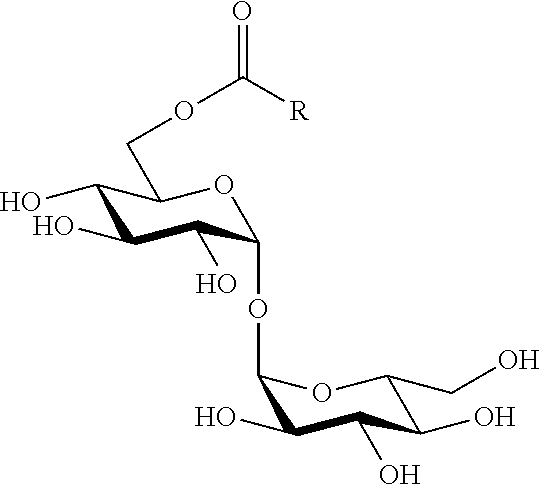 |
| Compound | R group | Comments |
| O-AlkTMM-C5 (1) |
 |
Alkyne enables CuAAC; Varied chain lengths allow evaluation of the effect of this substrate property on labeling efficiency |
| O-AlkTMM-C7 (2) |
 |
|
| O-AlkTMM-C11 (3) |
 |
|
| O-AzTMM-C10 (4) |
 |
Azide enables CuAAC and SPAAC for live cell labeling; Versatile synthetic intermediate |
| O-TCO-TMM (5) |
 |
Trans-cyclooctane enables tetrazine ligation for rapid labeling of live cells |
| O-FITC-TMM (6) |
 |
Fluorophora enables one- step labeling of live cells |


Di-6,6′-O-(10-azidodecanoyl)-α,α-D-trehalose (2)
Claims (20)


Priority Applications (2)
| Application Number | Priority Date | Filing Date | Title |
|---|---|---|---|
| US17/306,701 US11535642B2 (en) | 2016-09-09 | 2021-05-03 | Trehalose analogues |
| US18/068,852 US11845773B2 (en) | 2016-09-09 | 2022-12-20 | Trehalose analogues |
Applications Claiming Priority (5)
| Application Number | Priority Date | Filing Date | Title |
|---|---|---|---|
| US201662385772P | 2016-09-09 | 2016-09-09 | |
| US201662411999P | 2016-10-24 | 2016-10-24 | |
| US15/701,084 US10759821B2 (en) | 2016-09-09 | 2017-09-11 | Trehalose analogues |
| US16/714,017 US10995110B2 (en) | 2016-09-09 | 2019-12-13 | Trehalose analogues |
| US17/306,701 US11535642B2 (en) | 2016-09-09 | 2021-05-03 | Trehalose analogues |
Related Parent Applications (1)
| Application Number | Title | Priority Date | Filing Date |
|---|---|---|---|
| US16/714,017 Continuation US10995110B2 (en) | 2016-09-09 | 2019-12-13 | Trehalose analogues |
Related Child Applications (1)
| Application Number | Title | Priority Date | Filing Date |
|---|---|---|---|
| US18/068,852 Continuation US11845773B2 (en) | 2016-09-09 | 2022-12-20 | Trehalose analogues |
Publications (2)
| Publication Number | Publication Date |
|---|---|
| US20210261591A1 US20210261591A1 (en) | 2021-08-26 |
| US11535642B2 true US11535642B2 (en) | 2022-12-27 |
Family
ID=61559642
Family Applications (4)
| Application Number | Title | Priority Date | Filing Date |
|---|---|---|---|
| US15/701,084 Active US10759821B2 (en) | 2016-09-09 | 2017-09-11 | Trehalose analogues |
| US16/714,017 Active US10995110B2 (en) | 2016-09-09 | 2019-12-13 | Trehalose analogues |
| US17/306,701 Active US11535642B2 (en) | 2016-09-09 | 2021-05-03 | Trehalose analogues |
| US18/068,852 Active 2037-09-11 US11845773B2 (en) | 2016-09-09 | 2022-12-20 | Trehalose analogues |
Family Applications Before (2)
| Application Number | Title | Priority Date | Filing Date |
|---|---|---|---|
| US15/701,084 Active US10759821B2 (en) | 2016-09-09 | 2017-09-11 | Trehalose analogues |
| US16/714,017 Active US10995110B2 (en) | 2016-09-09 | 2019-12-13 | Trehalose analogues |
Family Applications After (1)
| Application Number | Title | Priority Date | Filing Date |
|---|---|---|---|
| US18/068,852 Active 2037-09-11 US11845773B2 (en) | 2016-09-09 | 2022-12-20 | Trehalose analogues |
Country Status (1)
| Country | Link |
|---|---|
| US (4) | US10759821B2 (en) |
Families Citing this family (1)
| Publication number | Priority date | Publication date | Assignee | Title |
|---|---|---|---|---|
| WO2025101173A1 (en) * | 2023-11-07 | 2025-05-15 | Central Michigan University | Fluorogenic trehalose analogues |
Citations (5)
| Publication number | Priority date | Publication date | Assignee | Title |
|---|---|---|---|---|
| WO2011030160A1 (en) | 2009-09-11 | 2011-03-17 | Isis Innovation Limited | Detection of mycobacteria |
| US20130302857A1 (en) | 2010-12-14 | 2013-11-14 | Universiteit Gent | Trehalose phosphorylases and their use in the biocatalytic production of trehalose-analogues and glycosyl phosphates |
| US20140051599A1 (en) | 2011-03-31 | 2014-02-20 | Bangor University | Method for determining exposure to mycobacteria |
| US20150125884A1 (en) | 2012-06-12 | 2015-05-07 | The General Hospital Corporation | Magnetic Labeling of Bacteria |
| US20150252402A1 (en) | 2014-03-07 | 2015-09-10 | Central Michigan University | Chemoenzymatic Synthesis of Trehalose Analogs |
-
2017
- 2017-09-11 US US15/701,084 patent/US10759821B2/en active Active
-
2019
- 2019-12-13 US US16/714,017 patent/US10995110B2/en active Active
-
2021
- 2021-05-03 US US17/306,701 patent/US11535642B2/en active Active
-
2022
- 2022-12-20 US US18/068,852 patent/US11845773B2/en active Active
Patent Citations (6)
| Publication number | Priority date | Publication date | Assignee | Title |
|---|---|---|---|---|
| WO2011030160A1 (en) | 2009-09-11 | 2011-03-17 | Isis Innovation Limited | Detection of mycobacteria |
| US20120263649A1 (en) | 2009-09-11 | 2012-10-18 | Isis Innovation Limited | Detection of mycobacteria |
| US20130302857A1 (en) | 2010-12-14 | 2013-11-14 | Universiteit Gent | Trehalose phosphorylases and their use in the biocatalytic production of trehalose-analogues and glycosyl phosphates |
| US20140051599A1 (en) | 2011-03-31 | 2014-02-20 | Bangor University | Method for determining exposure to mycobacteria |
| US20150125884A1 (en) | 2012-06-12 | 2015-05-07 | The General Hospital Corporation | Magnetic Labeling of Bacteria |
| US20150252402A1 (en) | 2014-03-07 | 2015-09-10 | Central Michigan University | Chemoenzymatic Synthesis of Trehalose Analogs |
Non-Patent Citations (34)
Also Published As
| Publication number | Publication date |
|---|---|
| US20210261591A1 (en) | 2021-08-26 |
| US10995110B2 (en) | 2021-05-04 |
| US11845773B2 (en) | 2023-12-19 |
| US20180072767A1 (en) | 2018-03-15 |
| US10759821B2 (en) | 2020-09-01 |
| US20230133705A1 (en) | 2023-05-04 |
| US20200115408A1 (en) | 2020-04-16 |
Similar Documents
| Publication | Publication Date | Title |
|---|---|---|
| Dai et al. | A visible and near-infrared light activatable diazocoumarin probe for fluorogenic protein labeling in living cells | |
| KR102616436B1 (en) | Treatment of gastrointestinal diseases with TNF inhibitors | |
| US7615377B2 (en) | Fluorescein-based metal sensors | |
| Uchinomiya et al. | Fluorescence detection of metabolic activity of the fatty acid beta oxidation pathway in living cells | |
| KR101968475B1 (en) | Coelenterazine derivatives and methods of using same | |
| EP4031143B1 (en) | Therapeutic conjugates | |
| EP3191484B1 (en) | Pyrazolopyridine derivatives and their use in therapy | |
| DE69734670T2 (en) | PREPARATIONS FOR USE AS THERAPEUTIC AND REFERENCES | |
| US12135325B2 (en) | Organotellurium compounds, compositions and methods of use thereof | |
| ES2972588T3 (en) | Fluorogenic glycosidase substrate and associated detection method | |
| CN109734714A (en) | A kind of Evodia alkaloid derivative and its synthesis method and application | |
| Yadav et al. | Cell proliferation assays | |
| US11655247B2 (en) | Nanoluc suicide substrates | |
| US11845773B2 (en) | Trehalose analogues | |
| FR2994180A1 (en) | FLUOROGENEOUS GLYCOSIDASE SUBSTRATE AND DETECTION METHOD THEREOF | |
| Klutch et al. | 2-Hydroxyacetophenetidine, a new metabolite of acetophenetidine | |
| Wei et al. | A nitroreductase-activated chemiluminescent prodrug for real-time monitoring of camptothecin release in peritoneal metastasis theranostics | |
| Zhang et al. | G-quadruplex in mitochondria as a possible biomarker for mitophagy detection | |
| Sharma et al. | 5, 6-Fused heterocycle cholate derivatives as spore germination inhibitors of Clostridioides difficile | |
| EP3981839B1 (en) | Coelenterazine analogs for use in luciferase-based assays | |
| IE47347B1 (en) | Method and reagent for detecting cancerigenic and anti-cancerous substances | |
| US7494821B2 (en) | Fluorescein based sensors for tracking nitric oxide in live cells | |
| Huynh et al. | Labeling of Cellular DNA with a Cyclosal Phosphotriester Pronucleotide Analog of 5‐ethynyl‐2′‐deoxyuridine | |
| CN114940685B (en) | A visual fluorescent anti-tumor drug and its application in the field of anti-tumor | |
| Stein et al. | Cytologic demonstration of nucleic acids in tissue culture |
Legal Events
| Date | Code | Title | Description |
|---|---|---|---|
| FEPP | Fee payment procedure |
Free format text: ENTITY STATUS SET TO UNDISCOUNTED (ORIGINAL EVENT CODE: BIG.); ENTITY STATUS OF PATENT OWNER: SMALL ENTITY |
|
| FEPP | Fee payment procedure |
Free format text: ENTITY STATUS SET TO SMALL (ORIGINAL EVENT CODE: SMAL); ENTITY STATUS OF PATENT OWNER: SMALL ENTITY |
|
| AS | Assignment |
Owner name: CENTRAL MICHIGAN UNIVERSITY, MICHIGAN Free format text: ASSIGNMENT OF ASSIGNORS INTEREST;ASSIGNOR:SWARTS, BENJAMIN M.;REEL/FRAME:056566/0561 Effective date: 20170914 |
|
| STPP | Information on status: patent application and granting procedure in general |
Free format text: DOCKETED NEW CASE - READY FOR EXAMINATION |
|
| STPP | Information on status: patent application and granting procedure in general |
Free format text: NON FINAL ACTION MAILED |
|
| STPP | Information on status: patent application and granting procedure in general |
Free format text: RESPONSE TO NON-FINAL OFFICE ACTION ENTERED AND FORWARDED TO EXAMINER |
|
| STPP | Information on status: patent application and granting procedure in general |
Free format text: NOTICE OF ALLOWANCE MAILED -- APPLICATION RECEIVED IN OFFICE OF PUBLICATIONS |
|
| STPP | Information on status: patent application and granting procedure in general |
Free format text: PUBLICATIONS -- ISSUE FEE PAYMENT RECEIVED |
|
| STPP | Information on status: patent application and granting procedure in general |
Free format text: PUBLICATIONS -- ISSUE FEE PAYMENT VERIFIED |
|
| STCF | Information on status: patent grant |
Free format text: PATENTED CASE |
|
| AS | Assignment |
Owner name: NATIONAL SCIENCE FOUNDATION, VIRGINIA Free format text: CONFIRMATORY LICENSE;ASSIGNOR:CENTRAL MICHIGAN UNIVERSITY;REEL/FRAME:070631/0626 Effective date: 20230609 |
|
| MAFP | Maintenance fee payment |
Free format text: PAYMENT OF MAINTENANCE FEE, 4TH YR, SMALL ENTITY (ORIGINAL EVENT CODE: M2551); ENTITY STATUS OF PATENT OWNER: SMALL ENTITY Year of fee payment: 4 |