US11524966B1 - Carboxamides as ubiquitin-specific protease inhibitors - Google Patents
Carboxamides as ubiquitin-specific protease inhibitors Download PDFInfo
- Publication number
- US11524966B1 US11524966B1 US16/637,692 US201816637692A US11524966B1 US 11524966 B1 US11524966 B1 US 11524966B1 US 201816637692 A US201816637692 A US 201816637692A US 11524966 B1 US11524966 B1 US 11524966B1
- Authority
- US
- United States
- Prior art keywords
- amino
- carboxamide
- pyridine
- methylthieno
- dihydro
- Prior art date
- Legal status (The legal status is an assumption and is not a legal conclusion. Google has not performed a legal analysis and makes no representation as to the accuracy of the status listed.)
- Active
Links
- 150000003857 carboxamides Chemical class 0.000 title claims 7
- 102000018390 Ubiquitin-Specific Proteases Human genes 0.000 title 1
- 108010066496 Ubiquitin-Specific Proteases Proteins 0.000 title 1
- 229940042399 direct acting antivirals protease inhibitors Drugs 0.000 title 1
- 239000000137 peptide hydrolase inhibitor Substances 0.000 title 1
- 150000001875 compounds Chemical class 0.000 claims description 209
- 125000004169 (C1-C6) alkyl group Chemical group 0.000 claims description 135
- 125000004191 (C1-C6) alkoxy group Chemical group 0.000 claims description 116
- -1 —OH Chemical group 0.000 claims description 99
- 125000000171 (C1-C6) haloalkyl group Chemical group 0.000 claims description 82
- 229910052736 halogen Inorganic materials 0.000 claims description 82
- 150000002367 halogens Chemical class 0.000 claims description 81
- 125000001424 substituent group Chemical group 0.000 claims description 78
- 125000000592 heterocycloalkyl group Chemical group 0.000 claims description 76
- UFHFLCQGNIYNRP-UHFFFAOYSA-N Hydrogen Chemical compound [H][H] UFHFLCQGNIYNRP-UHFFFAOYSA-N 0.000 claims description 74
- 229910052739 hydrogen Inorganic materials 0.000 claims description 74
- 239000001257 hydrogen Substances 0.000 claims description 74
- 125000004737 (C1-C6) haloalkoxy group Chemical group 0.000 claims description 73
- 150000003839 salts Chemical class 0.000 claims description 72
- 125000000753 cycloalkyl group Chemical group 0.000 claims description 66
- 125000000623 heterocyclic group Chemical group 0.000 claims description 58
- 125000001072 heteroaryl group Chemical group 0.000 claims description 57
- 125000003118 aryl group Chemical group 0.000 claims description 38
- YZCKVEUIGOORGS-OUBTZVSYSA-N Deuterium Chemical compound [2H] YZCKVEUIGOORGS-OUBTZVSYSA-N 0.000 claims description 37
- 229910052805 deuterium Inorganic materials 0.000 claims description 37
- 125000004093 cyano group Chemical group *C#N 0.000 claims description 28
- 125000002496 methyl group Chemical group [H]C([H])([H])* 0.000 claims description 28
- 229910052757 nitrogen Inorganic materials 0.000 claims description 22
- 125000006552 (C3-C8) cycloalkyl group Chemical group 0.000 claims description 16
- 229910052799 carbon Inorganic materials 0.000 claims description 13
- OKTJSMMVPCPJKN-UHFFFAOYSA-N Carbon Chemical compound [C] OKTJSMMVPCPJKN-UHFFFAOYSA-N 0.000 claims description 10
- 229910052717 sulfur Inorganic materials 0.000 claims description 10
- 125000002877 alkyl aryl group Chemical group 0.000 claims description 7
- 125000005213 alkyl heteroaryl group Chemical group 0.000 claims description 7
- 125000003349 3-pyridyl group Chemical group N1=C([H])C([*])=C([H])C([H])=C1[H] 0.000 claims description 5
- 125000001559 cyclopropyl group Chemical group [H]C1([H])C([H])([H])C1([H])* 0.000 claims description 4
- IBBMAWULFFBRKK-UHFFFAOYSA-N picolinamide Chemical compound NC(=O)C1=CC=CC=N1 IBBMAWULFFBRKK-UHFFFAOYSA-N 0.000 claims 233
- 125000004214 1-pyrrolidinyl group Chemical group [H]C1([H])N(*)C([H])([H])C([H])([H])C1([H])[H] 0.000 claims 88
- GGNIKGLUPSHSBV-UHFFFAOYSA-N thiazole-5-carboxamide Chemical compound NC(=O)C1=CN=CS1 GGNIKGLUPSHSBV-UHFFFAOYSA-N 0.000 claims 12
- JKNBCQYLFYHBHU-UHFFFAOYSA-N 1,8-naphthyridine-2-carboxamide Chemical compound C1=CC=NC2=NC(C(=O)N)=CC=C21 JKNBCQYLFYHBHU-UHFFFAOYSA-N 0.000 claims 11
- RXGHULSMJIVVTA-UHFFFAOYSA-N thieno[2,3-b]pyridine-2-carboxamide Chemical compound C1=CN=C2SC(C(=O)N)=CC2=C1 RXGHULSMJIVVTA-UHFFFAOYSA-N 0.000 claims 11
- 125000001462 1-pyrrolyl group Chemical group [*]N1C([H])=C([H])C([H])=C1[H] 0.000 claims 10
- DFPAKSUCGFBDDF-UHFFFAOYSA-N Nicotinamide Chemical compound NC(=O)C1=CC=CN=C1 DFPAKSUCGFBDDF-UHFFFAOYSA-N 0.000 claims 6
- DMYLUKNFEYWGCH-UHFFFAOYSA-N pyridazine-3-carboxamide Chemical compound NC(=O)C1=CC=CN=N1 DMYLUKNFEYWGCH-UHFFFAOYSA-N 0.000 claims 6
- 125000000389 2-pyrrolyl group Chemical group [H]N1C([*])=C([H])C([H])=C1[H] 0.000 claims 4
- 125000004939 6-pyridyl group Chemical group N1=CC=CC=C1* 0.000 claims 4
- 125000000250 methylamino group Chemical group [H]N(*)C([H])([H])[H] 0.000 claims 4
- 125000000587 piperidin-1-yl group Chemical group [H]C1([H])N(*)C([H])([H])C([H])([H])C([H])([H])C1([H])[H] 0.000 claims 4
- WXGKTVTUMWXGQK-BPUTZDHNSA-N NC1=C(SC2=NC(=CC=C21)C)C(=O)N[C@@H]1CC=2C=CC(=NC=2CC1)N1C[C@@H]([C@H](C1)C(F)F)N Chemical compound NC1=C(SC2=NC(=CC=C21)C)C(=O)N[C@@H]1CC=2C=CC(=NC=2CC1)N1C[C@@H]([C@H](C1)C(F)F)N WXGKTVTUMWXGQK-BPUTZDHNSA-N 0.000 claims 3
- LAPSGKPNIXLLMO-ZVZYQTTQSA-N NC1=C(SC2=NC(=CC=C21)C)C(=O)N[C@@H]1CC=2C=CC(=NC=2CC1)N1C[C@@H]([C@H](C1)OC)N Chemical compound NC1=C(SC2=NC(=CC=C21)C)C(=O)N[C@@H]1CC=2C=CC(=NC=2CC1)N1C[C@@H]([C@H](C1)OC)N LAPSGKPNIXLLMO-ZVZYQTTQSA-N 0.000 claims 3
- WXGKTVTUMWXGQK-NUEKZKHPSA-N NC1=C(SC2=NC(=CC=C21)C)C(=O)N[C@@H]1CC=2C=CC(=NC=2CC1)N1C[C@H]([C@@H](C1)C(F)F)N Chemical compound NC1=C(SC2=NC(=CC=C21)C)C(=O)N[C@@H]1CC=2C=CC(=NC=2CC1)N1C[C@H]([C@@H](C1)C(F)F)N WXGKTVTUMWXGQK-NUEKZKHPSA-N 0.000 claims 3
- LAPSGKPNIXLLMO-HFTRVMKXSA-N NC1=C(SC2=NC(=CC=C21)C)C(=O)N[C@H]1CC=2C=CC(=NC=2CC1)N1C[C@@H]([C@H](C1)OC)N Chemical compound NC1=C(SC2=NC(=CC=C21)C)C(=O)N[C@H]1CC=2C=CC(=NC=2CC1)N1C[C@@H]([C@H](C1)OC)N LAPSGKPNIXLLMO-HFTRVMKXSA-N 0.000 claims 3
- 235000005152 nicotinamide Nutrition 0.000 claims 3
- 239000011570 nicotinamide Substances 0.000 claims 3
- NWGDSVZXSZHXCE-RSLCBRBSSA-N 3-amino-N-[(6S)-2-[(3S,4R)-4-amino-3-(methoxymethyl)-3-methylpyrrolidin-1-yl]-5,6,7,8-tetrahydroquinolin-6-yl]-6-methylthieno[2,3-b]pyridine-2-carboxamide Chemical compound NC1=C(SC2=NC(=CC=C21)C)C(=O)N[C@@H]1CC=2C=CC(=NC=2CC1)N1C[C@]([C@H](C1)N)(C)COC NWGDSVZXSZHXCE-RSLCBRBSSA-N 0.000 claims 2
- YLJSKPSPHKOXAK-RUXDESIVSA-N C12CN(CC(CC1)N2)C1=CC(=C2C[C@@H](COC2=C1F)NC(=O)C1=C(C=2C(=NC(=CC=2)C)S1)N)F Chemical compound C12CN(CC(CC1)N2)C1=CC(=C2C[C@@H](COC2=C1F)NC(=O)C1=C(C=2C(=NC(=CC=2)C)S1)N)F YLJSKPSPHKOXAK-RUXDESIVSA-N 0.000 claims 2
- DVUDFJYRTFEEKN-MRXNPFEDSA-N C1CN(CCN1)C2=CC3=C(C[C@H](CO3)NC(=O)C4=C5C=CC=CN5N=C4)C=C2 Chemical compound C1CN(CCN1)C2=CC3=C(C[C@H](CO3)NC(=O)C4=C5C=CC=CN5N=C4)C=C2 DVUDFJYRTFEEKN-MRXNPFEDSA-N 0.000 claims 2
- DLDKZUWWBLOARJ-OAQYLSRUSA-N C1CN(CCN1)C2=CC3=C(C[C@H](CO3)NC(=O)C4=CN=C(C=C4)NCC5=CN=CC=C5)C=C2 Chemical compound C1CN(CCN1)C2=CC3=C(C[C@H](CO3)NC(=O)C4=CN=C(C=C4)NCC5=CN=CC=C5)C=C2 DLDKZUWWBLOARJ-OAQYLSRUSA-N 0.000 claims 2
- LMNZAXHAUJMGEA-OAHLLOKOSA-N CN([C@H]1COc2cc(cc(F)c2C1)N1CCNCC1)C(=O)c1sc2nc(C)ccc2c1N Chemical compound CN([C@H]1COc2cc(cc(F)c2C1)N1CCNCC1)C(=O)c1sc2nc(C)ccc2c1N LMNZAXHAUJMGEA-OAHLLOKOSA-N 0.000 claims 2
- UZKKSCQGVUDMFY-VIQWUECVSA-N Cc1ccc2c(N)c(sc2n1)C(=O)N[C@H]1CCc2cc(ccc2C1)N1CC2CCC(C1)N2 Chemical compound Cc1ccc2c(N)c(sc2n1)C(=O)N[C@H]1CCc2cc(ccc2C1)N1CC2CCC(C1)N2 UZKKSCQGVUDMFY-VIQWUECVSA-N 0.000 claims 2
- DNOMDOLHAXVYSW-XYPHTWIQSA-N Cc1ccc2c(N)c(sc2n1)C(=O)N[C@H]1COc2cc(ccc2C1)N1C[C@H](N)[C@H](F)C1 Chemical compound Cc1ccc2c(N)c(sc2n1)C(=O)N[C@H]1COc2cc(ccc2C1)N1C[C@H](N)[C@H](F)C1 DNOMDOLHAXVYSW-XYPHTWIQSA-N 0.000 claims 2
- LCZZNGONYJGSMP-AWEZNQCLSA-N NC1=C(SC2=NC(=C(C=C21)F)C)C(=O)N[C@@H]1CC=2C=CC(=NC=2CC1)N1CCNCC1 Chemical compound NC1=C(SC2=NC(=C(C=C21)F)C)C(=O)N[C@@H]1CC=2C=CC(=NC=2CC1)N1CCNCC1 LCZZNGONYJGSMP-AWEZNQCLSA-N 0.000 claims 2
- LMNZAXHAUJMGEA-HNNXBMFYSA-N NC1=C(SC2=NC(=CC=C21)C)C(=O)N(C)[C@@H]1COC2=C(C1)C(=CC(=C2)N1CCNCC1)F Chemical compound NC1=C(SC2=NC(=CC=C21)C)C(=O)N(C)[C@@H]1COC2=C(C1)C(=CC(=C2)N1CCNCC1)F LMNZAXHAUJMGEA-HNNXBMFYSA-N 0.000 claims 2
- HUZJXTOUCBEABJ-GTPINHCMSA-N NC1=C(SC2=NC(=CC=C21)C)C(=O)N[C@@H]1CC=2C=CC(=NC=2CC1)N1CC2CCC(C1)N2 Chemical compound NC1=C(SC2=NC(=CC=C21)C)C(=O)N[C@@H]1CC=2C=CC(=NC=2CC1)N1CC2CCC(C1)N2 HUZJXTOUCBEABJ-GTPINHCMSA-N 0.000 claims 2
- WXGKTVTUMWXGQK-IMJJTQAJSA-N NC1=C(SC2=NC(=CC=C21)C)C(=O)N[C@@H]1CC=2C=CC(=NC=2CC1)N1C[C@@H]([C@@H](C1)C(F)F)N Chemical compound NC1=C(SC2=NC(=CC=C21)C)C(=O)N[C@@H]1CC=2C=CC(=NC=2CC1)N1C[C@@H]([C@@H](C1)C(F)F)N WXGKTVTUMWXGQK-IMJJTQAJSA-N 0.000 claims 2
- LAPSGKPNIXLLMO-QILLFSRXSA-N NC1=C(SC2=NC(=CC=C21)C)C(=O)N[C@@H]1CC=2C=CC(=NC=2CC1)N1C[C@@H]([C@@H](C1)OC)N Chemical compound NC1=C(SC2=NC(=CC=C21)C)C(=O)N[C@@H]1CC=2C=CC(=NC=2CC1)N1C[C@@H]([C@@H](C1)OC)N LAPSGKPNIXLLMO-QILLFSRXSA-N 0.000 claims 2
- NQKGVXJCQWMJOR-VDZJLULYSA-N NC1=C(SC2=NC(=CC=C21)C)C(=O)N[C@@H]1CC=2C=CC(=NC=2CC1)N1C[C@@H]([C@@H](C1)OCC)N Chemical compound NC1=C(SC2=NC(=CC=C21)C)C(=O)N[C@@H]1CC=2C=CC(=NC=2CC1)N1C[C@@H]([C@@H](C1)OCC)N NQKGVXJCQWMJOR-VDZJLULYSA-N 0.000 claims 2
- IMJNLVYHNMIRNR-BPUTZDHNSA-N NC1=C(SC2=NC(=CC=C21)C)C(=O)N[C@@H]1CC=2C=CC(=NC=2CC1)N1C[C@@H]([C@H](C1)C(F)(F)F)N Chemical compound NC1=C(SC2=NC(=CC=C21)C)C(=O)N[C@@H]1CC=2C=CC(=NC=2CC1)N1C[C@@H]([C@H](C1)C(F)(F)F)N IMJNLVYHNMIRNR-BPUTZDHNSA-N 0.000 claims 2
- KTZRIIFUPZSJAJ-ZVZYQTTQSA-N NC1=C(SC2=NC(=CC=C21)C)C(=O)N[C@@H]1CC=2C=CC(=NC=2CC1)N1C[C@@H]([C@H](C1)NC)C(F)F Chemical compound NC1=C(SC2=NC(=CC=C21)C)C(=O)N[C@@H]1CC=2C=CC(=NC=2CC1)N1C[C@@H]([C@H](C1)NC)C(F)F KTZRIIFUPZSJAJ-ZVZYQTTQSA-N 0.000 claims 2
- IMJNLVYHNMIRNR-NUEKZKHPSA-N NC1=C(SC2=NC(=CC=C21)C)C(=O)N[C@@H]1CC=2C=CC(=NC=2CC1)N1C[C@H]([C@@H](C1)C(F)(F)F)N Chemical compound NC1=C(SC2=NC(=CC=C21)C)C(=O)N[C@@H]1CC=2C=CC(=NC=2CC1)N1C[C@H]([C@@H](C1)C(F)(F)F)N IMJNLVYHNMIRNR-NUEKZKHPSA-N 0.000 claims 2
- KTZRIIFUPZSJAJ-YXJHDRRASA-N NC1=C(SC2=NC(=CC=C21)C)C(=O)N[C@@H]1CC=2C=CC(=NC=2CC1)N1C[C@H]([C@@H](C1)NC)C(F)F Chemical compound NC1=C(SC2=NC(=CC=C21)C)C(=O)N[C@@H]1CC=2C=CC(=NC=2CC1)N1C[C@H]([C@@H](C1)NC)C(F)F KTZRIIFUPZSJAJ-YXJHDRRASA-N 0.000 claims 2
- WXGKTVTUMWXGQK-CWRNSKLLSA-N NC1=C(SC2=NC(=CC=C21)C)C(=O)N[C@@H]1CC=2C=CC(=NC=2CC1)N1C[C@H]([C@H](C1)C(F)F)N Chemical compound NC1=C(SC2=NC(=CC=C21)C)C(=O)N[C@@H]1CC=2C=CC(=NC=2CC1)N1C[C@H]([C@H](C1)C(F)F)N WXGKTVTUMWXGQK-CWRNSKLLSA-N 0.000 claims 2
- LAPSGKPNIXLLMO-LESCRADOSA-N NC1=C(SC2=NC(=CC=C21)C)C(=O)N[C@@H]1CC=2C=CC(=NC=2CC1)N1C[C@H]([C@H](C1)OC)N Chemical compound NC1=C(SC2=NC(=CC=C21)C)C(=O)N[C@@H]1CC=2C=CC(=NC=2CC1)N1C[C@H]([C@H](C1)OC)N LAPSGKPNIXLLMO-LESCRADOSA-N 0.000 claims 2
- NQKGVXJCQWMJOR-WDYCEAGBSA-N NC1=C(SC2=NC(=CC=C21)C)C(=O)N[C@@H]1CC=2C=CC(=NC=2CC1)N1C[C@H]([C@H](C1)OCC)N Chemical compound NC1=C(SC2=NC(=CC=C21)C)C(=O)N[C@@H]1CC=2C=CC(=NC=2CC1)N1C[C@H]([C@H](C1)OCC)N NQKGVXJCQWMJOR-WDYCEAGBSA-N 0.000 claims 2
- LUUUKDJSDDBZAN-CJNGLKHVSA-N NC1=C(SC2=NC(=CC=C21)C)C(=O)N[C@@H]1CC=2C=CC(=NC=2[C@@H](C1)C)N1CCNCC1 Chemical compound NC1=C(SC2=NC(=CC=C21)C)C(=O)N[C@@H]1CC=2C=CC(=NC=2[C@@H](C1)C)N1CCNCC1 LUUUKDJSDDBZAN-CJNGLKHVSA-N 0.000 claims 2
- LUUUKDJSDDBZAN-BBRMVZONSA-N NC1=C(SC2=NC(=CC=C21)C)C(=O)N[C@@H]1CC=2C=CC(=NC=2[C@H](C1)C)N1CCNCC1 Chemical compound NC1=C(SC2=NC(=CC=C21)C)C(=O)N[C@@H]1CC=2C=CC(=NC=2[C@H](C1)C)N1CCNCC1 LUUUKDJSDDBZAN-BBRMVZONSA-N 0.000 claims 2
- LUUUKDJSDDBZAN-CZUORRHYSA-N NC1=C(SC2=NC(=CC=C21)C)C(=O)N[C@H]1CC=2C=CC(=NC=2[C@@H](C1)C)N1CCNCC1 Chemical compound NC1=C(SC2=NC(=CC=C21)C)C(=O)N[C@H]1CC=2C=CC(=NC=2[C@@H](C1)C)N1CCNCC1 LUUUKDJSDDBZAN-CZUORRHYSA-N 0.000 claims 2
- LUUUKDJSDDBZAN-XJKSGUPXSA-N NC1=C(SC2=NC(=CC=C21)C)C(=O)N[C@H]1CC=2C=CC(=NC=2[C@H](C1)C)N1CCNCC1 Chemical compound NC1=C(SC2=NC(=CC=C21)C)C(=O)N[C@H]1CC=2C=CC(=NC=2[C@H](C1)C)N1CCNCC1 LUUUKDJSDDBZAN-XJKSGUPXSA-N 0.000 claims 2
- AIOXMDPABCPLGC-FHERZECASA-N NC1=C(SC2=NC(=CN=C21)C)C(=O)N[C@@H]1CC=2C=CC(=NC=2CC1)N1CC2CCC(C1)N2 Chemical compound NC1=C(SC2=NC(=CN=C21)C)C(=O)N[C@@H]1CC=2C=CC(=NC=2CC1)N1CC2CCC(C1)N2 AIOXMDPABCPLGC-FHERZECASA-N 0.000 claims 2
- GZABUJLUNLTDQS-DZKIICNBSA-N NC1=C(SC2=NC(=CN=C21)C)C(=O)N[C@@H]1CC=2C=CC(=NC=2CC1)N1C[C@@H]([C@H](C1)OC)N Chemical compound NC1=C(SC2=NC(=CN=C21)C)C(=O)N[C@@H]1CC=2C=CC(=NC=2CC1)N1C[C@@H]([C@H](C1)OC)N GZABUJLUNLTDQS-DZKIICNBSA-N 0.000 claims 2
- GZABUJLUNLTDQS-YCPHGPKFSA-N NC1=C(SC2=NC(=CN=C21)C)C(=O)N[C@H]1CC=2C=CC(=NC=2CC1)N1C[C@@H]([C@H](C1)OC)N Chemical compound NC1=C(SC2=NC(=CN=C21)C)C(=O)N[C@H]1CC=2C=CC(=NC=2CC1)N1C[C@@H]([C@H](C1)OC)N GZABUJLUNLTDQS-YCPHGPKFSA-N 0.000 claims 2
- 125000004573 morpholin-4-yl group Chemical group N1(CCOCC1)* 0.000 claims 2
- 229960003966 nicotinamide Drugs 0.000 claims 2
- 125000002924 primary amino group Chemical group [H]N([H])* 0.000 claims 2
- REIUSAGFOOKKNP-UHFFFAOYSA-N 1-ethylpyrrolo[2,3-b]pyridine-5-carboxamide Chemical compound C(C)N1C=CC=2C1=NC=C(C=2)C(=O)N REIUSAGFOOKKNP-UHFFFAOYSA-N 0.000 claims 1
- JELXYAWTEZMZOJ-IPJUCJBFSA-N 3-amino-4,6-dimethyl-N-[(3R)-7-(9-oxa-3,7-diazabicyclo[3.3.1]nonan-3-yl)-3,4-dihydro-2H-chromen-3-yl]thieno[2,3-b]pyridine-2-carboxamide Chemical compound C12=C(C=C(N=C2SC(=C1N)C(=O)N[C@@H]1CC2=C(C=C(C=C2)N2CC3CNCC(O3)C2)OC1)C)C JELXYAWTEZMZOJ-IPJUCJBFSA-N 0.000 claims 1
- SDMLKCQDZJOSDN-UHFFFAOYSA-N 3-amino-4,6-dimethylthieno[2,3-b]pyridine-2-carboxamide Chemical compound CC1=CC(C)=C2C(N)=C(C(N)=O)SC2=N1 SDMLKCQDZJOSDN-UHFFFAOYSA-N 0.000 claims 1
- ZBYYNOCQEVFMEN-QGZVFWFLSA-N 3-amino-6-methyl-N-[(2R)-6-piperazin-1-yl-1,2,3,4-tetrahydronaphthalen-2-yl]thieno[2,3-b]pyridine-2-carboxamide Chemical compound CC1=NC2=C(C=C1)C(=C(S2)C(=O)N[C@@H]3CCC4=C(C3)C=CC(=C4)N5CCNCC5)N ZBYYNOCQEVFMEN-QGZVFWFLSA-N 0.000 claims 1
- ZBYYNOCQEVFMEN-KRWDZBQOSA-N 3-amino-6-methyl-N-[(2S)-6-piperazin-1-yl-1,2,3,4-tetrahydronaphthalen-2-yl]thieno[2,3-b]pyridine-2-carboxamide Chemical compound CC1=NC2=C(C=C1)C(=C(S2)C(=O)N[C@H]3CCC4=C(C3)C=CC(=C4)N5CCNCC5)N ZBYYNOCQEVFMEN-KRWDZBQOSA-N 0.000 claims 1
- PQSCXFZVXPZIGI-QQFBHYJXSA-N 3-amino-N-[(2R)-5-cyano-8-fluoro-6-(9-oxa-3,7-diazabicyclo[3.3.1]nonan-3-yl)-1,2,3,4-tetrahydronaphthalen-2-yl]-6-methylthieno[2,3-b]pyridine-2-carboxamide Chemical compound NC1=C(SC2=NC(=CC=C21)C)C(=O)N[C@H]1CC2=C(C=C(C(=C2CC1)C#N)N1CC2CNCC(C1)O2)F PQSCXFZVXPZIGI-QQFBHYJXSA-N 0.000 claims 1
- NHEMFKWTHQRAHO-WLYUNCDWSA-N 3-amino-N-[(2R)-6-(3,8-diazabicyclo[3.2.1]octan-3-yl)-5,8-difluoro-1,2,3,4-tetrahydronaphthalen-2-yl]-6-methylthieno[2,3-b]pyridine-2-carboxamide Chemical compound NC1=C(SC2=NC(=CC=C21)C)C(=O)N[C@H]1CC2=C(C=C(C(=C2CC1)F)N1CC2CCC(C1)N2)F NHEMFKWTHQRAHO-WLYUNCDWSA-N 0.000 claims 1
- LMNYFTHVAYIOAW-XFPJRNFQSA-N 3-amino-N-[(2R)-6-[(3S,4S)-3-amino-4-methoxypyrrolidin-1-yl]-5-cyano-8-fluoro-1,2,3,4-tetrahydronaphthalen-2-yl]-6-methylthieno[2,3-b]pyridine-2-carboxamide Chemical compound NC1=C(SC2=NC(=CC=C21)C)C(=O)N[C@H]1CC2=C(C=C(C(=C2CC1)C#N)N1C[C@@H]([C@H](C1)OC)N)F LMNYFTHVAYIOAW-XFPJRNFQSA-N 0.000 claims 1
- IIIWBHUGLUGDJC-FHERZECASA-N 3-amino-N-[(2S)-5-cyano-6-(3,8-diazabicyclo[3.2.1]octan-3-yl)-8-fluoro-1,2,3,4-tetrahydronaphthalen-2-yl]-6-methylthieno[2,3-b]pyridine-2-carboxamide Chemical compound C12CN(CC(CC1)N2)C=1C(=C2CC[C@@H](CC2=C(C=1)F)NC(=O)C1=C(C=2C(=NC(=CC=2)C)S1)N)C#N IIIWBHUGLUGDJC-FHERZECASA-N 0.000 claims 1
- PQSCXFZVXPZIGI-FHERZECASA-N 3-amino-N-[(2S)-5-cyano-8-fluoro-6-(9-oxa-3,7-diazabicyclo[3.3.1]nonan-3-yl)-1,2,3,4-tetrahydronaphthalen-2-yl]-6-methylthieno[2,3-b]pyridine-2-carboxamide Chemical compound NC1=C(SC2=NC(=CC=C21)C)C(=O)N[C@@H]1CC2=C(C=C(C(=C2CC1)C#N)N1CC2CNCC(C1)O2)F PQSCXFZVXPZIGI-FHERZECASA-N 0.000 claims 1
- ZVNCRZFFEAPNRP-IUDNXUCKSA-N 3-amino-N-[(3R)-5-fluoro-7-(9-oxa-3,7-diazabicyclo[3.3.1]nonan-3-yl)-3,4-dihydro-2H-chromen-3-yl]-6-methylthieno[2,3-b]pyridine-2-carboxamide Chemical compound C1N(CC2OC1CNC2)C1=CC(=C2C(OC[C@@H](C2)NC(=O)C=2SC3=NC(C)=CC=C3C=2N)=C1)F ZVNCRZFFEAPNRP-IUDNXUCKSA-N 0.000 claims 1
- JCQDSUQHOCFHJI-JXQTWKCFSA-N 3-amino-N-[(3R)-7-(3,8-diazabicyclo[3.2.1]octan-3-yl)-5,6-difluoro-3,4-dihydro-2H-chromen-3-yl]-6-methylthieno[2,3-b]pyridine-2-carboxamide Chemical compound C12=C(C(=C(C=C2OC[C@@H](C1)NC(=O)C1=C(C2=CC=C(N=C2S1)C)N)N1CC2CCC(N2)C1)F)F JCQDSUQHOCFHJI-JXQTWKCFSA-N 0.000 claims 1
- PANYHAZRZSROPT-HUUCEWRRSA-N 3-amino-N-[(3R)-7-[(3R)-3-aminopyrrolidin-1-yl]-3,4-dihydro-2H-chromen-3-yl]-6-methylthieno[2,3-b]pyridine-2-carboxamide Chemical compound NC1=C(SC2=NC(=CC=C21)C)C(=O)N[C@H]1COC2=C(C1)C=CC(=C2)N1C[C@@H](CC1)N PANYHAZRZSROPT-HUUCEWRRSA-N 0.000 claims 1
- BQKANLOQLYESJC-DWXRJYCRSA-N 3-amino-N-[(3R)-7-[(5S)-2,9-diazaspiro[4.5]decan-2-yl]-3,4-dihydro-2H-chromen-3-yl]-6-methylthieno[2,3-b]pyridine-2-carboxamide Chemical compound C=1(C2=C(SC=1C(=O)N[C@H]1COC3=CC(=CC=C3C1)N1C[C@]3(CNCCC3)CC1)N=C(C)C=C2)N BQKANLOQLYESJC-DWXRJYCRSA-N 0.000 claims 1
- NPBBPSDWMRTGKF-OAHLLOKOSA-N 6-amino-2-methyl-N-[(2R)-6-piperazin-1-yl-1,2,3,4-tetrahydronaphthalen-2-yl]thieno[2,3-d][1,3]thiazole-5-carboxamide Chemical compound CC1=NC2=C(S1)C(=C(S2)C(=O)N[C@@H]3CCC4=C(C3)C=CC(=C4)N5CCNCC5)N NPBBPSDWMRTGKF-OAHLLOKOSA-N 0.000 claims 1
- FJALCIMJKUSKCS-WXRRBKDZSA-N 6-amino-N-[(3R)-7-(3,8-diazabicyclo[3.2.1]octan-3-yl)-5-fluoro-3,4-dihydro-2H-chromen-3-yl]-2-methylthieno[2,3-d][1,3]thiazole-5-carboxamide Chemical compound CC1=NC2=C(S1)C(=C(S2)C(=O)N[C@@H]3CC4=C(C=C(C=C4F)N5CC6CCC(C5)N6)OC3)N FJALCIMJKUSKCS-WXRRBKDZSA-N 0.000 claims 1
- VLHGDIVVCKAOIP-INIZCTEOSA-N 7-amino-3-methyl-N-[(2S)-5-methyl-6-piperazin-1-yl-1,2,3,4-tetrahydronaphthalen-2-yl]thieno[2,3-b]pyrazine-6-carboxamide Chemical compound C1C2=C(CC[C@@H]1NC(=O)C1=C(C3=NC=C(C)N=C3S1)N)C(C)=C(N1CCNCC1)C=C2 VLHGDIVVCKAOIP-INIZCTEOSA-N 0.000 claims 1
- YCBYOTFTENLDST-CQSZACIVSA-N 7-amino-N-[(2R)-8-fluoro-6-piperazin-1-yl-1,2,3,4-tetrahydronaphthalen-2-yl]-3-methylthieno[2,3-b]pyrazine-6-carboxamide Chemical compound CC1=CN=C2C(=C(SC2=N1)C(=O)N[C@@H]3CCC4=C(C3)C(=CC(=C4)N5CCNCC5)F)N YCBYOTFTENLDST-CQSZACIVSA-N 0.000 claims 1
- HSGUANPPYRFLLZ-AWEZNQCLSA-N 7-amino-N-[(2S)-5-fluoro-6-piperazin-1-yl-1,2,3,4-tetrahydronaphthalen-2-yl]-3-methylthieno[2,3-b]pyrazine-6-carboxamide Chemical compound CC1=CN=C2C(=C(SC2=N1)C(=O)N[C@H]3CCC4=C(C3)C=CC(=C4F)N5CCNCC5)N HSGUANPPYRFLLZ-AWEZNQCLSA-N 0.000 claims 1
- HBUIMNSVLARECY-HNNXBMFYSA-N 7-amino-N-[(2S)-7-fluoro-6-piperazin-1-yl-1,2,3,4-tetrahydronaphthalen-2-yl]-3-methylthieno[2,3-b]pyrazine-6-carboxamide Chemical compound CC1=CN=C2C(=C(SC2=N1)C(=O)N[C@H]3CCC4=CC(=C(C=C4C3)F)N5CCNCC5)N HBUIMNSVLARECY-HNNXBMFYSA-N 0.000 claims 1
- IYGYPJBUDHVTPS-XMMPIXPASA-N C(C)(=O)NC=1C=C(CNC2=NC=C(C(=O)N[C@H]3COC4=CC(=CC=C4C3)N3CCNCC3)C=C2)C=CC=1 Chemical compound C(C)(=O)NC=1C=C(CNC2=NC=C(C(=O)N[C@H]3COC4=CC(=CC=C4C3)N3CCNCC3)C=C2)C=CC=1 IYGYPJBUDHVTPS-XMMPIXPASA-N 0.000 claims 1
- YLJSKPSPHKOXAK-JXQTWKCFSA-N C12CN(CC(CC1)N2)C1=CC(=C2C[C@H](COC2=C1F)NC(=O)C1=C(C=2C(=NC(=CC=2)C)S1)N)F Chemical compound C12CN(CC(CC1)N2)C1=CC(=C2C[C@H](COC2=C1F)NC(=O)C1=C(C=2C(=NC(=CC=2)C)S1)N)F YLJSKPSPHKOXAK-JXQTWKCFSA-N 0.000 claims 1
- YGOMEGWBHYCERA-CQSZACIVSA-N C1CC1C2=NC3=C(S2)C(=C(S3)C(=O)N[C@@H]4CC5=C(C=C(C=C5)N6CCNCC6)OC4)N Chemical compound C1CC1C2=NC3=C(S2)C(=C(S3)C(=O)N[C@@H]4CC5=C(C=C(C=C5)N6CCNCC6)OC4)N YGOMEGWBHYCERA-CQSZACIVSA-N 0.000 claims 1
- MEXIWOYXPKAZEL-IEBWSBKVSA-N C1CC2=C([C@@H]1O)N=CC(=C2)C(=O)N[C@@H]3CC4=C(C=C(C=C4)N5CCNCC5)OC3 Chemical compound C1CC2=C([C@@H]1O)N=CC(=C2)C(=O)N[C@@H]3CC4=C(C=C(C=C4)N5CCNCC5)OC3 MEXIWOYXPKAZEL-IEBWSBKVSA-N 0.000 claims 1
- RESXPIQSHVEWHU-GPANFISMSA-N C1CC2CN(CC1N2)C3=CC4=C(C[C@@H](CO4)NC(=O)C5=C(C6=C(S5)N=CC(=C6)F)N)C=C3 Chemical compound C1CC2CN(CC1N2)C3=CC4=C(C[C@@H](CO4)NC(=O)C5=C(C6=C(S5)N=CC(=C6)F)N)C=C3 RESXPIQSHVEWHU-GPANFISMSA-N 0.000 claims 1
- RESXPIQSHVEWHU-UYSNPLJNSA-N C1CC2CN(CC1N2)C3=CC4=C(C[C@H](CO4)NC(=O)C5=C(C6=C(S5)N=CC(=C6)F)N)C=C3 Chemical compound C1CC2CN(CC1N2)C3=CC4=C(C[C@H](CO4)NC(=O)C5=C(C6=C(S5)N=CC(=C6)F)N)C=C3 RESXPIQSHVEWHU-UYSNPLJNSA-N 0.000 claims 1
- VFTQXOXQWULBLK-KRWDZBQOSA-N C1CN(CCN1)C2=CC3=C(C[C@@H](CO3)NC(=O)C4=CN=C5C(=C4)C=CN5C(F)F)C=C2 Chemical compound C1CN(CCN1)C2=CC3=C(C[C@@H](CO3)NC(=O)C4=CN=C5C(=C4)C=CN5C(F)F)C=C2 VFTQXOXQWULBLK-KRWDZBQOSA-N 0.000 claims 1
- ILVVPJVWCXBBGY-MRXNPFEDSA-N C1CN(CCN1)C2=CC3=C(C[C@H](CO3)NC(=O)C4=C5C=CC(=CN5N=C4)Cl)C=C2 Chemical compound C1CN(CCN1)C2=CC3=C(C[C@H](CO3)NC(=O)C4=C5C=CC(=CN5N=C4)Cl)C=C2 ILVVPJVWCXBBGY-MRXNPFEDSA-N 0.000 claims 1
- CMJWDIFWPBXTRY-OAHLLOKOSA-N C1CN(CCN1)C2=CC3=C(C[C@H](CO3)NC(=O)C4=C5C=CC=C(N5N=C4)Br)C=C2 Chemical compound C1CN(CCN1)C2=CC3=C(C[C@H](CO3)NC(=O)C4=C5C=CC=C(N5N=C4)Br)C=C2 CMJWDIFWPBXTRY-OAHLLOKOSA-N 0.000 claims 1
- OXNUGSZWXFZZEE-MRXNPFEDSA-N C1CN(CCN1)C2=CC3=C(C[C@H](CO3)NC(=O)C4=C5C=CC=C(N5N=C4)CO)C=C2 Chemical compound C1CN(CCN1)C2=CC3=C(C[C@H](CO3)NC(=O)C4=C5C=CC=C(N5N=C4)CO)C=C2 OXNUGSZWXFZZEE-MRXNPFEDSA-N 0.000 claims 1
- QWPZCZYMXUIQOC-CQSZACIVSA-N C1CN(CCN1)C2=CC3=C(C[C@H](CO3)NC(=O)C4=CN5C(=N4)C=CC(=N5)Cl)C=C2 Chemical compound C1CN(CCN1)C2=CC3=C(C[C@H](CO3)NC(=O)C4=CN5C(=N4)C=CC(=N5)Cl)C=C2 QWPZCZYMXUIQOC-CQSZACIVSA-N 0.000 claims 1
- BOHVFGAIDSNJPJ-JOCHJYFZSA-N C1CN(CCN1)C2=CC3=C(C[C@H](CO3)NC(=O)C4=CN=C(C=C4)NCC5=CC=CC=C5)C=C2 Chemical compound C1CN(CCN1)C2=CC3=C(C[C@H](CO3)NC(=O)C4=CN=C(C=C4)NCC5=CC=CC=C5)C=C2 BOHVFGAIDSNJPJ-JOCHJYFZSA-N 0.000 claims 1
- VFTQXOXQWULBLK-QGZVFWFLSA-N C1CN(CCN1)C2=CC3=C(C[C@H](CO3)NC(=O)C4=CN=C5C(=C4)C=CN5C(F)F)C=C2 Chemical compound C1CN(CCN1)C2=CC3=C(C[C@H](CO3)NC(=O)C4=CN=C5C(=C4)C=CN5C(F)F)C=C2 VFTQXOXQWULBLK-QGZVFWFLSA-N 0.000 claims 1
- GWHKCKDGJSIKFI-XMMPIXPASA-N C1CN(CCN1)C2=CC3=C(C[C@H](CO3)NC(=O)C4=CN=C5C(=C4)C=CN5CC6=CC=CC=C6)C=C2 Chemical compound C1CN(CCN1)C2=CC3=C(C[C@H](CO3)NC(=O)C4=CN=C5C(=C4)C=CN5CC6=CC=CC=C6)C=C2 GWHKCKDGJSIKFI-XMMPIXPASA-N 0.000 claims 1
- IIKMWESSMQVLEX-HSZRJFAPSA-N C1COC2=C1C=C(C=C2)CNC3=NC=C(C=C3)C(=O)N[C@@H]4CC5=C(C=C(C=C5)N6CCNCC6)OC4 Chemical compound C1COC2=C1C=C(C=C2)CNC3=NC=C(C=C3)C(=O)N[C@@H]4CC5=C(C=C(C=C5)N6CCNCC6)OC4 IIKMWESSMQVLEX-HSZRJFAPSA-N 0.000 claims 1
- ORSWSCLPLQNMDL-LSDHHAIUSA-N C1[C@@H](NC(=O)C2=C(C3=CC=C(C)N=C3S2)N)COC2=C1C=CC(N1C[C@@H](C(=O)O)CC1)=C2 Chemical compound C1[C@@H](NC(=O)C2=C(C3=CC=C(C)N=C3S2)N)COC2=C1C=CC(N1C[C@@H](C(=O)O)CC1)=C2 ORSWSCLPLQNMDL-LSDHHAIUSA-N 0.000 claims 1
- RGCWHPRKSROKGS-GOSISDBHSA-N CC(C=C(C)N1N=C2)=CC1=C2C(N[C@H]1COC2=CC(N3CCNCC3)=CC=C2C1)=O Chemical compound CC(C=C(C)N1N=C2)=CC1=C2C(N[C@H]1COC2=CC(N3CCNCC3)=CC=C2C1)=O RGCWHPRKSROKGS-GOSISDBHSA-N 0.000 claims 1
- QDVPOGAIWZQHHS-SZMVWBNQSA-N CC(N[C@@H](CN(C1)C2=NC(CC[C@@H](C3)NC(C(SC4=NC(C)=CN=C44)=C4N)=O)=C3C=C2)[C@H]1OC)=O Chemical compound CC(N[C@@H](CN(C1)C2=NC(CC[C@@H](C3)NC(C(SC4=NC(C)=CN=C44)=C4N)=O)=C3C=C2)[C@H]1OC)=O QDVPOGAIWZQHHS-SZMVWBNQSA-N 0.000 claims 1
- NKGGCKUDRBFRTN-YANBTOMASA-N CC([C@H](CCCC1=C2)C1=CC=C2C(NC1COC2=CC(N3CCNCC3)=CC=C2C1)=O)=O Chemical compound CC([C@H](CCCC1=C2)C1=CC=C2C(NC1COC2=CC(N3CCNCC3)=CC=C2C1)=O)=O NKGGCKUDRBFRTN-YANBTOMASA-N 0.000 claims 1
- FDGYOXCQHSJGRS-FISRPQLASA-N CC1(C(N[C@@H](CC2)CC(C(F)=C3)=C2N=C3N2CC(CC3)NC3C2)=O)SC2=NC(N)=CN=C2C1 Chemical compound CC1(C(N[C@@H](CC2)CC(C(F)=C3)=C2N=C3N2CC(CC3)NC3C2)=O)SC2=NC(N)=CN=C2C1 FDGYOXCQHSJGRS-FISRPQLASA-N 0.000 claims 1
- LCNAPFZCODWGHD-CQSZACIVSA-N CC1=C(C(N)=C(C(N[C@H](CC2=C3F)COC2=CC(N2CCNCC2)=C3C#N)=O)S2)C2=NC(C)=C1 Chemical compound CC1=C(C(N)=C(C(N[C@H](CC2=C3F)COC2=CC(N2CCNCC2)=C3C#N)=O)S2)C2=NC(C)=C1 LCNAPFZCODWGHD-CQSZACIVSA-N 0.000 claims 1
- FFFIBRQBTVYUFM-DAWZGUTISA-N CC1=C(C(N)=C(C(N[C@H]2COC3=CC(N(CC4CNC5)CC5C4(F)F)=CC=C3C2)=O)S2)C2=NC(C)=C1 Chemical compound CC1=C(C(N)=C(C(N[C@H]2COC3=CC(N(CC4CNC5)CC5C4(F)F)=CC=C3C2)=O)S2)C2=NC(C)=C1 FFFIBRQBTVYUFM-DAWZGUTISA-N 0.000 claims 1
- ADYKZSLPTMUICN-CYBMUJFWSA-N CC1=C(C=C2C(=C(SC2=N1)C(=O)N[C@@H]3CC4=CN=C(C=C4OC3)N5CCNCC5)N)F Chemical compound CC1=C(C=C2C(=C(SC2=N1)C(=O)N[C@@H]3CC4=CN=C(C=C4OC3)N5CCNCC5)N)F ADYKZSLPTMUICN-CYBMUJFWSA-N 0.000 claims 1
- UIQKPRLEFAIHRU-UHFFFAOYSA-N CC1=C(SC2=NC=CC=C21)C(=O)N Chemical compound CC1=C(SC2=NC=CC=C21)C(=O)N UIQKPRLEFAIHRU-UHFFFAOYSA-N 0.000 claims 1
- FNHCFBLFWRAWLD-CYBMUJFWSA-N CC1=CC(=NC2=C1C(=C(S2)C(=O)N[C@@H]3CC4=C(C=C(C(=C4F)F)N5CCNCC5)OC3)N)C Chemical compound CC1=CC(=NC2=C1C(=C(S2)C(=O)N[C@@H]3CC4=C(C=C(C(=C4F)F)N5CCNCC5)OC3)N)C FNHCFBLFWRAWLD-CYBMUJFWSA-N 0.000 claims 1
- RBDNFNYUSSIIKI-CQSZACIVSA-N CC1=CC(=NC2=C1C(=C(S2)C(=O)N[C@@H]3CC4=C(C=C(C(=C4OC3)C#N)N5CCNCC5)F)N)C Chemical compound CC1=CC(=NC2=C1C(=C(S2)C(=O)N[C@@H]3CC4=C(C=C(C(=C4OC3)C#N)N5CCNCC5)F)N)C RBDNFNYUSSIIKI-CQSZACIVSA-N 0.000 claims 1
- FNHCFBLFWRAWLD-ZDUSSCGKSA-N CC1=CC(=NC2=C1C(=C(S2)C(=O)N[C@H]3CC4=C(C=C(C(=C4F)F)N5CCNCC5)OC3)N)C Chemical compound CC1=CC(=NC2=C1C(=C(S2)C(=O)N[C@H]3CC4=C(C=C(C(=C4F)F)N5CCNCC5)OC3)N)C FNHCFBLFWRAWLD-ZDUSSCGKSA-N 0.000 claims 1
- MGTLPJZJHPHMHL-ODIFPOPNSA-N CC1=CC(C(F)F)=C(C(N)=C(C(N[C@H]2COC3=CC(N4CC(CNC5)OC5C4)=CC=C3C2)=O)S2)C2=N1 Chemical compound CC1=CC(C(F)F)=C(C(N)=C(C(N[C@H]2COC3=CC(N4CC(CNC5)OC5C4)=CC=C3C2)=O)S2)C2=N1 MGTLPJZJHPHMHL-ODIFPOPNSA-N 0.000 claims 1
- ZKQMYFBWBBCWEA-QGZVFWFLSA-N CC1=CC2=C(C=NN2C=C1)C(=O)N[C@@H]3CC4=C(C=C(C=C4)N5CCNCC5)OC3 Chemical compound CC1=CC2=C(C=NN2C=C1)C(=O)N[C@@H]3CC4=C(C=C(C=C4)N5CCNCC5)OC3 ZKQMYFBWBBCWEA-QGZVFWFLSA-N 0.000 claims 1
- QSWQKJDWLUQETM-IEZWGBDMSA-N CC1=CC=C(C(N)=C(C(N[C@@H](CC2)CC(C=C3)=C2N=C3N(CC[C@@H]2OC)C[C@@H]2N)=O)S2)C2=N1 Chemical compound CC1=CC=C(C(N)=C(C(N[C@@H](CC2)CC(C=C3)=C2N=C3N(CC[C@@H]2OC)C[C@@H]2N)=O)S2)C2=N1 QSWQKJDWLUQETM-IEZWGBDMSA-N 0.000 claims 1
- QSWQKJDWLUQETM-KVSKMBFKSA-N CC1=CC=C(C(N)=C(C(N[C@@H](CC2)CC(C=C3)=C2N=C3N(CC[C@H]2OC)C[C@H]2N)=O)S2)C2=N1 Chemical compound CC1=CC=C(C(N)=C(C(N[C@@H](CC2)CC(C=C3)=C2N=C3N(CC[C@H]2OC)C[C@H]2N)=O)S2)C2=N1 QSWQKJDWLUQETM-KVSKMBFKSA-N 0.000 claims 1
- VWLQQGBNZYPRET-AWEZNQCLSA-N CC1=CC=C(C(N)=C(C(N[C@@H](CC2=C3)COC2=CC(N2CCNCC2)=C3F)=O)S2)C2=N1 Chemical compound CC1=CC=C(C(N)=C(C(N[C@@H](CC2=C3)COC2=CC(N2CCNCC2)=C3F)=O)S2)C2=N1 VWLQQGBNZYPRET-AWEZNQCLSA-N 0.000 claims 1
- UIDOFKWHPUAZLU-DYVFJYSZSA-N CC1=CC=C(C(N)=C(C(N[C@H](C2)COC3=C2C=CC(N(C[C@@H]2N)CC2(F)F)=C3)=O)S2)C2=N1 Chemical compound CC1=CC=C(C(N)=C(C(N[C@H](C2)COC3=C2C=CC(N(C[C@@H]2N)CC2(F)F)=C3)=O)S2)C2=N1 UIDOFKWHPUAZLU-DYVFJYSZSA-N 0.000 claims 1
- UIDOFKWHPUAZLU-CXAGYDPISA-N CC1=CC=C(C(N)=C(C(N[C@H](C2)COC3=C2C=CC(N(C[C@H]2N)CC2(F)F)=C3)=O)S2)C2=N1 Chemical compound CC1=CC=C(C(N)=C(C(N[C@H](C2)COC3=C2C=CC(N(C[C@H]2N)CC2(F)F)=C3)=O)S2)C2=N1 UIDOFKWHPUAZLU-CXAGYDPISA-N 0.000 claims 1
- CQNQTHBIJRNGKA-SJORKVTESA-N CC1=CC=C(C(N)=C(C(N[C@H](C2)COC3=C2C=CC(N2C[C@@H](COC)NCC2)=C3)=O)S2)C2=N1 Chemical compound CC1=CC=C(C(N)=C(C(N[C@H](C2)COC3=C2C=CC(N2C[C@@H](COC)NCC2)=C3)=O)S2)C2=N1 CQNQTHBIJRNGKA-SJORKVTESA-N 0.000 claims 1
- CQNQTHBIJRNGKA-IAGOWNOFSA-N CC1=CC=C(C(N)=C(C(N[C@H](C2)COC3=C2C=CC(N2C[C@H](COC)NCC2)=C3)=O)S2)C2=N1 Chemical compound CC1=CC=C(C(N)=C(C(N[C@H](C2)COC3=C2C=CC(N2C[C@H](COC)NCC2)=C3)=O)S2)C2=N1 CQNQTHBIJRNGKA-IAGOWNOFSA-N 0.000 claims 1
- CTKAVVGPGCDQJT-SJLPKXTDSA-N CC1=CC=C(C(N)=C(C(N[C@H](C2)COC3=C2C=CC(N2[C@@H](COC)CNCC2)=C3)=O)S2)C2=N1 Chemical compound CC1=CC=C(C(N)=C(C(N[C@H](C2)COC3=C2C=CC(N2[C@@H](COC)CNCC2)=C3)=O)S2)C2=N1 CTKAVVGPGCDQJT-SJLPKXTDSA-N 0.000 claims 1
- CTKAVVGPGCDQJT-AEFFLSMTSA-N CC1=CC=C(C(N)=C(C(N[C@H](C2)COC3=C2C=CC(N2[C@H](COC)CNCC2)=C3)=O)S2)C2=N1 Chemical compound CC1=CC=C(C(N)=C(C(N[C@H](C2)COC3=C2C=CC(N2[C@H](COC)CNCC2)=C3)=O)S2)C2=N1 CTKAVVGPGCDQJT-AEFFLSMTSA-N 0.000 claims 1
- BFPICZKEYWPARE-CYBMUJFWSA-N CC1=CC=C(C(N)=C(C(N[C@H]2COC3=CC(N(C4)CC4(C(F)(F)F)O)=CC=C3C2)=O)S2)C2=N1 Chemical compound CC1=CC=C(C(N)=C(C(N[C@H]2COC3=CC(N(C4)CC4(C(F)(F)F)O)=CC=C3C2)=O)S2)C2=N1 BFPICZKEYWPARE-CYBMUJFWSA-N 0.000 claims 1
- ARKRWBMIXFHHAC-SKDZVZGDSA-N CC1=CC=C(C(N)=C(C(N[C@H]2COC3=CC(N(C[C@@H]4N)C[C@@H]4OC(F)(F)F)=CC=C3C2)=O)S2)C2=N1 Chemical compound CC1=CC=C(C(N)=C(C(N[C@H]2COC3=CC(N(C[C@@H]4N)C[C@@H]4OC(F)(F)F)=CC=C3C2)=O)S2)C2=N1 ARKRWBMIXFHHAC-SKDZVZGDSA-N 0.000 claims 1
- ARKRWBMIXFHHAC-RPVQJOFSSA-N CC1=CC=C(C(N)=C(C(N[C@H]2COC3=CC(N(C[C@@H]4N)C[C@H]4OC(F)(F)F)=CC=C3C2)=O)S2)C2=N1 Chemical compound CC1=CC=C(C(N)=C(C(N[C@H]2COC3=CC(N(C[C@@H]4N)C[C@H]4OC(F)(F)F)=CC=C3C2)=O)S2)C2=N1 ARKRWBMIXFHHAC-RPVQJOFSSA-N 0.000 claims 1
- FICQDPPIOGVVNM-RYRKJORJSA-N CC1=CC=C(C(N)=C(C(N[C@H]2COC3=CC([C@H](CCNC4)[C@H]4O)=CC=C3C2)=O)S2)C2=N1 Chemical compound CC1=CC=C(C(N)=C(C(N[C@H]2COC3=CC([C@H](CCNC4)[C@H]4O)=CC=C3C2)=O)S2)C2=N1 FICQDPPIOGVVNM-RYRKJORJSA-N 0.000 claims 1
- LTFQYEHTIIIOQL-MRXNPFEDSA-N CC1=CC=C2C(N)=C(SC2=N1)C(=O)N[C@@H]1CC2=C(N=C(C=C2)N2CCNCC2)C2(CC2)C1 Chemical compound CC1=CC=C2C(N)=C(SC2=N1)C(=O)N[C@@H]1CC2=C(N=C(C=C2)N2CCNCC2)C2(CC2)C1 LTFQYEHTIIIOQL-MRXNPFEDSA-N 0.000 claims 1
- LTFQYEHTIIIOQL-INIZCTEOSA-N CC1=CC=C2C(N)=C(SC2=N1)C(=O)N[C@H]1CC2=C(N=C(C=C2)N2CCNCC2)C2(CC2)C1 Chemical compound CC1=CC=C2C(N)=C(SC2=N1)C(=O)N[C@H]1CC2=C(N=C(C=C2)N2CCNCC2)C2(CC2)C1 LTFQYEHTIIIOQL-INIZCTEOSA-N 0.000 claims 1
- UIUDJLZQFRRFSG-MAUKXSAKSA-N CC1=CC=C2C(N)=C(SC2=N1)C(=O)N[C@H]1CCC2=C(C1)C=CC(=N2)N1C[C@@H](N)C2(C1)OCCO2 Chemical compound CC1=CC=C2C(N)=C(SC2=N1)C(=O)N[C@H]1CCC2=C(C1)C=CC(=N2)N1C[C@@H](N)C2(C1)OCCO2 UIUDJLZQFRRFSG-MAUKXSAKSA-N 0.000 claims 1
- UIUDJLZQFRRFSG-YJBOKZPZSA-N CC1=CC=C2C(N)=C(SC2=N1)C(=O)N[C@H]1CCC2=C(C1)C=CC(=N2)N1C[C@H](N)C2(C1)OCCO2 Chemical compound CC1=CC=C2C(N)=C(SC2=N1)C(=O)N[C@H]1CCC2=C(C1)C=CC(=N2)N1C[C@H](N)C2(C1)OCCO2 UIUDJLZQFRRFSG-YJBOKZPZSA-N 0.000 claims 1
- GXDKUXLZTBFDLD-QGZVFWFLSA-N CC1=CC=CC2=C(C=NN12)C(=O)N[C@@H]3CC4=C(C=C(C=C4)N5CCNCC5)OC3 Chemical compound CC1=CC=CC2=C(C=NN12)C(=O)N[C@@H]3CC4=C(C=C(C=C4)N5CCNCC5)OC3 GXDKUXLZTBFDLD-QGZVFWFLSA-N 0.000 claims 1
- DWSQCSVYYLWBIN-GFCCVEGCSA-N CC1=CN=C2C(=C(SC2=N1)C(=O)N[C@@H]3CC4=C(C=C(C(=C4F)C#N)N5CCNCC5)OC3)N Chemical compound CC1=CN=C2C(=C(SC2=N1)C(=O)N[C@@H]3CC4=C(C=C(C(=C4F)C#N)N5CCNCC5)OC3)N DWSQCSVYYLWBIN-GFCCVEGCSA-N 0.000 claims 1
- ACLVGANCAJORGP-GFCCVEGCSA-N CC1=CN=C2C(=C(SC2=N1)C(=O)N[C@@H]3CC4=C(C=C(C(=C4OC3)C#N)N5CCNCC5)F)N Chemical compound CC1=CN=C2C(=C(SC2=N1)C(=O)N[C@@H]3CC4=C(C=C(C(=C4OC3)C#N)N5CCNCC5)F)N ACLVGANCAJORGP-GFCCVEGCSA-N 0.000 claims 1
- MMULPEKHMXBKTG-UYSNPLJNSA-N CC1=CN=C2C(=C(SC2=N1)C(=O)N[C@@H]3CC4=C(C=C(C=C4)N5CC6CCC(C5)N6)OC3)N Chemical compound CC1=CN=C2C(=C(SC2=N1)C(=O)N[C@@H]3CC4=C(C=C(C=C4)N5CC6CCC(C5)N6)OC3)N MMULPEKHMXBKTG-UYSNPLJNSA-N 0.000 claims 1
- BFAMKMFYFQTMPJ-YMAMQOFZSA-N CC1=CN=C2C(=C(SC2=N1)C(=O)N[C@@H]3CC4=CC(=C(C=C4OC3)N5CC6CCC(C5)N6)F)N Chemical compound CC1=CN=C2C(=C(SC2=N1)C(=O)N[C@@H]3CC4=CC(=C(C=C4OC3)N5CC6CCC(C5)N6)F)N BFAMKMFYFQTMPJ-YMAMQOFZSA-N 0.000 claims 1
- DNGXDXPJMFFBEW-CYBMUJFWSA-N CC1=CN=C2C(=C(SC2=N1)C(=O)N[C@@H]3CC4=CN=C(C=C4OC3)N5CCNCC5)N Chemical compound CC1=CN=C2C(=C(SC2=N1)C(=O)N[C@@H]3CC4=CN=C(C=C4OC3)N5CCNCC5)N DNGXDXPJMFFBEW-CYBMUJFWSA-N 0.000 claims 1
- MMULPEKHMXBKTG-GPANFISMSA-N CC1=CN=C2C(=C(SC2=N1)C(=O)N[C@H]3CC4=C(C=C(C=C4)N5CC6CCC(C5)N6)OC3)N Chemical compound CC1=CN=C2C(=C(SC2=N1)C(=O)N[C@H]3CC4=C(C=C(C=C4)N5CC6CCC(C5)N6)OC3)N MMULPEKHMXBKTG-GPANFISMSA-N 0.000 claims 1
- BFAMKMFYFQTMPJ-NRXISQOPSA-N CC1=CN=C2C(=C(SC2=N1)C(=O)N[C@H]3CC4=CC(=C(C=C4OC3)N5CC6CCC(C5)N6)F)N Chemical compound CC1=CN=C2C(=C(SC2=N1)C(=O)N[C@H]3CC4=CC(=C(C=C4OC3)N5CC6CCC(C5)N6)F)N BFAMKMFYFQTMPJ-NRXISQOPSA-N 0.000 claims 1
- WUAWVQUVUNPBMD-GFCCVEGCSA-N CC1=NC2=C(C=C1)C(=C(O2)C(=O)N[C@@H]3CC4=C(C=C(C(=C4OC3)F)N5CCNCC5)F)N Chemical compound CC1=NC2=C(C=C1)C(=C(O2)C(=O)N[C@@H]3CC4=C(C=C(C(=C4OC3)F)N5CCNCC5)F)N WUAWVQUVUNPBMD-GFCCVEGCSA-N 0.000 claims 1
- ZURRWJFPDBDTAC-CYBMUJFWSA-N CC1=NC2=C(C=C1)C(=C(O2)C(=O)N[C@@H]3CC4=C(C=C(C=C4F)N5CCNCC5)OC3)N Chemical compound CC1=NC2=C(C=C1)C(=C(O2)C(=O)N[C@@H]3CC4=C(C=C(C=C4F)N5CCNCC5)OC3)N ZURRWJFPDBDTAC-CYBMUJFWSA-N 0.000 claims 1
- OVFGMJDHTXFQMH-CQSZACIVSA-N CC1=NC2=C(C=C1)C(=C(S2)C(=O)N[C@@H]3CC4=C(C(=C(C=C4)N5CCNCC5)F)OC3)N Chemical compound CC1=NC2=C(C=C1)C(=C(S2)C(=O)N[C@@H]3CC4=C(C(=C(C=C4)N5CCNCC5)F)OC3)N OVFGMJDHTXFQMH-CQSZACIVSA-N 0.000 claims 1
- FBNMAKPCZFQUCY-GFCCVEGCSA-N CC1=NC2=C(C=C1)C(=C(S2)C(=O)N[C@@H]3CC4=C(C=C(C(=C4F)F)N5CCNCC5)OC3)N Chemical compound CC1=NC2=C(C=C1)C(=C(S2)C(=O)N[C@@H]3CC4=C(C=C(C(=C4F)F)N5CCNCC5)OC3)N FBNMAKPCZFQUCY-GFCCVEGCSA-N 0.000 claims 1
- ZJQQEPNZKQMCOJ-GFCCVEGCSA-N CC1=NC2=C(C=C1)C(=C(S2)C(=O)N[C@@H]3CC4=C(C=C(C(=C4OC3)F)N5CCNCC5)F)N Chemical compound CC1=NC2=C(C=C1)C(=C(S2)C(=O)N[C@@H]3CC4=C(C=C(C(=C4OC3)F)N5CCNCC5)F)N ZJQQEPNZKQMCOJ-GFCCVEGCSA-N 0.000 claims 1
- JBJMBFLHODBCHJ-PJQXDXOGSA-N CC1=NC2=C(C=C1)C(=C(S2)C(=O)N[C@@H]3CC4=C(C=C(C(=C4OC3)F)N5C[C@@H]([C@H](C5)OC)N)F)N Chemical compound CC1=NC2=C(C=C1)C(=C(S2)C(=O)N[C@@H]3CC4=C(C=C(C(=C4OC3)F)N5C[C@@H]([C@H](C5)OC)N)F)N JBJMBFLHODBCHJ-PJQXDXOGSA-N 0.000 claims 1
- JBJMBFLHODBCHJ-RGYTYGDFSA-N CC1=NC2=C(C=C1)C(=C(S2)C(=O)N[C@@H]3CC4=C(C=C(C(=C4OC3)F)N5C[C@H]([C@@H](C5)OC)N)F)N Chemical compound CC1=NC2=C(C=C1)C(=C(S2)C(=O)N[C@@H]3CC4=C(C=C(C(=C4OC3)F)N5C[C@H]([C@@H](C5)OC)N)F)N JBJMBFLHODBCHJ-RGYTYGDFSA-N 0.000 claims 1
- BBVUDBYUSIYBHF-FAEJEUNOSA-N CC1=NC2=C(C=C1)C(=C(S2)C(=O)N[C@@H]3CC4=C(C=C(C=C4)N5C6CCC5CNC6)OC3)N Chemical compound CC1=NC2=C(C=C1)C(=C(S2)C(=O)N[C@@H]3CC4=C(C=C(C=C4)N5C6CCC5CNC6)OC3)N BBVUDBYUSIYBHF-FAEJEUNOSA-N 0.000 claims 1
- PTLWBKSOAROATE-FAEJEUNOSA-N CC1=NC2=C(C=C1)C(=C(S2)C(=O)N[C@@H]3CC4=C(C=C(C=C4)N5C6CNCC5COC6)OC3)N Chemical compound CC1=NC2=C(C=C1)C(=C(S2)C(=O)N[C@@H]3CC4=C(C=C(C=C4)N5C6CNCC5COC6)OC3)N PTLWBKSOAROATE-FAEJEUNOSA-N 0.000 claims 1
- WHHKSWBMAFOHAJ-OFLPRAFFSA-N CC1=NC2=C(C=C1)C(=C(S2)C(=O)N[C@@H]3CC4=C(C=C(C=C4)N5CC6CCC(C5)N6)OC3)N Chemical compound CC1=NC2=C(C=C1)C(=C(S2)C(=O)N[C@@H]3CC4=C(C=C(C=C4)N5CC6CCC(C5)N6)OC3)N WHHKSWBMAFOHAJ-OFLPRAFFSA-N 0.000 claims 1
- GCCKWJHKZFDQGZ-MRXNPFEDSA-N CC1=NC2=C(C=C1)C(=C(S2)C(=O)N[C@@H]3CC4=C(C=C(C=C4)N5CCC6(C5)CNC6)OC3)N Chemical compound CC1=NC2=C(C=C1)C(=C(S2)C(=O)N[C@@H]3CC4=C(C=C(C=C4)N5CCC6(C5)CNC6)OC3)N GCCKWJHKZFDQGZ-MRXNPFEDSA-N 0.000 claims 1
- MNBQJJFIPRJBAG-BRWVUGGUSA-N CC1=NC2=C(C=C1)C(=C(S2)C(=O)N[C@@H]3CC4=C(C=C(C=C4)N5C[C@H]6CNC[C@@H]6C5)OC3)N Chemical compound CC1=NC2=C(C=C1)C(=C(S2)C(=O)N[C@@H]3CC4=C(C=C(C=C4)N5C[C@H]6CNC[C@@H]6C5)OC3)N MNBQJJFIPRJBAG-BRWVUGGUSA-N 0.000 claims 1
- LWAALKGASWZMEA-WBVHZDCISA-N CC1=NC2=C(C=C1)C(=C(S2)C(=O)N[C@@H]3CC4=C(C=C(C=C4)[C@@H]5CCNCC5(F)F)OC3)N Chemical compound CC1=NC2=C(C=C1)C(=C(S2)C(=O)N[C@@H]3CC4=C(C=C(C=C4)[C@@H]5CCNCC5(F)F)OC3)N LWAALKGASWZMEA-WBVHZDCISA-N 0.000 claims 1
- XGMNWVSNAZKYAH-RYRKJORJSA-N CC1=NC2=C(C=C1)C(=C(S2)C(=O)N[C@@H]3CC4=C(C=C(C=C4)[C@@H]5CCNC[C@@H]5F)OC3)N Chemical compound CC1=NC2=C(C=C1)C(=C(S2)C(=O)N[C@@H]3CC4=C(C=C(C=C4)[C@@H]5CCNC[C@@H]5F)OC3)N XGMNWVSNAZKYAH-RYRKJORJSA-N 0.000 claims 1
- XGMNWVSNAZKYAH-SOLBZPMBSA-N CC1=NC2=C(C=C1)C(=C(S2)C(=O)N[C@@H]3CC4=C(C=C(C=C4)[C@@H]5CCNC[C@H]5F)OC3)N Chemical compound CC1=NC2=C(C=C1)C(=C(S2)C(=O)N[C@@H]3CC4=C(C=C(C=C4)[C@@H]5CCNC[C@H]5F)OC3)N XGMNWVSNAZKYAH-SOLBZPMBSA-N 0.000 claims 1
- FICQDPPIOGVVNM-SOLBZPMBSA-N CC1=NC2=C(C=C1)C(=C(S2)C(=O)N[C@@H]3CC4=C(C=C(C=C4)[C@@H]5CCNC[C@H]5O)OC3)N Chemical compound CC1=NC2=C(C=C1)C(=C(S2)C(=O)N[C@@H]3CC4=C(C=C(C=C4)[C@@H]5CCNC[C@H]5O)OC3)N FICQDPPIOGVVNM-SOLBZPMBSA-N 0.000 claims 1
- LWAALKGASWZMEA-NVXWUHKLSA-N CC1=NC2=C(C=C1)C(=C(S2)C(=O)N[C@@H]3CC4=C(C=C(C=C4)[C@H]5CCNCC5(F)F)OC3)N Chemical compound CC1=NC2=C(C=C1)C(=C(S2)C(=O)N[C@@H]3CC4=C(C=C(C=C4)[C@H]5CCNCC5(F)F)OC3)N LWAALKGASWZMEA-NVXWUHKLSA-N 0.000 claims 1
- XGMNWVSNAZKYAH-NUJGCVRESA-N CC1=NC2=C(C=C1)C(=C(S2)C(=O)N[C@@H]3CC4=C(C=C(C=C4)[C@H]5CCNC[C@@H]5F)OC3)N Chemical compound CC1=NC2=C(C=C1)C(=C(S2)C(=O)N[C@@H]3CC4=C(C=C(C=C4)[C@H]5CCNC[C@@H]5F)OC3)N XGMNWVSNAZKYAH-NUJGCVRESA-N 0.000 claims 1
- FICQDPPIOGVVNM-NUJGCVRESA-N CC1=NC2=C(C=C1)C(=C(S2)C(=O)N[C@@H]3CC4=C(C=C(C=C4)[C@H]5CCNC[C@@H]5O)OC3)N Chemical compound CC1=NC2=C(C=C1)C(=C(S2)C(=O)N[C@@H]3CC4=C(C=C(C=C4)[C@H]5CCNC[C@@H]5O)OC3)N FICQDPPIOGVVNM-NUJGCVRESA-N 0.000 claims 1
- XGMNWVSNAZKYAH-JFIYKMOQSA-N CC1=NC2=C(C=C1)C(=C(S2)C(=O)N[C@@H]3CC4=C(C=C(C=C4)[C@H]5CCNC[C@H]5F)OC3)N Chemical compound CC1=NC2=C(C=C1)C(=C(S2)C(=O)N[C@@H]3CC4=C(C=C(C=C4)[C@H]5CCNC[C@H]5F)OC3)N XGMNWVSNAZKYAH-JFIYKMOQSA-N 0.000 claims 1
- FICQDPPIOGVVNM-JFIYKMOQSA-N CC1=NC2=C(C=C1)C(=C(S2)C(=O)N[C@@H]3CC4=C(C=C(C=C4)[C@H]5CCNC[C@H]5O)OC3)N Chemical compound CC1=NC2=C(C=C1)C(=C(S2)C(=O)N[C@@H]3CC4=C(C=C(C=C4)[C@H]5CCNC[C@H]5O)OC3)N FICQDPPIOGVVNM-JFIYKMOQSA-N 0.000 claims 1
- PLZXHSMHXOYCGP-CYBMUJFWSA-N CC1=NC2=C(C=C1)C(=C(S2)C(=O)N[C@@H]3CC4=C(C=C(C=C4Cl)N5CCNCC5)OC3)N Chemical compound CC1=NC2=C(C=C1)C(=C(S2)C(=O)N[C@@H]3CC4=C(C=C(C=C4Cl)N5CCNCC5)OC3)N PLZXHSMHXOYCGP-CYBMUJFWSA-N 0.000 claims 1
- CQACQBSQDQWPHX-YMAMQOFZSA-N CC1=NC2=C(C=C1)C(=C(S2)C(=O)N[C@@H]3CC4=C(C=C(C=C4F)N5CC6CCC(C5)N6)OC3)N Chemical compound CC1=NC2=C(C=C1)C(=C(S2)C(=O)N[C@@H]3CC4=C(C=C(C=C4F)N5CC6CCC(C5)N6)OC3)N CQACQBSQDQWPHX-YMAMQOFZSA-N 0.000 claims 1
- GEJPNFXLAZWZFJ-OAHLLOKOSA-N CC1=NC2=C(C=C1)C(=C(S2)C(=O)N[C@@H]3CCC4=C(C3)C(=CC(=C4)N5CCNCC5)F)N Chemical compound CC1=NC2=C(C=C1)C(=C(S2)C(=O)N[C@@H]3CCC4=C(C3)C(=CC(=C4)N5CCNCC5)F)N GEJPNFXLAZWZFJ-OAHLLOKOSA-N 0.000 claims 1
- WHHKSWBMAFOHAJ-JCYILVPMSA-N CC1=NC2=C(C=C1)C(=C(S2)C(=O)N[C@H]3CC4=C(C=C(C=C4)N5CC6CCC(C5)N6)OC3)N Chemical compound CC1=NC2=C(C=C1)C(=C(S2)C(=O)N[C@H]3CC4=C(C=C(C=C4)N5CC6CCC(C5)N6)OC3)N WHHKSWBMAFOHAJ-JCYILVPMSA-N 0.000 claims 1
- MNBQJJFIPRJBAG-ULQDDVLXSA-N CC1=NC2=C(C=C1)C(=C(S2)C(=O)N[C@H]3CC4=C(C=C(C=C4)N5C[C@@H]6CNC[C@H]6C5)OC3)N Chemical compound CC1=NC2=C(C=C1)C(=C(S2)C(=O)N[C@H]3CC4=C(C=C(C=C4)N5C[C@@H]6CNC[C@H]6C5)OC3)N MNBQJJFIPRJBAG-ULQDDVLXSA-N 0.000 claims 1
- MNBQJJFIPRJBAG-ZACQAIPSSA-N CC1=NC2=C(C=C1)C(=C(S2)C(=O)N[C@H]3CC4=C(C=C(C=C4)N5C[C@H]6CNC[C@@H]6C5)OC3)N Chemical compound CC1=NC2=C(C=C1)C(=C(S2)C(=O)N[C@H]3CC4=C(C=C(C=C4)N5C[C@H]6CNC[C@@H]6C5)OC3)N MNBQJJFIPRJBAG-ZACQAIPSSA-N 0.000 claims 1
- PLZXHSMHXOYCGP-ZDUSSCGKSA-N CC1=NC2=C(C=C1)C(=C(S2)C(=O)N[C@H]3CC4=C(C=C(C=C4Cl)N5CCNCC5)OC3)N Chemical compound CC1=NC2=C(C=C1)C(=C(S2)C(=O)N[C@H]3CC4=C(C=C(C=C4Cl)N5CCNCC5)OC3)N PLZXHSMHXOYCGP-ZDUSSCGKSA-N 0.000 claims 1
- CQACQBSQDQWPHX-NRXISQOPSA-N CC1=NC2=C(C=C1)C(=C(S2)C(=O)N[C@H]3CC4=C(C=C(C=C4F)N5CC6CCC(C5)N6)OC3)N Chemical compound CC1=NC2=C(C=C1)C(=C(S2)C(=O)N[C@H]3CC4=C(C=C(C=C4F)N5CC6CCC(C5)N6)OC3)N CQACQBSQDQWPHX-NRXISQOPSA-N 0.000 claims 1
- ADOOGGNXGOYKJQ-SNVBAGLBSA-N CC1=NC2=C(S1)C(=C(S2)C(=O)N[C@@H]3CC4=C(C=C(C(=C4F)F)N5CCNCC5)OC3)N Chemical compound CC1=NC2=C(S1)C(=C(S2)C(=O)N[C@@H]3CC4=C(C=C(C(=C4F)F)N5CCNCC5)OC3)N ADOOGGNXGOYKJQ-SNVBAGLBSA-N 0.000 claims 1
- FJQNZIRJCFMRPM-SNVBAGLBSA-N CC1=NC2=C(S1)C(=C(S2)C(=O)N[C@@H]3CC4=C(C=C(C(=C4OC3)F)N5CCNCC5)F)N Chemical compound CC1=NC2=C(S1)C(=C(S2)C(=O)N[C@@H]3CC4=C(C=C(C(=C4OC3)F)N5CCNCC5)F)N FJQNZIRJCFMRPM-SNVBAGLBSA-N 0.000 claims 1
- HEIIRTGKNMRQFZ-JXQTWKCFSA-N CC1=NC2=C(S1)C(=C(S2)C(=O)N[C@@H]3CC4=C(C=C(C=C4)N5CC6CC(C5)N6)OC3)N Chemical compound CC1=NC2=C(S1)C(=C(S2)C(=O)N[C@@H]3CC4=C(C=C(C=C4)N5CC6CC(C5)N6)OC3)N HEIIRTGKNMRQFZ-JXQTWKCFSA-N 0.000 claims 1
- RLYLVNDHJSZQBS-YMAMQOFZSA-N CC1=NC2=C(S1)C(=C(S2)C(=O)N[C@@H]3CC4=C(C=C(C=C4)N5CC6CCC(C5)N6)OC3)N Chemical compound CC1=NC2=C(S1)C(=C(S2)C(=O)N[C@@H]3CC4=C(C=C(C=C4)N5CC6CCC(C5)N6)OC3)N RLYLVNDHJSZQBS-YMAMQOFZSA-N 0.000 claims 1
- XGOFCDXHLAIHKH-UYSNPLJNSA-N CC1=NC2=C(S1)C(=C(S2)C(=O)N[C@@H]3CC4=C(C=C(C=C4)N5CC6CCCC(C5)N6)OC3)N Chemical compound CC1=NC2=C(S1)C(=C(S2)C(=O)N[C@@H]3CC4=C(C=C(C=C4)N5CC6CCCC(C5)N6)OC3)N XGOFCDXHLAIHKH-UYSNPLJNSA-N 0.000 claims 1
- WCOPVZRBKXWINO-YMAMQOFZSA-N CC1=NC2=C(S1)C(=C(S2)C(=O)N[C@@H]3CC4=C(C=C(C=C4)N5CC6CNCC(C5)C6(F)F)OC3)N Chemical compound CC1=NC2=C(S1)C(=C(S2)C(=O)N[C@@H]3CC4=C(C=C(C=C4)N5CC6CNCC(C5)C6(F)F)OC3)N WCOPVZRBKXWINO-YMAMQOFZSA-N 0.000 claims 1
- RLYLVNDHJSZQBS-NRXISQOPSA-N CC1=NC2=C(S1)C(=C(S2)C(=O)N[C@H]3CC4=C(C=C(C=C4)N5CC6CCC(C5)N6)OC3)N Chemical compound CC1=NC2=C(S1)C(=C(S2)C(=O)N[C@H]3CC4=C(C=C(C=C4)N5CC6CCC(C5)N6)OC3)N RLYLVNDHJSZQBS-NRXISQOPSA-N 0.000 claims 1
- RGWZXUCHMGMLFB-RUXDESIVSA-N CC1=NC2=C(S1)C(=C(S2)C(=O)N[C@H]3CC4=CC(=C(C=C4OC3)N5CC6CCC(C5)N6)F)N Chemical compound CC1=NC2=C(S1)C(=C(S2)C(=O)N[C@H]3CC4=CC(=C(C=C4OC3)N5CC6CCC(C5)N6)F)N RGWZXUCHMGMLFB-RUXDESIVSA-N 0.000 claims 1
- GVHUDUCSZFAKFF-QGZVFWFLSA-N CCC(N1N=C2)=CC=CC1=C2C(N[C@H](C1)COC2=C1C=CC(N1CCNCC1)=C2)=O Chemical compound CCC(N1N=C2)=CC=CC1=C2C(N[C@H](C1)COC2=C1C=CC(N1CCNCC1)=C2)=O GVHUDUCSZFAKFF-QGZVFWFLSA-N 0.000 claims 1
- NZPQSABFTFWKLE-OAHLLOKOSA-N CCC1=CN=C2C(=N1)C(=C(S2)C(=O)N[C@@H]3CC4=C(C=C(C=C4)N5CCNCC5)OC3)N Chemical compound CCC1=CN=C2C(=N1)C(=C(S2)C(=O)N[C@@H]3CC4=C(C=C(C=C4)N5CCNCC5)OC3)N NZPQSABFTFWKLE-OAHLLOKOSA-N 0.000 claims 1
- NZPQSABFTFWKLE-HNNXBMFYSA-N CCC1=CN=C2C(=N1)C(=C(S2)C(=O)N[C@H]3CC4=C(C=C(C=C4)N5CCNCC5)OC3)N Chemical compound CCC1=CN=C2C(=N1)C(=C(S2)C(=O)N[C@H]3CC4=C(C=C(C=C4)N5CCNCC5)OC3)N NZPQSABFTFWKLE-HNNXBMFYSA-N 0.000 claims 1
- MMCGGAZRKGPTIR-IPMKNSEASA-N CCN(C=CC1=C2)C1=NC=C2C(N[C@@H](CC1)CC(C=C2)=C1N=C2N(C[C@H]1C(F)(F)F)C[C@H]1N)=O Chemical compound CCN(C=CC1=C2)C1=NC=C2C(N[C@@H](CC1)CC(C=C2)=C1N=C2N(C[C@H]1C(F)(F)F)C[C@H]1N)=O MMCGGAZRKGPTIR-IPMKNSEASA-N 0.000 claims 1
- WLZTVWIFRURQTR-CBNMVNINSA-N CCN(C=CC1=C2)C1=NC=C2C(N[C@@H]1COC2=CC(N3CC(CC4)NC4C3)=CC=C2C1)=O Chemical compound CCN(C=CC1=C2)C1=NC=C2C(N[C@@H]1COC2=CC(N3CC(CC4)NC4C3)=CC=C2C1)=O WLZTVWIFRURQTR-CBNMVNINSA-N 0.000 claims 1
- WLZTVWIFRURQTR-XVAXZDLZSA-N CCN(C=CC1=C2)C1=NC=C2C(N[C@H]1COC2=CC(N3CC(CC4)NC4C3)=CC=C2C1)=O Chemical compound CCN(C=CC1=C2)C1=NC=C2C(N[C@H]1COC2=CC(N3CC(CC4)NC4C3)=CC=C2C1)=O WLZTVWIFRURQTR-XVAXZDLZSA-N 0.000 claims 1
- CCMFCKUXQMWUCN-TYILLQQXSA-N CCN1C=CC2=CC(=NN=C21)C(=O)N[C@@H]3CC4=C(C=C(C(=C4OC3)F)[C@@H]5CCNC[C@@H]5O)F Chemical compound CCN1C=CC2=CC(=NN=C21)C(=O)N[C@@H]3CC4=C(C=C(C(=C4OC3)F)[C@@H]5CCNC[C@@H]5O)F CCMFCKUXQMWUCN-TYILLQQXSA-N 0.000 claims 1
- CCMFCKUXQMWUCN-PJIJBLCYSA-N CCN1C=CC2=CC(=NN=C21)C(=O)N[C@@H]3CC4=C(C=C(C(=C4OC3)F)[C@H]5CCNC[C@H]5O)F Chemical compound CCN1C=CC2=CC(=NN=C21)C(=O)N[C@@H]3CC4=C(C=C(C(=C4OC3)F)[C@H]5CCNC[C@H]5O)F CCMFCKUXQMWUCN-PJIJBLCYSA-N 0.000 claims 1
- FKZMHOUXVDZFAL-AYBZRNKSSA-N CCO[C@@H](CN(C1)N(CC=C2C3)C=C2OC[C@@H]3NC(C(SC2=NC(C)=CC=C22)=C2N)=O)[C@H]1N Chemical compound CCO[C@@H](CN(C1)N(CC=C2C3)C=C2OC[C@@H]3NC(C(SC2=NC(C)=CC=C22)=C2N)=O)[C@H]1N FKZMHOUXVDZFAL-AYBZRNKSSA-N 0.000 claims 1
- DXTNJNWRIYIDCW-ILXRZTDVSA-N CCO[C@H]1CN(C[C@@H]1N)C2=NC3=C(C[C@H](CO3)NC(=O)C4=C(C5=NC=C(N=C5S4)C)N)C=C2 Chemical compound CCO[C@H]1CN(C[C@@H]1N)C2=NC3=C(C[C@H](CO3)NC(=O)C4=C(C5=NC=C(N=C5S4)C)N)C=C2 DXTNJNWRIYIDCW-ILXRZTDVSA-N 0.000 claims 1
- HSYRHUHOVHRSBE-SOAGJPPSSA-N CCn1ccc2cc(nnc12)C(=O)N[C@H]1COc2cc(ccc2C1)N1CC2CCCC(C1)N2 Chemical compound CCn1ccc2cc(nnc12)C(=O)N[C@H]1COc2cc(ccc2C1)N1CC2CCCC(C1)N2 HSYRHUHOVHRSBE-SOAGJPPSSA-N 0.000 claims 1
- QDWUXODJZLHMSY-IAGOWNOFSA-N CN[C@@H]1CCN(C1)c1ccc2C[C@@H](CCc2c1)NC(=O)c1sc2nc(C)cnc2c1N Chemical compound CN[C@@H]1CCN(C1)c1ccc2C[C@@H](CCc2c1)NC(=O)c1sc2nc(C)cnc2c1N QDWUXODJZLHMSY-IAGOWNOFSA-N 0.000 claims 1
- QDWUXODJZLHMSY-DLBZAZTESA-N CN[C@@H]1CCN(C1)c1ccc2C[C@H](CCc2c1)NC(=O)c1sc2nc(C)cnc2c1N Chemical compound CN[C@@H]1CCN(C1)c1ccc2C[C@H](CCc2c1)NC(=O)c1sc2nc(C)cnc2c1N QDWUXODJZLHMSY-DLBZAZTESA-N 0.000 claims 1
- QDWUXODJZLHMSY-SJORKVTESA-N CN[C@H]1CCN(C1)c1ccc2C[C@@H](CCc2c1)NC(=O)c1sc2nc(C)cnc2c1N Chemical compound CN[C@H]1CCN(C1)c1ccc2C[C@@H](CCc2c1)NC(=O)c1sc2nc(C)cnc2c1N QDWUXODJZLHMSY-SJORKVTESA-N 0.000 claims 1
- QDWUXODJZLHMSY-IRXDYDNUSA-N CN[C@H]1CCN(C1)c1ccc2C[C@H](CCc2c1)NC(=O)c1sc2nc(C)cnc2c1N Chemical compound CN[C@H]1CCN(C1)c1ccc2C[C@H](CCc2c1)NC(=O)c1sc2nc(C)cnc2c1N QDWUXODJZLHMSY-IRXDYDNUSA-N 0.000 claims 1
- XGOZQGHNRVAPHE-MRXNPFEDSA-N COC1=CC2=C(C=NN2C=C1)C(=O)N[C@@H]3CC4=C(C=C(C=C4)N5CCNCC5)OC3 Chemical compound COC1=CC2=C(C=NN2C=C1)C(=O)N[C@@H]3CC4=C(C=C(C=C4)N5CCNCC5)OC3 XGOZQGHNRVAPHE-MRXNPFEDSA-N 0.000 claims 1
- UDBLJYWHEDHQIH-QHLBDZCJSA-N CO[C@@H]1CN(C[C@H]1N)c1cc(F)c2C[C@H](COc2c1)NC(=O)c1sc2nc(C)ccc2c1N Chemical compound CO[C@@H]1CN(C[C@H]1N)c1cc(F)c2C[C@H](COc2c1)NC(=O)c1sc2nc(C)ccc2c1N UDBLJYWHEDHQIH-QHLBDZCJSA-N 0.000 claims 1
- UDBLJYWHEDHQIH-LWLIDHTLSA-N CO[C@H]1CN(C[C@@H]1N)c1cc(F)c2C[C@H](COc2c1)NC(=O)c1sc2nc(C)ccc2c1N Chemical compound CO[C@H]1CN(C[C@@H]1N)c1cc(F)c2C[C@H](COc2c1)NC(=O)c1sc2nc(C)ccc2c1N UDBLJYWHEDHQIH-LWLIDHTLSA-N 0.000 claims 1
- QJIWPXVYVSKSMX-GFCCVEGCSA-N COc1ccc2c(N)c(sc2n1)C(=O)N[C@H]1COc2cc(cc(F)c2C1)N1CCNCC1 Chemical compound COc1ccc2c(N)c(sc2n1)C(=O)N[C@H]1COc2cc(cc(F)c2C1)N1CCNCC1 QJIWPXVYVSKSMX-GFCCVEGCSA-N 0.000 claims 1
- UJBFHZWIHSJJPN-CYBMUJFWSA-N COc1nc2sc(C(=O)N[C@H]3COc4cc(ccc4C3)N3CCNCC3)c(N)c2cc1F Chemical compound COc1nc2sc(C(=O)N[C@H]3COc4cc(ccc4C3)N3CCNCC3)c(N)c2cc1F UJBFHZWIHSJJPN-CYBMUJFWSA-N 0.000 claims 1
- GSIGDAVLTONZKR-WMZHIEFXSA-N C[C@@H](C1=CC=CC=C1)NC2=NC=C(C=C2)C(=O)N[C@@H]3CC4=C(C=C(C=C4)N5CCNCC5)OC3 Chemical compound C[C@@H](C1=CC=CC=C1)NC2=NC=C(C=C2)C(=O)N[C@@H]3CC4=C(C=C(C=C4)N5CCNCC5)OC3 GSIGDAVLTONZKR-WMZHIEFXSA-N 0.000 claims 1
- UQBCHYKSIQGPDU-NUDUCMMGSA-N C[C@@H](CC1)NC(N=C2)=C1C=C2C(N[C@H]1COC2=CC(N3CC(CC4)NC4C3)=CC=C2C1)=O Chemical compound C[C@@H](CC1)NC(N=C2)=C1C=C2C(N[C@H]1COC2=CC(N3CC(CC4)NC4C3)=CC=C2C1)=O UQBCHYKSIQGPDU-NUDUCMMGSA-N 0.000 claims 1
- UUUVBQKSPIAUAN-PXYINDEMSA-N C[C@@H](N1N)SC2=C1SC(C(NC1COC3=CC(N4CCNCC4)=CC(F)=C3C1)=O)=C2 Chemical compound C[C@@H](N1N)SC2=C1SC(C(NC1COC3=CC(N4CCNCC4)=CC(F)=C3C1)=O)=C2 UUUVBQKSPIAUAN-PXYINDEMSA-N 0.000 claims 1
- CLTLFWIFOFKNSY-AIBWWDPJSA-N C[C@@H]([C@@H]1C)NCCN1C1=CC=C(C[C@@H](CO2)NC(C3SC4=NC(C)=CC=C4C3(N)N)=O)C2=C1 Chemical compound C[C@@H]([C@@H]1C)NCCN1C1=CC=C(C[C@@H](CO2)NC(C3SC4=NC(C)=CC=C4C3(N)N)=O)C2=C1 CLTLFWIFOFKNSY-AIBWWDPJSA-N 0.000 claims 1
- CLTLFWIFOFKNSY-CIWGKMQQSA-N C[C@@H]([C@@H]1C)NCCN1C1=CC=C(C[C@H](CO2)NC(C3SC4=NC(C)=CC=C4C3(N)N)=O)C2=C1 Chemical compound C[C@@H]([C@@H]1C)NCCN1C1=CC=C(C[C@H](CO2)NC(C3SC4=NC(C)=CC=C4C3(N)N)=O)C2=C1 CLTLFWIFOFKNSY-CIWGKMQQSA-N 0.000 claims 1
- CLTLFWIFOFKNSY-BSXGILDLSA-N C[C@@H]([C@H]1C)NCCN1C1=CC=C(C[C@@H](CO2)NC(C3SC4=NC(C)=CC=C4C3(N)N)=O)C2=C1 Chemical compound C[C@@H]([C@H]1C)NCCN1C1=CC=C(C[C@@H](CO2)NC(C3SC4=NC(C)=CC=C4C3(N)N)=O)C2=C1 CLTLFWIFOFKNSY-BSXGILDLSA-N 0.000 claims 1
- CLTLFWIFOFKNSY-SWXOUIOYSA-N C[C@@H]([C@H]1C)NCCN1C1=CC=C(C[C@H](CO2)NC(C3SC4=NC(C)=CC=C4C3(N)N)=O)C2=C1 Chemical compound C[C@@H]([C@H]1C)NCCN1C1=CC=C(C[C@H](CO2)NC(C3SC4=NC(C)=CC=C4C3(N)N)=O)C2=C1 CLTLFWIFOFKNSY-SWXOUIOYSA-N 0.000 claims 1
- GTBPLTXBKACKKF-ZBFHGGJFSA-N C[C@@H]1CN(CCN1)c1ccc2C[C@H](CCc2n1)NC(=O)c1sc2nc(C)ccc2c1N Chemical compound C[C@@H]1CN(CCN1)c1ccc2C[C@H](CCc2n1)NC(=O)c1sc2nc(C)ccc2c1N GTBPLTXBKACKKF-ZBFHGGJFSA-N 0.000 claims 1
- JYFXVFAIHRSQMR-GDBMZVCRSA-N C[C@@H]1CN(CCN1)c1ccc2C[C@H](COc2c1)NC(=O)c1sc2nc(C)ccc2c1N Chemical compound C[C@@H]1CN(CCN1)c1ccc2C[C@H](COc2c1)NC(=O)c1sc2nc(C)ccc2c1N JYFXVFAIHRSQMR-GDBMZVCRSA-N 0.000 claims 1
- QJBLTUIJIWZISV-GDBMZVCRSA-N C[C@@H]1CNCCN1c1ccc2C[C@H](COc2c1)NC(=O)c1sc2nc(C)ccc2c1N Chemical compound C[C@@H]1CNCCN1c1ccc2C[C@H](COc2c1)NC(=O)c1sc2nc(C)ccc2c1N QJBLTUIJIWZISV-GDBMZVCRSA-N 0.000 claims 1
- YHZFSNYMCIATER-KBXCAEBGSA-N C[C@@H]1[C@@H](COc2cc(ccc12)N1CCNCC1)NC(=O)c1sc2nc(C)ccc2c1N Chemical compound C[C@@H]1[C@@H](COc2cc(ccc12)N1CCNCC1)NC(=O)c1sc2nc(C)ccc2c1N YHZFSNYMCIATER-KBXCAEBGSA-N 0.000 claims 1
- YHZFSNYMCIATER-KSSFIOAISA-N C[C@@H]1[C@H](COc2cc(ccc12)N1CCNCC1)NC(=O)c1sc2nc(C)ccc2c1N Chemical compound C[C@@H]1[C@H](COc2cc(ccc12)N1CCNCC1)NC(=O)c1sc2nc(C)ccc2c1N YHZFSNYMCIATER-KSSFIOAISA-N 0.000 claims 1
- GSIGDAVLTONZKR-AUSIDOKSSA-N C[C@H](C1=CC=CC=C1)NC2=NC=C(C=C2)C(=O)N[C@@H]3CC4=C(C=C(C=C4)N5CCNCC5)OC3 Chemical compound C[C@H](C1=CC=CC=C1)NC2=NC=C(C=C2)C(=O)N[C@@H]3CC4=C(C=C(C=C4)N5CCNCC5)OC3 GSIGDAVLTONZKR-AUSIDOKSSA-N 0.000 claims 1
- UQBCHYKSIQGPDU-SDDUFFJTSA-N C[C@H](CC1)NC(N=C2)=C1C=C2C(N[C@H]1COC2=CC(N3CC(CC4)NC4C3)=CC=C2C1)=O Chemical compound C[C@H](CC1)NC(N=C2)=C1C=C2C(N[C@H]1COC2=CC(N3CC(CC4)NC4C3)=CC=C2C1)=O UQBCHYKSIQGPDU-SDDUFFJTSA-N 0.000 claims 1
- UUUVBQKSPIAUAN-JHJMLUEUSA-N C[C@H](N1N)SC2=C1SC(C(NC1COC3=CC(N4CCNCC4)=CC(F)=C3C1)=O)=C2 Chemical compound C[C@H](N1N)SC2=C1SC(C(NC1COC3=CC(N4CCNCC4)=CC(F)=C3C1)=O)=C2 UUUVBQKSPIAUAN-JHJMLUEUSA-N 0.000 claims 1
- CLTLFWIFOFKNSY-HRKYDNSHSA-N C[C@H]([C@@H]1C)NCCN1C1=CC=C(C[C@@H](CO2)NC(C3SC4=NC(C)=CC=C4C3(N)N)=O)C2=C1 Chemical compound C[C@H]([C@@H]1C)NCCN1C1=CC=C(C[C@@H](CO2)NC(C3SC4=NC(C)=CC=C4C3(N)N)=O)C2=C1 CLTLFWIFOFKNSY-HRKYDNSHSA-N 0.000 claims 1
- CLTLFWIFOFKNSY-LYGPEHRMSA-N C[C@H]([C@@H]1C)NCCN1C1=CC=C(C[C@H](CO2)NC(C3SC4=NC(C)=CC=C4C3(N)N)=O)C2=C1 Chemical compound C[C@H]([C@@H]1C)NCCN1C1=CC=C(C[C@H](CO2)NC(C3SC4=NC(C)=CC=C4C3(N)N)=O)C2=C1 CLTLFWIFOFKNSY-LYGPEHRMSA-N 0.000 claims 1
- CLTLFWIFOFKNSY-CUUKELJSSA-N C[C@H]([C@H]1C)NCCN1C1=CC=C(C[C@H](CO2)NC(C3SC4=NC(C)=CC=C4C3(N)N)=O)C2=C1 Chemical compound C[C@H]([C@H]1C)NCCN1C1=CC=C(C[C@H](CO2)NC(C3SC4=NC(C)=CC=C4C3(N)N)=O)C2=C1 CLTLFWIFOFKNSY-CUUKELJSSA-N 0.000 claims 1
- GTBPLTXBKACKKF-HOCLYGCPSA-N C[C@H]1CN(CCN1)c1ccc2C[C@H](CCc2n1)NC(=O)c1sc2nc(C)ccc2c1N Chemical compound C[C@H]1CN(CCN1)c1ccc2C[C@H](CCc2n1)NC(=O)c1sc2nc(C)ccc2c1N GTBPLTXBKACKKF-HOCLYGCPSA-N 0.000 claims 1
- JYFXVFAIHRSQMR-GOEBONIOSA-N C[C@H]1CN(CCN1)c1ccc2C[C@H](COc2c1)NC(=O)c1sc2nc(C)ccc2c1N Chemical compound C[C@H]1CN(CCN1)c1ccc2C[C@H](COc2c1)NC(=O)c1sc2nc(C)ccc2c1N JYFXVFAIHRSQMR-GOEBONIOSA-N 0.000 claims 1
- QJBLTUIJIWZISV-GOEBONIOSA-N C[C@H]1CNCCN1c1ccc2C[C@H](COc2c1)NC(=O)c1sc2nc(C)ccc2c1N Chemical compound C[C@H]1CNCCN1c1ccc2C[C@H](COc2c1)NC(=O)c1sc2nc(C)ccc2c1N QJBLTUIJIWZISV-GOEBONIOSA-N 0.000 claims 1
- YHZFSNYMCIATER-RDTXWAMCSA-N C[C@H]1[C@@H](COC2=C1C=CC(=C2)N3CCNCC3)NC(=O)C4=C(C5=C(S4)N=C(C=C5)C)N Chemical compound C[C@H]1[C@@H](COC2=C1C=CC(=C2)N3CCNCC3)NC(=O)C4=C(C5=C(S4)N=C(C=C5)C)N YHZFSNYMCIATER-RDTXWAMCSA-N 0.000 claims 1
- YHZFSNYMCIATER-KDOFPFPSSA-N C[C@H]1[C@H](COc2cc(ccc12)N1CCNCC1)NC(=O)c1sc2nc(C)ccc2c1N Chemical compound C[C@H]1[C@H](COc2cc(ccc12)N1CCNCC1)NC(=O)c1sc2nc(C)ccc2c1N YHZFSNYMCIATER-KDOFPFPSSA-N 0.000 claims 1
- OIFIQOMHBPJUSG-ODIFPOPNSA-N Cc1cc(C)c2c(N)c(sc2n1)C(=O)N[C@H]1COc2cc(cc(F)c2C1)N1CC2CNCC(C1)O2 Chemical compound Cc1cc(C)c2c(N)c(sc2n1)C(=O)N[C@H]1COc2cc(cc(F)c2C1)N1CC2CNCC(C1)O2 OIFIQOMHBPJUSG-ODIFPOPNSA-N 0.000 claims 1
- YXFPDYJGOLEBFA-CQSZACIVSA-N Cc1cc(C)c2c(N)c(sc2n1)C(=O)N[C@H]1COc2cc(cc(F)c2C1)N1CCNCC1 Chemical compound Cc1cc(C)c2c(N)c(sc2n1)C(=O)N[C@H]1COc2cc(cc(F)c2C1)N1CCNCC1 YXFPDYJGOLEBFA-CQSZACIVSA-N 0.000 claims 1
- NSJUYUWQWNTFPQ-OFLPRAFFSA-N Cc1cc(C)c2c(N)c(sc2n1)C(=O)N[C@H]1COc2cc(ccc2C1)N1CC2CC(C1)N2 Chemical compound Cc1cc(C)c2c(N)c(sc2n1)C(=O)N[C@H]1COc2cc(ccc2C1)N1CC2CC(C1)N2 NSJUYUWQWNTFPQ-OFLPRAFFSA-N 0.000 claims 1
- XODIYJYCFKSVEZ-MRXNPFEDSA-N Cc1cc(C)c2c(N)c(sc2n1)C(=O)N[C@H]1COc2cc(ccc2C1)N1CCNCC1 Chemical compound Cc1cc(C)c2c(N)c(sc2n1)C(=O)N[C@H]1COc2cc(ccc2C1)N1CCNCC1 XODIYJYCFKSVEZ-MRXNPFEDSA-N 0.000 claims 1
- DYNKOBTUQIFSPL-GFCCVEGCSA-N Cc1cc(c2c(N)c(sc2n1)C(=O)N[C@H]1COc2cc(cc(F)c2C1)N1CCNCC1)C(F)(F)F Chemical compound Cc1cc(c2c(N)c(sc2n1)C(=O)N[C@H]1COc2cc(cc(F)c2C1)N1CCNCC1)C(F)(F)F DYNKOBTUQIFSPL-GFCCVEGCSA-N 0.000 claims 1
- SWTNXGIAFHAWNZ-YMAMQOFZSA-N Cc1cc(c2c(N)c(sc2n1)C(=O)N[C@H]1COc2cc(ccc2C1)N1CC2CC(C1)N2)C(F)(F)F Chemical compound Cc1cc(c2c(N)c(sc2n1)C(=O)N[C@H]1COc2cc(ccc2C1)N1CC2CC(C1)N2)C(F)(F)F SWTNXGIAFHAWNZ-YMAMQOFZSA-N 0.000 claims 1
- AASUWLUJCWDXQS-OAHLLOKOSA-N Cc1ccc2c(N)c(sc2n1)C(=O)N[C@@H]1CCc2c(C1)ccc(N1CCNCC1)c2F Chemical compound Cc1ccc2c(N)c(sc2n1)C(=O)N[C@@H]1CCc2c(C1)ccc(N1CCNCC1)c2F AASUWLUJCWDXQS-OAHLLOKOSA-N 0.000 claims 1
- UPUSRFQTRXOIGJ-MRXNPFEDSA-N Cc1ccc2c(N)c(sc2n1)C(=O)N[C@@H]1CCc2cc(N3CCNCC3)c(F)cc2C1 Chemical compound Cc1ccc2c(N)c(sc2n1)C(=O)N[C@@H]1CCc2cc(N3CCNCC3)c(F)cc2C1 UPUSRFQTRXOIGJ-MRXNPFEDSA-N 0.000 claims 1
- UZKKSCQGVUDMFY-LMDPOFIKSA-N Cc1ccc2c(N)c(sc2n1)C(=O)N[C@@H]1CCc2cc(ccc2C1)N1CC2CCC(C1)N2 Chemical compound Cc1ccc2c(N)c(sc2n1)C(=O)N[C@@H]1CCc2cc(ccc2C1)N1CC2CCC(C1)N2 UZKKSCQGVUDMFY-LMDPOFIKSA-N 0.000 claims 1
- QDSOTETVIHRNJV-ZDUSSCGKSA-N Cc1ccc2c(N)c(sc2n1)C(=O)N[C@@H]1COc2c(C1)cc(F)c(N1CCNCC1)c2F Chemical compound Cc1ccc2c(N)c(sc2n1)C(=O)N[C@@H]1COc2c(C1)cc(F)c(N1CCNCC1)c2F QDSOTETVIHRNJV-ZDUSSCGKSA-N 0.000 claims 1
- CCQOIPHCNLJROF-AWEZNQCLSA-N Cc1ccc2c(N)c(sc2n1)C(=O)N[C@@H]1COc2c(C1)ccc(N1CCNCC1)c2Cl Chemical compound Cc1ccc2c(N)c(sc2n1)C(=O)N[C@@H]1COc2c(C1)ccc(N1CCNCC1)c2Cl CCQOIPHCNLJROF-AWEZNQCLSA-N 0.000 claims 1
- OVFGMJDHTXFQMH-AWEZNQCLSA-N Cc1ccc2c(N)c(sc2n1)C(=O)N[C@@H]1COc2c(C1)ccc(N1CCNCC1)c2F Chemical compound Cc1ccc2c(N)c(sc2n1)C(=O)N[C@@H]1COc2c(C1)ccc(N1CCNCC1)c2F OVFGMJDHTXFQMH-AWEZNQCLSA-N 0.000 claims 1
- JYURCUAPIUROJD-AWEZNQCLSA-N Cc1ccc2c(N)c(sc2n1)C(=O)N[C@@H]1COc2cc(N3CCNCC3)c(Cl)cc2C1 Chemical compound Cc1ccc2c(N)c(sc2n1)C(=O)N[C@@H]1COc2cc(N3CCNCC3)c(Cl)cc2C1 JYURCUAPIUROJD-AWEZNQCLSA-N 0.000 claims 1
- CMPSHAGGYJSEFC-AWEZNQCLSA-N Cc1ccc2c(N)c(sc2n1)C(=O)N[C@@H]1COc2cc(N3CCNCC3)c(OC(F)(F)F)cc2C1 Chemical compound Cc1ccc2c(N)c(sc2n1)C(=O)N[C@@H]1COc2cc(N3CCNCC3)c(OC(F)(F)F)cc2C1 CMPSHAGGYJSEFC-AWEZNQCLSA-N 0.000 claims 1
- MJSDNYRAYAVYQH-RUXDESIVSA-N Cc1ccc2c(N)c(sc2n1)C(=O)N[C@@H]1COc2cc(cc(F)c2C1)N1CC2CC(C1)N2 Chemical compound Cc1ccc2c(N)c(sc2n1)C(=O)N[C@@H]1COc2cc(cc(F)c2C1)N1CC2CC(C1)N2 MJSDNYRAYAVYQH-RUXDESIVSA-N 0.000 claims 1
- RRVRMBARTPCDIQ-GPANFISMSA-N Cc1ccc2c(N)c(sc2n1)C(=O)N[C@@H]1COc2cc(ccc2C1)N1CC2CC(C1)N2 Chemical compound Cc1ccc2c(N)c(sc2n1)C(=O)N[C@@H]1COc2cc(ccc2C1)N1CC2CC(C1)N2 RRVRMBARTPCDIQ-GPANFISMSA-N 0.000 claims 1
- MMWLHBBWDMUUFE-ABHNRTSZSA-N Cc1ccc2c(N)c(sc2n1)C(=O)N[C@@H]1COc2cc(ccc2C1)N1CC2CCCC(C1)N2 Chemical compound Cc1ccc2c(N)c(sc2n1)C(=O)N[C@@H]1COc2cc(ccc2C1)N1CC2CCCC(C1)N2 MMWLHBBWDMUUFE-ABHNRTSZSA-N 0.000 claims 1
- AASUWLUJCWDXQS-HNNXBMFYSA-N Cc1ccc2c(N)c(sc2n1)C(=O)N[C@H]1CCc2c(C1)ccc(N1CCNCC1)c2F Chemical compound Cc1ccc2c(N)c(sc2n1)C(=O)N[C@H]1CCc2c(C1)ccc(N1CCNCC1)c2F AASUWLUJCWDXQS-HNNXBMFYSA-N 0.000 claims 1
- UPUSRFQTRXOIGJ-INIZCTEOSA-N Cc1ccc2c(N)c(sc2n1)C(=O)N[C@H]1CCc2cc(N3CCNCC3)c(F)cc2C1 Chemical compound Cc1ccc2c(N)c(sc2n1)C(=O)N[C@H]1CCc2cc(N3CCNCC3)c(F)cc2C1 UPUSRFQTRXOIGJ-INIZCTEOSA-N 0.000 claims 1
- GEJPNFXLAZWZFJ-HNNXBMFYSA-N Cc1ccc2c(N)c(sc2n1)C(=O)N[C@H]1CCc2cc(cc(F)c2C1)N1CCNCC1 Chemical compound Cc1ccc2c(N)c(sc2n1)C(=O)N[C@H]1CCc2cc(cc(F)c2C1)N1CCNCC1 GEJPNFXLAZWZFJ-HNNXBMFYSA-N 0.000 claims 1
- SBIBKRRKKIKNTQ-FHERZECASA-N Cc1ccc2c(N)c(sc2n1)C(=O)N[C@H]1CCc2nc(ccc2C1)N1CC2CC(C1)N2 Chemical compound Cc1ccc2c(N)c(sc2n1)C(=O)N[C@H]1CCc2nc(ccc2C1)N1CC2CC(C1)N2 SBIBKRRKKIKNTQ-FHERZECASA-N 0.000 claims 1
- QDSOTETVIHRNJV-CYBMUJFWSA-N Cc1ccc2c(N)c(sc2n1)C(=O)N[C@H]1COc2c(C1)cc(F)c(N1CCNCC1)c2F Chemical compound Cc1ccc2c(N)c(sc2n1)C(=O)N[C@H]1COc2c(C1)cc(F)c(N1CCNCC1)c2F QDSOTETVIHRNJV-CYBMUJFWSA-N 0.000 claims 1
- CCQOIPHCNLJROF-CQSZACIVSA-N Cc1ccc2c(N)c(sc2n1)C(=O)N[C@H]1COc2c(C1)ccc(N1CCNCC1)c2Cl Chemical compound Cc1ccc2c(N)c(sc2n1)C(=O)N[C@H]1COc2c(C1)ccc(N1CCNCC1)c2Cl CCQOIPHCNLJROF-CQSZACIVSA-N 0.000 claims 1
- JHZDBJATFGZHGG-DAWZGUTISA-N Cc1ccc2c(N)c(sc2n1)C(=O)N[C@H]1COc2cc(N3CC4CNCC(C3)C4(F)F)c(cc2C1)C#N Chemical compound Cc1ccc2c(N)c(sc2n1)C(=O)N[C@H]1COc2cc(N3CC4CNCC(C3)C4(F)F)c(cc2C1)C#N JHZDBJATFGZHGG-DAWZGUTISA-N 0.000 claims 1
- JYURCUAPIUROJD-CQSZACIVSA-N Cc1ccc2c(N)c(sc2n1)C(=O)N[C@H]1COc2cc(N3CCNCC3)c(Cl)cc2C1 Chemical compound Cc1ccc2c(N)c(sc2n1)C(=O)N[C@H]1COc2cc(N3CCNCC3)c(Cl)cc2C1 JYURCUAPIUROJD-CQSZACIVSA-N 0.000 claims 1
- VWLQQGBNZYPRET-CQSZACIVSA-N Cc1ccc2c(N)c(sc2n1)C(=O)N[C@H]1COc2cc(N3CCNCC3)c(F)cc2C1 Chemical compound Cc1ccc2c(N)c(sc2n1)C(=O)N[C@H]1COc2cc(N3CCNCC3)c(F)cc2C1 VWLQQGBNZYPRET-CQSZACIVSA-N 0.000 claims 1
- CMPSHAGGYJSEFC-CQSZACIVSA-N Cc1ccc2c(N)c(sc2n1)C(=O)N[C@H]1COc2cc(N3CCNCC3)c(OC(F)(F)F)cc2C1 Chemical compound Cc1ccc2c(N)c(sc2n1)C(=O)N[C@H]1COc2cc(N3CCNCC3)c(OC(F)(F)F)cc2C1 CMPSHAGGYJSEFC-CQSZACIVSA-N 0.000 claims 1
- MJSDNYRAYAVYQH-JXQTWKCFSA-N Cc1ccc2c(N)c(sc2n1)C(=O)N[C@H]1COc2cc(cc(F)c2C1)N1CC2CC(C1)N2 Chemical compound Cc1ccc2c(N)c(sc2n1)C(=O)N[C@H]1COc2cc(cc(F)c2C1)N1CC2CC(C1)N2 MJSDNYRAYAVYQH-JXQTWKCFSA-N 0.000 claims 1
- DGLUYFHOBMGECA-QGZVFWFLSA-N Cc1ccc2c(N)c(sc2n1)C(=O)N[C@H]1COc2cc(ccc2C1)C1(CCS(=O)(=O)CC1)C#N Chemical compound Cc1ccc2c(N)c(sc2n1)C(=O)N[C@H]1COc2cc(ccc2C1)C1(CCS(=O)(=O)CC1)C#N DGLUYFHOBMGECA-QGZVFWFLSA-N 0.000 claims 1
- RRVRMBARTPCDIQ-UYSNPLJNSA-N Cc1ccc2c(N)c(sc2n1)C(=O)N[C@H]1COc2cc(ccc2C1)N1CC2CC(C1)N2 Chemical compound Cc1ccc2c(N)c(sc2n1)C(=O)N[C@H]1COc2cc(ccc2C1)N1CC2CC(C1)N2 RRVRMBARTPCDIQ-UYSNPLJNSA-N 0.000 claims 1
- MMWLHBBWDMUUFE-DAWZGUTISA-N Cc1ccc2c(N)c(sc2n1)C(=O)N[C@H]1COc2cc(ccc2C1)N1CC2CCCC(C1)N2 Chemical compound Cc1ccc2c(N)c(sc2n1)C(=O)N[C@H]1COc2cc(ccc2C1)N1CC2CCCC(C1)N2 MMWLHBBWDMUUFE-DAWZGUTISA-N 0.000 claims 1
- YWJVIEFDGKKYAL-VOIUYBSRSA-N Cc1ccc2c(N)c(sc2n1)C(=O)N[C@H]1COc2cc(ccc2C1)N1CCC[C@@](C)(O)C1 Chemical compound Cc1ccc2c(N)c(sc2n1)C(=O)N[C@H]1COc2cc(ccc2C1)N1CCC[C@@](C)(O)C1 YWJVIEFDGKKYAL-VOIUYBSRSA-N 0.000 claims 1
- JLWVNCPKJLXFPR-IQMFZBJNSA-N Cc1ccc2c(N)c(sc2n1)C(=O)N[C@H]1COc2cc(ccc2C1)N1CCC[C@@](N)(C1)C(F)(F)F Chemical compound Cc1ccc2c(N)c(sc2n1)C(=O)N[C@H]1COc2cc(ccc2C1)N1CCC[C@@](N)(C1)C(F)(F)F JLWVNCPKJLXFPR-IQMFZBJNSA-N 0.000 claims 1
- YWJVIEFDGKKYAL-GYCJOSAFSA-N Cc1ccc2c(N)c(sc2n1)C(=O)N[C@H]1COc2cc(ccc2C1)N1CCC[C@](C)(O)C1 Chemical compound Cc1ccc2c(N)c(sc2n1)C(=O)N[C@H]1COc2cc(ccc2C1)N1CCC[C@](C)(O)C1 YWJVIEFDGKKYAL-GYCJOSAFSA-N 0.000 claims 1
- JLWVNCPKJLXFPR-CMJOXMDJSA-N Cc1ccc2c(N)c(sc2n1)C(=O)N[C@H]1COc2cc(ccc2C1)N1CCC[C@](N)(C1)C(F)(F)F Chemical compound Cc1ccc2c(N)c(sc2n1)C(=O)N[C@H]1COc2cc(ccc2C1)N1CCC[C@](N)(C1)C(F)(F)F JLWVNCPKJLXFPR-CMJOXMDJSA-N 0.000 claims 1
- MIVZATJSMPZHIY-KDOFPFPSSA-N Cc1ccc2c(N)c(sc2n1)C(=O)N[C@H]1COc2cc(ccc2C1)N1CCN[C@@H](C1)C(F)(F)F Chemical compound Cc1ccc2c(N)c(sc2n1)C(=O)N[C@H]1COc2cc(ccc2C1)N1CCN[C@@H](C1)C(F)(F)F MIVZATJSMPZHIY-KDOFPFPSSA-N 0.000 claims 1
- MIVZATJSMPZHIY-RDTXWAMCSA-N Cc1ccc2c(N)c(sc2n1)C(=O)N[C@H]1COc2cc(ccc2C1)N1CCN[C@H](C1)C(F)(F)F Chemical compound Cc1ccc2c(N)c(sc2n1)C(=O)N[C@H]1COc2cc(ccc2C1)N1CCN[C@H](C1)C(F)(F)F MIVZATJSMPZHIY-RDTXWAMCSA-N 0.000 claims 1
- YJPXCHNPLRZJIE-OAHLLOKOSA-N Cc1ccc2c(N)c(sc2n1)C(=O)N[C@H]1COc2cc(ccc2C1)N1CCS(=O)(=O)CC1 Chemical compound Cc1ccc2c(N)c(sc2n1)C(=O)N[C@H]1COc2cc(ccc2C1)N1CCS(=O)(=O)CC1 YJPXCHNPLRZJIE-OAHLLOKOSA-N 0.000 claims 1
- ORSWSCLPLQNMDL-HUUCEWRRSA-N Cc1ccc2c(N)c(sc2n1)C(=O)N[C@H]1COc2cc(ccc2C1)N1CC[C@H](C1)C(O)=O Chemical compound Cc1ccc2c(N)c(sc2n1)C(=O)N[C@H]1COc2cc(ccc2C1)N1CC[C@H](C1)C(O)=O ORSWSCLPLQNMDL-HUUCEWRRSA-N 0.000 claims 1
- BQKANLOQLYESJC-WXTAPIANSA-N Cc1ccc2c(N)c(sc2n1)C(=O)N[C@H]1COc2cc(ccc2C1)N1CC[C@]2(C1)CCCNC2 Chemical compound Cc1ccc2c(N)c(sc2n1)C(=O)N[C@H]1COc2cc(ccc2C1)N1CC[C@]2(C1)CCCNC2 BQKANLOQLYESJC-WXTAPIANSA-N 0.000 claims 1
- DNOMDOLHAXVYSW-XOKHGSTOSA-N Cc1ccc2c(N)c(sc2n1)C(=O)N[C@H]1COc2cc(ccc2C1)N1C[C@@H](N)[C@@H](F)C1 Chemical compound Cc1ccc2c(N)c(sc2n1)C(=O)N[C@H]1COc2cc(ccc2C1)N1C[C@@H](N)[C@@H](F)C1 DNOMDOLHAXVYSW-XOKHGSTOSA-N 0.000 claims 1
- DNOMDOLHAXVYSW-COXVUDFISA-N Cc1ccc2c(N)c(sc2n1)C(=O)N[C@H]1COc2cc(ccc2C1)N1C[C@H](N)[C@@H](F)C1 Chemical compound Cc1ccc2c(N)c(sc2n1)C(=O)N[C@H]1COc2cc(ccc2C1)N1C[C@H](N)[C@@H](F)C1 DNOMDOLHAXVYSW-COXVUDFISA-N 0.000 claims 1
- VLHGDIVVCKAOIP-MRXNPFEDSA-N Cc1cnc2c(N)c(sc2n1)C(=O)N[C@@H]1CCc2c(C1)ccc(N1CCNCC1)c2C Chemical compound Cc1cnc2c(N)c(sc2n1)C(=O)N[C@@H]1CCc2c(C1)ccc(N1CCNCC1)c2C VLHGDIVVCKAOIP-MRXNPFEDSA-N 0.000 claims 1
- HSGUANPPYRFLLZ-CQSZACIVSA-N Cc1cnc2c(N)c(sc2n1)C(=O)N[C@@H]1CCc2c(C1)ccc(N1CCNCC1)c2F Chemical compound Cc1cnc2c(N)c(sc2n1)C(=O)N[C@@H]1CCc2c(C1)ccc(N1CCNCC1)c2F HSGUANPPYRFLLZ-CQSZACIVSA-N 0.000 claims 1
- WYPYHCMRHYCBLF-QGZVFWFLSA-N Cc1cnc2c(N)c(sc2n1)C(=O)N[C@@H]1CCc2cc(N3CCNCC3)c(C)cc2C1 Chemical compound Cc1cnc2c(N)c(sc2n1)C(=O)N[C@@H]1CCc2cc(N3CCNCC3)c(C)cc2C1 WYPYHCMRHYCBLF-QGZVFWFLSA-N 0.000 claims 1
- HBUIMNSVLARECY-OAHLLOKOSA-N Cc1cnc2c(N)c(sc2n1)C(=O)N[C@@H]1CCc2cc(N3CCNCC3)c(F)cc2C1 Chemical compound Cc1cnc2c(N)c(sc2n1)C(=O)N[C@@H]1CCc2cc(N3CCNCC3)c(F)cc2C1 HBUIMNSVLARECY-OAHLLOKOSA-N 0.000 claims 1
- BEUGTOFQJAZYEX-MRXNPFEDSA-N Cc1cnc2c(N)c(sc2n1)C(=O)N[C@@H]1CCc2cc(ccc2C1)N1CCNCC1 Chemical compound Cc1cnc2c(N)c(sc2n1)C(=O)N[C@@H]1CCc2cc(ccc2C1)N1CCNCC1 BEUGTOFQJAZYEX-MRXNPFEDSA-N 0.000 claims 1
- CAEPEDINCHWAAS-AWEZNQCLSA-N Cc1cnc2c(N)c(sc2n1)C(=O)N[C@@H]1COc2cc(ccc2C1)N1CCNCC1 Chemical compound Cc1cnc2c(N)c(sc2n1)C(=O)N[C@@H]1COc2cc(ccc2C1)N1CCNCC1 CAEPEDINCHWAAS-AWEZNQCLSA-N 0.000 claims 1
- WYPYHCMRHYCBLF-KRWDZBQOSA-N Cc1cnc2c(N)c(sc2n1)C(=O)N[C@H]1CCc2cc(N3CCNCC3)c(C)cc2C1 Chemical compound Cc1cnc2c(N)c(sc2n1)C(=O)N[C@H]1CCc2cc(N3CCNCC3)c(C)cc2C1 WYPYHCMRHYCBLF-KRWDZBQOSA-N 0.000 claims 1
- YCBYOTFTENLDST-AWEZNQCLSA-N Cc1cnc2c(N)c(sc2n1)C(=O)N[C@H]1CCc2cc(cc(F)c2C1)N1CCNCC1 Chemical compound Cc1cnc2c(N)c(sc2n1)C(=O)N[C@H]1CCc2cc(cc(F)c2C1)N1CCNCC1 YCBYOTFTENLDST-AWEZNQCLSA-N 0.000 claims 1
- IXQCIKOLMSELSQ-HNNXBMFYSA-N Cc1cnc2c(N)c(sc2n1)C(=O)N[C@H]1CCc2cc(ccc2C1)N1CC(C1)C(O)=O Chemical compound Cc1cnc2c(N)c(sc2n1)C(=O)N[C@H]1CCc2cc(ccc2C1)N1CC(C1)C(O)=O IXQCIKOLMSELSQ-HNNXBMFYSA-N 0.000 claims 1
- BEUGTOFQJAZYEX-INIZCTEOSA-N Cc1cnc2c(N)c(sc2n1)C(=O)N[C@H]1CCc2cc(ccc2C1)N1CCNCC1 Chemical compound Cc1cnc2c(N)c(sc2n1)C(=O)N[C@H]1CCc2cc(ccc2C1)N1CCNCC1 BEUGTOFQJAZYEX-INIZCTEOSA-N 0.000 claims 1
- FJWUUYSMRYGPGW-NFOMZHRRSA-N Cc1cnc2c(N)c(sc2n1)C(=O)N[C@H]1CCc2nc(ccc2C1)N1CC2CC(C1)N2 Chemical compound Cc1cnc2c(N)c(sc2n1)C(=O)N[C@H]1CCc2nc(ccc2C1)N1CC2CC(C1)N2 FJWUUYSMRYGPGW-NFOMZHRRSA-N 0.000 claims 1
- OHXHEFCFQAKJDT-WXRRBKDZSA-N Cc1cnc2c(N)c(sc2n1)C(=O)N[C@H]1COc2cc(cc(F)c2C1)N1CC2CC(C1)N2 Chemical compound Cc1cnc2c(N)c(sc2n1)C(=O)N[C@H]1COc2cc(cc(F)c2C1)N1CC2CC(C1)N2 OHXHEFCFQAKJDT-WXRRBKDZSA-N 0.000 claims 1
- HLPWYBWWWKHVHL-LRVUVFPRSA-N Cc1cnc2c(N)c(sc2n1)C(=O)N[C@H]1COc2cc(cc(F)c2C1)N1CC2CNCC(C1)O2 Chemical compound Cc1cnc2c(N)c(sc2n1)C(=O)N[C@H]1COc2cc(cc(F)c2C1)N1CC2CNCC(C1)O2 HLPWYBWWWKHVHL-LRVUVFPRSA-N 0.000 claims 1
- LHAIQKCFRPRUQJ-GFCCVEGCSA-N Cc1cnc2c(N)c(sc2n1)C(=O)N[C@H]1COc2cc(cc(F)c2C1)N1CCNCC1 Chemical compound Cc1cnc2c(N)c(sc2n1)C(=O)N[C@H]1COc2cc(cc(F)c2C1)N1CCNCC1 LHAIQKCFRPRUQJ-GFCCVEGCSA-N 0.000 claims 1
- FZWFIBHXHNSEFM-YMAMQOFZSA-N Cc1cnc2c(N)c(sc2n1)C(=O)N[C@H]1COc2cc(ccc2C1)N1CC2CC(C1)N2 Chemical compound Cc1cnc2c(N)c(sc2n1)C(=O)N[C@H]1COc2cc(ccc2C1)N1CC2CC(C1)N2 FZWFIBHXHNSEFM-YMAMQOFZSA-N 0.000 claims 1
- CAEPEDINCHWAAS-CQSZACIVSA-N Cc1cnc2c(N)c(sc2n1)C(=O)N[C@H]1COc2cc(ccc2C1)N1CCNCC1 Chemical compound Cc1cnc2c(N)c(sc2n1)C(=O)N[C@H]1COc2cc(ccc2C1)N1CCNCC1 CAEPEDINCHWAAS-CQSZACIVSA-N 0.000 claims 1
- FJALCIMJKUSKCS-BPCQOVAHSA-N Cc1nc2sc(C(=O)N[C@@H]3COc4cc(cc(F)c4C3)N3CC4CCC(C3)N4)c(N)c2s1 Chemical compound Cc1nc2sc(C(=O)N[C@@H]3COc4cc(cc(F)c4C3)N3CC4CCC(C3)N4)c(N)c2s1 FJALCIMJKUSKCS-BPCQOVAHSA-N 0.000 claims 1
- NPBBPSDWMRTGKF-HNNXBMFYSA-N Cc1nc2sc(C(=O)N[C@H]3CCc4cc(ccc4C3)N3CCNCC3)c(N)c2s1 Chemical compound Cc1nc2sc(C(=O)N[C@H]3CCc4cc(ccc4C3)N3CCNCC3)c(N)c2s1 NPBBPSDWMRTGKF-HNNXBMFYSA-N 0.000 claims 1
- UUTYNJMCAMIZQX-YMAMQOFZSA-N Cc1nc2sc(C(=O)N[C@H]3COc4cc(ccc4C3)N3CC4CC(C3)N4)c(N)c2cc1F Chemical compound Cc1nc2sc(C(=O)N[C@H]3COc4cc(ccc4C3)N3CC4CC(C3)N4)c(N)c2cc1F UUTYNJMCAMIZQX-YMAMQOFZSA-N 0.000 claims 1
- GWPLRILFSPPARL-ZDUSSCGKSA-N NC1=C(C(N[C@@H](CC2)CC(C=C3F)=C2N=C3N2CCNCC2)=O)SC2=NC=CC=C12 Chemical compound NC1=C(C(N[C@@H](CC2)CC(C=C3F)=C2N=C3N2CCNCC2)=O)SC2=NC=CC=C12 GWPLRILFSPPARL-ZDUSSCGKSA-N 0.000 claims 1
- GWPLRILFSPPARL-CYBMUJFWSA-N NC1=C(C(N[C@H](CC2)CC(C=C3F)=C2N=C3N2CCNCC2)=O)SC2=NC=CC=C12 Chemical compound NC1=C(C(N[C@H](CC2)CC(C=C3F)=C2N=C3N2CCNCC2)=O)SC2=NC=CC=C12 GWPLRILFSPPARL-CYBMUJFWSA-N 0.000 claims 1
- NDFGBIFDRCPGIV-OWQGQXMQSA-N NC1=C(SC2=NC(=C(C=C21)F)C)C(=O)N[C@@H]1CC=2C=CC(=NC=2CC1)N1C[C@@H]([C@H](C1)OC)N Chemical compound NC1=C(SC2=NC(=C(C=C21)F)C)C(=O)N[C@@H]1CC=2C=CC(=NC=2CC1)N1C[C@@H]([C@H](C1)OC)N NDFGBIFDRCPGIV-OWQGQXMQSA-N 0.000 claims 1
- LVTWWDHMEYHVDZ-AOCRQIFASA-N NC1=C(SC2=NC(=CC(=C21)C)C)C(=O)N[C@@H]1CC=2C=CC(=NC=2CC1)N1CC2CCC(C1)N2 Chemical compound NC1=C(SC2=NC(=CC(=C21)C)C)C(=O)N[C@@H]1CC=2C=CC(=NC=2CC1)N1CC2CCC(C1)N2 LVTWWDHMEYHVDZ-AOCRQIFASA-N 0.000 claims 1
- FUOUUQPARPFNBU-INIZCTEOSA-N NC1=C(SC2=NC(=CC(=C21)C)C)C(=O)N[C@@H]1CC=2C=CC(=NC=2CC1)N1CCNCC1 Chemical compound NC1=C(SC2=NC(=CC(=C21)C)C)C(=O)N[C@@H]1CC=2C=CC(=NC=2CC1)N1CCNCC1 FUOUUQPARPFNBU-INIZCTEOSA-N 0.000 claims 1
- LFIPZUODIYXYTH-BZSNNMDCSA-N NC1=C(SC2=NC(=CC(=C21)C)C)C(=O)N[C@@H]1CC=2C=CC(=NC=2CC1)N1C[C@@H]([C@@H](C1)COC)N Chemical compound NC1=C(SC2=NC(=CC(=C21)C)C)C(=O)N[C@@H]1CC=2C=CC(=NC=2CC1)N1C[C@@H]([C@@H](C1)COC)N LFIPZUODIYXYTH-BZSNNMDCSA-N 0.000 claims 1
- SKGZBEZUHRAYPM-WDSOQIARSA-N NC1=C(SC2=NC(=CC(=C21)C)C)C(=O)N[C@@H]1CC=2C=CC(=NC=2CC1)N1C[C@@H]([C@H](C1)NC)OC Chemical compound NC1=C(SC2=NC(=CC(=C21)C)C)C(=O)N[C@@H]1CC=2C=CC(=NC=2CC1)N1C[C@@H]([C@H](C1)NC)OC SKGZBEZUHRAYPM-WDSOQIARSA-N 0.000 claims 1
- AUYVVMQMGJMCPL-BQFCYCMXSA-N NC1=C(SC2=NC(=CC(=C21)C)C)C(=O)N[C@@H]1CC=2C=CC(=NC=2CC1)N1C[C@@H]([C@H](C1)OC)N Chemical compound NC1=C(SC2=NC(=CC(=C21)C)C)C(=O)N[C@@H]1CC=2C=CC(=NC=2CC1)N1C[C@@H]([C@H](C1)OC)N AUYVVMQMGJMCPL-BQFCYCMXSA-N 0.000 claims 1
- LFIPZUODIYXYTH-FGTMMUONSA-N NC1=C(SC2=NC(=CC(=C21)C)C)C(=O)N[C@@H]1CC=2C=CC(=NC=2CC1)N1C[C@H]([C@H](C1)COC)N Chemical compound NC1=C(SC2=NC(=CC(=C21)C)C)C(=O)N[C@@H]1CC=2C=CC(=NC=2CC1)N1C[C@H]([C@H](C1)COC)N LFIPZUODIYXYTH-FGTMMUONSA-N 0.000 claims 1
- IPWPGBGWTWHYOG-NFOMZHRRSA-N NC1=C(SC2=NC(=CC=C21)C)C(=O)N[C@@H]1CC=2C(=CC(=NC=2CC1)N1CC2CCC(C1)N2)F Chemical compound NC1=C(SC2=NC(=CC=C21)C)C(=O)N[C@@H]1CC=2C(=CC(=NC=2CC1)N1CC2CCC(C1)N2)F IPWPGBGWTWHYOG-NFOMZHRRSA-N 0.000 claims 1
- BZHZRBBHOLSJTB-ZDUSSCGKSA-N NC1=C(SC2=NC(=CC=C21)C)C(=O)N[C@@H]1CC=2C(=CC(=NC=2CC1)N1CCNCC1)F Chemical compound NC1=C(SC2=NC(=CC=C21)C)C(=O)N[C@@H]1CC=2C(=CC(=NC=2CC1)N1CCNCC1)F BZHZRBBHOLSJTB-ZDUSSCGKSA-N 0.000 claims 1
- RNIUNVKKNLYFAE-CYBMUJFWSA-N NC1=C(SC2=NC(=CC=C21)C)C(=O)N[C@@H]1CC=2C(=NC(=C(C=2)F)N2CCNCC2)OC1 Chemical compound NC1=C(SC2=NC(=CC=C21)C)C(=O)N[C@@H]1CC=2C(=NC(=C(C=2)F)N2CCNCC2)OC1 RNIUNVKKNLYFAE-CYBMUJFWSA-N 0.000 claims 1
- BICLVGIXGMCRJP-CQSZACIVSA-N NC1=C(SC2=NC(=CC=C21)C)C(=O)N[C@@H]1CC=2C(=NC(=CC=2)N2CCNCC2)OC1 Chemical compound NC1=C(SC2=NC(=CC=C21)C)C(=O)N[C@@H]1CC=2C(=NC(=CC=2)N2CCNCC2)OC1 BICLVGIXGMCRJP-CQSZACIVSA-N 0.000 claims 1
- UUKXKSURGLFHJQ-AWEZNQCLSA-N NC1=C(SC2=NC(=CC=C21)C)C(=O)N[C@@H]1CC=2C=C(C(=NC=2CC1)N1CCNCC1)F Chemical compound NC1=C(SC2=NC(=CC=C21)C)C(=O)N[C@@H]1CC=2C=C(C(=NC=2CC1)N1CCNCC1)F UUKXKSURGLFHJQ-AWEZNQCLSA-N 0.000 claims 1
- GWLMLGRYSKJXRA-MPGHIAIKSA-N NC1=C(SC2=NC(=CC=C21)C)C(=O)N[C@@H]1CC=2C=C(C(=NC=2CC1)N1C[C@@H]([C@@H](C1)COC)N)F Chemical compound NC1=C(SC2=NC(=CC=C21)C)C(=O)N[C@@H]1CC=2C=C(C(=NC=2CC1)N1C[C@@H]([C@@H](C1)COC)N)F GWLMLGRYSKJXRA-MPGHIAIKSA-N 0.000 claims 1
- GWLMLGRYSKJXRA-RVKKMQEKSA-N NC1=C(SC2=NC(=CC=C21)C)C(=O)N[C@@H]1CC=2C=C(C(=NC=2CC1)N1C[C@H]([C@H](C1)COC)N)F Chemical compound NC1=C(SC2=NC(=CC=C21)C)C(=O)N[C@@H]1CC=2C=C(C(=NC=2CC1)N1C[C@H]([C@H](C1)COC)N)F GWLMLGRYSKJXRA-RVKKMQEKSA-N 0.000 claims 1
- UCQKKDXVIWCCLY-HNNXBMFYSA-N NC1=C(SC2=NC(=CC=C21)C)C(=O)N[C@@H]1CC=2C=CC(=NC=2CC1)N1CCNCC1 Chemical compound NC1=C(SC2=NC(=CC=C21)C)C(=O)N[C@@H]1CC=2C=CC(=NC=2CC1)N1CCNCC1 UCQKKDXVIWCCLY-HNNXBMFYSA-N 0.000 claims 1
- AMBAJCAHMNFVSA-VYDXJSESSA-N NC1=C(SC2=NC(=CC=C21)C)C(=O)N[C@@H]1CC=2C=CC(=NC=2CC1)N1C[C@@H]([C@@H](C1)CF)N Chemical compound NC1=C(SC2=NC(=CC=C21)C)C(=O)N[C@@H]1CC=2C=CC(=NC=2CC1)N1C[C@@H]([C@@H](C1)CF)N AMBAJCAHMNFVSA-VYDXJSESSA-N 0.000 claims 1
- GEQVKFZXSKTGAW-BQFCYCMXSA-N NC1=C(SC2=NC(=CC=C21)C)C(=O)N[C@@H]1CC=2C=CC(=NC=2CC1)N1C[C@@H]([C@@H](C1)COC)N Chemical compound NC1=C(SC2=NC(=CC=C21)C)C(=O)N[C@@H]1CC=2C=CC(=NC=2CC1)N1C[C@@H]([C@@H](C1)COC)N GEQVKFZXSKTGAW-BQFCYCMXSA-N 0.000 claims 1
- OXFAOOQOIAIXHT-TXPKVOOTSA-N NC1=C(SC2=NC(=CC=C21)C)C(=O)N[C@@H]1CC=2C=CC(=NC=2CC1)N1C[C@@H]([C@@H](C1)NC)CF Chemical compound NC1=C(SC2=NC(=CC=C21)C)C(=O)N[C@@H]1CC=2C=CC(=NC=2CC1)N1C[C@@H]([C@@H](C1)NC)CF OXFAOOQOIAIXHT-TXPKVOOTSA-N 0.000 claims 1
- WYFYCOYPCKJXRV-XKGZKEIXSA-N NC1=C(SC2=NC(=CC=C21)C)C(=O)N[C@@H]1CC=2C=CC(=NC=2CC1)N1C[C@@H]([C@@H](C1)OC(C)C)N Chemical compound NC1=C(SC2=NC(=CC=C21)C)C(=O)N[C@@H]1CC=2C=CC(=NC=2CC1)N1C[C@@H]([C@@H](C1)OC(C)C)N WYFYCOYPCKJXRV-XKGZKEIXSA-N 0.000 claims 1
- AMBAJCAHMNFVSA-ZOBUZTSGSA-N NC1=C(SC2=NC(=CC=C21)C)C(=O)N[C@@H]1CC=2C=CC(=NC=2CC1)N1C[C@@H]([C@H](C1)CF)N Chemical compound NC1=C(SC2=NC(=CC=C21)C)C(=O)N[C@@H]1CC=2C=CC(=NC=2CC1)N1C[C@@H]([C@H](C1)CF)N AMBAJCAHMNFVSA-ZOBUZTSGSA-N 0.000 claims 1
- GEQVKFZXSKTGAW-RYRKJORJSA-N NC1=C(SC2=NC(=CC=C21)C)C(=O)N[C@@H]1CC=2C=CC(=NC=2CC1)N1C[C@@H]([C@H](C1)COC)N Chemical compound NC1=C(SC2=NC(=CC=C21)C)C(=O)N[C@@H]1CC=2C=CC(=NC=2CC1)N1C[C@@H]([C@H](C1)COC)N GEQVKFZXSKTGAW-RYRKJORJSA-N 0.000 claims 1
- PLUIDWBETULFGB-UWVAXJGDSA-N NC1=C(SC2=NC(=CC=C21)C)C(=O)N[C@@H]1CC=2C=CC(=NC=2CC1)N1C[C@@H]([C@H](C1)NC)COC Chemical compound NC1=C(SC2=NC(=CC=C21)C)C(=O)N[C@@H]1CC=2C=CC(=NC=2CC1)N1C[C@@H]([C@H](C1)NC)COC PLUIDWBETULFGB-UWVAXJGDSA-N 0.000 claims 1
- MVSRTNPEOCRNBU-SNRMKQJTSA-N NC1=C(SC2=NC(=CC=C21)C)C(=O)N[C@@H]1CC=2C=CC(=NC=2CC1)N1C[C@@H]([C@H](C1)NC)OC Chemical compound NC1=C(SC2=NC(=CC=C21)C)C(=O)N[C@@H]1CC=2C=CC(=NC=2CC1)N1C[C@@H]([C@H](C1)NC)OC MVSRTNPEOCRNBU-SNRMKQJTSA-N 0.000 claims 1
- WYFYCOYPCKJXRV-QRFRQXIXSA-N NC1=C(SC2=NC(=CC=C21)C)C(=O)N[C@@H]1CC=2C=CC(=NC=2CC1)N1C[C@@H]([C@H](C1)OC(C)C)N Chemical compound NC1=C(SC2=NC(=CC=C21)C)C(=O)N[C@@H]1CC=2C=CC(=NC=2CC1)N1C[C@@H]([C@H](C1)OC(C)C)N WYFYCOYPCKJXRV-QRFRQXIXSA-N 0.000 claims 1
- OEOLURZURHFCON-LRQRDZAKSA-N NC1=C(SC2=NC(=CC=C21)C)C(=O)N[C@@H]1CC=2C=CC(=NC=2CC1)N1C[C@@H]([C@H](C1)OC1CCC1)N Chemical compound NC1=C(SC2=NC(=CC=C21)C)C(=O)N[C@@H]1CC=2C=CC(=NC=2CC1)N1C[C@@H]([C@H](C1)OC1CCC1)N OEOLURZURHFCON-LRQRDZAKSA-N 0.000 claims 1
- NQKGVXJCQWMJOR-IEZWGBDMSA-N NC1=C(SC2=NC(=CC=C21)C)C(=O)N[C@@H]1CC=2C=CC(=NC=2CC1)N1C[C@@H]([C@H](C1)OCC)N Chemical compound NC1=C(SC2=NC(=CC=C21)C)C(=O)N[C@@H]1CC=2C=CC(=NC=2CC1)N1C[C@@H]([C@H](C1)OCC)N NQKGVXJCQWMJOR-IEZWGBDMSA-N 0.000 claims 1
- IWPHAXZLXGFPNR-QRFRQXIXSA-N NC1=C(SC2=NC(=CC=C21)C)C(=O)N[C@@H]1CC=2C=CC(=NC=2CC1)N1C[C@@H]([C@H](C1)OCCOC)N Chemical compound NC1=C(SC2=NC(=CC=C21)C)C(=O)N[C@@H]1CC=2C=CC(=NC=2CC1)N1C[C@@H]([C@H](C1)OCCOC)N IWPHAXZLXGFPNR-QRFRQXIXSA-N 0.000 claims 1
- NWGDSVZXSZHXCE-WEVXLUSXSA-N NC1=C(SC2=NC(=CC=C21)C)C(=O)N[C@@H]1CC=2C=CC(=NC=2CC1)N1C[C@@]([C@@H](C1)N)(C)COC Chemical compound NC1=C(SC2=NC(=CC=C21)C)C(=O)N[C@@H]1CC=2C=CC(=NC=2CC1)N1C[C@@]([C@@H](C1)N)(C)COC NWGDSVZXSZHXCE-WEVXLUSXSA-N 0.000 claims 1
- VPWNAYPVAPJOAA-PQNFPLSNSA-N NC1=C(SC2=NC(=CC=C21)C)C(=O)N[C@@H]1CC=2C=CC(=NC=2CC1)N1C[C@@]([C@@H](C1)N)(C)OC Chemical compound NC1=C(SC2=NC(=CC=C21)C)C(=O)N[C@@H]1CC=2C=CC(=NC=2CC1)N1C[C@@]([C@@H](C1)N)(C)OC VPWNAYPVAPJOAA-PQNFPLSNSA-N 0.000 claims 1
- WTDUQWWLRKLQFX-PQNFPLSNSA-N NC1=C(SC2=NC(=CC=C21)C)C(=O)N[C@@H]1CC=2C=CC(=NC=2CC1)N1C[C@@]([C@@H](C1)OC)(C)N Chemical compound NC1=C(SC2=NC(=CC=C21)C)C(=O)N[C@@H]1CC=2C=CC(=NC=2CC1)N1C[C@@]([C@@H](C1)OC)(C)N WTDUQWWLRKLQFX-PQNFPLSNSA-N 0.000 claims 1
- NWGDSVZXSZHXCE-GIIVHJRKSA-N NC1=C(SC2=NC(=CC=C21)C)C(=O)N[C@@H]1CC=2C=CC(=NC=2CC1)N1C[C@@]([C@H](C1)N)(C)COC Chemical compound NC1=C(SC2=NC(=CC=C21)C)C(=O)N[C@@H]1CC=2C=CC(=NC=2CC1)N1C[C@@]([C@H](C1)N)(C)COC NWGDSVZXSZHXCE-GIIVHJRKSA-N 0.000 claims 1
- VPWNAYPVAPJOAA-VRXSFPRUSA-N NC1=C(SC2=NC(=CC=C21)C)C(=O)N[C@@H]1CC=2C=CC(=NC=2CC1)N1C[C@@]([C@H](C1)N)(C)OC Chemical compound NC1=C(SC2=NC(=CC=C21)C)C(=O)N[C@@H]1CC=2C=CC(=NC=2CC1)N1C[C@@]([C@H](C1)N)(C)OC VPWNAYPVAPJOAA-VRXSFPRUSA-N 0.000 claims 1
- AYQGNHXWPLGCCY-VRXSFPRUSA-N NC1=C(SC2=NC(=CC=C21)C)C(=O)N[C@@H]1CC=2C=CC(=NC=2CC1)N1C[C@@]([C@H](C1)NC)(C)O Chemical compound NC1=C(SC2=NC(=CC=C21)C)C(=O)N[C@@H]1CC=2C=CC(=NC=2CC1)N1C[C@@]([C@H](C1)NC)(C)O AYQGNHXWPLGCCY-VRXSFPRUSA-N 0.000 claims 1
- ZKLDDVUPRNDBMF-RSLCBRBSSA-N NC1=C(SC2=NC(=CC=C21)C)C(=O)N[C@@H]1CC=2C=CC(=NC=2CC1)N1C[C@@]2(CCOC2)[C@H](C1)N Chemical compound NC1=C(SC2=NC(=CC=C21)C)C(=O)N[C@@H]1CC=2C=CC(=NC=2CC1)N1C[C@@]2(CCOC2)[C@H](C1)N ZKLDDVUPRNDBMF-RSLCBRBSSA-N 0.000 claims 1
- AMBAJCAHMNFVSA-HLLBOEOZSA-N NC1=C(SC2=NC(=CC=C21)C)C(=O)N[C@@H]1CC=2C=CC(=NC=2CC1)N1C[C@H]([C@@H](C1)CF)N Chemical compound NC1=C(SC2=NC(=CC=C21)C)C(=O)N[C@@H]1CC=2C=CC(=NC=2CC1)N1C[C@H]([C@@H](C1)CF)N AMBAJCAHMNFVSA-HLLBOEOZSA-N 0.000 claims 1
- GEQVKFZXSKTGAW-XYJFISCASA-N NC1=C(SC2=NC(=CC=C21)C)C(=O)N[C@@H]1CC=2C=CC(=NC=2CC1)N1C[C@H]([C@@H](C1)COC)N Chemical compound NC1=C(SC2=NC(=CC=C21)C)C(=O)N[C@@H]1CC=2C=CC(=NC=2CC1)N1C[C@H]([C@@H](C1)COC)N GEQVKFZXSKTGAW-XYJFISCASA-N 0.000 claims 1
- PLUIDWBETULFGB-ABSDTBQOSA-N NC1=C(SC2=NC(=CC=C21)C)C(=O)N[C@@H]1CC=2C=CC(=NC=2CC1)N1C[C@H]([C@@H](C1)NC)COC Chemical compound NC1=C(SC2=NC(=CC=C21)C)C(=O)N[C@@H]1CC=2C=CC(=NC=2CC1)N1C[C@H]([C@@H](C1)NC)COC PLUIDWBETULFGB-ABSDTBQOSA-N 0.000 claims 1
- IWPHAXZLXGFPNR-ILZDJORESA-N NC1=C(SC2=NC(=CC=C21)C)C(=O)N[C@@H]1CC=2C=CC(=NC=2CC1)N1C[C@H]([C@@H](C1)OCCOC)N Chemical compound NC1=C(SC2=NC(=CC=C21)C)C(=O)N[C@@H]1CC=2C=CC(=NC=2CC1)N1C[C@H]([C@@H](C1)OCCOC)N IWPHAXZLXGFPNR-ILZDJORESA-N 0.000 claims 1
- AMBAJCAHMNFVSA-YQQAZPJKSA-N NC1=C(SC2=NC(=CC=C21)C)C(=O)N[C@@H]1CC=2C=CC(=NC=2CC1)N1C[C@H]([C@H](C1)CF)N Chemical compound NC1=C(SC2=NC(=CC=C21)C)C(=O)N[C@@H]1CC=2C=CC(=NC=2CC1)N1C[C@H]([C@H](C1)CF)N AMBAJCAHMNFVSA-YQQAZPJKSA-N 0.000 claims 1
- GEQVKFZXSKTGAW-SOLBZPMBSA-N NC1=C(SC2=NC(=CC=C21)C)C(=O)N[C@@H]1CC=2C=CC(=NC=2CC1)N1C[C@H]([C@H](C1)COC)N Chemical compound NC1=C(SC2=NC(=CC=C21)C)C(=O)N[C@@H]1CC=2C=CC(=NC=2CC1)N1C[C@H]([C@H](C1)COC)N GEQVKFZXSKTGAW-SOLBZPMBSA-N 0.000 claims 1
- OXFAOOQOIAIXHT-GJYPPUQNSA-N NC1=C(SC2=NC(=CC=C21)C)C(=O)N[C@@H]1CC=2C=CC(=NC=2CC1)N1C[C@H]([C@H](C1)NC)CF Chemical compound NC1=C(SC2=NC(=CC=C21)C)C(=O)N[C@@H]1CC=2C=CC(=NC=2CC1)N1C[C@H]([C@H](C1)NC)CF OXFAOOQOIAIXHT-GJYPPUQNSA-N 0.000 claims 1
- WYFYCOYPCKJXRV-HQRMLTQVSA-N NC1=C(SC2=NC(=CC=C21)C)C(=O)N[C@@H]1CC=2C=CC(=NC=2CC1)N1C[C@H]([C@H](C1)OC(C)C)N Chemical compound NC1=C(SC2=NC(=CC=C21)C)C(=O)N[C@@H]1CC=2C=CC(=NC=2CC1)N1C[C@H]([C@H](C1)OC(C)C)N WYFYCOYPCKJXRV-HQRMLTQVSA-N 0.000 claims 1
- NWGDSVZXSZHXCE-IRYIGKPUSA-N NC1=C(SC2=NC(=CC=C21)C)C(=O)N[C@@H]1CC=2C=CC(=NC=2CC1)N1C[C@]([C@@H](C1)N)(C)COC Chemical compound NC1=C(SC2=NC(=CC=C21)C)C(=O)N[C@@H]1CC=2C=CC(=NC=2CC1)N1C[C@]([C@@H](C1)N)(C)COC NWGDSVZXSZHXCE-IRYIGKPUSA-N 0.000 claims 1
- VPWNAYPVAPJOAA-MBSHLRGSSA-N NC1=C(SC2=NC(=CC=C21)C)C(=O)N[C@@H]1CC=2C=CC(=NC=2CC1)N1C[C@]([C@@H](C1)N)(C)OC Chemical compound NC1=C(SC2=NC(=CC=C21)C)C(=O)N[C@@H]1CC=2C=CC(=NC=2CC1)N1C[C@]([C@@H](C1)N)(C)OC VPWNAYPVAPJOAA-MBSHLRGSSA-N 0.000 claims 1
- AYQGNHXWPLGCCY-MBSHLRGSSA-N NC1=C(SC2=NC(=CC=C21)C)C(=O)N[C@@H]1CC=2C=CC(=NC=2CC1)N1C[C@]([C@@H](C1)NC)(C)O Chemical compound NC1=C(SC2=NC(=CC=C21)C)C(=O)N[C@@H]1CC=2C=CC(=NC=2CC1)N1C[C@]([C@@H](C1)NC)(C)O AYQGNHXWPLGCCY-MBSHLRGSSA-N 0.000 claims 1
- VPWNAYPVAPJOAA-RGUAHJAXSA-N NC1=C(SC2=NC(=CC=C21)C)C(=O)N[C@@H]1CC=2C=CC(=NC=2CC1)N1C[C@]([C@H](C1)N)(C)OC Chemical compound NC1=C(SC2=NC(=CC=C21)C)C(=O)N[C@@H]1CC=2C=CC(=NC=2CC1)N1C[C@]([C@H](C1)N)(C)OC VPWNAYPVAPJOAA-RGUAHJAXSA-N 0.000 claims 1
- WTDUQWWLRKLQFX-RGUAHJAXSA-N NC1=C(SC2=NC(=CC=C21)C)C(=O)N[C@@H]1CC=2C=CC(=NC=2CC1)N1C[C@]([C@H](C1)OC)(C)N Chemical compound NC1=C(SC2=NC(=CC=C21)C)C(=O)N[C@@H]1CC=2C=CC(=NC=2CC1)N1C[C@]([C@H](C1)OC)(C)N WTDUQWWLRKLQFX-RGUAHJAXSA-N 0.000 claims 1
- ZKLDDVUPRNDBMF-WEVXLUSXSA-N NC1=C(SC2=NC(=CC=C21)C)C(=O)N[C@@H]1CC=2C=CC(=NC=2CC1)N1C[C@]2(CCOC2)[C@@H](C1)N Chemical compound NC1=C(SC2=NC(=CC=C21)C)C(=O)N[C@@H]1CC=2C=CC(=NC=2CC1)N1C[C@]2(CCOC2)[C@@H](C1)N ZKLDDVUPRNDBMF-WEVXLUSXSA-N 0.000 claims 1
- ZKLDDVUPRNDBMF-GIIVHJRKSA-N NC1=C(SC2=NC(=CC=C21)C)C(=O)N[C@@H]1CC=2C=CC(=NC=2CC1)N1C[C@]2(CCOC2)[C@H](C1)N Chemical compound NC1=C(SC2=NC(=CC=C21)C)C(=O)N[C@@H]1CC=2C=CC(=NC=2CC1)N1C[C@]2(CCOC2)[C@H](C1)N ZKLDDVUPRNDBMF-GIIVHJRKSA-N 0.000 claims 1
- ICJWRCGPJFKVHN-CQSZACIVSA-N NC1=C(SC2=NC(=CC=C21)C)C(=O)N[C@@H]1CC=2C=NC(=CC=2OC1)N1CCNCC1 Chemical compound NC1=C(SC2=NC(=CC=C21)C)C(=O)N[C@@H]1CC=2C=NC(=CC=2OC1)N1CCNCC1 ICJWRCGPJFKVHN-CQSZACIVSA-N 0.000 claims 1
- WFQUDRBAAOEXLP-OAHLLOKOSA-N NC1=C(SC2=NC(=CC=C21)C)C(=O)N[C@@H]1CCC=2C=C(C=NC=2C1)N1CCNCC1 Chemical compound NC1=C(SC2=NC(=CC=C21)C)C(=O)N[C@@H]1CCC=2C=C(C=NC=2C1)N1CCNCC1 WFQUDRBAAOEXLP-OAHLLOKOSA-N 0.000 claims 1
- RGYRWYLQKVAJFQ-MRXNPFEDSA-N NC1=C(SC2=NC(=CC=C21)C)C(=O)N[C@@H]1CCC=2C=C(N=CC=2C1)N1CCNCC1 Chemical compound NC1=C(SC2=NC(=CC=C21)C)C(=O)N[C@@H]1CCC=2C=C(N=CC=2C1)N1CCNCC1 RGYRWYLQKVAJFQ-MRXNPFEDSA-N 0.000 claims 1
- QRAXWFDEGUDCQU-ZDUSSCGKSA-N NC1=C(SC2=NC(=CC=C21)C)C(=O)N[C@@H]1COC2=CC(=CC(=C2C1)F)N1CCNCC1 Chemical compound NC1=C(SC2=NC(=CC=C21)C)C(=O)N[C@@H]1COC2=CC(=CC(=C2C1)F)N1CCNCC1 QRAXWFDEGUDCQU-ZDUSSCGKSA-N 0.000 claims 1
- NVIYYJDQXUBZSS-HNNXBMFYSA-N NC1=C(SC2=NC(=CC=C21)C)C(=O)N[C@@H]1COC2=CC(=CC=C2C1)N1CCNCC1 Chemical compound NC1=C(SC2=NC(=CC=C21)C)C(=O)N[C@@H]1COC2=CC(=CC=C2C1)N1CCNCC1 NVIYYJDQXUBZSS-HNNXBMFYSA-N 0.000 claims 1
- UUKXKSURGLFHJQ-CQSZACIVSA-N NC1=C(SC2=NC(=CC=C21)C)C(=O)N[C@H]1CC=2C=C(C(=NC=2CC1)N1CCNCC1)F Chemical compound NC1=C(SC2=NC(=CC=C21)C)C(=O)N[C@H]1CC=2C=C(C(=NC=2CC1)N1CCNCC1)F UUKXKSURGLFHJQ-CQSZACIVSA-N 0.000 claims 1
- GWLMLGRYSKJXRA-DAYGRLMNSA-N NC1=C(SC2=NC(=CC=C21)C)C(=O)N[C@H]1CC=2C=C(C(=NC=2CC1)N1C[C@@H]([C@@H](C1)COC)N)F Chemical compound NC1=C(SC2=NC(=CC=C21)C)C(=O)N[C@H]1CC=2C=C(C(=NC=2CC1)N1C[C@@H]([C@@H](C1)COC)N)F GWLMLGRYSKJXRA-DAYGRLMNSA-N 0.000 claims 1
- GWLMLGRYSKJXRA-IIDMSEBBSA-N NC1=C(SC2=NC(=CC=C21)C)C(=O)N[C@H]1CC=2C=C(C(=NC=2CC1)N1C[C@H]([C@H](C1)COC)N)F Chemical compound NC1=C(SC2=NC(=CC=C21)C)C(=O)N[C@H]1CC=2C=C(C(=NC=2CC1)N1C[C@H]([C@H](C1)COC)N)F GWLMLGRYSKJXRA-IIDMSEBBSA-N 0.000 claims 1
- UCQKKDXVIWCCLY-OAHLLOKOSA-N NC1=C(SC2=NC(=CC=C21)C)C(=O)N[C@H]1CC=2C=CC(=NC=2CC1)N1CCNCC1 Chemical compound NC1=C(SC2=NC(=CC=C21)C)C(=O)N[C@H]1CC=2C=CC(=NC=2CC1)N1CCNCC1 UCQKKDXVIWCCLY-OAHLLOKOSA-N 0.000 claims 1
- WFQUDRBAAOEXLP-HNNXBMFYSA-N NC1=C(SC2=NC(=CC=C21)C)C(=O)N[C@H]1CCC=2C=C(C=NC=2C1)N1CCNCC1 Chemical compound NC1=C(SC2=NC(=CC=C21)C)C(=O)N[C@H]1CCC=2C=C(C=NC=2C1)N1CCNCC1 WFQUDRBAAOEXLP-HNNXBMFYSA-N 0.000 claims 1
- RGYRWYLQKVAJFQ-INIZCTEOSA-N NC1=C(SC2=NC(=CC=C21)C)C(=O)N[C@H]1CCC=2C=C(N=CC=2C1)N1CCNCC1 Chemical compound NC1=C(SC2=NC(=CC=C21)C)C(=O)N[C@H]1CCC=2C=C(N=CC=2C1)N1CCNCC1 RGYRWYLQKVAJFQ-INIZCTEOSA-N 0.000 claims 1
- VYGQQPSNALZLHC-LLVKDONJSA-N NC1=C(SC2=NC(=CC=C21)C)C(=O)N[C@H]1COC2=C(C1)C(=C(C(=C2F)N1CCNCC1)F)F Chemical compound NC1=C(SC2=NC(=CC=C21)C)C(=O)N[C@H]1COC2=C(C1)C(=C(C(=C2F)N1CCNCC1)F)F VYGQQPSNALZLHC-LLVKDONJSA-N 0.000 claims 1
- QRAXWFDEGUDCQU-CYBMUJFWSA-N NC1=C(SC2=NC(=CC=C21)C)C(=O)N[C@H]1COC2=CC(=CC(=C2C1)F)N1CCNCC1 Chemical compound NC1=C(SC2=NC(=CC=C21)C)C(=O)N[C@H]1COC2=CC(=CC(=C2C1)F)N1CCNCC1 QRAXWFDEGUDCQU-CYBMUJFWSA-N 0.000 claims 1
- GCSFOFZGBWIJKA-OFLPRAFFSA-N NC1=C(SC2=NC(=CC=C21)C)C(=O)N[C@H]1COC2=CC(=CC=C2C1)N1CC2CNCC(C1)C2(F)F Chemical compound NC1=C(SC2=NC(=CC=C21)C)C(=O)N[C@H]1COC2=CC(=CC=C2C1)N1CC2CNCC(C1)C2(F)F GCSFOFZGBWIJKA-OFLPRAFFSA-N 0.000 claims 1
- HYKVEJYPFNNATK-MRXNPFEDSA-N NC1=C(SC2=NC(=CC=C21)C)C(=O)N[C@H]1COC2=CC(=CC=C2C1)N1CCC(CC1)C(=O)O Chemical compound NC1=C(SC2=NC(=CC=C21)C)C(=O)N[C@H]1COC2=CC(=CC=C2C1)N1CCC(CC1)C(=O)O HYKVEJYPFNNATK-MRXNPFEDSA-N 0.000 claims 1
- NVIYYJDQXUBZSS-OAHLLOKOSA-N NC1=C(SC2=NC(=CC=C21)C)C(=O)N[C@H]1COC2=CC(=CC=C2C1)N1CCNCC1 Chemical compound NC1=C(SC2=NC(=CC=C21)C)C(=O)N[C@H]1COC2=CC(=CC=C2C1)N1CCNCC1 NVIYYJDQXUBZSS-OAHLLOKOSA-N 0.000 claims 1
- KBCJQUNDHGLWFI-LJHODMEESA-N NC1=C(SC2=NC(=CC=C21)C)C(=O)N[C@H]1COC2=CC(=CC=C2C1)N1C[C@@H]([C@H](C1)OC)N Chemical compound NC1=C(SC2=NC(=CC=C21)C)C(=O)N[C@H]1COC2=CC(=CC=C2C1)N1C[C@@H]([C@H](C1)OC)N KBCJQUNDHGLWFI-LJHODMEESA-N 0.000 claims 1
- KBCJQUNDHGLWFI-LSBZLQRGSA-N NC1=C(SC2=NC(=CC=C21)C)C(=O)N[C@H]1COC2=CC(=CC=C2C1)N1C[C@H]([C@@H](C1)OC)N Chemical compound NC1=C(SC2=NC(=CC=C21)C)C(=O)N[C@H]1COC2=CC(=CC=C2C1)N1C[C@H]([C@@H](C1)OC)N KBCJQUNDHGLWFI-LSBZLQRGSA-N 0.000 claims 1
- SZJLAHJJALLOIY-AWEZNQCLSA-N NC1=C(SC2=NC(=CN=C21)C)C(=O)N[C@@H]1CC=2C=CC(=NC=2CC1)N1CCNCC1 Chemical compound NC1=C(SC2=NC(=CN=C21)C)C(=O)N[C@@H]1CC=2C=CC(=NC=2CC1)N1CCNCC1 SZJLAHJJALLOIY-AWEZNQCLSA-N 0.000 claims 1
- MQAZHMWLLNOYBE-JYJNAYRXSA-N NC1=C(SC2=NC(=CN=C21)C)C(=O)N[C@@H]1CC=2C=CC(=NC=2CC1)N1C[C@@H]([C@@H](C1)COC)N Chemical compound NC1=C(SC2=NC(=CN=C21)C)C(=O)N[C@@H]1CC=2C=CC(=NC=2CC1)N1C[C@@H]([C@@H](C1)COC)N MQAZHMWLLNOYBE-JYJNAYRXSA-N 0.000 claims 1
- ONOLFLIYXDXPOM-URSPUVDMSA-N NC1=C(SC2=NC(=CN=C21)C)C(=O)N[C@@H]1CC=2C=CC(=NC=2CC1)N1C[C@@]([C@@H](C1)N)(C)OC Chemical compound NC1=C(SC2=NC(=CN=C21)C)C(=O)N[C@@H]1CC=2C=CC(=NC=2CC1)N1C[C@@]([C@@H](C1)N)(C)OC ONOLFLIYXDXPOM-URSPUVDMSA-N 0.000 claims 1
- MQAZHMWLLNOYBE-OWCLPIDISA-N NC1=C(SC2=NC(=CN=C21)C)C(=O)N[C@@H]1CC=2C=CC(=NC=2CC1)N1C[C@H]([C@H](C1)COC)N Chemical compound NC1=C(SC2=NC(=CN=C21)C)C(=O)N[C@@H]1CC=2C=CC(=NC=2CC1)N1C[C@H]([C@H](C1)COC)N MQAZHMWLLNOYBE-OWCLPIDISA-N 0.000 claims 1
- ONOLFLIYXDXPOM-UBMNLSNXSA-N NC1=C(SC2=NC(=CN=C21)C)C(=O)N[C@@H]1CC=2C=CC(=NC=2CC1)N1C[C@]([C@H](C1)N)(C)OC Chemical compound NC1=C(SC2=NC(=CN=C21)C)C(=O)N[C@@H]1CC=2C=CC(=NC=2CC1)N1C[C@]([C@H](C1)N)(C)OC ONOLFLIYXDXPOM-UBMNLSNXSA-N 0.000 claims 1
- YDPQBASQKNKUSV-ZDUSSCGKSA-N NC1=C(SC=2N=C(SC=21)C)C(=O)N[C@@H]1CC=2C=CC(=NC=2CC1)N1CCNCC1 Chemical compound NC1=C(SC=2N=C(SC=21)C)C(=O)N[C@@H]1CC=2C=CC(=NC=2CC1)N1CCNCC1 YDPQBASQKNKUSV-ZDUSSCGKSA-N 0.000 claims 1
- LJSLCMLQTRWWJO-JXQTWKCFSA-N Nc1c(sc2nc(F)ccc12)C(=O)N[C@H]1COc2cc(ccc2C1)N1CC2CC(C1)N2 Chemical compound Nc1c(sc2nc(F)ccc12)C(=O)N[C@H]1COc2cc(ccc2C1)N1CC2CC(C1)N2 LJSLCMLQTRWWJO-JXQTWKCFSA-N 0.000 claims 1
- IAYZRFUTALBUIE-JOCHJYFZSA-N O=C(C(C=C1)=CN=C1NCC(C=C1)=CC2=C1OCCO2)N[C@H]1COC2=CC(N3CCNCC3)=CC=C2C1 Chemical compound O=C(C(C=C1)=CN=C1NCC(C=C1)=CC2=C1OCCO2)N[C@H]1COC2=CC(N3CCNCC3)=CC=C2C1 IAYZRFUTALBUIE-JOCHJYFZSA-N 0.000 claims 1
- VEJSXTWUPGVVBO-KXTRFFEISA-N O=C(C(C=C1)=CN=C1NCC1=CC=CC=C1)N[C@H]1COC2=CC(N3CC(CC4)NC4C3)=CC=C2C1 Chemical compound O=C(C(C=C1)=CN=C1NCC1=CC=CC=C1)N[C@H]1COC2=CC(N3CC(CC4)NC4C3)=CC=C2C1 VEJSXTWUPGVVBO-KXTRFFEISA-N 0.000 claims 1
- CXLCIPXOLIZFOD-SOAGJPPSSA-N O=C(C1=CC(CCCN2)=C2N=C1)N[C@H]1COC2=CC(N3CC(CC4)NC4C3)=CC=C2C1 Chemical compound O=C(C1=CC(CCCN2)=C2N=C1)N[C@H]1COC2=CC(N3CC(CC4)NC4C3)=CC=C2C1 CXLCIPXOLIZFOD-SOAGJPPSSA-N 0.000 claims 1
- NJXKHTHLHAYJGK-SOAGJPPSSA-N O=C(C1=CN=C2NCCC3(CC3)C2=C1)N[C@H]1COC2=CC(N3CC(CC4)NC4C3)=CC=C2C1 Chemical compound O=C(C1=CN=C2NCCC3(CC3)C2=C1)N[C@H]1COC2=CC(N3CC(CC4)NC4C3)=CC=C2C1 NJXKHTHLHAYJGK-SOAGJPPSSA-N 0.000 claims 1
- KKTCJQVJSOCWMN-MBEFBZSESA-N O=C(C1OC2=NC=CC=C2CC1)N[C@H]1COC2=CC(N3CC(CC4)NC4C3)=CC=C2C1 Chemical compound O=C(C1OC2=NC=CC=C2CC1)N[C@H]1COC2=CC(N3CC(CC4)NC4C3)=CC=C2C1 KKTCJQVJSOCWMN-MBEFBZSESA-N 0.000 claims 1
- MEXIWOYXPKAZEL-MJGOQNOKSA-N O[C@@H](CCC1=C2)C1=NC=C2C(N[C@H]1COC2=CC(N3CCNCC3)=CC=C2C1)=O Chemical compound O[C@@H](CCC1=C2)C1=NC=C2C(N[C@H]1COC2=CC(N3CCNCC3)=CC=C2C1)=O MEXIWOYXPKAZEL-MJGOQNOKSA-N 0.000 claims 1
- QRAXWFDEGUDCQU-RRMQMKNUSA-N [2H]C([2H])(C1([2H])[2H])NC([2H])([2H])C([2H])([2H])N1C1=CC(F)=C(C[C@H](CO2)NC(C(SC3=NC(C)=CC=C33)=C3N)=O)C2=C1 Chemical compound [2H]C([2H])(C1([2H])[2H])NC([2H])([2H])C([2H])([2H])N1C1=CC(F)=C(C[C@H](CO2)NC(C(SC3=NC(C)=CC=C33)=C3N)=O)C2=C1 QRAXWFDEGUDCQU-RRMQMKNUSA-N 0.000 claims 1
- 125000004566 azetidin-1-yl group Chemical group N1(CCC1)* 0.000 claims 1
- KTEXIXPZKKQNSC-UHFFFAOYSA-N thieno[2,3-b]pyridine-6-carboxamide Chemical compound NC(=O)C1=CC=C2C=CSC2=N1 KTEXIXPZKKQNSC-UHFFFAOYSA-N 0.000 claims 1
- 101000939467 Homo sapiens Ubiquitin carboxyl-terminal hydrolase 28 Proteins 0.000 abstract description 123
- 102100029821 Ubiquitin carboxyl-terminal hydrolase 28 Human genes 0.000 abstract description 122
- 238000000034 method Methods 0.000 abstract description 105
- 101000807540 Homo sapiens Ubiquitin carboxyl-terminal hydrolase 25 Proteins 0.000 abstract description 97
- 102100037179 Ubiquitin carboxyl-terminal hydrolase 25 Human genes 0.000 abstract description 95
- 239000003112 inhibitor Substances 0.000 abstract description 74
- 206010028980 Neoplasm Diseases 0.000 abstract description 62
- 230000037361 pathway Effects 0.000 abstract description 28
- 239000008194 pharmaceutical composition Substances 0.000 abstract description 15
- XEKOWRVHYACXOJ-UHFFFAOYSA-N Ethyl acetate Chemical compound CCOC(C)=O XEKOWRVHYACXOJ-UHFFFAOYSA-N 0.000 description 403
- 239000000243 solution Substances 0.000 description 211
- 239000000203 mixture Substances 0.000 description 206
- RTZKZFJDLAIYFH-UHFFFAOYSA-N Diethyl ether Chemical compound CCOCC RTZKZFJDLAIYFH-UHFFFAOYSA-N 0.000 description 176
- 235000019439 ethyl acetate Nutrition 0.000 description 170
- XLYOFNOQVPJJNP-UHFFFAOYSA-N water Substances O XLYOFNOQVPJJNP-UHFFFAOYSA-N 0.000 description 168
- OKKJLVBELUTLKV-UHFFFAOYSA-N Methanol Chemical compound OC OKKJLVBELUTLKV-UHFFFAOYSA-N 0.000 description 162
- YMWUJEATGCHHMB-UHFFFAOYSA-N Dichloromethane Chemical compound ClCCl YMWUJEATGCHHMB-UHFFFAOYSA-N 0.000 description 155
- 239000007787 solid Substances 0.000 description 144
- 208000037265 diseases, disorders, signs and symptoms Diseases 0.000 description 138
- PMZURENOXWZQFD-UHFFFAOYSA-L Sodium Sulfate Chemical compound [Na+].[Na+].[O-]S([O-])(=O)=O PMZURENOXWZQFD-UHFFFAOYSA-L 0.000 description 107
- 239000012044 organic layer Substances 0.000 description 105
- 239000000543 intermediate Substances 0.000 description 92
- 238000010898 silica gel chromatography Methods 0.000 description 76
- 150000005829 chemical entities Chemical class 0.000 description 73
- 201000010099 disease Diseases 0.000 description 72
- 238000006243 chemical reaction Methods 0.000 description 70
- 208000035475 disorder Diseases 0.000 description 66
- 238000000746 purification Methods 0.000 description 61
- HEMHJVSKTPXQMS-UHFFFAOYSA-M sodium hydroxide Inorganic materials [OH-].[Na+] HEMHJVSKTPXQMS-UHFFFAOYSA-M 0.000 description 59
- 238000001816 cooling Methods 0.000 description 52
- 239000011541 reaction mixture Substances 0.000 description 52
- KDLHZDBZIXYQEI-UHFFFAOYSA-N Palladium Chemical compound [Pd] KDLHZDBZIXYQEI-UHFFFAOYSA-N 0.000 description 47
- 201000011510 cancer Diseases 0.000 description 46
- ZMANZCXQSJIPKH-UHFFFAOYSA-N Triethylamine Chemical compound CCN(CC)CC ZMANZCXQSJIPKH-UHFFFAOYSA-N 0.000 description 45
- 229940002612 prodrug Drugs 0.000 description 45
- 239000000651 prodrug Substances 0.000 description 45
- VEXZGXHMUGYJMC-UHFFFAOYSA-N Hydrochloric acid Chemical compound Cl VEXZGXHMUGYJMC-UHFFFAOYSA-N 0.000 description 44
- 239000012453 solvate Substances 0.000 description 44
- 239000003921 oil Substances 0.000 description 43
- LFQSCWFLJHTTHZ-UHFFFAOYSA-N Ethanol Chemical compound CCO LFQSCWFLJHTTHZ-UHFFFAOYSA-N 0.000 description 41
- 230000002401 inhibitory effect Effects 0.000 description 39
- 239000002904 solvent Substances 0.000 description 39
- YXFVVABEGXRONW-UHFFFAOYSA-N Toluene Chemical compound CC1=CC=CC=C1 YXFVVABEGXRONW-UHFFFAOYSA-N 0.000 description 36
- IJGRMHOSHXDMSA-UHFFFAOYSA-N Atomic nitrogen Chemical compound N#N IJGRMHOSHXDMSA-UHFFFAOYSA-N 0.000 description 34
- ZMXDDKWLCZADIW-UHFFFAOYSA-N N,N-Dimethylformamide Chemical compound CN(C)C=O ZMXDDKWLCZADIW-UHFFFAOYSA-N 0.000 description 34
- IAZDPXIOMUYVGZ-UHFFFAOYSA-N Dimethylsulphoxide Chemical compound CS(C)=O IAZDPXIOMUYVGZ-UHFFFAOYSA-N 0.000 description 30
- 229910052938 sodium sulfate Inorganic materials 0.000 description 30
- 239000007832 Na2SO4 Substances 0.000 description 29
- HEDRZPFGACZZDS-MICDWDOJSA-N Trichloro(2H)methane Chemical compound [2H]C(Cl)(Cl)Cl HEDRZPFGACZZDS-MICDWDOJSA-N 0.000 description 28
- BWHMMNNQKKPAPP-UHFFFAOYSA-L potassium carbonate Chemical compound [K+].[K+].[O-]C([O-])=O BWHMMNNQKKPAPP-UHFFFAOYSA-L 0.000 description 28
- 239000012071 phase Substances 0.000 description 25
- WEVYAHXRMPXWCK-UHFFFAOYSA-N Acetonitrile Chemical compound CC#N WEVYAHXRMPXWCK-UHFFFAOYSA-N 0.000 description 24
- 239000012298 atmosphere Substances 0.000 description 24
- 238000003756 stirring Methods 0.000 description 24
- 125000000217 alkyl group Chemical group 0.000 description 23
- 230000005764 inhibitory process Effects 0.000 description 23
- UIIMBOGNXHQVGW-UHFFFAOYSA-M Sodium bicarbonate Chemical compound [Na+].OC([O-])=O UIIMBOGNXHQVGW-UHFFFAOYSA-M 0.000 description 22
- 239000000706 filtrate Substances 0.000 description 22
- 238000001914 filtration Methods 0.000 description 21
- VLKZOEOYAKHREP-UHFFFAOYSA-N n-Hexane Chemical class CCCCCC VLKZOEOYAKHREP-UHFFFAOYSA-N 0.000 description 20
- 238000005160 1H NMR spectroscopy Methods 0.000 description 17
- 239000003814 drug Substances 0.000 description 17
- VYPSYNLAJGMNEJ-UHFFFAOYSA-N Silicium dioxide Chemical compound O=[Si]=O VYPSYNLAJGMNEJ-UHFFFAOYSA-N 0.000 description 16
- 239000012230 colorless oil Substances 0.000 description 16
- 229910000104 sodium hydride Inorganic materials 0.000 description 15
- HBAQYPYDRFILMT-UHFFFAOYSA-N 8-[3-(1-cyclopropylpyrazol-4-yl)-1H-pyrazolo[4,3-d]pyrimidin-5-yl]-3-methyl-3,8-diazabicyclo[3.2.1]octan-2-one Chemical class C1(CC1)N1N=CC(=C1)C1=NNC2=C1N=C(N=C2)N1C2C(N(CC1CC2)C)=O HBAQYPYDRFILMT-UHFFFAOYSA-N 0.000 description 14
- 238000003556 assay Methods 0.000 description 14
- FJDQFPXHSGXQBY-UHFFFAOYSA-L caesium carbonate Chemical compound [Cs+].[Cs+].[O-]C([O-])=O FJDQFPXHSGXQBY-UHFFFAOYSA-L 0.000 description 14
- 229910000027 potassium carbonate Inorganic materials 0.000 description 14
- 238000002360 preparation method Methods 0.000 description 14
- 238000004366 reverse phase liquid chromatography Methods 0.000 description 14
- 239000000741 silica gel Substances 0.000 description 14
- 229910002027 silica gel Inorganic materials 0.000 description 14
- 239000012279 sodium borohydride Substances 0.000 description 13
- 229910000033 sodium borohydride Inorganic materials 0.000 description 13
- GQHTUMJGOHRCHB-UHFFFAOYSA-N 2,3,4,6,7,8,9,10-octahydropyrimido[1,2-a]azepine Chemical compound C1CCCCN2CCCN=C21 GQHTUMJGOHRCHB-UHFFFAOYSA-N 0.000 description 12
- WMFOQBRAJBCJND-UHFFFAOYSA-M Lithium hydroxide Chemical compound [Li+].[OH-] WMFOQBRAJBCJND-UHFFFAOYSA-M 0.000 description 12
- KWYUFKZDYYNOTN-UHFFFAOYSA-M Potassium hydroxide Chemical compound [OH-].[K+] KWYUFKZDYYNOTN-UHFFFAOYSA-M 0.000 description 12
- CDBYLPFSWZWCQE-UHFFFAOYSA-L Sodium Carbonate Chemical compound [Na+].[Na+].[O-]C([O-])=O CDBYLPFSWZWCQE-UHFFFAOYSA-L 0.000 description 12
- 150000001412 amines Chemical class 0.000 description 12
- BDAGIHXWWSANSR-UHFFFAOYSA-N methanoic acid Natural products OC=O BDAGIHXWWSANSR-UHFFFAOYSA-N 0.000 description 12
- 210000004027 cell Anatomy 0.000 description 11
- 229910000030 sodium bicarbonate Inorganic materials 0.000 description 11
- 239000000126 substance Substances 0.000 description 11
- IAZDPXIOMUYVGZ-WFGJKAKNSA-N Dimethyl sulfoxide Chemical compound [2H]C([2H])([2H])S(=O)C([2H])([2H])[2H] IAZDPXIOMUYVGZ-WFGJKAKNSA-N 0.000 description 10
- CSNNHWWHGAXBCP-UHFFFAOYSA-L Magnesium sulfate Chemical compound [Mg+2].[O-][S+2]([O-])([O-])[O-] CSNNHWWHGAXBCP-UHFFFAOYSA-L 0.000 description 10
- DKGAVHZHDRPRBM-UHFFFAOYSA-N Tert-Butanol Chemical compound CC(C)(C)O DKGAVHZHDRPRBM-UHFFFAOYSA-N 0.000 description 10
- SNRCKKQHDUIRIY-UHFFFAOYSA-L cyclopenta-1,4-dien-1-yl(diphenyl)phosphane;dichloromethane;dichloropalladium;iron(2+) Chemical compound [Fe+2].ClCCl.Cl[Pd]Cl.C1=C[CH-]C(P(C=2C=CC=CC=2)C=2C=CC=CC=2)=C1.C1=C[CH-]C(P(C=2C=CC=CC=2)C=2C=CC=CC=2)=C1 SNRCKKQHDUIRIY-UHFFFAOYSA-L 0.000 description 10
- 150000002148 esters Chemical class 0.000 description 10
- 150000002576 ketones Chemical class 0.000 description 10
- KXDHJXZQYSOELW-UHFFFAOYSA-M Carbamate Chemical compound NC([O-])=O KXDHJXZQYSOELW-UHFFFAOYSA-M 0.000 description 9
- HSDAJNMJOMSNEV-UHFFFAOYSA-N benzyl chloroformate Chemical compound ClC(=O)OCC1=CC=CC=C1 HSDAJNMJOMSNEV-UHFFFAOYSA-N 0.000 description 9
- 239000012267 brine Substances 0.000 description 9
- 150000004677 hydrates Chemical class 0.000 description 9
- HPALAKNZSZLMCH-UHFFFAOYSA-M sodium;chloride;hydrate Chemical compound O.[Na+].[Cl-] HPALAKNZSZLMCH-UHFFFAOYSA-M 0.000 description 9
- 238000003786 synthesis reaction Methods 0.000 description 9
- 229910000024 caesium carbonate Inorganic materials 0.000 description 8
- 238000002953 preparative HPLC Methods 0.000 description 8
- 229920006395 saturated elastomer Polymers 0.000 description 8
- 125000000999 tert-butyl group Chemical group [H]C([H])([H])C(*)(C([H])([H])[H])C([H])([H])[H] 0.000 description 8
- 125000002947 alkylene group Chemical group 0.000 description 7
- 239000002585 base Substances 0.000 description 7
- 239000006185 dispersion Substances 0.000 description 7
- 125000005842 heteroatom Chemical group 0.000 description 7
- 108090000623 proteins and genes Proteins 0.000 description 7
- 238000010992 reflux Methods 0.000 description 7
- 238000004808 supercritical fluid chromatography Methods 0.000 description 7
- DTQVDTLACAAQTR-UHFFFAOYSA-N trifluoroacetic acid Substances OC(=O)C(F)(F)F DTQVDTLACAAQTR-UHFFFAOYSA-N 0.000 description 7
- OSWFIVFLDKOXQC-UHFFFAOYSA-N 4-(3-methoxyphenyl)aniline Chemical compound COC1=CC=CC(C=2C=CC(N)=CC=2)=C1 OSWFIVFLDKOXQC-UHFFFAOYSA-N 0.000 description 6
- VHYFNPMBLIVWCW-UHFFFAOYSA-N 4-Dimethylaminopyridine Chemical compound CN(C)C1=CC=NC=C1 VHYFNPMBLIVWCW-UHFFFAOYSA-N 0.000 description 6
- CSCPPACGZOOCGX-UHFFFAOYSA-N Acetone Chemical compound CC(C)=O CSCPPACGZOOCGX-UHFFFAOYSA-N 0.000 description 6
- NLXLAEXVIDQMFP-UHFFFAOYSA-N Ammonia chloride Chemical compound [NH4+].[Cl-] NLXLAEXVIDQMFP-UHFFFAOYSA-N 0.000 description 6
- USFZMSVCRYTOJT-UHFFFAOYSA-N Ammonium acetate Chemical compound N.CC(O)=O USFZMSVCRYTOJT-UHFFFAOYSA-N 0.000 description 6
- PUXILIBOJNIDCY-ZCFIWIBFSA-N BrC1=CC(=C2C[C@H](COC2=C1)N)F Chemical compound BrC1=CC(=C2C[C@H](COC2=C1)N)F PUXILIBOJNIDCY-ZCFIWIBFSA-N 0.000 description 6
- 208000005623 Carcinogenesis Diseases 0.000 description 6
- XPDWGBQVDMORPB-UHFFFAOYSA-N Fluoroform Chemical compound FC(F)F XPDWGBQVDMORPB-UHFFFAOYSA-N 0.000 description 6
- 102100038895 Myc proto-oncogene protein Human genes 0.000 description 6
- JGFZNNIVVJXRND-UHFFFAOYSA-N N,N-Diisopropylethylamine (DIPEA) Chemical compound CCN(C(C)C)C(C)C JGFZNNIVVJXRND-UHFFFAOYSA-N 0.000 description 6
- RCZYXOBEPXELDF-SECBINFHSA-N N[C@@H](C(=O)OC)CC1=C(C=C(C=C1F)Br)F Chemical compound N[C@@H](C(=O)OC)CC1=C(C=C(C=C1F)Br)F RCZYXOBEPXELDF-SECBINFHSA-N 0.000 description 6
- GSEUZGXWONKLLF-ZCFIWIBFSA-N N[C@@H](CO)CC1=C(C=C(C=C1F)Br)F Chemical compound N[C@@H](CO)CC1=C(C=C(C=C1F)Br)F GSEUZGXWONKLLF-ZCFIWIBFSA-N 0.000 description 6
- 229910020889 NaBH3 Inorganic materials 0.000 description 6
- JUJWROOIHBZHMG-UHFFFAOYSA-N Pyridine Chemical compound C1=CC=NC=C1 JUJWROOIHBZHMG-UHFFFAOYSA-N 0.000 description 6
- KEAYESYHFKHZAL-UHFFFAOYSA-N Sodium Chemical compound [Na] KEAYESYHFKHZAL-UHFFFAOYSA-N 0.000 description 6
- RIMVJYHSULPFSY-UHFFFAOYSA-N benzyl 3-azido-4-hydroxypyrrolidine-1-carboxylate Chemical compound C1C(N=[N+]=[N-])C(O)CN1C(=O)OCC1=CC=CC=C1 RIMVJYHSULPFSY-UHFFFAOYSA-N 0.000 description 6
- DBAREUISFVEHFC-CYBMUJFWSA-N benzyl N-[(3R)-7-bromo-5-fluoro-3,4-dihydro-2H-chromen-3-yl]carbamate Chemical compound BrC1=CC(=C2C[C@H](COC2=C1)NC(OCC1=CC=CC=C1)=O)F DBAREUISFVEHFC-CYBMUJFWSA-N 0.000 description 6
- 125000001797 benzyl group Chemical group [H]C1=C([H])C([H])=C(C([H])=C1[H])C([H])([H])* 0.000 description 6
- 230000036952 cancer formation Effects 0.000 description 6
- 231100000504 carcinogenesis Toxicity 0.000 description 6
- MXFYYFVVIIWKFE-UHFFFAOYSA-N dicyclohexyl-[2-[2,6-di(propan-2-yloxy)phenyl]phenyl]phosphane Chemical compound CC(C)OC1=CC=CC(OC(C)C)=C1C1=CC=CC=C1P(C1CCCCC1)C1CCCCC1 MXFYYFVVIIWKFE-UHFFFAOYSA-N 0.000 description 6
- CSJLBAMHHLJAAS-UHFFFAOYSA-N diethylaminosulfur trifluoride Chemical compound CCN(CC)S(F)(F)F CSJLBAMHHLJAAS-UHFFFAOYSA-N 0.000 description 6
- ZUOUZKKEUPVFJK-UHFFFAOYSA-N diphenyl Chemical group C1=CC=CC=C1C1=CC=CC=C1 ZUOUZKKEUPVFJK-UHFFFAOYSA-N 0.000 description 6
- 239000000284 extract Substances 0.000 description 6
- 235000019253 formic acid Nutrition 0.000 description 6
- 230000014509 gene expression Effects 0.000 description 6
- RAXXELZNTBOGNW-UHFFFAOYSA-N imidazole Natural products C1=CNC=N1 RAXXELZNTBOGNW-UHFFFAOYSA-N 0.000 description 6
- MKIJJIMOAABWGF-UHFFFAOYSA-N methyl 2-sulfanylacetate Chemical compound COC(=O)CS MKIJJIMOAABWGF-UHFFFAOYSA-N 0.000 description 6
- LPNYRYFBWFDTMA-UHFFFAOYSA-N potassium tert-butoxide Chemical compound [K+].CC(C)(C)[O-] LPNYRYFBWFDTMA-UHFFFAOYSA-N 0.000 description 6
- 125000006239 protecting group Chemical group 0.000 description 6
- 235000018102 proteins Nutrition 0.000 description 6
- 102000004169 proteins and genes Human genes 0.000 description 6
- 229910000029 sodium carbonate Inorganic materials 0.000 description 6
- 239000012312 sodium hydride Substances 0.000 description 6
- 206010041823 squamous cell carcinoma Diseases 0.000 description 6
- IMNIMPAHZVJRPE-UHFFFAOYSA-N triethylenediamine Chemical compound C1CN2CCN1CC2 IMNIMPAHZVJRPE-UHFFFAOYSA-N 0.000 description 6
- RIOQSEWOXXDEQQ-UHFFFAOYSA-N triphenylphosphine Chemical compound C1=CC=CC=C1P(C=1C=CC=CC=1)C1=CC=CC=C1 RIOQSEWOXXDEQQ-UHFFFAOYSA-N 0.000 description 6
- LMDZBCPBFSXMTL-UHFFFAOYSA-N 1-ethyl-3-(3-dimethylaminopropyl)carbodiimide Chemical compound CCN=C=NCCCN(C)C LMDZBCPBFSXMTL-UHFFFAOYSA-N 0.000 description 5
- QTBSBXVTEAMEQO-UHFFFAOYSA-N Acetic acid Chemical compound CC(O)=O QTBSBXVTEAMEQO-UHFFFAOYSA-N 0.000 description 5
- OQHBVCRWRGWDHA-UHFFFAOYSA-N C(C1=CC=CC=C1)OC(=O)NC1COC2=CC(=CC=C2C1)N1CC2CCCC(C1)N2C(=O)OC(C)(C)C Chemical compound C(C1=CC=CC=C1)OC(=O)NC1COC2=CC(=CC=C2C1)N1CC2CCCC(C1)N2C(=O)OC(C)(C)C OQHBVCRWRGWDHA-UHFFFAOYSA-N 0.000 description 5
- CURLTUGMZLYLDI-UHFFFAOYSA-N Carbon dioxide Chemical compound O=C=O CURLTUGMZLYLDI-UHFFFAOYSA-N 0.000 description 5
- 206010009944 Colon cancer Diseases 0.000 description 5
- KMIKPJBTONTTJM-AWEZNQCLSA-N FC(S(=O)(=O)OC1=NC=2CC[C@@H](CC=2C=C1)NC(OCC1=CC=CC=C1)=O)(F)F Chemical compound FC(S(=O)(=O)OC1=NC=2CC[C@@H](CC=2C=C1)NC(OCC1=CC=CC=C1)=O)(F)F KMIKPJBTONTTJM-AWEZNQCLSA-N 0.000 description 5
- 101001030211 Homo sapiens Myc proto-oncogene protein Proteins 0.000 description 5
- MZRVEZGGRBJDDB-UHFFFAOYSA-N N-Butyllithium Chemical compound [Li]CCCC MZRVEZGGRBJDDB-UHFFFAOYSA-N 0.000 description 5
- NINIDFKCEFEMDL-UHFFFAOYSA-N Sulfur Chemical compound [S] NINIDFKCEFEMDL-UHFFFAOYSA-N 0.000 description 5
- 208000009956 adenocarcinoma Diseases 0.000 description 5
- 239000008346 aqueous phase Substances 0.000 description 5
- 230000015572 biosynthetic process Effects 0.000 description 5
- 239000003937 drug carrier Substances 0.000 description 5
- 230000008030 elimination Effects 0.000 description 5
- 238000003379 elimination reaction Methods 0.000 description 5
- 239000010410 layer Substances 0.000 description 5
- 229910052943 magnesium sulfate Inorganic materials 0.000 description 5
- 238000004519 manufacturing process Methods 0.000 description 5
- 230000001404 mediated effect Effects 0.000 description 5
- 229910052763 palladium Inorganic materials 0.000 description 5
- 239000002244 precipitate Substances 0.000 description 5
- 230000002265 prevention Effects 0.000 description 5
- 230000009467 reduction Effects 0.000 description 5
- 238000006722 reduction reaction Methods 0.000 description 5
- 230000002829 reductive effect Effects 0.000 description 5
- 239000000758 substrate Substances 0.000 description 5
- 239000011593 sulfur Substances 0.000 description 5
- 238000004809 thin layer chromatography Methods 0.000 description 5
- RYHBNJHYFVUHQT-UHFFFAOYSA-N 1,4-Dioxane Chemical compound C1COCCO1 RYHBNJHYFVUHQT-UHFFFAOYSA-N 0.000 description 4
- HBEDSQVIWPRPAY-UHFFFAOYSA-N 2,3-dihydrobenzofuran Chemical compound C1=CC=C2OCCC2=C1 HBEDSQVIWPRPAY-UHFFFAOYSA-N 0.000 description 4
- VSKMLLGUWKLTQV-UHFFFAOYSA-N 5-bromo-2-(bromomethyl)-1,3-difluorobenzene Chemical compound FC1=CC(Br)=CC(F)=C1CBr VSKMLLGUWKLTQV-UHFFFAOYSA-N 0.000 description 4
- SIVLCSHGQPWJGD-UHFFFAOYSA-N 7-bromo-3-nitro-2H-chromene Chemical compound BrC1=CC=C2C=C(COC2=C1)[N+](=O)[O-] SIVLCSHGQPWJGD-UHFFFAOYSA-N 0.000 description 4
- XNAVHJUKEXASBP-UHFFFAOYSA-N BrC1=CC2=C(CC(CC2)NC(=O)OCC2=CC=CC=C2)C=C1 Chemical compound BrC1=CC2=C(CC(CC2)NC(=O)OCC2=CC=CC=C2)C=C1 XNAVHJUKEXASBP-UHFFFAOYSA-N 0.000 description 4
- PMKFORNIKSEDKZ-UHFFFAOYSA-N BrC1=CC=C2CC(COC2=C1)NC(OCC1=CC=CC=C1)=O Chemical compound BrC1=CC=C2CC(COC2=C1)NC(OCC1=CC=CC=C1)=O PMKFORNIKSEDKZ-UHFFFAOYSA-N 0.000 description 4
- YXHKONLOYHBTNS-UHFFFAOYSA-N Diazomethane Chemical compound C=[N+]=[N-] YXHKONLOYHBTNS-UHFFFAOYSA-N 0.000 description 4
- XDARMAUKYKXXNE-UHFFFAOYSA-N FC(S(=O)(=O)OC1=NC=2CCC(CC=2C=C1)N)(F)F Chemical compound FC(S(=O)(=O)OC1=NC=2CCC(CC=2C=C1)N)(F)F XDARMAUKYKXXNE-UHFFFAOYSA-N 0.000 description 4
- DGAQECJNVWCQMB-PUAWFVPOSA-M Ilexoside XXIX Chemical compound C[C@@H]1CC[C@@]2(CC[C@@]3(C(=CC[C@H]4[C@]3(CC[C@@H]5[C@@]4(CC[C@@H](C5(C)C)OS(=O)(=O)[O-])C)C)[C@@H]2[C@]1(C)O)C)C(=O)O[C@H]6[C@@H]([C@H]([C@@H]([C@H](O6)CO)O)O)O.[Na+] DGAQECJNVWCQMB-PUAWFVPOSA-M 0.000 description 4
- TWRXJAOTZQYOKJ-UHFFFAOYSA-L Magnesium chloride Chemical compound [Mg+2].[Cl-].[Cl-] TWRXJAOTZQYOKJ-UHFFFAOYSA-L 0.000 description 4
- BZLVMXJERCGZMT-UHFFFAOYSA-N Methyl tert-butyl ether Chemical compound COC(C)(C)C BZLVMXJERCGZMT-UHFFFAOYSA-N 0.000 description 4
- WCHJQQXAUBFMLN-UHFFFAOYSA-N NC1=C(SC=2N=C(SC=21)C)C(=O)OC Chemical compound NC1=C(SC=2N=C(SC=21)C)C(=O)OC WCHJQQXAUBFMLN-UHFFFAOYSA-N 0.000 description 4
- 238000005481 NMR spectroscopy Methods 0.000 description 4
- 102000001759 Notch1 Receptor Human genes 0.000 description 4
- 108010029755 Notch1 Receptor Proteins 0.000 description 4
- ISWSIDIOOBJBQZ-UHFFFAOYSA-N Phenol Chemical compound OC1=CC=CC=C1 ISWSIDIOOBJBQZ-UHFFFAOYSA-N 0.000 description 4
- PXIPVTKHYLBLMZ-UHFFFAOYSA-N Sodium azide Chemical compound [Na+].[N-]=[N+]=[N-] PXIPVTKHYLBLMZ-UHFFFAOYSA-N 0.000 description 4
- VSCWAEJMTAWNJL-UHFFFAOYSA-K aluminium trichloride Chemical compound Cl[Al](Cl)Cl VSCWAEJMTAWNJL-UHFFFAOYSA-K 0.000 description 4
- 125000002619 bicyclic group Chemical group 0.000 description 4
- 125000004432 carbon atom Chemical group C* 0.000 description 4
- 239000003054 catalyst Substances 0.000 description 4
- 230000001413 cellular effect Effects 0.000 description 4
- 238000004440 column chromatography Methods 0.000 description 4
- 230000008878 coupling Effects 0.000 description 4
- 238000010168 coupling process Methods 0.000 description 4
- 238000005859 coupling reaction Methods 0.000 description 4
- JQVDAXLFBXTEQA-UHFFFAOYSA-N dibutylamine Chemical compound CCCCNCCCC JQVDAXLFBXTEQA-UHFFFAOYSA-N 0.000 description 4
- 238000000105 evaporative light scattering detection Methods 0.000 description 4
- 239000007789 gas Substances 0.000 description 4
- 239000007788 liquid Substances 0.000 description 4
- 239000000463 material Substances 0.000 description 4
- 108091008819 oncoproteins Proteins 0.000 description 4
- 102000027450 oncoproteins Human genes 0.000 description 4
- YJVFFLUZDVXJQI-UHFFFAOYSA-L palladium(ii) acetate Chemical compound [Pd+2].CC([O-])=O.CC([O-])=O YJVFFLUZDVXJQI-UHFFFAOYSA-L 0.000 description 4
- 239000011734 sodium Substances 0.000 description 4
- 229910052708 sodium Inorganic materials 0.000 description 4
- 235000017557 sodium bicarbonate Nutrition 0.000 description 4
- DYHSDKLCOJIUFX-UHFFFAOYSA-N tert-butoxycarbonyl anhydride Chemical compound CC(C)(C)OC(=O)OC(=O)OC(C)(C)C DYHSDKLCOJIUFX-UHFFFAOYSA-N 0.000 description 4
- MAQRNFMOCRQXAB-UHFFFAOYSA-N tert-butyl 6-bromo-3,4-dihydro-2h-1,8-naphthyridine-1-carboxylate Chemical compound BrC1=CN=C2N(C(=O)OC(C)(C)C)CCCC2=C1 MAQRNFMOCRQXAB-UHFFFAOYSA-N 0.000 description 4
- 230000001225 therapeutic effect Effects 0.000 description 4
- JOXIMZWYDAKGHI-UHFFFAOYSA-N toluene-4-sulfonic acid Chemical compound CC1=CC=C(S(O)(=O)=O)C=C1 JOXIMZWYDAKGHI-UHFFFAOYSA-N 0.000 description 4
- WJKHJLXJJJATHN-UHFFFAOYSA-N triflic anhydride Chemical compound FC(F)(F)S(=O)(=O)OS(=O)(=O)C(F)(F)F WJKHJLXJJJATHN-UHFFFAOYSA-N 0.000 description 4
- QAEDZJGFFMLHHQ-UHFFFAOYSA-N trifluoroacetic anhydride Chemical compound FC(F)(F)C(=O)OC(=O)C(F)(F)F QAEDZJGFFMLHHQ-UHFFFAOYSA-N 0.000 description 4
- WBRJUNQHMWLZJO-UHFFFAOYSA-N (1-benzylpiperidin-4-yl)oxy-tert-butyl-dimethylsilane Chemical compound C1CC(O[Si](C)(C)C(C)(C)C)CCN1CC1=CC=CC=C1 WBRJUNQHMWLZJO-UHFFFAOYSA-N 0.000 description 3
- FCFWEOGTZZPCTO-QMMMGPOBSA-N (2s)-3,6-dimethoxy-2-propan-2-yl-2,5-dihydropyrazine Chemical compound COC1=N[C@@H](C(C)C)C(OC)=NC1 FCFWEOGTZZPCTO-QMMMGPOBSA-N 0.000 description 3
- VDXWCRIARMBDOX-UHFFFAOYSA-N (4,6-dichloropyridin-3-yl)methanol Chemical compound OCC1=CN=C(Cl)C=C1Cl VDXWCRIARMBDOX-UHFFFAOYSA-N 0.000 description 3
- KZPYGQFFRCFCPP-UHFFFAOYSA-N 1,1'-bis(diphenylphosphino)ferrocene Chemical compound [Fe+2].C1=CC=C[C-]1P(C=1C=CC=CC=1)C1=CC=CC=C1.C1=CC=C[C-]1P(C=1C=CC=CC=1)C1=CC=CC=C1 KZPYGQFFRCFCPP-UHFFFAOYSA-N 0.000 description 3
- FRZIAMGADODZBX-UHFFFAOYSA-N 1,4-dibenzyl-1,4-diazepan-6-ol Chemical compound C1CN(CC=2C=CC=CC=2)CC(O)CN1CC1=CC=CC=C1 FRZIAMGADODZBX-UHFFFAOYSA-N 0.000 description 3
- MIHBQNSVCKHGOA-UHFFFAOYSA-N 2,4-difluoro-6-hydroxybenzaldehyde Chemical compound OC1=CC(F)=CC(F)=C1C=O MIHBQNSVCKHGOA-UHFFFAOYSA-N 0.000 description 3
- BAMJLRZKCSLZHA-UHFFFAOYSA-N 2,6-difluoropyridine-3-carbonitrile Chemical compound FC1=CC=C(C#N)C(F)=N1 BAMJLRZKCSLZHA-UHFFFAOYSA-N 0.000 description 3
- ISHVKUZUDOZKIY-UHFFFAOYSA-N 2-(4-bromo-2-fluorophenyl)acetyl chloride Chemical compound FC1=CC(Br)=CC=C1CC(Cl)=O ISHVKUZUDOZKIY-UHFFFAOYSA-N 0.000 description 3
- ISDNOBCIAZHUFO-UHFFFAOYSA-N 2-O-tert-butyl 8-O-ethyl 7-oxo-5-oxa-2-azaspiro[3.4]octane-2,8-dicarboxylate Chemical compound O=C1COC2(CN(C2)C(=O)OC(C)(C)C)C1C(=O)OCC ISDNOBCIAZHUFO-UHFFFAOYSA-N 0.000 description 3
- ZUQYGQPKWMMKDB-UHFFFAOYSA-N 2-chloro-5-fluoro-6-methoxypyridine-3-carbonitrile Chemical compound COC1=NC(Cl)=C(C#N)C=C1F ZUQYGQPKWMMKDB-UHFFFAOYSA-N 0.000 description 3
- OUBNCYKNWLEGFY-UHFFFAOYSA-N 2-chloro-5-fluoro-6-methylpyridine-3-carbonitrile Chemical compound CC1=NC(Cl)=C(C#N)C=C1F OUBNCYKNWLEGFY-UHFFFAOYSA-N 0.000 description 3
- CGBVKUXNDZFPJQ-UHFFFAOYSA-N 2-chloro-6-methoxypyridine-3-carbonitrile Chemical compound COC1=CC=C(C#N)C(Cl)=N1 CGBVKUXNDZFPJQ-UHFFFAOYSA-N 0.000 description 3
- FAFUQYNIJIVBKP-UHFFFAOYSA-N 2-oxa-5,8-diazaspiro[3.5]nonan-7-one Chemical compound C1NC(=O)CNC11COC1 FAFUQYNIJIVBKP-UHFFFAOYSA-N 0.000 description 3
- ZIDMZOAQFCFSHA-UHFFFAOYSA-N 3,4-difluoro-2-hydroxybenzaldehyde Chemical compound OC1=C(F)C(F)=CC=C1C=O ZIDMZOAQFCFSHA-UHFFFAOYSA-N 0.000 description 3
- IDMWUGLGUSQHAW-UHFFFAOYSA-N 3-(bromomethyl)-2,6-dichloropyridine Chemical compound ClC1=CC=C(CBr)C(Cl)=N1 IDMWUGLGUSQHAW-UHFFFAOYSA-N 0.000 description 3
- ZMZJLJJFYBUPKH-UHFFFAOYSA-N 3-amino-4,6-dimethyl-2-thieno[2,3-b]pyridinecarboxylic acid methyl ester Chemical compound CC1=CC(C)=C2C(N)=C(C(=O)OC)SC2=N1 ZMZJLJJFYBUPKH-UHFFFAOYSA-N 0.000 description 3
- BTHUPVVLKUIVPF-UHFFFAOYSA-N 4-chloro-2-methyl-1,3-thiazole-5-carbonitrile Chemical compound CC1=NC(Cl)=C(C#N)S1 BTHUPVVLKUIVPF-UHFFFAOYSA-N 0.000 description 3
- XMJSMIPWODFNAI-UHFFFAOYSA-N 5-(bromomethyl)-2,4-dichloropyridine Chemical compound ClC1=CC(Cl)=C(CBr)C=N1 XMJSMIPWODFNAI-UHFFFAOYSA-N 0.000 description 3
- ZZLZXLLOGPXTGJ-UHFFFAOYSA-N 5-benzyl-2-oxa-5,8-diazaspiro[3.5]nonan-7-one Chemical compound O=C1CN(Cc2ccccc2)C2(COC2)CN1 ZZLZXLLOGPXTGJ-UHFFFAOYSA-N 0.000 description 3
- OVYOPQIKOHSBSV-UHFFFAOYSA-N 6-bromo-1,2,3,4-tetrahydro-1,8-naphthyridine Chemical compound N1CCCC2=CC(Br)=CN=C21 OVYOPQIKOHSBSV-UHFFFAOYSA-N 0.000 description 3
- WMALPFDUOAVVMB-UHFFFAOYSA-N 6-bromo-1,2,3,4-tetrahydronaphthalen-2-amine Chemical compound BrC1=CC=C2CC(N)CCC2=C1 WMALPFDUOAVVMB-UHFFFAOYSA-N 0.000 description 3
- NQSGGGYVCGOWAX-UHFFFAOYSA-N 6-bromo-8-fluoro-1,2,3,4-tetrahydronaphthalen-2-amine Chemical compound NC1CCc2cc(Br)cc(F)c2C1 NQSGGGYVCGOWAX-UHFFFAOYSA-N 0.000 description 3
- KFKYEDUAKNYYQI-UHFFFAOYSA-N 6-bromo-8-fluoro-3,4-dihydro-1H-naphthalen-2-one Chemical compound FC1=CC(Br)=CC2=C1CC(=O)CC2 KFKYEDUAKNYYQI-UHFFFAOYSA-N 0.000 description 3
- SNXNHTJMLREHDW-UHFFFAOYSA-N 6-methyl-2-sulfanylidene-4-(trifluoromethyl)-1h-pyridine-3-carbonitrile Chemical compound CC1=CC(C(F)(F)F)=C(C#N)C(=S)N1 SNXNHTJMLREHDW-UHFFFAOYSA-N 0.000 description 3
- ZMRQIZSSBMSVBA-UHFFFAOYSA-N 7-bromo-2h-chromene-3-carbonitrile Chemical compound C1=C(C#N)COC2=CC(Br)=CC=C21 ZMRQIZSSBMSVBA-UHFFFAOYSA-N 0.000 description 3
- PENWOCORUAEMTR-UHFFFAOYSA-N 7-bromo-3,4-dihydro-2h-chromen-3-amine Chemical compound BrC1=CC=C2CC(N)COC2=C1 PENWOCORUAEMTR-UHFFFAOYSA-N 0.000 description 3
- SFCGCBIKHFWQOV-UHFFFAOYSA-N 7-chloro-3,4-dihydro-2h-chromen-3-amine Chemical compound ClC1=CC=C2CC(N)COC2=C1 SFCGCBIKHFWQOV-UHFFFAOYSA-N 0.000 description 3
- 208000031261 Acute myeloid leukaemia Diseases 0.000 description 3
- QGZKDVFQNNGYKY-UHFFFAOYSA-N Ammonia Chemical compound N QGZKDVFQNNGYKY-UHFFFAOYSA-N 0.000 description 3
- 239000005695 Ammonium acetate Substances 0.000 description 3
- ZUMPLKUJBPSHNU-KGLIPLIRSA-N BrC1=CC(=C(C[C@H]2N=C([C@@H](N=C2OC)C(C)C)OC)C(=C1)F)F Chemical compound BrC1=CC(=C(C[C@H]2N=C([C@@H](N=C2OC)C(C)C)OC)C(=C1)F)F ZUMPLKUJBPSHNU-KGLIPLIRSA-N 0.000 description 3
- WIBYIKWHNWHWHR-UHFFFAOYSA-N BrC1=CC2=C(C(C(CO2)N)C)C=C1 Chemical compound BrC1=CC2=C(C(C(CO2)N)C)C=C1 WIBYIKWHNWHWHR-UHFFFAOYSA-N 0.000 description 3
- NTOXOSXVXANLRA-UHFFFAOYSA-N BrC1=CC2=C(C(C(CO2)[N+](=O)[O-])C)C=C1 Chemical compound BrC1=CC2=C(C(C(CO2)[N+](=O)[O-])C)C=C1 NTOXOSXVXANLRA-UHFFFAOYSA-N 0.000 description 3
- TWTARDJWQMRPEO-UHFFFAOYSA-N BrC=1C=C2C3(CCN(C2=NC=1)C(=O)OC(C)(C)C)CC3 Chemical compound BrC=1C=C2C3(CCN(C2=NC=1)C(=O)OC(C)(C)C)CC3 TWTARDJWQMRPEO-UHFFFAOYSA-N 0.000 description 3
- OXWQRIGLGXMXEO-NTEUORMPSA-N BrC=1C=C2CC/C(/CC2=C(C=1)F)=N\OC Chemical compound BrC=1C=C2CC/C(/CC2=C(C=1)F)=N\OC OXWQRIGLGXMXEO-NTEUORMPSA-N 0.000 description 3
- 206010006187 Breast cancer Diseases 0.000 description 3
- 208000026310 Breast neoplasm Diseases 0.000 description 3
- PEGQKKSUXBYHPQ-UHFFFAOYSA-N C(#N)C=1C(=NC(=CC=1)F)SCC(=O)OCC1=CC=CC=C1 Chemical compound C(#N)C=1C(=NC(=CC=1)F)SCC(=O)OCC1=CC=CC=C1 PEGQKKSUXBYHPQ-UHFFFAOYSA-N 0.000 description 3
- MYVXKWDTLWHJEX-UHFFFAOYSA-N C(#N)C=1COC2=CC(=CC=C2C=1)N1CCN(CC1)C(=O)OC(C)(C)C Chemical compound C(#N)C=1COC2=CC(=CC=C2C=1)N1CCN(CC1)C(=O)OC(C)(C)C MYVXKWDTLWHJEX-UHFFFAOYSA-N 0.000 description 3
- PWNNXEONAHMSJN-UHFFFAOYSA-N C(C)(=O)NC(C(=O)O)CC1=C(C=C(C=C1F)Br)F Chemical compound C(C)(=O)NC(C(=O)O)CC1=C(C=C(C=C1F)Br)F PWNNXEONAHMSJN-UHFFFAOYSA-N 0.000 description 3
- IMTQHAVTXDATNZ-UHFFFAOYSA-N C(C)(=O)NC(C(=O)OCC)(C(=O)OCC)CC1=C(C=C(C=C1F)Br)F Chemical compound C(C)(=O)NC(C(=O)OCC)(C(=O)OCC)CC1=C(C=C(C=C1F)Br)F IMTQHAVTXDATNZ-UHFFFAOYSA-N 0.000 description 3
- PWNNXEONAHMSJN-SNVBAGLBSA-N C(C)(=O)N[C@@H](C(=O)O)CC1=C(C=C(C=C1F)Br)F Chemical compound C(C)(=O)N[C@@H](C(=O)O)CC1=C(C=C(C=C1F)Br)F PWNNXEONAHMSJN-SNVBAGLBSA-N 0.000 description 3
- XEXDDYQLPRGNJY-UHFFFAOYSA-N C(C)(C)(C)OC(=O)NC1CN(CC1OC(F)(F)F)C(=O)OCC1=CC=CC=C1 Chemical compound C(C)(C)(C)OC(=O)NC1CN(CC1OC(F)(F)F)C(=O)OCC1=CC=CC=C1 XEXDDYQLPRGNJY-UHFFFAOYSA-N 0.000 description 3
- PMBGXEUTEIUDEO-UHFFFAOYSA-N C(C)N1C=CC2=C1N=NC(=C2)C(=O)OC Chemical compound C(C)N1C=CC2=C1N=NC(=C2)C(=O)OC PMBGXEUTEIUDEO-UHFFFAOYSA-N 0.000 description 3
- FDHRTPIHETZTEA-UHFFFAOYSA-N C(C1=CC=CC=C1)N1C2(COC2)CN(CC1)C(=O)OC(C)(C)C Chemical compound C(C1=CC=CC=C1)N1C2(COC2)CN(CC1)C(=O)OC(C)(C)C FDHRTPIHETZTEA-UHFFFAOYSA-N 0.000 description 3
- YGSKFKWLPXZMEB-UHFFFAOYSA-N C(C1=CC=CC=C1)N1C2(COC2)CNC(C1)=S Chemical compound C(C1=CC=CC=C1)N1C2(COC2)CNC(C1)=S YGSKFKWLPXZMEB-UHFFFAOYSA-N 0.000 description 3
- ODCDSLNVMXKLIZ-UHFFFAOYSA-N C(C1=CC=CC=C1)N1CC2CN(CC(C1)C2(F)F)C(=O)OC(C)(C)C Chemical compound C(C1=CC=CC=C1)N1CC2CN(CC(C1)C2(F)F)C(=O)OC(C)(C)C ODCDSLNVMXKLIZ-UHFFFAOYSA-N 0.000 description 3
- ZUAAKEVOQGNFKH-UHFFFAOYSA-N C(C1=CC=CC=C1)OC(=O)NC1COC2=CC(=CC=C2C1)N1CC2CCC(C1)N2C(=O)OC(C)(C)C Chemical compound C(C1=CC=CC=C1)OC(=O)NC1COC2=CC(=CC=C2C1)N1CC2CCC(C1)N2C(=O)OC(C)(C)C ZUAAKEVOQGNFKH-UHFFFAOYSA-N 0.000 description 3
- WROCQTRHBPIHHG-LJQANCHMSA-N C(C1=CC=CC=C1)OC(=O)N[C@H]1COC2=C(C1)C(=C(C(=C2)N1CCN(CC1)C(=O)OC(C)(C)C)C#N)F Chemical compound C(C1=CC=CC=C1)OC(=O)N[C@H]1COC2=C(C1)C(=C(C(=C2)N1CCN(CC1)C(=O)OC(C)(C)C)C#N)F WROCQTRHBPIHHG-LJQANCHMSA-N 0.000 description 3
- CUAQCBOYJATVCI-GOSISDBHSA-N C(C1=CC=CC=C1)OC(=O)N[C@H]1COC2=CC(=C(C(=C2C1)F)Br)N1CCN(CC1)C(=O)OC(C)(C)C Chemical compound C(C1=CC=CC=C1)OC(=O)N[C@H]1COC2=CC(=C(C(=C2C1)F)Br)N1CCN(CC1)C(=O)OC(C)(C)C CUAQCBOYJATVCI-GOSISDBHSA-N 0.000 description 3
- OYJNFMOURMPFSD-UHFFFAOYSA-N C(N)(=O)C1COC2=CC(=CC=C2C1)N1CCN(CC1)C(=O)OC(C)(C)C Chemical compound C(N)(=O)C1COC2=CC(=CC=C2C1)N1CCN(CC1)C(=O)OC(C)(C)C OYJNFMOURMPFSD-UHFFFAOYSA-N 0.000 description 3
- XITZJZNPSLOELG-UHFFFAOYSA-N C(N)(=O)C=1COC2=CC(=CC=C2C=1)N1CCN(CC1)C(=O)OC(C)(C)C Chemical compound C(N)(=O)C=1COC2=CC(=CC=C2C=1)N1CCN(CC1)C(=O)OC(C)(C)C XITZJZNPSLOELG-UHFFFAOYSA-N 0.000 description 3
- VJZZRGAIUAOOMC-UHFFFAOYSA-N C(N1CCNCC11COC1)c1ccccc1 Chemical compound C(N1CCNCC11COC1)c1ccccc1 VJZZRGAIUAOOMC-UHFFFAOYSA-N 0.000 description 3
- FGQGTWVXLVQFTD-UHFFFAOYSA-N CC(C)(C)OC(=O)N1CC2CC2c2cc(Br)cnc12 Chemical compound CC(C)(C)OC(=O)N1CC2CC2c2cc(Br)cnc12 FGQGTWVXLVQFTD-UHFFFAOYSA-N 0.000 description 3
- QULZMRLUEWUQBO-UHFFFAOYSA-N CC(C)(C)OC(=O)N1CC=CC2=CC(Br)=CN=C12 Chemical compound CC(C)(C)OC(=O)N1CC=CC2=CC(Br)=CN=C12 QULZMRLUEWUQBO-UHFFFAOYSA-N 0.000 description 3
- QGZZPJHOCFEQOA-UHFFFAOYSA-N CC(C)(C)OC(=O)N1CCC(=C)C2=CC(Br)=CN=C12 Chemical compound CC(C)(C)OC(=O)N1CCC(=C)C2=CC(Br)=CN=C12 QGZZPJHOCFEQOA-UHFFFAOYSA-N 0.000 description 3
- AXWGWSAAAUPSTB-UHFFFAOYSA-N COC(=O)C1(CCCN(C1)C(=O)OCC1=CC=CC=C1)C(F)(F)F Chemical compound COC(=O)C1(CCCN(C1)C(=O)OCC1=CC=CC=C1)C(F)(F)F AXWGWSAAAUPSTB-UHFFFAOYSA-N 0.000 description 3
- PJXIMEJJYTUTKV-UHFFFAOYSA-N COC(=O)C1=CN=C2N(CCCC2=C1)C(=O)OC(C)(C)C Chemical compound COC(=O)C1=CN=C2N(CCCC2=C1)C(=O)OC(C)(C)C PJXIMEJJYTUTKV-UHFFFAOYSA-N 0.000 description 3
- KZBUYRJDOAKODT-UHFFFAOYSA-N Chlorine Chemical compound ClCl KZBUYRJDOAKODT-UHFFFAOYSA-N 0.000 description 3
- OEJKGUBGJNPOHW-DDWIOCJRSA-N Cl.N[C@H](Cc1c(F)cc(Br)cc1F)C(O)=O Chemical compound Cl.N[C@H](Cc1c(F)cc(Br)cc1F)C(O)=O OEJKGUBGJNPOHW-DDWIOCJRSA-N 0.000 description 3
- NEQGNCBHXDBYFJ-YPMHNXCESA-N ClC1=C(C=NC(=C1)Cl)C[C@H]1N=C([C@@H](N=C1OC)C(C)C)OC Chemical compound ClC1=C(C=NC(=C1)Cl)C[C@H]1N=C([C@@H](N=C1OC)C(C)C)OC NEQGNCBHXDBYFJ-YPMHNXCESA-N 0.000 description 3
- ZZVFRENKQSBACQ-ZCFIWIBFSA-N ClC1=CC2=C(C=N1)C[C@H](CO2)N Chemical compound ClC1=CC2=C(C=N1)C[C@H](CO2)N ZZVFRENKQSBACQ-ZCFIWIBFSA-N 0.000 description 3
- HTRDIQGVAFYDAW-UHFFFAOYSA-N ClC1=CC2=C(N=N1)N(C=C2)CC Chemical compound ClC1=CC2=C(N=N1)N(C=C2)CC HTRDIQGVAFYDAW-UHFFFAOYSA-N 0.000 description 3
- MOZUPDPTGKYQLI-ZCFIWIBFSA-N ClC1=CC=C2C(=N1)OC[C@@H](C2)N Chemical compound ClC1=CC=C2C(=N1)OC[C@@H](C2)N MOZUPDPTGKYQLI-ZCFIWIBFSA-N 0.000 description 3
- CUTYARBBYXLZLZ-UHFFFAOYSA-N ClC1=CC=C2CC(COC2=C1)NC(OCC1=CC=CC=C1)=O Chemical compound ClC1=CC=C2CC(COC2=C1)NC(OCC1=CC=CC=C1)=O CUTYARBBYXLZLZ-UHFFFAOYSA-N 0.000 description 3
- LYGWTAJHWJUWQT-PWSUYJOCSA-N ClC1=NC(=CC=C1C[C@H]1N=C([C@@H](N=C1OC)C(C)C)OC)Cl Chemical compound ClC1=NC(=CC=C1C[C@H]1N=C([C@@H](N=C1OC)C(C)C)OC)Cl LYGWTAJHWJUWQT-PWSUYJOCSA-N 0.000 description 3
- VGGSQFUCUMXWEO-UHFFFAOYSA-N Ethene Chemical compound C=C VGGSQFUCUMXWEO-UHFFFAOYSA-N 0.000 description 3
- 239000005977 Ethylene Substances 0.000 description 3
- 208000006168 Ewing Sarcoma Diseases 0.000 description 3
- OIXLADCQKBFXAI-UHFFFAOYSA-N FC(F)(F)S(=O)(=O)OC1=NC2=C(CC3(CC2)OCCO3)C=C1 Chemical compound FC(F)(F)S(=O)(=O)OC1=NC2=C(CC3(CC2)OCCO3)C=C1 OIXLADCQKBFXAI-UHFFFAOYSA-N 0.000 description 3
- KMIKPJBTONTTJM-CQSZACIVSA-N FC(S(=O)(=O)OC1=NC=2CC[C@H](CC=2C=C1)NC(OCC1=CC=CC=C1)=O)(F)F Chemical compound FC(S(=O)(=O)OC1=NC=2CC[C@H](CC=2C=C1)NC(OCC1=CC=CC=C1)=O)(F)F KMIKPJBTONTTJM-CQSZACIVSA-N 0.000 description 3
- JYESKJORMSAEDD-UHFFFAOYSA-N FC1=C(C=CC(=C1O)C=O)N1CCN(CC1)C(=O)OC(C)(C)C Chemical compound FC1=C(C=CC(=C1O)C=O)N1CCN(CC1)C(=O)OC(C)(C)C JYESKJORMSAEDD-UHFFFAOYSA-N 0.000 description 3
- HFJVBRDKFZBAPO-UHFFFAOYSA-N FC1=C2C=C(COC2=CC(=C1)N1CC2CCC(C1)N2C(=O)OC(C)(C)C)[N+](=O)[O-] Chemical compound FC1=C2C=C(COC2=CC(=C1)N1CC2CCC(C1)N2C(=O)OC(C)(C)C)[N+](=O)[O-] HFJVBRDKFZBAPO-UHFFFAOYSA-N 0.000 description 3
- LXAILHNZYPLXIW-UHFFFAOYSA-N FC1=C2C=CCOC2=CC(=C1)N1CC2CCC(C1)N2C(=O)OC(C)(C)C Chemical compound FC1=C2C=CCOC2=CC(=C1)N1CC2CCC(C1)N2C(=O)OC(C)(C)C LXAILHNZYPLXIW-UHFFFAOYSA-N 0.000 description 3
- UTDDZTAXTUGKOV-UHFFFAOYSA-N FC=1C(=CC=C2C=C(COC=12)[N+](=O)[O-])N1CCN(CC1)C(=O)OC(C)(C)C Chemical compound FC=1C(=CC=C2C=C(COC=12)[N+](=O)[O-])N1CCN(CC1)C(=O)OC(C)(C)C UTDDZTAXTUGKOV-UHFFFAOYSA-N 0.000 description 3
- WGAIINZDMNTLKQ-UHFFFAOYSA-N FC=1C=C(C=C(C=1C=O)O)N1CC2CCC(C1)N2C(=O)OC(C)(C)C Chemical compound FC=1C=C(C=C(C=1C=O)O)N1CC2CCC(C1)N2C(=O)OC(C)(C)C WGAIINZDMNTLKQ-UHFFFAOYSA-N 0.000 description 3
- WTDHULULXKLSOZ-UHFFFAOYSA-N Hydroxylamine hydrochloride Chemical compound Cl.ON WTDHULULXKLSOZ-UHFFFAOYSA-N 0.000 description 3
- 206010058467 Lung neoplasm malignant Diseases 0.000 description 3
- MGJRYTCZXLKCQL-UHFFFAOYSA-N NC1=C(SC2=NC(=C(C=C21)F)OC)C(=O)OC Chemical compound NC1=C(SC2=NC(=C(C=C21)F)OC)C(=O)OC MGJRYTCZXLKCQL-UHFFFAOYSA-N 0.000 description 3
- ZDIXNVMNMMYKFC-UHFFFAOYSA-N NC1=C(SC2=NC(=CC=C21)F)C(=O)OCC1=CC=CC=C1 Chemical compound NC1=C(SC2=NC(=CC=C21)F)C(=O)OCC1=CC=CC=C1 ZDIXNVMNMMYKFC-UHFFFAOYSA-N 0.000 description 3
- VHODPVNFGPNQJP-UHFFFAOYSA-N NC1=C(SC2=NC=C(C=C21)F)C(=O)OC Chemical compound NC1=C(SC2=NC=C(C=C21)F)C(=O)OC VHODPVNFGPNQJP-UHFFFAOYSA-N 0.000 description 3
- PCZYLWRDQGMOBC-ZCFIWIBFSA-N N[C@@H](C(=O)OC)CC=1C(=NC(=CC=1)Cl)Cl Chemical compound N[C@@H](C(=O)OC)CC=1C(=NC(=CC=1)Cl)Cl PCZYLWRDQGMOBC-ZCFIWIBFSA-N 0.000 description 3
- HCVBZVIIBNTSNH-SSDOTTSWSA-N N[C@@H](C(=O)OC)CC=1C=NC(=CC=1Cl)Cl Chemical compound N[C@@H](C(=O)OC)CC=1C=NC(=CC=1Cl)Cl HCVBZVIIBNTSNH-SSDOTTSWSA-N 0.000 description 3
- DYBHKLJKAZLKLB-ZCFIWIBFSA-N N[C@@H](CO)CC=1C(=NC(=CC=1)Cl)Cl Chemical compound N[C@@H](CO)CC=1C(=NC(=CC=1)Cl)Cl DYBHKLJKAZLKLB-ZCFIWIBFSA-N 0.000 description 3
- BZUBRDKRXMDNRH-ZCFIWIBFSA-N N[C@@H](CO)CC=1C=NC(=CC=1Cl)Cl Chemical compound N[C@@H](CO)CC=1C=NC(=CC=1Cl)Cl BZUBRDKRXMDNRH-ZCFIWIBFSA-N 0.000 description 3
- 102000005650 Notch Receptors Human genes 0.000 description 3
- 108010070047 Notch Receptors Proteins 0.000 description 3
- JJPWRLVEXCDXQN-UHFFFAOYSA-N OC(=O)C1(CCCN(C1)C(=O)OCC1=CC=CC=C1)C(F)(F)F Chemical compound OC(=O)C1(CCCN(C1)C(=O)OCC1=CC=CC=C1)C(F)(F)F JJPWRLVEXCDXQN-UHFFFAOYSA-N 0.000 description 3
- 229910020667 PBr3 Inorganic materials 0.000 description 3
- NPXOKRUENSOPAO-UHFFFAOYSA-N Raney nickel Chemical compound [Al].[Ni] NPXOKRUENSOPAO-UHFFFAOYSA-N 0.000 description 3
- 208000006265 Renal cell carcinoma Diseases 0.000 description 3
- 208000029052 T-cell acute lymphoblastic leukemia Diseases 0.000 description 3
- 125000003545 alkoxy group Chemical group 0.000 description 3
- 150000001408 amides Chemical class 0.000 description 3
- 235000019257 ammonium acetate Nutrition 0.000 description 3
- 229940043376 ammonium acetate Drugs 0.000 description 3
- 125000004429 atom Chemical group 0.000 description 3
- RIMVJYHSULPFSY-QWRGUYRKSA-N benzyl (3s,4s)-3-azido-4-hydroxypyrrolidine-1-carboxylate Chemical compound C1[C@H](N=[N+]=[N-])[C@@H](O)CN1C(=O)OCC1=CC=CC=C1 RIMVJYHSULPFSY-QWRGUYRKSA-N 0.000 description 3
- BAUSMZNEKRUXKV-UHFFFAOYSA-N benzyl 3-[(2-methylpropan-2-yl)oxycarbonylamino]-3-(trifluoromethyl)piperidine-1-carboxylate Chemical compound C(C)(C)(C)OC(=O)NC1(CN(CCC1)C(=O)OCC1=CC=CC=C1)C(F)(F)F BAUSMZNEKRUXKV-UHFFFAOYSA-N 0.000 description 3
- KFTNFLSIETYASR-UHFFFAOYSA-N benzyl 3-amino-4-methoxypyrrolidine-1-carboxylate Chemical compound C1C(N)C(OC)CN1C(=O)OCC1=CC=CC=C1 KFTNFLSIETYASR-UHFFFAOYSA-N 0.000 description 3
- ZFNRBSWWSXMOQT-UHFFFAOYSA-N benzyl 3-azido-4-methoxypyrrolidine-1-carboxylate Chemical compound C1C(N=[N+]=[N-])C(OC)CN1C(=O)OCC1=CC=CC=C1 ZFNRBSWWSXMOQT-UHFFFAOYSA-N 0.000 description 3
- CMXBVXJSFDXHTE-UHFFFAOYSA-N benzyl 3-hydroxy-4-[(2-methylpropan-2-yl)oxycarbonylamino]pyrrolidine-1-carboxylate Chemical compound C1C(O)C(NC(=O)OC(C)(C)C)CN1C(=O)OCC1=CC=CC=C1 CMXBVXJSFDXHTE-UHFFFAOYSA-N 0.000 description 3
- IYFSXISRNXMQMW-UHFFFAOYSA-N benzyl 3-methoxy-4-[(2-methylpropan-2-yl)oxycarbonylamino]pyrrolidine-1-carboxylate Chemical compound C1C(NC(=O)OC(C)(C)C)C(OC)CN1C(=O)OCC1=CC=CC=C1 IYFSXISRNXMQMW-UHFFFAOYSA-N 0.000 description 3
- FZDACFZWWMAUBO-UHFFFAOYSA-N benzyl 6-oxa-3-azabicyclo[3.1.0]hexane-3-carboxylate Chemical compound C1C2OC2CN1C(=O)OCC1=CC=CC=C1 FZDACFZWWMAUBO-UHFFFAOYSA-N 0.000 description 3
- XNAVHJUKEXASBP-KRWDZBQOSA-N benzyl N-[(2S)-6-bromo-1,2,3,4-tetrahydronaphthalen-2-yl]carbamate Chemical compound BrC1=CC2=C(C[C@H](CC2)NC(=O)OCC2=CC=CC=C2)C=C1 XNAVHJUKEXASBP-KRWDZBQOSA-N 0.000 description 3
- 239000004305 biphenyl Chemical group 0.000 description 3
- 235000010290 biphenyl Nutrition 0.000 description 3
- UWTDFICHZKXYAC-UHFFFAOYSA-N boron;oxolane Chemical compound [B].C1CCOC1 UWTDFICHZKXYAC-UHFFFAOYSA-N 0.000 description 3
- 230000024245 cell differentiation Effects 0.000 description 3
- 239000003638 chemical reducing agent Substances 0.000 description 3
- 125000004122 cyclic group Chemical group 0.000 description 3
- 239000003085 diluting agent Substances 0.000 description 3
- UOAZFMCXBSMKGZ-UHFFFAOYSA-N ethyl 3-amino-6-methyl-4-(trifluoromethyl)thieno[2,3-b]pyridine-2-carboxylate Chemical compound CC1=CC(C(F)(F)F)=C2C(N)=C(C(=O)OCC)SC2=N1 UOAZFMCXBSMKGZ-UHFFFAOYSA-N 0.000 description 3
- JTEPXHDPEAHXCA-UHFFFAOYSA-N ethyl 3-amino-6-methylfuro[2,3-b]pyridine-2-carboxylate Chemical compound CC1=CC=C2C(N)=C(C(=O)OCC)OC2=N1 JTEPXHDPEAHXCA-UHFFFAOYSA-N 0.000 description 3
- 125000001188 haloalkyl group Chemical group 0.000 description 3
- VKYKSIONXSXAKP-UHFFFAOYSA-N hexamethylenetetramine Chemical compound C1N(C2)CN3CN1CN2C3 VKYKSIONXSXAKP-UHFFFAOYSA-N 0.000 description 3
- 238000004128 high performance liquid chromatography Methods 0.000 description 3
- 150000002431 hydrogen Chemical class 0.000 description 3
- 125000003387 indolinyl group Chemical group N1(CCC2=CC=CC=C12)* 0.000 description 3
- 125000001041 indolyl group Chemical group 0.000 description 3
- 201000005202 lung cancer Diseases 0.000 description 3
- 208000020816 lung neoplasm Diseases 0.000 description 3
- QARBMVPHQWIHKH-UHFFFAOYSA-N methanesulfonyl chloride Chemical compound CS(Cl)(=O)=O QARBMVPHQWIHKH-UHFFFAOYSA-N 0.000 description 3
- HDVNFMJDWCCWRO-UHFFFAOYSA-N methyl 2-[[3-(nitromethyl)oxetan-3-yl]amino]acetate Chemical compound COC(=O)CNC1(C[N+]([O-])=O)COC1 HDVNFMJDWCCWRO-UHFFFAOYSA-N 0.000 description 3
- NPMYTOVAYORUTM-UHFFFAOYSA-N methyl 3-amino-5-fluoro-6-methylthieno[2,3-b]pyridine-2-carboxylate Chemical compound COC(=O)c1sc2nc(C)c(F)cc2c1N NPMYTOVAYORUTM-UHFFFAOYSA-N 0.000 description 3
- ZEEQSOMGIZIGGR-UHFFFAOYSA-N methyl 3-amino-6-methoxythieno[2,3-b]pyridine-2-carboxylate Chemical compound COC1=CC=C2C(N)=C(C(=O)OC)SC2=N1 ZEEQSOMGIZIGGR-UHFFFAOYSA-N 0.000 description 3
- LIWLRLRHBZIXGA-UHFFFAOYSA-N methyl 5,6,7,8-tetrahydro-1,8-naphthyridine-3-carboxylate Chemical compound COC(=O)c1cnc2NCCCc2c1 LIWLRLRHBZIXGA-UHFFFAOYSA-N 0.000 description 3
- NSYPWAXUUDANQQ-UHFFFAOYSA-N methyl 6-(benzylamino)pyridine-3-carboxylate Chemical compound N1=CC(C(=O)OC)=CC=C1NCC1=CC=CC=C1 NSYPWAXUUDANQQ-UHFFFAOYSA-N 0.000 description 3
- LSEFCHWGJNHZNT-UHFFFAOYSA-M methyl(triphenyl)phosphanium;bromide Chemical compound [Br-].C=1C=CC=CC=1[P+](C=1C=CC=CC=1)(C)C1=CC=CC=C1 LSEFCHWGJNHZNT-UHFFFAOYSA-M 0.000 description 3
- 125000002950 monocyclic group Chemical group 0.000 description 3
- 230000035772 mutation Effects 0.000 description 3
- 125000001624 naphthyl group Chemical group 0.000 description 3
- 229910052760 oxygen Inorganic materials 0.000 description 3
- 239000000546 pharmaceutical excipient Substances 0.000 description 3
- IPNPIHIZVLFAFP-UHFFFAOYSA-N phosphorus tribromide Chemical compound BrP(Br)Br IPNPIHIZVLFAFP-UHFFFAOYSA-N 0.000 description 3
- UBQKCCHYAOITMY-UHFFFAOYSA-N pyridin-2-ol Chemical compound OC1=CC=CC=N1 UBQKCCHYAOITMY-UHFFFAOYSA-N 0.000 description 3
- UMJSCPRVCHMLSP-UHFFFAOYSA-N pyridine Natural products COC1=CC=CN=C1 UMJSCPRVCHMLSP-UHFFFAOYSA-N 0.000 description 3
- 238000001953 recrystallisation Methods 0.000 description 3
- 238000006268 reductive amination reaction Methods 0.000 description 3
- 150000003384 small molecules Chemical class 0.000 description 3
- 239000007858 starting material Substances 0.000 description 3
- 239000004094 surface-active agent Substances 0.000 description 3
- WYWJZDFQQJTRDD-UHFFFAOYSA-N tert-butyl 3-(2-ethoxy-2-oxoethylidene)azetidine-1-carboxylate Chemical compound CCOC(=O)C=C1CN(C(=O)OC(C)(C)C)C1 WYWJZDFQQJTRDD-UHFFFAOYSA-N 0.000 description 3
- NGTLGPFBYODXNR-UHFFFAOYSA-N tert-butyl 6-[tert-butyl(dimethyl)silyl]oxy-1,4-diazepane-1-carboxylate Chemical compound CC(C)(C)OC(=O)N1CCNCC(C1)O[Si](C)(C)C(C)(C)C NGTLGPFBYODXNR-UHFFFAOYSA-N 0.000 description 3
- GFWRDWJDNLWAKL-UHFFFAOYSA-N tert-butyl 6-bromo-4-oxo-2,3-dihydro-1,8-naphthyridine-1-carboxylate Chemical compound CC(C)(C)OC(=O)N1CCC(=O)c2cc(Br)cnc12 GFWRDWJDNLWAKL-UHFFFAOYSA-N 0.000 description 3
- KMHUVVBPRISZRL-UHFFFAOYSA-N tert-butyl 7-oxo-5-oxa-2-azaspiro[3.4]octane-2-carboxylate Chemical compound C1N(C(=O)OC(C)(C)C)CC21OCC(=O)C2 KMHUVVBPRISZRL-UHFFFAOYSA-N 0.000 description 3
- HNQFBINPDSYPJK-UHFFFAOYSA-N tert-butyl-(1,4-diazepan-6-yloxy)-dimethylsilane Chemical compound CC(C)(C)[Si](C)(C)OC1CNCCNC1 HNQFBINPDSYPJK-UHFFFAOYSA-N 0.000 description 3
- OQZRQFPGKLDXTO-UHFFFAOYSA-N tert-butyl-[(1,4-dibenzyl-1,4-diazepan-6-yl)oxy]-dimethylsilane Chemical compound C(C1=CC=CC=C1)N1CCN(CC(C1)O[Si](C)(C)C(C)(C)C)CC1=CC=CC=C1 OQZRQFPGKLDXTO-UHFFFAOYSA-N 0.000 description 3
- BCNZYOJHNLTNEZ-UHFFFAOYSA-N tert-butyldimethylsilyl chloride Chemical compound CC(C)(C)[Si](C)(C)Cl BCNZYOJHNLTNEZ-UHFFFAOYSA-N 0.000 description 3
- 238000004704 ultra performance liquid chromatography Methods 0.000 description 3
- 239000003643 water by type Substances 0.000 description 3
- UGOMMVLRQDMAQQ-UHFFFAOYSA-N xphos Chemical compound CC(C)C1=CC(C(C)C)=CC(C(C)C)=C1C1=CC=CC=C1P(C1CCCCC1)C1CCCCC1 UGOMMVLRQDMAQQ-UHFFFAOYSA-N 0.000 description 3
- LSRHFWSNUFIKER-SMZGMGDZSA-N (4-bromo-2,6-difluorophenyl)-dideuteriomethanol Chemical compound [2H]C([2H])(O)c1c(F)cc(Br)cc1F LSRHFWSNUFIKER-SMZGMGDZSA-N 0.000 description 2
- VKRKCBWIVLSRBJ-UHFFFAOYSA-N 1,4-dioxaspiro[4.5]decan-8-one Chemical compound C1CC(=O)CCC21OCCO2 VKRKCBWIVLSRBJ-UHFFFAOYSA-N 0.000 description 2
- DEDKKOOGYIMMBC-UHFFFAOYSA-N 2,6-dichloro-5-fluoropyridine-3-carbonitrile Chemical compound FC1=CC(C#N)=C(Cl)N=C1Cl DEDKKOOGYIMMBC-UHFFFAOYSA-N 0.000 description 2
- LFCADBSUDWERJT-UHFFFAOYSA-N 2,6-dichloropyridine-3-carbonitrile Chemical compound ClC1=CC=C(C#N)C(Cl)=N1 LFCADBSUDWERJT-UHFFFAOYSA-N 0.000 description 2
- MFYSUUPKMDJYPF-UHFFFAOYSA-N 2-[(4-methyl-2-nitrophenyl)diazenyl]-3-oxo-n-phenylbutanamide Chemical compound C=1C=CC=CC=1NC(=O)C(C(=O)C)N=NC1=CC=C(C)C=C1[N+]([O-])=O MFYSUUPKMDJYPF-UHFFFAOYSA-N 0.000 description 2
- IDUSJBBWEKNWAK-UHFFFAOYSA-N 3,4-dihydro-2h-1,2-benzothiazine Chemical compound C1=CC=C2SNCCC2=C1 IDUSJBBWEKNWAK-UHFFFAOYSA-N 0.000 description 2
- DHDJIMYHPMEMTR-UHFFFAOYSA-N 3-amino-4,6-dimethylthieno[2,3-b]pyridine-2-carboxylic acid Chemical compound CC1=CC(C)=C2C(N)=C(C(O)=O)SC2=N1 DHDJIMYHPMEMTR-UHFFFAOYSA-N 0.000 description 2
- SWVQIDPOEAYPAU-UHFFFAOYSA-N 3-amino-6-methyl-4-(trifluoromethyl)thieno[2,3-b]pyridine-2-carboxylic acid Chemical compound CC1=CC(C(F)(F)F)=C2C(N)=C(C(O)=O)SC2=N1 SWVQIDPOEAYPAU-UHFFFAOYSA-N 0.000 description 2
- YOMUMSMUAZJDRL-UHFFFAOYSA-N 3-amino-6-methylfuro[2,3-b]pyridine-2-carboxylic acid Chemical compound CC1=CC=C2C(N)=C(C(O)=O)OC2=N1 YOMUMSMUAZJDRL-UHFFFAOYSA-N 0.000 description 2
- NHQDETIJWKXCTC-UHFFFAOYSA-N 3-chloroperbenzoic acid Chemical compound OOC(=O)C1=CC=CC(Cl)=C1 NHQDETIJWKXCTC-UHFFFAOYSA-N 0.000 description 2
- HXTWKHXDFATMSP-UHFFFAOYSA-N 4-bromo-2-hydroxybenzaldehyde Chemical compound OC1=CC(Br)=CC=C1C=O HXTWKHXDFATMSP-UHFFFAOYSA-N 0.000 description 2
- RAOOCWGHSNHJCN-UHFFFAOYSA-N 6-(benzylamino)pyridine-3-carboxylic acid Chemical compound N1=CC(C(=O)O)=CC=C1NCC1=CC=CC=C1 RAOOCWGHSNHJCN-UHFFFAOYSA-N 0.000 description 2
- VVJKKWFAADXIJK-UHFFFAOYSA-N Allylamine Chemical compound NCC=C VVJKKWFAADXIJK-UHFFFAOYSA-N 0.000 description 2
- VHUUQVKOLVNVRT-UHFFFAOYSA-N Ammonium hydroxide Chemical compound [NH4+].[OH-] VHUUQVKOLVNVRT-UHFFFAOYSA-N 0.000 description 2
- 206010073478 Anaplastic large-cell lymphoma Diseases 0.000 description 2
- PMKFORNIKSEDKZ-OAHLLOKOSA-N BrC1=CC=C2C[C@H](COC2=C1)NC(OCC1=CC=CC=C1)=O Chemical compound BrC1=CC=C2C[C@H](COC2=C1)NC(OCC1=CC=CC=C1)=O PMKFORNIKSEDKZ-OAHLLOKOSA-N 0.000 description 2
- VSKMLLGUWKLTQV-SMZGMGDZSA-N BrC=1C=C(C(=C(C=1)F)C([2H])([2H])Br)F Chemical compound BrC=1C=C(C(=C(C=1)F)C([2H])([2H])Br)F VSKMLLGUWKLTQV-SMZGMGDZSA-N 0.000 description 2
- JYHXEROKKSVDQC-UHFFFAOYSA-N C(C)N1C=CC2=C1N=NC(=C2)C(=O)O Chemical compound C(C)N1C=CC2=C1N=NC(=C2)C(=O)O JYHXEROKKSVDQC-UHFFFAOYSA-N 0.000 description 2
- AJXIONJMXYFVIP-GOSISDBHSA-N C(C1=CC=CC=C1)OC(=O)N[C@H]1COC2=C(C(=CC(=C2C1)F)N1CCN(CC1)C(=O)OC(C)(C)C)Br Chemical compound C(C1=CC=CC=C1)OC(=O)N[C@H]1COC2=C(C(=CC(=C2C1)F)N1CCN(CC1)C(=O)OC(C)(C)C)Br AJXIONJMXYFVIP-GOSISDBHSA-N 0.000 description 2
- 125000000882 C2-C6 alkenyl group Chemical group 0.000 description 2
- 125000003601 C2-C6 alkynyl group Chemical group 0.000 description 2
- ANDMWNBAOAVVTH-UHFFFAOYSA-N CC(C)(C)OC(=O)N1CC2CC2c2cc(cnc12)C(O)=O Chemical compound CC(C)(C)OC(=O)N1CC2CC2c2cc(cnc12)C(O)=O ANDMWNBAOAVVTH-UHFFFAOYSA-N 0.000 description 2
- CIOZCKFIROWWOR-UHFFFAOYSA-N CC(C)(C)OC(=O)N1CCCC2=CC(=CN=C12)C(O)=O Chemical compound CC(C)(C)OC(=O)N1CCCC2=CC(=CN=C12)C(O)=O CIOZCKFIROWWOR-UHFFFAOYSA-N 0.000 description 2
- UGFAIRIUMAVXCW-UHFFFAOYSA-N Carbon monoxide Chemical compound [O+]#[C-] UGFAIRIUMAVXCW-UHFFFAOYSA-N 0.000 description 2
- 201000009030 Carcinoma Diseases 0.000 description 2
- HEDRZPFGACZZDS-UHFFFAOYSA-N Chloroform Chemical compound ClC(Cl)Cl HEDRZPFGACZZDS-UHFFFAOYSA-N 0.000 description 2
- CHYKCDBIBUIFED-CYBMUJFWSA-N ClC1=CC2=C(C=N1)C[C@H](CO2)NC(OCC1=CC=CC=C1)=O Chemical compound ClC1=CC2=C(C=N1)C[C@H](CO2)NC(OCC1=CC=CC=C1)=O CHYKCDBIBUIFED-CYBMUJFWSA-N 0.000 description 2
- 208000001333 Colorectal Neoplasms Diseases 0.000 description 2
- 230000004544 DNA amplification Effects 0.000 description 2
- 208000006402 Ductal Carcinoma Diseases 0.000 description 2
- 101710105178 F-box/WD repeat-containing protein 7 Proteins 0.000 description 2
- 102100028138 F-box/WD repeat-containing protein 7 Human genes 0.000 description 2
- KKDSKHBUOFBAEF-UHFFFAOYSA-N FC(OC1C(CNC1)NC(OC(C)(C)C)=O)(F)F Chemical compound FC(OC1C(CNC1)NC(OC(C)(C)C)=O)(F)F KKDSKHBUOFBAEF-UHFFFAOYSA-N 0.000 description 2
- JGRZNPKNWNZUMB-UHFFFAOYSA-N FC(S(=O)(=O)OC1=NC=2CCC(CC=2C=C1)=O)(F)F Chemical compound FC(S(=O)(=O)OC1=NC=2CCC(CC=2C=C1)=O)(F)F JGRZNPKNWNZUMB-UHFFFAOYSA-N 0.000 description 2
- XDARMAUKYKXXNE-ZETCQYMHSA-N FC(S(=O)(=O)OC1=NC=2CC[C@@H](CC=2C=C1)N)(F)F Chemical compound FC(S(=O)(=O)OC1=NC=2CC[C@@H](CC=2C=C1)N)(F)F XDARMAUKYKXXNE-ZETCQYMHSA-N 0.000 description 2
- QDXXGPISDUQDBE-UHFFFAOYSA-N FC1=CC(Br)=CC2=C1CC(CC2)NC(=O)OCC1=CC=CC=C1 Chemical compound FC1=CC(Br)=CC2=C1CC(CC2)NC(=O)OCC1=CC=CC=C1 QDXXGPISDUQDBE-UHFFFAOYSA-N 0.000 description 2
- 239000007821 HATU Substances 0.000 description 2
- 241000282412 Homo Species 0.000 description 2
- MHAJPDPJQMAIIY-UHFFFAOYSA-N Hydrogen peroxide Chemical compound OO MHAJPDPJQMAIIY-UHFFFAOYSA-N 0.000 description 2
- KFZMGEQAYNKOFK-UHFFFAOYSA-N Isopropanol Chemical compound CC(C)O KFZMGEQAYNKOFK-UHFFFAOYSA-N 0.000 description 2
- 208000032004 Large-Cell Anaplastic Lymphoma Diseases 0.000 description 2
- 206010027406 Mesothelioma Diseases 0.000 description 2
- 208000034578 Multiple myelomas Diseases 0.000 description 2
- 101710150912 Myc protein Proteins 0.000 description 2
- PCLIMKBDDGJMGD-UHFFFAOYSA-N N-bromosuccinimide Chemical compound BrN1C(=O)CCC1=O PCLIMKBDDGJMGD-UHFFFAOYSA-N 0.000 description 2
- KBFSBNXRIIXRIX-UHFFFAOYSA-N NC1=C(SC2=NC(=C(C=C21)F)C)C(=O)O Chemical compound NC1=C(SC2=NC(=C(C=C21)F)C)C(=O)O KBFSBNXRIIXRIX-UHFFFAOYSA-N 0.000 description 2
- FZAOJZQBKNURDS-UHFFFAOYSA-N NC1=C(SC2=NC(=C(C=C21)F)OC)C(=O)O Chemical compound NC1=C(SC2=NC(=C(C=C21)F)OC)C(=O)O FZAOJZQBKNURDS-UHFFFAOYSA-N 0.000 description 2
- QHPZINAIAOIIIT-UHFFFAOYSA-N NC1=C(SC2=NC(=CC=C21)F)C(=O)O Chemical compound NC1=C(SC2=NC(=CC=C21)F)C(=O)O QHPZINAIAOIIIT-UHFFFAOYSA-N 0.000 description 2
- WLLBTQBIOWPGOI-UHFFFAOYSA-N NC1=C(SC2=NC(=CC=C21)OC)C(=O)O Chemical compound NC1=C(SC2=NC(=CC=C21)OC)C(=O)O WLLBTQBIOWPGOI-UHFFFAOYSA-N 0.000 description 2
- XUFPLLIYJLFEGL-UHFFFAOYSA-N NC1=C(SC2=NC=C(C=C21)F)C(=O)O Chemical compound NC1=C(SC2=NC=C(C=C21)F)C(=O)O XUFPLLIYJLFEGL-UHFFFAOYSA-N 0.000 description 2
- YLYDRIDFKUADDP-UHFFFAOYSA-N NC1=C(SC=2N=C(SC=21)C)C(=O)O Chemical compound NC1=C(SC=2N=C(SC=21)C)C(=O)O YLYDRIDFKUADDP-UHFFFAOYSA-N 0.000 description 2
- OIBFSPSSWYXLAE-UHFFFAOYSA-N NC1COC2=C(C(=CC=C2C1)N1CCN(CC1)C(=O)OC(C)(C)C)F Chemical compound NC1COC2=C(C(=CC=C2C1)N1CCN(CC1)C(=O)OC(C)(C)C)F OIBFSPSSWYXLAE-UHFFFAOYSA-N 0.000 description 2
- PDPKNIGPXVCHBZ-UHFFFAOYSA-N NC1COC2=CC(=CC(=C2C1)F)N1CC2CCC(C1)N2C(=O)OC(C)(C)C Chemical compound NC1COC2=CC(=CC(=C2C1)F)N1CC2CCC(C1)N2C(=O)OC(C)(C)C PDPKNIGPXVCHBZ-UHFFFAOYSA-N 0.000 description 2
- AJIYSKQABCWBDI-UHFFFAOYSA-N NC1COC2=CC(=CC=C2C1)N1CC2CCC(C1)N2C(=O)OC(C)(C)C Chemical compound NC1COC2=CC(=CC=C2C1)N1CC2CCC(C1)N2C(=O)OC(C)(C)C AJIYSKQABCWBDI-UHFFFAOYSA-N 0.000 description 2
- PXDWBFKCZQUMQJ-UHFFFAOYSA-N NC1COC2=CC(=CC=C2C1)N1CCN(CC1)C(=O)OC(C)(C)C Chemical compound NC1COC2=CC(=CC=C2C1)N1CCN(CC1)C(=O)OC(C)(C)C PXDWBFKCZQUMQJ-UHFFFAOYSA-N 0.000 description 2
- YVAKQVTUFWRHJO-GFCCVEGCSA-N N[C@H]1COC2=CC(=C(C(=C2C1)F)C#N)N1CCN(CC1)C(=O)OC(C)(C)C Chemical compound N[C@H]1COC2=CC(=C(C(=C2C1)F)C#N)N1CCN(CC1)C(=O)OC(C)(C)C YVAKQVTUFWRHJO-GFCCVEGCSA-N 0.000 description 2
- UZNIVAPPJHYMRD-UHFFFAOYSA-N OC(=O)c1cnc2NCCC3(CC3)c2c1 Chemical compound OC(=O)c1cnc2NCCC3(CC3)c2c1 UZNIVAPPJHYMRD-UHFFFAOYSA-N 0.000 description 2
- 108700020796 Oncogene Proteins 0.000 description 2
- 206010033128 Ovarian cancer Diseases 0.000 description 2
- 206010035226 Plasma cell myeloma Diseases 0.000 description 2
- 206010060862 Prostate cancer Diseases 0.000 description 2
- 206010038389 Renal cancer Diseases 0.000 description 2
- 206010039491 Sarcoma Diseases 0.000 description 2
- VMHLLURERBWHNL-UHFFFAOYSA-M Sodium acetate Chemical compound [Na+].CC([O-])=O VMHLLURERBWHNL-UHFFFAOYSA-M 0.000 description 2
- FAPWRFPIFSIZLT-UHFFFAOYSA-M Sodium chloride Chemical compound [Na+].[Cl-] FAPWRFPIFSIZLT-UHFFFAOYSA-M 0.000 description 2
- 208000024770 Thyroid neoplasm Diseases 0.000 description 2
- ZBIKORITPGTTGI-UHFFFAOYSA-N [acetyloxy(phenyl)-$l^{3}-iodanyl] acetate Chemical compound CC(=O)OI(OC(C)=O)C1=CC=CC=C1 ZBIKORITPGTTGI-UHFFFAOYSA-N 0.000 description 2
- SORGEQQSQGNZFI-UHFFFAOYSA-N [azido(phenoxy)phosphoryl]oxybenzene Chemical compound C=1C=CC=CC=1OP(=O)(N=[N+]=[N-])OC1=CC=CC=C1 SORGEQQSQGNZFI-UHFFFAOYSA-N 0.000 description 2
- 230000001154 acute effect Effects 0.000 description 2
- 150000001414 amino alcohols Chemical class 0.000 description 2
- 235000019270 ammonium chloride Nutrition 0.000 description 2
- 230000006907 apoptotic process Effects 0.000 description 2
- KFTNFLSIETYASR-RYUDHWBXSA-N benzyl (3s,4s)-3-amino-4-methoxypyrrolidine-1-carboxylate Chemical compound C1[C@H](N)[C@@H](OC)CN1C(=O)OCC1=CC=CC=C1 KFTNFLSIETYASR-RYUDHWBXSA-N 0.000 description 2
- ZFNRBSWWSXMOQT-RYUDHWBXSA-N benzyl (3s,4s)-3-azido-4-methoxypyrrolidine-1-carboxylate Chemical compound C1[C@H](N=[N+]=[N-])[C@@H](OC)CN1C(=O)OCC1=CC=CC=C1 ZFNRBSWWSXMOQT-RYUDHWBXSA-N 0.000 description 2
- IYFSXISRNXMQMW-GJZGRUSLSA-N benzyl (3s,4s)-3-methoxy-4-[(2-methylpropan-2-yl)oxycarbonylamino]pyrrolidine-1-carboxylate Chemical compound C1[C@H](NC(=O)OC(C)(C)C)[C@@H](OC)CN1C(=O)OCC1=CC=CC=C1 IYFSXISRNXMQMW-GJZGRUSLSA-N 0.000 description 2
- XNAVHJUKEXASBP-QGZVFWFLSA-N benzyl N-[(2R)-6-bromo-1,2,3,4-tetrahydronaphthalen-2-yl]carbamate Chemical compound BrC1=CC2=C(C[C@@H](CC2)NC(=O)OCC2=CC=CC=C2)C=C1 XNAVHJUKEXASBP-QGZVFWFLSA-N 0.000 description 2
- KULRIYQCGKFFGA-CYBMUJFWSA-N benzyl N-[(3R)-7-chloro-3,4-dihydro-2H-pyrano[2,3-b]pyridin-3-yl]carbamate Chemical compound ClC1=CC=C2C(=N1)OC[C@@H](C2)NC(OCC1=CC=CC=C1)=O KULRIYQCGKFFGA-CYBMUJFWSA-N 0.000 description 2
- PMKFORNIKSEDKZ-HNNXBMFYSA-N benzyl N-[(3S)-7-bromo-3,4-dihydro-2H-chromen-3-yl]carbamate Chemical compound BrC1=CC=C2C[C@@H](COC2=C1)NC(OCC1=CC=CC=C1)=O PMKFORNIKSEDKZ-HNNXBMFYSA-N 0.000 description 2
- 125000001584 benzyloxycarbonyl group Chemical group C(=O)(OCC1=CC=CC=C1)* 0.000 description 2
- 150000001721 carbon Chemical group 0.000 description 2
- 229910002091 carbon monoxide Inorganic materials 0.000 description 2
- 230000022131 cell cycle Effects 0.000 description 2
- 230000003833 cell viability Effects 0.000 description 2
- 230000008859 change Effects 0.000 description 2
- 239000003153 chemical reaction reagent Substances 0.000 description 2
- 238000004296 chiral HPLC Methods 0.000 description 2
- 238000004587 chromatography analysis Methods 0.000 description 2
- 208000029742 colonic neoplasm Diseases 0.000 description 2
- 230000000875 corresponding effect Effects 0.000 description 2
- NXQGGXCHGDYOHB-UHFFFAOYSA-L cyclopenta-1,4-dien-1-yl(diphenyl)phosphane;dichloropalladium;iron(2+) Chemical compound [Fe+2].Cl[Pd]Cl.[CH-]1C=CC(P(C=2C=CC=CC=2)C=2C=CC=CC=2)=C1.[CH-]1C=CC(P(C=2C=CC=CC=2)C=2C=CC=CC=2)=C1 NXQGGXCHGDYOHB-UHFFFAOYSA-L 0.000 description 2
- NNBZCPXTIHJBJL-UHFFFAOYSA-N decalin Chemical compound C1CCCC2CCCCC21 NNBZCPXTIHJBJL-UHFFFAOYSA-N 0.000 description 2
- 230000003247 decreasing effect Effects 0.000 description 2
- 238000011161 development Methods 0.000 description 2
- 230000018109 developmental process Effects 0.000 description 2
- IYYZUPMFVPLQIF-UHFFFAOYSA-N dibenzothiophene Chemical compound C1=CC=C2C3=CC=CC=C3SC2=C1 IYYZUPMFVPLQIF-UHFFFAOYSA-N 0.000 description 2
- 230000004069 differentiation Effects 0.000 description 2
- 125000005436 dihydrobenzothiophenyl group Chemical group S1C(CC2=C1C=CC=C2)* 0.000 description 2
- 208000037765 diseases and disorders Diseases 0.000 description 2
- 230000000694 effects Effects 0.000 description 2
- 239000012467 final product Substances 0.000 description 2
- 239000012458 free base Substances 0.000 description 2
- 230000006870 function Effects 0.000 description 2
- 125000000524 functional group Chemical group 0.000 description 2
- 125000004613 furo[2,3-c]pyridinyl group Chemical group O1C(=CC=2C1=CN=CC2)* 0.000 description 2
- 206010017758 gastric cancer Diseases 0.000 description 2
- 208000005017 glioblastoma Diseases 0.000 description 2
- 125000005843 halogen group Chemical group 0.000 description 2
- 125000004435 hydrogen atom Chemical group [H]* 0.000 description 2
- 230000007062 hydrolysis Effects 0.000 description 2
- 238000006460 hydrolysis reaction Methods 0.000 description 2
- 125000002887 hydroxy group Chemical group [H]O* 0.000 description 2
- 125000002768 hydroxyalkyl group Chemical group 0.000 description 2
- 230000028993 immune response Effects 0.000 description 2
- 238000000338 in vitro Methods 0.000 description 2
- 238000001727 in vivo Methods 0.000 description 2
- 230000000977 initiatory effect Effects 0.000 description 2
- HVTICUPFWKNHNG-UHFFFAOYSA-N iodoethane Chemical compound CCI HVTICUPFWKNHNG-UHFFFAOYSA-N 0.000 description 2
- 125000000904 isoindolyl group Chemical group C=1(NC=C2C=CC=CC12)* 0.000 description 2
- 125000002183 isoquinolinyl group Chemical group C1(=NC=CC2=CC=CC=C12)* 0.000 description 2
- CFHGBZLNZZVTAY-UHFFFAOYSA-N lawesson's reagent Chemical compound C1=CC(OC)=CC=C1P1(=S)SP(=S)(C=2C=CC(OC)=CC=2)S1 CFHGBZLNZZVTAY-UHFFFAOYSA-N 0.000 description 2
- 208000032839 leukemia Diseases 0.000 description 2
- 239000003446 ligand Substances 0.000 description 2
- 238000004895 liquid chromatography mass spectrometry Methods 0.000 description 2
- ZCSHNCUQKCANBX-UHFFFAOYSA-N lithium diisopropylamide Chemical compound [Li+].CC(C)[N-]C(C)C ZCSHNCUQKCANBX-UHFFFAOYSA-N 0.000 description 2
- 229910001629 magnesium chloride Inorganic materials 0.000 description 2
- 201000001441 melanoma Diseases 0.000 description 2
- JBXJLZRTTCGLNR-UHFFFAOYSA-N methyl 4-bromo-2,6-difluorobenzoate Chemical compound COC(=O)C1=C(F)C=C(Br)C=C1F JBXJLZRTTCGLNR-UHFFFAOYSA-N 0.000 description 2
- 208000002154 non-small cell lung carcinoma Diseases 0.000 description 2
- JRZJOMJEPLMPRA-UHFFFAOYSA-N olefin Natural products CCCCCCCC=C JRZJOMJEPLMPRA-UHFFFAOYSA-N 0.000 description 2
- 239000012074 organic phase Substances 0.000 description 2
- 150000002923 oximes Chemical class 0.000 description 2
- MUJIDPITZJWBSW-UHFFFAOYSA-N palladium(2+) Chemical compound [Pd+2] MUJIDPITZJWBSW-UHFFFAOYSA-N 0.000 description 2
- 208000008443 pancreatic carcinoma Diseases 0.000 description 2
- 125000001997 phenyl group Chemical group [H]C1=C([H])C([H])=C(*)C([H])=C1[H] 0.000 description 2
- LGRFSURHDFAFJT-UHFFFAOYSA-N phthalic anhydride Chemical compound C1=CC=C2C(=O)OC(=O)C2=C1 LGRFSURHDFAFJT-UHFFFAOYSA-N 0.000 description 2
- 125000003367 polycyclic group Chemical group 0.000 description 2
- 230000003389 potentiating effect Effects 0.000 description 2
- 230000008569 process Effects 0.000 description 2
- LJXQPZWIHJMPQQ-UHFFFAOYSA-N pyrimidin-2-amine Chemical compound NC1=NC=CC=N1 LJXQPZWIHJMPQQ-UHFFFAOYSA-N 0.000 description 2
- LOUPRKONTZGTKE-LHHVKLHASA-N quinidine Chemical compound C([C@H]([C@H](C1)C=C)C2)C[N@@]1[C@H]2[C@@H](O)C1=CC=NC2=CC=C(OC)C=C21 LOUPRKONTZGTKE-LHHVKLHASA-N 0.000 description 2
- 125000006413 ring segment Chemical group 0.000 description 2
- 229930195734 saturated hydrocarbon Natural products 0.000 description 2
- 208000000587 small cell lung carcinoma Diseases 0.000 description 2
- QDRKDTQENPPHOJ-UHFFFAOYSA-N sodium ethoxide Chemical compound [Na+].CC[O-] QDRKDTQENPPHOJ-UHFFFAOYSA-N 0.000 description 2
- LPXPTNMVRIOKMN-UHFFFAOYSA-M sodium nitrite Chemical compound [Na+].[O-]N=O LPXPTNMVRIOKMN-UHFFFAOYSA-M 0.000 description 2
- 238000001228 spectrum Methods 0.000 description 2
- LRJILKSBZWGQKL-UHFFFAOYSA-N spiro[1,3-dioxolane-2,6'-1,5,7,8-tetrahydroquinoline]-2'-one Chemical compound C1CC=2NC(=O)C=CC=2CC21OCCO2 LRJILKSBZWGQKL-UHFFFAOYSA-N 0.000 description 2
- 238000010561 standard procedure Methods 0.000 description 2
- 239000000725 suspension Substances 0.000 description 2
- YUSLKABKYBSTRL-UHFFFAOYSA-N tert-butyl 2-oxa-5,8-diazaspiro[3.5]nonane-8-carboxylate Chemical compound C1N(C(=O)OC(C)(C)C)CCNC11COC1 YUSLKABKYBSTRL-UHFFFAOYSA-N 0.000 description 2
- HNINFCBLGHCFOJ-UHFFFAOYSA-N tert-butyl 3,8-diazabicyclo[3.2.1]octane-8-carboxylate Chemical compound C1NCC2CCC1N2C(=O)OC(C)(C)C HNINFCBLGHCFOJ-UHFFFAOYSA-N 0.000 description 2
- PWCXTAYTSYDZTN-UHFFFAOYSA-N tert-butyl 7-hydroxy-5-oxa-2-azaspiro[3.4]octane-2-carboxylate Chemical compound C1N(C(=O)OC(C)(C)C)CC21OCC(O)C2 PWCXTAYTSYDZTN-UHFFFAOYSA-N 0.000 description 2
- YXLOCTIPECYOJM-UHFFFAOYSA-N tert-butyl 9,9-difluoro-3,7-diazabicyclo[3.3.1]nonane-3-carboxylate Chemical compound CC(C)(C)OC(=O)N1CC2CNCC(C1)C2(F)F YXLOCTIPECYOJM-UHFFFAOYSA-N 0.000 description 2
- PIGDOXPNNMFBNA-UHFFFAOYSA-N tert-butyl n-(4-methoxypyrrolidin-3-yl)carbamate Chemical compound COC1CNCC1NC(=O)OC(C)(C)C PIGDOXPNNMFBNA-UHFFFAOYSA-N 0.000 description 2
- QIHFXCPQJVUENH-UHFFFAOYSA-N tert-butyl n-[3-(trifluoromethyl)piperidin-3-yl]carbamate Chemical compound CC(C)(C)OC(=O)NC1(C(F)(F)F)CCCNC1 QIHFXCPQJVUENH-UHFFFAOYSA-N 0.000 description 2
- CWXPZXBSDSIRCS-UHFFFAOYSA-N tert-butyl piperazine-1-carboxylate Chemical compound CC(C)(C)OC(=O)N1CCNCC1 CWXPZXBSDSIRCS-UHFFFAOYSA-N 0.000 description 2
- GCPNPVFWMHBPNS-UHFFFAOYSA-N tert-butyl-dimethyl-piperidin-4-yloxysilane Chemical compound CC(C)(C)[Si](C)(C)OC1CCNCC1 GCPNPVFWMHBPNS-UHFFFAOYSA-N 0.000 description 2
- 125000001412 tetrahydropyranyl group Chemical group 0.000 description 2
- 125000000147 tetrahydroquinolinyl group Chemical group N1(CCCC2=CC=CC=C12)* 0.000 description 2
- 125000004568 thiomorpholinyl group Chemical group 0.000 description 2
- FYSNRJHAOHDILO-UHFFFAOYSA-N thionyl chloride Chemical compound ClS(Cl)=O FYSNRJHAOHDILO-UHFFFAOYSA-N 0.000 description 2
- 201000002510 thyroid cancer Diseases 0.000 description 2
- 230000004614 tumor growth Effects 0.000 description 2
- XFQNWPYGEGCIMF-HCUGAJCMSA-N (1e,4e)-1,5-diphenylpenta-1,4-dien-3-one;palladium Chemical compound [Pd].[Pd].[Pd].[Pd].C=1C=CC=CC=1\C=C\C(=O)\C=C\C1=CC=CC=C1.C=1C=CC=CC=1\C=C\C(=O)\C=C\C1=CC=CC=C1.C=1C=CC=CC=1\C=C\C(=O)\C=C\C1=CC=CC=C1.C=1C=CC=CC=1\C=C\C(=O)\C=C\C1=CC=CC=C1.C=1C=CC=CC=1\C=C\C(=O)\C=C\C1=CC=CC=C1.C=1C=CC=CC=1\C=C\C(=O)\C=C\C1=CC=CC=C1 XFQNWPYGEGCIMF-HCUGAJCMSA-N 0.000 description 1
- FWEVVZQDRPWAND-UHFFFAOYSA-N (2,6-dichloropyridin-3-yl)methanol Chemical compound OCC1=CC=C(Cl)N=C1Cl FWEVVZQDRPWAND-UHFFFAOYSA-N 0.000 description 1
- TXTWXQXDMWILOF-UHFFFAOYSA-N (2-ethoxy-2-oxoethyl)azanium;chloride Chemical compound [Cl-].CCOC(=O)C[NH3+] TXTWXQXDMWILOF-UHFFFAOYSA-N 0.000 description 1
- PAORVUMOXXAMPL-SECBINFHSA-N (2s)-3,3,3-trifluoro-2-methoxy-2-phenylpropanoyl chloride Chemical compound CO[C@](C(Cl)=O)(C(F)(F)F)C1=CC=CC=C1 PAORVUMOXXAMPL-SECBINFHSA-N 0.000 description 1
- LSRHFWSNUFIKER-UHFFFAOYSA-N (4-bromo-2,6-difluorophenyl)methanol Chemical compound OCC1=C(F)C=C(Br)C=C1F LSRHFWSNUFIKER-UHFFFAOYSA-N 0.000 description 1
- IWYDHOAUDWTVEP-SSDOTTSWSA-N (R)-mandelic acid Chemical compound OC(=O)[C@H](O)C1=CC=CC=C1 IWYDHOAUDWTVEP-SSDOTTSWSA-N 0.000 description 1
- SHXHPUAKLCCLDV-UHFFFAOYSA-N 1,1,1-trifluoropentane-2,4-dione Chemical compound CC(=O)CC(=O)C(F)(F)F SHXHPUAKLCCLDV-UHFFFAOYSA-N 0.000 description 1
- FIARMZDBEGVMLV-UHFFFAOYSA-N 1,1,2,2,2-pentafluoroethanolate Chemical group [O-]C(F)(F)C(F)(F)F FIARMZDBEGVMLV-UHFFFAOYSA-N 0.000 description 1
- RUKVGXGTVPPWDD-UHFFFAOYSA-N 1,3-bis(2,4,6-trimethylphenyl)imidazolidine Chemical group CC1=CC(C)=CC(C)=C1N1CN(C=2C(=CC(C)=CC=2C)C)CC1 RUKVGXGTVPPWDD-UHFFFAOYSA-N 0.000 description 1
- KIHQZLPHVZKELA-UHFFFAOYSA-N 1,3-dibromopropan-2-ol Chemical compound BrCC(O)CBr KIHQZLPHVZKELA-UHFFFAOYSA-N 0.000 description 1
- SILNNFMWIMZVEQ-UHFFFAOYSA-N 1,3-dihydrobenzimidazol-2-one Chemical compound C1=CC=C2NC(O)=NC2=C1 SILNNFMWIMZVEQ-UHFFFAOYSA-N 0.000 description 1
- BPPZXJZYCOETDA-UHFFFAOYSA-N 1-benzylpiperidin-4-ol Chemical compound C1CC(O)CCN1CC1=CC=CC=C1 BPPZXJZYCOETDA-UHFFFAOYSA-N 0.000 description 1
- MICMHFIQSAMEJG-UHFFFAOYSA-N 1-bromopyrrolidine-2,5-dione Chemical compound BrN1C(=O)CCC1=O.BrN1C(=O)CCC1=O MICMHFIQSAMEJG-UHFFFAOYSA-N 0.000 description 1
- OHRBDXFRVBESKE-UHFFFAOYSA-N 1-ethylpyrrolo[2,3-b]pyridine-5-carboxylic acid Chemical compound OC(=O)C1=CN=C2N(CC)C=CC2=C1 OHRBDXFRVBESKE-UHFFFAOYSA-N 0.000 description 1
- BMBZPWAQRLLZBC-UHFFFAOYSA-N 1-o-benzyl 3-o-methyl piperidine-1,3-dicarboxylate Chemical compound C1C(C(=O)OC)CCCN1C(=O)OCC1=CC=CC=C1 BMBZPWAQRLLZBC-UHFFFAOYSA-N 0.000 description 1
- XEZNGIUYQVAUSS-UHFFFAOYSA-N 18-crown-6 Chemical compound C1COCCOCCOCCOCCOCCO1 XEZNGIUYQVAUSS-UHFFFAOYSA-N 0.000 description 1
- BAXOFTOLAUCFNW-UHFFFAOYSA-N 1H-indazole Chemical compound C1=CC=C2C=NNC2=C1 BAXOFTOLAUCFNW-UHFFFAOYSA-N 0.000 description 1
- YBYIRNPNPLQARY-UHFFFAOYSA-N 1H-indene Natural products C1=CC=C2CC=CC2=C1 YBYIRNPNPLQARY-UHFFFAOYSA-N 0.000 description 1
- JQQYCBGHHIHTRY-UHFFFAOYSA-N 1a,2,3,7b-tetrahydro-1H-cyclopropa[c][1,8]naphthyridine Chemical compound C1C2CNC=3N=CC=CC=3C21 JQQYCBGHHIHTRY-UHFFFAOYSA-N 0.000 description 1
- AWBOSXFRPFZLOP-UHFFFAOYSA-N 2,1,3-benzoxadiazole Chemical compound C1=CC=CC2=NON=C21 AWBOSXFRPFZLOP-UHFFFAOYSA-N 0.000 description 1
- RPEPGIOVXBBUMJ-UHFFFAOYSA-N 2,3-difluorophenol Chemical compound OC1=CC=CC(F)=C1F RPEPGIOVXBBUMJ-UHFFFAOYSA-N 0.000 description 1
- HXWDCGDBOAECIP-UHFFFAOYSA-N 2,4-dichloro-1,3-thiazole-5-carbonitrile Chemical compound ClC1=NC(Cl)=C(C#N)S1 HXWDCGDBOAECIP-UHFFFAOYSA-N 0.000 description 1
- BDKLKNJTMLIAFE-UHFFFAOYSA-N 2-(3-fluorophenyl)-1,3-oxazole-4-carbaldehyde Chemical compound FC1=CC=CC(C=2OC=C(C=O)N=2)=C1 BDKLKNJTMLIAFE-UHFFFAOYSA-N 0.000 description 1
- PNBIYFPZODYMOO-UHFFFAOYSA-N 2-(4-bromo-2-fluorophenyl)acetic acid Chemical compound OC(=O)CC1=CC=C(Br)C=C1F PNBIYFPZODYMOO-UHFFFAOYSA-N 0.000 description 1
- NGNBDVOYPDDBFK-UHFFFAOYSA-N 2-[2,4-di(pentan-2-yl)phenoxy]acetyl chloride Chemical compound CCCC(C)C1=CC=C(OCC(Cl)=O)C(C(C)CCC)=C1 NGNBDVOYPDDBFK-UHFFFAOYSA-N 0.000 description 1
- RETJKTAVEQPNMH-UHFFFAOYSA-N 2-chloro-4,6-dimethylpyridine-3-carbonitrile Chemical compound CC1=CC(C)=C(C#N)C(Cl)=N1 RETJKTAVEQPNMH-UHFFFAOYSA-N 0.000 description 1
- SUBZTZVHVGYOPM-UHFFFAOYSA-N 2-chloro-5-fluoropyridine-3-carbonitrile Chemical compound FC1=CN=C(Cl)C(C#N)=C1 SUBZTZVHVGYOPM-UHFFFAOYSA-N 0.000 description 1
- YSBNBAYNISAUIT-UHFFFAOYSA-N 2-chloro-6-methylpyridine-3-carbonitrile Chemical compound CC1=CC=C(C#N)C(Cl)=N1 YSBNBAYNISAUIT-UHFFFAOYSA-N 0.000 description 1
- JOCCCKOFQRTOIM-UHFFFAOYSA-M 2-chloroethyl(dimethyl)sulfanium;iodide Chemical compound [I-].C[S+](C)CCCl JOCCCKOFQRTOIM-UHFFFAOYSA-M 0.000 description 1
- BHPYMZQTCPRLNR-UHFFFAOYSA-N 2-cyanoethanethioamide Chemical compound NC(=S)CC#N BHPYMZQTCPRLNR-UHFFFAOYSA-N 0.000 description 1
- MTAODLNXWYIKSO-UHFFFAOYSA-N 2-fluoropyridine Chemical compound FC1=CC=CC=N1 MTAODLNXWYIKSO-UHFFFAOYSA-N 0.000 description 1
- VZUKEVFHSPMCSH-UHFFFAOYSA-N 2-nitroethanamine Chemical compound NCC[N+]([O-])=O VZUKEVFHSPMCSH-UHFFFAOYSA-N 0.000 description 1
- KIPMDPDAFINLIV-UHFFFAOYSA-N 2-nitroethanol Chemical compound OCC[N+]([O-])=O KIPMDPDAFINLIV-UHFFFAOYSA-N 0.000 description 1
- BWQGWONFQSCIFQ-UHFFFAOYSA-N 2-nitrosopropanamide Chemical compound O=NC(C)C(N)=O BWQGWONFQSCIFQ-UHFFFAOYSA-N 0.000 description 1
- 125000000175 2-thienyl group Chemical group S1C([*])=C([H])C([H])=C1[H] 0.000 description 1
- LGCYVLDNGBSOOW-UHFFFAOYSA-N 2H-benzotriazol-4-ol 1-hydroxybenzotriazole Chemical compound OC1=CC=CC2=C1N=NN2.C1=CC=C2N(O)N=NC2=C1 LGCYVLDNGBSOOW-UHFFFAOYSA-N 0.000 description 1
- HJSSBIMVTMYKPD-UHFFFAOYSA-N 3,5-difluorophenol Chemical compound OC1=CC(F)=CC(F)=C1 HJSSBIMVTMYKPD-UHFFFAOYSA-N 0.000 description 1
- FPQQSJJWHUJYPU-UHFFFAOYSA-N 3-(dimethylamino)propyliminomethylidene-ethylazanium;chloride Chemical compound Cl.CCN=C=NCCCN(C)C FPQQSJJWHUJYPU-UHFFFAOYSA-N 0.000 description 1
- ABZZOKSFQKTLHJ-UHFFFAOYSA-N 3-chloro-7h-pyrrolo[2,3-c]pyridazine Chemical compound N1=NC(Cl)=CC2=C1NC=C2 ABZZOKSFQKTLHJ-UHFFFAOYSA-N 0.000 description 1
- LLDKGUNKYFJNPV-UHFFFAOYSA-N 3-methylpiperidin-3-ol Chemical compound CC1(O)CCCNC1 LLDKGUNKYFJNPV-UHFFFAOYSA-N 0.000 description 1
- ROADCYAOHVSOLQ-UHFFFAOYSA-N 3-oxetanone Chemical compound O=C1COC1 ROADCYAOHVSOLQ-UHFFFAOYSA-N 0.000 description 1
- AKYJFAHYRMPRDS-UHFFFAOYSA-N 4,6-dichloropyridine-3-carbaldehyde Chemical compound ClC1=CC(Cl)=C(C=O)C=N1 AKYJFAHYRMPRDS-UHFFFAOYSA-N 0.000 description 1
- 229960000549 4-dimethylaminophenol Drugs 0.000 description 1
- 125000000339 4-pyridyl group Chemical group N1=C([H])C([H])=C([*])C([H])=C1[H] 0.000 description 1
- MUYVOGAJRCBWCY-UHFFFAOYSA-N 5-bromo-2-fluoropyridine-3-carbaldehyde Chemical compound FC1=NC=C(Br)C=C1C=O MUYVOGAJRCBWCY-UHFFFAOYSA-N 0.000 description 1
- VJEOGGNIBLORIJ-UHFFFAOYSA-N 6-bromo-3,4-dihydro-1h-1,8-naphthyridin-2-one Chemical compound N1C(=O)CCC2=CC(Br)=CN=C21 VJEOGGNIBLORIJ-UHFFFAOYSA-N 0.000 description 1
- BYHKDUFPSJWJDI-UHFFFAOYSA-N 6-bromo-3,4-dihydro-1h-naphthalen-2-one Chemical compound C1C(=O)CCC2=CC(Br)=CC=C21 BYHKDUFPSJWJDI-UHFFFAOYSA-N 0.000 description 1
- DAXYGTRTRNLQKI-UHFFFAOYSA-N 6-bromo-5-methyl-3,4-dihydro-1h-naphthalen-2-one Chemical compound C1C(=O)CCC2=C1C=CC(Br)=C2C DAXYGTRTRNLQKI-UHFFFAOYSA-N 0.000 description 1
- KJSQALZVXCZTME-UHFFFAOYSA-N 6-bromo-7-methyl-3,4-dihydro-1h-naphthalen-2-one Chemical compound C1C(=O)CCC2=C1C=C(C)C(Br)=C2 KJSQALZVXCZTME-UHFFFAOYSA-N 0.000 description 1
- GRMNWIUZRITVQF-UHFFFAOYSA-N 7-chloro-4h-chromen-3-one Chemical compound C1C(=O)COC2=CC(Cl)=CC=C21 GRMNWIUZRITVQF-UHFFFAOYSA-N 0.000 description 1
- ZCYVEMRRCGMTRW-UHFFFAOYSA-N 7553-56-2 Chemical group [I] ZCYVEMRRCGMTRW-UHFFFAOYSA-N 0.000 description 1
- NLHHRLWOUZZQLW-UHFFFAOYSA-N Acrylonitrile Chemical compound C=CC#N NLHHRLWOUZZQLW-UHFFFAOYSA-N 0.000 description 1
- 102100034540 Adenomatous polyposis coli protein Human genes 0.000 description 1
- ATRRKUHOCOJYRX-UHFFFAOYSA-N Ammonium bicarbonate Chemical compound [NH4+].OC([O-])=O ATRRKUHOCOJYRX-UHFFFAOYSA-N 0.000 description 1
- 229910000013 Ammonium bicarbonate Inorganic materials 0.000 description 1
- 208000023275 Autoimmune disease Diseases 0.000 description 1
- 208000010839 B-cell chronic lymphocytic leukemia Diseases 0.000 description 1
- 208000003950 B-cell lymphoma Diseases 0.000 description 1
- 208000032791 BCR-ABL1 positive chronic myelogenous leukemia Diseases 0.000 description 1
- 241000894006 Bacteria Species 0.000 description 1
- 206010004593 Bile duct cancer Diseases 0.000 description 1
- 206010005003 Bladder cancer Diseases 0.000 description 1
- KZMGYPLQYOPHEL-UHFFFAOYSA-N Boron trifluoride etherate Chemical compound FB(F)F.CCOCC KZMGYPLQYOPHEL-UHFFFAOYSA-N 0.000 description 1
- PUXILIBOJNIDCY-SMZGMGDZSA-N BrC1=CC(=C2C(C(COC2=C1)N)([2H])[2H])F Chemical compound BrC1=CC(=C2C(C(COC2=C1)N)([2H])[2H])F PUXILIBOJNIDCY-SMZGMGDZSA-N 0.000 description 1
- 208000003174 Brain Neoplasms Diseases 0.000 description 1
- CPELXLSAUQHCOX-UHFFFAOYSA-M Bromide Chemical compound [Br-] CPELXLSAUQHCOX-UHFFFAOYSA-M 0.000 description 1
- WKBOTKDWSSQWDR-UHFFFAOYSA-N Bromine atom Chemical group [Br] WKBOTKDWSSQWDR-UHFFFAOYSA-N 0.000 description 1
- 208000003170 Bronchiolo-Alveolar Adenocarcinoma Diseases 0.000 description 1
- 208000011691 Burkitt lymphomas Diseases 0.000 description 1
- SIJDBFHWEZWHMN-LJQANCHMSA-N C(C1=CC=CC=C1)OC(=O)N[C@H]1COC2=C(C1)C(=CC(=C2)N1CCN(CC1)C(=O)OC(C)(C)C)F Chemical compound C(C1=CC=CC=C1)OC(=O)N[C@H]1COC2=C(C1)C(=CC(=C2)N1CCN(CC1)C(=O)OC(C)(C)C)F SIJDBFHWEZWHMN-LJQANCHMSA-N 0.000 description 1
- ZYRSMKUNXYOAEC-UHFFFAOYSA-N CC(C)(C)OC(=O)N1CCN(CC1)C1=C(OC(F)(F)F)C=C2C=CCOC2=C1 Chemical compound CC(C)(C)OC(=O)N1CCN(CC1)C1=C(OC(F)(F)F)C=C2C=CCOC2=C1 ZYRSMKUNXYOAEC-UHFFFAOYSA-N 0.000 description 1
- OLWRHZGATNPYPM-UHFFFAOYSA-N CC(C)(C)OC(=O)N1CCN(CC1)c1cc2OCC(N)Cc2cc1F Chemical compound CC(C)(C)OC(=O)N1CCN(CC1)c1cc2OCC(N)Cc2cc1F OLWRHZGATNPYPM-UHFFFAOYSA-N 0.000 description 1
- NBQJUWHAOAOIQG-UHFFFAOYSA-N CC1C(C)N(CCN1C(=O)OC(C)(C)C)c1ccc2CC(N)COc2c1 Chemical compound CC1C(C)N(CCN1C(=O)OC(C)(C)C)c1ccc2CC(N)COc2c1 NBQJUWHAOAOIQG-UHFFFAOYSA-N 0.000 description 1
- LZLBLCIAPHNVFI-IUCAKERBSA-N COC[C@H]1[C@H](CNC1)NC(OC(C)(C)C)=O Chemical compound COC[C@H]1[C@H](CNC1)NC(OC(C)(C)C)=O LZLBLCIAPHNVFI-IUCAKERBSA-N 0.000 description 1
- 239000004215 Carbon black (E152) Substances 0.000 description 1
- 206010008342 Cervix carcinoma Diseases 0.000 description 1
- ZAMOUSCENKQFHK-UHFFFAOYSA-N Chlorine atom Chemical group [Cl] ZAMOUSCENKQFHK-UHFFFAOYSA-N 0.000 description 1
- 208000005243 Chondrosarcoma Diseases 0.000 description 1
- 208000006332 Choriocarcinoma Diseases 0.000 description 1
- VYZAMTAEIAYCRO-UHFFFAOYSA-N Chromium Chemical compound [Cr] VYZAMTAEIAYCRO-UHFFFAOYSA-N 0.000 description 1
- 229910021556 Chromium(III) chloride Inorganic materials 0.000 description 1
- 208000010833 Chronic myeloid leukaemia Diseases 0.000 description 1
- 102100040484 Claspin Human genes 0.000 description 1
- 101710117926 Claspin Proteins 0.000 description 1
- 208000030808 Clear cell renal carcinoma Diseases 0.000 description 1
- 208000035473 Communicable disease Diseases 0.000 description 1
- 229910021592 Copper(II) chloride Inorganic materials 0.000 description 1
- 108010058546 Cyclin D1 Proteins 0.000 description 1
- 102000003909 Cyclin E Human genes 0.000 description 1
- 108090000257 Cyclin E Proteins 0.000 description 1
- 101710106279 Cyclin-dependent kinase 1 Proteins 0.000 description 1
- 102100032857 Cyclin-dependent kinase 1 Human genes 0.000 description 1
- 102100036262 DNA polymerase alpha subunit B Human genes 0.000 description 1
- 102100036462 Delta-like protein 1 Human genes 0.000 description 1
- 108010093668 Deubiquitinating Enzymes Proteins 0.000 description 1
- 102000001477 Deubiquitinating Enzymes Human genes 0.000 description 1
- 206010061818 Disease progression Diseases 0.000 description 1
- 206010014733 Endometrial cancer Diseases 0.000 description 1
- 206010014759 Endometrial neoplasm Diseases 0.000 description 1
- 208000000461 Esophageal Neoplasms Diseases 0.000 description 1
- KMIKPJBTONTTJM-UHFFFAOYSA-N FC(S(=O)(=O)OC1=NC=2CCC(CC=2C=C1)NC(OCC1=CC=CC=C1)=O)(F)F Chemical compound FC(S(=O)(=O)OC1=NC=2CCC(CC=2C=C1)NC(OCC1=CC=CC=C1)=O)(F)F KMIKPJBTONTTJM-UHFFFAOYSA-N 0.000 description 1
- 201000008808 Fibrosarcoma Diseases 0.000 description 1
- 208000033962 Fontaine progeroid syndrome Diseases 0.000 description 1
- WSFSSNUMVMOOMR-UHFFFAOYSA-N Formaldehyde Chemical compound O=C WSFSSNUMVMOOMR-UHFFFAOYSA-N 0.000 description 1
- 102100024165 G1/S-specific cyclin-D1 Human genes 0.000 description 1
- 102000000805 Galectin 4 Human genes 0.000 description 1
- 108010001515 Galectin 4 Proteins 0.000 description 1
- 208000032612 Glial tumor Diseases 0.000 description 1
- 206010018338 Glioma Diseases 0.000 description 1
- 108010081348 HRT1 protein Hairy Proteins 0.000 description 1
- 102100021881 Hairy/enhancer-of-split related with YRPW motif protein 1 Human genes 0.000 description 1
- 102000008157 Histone Demethylases Human genes 0.000 description 1
- 108010074870 Histone Demethylases Proteins 0.000 description 1
- 208000017604 Hodgkin disease Diseases 0.000 description 1
- 208000021519 Hodgkin lymphoma Diseases 0.000 description 1
- 208000010747 Hodgkins lymphoma Diseases 0.000 description 1
- 101000930855 Homo sapiens DNA polymerase alpha subunit B Proteins 0.000 description 1
- 101000928537 Homo sapiens Delta-like protein 1 Proteins 0.000 description 1
- 101001046870 Homo sapiens Hypoxia-inducible factor 1-alpha Proteins 0.000 description 1
- 101001064870 Homo sapiens Lon protease homolog, mitochondrial Proteins 0.000 description 1
- 101000615488 Homo sapiens Methyl-CpG-binding domain protein 2 Proteins 0.000 description 1
- 101000595531 Homo sapiens Serine/threonine-protein kinase pim-1 Proteins 0.000 description 1
- 101001050288 Homo sapiens Transcription factor Jun Proteins 0.000 description 1
- CPELXLSAUQHCOX-UHFFFAOYSA-N Hydrogen bromide Chemical compound Br CPELXLSAUQHCOX-UHFFFAOYSA-N 0.000 description 1
- 102100022875 Hypoxia-inducible factor 1-alpha Human genes 0.000 description 1
- 206010061218 Inflammation Diseases 0.000 description 1
- 208000005016 Intestinal Neoplasms Diseases 0.000 description 1
- 208000008839 Kidney Neoplasms Diseases 0.000 description 1
- 239000002841 Lewis acid Substances 0.000 description 1
- 102100031955 Lon protease homolog, mitochondrial Human genes 0.000 description 1
- 208000031422 Lymphocytic Chronic B-Cell Leukemia Diseases 0.000 description 1
- 206010025323 Lymphomas Diseases 0.000 description 1
- 239000004472 Lysine Substances 0.000 description 1
- KDXKERNSBIXSRK-UHFFFAOYSA-N Lysine Natural products NCCCCC(N)C(O)=O KDXKERNSBIXSRK-UHFFFAOYSA-N 0.000 description 1
- 101150042789 MDC1 gene Proteins 0.000 description 1
- 208000025205 Mantle-Cell Lymphoma Diseases 0.000 description 1
- 208000007054 Medullary Carcinoma Diseases 0.000 description 1
- 208000000172 Medulloblastoma Diseases 0.000 description 1
- AFVFQIVMOAPDHO-UHFFFAOYSA-N Methanesulfonic acid Chemical compound CS(O)(=O)=O AFVFQIVMOAPDHO-UHFFFAOYSA-N 0.000 description 1
- 239000012359 Methanesulfonyl chloride Substances 0.000 description 1
- GMPKIPWJBDOURN-UHFFFAOYSA-N Methoxyamine Chemical compound CON GMPKIPWJBDOURN-UHFFFAOYSA-N 0.000 description 1
- 102100021299 Methyl-CpG-binding domain protein 2 Human genes 0.000 description 1
- 238000006845 Michael addition reaction Methods 0.000 description 1
- 206010057269 Mucoepidermoid carcinoma Diseases 0.000 description 1
- 241000699666 Mus <mouse, genus> Species 0.000 description 1
- 241000699670 Mus sp. Species 0.000 description 1
- 101710135898 Myc proto-oncogene protein Proteins 0.000 description 1
- 208000033761 Myelogenous Chronic BCR-ABL Positive Leukemia Diseases 0.000 description 1
- 208000033776 Myeloid Acute Leukemia Diseases 0.000 description 1
- ZKGNPQKYVKXMGJ-UHFFFAOYSA-N N,N-dimethylacetamide Chemical compound CN(C)C(C)=O.CN(C)C(C)=O ZKGNPQKYVKXMGJ-UHFFFAOYSA-N 0.000 description 1
- ZSXGLVDWWRXATF-UHFFFAOYSA-N N,N-dimethylformamide dimethyl acetal Chemical compound COC(OC)N(C)C ZSXGLVDWWRXATF-UHFFFAOYSA-N 0.000 description 1
- ZRKWMRDKSOPRRS-UHFFFAOYSA-N N-Methyl-N-nitrosourea Chemical compound O=NN(C)C(N)=O ZRKWMRDKSOPRRS-UHFFFAOYSA-N 0.000 description 1
- 206010029260 Neuroblastoma Diseases 0.000 description 1
- 206010030155 Oesophageal carcinoma Diseases 0.000 description 1
- 206010061535 Ovarian neoplasm Diseases 0.000 description 1
- 206010061902 Pancreatic neoplasm Diseases 0.000 description 1
- 229930040373 Paraformaldehyde Natural products 0.000 description 1
- NFHFRUOZVGFOOS-UHFFFAOYSA-N Pd(PPh3)4 Substances [Pd].C1=CC=CC=C1P(C=1C=CC=CC=1)C1=CC=CC=C1.C1=CC=CC=C1P(C=1C=CC=CC=1)C1=CC=CC=C1.C1=CC=CC=C1P(C=1C=CC=CC=1)C1=CC=CC=C1.C1=CC=CC=C1P(C=1C=CC=CC=1)C1=CC=CC=C1 NFHFRUOZVGFOOS-UHFFFAOYSA-N 0.000 description 1
- 208000000236 Prostatic Neoplasms Diseases 0.000 description 1
- 208000000453 Skin Neoplasms Diseases 0.000 description 1
- 208000033749 Small cell carcinoma of the bladder Diseases 0.000 description 1
- 206010041067 Small cell lung cancer Diseases 0.000 description 1
- 108091027967 Small hairpin RNA Proteins 0.000 description 1
- WQDUMFSSJAZKTM-UHFFFAOYSA-N Sodium methoxide Chemical compound [Na+].[O-]C WQDUMFSSJAZKTM-UHFFFAOYSA-N 0.000 description 1
- 208000005718 Stomach Neoplasms Diseases 0.000 description 1
- 210000001744 T-lymphocyte Anatomy 0.000 description 1
- 208000033781 Thyroid carcinoma Diseases 0.000 description 1
- 102100023132 Transcription factor Jun Human genes 0.000 description 1
- 101710150448 Transcriptional regulator Myc Proteins 0.000 description 1
- OKJPEAGHQZHRQV-UHFFFAOYSA-N Triiodomethane Natural products IC(I)I OKJPEAGHQZHRQV-UHFFFAOYSA-N 0.000 description 1
- 208000003721 Triple Negative Breast Neoplasms Diseases 0.000 description 1
- 102000000504 Tumor Suppressor p53-Binding Protein 1 Human genes 0.000 description 1
- 108010041385 Tumor Suppressor p53-Binding Protein 1 Proteins 0.000 description 1
- 101150102939 USP28 gene Proteins 0.000 description 1
- 102000006275 Ubiquitin-Protein Ligases Human genes 0.000 description 1
- 108010083111 Ubiquitin-Protein Ligases Proteins 0.000 description 1
- 208000007097 Urinary Bladder Neoplasms Diseases 0.000 description 1
- 208000006105 Uterine Cervical Neoplasms Diseases 0.000 description 1
- 208000002495 Uterine Neoplasms Diseases 0.000 description 1
- 241000700605 Viruses Species 0.000 description 1
- CKUAXEQHGKSLHN-UHFFFAOYSA-N [C].[N] Chemical compound [C].[N] CKUAXEQHGKSLHN-UHFFFAOYSA-N 0.000 description 1
- SPEUIVXLLWOEMJ-UHFFFAOYSA-N acetaldehyde dimethyl acetal Natural products COC(C)OC SPEUIVXLLWOEMJ-UHFFFAOYSA-N 0.000 description 1
- 239000002253 acid Substances 0.000 description 1
- 230000003213 activating effect Effects 0.000 description 1
- 230000004913 activation Effects 0.000 description 1
- 208000037832 acute lymphoblastic B-cell leukemia Diseases 0.000 description 1
- 150000001336 alkenes Chemical class 0.000 description 1
- 125000005466 alkylenyl group Chemical group 0.000 description 1
- BHELZAPQIKSEDF-UHFFFAOYSA-N allyl bromide Chemical compound BrCC=C BHELZAPQIKSEDF-UHFFFAOYSA-N 0.000 description 1
- 230000004075 alteration Effects 0.000 description 1
- 229910021529 ammonia Inorganic materials 0.000 description 1
- 235000012538 ammonium bicarbonate Nutrition 0.000 description 1
- 239000001099 ammonium carbonate Substances 0.000 description 1
- VZTDIZULWFCMLS-UHFFFAOYSA-N ammonium formate Chemical compound [NH4+].[O-]C=O VZTDIZULWFCMLS-UHFFFAOYSA-N 0.000 description 1
- 239000000908 ammonium hydroxide Substances 0.000 description 1
- 230000003321 amplification Effects 0.000 description 1
- 238000004458 analytical method Methods 0.000 description 1
- 208000007502 anemia Diseases 0.000 description 1
- 230000003042 antagnostic effect Effects 0.000 description 1
- 125000002178 anthracenyl group Chemical group C1(=CC=CC2=CC3=CC=CC=C3C=C12)* 0.000 description 1
- 230000000259 anti-tumor effect Effects 0.000 description 1
- 238000013459 approach Methods 0.000 description 1
- 239000007864 aqueous solution Substances 0.000 description 1
- 125000002029 aromatic hydrocarbon group Chemical group 0.000 description 1
- QVGXLLKOCUKJST-UHFFFAOYSA-N atomic oxygen Chemical compound [O] QVGXLLKOCUKJST-UHFFFAOYSA-N 0.000 description 1
- CBHOOMGKXCMKIR-UHFFFAOYSA-N azane;methanol Chemical compound N.OC CBHOOMGKXCMKIR-UHFFFAOYSA-N 0.000 description 1
- 125000002785 azepinyl group Chemical group 0.000 description 1
- 230000008901 benefit Effects 0.000 description 1
- JUHORIMYRDESRB-UHFFFAOYSA-N benzathine Chemical compound C=1C=CC=CC=1CNCCNCC1=CC=CC=C1 JUHORIMYRDESRB-UHFFFAOYSA-N 0.000 description 1
- 125000003785 benzimidazolyl group Chemical group N1=C(NC2=C1C=CC=C2)* 0.000 description 1
- 125000005605 benzo group Chemical group 0.000 description 1
- 125000005872 benzooxazolyl group Chemical group 0.000 description 1
- 125000004619 benzopyranyl group Chemical group O1C(C=CC2=C1C=CC=C2)* 0.000 description 1
- 125000001164 benzothiazolyl group Chemical group S1C(=NC2=C1C=CC=C2)* 0.000 description 1
- 125000004196 benzothienyl group Chemical group S1C(=CC2=C1C=CC=C2)* 0.000 description 1
- YXCPNFNWSNFFFZ-RYUDHWBXSA-N benzyl (3r,4r)-3-amino-4-(hydroxymethyl)pyrrolidine-1-carboxylate Chemical compound C1[C@@H](CO)[C@@H](N)CN1C(=O)OCC1=CC=CC=C1 YXCPNFNWSNFFFZ-RYUDHWBXSA-N 0.000 description 1
- XTCXSNIRIUQZLY-UHFFFAOYSA-N benzyl 2-sulfanylacetate Chemical compound SCC(=O)OCC1=CC=CC=C1 XTCXSNIRIUQZLY-UHFFFAOYSA-N 0.000 description 1
- YRYGHUIKMJHCOX-UHFFFAOYSA-N benzyl N-(7-bromo-4-methyl-3,4-dihydro-2H-chromen-3-yl)carbamate Chemical compound BrC1=CC2=C(C(C(CO2)NC(OCC2=CC=CC=C2)=O)C)C=C1 YRYGHUIKMJHCOX-UHFFFAOYSA-N 0.000 description 1
- CWQDPANIRICRBF-MRXNPFEDSA-N benzyl N-[(2R)-6-bromo-5-methyl-1,2,3,4-tetrahydronaphthalen-2-yl]carbamate Chemical compound BrC=1C(=C2CC[C@H](CC2=CC=1)NC(OCC1=CC=CC=C1)=O)C CWQDPANIRICRBF-MRXNPFEDSA-N 0.000 description 1
- YXZBWMJHAQQJNA-QGZVFWFLSA-N benzyl N-[(2R)-6-bromo-7-methyl-1,2,3,4-tetrahydronaphthalen-2-yl]carbamate Chemical compound CC1=CC2=C(CC[C@H](C2)NC(=O)OCC3=CC=CC=C3)C=C1Br YXZBWMJHAQQJNA-QGZVFWFLSA-N 0.000 description 1
- CWQDPANIRICRBF-INIZCTEOSA-N benzyl N-[(2S)-6-bromo-5-methyl-1,2,3,4-tetrahydronaphthalen-2-yl]carbamate Chemical compound BrC=1C(=C2CC[C@@H](CC2=CC=1)NC(OCC1=CC=CC=C1)=O)C CWQDPANIRICRBF-INIZCTEOSA-N 0.000 description 1
- YXZBWMJHAQQJNA-KRWDZBQOSA-N benzyl N-[(2S)-6-bromo-7-methyl-1,2,3,4-tetrahydronaphthalen-2-yl]carbamate Chemical compound CC1=CC2=C(CC[C@@H](C2)NC(=O)OCC3=CC=CC=C3)C=C1Br YXZBWMJHAQQJNA-KRWDZBQOSA-N 0.000 description 1
- AGEZXYOZHKGVCM-UHFFFAOYSA-N benzyl bromide Chemical compound BrCC1=CC=CC=C1 AGEZXYOZHKGVCM-UHFFFAOYSA-N 0.000 description 1
- WGQKYBSKWIADBV-UHFFFAOYSA-N benzylamine Chemical compound NCC1=CC=CC=C1 WGQKYBSKWIADBV-UHFFFAOYSA-N 0.000 description 1
- 125000000649 benzylidene group Chemical group [H]C(=[*])C1=C([H])C([H])=C([H])C([H])=C1[H] 0.000 description 1
- 150000005347 biaryls Chemical class 0.000 description 1
- 201000007180 bile duct carcinoma Diseases 0.000 description 1
- 230000004071 biological effect Effects 0.000 description 1
- IPWKHHSGDUIRAH-UHFFFAOYSA-N bis(pinacolato)diboron Chemical compound O1C(C)(C)C(C)(C)OB1B1OC(C)(C)C(C)(C)O1 IPWKHHSGDUIRAH-UHFFFAOYSA-N 0.000 description 1
- 210000004369 blood Anatomy 0.000 description 1
- 239000008280 blood Substances 0.000 description 1
- ZADPBFCGQRWHPN-UHFFFAOYSA-N boronic acid Chemical compound OBO ZADPBFCGQRWHPN-UHFFFAOYSA-N 0.000 description 1
- 210000000481 breast Anatomy 0.000 description 1
- 201000008275 breast carcinoma Diseases 0.000 description 1
- GDTBXPJZTBHREO-UHFFFAOYSA-N bromine Chemical group BrBr GDTBXPJZTBHREO-UHFFFAOYSA-N 0.000 description 1
- 229910052794 bromium Inorganic materials 0.000 description 1
- 125000000484 butyl group Chemical group [H]C([*])([H])C([H])([H])C([H])([H])C([H])([H])[H] 0.000 description 1
- 125000004452 carbocyclyl group Chemical group 0.000 description 1
- 235000011089 carbon dioxide Nutrition 0.000 description 1
- 239000011203 carbon fibre reinforced carbon Substances 0.000 description 1
- 125000003178 carboxy group Chemical group [H]OC(*)=O 0.000 description 1
- 150000001732 carboxylic acid derivatives Chemical class 0.000 description 1
- 230000010261 cell growth Effects 0.000 description 1
- 230000004663 cell proliferation Effects 0.000 description 1
- 230000036755 cellular response Effects 0.000 description 1
- 210000003169 central nervous system Anatomy 0.000 description 1
- 201000010881 cervical cancer Diseases 0.000 description 1
- 239000000460 chlorine Chemical group 0.000 description 1
- 229910052801 chlorine Inorganic materials 0.000 description 1
- 125000003016 chromanyl group Chemical group O1C(CCC2=CC=CC=C12)* 0.000 description 1
- 229910052804 chromium Inorganic materials 0.000 description 1
- 239000011651 chromium Substances 0.000 description 1
- QSWDMMVNRMROPK-UHFFFAOYSA-K chromium(3+) trichloride Chemical compound [Cl-].[Cl-].[Cl-].[Cr+3] QSWDMMVNRMROPK-UHFFFAOYSA-K 0.000 description 1
- 239000011636 chromium(III) chloride Substances 0.000 description 1
- 235000007831 chromium(III) chloride Nutrition 0.000 description 1
- 230000001684 chronic effect Effects 0.000 description 1
- 208000032852 chronic lymphocytic leukemia Diseases 0.000 description 1
- LOUPRKONTZGTKE-UHFFFAOYSA-N cinchonine Natural products C1C(C(C2)C=C)CCN2C1C(O)C1=CC=NC2=CC=C(OC)C=C21 LOUPRKONTZGTKE-UHFFFAOYSA-N 0.000 description 1
- ORTQZVOHEJQUHG-UHFFFAOYSA-L copper(II) chloride Chemical compound Cl[Cu]Cl ORTQZVOHEJQUHG-UHFFFAOYSA-L 0.000 description 1
- 230000002596 correlated effect Effects 0.000 description 1
- 125000001995 cyclobutyl group Chemical group [H]C1([H])C([H])([H])C([H])(*)C1([H])[H] 0.000 description 1
- 125000000113 cyclohexyl group Chemical group [H]C1([H])C([H])([H])C([H])([H])C([H])(*)C([H])([H])C1([H])[H] 0.000 description 1
- 125000001511 cyclopentyl group Chemical group [H]C1([H])C([H])([H])C([H])([H])C([H])(*)C1([H])[H] 0.000 description 1
- XUJNEKJLAYXESH-UHFFFAOYSA-N cysteine Natural products SCC(N)C(O)=O XUJNEKJLAYXESH-UHFFFAOYSA-N 0.000 description 1
- 235000018417 cysteine Nutrition 0.000 description 1
- 238000012217 deletion Methods 0.000 description 1
- 230000037430 deletion Effects 0.000 description 1
- 230000001419 dependent effect Effects 0.000 description 1
- 238000010511 deprotection reaction Methods 0.000 description 1
- 230000001687 destabilization Effects 0.000 description 1
- 238000001514 detection method Methods 0.000 description 1
- 230000009504 deubiquitination Effects 0.000 description 1
- 125000002576 diazepinyl group Chemical group N1N=C(C=CC=C1)* 0.000 description 1
- 125000003963 dichloro group Chemical group Cl* 0.000 description 1
- LMRGIWYBLKXQGS-UHFFFAOYSA-M dicyclohexyl-[2-[2,4,6-tri(propan-2-yl)phenyl]phenyl]phosphane methanesulfonate palladium(2+) 2-phenylaniline Chemical compound [Pd+2].CS([O-])(=O)=O.NC1=CC=CC=C1C1=CC=CC=[C-]1.CC(C)C1=CC(C(C)C)=CC(C(C)C)=C1C1=CC=CC=C1P(C1CCCCC1)C1CCCCC1 LMRGIWYBLKXQGS-UHFFFAOYSA-M 0.000 description 1
- ISOLMABRZPQKOV-UHFFFAOYSA-N diethyl 2-acetamidopropanedioate Chemical compound CCOC(=O)C(NC(C)=O)C(=O)OCC ISOLMABRZPQKOV-UHFFFAOYSA-N 0.000 description 1
- 125000001028 difluoromethyl group Chemical group [H]C(F)(F)* 0.000 description 1
- 125000000723 dihydrobenzofuranyl group Chemical group O1C(CC2=C1C=CC=C2)* 0.000 description 1
- JMRYOSQOYJBDOI-UHFFFAOYSA-N dilithium;di(propan-2-yl)azanide Chemical compound [Li+].CC(C)[N-]C(C)C.CC(C)N([Li])C(C)C JMRYOSQOYJBDOI-UHFFFAOYSA-N 0.000 description 1
- UXGNZZKBCMGWAZ-UHFFFAOYSA-N dimethylformamide dmf Chemical compound CN(C)C=O.CN(C)C=O UXGNZZKBCMGWAZ-UHFFFAOYSA-N 0.000 description 1
- AXAZMDOAUQTMOW-UHFFFAOYSA-N dimethylzinc Chemical compound C[Zn]C AXAZMDOAUQTMOW-UHFFFAOYSA-N 0.000 description 1
- MKRTXPORKIRPDG-UHFFFAOYSA-N diphenylphosphoryl azide Chemical compound C=1C=CC=CC=1P(=O)(N=[N+]=[N-])C1=CC=CC=C1 MKRTXPORKIRPDG-UHFFFAOYSA-N 0.000 description 1
- 230000005750 disease progression Effects 0.000 description 1
- 239000012153 distilled water Substances 0.000 description 1
- SACNIGZYDTUHKB-UHFFFAOYSA-N ditert-butyl-[2-[2,4,6-tri(propan-2-yl)phenyl]phenyl]phosphane Chemical group CC(C)C1=CC(C(C)C)=CC(C(C)C)=C1C1=CC=CC=C1P(C(C)(C)C)C(C)(C)C SACNIGZYDTUHKB-UHFFFAOYSA-N 0.000 description 1
- CETRZFQIITUQQL-UHFFFAOYSA-N dmso dimethylsulfoxide Chemical compound CS(C)=O.CS(C)=O CETRZFQIITUQQL-UHFFFAOYSA-N 0.000 description 1
- 229940079593 drug Drugs 0.000 description 1
- 239000012039 electrophile Substances 0.000 description 1
- 238000000132 electrospray ionisation Methods 0.000 description 1
- 201000003914 endometrial carcinoma Diseases 0.000 description 1
- 230000002255 enzymatic effect Effects 0.000 description 1
- 230000001973 epigenetic effect Effects 0.000 description 1
- 238000006735 epoxidation reaction Methods 0.000 description 1
- 150000002118 epoxides Chemical class 0.000 description 1
- 201000004101 esophageal cancer Diseases 0.000 description 1
- OLAMWIPURJGSKE-UHFFFAOYSA-N et2o diethylether Chemical compound CCOCC.CCOCC OLAMWIPURJGSKE-UHFFFAOYSA-N 0.000 description 1
- LHWWETDBWVTKJO-UHFFFAOYSA-N et3n triethylamine Chemical compound CCN(CC)CC.CCN(CC)CC LHWWETDBWVTKJO-UHFFFAOYSA-N 0.000 description 1
- OCLXJTCGWSSVOE-UHFFFAOYSA-N ethanol etoh Chemical compound CCO.CCO OCLXJTCGWSSVOE-UHFFFAOYSA-N 0.000 description 1
- ZANNOFHADGWOLI-UHFFFAOYSA-N ethyl 2-hydroxyacetate Chemical compound CCOC(=O)CO ZANNOFHADGWOLI-UHFFFAOYSA-N 0.000 description 1
- PQJJJMRNHATNKG-UHFFFAOYSA-N ethyl bromoacetate Chemical compound CCOC(=O)CBr PQJJJMRNHATNKG-UHFFFAOYSA-N 0.000 description 1
- 125000001495 ethyl group Chemical group [H]C([H])([H])C([H])([H])* 0.000 description 1
- FMVJYQGSRWVMQV-UHFFFAOYSA-N ethyl propiolate Chemical compound CCOC(=O)C#C FMVJYQGSRWVMQV-UHFFFAOYSA-N 0.000 description 1
- OJCSPXHYDFONPU-UHFFFAOYSA-N etoac etoac Chemical compound CCOC(C)=O.CCOC(C)=O OJCSPXHYDFONPU-UHFFFAOYSA-N 0.000 description 1
- 238000001704 evaporation Methods 0.000 description 1
- 230000008020 evaporation Effects 0.000 description 1
- 208000021045 exocrine pancreatic carcinoma Diseases 0.000 description 1
- 239000011737 fluorine Substances 0.000 description 1
- 229910052731 fluorine Inorganic materials 0.000 description 1
- 125000001153 fluoro group Chemical group F* 0.000 description 1
- 238000001640 fractional crystallisation Methods 0.000 description 1
- 125000004615 furo[2,3-b]pyridinyl group Chemical group O1C(=CC=2C1=NC=CC2)* 0.000 description 1
- YRTCKZIKGWZNCU-UHFFFAOYSA-N furo[3,2-b]pyridine Chemical compound C1=CC=C2OC=CC2=N1 YRTCKZIKGWZNCU-UHFFFAOYSA-N 0.000 description 1
- 125000002541 furyl group Chemical group 0.000 description 1
- 238000002290 gas chromatography-mass spectrometry Methods 0.000 description 1
- 208000010749 gastric carcinoma Diseases 0.000 description 1
- 230000002496 gastric effect Effects 0.000 description 1
- 238000007429 general method Methods 0.000 description 1
- 210000004602 germ cell Anatomy 0.000 description 1
- 230000012010 growth Effects 0.000 description 1
- JEGUKCSWCFPDGT-UHFFFAOYSA-N h2o hydrate Chemical compound O.O JEGUKCSWCFPDGT-UHFFFAOYSA-N 0.000 description 1
- 125000004438 haloalkoxy group Chemical group 0.000 description 1
- 201000010536 head and neck cancer Diseases 0.000 description 1
- 208000014829 head and neck neoplasm Diseases 0.000 description 1
- 201000005787 hematologic cancer Diseases 0.000 description 1
- 206010073071 hepatocellular carcinoma Diseases 0.000 description 1
- 231100000844 hepatocellular carcinoma Toxicity 0.000 description 1
- 239000004312 hexamethylene tetramine Substances 0.000 description 1
- 235000010299 hexamethylene tetramine Nutrition 0.000 description 1
- 125000004051 hexyl group Chemical group [H]C([H])([H])C([H])([H])C([H])([H])C([H])([H])C([H])([H])C([H])([H])* 0.000 description 1
- 229930195733 hydrocarbon Natural products 0.000 description 1
- 150000002430 hydrocarbons Chemical class 0.000 description 1
- 150000003840 hydrochlorides Chemical class 0.000 description 1
- 230000003301 hydrolyzing effect Effects 0.000 description 1
- NPZTUJOABDZTLV-UHFFFAOYSA-N hydroxybenzotriazole Substances O=C1C=CC=C2NNN=C12 NPZTUJOABDZTLV-UHFFFAOYSA-N 0.000 description 1
- 239000005457 ice water Substances 0.000 description 1
- 125000002883 imidazolyl group Chemical group 0.000 description 1
- 230000002519 immonomodulatory effect Effects 0.000 description 1
- 238000011065 in-situ storage Methods 0.000 description 1
- 125000003392 indanyl group Chemical group C1(CCC2=CC=CC=C12)* 0.000 description 1
- 125000003453 indazolyl group Chemical group N1N=C(C2=C1C=CC=C2)* 0.000 description 1
- 125000003454 indenyl group Chemical group C1(C=CC2=CC=CC=C12)* 0.000 description 1
- 230000004054 inflammatory process Effects 0.000 description 1
- 230000009698 intestinal cell proliferation Effects 0.000 description 1
- 230000000968 intestinal effect Effects 0.000 description 1
- 210000000936 intestine Anatomy 0.000 description 1
- 239000011630 iodine Chemical group 0.000 description 1
- 229910052740 iodine Chemical group 0.000 description 1
- INQOMBQAUSQDDS-UHFFFAOYSA-N iodomethane Chemical compound IC INQOMBQAUSQDDS-UHFFFAOYSA-N 0.000 description 1
- 150000002500 ions Chemical class 0.000 description 1
- SYJRVVFAAIUVDH-UHFFFAOYSA-N ipa isopropanol Chemical compound CC(C)O.CC(C)O SYJRVVFAAIUVDH-UHFFFAOYSA-N 0.000 description 1
- 125000000959 isobutyl group Chemical group [H]C([H])([H])C([H])(C([H])([H])[H])C([H])([H])* 0.000 description 1
- 125000004491 isohexyl group Chemical group C(CCC(C)C)* 0.000 description 1
- 125000001972 isopentyl group Chemical group [H]C([H])([H])C([H])(C([H])([H])[H])C([H])([H])C([H])([H])* 0.000 description 1
- 108010076401 isopeptidase Proteins 0.000 description 1
- 125000001449 isopropyl group Chemical group [H]C([H])([H])C([H])(*)C([H])([H])[H] 0.000 description 1
- 125000001786 isothiazolyl group Chemical group 0.000 description 1
- 125000000842 isoxazolyl group Chemical group 0.000 description 1
- 201000010982 kidney cancer Diseases 0.000 description 1
- 230000003907 kidney function Effects 0.000 description 1
- 150000007517 lewis acids Chemical class 0.000 description 1
- 230000000670 limiting effect Effects 0.000 description 1
- 125000005647 linker group Chemical group 0.000 description 1
- DLEDOFVPSDKWEF-UHFFFAOYSA-N lithium butane Chemical compound [Li+].CCC[CH2-] DLEDOFVPSDKWEF-UHFFFAOYSA-N 0.000 description 1
- 201000007270 liver cancer Diseases 0.000 description 1
- 230000003908 liver function Effects 0.000 description 1
- 208000014018 liver neoplasm Diseases 0.000 description 1
- 210000004072 lung Anatomy 0.000 description 1
- 230000000527 lymphocytic effect Effects 0.000 description 1
- 235000019341 magnesium sulphate Nutrition 0.000 description 1
- NXPHGHWWQRMDIA-UHFFFAOYSA-M magnesium;carbanide;bromide Chemical compound [CH3-].[Mg+2].[Br-] NXPHGHWWQRMDIA-UHFFFAOYSA-M 0.000 description 1
- 238000012423 maintenance Methods 0.000 description 1
- 230000014759 maintenance of location Effects 0.000 description 1
- 208000015486 malignant pancreatic neoplasm Diseases 0.000 description 1
- 238000004949 mass spectrometry Methods 0.000 description 1
- 208000023356 medullary thyroid gland carcinoma Diseases 0.000 description 1
- COTNUBDHGSIOTA-UHFFFAOYSA-N meoh methanol Chemical compound OC.OC COTNUBDHGSIOTA-UHFFFAOYSA-N 0.000 description 1
- 230000002503 metabolic effect Effects 0.000 description 1
- VNWKTOKETHGBQD-UHFFFAOYSA-N methane Natural products C VNWKTOKETHGBQD-UHFFFAOYSA-N 0.000 description 1
- SPUACDWLOLSOQO-UHFFFAOYSA-M methoxyazanium;chloride Chemical compound [Cl-].CO[NH3+] SPUACDWLOLSOQO-UHFFFAOYSA-M 0.000 description 1
- HUOFVBYYMPMLBQ-UHFFFAOYSA-N methyl 1h-pyrrolo[2,3-b]pyridine-5-carboxylate Chemical compound COC(=O)C1=CN=C2NC=CC2=C1 HUOFVBYYMPMLBQ-UHFFFAOYSA-N 0.000 description 1
- GSJFXBNYJCXDGI-UHFFFAOYSA-N methyl 2-hydroxyacetate Chemical compound COC(=O)CO GSJFXBNYJCXDGI-UHFFFAOYSA-N 0.000 description 1
- HLYBWNNPVXFCPZ-UHFFFAOYSA-N methyl 6-fluoropyridine-3-carboxylate Chemical compound COC(=O)C1=CC=C(F)N=C1 HLYBWNNPVXFCPZ-UHFFFAOYSA-N 0.000 description 1
- KTMKRRPZPWUYKK-UHFFFAOYSA-N methylboronic acid Chemical compound CB(O)O KTMKRRPZPWUYKK-UHFFFAOYSA-N 0.000 description 1
- 239000002480 mineral oil Substances 0.000 description 1
- 235000010446 mineral oil Nutrition 0.000 description 1
- 230000004048 modification Effects 0.000 description 1
- 238000012986 modification Methods 0.000 description 1
- 125000002757 morpholinyl group Chemical group 0.000 description 1
- 230000017066 negative regulation of growth Effects 0.000 description 1
- 125000001971 neopentyl group Chemical group [H]C([*])([H])C(C([H])([H])[H])(C([H])([H])[H])C([H])([H])[H] 0.000 description 1
- 230000000926 neurological effect Effects 0.000 description 1
- 238000006396 nitration reaction Methods 0.000 description 1
- 125000004433 nitrogen atom Chemical group N* 0.000 description 1
- 229910000069 nitrogen hydride Inorganic materials 0.000 description 1
- LYGJENNIWJXYER-UHFFFAOYSA-N nitromethane Chemical compound C[N+]([O-])=O LYGJENNIWJXYER-UHFFFAOYSA-N 0.000 description 1
- ODUCDPQEXGNKDN-UHFFFAOYSA-N nitroxyl Chemical compound O=N ODUCDPQEXGNKDN-UHFFFAOYSA-N 0.000 description 1
- VWBWQOUWDOULQN-UHFFFAOYSA-N nmp n-methylpyrrolidone Chemical compound CN1CCCC1=O.CN1CCCC1=O VWBWQOUWDOULQN-UHFFFAOYSA-N 0.000 description 1
- UMRZSTCPUPJPOJ-KNVOCYPGSA-N norbornane Chemical compound C1C[C@H]2CC[C@@H]1C2 UMRZSTCPUPJPOJ-KNVOCYPGSA-N 0.000 description 1
- 238000003199 nucleic acid amplification method Methods 0.000 description 1
- 230000003287 optical effect Effects 0.000 description 1
- 210000000056 organ Anatomy 0.000 description 1
- 150000002894 organic compounds Chemical class 0.000 description 1
- 201000008968 osteosarcoma Diseases 0.000 description 1
- 230000002611 ovarian Effects 0.000 description 1
- 230000002018 overexpression Effects 0.000 description 1
- 125000001715 oxadiazolyl group Chemical group 0.000 description 1
- 125000000160 oxazolidinyl group Chemical group 0.000 description 1
- 125000005968 oxazolinyl group Chemical group 0.000 description 1
- 125000002971 oxazolyl group Chemical group 0.000 description 1
- 125000003585 oxepinyl group Chemical group 0.000 description 1
- 125000003566 oxetanyl group Chemical group 0.000 description 1
- 239000007800 oxidant agent Substances 0.000 description 1
- 230000001590 oxidative effect Effects 0.000 description 1
- 239000001301 oxygen Substances 0.000 description 1
- LXNAVEXFUKBNMK-UHFFFAOYSA-N palladium(II) acetate Substances [Pd].CC(O)=O.CC(O)=O LXNAVEXFUKBNMK-UHFFFAOYSA-N 0.000 description 1
- 201000002528 pancreatic cancer Diseases 0.000 description 1
- 229920002866 paraformaldehyde Polymers 0.000 description 1
- 125000006340 pentafluoro ethyl group Chemical group FC(F)(F)C(F)(F)* 0.000 description 1
- 125000004115 pentoxy group Chemical group [*]OC([H])([H])C([H])([H])C([H])([H])C(C([H])([H])[H])([H])[H] 0.000 description 1
- 125000001147 pentyl group Chemical group C(CCCC)* 0.000 description 1
- 239000003208 petroleum Substances 0.000 description 1
- 125000001828 phenalenyl group Chemical group C1(C=CC2=CC=CC3=CC=CC1=C23)* 0.000 description 1
- 125000001792 phenanthrenyl group Chemical group C1(=CC=CC=2C3=CC=CC=C3C=CC12)* 0.000 description 1
- 230000026731 phosphorylation Effects 0.000 description 1
- 238000006366 phosphorylation reaction Methods 0.000 description 1
- 125000004193 piperazinyl group Chemical group 0.000 description 1
- 125000003386 piperidinyl group Chemical group 0.000 description 1
- 238000010837 poor prognosis Methods 0.000 description 1
- 239000012041 precatalyst Substances 0.000 description 1
- 230000001737 promoting effect Effects 0.000 description 1
- VVWRJUBEIPHGQF-MDZDMXLPSA-N propan-2-yl (ne)-n-propan-2-yloxycarbonyliminocarbamate Chemical compound CC(C)OC(=O)\N=N\C(=O)OC(C)C VVWRJUBEIPHGQF-MDZDMXLPSA-N 0.000 description 1
- 125000001436 propyl group Chemical group [H]C([*])([H])C([H])([H])C([H])([H])[H] 0.000 description 1
- 210000002307 prostate Anatomy 0.000 description 1
- 201000001514 prostate carcinoma Diseases 0.000 description 1
- 230000004063 proteosomal degradation Effects 0.000 description 1
- 125000004309 pyranyl group Chemical group O1C(C=CC=C1)* 0.000 description 1
- 125000003373 pyrazinyl group Chemical group 0.000 description 1
- 125000003226 pyrazolyl group Chemical group 0.000 description 1
- 125000004076 pyridyl group Chemical group 0.000 description 1
- 125000000714 pyrimidinyl group Chemical group 0.000 description 1
- 125000000719 pyrrolidinyl group Chemical group 0.000 description 1
- 125000000168 pyrrolyl group Chemical group 0.000 description 1
- 238000010791 quenching Methods 0.000 description 1
- 125000002294 quinazolinyl group Chemical group N1=C(N=CC2=CC=CC=C12)* 0.000 description 1
- 229960001404 quinidine Drugs 0.000 description 1
- 125000002943 quinolinyl group Chemical group N1=C(C=CC2=CC=CC=C12)* 0.000 description 1
- 125000005493 quinolyl group Chemical group 0.000 description 1
- 230000005855 radiation Effects 0.000 description 1
- 150000003254 radicals Chemical class 0.000 description 1
- 230000008707 rearrangement Effects 0.000 description 1
- 230000001105 regulatory effect Effects 0.000 description 1
- 201000010174 renal carcinoma Diseases 0.000 description 1
- 230000001850 reproductive effect Effects 0.000 description 1
- 230000028617 response to DNA damage stimulus Effects 0.000 description 1
- 230000002441 reversible effect Effects 0.000 description 1
- 201000009410 rhabdomyosarcoma Diseases 0.000 description 1
- YAYGSLOSTXKUBW-UHFFFAOYSA-N ruthenium(2+) Chemical compound [Ru+2] YAYGSLOSTXKUBW-UHFFFAOYSA-N 0.000 description 1
- 239000012047 saturated solution Substances 0.000 description 1
- 125000002914 sec-butyl group Chemical group [H]C([H])([H])C([H])([H])C([H])(*)C([H])([H])[H] 0.000 description 1
- 239000012363 selectfluor Substances 0.000 description 1
- 230000011664 signaling Effects 0.000 description 1
- QRUBYZBWAOOHSV-UHFFFAOYSA-M silver trifluoromethanesulfonate Chemical compound [Ag+].[O-]S(=O)(=O)C(F)(F)F QRUBYZBWAOOHSV-UHFFFAOYSA-M 0.000 description 1
- 201000000849 skin cancer Diseases 0.000 description 1
- 239000004055 small Interfering RNA Substances 0.000 description 1
- 208000000649 small cell carcinoma Diseases 0.000 description 1
- 235000017281 sodium acetate Nutrition 0.000 description 1
- 229940087562 sodium acetate trihydrate Drugs 0.000 description 1
- 239000011780 sodium chloride Substances 0.000 description 1
- AJPJDKMHJJGVTQ-UHFFFAOYSA-M sodium dihydrogen phosphate Chemical compound [Na+].OP(O)([O-])=O AJPJDKMHJJGVTQ-UHFFFAOYSA-M 0.000 description 1
- 229910000162 sodium phosphate Inorganic materials 0.000 description 1
- GEHJYWRUCIMESM-UHFFFAOYSA-L sodium sulfite Chemical compound [Na+].[Na+].[O-]S([O-])=O GEHJYWRUCIMESM-UHFFFAOYSA-L 0.000 description 1
- 235000011152 sodium sulphate Nutrition 0.000 description 1
- WGRULTCAYDOGQK-UHFFFAOYSA-M sodium;sodium;hydroxide Chemical compound [OH-].[Na].[Na+] WGRULTCAYDOGQK-UHFFFAOYSA-M 0.000 description 1
- 241000894007 species Species 0.000 description 1
- 230000003595 spectral effect Effects 0.000 description 1
- 230000006641 stabilisation Effects 0.000 description 1
- 238000011105 stabilization Methods 0.000 description 1
- 210000000130 stem cell Anatomy 0.000 description 1
- 230000000707 stereoselective effect Effects 0.000 description 1
- 239000012258 stirred mixture Substances 0.000 description 1
- 201000011549 stomach cancer Diseases 0.000 description 1
- 201000000498 stomach carcinoma Diseases 0.000 description 1
- 125000000547 substituted alkyl group Chemical group 0.000 description 1
- 238000006467 substitution reaction Methods 0.000 description 1
- 230000001629 suppression Effects 0.000 description 1
- 230000004083 survival effect Effects 0.000 description 1
- 208000024891 symptom Diseases 0.000 description 1
- 208000011580 syndromic disease Diseases 0.000 description 1
- 206010042863 synovial sarcoma Diseases 0.000 description 1
- 230000002194 synthesizing effect Effects 0.000 description 1
- 238000010189 synthetic method Methods 0.000 description 1
- 230000008685 targeting Effects 0.000 description 1
- BCPPNDHZUPIXJM-UHFFFAOYSA-N tert-butyl 2-(hydroxymethyl)piperazine-1-carboxylate Chemical compound CC(C)(C)OC(=O)N1CCNCC1CO BCPPNDHZUPIXJM-UHFFFAOYSA-N 0.000 description 1
- IZLGOGRHBJIRNU-UHFFFAOYSA-N tert-butyl 3,9-diazabicyclo[3.3.1]nonane-9-carboxylate Chemical compound C1CCC2CNCC1N2C(=O)OC(C)(C)C IZLGOGRHBJIRNU-UHFFFAOYSA-N 0.000 description 1
- WLZHWOIIMNRQBX-UHFFFAOYSA-N tert-butyl 3-(3-amino-5-fluoro-3,4-dihydro-2H-chromen-7-yl)-3,6-diazabicyclo[3.1.1]heptane-6-carboxylate Chemical compound CC(C)(C)OC(=O)N1C2CC1CN(C2)C3=CC4=C(CC(CO4)N)C(=C3)F WLZHWOIIMNRQBX-UHFFFAOYSA-N 0.000 description 1
- VMKIXWAFFVLJCK-UHFFFAOYSA-N tert-butyl 3-oxoazetidine-1-carboxylate Chemical compound CC(C)(C)OC(=O)N1CC(=O)C1 VMKIXWAFFVLJCK-UHFFFAOYSA-N 0.000 description 1
- HFGSVDFICMDUOK-UHFFFAOYSA-N tert-butyl 4-(3-amino-5-fluoro-3,4-dihydro-2H-chromen-7-yl)piperazine-1-carboxylate Chemical compound CC(C)(C)OC(=O)N1CCN(CC1)C2=CC3=C(CC(CO3)N)C(=C2)F HFGSVDFICMDUOK-UHFFFAOYSA-N 0.000 description 1
- RPPCZYYHRBXARW-LLVKDONJSA-N tert-butyl 4-[(3R)-3-amino-8-bromo-5-fluoro-3,4-dihydro-2H-chromen-7-yl]piperazine-1-carboxylate Chemical compound N[C@H]1COC2=C(C(=CC(=C2C1)F)N1CCN(CC1)C(=O)OC(C)(C)C)Br RPPCZYYHRBXARW-LLVKDONJSA-N 0.000 description 1
- VCTVERRAYZLVSE-GFCCVEGCSA-N tert-butyl 4-[(3R)-3-amino-8-cyano-5-fluoro-3,4-dihydro-2H-chromen-7-yl]piperazine-1-carboxylate Chemical compound CC(C)(C)OC(=O)N1CCN(CC1)C2=CC(=C3C[C@H](COC3=C2C#N)N)F VCTVERRAYZLVSE-GFCCVEGCSA-N 0.000 description 1
- SZKKQQFOUBFZIR-UHFFFAOYSA-N tert-butyl 4-[3-amino-6-(trifluoromethoxy)-3,4-dihydro-2H-chromen-7-yl]piperazine-1-carboxylate Chemical compound CC(C)(C)OC(=O)N1CCN(CC1)C2=C(C=C3CC(COC3=C2)N)OC(F)(F)F SZKKQQFOUBFZIR-UHFFFAOYSA-N 0.000 description 1
- NQUQKYBHLOZWLJ-UHFFFAOYSA-N tert-butyl 7-benzyl-9-oxo-3,7-diazabicyclo[3.3.1]nonane-3-carboxylate Chemical compound C1C(C2=O)CN(C(=O)OC(C)(C)C)CC2CN1CC1=CC=CC=C1 NQUQKYBHLOZWLJ-UHFFFAOYSA-N 0.000 description 1
- PIGDOXPNNMFBNA-YUMQZZPRSA-N tert-butyl n-[(3s,4s)-4-methoxypyrrolidin-3-yl]carbamate Chemical compound CO[C@H]1CNC[C@@H]1NC(=O)OC(C)(C)C PIGDOXPNNMFBNA-YUMQZZPRSA-N 0.000 description 1
- IOGXOCVLYRDXLW-UHFFFAOYSA-N tert-butyl nitrite Chemical compound CC(C)(C)ON=O IOGXOCVLYRDXLW-UHFFFAOYSA-N 0.000 description 1
- 239000012414 tert-butyl nitrite Substances 0.000 description 1
- YSNMIPPGTGEGJX-UHFFFAOYSA-N tert-butyl-dimethyl-(3-methylpiperidin-3-yl)oxysilane Chemical compound [Si](C)(C)(C(C)(C)C)OC1(CNCCC1)C YSNMIPPGTGEGJX-UHFFFAOYSA-N 0.000 description 1
- 238000012360 testing method Methods 0.000 description 1
- 125000003718 tetrahydrofuranyl group Chemical group 0.000 description 1
- CZDYPVPMEAXLPK-UHFFFAOYSA-N tetramethylsilane Chemical compound C[Si](C)(C)C CZDYPVPMEAXLPK-UHFFFAOYSA-N 0.000 description 1
- PHCBRBWANGJMHS-UHFFFAOYSA-J tetrasodium;disulfate Chemical compound [Na+].[Na+].[Na+].[Na+].[O-]S([O-])(=O)=O.[O-]S([O-])(=O)=O PHCBRBWANGJMHS-UHFFFAOYSA-J 0.000 description 1
- WROMPOXWARCANT-UHFFFAOYSA-N tfa trifluoroacetic acid Chemical compound OC(=O)C(F)(F)F.OC(=O)C(F)(F)F WROMPOXWARCANT-UHFFFAOYSA-N 0.000 description 1
- 229940124597 therapeutic agent Drugs 0.000 description 1
- VLLMWSRANPNYQX-UHFFFAOYSA-N thiadiazole Chemical compound C1=CSN=N1.C1=CSN=N1 VLLMWSRANPNYQX-UHFFFAOYSA-N 0.000 description 1
- 125000001984 thiazolidinyl group Chemical group 0.000 description 1
- 125000002769 thiazolinyl group Chemical group 0.000 description 1
- 125000000335 thiazolyl group Chemical group 0.000 description 1
- RBRCCWBAMGPRSN-UHFFFAOYSA-N thieno[2,3-d][1,3]thiazole Chemical compound S1C=NC2=C1C=CS2 RBRCCWBAMGPRSN-UHFFFAOYSA-N 0.000 description 1
- VJYJJHQEVLEOFL-UHFFFAOYSA-N thieno[3,2-b]thiophene Chemical compound S1C=CC2=C1C=CS2 VJYJJHQEVLEOFL-UHFFFAOYSA-N 0.000 description 1
- 125000001544 thienyl group Chemical group 0.000 description 1
- 208000013077 thyroid gland carcinoma Diseases 0.000 description 1
- 238000013518 transcription Methods 0.000 description 1
- 230000035897 transcription Effects 0.000 description 1
- 230000002103 transcriptional effect Effects 0.000 description 1
- 125000004306 triazinyl group Chemical group 0.000 description 1
- 125000001425 triazolyl group Chemical group 0.000 description 1
- 125000004784 trichloromethoxy group Chemical group ClC(O*)(Cl)Cl 0.000 description 1
- 125000003866 trichloromethyl group Chemical group ClC(Cl)(Cl)* 0.000 description 1
- WLPUWLXVBWGYMZ-UHFFFAOYSA-N tricyclohexylphosphine Chemical compound C1CCCCC1P(C1CCCCC1)C1CCCCC1 WLPUWLXVBWGYMZ-UHFFFAOYSA-N 0.000 description 1
- GGUBFICZYGKNTD-UHFFFAOYSA-N triethyl phosphonoacetate Chemical compound CCOC(=O)CP(=O)(OCC)OCC GGUBFICZYGKNTD-UHFFFAOYSA-N 0.000 description 1
- 125000002827 triflate group Chemical group FC(S(=O)(=O)O*)(F)F 0.000 description 1
- QXXHXTRTGZBOGD-UHFFFAOYSA-M trifluoromethanesulfonate;5-(trifluoromethyl)dibenzothiophen-5-ium Chemical compound [O-]S(=O)(=O)C(F)(F)F.C1=CC=C2[S+](C(F)(F)F)C3=CC=CC=C3C2=C1 QXXHXTRTGZBOGD-UHFFFAOYSA-M 0.000 description 1
- 125000002023 trifluoromethyl group Chemical group FC(F)(F)* 0.000 description 1
- MWKJTNBSKNUMFN-UHFFFAOYSA-N trifluoromethyltrimethylsilane Chemical compound C[Si](C)(C)C(F)(F)F MWKJTNBSKNUMFN-UHFFFAOYSA-N 0.000 description 1
- YWWDBCBWQNCYNR-UHFFFAOYSA-N trimethylphosphine Chemical compound CP(C)C YWWDBCBWQNCYNR-UHFFFAOYSA-N 0.000 description 1
- SEDZOYHHAIAQIW-UHFFFAOYSA-N trimethylsilyl azide Chemical compound C[Si](C)(C)N=[N+]=[N-] SEDZOYHHAIAQIW-UHFFFAOYSA-N 0.000 description 1
- 208000022679 triple-negative breast carcinoma Diseases 0.000 description 1
- 210000004881 tumor cell Anatomy 0.000 description 1
- 208000029729 tumor suppressor gene on chromosome 11 Diseases 0.000 description 1
- 230000034512 ubiquitination Effects 0.000 description 1
- 238000010798 ubiquitination Methods 0.000 description 1
- 238000004724 ultra fast liquid chromatography Methods 0.000 description 1
- AQLJVWUFPCUVLO-UHFFFAOYSA-N urea hydrogen peroxide Chemical compound OO.NC(N)=O AQLJVWUFPCUVLO-UHFFFAOYSA-N 0.000 description 1
- 201000005112 urinary bladder cancer Diseases 0.000 description 1
- 201000007710 urinary bladder small cell neuroendocrine carcinoma Diseases 0.000 description 1
- 206010046766 uterine cancer Diseases 0.000 description 1
- PXXNTAGJWPJAGM-UHFFFAOYSA-N vertaline Natural products C1C2C=3C=C(OC)C(OC)=CC=3OC(C=C3)=CC=C3CCC(=O)OC1CC1N2CCCC1 PXXNTAGJWPJAGM-UHFFFAOYSA-N 0.000 description 1
- 238000010626 work up procedure Methods 0.000 description 1
Classifications
-
- C—CHEMISTRY; METALLURGY
- C07—ORGANIC CHEMISTRY
- C07D—HETEROCYCLIC COMPOUNDS
- C07D495/00—Heterocyclic compounds containing in the condensed system at least one hetero ring having sulfur atoms as the only ring hetero atoms
- C07D495/02—Heterocyclic compounds containing in the condensed system at least one hetero ring having sulfur atoms as the only ring hetero atoms in which the condensed system contains two hetero rings
- C07D495/04—Ortho-condensed systems
-
- C—CHEMISTRY; METALLURGY
- C07—ORGANIC CHEMISTRY
- C07D—HETEROCYCLIC COMPOUNDS
- C07D405/00—Heterocyclic compounds containing both one or more hetero rings having oxygen atoms as the only ring hetero atoms, and one or more rings having nitrogen as the only ring hetero atom
- C07D405/14—Heterocyclic compounds containing both one or more hetero rings having oxygen atoms as the only ring hetero atoms, and one or more rings having nitrogen as the only ring hetero atom containing three or more hetero rings
-
- A—HUMAN NECESSITIES
- A61—MEDICAL OR VETERINARY SCIENCE; HYGIENE
- A61P—SPECIFIC THERAPEUTIC ACTIVITY OF CHEMICAL COMPOUNDS OR MEDICINAL PREPARATIONS
- A61P35/00—Antineoplastic agents
-
- C—CHEMISTRY; METALLURGY
- C07—ORGANIC CHEMISTRY
- C07D—HETEROCYCLIC COMPOUNDS
- C07D471/00—Heterocyclic compounds containing nitrogen atoms as the only ring hetero atoms in the condensed system, at least one ring being a six-membered ring with one nitrogen atom, not provided for by groups C07D451/00 - C07D463/00
- C07D471/02—Heterocyclic compounds containing nitrogen atoms as the only ring hetero atoms in the condensed system, at least one ring being a six-membered ring with one nitrogen atom, not provided for by groups C07D451/00 - C07D463/00 in which the condensed system contains two hetero rings
- C07D471/04—Ortho-condensed systems
-
- C—CHEMISTRY; METALLURGY
- C07—ORGANIC CHEMISTRY
- C07D—HETEROCYCLIC COMPOUNDS
- C07D487/00—Heterocyclic compounds containing nitrogen atoms as the only ring hetero atoms in the condensed system, not provided for by groups C07D451/00 - C07D477/00
- C07D487/02—Heterocyclic compounds containing nitrogen atoms as the only ring hetero atoms in the condensed system, not provided for by groups C07D451/00 - C07D477/00 in which the condensed system contains two hetero rings
- C07D487/04—Ortho-condensed systems
-
- C—CHEMISTRY; METALLURGY
- C07—ORGANIC CHEMISTRY
- C07D—HETEROCYCLIC COMPOUNDS
- C07D519/00—Heterocyclic compounds containing more than one system of two or more relevant hetero rings condensed among themselves or condensed with a common carbocyclic ring system not provided for in groups C07D453/00 or C07D455/00
Definitions
- the present disclosure is directed to modulators of at least one pathway chosen from ubiquitin-specific protease 28 (USP28) and/or ubiquitin-specific protease 25 (USP25) useful in the treatment of diseases or disorders associated with at least one pathway chosen from USP28 and USP25 enzymes.
- the disclosure is concerned with chemical entities and compositions inhibiting at least one pathway chosen from USP28 and USP25, methods of treating diseases or disorders associated with at least one pathway chosen from USP28 and USP25, and methods of synthesis of these compounds.
- USP28 and USP25 are cysteine isopeptidases of the USP sub-family of DUBs containing three distinct domains: an N-terminal UBA-like domain; a pair of ubiquitin-interacting motifs (UIM) and a USP domain that is predicted to have the conserved fold of the USP sub-family (Nijman et al., Cell 2005, 123, 773-786; Komander et al., Mol. Cell Bio. 2009, 10, 550-563). USP28 and USP25 exert their function through regulating the stability of a plethora of cellular proteins. USP28 has been characterized as a tumor-promoting factor and has been found to stabilize many oncoproteins. USP25 has been characterized as a tumor-promoting factor and as a regulator of cellular responses related to autoimmune disease, inflammation, and infectious diseases (such as viruses and bacteria).
- MYC is a master regulator of the transcription of genes involved in cell growth, proliferation and apoptosis and is essential for tumor initiation and maintenance in many tumor types.
- MYC is the most frequently amplified oncogene in human cancer, with alterations in many tumor types including breast, lung and prostate.
- McKhim et al. Nature 2010, 463, 899-905.
- Knockdown of the USP28 gene has been shown to lead to a decrease of MYC protein and an associated inhibition of growth in a panel of human cancer cell lines in vitro. (Popov, Nat. Cell Biol., 765-774).
- LSD1 lysine-specific demethylase 1
- USP28 has also been reported to be required to impart stability on the LSD1 (lysine-specific demethylase 1) protein.
- LSD1 is a histone demethylase that complexes with many partner proteins to control cellular pluripotency and differentiation.
- NOTCH1 is a potent T-cell oncogene, with >50% of T-cell acute lymphoblastic leukemia (T-ALL) cases carrying activating mutations in NOTCH1.
- T-ALL T-cell acute lymphoblastic leukemia
- Increased NOTCH1 protein levels have also been associated with disease progression in colon cancer.
- NOTCH1 rearrangements lead to constitutive pathway activation and drive tumorigenesis in many cancer types, including triple-negative breast cancer.
- FBW7 recognizes USP28 substrates in a phosphorylation-dependent manner and targets them for ubiquitination ultimately leading to their proteasomal degradation.
- the antagonizing roles of USP28 and FBW7 on their shared oncoprotein substrates indicate the intricate nature of protein stability control and may provide additional therapeutic opportunities for cancer treatment.
- USP28 and USP25 play important roles in promoting tumorigenesis in cells and modulating immune responses. Its major role being in the deubiquitination and stabilization of diverse oncoproteins and epigenetic drivers and immunomodulatory proteins among other cellular factors, which are necessary for immune responses and tumor initiation and growth in humans. Inhibition of USP28 and/or USP25 with small molecule inhibitors therefore can be developed for medical use, such as for the treatment for cancer such as lung cancer. For this reason, there remains a considerable need for novel and potent small molecule inhibitors of USP28 and/or USP25.
- the present disclosure relates to chemical entities chosen from compounds of Formula (I)
- R 5 is independently chosen from —OH, —NH 2 , (C 1 -C 6 ) alkyl, (C 1 -C 6 ) alkoxy, (C 1 -C 6 ) haloalkyl, (C 1 -C 6 ) haloalkoxy, halogen, cycloalkyl, heterocycloalkyl, and —C(O)-heterocycloalkyl groups, wherein alkyls are optionally substituted with one or more substituent independently chosen from (C 1 -C 6 ) alkoxy and —OH, and wherein any R 5 group containing hydrogen can have one or more hydrogen replaced with deuterium;
- the compound of Formula (I) can be a compound, or pharmaceutically acceptable salt thereof, wherein:
- the compound of Formula (I) can be a compound, or pharmaceutically acceptable salt thereof, wherein:
- Another aspect of the present disclosure relates to a method of treating a disease or disorder associated with inhibition of USP28.
- the method comprises administering to a patient in need of a treatment for diseases or disorders associated with inhibition of USP28 an effective amount of at least one chemical entity chosen from compounds of Formula (I), and pharmaceutically acceptable salts, solvates, prodrugs, stereoisomers, and tautomers thereof.
- Another aspect of the disclosure relates to a method of treating a disease or disorder associated with inhibition of USP25.
- the method comprises administering to a patient in need of a treatment for diseases or disorders associated with inhibition of USP25 an effective amount of a at least one chemical entity chosen from compounds of Formula (I), and pharmaceutically acceptable salts, solvates, prodrugs, stereoisomers, and tautomers thereof.
- Another aspect of the disclosure relates to a method of treating a disease or disorder associated with inhibition of at least one pathway chosen from USP28 and USP25.
- the method comprises administering to a patient in need of a treatment for diseases or disorders associated with inhibition of at least one pathway chosen from USP28 and USP25 effective amount of at least one chemical entity chosen from compounds of Formula (I), and pharmaceutically acceptable salts, solvates, prodrugs, stereoisomers, and tautomers thereof.
- Another aspect of the disclosure is directed to a method of inhibiting USP28.
- the method involves administering to a patient in need thereof an effective amount of at least one chemical entity chosen from compounds of Formula (I), and pharmaceutically acceptable salts, hydrates, solvates, prodrugs, stereoisomers, and tautomers thereof.
- Another aspect of the disclosure is directed to a method of inhibiting USP25.
- the method involves administering to a patient in need thereof an effective amount of at least one chemical entity chosen from compounds of Formula (I), and pharmaceutically acceptable salts, hydrates, solvates, prodrugs, stereoisomers, and tautomers thereof.
- Another aspect of the disclosure is directed to a method of inhibiting at least one pathway chosen from USP28 and USP25.
- the method involves administering to a patient in need thereof an effective amount of at least one chemical entity chosen from compounds of Formula (I), and pharmaceutically acceptable salts, solvates, prodrugs, stereoisomers, and tautomers thereof.
- Another aspect of the disclosure relates to a method of treating cancer.
- the method comprises administering to a patient in need thereof an effective amount of at least one chemical entity chosen from compounds of Formula (I), and pharmaceutically acceptable salts, solvates, prodrugs, stereoisomers, and tautomers thereof.
- compositions comprising at least one chemical entity chosen from compounds of Formula (I), and pharmaceutically acceptable salts, solvates, prodrugs, stereoisomers, and tautomers thereof, and a pharmaceutically acceptable carrier.
- the pharmaceutical acceptable carrier may further include an excipient, diluent, or surfactant.
- Another aspect of the present disclosure relates to at least one chemical entity chosen from compounds of Formula (I), and pharmaceutically acceptable salts, solvates, prodrugs, stereoisomers, and tautomers thereof, for use in the manufacture of a medicament for treating a disease associated with inhibiting USP28.
- Another aspect of the present disclosure relates to the use of at least one chemical entity chosen from compounds of Formula (I), and pharmaceutically acceptable salts, solvates, prodrugs, stereoisomers, and tautomers thereof, in the treatment of a disease associated with inhibiting USP28.
- Another aspect of the present disclosure relates to the use of at least one chemical entity chosen from compounds of Formula (I), and pharmaceutically acceptable salts, solvates, prodrugs, stereoisomers, and tautomers thereof, in the treatment of a disease associated with inhibiting USP25.
- Another aspect of the present disclosure relates to the use of at least one chemical entity chosen from compounds of Formula (I), and pharmaceutically acceptable salts, solvates, prodrugs, stereoisomers, and tautomers thereof, in the treatment of a disease associated with inhibiting at least one pathway chosen from USP28 and USP25.
- USP25 Inhibitor compounds useful for inhibiting USP 28 and/or USP25 are disclosed herein, including USP25 Inhibitor compounds, USP28 Inhibitor compounds and USP28/25 Inhibitor compounds as defined herein.
- the USP28/25 Inhibitor, USP28 Inhibitor and/or USP25 Inhibitor compounds can be a compound disclosed herein, including a compound of Formula (I), a compound of Formula (II), a compound of Formula (III), a compound of Formula (IV), a compound of Formula (V), a compound of Formula (VI), and/or a compound of Formula (VII).
- USP28 Inhibitor refers to a compound disclosed herein (e.g., a compound of Formula (I), a compound of Formula (II), a compound of Formula (III), a compound of Formula (IV), a compound of Formula (V), a compound of Formula (VI), and/or a compound of Formula (VII)) having an IC 50 of 2 micromolar or less in the Ubiquitin-Rhodamine 110 Assay for USP28 as described in Example A-1(a) and/or the Ubiquitin-Rhodamine 110 Assay for USP28 as described in Example A-1(b) herein.
- a compound of Formula (I), a compound of Formula (II), a compound of Formula (III), a compound of Formula (IV), a compound of Formula (V), a compound of Formula (VI), and/or a compound of Formula (VII) having an IC 50 of 2 micromolar or less in the Ubiquitin-Rhodamine 110 Assay for USP28
- the USP28 Inhibitor can be a compound of a formula disclosed herein having an IC 50 value of up to 2 micromolar using the Ubiquitin-Rhodamine 110 Assay for USP28 as described in Example A-1(a), including IC 50 values ranging from 0.001-2 micromolar, preferably 0.001-0.2 micromolar, and more preferably 0.001-0.05 micromolar.
- the USP28 Inhibitor can be a compound of a formula disclosed herein having an IC 50 value of up to 2 micromolar using the Ubiquitin-Rhodamine 110 Assay for USP28 as described in Example A-1(b), including IC 50 values ranging from 0.001-2 micromolar, preferably 0.001-0.2 micromolar, more preferably from 0.001-0.05 micromolar.
- the USP28 Inhibitor can be a compound of a formula disclosed herein having an IC 50 values of up to 2 micromolar using both the Ubiquitin-Rhodamine 110 Assay for USP28 as described in Example A-1(a) and the Ubiquitin-Rhodamine 110 Assay for USP28 as described in Example A-1(b), including IC 50 values of 0.001-2 micromolar, preferably 0.001-0.2 micromolar, more preferably 0.001-0.05 micromolar for both assays.
- USP25 Inhibitor refers to a compound disclosed herein (e.g., a compound of Formula (I), a compound of Formula (II), a compound of Formula (III), a compound of Formula (IV), a compound of Formula (V), a compound of Formula (VI), and/or a compound of Formula (VII)) having an IC 50 of 2 micromolar or less in the Ubiquitin-Rhodamine 110 Assay for USP25 as described in Example A-2 herein.
- a compound disclosed herein e.g., a compound of Formula (I), a compound of Formula (II), a compound of Formula (III), a compound of Formula (IV), a compound of Formula (V), a compound of Formula (VI), and/or a compound of Formula (VII)
- the USP25 Inhibitor can be a compound of a formula disclosed herein having an IC 50 value of up to 2 micromolar using the Ubiquitin-Rhodamine 110 Assay for USP25 as described in Example A-2, including IC 50 values ranging from 0.001-2 micromolar, preferably 0.001-0.2 micromolar, more preferably 0.001-0.05 micromolar.
- the USP25 Inhibitor can be a compound of a formula disclosed herein having an IC 50 value of up to 2 micromolar using the Ubiquitin-Rhodamine 110 Assay for USP25 as described in Example A-2, including IC 50 values ranging from 0.001-2 micromolar, preferably 0.001-0.2 micromolar, more preferably 0.001-0.05 micromolar.
- the USP25 Inhibitor can be a compound of a formula disclosed herein having an IC 50 values of up to 2 micromolar using both the Ubiquitin-Rhodamine 110 Assay for USP25 as described in Example A-2 and the Ubiquitin-Rhodamine 110 Assay for USP25 as described in Example A-2, including IC 50 values ranging from 0.001-2 micromolar, preferably 0.001-0.2 micromolar, more preferably 0.001-0.05 micromolar for both assays.
- USP28/25 Inhibitor refers to a compound disclosed herein (e.g., a compound of Formula (I), a compound of Formula (II), a compound of Formula (III), a compound of Formula (IV), a compound of Formula (V), a compound of Formula (VI), and/or a compound of Formula (VII)) that is a USP28 Inhibitor or a USP25 Inhibitor or both a USP28 Inhibitor and USP25 Inhibitor, as defined herein.
- a compound disclosed herein e.g., a compound of Formula (I), a compound of Formula (II), a compound of Formula (III), a compound of Formula (IV), a compound of Formula (V), a compound of Formula (VI), and/or a compound of Formula (VII)
- any one or more hydrogen atoms in a compound of Formula (I), Formula (II), a compound of Formula (III), a compound of Formula (IV), a compound of Formula (V), a compound of Formula (VI), and/or a compound of Formula (VII)) can independently be replaced with deuterium or other hydrogen isotope.
- the chemical entities are chosen from compounds of Formula (I):
- an element means one element or more than one element.
- an alkyl group that is optionally substituted can be a fully saturated alkyl chain (e.g., a pure hydrocarbon).
- the same optionally substituted alkyl group can have substituents different from hydrogen. For instance, it can, at any point along the chain be bounded to a halogen atom, a hydroxyl group, or any other substituent described herein.
- optionally substituted means that a given chemical moiety has the potential to contain other functional groups, but does not necessarily have any further functional groups.
- Suitable substituents used in the optional substitution of the described groups include, without limitation, halogen, oxo, —OH, —CN, —COOH, —CH 2 CN, —O—(C 1 -C 6 ) alkyl, (C 1 -C 6 ) alkyl, (C 1 -C 6 ) alkoxy, (C 1 -C 6 ) haloalkyl, (C 1 -C 6 ) haloalkoxy, —O—(C 2 -C 6 ) alkenyl, —O—(C 2 -C 6 ) alkynyl, (C 2 -C 6 ) alkenyl, (C 2 -C 6 ) alkynyl, —OH, —OP(O)(OH) 2 , —OC(O)(C 1 -C 6 ) alkyl, —C(O)(C 1 -C 6 ) alkyl, —OC(O)O(C 1
- substituted means that the specified group or moiety bears one or more suitable substituents wherein the substituents may connect to the specified group or moiety at one or more positions.
- an aryl substituted with a cycloalkyl may indicate that the cycloalkyl connects to one atom of the aryl with a bond or by fusing with the aryl and sharing two or more common atoms.
- aryl refers to cyclic, aromatic hydrocarbon groups that have 1 to 3 aromatic rings, including monocyclic or bicyclic groups such as phenyl, biphenyl or naphthyl. Where containing two aromatic rings (bicyclic, etc.), the aromatic rings of the aryl group may be joined at a single point (e.g., biphenyl), or fused (e.g., naphthyl).
- the aryl group may be optionally substituted by one or more substituents, e.g., 1 to 5 substituents, at any point of attachment.
- substituents include, but are not limited to, —H, -halogen, —O—(C 1 -C 6 ) alkyl, (C 1 -C 6 ) alkyl, —O—(C 2 -C 6 ) alkenyl, —O—(C 2 -C 6 ) alkynyl, (C 2 -C 6 ) alkenyl, (C 2 -C 6 ) alkynyl, —OH, —OP(O)(OH) 2 , —OC(O)(C 1 -C 6 ) alkyl, —C(O)(C 1 -C 6 ) alkyl, —OC(O)O(C 1 -C 6 ) alkyl, —NH 2 , NH((C 1 -C 6 ) alkyl), N((C 1 -C 6 ) alkyl) 2 , —S(O) 2 —(C 1 -C 6 ) alkyl, —
- aryl groups herein defined may have an unsaturated or partially saturated ring fused with a fully saturated ring.
- Exemplary ring systems of these aryl groups include, but are not limited to, phenyl, biphenyl, naphthyl, anthracenyl, phenalenyl, phenanthrenyl, indanyl, indenyl, tetrahydronaphthalenyl, tetrahydrobenzoannulenyl, and the like.
- heteroaryl means a monovalent monocyclic aromatic radical of 5 to 24 ring atoms or a polycyclic aromatic radical, containing one or more ring heteroatoms selected from N, O, and S, the remaining ring atoms being C.
- Heteroaryl as herein defined also means a bicyclic heteroaromatic group wherein the heteroatom is selected from N, O, and S.
- the aromatic radical is optionally substituted independently with one or more substituents described herein.
- Examples include, but are not limited to, furyl, thienyl, pyrrolyl, pyridyl, pyrazolyl, pyrimidinyl, imidazolyl, isoxazolyl, oxazolyl, oxadiazolyl, pyrazinyl, indolyl, thiophen-2-yl, quinolyl, benzopyranyl, isothiazolyl, thiazolyl, thiadiazole, indazole, benzimidazolyl, thieno[3,2-b]thiophene, triazolyl, triazinyl, imidazo[1,2-b]pyrazolyl, furo[2,3-c]pyridinyl, imidazo[1,2-a]pyridinyl, indazolyl, pyrrolo[2,3-c]pyridinyl, pyrrolo[3,2-c]pyridinyl, pyrazolo[3,4-c]pyridin
- heteroaryl and “heteroar-”, as used herein, also include groups in which a heteroaromatic ring is fused to one or more aryl, cycloaliphatic, or heterocyclyl rings, where the radical or point of attachment is on the heteroaromatic ring.
- Nonlimiting examples include indolinyl, indolinonyl, dihydrobenzothiophenyl, dihydrobenzofuran, chromanyl, thiochromanyl, tetrahydroquinolinyl, dihydrobenzothiazine, 3,4-dihydro-1H-isoquinolinyl, 2,3-dihydrobenzofuran, indolinyl, indolyl, isoindolyl and dihydrobenzoxanyl.
- Halogen or “halo” refers to fluorine, chlorine, bromine, or iodine.
- Alkyl refers to a straight or branched chain saturated hydrocarbon containing 1-12 carbon atoms.
- Examples of a (C 1 -C 6 ) alkyl group include, but are not limited to, methyl, ethyl, propyl, butyl, pentyl, hexyl, isopropyl, isobutyl, sec-butyl, tert-butyl, isopentyl, neopentyl, and isohexyl.
- Alkoxy refers to a straight or branched chain saturated hydrocarbon containing 1-12 carbon atoms containing a terminal “O” in the chain, e.g., —O(alkyl).
- alkoxy groups include without limitation, methoxy, ethoxy, propoxy, butoxy, t-butoxy, or pentoxy groups.
- alkylene or “alkylenyl” refers to a divalent alkyl radical. Any of the above mentioned monovalent alkyl groups may be an alkylene by abstraction of a second hydrogen atom from the alkyl. As herein defined, alkylene may also be a C 0 -C 6 alkylene. An alkylene may further be a C 0 -C 4 alkylene.
- Typical alkylene groups include, but are not limited to, —CH 2 —, —CH(CH 3 )—, —C(CH 3 ) 2 —, —CH 2 CH 2 —, —CH 2 CH(CH 3 )—, —CH 2 C(CH 3 ) 2 —, —CH 2 CH 2 CH 2 —, —CH 2 CH 2 CH 2 CH 2 —, and the like.
- Cycloalkyl or “carbocyclyl” means monocyclic or polycyclic saturated carbon rings containing 3-18 carbon atoms.
- Examples of cycloalkyl groups include, without limitations, cyclopropyl, cyclobutyl, cyclopentyl, cyclohexyl, cycloheptanyl, cyclooctanyl, norboranyl, norborenyl, bicyclo[2.2.2]octanyl, or bicyclo[2.2.2]octenyl and derivatives thereof.
- a C 3 -C 8 cycloalkyl is a cycloalkyl group containing between 3 and 8 carbon atoms.
- a cycloalkyl group can be fused (e.g., decalin) or bridged (e.g., norbornane).
- Heterocyclyl or “heterocycloalkyl” monocyclic or polycyclic rings containing carbon and heteroatoms taken from oxygen, nitrogen, or sulfur and wherein there is not delocalized ⁇ electrons (aromaticity) shared among the entire ring carbon or heteroatoms.
- the heterocycloalkyl ring structure may be substituted by one or more substituents. The substituents can themselves be optionally substituted.
- heterocyclyl rings include, but are not limited to, oxetanyl, azetadinyl, tetrahydrofuranyl, tetrahydropyranyl, pyrrolidinyl, oxazolinyl, oxazolidinyl, thiazolinyl, thiazolidinyl, pyranyl, thiopyranyl, tetrahydropyranyl, dioxalinyl, piperidinyl, morpholinyl, thiomorpholinyl, thiomorpholinyl S-oxide, thiomorpholinyl S-dioxide, piperazinyl, azepinyl, oxepinyl, diazepinyl, tropanyl, oxazolidinonyl, and homotropanyl.
- heterocyclyl and “heterocycloalkyl” also includes bridged and spirocyclic ring systems where at least one atom is a heteroatom.
- a heterocyclic ring as a substituent may attach via a ring heteroatom (e.g. “N-linked”) or via a ring carbon (e.g. “C-linked”).
- hydroxyalkyl means an alkyl group as defined above, where the alkyl group is substituted with one or more OH groups.
- hydroxyalkyl groups include HO—CH 2 —, HO—CH 2 —CH 2 — and CH 3 —CH(OH)—.
- haloalkyl refers to an alkyl group, as defined herein, which is substituted one or more halogen.
- haloalkyl groups include, but are not limited to, trifluoromethyl, difluoromethyl, pentafluoroethyl, trichloromethyl, etc.
- haloalkoxy refers to an alkoxy group, as defined herein, which is substituted one or more halogen.
- haloalkyl groups include, but are not limited to, trifluoromethoxy, difluoromethoxy, pentafluoroethoxy, trichloromethoxy, etc.
- cyano as used herein means a substituent having a carbon atom joined to a nitrogen atom by a triple bond, e.g., C ⁇ N.
- solvate refers to a complex of variable stoichiometry formed by a solute and solvent. Such solvents for the purpose of the disclosure may not interfere with the biological activity of the solute. Examples of suitable solvents include, but are not limited to, water, MeOH, EtOH, and AcOH. Solvates wherein water is the solvent molecule are typically referred to as hydrates. Hydrates include compositions containing stoichiometric amounts of water, as well as compositions containing variable amounts of water.
- the term “isomer” refers to compounds that have the same composition and molecular weight but differ in physical and/or chemical properties. The structural difference may be in constitution (geometric isomers) or in the ability to rotate the plane of polarized light (stereoisomers). With regard to stereoisomers, the compounds of Formula (I) may have one or more asymmetric carbon atom and may occur as racemates, racemic mixtures and as individual enantiomers or diastereomers.
- compositions comprising an effective amount of a disclosed compound and a pharmaceutically acceptable carrier.
- treating refers to improving at least one symptom of the subject's disorder. Treating includes curing, improving, or at least partially ameliorating the disorder.
- disorder is used in this disclosure to mean, and is used interchangeably with, the terms disease, condition, or illness, unless otherwise indicated.
- administer refers to either directly administering a disclosed compound or pharmaceutically acceptable salt of the disclosed compound or a composition to a subject, or administering a prodrug derivative or analog of the compound or pharmaceutically acceptable salt of the compound or composition to the subject, which can form an equivalent amount of active compound within the subject's body.
- prodrug means a compound which is convertible in vivo by metabolic means (e.g., by hydrolysis) to a disclosed compound.
- cancer includes, but is not limited to, the following cancers: bladder cancer, breast cancer (e.g., ductal carcinoma), cervical cancer (e.g.: squamous cell carcinoma), colorectal cancer (e.g., adenocarcinoma), esophageal cancer (e.g., squamous cell carcinoma), gastric cancer (e.g.: adenocarcinoma, medulloblastoma, colon cancer, choriocarcinoma, squamous cell carcinoma), head and neck cancer, hematologic cancer (e.g., acute lymphocytic anemia, acute myeloid leukemia, acute lymphoblastic B cell leukemia, anaplastic large cell lymphoma, B-cell lymphoma, Burkitt's lymphoma, chronic lymphocytic leukemia, chronic eosinophillic leukemia/hypereosinophillic syndrome, chronic myeloid leukemia, Hodgkin
- the present disclosure relates to chemical entities chosen from compounds and pharmaceutically acceptable salts, solvates, prodrugs, stereoisomers, and tautomers thereof, capable of inhibiting at least one pathway chosen from USP28 and USP25, which are useful for the treatment of diseases and disorders associated with modulation of at least one pathway chosen from USP28 and USP25.
- the disclosure further relates to chemical entities chosen from compounds and pharmaceutically acceptable salts, solvates, prodrugs, stereoisomers, and tautomers thereof, which are useful for inhibiting at least one pathway chosen from USP28 and USP25.
- the cancer can be any cancer in any organ, for example, a cancer is selected from the group consisting of glioma, thyroid carcinoma, breast carcinoma, small-cell lung carcinoma, non-small-cell carcinoma, gastric carcinoma, colon carcinoma, gastrointestinal stromal carcinoma, pancreatic carcinoma, bile duct carcinoma, CNS carcinoma, ovarian carcinoma, endometrial carcinoma, prostate carcinoma, renal carcinoma, anaplastic large-cell lymphoma, leukemia, multiple myeloma, mesothelioma, and melanoma, and combinations thereof.
- a cancer is selected from the group consisting of glioma, thyroid carcinoma, breast carcinoma, small-cell lung carcinoma, non-small-cell carcinoma, gastric carcinoma, colon carcinoma, gastrointestinal stromal carcinoma, pancreatic carcinoma, bile duct carcinoma, CNS carcinoma, ovarian carcinoma, endometrial carcinoma, prostate carcinoma, renal carcinoma, anaplastic large-cell lymphoma, leukemia, multiple myeloma, mesotheliom
- the present disclosure relates to chemical entities chosen from compounds and pharmaceutically acceptable salts, solvates, prodrugs, stereoisomers, and tautomers thereof, capable of inhibiting at least one pathway chosen from USP28 and USP25, which are useful for the treatment of diseases and disorders associated with modulation of at least one pathway chosen from USP28 and/or USP25 enzyme.
- the present disclosure further relates to chemical entities chosen from compounds and pharmaceutically acceptable salts, solvates, prodrugs, stereoisomers, and tautomers thereof, which are useful for inhibiting at least one pathway chosen from USP28 and USP25.
- the chemical entities are chosen from compounds of Formula (II):
- X, Y, R 1 , R 2 , R 3 , R 4 , and n are as described herein above, and pharmaceutically acceptable salts, solvates, prodrugs, stereoisomers, and tautomers thereof.
- the chemical entities are chosen from compounds of Formula (III):
- X, Y, R 1 , R 2 , R 3 , R 4 , and n are as described herein above, and pharmaceutically acceptable salts, hydrates, solvates, prodrugs, stereoisomers, and tautomers thereof.
- chemical entities are chosen from compounds of Formula (IV):
- X, Y, R 1 , R 2 , R 3 , R 4 , and n are as described herein above and pharmaceutically acceptable salts, hydrates, solvates, prodrugs, stereoisomers, and tautomers thereof.
- the chemical entities are chosen from compounds of Formula (V):
- X, Y, R 1 , R 2 , R 3 , R 4 , and n are as described herein above and pharmaceutically acceptable salts, hydrates, solvates, prodrugs, stereoisomers, and tautomers thereof.
- the chemical entities are chosen from compounds of Formula (VI):
- a compound of Formula (I), Formula (II), Formula (III), Formula (IV), Formula (V) and/or Formula (VI) above includes X (if present) as CH 2 (e.g., R and R′′ are both hydrogen in Formula (VI)).
- a compound of Formula (I), Formula (II), Formula (III), Formula (IV), Formula (V) and/or Formula (VI) above includes X (if present) as O.
- chemical entities are chosen from compounds of Formula (VI) and pharmaceutically acceptable salts thereof, wherein:
- each Ri is independently chosen from halogen, —OH, and CH 3 ;
- chemical entities are chosen from compounds of Formula (VII):
- X is CH 2 . In another embodiments, X is O.
- R 1 is chosen from 6-12 membered heteroaryls optionally substituted with one or more R 5 . In some embodiments of the Formulae above, R 1 is chosen from 6 membered heteroaryls substituted with one or more R 6 . In some embodiments of the Formulae above, any R 1 group or optional substituent containing hydrogen can have one or more hydrogen replaced with deuterium.
- R 2 is chosen from N-linked 4-10 membered heterocyclyls optionally substituted with one or more R 5 , and wherein a sulfur member of the heterocyclyls can be S(O) or S(O) 2 .
- R 2 is chosen from C-linked 4-10 membered heterocyclyls optionally substituted with one or more R 5 , and wherein a sulfur member of the heterocyclyls can be S(O) or S(O) 2 .
- R 2 is chosen from 0 linked to a heterocyclic entity that is optionally substituted with one or more R 5 , and wherein a sulfur member of the heterocyclyls can be S(O) or S(O) 2 .
- any R 2 group or optional substituent containing hydrogen can have one or more hydrogen replaced with deuterium.
- R 3 is independently chosen from H, (C 1 -C 6 ) alkyl, (C 1 -C 6 ) haloalkoxy, halogen, and —CN.
- R 4 is chosen from H and (C 1 -C 6 ) alkyls. In some embodiments of the Formulae above, one or more hydrogen of R 4 can be replaced with deuterium.
- n is 0, 1, or 2. In another embodiment, n is 0 or 1. In yet another embodiment, n is 1, 2, or 3. In another embodiment, n is 1 or 2. In another embodiment, n is 2 or 3. In another embodiment, n is 0. In another embodiment, n is 1. In another embodiment, n is 2. In another embodiment, n is 3.
- R 1 optionally substituted with R 5 and/or R 6 , is chosen from the groups of Table A.
- a compound of Formula (I), Formula (II), Formula (III), Formula (IV), Formula (V), Formula (VI) and/or Formula (VII) comprises R 1 (alone or as substituted with one of more R 5 and/or R 6 ) that is selected from the groups in Table A below.
- R 2 optionally substituted with R 5 , is chosen from the groups of Table B below.
- a compound of Formula (I), Formula (II), Formula (III), Formula (IV), Formula (V), Formula (VI) and/or Formula (VII) can comprises R 2 (alone or as substituted with one of more R 5 and/or R 6 , which can be the same or different) that is selected from the groups in Table B below.
- a compound of Formula (I), Formula (II), Formula (III), Formula (IV), Formula (V), Formula (VI) and/or Formula (VII) can comprises both R 1 (alone or as substituted with one of more R 5 and/or R 6 , which can be the same or different) that is selected from the groups in Table A above, and R 2 (alone or as substituted with one of more R 5 and/or R 6 , which can be the same or different) that is selected from the groups in Table B above.
- the chemical entities are chosen from compounds of Formula (IIa):
- R 1 , R 2 , R 3 , R 4 , R 5 , R 6 , R 7 and n are as defined in Formula (I), and/or from compounds of Formula (IIaa):
- R 1 , R 2 , R 3 , R 5 , R 6 , R 7 and n are as defined in Formula (I).
- the chemical entities are chosen from compounds of Formula (IIb):
- the chemical entities are chosen from compounds of Formula (IIaa):
- R 1 optionally substituted with R 5 and/or R 6 , is chosen from
- the chemical entities are chosen from compounds of Formula (IIb′):
- R 1 optionally substituted with R 5 and/or R 6 , is chosen from
- the chemical entities are chosen from compounds of Formula (IIIa):
- the chemical entities are chosen from compounds of Formula (IIIaa):
- R 1 is chosen from
- R 1 optionally substituted with R 5 , is chosen from
- the chemical entities are chosen from compounds of Formula (IVa):
- the chemical entities are chosen from compounds of Formula (Va):
- the chemical entity is chosen from compounds of Formula (Vaa):
- R 1 substituted with R 5 is chosen from
- R 2 is chosen from
- the chemical entities are chosen from compounds of Formula (VIIa′):
- the chemical entities are chosen from compounds of Formula (VIIaa):
- R 1 is chosen from
- R 1 optionally substituted with R 5 , is chosen from
- the compound is a compound of Formula (I), (II), (III), (IV), (V), (VI), (VII), (IIa), (IIaa), (IIb′), (IIIa), (IIIb), (IIIaa), (IVa), (Va), (Vaa), (VIIa′) or Formula (VIIaa) that is USP28 Inhibitor, a USP25 Inhibitor and/or a USP 28/25 Inhibitor as defined herein.
- the compounds of Formula (I) are enantiomers. In some embodiments the compounds are the (S)-enantiomer. In other embodiments the compounds are the (R)-enantiomer. In yet other embodiments, the compounds of Formula (I) may be (+) or ( ⁇ ) enantiomers.
- the substituent may be in the E or Z configuration. If the compound contains a disubstituted cycloalkyl, the cycloalkyl substituent may have a cis- or trans configuration. All tautomeric forms are also intended to be included.
- the compounds of the disclosure may contain asymmetric or chiral centers, and, therefore, exist in different stereoisomeric forms. It is intended that all stereoisomeric forms of the compounds of the disclosure as well as mixtures thereof, including racemic mixtures, form part of the present disclosure.
- the present disclosure embraces all geometric and positional isomers. For example, if a compound of the disclosure incorporates a double bond or a fused ring, both the cis- and trans-forms, as well as mixtures, are embraced within the scope of the disclosure.
- Each compound herein disclosed includes all the enantiomers that conform to the general structure of the compound.
- the compounds may be in a racemic or enantiomerically pure form, or any other form in terms of stereochemistry.
- the assay results may reflect the data collected for the racemic form, the enantiomerically pure form, or any other form in terms of stereochemistry.
- Diastereomeric mixtures can be separated into their individual diastereomers on the basis of their physical chemical differences by methods well known to those skilled in the art, such as, for example, by chromatography and/or fractional crystallization.
- Enantiomers can be separated by converting the enantiomeric mixture into a diastereomeric mixture by reaction with an appropriate optically active compound (e.g., chiral auxiliary such as a chiral alcohol or Mosher's acid chloride), separating the diastereomers and converting (e.g., hydrolyzing) the individual diastereomers to the corresponding pure enantiomers.
- an appropriate optically active compound e.g., chiral auxiliary such as a chiral alcohol or Mosher's acid chloride
- converting e.g., hydrolyzing
- some of the compounds of the disclosure may be atropisomers (e.g., substituted biaryls) and are considered as part of this disclosure.
- Enantiomers can also
- the compounds of the disclosure may exist in different tautomeric forms, and all such forms are embraced within the scope of the disclosure. Also, for example, all keto-enol and imine-enamine forms of the compounds are included in the disclosure.
- All stereoisomers for example, geometric isomers, optical isomers and the like
- of the present compounds including those of the salts, solvates, esters and prodrugs of the compounds as well as the salts, solvates and esters of the prodrugs
- those which may exist due to asymmetric carbons on various substituents including enantiomeric forms (which may exist even in the absence of asymmetric carbons), rotameric forms, atropisomers, and diastereomeric forms, are contemplated within the scope of this disclosure, as are positional isomers (such as, for example, 4-pyridyl and 3-pyridyl).
- salt is intended to equally apply to the salt, solvate, ester and prodrug of enantiomers, stereoisomers, rotamers, tautomers, positional isomers, racemates or prodrugs of the compounds disclosed herein.
- the present disclosure relates to compounds which are modulators of at least one pathway chosen from USP28 and USP25.
- the compounds of the present disclosure are inhibitors of at least one pathway chosen from USP28 and USP25.
- the present disclosure is directed to chemical entities chosen from compounds as described herein and pharmaceutically acceptable salts, solvates, prodrugs, stereoisomers, and tautomers thereof, and pharmaceutical compositions comprising at least one chemical entity chosen from compounds as described herein, and pharmaceutically acceptable salts, hydrates, solvates, prodrugs, stereoisomers, and tautomers thereof.
- Another aspect of the disclosure relates to a method of treating, preventing, inhibiting, or eliminating a disease or disorder associated with modulation of USP28.
- the method comprises administering to a patient in need of a treatment for diseases or disorders associated with modulation of USP28 an effective amount the compositions and chemical entities of Formula (I).
- the disease or disorder is cancer.
- the present disclosure is directed to a method of treating, preventing, inhibiting, or eliminating a disease or disorder associated with inhibition of USP28.
- the method comprises administering to a patient in need of a treatment for diseases or disorders associated with modulation of USP28 an effective amount the compositions and chemical entities of Formula (I).
- the disease or disorder is cancer.
- the present disclosure is directed to a method of inhibiting USP28.
- the method involves administering to a patient in need thereof an effective amount of a chemical entity of Formula (I).
- Another aspect of the disclosure relates to a method of treating, preventing, inhibiting, or eliminating a disease or disorder associated with modulation of USP25.
- the method comprises administering to a patient in need of a treatment for diseases or disorders associated with modulation of USP25 an effective amount the compositions and chemical entities of Formula (I).
- the disease or disorder is cancer.
- the present disclosure is directed to a method of treating, preventing, inhibiting, or eliminating a disease or disorder associated with inhibition of USP25.
- the method comprises administering to a patient in need of a treatment for diseases or disorders associated with modulation of USP25 an effective amount the compositions and chemical entities of Formula (I).
- the disease or disorder is cancer.
- the present disclosure is directed to a method of inhibiting USP25.
- the method involves administering to a patient in need thereof an effective amount of a chemical entity of Formula (I).
- Another aspect of the disclosure relates to a method of treating, preventing, inhibiting, or eliminating a disease or disorder associated with modulation of USP28.
- the method comprises administering to a patient in need of a treatment for diseases or disorders associated with modulation of USP28 an effective amount the compositions and chemical entities of Formula (I).
- the disease or disorder is cancer.
- the present disclosure is directed to a method of treating, preventing, inhibiting, or eliminating a disease or disorder associated with inhibition of USP28.
- the method comprises administering to a patient in need of a treatment for diseases or disorders associated with modulation of USP28 an effective amount the compositions and chemical entities of Formula (I).
- the disease or disorder is cancer.
- the method can comprise administering to a patient in need of a treatment for diseases or disorders associated with modulation of USP28 and/or USP25 an effective amount of a pharmaceutical composition comprising a USP28 Inhibitor, USP25 Inhibitor, and/or USP28/25 Inhibitor as disclosed herein.
- the present disclosure is directed to a method of inhibiting at least one pathway chosen from USP28 and USP25. The method involves administering to a patient in need thereof an effective amount of a chemical entity of Formula (I).
- the method can comprise administering to a patient in need of a treatment for diseases or disorders associated with modulation of USP28 and/or USP25 an effective amount of a pharmaceutical composition comprising a USP28 Inhibitor, USP25 Inhibitor, and/or USP28/25 Inhibitor as disclosed herein.
- Another aspect of the present disclosure relates to a method of treating, preventing, inhibiting, or eliminating a disease or disorder in a patient associated with the inhibition of USP28, the method comprising administering to a patient in need thereof an effective amount of a chemical entity of Formula (I).
- the disease or disorder is cancer.
- the method can comprise administering to a patient in need of a treatment for diseases or disorders associated with modulation of USP28 and/or USP25 an effective amount of a pharmaceutical composition comprising a USP28 Inhibitor, USP25 Inhibitor, and/or USP28/25 Inhibitor as disclosed herein.
- Another aspect of the present disclosure relates to a method of treating, preventing, inhibiting, or eliminating a disease or disorder in a patient associated with the inhibition of USP25, the method comprising administering to a patient in need thereof an effective amount of a chemical entity of Formula (I).
- the disease or disorder is cancer.
- the method can comprise administering to a patient in need of a treatment for diseases or disorders associated with modulation of USP28 and/or USP25 an effective amount of a pharmaceutical composition comprising a USP28 Inhibitor, USP25 Inhibitor, and/or USP28/25 Inhibitor as disclosed herein.
- Another aspect of the present disclosure relates to a method of treating, preventing, inhibiting, or eliminating a disease or disorder in a patient associated with the inhibition of at least one pathway chosen from USP28 and USP25, the method comprising administering to a patient in need thereof an effective amount of a chemical entity of Formula (I).
- the disease or disorder is cancer.
- the method can comprise administering to a patient in need of a treatment for diseases or disorders associated with modulation of USP28 and/or USP25 an effective amount of a pharmaceutical composition comprising a USP28 Inhibitor, USP25 Inhibitor, and/or USP28/25 Inhibitor as disclosed herein.
- the present disclosure relates to a method of treating, preventing, inhibiting, or eliminating cancer.
- the method comprises administering to a patient in need of a treatment for cancer an effective amount of a chemical entity chosen from compounds of Formula (I), and pharmaceutically acceptable salts, solvates, prodrugs, stereoisomers, and tautomers thereof.
- the method can comprise administering to a patient in need of a treatment for diseases or disorders associated with modulation of USP28 and/or USP25 an effective amount of a pharmaceutical composition comprising a USP28 Inhibitor, USP25 Inhibitor, and/or USP28/25 Inhibitor as disclosed herein.
- Another aspect of the present disclosure relates to a chemical entity chosen from compounds of Formula (I), and pharmaceutically acceptable salts, solvates, prodrugs, stereoisomers, and tautomers thereof, for use in a method of treating, preventing, inhibiting, or eliminating a disease or disorder associated with inhibiting USP28.
- the disease or disorder is cancer.
- the method can comprise administering to a patient in need of a treatment for diseases or disorders associated with modulation of USP28 and/or USP25 an effective amount of a pharmaceutical composition comprising a USP28 Inhibitor, USP25 Inhibitor, and/or USP28/25 Inhibitor as disclosed herein.
- the present disclosure relates to a chemical entity chosen from compounds of Formula (I), and pharmaceutically acceptable salts, solvates, prodrugs, stereoisomers, and tautomers thereof, for use in a method of treating, preventing, inhibiting, or eliminating a disease or disorder associated with inhibiting USP25.
- the disease or disorder is cancer.
- Another aspect of the present disclosure relates to a chemical entity chosen from compounds of Formula (I), and pharmaceutically acceptable salts, solvates, prodrugs, stereoisomers, and tautomers thereof, for use in a method of treating, preventing, inhibiting, or eliminating a disease or disorder associated with inhibiting at least one pathway chosen from USP28 and USP25.
- the disease or disorder is cancer.
- the present disclosure relates to a chemical entity chosen from compounds of Formula (I), and pharmaceutically acceptable salts, solvates, prodrugs, stereoisomers, and tautomers thereof, for use in a method for treating, preventing, inhibiting, or eliminating cancer.
- Another aspect of the present disclosure relates to the use of a chemical entity chosen from compounds of Formula (I), and pharmaceutically acceptable salts, solvates, prodrugs, stereoisomers, and tautomers thereof, in the manufacture of a medicament for treating, preventing, inhibiting, or eliminating a disease or disorder associated with inhibiting USP28.
- the disease or disorder is cancer.
- Another aspect of the present disclosure relates to the use of a chemical entity chosen from compounds of Formula (I), and pharmaceutically acceptable salts, solvates, prodrugs, stereoisomers, and tautomers thereof, in the manufacture of a medicament for treating, preventing, inhibiting, or eliminating a disease or disorder associated with inhibiting at least one pathway chosen from USP28 and USP25.
- the disease or disorder is cancer.
- the present disclosure relates to the use of a chemical entity chosen from compounds of Formula (I), and pharmaceutically acceptable salts, solvates, prodrugs, stereoisomers, and tautomers thereof, in the manufacture of a medicament for treating, preventing, inhibiting, or eliminating cancer.
- the present disclosure relates to the use of an inhibitor of USP28 for the preparation of a medicament used in the treatment, prevention, inhibition or elimination of a disease or disorder associated with cancer.
- the present disclosure also relates to the use of an inhibitor of USP28 for the preparation of a medicament used in the treatment, prevention, inhibition, or elimination of a disease or condition mediated by USP28, wherein the medicament comprises a chemical entity chosen from compounds of Formula (I), and pharmaceutically acceptable salts, solvates, prodrugs, stereoisomers, and tautomers thereof.
- the present disclosure also relates to the use of an inhibitor of USP28 for the preparation of a medicament used in the treatment, prevention, inhibition, or elimination of a disease or condition mediated by USP28, wherein the medicament comprises a chemical entity chosen from compounds of Formulae (II), (III), (IV), (V), (VI), (VII), (IIa), (IIaa), (IIb′), (IIIa), (IIIb), (IIIaa), (IVa), (Va), (Vaa), (VIIa′) or Formula (VIIaa) that is USP28 Inhibitor, a USP25 Inhibitor and/or a USP 28/25 Inhibitor as defined herein.
- the present disclosure also relates to the use of an inhibitor of USP25 for the preparation of a medicament used in the treatment, prevention, inhibition, or elimination of a disease or condition mediated by USP25, wherein the medicament comprises a chemical entity chosen from compounds of Formula (I), and pharmaceutically acceptable salts, solvates, prodrugs, stereoisomers, and tautomers thereof.
- the present disclosure also relates to the use of an inhibitor of USP25 for the preparation of a medicament used in the treatment, prevention, inhibition, or elimination of a disease or condition mediated by USP25, wherein the medicament comprises a chemical entity chosen from compounds of Formulae (II), (III), (IV), (V), (VI), (VII), (IIa), (IIaa), (IIb′), (IIIa), (IIIb), (IIIaa), (IVa), (Va), (Vaa), (VIIa′) or Formula (VIIaa) that is USP28 Inhibitor, a USP25 Inhibitor and/or a USP 28/25 Inhibitor as defined herein.
- the present disclosure relates to a method for the manufacture of a medicament for treating, preventing, inhibiting, or eliminating a disease or condition mediated by at least one pathway chosen from USP28 and USP25, wherein the medicament comprises a chemical entity chosen from compounds of Formula (I), and pharmaceutically acceptable salts, solvates, prodrugs, stereoisomers, and tautomers thereof.
- a chemical entity chosen from compounds of Formula (I) and pharmaceutically acceptable salts, solvates, prodrugs, stereoisomers, and tautomers thereof.
- the patient is selected for treatment based on gene amplification and/or elevated tumor expression of USP28, MYC, LSD1, NICD1, and/or reduced expression of FBXW7 relative to tissue-matched expression.
- the patient is selected for treatment based on gene amplification and/or elevated tumor expression of USP28, USP25, MYC, LSD1, NICD1, and/or reduced expression of FBXW7 relative to tissue-matched expression.
- administration of a compound of Formula (I) or a pharmaceutical composition comprising a compound of the present disclosure and a pharmaceutically acceptable carrier induces a change in the cell cycle, cell viability, cell apoptosis, or differentiation.
- the change in the cell cycle or cell viability or differentiation may be indicated by decreased tumor levels of MYC, LSD1, NICD1, PIM1, CDK1, POLA2, HEY1, and/or CCND1, and/or increased levels of CD86, p21, LGALS4, and/or DLL1.
- compositions comprising a chemical entity chosen from compounds of Formula (I), and pharmaceutically acceptable salts, solvates, prodrugs, stereoisomers, and tautomers thereof and a pharmaceutically acceptable carrier.
- the pharmaceutical acceptable carrier may further include an excipient, diluent, or surfactant.
- compositions comprising a chemical entity chosen from compounds of Formulae (II), (III), (IV), (V), (VI), (VII), (IIa), (IIaa), (IIb′), (IIIa), (IIIb), (IIIaa), (IVa), (Va), (Vaa), (VIIa′) or Formula (VIIaa) that is USP28 Inhibitor, a USP25 Inhibitor and/or a USP 28/25 Inhibitor as defined herein.
- methods of treating a disease or disorder associated with modulation of USP28 including cancer comprising administering to a patient suffering from at least one of said diseases or disorder a chemical entity of Formula (I).
- the methods of treating a disease or disorder associated with modulation of USP28 including cancer can comprise administering to a patient suffering from at least one of said diseases or disorder a chemical entity of Formulae (II), (III), (IV), (V), (VI), (VII), (IIa), (IIaa), (IIb′), (IIIa), (IIIb), (IIIaa), (IVa), (Va), (Vaa), (VIIa′) or Formula (VIIaa) that is USP28 Inhibitor, a USP25 Inhibitor and/or a USP 28/25 Inhibitor as defined herein.
- methods of treating a disease or disorder associated with modulation of USP25 including cancer comprising administering to a patient suffering from at least one of said diseases or disorder a chemical entity of Formula (I).
- the methods of treating a disease or disorder associated with modulation of USP25 including cancer can comprise administering to a patient suffering from at least one of said diseases or disorder a chemical entity of Formulae (II), (III), (IV), (V), (VI), (VII), (IIa), (IIaa), (IIb′), (IIIa), (IIIb), (IIIaa), (IVa), (Va), (Vaa), (VIIa′) or Formula (VIIaa) that is USP28 Inhibitor, a USP25 Inhibitor and/or a USP 28/25 Inhibitor as defined herein.
- methods of treating a disease or disorder associated with modulation of at least one pathway chosen from USP28 and USP25 including cancer comprising administering to a patient suffering from at least one of said diseases or disorder a chemical entity of Formula (I).
- the methods of treating a disease or disorder associated with modulation of at least one pathway chosen from USP28 and USP25 including cancer can also comprise administering to a patient suffering from at least one of said diseases or disorder a chemical entity of Formulae (II), (III), (IV), (V), (VI), (VII), (IIa), (IIaa), (IIb′), (IIIa), (IIIb), (IIIaa), (IVa), (Va), (Vaa), (VIIa′) or Formula (VIIaa) that is USP28 Inhibitor, a USP25 Inhibitor and/or a USP 28/25 Inhibitor as defined herein.
- One therapeutic use of the compounds or compositions of the present disclosure which inhibit USP28 is to provide treatment to patients or subjects suffering from cancer.
- Another therapeutic use of the compounds or compositions of the present disclosure which inhibit USP25 is to provide treatment to patients or subjects suffering from cancer.
- Another therapeutic use of the compounds or compositions of the present disclosure which inhibit at least one pathway chosen from USP28 and USP25 is to provide treatment to patients or subjects suffering from cancer.
- the compounds of the disclosure can be administered in effective amounts to treat or prevent a disorder and/or prevent the development thereof in subjects.
- Administration of the disclosed compounds can be accomplished via any mode of administration for therapeutic agents.
- compositions comprising a chemical entity chosen from compounds of Formula (I), and pharmaceutically acceptable salts, solvates, prodrugs, stereoisomers, and tautomers thereof and a pharmaceutically acceptable carrier.
- the pharmaceutical acceptable carrier may further include an excipient, diluent, or surfactant.
- the dosage regimen utilizing the disclosed compound is selected in accordance with a variety of factors including type, species, age, weight, sex and medical condition of the patient; the severity of the condition to be treated; the route of administration; the renal or hepatic function of the patient; and the particular disclosed compound employed.
- a physician or veterinarian of ordinary skill in the art can readily determine and prescribe the effective amount of the drug required to prevent, counter or arrest the progress of the condition.
- Non-limiting examples of compounds according to Formulae (I)-(VII) of the disclosure include those of Tables 9-25 below.
- the compounds of the present disclosure can be prepared in a number of ways known to those skilled in the art of organic synthesis.
- the compounds of the present disclosure may be made by a variety of methods, including standard chemistry. Suitable synthetic routes are depicted in the Schemes provided herein.
- the compounds disclosed herein may be prepared by methods known in the art of organic synthesis as set forth in part by the following synthetic schemes. In the schemes described herein, it is well understood that protecting groups for sensitive or reactive groups are employed where necessary in accordance with general principles or chemistry. Protecting groups are manipulated according to standard methods of organic synthesis (T. W. Greene and P. G. M. Wuts, “Protective Groups in Organic Synthesis”, Third edition, Wiley, New York 1999).
- the compounds described herein may be made from commercially available starting materials or synthesized using known organic, inorganic, and/or enzymatic processes. Those skilled in the art will recognize if a stereocenter exists in the compounds disclosed herein. Accordingly, the present disclosure includes both possible stereoisomers (unless specified in the synthesis) and includes not only racemic compounds but the individual enantiomers and/or diastereomers as well.
- a compound When a compound is desired as a single enantiomer or diastereomer, it may be obtained by stereospecific synthesis or by resolution of the final product or any convenient intermediate. Resolution of the final product, an intermediate, or a starting material may be affected by any suitable method known in the art. See, for example, “Stereochemistry of Organic Compounds” by E. L. Eliel, S. H. Wilen, and L. N. Mander (Wiley-Interscience, 1994).
- the protecting group 1 (PG 1 ; typically a Cbz group) can be removed under suitable deprotection conditions (such as but not limited to: hydrogen (gas), with palladium on carbon in an appropriate solvent such as methanol, ethanol, or ethyl acetate) to afford amine intermediate 4.
- suitable deprotection conditions such as but not limited to: hydrogen (gas), with palladium on carbon in an appropriate solvent such as methanol, ethanol, or ethyl acetate
- the suitably substituted amine intermediate 4 can be reacted with a suitably substituted carboxylic acid under amide coupling conditions (such as but not limited to: the coupling reagents EDC and HOBt with an appropriate base such as Et3N or DIEA in a solvent such as DMF or DMA) to afford the penultimate amide intermediate 5.
- the protecting group 2 (PG 2 ; typically a boc group) can be removed under appropriate conditions such as TFA in a solvent such as DCM or HCl in a solvent such as MeOH or dioxane to afford the final compounds 6.
- the final compounds can be typically purified by preparative HPLC and isolated as the free base. In the case where mixtures of enantiomers and/or diastereomers are formed, the individual stereoisomers can be purified at an appropriate stage, in many cases by chiral HPLC.
- Amino alcohol 4 can be cyclized using a strong base such as NaH in a solvent such as DMSO at low temperature (typically ⁇ 70° C.) to afford Intermediate 4.
- a strong base such as NaH
- a solvent such as DMSO at low temperature (typically ⁇ 70° C.)
- Addition of an appropriate protecting group (PG 1 ; typically a CBz group) to the corresponding intermediate can result in an appropriately substituted bicyclic intermediate 5.
- Acid chloride 1 can be reacted under a lewis acid promoted ethylene addition (typically using AlCl 3 and ethylene gas in a solvent such as DCM) to afford ketone 2.
- Ketone 2 can then either be converted to an oxime then reduced (using 0-Methylhydroxylamine hydrochloride, pyridine and EtOH to form the oxime; reduction using hydrogen gas, Raney Ni in EtOH solvent) or reacted under reductive amination conditions (typically with ammonium acetate as the amine source, NaBH 3 CN as the reductant, and a solvent such as MeOH) to afford amine 3.
- Amine 3 can be then protected (PG 1 ; typically a CBz group) to afford the appropriately substituted intermediate 4.
- 2-Pyridone 2 can be obtained by the Michael addition of enamino ketone (typically generated in situ by treatment of a mono-protected cyclohexane-1,4-dione such as 1 with ammonia in methanol) with propynoic ester. Pyridone 2 can be converted to incorporate a leaving group (LG; typically a triflate group which can be obtained by treatment with triflic anhydride in the presence of a base, such as triethylamine).
- LG typically a triflate group which can be obtained by treatment with triflic anhydride in the presence of a base, such as triethylamine
- ketone 4 can then be reacted under reductive amination conditions (typically with ammonium acetate as the amine source, NaBH 3 CN as the reductant, and a solvent such as MeOH) to afford amine 5.
- Amine 5 can be then protected (PG 1 ; typically a Cbz group) to afford the appropriately substituted intermediate 6.
- Ketone 1 can be condensed with dimethyl-formamide dimethyl acetal in a solvent (such as toluene) to provide enamino ketone 2.
- Ketone 2 can be treated with quinidine and a base (such as sodiumethoxide) to provide pyrimidin-2-amine 3.
- Pyrimidin-2-amine 3 can be converted to incorporate a leaving group (LG; typically a chloride group which can be obtained by treatment with CuCl 2 and tert-butyl nitrite) to afford the appropriately substituted intermediate 4.
- LG typically a chloride group which can be obtained by treatment with CuCl 2 and tert-butyl nitrite
- Intermediate General Scheme 6 An appropriately substituted intermediate 1 can be reacted with an appropriately substituted boronic ester 2 (or boronic acid) under palladium catalyzed carbon-carbon bond forming conditions (using an appropriate palladium catalyst such as Pd(dppf)Cl 2 dichloromethane complex) in a solvent such as 1,4-dioxane/water mixture, and a base such as potassium carbonate at a temperature such as 100° C.) to afford the coupled intermediate 3.
- the olefin double bond present in intermediate 3 can then be functionalized using standard methods such as but not limited to: olefin reduction and epoxidation followed by reduction of the resultant epoxide to afford an appropriately substituted intermediate 4.
- Intermediate General Scheme 7 An appropriately substituted intermediate 1 can be reacted under palladium-catalyzed boronic ester forming conditions (using a palladium catalyst such as Pd(dppf)Cl 2 —CH 2 Cl 2 complex and a boronic ester source such as Bis(pinacolato)diboron in a solvent such as dioxane at a temperature such as 80° C.) to afford the boronic ester 2.
- Boronic ester 2 can be reacted in the presence of a suitable oxidant (such as urea-hydrogen peroxide complex in a solvent such as MeOH) to afford the phenol intermediate 3.
- the phenol intermediate can then be alkylated with a suitable electrophile (for example by using Mitsonobu-type conditions: such as DIAD with PPh 3 ) to afford the appropriately substituted intermediate 4.
- Method 1 Waters Acquity i-class ultra-performance liquid chromatography (UPLC) system with Acquity Photo Diode Array Detector, Acquity Evaporative Light Scattering Detector (ELSD) and Waters ZQ Mass Spectrometer. Data was acquired using Waters MassLynx 4.1 software and purity characterized by UV wavelength 220 nm, evaporative light scattering detection (ELSD) and electrospray positive ion (ESI).
- UPLC Ultra-performance liquid chromatography
- Step 4 Benzyl (R)-(7-bromochroman-3-yl)carbamate (Intermediate 2) and Benzyl (S)-(7-bromochroman-3-yl)carbamate (Intermediate 3)
- reaction mixture was cooled to room temperature, then was quenched by addition of 5 mL water, and extracted with DCM (3 ⁇ 10 mL). The organic layers were combined, washed with brine (3 ⁇ 10 mL), dried over anhydrous sodium sulfate, filtered, and concentrated under vacuum to afford a residue that was purified by a silica gel chromatography with ethyl acetate/pet. ether (1:3) to afford tert-butyl 4-(8-fluoro-3-nitro-2H-chromen-7-yl)piperazine-1-carboxylate as a red solid.
- Step 1 5-bromo-2-(bromomethyl-d2)-1,3-difluorobenzene was prepared from methyl 4-bromo-2,6-difluorobenzoate in two steps: Methanol (0.806 ml, 19.92 mmol) was carefully added dropwise to a stirring solution of methyl 4-bromo-2,6-difluorobenzoate (5 g, 19.92 mmol), sodium tetrahydroborate-d4 (0.834 g, 19.92 mmol) in THF (15 mL). The reaction was then allowed to stir at 70° C. for 2 h. The reaction was cooled to room temperature and 10 mL sat. aq. NH 4 Cl was added.
- Step 1 tert-Butyl (R)-4-(3-(((benzyloxy)carbonyl)amino)-8-bromo-5-fluorochroman-7-yl)piperazine-1-carboxylate and tert-butyl (R)-4-(3-(((benzyloxy)carbonyl)amino)-6-bromo-5-fluorochroman-7-yl)piperazine-1-carboxylate
- the residue was purified by prep-HPLC (Column: XSelect CSH Prep C18 OBD, 5 ⁇ m, 19 ⁇ 150 mm; Mobile phase A: water (0.05% TFA), B: ACN; Gradient: 45% B increasing to 70% B within 15 min).
- Step 2 tert-Butyl 4-[(3R)-3-[[(benzyloxy)carbonyl]amino]-6-cyano-5-fluoro-3,4-dihydro-2H-1-benzopyran-7-yl]piperazine-1-carboxylate
- Step 3 tert-Butyl 4-[(3R)-3-amino-6-cyano-5-fluoro-3,4-dihydro-2H-1-benzopyran-7-yl]piperazine-1-carboxylate
- Step 3 Benzyl (S)-(6-bromo-1,2,3,4-tetrahydronaphthalen-2-yl)carbamate (Intermediate 9) and Benzyl (R)-(6-bromo-1,2,3,4-tetrahydronaphthalen-2-yl)carbamate (Intermediate 10)
- the mixture was carried through Step 5.
- the regioisomers and enantiomers were separated by SFC using the chiral column Phenomenex Lux 5 ⁇ m Cellulose-3 and mobile phase 50% CO 2 /IPA (2 mM NH 3 -MeOH) to provide Intermediate 11-4 as the first eluting isomer, Intermediate 11-2 as the second eluting isomer, Intermediate 11-5 as the third eluting isomer, and Intermediate 11-3 as the fourth eluting isomer.
- Stereochemistry of the separated enantiomers were arbitrarily assigned.
- Step 1 tert-Butyl 7-benzyl-9,9-difluoro-3,7-diazabicyclo[3.3.1]nonane-3-carboxylate
- Step 2 2-(tert-Butyl) 8-ethyl 7-oxo-5-oxa-2-azaspiro[3.4]octane-2,8-dicarboxylate
- Step 6 Benzyl N-[(6S)-2-(trifluoromethanesulfonyloxy)-5,6,7,8-tetrahydroquinolin-6-yl]carbamate and benzyl N-[(6R)-2-(trifluoromethanesulfonyloxy)-5,6,7,8-tetrahydroquinolin-6-yl]carbamate
- racemate cis-benzyl 3-[[(tert-butoxy)carbonyl]amino]-4-(methoxymethyl)pyrrolidine-1-carboxylate was separated into its enantiomers by SFC (Column: Chiralpak IA-SFC, 5 ⁇ 25 cm, 5 ⁇ m; Mobile Phase, A: CO 2 : 70% and B: MeOH (containing 2 mM NH 3 in MeOH): 30%; Flow rate: 150 mL/min).
- Step 8 Benzyl (3R,4R)-3-[[(tert-butoxy)carbonyl]amino]-4-(methoxymethyl)pyrrolidine-1-carboxylate
- 2-Nitroethan-1-ol (3.72 mL, 51.9 mmol) was added to a stirring solution of 4-chloro-3,5-difluoro-2-hydroxybenzaldehyde (1.50 g, 7.77 mmol), dibutylamine (0.659 mL, 3.89 mmol) and phthalic anhydride (2.20 g, 14.8 mmol) in toluene (80 mL) via an injection pump with the flowrate of 0.5 mL/h at 125° C. The resulting solution was refluxed for 16 h at 125° C. After cooling to 20° C., the resulting mixture was concentrated under vacuum.
- Step 8 Tert-Butyl N-[(3S,4R)-4-(difluoromethyl)pyrrolidin-3-yl]carbamate and tert-butyl N-[(3R,4S)-4-(difluoromethyl)pyrrolidin-3-yl]carbamate
- Step 1 Benzyl N-benzyl-N-[(6S)-2-(trifluoromethanesulfonyloxy)-5,6,7,8-tetrahydroquinolin-6-yl]carbamate
- Et 3 N (7.62 mL, 54.8 mmol) was added to a solution of formic acid (1.89 mL, 50.1 mmol) in MeOH (90 mL) at 0° C. Then methyl 3-chloro-8-hydroxy-5,6-dihydroisoquinoline-7-carboxylate (3.00 g, 12.5 mmol) and RuCl—(S,S)-Ts-DPEN-OTf(hexamethylbenzene) (82 mg, 0.099 mmol) was added. The resulting solution was stirred for 16 h at 25° C. The reaction was then poured into water (200 mL). The solvent was removed in vacuo.
- DPPA DPPA (632 mg, 2.30 mmol) was added to a stirring solution of 7-[(benzyloxy)carbonyl]-1,4-dioxa-7-azaspiro[4.4]nonane-9-carboxylic acid (600 mg, 1.91 mmol) and Et 3 N (0.398 mL, 2.87 mmol) in t-BuOH (10 mL) at 0° C. The resulting mixture was stirred for 2 h at 90° C. The mixture was allowed to cool. The resulting mixture was concentrated under vacuum.
Landscapes
- Chemical & Material Sciences (AREA)
- Organic Chemistry (AREA)
- Health & Medical Sciences (AREA)
- Life Sciences & Earth Sciences (AREA)
- General Health & Medical Sciences (AREA)
- Medicinal Chemistry (AREA)
- Nuclear Medicine, Radiotherapy & Molecular Imaging (AREA)
- Pharmacology & Pharmacy (AREA)
- Chemical Kinetics & Catalysis (AREA)
- Animal Behavior & Ethology (AREA)
- General Chemical & Material Sciences (AREA)
- Public Health (AREA)
- Veterinary Medicine (AREA)
- Heterocyclic Carbon Compounds Containing A Hetero Ring Having Oxygen Or Sulfur (AREA)
- Pharmaceuticals Containing Other Organic And Inorganic Compounds (AREA)
- Nitrogen Condensed Heterocyclic Rings (AREA)
- Nitrogen And Oxygen Or Sulfur-Condensed Heterocyclic Ring Systems (AREA)
Abstract
The present disclosure relates to modulators, such as inhibitors, of at least one pathway chosen from USP28 and USP25, pharmaceutical compositions comprising the inhibitors, and methods of using the inhibitors. The modulators, such as inhibitors, of at least one pathway chosen from USP28 and USP25 can be useful in the treatment of cancers, among other ailments.
Description
The present disclosure is directed to modulators of at least one pathway chosen from ubiquitin-specific protease 28 (USP28) and/or ubiquitin-specific protease 25 (USP25) useful in the treatment of diseases or disorders associated with at least one pathway chosen from USP28 and USP25 enzymes. Specifically, the disclosure is concerned with chemical entities and compositions inhibiting at least one pathway chosen from USP28 and USP25, methods of treating diseases or disorders associated with at least one pathway chosen from USP28 and USP25, and methods of synthesis of these compounds.
USP28 and USP25 are cysteine isopeptidases of the USP sub-family of DUBs containing three distinct domains: an N-terminal UBA-like domain; a pair of ubiquitin-interacting motifs (UIM) and a USP domain that is predicted to have the conserved fold of the USP sub-family (Nijman et al., Cell 2005, 123, 773-786; Komander et al., Mol. Cell Bio. 2009, 10, 550-563). USP28 and USP25 exert their function through regulating the stability of a plethora of cellular proteins. USP28 has been characterized as a tumor-promoting factor and has been found to stabilize many oncoproteins. USP25 has been characterized as a tumor-promoting factor and as a regulator of cellular responses related to autoimmune disease, inflammation, and infectious diseases (such as viruses and bacteria).
Amplification, deletions and mutations of USP28 have been identified in multiple cancer types, including breast cancer, AML, ovarian cancer, and colorectal cancer. (cbioportal; http://www.cbioportal.org; Diefenbacher et al., J. of Clin. Investi. 2014, 124, 3407-3418; Popov et al., Nat. Cell. Biol. 2007, 9, 729-731). Furthermore, USP28 overexpression has been correlated with poor prognosis in patients with glioblastoma, non-small cell lung carcinoma and bladder cancers suggesting that USP28 plays an important role in tumorigenesis of these tumor types. (Wang et al. Exp. Biol. Med. 2016, 255-264; Zhang et al. J. Cell. Mol. Med. 2015, 19, 799-805; Guo et al., Tumor Bio. 2014, 35, 4017-4022).
A large-scale shRNA screen has also identified a role of USP28 in the control of the stability of MYC protein. (Popov, Nat. Cell. Biol., 765-774). MYC is a master regulator of the transcription of genes involved in cell growth, proliferation and apoptosis and is essential for tumor initiation and maintenance in many tumor types. (Meyer et al., Nat. Rev. Cancer 2008, 8, 976-990; Conacci-Sorrell et al., Cold Spring Harb. Perspect. Med. 2014, 4, 1-24; Huang et al., Cold Spring Harb. Perspect. Med. 2013; Roussel et al., Cold Spring Harb. Perspect. Med. 2013; Gabay et al., Cold Spring Harb. Perspect. Med. 2014; Schmitz et al., Cold Spring Harb. Perspect. Med. 2014). In addition, MYC is the most frequently amplified oncogene in human cancer, with alterations in many tumor types including breast, lung and prostate. (Beroukhim et al., Nature 2010, 463, 899-905). Knockdown of the USP28 gene has been shown to lead to a decrease of MYC protein and an associated inhibition of growth in a panel of human cancer cell lines in vitro. (Popov, Nat. Cell Biol., 765-774).
USP28 has also been reported to be required to impart stability on the LSD1 (lysine-specific demethylase 1) protein. (Wu et al., Cell Rep. 2013, 5, 224-236). LSD1 is a histone demethylase that complexes with many partner proteins to control cellular pluripotency and differentiation. (Metzger et al. Nature 2005, 437, 436-439; Toffolo et al, J. Neurochem. 2014 128, 603-616, 2014; Periz et al., PloS Biology 2015). Knockdown of USP28 in tumor cells has been shown to lead to the destabilization of LSD1 protein, the suppression of cancer stem cell (CSC)-like characteristics in vitro, and the inhibition of tumor growth in vivo. (Wu, Cell Rep., 224-236). Small molecule inhibitors of LSD1 have shown antitumor activity in models of AML and Ewing sarcoma. (Sankar et al., “Reversible LSD1 inhibition interferes with global EWS/ETS transcriptional activity and impedes Ewing sarcoma tumor growth” Clin Cancer Res. 2014 4584-4597; Schenk et al., Nat. Med. 2012, 18, 605-611). Thus, USP28 inhibition represents an alternate approach to targeting LSD1 in these tumor types.
USP28 inhibition has also been shown to reduce NICD1-Levels and to lead to inhibition of the NOTCH pathway activity. (Diefenbacher et al.). NOTCH signaling controls diverse cellular differentiation decisions and drives tumorigenesis in certain tumor types. NOTCH1 is a potent T-cell oncogene, with >50% of T-cell acute lymphoblastic leukemia (T-ALL) cases carrying activating mutations in NOTCH1. (Weng et al. Science 2004, 306, 269-271). Increased NOTCH1 protein levels have also been associated with disease progression in colon cancer. (Meng et al., Cancer Res. 2009, 69, 573-582). NOTCH1 rearrangements lead to constitutive pathway activation and drive tumorigenesis in many cancer types, including triple-negative breast cancer. (Stoeck et al., Cancer Discov. 2014, 4, 1154-1167).
Other reported substrates of USP28 include c-Jun, Cyclin E, HIF-1α, Claspin, 53BP1, and Mdc1, many of which play important roles in tumorigenesis in humans. (Diefenbacher et al.; Flügel et al. Blood 2012, 119, 1292-1301; Zhang et al., “A role for the deubiquitinating enzyme USP28 in control of the DNA-damage response” Cell 2006, 126, 529-542). Interestingly, many USP28 substrates are recognized by FBW7, the substrate recognition subunit of SCF (FBW7) E3 ubiquitin ligase. (Diefenbacher et al.). FBW7 recognizes USP28 substrates in a phosphorylation-dependent manner and targets them for ubiquitination ultimately leading to their proteasomal degradation. The antagonizing roles of USP28 and FBW7 on their shared oncoprotein substrates indicate the intricate nature of protein stability control and may provide additional therapeutic opportunities for cancer treatment.
Mice with a germline knockout of USP28 have been shown to be viable and fertile, confirming that USP28 activity is not required for normal development and reproductive function. (Knobel et al., Molecular and Cellular Biology 2014, 34, 2062-2074). Conditional knockout of USP28 in mouse intestine led to the reduction of oncoproteins including c-Myc, active NOTCH (NICD1) and c-JUN which was associated with decreased intestinal cell proliferation and enhanced differentiation. More importantly, intestinal tumorigenesis induced by APC mutation was effectively blocked with acute USP28 depletion suggesting that USP28 could be an appealing target to reduce tumor burden and improve survival for intestinal cancers. (Diefenbacher et al.).
In summary, USP28 and USP25 play important roles in promoting tumorigenesis in cells and modulating immune responses. Its major role being in the deubiquitination and stabilization of diverse oncoproteins and epigenetic drivers and immunomodulatory proteins among other cellular factors, which are necessary for immune responses and tumor initiation and growth in humans. Inhibition of USP28 and/or USP25 with small molecule inhibitors therefore can be developed for medical use, such as for the treatment for cancer such as lung cancer. For this reason, there remains a considerable need for novel and potent small molecule inhibitors of USP28 and/or USP25.
The present disclosure relates to chemical entities chosen from compounds of Formula (I)

and pharmaceutically acceptable salts, solvates, prodrugs, stereoisomers, and tautomers thereof, wherein:
-
- X is chosen from C(R)2 and O;
- Y is chosen from C and N;
- R is chosen from H, halogens, C1-C6 alkyl, —OH, and —CN, wherein any R group containing hydrogen can have one or more hydrogen replaced with deuterium;
- R1 is chosen from 6-12 membered heteroaryls optionally substituted with one or more substituent chosen from R5 and R6, wherein a 6-membered nonfused heteroaryl is substituted with one or more R6, and further wherein any R1 group containing hydrogen can have one or more hydrogen replaced with deuterium;
- R2 is chosen from N-linked and C-linked 4-12 membered heterocyclyls, and an O linked to a heterocyclyl, wherein the heterocyclyls are optionally substituted with one or more R5, a sulfur member of the heterocyclyls can be S(O) or S(O)2, and further wherein any R2 group containing hydrogen can have one or more hydrogen replaced with deuterium;
- R3 is independently chosen from H, (C1-C6) alkyl, (C1-C6) alkoxy, (C1-C6) haloalkyl, (C1-C6) haloalkoxy, halogen, —OH, —CN, (C3-C8) cycloalkyl, heterocycloalkyl, aryl, and heteroaryl groups, wherein alkyls are optionally substituted with one or more substituent independently chosen from (C1-C6) alkoxy and —OH, and wherein the cycloalkyl, heterocycloalkyl, aryl, and heteroaryl groups are optionally substituted with one or more R7;
- R4 is chosen from H, (C1-C6) alkyl, (C1-C6) alkoxy, (C1-C6) haloalkyl, (C1-C6) haloalkoxy, halogen, —OH, —CN, (C3-C8) cycloalkyl, heterocycloalkyl, aryl, and heteroaryl groups, wherein alkyls are optionally substituted with one or more substituent independently chosen from (C1-C6) alkoxy and —OH, and wherein the cycloalkyl, heterocycloalkyl, aryl, and heteroaryl groups are optionally substituted with one or more R5, and further wherein any R4 group containing hydrogen can have one or more hydrogen replaced with deuterium;
R5 is independently chosen from —OH, —NH2, (C1-C6) alkyl, (C1-C6) alkoxy, (C1-C6) haloalkyl, (C1-C6) haloalkoxy, halogen, cycloalkyl, heterocycloalkyl, and —C(O)-heterocycloalkyl groups, wherein alkyls are optionally substituted with one or more substituent independently chosen from (C1-C6) alkoxy and —OH, and wherein any R5 group containing hydrogen can have one or more hydrogen replaced with deuterium;
-
- R6 is chosen from —N(C1-C6)alkyl-aryls, —N(C1-C6)alkyl-heteroaryls, and —N(C1-C6)alkyl-heterocyclyl groups, wherein the groups are optionally substituted with one or more substituent chosen from —OH, —NH, halogens, (C1-C6) alkyl, (C1-C6) alkoxy, and (C1-C6) haloalkyl groups, and further wherein any R6 group containing hydrogen can have one or more hydrogen replaced with deuterium;
- R7 is independently chosen from —OH, —NH2, (C1-C6) alkyl, (C1-C6) alkoxy, (C1-C6) haloalkyl, (C1-C6) haloalkoxy, halogen, cycloalkyl, heterocycloalkyl, and —C(O)-heterocycloalkyl groups, wherein alkyls are optionally substituted with one or more substituent independently chosen from (C1-C6) alkoxy and —OH;
and - n is 0, 1, 2, or 3.
The compound of Formula (I) can be a compound, or pharmaceutically acceptable salt thereof, wherein:
-
- X is chosen from C(R)2 (e.g., C(R)(R) where each R is the same or different) and O;
- Y is chosen from C (e.g., CH or C(R) where R is the same or different from R in moiety X) and N;
- R is independently chosen from H, halogens, C1-C6 alkyl, —OH, and —CN;
- R1 is chosen from 6-12 membered heteroaryls optionally substituted with one or more substituent chosen from R5 and R6, wherein a 6-membered nonfused heteroaryl is substituted with one or more R6;
- R2 is chosen from N-linked 4-12 membered heterocyclyls, C-linked 4-12 membered heterocyclyls, and O-linker to a heterocyclyl, wherein the N-linked, C-linked or O-linker heterocyclyls are optionally substituted with one or more R5;
- R3 is independently chosen from H, (C1-C6) alkyl, (C1-C6) alkoxy, (C1-C6) haloalkyl, (C1-C6) haloalkoxy, halogen, —OH, —CN, (C3-C8) cycloalkyl, heterocycloalkyl, aryl, and heteroaryl groups, wherein alkyls are optionally substituted with one or more substituent independently chosen from (C1-C6) alkoxy and —OH, and wherein the cycloalkyl, heterocycloalkyl, aryl, and heteroaryl groups are optionally substituted with one or more R7;
- R4 is chosen from H, (C1-C6) alkyl, (C1-C6) alkoxy, (C1-C6) haloalkyl, (C1-C6) haloalkoxy, halogen, —OH, —CN, (C3-C8) cycloalkyl, heterocycloalkyl, aryl, and heteroaryl groups, wherein alkyls are optionally substituted with one or more substituent independently chosen from (C1-C6) alkoxy and —OH, and wherein the cycloalkyl, heterocycloalkyl, aryl, and heteroaryl groups are optionally substituted with one or more R5;
- R5 is independently chosen from —OH, —NH2, (C1-C6) alkyl, (C1-C6) alkoxy, (C1-C6) haloalkyl, (C1-C6) haloalkoxy, halogen, cycloalkyl, heterocycloalkyl, and —C(O)-heterocycloalkyl groups, wherein alkyls are optionally substituted with one or more substituent independently chosen from (C1-C6) alkoxy and —OH;
- R6 is chosen from —N—(C1-C6)alkyl-aryls, —N—(C1-C6)alkyl-heteroaryls, and —N—(C1-C6)alkyl-heterocyclyl groups, wherein the groups are optionally substituted with one or more substituent chosen from —OH, —NH, halogens, (C1-C6) alkyl, (C1-C6) alkoxy, and (C1-C6) haloalkyl groups;
- R7 is independently chosen from —OH, —NH2, (C1-C6) alkyl, (C1-C6) alkoxy, (C1-C6) haloalkyl, (C1-C6) haloalkoxy, halogen, cycloalkyl, heterocycloalkyl, and —C(O)-heterocycloalkyl groups, wherein alkyls are optionally substituted with one or more substituent independently chosen from (C1-C6) alkoxy and —OH; and
- n is 0, 1, 2, or 3.
In other examples, the compound of Formula (I) can be a compound, or pharmaceutically acceptable salt thereof, wherein:
-
- X is chosen from C(R)2 (e.g., C(R)(R) where each R is the same or different) and O;
- Y is chosen from C (e.g., CH or C(R) where R is the same or different from R in moiety X) and N;
- each R in X and Y is independently chosen from H, halogens, C1-C6 alkyl, —OH, and —CN;
- R1 is chosen from heteroaryls optionally substituted with one or more substituent chosen from R5 and R6, wherein the heteroaryl is optionally substituted with one or more R6;
- R2 is chosen from N-linked-heterocyclyls, C-linked-heterocyclyls, and O-linker-heterocyclyls, wherein the N-linked, C-linked or O-linker heterocyclyls are optionally substituted with one or more R5;
- each R3 is independently chosen from H, (C1-C6) alkyl, (C1-C6) alkoxy, (C1-C6) haloalkyl, (C1-C6) haloalkoxy, halogen, —OH, —CN, (C3-C8) cycloalkyl, heterocycloalkyl, aryl, and heteroaryl groups, wherein the alkyls are each optionally substituted with one or more substituent independently chosen from (C1-C6) alkoxy and —OH, and wherein the cycloalkyl, heterocycloalkyl, aryl, and heteroaryl groups are optionally substituted with one or more R7;
- each R4 is independently chosen from H, (C1-C6) alkyl, (C1-C6) alkoxy, (C1-C6) haloalkyl, (C1-C6) haloalkoxy, halogen, —OH, —CN, (C3-C8) cycloalkyl, heterocycloalkyl, aryl, and heteroaryl groups, wherein alkyls are each optionally substituted with one or more substituent independently chosen from (C1-C6) alkoxy and —OH, and wherein the cycloalkyl, heterocycloalkyl, aryl, and heteroaryl groups are optionally substituted with one or more R5;
- each R5 is independently chosen from —OH, —NH2, (C1-C6) alkyl, (C1-C6) alkoxy, (C1-C6) haloalkyl, (C1-C6) haloalkoxy, halogen, cycloalkyl, heterocycloalkyl, and —C(O)-heterocycloalkyl groups, wherein the alkyls are each optionally substituted with one or more substituent independently chosen from (C1-C6) alkoxy and —OH;
- each R6 is independently chosen from amino-alkyl-aryls (e.g., —N—(C1-C6)alkyl-aryls), amino-alkyl-heteroaryls (e.g., —N—(C1-C6)alkyl-heteroaryls), amino-alkyl-cyclyl and amino-alkyl-heterocyclyl (e.g., —N—(C1-C6)alkyl-heterocyclyls) groups, wherein these groups are optionally substituted with one or more substituent chosen from —OH, —NH, halogens, (C1-C6) alkyl, (C1-C6) alkoxy, and (C1-C6) haloalkyl groups;
- each R7 is independently chosen from —OH, —NH2, (C1-C6) alkyl, (C1-C6) alkoxy, (C1-C6) haloalkyl, (C1-C6) haloalkoxy, halogen, cycloalkyl, heterocycloalkyl, and —C(O)-heterocycloalkyl groups, wherein the alkyls are each optionally substituted with one or more substituent independently chosen from (C1-C6) alkoxy and —OH; and
- n is 0, 1, 2, or 3.
Another aspect of the present disclosure relates to a method of treating a disease or disorder associated with inhibition of USP28. The method comprises administering to a patient in need of a treatment for diseases or disorders associated with inhibition of USP28 an effective amount of at least one chemical entity chosen from compounds of Formula (I), and pharmaceutically acceptable salts, solvates, prodrugs, stereoisomers, and tautomers thereof.
Another aspect of the disclosure relates to a method of treating a disease or disorder associated with inhibition of USP25. The method comprises administering to a patient in need of a treatment for diseases or disorders associated with inhibition of USP25 an effective amount of a at least one chemical entity chosen from compounds of Formula (I), and pharmaceutically acceptable salts, solvates, prodrugs, stereoisomers, and tautomers thereof.
Another aspect of the disclosure relates to a method of treating a disease or disorder associated with inhibition of at least one pathway chosen from USP28 and USP25. The method comprises administering to a patient in need of a treatment for diseases or disorders associated with inhibition of at least one pathway chosen from USP28 and USP25 effective amount of at least one chemical entity chosen from compounds of Formula (I), and pharmaceutically acceptable salts, solvates, prodrugs, stereoisomers, and tautomers thereof.
Another aspect of the disclosure is directed to a method of inhibiting USP28. The method involves administering to a patient in need thereof an effective amount of at least one chemical entity chosen from compounds of Formula (I), and pharmaceutically acceptable salts, hydrates, solvates, prodrugs, stereoisomers, and tautomers thereof.
Another aspect of the disclosure is directed to a method of inhibiting USP25. The method involves administering to a patient in need thereof an effective amount of at least one chemical entity chosen from compounds of Formula (I), and pharmaceutically acceptable salts, hydrates, solvates, prodrugs, stereoisomers, and tautomers thereof.
Another aspect of the disclosure is directed to a method of inhibiting at least one pathway chosen from USP28 and USP25. The method involves administering to a patient in need thereof an effective amount of at least one chemical entity chosen from compounds of Formula (I), and pharmaceutically acceptable salts, solvates, prodrugs, stereoisomers, and tautomers thereof.
Another aspect of the disclosure relates to a method of treating cancer. The method comprises administering to a patient in need thereof an effective amount of at least one chemical entity chosen from compounds of Formula (I), and pharmaceutically acceptable salts, solvates, prodrugs, stereoisomers, and tautomers thereof.
Another aspect of the disclosure is directed to pharmaceutical compositions comprising at least one chemical entity chosen from compounds of Formula (I), and pharmaceutically acceptable salts, solvates, prodrugs, stereoisomers, and tautomers thereof, and a pharmaceutically acceptable carrier. The pharmaceutical acceptable carrier may further include an excipient, diluent, or surfactant.
Another aspect of the present disclosure relates to at least one chemical entity chosen from compounds of Formula (I), and pharmaceutically acceptable salts, solvates, prodrugs, stereoisomers, and tautomers thereof, for use in the manufacture of a medicament for treating a disease associated with inhibiting USP28.
Another aspect of the present disclosure relates to the use of at least one chemical entity chosen from compounds of Formula (I), and pharmaceutically acceptable salts, solvates, prodrugs, stereoisomers, and tautomers thereof, in the treatment of a disease associated with inhibiting USP28.
Another aspect of the present disclosure relates to the use of at least one chemical entity chosen from compounds of Formula (I), and pharmaceutically acceptable salts, solvates, prodrugs, stereoisomers, and tautomers thereof, in the treatment of a disease associated with inhibiting USP25.
Another aspect of the present disclosure relates to the use of at least one chemical entity chosen from compounds of Formula (I), and pharmaceutically acceptable salts, solvates, prodrugs, stereoisomers, and tautomers thereof, in the treatment of a disease associated with inhibiting at least one pathway chosen from USP28 and USP25.
Compounds useful for inhibiting USP 28 and/or USP25 are disclosed herein, including USP25 Inhibitor compounds, USP28 Inhibitor compounds and USP28/25 Inhibitor compounds as defined herein. The USP28/25 Inhibitor, USP28 Inhibitor and/or USP25 Inhibitor compounds can be a compound disclosed herein, including a compound of Formula (I), a compound of Formula (II), a compound of Formula (III), a compound of Formula (IV), a compound of Formula (V), a compound of Formula (VI), and/or a compound of Formula (VII).
The term “USP28 Inhibitor” compound as used herein refers to a compound disclosed herein (e.g., a compound of Formula (I), a compound of Formula (II), a compound of Formula (III), a compound of Formula (IV), a compound of Formula (V), a compound of Formula (VI), and/or a compound of Formula (VII)) having an IC50 of 2 micromolar or less in the Ubiquitin-Rhodamine 110 Assay for USP28 as described in Example A-1(a) and/or the Ubiquitin-Rhodamine 110 Assay for USP28 as described in Example A-1(b) herein. For example, the USP28 Inhibitor can be a compound of a formula disclosed herein having an IC50 value of up to 2 micromolar using the Ubiquitin-Rhodamine 110 Assay for USP28 as described in Example A-1(a), including IC50 values ranging from 0.001-2 micromolar, preferably 0.001-0.2 micromolar, and more preferably 0.001-0.05 micromolar. The USP28 Inhibitor can be a compound of a formula disclosed herein having an IC50 value of up to 2 micromolar using the Ubiquitin-Rhodamine 110 Assay for USP28 as described in Example A-1(b), including IC50 values ranging from 0.001-2 micromolar, preferably 0.001-0.2 micromolar, more preferably from 0.001-0.05 micromolar. The USP28 Inhibitor can be a compound of a formula disclosed herein having an IC50 values of up to 2 micromolar using both the Ubiquitin-Rhodamine 110 Assay for USP28 as described in Example A-1(a) and the Ubiquitin-Rhodamine 110 Assay for USP28 as described in Example A-1(b), including IC50 values of 0.001-2 micromolar, preferably 0.001-0.2 micromolar, more preferably 0.001-0.05 micromolar for both assays.
The term “USP25 Inhibitor” as used herein refers to a compound disclosed herein (e.g., a compound of Formula (I), a compound of Formula (II), a compound of Formula (III), a compound of Formula (IV), a compound of Formula (V), a compound of Formula (VI), and/or a compound of Formula (VII)) having an IC50 of 2 micromolar or less in the Ubiquitin-Rhodamine 110 Assay for USP25 as described in Example A-2 herein. For example, the USP25 Inhibitor can be a compound of a formula disclosed herein having an IC50 value of up to 2 micromolar using the Ubiquitin-Rhodamine 110 Assay for USP25 as described in Example A-2, including IC50 values ranging from 0.001-2 micromolar, preferably 0.001-0.2 micromolar, more preferably 0.001-0.05 micromolar. The USP25 Inhibitor can be a compound of a formula disclosed herein having an IC50 value of up to 2 micromolar using the Ubiquitin-Rhodamine 110 Assay for USP25 as described in Example A-2, including IC50 values ranging from 0.001-2 micromolar, preferably 0.001-0.2 micromolar, more preferably 0.001-0.05 micromolar. The USP25 Inhibitor can be a compound of a formula disclosed herein having an IC50 values of up to 2 micromolar using both the Ubiquitin-Rhodamine 110 Assay for USP25 as described in Example A-2 and the Ubiquitin-Rhodamine 110 Assay for USP25 as described in Example A-2, including IC50 values ranging from 0.001-2 micromolar, preferably 0.001-0.2 micromolar, more preferably 0.001-0.05 micromolar for both assays.
The term “USP28/25 Inhibitor” as used herein refers to a compound disclosed herein (e.g., a compound of Formula (I), a compound of Formula (II), a compound of Formula (III), a compound of Formula (IV), a compound of Formula (V), a compound of Formula (VI), and/or a compound of Formula (VII)) that is a USP28 Inhibitor or a USP25 Inhibitor or both a USP28 Inhibitor and USP25 Inhibitor, as defined herein.
Optionally, any one or more hydrogen atoms in a compound of Formula (I), Formula (II), a compound of Formula (III), a compound of Formula (IV), a compound of Formula (V), a compound of Formula (VI), and/or a compound of Formula (VII)) can independently be replaced with deuterium or other hydrogen isotope.
In a first aspect of the disclosure, the chemical entities are chosen from compounds of Formula (I):

-
- and pharmaceutically acceptable salts, solvates, prodrugs, stereoisomers, and tautomers thereof, are described wherein X, Y, R1, R2, R3, R4, and n are as described herein above.
The details of the disclosure are set forth in the accompanying description below. Although methods and materials similar or equivalent to those described herein can be used in the practice or testing of the present disclosure, illustrative methods and materials are now described. Other features, objects, and advantages of the disclosure will be apparent from the description and from the claims. In the specification and the appended claims, the singular forms also include the plural unless the context clearly dictates otherwise. Unless defined otherwise, all technical and scientific terms used herein have the same meaning as commonly understood by one of ordinary skill in the art to which this disclosure belongs. All patents and publications cited in this specification are incorporated herein by reference in their entireties.
The articles “a” and “an” are used in this disclosure to refer to one or more than one (e.g., to at least one) of the grammatical object of the article. By way of example, “an element” means one element or more than one element.
The term “and/or” is used in this disclosure to mean either “and” or “or” unless indicated otherwise.
The term “optionally substituted” is understood to mean that a given chemical moiety (e.g., an alkyl group) can (but is not required to) be bonded other substituents (e.g., heteroatoms). For instance, an alkyl group that is optionally substituted can be a fully saturated alkyl chain (e.g., a pure hydrocarbon). Alternatively, the same optionally substituted alkyl group can have substituents different from hydrogen. For instance, it can, at any point along the chain be bounded to a halogen atom, a hydroxyl group, or any other substituent described herein. Thus the term “optionally substituted” means that a given chemical moiety has the potential to contain other functional groups, but does not necessarily have any further functional groups. Suitable substituents used in the optional substitution of the described groups include, without limitation, halogen, oxo, —OH, —CN, —COOH, —CH2CN, —O—(C1-C6) alkyl, (C1-C6) alkyl, (C1-C6) alkoxy, (C1-C6) haloalkyl, (C1-C6) haloalkoxy, —O—(C2-C6) alkenyl, —O—(C2-C6) alkynyl, (C2-C6) alkenyl, (C2-C6) alkynyl, —OH, —OP(O)(OH)2, —OC(O)(C1-C6) alkyl, —C(O)(C1-C6) alkyl, —OC(O)O(C1-C6) alkyl, —NH2, —NH((C1-C6) alkyl), —N((C1-C6) alkyl)2, —NHC(O)(C1-C6) alkyl, —C(O)NH(C1-C6) alkyl, —S(O)2(C1-C6) alkyl, —S(O)NH(C1-C6) alkyl, and S(O)N((C1-C6) alkyl)2. The substituents can themselves be optionally substituted. “Optionally substituted” as used herein also refers to substituted or unsubstituted whose meaning is described below.
As used herein, the term “substituted” means that the specified group or moiety bears one or more suitable substituents wherein the substituents may connect to the specified group or moiety at one or more positions. For example, an aryl substituted with a cycloalkyl may indicate that the cycloalkyl connects to one atom of the aryl with a bond or by fusing with the aryl and sharing two or more common atoms.
As used herein, the term “unsubstituted” means that the specified group bears no substituents.
Unless otherwise specifically defined, the term “aryl” refers to cyclic, aromatic hydrocarbon groups that have 1 to 3 aromatic rings, including monocyclic or bicyclic groups such as phenyl, biphenyl or naphthyl. Where containing two aromatic rings (bicyclic, etc.), the aromatic rings of the aryl group may be joined at a single point (e.g., biphenyl), or fused (e.g., naphthyl). The aryl group may be optionally substituted by one or more substituents, e.g., 1 to 5 substituents, at any point of attachment. Exemplary substituents include, but are not limited to, —H, -halogen, —O—(C1-C6) alkyl, (C1-C6) alkyl, —O—(C2-C6) alkenyl, —O—(C2-C6) alkynyl, (C2-C6) alkenyl, (C2-C6) alkynyl, —OH, —OP(O)(OH)2, —OC(O)(C1-C6) alkyl, —C(O)(C1-C6) alkyl, —OC(O)O(C1-C6) alkyl, —NH2, NH((C1-C6) alkyl), N((C1-C6) alkyl)2, —S(O)2—(C1-C6) alkyl, —S(O)NH(C1-C6) alkyl, and —S(O)N((C1-C6) alkyl)2. The substituents can themselves be optionally substituted. Furthermore when containing two fused rings the aryl groups herein defined may have an unsaturated or partially saturated ring fused with a fully saturated ring. Exemplary ring systems of these aryl groups include, but are not limited to, phenyl, biphenyl, naphthyl, anthracenyl, phenalenyl, phenanthrenyl, indanyl, indenyl, tetrahydronaphthalenyl, tetrahydrobenzoannulenyl, and the like.
Unless otherwise specifically defined, “heteroaryl” means a monovalent monocyclic aromatic radical of 5 to 24 ring atoms or a polycyclic aromatic radical, containing one or more ring heteroatoms selected from N, O, and S, the remaining ring atoms being C. Heteroaryl as herein defined also means a bicyclic heteroaromatic group wherein the heteroatom is selected from N, O, and S. The aromatic radical is optionally substituted independently with one or more substituents described herein. Examples include, but are not limited to, furyl, thienyl, pyrrolyl, pyridyl, pyrazolyl, pyrimidinyl, imidazolyl, isoxazolyl, oxazolyl, oxadiazolyl, pyrazinyl, indolyl, thiophen-2-yl, quinolyl, benzopyranyl, isothiazolyl, thiazolyl, thiadiazole, indazole, benzimidazolyl, thieno[3,2-b]thiophene, triazolyl, triazinyl, imidazo[1,2-b]pyrazolyl, furo[2,3-c]pyridinyl, imidazo[1,2-a]pyridinyl, indazolyl, pyrrolo[2,3-c]pyridinyl, pyrrolo[3,2-c]pyridinyl, pyrazolo[3,4-c]pyridinyl, thieno[3,2-c]pyridinyl, thieno[2,3-c]pyridinyl, thieno[2,3-b]pyridinyl, benzothiazolyl, indolyl, indolinyl, indolinonyl, dihydrobenzothiophenyl, dihydrobenzofuranyl, benzofuran, chromanyl, thiochromanyl, tetrahydroquinolinyl, dihydrobenzothiazine, dihydrobenzoxanyl, quinolinyl, isoquinolinyl, 1,6-naphthyridinyl, benzo[de]isoquinolinyl, pyrido[4,3-b][1,6]naphthyridinyl, thieno[2,3-b]pyrazinyl, quinazolinyl, tetrazolo[1,5-a]pyridinyl, [1,2,4]triazolo[4,3-a]pyridinyl, isoindolyl, pyrrolo[2,3-b]pyridinyl, pyrrolo[3,4-b]pyridinyl, pyrrolo[3,2-b]pyridinyl, imidazo[5,4-b]pyridinyl, pyrrolo[1,2-a]pyrimidinyl, tetrahydro pyrrolo[1,2-a]pyrimidinyl, dibenzo[b,d]thiophene, pyridin-2-one, furo[3,2-c]pyridinyl, furo[2,3-c]pyridinyl, 1H-pyrido[3,4-b][1,4]thiazinyl, benzooxazolyl, benzoisoxazolyl, furo[2,3-b]pyridinyl, benzothiophenyl, 1,5-naphthyridinyl, furo[3,2-b]pyridine, [1,2,4]triazolo[1,5-a]pyridinyl, benzo[1,2,3]triazolyl, imidazo[1,2-a]pyrimidinyl, [1,2,4]triazolo[4,3-b]pyridazinyl, benzo[c][1,2,5]thiadiazolyl, benzo[c][1,2,5]oxadiazole, 1,3-dihydro-2H-benzo[d]imidazol-2-one, 3,4-dihydro-2H-pyrazolo[1,5-b][1,2]oxazinyl, 4,5,6,7-tetrahydropyrazolo[1,5-a]pyridinyl, thiazolo[5,4-d]thiazolyl, imidazo[2,1-b][1,3,4]thiadiazolyl, thieno[2,3-b]pyrrolyl, thieno[2,3-d]thiazole, 1a,2,3,7b-tetrahydro-1H-cyclopropa[c][1,8]naphthyridine, 3H-indolyl, and derivatives thereof. Furthermore the terms “heteroaryl” and “heteroar-”, as used herein, also include groups in which a heteroaromatic ring is fused to one or more aryl, cycloaliphatic, or heterocyclyl rings, where the radical or point of attachment is on the heteroaromatic ring. Nonlimiting examples include indolinyl, indolinonyl, dihydrobenzothiophenyl, dihydrobenzofuran, chromanyl, thiochromanyl, tetrahydroquinolinyl, dihydrobenzothiazine, 3,4-dihydro-1H-isoquinolinyl, 2,3-dihydrobenzofuran, indolinyl, indolyl, isoindolyl and dihydrobenzoxanyl.
Halogen or “halo” refers to fluorine, chlorine, bromine, or iodine.
Alkyl refers to a straight or branched chain saturated hydrocarbon containing 1-12 carbon atoms. Examples of a (C1-C6) alkyl group include, but are not limited to, methyl, ethyl, propyl, butyl, pentyl, hexyl, isopropyl, isobutyl, sec-butyl, tert-butyl, isopentyl, neopentyl, and isohexyl.
“Alkoxy” refers to a straight or branched chain saturated hydrocarbon containing 1-12 carbon atoms containing a terminal “O” in the chain, e.g., —O(alkyl). Examples of alkoxy groups include without limitation, methoxy, ethoxy, propoxy, butoxy, t-butoxy, or pentoxy groups.
The term “alkylene” or “alkylenyl” refers to a divalent alkyl radical. Any of the above mentioned monovalent alkyl groups may be an alkylene by abstraction of a second hydrogen atom from the alkyl. As herein defined, alkylene may also be a C0-C6 alkylene. An alkylene may further be a C0-C4 alkylene. Typical alkylene groups include, but are not limited to, —CH2—, —CH(CH3)—, —C(CH3)2—, —CH2CH2—, —CH2CH(CH3)—, —CH2C(CH3)2—, —CH2CH2CH2—, —CH2CH2CH2CH2—, and the like.
“Cycloalkyl” or “carbocyclyl” means monocyclic or polycyclic saturated carbon rings containing 3-18 carbon atoms. Examples of cycloalkyl groups include, without limitations, cyclopropyl, cyclobutyl, cyclopentyl, cyclohexyl, cycloheptanyl, cyclooctanyl, norboranyl, norborenyl, bicyclo[2.2.2]octanyl, or bicyclo[2.2.2]octenyl and derivatives thereof. A C3-C8 cycloalkyl is a cycloalkyl group containing between 3 and 8 carbon atoms. A cycloalkyl group can be fused (e.g., decalin) or bridged (e.g., norbornane).
“Heterocyclyl” or “heterocycloalkyl” monocyclic or polycyclic rings containing carbon and heteroatoms taken from oxygen, nitrogen, or sulfur and wherein there is not delocalized π electrons (aromaticity) shared among the entire ring carbon or heteroatoms. The heterocycloalkyl ring structure may be substituted by one or more substituents. The substituents can themselves be optionally substituted. Examples of heterocyclyl rings include, but are not limited to, oxetanyl, azetadinyl, tetrahydrofuranyl, tetrahydropyranyl, pyrrolidinyl, oxazolinyl, oxazolidinyl, thiazolinyl, thiazolidinyl, pyranyl, thiopyranyl, tetrahydropyranyl, dioxalinyl, piperidinyl, morpholinyl, thiomorpholinyl, thiomorpholinyl S-oxide, thiomorpholinyl S-dioxide, piperazinyl, azepinyl, oxepinyl, diazepinyl, tropanyl, oxazolidinonyl, and homotropanyl. As used herein, “heterocyclyl” and “heterocycloalkyl” also includes bridged and spirocyclic ring systems where at least one atom is a heteroatom. A heterocyclic ring as a substituent may attach via a ring heteroatom (e.g. “N-linked”) or via a ring carbon (e.g. “C-linked”).
The term “hydroxyalkyl” means an alkyl group as defined above, where the alkyl group is substituted with one or more OH groups. Examples of hydroxyalkyl groups include HO—CH2—, HO—CH2—CH2— and CH3—CH(OH)—.
The term “haloalkyl” as used herein refers to an alkyl group, as defined herein, which is substituted one or more halogen. Examples of haloalkyl groups include, but are not limited to, trifluoromethyl, difluoromethyl, pentafluoroethyl, trichloromethyl, etc.
The term “haloalkoxy” as used herein refers to an alkoxy group, as defined herein, which is substituted one or more halogen. Examples of haloalkyl groups include, but are not limited to, trifluoromethoxy, difluoromethoxy, pentafluoroethoxy, trichloromethoxy, etc.
The term “cyano” as used herein means a substituent having a carbon atom joined to a nitrogen atom by a triple bond, e.g., C≡N.
The term “solvate” refers to a complex of variable stoichiometry formed by a solute and solvent. Such solvents for the purpose of the disclosure may not interfere with the biological activity of the solute. Examples of suitable solvents include, but are not limited to, water, MeOH, EtOH, and AcOH. Solvates wherein water is the solvent molecule are typically referred to as hydrates. Hydrates include compositions containing stoichiometric amounts of water, as well as compositions containing variable amounts of water.
The term “isomer” refers to compounds that have the same composition and molecular weight but differ in physical and/or chemical properties. The structural difference may be in constitution (geometric isomers) or in the ability to rotate the plane of polarized light (stereoisomers). With regard to stereoisomers, the compounds of Formula (I) may have one or more asymmetric carbon atom and may occur as racemates, racemic mixtures and as individual enantiomers or diastereomers.
The disclosure also includes pharmaceutical compositions comprising an effective amount of a disclosed compound and a pharmaceutically acceptable carrier.
The term “treating” with regard to a subject, refers to improving at least one symptom of the subject's disorder. Treating includes curing, improving, or at least partially ameliorating the disorder.
The term “disorder” is used in this disclosure to mean, and is used interchangeably with, the terms disease, condition, or illness, unless otherwise indicated.
The term “administer”, “administering”, or “administration” as used in this disclosure refers to either directly administering a disclosed compound or pharmaceutically acceptable salt of the disclosed compound or a composition to a subject, or administering a prodrug derivative or analog of the compound or pharmaceutically acceptable salt of the compound or composition to the subject, which can form an equivalent amount of active compound within the subject's body.
The term “prodrug,” as used in this disclosure, means a compound which is convertible in vivo by metabolic means (e.g., by hydrolysis) to a disclosed compound.
The term “cancer” includes, but is not limited to, the following cancers: bladder cancer, breast cancer (e.g., ductal carcinoma), cervical cancer (e.g.: squamous cell carcinoma), colorectal cancer (e.g., adenocarcinoma), esophageal cancer (e.g., squamous cell carcinoma), gastric cancer (e.g.: adenocarcinoma, medulloblastoma, colon cancer, choriocarcinoma, squamous cell carcinoma), head and neck cancer, hematologic cancer (e.g., acute lymphocytic anemia, acute myeloid leukemia, acute lymphoblastic B cell leukemia, anaplastic large cell lymphoma, B-cell lymphoma, Burkitt's lymphoma, chronic lymphocytic leukemia, chronic eosinophillic leukemia/hypereosinophillic syndrome, chronic myeloid leukemia, Hodgkin's lymphoma, mantle cell lymphoma, multiple myeloma, T-cell acute lymphoblastic leukemia), lung cancer (e.g., bronchioloalveolar adenocarcinoma, mesothelioma, mucoepidermoid carcinoma, small-cell lung cancer, non-small cell lung cancer, adenocarcinoma, squamous cell carcinoma), liver cancer (e.g., hepatocellular carcinoma), lymphoma, neurological cancer (e.g., glioblastoma, neuroblastoma, neuroglioma), ovarian (e.g., adenocarcinoma), pancreatic cancer (e.g., ductal carcinoma), prostate cancer (e.g., adenocarcinoma), renal cancer (e.g., renal cell carcinoma, clear cell renal carcinoma), sarcoma (e.g., chondrosarcoma, Ewings sarcoma, fibrosarcoma, multipotential sarcoma, osteosarcoma, rhabdomyosarcoma, synovial sarcoma), skin cancer (e.g., melanoma, epidermoid carcinoma, squamous cell carcinoma), thyroid cancer (e.g., medullary carcinoma), and uterine cancer.
The present disclosure relates to chemical entities chosen from compounds and pharmaceutically acceptable salts, solvates, prodrugs, stereoisomers, and tautomers thereof, capable of inhibiting at least one pathway chosen from USP28 and USP25, which are useful for the treatment of diseases and disorders associated with modulation of at least one pathway chosen from USP28 and USP25. The disclosure further relates to chemical entities chosen from compounds and pharmaceutically acceptable salts, solvates, prodrugs, stereoisomers, and tautomers thereof, which are useful for inhibiting at least one pathway chosen from USP28 and USP25.
In any of the embodiments as disclosed herein, the cancer can be any cancer in any organ, for example, a cancer is selected from the group consisting of glioma, thyroid carcinoma, breast carcinoma, small-cell lung carcinoma, non-small-cell carcinoma, gastric carcinoma, colon carcinoma, gastrointestinal stromal carcinoma, pancreatic carcinoma, bile duct carcinoma, CNS carcinoma, ovarian carcinoma, endometrial carcinoma, prostate carcinoma, renal carcinoma, anaplastic large-cell lymphoma, leukemia, multiple myeloma, mesothelioma, and melanoma, and combinations thereof.
The present disclosure relates to chemical entities chosen from compounds and pharmaceutically acceptable salts, solvates, prodrugs, stereoisomers, and tautomers thereof, capable of inhibiting at least one pathway chosen from USP28 and USP25, which are useful for the treatment of diseases and disorders associated with modulation of at least one pathway chosen from USP28 and/or USP25 enzyme. The present disclosure further relates to chemical entities chosen from compounds and pharmaceutically acceptable salts, solvates, prodrugs, stereoisomers, and tautomers thereof, which are useful for inhibiting at least one pathway chosen from USP28 and USP25.
In one embodiment, the chemical entities are chosen from compounds of Formula (II):

wherein X, Y, R1, R2, R3, R4, and n are as described herein above, and pharmaceutically acceptable salts, solvates, prodrugs, stereoisomers, and tautomers thereof.
In another embodiment, the chemical entities are chosen from compounds of Formula (III):

wherein X, Y, R1, R2, R3, R4, and n are as described herein above, and pharmaceutically acceptable salts, hydrates, solvates, prodrugs, stereoisomers, and tautomers thereof.
In another embodiment, the chemical entities are chosen from compounds of Formula (IV):

wherein X, Y, R1, R2, R3, R4, and n are as described herein above and pharmaceutically acceptable salts, hydrates, solvates, prodrugs, stereoisomers, and tautomers thereof.
In another embodiment, the chemical entities are chosen from compounds of Formula (V):

wherein X, Y, R1, R2, R3, R4, and n are as described herein above and pharmaceutically acceptable salts, hydrates, solvates, prodrugs, stereoisomers, and tautomers thereof.
In some embodiments, the chemical entities are chosen from compounds of Formula (VI):

-
- or a pharmaceutically acceptable salt thereof,
wherein: - X is chosen from C(R)(R″) and O;
- each of Y1, Y2, and Y3 is independently chosen from C(R3) and N;
- R′ is chosen from H, deuterium, and CH3;
- each of R and R″ is independently chosen from H, halogens, —OH, —CN, C1-C6 alkyl optionally substituted with one or more Ri,
- or R and R″ together with the carbon they are attached form a spirocyclic cyclopropyl optionally substituted with one or more Ri, wherein any R, R″, or Ri group being or containing hydrogen can independently have one or more hydrogen replaced with deuterium;
- each Ri is independently chosen from halogen, —OH, and CH3;
- R1 is chosen from 6-12 membered fused and nonfused heteroaryls optionally substituted with one or more substituent chosen from R5 and/or R6, and further wherein any R1 group containing hydrogen can have one or more hydrogen replaced with deuterium;
- R2 is chosen from N-linked 4-12 membered heterocyclyls, C-linked 4-12 membered heterocyclyls, and an O linker attached to a 4-12 membered heterocyclyl, wherein the 4-12 membered heterocyclyls are optionally substituted with one or more R5 (which can be the same or different from the one or more R5 of R1), and further wherein any hydrogen in a R2 group can have one or more hydrogen replaced with deuterium;
- each R3 is independently chosen from H, (C1-C6) alkyl, (C1-C6) alkoxy, (C1-C6) haloalkyl, (C1-C6) haloalkoxy, halogen, —OH, —CN, (C3-C8) cycloalkyl, heterocycloalkyl, aryl, and heteroaryl groups, wherein each of (C1-C6) alkyl, (C1-C6) alkoxy, (C1-C6) haloalkyl, (C1-C6) haloalkoxy, cycloalkyl, heterocycloalkyl, aryl, and heteroaryl groups are optionally substituted with one or more R7;
- R4 is chosen from H, (C1-C6) alkyl, (C1-C6) alkoxy, (C1-C6) haloalkyl, (C1-C6) haloalkoxy, halogen, —OH, —CN, (C3-C8) cycloalkyl, heterocycloalkyl, aryl, and heteroaryl groups, wherein each of (C1-C6) alkyl, (C1-C6) alkoxy, (C1-C6) haloalkyl, (C1-C6) haloalkoxy, (C3-C8) cycloalkyl, heterocycloalkyl, aryl, and heteroaryl are optionally substituted with one or more R5, and further wherein any R4 group containing hydrogen can have one or more hydrogen replaced with deuterium;
- each R5 is independently chosen from —OH, —NH2, amido-(C1-C6) alkyl, (C1-C6) alkyl, (C1-C6) alkoxy, (C1-C6) haloalkyl, (C1-C6) haloalkoxy, halogen, cycloalkyl, heterocycloalkyl, and —C(O)-heterocycloalkyl groups, wherein each of —NH2, amido-(C1-C6) alkyl, (C1-C6) alkyl, (C1-C6) alkoxy, (C1-C6) haloalkyl, (C1-C6) haloalkoxy, cycloalkyl, heterocycloalkyl, and —C(O)— heterocycloalkyl are optionally substituted with one or more substituent independently chosen from (C1-C6) alkyl, (C1-C6) alkoxy, —NH2, and —OH, and wherein any R5 group containing hydrogen can have one or more hydrogen replaced with deuterium;
- each R6 is independently chosen from -amino alkyl-aryls, -amino alkyl-heteroaryls, -amino alkyl-cyclyl, and -amino alkyl-heterocyclyl groups, wherein each of the R6 groups are optionally substituted with one or more substituent chosen from —OH, —NH, halogens, (C1-C6) alkyl, (C1-C6) alkoxy, and (C1-C6) haloalkyl groups, and further wherein any R6 group containing hydrogen can have one or more hydrogen replaced with deuterium;
- each R7 is independently chosen from —OH, —NH2, (C1-C6) alkyl, (C1-C6) alkoxy, (C1-C6) haloalkyl, (C1-C6) haloalkoxy, halogen, cycloalkyl, —C(O)-cycloalkyl, heterocycloalkyl, and —C(O)-heterocycloalkyl groups, wherein each of —NH2, (C1-C6) alkyl, (C1-C6) alkoxy, (C1-C6) haloalkyl, (C1-C6) haloalkoxy, halogen, cycloalkyl, —C(O)-cycloalkyl, heterocycloalkyl, and —C(O)-heterocycloalkyl are optionally substituted with one or more substituent independently chosen from (C1-C6) alkyl, (C1-C6) alkoxy, and —OH;
and
- or a pharmaceutically acceptable salt thereof,
- n is 0, 1, 2, or 3.
The compound of Formula (VI) or a pharmaceutically acceptable salt thereof, wherein:
-
- X is chosen from C(R)(R″) and 0;
- each of Y1, Y2, and Y3 is independently chosen from C(R3) and N;
- R′ is chosen from H, and CH3;
- each of R and R″ is independently chosen from H, halogens, —OH, —CN, C1-C6 alkyl optionally substituted with one or more Ri,
- or R and R″ together with the carbon they are attached form a spirocyclic cycloalkyl (e.g., spirocyclic cyclopropyl) optionally substituted with one or more Ri, wherein any R, R″;
- each Ri is independently chosen from halogen, —OH, and CH3;
- R1 is chosen from a fused or nonfused heteroaryls (e.g., 6-12 membered fused or nonfused heteroaryls) optionally substituted with one or more substituent chosen from R5 and/or R6 (e.g., a 6-membered nonfused heteroaryl optionally substituted with one or more R6);
- R2 is chosen from N-linked-heterocyclyls (e.g., 4-12 membered heterocyclyls), C-linked-heterocyclyls (e.g., 4-12 membered heterocyclyls), and O-linker-heterocyclyls (e.g., 4-12 membered heterocyclyls such as

-
- wherein any of the —N-linked-, —C-linked or —O-linked (e.g., 4-12 membered) heterocyclyls is optionally substituted with one or more R5 (which can be the same or different from the one or more R5 of R1);
- each R3 is independently chosen from H, (C1-C6) alkyl, (C1-C6) alkoxy, (C1-C6) haloalkyl, (C1-C6) haloalkoxy, halogen, —OH, —CN, (C3-C8) cycloalkyl, heterocycloalkyl, aryl, and heteroaryl groups, wherein each of (C1-C6) alkyl, (C1-C6) alkoxy, (C1-C6) haloalkyl, (C1-C6) haloalkoxy, cycloalkyl, heterocycloalkyl, aryl, and heteroaryl groups are optionally substituted with one or more R7;
- R4 is chosen from H, (C1-C6) alkyl, (C1-C6) alkoxy, (C1-C6) haloalkyl, (C1-C6) haloalkoxy, halogen, —OH, —CN, (C3-C8) cycloalkyl, heterocycloalkyl, aryl, and heteroaryl groups, wherein each of (C1-C6) alkyl, (C1-C6) alkoxy, (C1-C6) haloalkyl, (C1-C6) haloalkoxy, (C3-C8) cycloalkyl, heterocycloalkyl, aryl, and heteroaryl are optionally substituted with one or more R5;
- each R5 is independently chosen from —OH, —NH2, amido-(C1-C6) alkyl, (C1-C6) alkyl, (C1-C6) alkoxy, (C1-C6) haloalkyl, (C1-C6) haloalkoxy, halogen, cycloalkyl, heterocycloalkyl, and —C(O)-heterocycloalkyl groups, wherein each of —NH2, amido-(C1-C6) alkyl, (C1-C6) alkyl, (C1-C6) alkoxy, (C1-C6) haloalkyl, (C1-C6) haloalkoxy, cycloalkyl, heterocycloalkyl, and —C(O)— heterocycloalkyl are optionally substituted with one or more substituent independently chosen from (C1-C6) alkyl, (C1-C6) alkoxy, —NH2, and —OH;
- each R6 is independently chosen from -amino alkyl-aryls, -amino alkyl-heteroaryls, -amino alkyl-cyclyl, and -amino alkyl-heterocyclyl groups, wherein each of the R6 groups are optionally substituted with one or more substituent chosen from —OH, —NH, halogens, (C1-C6) alkyl, (C1-C6) alkoxy, and (C1-C6) haloalkyl groups;
- each R7 is independently chosen from —OH, —NH2, (C1-C6) alkyl, (C1-C6) alkoxy, (C1-C6) haloalkyl, (C1-C6) haloalkoxy, halogen, cycloalkyl, —C(O)-cycloalkyl, heterocycloalkyl, and —C(O)-heterocycloalkyl groups, wherein each of —NH2, (C1-C6) alkyl, (C1-C6) alkoxy, (C1-C6) haloalkyl, (C1-C6) haloalkoxy, halogen, cycloalkyl, —C(O)-cycloalkyl, heterocycloalkyl, and —C(O)-heterocycloalkyl are optionally substituted with one or more substituent independently chosen from (C1-C6) alkyl, (C1-C6) alkoxy, and —OH; and
- n is 0, 1, 2, or 3.
In some embodiments, a compound of Formula (I), Formula (II), Formula (III), Formula (IV), Formula (V) and/or Formula (VI) above includes X (if present) as CH2 (e.g., R and R″ are both hydrogen in Formula (VI)). In other embodiments, a compound of Formula (I), Formula (II), Formula (III), Formula (IV), Formula (V) and/or Formula (VI) above includes X (if present) as O.
In another embodiment, the chemical entities are chosen from compounds of Formula (VI) and pharmaceutically acceptable salts thereof, wherein:
-
- X is chosen from C(R)(R″) and O;
- each of Y1, Y2, and Y3 is independently chosen from C(R3) and N;
- R′ is chosen from H and CH3;
- each of R and R″ is independently chosen from H, halogens, —OH, —CN, C1-C6 alkyl optionally substituted with one or more Ri;
each Ri is independently chosen from halogen, —OH, and CH3;
-
- R1 is chosen from 6-12 membered fused and nonfused heteroaryls optionally substituted with one or more R5, wherein a 6-membered nonfused heteroaryl is substituted with one or more R6;
- R2 is chosen from N-linked and C-linked 4-12 membered heterocyclyls, wherein the 4-12 membered heterocyclyls are optionally substituted with one or more R5 (which can be the same or different from the one or more R5 of R1);
- each R3 is independently chosen from H, (C1-C6) alkyl, (C1-C6) alkoxy, (C1-C6) haloalkyl, (C1-C6) haloalkoxy, halogen, —OH, and —CN, wherein each of (C1-C6) alkyl, (C1-C6) alkoxy, (C1-C6) haloalkyl, and (C1-C6) haloalkoxy groups are optionally substituted with one or more R7;
- R4 is chosen from H, (C1-C6) alkyl, halogen, —OH, and —CN, wherein the (C1-C6) alkyls are optionally substituted with one or more substituent independently chosen from (C1-C6) alkoxy and —OH;
- each R5 is independently chosen from —OH, —NH2, —NHC(O)CH3, (C1-C6) alkyl, (C1-C6) alkoxy, (C1-C6) haloalkyl, (C1-C6) haloalkoxy, halogen, cycloalkyl, heterocycloalkyl, and —C(O)— heterocycloalkyl groups, wherein alkyls are optionally substituted with one or more substituent independently chosen from (C1-C6) alkoxy, —NH2, and —OH;
- each R6 is independently chosen from —NH(C1-C6)alkyl-aryls, —NH(C1-C6)alkyl-heteroaryls, —NH(C1-C6)alkyl-cyclyl and —NH(C1-C6)alkyl-heterocyclyl groups, wherein each of the R6 groups are optionally substituted with one or more substituent chosen from —OH, —NH, halogens, (C1-C6) alkyl, (C1-C6) alkoxy, and (C1-C6) haloalkyl groups;
- each R7 is independently chosen from —OH, —NH2, (C1-C6) alkyl, (C1-C6) alkoxy, (C1-C6) haloalkyl, (C1-C6) haloalkoxy, halogen, cycloalkyl, —C(O)-cycloalkyl, heterocycloalkyl, and —C(O)-heterocycloalkyl groups, wherein the (C1-C6) alkyl, (C1-C6) alkoxy, (C1-C6) haloalkyl, (C1-C6) haloalkoxy, halogen, cycloalkyl, —C(O)-cycloalkyl, heterocycloalkyl, and —C(O)— heterocycloalkyl groups are optionally substituted with one or more substituent independently chosen from (C1-C6) alkoxy and —OH;
and - n is 0, 1, 2, or 3.
In another embodiment, the chemical entities are chosen from compounds of Formula (VII):

or a pharmaceutically acceptable salt thereof, wherein
-
- Y is chosen from C(R3) and N;
- R′ is chosen from H, deuterium, and CH3;
- R1 is chosen from 6-11 membered heteroaryls optionally substituted with one or more substituent chosen from R5 and/or R6;
- R2 is chosen from N-linked 4-12 membered heterocyclyls and C-linked 4-12 membered heterocyclyls, wherein the heterocyclyls are optionally substituted with one or more R5, and further wherein any R2 group containing hydrogen can have one or more hydrogen replaced with deuterium;
- each R3 (if present) is independently chosen from H, deuterium, (C1-C6) alkyl, (C1-C6) alkoxy, (C1-C6) haloalkyl, (C1-C6) haloalkoxy, halogen, —OH, —CN, wherein each of (C1-C6) alkyl, (C1-C6) alkoxy, (C1-C6) haloalkyl, (C1-C6) haloalkoxy, cycloalkyl, heterocycloalkyl, aryl, and heteroaryl groups are optionally substituted with one or more R7;
- each R4 is chosen from H, deuterium, (C1-C6) alkyl, halogen, —OH, —CN, and further wherein any R4 group containing hydrogen can have one or more hydrogen replaced with deuterium;
- each R5 (if present) is independently chosen from —OH, —NH2, NHC(O)CH3, —C(O)NHCH3, (C1-C6) alkyl, (C1-C6) alkoxy, (C1-C6) haloalkyl, (C1-C6) haloalkoxy, halogen, cycloalkyl, heterocycloalkyl, and —C(O)-heterocycloalkyl groups, wherein each of —NH2, —NHC(O)CH3, —C(O)NHCH3, (C1-C6) alkyl, (C1-C6) alkoxy, (C1-C6) haloalkyl, (C1-C6) haloalkoxy, cycloalkyl, heterocycloalkyl, and —C(O)-heterocycloalkyl are optionally substituted with one or more substituent independently chosen from (C1-C6) alkoxy, —NH2, and —OH, and wherein any R5 group containing hydrogen can have one or more hydrogen replaced with deuterium;
- each R6 (if present) is chosen from —NH(C1-C6)alkyl-aryls, —NH(C1-C6)alkyl-heteroaryls, —NH(C1-C6)alkyl-heterocyclyl groups, and —NH(C1-C6)alkyl-heterocyclyl groups, wherein each of the R6 groups are optionally substituted with one or more substituent chosen from —OH, —NH, halogens, (C1-C6) alkyl, (C1-C6) alkoxy, and (C1-C6) haloalkyl groups, and further wherein any R6 group containing hydrogen can have one or more hydrogen replaced with deuterium;
- each R7 (if present) is independently chosen from —OH, —NH2, (C1-C6) alkyl, (C1-C6) alkoxy, (C1-C6) haloalkyl, (C1-C6) haloalkoxy, halogen, cycloalkyl, —C(O)-cycloalkyl, heterocycloalkyl, and —C(O)-heterocycloalkyl groups, wherein each of —NH2, (C1-C6) alkyl, (C1-C6) alkoxy, (C1-C6) haloalkyl, (C1-C6) haloalkoxy, halogen, cycloalkyl, —C(O)— cycloalkyl, heterocycloalkyl, and —C(O)-heterocycloalkyl are optionally substituted with one or more substituent independently chosen from (C1-C6) alkyl, (C1-C6) alkoxy, and —OH; and
- n is 0, 1, 2, or 3.
In some embodiments of the Formulae above, X is CH2. In another embodiments, X is O.
In some embodiments of the Formulae above, R1 is chosen from 6-12 membered heteroaryls optionally substituted with one or more R5. In some embodiments of the Formulae above, R1 is chosen from 6 membered heteroaryls substituted with one or more R6. In some embodiments of the Formulae above, any R1 group or optional substituent containing hydrogen can have one or more hydrogen replaced with deuterium.
In some embodiments of the Formulae above, R2 is chosen from N-linked 4-10 membered heterocyclyls optionally substituted with one or more R5, and wherein a sulfur member of the heterocyclyls can be S(O) or S(O)2. In some embodiments of the Formulae above R2 is chosen from C-linked 4-10 membered heterocyclyls optionally substituted with one or more R5, and wherein a sulfur member of the heterocyclyls can be S(O) or S(O)2. In some embodiments of the Formulae above R2 is chosen from 0 linked to a heterocyclic entity that is optionally substituted with one or more R5, and wherein a sulfur member of the heterocyclyls can be S(O) or S(O)2. In some embodiments of the Formulae above, any R2 group or optional substituent containing hydrogen can have one or more hydrogen replaced with deuterium.
In some embodiments of the Formulae above, R3 is independently chosen from H, (C1-C6) alkyl, (C1-C6) haloalkoxy, halogen, and —CN.
In some embodiments of the Formulae above, R4 is chosen from H and (C1-C6) alkyls. In some embodiments of the Formulae above, one or more hydrogen of R4 can be replaced with deuterium.
In some embodiments of the Formulae above, n is 0, 1, or 2. In another embodiment, n is 0 or 1. In yet another embodiment, n is 1, 2, or 3. In another embodiment, n is 1 or 2. In another embodiment, n is 2 or 3. In another embodiment, n is 0. In another embodiment, n is 1. In another embodiment, n is 2. In another embodiment, n is 3.
In some embodiments of the Formulae above, R1, optionally substituted with R5 and/or R6, is chosen from the groups of Table A. Preferably, a compound of Formula (I), Formula (II), Formula (III), Formula (IV), Formula (V), Formula (VI) and/or Formula (VII) comprises R1 (alone or as substituted with one of more R5 and/or R6) that is selected from the groups in Table A below.
| TABLE A | |||
 |
 |
 |
 |
 |
 |
 |
 |
 |
 |
 |
 |
 |
 |
 |
 |
 |
 |
 |
 |
 |
 |
 |
 |
 |
 |
 |
 |
 |
 |
 |
 |
 |
 |
 |
 |
 |
 |
 |
 |
 |
 |
 |
 |
 |
 |
 |
 |
 |
|||
In some embodiments of the Formulae above, R2, optionally substituted with R5, is chosen from the groups of Table B below. Preferably, a compound of Formula (I), Formula (II), Formula (III), Formula (IV), Formula (V), Formula (VI) and/or Formula (VII) can comprises R2 (alone or as substituted with one of more R5 and/or R6, which can be the same or different) that is selected from the groups in Table B below.
| TABLE B | |||
 |
 |
 |
 |
 |
 |
 |
 |
 |
 |
 |
 |
 |
 |
 |
 |
 |
 |
 |
 |
 |
 |
 |
 |
 |
 |
 |
 |
 |
 |
 |
 |
 |
 |
 |
 |
 |
 |
 |
 |
 |
 |
 |
 |
 |
 |
 |
 |
 |
 |
 |
 |
 |
 |
 |
 |
 |
 |
 |
 |
 |
 |
 |
 |
 |
 |
 |
 |
 |
 |
 |
 |
 |
 |
 |
 |
 |
 |
 |
 |
 |
 |
 |
 |
 |
 |
 |
 |
 |
 |
 |
 |
 |
 |
 |
 |
 |
 |
 |
 |
 |
 |
 |
 |
 |
 |
 |
 |
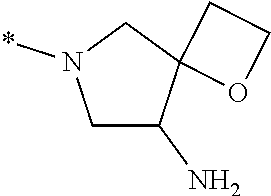 |
 |
 |
 |
 |
 |
 |
 |
 |
 |
 |
 |
 |
 |
 |
 |
 |
 |
 |
 |
 |
 |
 |
 |
 |
 |
 |
 |
 |
 |
||
Preferably, a compound of Formula (I), Formula (II), Formula (III), Formula (IV), Formula (V), Formula (VI) and/or Formula (VII) can comprises both R1 (alone or as substituted with one of more R5 and/or R6, which can be the same or different) that is selected from the groups in Table A above, and R2 (alone or as substituted with one of more R5 and/or R6, which can be the same or different) that is selected from the groups in Table B above.
In some embodiments, the chemical entities are chosen from compounds of Formula (IIa):

or a pharmaceutically acceptable salt thereof, wherein R1, R2, R3, R4, R5, R6, R7 and n are as defined in Formula (I), and/or from compounds of Formula (IIaa):

or a pharmaceutically acceptable salt thereof, wherein R1, R2, R3, R5, R6, R7 and n are as defined in Formula (I).
In some embodiments, the chemical entities are chosen from compounds of Formula (IIb):

-
- or a pharmaceutically acceptable salt thereof,
wherein R′, R1, R2, R3, R4, R5, R6, R7 and n are each independently as defined Formula (VI).
- or a pharmaceutically acceptable salt thereof,
In some embodiments, the chemical entities are chosen from compounds of Formula (IIaa):

-
- or a pharmaceutically acceptable salt thereof,
wherein
- or a pharmaceutically acceptable salt thereof,
- R1 is chosen from 8-9-membered heteroaryls substituted with one or more substituent chosen from R5 and R6;
- R2 is chosen from N-linked 6-12 membered heterocyclyls or C-linked 6-12 membered heterocyclyls, wherein the 6-12 membered heterocyclyls are optionally substituted with one or more R5;
- R3 is independently chosen from H, (C1-C6) alkyl, halogen, and —CN; and
- wherein R5, R6, R7 and n are each independently as defined in Formula (I).
In preferred embodiments of Formula (IIaa), R1, optionally substituted with R5 and/or R6, is chosen from

and
- R2, optionally substituted with R5, is chosen from

In some embodiments, the chemical entities are chosen from compounds of Formula (IIb′):

-
- or a pharmaceutically acceptable salt thereof,
- wherein R′ is chosen from H and CH3;
- R1 is chosen from 8-9 membered heteroaryls substituted with one or more substituent chosen from R5 and R6;
- R2 is chosen from N-linked 6-12 membered heterocyclyls or C-linked 6-12 membered heterocyclyls, wherein the 6-12 membered heterocyclyls are optionally substituted with one or more R5;
- R3 is independently chosen from H and halogen; and
- R5, R6, R7 and n are each independently as defined in Formula (VI).
In preferred embodiments of Formula (IIb′), R1, optionally substituted with R5 and/or R6, is chosen from

and
- R2, optionally substituted with R5, is chosen from

In some embodiments, the chemical entities are chosen from compounds of Formula (IIIa):

or a pharmaceutically acceptable salt thereof,
- wherein R1, R2, R3, R4, R5, R6, R7 and n are each independently as defined Formula (I); and/or from compounds Formula (IIIb):

- or a pharmaceutically acceptable salt thereof,
- wherein R1, R2, R3, R4, R5, R6, R7 and n are each independently as defined Formula (I).
In some embodiments, the chemical entities are chosen from compounds of Formula (IIIaa):

- or a pharmaceutically acceptable salt thereof, wherein
- R1 is chosen from 8-11 membered heteroaryls optionally substituted with one or more R5;
- R2 is chosen from N-linked 4-12 membered heterocyclyls and C-linked 4-12 membered heterocyclyls, optionally substituted with one or more R5;
- each R5 (if present) is independently chosen from —OH, —NH2, NHC(O)CH3, (C1-C6) alkyl, (C1-C6) alkoxy, (C1-C6) haloalkyl, (C1-C6) haloalkoxy, halogen, cycloalkyl, heterocycloalkyl, and —C(O)-heterocycloalkyl groups, wherein each of —NH2, —NHC(O)CH3, (C1-C6) alkyl, (C1-C6) alkoxy, (C1-C6) haloalkyl, (C1-C6) haloalkoxy, cycloalkyl, heterocycloalkyl, and —C(O)— heterocycloalkyl are optionally substituted with one or more substituent independently chosen from (C1-C6) alkoxy, —NH2, and —OH; and
- n is 0, 1, 2, or 3.
In preferred embodiments of Formula (IIIaa), R1 is chosen from

- wherein B is chosen from a bond or C;
- Z is chosen from N, S, C(Rii);
- Rii is chosen from H, CH3 and R5;
- R2 is chosen from N-linked 5-8 membered heterocyclyls substituted with one to three R5;
- each R5 (if present) is independently chosen from —OH, —NH2, NHC(O)CH3, (C1-C6) alkyl, (C1-C6) alkoxy, (C1-C6) haloalkyl, (C1-C6) haloalkoxy, halogen, cycloalkyl, heterocycloalkyl, and —C(O)-heterocycloalkyl groups, wherein each of —NH2, —NHC(O)CH3, (C1-C6) alkyl, (C1-C6) alkoxy, (C1-C6) haloalkyl, (C1-C6) haloalkoxy, cycloalkyl, heterocycloalkyl, and —C(O)— heterocycloalkyl are optionally substituted with one or more substituent independently chosen from (C1-C6) alkoxy, —NH2, and —OH; and
- n is 0, 1, 2, or 3.
In further preferred embodiments of Formula (IIIaa), R1, optionally substituted with R5, is chosen from

and
- R2, optionally substituted with R5, is chosen from


In some embodiments, the chemical entities are chosen from compounds of Formula (IVa):
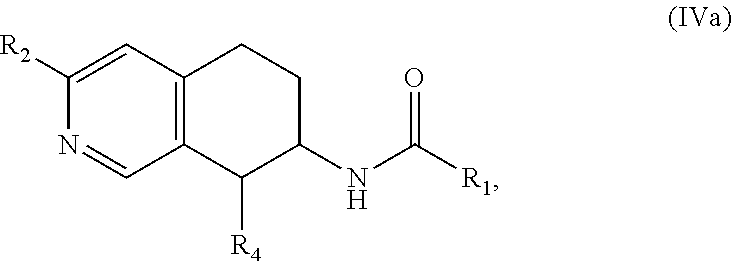
- or a pharmaceutically acceptable salt thereof,
- wherein R1, R2, R4, R5, R6, R7 and n are each independently as defined Formula (I).
In some embodiments, the chemical entities are chosen from compounds of Formula (Va):

- or a pharmaceutically acceptable salt thereof,
- wherein R1, R2, R3, R4, R5, R6, R7 and n are each independently as defined Formula (I).
In some embodiments, the chemical entity is chosen from compounds of Formula (Vaa):

- or a pharmaceutically acceptable salt thereof,
- wherein R1 is chosen from 8-membered heteroaryls substituted with one or more substituent chosen from R5 and R6; R2 is chosen from N-linked 5-membered heterocyclyls; and R5, R6, R7 and n are each independently as defined Formula (I).
In further preferred embodiments of Formula (Vaa), R1 substituted with R5 is chosen from

and R2 is chosen from

In some embodiments, the chemical entities are chosen from compounds of Formula (VIIa′):

- or a pharmaceutically acceptable salt thereof,
- wherein R′, R1, R2, R3, R4, R5, R6, R7 and n are each independently as defined Formula (VI).
In at least one embodiment, the chemical entities are chosen from compounds of Formula (VIIaa):

- or a pharmaceutically acceptable salt thereof, wherein
- R1 is chosen from 8-9 membered heteroaryls optionally substituted with one or more R5;
- R2 is chosen from N-linked 4-12 membered heterocyclyls optionally substituted with one or more R5;
- each R5 (if present) is independently chosen from —OH, —NH2, NHC(O)CH3, (C1-C6) alkyl, (C1-C6) alkoxy, (C1-C6) haloalkyl, (C1-C6) haloalkoxy, halogen, cycloalkyl, heterocycloalkyl, and —C(O)-heterocycloalkyl groups, wherein each of —NH2, —NHC(O)CH3, (C1-C6) alkyl, (C1-C6) alkoxy, (C1-C6) haloalkyl, (C1-C6) haloalkoxy, cycloalkyl, heterocycloalkyl, and —C(O)— heterocycloalkyl are optionally substituted with one or more substituent independently chosen from (C1-C6) alkoxy, —NH2, and —OH; and
- n is 0, 1, 2, or 3.
In preferred embodiments of Formula (VIIaa), R1 is chosen from

- wherein B is chosen from a bond or C;
- Z is chosen from N, S, C(Rii);
- Rii is chosen from H, CH3 and R5;
- R2 is chosen from N-linked 5-8 membered heterocyclyls substituted with one to three R5;
- each R5 (if present) is independently chosen from —OH, —NH2, NHC(O)CH3, (C1-C6) alkyl, (C1-C6) alkoxy, (C1-C6) haloalkyl, (C1-C6) haloalkoxy, halogen, cycloalkyl, heterocycloalkyl, and —C(O)-heterocycloalkyl groups, wherein each of —NH2, —NHC(O)CH3, (C1-C6) alkyl, (C1-C6) alkoxy, (C1-C6) haloalkyl, (C1-C6) haloalkoxy, cycloalkyl, heterocycloalkyl, and —C(O)— heterocycloalkyl are optionally substituted with one or more substituent independently chosen from (C1-C6) alkoxy, —NH2, and —OH; and
- n is 0, 1, 2, or 3.
In further preferred embodiments of Formula (VIIaa), R1, optionally substituted with R5, is chosen from

and
- R2, optionally substituted with R5, is chosen from


Preferably, the compound is a compound of Formula (I), (II), (III), (IV), (V), (VI), (VII), (IIa), (IIaa), (IIb′), (IIIa), (IIIb), (IIIaa), (IVa), (Va), (Vaa), (VIIa′) or Formula (VIIaa) that is USP28 Inhibitor, a USP25 Inhibitor and/or a USP 28/25 Inhibitor as defined herein.
In another embodiment of the disclosure, the compounds of Formula (I) are enantiomers. In some embodiments the compounds are the (S)-enantiomer. In other embodiments the compounds are the (R)-enantiomer. In yet other embodiments, the compounds of Formula (I) may be (+) or (−) enantiomers.
It should be understood that all isomeric forms are included within the present disclosure, including mixtures thereof. If the compound contains a double bond, the substituent may be in the E or Z configuration. If the compound contains a disubstituted cycloalkyl, the cycloalkyl substituent may have a cis- or trans configuration. All tautomeric forms are also intended to be included.
Compounds of the disclosure, and pharmaceutically acceptable salts, hydrates, solvates, stereoisomers and prodrugs thereof may exist in their tautomeric form (for example, as an amide or imino ether). All such tautomeric forms are contemplated herein as part of the present disclosure.
The compounds of the disclosure may contain asymmetric or chiral centers, and, therefore, exist in different stereoisomeric forms. It is intended that all stereoisomeric forms of the compounds of the disclosure as well as mixtures thereof, including racemic mixtures, form part of the present disclosure. In addition, the present disclosure embraces all geometric and positional isomers. For example, if a compound of the disclosure incorporates a double bond or a fused ring, both the cis- and trans-forms, as well as mixtures, are embraced within the scope of the disclosure. Each compound herein disclosed includes all the enantiomers that conform to the general structure of the compound. The compounds may be in a racemic or enantiomerically pure form, or any other form in terms of stereochemistry. The assay results may reflect the data collected for the racemic form, the enantiomerically pure form, or any other form in terms of stereochemistry.
Diastereomeric mixtures can be separated into their individual diastereomers on the basis of their physical chemical differences by methods well known to those skilled in the art, such as, for example, by chromatography and/or fractional crystallization. Enantiomers can be separated by converting the enantiomeric mixture into a diastereomeric mixture by reaction with an appropriate optically active compound (e.g., chiral auxiliary such as a chiral alcohol or Mosher's acid chloride), separating the diastereomers and converting (e.g., hydrolyzing) the individual diastereomers to the corresponding pure enantiomers. Also, some of the compounds of the disclosure may be atropisomers (e.g., substituted biaryls) and are considered as part of this disclosure. Enantiomers can also be separated by use of a chiral HPLC column.
It is also possible that the compounds of the disclosure may exist in different tautomeric forms, and all such forms are embraced within the scope of the disclosure. Also, for example, all keto-enol and imine-enamine forms of the compounds are included in the disclosure.
All stereoisomers (for example, geometric isomers, optical isomers and the like) of the present compounds (including those of the salts, solvates, esters and prodrugs of the compounds as well as the salts, solvates and esters of the prodrugs), such as those which may exist due to asymmetric carbons on various substituents, including enantiomeric forms (which may exist even in the absence of asymmetric carbons), rotameric forms, atropisomers, and diastereomeric forms, are contemplated within the scope of this disclosure, as are positional isomers (such as, for example, 4-pyridyl and 3-pyridyl). (For example, if a compound of Formula (I) incorporates a double bond or a fused ring, both the cis- and trans-forms, as well as mixtures, are embraced within the scope of the disclosure. Also, for example, all keto-enol and imine-enamine forms of the compounds are included in the disclosure.) Individual stereoisomers of the compounds of the disclosure may, for example, be substantially free of other isomers, or may be admixed, for example, as racemates or with all other, or other selected, stereoisomers. The chiral centers of the present disclosure can have the S or R configuration as defined by the IUPAC 1974 Recommendations. The use of the terms “salt”, “solvate”, “ester,” “prodrug” and the like, is intended to equally apply to the salt, solvate, ester and prodrug of enantiomers, stereoisomers, rotamers, tautomers, positional isomers, racemates or prodrugs of the compounds disclosed herein.
The compounds disclosed herein may form salts which are also within the scope of this disclosure.
The present disclosure relates to compounds which are modulators of at least one pathway chosen from USP28 and USP25. In one embodiment, the compounds of the present disclosure are inhibitors of at least one pathway chosen from USP28 and USP25.
The present disclosure is directed to chemical entities chosen from compounds as described herein and pharmaceutically acceptable salts, solvates, prodrugs, stereoisomers, and tautomers thereof, and pharmaceutical compositions comprising at least one chemical entity chosen from compounds as described herein, and pharmaceutically acceptable salts, hydrates, solvates, prodrugs, stereoisomers, and tautomers thereof.
Another aspect of the disclosure relates to a method of treating, preventing, inhibiting, or eliminating a disease or disorder associated with modulation of USP28. The method comprises administering to a patient in need of a treatment for diseases or disorders associated with modulation of USP28 an effective amount the compositions and chemical entities of Formula (I). In one embodiment, the disease or disorder is cancer.
In another aspect, the present disclosure is directed to a method of treating, preventing, inhibiting, or eliminating a disease or disorder associated with inhibition of USP28. The method comprises administering to a patient in need of a treatment for diseases or disorders associated with modulation of USP28 an effective amount the compositions and chemical entities of Formula (I). In one embodiment, the disease or disorder is cancer.
In another aspect, the present disclosure is directed to a method of inhibiting USP28. The method involves administering to a patient in need thereof an effective amount of a chemical entity of Formula (I).
Another aspect of the disclosure relates to a method of treating, preventing, inhibiting, or eliminating a disease or disorder associated with modulation of USP25. The method comprises administering to a patient in need of a treatment for diseases or disorders associated with modulation of USP25 an effective amount the compositions and chemical entities of Formula (I). In one embodiment, the disease or disorder is cancer.
In another aspect, the present disclosure is directed to a method of treating, preventing, inhibiting, or eliminating a disease or disorder associated with inhibition of USP25. The method comprises administering to a patient in need of a treatment for diseases or disorders associated with modulation of USP25 an effective amount the compositions and chemical entities of Formula (I). In one embodiment, the disease or disorder is cancer.
In another aspect, the present disclosure is directed to a method of inhibiting USP25. The method involves administering to a patient in need thereof an effective amount of a chemical entity of Formula (I).
Another aspect of the disclosure relates to a method of treating, preventing, inhibiting, or eliminating a disease or disorder associated with modulation of USP28. The method comprises administering to a patient in need of a treatment for diseases or disorders associated with modulation of USP28 an effective amount the compositions and chemical entities of Formula (I). In one embodiment, the disease or disorder is cancer. In another aspect, the present disclosure is directed to a method of treating, preventing, inhibiting, or eliminating a disease or disorder associated with inhibition of USP28. The method comprises administering to a patient in need of a treatment for diseases or disorders associated with modulation of USP28 an effective amount the compositions and chemical entities of Formula (I). In one embodiment, the disease or disorder is cancer. The method can comprise administering to a patient in need of a treatment for diseases or disorders associated with modulation of USP28 and/or USP25 an effective amount of a pharmaceutical composition comprising a USP28 Inhibitor, USP25 Inhibitor, and/or USP28/25 Inhibitor as disclosed herein. In another aspect, the present disclosure is directed to a method of inhibiting at least one pathway chosen from USP28 and USP25. The method involves administering to a patient in need thereof an effective amount of a chemical entity of Formula (I). The method can comprise administering to a patient in need of a treatment for diseases or disorders associated with modulation of USP28 and/or USP25 an effective amount of a pharmaceutical composition comprising a USP28 Inhibitor, USP25 Inhibitor, and/or USP28/25 Inhibitor as disclosed herein.
Another aspect of the present disclosure relates to a method of treating, preventing, inhibiting, or eliminating a disease or disorder in a patient associated with the inhibition of USP28, the method comprising administering to a patient in need thereof an effective amount of a chemical entity of Formula (I). In one embodiment, the disease or disorder is cancer. The method can comprise administering to a patient in need of a treatment for diseases or disorders associated with modulation of USP28 and/or USP25 an effective amount of a pharmaceutical composition comprising a USP28 Inhibitor, USP25 Inhibitor, and/or USP28/25 Inhibitor as disclosed herein.
Another aspect of the present disclosure relates to a method of treating, preventing, inhibiting, or eliminating a disease or disorder in a patient associated with the inhibition of USP25, the method comprising administering to a patient in need thereof an effective amount of a chemical entity of Formula (I). In one embodiment, the disease or disorder is cancer. The method can comprise administering to a patient in need of a treatment for diseases or disorders associated with modulation of USP28 and/or USP25 an effective amount of a pharmaceutical composition comprising a USP28 Inhibitor, USP25 Inhibitor, and/or USP28/25 Inhibitor as disclosed herein.
Another aspect of the present disclosure relates to a method of treating, preventing, inhibiting, or eliminating a disease or disorder in a patient associated with the inhibition of at least one pathway chosen from USP28 and USP25, the method comprising administering to a patient in need thereof an effective amount of a chemical entity of Formula (I). In one embodiment, the disease or disorder is cancer. The method can comprise administering to a patient in need of a treatment for diseases or disorders associated with modulation of USP28 and/or USP25 an effective amount of a pharmaceutical composition comprising a USP28 Inhibitor, USP25 Inhibitor, and/or USP28/25 Inhibitor as disclosed herein.
In another aspect, the present disclosure relates to a method of treating, preventing, inhibiting, or eliminating cancer. The method comprises administering to a patient in need of a treatment for cancer an effective amount of a chemical entity chosen from compounds of Formula (I), and pharmaceutically acceptable salts, solvates, prodrugs, stereoisomers, and tautomers thereof. The method can comprise administering to a patient in need of a treatment for diseases or disorders associated with modulation of USP28 and/or USP25 an effective amount of a pharmaceutical composition comprising a USP28 Inhibitor, USP25 Inhibitor, and/or USP28/25 Inhibitor as disclosed herein.
Another aspect of the present disclosure relates to a chemical entity chosen from compounds of Formula (I), and pharmaceutically acceptable salts, solvates, prodrugs, stereoisomers, and tautomers thereof, for use in a method of treating, preventing, inhibiting, or eliminating a disease or disorder associated with inhibiting USP28. In one embodiment, the disease or disorder is cancer. The method can comprise administering to a patient in need of a treatment for diseases or disorders associated with modulation of USP28 and/or USP25 an effective amount of a pharmaceutical composition comprising a USP28 Inhibitor, USP25 Inhibitor, and/or USP28/25 Inhibitor as disclosed herein.
In another aspect, the present disclosure relates to a chemical entity chosen from compounds of Formula (I), and pharmaceutically acceptable salts, solvates, prodrugs, stereoisomers, and tautomers thereof, for use in a method of treating, preventing, inhibiting, or eliminating a disease or disorder associated with inhibiting USP25. In one embodiment, the disease or disorder is cancer.
Another aspect of the present disclosure relates to a chemical entity chosen from compounds of Formula (I), and pharmaceutically acceptable salts, solvates, prodrugs, stereoisomers, and tautomers thereof, for use in a method of treating, preventing, inhibiting, or eliminating a disease or disorder associated with inhibiting at least one pathway chosen from USP28 and USP25. In one embodiment, the disease or disorder is cancer.
In another aspect, the present disclosure relates to a chemical entity chosen from compounds of Formula (I), and pharmaceutically acceptable salts, solvates, prodrugs, stereoisomers, and tautomers thereof, for use in a method for treating, preventing, inhibiting, or eliminating cancer.
Another aspect of the present disclosure relates to the use of a chemical entity chosen from compounds of Formula (I), and pharmaceutically acceptable salts, solvates, prodrugs, stereoisomers, and tautomers thereof, in the manufacture of a medicament for treating, preventing, inhibiting, or eliminating a disease or disorder associated with inhibiting USP28. In one embodiment, the disease or disorder is cancer.
Another aspect of the present disclosure relates to the use of a chemical entity chosen from compounds of Formula (I), and pharmaceutically acceptable salts, solvates, prodrugs, stereoisomers, and tautomers thereof, in the manufacture of a medicament for treating, preventing, inhibiting, or eliminating a disease or disorder associated with inhibiting at least one pathway chosen from USP28 and USP25. In one embodiment, the disease or disorder is cancer.
In another aspect, the present disclosure relates to the use of a chemical entity chosen from compounds of Formula (I), and pharmaceutically acceptable salts, solvates, prodrugs, stereoisomers, and tautomers thereof, in the manufacture of a medicament for treating, preventing, inhibiting, or eliminating cancer.
In other embodiments, the present disclosure relates to the use of an inhibitor of USP28 for the preparation of a medicament used in the treatment, prevention, inhibition or elimination of a disease or disorder associated with cancer.
The present disclosure also relates to the use of an inhibitor of USP28 for the preparation of a medicament used in the treatment, prevention, inhibition, or elimination of a disease or condition mediated by USP28, wherein the medicament comprises a chemical entity chosen from compounds of Formula (I), and pharmaceutically acceptable salts, solvates, prodrugs, stereoisomers, and tautomers thereof. The present disclosure also relates to the use of an inhibitor of USP28 for the preparation of a medicament used in the treatment, prevention, inhibition, or elimination of a disease or condition mediated by USP28, wherein the medicament comprises a chemical entity chosen from compounds of Formulae (II), (III), (IV), (V), (VI), (VII), (IIa), (IIaa), (IIb′), (IIIa), (IIIb), (IIIaa), (IVa), (Va), (Vaa), (VIIa′) or Formula (VIIaa) that is USP28 Inhibitor, a USP25 Inhibitor and/or a USP 28/25 Inhibitor as defined herein.
The present disclosure also relates to the use of an inhibitor of USP25 for the preparation of a medicament used in the treatment, prevention, inhibition, or elimination of a disease or condition mediated by USP25, wherein the medicament comprises a chemical entity chosen from compounds of Formula (I), and pharmaceutically acceptable salts, solvates, prodrugs, stereoisomers, and tautomers thereof. The present disclosure also relates to the use of an inhibitor of USP25 for the preparation of a medicament used in the treatment, prevention, inhibition, or elimination of a disease or condition mediated by USP25, wherein the medicament comprises a chemical entity chosen from compounds of Formulae (II), (III), (IV), (V), (VI), (VII), (IIa), (IIaa), (IIb′), (IIIa), (IIIb), (IIIaa), (IVa), (Va), (Vaa), (VIIa′) or Formula (VIIaa) that is USP28 Inhibitor, a USP25 Inhibitor and/or a USP 28/25 Inhibitor as defined herein.
In another aspect, the present disclosure relates to a method for the manufacture of a medicament for treating, preventing, inhibiting, or eliminating a disease or condition mediated by at least one pathway chosen from USP28 and USP25, wherein the medicament comprises a chemical entity chosen from compounds of Formula (I), and pharmaceutically acceptable salts, solvates, prodrugs, stereoisomers, and tautomers thereof. These mechanisims have been shown to be useful in treating cancer such as lung cancer and brain cancer.
In some embodiments, the patient is selected for treatment based on gene amplification and/or elevated tumor expression of USP28, MYC, LSD1, NICD1, and/or reduced expression of FBXW7 relative to tissue-matched expression.
In some embodiments, the patient is selected for treatment based on gene amplification and/or elevated tumor expression of USP28, USP25, MYC, LSD1, NICD1, and/or reduced expression of FBXW7 relative to tissue-matched expression.
In some embodiments, administration of a compound of Formula (I) or a pharmaceutical composition comprising a compound of the present disclosure and a pharmaceutically acceptable carrier induces a change in the cell cycle, cell viability, cell apoptosis, or differentiation.
For example, the change in the cell cycle or cell viability or differentiation may be indicated by decreased tumor levels of MYC, LSD1, NICD1, PIM1, CDK1, POLA2, HEY1, and/or CCND1, and/or increased levels of CD86, p21, LGALS4, and/or DLL1.
Another aspect of the disclosure is directed to pharmaceutical compositions comprising a chemical entity chosen from compounds of Formula (I), and pharmaceutically acceptable salts, solvates, prodrugs, stereoisomers, and tautomers thereof and a pharmaceutically acceptable carrier. The pharmaceutical acceptable carrier may further include an excipient, diluent, or surfactant. Another aspect of the disclosure is directed to pharmaceutical compositions comprising a chemical entity chosen from compounds of Formulae (II), (III), (IV), (V), (VI), (VII), (IIa), (IIaa), (IIb′), (IIIa), (IIIb), (IIIaa), (IVa), (Va), (Vaa), (VIIa′) or Formula (VIIaa) that is USP28 Inhibitor, a USP25 Inhibitor and/or a USP 28/25 Inhibitor as defined herein.
In one embodiment, are provided methods of treating a disease or disorder associated with modulation of USP28 including cancer comprising administering to a patient suffering from at least one of said diseases or disorder a chemical entity of Formula (I). The methods of treating a disease or disorder associated with modulation of USP28 including cancer can comprise administering to a patient suffering from at least one of said diseases or disorder a chemical entity of Formulae (II), (III), (IV), (V), (VI), (VII), (IIa), (IIaa), (IIb′), (IIIa), (IIIb), (IIIaa), (IVa), (Va), (Vaa), (VIIa′) or Formula (VIIaa) that is USP28 Inhibitor, a USP25 Inhibitor and/or a USP 28/25 Inhibitor as defined herein.
In another embodiment, are provided methods of treating a disease or disorder associated with modulation of USP25 including cancer, comprising administering to a patient suffering from at least one of said diseases or disorder a chemical entity of Formula (I). The methods of treating a disease or disorder associated with modulation of USP25 including cancer, can comprise administering to a patient suffering from at least one of said diseases or disorder a chemical entity of Formulae (II), (III), (IV), (V), (VI), (VII), (IIa), (IIaa), (IIb′), (IIIa), (IIIb), (IIIaa), (IVa), (Va), (Vaa), (VIIa′) or Formula (VIIaa) that is USP28 Inhibitor, a USP25 Inhibitor and/or a USP 28/25 Inhibitor as defined herein.
In another embodiment, are provided methods of treating a disease or disorder associated with modulation of at least one pathway chosen from USP28 and USP25 including cancer, comprising administering to a patient suffering from at least one of said diseases or disorder a chemical entity of Formula (I). The methods of treating a disease or disorder associated with modulation of at least one pathway chosen from USP28 and USP25 including cancer, can also comprise administering to a patient suffering from at least one of said diseases or disorder a chemical entity of Formulae (II), (III), (IV), (V), (VI), (VII), (IIa), (IIaa), (IIb′), (IIIa), (IIIb), (IIIaa), (IVa), (Va), (Vaa), (VIIa′) or Formula (VIIaa) that is USP28 Inhibitor, a USP25 Inhibitor and/or a USP 28/25 Inhibitor as defined herein.
One therapeutic use of the compounds or compositions of the present disclosure which inhibit USP28 is to provide treatment to patients or subjects suffering from cancer.
Another therapeutic use of the compounds or compositions of the present disclosure which inhibit USP25 is to provide treatment to patients or subjects suffering from cancer.
Another therapeutic use of the compounds or compositions of the present disclosure which inhibit at least one pathway chosen from USP28 and USP25 is to provide treatment to patients or subjects suffering from cancer.
The compounds of the disclosure can be administered in effective amounts to treat or prevent a disorder and/or prevent the development thereof in subjects.
Administration of the disclosed compounds can be accomplished via any mode of administration for therapeutic agents.
Another aspect of the disclosure is directed to pharmaceutical compositions comprising a chemical entity chosen from compounds of Formula (I), and pharmaceutically acceptable salts, solvates, prodrugs, stereoisomers, and tautomers thereof and a pharmaceutically acceptable carrier. The pharmaceutical acceptable carrier may further include an excipient, diluent, or surfactant.
The dosage regimen utilizing the disclosed compound is selected in accordance with a variety of factors including type, species, age, weight, sex and medical condition of the patient; the severity of the condition to be treated; the route of administration; the renal or hepatic function of the patient; and the particular disclosed compound employed. A physician or veterinarian of ordinary skill in the art can readily determine and prescribe the effective amount of the drug required to prevent, counter or arrest the progress of the condition.
Non-limiting examples of compounds according to Formulae (I)-(VII) of the disclosure include those of Tables 9-25 below.
Method of Synthesizing the Compounds
The compounds of the present disclosure can be prepared in a number of ways known to those skilled in the art of organic synthesis. The compounds of the present disclosure may be made by a variety of methods, including standard chemistry. Suitable synthetic routes are depicted in the Schemes provided herein. The compounds disclosed herein may be prepared by methods known in the art of organic synthesis as set forth in part by the following synthetic schemes. In the schemes described herein, it is well understood that protecting groups for sensitive or reactive groups are employed where necessary in accordance with general principles or chemistry. Protecting groups are manipulated according to standard methods of organic synthesis (T. W. Greene and P. G. M. Wuts, “Protective Groups in Organic Synthesis”, Third edition, Wiley, New York 1999). These groups are removed at a convenient stage of the compound synthesis using methods that are readily apparent to those skilled in the art. The selection processes, as well as the reaction conditions and order of their execution, shall be consistent with the preparation of compounds disclosed herein (including, e.g., compounds of Formula (I)).
The compounds described herein may be made from commercially available starting materials or synthesized using known organic, inorganic, and/or enzymatic processes. Those skilled in the art will recognize if a stereocenter exists in the compounds disclosed herein. Accordingly, the present disclosure includes both possible stereoisomers (unless specified in the synthesis) and includes not only racemic compounds but the individual enantiomers and/or diastereomers as well. When a compound is desired as a single enantiomer or diastereomer, it may be obtained by stereospecific synthesis or by resolution of the final product or any convenient intermediate. Resolution of the final product, an intermediate, or a starting material may be affected by any suitable method known in the art. See, for example, “Stereochemistry of Organic Compounds” by E. L. Eliel, S. H. Wilen, and L. N. Mander (Wiley-Interscience, 1994).
By way of example, compounds of the present disclosure can be synthesized using the methods described below, together with synthetic methods known in the art of synthetic organic chemistry, or variations thereof as appreciated by those skilled in the art. Preferred methods include but are not limited to those methods described below. General procedures to prepare compounds of the instant invention are described in General Scheme 1. An appropriately substituted and protected bicyclic intermediate 1 can be reacted with an appropriately substituted protected amine intermediate 2 under palladium-catalyzed carbon-nitrogen coupling protocols using an appropriate palladium complex, ligand, and base (such as but not limited to: RuPhos 3rd generation palladium precatalyst and cesium carbonate) in a suitable solvent such as toluene at an appropriate temperature (such as 100° C.) to afford intermediate 3. The protecting group 1 (PG1; typically a Cbz group) can be removed under suitable deprotection conditions (such as but not limited to: hydrogen (gas), with palladium on carbon in an appropriate solvent such as methanol, ethanol, or ethyl acetate) to afford amine intermediate 4. The suitably substituted amine intermediate 4 can be reacted with a suitably substituted carboxylic acid under amide coupling conditions (such as but not limited to: the coupling reagents EDC and HOBt with an appropriate base such as Et3N or DIEA in a solvent such as DMF or DMA) to afford the penultimate amide intermediate 5. The protecting group 2 (PG2; typically a boc group) can be removed under appropriate conditions such as TFA in a solvent such as DCM or HCl in a solvent such as MeOH or dioxane to afford the final compounds 6. The final compounds can be typically purified by preparative HPLC and isolated as the free base. In the case where mixtures of enantiomers and/or diastereomers are formed, the individual stereoisomers can be purified at an appropriate stage, in many cases by chiral HPLC.

General procedures to prepare intermediates of the instant invention are described in Intermediate General Scheme 1. An appropriately substituted leaving group containing starting material 1 (LGi; typically a bromide) can be reacted with the lithiated chiral auxiliary 2 (formed by reacting 2 with a strong base such as nBuLi) in an appropriate solvent such as THF at low temperature (typically −78° C.) to afford intermediate 3. Hydrolysis to remove the auxiliary under conditions such as aqueous HCl in a solvent such as acetonitrile, followed by reduction (typically using NaBH4 in a solvent such as MeOH) can afford amino alcohol 4. Amino alcohol 4 can be cyclized using a strong base such as NaH in a solvent such as DMSO at low temperature (typically −70° C.) to afford Intermediate 4. Addition of an appropriate protecting group (PG1; typically a CBz group) to the corresponding intermediate can result in an appropriately substituted bicyclic intermediate 5.

General procedures to prepare intermediates of the instant invention are described in Intermediate General Scheme 2. An appropriately substituted ketone 1 can be reacted under reductive amination conditions (typically with ammonium acetate as the amine source, NaBH3CN as the reductant, and a solvent such as MeOH) to afford the amine intermediate 2. Amine 2 is then protected (PG1; typically a CBz group) to afford the appropriately substituted intermediate 3.

General procedures to prepare intermediates of the instant invention are described in Intermediate General Scheme 3. Acid chloride 1 can be reacted under a lewis acid promoted ethylene addition (typically using AlCl3 and ethylene gas in a solvent such as DCM) to afford ketone 2. Ketone 2 can then either be converted to an oxime then reduced (using 0-Methylhydroxylamine hydrochloride, pyridine and EtOH to form the oxime; reduction using hydrogen gas, Raney Ni in EtOH solvent) or reacted under reductive amination conditions (typically with ammonium acetate as the amine source, NaBH3CN as the reductant, and a solvent such as MeOH) to afford amine 3. Amine 3 can be then protected (PG1; typically a CBz group) to afford the appropriately substituted intermediate 4.

General procedures to prepare intermediates of the instant invention are described in Intermediate General Scheme 4. 2-Pyridone 2 can be obtained by the Michael addition of enamino ketone (typically generated in situ by treatment of a mono-protected cyclohexane-1,4-dione such as 1 with ammonia in methanol) with propynoic ester. Pyridone 2 can be converted to incorporate a leaving group (LG; typically a triflate group which can be obtained by treatment with triflic anhydride in the presence of a base, such as triethylamine). Following removal of the ketone protecting group, ketone 4 can then be reacted under reductive amination conditions (typically with ammonium acetate as the amine source, NaBH3CN as the reductant, and a solvent such as MeOH) to afford amine 5. Amine 5 can be then protected (PG1; typically a Cbz group) to afford the appropriately substituted intermediate 6.

General procedures to prepare intermediates of the instant invention are described in Intermediate General Scheme 5. Ketone 1 can be condensed with dimethyl-formamide dimethyl acetal in a solvent (such as toluene) to provide enamino ketone 2. Ketone 2 can be treated with quinidine and a base (such as sodiumethoxide) to provide pyrimidin-2-amine 3. Pyrimidin-2-amine 3 can be converted to incorporate a leaving group (LG; typically a chloride group which can be obtained by treatment with CuCl2 and tert-butyl nitrite) to afford the appropriately substituted intermediate 4.

General procedures to prepare intermediates of the instant invention are described in Intermediate General Scheme 6. An appropriately substituted intermediate 1 can be reacted with an appropriately substituted boronic ester 2 (or boronic acid) under palladium catalyzed carbon-carbon bond forming conditions (using an appropriate palladium catalyst such as Pd(dppf)Cl2 dichloromethane complex) in a solvent such as 1,4-dioxane/water mixture, and a base such as potassium carbonate at a temperature such as 100° C.) to afford the coupled intermediate 3. The olefin double bond present in intermediate 3 can then be functionalized using standard methods such as but not limited to: olefin reduction and epoxidation followed by reduction of the resultant epoxide to afford an appropriately substituted intermediate 4.

General procedures to prepare intermediates of the instant invention are described in Intermediate General Scheme 7. An appropriately substituted intermediate 1 can be reacted under palladium-catalyzed boronic ester forming conditions (using a palladium catalyst such as Pd(dppf)Cl2—CH2Cl2 complex and a boronic ester source such as Bis(pinacolato)diboron in a solvent such as dioxane at a temperature such as 80° C.) to afford the boronic ester 2. Boronic ester 2 can be reacted in the presence of a suitable oxidant (such as urea-hydrogen peroxide complex in a solvent such as MeOH) to afford the phenol intermediate 3. The phenol intermediate can then be alkylated with a suitable electrophile (for example by using Mitsonobu-type conditions: such as DIAD with PPh3) to afford the appropriately substituted intermediate 4.

The disclosure is further illustrated by the following examples and synthesis schemes, which are not to be construed as limiting this disclosure in scope or spirit to the specific procedures herein described. It is to be understood that the examples are provided to illustrate certain embodiments and that no limitation to the scope of the disclosure is intended thereby. It is to be further understood that resort may be had to various other embodiments, modifications, and equivalents thereof which may suggest themselves to those skilled in the art without departing from the spirit of the present disclosure and/or scope of the appended claims.
Analytical Methods, Materials, and Instrumentation
Unless otherwise noted, reagents and solvents were used as received from commercial suppliers. Unless otherwise noted, reactions were conducted under an inert atmosphere of nitrogen. Proton nuclear magnetic resonance (NMR) spectra were obtained on either Bruker or Varian spectrometers at 300 or 400 MHz. Spectra are given in ppm (δ) and coupling constants, J, are reported in Hertz. Tetramethylsilane (TMS) was used as an internal standard. Purity and mass spectral data were measured using one of the two following methods. Method 1: Waters Acquity i-class ultra-performance liquid chromatography (UPLC) system with Acquity Photo Diode Array Detector, Acquity Evaporative Light Scattering Detector (ELSD) and Waters ZQ Mass Spectrometer. Data was acquired using Waters MassLynx 4.1 software and purity characterized by UV wavelength 220 nm, evaporative light scattering detection (ELSD) and electrospray positive ion (ESI). (Column: Acquity UPLC BEH C18 1.7 μm 2.1×50 mm; Flow Rate 0.6 mL/min; Solvent A (95/5/0.1%: 10 mM Ammonium Formate/Acetonitrile/Formic Acid), Solvent B (95/5/0.09%: Acetonitrile/Water/Formic Acid); gradient: 5-100% B from 0 to 2 mins, hold 100% B to 2.2 min and 5% B at 2.21 min). Method 2: SHIMADZU LCMS consisting of an UFLC 20-AD and LCMS 2020 MS detector. (Column: Shim-pack XR-ODS, 2.2 μm, 3.0×50 mm; Solvent: (acetonitrile/water, containing 0.05% NH4HCO3)). Preparatory HPLC purifications were conducted as designated below with a Flow Rate of 20 mL/min and detection by UV wavelength 220 nm and 254 nm, unless otherwise noted. The absolute configuration of the separated enantiomers of the compounds in the examples described herein was occasionally determined. In all other cases the absolute configuration of the separated enantiomers was not determined and in those instances the configuration of the resolved materials were arbitrarily assigned as R or S in each case.
| Abbreviations used in the following examples and elsewhere herein are: |
| Abbr | Name |
| ACN | acetonitrile |
| atm | atmospheres |
| Boc | t-butoxycarbonyl |
| BOP | (benzotriazol-1-yloxy)tris(dimethylamino)phosphonium |
| hexafluorophosphate | |
| CbzCl | benzyl chloroformate |
| CDCl3 | deuterated chloroform |
| CH2Cl2 | methylene chloride, dichloromethane |
| CO (g) | carbon monoxide gas |
| Cs2CO3 | cesium carbonate |
| DAST | diethylaminosulfur trifluoride |
| DBU | 1,8-diazabicyclo[5.4.0]undec-7-ene |
| DCM | methylene chloride, dichloromethane |
| DIEA | diisopropylethylamine |
| DMA | N,N-dimethylacetamide |
| DMF | N,N-dimethylformamide |
| DMSO | dimethylsulfoxide |
| DPPA | diphenylphosphoryl azide |
| EDCI | 1-ethyl-3-(3-dimethylaminopropyl)carbodiimide |
| ESI | electrospray ionization |
| Et2O | diethyl ether |
| Et3N | triethylamine |
| EtOAc | ethyl acetate |
| EtOH | ethanol |
| h | hours |
| H2O | water |
| HATU | 1-[bis(dimethylamino)methylene]-1H-1,2,3-triazolo[4,5-b]pyridinium |
| 3-oxid hexafluorophosphate | |
| HBTU | N,N,N′,N′-tetramethyl-O-(1H-benzotriazol-1-yl)uronium |
| hexafluorophosphate | |
| HCl | hydrochloric acid |
| HMTA | hexamethylenetetramine |
| HOBt | hydroxybenzotriazole |
| IPA | isopropanol |
| K2CO3 | potassium carbonate |
| LDA | lithium diisopropylamide |
| m-CPBA | 3-chloroperbenzoic acid |
| MeOH | methanol |
| MgSO4 | magnesium sulfate |
| min | minutes |
| MS | mass spectrometry |
| MsCl | methanesulfonyl chloride |
| MTBE | methyl tert-butyl ether |
| Na2CO3 | sodium carbonate |
| Na2SO4 | sodium sulfate |
| NaH | sodium hydride |
| NaHCO3 | sodium bicarbonate |
| NaOH | sodium hydroxide |
| NBS | N-bromosuccinimide |
| NH2OH—HCl | hydroxylamine hydrochloride |
| NH4Cl | ammonium chloride |
| NH4HCO3 | ammonium bicarbonate |
| NH4OH | ammonium hydroxide |
| NMP | N-methyl-2-pyrrolidone |
| NMR | nuclear magnetic resonance |
| Pd2(dba)3 | tris(dibenzylideneacetone)dipalladium(0) |
| Pd(dppf)Cl2 | [1,1′-bis(diphenylphosphino)ferrocene]dichloropalladium(II) |
| Pd(dppf)Cl2—CH2Cl2 | [1,1′-bis(diphenylphosphino)ferrocene]dichloropalladium(II)-DCM |
| adduct | |
| Pd/C | palladium on carbon |
| Pd(OAc)2 | palladium(II) acetate |
| pet. ether | petroleum ether |
| prep-HPLC | preparatory high pressure liquid chromatography |
| prep-TLC | preparatory thin layer chromatography |
| PTSA | p-Toluenesulfonic acid |
| RT | retention time |
| RuPhos | 2-dicyclohexylphosphino-2′,6′-diisopropoxybiphenyl |
| RuPhos Pd G3 | (2-Dicyclohexylphosphino-2′,6′-diisopropoxy-1,1′-biphenyl)[2-(2′- |
| amino-1,1′-biphenyl)]palladium(II) methanesulfonate | |
| SFC | supercritical fluid chromatography |
| TBS | tert-butyl(dimethyl)silyl |
| t-BuOH | tert-butanol |
| t-BuOK | potassium tert-butoxide |
| t-BuXPhos Pd G4 | methanesulfonato(2-di-t-butylphosphino-2′,4′,6′-tri-i-propyl-1,1′- |
| biphenyl)(2′-methylamino-1,1′-biphenyl-2-yl)palladium(II) DCM | |
| adduct | |
| TEDA | triethylenediamine |
| TFA | trifluoroacetic acid |
| TFAA | trifluoroacetic anhydride |
| THF | THF |
| XPhos Pd G3 | (2-dicyclohexylphosphino-2′,4′,6′-triisopropyl-1,1′-biphenyl)[2-(2′- |
| amino-1,1′-biphenyl)]palladium(II) methanesulfonate | |
Preparation of Intermediates

A mixture of 4-bromo-2-hydroxybenzaldehyde (21.6 g, 108 mmol), 1,3-dihydro-2-benzofuran-1,3-dione (32 g, 216 mmol) and dibutylamine (7.0 g, 54 mmol) in toluene (800 mL) was heated to reflux under an atmosphere of N2. 2-Nitroethan-1-amine (50 g, 550 mmol) was added in portions over 2 h. The mixture was stirred at reflux overnight using a Dean-Stark apparatus. After cooling to room temperature, the solids were filtered out. Eight batches were thus run in parallel and the filtrate from the eight batches were combined and concentrated under vacuum. The residue was diluted with EtOAc (2 L) and washed with 1N NaOH (2 L). The organic layer was dried over anhydrous Na2SO4, filtered, and concentrated under vacuum. Purification by silica gel chromatography (eluting with 1:6 EtOAc/pet. ether) afforded 7-bromo-3-nitro-2H-chromene as a yellow solid. MS: (ESI, m/z): 256, 258 [M+H]+.
To a solution of 7-bromo-3-nitro-2H-chromene (27 g, 106 mmol) in THF (300 mL) were added BH3 (1M in THF, 600 mL, 600 mmol) and NaBH4 (201 mg, 5.3 mmol). The mixture was stirred overnight at 65° C. After cooling to room temperature, the reaction was then quenched by the addition of 600 mL of MeOH and stirred for 8 h at 80° C. After cooling to room temperature, the mixture was concentrated under vacuum. The residue was purified by reverse phase chromatography (Column: C18 silica gel; Mobile phase A: water (10 mM NH4HCO3), B: ACN; Gradient: 0% to 50% B over 40 min) to afford 7-bromochroman-3-amine as a white solid. MS: (ESI, m/z): 228, 230 [M+H]+.
A solution of K2CO3 (19.3 g, 140 mmol) in water (150 mL) was added to a solution of 7-bromochroman-3-amine (16.0 g, 70.1 mmol) in EtOAc (300 mL). Benzyl chloroformate (17.8 g, 104 mmol) was added at −10° C. and the reaction mixture was stirred for 30 min at room temperature. The mixture was diluted with EtOAc (200 mL). The organic layer was collected, dried over anhydrous Na2SO4, filtered, and concentrated under vacuum. The residue was washed with 1:1 EtOAc/pet. ether (200 mL) to give benzyl-(7-bromochroman-3-yl)carbamate as a white solid. MS: (ESI, m/z): 362, 364 [M+H]+.
The racemate benzyl (7-bromochroman-3-yl)carbamate (12.5 g, 34.6 mmol) was separated by SFC (Column: ChiralArt Amylose-SA, 2×25 cm, 5 μm; Mobile phase A: CO2, 80%, B: EtOH, 20%; Flow rate: 40 mL/min) to afford the title compounds as follows: benzyl (R)-(7-bromochroman-3-yl)carbamate (first eluting isomer, RT=7.98 min) as a white solid and benzyl (S)-(7-bromochroman-3-yl)carbamate (second eluting isomer, RT=9.21 min) as a white solid.
- First eluting isomer: 1H NMR (CDCl3, 400 MHz) δ(ppm): 7.35-7.32 (m, 5H), 7.03-7.01 (m, 2H), 6.90 (d, J=8.8 Hz, 1H), 5.22-5.10 (m, 3H), 4.25 (s, 1H), 4.17-4.09 (m, 2H), 3.04 (dd, J=16.8 Hz, 4.8 Hz, 1H), 2.73 (d, J=16.8 Hz, 1H). MS: (ESI, m/z): 362, 364 [M+H]+.
- Second eluting isomer: 1H NMR (CDCl3, 400 MHz) δ (ppm): 7.35-7.32 (m, 5H), 7.03-7.01 (m, 2H), 6.90 (d, J=8.8 Hz, 1H), 5.22-5.07 (m, 3H), 4.25 (s, 1H), 4.18-4.09 (m, 2H), 3.04 (dd, J=16.8 Hz, 4.8 Hz, 1H), 2.73 (d, J=16.80 Hz, 1H). MS: (ESI, m/z): 362, 364 [M+H]+.

Into a 500-mL round-bottom flask purged and maintained with an inert atmosphere of nitrogen was added a 2,3-difluorophenol (10.0 g, 75.33 mmol), ACN (200 mL), HCHO (23.06 g, 738 mmol), Et3N (21.0 mL, 146 mmol), and MgCl2 (14.6 g, 150.28 mmol). The resulting solution was stirred for 16 h at 60° C. The reaction mixture was cooled to 26° C., then was diluted with 200 mL of water. The resulting solution was extracted with ethyl acetate (3×100 mL). The organic layers were combined, dried over anhydrous sodium sulfate, filtered, and concentrated under vacuum to afford a residue that was purified by silica gel chromatography with ethyl acetate/pet. ether (1:4) to afford 3,4-difluoro-2-hydroxybenzaldehyde as light yellow oil.
Into a 250-mL round-bottom flask was added 3,4-difluoro-2-hydroxybenzaldehyde (5 g, 31.63 mmol), tert-butyl piperazine-1-carboxylate (5.9 g, 31.68 mmol), DMSO (100 mL), and DIEA (6.1 g, 47.20 mmol). The resulting solution was stirred for 6 h at 120° C. After cooling to room temperature, the reaction was then quenched by the addition of 100 mL of water. The resulting solution was extracted with ethyl acetate (3×100 mL). The organic layers were combined, dried over anhydrous sodium sulfate, filtered, and concentrated under vacuum to afford a residue that was purified by silica gel chromatography with ethyl acetate/pet. ether (0-30%) to afford tert-butyl 4-(2-fluoro-4-formyl-3-hydroxyphenyl)piperazine-1-carboxylate as yellow oil.
Into a 100-mL round-bottom flask was added tert-butyl 4-(2-fluoro-4-formyl-3-hydroxyphenyl)piperazine-1-carboxylate (185 mg, 0.48 mmol), 1,3-dihydro-2-benzofuran-1,3-dione (166 mg, 1.06 mmol, 95%), 2-nitroethan-1-ol (104 mg, 1.08 mmol), dibutylamine (37 mg, 0.27 mmol), and toluene (10 mL). The resulting solution was stirred for 8 h at 100° C. in an oil bath. The reaction mixture was cooled to room temperature, then was quenched by addition of 5 mL water, and extracted with DCM (3×10 mL). The organic layers were combined, washed with brine (3×10 mL), dried over anhydrous sodium sulfate, filtered, and concentrated under vacuum to afford a residue that was purified by a silica gel chromatography with ethyl acetate/pet. ether (1:3) to afford tert-butyl 4-(8-fluoro-3-nitro-2H-chromen-7-yl)piperazine-1-carboxylate as a red solid.
Into a 100-mL 3-necked round-bottom flask purged and maintained with an inert atmosphere of nitrogen, was added tert-butyl 4-(8-fluoro-3-nitro-2H-chromen-7-yl)piperazine-1-carboxylate (150 mg, 0.39 mmol), and THF (20 mL). Borane-THF complex (4 mL, 4 mmol) was added dropwise with stirring at 0° C. To this reaction mixture was added NaBH4 (73 mg, 1.93 mmol). The resulting solution was stirred for 12 h at 65° C., then was quenched by the addition of methanol (20 mL), and concentrated under vacuum to afford a residue that was purified by silica gel chromatography with ethyl acetate/pet. ether (0-100%) to afford tert-butyl 4-(3-amino-8-fluoro-3,4-dihydro-2H-1-benzopyran-7-yl)piperazine-1-carboxylate as yellow oil.
The following intermediate in Table 1 was prepared using standard chemical manipulations and procedures similar to those used for the preparation of Intermediate 4-1.
| TABLE 1 | ||
| Interme- | LRMS | |
| diate | Structure and Compound | m/z |
| Number | Name | [M + H]+ |
| 4-21 |  |
352 |
| 1Notes on procedures: Step 1 was not necessary. | ||

A mixture of 48% HBr (130 mL, 1149 mmol) and (4-bromo-2,6-difluorophenyl)methanol (40 g, 179 mmol) was heated to reflux overnight. After cooling to room temperature, the reaction mixture was poured into 80 mL of water and was extracted with hexanes (2×300 mL). The combined organic layers were washed with sodium bicarbonate solution, dried over MgSO4, filtered, and concentrated to afford 5-bromo-2-(bromomethyl)-1,3-difluorobenzene. 1H NMR (CDCl3, 300 MHz) δ (ppm): 6.94-7.22 (m, 2H), 4.46 (s, 2H).
A solution of nBuLi (6.78 mL, 10.86 mmol, 1.6 M) in hexanes was added dropwise to a solution of (S)-2-isopropyl-3,6-dimethoxy-2,5-dihydropyrazine (2.0 g, 10.86 mmol) in 20 mL of THF at −78° C. After stirring for 30 min at −78° C., a solution of 5-bromo-2-(bromomethyl)-1,3-difluorobenzene (3.10 g, 10.86 mmol) in 10 mL of THF was added and the reaction mixture was stirred at −78° C. for 3 h. Then 20 mL of saturated NH4C1 solution was added. After the reaction mixture was warmed to room temperature, 150 mL of water was added and the mixture was extracted with EtOAc three times. The combined organic layers were dried over MgSO4, filtered, and concentrated. Purification by silica gel chromatography (eluting with 0 to 15% EtOAc/Hexanes) afforded (2R,5S)-2-(4-bromo-2,6-difluorobenzyl)-5-isopropyl-3,6-dimethoxy-2,5-dihydropyrazine. 1H NMR (CDCl3, 300 MHz) δ (ppm): 7.03 (d, J=7.04 Hz, 2H), 4.14-4.32 (m, 1H), 3.71 (s, 3H), 3.58 (s, 3H), 3.13-3.33 (m, 1H), 2.79-2.93 (m, 1H), 2.13-2.33 (m, 1H), 1.00 (d, J=7.04 Hz, 3H), 0.64 (d, J=7.04 Hz, 3H). MS: (ESI, m/z): 389, 391 [M+H]+.
A solution of (2R,5S)-2-(4-bromo-2,6-difluorobenzyl)-5-isopropyl-3,6-dimethoxy-2,5-dihydropyrazine (3.1 g, 8.02 mmol) in acetonitrile (60 mL) was treated with HCl (53.5 ml, 16.04 mmol, 0.3 N). The reaction mixture was stirred at room temperature for 60 min. The reaction was made basic with sat. aq. NaHCO3 solution and the mixture was extracted with CH2Cl2 three times. The combined organic layers were dried over MgSO4, filtered, and concentrated. Purification by silica gel chromatography (eluting with 0 to 100% EtOAc/Hexanes) afforded methyl (R)-2-amino-3-(4-bromo-2,6-difluorophenyl)propanoate. 1H NMR (CDCl3, 300 MHz) δ (ppm): 7.07 (d, J=6.74 Hz, 2H), 3.54-3.80 (m, 4H), 3.01-3.24 (m, 1H), 2.93 (s, 1H), 1.62 (br s, 2H). MS: (ESI, m/z): 294, 296 [M+H]+.
To a solution of methyl (R)-2-amino-3-(4-bromo-2,6-difluorophenyl)propanoate (2.3 g, 7.85 mmol) in MeOH (70 mL) at room temperature was added NaBH4 (1.043 g, 27.57 mmol) in portions. The mixture was stirred at room temperature overnight. Water was added and the MeOH was removed under reduced pressure. The aqueous mixture was extracted with choroform three times. The combined organic layers were dried over Na2SO4, filtered, and concentrated to afford (R)-2-amino-3-(4-bromo-2,6-difluorophenyl)propan-1-ol. 1H NMR (CDCl3, 300 MHz) δ (ppm): 7.08 (d, J=6.74 Hz, 2H), 3.54-3.72 (m, 1H), 3.36 (dd, J=10.55, 7.62 Hz, 1H), 3.09 (br s, 1H), 2.51-2.86 (m, 2H), 1.74 (br s, 3H). MS: (ESI, m/z): 266, 268 [M+H]+.
To a solution of (R)-2-amino-3-(4-bromo-2,6-difluorophenyl)propan-1-ol (500 mg, 1.88 mmol) in DMSO (3 mL) at room temperature was added NaH (113 mg, 2.82 mmol). The mixture was stirred at room temperature for 30 min, then at 70° C. for 30 min, and kept stirring at 50° C. overnight. After cooling to room temperature, 30 mL of water, and the mixture was extracted with EtOAc three times. The combined organic layers were washed with water, dried over Na2SO4, filtered, and concentrated to afford crude (R)-7-bromo-5-fluorochroman-3-amine. 1H NMR (CDCl3, 300 MHz) δ (ppm): 6.61-6.92 (m, 2H), 4.01-4.32 (m, 1H), 3.67-3.88 (m, 1H), 3.35 (ddt, J=7.00, 3.19, 1.80, 1.80 Hz, 1H), 2.79-3.03 (m, 1H), 2.46 (br d, J=6.74 Hz, 1H), 1.40-1.89 (m, 2H). MS: (ESI, m/z): 246, 248 [M+H]+.
To a solution of (R)-7-bromo-5-fluorochroman-3-amine (467 mg, 1.90 mmol) and saturated solution of sodium hydrogen carbonate (10 mL) in MeOH (20 mL) at 0° C. was added benzyl chloroformate (0.405 mL, 2.85 mmol) dropwise. The mixture was stirred overnight, allowing the temperature to warm to room temperature. 20 mL of water was added and the mixture was extracted with EtOAc three times. The combined organic layers were washed with water, dried over Na2SO4, filtered, and concentrated. Purification by silica gel chromatography (eluting with 7% to 60% EtOAc/Hexanes) afforded benzyl (R)-(7-bromo-5-fluorochroman-3-yl)carbamate. 1H NMR (CDCl3, 300 MHz) δ (ppm): 7.34 (s, 5H), 6.65-6.97 (m, 2H), 5.10 (s, 2H), 4.90-5.08 (m, 1H), 4.26 (br s, 1H), 3.97-4.21 (m, 3H), 2.89 (m, 1H), 2.78 (m, 1H). MS: (ESI, m/z): 380, 382 [M+H]+.

To a stirred solution of diethyl 2-acetamidomalonate (59.2 g, 0.273 mol) in DMF (500 mL) was added t-BuOK (33.1 g, 0.295 mol) in portions at room temperature. The mixture was stirred at room temperature for 1 h and 5-bromo-2-(bromomethyl)-1,3-difluorobenzene (65.0 g, 0.227 mol) was added. The reaction mixture was stirred at room temperature for 3 h. Water (2000 mL) was added slowly and the mixture was stirred for 1 h. The resulting precipitate was collected by filtration, washed with water (3×250 mL) and dried under vacuum to give diethyl 2-acetamido-2-(4-bromo-2,6-difluorobenzyl)malonate as an off-white solid.
To a stirred solution of of diethyl 2-acetamido-2-(4-bromo-2,6-difluorobenzyl)malonate (80 g, 0.189 mol) in ethanol (500 mL) was added a solution of NaOH (30 g, 0.758 mol) in water (500 mL). The reaction mixture was heated at reflux for 5 h and then cooled to room temperature. The mixture was adjusted to pH=5-6 with 2N aqueous HCl and heated at reflux overnight. The mixture was cooled to room temperature and adjusted to pH=8-9 with 10% aqueous NaOH. The resulting mixture was washed with MTBE (300 mL) and the aqueous phase was adjusted to pH 2-3 with 2N aqueous HCl and then extracted with EtOAc (500 mL×2). The combined extracts were washed with brine (300 mL), dried over anhydrous Na2SO4, filtered, and concentrated to dryness. The residue was treated with a mixture of EtOAc (100 mL) and pet. ether (150 mL) under stirring for 1 h. The resulting precipitate was collected by filtration, washed with pet. ether and dried under vacuum to give 2-acetamido-3-(4-bromo-2,6-difluorophenyl)propanoic acid as a white solid. 1H NMR (DMSO-d6, 400 MHz) δ (ppm): 12.86 (br s, 1H), 8.31 (br s, 1H), 7.43 (d, J=6.8 Hz, 2H), 4.43 (m, 1H), 3.08-2.87 (m, 2H), 1.77 (s, 3H). MS: (ESI, m/z): 322, 324 [M+H]+.
To a suspension of 2-acetamido-3-(4-bromo-2,6-difluorophenyl)propanoic acid (55 g, 0.171 mol) in distilled water (1.1 L) was added 10% aqueous NaOH dropwise to adjust pH to 8.5. The mixture was heated to 35-38° C. and L-acylase (11.0 g) was added. The reaction mixture was stirred at this temperature for 48 h while keeping the pH at 8.5 with 10% aqueous NaOH. The mixture was adjusted to pH 4-5 with 2N aqueous HCl and activated carbon (2 g) was added. The mixture was heated at 60° C. for 2 h and then cooled to room temperature. The mixture was adjusted to pH 9.5-10 with 10% aqueous NaOH and filtered. The filtrate was adjusted to pH 2-3 with 2N aqueous HCl and then extracted with EtOAc (400 mL×2). The combined extracts were washed with 0.5N aqueous HCl (200 mL×2) and brine (200 mL), dried over anhydrous Na2SO4, filtered, and concentrated to dryness. The residue was treated with a mixture of EtOAc (60 mL) and pet. ether (80 mL) under stirring for 1 h. The resulting precipitate was collected by filtration, washed with pet. ether and dried under vacuum to give (R)-2-acetamido-3-(4-bromo-2,6-difluorophenyl)propanoic acid as a white solid.
A mixture of (R)-2-acetamido-3-(4-bromo-2,6-difluorophenyl)propanoic acid (26 g, 80.7 mmol) in 6N aqueous HCl (260 mL) was heated under reflux for 5 h. The mixture was concentrated and the residue was dried under vacuum at 50° C. to provide crude (R)-2-amino-3-(4-bromo-2,6-difluorophenyl)propanoic acid hydrochloride as a white solid.
To a solution of (R)-2-amino-3-(4-bromo-2,6-difluorophenyl)propanoic acid hydrochloride (25.4 g, 80.7 mmol) in MeOH (125 mL) was added MeOH/HCl (8M, 125 mL). The reaction mixture was stirred at room temperature overnight and concentrated to dryness. The residue was suspended in 5% aqueous Na2CO3 (250 mL) and then extracted with EtOAc (250 mL×2). The combined extracts were washed with brine, dried over anhydrous Na2SO4, filtered, and concentrated to give (R)-methyl 2-amino-3-(4-bromo-2,6-difluorophenyl)propanoate as an oil. 1H NMR (CDCl3, 400 MHz) δ (ppm): 7.08 (m, 2H), 3.73 (s, 3H), 3.70 (m, 1H), 3.09-2.87 (m, 2H), 1.55 (br s, 2H). MS: (ESI, m/z): 294, 296 [M+H]+.
To a stirred solution of (R)-methyl 2-amino-3-(4-bromo-2,6-difluorophenyl)propanoate (23.5 g, 79.9 mmol) in MeOH (500 mL) was added NaBH4 (6.08 g, 159.9 mmol) portionwise. The reaction mixture was stirred at room temperature for 3 h and NaBH4 (1.52 g, 39.9 mmol) was added. The reaction mixture was stirred at room temperature overnight. Water (500 mL) was added and MeOH was removed by evaporation under vacuum. The resulting mixture was extracted with CH2Cl2 (250 mL×3) and the combined extracts were dried over anhydrous Na2SO4, filtered, and concentrated to afford crude (R)-2-amino-3-(4-bromo-2,6-difluorophenyl)propan-1-ol as a white solid. MS: (ESI, m/z): 266, 268 [M+H]+.
To a stirred solution of (R)-2-amino-3-(4-bromo-2,6-difluorophenyl)propan-1-ol (18.5 g, 69.5 mmol) in DMSO (100 mL) was added NaH (60% in mineral oil, 4.17 g) at room temperature. The reaction mixture was stirred at 35° C. for 3 h and ice-water (500 mL) was added carefully to quench the reaction. The resulting mixture was extracted with EtOAc (300 mL×3) and the combined extracts were washed with brine (200 mL), dried over anhydrous Na2SO4, filtered, and concentrated to give crude (R)-7-bromo-5-fluorochroman-3-amine. MS: (ESI, m/z): 246, 248 [M+H]+.
To a stirred mixture of crude (R)-7-bromo-5-fluorochroman-3-amine (17 g, 69.5 mmol) and saturated aqueous NaHCO3 (200 mL) in MeOH (400 mL) was added benzyl chloroformate (17.7 g, 104.2 mmol) dropwise. The reaction mixture was stirred at room temperature overnight and then diluted with water (500 mL). The resulting mixture was extracted with EtOAc (300 mL×2) and the combined extracts were washed with water (200 mL), dried over anhydrous Na2SO4, filtered, and concentrated. The residue was purified by silica gel chromatography to give benzyl (R)-(7-bromo-5-fluorochroman-3-yl)carbamate. MS: (ESI, m/z): 380, 382 [M+H]+.
The following intermediate in Table 2 may be prepared using standard chemical manipulations and procedures similar to Method 2 of Intermediate 5-1.
| TABLE 2 | ||||
| LRMS | ||||
| Intermediate | Structure and Compound | m/z | ||
| Number | Name | [M + H]+ | ||
| 5-21 |  |
248,250 | ||
| 1Notes on procedures: Step 3 and Step 8 were not performed. In Step 1, 5-bromo-2-(bromomethyl-d2)-1,3-difluorobenzene was prepared from methyl 4-bromo-2,6-difluorobenzoate in two steps: Methanol (0.806 ml, 19.92 mmol) was carefully added dropwise to a stirring solution of methyl 4-bromo-2,6-difluorobenzoate (5 g, 19.92 mmol), sodium tetrahydroborate-d4 (0.834 g, 19.92 mmol) in THF (15 mL). The reaction was then allowed to stir at 70° C. for 2 h. The reaction was cooled to room temperature and 10 mL sat. aq. NH4Cl was added. The reaction was allowed to stir at room temperature for 2 h. The organic layer was separated. The aqueous layer was extracted with 2 × 15 mL DCM. The organic layers were combined, dried over Na2SO4, filtered, and concentrated under vacuum to afford (4-bromo-2,6-difluorophenyl)methan-d2-ol. | ||||
| A solution of (4-bromo-2,6-difluorophenyl)methan-d2-ol (3.00 g, 13.33 mmol) and PBr3 (14.21 mL, 14.21 mmol) in DCM (30 mL) was stirred at 40° C. for 30 min. After cooling to room temperature, the reaction was quenched by the addition of water (7.5 mL). The resulting mixture was extracted with DCM (3 × 10 mL) and the organic layers were combined, dried over Na2SO4, filtered, and concentrated to afford a crude pale yellow oil. The oil was purified by normal phase chromatography using Biotage (KP-SIL 50 g, 2% EtOAc/hexanes up to 25% EtOAc/hexanes. Desired fractions were combined and concentrated to afford 5-bromo-2-(bromomethyl-d2)-1,3-difluorobenzene. 1H NMR (CDCl3, 300 MHz) δ (ppm): 1.54 (s, 1H) 4.46 (br d, J = 3.8 Hz, 1H) 7.05-7.21 (m, 2H). | ||||

Into a 20-mL vial, was added tert-butyl 4-[(3R)-3-[[(benzyloxy)carbonyl]amino]-5-fluoro-3,4-dihydro-2H-1-benzopyran-7-yl]piperazine-1-carboxylate (570 mg, 1.17 mmol), THF (10 mL), and NBS (314 mg, 1.76 mmol). The resulting solution was stirred for 2 h at 25° C., then was quenched by the addition of water (30 mL). The resulting mixture was extracted with ethyl acetate (3×30 mL). The organic layers were combined, dried over anhydrous sodium sulfate, filtered and concentrated under vacuum. The residue was purified by prep-HPLC (Column: XSelect CSH Prep C18 OBD, 5 μm, 19×150 mm; Mobile phase A: water (0.05% TFA), B: ACN; Gradient: 45% B increasing to 70% B within 15 min). The collected fraction was concentrated under vacuum to afford tert-butyl 4-[(3R)-3-[[(benzyloxy)carbonyl]amino]-8-bromo-5-fluoro-3,4-dihydro-2H-1-benzopyran-7-yl]piperazine-1-carboxylate (peak 1) (Intermediate 6) as an off-white solid and tert-butyl 4-[(3R)-3-[[(benzyloxy)carbonyl]amino]-6-bromo-5-fluoro-3,4-dihydro-2H-1-benzopyran-7-yl]piperazine-1-carboxylate (peak 2) as off-white solid. MS (ESI, m/z): 564, 566 [M+H]+. These two compounds were carried on independently into subsequent synthetic steps.
Into a 10-mL sealed tube purged and maintained with an inert atmosphere of nitrogen, was added tert-butyl 4-[(3R)-3-[[(benzyloxy)carbonyl]amino]-6-bromo-5-fluoro-3,4-dihydro-2H-1-benzopyran-7-yl]piperazine-1-carboxylate (80 mg, 0.14 mmol), Zn(CN)2 (13 mg, 0.11 mmol), Pd(PPh3)4 (8 mg, 0.01 mmol), PPh3 (7 mg, 0.03 mmol), and NMP (5 mL). The resulting solution was stirred for 1 h at 120° C. After cooling to 25° C., the reaction was quenched by the addition of 10 mL of water. The resulting mixture was extracted with 3×20 mL of ethyl acetate. The organic layers were combined, dried over anhydrous sodium sulfate, filtered and concentrated under vacuum to afford a residue that was purified via reverse phase chromatography (Column: C18 silica gel; Mobile phase A: 0.1% TFA in H2O, B: ACN; Flow rate: 50 mL/min; Gradient: 0% B increasing to 80% B within 30 min). The collected fractions were concentrated under vacuum to afford tert-butyl 4-[(3R)-3-[[(benzyloxy)carbonyl]amino]-6-cyano-5-fluoro-3,4-dihydro-2H-1-benzopyran-7-yl]piperazine-1-carboxylate as an off-white solid. MS (ESI, m/z): 511 [M+H]+.
Into a 25-mL round-bottom flask purged and maintained with nitrogen, was placed tert-butyl 4-[(3R)-3-[[(benzyloxy)carbonyl]amino]-6-cyano-5-fluoro-3,4-dihydro-2H-1-benzopyran-7-yl]piperazine-1-carboxylate (40 mg, 0.08 mmol), ethyl acetate (4 mL), and 10% Palladium on carbon (40 mg). The resulting mixture was stirred for 2 h at 25° C. under hydrogen atmosphere. The solids were removed by filtration through Celite and the filtrate was concentrated under vacuum to afford tert-butyl 4-[(3R)-3-amino-6-cyano-5-fluoro-3,4-dihydro-2H-1-benzopyran-7-yl]piperazine-1-carboxylate (Intermediate 7-1) as yellow oil. MS (ESI, m/z): 377 [M+H]+.
The following intermediate in Table 3 may be prepared using standard chemical manipulations and procedures similar to those used for the preparation of Intermediate 7-1.
| TABLE 3 | ||
| Interme- | LRMS | |
| diate | Structure and Compound | m/z |
| Number | Name | [M + H]+ |
| 7-2 |  |
377 |

A solution of 6-bromo-3,4-dihydronaphthalen-2(1H)-one (5 g, 22.21 mmol), NH4OAc (13.8 g, 179 mmol), and NaBH3CN (1.68 g, 26.67 mmol) in MeOH (250 mL) was stirred for 1 h at room temperature. The reaction mixture was acidified with 2N HCl solution to pH 4-5 and was concentrated under vacuum. The residual solution was washed with CH2Cl2 (200 mL×2). The aqueous layer was basified with 1N NaOH solution to pH 10, then extracted with CH2Cl2 (200 mL×2). The combined organic layer was dried over Na2SO4, filtered, and concentrated under vacuum to afford 6-bromo-1,2,3,4-tetrahydronaphthalen-2-amine as a yellow oil. MS: (ESI, m/z): 226, 228 [M+H]+.
A solution of 6-bromo-1,2,3,4-tetrahydronaphthalen-2-amine (1.8 g, 7.96 mmol), benzyl chloroformate (1.6 g, 9.55 mmol), and Cs2CO3 (3 g, 21.71 mmol) in THF (20 mL) and water (20 mL) was stirred at 60° C. overnight. After cooling to room temperature, the reaction mixture was extracted with EtOAc (30 mL×3). The combined organic layer was dried over Na2SO4, filtered, and concentrated under vacuum. Purification by silica gel chromatography (eluting with gradient 1:100 to 1:3 EtOAc/pet. ether) afforded benzyl (6-bromo-1,2,3,4-tetrahydronaphthalen-2-yl)carbamate (Intermediate 8) as a solid. MS: (ESI, m/z): 360, 362 [M+H]+.
The racemate benzyl (6-bromo-1,2,3,4-tetrahydronaphthalen-2-yl)carbamate was separated by SFC (Column: Chiralpak IA-SFC-03, 5×25 cm, 5 μm; Mobile phase A: CO2, B: MeOH; Flow rate: 170 mL/min) to afford the title compounds as follows: benzyl (S)-(6-bromo-1,2,3,4-tetrahydronaphthalen-2-yl)carbamate (first eluting isomer, RT=6.54 min) as a white solid and benzyl (R)-(6-bromo-1,2,3,4-tetrahydronaphthalen-2-yl)carbamate (second eluting isomer, RT=9.06 min) as a white solid.
First eluting isomer: 1H NMR (CDCl3, 400 MHz) δ (ppm): 7.30-7.21 (m, 5H), 7.17-7.13 (m, 2H), 6.85-6.83 (d, J=8.00 Hz, 1H), 5.02 (s, 2H), 4.70 (br, 1H), 3.95 (m, 1H), 3.01-2.96 (dd, J=4.00 Hz, 16.00 Hz, 2H), 2.79-2.75 (m, 2H), 2.53-2.47 (m, 1H), 2.00-1.97 (m, 1H), 1.68-1.66 (m, 1H). MS: (ESI, m/z): 360, 362 [M+H]+.
Second eluting isomer: 1H NMR (CDCl3, 400 MHz) δ (ppm): 7.30-7.23 (m, 5H), 7.17-7.13 (m, 2H), 6.84-6.82 (d, J=8.00 Hz, 1H), 5.02 (s, 2H), 4.70 (br, 1H), 4.06-3.95 (m, 1H), 3.01-2.96 (dd, J=4.00 Hz, 16.0 Hz, 2H), 2.79-2.75 (m, 2H), 2.51-2.47 (m, 1H), 2.00-1.96 (m, 1H), 1.68-1.66 (m, 1H). MS: (ESI, m/z): 360, 362 [M+H]+.

A 250-mL round-bottom flask was charged with 2-(4-bromo-2-fluorophenyl)acetic acid (10 g, 42.05 mmol), DCM (50 mL), and thionyl chloride (6.3 mL, 85.11 mmol). The resulting solution was stirred for 16 h at 40° C. After cooling to 25° C., the reaction mixture was concentrated under vacuum to afford 2-(4-bromo-2-fluorophenyl)acetyl chloride as brown oil.
A 500-mL round-bottom flask was charged with 2-(4-bromo-2-fluorophenyl)acetyl chloride (5.0 g, 18.49 mmol) and DCM (100 mL). AlCl3 (7.15 g, 53.09 mmol) was then added in portions at 0° C. The resulting mixture was stirred for 10 min at 0° C., then a gentle stream of ethylene gas was bubble into the reaction mixture for 5 h at 0° C. The reaction mixture was poured into ice and concentrated hydrochloric acid (5 mL) was added. The resulting solution was extracted with DCM (3×50 mL), the organic layers combined, dried over anhydrous sodium sulfate and concentrated under vacuum to afford a crude residue that was purified by column chromatography eluting with ethyl acetate/pet. ether (1:2) to afford 6-bromo-8-fluoro-3,4-dihydronaphthalen-2(1H)-one as a brown solid. 1H NMR (400 MHz, DMSO-d6) δ (ppm): 2.49 (t, J=8.0 Hz, 2H), 3.08 (t, J=8.0 Hz, 2H), 3.49 (s, 2H), 7.40-7.42 (m, 2H).
A 250-mL round-bottom flask was charged with 6-bromo-8-fluoro-3,4-dihydronaphthalen-2(1H)-one (4.2 g, 16.07 mmol), the HCl salt of O-methylhydroxylamine (2.16 g, 25.60 mmol), ethanol (50 mL) and pyridine (5 mL, 61.50 mmol). The resulting mixture was stirred for 16 h at 80° C. in an oil bath, then was cooled to 25° C. After cooling, the resulting mixture was concentrated under vacuum to afford a residue that was purified by column chromatography eluting with ethyl acetate/pet. ether (1:2) to afford (2E)-6-bromo-8-fluoro-N-methoxy-1,2,3,4-tetrahydronaphthalen-2-imine as a brown solid. MS: (ESI, m/z) 272, 274 [M+H]+.
A 250-mL round-bottom flask that was purged with nitrogen was charged with (2E)-6-bromo-8-fluoro-N-methoxy-1,2,3,4-tetrahydronaphthalen-2-imine (3.5 g, 11.58 mmol, 90%), ethanol (50 mL) and Raney Ni (2.0 g, 23.11 mmol). To this hydrogen (g) was introduced in. The resulting mixture was stirred for 48 h at 25° C. The solids were removed by filtration over Celite. The filtrate was concentrated under vacuum to afforad a residue that was purified by column chromatography eluting with DCM/methanol (10:1) to afford 6-bromo-8-fluoro-1,2,3,4-tetrahydronaphthalen-2-amine as a brown solid. MS: (ESI, m/z): 244, 246 [M+H]+.
A 100-mL round-bottom flask was charged with 6-bromo-8-fluoro-1,2,3,4-tetrahydronaphthalen-2-amine (930 mg, 3.43 mmol), ethyl acetate (15 mL), water (15 mL), potassium carbonate (1.58 g, 11.32 mmol), and benzyl chloroformate (780 mg, 4.53 mmol). The resulting mixture was stirred for 16 h at 60° C. in an oil bath. After cooling to 25° C., the reaction was diluted with water (30 mL). The resulting solution was extracted with ethyl acetate (3×40 mL), the organic layers combined, dried over anhydrous sodium sulfate, filtered, and concentrated under vacuum to afford a residue that was purified by column chromatography eluting with ethyl acetate/pet. ether (1:5) to afford benzyl (6-bromo-8-fluoro-1,2,3,4-tetrahydronaphthalen-2-yl)carbamate as an off-white solid. MS: (ESI, m/z): 378, 380 [M+H]+.
The following intermediates in Table 4 were prepared using standard chemical manipulations and procedures similar to those used for the preparation of Intermediate 11-1.
| TABLE 4 | ||
| LRMS | ||
| Intermediate | m/z | |
| Number | Structure and Compound Name | [M + H]+ |
| 11-21 |  |
374, 376 |
| 11-31 |  |
374, 376 |
| 11-41 |  |
374, 376 |
| 11-51 |  |
374, 376 |
| 1Notes on procedures: In Step 2, a mixture of regioisomers 6-bromo-7-methyl-3,4-dihydronaphthalen-2(1H)-one and 6-bromo-5-methyl-3,4-dihydronaphthalen-2(1H)-one (3:1, respectively) were generated. The mixture was carried through Step 5. The regioisomers and enantiomers were separated by SFC using the chiral column Phenomenex Lux 5 μm Cellulose-3 and mobile phase 50% CO2/IPA (2 mM NH3-MeOH) to provide Intermediate 11-4 as the first eluting isomer, Intermediate 11-2 as the second eluting isomer, Intermediate 11-5 as the third eluting isomer, and Intermediate 11-3 as the fourth eluting isomer. Stereochemistry of the separated enantiomers were arbitrarily assigned. | ||

A solution of 4-bromo-2-hydroxybenzaldehyde (10 g, 47.26 mmol) and triethylenediamine (1.12 g, 9.49 mmol) in acrylonitrile (16 mL) was stirred for 24 h at 80° C. After cooling to room temperature, the reaction was quenched with 1N NaOH (400 mL). The resulting solution was extracted with EtOAc (300 mL×3). The organic layers were combined, dried over anhydrous Na2SO4, filtered, and concentrated under vacuum. The residue was purified by silica gel chromatography (eluting with 20:1-9:1 pet. ether/EtOAc) to give 7-bromo-2H-chromene-3-carbonitrile as a yellow solid. MS: (ESI, m/z): 236, 238 [M+H]+.
A mixture of 7-bromo-2H-chromene-3-carbonitrile (1 g, 3.81 mmol), tert-butyl piperazine-1-carboxylate (950 mg, 4.85 mmol), Pd(dppf)Cl2 (327 mg, 0.42 mmol), XPhos (191 mg, 0.38 mmol) and Cs2CO3 (3.9 g, 11.37 mmol) in toluene (20 mL) was stirred for 18 h at 100° C. After cooling to room temperature, the reaction was quenched by the addition of 30 mL of water. The resulting mixture was extracted with EtOAc (30 mL×3). The organic layers were combined, dried over anhydrous Na2SO4, filtered, and concentrated under vacuum. The residue was purified by silica gel chromatography (eluting with 9:1-4:1 pet. ether/EtOAc) to give 0.7 g of tert-butyl 4-(3-cyano-2H-chromen-7-yl)piperazine-1-carboxylate as a yellow solid. MS: (ESI, m/z): 342 [M+H]+.
A solution of tert-butyl 4-(3-cyano-2H-chromen-7-yl)piperazine-1-carboxylate (500 mg, 1.32 mmol), 30% hydrogen peroxide (0.2 mL, 2.58 mmol), and potassium carbonate (304 mg, 2.09 mmol) in a mixture of DMSO (2 mL) and ethanol (10 mL) was stirred for 3 h at room temperature. The reaction was quenched by the addition of 50 mL of water. The resulting mixture was extracted with EtOAc (50 mL×3). The organic layers were combined, dried over anhydrous Na2SO4, filtered, and concentrated under vacuum. The residue was purified by silica gel chromatography (eluting with 10:1-3:1 pet. ether/EtOAc) to give tert-butyl 4-(3-carbamoyl-2H-chromen-7-yl)piperazine-1-carboxylate as a yellow solid. MS: (ESI, m/z): 360 [M+H]+.
A mixture of tert-butyl 4-(3-carbamoyl-2H-chromen-7-yl)piperazine-1-carboxylate (700 mg, 1.95 mmol) and Pd/C (100 mg, 10%) in THF (50 mL) was stirred for 18 h at room temperature under an atmosphere of hydrogen. The solids were filtered away and the filtrate was concentrated under vacuum. The residue was purified by silica gel chromatography (eluting with EtOAc) to give tert-butyl 4-(3-carbamoylchroman-7-yl)piperazine-1-carboxylate as a light yellow solid. MS: (ESI, m/z): 362 [M+H]+.
To a stirring solution of (diacetoxyiodo)benzene (468 mg, 1.45 mmol) in a mixture of DMF (3.88 mL) and water (3.88 mL) was added tert-butyl 4-(3-carbamoylchroman-7-yl)piperazine-1-carboxylate (350 mg, 0.97 mmol). The resulting solution was stirred for 18 h at room temperature. Additional (diacetoxyiodo)benzene (936 mg, 2.90 mmol) was added in two portions over 24 h. The resulting solution was diluted with 20 mL of water and was extracted with EtOAc (50 mL). The aqueous layer was concentrated under vacuum. The residue was purified by prep-HPLC (Column: SunFire Prep C18, 19×150 mm; Mobile phase A: water (0.05% NH4HCO3), B: ACN; Gradient: 15% B to 70% B in 15 min) to afford tert-butyl 4-(3-aminochroman-7-yl)piperazine-1-carboxylate as a light yellow solid. MS: (ESI, m/z): 334 [M+H]+.

A solution of 7-chlorochroman-3-one (700 mg, 3.83 mmol) and NH4OAc (2.37 g, 30.75 mmol) in MeOH (35 mL) was stirred for 4 h at room temperature. To this was added NaBH3CN (364 mg, 5.79 mmol). The resulting mixture was stirred for 14 h at room temperature and then concentrated under vacuum. The residue was diluted with 50 mL of water. The pH value of the mixture was adjusted to 5 with 1N HCl. The resulting mixture was extracted with CH2Cl2 (20 mL×2). The pH value of the aqueous layer was adjusted to 10 with 1M NaOH solution. The resulting solution was extracted with CH2Cl2 (30 mL×3). The organic layers were combined, dried over anhydrous Na2SO4, filtered, and concentrated under vacuum to afford 7-chlorochroman-3-amine as a light yellow oil. MS: (ESI, m/z): 184 [M+H]+.
A mixture of 7-chlorochroman-3-amine (350 mg, 1.91 mmol), potassium carbonate (786.6 mg, 5.69 mmol), and benzyl chloroformate (390 mg, 2.29 mmol) in a mixture of EtOAc (15 mL) and water (15 mL) was stirred for 3 h at 60° C. After cooling to room temperature, the reaction mixture was poured into 10 mL of water and was extracted with EtOAc (10 mL×3). The organic layers were combined, dried over anhydrous Na2SO4, filtered, and concentrated under vacuum. The residue was purified by silica gel chromatography (eluting with 7:1 pet. ether/EtOAc) to afford benzyl (7-chlorochroman-3-yl)carbamate as a white solid. MS: (ESI, m/z): 318 [M+H]+.
Into a 20-mL sealed tube purged and maintained with an inert atmosphere of nitrogen was placed benzyl (7-chlorochroman-3-yl)carbamate (95 mg, 0.26 mmol), tert-butyl 3,8-diazabicyclo[3.2.1]octane-8-carboxylate (70 mg, 0.33 mmol), Cs2CO3 (294 mg, 0.90 mmol), toluene (5 mL) and RuPhos Pd G3 (25.1 mg, 0.03 mmol). The reaction mixture was treated with microwave radiation for 5 h at 120° C. After cooling to room temperature, the reaction mixture was then poured into 10 mL of water. The resulting mixture was extracted with CH2Cl2 (10 mL×3). The organic layers were combined, dried over anhydrous Na2SO4, filtered, and concentrated under vacuum. The residue was purified by silica gel chromatography (eluting with 2:1 pet. ether/EtOAc) to afford tert-butyl 3-(3-(((benzyloxy)carbonyl)amino)chroman-7-yl)-3,8-diazabicyclo[3.2.1]octane-8-carboxylate as light yellow oil. MS: (ESI, m/z): 494 [M+H]+.
A mixture of tert-butyl 3-(3-(((benzyloxy)carbonyl)amino)chroman-7-yl)-3,8-diazabicyclo[3.2.1]octane-8-carboxylate (300 mg, 0.60 mmol) and Pd/C (60 mg, 10%) in MeOH (25 mL) was stirred for 2 h at room temperature under an atmosphere of hydrogen. The solids were filtered away and the filtrate was concentrated to give tert-butyl 3-(3-aminochroman-7-yl)-3,8-diazabicyclo[3.2.1]octane-8-carboxylate as a yellow oil. MS: (ESI, m/z): 360 [M+H]+.

A mixture of benzyl-(7-bromochroman-3-yl)carbamate, Intermediate 1, (400 mg, 1.07 mmol), tert-butyl 3,9-diazabicyclo[3.3.1]nonane-9-carboxylate (300 mg, 1.31 mmol), Pd(dppf)Cl2—CH2Cl2 (90 mg, 0.11 mmol), Xphos (52 mg, 0.11 mmol), and Cs2CO3 (722 mg, 2.22 mmol) in toluene (6 mL) was stirred at 100° C. for 14 h. After cooling to room temperature, water was added and the reaction mixture was extracted with EtOAc (70 mL×2). The combined organic layers were dried over sodium sulfate, filtered, and concentrated. Purification by prep-TLC (eluting with 1:3 EtOAc/pet. ether) afforded tert-butyl 3-(3-(((benzyloxy)carbonyl)amino)chroman-7-yl)-3,9-diazabicyclo[3.3.1]nonane-9-carboxylate as a pale yellow solid. MS: (ESI, m/z): 508 [M+H]+.
A mixture of tert-butyl 3-(3-(((benzyloxy)carbonyl)amino)chroman-7-yl)-3,9-diazabicyclo[3.3.1]nonane-9-carboxylate (120 mg, 0.22 mmol) and Pd/C (60 mg, 10%) in MeOH (5 mL) was stirred for 1 h at room temperature under an atmosphere of hydrogen. The solids were filtered away and the filtrate was concentrated under vacuum to afford tert-butyl 3-(3-(((benzyloxy)carbonyl)amino)chroman-7-yl)-3,9-diazabicyclo[3.3.1]nonane-9-carboxylate as colorless oil. MS: (ESI, m/z): 374 [M+H]+.
The following intermediate in Table 5 was prepared using standard chemical manipulations and procedures similar to those used for the preparation of Intermediate 14-1.
| TABLE 5 | ||
| Interme- | LRMS | |
| diate | m/z | |
| Number | Structure and Name | [M + H]+ |
| 14-2 |  |
362 |
| 1Notes on Procedures: In Step 1, RuPhos Pd G3/RuPhos was used as the catalyst/ligand system. | ||


A solution of 3,5-difluorophenol (10 g, 73 mmol), paraformaldehyde (23 g, 728 mmol), Et3N (21 mL), and MgCl2 (14.6 g, 153.34 mmol) in ACN (200 mL) was stirred for 14 h at 60° C. After cooling to room temperature, the reaction was quenched by the addition of water (100 mL). The resulting mixture was extracted with DCM (2×200 mL). The combined organic layers were dried over anhydrous sodium sulfate, filtered and concentrated under vacuum. Purification by silica gel chromatography (eluting with gradient 1:10 to 1:1 EtOAc/pet. ether) afforded 2,4-difluoro-6-hydroxybenzaldehyde as a pale yellow solid. MS: (ESI, m/z): 159 [M+H]+.
A solution of 2,4-difluoro-6-hydroxybenzaldehyde (600 mg, 3.80 mmol), tert-butyl 3,8-diazabicyclo[3.2.1]octane-8-carboxylate (800 mg, 3.75 mmol), and DIEA (700 mg, 5.42 mmol) in DMSO (10 mL) was stirred for 2 h at 100° C. After cooling to room temperature the reaction was quenched by the addition of water (10 mL). The resulting mixture was extracted with DCM (2×20 mL). The combined organic layers were dried over anhydrous sodium sulfate, filtered, and concentrated under vacuum. Purification by silica gel chromatography (eluting with 1:4 EtOAc/pet. ether) afforded tert-butyl 3-(3-fluoro-4-formyl-5-hydroxyphenyl)-3,8-diazabicyclo[3.2.1]octane-8-carboxylate as a yellow solid. MS: (ESI, m/z): 351 [M+H]+.
A solution of tert-butyl 3-(3-fluoro-4-formyl-5-hydroxyphenyl)-3,8-diazabicyclo[3.2.1]octane-8-carboxylate (1.4 g, 3.60 mmol), potassium carbonate (3 g, 21.71 mmol), and allylbromide (500 mg, 4.13 mmol) in DMF (20 mL) was stirred for 2 h at 100° C. After cooling to room temperature the reaction was quenched by the addition of water (20 mL). The resulting mixture was extracted with DCM (2×50 mL). The combined organic layers were dried over anhydrous sodium sulfate, filtered, and concentrated under vacuum. Purification by silica gel chromatography (eluting with 1:5 EtOAc/pet. ether) afforded tert-butyl 3-(3-(allyloxy)-5-fluoro-4-formylphenyl)-3,8-diazabicyclo[3.2.1]octane-8-carboxylate as a yellow solid. MS: (ESI, m/z): 392 [M+H]+.
To a solution of methyltriphenylphosphonium bromide (3.3 g, 8.86 mmol) in THF (25 mL) was added sodium hydride (178 mg, 4.45 mmol, 60% dispersion in oil) in portions at 0° C. The reaction mixture was stirred for 4 h at room temperature. This was followed by the dropwise addition of a solution of tert-Butyl 3-(3-(allyloxy)-5-fluoro-4-formylphenyl)-3,8-diazabicyclo[3.2.1]octane-8-carboxylate (1.2 g, 2.77 mmol) in THF (20 mL) and stirring continued for 3 h at 30° C. The reaction was quenched by the addition of water (60 mL). The resulting mixture was extracted with EtOAc (3×50 mL). The combined organic layers were washed with brine (50 mL), dried over anhydrous sodium sulfate, filtered, and concentrated under vacuum. Purification by silica gel chromatography (eluting with gradient 1:6 to 1:1 EtOAc/pet. ether) afforded tert-butyl 3-(3-(allyloxy)-5-fluoro-4-vinylphenyl)-3,8-diazabicyclo[3.2.1]octane-8-carboxylate as a colorless oil. MS: (ESI, m/z): 389 [M+H]+.
A solution of tert-butyl 3-(3-(allyloxy)-5-fluoro-4-vinylphenyl)-3,8-diazabicyclo[3.2.1]octane-8-carboxylate (800 mg, 2.06 mmol) and Grubbs Catalyst™ 2nd Gen (48 mg, 0.05 mmol) in DCM (10 mL) was stirred for 1 h at room temperature. The mixture was concentrated under vacuum. Purification by silica gel chromatography (eluting with 1:3 EtOAc/pet. ether) afforded tert-butyl 3-(5-fluoro-2H-chromen-7-yl)-3,8-diazabicyclo[3.2.1]octane-8-carboxylate as a colorless oil. MS: (ESI, m/z): 361 [M+H]+.
A solution of KNO2 (945 mg, 11.10 mmol) and 18-crown-6 (2.2 g, 8.32 mmol) in THF (20 mL) was stirred for 1 h at room temperature. Then 12 (2.3 g, 9.06 mmol) was added and stirring was continued for 1 h. Finally, a solution of tert-butyl 3-(5-fluoro-2H-chromen-7-yl)-3,8-diazabicyclo[3.2.1]octane-8-carboxylate (1 g, 2.77 mmol) and pyridine (110 mg, 1.39 mmol) in THF (10 mL) was added to the solution and stirring was continued for 14 h. The reaction was quenched by the addition of water (20 mL). The resulting mixture was extracted with DCM (2×50 mL). The combined organic layers were dried over anhydrous sodium sulfate, filtered, and concentrated under vacuum. Purification by silica gel chromatography (eluting with 1:6 EtOAc/pet. ether) afforded tert-butyl 3-(5-fluoro-3-nitro-2H-chromen-7-yl)-3,8-diazabicyclo[3.2.1]octane-8-carboxylate as a yellow solid. MS: (ESI, m/z): 406 [M+H]+.
A solution of tert-butyl 3-(5-fluoro-3-nitro-2H-chromen-7-yl)-3,8-diazabicyclo[3.2.1]octane-8-carboxylate (120 mg, 0.30 mmol), BH3-THF (1 M, 20 mL, 20.0 mmol), and NaBH4 (116 mg, 3.07 mmol) in THF (20 mL) was stirred for 14 h at 65° C. Then methanol (20 mL) was added and stirring was continued for 4 h at 85° C. The mixture was concentrated under vacuum. Purification by reverse phase chromatography (Column: C18 silica gel; Mobile phase A: water with 10 mM NH4HCO3, B: ACN; Flow rate: 50 mL/min; Gradient: 0% to 50% B over 40 min) gave tert-butyl 3-(3-amino-5-fluorochroman-7-yl)-3,8-diazabicyclo[3.2.1]octane-8-carboxylate as a colorless oil. MS: (ESI, m/z): 378 [M+H]+.
The following intermediates in Table 6 were prepared using standard chemical manipulations and procedures similar to those used for the preparation of Intermediate 15-1.
| TABLE 6 | ||
| Interme- | LRMS | |
| diate | m/z | |
| Number | Structure and Name | [M + H]+ |
| 15-21 |  |
418 |
| 15-3 |  |
352 |
| 15-4 |  |
364 |
| 1Notes on procedures: Step 6: nitration was conducted by sonicating a solution of tert-butyl 4-[6-(trifluoromethoxy)-2H-chromen-7-yl]piperazine-1-carboxylate (800 mg, 2.00 mmol), ACN (2.2 g, 4.00 mmol), NaNO2 (1.4 g, 20.29 mmol) and acetic acid (1.44 g, 23.98 mmol) in chloroform (40 mL) for 6 h at 50° C. The reaction was quenched with sat. aq. NaHCO3 solution (40 mL) and an extractive work up was performed with EtOAc. | ||

A mixture of 2,6-dichloro-5-fluoropyridine-3-carbonitrile (5 g, 26.18 mmol), methylboronic acid (1.58 g, 26.36 mmol), Na2CO3 (8.33 g, 78.54 mmol), and Pd(dppf)Cl2—CH2Cl2 (958 mg, 1.31 mmol) in DMF (40 mL) and water (20 mL) was stirred for 3 h at 80° C. After cooling to room temperature, the reaction mixture was diluted with 50 mL of water. The resulting mixture was extracted with EtOAc (3×100 mL). The combined organic layers were dried over anhydrous sodium sulfate, filtered, and concentrated under vacuum. Purification by silica gel chromatography (eluting with 1:5 EtOAc/pet. ether) afforded 2-chloro-5-fluoro-6-methylnicotinonitrile as a pink solid. MS: (ESI, m/z): 171 [M+H]+.
A solution of 2-chloro-5-fluoro-6-methylnicotinonitrile (1.40 g, 8.21 mmol), KOH (1.38 g, 24.63 mmol), and methyl 2-mercaptoacetate (1.74 g, 16.42 mmol) in DMF (20 mL) and water (20 mL) was stirred for 3 h at room temperature. The pH value of the solution was adjusted to 5 with 1N HCl solution. The solids were collected by filtration to afford methyl 3-amino-5-fluoro-6-methylthieno[2,3-b]pyridine-2-carboxylate as a yellow solid. MS: (ESI, m/z): 241 [M+H]+.
A solution of methyl 3-amino-5-fluoro-6-methylthieno[2,3-b]pyridine-2-carboxylate (200 mg, 0.83 mmol) and NaOH (66 mg, 1.66 mmol) in MeOH (2 mL) and water (1 mL) was stirred for 1 h at 60° C. After cooling to room temperature, the resulting mixture was concentrated under vacuum. The residue was diluted with 20 mL of water. The pH value of the mixture was adjusted to 5 with 1N HCl solution. The solids were collected by filtration to give 3-amino-5-fluoro-6-methylthieno[2,3-b]pyridine-2-carboxylic acid as a yellow solid. MS: (ESI, m/z): 227 [M+H]+.

Sodium (230 mg, 10.00 mmol) was added to MeOH (20 mL) at 0° C. and the resulting mixture was stirred for 30 min at 0° C. until the sodium was consumed. To the reaction mixture was added 2-chloro-5-fluoronicotinonitrile (900 mg, 5.75 mmol) and methyl 2-mercaptoacetate (1.8 mL, 14.98 mmol). The resulting solution was stirred for 16 h at room temperature. The reaction was quenched by the addition of 50 mL of water and was extracted with DCM (3×50 mL). The organic layers were combined, dried over anhydrous sodium sulfate, filtered, and concentrated under vacuum. Purification by silica gel chromatography (eluting with 1:1 EtOAc/pet. ether) afforded methyl 3-amino-5-fluorothieno[2,3-b]pyridine-2-carboxylate as a yellow solid. MS: (ESI, m/z): 227 [M+H]+.
A solution of methyl 3-amino-5-fluorothieno[2,3-b]pyridine-2-carboxylate (1 g, 3.76 mmol) and LiOH (100 mg, 3.97 mmol) in water (10 mL) and dioxane (10 mL) was stirred for 1 h at room temperature. The reaction was diluted with 20 mL of water and was extracted with EtOAc (3×30 mL). The pH value of the aqueous layer was adjusted to 6 with 6N HCl solution. The solids were collected by filtration to afford 3-amino-5-fluorothieno[2,3-b]pyridine-2-carboxylic acid as a yellow solid. MS: (ESI, m/z): 213 [M+H]+.

A mixture of 2,6-dichloronicotinonitrile (6.92 g, 40.00 mmol) and KF (6.98 g, 120.14 mmol) in DMF (30 mL) was stirred overnight at 90° C. After cooling to room temperature, the reaction was quenched by the addition of 100 mL of water. The resulting mixture was extracted with EtOAc (3×100 mL). The combined organic layers were dried over anhydrous sodium sulfate, filtered and concentrated under vacuum. Purification by silica gel chromatograpy (eluting with 1:3 EtOAc/pet. ether) afforded 2,6-difluoronicotinonitrile as a white solid. MS: (ESI, m/z): 141 [M+H]+.
To a mixture of 2,6-difluoronicotinonitrile (1 g, 6.42 mmol) and NaOAc (878 mg, 10.70 mmol) in THF (20 mL) was added benzyl 2-mercaptoacetate (1.17 g, 6.42 mmol) at −70° C. The resulting solution was warmed to room temperature slowly and then stirred for 30 min. The reaction was quenched by the addition of 20 mL of water. The resulting mixture was extracted with DCM (3×30 mL). The combined organic layers were dried over anhydrous sodium sulfate, filtered and concentrated under vacuum. Purification by silica gel chromatography (eluting with 2:25 EtOAc/pet. ether) afforded benzyl 2-((3-cyano-6-fluoropyridin-2-yl)thio)acetate as a white solid. MS: (ESI, m/z): 303 [M+H]+.
A solution of benzyl 2-((3-cyano-6-fluoropyridin-2-yl)thio)acetate (120 mg, 0.40 mmol) in THF (2 mL) was added dropwise at −50° C. to a solution of DBU (120 mg, 0.79 mmol) in THF (3 mL). The mixture was then warmed to room temperature and stirred overnight. The resulting solution was concentrated under vacuum. Purification by silica gel chromatography (eluting with 1:1 EtOAc/pet. ether) afforded benzyl 3-amino-6-fluorothieno[2,3-b]pyridine-2-carboxylate as an off-white solid. MS: (ESI, m/z): 303 [M+H]+.
A mixture of benzyl 3-amino-6-fluorothieno[2,3-b]pyridine-2-carboxylate (89 mg, 0.29 mmol) and Pd/C (20 mg, 10%) in EtOAc (15 mL) was was stirred for 1 h at room temperature. The solids were filtered out. The filtrate was concentrated under vacuum to give 3-amino-6-fluorothieno[2,3-b]pyridine-2-carboxylic acid as a light yellow solid. MS: (ESI, m/z): 213 [M+H]+.

Sodium (1.5 g, 65.22 mmol) was added to MeOH (25 mL) at 0° C. and the resulting mixture was stirred for 30 min at room temperature until the sodium was consumed. To the reaction mixture was added 2,6-dichloronicotinonitrile (5 g, 28.90 mmol) over 5 min, maintaining reaction temperature below 10° C. The resulting solution was stirred overnight at room temperature. The solids were filtered away and the filtrate was concentrated under vacuum. Purification by silica gel chromatography (eluting with 1:3 EtOAc/hexanes) afforded 2-chloro-6-methoxynicotinonitrile as a white solid. MS: (ESI, m/z): 169 [M+H]+.
To a solution of 2-chloro-6-methoxynicotinonitrile (3.9 g, 23.13 mmol) in DMF (10 mL) was added KOH (5.2 g) at 0° C. over 5 min, followed by the addition of methyl 2-mercaptoacetate (2.46 g, 23.18 mmol). The resulting solution was stirred for 1 h at 0° C. The reaction was quenched by the addition of 20 mL of water. The resulting mixture was extracted with EtOAc (3×30 mL). The combined organic layers were washed with water (50 mL) and brine (50 mL), dried over anhydrous sodium sulfate, filtered and concentrated under vacuum. Purification by silica gel chromatography (eluting with 1:10 to 1:1 EtOAc/hexanes) afforded methyl 3-amino-6-methoxythieno[2,3-b]pyridine-2-carboxylate as a light yellow solid. 1H NMR (DMSO-d6, 300 MHz) δ (ppm): 8.40 (d, J=8.7 Hz, 1H), 7.24 (br, 2H), 6.89 (d, J=9.0 Hz, 1H), 3.93 (s, 3H), 3.77 (s, 3H). MS: (ESI, m/z): 239 [M+H]+.
A solution of methyl 3-amino-6-methoxythieno[2,3-b]pyridine-2-carboxylate (110 mg, 0.46 mmol) and LiOH (100 mg, 4.18 mmol) in THF (4 mL) and water (1.5 mL) was stirred for 2 h at 60° C. After cooling to room temperature, the resulting mixture was concentrated under vacuum. The residue was diluted with 2 mL of water. The pH value of the solution was adjusted to 7 with 1N HCl. The solids were collected by filtration to afford 3-amino-6-methoxythieno[2,3-b]pyridine-2-carboxylic acid as a yellow solid. MS: (ESI, m/z): 225 [M+H]+.

A mixture of 2,6-dichloro-5-fluoropyridine-3-carbonitrile (3.0 g, 15.71 mmol) and MeONa (1.28 g, 23.70 mmol) in MeOH (30 mL) was stirred for 5 h at room temperature. The resulting mixture was concentrated under vacuum. Purification by silica gel chromatography (eluting with 1:3 EtOAc/pet. ether) afforded 2-chloro-5-fluoro-6-methoxynicotinonitrile as a yellow solid. MS: (ESI, m/z): 187, 189 [M+H]+.
A solution of 2-chloro-5-fluoro-6-methoxynicotinonitrile (1.90 g, 10.22 mmol) methyl 2-mercaptoacetate (1.3 g, 12.26 mmol), and DBU (7.2 g, 47.29 mmol) in THF (30 mL) was stirred overnight at room temperature. The reaction was quenched by the addition of 50 mL of water and was extracted with EtOAc (3×50 mL). The organic layers were combined, dried over anhydrous sodium sulfate, filtered and concentrated under vacuum. Purification by silica gel chromatography (eluting with 1:3 EtOAc/pet. ether) afforded methyl 3-amino-5-fluoro-6-methoxythieno[2,3-b]pyridine-2-carboxylate as a yellow solid. MS: (ESI, m/z): 257 [M+H]+.
A mixture of methyl 3-amino-5-fluoro-6-methoxythieno[2,3-b]pyridine-2-carboxylate (500 mg, 1.95 mmol) and LiOH (236 mg, 9.85 mmol) in THF (8 mL) and water (8 mL) was stirred overnight at 60° C. After cooling to room temperature, the solvent was removed under vacuum. The pH value of the residue was adjusted to 7 with 3N HCl. The solids were collected by filtration to afford 3-amino-5-fluoro-6-methoxythieno[2,3-b]pyridine-2-carboxylic acid as a yellow solid. MS: (ESI, m/z): 243 [M+H]+.

To a solution of 2-chloro-4,6-dimethylnicotinonitrile (2.000 g, 12.00 mmol) and DBU (5.00 g, 32.84 mmol) in DMF (20 mL) was added methyl 2-sulfanylacetate (1.019 g, 9.60 mmol) dropwise with stirring at −50° C. The resulting solution was stirred overnight at room temperature. The mixture was poured into water (50 mL) and the solids were collected by filtration to give methyl 3-amino-4,6-dimethylthieno[2,3-b]pyridine-2-carboxylate as a light yellow solid. MS: (ESI, m/z): 237 [M+H]+.
To a solution of methyl 3-amino-4,6-dimethylthieno[2,3-b]pyridine-2-carboxylate (300 mg, 1.27 mmol) in MeOH (5 mL) was added a solution of NaOH (254 mg, 6.35 mmol) in water (5 mL). The resulting solution was stirred for 3 h at 70° C. After cooling to room temperature, the solvent was removed under vacuum. The pH value of the residue was adjusted to 6 with 3N HCl. The solids were collected by filtration to afford 3-amino-4,6-dimethylthieno[2,3-b]pyridine-2-carboxylic acid as a yellow solid. MS: (ESI, m/z): 223 [M+H]+.

A solution of 2-cyanoethanethioamide (2 g, 19.97 mmo) 1,1,1-trifluoropentane-2,4-dione (3 g, 19.47 mmol), and triethylamine (0.1 mL) in in ethanol (20 mL) was stirred for 1 h at 90° C. After cooling to room temperature, the solids were collected by filtration and dried in an oven under reduced pressure to afford 6-methyl-2-thioxo-4-(trifluoromethyl)-1,2-dihydropyridine-3-carbonitrile as a yellow solid. MS: (ESI, m/z): 219 [M+H]+.
A solution of 6-methyl-2-thioxo-4-(trifluoromethyl)-1,2-dihydropyridine-3-carbonitrile (800 mg, 3.67 mmol), ethyl 2-bromoacetate (609 mg, 3.65 mmol), and NaOEt (297 mg, 4.37 mmol) in ethanol (20 mL) was stirred overnight at 80° C. The solvent was removed under vacuum. The residue was diluted with 30 mL of water and was extracted with ethyl acetate (3×30 mL). The organic layers were combined, dried over anhydrous sodium sulfate, filtered and concentrated under vacuum. Purification by silica gel chromatography (eluting with 1:10 to 1:1 EtOAc/pet. ether) afforded ethyl 3-amino-6-methyl-4-(trifluoromethyl)thieno[2,3-b]pyridine-2-carboxylate as a yellow solid. MS: (ESI, m/z): 305 [M+H]+.
A solution of ethyl 3-amino-6-methyl-4-(trifluoromethyl)thieno[2,3-b]pyridine-2-carboxylate (1.0 g, 3.29 mmol) and sodium hydroxide (470 mg, 11.75 mmol) in water (2 mL) and methanol (10 mL) was stirred for 2 h at 60° C. The resulting mixture was concentrated under vacuum. The residue was diluted with 10 mL of water. The pH value of the solution was adjusted to 3 with 3N HCl. The solids were collected by filtration to give 3-amino-6-methyl-4-(trifluoromethyl)thieno[2,3-b]pyridine-2-carboxylic acid as a yellow solid. MS: (ESI, m/z): 277 [M+H]+.

A mixture of 2,4-dichlorothiazole-5-carbonitrile (1.00 g, 5.59 mmol), dimethylzinc (1M in Et2O) (8.8 mL, 8.80 mmol), and Pd(dppf)Cl2 −CH2Cl2 (911 mg, 1.12 mmol) in toluene (30 mL) was stirred for 4 h at 40° C. The reaction was quenched by the addition of 20 mL of water. The resulting mixture was extracted with EtOAc (3×20 mL). The organic layers were combined, dried over anhydrous sodium sulfate, filtered, and concentrated under vacuum. Purification by silica gel chromatography (eluting with 1:5 EtOAc/pet. ether) afforded 4-chloro-2-methylthiazole-5-carbonitrile as a light yellow solid. MS: (ESI, m/z): 159 [M+H]+.
To a solution of 4-chloro-2-methylthiazole-5-carbonitrile (550 mg, 3.47 mmol) and DBU (1.06 g, 6.94 mmol) in THF (20 mL) was added a solution of methyl 2-mercaptoacetate (443 mg, 4.17 mmol) in THF (2 mL) dropwise with stirring at −40° C. The resulting solution allowed to warm to to room temperature while stirring overnight. The reaction was quenched with 20 mL of water. The resulting mixture was extracted with EtOAc (3×20 mL). The combined organic layers were dried over anhydrous sodium sulfate, filtered, and concentrated under vacuum. Purification by silica gel chromatography (eluting with 1:7 EtOAc/pet. ether) afforded methyl 6-amino-2-methylthieno[2,3-d]thiazole-5-carboxylate as a light yellow solid. MS: (ESI, m/z): 229 [M+H]+.
To a solution of methyl 6-amino-2-methylthieno[2,3-d]thiazole-5-carboxylate (174 mg, 0.76 mmol) in ACN (11 mL) was added a solution of LiOH (100 mg, 4.18 mmol) in water (5 mL). The resulting solution was stirred overnight at 30° C., then was concentrated under vacuum. The residue was diluted with 1 mL of water. The pH value of the residue was adjusted to 7 with 1N HCl solution. The solids were collected by filtration to give 6-amino-2-methylthieno[2,3-d]thiazole-5-carboxylic acid as an off-white solid. MS: (ESI, m/z): 214 [M+H]+.

To a solution of methyl 1H-pyrrolo[2,3-b]pyridine-5-carboxylate (3 g, 17.03 mmol) in DMF (80 mL) was added sodium hydride (2.04 g, 51.09 mmol, 60% dispersion in oil) in portions at 0° C. The reaction mixture was stirred for 1 h at 0° C. Then iodoethane (5.32 g, 34.06 mmol) was added at 0° C. The resulting solution was stirred for 10 h at room temperature. The reaction was quenched with 10 mL of water. After stirred for 30 min, the pH value of the solution was adjusted to 7-8 with 3N HCl. The resulting mixture was extracted with EtOAc (6×50 mL). The combined organic layers were washed with brine (50 mL), dried over anhydrous sodium sulfate, filtered, and concentrated under vacuum to give of 1-ethyl-1H-pyrrolo[2,3-b]pyridine-5-carboxylic acid as a yellow solid (crude, 90% purity). MS: (ESI, m/z): 191 [M+H]+.

To a solution of 3-chloro-7H-pyrrolo[2,3-c]pyridazine (700 mg, 4.56 mmol) in DMF (17 mL) was added NaH (365 mg, 9.12 mmol, 60% dispersion in oil) in portions at 0° C. The reaction mixture was stirred for 30 min at 0° C. Then iodoethane (856 mg, 5.49 mmol) was added at 0° C. and the reaction mixture was stirred for 2 h at room temperature. The reaction was quenched by the addition of 40 mL of water. The resulting mixture was extracted with EtOAc (3×20 mL).
The organic layers were combined, dried over anhydrous sodium sulfate, filtered and concentrated under vacuum. Purification by prep-TLC (eluting with 1:1 EtOAc/pet. ether) afforded 3-chloro-7-ethyl-7H-pyrrolo[2,3-c]pyridazine as yellow oil. MS: (ESI, m/z): 182, 183 [M+H]+.
In a 30-mL pressure tank reactor, a solution of 3-chloro-7-ethyl-7H-pyrrolo[2,3-c]pyridazine (300 mg, 1.65 mmol), Pd(dppf)Cl2.CH2Cl2 (121 mg, 0.15 mmol), and Et3N (0.69 mL, 4.96 mmol) in MeOH (15 mL) was stirred for 48 h at 120° C. under 50 atm of CO (g). After cooling to room temperature, the resulting mixture was concentrated under vacuum. The residue was diluted with 20 mL of water. The resulting mixture was extracted with EtOAc (3×20 mL). The organic layers were combined, dried over anhydrous sodium sulfate, filtered and concentrated under vacuum. Purification by prep-TLC (eluting with 1:1 EtOAc/pet. ether) afforded methyl 7-ethyl-7H-pyrrolo[2,3-c]pyridazine-3-carboxylate as a yellow solid. MS: (ESI, m/z): 206 [M+H]+.
A mixture of methyl 7-ethyl-7H-pyrrolo[2,3-c]pyridazine-3-carboxylate (238 mg, 1.04 mmol), and sodium hydroxide (206 mg, 5.20 mmol) in THF (10 mL) and water (10 mL was stirred for 18 h at room temperature. The resulting mixture was concentrated under vacuum. The residue was diluted with 10 mL of water. The pH value of the mixture was adjusted to 5 with 2N HCl. The resulting mixture was extracted with EtOAc (3×30 mL). The organic layers were combined, dried over anhydrous sodium sulfate, filtered and concentrated under vacuum to give 7-ethyl-7H-pyrrolo[2,3-c]pyridazine-3-carboxylic acid as a light yellow solid (crude). MS: (ESI, m/z): 192 [M+H]+.

A solution of 2-chloro-6-methylnicotinonitrile (5 g, 32.77 mmol), ethyl 2-hydroxyacetate (3.36 g, 32.28 mmol), and Cs2CO3 (32.2 g, 98.83 mmol) in NMP (80 mL) was stirred overnight at 75° C. After cooling to room temperature, the mixture was poured into 100 mL of water. The resulting mixture was extracted with ethyl acetate (3×100 mL). The combined organic layers were washed with brine (100 mL), dried over anhydrous sodium sulfate, filtered and concentrated under vacuum. Purification by silica gel chromatography (eluting with 1:3 ethyl acetate/pet. ether) afforded ethyl 3-amino-6-methylfuro[2,3-b]pyridine-2-carboxylate as a pink solid. MS: (ESI, m/z): 221 [M+H]+.
To a solution of ethyl 3-amino-6-methylfuro[2,3-b]pyridine-2-carboxylate (110 mg, 0.53 mmol) in methanol (1 mL) and THF (1 mL) was added a solution of LiOH (24 mg, 1.00 mmol) in water (0.5 mL) dropwise with stirring. The resulting solution was stirred overnight at room temperature. The pH value of the solution was adjusted to 8 with 1N HCl. The resulting mixture was extracted with ethyl acetate (3×20 mL). The combined organic layers were dried over anhydrous sodium sulfate, filtered, and concentrated under vacuum. Purification by reverse phase chromatography (Column: C18 silica gel; Mobile phase A: water (0.1% formic acid), B: ACN; Flow rate: 50 mL/min; Gradient: 0% B to 100% B in 30 min) afforded 3-amino-6-methylfuro[2,3-b]pyridine-2-carboxylic acid as a light yellow solid. MS: (ESI, m/z): 193 [M+H]+.

In a 30-mL pressure tank reactor, a mixture of tert-butyl 6-bromo-3,4-dihydro-1,8-naphthyridine-1(2H)-carboxylate (300 mg, 0.86 mmol), Pd(dppf)Cl2—CH2Cl2 (90 mg, 0.11 mmol), and Et3N (1 mL) in MeOH (5 mL) was stirred for 48 h at 120° C. under 5 atm of CO (g). After cooling to room temperature, the solvent was removed under vacuum. The residue was diluted with water (10 mL) and was extracted with EtOAc (3×10 mL). The combined organic layers were dried over Na2SO4, filtered, and concentrated under vacuum. The residue was purified by silica gel chromatography (eluting with 1:5 EtOAc/pet. ether) to afford 0.15 g of methyl 5,6,7,8-tetrahydro-1,8-naphthyridine-3-carboxylate as a white solid. MS: (ESI, m/z): 193 [M+H]+.
A solution of methyl 5,6,7,8-tetrahydro-1,8-naphthyridine-3-carboxylate (110 mg, 0.52 mmol), DMAP (126 mg, 1.03 mmol), and (Boc)2O (227 mg, 1.04 mmol) in DMF (5 mL) was stirred for 1 h at room temperature. The reaction was quenched by the addition of 5 mL of water. The resulting mixture was extracted with ethyl acetate (3×10 mL). The combined organic layers were dried over Na2SO4, filtered, and concentrated under vacuum. The residue was purified by silica gel chromatography (eluting with 1:8 EtOAc/pet. ether) to afford 1-(tert-butyl) 6-methyl 3,4-dihydro-1,8-naphthyridine-1,6(2H)-dicarboxylate as a white solid. MS: (ESI, m/z): 293 [M+H]+.
A solution of 1-(tert-butyl) 6-methyl 3,4-dihydro-1,8-naphthyridine-1,6(2H)-dicarboxylate (280 mg, 0.86 mmol) and LiOH (81 mg, 3.38 mmol) in THF (5 mL) and water (5 mL) was stirred for 3 h at room temperature. The resulting mixture was concentrated under vacuum. The residue was purified by reverse phase chromatography (Column: C18 silica gel; Mobile phase A: water (0.05% formic acid), B: ACN; Gradient: 0% B to 60% B in 40 min) to afford 8-(tert-butoxycarbonyl)-5,6,7,8-tetrahydro-1,8-naphthyridine-3-carboxylic acid as a white solid. MS: (ESI, m/z): 279 [M+H]+.

To a solution of 6-bromo-3,4-dihydro-1,8-naphthyridin-2(1H)-one (5.0 g, 21.80 mmol) and NaBH4 (4.18 g, 110.49 mmol) in THF (140 mL) was added BF3-Et2O (20 mL, 157.83 mmol) dropwise at 0° C. The reaction mixture was stirred for 16 h at room temperature. 1N HCl solution (100 mL) was added and the reaction mixture was stirred for an additional 16 h at room temperature. The pH value of the mixture was then adjusted to 8 with aq. sat. NaHCO3 solution. The resulting mixture was extracted with ethyl acetate (3×150 mL) and the combined organic layers were dried over anhydrous sodium sulfate, filtered and concentrated under vacuum to give 6-bromo-1,2,3,4-tetrahydro-1,8-naphthyridine as a white solid. MS: (ESI, m/z): 213, 215 [M+H]+.
To a mixture of sodium hydride (1.41 g, 58.76 mmol, 60% dispersion in oil) in THF (100 mL) was added a solution of 6-bromo-1,2,3,4-tetrahydro-1,8-naphthyridine (5.0 g, 22.53 mmol) in THF (100 mL) at 0° C. The reaction mixture was stirred for 30 min at 0° C. To the mixture was then added a solution of (Boc)2O (10.15 g, 46.51 mmol) in THF (50 mL). The resulting mixture was heated at reflux for 16 h. After cooling to room temperature, the reaction was quenched by the addition of water (150 mL). The resulting mixture was extracted with ethyl acetate (3×150 mL) and the combined organic layers were dried over anhydrous sodium sulfate, filtered and concentrated under vacuum. Purification by silica gel chromatography (eluting with 1:3 EtOAc/pet. ether) afforded tert-butyl 6-bromo-3,4-dihydro-1,8-naphthyridine-1(2H)-carboxylate as a light yellow solid. MS: (ESI, m/z): 313, 315 [M+H]+.
To a solution of tert-butyl 6-bromo-3,4-dihydro-1,8-naphthyridine-1(2H)-carboxylate (2.0 g, 6.13 mmol) and NaH2PO4 (1.92 g, 16.00 mmol) in tert-butanol (20 mL) and water (15 mL) was added a solution of NaMnO4—H2O (6.13 g, 38.31 mmol) in water (5 mL) dropwise at 50° C. The reaction mixture was stirred for 3 h at 50° C. After cooling to room temperature, Na2SO3 was added and the mixture was stirred for 30 min at room temperature. The solids were filtered away and the filtrate was diluted with 50 mL of water. The resulting mixture was extracted with ethyl acetate (3×50 mL) and the combined organic layers were dried over anhydrous sodium sulfate, filtered and concentrated under vacuum. Purification by silica gel chromatography (eluting with 1:3 EtOAc/pet. ether) afforded tert-butyl 6-bromo-4-oxo-3,4-dihydro-1,8-naphthyridine-1(2H)-carboxylate as a white solid. MS: (ESI, m/z): 327, 329 [M+H]+.
A solution of methyltriphenylphosphonium bromide (3.29 g, 9.21 mmol) and t-BuOK (1M in THF) (9.2 mL, 9.02 mmol) in toluene (30 mL) was stirred for 1 h at 100° C. To the reaction mixture was added a solution of tert-butyl 6-bromo-4-oxo-3,4-dihydro-1,8-naphthyridine-1(2H)-carboxylate (1.5 g, 4.40 mmol) in toluene (5 mL). The resulting solution was for 1 h at 100° C. After cooling to room temperature, the reaction was quenched by the addition of water (50 mL). The resulting mixture was extracted with ethyl acetate (3×50 mL) and the combined organic layers were dried over anhydrous sodium sulfate, filtered and concentrated under vacuum. Purification by silica gel chromatography (eluting with gradient 1:100 to 1:3 EtOAc/pet. ether) afforded tert-butyl 6-bromo-4-methylene-3,4-dihydro-1,8-naphthyridine-1(2H)-carboxylate as a white solid. MS: (ESI, m/z): 325, 327 [M+H]+.
To a solution of potassium hydroxide (4.8 g, 85.55 mmol) in water (7.2 mL) was added a solution of 2-nitrosopropanamide (3.76 g, 36.83 mmol) in Et2O (30 mL) was added. The resulting solution was stirred for 1 h at 0° C. The organic phase was separated to obtain the solution of diazomethane in Et2O. To a solution of tert-butyl 6-bromo-4-methylene-3,4-dihydro-1,8-naphthyridine-1(2H)-carboxylate (400 mg, 1.18 mmol) in THF (30 mL) was added the solution of diazomethane at 0° C., followed by the addition of a mixture of Pd(OAc)2 (28 mg, 0.12 mmol) in THF (3 mL). The reaction mixture was stirred for an additional 3 h at room temperature. The solids were filtered away and the filtrate was concentrated under vacuum. Purification by silica gel chromatography (eluting with 1:3 EtOAc/pet. ether) afforded tert-butyl 6′-bromo-2′,3′-dihydro-1′H-spiro[cyclopropane-1,4′-[1,8]naphthyridine]-1′-carboxylate as a light yellow solid. MS: (ESI, m/z): 339, 341 [M+H]+.
Into a 30-mL pressure tank reactor fitted with a magnetic stir bar, was placed a mixture of tert-butyl 6′-bromo-2′,3′-dihydro-1′H-spiro[cyclopropane-1,4′-[1,8]naphthyridine]-1′-carboxylate (140 mg, 0.40 mmol), sodium acetate trihydrate (167 mg, 1.23 mmol), and Pd(dppf)Cl2—CH2Cl2 (65 mg, 0.08 mmol) in DMF (6 mL) and water (2 mL). The reaction mixture was stirred for 16 h at 120° C. under an atmosphere of carbon monoxide at 50 atm. After cooling to room temperature, the reaction was quenched by the addition of 20 mL of water. The resulting solution was extracted with ethyl acetate (3×20 mL). The combined organic layers were dried over anhydrous sodium sulfate, filtered and concentrated under vacuum. Purification by reverse phase chromatography (Column: C18 silica gel; Mobile phase A: water, B: ACN; Gradient: 0% B to 10% B in 10 min) afforded 2′,3′-dihydro-1′H-spiro[cyclopropane-1,4′-[1,8]naphthyridine]-6′-carboxylic acid as an off-white solid. MS: (ESI, m/z): 205 [M+H]+.

Into two parallel 30 ml sealed tubes, each was placed 5-bromo-2-fluoronicotinaldehyde (1.83 g, 9.0 mmol), allylamine (1.03 g, 18.0 mmol) and ethanol (15 mL). The resulting solution was stirred for 3 h at 80° C. After cooling room temperature, the resulting solution was poured into 30 mL of hydrochloric acid (1N) and the resulting mixture was stirred for 10 min and then extracted with ethyl acetate (3×30 mL). The combined organic layers were dried over anhydrous sodium sulfate, filtered and concentrated under vacuum. Purification by silica gel chromatography (eluting with 1:10 EtOAc/pet. ether) afforded 2-(allylamino)-5-bromonicotinaldehyde as a light yellow solid. MS: (ESI, m/z): 241, 243 [M+H]+.
A solution of methyltriphenylphosphonium bromide (6.22 g, 17.42 mmol) and potassium tert butoxide (1.96 g, 17.42 mmol) in THF (30 mL) was stirred for 1 h at room temperature. Then a solution of 2-(allylamino)-5-bromonicotinaldehyde (2.10 g, 87.1 mmol) in THF (5 mL) was added dropwise at room temperature and the reaction mixture was stirred overnight at room temperature. The reaction was quenched by the addition of 20 mL of water and was extracted with DCM (3×40). The combined organic layers were dried over anhydrous sodium sulfate, filtered and concentrated under vacuum. Purification by silica gel chromatography (eluting with 1:20 EtOAc/pet. ether) afforded N-allyl-5-bromo-3-vinylpyridin-2-amine as a light yellow liquid. MS: (ESI, m/z): 239, 241 [M+H]+.
A solution of N-allyl-5-bromo-3-vinylpyridin-2-amine (590 mg, 2.47 mmol), di-tert-butyl dicarbonate (1.62 g, 7.40 mmol), triethylamine (749 mg, 7.40 mmol) and 4-dimethylaminopyridine (90 mg, 0.74 mmol) in THF (15 mL) was stirred overnight at 70° C. After cooling to room temperature, the reaction was quenched by the addition of 50 mL of water. The resulting mixture was extracted with ethyl acetate (3×40 mL). The combined organic layers were dried over anhydrous sodium sulfate, filtered and concentrated under vacuum. Purification by silica gel chromatography (eluting with 1:30 EtOAc/pet. ether) afforded tert-butyl allyl(5-bromo-3-vinylpyridin-2-yl)carbamate as an off-white solid. MS: (ESI, m/z): 339, 341 [M+H]+.
A solution of tert-butyl allyl(5-bromo-3-vinylpyridin-2-yl)carbamate (600 mg, 1.77 mmol) and dichloro[1,3-bis(2,4,6-trimethylphenyl)-2-imidazolidinylidene](benzylidene)(tricyclohexylphosphine)ruthenium(II) (Grubbs Catalyst™ 2nd Gen) (75 mg, 0.09 mmol) in DCM (10 mL) was stirred overnight at 50° C. After cooling to room temperature, the resulting mixture was concentrated under vacuum. Purification by silica gel chromatography (eluting with 1:20 EtOAc/pet. ether) afforded tert-butyl 6-bromo-1,8-naphthyridine-1(2H)-carboxylate as an off-white solid. MS: (ESI, m/z): 311, 313 [M+H]+.
To a solution of potassium hydroxide (5.68 g, 101.24 mmol) in water (8 mL) was added a solution of 1-methyl-1-nitrosourea (2.98 g, 28.92 mmol) in Et2O (40 mL) dropwise at 0° C. The reaction mixture was stirred for 1 h at 0° C. Then the organic phase was separated to obtain the solution of diazomethane in Et2O. To a solution of tert-butyl 6-bromo-1,8-naphthyridine-1(2H)-carboxylate (450 mg, 1.45 mmol) in THF (15 mL) was added the solution of diazomethane in Et2O (40 mL), followed by the addition of a solution of Pd(OAc)2 (32 mg, 0.14 mmol) in THF (7 mL). The resulting solution was stirred overnight at room temperature. The solids were filtered away and the filtrate was concentrated under vacuum. Purification by silica gel chromatography (eluting with gradient 1:50 to 1:20 EtOAc/pet. ether) afforded tert-butyl 6-bromo-1,1a,2,7b-tetrahydro-3H-cyclopropa[c][1,8]naphthyridine-3-carboxylate as an off-white solid. MS: (ESI, m/z): 325, 327 [M+H]+.
Into a 30-mL pressure tank reactor, was placed tert-butyl 6-bromo-1,1a,2,7b-tetrahydro-3H-cyclopropa[c][1,8]naphthyridine-3-carboxylate (200 mg, 0.62 mmol), Pd(dppf)Cl2 (90 mg, 0.12 mmol), NaOAc (151 mg, 1.85 mmol), DMF (4.5 mL) and water (1.5 mL). The reaction mixture was stirred for 18 h at 120° C. under 50 atm of CO (g). After cooling to room temperature, the reaction mixture was diluted with 10 mL of water. The resulting mixture was extracted with ethyl acetate (3×10 mL). The combined organic layers were dried over anhydrous sodium sulfate, filtered and concentrated under vacuum. Purification by reverse phase chromatography (Column: C18 silica gel; Mobile phase A: water (0.1% formic acid), B: ACN; Flow rate: 50 mL/min; Gradient: 0% B to 100% B in 30 min) afforded 3-(tert-butoxycarbonyl)-1a,2,3,7b-tetrahydro-1H-cyclopropa[c][1,8]naphthyridine-6-carboxylic acid as a light yellow solid. MS: (ESI, m/z): 291 [M+H]+.

A mixture of methyl 6-fluoropyridine-3-carboxylate (1 g, 6.12 mmol), phenylmethanamine (1.38 g, 12.88 mmol), and potassium carbonate (2.67 g, 19.32 mmol) in DMF (10 mL) was stirred for 2 h at 80° C. After cooling to room temperature, the reaction was quenched by the addition of 20 mL of water. The resulting mixture was extracted with ethyl acetate (3×20 mL). The combined organic layers were dried over anhydrous sodium sulfate, filtered and concentrated under vacuum. Purification by silica gel chromatography (eluting with 3:10 EtOAc:pet. ether) afforded methyl 6-(benzylamino)nicotinate as a white solid. MS: (ESI, m/z): 243 [M+H]+.
A mixture of methyl 6-(benzylamino)nicotinate (500 mg, 1.86 mmol), methanol (20 mL), water (2 mL), and NaOH (165 mg, 4.13 mmol) was stirred for 3 h at 80° C. After cooling to room temperature, the resulting mixture was concentrated under vacuum. The residue was dissolved in 10 mL of water. The pH value of the solution was adjusted to 6 with hydrochloric acid (6 N). The solids were collected by filtration to afford 6-(benzylamino)nicotinic acid as a white solid. MS: (ESI, m/z): 229 [M+H]+.

A solution of tert-butyl 7-benzyl-9-oxo-3,7-diazabicyclo[3.3.1]nonane-3-carboxylate (5 g, 14.94 mmol) and DAST (12.2 g, 75.69 mmol) in CH2Cl2 (80 mL) was stirred for 16 h at room temperature. The reaction was then quenched by the addition of 50 mL of saturated aqueous NaHCO3 solution. The resulting mixture was extracted with CH2Cl2 (100 mL×3). The combined organic layers were dried over anhydrous sodium sulfate, filtered, and concentrated under vacuum. Purification by silica gel chromatography (eluting with 5:1 pet. ether/EtOAc) afforded 700 mg of tert-butyl 7-benzyl-9,9-difluoro-3,7-diazabicyclo[3.3.1]nonane-3-carboxylate as a yellow solid. MS: (ESI, m/z): 353 [M+H]+.
A mixture of tert-butyl 7-benzyl-9,9-difluoro-3,7-diazabicyclo[3.3.1]nonane-3-carboxylate (460 mg, 1.24 mmol) and Pd/C (50 mg, 10%) in EtOAc (20 mL) was stirred at 50° C. for 2 h under an atmosphere of hydrogen. After cooling to room temperature, the solids were filtered away and the filtrate was concentrated under vacuum. The residue was purified by pre-HPLC (Column: XBridge Prep C18 OBD, 19×250 mm; Mobile phase A: water (10 mM NH4HCO3), B: ACN; Gradient: 20% B to 45% B in 7 min) to afford tert-butyl 9,9-difluoro-3,7-diazabicyclo[3.3.1]nonane-3-carboxylate as a light yellow solid. MS: (ESI, m/z): 263 [M+H]+.

To a solution of oxetan-3-one (5 g, 69.38 mmol), nitromethane (5.93 g, 97.15 mmol), and Et3N (2.1 g, 13.28 mmol) in DCM (70 mL) was added a solution of MsCl (10 g, 87.30 mmol) in DCM (70 mL) at −80° C. Stirring continued at −80° C. for an additional 90 min. Separately, a solution of glycine ethyl ester hydrochloride (19.4 g, 139 mmol) and Et3N (21 g, 139 mmol) in DCM (300 mL) was allowed to react, with stirring, for 10 min at room temperature. The resulting solution was added into the first reaction mixture at −80° C. in portions. After addition, the reaction mixture was stirred for 16 h at room temperature. The reaction was quenched by the addition of 100 mL of water and was extracted with 2×300 mL of DCM. The combined organic layers were dried over anhydrous sodium sulfate, filtered, and concentrated under vacuum. Purification by prep-HPLC (Column:)(Bridge Prep C18 OBD, 19×150 mm, 5 μm; Mobile phase A: water (10 mM NH4HCO3), B: ACN; Gradient: 10% B to 50% B in 30 min) afforded methyl 2-(3-(nitromethyl)oxetan-3-ylamino)acetate as a yellow oil. MS: (ESI, m/z): 205 [M+H]+.
A suspension of methyl 2-(3-(nitromethyl)oxetan-3-ylamino)acetate (8.5 g, 41.63 mmol) and Raney Ni (2 g) in MeOH (50 mL) was stirred for 16 h at room temperature under an atmosphere of hydrogen. The solids were filtered away and the filtrate was concentrated under vacuum. Purification by prep-HPLC (Column:)(Bridge Prep C18 OBD, 19×150 mm, 5 μm; Mobile phase A: water (10 mM NH4HCO3), B: ACN; Gradient: 10% B to 80% B in 30 min) afforded 2-oxa-5,8-diazaspiro[3.5]nonan-7-one as a red solid. MS: (ESI, m/z): 143 [M+H]+.
A mixture of 2-oxa-5,8-diazaspiro[3.5]nonan-7-one (4 g, 28.14 mmol), (bromomethyl)benzene (12 g, 70.16 mmol), Na2CO3 (20.9 g, 197.18 mmol), and NaI (10.5 g, 70.05 mmol) in acetonitrile (200 mL) was stirred for 3 h at 80° C. After cooling to room temperature, the solvent was removed under vacuum. The residue was diluted with water (200 mL). The resulting mixture was extracted with DCM (2×300 mL). The combined organic layers were dried over anhydrous sodium sulfate, filtered, and concentrated under vacuum. Purification by silica gel chromatography (eluting with 1:10 MeOH/CH2C12) afforded 5-benzyl-2-oxa-5,8-diazaspiro[3.5]nonan-7-one as a yellow solid. MS: (ESI, m/z): 233 [M+H]+.
A solution of 5-benzyl-2-oxa-5,8-diazaspiro[3.5]nonan-7-one (2.9 g, 11.86 mmol) and 2,4-bis(4-methoxyphenyl)-2,4-dithioxo-1,3,2,4-dithiadiphosphetane (Lawesson reagent) (2.44 g, 6.03 mmol) in THF (150 mL) was stirred for 16 h at room temperature and then stirred for an additional 3 h at 65° C. The reaction mixture was then poured into water (100 mL) and was extracted with DCM (2×150 mL). The combined organic layers were dried over anhydrous sodium sulfate, filtered, and concentrated under vacuum. Purification by silica gel chromatography (eluting with 1:3 EtOAc/pet. ether) afforded 5-benzyl-2-oxa-5,8-diazaspiro[3.5]nonane-7-thione as a white solid. MS: (ESI, m/z): 249 [M+H]+.
A solution of 5-benzyl-2-oxa-5,8-diazaspiro[3.5]nonane-7-thione (300 mg, 1.15 mmol) and sodium borohydride (412 mg, 11.19 mmol) in THF (15 mL) and MeOH (30 mL) was stirred for 2 h at room temperature. The reaction was quenched with water (15 mL) and was stirred for an additional 14 h at room temperature. The resulting mixture was extracted with DCM (2×50 mL). The combined organic layers were dried over anhydrous sodium sulfate, filtered, and concentrated under vacuum. Purification by prep-HPLC (Column: XBridge Prep C18 OBD, 19×150 mm, 5 μm; Mobile phase A: water (10 mM NH4HCO3), B: ACN; Gradient: 10% B to 75% B in 30 min) afforded 5-benzyl-2-oxa-5,8-diazaspiro[3.5]nonane as a white solid. MS: (ESI, m/z): 219 [M+H]+.

A solution of 5-benzyl-2-oxa-5,8-diazaspiro[3.5]nonane, Intermediate 31, (200 mg, 0.82 mmol), (Boc)2O (200 mg, 0.92 mmol), Et3N (185 mg, 1.83 mmol), and 4-dimethylaminopyridine (11 mg, 0.09 mmol) in DCM (4 mL) was stirred for 2.5 h at room temperature. The reaction was quenched by the addition of water (20 mL) and was extracted with EtOAc (3×20 mL). The combined organic layers were dried over anhydrous sodium sulfate, filtered, and concentrated under vacuum. Purification by silica gel chromatography (eluting with 1:4 EtOAc/pet. ether) afforded of tert-butyl 5-benzyl-2-oxa-5,8-diazaspiro[3.5]nonane-8-carboxylate as a yellow oil. MS: (ESI, m/z): 319 [M+H]+.
A mixture of tert-butyl 5-benzyl-2-oxa-5,8-diazaspiro[3.5]nonane-8-carboxylate (190 mg, 0.60 mmol) and Pd/C (20 mg, 10%) in EtOAc (10 mL) was stirred for 1 h at room temperature. The solids were filtered away and the filtrate was concentrated under vacuum to afford tert-butyl 2-oxa-5,8-diazaspiro[3.5]nonane-8-carboxylate as a yellow oil. MS: (ESI, m/z): 229 [M+H]+.

A solution of benzyl 6-oxa-3-azabicyclo[3.1.0]hexane-3-carboxylate (5 g, 22.81 mmol), NaN3 (3 g, 46.15 mmol), NH4C1 (1.23 g, 22.99 mmol) in MeOH (60 mL) and water (10 mL) was stirred for 16 h at 65° C. After cooling to room temperature, the pH value was adjusted to 7-8 with aq. 0.5N NaOH. The resulting mixture was extracted with DCM (2×150 mL). The combined organic layers were dried over anhydrous sodium sulfate, filtered, and concentrated under vacuum to give benzyl 3-azido-4-hydroxypyrrolidine-1-carboxylate as light-yellow solid. MS: (ESI, m/z): 263 [M+H]+.
To a solution of benzyl 3-azido-4-hydroxypyrrolidine-1-carboxylate (4 g, 15.25 mmol) in DMF (40 mL) was added NaH (1.2 g, 60% dispersion in oil) at <10° C. The resulting solution was stirred for 1 h at room temperature. Iodomethane (2.8 mL, 44.98 mmol) was added and stirring was continued for another 1 h. The reaction was quenched by the addition of water (50 mL). The resulting mixture was extracted with Et2O (2×50 mL). The organic layers were combined, dried over anhydrous sodium sulfate, filtered, and concentrated under vacuum. Purification by silica gel chromatography (eluting with 1:1 EtOAc/pet. ether) afforded benzyl 3-azido-4-methoxypyrrolidine-1-carboxylate as a colorless oil. MS: (ESI, m/z): 277 [M+H]+.
A solution of benzyl 3-azido-4-methoxypyrrolidine-1-carboxylate (2 g, 7.24 mmol) and PPh3 (2.1 g, 8.01 mmol) in THF (50 mL) and water (5 mL) was stirred for 1 h at room temperature, then for an additional 5 h at 50° C. After cooling to room temperature, the reaction was concentrated under vacuum. Purification by prep-HPLC (Column: XBridge Prep C18 OBD, 19×50 mm, 5 μm; Mobile phase A: water (10 mM NH4HCO3), B: ACN; Gradient: 10% B to 80% B in 30 min) afforded benzyl 3-amino-4-methoxypyrrolidine-1-carboxylate as a colorless oil. MS: (ESI, m/z): 251 [M+H]+.
A solution of benzyl 3-amino-4-methoxypyrrolidine-1-carboxylate (600 mg, 2.40 mmol), Et3N (457 mg, 4.52 mmol), and (Boc)2O (786 mg, 3.60 mmol) in THF (12 mL) and water (12 mL) was stirred for 30 min at room temperature. The resulting mixture was extracted with DCM (2×30 mL). The combined organic layers were dried over anhydrous sodium sulfate, filtered, and concentrated under vacuum. The residue was purified by silica gel chromatography (eluting with 1:1 EtOAc/pet. ether) to give benzyl 3-((tert-butoxycarbonyl)amino)-4-methoxypyrrolidine-1-carboxylate as a white solid. MS: (ESI, m/z): 351 [M+H]+.
A mixture of benzyl 3-((tert-butoxycarbonyl)amino)-4-methoxypyrrolidine-1-carboxylate (200 mg, 0.57 mmol) and Pd/C (200 mg, 10%) in EtOAc (10 mL) was stirred for 3 h at room temperature under an atmosphere of hydrogen. The solids were filtered out and washed with EtOAc (3×10 mL). The filtrate was concentrated under vacuum to give tert-butyl N-(4-methoxypyrrolidin-3-yl)carbamate as a white solid. MS: (ESI, m/z): 217 [M+H]+.

To a mixture of benzyl 6-oxa-3-azabicyclo[3.1.0]hexane-3-carboxylate (10 g, 44.70 mmol) and (1R,2R)-(−)-[1,2-cyclohexanediamino-N N′-bis(3,5-di-t-butylsalicylidene)]chromium (III) chloride (Jacobsen's Chromium catalyst) (682 mg, 1.08 mmol) was added azidotrimethylsilane (6.52 g, 56.59 mmol) at 30° C. The reaction mixture was stirred for 16 h at 30° C. Methanol (30 mL) and trifluoroacetic acid (0.5 mL) were added. The resulting solution was stirred at 30° C. for 3 h, then concentrated under vacuum. The residue was diluted with 100 mL of water and was extracted with ethyl acetate (3×100 mL). The combined organic layers were dried over anhydrous sodium sulfate, filtered, and concentrated under vacuum. Purification by silica gel chromatography (eluting with 1:2 EtOAc/pet.ether) afforded benzyl (3S,4S)-3-azido-4-hydroxypyrrolidine-1-carboxylate as a light yellow oil. MS: (ESI, m/z): 263 [M+H]+.
The title compound was prepared according to the procedures of Intermediate 35, Step 2, starting from benzyl (3S,4S)-3-azido-4-hydroxypyrrolidine-1-carboxylate. MS: (ESI, m/z): 277 [M+H]+.
The title compound was prepared according to the procedures of Intermediate 35, Step 3, starting from benzyl (3S,4S)-3-azido-4-methoxypyrrolidine-1-carboxylate. MS: (ESI, m/z): 251 [M+H]+.
The title compound was prepared according to the procedures of Intermediate 35, Step 4, starting from benzyl (3S,4S)-3-amino-4-methoxypyrrolidine-1-carboxylate. MS: (ESI, m/z): 351 [M+H]+.
The title compound was prepared according to the procedures of Intermediate 35, Step 5, starting from benzyl (3S,4S)-3-((tert-butoxycarbonyl)amino)-4-methoxypyrrolidine-1-carboxylate. MS: (ESI, m/z): 217 [M+H]+.

To a solution of 1-benzyl 3-methyl piperidine-1,3-dicarboxylate (2.0 g, 7.14 mmol) in THF (60 mL) was added LDA (2.0 M in THF) (10.8 mL, 21.66 mmol) dropwise at −78° C. After the solution was stirred for 30 min at −78° C., S-(trifluoromethyl)dibenzothiophenium trifluoromethanesulfonate (4.35 g, 10.81 mmol) was added. After addition, the resulting solution was allowed to react, with stirring, for an additional 2 h at −40° C. The reaction was then quenched by the addition of 30 mL of a saturated aqueous solution of NH4C1. The resulting mixture was extracted with EtOAc (3×70 mL). The combined organic layers were dried over anhydrous sodium sulfate, filtered, and concentrated under vacuum. Purification by silica gel chromatography (eluting with 1:4 EtOAc/pet. ether) afforded 1-benzyl 3-methyl 3-(trifluoromethyl)piperidine-1,3-dicarboxylate as a yellow oil. MS: (ESI, m/z): 346 [M+H]+.
A solution of 1-benzyl 3-methyl 3-(trifluoromethyl)piperidine-1,3-dicarboxylate (310 mg, 0.83 mmol) in MeOH (10 mL) and aq. 1N NaOH (2.7 mL, 2.70 mmol) was stirred for 2 h at 50° C. and then concentrated under vacuum. The residue was diluted with 5 mL of water. The pH value of the solution was adjusted to 3-4 with 6N HCl. The solids were collected by filtration to give of 1-((benzyloxy)carbonyl)-3-(trifluoromethyl)piperidine-3-carboxylic acid as a yellow solid. MS: (ESI, m/z): 332 [M+H]+.
A solution of 1-((benzyloxy)carbonyl)-3-(trifluoromethyl)piperidine-3-carboxylic acid (250 mg, 0.76 mmol), Et3N (229 mg, 2.26 mmol), and DPPA (415 mg, 1.51 mmol) in toluene (8 mL) was stirred for 2 h at 90° C. tert-Butanol (279 mg, 3.76 mmol) was added and the reaction mixture was stirred for an additional 16 h at 90° C. After cooling to room temperature, the reaction was quenched by the addition of water (20 mL) and was extracted with EtOAc (20 mL×3). The combined organic layers were dried over anhydrous sodium sulfate, filtered, and concentrated under vacuum. Purification by silica gel chromatography (eluting with 1:10 to 1:3 EtOAc/pet. ether) afforded benzyl 3-((tert-butoxycarbonyl)amino)-3-(trifluoromethyl)piperidine-1-carboxylate as a yellow solid. MS: (ESI, m/z): 403 [M+H]+.
A mixture of benzyl 3-((tert-butoxycarbonyl)amino)-3-(trifluoromethyl)piperidine-1-carboxylate (90 mg, 0.21 mmol) and Pd/C (10 mg, 10%) in EtOAc (5 mL) was stirred for 1 h at room temperature under an atmosphere of hydrogen. The solids were filtered away and the filtrate was concentrated under vacuum to give tert-butyl (3-(trifluoromethyl)piperidin-3-yl)carbamate as yellow oil. MS: (ESI, m/z): 269 [M+H]+.

A solution of benzyl 6-oxa-3-azabicyclo[3.1.0]hexane-3-carboxylate (5 g, 22.81 mmol), NaN3 (3 g, 46.15 mmol), NH4C1 (1.23 g, 22.99 mmol) in MeOH (60 mL) and water (10 mL) was stirred for 16 h at 65° C. After cooling to room temperature, the pH value was adjusted to 7-8 with aq. 0.5N NaOH. The resulting mixture was extracted with DCM (2×150 mL). The combined organic layers were dried over anhydrous sodium sulfate, filtered, and concentrated under vacuum to give benzyl 3-azido-4-hydroxypyrrolidine-1-carboxylate as light-yellow solid. MS: (ESI, m/z): 263 [M+H]+.
A solution of benzyl 3-azido-4-hydroxypyrrolidine-1-carboxylate (6 g, 22.88 mmol), aq. 1 N NaOH (46 mL, 46 mmol), PMe3 (1M in THF) (70 mL, 70 mmol), and (Boc)2O (15.0 g, 68.73 mmol) in THF (228 mL) was stirred for 3 h at room temperature. The reaction mixture was diluted with 50 mL of water and was extracted with CH2Cl2 (3×200 mL). The combined organic layers were dried over anhydrous Na2SO4, filtered, and concentrated under vacuum. Purification by reverse phase chromatography (Column: C18 silica gel; Mobile phase A: water (10 mM NH4HCO3), B: ACN; Flow rate: 50 mL/min; Gradient: 0% B to 70% B in 40 min) afforded benzyl 3-((tert-butoxycarbonyl)amino)-4-hydroxypyrrolidine-1-carboxylate as a white solid. MS: (ESI, m/z): 337 [M+H]+.
A solution of benzyl 3-((tert-butoxycarbonyl)amino)-4-hydroxypyrrolidine-1-carboxylate (1 g, 2.97 mmol), Selectfluor® (5.26 g, 14.85 mmol), AgOTf (7.6 g, 29.7 mmol), KF (1.72 g, 29.61 mmol), 2-fluoropyridine (2.88 g, 29.66 mmol) and TMS-CF3 (4.22 g, 29.68 mmol) in EtOAc (14 mL) was stirred overnight at room temperature. The solids were filtered out and washed with CH2Cl2 (3×50 mL). The combined filtrate was concentrated under vacuum and purified by reverse phase chromatography (Column: C18 silica gel; Mobile phase A: water (10 mM NH4HCO3), B: ACN; Flow rate: 50 mL/min; Gradient: 0% B to 80% B in 40 min) to give benzyl 3-((tert-butoxycarbonyl)amino)-4-(trifluoromethoxy)pyrrolidine-1-carboxylate as yellow oil. MS: (ESI, m/z): 405 [M+H]+.
A mixture of benzyl 3-((tert-butoxycarbonyl)amino)-4-(trifluoromethoxy)pyrrolidine-1-carboxylate (190 mg, 0.47 mmol) and Pd/C (20 mg, 10%) in EtOAc (10 mL) was stirred for 2 h at room temperature under an atmosphere of hydrogen. The solids were filtered away and the filtrate was concentrated under vacuum to give tert-butyl (4-(trifluoromethoxy)pyrrolidin-3-yl)carbamate as a yellow oil. MS: (ESI, m/z): 271 [M+H]+.

A solution of 1-benzylpiperidin-4-ol (1 g, 5.23 mmol), imidazole (712 mg, 10.46 mmol), and tert-butyldimethylsilyl chloride (867 mg, 5.75 mmol) in DCM (20 mL) was stirred for 3 h at room temperature and then diluted with 20 mL of water. The resulting mixture was extracted with DCM (3×20 mL). The combined organic layers were dried over anhydrous sodium sulfate, filtered, and concentrated under vacuum. Purification by silica gel chromatography (eluting with 1:3 EtOAc/pet. ether) afforded 1-benzyl-4-(tert-butyldimethylsilyloxy)piperidine as colorless oil. MS: (ESI, m/z): 306 [M+H]+.
A mixture of 1-benzyl-4-(tert-butyldimethylsilyloxy)piperidine (500 mg, 1.64 mmol) and Pd/C (50 mg, 10%) in EtOAc (20 mL) was stirred for 2 h at room temperature under an atmosphere of hydrogen. The solids were filtered out and the filtrate was concentrated under vacuum to give 4-(tert-butyldimethylsilyloxy)piperidine as colorless oil. MS: (ESI, m/z): 216 [M+H]+.

A solution of 3-methylpiperidin-3-ol (500 mg, 3.91 mmol), tert-butyldimethylsilyl chloride (497 mg, 3.30 mmol), and Et3N (837 mg, 8.27 mmol) in DCM (20 mL) was stirred for 24 h at room temperature. The reaction was quenched by the addition of 50 mL of water. The resulting mixture was extracted with DCM (3×40 mL). The combined organic layers were dried over anhydrous sodium sulfate, filtered, and concentrated under vacuum. Purification by silica gel chromatography (eluting with gradient 1:20 to 1:5 EtOAc/pet. ether) afforded 3-((tert-butyldimethylsilyl)oxy)-3-methylpiperidine as colorless oil. MS: (ESI, m/z): 230 [M+H]+.

To a solution of ethyl 2-(diethoxyphosphoryl)acetate (26.2 g, 116.86 mmol) in THF (60 mL) was added NaH (4.68 g, 117.01 mmol, 60% dispersion in oil) in portions at 0° C. The resulting solution was stirred for 30 min at room temperature. To the reaction mixture was added tert-butyl 3-oxoazetidine-1-carboxylate (10 g, 58.41 mmol) with stirring at 0° C. The resulting solution was stirred for an additional 30 min at room temperature. The reaction was then quenched by the addition of 30 mL of a water/ice mixture. The resulting solution was extracted with DCM (3×40 mL). The combined organic layers were dried over anhydrous Na2SO4, filtered and concentrated under vacuum. Purification by silica gel chromatography (eluting with 1:5 EtOAc/pet. ether) afforded tert-butyl 3-(2-ethoxy-2-oxoethylidene)azetidine-1-carboxylate as yellow oil. MS: (ESI, m/z): 242 [M+H]+.
To a solution of NaH (1.2 g, 30.00 mmol, 60% dispersion in oil) in Et2O (20 mL) was added methyl 2-hydroxyacetate (2.69 g, 29.86 mmol) at 0° C. The resulting solution was stirred for 30 min at room temperature and then concentrated under vacuum. The residue was diluted with 20 mL of DMSO and tert-butyl 3-(2-ethoxy-2-oxoethylidene)azetidine-1-carboxylate (6 g, 24.87 mmol) was added. The resulting solution was stirred overnight at room temperature. The pH value of the solution was adjusted to 4-5 with hydrochloric acid (1N). The resulting mixture was extracted with Et2O (4×20 mL). The combined organic layers were dried over anhydrous Na2SO4, filtered and concentrated under vacuum. Purification by silica gel chromatography (eluting with gradient 1:10 to 1:5 EtOAc/pet. ether) afforded 2-(tert-butyl) 8-ethyl 7-oxo-5-oxa-2-azaspiro[3.4]octane-2,8-dicarboxylate as a light yellow solid. MS: (ESI, m/z): 300 [M+H]+.
A solution of 2-(tert-butyl) 8-ethyl 7-oxo-5-oxa-2-azaspiro[3.4]octane-2,8-dicarboxylate (4 g, 13.4 mmol) and NaCl (1.33 g, 22.76 mmol) in DMSO/water (10:1, 20 mL) was stirred for 2 h at 120° C. After cooling to room temperature, the reaction was quenched with 20 mL of water. The resulting mixture was extracted with Et2O (4×20 mL). The combined organic layers were dried over anhydrous Na2SO4, filtered and concentrated under vacuum. Purification by silica gel chromatography (eluting with 1:3 EtOAc/pet. ether) afforded tert-butyl 7-oxo-5-oxa-2-azaspiro[3.4]octane-2-carboxylate as a white solid. MS: (ESI, m/z): 228 [M+H]+.
To a solution of tert-butyl 7-oxo-5-oxa-2-azaspiro[3.4]octane-2-carboxylate (1.1 g, 4.84 mmol) in THF (8 mL) was added NaH (276 mg, 7.49 mmol) in portions at 0° C. The resulting mixture was stirred for 30 min at room temperature. The reaction was quenched with 50 mL of a water/ice mixture. The resulting mixture was extracted with ethyl acetate (3×50 mL). The combined organic layers were dried over anhydrous Na2SO4, filtered and concentrated under vacuum. Purification by reverse phase chromatography (Column: C18 silica gel; Mobile phase A: water (0.5% TFA), B: ACN; Gradient: 0% to 50% B over 35 min) afforded tert-butyl 7-hydroxy-5-oxa-2-azaspiro[3.4]octane-2-carboxylate as yellow oil. MS: (ESI, m/z): 230 [M+H]+.

Into a 500-mL 3-necked round-bottom flask purged and maintained with an inert atmosphere of nitrogen, was placed 4,6-dichloronicotinaldehyde (8 g, 43.18 mmol) and ethanol (200 mL). NaBH4 (5.2 g, 141.21 mmol) was added in portions at 0° C. Then the resulting solution was stirred for 2 h at 25° C. The reaction was then quenched by the addition of water (200 mL). The resulting mixture was extracted with DCM (3×300 mL) and the organic layers were combined, dried over anhydrous sodium sulfate, filtered and concentrated under vacuum. The residue was purified by silica gel chromatography (eluting with 1:10 ethyl acetate/pet. ether) to give of ((4,6-dichloropyridin-3-yl)methanol as a colorless oil. MS: (ESI, m/z): 178,180 [M+H]+.
Into a 250-mL 3-necked round-bottom flask purged and maintained with an inert atmosphere of nitrogen, was placed (4,6-dichloropyridin-3-yl)methanol (5 g, 26.68 mmol), DCM (100 mL) and PBr3 (7.7 g, 28.45 mmol). The resulting solution was stirred for 30 min at 40° C. in an oil bath. After cooling to 25° C., the reaction was then quenched by the addition of water (120 mL). The resulting mixture was extracted with DCM (2×150 mL) and the organic layers were combined, dried over anhydrous sodium sulfate, filtered and concentrated under vacuum. The residue was purified by silica gel chromatography (eluting with 1:30 ethyl acetate/pet. ether) to give 5-(bromomethyl)-2,4-dichloropyridine as a colorless oil. MS: (ESI, m/z): 240, 242, 244 [M+H]+.
Into a 500-mL 3-necked round-bottom flask purged and maintained with an inert atmosphere of nitrogen, was placed (2S)-3,6-dimethoxy-2-(propan-2-yl)-2,5-dihydropyrazine (3 g, 15.47 mmol) and THF (200 mL). A solution of n-BuLi in n-hexane (2.5 M) (9.8 mL, 24.5 mmol) was added at −80° C. in a liquid nitrogen bath. The resulting solution was stirred for 30 min at −80° C. in a liquid nitrogen bath. Then a solution of 5-(bromomethyl)-2,4-dichloropyridine (4.7 g, 18.53 mmol) in THF (10 mL) was added. The resulting solution was allowed to react, with stirring, for an additional 1 h while the temperature was maintained at −80° C. in a liquid nitrogen bath. The reaction was then quenched by the addition of 120 mL of ammonium chloride (sat. aq.). The resulting mixture was extracted with DCM (2×150 mL) and the organic layers were combined, dried over anhydrous sodium sulfate, filtered and concentrated under vacuum. The residue was purified by silica gel chromatography (eluting with 1:10 ethyl acetate/pet. ether) to afford (2R,5S)-2-[(4,6-dichloropyridin-3-yl)methyl]-3,6-dimethoxy-5-(propan-2-yl)-2,5-dihydropyrazine as a white solid. MS: (ESI, m/z): 344, 346 [M+H]+.
Into a 250-mL round-bottom flask, was placed (2R,5S)-2-[(4,6-dichloropyridin-3-yl)methyl]-3,6-dimethoxy-5-(propan-2-yl)-2,5-dihydropyrazine (3.5 g, 9.66 mmol), hydrochloride acid (0.3M) (70 mL) and ACN (80 mL). The resulting solution was stirred for 2 h at 25° C. The reaction was then quenched by the addition of 100 mL of sodium bicarbonate (sat. aq.). The resulting mixture was extracted with 2×150 mL of DCM and the organic layers were combined, dried over anhydrous sodium sulfate, filtered and concentrated under vacuum to give methyl (2R)-2-amino-3-(4,6-dichloropyridin-3-yl)propanoate as colorless oil. MS: (ESI, m/z): 249, 251 [M+H]+.
Into a 250-mL round-bottom flask, was placed methyl (2R)-2-amino-3-(4,6-dichloropyridin-3-yl)propanoate (1.5 g, 5.72 mmol) and methanol (50 mL). NaBH4 (690 mg, 18.24 mmol) was added in portion at 0° C. The resulting solution was stirred for 3 h at 25° C. The reaction was then quenched by the addition of water (20 mL). The resulting mixture was extracted with DCM (2×50 mL) and the organic layers were combined, dried over anhydrous sodium sulfate, filtered and concentrated under vacuum. The residue was purified by silica gel chromatography (eluting with 1:10 methanol/DCM) to afford (2R)-2-amino-3-(4,6-dichloropyridin-3-yl)propan-1-ol as a white solid. MS: (ESI, m/z): 221, 223 [M+H]+.
Into a 50-mL round-bottom flask purged and maintained with an inert atmosphere of nitrogen, was placed (2R)-2-amino-3-(4,6-dichloropyridin-3-yl)propan-1-ol (1 g, 4.30 mmo), sodium hydride (271 mg, 6.78 mmol, 60%) and DMSO (10 mL). The resulting solution was stirred for 16 h at 50° C. in an oil bath. After cooling to 25° C., the reaction was then quenched by the addition of water (20 mL). The resulting mixture was extracted with DCM (2×30 mL) and the organic layers were combined, dried over anhydrous sodium sulfate, filtered and concentrated under vacuum. The residue was purified by reverse phase chromatography (Column: C18 silica gel; Mobile phase A: water (0.1% formic acid), B: ACN; Flow rate: 50 mL/min; Gradient: 0% B to 30% B in 30 min). The collected fraction was concentrated under vacuum to give (R)-7-chloro-3,4-dihydro-2H-pyrano[3,2-c]pyridin-3-amine as a white solid. MS: (ESI, m/z): 185, 187 [M+H]+.
Into a 50-mL round-bottom flask, was placed (R)-7-chloro-3,4-dihydro-2H-pyrano[3,2-c]pyridin-3-amine (500 mg, 2.57 mmol, ethyl acetate (15 mL, 153.23 mmol), water (15 mL), benzyl chloroformate (558 mg, 3.27 mmol) and potassium carbonate (751 mg, 5.43 mmol). The resulting mixture was stirred for 30 min at 25° C. The resulting mixture was extracted with 3×20 mL of ethyl acetate. The organic layers were combined, dried over anhydrous sodium sulfate, filtered and concentrated under vacuum. The residue was purified by silica gel chromatography (eluting with 1:1 ethyl acetate/pet. ether) to afford benzyl (R)-(7-chloro-3,4-dihydro-2H-pyrano[3,2-c]pyridin-3-yl)carbamate as a white solid. MS: (ESI, m/z): 319, 321 [M+H]+.

Into a 500-mL 3-necked round-bottom flask purged and maintained with an inert atmosphere of nitrogen, was placed (2,6-dichloropyridin-3-yl)methanol (10 g, 56.17 mmol), DCM (200 mL) and PBr3 (15.3 g, 56.52 mmol). The resulting solution was stirred for 30 min at 40° C. in an oil bath. The pH value of the solution was adjusted to 7 with NH4HCO3 (sat. aq.). The resulting mixture was extracted with 3×200 mL of DCM. The organic layers combined, dried over anhydrous sodium sulfate, filtered and concentrated under vacuum. The residue was purified by silica gel chromatography (eluting with 1:10 to 1:5 ethyl acetate/pet. ether) to give 3-(bromomethyl)-2,6-dichloropyridine as an off-white solid. MS: (ESI, m/z): 240, 242, 244 [M+H]+.
Into two 250-mL 3-necked round-bottom flask purged and maintained with an inert atmosphere of nitrogen, was placed (2S)-3,6-dimethoxy-2-(propan-2-yl)-2,5-dihydropyrazine (2 g, 10.86 mmol) and THF (15 mL). This was followed by the addition of butyllithium (2.5 M) (6.5 mL, 16.25 mmol) at −78° C. The resulting solution was stirred for 30 min. To this was added 3-(bromomethyl)-2,6-dichloropyridine (2.62 g, 10.88 mmol). The resulting solution was stirred for an additional 1 h at −78° C. The reaction was then quenched by the addition of 5 mL of NH4HCO3 (saturated) and the mixture was diluted with 10 mL of H2O. The resulting mixture of two batches was combined and extracted with 3×50 mL of ethyl acetate. The organic layers were combined, dried over anhydrous sodium sulfate, filtered and concentrated under vacuum. The residue was purified by silica gel chromatography (eluting with ⅕ ethyl acetate/pet. ether) to afford (2R,5S)-2-((2,6-dichloropyridin-3-yl)methyl)-5-isopropyl-3,6-dimethoxy-2,5-dihydropyrazine as a colorless oil. MS: (ESI, m/z): 344, 346 [M+H]+.
Into a 500-mL round-bottom flask, was placed (2R,5S)-2-((2,6-dichloropyridin-3-yl)methyl)-5-isopropyl-3,6-dimethoxy-2,5-dihydropyrazine (5.4 g, 16.35 mmol), acetonitrile (100 mL) and hydrochloric acid (0.3 N) (157 mL). The resulting solution was stirred for 1 hour at 24° C. The solvent was removed under vacuum and the residue was extracted with 3×100 mL of DCM. The organic layers were combined, dried over anhydrous sodium sulfate, filtered and concentrated under vacuum. The residue was purified by silica gel chromatography (eluting with 1:5 to 1:1 ethyl acetate/pet. ether) to afford to give methyl (R)-2-amino-3-(2,6-dichloropyridin-3-yl)propanoate as an off-white solid. MS: (ESI, m/z): 249, 251 [M+H]+.
Into a 250-mL round-bottom flask, was placed methyl (R)-2-amino-3-(2,6-dichloropyridin-3-yl)propanoate (3.2 g, 12.85 mmol), methanol (15 mL), THF (60 mL) and NaBH4 (1.46 g, 39.65 mmol). The resulting solution was stirred for 2 h at 24° C. The reaction was then quenched by the addition of 5 mL of water. The solvent was removed under vacuum. The residue was diluted with 50 mL of water. The resulting mixture was extracted with 3×50 mL of ethyl acetate. The organic layers were combined, dried over anhydrous sodium sulfate, filtered and concentrated under vacuum. The residue was purified by silica gel chromatography (eluting with 1:20 methanol/DCM) to afford (R)-2-amino-3-(2,6-dichloropyridin-3-yl)propan-1-ol as an off-white solid. MS: (ESI, m/z): 221, 223 [M+H]+.
Into a 250-mL round-bottom flask fitted with a hydrogen balloon, was placed (R)-2-amino-3-(2,6-dichloropyridin-3-yl)propan-1-ol (2.6 g, 11.76 mmol) and DMSO (30 mL). This was followed by the addition of sodium hydride (706 mg, 29.42 mmol, 60%) at 0° C. The resulting solution was stirred at 24° C. for 30 min and then stirred overnight at 50° C. After cooling to 25° C., the reaction was then quenched by the addition of 60 mL of water. The resulting mixture was extracted with 3×60 mL of ethyl acetate. The organic layers combined, dried over anhydrous sodium sulfate, filtered and concentrated under vacuum. The residue was purified by reverse phase chromatography (Column: C18 silica gel; Mobile phase A: water (10 mM NH4HCO3), B: ACN; Flow rate: 50 mL/min; Gradient: 0% B to 30% B in 30 min). The collected fraction was concentrated under vacuum to give (R)-7-chloro-3,4-dihydro-2H-pyrano[2,3-b]pyridin-3-amine as an off-white solid. MS: (ESI, m/z): 185, 187 [M+H]+.
Into a 100-mL round-bottom flask, was placed (R)-7-chloro-3,4-dihydro-2H-pyrano[2,3-b]pyridin-3-amine (1.3 g, 6.34 mmol), ethyl acetate (15 mL), water (10 mL), potassium carbonate (1.95 g, 14.11 mmol) and benzyl chloroformate (1.44 g, 8.44 mmol). The resulting solution was stirred for 2 h at 25° C. The reaction was then quenched by the addition of 30 mL of water. The resulting mixture was extracted with 3×30 mL of ethyl acetate and the organic layers combined, dried over anhydrous sodium sulfate, filtered and concentrated under vacuum. The residue was purified by re-crystallization from pet. ether. The solids were collected by filtration to give benzyl (R)-(7-chloro-3,4-dihydro-2H-pyrano[2,3-b]pyridin-3-yl)carbamate as a white solid. MS: (ESI, m/z): 319, 321 [M+H]+.

To a solution of 7-bromo-3-nitro-2H-chromene (2.2 g, 8.59 mmol) in THF (30 mL) was added CH3MgBr (1 M in THF) (13 mL, 13.00 mmol) at −78° C. The resulting solution was stirred for 20 min at −78° C. The reaction was then quenched by the addition of 20 mL of saturated aqueous NH4C1 solution. The resulting mixture was extracted with 3×50 mL of ethyl acetate. The organic layers were combined, dried over anhydrous sodium sulfate, filtered and concentrated under vacuum. The residue was purified by silica gel chromatography (eluting with 3:1 pet. ether/ethyl acetate) to afford 7-bromo-4-methyl-3-nitro-3,4-dihydro-2H-1-benzopyran as yellow oil. GCMS: (ESI, m/z): 271, 273 [M+H]+.
To a solution of BH3-THF (1M) (40 mL, 40.00 mmol) and NaBH4 (1.26 g, 33.30 mmol) in THF (40 mL) was added 7-bromo-4-methyl-3-nitro-3,4-dihydro-2H-1-benzopyran (900 mg, 3.31 mmol). The resulting mixture was stirred in a sealed tube for 16 h at 75° C. Then methanol (40 mL) was added and the reaction mixture was stirred for 6 h at 80° C. After cooling to 25° C., the solvent was removed under vacuum. The residue was diluted with 50 mL of ice/water. The resulting mixture was extracted with 3×50 of ethyl acetate. The organic layers were combined, dried over anhydrous sodium sulfate, filtered and concentrated under vacuum. The residue was purified by reverse phase chromatography (Column: C18 silica gel; Mobile phase A: water (0.05% TFA), B: ACN; Gradient: 0% B to 40% over 45 min) to afford 7-bromo-4-methyl-3,4-dihydro-2H-1-benzopyran-3-amine as a white solid. MS: (ESI, m/z): 242, 244 [M+H]+.
A solution of 7-bromo-4-methyl-3,4-dihydro-2H-1-benzopyran-3-amine (500 mg, 2.07 mmol) and CbzCl (423 mg, 2.48 mmol) in ethyl acetate (8 mL) and a solution of potassium carbonate (567 mg, 4.10 mmol) in water (8 mL) was stirred for 1 h at 25° C. The resulting solution was diluted with 20 mL of water. The resulting mixture was extracted with 3×20 mL of ethyl acetate. The organic layers were combined, dried over anhydrous sodium sulfate, filtered and concentrated under vacuum. The residue was purified by silica gel chromatography (eluting with 3:1 pet. ether/ethyl acetate) to afford benzyl N-(7-bromo-4-methyl-3,4-dihydro-2H-1-benzopyran-3-yl)carbamate as a white solid. MS: (ESI, m/z): 376, 378 [M+H]+.

A solution of 1,3-dibromopropan-2-ol (12.37 g, 56.77 mmol), benzyl(2-(benzylamino)ethyl)amine (13.56 g, 56.42 mmol), and Et3N (17.17 g, 169.68 mmol) in toluene (50 mL) was stirred for 48 h at 120° C. After cooling to 25° C., the reaction was then quenched by the addition of 100 mL of water. The resulting mixture was extracted with 2×100 mL of ethyl acetate and the organic layers were combined, dried over anhydrous sodium sulfate, filtered and concentrated under vacuum. The residue was purified by silica gel chromatography (eluting with 1:2 ethyl acetate/pet. ether) to afford 1,4-dibenzyl-1,4-diazepan-6-ol as yellow oil. MS: (ESI, m/z): 297 [M+H]+.
A solution of 1,4-dibenzyl-1,4-diazepan-6-ol (2.0 g, 6.61 mmol), imidazole (900 mg, 13.22 mmol) and TBS-C1 (1.2 g, 7.96 mmol) in DMF (10 mL) was stirred for 16 h at 25° C. The reaction was then quenched by the addition of 50 mL of water. The resulting mixture was extracted with 2×50 mL of ethyl acetate and the organic layers were combined, dried over anhydrous sodium sulfate, filtered and concentrated under vacuum. The residue was purified by silica gel chromatography (eluting with 1:5 ethyl acetate/pet. ether) to afford 1,4-dibenzyl-6-((tert-butyldimethylsilyl)oxy)-1,4-diazepane as yellow oil. MS: (ESI, m/z): 411 [M+H]+.
A mixture of 1,4-dibenzyl-6-((tert-butyldimethylsilyl)oxy)-1,4-diazepane (1.5 g, 3.47 mmol) and Pd(OH)2 on carbon (20 mg, 10%) in ethyl acetate (10 mL) was stirred under an atmosphere of hydrogen for 28 h at 20° C. The solids were filtered out. The filtrate was concentrated under vacuum to afford 6-((tert-butyldimethylsilyl)oxy)-1,4-diazepane as colorless oil. MS: (ESI, m/z): 231 [M+H]+.
A solution of 6-((tert-butyldimethylsilyl)oxy)-1,4-diazepane (1.2 g, 4.95 mmol), Boc2O (700 mg, 3.21 mmol), and triethylamine (500 mg, 4.94 mmol) in DCM (20 mL) was stirred for 2 h at −40° C. in a dry ice/ethanol bath and stirred for an additional 1 h at 20° C. The reaction was then quenched by the addition of 40 mL of water. The resulting mixture was extracted with 2×40 mL of ethyl acetate and the organic layers were combined, dried over anhydrous sodium sulfate, filtered and concentrated under vacuum. The residue was purified by silica gel chromatography (eluting with 1:10 methanol/DCM) to afford tert-butyl 6-((tert-butyldimethylsilyl)oxy)-1,4-diazepane-1-carboxylate as colorless oil. MS: (ESI, m/z): 331 [M+H]+.

To a solution of tert-butyl 2-(hydroxymethyl)piperazine-1-carboxylate (1 g, 4.39 mmol) and triethylamine (1.53 mL, 10.98 mmol) in DCM (20 mL) was added tert-butyl(chloro)dimethylsilane (693 mg, 4.60 mmol). The resulting solution was stirred overnight at 20° C. The reaction was then quenched by the addition of 20 mL of water. The resulting mixture was extracted with 3×20 mL of DCM. The organic layers were combined, dried over anhydrous sodium sulfate, filtered and concentrated under vacuum. The residue was purified by silica gel chromatography (eluting with 20:1 ethyl DCM/methanol) to afford tert-butyl 6-((tert-butyldimethylsilyl)oxy)-1,4-diazepane-1-carboxylate as an off-colorless oil. MS: (ESI, m/z): 331 [M+H]+.

A solution of 1,4-dioxaspiro[4.5]decan-8-one (50.0 g, 320 mmol), ethyl prop-2-ynoate (68 mL, 672 mmol) and a solution of NH3 in MeOH (230 mL, 7M) in isopropanol (1.3 L) was stirred for 14 h at 130° C. The reaction mixture was cooled to 20° C. The solvent was removed under vacuum. The solids were collected by filtration. The cake was washed with 2×30 mL of pet. ether and dried under vacuum to give 7′,8′-dihydro-5′H-spiro[1,3-dioxolane-2,6′-quinoline]-2′-ol as an off-white solid. MS (ESI, m/z): 208 [M+H]+.
To a solution of 7′,8′-dihydro-5′H-spiro[1,3-dioxolane-2,6′-quinoline]-2′-ol (24.0 g, 116 mmol) and triethylamine (64.4 mL, 464 mmol) in DCM (500 mL) was added a solution of trifluoromethanesulfonic anhydride (58.4 mL, 347 mmol) in DCM (100 mL) at 10° C. The resulting solution was stirred for 1 h at 20° C. The mixture was concentrated under vacuum. The residue was purified by silica gel chromatography (eluting with 3:1 ethyl acetate/pet. ether) to afford 7′,8′-dihydro-5′H-spiro[1,3-dioxolane-2,6′-quinoline]-2′-yl trifluoromethanesulfonate as a yellow oil. MS (ESI, m/z): 340 [M+H]+.
A solution of 7′,8′-dihydro-5′H-spiro[1,3-dioxolane-2,6′-quinoline]-2′-yl trifluoromethanesulfonate (35.0 g, 103 mmol) and hydrochloric acid (206 mL, 1N) in acetone (300 mL) was stirred for 1 h at 75° C. The mixture was cooled to 20° C. The acetone was concentrated under vacuum. The pH value of the residue was adjusted to 7-8 with NaHCO3 (sat., aq.). The resulting mixture was extracted with 3×100 mL of DCM. The organic layers were combined, dried over anhydrous sodium sulfate, filtered and concentrated under vacuum. The residue was purified by recrystallization with 100 mL of the mixture solvent of ethyl acetate and pet. ether (10:1) to give 6-oxo-5,6,7,8-tetrahydroquinolin-2-yl trifluoromethanesulfonate as an off-white solid. MS (ESI, m/z): 296 [M+H]+.
A mixture of 6-oxo-5,6,7,8-tetrahydroquinolin-2-yltrifluoromethanesulfonate (16.0 g, 54.2 mmol) and NH4OAc (50.1 g, 650 mmol) in methanol (250 mL) was stirred for 1 h at 20° C. NaBH3CN (4.10 g, 65.2 mmol) was added in portions at 10° C. The resulting mixture was allowed to react for 13 h at 20° C. The reaction was then quenched by the addition of 50 mL of water/ice. The solvent was concentrated under vacuum. The residue was diluted with 100 mL of hydrochloric acid (1N). The resulting mixture was extracted with 2×100 mL of DCM. The pH value of aqueous phase was adjusted to 10 with Na2CO3 (sat., aq.). The aqueous phase was extracted with 4×100 mL of DCM. The organic layers were combined, dried over anhydrous sodium sulfate, filtered and concentrated under vacuum to give 6-amino-5,6,7,8-tetrahydroquinolin-2-yl trifluoromethanesulfonate as a yellow oil. MS (ESI, m/z): 297 [M+H]+.
A mixture of 6-amino-5,6,7,8-tetrahydroquinolin-2-yl trifluoromethanesulfonate (12.0 g, 40.5 mmol), potassium carbonate (14.0 g, 101 mmol) and CbzCl (7.4 mL, 52.8 mmol) in ethyl acetate (100 mL) was stirred for 2 h at 20° C. The reaction was then quenched by the addition of 100 mL of water/ice. The mixture was extracted with 3×100 mL of ethyl acetate. The organic layers were combined, dried over anhydrous sodium sulfate, filtered and concentrated under vacuum. The residue was purified by recrystallization with 80 mL of the mixture solvent of ethyl acetate and pet. ether (10:1) to give benzyl N-[2-[(trifluoromethane)sulfonyloxy]-5,6,7,8-tetrahydroquinolin-6-yl]carbamate as an off-white solid. MS (ESI, m/z): 431 [M+H]+.
The racemate benzyl N-[2-(trifluoromethanesulfonyloxy)-5,6,7,8-tetrahydroquinolin-6-yl]carbamate (Intermediate 47-1) (7.00 g, 16.3 mmol) was separated by SFC (Column: Chiralpak AD-H SFC, 5×25 cm, 5 μm; Mobile Phase, A: CO2: 55% and B: MeOH: 45%; Flow rate: 150 mL/min). The first eluting isomer (RT=4.23 min) was collected and concentrated under vacuum to give benzyl N-[(6S)-2-(trifluoromethanesulfonyloxy)-5,6,7,8-tetrahydroquinolin-6-yl]carbamate (Intermediate 47-2) as an off-white solid. And the second eluting isomer (RT=5.16 min) was collected and concentrated under vacuum to give benzyl N-[(6R)-2-(trifluoromethanesulfonyloxy)-5,6,7,8-tetrahydroquinolin-6-yl]carbamate (Intermediate 47-3) as an off-white solid. MS (ESI, m/z) for both isomers: 431 [M+H]+.

A solution of 6-amino-5,6,7,8-tetrahydroquinolin-2-yl trifluoromethanesulfonate (183 g, 525.65 mmol) and L-(−)-mandelic acid (39.99 g, 262.83 mmol) in EtOH (1830 mL) was stirred at 70° C. for 2 h. The mixture was allowed to cool down to 25° C. slowly and stirred for overnight. The precipitate that was formed was collected by filtration and dried under vacuum to afford the chiral salt as a white solid. The salt was dissolved in H2O (350 mL) and the pH value of aqueous phase was adjusted to 12-14 with NaOH (1 N, aq). The aqueous phase was extracted with EtOAc (500 mL). The organic layer was dried over Na2SO4, filtered and concentrated under vacuum to afford the free base of the chiral amine (S)-6-amino-5,6,7,8-tetrahydroquinolin-2-yl trifluoromethanesulfonate as a yellow oil. MS (ESI, m/z): 297 [M+H]+. 1H NMR (DMSO-d6, 400 mHz) δ (ppm): 7.79 (d, J=8.0 Hz, 1H), 7.25 (d, J=8.4 Hz, 1H), 3.14-3.11 (m, 1H), 2.97-2.81 (m, 3H), 2.54-2.52 (m, 1H), 2.61-2.58 (m, 2H), 1.64-1.59 (m, 1H).
To a solution of (S)-6-amino-5,6,7,8-tetrahydroquinolin-2-yl trifluoromethanesulfonate (48.0 g, 162.02 mmol) and K2CO3 (55.98 g, 405.04 mmol) in EtOAc (480 mL) was added drop-wise CbzCl (35.93 g, 210.62 mmol, 29.94 mL) at 0° C. The mixture was stirred at 20° C. for 30 min. The reaction was then quenched by water/ice (150 mL). The mixture was extracted with ethyl acetate (350 mL). The organic layer was dried over anhydrous sodium sulfate, filtered and concentrated under vacuum. The crude was triturated with pet. ether (200 mL) at 20° C. The resulting precipitate was collected by filtration and dried under vacuum to afford benzyl N-[(65)-2-(trifluoromethanesulfonyloxy)-5,6,7,8-tetrahydroquinolin-6-yl]carbamate as a pale pink solid. MS (ESI, m/z): 431 [M+H]+. 1H NMR (DMSO-d6, 400 mHz) δ (ppm): 7.82 (d, J=8.0 Hz, 1H), 7.49 (m, 1H), 7.37-7.28 (m, 6H), 5.04 (s, 2H), 3.82 (m, 1H), 3.08 (dd, J=16.8 Hz, 4.8 Hz, 1H), 2.91-2.88 (m, 2H), 2.76-2.72 (m, 1H), 2.02-2.00 (m, 1H), 1.83-1.75 (m, 1H).
The following intermediate in Table 7 was prepared using standard chemical manipulations and procedures similar to those used for the preparation of Intermediate 47-1.
| TABLE 7 | ||
| LRMS | ||
| Intermediate | m/z | |
| Number | Structure and Name | [M + H]+ |
| 47-41 |  |
457 |
| 1Notes on procedures: In Step 1, the ketone used was 6,9-dioxadispiro[2.1.45.33]dodecan-12-one, which was prepared by the following method: (2-chloroethyl)dimethylsulfonium iodide (88.0 g, 347 mmol) was slowly added to a solution of 1,4-dioxaspiro[4.5]decan-8-one (60.0 g, 384 mmol) and t-BuOK (88.0 g, 784 mmol) in t-BuOH (1.50 L) over 4 h. The resulting solution was stirred for 1 h at 25° C. The solids were filtered. The filtrate was concentrated under vacuum. The residue was diluted with water (400 mL). The resulting mixture was extracted with DCM (3 × 400 mL). The organic layers were combined, dried over anhydrous sodium sulfate, filtered and concentrated under vacuum. The residue was purified via reverse phase chromatography to afford 6,9-dioxadispiro[2.1.45.33]dodecan-12-one as a pale yellow oil. MS (ESI, m/z): 183 [M + H]+. | ||

A solution of cis-benzyl 3-amino-4-(hydroxymethyl)pyrrolidine-1-carboxylate (2.00 g, 7.99 mmol), Et3N (2.13 mL, 23.7 mmol) and (Boc)2O (2.20 g, 10.1 mmol) in THF (40 mL) and water (20 mL) was stirred for 2 h at 20° C. The solvent was removed under vacuum. The residue was diluted with water (20 mL). The resulting mixture was extracted with ethyl acetate (3×20 mL), dried over anhydrous sodium sulfate, filtered and concentrated under vacuum. The residue was purified by a silica gel chromatography (eluting with 1:3 ethyl acetate/pet. ether) to give cis-benzyl 3-[[(tert-butoxy)carbonyl]amino]-4-(hydroxymethyl)pyrrolidine-1-carboxylate as an off-white solid. MS (ESI, m/z): 351 [M+H]+.
A solution of trimethyloxoniumtetrafluoroborate (1.50 g, 10.4 mmol) in DCM (20 mL) was added to a stirring solution of 1,8-bis(dimethylamino)naphthalene (2.20 g, 10.3 mmol) and cis-benzyl 3-[[(tert-butoxy)carbonyl]amino]-4-(hydroxymethyl)pyrrolidine-1-carboxylate (2.20 g, 6.09 mmol) in DCM (100 mL). The resulting mixture was stirred for 3 h at 40° C. The pH of the mixture was adjusted to 4-6 with HCl (3N, aq.). The resulting mixture was extracted with ethyl acetate (3×100 mL), dried over anhydrous sodium sulfate, filtered and concentrated under vacuum. The residue was purified by silica gel chromatography (eluting with 1:1 ethyl acetate/pet. ether) to afford cis-benzyl 3-[[(tert-butoxy)carbonyl]amino]-4-(methoxymethyl)pyrrolidine-1-carboxylate as white solid. MS (ESI, m/z): 365 [M+H]+.
A mixture of cis-benzyl 3-[[tert-butoxy)carbonyl]amino]-4-(methoxymethyl)pyrrolidine-1-carboxylate (1.00 g, 2.74 mmol) and palladium on carbon (1.00 g, 10%) in ethyl acetate (50 mL) was stirred for 1 h at 20° C. under a hydrogen atmosphere (balloon). The solids were filtered out. The filtrate was concentrated under vacuum to give cis-tert-butyl N-[4-(methoxymethyl)pyrrolidin-3-yl]carbamate (Intermediate 48-1) as yellow oil (crude). MS (ESI, m/z): 231 [M+H]+.
The racemate cis-benzyl 3-[[(tert-butoxy)carbonyl]amino]-4-(methoxymethyl)pyrrolidine-1-carboxylate was separated into its enantiomers by SFC (Column: Chiralpak IA-SFC, 5×25 cm, 5 μm; Mobile Phase, A: CO2: 70% and B: MeOH (containing 2 mM NH3 in MeOH): 30%; Flow rate: 150 mL/min). The first eluting isomer (RT=3.91 min) was collected and concentrated under vacuum to give benzyl (3S,4S)-3-[[(tert-butoxy)carbonyl]amino]-4-(methoxymethyl)pyrrolidine-1-carboxylate as a yellow solid. The second eluting isomer (RT=5.04 min) was collected and concentrated under vacuum to give benzyl (3R,4R)-3-[[(tert-butoxy)carbonyl]amino]-4-(methoxymethyl)pyrrolidine-1-carboxylate (Intermediate 48-3) as a yellow solid. MS (ESI, m/z): 365 [M+H]+.
A mixture of benzyl (3R,4R)-3-[[(tert-butoxy)carbonyl]amino]-4-(methoxymethyl)pyrrolidine-1-carboxylate (Intermediate 48-3) (0.800 g, 2.20 mmol) and palladium on carbon (0.800 g, 10%) in ethyl acetate (30 mL) was stirred for 1 h at 25° C. under a hydrogen atmosphere (balloon). The solids were filtered out. The filtrate was concentrated under vacuum to give tert-butyl N-[(3R,4R)-4-(methoxymethyl)pyrrolidin-3-yl]carbamate (Intermediate 48-2) as a yellow oil (crude). MS (ESI, m/z): 231 [M+H]+.

A solution of 2,2-dimethoxyethan-1-amine (1600 g, 15.22 mol) in toluene (8 L), was added a solution of NaOH (858 g, 21.45 mol) in water (4.42 L). This was followed by the addition of CbzCl (2598 g, 15.23 mol) dropwise with stirring at <20° C. The resulting solution was stirred for 4 h at room temperature. The organic layer was separated and washed with 3×5 L of brine. The organic layer was dried over anhydrous sodium sulfate and concentrated under vacuum to afford benzyl N-(2,2-dimethoxyethyl)carbamate as a white solid.
To a solution of benzyl N-(2,2-dimethoxyethyl)carbamate (1700 g, 7.10 mol), KOH (1755 g, 31.28 mol) and benzyltriethylammonium chloride (32.37 g, 142.1 mmol) in toluene (7.82 L) was added 3-bromoprop-1-ene (1117.4 g, 9.24 mol) dropwise with stirring at room temperature. The resulting solution was stirred for 24 h at room temperature. Two batches were thus run in parallel. The reaction was then quenched by the addition of 10 L of water. The resulting solution was extracted with 2×7 L of toluene and the organic layers combined. The organic phase was washed with 2×10 L of brine. The mixture was dried over anhydrous sodium sulfate and concentrated under vacuum to afford benzyl N-(2,2-dimethoxyethyl)-N-(prop-2-en-1-yl)carbamate as pale yellow oil.
A solution of benzyl N-(2,2-dimethoxyethyl)-N-(prop-2-en-1-yl)carbamate (3900 g, 13.96 mol) in 88% formic acid (5460 mL) was stirred overnight at room temperature. The resulting mixture was concentrated under vacuum. The residue was diluted with 20 L of ethyl acetate, washed with 4×10 L of brine. The organic phase was dried over anhydrous sodium sulfate and concentrated under vacuum to afford benzyl N-(2-oxoethyl)-N-(prop-2-en-1-yl)carbamate as brown oil.
To a solution of benzyl N-(2-oxoethyl)-N-(prop-2-en-1-yl)carbamate (1700 g, 7.29 mol) and NH2OH—HCl (638 g, 9.18 mol) in ACN (9.52 L) was added a solution of NaOAc (669 g, 8.16 mol) in H2O (4.96 L). The resulting solution was stirred for 20 h at room temperature. Two batches were thus run in parallel. The resulting mixture was concentrated under vacuum and extracted with 3×10 L of ethyl acetate and the organic layers combined. The organic phase was washed with 3×5 L of brine, dried over anhydrous sodium sulfate and concentrated under vacuum. The crude product was purified by silica gel chromatography (eluting with 1:9 EtOAc/pet. ether) to afford benzyl N-[2-(hydroxyimino)ethyl]-N-(prop-2-en-1-yl)carbamate as colorless oil.
A solution of benzyl N-[2-(hydroxyimino)ethyl]-N-(prop-2-en-1-yl)carbamate (1200 g, 4.83 mol) and xylene (6 L) was stirred overnight at 130° C. The mixture was cooled to room temperature. HOAc (6 L) was added to the mixture. Then Zn (1200 g, 18.35 mol) was added into the mixture at 15° C. The resulting solution was stirred overnight at room temperature in a water bath. Two batches were thus run in parallel. The batches were combined and filtered. The filtered cake was washed with xylene. The combined filtrate was diluted with 20 L of water. The mixture was extracted with xylene (4×5 L). The aqueous phase was concentrated under vacuum. The pH value of the residue was adjusted to 9-10 with saturated sodium carbonate. The solids were filtered out. The filtrate was concentrated under vacuum. The residue was extracted with 5 L of THF and concentrated under vacuum to afford cis-benzyl 3-amino-4-(hydroxymethyl)pyrrolidine-1-carboxylate as brown oil.
To a solution of cis-benzyl 3-amino-4-(hydroxymethyl)pyrrolidine-1-carboxylate (900 g, 3.60 mol) and triethylamine (728 g, 7.19 mol) in methanol (9 L) was added di-tert-butyl dicarbonate (863 g, 3.95 mol) dropwise with stirring at room temperature. The resulting solution was stirred overnight at room temperature. The resulting mixture was concentrated under vacuum. The crude product was purified by silica gel chromatography (eluting with 2:3 EtOAc/pet. ether) to afford cis-benzyl 3-[[tert-butoxy)carbonyl]amino]-4-(hydroxymethyl)pyrrolidine-1-carboxylate as a white solid.
To a mixture of cis-benzyl 3-[[(tert-butoxy)carbonyl]amino]-4-(hydroxymethyl)pyrrolidine-1-carboxylate (600 g, 1.71 mol) and 2,6-di-tert-butyl-4-methylpyridine (1406 g, 6.85 mol) in DCM (12 L) was added trimethyloxonium tetrafluoroborate (506.5 g, 3.42 mol). The reaction was stirred overnight at room temperature. The resulting solution was concentrated under vacuum. The crude product was purified by silica gel chromatography (eluting with 3:7 EtOAc/pet. ether) to afford cis-benzyl 3-[[tert-butoxy)carbonyl]amino]-4-(methoxymethyl)pyrrolidine-1-carboxylate as a white solid.
The racemate cis-benzyl 3-[[(tert-butoxy)carbonyl]amino]-4-(methoxymethyl)pyrrolidine-1-carboxylate was separated into its enantiomers by SFC (Column: Lux 5 μm Amylose-1, 5×25 cm, 5 μm; Mobile Phase A: CO2: 50%, and B: MeOH: 50%; Flow rate: 160 mL/min). The first eluting isomer (RT=4.2 min) was collected and concentrated under vacuum to give benzyl (3S,4S)-3-[[(tert-butoxy)carbonyl]amino]-4-(methoxymethyl)pyrrolidine-1-carboxylate as a white solid. MS (ESI, m/z): 387 [M+Na]+ 1H NMR (CDCl3, 300 MHz) δ (ppm): 7.31-7.44 (m, 5H), 5.14-5.36 (m, 3H), 4.28 (s, 1H), 3.46-3.70 (m, 4H), 3.32-3.46 (m, 5H), 2.54 (s, 1H), 1.47 (s, 9H).
The second eluting isomer (RT=5.7 min) was collected and concentrated under vacuum to give benzyl (3R,4R)-3-[[(tert-butoxy)carbonyl]amino]-4-(methoxymethyl)pyrrolidine-1-carboxylate (Intermediate 48-3) as a white solid. MS (ESI, m/z): 387 [M+Na]+ 1H NMR (CDCl3, 300 MHz) δ (ppm): 7.33-7.40 (m, 5H), 5.09-5.40 (m, 3H), 4.28 (s, 1H), 3.46-3.73 (m, 4H), 3.32-3.46 (m, 5H), 2.53-5.55 (m, 1H), 1.46 (s, 9H).

To a solution of benzyl (3S,4S)-3-azido-4-hydroxypyrrolidine-1-carboxylate (202.7 mg, 0.773 mmol) in anhydrous DMF (5 mL) was added NaH (60% dispersion in mineral oil, 37.1 mg, 0.927 mmol). The reaction was allowed to stir at room temperature for 1 h. Then, iodomethane-d3 (0.058 ml, 0.927 mmol) was added and the reaction was stirred at 22° C. for 6 h. The reaction was diluted with 5 mL of EtOAc and washed with 2×3 mL of H2O. The organic layer was separated, dried over anhydrous Na2SO4, filtered, and concentrated to afford crude benzyl (3S,4S)-3-azido-4-(methoxy-d3)pyrrolidine-1-carboxylate as a yellow oil. MS: (ESI, m/z): 280 [M+H]+.
A solution of benzyl (3S,4S)-3-azido-4-(methoxy-d3)pyrrolidine-1-carboxylate (215.8 mg, 0.773 mmol) and triphenylphosphine (223 mg, 0.850 mmol) in THF (1.405 mL) and water (0.14 mL) was stirred for 1 h at room temperature. The reaction was then heated at 50° C. for 5 h. After cooling to room temperature, the reaction was concentrated under vacuum. The residue was purified by prep-HPLC (Column: Waters)(Bridge Prep C18 OBD 5 μm, 19×50 mm; Mobile Phase gradient 0% to 35% ACN, 0.1% formic acid over 8 min; Flow rate: 23 mL/min) to afford benzyl (3S,4S)-3-amino-4-(methoxy-d3)pyrrolidine-1-carboxylate as a colorless oil. MS: (ESI, m/z): 254 [M+H]+.
A solution of benzyl (3S,4S)-3-amino-4-(methoxy-d3)pyrrolidine-1-carboxylate (217 mg, 0.858 mmol), Et3N (225 μl, 1.61 mmol), and Boc2O (0.299 mL, 1.29 mmol) in THF (1.43 mL) and water (1.43 mL) was stirred for 30 min at room temperature. The resulting mixture was extracted with 2×30 mL of DCM. The combined organic layers were dried over anhydrous Na2SO4, filtered, and concentrated under vacuum to afford benzyl (3S,4S)-3-((tert-butoxycarbonyl)amino)-4-(methoxy-d3)pyrrolidine-1-carboxylate as a colorless oil. MS: (ESI, m/z): 354 [M+H]+.
A mixture of benzyl 3-((tert-butoxycarbonyl)amino)-4-methoxypyrrolidine-1-carboxylate (200 mg, 0.57 mmol) and Pd/C (200 mg, 10%) in EtOAc (10 mL) was stirred for 3 h at room temperature under an atmosphere of hydrogen. The solids were filtered out and washed with 3×10 mL of EtOAc. The filtrate was concentrated under vacuum to afford tert-butyl N-(4-methoxypyrrolidin-3-yl)carbamate as a colorless oil. MS: (ESI, m/z): 220 [M+H]+. 1H NMR (CDCl3, 300 MHz) δ (ppm): 8.04-8.26 (m, 1H), 4.41-4.86 (m, 1H), 3.93-4.22 (m, 1H), 3.09-3.92 (m, 3H), 1.46 (s, 9H).

A solution of 3-chloro-2,4-difluorophenol (4.00 g, 23.6 mmol) and HMTA (6.60 g, 47.2 mmol) in TFA (60 mL) was stirred for 3 h at 100° C. After cooling to 0° C., conc. H2SO4 (10 mL) and H2O (50 mL) were added into the mixture at 0° C. The mixture was stirred for 2 h at 20° C. and then diluted with H2O (40 mL). The pH value of the mixture was adjusted to 7-8 with dibutylamine. The resulting mixture was extracted with ethyl acetate (3×100 mL). The organic layers were combined, dried over anhydrous sodium sulfate, filtered and concentrated under vacuum. The residue was purified by silica gel chromatography (eluting with 1:5 ethyl acetate/pet. ether) to afford 4-chloro-3,5-difluoro-2-hydroxybenzaldehyde as an off-white solid. GCMS (ESI, m/z): 192,194 [M+H]+.
2-Nitroethan-1-ol (3.72 mL, 51.9 mmol) was added to a stirring solution of 4-chloro-3,5-difluoro-2-hydroxybenzaldehyde (1.50 g, 7.77 mmol), dibutylamine (0.659 mL, 3.89 mmol) and phthalic anhydride (2.20 g, 14.8 mmol) in toluene (80 mL) via an injection pump with the flowrate of 0.5 mL/h at 125° C. The resulting solution was refluxed for 16 h at 125° C. After cooling to 20° C., the resulting mixture was concentrated under vacuum. The residue was purified by silica gel chromatography (eluting with 1:10 ethyl acetate/pet. ether) to give 7-chloro-6,8-difluoro-3-nitro-2H-chromene as a yellow solid. MS (ESI, m/z): 248, 250 [M+H]+.
A mixture of 7-chloro-6,8-difluoro-3-nitro-2H-chromene (1.30 g, 5.25 mmol), BH3 (40 mL, 1M in THF), and NaBH4 (399 mg, 10.5 mmol) was stirred for 16 h at 65° C. MeOH (80 mL) was added into the mixture slowly at <10° C. The resulting solution was stirred for 8 h at 80° C. After cooling to 20° C., the resulting mixture was concentrated under vacuum. The residue was purified via reverse phase chromatography (Column: C18 silica gel; Mobile phase, A: water (10 mM NH4HCO3) and B: ACN (5% to 75% in 20 min)) to afford 7-chloro-8-fluoro-3,4-dihydro-2H-1-benzopyran-3-amine as an off-white solid. MS (ESI, m/z): 220, 222 [M+H]+.
CbzCl (0.500 mL, 3.55 mmol) was added to a mixture of 7-chloro-6,8-difluoro-3,4-dihydro-2H-1-benzopyran-3-amine (650 mg, 2.96 mmol) and potassium carbonate (822 mg, 5.92 mmol) in ethyl acetate (20 mL) and water (20 mL) at <10° C. The resulting solution was then stirred for 1 h at 25° C. and diluted with water (30 mL). The resulting mixture was extracted with ethyl acetate (3×30 mL). The organic layers were combined, dried over anhydrous sodium sulfate, filtered and concentrated under vacuum. The residue was purified by silica gel chromatography (eluting with 1:5 ethyl acetate/pet. ether) to afford benzyl N-(7-chloro-6,8-difluoro-3,4-dihydro-2H-1-benzopyran-3-yl)carbamate as an off-white solid. MS (ESI, m/z): 354, 356 [M+H]+.


NaBH4 (34.2 g, 902 mmol) was added into a stirring solution of ethyl 4,4-difluoro-3-oxobutanoate (100 g, 602 mmol) in toluene (1 L) at 0° C. The resulting mixture was stirred for 2 h at 0° C., and then warmed up to 25° C. and stirred for 16 h. The reaction was quenched with water (400 mL). The resulting mixture was extracted with ethyl acetate (2×1 L). The organic layers were combined, dried over anhydrous sodium sulfate, filtered and concentrated under vacuum to afford ethyl 4,4-difluoro-3-hydroxybutanoate as a light yellow oil. GCMS (ESI, m/z): 168 [M+H]+.
To a solution of ethyl 4,4-difluoro-3-hydroxybutanoate (40.0 g, 238 mmol) and Et3N (99.0 mL, 712 mmol) in DCM (300 mL) was added MSCl (28.0 mL, 244 mmol) dropwise at 0° C. The resulting mixture was warmed to 25° C. and stirred for 16 h. The reaction was quenched with water (500 mL). The resulting mixture was extracted with DCM (2×500 mL). The organic layers were combined, washed with brine (500 mL), dried over anhydrous sodium sulfate, filtered and concentrated under vacuum. The residue was purified by silica gel chromatography (eluting with 1:10 ethyl acetate/pet. ether) to afford ethyl (2E)-4,4-difluorobut-2-enoate as a yellow green oil. GCMS (ESI, m/z): 150 [M+H]+.
To a stirring solution of ethyl (2E)-4,4-difluorobut-2-enoate (12.0 g, 79.9 mmol) and benzyl(methoxymethyl)[(trimethylsilyl)methyl]amine (30.7 mL, 120 mmol) in DCM (250 mL) was added a solution of TFA (0.59 mL, 5.21 mmol) in DCM (20 mL) dropwise over 2 min at 0° C. The resulting mixture was warm to 25° C. and was stirred for 14 h. The reaction was quenched by the addition of water (500 mL). The resulting mixture was extracted with DCM (2×300 mL). The organic layers were combined, washed with sodium bicarbonate solution (sat., 300 mL), dried over anhydrous sodium sulfate, filtered and concentrated under vacuum. The residue was purified by silica gel chromatography (eluting with 1:10 to 1:5 ethyl acetate/pet. ether). The collected fraction was concentrated under vacuum to afford trans-ethyl 1-benzyl-4-(difluoromethyl)pyrrolidine-3-carboxylate as a yellow oil. MS (ESI, m/z): 284 [M+H]+.
A mixture of trans-ethyl-1-benzyl-4-(difluoromethyl)pyrrolidine-3-carboxylate (5.50 g, 19.4 mmol) and Pd(OH)2/C (2.00 g, 10%) in MeOH (30 mL) was stirred for 2 h at 25° C. under hydrogen atmosphere (balloon). The solids were filtered out and the filter cake was washed with MeOH (3×10 mL). The filtrate was concentrated under reduced pressure to afford trans-ethyl 4-(difluoromethyl)pyrrolidine-3-carboxylate as a white solid. MS (ESI, m/z): 194 [M+H]+.
CbzCl (4.05 g, 23.741 mmol) was added into a stirring solution of trans-ethyl 4-(difluoromethyl)pyrrolidine-3-carboxylate (3.90 g, 19.8 mmol) and K2CO3 (8.20 g, 59.3 mmol) in H2O (20 mL) and ethyl acetate (40 mL) at 0° C. The resulting mixture was stirred for 1 h at 25° C. The reaction was quenched by the addition of water (100 mL). The resulting mixture was extracted with DCM (2×200 mL). The organic layers were combined, dried over anhydrous sodium sulfate, filtered and concentrated under vacuum. The residue was purified by reverse phase chromatography (column, C18 silica gel; Mobile phase, A: water (containing 0.1% TFA) and B: ACN (0% to 60% in 30 min)) to afford trans-benzyl 3-(difluoromethyl)-4-[ethoxy(hydroxy)methyl]pyrrolidine-1-carboxylate as a yellow oil. MS (ESI, m/z): 328 [M+H]+.
To a stirring solution of trans-benzyl 3-(difluoromethyl)-4-[ethoxy(hydroxy)methyl]pyrrolidine-1-carboxylate (6.00 g, 18.0 mmol) in THF (80 mL) and MeOH (20 mL) was added a solution of LiOH (4.30 g, 180 mmol) in water (10 mL). The resulting mixture was stirred for 1 h at 25° C. The solvent was removed under vacuum. pH value of the residue was adjusted to 5-6 with NH4C1 (sat. aq.). The resulting mixture was extracted with DCM (3×50 mL). The organic layers were combined, washed with sodium bicarbonate solution (sat., 50 mL), dried over anhydrous sodium sulfate, filtered and concentrated under vacuum. The residue was purified by reverse phase chromatography (column: C18 silica gel; Mobile phase, A: water (containing 0.1% TFA) and B: ACN (0% to 60% in 30 min)) to afford trans-1-[(benzyloxy)carbonyl]-4-(difluoromethyl)pyrrolidine-3-carboxylic acid as a colorless oil. MS (ESI, m/z): 300 [M+H]+.
To a stirring solution of trans-1-[(benzyloxy)carbonyl]-4-(difluoromethyl)pyrrolidine-3-carboxylic acid (4.00 g, 13.1 mmol) in t-BuOH (100 mL) were added Et3N (2.73 mL, 19.6 mmol) and DPPA (4.33 g, 15.7 mmol) dropwise at 0° C. After addition, the resulting mixture was stirred for 2 h at 80° C. The mixture was allowed to cool down to 25° C. and then concentrated under vacuum. The residue was purified by reverse flash chromatography (column, C18 silica gel; Mobile phase, A: water (containing 0.1% TFA) and B: ACN (0% to 100% in 40 min)) to afford desired product. It was further purified by silica gel chromatography (eluting with 2:5 THF/pet. ether) to afford trans-benzyl 3-[[(tert-butoxy)carbonyl]amino]-4-(difluoromethyl)pyrrolidine-1-carboxylate as a colorless oil. MS (ESI, m/z): 371 [M+H]+.
trans-Benzyl 3-[[(tert-butoxy)carbonyl]amino]-4-(difluoromethyl)pyrrolidine-1-carboxylate (1.70 g, 4.58 mmol) was separated by SFC (Column: Chiralpak AD-H SFC, 5×25 cm, 5 μm; Mobile Phase, A: CO2:70% and B: MeOH (containing 2 mM NH3—MeOH): 30%; Flow rate: 180 mL/min) to afford the first eluted isomer (RT=4.23 min) as a white solid, the stereochemistry arbitrarily assigned as tert-butyl N-[(3R,4S)-4-(difluoromethyl)pyrrolidin-3-yl]carbamate; and the second eluted isomer (RT=6.14 min) as a white solid, the stereochemistry arbitrarily assigned as tert-butyl N-[(3S,4R)-4-(difluoromethyl)pyrrolidin-3-yl]carbamate. MS (ESI, m/z): 371 [M+H]+.
A mixture of benzyl (3S,4R)-3-[[(tert-butoxy)carbonyl]amino]-4-(difluoromethyl)pyrrolidine-1-carboxylate (650 mg, 1.76 mmol) and Pd/C (450 mg, 10%) in ethyl acetate (14 mL) was stirred for 3 h at 25° C. under an atmosphere of hydrogen (balloon). The solids were filtered out. The filtrate was concentrated under vacuum to give tert-butyl N-[(3S,4R)-4-(difluoromethyl)pyrrolidin-3-yl]carbamate as a colorless oil. MS (ESI, m/z): 237 [M+H]+.
Tert-Butyl N-[(3R,4S)-4-(difluoromethyl)pyrrolidin-3-yl]carbamate was similarly obtained from benzyl (3R,4S)-3-[[(tert-butoxy)carbonyl]amino]-4-(difluoromethyl)pyrrolidine-1-carboxylate. MS (ESI, m/z): 237 [M+H]+.


NaH (260 mg, 6.50 mmol, 60%) was added into a stirring solution of benzyl N-[(6S)-2-(trifluoromethanesulfonyloxy)-5,6,7,8-tetrahydroquinolin-6-yl]carbamate (Intermediate 47-2) (1.00 g, 2.23 mmol) in DMF (5 mL) in portions at 0° C. The resulting mixture was stirred for 30 min at 0° C. To the above mixture was added benzyl bromide (795 mg, 4.56 mmol) dropwise over 30 min at 0° C. The resulting mixture was stirred at 26° C. for 1 h. The reaction was quenched by the addition of water (30 mL) at 0° C. The resulting mixture was extracted with ethyl acetate (3×30 mL). The organic layers were combined, dried over anhydrous sodium sulfate, filtered and concentrated under vacuum. The residue was purified by reversed phase chromatography (Column: C18 silica gel; Mobile phase, A: water (containing 10 mmol/L NH4HCO3) and B: ACN (5% to 80% in 30 min)). The collected fraction was concentrated to give benzyl N-benzyl-N-[(6S)-2-(trifluoromethanesulfonyloxy)-5,6,7,8-tetrahydroquinolin-6-yl]carbamate as a brown solid. MS (ESI, m/z): 521 [M+H]+.
A solution of benzyl N-benzyl-N-[(6S)-2-(trifluoromethanesulfonyloxy)-5,6,7,8-tetrahydroquinolin-6-yl]carbamate (925 mg, 1.69 mmol) and a solution of HCl (1 mL, 4M in dioxane) in dioxane (3 mL) was stirred for 15 min at 100° C. The mixture was allowed to cool to 25° C. and concentrated under vacuum. The residue was purified by reverse phase chromatography (Column: C18 silica gel; Mobile phase, A: water (containing 10 mmol/L NH4HCO3) and B: ACN (5% to 80% in 30 min)). The collected fraction was concentrated to give benzyl N-benzyl-N-[(6S)-2-chloro-5,6,7,8-tetrahydroquinolin-6-yl]carbamate as a brown oil. MS (ESI, m/z): 407, 409 [M+H]+.
A solution of benzyl N-benzyl-N-[(6S)-2-chloro-5,6,7,8-tetrahydroquinolin-6-yl]carbamate (632 mg, 1.49 mmol) and m-CPBA (1.31 g, 7.46 mmol) in DCM (20 mL) was stirred for 16 h at 25° C. The reaction was quenched by the addition of Na2SO3 (sat. aq., 30 mL) and NaHCO3 (sat. aq., 30 mL). The resulting mixture was extracted with ethyl acetate (3×50 mL). The organic layers were combined, dried over anhydrous sodium sulfate, filtered and concentrated under vacuum. The residue was purified by silica gel chromatography (eluting with 1:3 ethyl acetate/pet. ether) to afford (6S)-6-[benzyl[(benzyloxy)carbonyl]amino]-2-chloro-5,6,7,8-tetrahydroquinolin-1-ium-1-olate as a white solid. MS (ESI, m/z): 423, 425 [M+H]+.
A solution of (6S)-6-[benzyl[(benzyloxy)carbonyl]amino]-2-chloro-5,6,7,8-tetrahydroquinolin-1-ium-1-olate (470 mg, 1.06 mmol), tert-butyl piperazine-1-carboxylate (1.04 g, 5.58 mmol) and DIEA (0.990 mL, 5.57 mmol) in t-BuOH (5 mL) was stirred for 10 h at 90° C. The resulting mixture was concentrated under vacuum. The residue was purified by reverse phase chromatography (C18 silica gel; Mobile phase, A: water (containing 10 mmol/L NH4HCO3) and B: ACN (5% to 80% in 30 min)). The collected fraction was concentrated to give (6S)-6-[benzyl[(benzyloxy)carbonyl]amino]-2-[4-[(tert-butoxy)carbonyl]piperazin-1-yl]-5,6,7,8-tetrahydroquinolin-1-ium-1-olate as a yellow solid. MS (ESI, m/z): 573 [M+H]+.
A solution of (6S)-6-[benzyl[(benzyloxy)carbonyl]amino]-2-[4-[(tert-butoxy)carbonyl]piperazin-1-yl]-5,6,7,8-tetrahydroquinolin-1-ium-1-olate (460 mg, 0.760 mmol) in DCM (9 mL) was treated with a solution of trimethylamine (3.63 mL, 1M in THF) at 0° C., followed by the addition of Tf2O (0.365 mL, 2.13 mmol) dropwise at 0° C. The resulting mixture was stirred for 1 h at 25° C. and then concentrated under vacuum. The residue was purified by reverse phase chromatography (Column: C18 silica gel; Mobile phase, A: water (containing 10 mmol/L NH4HCO3) and B: ACN (5% to 80% in 30 min)). The collected fraction was concentrated to afford the TFA salt of (6S)-6-[benzyl[(benzyloxy)carbonyl]amino]-2-[4-[(tert-butoxy)carbonyl]piperazin-1-yl]-N,N,N-trimethyl-5,6,7,8-tetrahydroquinolin-4-aminium as a light brown solid. MS (ESI, m/z): 615 [M+H]+.
A solution of the TFA salt of (6S)-6-[benzyl[(benzyloxy)carbonyl]amino]-2-[4-[(tert-butoxy)carbonyl]piperazin-1-yl]-N,N,N-trimethyl-5,6,7,8-tetrahydroquinolin-4-aminium (230 mg, 0.300 mmol) and a solution of TBAF (3.30 mL, 1M in THF) in DMF (5 mL) was stirred for 2 h at 90° C. The mixture was purified by reverse phase chromatography (Column: C18 silica gel; Mobile phase, A: water (containing 10 mmol/L NH4HCO3) and B: ACN (5% to 80% in 30 min)). The collected fraction was concentrated to give tert-butyl 4-[(6S)-6-[benzyl[(benzyloxy)carbonyl]amino]-4-fluoro-5,6,7,8-tetrahydroquinolin-2-yl]piperazine-1-carboxylate as a white solid. MS (ESI, m/z): 575 [M+H]+.
A mixture of tert-butyl 4-[(6S)-6-[benzyl[(benzyloxy)carbonyl]amino]-4-fluoro-5,6,7,8-tetrahydroquinolin-2-yl]piperazine-1-carboxylate (100 mg, 0.170 mmol) and palladium on carbon (100 mg, 10%) in ethyl acetate (5 mL) was stirred for 3 h at 25° C. under hydrogen atmosphere. The solids were filtered out and the filter cake was washed with ethyl acetate (3×10 mL). The filtrate was concentrated under reduced pressure to afford tert-butyl 4-[(65)-6-amino-4-fluoro-5,6,7,8-tetrahydroquinolin-2-yl]piperazine-1-carboxylate as a light brown solid. MS (ESI, m/z): 351 [M+H]+.
The following intermediate in Table 8 was prepared using standard chemical manipulations and procedures similar to those used for the preparation of Intermediate 52-1.
| TABLE 8 | ||
| Interme- | LRMS | |
| diate | Structure and Compound | m/z |
| Number | Name | [M + H]+ |
| 52-2 |  |
377 |


A mixture of ethyl (2E)-4-bromobut-2-enoate (33.0 g, 171 mmol), Ag2O (39.6 g, 171 mmol) and MeOH (100 mL) was stirred for 12 h at 25° C. without light. The solids were filtered out. The filtrate was concentrated under vacuum. The residue was purified via reverse phase chromatography (Column: C18 silica gel; Mobile phase, A: water (containing 0.05% TFA) and B: ACN (5% to 75% in 20 min)). The collected fraction was concentrated under vacuum to give ethyl (2E)-4-methoxybut-2-enoate as yellow oil. MS (ESI, m/z): 145 [M+H]+.
A solution of TFA (0.480 mL, 4.20 mmol) in DCM (2 mL) was added to a stirring solution of ethyl (2E)-4-methoxybut-2-enoate (9.30 g, 64.5 mmol) and benzyl(methoxymethyl)[(trimethylsilyl)methyl]amine (22.9 g, 96.7 mmol) in DCM (400 mL) at <10° C. The resulting mixture was stirred for 2 h at 25° C. The reaction was quenched by the addition of NH4HCO3 (sat. aq., 150 mL). The resulting mixture was extracted with DCM (3×100 mL). The organic layers were combined, dried over anhydrous Na2SO4, filtered and concentrated under reduced pressure. The residue was purified by silica gel chromatography (eluting with 1:5 ethyl acetate/pet. ether) to afford trans-ethyl 1-benzyl-4-(methoxymethyl)pyrrolidine-3-carboxylate as a yellow oil. MS (ESI, m/z): 278 [M+H]+.
A mixture of trans-ethyl 1-benzyl-4-(methoxymethyl)pyrrolidine-3-carboxylate (14.0 g, 50.4 mmol), Pd(OH)2/C (8.43 g, 10%) and MeOH (200 mL) was stirred for 1 h at 25° C. under hydrogen atmosphere (balloon). The solids were filtered out. The filtrate was concentrated under vacuum to give trans-ethyl 4-(methoxymethyl)pyrrolidine-3-carboxylate as a yellow oil. MS (ESI, m/z): 188 [M+H]+.
CbzCl (9.01 mL, 64.0 mmol) was added into a mixture of trans-ethyl 4-(methoxymethyl)pyrrolidine-3-carboxylate (8.00 g, 42.7 mmol) and K2CO3 (14.7 g, 106 mmol) in ethyl acetate (100 mL) and H2O (100 mL) at 0° C. The mixture was stirred for 1 h at 25° C. The mixture was extracted with ethyl acetate (3×50 mL). The organic layers were combined, dried over anhydrous sodium sulfate, filtered and concentrated under vacuum. The residue was purified by silica gel chromatography (eluting with 1:3 ethyl acetate/pet. ether) to afford trans-1-benzyl 3-ethyl 4-(methoxymethyl)pyrrolidine-1,3-dicarboxylate as a yellow oil. MS (ESI, m/z): 322 [M+H]+.
A solution of trans-1-benzyl 3-ethyl 4-(methoxymethyl)pyrrolidine-1,3-dicarboxylate (5.00 g, 15.6 mmol) and NaOH (3.11 g, 77.7 mmol) in H2O (40 mL), THF (40 mL) and MeOH (40 mL) was stirred for 2 h at 25° C. The solvent was removed under vacuum. The pH value of the residue was adjusted to pH 6 with hydrochloric acid (3N). The resulting mixture was extracted with ethyl acetate (3×25 mL). The organic layers were combined, dried over anhydrous sodium sulfate, filtered and concentrated under vacuum to give trans-1-[(benzyloxy)carbonyl]-4-(methoxymethyl)pyrrolidine-3-carboxylic acid as yellow oil. MS (ESI, m/z): 294 [M+H]+.
A solution of trans-1-[(benzyloxy)carbonyl]-4-(methoxymethyl)pyrrolidine-3-carboxylic acid (3.00 g, 10.2 mmol), DPPA (3.38 g, 12.3 mmol), and Et3N (4.25 mL, 30.6 mmol) in t-BuOH (60 mL) was stirred for 3 h at 80° C. The mixture was cooled to 25° C. and concentrated under vacuum. The residue was purified via reverse phase chromatography (Column: C18 silica gel; Mobile phase, A: water (containing 0.05% TFA) and B: ACN (5% to 75% in 20 min)). The collected fraction was concentrated under vacuum to give a crude product. The crude product was purified by silica gel chromatography (eluting with 1:3 THF/pet. ether) to afford trans-benzyl 3-[[(tert-butoxy)carbonyl]amino]-4-(methoxymethyl)pyrrolidine-1-carboxylate as a colorless oil. MS (ESI, m/z): 365 [M+H]+.
NaH (59.0 mg, 1.48 mmol, 60%) was added to a solution of trans-tert-butyl N-[1-benzyl-4-(methoxymethyl)pyrrolidin-3-yl]carbamate (350 mg, 0.983 mmol) in DMF (4 mL) at 0° C. The resulting solution was stirred for 30 min at 0° C. Then CH3I (0.018 mL, 0.281 mmol) was added at 0° C. The resulting mixture was stirred for additional 2 h at 25° C. The reaction was quenched with water (50 mL). The resulting mixture was extracted with ethyl acetate (3×50 mL). The organic layers were combined, dried over anhydrous Na2SO4, filtered and concentrated under reduced pressure. The residue was purified by silica gel chromatography (eluting with 1:3 ethyl acetate/pet. ether) to afford trans-tert-butyl N-[1-benzyl-4-(methoxymethyl)pyrrolidin-3-yl]-N-methylcarbamate as a white solid. MS (ESI, m/z): 379 [M+H]+.
A mixture of trans-tert-butyl N-[1-benzyl-4-(methoxymethyl)pyrrolidin-3-yl]-N-methylcarbamate (330 mg, 0.828 mmol) and palladium on carbon (300 mg, 10%) in ethyl acetate (10 mL) was stirred for 3 h at 25° C. under hydrogen atmosphere (balloon). The resulting mixture was filtered. The filtrate was concentrated under reduced pressure to afford trans-tert-butyl N-[4-(methoxymethyl)pyrrolidin-3-yl]-N-methylcarbamate as a colorless oil. MS (ESI, m/z): 245 [M+H]+.


NaBH4 (24.0 g, 634 mmol) was added to a solution of methyl 1-benzyl-5-oxopyrrolidine-3-carboxylate (50.0 g, 214 mmol) in ethanol (800 mL) at 0° C. The resulting solution was stirred for 4 h at 25° C. The reaction was quenched with water (50 mL). The mixture was concentrated under vacuum. The residue was diluted with water (200 mL). The resulting mixture was extracted with DCM (3×500 mL). The organic layers were combined, dried over anhydrous sodium sulfate, filtered and concentrated under vacuum. The residue was purified by silica gel chromatography (eluting with 10:1 dicholoromethane/methanol) to give 1-benzyl-4-(hydroxymethyl)pyrrolidin-2-one as colorless oil. MS (ESI, m/z): 206 [M+H]+.
DAST (32.2 mL, 244 mmol) was added to a solution of 1-benzyl-4-(hydroxymethyl)pyrrolidin-2-one (20.0 g, 97.5 mmol) in DCM (300 mL) at −78° C. The resulting solution was stirred for 16 h at 25° C. The reaction was poured into ice-water (200 mL). The resulting mixture was extracted with DCM (3×200 mL). The organic layers were combined, dried over anhydrous sodium sulfate, filtered and concentrated under vacuum. The residue was purified via reverse phase chromatography (Column: C18 column; Mobile phase, A: water (containing 10 mmol/L NH4HCO3) and B: ACN (0% to 50% in 45 min)) to give 1-benzyl-4-(fluoromethyl)pyrrolidin-2-one as yellow oil. MS (ESI, m/z): 208 [M+H]+.
A solution of LDA (24.0 mL, 2M in THF) was added to a solution of 1-benzyl-4-(fluoromethyl)pyrrolidin-2-one (5.00 g, 23.6 mmol) in THF (100 mL) at −78° C. The resulting solution was stirred for 1 h at −78° C. Then 02 was introduced in. The resulting solution was stirred for 3 h at −78° C. The reaction was quenched by the addition of water (50 mL). The solvent was removed under vacuum. The residue was extracted with DCM (3×100 mL). The organic layers were combined, dried over anhydrous Na2SO4, filtered and concentrated under reduced pressure. The residue was purified by reverse phase chromatography (Column: C18 silica gel; Mobile phase, A: water (containing 0.1% TFA) and B: ACN (0% to 60% in 30 min)) to afford trans-1-benzyl-4-(fluoromethyl)-3-hydroxypyrrolidin-2-one as a brown oil. MS (ESI, m/z): 224 [M+H]+.
MSCl (2.75 mL, 35.5 mmol) was added to a stirring solution of trans-1-benzyl-4-(fluoromethyl)-3-hydroxypyrrolidin-2-one (5.40 g, 23.7 mmol) and Et3N (6.59 mL, 47.4 mmol) in DCM (70 mL) at 0° C. The resulting mixture was stirred for 2 h at 25° C. The reaction was quenched by the addition of water (50 mL) at 0° C. The resulting mixture was extracted with DCM (3×50 mL). The organic layers were combined, dried over anhydrous Na2SO4, filtered concentrated under reduced pressure to afford trans-1-benzyl-4-(fluoromethyl)-2-oxopyrrolidin-3-yl methanesulfonate as a brown oil. MS (ESI, m/z): 302 [M+H]+.
A mixture of trans-1-benzyl-4-(fluoromethyl)-2-oxopyrrolidin-3-yl methanesulfonate (6.00 g, 19.5 mmol) and NaN3 (3.81 g, 58.6 mmol) in DMF (150 mL) was stirred for 1 h at 100° C. The mixture was allowed to cool down to 25° C. The reaction was quenched by the addition of water (500 mL) at 25° C. The resulting mixture was extracted with ethyl acetate (3×200 mL). The combined organic layers were washed with brine (300 mL), dried over anhydrous Na2SO4, filtered and concentrated under reduced pressure. The residue was purified by silica gel chromatography (eluting with 1:1 ethyl acetate/pet. ether) to afford cis-3-azido-1-benzyl-4-(fluoromethyl)pyrrolidin-2-one as a yellow oil. MS (ESI, m/z): 249 [M+H]+.
A mixture of 3-azido-1-benzyl-4-(fluoromethyl)pyrrolidin-2-one (4.00 g, 15.8 mmol), Palladium on carbon (4.00 g, 10%) and di-tert-butyl dicarbonate (6.89 g, 31.6 mmol) in EtOH (100 mL) was stirred for 3 h at 25° C. under hydrogen atmosphere (balloon). The solids were filtered out. The filtrate was concentrated under vacuum. The residue was purified by silica gel chromatography (eluting with 1:1 ethyl acetate/pet. ether) to afford cis-tert-butyl N-[1-benzyl-4-(fluoromethyl)-2-oxopyrrolidin-3-yl]carbamate as a white solid. MS (ESI, m/z): 323 [M+H]+.
A solution of BH3 (30 mL, 1M in THF) was added to a stirring solution of cis-tert-butyl N-[1-benzyl-4-(fluoromethyl)-2-oxopyrrolidin-3-yl]carbamate (2.40 g, 7.30 mmol) in THF (60 mL) at 0° C. The resulting mixture was stirred for 16 h at 25° C. The resulting mixture was concentrated under vacuum. Then EtOH (60 mL), H2O (15 mL) and Et3N (15 mL) were added. The resulting mixture was stirred for 2 h at 80° C. The resulting mixture was cooled to 25° C. and concentrated under vacuum. The residue was purified by reverse phase chromatography (Column: C18 Column; Mobile phase, A: water (containing 10 mmol/L NH4HCO3) and B: ACN (0% to 100% in 30 min)) to afford cis-tert-butyl N-[1-benzyl-4-(fluoromethyl)pyrrolidin-3-yl]carbamate as a white solid. MS (ESI, m/z): 309 [M+H]+.
A mixture of tert-butyl N-[1-benzyl-4-(fluoromethyl)pyrrolidin-3-yl]carbamate (450 mg, 1.43 mmol) and Pd(OH)2/C (450 mg, 10%) in ethyl acetate (10 mL) was stirred for 2 h at 25° C. under hydrogen atmosphere (balloon). The resulting mixture filtered. The filtrate was concentrated under reduced pressure to afford cis-tert-butyl N-[4-(fluoromethyl)pyrrolidin-3-yl]carbamate as a brown oil. MS (ESI, m/z): 219 [M+H]+.

NaH (1.91 g, 47.7 mmol, 60%) was added into a stirring solution of trans-benzyl 3-azido-4-hydroxypyrrolidine-1-carboxylate (5.00 g, 19.1 mmol) in DMF (70 mL) at <10° C. The resulting solution was stirred for 30 min at <10° C. Then 1-bromo-2-methoxyethane (7.95 g, 57.2 mmol) was added to the mixture at <10° C. The resulting mixture was stirred for 3 h at 26° C. The reaction was then quenched by the addition of water/ice (70 mL). The resulting mixture was extracted with ethyl acetate (3×100 mL). The organic layers were combined, dried over anhydrous sodium sulfate, filtered and the filtrate concentrated under vacuum. The residue was purified via reverse phase chromatography (Column: C18 silica gel; Mobile phase, A: water (containing 0.05% TFA) and B: ACN (10% to 75% in 25 min)). The collected fraction was concentrated under vacuum to give trans-benzyl 3-azido-4-(2-methoxyethoxy)pyrrolidine-1-carboxylate as yellow oil. MS (ESI, m/z): 321 [M+H]+.
A mixture of trans-benzyl 3-azido-4-(2-methoxyethoxy)pyrrolidine-1-carboxylate (5.60 g, 17.4 mmol) and PtO2 (2.00 g, 8.80 mmol) in ethyl acetate (100 mL) was stirred for 1 h at 26° C. under hydrogen atmosphere (balloon). The solids were filtered out. The filtrate was concentrated under vacuum to give trans-benzyl 3-amino-4-(2-methoxyethoxy)pyrrolidine-1-carboxylate as a black oil. MS (ESI, m/z): 295 [M+H]+.
(Boc)2O (5.45 g, 25.0 mmol) was added into a solution of trans-benzyl 3-amino-4-(2-methoxyethoxy)pyrrolidine-1-carboxylate (5.00 g, 17.0 mmol) and Et3N (7.08 mL, 70.0 mmol) in THF (70 mL) and H2O (70 mL). The resulting solution was stirred for 3 h at 26° C. THF was removed under vacuum. The residue was extracted with ethyl acetate (3×100 mL). The organic layers were combined, dried over anhydrous sodium sulfate, filtered and the filtrate concentrated under vacuum. The residue was purified by silica gel chromatography (eluting with 1:3 ethyl acetate/pet. ether) to afford trans-benzyl 3-[[(tert-butoxy)carbonyl]amino]-4-(2-methoxyethoxy)pyrrolidine-1-carboxylate as yellow oil. MS (ESI, m/z): 395 [M+H]+.
A mixture of trans-benzyl 3-[[(tert-butoxy)carbonyl]amino]-4-(2-methoxyethoxy)pyrrolidine-1-carboxylate (1.60 g, 4.06 mmol) and palladium on carbon (1.60 g, 10%) in ethyl acetate (30 mL) was stirred for 2 h at 26° C. under hydrogen atmosphere (balloon). The solids were filtered out. The filtrate was concentrated under vacuum to give trans-tert-butyl N-[4-(2-methoxyethoxy)pyrrolidin-3-yl]carbamate as light yellow oil. MS (ESI, m/z): 261 [M+H]+.

Sodium hydride (688 mg, 17.2 mmol, 60%) was added to a stirring solution of benzyl (3S,4S)-3-azido-4-hydroxypyrrolidine-1-carboxylate (3.00 g, 11.44 mmol), 2-bromopropane (10.7 mL, 113 mmol) and KI (3.80 g, 2.89 mmol), in DMF (100 mL) at 0° C. The resulting solution was stirred for 3 h at 50° C. After cooling to 25° C., the reaction was quenched by the addition of H2O/ice (100 mL). The resulting mixture was extracted with ethyl acetate (3×200 mL). The organic layers were combined, dried over anhydrous sodium sulfate, filtered and then concentrated under vacuum. The residue was purified by reversed phase chromatography (Column, C18 silica gel; Mobile phase, A: water (containing 0.05% formic acid) and B: ACN (0% to 80% within 40 min)). The collected fraction was concentrated under vacuum to give benzyl (3S,4S)-3-azido-4-(propan-2-yloxy)pyrrolidine-1-carboxylate as colorless oil. MS (ESI, m/z): 305 [M+H]+.
A mixture of benzyl (3S,4S)-3-azido-4-(propan-2-yloxy)pyrrolidine-1-carboxylate (220 mg, 0.72 mmol) and PtO2 (33.0 mg, 0.150 mmol) in ethyl acetate (10 mL) was stirred for 2 h at 25° C. under hydrogen atmosphere (balloon). The solids were filtered out. The filtrate was concentrated under vacuum to give benzyl (3S,4S)-3-amino-4-(propan-2-yloxy)pyrrolidine-1-carboxylate as brown oil. MS (ESI, m/z): 279 [M+H]+.
A solution of benzyl (3S,4S)-3-amino-4-(propan-2-yloxy)pyrrolidine-1-carboxylate (200 mg, 0.720 mmol), Et3N (0.190 mL, 1.35 mmol) and (Boc)2O (236 mg, 1.08 mmol) in THF (5 mL) and water (5 mL) was stirred for 30 min at 25° C. The solvent was removed under vacuum. The residue was diluted with water (10 mL). The resulting mixture was extracted with ethyl acetate (3×20 mL), dried over anhydrous sodium sulfate, filtered and concentrated under vacuum. The residue was purified by a silica gel chromatography (eluting with 1:5 ethyl acetate/pet. ether) to give benzyl (3S,4S)-3-[[(tert-butoxy)carbonyl]amino]-4-(propan-2-yloxy)pyrrolidine-1-carboxylate as colorless oil. MS (ESI, m/z): 379 [M+H]+.
A mixture of benzyl (3S,4S)-3-[[(tert-butoxy)carbonyl]amino]-4-(propan-2-yloxy)pyrrolidine-1-carboxylate (250 mg, 0.660 mmol) and Palladium on carbon (250 mg, 10%) in ethyl acetate (5 mL) was stirred for 2 h at 25° C. under hydrogen atmosphere (balloon). The solids were filtered out. The filtered was concentrated under vacuum to give tert-butyl N-[(3S,4S)-4-(propan-2-yloxy)pyrrolidin-3-yl]carbamate as a brown solid. MS (ESI, m/z): 245 [M+H]+.

A solution of benzyl N-(4-oxocyclohexyl)carbamate (10.0 g, 40.4 mmol) and (dimethoxymethyl)dimethylamine (4.80 g, 40.4 mmol) in toluene (20 mL) was stirred for 16 h at 100° C. The resulting mixture was concentrated under vacuum to give benzyl N-[(3Z)-3-[(dimethylamino)methylidene]-4-oxocyclohexyl]carbamate as yellow oil. MS (ESI, m/z): 303 [M+H]+.
A solution of guanidine hydrochloride (3.45 g, 36.1 mmol) and sodiumethoxide (2.47 g, 36.3 mmol) in ethanol (150 mL) was stirred for 30 min at 23° C. Benzyl N-[(3Z)-3-[(dimethylamino)methylidene]-4-oxocyclohexyl]carbamate (11 g, 21.8 mmol, purity: 60%) was then added. The resulting solution was stirred for overnight at 80° C. The resulting mixture was concentrated under vacuum. The residue was purified by a silica gel chromatography (eluting with 1:10 MeOH/DCM) to give benzyl N-(2-amino-5,6,7,8-tetrahydroquinazolin-6-yl)carbamate as a white solid. S (ESI, m/z): 299 [M+H]+.
A mixture of benzyl N-(2-amino-5,6,7,8-tetrahydroquinazolin-6-yl)carbamate (1.85 g, 6.20 mmol), t-BuNO2 (3.72 mL, 31.0 mmol) and CuCl2 (4.14 g, 30.8 mmol) in ACN (40 mL) was stirred for 20 min at 60° C. The reaction mixture was cooled to 25° C. and diethyl ether (20 mL) was added. The solids were filtered out. The filtrate was concentrated under vacuum. The residue was purified by reversed phase chromatography (Column: C18 silica gel; Mobile phase, A: water (containing 0.05% NH4HCO3) and B: ACN (5% to 80% in 30 min)) to afford benzyl N-(2-chloro-5,6,7,8-tetrahydroquinazolin-6-yl)carbamate as a white solid. MS (ESI, m/z): 318, 320 [M+H]+.


A solution of N-[(1S,2S)-2-amino-1,2-diphenylethyl]-4-methylbenzene-1-sulfonamide (S,S-Ts-DPEN) (1.09 g, 3.00 mmol), Et3N (0.90 mL, 6.47 mmol), and [RuCl2(hexamethylbenzene)]2 (1.00 g, 1.50 mmol) in DCM (40 mL) was stirred for 5 h at 25° C. The resulting mixture was concentrated under vacuum. The residue was purified by silica gel chromatography (eluting with 1:10 MeOH/DCM) to afford RuCl—(S,S)-Ts-DPEN(hexamethylbenzene) as a red solid.
A solution of RuCl—(S,S)-Ts-DPEN(hexamethylbenzene) (1.95 g, 2.99 mmol) and silver trifluoromethanesulfonate (0.800 g, 3.17 mmol) in DCM (50 mL) was stirred for 6 h at 25° C. The solids were filtered out. The filtrate was concentrated under vacuum to afford RuCl—(S,S)-Ts-DPEN-OTf(hexamethylbenzene) as a brown solid.
Sulfuric acid (15.6 mL, 306 mmol) was added into a solution of 6-chloro-4-methylpyridine-3-carboxylic acid (10.0 g, 58.3 mmol) in EtOH (250 mL). The resulting solution was stirred for 48 h at 25° C. A saturated solution of NaHCO3 in water (500 mL) was added to the reaction. Then EtOH was evaporated out. The residue was extracted with DCM (2×500 mL). The organic layers were combined, dried over anhydrous sodium sulfate, filtered and concentrated under vacuum. The residue was purified by silica gel chromatography (eluting with 1:15 ethyl acetate/pet. ether) to give ethyl 6-chloro-4-methylpyridine-3-carboxylate as a white solid. MS (ESI, m/z): 200, 202 [M+H]+.
A solution of LDA (12.5 mL, 2M in THF) was added to a solution of ethyl 6-chloro-4-methylpyridine-3-carboxylate (2.00 g, 10.0 mmol) in THF (100 mL) at −78° C. The resulting solution was stirred for 1 h at −78° C. Then methyl prop-2-enoate (2.25 mL, 24.9 mmol) was added and the reaction was stirred for 1 h at −78° C. The reaction was then quenched with water (50 mL). THF was removed in vacuo. The aqueous layer was extracted with DCM (3×50 mL). The organic layers were combined, dried over anhydrous sodium sulfate, filtered and concentrated under vacuum. The residue was purified by silica gel chromatography (eluting with 1:10 ethyl acetate/pet. ether) to give methyl 3-chloro-8-hydroxy-5,6-dihydroisoquinoline-7-carboxylate as a white solid. MS (ESI, m/z): 240, 242 [M+H]+.
Et3N (7.62 mL, 54.8 mmol) was added to a solution of formic acid (1.89 mL, 50.1 mmol) in MeOH (90 mL) at 0° C. Then methyl 3-chloro-8-hydroxy-5,6-dihydroisoquinoline-7-carboxylate (3.00 g, 12.5 mmol) and RuCl—(S,S)-Ts-DPEN-OTf(hexamethylbenzene) (82 mg, 0.099 mmol) was added. The resulting solution was stirred for 16 h at 25° C. The reaction was then poured into water (200 mL). The solvent was removed in vacuo. The aqueous layer was extracted with DCM (3×150 mL). The organic layers were combined, dried over anhydrous sodium sulfate, filtered and concentrated under vacuum. The residue was purified by silica gel chromatography (eluting with 1:5 ethyl acetate/pet. ether) to give methyl 3-chloro-8-hydroxy-5,6,7,8-tetrahydroisoquinoline-7-carboxylate as a white solid. MS (ESI, m/z): 242, 244 [M+H]+.
A mixture of methyl 3-chloro-8-hydroxy-5,6,7,8-tetrahydroisoquinoline-7-carboxylate (0.500 g, 2.07 mmol), tert-butyl piperazine-1-carboxylate (0.750 g, 4.03 mmol), RuPhos Pd G3 (100 mg, 0.120 mmol), RuPhos (62.0 mg, 0.140 mmol) and Cs2CO3 (2.00 g, 6.16 mmol) in toluene (10 mL) was stirred for 16 h at 95° C. Four batches of this reaction was set up in parallel. After cooling to room temperature, the four batches of reaction mixture were poured into water (100 mL). The resulting mixture was extracted with acyl acetate (3×100 mL). The organic layers were combined, dried over anhydrous sodium sulfate, filtered and concentrated under vacuum. The residue was purified by silica gel chromatography (eluting with 1:4 ethyl acetate/pet. ether) to give methyl 3-[4-[(tert-butoxy)carbonyl]piperazin-1-yl]-5,6-dihydroisoquinoline-7-carboxylate as a white solid). MS (ESI, m/z): 374 [M+H]+.
A mixture of methyl 3-[4-[(tert-butoxy)carbonyl]piperazin-1-yl]-5,6-dihydroisoquinoline-7-carboxylate (550 mg, 1.47 mmol) and Palladium on carbon (500 mg, 10%) in ethyl acetate (20 mL) was stirred for 3 h at 25° C. under hydrogen atmosphere (balloon). The solids were filtered out. The filtrate was concentrated under vacuum to give methyl 3-[4-[(tert-butoxy)carbonyl]piperazin-1-yl]-5,6,7,8-tetrahydroisoquinoline-7-carboxylate as a white solid. MS (ESI, m/z): 376 [M+H]+.
A solution of LiOH (200 mg, 8.35 mmol) in water (20 mL) was added to a solution of methyl 3-[4-[(tert-butoxy)carbonyl]piperazin-1-yl]-5,6,7,8-tetrahydroisoquinoline-7-carboxylate (500 mg, 1.33 mmol) in THF (20 mL). The resulting solution was stirred for 2 h at 25° C. The resulting solution was concentrated under vacuum. The residue was purified via reverse phase chromatography (Column: X Bridge C18, 19×150 mm, 5 um; Mobile phase, A: water (containing 0.05% TFA) and B: ACN (0% to 30% in 25 min)). The collected fraction was concentrated under vacuum to give 3-[4-[(tert-butoxy)carbonyl]piperazin-1-yl]-5,6,7,8-tetrahydroisoquinoline-7-carboxylic acid as a white solid. MS (ESI, m/z): 362 [M+H]+.
A solution of 3-[4-[(tert-butoxy)carbonyl]piperazin-1-yl]-5,6,7,8-tetrahydroisoquinoline-7-carboxylic acid (400 mg, 1.11 mmol), DPPA (476 mL, 2.20 mmol) and Et3N (0.460 mL, 3.72 mmol) in toluene (6 mL) was stirred for 2 h at 25° C. and then 2 h at 70° C. Then benzyl alcohol (1.14 mL, 11.0 mmol) was added. The resulting solution was stirred for 2 h at 70° C. After cooling to room temperature, the reaction was then poured into water (30 mL). The resulting mixture was extracted with acyl acetate (3×20 mL). The organic layers were combined, dried over anhydrous sodium sulfate, filtered and concentrated under vacuum. The residue was purified by silica gel chromatography (eluting with 1:1 ethyl acetate/pet. ether) to give tert-butyl 4-(7-[[(benzyloxy)carbonyl]amino]-5,6,7,8-tetrahydroisoquinolin-3-yl)piperazine-1-carboxylate as colorless oil. MS (ESI, m/z): 467 [M+H]+.
A mixture of tert-butyl 4-(7-[[(benzyloxy)carbonyl]amino]-5,6,7,8-tetrahydroisoquinolin-3-yl)piperazine-1-carboxylate (200 mg, 0.430 mmol) and K3PO4 (228 mg, 1.07 mmol) in DMA (5 mL) was stirred for 1 h at 90° C. After cooling to room temperature, the residue was purified via reverse phase chromatography (Column: X Bridge C18, 19×150 mm, 5 um; Mobile Phase, A: water (containing 10 mmol/L NH4HCO3) and B: ACN (10% to 50% in 30 min)). The collected fraction was concentrated under vacuum to give tert-butyl 4-(7-amino-5,6,7,8-tetrahydroisoquinolin-3-yl)piperazine-1-carboxylate as a white solid. MS (ESI, m/z): 333 [M+H]+.

A mixture of 1-benzyl 3-ethyl 4-oxopyrrolidine-1,3-dicarboxylate (5.00 g, 17.2 mmol), ethane-1,2-diol (3.20 g, 51.5 mmol), and PTSA (296 mg, 1.72 mmol) in toluene (100 mL) was stirred for 3 h at 110° C. with a Dean-Stark tube. The mixture was cooled to 27° C. and concentrated under vacuum. The residue was purified by reverse phase chromatography (Column: C18 silica gel; Mobile phase, A: water (containing 0.05% TFA) and B: ACN (5% to 55% in 20 min)) to afford 7-benzyl 9-(2-hydroxyethyl) 1,4-dioxa-7-azaspiro[4.4]nonane-7,9-dicarboxylate as yellow oil. MS (ESI, m/z): 352 [M+H]+.
A mixture of 7-benzyl 9-(2-hydroxyethyl) 1,4-dioxa-7-azaspiro[4.4]nonane-7,9-dicarboxylate (2.80 g, 7.96 mmol) and sodium hydroxide (199 mg, 4.98 mmol) in MeOH (40 mL), THF (40 mL) and H2O (40 mL) was stirred for 2 h at 28° C. THF and MeOH were removed under vacuum. The resulting mixture was acidified to pH 7-8 with HCl (1M), and then concentrated under vacuum. The residue was purified by reverse phase chromatography (Column: C18 silica gel; Mobile phase, A: water (containing 0.05% TFA) and B: ACN (5% to 30% in 20 min)) to afford 7-[(benzyloxy)carbonyl]-1,4-dioxa-7-azaspiro[4.4]nonane-9-carboxylic acid as yellow oil. MS (ESI, m/z): 308 [M+H]+.
DPPA (632 mg, 2.30 mmol) was added to a stirring solution of 7-[(benzyloxy)carbonyl]-1,4-dioxa-7-azaspiro[4.4]nonane-9-carboxylic acid (600 mg, 1.91 mmol) and Et3N (0.398 mL, 2.87 mmol) in t-BuOH (10 mL) at 0° C. The resulting mixture was stirred for 2 h at 90° C. The mixture was allowed to cool. The resulting mixture was concentrated under vacuum. The mixture was purified by reverse phase chromatography (Column: C18 silica gel; Mobile phase, A: H2O (containing 10 mmol/L NH4HCO3) and B: ACN (0% to 60% over 30 min)) to afford benzyl 9-[[(tert-butoxy)carbonyl]amino]-1,4-dioxa-7-azaspiro[4.4]nonane-7-carboxylate as a yellow oil. MS (ESI, m/z): 379 [M+H]+.
A mixture of benzyl 9-[[(tert-butoxy)carbonyl]amino]-1,4-dioxa-7-azaspiro[4.4]nonane-7-carboxylate (200 mg, 0.518 mmol) and Pd/C (200 mg, 10%) in EtOAc (5 mL) was stirred for 2 h at 25° C. under hydrogen atmosphere. The resulting mixture was filtered, and the filter cake was washed with ethyl acetate (3×5 mL). The filtrate was concentrated under reduced pressure to afford tert-butyl N-[1,4-dioxa-7-azaspiro[4.4]nonan-9-yl]carbamate as a brown. MS (ESI, m/z): 245 [M+H]+.

A solution of tert-butyl 4-(3-aminochroman-7-yl)piperazine-1-carboxylate, Intermediate 12, (130 mg, 0.27 mmol), EDCI (81 mg, 0.42 mmol), HOBt (57 mg, 0.42 mmol), DIEA (108 mg, 0.84 mmol), 3-amino-6-methylthieno[2,3-b]pyridine-2-carboxylic acid (58 mg, 0.28 mmol) in DMF (5 mL) was stirred for 18 h at room temperature. The reaction was quenched with 20 mL of water and was extracted with EtOAc (50 mL×3). The combined organic layers were washed with brine (30 mL×2), dried over anhydrous Na2SO4, filtered, and concentrated under vacuum. Purification by prep-HPLC (Column:)(Bridge Prep C18 OBD, 19×50 mm, 5 μm; Mobile phase A: water (10 mM NH4HCO3), B: ACN; Gradient: 40% B to 60% B in 13 min) afforded tert-butyl 4-(3-(3-amino-6-methylthieno[2,3-b]pyridine-2-carboxamido)chroman-7-yl)piperazine-1-carboxylate.
The racemic mixture of tert-butyl 4-(3-(3-amino-6-methylthieno[2,3-b]pyridine-2-carboxamido)chroman-7-yl)piperazine-1-carboxylate was separated by chiral HPLC (Column: Lux cellulose-4, 0.46×5 cm, 3 μm; Mobile phase: hexanes (0.1% Et2NH):EtOH=60:40 in 6 min) to afford the title compounds as follows: tert-butyl (R)-4-(3-(3-amino-6-methylthieno[2,3-b]pyridine-2-carboxamido)chroman-7-yl)piperazine-1-carboxylate as a yellow solid (first eluting isomer, RT=3.87 min, stereochemistry assumed) and tert-butyl (S)-4-(3-(3-amino-6-methylthieno[2,3-b]pyridine-2-carboxamido)chroman-7-yl)piperazine-1-carboxylate as a yellow solid (second eluting isomer, RT=4.74 min, stereochemistry assumed).
A solution of (R)-4-(3-(3-amino-6-methylthieno[2,3]pyridine-2-carboxamido)chroman-7-yl)piperazine-1-carboxylate (6 mg, 0.01 mmol) and TFA (0.5 mL) in CH2Cl2 (2 mL) was stirred for 1 h at room temperature. The resulting mixture was concentrated under vacuum. The residue was purified by prep-HPLC (Column:)(Bridge Prep C18 OBD, 19×50 mm, 5 μm; Mobile phase A: water (10 mM NH4HCO3), B: ACN; Gradient: 5% B to 30% B in 13 min) to give (R)-3-amino-6-methyl-N-(7-(piperazin-1-yl)chroman-3-yl)thieno[2,3-b]pyridine-2-carboxamide as a yellow solid. 1H NMR (CD3OD, 400 MHz) δ (ppm): 8.18 (d, J=8.0 Hz, 1H), 7.28 (d, J=8.4 Hz, 1H), 6.95 (d, J=8.4 Hz, 1H), 6.54-6.56 (m, 1H), 6.41 (d, J=2.4 Hz, 1H), 4.40-4.47 (m, 1H), 4.21-4.24 (m, 1H), 3.88-3.93 (m, 1H), 3.07-3.12 (m, 4H), 2.95-3.02 (m, 5H), 2.82-2.88 (m, 1H), 2.62 (s, 3H). MS: (ESI, m/z): 424 [M+H]+.
A procedure similar to Step 3 was applied to (S)-4-(3-(3-amino-6-methylthieno[2,3-b]pyridine-2-carboxamido)chroman-7-yl)piperazine-1-carboxylate (8 mg, 0.02 mmol) to afford (S)-3-amino-6-methyl-N-(7-(piperazin-1-yl)chroman-3-yl)thieno[2,3-b]pyridine-2-carboxamide as a white solid. 1H NMR (CD3OD, 300 MHz) δ (ppm): 8.18 (d, J=8.4 Hz, 1H), 7.28 (d, J=8.7 Hz, 1H), 6.96 (d, J=8.7 Hz, 1H), 6.54-6.58 (m, 1H), 6.41 (d, J=2.1 Hz, 1H), 4.39-4.86 (m, 1H), 4.22-4.25 (m, 1H), 3.88-3.96 (m, 1H), 3.04-3.10 (m, 5H), 2.89-3.02 (m, 4H), 2.81-2.87 (m, 1H), 2.63 (s, 3H). MS: (ESI, m/z): 424 [M+H]+.
The following examples in Table 9 were prepared using standard chemical manipulations and procedures similar to those used for the preparation of Examples 1-1 and 1-2.
| TABLE 9 | |||
| LRMS | |||
| Example | Structure and Compound | m/z | |
| Number | Name | [M + H]+ | 1H NMR |
| 1-31 |  |
450 | (CD3OD, 400 MHz) δ (ppm): 8.20 (d, J = 8.0 Hz, 1H), 7.30 (d, J = 8.4 Hz, 1H), 6.91 (d, J = 8.4 Hz, 1H), 6.44 (dd, J = 2.4, 8.4 Hz, 1H), 6.27 (s, 1H), 4.45-4.40 (m, 1H), 4.23-4.20 (m, 1H), 3.92-3.78 (m, 1H), 3.58-3.56 (m, 2H), 3.41-3.38 (m, 2H), 2.99-2.94 (m, 1H), 2.87-2.80 (m, 3H), 2.63 (s, 3H), 1.89-1.87 (m, 4H). |
| 1-41 |  |
450 | (CD3OD, 400 MHz) δ (ppm): 8.20 (d, J = 8.4 Hz, 1H), 7.30 (d, J = 8.0 Hz, 1H), 6.91 (d, J = 8.4 Hz, 1H), 6.44 (dd, J = 2.4, 8.4 Hz, 1H), 6.28 (s, 1H), 4.45-4.40 (m, 1H), 4.23-4.20 (m, 1H), 3.92-3.78 (m, 1H), 3.58-3.56 (m, 2H), 3.41-3.38 (m, 2H), 2.99-2.94 (m, 1H), 2.87-2.80 (m, 3H), 2.63 (s, 3H), 1.89-1.87 (m, 4H). |
| 1-52 |  |
464 | (DMSO-d6, 400 MHz) δ (ppm): 8.32 (d, J = 8.0 Hz, 1H), 7.51 (d, J = 7.6 Hz, 1H),. 7.31 (d, J = 8.4 Hz, 1H), 7.21 (s, 2H), 6.91 (d, J = 8.4 Hz, 1H), 6.46 (d, J = 11.2 Hz, 1H), 6.24 (d, J = 2.4 Hz, 1H), 4.26-4.31 (m, 1H), 4.13- 4.16 (m, 1H), 3.77-3.82 (m, 1H), 3.52-3.56 (m, 2H), 3.07 (s, 2H), 2.81- 2.90 (m, 4H), 2.58 (s, 3H), 2.50-2.51 (m, 1H), 2.18-2.24 (m, 1H), 1.70-1.82 (m, 4H), 1.46-1.49 (m, 1H). |
| 1-62 |  |
464 | (DMSO-d6, 400 MHz) δ (ppm): 8.32 (d, J = 8.4 Hz, 1H),7.51 (br s, 1H), 7.31 (d, J = 8.4 Hz, 1H), 7.21 (br s, 2H), 6.91 (d, J = 8.4 Hz, 1H), 6.46 (dd, J = 2.0, 8.4 Hz, 1H), 6.24 (s, 1H), 4.31-4.26 (m, 1H), 4.16-4.13 (m, 1H), 3.80 (t, J = 10.0 Hz, 3H), 3.56- 3.52 (m, 2H), 3.08-3.01 (m, 2H), 2.92-2.81 (m, 4H), 2.58 (s, 3H), 2.24- 2.18 (m, 1H), 1.82-1.72 (m, 4H), 1.49-1.46 (m, 1H). |
| 1-73 |  |
452 | (CD3OD, 300 MHz) δ (ppm): 8.20 (d, J = 8.1 Hz, 1H), 7.30 (d, J = 8.4 Hz, 1H), 7.03 (d, J = 8.4 Hz, 1H), 6.72 (dd, J = 2.1, 8.4 Hz, 1H), 6.57 (s, 1H), 4.47-4.44 (m, 1H), 4.28-4.23 (m, 1H), 3.95-3.89 (m, 1H), 3.07-2.81 (m, 8H), 2.63 (s, 3H), 1.27 (d, J = 6.6 Hz, 3H), 0.97 (d, J = 6.3 Hz, 3H). |
| 1-83 |  |
452 | (CD3OD, 300 MHz) δ (ppm): 8.20 (d, J = 8.1 Hz, 1H), 7.30 (d, J = 8.4 Hz, 1H), 7.03 (d, J = 8.4 Hz, 1H), 6.72 (dd, J = 2.1, 8.4 Hz, 1H), 6.57 (s, 1H), 4.47-4.44 (m, 1H), 4.28-4.23 (m, 1H), 3.95-3.89 (m, 1H), 3.07-2.81 (m, 8H), 2.63 (s, 3H), 1.27 (d, J = 6.6 Hz, 3H), 0.97 (d, J = 6.3 Hz, 3H). |
| 1-93 |  |
452 | (CD3OD, 300 MHz) δ (ppm): 8.18 (d, J = 8.1 Hz, 1H), 7.30 (d, J = 8.4 Hz, 1H), 7.03 (d, J = 8.4 Hz, 1H), 6.67 (dd, J = 2.1, 8.1 Hz, 1H), 6.57 (s, 1H), 4.49-4.41 (m, 1H), 4.27-4.23 (m, 1H), 3.97-3.90 (m, 1H), 3.01-2.63 (m, 8H), 2.60 (s, 3H), 1.25 (d, J = 6.6 Hz, 3H), 0.96 (d, J = 6.3 Hz, 3H). |
| 1-103 |  |
452 | (CD3OD, 300 MHz) δ (ppm): 8.20 (d, J = 8.4 Hz, 1H), 7.30 (d, J = 8.4 Hz, 1H), 7.03 (d, J = 8.1 Hz, 1H), 6.67 (dd, J = 2.4, 8.4 Hz, 1H), 6.57 (s, 1H), 4.49-4.42 (m, 1H), 4.27-4.23 (m, 1H), 3.95-3.89 (m, 1H), 3.07-2.73 (m, 7H), 3.95-3.89 (m, 1H), 3.09-2.67 (m, 8H), 2.63 (s, 3H), 1.24 (d, J = 6.6 Hz, 3H), 0.97 (d, J = 6.3 Hz, 3H). |
| 1-113 |  |
452 | (CD3OD, 300 MHz) δ (ppm): 8.19 (d, J = 8.1 Hz, 1H), 7.30 (d, J = 8.4 Hz, 1H), 6.97 (d, J = 8.4 Hz, 1H), 6.54 (dd, J = 2.4, 8.4 Hz, 1H), 6.38 (s, 1H), 4.46-4.43 (m, 1H), 4.26-4.22 (m, 1H), 3.94-3.87 (m, 2H), 3.23-2.81 (m, 7H), 2.63 (s, 3H), 1.16 (d, J = 6.9 Hz, 3H), 0.93 (d, J = 6.6 Hz, 3H). |
| 1-123 |  |
452 | (CD3OD, 300 MHz) δ (ppm): 8.20 (d, J = 8.4 Hz, 1H), 7.30 (d, J = 8.1 Hz, 1H), 6.97(d, J = 8.4 Hz, 1H), 6.53 (dd, J = 2.4, 8.4 Hz, 1H), 6.39 (s, 1H), 4.46-4.43 (m, 1H), 4.26-4.21 (m, 1H), 3.96-3.89 (m, 2H), 3.22-2.82 (m, 7H), 2.63 (s, 3H), 1.21(d, J = 6.3 Hz, 3H), 0.96 (d, J = 6.6 Hz, 3H). |
| 1-133 |  |
452 | (CD3OD, 300 MHz) δ (ppm): 8.19 (d, J = 8.1 Hz, 1H), 7.30 (d, J = 8.4 Hz, 1H), 6.97 (d, J = 8.4 Hz, 1H), 6.53 (dd, J = 2.4, 8.4 Hz, 1H), 6.38 (s, 1H), 4.45-4.43 (m, 1H), 4.25-4.21 (m, 1H), 3.96-3.85 (m, 2H), 3.20-2.87 (m, 7H), 2.63 (s, 3H), 1.15 (d, J = 6.9 Hz, 3H), 0.93 (d, J = 6.9 Hz, 3H). |
| 1-143 |  |
452 | (CD3OD, 300 MHz) δ (ppm): 8.19 (d, J = 8.4 Hz, 1H), 7.30 (d, J = 8.4 Hz, 1H), 6.97 (d, J = 8.4 Hz, 1H), 6.53 (dd, J = 2.4, 8.4 Hz, 1H), 6.38 (s, 1H), 4.45-4.42 (m, 1H), 4.26-4.22 (m, 1H), 3.94-3.85 (m, 2H), 3.20-2.81 (m, 7H), 2.63 (s, 3H), 1.15 (d, J = 6.9 Hz, 3H), 0.92 (d, J = 6.9 Hz, 3H). |
| 1-154 |  |
442 | (DMSO-d6, 300 MHz) δ (ppm): 8.29 (d, J = 10.5 Hz, 1H), 7.60 (br s, 1H), 7.17 (br s, 2H), 6.90 (d, J = 8.7 Hz, 1H), 6.48 (dd, J = 2.1, 8.7 Hz, 1H), 6.27 (s, 1H), 4.30-4.21 (m, 1H), 4.16- 4.11 (m, 1H), 3.78 (t, J = 9.9 Hz, 1H), 2.97-2.94 (m, 4H), 2.88-2.78 (m, 6H), 2.55 (s, 3H), 2.47 (br s, 1H). |
| 1-164 |  |
(DMSO-d6, 300 MHz) δ (ppm): 8.29 (d, J = 10.5 Hz, 1H), 7.60 (br s, 1H), 7.17 (br s, 2H), 6.90 (d, J = 8.7 Hz, 1H), 6.48 (dd, J = 2.4, 8.4 Hz, 1H), 6.27 (s, 1H), 4.30-4.21 (m, 1H), 4.16- 4.11 (m, 1H), 3.78 (t, J = 10.2 Hz, 1H), 2.97-2.94 (m, 4H), 2.88-2.78 (m, 6H), 2.55 (s, 3H), 2.46 (br s, 1H). | |
| 1-175 |  |
454 | (DMSO-d6, 300 MHz) δ (ppm): 8.70 (d, J = 2.1 Hz, 1H), 8.42 (dd, J = 3.0, 9.6 Hz, 1H). 7.68 (d, J = 7.5 Hz, 1H), 7.22 (br s, 2H), 6.89 (d, J = 8.7 Hz, 1H), 6.39 (d, J = 6.0 Hz, 1H), 6.18 (s, 1H), 4.32-4.22 (m, 1H), 4.16-4.13 (m, 1H), 3.79 (t, J = 9.6 Hz, 1H), 3.53- 3.51 (m, 2H), 2.86-2.83 (m, 2H), 2.73-2.67 (m, 2H), 2.50-2.49 (m, 3H), 1.68-1.66 (m, 4H). |
| 1-185 |  |
454 | (DMSO-d6, 300 MHz) δ (ppm): 8.70 (d, J = 2.1 Hz, 1H), 8.42 (dd, J = 3.0, 9.6 Hz, 1H) 7.68 (d, J = 7.2 Hz 1H), 7.22 (br s, 2H), 6.88 (d, J = 8.4 Hz, 1H), 6.38 (d, J = 8.4 Hz, 1H), 6.17 (s, 1H), 4.32-4.22 (m, 1H), 4.16-4.13 (m, 1H), 3.79 (t, J = 9.6 Hz, 1H), 3.53- 3.51 (m, 2H), 2.86-2.83 (m, 2H), 2.73-2.67 (m, 2H), 2.50-2.49 (m, 3H), 1.68-1.66 (m, 4H). |
| 1-196 |  |
451 | (CD3OD, 300 MHz) δ (ppm): 8.58 (s, 1H), 6.95 (d, J = 8.4 Hz, 1H), 6.49- 6.45 (m, 1H), 6.31 (s, 1H), 4.50-4.41 (m, 1H), 4.25-4.22 (m, 1H), 3.96- 3.89 (m, 1H), 3.74-3.72 (m, 2H), 3.54-3.45 (m, 2H), 3.08-2.82 (m, 4H), 2.73 (s, 3H), 1.96-1.86 (m, 4H). |
| 1-206 |  |
451 | (CD3OD, 300 MHz) δ (ppm): 8.58 (s, 1H), 6.94 (d, J = 8.4 Hz, 1H), 6.48- 6.45 (m, 1H), 6.31 (s, 1H), 4.50-4.41 (m, 1H), 4.25-4.22 (m, 1H), 3.96- 3.89 (m, 1H), 3.74-3.72 (m, 2H), 3.54-3.45 (m, 2H), 3.08-2.82 (m, 4H), 2.73 (s, 3H), 1.96-1.86 (m, 4H). |
| 1-217 |  |
425 | (DMSO-d6, 400 MHz) δ (ppm): 8.64 (s, 1H), 7.79 (br s, 1H), 6.98 (br s, 2H), 6.92 (d, J = 8.4 Hz, 1H), 6.50 (dd, J = 2.4, 8.8 Hz, 1H), 6.29 (s, 1H), 4.33-4.26 (m, 1H), 4.18-4.14 (m, 1H), 3.84-3.79 (m, 1H), 2.98-2.92 (m, 4H), 2.88-2.83 (m, 2H), 2.81-2.79 (m, 4H), 2.65 (s, 3H), 2.39-2.32 (m, 1H). |
| 1-227 |  |
425 | (DMSO-d6, 400 MHz) δ (ppm): 8.64 (s, 1H), 7.79 (br s, 1H), 6.98 (br s, 2H), 6.92 (d, J = 8.8 Hz, 1H), 6.51 (dd, J = 2.4, 8.4 Hz, 1H), 6.29 (s, 1H), 4.34-4.25 (m, 1H), 4.18-4.15 (m, 1H), 3.84-3.79 (m, 1H), 2.98-2.92 (m, 4H), 2.88-2.83 (m, 2H), 2.81-2.79 (m, 4H), 2.65 (s, 3H), 2.39-2.32 (m, 1H). |
| 1-238 |  |
456 | (DMSO-d6, 400 MHz) δ (ppm): 7.43 (d, J = 7.6 Hz, 1H), 7.14 (br s, 2H), 6.87 (d, J = 8.8 Hz, 1H), 6.37 (dd, J = 2.4, 8.8 Hz, 1H), 6.16 (s, 1H), 4.28- 4.20 (m, 1H), 4.19-4.10 (m, 1H), 3.78-3.73 (m, 1H), 3.50-3.48 (m, 2H), 3.33-3.30 (m, 3H), 2.86-2.68 (m, 5H), 2.51-2.50 (m, 2H), 1.69-1.67 (m, 4H). |
| 1-248 |  |
456 | (DMSO-d6, 400 MHz) δ (ppm): 7.43 (d, J = 7.6 Hz, 1H), 7.14 (br s, 2H), 6.88 (d, J = 8.4 Hz, 1H), 6.37 (dd, J = 2.0, 8.4 Hz, 1H), 6.17 (s, 1H), 4.28- 4.21 (m, 1H), 4.19-4.10 (m, 1H), 3.78-3.73 (m, 1H), 3.50-3.48 (m, 2H), 3.33-3.30 (m, 3H), 2.86-2.68 (m, 5H), 2.51-2.50 (m, 2H), 1.69-1.67 (m, 4H). |
| 1-259 |  |
430 | (DMSO-d6, 300 MHz) δ (ppm): 7.45 (br s, 1H), 7.15 (br s, 2H), 6.92 (d, J = 8.7 Hz, 1H), 6.50 (dd, J = 2.4, 8.4 Hz, 1H), 6.30 (s, 1H), 4.28-4.22 (m, 1H), 4.16-4.12 (m, 1H), 3.78 (t, J = 9.9 Hz, 1H), 3.52-3.49 (m, 1H), 3.02-2.97 (m, 4H), 2.84-2.80 (m, 9H). |
| 1-269 |  |
430 | (DMSO-d6, 300 MHz) δ (ppm): 7.45 (br s, 1H), 7.15 (br s, 2H), 6.92 (d, J = 8.7 Hz, 1H), 6.50 (dd, J = 2.4, 8.7 Hz, 1H), 6.30 (s, 1H), 4.28-4.22 (m, 1H), 4.16-4.12 (m, 1H), 3.78 (t, J = 9.9 Hz, 1H), 3.52-3.49 (m, 1H), 3.02-2.97 (m, 4H), 2.85-2.80 (m, 9H). |
| 1-2710 |  |
432 | (CD3OD, 300 MHz) δ (ppm): 8.69 (s, 1H), 8.39 (s, 1H), 7.49 (d, J = 3.6 Hz, 1H), 6.91 (d, J = 8.4 Hz, 1H), 6.56 (d, J = 3.6 Hz, 1H), 6.42 (dd, J = 2.4, 8.4 Hz, 1H), 6.27 (s, 1H), 4.48-4.21 (m, 4H), 3.97-3.93 (m, 1H), 3.57-3.42 (m, 2H), 3.36-3.31 (m, 2H), 3.05-2.98 (m, 1H), 2.82-2.78 (m, 3H), 1.84-1.82 (m, 4H), 1.42 (t, J = 7.2 Hz, 3H). |
| 1-2810 |  |
432 | (CD3OD, 300 MHz) δ (ppm): 8.69 (s, 1H), 8.39 (s, 1H), 7.49 (d, J = 3.6 Hz, 1H), 6.91 (d, J = 8.4 Hz, 1H), 6.56 (d, J = 3.3 Hz, 1H), 6.43 (dd, J = 2.4, 8.4 Hz, 1H), 6.28 (s, 1H), 4.48-4.21 (m, 4H), 3.97-3.93 (m, 1H), 3.57-3.42 (m, 2H), 3.36-3.31 (m, 2H), 3.05-2.98 (m, 1H), 2.82-2.78 (m, 3H), 1.84-1.82 (m, 4H), 1.42 (t, J = 7.2 Hz, 3H). |
| 1-2911 |  |
468 | (CD3OD, 300 MHz) δ (ppm): 8.20 (d, J = 8.4 Hz, 1H), 7.30 (d, J = 8.1 Hz, 1H), 6.24-6.19 (m, 1H), 6.11 (s, 1H), 4.43-4.40 (m, 1H), 4.22-4.19 (m, 1H), 3.94-3.87 (m, 1H), 3.58-3.53 (m, 2H), 3.32-3.29 (m, 2H), 3.11-2.94 ( m, 1H), 2.85-2.81 (m, 2H), 2.76-2.70 (m, 1H), 2.63 (s, 3H), 1.89-1.81 (m, 4H). |
| 1-3011 |  |
468 | (CD3OD, 300 MHz) δ (ppm): 8.20 (d, J = 8.4 Hz, 1H), 7.30 (d, J = 8.4 Hz, 1H), 6.24-6.19 (m, 1H), 6.12 (s, 1H), 4.43-4.40 (m, 1H), 4.22-4.19 (m, 1H), 3.94-3.87 (m, 1H), 3.58-3.53 (m, 2H), 3.32-3.29 (m, 2H), 3.11-2.94 ( m, 1H), 2.85-2.81 (m, 2H), 2.76-2.71 (m, 1H), 2.63 (s, 3H), 1.91-1.83 (m, 4H). |
| 1-3112 |  |
508 | (DMSO-d6, 400 MHz) δ (ppm): 8.32 (d, J = 8.4 Hz, 1H), 7.60 (br s, 1H), 7.49 (d, J = 8.4 Hz, 1H), 7.23 (br s, 2H), 7.03 (s, 1H), 6.49 (s, 1H), 4.40- 4.20 (m, 1H), 4.19-4.17 (m, 1H), 3.89-3.84 (m, 1H), 2.92-2.79 (m, 10H), 2.67 (s, 3H). |
| 1-3212 |  |
508 | (DMSO-d6, 400 MHz) δ (ppm): 8.32 (d, J = 8.1 Hz, 1H), 7.59 (br s, 1H), 7.31 (d, J = 8.4 Hz, 1H), 7.23 (br s, 2H), 7.04 (s, 1H), 6.50 (s, 1H), 4.30- 4.20 (m, 1H), 4.19-4.16 (m, 1H), 3.90-3.83 (m, 1H), 2.92-2.79 (m, 10H), 2.58 (s, 3H). |
| 1-3313 |  |
442 | (DMSO-d6, 300 MHz) δ (ppm): 8.21 (d, J = 9 MHz, 1H), 7.31 (d, J = 9 MHz, 1H), 6.82 (d, J = 9 MHz, 1H), 6.62-6.56 (m, 1H), 4.51-4.42 (m, 1H), 4.36-4.30 (m, 1H), 4.31-3.93 (m, 1H), 3.04 (s, 11H), 2.63 (s, 3H). |
| 1-3413 |  |
442 | (DMSO-d6, 300 MHz) δ (ppm): 8.21 (d, J = 9 MHz, 1H), 7.31 (d, J = 9 MHz, 1H), 6.82 (d, J = 9 MHz, 1H), 6.62-6.56 (m, 1H), 4.51-4.42 (m, 1H), 4.36-4.30 (m, 1H), 4.31-3.93 (m, 1H), 3.04 (s, 11H), 2.63 (s, 3H). |
| 1-3514 |  |
442 | (CD3OD, 300 MHz) δ (ppm): 8.19 (d, J = 8.4 Hz, 1H), 7.30 (d, J = 8.1 Hz, 1H), 6.79 (d, J = 12.6 Hz, 1H), 6.47 (d, J = 7.5 Hz, 1H), 4.45-4.42 (m, 1H), 4.25-4.20(m, 1H), 3.95- 3.88 (m, 1H), 3.06-2.81 (m, 11H), 2.63 (s, 3H). |
| 1-3614 |  |
442 | (DMSO-d6, 300 MHz) δ (ppm): 8.20 (d, J = 8.1 Hz, 1H), 7.30 (d, J = 8.1 Hz, 1H), 6.83 (d, J = 12.6 Hz, 1H), 6.51 (d, J = 7.5 Hz, 1H), 4.45-4.43 (m, 1H), 4.25-4.20 (m, 1H), 3.96-3.90 (m, 1H), 3.25-2.92 (m, 11H), 2.63 (s, 3H). |
| 1-3715 |  |
448 | (CD3OD, 300 MHz) δ (ppm): 6.33 (dd, J = 2.4, 12.6 Hz, 1H), 6.24 (s, 1H), 4.40-4.20 (m, 1H), 4.43-4.36 (m, 1H), 4.25-4.21 (m, 1H), 3.93-3.86 (m, 1H), 3.12-3.10 (m, 4H), 3.03-2.96 (m, 5H), 2.81 (s, 3H), 2.75-2.66 (m, 1H). |
| 1-3815 |  |
448 | (CD3OD, 300 MHz) δ (ppm): 6.34 (dd, J = 2.4, 12.6 Hz, 1H), 6.24 (s, 1H), 4.40-4.20 (m, 1H), 4.43-4.36 (m, 1H), 4.25-4.21 (m, 1H), 3.93-3.86 (m, 1H), 3.12-3.10 (m, 4H), 3.03-2.96 (m, 5H), 2.81 (s, 3H), 2.75-2.66 (m, 1H). |
| 1-3916 |  |
474 | (CD3OD, 300 MHz) δ (ppm): 6.22 (dd, J = 2.4, 12.9 Hz, 1H), 6.12 (s, 1H), 4.40-4.37 (m, 1H), 4.23-4.18 (m, 1H), 3.91-3.85 (m, 1H), 3.64-3.62 (m, 2H), 3.42-3.31 (m, 2H), 3.11-2.65 (m, 7H), 1.87-1.85 (m, 4H). |
| 1-4016 |  |
474 | (CD3OD, 300 MHz) δ (ppm): 6.21 (dd, J = 2.4, 12.9 Hz, 1H),6.11 (s, 1H), 4.40-4.37 (m, 1H), 4.23-4.18 (m, 1H), 3.91-3.85 (m, 1H), 3.64-3.62 (m, 2H), 3.32-3.31 (m, 2H), 3.11-2.65 (m, 7H), 1.87-1.85 (m, 4H). |
| 1-4117 |  |
454 | (DMSO-d6, 300 MHz) δ (ppm): 8.33 (d, J = 8.7 Hz, 1H). 7.56 (br s, 1H), 7.31 (d, J = 8.1 Hz, 1H), 7.23 (br s, 2H), 6.13 (dd, J = 2.1, 12.9 Hz, 1H), 5.96 (s, 1H), 4.34-4.25 (m, 1H), 4.19- 4.15 (m, 1H), 3.87-3.81 (m, 1H), 3.67-3.64 (m, 2H), 3.41-3.32 (m, 4H), 2.90-2.73 (m, 2H), 2.70 (s, 3H), 1.69 (br s, 1H), 1.50-1.45 (m, 1H). |
| 1-4217 |  |
454 | (CD3OD, 400 MHz) δ (ppm): 8.20 (d, J = 8.0 Hz, 1H). 7.30 (d, J = 8.4 Hz, 1H), 6.13 (dd, J = 2.4, 12.8 Hz, 1H), 6.06 (s, 1H), 4.45-4.40 (m, 1H), 4.25- 4.21 (m, 1H), 3.95-3.87 (m, 3H), 3.55-3.49 (m, 4H), 3.01-2.96 (m, 1H), 2.77-2.70 (m, 2H), 2.65 (s, 3H), 1.68- 1.67(m, 1H). |
| 1Notes on procedures: In Step 1, the amine Intermediate 13 was used, and purification was by silica gel chromatography (eluting with 2:3 EtOAc/pet. ether). Step 2 chiral HPLC (Column: Chiralpak ID-2, 2 × 25 cm, 5 μm; Mobile phase: 40% EtOH/hexanes for 41 min) afforded Example 1-4 precursor as the first eluting isomer (RT = 3.32 min) and Example 1-3 precursor as the second eluting isomer (RT = 4.42 min). | |||
| 2Notes on procedures: In Step 1, the amine Intermediate 14-1 was used, and purification was by silica gel chromatography (eluting with 1:1 EtOAc/pet. ether). Step 2 chiral HPLC (Column: Chiralpak IB, 4.6 × 250 mm, 5 μm; Mobile phase A: hexanes (0.1% Et2NH), B: EtOH; Gradient: 50% B to 50% B in 30 min) afforded Example 1-5 precursor as the first eluting isomer (RT = 3.7 min) and Example 1-6 precursor as the second eluting isomer (RT = 7.1 min). Step 3 purification by prep-HPLC (Column: XBridge Prep Phenyl OBD, 19 × 150 mm, 5 μm; Mobile phase A: Water (0.05% NH4OH), B: ACN; Gradient: 25% B to 60% B in 7 min). | |||
| 3Notes on procedures: In Step 1, the amine Intermediate 14-2 was used. Step 2 chiral separation was not performed. Step 3 prep-HPLC isolated Diastereomer Mixture 1 (containing Examples 1-7 thru 1-10, stereochemistry assumed) and Diastereomer Mixture 2 (containing Examples 1-11 thru 1-14, stereochemistry assumed). Further purification of Mixture 1 by chiral HPLC (Column: Chiralpak ID-2, 2 × 25 cm, 5 μm; Mobile phase: 20% IPA/MTBE (0.1% Et2NH) for 23 min) provided Mixture 1a (RT = 8.9 min, containing Examples 1-7 and 1-8, stereochemistry assumed) and Mixture 1b (RT = 9.5 min, containing Examples 1-9 and 1-10, stereochemistry assumed). Separation of Mixture la (Column: Chiralpak IE, 2 × 25 cm, 5 μm; Mobile phase: 50% EtOH/hexanes for 25 min; Flow rate: 15 mL/min) provided Example 1-7 (RT = 19.1 min, stereochemistry assumed) and Example 1-8 (RT = 23.0 min, stereochemistry assumed). Separation of Mixture 1b (Column: Chiralpak ID-2, 2 × 25 cm, 5 μm; Mobile phase: 20% IPA/MTBE (0.1% Et2NH) for 23 min) provided Example 1-9 (RT = 14.6 min, stereochemistry assumed) and Example 1-10 (RT = 20.1 min, stereochemistry assumed). Further purification of Mixture 2 by chiral HPLC (Column: Chiralpak ID-2, 2 × 25 cm, 5 μm; Mobile phase: 30% EtOH/MTBE for 26 min; Flow rate: 16 mL/min) provided Mixture 2a (RT = 8.4 min, containing Examples 1-11 and 1-12, stereochemistry assumed), Example 1-13 (RT = 9.5 min, stereochemistry assumed), and Example 1-14 (RT = 10.4 min, stereochemistry assumed). Separation of Mixture 2a (Column: Phenomenex Lux Cellulose-4, AXIA Packed, 2.12 × 25 cm, 5 μm; Mobile Phase: 50% EtOH/Hex (0.1% Et2NH) for 22 min) provided Example 1-11 (RT = 16.0 min, stereochemistry assumed) and Example 1-12 (RT = 19.9 min, stereochemistry assumed). | |||
| 4Notes on procedures: In Step 1, the carboxylic acid Intermediate 16 was used. Step 2 chiral HPLC (Column: Chiralpak IA, 2 × 25 cm, 5 μm; Mobile phase A: hexanes, B: EtOH; Flow rate: 17 mL/min; Gradient: 40% B to 60% B in 23 min) afforded Example 1-15 precursor as the first eluting isomer (RT = 15.9 min) and Example 1-16 precursor as the second eluting isomer (RT = 19.7 min). | |||
| 5Notes on procedures: In Step 1, the carboxylic acid Intermediate 17 and the amine Intermediate 13 were used. Step 2 chiral HPLC (Column: Phenomenex Lux Cellulose-4, AXIA Packed, 2.12 × 25 cm, 5 μm; Mobile Phase : 50% EtOH/hexanes for 15 min) afforded Example 1-17 precursor as the first eluting isomer (RT = 9.3 min) and Example 1-18 precursor as the second eluting isomer (RT = 11.8 min). | |||
| 6Notes on procedures: In Step 1, the amine Intermediate 13 was used. Step 2 chiral HPLC (Column: Chiralpak ID-2, 2 × 25 cm, 5 μm; Mobile phase: 80% MeOH/CH2Cl2 for 15 min; Flow rate: 17 mL/min) afforded Example 1-19 precursor as the first eluting isomer (RT = 10.5 min) and Example 1-20 precursor as the second eluting isomer (RT = 12.2 min). | |||
| 7Notes on procedures: Step 2 chiral HPLC (Column: Chiral Art Cellulose-SB, 2 × 25 cm, 5 μm; Mobile phase: 30% EtOH/Hexanes for 30 min) afforded Example 1-21 precursor as the first eluting isomer (RT = 22.2 min) and Example 1-22 precursor as the second eluting isomer (RT = 26.5 min). | |||
| 8Notes on procedures: In Step 1, the carboxylic acid Intermediate 24 and the amine Intermediate 13 were used. Step 2 chiral HPLC (Column: Chiralpak ID-2, 2 × 25 cm, 5 μm; Mobile phase: 50% EtOH/hexanes for 35 min; Flow rate: 14 mL/min) afforded Example 1-23 precursor as the first eluting isomer (RT = 21.6 min) and Example 1-24 precursor as the second eluting isomer (RT = 29.0 min). | |||
| 9Notes on procedures: In Step 1, the carboxylic acid Intermediate 24 was used. Step 2 chiral HPLC (Column: Chiralpak IC, 2 × 25 cm, 5 μm; Mobile phase: 50% EtOH/hexanes for 25 min) afforded Example 1-25 precursor as the first eluting isomer (RT = 15.8 min) and Example 1-26 precursor as the second eluting isomer (RT = 20.4 min). | |||
| 10Notes on procedures: In Step 1, the carboxylic acid Intermediate 25 and the amine Intermediate 13 were used. Step 2 chiral HPLC (Column: Chiralpak ID-3, 2 × 25 cm, 5 μm; Mobile phase: 50% iPrOH/hexanes for 10 min) afforded Example 1-27 precursor as the first eluting isomer (RT = 4.5 min) and Example 1-28 precursor as the second eluting isomer (RT = 7.2 min). | |||
| 11Notes on procedures: In Step 1, the amine Intermediate 15-1 was used. Step 2 chiral HPLC (Column: Chiralpak IA-2, 2 × 25 cm, 5 μm; Mobile phase: 50% EtOH/hexanes for 25 min; Flow rate: 16 mL/min) afforded Example 1-29 precursor as the first eluting isomer (RT = 16.6 min) and Example 1-30 precursor as the second eluting isomer (RT = 21.1 min). | |||
| 12Notes on procedures: In Step 1, the amine Intermediate 15-2 was used; the amide coupling condition of HBTU and Et3N in DMA was used. Step 2 chiral HPLC (Column: Chiralpak IC, 2 × 25 cm, 5 μm; Mobile phase: 20% EtOH/MTBE) afforded Example 1-31 precursor as the first eluting isomer (RT = 6.9 min) and Example 1-32 precursor as the second eluting isomer (RT = 20.0 min). In Steps 3 and 4, the crude product was treated with NH3 in MeOH to afford the free base before purification by prep-HPLC. | |||
| 13Notes on procedures: In step 1, the amine Intermediate 4-1 was used. Step 2 chiral HPLC (Column: Chiralpak IC, 2 × 25 cm, 5 μm; Mobile phase: 50% EtOH/hexanes for 22 min; Flow rate: 15 mL/min). Step 3 prep-HPLC (Column: XBridge Shield RP18 OBD, 5 μm, 19 × 150 mm; Mobile phase: Water (with 10 mM NH4HCO3) and ACN, gradient (25% ACN up to 65% in 7 min)). | |||
| 14Notes on procedures: In step 1, the amine Intermediate 4-2 was used. Step 2 chiral HPLC (Column: Chiralpak IA, 2.12 × 15 cm, 5 μm; Mobile Phase A: hexanes, B: EtOH; Gradient: 0% to 50% B in 17 min). Step 3 prep-HPLC (Column: XBridge C18, 19 × 150 mm, 5 μm; Mobile Phase A:Water (10 mM NH4HCO3), B: ACN; Gradient: (10% B to 80% B in 10 min)). | |||
| 15Notes on procedures: In step 1 the amine Intermediate 15-3 and the carboxylic acid Intermediate 24 were used. The enantiomers were separated by chiral HPLC using chiral column Chiral Art Cellulose-SB and mobile phase 10% IPA/MTBE to provide the precursor to Example 1-37 as the first eluting isomer and the precursor to Example 1-38 as the second eluting isomer. | |||
| 16Notes on procedures: In step 1, the carboxylic acid Intermediate 24 was used. The enantiomers were separated by chiral HPLC using chiral column Chiralpak ID-2 and mobile phase 40% EtOH/hexanes to provide the precursor to Example 1-39 as the first eluting isomer and the precursor to Example 1-40 as the second eluting isomer. | |||
| 17Notes on procedures: In step 1, the amine Intermediate 15-3 was used. The enantiomers were separated by chiral HPLC using chiral column Chiralpak IG and mobile phase 50% EtOH/hexanes to provide the precursor to Example 1-41 as the first eluting isomer and the precursor to Example 1-42 as the second eluting isomer. | |||

A mixture of benzyl (R)-(7-bromochroman-3-yl)carbamate, Intermediate 2, (400 mg, 1.08 mmol), tert-butyl 9,9-difluoro-3,7-diazabicyclo[3.3.1]nonane-3-carboxylate, Intermediate 32, (288 mg, 1.06 mmol), Pd(dppf)Cl2—CH2Cl2 (90 mg, 0.11 mmol), Xphos (105 mg, 0.22 mmol), and Cs2CO3 (1.076 g, 3.30 mmol) in toluene (40 mL) was stirred for 16 h at 100° C. After cooling to room temperature, the reaction was quenched with water (40 mL) and extracted with EtOAc (40 mL×3). The combined organic layers were dried over anhydrous sodium sulfate, filtered, and concentrated under vacuum. The residue was purified by silica gel chromatography (eluting with 1:4 EtOAc/pet. ether) to give tert-butyl 7-((R)-3-(((benzyloxy)carbonyl)amino)chroman-7-yl)-9,9-difluoro-3,7-diazabicyclo[3.3.1]nonane-3-carboxylate as a yellow oil. MS: (ESI, m/z): 544 [M+H]+.
A mixture of tert-butyl 7-((R)-3-(((benzyloxy)carbonyl)amino)chroman-7-yl)-9,9-difluoro-3,7-diazabicyclo[3.3.1]nonane-3-carboxylate (110 mg, 0.19 mmol) and Pd/C (20 mg, 10%) in EtOAc (10 mL) was stirred for 2 h at 30° C. under an atmosphere of hydrogen. The solids were filtered away and the filtrate was concentrated under vacuum to afford tert-butyl 7-((R)-3-aminochroman-7-yl)-9,9-difluoro-3,7-diazabicyclo[3.3.1]nonane-3-carboxylate as a yellow solid. MS: (ESI, m/z): 410 [M+H]+.
A solution of tert-butyl 7-((R)-3-aminochroman-7-yl)-9,9-difluoro-3,7-diazabicyclo[3.3.1]nonane-3-carboxylate (70 mg, 0.16 mmol), 3-amino-6-methylthieno[2,3-b]pyridine-2-carboxylic acid (43 mg, 0.20 mmol), HOBt (45 mg, 0.33 mmol), EDCI (65 mg, 0.34 mmol), and DIEA (66 mg, 0.51 mmol) in DMF (15 mL) was stirred for 16 h at room temperature. The reaction was quenched by the addition of 25 mL of water. The resulting mixture was extracted with EtOAc (30 mL×3). The organic layers were combined, dried over anhydrous sodium sulfate, filtered, and concentrated under vacuum. Purification by silica gel chromatography (eluting with 1:1 EtOAc/pet. ether) afforded tert-butyl 7-((R)-3-(3-amino-6-methylthieno[2,3-b]pyridine-2-carboxamido)chroman-7-yl)-9,9-difluoro-3,7-diazabicyclo[3.3.1]nonane-3-carboxylate as a yellow solid. MS: (ESI, m/z): 600 [M+H]+.
A solution of tert-butyl 7-((R)-3-(3-amino-6-methylthieno[2,3-b]pyridine-2-carboxamido)chroman-7-yl)-9,9-difluoro-3,7-diazabicyclo[3.3.1]nonane-3-carboxylate (50 mg, 0.08 mmol) and TFA (1 mL) in CH2Cl2 (3 mL) was stirred for 1 h at room temperature. The resulting mixture was concentrated under vacuum. The residue was dissolved in NH3 (7M in MeOH) (5 mL) and stirred for 1 h. The mixture was concentrated and the crude product was purified by prep-HPLC (Column: XBridge Prep C18 OBD, 19×250 mm, 5 μm; Mobile phase A: water (10 mM NH4HCO3), B: ACN; Gradient: 30% B to 50% B in 7 min) to afford 3-amino-N-((3R)-7-(9,9-difluoro-3,7-diazabicyclo[3.3.1]nonan-3-yl)chroman-3-yl)-6-methylthieno[2,3-b]pyridine-2-carboxamide as a yellow solid. 1H NMR (CD3OD, 300 MHz) δ (ppm): 8.19 (d, J=8.1 Hz, 1H), 7.29 (d, J=8.4 Hz, 1H), 6.99 (d, J=8.4 Hz, 1H), 6.64 (dd, J=2.4, 8.4 Hz, 1H), 6.48 (s, 1H), 4.41-4.48 (m, 1H), 4.21-4.25 (m, 1H), 3.82-3.96 (m, 3H), 3.35-3.37 (m, 2H), 3.13-3.19 (m, 4H), 2.80-2.98 (m, 2H), 2.63 (s, 3H), 2.15-2.18 (m, 2H). MS: (ESI, m/z): 500 [M+H]+.
The following examples in Table 10 were prepared using standard chemical manipulations and procedures similar to those used for the preparation of Example 2-1.
| TABLE 10 | |||
| LRMS | |||
| Example | m/z | ||
| Number | Structure and Compound Name | [M + H]+ | 1H NMR |
| 2-21 |  |
436 | (DMSO-d6, 300 MHz) δ (ppm): 8.32 (d, J = 8.4 Hz, 1H), 7.49 (br s, 1H), 7.31 (d, J = 8.4 Hz, 1H), 7.21 (br s, 1H), 6.92 (d, J = 8.8 Hz, 1H), 6.29 (dd, J = 2.0, 8.4 Hz, 1H), 6.09 (s, 1H), 4.34-4.24 (m, 1H), 4.15-4.11 (m, 1H), 3.81 (t, J = 10.0 Hz, 1H), 3.71-3.69 (m, 2H), 3.43-3.32 (m, 6H), 2.87-2.83 (m, 2H), 2.58 (s, 3H), 1.49-1.46 (m, 1H). |
| 2-31 |  |
436 | (DMSO-d6, 300 MHz) δ (ppm): 8.32 (d, J = 8.4 Hz, 1H), 7.49 (br s, 1H), 7.31 (d, J = 8.4 Hz, 1H), 7.21 (br s, 1H), 6.92 (d, J = 8.4 Hz, 1H), 6.29 (dd, J = 2.4, 8.4 Hz, 1H), 6.09 (s, 1H), 4.34-4.24 (m, 1H), 4.15-4.11 (m, 1H), 3.80 (t, J = 10.0 Hz, 1H), 3.71-3.69 (m, 2H), 3.43-3.32 (m, 6H), 2.87-2.83 (m, 2H), 2.58 (s, 3H), 1.47-1.45 (m, 1H). |
| 2-42 |  |
438 | (CD3OD, 300 MHz) δ (ppm): 8.20 (d, J = 8.4 Hz, 1H). 7.30 (d, J = 8.4 Hz, 1H), 6.99 (d, J = 8.4 Hz, 1H), 6.61 (d, J = 8.7 Hz, 1H), 6.46 (s, 1H), 4.48- 4.42 (m, 1H), 4.26-4.22 (m, 1H), 3.94-3.87 (m, 1H), 3.63-3.56 (m, 1H), 3.10-2.75 (m, 8H), 2.63 (s, 3H), 0.98 (d, J = 6.6 Hz,1H). |
| 2-53 |  |
438 | (CD3OD, 300 MHz) δ (ppm): 8.20 (d, J = 8.4 Hz, 1H). 7.30 (d, J = 8.4 Hz, 1H), 6.99 (d, J = 8.4 Hz, 1H), 6.61 (d, J = 8.7 Hz, 1H), 6.46 (s, 1H), 4.48- 4.42 (m, 1H), 4.26-4.22 (m, 1H), 3.94-3.87 (m, 1H), 3.63-3.56 (m, 1H), 3.05-2.74 (m, 8H), 2.64 (s, 3H), 0.98 (d, J = 6.6 Hz,1H). |
| 2-64 |  |
450 | (CD3OD, 400 MHz) δ (ppm): 8.21 (d, J = 8.4 Hz, 1H). 7.32 (d, J = 8.4 Hz, 1H), 6.97 (d, J = 8.4 Hz, 1H), 6.47 (dd, J = 2.0, 8.4 Hz, 1H), 6.35 (s, 1H), 4.48-4.44 (m, 1H), 4.27-4.23 (m, 1H), 4.11-4.08 (m, 2H), 3.96-3.91 (m, 1H), 3.18-3.15 (m, 2H), 3.02-2.97 (m, 1H), 2.90-2.84 (m, 1H), 2.65 (s, 3H), 2.60- 2.57 (m, 2H), 2.08-1.96 (m, 1H). |
| 2-75 |  |
450 | (DMSO-d6, 400 MHz) δ (ppm): 8.32(d, J = 8.0 Hz, 1H), 7.50 (br s, 1H), 7.31 (d, J = 8.0 Hz, 1H), 7.20 (br s, 2H), 6.91 (d, J = 8.8 Hz, 1H), 6.66 (d, J = 5.6 Hz, 1H), 6.51 (s, 1H), 4.17-4.14 (m, 3H), 3.81 (t, J = 10.0 Hz, 1H), 3.50-3.38 (m, 2H), 3.30- 3.17 (m, 3H), 2.87-2.85 (m, 1H), 2.58 (s, 3H), 2.27-2.20 (m, 3H), 1.78- 1.75(m, 2H). |
| 2-86 |  |
438 | (DMSO-d6, 300 MHz) δ (ppm): 8.32 (d, J = 8.4 Hz, 1H), 7.52 (br s, 1H), 7.31 (d, J = 8.4 Hz, 1H), 7.22 (br s, 2H), 6.91 (d, J = 8.4 Hz, 1H), 6.50 (dd, J = 2.4, 8.4 Hz, 1H), 6.29 (s, 1H), 4.31-4.25 (m, 1H), 4.17-4.12 (m, 1H), 3.83-3.76 (m, 1H), 3.44-3.40 (m, 2H), 2.93-2.72 (m, 5H), 2.58 (s, 3H), 2.50- 2.39 (m, 2H), 2.15-2.08 (m, 1H), 1.00 (d, J = 6.3 Hz, 3H). |
| 2-97 |  |
438 | (DMSO-d6, 300 MHz) δ (ppm): 8.32 (d, J = 8.4 Hz, 1H), 7.52 (br s, 1H), 7.31 (d, J = 8.4 Hz, 1H), 7.22 (br s, 2H), 6.91 (d, J = 8.4 Hz, 1H), 6.50 (dd, J = 2.1, 8.4 Hz, 1H), 6.29 (s, 1H), 4.31-4.25 (m, 1H), 4.17-4.12 (m, 1H), 3.83-3.76 (m, 1H), 3.44-3.40 (m, 2H), 2.93-2.72 (m, 5H), 2.58 (s, 3H), 2.51- 2.43 (m, 1H), 2.25 (br s, 1H), 2.15- 2.08 (m, 1H), 1.00 (d, J = 6.3 Hz, |
| 2-108 |  |
466 | (DMSO-d6, 300 MHz) δ (ppm): 8.32 (d, J = 8.1 Hz, 1H), 7.56 (br s, 1H), 7.31(d, J = 8.1 Hz, 1H), 7.22 (br s, 2H), 6.94 (d, J = 8.4 Hz, 1H),6.27- 6.23 (m, 1H), 6.05(s, 1H), 4.48-4.43 (m, 4H), 4.33-4.14 (m, 2H), 3.85-3.79 (m, 1H), 3.32-3.31 (m, 2H), 3.13-3.08 (m, 4H), 2.90-2.87 (m, 2H), 2.58 (s, 3H). |
| 2-119 |  |
(DMSO-d6, 400 MHz) δ (ppm): 8.66 (s, 1H), 7.75(d, J = 7.6 Hz, 1H), 6.98 (br s, 2H), 6.92(d, J = 8.8 Hz, 1H), 6.29 (d, J = 10.8 Hz, 1H), 6.09 (s, 1H), 4.33- 4.28 (m, 1H), 4.16 (d, J = 13.2 Hz, 1H), 3.84-3.79 (m, 1H), 3.68 (d, J = 6.0 Hz, 2H), 3.42-3.32 (m, 4H), 2.88-2.86 (m, 2H), 2.68-2.65 (s, 3H), 2.50-2.48 (m, 1H), 1.48 (m,1H). | |
| 2-128 |  |
467 | (DMSO-d6, 400 MHz) δ (ppm): 8.66 (s, 1H), 7.77 (d, J = 7.6 Hz, 1H), 6.98 (br s, 2H), 6.92 (d, J = 8.4 Hz, 1H), 6.44-6.41 (m, 1H), 6.22 (s, 1H), 4.34- 4.22 (m, 1H), 4.19-4.11 (m, 1H), 3.85-3.72 (m, 5H), 3.63-3.59 (m, 2H), 2.95-2.86 (m, 6H), 2.68 (s, 3H). |
| 2-138 |  |
467 | (DMSO-d6, 400 MHz) δ (ppm): 8.65 (s, 1H), 7.77 (d, J = 7.2 Hz, 1H), 6.98- 6.96 (m, 3H), 6.56 (d, J = 8.0 Hz, 1H), 4.40-4.20 (m, 1H), 4.20-4.10 (m, 1H), 3.86-3.81 (m, 1H), 3.72-3.63 (m, 4H), 3.09-3.05 (m, 2H), 3.01-2.94 (m, 4H), 2.90-2.82 (m, 2H), 2.65 (s, 3H). |
| 2-1410 |  |
440 | (DMSO-d6, 400 MHz) δ (ppm): 8.64 (t, J = 8.0 Hz, 1H). 7.61 (br s, 1H), 7.32 (br s, 2H), 7.27 (d, J = 8.0 Hz, 1H), 6.93 (d, J = 8.4 Hz, 1H), 6.29 (dd, J = 8.4, 2.0 Hz, 1H), 6.09 (br s, 1H), 4.31-4.27 (m, 1H), 4.17-4.14 (m, 1H), 3.80 (t, J = 10.0 Hz, 1H), 3.72- 3.68 (m, 2H), 3.43-3.33 (m, 4H), 2.51-2.50 (m, 2H), 2.91-2.82 (m, 2H), 1.48-1.46 (m, 1H). |
| 2-1511 |  |
454 | (DMSO-d6, 300 MHz) δ (ppm): 8.31 (d, J = 10.5 Hz, 1H). 7.58 (br s, 1H), 7.18 (br s, 2H), 6.92 (d, J = 8.7 Hz, 1H), 6.28 (dd, J = 2.4, 8.7 Hz, 1H), 6.08 (s, 1H), 4.32-4.26 (m, 1H), 4.17- 4.13 (m, 1H), 3.80 (t, J = 9.9 Hz, 1H), 3.67-3.65 (m, 2H), 3.42-3.33 (m, 4H), 2.92-2.81 (m, 2H), 2.56 (s, 3H), 2.51- 2.44 (m, 1H), 1.57 (br s, 1H), 1.47- 1.44 (m, 1H). |
| 2-1612 |  |
458 | (DMSO-d6, 300 MHz) δ (ppm): 8.33 (d, J = 11.1 Hz, 1H), 7.48 (br s, 1H), 7.14 (br s, 1H), 6.92 (d, J = 8.7 Hz, 1H), 6.49 (dd, J = 2.4, 8.7 Hz, 1H), 6.29 (s, 1H), 4.27-4.18 (m ,1H), 4.27- 4.12 (m, 1H), 4.03 (s, 1H), 3.79 (t, J = 9.9 Hz, 1H), 2.97-2.94 (m, 4H), 2.86- 2.76 (m, 6H). |
| 2-1713 |  |
438 | (DMSO-d6, 400 MHz) δ (ppm): 7.55(br s, 1H), 7.04 (s, 1H), 6.91 (d, J = 8.4 Hz, 1H), 6.86 (br s, 2H), 6.50 (dd, J = 2.4, 8.4 Hz, 1H), 6.29 (s, 1H), 4.31-4.26 (m, 1H), 4.16-4.12 (m, 1H), 3.80 (t, J = 9.9 Hz, 1H), 2.98-2.95 (m, 4H), 2.87-2.78 (m, 6H), 2.72 (s, 3H), 2.50 (s, 3H), 2.25 (br s, 1H). |
| 2-1814 |  |
450 | (DMSO-d6, 300 MHz) δ (ppm): 7.53 (br s, 1H), 7.04 (s, 1H), 6.92 (d, J = 8.4 Hz, 1H), 6.86 (br s, 2H), 6.28 (dd, J = 2.1, 8.4 Hz, 1H), 6.09 (s, 1H), 4.32-4.13 (m, 2H), 3.80 (t, J = 9.9 Hz, 1H), 3.67-3.65 (m, 2H), 3.42-3.33 (m, 4H), 2.88-2.85 (m, 2H), 2.72 (s, 3H), 2.50 (s, 3H), 2.46-2.44 (m, 1H), 1.55 (br s, 1H), 1.47-1.44 (m, 1H). |
| 2-1913 |  |
480 | (DMSO-d6, 300 MHz) δ (ppm): 7.57 (br s, 1H), 7.04 (s, 1H), 6.96 (d, J = 8.4 Hz, 1H), 6.87 (br s, 2H), 6.57 (dd, J = 2.0, 8.0 Hz, 1H), 6.38 (s, 1H), 4.31-4.14 (m, 2H), 3.83-3.78 (m, 3H), 3.26-3.22 (m, 2H), 3.10-3.07 (m, 2H), 3.02-2.83 (m, 4H), 2.72 (s, 3H), 2.50 (s, 3H), 2.16-2.12 (m, 2H). |
| 2-2015 |  |
480 | (DMSO-d6, 300 MHz) δ (ppm): 7.56 (br s, 1H), 7.05 (s, 1H), 6.97 (d, J = 8.7 Hz, 1H), 6.87 (br s, 2H), 6.57 (dd, J = 2.4, 8.7 Hz, 1H), 6.37 (s, 1H), 4.33-4.27 (m, 1H), 4.19-4.14 (m, 1H), 3.82 (t, J = 9.9 Hz, 1H), 3.72-3.64 (m, 4H), 3.11-2.94 (m, 6H), 2.90-2.86 (m, 2H), 2.73 (s, 3H), 2.50 (s, 3H). |
| 2-2116 |  |
(DMSO-d6, 300 MHz) δ (ppm): 7.90 (s, 1H), 7.60 (br s, 1H), 6.92 (d, J = 6.3 Hz, 1H), 6.68 (br s, 2H), 6.32- 6.30 (m, 1H), 6.10 (s, 1H), 4.32-4.15 (m, 2H), 3.85-3.67 (m, 3H), 3.32-3.30 (m, 3H), 2.87-2.70 (m, 3H), 2.50 (s, 3H), 1.65-1.45 (m, 2H). | |
| 2-2217 |  |
(DMSO-d6, 300 MHz) δ (ppm): 7.92 (d, J = 7.2 Hz, 1H), 7.76 (s,1H), 6.96 (d, J = 8.1 Hz, 1H), 6.68-6.57 (m, 3H), 6.38 (s, 1H), 4.33-4.27 (m, 1H), 4.19- 4.16 (m, 1H), 3.86-3.83 (m, 3H), 3.26-3.21 (m, 2H), 3.11-3.07 (m, 2H), 2.96-2.87 (m, 4H), 2.70 (s, 3H), 2.11- 2.04 (m, 1H). | |
| 2-2316 |  |
534 | (CD3OD, 400 MHz) δ (ppm): 7.66 (s, 1H), 7.01 (d, J = 8.4 Hz, 1H), 6.66- 6.63 (m, 1H), 6.50 (s, 1H), 4.50-4.43 (m, 1H), 4.27-4.23 (m, 1H), 3.97-3.89 (m, 3H), 3.72-3.69 (m, 2H), 3.29-3.27 (m, 2H), 3.19-3.12 (m, 4H), 3.04-2.98 (m, 1H), 2.94-2.83 (m, 1H), 2.72 (s, 3H). |
| 2-2418 |  |
446 | (DMSO-d6, 300 MHz) δ (ppm): 8.29 (s, 1H), 7.95 (d, J = 7.2 Hz, 1H), 7.31 (d, J = 1.8 Hz, 1H), 7.21 (s, 1H), 6.87 (d, J = 8.7 Hz, 1H), 6.37 (dd, J = 2.1, 8.7 Hz, 1H), 6.16 (s, 1H), 4.24-4.11 (m, 2H), 3.75-3.68 (m, 1H), 3.47-3.44 (m, 2H), 3.37-3.34 (m, 2H), 3.30-3.28 (m, 2H), 2.89-2.72 (m, 2H), 2.67-2.64 (m, 2H), 2.27-2.21 (m, 1H), 1.64-1.60 (m, 6H), 1.02-0.98 (m, 2H), 0.76-0.73 (m, 2H). |
| 2-2519 |  |
470 | (CD3OD, 300 MHz) δ (ppm): 8.47 (s, 1H), 7.83 (br s, 1H), 7.32-7.24 (m, 5H), 6.91(d, J = 8.4 Hz, 1H), 6.52 (d, J = 8.4 Hz, 1H), 6.45 (dd, J = 2.4, 8.4 Hz, 1H), 6.27 (s, 1H), 4.55 (s, 2H), 4.42-4.34 (m, 1H), 4.24-4.18 (m, 1H), 3.93-3.89 (m, 1H), 3.63-3.61 (m, 2H), 3.43-3.39 (m, 2H), 3.02-2.94 (m, 1H), 2.85-2.81(m, 3H), 1.87-1.86 (m, 4H). |
| 2-2620 |  |
442 | (DMSO-d6, 400 MHz) δ (ppm): 7.41 (br s, 1H), 7.14 (br s, 2H), 6.91 (d, J = 8.4 Hz, 1H), 6.28 (dd, J = 2.4, 8.4 Hz, 1H), 6.09 (s, 1H), 4.26-4.21 (m, 1H), 4.18-4.05 (m, 2H), 3.77 (t, J = 9.9 Hz, 1H), 3.68-3.67 (m, 2H), 3.43-3.56 (m, 4H), 3.18-3.16 (m, 2H), 2.84- 2.81 (m, 2H), 2.79 (s, 3H), 1.47 (d, J = 8.1 Hz, 1H). |
| 2-2720 |  |
470 | (CD3OD, 300 MHz) δ (ppm): 6.96 (d, J = 8.1 Hz, 1H), 6.54 (dd, J = 2.4, 8.4 Hz, 1H), 6.38 (s, 1H), 4.42-4.38 (m, 1H), 4.25-4.21 (m, 1H), 3.92-3.85 (m, 1H), 3.78-3.74 (m, 2H), 3.46-3.44 (m, 2H), 3.15-3.06 (m, 2H), 3.01-2.84 (m, 2H), 2.79 (s, 3H), 2.50-2.40 (m, 1H), 2.07-1.96 (m, 4H), 1.58-1.48 (m, 1H). |
| 2-2821 |  |
506 | (CD3OD, 300 MHz) δ (ppm): 6.98 (d, J = 8.1 Hz, 1H), 6.65 (dd, J = 2.4, 8.4 Hz, 1H), 6.49 (s, 1H), 4.48-4.41 (m, 1H), 4.28-4.22 (m, 1H), 3.95-3.85 (m, 3H), 3.34-3.14 (m, 6H), 3.10-2.83 (m, 5H), 2.20-2.10 (m, 2H). |
| 2-29-HU 22 |  |
447 | (DMSO-d6, 300 MHz) δ (ppm): 8.89 (d, J = 7.8 Hz, 1H), 8.46(s, 1H), 8.10 (br s, 1H), 6.94 (d, J = 8.7 Hz, 1H), 6.75 (d, J = 3.3 Hz, 1H), 6.50 (d, J = 6.3 Hz, 1H), 6.32 (s, 1H), 4.52-4.49 (m, 4H), 4.20-4.04 (m, 2H), 3.60-3.57 (m, 2H), 3.16-3.14 (m, 1H), 2.97-2.89 (m, 5H), 2.54-2.51(m, 2H), 1.85-1.78 (m, 4H), 1.47 (t, J = 7.2 Hz, 3H). |
| 2-3023 |  |
482 | (DMSO-d6, 400 MHz) δ (ppm): 8.76 (s, 1H), 8.65-8.47 (m, 2H), 7.81 (br s, 1H), 7.09-6.97 (m, 1H), 6.62-6.59 (m, 2H), 6.39 (s, 1H), 4.67-4.07 (m, 4H), 3.89-3.61 (m, 3H), 3.33-2.83 (m, 8H), 2.15-2.06 (m, 2H), 1.39 (t, J = 6.4 Hz, 3H). |
| 2-3124 |  |
481 | (DMSO-d6, 300 MHz) δ (ppm): 7.74(d, J = 6.6 Hz, 1H), 7.04 (s, 1H), 6.89 (s, 2H), 6.55 (d, J = 11.7 Hz, 1H), 4.36-4.32 (m, 2H), 4.12-4.08 (m, 1H), 3.06-3.03 (m, 4H),2.91-2.89(m, 6H), 2.84-2.72 (s, 3H), 2.51-2.50 (m, 3H). |
| 2-2325 |  |
481 | (DMSO-d6, 300 MHz) δ (ppm): 7.69(d, J = 6.6 Hz, 1H), 7.04 (s, 1H), 6.88 (s, 2H), 6.36 (s, 1H), 4.36-4.32 (m, 2H), 4.12-4.08 (m, 1H), 3.06-3.03 (m, 5H),2.91-2.89(m, 5H), 2.84-2.72 (s, 3H), 2.51-2.50 (m, 3H). |
| 2-3326 |  |
525 | (DMSO-d6, 300 MHz) δ (ppm): 8.33 (d, J = 8.4 Hz, 1H). 7.61 (br s, 1H), 7.57 (s, 1H), 7.31 (d, J = 8.4 Hz, 1H), 7.23 (br s, 2H), 6.62 (s, 1H), 4.30- 4.25 (m, 2H), 3.96 (t, J = 10.2 Hz, 1H), 3.65-3.57 (m, 2H), 3.38-3.25 (m, 5H), 3.08-2.94 (m, 4H), 2.58 (s, 3H), 2.14-2.07 (m, 2H). |
| 2-3427 |  |
437 | (CDCl3, 300 MHz) δ (ppm): 8.46 (s, 1H), 6.93 (s, 1H), 6.80 (s, 1H), 4.43- 4.40 (m, 1H), 3.41-3.32 (m, 4H), 3.18-3.10 (m, 5H), 2.97-2.84 (m, 3H), 2.73-2.63 (m, 5H), 2.31-2.10 (m, 5H), 1.95-1.85 (m, 1H). |
| 2-3527 |  |
437 | (CDCl3, 300 MHz) δ (ppm): 8.47 (s, 1H), 6.94 (s, 1H), 6.81 (s, 1H), 4.42- 4.40 (m, 1H), 3.40-3.32 (m, 4H), 3.18-3.10 (m, 5H), 2.98-2.84 (m, 3H), 2.74-2.63 (m, 5H), 2.29-2.10 (m, 5H), 1.94-1.85 (m, 1H) |
| 2-3627 |  |
437 | (CD3OD, 300 MHz) δ (ppm): 8.58 (s, 1H), 6.92 (s, 2H), 4.28-4.18 (m, 1H), 3.09-3.00 (m, 5H), 2.95-2.75 (m, 7H), 2.69 (s, 3H), 2.25-2.19 (m, 4H),1.92- 1.79 (m, 1H). |
| 2-3727 |  |
437 | (CD3OD, 300 MHz) (ppm): 8.59 (s, 1H), 6.93 (s, 2H), 4.28-4.18 (m, 1H), 3.12-3.00 (m, 5H), 2.99-2.79 (m, 7H), 2.76 (s, 3H), 2.27-2.19 (m, 4H),1.92- 1.79 (m, 1H). |
| 2-3828 |  |
457 | not determined |
| 1Notes on procedures: In Step 1, RuPhos Pd G3/RuPhos was used as the catalyst/ligand system; the bromide Intermediate 3 was used for Example 2-3. In Step 4, NH3 treatment was not performed; prep-HPLC conditions (Column: XBridge Prep C18 OBD, 19 × 150 mm, 5 μm; Mobile phase A: water (0.05% NH4OH), B: ACN; Gradient: 25% B to 55% B in 7 min) were used. | |||
| 2Notes on procedures: In Step 4, NH3 treatment was not performed; prep-HPLC conditions (Column: XBridge Prep C18 OBD, 30 × 150 mm, 5 μm; Mobile phase A: water (10 mM NH4HCO3 + 0.1% NH4OH), B: ACN; Gradient: 15% B to 50% B in 7 min) were used. | |||
| 3Notes on procedures: In Step 1, the reaction was heated by microwave irradiation for 1 h at 140° C. In Step 4, prep-HPLC conditions (Column: XBridge Shield RP18 OBD, 19 × 150 mm, 5 μm; Mobile phase A: Water (10 mM NH4HCO3), B: ACN; Gradient: 18% B to 58% B in 7 min) were used. | |||
| 4Notes on procedures: In Step 4, NH3 treatment was not performed; prep-HPLC conditions (Column: XBridge Prep Phenyl OBD, 19 × 150 mm, 5 μm; Mobile phase A: Water (0.05% NH4OH), B: MeOH; Gradient: 45% B to 75% B in 12 min) were used. | |||
| 5Notes on procedures: In Step 1, RuPhos Pd G3/RuPhos was used as the catalyst/ligand system. | |||
| 6Notes on procedures: In Step 3, purification was by reverse phase chromatography (Column: C18 silica gel; Mobile phase A: Water (10 mM NH4HCO3), B: ACN; Gradient: 0% B to 100% B in 35 min). In Step 4, NH3 treatment was not performed; prep-HPLC conditions (Column: XBridge Prep C18 OBD, 19 × 150 mm, 5 μm; Mobile phase A: Water (0.05% NH4OH), B: ACN; Gradient: 15% B to 65% B in 7 min) were used. | |||
| 7Notes on procedures: In Step 4, prep-HPLC conditions (Column: XBridge Prep C18 OBD, 19 × 250 mm, 10 μm; Mobile phase A: water (10 mM NH4HCO3), B: ACN; Gradient: 30% B to 50% B in 7 min) were used. | |||
| 8Notes on procedures: In Step 1, RuPhos Pd G3/RuPhos was used as the catalyst/ligand system. In Step 3, the amide coupling condition of HBTU and Et3N in DMA was used. | |||
| 9Notes on procedures: In Step 1, RuPhos Pd G3/RuPhos was used as the catalyst/ligand system. In Step 3, the amide coupling condition of HBTU and Et3N in DMA was used. | |||
| 10Notes on procedures: In Step 1, RuPhos Pd G3/RuPhos was used as the catalyst/ligand system. In Step 3, the carboxylic acid Intermediate 18 and the amide coupling condition of HBTU and Et3N in DMA were used. In Step 4, NH3 treatment was not performed. | |||
| 11Notes on procedures: In Step 1, RuPhos Pd G3/RuPhos was used as the catalyst/ligand system. In Step 3, the carboxylic acid Intermediate 16 and the amide coupling condition of HBTU and Et3N in DMA were used. | |||
| 12Notes on procedures: In Step 3, the carboxylic acid Intermediate 20 and the amide coupling condition of HBTU and Et3N in DMA were used. | |||
| 13Notes on procedures: In Step 3, the carboxylic acid Intermediate 21 was used. | |||
| 14Notes on procedures: In Step 1, RuPhos Pd G3/RuPhos was used as the catalyst/ligand system. In Step 3, the carboxylic acid Intermediate 21 and the amide coupling condition of HBTU and Et3N in DMA were used. | |||
| 15Notes on procedures: In Step 1, RuPhos Pd G3/RuPhos was used as the catalyst/ligand system. In Step 3, the carboxylic acid Intermediate 21 and the amide coupling condition of HBTU and Et3N in DMA were used. | |||
| 16Notes on procedures: In Step 1, RuPhos Pd G3/RuPhos was used as the catalyst/ligand system. In Step 3, the carboxylic acid Intermediate 22 and the amide coupling condition of HBTU and Et3N in DMA were used. | |||
| 17Notes on procedures: In Step 3, the carboxylic acid Intermediate 22 and the amide coupling condition of HBTU and Et3N in DMA were used. | |||
| 18Notes on procedures: In Step 3, the carboxylic acid Intermediate 29 and the amide coupling condition of HBTU and Et3N in DMA were used. In Step 4, NH3 treatment was not performed. | |||
| 19Notes on procedures: In Step 3, the carboxylic acid Intermediate 31 was used. In Step 4, prep-HPLC conditions (Column: XBridge Shield RP18 OBD, 19 × 150 mm, 5 μm; Mobile phase A: Water (10 mM NH4HCO3), B: ACN; Gradient: 32% B to 62% B in 7 min) were used. | |||
| 20Notes on procedures: In Step 1, RuPhos Pd G3/RuPhos was used as the catalyst/ligand system. In Step 3, the carboxylic acid Intermediate 24 was used. In Step 4, NH3 treatment was not performed; prep-HPLC conditions (Column: XBridge Shield RP18 OBD, 19 × 150 mm, Sum; Mobile phase A: Water (0.05% NH4OH), B: ACN; Gradient: 25% B to 50% B in 7 min) were used. | |||
| 21Notes on procedures: In Step 3, the carboxylic acid Intermediate 24 and the amide coupling condition of HBTU and Et3N in DMA were used; purification was by reverse phase chromatography (Column: C18 silica gel; Mobile phase A: Water (0.1% formic acid), B: ACN; Gradient: 0% B to 100% B in 40 min). | |||
| 22Notes on procedures: In Step 1, RuPhos Pd G3/RuPhos was used as the catalyst/ligand system. In Step 3, the carboxylic acid Intermediate 26 was used; purification was by reverse phase chromatography (Column: C18 silica gel; Mobile phase A: Water (0.05% TFA), B: ACN; Gradient: 0% B to 70% B in 40 min). In Step 4, NH3 treatment was not performed; prep-HPLC conditions (Column: XBridge Shield RP18 OBD, 19 × 150 mm, Sum; Mobile phase A: Water (0.05% NH4OH), B: ACN; Gradient: 35% B to 50% B in 8 min) were used. | |||
| 23Notes on procedures: In Step 3, the carboxylic acid Intermediate 25 and the amide coupling condition of HBTU and Et3N in DMA were used; purification was by reverse phase chromatography (Column: C18 silica gel; Mobile phase A: Water (0.1% formic acid), B: ACN; Gradient: 0% B to 100% B in 40 min). | |||
| 24Notes on procedures: The amine Intermediate 7-2 and the carboxylic acid Intermediate 21 were used. In the amide coupling step, HBTU was used as the coupling reagent with Et3N as the base in DMA solvent. The resulting amide was purified by prep-HPLC: Column: C18 silica gel; Mobile phase, A: 10 mM NH4HCO3 in H2O, B: ACN (0% to 60% B in 30 min). After the boc-deprotection step, the resulting amine was purified by prep-HPLC: Column: XBridge Prep C18 OBD Column, 19 × 150 mm 5 μm; mobile phase: water (0.05% NH4OH) and ACN; gradient: 25% to 55% ACN over 8 min. | |||
| 25Notes on procedures: The amine Intermediate 7-1 and the carboxylic acid Intermediate 21 were used. In the amide coupling step, HBTU was used as the coupling reagent with Et3N as the base in DMA solvent. The resulting amide was purified by prep-HPLC: Column: C18 silica gel; Mobile phase A: 10 mM NH4HCO3 in H2O, B: ACN; gradient: 0 to 60% B in 30 min. After the boc-deprotection step, the resulting amine was purified by prep-HPLC: Column: XBridge Shield RP18 OBD, Sum, 19 × 150 mm; Mobile phase: water (0.05% NH4OH) and ACN; gradient: 20% to 50% ACN over 11 min. | |||
| 26Notes on procedures: In the amide coupling step, HBTU was used as the coupling reagent with Et3N as the base in DMA solvent. The resulting amide was purified by silica gel chromatography (ethyl acetate/pet. ether, 1:1). After the boc-deprotection the crude TFA salt was treated with 7M NH3 in methanol, concentrated and purified by prep-HPLC: Column: X Bridge C18, 19 × 150 mm, 5 μm; Mobile Phase A: water (10 mM NH4HCO3), B: ACN; gradient: 10% B to 80% B in 10 min. | |||
| 27Notes on procedures: In Step 1, the bromides Intermediates 11-2 thru 11-5 were used. Pd2(dba)3/Xphos was used as the catalyst/ligand system. | |||
| 28Notes on procedures: In Step 1, the amine Intermediate 49 was used. In the coupling reaction, Xphos Pd G3 was used as the catalyst system, Cs2CO3 as the base, and 1,4-dioxane as the solvent. In Step 3, the amide coupling was accomplished with HATU and Et3N in DMA at 50° C. In Step 4, the boc-deprotection was accomplished with HCl in dioxane/EtOAc. | |||

A mixture of benzyl (R)-(7-bromochroman-3-yl)carbamate, Intermediate 2, (170 mg, 0.47 mmol), tert-butyl N-(4-methoxypyrrolidin-3-yl)carbamate, Intermediate 35, (100 mg, 0.46 mmol), RuPhos Pd G3 (38 mg, 0.05 mmol), RuPhos (23 mg, 0.05 mmol), and Cs2CO3 (300 mg, 0.92 mmol) in toluene (10 mL) was stirred for 2 h at 95° C. After cooling to room temperature, the reaction was poured into water (20 mL). The resulting mixture was extracted with DCM (2×50 mL). The combined organic layers were dried over anhydrous sodium sulfate, filtered, and concentrated under vacuum. Purification by silica gel column (eluting with 1:1 EtOAc/pet. ether) afforded benzyl ((3R)-7-(3-((tert-butoxycarbonyl)amino)-4-methoxypyrrolidin-1-yl)chroman-3-yl)carbamate as a white solid. MS: (ESI, m/z): 498 [M+H]+.
A mixture of benzyl ((3R)-7-(3-((tert-butoxycarbonyl)amino)-4-methoxypyrrolidin-1-yl)chroman-3-yl)carbamate (80 mg, 0.16 mmol) and Pd/C (80 mg, 10%) in EtOAc (5 mL) was stirred for 3 h at room temperature under an atmosphere of hydrogen. The solids were filtered away and washed with EtOAc (10 mL×3). The filtrate was concentrated under vacuum to afford tert-butyl (1-((R)-3-aminochroman-7-yl)-4-methoxypyrrolidin-3-yl)carbamate as a colorless oil. MS: (ESI, m/z): 364 [M+H]+.
A solution of tert-butyl (1-((R)-3-aminochroman-7-yl)-4-methoxypyrrolidin-3-yl)carbamate (40 mg, 0.11 mmol), 3-amino-6-methylthieno[2,3-b]pyridine-2-carboxylic acid (23 mg, 0.11 mmol), Et3N (39 mg, 0.39 mmol), and HBTU (50 mg, 0.13 mmol) in DMA (2 mL) was stirred for 30 min at room temperature. Purification by reverse phase chromatography (Column: C18 silica gel; Mobile phase A: water (10 mM NH4HCO3), B: ACN; Gradient: 10% to 80% B over 10 min) afforded tert-butyl (1-((R)-3-(3-amino-6-methylthieno[2,3-b]pyridine-2-carboxamido)chroman-7-yl)-4-methoxypyrrolidin-3-yl)carbamate as a white solid. MS: (ESI, m/z): 554 [M+H]+.
A solution of tert-butyl (1-((R)-3-(3-amino-6-methylthieno[2,3-b]pyridine-2-carboxamido)chroman-7-yl)-4-methoxypyrrolidin-3-yl)carbamate (45 mg, 0.08 mmol) and TFA (1 mL) in CH2Cl2 (3 mL) was stirred for 30 min at room temperature. The resulting mixture was concentrated under vacuum. The crude product was purified by reverse phase chromatography (Column: C18 silica gel; Mobile phase A: water (10 mM NH4HCO3), B: ACN; Gradient: 10% to 80% B over 10 min) to afford 3-amino-N-((3R)-7-(3-amino-4-methoxypyrrolidin-1-yl)chroman-3-yl)-6-methylthieno[2,3-b]pyridine-2-carboxamide as a colorless oil. MS: (ESI, m/z): 454 [M+H]+.
The racemic mixture of 3-amino-N-((3R)-7-(3-amino-4-methoxypyrrolidin-1-yl)chroman-3-yl)-6-methylthieno[2,3-b]pyridine-2-carboxamide (35 mg, 0.077 mmol) was separated by chiral HPLC (Column: Chiralpak IE, 2×25 cm, 5 μm; Mobile phase: 50% EtOH/MTBE (0.1% Et2NH) for 28 min; Flow rate: 16 mL/min) to afford the title compounds as follows:
Amino-N—((R)-7-((3S,4S)-3-amino-4-methoxypyrrolidin-1-yl)chroman-3-yl)-6-methylthieno[2,3-b]pyridine-2-carboxamide as a yellow solid (first eluting isomer, RT=13.5 min). 1H NMR (DMSO-d6, 300 MHz) δ (ppm): 8.32 (d, J=8.4 Hz, 1H). 7.49 (br s, 1H), 7.31 (d, J=8.1 Hz, 1H), 7.21 (br s, 2H), 6.87 (d, J=8.4 Hz, 1H), 6.12-6.08 (br s, 1H), 5.91 (s, 1H), 4.31-4.21 (m, 1H), 4.16-4.11 (m, 1H), 3.79 (t, J=9.9 Hz, 1H), 3.63-3.62 (m, 1H), 3.51-3.46 (m, 1H), 3.42-3.32 (m, 2H), 2.93 (s, 3H), 3.13-3.09 (m, 1H), 2.91-2.82 (m, 3H), 2.58 (s, 3H), 2.12-1.96 (m, 2H). MS: (ESI, m/z): 454 [M+H]+;
and amino-N—((R)-7-((3R,4R)-3-amino-4-methoxypyrrolidin-1-yl)chroman-3-yl)-6-methylthieno[2,3-b]pyridine-2-carboxamide as a yellow solid (second eluting isomer, RT=20.2 min). 1H NMR (DMSO-d6, 300 MHz) δ (ppm): 8.32 (d, J=8.1 Hz, 1H). 7.49 (br s, 1H), 7.31 (d, J=8.1 Hz, 1H), 7.21 (br s, 2H), 6.86 (d, J=8.4 Hz, 1H), 6.11-6.08 (br s, 1H), 5.91 (s, 1H), 4.31-4.21 (m, 1H), 4.16-4.11 (m, 1H), 3.79 (t, J=9.9 Hz, 1H), 3.63-3.62 (m, 1H), 3.51-3.46 (m, 1H), 3.42-3.32 (m, 2H), 2.93 (s, 3H), 3.13-3.09 (m, 1H), 2.91-2.81 (m, 3H), 2.58 (s, 3H), 2.12-1.96 (m, 2H). MS: (ESI, m/z): 454 [M+H]+.
Method 2.
Amino-N—((R)-7-((3S,4S)-3-amino-4-methoxypyrrolidin-1-yl)chroman-3-yl)-6-methylthieno[2,3-b]pyridine-2-carboxamide can also be prepared from tert-butyl ((3S,4S)-4-methoxypyrrolidin-3-yl)carbamate, Intermediate 36, using procedures similar to Method 1, without need for the Step 5 chiral separation.
The following examples in Table 11 were prepared using standard chemical manipulations and procedures similar to Method 1 for the preparation of Examples 3-1 and 3-2.
| TABLE 11 | |||
| LRMS | |||
| Example | m/z | ||
| Number | Structure and Compound Name | [M+H]+ | 1H NMR |
| 3-31 |  |
506 | (CD3OD, 400 MHz) δ (ppm): 8.20 (d, J = 8.4 Hz, 1H). 7.31 (d, J = 8.4 Hz, 1H), 6.99 (d, J = 8.4 Hz, 1H), 6.60 (dd, J = 2.4, 8.0 Hz, 1H), 6.47 (s, 1H), 4.47-4.45 (m, 1H), 4.27-4.24 (m, 1H), 3.96-3.91 (m, 1H), 3.55-3.52 (m, 1H), 3.44-3.41 (m, 1H), 2.99-2.98 (m, 1H), 2.91-2.83 (m, 2H), 2.67-2.61 (m, 4H), 2.08-1.94 (m, 1H), 1.81-1.77 (m, 3H). |
| 3-41 |  |
506 | (CD3OD, 400 MHz) δ (ppm): 8.32 (d, J = 8.4 Hz, 1H). 7.52 (br s, 1H), 7.31 (d, J = 8.4 Hz, 1H), 7.22 (br s, 2H), 6.94 (d, J = 8.4 Hz, 1H), 6.55 (dd, J = 2.4, 8.4 Hz, 1H), 6.37 (s, 1H), 4.31- 4.27 (m, 1H), 4.18-4.14 (m, 1H), 3.81 (t, J = 9.6 Hz, 1H), 3.47-3.44 (m, 1H), 3.34-3.31 (m, 1H), 2.88-2.78 (m, 3H), 2.64-2.59 (m, 4H), 2.01 (br s, 2H), 1.94-1.90 (m, 1H), 1.66-1.64 (m, 3H). |
| 3-52 |  |
442 | (DMSO-d6, 400 MHz) δ (ppm): 8.32 (d, J = 8.0 Hz, 1H). 7.48 (br s, 1H), 7.31 (d, J = 8.0 Hz, 1H), 7.20 (br s, 2H), 6.90 (d, J = 8.4 Hz, 1H), 6.11 (dd, J = 2.0, 8.4 Hz, 1H), 5.93 (s, 1H), 4.96 (d, J = 54.1 Hz, 1H), 4.33-4.26 (m, 1H), 4.16-4.08 (m, 1H), 3.79 (t, J = 10.0 Hz, 1H), 3.65-3.37 (m, 6H), 3.02-2.90 (m, 1H), 3.86-3.79 (m, 2H), 2.58 (s, 3H). |
| 3-62 |  |
442 | (DMSO-d6, 400 MHz) δ (ppm): 8.32 (d, J = 8.0 Hz, 1H). 7.48 (br s, 1H), 7.31 (d, J = 8.0 Hz, 1H), 7.20 (br s, 2H), 6.90 (d, J = 8.4 Hz, 1H), 6.12 (dd, J = 2.0, 8.4 Hz, 1H), 5.94 (s, 1H), 5.17-5.01 (m, 1H), 4.33-4.26 (m, 1H), 4.16-4.08 (m, 1H), 3.80 (t, J = 10.0 Hz, 1H), 3.68-3.31 (m, 6H), 3.02- 2.90 (m, 1H), 3.86-3.79 (m, 2H), 2.58 (s, 3H). |
| 3-73 |  |
442 | (DMSO-d6, 400 MHz) δ (ppm): 8.32 (d, J = 8.0 Hz, 1H). 7.48 (br s, 1H), 7.31 (d, J = 8.4 Hz, 1H), 7.20 (br s, 2H), 6.89 (d, J = 8.4 Hz, 1H), 6.13 (dd, J = 2.0, 8.4 Hz, 1H), 5.95 (s, 1H), 4.96 (d, J = 52.4 Hz, 1H), 4.33-4.26 (m, 1H), 4.16-4.08 (m, 1H), 3.80 (t, J = 10.0 Hz, 1H), 3.68-3.55 (m, 2H), 3.50-3.42 (m, 1H), 3.41-3.35 (m, 1H), 3.17 (br s, 2H), 3.02-2.90 (m, 1H), 3.86-3.79 (m, 2H), 2.58 (s, 3H). |
| 3-83 |  |
442 | (DMSO-d6, 400 MHz) δ (ppm): 8.32 (d, J = 8.0 Hz, 1H). 7.48 (br s, 1H), 7.31 (d, J = 8.4 Hz, 1H), 7.20 (br s, 2H), 6.89 (d, J = 8.4 Hz, 1H), 6.13 (dd, J = 2.0, 8.4 Hz, 1H), 5.96 (s, 1H), 4.96 (d, J = 52.8 Hz, 1H), 4.33-4.26 (m, 1H), 4.16-4.08 (m, 1H), 3.80 (t, J = 10.0 Hz, 1H), 3.68-3.55 (m, 2H), 3.50-3.42 (m, 1H), 3.41-3.35 (m, 1H), 3.17 (br s, 2H), 3.02-2.90 (m, 1H), 3.86-3.79 (m, 2H), 2.58 (s, 3H). |
| 3-94 |  |
508 | (DMSO-d6, 300 MHz) δ (ppm): 8.32 (d, J = 8.4 Hz, 1H), 7.51 (brs, 1H), 7.32 (d, J = 8.4 Hz, 1H), 7.22 (br s, 2H), 6.89 (d, J = 8.4 Hz, 1H), 6.14 (dd, J = 2.4, 8.4 Hz, 1H), 5.96 (s, 1H), 4.69-4.68 (m, 1H), 4.17-4.12 (m, 2H), 3.83-3.43 (m, 6H), 2.98-2.83 (m, 4H), 2.58 (s, 3H). |
| 3-104 |  |
508 | (DMSO-d6, 300 MHz) δ (ppm): 8.32 (d, J = 8.4 Hz, 1H), 7.51 (brs, 1H), 7.31 (d, J = 8.4 Hz, 1H), 7.22 (br s, 2H), 6.89 (d, J = 8.4 Hz, 1H), 6.14 (dd, J = 2.4, 8.4 Hz, 1H), 5.96 (s, 1H), 4.69-4.68 (m, 1H), 4.17-4.12 (m, 2H), 3.83-3.42 (m, 6H), 2.98-2.83 (m, 4H), 2.58 (s, 3H). |
| 3-115 |  |
492 | (DMSO-d6, 400 MHz) δ (ppm): 8.32 (d, J = 8.4 Hz, 1H), 7.50 (br s, 1H), 7.31 (d, J = 8.0 Hz, 1H), 7.20 (brs, 2H), 6.95 (d, J = 8.4 Hz, 1H), 6.54 (dd, J = 2.4, 8.4 Hz, 1H), 6.35 (s, 1H), 4.35-4.24 (m, 1H), 4.17-4.14 (m, 1H), 3.82 (t, J = 10.0 Hz, 1H), 3.55-3.31 (m, 3H), 3.00-2.97 (m, 1H), 2.88-2.75 (m, 4H), 2.69-2.62 (m, 2H), 2.58 (s, 3H). |
| 3-125 |  |
492 | (DMSO-d6, 400 MHz) δ (ppm): 8.32 (d, J = 8.4 Hz, 1H), 7.50 (br s, 1H), 7.31 (d, J = 8.4 Hz, 1H), 7.20 (brs, 2H), 6.95 (d, J = 8.4 Hz, 1H), 6.54 (dd, J = 2.4, 8.4 Hz, 1H), 6.35 (s, 1H), 4.35-4.24 (m, 1H), 4.17-4.14 (m, 1H), 3.82 (t, J = 10.0 Hz, 1H), 3.55-3.31 (m, 3H), 3.00-2.97 (m, 1H), 2.88-2.75 (m, 4H), 2.69-2.62 (m, 2H), 2.58 (s, 3H). |
| 3-136 |  |
478 | (DMSO-d6, 300 MHz) δ (ppm): 8.32 (d, J = 8.1 Hz, 1H), 7.47 (brs, 1H), 7.31(d, J = 8.1 Hz, 1H), 7.20 (br s, 2H), 6.86 (d, J = 8.4 Hz, 1H), 6.11 (d, J = 2.1, 8.4 Hz, 1H), 5.91 (s, 1H), 4.27-4.15 (m, 1H), 4.14-4.11 (m, 1H), 3.78 (t, J = 9.9 Hz, 1H), 3.22-3.17 (m, 3H), 2.92-2.83 (m, 3H), 2.82-2.56 (m, 7H), 1.92-1.88 (m, 1H), 1.70-1.66 (m, 1H), 1.65-1.44 (m, 4H). |
| 3-146 |  |
478 | (DMSO-d6, 300 MHz) δ (ppm): 8.32 (d, J = 8.4 Hz, 1H), 7.47 (br s, 1H), 7.31(d, J = 8.4 Hz, 1H), 7.20 (br s, 2H), 6.86 (d, J = 8.4 Hz, 1H), 6.12 (d, J = 2.4, 8.4 Hz, 1H), 5.92 (s, 1H), 4.27-4.15 (m, 1H), 4.14-4.11 (m, 1H), 3.78 (t, J = 9.9 Hz, 1H), 3.22-3.17 (m, 3H), 2.92-2.83 (m, 3H), 2.82-2.56 (m, 7H), 1.92-1.88 (m, 1H), 1.70-1.66 (m, 1H), 1.65-1.44 (m, 4H). |
| 3-157 |  |
432 | (CD3OD, 300 MHz) δ (ppm): 8.21 (s, 1H), 7.85 (s, 1H), 6.92 (d, J = 8.4 Hz, 1H), 6.45 (d, J = 2.4, 8.4 Hz, 1H), 6.30 (s, 1H), 4.43-4.38 (m, 1H), 4.23-4.19 (m, 1H), 3.94-3.88 (m, 1H), 3.72-3.68 (m, 2H), 3.51-3.42 (m, 4H), 3.10-2.88 (m, 1H), 2.85-2.82 (m, 3H), 1.99-1.90 (m, 5H), 1.79-1.75 (m, 1H), 1.08-0.97 (m, 2H). |
| 3-167 |  |
432 | (CD3OD, 300 MHz) δ (ppm): 8.21 (s, 1H), 7.85 (s, 1H), 6.92 (d, J = 8.4 Hz, 1H), 6.46 (dd, J = 2.4, 8.4 Hz, 1H), 6.30 (s, 1H), 4.41-4.38 (m, 1H), 4.23-4.19 (m, 1H), 3.94-3.88 (m, 1H), 3.72-3.69 (m, 2H), 3.51-3.42 (m, 4H), 3.10-2.88 (m, 1H), 2.85-2.82 (m, 3H), 1.99-1.90 (m, 5H), 1.79-1.75 (m, 1H), 1.08-0.97 (m, 2H). |
| 3-178 |  |
460 | (DMSO-d6, 400 MHz) δ (ppm): 8.33 (d, J = 8.4 Hz, 1H), 7.63(d, J = 7.6 Hz, 1H), 7.31 (d, J = 8.0 Hz, 1H), 7.24 (br s, 2H), 6.80 (d, J = 11.2 Hz, 1H), 4.43-4.29 (m, 1H), 4.25-4.22 (m, 1H), 3.90-3.85 (m, 1H), 2.99-2.92 (m, 6H), 2.78-2.76 (m, 4H), 2.58 (s, 3H). |
| 3-188 |  |
460 | (DMSO-d6, 400 MHz) δ (ppm): 8.33 (d, J = 8.0 Hz, 1H), 7.62 (d, J = 7.6 Hz, 1H), 7.31 (d, J = 8.4 Hz, 1H), 7.23 (br s, 2H), 6.81 (d, J = 10.8 Hz, 1H), 4.36-4.28 (m, 1H), 4.26-4.22 (m, 1H), 3.91-3.86 (m, 1H), 3.09-3.03 (m, 4H), 2.95-2.88 (m, 2H), 2.84-2.82 (m, 4H), 2.58 (s, 3H). |
| 1Notes on procedures: In Step 1, the amine Intermediate 37 was used; Pd(dppf)Cl2—CHCl2/Xphos was used as the catalyst/ligand system. In Step 3, purification was by prep-HPLC (Column: XBridge Prep C18 OBD, 19 × 150 mm, 5 μm; Mobile phase A: water (10 mM NH4HCO3), B: ACN; Gradient: 20% B to 50% B in 8 min). In Step 5, chiral HPLC (Column: Chiral Art Cellulose-SB, 2 × 25 cm, 5 μm; Mobile phase: 20% EtOH/MTBE for 10 min) provided Example 3-3 (RT = 6.2 min, stereochemistry assumed) and Example 3-4 (RT = 7.9 min, stereochemistry assumed). | |||
| 2Notes on procedures: In Step 4, the crude product was treated with NH3 (7M in MeOH) to provide the free base. In Step 5, chiral HPLC (Column: Chiralpak IA, 2 × 25 cm, 5 μm; Mobile phase A: hexanes/CH2Cl2 = 3:1, B: EtOH (0.1% EtNH); Flow rate: 14 mL/min; Gradient: hold 50% B in 25 min) provided Example 3-5 (RT = 16.5 min, stereochemistry assumed) and Example 3-6 (RT = 21.5 min, stereochemistry assumed). | |||
| 3Notes on procedures: In Step 4, the crude product was treated with NH3 (7M in MeOH) to provide the free base. In Step 5, chiral HPLC (Column: Chiralpak IG, 2 × 25 cm, 5 μm; Mobile phase: 80% MeOH (0.1% IPA)/CH2Cl2 for 13.5 min; Flow rate: 18 mL/min) provided Example 3-7 (RT = 8.6 min, stereochemistry assumed) and Example 3-8 (RT = 10.6 min, stereochemistry assumed). | |||
| 4Notes on procedures: In Step 1, the amine Intermediate 38 was used. In Step 4, purification was by prep-HPLC (Column: XBridge Prep C18 OBD, 30 × 150 mm, 5 μm; Mobile phase A: water (0.05% NH4OH), B: ACN; Gradient: 15% B to 60% B in 7 min). In Step 5, the chiral column Chiralpak IC, 2 × 25 cm, 5 μm was used to provide Example 3-9 (RT = 7.1 min, stereochemistry assumed) and Example 3-10 (RT = 8.9 min, stereochemistry assumed). | |||
| 5Notes on procedures: In Step 3, the amide coupling condition of HOBt, EDCI, and DIEA in DMF was used. In Step 5, purification by chiral HPLC (Column: Chiralpak IA, 2 × 25 cm, 5 μm; Mobile phase: 50% EtOH/Hexanes (0.1% Et2NH) for 23 min; Flow rate: 15 mL/min) provided Example 13-11 (RT = 14.6 min, stereochemistry assumed) and Example 13-12 (RT = 17.4 min, stereochemistry assumed). | |||
| 6Notes on procedures: In Step 3, the amide coupling condition of HOBt, EDCI, and DIEA in DMA was used. Step 5 chiral separation was not performed. Instead, chiral separation was performed on the products of Step 3: chiral HPLC (Column: Chiralpak IG, 20 × 250 mm, 5 μm; Mobile phase: 30% EtOH/MTBE for 12 min) provided the precursor to Example 3-13 (RT = 6.8 min, stereochemistry assumed) and the precursor to Example 3-14 (RT = 9.2 min, stereochemistry assumed). | |||
| 7Notes on procedures: In Step 1, Pd(dppf)Cl2—CH2Cl2/Xphos was used as the catalyst/ligand system. In Step 3, the carboxylic acid Intermediate 30 was used; the reverse phase chromatography was performed with 0% to 100% water (0.1% formic acid)/ACN over 30 min. In Step 4, HCl (4M in dioxane) was used. In Step 5, purification by chiral HPLC (Column: Chiralpak IG, 2 × 25 cm, 5 μm; Mobile phase: 30% MeOH (0.1% Et2NH)/CH2Cl2 for 15 min) provided Example 13-15 (RT = 9.5 min, stereochemistry assumed) and Example 13-16 (RT = 11.0 min, stereochemistry assumed). | |||
| 8Notes on procedures: In Step 1, the bromide Intermediate 50 was used. The coupling reaction was accomplished using the precatalyst tBuXphos Pd G3 and the phosphazene base P2-Et in DMSO at 25° C. In Step 5, chiral separation was performed with the chiral column Chiralpak IC and mobile phase 50% EtOH/hexanes (0.1% Et2NH). | |||
In Step 5, chiral separation was performed with the chiral column Chiralpak IC and mobile phase 50% EtOH/hexanes (0.1% Et2NH).

A mixture of benzyl (R)-(7-bromochroman-3-yl)carbamate, Intermediate 2, (166 mg, 0.44 mmol), 5-benzyl-2-oxa-5,8-diazaspiro[3.5]nonane, Intermediate 33, (100 mg, 0.44 mmol), RuPhos Pd G3 (38 mg, 0.05 mmol), RuPhos (21 mg, 0.05 mmol), and Cs2CO3 (300 mg, 0.92 mmol) in toluene (5 mL) was stirred for 16 h at 95° C. After cooling to room temperature, the reaction was poured into 10 mL of water and was extracted with DCM (2×20 mL). The organic layers were combined, dried over anhydrous sodium sulfate, filtered, and concentrated under vacuum. Purification by silica gel chromatography (eluting with 2:1 EtOAc/pet. ether) afforded benzyl (R)-(7-(5-benzyl-2-oxa-5,8-diazaspiro[3.5]nonan-8-yl)chroman-3-yl)carbamate as a white solid. MS (ESI, m/z): 500 [M+H]+.
A mixture of benzyl (R)-(7-(5-benzyl-2-oxa-5,8-diazaspiro[3.5]nonan-8-yl)chroman-3-yl)carbamate (80 mg, 0.15 mmol) and Pd/C (100 mg, 10%) in EtOAc (5 mL) was stirred for 2 h at room temperature under an atmosphere of hydrogen. The solid was filtered out and washed with MeOH (3×10 mL). The combined filtrate was concentrated under vacuum to give (R)-7-(2-oxa-5,8-diazaspiro[3.5]nonan-8-yl)chroman-3-amine as a light yellow oil. MS (ESI, m/z): 276 [M+H]+.
A solution of (R)-7-(2-oxa-5,8-diazaspiro[3.5]nonan-8-yl)chroman-3-amine (20 mg, 0.07 mmol), 3-amino-6-methylthieno[2,3-b]pyridine-2-carboxylic acid (18 mg, 0.08 mmol), Et3N (33 mg, 0.33 mmol), and HBTU (42 mg, 0.11 mmol) in DMA (1 mL) was stirred for 30 min at room temperature. Purification by prep-HPLC (Column: X Bridge C18, 19×150 mm, 5 μm; Mobile phase A: water (10 mM NH4HCO3), B: ACN; Gradient: 10% B to 80% B in 30 min) afforded (R)—N-(7-(2-oxa-5,8-diazaspiro[3.5]nonan-8-yl)chroman-3-yl)-3-amino-6-methylthieno[2,3-b]pyridine-2-carboxamide as a white solid. 1H-NMR (CD3OD, 300 MHz) δ (ppm): 8.20 (d, J=8.4 Hz, 1H), 7.30 (d, J=8.4 Hz, 1H), 6.98 (d, J=8.4 Hz, 1H), 6.62-6.59 (m, 1H), 6.46 (s, 1H), 4.53-4.44 (m, 5H), 4.26-4.21 (m, 1H), 3.95-3.91 (m, 1H), 3.31-3.29 (m, 2H), 3.03-2.91 (m, 3H), 2.89-2.88 (m, 3H), 2.63 (s, 3H). MS (ESI, m/z): 466 [M+H]+.

A mixture of benzyl (R)-(7-bromochroman-3-yl)carbamate, Intermediate 2, (100 mg, 0.28 mmol), 4,4-difluoropiperidine (42 mg, 0.35 mmol), RuPhos Pd G3 (23 mg, 0.03 mmol), RuPhos (15 mg, 0.03 mmol), and Cs2CO3 (225 mg, 0.69 mmol) in toluene (30 mL) was stirred for 1 h at 100° C. After cooling to room temperature, the reaction was poured into water (10 mL). The resulting mixture was extracted with EtOAc (3×20 mL). The combined organic layers were washed with brine (2×20 mL), dried over anhydrous sodium sulfate, filtered, and concentrated under vacuum. Purification by silica gel column (eluting with 1:3 EtOAc/pet. ether) afforded benzyl (R)-(7-(4,4-difluoropiperidin-1-yl)chroman-3-yl)carbamate as an off-white solid. MS: (ESI, m/z): 403 [M+H]+.
A mixture of benzyl (R)-(7-(4,4-difluoropiperidin-1-yl)chroman-3-yl)carbamate (98 mg, 0.24 mmol) and Pd/C (50 mg, 10%) in EtOAc (10 mL) was stirred for 2 h at 30° C. under an atmosphere of hydrogen. The solids were filtered away and the filtrate was concentrated under vacuum to afford 60 mg of (R)-7-(4,4-difluoropiperidin-1-yl)chroman-3-amine as a pale yellow oil. MS: (ESI, m/z): 269 [M+H]+.
A solution of (R)-7-(4,4-difluoropiperidin-1-yl)chroman-3-amine (60 mg, 0.22 mmol), 3-amino-6-methylthieno[2,3-b]pyridine-2-carboxylic acid (58 mg, 0.28 mmol), Et3N (90 mg, 0.89 mmol), and HBTU (106 mg, 0.28 mmol) in DMA (2 mL) was stirred for 30 min at room temperature. Purification by prep-HPLC (Column: XBridge Prep C18 OBD, 30×150 mm, 5 μm; Mobile phase A: water (10 mM NH4HCO3), B: ACN; Gradient: 40% B to 60% B in 7 min) afforded (R)-3-amino-N-(7-(4,4-difluoropiperidin-1-yl)chroman-3-yl)-6-methylthieno[2,3-b]pyridine-2-carboxamide as a yellow solid. 1H NMR (DMSO-d6, 400 MHz) δ (ppm): 8.32 (d, J=8.0 Hz, 1H), 7.52 (br s, 1H), 7.31 (d, J=8.0 Hz, 1H), 7.21 (br s, 2H), 6.95 (d, J=8.4 Hz, 1H), 6.57 (d, J=8.4 Hz, 1H), 6.41 (s, 1H), 4.31-4.27 (m, 1H), 4.18-4.14 (m, 1H), 3.82 (t, J=10.0 Hz, 1H), 3.28-3.25 (m, 4H), 2.92-2.83 (m, 2H), 2.58 (s, 3H), 2.09-1.97 (m, 4H). MS: (ESI, m/z): 459 [M+H]+.
The following examples in Table 12 were prepared using standard chemical manipulations and procedures similar to those used for the preparation of Example 5-1.
| TABLE 12 | |||
| LRMS | |||
| Example | m/z | ||
| Number | Structure and Compound Name | [M + H]+ | 1H NMR |
| 5-21 |
 |
473 | (DMSO-d6, 300 MHz) δ(ppm): 8.33 (d, J = 8.4 Hz, 1H), 7.55 (br s, 1H), 7.31 (d, J = 8.1 Hz, 1H), 7.22 (br s, 2H), 6.98 (d, J = 8.7 Hz, 1H), 6.59 (dd, J = 2.4, 8.4 Hz, 1H), 6.45 (s, 1H), 4.32-4.27 (m, 1H), 4.19-4.15 (m, 1H), 3.82 (t, J = 9.9 Hz, 1H), 3.77- 3.72 (m, 4H), 3.11-3.04 (m, 4H), 2.94- 2.83 (m, 2H), 2.58 (s, 3H). |
| (R)-3-amino-N-(7-(1,1- | |||
| dioxidothiomorpholino)chroman-3- | |||
| yl)-6-methylthieno[2,3-b]pyridine-2- | |||
| carboxamide | |||
| 5-31 |
 |
479 | (DMSO-d6, 400 MHz) δ(ppm): 8.32 (d, J = 8.4 Hz, 1H), 7.52 (br s, 1H), 7.31 (d, J = 8.4 Hz, 1H), 7.24 (s, 1H), 7.21 (br s, 2H), 6.92 (d, J = 8.0 Hz, 1H), 6.09 (dd, J = 2.4, 8.4 Hz, 1H), 5.95 (s, 1H), 4.33-4.26 (m, 1H), 4.16- 4.12 (m, 1H), 4.08-4.05 (m, 2H), 3.80 (t, J = 10.0 Hz, 1H), 3.75-3.73 (m, 2H), 2.87-2.84 (m, 2H), 2.58 (s, 3H). |
| (R)-3-amino-N-(7-(3-hydroxy-3- | |||
| (trifluoromethyl)azetidin-1- | |||
| yl)chroman-3-yl)-6-methylthieno[2,3- | |||
| b]pyridine-2-carboxamide | |||
| 5-4 |
 |
501 | (DMSO-d6, 300 MHz) δ(ppm): 8.33 (d, J = 8.4 Hz, 1H). 7.51 (br s, 1H), 7.32 (d, J = 8.4 Hz, 1H), 7.22 (br s, 2H), 6.93 (d, J = 8.4 Hz, 1H), 6.45 (dd, J = 2.4, 11.6 Hz, 1H), 6.24 (s, 1H), 4.30-4.23 (m, 1H), 4.18-4.15 (m, 1H), 4.07-4.01 (m, 2H), 3.94-3.77 (m, 5H), 3.15-3.12 (m, 2H), 2.88-2.85 (m, 2H), 2.59 (s, 3H), 2.35-2.28 (m, 2H). |
| 3-amino-N-((3R)-7-(9,9-difluoro-3- | |||
| oxa-7-azabicyclo[3.3.1]nonan-7- | |||
| yl)chroman-3-yl)-6-methylthieno[2,3- | |||
| b]pyridine-2-carboxamide | |||
| 1Notes on procedures: | |||
| In Step 3, the Xbridge Shield RP18 OBD column was used for the prep-HPLC purification. | |||

A mixture of benzyl (R)-(7-bromochroman-3-yl)carbamate, Intermediate 2, (200 mg, 0.52 mmol), ethyl piperidine-4-carboxylate (130 mg, 0.79 mmol), RuPhos Pd G3 (44 mg, 0.05 mmol), RuPhos (24 mg, 0.05 mmol), and Cs2CO3 (513 mg, 1.57 mmol) in toluene (30 mL) was stirred for 2 h at 90° C. After cooling to room temperature, the solids were filtered out and the filtrate was concentrated under vacuum. Purification by silica gel column (eluting with 1:1 EtOAc/pet. ether) afforded ethyl (R)-1-(3-(((benzyloxy)carbonyl)amino)chroman-7-yl)piperidine-4-carboxylate as a yellow solid. MS: (ESI, m/z): 439 [M+H]+.
A mixture of ethyl (R)-1-(3-(((benzyloxy)carbonyl)amino)chroman-7-yl)piperidine-4-carboxylate (180 mg, 0.32 mmol) and Pd/C (50 mg, 10%) in EtOAc (5 mL) was stirred for 2 h at room temperature under an atmosphere of hydrogen. The solids were filtered away and the filtrate was concentrated under vacuum to afford ethyl (R)-1-(3-aminochroman-7-yl)piperidine-4-carboxylate as a yellow oil. MS: (ESI, m/z): 305 [M+H]+.
A solution of ethyl (R)-1-(3-aminochroman-7-yl)piperidine-4-carboxylate (110 mg, 0.33 mmol), 3-amino-6-methylthieno[2,3-b]pyridine-2-carboxylic acid (107 mg, 0.49 mmol), Et3N (99 mg, 0.98 mmol), and HBTU (185 mg, 0.49 mmol) in DMA (5 mL) was stirred for 2 h at room temperature. The reaction was then quenched by the addition of 5 mL of water. The resulting mixture was extracted EtOAc (3×10 mL). The combined organic layers were washed with brine (2×30 mL), dried over anhydrous sodium sulfate, filtered, and concentrated under vacuum. Purification by silica gel column (eluting with 1:1 EtOAc/pet. ether) afforded ethyl (R)-1-(3-(3-amino-6-methylthieno[2,3-b]pyridine-2-carboxamido)chroman-7-yl)piperidine-4-carboxylate as a yellow solid. MS: (ESI, m/z): 495 [M+H]+.
A mixture of ethyl (R)-1-(3-(3-amino-6-methylthieno[2,3-b]pyridine-2-carboxamido)chroman-7-yl)piperidine-4-carboxylate (40 mg, 0.07 mmol) and LiOH (1.6 mg, 0.07 mmol) in THF (2 mL) and water (0.5 mL) was stirred for 16 h at room temperature. The resulting mixture was concentrated under vacuum. The residue was diluted with water (5 mL) and the pH was adjusted to 4 with aq. 3N HCl. The resulting mixture was washed with DCM (3×10 mL). Purification by prep-HPLC (Column: XBridge Shield RP18 OBD, 19×150 mm, 5 μm; Mobile phase A: Water (10 mM NH4HCO3), B: ACN; Gradient: 5% B to 65% B in 7 min) afforded (R)-1-(3-(3-amino-6-methylthieno[2,3-b]pyridine-2-carboxamido)chroman-7-yl)piperidine-4-carboxylic acid as a yellow solid. 1H NMR (DMSO-d6, 300 MHz) δ (ppm): 8.33 (d, J=8.4 Hz, 1H). 7.53 (br s, 1H), 7.31 (d, J=8.4 Hz, 1H), 7.22 (br s, 2H), 6.91 (d, J=8.7 Hz, 1H), 6.52 (dd, J=2.4, 8.4 Hz, 1H), 6.32 (s, 1H), 4.32-4.24 (m, 1H), 4.16-4.12 (m, 1H), 3.80 (t, J=9.9 Hz, 1H), 3.57-3.52 (m, 2H), 2.86-2.82 (m, 2H), 2.73-2.65 (m, 2H), 2.58 (s, 3H), 2.50-2.28 (m, 1H), 1.91-1.84 (m, 2H), 1.69-1.57 (m, 2H). MS: (ESI, m/z): 467 [M+H]+.
The following examples in Table 13 were prepared using standard chemical manipulations and procedures similar to those used for the preparation of Example 6-1.
| TABLE 13 | |||
| LRMS | |||
| Example | m/z | ||
| Number | Structure and Compound Name | [M + H]+ | 1H NMR |
| 6-21 |
 |
453 | (DMSO-d6, 300 MHz) δ(ppm): 8.32 (d, J = 8.4 Hz, 1H). 7.50 (br s, 1H), 7.31 (d, J = 8.1 Hz, 1H), 7.21 (br s, 2H), 6.87 (d, J = 8.4 Hz, 1H), 6.13 (d, J = 7.2 Hz, 1H), 5.94 (s, 1H), 4.32- 4.23 (m, 1H), 4.16-4.13 (m, 1H), 3.79 (t, J = 9.9 Hz, 1H), 3.40-3.30 (m, 2H), 3.28-3.03 (m, 3H), 2.91-2.73 (m, 2H), 2.58 (s, 3H), 2.14-2.01 (m, 2H). |
| (R)-1-((R)-3-(3-amino-6- | |||
| methylthieno[2,3-b]pyridine-2- | |||
| carboxamido)chroman-7- | |||
| yl)pyrrolidine-3-carboxylic acid | |||
| 6-31 |
 |
453 | (DMSO-d6, 300 MHz) δ(ppm): 8.32 (d, J = 8.4 Hz, 1H), 7.50 (br s, 1H), 7.31 (d, J = 8.0 Hz, 1H), 7.21 (br s, 2H), 6.87 (d, J = 8.4 Hz, 1H), 6.12 (dd, J = 2.0, 8.4 Hz, 1H), 5.94 (s, 1H), 4.34-4.21 (m, 1H), 4.16-4.09 (m, 1H), 7.79 (t, J = 10.0 Hz, 1H), 3.37- 3.27 (m, 2H), 3.23-3.02 (m, 3H), 2.89-2.73 (m, 2H), 2.56 (s, 3H), 2.17- 2.08 (m, 2H). |
| (S)-1-((R)-3-(3-amino-6- | |||
| methylthieno[2,3-b]pyridine-2- | |||
| carboxamido)chroman-7- | |||
| yl)pyrrolidine-3-carboxylic acid | |||
| 6-42 |
 |
438 | (DMSO-d6, 300 MHz) δ(ppm): 8.64 (s, 1H), 7.81(d, J = 7.5 Hz, 1H), 6.91- 6.85 (m, 3H), 6.21 (d, J = 7.8 Hz, 1H), 6.14 (s, 1H), 4.27-4.18 (m, 1H), 3.89-3.81 (m, 2H), 3.76-3.72 (m, 2H), 3.29-3.24 (m, 1H), 2.89-2.68 (m, 4H), 2.65 (s, 3H), 2.04-1.95 (m, 1H), 1.81- 1.70 (m, 3H). |
| (S)-1-(6-(7-amino-3- | |||
| methylthieno[2,3-b]pyrazine-6- | |||
| carboxamido)-5,6,7,8- | |||
| tetrahydronaphthalen-2-yl)azetidine- | |||
| 3-carboxylic acid | |||
| 1Notes on procedures: | |||
| In Step 1, methyl (3R)-pyrrolidine-3-carboxylate was used for Example 6-2 and methyl (3S)-pyrrolidine-3-carboxylate was used for Example 6-3. | |||
| 2Notes on procedures: | |||
| In Step 1, the bromide Intermediate 9 was used. | |||

A mixture of benzyl (R)-(7-bromochroman-3-yl)carbamate, Intermediate 2, (200 mg, 0.55 mmol), 4-(tert-butyldimethylsilyloxy)piperidine, Intermediate 39, (142 mg, 0.66 mmol), RuPhos Pd G3 (46 mg, 0.05 mmol), RuPhos (26 mg, 0.06 mmol), and Cs2CO3 (539 mg, 1.65 mmol) in toluene (10 mL) was stirred for 3 h at 100° C. After cooling to room temperature, the solids were filtered out and the filtrate was concentrated under vacuum. Purification by silica gel column (eluting with 1:3 EtOAc/pet. ether) afforded benzyl (R)-(7-(4-(tert-butyldimethylsilyloxy)piperidin-1-yl)chroman-3-yl)carbamate as a yellow solid. MS: (ESI, m/z): 497 [M+H]+.
A mixture of benzyl (R)-(7-(4-(tert-butyldimethylsilyloxy)piperidin-1-yl)chroman-3-yl)carbamate (170 mg, 0.34 mmol) and Pd/C (170 mg, 10%) in EtOAc (6 mL) was stirred for 2 h at room temperature under an atmosphere of hydrogen. The solids were filtered away and the filtrate was concentrated under vacuum to afford (R)-7-(4-(tert-butyldimethylsilyloxy)piperidin-1-yl)chroman-3-amine as a yellow solid. MS: (ESI, m/z): 363 [M+H]+.
A solution of (R)-7-(4-(tert-butyldimethylsilyloxy)piperidin-1-yl)chroman-3-amine (100 mg, 0.28 mmol), 3-amino-6-methylthieno[2,3-b]pyridine-2-carboxylic acid (63 mg, 0.30 mmol), Et3N (84 mg, 0.83 mmol), and HBTU (157 mg, 0.41 mmol) in DMA (5 mL) was stirred for 30 min at room temperature. The reaction was then quenched by the addition of 10 mL of water. The resulting mixture was extracted CH2Cl2 (3×15 mL). The combined organic layers were washed with brine (3×15 mL), dried over anhydrous sodium sulfate, filtered, and concentrated under vacuum. Purification by silica gel column (eluting with 1:1 EtOAc/pet. ether) afforded (R)-3-amino-N-(7-(4-(tert-butyldimethyl silyloxy)piperidin-1-yl)chroman-3-yl)-6-methylthieno[2,3-b]pyridine-2-carboxamide as a yellow solid. MS: (ESI, m/z): 553 [M+H]+.
A solution of (R)-3-amino-N-(7-(4-(tert-butyldimethylsilyloxy)piperidin-1-yl)chroman-3-yl)-6-methylthieno[2,3-b]pyridine-2-carboxamide (30 mg, 0.05 mmol) and HCl (4N in dioxane) (1 mL) in CH2Cl2 (3 mL) was stirred for 10 min at room temperature. The pH was adjusted to 8 with sat. aq. NaHCO3. Purification by prep-HPLC (Column: XBridge Prep C18 OBD, 30×150 mm, 5 μm; Mobile phase A: Water (10 mM NH4HCO3), B: ACN; Flow rate: 60 mL/min; Gradient: 15% B to 50% B in 7 min) afforded (R)-3-amino-N-(7-(4-hydroxypiperidin-1-yl)chroman-3-yl)-6-methylthieno[2,3-b]pyridine-2-carboxamide as a white soild. 1H NMR (DMSO-d6, 300 MHz) δ (ppm): 8.32 (d, J=8.1 Hz, 1H), 7.52 (br s, 1H), 7.32 (d, J=8.1 Hz, 1H), 7.22 (br s, 2H), 6.91 (d, J=8.4 Hz, 1H), 6.51 (dd, J=2.4, 8.4 Hz, 1H), 6.31 (s, 1H), 4.65 (br s, 1H), 4.29-4.26 (m, 1H), 4.17-4.13 (m, 1H), 3.80 (t, J=9.9 Hz, 1H), 3.64-3.58 (m, 1H), 3.48-3.44 (m, 2H), 2.87-2.73 (m, 4H), 2.59 (s, 3H), 1.80-1.76 (m, 2H), 1.48-1.43 (m, 2H). MS: (ESI, m/z): 439 [M+H]+.
The following examples in Table 14 were prepared using standard chemical manipulations and procedures similar to those used for the preparation of Example 7-1.
| TABLE 14 | |||
| LRMS | |||
| Example | m/z | ||
| Number | Structure and Compound Name | [M + H]+ | 1H NMR |
| 7-21 |
 |
453 | (DMSO-d6, 400 MHz) δ(ppm): 8.33 (d, J = 8.4 Hz, 1H). 7.51 (br s, 1H), 7.31 (d, J = 8.4 Hz, 1H), 7.22 (br s, 2H), 6.90 (d, J = 8.4 Hz, 1H), 6.48 (dd, J = 8.4, 2.0 Hz, 1H), 6.29 (br s, 1H), 4.39 (br s, 1H), 4.31-4.26 (m, 1H), 4.15 (dd, J = 10.0, 2.8 Hz, 1H), 3.80 (t, J = 10.0 Hz, 1H), 3.01-2.96 (m, 2H), 2.90-2.83 (m, 4H), 2.59 (s, 3H), 1.79-1.76 (m, 1H), 1.55-1.45 (m, |
| 3-amino-N-((R)-7-(S)-3-hydroxy-3- | 3H), 1.16 (s, 3H). | ||
| methylpiperidin-1-yl)chroman-3-yl)- | |||
| 6-methylthieno[2,3-b]pyridine-2- | |||
| carboxamide | |||
| 7-31 |
 |
453 | (DMSO-d6, 400 MHz) δ(ppm): 8.33 (d, J = 8.4 Hz, 1H). 7.51 (br s, 1H), 7.31 (d, J = 8.0 Hz, 1H), 7.22 (br s, 2H), 6.90 J = 8.4 Hz, 1H), 6.48 (dd, J = 8.4, 2.0 Hz, 1H), 6.29 (br s, 1H), 4.39 (br s, 1H), 4.34-4.25 (m, 1H), 4.16-4.13 (m, 1H), 3.80 (t, J = 10.0 Hz, 1H), 3.04-2.93 (m, 2H), 2.91- 2.83 (m, 4H), 2.59 (s, 3H), 1.82-1.77 (m, 1H), 1.50-1.47 (m, 3H), 1.16 (s, |
| 3-amino-N-((R)-7-((R)-3-hydroxy-3- | 3H). | ||
| methylpiperidin-l-yl)chroman-3-yl)- | |||
| 6-methylthieno[2,3-b]pyridine-2- | |||
| carboxamide | |||
| 7-42 |
 |
453 | (DMSO-d6, 300 MHz) δ(ppm): 8.63 (s, 1H), 7.77-7.74 (m, 1H), 6.94-6.84 (m, 3H), 6.71-6.49 (m, 2H), 5.14-5.07 (m, 1H), 4.14-3.95 (m, 2H), 3.66-3.58 (m, 2H), 3.42-3.16 (m, 3H), 3.00-2.70 (m, 8H), 2.63 (s, 3H), 1.98-1.89 (m, 1H), 1.80-1.67 (m, 1H). |
| 7-amino-N-((S)-6-((R)-6-hydroxy- | |||
| 1,4-diazepan-1-yl)-1,2,3,4- | |||
| tetrahydronaphthalen-2-yl)-3- | |||
| methylthieno[2,3-b]pyrazine-6- | |||
| carboxamide | |||
| 7-52 |
 |
453 | (DMSO-d6, 300 MHz) δ(ppm): 8.63 (s, 1H), 7.77-7.74 (m, 1H), 6.88-6.84 (m, 3H), 6.58-6.48 (m, 2H), 5.12-5.05 (m, 1H), 4.14-3.92 (m, 2H), 3.69-3.42 (m, 4H), 2.98-2.70 (m, 9H), 2.63 (s, 3H), 1.95-1.89 (m, 1H), 1.79-1.65 (m, 1H). |
| 7-amino-N-((R)-6-((R)-6-hydroxy- | |||
| 1,4-diazepan-1-yl)-1,2,3,4- | |||
| tetrahydronaphthalen-2-yl)-3- | |||
| methylthieno[2,3-b]pyrazine-6- | |||
| carboxamide | |||
| 7-62 |
 |
453 | (DMSO-d6, 300 MHz) δ(ppm): 8.65 (s, 1H), 7.78 (d, J = 7.8 Hz, 1H), 6.91-6.86 (m, 3H), 6.59-6.50 (m, 2H), 5.19-5.12 (m, 1H), 4.17-3.98 (m, 2H), 3.69-3.23 (m, 5H), 3.02-2.72 (m, 8H) 2.65 (s, 3H), 1.96-1.75 (m, 1H), 1.24- 1.16 (m, 1H). |
| 7-amino-N-((S)-6-((S)-6-hydroxy- | |||
| 1,4-diazepan-1-yl)-1,2,3,4- | |||
| tetrahydronaphthalen-2-yl)-3- | |||
| methylthieno[2,3-b]pyrazine-6- | |||
| carboxamide | |||
| 7-72 |
 |
453 | (DMSO-d6, 300 MHz) δ(ppm): 8.65 (s, 1H), 7.78 (d, J = 7.5 Hz, 1H), 6.91- 6.87 (m, 3H), 6.61-6.52 (m, 2H), 5.33-5.28 (m, 1H), 4.12-4.03 (m, 2H), 3.70-3.29 (m, 5H), 3.09-2.72 (m, 8H), 2.65 (s, 3H), 1.96-1.74 (m, 1H), 1.23- 1.16 (m, 1H). |
| 7-amino-N-((R)-6-((S)-6-hydroxy- | |||
| 1,4-diazepan-1-yl)-1,2,3,4- | |||
| tetrahydronaphthalen-2-yl)-3- | |||
| methylthieno[2,3-b]pyrazine-6- | |||
| carboxamide | |||
| 7-83 |
 |
452 | (CD3OD, 300 MHz) δ(ppm): 8.19 (d, J = 7.8 Hz, 1H), 7.29 (d, J = 7.8 Hz, 1H), 6.98 (d, J = 7.8 Hz, 1H), 6.80- 6.73 (m, 2H), 4.28-4.20 (m, 1H), 3.59-3.46 (m, 5H), 3.14-2.91 (m, 5H), 2.80-2.63 (m, 5H), 2.48-2.40 (m, 1H), 2.18-2.10 (m, 1H), 1.89-1.78 (m, 1H). |
| 3-amino-N-((S)-6-((S)-3- | |||
| (hydroxymethyl)piperazin-1-yl)- | |||
| 1,2,3,4-tetrahydronaphthalen-2-yl)-6- | |||
| methylthieno[2,3-b]pyridine-2- | |||
| carboxamide | |||
| 7-93 |
 |
452 | (CD3OD, 300 MHz) δ(ppm): 8.19 (d, J = 7.8 Hz, 1H), 7.29 (d, J = 7.8 Hz, 1H), 6.98 (d, J = 7.8 Hz, 1H), 6.80- 6.73 (m, 2H), 4.28-4.17 (m, 1H), 3.62-3.47 (m, 4H), 3.18-3.12 (m, 1H), 3.08-2.86 (m, 5H), 2.82-2.69 (m, 2H), 2.64 (s, 3H), 2.49-2.39 (m, 1H), 2.17- 2.08 (m, 1H), 1.91-1.73 (m, 1H). |
| 3-amino-N-((S)-6-((R)-3- | |||
| (hydroxymethyl)piperazin-1-yl)- | |||
| 1,2,3,4-tetrahydronaphthalen-2-yl)-6- | |||
| methylthieno[2,3-b]pyridine-2- | |||
| carboxamide | |||
| 7-103 |
 |
452 | (CD3OD, 300 MHz) δ(ppm): 8.19 (d, J = 8.1 Hz, 1H), 7.29 (d, J = 8.1 Hz, 1H), 6.98 (d, J = 8.4 Hz, 1H), 6.80- 6.73 (m, 2H), 4.27-4.21 (m, 1H), 3.60-3.47 (m, 4H), 3.10-2.91 (m, 6H), 2.80-2.64 (m, 5H), 2.47-2.41 (m, 1H), 2.18-2.09 (m, 1H), 1.91-1.73 (m, 1H). |
| 3-amino-N-((R)-6-((S)-3- | |||
| (hydroxymethyl)piperazin-1-yl)- | |||
| 1,2,3,4-tetrahydronaphthalen-2-yl)-6- | |||
| methylthieno[2,3-b]pyridine-2-carboxamide | |||
| 7-113 |
 |
452 | (CD3OD, 300 MHz) δ(ppm): 8.20 (d, J = 7.5 Hz, 1H), 7.29 (d, J = 8.4 Hz, 1H), 6.98 (d, J = 6.6 Hz, 1H), 6.80- 6.73 (m, 2H), 4.28-4.18 (m, 1H), 3.59-3.46 (m, 4H), 3.10-2.92 (m, 6H), 2.80-2.63 (m, 5H), 2.46-2.43 (m, 1H), 2.17-2.09 (m, 1H), 1.87-1.76 (m, 1H). |
| 3-amino-N-((R)-6-((R)-3- | |||
| (hydroxymethyl)piperazin-1-yl)- | |||
| 1,2,3,4-tetrahydronaphthalen-2-yl)-6- | |||
| methylthieno[2,3-b]pyridine-2- | |||
| carboxamide | |||
| 1Notes on procedures: | |||
| In Step 1, the amine Intermediate 40 was used. The Step 4 product was separated by chiral HPLC (Column: Chiralpak IC, 2 × 25 cm, 5 μm; Mobile phase A: hexanes/CH2Cl2 = 3:1, B: EtOH; Flow rate: 17 mL/min; Gradient: hold 50% B in 13 min) to provide Example 7-2 (RT = 9.5 min, stereochemistry assumed) and Example 7-3 (RT = 11.3 min, stereochemistry assumed). | |||
| 2Notes on procedures: | |||
| In Step 1, racemic bromide Intermediate 8, the amine Intermediate 45, and Pd(dppf)Cl2—CH2Cl2/Xphos as the catalyst/ligand system were used. Amidation was performed with EDCI, HOBt, and DIEA in DMF. Following Step 4, the racemate was separated by chiral HPLC using the chiral column Chiralpak IA and mobile phase 90% MeOH/DCM (0.1% Et2NH) to provide a first eluted sample which was a mixture of 2 isomers; Example 7-5 as the second eluted sample (stereochemistry assumed), and Example 7-7 as the third eluted sample (stereochemistry assumed). The mixture of 2 isomers was further separated by chiral HPLC using the chiral column Chiralpak IC and mobile phase 30% EtOH/MTBE (0.1% Et2NH) to provide Example 7-4 as the first eluted isomer and Example 7-6 as the second eluted isomer (stereochemistry assumed). | |||
| 3Notes on procedures: | |||
| In Step 1, racemic bromide Intermediate 8, the amine Intermediate 46, and Pd(dppf)Cl2—CH2Cl2/Xphos as the catalyst/ligand system were used. Amidation was performed with EDCI, HOBt, and DIEA in DMF. Following Step 4, the racemate was separated by chiral HPLC using the chiral column EnantioCe1-C1 and mobile phase 25% EtOH/hexanes (0.1% Et2NH) to provide a first eluted sample 1 which was a mixture of two isomers and a second eluted sample 2 which was a mixture of two isomers. Each of the two samples were further separated by SFC using the chiral column EnantioPak A1-5 and mobile phase 50% CO2/MeOH (0.1% iPrNH2) to provide from sample 1, Example 7-8 as the first eluted isomer and Example 7-9 as the second eluted isomer; and from sample 2, Example 7-10 as the first eluted isomer and Example 7-11 as the second eluted isomer (stereochemistry assumed). | |||

To a solution of benzyl (R)-(7-bromochroman-3-yl)carbamate, Intermediate 2, (500 mg, 1.35 mmol) in THF (13 mL) was added n-BuLi (2.5 M in hexane) (2.7 mL, 6.74 mmol) at −78° C. and stirring was continued for 1 h-78° C. To the reaction mixture was added a solution of tert-butyl 4-oxopiperidine-1-carboxylate (1.37 g, 6.88 mmol) in THF (2 mL) at −78° C. The resulting solution was stirred for an additional 2 h at room temperature. The reaction was quenched with sat. aq. NH4C1 (10 mL). The resulting mixture was extracted with EtOAc (3×30 mL). The combined organic layers were dried over anhydrous sodium sulfate, filtered and concentrated under vacuum. Purification by silica gel chromatography (eluting with 1:3 EtOAc/pet. ether) afforded tert-butyl (R)-4-(3-(((benzyloxy)carbonyl)amino)chroman-7-yl)-4-hydroxypiperidine-1-carboxylate as a yellow solid. MS: (ESI, m/z): 483 [M+H]+.
To a solution of tert-butyl (R)-4-(3-(((benzyloxy)carbonyl)amino)chroman-7-yl)-4-hydroxypiperidine-1-carboxylate (180 mg, 0.36 mmol) in DCM (10 mL) was added DAST (179 mg, 1.11 mmol) at −78° C. and stirring was continued for 1 h at −78° C. The reaction was quenched with sat. aq. Na HCO3 (15 mL). The resulting mixture was extracted with DCM (3×20 mL). The combined organic layers were dried over anhydrous sodium sulfate, filtered and concentrated under vacuum. Purification by silica gel chromatography (eluting with 1:4 EtOAc/pet. ether) afforded tert-butyl (R)-4-(3-(((benzyloxy)carbonyl)amino)chroman-7-yl)-4-fluoropiperidine-1-carboxylate as a yellow solid. MS: (ESI, m/z): 485 [M+H]+.
A mixture of tert-butyl (R)-4-(3-(((benzyloxy)carbonyl)amino)chroman-7-yl)-4-fluoropiperidine-1-carboxylate (90 mg, 0.18 mmol) and Pd/C (15 mg, 5%) in EtOAc (10 mL) was stirred for 1 h at 30° C. under an atmosphere of hydrogen. The solids were filtered away and the filtrate was concentrated under vacuum to afford tert-butyl (R)-4-(3-aminochroman-7-yl)-4-fluoropiperidine-1-carboxylate as a yellow oil. MS: (ESI, m/z): 351 [M+H]+.
A solution of tert-butyl (R)-4-(3-aminochroman-7-yl)-4-fluoropiperidine-1-carboxylate (65 mg, 0.15 mmol), 3-amino-6-methylthieno[2,3-b]pyridine-2-carboxylic acid (54 mg, 0.26 mmol), EDCI (54 mg, 0.28 mmol), HOBt (38 mg, 0.28 mmol), and DIEA (72 mg, 0.56 mmol) in DMF (5 mL) was stirred for 16 h at room temperature. The reaction was quenched with water (15 mL) and was extracted with ethyl acetate (3×10 mL). The combined organic layers were dried over anhydrous sodium sulfate, filtered and concentrated under vacuum. Purification by silica gel chromatography (eluting with 1:20 MeOH/CH2C12) afforded tert-butyl (R)-4-(3-(3-amino-6-methylthieno[2,3]pyridine-2-carboxamido)chroman-7-yl)-4-fluoropiperidine-1-carboxylate as a yellow solid. MS: (ESI, m/z): 541 [M+H]+.
A solution of tert-butyl (R)-4-(3-(3-amino-6-methylthieno[2,3-b]pyridine-2-carboxamido)chroman-7-yl)-4-fluoropiperidine-1-carboxylate (35 mg, 0.06 mmol) and HCl (4 M in dioxane) (0.2 mL) in DCM (3 mL) was stirred for 1 h at room temperature. The resulting mixture was concentrated under vacuum. The residue was purified by chiral HPLC (Column: Chiralpak IG, 20×250 mm, 5 μm; Mobile phase: 30% EtOH (8 mM NH3—MeOH)/MTBE for 15 min) to afford (R)-3-amino-N-(7-(4-fluoropiperidin-4-yl)chroman-3-yl)-6-methylthieno[2,3-b]pyridine-2-carboxamide as a light yellow solid. 1H NMR (DMSO-d6, 300 MHz) δ (ppm): 8.33 (d, J=8.1 Hz, 1H). 7.60 (br s, 1H), 7.32 (d, J=8.1 Hz, 1H), 7.23 (br s, 2H), 7.12 (d, J=7.8 Hz, 1H), 6.90 (dd, J=1.5, 8.1 Hz, 1H), 6.79 (s, 1H), 4.35-4.29 (m, 1H), 4.22-4.18 (m, 1H), 3.87 (t, J=9.9 Hz, 1H), 2.97-2.95 (m, 2H), 2.89-2.76 (m, 4H), 2.58 (s, 3H), 2.54-2.51 (m, 1H), 1.97-1.71 (m, 4H). MS: (ESI, m/z): 441 [M+H]+.


A mixture of benzyl (R)-(7-bromochroman-3-yl)carbamate, Intermediate 2, (200 mg, 0.55 mmol), 4,4,5,5-tetramethyl-2-(tetramethyl-1,3,2-dioxaborolan-2-yl)-1,3,2-dioxaborolane (169 mg, 0.67 mmol), Pd(dppf)Cl2—CH2Cl2 (45 mg, 0.06 mmol), and KOAc (163 mg, 1.66 mmol) in dioxane (5 mL) was stirred for 3 h at 80° C. After cooling to room temperature, the resulting mixture was poured into 15 mL of water. The resulting mixture was extracted with ethyl acetate 3×15 mL). The combined organic layers were dried over anhydrous sodium sulfate, filtered, and concentrated under vacuum. Purification by silica gel chromatography (eluting with gradient 1:50 to 1:5 EtOAc/pet. ether) gave benzyl (R)-(7-(4,4,5,5-tetramethyl-1,3,2-dioxaborolan-2-yl)chroman-3-yl)carbamate as a white solid. MS: (ESI, m/z): 410 [M+H]+.
A solution of benzyl (R)-(7-(4,4,5,5-tetramethyl-1,3,2-dioxaborolan-2-yl)chroman-3-yl)carbamate (75 mg, 0.18 mmol) and hydrogen peroxide-urea adduct (43 mg, 0.46 mmol) in methanol (6 mL) was stirred for 30 min at room temperature. The solvent was removed under vacuum. The residue was diluted with 5 mL of water. The solids were collected by filtration to give benzyl (R)-(7-hydroxychroman-3-yl)carbamate as a white solid. MS: (ESI, m/z): 300 [M+H]+.
A solution of benzyl (R)-(7-hydroxychroman-3-yl)carbamate (250 mg, 0.84 mmol), tert-butyl 7-hydroxy-5-oxa-2-azaspiro[3.4]octane-2-carboxylate (287 mg, 1.25 mmol), PPh3 (328 mg, 1.25 mmol) and DIAD (253 mg, 1.25 mmol) in THF (8 mL) was stirred overnight at room temperature. The resulting mixture was concentrated under vacuum. Purification by silica gel chromatography (eluting with gradient 1:20 to 1:2 EtOAc/pet. ether) afforded tert-butyl 6-(((R)-3-(((benzyloxy)carbonyl)amino)chroman-7-yl)oxy)-2-azaspiro[3.4]octane-2-carboxylate as a white solid. MS: (ESI, m/z): 511 [M+H]+.
A mixture of tert-butyl 6-(((R)-3-(((benzyloxy)carbonyl)amino)chroman-7-yl)oxy)-2-azaspiro[3.4]octane-2-carboxylate (170 mg, 0.33 mmol) and Pd/C (80 mg, 10%) in ethyl acetate (5 mL) was stirred for 3 h at room temperature under an atmosphere of hydrogen, The solids were filtered away and the filtrate was concentrated under vacuum to give tert-butyl 6-(((R)-3-aminochroman-7-yl)oxy)-2-azaspiro[3.4]octane-2-carboxylate as light yellow oil. MS: (ESI, m/z): 377 [M+H]+.
A solution of tert-butyl 6-(((R)-3-aminochroman-7-yl)oxy)-2-azaspiro[3.4]octane-2-carboxylate (110 mg, 0.29 mmol), 3-amino-6-methylthieno[2,3-b]pyridine-2-carboxylic acid (73 mg, 0.35 mmol), Et3N (89 mg, 0.88 mmol), and HBTU (133 mg, 0.35 mmol) in DMA (3 mL) was stirred for 1 h at room temperature. Purification by reverse phase chromatography (Column: C18 silica gel; Mobile phase A: water (0.1% formic acid), B: ACN; Gradient: 0% to 70% B over 20 min) afforded tert-butyl 6-(((R)-3-(3-amino-6-methylthieno[2,3]pyridine-2-carboxamido)chroman-7-yl)oxy)-2-azaspiro[3.4]octane-2-carboxylate as a yellow solid. MS: (ESI, m/z): 567 [M+H]+.
A solution of tert-butyl 6-((R)-3-(3-amino-6-methylthieno[2,3-b]pyridine-2-carboxamido)chroman-7-yl)oxy)-2-azaspiro[3.4]octane-2-carboxylate (75 mg, 0.13 mmol), and TFA (2 mL) in DCM (4 mL) was stirred for 1 h at room temperature. The resulting mixture was concentrated under vacuum to give N-((3R)-7-((2-azaspiro[3.4]octan-6-yl)oxy)chroman-3-yl)-3-amino-6-methylthieno[2,3-b]pyridine-2-carboxamide as the trifluoroacetate salt as a white solid. MS: (ESI, m/z): 467 [M+H]+.
The racemic mixture of N-((3R)-7-((2-azaspiro[3.4]octan-6-yl)oxy)chroman-3-yl)-3-amino-6-methylthieno[2,3-b]pyridine-2-carboxamide TFA salt (60 mg) was separated by chiral HPLC (Column: Chiralpak IG, 20×250 mm, 5 μm; Mobile phase: 20% EtOH/MTBE (0.2% IPA) for 21 min) to afford the title compounds as follows:
First eluting isomer: N—((R)-7-(((S)-2-azaspiro[3.4]octan-6-yl)oxy)chroman-3-yl)-3-amino-6-methylthieno[2,3-b]pyridine-2-carboxamide as an off-white solid (RT=14.5 min, stereochemistry assumed)1H NMR (DMSO-d6, 400 MHz) δ (ppm): 8.32 (d, J=8.4 Hz, 1H), 7.54 (d, J=7.6 Hz, 1H), 7.31 (d, J=8.4 Hz, 1H), 7.21 (s, 2H), 7.00 (d, J=8.4 Hz, 1H), 6.46-6.43 (m, 1H), 6.35 (d, J=2.0 Hz, 1H), 4.99 (s, 1H), 4.31-4.16 (m, 2H), 3.98-3.95 (m, 1H), 3.86-3.81 (m, 2H), 3.74-3.42 (m, 4H), 2.94-2.84 (m, 2H), 2.58 (s, 3H), 2.42-2.17 (m, 2H). MS: (ESI, m/z): 467 [M+H]+.
Second eluting isomer: N—((R)-7-((R)-2-azaspiro[3.4]octan-6-yl)oxy)chroman-3-yl)-3-amino-6-methylthieno[2,3-b]pyridine-2-carboxamide as an off-white solid (second eluting isomer, RT=17.4 min). 1H NMR (DMSO-d6, 400 MHz) δ (ppm): 8.32 (d, J=8.4 Hz, 1H), 7.54 (d, J=7.6 Hz, 1H), 7.31 (d, J=8.4 Hz, 1H), 7.21 (s, 2H), 7.00 (d, J=8.8 Hz, 1H), 6.46-6.43 (m, 1H), 6.34 (s, 1H), 4.99 (s, 1H), 4.29-4.16 (m, 2H), 3.99-3.95 (s, 1H), 3.88-3.81 (m, 2H), 3.68-3.42 (m, 4H), 2.94-2.88 (m, 2H), 2.67 (s, 3H), 2.43-2.31 (m, 2H). MS: (ESI, m/z): 467 [M+H]+.

A mixture of benzyl (R)-(7-bromo-5-fluorochroman-3-yl)carbamate, Intermediate 5-1, (500 mg, 1.32 mmol), tert-butyl piperazine-1-carboxylate (294 mg, 1.58 mmol), Pd(dppf)Cl2—CH2Cl2 (106 mg, 0.13 mmol), Xphos (63 mg, 0.13 mmol), and Cs2CO3 (1.3 g, 3.99 mmol) in toluene (15 mL) was stirred in a sealed tube at 95° C. overnight. After cooling to room temperature, the solids were filtered out and the filtrate was concentrated under vacuum. The residue was purified by silica gel chromatography (eluting with 1:3 EtOAc/pet. ether) to give tert-butyl (R)-4-(3-(((benzyloxy)carbonyl)amino)-5-fluorochroman-7-yl)piperazine-1-carboxylate as an off-white solid. MS: (ESI, m/z): 486 [M+H]+.
A mixture of tert-butyl (R)-4-(3-(((benzyloxy)carbonyl)amino)-5-fluorochroman-7-yl)piperazine-1-carboxylate (4.9 g, 10.10 mmol) and Pd/C (0.5 g, 10%) in EtOAc (100 mL) was stirred for 1 h at room temperature under an atmosphere of hydrogen. The solids were filtered away and the filtrate was concentrated under vacuum to afford tert-butyl (R)-4-(3-amino-5-fluorochroman-7-yl)piperazine-1-carboxylate as yellow oil. MS: (ESI, m/z): 352 [M+H]+.
A solution of tert-butyl (R)-4-(3-amino-5-fluorochroman-7-yl)piperazine-1-carboxylate (3.5 g, 9.96 mmol), 3-amino-6-methylthieno[2,3-b]pyridine-2-carboxylic acid (2.5 g, 12.01 mmol), Et3N (3.0 g, 29.65 mmol), and HBTU (4.5 g, 11.87 mmol) in DMA (30 mL) was stirred for 30 min at room temperature. The reaction was quenched by the addition of 60 mL of water. The resulting mixture was extracted with CH2Cl2 (50 mL×3). The organic layers were combined, dried over anhydrous sodium sulfate, filtered, and concentrated under vacuum. Purification by reverse phase chromatography (Column: C18 silica gel; Mobile phase A: water (10 mM NH4HCO3), B: ACN; Gradient: 0% to 100% B over 30 min; Flow rate: 90 mL/min) afforded tert-butyl (R)-4-(3-(3-amino-6-methylthieno[2,3]pyridine-2-carboxamido)-5-fluorochroman-7-yl)piperazine-1-carboxylate as an off-white solid. MS: (ESI, m/z): 542 [M+H]+.
A solution of tert-butyl (R)-4-(3-(3-amino-6-methylthieno[2,3-b]pyridine-2-carboxamido)-5-fluorochroman-7-yl)piperazine-1-carboxylate (30 mg, 0.05 mmol) and TFA (1 mL) in CH2Cl2 (2 mL) was stirred for 30 min at room temperature. The resulting mixture was concentrated under vacuum. The crude product was purified by prep-HPLC (Column: XBridge Prep C18 OBD, 19×50 mm, 5 μm; Mobile phase A: water (10 mM NH4HCO3), B: ACN; Gradient: 25% B to 75% B in 7 min) to afford (R)-3-amino-N-(5-fluoro-7-(piperazin-1-yl)chroman-3-yl)-6-methylthieno[2,3-b]pyridine-2-carboxamide as a yellow solid. 1H NMR (DMSO-d6, 400 MHz) δ (ppm): 8.33 (d, J=9 MHz, 1H), 7.58 (d, J=9 MHz, 1H), 7.31 (d, J=6 MHz, 1H), 7.22 (s, 2H), 6.43-6.40 (m, 1H), 6.17 (s, 1H), 4.40-4.20 (m, 1H), 4.19-4.12 (m, 1H), 3.89-3.82 (m, 1H), 3.32 (s, 1H), 3.01-2.97 (m, 4H), 2.80-2.74 (m, 6H), 2.58 (s, 3H). MS: (ESI, m/z): 442 [M+H]+.
The following examples in Table 15 were prepared using standard chemical manipulations and procedures similar to those used for the preparation of Example 10-1.
| TABLE 15 | |||
| LRMS | |||
| Example | m/z | ||
| Number | Structure and Compound Name | [M + H]+ | 1H NMR |
| 10-21 |
 |
472 | (DMSO-d6, 400 MHz) δ(ppm): 8.33 (d, J = 8.4 Hz, 1H), 7.56 (br s, 1H), 7.31 (d, J = 8.4 Hz, 1H), 7.23 (br s, 2H), 5.95 (d, J = 12.4 Hz, 1H), 5.77 (s, 1H), 4.27 (s, 1H), 4.16-4.14 (m, 1H), 3.84-3.79 (m, 1H), 3.63-3.621 (m, 1H), 3.53-3.40 (m, 2H), 3.38- 3.33 (m, 1H), 3.29 (s, 3H), 3.13-3.11 (m, 1H), 2.92-2.80 (m, 2H), 2.74-2.72 (m, 1H), 2.58 (s, 3H), 1.95 (br s, 2H). |
| 3-amino-N-((R)-7-((3R,4R)-3-amino- | |||
| 4-methoxypyrrolidin-1-yl)-5- | |||
| fluorochroman-3-yl)-6- | |||
| methylthieno[2,3-b]pyridine-2- | |||
| carboxamide | |||
| 10-31 |
 |
472 | (DMSO-d6, 400 MHz) δ(ppm): 8.33 (d, J = 8.4 Hz, 1H), 7.56 (br s, 1H), 7.31 (d, J = 8.4 Hz, 1H), 7.23 (br s, 2H), 5.96 (d, J = 12.4 Hz, 1H), 5.78 (s, 1H), 4.27 (s, 1H), 4.16-4.14 (m, 1H), 3.84-3.79 (m, 1H), 3.63-3.621 (m, 1H), 3.53-3.40 (m, 2H), 3.38- 3.33 (m, 1H), 3.29 (s, 3H), 3.13-3.11 (m, 1H), 2.92-2.80 (m, 2H), 2.74-2.72 (m, 1H), 2.58 (s, 3H), 1.95 (br s, 2H). |
| 3-amino-N-((R)-7-((3R,4R)-3-amino- | |||
| 4-methoxypyrrolidin-1-yl)-5- | |||
| fluorochroman-3-yl)-6- | |||
| methylthieno[2,3-b]pyridine-2-carboxamide | |||
| 10-42 |
 |
450 | (DMSO-d6, 400 MHz) δ(ppm): 8.32 (d, J = 8.0 Hz, 1H), 7.58 (br s, 1H), 7.31 (d, J = 8.4 Hz, 1H), 7.22 (br s, 2H), 6.38 (d, J = 12.4 Hz, 1H), 6.16 (s, 1H), 4.32-4.15 (m, 2H), 3.87-3.78 (m, 1H), 2.89-2.67 (m, 2H), 2.58 (s, 3H). |
| (R)-3-amino-N-(5-fluoro-7- | |||
| (piperazin-l-yl-2,2,3,3,5,5,6,6- | |||
| d8)chroman-3-yl)-6- | |||
| methylthieno[2,3-b]pyridine-2- | |||
| carboxamide | |||
| 10-52,3 |
 |
442 | (DMSO-d6, 400 MHz) δ(ppm): 8.33 (d, J = 9 MHz, 1H), 7.58 (d, J = 9 MHz, 1H), 7.31 (d, J = 6 MHz, 1H), 7.22 (s, 2H), 6.43-6.40 (m, 1H), 6.17 (s, 1H), 4.40-4.20 (m, 1h), 4.19-4.12 (m, 1H), 3.89-3.82 (m, 1H), 3.32 (s, 1H), 3.01-2.97 (m, 4H), 2.80-2.74 (m, 6H), 2.58 (s, 3H). |
| (S)-3-amino-N-(5-fluoro-7- | |||
| (piperazin-1-yl)chroman-3-yl)-6- | |||
| methylthieno[2,3-b]pyridine-2- | |||
| carboxamide | |||
| 10-62 |
 |
484 | (DMSO-d6, 400 MHz) δ(ppm): 8.33 (d, J = 8.4 Hz, 1H). 7.58 (br s, 1H), 7.31 (d, J = 8.4 Hz, 1H), 7.23 (br s, 2H), 6.46 (dd, J = 2.0, 12.8 Hz, 1H), 6.24 (s, 1H), 4.32-4.27 (m, 1H), 4.20- 4.15 (m, 1H), 3.86 (t, J = 10.0 Hz, 1H), 3.79-3.77 (m, 2H), 3.68-3.65 (m, 2H), 3.12-3.00 (m, 6H), 2.91-2.67 (m, 2H), 2.58 (s, 3H), 2.01 (br s, 1H). |
| N-((3R)-7-(9-oxa-3,7- | |||
| diazabicyclo[3.3.1]nonan-3-yl)-5- | |||
| fluorochroman-3-yl)-3-amino-6- | |||
| methylthieno[2,3-b]pyridine-2- | |||
| carboxamide | |||
| 10-72,4,5 |
 |
468 | (CD3OD, 400 MHz) δ(ppm): 7.05 (s, 1H), 6.15 (d, J = 12.6 Hz, 1H), 6.06 (s, 1H), 4.48-4.37 (m, 1H), 4.28-4.23 (m, 1H), 3.96-3.93 (m, 1H), 3.85-3.83 (m, 2H), 3.52-3.48 (m, 4H), 3.12-2.93 (m, 1H), 2.79 (s, 3H), 2.77-2.55 (m, 2H), 1.67-1.64 (m, 1H). |
| N-((3R)-7-(3,6- | |||
| diazabicyclo[3.1.1]heptan-3-yl)-5- | |||
| fluorochroman-3-yl)-3-amino-4,6- | |||
| dimethylthieno[2,3-b]pyridine-2-carboxamide | |||
| 10-82,5 |
 |
455 | (DMSO-d6, 400 MHz) δ(ppm): 8.65 (s, 1H), 7.80 (d, J = 7.2 Hz, 1H), 6.97 (br s, 2H), 6.14 (dd, J = 2.0, 12.8 Hz, 1H), 5.97 (s, 1H), 4.35-3.26 (m, 1H), 4.20-4.17 (m, 1H), 3.87 (t, J = 9.6 Hz, 1H), 3.67-3.66 (m, 2H), 3.41-3.31 (m, 4H), 2.92-2.86 (m, 1H), 2.79-2.68 (m, 1H), 2.66 (s, 3H), 2.50-2.49 (m, 1H), 1.46-1.45 (m, 1H). |
| N-((3R)-7-(3,6- | |||
| diazabicyclo[3.1.1]heptan-3-yl)-5- | |||
| fluorochroman-3-yl)-7-amino-3- | |||
| methylthieno[2,3-b]pyrazine-6-carboxamide | |||
| 10-94,5 |
 |
456 | (CD3OD, 400 MHz) δ(ppm): 7.04 (s, 1H), 6.34 (dd, J = 2.4, 12.4 Hz, 1H), 6.25 (s, 1H), 4.45-4.4.40 (m, 1H), 4.32-4.10 (m, 1H), 3.94-3.90 (m, 1H), 3.14-3.11 (m, 4H), 3.01-2.95 (m, 5H), 2.78 (s, 3H), 2.76-2.74 (m, 1H), 2.50 (s, 3H). |
| (R)-3-amino-N-(5-fluoro-7- | |||
| (piperazin-1-yl)chroman-3-yl)-4,6- | |||
| dimethylthieno[2,3-b]pyridine-2- | |||
| carboxamide | |||
| 10-105 |
 |
443 | (DMSO-d6, 400 MHz) δ(ppm): 8.66 (s, 1H), 7.85 (d, J = 7.2 Hz, 1H), 6.70 (br s, 2H), 6.38 (dd, J = 2.4, 12.8 Hz, 1H), 6.17 (s, 1H), 4.34-4.25 (m, 2H), 4.19-4.16 (m, 1H), 3.89-3.84 (m, 1H), 3.00-2.98 (m, 4H), 2.91-2.85 (m, 6H), 2.79 (s, 3H). |
| (R)-7-amino-N-(5-fluoro-7- | |||
| (piperazin-1-yl)chroman-3-yl)-3- | |||
| methylthieno[2,3-b]pyrazine-6- | |||
| carboxamide | |||
| 10-116 |
 |
458 | (DMSO-d6, 300 MHz) δ(ppm): 8.32 (d, J = 8.7 Hz, 1H). 7.46 (br s, 1H), 7.21 (br s, 2H), 6.68 (d, J = 9.0 Hz, 1H), 6.37 (dd, J = 2.1, 12.9 Hz, 1H), 6.17 (s, 1H), 4.30-4.21 (m, 1H), 4.19- 4.16 (m, 1H), 3.93 (s, 3H), 3.83 (t, J = 9.9 Hz, 1H), 3.02-2.98 (m, 4H), 2.90- 2.68 (m, 6H). |
| (R)-3-amino-N-(5-fluoro-7- | |||
| (piperazin-1-yl)chroman-3-yl)-6- | |||
| methoxythieno[2,3-b]pyridine-2- | |||
| carboxamide | |||
| 10-122 |
 |
485 | (DMSO-d6, 300 MHz) δ(ppm): 8.67 (s, 1H), 7.85 (br s, 1H), 7.00 (br s, 2H), 6.46 (dd, J = 2.1, 12.9 Hz, 1H), 6.23 (s, 1H), 4.34-4.28 (m, 1H), 4.28- 4.15 (m, 1H), 3.91-3.85 (m, 1H), 3.74-3.65 (m, 4H), 3.10-2.70 (m, 9H), 2.70-2.55 (s, 3H). |
| N-((3R)-7-(9-oxa-3,7- | |||
| diazabicyclo[3.3.1]nonan-3-yl)-5- | |||
| fluorochroman-3-yl)-7-amino-3- | |||
| methylthieno[2,3-b]pyrazine-6-carboxamide | |||
| 10-132,4 |
 |
498 | (DMSO-d6, 400 MHz) δ(ppm): 7.62 (br s, 1H). 7.04 (s, 1H), 6.87 (br s, 2H), 6.45 (dd, J = 2.0, 12.8 Hz, 1H), 6.23 (s, 1H), 4.30-4.25 (m, 1H), 4.19- 4.16 (m, 1H), 3.86 (t, J = 10.0 Hz, 1H), 3.74-3.72 (m, 2H), 3.68-3.65 (m, 2H), 3.13-2.95 (m, 6H), 2.90-2.85 (m, 1H), 2.79-2.66 (m, 1H), 2.62 (s, 3H), 2.53 (s, 3H). |
| N-((3R)-7-(9-oxa-3,7- | |||
| diazabicyclo[3.3.1]nonan-3-yl)-5- | |||
| fluorochroman-3-yl)-3-amino-4,6- | |||
| dimethylthieno[2,3-b]pyridine-2- | |||
| carboxamide | |||
| 10-145,7 |
 |
510 | (DMSO-d6, 300 MHz) δ(ppm): 7.97 (d, J = 6.9 Hz, 1H), 7.54 (br s, 1H), 6.68 (br s, 2H), 6.38 (d, J = 11.1 Hz, 1H), 6.21 (s, 1H), 4.32-4.16 (m, 2H), 3.90-3.84 (m, 1H), 3.09-2.70 (m, 10H), 2.50 (s, 3H), 2.30-2.27 (m, 1H). |
| (R)-3-amino-N-(5-fluoro-7- | |||
| (piperazin-1-yl)chroman-3-yl)-6- | |||
| methyl-4-(trifluoromethyl)thieno[2,3- | |||
| b]pyridine-2-carboxamide | |||
| 10-152,5,8 |
 |
456 | (DMSO-d6, 400 MHz) δ(ppm): 8.31 (d, J = 8.0 Hz, 1H), 7.31 (d, J = 8.4 Hz, 1H), 6.60 (br s, 2H), 6.40-6.37 (m, 1H), 6.17 (s, 1H), 4.57-4.53 (m, 1H), 4.29-4.27 (m, 1H), 4.18-4.13 (m, 1H), 3.05 (s, 3H), 3.00-2.98 (m, 4H), 2.95-2.88 (m, 2H), 2.85-2.84 (m, 4H), 2.57 (s, 3H). |
| 3-amino-N-[(3R)-5-fluoro-7- | |||
| (piperazin-1-yl)-3,4-dihydro-2H-1- | |||
| benzopyran-3-yl)-N,6- | |||
| dimethylthieno[2,3-b]pyridine-2- | |||
| carboxamide | |||
| 10-162,3,5,8 |
 |
456 | (DMSO-d6, 400 MHz) δ(ppm): 8.31 (d, J = 8.4 Hz, 1H), 7.31 (d, J = 8.0 Hz, 1H), 6.60 (br s, 2H), 6.41-6.37 (m, 1H), 6.17 (s, 1H), 4.57-4.55 (m, 1H), 4.30-4.27 (m, 1H), 4.18-4.13 (m, 1H), 3.05 (s, 3H), 3.00-2.84 (m, 7H), 2.79-2.77 (m, 4H), 2.57 (s, 3H). |
| 3-amino-N-[(3S)-5-fluoro-7- | |||
| (piperazin-1-yl)-3,4-dihydro-2H-1- | |||
| benzopyran-3-yl]-N,6- | |||
| dimethylthieno[2,3-b]pyridine-2- | |||
| carboxamide | |||
| 1Notes on procedures: | |||
| In Step 1, the amine Intermediate 35 was used; RuPhos Pd G3/RuPhos was used as the catalyst/ligand system. After Step 4, the racemic mixture of 3-amino-N-((3R)-7-(3-amino-4-methoxypyrrolidin-1-yl)-5-fluorochroman-3-yl)-6-methylthieno[2,3-b]pyridine-2-carboxamide was separated by chiral HPLC (Column: Chiralpak IC, 2 × 25 cm, 5 μm; Mobile phase A: MTBE (0.1% Et2NH), B: EtOH; Gradient: hold 20% B in 18 min) to provide Example 10-2 (RT = 8.2 min, stereochemistry assumed) and Example 10-3 (RT = 10.3 min, stereochemistry assumed). | |||
| 2Notes on procedures: | |||
| In Step 1, RuPhos Pd G3/RuPhos was used as the catalyst/ligand system. | |||
| 3Notes on procedures: | |||
| In Step 1, benzyl (S)-(7-bromo-5-fluorochroman-3-yl)carbamate was used. | |||
| 4Notes on procedures: | |||
| In Step 3, the carboxylic acid Intermediate 21 was used. | |||
| 5Notes on procedures: | |||
| In Step 4, the crude product was treated with NH3 in MeOH to afford the free base before purification by prep-HPLC. | |||
| 6Notes on procedures: | |||
| In Step 3, the carboxylic acid Intermediate 19 was used. | |||
| 7Notes on procedures: | |||
| In Step 3, the carboxylic acid Intermediate 22 was used. | |||
| 8Notes on procedures: | |||
| Before the Cbz-deprotection (Step 2), the carbamate was methylated by treatment with NaH (2 eq.) and MeI (1.5 eq.) in DMF at 25° C. The reaction was quenched with water and an extractive workup with EtOAc was performed, followed by purification by silica gel chromatography, to afford the corresponding tert-butyl 4-(3-[[(benzyloxy)carbonyl](methyl)amino]-5-fluoro-3,4-dihydro-2H-1-benzopyran-7-yl)piperazine-1-carboxylate. MS (ESI, m/z): 500 [M + H]+. | |||

A mixture of benzyl (6-bromo-1,2,3,4-tetrahydronaphthalen-2-yl)carbamate, Intermediate 8, (2 g, 5.55 mmol), tert-butyl 3,8-diazabicyclo[3.2.1]octane-8-carboxylate (1.171 g, 5.52 mmol), Pd(dppf)Cl2 (404.96 mg, 0.55 mmol), Xphos (527 mg, 1.11 mmol), Cs2CO3 (5.3 g, 16.28 mmol) in toluene (40 mL) was stirred overnight at 100° C. After cooling to room temperature, the reaction mixture was concentrated under vacuum. Purification by silica gel chromatography (eluting with gradient 1:100 to 2:5 EtOAc/pet. ether) afforded tert-butyl 3-(6-(((benzyloxy)carbonyl)amino)-5,6,7,8-tetrahydronaphthalen-2-yl)-3,8-diazabicyclo[3.2.1]octane-8-carboxylate as a yellow solid. MS: (ESI, m/z): 492 [M+H]+.
A mixture of tert-butyl 3-(6-(((benzyloxy)carbonyl)amino)-5,6,7,8-tetrahydronaphthalen-2-yl)-3,8-diazabicyclo[3.2.1]octane-8-carboxylate (1.4 g, 2.85 mmol) and Pd/C (1.4 g, 13.16 mmol) in ethanol (30 mL) was stirred for 1 h at room temperature under an atmosphere of hydrogen. The solids were filtered away and the filtrate was concentrated under vacuum. Purification by silica gel chromatography (eluting with 1:10 MeOH/CH2C12) afforded tert-butyl 3-(6-amino-5,6,7,8-tetrahydronaphthalen-2-yl)-3,8-diazabicyclo[3.2.1]octane-8-carboxylate as a yellow solid. MS: (ESI, m/z): 358 [M+H]+.
A mixture of 3-amino-6-methylthieno[2,3-b]pyridine-2-carboxylic acid (175 mg, 0.84 mmol), tert-butyl 3-(6-amino-5,6,7,8-tetrahydronaphthalen-2-yl)-3,8-diazabicyclo[3.2.1]octane-8-carboxylate (300 mg, 0.84 mmol), EDCI (193 mg, 1.01 mmol), HOBt (136 mg, 1.01 mmol), DIEA (325 mg, 2.52 mmol) in DMF (20 mL) was stirred for 18 h at 20° C. The reaction mixture was diluted with water (50 mL) and was extracted with ethyl acetate (3×50 mL). The combined organic layers were dried over anhydrous sodium sulfate, filtered and concentrated under vacuum. Purification by silica gel chromatography (eluting with 1:3 EtOAc/pet. ether) afforded tert-butyl 3-(6-(3-amino-6-methylthieno[2,3-b]pyridine-2-carboxamido)-5,6,7,8-tetrahydronaphthalen-2-yl)-3,8-diazabicyclo[3.2.1]octane-8-carboxylate. MS: (ESI, m/z): 548 [M+H]+.
The racemic mixture of tert-butyl 3-(6-(3-amino-6-methylthieno[2,3-b]pyridine-2-carboxamido)-5,6,7,8-tetrahydronaphthalen-2-yl)-3,8-diazabicyclo[3.2.1]octane-8-carboxylate was separated by chiral HPLC (Column: (R,R)-WHELK-O1-Kromasil, 0.5×25 cm, 5 μm; Mobile phase: MeOH; Detector: UV 190 to 500 nm) to afford the title compounds as follows: tert-butyl 3-((S)-6-(3-amino-6-methylthieno[2,3-b]pyridine-2-carboxamido)-5,6,7,8-tetrahydronaphthalen-2-yl)-3,8-diazabicyclo[3.2.1]octane-8-carboxylate as a white solid (first eluting isomer, RT=15.5 min) and tert-butyl 3-((R)-6-(3-amino-6-methylthieno[2,3-b]pyridine-2-carboxamido)-5,6,7,8-tetrahydronaphthalen-2-yl)-3,8-diazabicyclo[3.2.1]octane-8-carboxylate as a white solid (second eluting isomer, RT=20.4 min).
A solution of tert-butyl 3-((S)-6-(3-amino-6-methylthieno[2,3-b]pyridine-2-carboxamido)-5,6,7,8-tetrahydronaphthalen-2-yl)-3,8-diazabicyclo[3.2.1]octane-8-carboxylate (70 mg, 0.13 mmol) and TFA (7 mL) in DCM (28 mL) was stirred for 1 h at room temperature. The reaction mixture was concentrated under vacuum. The resulting solution was diluted with 5 mL of DCM. The pH value of the solution was adjusted to 8 with NH3 (solution in MeOH). The resulting mixture was concentrated under vacuum. Purification by prep-HPLC (Column: XBridge BEH C18 OBD, 130 Å, 19×150 mm, 5 μm; Mobile phase A: water (10 mM NH4HCO3), B: ACN; Gradient: 5% B to 52% B over 8 min) afforded N-((2S)-6-(3,8-diazabicyclo[3.2.1]octan-3-yl)-1,2,3,4-tetrahydronaphthalen-2-yl)-3-amino-6-methylthieno[2,3-b]pyridine-2-carboxamide as an off-white solid. 1H NMR (CD3OD, 400 MHz) δ (ppm): 8.19 (d, J=8.0 Hz, 1H), 7.30 (d, J=8.0 Hz, 1H), 6.93 (d, J=8.4 Hz, 1H), 6.65 (d, J=8.4 Hz, 1H), 6.58 (s, 1H), 4.24-4.23 (m, 1H), 3.63-3.60 (m, 2H), 3.45-3.41 (m, 2H), 3.02-2.68 (m, 6H), 2.64 (s, 3H), 2.14-2.08 (m, 1H), 1.92-1.75 (m, 5H). MS: (ESI, m/z): 449 [M+H]+.
A solution of tert-butyl 3-((R)-6-(3-amino-6-methylthieno[2,3-b]pyridine-2-carboxamido)-5,6,7,8-tetrahydronaphthalen-2-yl)-3,8-diazabicyclo[3.2.1]octane-8-carboxylate (70 mg, 0.13 mmol) and TFA (7 mL) in DCM (28 mL) was stirred for 1 h at room temperature. The reaction mixture was concentrated under vacuum. The resulting solution was diluted with 5 mL of DCM. The pH value of the solution was adjusted to 8 with NH3 (7M in MeOH). The resulting mixture was concentrated under vacuum. Purification by prep-HPLC (Column: XBridge BEH C18 OBD, 130 Å, 19×150 mm, 5 μm; Mobile phase A: water (10 mM NH4HCO3), B: ACN; Gradient: 5% B to 52% B over 8 min) afforded N-((2R)-6-(3,8-diazabicyclo[3.2.1]octan-3-yl)-1,2,3,4-tetrahydronaphthalen-2-yl)-3-amino-6-methylthieno[2,3-b]pyridine-2-carboxamide as an off-white solid. 1H NMR (CD3OD, 400 MHz) δ (ppm): 8.20 (d, J=8.4 Hz, 1H), 7.30 (d, J=8.4 Hz, 1H), 6.93 (d, J=8.4 Hz, 1H), 6.66 (d, J=8.4 Hz, 1H), 6.59 (s, 1H), 4.26-4.17 (m, 1H), 3.65-3.61 (m, 2H), 3.45-3.39 (m, 3H), 3.00-2.71 (m, 6H), 2.64 (s, 3H), 2.12-2.09 (m, 1H), 1.91-1.75 (m, 5H). MS: (ESI, m/z): 449 [M+H]+.
Method 2.
N-((2S)-6-(3,8-diazabicyclo[3.2.1]octan-3-yl)-1,2,3,4-tetrahydronaphthalen-2-yl)-3-amino-6-methylthieno[2,3-b]pyridine-2-carboxamide can also be prepared according to Method 1, starting from benzyl (S)-(6-bromo-1,2,3,4-tetrahydronaphthalen-2-yl)carbamate, Intermediate 9, and skipping the Step 4 chiral separation.
Method 2.
N-((2R)-6-(3,8-diazabicyclo[3.2.1]octan-3-yl)-1,2,3,4-tetrahydronaphthalen-2-yl)-3-amino-6-methylthieno[2,3-b]pyridine-2-carboxamide can also be prepared according to Method 1, starting from benzyl (R)-(6-bromo-1,2,3,4-tetrahydronaphthalen-2-yl)carbamate, Intermediate 10, and skipping the Step 4 chiral separation.
The following examples in Table 16 were prepared using standard chemical manipulations and procedures similar to Method 1 (or Method 2 where indicated) for the preparation of Examples 11-1 and 11-2.
| TABLE 16 | |||
| LRMS | |||
| Example | m/z | ||
| Number | Structure and Compound Name | [M + H]+ | 1H NMR |
| 11-31 |
 |
466 | (CD3OD, 300 MHz) δ(ppm): 8.04 (d, J = 9.9 Hz, 1H), 6.95 (d, J = 8.4 Hz, 1H), 6.73-6.57 (m, 2H), 4.23 (m, 1H), 3.70 (s, 2H), 3.47 (m, 2H), 3.06- 2.67 (m, 6H), 2.61 (m, 3H), 2.17- 2.01 (m, 1H), 1.88 (m, 5H). |
| N-((2S)-6-(3,8- | |||
| diazabicyclo[3.2.1]octan-3-yl)- | |||
| 1,2,3,4-tetrahydronaphthalen-2-yl)-3- | |||
| amino-5-fluoro-6-methylthieno[2,3- | |||
| b]pyridine-2-carboxamide | |||
| 11-41 |
 |
466 | (CD3OD, 300 MHz) δ(ppm): 8.04 (d, J = 9.9 Hz, 1H), 6.94 (d, J = 8.5 Hz, 1H), 6.73-6.56 (m, 1H), 4.32-4.15 (m, 1H), 3.68 (m,, 1H), 3.52-3.40 (m, 2H), 3.05-2.67 (m, 6H), 2.61 (m, 3H), 2.11 (m, 1H), 1.98-.74 (m, 5H). |
| N-((2R)-6-(3,8- | |||
| diazabicyclo[3.2.1]octan-3-yl)- | |||
| 1,2,3,4-tetrahydronaphthalen-2-yl)-3- | |||
| amino-5-fluoro-6-methylthieno[2,3- | |||
| b]pyridine-2-carboxamide | |||
| 11-52 |
 |
464 | (DMSO-d6, 400 MHz) δ(ppm): 8.30 (d, J = 8.7 Hz, 1H), 7.40 (d, J = 7.5 Hz, 1H), 7.12 (s, 1H), 6.89-6.85 (m, 2H), 6.61-6.57 (m, 1H), 6.50 (s, 1H), 4.12- 4.02 (m, 1H), 3.93 (s, 3H), 3.50 (s, 2H), 3.31 (s, 2H), 2.80-2.66 (m, 6H), 2.51-2.49 m, 1H), 1.99-1.92 (m, 1H), 1.77-1.65 (m, 5H). |
| N-((2S)-6-(3,8- | |||
| diazabicyclo[3.2.1]octan-3-yl)- | |||
| 1,2,3,4-tetrahydronaphthalen-2-yl)-3- | |||
| amino-6-methoxythieno[2,3- | |||
| b]pyridine-2-carboxamide | |||
| 11-62 |
 |
464 | (DMSO-d6, 400 MHz) δ(ppm): 8.30 (d, J = 8.7 Hz, 1H), 7.40 (d, J = 7.8 Hz, 1H), 7.12 (s, 1H), 6.88-6.85 (m, 2H), 6.61-6.57 (m, 1H), 6.51 (s, 1H), 4.11- 4.02 (m, 1H), 3.93 (s, 3H), 3.51 (s, 2H), 3.31 (s, 2H), 2.80-2.67 (m, 6H), 2.51-2.49 (m, 1H), 1.97-1.94 (m, 1H), 1.77-1.68 (m, 5H). |
| ((2R)-6-(3,8- | |||
| diazabicyclo[3.2.1]octan-3-yl)- | |||
| 1,2,3,4-tetrahydronaphthalen-2-yl)-3- | |||
| amino-6-methoxythieno[2,3- | |||
| b]pyridine-2-carboxamide | |||
| 11-73 |
 |
449 | (CD3OD, 400 MHz) δ(ppm): 8.57 (s, 1H), 6.94 (d, J = 8.4 Hz, 1H), 6.65- 6.68 (m, 1H), 6.61 (s, 1H), 4.22-4.24 (m, 1H), 3.71 (s, 2H), 3.47 (d, J = 15.1 Hz, 2H), 2.83-3.04 (m, 5H), 2.68 (s, 4H), 2.10 (s, 1H), 1.85-1.88 (m, 5H). |
| N-((2S)-6-(3,8- | |||
| diazabicyclo[3.2.1]octan-3-yl)- | |||
| 1,2,3,4-tetrahydronaphthalen-2-yl)-7- | |||
| amino-3-methylthieno[2,3- | |||
| b]pyrazine-6-carboxamide | |||
| 11-83 |
 |
449 | (CD3OD, 400 MHz) δ(ppm): 8.57 (s, 1H), 6.94 (d, J = 8.4 Hz, 1H), 6.65- 6.68 (m, 1H), 6.60 (d, J = 2.5 Hz, 1H), 4.25 (s, 1H), 3.72 (s, 2H), 3.46 (d, J = 4.9 Hz, 2H), 2.83-3.04 (m, 5H), 2.68 (s, 4H), 2.10 (s, 1H), 1.76- 1.94 (m, 5H). |
| N-((2R)-6-(3,8- | |||
| diazabicyclo[3.2.1]octan-3-yl)- | |||
| 1,2,3,4-tetrahydronaphthalen-2-yl)-7- | |||
| amino-3-methylthieno[2,3- | |||
| b]pyrazine-6-carboxamide | |||
| 11-94 |
 |
430 | (CD3OD, 400 MHz) δ(ppm): 8.75 (d, J = 2.0 Hz, 1H), 8.57-8.42 (m, 1H), 7.53 (d, J = 3.6 Hz, 1H),7.06-6.87 (m, 1H), 6.72-6.56 (m, 3H), 4.45- 4.21 (m, 3H), 3.61 (s, 2H), 3.56-3.37 (m, 2H), 3.13-2.69 (m, 6H), 2.23- 2.12 (m, 1H), 1.94-1.76 (m, 5H), 1.56-1.27 (m, 3H). |
| N-((2S)-6-(3,8- | |||
| diazabicyclo[3.2.1]octan-3-yl)- | |||
| 1,2,3,4-tetrahydronaphthalen-2-yl)-1- | |||
| ethyl-1H-pyrrolo[2,3-b]pyridine-5- | |||
| carboxamide | |||
| 11-104 |
 |
430 | (CD3OD, 400 MHz) δ(ppm): 8.74 (d, J = 2.1 Hz, 1H), 8.51-8.42 (m, 1H), 7.52 (d, J = 3.6 Hz, 1H), 7.08-6.79 (m, 1H), 6.67 (m, 1H), 6.65-6.47 (m, 2H), 4.42-4.22 (m, 3H), 3.67 (s, 2H), 3.50-3.41 (m, 2H), 3.10-2.71 (m, 6H), 2.21-2.12 (m, 1H), 1.95- 1.76 (m, 5H), 1.52-1.37 (m, 3H). |
| N-((2R)-6-(3,8- | |||
| diazabicyclo[3.2.1]octan-3-yl)- | |||
| 1,2,3,4-tetrahydronaphthalen-2-yl)-1- | |||
| ethyl-1H-pyrrolo[2,3- | |||
| b]pyridine-5-carboxamide | |||
| 11-115 |
 |
440 | (DMSO-d6, 400 MHz) δ(ppm): 8.30 (d, J = 8.0 Hz, 1H), 7.59 (d, J = 7.6 Hz, 1H), 7.30 (d, J = 8.0 Hz, 1H),7.15 (s, 2H), 6.57-6.49 (m, 2H), 4.13-4.07 (m, 1H),3.01-2.99 (m, 4H), 2.92-2.78 (m, 7H), 2.59-2.56 (m, 4H), 1.97-1.94 (m, 1H), 1.78-1.68 (m, 1H). |
| (S)-3-amino-N-(8-fluoro-6- | |||
| (piperazin-l-yl)-1,2,3,4- | |||
| tetrahydronaphthalen-2-yl)-6- | |||
| methylthieno[2,3-b]pyridine-2- | |||
| carboxamide | |||
| 11-125 |
 |
440 | (DMSO-d6, 400 MHz) δ(ppm): 8.31 (d, J = 8.1 Hz, 1H), 7.61(d, J = 7.8 Hz, 1H), 7.30 (d, J = 8.4 Hz, 1H), 7.17 (s, 2H), 6.57-6.49 (m, 2H), 4.15-4.06 (m, 1H), 3.01-2.98 (m, 4H), 2.93-2.80 (m, 7H), 2.58-2.54 (m, 4H), 1.97-1.94 (m, 1H), 1.78-1.68 (m, 1H). |
| (R)-3-amino-N-(8-fluoro-6- | |||
| (piperazin-1-yl)-1,2,3,4- | |||
| tetrahydronaphthalen-2-yl)-6- | |||
| methylthieno[2,3-b]pyridine-2- | |||
| carboxamide | |||
| 11-136 |
 |
467 | (DMSO-d6, 300 MHz) δ(ppm): 8.65 (s, 1H), 7.85 (d, J = 7.8 Hz, 1H), 6.93 (s, 2H), 6.37-6.45 (m, 2H), 4.10-4.15 (m, 1H), 3.47-3.51 (m, 2H), 3.35- 3.38 (m, 2H), 2.65-2.95 (m, 6H), 2.64 (s, 3H), 2.54-2.60 (m, 1H), 1.93-2.00 (m, 1H), 1.71-1.80 (m, 1H), 1.62-1.70 (m, 4H). |
| N-((2S)-6-(3,8- | |||
| diazabicyclo[3.2.1]octan-3-yl)-8- | |||
| fluoro-1,2,3,4-tetrahydronaphthalen- | |||
| 2-yl)-7-amino-3-methylthieno[2,3- | |||
| b]pyrazine-6-carboxamide | |||
| 11-146 |
 |
467 | (DMSO-d6, 300 MHz) δ(ppm): 8.65 (s, 1H), 7.85 (d, J = 7.8 Hz, 1H), 6.93 (s, 2H), 6.37-6.45 (m, 2H), 4.10-4.15 (m, 1H), 3.47-3.51 (m, 2H), 3.35- 3.38 (m, 2H), 2.65-2.95 (m, 6H), 2.64 (s, 3H), 2.54-2.60 (m, 1H), 1.93-2.00 (m, 1H), 1.71-1.80 (m, 1H), 1.62-1.70 (m, 4H). |
| N-((2R)-6-(3,8- | |||
| diazabicyclo[3.2.1]octan-3-yl)-8- | |||
| fluoro-1,2,3,4-tetrahydronaphthalen- | |||
| 2-yl)-7-amino-3-methylthieno[2,3- | |||
| b]pyrazine-6-carboxamide | |||
| 11-157 |
 |
438 | (CD3OD, 300 MHz) δ(ppm): 8.22 (d, J = 12.0 Hz, 1H), 7.32 (d, J = 8.4 Hz, 1H), 7.09 (d, J = 9 Hz, 1H), 6.63 (dd, J = 2.4, 8.4 Hz, 1H), 6.44 (s, 1H), 4.58- 4.53 (m, 1H), 4.26-4.13 (m, 2H), 3.31-3.23 (m, 1H), 3.16-3.08 (m, 4H), 3.02-2.65 (m, 4H), 2.65 (s, 3H), 1.37 (d, J = 6.9 Hz, 3H). |
| 3-amino-6-methyl-N-((3R,4R)-4- | |||
| methyl-7-(piperazin-1-yl)chroman-3- | |||
| yl)thieno[2,3-b]pyridine-2- | |||
| carboxamide | |||
| 11-167 |
 |
438 | (CD3OD, 300 MHz) δ(ppm): 8.22 (d, J = 8.4 Hz, 1H), 7.32 (d, J = 8.4 Hz, 1H), 7.13 (d, J = 8.7 Hz, 1H), 6.62 (dd, J = 2.4, 8.4 Hz, 1H), 6.42 (s, 1H), 4.24-4.20 (m, 1H), 4.16-4.10 (m, 1H), 4.00-3.94 (m, 1H), 3.13-3.08 (m, 4H), 3.02-2.94 (m, 5H), 2.65 (s, 3H), 1.37 (d, J = 6.9 Hz, 3H) |
| 3-amino-6-methyl-N-((3R,4S)-4- | |||
| methyl-7-(piperazin-1-yl)chroman-3- | |||
| yl)thieno[2,3-b]pyridine-2- | |||
| carboxamide | |||
| 11-177 |
 |
438 | (CD3OD, 300 MHz) δ(ppm): 8.22 (d, J = 8.4 Hz, 1H), 7.32 (d, J = 8.4 Hz, 1H), 7.13 (d, J = 9.0 Hz, 1H), 6.63 (dd, J = 2.4, 8.4 Hz, 1H), 6.42 (s, 1H), 4.24-4.20 (m, 1H), 4.16-4.10 (m, 1H), 4.00-3.94 (m, 1H), 3.13-3.08 (m, 4H), 3.02-2.94 (m, 4H), 2.65 (s, 3H), 1.37 (d, J = 6.9 Hz, 3H). |
| 3-amino-6-methyl-N-((3S,4R)-4- | |||
| methyl-7-(piperazin-1-yl)chroman-3- | |||
| yl)thieno[2,3-b]pyridine-2- | |||
| carboxamide | |||
| 11-187 |
 |
438 | (CD3OD, 300 MHz) δ(ppm): 8.22 (d, J = 12.0 Hz, 1H), 7.32 (d, J = 8.4 Hz, 1H), 7.09 (d, J = 9 Hz, 1H), 6.63 (dd, J = 2.4, 8.4 Hz, 1H), 6.44 (s, 1H), 4.58- 4.53 (m, 1H), 4.26-4.13 (m, 2H), 3.31-3.23 (m, 1H), 3.16-3.08 (m, 4H), 3.02-2.65 (m, 4H), 2.65 (s, 3H), 1.37 (d, J = 6.9 Hz, 3H). |
| 3-amino-6-methyl-N-((3S,4S)-4- | |||
| methyl-7-(piperazin-1-yl)chroman-3- | |||
| yl)thieno[2,3-b]pyridine-2- | |||
| carboxamide | |||
| 11-198 |
 |
423 | (CD3OD, 400 MHz) δ(ppm): 8.56 (s, 1H), 6.98 (d, J = 8.4 Hz, 1H), 6.79- 6.72 (m, 2H), 4.27-4.23 (m, 1H), 3.13-2.74 (m, 12H), 2.67 (s, 3H), 2.14-2.10 (m, 1H), 1.86-1.76 (m, 1H). | |
| (S)-7-amino-3-methyl-N-(6- | ||||
| (piperazin-1-yl)-1,2,3,4- | ||||
| tetrahydronaphthalen-2-yl)thieno[2,3- | ||||
| b]pyrazine-6-carboxamide | ||||
| 11-208 |
 |
423 | (CD3OD, 400 MHz) δ(ppm): 8.57 (s, 1H), 6.98 (d, J = 8.4 Hz, 1H), 6.80- 6.73 (m, 2H), 4.28-4.23 (m, 1H), 3.13-2.74 (m, 12H), 2.68 (s, 3H), 2.14-2.11 (m, 1H), 1.87-1.75 (m, 1H). |
| (R)-7-amino-3-methyl-N-(6- | |||
| (piperazin-1-yl)-1,2,3,4- | |||
| tetrahydronaphthalen-2-yl)thieno[2,3- | |||
| b]pyrazine-6-carboxamide | |||
| 11-219 |
 |
422 | (DMSO-d6, 400 MHz) δ(ppm): 8.29 (s, 1H), 7.54 (d, J = 8.0 Hz, 1H), 7.30 (d, J = 8.4 Hz, 1H), 7.15 (s, 2H), 6.91 (d, J = 8.4 Hz, 1H), 6.72-6.70 (m, 1H), 6.62 (s, 1H), 4.13-4.09 (m, 1H), 2.98- 2.96 (m, 4H), 2.87-2.67 (m, 8H), 2.58 (s, 3H), 1.98-1.95 (m, 1H), 1.79-1.71 (m, 1H). |
| (S)-3-amino-6-methyl-N-(6- | |||
| (piperazin-1-yl)-1,2,3,4- | |||
| tetrahydronaphthalen-2-yl)thieno[2,3- | |||
| b]pyridine-2-carboxamide | |||
| 11-229 |
 |
422 | (DMSO-d6, 400 MHz) δ(ppm): 8.30 (d, J = 8.4 Hz, 1H), 7.54 (d, J = 8.0 Hz, 1H), 7.31 (d, J = 8.4 Hz, 1H), 7.15 (s, 2H), 6.91 (d, J = 8.4 Hz, 1H), 6.72-6.69 (m, 1H), 6.62 (s, 1H), 4.13- 4.07 (m, 1H), 2.98-2.96 (m, 4H), 2.83-2.74 (m, 8H), 2.58 (s, 3H), 1.98- 1.95 (m, 1H), 1.79-1.71 (m, 1H). |
| (R)-3-amino-6-methyl-N-(6- | |||
| (piperazin-1-yl)-1,2,3,4- | |||
| tetrahydronaphthalen-2-yl)thieno[2,3- | |||
| b]pyridine-2-carboxamide | |||
| 11-2310 |
 |
431 | (CD3OD, 400 MHz) δ(ppm): 8.51 (s, 1H), 8.51 (s, 1H), 7.90 (d, J = 3.6 Hz, 1H), 6.96 (d, J = 8.8 Hz, 1H), 6.75- 6.67 (m, 2H), 6.61 (s, 1H), 4.59-4.54 (m, 2H), 4.41-4.36 (m, 1H), 3.62 (s, 2H), 3.46-3.43 (m, 2H), 3.13-3.07 (m, 1H), 2.95-2.80 (m, 5H), 2.19-2.16 (m, |
| N-((2R)-6-(3,8- | 1H), 2.00-1.84 (m, 5H), 1.56-1.53 (m, | ||
| diazabicyclo[3.2.1]octan-3-yl)- | 3H). | ||
| 1,2,3,4-tetrahydronaphthalen-2-yl)-7- | |||
| ethyl-7H-pyrrolo[2,3-c]pyridazine-3- | |||
| carboxamide | |||
| 11-2410 |
 |
431 | (CD3OD, 400 MHz) δ(ppm): 8.51 (s, 1H), 7.90 (d, J = 3.2 Hz, 1H), 6.96 (d, J = 8.4 Hz, 1H), 6.75-6.61 (m, 3H), 4.59-4.54 (m, 2H), 4.41-4.39 (m, 1H), 3.62 (s, 2H), 3.46-3.43 (m, 2H), 3.12- 3.07 (m, 1H), 2.96-2.80 (m, 5H), 2.19-2.17 (m, 1H), 1.99-1.84 (m, 5H), |
| N-((2S)-6-(3,8- | 1.56-1.53 (m, 3H). | ||
| diazabicyclo[3.2.1]octan-3-yl)- | |||
| 1,2,3,4-tetrahydronaphthalen-2-yl)-7- | |||
| ethyl-7H-pyrrolo[2,3-c]pyridazine-3- | |||
| carboxamide | |||
| 11-2511 |
 |
437 | (CD3OD, 300 MHz) δ(ppm): 8.57 (s, 1H), 6.95 (d, J = 8.4 Hz, 1H), 6.48 (d, J = 8.4 Hz, 1H), 6.34 (s, 1H), 4.26-4.21 (m, 1H), 3.56-3.41 (m, 3H), 3.13-3.08 (m, 2H), 3.08-2.68 (m, 4H), 2.69 (s, 3H), 2.53 (s, 3H), 2.36-2.30 (m, 1H), 2.18-1.48 (m, 3H). |
| 7-amino-3-methyl-N-((S)-6-((S)-3- | |||
| (methylamino)pyrrolidin-1-yl)- | |||
| 1,2,3,4-tetrahydronaphthalen-2- | |||
| yl)thieno[2,3-b]pyrazine-6- | |||
| carboxamide | |||
| 11-2611 |
 |
437 | (CD3OD, 300 MHz) δ(ppm): 8.57 (s, 1H), 6.95 (d, J = 8.4 Hz, 1H), 6.48 (d, J = 8.4 Hz, 1H), 6.41 (s, 1H), 4.26-4.21 (m, 1H), 3.76-3.74 (m, 1H), 3.54-3.41 (m, 2H), 3.37-3.34 (m, 1H), 3.29-3.27 (m, 1H), 3.03-2.90 (m, 3H), 2.81-2.67 (m, 7H), 2.44-2.41 (m, 1H), 2.15-2.11 (m, 2H), 1.87-1.83 (m, 1H). |
| 7-amino-3-methyl-N-((R)-6-((S)-3- | |||
| (methylamino)pyrrolidin-1-yl)- | |||
| 1,2,3,4-tetrahydronaphthalen-2- | |||
| yl)thieno[2,3-b]pyrazine-6- | |||
| carboxamide | |||
| 11-2712 |
 |
437 | (CD3OD, 400 MHz) δ(ppm): 8.58 (s, 1H), 6.92 (d, J = 8.0 Hz, 1H), 6.42 (d, J = 8.0 Hz, 1H), 6.34 (s, 1H), 4.28-4.23 (m, 1H), 3.51-3.43 (m, 1H), 3.41-3.33 (m, 2H), 3.28-3.24 (m, 1H), 3.15-3.08 (m, 1H), 3.01-2.86 (m, 3H), 2.79-2.70 (m, 1H), 2.69 (s, 3H), 2.44 (s, 3H), 2.31-2.25 (m, 1H), 2.17-2.11 (m, 1H), |
| 7-amino-3-methyl-N-((S)-6-((R)-3- | 1.95-1.81 (m, 2H). | ||
| (methylamino)pyrrolidin-1-yl)- | |||
| 1,2,3,4-tetrahydronaphthalen-2- | |||
| yl)thieno[2,3-b]pyrazine-6- | |||
| carboxamide | |||
| 11-2812 |
 |
437 | (CD3OD, 400 MHz) δ(ppm): 8.58 (s, 1H), 6.92 (d, J = 8.0 Hz, 1H), 6.42 (d, J = 8.0 Hz, 1H), 6.34 (s, 1H), 4.32-4.26 (m, 1H), 3.51-3.45 (m, 1H), 3.41-3.33 (m, 2H), 3.28-3.24 (m, 1H), 3.11-3.08 (m, 1H), 3.01-2.86 (m, 3H), 2.79-2.73 (m, 1H), 2.69 (s, 3H), 2.45 (s, 3H), 2.29-2.25 (m, 1H), 2.14-2.11 (m, 1H), |
| 7-amino-3-methyl-N-((R)-6-((R)-3- | 1.95-1.81 (m, 2H). | ||
| (methylamino)pyrrolidin-1-yl)- | |||
| 1,2,3,4-tetrahydronaphthalen-2- | |||
| yl)thieno[2,3-b]pyrazine-6- | |||
| carboxamide | |||
| 11-2913 |
 |
435 | (DMSO-d6, 400 MHz) δ(ppm): 8.65 (s, 1H), 7.80 (d, J = 8.0 Hz, 1H), 6.92 (br s, 2H), 6.85 (d, J = 8.40 Hz, 1H), 6.37-6.34 (br s, 1H), 6.26 (s, 1H), 4.25-4.23 (m, 1H), 4.19-4.06 (m, 1H), 3.56-3.54 (m, 1H), 3.46-3.44 (m, 1H), 2.97-2.71 (m, 7H), 2.68 (s, 3H), 2.20 (br s, 1H), 2.02-1.92 (m, 1H), 1.82- |
| N-((S)-6-((1S,4S)-2,5-diaza- | 1.71 (m, 2H), 1.65-1.52 (m, 1H). | ||
| bicyclo[2.2.1]heptan-2-yl)-1,2,3,4- | |||
| tetrahydronaphthalen-2-yl)-7-amino- | |||
| 3-methylthieno[3,2-b]pyrazine-6- | |||
| carboxamide | |||
| 11-3013 |
 |
435 | (DMSO-d6, 400 MHz) δ(ppm): 8.65 (s, 1H), 7.80 (d, J = 8.0 Hz, 1H), 6.92 (br s, 2H), 6.85 (d, J = 8.4 Hz, 1H), 6.37-6.34 (br s, 1H), 6.26 (s, 1H), 4.25-4.23 (m, 1H), 4.19-4.05 (m, 1H), 3.56-3.54 (m, 1H), 3.49-3.42 (m, 1H), 2.99-2.71 (m, 7H), 2.65 (s, 3H), 2.20 (br s, 1H), 2.01-1.92 (m, 1H), 1.81- |
| N-((R)-6-((1S,4S)-2,5- | 1.69 (m, 2H), 1.64-1.57 (m, 1H). | ||
| diazabicyclo[2.2.1]heptan-2-yl)- | |||
| 1,2,3,4-tetrahydronaphthalen-2-yl)-7- | |||
| amino-3-methylthieno[2,3- | |||
| b]pyrazine-6-carboxamide | |||
| 11-3114 |
 |
435 | (DMSO-d6, 400 MHz) δ(ppm): 8.65 (s, 1H). 7.81 (d, J = 7.6 Hz, 1H), 6.93 (s, 2H) 6.85 (d, J = 8.40 Hz, 1H), 6.37-6.34 (m, 1H), 6.26 (d, J = 2.0 Hz, 1H), 4.24 (s, 1H), 4.13-4.10 (m, 1H), 3.56 (s, 1H), 3.47-3.45 (m, 1H), 2.86-2.71 (m, 7H), 2.68-2.65 (m, 4H), 1.98-1.95 (m, 1H), 1.75-1.73 (m, 2H), |
| N-((S)-6-((1R,4R)-2,5-diaza- | 1.62-1.58 (m, 1H). | ||
| bicyclo[2.2.1]heptan-2-yl)-1,2,3,4- | |||
| tetrahydronaphthalen-2-yl)-7-amino- | |||
| 3-methylthieno[3,2-b]pyrazine-6- | |||
| carboxamide | |||
| 11-3214 |
 |
435 | (DMSO-d6, 400 MHz) δ(ppm): 8.65 (s, 1H). 7.81 (d, J = 7.6 Hz, 1H), 6.93 (s, 2H) 6.85 (d, J = 8.40 Hz, 1H), 6.37-6.35 (m, 1H), 6.26 (d, J = 1.6 Hz, 1H), 4.24 (s, 1H), 4.13-4.10 (m, 1H), 3.57 (s, 1H), 3.47-3.45 (m, 1H), 2.86-2.71 (m, 7H), 2.68-2.65 (m, 4H), 1.98-1.95 (m, 1H), 1.76-1.72 (m, 2H), |
| N-((R)-6-((1R,4R)-2,5- | 1.62-1.60 (m, 1H). | ||
| diazabicyclo[2.2.1]heptan-2-yl)- | |||
| 1,2,3,4-tetrahydronaphthalen-2-yl)-7- | |||
| amino-3-methylthieno[2,3- | |||
| b]pyrazine-6-carboxamide | |||
| 11-3315 |
 |
428 | (DMSO-d6, 300 MHz) δ(ppm): 7.45 (d, J = 7.8 Hz, 1H), 7.06 (s, 2H), 6.88 (d, J = 8.7 Hz, 1H), 6.68 (d, J = 8.1 Hz, 1H), 6.60 (s, 1H), 4.10-4.00 (m, 1H), 2.95-2.93 (m, 4H), 2.80-2.63 (m, 12H), 1.94-1.91 (m, 1H), 1.74-1.69 (m, 1H). |
| (S)-6-amino-2-methyl-N-(6- | |||
| (piperazin-1-yl)-1,2,3,4- | |||
| tetrahydronaphthalen-2-yl)thieno[2,3- | |||
| d]thiazole-5-carboxamide | |||
| 11-3415 |
 |
428 | (DMSO-d6, 300 MHz) δ(ppm): 7.45 (d, J = 7.8 Hz, 1H), 7.06 (s, 2H), 6.88 (d, J = 8.7 Hz, 1H), 6.68 (d, J = 8.7 Hz, 1H), 6.60 (s, 1H), 4.10-4.00 (m, 1H), 2.95-2.94 (m, 4H), 2.85-2.63 (m, 12H), 1.95-1.91 (m, 1H), 1.76-1.67 (m, 1H). |
| (R)-6-amino-2-methyl-N-(6- | |||
| (piperazin-1-yl)-1,2,3,4- | |||
| tetrahydronaphthalen-2-yl)thieno[2,3- | |||
| d]thiazole-5-carboxamide | |||
| 11-3516 |
 |
434 | (CD3OD, 300 MHz) δ(ppm): 8.65- 8.43 (m, 1H), 8.19 (d, J = 8.4 Hz, 1H), 7.31 (d, J = 8.1 Hz, 1H), 7.04 (d, J = 8.1 Hz, 1H), 6.42-6.40 (m, 2H), 4.34 (d, J = 6.3 Hz, 1H), 4.35-4.15 (m, 1H), 3.75 (d, J = 13.2 Hz, 2H), 3.19 (d, J = 12.9 Hz, 2H), 3.10-2.86 (m, 4H), 2.85- 2.68 (m, 1H), 2.64 (s, 3H), 2.19-2.05 |
| N-((2S)-6-(3,6- | (m, 1H), 1.94-1.75 (m, 2H). | ||
| diazabicyclo[3.1.1]heptan-6-yl)- | |||
| 1,2,3,4-tetrahydronaphthalen-2-yl)-3- | |||
| amino-6-methylthieno[2,3- | |||
| b]pyridine-2-carboxamide | |||
| 11-3616 |
 |
434 | (CD3OD, 300 MHz) δ(ppm): 8.51(s, 1H), 8.20 (d, J = 8.4 Hz, 1H), 7.31 (d, J = 8.4 Hz, 1H), 7.04 (d, J = 8.1 Hz, 1H), 6.48-6.40 (m, 2H), 4.34 (d, J = 6.0 Hz, 2H), 4.28-4.22 (m, 1H), 3.75 (d, J = 13.2 Hz, 2H), 3.19 (d, J = 12.9 Hz, 2H), 3.17-2.76 (m, 5H), 2.64 (s, 3H), 2.19-2.08 (m, 1H), 1.94- |
| N-((2R)-6-(3,6- | 1.79 (m, 2H). | ||
| diazabicyclo[3.1.1]heptan-6-yl)- | |||
| 1,2,3,4-tetrahydronaphthalen-2-yl)-3- | |||
| amino-6-methylthieno[2,3- | |||
| b]pyridine-2-carboxamide | |||
| 11-3717 |
 |
441 | (DMSO-d6, 300 MHz) δ(ppm): 8.65 (s, 1H), 7.86 (d, J = 7.5 Hz, 1H), 6.93 (s, 2H), 6.58-6.50 (m, 2H), 4.19-4.03 (m, 1H), 3.03-2.73 (m, 11H), 2.65 (s, 3H), 2.61-2.55 (m, 1H), 2.04-1.96 (m, 1H), 1.81-1.69 (m, 1H). |
| (R)-7-amino-N-(8-fluoro-6- | |||
| (piperazin-1-yl)-1,2,3,4- | |||
| tetrahydronaphthalen-2-yl)-3- | |||
| methylthieno[2,3-b]pyrazine-6-carboxamide | |||
| 11-3817 |
 |
441 | (DMSO-d6, 300 MHz) δ(ppm): 8.95 (s, 1H), 7.86 (d, J = 7.5 Hz, 1H), 6.93 (s, 2H), 6.58-6.50 (m, 2H), 4.12-4.11 (m, 1H) 3.02-2.72 (m, 11H), 2.65 (s, 3H), 2.57-2.56 (m, 1H), 2.00-1.96 (m, 1H), 1.81-1.69 (m, 1H). |
| (S)-7-amino-N-(8-fluoro-6- | |||
| (piperazin-1-yl)-1,2,3,4- | |||
| tetrahydronaphthalen-2-yl)-3- | |||
| methylthieno[2,3-b]pyrazine-6-carboxamide | |||
| 11-3918 |
 |
482 | (CD3OD, 300 MHz) δ(ppm): 8.23 (d, J = 8.4 Hz, 1H), 7.33 (d, J = 8.4 Hz, 1H), 6.70-6.64 (m, 2H), 4.30-4.28 (m, 1H), 3.91 (s, 2H), 3.75 (d, J = 11.7 Hz, 2H), 3.21-2.97 (m, 9H), 2.67-2.56 (m, 4H), 2.15-2.06 (m, 1H), 1.93-1.83 (m, 1H). |
| N-((2S)-6-(9-oxa-3,7- | |||
| diazabicyclo[3.3.1]nonan-3-yl)-8- | |||
| fluoro-1,2,3,4-tetrahydronaphthalen- | |||
| 2-yl)-3-amino-6-methylthieno[2,3- | |||
| b]pyridine-2-carboxamide | |||
| 11-4018 |
 |
482 | (CD3OD, 300 MHz) δ(ppm): 8.20 (d, J = 8.1 Hz, 1H), 7.31 (d, J = 8.4 Hz, 1H), 6.66-6.62 (m, 2H), 4.30-4.28 (m, 1H), 3.88 (s, 2H), 3.72 (d, J = 12.3 Hz, 2H), 3.30-2.95 (m, 9H), 2.64-2.56 (m, 4H), 2.15-2.06 (m, 1H), 1.93-1.83 (m, 1H). |
| N-((2R)-6-(9-oxa-3,7- | |||
| diazabicyclo[3.3.1]nonan-3-yl)-8- | |||
| fluoro-1,2,3,4-tetrahydronaphthalen- | |||
| 2-yl)-3-amino-6-methylthieno[2,3- | |||
| b]pyridine-2-carboxamide | |||
| 1Notes on procedures: | |||
| In Step 3, the carboxylic acid Intermediate 16 was used. In Step 4, chiral separation was achieved by SFC (Column: Chiralpak IA-SFC-02, 5 × 25 mm, 5 μm; Mobile phase: CO2 (60%)/IPA(40%); Flow rate: 40 mL/min; Detector: UV 190-500 nm) to provide the precursor to Example 11-3 (RT = 9.8 min, stereochemistry assumed) and the precursor to Example 11-4 (RT = 12.0 min, stereochemistry assumed). | |||
| 2Notes on procedures: | |||
| In Step 3, the carboxylic acid Intermediate 19 was used; purification was by prep-HPLC (Column: XBridge Prep C18 OBD, 19 × 150 mm, 5 μm; Mobile phase A: water (10 mM NH4HCO3), B: ACN; Gradient: 25% B to 55% B in 7 min). In Step 4, chiral HPLC (Column: Chiralpak IC, 2 × 25 cm, 5 μm; Mobile phase: 50% EtOH/hexanes for 20 min; Flow rate: 16 mL/min) provided the precursor to Example 11-5 (RT = 11.4 min, stereochemistry assumed) and the precursor to Example 11-6 (RT = 17.5 min, stereochemistry assumed). | |||
| 3Notes on procedures: | |||
| In Step 4, chiral HPLC (Column: Chiralpak ID, 5 × 25 mm, 5 μm; Mobile phase: 50% EtOH/hexanes; Detector: UV 190-500 nm) provided the precursor to Example 11-7 (RT = 11.6 min, stereochemistry assumed) and the precursor to Example 11-8 (RT = 13.6 min, stereochemistry assumed). | |||
| 4Notes on procedures: | |||
| Following the amidation, chiral HPLC conditions: Column: Chiralpak AD-H-SL002, 20 × 250 mm, 5 μm; 30% IPA/hexanes; Detector: 190 nm to 500 nm. The stereochemistry of the separated enantiomers were arbitrarily assigned. Following the boc-deprotection step, prep-HPLC conditions: Column: XBridge Shield RP18 OBD, 130 Å, 5 μm, 19 × 150 mm; Mobile phase: water (10 mM NH4HCO3), ACN (25% ACN to 55% over 7 min). | |||
| 5Notes on procedures: | |||
| In Step 1, the bromide Intermediate 11-1 was used. In Step 3, the crude racemate was purified by reverse-phase chromatography: Column: C18 silica gel; Mobile Phase, A: 10 mM NH4HCO3 in H2O, B: ACN with 0% to 90% B in 30 min. The enantiomers were separated by chiral HPLC: Column: Phenomenex Lux 5 μm Cellulose-4 AXIA Packed, 2.12 × 25 cm, 5 μm; 50% EtOH/hexanes for 24 min. The stereochemistry of the separated enantiomers were arbitrarily assigned. Following the boc-deprotection each enantiomer was purified by prep-HPLC (Column: XBridge Prep OBD C18, 30 × 150 mm 5 μm; Mobile phase: Water (10 mM NH4HCO3 + 0.1% NH3—H2O) and ACN (18% ACN to 52% in 7 min)). | |||
| 6Notes on procedures: | |||
| In Step 1, the bromide Intermediate 11-1 was used. In Step 3, the amidation utilized HOBt, EDCI as the coupling agents with Et3N as the base and DMF solvent. The crude racemate was purified by prep-HPLC: Column: SunFire Prep C18, 19 × 150 mm; Mobile phase A: water (0.05% NH4HCO3), B: ACN (55% ACN to 90% in 7 min). The enantiomers were separated by chiral HPLC using: Column: Phenomenex Lux 5u Cellulose-4, AXIA Packed, 250 × 21.2 mm, 5 μm; Mobile Phase: 50% EtOH/hexanes for 19 min. The stereochemistry of the separated enantiomers were arbitrarily assigned. After the boc-deprotection step, each enantiomer was purified by prep-HPLC: Column: XBridge Prep C18 OBD, 5 μm, 19 × 150 mm; Mobile phase: Water (10 mM NH4HCO3) and ACN (35% ACN up to 60% in 5 min). | |||
| 7Notes on procedures: | |||
| In Step 1, the bromide Intermediate 44 and Ruphos Pd G3 as the catalyst were used. In Step 4, the 4 enantiomers were separated by chiral HPLC using the chiral column Cellulose SB and an eluent gradient of 0% to 5% EtOH/MTBE (0.1% Et2NH). Stereochemistry of the separated enantiomers were arbitrarily assigned. | |||
| 8Notes on procedures: | |||
| In Step 4, the enantiomers were separated by chiral HPLC using the chiral column Chiralpak ID and mobile phase MeOH. Stereochemistry of the separated enantiomers were arbitrarily assigned. | |||
| 9Notes on procedures: | |||
| The enantiomers were separated after the Boc deprotection rather than in Step 4, by chiral HPLC using the chiral column Phenomenex Lux 5 μm Cellulose-4 and mobile phase 50% EtOH/hexanes. Stereochemistry of the separated enantiomers were arbitrarily assigned. | |||
| 10Notes on procedures: | |||
| In Step 3, the carboxylic acid Intermediate 26 was used. In Step 4, the enantiomers were separated by chiral HPLC using the chiral column Phenomenex Lux 5 μm Cellulose-4 and mobile phase 50% EtOH/hexanes. Stereochemistry of the separated enantiomers were arbitrarily assigned. | |||
| 11Notes on procedures: | |||
| In Step 1, tert-butyl N-methyl-N-[(3S)-pyrrolidin-3-yl]carbamate was used. In Step 4, the enantiomers were separated by chiral HPLC using the chiral column Chiralpak IA and mobile phase 35% EtOH/hexanes. Stereochemistry at the tetrahydronaphthalene amide was arbitrarily assigned. | |||
| 12Notes on procedures: | |||
| In Step 1, tert-butyl N-methyl-N-[(3R)-pyrrolidin-3-yl]carbamate was used. In Step 4, the enantiomers were separated by chiral HPLC using the chiral column (R,R)-Whelk-O1-Kromasil and mobile phase 30% DCM/EtOH. Stereochemistry at the tetrahydronaphthalene amide was arbitrarily assigned. | |||
| 13Notes on procedures: | |||
| In Step 1, tert-butyl (1S,4S)-2,5-diazabicyclo[2.2.1]heptane-2-carboxylate and Ruphos Pd G3 as the catalyst were used. In Step 4, the enantiomers were separated by chiral HPLC using the chiral column Chiralpak ID and an eluent gradient of 60% to 65% MeOH/DCM. Stereochemistry at the tetrahydronaphthalene amide was arbitrarily assigned. | |||
| 14Notes on procedures: | |||
| In Step 1, tert-butyl (1R,4R)-2,5-diazabicyclo[2.2.1]heptane-2-carboxylate and Ruphos Pd G3 as the catalyst were used. In Step 4, the enantiomers were separated by chiral HPLC using the chiral column Chiralpak AD-H-SL001 and mobile phase 40% IPA/hexanes (0.1% Et2NH). Stereochemistry at the tetrahydronaphthalene amide was arbitrarily assigned. | |||
| 15Notes on procedures: | |||
| In Step 3, the carboxylic acid Intermediate 24 was used. In Step 4, the enantiomers were separated by SFC using the chiral column Phenomenex Lux 5 μm Cellulose-4 and mobile phase 60% EtOH/hexanes. Stereochemistry of the separated enantiomers were arbitrarily assigned. | |||
| 16Notes on procedures: | |||
| Example 11 Method 2 was used. In Step 1, Ruphos Pd G3 was used as the catalyst. | |||
| 17Notes on procedures: | |||
| In Step 1, the bromide Intermediate 11-1 was used. In Step 4, the enantiomers were separated by SFC using the chiral column Phenomenex Lux 5 μm Cellulose-4 and mobile phase 50% CO2/EtOH:ACN (1:1). Stereochemistry of the separated enantiomers were arbitrarily assigned. | |||
| 18Notes on procedures: | |||
| In Step 1, the bromide Intermediate 11-1 and Ruphos Pd G3 as the catalyst were used. In Step 4, the enantiomers were separated by chiral HPLC using the chiral column Phenomenex Lux 5 μm Cellulose-4 and mobile phase 50% EtOH/hexanes. Stereochemistry of the separated enantiomers were arbitrarily assigned. | |||

A solution of tert-butyl 3-(6-amino-5,6,7,8-tetrahydronaphthalen-2-yl)-3,8-diazabicyclo[3.2.1]octane-8-carboxylate (150 mg, 0.42 mmol), Intermediate 23 methyl 6-amino-2-methylthieno[2,3-d]thiazole-5-carboxylate (98 mg, 0.43 mmol), and AlMe3 (1M in toluene, 1.7 mL, 1.7 mmol) in toluene (6 mL) was stirred overnight at 100° C. After cooling to room temperature, the reaction was quenched by the addition of 10 mL of methanol. The solids were filtered away and the filtrate was concentrated under vacuum. Purification by silica gel chromatography (eluting with gradient 1:3-1:1 EtOAc/pet. ether) afforded tert-butyl 3-(6-(6-amino-2-methylthieno[2,3-d]thiazole-5-carboxamido)-5,6,7,8-tetrahydronaphthalen-2-yl)-3,8-diazabicyclo[3.2.1]octane-8-carboxylate as a white solid. MS: (ESI, m/z): 554 [M+H]+.
The racemic mixture of tert-butyl 3-(6-(6-amino-2-methylthieno[2,3-d]thiazole-5-carboxamido)-5,6,7,8-tetrahydronaphthalen-2-yl)-3,8-diazabicyclo[3.2.1]octane-8-carboxylate was separated by chiral HPLC (Column: Phenomenex Lux cellulose-4, AXIA Packed, 250×21.2 mm, 5 μm; Mobile phase: 50% Hexanes:EtOH for 21 min) to afford the title compounds as follows: tert-butyl 3-((S)-6-(6-amino-2-methylthieno[2,3-d]thiazole-5-carboxamido)-5,6,7,8-tetrahydronaphthalen-2-yl)-3,8-diazabicyclo[3.2.1]octane-8-carboxylate as white solid (first eluting isomer, RT=12.4 min, stereochemistry assumed) and tert-butyl 3-((R)-6-(6-amino-2-methylthieno[2,3-d]thiazole-5-carboxamido)-5,6,7,8-tetrahydronaphthalen-2-yl)-3,8-diazabicyclo[3.2.1]octane-8-carboxylate as white solid (second eluting isomer, RT=16.3 min, stereochemistry assumed). MS: (ESI, m/z): 554 [M+H]+.
A solution of tert-butyl 3-((S)-6-(6-amino-2-methylthieno[2,3-d]thiazole-5-carboxamido)-5,6,7,8-tetrahydronaphthalen-2-yl)-3,8-diazabicyclo[3.2.1]octane-8-carboxylate (40 mg, 0.07 mmol) and TFA (1 mL) in DCM (5 mL) was stirred for 30 min at room temperature. The resulting solution was concentrated under vacuum. The residue was diluted with 2 mL of DCM. The pH value of the solution was adjusted to 10 with a solution of ammonia in methanol (7 M). The resulting mixture was concentrated under vacuum. Purification by prep-HPLC (Column:) (Bridge BEH C18 OBD, 130 Å, 19×150 mm, 5 μm; Mobile phase A: water (10 mM NH4HCO3), B: ACN; Gradient: 25% B to 45% B over 8 min) afforded N-((2S)-6-(3,8-diazabicyclo[3.2.1]octan-3-yl)-1,2,3,4-tetrahydronaphthalen-2-yl)-6-amino-2-methylthieno[2,3-d]thiazole-5-carboxamide as a white solid. 1H NMR (CD3OD, 400 MHz) δ (ppm): 6.96 (d, J=8.5 Hz, 1H), 6.72-6.65 (m, 1H), 6.62 (s, 1H), 4.38-4.19 (m, 1H), 3.72 (s, 2H), 3.50 (s, 2H), 3.04-2.81 (m, 8H), 2.85-2.67 (m, 1H), 2.11 (d, J=12.0 Hz, 1H), 2.03-1.91 (m, 4H), 1.82-1.65 (m, 1H). MS: (ESI, m/z): 454 [M+H]+.
A solution of tert-butyl 3-((R)-6-(6-amino-2-methylthieno[2,3-d]thiazole-5-carboxamido)-5,6,7,8-tetrahydronaphthalen-2-yl)-3,8-diazabicyclo[3.2.1]octane-8-carboxylate (50 mg, 0.09 mmol) and TFA (1 mL) in DCM (5 mL) was stirred for 30 min at room temperature. The resulting solution was concentrated under vacuum. The residue was diluted with 2 mL of DCM. The pH value of the solution was adjusted to 10 with a solution of ammonia in methanol (7 M). The resulting mixture was concentrated under vacuum. Purification by prep-HPLC (Column:) (Bridge BEH C18 OBD, 130 Å, 19×150 mm, 5 μm; Mobile phase A: water (10 mM NH4HCO3), B: ACN; Gradient: 30% B to 55% B over 7 min) afforded N-((2R)-6-(3,8-diazabicyclo[3.2.1]octan-3-yl)-1,2,3,4-tetrahydronaphthalen-2-yl)-6-amino-2-methylthieno[2,3-d]thiazole-5-carboxamide as a white solid. 1H NMR (CD3OD, 400 MHz) δ (ppm): 6.95 (d, J=8.4 Hz, 1H), 6.72-6.65 (m, 1H), 6.61 (d, J=2.3 Hz, 1H), 4.38-4.21 (m, 1H), 3.70 (s, 2H), 3.53-3.31 (m, 2H), 3.04-2.81 (m, 8H), 2.81-2.71 (m, 1H), 2.15-2.03 (m, 1H), 2.02-1.85 (m, 4H), 1.84-1.67 (m, 1H). MS: (ESI, m/z): 454 [M+H]+.

A mixture of Intermediate 15-1 tert-butyl 3-(3-amino-5-fluoro-3,4-dihydro-2H-1-benzopyran-7-yl)-3,8-diazabicyclo[3.2.1]octane-8-carboxylate (210 mg, 0.53 mmol), benzyl chloroformate (143 mg, 0.120 mL, 0.80 mmol), potassium carbonate (200 mg, 1.45 mmol), in ethyl acetate (2 mL) and water (2 mL) was stirred for 30 min at 20° C. The mixture was concentrated under vacuum to a crude product that was purified by silica gel chromatography (pet. ether/EtOAc=5:1) to afford tert-butyl 3-(3-[[(benzyloxy) carbonyl]amino]-5-fluoro-3,4-dihydro-2H-1-benzopyran-7-yl)-3,8-diazabicyclo[3.2.1]octane-8-carboxylate as a white solid.
MS: (ESI, m/z): 512 [M+H]+.
Into a 50-mL 3-necked round-bottom flask purged and maintained with an inert atmosphere of nitrogen, was placed tert-butyl 3-(3-[[(benzyloxy)carbonyl]amino]-5-fluoro-3,4-dihydro-2H-1-benzopyran-7-yl)-3,8-diazabicyclo[3.2.1]octane-8-carboxylate (350 mg, 0.65 mmol), Selectfluor (267 mg, 0.75 mmol), DCM (5 mL) and methanol (5 mL). The resulting solution was stirred for 24 h at 25° C., then the resulting mixture was concentrated under vacuum to afford a crude residue that was purified by column chromatography eluting with ethyl acetate/pet. ether (4:1) to afford tert-butyl 3-(3-[[(benzyloxy)carbonyl]amino]-5,8-difluoro-3,4-dihydro-2H-1-benzopyran-7-yl)-3,8-diazabicyclo[3.2.1]octane-8-carboxylate and tert-butyl 3-(3-(((benzyloxy)carbonyl)amino)-5,6-difluorochroman-7-yl)-3,8-diazabicyclo[3.2.1]octane-8-carboxylate that were carried on separately to the desired final examples. Both intermediates have MS: (ESI, m/z): 530 [M+H]+.
Into a flask purged and maintained with nitrogen was added tert-butyl 3-(3-[[(benzyloxy)carbonyl]amino]-5,8-difluoro-3,4-dihydro-2H-1-benzopyran-7-yl)-3,8-diazabicyclo[3.2.1]octane-8-carboxylate (80 mg, 0.15 mmol) and methanol (6 mL). Palladium on carbon (80 mg) was added, then the resulting suspension was stirred for 1 h at 18° C. The solids were removed by filtration over Celite, and the resulting filtrate was concentrated under vacuum to afford tert-butyl 3-(3-amino-5,8-difluoro-3,4-dihydro-2H-1-benzopyran-7-yl)-3,8-diazabicyclo[3.2.1]octane-8-carboxylate as yellow oil. MS: (ESI, m/z): 396 [M+H]+.
Into a 50-mL round-bottom flask was added tert-butyl 3-(3-amino-5,8-difluoro-3,4-dihydro-2H-1-benzopyran-7-yl)-3,8-diazabicyclo[3.2.1]octane-8-carboxylate (55 mg, 0.14 mmol), DMA (2 mL), 3-amino-6-methylthieno[2,3-b]pyridine-2-carboxylic acid (29 mg, 0.14 mmol), DIEA (54 mg, 0.074 mL, 0.42 mmol), EDCI (53 mg, 0.28 mmol), and HOBt (38 mg, 0.28 mmol). The resulting solution was stirred for overnight at 18° C. The resulting mixture was purified by reversed chromatograpy (Column: C18 silica gel; Mobile phase: 10 mM NH4HCO3 in H2O/ACN=100/0 increasing to 30/70 within 30 min. The combined fractions were concentrated under vacuum to afford tert-butyl 3-(3-[3-amino-6-methylthieno[2,3-b]pyridine-2-amido]-5,8-difluoro-3,4-dihydro-2H-1-benzopyran-7-yl)-3,8-diazabicyclo[3.2.1]octane-8-carboxylate as a yellow solid. MS: (ESI, m/z): 586 [M+H]+.
Into a 25-mL round-bottom flask was added tert-butyl 3-(3-[3-amino-6-methylthieno[2,3-b]pyridine-2-amido]-5,8-difluoro-3,4-dihydro-2H-1-benzopyran-7-yl)-3,8-diazabicyclo[3.2.1]octane-8-carboxylate (30 mg, 0.05 mmol), DCM (1.5 mL), and trifluoroacetic acid (0.5 mL). The resulting solution was stirred for 1 h at 18° C. The resulting mixture was concentrated under vacuum to afford racemic 3-amino-N-(7-[3,8-diazabicyclo[3.2.1]octan-3-yl]-5,8-difluoro-3,4-dihydro-2H-1-benzopyran-3-yl)-6-methylthieno[2,3-b]pyridine-2-carboxamide; trifluoroacetic acid salt as a yellow solid. MS: (ESI, m/z): 486 [M+H]+.
Chiral Separation:
3-amino-N-(7-[3,8-diazabicyclo[3.2.1]octan-3-yl]-5,8-difluoro-3,4-dihydro-2H-1-benzopyran-3-yl)-6-methylthieno[2,3-b]pyridine-2-carboxamide; trifluoroacetic acid (28 mg, 0.05 mmol) was separated by chiral HPLC (Column: ChiralArt Cellulose-SB, 2×25 cm, 5 μm; Mobile Phase A: hexanes (0.1% Et2NH), B: EtOH; Gradient: 40% B for 19 min). The first eluting isomer (RT=14.40 min) was concentrated then lyophilized to afford 3-amino-N-[(3R)-7-[3,8-diazabicyclo[3.2.1]octan-3-yl]-5,8-difluoro-3,4-dihydro-2H-1-benzopyran-3-yl]-6-methylthieno[2,3-b]pyridine-2-carboxamide (stereochemistry arbitrarily assigned) as a yellow solid. MS: (ESI, m/z): 486 [M+H]+. 1H NMR (DMSO-d6, 400 MHz) δ (ppm): 8.32 (d, J=8.4 Hz, 1H), 7.65 (d, J=6.8 Hz, 1H), 7.31 (d, J=8.0 Hz, 1H), 7.24 (s, 2H), 6.37-6.33 (m, 1H), 4.35-4.24 (m, 2H), 3.96-3.91 (m, 1H), 3.44 (s, 2H), 3.09-2.80 (m, 6H), 2.58 (s, 3H), 1.82-1.66 (m, 4H).
The second eluting isomer (RT=16.71 min) was concentrated then lyophilized to afford 3-amino-N-[(3S)-7-[3,8-diazabicyclo[3.2.1]octan-3-yl]-5,8-difluoro-3,4-dihydro-2H-1-benzopyran-3-yl]-6-methylthieno[2,3-b]pyridine-2-carboxamide (stereochemistry arbitrarily assigned) as a yellow solid. MS: (ESI, m/z): 486 [M+H]+. 1H NMR (DMSO-d6, 400 MHz) δ (ppm): 8.33 (d, J=8.4 Hz, 1H), 7.66 (d, J=7.2 Hz, 1H), 7.31 (d, J=8.4 Hz, 1H), 7.24 (s, 2H), 6.39-6.35 (m, 1H), 4.33-4.24 (m, 2H), 3.96-3.92 (m, 1H), 3.58 (s, 2H), 3.11-2.73 (m, 6H), 2.58 (s, 3H), 1.90-1.69 (m, 4H), 1.23 (s, 1H).
The following examples in Table 17 were prepared using standard chemical manipulations and procedures similar to those used for the preparation of Examples 13-1 and 13-2.
| TABLE 17 | |||
| LRMS | |||
| Example | m/z | ||
| Number | Structure and Compound Name | [M + H]+ | 1H NMR |
| 13-31 |  |
486 | (DMSO-d6, 400 MHz) δ (ppm): 8.32 (d, J = 8.4 Hz, 1H), 7.60 (d, J = 7.2 Hz, 1H), 7.31 (d, J = 8.4 Hz, 1H), 7.23 (s, 2H), 6.16 (d, J = 7.2 Hz, 1H), 4.30-4.26 (m, 1H), 4.16-4.13 (m, 1H), 3.89-3.84 (m, 1H), 3.45 (s, 2H), 3.10- 2.77 (m, 6H), 2.58 (s, 3H), 1.82- 1.77 (m, 4H), 1.25 (s, 1H). |
| 13-41 |  |
486 | (DMSO-d6, 400 MHz) δ (ppm): 8.32 (d, J = 8.4 Hz, 1H), 7.60 (d, J = 6.8 Hz, 1H), 7.31 (d, J = 8.4 Hz, 1H), 7.23 (s, 2H), 6.17 (d, J = 6.4 Hz, 1H), 4.30-4.24 (m, 1H), 4.16-4.13 (m, 1H), 3.89-3.84 (m, 1H), 3.49 (s, 2H), 3.11- 2.77 (m, 6H), 2.58 (s, 3H), 1.84- 1.68 (m, 4H), 1.23 (s, 1H). |
| 13-52 |  |
458, 460 | (DMSO-d6, 300 MHz) δ (ppm): 8.36 (s, 1H), 8.31 (d, J = 8.3 Hz, 1H), 7.72 (t, J = 5.6 Hz, 1H), 7.31 (d, J = 8.3 Hz, 1H), 7.17-7.12 (m, 4H), 6.94-6.70 (m, 2H), 5.02 (t, J = 4.5 Hz, 1H), 3.98-4.03 (m, 1H), 3.72-3.91 (m, 5H), 3.42-3.35 (m, 2H), 2.78-2.73 (m, 2H), 2.58 (s, 3H), 2.45-2.27 (m, 2H). |
| 13-62 |  |
458, 460 | (DMSO-d6, 300 MHz) δ (ppm): 8.36 (s, 1H), 8.31 (d, J = 8.3 Hz, 1H), 7.72 (t, J = 5.6 Hz, 1H), 7.31 (d, J = 8.3 Hz, 1H), 7.17-7.12 (m, 4H), 6.94-6.70 (m, 2H), 5.02 (t, J = 4.5 Hz, 1H), 3.98-4.03 (m, 1H), 3.72-3.91 (m, 5H), 3.42-3.35 (m, 2H), 2.78-2.73 (m, 2H), 2.58 (s, 3H), 2.45-2.27 (m, 2H). |
| 13-72 |  |
458, 460 | (DMSO-d6, 300 MHz) δ (ppm): 8.36 (s, 1H), 8.31 (d, J = 8.3 Hz, 1H), 7.72 (t, J = 5.6 Hz, 1H),7.31 (d, J = 8.3 Hz, 1H), 7.17-7.12 (m, 4H), 6.94-6.70 (m, 2H), 5.02 (t, J = 4.5 Hz, 1H), 3.98-4.03 (m, 1H), 3.72-3.91 (m, 5H), 3.42-3.35 (m, 2H), 2.78-2.73 (m, 2H), 2.58 (s, 3H), 2.45-2.27 (m, 2H). |
| 13-82 |  |
458, 460 | (DMSO-d6, 300 MHz) δ (ppm): 8.36 (s, 1H), 8.31 (d, J = 8.3 Hz, 1H), 7.72 (t, J = 5.6 Hz, 1H), 7.31 (d, J = 8.3 Hz, 1H), 7.17-7.12 (m, 4H), 6.94-6.70 (m, 2H), 5.02 (t, J = 4.5 Hz, 1H), 3.98-4.03 (m, 1H), 3.72-3.91 (m, 5H), 3.42-3.35 (m, 2H), 2.78-2.73 (m, 2H), 2.58 (s, 3H), 2.45-2.27 (m, 2H). |
| 1Notes on procedures: | |||
| Chiral separation conditions: Column: ChiralArt Cellulose-SB, 2 × 25 cm, 5 μm; mobile phase: 30% EtOH (8 mM NH3 in MeOH)/MTBE for 15 min. | |||
| 2Notes on procedures: | |||
| The halogenation reaction (step 2) was conducted using N-chlorosuccinimide in DCM solvent. The Cbz removal (step 3) was conducted using KOH/MeOH at 80° C. for 3 h. The mixture of chloro regioisomers and enantiomers (4 compounds) was separated after Step 4 using chiral HPLC: Column: XBridge BEH C18 OBD Prep Column, 130 Å, 5 μm, 19 × 150 mm; Mobile phase: water (10 mmol NH4HCO3) and ACN (31% ACN up to 53% in 7 min). | |||


Into a 250-mL round-bottom flask was added tert-butyl 3-(6-[[(benzyloxy)carbonyl]amino]-5,6,7,8-tetrahydronaphthalen-2-yl)-3,8-diazabicyclo[3.2.1]octane-8-carboxylate (1.2 g, 2.44 mmol) and DCM (96 mL). This was followed by the addition of a solution of NBS (478 mg, 2.69 mmol) in DCM (24 mL) dropwise with stirring at 0° C. The resulting solution was stirred for 2 h at 20° C., then was quenched by the addition of water (20 mL).
The resulting solution was extracted with DCM (3×30 mL). The organic layers were combined, dried over anhydrous sodium sulfate, filtered and concentrated under vacuum to afford a residue that was purified by silica gel chromatography eluting with ethyl acetate/pet. ether (PE/EA=100:1 to 5:1) to afford a mixture of tert-butyl 3-(6-[[(benzyloxy)carbonyl]amino]-3-bromo-5,6,7,8-tetrahydronaphthalen-2-yl)-3,8-diazabicyclo[3.2.1]octane-8-carboxylate and tert-butyl 3-(6-[[(benzyloxy)carbonyl]amino]-1-bromo-5,6,7,8-tetrahydronaphthalen-2-yl)-3,8-diazabicyclo[3.2.1]octane-8-carboxylate as a yellow solid. MS: (ESI, m/z): 572 [M+H]+.
Into a 20-mL sealed tube purged and maintained with an inert atmosphere of nitrogen, was added a mixture of tert-butyl 3-(6-[[(benzyloxy)carbonyl]amino]-3-bromo-5,6,7,8-tetrahydronaphthalen-2-yl)-3,8-diazabicyclo[3.2.1]octane-8-carboxylate and tert-butyl 3-(6-[[(benzyloxy)carbonyl]amino]-1-bromo-5,6,7,8-tetrahydronaphthalen-2-yl)-3,8-diazabicyclo[3.2.1]octane-8-carboxylate (460 mg, 0.81 mmol), Zn(CN)2 (93 mg, 0.80 mmol), Pd(PPh3)4 (93 mg, 0.08 mmol), and N,N-dimethylformamide (9 mL). The resulting mixture was irradiated with microwave for 1 h at 120° C. The reaction was cooled to room temperature and quenched by the addition of 20 mL of water. The resulting solution was extracted with ethyl acetate (3×15 mL). The organic layers were combined, dried over anhydrous sodium sulfate, filtered and concentrated under vacuum to afford a residue that was purified by silica gel chromatography and eluted with 100:1 to 2:1 ethyl acetate/pet. ether to afford a mixture of tert-butyl 3-(6-[[(benzyloxy)carbonyl]amino]-3-cyano-5,6,7,8-tetrahydronaphthalen-2-yl)-3,8-diazabicyclo[3.2.1]octane-8-carboxylate and tert-butyl 3-(6-[[(benzyloxy)carbonyl]amino]-1-cyano-5,6,7,8-tetrahydronaphthalen-2-yl)-3,8-diazabicyclo[3.2.1]octane-8-carboxylate as yellow oil. MS: (ESI, m/z): 517 [M+H]+.
Into a 50-mL round-bottom flask purged and maintained with nitrogen, was added a mixture of tert-butyl 3-(6-[[(benzyloxy)carbonyl]amino]-3-cyano-5,6,7,8-tetrahydronaphthalen-2-yl)-3,8-diazabicyclo[3.2.1]octane-8-carboxylate and tert-butyl 3-(6-[[(benzyloxy)carbonyl]amino]-1-cyano-5,6,7,8-tetrahydronaphthalen-2-yl)-3,8-diazabicyclo[3.2.1]octane-8-carboxylate (300 mg, 0.58 mmol), ethanol (20 mL), and Palladium carbon (300 mg). The resulting suspension was stirred for 1 h at 20° C. under hydrogen atmosphere. The solids were removed by filtration over celite and the filtrate was concentrated under vacuum to afford a crude residue that was purified by silica gel chromatography and eluted with DCM/methanol (DCM/MeOH=10:1) to afford a mixture of tert-butyl 3-(6-amino-3-cyano-5,6,7,8-tetrahydronaphthalen-2-yl)-3,8-diazabicyclo[3.2.1]octane-8-carboxylate and tert-butyl 3-(6-amino-1-cyano-5,6,7,8-tetrahydronaphthalen-2-yl)-3,8-diazabicyclo[3.2.1]octane-8-carboxylate as yellow oil. MS: (ESI, m/z): 383 [M+H]+.
Into a 100-mL round-bottom flask was placed the mixture of tert-butyl 3-(6-amino-1-cyano-5,6,7,8-tetrahydronaphthalen-2-yl)-3,8-diazabicyclo[3.2.1]octane-8-carboxylate and tert-butyl 3-(6-amino-3-cyano-5,6,7,8-tetrahydronaphthalen-2-yl)-3,8-diaz abicyclo[3.2.1]octane-8-carboxylate (150 mg, 0.39 mmol), EDCI (90 mg, 0.47 mmol), HOBt (63 mg, 0.47 mmol), DIEA (152 mg, 1.18 mmol), N,N-dimethylformamide (10 mL), and 3-amino-6-methylthieno[2,3-b]pyridine-2-carboxylic acid (98 mg, 0.47 mmol). The resulting solution was stirred for 2 h at 20° C., then was quenched by the addition of 20 mL of water. The solids were collected by filtration, and the solids were purified by prep-HPLC (Column: XBridge BEH C18 OBD, 5 μm, 19×150 mm; Mobile phase: water (10 mM NH4HCO3), ACN (55% ACN up to 70% over 7 min)).
This mixture was then further purified by chiral HPLC (Column: Chiralpak OD-H, 5 20×250 mm; Mobile phase A: hexanes, B: EtOH, 50% B). This resulted in a single regioisomer peak A: (RT=8.45 min) and single regioisomer peak B: (RT=12.91 min).
The peak A was further purified by chiral HPLC (Column: Chiralpak IC, 5 μm, 20×250 mm; Mobile phase A: hexanes, B: EtOH, 50% B). This resulted in peak A, enantiomer 1: (RT=15.55 min) as a yellow solid and peak A, enantiomer 2: (RT=21.10 min) as a yellow solid. Stereochemistry of the separated peak A enantiomers were arbitrarily assigned. MS (for both enantiomers): (ESI, m/z): 573 [M+H]+.
The peak B was further purified by chiral HPLC (Column: Chiralpak IB, 5 μm 20×250 mm; Mobile phase A: hexanes, B: EtOH, 50% B). This resulted in peak B, enantiomer 1: (RT=7.65 min) as a yellow solid and peak B, enantiomer 2: (RT=9.22 min) as a yellow solid. Stereochemistry of the separated peak B enantiomers were arbitrarily assigned. MS (for both enantiomers): (ESI, m/z): 573 [M+H]+.
Representative Procedure and Spectra for the First Isomer:
Into a 50-mL round-bottom flask, was added tert-butyl 3-[(6R)-6-[3-amino-6-methylthieno[2,3-b]pyridine-2-amido]-1-cyano-5,6,7,8-tetrahydronaphthalen-2-yl]-3,8-diazabicyclo[3.2.1]octane-8-carboxylate (30 mg, 0.05 mmol), DCM (5 mL), and TFA (1 mL). The resulting solution was stirred for 1 h at 20° C., then was concentrated under vacuum to afford a crude residue that was diluted with 5 mL of DCM. The pH of the solution was adjusted to 8 with NH3 in MeOH (7 M), then the resulting mixture was concentrated under vacuum to a residue that was purified by prep-HPLC (Column: XBridge BEH C18 OBD Prep Column, 130 Å, 5 μm 19×150 mm; Mobile phase: water (10 mmol NH4HCO3), ACN (35% ACN up to 56% over 7 min)) to afford N-((2R)-6-(3,8-diazabicyclo[3.2.1]octan-3-yl)-5-cyano-1,2,3,4-tetrahydronaphthalen-2-yl)-3-amino-6-methylthieno[2,3-b]pyridine-2-carboxamide as a light yellow solid. 1H NMR (400 MHz, MeOH-d4) δ (ppm): 8.20 (d, J=8.3 Hz, 1H), 7.29-7.30 (m, 2H), 6.94 (d, J=8.5 Hz, 1H), 4.21-4.24 (m, 1H), 3.55 (s, 2H), 3.20-3.27 (m, 2H), 2.91-3.19 (m, 5H), 2.79-2.80 (m, 1H), 2.64 (s, 3H), 2.18-2.20 (m, 3H), 1.79-1.94 (m, 3H). MS: (ESI, m/z): 473 [M+H]+.
The following examples in Table 18 were prepared using standard chemical manipulations and procedures similar to those used for the preparation of Example 14-1.
| TABLE 18 | |||
| LRMS | |||
| Example | m/z | ||
| Number | Structure and Compound Name | [M + H]+ | 1H NMR |
| 14-2 |  |
473 | (CD3OD, 400 MHz) δ (ppm): 8.20 (d, J = 8.4 Hz, 1H), 7.31-7.28 (m, 2H), 6.94 (d, J = 8.8 Hz, 1H), 4.27-4.20 (m, 1H), 3.56 (s, 2H), 3.31-3.27 (m, 2H), 3.16-2.94 (m, 5H), 2.84-2.77 (m, 1H), 2.64 (s, 3H), 2.21-2.19 (m, 3H), 1.92-1.82 (m, 3H). |
| 14-3 |  |
473 | (CD3OD, 400 MHz) δ (ppm): 8.20 (d, J = 8.4 Hz, 1H), 7.36-7.29 (m, 2H), 6.88 (s, 1H), 4.27-4.21 (m, 1H), 3.57 (s, 2H), 3.33-3.30 (m, 2H), 3.02-2.95 (m, 5H), 2.81-2.75 (m, 1H), 2.64 (s, 3H), 2.18-2.10 (m, 3H), 1.86-1.79 (m, 3H). |
| 14-4 |  |
473 | (CD3OD, 400 MHz) δ (ppm): 8.20 (d, J = 8.4 Hz, 1H), 7.37-7.30 (m, 2H), 6.88 (s, 1H), 4.27-4.21 (m, 1H), 3.60 (s, 2H), 3.34-3.30 (m, 2H), 3.03-2.97 (m, 5H), 2.81-2.75 (m, 1H), 2.64 (s, 3H), 2.20-2.10 (m, 3H), 1.87-1.80 (m, 3H). |
| 14-5 |  |
474 | (CD3OD, 300 MHz) δ (ppm): 8.54 (s, 1H), 7.33 (s, 1H), 6.85 (s, 1H), 4.28- 4.18 (m, 1H), 3.61-3.51 (m, 2H), 3.35- 3.31 (m, 2H), 3.05-2.92 (m, 5H), 2.83- 2.69 (m, 1H), 2.65 (s, 3H), 2.17-2.09 (m, 3H), 1.98-1.70 (m, 3H). |
| 14-6 |  |
474 | (CD3OD, 300 MHz) δ (ppm): 8.55 (s, 1H), 7.28 (d, J = 8.4 Hz, 1H), 6.94 (d, J = 8.4 Hz, 1H), 4.27-4.19 (m, 1H), 3.61-3.59 (m, 2H), 3.33-3.31 (m, 2H), 3.18-2.88 (m, 5H), 2.83-2.74 (m, 1H), 2.65 (s, 3H), 2.25-2.12 (m, 3H), 1.92- 1.75 (m, 3H). |
| 14-7 |  |
474 | (CD3OD, 400 MHz) δ (ppm): 8.58 (s, 1H), 7.31 (d, J = 8.4 Hz, 1H), 6.97 (d, J = 8.4 Hz, 1H), 4.35-4.18 (m, 1H), 3.62-3.59 (m, 2H), 3.35-3.32 (m, 2H), 3.15-2.96 (m, 5H), 2.86-2.77 (m, 1H), 2.68 (s, 3H), 2.28-2.18 (m, 3H), 1.96- 1.82 (m, 3H). |
| 14-8 |  |
474 | (CD3OD, 400 MHz) δ (ppm): 8.54 (s, 1H), 7.32 (s, 1H), 6.84 (s, 1H), 4.28- 4.17 (m, 1H), 3.53-3.49 (m, 2H), 3.28-3.23 (m, 2H), 3.06-2.92 (m, 5H), 2.81-2.70 (m, 1H), 2.64 (s, 3H), 2.18- 2.08 (m, 3H), 1.89-1.75 (m, 3H). |
| 14-91,2 |  |
465 | (DMSO-d6, 400 MHz) δ (ppm): 8.31 (d, J = 8.4 Hz, 1H), 7.67 (d, J = 7.6 Hz, 1H), 7.31 (d, J = 8.4 Hz, 1H), 7.18 (s, 2H), 6.86 (d, J = 11.6 Hz, 1H), 4.15 (s, 1H), 3.06-2.87 (m, 11H), 2.67-2.58 (m, 4H), 2.08-1.81 (m, 2H), 1.23 (s, 1H), 1.16-1.12 (m, 1H), 0.86 (s, 1H). |
| 14-101,2 |  |
465 | (DMSO-d6, 400 MHz) δ (ppm): 8.31 (d, J = 8.4 Hz, 1H), 7.67 (d, J = 7.6 Hz, 1H), 7.31 (d, J = 8.4 Hz, 1H), 7.23 (s, 2H), 6.87 (d, J = 11.2 Hz, 1H), 4.15 (s, 1H), 3.07-2.82 (m, 11H), 2.78-2.58 (m, 4H), 2.11-1.80 (m, 2H), 1.23 (s, 1H), 1.17-1.13 (m, 1H), 0.86 (s, 1H). |
| 14-111,3 |  |
466 | (DMSO-d6, 400 MHz) δ (ppm): 8.65 (s, 1H), 7.92 (br s, 1H), 6.95 (br s, 2H), 6.88 (d, J = 11.6 Hz, 1H), 4.30- 4.10 (m, 1H), 3.10-2.80 (m, 11H), 2.62-2.55 (m, 4H), 2.15-2.00 (m, 1H), 1.90-1.75 (m, 1H). |
| 14-121,3 |  |
466 | (DMSO-d6, 400 MHz) δ (ppm): 8.65 (s, 1H), 7.91 (br s, 1H), 6.94 (br s, 2H), 6.88 (d, J = 11.6 Hz, 1H), 4.30- 4.10 (m, 1H), 3.10-2.80 (m, 11H), 2.62-2.55 (m, 4H), 2.15-2.00 (m, 1H), 1.90-1.75 (m, 1H). |
| 14-131,4 |  |
471 | (DMSO-d6, 400 MHz) δ (ppm): 7.58 (br s, 1H), 7.10 (br s, 2H), 6.85 (d, J = 11.6 Hz, 1H), 4.20-4.05 (m, 1H), 3.04-3.01 (m, 11H), 2.84 (s, 3H), 2.67-2.55 (m, 1H), 2.04-2.03 (m, 1H), 1.81-1.77 (m, 1H). |
| 14-141,4 |  |
471 | (DMSO-d6, 400 MHz) δ (ppm): 7.58 (br s, 1H), 7.10 (br s, 2H), 6.84 (d, J = 11.6 Hz, 1H), 4.20-4.05 (m, 1H), 3.04-3.01 (m, 11H), 2.84 (s, 3H), 2.67-2.55 (m, 1H), 2.04-2.03 (m, 1H), 1.81-1.77 (m, 1H). |
| 14-151,5 |  |
507 | (DMSO-d6, 400 MHz) δ (ppm): 8.31 (d, J = 8.0 Hz, 1H), 7.69 (d, J = 7.2 Hz, 1H), 7.31 (d, J = 8.4 Hz, 1H), 7.19 (br s, 2H), 6.95 (d, J = 11.6 Hz, 1H), 4.16-4.14 (m, 1H), 3.71-3.69 (m, 2H), 3.56-3.53 (m, 2H), 3.33-3.30 (m, 2H), 3.15-2.95 (m, 7H), 2.67-2.60 (m, 1H), 2.58 (s, 3H), 2.09-2.05 (m, 1H), 1.88-1.82 (m, 1H). |
| 14-161,5 |  |
507 | (DMSO-d6, 400 MHz) δ (ppm): 8.31 (d, J = 8.0 Hz, 7.69 (d, J = 7.8 Hz, 1H), 7.31 (d, J = 8.4 Hz, 1H), 7.19 (br s, 2H), 6.95 (d, J = 11.6 Hz, 1H), 4.16-4.14 (m, 1H), 3.71-3.69 (m, 2H), 3.53-3.50 (m, 2H), 3.31-3.27 (m, 2H), 3.16-2.95 (m, 7H), 2.67-2.60 (m, 1H), 2.58 (s, 3H), 2.08-2.05 (m, 1H), 1.88-1.82 (m, 1H). |
| 14-171,6 |  |
491 | (DMSO-d6, 300 MHz) δ (ppm): 8.30 (d, J = 8.1 Hz, 1H), 7.66 (d, J = 7.5 Hz, 1H), 7.31 (d, J = 8.1 Hz, 1H), 7.18 (br s, 2H), 6.78 (d, J = 12.0 Hz, 1H), 4.15-4.14 (m, 1H), 3.44-3.42 (m, 2H), 3.33-3.25 (m, 2H), 3.05-2.82 (m, 5H), 2.61-2.55 (m, 4H), 2.07-2.03 (m, 1H), 1.94-1.75 (m, 3H), 1.66-1.63 (m, 2H). |
| 14-181,6 |  |
491 | (DMSO-d6, 300 MHz) δ (ppm): 8.30 (d, J = 8.1 Hz, 1H), 7.66 (d, J = 7.5 Hz, 1H), 7.31 (d, J = 8.1 Hz, 1H), 7.18 (br s, 2H), 6.78 (d, J = 11.7 Hz, 1H), 4.15-4.14 (m, 1H), 3.45-3.43 (m, 2H), 3.33-3.25 (m, 2H), 3.05-2.82 (m, 5H), 2.61-2.55 (m, 4H), 2.37 (br s, 1H), 2.07-2.03 (m, 1H), 1.94-1.75 (m, 3H), 1.66-1.63 (m, 2H). |
| 14-191,7 |  |
492 | (DMSO-d6, 300 MHz) δ (ppm): 8.65 (s, 1H), 7.90 (br s, 1H), 6.94 (br s, 2H), 6.79 (d, J = 11.7 Hz, 1H), 4.18- 4.14 (m, 1H), 3.46-3.44 (m, 2H), 3.32-3.23 (m, 2H), 3.05-2.82 (m, 6H), 2.65 (s, 3H), 2.64-2.56 (m, 1H), 2.08- 1.82 (m, 4H), 1.66-1.64 (m, 2H). |
| 14-201,7 |  |
492 | (DMSO-d6, 300 MHz) δ (ppm): 8.65 (s, 1H), 7.90 (br s, 1H), 6.94 (br s, 2H), 6.79 (d, J = 12.0 Hz, 1H), 4.18- 4.15 (m, 1H), 3.44-3.42 (m, 2H), 3.32-3.22 (m, 2H), 3.05-2.82 (m, 6H), 2.65 (s, 3H), 2.64-2.56 (m, 1H), 2.08- 1.82 (m, 4H), 1.68-1.64 (m, 2H). |
| 14-211,8 |  |
497 | (DMSO-d6, 400 MHz) (ppm): 7.57 (br s, 1H), 7.11 (br s, 2H), 6.79 (d, J = 12.0 Hz, 1H),4.11 (br s, 1H), 3.45- 3.43 (m, 2H), 3.27-3.22 (m, 2H), 3.04-2.82 (m, 5H), 2.79 (s, 3H), 2.61- 2.52 (m, 1H), 2.05-1.96 (m, 1H), 1.94-1.86 (m, 2H), 1.84-1.76 (m, 1H), 1.66-1.63 (m, 2H). |
| 14-221,8 |  |
497 | (DMSO-d6, 400 MHz) (ppm): 7.59 (br s, 1H), 7.11 (br s, 2H), 6.79 (d, J = 12.0 Hz, 1H), 4.13-4.09 (m, 1H), 3.45-3.44 (m, 2H), 3.27-3.22 (m, 2H), 3.03-2.84 (m, 5H), 2.79 (s, 3H), 2.60- 2.51 (m, 1H), 2.04-1.95 (m, 1H), 1.93-1.90 (m, 2H), 1.81-1.70 (m, 1H), 1.65-1.60 (m, 2H). |
| 12-231,9,10 |  |
495 | (DMSO-d6, 400 MHz) δ (ppm): 8.31 (d, J = 8.4 Hz, 1H), 7.63 (d, J = 7.6 Hz, 1H), 7.31 (d, J = 8.4 Hz, 1H), 7.17 (br s, 2H), 6.48 (d, J = 12.4 Hz, 1H), 4.14-4.08 (m, 1H), 3.84-3.81 (m, 1H), 3.73-3.65 (m, 2H), 3.47-3.41 (m, 1H), 3.38-3.32 (m, 1H), 3.30 (s, 3H), 3.27-3.23 (m, 1H), 3.05-3.00 (m, 1H), 2.92-2.82 (m, 2H), 2.58 (s, 3H), 2.55- 2.51 (m, 1H), 2.07-2.02 (m, 1H), 1.85-1.73 (m, 2H). |
| 12-241,9,10 |  |
495 | (DMSO-d6, 400 MHz) δ (ppm): 8.31 (d, J = 8.4 Hz, 1H), 7.64 (d, J = 7.6 Hz, 1H), 7.31 (d, J = 8.4 Hz, 1H), 7.17 (br s, 2H), 6.48 (d, J = 12.8 Hz, 1H), 4.14-4.08 (m, 1H), 3.86-3.83 (m, 1H), 3.73-3.66 (m, 2H), 3.45-3.42 (m, 1H), 3.38-3.35 (m, 1H), 3.30 (s, 3H), 3.27-3.23 (m, 1H), 3.05-2.75 (m, 3H), 2.58 (s, 3H), 2.07-2.01 (m, 1H), 1.85- 1.73 (m, 2H). |
| 1Notes on procedures: | |||
| In Step 1, only one bromination regioisomer was observed, tert-butyl 4-(6-(((benzyloxy)carbonyl)amino)-1-bromo-4-fluoro-5,6,7,8-tetrahydronaphthalen-2-yl)piperazine-1-carboxylate. | |||
| 2Notes on procedures: | |||
| Chiral separation of the enantiomers was performed after Step 5 rather than in Step 4, using the chiral column Chiralpak IA and Mobile Phase 50% EtOH/hexanes (0.1% Et2NH). Stereochemistry of the separated enantiomers were arbitrarily assigned. | |||
| 3Notes on procedures: | |||
| In Step 4, the amide coupling reaction was performed with HBTU and Et3N in DMA. Chiral separation of the enantiomers was performed after Step 5 rather than in Step 4, using the chiral column Chiralpak IE and Mobile Phase 20% IPA/MTBE (0.1% Et2NH). Stereochemistry of the separated enantiomers were arbitrarily assigned. | |||
| 4Notes on procedures: | |||
| In Step 4, the carboxylic acid Intermediate 24 was used. The amide coupling reaction was performed with HBTU and Et3N in DMA. Chiral separation of the enantiomers was performed after Step 5 rather than in Step 4, using the chiral column Chiralpak IA and Mobile Phase 40% EtOH/hexanes-DCM (5:1) (0.1% Et2NH). Stereochemistry of the separated enantiomers were arbitrarily assigned. | |||
| 5Notes on procedures: | |||
| In Step 4, the amide coupling reaction was performed with HBTU and Et3N in DMA. Chiral separation of the enantiomers was performed after Step 5 rather than in Step 4, using the chiral column Chiralpak IG andMobile Phase 30% EtOH/MTBE (containing 8 mM NH3 in MeOH). Stereochemistry of the separated enantiomers were arbitrarily assigned. | |||
| 6Notes on procedures: | |||
| In Step 4, the amide coupling reaction was performed with HBTU and Et3N in DMA. The enantiomers were separated by chiral HPLC using the chiral column Chiralpak IC and Mobile Phase 15% EtOH/MTBE. Stereochemistry of the separated enantiomers were arbitrarily assigned. | |||
| 7Notes on procedures: | |||
| In Step 4, the amide coupling reaction was performed with HBTU and Et3N in DMA. The enantiomers were separated by chiral HPLC using the chiral column Chiralpak IG and Mobile Phase 30% EtOH/MTBE. Stereochemistry of the separated enantiomers were arbitrarily assigned. | |||
| 8Notes on procedures: | |||
| In Step 4, the carboxylic acid Intermediate 24 was used. The amide coupling reaction was performed with HBTU and Et3N in DMA. The enantiomers were separated by chiral HPLC using the chiral column Chiralpak IG and Mobile Phase 30% EtOH/MTBE. Stereochemistry of the separated enantiomers were arbitrarily assigned. | |||
| 9Notes on procedures: | |||
| In Step 2, cyanation was achieved in the presence of Zn (2 eq), Zn(CN)2 (10 eq), Pd(P(t-Bu)3)2 (0.5 eq), and 4,4′-di-tert-butyl-2,2′-bipyridine (1 eq) in DMA, with heating at 97° C. for 2 h. | |||
| 10Notes on procedures: | |||
| In Step 4, the amide coupling reaction was performed with HBTU and Et3N in DMA. The enantiomers were separated by chiral HPLC using the chiral column Chiralpak ID-2 and Mobile Phase 15% EtOH/MTBE (0.1% Et2NH). Stereochemistry of the separated enantiomers were arbitrarily assigned. | |||


A mixture of benzyl (3-oxocyclohexyl)carbamate (247 mg, 0.999 mmol) and 1-methyl-3,5-dinitropyridin-2(1H)-one (300 mg, 1.507 mmol) in ammonia/MeOH (1M, 6 mL) was microwaved at 90° C. for 30 min to provide a blackish-red solution. Eleven more samples of the same composition were run under the same conditions. The twelve samples were combined and evaporated under reduced pressure. The residue was partitioned between DCM (300 mL) and saturated aqueous NaHCO3 (100 mL). The organic layer was washed with brine (100 mL), dried (MgSO4), filtered, treated with silica gel, and evaporated under reduced pressure. Purification by silica gel chromatography (0 to 50% EtOAc in hexanes) provided a mixture of benzyl (3-nitro-5,6,7,8-tetrahydroquinolin-7-yl)carbamate and undesired regioisomer benzyl (3-nitro-5,6,7,8-tetrahydroquinolin-5-yl)carbamate as a pale yellow gum. The mixture was used without further purification. MS (ESI, m/z): 213 [M+H]+.
A solution of benzyl (3-nitro-5,6,7,8-tetrahydroquinolin-7-yl)carbamate and regioisomer (2.64 g, 8.07 mmol) in ethanol (110 mL) was treated with tin(II) chloride dihydrate (9.10 g, 40.3 mmol) and conc. HCl (1 mL), then stirred at 80° C. for 75 min. The solution was allowed to cool, then was concentrated under reduced pressure to about 15 mL. The sample was made basic (pH ˜9) by addition of saturated aqueous NaHCO3; about midway through, the sample was diluted with DCM (100 mL). The mixture was triturated, then filtered, and the filter cake was washed with DCM (50 mL). The filter cake was triturated and sonicated in MeOH (200 mL), then the mixture was filtered. The slightly cloudy filtrate was filtered through Celite 545, then concentrated to provide a yellow solid. Purification by silica gel chromatography (0 to 15% MeOH in DCM) provided a mixture of benzyl (3-amino-5,6,7,8-tetrahydroquinolin-7-yl)carbamate and regioisomer as a yellow solid. The mixture was used without further purification. MS (ESI, m/z): 298 [M+H]+.
A sample of benzyl (3-amino-5,6,7,8-tetrahydroquinolin-7-yl)carbamate and regioisomer (1.25 g, 4.22 mmol) was treated with ACN (17 mL). The material was cooled on a dry ice/ethylene glycol bath (approximately −10 to −15° C.) and PTSA monohydrate (1.61 g, 8.45 mmol) was added. After stirring 10 min, a solution of potassium iodide (1.05 g, 6.33 mmol) and sodium nitrite (0.436 g, 6.32 mmol) in water (3.4 mL) was added dropwise over 20 min. The dry ice bath was replaced with an ice bath, and the reddish-brown mixture was stirred at 0° C. for 3 h 40 min. The solution was diluted with EtOAc (50 mL), cooled on an ice bath and treated with saturated aqueous NaHCO3 until basic (pH ˜8-9). The organic layer was removed and the aqueous layer was extracted once more with EtOAc (50 mL). The combined organics were washed sequentially with water and brine (50 mL each), dried (Na2SO4), filtered, treated with silica gel, and evaporated under reduced pressure. Purification by silica gel chromatography (0 to 23% EtOAc in hexanes) provided a mixture of benzyl (3-iodo-5,6,7,8-tetrahydroquinolin-7-yl)carbamate and regioisomer as a yellow solid. The mixture was used without further purification. MS (ESI, m/z): 409 [M+H]+.
A mixture of t-BuXPhos Pd G4 (76.3 mg, 94.4 μmole), benzyl (3-iodo-5,6,7,8-tetrahydroquinolin-7-yl)carbamate and regioisomer (605.0 mg, 1.482 mmol), tert-butyl piperazine-1-carboxylate (553.5 mg, 2.97 mmol), and sodium tert-butoxide (257.1 mg, 2.68 mmol) was sealed in a 40-mL vial. The atmosphere was evacuated and replaced with nitrogen, three times. Dioxane (15 mL) was added and the solution was stirred at ambient temperature for three days. Material at the same stage from a previous run (from 40.7 mg, 0.100 mmol iodo starting material) was added. The mixture was diluted with EtOAc (˜100 mL), treated with silica gel, and evaporated under reduced pressure. Purification by silica gel chromatography (0 to 87% EtOAc in hexanes) provided a mixture of tert-butyl 4-(7-(((benzyloxy)carbonyl)amino)-5,6,7,8-tetrahydroquinolin-3-yl)piperazine-1-carboxylate and regioisomer as a yellow foam. The mixture was used without further purification. MS (ESI, m/z): 467 [M+H]+.
A suspension of Pd/C (10%) (57.1 mg, 0.054 mmol) and the mixture of tert-butyl 4-(7-(((benzyloxy)carbonyl)amino)-5,6,7,8-tetrahydroquinolin-3-yl)piperazine-1-carboxylate and regioisomer (485 mg, 1.039 mmol) in MeOH (5 mL) was stirred at ambient temperature under an atmosphere of hydrogen overnight. The sample was filtered through Celite 545 under vacuum, and the Celite was rinsed with MeOH. The filtrate was evaporated to provide a mixture of tert-butyl 4-(7-amino-5,6,7,8-tetrahydroquinolin-3-yl)piperazine-1-carboxylate and regioisomer as an orange gum. The mixture was used without further purification. MS (ESI, m/z): 333 [M+H]+.
A solution of tert-butyl 4-(7-amino-5,6,7,8-tetrahydroquinolin-3-yl)piperazine-1-carboxylate and regioisomer (130 mg, 0.391 mmol) in DCM (6 ml) was treated with 3-amino-6-methylthieno[2,3-b]pyridine-2-carboxylic acid (74 mg, 0.355 mmol), BOP (188.4 mg, 0.426 mmol), and DIEA (186.4 μL, 1.067 mmol). The solution was stirred at ambient temperature for 4.5 h. The mixture was diluted with EtOAc (40 mL) and washed sequentially with 2M aqueous Na2CO3 (20 mL) and brine (2×40 mL). Heptane (˜15 mL) was added, then the mixture was evaporated under reduced pressure to dryness. Purification by silica gel chromatography (0 to 100% EtOAc in hexanes) provided a mixture of tert-butyl 4-(7-(3-amino-6-methylthieno[2,3-1)]pyridine-2-carboxamido)-5,6,7,8-tetrahydroquinolin-3-yl)piperazine-1-carboxylate and regioisomer as a yellow solid. MS (ESI, m/z): 523 [M+H]+.
Regioisomer Purification:
A solution of the mixture of tert-butyl 4-(7-(3-amino-6-methylthieno[2,3-b]pyridine-2-carboxamido)-5,6,7,8-tetrahydroquinolin-3-yl)piperazine-1-carboxylate and regioisomer (97.3 mg, 0.186 mmol) in DCM (5 mL) and MeOH (1 mL) was treated with HCl (4 M in dioxane; 1.5 mL, 6.00 mmol), and allowed to stand at ambient temperature for 30 min; within 5 min a yellow precipitate began to form. The mixture was concentrated under reduced pressure. The residue was triturated in Et2O (10 mL), then the solids were collected and washed with Et2O (20 mL) to provide a mixture of 3-amino-6-methyl-N-(3-(piperazin-1-yl)-5,6,7,8-tetrahydroquinolin-7-yl)thieno[2,3-b]pyridine-2-carboxamide and regioisomer as a yellow solid. The material was purified by prep-HPLC (Column: Chiralpak IB, 250×4.6 mm, 5 μm; Mobile phase A: hexanes, B: Ethanol/Et2NH; Gradient 60% B; Total Flow: 5 mL/min; Detector: 190 nm to 500 nm) to provided 3-amino-6-methyl-N-(3-(piperazin-1-yl)-5,6,7,8-tetrahydroquinolin-7-yl)thieno[2,3-b]pyridine-2-carboxamide as the major regioisomer peak which was then carried on to chiral separation.
Chiral Purification:
The crude product of 3-amino-6-methyl-N-[3-(piperazin-1-yl)-5,6,7,8-tetrahydroquinolin-7-yl]thieno[2,3-b]pyridine-2-carboxamide (20 mg, 0.04 mmol, 90%) was separated into its enantiomers by chiral HPLC (Column: Chiralpak IC, 2×25 cm, Sum; Mobile phase: hexanes, 0.1% Et2NH and ethanol (hold 50% ethanol for 30 min)). The first eluting isomer (RT=23.0 min) was isolated as a pale yellow solid, stereochemistry arbitrarily assigned as (R)-3-amino-6-methyl-N-(3-(piperazin-1-yl)-5,6,7,8-tetrahydroquinolin-7-yl)thieno[2,3-b]pyridine-2-carboxamide. 1H NMR (300 MHz, DMSO-d6) δ (ppm): 8.30 (d, J=8.1 Hz, 1H), 8.06-8.05 (br s, 1H), 7.61 (d, J=7.5 Hz, 1H), 7.31 (d, J=8.4 Hz, 1H), 7.16-7.15 (br s, 2H), 7.02 (d, J=2.4 Hz, 1H), 4.25-4.10 (m, 1H), 3.05-3.02 (m, 5H), 2.93-2.71 (m, 8H), 2.58 (s, 3H), 2.05-1.96 (m, 1H), 1.79-1.65 (m, 1H). MS: (ESI, m/z): 423 [M+H]+.
The second eluting isomer (RT=27.5 min) was isolated as a pale yellow solid, stereochemistry arbitrarily assigned as (S)-3-amino-6-methyl-N-(3-(piperazin-1-yl)-5,6,7,8-tetrahydroquinolin-7-yl)thieno[2,3-b]pyridine-2-carboxamide. 1H NMR (300 MHz, DMSO-d6) δ (ppm): 8.30 (d, J=8.1 Hz, 1H), 8.06-8.05 (br s, 1H), 7.61 (d, J=7.5 Hz, 1H), 7.32 (d, J=8.4 Hz, 1H), 7.16-7.15 (br s, 2H), 7.02 (d, J=2.4 Hz, 1H), 4.25-4.10 (m, 1H), 3.05-3.02 (m, 5H), 2.93-2.71 (m, 8H), 2.58 (s, 3H), 2.05-1.96 (m, 1H), 1.79-1.65 (m, 1H). MS: (ESI, m/z): 423 [M+H]+.

A solution of benzyl (R)-(7-chloro-3,4-dihydro-2H-pyrano[3,2-c]pyridin-3-yl)carbamate (Intermediate 42) (200 mg, 0.60 mmol), RuPhos (28 mg, 0.06 mmol), tert-butyl piperazine-1-carboxylate (175 mg, 0.94 mmol), RuPhos Pd G3 (50 mg, 0.06 mmol) and Cs2CO3 (410 mg, 1.26 mmol) in toluene (5 mL) was stirred for 16 h at 95° C. After cooling to 25° C., the reaction was then quenched by the addition of water (10 mL). The resulting mixture was extracted with DCM (3×10 mL) and the organic layers were combined, dried over anhydrous sodium sulfate, filtered and concentrated under vacuum. The residue was purified by silica gel chromatography (eluting with 1:2 ethyl acetate/pet. ether) to afford tert-butyl (R)-4-(3-(((benzyloxy)carbonyl)amino)-3,4-dihydro-2H-pyrano[3,2-c]pyridin-7-yl)piperazine-1-carboxylate as a white solid. MS: (ESI, m/z): 469 [M+H]+.
A mixture of tert-butyl (R)-4-(3-(((benzyloxy)carbonyl)amino)-3,4-dihydro-2H-pyrano[3,2-c]pyridin-7-yl)piperazine-1-carboxylate (100 mg, 0.20 mmol) and Palladium on carbon (20 mg, 10%) in ethyl acetate (10 mL) was stirred for 2 h at 25° C. under an atm of hydrogen. The solid was filtered out and the cake was washed with methanol (3×10 mL). The filtrate was concentrated under vacuum to give tert-butyl (R)-4-(3-amino-3,4-dihydro-2H-pyrano[3,2-c]pyridin-7-yl)piperazine-1-carboxylate as a white solid. MS: (ESI, m/z): 335 [M+H]+.
A solution of tert-butyl 4-[(3R)-3-amino-2H,3H,4H-pyrano[3,2-c]pyridin-7-yl]piperazine-1-carboxylate (65 mg, 0.18 mmol), HBTU (108 mg, 0.28 mmol), Et3N (85 mg, 0.84 mmol) and 3-amino-6-methylthieno[2,3-b]pyridine-2-carboxylic acid (49 mg, 0.22 mmol) in DMA (3 mL) was stirred for 30 min at 25° C. The reaction was then quenched by the addition of water (10 mL). The resulting mixture was extracted with DCM (2×10 mL) and the organic layers were combined, dried over anhydrous sodium sulfate, filtered and concentrated under vacuum. The residue was purified by silica gel chromatography (eluting with 1:1 ethyl acetate/pet. ether) to afford tert-butyl (R)-4-(3-(3-amino-6-methylthieno[2,3-b]pyridine-2-carboxamido)-3,4-dihydro-2H-pyrano[3,2-c]pyridin-7-yl)piperazine-1-carboxylate as a colorless oil. MS: (ESI, m/z): 525 [M+H]+.
A solution of tert-butyl (R)-4-(3-(3-amino-6-methylthieno[2,3-b]pyridine-2-carboxamido)-3,4-dihydro-2H-pyrano[3,2-c]pyridin-7-yl)piperazine-1-carboxylate (45 mg, 0.08 mmol) and TFA (1 mL) in DCM (3 mL) was stirred for 30 min at 25° C. and concentrated under vacuum. The residue was purified by prep-HPLC (Column: X Bridge C18, 19×150 mm, 5 μm; Mobile Phase A: water (10 mM NH4HCO3), B: ACN; Gradient: 10% B to 80% B over 10 min) to afford (R)-3-amino-6-methyl-N-(7-(piperazin-1-yl)-3,4-dihydro-2H-pyrano[3,2-c]pyridin-3-yl)thieno[2,3-b]pyridine-2-carboxamide as a white solid. 1H NMR (DMSO-d6, 300 MHz) δ (ppm): 8.33 (d, J=8.4 Hz, 1H), 7.83 (s, 1H), 7.59 (br s, 1H), 7.31 (d, J=8.4 Hz, 1H), 7.23 (br s, 2H), 6.14 (s, 1H), 4.27-4.20 (m, 2H), 3.92-3.86 (m, 1H), 3.48-3.35 (m, 1H), 3.33-3.22 (m, 4H), 2.84-2.81 (m, 2H), 2.76-2.72 (m, 4H), 2.58 (s, 3H). MS: (ESI, m/z): 425 [M+H]+.

A solution of benzyl (R)-(7-chloro-3,4-dihydro-2H-pyrano[3,2-c]pyridin-3-yl)carbamate (Intermediate 42) (250 mg, 0.75 mmol), sodium hydride (63 mg, 1.58 mmol, 60%) and benzyl bromide (268 mg, 1.57 mmol) in DMF (5 mL) was stirred for 2 h at 25° C. The reaction was then quenched by the addition of 15 mL of water. The resulting mixture was extracted with 3×15 mL of ethyl acetate and the organic layers were combined, dried over anhydrous sodium sulfate, filtered and concentrated under vacuum. The residue was purified by silica gel chromatography (eluting with 1:3 ethyl acetate/pet. ether) to give benzyl (R)-benzyl(7-chloro-3,4-dihydro-2H-pyrano[3,2-c]pyridin-3-yl)carbamate as a light yellow solid. MS: (ESI, m/z): 409, 411 [M+H]+.
A solution of benzyl (R)-benzyl(7-chloro-3,4-dihydro-2H-pyrano[3,2-c]pyridin-3-yl)carbamate (300 mg, 0.70 mmol) and m-CPBA (633 mg, 3.67 mmol) in DCM (10 mL) was stirred for 16 h at 25° C. The reaction was then quenched by the addition of 10 mL of Na2S2O3 (sat.) and 10 mL of NaHCO3 (sat.). The resulting mixture was extracted with 3×20 mL of DCM and the organic layers were combined, dried over anhydrous sodium sulfate, filtered and concentrated under vacuum. The residue was purified by silica gel chromatography (eluting with 10:1 DCM/methanol) to give (R)-3-(benzyl((benzyloxy)carbonyl)amino)-7-chloro-3,4-dihydro-2H-pyrano[3,2-c]pyridine 6-oxide as a light yellow solid. MS: (ESI, m/z): 425, 427 [M+H]+.
A solution of (R)-3-(benzyl((benzyloxy)carbonyl)amino)-7-chloro-3,4-dihydro-2H-pyrano[3,2-c]pyridine 6-oxide (498 mg, 2.35 mmol) and diisopropylethylamine (303 mg, 2.34 mmol) in tert-butanol (8 mL) was stirred for 16 h at 90° C. After cooling to 25° C., the resulting mixture was concentrated under vacuum. The residue was purified by silica gel chromatography (eluting with 10:1 DCM/methanol) to give (3R)-3-(benzyl((benzyloxy)carbonyl)amino)-7-(8-(tert-butoxycarbonyl)-3,8-diazabicyclo[3.2.1]octan-3-yl)-3,4-dihydro-2H-pyrano[3,2-c]pyridine 6-oxide as a yellow solid. MS: (ESI, m/z): 601 [M+H]+.
To a solution of (3R)-3-(benzyl((benzyloxy)carbonyl)amino)-7-(8-(tert-butoxycarbonyl)-3,8-diazabicyclo[3.2.1]octan-3-yl)-3,4-dihydro-2H-pyrano[3,2-c]pyridine 6-oxide (100 mg, 0.16 mmol) in DCM (10 mL) and a solution of trimethylamine in THF (1M, 0.83 mL, 0.83 mmol) was added TFAA (105 mg, 0.50 mmol) at 0° C. The resulting solution was stirred for 1 h at 25° C. and concentrated under vacuum. The residue was purified by silica gel column (eluting with 5:1 DCM/methanol) to give the intermediate (crude): ((3R)-3-(benzyl((benzyloxy)carbonyl)amino)-7-(8-(tert-butoxycarbonyl)-3,8-diazabicyclo[3.2.1]octan-3-yl)-N,N,N-trimethyl-3,4-dihydro-2H-pyrano[3,2-c]pyridin-5-aminium). The intermediate was dissolved in DMF (4 mL). TBAF (83 mg, 0.32 mmol) was added. The resulting solution was stirred for 30 min at 90° C. After cooling to 25° C., the reaction was then quenched by the addition of 10 mL of water. The resulting mixture was extracted with 3×10 mL of ethyl acetate and the organic layers were combined, dried over anhydrous sodium sulfate, filtered and concentrated under vacuum. The residue was purified by silica gel chromatography (eluting with 1:2 ethyl acetate/pet. ether) to give (3R)-3-(benzyl((benzyloxy)carbonyl)amino)-7-(8-(tert-butoxycarbonyl)-3,8-diazabicyclo[3.2.1]octan-3-yl)-5-fluoro-3,4-dihydro-2H-pyrano[3,2-c]pyridine 6-oxide as a yellow solid. MS: (ESI, m/z): 619 [M+H]+.
A mixture of (3R)-3-(benzyl((benzyloxy)carbonyl)amino)-7-(8-(tert-butoxycarbonyl)-3,8-diazabicyclo[3.2.1]octan-3-yl)-5-fluoro-3,4-dihydro-2H-pyrano[3,2-c]pyridine 6-oxide (58 mg, 0.09 mmol) and palladium on carbon (50 mg, 5%) in ethyl acetate (5 mL) was stirred for 2 h at 25° C. under hydrogen atmosphere. The solids were filtered out. The filtrate was concentrated under vacuum to give tert-butyl 3-((R)-3-amino-5-fluoro-3,4-dihydro-2H-pyrano[3,2-c]pyridin-7-yl)-3,8-diazabicyclo[3.2.1]octane-8-carboxylate as a light yellow solid. MS: (ESI, m/z): 379 [M+H]+.
A solution of tert-butyl 3-((R)-3-amino-5-fluoro-3,4-dihydro-2H-pyrano[3,2-c]pyridin-7-yl)-3,8-diazabicyclo[3.2.1]octane-8-carboxylate (35 mg, 0.09 mmol), 3-amino-6-methylthieno[2,3-b]pyridine-2-carboxylic acid (21 mg, 0.10 mmol), HBTU (57 mg, 0.15 mmol) and Et3N (30 mg, 0.30 mmol) in DMA (3 mL) was stirred for 1 h at 25° C. The reaction was then quenched by the addition of 10 mL of water. The resulting mixture was extracted with 3×15 mL of ethyl acetate and the organic layers were combined, dried over anhydrous sodium sulfate and concentrated under vacuum. The residue was purified by silica gel chromatography (eluting with 1:2 ethyl acetate/pet. ether) to give tert-butyl 3-((R)-3-(3-amino-6-methylthieno[2,3-b]pyridine-2-carboxamido)-5-fluoro-3,4-dihydro-2H-pyrano[3,2-c]pyridin-7-yl)-3,8-diazabicyclo[3.2.1]octane-8-carboxylate as a yellow solid. MS: (ESI, m/z): 569 [M+H]+.
A solution of tert-butyl 3-((R)-3-(3-amino-6-methylthieno[2,3-b]pyridine-2-carboxamido)-5-fluoro-3,4-dihydro-2H-pyrano[3,2-c]pyridin-7-yl)-3,8-diazabicyclo[3.2.1]octane-8-carboxylate (25 mg, 0.04 mmol) and TFA (1 mL) in DCM (3 mL) was stirred for 1 h at 25° C. The resulting mixture was concentrated under vacuum. The residue was purified by prep-HPLC (Column:) (Bridge Shield RP18 OBD, 30×150 mm, 5 μm; Mobile phase A: Water (10 mM NH4HCO3), B: ACN; Gradient: 20% B to 47% B within 7 min). The collected fraction was concentrated under vacuum to give N-((3R)-7-(3,8-diazabicyclo[3.2.1]octan-3-yl)-5-fluoro-3,4-dihydro-2H-pyrano[3,2-c]pyridin-3-yl)-3-amino-6-methylthieno[2,3-b]pyridine-2-carboxamide as an off-white solid. 1H NMR (DMSO-d6, 300 MHz) δ (ppm): 8.33 (d, J=8.4 Hz, 1H), 7.62 (br s, 1H), 7.31 (d, J=8.1 Hz, 1H), 7.23 (s, 2H), 5.92 (s, 1H), 4.28-4.19 (m, 2H), 3.99-3.93 (m, 1H), 3.63-3.59 (m, 2H), 3.47-3.45 (m, 2H), 2.79-2.65 (m, 5H), 2.58 (s, 3H), 1.65-1.53 (m, 4H). MS: (ESI, m/z): 469 [M+H]+.

A solution of benzyl (R)-(7-chloro-3,4-dihydro-2H-pyrano[3,2-c]pyridin-3-yl)carbamate (Intermediate 42) (500 mg, 1.57 mmol), tert-butyl 3,8-diazabicyclo[3.2.1]octane-8-carboxylate (401 mg, 1.89 mol), RuPhos (88 mg, 0.19 mmol), RuPhos Pd G3 (129 mg, 0.15 mmol) and Cs2CO3 (1.03 g, 3.16 mmol) in toluene (20 mL) was stirred overnight at 95° C. After cooling to 24° C., the solids were filtered out and the filtrate was concentrated under vacuum. The residue was purified by silica gel chromatography (eluting with 1:1 ethyl acetate/pet. ether) to give tert-butyl 3-((R)-3-(((benzyloxy)carbonyl)amino)-3,4-dihydro-2H-pyrano[3,2-c]pyridin-7-yl)-3,8-diazabicyclo[3.2.1]octane-8-carboxylate as a white solid. MS: (ESI, m/z): 495 [M+H]+.
To a solution of tert-butyl 3-((R)-3-(((benzyloxy)carbonyl)amino)-3,4-dihydro-2H-pyrano[3,2-c]pyridin-7-yl)-3,8-diazabicyclo[3.2.1]octane-8-carboxylate (500 mg, 1.01 mmol) in DCM (25 mL) and methanol (25 mL) was added a solution of Selectfluor (358 mg, 1.01 mmol) in ACN (25 mL) at −10° C. The resulting solution was stirred 2 h at −10° C. The resulting mixture was concentrated under vacuum. The residue was purified by reverse phase chromatography (Column: C18 silica gel; Mobile phase A: water (0.1% TFA), B: ACN; Flow rate: 50 mL/min; Gradient: 0% B to 80% B within 30 min). The collected fractions were concentrated under vacuum to give tert-butyl 3-((R)-3-(((benzyloxy)carbonyl)amino)-8-fluoro-3,4-dihydro-2H-pyrano[3,2-c]pyridin-7-yl)-3,8-diazabicyclo[3.2.1]octane-8-carboxylate as a yellow oil. MS: (ESI, m/z): 513 [M+H]+.
A suspension of tert-butyl 3-((R)-3-(((benzyloxy)carbonyl)amino)-8-fluoro-3,4-dihydro-2H-pyrano[3,2-c]pyridin-7-yl)-3,8-diazabicyclo[3.2.1]octane-8-carboxylate (100 mg, 0.20 mmol) and Palladium on carbon (20 mg, 10%) in ethyl acetate (5 mL) was stirred for 1.5 h at 24° C. under hydrogen atmosphere. The solids were filtered out. The filtrate was concentrated under vacuum to afford tert-butyl 3-((R)-3-amino-8-fluoro-3,4-dihydro-2H-pyrano[3,2-c]pyridin-7-yl)-3,8-diazabicyclo[3.2.1]octane-8-carboxylate as a yellow oil. MS: (ESI, m/z): 379 [M+H]+.
A solution of tert-butyl 3-((R)-3-amino-8-fluoro-3,4-dihydro-2H-pyrano[3,2-c]pyridin-7-yl)-3,8-diazabicyclo[3.2.1]octane-8-carboxylate (80 mg, 0.13 mmol, purity 60%), 3-amino-6-methylthieno[2,3-b]pyridine-2-carboxylic acid (47 mg, 0.23 mmol), Et3N (64 mg, 0.63 mmol) and HBTU (96 mg, 0.25 mmol) in DMA (3 mL) was stirred for 30 min at 24° C. The resulting solution was purified by reverse phase chromatography (Column: C18 silica gel; Mobile phase A: water (10 mM NH4HCO3), B: ACN; Flow rate: 50 mL/min; Gradient: 0% B increasing to 75% B within 30 min). The collected fraction was concentrated under vacuum and to give tert-butyl 3-((R)-3-(3-amino-6-methylthieno[2,3-b]pyridine-2-carboxamido)-8-fluoro-3,4-dihydro-2H-pyrano[3,2-c]pyridin-7-yl)-3,8-diazabicyclo[3.2.1]octane-8-carboxylate as a yellow solid. MS: (ESI, m/z): 569 [M+H]+.
A solution of tert-butyl 3-((R)-3-(3-amino-6-methylthieno[2,3-b]pyridine-2-carboxamido)-8-fluoro-3,4-dihydro-2H-pyrano[3,2-c]pyridin-7-yl)-3,8-diazabicyclo[3.2.1]octane-8-carboxylate (40 mg, 0.07 mmol) and TFA (1 mL) in DCM (3 mL) was stirred for 1 h at 24° C. The resulting mixture was concentrated under vacuum. The mixture was purified by prep-HPLC (Column:) (Bridge Shield RP18 OBD, 5 μm, 19×150 mm; Mobile phase A: water (10 mM NH4HCO3), B: ACN; Gradient: 10% B to 40% B within 2 min, increasing to 60% in 7 min)). The collected fraction was lyophilized to give N-((3R)-7-(3,8-diazabicyclo[3.2.1]octan-3-yl)-8-fluoro-3,4-dihydro-2H-pyrano[3,2-c]pyridin-3-yl)-3-amino-6-methylthieno[2,3-b]pyridine-2-carboxamide as a light yellow solid. 1H NMR (DMSO-d6, 300 MHz) δ (ppm): 8.33 (d, J=8.1 Hz, 1H), 7.69 (s, 1H), 7.65 (br s, 1H), 7.31 (d, J=8.1 Hz, 1H), 7.23 (br s, 2H), 4.32-7.29 (m, 2H), 4.05-3.95 (m, 1H), 3.60-3.48 (m, 2H), 3.48-3.40 (m, 2H), 2.97-2.91 (m, 4H), 2.58 (s, 3H), 1.72-1.68 (m, 4H). MS: (ESI, m/z): 469 [M+H]+.

A solution of benzyl (R)-(7-chloro-3,4-dihydro-2H-pyrano[2,3-b]pyridin-3-yl)carbamate (Intermediate 43) (200 mg, 0.56 mmol), tert-butyl piperazine-1-carboxylate (140 mg, 0.75 mmol), RuPhos Pd G3 (52 mg, 0.06 mmol), RuPhos (59 mg, 0.13 mmol) and Cs2CO3 (618 mg, 1.90 mmol) in toluene (5 mL) was stirred for 3 h at 100° C. After cooling to 25° C., the reaction was then quenched by the addition of 10 mL of water. The resulting mixture was extracted with 3×10 mL of ethyl acetate and the organic layers combined, dried over anhydrous sodium sulfate, filtered and concentrated under vacuum. The residue was purified by silica gel chromatography (eluting with 1:3 ethyl acetate/pet. ether) to give tert-butyl (R)-4-(3-(((benzyloxy)carbonyl)amino)-3,4-dihydro-2H-pyrano[2,3]pyridin-7-yl)piperazine-1-carboxylate as an off-white solid. MS: (ESI, m/z): 469 [M+H]+.
A suspension of tert-butyl (R)-4-(3-(((benzyloxy)carbonyl)amino)-3,4-dihydro-2H-pyrano[2,3-b]pyridin-7-yl)piperazine-1-carboxylate (270 mg, 0.52 mmol) and Palladium on carbon (30 mg, 10%) in ethyl acetate (20 mL) was stirred for 4 h at 25° C. The solids were filtered out. The filtrate was concentrated under vacuum to tert-butyl (R)-4-(3-amino-3,4-dihydro-2H-pyrano[2,3-b]pyridin-7-yl)piperazine-1-carboxylate as a brown oil. MS: (ESI, m/z): 335 [M+H]+.
A solution of tert-butyl (R)-4-(3-amino-3,4-dihydro-2H-pyrano[2,3-b]pyridin-7-yl)piperazine-1-carboxylate (50 mg, 0.13 mmol), 3-amino-6-methylthieno[2,3-b]pyridine-2-carboxylic acid (34 mg, 0.16 mmol), HBTU (62 mg, 0.16 mmol) and Et3N (45 mg, 0.44 mmol) in DMA (3 mL) was stirred for 30 min at 25° C. The reaction was then quenched by the addition of 10 mL of water. The resulting mixture was extracted with 3×10 mL of ethyl acetate. The organic layers combined, dried over anhydrous sodium sulfate, filtered and concentrated under vacuum. The residue was purified by reverse phase chromatography (Column: C18 silica gel; Mobile phase A: water (0.1% formic acid), B: ACN; Flow rate: 50 mL/min; Gradient: 0% increasing to 100% B within 40 min). The collected fraction was concentrated under vacuum. The collected fraction was concentrated under vacuum to give tert-butyl (R)-4-(3-(3-amino-6-methylthieno[2,3-b]pyridine-2-carboxamido)-3,4-dihydro-2H-pyrano[2,3-b]pyridin-7-yl)piperazine-1-carboxylate as a yellow solid. MS: (ESI, m/z): 525 [M+H]+.
A solution of tert-butyl (R)-4-(3-(3-amino-6-methylthieno[2,3-b]pyridine-2-carboxamido)-3,4-dihydro-2H-pyrano[2,3-b]pyridin-7-yl)piperazine-1-carboxylate (30 mg, 0.05 mmol) and TFA (1 mL) in DCM (3 mL) was stirred for 30 min at 25° C. The resulting mixture was concentrated under vacuum. The residue was purified by prep-HPLC (Column: XBridge Shield RP18 OBD, 19×250 mm, 10 μm; Mobile phase A: Water (10 mM NH4HCO3), B: ACN; Gradient: 20% B to 38% B in 8 min). The collected fraction was lyophilized to give (R)-3-amino-6-methyl-N-(7-(piperazin-1-yl)-3,4-dihydro-2H-pyrano[2,3-b]pyridin-3-yl)thieno[2,3-b]pyridine-2-carboxamide as an off-white solid. 1H NMR (DMSO-d6, 400 MHz) δ (ppm): 8.33 (d, J=8.4 Hz, 1H), 7.55 (br s, 1H), 7.32-7.27 (m, 2H), 7.22 (br s, 2H), 6.37 (d, J=8.4 Hz, 1H), 4.33-4.20 (m, 2H), 3.99-3.94 (m, 1H), 3.49-3.31 (m, 5H), 2.89-2.74 (m, 6H), 2.59 (s, 3H). MS: (ESI, m/z): 425 [M+H]+.

A solution of benzyl (R)-(7-chloro-3,4-dihydro-2H-pyrano[2,3-b]pyridin-3-yl)carbamate (Intermediate 43) (500 mg, 1.57 mmol), tert-butyl piperazine-1-carboxylate (352 mg, 1.19 mol), RuPhos Pd G3 (131 mg, 0.16 mmol), Ruphos (146 mg, 0.31 mmol) and Cs2CO3 (1.54 g, 4.72 mmol) in toluene (10 mL) was stirred for 3 h at 100° C. After cooling to 25° C., the reaction was quenched by the addition of 50 mL of water. Thre batches were thus run in parallel and combined for extraction work-up with ethyl acetate (3×50 mL). The organic layers were combined, dried over anhydrous sodium sulfate, filtered and concentrated under vacuum. The residue was purified by silica gel chromatography (eluting with 1:3 ethyl acetate/pet. ether) to afford tert-butyl (R)-4-(3-(((benzyloxy)carbonyl)amino)-3,4-dihydro-2H-pyrano[2,3-b]pyridin-7-yl)piperazine-1-carboxylate as a yellow solid. MS: (ESI, m/z): 469 [M+H]+.
To a solution of tert-butyl (R)-4-(3-(((benzyloxy)carbonyl)amino)-3,4-dihydro-2H-pyrano[2,3-b]pyridin-7-yl)piperazine-1-carboxylate (580 mg, 1.24 mmol) in DCM (25 mL) and MeOH (25 mL) was added Selectfluor (441 mg, 1.24 mmol) at −20° C. The resulting mixture was stirred for 2 h at 25° C. The solvent was removed under vacuum. The residue was diluted with water (30 mL). The resulting mixture was extracted with DCM (3×30 mL). The combined organic layers were dried over anhydrous Na2SO4, filtered and concentrated under vacuum. The residue was purified by silica gel chromatography (eluting with 1:10-1:3 ethyl acetate/pet. ether) to afford tert-butyl (R)-4-(3-(((benzyloxy)carbonyl)amino)-6-fluoro-3,4-dihydro-2H-pyrano[2,3-b]pyridin-7-yl)piperazine-1-carboxylate as an off-white solid. MS: (ESI, m/z): 487 [M+H]+.
A suspension of tert-butyl (R)-4-(3-(((benzyloxy)carbonyl)amino)-6-fluoro-3,4-dihydro-2H-pyrano[2,3-b]pyridin-7-yl)piperazine-1-carboxylate (150 mg, 0.31 mmol) and Palladium on carbon (20 mg, 10%) in ethyl acetate (5 mL) was stirred for 2 h at 25° C. under hydrogen atmosphere. The solids were filtered out. The filtrate was concentrated under vacuum to give tert-butyl (R)-4-(3-amino-6-fluoro-3,4-dihydro-2H-pyrano[2,3]pyridin-7-yl)piperazine-1-carboxylate as a yellow oil. MS: (ESI, m/z): 353 [M+H]+.
A solution of tert-butyl (R)-4-(3-amino-6-fluoro-3,4-dihydro-2H-pyrano[2,3-b]pyridin-7-yl)piperazine-1-carboxylate (90 mg, 190 mmol), 3-amino-6-methylthieno[2,3-b]pyridine-2-carboxylic acid (56.0 mg, 270 mmol), HBTU (107 mg, 0.28 mmol) and Et3N (77 mg, 0.76 mmol) in DMA (4 mL) was stirred for 1 h at 25° C. The reaction was quenched with water (10 mL). The resulting mixture was extracted with ethyl acetate (3×10 mL). The organic layers were combined, dried over anhydrous sodium sulfate, filtered and concentrated under vacuum. The residue was purified by reverse phase chromatography (Column: C18 silica gel; Mobile phase A: water (0.1% TFA), B: ACN; Flow rate: 50 mL/min; Gradient: 0% B to 70% B within 40 min). The collected fractions were concentrated under vacuum to afford tert-butyl (R)-4-(3-(3-amino-6-methylthieno[2,3-b]pyridine-2-carboxamido)-6-fluoro-3,4-dihydro-2H-pyrano[2,3-b]pyridin-7-yl)piperazine-1-carboxylate as a yellow solid. MS: (ESI, m/z): 543 [M+H]+.
A solution of tert-butyl (R)-4-(3-(3-amino-6-methylthieno[2,3-b]pyridine-2-carboxamido)-6-fluoro-3,4-dihydro-2H-pyrano[2,3-b]pyridin-7-yl)piperazine-1-carboxylate (100 mg, 0.18 mmol) and TFA (1 mL) in DCM (3 mL) was stirred for 30 min at 25° C. The resulting mixture was concentrated under vacuum. A solution of NH3 in methanol (7M) (5 mL) was added. The resulting mixture was stirred for 30 min at 25° C. The resulting mixture was concentrated under vacuum. The residue was purified by prep-HPLC (Column: XBridge Prep OBD C18, 30×150 mm 5 μm; Mobile Phase A: Water (10 mM NH4HCO3), B: ACN; Flow rate: 60 mL/min; Gradient: 20% B to 45% B in 7 min) to afford (R)-3-amino-N-(6-fluoro-7-(piperazin-1-yl)-3,4-dihydro-2H-pyrano[2,3-b]pyridin-3-yl)-6-methylthieno[2,3-b]pyridine-2-carboxamide as an off-white solid. 1H NMR (DMSO-d6, 300 MHz) δ (ppm): 8.32 (d, J=8.1 Hz, 1H), 7.59 (br s, 1H), 7.36-7.30 (m, 2H), 7.21 (br s, 2H), 4.33-4.19 (m, 2H), 4.01-3.95 (m, 1H), 3.23-3.20 (m, 4H), 2.89-2.73 (m, 6H), 2.58 (s, 3H). MS: (ESI, m/z): 443 [M+H]+.

A solution of tert-butyl 3-(6-(((benzyloxy)carbonyl)amino)-5,6,7,8-tetrahydronaphthalen-2-yl)-3,8-diazabicyclo[3.2.1]octane-8-carboxylate (800 mg, 1.63 mmol) and Selectfluor (634 mg, 1.79 mmol) in ACN (16 mL) was stirred for 18 h at 20° C. The reaction was quenched by the addition of 30 mL of water. The resulting mixture was extracted with 3×10 mL of ethyl acetate. The organic layers were combined, dried over anhydrous sodium sulfate, filtered and concentrated under vacuum. The residue was purified by silica gel chromatography (eluting with 1%-50% EtOAC/pet. ether) to afford a mixture of the regioisomers tert-butyl 3-(6-(((benzyloxy)carbonyl)amino)-3-fluoro-5,6,7,8-tetrahydronaphthalen-2-yl)-3,8-diazabicyclo[3.2.1]octane-8-carboxylate and tert-butyl 3-(6-(((benzyloxy)carbonyl)amino)-1-fluoro-5,6,7,8-tetrahydronaphthalen-2-yl)-3,8-diazabicyclo[3.2.1]octane-8-carboxylate as a yellow oil. MS: (ESI, m/z): 510 [M+H]+.
A slurry of the mixture of tert-butyl 3-(6-[[(benzyloxy)carbonyl]amino]-3-fluoro-5,6,7,8-tetrahydronaphthalen-2-yl)-3,8-diazabicyclo[3.2.1]octane-8-carboxylate and tert-butyl 3-(6-[[(benzyloxy)carbonyl]amino]-1-fluoro-5,6,7,8-tetrahydronaphthalen-2-yl)-3,8-diazabicyclo[3.2.1]octane-8-carboxylate (508 mg, 1.00 mmol), and palladium on carbon (100 mg, 10%) in ethyl acetate (100 mL) was stirred for 1 h at 20° C. under a hydrogen atmosphere. The solids were filtered out. The resulting mixture was concentrated under vacuum. The residue was purified by silica gel chromatography (eluting with 1%-50% MeOH/DCM) to afford a mixture of the regioisomers tert-butyl 3-(6-amino-3-fluoro-5,6,7,8-tetrahydronaphthalen-2-yl)-3,8-diazabicyclo[3.2.1]octane-8-carboxylate and tert-butyl 3-(6-amino-1-fluoro-5,6,7,8-tetrahydronaphthalen-2-yl)-3,8-diazabicyclo[3.2.1]octane-8-carboxylate as a white solid. MS: (ESI, m/z): 376 [M+H]+.
A solution of the mixture of tert-butyl 3-(6-amino-1-fluoro-5,6,7,8-tetrahydronaphthalen-2-yl)-3,8-diazabicyclo[3.2.1]octane-8-carboxylate and tert-butyl 3-(6-amino-3-fluoro-5,6,7,8-tetrahydronaphthalen-2-yl)-3,8-diazabicyclo[3.2.1]octane-8-carboxylate (150 mg, 0.40 mmol), 3-amino-6-methylthieno[2,3-b]pyridine-2-carboxylic acid (99 mg, 479.45 mmol), EDCI (92 mg, 0.48 mmol), HOBt (65 mg, 0.48 mmol), and DIEA (155 mg, 1.20 mmol) in DMF (5 mL) was stirred for 2 h at 20° C. The reaction was quenched by the addition of 20 mL of water. The solids were collected by filtration and the crude product was purified by prep-HPLC (Column: XBridge BEH C18 OBD, 130 Å, 5 μm, 19×150 mm; Mobile phase A: water (10 mM NH4HCO3), B: ACN (60% ACN to 80% over 7 min)) to afford a mixture of the titled compounds.
Chiral separation. The mixture of regioisomers and enantiomers were partially separated by chiral HPLC (Column: Chiralpak IA, 250×20 mm, 5 um; Flow: 15 mL/min; Mobile Phase 10% MeOH/MTBE; Wavelength: from 190 nm to 500 nm) to afford a mixture of tert-butyl 3-((R)-6-(3-amino-6-methylthieno[2,3-b]pyridine-2-carboxamido)-1-fluoro-5,6,7,8-tetrahydronaphthalen-2-yl)-3,8-diazabicyclo[3.2.1]octane-8-carboxylate and tert-butyl 3-((R)-6-(3-amino-6-methylthieno[2,3-b]pyridine-2-carboxamido)-3-fluoro-5,6,7,8-tetrahydronaphthalen-2-yl)-3,8-diazabicyclo[3.2.1]octane-8-carboxylate (Peak 1: RT=7.37 min; stereochemistry arbitrarily assigned); tert-butyl 3-((S)-6-(3-amino-6-methylthieno[2,3-b]pyridine-2-carboxamido)-1-fluoro-5,6,7,8-tetrahydronaphthalen-2-yl)-3,8-diazabicyclo[3.2.1]octane-8-carboxylate as a white solid (Peak 2: RT=7.69 min; stereochemistry arbitrarily assigned); and tert-butyl 3-((S)-6-(3-amino-6-methylthieno[2,3-b]pyridine-2-carboxamido)-3-fluoro-5,6,7,8-tetrahydronaphthalen-2-yl)-3,8-diazabicyclo[3.2.1]octane-8-carboxylate as a white solid (Peak 3: RT=13.70 min; stereochemistry arbitrarily assigned).
Peak 1 was further purified by chiral HPLC (Column: Phenomenex Lux 5u Cellulose-4, AXIA Packed, 250×21.5 mm, 5 um; Flow: 18 mL/min, Mobile Phase: MeOH; Wavelength: from 190 nm to 500 nm) to afford tert-butyl 3-((R)-6-(3-amino-6-methylthieno[2,3-b]pyridine-2-carboxamido)-1-fluoro-5,6,7,8-tetrahydronaphthalen-2-yl)-3,8-diazabicyclo[3.2.1]octane-8-carboxylate as a white solid (RT=13.56 min; stereochemistry arbitrarily assigned), and tert-butyl 3-((R)-6-(3-amino-6-methylthieno[2,3-b]pyridine-2-carboxamido)-3-fluoro-5,6,7,8-tetrahydronaphthalen-2-yl)-3,8-diazabicyclo[3.2.1]octane-8-carboxylate as a white solid (RT=17.31 min; stereochemistry arbitrarily assigned). MS for all 4 isomers: (ESI, m/z): 566 [M+H]+.
A solution of tert-butyl 3-((R)-6-(3-amino-6-methylthieno[2,3-b]pyridine-2-carboxamido)-3-fluoro-5,6,7,8-tetrahydronaphthalen-2-yl)-3,8-diazabicyclo[3.2.1]octane-8-carboxylate (25 mg, 0.04 mmol) and TFA (1 mL) in DCM (5 mL) was stirred for 1 h at 20° C. The resulting mixture was concentrated under vacuum. The residue was diluted with 5 mL of DCM. The pH of the solution was adjusted to 8 with NH3.in MeOH (7 M). The resulting mixture was concentrated under vacuum. The residue was purified by prep-HPLC (Column: XBridge Prep C18 OBD, 130 Å, 5 μm, 19×150 mm; Mobile phase: water (10 mM NH4HCO3), ACN (25% ACN up to 55% over 7 min)) to afford N-((2R)-6-(3,8-diazabicyclo[3.2.1]octan-3-yl)-5-fluoro-1,2,3,4-tetrahydronaphthalen-2-yl)-3-amino-6-methylthieno[2,3-b]pyridine-2-carboxamide as an off-white solid. 1H NMR (Methanol-d4, 400 MHz) δ (ppm): 8.20 (d, J=8.0 Hz, 1H), 7.30 (d, J=8.0 Hz, 1H), 6.80-6.76 (m, 2H), 4.25-4.17 (m, 1H), 3.53-3.51 (m, 2H), 3.16-3.14 (m, 2H), 3.10-2.99 (m, 2H), 2.92-2.90 (m, 2H), 2.82-2.74 (m, 2H), 2.64 (s, 3H), 2.18-2.12 (m, 1H), 2.04-2.02 (m, 2H), 1.87-1.82 (m, 3H). MS: (ESI, m/z): 466 [M+H]+.
The first three examples in Table 19 were prepared from the remaining three isomers isolated in Step 3 using standard chemical manipulations and procedures similar to those used for the preparation of Example 21-1. The rest of the examples in Table 19 were prepared using standard chemical manipulations and procedures similar to those used for the preparation of Examples 21-1 thru 21-4.
| TABLE 19 | |||
| LRMS | |||
| Example | m/z | ||
| Number | Structure and Compound Name | [M + H]+ | 1H NMR |
| 21-2 |  |
466 | (CD3OD, 400 MHz) δ (ppm): 8.20 (d, J = 8.4 Hz, 1H), 7.30 (d, J = 8.4 Hz, 1H), 6.84-6.75 (m, 2H), 4.25-4.16 (m, 1H), 3.66-3.62 (s, 2H), 3.21-3.18 (m, 2H), 3.05-2.95 (m, 4H), 2.82-2.75 (m, 2H), 2.64 (s, 3H), 2.18-2.07 (m, 3H), 1.91-1.81 (m, 2H), 1.81-1.76 (m, 1H). |
| 21-3 |  |
466 | (CD3OD, 400 MHz) δ (ppm): 8.19 (d, J = 8.4 Hz, 1H), 7.30 (d, J = 8.4 Hz, 1H), 6.75-6.65 (m, 2H), 4.22-4.20 (m, 1H), 3.52-3.49 (m, 2H), 3.16-3.13 (m, 2H), 3.03-2.70 (m, 6H), 2.64 (s, 3H), 2.14-1.96 (m, 3H), 1.88-1.73 (m, 3H). |
| 21-4 |  |
466 | (CD3OD, 400 MHz) δ (ppm): 8.19 (d, J = 8.4 Hz, 1H), 7.30 (d, J = 8.0 Hz, 1H), 6.78-6.67 (m, 2H), 4.25-4.17 (m, 1H), 3.67-3.63 (m, 2H), 3.21-3.18 (m, 2H), 3.03-2.72 (m, 6H), 2.64 (s, 3H), 2.11-2.05 (m, 3H), 1.90-1.79 (m, 3H). |
| 21-51 | 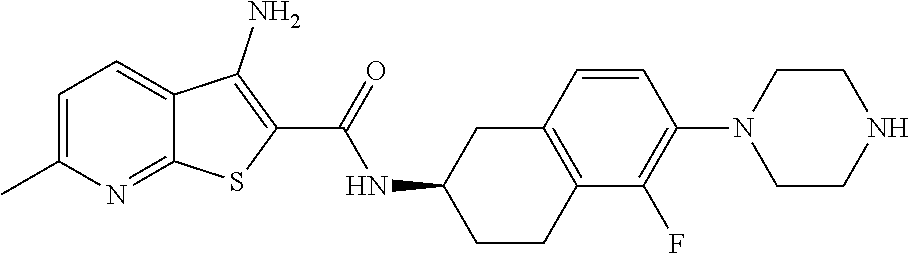 |
440 | (CD3OD, 400 MHz) δ (ppm): 8.19 (d, J = 8.3 Hz, 1H), 7.38-7.29 (m, 1H), 6.94-6.78 (m, 2H), 4.32-4.19 (m, 1H), 3.09-2.94 (m, 10H), 2.85-2.70 (m, 2H), 2.64 (s, 3H), 2.25-2.13 (m, 1H), 1.82-1.75 (m, 1H). |
| 21-61 |  |
440 | (CD3OD, 400 MHz) δ (ppm): 8.19 (d, J = 8.3 Hz, 1H), 7.35-7.28 (m, 1H), 6.90-6.80 (m, 2H), 4.33-4.19 (m, 1H), 3.00 (s, 10H), 2.85-2.70 (m, 2H), 2.64 (s, 3H), 2.19-2.08 (m, 1H), 1.83-1.75 (m, 1H). |
| 21-71 | 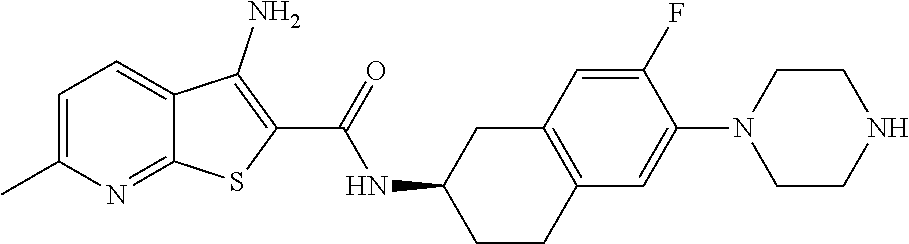 |
440 | (CD3OD, 400 MHz) δ (ppm): 8.19 (d, J = 8.3 Hz, 1H), 7.35-7.28 (m, 1H), 6.82-6.73 (m, 2H), 4.29-4.18 (m, 1H), 3.04-2.93 (m, 9H), 2.94-2.85 (m, 2H), 2.85-2.67 (m, 1H), 2.64 (s, 3H), 2.18- 2.09 (m, 1H), 1.88-1.74 (m, 1H). |
| 21-81 |  |
440 | (CD3OD, 400 MHz) δ (ppm): 8.19 (d, J = 8.3 Hz, 1H), 7.35-7.28 (m, 1H), 6.90-6.80 (m, 2H), 4.33-4.19 (m, 1H), 3.00 (s, 10H), 2.85-2.70 (m, 2H), 2.64 (s, 3H), 2.19-2.08 (m, 1H), 1.83-1.75 (m, 1H). |
| 21-92 |  |
441 | (DMSO-d6, 400 MHz) δ (ppm): 8.64 (s, 1H), 7.81 (d, J = 7.7 Hz, 1H), 6.78-6.94 (m, 3H), 6.71 (d, J = 9.0 Hz, 1H), 4.12 (s, 1H), 2.6-2.96 (m, 16H), 1.98 (d, J = 12.1 Hz, 1H), 1.67-1.82 (m, 1H). |
| 21-102 |  |
441 | (DMSO-d6, 400 MHz) δ (ppm): 8.63 (s, 1H), 7.82 (d, 1H), 6.90 (s, 2H), 6.83 (d, 1H), 6.71 (d, 1H), 4.11 (s, 1H), 2.75-2.88 (m, 13H), 2.63 (s, 3H), 1.69-2.01 (m, 2H). |
| 21-112 |  |
441 | (DMSO-d6, 400 MHz) δ (ppm): 8.63 (s, 1H), 7.82 (d, J = 7.7 Hz, 1H), 6.91 (s, 2H), 6.82 (d, J = 8.2 Hz, 2H), 4.11 (s, 1H), 2.88 (s, 10H), 2.66-2.83 (m, 1H), 2.63 (s, 5H), 2.01 (s, 1H), 1.70- 1.72 (m, 1H). |
| 21-122 |  |
441 | (DMSO-d6, 400 MHz) δ (ppm): 8.64 (s, 1H), 7.82 (d, J = 7.7 Hz, 1H), 6.77-6.91 (m, 4H), 4.10 (br s, 1H), 2.64-2.95 (m, 16H), 2.63 (s, 5H), 2.01 (br s, 1H), 1.65-1.81 (m, 1H). |
| 1Notes on procedures: | |||
| The mixture of regioisomers and enantiomers were partially separated by chiral HPLC using the chiral column Chiralpak-AD-H-SL002 and mobile phase 50% EtOH/hexanes to provide the precursor to Example 21-7 as the first eluted sample, the precursor to Example 21-8 as the second eluted sample, and a mixture of two peaks as the third eluted sample. The mixture was further separated by chiral HPLC using the chiral column Chiralpak-IC and mobile phase 30% IPA/MTBE to provide the precursor to Example 21-5 as the first eluted sample and the precursor to Example 21-6 as the second eluted sample. Stereochemistry of the separated enantiomers were arbitrarily assigned. | |||
| 2Notes on procedures: | |||
| The mixture of regioisomers and enantiomers were partially separated by chiral HPLC using the chiral column Chiralpak-IA and mobile phase EtOH to provide the precursor to Example 21-9 as the first eluted sample, a mixture of two peaks as the second eluted sample, and the precursor to Example 21-12 as the third eluted sample. The mixture was further separated by chiral HPLC using the chiral column (R,R)-Whelk-O1-Kromasil and mobile phase 10% EtOH/MTBE to provide the precursor to Example 21-10 as the first eluted sample and the precursor to Example 21-11 as the second eluted sample. Stereochemistry of the separated enantiomers were arbitrarily assigned. | |||

To a solution of tert-butyl 4-(6-(benzyloxycarbonylamino)-4-fluoro-5,6,7,8-tetrahydronaphthalen-2-yl)piperazine-1-carboxylate (3.00 g, 6.20 mmol) in 1:1 DCM/MeOH (100 mL) was added Selectfluor (2.20 g, 6.20 mmol) at 0° C. The resulting solution was stirred overnight at 20° C. Two additional portions of Selectfluor (1.1 g, 3.1 mmol) were added at 0° C. and stirred for 4 h at 20° C. The reaction mixture was then poured into 80 mL of water. The resulting mixture was extracted with 3×100 mL of DCM. The organic layers were combined, dried over anhydrous sodium sulfate, filtered and concentrated under vacuum. The residue was purified by silica gel chromatography (eluting with 3:1 pet. ether/ethyl acetate) to afford tert-butyl 4-(6-(benzyloxycarbonylamino)-1,4-difluoro-5,6,7,8-tetrahydronaphthalen-2-yl)piperazine-1-carboxylate as a light yellow solid. MS: (ESI, m/z): 502 [M+H]+.
A solution of tert-butyl 4-(6-(benzyloxycarbonylamino)-1,4-difluoro-5,6,7,8-tetrahydronaphthalen-2-yl)piperazine-1-carboxylate (530 mg, 1.06 mmol) and palladium on carbon (100 mg, 10%) in ethyl acetate (10 mL) was stirred for 2 h at 20° C. under a hydrogen atmosphere. The solids were filtered out. The filtrate was concentrated under vacuum to afford tert-butyl 4-(6-amino-1,4-difluoro-5,6,7,8-tetrahydronaphthalen-2-yl)piperazine-1-carboxylate as a yellow solid. MS: (ESI, m/z): 368 [M+H]+.
A solution of tert-butyl 4-(6-amino-1,4-difluoro-5,6,7,8-tetrahydronaphthalen-2-yl)piperazine-1-carboxylate (360 mg, 0.74 mmol, 75% purity), 3-amino-6-methylthieno[2,3-b]pyridine-2-carboxylic acid (188 mg, 0.90 mmol), HBTU (343 mg, 0.90 mmol), and Et3N (0.31 mL, 2.26 mmol) in DMA (5 mL) was stirred for 30 min at 20° C. The crude product was purified by reverse phase chromatpgraphy (Column: C18 silica gel; Mobile phase A: water (0.05% formic acid), B: ACN (0% ACN up to 80% in 30 min)). The collected fraction was concentrated under vacuum to afford tert-butyl 4-(6-(3-amino-6-methylthieno[2,3-b]pyridine-2-carboxamido)-1,4-difluoro-5,6,7,8-tetrahydronaphthalen-2-yl)piperazine-1-carboxylate as a yellow solid. MS: (ESI, m/z): 558 [M+H]+.
The racemate tert-butyl 4-(6-(3-amino-6-methylthieno[2,3-b]pyridine-2-carboxamido)-1,4-difluoro-5,6,7,8-tetrahydronaphthalen-2-yl)piperazine-1-carboxylate (250 mg) was separated by chiral HPLC (Column: ChiralArt Cellulose-SB, 2×25 cm, 5 μm; Mobile Phase: 30% EtOH/hexanes for 13 min). The first eluting isomer (RT=9.05 min) was concentrated under vacuum to afford (S)-tert-butyl 4-(6-(3-amino-6-methylthieno[2,3-b]pyridine-2-carboxamido)-1,4-difluoro-5,6,7,8-tetrahydronaphthalen-2-yl)piperazine-1-carboxylate as a yellow solid (stereochemistry arbitrarily assigned). The second eluting isomer (RT=10.15 min) was concentrated under vacuum to afford (R)-tert-butyl 4-(6-(3-amino-6-methylthieno[2,3-b]pyridine-2-carboxamido)-1,4-difluoro-5,6,7,8-tetrahydr-onaphthalen-2-yl)piperazine-1-carboxylate as a yellow solid (stereochemistry arbitrarily assigned). MS for both isomers: (ESI, m/z): 558 [M+H]+.
A solution of (S)-tert-butyl 4-(6-(3-amino-6-methylthieno[2,3-b]pyridine-2-carboxamido)-1,4-difluoro-5,6,7,8-tetrahydronaphthalen-2-yl)piperazine-1-carboxylate (60 mg, 0.11 mmol) and trifluoroacetic acid (1 mL) in DCM (3 mL) was stirred for 1 h at 20° C. The resulting mixture was concentrated under vacuum. The residue was purified by prep-HPLC (Column:)(Bridge Prep OBD C18, 30×150 mm, 5 μm; Mobile phase A: water (0.05% NH4OH), B: ACN (15% ACN up to 50% in 7 min)). The collected fraction was lyophilized to afford (S)-3-amino-N-(5,8-difluoro-6-(piperazin-1-yl)-1,2,3,4-tetrahydronaphthalen-2-yl)-6-methylthieno[2,3-b]pyridine-2-carboxamide as an off-white solid. 1H NMR (CD3OD, 300 MHz) δ (ppm): 8.17 (d, J=8.1 Hz, 1H), 7.30 (d, J=8.4 Hz, 1H), 6.67-6.65 (m, 1H), 4.25-4.17 (m, 1H), 3.14-2.97 (m, 10H), 2.82-2.70 (m, 1H), 2.64-2.54 (m, 4H), 1.89-1.74 (m, 1H). MS: (ESI, m/z): 458 [M+H]+.
A solution of (R)-tert-butyl 4-(6-(3-amino-6-methylthieno[2,3-b]pyridine-2-carboxamido)-1,4-difluoro-5,6,7,8-tetrahydronaphthalen-2-yl)piperazine-1-carboxylate (90 mg, 0.16 mmol) and trifluoroacetic acid (1.5 mL) in DCM (4 mL) was stirred for 1 h at 20° C. The resulting mixture was concentrated under vacuum. The residue was purified by prep-HPLC (Column,)(Bridge Prep OBD C18, 30×150 mm, 5 μm; mobile phase A: water (0.05% NH4OH), B: ACN (15% ACN up to 50% in 7 min)). The collected fraction was lyophilized to afford (R)-3-amino-N-(5,8-difluoro-6-(piperazin-1-yl)-1,2,3,4-tetrahydronaphthalen-2-yl)-6-methylthieno[2,3-b]pyridine-2-carboxamide as an off-white solid. 1H NMR (DMSO-d6, 300 MHz) δ (ppm): 8.31 (d, J=8.4 Hz, 1H), 7.64 (d, J=7.5 Hz, 1H), 7.31 (d, J=8.1 Hz, 1H), 7.17 (s, 2H), 6.70-6.68 (m, 1H), 4.13-4.04 (m, 1H), 2.92-2.81 (m, 10H), 2.73-2.55 (m, 5H), 2.06-1.97 (m, 1H), 1.78-1.68 (m, 1H). MS: (ESI, m/z): 458 [M+H]+.
The following examples in Table 20 were prepared using standard chemical manipulations and procedures similar to those used for the preparation of Examples 22-1 and 22-2.
| TABLE 20 | |||
| LRMS | |||
| Example | m/z | ||
| Number | Structure and Compound Name | [M + H]+ | 1H NMR |
| 22-31 |  |
500 | (DMSO-d6, 300 MHz) δ (ppm): 8.31 (d, J = 8.4 Hz, 1H), 7.66 (br s, 1H), 7.31 (d, J = 8.4 Hz, 1H), 7.18 (br s, 2H), 6.78-6.75 (m, 1H), 4.20-4.00 (m, 1H), 3.75-3.65 (m, 2H), 3.48-3.38 (m, 2H), 3.27-3.08 (m, 4H), 3.01-2.82 (m, 4H), 2.80-2.60 (m, 2H), 2.58 (s, 3H), 2.10-1.97 (m, 1H), 1.88-1.62 (m, 1H). |
| 22-41 |  |
500 | (DMSO-d6, 300 MHz) δ (ppm): 8.31 (d, J = 8.1 Hz, 1H), 7.66 (br s, 1H), 7.31 (d, J = 8.4 Hz, 1H), 7.18 (br s, 2H), 6.78-6.75 (m, 1H), 4.20-4.00 (m, 1H), 3.75-3.65 (m, 2H), 3.48-3.38 (m, 2H), 3.27-3.08 (m, 4H), 3.01-2.82 (m, 4H), 2.80-2.60 (m, 2H), 2.58 (s, 3H), 2.10-1.98 (m, 1H), 1.88-1.62 (m, 1H). |
| 22-52 |  |
484 | (DMSO-d6, 300 MHz) δ (ppm): 8.30 (d, J = 8.4 Hz, 1H), 7.63 (d, J = 7.6 Hz, 1H), 7.31 (d, J = 8.0 Hz, 1H), 7.17 (br s, 2H), 6.61-6.57 (m, 1H), 4.09-4.07 (m, 1H), 3.40-3.98 (m, 2H), 3.08-3.03 (m, 2H), 2.95-2.62 (m, 5H), 2.59-2.57 (m, 4H), 2.37-2.30 (m, 1H), 2.02-1.99 (m, 1H), 1.80-1.61 (m, 5H). |
| 22-62 |  |
484 | (DMSO-d6, 300 MHz) δ (ppm): 8.31 (d, J = 8.4 Hz, 1H), 7.64 (d, J = 8.0 Hz, 1H), 7.31 (d, J = 8.0 Hz, 1H), 7.17 (br s, 2H), 6.61-6.57 (m, 1H), 4.14-4.05 (m, 1H), 3.40-3.98 (m, 2H), 3.09-3.02 (m, 2H), 2.96-2.87 (m, 2H), 2.81-2.75 (m, 2H), 2.70-2.61 (m, 1H), 2.59-2.57 (m, 4H), 2.34-2.32 (m, 1H), 2.04-1.97 (m, 1H), 1.81-1.77 (m, 2H), 1.76-1.68 (m, 1H), 1.67-1.61 (m, 2H). |
| 1Notes on procedures: | |||
| In Step 4, the stereoisomers were separated by chiral HPLC using the chiral column Chiralpak IG and mobile phase 15% EtOH/MTBE. Stereochemistry of the separated enantiomers were arbitrarily assigned. | |||
| 2Notes on procedures: | |||
| In Step 4, the stereoisomers were separated by chiral HPLC using the chiral column Chiral Art Cellulose-SB and mobile phase 10% EtOH/MTBE. Stereochemistry of the separated enantiomers were arbitrarily assigned. | |||

A mixture of benzyl N-[(6S)-2-(trifluoromethanesulfonyloxy)-5,6,7,8-tetrahydroquinolin-6-yl]carbamate (Intermediate 47-2) (500 mg, 1.16 mmol), tert-butyl N-[(3S,4S)-4-methoxypyrrolidin-3-yl]carbamate (300 mg, 1.39 mmol), RuPhos Pd G3 (195 mg, 0.230 mmol), RuPhos (108 mg, 0.230 mmol), and Cs2CO3 (1.14 g, 3.49 mmol) in toluene (10 mL) was stirred for 3 h at 95° C. After cooling to 20° C., the solids were filtered out and the filtrate was concentrated under vacuum. The residue was purified by silica gel chromatography (eluting with 5:2 pet. ether/ethyl acetate) to give benzyl N-[(6S)-2-[(3S,4S)-3-[[(tert-butoxy)carbonyl]amino]-4-methoxypyrrolidin-1-yl]-5,6,7,8-tetrahydroquinolin-6-yl]carbamate as a brown solid. MS (ESI, m/z): 497 [M+H]+.
A mixture of benzyl N-[(6S)-2-[(3S,4S)-3-[[(tert-butoxy)carbonyl]amino]-4-methoxypyrrolidin-1-yl]-5,6,7,8-tetrahydroquinolin-6-yl]carbamate (450 mg, 0.910 mmol) and Palladium on carbon (450 mg, 10%) in ethyl acetate (10 mL) was stirred for 3 h at 20° C. under a hydrogen atmosphere (balloon). The solids were filtered out. The filtrate was concentrated under vacuum to give tert-butyl N-[(3S,4S)-1-[(6S)-6-amino-5,6,7,8-tetrahydroquinolin-2-yl]-4-methoxypyrrolidin-3-yl]carbamate as a white solid. MS (ESI, m/z): 362 [M+H]+.
Triethylamine (0.400 mL, 2.92 mmol) and HBTU (377 mg, 0.990 mmol) were added to a stirring solution of tert-butyl N-[(3S,4S)-1-(6-amino-5,6,7,8-tetrahydroquinolin-2-yl)-4-methoxypyrrolidin-3-yl]carbamate (300 mg, 0.830 mmol) and 7-amino-3-methylthieno[2,3-b]pyrazine-6-carboxylic acid (174 mg, 0.830 mmol) in DMA (5 mL). The resulting solution was stirred for 2 h at 20° C. The mixture was purified by reversed phase chromatography (Column: C18 silica gel; Mobile phase, A: water (10 mM NH4HCO3) and B: ACN (0% to 70% B over 30 min)). The collected fraction was concentrated under vacuum to give tert-butyl N-[(3S,4S)-1-(6-[7-amino-3-methylthieno[2,3-1)]pyrazine-6-amido]-5,6,7,8-tetrahydroquinolin-2-yl)-4-methoxypyrrolidin-3-yl]carbamate as a green solid. MS (ESI, m/z): 554 [M+H]+.
A solution of tert-butyl N-[(3S,4S)-1-[(6S)-6-[7-amino-3-methylthieno[2,3-b]pyrazine-6-amido]-5,6,7,8-tetrahydroquinolin-2-yl]-4-methoxypyrrolidin-3-yl]carbamate (300 mg, 0.470 mmol) and TFA (3 mL) in DCM (10 mL) was stirred for 30 min at 20° C. and then concentrated under vacuum. The residue was treated with a solution of NH3 in MeOH (15 mL, 7M) for 1 h at 20° C. The resulting solution was concentrated under vacuum. The residue was purified by prep-HPLC (Column: XBridge Prep C18 OBD, 19×150 mm 5 μm; Mobile Phase, A: water (containing 10 mM NH4HCO3) and B: ACN (20% to 42% B over 7 min)) to afford 7-amino-N-[(6S)-2-[(3S,4S)-3-amino-4-methoxypyrrolidin-1-yl]-5,6,7,8-tetrahydroquinolin-6-yl]-3-methylthieno[2,3-b]pyrazine-6-carboxamide as a yellow solid. MS (ESI, m/z): 454 [M+H]+. 1H NMR (DMSO-d6, 400 MHz) δ (ppm): 8.65 (s, 1H), 7.81 (d, J=7.6 Hz, 1H), 7.20 (d, J=8.8 Hz, 1H), 6.92 (br s, 2H), 6.23 (d, J=8.4 Hz, 1H), 4.28-4.12 (m, 1H), 3.62-3.59 (m, 2H), 3.48-3.41 (m, 2H), 3.36-3.33 (m, 4H), 3.14-3.12 (m, 1H), 2.84-2.73 (m, 4H), 2.66 (s, 3H), 2.05-2.00 (m, 1H), 1.90-1.83 (m, 1H), 1.79 (br s, 2H).

7-Amino-N-[(6S)-2-[(3S,4S)-3-amino-4-methoxypyrrolidin-1-yl]-5,6,7,8-tetrahydroquinolin-6-yl]-3-methylthieno[2,3-b]pyrazine-6-carboxamide was also obtained starting from the racemate benzyl N-[2-(trifluoromethanesulfonyloxy)-5,6,7,8-tetrahydroquinolin-6-yl]carbamate (Intermediate 47-1) and following procedures similar to Method 1. The enantiomers of the racemate 7-amino-N-[2-[(3S,4S)-3-amino-4-methoxypyrrolidin-1-yl]-5,6,7,8-tetrahydroquinolin-6-yl]-3-methylthieno[2,3-b]pyrazine-6-carboxamide were separated by chiral HPLC using the chiral column Chiralpak IE and the eluent system 50% EtOH/MTBE (containing 2 mM NH3 in MeOH) to provide 7-amino-N-[(6S)-2-[(3S,4S)-3-amino-4-methoxypyrrolidin-1-yl]-5,6,7,8-tetrahydroquinolin-6-yl]-3-methylthieno[2,3-b]pyrazine-6-carboxamide as a yellow solid as the first eluted isomer and 7-amino-N-[(6R)-2-[(3S,4S)-3-amino-4-methoxypyrrolidin-1-yl]-5,6,7,8-tetrahydroquinolin-6-yl]-3-methylthieno[2,3-b]pyrazine-6-carboxamide as a yellow solid as the second eluted isomer. 1H NMR (DMSO-d6, 400 MHz) δ (ppm): 8.65 (s, 1H), 7.83 (d, J=7.6 Hz, 1H), 7.20 (d, J=8.4 Hz, 1H), 6.93 (br, 2H), 6.24 (d, J=8.8 Hz, 1H), 4.20-4.11 (m, 1H), 3.63-3.56 (m, 2H), 3.47-3.44 (m, 2H), 3.33 (s, 3H), 3.15-3.13 (m, 1H), 2.84-2.73 (m, 4H), 2.65 (s, 3H), 2.05-1.98 (m, 1H), 1.91-1.83 (m, 2H). MS (ESI, m/z): 454 [M+H]+.
The following examples in Table 21 were prepared using standard chemical manipulations and procedures similar to Method 1 (or Method 2 where indicated) for the preparation of Example 23-1.
| TABLE 21 | |||
| LRMS | |||
| Example | m/z | ||
| Number | Structure and Compound Name | [M + H]+ | 1H NMR |
| 23-31 |  |
467 | (DMSO-d6, 400 MHz) δ (ppm): 7.59 (d, J = 7.6 Hz, 1H), 7.19 (d, J = 8.4 Hz, 1H), 7.04 (s, 1H), 6.81 (br s, 2H), 6.23 (d, J = 8.4 Hz, 1H), 4.08-4.15 (m, 1H), 3.61-3.63 (m, 2H), 3.43-3.33 (m, 3H), 3.30 (s, 3H), 3.13-3.11 (m, 1H), 2.81-2.69 (m, 7H), 2.58 (s, 3H), 1.99-1.72 (m, 3H). |
| 23-42 |  |
453 | (DMSO-d6, 400 MHz) δ (ppm): 8.31 (d, J = 8.4 Hz, 1H), 7.58 (d, J = 7.6 Hz, 1H), 7.31 (d, J = 8.4 Hz, 1H), 7.20-7.17 (m, 3H), 6.23 (d, J = 8.4 Hz, 1H), 4.16-4.07 (m, 1H), 3.62-3.58 (m, 2H), 3.47-3.41 (m, 2H), 3.29 (s, 3H), 3.12 (d, J = 8.4 Hz, 1H), 2.82- 2.68 (m, 4H), 2.59 (s, 3H), 2.01-1.98 (m, 1H), 1.82-1.74 (m, 2H). |
| 23-52 |  |
453 | (DMSO-d6, 400 MHz) δ (ppm): 8.30 (d, J = 8.0 Hz, 1H), 7.60 (d, J = 8.0 Hz, 1H), 7.31 (d, J = 8.0 Hz, 1H), 7.20-7.18 (m, 3H), 6.22 (d, J = 8.4 Hz, 1H), 4.14-4.07 (m, 1H), 3.61-3.57 (m, 2H), 3.44-3.42 (m, 2H), 3.29 (s, 3H), 3.13 (d, J = 8.0 Hz, 1H), 2.81- 2.68 (m, 4H), 2.58 (s, 3H), 2.01-1.98 (m, 1H), 1.82-1.74 (m, 2H). |
| 23-6 |  |
424 | (DMSO-d6, 400 MHz) δ (ppm): 8.65 (s, 1H), 7.83 (d, J = 8.0 Hz, 1H), 7.24 (d, J = 8.4 Hz, 1H), 6.92 (br s, 2H), 6.63-6.57 (m, 1H), 4.18-4.14 (m, 1H), 3.41-3.33 (m, 3H), 2.86-2.70 (m, 9H), 2.56 (s, 3H), 2.04-2.01 (m, 1H), 1.92- 1.82 (m, 1H). |
| 23-73 |  |
423 | (DMSO-d6, 300 MHz) δ (ppm): 8.31 (d, J = 8.0 Hz, 1H) 7.59 (d, J = 8.0 Hz, 1H), 7.31 (d, J = 8.4 Hz, 1H), 7.23 (d, J = 8.4 Hz, 1H), 7.17 (br s, 2H), 6.58 (d, J = 8.4 Hz, 1H), 4.18- 4.16 (m, 1H), 3.34-3.32 (m, 4H), 2.94-2.68 (m, 8H), 2.58 (s, 3H), 2.08- 1.90 (m, 1H), 1.88-1.80 (m, 1H). |
| 23-83 |  |
423 | (DMSO-d6, 300 MHz) δ (ppm): 8.31 (d, J = 8.0 Hz, 1H) 7.59 (d, J = 8.0 Hz, 1H), 7.31 (d, J = 8.4 Hz, 1H), 7.23 (d, J = 8.4 Hz, 1H), 7.17 (br s, 2H), 6.58 (d, J = 8.4 Hz, 1H), 4.18- 4.16 (m, 1H), 3.34-3.32 (m, 4H), 2.94-2.68 (m, 8H), 2.58 (s, 3H), 2.08- 1.90 (m, 1H), 1.88-1.80 (m, 1H). |
| 23-94 |  |
429 | (DMSO-d6, 400 MHz) δ (ppm): 7.59 (d, J = 7.6 Hz, 1H), 7.23 (d, J = 8.4 Hz, 1H), 7.08 (br s, 2H), 6.58 (d, J = 8.4 Hz, 1H), 4.13-4.07 (m, 1H), 3.41- 3.32 (m, 4H), 2.79-2.68 (m, 11H), 2.00-1.97 (m, 1H), 1.86-1.80 (m, 1H). |
| 23-10 |  |
435 | (DMSO-d6, 400 MHz) δ (ppm): 8.31 (d, J = 8.4 Hz, 1H), 7.58 (d, J = 7.6 Hz, 1H), 7.31 (d, J = 8.4 Hz, 1H), 7.25 (d, J = 8.4 Hz, 1H), 7.16 (br s, 2H), 6.40 (d, J = 8.4 Hz, 1H), 4.18- 4.12 (m, 1H), 3.67-3.66 (m, 2H), 3.57-3.50 (m, 4H), 3.40-3.33 (m, 2H), 2.83-2.75 (m, 4H), 2.59 (s, 3H), 2.03- 2.00 (m, 1H), 1.89-1.84 (m, 1H), 1.44 (d, J = 8.0 Hz, 1H). |
| 23-11 |  |
436 | (DMSO-d6, 400 MHz) δ (ppm): 8.65 (s, 1H), 7.83 (d, J = 8.0 Hz, 1H), 7.26 (d, J = 8.4 Hz, 1H), 6.92 (br s, 2H), 6.40 (d, J = 9.2 Hz, 1H), 4.19-4.16 (m, 1H), 3.68-3.66 (m, 2H), 3.60-3.51 (m, 4H), 3.33-3.20 (m, 2H), 2.83-2.76 (m, 4H), 2.66 (s, 3H), 2.05-2.02 (m, 1H), 1.90-1.87 (m, 1H), 1.44 (d, J = 8.8 Hz, 1H). |
| 23-12 |  |
449 | (DMSO-d6, 400 MHz) δ (ppm): 8.31 (d, J = 8.8 Hz, 1H), 7.56 (d, J = 7.2 Hz, 1H), 7.31 (d, J = 8.4 Hz, 1H), 7.22-7.15 (m, 3H), 6.45 (d, J = 8.8 Hz, 1H), 4.14 (br s, 1H), 3.77-3.75 (m, 2H), 3.47 (s, 2H), 2.82-2.68 (m, 6H), 2.59 (s, 3H), 2.02-1.83 (m, 2H), 1.63-1.54 (m, 4H). |
| 23-13 |  |
450 | (DMSO-d6, 300 MHz) δ (ppm): 8.65 (s, 1H), 7.82 (d, J = 7.6 Hz, 1H), 7.42 (d, J = 8.4 Hz, 1H), 6.93 (br s, 2H), 6.47-6.42 (m, 1H), 4.16 (br s, 1H), 3.77-3.73 (m, 2H), 2.85-2.66 (m, 6H), 2.58 (s, 3H), 2.41 (s, 1H), 2.03-1.81 (m, 2H), 1.67-1.54 (m, 4H). |
| 23-141 |  |
437 | (DMSO-d6, 400 MHz) δ (ppm): 7.61 (d, J = 8.0 Hz, 1H), 7.24 (d, J = 8.8 Hz, 1H), 7.14 (s, 1H), 6.82 (br, 2H), 6.58 (d, J = 8.8 Hz, 1H), 4.16-4.14 (m, 1H), 3.41-3.33 (m, 6H), 2.82-2.73 (m, 12H), 2.00-1.99 (m,1H), 1.88- 1.83 (m, 1H). |
| 23-155 |  |
437 | (DMSO-d6, 400 MHz) δ (ppm): 8.31 (d, J = 8.0 Hz, 1H), 7.58 (d, J = 7.6 Hz, 1H), 7.32 (d, J = 8.4 Hz, 1H), 7.23 (d, J = 8.8 Hz, 1H), 7.16 (br s, 2H), 6.59 (d, J = 8.4 Hz, 1H), 4.14- 4.00 (m, 3H), 2.94-2.91 (m, 1H), 2.84-2.65 (m, 6H), 2.63-2.60 (m, 4H), 2.26-2.20 (m, 1H), 1.99-2.03 (m, 2H), 1.91-1.83 (m, 1H), 1.03-1.01 (d, J = 8.0 Hz, 1H). |
| 23-166 |  |
437 | (DMSO-d6, 400 MHz) δ (ppm): 8.31 (d, J = 8.4 Hz, 1H), 7.57 (d, J = 8.0 Hz, 1H), 7.31 (d, J = 8.4 Hz, 1H), 7.23 (d, J = 8.4 Hz, 1H), 7.16 (br s, 2H), 6.59 (d, J = 8.0 Hz, 1H), 4.13- 4.00 (m, 3H), 2.94-2.61 (m, 7H), 2.59 (s, 3H), 2.26-2.20 (m, 2H), 1.99-1.83 (m, 2H), 1.02 (d, J = 6.4 Hz, 3H). |
| 23-177 |  |
441 | (DMSO-d6, 400 MHz) δ (ppm): 8.31 (d, J = 8.0 Hz, 1H), 7.63 (d, J = 7.2 Hz, 1H), 7.31 (d, J = 8.4 Hz, 1H), 7.17 (br s, 2H), 6.48 (d, J = 12.8 Hz, 1H), 4.22-4.12 (m, 1H), 3.36-3.20 (m, 4H), 2.90-2.84 (m, 1H), 2.82-2.75 (m, 6H), 2.59-2.54 (m, 4H), 2.04-1.98 (m, 1H), 1.92-1.83 (m, 1H). |
| 23-188 |  |
467 | (DMSO-d6, 400 MHz) δ (ppm): 8.31 (d, J = 8.4 Hz, 1H), 7.63 (d, J = 7.9 Hz, 1H), 7.31 (d, J = 8.4 Hz, 1H), 7.17 (br s, 2H), 6.33 (d, J = 12.6 Hz, 1H), 4.16-4.14 (m, 1H), 3.76-3.73 (m, 2H), 3.48-3.46 (m, 2H), 2.89-2.74 (m, 5H), 2.59-2.53 (m, 4H), 1.98-1.83 (m, 2H), 1.75-1.63 (m, 4 H). |
| 1Notes on procedures: | |||
| In Step 3, the carboxylic acid Intermediate 21 was used. | |||
| 2Notes on procedures: | |||
| Following Method 2, the stereoisomers were separated by chiral HPLC using the chiral column Chiralpak IE and the eluent gradient 30% to 35% EtOH/MTBE (containing 2 mM NH3 in MeOH). | |||
| 3Notes on procedures: | |||
| Following Method 2, the stereoisomers were separated by chiral HPLC using the chiral column Chiralpak ID-3 and mobile phase 30% EtOH/(hexanes:DCM = 3:1, containing 0.1% DIEA). | |||
| 4Notes on procedures: | |||
| In Step 3, the carboxylic acid Intermediate 24 was used. | |||
| 5Notes on procedures: | |||
| In Step 1, tert-butyl (2S)-2-methylpiperazine-1-carboxylate was used. | |||
| 6Notes on procedures: | |||
| In Step 1, tert-butyl (2R)-2-methylpiperazine-1-carboxylate was used. | |||
| 7Notes on procedures: | |||
| Skipping Step 1 and Step 2, the amine Intermediate 52-1 was used in Step 3. | |||
| 8Notes on procedures: | |||
| Skipping Step 1 and Step 2, the amine Intermediate 52-2 was used in Step 3. | |||

A mixture of benzyl N-[(6S)-2-(trifluoromethanesulfonyloxy)-5,6,7,8-tetrahydroquinolin-6-yl]carbamate (Intermediate 47-2) (800 mg, 1.85 mmol), tert-butyl N-[(3R,4R)-4-(methoxymethyl)pyrrolidin-3-yl]carbamate (Intermediate 48-2) (513 mg, 2.23 mmol), RuPhos Pd G3 (155 mg, 0.186 mmol), RuPhos (86.7 mg, 0.186 mmol) and Cs2CO3 (1.21 g, 3.71 mmol) in toluene (10 mL) was stirred for 3 h at 90° C. After cooling to 25° C., the solids were filtered out. The filtrate was concentrated under vacuum. The residue was purified by silica gel chromatography (eluting with 1:2 ethyl acetate/pet. ether) to afford benzyl N-[(6S)-2-[(3R,4R)-3-[[tert-butoxy)carbonyl]amino]-4-(methoxymethyl)pyrrolidin-1-yl]-5,6,7,8-tetrahydroquinolin-6-yl]carbamate as a white solid. MS (ESI, m/z): 511 [M+H]+.
A mixture of benzyl N-[(6S)-2-[(3R,4R)-3-[[(tert-butoxy)carbonyl]amino]-4-(methoxymethyl)pyrrolidin-1-yl]-5,6,7,8-tetrahydroquinolin-6-yl]carbamate (550 mg, 1.07 mmol) and palladium on carbon (80 mg, 10%) in ethyl acetate (5 mL) was stirred for 1 h at 25° C. under a hydrogen atmosphere (balloon). The solids were filtered out. The filtrate was concentrated under vacuum to give tert-butyl N-[1-[(6S)-6-amino-5,6,7,8-tetrahydroquinolin-2-yl]-4-(methoxymethyl)pyrrolidin-3-yl]carbamate as a white solid (crude). MS (ESI, m/z): 377 [M+H]+.
Et3N (0.50 mL, 3.58 mmol) and HBTU (453 mg, 1.19 mmol) were added to a stirring solution of tert-butyl N-[(3R,4R)-1-[(6S)-6-amino-5,6,7,8-tetrahydroquinolin-2-yl]-4-(methoxymethyl)pyrrolidin-3-yl]carbamate (450 mg, 1.19 mmol) and 3-amino-6-methylthieno[2,3-b]pyridine-2-carboxylic acid (248 mg, 1.19 mmol) in DMA (4 mL). The resulting solution was stirred for 2 h at 25° C. The mixture was purified by reverse phase chromatography (Column: C18 silica gel; Mobile phase, A: water (containing 0.05% TFA) and B: ACN (15% to 90% over 25 min)). The collected fraction was concentrated under vacuum to give tert-butyl N-[(3R,4R)-1-[(6S)-6-[3-amino-6-methylthieno[2,3-b]pyridine-2-amido]-5,6,7,8-tetrahydroquinolin-2-yl]-4-(methoxymethyl)pyrrolidin-3-yl]carbamate as a yellow solid. MS (ESI, m/z): 567 [M+H]+.
A solution of tert-butyl N-[(3R,4R)-1-[(65)-6-[3-amino-6-methylthieno[2,3-b]pyridine-2-amido]-5,6,7,8-tetrahydroquinolin-2-yl]-4-(methoxymethyl)pyrrolidin-3-yl]carbamate (450 mg, 0.794 mmol) and TFA (3 mL) in DCM (12 mL) was stirred for 1 h at 25° C. The mixture was concentrated under vacuum. The residue was treated with a solution of NH3 in MeOH (2 mL, 7M). The resulting mixture was stirred for 10 min and concentrated under vacuum. The residue was purified by prep-HPLC (Column: XBridge Shield RP18 OBD, 30×150 mm, 5 μm; Mobile Phase A: water (10 mM NH4HCO3) and B: ACN (27% to 37% over 7 min); Flow rate: 60 mL/min). The collected fraction was lyophilized to give 3-amino-N-[(6S)-2-[(3R,4R)-3-amino-4-(methoxymethyl)pyrrolidin-1-yl]-5,6,7,8-tetrahydroquinolin-6-yl]-6-methylthieno[2,3-b]pyridine-2-carboxamide as a white solid. MS (ESI, m/z): 467 [M+H]+. 1H NMR (DMSO-d6, 400 MHz) δ (ppm): 8.31 (d, J=8.0 Hz, 1H), 7.59 (d, J=8.0 Hz, 1H), 7.31 (d, J=8.4 Hz, 1H), 7.19-7.17 (m, 3H), 6.20 (d, J=8.4 Hz, 1H), 4.15-4.08 (m, 1H), 3.61-3.51 (m, 2H), 3.52-3.35 (m, 3H), 3.29 (s, 3H), 3.25-3.15 (m, 2H), 2.81-2.64 (m, 4H), 2.60 (s, 3H), 2.49-2.38 (m, 1H), 2.09-1.98 (m, 1H), 1.91-1.80 (m, 1H), 1.61 (br s, 2H).

3-Amino-N-[(6S)-2-[(3R,4R)-3-amino-4-(methoxymethyl)pyrrolidin-1-yl]-5,6,7,8-tetrahydroquinolin-6-yl]-6-methylthieno[2,3-b]pyridine-2-carboxamide was also obtained starting from the cis racemate tert-butyl N-[4-(methoxymethyl)pyrrolidin-3-yl]carbamate (Intermediate 48-1) and following procedures similar to Method 1. The enantiomers of the cis racemate tert-butyl N-[1-[(6S)-6-[3-amino-6-methylthieno[2,3-b]pyridine-2-amido]-5,6,7,8-tetrahydroquinolin-2-yl]-4-(methoxymethyl)pyrrolidin-3-yl]carbamate (Step 3 product) were separated by chiral HPLC using the chiral column Chiralpak IA and Mobile Phase, 50% A: hexanes:DCM=3:1 and 50% B: EtOH (containing 0.1% Et2NH) to provide tert-butyl N-[(3R,4R)-1-[(6S)-6-[3-amino-6-methylthieno[2,3-b]pyridine-2-amido]-5,6,7,8-tetrahydroquinolin-2-yl]-4-(methoxymethyl)pyrrolidin-3-yl]carbamate as a white solid as the first eluted isomer (RT=9.3 min) and tert-butyl N-[(3S,4S)-1-[(6S)-6-[3-amino-6-methylthieno[2,3-b]pyridine-2-amido]-5,6,7,8-tetrahydroquinolin-2-yl]-4-(methoxymethyl)pyrrolidin-3-yl]carbamate as a white solid as the second eluted isomer (RT=11.3 min).
3-Amino-N-[(6S)-2-[(3S,4S)-3-amino-4-(methoxymethyl)pyrrolidin-1-yl]tetrahydroquinolin-6-yl]-6-methylthieno[2,3-b]pyridine-2-carboxamide was obtained from conversion of tert-butyl N-[(3S,4S)-1-[(6S)-6-[3-amino-6-methylthieno[2,3-b]pyridine-2-amido]-5,6,7,8-tetrahydroquinolin-2-yl]-4-(methoxymethyl)pyrrolidin-3-yl]carbamate following procedures similar to Method 1, Step 4. 1H NMR (DMSO-d6, 400 MHz) δ (ppm): 8.30 (d, J=8.0 Hz, 1H), 7.56 (br s, 1H), 7.31 (d, J=8.4 Hz, 1H), 7.18-7.16 (m, 3H), 6.20 (d, J=8.4 Hz, 1H), 4.18-4.09 (m, 1H), 3.61-3.51 (m, 2H), 3.50-3.39 (m, 3H), 3.28 (s, 3H), 3.21-3.17 (m, 2H), 2.81-2.64 (m, 4H), 2.67 (s, 3H), 2.46-2.40 (m, 1H), 2.09-1.91 (m, 1H), 1.91-1.80 (m, 1H), 1.55 (br s, 2H). MS (ESI, m/z): 467 [M+H]+.

A mixture of benzyl N-[(6S)-2-(trifluoromethanesulfonyloxy)-5,6,7,8-tetrahydroquinolin-6-yl]carbamate (Intermediate 47-2) (480 mg, 1.09 mmol), tert-butyl N-[(3S,4R)-4-(difluoromethyl)pyrrolidin-3-yl]carbamate (Intermediate 51-2) (284 mg, 1.20 mmol), RuPhos (51.0 mg, 0.109 mmol), RuPhos Pd G3 (91.0 mg, 0.109 mmol) and Cs2CO3 (890 mg, 2.73 mmol) in toluene (10 mL) was stirred for 4 h at 95° C. After cooled to 25° C., the solids were filtered out. The filtrate was concentrated under reduced pressure. The residue was purified by silica gel chromatography (eluting with 1:1 ethyl acetate/pet. ether) to afford benzyl N-[(6S)-2-[(3S,4R)-3-[[(tert-butoxy)carbonyl]amino]-4-(difluoromethyl)pyrrolidin-1-yl]-5,6,7,8-tetrahydroquinolin-6-yl]carbamate as a white solid. MS (ESI, m/z): 517 [M+H]+.
A mixture of benzyl N-[(6S)-2-[(3S,4R)-3-[[(tert-butoxy)carbonyl]amino]-4-(difluoromethyl)pyrrolidin-1-yl]-5,6,7,8-tetrahydroquinolin-6-yl]carbamate (350 mg, 0.664 mmol) and Pd/C (350 mg, 10%) in ethyl acetate (10 mL) was stirred 2 h at 25° C. under hydrogen atmosphere. The solids were filtered out and the filter cake was washed with ethyl acetate (3×10 mL). The filtrate was concentrated under reduced pressure to afford tert-butyl N-[(3S,4R)-1-[(6S)-6-amino-5,6,7,8-tetrahydroquinolin-2-yl]-4-(difluoromethyl)pyrrolidin-3-yl]carbamate as a brown solid. MS (ESI, m/z): 383 [M+H]+.
A solution of tert-butyl N-[(3S,4R)-1-[(6S)-6-amino-5,6,7,8-tetrahydroquinolin-2-yl]-4-(difluoromethyl)pyrrolidin-3-yl]carbamate (240 mg, 0.615 mmol), 3-amino-6-methylthieno[2,3-b]pyridine-2-carboxylic acid (141 mg, 0.677 mmol), Et3N (0.260 mL, 1.85 mmol) and HBTU (280 mg, 0.738 mmol) in DMA (5 mL) was stirred for 6 h at 25° C. The mixture was purified by reverse phase chromatography (Column: C18 silica gel; Mobile phase, A: water (containing 0.1% TFA) and B: ACN (0% to 60% in 30 min)) to afford tert-butyl N-[(3S,4R)-1-[(6S)-6-[3-amino-6-methylthieno[2,3-b]pyridine-2-amido]-5,6,7,8-tetrahydroquinolin-2-yl]-4-(difluoromethyl)pyrrolidin-3-yl]carbamate as a yellow solid. MS (ESI, m/z): 573 [M+H]+.
To a stirring solution of tert-butyl N-[(3S,4R)-1-[(6S)-6-[3-amino-6-methylthieno[2,3-b]pyridine-2-amido]-5,6,7,8-tetrahydroquinolin-2-yl]-4-(difluoromethyl)pyrrolidin-3-yl]carbamate (300 mg, 0.513 mmol) in DCM (15 mL) was added TFA (5 mL) dropwise at 0° C. The resulting mixture was stirred for 40 min at 25° C. The resulting mixture was concentrated under vacuum. The resulting mixture was concentrated under vacuum. The residue was treated with NH3 (15 mL, 7 M in MeOH). The solution was stirred for 30 min at 25° C. and concentrated under vacuum. The residue was purified by prep-HPLC (Column: XBridge Prep Phenyl OBD, 19×150 mm, 5 μm; Mobile Phase, A: water (10 mM NR4HCO3) and B: ACN (20% to 37% in 8 min); Flow rate: 60 mL/min). The product fraction was lyophilized to afford 3-amino-N-[(6S)-2-[(3S,4R)-3-amino-4-(difluoromethyl)pyrrolidin-1-yl]-5,6,7,8-tetrahydroquinolin-6-yl]-6-methylthieno[2,3-b]pyridine-2-carboxamide as a white solid. MS (ESI, m/z): 473 [M+H]+. 1H NMR (DMSO-d6, 400 MHz) δ (ppm): 8.31 (d, J=8.0 Hz, 1H), 7.59 (d, J=7.6 Hz, 1H), 7.31 (d, J=8.4 Hz, 1H), 7.21 (d, J=8.4 Hz, 1H), 7.17 (br s, 2H), 6.34-6.05 (m, 2H), 3.68-3.57 (m, 2H), 3.51-3.48 (m, 1H), 3.39-3.77 (m, 1H), 3.04-3.00 (m, 1H), 2.81-2.75 (m, 4H), 2.72 (s, 3H), 2.48-2.42 (m, 1H), 2.08-1.91 (m, 1H), 1.90-1.78 (m, 3H).

A mixture of benzyl N-[(6S)-2-(trifluoromethanesulfonyloxy)-5,6,7,8-tetrahydroquinolin-6-yl]carbamate (Intermediate 47-2) (200 mg, 0.446 mmol), trans-tert-butyl N-[4-(methoxymethyl)pyrrolidin-3-yl]-N-methylcarbamate (Intermediate 53) (121 mg, 0.446 mmol), RuPhos (42.0 mg, 0.090 mmol), RuPhos Pd G3 (38.0 mg, 0.045 mmol) and Cs2CO3 (291 mg, 0.893 mmol) in toluene (4 mL) was stirred for 3 h at 90° C. The solids were filtered out. The filtrate was concentrated under reduced pressure. The residue was purified by silica gel chromatography (eluting with 1:1 ethyl acetate/pet. ether) to afford trans-benzyl N-[(6S)-2-(3-[[(tert-butoxy)carbonyl](methyl)amino]-4-(methoxymethyl)pyrrolidin-1-yl)-5,6,7,8-tetrahydroquinolin-6-yl]carbamate as a yellow solid. MS (ESI, m/z): 525 [M+H]+.
A mixture of trans-benzyl N-[(6S)-2-(3-[[(tert-butoxy)carbonyl](methyl)amino]-4-(methoxymethyl)pyrrolidin-1-yl)-5,6,7,8-tetrahydroquinolin-6-yl]carbamate (180 mg, 0.326 mmol) and palladium on carbon (180 mg, 10%) in ethyl acetate (10 mL) was stirred for 3 h at 25° C. under hydrogen atmosphere (balloon). The solids were filtered out. The filtrate was concentrated under reduced pressure to afford trans-tert-butyl N-[1-[(6S)-6-amino-5,6,7,8-tetrahydroquinolin-2-yl]-4-(methoxymethyl)pyrrolidin-3-yl]-N-methylcarbamate as a white solid. MS (ESI, m/z): 391 [M+H]+.
HBTU (122 mg, 0.322 mmol) was added to a stirring solution of trans-tert-butyl N-[1-[(6S)-6-amino-5,6,7,8-tetrahydroquinolin-2-yl]-4-(methoxymethyl)pyrrolidin-3-yl]-N-methylcarbamate (70.0 mg, 0.179 mmol), 3-amino-6-methylthieno[2,3-b]pyridine-2-carboxylic acid (39.0 mg, 0.189 mmol) and Et3N (0.075 mL, 0.537 mmol) in DMA (2 mL). The resulting solution was stirred for 1 h at 25° C. The resulting mixture was purified by reverse phase chromatography (Column: C18 silica gel; Mobile phase, A: water (containing 10 mmol/L NH4HCO3) and B: ACN (5% to 80% in 30 min)). The collected fraction was concentrated under vacuum to give trans-tert-butyl N-[1-[(6S)-6-[3-amino-6-methylthieno[2,3-b]pyridine-2-amido]-5,6,7,8-tetrahydroquinolin-2-yl]-4-(methoxymethyl)pyrrolidin-3-yl]-N-methylcarbamate as a yellow solid. MS (ESI, m/z): 581 [M+H]+.
trans-tert-Butyl N-[1-[(6S)-6-[3-amino-6-methylthieno[2,3-b]pyridine-2-amido]-5,6,7,8-tetrahydroquinolin-2-yl]-4-(methoxymethyl)pyrrolidin-3-yl]-N-methylcarbamate (40.0 mg, 0.0690 mmol) was separated by chiral HPLC (Column: Chiralpak IA, 2×25 cm, 5 μm; Mobile phase, A: hexanes:DCM=3:1 (containing 0.1% Et2NH) and B: EtOH (hold 30% in 30 min); Flow rate: 12 mL/min). The first eluting isomer (RT=11.8 min) was collected and concentrated under vacuum to give a yellow solid, stereochemistry on the pyrrolidine arbitrarily assigned as tert-butyl N-[(3S,4R)-1-[(6S)-6-[3-amino-6-methylthieno[2,3-b]pyridine-2-amido]-5,6,7,8-tetrahydroquinolin-2-yl]-4-(methoxymethyl)pyrrolidin-3-yl]-N-methylcarbamate. The second eluting isomer (RT=21.4 min) was collected and concentrated under vacuum to give a yellow solid, stereochemistry on the pyrrolidine arbitrarily assigned as tert-butyl N-[(3R,4S)-1-[(6S)-6-[3-amino-6-methylthieno[2,3-b]pyridine-2-amido]-5,6,7,8-tetrahydroquinolin-2-yl]-4-(methoxymethyl)pyrrolidin-3-yl]-N-methylcarbamate. MS (ESI, m/z): 581 [M+H]+.
A solution of tert-butyl N-[(3S,4R)-1-[(6S)-6-[3-amino-6-methylthieno[2,3-b]pyridine-2-amido]-5,6,7,8-tetrahydroquinolin-2-yl]-4-(methoxymethyl)pyrrolidin-3-yl]-N-methylcarbamate (11.0 mg, 0.0190 mmol) and TFA (0.500 mL) in DCM (1.50 mL) was stirred for 30 min at 25° C. The resulting mixture was concentrated under vacuum. The residue was treated with a solution of NH3 (2.00 mL, 7M in MeOH). The resulting solution was stirred for 30 min at 25° C. and concentrated under vacuum. The residue was purified by prep-HPLC (Column: XBridge Shield RP18 OBD, 5 μm, 19×150 mm; Mobile Phase A: water (10 mM NH4HCO3) and B: ACN (0% to 55% in 7 min); Flow rate: 25 mL/min). The collected fraction was lyophilized to give 3-amino-N-[(6S)-2-[(3S,4R)-3-(methoxymethyl)-4-(methylamino)pyrrolidin-1-yl]-5,6,7,8-tetrahydroquinolin-6-yl]-6-methylthieno[2,3-b]pyridine-2-carboxamide as a white solid. MS (ESI, m/z): 481 [M+H]+. 1H-NMR (DMSO-d6, 400 MHz) δ (ppm): 8.31 (d, J=8.4 Hz, 1H), 7.59 (br s, 1H), 7.31 (d, J=8.0 Hz, 1H), 7.20-7.17 (m, 3H), 6.24 (d, J=8.0 Hz, 1H), 4.14-4.10 (m, 1H), 3.64-3.59 (m, 1H), 3.54-3.50 (m, 1H), 3.46-3.27 (m, 8H), 3.17-3.10 (m, 5H), 2.55 (s, 3H), 2.35-2.30 (m, 4H), 2.02-1.97 (m, 1H), 1.88-1.82 (m, 1H).
A solution of tert-butyl N-[(3R,4S)-1-[(6S)-6-[3-amino-6-methylthieno[2,3-b]pyridine-2-amido]-5,6,7,8-tetrahydroquinolin-2-yl]-4-(methoxymethyl)pyrrolidin-3-yl]-N-methylcarbamate (13.0 mg, 0.022 mmol) and TFA (0.500 mL) in DCM (1.50 mL) was stirred for 30 min at 25° C. The resulting mixture was concentrated under vacuum. The residue was treated with a solution of NH3 (2.00 mL, 7M in MeOH). The resulting solution was stirred for 30 min at 25° C. and concentrated under vacuum. The residue was purified by prep-HPLC (Column: XBridge Shield RP18 OBD, 5 μm, 19×150 mm; Mobile phase, A: water (10 mM NH4HCO3) and B: ACN (20% to 45% in 7 min); Flow rate: 25 mL/min). The collected fraction was lyophilized to give 3-amino-N-[(65)-2-[(3R,4S)-3-(methoxymethyl)-4-(methylamino)pyrrolidin-1-yl]-5,6,7,8-tetrahydroquinolin-6-yl]-6-methylthieno[2,3-b]pyridine-2-carboxamide as a white solid. MS (ESI, m/z): 481 [M+H]+. 1H-NMR (DMSO-d6, 400 MHz) δ (ppm): 8.31 (d, J=8.0 Hz, 1H), 7.59 (br s, 1H), 7.31 (d, J=8.4 Hz, 1H), 7.20-7.17 (m, 3H), 6.24 (d, J=8.4 Hz, 1H), 4.14-4.10 (m, 1H), 3.65-3.60 (m, 1H), 3.55-3.51 (m, 1H), 3.46-3.27 (m, 5H), 3.16-3.10 (m, 2H), 3.02-3.00 (m, 1H), 2.76-2.72 (m, 4H), 2.59 (s, 3H), 2.34-2.32 (m, 4H), 2.02-1.97 (m, 1H), 1.88-1.82 (m, 1H).

A mixture of cis-tert-butyl N-[4-(fluoromethyl)pyrrolidin-3-yl]carbamate (Intermediate 54) (150 mg, 0.687 mmol), benzyl N-[(6S)-2-(trifluoromethanesulfonyloxy)-5,6,7,8-tetrahydroquinolin-6-yl]carbamate (Intermediate 47-2) (150 mg, 0.342 mmol), RuPhos (16.0 mg, 0.034 mmol), RuPhos Pd G3 (29.0 mg, 0.035 mmol) and Cs2CO3 (278 mg, 0.853 mmol) in toluene (5 mL) was stirred for 2 h at 95° C. After cooled to 25° C., the solids were filtered out. The filtrate was concentrated under vacuum. The residue was purified by silica gel chromatography (eluting with 1:1 ethyl acetate/pet. ether) to afford cis-benzyl N-[(6S)-2-(3-[[(tert-butoxy)carbonyl]amino]-4-(fluoromethyl)pyrrolidin-1-yl)-5,6,7,8-tetrahydroquinolin-6-yl]carbamate as a white solid. MS (ESI, m/z): 499 [M+H]+.
A mixture of cis-benzyl N-[(6S)-2-(3-[[(tert-butoxy)carbonyl]amino]-4-(fluoromethyl)pyrrolidin-1-yl]-5,6,7,8-tetrahydroquinolin-6-yl]carbamate (130 mg, 0.256 mmol) and Palladium on carbon (130 mg, 10%) in ethyl acetate (5 mL) was stirred for 2 h at 25° C. under hydrogen atmosphere (balloon). The resulting mixture was filtered. The filtrate was concentrated under reduced pressure to afford cis-tert-butyl N-[1-[(6S)-6-amino-5,6,7,8-tetrahydroquinolin-2-yl]-4-(fluoromethyl)pyrrolidin-3-yl]carbamate as a brown solid. MS (ESI, m/z): 365 [M+H]+.
HBTU (92.0 mg, 0.243 mmol) was added to a solution of cis-tert-butyl N-[(3R,4R)-1-[(6S)-6-amino-5,6,7,8-tetrahydroquinolin-2-yl]-4-(fluoromethyl)pyrrolidin-3-yl]carbamate (75.0 mg, 0.202 mmol), 3-amino-6-methylthieno[2,3-b]pyridine-2-carboxylic acid (45.0 mg, 0.216 mmol) and Et3N (0.084 mL, 0.603 mmol) in DMA (3 mL). The resulting solution was stirred for 1 h at 25° C. The mixture was purified by reverse phase chromatography (Column: C18 silica gel; Mobile phase, A: water (containing 10 mmol/L NH4HCO3) and B: ACN (0% to 100% in 30 min)) to afford cis-tert-butyl N-[1-[(6S)-6-[3-amino-6-methylthieno[2,3-b]pyridine-2-amido]-5,6,7,8-tetrahydroquinolin-2-yl]-4-(fluoromethyl)pyrrolidin-3-yl]carbamate as a yellow solid. MS (ESI, m/z): 555 [M+H]+.
cis-tert-Butyl N-[1-[(6S)-6-[3-amino-6-methylthieno[2,3-b]pyridine-2-amido]-5,6,7,8-tetrahydroquinolin-2-yl]-4-(fluoromethyl)pyrrolidin-3-yl]carbamate (70.0 mg, 0.124 mmol) was separated by chiral HPLC (Column: Chiralpak IG, 20×250 mm, 5 μm; Mobile phase, A: hexanes:DCM=3:1 (containing 0.1% Et2NH) and B: IPA (hold 30% in 16 min)). The first eluting isomer (RT=10.09 min) was collected and concentrated under vacuum to afford a white solid, stereochemistry on the pyrrolidine arbitrarily assigned as tert-butyl N-[(3R,4R)-1-[(6S)-6-[3-amino-6-methylthieno[2,3-b]pyridine-2-amido]-5,6,7,8-tetrahydroquinolin-2-yl]-4-(fluoromethyl)pyrrolidin-3-yl]carbamate. The second eluting isomer (RT=13.22 min) was collected and concentrated under vacuum to afford a white solid, stereochemistry on the pyrrolidine arbitrarily assigned as tert-butyl N-[(3S,4S)-1-[(6S)-6-[3-amino-6-methylthieno[2,3-b]pyridine-2-amido]-5,6,7,8-tetrahydroquinolin-2-yl]-4-(fluoromethyl)pyrrolidin-3-yl]carbamate. MS (ESI, m/z): 555 [M+H]+.
A solution of tert-butyl N-[(3R,4R)-1-[(6S)-6-[3-amino-6-methylthieno[2,3-b]pyridine-2-amido]-5,6,7,8-tetrahydroquinolin-2-yl]-4-(fluoromethyl)pyrrolidin-3-yl]carbamate (15.0 mg, 0.027 mmol) and TFA (0.5 mL) in DCM (1.5 mL) was stirred for 25 min at 25° C. The resulting mixture was concentrated under vacuum. The residue was treated with a solution of NH3 (1.0 mL, 7M in MeOH). The resulting solution was stirred for 30 min and then concentrated under vacuum. The residue was purified by prep-HPLC (Column:)(Bridge Prep OBD C18 Column, 30×150 mm 5 um; Mobile phase, A: water (containing 10 mmol/L NH4HCO3) and B: ACN (20% to 45% in 7 min)). The collected fraction was lyophilized to afford 3-amino-N-[(6S)-2-[(3R,4R)-3-amino-4-(fluoromethyl)pyrrolidin-1-yl]-5,6,7,8-tetrahydroquinolin-6-yl]-6-methylthieno[2,3-b]pyridine-2-carboxamide as a white solid. MS (ESI, m/z): 455 [M+H]+. 1H NMR (DMSO-d6, 400 MHz) δ (ppm): 8.31 (d, J=8.0 Hz, 1H), 7.58 (d, J=8.4 Hz, 1H), 7.31 (d, J=8.0 Hz, 1H), 7.20 (d, J=8.4 Hz, 1H), 7.16 (br s, 2H), 6.23 (d, J=8.4 Hz, 1H), 4.81-4.47 (m, 2H), 4.11-4.09 (m, 1H), 3.61-3.60 (m, 1H), 3.54-3.46 (m, 2H), 3.33-3.28 (m, 1H), 3.20-3.18 (m, 1H), 2.81-2.68 (m, 4H), 2.59 (s, 3H), 2.02-1.96 (m, 1H), 1.90-1.66 (m, 2H).
A solution of tert-butyl N-[(3S,4S)-1-[(6S)-6-[3-amino-6-methylthieno[2,3-b]pyridine-2-amido]-5,6,7,8-tetrahydroquinolin-2-yl]-4-(fluoromethyl)pyrrolidin-3-yl]carbamate (15.0 mg, 0.027 mmol) and TFA (0.5 mL) in DCM (1.5 mL) was stirred for 25 min at 25° C. The resulting mixture was concentrated under vacuum. NH3 (1.0 mL, 7M in MeOH) was added to the residue. The resulting solution was stirred for 30 min and concentrated under vacuum. The residue was purified by prep-HPLC (Column:)(Bridge Prep OBD C18 Column, 30×150 mm Sum; Mobile phase, A: water (containing 10 mmol/L NH4HCO3) and B: ACN (20% to 45% in 7 min)). The collected fraction was lyophilized to afford 3-amino-N-[(6S)-2-[(3S,4S)-3-amino-4-(fluoromethyl)pyrrolidin-1-yl]-5,6,7,8-tetrahydroquinolin-6-yl]-6-methylthieno[2,3-b]pyridine-2-carboxamide as a white solid. MS (ESI, m/z): 455 [M+H]+. 1H NMR (DMSO-d6, 400 MHz) δ (ppm): 8.31 (d, J=8.0 Hz, 1H), 7.58 (d, J=7.6 Hz, 1H), 7.31 (d, J=8.4 Hz, 1H), 7.20 (d, J=8.8 Hz, 1H), 7.16 (br s, 2H), 6.23 (d, J=8.4 Hz, 1H), 4.81-4.47 (m, 2H), 4.12-4.09 (m, 1H), 3.61-3.60 (m, 1H), 3.53-3.47 (m, 2H), 3.33-3.27 (m, 1H), 3.21-3.18 (m, 1H), 2.81-2.68 (m, 4H), 2.59 (s, 3H), 2.02-1.96 (m, 1H), 1.90-1.66 (m, 2H).


A mixture of benzyl N-[(6S)-2-(trifluoromethanesulfonyloxy)-5,6,7,8-tetrahydroquinolin-6-yl]carbamate (Intermediate 47-2) (200 mg, 0.465 mmol), trans-tert-butyl N-[4-(2-methoxyethoxy)pyrrolidin-3-yl]carbamate (Intermediate 55) (157 mg, 0.603 mmol), RuPhos Pd G3 (38.9 mg, 0.046 mmol), RuPhos (22.0 mg, 0.047 mmol) and Cs2CO3 (454 mg, 1.39 mmol) in toluene (4 mL) was stirred for 3 h at 100° C. After cooling to 26° C., the solids were filtered out. The filtrate was concentrated under vacuum. The residue was purified by silica gel chromatography (eluting with 1:1 ethyl acetate/pet. ether) to give trans-benzyl N-[(6S)-2-(3-[[(tert-butoxy)carbonyl]amino]-4-(2-methoxyethoxy)pyrrolidin-1-yl)-5,6,7,8-tetrahydroquinolin-6-yl]carbamate as a yellow solid. MS (ESI, m/z): 541 [M+H]+.
A mixture of trans-benzyl N-[(6S)-2-(3-[[(tert-butoxy)carbonyl]amino]-4-(2-methoxyethoxy)pyrrolidin-1-yl)-5,6,7,8-tetrahydroquinolin-6-yl]carbamate (140 mg, 0.259 mmol) and Palladium on carbon (70.0 mg, 10%) in ethyl acetate (10 mL) was stirred for 3 h at 26° C. under an atmosphere of hydrogen (balloon). The solids were filtered out. The filtrate was concentrated under vacuum to give trans-tert-butyl N-[1-[(6S)-6-amino-5,6,7,8-tetrahydroquinolin-2-yl]-4-(2-methoxyethoxy)pyrrolidin-3-yl]carbamate as a black solid. MS (ESI, m/z): 407 [M+H]+.
HBTU (112 mg, 0.295 mmol) was added to a solution of trans-tert-butyl N-[1-[(6S)-6-amino-5,6,7,8-tetrahydroquinolin-2-yl]-4-(2-methoxyethoxy)pyrrolidin-3-yl]carbamate (100 mg, 0.246 mmol), Et3N (0.103 mL, 0.741 mmol) and 3-amino-6-methylthieno[2,3-b]pyridine-2-carboxylic acid (61.0 mg, 0.293 mmol) in DMA (2 mL). The resulting solution was stirred for 1 h at 26° C. The mixture was purified reverse phase chromatography (Column: C18 silica gel; Mobile phase, A: water (containing 0.05% TFA) and B: ACN (20% to 85% in 25 min)). The collected fraction was concentrated under vacuum to give trans-tert-butyl N-[1-[(6S)-6-[3-amino-6-methylthieno[2,3-b]pyridine-2-amido]-5,6,7,8-tetrahydroquinolin-2-yl]-4-(2-methoxyethoxy)pyrrolidin-3-yl]carbamate as a yellow solid. MS (ESI, m/z): 597 [M+H]+.
trans-tert-Butyl N-[1-[(6S)-6-[3-amino-6-methylthieno[2,3-b]pyridine-2-amido]-5,6,7,8-tetrahydroquinolin-2-yl]-4-(2-methoxyethoxy)pyrrolidin-3-yl]carbamate (120 mg, 0.201 mmol) was separated by chiral HPLC (Column: Chiralpak IG, 2×25 cm, 5 μm; Mobile phase, A: hexanes:DCM=3:1 (0.1% Et2NH) and B: EtOH (hold 40% in 20 min)). The first eluting isomer (RT=12.26 min) was collected and concentrated under vacuum to give a yellow solid, stereochemistry on the pyrrolidine arbitrarily assigned as 3-amino-N-[(6S)-2-[(3S,4S)-3-amino-4-(2-methoxyethoxy)pyrrolidin-1-yl]-5,6,7,8-tetrahydroquinolin-6-yl]-6-methylthieno[2,3-b]pyridine-2-carboxamide. The second eluting isomer (RT=17.55 min) was collected and concentrated under vacuum to give a yellow solid, stereochemistry on the pyrrolidine arbitrarily assigned as 3-amino-N-[(6S)-2-[(3R,4R)-3-amino-4-(2-methoxyethoxy)pyrrolidin-1-yl]-5,6,7,8-tetrahydroquinolin-6-yl]-6-methylthieno[2,3-b]pyridine-2-carboxamide. MS (ESI, m/z): 597 [M+H]+.
A solution of tert-butyl N-[(3S,4S)-1-[(6S)-6-[3-amino-6-methylthieno[2,3-b]pyridine-2-amido]-5,6,7,8-tetrahydroquinolin-2-yl]-4-(2-methoxyethoxy)pyrrolidin-3-yl]carbamate (27.0 mg, 0.047 mmol) and TFA (1.00 mL) in DCM (3 mL) was stirred for 30 min at 26° C. The resulting mixture was concentrated under vacuum. The residue was treated with a solution of NH3 (2.00 mL, 7M in MeOH). The resulting solution was stirred for 30 min, and then concentrated under vacuum. The residue was purified by prep-HPLC (Column: XBridge Prep OBD C18, 19×150 mm, 5 μm, 13 nm; Mobile phase, A: water (10 mM NH4HCO3) and B: ACN (18% to 40% in 8 min), Flow rate: 60 mL/min). The collected fraction was lyophilized to give 3-amino-N-[(65)-2-[(3S,4S)-3-amino-4-(2-methoxyethoxy)pyrrolidin-1-yl]-5,6,7,8-tetrahydroquinolin-6-yl]-6-methylthieno[2,3-b]pyridine-2-carboxamide as a white solid. MS (ESI, m/z): 497 [M+H]+. 1H NMR (DMSO-d6, 400 MHz) δ (ppm): 8.31 (d, J=8.4 Hz, 1H), 7.59 (d, J=8.0 Hz, 1H), 7.31 (d, J=8.4 Hz, 1H), 7.19 (d, J=8.8 Hz, 1H), 7.17 (br s, 2H), 6.22 (d, J=8.4 Hz, 1H), 4.14-4.10 (m, 1H), 3.75-3.74 (m 1H), 3.64-3.55 (m, 3H), 3.49-3.31 (m, 5H), 3.24 (s, 3H), 3.14-3.12 (m, 1H), 2.82-2.72 (m, 4H), 2.59 (s, 3H), 2.03-1.82 (m, 4H).
A solution of tert-butyl N-[(3R,4R)-1-[(6S)-6-[3-amino-6-methylthieno[2,3-b]pyridine-2-amido]-5,6,7,8-tetrahydroquinolin-2-yl]-4-(2-methoxyethoxy)pyrrolidin-3-yl]carbamate (26.0 mg, 0.045 mmol) and TFA (1.00 mL) in DCM (3 mL) was stirred for 30 min at 25° C. The resulting mixture was concentrated under vacuum. NH3 (2.00 mL, 7M in MeOH) was added to the residue. The resulting solution was stirred for 30 min, and then concentrated under vacuum. The residue was purified by prep-HPLC (Column: X Bridge Prep OBD C18, 30×150 mm, 5 μm; Mobile phase, A: water (10 mM NH4HCO3) and B: ACN (18% to 40% in 8 min), Flow rate: 60 mL/min). The collected fraction was lyophilized to give 3-amino-N-[(65)-2-[(3R,4R)-3-amino-4-(2-methoxyethoxy)pyrrolidin-1-yl]-5,6,7,8-tetrahydroquinolin-6-yl]-6-methylthieno[2,3-b]pyridine-2-carboxamide as a white solid. MS (ESI, m/z): 497 [M+H]+. 1H NMR (DMSO-d6, 400 MHz) δ (ppm): 8.31 (d, J=8.4 Hz, 1H), 7.59 (d, J=8.0 Hz, 1H), 7.31 (d, J=8.4 Hz, 1H), 7.19 (d, J=8.8 Hz, 1H), 7.17 (br s, 2H), 6.22 (d, J=8.4 Hz, 1H), 4.15-4.11 (m, 1H), 3.75-3.74 (m 1H), 3.63-3.59 (m, 3H), 3.48-3.33 (m, 5H), 3.24 (s, 3H), 3.14-3.11 (m, 1H), 2.80-2.72 (m, 4H), 2.59 (s, 3H), 2.01-1.82 (m, 4H).

A mixture of benzyl N-[(6S)-2-(trifluoromethanesulfonyloxy)-5,6,7,8-tetrahydroquinolin-6-yl]carbamate (Intermediate 47-2) (180 mg, 0.410 mmol), tert-butyl N-[1,4-dioxa-7-azaspiro[4.4]nonan-9-yl]carbamate (Intermediate 59) (150 mg, 0.614 mmol), RuPhos (19.0 mg, 0.041 mmol), RuPhos Pd G3 (34.0 mg, 0.041 mmol) and Cs2CO3 (334 mg, 1.025 mmol) in toluene (10 mL) was stirred for 3 h at 95° C. The mixture was allowed to cool down to 25° C., filtered, and the filtrate was concentrated under vacuum. The residue was purified by silica gel chromatography (eluting with 1:1 ethyl acetate/pet. ether) to afford benzyl N-[(6S)-2-(9-[[(tert-butoxy)carbonyl]amino]-1,4-dioxa-7-azaspiro[4.4]nonan-7-yl)-5,6,7,8-tetrahydroquinolin-6-yl]carbamate as a white solid. MS (ESI, m/z): 525 [M+H]+.
A mixture of benzyl N-[(6S)-2-(9-[[(tert-butoxy)carbonyl]amino]-1,4-dioxa-7-azaspiro[4.4]nonan-7-yl)-5,6,7,8-tetrahydroquinolin-6-yl]carbamate (180 mg, 0.336 mmol) and Pd/C (180 mg, 10%) in ethyl acetate (5 mL) was stirred for 2 h at 25° C. The resulting mixture was filtered, and the filter cake was washed with ethyl acetate (3×5 mL). The filtrate was concentrated under reduced pressure to afford tert-butyl N-[7-[(65)-6-amino-5,6,7,8-tetrahydroquinolin-2-yl]-1,4-dioxa-7-azaspiro[4.4]nonan-9-yl]carbamate as a brown solid. MS (ESI, m/z): 391 [M+H]+.
HBTU (114 mg, 0.301 mmol) was added to a solution of tert-butyl N-[7-[(6S)-6-amino-5,6,7,8-tetrahydroquinolin-2-yl]-1,4-dioxa-7-azaspiro[4.4]nonan-9-yl]carbamate (100 mg, 0.251 mmol), 3-amino-6-methylthieno[2,3-b]pyridine-2-carboxylic acid (57.0 mg, 0.274 mmol) and Et3N (0.104 mL, 0.751 mmol) in DMA (3 mL). The reaction was stirred for 3 h at 25° C. The residue was purified by reverse phase chromatography (Column: C18 silica gel; Mobile phase, A: water (containing 0.1% TFA) and B: ACN (0% to 60% in 30 min)) to afford tert-butyl N-[7-[(6S)-6-[3-amino-6-methylthieno[2,3-b]pyridine-2-amido]-5,6,7,8-tetrahydroquinolin-2-yl]-1,4-dioxa-7-azaspiro[4.4]nonan-9-yl]carbamate as a yellow solid. MS (ESI, m/z): 581 [M+H]+.
tert-Butyl N-[7-[(6S)-6-[3-amino-6-methylthieno[2,3]pyridine-2-amido]-5,6,7,8-tetrahydroquinolin-2-yl]-1,4-dioxa-7-azaspiro[4.4]nonan-9-yl]carbamate (100 mg, 0.169 mmol) was separated by chiral HPLC (Column: Chiralpak IF, 2×25 cm, 5 μm; Mobile phase, A: MTBE (0.1% Et2NH) and B: EtOH (hold 30% in 24 min); Flow rate: 12 mL/min). The first eluting isomer (RT=15.97 min) was collected and concentrated under vacuum to afford a yellow solid, stereochemistry on the pyrrolidine arbitrarily assigned as tert-butyl N-[(9S)-7-[(6S)-6-[3-amino-6-methylthieno[2,3-b]pyridine-2-amido]-5,6,7,8-tetrahydroquinolin-2-yl]-1,4-dioxa-7-azaspiro[4.4]nonan-9-yl]carbamate. MS (ESI, m/z): 581 [M+H]+.
The second eluting isomer (RT=20.62 min) was collected and concentrated under vacuum to afford a yellow solid, stereochemistry on the pyrrolidine arbitrarily assigned as tert-butyl N-[(9R)-7-[(6S)-6-[3-amino-6-methylthieno[2,3-b]pyridine-2-amido]-5,6,7,8-tetrahydroquinolin-2-yl]-1,4-dioxa-7-azaspiro[4.4]nonan-9-yl]carbamate. MS (ESI, m/z): 581 [M+H]+.
A solution of tert-butyl N-[(95)-7-[(65)-6-[3-amino-6-methylthieno[2,3-b]pyridine-2-amido]-5,6,7,8-tetrahydroquinolin-2-yl]-1,4-dioxa-7-azaspiro[4.4]nonan-9-yl]carbamate (40 mg, 0.068 mmol) and TFA (0.50 mL) in DCM (1.5 mL) was stirred for 30 min at 25° C. The resulting solution was concentrated under vacuum. NH3 (2.0 mL, 7M in MeOH) was added to the residue. The resulting solution was stirred for 30 min at 25° C., and then was concentrated under vacuum. The residue was purified by prep-HPLC (Column: X Bridge Prep C18 OBD, 19×150 mm, 5 μm; Mobile phase, A: water (0.05% NH4HCO3) and B: ACN (20% to 35% in 7 min)). The collected fraction was lyophilized to afford 3-amino-N-[(6S)-2-[(9S)-9-amino-1,4-dioxa-7-azaspiro[4.4]nonan-7-yl]-5,6,7,8-tetrahydroquinolin-6-yl]-6-methylthieno[2,3-b]pyridine-2-carboxamide as a white solid. MS (ESI, m/z): 481 [M+H]+. 1H-NMR (CDCl3, 400 MHz) δ (ppm): 7.82 (d, J=8.0 Hz, 1H), 7.22-7.20 (m, 1H), 6.20 (d, J=8.0 Hz, 1H), 6.06-6.02 (m, 2H), 5.52 (d, J=7.2 Hz, 1H), 4.48-4.42 (m, 1H), 4.14-4.09 (m, 4H), 3.82-3.69 (m, 2H), 3.53-3.50 (m, 2H), 3.24-3.20 (m, 1H), 3.09-3.08 (m, 1H), 2.94-2.86 (m, 2H), 2.70-2.64 (m, 4H), 2.26-2.23 (m, 1H), 1.98-1.91 (m, 1H).
A solution of tert-butyl N-[(9R)-7-[(6S)-6-[3-amino-6-methylthieno[2,3-b]pyridine-2-amido]-5,6,7,8-tetrahydroquinolin-2-yl]-1,4-dioxa-7-azaspiro[4.4]nonan-9-yl]carbamate (40.0 mg, 0.068 mmol) and TFA (0.50 mL) in DCM (1.5 mL) was stirred for 30 min at 25° C. The resulting solution was concentrated under vacuum. NH3 (2.0 mL, 7M in MeOH) was added to the residue. The resulting solution was stirred for 30 min at 25° C., and then was concentrated under vacuum. The residue was purified by prep-HPLC (Column: XBridge Prep C18 OBD, 19×150 mm, 5 μm; Mobile phase, A: water (0.05% NH4HCO3) and B: ACN (20% to 35% in 7 min)). The collected fraction was lyophilized to afford 3-amino-N-[(6S)-2-[(9R)-9-amino-1,4-dioxa-7-azaspiro[4.4]nonan-7-yl]-5,6,7,8-tetrahydroquinolin-6-yl]-6-methylthieno[2,3-b]pyridine-2-carboxamide as a white solid. MS (ESI, m/z): 481 [M+H]+. 1H-NMR (CDCl3, 400 MHz) δ (ppm): 7.82 (d, J=8.4 Hz, 1H), 7.22-7.20 (m, 1H), 6.20 (d, J=8.4 Hz, 1H), 6.06-6.00 (m, 2H), 5.53 (d, J=6.8 Hz, 1H), 4.48-4.42 (m, 1H), 4.14-4.09 (m, 4H), 3.82-3.67 (m, 2H), 3.53-3.501 (m, 2H), 3.27-3.22 (m, 1H), 3.10-3.08 (m, 1H), 2.95-2.90 (m, 2H), 2.70-2.65 (m, 4H), 2.24-2.20 (m, 1H), 1.93-1.87 (m, 1H).

A mixture of benzyl N-[2-[(trifluoromethane)sulfonyloxy]-5,6,7,8-tetrahydroquinolin-6-yl]carbamate (Intermediate 47-1) (400 mg, 0.930 mmol), tert-butyl piperazine-1-carboxylate (208 mg, 1.12 mol), RuPhos (87.0 mg, 0.190 mmol), RuPhos Pd G3 (76.0 mg, 0.090 mmol), and Cs2CO3 (758 mg, 2.33 mmol) in toluene (15 mL) was stirred for 3 h at 95° C. After cooling to 25° C., the solid was filtered out. The filtrate was concentrated under vacuum. The residue was purified by silica gel chromatography (eluting with 1:3 ethyl acetate/pet. ether) to afford tert-butyl 4-(6-[[(benzyloxy)carbonyl]amino]-5,6,7,8-tetrahydroquinolin-2-yl)piperazine-1-carboxylate as a white solid. MS (ESI, m/z): 467 [M+H]+.
A solution of SelectFluor (683 mg, 1.93 mmol) in ACN (10 mL) was added to a stirring solution of tert-butyl 4-(6-[[(benzyloxy)carbonyl]amino]-5,6,7,8-tetrahydroquinolin-2-yl)piperazine-1-carboxylate (600 mg, 1.29 mmol) in DCM (30 mL) and MeOH (30 mL). The resulting solution was stirred for 1 h at −20° C. The resulting mixture was concentrated under vacuum. The residue was purified by prep-HPLC (Column: XBridge Prep C18 OBD, 5 μm, 19×150 mm; Mobile Phase, A: water (0.05% TFA) and B: ACN (55% to 85% in 7 min)). The collected fraction was concentrated under vacuum to give tert-butyl 4-(6-[[(benzyloxy)carbonyl]amino]-3-fluoro-5,6,7,8-tetrahydroquinolin-2-yl)piperazine-1-carboxylate as an off-white solid. MS (ESI, m/z):485 [M+H]+.
A mixture of tert-butyl 4-(6-[[(benzyloxy)carbonyl]amino]-3-fluoro-5,6,7,8-tetrahydroquinolin-2-yl)piperazine-1-carboxylate (70.0 mg, 0.140 mmol) and palladium on carbon (70.0 mg, 10%) in ethyl acetate (5 mL) was stirred for 1 h at 25° C. under hydrogen atmosphere (balloon). The solids were filtered out. The filtrate was concentrated under vacuum to give tert-butyl 4-(6-amino-3-fluoro-5,6,7,8-tetrahydroquinolin-2-yl)piperazine-1-carboxylate as an off-white solid. MS (ESI, m/z): 351 [M+H]+.
HBTU (58.0 mg, 0.150 mmol) was added to a solution of 4-(6-amino-3-fluoro-5,6,7,8-tetrahydroquinolin-2-yl)piperazine-1-carboxylate (45.0 mg, 0.130 mmol), 3-amino-6-methylthieno[2,3-b]pyridine-2-carboxylic acid (32.0 mg, 0.150 mmol) and Et3N (54.0 μL, 0.390 mmol) in DMA (2 mL). The resulting solution was stirred for 30 min at 25° C. The mixture was purified via reverse phase chromatography (Column: C18 silica gel; Mobile phase, A: water (containing 10 mmoL/L NH4HCO3) and B: ACN (0% to 85% within 25 min)). The collected fraction was concentrated under vacuum to give tert-butyl 4-(6-[3-amino-6-methylthieno[2,3-b]pyridine-2-amido]-3-fluoro-5,6,7,8-tetrahydroquinolin-2-yl)piperazine-1-carboxylate as an off-white solid. MS (ESI, m/z): 541 [M+H]+.
A solution of tert-butyl 4-[3-amino-6-(3-amino-6-methyl-1-benzothiophene-2-amido)-5,6,7,8-tetrahydroquinolin-2-yl]piperazine-1-carboxylate (40.0 mg, 0.070 mmol) and TFA (1.00 mL) in DCM (3 mL) was stirred for 1 h at 25° C. The resulting mixture was concentrated under vacuum to give TFA salt of 3-amino-N-[3-fluoro-2-(piperazin-1-yl)-5,6,7,8-tetrahydroquinolin-6-yl]-6-methylthieno[2,3-b]pyridine-2-carboxamide as a yellow solid. The enantiomers were separated by chiral HPLC (Column: Chiralpak IC, 2×25 cm, 5 μm; Mobile Phase, A: Hex (0.2% Et2NH) and B: EtOH (hold 50% in 20 min); Flow rate: 15 mL/min). The first eluting isomer (RT=11.3 min) was concentrated under vacuum and then lyophilized to afford an off-white solid, stereochemistry arbitrarily assigned as 3-amino-N-[(6S)-3-fluoro-2-(piperazin-1-yl)-5,6,7,8-tetrahydroquinolin-6-yl]-6-methylthieno[2,3-b]pyridine-2-carboxamide. MS (ESI, m/z): 441 [M+H]+. 1H-NMR (DMSO-d6, 300 MHz) δ (ppm): 8.30 (d, J=8.4 Hz, 1H), 7.60 (d, J=7.5 Hz, 1H), 7.32-7.22 (m, 2H), 7.16 (br s, 2H), 4.14 (br s, 1H), 3.25-3.21 (m, 4H), 2.83-2.72 (m, 8H), 2.58 (s, 3H), 1.98-1.86 (m, 2H).
The second eluting isomer (RT=16.9 min) was concentrated under vacuum and then lyophilized with ACN and water to afford an off-white solid, stereochemistry arbitrarily assigned as 3-amino-N-[(6R)-3-fluoro-2-(piperazin-1-yl)-5,6,7,8-tetrahydroquinolin-6-yl]-6-methylthieno[2,3-b]pyridine-2-carboxamide. MS (ESI, m/z): 441 [M+H]+. 1H-NMR (DMSO-d6, 300 MHz) δ (ppm): 8.30 (d, J=8.1 Hz, 1H), 7.60 (d, J=7.8 Hz, 1H), 7.32-7.21 (m, 2H), 7.16 (br s, 2H), 4.15 (br s, 1H), 3.22-3.20 (m, 4H), 2.83-2.72 (m, 8H), 2.58 (s, 3H), 2.07-1.83 (m, 2H).

A solution of benzyl N-(2-chloro-5,6,7,8-tetrahydroquinazolin-6-yl)carbamate (Intermediate 57) (300 mg, 0.944 mmol), tert-butyl N-[(3S,4S)-4-(propan-2-yloxy)pyrrolidin-3-yl]carbamate (Intermediate 56) (276 mg, 1.133 mmol) and DIEA (0.312 mL, 1.89 mmol) in DMA (10 mL) was microwaved for 1 h at 150° C. After cooling to 25° C., the residue was purified by reverse phase chromatography (Column: C18 silica gel; Mobile phase, A: water (containing 10 mmol/L NH4HCO3) and B: ACN (0% to 70% in 20 min)). The collected fraction was concentrated under vacuum to afford benzyl N-[2-[(3S,4S)-3-[[(tert-butoxy)carbonyl]amino]-4-(propan-2-yloxy)pyrrolidin-1-yl]-5,6,7,8-tetrahydroquinazolin-6-yl]carbamate as a brown solid. MS (ESI, m/z): 526 [M+H]+.
A mixture of benzyl N-[2-[(3S,4S)-3-[[(tert-butoxy)carbonyl]amino]-4-(propan-2-yloxy)pyrrolidin-1-yl]-5,6,7,8-tetrahydroquinazolin-6-yl]carbamate (300 mg, 0.542 mmol) and Palladium on carbon (300 mg, 10%) in ethyl acetate (20 mL) was stirred for 2 h at 20° C. under hydrogen atmosphere (balloon). The resulting mixture was filtered and the filter cake was washed with ethyl acetate (3×10 mL). The filtrate was concentrated under vacuum to afford tert-butyl N-[(3S,4S)-1-(6-amino-5,6,7,8-tetrahydroquinazolin-2-yl)-4-(propan-2-yloxy)pyrrolidin-3-yl]carbamate as a brown solid. MS (ESI, m/z): 392 [M+H]+.
HBTU (140 mg, 0.370 mmol) was added to a solution of tert-butyl N-[(3S,4S)-1-(6-amino-5,6,7,8-tetrahydroquinazolin-2-yl)-4-(propan-2-yloxy)pyrrolidin-3-yl]carbamate (100 mg, 0.230 mmol), Et3N (0.096 mL, 0.690 mmol) and 3-amino-4,6-dimethylthieno[2,3-b]pyridine-2-carboxylic acid (Intermediate 21) (70.0 mg, 0.300 mmol) in DMA (3 mL). The resulting solution was stirred for 3 h at 25° C. The residue was purified by reverse phase chromatography (Column: C18 silica gel; Mobile phase, A: water (containing 10 mmol/L NH4HCO3) and B: ACN (10% to 60% in 30 min)). The collected fraction was concentrated to give tert-butyl N-[(3S,4S)-1-[6-[3-amino-4,6-dimethylthieno[2,3-b]pyridine-2-amido]-5,6,7,8-tetrahydroquinazolin-2-yl]-4-(propan-2-yloxy)pyrrolidin-3-yl]carbamate as a white solid. MS (ESI, m/z): 596 [M+H]+.
tert-Butyl N-[(3S,4S)-1-[6-[3-amino-4,6-dimethylthieno[2,3-b]pyridine-2-amido]-5,6,7,8-tetrahydroquinazolin-2-yl]-4-(propan-2-yloxy)pyrrolidin-3-yl]carbamate (65.0 mg, 0.109 mmol) was separated by chiral HPLC (Column: Chiralpak IA, 2×25 cm, 5 μm; Mobile phase, A: hexanes:DCM=3:1 and B: EtOH (hold 50% in 19 min); Flow rate: 16 mL/min). The first eluting isomer (RT=11.42 min) was collected and concentrated to give a white solid, stereochemistry of the amide arbitrarily assigned as tert-butyl N-[(3S,4S)-1-[(6S)-6-[3-amino-4,6-dimethylthieno[2,3-b]pyridine-2-amido]-5,6,7,8-tetrahydroquinazolin-2-yl]-4-(propan-2-yloxy)pyrrolidin-3-yl]carbamate. The second eluting isomer (RT=15.96 min) was collected and concentrated under vacuum to give a white solid, stereochemistry of the amide arbitrarily assigned as tert-butyl N-[(3S,4S)-1-[(6R)-6-[3-amino-4,6-dimethylthieno[2,3-b]pyridine-2-amido]-5,6,7,8-tetrahydroquinazolin-2-yl]-4-(propan-2-yloxy)pyrrolidin-3-yl]carbamate. MS (ESI, m/z): 596 [M+H]+.
A solution of tert-butyl N-[(3S,4S)-1-[(6S)-6-[3-amino-4,6-dimethylthieno[2,3-b]pyridine-2-amido]-5,6,7,8-tetrahydroquinazolin-2-yl]-4-(propan-2-yloxy)pyrrolidin-3-yl]carbamate (28.0 mg, 0.05 mmol) and TFA (0.5 mL) in DCM (1.5 mL) was stirred for 30 min at 25° C. The resulting mixture was concentrated under vacuum. The residue was treated with a solution of NH3 (1.0 mL, 7M in MeOH). The resulting solution was stirred for 30 min and concentrated under vacuum. The residue was purified by prep-HPLC (Column: XBridge Shield RP18 OBD, 30×150 mm, 5 μm; Mobile phase, A: water (10 mM NH4HCO3) and B: ACN (25% to 45% in 7 min); Flow rate: 60 mL/min). The collected fraction was lyophilized to give 3-amino-N-[(6S)-2-[(3S,4S)-3-amino-4-(propan-2-yloxy)pyrrolidin-1-yl]-5,6,7,8-tetrahydroquinazolin-6-yl]-4,6-dimethylthieno[2,3-b]pyridine-2-carboxamide as a white solid. MS (ESI, m/z): 496 [M+H]+. 1H NMR (DMSO-d6, 400 MHz) δ (ppm): 8.06 (s, 1H), 7.64 (br s, 1H), 7.04 (s, 1H), 6.82 (br s, 2H), 4.14-4.11 (m, 1H), 3.78-3.73 (m, 1H), 3.71-3.70 (m, 2H), 3.57-3.53 (m, 1H), 3.37-3.32 (m, 5H), 3.25-3.22 (m, 1H), 2.82-2.62 (m, 7H), 2.01-1.98 (m, 1H), 1.91-1.83 (m, 1H), 1.74 (br s, 2H), 1.12-1.08 (m, 6H).
A solution of tert-butyl N-[(3S,4S)-1-[(6R)-6-[3-amino-4,6-dimethylthieno[2,3-b]pyridine-2-amido]-5,6,7,8-tetrahydroquinazolin-2-yl]-4-(propan-2-yloxy)pyrrolidin-3-yl]carbamate (27.0 mg, 0.05 mmol) and TFA (0.5 mL) in DCM (1.5 mL) was stirred for 30 min at 25° C. The resulting mixture was concentrated under vacuum. NH3 (1.0 mL, 7M in MeOH) was added to the residue. The resulting solution was stirred for 30 min and concentrated under vacuum.
The residue was purified by prep-HPLC (Column: XBridge Shield RP18 OBD, 30×150 mm, 5 μm; Mobile phase, A: water (10 mM NH4HCO3) and B: ACN (25% to 50% in 7 min); Flow rate: 60 mL/min). The collected fraction was lyophilized to give 3-amino-N-[(6R)-2-[(3S,4S)-3-amino-4-(propan-2-yloxy)pyrrolidin-1-yl]-5,6,7,8-tetrahydroquinazolin-6-yl]-4,6-dimethylthieno[2,3-b]pyridine-2-carboxamide as a white solid. MS (ESI, m/z): 496 [M+H]+. 1H NMR (DMSO-d6, 400 MHz) δ (ppm): 8.07 (s, 1H), 7.65 (br s, 1H), 7.05 (s, 1H), 6.83 (br s, 2H), 4.16-4.13 (m, 1H), 3.79-3.74 (m, 1H), 3.72-3.71 (m, 2H), 3.57-3.53 (m, 1H), 3.38-3.33 (m, 5H), 3.26-3.23 (m, 1H), 2.83-2.62 (m, 7H), 2.01-1.99 (m, 1H), 1.92-1.83 (m, 1H), 1.74 (br s, 2H), 1.12-1.08 (m, 6H).
The following examples in Table 22 were prepared using standard chemical manipulations and procedures similar to those used for the preparation of Examples 31-1 and 31-2.
| TABLE 22 | |||
| LRMS | |||
| Example | m/z | ||
| Number | Structure and Compound Name | [M + H]+ | 1H NMR |
| 31-31 |  |
449 | (DMSO-d6, 400 MHz) δ (ppm): 8.31 (d, J = 8.4 Hz, 1H), 7.52 (d, J = 7.6 Hz, 1H), 7.31 (d, J = 8.4 Hz, 1H), 7.20 (d, J = 8.4 Hz, 1H), 7.16 (br s, 2H), 6.58-6.51 (m, 1H), 4.33-4.27 (m, 1H), 3.44-3.27 (m, 4H), 2.88-2.82 (m, 2H), 2.75-2.68 (m, 4H), 2.59 (s, 3H), 2.39 (br s, 1H), 2.29-2.22 (m, 1H), 1.53-1.45 (m, 2H), 0.92-0.86 (m, 1H), 0.71-0.69 (m, 2H). |
| 31-41 |  |
449 | (DMSO-d6, 400 MHz) δ (ppm): 8.31 (d, J = 8.0 Hz, 1H), 7.52 (d, J = 7.6 Hz, 1H), 7.31 (d, J = 8.4 Hz, 1H), 7.20 (d, J = 8.4 Hz, 1H), 7.16 (br s, 2H), 6.52 (d, J = 8.4 Hz, 1H), 4.32- 4.28 (m, 1H), 3.43-3.28 (m, 4H), 2.88-2.82 (m, 2H), 2.75-2.64 (m, 4H), 2.59 (s, 3H), 2.39-2.34 (m, 1H), 2.29- 2.22 (m, 1H), 1.53-1.40 (m, 2H), 0.92-0.86 (m, 1H), 0.71-0.69 (m, 2H). |
| 1Notes on procedures: | |||
| In Step 1, the triflate Intermediate 47-4 was used. In Step 4, the enantiomers were separated by chiral HPLC using the column Chiralpak IC and Mobile Phase 10% EtOH/MTBE (containing 10 mmol/L NH3 in MeOH) to afford the precursor to Example 31-3 as the first eluted isomer (stereochemistry arbitrarily assigned); and the precursor to Example 31-4 as the second eluted isomer (stereochemistry arbitrarily assigned). | |||

HBTU (70.0 mg, 0.180 mmol) was added to a solution of tert-butyl 4-(7-amino-5,6,7,8-tetrahydroisoquinolin-3-yl)piperazine-1-carboxylate (Intermediate 58) (30 mg, 0.090 mmol), 3-amino-6-methylthieno[2,3-b]pyridine-2-carboxylic acid (20.0 mg, 0.100 mmol) and Et3N (0.038 mL, 0.270 mmol) in DMA (2 mL). The resulting solution was stirred for 30 min at 25° C. The mixture was purified via reverse phase chromatography (Column: X Bridge C18, 19×150 mm, 5 um; Mobile Phase, A: water (containing 10 mmol/L NH4HCO3) and B: ACN (10% to 80% in 30 min)). The collected fraction was concentrated under vacuum to give tert-butyl 4-(7-[3-amino-6-methylthieno[2,3-b]pyridine-2-amido]-5,6,7,8-tetrahydroisoquinolin-3-yl)piperazine-1-carboxylate as a white solid. MS (ESI, m/z): 523 [M+H]+.
A solution of tert-butyl 4-(7-[3-amino-6-methylthieno[2,3-b]pyridine-2-amido]-5,6,7,8-tetrahydroisoquinolin-3-yl)piperazine-1-carboxylate (35.0 mg, 0.070 mmol) and TFA (0.50 mL) in DCM (1.50 mL) was stirred for 30 min at 25° C. The reaction mixture was concentrated under vacuum. Then a solution of NH3 (2 mL, 7M in methanol) was added. The resulting solution was stirred for 30 min at 25° C. The resulting solution was concentrated under vacuum to give 3-amino-6-methyl-N-[3-(piperazin-1-yl)-5,6,7,8-tetrahydroisoquinolin-7-yl]thieno[2,3-b]pyridine-2-carboxamide as a white solid. MS (ESI, m/z): 423 [M+H]+.
The racemate 3-amino-6-methyl-N-[3-(piperazin-1-yl)-5,6,7,8-tetrahydroisoquinolin-7-yl]thieno[2,3-b]pyridine-2-carboxamide (25.0 mg, 0.059 mmol) was separated into its enantiomers by chiral HPLC (Column: Chiralpak IG, 2×25 cm, 5 um; Mobile phase, A: MTBE (containing 0.1% Et2NH) and B: ethanol (hold 50% in 20 min)). The first eluting isomer (RT=12.37 min) was concentrated under vacuum and then lyophilized to give a white solid, stereochemistry arbitrarily assigned as 3-amino-6-methyl-N-[(75)-3-(piperazin-1-yl)-5,6,7,8-tetrahydroisoquinolin-7-yl]thieno[2,3-b]pyridine-2-carboxamide. MS (ESI, m/z): 423 [M+H]+. 1H NMR (CD3OD, 400 MHz) δ (ppm): 8.22 (d, J=8.0 Hz, 1H), 7.89 (s, 1H), 7.33 (d, J=8.0 Hz, 1H), 6.63 (s, 1H), 4.25-4.23 (m, 1H), 3.49-3.43 (m, 4H), 3.06-2.98 (m, 1H), 2.97-2.92 (m, 6H), 2.82-2.69 (m, 1H), 2.66 (s, 3H), 2.15-2.13 (m, 1H), 1.89-1.81 (m, 1H). The second eluting isomer (RT=17.03 min) was concentrated under vacuum and then lyophilized to give a white solid, stereochemistry arbitrarily assigned as 3-amino-6-methyl-N-[(7R)-3-(piperazin-1-yl)-5,6,7,8-tetrahydroisoquinolin-7-yl]thieno[2,3-b]pyridine-2-carboxamide. MS (ESI, m/z): 423 [M+H]+. 1H NMR (CD3OD, 400 MHz) δ (ppm): 8.22 (d, J=8.0 Hz, 1H), 7.89 (s, 1H), 7.33 (d, J=8.0 Hz, 1H), 6.63 (s, 1H), 4.25-4.23 (m, 1H), 3.49-3.43 (m, 4H), 3.15-2.98 (m, 1H), 2.97-2.93 (m, 6H), 2.82-2.72 (m, 1H), 2.76 (s, 3H), 2.15-2.13 (m, 1H), 1.89-1.81 (m, 1H).

A solution of 7-bromo-5-fluorochroman-4,4-d2-3-amine (Intermediate 5-2) (340 mg, 1.370 mmol), 3-amino-6-methylthieno[2,3-b]pyridine-2-carboxylic acid (342 mg, 1.645 mmol), Et3N (0.287 ml, 2.056 mmol), and HBTU (624 mg, 1.645 mmol) in DMA (5 mL) was stirred at room temperature for 4 h. The reaction was reduced in volume by half under reduced pressure. EtOAc (5 mL) and H2O (3 mL) were added. The organic layer was separated, dried over Na2SO4, filtered, and concentrated. The residue was purified by silica gel chromatography (eluting with 2% to 100% EtOAc/hexanes). Desired fractions were combined and concentrated to afford 3-amino-N-(7-bromo-5-fluorochroman-3-yl-4,4-d2)-6-methylthieno[2,3-b]pyridine-2-carboxamide as a yellow solid. MS: (ESI, m/z): 438 [M+H]+. 1H NMR (CDCl3, 300 MHz) δ (ppm): 7.61-7.83 (m, 1H), 7.03-7.13 (m, 1H), 6.69-6.90 (m, 2H), 6.00 (br s, 2H), 5.59 (br d, J=6.7 Hz, 1H), 4.47-4.82 (m, 1H), 3.95-4.29 (m, 3H), 2.85-2.86 (m, 1H), 2.67-2.79 (m, 3H), 2.59 (d, J=3.2 Hz, 3H).
A solution of 3-amino-N-(7-bromo-5-fluorochroman-3-yl-4,4-d2)-6-methylthieno[2,3-b]pyridine-2-carboxamide (150 mg, 0.342 mmol) was combined with tert-butyl piperazine-1-carboxylate (127 mg, 0.684 mmol) in anhydrous DMA (3.42 mL). A 1M in THF solution of LiHMDS (3.42 mL, 3.42 mmol) was added and the reaction was flushed with Na for 20 min. Pd-PEPPSI-IPent (34.2 mg, 0.034 mmol) was added and the reaction was stirred at 60° C. for 16 h. The reaction was diluted with 10 mL of EtOAc and washed with 3 mL of H2O. The organic layer was separated, dried over anhydrous Na2SO4, filtered, and concentrated. The residue was purified by silica gel chromatography (eluting with 5% to 80% EtOAc/hexanes). Desired fractions were combined and concentrated to afford tert-butyl 4-(3-(3-amino-6-methylthieno[2,3-b]pyridine-2-carboxamido)-5-fluorochroman-7-yl-4,4-d2)piperazine-1-carboxylate as an off-white solid. MS: (ESI, m/z): 544 [M+H]+.
HCl (4M in 1,4-dioxane, 0.276 mL, 1.104 mmol) was added to a suspension of tert-butyl 4-(3-(3-amino-6-methylthieno[2,3-b]pyridine-2-carboxamido)-5-fluorochroman-7-yl-4,4-d2)piperazine-1-carboxylate in EtOAc (1 mL). The reaction was stirred at 22° C. for 16 h. The reaction was concentrated to dryness under vacuum. The residue was purified by chiral HPLC using chiral column Chiralpak IA (Mobile Phase A: hexanes (0.1% Et2NH), and B: EtOH (0.1% Et2NH); 50% B) to afford Peak 1 whose stereochemistry was arbitrarily assigned as (R)-3-amino-N-(5-fluoro-7-(piperazin-1-yl)chroman-3-yl-4,4-d2)-6-methylthieno[2,3-b]pyridine-2-carboxamide and Peak 2 whose stereochemistry was arbitrarily assigned as (S)-3-amino-N-(5-fluoro-7-(piperazin-1-yl)chroman-3-yl-4,4-d2)-6-methylthieno[2,3-b]pyridine-2-carboxamide. MS: (ESI, m/z): 444 [M+H]+.
The following examples in Table 23 were prepared using standard chemical manipulations and procedures similar to those used for the preparation of Examples 33-1 and 33-2.
| TABLE 23 | |||
| LRMS | |||
| Example | m/z | ||
| Number | Structure and Compound Name | [M + H]+ | 1H NMR |
| 33-31 |  |
450 | (DMSO-d6, 400 MHz) δ (ppm): 8.31 (d, J = 8.0 Hz, 1H), 7.50 (d, J = 7.6 Hz, 1H), 7.32 (d, J = 8.4 Hz, 1H), 7.21 (br s, 2H), 6.87 (d, J = 8.4 Hz, 1H), 6.09-6.06 (m, 1H), 5.90 (s, 1H), 4.29-4.26 (m, 1H), 4.16-4.12 (m, 1H), 3.82-3.75 (m, 2H), 3.65-3.45 (m, 2H), 3.32-3.18 (m, 1H), 3.08-3.05 (m, 1H), 2.89-2.82 (m, 4H), 2.59 (s, 3H), 2.44- 2.38 (m, 1H), 1.92-1.88 (m, 1H), 1.80-1.63 (m, 1H). |
| 33-41 |  |
450 | (DMSO-d6, 400 MHz) δ (ppm): 8.33 (d, J = 8.4 Hz, 1H), 7.50 (d, J = 7.6 Hz, 1H), 7.32 (d, J = 8.4 Hz, 1H), 7.21 (br s, 2H), 6.87 (d, J = 8.0 Hz, 1H), 6.10-6.07 (m, 1H), 5.91 (s, 1H), 4.27-4.25 (m, 1H), 4.16-4.13 (m, 1H), 3.82-3.77 (m, 2H), 3.65-3.47 (m, 2H), 3.32-3.30 (m, 1H), 3.09-3.06 (m, 1H), 2.91-2.84 (m, 4H), 2.59 (s, 3H), 2.45- 2.40 (m, 1H), 1.93-1.89 (m, 1H), 1.70- 1.61 (m, 1H). |
| 1Notes on procedures: | |||
| In Step 1, 7-bromochroman-3-amine was used as the amine coupling partner to afford the racemate 3-amino-N-(7-bromochroman-3-yl)-6-methylthieno[2,3-b]pyridine-2-carboxamide. The enantiomers were separated by SFC using the chiral column ChiralArt Amylose-SA and Mobile Phase, A: CO2, 65% and B: EtOH:DCM = 1:1 to afford (R)-3-amino-N-(7-bromochroman-3-yl)-6-methylthieno[2,3-b]pyridine-2-carboxamide as the first eluted isomer and (S)-3-amino-N-(7-bromochroman-3-yl)-6-methylthieno[2,3-b]pyridine-2-carboxamide as the second eluted isomer. In Step 2, cis-tert-butyl 3,8-diazabicyclo[4.2.0]octane-3-carboxylate was used as the amine coupling partner to afford cis-tert-butyl 8-[(3R)-3-[3-amino-6-methylthieno[2,3-b]pyridine-2-amido]-3,4-dihydro-2H-1-benzopyran-7-yl]-3,8-diazabicyclo[4.2.0]octane-3-carboxylate. The cis isomers were separated by chiral HPLC using the chiral column Chiralpak IE and mobile phase 10% EtOH/MTBE (0.1% Et2NH) to afford the precursor to Example 33-3 as the first eluted isomer (stereochemistry arbitrarily assigned) and the precursor to Example 33-4 as the second eluted isomer (stereochemistry arbitrarily assigned). In Step 3, boc-deprotection was accomplished by treatment with TFA in DCM. | |||

n-BuLi (4.40 mL, 2.5 M in n-hexane) was added to a solution of benzyl (R)-(7-bromochroman-3-yl)carbamate (Intermediate 2) (800 mg, 2.16 mmol) in THF (20 mL) at −78° C. The resulting solution was stirred for 30 min at −78° C. Then a solution of thian-4-one (1.28 g, 11.0 mmol) in THF (3 mL) was added at −78° C. The resulting solution was stirred for 1 h at −78° C. The reaction was then quenched with water (30 mL). The resulting mixture was extracted with ethyl acetate (3×30 mL). The organic layers were combined, dried over anhydrous sodium sulfate, filtered and concentrated under vacuum. The residue was purified by silica gel chromatography (eluting with 1:2 ethyl acetate/pet. ether) to give benzyl N-[(3R)-7-(4-hydroxythian-4-yl)-3,4-dihydro-2H-1-benzopyran-3-yl]carbamate as a light yellow solid. MS: (ESI, m/z): 400 [M+H]+.
A solution of TMSCN (120 mg, 1.21 mmol) in DCM (1 mL) was added to a mixture of InBr3 (11.0 mg, 0.030 mmol) and DCM (1 mL). Then a solution of benzyl N-[(3R)-7-(4-hydroxythian-4-yl)-3,4-dihydro-2H-1-benzopyran-3-yl]carbamate (120 mg, 0.300 mmol) in DCM (1 mL) was added over 30 min. The resulting mixture was stirred for 30 min at 29° C. Three batches were thus run in parallel and combined for quenching with water (10 mL). The resulting mixture was extracted with DCM (3×15 mL). The organic layers were combined, dried over anhydrous sodium sulfate, filtered and concentrated under vacuum. The residue was purified by a silica gel chromatography (eluting with 1:3 ethyl acetate/pet. ether) to give benzyl N-[(3R)-7-(4-cyanothian-4-yl)-3,4-dihydro-2H-1-benzopyran-3-yl]carbamate as an off-white solid. MS: (ESI, m/z): 409 [M+H]+.
A mixture of benzyl N-[(3R)-7-(4-cyanothian-4-yl)-3,4-dihydro-2H-1-benzopyran-3-yl]carbamate (160 mg, 0.390 mmol) and oxone (650 mg, 3.87 mmol) in 2-butanone (10 mL) was stirred for 12 h at 40° C. The solids were filtered out. The filtrate was concentrated under vacuum. The residue was purified via a silica gel chromatography (eluting with 1:1 ethyl acetate/pet. ether) to give benzyl N-[(3R)-7-(4-cyano-1,1-dioxo-1λ6-thian-4-yl)-3,4-dihydro-2H-1-benzopyran-3-yl]carbamate as a white solid. MS: (ESI, m/z): 441 [M+H]+.
A mixture of benzyl N-[(3R)-7-(4-cyano-1,1-dioxo-1λ6-thian-4-yl)-3,4-dihydro-2H-1-benzopyran-3-yl]carbamate (80.0 mg, 0.180 mmol) and palladium on carbon (80.0 mg, 10%) in ethyl acetate (10 mL) was stirred for 1 h at 29° C. under hydrogen atmosphere (balloon). The solids were filtered out. The filtrate was concentrated under vacuum to afford 4-[(3R)-3-amino-3,4-dihydro-2H-1-benzopyran-7-yl]-1,1-dioxo-1λ6-thiane-4-carbonitrile as an off-white solid. MS: (ESI, m/z): 307 [M+H]+.
HBTU (68.0 mg, 0.180 mmol) was added to a solution of 4-[(3R)-3-amino-3,4-dihydro-2H-1-benzopyran-7-yl]-1,1-dioxo-1λ6-thiane-4-carbonitrile (50.0 mg, 0.160 mmol), Et3N (0.067 mL, 0.480 mmol) and 3-amino-6-methylthieno[2,3-b]pyridine-2-carboxylic acid (34.0 mg, 0.160 mmol) in DMA (2 mL). The resulting solution was stirred for 30 min at 29° C. The mixture was purified by prep-HPLC (Column: XBridge Prep C18 OBD, 19×150 mm 5 μm; Mobile phase, A: water (10 mM NH4HCO3) and B: ACN (30% to 60% in 7 min)). The collected fraction was lyophilized to give 3-amino-N-[(3R)-7-(4-cyano-1,1-dioxo-1λ6-thian-4-yl)-3,4-dihydro-2H-1-benzopyran-3-yl]-6-methylthieno[2,3-b]pyridine-2-carboxamide as a light yellow solid. MS (ESI, m/z): 497 [M+H]+. 1H NMR (DMSO-d6, 400 MHz) δ (ppm): 8.33 (d, J=8.4 Hz, 1H), 7.63 (d, J=7.6 Hz, 1H), 7.32 (d, J=8.4 Hz, 2H), 7.24-7.22 (m, 3H), 7.10-7.08 (m, 1H), 6.99 (d, J=2.0 Hz, 1H), 4.37-4.32 (m, 1H), 4.26-4.22 (m, 1H), 3.93-3.88 (m, 1H), 3.42-3.27 (m, 4H), 3.01-2.99 (m, 2H), 2.59-2.50 (m, 7H).


A solution of 2,3,4,5,6-pentafluorobenzaldehyde (10.0 g, 51.0 mmol), benzyl piperazine-1-carboxylate (11.2 g, 50.8 mmol) and DIEA (15.9 mL, 95.9 mmol) in DMF (50 mL) was stirred for 12 h at 60° C. The reaction was quenched by the addition of water (50 mL), and extracted with ethyl acetate (3×50 mL). The organic layers were combined, washed with water (6×100 mL), dried over anhydrous sodium sulfate, filtered and concentrated under vacuum. The residue was purified by silica gel chromatography (eluting with 1:5 ethyl acetate/pet. ether) to give benzyl 4-(2,3,5,6-tetrafluoro-4-formylphenyl)piperazine-1-carboxylate as a white solid. MS (ESI, m/z): 397 [M+H]+.
To a solution of benzyl 4-(2,3,5,6-tetrafluoro-4-formylphenyl)piperazine-1-carboxylate (4.00 g, 10.1 mmol) in methanol (40 mL) was added NaBH4 (950 mg, 25.1 mmol) at <10° C. The resulting solution was stirred for 2 h at 25° C. The solvent was removed under vacuum. The residue was diluted with water (100 mL). The resulting mixture was extracted with ethyl acetate (3×50 mL). The organic layers were combined, dried over anhydrous sodium sulfate, filtered and concentrated under vacuum to give benzyl 4-[2,3,5,6-tetrafluoro-4-(hydroxymethyl)phenyl]piperazine-1-carboxylate as a white solid. MS: (ESI, m/z): 399 [M+H]+.
A solution of benzyl 4-[2,3,5,6-tetrafluoro-4-(hydroxymethyl)phenyl]piperazine-1-carboxylate (5.70 g, 14.3 mmol) and PBr3 (3.85 g, 14.2 mmol) in DCM (40 mL) was stirred for 2 h at 25° C. The reaction was then quenched by the addition of water (40 mL). The resulting mixture was extracted with DCM (3×30 mL). The organic layers were combined, washed with brine (30 mL), dried over anhydrous sodium sulfate, filtered and concentrated under vacuum to give benzyl 4-[4-(bromomethyl)-2,3,5,6-tetrafluorophenyl]piperazine-1-carboxylate as a white solid. MS (ESI, m/z): 461, 463 [M+H]+.
To a solution of (25)-3,6-dimethoxy-2-(propan-2-yl)-2,5-dihydropyrazine (1.84 g, 9.99 mmol) in THF (50 mL) was added n-BuLi (6.0 mL, 2.5M in n-hexane) at −78° C. The resulting solution was stirred for 30 min at −78° C. To this was added benzyl 4-[4-(bromomethyl)-2,3,5,6-tetrafluorophenyl]piperazine-1-carboxylate (4.60 g, 9.97 mmol) at −78° C. The resulting solution was stirred for 2 h at −78° C. The reaction was then quenched by the addition of NH4C1 (sat., aq.) (40 mL). The resulting mixture was extracted with ethyl acetate (3×30 mL). The organic layers were combined, washed with brine (3×30 mL), dried over anhydrous sodium sulfate, filtered and concentrated under vacuum. The residue was purified by reversed phase chromatography (Column: C18 silica gel; Mobile phase, A: water (containing 0.05% TFA) and B: ACN (5% to 75% in 30 min) to give benzyl 4-(4-[[(2R,5S)-3,6-dimethoxy-5-(propan-2-yl)-2,5-dihydropyrazin-2-yl]methyl]-2,3,5,6-tetrafluorophenyl)piperazine-1-carboxylate as yellow oil. MS (ESI, m/z): 565 [M+H]+.
Hydrochloric acid (100 mL, 0.3N) was added into a stirring solution of benzyl 4-(4-[[(2R,5S)-3,6-dimethoxy-5-(propan-2-yl)-2,5-dihydropyrazin-2-yl]methyl]-2,3,5,6-tetrafluorophenyl)piperazine-1-carboxylate (5.86 g, 10.3 mmol) in ACN (100 mL) at <10° C. The resulting solution was stirred for 1 h at 25° C. The solvent was removed under vacuum. The pH value of the residue was adjusted to 9-10 with NaHCO3 (sat. aq.). The resulting mixture was extracted with ethyl acetate (3×30 mL). The organic layers were combined, washed with brine (50 mL), dried over anhydrous sodium sulfate, filtered and concentrated under vacuum to give benzyl 4-[4-[(2R)-2-amino-3-methoxy-3-oxopropyl]-2,3,5,6-tetrafluorophenyl]piperazine-1-carboxylate as a yellow solid. MS (ESI, m/z): 470 [M+H]+.
Into a solution of benzyl 4-[4-[(2R)-2-amino-3-methoxy-3-oxopropyl]-2,3,5,6-tetrafluorophenyl]piperazine-1-carboxylate (3.83 g, 8.16 mmol) in methanol (10 mL) and THF (40 mL) was added NaBH4 (900 mg, 23.7 mmol) at <10° C. The resulting solution was stirred for 3 h at 25° C. The solvent was concentrated under vacuum. The residue was diluted with water (50 mL). The resulting mixture was extracted with ethyl acetate (3×50 mL). The organic layers were combined, washed with brine (3×30 mL), dried over anhydrous sodium sulfate, filtered and concentrated under vacuum. The residue was purified by reversed phase chromatography (Column: C18 silica gel; Mobile phase, A: water (containing 0.05% TFA) and B: ACN (5% to 80% in 30 min)) to afford benzyl 4-[4-[(2R)-2-amino-3-hydroxypropyl]-2,3,5,6-tetrafluorophenyl]piperazine-1-carboxylate as a yellow oil. MS (ESI, m/z): 442 [M+H]+.
Sodium hydride (34.0 mg, 1.42 mmol, 60%) was added into a stirring solution of benzyl 4-[4-[(2R)-2-amino-3-hydroxypropyl]-2,3,5,6-tetrafluorophenyl]piperazine-1-carboxylate (400 mg, 0.910 mmol) in DMSO (10 mL). The resulting solution was stirred for 30 min at 25° C. and then 2 h at 70° C. After cooling to 25° C., the reaction was quenched by the addition of water (40 mL). The resulting mixture was extracted with ethyl acetate (3×20 mL). The organic layers were combined, washed with brine (20 mL), dried over anhydrous sodium sulfate, filtered and concentrated under vacuum. The residue was purified by reversed phase chromatography (Column: C18 silica gel; Mobile phase, A: water (containing 0.05% TFA) and B: ACN (20% to 70% in 30 min)) to give benzyl 4-[(3R)-3-amino-5,6,8-trifluoro-3,4-dihydro-2H-1-benzopyran-7-yl]piperazine-1-carboxylate as a yellow oil. MS (ESI, m/z): 422 [M+H]+.
To a solution of benzyl 4-[(3R)-3-amino-5,6,8-trifluoro-3,4-dihydro-2H-1-benzopyran-7-yl]piperazine-1-carboxylate (70.0 mg, 0.170 mmol) and 3-amino-6-methylthieno[2,3-b]pyridine-2-carboxylic acid (41.5 mg, 0.200 mmol) in DMA (2 mL) was added Et3N (0.068 mL, 0.49 mmol) and HBTU (75.0 mg, 0.200 mmol). The resulting solution was stirred for 1 h at 25° C. The mixture was purified by reversed phase chromatography (Column: C18 silica gel; Mobile phase, A: water (containing 0.05% TFA) and B: ACN (5% to 80% in 30 min)) to afford benzyl 4-[(3R)-3-[3-amino-6-methylthieno[2,3-b]pyridine-2-amido]-5,6,8-trifluoro-3,4-dihydro-2H-1-benzopyran-7-yl]piperazine-1-carboxylate as a yellow oil. MS (ESI, m/z): 612 [M+H]+.
To a solution of benzyl 4-[(3R)-3-[3-amino-6-methylthieno[2,3-b]pyridine-2-amido]-5,6,8-trifluoro-3,4-dihydro-2H-1-benzopyran-7-yl]piperazine-1-carboxylate (50.0 mg, 0.080 mmol) in CH3COOH (1.5 mL) was added hydrobromic acid (1.5 mL, 48%). The resulting solution was stirred for 1 h at 50° C. The resulting mixture was concentrated under vacuum. The residue was purified by prep-HPLC (Column: XBridge Shield RP18 OBD Column; Mobile phase, A: water (containing 10 mmol/L NH4HCO3) and B: ACN (25% to 65% B in 8 min)). The collected fraction was lyophilized to give 3-amino-6-methyl-N-[(3R)-5,6,8-trifluoro-7-(piperazin-1-yl)-3,4-dihydro-2H-1-benzopyran-3-yl]thieno[2,3-b]pyridine-2-carboxamide as a white solid. MS (ESI, m/z): 478 [M+H]+. 1H NMR (DMSO-d6, 400 MHz) δ (ppm): 8.33 (d, J=8.4 Hz, 1H), 7.70 (d, J=6.8 Hz, 1H), 7.31 (d, J=8.4 Hz, 1H), 7.25 (br s, 2H), 4.36-4.30 (m, 1H), 4.26-4.23 (m, 1H), 3.99-3.95 (m, 1H), 3.04-2.94 (m, 5H), 2.90-2.84 (m, 1H), 2.79-2.77 (m, 4H), 2.58 (s, 3H).
The assay was performed in a final volume of 9 μL in assay buffer containing 20 mM Tris-HCl (pH 8.0, (1M Tris-HCl, pH 8.0 solution; Corning 46-031-CM)), 3 mM BME (2-Mercaptoethanol; Sigma 63689-25ML-F), 0.03% BGG (0.22 μM filtered, Sigma, G7516-25G), and 0.01% Triton X-100 (Sigma, T9284-10L). Nanoliter quantities of 10-point, 3-fold serial dilution in DMSO was pre-dispensed into 1536 assay plates (Corning, #3724BC) for a final test concentration of 25 μM to 1.3 nM, top to lowest dose, respectively. Enzyme USP28, construct His-tagged USP28-FL-mammalian, (protein expression and purification procedure described below). Concentration and incubation times were optimized for the maximal signal-to-background while maintaining initial velocity conditions at a fixed substrate concentration. The final concentration of the enzyme in the assay was 75 μM. Final substrate (Ub-Rh110; Ubiquitin-Rhodamine 110, UbiQ-126) concentration was 25 nM with [Ub-Rh110]<<Km. 3 μL of 2× enzyme was added to assay plates (pre-stamped with compound) preincubated with USP25 for 30 minutes and then 3 μL of 2×Ub-Rh110 was added to assay plates. Plates were incubated for 45 minutes at room temperature before addition of 3 μL of stop solution (final concentration of 10 mM citric acid (Sigma, 251275-500G)). Fluorescence was read on the Envision (Excitation at 485 nm and Emission at 535 nm; Perkin Elmer) or on the PheraSTAR (Excitation at 485 nm and Emission at 535 nm; BMG Labtech).
Procedure for the Protein Expression and Purification for Construct His-Tagged USP28-FL-Mammalian
Expression of USP28 (1-1077)-TEV-6*His (pTT5 vector) was carried out in Expi293f cells (sequence derived from uniprot ID: Q96RU2-1). Cells were re-suspended in lysis buffer B 50 mM Bicine, pH 8.0, 20 mM NaCl, 5% glycerol, 0.1% CHAPS, 5 mM β-ME, 1 mM PMSF, 1 ug/ml Leupeptin, 1 ug/ml Pepstatin) and lysed by sonication. Insoluble material was removed by centrifugation and the supernatant was loaded onto a Ni-NTA column (GE Healthcare) equilibrated with Ni Buffer A (50 mM Bicine, pH 8.0, 20 mM NaCl, 5% glycerol, 0.1% CHAPS, 5 mM β-ME.) and washed with Ni Buffer A+20 mM imidazole until A280 reached baseline. The protein was eluted with Ni Buffer B (50 mM Bicine, pH 8.0, 20 mM NaCl, 5% glycerol, 0.1% CHAPS, 5 mM β-ME, 300 mM imidazole.). The protein was further purified using a Superdex™ 200 10/300 GL column (GE Healthcare) equilibrated with 50 mM Bicine, pH 8.0, 20 mM NaCl, 5% glycerol, 0.1% CHAPS, 5 mM β-ME. The protein was concentrated to 2.5 mg ml−1, flash-frozen in liquid N2 and stored at −80° C.
Each assay was performed in a final volume of 20 μL in assay buffer containing 20 mM Tris-HCl (pH 8.0, (1M Tris-HCl, pH 8.0 solution; Corning 46-031-CM)), 2 mM CaCl2) (1M Calcium Chloride solution; Sigma #21114) 2 mM BME (2-Mercaptoethanol; Sigma 63689-25ML-F), 0.01% Prionex (0.22 μM filtered, Sigma #G-0411), and 0.01% Triton X-100. Stock compound solutions were stored at −20° C. as 10 mM in DMSO. Up to 1 month prior to the assay, 2 mM test compounds were pre-dispensed into assay plates (Black, low volume; Corning #3820) and frozen at −20° C. Prestamped assay plates were allowed to come to room temperature on the day of the assay. For the screen, 100 nL of 2 mM was pre-dispensed for a final screening concentration of 10 μM (DMSO(fc)=0.5%). Enzyme (USP28, construct USP28 (USP28-5(1-1077)-TEV-6*His; LifeSensors) concentration and incubation times were optimized for the maximal signal-to-background while maintaining initial velocity conditions at a fixed substrate concentration. The final concentration of the enzyme in the assay was 400 pM. Final substrate (Ub-Rh110; Ubiquitin-Rhodamine 110, R&D Systems #U-555) concentration was 25 nM with [Ub-Rh110]<<Km. 10 of 2× enzyme was added to assay plates (pre-stamped with compound) either simultaneously with 2×Ub-Rh110 or preincubated with USP28 40 minutes prior to the addition of 10 μL of 2×Ub-Rh110 to compound plates. Plates were incubated stacked for 90 minutes at room temperature before fluorescence was read on the Envision (Excitation at 485 nm and Emission at 535 nm; Perkin Elmer) or on the PheraSTAR (Excitation at 485 nm and Emission at 535 nm; BMG Labtech).
For follow-up studies, each assay was performed in a final volume of 15 μL in assay buffer containing 20 mM Tris-HCl (pH 8.0, (1M Tris-HCl, pH 8.0 solution; Corning 46-031-CM)), 3 mM BME (2-Mercaptoethanol; Sigma 63689-25ML-F), 0.03% BGG (0.22 μM filtered, Sigma, G7516-25G), and 0.01% Triton X-100 (Sigma, T9284-10L). Nanoliter quantities of either an 8-point or 10-point, 3-fold serial dilution in DMSO was pre-dispensed into assay plates (Perkin Elmer, ProxiPlate-384 F Plus, #) for a final test concentration of either 25 μM to 11 nM or 25 μM to 1.3 nM, respectively. Enzyme USP28, construct USP28 (USP28-5(1-1077)-TEV-6*His; LifeSensors) concentration and incubation times were optimized for the maximal signal-to-background while maintaining initial velocity conditions at a fixed substrate concentration. The final concentration of the enzyme in the assay was 75 pM. Final substrate (Ub-Rh110; Ubiquitin-Rhodamine 110, R&D Systems #U-555) concentration was 25 nM with [Ub-Rh110]<<Km. 5 μL of 2× enzyme was added to assay plates (pre-stamped with compound) preincubated with USP28 for 30 minutes and then 5 μL of 2×Ub-Rh110 was added to assay plates. Plates were incubated stacked for 20 minutes at room temperature before 5 μL of stop solution was added (final concentration of 10 mM citric acid (Sigma, 251275-500G)). Fluorescence was read on the Envision (Excitation at 485 nm and Emission at 535 nm; Perkin Elmer) or on the PheraSTAR (Excitation at 485 nm and Emission at 535 nm; BMG Labtech).
The assay was performed in a final volume of 9 μL in assay buffer containing 20 mM Tris-HCl (pH 8.0, (1M Tris-HCl, pH 8.0 solution; Corning 46-031-CM)), 3 mM BME (2-Mercaptoethanol; Sigma 63689-25ML-F), 0.03% BGG (0.22 μM filtered, Sigma, G7516-25G), and 0.01% Triton X-100 (Sigma, T9284-10L). Nanoliter quantities of 10-point, 3-fold serial dilution in DMSO was pre-dispensed into 1536 assay plates (Corning, #3724BC) for a final test concentration of 25 μM to 1.3 nM, top to lowest dose, respectively. Enzyme USP25, construct USP25-His6, (Boston Biochem E-546). Concentration and incubation times were optimized for the maximal signal-to-background while maintaining initial velocity conditions at a fixed substrate concentration. The final concentration of the enzyme in the assay was 75 pM. Final substrate (Ub-Rh110; Ubiquitin-Rhodamine 110, R&D Systems #U-555) concentration was 25 nM with [Ub-Rh110]<<Km. 3 μL of 2× enzyme was added to assay plates (pre-stamped with compound) preincubated with USP25 for 30 minutes and then 3 μL of 2×Ub-Rh110 was added to assay plates. Plates were incubated for 45 minutes at room temperature before addition of 3 μL of stop solution (final concentration of 10 mM citric acid (Sigma, 251275-500G)). Fluorescence was read on the Envision (Excitation at 485 nm and Emission at 535 nm; Perkin Elmer) or on the PheraSTAR (Excitation at 485 nm and Emission at 535 nm; BMG Labtech).
For assay formats Example A-1(a), A-1(b), and A-2, data were reported as percent inhibition compared with control wells based on the following equation: % inh=1−((FLU−AveLow)/(AveHigh−AveLow)) where FLU=measured Fluorescence, AveLow=average Fluorescence of no enzyme control (n=16), and AveHigh=average Fluorescence of DMSO control (n=16). IC50 values were determined by curve fitting of the standard 4 parameter logistic fitting algorithm included in the Activity Base software package: IDBS XE Designer Model 205. Data is fitted using the Levenburg Marquardt algorithm.
The activity of compounds in the biochemical IC50 assays (IC50 ranges) according to the present disclosure are reported in Table 24 below according to the following:
- “+”: >2 μM; “++”: 0.2-2 μM; “+++”: 0.05-0.2 μM; “++++”: 0.001-0.05 μM.
| TABLE 24 | ||||||
| MS m/z | USP28 | USP28 | USP25 | |||
| Ex. # | Chemical Name | [M + H]+ | 1H NMR | A-1(a) | A-1(b) | A-2 |
| 1-1 | (R)-3-amino-6-methyl-N-(7- | see | see above | ++++ | +++ | ++ |
| (piperazin-1-yl)chroman-3- | above | |||||
| yl)thieno[2,3-b]pyridine-2- | ||||||
| carboxamide | ||||||
| 1-2 | (S)-3-amino-6-methyl-N-(7- | see | see above | ++ | + | + |
| (piperazin-1-yl)chroman-3- | above | |||||
| yl)thieno[2,3-b]pyridine-2- | ||||||
| carboxamide | ||||||
| 1-3 | N-((3R)-7-(3,8- | see | ||||
| diazabicyclo[3.2.1]octan-3- | above | see above | ++++ | +++ | ++++ | |
| yl)chroman-3-yl)-3-amino-6- | ||||||
| methylthieno[2,3-b]pyridine-2- | ||||||
| carboxamide | ||||||
| 1-4 | N-((3S)-7-(3,8- | see | see above | ++ | ++ | + |
| diazabicyclo[3.2.1]octan-3- | above | |||||
| yl)chroman-3-yl)-3-amino-6- | ||||||
| methylthieno[2,3-b]pyridine-2- | ||||||
| carboxamide | ||||||
| 1-5 | N-((3R)-7-(3,9- | see | see above | ++++ | ++++ | ++++ |
| diazabicyclo[3.3.1]nonan-3- | above | |||||
| yl)chroman-3-yl)-3-amino-6- | ||||||
| methylthieno[2,3-b]pyridine-2- | ||||||
| carboxamide | ||||||
| 1-6 | N-((3S)-7-(3,9- | see | see above | +++ | ++ | + |
| diazabicyclo[3.3.1]nonan-3- | above | |||||
| yl)chroman-3-yl)-3-amino-6- | ||||||
| methylthieno[2,3-b]pyridine-2- | ||||||
| carboxamide | ||||||
| 1-7 | 3-amino-N-((R)-7-((2R,3S)-2,3- | see | see above | ++++ | ++++ | |
| dimethylpiperazin-1-yl)chroman- | above | |||||
| 3-yl)-6-methylthieno[2,3- | ||||||
| b]pyridine-2-carboxamide | ||||||
| 1-8 | 3-amino-N-((S)-7-((2R,3S)-2,3- | see | see above | ++++ | ||
| dimethylpiperazin-1-yl)chroman- | above | |||||
| 3-yl)-6-methylthieno[2,3- | ||||||
| b]pyridine-2-carboxamide | ||||||
| 1-9 | 3-amino-N-((R)-7-((2S,3R)-2,3- | see | see above | ++++ | ++ | ++ |
| dimethylpiperazin-1-yl)chroman- | above | |||||
| 3-yl)-6-methylthieno[2,3- | ||||||
| b]pyridine-2-carboxamide | ||||||
| 1-10 | 3-amino-N-((S)-7-((2S,3R)-2,3- | see | see above | ++++ | ++ | ++ |
| dimethylpiperazin-1-yl)chroman- | above | |||||
| 3-yl)-6-methylthieno[2,3- | ||||||
| b]pyridine-2-carboxamide | ||||||
| 1-11 | 3-amino-N-((R)-7-((2R,3R)-2,3- | see | see above | ++++ | ++++ | +++ |
| dimethylpiperazin-1-yl)chroman- | above | |||||
| 3-yl)-6-methylthieno[2,3- | ||||||
| b]pyridine-2-carboxamide | ||||||
| 1-12 | 3-amino-N-((S)-7-((2R,3R)-2,3- | see | see above | ++++ | ++++ | ++++ |
| dimethylpiperazi1-1-yl)chroman- | above | |||||
| 3-yl)-6-methylthieno[2,3- | ||||||
| b]pyridine-2-carboxamide | ||||||
| 1-13 | 3-amino-N-((R)-7-((2S,3S)-2,3- | |||||
| dimethylpiperazin-1-yl)chroman- | see | see above | +++ | ++ | ++ | |
| 3-yl)-6-methylthieno[2,3- | above | |||||
| b]pyridine-2-carboxamide | ||||||
| 1-14 | 3-amino-N-((S)-7-((2S,3S)-2,3- | see | see above | +++ | ++ | ++ |
| dimethylpiperazin-1-yl)chroman- | above | |||||
| 3-yl)-6-methylthieno[2,3- | ||||||
| b]pyridine-2-carboxamide | ||||||
| 1-15 | (R)-3-amino-5-fluoro-6-methyl- | see | see above | ++++ | +++ | +++ |
| N-(7-(piperazin-1-yl)chroman-3- | above | |||||
| yl)thieno[2,3-b]pyridine-2- | ||||||
| carboxamide | ||||||
| 1-16 | (S)-3-amino-5-fluoro-6-methyl- | see | see above | ++ | + | + |
| N-(7-(piperazin-1-yl)chroman-3- | above | |||||
| yl)thieno[2,3-b]pyridine-2- | ||||||
| carboxamide | ||||||
| 1-17 | N-((3R)-7-(3,8- | see | see above | +++ | ++ | ++ |
| diazabicyclo[3.2.1]octan-3- | above | |||||
| yl)chroman-3-yl)-3-amino-5- | ||||||
| fluorothieno[2,3-b]pyridine-2- | ||||||
| carboxamide | ||||||
| 1-18 | N-((3S)-7-(3,8- | see | see above | + | + | + |
| diazabicyclo[3.2.1]octan-3- | above | |||||
| yl)chroman-3-yl)-3-amino-5- | ||||||
| fluorothieno[2,3-b]pyridine-2- | ||||||
| carboxamide | ||||||
| 1-19 | N-((3R)-7-(3,8- | see | see above | ++++ | ++++ | +++ |
| diazabicyclo[3.2.1]octan-3- | above | |||||
| yl)chroman-3-yl)-7-amino-3- | ||||||
| methylthieno[2,3-b]pyrazine-6- | ||||||
| carboxamide | ||||||
| 1-20 | N-((3S)-7-(3,8- | see | see above | ++ | ++ | + |
| diazabicyclo[3.2.1]octan-3- | above | |||||
| yl)chroman-3-yl)-7-amino-3- | ||||||
| methylthieno[2,3-b]pyrazine-6- | ||||||
| carboxamide | ||||||
| 1-21 | (R)-7-amino-3-methyl-N-(7- | see | see above | ++++ | ++ | ++ |
| (piperazin-1-yl)chroman-3- | above | |||||
| yl)thieno[2,3-b]pyrazine-6- | ||||||
| carboxamide | ||||||
| 1-22 | (S)-7-amino-3-methyl-N-(7- | |||||
| (piperazin-1-yl)chroman-3- | see | see above | ++ | + | + | |
| yl)thieno[2,3-b]pyrazine-6- | above | |||||
| carboxamide | ||||||
| 1-23 | N-((3R)-7-(3,8- | see | see above | ++++ | ++ | ++ |
| diazabicyclo[3.2.1]octan-3- | above | |||||
| yl)chroman-3-yl)-6-amino-2- | ||||||
| methylthieno[2,3-d]thiazole-5- | ||||||
| carboxamide | ||||||
| 1-24 | N-((3S)-7-(3,8- | see | see above | ++ | + | + |
| diazabicyclo[3.2.1]octan-3- | above | |||||
| yl)chroman-3-yl)-6-amino-2- | ||||||
| methylthieno[2,3-d]thiazole-5- | ||||||
| carboxamide | ||||||
| 1-25 | (R)-6-amino-2-methyl-N-(7- | see | see above | ++++ | ++ | ++ |
| (piperazin-1-yl)chroman-3- | above | |||||
| yl)thieno[2,3-d]thiazole-5- | ||||||
| carboxamide | ||||||
| 1-26 | (S)-6-amino-2-methyl-N-(7- | see | see above | ++ | + | + |
| (piperazin-1-yl)chroman-3- | above | |||||
| yl)thieno[2,3-d]thiazole-5- | ||||||
| carboxamide | ||||||
| 1-27 | N-((3S)-7-(3,8- | see | see above | ++ | + | + |
| diazabicyclo[3.2.1]octan-3- | above | |||||
| yl)chroman-3-yl)-1-ethyl-1H- | ||||||
| pyrrolo[2,3-b]pyridine-5- | ||||||
| carboxamide | ||||||
| 1-28 | N-((3R)-7-(3,8- | see | see above | ++++ | +++ | +++ |
| diazabicyclo[3.2.1]octan-3- | above | |||||
| yl)chroman-3-yl)-1-ethyl-1H- | ||||||
| pyrrolo[2,3-b]pyridine-5- | ||||||
| carboxamide | ||||||
| 1-29 | N-((3R)-7-(3,8- | see | see above | +++ | ||
| diazabicyclo[3.2.1]octan-3-yl)-5- | above | |||||
| fluorochroman-3-yl)-3-amino-6- | ||||||
| methylthieno[2,3-b]pyridine-2- | ||||||
| carboxamide | ||||||
| 1-30 | N-((3S)-7-(3,8- | see | see above | ++ | + | + |
| diazabicyclo[3.2.1]octan-3-yl)-5- | above | |||||
| fluorochroman-3-yl)-3-amino-6- | ||||||
| methylthieno[2,3-b]pyridine-2- | ||||||
| carboxamide | ||||||
| 1-31 | (R)-3-amino-6-methyl-N-(7- | see | see above | ++ | + | + |
| (piperazin-1-yl)-6- | above | |||||
| (trifluoromethoxy)chroman-3- | ||||||
| yl)thieno[2,3-b]pyridine-2- | ||||||
| carboxamide | ||||||
| 1-32 | (S)-3-amino-6-methyl-N-(7- | |||||
| (piperazin-1-yl)-6- | ||||||
| (trifluoromethoxy)chroman-3- | see | see above | +++ | ++ | ++ | |
| ylthieno[2,3-b]pyridine-2- | above | |||||
| carboxamide | ||||||
| 1-33 | (R)-3-amino-N-(8-fluoro-7- | see | see above | ++++ | +++ | +++ |
| (piperazin-1-yl)chroman-3-yl)-6- | ||||||
| methylthieno[2,3-b]pyridine-2- | above | |||||
| carboxamide | ||||||
| 1-34 | (S)-3-amino-N-(8-fluoro-7- | see | see above | ++ | + | + |
| (piperazin-1-yl)chroman-3-yl)-6- | above | |||||
| methylthieno[2,3-b]pyridine-2- | ||||||
| carboxamide | ||||||
| 1-35 | (R)-3-amino-N-(6-fluoro-7- | see | see above | ++++ | +++ | ++ |
| (piperazin-1-yl)chroman-3-yl)-6- | above | |||||
| methylthieno[2,3-b]pyridine-2- | ||||||
| carboxamide | ||||||
| 1-36 | (S)-3-amino-N-(6-fluoro-7- | see | see above | + | + | + |
| (piperazin-1-yl)chroman-3-yl)-6- | above | |||||
| methylthieno[2,3-b]pyridine-2- | ||||||
| carboxamide | ||||||
| 1-37 | (R)-6-amino-N-(5-fluoro-7- | see | see above | + | + | + |
| (piperazin-1-yl)chroman-3-yl)-2- | above | |||||
| methylthieno[2,3-d]thiazole-5- | ||||||
| carboxamide | ||||||
| 1-38 | (S)-6-amino-N-(5-fluoro-7- | see | see above | ++++ | ++ | ++ |
| (piperazin-1-yl)chroman-3-yl)-2- | above | |||||
| methylthieno[2,3-d]thiazole-5- | ||||||
| carboxamide | ||||||
| 1-39 | N-((3R)-7-(3,8- | see | see above | ++++ | ++ | ++ |
| diazabicyclo[3.2.1]octan-3-yl)-5- | above | |||||
| fluorochroman-3-yl)-6-amino-2- | ||||||
| methylthieno[2,3-d]thiazole-5- | ||||||
| carboxamide | ||||||
| 1-40 | N-((3S)-7-(3,8- | see | see above | ++ | + | + |
| diazabicyclo[3.2.1]octan-3-yl)-5- | above | |||||
| fluorochroman-3-yl)-6-amino-2- | ||||||
| methylthieno[2,3-d]thiazole-5- | ||||||
| carboxamide | ||||||
| 1-41 | N-((3S)-7-(3,6- | see | see above | ++++ | +++ | +++ |
| diazabicyclo[3.1.1]heptan-3-yl)- | above | |||||
| 5-fluorochroman-3-yl)-3-amino- | ||||||
| 6-methylthieno[2,3-b]pyridine-2- | ||||||
| carboxamide | ||||||
| 1-42 | N-((3R)-7-(3,6- | see | see above | ++ | + | + |
| diazabicyclo[3.1.1]heptan-3-yl)- | above | |||||
| 5-fluorochroman-3-yl)-3-amino- | ||||||
| 6-methylthieno[2,3-b]pyridine-2- | ||||||
| carboxamide | ||||||
| 2-1 | 3-amino-N-((3R)-7-(9,9-difluoro- | see | see above | ++++ | ++++ | ++++ |
| 3,7-diazabicyclo[3.3.1]nonan-3- | above | |||||
| yl)chroman-3-yl)-6- | ||||||
| methylthieno[2,3-b]pyridine-2- | ||||||
| carboxamide | ||||||
| 2-2 | N-((3R)-7-(3,6- | see | see above | ++++ | +++ | +++ |
| diazabicyclo[3.1.1]heptan-3- | above | |||||
| yl)chroman-3-yl)-3-amino-6- | ||||||
| methylthieno[2,3-b]pyridine-2- | ||||||
| carboxamide | ||||||
| 2-3 | N-((3S)-7-(3,6- | see | see above | ++ | + | + |
| diazabicyclo[3.1.1]heptan-3- | above | |||||
| yl)chroman-3-yl)-3-amino-6- | ||||||
| methylthieno[2,3-b]pyridine-2- | ||||||
| carboxamide | ||||||
| 2-4 | 3-amino-6-methyl-N-((R)-7-((S)- | see | see above | ++++ | ++++ | ++++ |
| 2-methylpiperazin-1- | above | |||||
| yl)chroman-3-yl)thieno[2,3- | ||||||
| b]pyridine-2-carboxamide | ||||||
| 2-5 | 3-amino-6-methyl-N-((R)-7-((R)- | see | see above | ++++ | ++++ | ++++ |
| 2-methylpiperazin-1- | above | |||||
| yl)chroman-3-yl)thieno[2,3- | ||||||
| b]pyridine-2-carboxamide | ||||||
| 2-6 | N-((3R)-7-(3,8- | see | see above | ++++ | +++ | +++ |
| diazabicyclo[3.2.1]octan-8- | above | |||||
| yl)chroman-3-yl)-3-amino-6- | ||||||
| methylthieno[2,3-b]pyridine-2- | ||||||
| carboxamide | ||||||
| 2-7 | (R)-N-(7-(2,5- | see | see above | ++++ | +++ | ++ |
| diazaspiro[3.4]octan-5- | above | |||||
| yl)chroman-3-yl)-3-amino-6- | ||||||
| methylthieno[2,3-b]pyridine-2- | ||||||
| carboxamide | ||||||
| 2-8 | 3-amino-6-methyl-N-((R)-7-((S)- | see | see above | ++++ | ++ | ++ |
| 3-methylpiperazin-1- | above | |||||
| yl)chroman-3-yl)thieno[2,3- | ||||||
| b]pyridine-2-carboxamide | ||||||
| 2-9 | 3-amino-6-methyl-N-((R)-7-((R)- | see | see above | ++++ | ++ | ++ |
| 3-methylpiperazin-1- | above | |||||
| yl)chroman-3-yl)thieno[2,3- | ||||||
| b]pyridine-2-carboxamide | ||||||
| 2-10 | (R)-N-(7-(2-oxa-5,8- | see | see above | ++++ | +++ | +++ |
| diazaspiro[3.5]nonan-5- | above | |||||
| yl)chroman-3-yl)-3-amino-6- | ||||||
| methylthieno[2,3-b]pyridine-2- | ||||||
| carboxamide | ||||||
| 2-11 | N-((3R)-7-(3,6- | see | see above | ++++ | ++ | +++ |
| diazabicyclo[3.1.1]heptan-3- | above | |||||
| yl)chroman-3-yl)-7-amino-3- | ||||||
| methylthieno[2,3-b]pyrazine-6- | ||||||
| carboxamide | ||||||
| 2-12 | N-((3R)-7-(3-oxa-7,9- | see | see above | +++ | ++ | ++ |
| diazabicyclo[3.3.1]nonan-7- | above | |||||
| yl)chroman-3-yl)-7-amino-3- | ||||||
| methylthieno[2,3-b]pyrazine-6- | ||||||
| carboxamide | ||||||
| 2-13 | N-((3R)-7-(9-oxa-3,7- | see | see above | ++++ | ++ | ++ |
| diazabicyclo[3.3.1]nonan-3- | above | |||||
| yl)chroman-3-yl)-7-amino-3- | ||||||
| methylthieno[2,3-b]pyrazine-6- | ||||||
| carboxamide | ||||||
| 2-14 | N-((3R)-7-(3,6- | see | see above | ++++ | ++ | |
| diazabicyclo[3.1.1]heptan-3- | above | |||||
| yl)chroman-3-yl)-3-amino-6- | ||||||
| fluorothieno[2,3-b]pyridine-2- | ||||||
| carboxamide | ||||||
| 2-15 | N-((3R)-7-(3,6- | see | see above | ++++ | +++ | |
| diazabicyclo[3.1.1]heptan-3- | ||||||
| yl)chroman-3-yl)-3-amino-5- | ||||||
| fluoro-6-methylthieno[2,3- | above | |||||
| b]pyridine-2-carboxamide | ||||||
| 2-16 | (R)-3-amino-5-fluoro-6- | see | see above | +++ | ++ | ++ |
| methoxy-N-(7-(piperazin-1- | above | |||||
| yl)chroman-3-yl)thieno[2,3- | ||||||
| b]pyridine-2-carboxamide | ||||||
| 2-17 | (R)-3-amino-4,6-dimethyl-N-(7- | see | see above | ++++ | +++ | +++ |
| (piperazin-1-yl)chroman-3- | above | |||||
| yl)thieno[2,3-b]pyridine-2- | ||||||
| carboxamide | ||||||
| 2-18 | N-((3R)-7-(3,6- | see | see above | ++++ | +++ | +++ |
| diazabicyclo[3.1.1]heptan-3- | above | |||||
| yl)chroman-3-yl)-3-amino-4,6- | ||||||
| dimethylthieno[2,3-b]pyridine-2- | ||||||
| carboxamide | ||||||
| 2-19 | 3-amino-N-((3R)-7-(9,9-difluoro- | see | see above | ++++ | ++++ | ++++ |
| 3,7-diazabicyclo[3.3.1]nonan-3- | above | |||||
| yl)chroman-3-yl)-4,6- | ||||||
| dimethylthieno[2,3-b]pyridine-2- | ||||||
| carboxamide | ||||||
| 2-20 | N-((3R)-7-(9-oxa-3,7- | see | see above | ++++ | +++ | ++++ |
| diazabicyclo[3.3.1]nonan-3- | above | |||||
| yl)chroman-3-yl)-3-amino-4,6- | ||||||
| dimethylthieno[2,3-b]pyridine-2- | ||||||
| carboxamide | ||||||
| 2-21 | N-((3R)-7-(3,6- | see | see above | ++++ | ++ | +++ |
| diazabicyclo[3.1.1]heptan-3- | above | |||||
| yl)chroman-3-yl)-3-amino-6- | ||||||
| methyl-4- | ||||||
| (trifluoromethyl)thieno[2,3- | ||||||
| b]pyridine-2-carboxamide | ||||||
| 2-22 | 3-amino-N-((3R)-7-(9,9-difluoro- | see | see above | ++++ | ++++ | ++++ |
| 3,7-diazabicyclo[3.3.1]nonan-3- | above | |||||
| yl)chroman-3-yl)-6-methyl-4- | ||||||
| (trifluoromethyl)thieno[2,3- | ||||||
| b]pyridine-2-carboxamide | ||||||
| 2-23 | N-((3R)-7-(9-oxa-3,7- | see | see above | ++++ | ++++ | |
| diazabicyclo[3.3.1]nonan-3- | above | |||||
| yl)chroman-3-yl)-3-amino-6- | ||||||
| methyl-4- | ||||||
| (trifluoromethyl)thieno[2,3- | ||||||
| b]pyridine-2-carboxamide | ||||||
| 2-24 | N-((3R)-7-(3,8- | see | see above | +++ | + | ++ |
| diazabicyclo[3.2.1]octan-3- | above | |||||
| yl)chroman-3-yl)-2′,3′-dihydro- | ||||||
| 1′H-spiro[cyclopropane-1,4′- | ||||||
| [1,8]naphthyridine]-6′- | ||||||
| carboxamide | ||||||
| 2-25 | N-((3R)-7-(3,8- | see | see above | +++ | ++ | +++ |
| diazabicyclo[3.2.1]octan-3- | above | |||||
| yl)chroman-3-yl)-6- | ||||||
| (benzylamino)nicotinamide | ||||||
| 2-26 | N-((3R)-7-(3,6- | see | see above | +++ | ++ | ++ |
| diazabicyclo[3.1.1]heptan-3- | above | |||||
| yl)chroman-3-yl)-6-amino-2- | ||||||
| methylthieno[2,3-d]thiazole-5- | ||||||
| carboxamide | ||||||
| 2-27 | N-((3R)-7-(3,9- | see | see above | ++++ | ++ | ++ |
| diazabicyclo[3.3.1]nonan-3- | above | |||||
| yl)chroman-3-yl)-6-amino-2- | ||||||
| methylthieno[2,3-d]thiazole-5- | ||||||
| carboxamide | ||||||
| 2-28 | 6-amino-N-((3R)-7-(9,9-difluoro- | see | see above | ++++ | +++ | +++ |
| 3,7-diazabicyclo[3.3.1]nonan-3- | above | |||||
| yl)chroman-3-yl)-2- | ||||||
| methylthieno[2,3-d]thiazole-5- | ||||||
| carboxamide | ||||||
| 2-29 | N-((3R)-7-(3,9- | see | see above | +++ | ++ | ++ |
| diazabicyclo[3.3.1]nonan-3- | above | |||||
| yl)chroman-3-yl)-7-ethyl-7H- | ||||||
| pyrrolo[2,3-c]pyridazine-3- | ||||||
| carboxamide | ||||||
| 2-30 | N-((3R)-7-(9,9-difluoro-3,7- | see | see above | ++++ | ++++ | ++++ |
| diazabicyclo[3.3.1]nonan-3- | above | |||||
| yl)chroman-3-yl)-1-ethyl-1H- | ||||||
| pyrrolo[2,3-b]pyridine-5- | ||||||
| carboxamide | ||||||
| 2-31 | (R)-3-amino-N-(8-cyano-5- | see | see above | ++++ | ++ | |
| fluoro-7-(piperazin-1- | above | |||||
| yl)chroman-3-yl)-4,6- | ||||||
| dimethylthieno[2,3-b]pyridine-2- | ||||||
| carboxamide | ||||||
| 2-32 | (R)-3-amino-N-(6-cyano-5- | see | see above | ++++ | ++++ | |
| fluoro-7-(piperazin-1- | above | |||||
| yl)chroman-3-yl)-4,6- | ||||||
| dimethylthieno[2,3-b]pyridine-2- | ||||||
| carboxamide | ||||||
| 2-33 | 3-amino-N-((3R)-6-cyano-7- | see | see above | ++++ | ++++ | ++++ |
| (9,9-difluoro-3,7- | above | |||||
| diazabicyclo[3.3.1]nonan-3- | ||||||
| yl)chroman-3-yl)-6- | ||||||
| methylthieno[2,3-b]pyridine-2- | ||||||
| carboxamide | ||||||
| 2-34 | (S)-7-amino-3-methyl-N-(7- | see | see above | +++ | ++ | + |
| methyl-6-(piperazin-1-yl)- | above | |||||
| 1,2,3,4-tetrahydronaphthalen-2- | ||||||
| yl)thieno[2,3-b]pyrazine-6- | ||||||
| carboxamide | ||||||
| 2-35 | (R)-7-amino-3-methyl-N-(7- | see | see above | + | + | + |
| methyl-6-(piperazin-1-yl)- | above | |||||
| 1,2,3,4-tetrahydronaphthalen-2- | ||||||
| yl)thieno[2,3-b]pyrazine-6- | ||||||
| carboxamide | ||||||
| 2-36 | (S)-7-amino-3-methyl-N-(5- | see | see above | ++ | + | + |
| methyl-6-(piperazin-1-yl)- | above | |||||
| 1,2,3,4-tetrahydronaphthalen-2- | ||||||
| yl)thieno[2,3-b]pyrazine-6- | ||||||
| carboxamide | ||||||
| 2-37 | (R)-7-amino-3-methyl-N-(5- | see | see above | ++++ | +++ | ++ |
| methyl-6-(piperazin-1-yl)- | above | |||||
| 1,2,3,4-tetrahydronaphthalen-2- | ||||||
| yl)thieno[2,3-b]pyrazine-6- | ||||||
| carboxamide | ||||||
| 2-38 | 3-amino-N-[(3R)-7-[(3S,4S)-3- | see | see above | +++ | ++ | |
| amino-4- | above | |||||
| (Â2Hâ,f)methoxypyrrolidin-1-yl]- | ||||||
| 3,4-dihydro-2H-1-benzopyran-3- | ||||||
| yl]-6-methylthieno[2,3- | ||||||
| b]pyridine-2-carboxamide | ||||||
| 3-1 | 3-amino-N-((R)-7-((3S,4S)-3- | see | see above | ++++ | ++ | |
| amino-4-methoxypyrrolidin-1- | above | |||||
| yl)chroman-3-yl)-6- | ||||||
| methylthieno[2,3-b]pyridine-2- | ||||||
| carboxamide | ||||||
| 3-2 | 3-amino-N-((R)-7-((3R,4R)-3- | see | see above | ++++ | ++ | |
| amino-4-methoxypyrrolidin-1- | above | |||||
| yl)chroman-3-yl)-6- | ||||||
| methylthieno[2,3-b]pyridine-2- | ||||||
| carboxamide | ||||||
| 3-3 | 3-amino-N-((R)-7-((S)-3-amino- | see | see above | ++++ | ++++ | +++ |
| 3-(trifluoromethyl)piperidin-1- | above | |||||
| yl)chroman-3-yl)-6- | ||||||
| methylthieno[2,3-b]pyridine-2- | ||||||
| carboxamide | ||||||
| 3-4 | 3-amino-N-((R)-7-((R)-3-amino- | see | see above | ++++ | +++ | ++ |
| 3-(trifluoromethyl)piperidin-1- | above | |||||
| yl)chroman-3-yl)-6- | ||||||
| methylthieno[2,3-b]pyridine-2- | ||||||
| carboxamide | ||||||
| 3-5 | 3-amino-N-((R)-7-((3R,4S)-3- | see | see above | ++++ | +++ | ++ |
| amino-4-fluoropyrrolidin-1- | above | |||||
| yl)chroman-3-yl)-6- | ||||||
| methylthieno[2,3-b]pyridine-2- | ||||||
| carboxamide | ||||||
| 3-6 | 3-amino-N-((R)-7-((3S,4R)-3- | see | see above | ++++ | ++ | ++ |
| amino-4-fluoropyrrolidin-1- | above | |||||
| yl)chroman-3-yl)-6- | ||||||
| methylthieno[2,3-b]pyridine-2- | ||||||
| carboxamide | ||||||
| 3-7 | 3-amino-N-((R)-7-((3S,4S)-3- | see | see above | ++++ | ++ | ++ |
| amino-4-fluoropyrrolidin-1- | above | |||||
| yl)chroman-3-yl)-6- | ||||||
| methylthieno[2,3-b]pyridine-2- | ||||||
| carboxamide | ||||||
| 3-8 | 3-amino-N-((R)-7-((3R,4R)-3- | see | see above | ++++ | ++ | ++ |
| amino-4-fluoropyrrolidin-1- | above | |||||
| yl)chroman-3-yl)-6- | ||||||
| methylthieno[2,3-b]pyridine-2- | ||||||
| carboxamide | ||||||
| 3-9 | 3-amino-N-((R)-7-((3R,4R)-3- | see | see above | +++ | ++ | |
| amino-4- | above | |||||
| (trifluoromethoxy)pyrrolidin-1- | ||||||
| yl)chroman-3-yl)-6- | ||||||
| methylthieno[2,3-b]pyridine-2- | ||||||
| carboxamide | ||||||
| 3-10 | 3-amino-N-((R)-7-((3S,4S)-3- | see | see above | +++ | ++ | |
| amino-4- | above | |||||
| (trifluoromethoxy)pyrrolidin-1- | ||||||
| yl)chroman-3-yl)-6- | ||||||
| methylthieno[2,3-b]pyridine-2- | ||||||
| carboxamide | ||||||
| 3-11 | 3-amino-6-methyl-N-((R)-7-((R)- | see | see above | +++ | ++ | ++ |
| 3-(trifluoromethyl)piperazin-1- | above | |||||
| yl)chroman-3-yl)thieno[2,3- | ||||||
| b]pyridine-2-carboxamide | ||||||
| 3-12 | 3-amino-6-methyl-N-((R)-7-((S)- | see | see above | +++ | ++ | ++ |
| 3-(trifluoromethyl)piperazin-1- | above | |||||
| yl)chroman-3-yl)thieno[2,3- | ||||||
| b]pyridine-2-carboxamide | ||||||
| 3-13 | N-((R)-7-((S)-2,7- | see | see above | ++++ | +++ | ++ |
| diazaspiro[4.5]decan-2- | above | |||||
| yl)chroman-3-yl)-3-amino-6- | ||||||
| methylthieno[2,3-b]pyridine-2- | ||||||
| carboxamide | ||||||
| 3-14 | N-((R)-7-((R)-2,7- | see | see above | ++++ | +++ | +++ |
| diazaspiro[4.5]decan-2- | above | |||||
| yl)chroman-3-yl)-3-amino-6- | ||||||
| methylthieno[2,3-b]pyridine-2- | ||||||
| carboxamide | ||||||
| 3-15 | (1aS,7bR)-N-((3R)-7-(3,8- | see | see above | ++++ | +++ | |
| diazabicyclo[3.2.1]octan-3- | above | |||||
| yl)chroman-3-yl)-1a,2,3,7b- | ||||||
| tetrahydro-1H- | ||||||
| cyclopropa[c][1,8]naphthyridine- | ||||||
| 6-carboxamide | ||||||
| 3-16 | (1aR,7bS)-N-((3R)-7-(3,8- | see | see above | ++ | + | |
| diazabicyclo[3.2.1]octan-3- | above | |||||
| yl)chroman-3-yl)-1a,2,3,7b- | ||||||
| tetrahydro-1H- | ||||||
| cyclopropa[c][1,8]naphthyridine- | ||||||
| 6-carboxamide | ||||||
| 3-17 | 3-amino-N-[(3R)-6,8-difluoro-7- | see | see above | ++++ | +++ | |
| (piperazin-1-yl)-3,4-dihydro-2H- | above | |||||
| 1-benzopyran-3-yl]-6- | ||||||
| methylthieno[2,3-b]pyridine-2- | ||||||
| carboxamide | ||||||
| 3-18 | 3-amino-N-[(3S)-6,8-difluoro-7- | see | see above | ++ | + | |
| (piperazin-1-yl)-3,4-dihydro-2H- | above | |||||
| 1-benzopyran-3-yl]-6- | ||||||
| methylthieno[2,3-b]pyridine-2- | ||||||
| carboxamide | ||||||
| 4-1 | (R)-N-(7-(2-oxa-5,8- | see | see above | ++ | ||
| diazaspiro[3.5]nonan-8- | above | |||||
| yl)chroman-3-yl)-3-amino-6- | ||||||
| methylthieno[2,3-b]pyridine-2- | ||||||
| carboxamide | ||||||
| 5-1 | (R)-3-amino-N-(7-(4,4- | see | see above | ++++ | ++++ | +++ |
| difluoropiperidin-1-yl)chroman- | ||||||
| 3-yl)-6-methylthieno[2,3- | above | |||||
| b]pyridine-2-carboxamide | ||||||
| 5-2 | (R)-3-amino-N-(7-(1,1- | see | see above | ++++ | +++ | +++ |
| dioxidothiomorpholino)chroman- | above | |||||
| 3-yl)-6-methylthieno[2,3- | ||||||
| b]pyridine-2-carboxamide | ||||||
| 5-3 | (R)-3-amino-N-(7-(3-hydroxy-3- | see | see above | ++++ | +++ | ++ |
| (trifluoromethyl)azetidin-1- | above | |||||
| yl)chroman-3-yl)-6- | ||||||
| methylthieno[2,3-b]pyridine-2- | ||||||
| carboxamide | ||||||
| 5-4 | 3-amino-N-((3R)-7-(9,9-difluoro- | see | see above | ++++ | +++ | +++ |
| 3-oxa-7-azabicyclo[3.3.1]nonan- | above | |||||
| 7-yl)chroman-3-yl)-6- | ||||||
| methylthieno[2,3-b]pyridine-2- | ||||||
| carboxamide | ||||||
| 6-1 | (R)-1-(3-(3-amino-6- | see | see above | ++ | ++ | + |
| methylthieno[2,3-b]pyridine-2- | above | |||||
| carboxamido)chroman-7- | ||||||
| yl)piperidine-4-carboxylic acid | ||||||
| 6-2 | (R)-1-((R)-3-(3-amino-6- | see | see above | +++ | ++ | + |
| methylthieno[2,3-b]pyridine-2- | above | |||||
| carboxamido)chroman-7- | ||||||
| yl)pyrrolidine-3-carboxylic acid | ||||||
| 6-3 | (S)-1-((R)-3-(3-amino-6- | see | see above | +++ | ++ | + |
| methylthieno[2,3-b]pyridine-2- | above | |||||
| carboxamido)chroman-7- | ||||||
| yl)pyrrolidine-3-carboxylic acid | ||||||
| 6-4 | (S)-1-(6-(7-amino-3- | see | see above | ++ | + | + |
| methylthieno[2,3-b]pyrazine-6- | above | |||||
| carboxamido)-5,6,7,8- | ||||||
| tetrahydronaphthalen-2- | ||||||
| yl)azetidine-3-carboxylic acid | ||||||
| 7-1 | (R)-3-amino-N-(7-(4- | see | see above | ++++ | +++ | ++ |
| hydroxypiperidin-1-yl)chroman- | above | |||||
| 3-yl)-6-methylthieno[2,3- | ||||||
| b]pyridine-2-carboxamide | ||||||
| 7-2 | 3-amino-N-((R)-7-((S)-3- | see | see above | ++++ | ++ | |
| hydroxy-3-methylpiperidin-1- | above | |||||
| yl)chroman-3-yl)-6- | ||||||
| methylthieno[2,3-b]pyridine-2- | ||||||
| carboxamide | ||||||
| 7-3 | 3-amino-N-((R)-7-((R)-3- | see | see above | ++++ | ++ | |
| hydroxy-3-methylpiperidin-1- | above | |||||
| yl)chroman-3-yl)-6- | ||||||
| methylthieno[2,3-b]pyridine-2- | ||||||
| carboxamide | ||||||
| 7-4 | 7-amino-N-((S)-6-((R)-6- | see | see above | +++ | ++ | ++ |
| hydroxy-1,4-diazepan-1-yl)- | above | |||||
| 1,2,3,4-tetrahydronaphthalen-2- | ||||||
| yl)-3-methylthieno[2,3- | ||||||
| b]pyrazine-6-carboxamide | ||||||
| 7-5 | 7-amino-N-((R)-6-((R)-6- | see | see above | +++ | ++ | ++ |
| hydroxy-1,4-diazepan-1-yl)- | above | |||||
| 1,2,3,4-tetrahydronaphthalen-2- | ||||||
| yl)-3-methylthieno[2,3- | ||||||
| b]pyrazine-6-carboxamide | ||||||
| 7-6 | 7-amino-N-((S)-6-((S)-6- | see | see above | ++ | ++ | + |
| hydroxy-1,4-diazepan-1-yl)- | above | |||||
| 1,2,3,4-tetrahydronaphthalen-2- | ||||||
| yl)-3-methylthieno[2,3- | ||||||
| b]pyrazine-6-carboxamide | ||||||
| 7-7 | 7-amino-N-((R)-6-((S)-6- | see | see above | ++ | + | + |
| hydroxy-1,4-diazepan-1-yl)- | above | |||||
| 1,2,3,4-tetrahydronaphthalen-2- | ||||||
| yl)-3-methylthieno[2,3- | ||||||
| b]pyrazine-6-carboxamide | ||||||
| 7-8 | 3-amino-N-((S)-6-((S)-3- | see | see above | ++ | + | + |
| (hydroxymethyl)piperazin-1-yl)- | above | |||||
| 1,2,3,4-tetrahydronaphthalen-2- | ||||||
| yl)-6-methylthieno[2,3- | ||||||
| b]pyridine-2-carboxamide | ||||||
| 7-9 | 3-amino-N-((S)-6-((R)-3- | see | see above | ++ | + | + |
| (hydroxymethyl)piperazin-1-yl)- | above | |||||
| 1,2,3,4-tetrahydronaphthalen-2- | ||||||
| yl)-6-methylthieno[2,3- | ||||||
| b]pyridine-2-carboxamide | ||||||
| 7-10 | 3-amino-N-((R)-6-((S)-3- | see | see above | +++ | ++ | ++ |
| (hydroxymethyl)piperazin-1-yl)- | above | |||||
| 1,2,3,4-tetrahydronaphthalen-2- | ||||||
| yl)-6-methylthieno[2,3- | ||||||
| b]pyridine-2-carboxamide | ||||||
| 7-11 | 3-amino-N-((R)-6-((R)-3- | see | see above | +++ | ++ | ++ |
| (hydroxymethyl)piperazin-1-yl)- | above | |||||
| 1,2,3,4-tetrahydronaphthalen-2- | ||||||
| yl)-6-methylthieno[2,3- | ||||||
| b]pyridine-2-carboxamide | ||||||
| 8-1 | (R)-3-amino-N-(7-(4- | see | see above | ++++ | ++++ | +++ |
| fluoropiperidin-4-yl)chroman-3- | above | |||||
| yl)-6-methylthieno[2,3- | ||||||
| b]pyridine-2-carboxamide | ||||||
| 9-1 | N-((R)-7-(((S)-5-oxa-2- | see | see above | ++++ | +++ | +++ |
| azaspiro[3.4]octan-7- | above | |||||
| yl)oxy)chroman-3-yl)-3-amino-6- | ||||||
| methylthieno[2,3-b]pyridine-2- | ||||||
| carboxamide | ||||||
| 9-2 | N-((R)-7-(((R)-5-oxa-2- | see | see above | ++++ | +++ | +++ |
| azaspiro[3.4]octan-7- | above | |||||
| yl)oxy)chroman-3-yl)-3-amino-6- | ||||||
| methylthieno[2,3-b]pyridine-2- | ||||||
| carboxamide | ||||||
| 10-1 | (R)-3-amino-N-(5-fluoro-7- | see | see above | ++++ | +++ | +++ |
| (piperazin-1-yl)chroman-3-yl)-6- | above | |||||
| methylthieno[2,3-b]pyridine-2- | ||||||
| carboxamide | ||||||
| 10-2 | 3-amino-N-((R)-7-((3R,4R)-3- | see | see above | ++++ | ++ | |
| amino-4-methoxypyrrolidin-1- | above | |||||
| yl)-5-fluorochroman-3-yl)-6- | ||||||
| methylthieno[2,3-b]pyridine-2- | ||||||
| carboxamide | ||||||
| 10-3 | 3-amino-N-((R)-7-((3S,4S)-3- | see | see above | ++++ | ++ | |
| amino-4-methoxypyrrolidin-1- | above | |||||
| yl)-5-fluorochroman-3-yl)-6- | ||||||
| methylthieno[2,3-b]pyridine-2- | ||||||
| carboxamide | ||||||
| 10-4 | (R)-3-amino-N-(5-fluoro-7- | see | see above | ++++ | +++ | |
| (piperazin-1-yl-2,2,3,3,5,5,6,6- | above | |||||
| d8)chroman-3-yl)-6- | ||||||
| methylthieno[2,3-b]pyridine-2- | ||||||
| carboxamide | ||||||
| 10-5 | (S)-3-amino-N-(5-fluoro-7- | see | see above | ++ | + | + |
| (piperazin-1-yl)chroman-3-yl)-6- | above | |||||
| methylthieno[2,3-b]pyridine-2- | ||||||
| carboxamide | ||||||
| 10-6 | N-((3R)-7-(9-oxa-3,7- | see | see above | ++++ | ++++ | +++ |
| diazabicyclo[3.3.1]nonan-3-yl)- | above | |||||
| 5-fluorochroman-3-yl)-3-amino- | ||||||
| 6-methylthieno[2,3-b]pyridine-2- | ||||||
| carboxamide | ||||||
| 10-7 | N-((3R)-7-(3,6- | see | see above | ++++ | +++ | +++ |
| diazabicyclo[3.1.1]heptan-3-yl)- | above | |||||
| 5-fluorochroman-3-yl)-3-amino- | ||||||
| 4,6-dimethylthieno[2,3- | ||||||
| b]pyridine-2-carboxamide | ||||||
| 10-8 | N-((3R)-7-(3,6- | see | see above | ++++ | +++ | +++ |
| diazabicyclo[3.1.1]heptan-3-yl)- | above | |||||
| 5-fluorochroman-3-yl)-7-amino- | ||||||
| 3-methylthieno[2,3-b]pyrazine- | ||||||
| 6-carboxamide | ||||||
| 10-9 | (R)-3-amino-N-(5-fluoro-7- | see | see above | ++++ | +++ | +++ |
| (piperazin-1-yl)chroman-3-yl)- | above | |||||
| 4,6-dimethylthieno[2,3- | ||||||
| b]pyridine-2-carboxamide | ||||||
| 10-10 | (R)-7-amino-N-(5-fluoro-7- | see | see above | ++++ | +++ | +++ |
| (piperazin-1-yl)chroman-3-yl)-3- | above | |||||
| methylthieno[2,3-b]pyrazine-6- | ||||||
| carboxamide | ||||||
| 10-11 | (R)-3-amino-N-(5-fluoro-7- | see | see above | ++++ | ++ | +++ |
| (piperazin-1-yl)chroman-3-yl)-6- | above | |||||
| methoxythieno[2,3-b]pyridine-2- | ||||||
| carboxamide | ||||||
| 10-12 | N-((3R)-7-(9-oxa-3,7- | see | see above | ++++ | ++++ | ++++ |
| diazabicyclo[3.3.1]nonan-3-yl)- | above | |||||
| 5-fluorochroman-3-yl)-7-amino- | ||||||
| 3-methylthieno[2,3-b]pyrazine- | ||||||
| 6-carboxamide | ||||||
| 10-13 | N-((3R)-7-(9-oxa-3,7- | see | see above | ++++ | ++++ | ++++ |
| diazabicyclo[3.3.1]nonan-3-yl)- | above | |||||
| 5-fluorochroman-3-yl)-3-amino- | ||||||
| 4,6-dimethylthieno[2,3- | ||||||
| b]pyridine-2-carboxamide | ||||||
| 10-14 | (R)-3-amino-N-(5-fluoro-7- | see | see above | ++++ | ++ | +++ |
| (piperazin-1-yl)chroman-3-yl)-6- | above | |||||
| methyl-4- | ||||||
| (trifluoromethyl)thieno[2,3- | ||||||
| b]pyridine-2-carboxamide | ||||||
| 10-15 | 3-amino-N-[(3R)-5-fluoro-7- | see | see above | + | + | |
| (piperazin-1-yl)-3,4-dihydro-2H- | above | |||||
| 1-benzopyran-3-yl]-N,6- | ||||||
| dimethylthieno[2,3-b]pyridine-2- | ||||||
| carboxamide | ||||||
| 10-16 | 3-amino-N-[(3S)-5-fluoro-7- | see | see above | + | ||
| (piperazin-1-yl)-3,4-dihydro-2H- | above | |||||
| 1-benzopyran-3-yl]-N,6- | ||||||
| dimethylthieno[2,3-b]pyridine-2- | ||||||
| carboxamide | ||||||
| 11-1 | N-((2S)-6-(3,8- | see | see above | ++++ | +++ | ++ |
| diazabicyclo[3.2.1]octan-3-yl)- | above | |||||
| 1,2,3,4-tetrahydronaphthalen-2- | ||||||
| yl)-3-amino-6-methylthieno[2,3- | ||||||
| b]pyridine-2-carboxamide | ||||||
| 11-2 | N-((2R)-6-(3,8- | see | see above | +++ | ++ | + |
| diazabicyclo[3.2.1]octan-3-yl)- | above | |||||
| 1,2,3,4-tetrahydronaphthalen-2- | ||||||
| yl)-3-amino-6-methylthieno[2,3- | ||||||
| b]pyridine-2-carboxamide | ||||||
| 11-3 | N-((2S)-6-(3,8- | see | see above | +++ | ++ | ++ |
| diazabicyclo[3.2.1]octan-3-yl)- | above | |||||
| 1,2,3,4-tetrahydronaphthalen-2- | ||||||
| yl)-3-amino-5-fluoro-6- | ||||||
| methylthieno[2,3-b]pyridine-2- | ||||||
| carboxamide | ||||||
| 11-4 | N-((2R)-6-(3,8- | see | see above | ++++ | +++ | +++ |
| diazabicyclo[3.2.1]octan-3-yl)- | above | |||||
| 1,2,3,4-tetrahydronaphthalen-2- | ||||||
| yl)-3-amino-5-fluoro-6- | ||||||
| methylthieno[2,3-b]pyridine-2- | ||||||
| carboxamide | ||||||
| 11-5 | N-((2S)-6-(3,8- | see | see above | ++++ | ++ | ++ |
| diazabicyclo[3.2.1]octan-3-yl)- | above | |||||
| 1,2,3,4-tetrahydronaphthalen-2- | ||||||
| yl)-3-amino-6- | ||||||
| methoxythieno[2,3-b]pyridine-2- | ||||||
| carboxamide | ||||||
| 11-6 | N-((2R)-6-(3,8- | see | see above | ++ | + | + |
| diazabicyclo[3.2.1]octan-3-yl)- | above | |||||
| 1,2,3,4-tetrahydronaphthalen-2- | ||||||
| yl)-3-amino-6- | ||||||
| methoxythieno[2,3-b]pyridine-2- | ||||||
| carboxamide | ||||||
| 11-7 | N-((2S)-6-(3,8- | see | see above | +++ | ++ | ++ |
| diazabicyclo[3.2.1]octan-3-yl)- | above | |||||
| 1,2,3,4-tetrahydronaphthalen-2- | ||||||
| yl)-7-amino-3-methylthieno[2,3- | ||||||
| b]pyrazine-6-carboxamide | ||||||
| 11-8 | N-((2R)-6-(3,8- | see | see above | ++ | + | + |
| diazabicyclo[3.2.1]octan-3-yl)- | above | |||||
| 1,2,3,4-tetrahydronaphthalen-2- | ||||||
| yl)-7-amino-3-methylthieno[2,3- | ||||||
| b]pyrazine-6-carboxamide | ||||||
| 11-9 | N-((2S)-6-(3,8- | see | see above | ++ | + | + |
| diazabicyclo[3.2.1]octan-3-yl)- | above | |||||
| 1,2,3,4-tetrahydronaphthalen-2- | ||||||
| yl)-1-ethyl-1H-pyrrolo[2,3- | ||||||
| b]pyridine-5-carboxamide | ||||||
| 11-10 | N-((2R)-6-(3,8- | see | see above | +++ | ++ | ++ |
| diazabicyclo[3.2.1]octan-3-yl)- | above | |||||
| 1,2,3,4-tetrahydronaphthalen-2- | ||||||
| yl)-1-ethyl-1H-pyrrolo[2,3- | ||||||
| b]pyridine-5-carboxamide | ||||||
| 11-11 | (S)-3-amino-N-(8-fluoro-6- | see | see above | ++ | + | + |
| (piperazin-1-yl)-1,2,3,4- | above | |||||
| tetrahydronaphthalen-2-yl)-6- | ||||||
| methylthieno[2,3-b]pyridine-2- | ||||||
| carboxamide | ||||||
| 11-12 | (R)-3-amino-N-(8-fluoro-6- | see | see above | ++++ | ++ | ++ |
| (piperazin-1-yl)-1,2,3,4- | above | |||||
| tetrahydronaphthalen-2-yl)-6- | ||||||
| methylthieno[2,3-b]pyridine-2- | ||||||
| carboxamide | ||||||
| 11-13 | N-((2S)-6-(3,8- | see | see above | ++ | + | + |
| diazabicyclo[3.2.1]octan-3-yl)-8- | above | |||||
| fluoro-1,2,3,4- | ||||||
| tetrahydronaphthalen-2-yl)-7- | ||||||
| amino-3-methylthieno[2,3- | ||||||
| b]pyrazine-6-carboxamide | ||||||
| 11-14 | N-((2R)-6-(3,8- | see | see above | ++++ | +++ | ++ |
| diazabicyclo[3.2.1]octan-3-yl)-8- | above | |||||
| fluoro-1,2,3,4- | ||||||
| tetrahydronaphthalen-2-yl)-7- | ||||||
| amino-3-methylthieno[2,3- | ||||||
| b]pyrazine-6-carboxamide | ||||||
| 11-15 | 3-amino-6-methyl-N-((3R,4R)-4- | see | see above | + | + | + |
| methyl-7-(piperazin-1- | above | |||||
| yl)chroman-3-yl)thieno[2,3- | ||||||
| b]pyridine-2-carboxamide | ||||||
| 11-16 | 3-amino-6-methyl-N-((3R,4S)-4- | see | see above | + | + | + |
| methyl-7-(piperazin-1- | above | |||||
| yl)chroman-3-yl)thieno[2,3- | ||||||
| b]pyridine-2-carboxamide | ||||||
| 11-17 | 3-amino-6-methyl-N-((3S,4S)-4- | see | see above | + | + | + |
| methyl-7-(piperazin-1- | above | |||||
| yl)chroman-3-yl)thieno[2,3- | ||||||
| b]pyridine-2-carboxamide | ||||||
| 11-18 | 3-amino-6-methyl-N-((3S,4R)-4- | see | see above | ++ | + | + |
| methyl-7-(piperazin-1- | above | |||||
| yl)chroman-3-yl)thieno[2,3- | ||||||
| b]pyridine-2-carboxamide | ||||||
| 11-19 | (S)-7-amino-3-methyl-N-(6- | see | see above | ++ | ++ | |
| (piperazin-1-yl)-1,2,3,4 | above | |||||
| tetrahydronaphthalen-2- | ||||||
| yl)thieno[2,3-b]pyrazine-6- | ||||||
| carboxamide | ||||||
| 11-20 | (R)-7-amino-3-methyl-N-(6- | see | see above | ++ | + | + |
| (piperazin-1-yl)-1,2,3,4- | above | |||||
| tetrahydronaphthalen-2- | ||||||
| yl)thieno[2,3-b]pyrazine-6- | ||||||
| carboxamide | ||||||
| 11-21 | (S)-3-amino-6-methyl-N-(6- | see | see above | ++ | ++ | + |
| (piperazin-1-yl)-1,2,3,4- | above | |||||
| tetrahydronaphthalen-2- | ||||||
| yl)thieno[2,3-b]pyridine-2- | ||||||
| carboxamide | ||||||
| 11-22 | (R)-3-amino-6-methyl-N-(6- | see | see above | +++ | ++ | ++ |
| (piperazin-1-yl)-1,2,3,4- | above | |||||
| tetrahydronaphthalen-2- | ||||||
| yl)thieno[2,3-b]pyridine-2- | ||||||
| carboxamide | ||||||
| 11-23 | N-((2R)-6-(3,8- | see | see above | ++ | + | + |
| diazabicyclo[3.2.1]octan-3-yl)- | above | |||||
| 1,2,3,4-tetrahydronaphthalen-2- | ||||||
| yl)-7-ethyl-7H-pyrrolo[2,3- | ||||||
| c]pyridazine-3-carboxamide | ||||||
| 11-24 | N-((2S)-6-(3,8- | see | see above | ++ | + | + |
| diazabicyclo[3.2.1]octan-3-yl)- | above | |||||
| 1,2,3,4-tetrahydronaphthalen-2- | ||||||
| yl)-7-ethyl-7H-pyrrolo[2,3- | ||||||
| c]pyridazine-3-carboxamide | ||||||
| 11-25 | 7-amino-3-methyl-N-((S)-6-((S)- | see | see above | +++ | ++ | ++ |
| 3-(methylamino)pyrrolidin-1-yl)- | above | |||||
| 1,2,3,4-tetrahydronaphthalen-2- | ||||||
| yl)thieno[2,3-b]pyrazine-6- | ||||||
| carboxamide | ||||||
| 11-26 | 7-amino-3-methyl-N-((R)-6-((S)- | see | see above | + | + | + |
| 3-(methylamino)pyrrolidin-1-yl)- | above | |||||
| 1,2,3,4-tetrahydronaphthalen-2- | ||||||
| yl)thieno[2,3-b]pyrazine-6- | ||||||
| carboxamide | ||||||
| 11-27 | 7-amino-3-methyl-N-((S)-6-((R)- | see | see above | +++ | ++ | ++ |
| 3-(methylamino)pyrrolidin-1-yl)- | above | |||||
| 1,2,3,4-tetrahydronaphthalen-2- | ||||||
| yl)thieno[2,3-b]pyrazine-6- | ||||||
| carboxamide | ||||||
| 11-28 | 7-amino-3-methyl-N-((R)-6-((R)- | see | see above | ++ | + | + |
| 3-(methylamino)pyrrolidin-1-yl)- | above | |||||
| 1,2,3,4-tetrahydronaphthalen-2- | ||||||
| yl)thieno[2,3-b]pyrazine-6- | ||||||
| carboxamide | ||||||
| 11-29 | N-((S)-6-((1S,4S)-2,5- | see | see above | +++ | ++ | ++ |
| diazabicyclo[2.2.1]heptan-2-yl)- | above | |||||
| 1,2,3,4-tetrahydronaphthalen-2- | ||||||
| yl)-7-amino-3-methylthieno[2,3- | ||||||
| b]pyrazine-6-carboxamide | ||||||
| 11-30 | N-((R)-6-((1S,4S)-2,5- | see | see above | ++ | ++ | ++ |
| diazabicyclo[2.2.1]heptan-2-yl)- | above | |||||
| 1,2,3,4-tetrahydronaphthalen-2- | ||||||
| yl)-7-amino-3-methylthieno[2,3- | ||||||
| b]pyrazine-6-carboxamide | ||||||
| 11-31 | N-((S)-6-((1R,4R)-2,5- | see | see above | +++ | ++ | ++ |
| diazabicyclo[2.2.1]heptan-2-yl)- | above | |||||
| 1,2,3,4-tetrahydronaphthalen-2- | ||||||
| yl)-7-amino-3-methylthieno[2,3- | ||||||
| b]pyrazine-6-carboxamide | ||||||
| 11-32 | N-((R)-6-((1R,4R)-2,5- | see | see above | ++ | ++ | ++ |
| diazabicyclo[2.2.1]heptan-2-yl)- | above | |||||
| 1,2,3,4-tetrahydronaphthalen-2- | ||||||
| yl)-7-amino-3-methylthieno[2,3- | ||||||
| b]pyrazine-6-carboxamide | ||||||
| 11-33 | (S)-6-amino-2-methyl-N-(6- | see | see above | ++ | + | + |
| (piperazin-1-yl)-1,2,3,4- | above | |||||
| tetrahydronaphthalen-2- | ||||||
| yl)thieno[2,3-dithiazole-5- | ||||||
| carboxamide | ||||||
| 11-34 | (R)-6-amino-2-methyl-N-(6- | see | see above | +++ | ++ | + |
| (piperazin-1-yl)-1,2,3,4- | above | |||||
| tetrahydronaphthalen-2- | ||||||
| yl)thieno[2,3-dithiazole-5- | ||||||
| carboxamide | ||||||
| 11-35 | N-((2S)-6-(3,6- | see | see above | ++++ | ++ | ++ |
| diazabicyclo[3.1.1]heptan-6-yl)- | above | |||||
| 1,2,3,4-tetrahydronaphthalen-2- | ||||||
| yl)-3-amino-6-methylthieno[2,3- | ||||||
| b]pyridine-2-carboxamide | ||||||
| 11-36 | N-((2R)-6-(3,6- | see | see above | ++ | ++ | ++ |
| diazabicyclo[3.1.1]heptan-6-yl)- | above | |||||
| 1,2,3,4-tetrahydronaphthalen-2- | ||||||
| yl)-3-amino-6-methylthieno[2,3- | ||||||
| b]pyridine-2-carboxamide | ||||||
| 11-37 | (R)-7-amino-N-(8-fluoro-6- | see | see above | ++ | + | + |
| (piperazin-1-yl)-1,2,3,4- | above | |||||
| tetrahydronaphthalen-2-yl)-3- | ||||||
| methylthieno[2,3-b]pyrazine-6- | ||||||
| carboxamide | ||||||
| 11-38 | (S)-7-amino-N-(8-fluoro-6- | see | see above | +++ | +++ | ++ |
| (piperazin-1-yl)-1,2,3,4- | above | |||||
| tetrahydronaphthalen-2-yl)-3- | ||||||
| methylthieno[2,3-b]pyrazine-6- | ||||||
| carboxamide | ||||||
| 11-39 | N-((2S)-6-(9-oxa-3,7- | see | see above | ++ | ++ | + |
| diazabicyclo[3.3.1]nonan-3-yl)- | above | |||||
| 8-fluoro-1,2,3,4- | ||||||
| tetrahydronaphthalen-2-yl)-3- | ||||||
| amino-6-methylthieno[2,3- | ||||||
| b]pyridine-2-carboxamide | ||||||
| 11-40 | N-((2R)-6-(9-oxa-3,7- | see | see above | ++++ | +++ | |
| diazabicyclo[3.3.1]nonan-3-yl)- | above | |||||
| 8-fluoro-1,2,3,4- | ||||||
| tetrahydronaphthalen-2-yl)-3- | ||||||
| amino-6-methylthieno[2,3- | ||||||
| b]pyridine-2-carboxamide | ||||||
| 12-1 | N-((2S)-6-(3,8- | see | see above | ++ | + | + |
| diazabicyclo[3.2.1]octan-3-yl)- | above | |||||
| 1,2,3,4-tetrahydronaphthalen-2- | ||||||
| yl)-6-amino-2-methylthieno[2,3- | ||||||
| d]thiazole-5-carboxamide | ||||||
| 12-2 | N-((2R)-6-(3,8- | see | see above | ++ | ++ | |
| diazabicyclo[3.2.1]octan-3-yl)- | above | |||||
| 1,2,3,4-tetrahydronaphthalen-2- | ||||||
| yl)-6-amino-2-methylthieno[2,3- | ||||||
| d]thiazole-5-carboxamide | ||||||
| 13-1 | N-((3R)-7-(3,8- | see | see above | ++++ | ++++ | +++ |
| diazabicyclo[3.2.1]octan-3-yl)- | above | |||||
| 5,8-difluorochroman-3-yl)-3- | ||||||
| amino-6-methylthieno[2,3- | ||||||
| b]pyridine-2-carboxamide | ||||||
| 13-2 | N-((3S)-7-(3,8- | see | see above | ++ | + | + |
| diazabicyclo[3.2.1]octan-3-yl)- | above | |||||
| 5,8-difluorochroman-3-yl)-3- | ||||||
| amino-6-methylthieno[2,3- | ||||||
| b]pyridine-2-carboxamide | ||||||
| 13-3 | N-((3R)-7-(3,8- | see | see above | ++ | + | + |
| diazabicyclo[3.2.1]octan-3-yl)- | above | |||||
| 5,6-difluorochroman-3-yl)-3- | ||||||
| amino-6-methylthieno[2,3- | ||||||
| b]pyridine-2-carboxamide | ||||||
| 13-4 | N-((3S)-7-(3,8- | see | see above | ++++ | ++++ | +++ |
| diazabicyclo[3.2.1]octan-3-yl)- | above | |||||
| 5,6-difluorochroman-3-yl)-3- | ||||||
| amino-6-methylthieno[2,3- | ||||||
| b]pyridine-2-carboxamide | ||||||
| 13-5 | (R)-3-amino-N-(6-chloro-7- | see | see above | + | + | + |
| (piperazin-1-yl)chroman-3-yl)-6- | above | |||||
| methylthieno[2,3-b]pyridine-2- | ||||||
| carboxamide | ||||||
| 13-6 | (S)-3-amino-N-(6-chloro-7- | see | see above | ++++ | +++ | +++ |
| (piperazin-1-yl)chroman-3-yl)-6- | above | |||||
| methylthieno[2,3-b]pyridine-2- | ||||||
| carboxamide | ||||||
| 13_7 | (R)-3-amino-N-(8-chloro-7- | see | see above | ++++ | +++ | +++ |
| (piperazin-1-yl)chroman-3-yl)-6- | above | |||||
| methylthieno[2,3-b]pyridine-2- | ||||||
| carboxamide | ||||||
| 13-8 | (S)-3-amino-N-(8-chloro-7- | see | see above | ++ | + | + |
| (piperazin-1-yl)chroman-3-yl)-6- | above | |||||
| methylthieno[2,3-b]pyridine-2- | ||||||
| carboxamide | ||||||
| 14-1 | N-((2R)-6-(3,8- | see | see above | ++++ | ++++ | +++ |
| diazabicyclo[3.2.1]octan-3-yl)-5- | above | |||||
| cyano-1,2,3,4- | ||||||
| tetrahydronaphthalen-2-yl)-3- | ||||||
| amino-6-methylthieno[2,3- | ||||||
| b]pyridine-2-carboxamide | ||||||
| 14-2 | N-((2S)-6-(3,8- | see | see above | +++ | ++ | + |
| diazabicyclo[3.2.1]octan-3-yl)-5- | above | |||||
| cyano-1,2,3,4- | ||||||
| tetrahydronaphthalen-2-yl)-3- | ||||||
| amino-6-methylthieno[2,3- | ||||||
| b]pyridine-2-carboxamide | ||||||
| 14-3 | N-((2R)-6-(3,8- | see | see above | ++ | ++ | + |
| diazabicyclo[3.2.1]octan-3-yl)-7- | above | |||||
| cyano-1,2,3,4- | ||||||
| tetrahydronaphthalen-2-yl)-3- | ||||||
| amino-6-methylthieno[2,3- | ||||||
| b]pyridine-2-carboxamide | ||||||
| 14-4 | N-((2S)-6-(3,8- | see | see above | ++++ | ++++ | +++ |
| diazabicyclo[3.2.1]octan-3-yl)-7- | above | |||||
| cyano-1,2,3,4- | ||||||
| tetrahydronaphthalen-2-yl)-3- | ||||||
| amino-6-methylthieno[2,3- | ||||||
| b]pyridine-2-carboxamide | ||||||
| 14-5 | N-((2R)-6-(3,8- | see | see above | ++++ | +++ | +++ |
| diazabicyclo[3.2.1]octan-3-yl)-5- | above | |||||
| cyano-1,2,3,4- | ||||||
| tetrahydronaphthalen-2-yl)-7- | ||||||
| amino-3-methylthieno[2,3- | ||||||
| b]pyrazine-6-carboxamide | ||||||
| 14-6 | N-((2S)-6-(3,8- | see | see above | ++ | + | + |
| diazabicyclo[3.2.1]octan-3-yl)-5- | above | |||||
| cyano-1,2,3,4- | ||||||
| tetrahydronaphthalen-2-yl)-7- | ||||||
| amino-3-methylthieno[2,3- | ||||||
| b]pyrazine-6-carboxamide | ||||||
| 14-7 | N-((2R)-6-(3,8- | see | see above | ++ | ++ | + |
| diazabicyclo[3.2.1]octan-3-yl)-7- | above | |||||
| cyano-1,2,3,4- | ||||||
| tetrahydronaphthalen-2-yl)-7- | ||||||
| amino-3-methylthieno[2,3- | ||||||
| b]pyrazine-6-carboxamide | ||||||
| 14-8 | N-((2S)-6-(3,8- | see | see above | ++++ | ++++ | +++ |
| diazabicyclo[3.2.1]octan-3-yl)-7- | above | |||||
| cyano-1,2,3,4- | ||||||
| tetrahydronaphthalen-2-yl)-7- | ||||||
| amino-3-methylthieno[2,3- | ||||||
| b]pyrazine-6-carboxamide | ||||||
| 14-9 | (R)-3-amino-N-(5-cyano-8- | see | see above | ++ | + | + |
| fluoro-6-(piperazin-1-yl)-1,2,3,4- | above | |||||
| tetrahydronaphthalen-2-yl)-6- | ||||||
| methylthieno[2,3-b]pyridine-2- | ||||||
| carboxamide | ||||||
| 14-10 | (S)-3-amino-N-(5-cyano-8- | see | see above | ++++ | +++ | ++ |
| fluoro-6-(piperazin-1-yl)-1,2,3,4- | above | |||||
| tetrahydronaphthalen-2-yl)-6- | ||||||
| methylthieno[2,3-b]pyridine-2- | ||||||
| carboxamide | ||||||
| 14-11 | (R)-7-amino-N-(5-cyano-8- | see | see above | ++++ | ++ | |
| fluoro-6-(piperazin-1-yl)-1,2,3,4- | above | |||||
| tetrahydronaphthalen-2-yl)-3- | ||||||
| methylthieno[2,3-b]pyrazine-6- | ||||||
| carboxamide | ||||||
| 14-12 | (S)-7-amino-N-(5-cyano-8- | see | see above | ++ | + | |
| fluoro-6-(piperazin-1-yl)-1,2,3,4- | above | |||||
| tetrahydronaphthalen-2-yl)-3- | ||||||
| methylthieno[2,3-b]pyrazine-6- | ||||||
| carboxamide | ||||||
| 14-13 | (R)-6-amino-N-(5-cyano-8- | see | see above | ++ | + | |
| fluoro-6-(piperazin-1-yl)-1,2,3,4- | above | |||||
| tetrahydronaphthalen-2-yl)-2- | ||||||
| methylthieno[2,3-d]thiazole-5- | ||||||
| carboxamide | ||||||
| 14-14 | (S)-6-amino-N-(5-cyano-8- | see | see above | ++++ | ++ | |
| fluoro-6-(piperazin-1-yl)-1,2,3,4- | above | |||||
| tetrahydronaphthalen-2-yl)-2- | ||||||
| methylthieno[2,3-d]thiazole-5- | ||||||
| carboxamide | ||||||
| 14-15 | 3-amino-N-[(2S)-5-cyano-8- | see | see above | ++++ | ++++ | |
| fluoro-6-{9-oxa-3,7- | above | |||||
| diazabicyclo[3.3.1]nonan-3-yl}- | ||||||
| 1,2,3,4-tetrahydronaphthalen-2- | ||||||
| yl]-6-methylthieno[2,3- | ||||||
| b]pyridine-2-carboxamide | ||||||
| 14-16 | 3-amino-N-[(2R)-5-cyano-8- | see | see above | +++ | ++ | |
| fluoro-6-{9-oxa-3,7- | above | |||||
| diazabicyclo[3.3.1]nonan-3-yl}- | ||||||
| 1,2,3,4-tetrahydronaphthalen-2- | ||||||
| yl]-6-methylthieno[2,3- | ||||||
| b]pyridine-2-carboxamide | ||||||
| 14-17 | 3-amino-N-[(2S)-5-cyano-6- | see | see above | ++++ | ++++ | |
| {3,8-diazabicyclo[3.2.1]octan-3- | above | |||||
| yl}-8-fluoro-1,2,3,4- | ||||||
| tetrahydronaphthalen-2-yl]-6- | ||||||
| methylthieno[2,3-b]pyridine-2- | ||||||
| carboxamide | ||||||
| 14-18 | 3-amino-N-[(2R)-5-cyano-6- | see | see above | +++ | + | |
| {3,8-diazabicyclo[3.2.1]octan-3- | above | |||||
| yl}-8-fluoro-1,2,3,4- | ||||||
| tetrahydronaphthalen-2-yl]-6- | ||||||
| methylthieno[2,3-b]pyridine-2- | ||||||
| carboxamide | ||||||
| 14-19 | 7-amino-N-[(2S)-5-cyano-6- | see | see above | ++++ | +++ | |
| {3,8-diazabicyclo[3.2.1]octan-3- | above | |||||
| yl}-8-fluoro-1,2,3,4- | ||||||
| tetrahydronaphthalen-2-yl]-3- | ||||||
| methylthieno[2,3-b]pyrazine-6- | ||||||
| carboxamide | ||||||
| 14-20 | 7-amino-N-[(2R)-5-cyano-6- | see | see above | ++ | + | |
| {3,8-diazabicyclo[3.2.1]octan-3- | above | |||||
| yl}-8-fluoro-1,2,3,4- | ||||||
| tetrahydronaphthalen-2-yl]-3- | ||||||
| methylthieno[2,3-b]pyrazine-6- | ||||||
| carboxamide | ||||||
| 14-21 | 6-amino-N-[(2S)-5-cyano-6- | see | see above | ++++ | +++ | |
| {3,8-diazabicyclo[3.2.1]octan-3- | above | |||||
| yl}-8-fluoro-1,2,3,4- | ||||||
| tetrahydronaphthalen-2-yl]-2- | ||||||
| methylthieno[2,3-d][1, 3]thiazole- | ||||||
| 5-carboxamide | ||||||
| 14-22 | 6-amino-N-[(2R)-5-cyano-6- | see | see above | ++ | + | |
| {3,8-diazabicyclo[3.2.1]octan-3- | above | |||||
| yl}-8-fluoro-1,2,3,4- | ||||||
| tetrahydronaphthalen-2-yl]-2- | ||||||
| methylthieno[2,3-d][1, 3]thiazole- | ||||||
| 5-carboxamide | ||||||
| 14-23 | 3-amino-N-[(2S)-6-[(3S,4S)-3- | see | see above | ++++ | ++ | |
| amino-4-methoxypyrrolidin-1- | above | |||||
| yl]-5-cyano-8-fluoro-1,2,3,4- | ||||||
| tetrahydronaphthalen-2-yl]-6- | ||||||
| methylthieno[2,3-b]pyridine-2- | ||||||
| carboxamide | ||||||
| 14-24 | 3-amino-N-[(2R)-6-[(3S,4S)-3- | see | see above | ++ | + | |
| amino-4-methoxypyrrolidin-1- | above | |||||
| yl]-5-cyano-8-fluoro-1,2,3,4- | ||||||
| tetrahydronaphthalen-2-yl]-6- | ||||||
| methylthieno[2,3-b]pyridine-2- | ||||||
| carboxamide | ||||||
| 15-1 | (R)-3-amino-6-methyl-N-(3- | see | see above | + | + | + |
| (piperazin-1-yl)-5,6,7,8- | above | |||||
| tetrahydroquinolin-7- | ||||||
| yl)thieno[2,3-b]pyridine-2- | ||||||
| carboxamide | ||||||
| 15-2 | (S)-3-amino-6-methyl-N-(3- | see | see above | ++ | + | + |
| (piperazin-1-yl)-5,6,7,8- | above | |||||
| tetrahydroquinolin-7- | ||||||
| yl)thieno[2,3-b]pyridine-2- | ||||||
| carboxamide | ||||||
| 16 | (R)-3-amino-6-methyl-N-(7- | see | see above | ++++ | ++ | ++ |
| (piperazin-1-yl)-3,4-dihydro-2H- | above | |||||
| pyrano[3,2-c]pyridin-3- | ||||||
| yl)thieno[2,3-b]pyridine-2- | ||||||
| carboxamide | ||||||
| 17 | N-((3R)-7-(3,8- | see | see above | ++++ | +++ | |
| diazabicyclo[3.2.1]octan-3-yl)-5- | above | |||||
| fluoro-3,4-dihydro-2H- | ||||||
| pyrano[3,2-c]pyridin-3-yl)-3- | ||||||
| amino-6-methylthieno[2,3- | ||||||
| b]pyridine-2-carboxamide | ||||||
| 18 | N-((3R)-7-(3,8- | see | see above | ++++ | +++ | |
| diazabicyclo[3.2.1]octan-3-yl)-8- | above | |||||
| fluoro-3,4-dihydro-2H- | ||||||
| pyrano[3,2-c]pyridin-3-yl)-3- | ||||||
| amino-6-methylthieno[2,3- | ||||||
| b]pyridine-2-carboxamide | ||||||
| 19 | (R)-3-amino-6-methyl-N-(7- | see | see above | +++ | ++ | |
| (piperazin-1-yl)-3,4-dihydro-2H- | above | |||||
| pyrano[2,3-b]pyridin-3- | ||||||
| yl)thieno[2,3-b]pyridine-2- | ||||||
| carboxamide | ||||||
| 20 | (R)-3-amino-N-(6-fluoro-7- | see | see above | +++ | ++ | |
| above | (piperazin-1-yl)-3,4-dihydro-2H- | above | ||||
| pyrano[2,3-b]pyridin-3-yl)-6- | ||||||
| methylthieno[2,3-b]pyridine-2- | ||||||
| carboxamide | ||||||
| 21-1 | N-((2R)-6-(3,8- | see | see above | +++ | ++ | + |
| diazabicyclo[3.2.1]octan-3-yl)-5- | above | |||||
| fluoro-1,2,3,4- | ||||||
| tetrahydronaphthalen-2-yl)-3- | ||||||
| amino-6-methylthieno[2,3- | ||||||
| b]pyridine-2-carboxamide | ||||||
| 21-2 | N-((2S)-6-(3,8- | see | see above | ++++ | ++ | ++ |
| diazabicyclo[3.2.1]octan-3-yl)-5- | above | |||||
| fluoro-1,2,3,4- | ||||||
| tetrahydronaphthalen-2-yl)-3- | ||||||
| amino-6-methylthieno[2,3- | ||||||
| b]pyridine-2-carboxamide | ||||||
| 21-3 | N-((2R)-6-(3,8- | see | see above | ++++ | ++++ | +++ |
| diazabicyclo[3.2.1]octan-3-yl)-7- | above | |||||
| fluoro-1,2,3,4- | ||||||
| tetrahydronaphthalen-2-yl)-3- | ||||||
| amino-6-methylthieno[2,3- | ||||||
| b]pyridine-2-carboxamide | ||||||
| 21-4 | N-((2S)-6-(3,8- | see | see above | ++ | ++ | + |
| diazabicyclo[3.2.1]octan-3-yl)-7- | above | |||||
| fluoro-1,2,3,4- | ||||||
| tetrahydronaphthalen-2-yl)-3- | ||||||
| amino-6-methylthieno[2,3- | ||||||
| b]pyridine-2-carboxamide | ||||||
| 21-5 | (R)-3-amino-N-(5-fluoro-6- | see | see above | ++++ | ++++ | +++ |
| (piperazin-1-yl)-1,2,3,4- | above | |||||
| tetrahydronaphthalen-2-yl)-6- | ||||||
| methylthieno[2,3-b]pyridine-2- | ||||||
| carboxamide | ||||||
| 21-6 | (S)-3-amino-N-(5-fluoro-6- | see | see above | ++ | ++ | + |
| (piperazin-1-yl)-1,2,3,4- | above | |||||
| tetrahydronaphthalen-2-yl)-6- | ||||||
| methylthieno[2,3-b]pyridine-2- | ||||||
| carboxamide | ||||||
| 21-7 | (R)-3-amino-N-(7-fluoro-6- | see | see above | +++ | +++ | ++ |
| (piperazin-1-yl)-1,2,3,4- | above | |||||
| tetrahydronaphthalen-2-yl)-6- | ||||||
| methylthieno[2,3-b]pyridine-2- | ||||||
| carboxamide | ||||||
| 21-8 | (S)-3-amino-N-(7-fluoro-6- | see | see above | ++ | + | + |
| (piperazin-1-yl)-1,2,3,4- | above | |||||
| tetrahydronaphthalen-2-yl)-6- | ||||||
| methylthieno[2,3-b]pyridine-2- | ||||||
| carboxamide | ||||||
| 21-9 | (S)-7-amino-N-(5-fluoro-6- | see | see above | +++ | ++ | ++ |
| (piperazin-1-yl)-1,2,3,4- | above | |||||
| tetrahydronaphthalen-2-yl)-3- | ||||||
| methylthieno[2,3-b]pyrazine-6- | ||||||
| carboxamide | ||||||
| 21-10 | (R)-7-amino-N-(5-fluoro-6- | see | see above | + | + | + |
| (piperazin-1-yl)-1,2,3,4- | above | |||||
| tetrahydronaphthalen-2-yl)-3- | ||||||
| methylthieno[2,3-b]pyrazine-6- | ||||||
| carboxamide | ||||||
| 21-11 | (S)-7-amino-N-(7-fluoro-6- | see | see above | ++ | ++ | + |
| (piperazin-1-yl)-1,2,3,4- | above | |||||
| tetrahydronaphthalen-2-yl)-3- | ||||||
| methylthieno[2,3-b]pyrazine-6- | ||||||
| carboxamide | ||||||
| 21-12 | (R)-7-amino-N-(7-fluoro-6- | see | see above | ++++ | ++++ | ++ |
| (piperazin-1-yl)-1,2,3,4- | above | |||||
| tetrahydronaphthalen-2-yl)-3- | ||||||
| methylthieno[2,3-b]pyrazine-6- | ||||||
| carboxamide | ||||||
| 22-1 | (S)-3-amino-N-(5,8-difluoro-6- | see | see above | ++ | ++ | + |
| (piperazin-1-yl)-1,2,3,4- | above | |||||
| tetrahydronaphthalen-2-yl)-6- | ||||||
| methylthieno[2,3-b]pyridine-2- | ||||||
| carboxamide | ||||||
| 22-2 | (R)-3-amino-N-(5,8-difluoro-6- | see | see above | ++++ | +++ | +++ |
| (piperazin-1-yl)-1,2,3,4- | above | |||||
| tetrahydronaphthalen-2-yl)-6- | ||||||
| methylthieno[2,3-b]pyridine-2- | ||||||
| carboxamide | ||||||
| 22-3 | N-((2S)-6-(9-oxa-3,7- | see | see above | ++ | + | |
| diazabicyclo[3.3.1]nonan-3-yl)- | above | |||||
| 5,8-difluoro-1,2,3,4- | ||||||
| tetrahydronaphthalen-2-yl)-3- | ||||||
| amino-6-methylthieno[2,3- | ||||||
| b]pyridine-2-carboxamide | ||||||
| 22-4 | N-((2R)-6-(9-oxa-3,7- | see | see above | ++++ | ++++ | |
| diazabicyclo[3.3.1]nonan-3-yl)- | above | |||||
| 5,8-difluoro-1,2,3,4- | ||||||
| tetrahydronaphthalen-2-yl)-3- | ||||||
| amino-6-methylthieno[2,3- | ||||||
| b]pyridine-2-carboxamide | ||||||
| 22-5 | 3-amino-N-[(2S)-6-{3,8- | see | see above | ++++ | ++++ | |
| diazabicyclo[3.2.1]octan-3-yl}- | above | |||||
| 5,8-difluoro-1,2,3,4- | ||||||
| tetrahydronaphthalen-2-yl]-6- | ||||||
| methylthieno[2,3-b]pyridine-2- | ||||||
| carboxamide | ||||||
| 22-6 | 3-amino-N-[(2R)-6-{3,8- | see | see above | ++ | + | |
| diazabicyclo[3.2.1]octan-3-yl}- | above | |||||
| 5,8-difluoro-1,2,3,4- | ||||||
| tetrahydronaphthalen-2-yl]-6- | ||||||
| methylthieno[2,3-b]pyridine-2- | ||||||
| carboxamide | ||||||
| 23-1 | 7-amino-N-[(6S)-2-[(3S,4S)-3- | see | see above | ++ | + | |
| amino-4-methoxypyrrolidin-1- | above | |||||
| yl]-5,6,7,8-tetrahydroquinolin-6- | ||||||
| yl]-3-methylthieno[2,3- | ||||||
| b]pyrazine-6-carboxamide | ||||||
| 23-2 | 7-amino-N-[(6R)-2-[(3S,4S)-3- | see | see above | + | + | |
| amino-4-methoxypyrrolidin-1- | above | |||||
| yl]-5,6,7,8-tetrahydroquinolin-6- | ||||||
| yl]-3-methylthieno[2,3- | ||||||
| b]pyrazine-6-carboxamide | ||||||
| 23-3 | 3-amino-N-[(6S)-2-[(3S,4S)-3- | see | see above | +++ | + | |
| amino-4-methoxypyrrolidin-1- | above | |||||
| yl]-5,6,7,8-tetrahydroquinolin-6- | ||||||
| yl]-4,6-dimethylthieno[2,3- | ||||||
| b]pyridine-2-carboxamide | ||||||
| 23-4 | 3-amino-N-[(6S)-2-[(3S,4S)-3- | see | see above | +++ | + | |
| amino-4-methoxypyrrolidin-1- | above | |||||
| yl]-5,6,7,8-tetrahydroquinolin-6- | ||||||
| yl]-6-methylthieno[2,3- | ||||||
| b]pyridine-2-carboxamide | ||||||
| 23-5 | 3-amino-N-[(6R)-2-[(3S,4S)-3- | see | see above | ++ | + | |
| amino-4-methoxypyrrolidin-1- | above | |||||
| yl]-5,6,7,8-tetrahydroquinolin-6- | ||||||
| yl]-6-methylthieno[2,3- | ||||||
| b]pyridine-2-carboxamide | ||||||
| 23-6 | 7-amino-3-methyl-N-[(6S)-2- | see | see above | +++ | ++ | |
| (piperazin-1-yl)-5,6,7,8- | above | |||||
| tetrahydroquinolin-6- | ||||||
| yl]thieno[2,3-b]pyrazine-6- | ||||||
| carboxamide | ||||||
| 23-7 | 3-amino-6-methyl-N-[(6S)-2- | see | see above | ++++ | ++ | |
| (piperazin-1-yl)-5,6,7,8- | above | |||||
| tetrahydroquinolin-6- | ||||||
| yl]thieno[2,3-b]pyridine-2- | ||||||
| carboxamide | ||||||
| 23-8 | 3-amino-6-methyl-N-[(6R)-2- | see | see above | +++ | + | |
| (piperazin-1-yl)-5,6,7,8- | above | |||||
| tetrahydroquinolin-6- | ||||||
| yl]thieno[2,3-b]pyridine-2- | ||||||
| carboxamide | ||||||
| 23-9 | 6-amino-2-methyl-N-[(6S)-2- | see | see above | +++ | + | |
| (piperazin-1-yl)-5,6,7,8- | above | |||||
| tetrahydroquinolin-6- | ||||||
| yl]thieno[2,3-d][1,3]thiazole-5- | ||||||
| carboxamide | ||||||
| 23-10 | 3-amino-N-[(6S)-2-{3,6- | see | see above | ++ | ++ | |
| diazabicyclo[3.1.1]heptan-3-yl} | above | |||||
| 5,6,7,8-tetrahydroquinolin-6-yl]- | ||||||
| 6-methylthieno[2,3-b]pyridine-2- | ||||||
| carboxamide | ||||||
| 23-11 | 7-amino-N-[(6S)-2-{3,6- | see | see above | ++ | ++ | |
| diazabicyclo[3.1.1]heptan-3-yl} | above | |||||
| 5,6,7,8-tetrahydroquinolin-6-yl]- | ||||||
| 3-methylthieno[2,3-b]pyrazine- | ||||||
| 6-carboxamide | ||||||
| 23-12 | 3-amino-N-[(6S)-2-{3,8- | see | see above | ++++ | ++ | |
| diazabicyclo[3.2.1]octan-3-yl} | above | |||||
| 5,6,7,8-tetrahydroquinolin-6-yl] | ||||||
| 6-methylthieno[2,3-b]pyridine-2- | ||||||
| carboxamide | ||||||
| 23-13 | 7-amino-N-[(6S)-2-{3,8- | see | above | ++++ | ++ | |
| diazabicyclo[3.2.1]octan-3-yl}- | see above | |||||
| 5,6,7,8-tetrahydroquinolin-6-yl] | ||||||
| 3-methylthieno[2,3-b]pyrazine- | ||||||
| 6-carboxamide | ||||||
| 23-14 | 3-amino-4,6-dimethyl-N-[(6S)-2- | see | see above | ++++ | ++ | |
| (piperazin-1-yl)-5,6,7,8- | above | |||||
| tetrahydroquinolin-6- | ||||||
| yl]thieno[2,3-b]pyridine-2- | ||||||
| carboxamide | ||||||
| 23-15 | 3-amino-6-methyl-N-[(6S)-2- | see | see above | ++++ | ++ | |
| [(3S)-3-methylpiperazin-1-yl]- | above | |||||
| 5,6,7,8-tetrahydroquinolin-6- | ||||||
| yl]thieno[2,3-b]pyridine-2- | ||||||
| carboxamide | ||||||
| 23-16 | 3-amino-6-methyl-N-[(6S)-2- | see | see above | ++++ | ++ | |
| [(3R)-3-methylpiperazin-1-yl] | above | |||||
| 5,6,7,8-tetrahydroquinolin-6- | ||||||
| yl]thieno[2,3-b]pyridine-2- | ||||||
| carboxamide | ||||||
| 23-17 | 3-amino-N-[(6S)-4-fluoro-2- | see | see above | ++++ | ++ | |
| (piperazin-1-yl)-5,6,7,8- | above | |||||
| tetrahydroquinolin-6-yl]-6- | ||||||
| methylthieno[2,3-b]pyridine-2- | ||||||
| carboxamide | ||||||
| 23-18 | 3-amino-N-[(6S)-2-{3,8- | see | see above | ++++ | ++ | |
| diazabicyclo[3.2.1]octan-3-yl}-4- | above | |||||
| fluoro-5,6,7,8- | ||||||
| tetrahydroquinolin-6-yl]-6- | ||||||
| methylthieno[2,3-b]pyridine-2- | ||||||
| carboxamide | ||||||
| 24-1 | 3-amino-N-[(6S)-2-[(3R,4R)-3- | see | see above | +++ | + | |
| amino-4- | above | |||||
| (methoxymethyl)pyrrolidin-1-yl]- | ||||||
| 5,6,7,8-tetrahydroquinolin-6-yl]- | ||||||
| 6-methylthieno[2,3-b]pyridine-2- | ||||||
| carboxamide | ||||||
| 24-2 | 3-amino-N-[(6S)-2-[(3S,4S)-3- | see | see above | +++ | ++ | |
| amino-4- | above | |||||
| (methoxymethyl)pyrrolidin-1-yl]- | ||||||
| 5,6,7,8-tetrahydroquinolin-6-yl]- | ||||||
| 6-methylthieno[2,3-b]pyridine-2- | ||||||
| carboxamide | ||||||
| 25 | 3-amino-N-[(6S)-2-[(3S,4R)-3- | |||||
| amino-4- | ||||||
| (difluoromethyl)pyrrolidin-1-yl]- | see | see above | +++ | ++ | ||
| 5,6,7,8-tetrahydroquinolin-6-yl]- | above | |||||
| 6-methylthieno[2,3-b]pyridine-2- | ||||||
| carboxamide | ||||||
| 26-1 | 3-amino-N-[(6S)-2-[(3S,4R)-3- | see | see above | +++ | ||
| (methoxymethyl)-4- | above | |||||
| (methylamino)pyrrolidin-1-yl]- | ||||||
| 5,6,7,8-tetrahydroquinolin-6-yl]- | ||||||
| 6-methylthieno[2,3-b]pyridine-2- | ||||||
| carboxamide | ||||||
| 26-2 | 3-amino-N-[(6S)-2-[(3R,4S)-3- | see | see above | +++ | ||
| (methoxymethyl)-4- | above | |||||
| (methylamino)pyrrolidin-1-yl]- | ||||||
| 5,6,7,8-tetrahydroquinolin-6-yl]- | ||||||
| 6-methylthieno[2,3-b]pyridine-2- | ||||||
| carboxamide | ||||||
| 27-1 | 3-amino-N-[(6S)-2-[(3R,4R)-3- | see | see above | +++ | ||
| amino-4- | above | |||||
| (fluoromethyl)pyrrolidin-1-yl]- | ||||||
| 5,6,7,8-tetrahydroquinolin-6-yl]- | ||||||
| 6-methylthieno[2,3-b]pyridine-2- | ||||||
| carboxamide | ||||||
| 27-2 | 3-amino-N-[(6S)-2-[(3S,4S)-3- | see | see above | +++ | ||
| amino-4- | above | |||||
| (fluoromethyl)pyrrolidin-1-yl]- | ||||||
| 5,6,7,8-tetrahydroquinolin-6-yl]- | ||||||
| 6-methylthieno[2,3-b]pyridine-2- | ||||||
| carboxamide | ||||||
| 28-1 | 3-amino-N-[(6S)-2-[(3S,4S)-3- | see | see above | ++ | ||
| amino-4-(2- | above | |||||
| methoxyethoxy)pyrrolidin-1-yl]- | ||||||
| 5,6,7,8-tetrahydroquinolin-6-yl]- | ||||||
| 6-methylthieno[2,3-b]pyridine-2- | ||||||
| carboxamide | ||||||
| 28-2 | 3-amino-N-[(6S)-2-[(3R,4R)-3- | see | see above | ++ | ||
| amino-4-(2- | ||||||
| methoxyethoxy)pyrrolidin-1-yl]- | ||||||
| 5,6,7,8-tetrahydroquinolin-6-yl]- | above | |||||
| 6-methylthieno[2,3-b]pyridine-2- | ||||||
| carboxamide | ||||||
| 29-1 | 3-amino-N-[(6S)-2-[(9S)-9- | see | see above | ++ | ||
| amino-1,4-dioxa-7- | above | |||||
| azaspiro[4.4]nonan-7-yl]- | ||||||
| 5,6,7,8-tetrahydroquinolin-6-yl]- | ||||||
| 6-methylthieno[2,3-b]pyridine-2- | ||||||
| carboxamide | ||||||
| 29-2 | 3-amino-N-[(6S)-2-[(9R)-9- | see | see above | ++ | ||
| amino-1,4-dioxa-7- | ||||||
| azaspiro[4.4]nonan-7-yl]- | ||||||
| 5,6,7,8-tetrahydroquinolin-6-yl]- | above | |||||
| 6-methylthieno[2,3-b]pyridine-2- | ||||||
| carboxamide | ||||||
| 30-1 | 3-amino-N-[(6S)-3-fluoro-2- | see | see above | ++++ | ++ | |
| (piperazin-1-yl)-5,6,7,8- | above | |||||
| tetrahydroquinolin-6-yl]-6- | ||||||
| methylthieno[2,3-b]pyridine-2- | ||||||
| carboxamide | ||||||
| 30-2 | 3-amino-N-[(6R)-3-fluoro-2- | see | see above | ++ | + | |
| (piperazin-1-yl)-5,6,7,8- | above | |||||
| tetrahydroquinolin-6-yl]-6- | ||||||
| methylthieno[2,3-b]pyridine-2- | ||||||
| carboxamide | ||||||
| 31-1 | 3-amino-N-[(6S)-2-[(3S,4S)-3- | see | see above | +++ | ||
| amino-4-(propan-2- | above | |||||
| yloxy)pyrrolidin-1-yl]-5,6,7,8- | ||||||
| tetrahydroquinazolin-6-yl]-4,6- | ||||||
| dimethylthieno[2,3-b]pyridine-2- | ||||||
| carboxamide | ||||||
| 31-2 | 3-amino-N-[(6R)-2-[(3S,4S)-3- | see | see above | + | ||
| amino-4-(propan-2- | above | |||||
| yloxy)pyrrolidin-1-yl]-5,6,7,8- | ||||||
| tetrahydroquinazolin-6-yl]-4,6- | ||||||
| dimethylthieno[2,3-b]pyridine-2- | ||||||
| carboxamide | ||||||
| 31-3 | 3-amino-6-methyl-N-[(6′S)-2- | see | see above | +++ | + | |
| (piperazin-1-yl)-6′,7′-dihydro- | above | |||||
| 5′H-spiro[cyclopropane-1,8′- | ||||||
| quinoline]-6′-yl]thieno[2,3- | ||||||
| b]pyridine-2-carboxamide | ||||||
| 31-4 | 3-amino-6-methyl-N-[(6′R)-2′- | see | see above | ++++ | ++ | |
| (piperazin-1-yl)-6′,7′-dihydro- | above | |||||
| 5′H-spiro[cyclopropane-1,8′- | ||||||
| quinoline]-6′-yl]thieno[2,3- | ||||||
| b]pyridine-2-carboxamide | ||||||
| 32-1 | 3-amino-6-methyl-N-[(7S)-3- | see | see above | +++ | ||
| (piperazin-1-yl)-5,6,7,8- | above | |||||
| tetrahydroisoquinolin-7- | ||||||
| yl]thieno[2,3-b]pyridine-2- | ||||||
| carboxamide | ||||||
| 32-2 | 3-amino-6-methyl-N-[(7R)-3- | see | see above | ++ | ||
| (piperazin-1-yl)-5,6,7,8- | above | |||||
| tetrahydroisoquinolin-7- | ||||||
| yl]thieno[2,3-b]pyridine-2- | ||||||
| carboxamide | ||||||
| 33-1 | 3-amino-N-[(3R)-5-fluoro-7- | see | see above | ++++ | ++ | |
| (piperazin-1-yl)-3,4-dihydro(4,4- | above | |||||
| Â2Hâ,,)-2H-1-benzopyran-3-yl]- | ||||||
| 6-methylthieno[2,3-b]pyridine-2- | ||||||
| carboxamide | ||||||
| 33-2 | 3-amino-N-[(3S)-5-fluoro-7- | see | see above | ++ | + | |
| (piperazin-1-yl)-3,4-dihydro(4,4- | above | |||||
| Â2Hâ,,)-2H-1-benzopyran-3-yl]- | ||||||
| 6-methylthieno[2,3-b]pyridine-2- | ||||||
| carboxamide | ||||||
| 33-3 | 3-amino-N-[(3R)-7-[(1R,6S)-3,8- | see | see above | ++++ | +++ | |
| diazabicyclo[4.2.0]octan-8-yl]- | above | |||||
| 3,4-dihydro-2H-1-benzopyran-3- | ||||||
| yl]-6-methylthieno[2,3- | ||||||
| b]pyridine-2-carboxamide | ||||||
| 33-4 | 3-amino-N-[(3R)-7-[(1S,6R)-3,8- | see | see above | ++++ | ++ | |
| diazabicyclo[4.2.0]octan-8-yl]- | above | |||||
| 3,4-dihydro-2H-1-benzopyran-3- | ||||||
| yl]-6-methylthieno[2,3- | ||||||
| b]pyridine-2-carboxamide | ||||||
| 34 | 3-amino-N-[(3R)-7-(4-cyano- | see | see above | ++++ | ++++ | |
| 1,1-dioxo-1λ6-thian-4-yl)-3,4- | above | |||||
| dihydro-2H-1-benzopyran-3-yl]- | ||||||
| 6-methylthieno[2,3-b]pyridine-2- | ||||||
| carboxamide | ||||||
| 35 | 3-amino-6-methyl-N-[(3R)-5,6,8- | see | see above | ++++ | +++ | |
| trifluoro-7-(piperazin-1-yl)-3,4- | above | |||||
| dihydro-2H-1-benzopyran-3- | ||||||
| yl]thieno[2,3-b]pyridine-2- | ||||||
| carboxamide | ||||||
| 36 | (R)-7-amino-2-ethyl-N-(7- | 439 | (DMSO-d6 400 MHz) δ(ppm): 8.68 (s, | ++ | ++ | ++ |
| (piperazin-1-yl)chroman-3- | 1H), 7.83-7.81 (br s, 1H), 6.95-6.91 (m, | |||||
| yl)thieno[2,3-b]pyrazine-6- | 3H), 6.52 (dd, J = 2.4, 8.4 Hz, 1H), 6.32 | |||||
| carboxamide | (s, 1H), 4.35-4.26 (m, 1H), 4.19-4.16 (m, | |||||
| 1H), 3.85-3.80 (m, 1H), 3.46-3.33 (m, | ||||||
| 1H), 3.03-3.01 (m, 4H), 2.98-2.94 (m, | ||||||
| 2H), 2.93-2.87 (m, 6H), 1.37-1.35 (m, 3H). | ||||||
| 37 | (S)-7-amino-2-ethyl-N-(7- | 439 | (DMSO-d6, 400 MHz) δ(ppm): 8.68 (s, | + | + | + |
| (piperazin-1-yl)chroman-3- | 1H), 7.83-7.81 (br s, 1H), 6.94-6.91 (m, | |||||
| yl)thieno[2,3-b]pyrazine-6- | 3H), 6.51 (dd, J = 2.4, 8.4 Hz, 1H), 6.30 | |||||
| carboxamide | (s, 1H), 4.35-4.26 (m, 1H), 4.19-4.15 (m, | |||||
| 1H), 3.85-3.80 (m, 1H), 3.44-3.33 (m, | ||||||
| 1H), 3.03-2.93 (m, 6H), 2.88-2.81 (m, | ||||||
| 6H), 1.37-1.35 (m, 3H). | ||||||
| 38 | (R)-1-(difluoromethyl)-N-(7- | 428 | (CD2Cl2, 300 MHz) δ(ppm): 8.66-8.71 | ++ | + | + |
| (piperazin-1-yl)chroman-3-yl)- | (m, 1 H), 8.29-8.33 (m, 1 H), 7.86 (t, J = | |||||
| 1H-pyrrolo[2,3-b]pyridine-5- | 60 Hz, 1 H), 7.58 (d, J = 3.81 Hz, 1 H), | |||||
| carboxamide | 6.95 (d, J = 8.50 Hz, 1 H), 6.72 (dd, J = | |||||
| 3.81, 0.59 Hz, 1 H), 6.52 (dd, J = 8.50, | ||||||
| 2.64 Hz, 1 H), 6.46 (br d, J = 7.62 Hz, 1 | ||||||
| H), 6.39 (d, J = 2.64 Hz, 1 H), 4.60-4.68 | ||||||
| (m, 1 H), 4.16-4.28 (m, 2 H), 3.10-3.20 | ||||||
| (m, 2 H), 3.02-3.08(m, 3H) 2.92-2.99 | ||||||
| (m, 3 H), 2.77-2.86 (m, 2H) | ||||||
| 39 | (S)-1-(difluoromethyl)-N-(7- | 428 | (CD2Cl2, 300 MHz) δ(ppm): 8.69 (d, J = | + | + | + |
| (piperazin-1-yl)chroman-3-yl)- | 1.76 Hz, 1 H), 8.31 (d, J = 2.05 Hz, 1 H), | |||||
| 1H-pyrrolo[2,3-b]pyridine-5- | 7.86 (t, J = 60 Hz, 1 H), 7.58 (d, J = 3.81 | |||||
| carboxamide | Hz, 1 H), 6.95 (d, J = 8.50 Hz, 1 H), 6.72 | |||||
| (dd, J = 4.10, 0.59 Hz, 1 H), 6.52 (dd, J = | ||||||
| 8.35, 2.49 Hz, 1 H), 6.46 (br d, J = | ||||||
| 7.92 Hz, 1 H), 6.39 (d, J = 2.64 Hz, 1 H), | ||||||
| 4.59-4.69 (m, 1 H), 4.15-4.29 (m, 2 H), | ||||||
| 3.10-3.21 (m, 2 H), 3.02-3.09 (m, 3 H), | ||||||
| 2.92-3.00 (m, 3H), 2.76-2.87 (m, 2 H) | ||||||
| 40 | N-((3R)-7-(3,8- | 469 | (MeOH-d4, 300 MHz) δ(ppm): 8.57 (s, | ++++ | +++ | +++ |
| diazabicyclo[3.2.1]octan-3-yl)-6- | 1H), 6.80 (d, J = 12.9 Hz, 1H), 6.42(d, J = | |||||
| fluorochroman-3-yl)-7-amino-3- | 7.8 Hz, 1H), 4.57-4.43 (m, 2H), 4.25- | |||||
| methylthieno[2,3-b]pyrazine-6- | 4.21 (m, 1H), 3.96-3.89 (m, 1H), 3.82- | |||||
| carboxamide | 3.78 (m, 2H), 3.26-3.25 (m,1H), 3.07- | |||||
| 2.83 (m, 4H), 2.67 (s, 3H), 2.13-2.09 (m, | ||||||
| 1H), 1.97-1.94 (m, 2H). | ||||||
| 41 | N-((3S)-7-(3,8- | 469 | (MeOH-d4, 300 MHz) δ(ppm): 8.57 (s, | ++ | + | + |
| diazabicyclo[3.2.1]octan-3-yl)-6- | 1H), 6.80 (d, J = 12.9 Hz, 1H), 6.42 (d, J = | |||||
| fluorochroman-3-yl)-7-amino-3- | 7.8 Hz, 1H), 4.57-4.43 (m, 2H), 4.25- | |||||
| methylthieno[2,3-b]pyrazine-6- | 4.20 (m, 1H), 3.96-3.89 (m, 1H), 3.82- | |||||
| carboxamide | 3.78 (m, 2H), 3.26-3.25 (m, 1H), 3.03- | |||||
| 2.83 (m, 4H), 2.67 (s, 3H), 2.13-2.09 (m, | ||||||
| 2H), 1.96-1.93 (m, 2H). | ||||||
| 42 | 3-amino-((S)-7-((3aS,6aS)- | 450 | (MeOH-d4, 300 MHz) δ(ppm): 8.20 (d, J = | ++ | ++ | |
| hexahydropyrrolo[3,4-c]pyrrol- | 8.4 Hz, 1H), 7.30 (d, J = 8.4 Hz, 1H), | |||||
| 2(1H)-yl)chroman-3-yl)-6- | 6.88 (d, J = 8.4 Hz, 1H), 6.16 (dd, J = | |||||
| methylthieno[2,3-b]pyridine-2- | 2.4, 8.4 Hz, 1H), 6.00 (s, 1H), 4.48-4.37 | |||||
| carboxamide | (m, 1H), 4.24-4.21 (m, 1H), 3.92-3.87 | |||||
| (m, 1H), 3.63-3.45 (m, 2H), 3.41-3.35 | ||||||
| (m, 2H), 3.14-3.08 (m, 2H), 3.02-2.78 | ||||||
| (m, 4H), 2.63 (s, 3H), 2.46-2.38 (m, 2H). | ||||||
| 43 | 3-amino-N-((R)-7-((3aR,6aR)- | 450 | (MeOH-d4, 300 MHz) δ(ppm): 8.10 (d, J = | ++ | + | + |
| hexahydropyrrolo[3,4-c]pyrrol- | 8.4 Hz, 1H), 7.20 (d, J = 8.4 Hz, 1H), | |||||
| 2(1H)-yl)chroman-3-yl)-6- | 6.79 (d, J = 8.4 Hz, 1H), 6.06 (dd, J = | |||||
| methylthieno[2,3-b]pyridine-2- | 2.4, 8.4 Hz, 1H), 5.9 (s, 1H), 4.38-4.27 | |||||
| carboxamide | (m, 1H), 4.16-4.08 (m, 1H), 3.81-3.78 | |||||
| (m, 1H), 3.38-3.33 (m, 2H), 3.28-3.24 | ||||||
| (m, 2H), 3.02-2.97 (m, 2H), 2.92-2.68 | ||||||
| (m, 4H), 2.56 (s, 3H), 2.38-2.27 (m, 2H). | ||||||
| 44 | 3-amino-N-((S)-7-((3aR,6aR)- | 450 | (MeOH-d4, 300 MHz) δ(ppm): 820 (d, J = | + | + | + |
| hexahydropyrrolo[3,4-c]pyrrol- | 8.4 Hz, 1H), 7.30 (d, J = 8.4 Hz, 1H), | |||||
| 2(1H)-yl)chroman-3-yl)-6- | 6.89 (d, J = 8.4 Hz, 1H), 6.16 (dd, J = | |||||
| methylthieno[2,3-b]pyridine-2- | 2.4, 8.4 Hz, 1H), 6.00 (s, 1H), 4.48-4.37 | |||||
| carboxamide | (m, 1H), 4.24-4.21 (m, 1H), 3.92-3.87 | |||||
| (m, 1H), 3.63-3.45 (m, 2H), 3.41-3.35 | ||||||
| (m, 2H), 3.14-3.08 (m, 2H), 3.02-2.78 | ||||||
| (m, 4H), 2.63 (s, 3H), 2.48-2.38 (m, 2H). | ||||||
| 45 | (R)-6-amino-2-cyclopropyl-N-(7- | 456 | (DMSO-d6, 300 MHz) δ(ppm): 7.40 (br | +++ | ++ | ++ |
| (piperazin-1-yl)chroman-3- | s, 1H), 7.11 (br s, 2H), 6.91 (d, J = 8.4 | |||||
| yl)thieno[2,3-dithiazole-5- | Hz, 1H), 6.49 (dd, J = 2.4, 8.4 Hz, 1H), | |||||
| carboxamide | 6.29 (s, 1H), 4.24-4.11(m, 2H), 3.77 (t, J = | |||||
| 9.9 Hz, 1H), 3.00-2.97 (m, 4H), 2.84- | ||||||
| 2.82 (m, 6H), 2.54-2.51 (m, 1H), 1.23- | ||||||
| 1.18 (m, 3H), 1.11-1.09 (m, 2H). | ||||||
| 46 | N-((3S)-7-(3 8- | 474 | (MeOH-d4, 300 MHz) δ(ppm): 6.80 (d, J = | ++++ | ++ | ++ |
| diazabicyclo[3.2.1]octan-3-yl)-6- | 12.9 Hz, 1H), 6.43 (d, J = 7.5 Hz, 1H), | |||||
| fluorochroman-3-yl)-6-amino-2- | 4.62-4.59 (m, 1H), 4.44-4.35 (m, 1H), | |||||
| methylthieno[2,3-d]thiazole-5- | 4.23-4.19 (m, 1H), 3.92-3.85 (m, 2H), | |||||
| carboxamide | 3.31-3.29 (m, 2H), 3.08-2.78 (m, 7H), | |||||
| 2.17-2.15 (m, 2H), 2.09-1.91 (m, 2H). | ||||||
| 47 | N-((3R)-7-(3,8- | 474 | (MeOH-d4, 300 MHz) δ(ppm): 6.75 (d, J = | ++ | + | + |
| diazabicyclo[3.2.1]octan-3-yl)-6- | 13.2 Hz, 1H), 6.36 (d, J = 7.5 Hz, 1H), | |||||
| fluorochroman-3-yl)-6-amino-2- | 4.41-4.34 (m 1H) 4.21-4.17 (m, 1H) | |||||
| methylthieno[2,3-d]thiazole-5- | 3.90-3.84 (m, 1H), 3.54-3.51 (m, 2H), | |||||
| carboxamide | 3.20-3.15 (m, 2H), 2.99-2.84 (m, 7H), | |||||
| 2.01-1.97 (m, 2H), 1.91-1.84 (m, 2H). | ||||||
| 48 | (R)-3-amino-N-(5-chloro-7- | 458, | (DMSO-d6, 300 MHz) δ(ppm): 8.33 (d, J = | ++++ | +++ | +++ |
| (piperazin-1-yl)chroman-3-yl)-6- | 460 | 8.4 Hz, 1H). 7.60 (br s, 1H), 7.31 (d, J = | ||||
| methylthieno[2,3-b]pyridine-2- | 8.4 Hz 1H), 7.22 (br s, 2H), 6.64 (s | |||||
| carboxamide | 1H), 6.33 (s, 1H), 4.36-4.27 (m, 1H), | |||||
| 4.17-4.14 (m, 1H), 3.85-3.79 (m, 1H), | ||||||
| 3.08-3.01 (m, 5H), 2.97-2.74 (m, 6H), | ||||||
| 2.58 (s, 3H). | ||||||
| 49 | (S)-3-amino-N-(5-chloro-7- | 458, | (DMSO-d6, 300 MHz) δ(ppm): 8.33 (d, J = | ++ | + | + |
| (piperazin-1-yl)chroman-3-yl)-6- | 460 | 8.7 Hz, 1H). 7.60 (br s, 1H), 7.31 (d, J = | ||||
| methylthieno[2,3-b]pyridine-2- | 8.7 Hz, 1H), 7.23 (br s, 2H), 6.64 (s, | |||||
| carboxamide | 1H), 6.34 (s, 1H), 4.36-4.27 (m, 1H), | |||||
| 4.17-4.14 (m, 1H), 3.85-3.79 (m, 1H), | ||||||
| 3.08-3.01 (m, 5H), 2.97-2.74 (m, 6H), | ||||||
| 2.58 (s, 3H). | ||||||
| 50 | N-((3R)-7-(3,8- | 420 | (DMSO-d6, 400 MHz) δ(ppm): 8.31 (s, | +++ | ++ | ++ |
| diazabicyclo[3.2.1]octan-3- | 1H), 7.96 (br s, 1H), 7.62 (s, 1H), 7.06 | |||||
| yl)chroman-3-yl)-5,6,7,8- | (s, 1H), 6.87 (d, J = 8.4 Hz, 1H), 6.37 (d, | |||||
| tetrahydro-1,8-naphthyridine-3- | J = 8.0 Hz, 1H), 6.16 (s, 1H), 4.23-4.21 | |||||
| carboxamide | (m, 1H), 4.14-4.11 (m, 1H), 3.74 (t, J = | |||||
| 9.6 Hz, 1H), 3.45-3.32 (m, 2H), 3.33- | ||||||
| 3.31 (m, 4H), 2.87-2.73 (m, 2H), 2.67- | ||||||
| 2.65 (m, 4H), 2.42-2.28 (br s, 1H), 1.78- | ||||||
| 1.77 (m, 2H), 1.65-1.63 (m, 4H). | ||||||
| 51 | N-((3R)-7-(3,8- | 421 | (DMSO-d6, 300 MHz) δ(ppm): 8.48 (s, | ++ | + | + |
| diazabicyclo[3.2.1]octan-3- | 1H), 8.33 (br s, 1H), 7.98 (s, 1H), 6.89 | |||||
| yl)chroman-3-yl)-3,4-dihydro- | (d, J = 8.4 Hz, 1H), 6.39 (dd, J = 2.1, 8.4 | |||||
| 2H-pyrano[2,3-b]pyridine-6- | Hz, 1H), 6.18 (s, 1H), 4.34-4.13 (m, 4H), | |||||
| carboxamide | 3.83-3.78 (m, 1H), 3.48-3.46 (m, 2H), | |||||
| 3.32-3.29 (m, 2H), 2.94-2.74 (m, 5H), | ||||||
| 2.69-2.66 (m, 2H), 1.97-1.90 (m, 2H), | ||||||
| 1.67-1.65 (m, 4H). | ||||||
| 52 | (R)-6-(benzylamino)-N-(7- | 444 | (DMSO-d6, 300 MHz) δ(ppm): 8.50 (s, | ++ | + | ++ |
| (piperazin-1-yl)chroman-3- | 1H), 8.04 (d, J = 6.9 Hz, 1H), 7.82 (dd, J = | |||||
| yl)nicotinamide | 2.4, 9.0 Hz, 1H), 7.61 (br s, 1H), 7.32- | |||||
| 7.20 (m, 5H), 6.91(d, J = 8.4 Hz, 1H), | ||||||
| 6.53-6.47 (m, 2H), 6.28 (s, 1H), 4.52 (m, | ||||||
| 2H), 4.23-4.12 (m, 2H), 3.79-3.72 (m, | ||||||
| 1H), 2.97-2.73 (m, 10H). | ||||||
| 53 | 6-(((S)-1-phenylethyl)amino)-N- | 458 | (DMSO-d6, 300 MHz) δ(ppm): 8.45 (s, | + | + | + |
| ((R)-7-(piperazin-1-yl)chroman- | 1H), 8.00 (br s, 1H), 7.79-7.76 (m, 1H), | |||||
| 3-yl)nicotinamide | 7.55(d, J = 8.4 Hz, 1H), 7.37-7.18 (m | |||||
| 5H), 6.90 (d, J = 8.4 Hz, 1H), 6.47 (d, J = | ||||||
| 8.7 Hz, 2H), 6.27 (s, 1H), 5.17-5.03 | ||||||
| (m, 1H), 4.28-4.11 (m, 2H), 3.77-3.74 | ||||||
| (m, 1H), 2.97-2.73 (m, 10H), 1.43(d, J = | ||||||
| 7.2 Hz, 3H). | ||||||
| 54 | 6-(((R)-1-phenylethyl)amino)-N- | 458 | (DMSO-d6, 300 MHz) δ(ppm): 8.44 (s, | + | + | + |
| ((R)-7-(piperazin-1-yl)chroman- | 1H), 8.00 (br s, 1H), 7.80-7.76 (m, 1H), | |||||
| 3-yl)nicotinamide | 7.56 (d, J = 7.8 Hz, 1H), 7.37-7.18 (m | |||||
| 5H), 6.90 (d, J = 8.7 Hz, 1H), 6.49-6.46 | ||||||
| (m, 2H), 6.27 (s, 1H), 5.15-5.01 (m, 1H), | ||||||
| 4.14-4.10 (m, 2H), 3.76-3.69 (m, 1H), | ||||||
| 2.84-2.74 (m, 10H), 1.44 (d, J = 6.9 Hz, 3H). | ||||||
| 55 | (R)-3-amino-N-(5,8-difluoro-7- | 460 | (DMSO-d6, 400 MHz) δ(ppm): 8.33 (d, | ++++ | ++++ | +++ |
| (piperazin-1-yl)chroman-3-yl)-6- | J = 8.0 Hz, 1H), 7.66 (br s, 1H), 7.31 (d, | |||||
| methylthieno[2,3-b]pyridine-2- | J = 8.4 Hz, 1H), 7.24 (br s, 2H), 6.49- | |||||
| carboxamide | 6.38 (m, 1H), 4.43-4.09 (m, 2H), 3.97- | |||||
| 3.95 (m, 1H), 3.01-2.69 (m, 10H), 2.58 | ||||||
| (s, 3H). | ||||||
| 56 | (R)-6-amino-N-(5,8-difluoro-7- | 466 | (DMSO d6 300 MHz) δ(ppm): 7.58 (d, J = | ++++ | +++ | ++ |
| (piperazin-1-yl)chroman-3-yl)-2- | 6.8 Hz, 1H), 7.16 (s, 2H), 6.46-6.42 | |||||
| methylthieno[2,3-d]thiazole-5- | (m, 1H), 4.30-4.24 (m, 2H), 3.92 (m, | |||||
| carboxamide | 1H), 3.32-2.33 (m, 10H), 2.08 (s, 3H). | |||||
| 57 | (R)-7-hydroxy-N-((R)-7- | 395 | (DMSO-d6, 300 MHz) δ(ppm): 8.84 (s, | + | + | + |
| (piperazin-1-yl)chroman-3-yl)- | 1H), 8.56 (br s, 1H), 8.05 (s, 1H), 6.94 | |||||
| 6,7-dihydro-5H- | (d, J = 8.4 Hz, 1H), 6.52 (dd, J = 2.4, 8.4 | |||||
| cyclopenta[b]pyridine-3- | Hz 1H), 6.32 (s 1H), 5.50 (d, J = 5.6 Hz, | |||||
| carboxamide | 1H), 4.98-4.96 (m, 1H), 4.29-4.27 (m, | |||||
| 1H), 4.20-4.17 (m, 1H), 3.86-3.83 (m, | ||||||
| 1H), 3.03-2.75 (m, 12H), 2.49-2.33 (m, | ||||||
| 2H), 1.86-1.84 (m, 1H). | ||||||
| 58 | (S)-7-hydroxy-N-((R )-7- | 395 | (DMSO d6, 300 MHz) δ(ppm): 8.84 (s, | ++ | + | + |
| (piperazin-1-yl)chroman-3-yl)- | 1H), 8.55 (br s, 1H), 8.05 (s, 1H), 6.94 | |||||
| 6,7-dihydro-5H- | (d, J = 8.4 Hz, 1H), 6.52 (dd, J = 2.4, 8.4 | |||||
| cyclopenta[b]pyridine-3- | Hz, 1H), 6.32 (s, 1H), 5.50 (d, J = 5.6 Hz | |||||
| carboxamide | 1H), 4.98-4.96 (m, 1H), 4.29-4.27 (m, | |||||
| 1H), 4.20-4.17 (m, 1H), 3.86-3.83 (m, | ||||||
| 1H), 3.03-2.75 (m, 12H), 2.49-2.33 (m, | ||||||
| 2H), 1.86-1.84 (m, 1H). | ||||||
| 59 | (R)-1-benzyl-N-(7-(piperazin-1- | 468 | (DMSO-d6, 300 MHz) δ(ppm): 8.76 (s, | ++++ | +++ | ++++ |
| yl)chroman-3-yl)-1H-pyrrolo[2,3- | 1H), 8.52-8.40 (m, 2H), 7.72 (d, J = 3.6 | |||||
| b]pyridine-5-carboxamide | Hz, 1H), 7.33-7.22 (m, 5H), 6.93 (d, J = | |||||
| 8.4 Hz, 1H), 6.64 (d, J = 3.6 Hz, 1H), | ||||||
| 6.51 (dd, J = 2.4, 8.4 Hz, 1H), 6.30 (s, | ||||||
| 1H), 5.52 (s, 2H), 4.40-4.25 (m, 1H), | ||||||
| 4.24-4.15 (m, 1H), 3.84 (t, J = 9.6 Hz, | ||||||
| 1H), 2.98-2.87 (m, 5H), 2.84-2.73 (m, | ||||||
| 5H). | ||||||
| 60 | (R)-7-amino-N-(8-cyano-5- | 468 | (DMSO-d6, 300 MHz) δ(ppm): 8.66 (s, | +++ | ++ | ++ |
| fluoro-7-(piperazin-1- | 1H), 7.96 (br s, 1H), 7.01 (br s, 2H), | |||||
| yl)chroman-3-yl)-3- | 6.56 (d, J = 9.3 Hz, 1H), 4.39-4.35 (m , | |||||
| methylthieno[2,3-b]pyrazine-6- | 2H), 4.17-4.09 (m, 1H), 3.06-2.92 (m, | |||||
| carboxamide | 5H), 2.83-2.74 (m, 5H), 2.65 (s, 3H), | |||||
| 2.27 (br s, 1H). | ||||||
| 61 | (R)-3-amino-N-(5,6-difluoro-7- | 460 | (DMSO-d6, 400 MHz) δ(ppm): 8.33 (d, J = | ++++ | +++ | +++ |
| (piperazin-1-yl)chroman-3-yl)-6- | 8.4 Hz, 1H), 7.62 (br s, 1H), 7.31 (d, J = | |||||
| methylthieno[2,3-b]pyridine-2- | 8.4 Hz, 1H), 7.23 (br s, 2H), 6.27 (d, J = | |||||
| carboxamide | 5.6 Hz, 1H), 4.34-4.27 (m, 1H), 4.18- | |||||
| 4.14 (m, 1H), 3.88 (t, J = 10.0 Hz, 1H), | ||||||
| 2.93-2.81 (m, 10H), 2.58 (s, 3H), 2.41 | ||||||
| (br s, 1H). | ||||||
| 62 | 3-amino-N-((R)-7-((3S,4R)-3- | 439 | (DMSO-d6, 400 MHz) δ(ppm): 8.32 (d, J = | ++++ | ++++ | ++++ |
| hydroxypiperidin-4-yl)chroman- | 8.4 Hz, 1H). 7.56 (br s, 1H), 7.31 (d, J = | |||||
| 3-yl)-6-methylthieno[2,3- | 8.0 Hz, 1H), 7.22 (br s, 2H), 6.98 (d, J = | |||||
| b]pyridine-2-carboxamide | 7.6 Hz, 1H), 6.77 (d, J = 8.0 Hz, 1H), | |||||
| 6.70 (s, 1H), 4.36-4.30 (m, 1H), 4.29- | ||||||
| 4.24 (m, 1H), 4.22-4.16 (m, 1H), 3.82 (t, | ||||||
| J = 10.0 Hz, 1H), 3.62-3.58 (m, 1H), | ||||||
| 3.02-2.85 (m, 4H), 2.74-2.55 (m, 7H), | ||||||
| 2.01-1.89 (m, 1H), 1.38-1.34 (m, 1H). | ||||||
| 63 | 3-amino-N-((R)-7-((3R,4S)-3- | 439 | (DMSO-d6, 400 MHz) δ(ppm): 8.32 (d, J = | ++++ | +++ | +++ |
| hydroxypiperidin-4-yl)chroman- | 8.0 Hz, 1H). 7.55 (br s, 1H), 7.31 (d, J = | |||||
| 3-yl)-6-methylthieno[2,3- | 8.0 Hz, 1H), 7.22 (br s, 2H), 6.98 (d, J = | |||||
| b]pyridine-2-carboxamide | 7.6 Hz, 1H), 6.77 (d, J = 7.6 Hz, 1H), | |||||
| 6.70 (s, 1H), 4.36-4.30 (m, 1H), 4.29- | ||||||
| 4.24 (m, 1H), 4.22-4.16 (m, 1H), 3.82 (t, | ||||||
| J = 10.0 Hz, 1H), 3.62-3.58 (m, 1H), | ||||||
| 3.02-2.85 (m, 4H), 2.74-2.55 (m, 7H), | ||||||
| 2.02-1.88 (m, 1H), 1.38-1.35 (m, 1H). | ||||||
| 64 | 3-amino-N-((R)-7-((3R,4R)-3- | 439 | (DMSO-d6, 400 MHz) δ(ppm): 8.32 (d, J = | ++++ | +++ | |
| hydroxypiperidin-4-yl)chroman- | 8.4 Hz, 1H). 7.57 (br s, 1H), 7.31 (d, J = | |||||
| 3-yl)-6-methylthieno[2,3- | 8.0 Hz, 1H), 7.22 (br s, 2H), 6.99 (d, J | |||||
| b]pyridine-2-carboxamide | 8.0 Hz, 1H), 6,74 (d, J = 7.6 Hz, 1H), | |||||
| 6.64 (s, 1H), 4.37-4.28 (m, 1H), 4.19- | ||||||
| 4.17 (m, 1H), 3.82 (t, J = 10.0 Hz, 1H), | ||||||
| 3.43-3.37 (m, 1H), 3.05-2.84 (m, 4H), | ||||||
| 2.58 (s, 3H), 2.50-2.21 (m, 4H), 1.65- | ||||||
| 1.60 (m, 1H), 1.53-1.42 (m, 1H). | ||||||
| 65 | 3-amino-N-((R)-7-((3S,4S)-3- | 439 | (DMSO-d6, 400 MHz) δ(ppm): 8.32 (d, J = | ++++ | +++ | |
| hydroxypiperidin-4-yl)chroman- | 8.4 Hz, 1H). 7.56 (br s, 1H), 7.31 (d, J = | |||||
| 3-yl)-6-methylthieno[2,3- | 8.4 Hz, 1H), 7.22 (br s, 2H), 6.99 (d, J = | |||||
| b]pyridine-2-carboxamide | 7.6 Hz, 1H), 6.74 (d, J = 76. Hz, 1H), | |||||
| 6.64 (s, 1H), 4.35-4.29 (m, 1H), 4.19- | ||||||
| 4.17 (m, 1H), 3.82 (t, J = 10.0 Hz, 1H), | ||||||
| 3.43-3.37 (m, 1H), 3.05-2.84 (m, 4H), | ||||||
| 2.58 (s, 3H), 2.50-2.21 (m, 4H), 1.65- | ||||||
| 1.60 (m, 1H), 1.53-1.42 (m, 1H). | ||||||
| 66 | (R)-6-amino-N-(5,6-difluoro-7- | 466 | (DMSO-d6, 300 MHz) δ(ppm): 7.53 (d, J = | ++++ | ++ | |
| (piperazin-1-yl)chroman-3-yl)-2- | 6.9 Hz, 1H), 7.15 (s, 2H), 6.27-6.24 | |||||
| methylthieno[2,3-d]thiazole-5- | (m, 1H), 4.27-4.15 (m, 1H), 4.13-4.12 | |||||
| carboxamide | (m, 1H), 3.89-3.82 (m, 1H), 2.96-2.87 | |||||
| (m, 5H), 2.82-2.73 (m, 8H). | ||||||
| 67 | (R)-7-amino-N-(6-cyano-5- | 468 | (DMSO-d6, 300 MHz) δ(ppm): 8.66 (s, | ++++ | +++ | |
| fluoro-7-(piperazin-1- | 1H), 7.91 (br s, 1H), 7.01 (br s, 2H), | |||||
| yl)chroman-3-yl)-3- | 6.37 (s, 1H), 4.31-4.27 (m, 2H), 4.10- | |||||
| methylthieno[2,3-b]pyrazine-6- | 4.07 (m, 1H), 3.05-3.02 (m, 5H), 2.85- | |||||
| carboxamide | 2.83 (m, 5H), 2.65 (s, 3H). | |||||
| 68 | (R)-3-amino-N-(5,8-difluoro-7- | 444 | (MeOH-d4, 300 MHz) δ(ppm): 8.12 (d, J = | ++ | + | |
| (piperazin-1-yl)chroman-3-yl)-6- | 8.7 Hz, 1H), 7.21 (d, J = 8.7 Hz, 1H), | |||||
| methylfuro[2,3-b]pyridine-2- | 6.45-6.32 (m, 1H), 4.63-4.40 (m, 1H), | |||||
| carboxamide | 3.38-3.29 (m, 1H), 4.12-3.96 (m, 1H), | |||||
| 3.15-2.94 (m, 9H), 2.90-2.78 (m, 1H), | ||||||
| 2.61 (s, 3H). | ||||||
| 69 | 3-amino-N-((R)-7-((R)-3,3- | 459 | (DMSO-d6, 300 MHz) δ(ppm): 8.32 (d, J = | ++++ | +++ | |
| difluoropiperidin-4-yl)chroman- | 8.1 Hz, 1H), 7.60 (br s, 1H), 7.31 (d, J = | |||||
| 3-yl)-6-methylthieno[2,3- | 8.4 Hz, 1H), 7.23 (br s, 2H), 7.03 (d, J = | |||||
| b]pyridine-2-carboxamide | 6.8 Hz, 1H) 6.80 (d, J = 8.1 Hz, 1H), | |||||
| 6.72 (s, 1H), 4.33-4.25 (m, 1H), 4.21- | ||||||
| 4.14 (m, 1H), 3.85 (t, J = 9.9 Hz, 1H), | ||||||
| 3.13-3.02 (m, 2H), 3.02-2.92 (m, 4H), | ||||||
| 2.91-2.74 (m, 1H), 2.62-2.60 (m, 1H), | ||||||
| 2.58 (s, 3H), 2.49 (br s, 1H), 1.93-1.74 | ||||||
| (m, 1H), 1.75-1.69 (m, 1H). | ||||||
| 70 | 3-amino-N-((R)-7-((S)-3,3- | 459 | (DMSO-d6, 300 MHz) δ(ppm): 8.33 (d, J = | ++++ | ++++ | |
| difluoropiperidin-4-yl)chroman- | 8.1 Hz, 1H), 7.60 (br s, 1H), 7.32 (d, J = | |||||
| 3-yl)-6-methylthieno[2,3- | 8.4 Hz, 1H), 7.23 (br s, 2H), 7.03 (d, J = | |||||
| b]pyridine-2-carboxamide | 6.8 Hz, 1H) 6.80 (d, J = 7.5 Hz, 1H), | |||||
| 6.72 (s, 1H), 4.32-4.25 (m, 1H), 4.21- | ||||||
| 4.17 (m, 1H), 3.85 (t, J = 9.9 Hz, 1H), | ||||||
| 3.13-3.02 (m, 2H), 3.02-2.92 (m, 4H), | ||||||
| 2.91-2.73 (m, 1H), 2.62-2.60 (m, 1H), | ||||||
| 2.58 (s, 3H), 2.49 (br s, 1H), 1.94-1.74 | ||||||
| (m, 1H), 1.74-1.69 (m, 1H). | ||||||
| 71 | (R)-7-amino-3-methyl-N-(7- | 426 | (DMSO-d6, 300 MHz) δ(ppm): 8.65 (s, | +++ | ++ | |
| (piperazin-1-yl)-3,4-dihydro-2H- | 1H), 7.84-7.82 (m, 2H), 6.99 (br s, 2H), | |||||
| pyrano[3,2-c]pyridin-3- | 6.14 (s, 1H), 4.29-4.21 (m, 2H), 3.94- | |||||
| yl)thieno[2,3-b]pyrazine-6- | 3.88 (m, 1H), 3.32-3.27 (m, 4H), 2.85- | |||||
| carboxamide | 2.82 (m, 2H), 2.76-2.70 (m, 4H), 2.65 (s, 3H). | |||||
| 72 | (R)-3-amino-5-fluoro-6-methyl- | 443 | (DMSO-d6, 300 MHz) δ(ppm): 8.31 (d, J = | ++++ | ++ | |
| N-(7-(piperazin-1-yl)-3,4- | 10.2 Hz, 1H), 7.83 (s, 1H), 7.67 (br s, | |||||
| dihydro-2H-pyrano[3,2- | 1H), 7.19 (br s, 2H), 6.14 (s, 1H), 4.30- | |||||
| c]pyridin-3-yl)thieno[2,3- | 4.19 (m, 2H), 3.93-3.86 (m, 1H), 3.31- | |||||
| b]pyridine-2-carboxamide | 3.27 (m, 4H), 2.84-2.81 (m, 2H), 2.79- | |||||
| 2.73 (, 4H), 2.56-2.51 (s, 3H). | ||||||
| 73 | (7S)-N-((3R)-7-(3,8- | 434 | (DMSO-d6, 400 MHz) δ(ppm): 8.33 (s, | + | + | |
| diazabicyclo[3.2.1]octan-3- | 1H), 7.98 (br s, 1H), 7.63 (s, 1H), 7.08 | |||||
| yl)chroman-3-yl)-7-methyl- | (s, 1H), 6.87 (d, J = 8.4 Hz, 1H), 6.38- | |||||
| 5,6,7,8-tetrahydro-1,8- | 6.35 (m, 1H), 6.16 (s, 1H), 4.25-4.18 (m, | |||||
| naphthyridine-3-carboxamide | 1H), 4.13-4.10 (m, 1H), 3.76-3.71 (m , | |||||
| 1H), 3.47 (s, 3H), 3.34-3.28 (m, 2H) | ||||||
| 2.87-2.73 (m, 2H), 2.69-2.65 (m, 4H), | ||||||
| 1.88-1.84 (m, 1H), 1.66-1.64 (m, 4H), | ||||||
| 1.45-1.36 (m, 1H), 1.17 (d, J = 6.4 Hz, 3H). | ||||||
| 74 | (7R)-N-((3R)-7-(3,8- | 434 | (DMSO-d6, 400 MHz) δ(ppm): 8.33 (s, | +++ | ++ | |
| diazabicyclo[3.2.1]octan-3- | 1H), 7.98 (br s, 1H), 7.63 (s, 1H), 7.08 | |||||
| yl)chroman-3-yl)-7-methyl- | (s, 1H), 6.87 (d, J = 8.4 Hz, 1H), 6.38- | |||||
| 5,6,7,8-tetrahydro-1,8- | 6.35 (m, 1H), 6.16 (s, 1H), 4.27-4.18 (m, | |||||
| naphthyridine-3-carboxamide | 1H), 4.13-4.10 (m, 1H), 3.76-3.71 (m, | |||||
| 1H), 3.47 (s, 3H), 3.34-3.22 (m, 2H) | ||||||
| 2.87-2.73 (m, 2H), 2.68-2.65 (m, 4H), | ||||||
| 1.89-1.84 (m, 1H), 1.66-1.64 (m, 4H), | ||||||
| 1.45-1.36 (m, 1H), 1.17 (d, J = 6.4 Hz, 3H). | ||||||
| 75 | N-((R)-7-((1S, 4S)-2 5- | 451 | (DMSO-d6, 300 MHz) δ(ppm): 8.33 (d, J = | ++++ | ++++ | |
| diazabicyclo[2.2.2]octan-2-yl)- | 8.1 Hz, 1H), 7.76 (s, 1H), 7.58 (br s, | |||||
| 3,4-dihydro-2H-pyrano[3,2- | 1H), 7.32 (d, J = 8.4 Hz, 1H), 7.23 (s, | |||||
| c]pyridin-3-yl)-3-amino-6- | 1H), 5.81 (s, 1H), 4.50-4.49 (m, 1H), | |||||
| methylthieno[2,3-b]pyridine-2- | 4.27-4.19 (m, 2H), 3.88 (t, J = 9.9 Hz, | |||||
| carboxamide | 1H), 3.46-3.35 (m, 1H), 3.33-3.28 (m, | |||||
| 1H), 3.19-2.91 (m, 3H), 2.88-2.74 (m, | ||||||
| 2H), 2.58 (s, 3H), 1.94-1.72 (m, 3H), | ||||||
| 1.72-1.59 (m, 1H). | ||||||
| 76 | N-((R)-7-((1 R,4R)-2,5- | 451 | (DMSO-d6, 300 MHz) δ(ppm): 8.32 (d, J = | ++++ | +++ | |
| diazabicyclo[2.2.2]octan-2-yl)- | 8.1 Hz, 1H), 7.76 (s, 1H), 7.58 (br s, | |||||
| 3,4-dihydro-2H-pyrano[3,2- | 1H), 7.31 (d, J = 8.4 Hz, 1H), 7.23 (s, | |||||
| c]pyridin-3-yl)-3-amino-6- | 1H), 5.81 (s, 1H), 4.50-4.49 (m, 1H), | |||||
| methylthieno[2,3-b]pyridine-2- | 4.27-4.18 (m, 2H), 3.88 (t, J = 9.9 Hz, | |||||
| carboxamide | 1H), 3.46-3.34 (m, 1H), 3.33-3.27 (m, | |||||
| 1H), 3.19-2.91 (m, 3H), 2.88-2.74 (m, | ||||||
| 2H), 2.58 (s, 3H), 1.94-1.72 (m, 3H), | ||||||
| 1.72-1.58 (m, 1H). | ||||||
| 77 | N-((3R)-7-(3,6- | 480 | (MeOH-d4, 300 MHz) δ(ppm): 8.57 (s, | +++ | ++ | |
| diazabicyclo[3.1.1]heptan-3-yl)- | 1H), 6.29 (s, 1H), 4.52-4.45 (m, 1H), | |||||
| 8-cyano-5-fluorochroman-3-yl)- | 4.40-4.37 (m, 1H), 4.18-4.16 (m, 1H), | |||||
| 7-amino-3-methylthieno[2,3- | 3.95-3.92 (m, 2H), 3.84-3.79 (m, 4H), | |||||
| b]pyrazine-6-carboxamide | 3.13-2.96 (m, 1H), 2.78-2.70 (m, 2H), | |||||
| 2.68 (s, 3H), 1.70 (d, J = 9.2 Hz, 1H). | ||||||
| 78 | N-((3R)-7-(9-oxa-3,7- | 502 | (DMSO-d6, 300 MHz) δ(ppm): 8.33 (d, J = | ++++ | ++++ | |
| diazabicyclo[3.3.1]nonan-3-yl)- | 8.4 Hz, 1H). 7.67 (br s, 1H), 7.31 (d, J = | |||||
| 5,8-difluorochroman-3-yl)-3- | 8.1 Hz, 1H), 7.24 (br s, 2H), 6.52-6.46 | |||||
| amino-6-methylthieno[2,3- | (m, 1H), 4.33-4.27 (m, 2H), 4.00-3.94 | |||||
| b]pyridine-2-carboxamide | (m, 1H), 3.67-3.65 (m, 2H), 3.42-3.36 | |||||
| (m, 3H), 3.23-3.10 (m, 4H), 2.99-2.79 | ||||||
| (m, 4H), 2.58 (s, 3H). | ||||||
| 79 | N-((3R)-7-(9-oxa-3,7- | 502 | (DMSO-d6, 300 MHz) δ(ppm): 8.33 (d, J = | ++++ | ++++ | |
| diazabicyclo[3.3.1]nonan-3-yl)- | 8.4 Hz, 1H). 7.62 (br s, 1H), 7.31 (d, J = | |||||
| 5,6-difluorochroman-3-yl)-3- | 8.4 Hz, 1H), 7.24 (br s, 2H), 6.31-6.28 | |||||
| amino-6-methylthieno[2,3- | (m, 1H), 4.33-4.28 (m, 1H), 4.20-4.15 | |||||
| b]pyridine-2-carboxamide | (m, 1H), 3.93-3.87 (m, 1H), 3.66-3.65 | |||||
| (m, 2H), 3.42-3.36 (m, 3H), 3.20-3.09 | ||||||
| (m, 4H), 2.98-2.73 (m, 4H), 2.58 (s, 3H). | ||||||
| 80 | 3-amino-N-((R)-7-((3R,4R)-3- | 441 | (DMSO-d6, 400 MHz) δ(ppm): 8.33 (d, J = | ++++ | +++ | |
| fluoropiperidin-4-yl)chroman-3- | 8.4 Hz, 1H), 7.58 (br s, 1H), 7.31 (d, J = | |||||
| yl)-6-methylthieno[2,3- | 8.4 Hz, 1H), 7.23 (br s, 2H), 7.05 (d | |||||
| b]pyridine-2-carboxamide | J = 12.0 Hz, 1H), 6.80 (d, J = 80 Hz, | |||||
| 1H), 6.70 (s, 1H), 4.70-4.57 (m, 1H), | ||||||
| 4.33-4.29 (m, 1H), 4.20-4.17 (m, 1H), | ||||||
| 3.84 (t, J = 10.0 Hz, 1H), 3.32-2.62 (m, | ||||||
| 7H), 2.58 (s, 3H), 1.93-1.88 (m, 1H), | ||||||
| 1.56-1.52 (m, 1H). | ||||||
| 81 | 3-amino-N-((R)-7-((3S,4S)-3- | 441 | (DMSO-d6, 400 MHz) δ(ppm): 8.33 (d, J = | ++++ | +++ | |
| fluoropiperidin-4-yl)chroman-3- | 8.4 Hz, 1H), 7.58 (br s, 1H), 7.31 (d, J = | |||||
| yl)-6-methylthieno[2,3- | 8.4 Hz, 1H), 7.22 (br s, 2H), 7.04 (d, | |||||
| b]pyridine-2-carboxamide | J = 8.0 Hz, 1H), 6.80 (d, J = 8.0 Hz, 1H), | |||||
| 6.71 (s, 1H), 4.70-4.57 (m, 1H), 4.33- | ||||||
| 4.29 (m, 1H), 4.20-4.17(m, 1H), 3.84 (t, | ||||||
| J = 10.0 Hz, 1H), 3.32-2.61 (m, 7H), | ||||||
| 2.58 (s, 3H), 1.93-1.88 (m, 1H), 1.56- | ||||||
| 1.52 (m, 1H). | ||||||
| 82 | 3-amino-N-((R)-7-((3S,4R)-3- | 441 | DMSO-d6, 400 MHz) δ(ppm): 8.33 (d, J = | ++++ | ++++ | |
| fluoropiperidin-4-yl)chroman-3- | 8.0 Hz, 1H), 7.59 (br s, 1H), 7.31 (d, J = | |||||
| yl)-6-methylthieno[2,3- | 8.0 Hz, 1H), 7.23 (br s, 2H), 7.05 (d, | |||||
| b]pyridine-2-carboxamide | J = 7.6 Hz, 1H), 6.81-6.79 (m, 1H), 6.71 | |||||
| (s, 1H), 4.60-4.57 (m, 1H), 4.34-4.30 (m, | ||||||
| 1H), 4.20-4.17 (m, 1H), 3.84 (t, J = 10.0 | ||||||
| Hz, 1H), 3.27-3.24 (m, H), 2.98-2.86 (m, | ||||||
| 3H), 2.69-2.61 (m, 1H), 2.58 (s, 3H), | ||||||
| 2.50-2.43 (m, 2H), 1.74-1.71 (m, 1H), | ||||||
| 1.61-1.54 (m 1H). | ||||||
| 83 | 3-amino-N-((R)-7-((3R,4S)-3- | 441 | (DMSO-d6, 400 MHz) δ(ppm): 8.33 (d, J = | ++++ | +++ | |
| fluoropiperidin-4-yl)chroman-3- | 8.4 Hz, 1H), 7.59 (br s, 1H), 7.32 (d, J = | |||||
| yl)-6-methylthieno[2,3- | 8.4 Hz, 1H), 7.23 (br s, 2H), 7.05 (d, | |||||
| b]pyridine-2-carboxamide | J = 7.6 Hz, 1H), 6.81-6.79 (m, 1H), 6.72 | |||||
| (s 1H), 4.60-4.57 (m, 1H), 4.34-4.30 (m, | ||||||
| 1H), 4.20-4.17 (m, 1H), 3.84 (t, J = 10.0 | ||||||
| Hz, 1H), 3.27-3.24 (m, H), 2.98-2.86 (m, | ||||||
| 3H), 2.69-2.61 (m, 1H), 2.58 (s, 3H), | ||||||
| 2.50-2.43 (m, 2H), 1.74-1.71 (m, 1H), | ||||||
| 1.61-1.54 (m, 1H). | ||||||
| 84 | N-((R)-5,8-difluoro-7-((3R,4S)- | 458 | (DMSO-d6, 300 MHz) δ(ppm): 9.06 (d, J = | ++ | + | |
| 3-hydroxypiperidin-4- | 7.8 Hz, 1H), 8.47 (s, 1H), 8.10 (br s, | |||||
| yl)chroman-3-yl)-7-ethyl-7H- | 1H), 6.76-6.71 (m, 2H), 4.66 (br s, 1H), | |||||
| pyrrolo[2,3-c]pyridazine-3- | 4.58-4.42 (m, 3H), 4.47-4.30 (m, 1H), | |||||
| carboxamide | 4.22-4.16 (m, 1H), 3.68-3.67 (m, 1H), | |||||
| 3.20-3.00 (m, 4H), 3.00-2.80 (m, 2H), | ||||||
| 2.78-2.58 (m, 1H), 2.06-1.97 (m, 1H), | ||||||
| 1.47 (t, J = 7.2 Hz, 3H), 1.40-1.30 (m, | ||||||
| 1H), 1.38-1.35 (m, 1H). | ||||||
| 85 | N-((R)-5,8-difluoro-7-((3S,4R)- | 458 | (DMSO-d6, 300 MHz) δ(ppm): 9.08 (d, J = | ++ | + | |
| 3-hydroxypiperidin-4- | 7.5 Hz, 1H), 8.47 (s, 1H), 8.10 (br s, | |||||
| yl)chroman-3-yl)-7-ethyl-7H- | 1H), 6.76-6.70 (m, 2H), 5.31 (br s, 1H), | |||||
| pyrrolo[2,3-c]pyridazine-3- | 4.55-4.47 (m, 3H), 4.35-4.33 (m, 1H), | |||||
| carboxamide | 4.23-4.17 (m, 1H), 3.90-3.89 (m, 1H), | |||||
| 3.22-3.17 (m, 2H), 3.15-2.91 (m, 5H), | ||||||
| 2.26-2.18 (m, 1H), 1.56-1.55 (m, 1H), | ||||||
| 1.47 (t, J = 7.2 Hz, 3H), 1.28-1.24 (m, | ||||||
| 1H). | ||||||
| 86 | 3-amino-N-((R-7-((3R,4R-3- | 490 | (DMSO-d6, 400 MHz) δ(ppm): 8.32 (d, J = | ++++ | ++ | |
| amino-4-methoxypyrrolidin-1- | 8.4 Hz, 1H), 7.63 (br s, 1H), 7.32 (d, J = | |||||
| yl)-5,8-difluorochroman-3-yl)-6- | 8.4 Hz, 1H), 7.23 (br s, 2H), 6.15 (dd, | |||||
| methylthieno[2,3-b]pyridine-2- | J = 2.4, 12.4 Hz, 1H), 4.30-4.24 (m, 2H), | |||||
| carboxamide | 3.95-3.90 (m, 1H), 3.67-3.61 (m, 2H), | |||||
| 3.52-3.50 (m, 1H), 3.41-3.40 (m, 1H), | ||||||
| 3.29 (s, 3H), 3.25-3.22 (m, 1H), 3.05- | ||||||
| 3.02 (m, 1H), 2.89-2.80 (m, 1H), 2.78- | ||||||
| 2.74 (m, 1H), 2.59 (s, 3H), 2.48-2.18 (br | ||||||
| s, 2H). | ||||||
| 87 | 3-amino-N-((R)-7-((3S,4S)-3- | 490 | (DMSO-d6, 400 MHz) δ(ppm): 8.32 (d, J = | ++++ | ++ | |
| amino-4-methoxypyrrolidin-1- | 8.4 Hz, 1H), 7.62 (br s, 1H), 7.32 (d, J = | |||||
| yl)-5,8-difluorochroman-3-yl)-6- | 8.4 Hz, 1H), 7.24 (br s, 2H), 6.15 (dd, | |||||
| methylthieno[2,3-b]pyridine-2- | J = 2.4, 12.4 Hz, 1H), 4.30-4.24 (m, 2H), | |||||
| carboxamide | 3.95-3.90 (m, 1H), 3.67-3.61 (m, 2H), | |||||
| 3.52-3.50 (m, 1H), 3.41-3.40 (m, 1H) | ||||||
| 3.29 (s, 3H), 3.25-3.22 (m, 1H), 3.05- | ||||||
| 3.02 (m, 1H), 2.89-2.80 (m, 1H), 2.78- | ||||||
| 2.74 (m, 1H), 2.59 (s, 3H), 2.48-2.18 (br | ||||||
| s, 2H). | ||||||
| 88 | N-((3R)-7-(9-oxa-3,7- | 516 | (DMSO-d6, 400 MHz) δ(ppm): 7.83 (br | ++++ | ++++ | |
| diazabicyclo[3.3.1]nonan-3- | s, 1H), 7.80-7.56 (m, 1H), 7.55 (s, 1H), | |||||
| yl)chroman-3-yl)-3-amino-4- | 6.97 (d, J = 8.4 Hz, 1H), 6.76 (br s, 2H), | |||||
| (difluoromethyl)-6- | 6.58 (d, J = 8.8 Hz, 1H), 6.37 (s, 1H), | |||||
| methylthieno[2,3-b]pyridine-2- | 4.38-4.25 (m, 1H), 4.20-4.12 (m, 1H), | |||||
| carboxamide | 3.85-3.80 (m, 1H), 3.74-3.60 (m, 4H), | |||||
| 3.12-3.03 (m, 2H), 3.01-2.91(m, 4H), | ||||||
| 2.90-2.85 (m, 2H), 2.65 (s, 1H). | ||||||
| 89 | (1aS, 7bR)-N-((3R)-7-(3 8- | 468 | (DMSO-d6, 400 MHz) δ(ppm): 8.29 (s, | ++++ | +++ | |
| diazabicyclo[3.2.1]octan-3-yl)- | 1H), 8.17 (br s, 1H), 7.86 (s, 1H), 6.63 | |||||
| 5,8-difluorochroman-3-yl)- | (s, 1H), 6.36-6.30 (m, 1H), 4.40-4.22 (m , | |||||
| 1a,2,3,7b-tetrahydro-1H- | 2H), 3.98-3.90 (m, 1H), 3.60-3.49 (m, | |||||
| cyclopropa[c][1,8]naphthyridine- | 4H), 3.11-3.07 (m, 2H), 3.00-2.72 (m, | |||||
| 6-carboxamide | 4H), 2.00-1.60 (m, 6H), 0.96-0.94 (m, 2H). | |||||
| 90 | (1aR,7bS)-N-((3R)-7-(3,8- | 468 | (DMSO-d6, 400 MHz) δ(ppm): 8.26 (s, | ++ | ++ | |
| diazabicyclo[3.2.1]octan-3-yl)- | 1H), 8.18-8.16 (m, 1H), 7.86 (s, 1H), | |||||
| 5,8-difluorochroman-3-yl)- | 6.63 (s, 1H), 6.40-6.30 (m, 1H), 4.40- | |||||
| 1a,2,3,7b-tetrahydro-1H- | 4.22 (m, 2H), 3.98-3.90 (m, 1H), 3.60- | |||||
| cyclopropa[c][1,8]naphthyridine- | 2.72 (m, 4H), 2.00-1.60 (m, 6H), 0.96- | |||||
| 6-carboxamide | 0.94 (m, 2H). | |||||
| 91 | 3-amino-N-[(3R )-7-[(3R,4R)-3- | 472 | (DMSO-d6, 400 MHz) δ(ppm): 8.33 (d, | +++ | ++ | |
| amino-4-methoxypyrrolidin-1- | J = 8.3 Hz, 1H), 7.56 (br s, 1H), 7.31 (d, | |||||
| yl]-8-fluoro-3,4-dihydro-2H-1- | J = 8.3 Hz, 1H), 7.23 (br s, 2H), 6.71 (d, | |||||
| benzopyran-3-yl]-6- | J = 8.4 Hz, 1H), 6.28-6.21 (m, 1H), 4.36- | |||||
| methylthieno[2,3-b]pyridine-2- | 4.20 (m, 2H),3.913.82 (m, 1H), 3.65- | |||||
| carboxamide | 3.58 (m, 2H), 3.54-3.45 (m, 1H), 3.41- | |||||
| 3.34 (m, 1H), 3.28 (s, 3H), 3.20-3.18 (m, | ||||||
| 1H), 3.02-2.95 (m, 1H), 2.89 (m, 2H), | ||||||
| 2.58 (s, 3H), 2.05-1.95 (m, 2H). | ||||||
| 92 | 3-amino-N-[(3R)-7-[(3S,4S)-3- | 472 | (DMSO-d6, 400 MHz) δ (ppm): 8.33 (d, | ++++ | ++ | |
| amino-4-methoxypyrrolidin-1- | J = 8.3 Hz, 1H), 7.58 (br s, 1H), 732 (d | |||||
| yl]-8-fluoro-3,4-dihydro-2H-1- | J = 8.3 Hz, 1H), 7.24 (br s, 2H), 6.71 (d, | |||||
| benzopyran-3-yl]-6- | J = 8.5 Hz, 1H), 6.25-6.21 (m, 1H), 4.37- | |||||
| methylthieno[2,3-b]pyridine-2- | 4.20 (m, 2H), 3.86-3.81 (m, 1H), 3.67- | |||||
| carboxamide | 3.56 (m, 2H), 3.58-3.41 (m, 3H), 3.42- | |||||
| 3.35 (m, 2H), 3.28-3.24 (m, 3H), 3.21- | ||||||
| 3.18 (m, 1H), 3.05-2.95 (m,1H), 2.90- | ||||||
| 2.85 (m, 2H), 2.60-2.55 (s, 3H),1.85-1.60 | ||||||
| (s,2H). | ||||||
| 93 | 3-amino-N-[(3R)-7-[(3R,4R)-3- | 472 | (DMSO-d6, 400 MHz) δ (ppm): 8.33 (d, | +++ | ++ | |
| amino-4-methoxypyrrolidin-1- | J = 8.0 Hz, 1H), 7.53 (br s, 1H), 7.31 (d, | |||||
| yl]-6-fluoro-3,4-dihydro-2H-1- | J = 8.4 Hz, 1H), 7.22 (br s, 2H), 6.82 (d | |||||
| benzopyran-3-yl]-6- | J = 14.0 Hz, 1H), 6.09 (d, J = 8.0 Hz, | |||||
| methylthieno[2,3-b]pyridine-2- | 1H), 4.29-4.25 (m, 1H), 4.14-4.11 (m | |||||
| carboxamide | 1H), 3.82-3.77 (m, 1H), 3.64-3.60 (m, | |||||
| 2H), 3.50-3.43 (m, 2H), 3.29 (s, 3H), | ||||||
| 3.20-3.17 (m, 1H), 3.04-3.02 (m, 1H), | ||||||
| 2.90-2.80 (m, 2H), 2.58 (s, 3H). | ||||||
| 94 | 3-amino-N-[(3R)-7-[(3S,4S)-3- | 472 | (DMSO-d6, 400 MHz) δ (ppm): 8.32 (d, | ++++ | ++ | |
| amino-4-methoxypyrrolidin-1- | J = 8.4 Hz, 1H), 7.53 (br s, 1H), 7.31 (d, | |||||
| yl]-6-fluoro-3,4-dihydro-2H-1- | J = 8.0 Hz, 1H), 7.22 (br s, 2H), 6.82 (d | |||||
| benzopyran-3-yl]-6- | J = 14.0 Hz, 1H), 6.08 (d, J = 8.0 Hz, | |||||
| methylthieno[2,3-b]pyridine-2- | 1H), 4.29-4.25 (m, 1H), 4.14-4.11 (m, | |||||
| carboxamide | 1H), 3.80-3.75 (m, 1H), 3.62-3.61 (m, | |||||
| 2H), 3.48-3.45 (m, 2H), 3.28 (s, 3H), | ||||||
| 3.20-3.17 (m, 1H), 2.97-2.95 (m, 1H), | ||||||
| 2.84-2.82 (m, 2H), 2.58 (s, 3H). | ||||||
| 95 | 3-amino-N-[(3R)-8-cyano-7- | 493 | (DMSO-d6, 400 MHz) δ (ppm): 8.32 (d, | ++++ | ++ | |
| {3,8-diazabicyclo[3.2.1]octan-3- | J = 8.4 Hz, 1H), 7.70(d, J = 6.8 Hz, 1H), | |||||
| yl}-5-fluoro-3,4-dihydro-2H-1- | 7.31 (d, J = 8.4 Hz, 1H), 7.24 (br s, 2H), | |||||
| benzopyran-3-yl]-6- | 6.47 (d, J = 12.0 Hz, 1H), 4.34-4.32 (m, | |||||
| methylthieno[2,3-b]pyridine-2- | 2H), 4.09-4.08 (m, 1H), 3.43 (s, 2H), | |||||
| carboxamide | 3.29-3.26 (m, 2H), 2.89-2.87 (m, 3H), | |||||
| 2.80-2.73 (m, 1H), 2.58 (s, 3H), 1.89- | ||||||
| 1.86 (m, 2H), 1.65-1.63 (m, 2H). | ||||||
| 96 | 3-amino-N-[(3R)-8-cyano-5- | 509 | (DMSO-d6, 400 MHz) δ (ppm): 8.34 (d, | ++++ | +++ | |
| fluoro-7-{9-oxa-3,7- | J = 8.4 Hz, 1H), 7.74 (d, J = 6.8 Hz, 1H), | |||||
| diazabicyclo[3.3.1]nonan-3-yl}- | 7.33 (d, J = 8.0 Hz, 1H), 7.27 (br s, 2H), | |||||
| 3,4-dihydro-2H-1-benzopyran-3- | 6.65 (d, J = 11.6 Hz, 1H), 4.39-4.37 (m, | |||||
| yl]-6-methylthieno[2,3- | 2H), 4.16-4.11 (m, 1H), 3.70 (s, 2H), | |||||
| b]pyridine-2-carboxamide | 3.57-3.53 (m, 2H), 3.30-3.28 (m, 2H), | |||||
| 3.18-2.94 (m, 5H), 2.85-2.79 (m, 1H), | ||||||
| 2.60 (s, 3H). | ||||||
| 97 | 7-amino-N-[(3R)-7-{3,8- | 487 | (DMSO-d6, 400 MHz) δ (ppm): 8.65 (s, | ++++ | ++++ | |
| diazabicyclo[3.2.1]octan-3-yl]- | 1H), 7.85 (d, J = 6.8 Hz, 1H), 6.99 (br s, | |||||
| 5,6-difluoro-3,4-dihydro-2H-1- | 2H), 6.16 (d, J = 6.4 Hz, 1H), 4.33-4.29 | |||||
| benzopyran-3-yl]-3- | (m, 1H), 4.17-4.14 (m, 1H), 3.92-3.87 | |||||
| methylthieno[2,3-b]pyrazine-6- | (m, 1H), 3.42-3.35 (m, 2H), 3.09-3.06 | |||||
| carboxamide | (m, 2H), 2.97-2.92 (m, 1H), 2.84-2.79 | |||||
| (m, 3H), 2.65 (s, 3H), 1.79-1.78 (m, 2H), | ||||||
| 1.67-1.66(m, 2H). | ||||||
| 98 | 6-amino-N-[(3R)-7-{3,8- | 492 | (DMSO-d6 300 MHz) δ (ppm): 7.57 (d, | |||
| diazabicyclo[3.2.1]octan-3-yl}- | J = 6.9 Hz, 1H), 7.17 (br s, 2H), 6.36- | ++++ | +++ | |||
| 5,8-difluoro-3,4-dihydro-2H-1- | 6.30 (m, 1H), 4.29-4.22(m, 2H), 3.95- | |||||
| benzopyran-3-yl]-2- | 3.88 (m, 1H), 3.38-3.34 (m, 2H), 3.07- | |||||
| methylthieno[2,3-d][1, 3]thiazole- | 3.04 (m, 2H), 2.95-2.87(m, 1H), 2.80- | |||||
| 5-carboxamide | 2.72(m, 6H), 1.79-1.64 (m, 4H). | |||||
| 99 | 3-amino-N-[(2S)-5-fluoro-6-{9- | 482 | (DMSO-d6, 400 MHz) δ (ppm): 9.18 (s, | ++++ | ++++ | |
| oxa-3,7- | 1H), 8.32-8.30 (m, 2H), 7.61 (d, J = 8.0 | |||||
| diazabicyclo[3.3.1]nonan-3-yl}- | Hz, 1H), 7.32 (d, J = 8.0 Hz, 1H), 7.19- | |||||
| 1,2,3,4-tetrahydronaphthalen-2- | 7.12 (m, 1H), 6.95-6.89 (m, 2H), 4.15- | |||||
| yl]-6-methylthieno[2,3- | 4.11 (m, 1H), 3.50-3.36 (m, 6H), 3.26- | |||||
| b]pyridine-2-carboxamide | 3.18 (m, 2H), 2.99-2.94 (m, 2H), 2.86- | |||||
| 2.82 (m, 1H), 2.79-2.67 (m, 1H), 2.59 (s, | ||||||
| 3H), 2.08-2.04 (m, 1H), 1.82-1.71 (m, 1H). | ||||||
| 100 | 3-amino-N-[(2R)-5-fluoro-6-{9- | 482 | (DMSO-d6, 400 MHz) δ (ppm): 9.16 (s, | +++ | + | |
| oxa-3,7- | Hz, 1H), 7.31 = 8.4 Hz, 1H), 7.23- | |||||
| diazabicyclo[3.3.1]nonan-3-yl}- | 1H), 8.32-8.30 (m, 2H), 7.60 (d, J = 8.0 | |||||
| 1,2,3,4-tetrahydronaphthalen-2- | 7.10 (m, 1H), 6.97-6.89 (m, 2H), 4.16- | |||||
| yl]-6-methylthieno[2,3- | 4.10 (m, 1H), 3.48-3.35 (m, 6H), 3.26- | |||||
| b]pyridine-2-carboxamide | 3.18 (m, 2H), 2.99-2.95 (m, 2H), 2.86- | |||||
| 2.82 (m, 1H), 2.79-2.66 (m, 1H), 2.59 (s, | ||||||
| 3H), 2.08-2.04 (m, 1H), 1.82-1.72 (m, 1H). | ||||||
| 101 | 3-amino-N-[(2S)-7-fluoro-6-{9- | 482 | (DMSO-d6, 400 MHz) δ (ppm): 8.31 (d, | ++++ | ++ | |
| oxa-3,7- | J = 8.0 Hz, 1H), 7.60 (d, J = 8.00 Hz, | |||||
| diazabicyclo[3.3.1]nonan-3-yl}- | 1H), 7.31 (s, J = 8.00 Hz, 1H), 7.17 (br, | |||||
| 1,2,3,4-tetrahydronaphthalen-2- | 1H), 6.93 (d, J = 16.6 Hz, 1H), 6.70 (d, J = | |||||
| yl]-6-methylthieno[2,3- | 16.6 Hz, 1H), 4.13-4.09 (m, 1H), 3.70- | |||||
| b]pyridine-2-carboxamide | 3.62 (m, 2H), 3.58-3.51(m, 1H), 3.23- | |||||
| 3.09 (m, 5H), 3.08-2.78 (m, 7H), 2.57 (s, | ||||||
| 3H), 2.01-1.90 (m, 1H), 1.89-1.68 (m, 1H). | ||||||
| 102 | 3-amino-N-[(2S)-5-cyano-6-{9- | 489 | (DMSO-d6 400 MHz) δ (ppm): 8.31 (d, | ++++ | +++ | |
| oxa-3,7- | J = 8.0 Hz, 1H), 7.65 (d, J = 8.00 Hz, | |||||
| diazabicyclo[3.3.1]nonan-3-yl}- | 1H), 7.39 (d, J = 8.8 Hz ) 7.31 (d, J = | |||||
| 1,2,3,4-tetrahydronaphthalen-2- | 8.00 Hz, 1H), 7.18 (br s, 2H), 7.04 (d, J = | |||||
| yl]-6-methylthieno[2,3- | 8.40 Hz, 1H), 4.19-4.09 (m, 1H), 3.70- | |||||
| b]pyridine-2-carboxamide | 3.65 (m, 2H), 3.54-3.43 (m, 2H), 3.29- | |||||
| 3.20 (m, 2H), 3.08-2.70 (m, 9H), 2.58 | ||||||
| (s, 3H), 2.09-1.99 (m, 1H), 1.89-1.70 (m, 1H). | ||||||
| 103 | 3-amino-N-[(3R)-7-{3,8- | 468 | (DMSO-d6, 400 MHz) δ (ppm): 8.31 (d, | ++++ | +++ | |
| diazabicyclo[3.2.1]octan-3-yl}-8- | J = 8.4 Hz, 1H), 7.62 (br s, 1H), 7.31 (d, | |||||
| fluoro-3,4-dihydro-2H-1- | J = 8.4 Hz, 1H), 7.21 (br s, 2H), 6.78 (d, | |||||
| benzopyran-3-yl]-6- | J = 8.0 Hz, 1H), 6.47-6.43 (m, 1H), 4.37- | |||||
| methylthieno[2,3-b]pyridine-2- | 4.23 (m, 2H), 3.91-3.85 (m, 1H), 3.33- | |||||
| carboxamide | 3.20 (m, 2H), 3.02-3.01 (m, 2H), 2.93- | |||||
| 2.91 (m, 2H), 2.81-2.79 (m, 2H), 2.58 (s, | ||||||
| 3H), 1.81-1.79 (m, 2H), 1.69-1.63 (m, 2H). | ||||||
| 104 | 3-amino-N-[(3R)-7-{3,8- | 468 | (DMSO-d6, 300 MHz) δ (ppm): 8.30 (d, | ++++ | ++++ | |
| diazabicyclo[3.2.1]octan-3-yl]-6- | J = 6.0 Hz, 1H), 7.54 (br s, 1H), 7.31 (d, | |||||
| fluoro-3,4-dihydro-2H-1- | J = 8.4 Hz, 1H), 7.22 (br s, 2H), 6.85 (d, | |||||
| benzopyran-3-yl]-6- | J = 13.5 Hz, 1H), 6.29 (d, J = 7.8 Hz, | |||||
| methylthieno[2,3-b]pyridine-2- | 1H), 4.27-4.23 (m, 1H), 4.15-4.11 (m, | |||||
| carboxamide | 1H), 3.83-3.76 (m, 1H), 3.38-3.33 (m, | |||||
| 3H), 3.07-2.93 (m, 2H), 2.86-2.64 (m, | ||||||
| 2H), 2.81-2.71 (m, 2H), 2.58 (s, 3H), | ||||||
| 1.87-1.71 (m, 2H), 1.65-1.60 (m, 2H). | ||||||
| 105 | 3-amino-N-[(3R)-8-fluoro-7-{9- | 484 | (DMSO-d6, 400 MHz) δ (ppm): 8.33 (d, | ++++ | ++++ | |
| oxa-3,7- | J = 8.4 Hz, 1H), 7.61 (br s, 1H), 7.31 (d, | |||||
| diazabicyclo[3.3.1]nonan-3-yl}- | J = 8.4 Hz, 1H), 7.23 (br s, 2H), 6.87 (d, | |||||
| 3,4-dihydro-2H-1-benzopyran-3- | J = 8.4 Hz, 1H), 6.60-6.55 (m, 1H), 4.37- | |||||
| yl]-6-methylthieno[2,3- | 4.26 (m, 2H), 3.90-3.88 (m, 1H), 3.53- | |||||
| b]pyridine-2-carboxamide | 3.51 (m, 2H), 3.32-3.10 (m, 6H), 2.99- | |||||
| 2.95 (m, 4H), 2.55 (s, 3H). | ||||||
| 106 | 3-amino-N-[(3R)-6-fluoro-7-{9- | 484 | (DMSO-d6, 400 MHz) δ (ppm): 8.33 (d, | ++++ | +++ | |
| oxa-3,7- | J = 8.4 Hz, 1H), 7.58 (br s, 1H), 7.32 (d, | |||||
| diazabicyclo[3.3.1]nonan-3-yl}- | J = 8.4 Hz, 1H), 7.23 (br s, 2H), 6.96 (d, | |||||
| 3,4-dihydro-2H-1-benzopyran-3- | J = 12.8 Hz, 1H), 6.43 (d, J = 7.6 Hz, | |||||
| yl]-6-methylthieno[2,3- | 1H), 4.30-4.22 (m, 1H), 4.19-4.11 (m, | |||||
| b]pyridine-2-carboxamide | 1H), 3.85-3.82 (m, 1H), 3.66-3.64 (m, | |||||
| 2H), 3.40-3.37 (m, 2H), 3.17-3.09 (m, | ||||||
| 4H), 2.98-2.89 (m, 4H), 2.58 (s, 3H). | ||||||
| 107 | 7-amino-N-[(3R)-7-{3,8- | 487 | (DMSO-d6 300 MHz) δ (ppm): 8.67 (s, | ++++ | ++++ | |
| diazabicyclo[3.2.1]octan-3-yl}- | 1H), 7.90 (d, J = 6.9 Hz, 1H), 7.00 (br s, | |||||
| 5,8-difluoro-3,4-dihydro-2H-1- | 2H), 6.37-6.31 (m, 1H), 4.40-4.24 (m, | |||||
| benzopyran-3-yl]-3- | 2H), 4.00-3.94 (m, 1H), 3.40-3.33 (m, | |||||
| methylthieno[2,3-b]pyrazine-6- | 2H), 3.08-3.05 (m, 2H), 2.99-2.91 (m, | |||||
| carboxamide | 1H), 2.84-2,73 (m, 3H), 2.65 (s, 3H), | |||||
| 1.80-1.73 (m, 2H), 1.66-1.65 (m, 2H). | ||||||
| 108 | 6-amino-N-[(3R)-7-{3,8- | 492 | (DMSO-d6 300 MHz) δ (ppm): 7.52 (d, | ++++ | +++ | |
| diazabicyclo[3.2.1]octan-3-yl}- | J = 7.2 Hz, 1H), 7.15 (br s, 2H), 6.15 (d, | |||||
| 5,6-difluoro-3,4-dihydro-2H-1- | J = 5.4 Hz, 1H), 4.27-4.24 (m, 1H), 4.15- | |||||
| benzopyran-3-yl]-2- | 4.12 (m, 1H), 3.87-3.81 (m, 1H), 3.39- | |||||
| methylthieno[2,3-d][1,3]thiazole- | 3.33(m, 2H), 3.08-3.05 (m, 1H), 2.94- | |||||
| 5-carboxamide | 2.87 (m, 1H), 2.79-2.72 (m, 6H), 1.79- | |||||
| 1.65 (m, 4H). | ||||||
| 109 | 3-amino-N-[(2S)-7-cyano-6-{9- | 489 | (DMSO-d6, 400 MHz) δ (ppm): 8.30 (d, | ++++ | ++ | |
| oxa-3,7- | J = 8.4 Hz, 1H), 7.63 (d, J = 7.6 Hz, 1H), | |||||
| diazabicyclo[3.3.1]nonan-3-yl}- | 7.53 (s, 1H), 7.31 (d, J = 8.0 Hz) 7.17 (br | |||||
| 1,2,3,4-tetrahydronaphthalen-2- | s, 2H), 6.96 (s, 1H), 4.19-4.09 (m, 1H), | |||||
| yl]-6-methylthieno[2,3- | 3.70-3.65 (m, 2H), 3.51-3.48 (m, 2H), | |||||
| b]pyridine-2-carboxamide | 3.29-3.19 (m, 2H), 3.18-2.65 (m, 9H), | |||||
| 2.58 (s, 3H), 1.99-1.90 (m, 1H), 1.89- | ||||||
| 1.70 (m, 1H). | ||||||
| 110 | 3-amino-N-[(3R)-7-[(1S,4S)-2,5- | 472 | (DMSO-d6 400 MHz) δ (ppm): 8.33 (d, | ++++ | +++ | |
| diazabicyclo[2.2.1]heptan-2-yl]- | J = 8.4 Hz, 1H), 7.64 (d, J = 7.2 Hz, 1H), | |||||
| 5,8-difluoro-3,4-dihydro-2H-1- | 7.31 (d, J = 8.4 Hz, 1H), 7.24(br s, 2H), | |||||
| benzopyran-3-yl]-6- | 6.21-6.15 (m, 1H), 4.26-4.23 (m, 3H), | |||||
| methylthieno[2,3-b]pyridine-2- | 3.95-3.88 (m, 1H), 3.61-3.54(m, 2H), | |||||
| carboxamide | 3.01-2.72 (m, 5H), 2.58 (s, 3H), 1.73 (d, | |||||
| J = 9.6 Hz, 1H), 1.60 (d, J = 9.3 Hz, 1H). | ||||||
| 111 | 3-amino-N-[(3R)-7-[(1R,4R)-2,5- | 472 | (DMSO-d6, 400 MHz) δ (ppm): 8.34 (d, | ++++ | +++ | |
| diazabicyclo[2.2.1]heptan-2-yl]- | J = 8.4 Hz, 1H), 7.64 (br s, 1H), 7.32 (d, | |||||
| 5,8-difluoro-3,4-dihydro-2H-1- | J = 8.0 Hz, 1H), 7.24 (br s, 2H), 6.20- | |||||
| benzopyran-3-yl]-6- | 6.15 (m, 1H), 4.31-4.23 (m, 3H), 3.92- | |||||
| methylthieno[2,3-b]pyridine-2- | 3.87 (m, 1H), 3.59-3.57 (m, 1H), 3.57- | |||||
| carboxamide | 3.53 (m, 1H), 3.00-2.97 (m, 1H), 2.91- | |||||
| 2.77 (m, 4H), 2.58-2.55 (s, 3H), 1.76- | ||||||
| 1.72 (m, 1H), 1.62-1.55 (m, 1H). | ||||||
| 112 | 3-amino-N-[(3R)-7-[(1S,4S)-2,5- | 472 | (DMSO-d6, 400 MHz) δ (ppm): 8.34 (d, | ++++ | ++ | |
| diazabicyclo[2.2.1]heptan-2-yl]- | J = 8.4 Hz, 1H), 7.61 (d, J = 7.2 Hz, 1H), | |||||
| 5,6-difluoro-3,4-dihydro-2H-1- | 7.31 (d, J = 8.0 Hz, 1H), 7.24 (br s, 2H), | |||||
| benzopyran-3-yl]-6- | 6.13 (d, J = 6.4 Hz, 1H), 4.49 (s, 1H), | |||||
| methylthieno[2,3-b]pyridine-2- | 4.28-4.15 (m, 3H), 3.89-3.84 (m, 1H), | |||||
| carboxamide | 3.67-3.65 (m, 2H), 3.23-3.14 (m, 1H), | |||||
| 2.99-2.74 (m, 2H), 2.58 (s, 3H), 2.14 (d, | ||||||
| J = 10.8 Hz, 1H), 1.92 (d, J = 10.0 Hz, 1H). | ||||||
| 113 | 3-amino-N-[(3R)-7-{9 9-difluoro- | 501 | (DMSO-d6, 400 MHz) δ (ppm): 8.33 (d, | ++++ | ++ | |
| 3,7-diazabicyclo[3.3.1]nonan-3- | J = 8.4 Hz, 1H), 7.58 (d, J = 7.2 Hz, 1H), | |||||
| yl}-2H b,3H,4H-pyrano[2,3- | 7.38-7.31(m, 2H), 7.23 (br s, 2H), 6.44 | |||||
| b]pyridin-3-yl]-6- | (d, J = 8.4 Hz, 1H), 4.29-4.23 (m, 4H), | |||||
| methylthieno[2,3-b]pyridine-2- | 4.02-3.98 (m, 1H), 3.19-3.14 (m, 4H), | |||||
| carboxamide | 2.98-2.85 (m, 4H), 2.59 (s, 3H), 2.16- | |||||
| 2.14 (m, 2H), 1.85 (br s, 1H). | ||||||
| 114 | 3-amino-N-[(3R)-7-{9,9-difluoro- | 501 | (DMSO-d6, 400 MHz) δ (ppm): 8.33 (d, | ++++ | ||
| 3,7-diazabicyclo[3.3.1]nonan-3- | J = 8.4 Hz, 1H), 7.88 (s, 1H), 7.60 (br s, | |||||
| yl}-2H,3H,4H-pyrano[3,2- | 1H), 7.31 (d, J = 8.0 Hz, 1H), 7.24 (br s, | |||||
| c]pyridin-3-yl]-6- | 2H), 6.22 (s, 1H), 4.31-4.21(m, 4H), | |||||
| methylthieno[2,3-b]pyridine-2- | 3.94-3.89 (m, 1H), 3.19-3.13 (m, 4H), | |||||
| carboxamide | 2.97-2.80 (m, 4H), 2.58 (s, 3H), 2.14- | |||||
| 2.10 (m, 2H). | ||||||
| 115 | 3-amino-N-[(3R)-7-[(3S,4S)-3- | 468 | (DMSO-d6 400 MHz) δ (ppm): 8.33 (d, | ++++ | ++ | |
| amino-4-ethoxypyrrolidin-1-yl]- | J = 8.4 Hz, 1H), 7.50 (br s, 1H), 7.32 (d, | |||||
| 3,4-dihydro-2H-1-benzopyran-3- | J = 8.0 Hz, 1H), 7.21 (br s, 2H), 6.87 (d | |||||
| yl]-6-methylthieno[2,3- | J = 8.4 Hz, 1H), 6.10 (d, J = 8.4 Hz, 1H), | |||||
| b]pyridine-2-carboxamide | 5.90 (s, 1H), 4.33-4.31 (m, 1H), 4.15- | |||||
| 4.12 (m, 1H), 3.80-3.77 (m, 1H), 3.76- | ||||||
| 3.74 (m, 1H), 3.54-3.45 (m, 3H), 3.38- | ||||||
| 3.3.37 (m, 2H), 3.30 (s, 3H), 3.13-3.11 | ||||||
| (m, 1H), 3.09-3.06 (m, 1H), 2.88-2.81 | ||||||
| (m, 2H), 2.58 (s, 3H), 1.81 (br s, 2H), | ||||||
| 1.12 (d, J = 8.4 Hz, 3H). | ||||||
| 116 | 3-amino-N-[(2S)-6-[(3S,4S)-3- | 452 | (DMSO-d6 400 MHz) δ (ppm): 8.30 (d, | +++ | ++ | |
| amino-4-methoxypyrrolidin-1- | J = 8.4 Hz, 1H), 7.53 (br s, 1H), 7.30 (d, | |||||
| yl}-1,2,3,4- | J = 8.0 Hz, 1H), 7.15 (br s, 2H), 6.86 (d | |||||
| tetrahydronaphthalen-2-yl]-6- | J = 8.4 Hz, 1H), 6.32-6.29 (m, 1H), 6.22 | |||||
| methylthieno[2,3-b]pyridine-2- | (d, J = 2.0 Hz, 1H), 4.14-4.08 (m, 1H), | |||||
| carboxamide | 3.64-3.62 (m, 1H), 3.52-3.48 (m, 1H), | |||||
| 3.43-3.34 (m, 2 H), 3.30 (s, 3H), 3.13- | ||||||
| 3.10 (m, 1H), 2.91-2.71(m, 5H), 2.58 (s | ||||||
| 3H), 1.98-1.95 (m, 1H), 1.77-1.72 (m, 1H). | ||||||
| 117 | 7-amino-N-[(3R)-7-[(3S,4S)-3- | 455 | (DMSO-d6, 300 MHz) δ (ppm): 8.66 (s, | ++++ | ++ | |
| amino-4-methoxypyrrolidin-1- | 1H), 7.75 (br s, 1H), 6.97 (br s, 2H), | |||||
| yl]-3,4-dihydro-2H-1- | 6.88 (d, J = 8.4 Hz, 1H), 6.13-6.09 (m, | |||||
| benzopyran-3-yl]-3- | 1H), 5.92 (d, J = 2.1 Hz, 1H), 4.32-4.25 | |||||
| methylthieno[2,3-b]pyrazine-6- | (m, 1H), 4.19-4.13 (m, 1H), 3.84-3.81 | |||||
| carboxamide | (m, 1H), 3.64-3.62 (m, 1H), 3.49-3.37 | |||||
| (m, 3H), 3.30 (s, 3H), 3.14-3.10 (m, 1H), | ||||||
| 2.91-2.84 (m, 3H), 2.66 (s, 3H), 1.72 (br | ||||||
| s, 1H). | ||||||
| 118 | 6-amino-N-[(3R)-7-[(3S,4S)-3- | 460 | (DMSO-d6, 400 MHz) δ (ppm): 7.40 (br | +++ | ++ | |
| amino-4-methoxypyrrolidin-1- | s, 1H), 7.13 (s, 2H), 6.87-6.85 (m, 1H), | |||||
| yl]-3,4-dihydro-2H-1- | 6.10-6.08 (m, 1H), 5.90 (s, 1H), 4.25- | |||||
| benzopyran-3-yl]-2- | 4.22 (m, 1H), 4.12-4.10 (m 1H), 3.77- | |||||
| methylthieno[2,3-d][1,3]thiazole- | 3.73 (m, 1H), 3.63-3.61(m, 1H), 3.49- | |||||
| 5-carboxamide | 3.40 (m, 3H), 3.29 (s, 3H), 3.11-3.09 (m, | |||||
| 1H), 2.89-2.87 (m, 1H), 2.80-2.78 (m, | ||||||
| 5H), 1.77 (br s, 2H). | ||||||
| 119 | 3-amino-N-[(3R)-7-[(3S,4S)-3- | 468 | (DMSO-d6 300 MHz) δ (ppm): 8.33 (d, | +++ | ++ | |
| amino-4-methoxypiperidin-1-yl}- | J = 8.4 Hz, 1H), 7.53 (d, J = 7.5 Hz, 1H), | |||||
| 3,4-dihydro-2H-1-benzopyran-3- | 7.32 (d, J = 8.4 Hz, 1H), 7.22 ( br s, 2H), | |||||
| yl]-6-methylthieno[2,3- | 6.93 (d, J = 8.4 Hz, 1H), 6.54-6.50 (m, | |||||
| b]pyridine-2-carboxamide | 1H), 6.33 (d, J = 2.1 Hz, 1H), 4.32-4.28 | |||||
| (m, 1H), 4.18-4.15 (m, 1H), 3.86-3.79 | ||||||
| (m, 1H), 3.70-3.55 (m, 2H), 3.38 (s, 3H), | ||||||
| 3.23-3.21 (m, 1H), 3.02-2.98 (m, 1H), | ||||||
| 2.88-2.75 (m, 4H), 2.59 (s, 3H), 2.12- | ||||||
| 2.08 (m, 1H), 2.08-2.02 (m 1H), 1.42- | ||||||
| 1.32 (m, 1H). | ||||||
| 120 | 3-amino-N-[(3R)-7-[(3R,4R)-3- | 468 | (DMSO-d6 400 MHz) δ (ppm): 8.33 (d, | ++++ | ++ | |
| amino-4-methoxypiperidin-1-yl]- | J = 8.0 Hz, 1H), 7.53 (d, J = 7.2 Hz, 1H), | |||||
| 3,4-dihydro-2H-1-benzopyran-3- | 7.32 (d, J = 8.4 Hz, 1H), 7.21 (br s, 2H), | |||||
| yl]-6-methylthieno[2,3- | 6.91 (d, J = 8.4 Hz, 1H), 6.51-6.48 (m, | |||||
| b]pyridine-2-carboxamide | 1H), 6.31 (d, J = 2.4 Hz, 1H), 4.28-4.26 | |||||
| (m, 1H), 4.16-4.13 (m, 1H), 3.82-3.77 | ||||||
| (m, 1H), 3.55-3.51 (m, 2H), 3.35 (s, 3H), | ||||||
| 2.95-2.83 (m, 3H), 2.72-2.65 (m, 2H), | ||||||
| 2.58 (s, 3H), 2.50-2.41 (m, 1H), 2.08- | ||||||
| 2.02 (m, 1H), 1.75-1.55 (br s, 2H), 1.33- | ||||||
| 1.30 (m, 1H). | ||||||
| 121 | 3-amino-N-[(3R)-7-[(3S,4R)-3- | 454 | (DMSO-d6, 400 MHz) δ (ppm): 8.33 (d, | ++++ | ++ | |
| amino-4-methoxypyrrolidin-1- | J = 8.0 Hz, 1H), 7.51 (br s, 1H), 7.32 (d, | |||||
| yl]-3,4-dihydro-2H-1- | J = 8.0 Hz, 1H), 7.22 (br s, 2H), 6.87 (d, | |||||
| benzopyran-3-yl]-6- | J = 8.8 Hz, 1H), 6.12-6.07 (m, 1H), 5.89 | |||||
| methylthieno[2,3-b]pyridine-2- | (s, 1H), 4.30-4.23 (m, 1H), 4.15-4.12 (m, | |||||
| carboxamide | 1H), 3.81-3.73 (m, 2H), 3.49-3.48 (m, | |||||
| 1H), 3.30-3.28 (m, 6H), 2.85-2.81 (m, | ||||||
| 3H), 2.59 (s, 3H), 1.26 (br s, 2H). | ||||||
| 122 | 3-amino-N-[(3R)-7-[(3R,4S)-3- | 454 | (DMSO-d6, 400 MHz) δ (ppm): 8.33 (d, | ++++ | ++ | |
| amino-4-methoxypyrrolidin-1- | J = 8.0 Hz, 1H), 7.50 (br s, 1H), 7.32 (d, | |||||
| yl]-3,4-dihydro-2H-1- | J = 8.4 Hz, 1H), 7.22 (s, 2H), 6.87 (d, J = | |||||
| benzopyran-3-yl]-6- | 8.4 Hz, 1H), 6.09-6.07 (m, 1H), 5.89 | |||||
| methylthieno[2,3-b]pyridine-2- | (s, 1H), 4.29-4.28 (m, 1H), 4.15-4.13 (m, | |||||
| carboxamide | 1H), 3.81-3.74 (m, 2H), 3.51-3.48 (m, | |||||
| 1H), 3.30-3.27 (m, 6H), 2.85-2.81 (m, | ||||||
| 3H), 2.59 (s, 3H), 1.24 (br s, 2H). | ||||||
| 123 | 3-amino-6-methyl-N-[(3R)-7- | 409 | (DMSO-d6 400 MHz) δ (ppm): 8.34 (d, | ++++ | ++ | |
| [(1s,3S)-3-aminocyclobutyl]-3,4- | J = 8.4 Hz, 1H), 7.58 (d, J = 7.2 Hz, 1H), | |||||
| dihydro-2H-1-benzopyran-3- | 7.32 (d, J = 8.4 Hz, 1H), 7.28-7.20 (m, | |||||
| yl]thieno[2,3-b]pyridine-2- | 2H), 7.03 (d, J = 8.0 Hz, 1H), 6.79 (d, J = | |||||
| carboxamide | 8.4 Hz, 1H), 6.67-6.65 (m, 1H), 4.33- | |||||
| 4.25 (m, 1H), 4.20-4.17 (d, J = 10.4 Hz, | ||||||
| 1H), 3.86-3.81 (m, 1H), 3.55-3.52 (m, | ||||||
| 1H), 3.49-3.44 (m, 1H), 2.98-2.89(m, | ||||||
| 2H), 2.58-2.53 (s, 3H), 2.30-2.20 (m, | ||||||
| 2H), 2.18-2.07 (m, 2H). | ||||||
| 124 | 3-amino-6-methyl-N-[(3R)-7- | 409 | (DMSO-d6, 400 MHz) δ (ppm): 8.31 (d, | ++++ | ++ | |
| [(1r,3r)-3-aminocyclobutyl]-3,4- | J = 8.4 Hz, 1H), 7.32 (d, J = 8 Hz, 1H), | |||||
| dihydro-2H-1-benzopyran-3- | 7.02 (d, J = 7.6 Hz, 1H), 6.79-6.76 (m, | |||||
| yl]thieno[2,3-b]pyridine-2- | 1H), 6.69-6.68 (s, 1H), 4.33-4.25 (m | |||||
| carboxamide | 1H), 4.18-4.16 (d, J = 10 Hz, 1H), 3.86- | |||||
| 3.81 (m, 1H), 3.29-3.21 (m, 1H), 2.95- | ||||||
| 2.88(m, 3H), 2.57-2.55 (s, 3H), 2.54- | ||||||
| 2.52 (m, 2H), 1.78-1.76 (m, 2H). | ||||||
| 125 | 3-amino-6-methyl-N-[(3R)-7-{3- | 465 | (DMSO-d6 400 MHz) δ (ppm): 8.33 (d, | ++++ | +++ | |
| oxa-9-azabicyclo[3.3.1]nonan-7- | J = 8.4 Hz, 1H), 7.58 (d, J = 7.6 H, 1H), | |||||
| yl}-3,4-dihydro-2H-1- | 7.32 (d, J = 8.0 Hz, 1H), 7.24 (br s, 2H), | |||||
| benzopyran-3-yl]thieno[2,3- | 7.02 (d, J = 8.0 Hz, 1H), 6.78 (d, J = 8.0 | |||||
| b]pyridine-2-carboxamide | Hz, 1H), 6.68 (s, 1H), 4.33-4.17(m, 2H), | |||||
| 3.86-3.75 (m, 6H), 2.99-2.83 (m, 4H), | ||||||
| 2.59 (s, 3H), 2.43 (br s, 1H), 1.87- | ||||||
| 1.81(m, 4H). | ||||||
| 126 | 3-amino-N-[(3R)-6-cyano-7- | 493 | (DMSO-d6, 400 MHz) δ (ppm): 8.32 (d, | ++++ | ++++ | |
| {3,8-diazabicyclo[3.2.1]octan-3- | J = 8.0 Hz, 1H), 7.70 (d, J = 6.4 Hz, 1H), | |||||
| yl}-5-fluoro-3,4-dihydro-2H-1- | 7.31 (d, J = 8.4 Hz, 1H), 7.24 (br s, 2H), | |||||
| benzopyran-3-yl]-6- | 6.29 (s, 1H), 4.30-4.25 (m, 2H), 4.06- | |||||
| methylthieno[2,3-b]pyridine-2- | 4.01 (m, 1H), 3.48 (s, 2H), 3.33-3.28 (s, 3H), | |||||
| carboxamide | 2H), 2.96-2.67 (m, 4H), 2.58 (s, 3H), | |||||
| 1.88-1.87 (m, 2H), 1.67-1.65 (m, 2H). | ||||||
| 127 | 3-amino-N-[(3R)-6-cyano-5- | 509 | (DMSO-d6, 400 MHz) δ (ppm): 8.33 (d, | ++++ | +++ | |
| fluoro-7-{9-oxa-3,7- | J = 8.4 Hz, 1H), 7.66 (d, J = 6.8 Hz, 1H), | |||||
| diazabicyclo[3.3.1]nonan-3-yl}- | 7.31 (d, J = 8.4 Hz, 1H), 7.28 (br s, 2H), | |||||
| 3,4-dihydro-2H-1-benzopyran-3- | 6.43 (s, 1H), 4.34-4.28 (m, 2H), 4.10- | |||||
| yl]-6-methylthieno[2,3- | 4.05 (m, 1H), 3.71 (s, 2H), 3.57-3.51 (m, | |||||
| b]pyridine-2-carboxamide | 2H), 3.29-3.26 (m, 2H), 3.16-3.12 (m, | |||||
| 2H), 3.04-2.94(m, 3H), 2.86-2.82 (m, | ||||||
| 1H), 2.58 (s, 3H). | ||||||
| 128 | 3-amino-N-[(3R)-7-[(3S,4S)-4- | 468 | (DMSO-d6 400 MHz) δ (ppm): 8.32 (d, | ++++ | ++ | |
| amino-3-methoxypiperidin-1-yl]- | J = 8.0 Hz, 1H), 7.53 (d, J = 7.2 Hz, 1H), | |||||
| 3,4-dihydro-2H-1-benzopyran-3- | 7.31 (d, J = 8.4 Hz, 1H), 7.22 (s, 2H), | |||||
| yl]-6-methylthieno[2,3- | 6.92 (d, J = 8.8 Hz, 1H), 6.55-6.53 (m | |||||
| b]pyridine-2-carboxamide | 1H), 6.35 (d, J = 2.0 Hz, 1H), 4.28 (br s, | |||||
| 1H), 4.17-4.13 (m, 1H), 3.86-3.77 (m, | ||||||
| 2H), 3.53-3.50 (m, 1H), 3.39 (s, 3H), | ||||||
| 2.89-2.83 (m, 3H), 2.67-2.55 (m, 6H), | ||||||
| 2.38-2.35 (m, 1H), 1.88-1.70 (m, 2H), | ||||||
| 1.38-1.29 (m, 1H). | ||||||
| 129 | 3-amino-N-[(3R)-7-[(3R,4R)-4- | 468 | (DMSO-d6, 400 MHz) δ (ppm): 8.32 (d, | ++++ | ++ | |
| amino-3-methoxypiperidin-1-yl]- | J = 8.0 Hz, 1H), 7.53 (br s, 1H), 7.31 (d, | |||||
| 3,4-dihydro-2H-1-benzopyran-3- | J = 8.4 Hz, 1H), 7.22 (br s, 2H), 6.91 (d, | |||||
| yl]-6-methylthieno[2,3- | J = 8.4 Hz, 1H), 6.55-6.53 (m, 1H), 6.35 | |||||
| b]pyridine-2-carboxamide | (d, J = 2.4 Hz, 1H), 4.30-4.26 (m, 1H), | |||||
| 4.17-4.13 (m, 1H), 3.85-3.77 (m, 2H), | ||||||
| 3.54-3.51 (m, 1H), 3.39 (s, 3H), 2.90- | ||||||
| 2.84 (m, 3H), 2.66-2.53 (m, 6H), 2.37- | ||||||
| 2.32 (m, 1H), 1.79-1.68 (m, 2H), 1.36- | ||||||
| 1.32 (m, 1H). | ||||||
| 130 | 7-amino-N-[(2S)-6-[(3S,4S)-3- | 453 | (DMSO-d6, 400 MHz) δ (ppm): 8.65 (s, | +++ | ++ | |
| amino-4-methoxypyrrolidin-1- | 1H), 7.79 (d, J = 8.0 Hz, 1H), 6.91(br s, | |||||
| yl]-1,2,3,4- | 2H), 6.87 (d, J = 8.4 Hz, 1H), 6.32 (dd, J = | |||||
| tetrahydronaphthalen-2-yl]-3- | 8.0, 2.0 Hz, 1H), 6.24 (s, 1H), 4.16- | |||||
| methylthieno[2,3-b]pyrazine-6- | 4.11 (m, 1H), 3.65-3.63 (m, 1H), 3.53- | |||||
| carboxamide | 3.49 (m, 1H), 3.42-3.35 (m, 2H), 3.32 (s, | |||||
| 3H), 3.14-3.11 (m, 1H), 2.92-2.79 (m, | ||||||
| 5H), 2.65 (s, 3H), 2.10-1.90 (m, 3H), | ||||||
| 1.79-1.73 (m, 1H). | ||||||
| 131 | N-[(2S)-6-[(3S,4S)-3-amino-4- | 435 | (DMSO-d6, 400 MHz) δ (ppm): 8.87 (d, | + | + | |
| methoxypyrrolidin-1-yl]-1,2,3,4- | J = 8.4 Hz, 1H), 8.45 (s, 1H), 8.09 (d, J = | |||||
| tetrahydronaphthalen-2-yl]-7- | 3.2 Hz, 1H), 6.90 (d, J = 8.4 Hz, 1H), | |||||
| ethyl-7H-pyrrolo[2,3- | 6.75 (d, J = 3.6 Hz, 1H), 6.37-6.29 (m, | |||||
| c]pyridazine-3-carboxamide | 1H), 6.29 (s, 1H), 4.52 (dd, J = 14.4, | |||||
| 7.2 Hz, 2H), 4.33-4.27 (m, 1H), 3.64-3.63 | ||||||
| (m, 1H), 3.54-3.50 (m, 1H), 3.37-3.33 | ||||||
| (m, 2H), 3.31 (s, 3H), 3.15-3.13 (m, 1H), | ||||||
| 2.95-2.79 (m, 5H), 2.01-1.86 (m, 2H), | ||||||
| 1.48 (t, J = 7.2 Hz, 3H). | ||||||
| 132 | N-[(2S)-6-[(3S,4S)-3-amino-4- | 434 | (DMSO-d6 400 MHz) δ (ppm): 8.77 (s, | ++ | + | |
| methoxypyrrolidin-1-yl]-1,2,3,4- | 1H), 8.47 (s, 1H), 8.41 (d, J = 7.6 Hz, | |||||
| tetrahydronaphthalen-2-yl]-1- | 1H), 7.68 (d, J = 3.6 Hz, 1H), 6.89 (d, J = | |||||
| ethyl-1H-pyrrolo[2,3-b]pyridine- | 8.4 Hz, 1H), 6.59 (d, J = 3.6 Hz, 1H), | |||||
| 5-carboxamide | 6.34-6.32 (m, 1H), 6.24 (s, 1H), 4.33 | |||||
| (dd, J = 14.4, 7.2 Hz, 2H), 4.16-4.12 (m, | ||||||
| 1H), 3.65-3.64 (m, 1H), 3.53-3.43 (m | ||||||
| 1H), 3.43-3.35 (m, 2H), 3.31 (s, 3H), | ||||||
| 3.15-3.12 (m, 1H), 2.95-2.90 (m, 2H), | ||||||
| 2.90-2.81 (m, 2H), 2.2.78-2.71 (m, 1H), | ||||||
| 2.10-2.01 (m, 1H), 1.92 (br s, 2H), 1.83- | ||||||
| 1.67 (m, 1H), 1.40 (t, J = 7.2 Hz, 3H). | ||||||
| 133 | 6-amino-N-[(2S)-6-[(3S,4S)-3- | 458 | (DMSO-d6 400 MHz) δ (ppm): 7.43 (d, | +++ | + | |
| amino-4-methoxypyrrolidin-1- | J = 7.6 Hz, 1H), 7.07(br s, 2H), 6.86 (d | |||||
| yl]-1,2,3,4- | J = 8.0 Hz, 1H), 6.31 (dd, J = 8.4, 2.4 | |||||
| tetrahydronaphthalen-2-yl]-2- | Hz, 1H), 6.22 (s, 1H), 4.12-4.04 (m, 1H), | |||||
| methylthieno[2,3-d][1,3]thiazole- | 3.64-3.62 (m, 1H), 3.53-3.50 (m, 1H), | |||||
| 5-carboxamide | 3.48-3.32 (m, 2H), 3.30 (s, 3H), 3.14- | |||||
| 3.11 (m, 1H), 2.92-2.89 (m, 1H), 2.84- | ||||||
| 2.78 (m, 6H), 2.72-2.68 (m, 1H), 1.96- | ||||||
| 1.94 (m, 1H), 1.85-1.65 (m, 3H). | ||||||
| 134 | 3-amino-N-[(2S)-6-[(3S,4S)-3- | 468 | (DMSO-d6 400 MHz) δ (ppm): 8.30 (d, | ++ | + | |
| amino-4-methoxypyrrolidin-1- | J = 7.2 Hz, 1H), 7.41 (d, J = 7.6 Hz, 1H), | |||||
| yl]-1,2,3,4- | 7.13 (br s, 2H), 6.87 (dd, J = 8.4, 2.0 Hz, | |||||
| tetrahydronaphthalen-2-yl]-6- | 2H), 6.32 (dd, J = 8.0, 2.0 Hz, 1H), 6.22 | |||||
| methoxythieno[2,3-b]pyridine-2- | (s, 1H), 4.14-4.06 (m, 1H), 3.94 (s, 3H), | |||||
| carboxamide | 3.65-3.63 (m, 1H), 3.52-3.47 (m, 1H), | |||||
| 3.42-3.35 (m, 2H), 3.30 (s, 3H), 3.14- | ||||||
| 3.12 (m, 1H), 2.93-2.69 (m, 5H), 2.01- | ||||||
| 1.91 (m, 1H), 1.85-1.69 (m, 3H). | ||||||
| 135 | 3-amino-N-[(2S)-6-[(3S,4S)-3- | 486 | (DMSO-d6, 400 MHz) δ (ppm): 8.32 (d, | ++ | + | |
| amino-4-methoxypyrrolidin-1- | J = 10.8 Hz, 1H), 7.49 (d, J = 7.6 Hz, | |||||
| yl]-1,2,3,4- | 1H), 7.08 (br s, 2H), 6.87 (d, J = 8.4 | |||||
| tetrahydronaphthalen-2-yl]-5- | Hz, 1H), 6.31 (dd, J = 8.0, 2.0 Hz, 1H), | |||||
| fluoro-6-methoxythieno[2,3- | 6.23 (s, 1H), 4.09-4.03 (m, 4H), 3.65- | |||||
| b]pyridine-2-carboxamide | 3.63 (m, 1H), 3.53-3.52 (m, 1H), 3.48- | |||||
| 3.42 (m, 2H), 3.41 (s, 3H), 3.14-3.11 (m, | ||||||
| 1H), 2.92-2.71 (m, 5H), 2.01-1.95 (m, | ||||||
| 1H), 1.85-1.68 (m, 3H). | ||||||
| 136 | 3-amino-N-[(2S)-6-[(3S,4S)-3- | 470 | (DMSO-d6, 400 MHz) δ (ppm): 8.31 (d, | + | + | |
| amino-4-methoxypyrrolidin-1- | J = 8.4 Hz, 1H), 7.60 (d, J = 7.6 Hz, 1H), | |||||
| yl]-8-fluoro-1,2,3,4- | 7.31 (d, J = 8.0 Hz, 1H), 7.17 (br s, 2H), | |||||
| tetrahydronaphthalen-2-yl]-6- | 6.14 (d, J = 12.4 Hz, 1H), 6.09 (s, 1H), | |||||
| methylthieno[2,3-b]pyridine-2- | 4.14-4.08 (m, 1H), 3.63-3.61 (m, 1H), | |||||
| carboxamide | 3.54-3.41 (m, 3H), 3.37 (s, 3H), 3.17- | |||||
| 3.12 (m, 1H), 3.95-3.79 (m, 4H), 2.59- | ||||||
| 2.52 (m, 4H), 2.00-1.95 (m, 1H), 1.81- | ||||||
| 1.69 (m, 3H). | ||||||
| 137 | 3-amino-N-[(2R)-6-[(3S,4S)-3- | 470 | (DMSO-d6, 400 MHz) δ (ppm): 8.31 (d, | +++ | + | |
| amino-4-methoxypyrrolidin-1- | J = 8.4 Hz, 1H), 7.60 (d, J = 7.6 Hz, 1H), | |||||
| yl]-8-fluoro-1,2,3,4- | 7.31 (d, J = 8.4 Hz, 1H), 7.17 (br s, 2H), | |||||
| tetrahydronaphthalen-2-yl]-6- | 6.14 (d, J = 12.8 Hz, 1H), 6.09 (s, 1H), | |||||
| methylthieno[2,3-b]pyridine-2- | 4.14-4.08 (m, 1H), 3.63-3.61 (m, 1H), | |||||
| carboxamide | 3.54-3.41 (m, 3H), 3.37 (s, 3H), 3.17- | |||||
| 3.12 (m, 1H), 3.95-3.79 (m, 4H), 2.59 (s, | ||||||
| 3H), 2.57-2.51 (m, 1H), 1.97-1.94 (m, | ||||||
| 1H), 1.81-1.69 (m, 3H). | ||||||
| 138 | N-[(2S)-6-[(3S,4S)-3-amino-4- | 453 | (DMSO-d6 400 MHz) δ (ppm): 8.98 (d, | + | + | |
| methoxypyrrolidin-1-yl]-8-fluoro- | J = 8.4 Hz, 1H), 8.46 (s, 1H), 8.10 (d, J = | |||||
| 1,2,3,4-tetrahydronaphthalen-2- | 3.2 Hz, 1H), 6.75 (d, J = 3.6 Hz, 1H), | |||||
| yl]-7-ethyl-7H-pyrrolo[2,3- | 6.16 (d, J = 12.4 Hz, 1H), 6.12 (s, 1H), | |||||
| c]pyridazine-3-carboxamide | 4.53 (dd, J = 14.4, 7.2 Hz, 2H), 4.33- | |||||
| 4.25 (m, 1H), 3.65-3.63 (m, 1H), 3.55- | ||||||
| 3.45 (m, 1H), 3.42-3.40 (m, 1H), 3.35- | ||||||
| 3.32 (m, 1H), 3.30 (s, 3H), 3.17-3.14 (m, | ||||||
| 1H), 2.98-2.80 (m, 4H), 2.70-2.61 (m, | ||||||
| 1H),2.13-1.85 (m, 2H), 1.72 (br s, 2H), | ||||||
| 1.49 (t, J = 7.2 Hz, 3H). | ||||||
| 139 | N-[(2R)-6-[(3S,4S)-3-amino-4- | 453 | (DMSO-d6, 400 MHz) δ (ppm): 8.98 (d, | + | + | |
| methoxypyrrolidin-1-yl]-8-fluoro- | J = 8.4 Hz, 1H), 8.46 (s, 1H), 8.10 (d, J = | |||||
| 1,2,3,4-tetrahydronaphthalen-2- | 3.6 Hz, 1H), 6.75 (d, J = 3.2 Hz, 1H), | |||||
| yl]-7-ethyl-7H-pyrrolo[2,3- | 6.16 (d, J = 12.4 Hz, 1H), 6.12 (s, 1H), | |||||
| c]pyridazine-3-carboxamide | 4.53 (dd, J = 14.4, 7.2 Hz, 2H), 4.33- | |||||
| 4.25 (m, 1H), 3.65-3.63 (m, 1H), 3.55- | ||||||
| 3.45 (m, 1H), 3.42-3.40 (m, 1H), 3.35- | ||||||
| 3.32 (m, 1H), 3.30 (s, 3H), 3.16-3.14 (m, | ||||||
| 1H), 2.98-2.80 (m, 4H), 2.70-2.61 (m, | ||||||
| 1H),2.13-1.85 (m, 2H), 1.71 (br s, 2H), | ||||||
| 1.49 (t, J = 7.2 Hz, 3H). | ||||||
| 140 | 3-amino-N-[(3R)-7-[(3S,4S)-3- | 480 | (DMSO-d6, 400 MHz) δ (ppm): 8.32 (d, | ++++ | ++ | |
| amino-4-cyclopropoxypyrrolidin- | J = 8.0 Hz, 1H), 7.49 (br s, 1H), 7.32 (d, | |||||
| 1-yl]-3,4-dihydro-2H-1- | J = 8.4 Hz, 1H), 7.21 (br s, 2H), 6.87 (d | |||||
| benzopyran-3-yl]-6- | J = 8.4 Hz, 1H), 6.10 (d, J = 8.8 Hz, 1H), | |||||
| methylthieno[2,3-b]pyridine-2- | 5.91 (s, 1H), 4.30-4.26 (m, 1H), 4.16- | |||||
| carboxamide | 4.12 (m, 1H), 3.84-3.76 (m, 2H), 3.54- | |||||
| 3.50 (m, 1H), 3.45-3.37 (m, 3H), 3.15- | ||||||
| 3.13 (m, 1H), 2.89-2.82 (m, 3H), 2.59 | ||||||
| (s, 3H), 1.80 (br s, 2H), 0.52-0.47 (m, 4H). | ||||||
| 141 | 3-amino-N-[(3R)-7-[(3S,4S)-3- | 494 | (DMSO-d6, 400 MHz) δ (ppm): 8.33 (d, | ++++ | +++ | |
| amino-4-cyclobutoxypyrrolidin- | J = 8.4 Hz, 1H), 7.48 (d, J = 7.2 Hz, 1H), | |||||
| 1-yl]-3,4-dihydro-2H-1- | 7.32 (d, J = 8.4 Hz, 1H), 7.21 (br s, 2H), | |||||
| benzopyran-3-yl]-6- | 6.87 (d, J = 8.0 Hz, 1H), 6.09 (d, J = 8.0 | |||||
| methylthieno[2,3-b]pyridine-2- | Hz, 1H), 5.90 (s, 1H), 4.28 (br s, 1H), | |||||
| carboxamide | 4.15-4.13 (m, 1H), 4.07-4.03 (m, 1H), | |||||
| 3.81-3.76 (m, 1H), 3.69 (s, 1H), 3.49- | ||||||
| 3.46 (m, 1H), 3.37-3.35 (m, 2H), 3.04 (d, | ||||||
| J = 8.0 Hz,, 1H), 2.89-2.82 (m, 3H), 2.59 | ||||||
| (s, 3H), 2.18-2.08(m, 2H), 1.87-1.40 (m, 6H). | ||||||
| 142 | 3-amino-N-[(6S)-2-[(3S,4S)-3- | 467 | (DMSO-d6, 400 MHz) δ (ppm): 8.33 (d, | ++ | + | |
| amino-4-ethoxypyrrolidin-1-yl]- | J = 10.4 Hz, 1H), 7.56 (br s, 1H), 7.31 | |||||
| 5,6,7,8-tetrahydroquinolin-6-yl]- | (d, J = 8.4 Hz, 1H), 7.20-7.16 (m, 3H), | |||||
| 6-methylthieno[2,3-b]pyridine-2- | 6.22 (d, J = 8.8 Hz, 1H), 4.13-4.10 (m, | |||||
| carboxamide | 1H), 3.72-3.70 (m, 1H), 3.64-3.61 (m, | |||||
| 1H), 3.52-3.40 (m, 4H), 3.32-3.29 (m, | ||||||
| 1H), 3.12-3.10 (m, 1H), 2.81-2.68 (m, | ||||||
| 4H), 2.59 (s, 3H), 2.05-1.97 (m, 1H), | ||||||
| 1.87-1.67 (m, 3H), 1.12 (t, J = 8.0 Hz, 3H). | ||||||
| 143 | 3-amino-N-[(2S)-6-[(3S,4R)-3- | 452 | (DMSO-d6 400 MHz) δ (ppm): 8.30 (d, | ++++ | ++ | |
| amino-4-methoxypyrrolidin-1- | J = 8.0 Hz, 1H), 7.52 (d, J = 9.2 Hz, 1H), | |||||
| yl]-1,2,3,4- | 7.31 (d, J = 8.0 Hz, 1H), 7.15 (br s, 2H), | |||||
| tetrahydronaphthalen-2-yl]-6- | 6.86 (d, J = 8.0 Hz, 1H), 6.30-6.28 (m, | |||||
| methylthieno[2,3-b]pyridine-2- | 1H), 6.21 (s, 1H), 4.12-4.09 (m, 1H), | |||||
| carboxamide | 3.75-3.70 (m, 1H), 3.52-3.50 (m, 1H), | |||||
| 3.35 3.25 (m, 6H), 2.86-2.68 (m, 5H), | ||||||
| 2.59 (s, 3H), 1.98-1.95 (m, 1H), 1.77- | ||||||
| 1.71 (m, 1H), 1.57 (br s, 2H). | ||||||
| 144 | 3-amino-N-[(2S)-6-[(3S,4R)-3- | 452 | (DMSO-d6 400 MHz) δ (ppm): 8.30 (d, | +++ | ++ | |
| amino-4-methoxypyrrolidin-1- | J = 8.0 Hz, 1H), 7.52 (d, J = 9.2 Hz, 1H), | |||||
| yl]-1,2,3,4- | 7.31 (d, J = 8.0 Hz, 1H), 7.15 (br s, 2H), | |||||
| tetrahydronaphthalen-2-yl]-6- | 6.86 (d, J = 8.0 Hz, 1H), 6.30-6.28 (m, | |||||
| methylthieno[2,3-b]pyridine-2- | 1H), 6.21 (s, 1H), 4.12-4.09 (m, 1H), | |||||
| carboxamide | 3.75-3.70 (m, 1H), 3.52-3.50 (m, 1H), | |||||
| 3.35 3.25 (m, 6H), 2.86-2.68 (m, 5H), | ||||||
| 2.59 (s, 3H), 1.98-1.95 (m, 1H), 1.77- | ||||||
| 1.57 (m, 3H). | ||||||
| 145 | 3-amino-N-[(3R)-7-[(3S,4R)-3- | 472 | (DMSO-d6, 400 MHz) δ (ppm): 8.33 (d, | ++++ | ++ | |
| amino-4-methoxypyrrolidin-1- | J = 8.4 Hz, 1H), 7.55 (br s, 1H), 7.32 (d, | |||||
| yl]-5-fluoro-3,4-dihydro-2H-1- | J = 8.4 Hz, 1H), 7.23 (br s, 2H), 5.94 (d, | |||||
| benzopyran-3-yl]-6- | J = 14.0 Hz, 1H), 5.77 (s, 1H), 4.28-4.24 | |||||
| methylthieno[2,3-b]pyridine-2- | (m, 1H), 4.18-4.16 (m, 1H), 3.86-3.81 | |||||
| carboxamide | (m, 1H), 3.74-3.73 (m, 1H), 3.50-3.47 | |||||
| (m, 1H), 3.33(s, 3H), 3.28-3.22 (m, 3H), | ||||||
| 2.87-2.83(m, 2H), 2.75-2.71 (m, 1H), | ||||||
| 2.59 (s, 3H), 1.66 (br s, 2H). | ||||||
| 146 | 3-amino-N-[(3R)-7-1(3R,4S)-3- | 472 | (DMSO-d6, 400 MHz) δ (ppm): 8.33 (d, | ++++ | ++ | |
| amino-4-methoxypyrrolidin-1- | J = 8.4 Hz, 1H), 7.55 (br s, 1H), 7.32 (d, | |||||
| yl]-5-fluoro-3,4-dihydro-2H-1- | J = 8.4 Hz, 1H), 7.22 (br s, 2H), 5.94 (d | |||||
| benzopyran-3-yl]-6- | J = 12.4 Hz, 1H), 5.77 (s, 1H), 4.29-4.26 | |||||
| methylthieno[2,3-b]pyridine-2- | (m, 1H), 4.17-4.15 (m, 1H), 3.86-3.81 | |||||
| carboxamide | (m, 1H), 3.74-3.73 (m, 1H), 3.49-3.46 | |||||
| (m, 1H), 3.34-3.22(m, 6H), 2.87-2.83 (m, | ||||||
| 2H), 2.75-2.71 (m, 1H), 2.59 (s, 3H), | ||||||
| 1.66 (br s, 2H). | ||||||
| 147 | 7-amino-N-[(3R)-7-[(3R,4R)-3- | 455 | (DMSO-d6, 400 MHz) δ (ppm): 8.65 (s, | +++ | ++ | |
| amino-4-methoxypyrrolidin-1- | 1H), 77.3 (d, J = 7.6 Hz, 1H), 6.96 (br s, | |||||
| yl]-3,4-dihydro-2H-1- | 2H), 6.87 (d, J = 8.0 Hz, 1H), 6.08 (d, J = | |||||
| benzopyran-3-yl]-3- | 8.0 Hz, 1H), 5.89 (s, 1H), 4.29-4.21 | |||||
| methylthieno[2,3-b]pyrazine-6- | (m, 1H), 4.17-4.14 (m, 1H), 3.83-3.78 | |||||
| carboxamide | (m, 1H), 3.75-3.73 (m, 1H), 3.51-3.46 | |||||
| (m, 1H), 3.38 (s, 3H), 3.27-3.26 (m, 3H), | ||||||
| 2.86-2.82 (m, 3H), 2.65 (s, 3H), 1.75 (br | ||||||
| s, 2H). | ||||||
| 148 | 7-amino-N-[(3R)-7-[(3R,4S)-3- | 455 | (DMSO-d6, 400 MHz) δ (ppm): 8.65 (s, | ++++ | ++ | |
| amino-4-methoxypyrrolidin-1- | 1H), 7.74 (d, J = 7.2 Hz, 1H), 6.96 (s, | |||||
| yl]-3,4-dihydro-2H-1- | 2H), 6.87 (d, J = 9.2 Hz, 1H), 6.08 (d, J = | |||||
| benzopyran-3-yl]-3- | 6.4 Hz, 1H), 5.89 (s, 1H), 4.29-4.21 | |||||
| methylthieno[2,3-b]pyrazine-6- | (m, 1H), 4.17-4.14 (m, 1H), 3.83-3.78 | |||||
| carboxamide | (m, 1H), 3.75-3.73 (m, 1H), 3.49-3.48 | |||||
| (m, 1H), 3.34 (s, 3H), 3.32-3.27 (m, 1H), | ||||||
| 3.27-3.24 (m, 2H), 2.85-2.82 (m, 3H), | ||||||
| 265 (s, 3H), 1.70 (br s, 2H). | ||||||
| 149 | 6-amino-N-[(3R)-7-[(3S,4R)-3- | 460 | (DMSO-d6, 400 MHz) δ (ppm): 7.39 (br | ++++ | ++ | |
| amino-4-methoxypyrrolidin-1- | s, 1H), 7.12 (br s, 2H), 6.86 (d, J = 8.4 | |||||
| yl]-3,4-dihydro-2H-1- | Hz, 1H), 6.07 (d, J = 10.8 Hz, 1H), 5.88 | |||||
| benzopyran-3-yl]-2- | (s, 1H), 4.26-4.22 (m, 1H), 4.13-4.10 (m, | |||||
| methylthieno[2,3-d][1,3]thiazole- | 1H), 3.78-3.73 (m, 2H), 3.50-3.46 (m, | |||||
| 5-carboxamide | 1H), 3.33-3.31 (m, 3H), 3.29-3.27(m, | |||||
| 3H), 2.86-2.79 (m, 6H), 1.75 (br s, 2H). | ||||||
| 150 | 6-amino-N-[(3R)-7-1(3R,4S)-3- | 460 | (DMSO-d6, 400 MHz) δ (ppm): 7.39 (br | +++ | ++ | |
| amino-4-methoxypyrrolidin-1- | s, 1H), 7.12 (br s, 2H), 6.85 (d, J = 8.0 | |||||
| yl]-3,4-dihydro-2H-1- | Hz, 1H), 6.07 (d, J = 10.4 Hz, 1H), 5.87 | |||||
| benzopyran-3-yl]-2- | (s, 1H), 4.26-4.22 (m, 1H), 4.13-4.10 (m, | |||||
| methylthieno[2,3-d][1,3]thiazole- | 1H), 3.76-3.73 (m, 2H), 3.50-3.46 (m, | |||||
| 5-carboxamide | 1H), 3.33-3.31 (m, 3H), 3.29-3.27(m, | |||||
| 3H), 2.83-2.79 (m, 6H), 1.60 (br s, 2H). | ||||||
| 151 | 3-amino-N-[(3R)-7-[(3S,4R)-3- | 468 | (DMSO-d6, 400 MHz) δ (ppm): 8.27 (d, | ++++ | ++ | |
| amino-4-ethoxypyrrolidin-1-yl]- | J = 7.6 Hz, 1H), 7.30 (d, J = 8.4 Hz, 1H), | |||||
| 3,4-dihydro-2H-1-benzopyran-3- | 6.86 (d, J = 8.0 Hz, 1H), 6.06 (d, J = 8.0 | |||||
| yl]-6-methylthieno[2,3- | Hz, 1H), 5.87 (s, 1H), 4.27-4.25 (m, | |||||
| b]pyridine-2-carboxamide | 2H),4.13-4.11 (m, 1H), 3.85-3.77(m, | |||||
| 2H), 3.49-3.42 (m, 3H), 3.38-3.28 (m, | ||||||
| 2H), 3.21-3.18(m, 1H), 2.85-2.81 (m, | ||||||
| 3H), 2.57 (s, 3H), 1.14-1.12(m, 3H). | ||||||
| 152 | 3-amino-N-[(3R)-7-](3R,4S)-3- | 468 | (DMSO-d6, 400 MHz) δ (ppm): 8.29 (d, | ++++ | ++ | |
| amino-4-ethoxypyrrolidin-1-yl]- | J = 8.4 Hz, 1H), 7.31 (d, J = 8.4 Hz, 1H), | |||||
| 3,4-dihydro-2H-1-benzopyran-3- | 6.86 (d, J = 9.2 Hz, 1H), 6.07 (d, J = 7.2 | |||||
| yl]-6-methylthieno[2,3- | Hz, 1H), 5.87 (s, 1H), 4.26 (br s, 2H), | |||||
| b]pyridine-2-carboxamide | 4.14-4.11 (m, 1H), 3.84-3.77 (m, 2H), | |||||
| 3.46-3.44 (m, 2H), 3.35-3.28 (m, 2H), | ||||||
| 3.21-3.19 (m, 1H), 2.85-2.81 (m, 3H), | ||||||
| 2.58 (s, 3H), 1.15-1.12 (m, 3H). | ||||||
| 153 | N-[(3R)-7-[(4aS,7aR)- | 466 | (DMSO-d6, 400 MHz) δ (ppm): 8.33 (d, | +++ | ++ | |
| octahydropyrrolo[3,4- | J = 8.0 Hz, 1H), 7.47 (br s, 1H), 7.32 (d, | |||||
| b]morpholin-6-yl]-3,4-dihydro- | J = 8.4 Hz, 1H), 7.21 (br s, 2H), 6.87 (d | |||||
| 2H-1-benzopyran-3-yl]-3-amino- | J = 8.4 Hz, 1H), 6.09 (d, J = 10.4 Hz, | |||||
| 6-methylthieno[2,3-b]pyridine-2- | 1H), 5.90 (s, 1H), 4.30-4.26 (m, 1H), | |||||
| carboxamide | 4.15-4.13 (m, 1H), 3.97-3.95 (m, 1H), | |||||
| 3.82-3.77 (m, 1H), 3.68-3.66 (m, 1H), | ||||||
| 3.49-3.37 (m, 3H), 3.31-3.29 (m, 1H), | ||||||
| 3.15-3.11 (m, 2H), 2.96-2.82 (m, 3H), | ||||||
| 2.59 (s, 3H), 2.55-2.50 (m, 1H). | ||||||
| 154 | N-[(3R)-7-[(4aR,7aS)- | 466 | (DMSO-d6, 400 MHz) δ (ppm): 8.33 (d, | +++ | ++ | |
| octahydropyrrolo[3,4- | J = 8.4 Hz, 1H), 7.47 (br s, 1H), 7.32 (d | |||||
| b]morpholin-6-yl]-3,4-dihydro- | J = 8.0 Hz, 1H), 7.21 (br s, 2H), 6.87 (d, | |||||
| 2H-1-benzopyran-3-yl]-3-amino- | J = 8.4 Hz, 1H), 6.09 (d, J = 8.4 Hz, 1H), | |||||
| 6-methylthieno[2,3-b]pyridine-2- | 5.90 (s, 1H), 4.30-4.26 (m, 1H), 4.15- | |||||
| carboxamide | 4.13 (m, 1H), 3.97-3.95 (m, 1H), 3.82- | |||||
| 3.77 (m, 1H), 3.68-3.66 (m, 1H), 3.49- | ||||||
| 3.37 (m, 3H),3.15-3.10 (m, 2H), 2.95- | ||||||
| 2.82 (m, 3H), 2.59 (s, 3H), 2.55-2.51 (m, 1H). | ||||||
| 155 | 3-amino-N-[(3R)-7-[(2S)-2- | 468 | (DMSO-d6, 300 MHz) δ (ppm): 8.22-8.41 | ++++ | +++ | |
| (methoxymethyl)piperazin-1-yl]- | (m, 2H), 7.52 (br d, J = 7.62 Hz, 1H), 7.31 | |||||
| 3,4-dihydro-2H-1-benzopyran-3- | (d, J = 8.21 Hz, 1H), 7.10-7.26 (m, 2H), | |||||
| yl]-6-methylthieno[2,3- | 6.74-7.10 (m, 2H), 6.40-6.73 (m, 1H), | |||||
| b]pyridine-2-carboxamide | 6.33 (s, 1H), 6.20-6.30 (m, 1H), 4.27 (br | |||||
| d, J = 7.92 Hz, 1H), 4.10-4.21 (m, 1H), | ||||||
| 3.61-3.97 (m, 3H), 3.27-3.43 (m, 1H), | ||||||
| 3.02-3.22 (m, 4H), 2.65-3.01 (m, 5H), | ||||||
| 2.56-2.60 (m, 3H). | ||||||
| 156 | 3-amino-N-[(3R)-7-[(21)-2- | 468 | (DMSO-d6, 300 MHz) δ (ppm): 8.26-8.48 | +++ | ++ | |
| (methoxymethyl)piperazin-1-yl]- | (m, 1H), 8.13-8.25 (m, 4H), 7.53 (br d, | |||||
| 3,4-dihydro-2H-1-benzopyran-3- | J = 7.62 Hz, 1H), 7.16-7.51 (m, 4H), 6.85- | |||||
| yl]-6-methylthieno[2,3- | 7.16 (m, 1H), 6.43-6.70 (m, 1H), 6.29- | |||||
| b]pyridine-2-carboxamide | 6.41 (m, 1H), 4.29 (br s, 1H), 4.04-4.24 | |||||
| (m, 2H), 3.76-4.01 (m, 3H), 3.51-3.75 | ||||||
| (m, 2H), 3.28-3.50 (m, 3H), 2.94-3.21 | ||||||
| (m, 6H), 2.79-2.94 (m, 3H), 2.57-2.74 | ||||||
| (m, 5H), 2.43-2.48 (m, 1H), 1.31-1.46 | ||||||
| (m, 1H). | ||||||
| 157 | 3-amino-N-[(3R)-7-[(3R)-3- | 468 | 1H NMR not taken. | ++++ | ++ | |
| (methoxymethyl)piperazin-1-yl]- | ||||||
| 3,4-dihydro-2H-1-benzopyran-3- | ||||||
| yl]-6-methylthieno[2,3- | ||||||
| b]pyridine-2-carboxamide | ||||||
| 158 | 3-amino-N-[(3R)-7-[(3S)-3- | 468 | 1H NMR not taken. | +++ | ++ | |
| (methoxymethyl)piperazin-1-yl]- | ||||||
| 3,4-dihydro-2H-1-benzopyran-3- | ||||||
| yl]-6-methylthieno[2,3- | ||||||
| b]pyridine-2-carboxamide | ||||||
| 159 | 3-amino-N-[(3R)-5,6-difluoro-7- | 474 | (DMSO-d6, 400 MHz) δ(ppm): 7.65 (br | + | + | |
| (piperazin-1-yl)-3,4-dihydro-2H- | s, 1H), 7.04 (s, 1H), 6.88 (br s, 2H), 6.28 | |||||
| 1-benzopyran-3-yl]-4,6- | (s, 1H), 4.36-4.28 (m, 1H), 4.18-4.16 (m, | |||||
| dimethylthieno[2,3-b]pyridine-2- | 1H), 3.91-3.86 (m, 1H), 2.95-2.79 (m, | |||||
| carboxamide | 10H), 2.73 (s, 3H), 2.51 (s, 3H). | |||||
| 160 | 3-amino-N-[(3S)-5,6-difluoro-7- | 474 | (DMSO-d6, 400 MHz) δ (ppm): 7.66 (br | ++++ | ++ | |
| (piperazin-1-yl)-3,4-dihydro-2H- | s, 1H), 7.05 (s, 1H), 6.88 (br s, 2H), 6.27 | |||||
| 1-benzopyran-3-yl]-4,6- | (d, J = 6.8 Hz, 1H), 4.35-4.25 (m, 1H), | |||||
| dimethylthieno[2,3-b]pyridine-2- | 4.18-4.16 (m, 1H), 3.90-3.86 (m, 1H), | |||||
| carboxamide | 2.95-2.85 (m, 5H), 2.85-2.78 (m, 5H), | |||||
| 2.73 (s, 3H), 2.51 (s, 3H). | ||||||
| 161 | 3-amino-N-[(3R)-7-[(3R,4R)-3- | 468 | (DMSO-d6, 400 MHz) δ (ppm): 8.33 (d, | ++++ | ++ | |
| amino-4 | J = 8.0 Hz, 1H), 7.49 (br s, 1H), 7.32 (d, | |||||
| (methoxymethyl)pyrrolidin-1-yl]- | J = 8.4 Hz, 1H), 7.22 (br s, 2H), 6.87 | |||||
| 3,4-dihydro-2H-1-benzopyran-3- | J = 8.0 Hz, 1H), 6.10-6.07 (m, 1H), 5.88 | |||||
| yl]-6-methylthieno[2,3- | (s, 1H), 4.31-4.26 (m, 1H), 4.16-4.13 (m, | |||||
| b]pyridine-2-carboxamide | 1H), 3.81-3.77 (m, 1H), 3.60-3.55 (m, | |||||
| 2H), 3.41-3.33 (m, 2H), 3.28 (s, 3H), | ||||||
| 3.25-3.21 (m, 1H), 3.09-3.05 (m, 1H), | ||||||
| 2.96-2.93 (m, 1H), 2.85-2.82 (m, 2H), | ||||||
| 2.59 (s, 3H), 2.52-2.41 (m, 1H), 1.53 (br | ||||||
| s, 2H). | ||||||
| 162 | 3-amino-N-[(3R)-7-[(3S,4S)-3- | 468 | (DMSO-d6, 400 MHz) δ (ppm): 8.33 (d, | ++++ | +++ | |
| amino-4- | J = 8.0 Hz, 1H), 7.47 (br s, 1H), 7.31 (d, | |||||
| (methoxymethyl)pyrrolidin-1-yl]- | J = 8.4 Hz, 1H), 7.20 (br s, 2H), 6.86 (d, | |||||
| 3,4-dihydro-2H-1-benzopyran-3- | J = 8.4 Hz, 1H), 6.09-6.07 (m, 1H), 5.88 | |||||
| yl]-6-methylthieno[2,3- | (s, 1H), 4.31-4.26 (m, 1H), 4.15-4.12 (m, | |||||
| b]pyridine-2-carboxamide | 1H), 3.82-3.77 (m, 1H), 3.60-3.54 (m, | |||||
| 2H), 3.41-3.35 (m, 2H), 3.28 (s, 3H), | ||||||
| 3.25-3.21 (m, 1H), 3.09-3.05 (m, 1H), | ||||||
| 2.96-2.93 (m, 1H), 2.85-2.81 (m, 2H), | ||||||
| 2.59 (s, 3H), 2.52-2.41 (m, 1H), 1.53 (br | ||||||
| s, 2H). | ||||||
| 163 | 3-amino-N-[(3R)-7-[(3S,4R)-3- | 468 | (DMSO-d6, 400 MHz) δ (ppm): 8.33 (d, J = | ++++ | ++ | |
| amino-4- | 8.0 Hz, 1H), 7.49 (br s, 1H), 7.32 (d, J = | |||||
| (methoxymethyl)pyrrolidin-1-yl]- | 8.4 Hz, 1H), 7.22 (br s, 2H), 6.86 (d, J = | |||||
| 3,4-dihydro-2H-1-benzopyran-3- | 8.4 Hz, 1H), 6.10-6.07 (m, 1H), 5.88 | |||||
| yl]-6-methylthieno[2,3- | (d, J = 2.0 Hz, 1H), 4.29-4.25 (m, 1H), | |||||
| b]pyridine-2-carboxamide | 4.15-4.12 (m, 1H), 3.81-3.76 (m, 1H), | |||||
| 3.51-3.48 (m, 1H), 3.43-3.40 (m, 2H), | ||||||
| 3.39-3.30 (m, 1H), 3.27 (s, 3H), 3.23- | ||||||
| 3.18 (m, 1H), 3.00-2.95 (m, 1H), 2.89- | ||||||
| 2.81 (m, 3H), 2.58 (s, 3H), 2.19-2.13 (m, | ||||||
| 1H), 1.86 (br s, 2H). | ||||||
| 164 | 3-amino-N-[(3R)-7-[(3R,4S)-3- | 468 | (DMSO-d6, 400 MHz) δ (ppm): 8.33 (d, J = | ++++ | ++ | |
| amino-4- | 8 Hz, 1H), 7.49 (br s, 1H), 7.32 (d, J = | |||||
| (methoxymethyl)pyrrolidin-1-yl]- | 8.4 Hz, 1H), 7.22 (br s, 2H), 6.86 (d, J = | |||||
| 3,4-dihydro-2H-1-benzopyran-3- | 8.4 Hz, 1H), 6.10-6.07 (m, 1H), 5.88 (d, | |||||
| yl]-6-methylthieno[2,3- | J = 2.0 Hz, 1H), 4.30-4.25 (m, 1H), 4.15- | |||||
| b]pyridine-2-carboxamide | 4.12 (m, 1H), 3.81-3.76 (m, 1H), 3.51- | |||||
| 3.48 (m, 1H), 3.43-3.39 (m, 2H), 3.35- | ||||||
| 3.30 (m, 1H), 3.27 (s, 3H), 3.23-3.17 (m, | ||||||
| 1H), 3.00-2.96 (m, 1H), 2.89-2.81 (m, | ||||||
| 3H), 2.58 (s, 3H), 2.18-2.13 (m, 1H), | ||||||
| 1.84 (br s, 2H). | ||||||
| 165 | N-[(3R)-7-[(3aR,6aR)- | 450 | (DMSO-d6 400 MHz) δ (ppm): 8.33 (d, | ++++ | +++ | |
| octahydropyrrolo[2,3-c]pyrrol-1- | J = 8.0 Hz, 1H), 7.50 (br s, 1H), 7.32 (d | |||||
| yl]-3,4-dihydro-2H-1- | J = 8.0 Hz, 1H), 7.22 (br s, 2H), 6.88 (d, | |||||
| benzopyran-3-yl]-3-amino-6- | J = 8.4 Hz, 1H), 6.15 (dd, J = 8.4, 2.0 | |||||
| methylthieno[2,3-b]pyridine-2- | Hz, 1H), 5.95 (s, 1H), 4.32-4.29 (m, 1H), | |||||
| carboxamide | 4.16-4.13 (m, 1H), 3.89-3.85 (m, 1H), | |||||
| 3.77-3.82 (m, 1H), 3.40-3.32 (m, 1H), | ||||||
| 3.05-3.03 (m, 1H), 2.86-2.64 (m, 7H), | ||||||
| 2.59 (s, 3H), 2.04-2.02 (m, 1H), 1.75- | ||||||
| 1.72 (m, 1H). | ||||||
| 166 | N-[(3R)-7-[(3aS,6aS)- | 450 | (DMSO-d6, 400 MHz) δ (ppm): 8.33 (d, | ++++ | +++ | |
| octahydropyrrolo[2,3-c]pyrrol-1- | J = 8.4 Hz, 1H), 7.50 (d, J = 7.6 Hz, 1H), | |||||
| yl]-3,4-dihydro-2H-1- | 7.32 (d, J = 8.4 Hz, 1H), 7.21 (s, 2H), | |||||
| benzopyran-3-yl]-3-amino-6- | 6.88 (d, J = 8.4 Hz, 1H), 6.16-6.13 (m, | |||||
| methylthieno[2,3-b]pyridine-2- | 1H), 5.95 (d, J = 2.4 Hz, 1H), 4.29-4.27 | |||||
| carboxamide | (m, 1H), 4.16-4.13 (m, 1H), 3.88-3.86 | |||||
| (m, 1H), 3.85-3.77 (m, 1H), 3.38-3.36 | ||||||
| (m, 1H), 3.05-3.03 (m, 1H), 2.86-2.64 | ||||||
| (m, 7H), 2.59 (s, 3H), 2.08-2.03 (m, 1H), | ||||||
| 1.75-1.72 (m, 1H). | ||||||
| 167 | 3-amino-N-[(3R)-7-[(3R,4R)-3- | 474 | (DMSO-d6 300 MHz) δ (ppm): 8.33 (d, | ++++ | ++ | |
| amino-4- | J = 8.4 Hz, 1H), 7.50 (d, J = 8.0 Hz, 1H), | |||||
| (difluoromethyl)pyrrolidin-1-yl]- | 7.32 (d, J = 8.4 Hz, 1H), 7.22 (br s, 2H), | |||||
| 3,4-dihydro-2H-1-benzopyran-3- | 6.89 (d, J = 8.4 Hz, 1H), 6.38-6.12 (m | |||||
| yl]-6-methylthieno[2,3- | 2H), 5.94 (s, 1H), 4.28-4.26 (m, 1H), | |||||
| b]pyridine-2-carboxamide | 4.16-4.14 (m, 1H), 3.82-3.79 (m, 1H), | |||||
| 3.77-3.67 (m, 1H), 3.44-3.25 (m, 3H), | ||||||
| 3.03-3.00 (m, 1H), 2.90-2.86 (m, 2H), | ||||||
| 2.72-2.68 (m, 1H), 2.59 (s, 3H), 2.20 (br | ||||||
| s, 2H). | ||||||
| 168 | 3-amino-N-[(3R)-7-[(3S,4S)-3- | 474 | (DMSO-d6, 400 MHz) δ (ppm): 8.33 (d, | ++++ | ++ | |
| amino-4- | J = 8.4 Hz, 1H), 7.50 (d, J = 7.6 Hz, 1H), | |||||
| (difluoromethyl)pyrrolidin-1-yl]- | 7.32 (d, J = 8.4 Hz, 1H), 7.22 (br s, 2H), | |||||
| 3,4-dihydro-2H-1-benzopyran-3- | 6.89 (d, J = 8.4 Hz, 1H), 6.38-6.12 (m, | |||||
| yl]-6-methylthieno[2,3- | 2H), 5.93 (s, 1H), 4.28-4.26 (m, 1H), | |||||
| b]pyridine-2-carboxamide | 4.16-4.14 (m, 1H), 3.82-3.80 (m, 1H), | |||||
| 3.77-3.67 (m, 1H), 3.44-3.27 (m, 3H), | ||||||
| 3.03-3.00 (m, 1H), 2.86-2.82(m, 2H), | ||||||
| 2.72-2.68 (m, 1H), 2.59(s, 3H), 1.80 (br | ||||||
| s, 2H). | ||||||
| 169 | 3-amino-N-[(3R)-5-fluoro-7- | 426 | (DMSO-d6, 400 MHz) δ (ppm): 8.20(d, J = | ++ | + | |
| (piperazin-1-yl)-3,4-dihydro-2H- | 8.0 Hz, 1H), 7.96 (d, J = 7.6 Hz, 1H), | |||||
| 1-benzopyran-3-yl]-6- | 7.23 (d, J = 8.0 Hz, 1H), 6.42 (d, J = | |||||
| methylfuro[2,3-b]pyridine-2- | 13.6 Hz, 1H), 6.27-6.13 (m, 3H), 4.35- | |||||
| carboxamide | 4.25 (m, 1H), 4.19-4.17 (m, 1H), 3.93- | |||||
| 3.88 (m, 1H), 3.07-2.91 (m, 4H), 2.89- | ||||||
| 2.78 (m, 6H), 2.54 (s, 3H). | ||||||
| 170 | 3-amino-N-[(3R)-7-{3,8- | 452 | (DMSO-d6 400 MHz) δ (ppm): 8.19 (d, | ++ | + | |
| diazabicyclo[3.2.1]octan-3-yl}-5- | J = 7.6 Hz, 1H), 7.92 (d, J = 8.0 Hz, 1H), | |||||
| fluoro-3,4-dihydro-2H-1- | 7.22 (d, J = 8.0 Hz, 1H), 6.25-6.20 (m, | |||||
| benzopyran-3-yl]-6- | 3H), 6.05 (s, 1H), 4.28 (br s, 1H), 4.18- | |||||
| methylfuro[2,3-b]pyridine-2- | 4.12 (m, 1H), 3.92-3.90 (m, 1H), 3.48 (s, | |||||
| carboxamide | 2H), 3.32-3.29 (m, 2H), 2.85-2.79 (m, | |||||
| 2H), 2.70-2.68 (m, 2H), 2.54 (s, 3H), | ||||||
| 1.65 (s, 4H). | ||||||
| 171 | 3-amino-N-[(2S)-6-{3,8- | 432 | (DMSO-d6 400 MHz) δ (ppm): 8.17 (d, | + | + | |
| diazabicyclo[3.2.1]octan-3-yl]- | J = 8.0 Hz, 1H), 7.91 (br s, 1H), 7.22 (d, | |||||
| 1,2,3,4-tetrahydronaphthalen-2- | J = 8.0 Hz, 1H), 6.88 (d, J = 8.0 Hz, 1H), | |||||
| yl]-6-methylfuro[2,3-b]pyridine- | 6.62 (d, J = 8.0 Hz, 1H), 6.51 (s, 1H), | |||||
| 2-carboxamide | 6.11 (br s, 2H), 4.18-4.05 (m, 1H), 3.52- | |||||
| 3.51 (m, 2H), 3.32-3.31 (m, 2H), 2.85- | ||||||
| 2.78 (m, 4H), 2.70-2.67 (m, 3H), 2.55 (s, | ||||||
| 3H), 2.02-1.90 (m, 1H), 1.85-1.75 (m, | ||||||
| 1H), 1.69-1.66 (m, 4H). | ||||||
| 172 | 3-amino-N-[(3R)-7-{3,8- | 470 | (DMSO-d6, 400 MHz) δ (ppm): 8.20 (d, | ++ | + | |
| diazabicyclo[3.2.1]octan-3-yl}- | J = 8.0 Hz, 1H), 8.05 (br s, 1H), 7.23 (d | |||||
| 5,8-difluoro-3,4-dihydro-2H-1- | J = 7.6 Hz, 1H), 6.36-6.34 (m, 1H), 6.20 | |||||
| benzopyran-3-yl]-6- | (br s, 2H), 4.33-4.27 (m, 1H), 4.26 (d, J = | |||||
| methylfuro[2,3-b]pyridine-2- | 10.4 Hz, 1H), 4.02-3.97 (m, 1H), 3.39- | |||||
| carboxamide | 3.32 (s, 2H), 3.09-3.06 (m, 2H), 2.93- | |||||
| 2.86 (m, 2H), 2.84-2.78 (m, 2H), 2.54 (s, | ||||||
| 3H), 2.34-2.33 (m, 1H), 1.81-1.78 (m, | ||||||
| 2H), 1.65-1.64 (m, 2H). | ||||||
| 173 | 3-amino-N-[(3R)-7-{3,8- | 451 | (DMSO-d6, 400 MHz) δ (ppm): 8.33 (d, | +++ | ++ | |
| diazabicyclo[3.2.1]octan-3-yl]- | J = 8.4 Hz, 1H), 7.57 (d, J = 7.2 Hz, 1H), | |||||
| 2H,3H,4H-pyrano[2,3-b]pyridin- | 7.33-7.23 (m, 4H), 6.24 (d, J = 8.4 Hz, | |||||
| 3-yl]-6-methylthieno[2,3- | 1H), 4.33-4.24 (m, 1H), 4.22-4.19 (m, | |||||
| b]pyridine-2-carboxamide | 1H), 3.98-3.93 (m, 1H), 3.70-3.66 (m, | |||||
| 1H), 3.47-3.45 (m, 2H), 2.88-2.76 (m, | ||||||
| 4H), 2.59 (s, 3H), 2.51-2.42 (m, 1H), | ||||||
| 1.65-1.55 (m, 4H). | ||||||
| 174 | 7-amino-N-[(3R)-7-[(3S,4S)-3- | 498 | (DMSO-d6, 400 MHz) δ (ppm): 8.66 (s, | ++ | + | |
| amino-4-methoxypyrrolidin-1- | 1H), 7.90 (d, J = 6.8 Hz, 1H), 7.00 (br s, | |||||
| yl]-8-cyano-5-fluoro-3,4-dihydro- | 2H), 6.20 (d, J = 12.8 Hz, 1H), 4.35-4.33 | |||||
| 2H-1-benzopyran-3-yl]-3- | (m, 2H), 4.08-4.03 (m, 1H), 3.83-3.79 | |||||
| methylthieno[2,3-b]pyrazine-6- | (m, 1H), 3.71-3.64(m, 2H), 3.47-3.46(m, | |||||
| carboxamide | 1H), 3.40-3.37 (m, 1H), 3.31 (s, 3H), | |||||
| 3.24-3.22 (m, 1H), 2.90-2.84 (m, 1H), | ||||||
| 2.76-2.70 (m, 1H), 2.66 (s, 3H), 1.75 (br | ||||||
| s, 2H). | ||||||
| 175 | 3-amino-N-[(3R)-7-[(3S,4S)-3- | 497 | (DMSO-d6, 400 MHz) δ (ppm): 8.32 (d, | +++ | + | |
| amino-4-methoxypyrrolidin-1- | J = 8.4 Hz, 1H), 7.65 (d, J = 6.8 Hz, 1H), | |||||
| yl]-8-cyano-5-fluoro-3,4-dihydro- | 7.32 (d, J = 8.4 Hz, 1H), 7.24 (br s, 2H), | |||||
| 2H-1-benzopyran-3-yl]-6- | 6.18 (d, J = 12.8 Hz, 1H), 4.34-4.31 (m, | |||||
| methylthieno[2,3-b]pyridine-2- | 2H), 4.06-4.01 (m, 1H), 3.82-3.80 (m, | |||||
| carboxamide | 1H) 3.70-3.64 (m, 2H), 3.47-3.37(m, | |||||
| 2H), 3.33 (s, 3H), 3.24-3.21(m, 1H), | ||||||
| 2.87-2.83 (m, 1H), 2.75-2.71 (m, 1H), | ||||||
| 2.59 (s, 3H), 1.78 (br s, 2H). | ||||||
| 176 | 7-amino-N-[(3R)-7-[(3S,4S)-3- | 480 | (DMSO-d6, 400 MHz) δ (ppm): 8.66 (s, | ++++ | +++ | |
| amino-4-methoxypyrrolidin-1- | 1H), 7.83 (br s, 1H), 7.31 (s, 1H), 6.99 | |||||
| yl]-6-cyano-3,4-dihydro-2H-1- | (br s, 2H), 6.11 (s, 1H), 4.32-4.24 (m, | |||||
| benzopyran-3-yl]-3- | 2H), 3.95-3.90 (m, 1H), 3.80-3.76 (m, | |||||
| methylthieno[2,3-b]pyrazine-6- | 1H), 3.66-3.63 (m, 2H), 3.46-3.45 (m, | |||||
| carboxamide | 1H), 3.37-3.34 (m, 1H), 3.32 (s, 3H), | |||||
| 3.19-3.16 (m, 1H), 2.94-2.81 (m, 2H), | ||||||
| 2.68 (s, 3H), 1.78 (br s, 2H). | ||||||
| 177 | 3-amino-N-[(3R)-7-[(3S,4S)-3- | 479 | (DMSO-d6, 400 MHz) δ (ppm): 8.33 (d, | ++++ | +++ | |
| amino-4-methoxypyrrolidin-1- | J = 8.0 Hz, 1H), 7.58 (br s 1H), 7.33- | |||||
| yl]-6-cyano-3-4-dihydro-2H-1- | 7.31 (m, 2H), 7.22 (br s, 2H), 6.10 (s, | |||||
| benzopyran-3-yl]-6- | 2H), 4.32-4.22 (m, 2H), 3.92-3.88 (m, | |||||
| methylthieno[2,3-b]pyridine-2- | 1H), 3.79-3.76 (m, 1H), 3.67-3.63 (m, | |||||
| carboxamide | 2H), 3.45 (s, 1H), 3.37-3.33 (m, 1H), | |||||
| 3.32 (s, 3H), 3.18-3.16 (m, 1H), 2.91- | ||||||
| 2.80 (m, 2H), 2.59 (s, 3H), 1.77 (br s, 2H). | ||||||
| 178 | 3-amino-N-[(2S)-6-[(3S,4S)-3- | 477 | (DMSO-d6 400 MHz) δ (ppm): 8.31 (d, | ++++ | ++ | |
| amino-4-methoxypyrrolidin-1- | J = 8.4 Hz, 1H), 7.58(d, J = 7.6 Hz, 1H), | |||||
| yl]-5-cyano-1,2,3,4- | 7.31 (d, J = 8.4 Hz, 1H), 7.15-7.13 (m, | |||||
| tetrahydronaphthalen-2-yl]-6- | 3H), 6.61 (d, J = 8.8 Hz, 1H),4.14-4.08 | |||||
| methylthieno[2,3-b]pyridine-2- | (m, 1H), 3.86-3.82 (m, 1H), 3.73-3.71 | |||||
| carboxamide | (m, 1H), 3.65-3.64 (m, 1H), 3.46-3.45 | |||||
| (m, 1H), 3.40-3.38 (m, 1H), 3.31 (s, 3H), | ||||||
| 3.22-3.20 (m, 1H), 3.05-2.97 (m, 1H), | ||||||
| 2.88-2.84 (m, 2H), 2.78-2.68 (m, 1H), | ||||||
| 2.59 (s, 3H), 2.09-2.01 (m, 1H), 1.85- | ||||||
| 1.74 (m, 3H). | ||||||
| 179 | 3-amino-N-[(3R)-7-[(3S,4S)-3- | 455 | (DMSO-d6, 400 MHz) δ (ppm): 8.33 (d, | ++++ | ||
| amino-4-methoxypyrrolidin-1- | J = 8.4 Hz, 1H), 7.78 (s, 1H), 7.56 (d, J = | |||||
| yl]-2H,3H,4H-pyrano[3,2- | 7.6 Hz, 1H), 7.32 (d, J = 8.4 Hz, 1H), | |||||
| c]pyridin-3-yl]-6- | 7.22 (br s, 2H), 5.78 (s,1H), 4.32-4.27 | |||||
| methylthieno[2,3-b]pyridine-2- | (m, 1H), 4.25-4.19 (m, 1H), 3.91-3.86 | |||||
| carboxamide | (m, 1H), 3.61-3.55 (m, 2H), 3.44-3.40 | |||||
| (m, 2H), 3.33-3.30 (m, 1H), 3.29 (s, 3H), | ||||||
| 3.11-3.08 (m, 1H), 2.85-2.81 (m, 2H), | ||||||
| 2.59 (s, 3H), 1.74-1.71 (m, 2H). | ||||||
| 180 | 3-amino-N-[(3R)-7-[(3S,4S)-3- | 469 | (DMSO-d6, 400 MHz) δ (ppm): 8.33 (d, | ++++ | ||
| amino-4-ethoxypyrrolidin-1-yl]- | J = 8.4 Hz, 1H), 7.78 (s, 1H), 7.56 (d, J = | |||||
| 2H,3H,4H-pyrano[3,2-c]pyridin- | 7.6 Hz, 1H), 7.32 (d, J = 8.4 Hz, 1H), | |||||
| 3-yl]-6-methylthieno[2,3- | 7.22 (br s, 2H), 5.77 (s, 1H), 4.32-4.23 | |||||
| b]pyridine-2-carboxamide | (m, 1H), 4.22-4.20 (m, 1H), 3.91-3.89 | |||||
| (m, 1H), 3.71-3.69 (m, 1H), (s, 1H), | ||||||
| 3.62-3.57 (m, 1H), 3.52 (t, J = 6.8 Hz, | ||||||
| 2H), 3.49-3.32 (m, 1H), 3.31-3.27 (m, | ||||||
| 1H), 3.09-3.07 (m, 1H), 2.85-2.81 (m, | ||||||
| 2H), 2.58 (s, 3H), 1.74-1.69 (m, 2H), | ||||||
| 1.11 (t, J = 7.2 Hz, 3H). | ||||||
| 181 | 7-amino-N-[(3R)-7-[(3S,4S)-3- | 456 | (DMSO-d6 400 MHz) δ (ppm): 8.66 (s, | ++ | + | |
| amino-4-methoxypyrrolidin-1- | 1H), 7.78 (d, J = 7.2 Hz, 1H), 7.26 (d, J = | |||||
| yl]-2H,3H,4H-pyrano[2,3- | 8.0 Hz, 1H), 6.97 (br s, 2H), 6.02 (d, J = | |||||
| b]pyridin-3-yl]-3- | 8.4 Hz, 1H), 4.32-4.28 (m, 1H), 4.24- | |||||
| methylthieno[2,3-b]pyrazine-6- | 4.21 (m, 1H), 4.00-3.95 (m, 1H), 3.62- | |||||
| carboxamide | 3.55 (m, 2H), 3.43-3.40 (m, 2H) 3.32- | |||||
| 3.29 (m, 4H), 3.11-3.08 (m, 1H), 2.85- | ||||||
| 2.83(m, 2H), 2.65 (s, 3H), 1.77 (brs, 2H). | ||||||
| 182 | 7-amino-N-[(3R)-7-[(3S,4S)-3- | 470 | (DMSO-d6 400 MHz) δ (ppm): 8.66 (s, | ++ | + | |
| amino-4-ethoxypyrrolidin-1-yl]- | 1H), 7.78 (d, J = 7.6 Hz, 1H), 7.26 (d, J = | |||||
| 2H,3H,4H-pyrano[2,3-b]pyridin- | 8.4 Hz, 1H), 6.97 (br, 2H), 6.02 (d, J = | |||||
| 3-yl]-3-methylthieno[2,3- | 8.4 Hz, 1H), 4.32-4.26 (m, 1H), 4.24- | |||||
| b]pyrazine-6-carboxamide | 4.21 (m, 1H), 4.00-3.95 (m, 1H), 3.72- | |||||
| 3.70(m, 1H), 3.61-3.57 (m, 1H), 3.54- | ||||||
| 3.52 (m, 2H), 3.51-3.41 (m, 2H), 3.29- | ||||||
| 3.26 (m, 1H), 3.10-3.08 (m, 1H), 2.85- | ||||||
| 2.83 (m, 2H), 2.66 (s, 3H), 1.79 (brs, | ||||||
| 2H), 1.15-1.08 (m, 3H). | ||||||
| 183 | 3-amino-N-[(6S)-2-[(3S,4S)-3- | 471 | (DMSO-d6, 400 MHz) δ (ppm): 8.31 (d, | +++ | + | |
| amino-4-methoxypyrrolidin-1- | J = 8.4 Hz, 1H), 7.58 (br s, 1H), 7.31 (d, | |||||
| yl]-3-fluoro-5,6,7,8- | J = 8.4 Hz, 1H), 7.16-7.12 (m, 3H), 4.15- | |||||
| tetrahydroquinolin-6-yl]-6- | 4.12 (m, 1H), 3.80-3.77 (m, 1H), 3.66- | |||||
| methylthieno[2,3-b]pyridine-2- | 3.58 (m, 2H), 3.48-3.45 (m, 1H), 3.40- | |||||
| carboxamide | 3.39 (m, 1H), 3.32-3.26 (m, 4H), 2.84- | |||||
| 2.66 (m, 4H), 2.59 (s, 3H), 2.01-1.90 (m, | ||||||
| 1H), 1.89-1.82 (m, 1H), 1.74 (br s, 2H). | ||||||
| 184 | N-[(3R)-7-[(4aR, 7aS)- | 466 | (DMSO-d6, 400 MHz) δ (ppm): 8.33 (d, | ++++ | +++ | |
| octahydropyrrolo[3,4- | J = 8.0 Hz, 1H), 7.53 (d, J = 7.6 Hz, 1H), | |||||
| b]morpholin-4-yl]-3,4-dihydro- | 7.32 (d,J = 8.4 Hz, 1H), 7.22 (s, 2H), | |||||
| 2H-1-benzopyran-3-yl]-3-amino- | 6.92 (d, J = 8.8 Hz, 1H), 6.52-6.49 (m, | |||||
| 6-methylthieno[2,3-b]pyridine-2- | 1H), 6.29 (s,1H), 4.29 (br s, 1H), 4.17- | |||||
| carboxamide | 4.14 (m, 1H), 3.97-3.90 (m, 3H), 3.83- | |||||
| 3.78 (m, 1H), 3.56-3.53 (m, 1H), 3.22- | ||||||
| 3.11 (m, 2H), 2.90-2.73 (m, 5H), 2.59 (s, 3H). | ||||||
| 185 | N-[(3R)-7-[(4aS,7aR)- | 466 | (DMSO-d6 400 MHz) δ (ppm): 8.33 (d, | ++++ | +++ | |
| octahydropyrrolo[3,4- | J = 8.0 Hz, 1H), 7.52 (d, J = 7.6 Hz, 1H), | |||||
| b]morpholin-4-yl]-3,4-dihydro- | 7.32 (d, J = 8.4 Hz, 1H), 7.22 (s, 2H), | |||||
| 2H-1-benzopyran-3-yl]-3-amino- | 6.92 (d, J = 8.8 Hz, 1H), 6.51-6.49 (m, | |||||
| 6-methylthieno[2,3-b]pyridine-2- | 1H), 6.30 (s,1H), 4.31-4.27 (br s, 1H), | |||||
| carboxamide | 4.17-4.15 (m, 1H), 3.97-3.91 (m, 2H), | |||||
| 3.83-3.78 (m, 1H), 3.59-3.54 (m, 1H), | ||||||
| 3.26-3.12 (m, 2H), 2.91-2.78 (m, 5H), | ||||||
| 2.59 (s, 3H). | ||||||
| 186 | 3-amino-N-[(6S)-2-[(3S,4S)-3- | 454 | (DMSO-d6, 400 MHz) δ (ppm): 8.31 (d, | + | ||
| amino-4-methoxypyrrolidin-1- | J = 8.4 Hz, 1H), 8.06 (s, 1H), 7.62 (br s, | |||||
| yl]-5,6,7,8-tetrahydroquinazolin- | 1H), 7.31 (d, J = 8.4 Hz, 1H), 7.17 (br s, | |||||
| 6-yl]-6-methylthieno[2,3- | 2H), 4.16-4.11 (m, 1H), 3.69-3.62 (m, | |||||
| b]pyridine-2-carboxamide | 2H), 3.53-3.43 (m, 3H), 3.29-3.27 (m, | |||||
| 4H), 2.84-2.73 (m, 3H), 2.68-2.59 (m, | ||||||
| 4H), 2.01-1.98 (m, 1H), 1.90-1.80 (m, | ||||||
| 1H), 1.73 (br s, 2H). | ||||||
| 187 | 3-amino-N-[(6R)-2-[(3S,4S)-3- | 454 | (DMSO-d6, 400 MHz) δ (ppm): 8.31 (d, | ++ | ||
| amino-4-methoxypyrrolidin-1- | J = 8.0 Hz, 1H), 8.06 (s, 1H), 7.62 (br s, | |||||
| yl]-5,6,7,8-tetrahydroquinazolin- | 1H), 7.31 (d, J = 8.4 Hz, 1H), 7.17 (br s, | |||||
| 6-yl]-6-methylthieno[2,3- | 2H), 4.15-4.11 (m, 1H), 3.69-3.62 (m, | |||||
| b]pyridine-2-carboxamide | 2H), 3.54-3.43 (m, 3H), 3.29-3.27 (m, | |||||
| 4H), 2.84-2.73 (m, 3H), 2.68-2.59 (m, | ||||||
| 4H), 2.01-1.98 (m, 1H), 1.90-1.73 (m, 3H). | ||||||
| 188 | N-[(2S)-6-[(3S,4S)-3-amino-4- | 434 | (DMSO-d6, 400 MHz) δ (ppm): 8.29 (s, | ++ | + | |
| methoxypyrrolidin-1-yl]-1,2,3,4- | 1H), 8.04 (d, J = 7.2 Hz, 1H), 7.87 (s, | |||||
| tetrahydronaphthalen-2-yl]- | 1H), 6.87 (d, J = 8.4 Hz, 1H), 6.52 (s, | |||||
| 5H,6H,6aH,7H,7aH- | 1H), 6.31 (d, J = 8.4 Hz, 1H), 6.23 (s, | |||||
| cyclopropa[c]1,8-naphthyridine- | 1H), 4.11-4.03 (m, 1H), 3.64-3.62 (m, | |||||
| 2-carboxamide | 1H), 3.53-3.49 (m, 1H), 3.41-3.35 (m, | |||||
| 5H), 3.32 (s, 3H), 3.14-3.11 (m, 1H), | ||||||
| 2.92-2.79 (m, 3H), 2.67-2.64 (m, 1H), | ||||||
| 1.98-1.93 (m, 2H), 1.82-1.64 (m, 4H), | ||||||
| 0.97-0.93 (m, 2H). | ||||||
| 189 | (6aS,7aR)-N-[(2S)-6-[(3S,4S)-3- | 434 | (DMSO-d6, 400 MHz) δ (ppm): 8.29 (s, | ++ | + | |
| amino-4-methoxypyrrolidin-1- | 1H), 8.04 (d, J = 8.0 Hz, 1H), 7.86 (s, | |||||
| yl]-1,2,3,4- | 1H), 6.86 (d, J = 8.0 Hz, 1H), 6.53 (s, | |||||
| tetrahydronaphthalen-2-yl]- | 1H), 6.31 (d, J = 8.0 Hz, 1H), 6.23 (s, | |||||
| 5H,6H,6aH,7H,7aH- | 1H), 4.11-4.03 (m, 1H), 3.65-3.63 (m, | |||||
| cyclopropa[c]1,8-naphthyridine- | 1H), 3.52-3.49 (m, 1H), 3.42-3.34 (m, | |||||
| 2-carboxamide | 4H), 3.32 (s, 3H), 3.14-3.11 (m, 1H), | |||||
| 2.92-2.78 (m, 4H), 2.67-2.63 (m, 1H), | ||||||
| 2.06-1.93 (m, 4H), 1.74-1.64 (m, 4H), | ||||||
| 0.96-0.91 (m, 2H). | ||||||
| 190 | (6aR,7aS)-N-[(2S)-6-[(3S,4S)-3- | 434 | (DMSO-d6, 400 MHz) δ (ppm): 8.29 (s, | + | + | |
| amino-4-methoxypyrrolidin-1- | 1H), 8.05 (d, = 7.6 Hz, 1H), 7.86 (s, | |||||
| yl]-1,2,3,4- | 1H), 6.86 (d, J = 8.4 Hz, 1H),6.53 (s, | |||||
| tetrahydronaphthalen-2-yl]- | 1H), 6.31 (dd, J = 8.0, 2.0 Hz, 1H), 6.23 | |||||
| 5H,6H,6aH,7H,7aH- | (s, 1H), 4.11-4.03 (m, 1H), 3.65-3.63 (m, | |||||
| cyclopropa[c]1,8-naphthyridine- | 1H), 3.52-3.49 (m, 1H), 3.42-3.34 (m, | |||||
| 2-carboxamide | 4H), 3.32 (s, 3H), 3.14-3.11 (m, 1H), | |||||
| 2.92-2.78 (m, 4H), 2.67-2.63 (m, 1H), | ||||||
| 2.04-1.93 (m, 4H), 1.74-1.64 (m, 4H), | ||||||
| 0.96-0.92 (m, 2H). | ||||||
| 191 | (6aS,7aR)-N-[(2S)-6-{3,8- | 448 | (DMSO-d6, 400 MHz) δ (ppm): 8.29 (s, | + | + | |
| diazabicyclo[3.2.1]octan-3-yl}-8- | 1H), 8.10 (br s, 1H), 7.86 (s, 1H), 6.55 | |||||
| fluoro-1,2,3,4- | (s, 1 H), 6.42 (d, J = 12.4 Hz, 1H), 6.36 | |||||
| tetrahydronaphthalen-2-yl]- | (br s, 1 H), 4.13-4.07 (m, 1H), 3.48-3.46 | |||||
| 5H,6H,6aH,7H,7aH- | (m, 2H), 3.39-3.37 (m, 4H), 2.94-2.89 | |||||
| cyclopropa[c]1,8-naphthyridine- | (m, 1H), 2.82-2.76 (m, 2H), 2.73-2.68 | |||||
| 2-carboxamide | (m, 2H), 2.50-2.35 (m, 1H), 1.98-1.95 | |||||
| (m, 2H), 1.76-1.62 (m, 6H), 0.96-0.91 | ||||||
| (m, 2H). | ||||||
| 192 | (6aR,7aS)-N-[(2S)-6-{3,8- | 448 | (DMSO-d6, 400 MHz) δ (ppm): 8.29 (s, | +++ | +++ | |
| diazabicyclo[3.2.1]octan-3-yl}-8- | 1H), 8.09 (br s, 1H), 7.86 (s, 1H), 6.55 | |||||
| fluoro-1,2,3,4- | (s, 1 H), 6.42 (d, J = 13.6 Hz, 1H), 6.36 | |||||
| tetrahydronaphthalen-2-yl]- | (br s, 1 H), 4.13-4.07 (m, 1H), 3.48-3.46 | |||||
| 5H,6H,6aH,7H,7aH- | (m, 2H), 3.39-3.37 (m, 2H), 3.33-3.20 | |||||
| cyclopropa[c]1,8-naphthyridine- | (m, 2H), 2.94-2.89 (m, 1H), 2.82-2.76 | |||||
| 2-carboxamide | (m, 2H), 2.73-2.68 (m, 2H), 2.50-2.35 | |||||
| (m, 1H), 1.98-1.95 (m, 2H), 1.76-1.62 | ||||||
| (m, 6H), 0.97-0.91 (m, 2H). | ||||||
| 193 | (6aS,7aR)-N-[(2R)-6-{3,8- | 448 | (DMSO-d6, 400 MHz) δ (ppm): 8.29 (s, | ++ | + | |
| diazabicyclo[3.2.1]octan-3-yl}-8- | 1H), 8.09 (br s, 1H), 7.86 (s, 1H), 6.54 | |||||
| fluoro-1,2,3,4- | (s, 1 H), 6.42 (d, J = 13.6 Hz, 1H), 6.36 | |||||
| tetrahydronaphthalen-2-yl]- | (br s, 1 H), 4.13-4.07 (m, 1H), 3.48-3.43 | |||||
| 5H,6H,6aH,7H,7aH- | (m, 2H), 3.41-3.38 (m, 2H), 3.34-3.32 | |||||
| cyclopropa[c]1,8-naphthyridine- | (m, 2H), 2.94-2.89 (m, 1H), 2.81-2.75 | |||||
| 2-carboxamide | (m, 2H), 2.71-2.64 (m, 2H), 2.50-2.33 | |||||
| (m, 1H), 1.98-1.92 (m, 2H), 1.74-1.66 | ||||||
| (m, 6H), 0.97-0.90 (m, 2H). | ||||||
| 194 | (6aR,7aS)-N-[(2R)-6-{3,8- | 448 | (DMSO-d6, 400 MHz) δ (ppm): 8.29 (s, | ++ | ++ | |
| diazabicyclo[3.2.1]octan-3-yl}-8- | 1H), 8.09 (br s, 1H), 7.86 (s, 1H), 6.55 | |||||
| fluoro-1,2,3,4- | (s, 1 H), 6.42 (d, J = 12.8 Hz, 1H), 6.37 | |||||
| tetrahydronaphthalen-2-yl]- | (br s, 1 H), 4.13-4.07 (m, 1H), 3.48-3.46 | |||||
| 5H,6H,6aH,7H,7aH- | (m, 2H), 3.39-3.37 (m, 2H), 3.33-3.20 | |||||
| cyclopropa[c]1,8-naphthyridine- | (m, 2H), 2.94-2.89 (m, 1H), 2.82-2.76 | |||||
| 2-carboxamide | (m, 2H), 2.73-2.68 (m, 2H), 2.50-2.35 | |||||
| (m, 1H), 1.98-1.93 (m, 2H), 1.76-1.63 | ||||||
| (m, 6H), 0.96-0.90 (m, 2H). | ||||||
| 195 | (6aS,7aR)-N-[(2S)-5-cyano-6- | 473 | (DMSO-d6, 400 MHz) δ (ppm): 8.28 (s, | ++++ | +++ | |
| {3,8-diazabicyclo[3.2.1]octan-3- | 1H), 8.13 (br s, 1H), 7.85 (s, 1H), 6.79 | |||||
| yl}-8-fluoro-1,2,3,4- | (d, J = 12.0 Hz, 1H), 6.56 (br s, 1H), | |||||
| tetrahydronaphthalen-2-yl]- | 4.18-4.11 (m, 1H), 3.45-3.43 (m, 2H), | |||||
| 5H,6H,6aH,7H,7aH- | 3.38-3.37 (m, 2H), 3.26-3.23 (m, 2H), | |||||
| cyclopropa[c]1,8-naphthyridine- | 3.03-2.88 (m, 5H), 2.57-2.51 (m, 1H), | |||||
| 2-carboxamide | 2.05-2.03 (m, 1H), 1.98-1.90 (m, 3H), | |||||
| 1.81-1.72 (m, 2H), 1.66-1.64 (m, 2H), | ||||||
| 0.96-0.91 (m, 2H). | ||||||
| 196 | (6aR,7aS)-N-[(2S)-5-cyano-6- | 473 | (DMSO-d6, 400 MHz) δ (ppm): 8.28 (s, | + | + | |
| {3,8-diazabicyclo[3.2.1]octan-3- | 1H), 8.13 (br s, 1H), 7.86 (s, 1H), 6.79 | |||||
| yl}-8-fluoro-1,2,3,4- | (d, J = 12.0 Hz, 1H), 6.56 (br s, 1H), | |||||
| tetrahydronaphthalen-2-yl]- | 4.18-4.12 (m, 1H), 3.45-3.43 (m, 2H), | |||||
| 5H,6H,6aH,7H,7aH- | 3.38-3.37 (m, 2H), 3.26-3.23 (m, 2H), | |||||
| cyclopropa[c]1,8-naphthyridine- | 3.03-2.88 (m, 5H), 2.68 (br s, 1H), 2.57- | |||||
| 2-carboxamide | 2.51 (m, 1H), 2.07-2.03 (m, 1H), 1.98- | |||||
| 1.90 (m, 3H), 1.81-1.72 (m, 2H), 1.66- | ||||||
| 1.64 (m, 2H), 0.95-0.91 (m, 2H). | ||||||
| 197 | (6aS,7aR)-N-[(2R)-5-cyano-6- | 473 | (DMSO-d6, 400 MHz) δ (ppm): 8.29 (s, | + | + | |
| {3,8-diazabicyclo[3.2.1]octan-3- | 1H), 8.13 (br s, 1H), 7.86 (s, 1H), 6.79 | |||||
| yl}-8-fluoro-1,2,3,4- | (d, J = 11.6 Hz, 1H), 6.57 (br s, 1H), | |||||
| tetrahydronaphthalen-2-yl]- | 4.18-4.11 (m, 1H), 3.45-3.43 (m, 2H), | |||||
| 5H,6H,6aH,7H,7aH- | 3.38-3.37 (m, 2H), 3.26-3.23 (m, 2H), | |||||
| cyclopropa[c]1,8-naphthyridine- | 3.03-2.88 (m, 5H), 2.57-2.51 (m, 1H), | |||||
| 2-carboxamide | 2.05-2.03 (m, 1H), 1.98-1.90 (m, 3H), | |||||
| 1.81-1.72 (m, 2H), 1.66-1.64 (m, 2H), | ||||||
| 0.95-0.85 (m, 2H). | ||||||
| 198 | (6aR,7aS)-N-[(2R)-5-cyano-6- | 473 | (DMSO-d6, 400 MHz) δ (ppm): 8.28 (s, | ++ | ++ | |
| {3,8-diazabicyclo[3.2.1]octan-3- | 1H), 8.13 (br s, 1H), 7.86 (s, 1H), 6.79 | |||||
| yl}-8-fluoro-1,2,3,4- | (d, J = 12.0 Hz, 1H), 6.56 (br s, 1H), | |||||
| tetrahydronaphthalen-2-yl]- | 4.18-4.11 (m, 1H), 3.46-3.43 (m, 2H), | |||||
| 5H,6H,6aH,7H,7aH- | 3.39-3.37 (m, 2H), 3.27-3.24 (m, 2H), | |||||
| cyclopropa[c]1,8-naphthyridine- | 3.05-2.89 (m, 5H), 2.57-2.51 (m, 1H), | |||||
| 2-carboxamide | 2.05-2.03 (m, 1H), 1.98-1.92 (m, 3H), | |||||
| 1.87-1.81 (m, 2H), 1.79-1.76 (m, 2H), | ||||||
| 0.96-0.91 (m, 2H). | ||||||
| 199 | 7-amino-N-[(3R)-7-[(3S,4S)-3- | 498 | (DMSO-d6, 400 MHz) δ (ppm): 8.66 (s, | ++++ | +++ | |
| amino-4-methoxypyrrolidin-1- | 1H), 7.86 (d, J = 6.4 Hz, 1H), 6.99 (br s, | |||||
| yl]-6-cyano-5-fluoro-3,4-dihydro- | 2H), 5.97 (s, 1H), 4.32-4.24 (m, 2H), | |||||
| 2H-1-benzopyran-3-yl]-3- | 4.04-3.99 (m, 1H), 3.81-3.78 (m, 1H), | |||||
| methylthieno[2,3-b]pyrazine-6- | 3.65 (br s, 2H), 3.47 (s, 1H), 3.40- | |||||
| carboxamide | 3.37 (m, 1H), 3.33 (s, 3H), 3.23-3.20 (m, | |||||
| 1H), 2.95-2.91 (m, 1H), 2.79-2.73 (m, | ||||||
| 1H), 2.65 (s, 3H), 1.90-1.79 (br s, 2H). | ||||||
| 200 | 3-amino-N-[(3R)-7-(3S,4S)-3- | 497 | (DMSO-d6, 400 MHz) δ (ppm): 8.35 (d, | ++++ | +++ | |
| amino-4-methoxypyrrolidin-1- | J = 8.4 Hz, 1H), 7.63 (d, J = 6.8 Hz, 1H), | |||||
| yl]-6-cyano-5-fluoro-3 4-dihydro- | 7.32 (d, J = 8.4 Hz, 1H), 7.23 (br s, 2H), | |||||
| 2H-1-benzopyran-3-yl]-6- | 5.98 (s, 1H), 4.33-4.24(m, 2H), 4.02-3.99 | |||||
| methylthieno[2,3-b]pyridine-2- | (m, 1H), 3.81-3.78 (m, 1H), 3.66-3.64 | |||||
| carboxamide | ||||||
| (m, 2H), 3.48-3.37(m, 2H), 3.33 (s, 3H), | ||||||
| 3.23-3.21(m, 1H), 2.94-2.87(m, 1H), | ||||||
| 2.79-2.72 (m, 1H), 2.59 (s, 3H), 1.87- | ||||||
| 1.75(br s, 2H). | ||||||
| 201 | 3-amino-N-[(2S)-6-[(3S,4S)-3- | 477 | (DMSO-d6, 400 MHz) δ (ppm): 8.30 (d, | ++++ | ++ | |
| amino-4-methoxypyrrolidin-1- | J = 8.0 Hz, 1H), 7.58 (d, J = 7.6 Hz, 1H), | |||||
| yl]-7-cyano-1,2,3,4- | 7.31 (d, J = 8.0 Hz, 1H), 7.26 (s, 1H), | |||||
| tetrahydronaphthalen-2-yl]-6- | 7.16 (br s, 2H), 6.51 (s, 1H), 4.13-4.08 | |||||
| methylthieno[2,3-b]pyridine-2- | (m, 1H), 3.83-3.79 (m, 1H), 3.70-3.66 | |||||
| carboxamide | (m, 2H), 3.47-3.46 (m, 1H), 3.38-3.35 | |||||
| (m, 1H), 3.30 (s, 3H), 3.19-3.17 (m, | ||||||
| 1H), 2.91-2.82 (m, 3H), 2.72-2.66 (m, | ||||||
| 1H), 2.59 (s, 3H), 1.98-1.95 (m, 1H), | ||||||
| 1.80-1.71 (m, 3H). | ||||||
| 202 | 3-amino-N-[(3R)-7-[(3S,4S)-3- | 482 | (DMSO-d6, 400 MHz) δ (ppm): 8.32 (d, | ++++ | ++ | |
| amino-4-(propan-2- | J = 8.4 Hz, 1H), 7.48 (d, J = 7.2 Hz, 1H), | |||||
| yloxy)pyrrolidin-1-yl]-3,4- | 7.32 (d, J = 8.4 Hz, 1H),7.21 (br s, 2 H), | |||||
| dihydro-2H-1-benzopyran-3-yl] | 6.86 (d, J = 8.4 Hz, 1H), 6.09 (d, J = 8.4 | |||||
| 6-methylthieno[2,3-b]pyridine-2- | Hz, 1H), 5.90 (s, 1H), 4.31-4.24 (m, 1H), | |||||
| carboxamide | 4.15-4.13 (m, 1H), 3.79-3.70 (m, 3H), | |||||
| 3.54-3.50 (m, 1H), 3.38-3.32 (m, 3H), | ||||||
| 3.02-2.99 (m, 1H), 2.88-2.79 (m, 3H), | ||||||
| 2.59 (s, 3H),1.69 (br s, 2H), 1.13-1.08 | ||||||
| (m, 3H). | ||||||
| 203 | 3-amino-N-[(6S)-2-[(3S,4S)-3- | 471 | (DMSO-d6, 400 MHz) δ (ppm): 8.29 (d, J = | +++ | + | |
| amino-4-methoxypyrrolidin-1- | 10.4 Hz, 1H), 7.65 (d, J = 7.6 Hz, 1H), | |||||
| yl]-5,6,7,8-tetrahydroquinolin-6- | 7.19 (d, J = 8.4 Hz, 1H), 7.12 (br s, 2H), | |||||
| yl}-5-fluoro-6-methylthieno[2,3- | 6.23 (d, J = 8.4 Hz, 1H), 4.19-4.08 (m, | |||||
| b]pyridine-2-carboxamide | 1H), 3.62-3.59 (m, 2H), 3.48-3.43 (m, | |||||
| 2H), 3.36-3.35 (m, 1H), 3.32 (s, 3H), | ||||||
| 3.13-3.11 (m, 1H), 2.82-2.68 (m, 4H), | ||||||
| 2.57 (s, 3H), 2.01-1.99 (m, 1H), 1.90- | ||||||
| 1.80 (m, 1H), 1.70 (br s, 2H). | ||||||
| 204 | 3-amino-5-fluoro-6-methyl-N- | 441 | (DMSO-d6, 400 MHz) δ (ppm): 8.30 (d, J = | ++++ | ++ | |
| [(6S)-2-(piperazin-1-yl)-5,6,7,8- | 10.8 Hz, 1H), 7.67 (d, J = 8.0 Hz, 1H), | |||||
| tetrahydroquinolin-6- | 7.24 (d, J = 8.0 Hz, 1H), 7.12 (br s, 2H), | |||||
| yl]thieno[2,3-b]pyridine-2- | 6.59 (d, J = 8.8 Hz, 1H), 4.15-4.11 (m, | |||||
| carboxamide | 1H), 3.34-3.31 (m, 4H), 2.84-2.68 (m, | |||||
| 8H), 2.56 (s, 3H), 2.07-1.98 (m, 1H), | ||||||
| 1.90-1.85 (m, 1H). | ||||||
| 205 | 3-amino-6-methyl-N-[(6S,8S)-8- | 437 | (DMSO-d6 400 MHz) δ (ppm): 8.31 (d, | |||
| methyl-2-(piperazin-1-yl)- | J = 8.0 Hz, 1H), 7.59 (d, J = 7.6 Hz, 1H), | |||||
| 5,6,7,8-tetrahydroquinolin-6- | 7.31 (d, J = 8.4 Hz, 1H), 7.23 (d, J = 8.4 | |||||
| yl]thieno[2,3-b]pyridine-2- | Hz, 1H), 7.17 (s, 2H), 6.59 (d, J = 8.0 | ++ | + | |||
| carboxamide | Hz, 1H), 4.16-4.11 (m, 1H), 3.36-3.33 | |||||
| (m, 4H), 2.84-2.73 (m, 7H), 2.60 (s, | ||||||
| 3H),2.17-2.11 (m, 1H), 1.64-1.55 (m, | ||||||
| 1H), 1.32 (d, J = 6.4 Hz, 3H). | ||||||
| 206 | 3-amino-6-methyl-N-[(6R,8S)-8- | 437 | (DMSO-d6 400 MHz) δ (ppm): 8.33 (d, | +++ | + | |
| methyl-2-(piperazin-1-yl)- | J = 7.2 Hz, 1H), 7.54 (d, J = 8.0 Hz, 1H), | |||||
| 5,6,7,8-tetrahydroquinolin-6- | 7.31 (d, J = 8.0 Hz, 1H), 7.23 (d, J = 8.0 | |||||
| yl]thieno[2,3-b]pyridine-2- | Hz, 1H), 7.16 (s, 2H), 6.59 (d, J = 8.0 | |||||
| carboxamide | Hz, 1H),4.34-4.30 (m, 1H), 3.34-3.32 | |||||
| (m, 4H), 2.93-2.65 (m, 7H), 2.59 (s, 3H), | ||||||
| 2.09-2.02 (m, 1H), 1.79-1.76 (m, 1H), | ||||||
| 1.34 (d, J = 4.4 Hz, 3H). | ||||||
| 207 | 3-amino-6-methyl-N-[(6S,8R)-8- | 437 | (DMSO-d6 400 MHz) δ (ppm): 8.31 (d, | ++ | + | |
| methyl-2-(piperazin-1-yl)- | J = 8.4 Hz, 1H), 7.54 (d, J = 7.2 Hz, 1H), | |||||
| 5,6,7,8-tetrahydroquinolin-6- | 7.31 (d, J = 8.4 Hz, 1H), 7.23 (d, J = 8.4 | |||||
| yl]thieno[2,3-b]pyridine-2- | Hz, 1H), 7.16 (s, 2H), 6.59 (d, J = 8.0 | |||||
| carboxamide | Hz, 1H), 4.32 (br s, 1H), 3.34-3.32 (m | |||||
| 4H), 2.92-2.69(m, 7H), 2.59 (s, 3H), | ||||||
| 2.09-2.02(m, 1H), 1.79-1.76 (m, 1H), | ||||||
| 1.29 (d, J = 6.8 Hz, 3H). | ||||||
| 208 | 3-amino-6-methyl-N-[(6R,8R)-8- | 437 | (DMSO-d6 400 MHz) δ (ppm): 8.31 (d, | ++++ | ++ | |
| methyl-2-(piperazin-1-yl)- | J = 8.0 Hz, 1H), 7.59 (d, J = 7.2 Hz, 1H), | |||||
| 5,6,7,8-tetrahydroquinolin-6- | 7.31 (d, J = 8.4 Hz, 1H), 7.23 (d, J = | |||||
| yl]thieno[2,3-b]pyridine-2- | 8.4 Hz, 1H), 7.16 (s, 2H), 6.58 (d, J = 8.8 | |||||
| carboxamide | Hz, 1H), 4.17-4.14 (m, 1H), 3.35-3.33 | |||||
| (m, 4H), 2.86-2.72 (m, 7H), 2.59 (s, 3H), | ||||||
| 2.13-2.11(m, 1H), 1.63-1.54 (m, 1H), | ||||||
| 1.31 (d, J = 6.8 Hz, 3H). | ||||||
| 209 | 3-amino-6-methyl-N-[(3R)-7-{3- | 466 | (DMSO-d6, 400 MHz) δ (ppm): 8.33 (d, | ++++ | ++++ | |
| oxa-7,9- | J = 8.4 Hz, 1H), 7.52 (br s, 1H), 7.32 (d, | |||||
| diazabicyclo[3.3.1]nonan-9-yl}- | J = 8.0 Hz, 1H), 7.22 (br s, 2H), 6.93 (d, | |||||
| 3,4-dihydro-2H-1-benzopyran-3- | J = 8.4 Hz, 1H), 6.43 (d, J = 8.4 Hz, 1H), | |||||
| yl]thieno[2,3-b]pyridine-2- | 6.27 (s, 1H), 4.33-4.29 (m, 1H), 4.17- | |||||
| carboxamide | 4.13 (m, 1H), 4.02-3.98 (m, 2H), 3.90- | |||||
| 3.80 (m, 3H), 3.62-3.59 (m, 2H), 3.02- | ||||||
| 2.98 (m, 4H), 2.87-2.85 (m, 2H), 2.59 | ||||||
| (s, 3H). | ||||||
| 210 | 3-amino-N-[(6S)-2-[(3S,4S)-4- | 467 | (DMSO-d6, 400 MHz) δ (ppm): 8.31 (d, | +++ | + | |
| amino-3-methoxy-3- | J = 8.4 Hz, 1H), 7.57 (d, J = 7.6 Hz, 1H), | |||||
| methylpyrrolidin-1-yl]-5,6,7,8- | 7.32 (d, J = 8.4 Hz, 1H), 7.19-7.16 (m, | |||||
| tetrahydroquinolin-6-yl]-6- | 3H), 6.20 (d, J = 8.4 Hz, 1H), 4.12-4.05 | |||||
| methylthieno[2,3-b]pyridine-2- | (m, 1H), 3.59-3.55 (m, 1H), 3.47-3.44 | |||||
| carboxamide | (m, 1H), 3.29-3.25 (m, 2H), 3.20-3.17 (s, | |||||
| 3H), 3.06-3.02 (m, 1H), 2.81-2.71 (m, | ||||||
| 4H), 2.61-2.58 (s, 3H), 2.05-1.95 (m, | ||||||
| 1H), 1.89-1.82 (m, 1H), 1.68-1.62 (m, | ||||||
| 2H), 1.25 (s, 3H). | ||||||
| 211 | 3-amino-N-[(6S)-2-[(3R,4R)-4- | 467 | (DMSO-d6, 400 MHz) δ (ppm): 8.31 (d, | +++ | + | |
| amino-3-methoxy-3- | J = 8.0 Hz, 1H), 7.57 (d, J = 7.6 Hz, 1H), | |||||
| methylpyrrolidin-1-yl]-5,6,7,8- | 7.32 (d, J = 8.4 Hz, 1H), 7.18-7.16 (m, | |||||
| tetrahydroquinolin-6-yl]-6- | 3H), 6.20 (d, J = 8.4 Hz, 1H), 4.12-4.05 | |||||
| methylthieno[2,3-b]pyridine-2- | (m, 1H), 3.58-3.54 (m, 1H), 3.49-3.46 | |||||
| carboxamide | (m, 1H), 3.28-3.25 (m, 2H), 3.20-3.16 (s, | |||||
| 3H), 3.07-3.02 (m, 1H), 2.81-2.67 (m, | ||||||
| 4H), 2.59-2.55 (s, 3H), 2.05-1.95 (m, | ||||||
| 1H), 1.89-1.86 (m, 1H), 1.65-1.55 (m, | ||||||
| 2H), 1.25 (m, 3H). | ||||||
| 212 | 3-amino-N-[(3R)-7-[(3S,4S)-3- | 468 | (DMSO-d6 400 MHz) δ (ppm): 8.32 (d, | ++++ | ++ | |
| methoxy-4- | J = 8.4 Hz, 1H), 7.49 (d, J = 7.6 Hz, 1H), | |||||
| (methylamino)pyrrolidin-1-yl]- | 7.31 (d, J = 8.4 Hz, 1H), 7.21 (br s, 1H), | |||||
| 3,4-dihydro-2H-1-benzopyran-3- | 6.86 (d, J = 8.4 Hz, 1H), 6.12-6.10 (m, | |||||
| yl]-6-methylthieno[2,3- | 1H), 5.93 (s, 1H), 4.30-4.26 (m, 1H), | |||||
| b]pyridine-2-carboxamide | 4.15-4.12 (m, 1H), 3.81-3.76 (m, 2H), | |||||
| 3.40-3.33 (m, 2H), 3.29 (s, 3H), 3.16- | ||||||
| 3.11 (m, 2H), 2.99-2.96(m, 1H), 2.89- | ||||||
| 2.81 (m, 2H), 2.58 (s, 3H), 2.31 (s, 3H), | ||||||
| 1.86 (br s, 1H). | ||||||
| 213 | 3-amino-N-[(3R)-7-[(3S,4S)-3- | 496 | (DMSO-d6, 400 MHz) δ (ppm): 8.32 (d, | +++ | ++ | |
| acetamido-4-methoxypyrrolidin- | J = 8.4 Hz, 1H), 8.16 (d, J = 7.2 Hz, 1H), | |||||
| 1-yl]-3,4-dihydro-2H-1- | 7.49 (d, J = 7.6 Hz, 1H), 7.31 (d, J = 8.0 | |||||
| benzopyran-3-yl]-6- | Hz, 1H), 7.21 (br s, 1H), 6.89 (d, J = 8.0 | |||||
| methylthieno[2,3-b]pyridine-2- | Hz, 1H), 6.16-6.13 (m, 1H), 5.96 (s, 1H), | |||||
| carboxamide | 4.27 (br s, 2H), 4.16-4.13 (m, 1H), 3.92- | |||||
| 3.77 (m, 2H), 3.50-3.41 (m, 2H), 3.31 (s, | ||||||
| 3H), 3.16-3.14 (m, 1H), 3.05-3.02 (m, | ||||||
| 1H), 2.90-2.82 (m, 2H), 2.58 (s, 3H), | ||||||
| 1.82 (s, 3H). | ||||||
| 214 | 3-amino-N-[(3R)-7-[(4R)-4- | 452 | (DMSO-d6 400 MHz) δ (ppm): 8.32 (d, | ++++ | +++ | |
| amino-3,3-dimethylpyrrolidin-1- | J = 8.4 Hz, 1H), 7.48 (br s, 1H), 7.31 (d, | |||||
| yl]-3,4-dihydro-2H-1- | J = 8.4 Hz, 1H), 7.21 (br s, 2H), 6.85 (d, | |||||
| benzopyran-3-yl]-6- | J = 8.4 Hz, 1H), 6.04 (d, J = 8.0 Hz, 1H), | |||||
| methylthieno[2,3-b]pyridine-2- | 5.83 (s, 1H), 4.28-4.26 (m, 1H), 4.15- | |||||
| carboxamide | 1.13 (m, 1H), 3.80-3.75 (m, 1H), 3.39- | |||||
| 3.32 (m, 1H), 3.09-3.01 (m, 2H), 2.94- | ||||||
| 2.91 (m, 1H), 2.89-2.78 (m, 3H), 2.54 (s, | ||||||
| 3H), 1.55 (br s, 2H), 1.05 (s, 3H), 0.90 | ||||||
| (s, 3H). | ||||||
| 215 | 3-amino-N-[(3R)-7-[(4S)-4- | 452 | (DMSO-d6, 400 MHz) δ (ppm): 8.32 (d, | ++++ | +++ | |
| amino-3,3-dimethylpyrrolidin-1- | J = 8.0 Hz, 1H), 7.47 (br s, 1H), 7.31 (d, | |||||
| yl]-3,4-dihydro-2H-1- | J = 8.0 Hz, 1H), 7.21 (br s, 2H), 6.84 (d, | |||||
| benzopyran-3-yl]-6- | J = 8.4 Hz, 1H), 6.04 (d, J = 8.8 Hz, 1H), | |||||
| methylthieno[2,3-b]pyridine-2- | 5.85 (s, 1H), 4.28-4.26 (m, 1H), 4.14- | |||||
| carboxamide | 4.12 (m, 1H), 3.80-3.75 (m, 1H), 3.39- | |||||
| 3.32 (m, 1H), 3.09-3.01 (m, 2H), 2.94- | ||||||
| 2.91 (m, 1H), 2.88-2.76 (m, 3H), 2.58 (s, | ||||||
| 3H), 1.55 (br s, 2H), 1.05 (s, 3H), 0.90 | ||||||
| (s, 3H). | ||||||
| 216 | N-[(6S)-2-[(3aS,6aS)- | 449 | (DMSO-d6, 400 MHz) δ (ppm): 8.31 (d, | ++++ | ++ | |
| octahydropyrrolo[2,3-c]pyrrol-1- | J = 8.4 Hz, 1H), 7.57 (d, J = 7.6 Hz, 1H), | |||||
| yl}-5,6,7,8-tetrahydroquinolin-6- | 7.31 (d, J = 8.4 Hz, 1H), 7.23-7.16 (m, | |||||
| yl]-3-amino-6-methylthieno[2,3- | 3H), 6.27 (d, J = 8.4 Hz, 1H), 4.16-4.12 | |||||
| b]pyridine-2-carboxamide | (m, 2H), 3.49-3.45 (m, 2H), 3.40-3.33 | |||||
| (m, 1H), 2.90-2.63 (m, 9H), 2.58 (s, 3H), | ||||||
| 2.05-1.98 (m, 2H), 1.90-1.69 (m, 2H). | ||||||
| 217 | N-[(6S)-2-[(3aR,6aR)- | 449 | (DMSO-d6, 400 MHz) δ (ppm): 8.31 (d, | ++++ | +++ | |
| octahydropyrrolo[2,3-c]pyrrol-1- | J = 8.4 Hz, 1H), 7.57 (d, J = 7.6 Hz, 1H), | |||||
| yl]-5,6,7,8-tetrahydroquinolin-6- | 7.31 (d, J = 8.0 Hz, 1H), 7.20-7.16 (m, | |||||
| yl]-3-amino-6-methylthieno[2,3- | 3H), 6.27 (d, J = 8.8 Hz, 1H), 4.16-4.12 | |||||
| b]pyridine-2-carboxamide | (m, 2H), 3.50-3.36 (m, 3H), 2.90-2.63 | |||||
| (m, 9H), 2.59 (s, 3H), 2.05-1.99 (m, 2H), | ||||||
| 1.88-1.71 (m, 2H). | ||||||
| 218 | N-[(6S)-2-[(3aS 6aS)- | 463 | (DMSO-d6, 400 MHz) δ (ppm): 7.60 (d, | +++ | ++ | |
| octahydropyrrolo[2,3-c]pyrrol-1- | J = 8.0 Hz, 1H), 7.19 (d, J = 8.4 Hz, 1H), | |||||
| yl]-5,6,7,8-tetrahydroquinolin-6- | 7.04 (s, 1H), 6.82 (br s, 2H), 6.27 (d, J = | |||||
| yl]-3-amino-4,6- | 8.4 Hz, 1H), 4.14-4.13 (m, 2H), 3.51- | |||||
| dimethylthieno[2,3-b]pyridine-2- | 3.32 (m, 3H), 2.90-2.63 (m, 12H), 2.51 | |||||
| carboxamide | (s, 3H), 2.03-1.98 (m, 2H), 1.87-1.69 (m, 2H). | |||||
| 219 | N-[(6S)-2-[(3aR,6aR)- | 463 | (DMSO-d6, 400 MHz) δ (ppm): 7.61 (d, | ++++ | +++ | |
| octahydropyrrolo[2,3-c]pyrrol-1- | J = 7.6 Hz, 1H), 7.19 (d, J = 8.4 Hz, 1H), | |||||
| yl]-5,6,7,8-tetrahydroquinolin-6- | 7.04 (s, 1H), 6.82 (br s, 2H), 6.26 (d, J = | |||||
| yl]-3-amino-4,6- | 8.4 Hz, 1H), 4.14-4.12 (m, 2H), 3.50- | |||||
| dimethylthieno[2,3-b]pyridine-2- | 3.41 (m, 1H), 3.39-3.33 (m, 2H), 2.91- | |||||
| carboxamide | 2.62 (m, 12H), 2.51 (s, 3H), 2.05-1.99 | |||||
| (m, 2H), 1.90-1.69 (m, 2H). | ||||||
| 220 | N-[(3R)-7-[(3aS,6aS)- | 468 | (DMSO-d6, 400 MHz) δ (ppm): 8.33 (d, | ++++ | +++ | |
| octahydropyrrolo[2,3-c]pyrrol-1- | J = 8.4 Hz, 1H), 7.57 (br s, 1H), 7.32 (d, | |||||
| yl]-5-fluoro-3,4-dihydro-2H-1- | J = 8.4 Hz, 1H), 7.23 (br s, 2H), 5.99 (d, | |||||
| benzopyran-3-yl]-3-amino-6- | J = 11.2 Hz, 1H), 5.81 (s, 1H), 4.31-4.24 | |||||
| methylthieno[2,3-b]pyridine-2- | (m, 1H), 4.18-4.15 (m, 1H), 3.89-3.81 | |||||
| carboxamide | (m, 2H), 3.43-3.41 (m, 1H), 3.11-3.05 | |||||
| (m, 1H), 2.88-2.63 (m, 7H), 2.59 (s, 3H), | ||||||
| 2.05-2.01 (m, 1H), 1.76-1.71 (m, 1H). | ||||||
| 221 | N-[(3R)-7-[(3aR,6aR)- | 468 | (DMSO-d6 400 MHz) δ (ppm): 8.34 (d, | ++++ | ++ | |
| octahydropyrrolo[2,3-c]pyrrol-1- | J = 8.4 Hz, 1H), 7.58 (br s, 1H), 7.32 (d, | |||||
| yl]-5-fluoro-3,4-dihydro-2H-1- | J = 8.0 Hz, 1H), 7.23 (br s, 2H), 6.01- | |||||
| benzopyran-3-yl]-3-amino-6- | 5.98 (m, 1H), 5.82 (s, 1H), 4.31-4.24 (m, | |||||
| methylthieno[2,3-b]pyridine-2- | 1H), 4.18-4.16 (m, 1H), 3.91-3.82 (m, | |||||
| carboxamide | 2H), 3.39-3.35 (m, 1H), 3.11-3.05 (m, | |||||
| 1H), 2.88-2.64 (m, 7H), 2.60 (s, 3H), | ||||||
| 2.06-2.00 (m, 1H), 1.77-1.70 (m, 1H). | ||||||
| 222 | N-[(3R)-7-[(3aS,6aS)- | 482 | (DMSO-d6, 400 MHz) δ (ppm): 7.60 (br | ++++ | +++ | |
| octahydropyrrolo[2,3-c]pyrrol-1- | s, 1H), 7.05(s, 1H), 6.87 (br s, 2H), 5.99 | |||||
| yl]-5-fluoro-3,4-dihydro-2H-1- | (d, J = 12.4 Hz, 1H), 5.81 (s, 1H), 4.30- | |||||
| benzopyran-3-yl]-3-amino-4,6- | 4.26 (m, 1H), 4.17-4.15 (m, 1H), 3.91- | |||||
| dimethylthieno[2,3-b]pyridine-2- | 3.81 (m, 2H), 3.38-3.34 (m, 1H), 3.11- | |||||
| carboxamide | 3.05 (m, 1H), 2.88-2.63 (m, 10H), 2.57 | |||||
| (s, 3H), 2.08-1.99 (m, 1H), 1.78-1.70 (m, 1H). | ||||||
| 223 | N-[(3R)-7-[(3aR,6aR)- | 482 | (DMSO-d6 400 MHz) δ (ppm): 7.61 (br | ++++ | +++ | |
| octahydropyrrolo[2,3-c]pyrrol-1- | s, 1H), 7.05(s, 1H), 6.87 (br s, 2H), 5.99 | |||||
| yl]-5-fluoro-3,4-dihydro-2H-1- | (d, J = 12.8 Hz, 1H), 5.81 (s, 1H), 4.29- | |||||
| benzopyran-3-yl]-3-amino-4,6- | 4.25 (m, 1H), 4.17-4.15 (m, 1H), 3.90- | |||||
| dimethylthieno[2,3-b]pyridine-2- | 3.81 (m, 2H), 3.39-3.35 (m, 1H), 3.11- | |||||
| carboxamide | 3.05 (m, 1H), 2.88-2.64 (m, 10H), 2.55 | |||||
| (s, 3H), 2.06-2.01 (m, 1H), 1.78-1.70 (m, 1H). | ||||||
| 224 | N-[(3R)-7-[(3aR,7aS)- | 464 | (DMSO-d6, 400 MHz) δ (ppm): 8.32 (d, | ++++ | +++ | |
| octahydro-1H-pyrrolo[2,3- | J = 8.0 Hz, 1H), 7.48 (br s, 1H), 7.31 (d, | |||||
| c]pyridin-1-yl]-3,4-dihydro-2H-1- | J = 8.4 Hz, 1H), 7.21 (br s, 2H), 6.84 (d, | |||||
| benzopyran-3-yl]-3-amino-6- | J = 8.4 Hz, 1H), 6.14 (d, J = 8.0 Hz, 1H), | |||||
| methylthieno[2,3-b]pyridine-2- | 5.91 (s, 1H), 4.28-4.26 (m, 1H), 4.14- | |||||
| carboxamide | 4.12 (m, 1H), 3.80-3.75 (m, 1H), 3.60- | |||||
| 3.55 (m, 1H), 3.28-3.23 (m, 1H), 3.14- | ||||||
| 3.06 (m, 2H), 2.83-2.80 (m, 2H), 2.71- | ||||||
| 2.66 (m, 1H), 2.58-2.54 (m, 4H), 2.34- | ||||||
| 2.28 (m, 1H), 2.25-2.19 (m, 1H), 2.17- | ||||||
| 2.07 (m, 1H), 1.85-1.75 (m, 2H), 1.61- | ||||||
| 158 (m, 1H). | ||||||
| 225 | N-[(3R)-7-1(3aS,7aR)- | 464 | (DMSO-d6 400 MHz) δ (ppm): 8.32 (d, | ++++ | ++++ | |
| octahydro-1H-pyrrolo[2,3- | J = 8.0 Hz, 1H), 7.49 (br s, 1H), 7.31 (d, | |||||
| c]pyridin-1-yl]-3,4-dihydro-2H-1- | J = 8.0 Hz, 1H), 7.21 (br s, 2H), 6.84 (d, | |||||
| benzopyran-3-yl]-3-amino-6- | J = 8.0 Hz, 1H), 6.13 (d, J = 7.6 Hz, 1H), | |||||
| methylthieno[2,3-b]pyridine-2- | 5.91 (s, 1H), 4.28-4.25 (m, 1H), 4.14- | |||||
| carboxamide | 4.12 (m, 1H), 3.80-3.75 (m, 1H), 3.60- | |||||
| 3.57 (m, 1H), 3.28-3.23 (m, 1H), 3.14- | ||||||
| 3.08 (m, 2H), 2.87-2.77 (m, 2H), 2.69- | ||||||
| 2.67 (m, 1H), 2.58-2.54 (m, 4H), 2.32- | ||||||
| 2.28 (m, 1H), 2.25-2.07 (m, 2H), 1.87- | ||||||
| 1.76 (m, 2H), 1.61-1.58 (m, 1H). | ||||||
| 226 | N-[(3R)-7-[(3aS,6aS)- | 464 | (DMSO-d6 400 MHz) δ (ppm): 7.54 (br | ++++ | +++ | |
| octahydropyrrolo[2,3-c]pyrrol-1- | s, 1H), 705(s, 1H), 6.89-6.86 (m, 3H), | |||||
| yl]-3,4-dihydro-2H-1- | 6.15 (d, J = 8.8 Hz, 1H), 5.96 (s, 1H), | |||||
| benzopyran-3-yl]-3-amino-4,6- | 4.31-4.28 (m, 1H), 4.16-4.12 (m, 1H), | |||||
| dimethylthieno[2,3-b]pyridine-2- | 3.89-3.82 (m, 1H), 3.80-3.77 (m, 1H), | |||||
| carboxamide | 3.40-3.32 (m, 1H), 3.08-3.02 (m, 1H), | |||||
| 2.90-2.77 (m, 8H), 2.67-2.59 (m, 2H), | ||||||
| 2.51 (m, 3H), 2.06-2.00 (m, 1H), 1.78- | ||||||
| 1.69 (m, 1H). | ||||||
| 227 | N-[(3R)-7-[(3aR,6aR)- | 464 | (DMSO-d6, 400 MHz) δ (ppm): 7.55 (br | ++++ | +++ | |
| octahydropyrrolo[2,3-c]pyrrol-1- | s, 1H), 7.04 (s, 1H), 6.89-6.86 (m, 3H), | |||||
| yl]-3,4-dihydro-2H-1- | 6.18-6.15 (m, 1H), 5.99-5.98 (m, 1H), | |||||
| benzopyran-3-yl]-3-amino-4,6- | 4.31-4.27 (m, 1H), 4.16-4.13 (m, 1H), | |||||
| dimethylthieno[2,3-b]pyridine-2- | 4.02-3.97 (m, 1H), 3.83-3.80 (m, 1H), | |||||
| carboxamide | 3.46-3.41 (m, 1H), 3.12-3.01 (m, 2H), | |||||
| 2.99-2.81 (m, 6H), 2.73-2.70 (m, 3H), | ||||||
| 2.51 (m, 3H), 2.09-2.02 (m, 1H), 1.86- | ||||||
| 1.79 (m, 1H). | ||||||
| 228 | (6aS,7aR)-N-[(3R)-8-cyano-7- | 475 | (DMSO-d6, 400 MHz) δ (ppm): 8.29 (d, | ++ | ++ | |
| {3,8-diazabicyclo[3.2.1]octan-3- | J = 2.0 Hz, 1H), 8.19 (d, J = 6.4 Hz, 1H), | |||||
| yl}-5-fluoro-3,4-dihydro-2H-1- | 7.86 (d, J = 2.0 Hz, 1H), 6.63 (br s, 1H), | |||||
| benzopyran-3-yl]- | 6.49 (d, J = 11.6 Hz, 1H), 4.35-4.31 (m, | |||||
| 5H,6H,6aH,7H,7aH- | 2H), 4.15-4.10 (m, 1H), 3.45-3.42 (m, | |||||
| cyclopropa[c]1,8-naphthyridine- | 2H), 3.39-3.27 (m, 4H), 2.98-2.88 (m, | |||||
| 2-carboxamide | 3H), 2.75-2.69 (m, 1H), 1.99-1.85 (m, | |||||
| 3H), 1.77-1.64 (m, 2H), 0.96-0.90 (m, 2H). | ||||||
| 229 | (6aR,7aS)-N-[(3R)-8-cyano-7- | 475 | (DMSO-d6, 400 MHz) δ (ppm): 8.28 (d, | ++ | + | |
| {3,8-diazabicyclo[3.2.1]octan-3- | J = 20 Hz, 1H), 8.19 (d, J = 64 Hz, 1H), | |||||
| yl}-5-fluoro-3,4-dihydro-2H-1- | 7.85 (d, J = 2.0 Hz, 1H), 6.63 (br s, 1H), | |||||
| benzopyran-3-yl]- | 6.49 (d, J = 12.0 Hz, 1H), 4.35-4.30 (m, | |||||
| 5H,6H,6aH,7H,7aH- | 2H), 4.15-4.10 (m, 1H), 3.44-3.42 (m, | |||||
| cyclopropa[c]1,8-naphthyridine- | 2H), 3.38-3.26 (m, 4H), 2.97-2.88 (m, | |||||
| 2-carboxamide | 3H), 2.74-2.68 (m, 1H), 1.98-1.87 (m, | |||||
| 3H), 1.76-1.64 (m, 2H), 0.96-0.90 (m, 2H). | ||||||
| 230 | 3-amino-N-[(3R)-8-cyano-7- | 507 | (DMSO-d6, 400 MHz) δ (ppm): 7.73 (d, | ++++ | ++ | |
| {3,8-diazabicyclo[3.2.1]octan-3- | J = 6.8 Hz, 1H), 7.04 (s, 1H), 6.88 (br s, | |||||
| yl}-5-fluoro-3,4-dihydro-2H-1- | 2H), 6.48 (d, J = 11.6 Hz, 1H), 4.39-4.32 | |||||
| benzopyran-3-yl]-4,6- | (m, 2H), 4.11-4.06 (m, 1H), 3.46-3.44 | |||||
| dimethylthieno[2,3-b]pyridine-2- | (m, 2H), 3.31-3.27 (m, 5H), 2.94-2.88 | |||||
| carboxamide | (m, 3H), 2.80-2.76 (m, 1H), 2.72 (s, 3H), | |||||
| 1.92-1.85 (m, 2H), 1.68-1.65 (m, 2H). | ||||||
| 231 | N-[(3R)-7-[(3aR,6R,7aR)-6- | 478 | (DMSO-d6 400 MHz) δ (ppm): 8.33 (d, | ++++ | ++++ | |
| amino-octahydro-1H-indol-1-yl]- | J = 8.0 Hz, 1H), 7.50 (d, J = 7.2 Hz, 1H), | |||||
| 3,4-dihydro-2H-1-benzopyran-3- | 7.32 (d, J = 8.4 Hz, 1H), 7.22 (br s, 2H), | |||||
| yl]-3-amino-6-methylthieno[2,3- | 6.84 (d, J = 8.0 Hz, 1H), 6.15 (d, J = 8.4 | |||||
| b]pyridine-2-carboxamide | Hz, 1H), 5.96 (s 1H), 4.31-4.22 (m, 1H), | |||||
| 4.15-4.12 (m, 1H), 3.89-3.87 (m, 1H), | ||||||
| 3.81-3.76 (m, 1H), 3.32-3.25 (m, 1H), | ||||||
| 3.13-3.11 (m, 1H), 2.95-2.89 (m, 1H), | ||||||
| 2.85-2.77 (m, 2H), 2.59 (s, 3H), 2.22- | ||||||
| 2.19 (m, 1H), 2.03-1.95 (m, 1H), 1.90- | ||||||
| 1.55 (m, 6H), 1.50-1.36 (m, 2H), 1.26- | ||||||
| 1.18(m, 1H). | ||||||
| 232 | N-[(3R)-7-[(3aR,6S,7aR)-6- | 478 | (DMSO-d6, 400 MHz) δ (ppm): 8.33 (d, | ++++ | +++ | |
| amino-octahydro-1H-indol-1-yl]- | J = 8.4 Hz, 1H), 7.48 (d, J = 7.6 Hz, 1H), | |||||
| 3,4-dihydro-2H-1-benzopyran-3- | 7.32 (d, J = 8.0 Hz, 1H), 7.21 (br s, 2H), | |||||
| yl]-3-amino-6-methylthieno[2,3- | 6.84 (d, J = 8.0 Hz, 1H), 6.13 (d, J = 7.6 | |||||
| b]pyridine-2-carboxamide | Hz, 1H), 5.93 (s, 1H), 4.31-4.23 (m, 1H), | |||||
| 4.15-4.12 (m, 1H), 3.91-3.68 (m, 2H), | ||||||
| 3.22-3.17 (m, 2H), 2.84-2.82 (m, 2H), | ||||||
| 2.68-2.59 (m, 4H), 2.30-2.17 (m, 1H), | ||||||
| 2.09-1.94 (m, 2H), 1.86-1.67 (m, 3H), | ||||||
| 1.60-1.53 (m, 1H), 1.21-1.16 (m, 1H), | ||||||
| 0.84-0.74 (m, 1H). | ||||||
| 233 | N-[(3R)-7-[(3aS,6R,7aS)-6- | 478 | (DMSO-d6, 400 MHz) δ (ppm): 8.33 (d, | ++++ | ++++ | |
| amino-octahydro-1H-indol-1-yl]- | J = 8.0 Hz, 1H), 7.48 (d, J = 7.6 Hz, 1H), | |||||
| 3,4-dihydro-2H-1-benzopyran-3- | 7.32 (d, J = 8.4 Hz, 1H), 7.21 (br s, 2H), | |||||
| yl]-3-amino-6-methylthieno[2,3- | 6.84 (d, J = 8.4 Hz, 1H), 6.13 (d, J = 8.0 | |||||
| b]pyridine-2-carboxamide | Hz, 1H), 5.93 (s, 1H), 4.31-4.23 (m, 1H), | |||||
| 4.15-4.12 (m, 1H), 3.91-3.68 (m, 2H), | ||||||
| 3.22-3.17 (m, 2H), 2.84-2.82 (m, 2H), | ||||||
| 2.68-2.59 (m, 4H), 2.30-2.17 (m, 1H), | ||||||
| 2.12-2.08 (m, 1H), 2.04-1.96 (m, 1H), | ||||||
| 1.89-1.67 (m, 4H), 1.60-1.56 (m, 1H), | ||||||
| 1.24-1.19 (m, 1H), 0.87-0.77 (m, 1H). | ||||||
| 234 | N-[(3R)-7-[(3aS,6S,7aS)-6- | 478 | (DMSO-d6, 400 MHz) δ (ppm): 8.33 (d, | ++++ | +++ | |
| amino-octahydro-1H-indol-1-yl]- | J = 8.0 Hz, 1H), 7.49 (d, J = 8.0 Hz, 1H), | |||||
| 3,4-dihydro-2H-1-benzopyran-3- | 7.32 (d, J = 7.6 Hz, 1H), 7.21 (br s, 2H), | |||||
| yl]-3-amino-6-methylthieno[2,3- | 6.84 (d, J = 7.6 Hz, 1H), 6.16 (d, J = 8.4 | |||||
| b]pyridine-2-carboxamide | Hz, 1H), 5.96 (s, 1H), 4.31-4.22 (m, 1H), | |||||
| 4.16-4.12 (m, 1H), 3.89-3.87 (m, 1H), | ||||||
| 3.81-3.76 (m, 1H), 3.32-3.25 (m, 1H), | ||||||
| 3.13-3.11 (m, 1H), 2.93-2.88 (m, 1H), | ||||||
| 2.84-2.78 (m, 2H), 2.59 (s, 3H), 2.22- | ||||||
| 2.19 (m, 1H), 2.03-1.96 (m, 1H), 1.90- | ||||||
| 1.55 (m, 5H), 1.51-1.37 (m, 2H), 1.24- | ||||||
| 1.18(m, 1H). | ||||||
| 235 | N-[(3R)-7-[(3aS,7aR)- | 464 | (DMSO-d6, 400 MHz) δ (ppm): 8.32 (d, | ++++ | +++ | |
| octahydro-1H-pyrrolo[3,2- | J = 8.0 Hz, 1H), 7.49 (d, J = 7.6 Hz, 1H), | |||||
| c]pyridin-1-yl]-3,4-dihydro-2H-1- | 7.31(d, J = 8.0 Hz, 1H), 7.22 (s, 2H), | |||||
| benzopyran-3-yl]-3-amino-6- | 6.83(d, J = 8.0 Hz, 1H), 6.13 (d, J = 8.0 | |||||
| methylthieno[2,3-b]pyridine-2- | Hz, 1H), 5.92 (s, 1H), 4.27 (br s, 1H), | |||||
| carboxamide | 4.14-4.12 (m, 1H), 3.80-3.75 (m, 1H), | |||||
| 3.72-3.68 (m, 1H), 3.25-3.16 (m, 2H), | ||||||
| 2.94-2.75 (m, 5H), 2.59 (s, 3H), 2.43- | ||||||
| 2.33 (m, 1H), 2.25-2.16 (m, 2H), 1.90- | ||||||
| 1.82 (m, 2H), 1.19-1.10 (m, 1H). | ||||||
| 236 | N-[(3R)-7-[(3aR,7aS)- | 464 | (DMSO-d6, 400 MHz) δ (ppm): 8.32 (d, | ++++ | +++ | |
| octahydro-1H-pyrrolo[3,2- | J = 8.0 Hz, 1H), 7.49 (d, J = 7.6 Hz, 1H), | |||||
| c]pyridin-1-yl]-3,4-dihydro-2H-1- | 7.32 (d, J = 8.8 Hz, 1H), 7.21 (s, 2H), | |||||
| benzopyran-3-yl]-3-amino-6- | 6.83 (d, J = 8.4 Hz, 1H), 6.14 (d, J = 8.4 | |||||
| methylthieno[2,3-b]pyridine-2- | Hz, 1H), 5.92 (s, 1H), 4.27 (br s, 1H), | |||||
| carboxamide | 4.14-4.12 (m, 1H), 3.80-3.75 (m, 1H), | |||||
| 3.70-3.68 (m, 1H), 3.25-3.16 (m, 2H), | ||||||
| 2.93-2.80 (m, 5H), 2.59 (s, 3H), 2.41- | ||||||
| 2.15 (m, 3H), 1.93-1.81 (m, 2H), 1.18- | ||||||
| 1.09 (m, 1H). | ||||||
| 237 | N-[(3R)-7-[(4aR,7aR)-4,4- | 500 | (DMSO-d6, 400 MHz) δ (ppm): 8.33 (d, | ++++ | ++ | |
| difluoro-octahydro-1H- | J = 8.0 Hz, 1H), 7.49 (br s, 1H), 7.32 (d, | |||||
| pyrrolo[3,4-b]pyridin-6-yl]-3,4- | J = 8.4 Hz, 1H), 7.22 (br s, 2H), 6.88 (d, | |||||
| dihydro-2H-1-benzopyran-3-yl]- | J = 8.0 Hz, 1H), 6.10 (d, J = 8.4, 1H), | |||||
| 3-amino-6-methylthieno[2,3- | 5.91 (s, 1H), 4.27-4.25 (m, 1H), 4.16- | |||||
| b]pyridine-2-carboxamide | 4.13 (m, 1H), 3.82-3.77 (m, 1H), 3.45- | |||||
| 3.40 (m, 2H), 3.39-3.33 (m, 1H) 3.11- | ||||||
| 3.08 (m, 1H), 2.97-2.90 (m, 1H), 2.86- | ||||||
| 2.82 (m, 2H), 2.79-2.74 (m, 1H), 2.68- | ||||||
| 2.64 (m, 1H), 2.59 (s, 3H), 2.40-2.25 (m, | ||||||
| 1H), 2.06-1.81 (m, 3H). | ||||||
| 238 | N-[(3R)-7-[(4aS,7aS)-4,4- | 500 | (DMSO-d6 400 MHz) δ (ppm): 8.33 (d, | ++++ | ++ | |
| difluoro-octahydro-1H- | J = 8.0 Hz, 1H), 7.49 (br s, 1H), 7.32 (d, | |||||
| pyrrolo[3,4-b]pyridin-6-yl]-3,4- | J = 8.4 Hz, 1H), 7.22 (br s, 2H), 6.88 (d, | |||||
| dihydro-2H-1-benzopyran-3-yl]- | J = 8.0 Hz, 1H), 6.10 (d, J = 6.8 Hz, 1H), | |||||
| 3-amino-6-methylthieno[2,3- | 5.91 (s, 1H), 4.28-4.26 (m, 1H), 4.16- | |||||
| b]pyridine-2-carboxamide | 4.14 (m, 1H), 3.81-3.76 (m, 1H), 3.45- | |||||
| 3.40 (m, 2H), 3.39-3.28 (m, 1H), 3.11- | ||||||
| 3.08 (m, 1H), 2.97-2.90 (m, 1H), 2.86- | ||||||
| 2.80 (m, 2H), 2.78-2.72 (m, 1H), 2.67- | ||||||
| 2.64 (m, 1H), 2.59 (s, 3H), 2.43-2.33 (m, | ||||||
| 1H), 2.08-1.87 (m, 3H). | ||||||
| 239 | 3-amino-N-[(6S)-2-[(3S,4S)-3- | 467 | (DMSO-d6, 400 MHz) δ (ppm): 8.31 (d, | ++ | + | |
| amino-4-methoxy-3- | J = 8.0 Hz, 1H), 7.56 (br s, 1H), 7.31 (d, | |||||
| methylpyrrolidin-1-yl]-5,6,7,8- | J = 8.4 Hz, 1H), 7.19-7.16 (m, 3H), 6.20 | |||||
| tetrahydroquinolin-6-yl]-6- | (d, J = 8.4 Hz, 1H), 4.15-4.12 (m, 1H), | |||||
| methylthieno[2,3-b]pyridine-2- | 3.69-3.65 (m, 1H), 3.48-3.46 (m, 1H), | |||||
| carboxamide | 3.35-3.32 (m, 1H), 3.28-3.25 (m, 3H), | |||||
| 3.19-3.17 (m, 2H), 2.81-2.67 (m, 4H), | ||||||
| 2.59 (s, 3H), 2.01-1.98 (m, 1H), 1.89- | ||||||
| 1.79 (m, 1H), 1.68 (br s, 2H), 1.17 (s, 3H). | ||||||
| 240 | 3-amino-N-[(6S)-2-[(3R,4R)-3- | 467 | (DMSO-d6 400 MHz) δ (ppm): 8.31 (d, | ++ | + | |
| amino-4-methoxy-3- | J = 8.0 Hz, 1H), 7.57(br s, 1H), 7.31 (d, | |||||
| methylpyrrolidin-1-yl]-5,6,7,8- | J = 8.4 Hz, 1H), 7.19-7.16 (m, 3H), 6.20 | |||||
| tetrahydroquinolin-6-yl]-6- | (d, J = 8.4 Hz, 1H), 4.16-4.12 (m, 1H), | |||||
| methylthieno[2,3-b]pyridine-2- | 3.68-3.64 (m, 1H), 3.48-3.46 (m, 1H), | |||||
| carboxamide | 3.38-3.31 (m, 1H), 3.28-3.25 (m, 3H), | |||||
| 3.20-3.16 (m, 2H), 2.81-2.67 (m, 4H), | ||||||
| 2.59 (s, 3H), 2.01-1.98 (m, 1H), 1.95- | ||||||
| 1.88 (m, 1H), 1.73 (br s, 2H), 1.17 (s, 3H). | ||||||
| 241 | 3-amino-N-[(3R)-6-cyano-7- | 507 | (DMSO-d6, 400 MHz) δ (ppm): 7.70 (d, | ++++ | ++++ | |
| {3,8-diazabicyclo[3.2.1]octan-3- | J = 6.8 Hz, 1H), 7.05 (s, 1H), 6.89 (br s, | |||||
| yl}-5-fluoro-3,4-dihydro-2H-1- | 2H), 6.29 (s, 1H), 4.34-4.25 (m, 2H), | |||||
| benzopyran-3-yl]-4,6- | 4.06-4.01 (m, 1H), 3.48-3.46 (m, 2H), | |||||
| dimethylthieno[2,3-b]pyridine-2- | 3.35-3.28 (m, 5H), 2.96-2.88 (m, 3H), | |||||
| carboxamide | 2.82-2.76 (m, 1H), 2.73 (s, 3H), 1.90- | |||||
| 1.85 (m, 2H), 1.68-1.67 (m, 2H). | ||||||
| 242 | N-[(3R)-7-[(4aR,7aR)- | 464 | (DMSO-d6, 400 MHz) δ (ppm): 8.31 (d, | ++++ | +++ | |
| octahydro-1H-pyrrolo[3,4- | J = 8.0 Hz, 1H), 7.54 (br s, 1H), 7.31 (d, | |||||
| b]pyridin-1-yl]-3 ,4-dihydro-2H-1- | J = 8.0 Hz, 1H), 7.22 (br s, 2H), 6.94- | |||||
| benzopyran-3-yl]-3-amino-6- | 6.89 (m, 1H), 6.53-6.51 (m, 1H), 6.36- | |||||
| methylthieno[2,3-b]pyridine-2- | 6.30 (m, 1H), 4.32-4.28 (m, 1H), 4.16- | |||||
| carboxamide | 4.11 (m, 2H), 3.82-3.77 (m, 1H), 3.28- | |||||
| 3.10 (m, 2H), 3.00-2.95(m, 1H), 2.88- | ||||||
| 2.75 (m, 4H), 2.64-2.55 (m, 4H), 2.27- | ||||||
| 2.07 (m, 1H), 1.78-1.60 (m, 2H), 1.48- | ||||||
| 1.40 (m, 2H). | ||||||
| 243 | N-[(3R)-7-[(4aS,7aS)- | 464 | (DMSO-d6, 400 MHz) δ (ppm): 8.31 (d, | ++++ | ++++ | |
| octahydro-1H-pyrrolo[3,4- | J = 8.0 Hz, 1H), 7.56 (br s, 1H), 7.31 (d, | |||||
| b]pyridin-1-yl]-3,4-dihydro-2H-1- | J = 8.8 Hz, 1H), 7.22 (br s, 2H), 6.94- | |||||
| benzopyran-3-yl]-3-amino-6- | 6.88 (m, 1H), 6.59-6.51 (m, 1H), 6.37- | |||||
| methylthieno[2,3-b]pyridine-2- | 6.30 (m, 1H), 4.36-4.14 (m, 3H), 3.82- | |||||
| carboxamide | 3.78 (m, 1H), 3.32-2.95 (m, 3H), 2.88- | |||||
| 2.68 (m, 4H), 2.63-2.51 (m, 4H), 2.30- | ||||||
| 2.03 (m, 1H), 1.77-1.60 (m, 2H),1.50- | ||||||
| 1.30 (m, 2H). | ||||||
| 244 | 3-amino-N-[(3R)-7-[(2R,5R)-5- | 506 | (MeOH-d4, 400 MHz) δ (ppm): 8.22 (d, | ++++ | ++++ | |
| amino-2- | J = 8.0 Hz, 1H), 7.32 (d, J = 8.4 Hz, 1H), | |||||
| (trifluoromethyl)piperidin-1-yl]- | 6.96 (d, J = 8.4 Hz, 1H), 6.57 (d, J = 8.4 | |||||
| 3,4-dihydro-2H-1-benzopyran-3- | Hz, 1H), 6.45 (s, 1H), 4.47-4.38 (m, | |||||
| yl]-6-methylthieno[2,3- | 2H), 4.27-4.25 (m, 1H), 3.96-3.91 (m, | |||||
| b]pyridine-2-carboxamide | 1H), 3.62-3.60 (m, 1H), 3.03-2.84 (m, | |||||
| 4H), 2.65 (s, 3H), 2.15-2.12 (m, 1H), | ||||||
| 2.02-1.89 (m, 2H), 1.60-1.50 (m, 1H). | ||||||
| 245 | 3-amino-N-[(3R)-7-[(2S,5S)-5- | 506 | (MeOH-d4, 400 MHz) δ (ppm): 8.22 (d, | ++++ | +++ | |
| amino-2- | J = 8.4 Hz, 1H), 7.32 (d, J = 8.4 Hz, 1H), | |||||
| (trifluoromethyl)piperidin-1-yl]- | 6.97 (d, J = 8.4 Hz, 1H), 6.57 (d, J = 8.8 | |||||
| 3,4-dihydro-2H-1-benzopyran-3- | Hz, 1H), 6.45 (s, 1H), 4.96-4.40 (m, | |||||
| yl]-6-methylthieno[2,3- | 2H), 4.27-4.24 (m, 1H), 3.97-3.92 (m, | |||||
| b]pyridine-2-carboxamide | 1H), 3.63-3.60 (m, 1H), 3.03-2.81 (m, | |||||
| 4H), 2.65 (s, 3H), 2.15-2.12 (m, 1H), | ||||||
| 2.02-1.88 (m, 2H), 1.57-1.50 (m, 1H). | ||||||
| 246 | 3-amino-N-[(3R)-7-[(2R,5S)-5- | 506 | (MeOH-d4, 400 MHz) δ (ppm): 8.22 (d, | ++++ | ++++ | |
| amino-2- | J = 8.4 Hz, 1H), 7.32 (d, J = 8.4 Hz, 1H), | |||||
| (trifluoromethyl)piperidin-1-yl]- | 6.98 (d, J = 8.4 Hz, 1H), 6.64 (d, J = 8.4 | |||||
| 3,4-dihydro-2H-1-benzopyran-3- | Hz, 1H), 6.50 (s, 1H), 4.48-4.46 (m, 2H), | |||||
| yl]-6-methylthieno[2,3- | 4.27-4.25 (m, 1H), 3.97-3.93 (m, 1H), | |||||
| b]pyridine-2-carboxamide | 3.45-3.37 (m, 2H), 3.18 (m, 1H), 3.04- | |||||
| 2.99 (m, 1H), 2.91-2.85 (m, 1H), 2.68 (s, | ||||||
| 3H), 2.33-2.26 (m, 1H), 2.06-1.99 (m, | ||||||
| 1H), 1.92-1.89 (m, 1H), 1.67-1.62 (m, 1H). | ||||||
| 247 | 3-amino-N-[(3R)-7-[(2S,5R)-5- | 506 | (MeOH-d4, 400 MHz) δ (ppm): 8.22 (d, | ++++ | +++ | |
| amino-2- | J = 8.4 Hz, 1H), 7.32 (d, J = 8.4 Hz, 1H), | |||||
| (trifluoromethyl)piperidin-1-yl]- | 6.98 (d, J = 8.8 Hz, 1H), 6.64 (d, J = 7.2 | |||||
| 3,4-dihydro-2H-1-benzopyran-3- | Hz, 1H), 6.51 (s, 1H), 4.52-4.45 (m, 2H), | |||||
| yl]-6-methylthieno[2,3- | 4.28-4.25 (m, 1H), 3.96-3.91 (m, 1H), | |||||
| b]pyridine-2-carboxamide | 3.50-3.38 (m, 2H), 3.28-3.24 (m, 1H), | |||||
| 3.04-2.99 (m, 1H), 2.91-2.85 (m, 1H), | ||||||
| 2.79 (s, 3H), 2.33-2.26 (m, 1H), 2.12- | ||||||
| 2.01 (m, 1H), 1.98-1.91 (m, 1H), 1.74- | ||||||
| 1.66 (m, 1H). | ||||||
| 248 | N-[(3R)-7-[(3aS)-3a-amino- | 464 | (DMSO-d6, 400 MHz) δ (ppm): 8.33 (d, | ++++ | ++ | |
| octahydrocyclopenta[c]pyrrol-2- | J = 8.4 Hz, 1H), 7.49 (br s, 1H), 7.32 (d, | |||||
| yl]-3,4-dihydro-2H-1- | J = 8.0 Hz, 1H), 7.21 (br s, 2H), 6.89 (d, | |||||
| benzopyran-3-yl]-3-amino-6- | J = 8.0 Hz, 1H), 6.20-6.18 (m, 1H), 6.00 | |||||
| methylthieno[2,3-b]pyridine-2- | (d, J = 2.4 Hz, 1H), 4.30-4.27 (m, 1H), | |||||
| carboxamide | 4.16-4.13 (m, 1H), 3.82-3.77 (m, 1H), | |||||
| 3.50-3.45 (m, 1H), 3.27-3.25 (m, 1H), | ||||||
| 3.17-3.15 (m, 1H), 2.96-2.92 (m, 1H), | ||||||
| 2.86-2.83 (m, 2H), 2.58 (s, 3H), 2.42- | ||||||
| 2.41 (m, 1H), 2.02-1.98 (m, 1H), 1.82- | ||||||
| 1.68 (m, 5H), 1.50-1.45 (m, 1H). | ||||||
| 249 | N-[(3R)-7-[(3aR)-3a-amino- | 464 | (DMSO-d6 400 MHz) δ (ppm): 8.33 (d, | ++++ | +++ | |
| octahydrocyclopenta[c]pyrrol-2- | J = 8.4 Hz, 1H), 7.49 (br s, 1H), 7.32 (d, | |||||
| yl]-3,4-dihydro-2H-1- | J = 8.4 Hz, 1H), 7.21 (br s, 2H), 6.89 (d, | |||||
| benzopyran-3-yl]-3-amino-6- | J = 8.4 Hz, 1H), 6.22-6.19 (m, 1H), 6.01 | |||||
| methylthieno[2,3-b]pyridine-2- | (d, J = 2.0 Hz, 1H), 4.30-4.27 (m, 1H), | |||||
| carboxamide | 4.16-4.13 (m, 1H), 3.82-3.77 (m, 1H), | |||||
| 3.52-3.48 (m, 1H), 3.27-3.18 (m, 2H), | ||||||
| 2.95-2.92 (m, 1H), 2.86-2.83 (m, 2H), | ||||||
| 2.58 (s, 3H), 2.50-2.44 (m, 1H), 1.99- | ||||||
| 1.98 (m, 1H), 1.86-1.68 (m, 4H), 1.46- | ||||||
| 1.45 (m, 1H). | ||||||
| 250 | 3-amino-N-[(3R)-7-[(3R,4R)-3- | 486 | (DMSO-d6, 400 MHz) δ (ppm): 8.32 (d, | ++++ | ++ | |
| amino-4- | J = 8.0 Hz, 1H), 7.56 (br s, 1H), 7.32 (d, | |||||
| (methoxymethyl)pyrrolidin-1-yl]- | J = 8.4 Hz, 1H), 7.23 (br s, 2H), 5.94- | |||||
| 5-fluoro-3,4-dihydro-2H-1- | 5.91 (m, 1H), 5.75 (s, 1H), 4.27-4.21 (m, | |||||
| benzopyran-3-yl]-6- | 1H), 4.17-4.14 (m, 1H), 3.85-3.80 (m, | |||||
| methylthieno[2,3-b]pyridine-2- | 1H), 3.59-3.55(m, 2H), 3.40-3.20 (m, | |||||
| carboxamide | 6H), 3.09-3.05 (m, 1H), 2.97-2.94 (m, | |||||
| 1H), 2.83-2.81 (m, 1H), 2.75-2.68 (m, | ||||||
| 1H), 2.59 (s, 3H), 2.43-2.41 (m, 1H), | ||||||
| 1.90 (br s, 2H). | ||||||
| 251 | 3-amino-N-[(3R)-7-[(3S,4S)-3- | 486 | (DMSO-d6 400 MHz) δ (ppm): 8.32 (d, | ++++ | +++ | |
| amino-4- | J = 8.0 Hz, 1H), 7.55 (br s, 1H), 7.31 (d, | |||||
| (methoxymethyl)pyrrolidin-1-yl]- | J = 8.0 Hz, 1H), 7.23 (br s, 2H), 5.95- | |||||
| 5-fluoro-3,4-dihydro-2H-1- | 5.91 (m, 1H), 5.75 (s, 1H), 4.28-4.21 (m, | |||||
| benzopyran-3-yl]-6- | 1H), 4.17-4.14 (m, 1H), 3.85-3.81 (m, | |||||
| methylthieno[2,3-b]pyridine-2- | 1H), 3.59-3.55 (m, 2H), 3.41-3.21 (m, | |||||
| carboxamide | 6H), 3.10-3.05 (m, 1H), 2.98-2.95 (m, | |||||
| 1H), 2.83-2.82 (m, 1H), 2.75-2.68 (m, | ||||||
| 1H), 2.59 (s, 3H), 2.46-2.43 (m, 1H), | ||||||
| 2.11 (br s, 2H). | ||||||
| 252 | 3-amino-N-[(2S)-6-[(3R,4R)-3- | 466 | (DMSO-d6, 400 MHz) δ (ppm): 8.30 (d, | +++ | ++ | |
| amino-4- | J = 8.4 Hz, 1H), 7.51 (d, J = 7.6 Hz, 1H), | |||||
| (methoxymethyl)pyrrolidin-1-yl]- | 7.30 (d, J = 8.4 Hz, 1H), 7.14 (br s, 2H), | |||||
| 1,2,3,4-tetrahydronaphthalen-2- | 6.85 (d, J = 8.0 Hz, 1H), 6.29 (dd, J = | |||||
| yl]-6-methylthieno[2,3- | 8.4, 2.4 Hz, 1H), 6.19 (s, 1H), 4.13-4.07 | |||||
| b]pyridine-2-carboxamide | (m, 1H), 3.60-3.54 (m, 2H), 3.41-3.31 | |||||
| (m, 1H), 3.28 (s, 3H), 3.26-3.22 (m, 1H), | ||||||
| 3.11-3.06 (m, 1H), 2.97-2.94 (m, 1H), | ||||||
| 2.80-2.72 (m, 5H), 2.58 (s, 3H), 2.50- | ||||||
| 2.41 (m, 1H), 1.98-1.94 (m, 1H), 1.79- | ||||||
| 1.62 (m, 3H). | ||||||
| 253 | 3-amino-N-[(2S)-6-[(3S,4S)-3- | 466 | (DMSO-d6, 400 MHz) δ (ppm): 8.30 (d, | ++++ | ++ | |
| amino-4- | J = 8.4 Hz, 1H), 7.53 (d, J = 7.6 Hz, 1H), | |||||
| (methoxymethyl)pyrrolidin-1-yl]- | 7.31 (d, J = 7.6 Hz, 1H), 7.15 (br s, 2H), | |||||
| 1,2,3,4-tetrahydronaphthalen-2- | 6.86 (d, J = 8.0 Hz, 1H), 6.29 (dd, J = | |||||
| yl]-6-methylthieno[2,3- | 8.4, 2.4 Hz, 1H), 6.20 (s, 1H), 4.13-4.07 | |||||
| b]pyridine-2-carboxamide | (m, 1H), 3.61-3.55 (m, 2H), 3.41-3.33 | |||||
| (m, 2H), 3.28 (s, 3H), 3.25-3.23 (m, 1H), | ||||||
| 3.11-3.06 (m, 1H), 2.97-2.95 (m, 1H), | ||||||
| 2.81-2.72 (m, 5H), 2.59 (s, 3H), 2.50- | ||||||
| 2.41 (m, 1H), 1.98-1.94 (m, 1H), 1.79- | ||||||
| 1.62 (m, 2H). | ||||||
| 254 | 3-amino-N-[(6S)-2-[(3S,4R)-3- | 467 | (DMSO-d6 400 MHz) δ (ppm): 8.30 (d, | +++ | + | |
| amino-4-ethoxypyrrolidin-1-yl]- | J = 8.4 Hz, 1H), 7.54 (d, J = 8.0 Hz, 1H), | |||||
| 5,6,7,8-tetrahydroquinolin-6-yl]- | 7.30 (d, J = 8.0 Hz, 1H), 7.19-7.14 (m, 3 | |||||
| 6-methylthieno[2,3-b]pyridine-2- | H), 6.20 (d, J = 8.4 Hz, 1H), 4.12 (br s, | |||||
| carboxamide | 1H), 3.84 (s, 1H), 3.60-3.42 (m, 6H), | |||||
| 3.03-2.98 (m, 1H), 2.78-2.67 (m, 4H), | ||||||
| 2.58 (s, 3H), 2.01-1.97 (m, 1H), 1.89- | ||||||
| 1.80 (m, 1H), 1.62 (br s, 2H), 1.17-1.12 | ||||||
| (m, 3H). | ||||||
| 255 | 3-amino-N-[(6S)-2-[(3R,4S)-3- | 467 | (DMSO-d6 400 MHz) δ (ppm): 8.30 (d, | +++ | + | |
| amino-4-ethoxypyrrolidin-1-yl]- | J = 8.4 Hz, 1H), 7.54 (d, J = 7.6 Hz, 1H), | |||||
| 5,6,7,8-tetrahydroquinolin-6-yl]- | 7.30 (d, J = 8.4 Hz, 1H), 7.19-7.14 (m, 3 | |||||
| 6-methylthieno[2,3-b]pyridine-2- | H), 6.20 (d, J = 8.4 Hz, 1H), 4.12 (br s, | |||||
| carboxamide | 1H), 3.84 (s, 1H), 3.60-3.43 (m, 6H), | |||||
| 2.99-2.97 (m, 1H), 2.77-2.67 (m, 4H), | ||||||
| 2.58 (s, 3H), 2.01-1.98 (m, 1H), 1.87- | ||||||
| 1.82 (m, 1H), 1.62 (br s, 2H), 1.16-1.13 | ||||||
| (m, 3H). | ||||||
| 256 | 3-amino-N-[(3R)-7-[(4S)-4- | 460 | (DMSO-d6, 400 MHz) δ (ppm): 8.33 (d, | ++++ | ++ | |
| amino-3,3-difluoropyrrolidin-1- | J = 8.4 Hz, 1H), 7.50 (br s, 1H), 7.32 (d, | |||||
| yl]-3,4-dihydro-2H-1- | J = 8.4 Hz, 1H), 7.22 (br s, 2H), 6.93 (d, | |||||
| benzopyran-3-yl]-6- | J = 8.4 Hz, 1H), 6.16 (d, J = 6.4 Hz, 1H), | |||||
| methylthieno[2,3-b]pyridine-2- | 5.99 (s, 1H), 4.29-4.27 (m, 1H), 4.17- | |||||
| carboxamide | 4.14 (m, 1H), 3.83-3.81 (m, 1H), 3.69- | |||||
| 3.58 (m, 4H), 2.99-2.95 (m, 1H), 2.87- | ||||||
| 2.85 (m, 2H), 2.59 (s, 3H), 1.93 (br s, 2H). | ||||||
| 257 | 3-amino-N-[(3R)-7-[(4R)-4- | 460 | (DMSO-d6, 400 MHz) δ (ppm): 8.33 (d, | ++++ | +++ | |
| amino-3,3-difluoropyrrolidin-1- | J = 8.4 Hz, 1H), 7.50 (br s, 1H), 7.32 (d, | |||||
| yl]-3,4-dihydro-2H-1- | J = 8.4 Hz, 1H), 7.22 (br s, 2H), 6.93 (d, | |||||
| benzopyran-3-yl]-6- | J = 8.0 Hz, 1H), 6.16 (d, J = 8.0 Hz, 1H), | |||||
| methylthieno[2,3-b]pyridine-2- | 5.99 (s, 1H), 4.29-4.27 (m, 1H), 4.18- | |||||
| carboxamide | 4.15 (m, 1H), 3.84-3.81 (m, 1H), 3.69- | |||||
| 3.58 (m, 4H), 2.97-2.95 (m, 1H), 2.87- | ||||||
| 2.85 (m, 2H), 2.59 (s, 3H), 1.94 (br s, 2H). | ||||||
| 258 | 3-amino-N-[(3R)-7-[(8R)-8- | 466 | (DMSO-d6, 400 MHz) δ (ppm): 8.33 (d, | ++++ | ++ | |
| amino-2-oxa-6- | J = 8.4 Hz, 1H), 7.48 (br s, 1H), 7.32 (d, | |||||
| azaspiro[3.4]octan-6-yl]-3,4- | J = 8.0 Hz, 1H), 7.21 (br s, 2H), 6.87 (d, | |||||
| dihydro-2H-1-benzopyran-3-yl]- | J = 8.4 Hz, 1H), 6.01 (d, J = 8.0 Hz, 1H), | |||||
| 6-methylthieno[2,3-b]pyridine-2- | 5.91 (s, 1H), 4.83-4.81 (m, 1H), 4.48- | |||||
| carboxamide | 4.37 (m, 3H), 4.31-4.21 (m, 1H), 4.16- | |||||
| 4.13 (m, 1H), 3.82-3.77 (m, 1H), 3.56- | ||||||
| 3.43 (m, 3H), 3.34-3.32 (m, 1H), 2.89- | ||||||
| 2.79 (m, 3H), 2.59 (s, 3H), 2.18 (br s, 2H). | ||||||
| 259 | 3-amino-N-[(3R)-7-[(8S)-8- | 466 | (DMSO-d6, 400 MHz) δ (ppm): 8.33 (d, | ++++ | ++ | |
| amino-2-oxa-6- | J = 8.4 Hz, 1H), 7.48 (br s, 1H), 7.32 (d, | |||||
| azaspiro[3.4]octan-6-yl]-3,4- | J = 8.0 Hz, 1H), 7.21 (br s, 2H), 6.87 (d, | |||||
| dihydro-2H-1-benzopyran-3-yl]- | J = 8.8 Hz, 1H), 6.10 (d, J = 8.0 Hz, 1H), | |||||
| 6-methylthieno[2,3-b]pyridine-2- | 5.91 (s, 1H), 4.82-4.81 (m, 1H), 4.47- | |||||
| carboxamide | 4.37 (m, 3H), 4.28-4.25 (m, 1H), 4.15- | |||||
| 4.13 (m, 1H), 3.81-3.77 (m, 1H), 3.56- | ||||||
| 3.43 (m, 3H), 3.34-3.32 (m, 1H), 2.87- | ||||||
| 2.83 (m, 3H), 2.59 (s, 3H), 2.11 (br s, 2H). | ||||||
| 260 | 3-amino-N-[(3R)-7-[(25,4R)-4- | 468 | (DMSO-d6 400 MHz) δ (ppm): 8.33 (d, | ++++ | ++++ | |
| amino-2- | J = 8.4 Hz, 1H), 7.49 (br s, 1H), 7.31 (d, | |||||
| (methoxymethyl)pyrrolidin-1-yl]- | J = 8.0 Hz, 1H), 7.22 (br s, 2H), 6.87 (d, | |||||
| 3,4-dihydro-2H-1-benzopyran-3- | J = 8.0 Hz, 1H), 6.16 (d, J = 8.4 Hz, 1H), | |||||
| yl]-6-methylthieno[2,3- | 5.96 (s, 1H), 4.32-4.25 (m, 1H), 4.16- | |||||
| b]pyridine-2-carboxamide | 4.13 (m, 1H), 3.82-3.77 (m, 2H), 3.62- | |||||
| 3.52 (m, 1H), 3.48-3.44 (m, 1H), 3.38- | ||||||
| 3.20 (m, 5H), 2.89-2.78 (m, 2H), 2.66- | ||||||
| 2.62 (m, 1H), 2.59 (s, 3H), 2.10-1.90 (m, | ||||||
| 3H), 1.73-1.65 (m, 1H). | ||||||
| 261 | 3-amino-N-[(3R)-7-[(2R,4S)-4- | 468 | (DMSO-d6, 400 MHz) δ (ppm): 8.33 (d, | |||
| amino-2- | J = 8.4 Hz, 1H), 7.51 (br s, 1H), 7.32 (d, | |||||
| (methoxymethyl)pyrrolidin-1-yl]- | J = 8.0 Hz, 1H), 7.22 (br s, 2H), 6.88 (d, | ++++ | +++ | |||
| 3,4-dihydro-2H-1-benzopyran-3- | J = 8.4 Hz, 1H), 6.17-6.14 (m, 1H), 5.96 | |||||
| yl]-6-methylthieno[2,3- | (d, J = 1.6 Hz, 1H), 4.30-4.25 (m, 1H), | |||||
| b]pyridine-2-carboxamide | 4.15-4.12 (m, 1H), 3.82-3.77 (m, 2H), | |||||
| 3.62-3.58 (m, 1H), 3.47-3.43 (m, 1H), | ||||||
| 3.38-3.35 (m, 1H), 3.27 (s, 3H), 3.23- | ||||||
| 3.19 (m, 1H), 2.86-2.81 (m, 2H), 2.65- | ||||||
| 2.51 (m, 4H), 2.06-2.01 (m, 1H), 1.73- | ||||||
| 1.64 (m, 3H). | ||||||
| 262 | 3-amino-N-[(3R)-7-[(2R,4R)-4- | 468 | (DMSO-d6, 400 MHz) δ (ppm): 8.32 (d, | ++++ | ++ | |
| amino-2- | J = 8.4 Hz, 1H), 7.49 (br s, 1H), 7.31 (d, | |||||
| (methoxymethyl)pyrrolidin-1-yl]- | J = 8.0 Hz, 1H), 7.21 (br s, 2H), 6.87 (d, | |||||
| 3,4-dihydro-2H-1-benzopyran-3- | J = 8.4 Hz, 1H), 6.19-6.17 (m, 1H), 5.99 | |||||
| yl]-6-methylthieno[2,3- | (s, 1H), 4.28-4.25 (m, 1H), 4.15-4.12 (m, | |||||
| b]pyridine-2-carboxamide | 1H), 3.82-3.75 (m, 2H), 3.53-3.51 (m, | |||||
| 3H), 3.27-3.24 (m, 4H), 3.04-3.01 (m, | ||||||
| 1H), 2.85-2.81 (m, 2H), 2.58 (s, 3H), | ||||||
| 2.20-2.17 (m, 1H), 2.10-1.90 (br s, 1H), | ||||||
| 1.74-1.69 (m, 1H). | ||||||
| 263 | 3-amino-N-[(3R)-7-[(2S,4S)-4- | 468 | (DMSO-d6, 400 MHz) δ (ppm): 8.33 (d, | ++++ | +++ | |
| amino-2- | J = 8.4 Hz, 1H), 7.50 (br s, 1H), 7.32 (d, | |||||
| (methoxymethyl)pyrrolidin-1-yl]- | J = 8.0 Hz, 1H), 7.21 (br s, 2H), 6.87 (d, | |||||
| 3,4-dihydro-2H-1-benzopyran-3- | J = 8.4 Hz, 1H), 6. 19 (d, J = 8.4 Hz, 1H), | |||||
| yl]-6-methylthieno[2,3- | 6.02 (s, 1H), 4.32-4.21 (m, 1H), 4.16- | |||||
| b]pyridine-2-carboxamide | 4.13 (m, 1H), 3.81-3.76 (m, 2H), 3.52- | |||||
| 3.48 (m, 3H), 3.32-3.25 (m, 4H), 3.05- | ||||||
| 3.03 (m, 1H), 2.89-2.78 (m, 2H), 2.59 (s, | ||||||
| 3H), 2.23-2.16 (m, 2H), 1.73-1.70 (m, 1H). | ||||||
| 264 | (6aS,7aR)-N-[(3R)-6-cyano-7- | 475 | (DMSO-d6 400 MHz) δ (ppm): 8.27 (d, | ++++ | ++++ | |
| {3,8-diazabicyclo[3.2.1]octan-3- | J = 2.4 Hz, 1H), 8.14 (d, J = 6.4 Hz, 1H), | |||||
| yl}-5-fluoro-3,4-dihydro-2H-1- | 7.84 (d, J = 2.4 Hz, 1H), 6.63 (br s, 1H), | |||||
| benzopyran-3-yl]- | 6.32 (s, 1H), 4.31-4.24 (m, 2H), 4.10- | |||||
| 5H,6H,6aH,7H,7aH- | 4.06 (m, 1H), 3.63-3.60 (m, 2H), 3.38- | |||||
| cyclopropa[c]1,8-naphthyridine- | 3.30 (m, 4H), 3.00-2.68 (m, 3H), 2.77- | |||||
| 2-carboxamide | 2.68 (m, 1H), 1.98-1.91(m, 3H), 1.76- | |||||
| 1.67 (m, 3H), 0.96-0.90 (m, 2H). | ||||||
| 265 | (6aR,7aS)-N-[(3R)-6-cyano-7- | 475 | (DMSO-d6 400 MHz) δ (ppm): 8.27 (d, | +++ | ++ | |
| {3,8-diazabicyclo[3.2.1]octan-3- | J = 2.0 Hz, 1H), 8.14 (d, J = 6.4 Hz, 1H), | |||||
| yl}-5-fluoro-3,4-dihydro-2H-1- | 7.84 (d, J = 2.0 Hz, 1H), 6.63 (br s, 1H), | |||||
| benzopyran-3-yl]- | 6.28 (s, 1H), 4.29-4.23 (m, 2H), 4.10- | |||||
| 5H,6H,6aH,7H,7aH- | 3.26 (m, 4H), 2.99-2.87 (m, 3H), 2.76- | |||||
| cyclopropa[c]1,8-naphthyridine- | 2.70 (m, 1H), 1.96-1.85 (m, 3H), 1.74- | |||||
| 2-carboxamide | 1.63 (m, 3H), 0.96-0.90 (m, 2H). | |||||
| 266 | 7-amino-N-[(6S)-2-[(3S,4S)-3- | 496 | (DMSO-d6, 400 MHz) δ (ppm): 8.65 (s, | ++ | + | |
| acetamido-4-methoxypyrrolidin- | 1H), 8.13 (d, J = 7.2 Hz, 1H), 7.81 (d, J = | |||||
| 1-yl]-5,6,7,8-tetrahydroquinolin- | 7.6 Hz, 1H), 7.22 (d, J = 8.4 Hz, 1H), | |||||
| 6-yl]-3-methylthieno[2,3- | 6.92 (s, 2H), 6.28 (d, J = 8.4 Hz, 1H), | |||||
| b]pyrazine-6-carboxamide | 4.26 (br s, 1H), 4.15 (br s, 1H), 3.81- | |||||
| 3.80 (m, 1H), 3.60-3.54 (m, 2H), 3.39- | ||||||
| 3.28(m, 5 H), 2.86-2.70 (m, 4 H), 2.66 | ||||||
| (s, 3 H), 2.04-2.00 (m, 1 H), 1.90-1.83 | ||||||
| (m, 1H), 1.82 (s, 3H). | ||||||
| 267 | 3-amino-N-[(2S)-6-[(3S,4R)-3- | 466 | (DMSO-d6 400 MHz) δ (ppm): 8.30 (d, | +++ | ++ | |
| amino-4-ethoxypyrrolidin-1-yl]- | J = 8.4 Hz, 1H), 7.53 (d, J = 8.0 Hz, 1H), | |||||
| 1,2,3,4-tetrahydronaphthalen-2- | 7.31 (d, J = 8.0 Hz, 1H), 7.15 (br s, 2H), | |||||
| yl]-6-methylthieno[2,3- | 6.86 (d, J = 8.4 Hz, 1H), 6.29 (dd, J = | |||||
| b]pyridine-2-carboxamide | 8.4, 2.0 Hz, 1H), 6.20 (s, 1H), 4.14-4.07 | |||||
| (m, 1H), 3.87-3.85 (m, 1H), 3.60-3.47 | ||||||
| (m, 3H), 3.38-3.33 (m, 2H), 3.24-3.21 | ||||||
| (m, 1H), 2.89-2.72 (m, 5H), 2.59 (s, 3H), | ||||||
| 1.97-1.95 (m, 1H), 1.77 (br s, 2H), 1.74- | ||||||
| 1.68 (m, 1H), 1.15 (t, J = 7.2 Hz, 3H). | ||||||
| 268 | 3-amino-N-[(2S)-6-[(3R,4S)-3- | 466 | (DMSO-d6, 400 MHz) δ (ppm): 8.30 (d, | +++ | + | |
| amino-4-ethoxypyrrolidin-1-yl]- | J = 8.4 Hz, 1H), 7.52 (d, J = 8.0 Hz, 1H), | |||||
| 1,2,3,4-tetrahydronaphthalen-2- | 7.31 (d, J = 8.0 Hz, 1H), 7.15 (br s, 2H), | |||||
| yl]-6-methylthieno[2,3- | 6.86 (d, J = 8.4 Hz, 1H), 6.29 (dd, J = | |||||
| b]pyridine-2-carboxamide | 8.8, 2.0 Hz, 1H), 6.20 (s, 1H), 4.13-4.07 | |||||
| (m, 1H), 3.86-3.85 (m, 1H), 3.60-3.47 | ||||||
| (m, 3H), 3.38-3.33 (m, 2H), 3.24-3.21 | ||||||
| (m, 1H), 2.88-2.68 (m, 5H), 2.59 (s, 3H), | ||||||
| 1.97-1.95 (m, 1H), 1.76-1.74 (m, 1H), | ||||||
| 1.58 (br s, 2H), 1.15 (t, J = 7.2 Hz, 3H). | ||||||
| 269 | 3-amino-N-[(6S)-2-[(3S,4R)-3- | 453 | (DMSO-d6, 400 MHz) δ (ppm): 8.31 (d, | +++ | + | |
| amino-4-methoxypyrrolidin-1- | J = 8.0 Hz, 1H), 7.57 (br s, 1H), 7.31 (d, | |||||
| yl]-5,6,7,8-tetrahydroquinolin-6- | J = 8.0 Hz, 1H), 7.20-7.16 (m, 3H), 6.21 | |||||
| yl]-6-methylthieno[2,3- | (d, J = 8.4 Hz, 1H), 4.15-4.11 (m, 1H), | |||||
| b]pyridine-2-carboxamide | 3.73-3.72 (m, 1H), 3.53-3.33 (m, 7H), | |||||
| 3.00-2.94 (m, 1H), 2.82-2.68 (m, 4H), | ||||||
| 2.59 (s, 3H), 2.02-1.98 (m, 1H), 1.90- | ||||||
| 1.82 (m, 1H), 1.62 (br s, 2H). | ||||||
| 270 | 3-amino-N-[(6S)-2-[(3R,4S)-3- | 453 | (DMSO-d6, 400 MHz) δ (ppm): 8.31 (d, | +++ | + | |
| amino-4-methoxypyrrolidin-1- | J = 8.4 Hz, 1H), 7.57 (br s, 1H), 7.31 (d, | |||||
| yl]-5,6,7,8-tetrahydroquinolin-6- | J = 8.4 Hz, 1H), 7.20-7.16 (m, 3H), 6.21 | |||||
| yl]-6-methylthieno[2,3- | (d, J = 8.8 Hz, 1H), 4.16-4.11 (m, 1H), | |||||
| b]pyridine-2-carboxamide | 3.75-3.74 (m, 1H), 3.52-3.34 (m, 7H), | |||||
| 3.02-2.96 (m, 1H), 2.82-2.68 (m, 4H), | ||||||
| 2.59 (s, 3H), 2.08-1.79 (m, 4H). | ||||||
| 271 | 3-amino-N-[(6S)-2-[(3S,4S)-3- | 482 | (DMSO-d6, 400 MHz) δ (ppm): 8.30 (d, | + | ||
| amino-4-(propan-2- | J = 8.0 Hz, 1H), 8.06 (s, 1H), 7.61 (d, J = | |||||
| yloxy)pyrrolidin-1-yl]-5,6,7,8- | 7.6 Hz, 1H), 7.31 (d, J = 8.4 Hz, 1H), | |||||
| tetrahydroquinazolin-6-yl]-6- | 7.16 (s, 2H), 4.12 (br s, 1H), 3.77-3.69 | |||||
| methylthieno[2,3-b]pyridine-2- | (m, 3H), 3.56-3.52 (m, 1 H), 3.37-3.32 | |||||
| carboxamide | (m, 2H), 3.25-3.22 (m, 1H), 2.84-2.64 | |||||
| (m, 4H), 2.59 (s, 3 H), 2.04-1.98 (m, 1 | ||||||
| H), 1.88-1.83 (m, 1H), 1.68 (br s, 2H), | ||||||
| 1.11-1.10 (m, 6H). | ||||||
| 272 | 3-amino-N-[(6R)-2-[(3S,4S)-3- | 482 | (DMSO-d6, 400 MHz) δ (ppm): 8.30 (d, | ++ | ||
| amino-4-(propan-2- | J = 8.0 Hz, 1H), 8.06 (s, 1H), 7.61 (d, J = | |||||
| yloxy)pyrrolidin-1-yl]-5,6,7,8- | 8.0 Hz, 1H), 7.31 (d, J = 8.8 Hz, 1H), | |||||
| tetrahydroquinazolin-6-yl]-6- | 7.16 (s, 2H), 4.12 (br, 1H), 3.79-3.70 (m, | |||||
| methylthieno[2,3-b]pyridine-2- | 3H), 3.57-3.53 (m, 1 H), 3.37-3.32 (m, | |||||
| carboxamide | 2H), 3.25-3.22 (m, 1H), 2.84-2.61 (m, | |||||
| 4H), 2.59 (s, 3 H), 2.01-1.83 (m, 4 H), | ||||||
| 1.12-1.08 (m, 6H). | ||||||
| 273 | 3-amino-N-[(6S)-2-[(3S,4S)-3- | 468 | (DMSO-d6, 400 MHz) δ (ppm): 8.07 (s, | + | ||
| amino-4-methoxypyrrolidin-1- | 1H), 7.65 (br s, 1H), 7.04 (s, 1H), 6.83 | |||||
| yl]-5,6,7,8-tetrahydroquinazolin- | (br s, 2H), 4.15-4.12 (m, 1H), 3.69-3.61 | |||||
| 6-yl]-4,6-dimethylthieno[2,3- | (m, 2H), 3.54-3.43 (m, 3H), 3.29-3.27 | |||||
| b]pyridine-2-carboxamide | (m, 5H), 2.83-2.62 (m, 7H), 2.03-1.97 | |||||
| (m, 1H), 1.95-1.82 (m, 1H), 1.75-1.65 | ||||||
| (m, 2H). | ||||||
| 274 | 3-amino-N-[(6R)-2-[(3S,4S)-3- | 468 | (DMSO-d6, 400 MHz) δ (ppm): 8.06 (s, | ++ | ||
| amino-4-methoxypyrrolidin-1- | 1H), 7.65 (br s, 1H), 7.04 (s, 1H), 6.82 | |||||
| yl]-5,6,7,8-tetrahydroquinazolin- | (br s, 2H), 4.16-4.12 (m, 1H), 3.69-3.61 | |||||
| 6-yl]-4,6-dimethylthieno[2,3- | (m, 2H), 3.54-3.42 (m, 3H), 3.29-3.26 | |||||
| b]pyridine-2-carboxamide | (m, 5H), 2.83-2.72 (m, 6H), 2.68-2.61 | |||||
| (m, 1H), 2.03-1.97 (m, 1H), 1.95-1.82 | ||||||
| (m, 1H), 1.75-1.65 (m, 2H). | ||||||
| 275 | 3-amino-N-[(3R)-7-[(3R,4R)-3- | 482 | (DMSO-d6, 400 MHz) δ (ppm): 7.52 (d, | ++++ | ++ | |
| amino-4- | J = 7.6 Hz, 1H), 7.05 (s, 1H), 6.94-6.86 | |||||
| (methoxymethyl)pyrrolidin-1-yl]- | (m, 2H), 6.07 (d, J = 6.4 Hz, 1H), 5.87 | |||||
| 3,4-dihydro-2H-1-benzopyran-3- | (s, 1H), 4.27 (br s, 1H), 4.15-4.12 (m, | |||||
| yl]-4,6-dimethylthieno[2,3- | 1H), 3.81-3.78 (m, 1H), 3.62-3.49 (m, | |||||
| b]pyridine-2-carboxamide | 2H), 3.40-3.33 (m, 2H), 3.28 (s, 3H), | |||||
| 3.25-3.20 (m, 1H), 3.09-3.05 (m, 1H), | ||||||
| 2.96-2.93 (m, 1H), 2.89-2.81 (m, 2H), | ||||||
| 2.73 (s, 3H), 2.51 (s, 3H), 2.44-2.37 (m, | ||||||
| 1H), 1.53 (br s, 2H). | ||||||
| 276 | 3-amino-N-[(3R)-7-[(3S,4S)-3- | 482 | (DMSO-d6, 400 MHz) δ (ppm): 7.52 (d, | ++++ | +++ | |
| amino-4- | J = 7.6 Hz, 1H), 7.07 (s, 1H), 6.86 (s, | |||||
| (methoxymethyl)pyrrolidin-1-yl]- | 3H), 6.07 (d, J = 6.8 Hz, 1H), 5.87 (s, | |||||
| 3,4-dihydro-2H-1-benzopyran-3- | 1H), 4.27 (br s, 1H), 4.15-4.12 (m, 1H), | |||||
| yl]-4,6-dimethylthieno[2,3- | 3.81-3.76 (m, 1H), 3.60-3.50 (m, 2H), | |||||
| b]pyridine-2-carboxamide | 3.40-3.33 (m, 2H), 3.28 (s, 3H), 3.25- | |||||
| 3.21 (m, 1H), 3.09-3.04 (m, 1H), 2.98- | ||||||
| 2.93 (m, 1H), 2.89-2.77 (m, 2H), 2.73 (s, | ||||||
| 3H), 2.51 (s, 3H), 2.46-2.42 (m, 1H), | ||||||
| 1.54 (br s, 2H). | ||||||
| 277 | 3-amino-N-[(3R)-7-[(3R,4R)-3- | 518 | (DMSO-d6, 400 MHz) δ (ppm): 7.66 (br | ++++ | ++ | |
| amino-4- | s, 1H), 7.04 (s, 1H), 6.87 (br s, 2H), | |||||
| (methoxymethyl)pyrrolidin-1-yl]- | 6.10-6.06 (m, 1H), 4.29-4.26 (m, 2H), | |||||
| 5,8-difluoro-3,4-dihydro-2H-1- | 3.93-3.91 (m, 1H), 3.55-3.50 (m, 5H), | |||||
| benzopyran-3-yl]-4,6- | 3.32-3.27 (m, 4H), 3.12-3.08 (m, 1H), | |||||
| dimethylthieno[2,3-b]pyridine-2- | 2.89-2.87 (m, 1H), 2.79-2.62 (m, 4H), | |||||
| carboxamide | 2.54-2.52 (m, 3H), 2.38-2.36 (m, 1H), | |||||
| 2.15-2.07 (m, 1H), 1.88-1.70 (m, 2H). | ||||||
| 278 | 3-amino-N-[(3R)-7-[(3S,4S)-3- | 518 | (DMSO-d6, 400 MHz) δ (ppm): 7.65 (br | ++++ | +++ | |
| amino-4- | s, 1H), 7.04 (s, 1H), 6.87 (br s, 2H), | |||||
| (methoxymethyl)pyrrolidin-1-yl]- | 6.10-6.06 (m, 1H), 4.29-4.24 (m, 2H), | |||||
| 5,8-difluoro-3,4-dihydro-2H-1- | 3.93-3.89 (m, 1H) 3.58-3.49 (m, 3H) | |||||
| benzopyran-3-yl]-4,6- | 3.40-3.36 (m, 2H), 3.29-3.23 (m, 4H), | |||||
| dimethylthieno[2,3-b]pyridine-2- | 3.08-3.06 (m, 1H), 2.89-2.87 (m, 1H), | |||||
| carboxamide | 2.79-2.67 (m, 4H), 2.54-2.52 (m, 3H), | |||||
| 2.39-2.33 (m, 1H), 1.88-1.70 (m, 1H). | ||||||
| 279 | 7-amino-N-[(6S)-2-[(3S,4S)-4- | 468 | (DMSO-d6, 400 MHz) δ (ppm): 8.65 (s, | ++ | + | |
| amino-3-methoxy-3- | 1H), 7.82 (br s, 1H), 7.18 (d, J = 8.0 Hz, | |||||
| methylpyrrolidin-1-yl]-5,6,7,8- | 1H), 6.92 (br s, 2H), 6.19 (d, J = 8.4 Hz, | |||||
| tetrahydroquinolin-6-yl]-3- | 1H), 4.18-4.14 (m, 1H), 3.59-3.55 (m, | |||||
| methylthieno[2,3-b]pyrazine-6- | 1 H), 3.50-3.47 (m, 1H), 3.32-3.29 (m, | |||||
| carboxamide | 2H), 3.17 (s, 3H), 3.07-3.04 (m, 1H), | |||||
| 2.84-2.73 (m, 4H), 2.66 (s, 3H), 2.03- | ||||||
| 2.00 (m, 1H), 1.89-1.83 (m, 1H), 1.65 (br | ||||||
| s, 2H), 1.23 (s, 3H). | ||||||
| 280 | 7-amino-N-[(6S)-2-[(3R,4R)-4- | 468 | (DMSO-d6, 400 MHz) δ (ppm): 8.65 (s, | ++ | + | |
| amino-3-methoxy-3- | 1H), 7.81 (br s, 1H), 7.18 (d, J = 8.4 Hz, | |||||
| methylpyrrolidin-1-yl]-5,6,7,8- | 1H), 6.92 (br s, 2H), 6.19 (d, J = 8.4 Hz, | |||||
| tetrahydroquinolin-6-yl]-3- | 1H), 4.17-4.13 (m, 1H), 3.60-3.56 (m, | |||||
| methylthieno[2,3-b]pyrazine-6- | 1H), 3.47-3.45 (m, 1H), 3.32-3.29 (m, | |||||
| carboxamide | 2H), 3.17 (s, 3H), 3.07-3.03 (m, 1H), | |||||
| 2.84-2.68 (m, 4H), 2.66 (s, 3H), 2.03- | ||||||
| 2.00 (m, 1H), 1.88-1.83 (m, 1H), 1.61 | ||||||
| (br s, 2H), 1.23 (s, 3H). | ||||||
| 281 | 3-amino-N-[(3R)-7-[(3S,4S)-4- | 468 | (DMSO-d6, 400 MHz) δ (ppm): 8.32 (d, | ++++ | ++ | |
| amino-3-methoxy-3- | J = 8.0 Hz, 1H), 7.48 (br s, 1H), 7.31 (d, | |||||
| methylpyrrolidin-1-yl]-3,4- | J = 8.4 Hz, 1H), 7.21 (br s, 2H), 6.86 (d, | |||||
| dihydro-2H-1-benzopyran-3-yl]- | J = 8.4 Hz, 1H), 6.06 (d, J = 8.4 Hz, 1H), | |||||
| 6-methylthieno[2,3-b]pyridine-2- | 5.87 (s, 1H), 4.30-4.26 (m, 1H), 4.15- | |||||
| carboxamide | 4.13 (m, 1H), 3.81-3.76 (m, 1H), 3.47- | |||||
| 3.43 (m, 1H), 3.32-3.24 (m, 2H), 3.17- | ||||||
| 3.15 (m, 4H), 2.89-2.78 (m, 3H), 2.59 (s, | ||||||
| 3H), 1.63 (br s, 2H), 1.23 (s, 3H). | ||||||
| 282 | 3-amino-N-[(3R)-7-[(3R,4R)-4- | 468 | (DMSO-d6, 400 MHz) δ (ppm): 8.32 (d, | ++++ | ++ | |
| amino-3-methoxy-3- | J = 8.0 Hz, 1H), 7.48 (br s, 1H), 7.31 (d, | |||||
| methylpyrrolidin-1-yl]-3,4- | J = 8.0 Hz, 1H), 7.21 (br s, 2H), 6.86 (d, | |||||
| dihydro-2H-1-benzopyran-3-yl]- | J = 8.4 Hz, 1H), 6.08-6.05 (m, 1H), 5.87 | |||||
| 6-methylthieno[2,3-b]pyridine-2- | (s, 1H), 4.30-4.26 (m, 1H), 4.15-4.12 (m, | |||||
| carboxamide | 1H), 3.81-3.76 (m, 1H), 3.47-3.43 (m, | |||||
| 1H), 3.32-3.24 (m, 2H), 3.17-3.15 (m, | ||||||
| 4H), 2.89-2.77 (m, 3H), 2.59 (s, 3H), | ||||||
| 1.58 (br s, 2H), 1.23 (s, 3H). | ||||||
| 283 | 3-amino-N-[(3R)-7-[(2S,3R,4S)- | 468 | (DMSO-d6, 400 MHz) δ (ppm): 8.33 (d, | ++++ | +++ | |
| 4-amino-3-methoxy-2- | J = 8.4 Hz, 1H), 7.49 (d, J = 7.6 Hz, 1H), | |||||
| methylpyrrolidin-1-yl]-3,4- | 7.32 (d, J = 8.4 Hz, 1H), 7.21 (br s, 2H), | |||||
| dihydro-2H-1-benzopyran-3-yl]- | 6.87 (d, J = 8.0 Hz, 1H), 6.14 (d, J = 8.4 | |||||
| 6-methylthieno[2,3-b]pyridine-2- | Hz, 1H), 5.95 (s, 1H), 4.31-4.26 (m, | |||||
| carboxamide | 1H), 4.16-4.12 (m, 1H), 3.81-3.77 (m, | |||||
| 1H), 3.66-3.61 (m, 1H), 3.37-3.32 (m, | ||||||
| 6H), 3.09-3.05 (m, 1H), 2.89-2.78 (m, | ||||||
| 2H), 2.59 (s, 3H), 1.83 (br s, 2H), 1.29 | ||||||
| (d, J = 8.0 Hz, 3H). | ||||||
| 284 | 3-amino-N-[(3R)-7-[(2R,3S,4R)- | 468 | (DMSO-d6 400 MHz) δ (ppm): 8.33 (d, | ++++ | +++ | |
| 4-amino-3-methoxy-2- | J = 8.0 Hz, 1H), 7.50 (d, J = 7.6 Hz, 1H), | |||||
| methylpyrrolidin-1-yl]-3,4- | 7.32 (d, J = 8.0 Hz, 1H), 7.21 (br s, 2H), | |||||
| dihydro-2H-1-benzopyran-3-yl]- | 6.87 (d, J = 8.4 Hz, 1H), 6.14 (d, J = 8.4 | |||||
| 6-methylthieno[2,3-b]pyridine-2- | Hz, 1H), 5.95 (s, 1H), 4.30-4.26 (m, | |||||
| carboxamide | 1H), 4.16-4.13 (m, 1H), 3.82-3.77 (m, | |||||
| 1H), 3.66-3.61 (m, 1H), 3.42-3.32 (m, | ||||||
| 6H), 3.09-3.06 (m, 1H), 2.90-2.78 (m, | ||||||
| 2H), 2.59 (s, 3H), 1.88 (br s, 2H), 1.29 | ||||||
| (d, J = 8.0 Hz, 3H). | ||||||
| 285 | 3-amino-N-[(6S)-2-[(3S,4S)-3- | 493 | (DMSO-d6, 400 MHz) δ (ppm): 8.31 (d, | +++ | + | |
| amino-4-cyclobutoxypyrrolidin- | J = 8.4 Hz, 1H), 7.56 (br s, 1H), 7.31 (d, | |||||
| 1-yl]-5,6,7,8-tetrahydroquinolin- | J = 8.0 Hz, 1H), 7.20-7.15 (m, 3H), 6.22 | |||||
| 6-yl]-6-methylthieno[2,3- | (d, J = 8.4 Hz, 1H), 4.14-4.03 (m, 2H), | |||||
| b]pyridine-2-carboxamide | 3.72-3.69 (m, 1H), 3.62-3.58 (m, 1H), | |||||
| 3.50-3.46 (m, 1H), 3.30-3.28 (m, 2H), | ||||||
| 3.11-3.09 (m, 1H), 2.81-2.68 (m, 4H), | ||||||
| 2.58 (s, 3H), 2.23-2.16 (m, 2H), 2.02- | ||||||
| 1.99 (m, 1H), 1.90-1.82 (m, 3H), 1.65- | ||||||
| 1.55 (m, 1H), 1.51-1.41 (m, 1H). | ||||||
| 286 | 3-amino-N-[(3R)-7-[(3S,4S)-3- | 469 | (DMSO-d6, 400 MHz) δ (ppm): 7.56 (d, | +++ | + | |
| amino-4-methoxypyrrolidin-1- | J = 7.6 Hz, 1H), 7.25 (d, J = 8.0 Hz, 1H), | |||||
| yl]-2H,3H,4H-pyrano[2,3- | 7.05 (s, 1H), 6.86 (br s, 2H), 6.02 (d, J = | |||||
| b]pyridin-3-yl]-4,6- | 8.4 Hz, 1H), 4.30-4.26 (m, 1H), 4.22- | |||||
| dimethylthieno[2,3-b]pyridine-2- | 4.19 (m, 1H), 3.97-3.92 (m, 1H), 3.62- | |||||
| carboxamide | 3.55 (m, 2H), 3.42-3.40 (m, 2H), 3.32 (s, | |||||
| 3H), 3.30-3.29 (m, 4H), 3.11-3.09 (m, | ||||||
| 1H), 2.84-2.81 (m, 2H), 2.73 (s, 3H), | ||||||
| 1.68 (br s, 2H). | ||||||
| 287 | 3-amino-N-[(3R)-7-[(3S,4S)-3- | 483 | (DMSO-d6, 400 MHz) δ (ppm): 8.31 (d, | ++ | + | |
| amino-4-(propan-2- | J = 8.4 Hz, 1H), 7.56 (d, J = 8.0 Hz, 1H), | |||||
| yloxy)pyrrolidin-1-yl]-2H,3H,4H- | 7.31 (d, J = 8.0 Hz, 1H), 7.20-7.15 (m, | |||||
| pyrano[2,3-b]pyridin-3-yl]-6- | 3H), 6.22 (d, J = 8.4 Hz, 1H), 4.14-4.03 | |||||
| methylthieno[2,3-b]pyridine-2- | (m, 2H), 3.71-3.69 (m, 1H), 3.62-3.59 | |||||
| carboxamide | (m, 1H), 3.50-3.45 (m, 1H), 3.30-3.28 | |||||
| (m, 2H), 3.14-3.10 (m, 1H), 2.81-2.68 | ||||||
| (m, 4H), 2.58 (s, 3H), 2.21-2.17 (m, 2H), | ||||||
| 2.07-1.95(m, 1H), 1.90-1.82 (m, 4H), | ||||||
| 1.68-1.60 (m, 1H), 1.51-1.44 (m, 1H). | ||||||
| 288 | 3-amino-N-[(3R)-7-[(3R)-3- | 424 | (DMSO-d6 400 MHz) δ (ppm): 8.33 (d, | ++++ | ++ | |
| aminopyrrolidin-1-yl]-3,4- | J = 8.4 Hz, 1H), 7.48 (br s, 1H), 7.32 (d, | |||||
| dihydro-2H-1-benzopyran-3-yl]- | J = 8.4 Hz, 1H), 7.21 (br s, 2H), 6.86 (d, | |||||
| 6-methylthieno[2,3-b]pyridine-2- | J = 8.4 Hz, 1H), 6.10 (d, J = 8.0 Hz, 1H), | |||||
| carboxamide | 5.90 (s, 1H), 4.30-4.26 (m, 1H) 4.16- | |||||
| 4.12 (m, 1H), 3.82-3.77 (m, 1H), 3.55- | ||||||
| 3.53 (m, 1H), 3.30-3.25 (m, 2H), 3.19- | ||||||
| 3.13 (m, 1H), 2.89-2.80 (m, 3H), 2.59 (s, | ||||||
| 3H), 2.10-1.90 (m, 2H), 1.72-1.64 (m, 2H). | ||||||
| 289 | N-[(3R)-7-[(3aR,6aS)-3a- | 480 | (DMSO-d6, 400 MHz) δ (ppm): 8.33 (d, J = | ++++ | ||
| methoxy-octahydropyrrolo[2,3- | 8.0 Hz, 1H), 7.52 (br s, 1H), 7.32 (d, J = | |||||
| c]pyrrol-5-yl]-3,4-dihydro-2H-1- | 8.4 Hz, 1H), 7.23 (br s, 2H), 6.89 (d, J = | |||||
| benzopyran-3-yl]-3-amino-6- | 8.4 Hz, 1H), 6.24-6.21 (m, 1H), 6.05 | |||||
| methylthieno[2,3-b]pyridine-2- | (s, 1H), 4.32-4.28 (m, 1H), 4.16-4.13 (m, | |||||
| carboxamide | 1H), 3.82-3.77 (m, 1H), 3.63-3.61 (m, | |||||
| 1H), 3.43-3.23 (m, 6H), 2.98-2.83 (m, | ||||||
| 5H), 2.59 (s, 3H), 2.04-2.00 (m, 1H), | ||||||
| 1.85-1.81 (m, 1H). | ||||||
| 290 | N-[(3R )-7-[(3aS,6aR)-3a- | 480 | (DMSO-d6, 400 MHz) δ (ppm): 8.33 (d, | ++++ | ||
| methoxy-octahydropyrrolo[2,3- | J = 8.0 Hz, 1H), 7.52 (br s, 1H), 7.32 (d, | |||||
| c]pyrrol-5-yl]-3,4-dihydro-2H-1- | J = 8.4 Hz, 1H), 7.23 (br s, 2H), 6.89 (d, | |||||
| benzopyran-3-yl]-3-amino-6- | J = 8.4 Hz, 1H), 6.24-6.21 (m, 1H), 6.05 | |||||
| methylthieno[2,3-b]pyridine-2- | (s, 1H), 4.32-4.28 (m, 1H), 4.16-4.14 (m, | |||||
| carboxamide | 1H), 3.82-3.77 (m, 1H), 3.62-3.61 (m, | |||||
| 1H), 3.44-3.23 (m, 6H), 3.00-2.83 (m, | ||||||
| 5H), 2.59 (s, 3H), 2.03-2.00 (m, 1H), | ||||||
| 1.84-1.81 (m, 1H). | ||||||
| 291 | N-[(3R)-7-[(3aS,6aS)-3a- | 480 | (DMSO-d6, 400 MHz) δ (ppm): 8.32 (d, | ++++ | ++ | |
| methoxy-octahydropyrrolo[3,4- | J = 8.0 Hz, 1H), 7.50 (d, J = 7.6 Hz, 1H), | |||||
| c]pyrrol-2-yl]-3,4-dihydro-2H-1- | 7.31 (d, J = 8.0 Hz, 1H), 7.22 (s, 2H), | |||||
| benzopyran-3-yl]-3-amino-6- | 6.90 (d, J = 8.4 Hz, 1H), 6.27-6.25 (m, | |||||
| methylthieno[2,3-b]pyridine-2- | 1H), 6.07 (s, 1H), 4.29 (br s, 1H), 4.16- | |||||
| carboxamide | 4.14 (m, 1H), 3.83-3.78 (m, 1H), 3.52- | |||||
| 3.44 (m, 2H), 3.22-3.20 (m, 4H), 3.14- | ||||||
| 3.10 (m, 1H), 3.02-2.93 (m, 1H), 2.92- | ||||||
| 2.80 (m, 4H), 2.68-2.63 (m, 2H), 2.59 (s, 3H). | ||||||
| 292 | N-[(3R)-7-[(3aR,6aR)-3a- | 480 | (DMSO-d6, 400 MHz) δ (ppm): 8.32 (d, | ++++ | ++ | |
| methoxy-octahydropyrrolo[3,4- | J = 8.0 Hz, 1H), 7.50 (d, J = 7.6 Hz, 1H), | |||||
| c]pyrrol-2-yl]-3,4-dihydro-2H-1- | 7.31 (d, J = 8.4 Hz, 1H), 7.22 (m, 2H), | |||||
| benzopyran-3-yl]-3-amino-6- | 6.90 (d, J = 8.4 Hz, 1H), 6.27-6.25 (m, | |||||
| methylthieno[2,3-b]pyridine-2- | 1H), 6.07 (s, 1H), 4.28 (m, 1H), 4.16- | |||||
| carboxamide | 4.13 (m, 1H), 3.82-3.78 (m, 1H), 3.52- | |||||
| 3.44 (m, 2H),3.22-3.20 (m, 4H), 3.14- | ||||||
| 3.09 (m, 1H), 3.01-2.98 (m, 1H), 2.94- | ||||||
| 2.80 (s, 4H), 2.68-2.58 (m, 5H). | ||||||
| 293 | 3-amino-N-[(6S)-2-[(3S,4S)-3- | 509 | (DMSO-d6 400 MHz) δ (ppm): 8.14 (d, | +++ | + | |
| acetamido-4-methoxypyrrolidin- | J = 6.8 Hz, 1H), 7.60 (br s, 1H), 722 (d, | |||||
| 1-yl]-5,6,7,8-tetrahydroquinolin- | J = 8.4 Hz, 1H), 7.04 (br s, 1H), 6.82 (br | |||||
| 6-yl]-4,6-dimethylthieno[2,3- | s, 2H), 6.28 (d, J = 8.4 Hz, 1H), 4.28- | |||||
| b]pyridine-2-carboxamide | 4.24 (m, 1H), 4.15-4.11 (m, 1H), 3.83- | |||||
| 3.79 (m, 1H), 3.60-3.54 (m, 2H), 3.39- | ||||||
| 3.27 (m, 5H), 2.83-2.73 (m, 7H), 2.51 (s, | ||||||
| 3H), 2.02-1.91 (m, 1H), 1.88-1.82 (m, 4H). | ||||||
| 294 | 3-amino-N-[(3R)-7-[(3R,4S)-3- | 474 | (DMSO-d6 400 MHz) δ (ppm): 8.32 (d, | ++++ | +++ | |
| amino-4- | J = 8.4 Hz, 1H), 7.49 (br s, 1H), 7.31 (d, | |||||
| (difluoromethyl)pyrrolidin-1-yl]- | J = 8.0 Hz, 7.21 (br s, 2H), 6.89 (d, | |||||
| 3,4-dihydro-2H-1-benzopyran-3- | J = 8.0 Hz, 1H), 6.20-6.13 (m, 2H), 5.94 | |||||
| yl]-6-methylthieno[2,3- | (d, J = 2.4 Hz, 1H), 4.30-4.26 (m, 1H), | |||||
| b]pyridine-2-carboxamide | 4.16-4.13 (m, 1H), 3.82-3.77 (m, 1H), | |||||
| 3.51-3.47(m, 2H), 3.41-3.33 (m, 2H), | ||||||
| 3.25-3.20 (m, 1H), 2.90-2.82 (m, 3H), | ||||||
| 2.58 (s, 3H), 1.88 (br s, 2H). | ||||||
| 295 | 3-amino-N-[(3R)-7-[(3S,4R)-3- | 474 | (DMSO-d6, 400 MHz) δ (ppm): 8.32 (d, | ++++ | +++ | |
| amino-4- | J = 8.4 Hz, 1H), 7.49 (br s, 1H), 7.31 (d, | |||||
| (difluoromethyl)pyrrolidin-1-yl]- | J = 8.4 Hz, 1H), 7.21 (br s, 2H), 6.90 (d, | |||||
| 3,4-dihydro-2H-1-benzopyran-3- | J = 8.0 Hz, 1H), 6.20-6.04 (m, 2H), 5.94 | |||||
| yl]-6-methylthieno[2,3- | (d, J = 2.0 Hz, 1H), 4.30-4.26 (m, 1H), | |||||
| b]pyridine-2-carboxamide | 4.16-4.13 (m, 1H), 3.82-3.77 (m, 1H), | |||||
| 3.51-3.32 (m, 4H), 3.24-3.20 (m, 1H), | ||||||
| 2.90-2.83 (m, 3H), 2.58 (s, 3H), 1.91 (br | ||||||
| s, 2H). | ||||||
| 296 | 3-amino-N-[(6S)-2-[(3R,4R)-3- | 481 | (MeOH-d4, 400 MHz) δ (ppm): 7.25 (d, | +++ | + | |
| amino-4- | J = 8.4 Hz, 1H), 7.07 (s, 1H), 6.32 (d, J = | |||||
| (methoxymethyl)pyrrolidi n-1-yl]- | 8.4 Hz, 1H), 4.29-4.24 (m, 1H), 3.69- | |||||
| 5,6,7,8-tetrahydroquinolin-6-yl]- | 3.55 (m, 5H), 3.43-3.34 (m, 5H), 2.97- | |||||
| 4,6-dimethylthieno[2,3- | 2.92 (m, 3H), 2.81-2.61 (m, 5H), 2.59 (s, | |||||
| b]pyridine-2-carboxamide- | 3H), 2.18-2.15 (m, 1H), 1.99-1.90 (m, 1H). | |||||
| 297 | 3-amino-N-[(6S)-2-[(3S,4S)-3- | 481 | (MeOH-d4, 400 MHz) δ (ppm): 7.26 (d, | ++++ | ++ | |
| amino-4- | J = 8.4 Hz, 1H), 7.07 (s, 1H), 6.32 (d, J = | |||||
| (methoxymethyl)pyrrolidin-1-yl]- | 8.8 Hz, 1H), 4.30-4.24 (m, 1H), 3.69- | |||||
| 5,6,7,8-tetrahydroquinolin-6-yl]- | 3.63 (m, 3H), 3.60-3.55 (m, 2H), 3.43- | |||||
| 4,6-dimethylthieno[2,3- | 3.35 (m, 5H), 2.97-2.92 (m, 3H), 2.81- | |||||
| b]pyridine-2-carboxamide | 2.72 (m, 4H), 2.66-2.61 (m, 1H), 2.58 (s, | |||||
| 3H), 2.18-2.15 (m, 1H), 1.97-1.89 (m, 1H). | ||||||
| 298 | 7-amino-N-[(6S)-2-[(3R,4R)-3- | 468 | (DMSO-d6 400 MHz) δ (ppm): 8.65 (s, | ++ | + | |
| amino-4- | 1H), 7.81 (br s, 1H), 7.18 (d, J = 8.8 Hz, | |||||
| (methoxymethyl)pyrrolidin-1-yl]- | 1H), 6.92 (br s, 2H), 6.20 (d, J = 8.4 Hz, | |||||
| 5,6,7,8-tetrahydroquinolin-6-yl]- | 1H), 4.16-4.11 (m, 1H), 3.60-3.37 (m, | |||||
| 3-methylthieno[2,3-b]pyrazine- | 5H), 3.28 (s, 3H), 3.22-3.17 (m, 2H), | |||||
| 6-carboxamide | 2.83-2.72 (m, 4H), 2.65 (s, 3H), 2.42- | |||||
| 2.38 (m, 1H), 2.02-1.87 (m, 2H), 1.58 (br | ||||||
| s, 2H). | ||||||
| 299 | 7-amino-N-[(6S)-2-[(3S,4S)-3- | 468 | (DMSO-d6, 400 MHz) δ (ppm): 8.65 (s, | +++ | ++ | |
| amino-4- | 1H), 7.81 (br s, 1H), 7.18 (d, J = 8.4 Hz, | |||||
| (methoxymethyl)pyrrolidin-1-yl]- | 1H), 6.92 (br s, 2H), 6.20 (d, J = 8.4 Hz, | |||||
| 5,6,7,8-tetrahydroquinolin-6-yl]- | 1H), 4.16-4.14 (m, 1H), 3.60-3.37 (m, | |||||
| 3-methylthieno[2,3-b]pyrazine- | 5H), 3.28 (s, 3H), 3.21-3.16 (m, 2H), | |||||
| 6-carboxamide | 2.83-2.72 (m, 4H), 2.65 (s, 3H), 2.43- | |||||
| 2.38 (m, 1H), 2.02-1.80 (m, 2H), 1.56 (br | ||||||
| s, 2H). | ||||||
| 300 | 3-amino-N-[(6S)-2-[(3R,4R)-3- | 485 | (MeOH-d4, 400 MHz) δ (ppm): 8.22 (d, | ++ | + | |
| amino-4- | J = 8.4 Hz, 1H), 7.32 (d, J = 8.4 Hz, 1H), | |||||
| (methoxymethyl)pyrrolidin-1-yl]- | 7.05 (d, J = 13.6 Hz, 1H), 4.29-4.24 (m, | |||||
| 3-fluoro-5,6,7,8- | 1H), 3.86-3.64 (m, 7H), 3.42 (s, 3H), | |||||
| tetrahydroquinolin-6-yl]-6- | 2.98-2.87 (m, 3H), 2.80-2.67 (m, 2H), | |||||
| methylthieno[2,3-b]pyridine-2- | 2.66 (s, 3H), 2.20-2.14 (m, 1H), 1.98- | |||||
| carboxamide | 1.90 (m, 1H). | |||||
| 301 | 3-amino-N-[(6S)-2-[(3S,4S)-3- | 485 | (DMSO-d6 400 MHz) δ (ppm): 8.31 (d, | + | + | |
| amino-4- | J = 8.4 Hz, 1H), 7.58 (d, J = 7.6 Hz, 1H), | |||||
| (methoxymethyl)pyrrolidin-1-yl]- | 7.31 (d, J = 8.4 Hz, 1H), 7.16-7.10 (m, | |||||
| 3-fluoro-5,6,7,8- | 3H), 4.15-4.13 (m, 1H), 3.67-3.52 (m, | |||||
| tetrahydroquinolin-6-yl]-6- | 4H), 3.42-3.36 (m, 3H), 3.28 (s, 3H), | |||||
| methylthieno[2,3-b]pyridine-2- | 2.84-2.73 (m, 4H), 2.59 (s, 3H), 2.40- | |||||
| carboxamide | 2.33 (m. 1H), 2.00-1.72 (m, 4H). | |||||
| 302 | 3-amino-N-[(6R)-2-[(3R,4R)-3- | 485 | (DMSO-d6 400 MHz) δ (ppm): 8.31 (d, | +++ | ++ | |
| amino-4- | J = 8.0 Hz, 1H), 7.57 (d, J = 7.6 Hz, 1H), | |||||
| (methoxymethyl)pyrrolidin-1-yl]- | 7.31 (d, J = 8.4 Hz, 1H), 7.16-7.10 (m, | |||||
| 3-fluoro-5,6,7,8- | 3H), 4.15-4.12 (m, 1H), 3.65-3.52 (m, | |||||
| tetrahydroquinolin-6-yl]-6- | 4H), 3.41-3.35 (m, 3H), 3.28 (s, 3H), | |||||
| methylthieno[2,3-b]pyridine-2- | 2.83-2.73 (m, 4H), 2.59 (s, 3H), 2.40- | |||||
| carboxamide | 2.33 (m. 1H), 2.03-1.72 (m, 4H). | |||||
| 303 | 3-amino-N-[(6R)-2-[(3S,4S)-3- | 485 | (DMSO-d6 400 MHz) δ (ppm): 8.31 (d, | ++ | + | |
| amino-4- | J = 8.4 Hz, 1H), 7.57 (d, J = 7.6 Hz, 1H), | |||||
| (methoxymethyl)pyrrolidin-1-yl]- | 7.31 (d, J = 8.4 Hz, 1H), 7.16-7.10 (m, | |||||
| 3-fluoro-5,6,7,8- | 3H), 4.15-4.12 (m, 1H), 3.66-3.54 (m, | |||||
| tetrahydroquinolin-6-yl]-6- | 4H), 3.42-3.35 (m, 3H), 3.28 (s, 3H), | |||||
| methylthieno[2,3-b]pyridine-2- | 2.83-2.72 (m, 4H), 2.59 (s, 3H), 2.40- | |||||
| carboxamide | 2.34 (m. 1H), 2.00-1.84 (m, 4H). | |||||
| 304 | N-[(3R)-7-[(3aS,6aS)- | 450 | (DMSO-d6, 400 MHz) δ (ppm): 8.32 (d, | ++++ | ++ | |
| octahydropyrrolo[3,4-b]pyrrol-5- | J = 8.4 Hz, 1H), 7.49 (br s, 1H), 7.32 (d, | |||||
| yl]-3,4-dihydro-2H-1- | J = 8.0 Hz, 1H), 7.21 (br s, 2H), 6.87 (d, | |||||
| benzopyran-3-yl]-3-amino-6- | J = 8.0 Hz, 1H), 6.20-6.18 (m, 1H), 6.00 | |||||
| methylthieno[2,3-b]pyridine-2- | (s, 1H), 4.30-4.25 (m, 1H), 4.15-4.13 (m, | |||||
| carboxamide | 1H), 3.81-3.76 (m, 2H), 3.28-3.26 (m, | |||||
| 2H), 3.01-2.93 (m, 2H), 2.86-2.79 (m, | ||||||
| 5H), 2.59 (s, 3H), 1.85-1.80 (m, 1H), | ||||||
| 1.58-1.56 (m, 1H). | ||||||
| 305 | N-[(3R)-7-[(3aR,6aR)- | 450 | (DMSO-d6, 400 MHz) δ (ppm): 8.33 (d, | ++++ | +++ | |
| octahydropyrrolo[3,4-b]pyrrol-5- | J = 8.0 Hz, 1H), 7.50 (br s, 1H), 7.32 (d, | |||||
| yl]-3,4-dihydro-2H-1- | J = 8.0 Hz, 1H), 7.22 (br s, 2H), 6.87 (d, | |||||
| benzopyran-3-yl]-3-amino-6- | J = 8.4 Hz, 1H), 6.19 (d, J = 6.8 Hz, 1H), | |||||
| methylthieno[2,3-b]pyridine-2- | 6.00 (s, 1H), 4.29-4.25 (m, 1H), 4.15- | |||||
| carboxamide | 4.13 (m, 1H), 3.83-3.76 (m, 2H), 3.29- | |||||
| 3.26 (m, 2H), 3.02-2.93 (m, 2H), 2.86- | ||||||
| 2.79 (m, 5H), 2.59 (s, 3H), 1.86-1.80 (m, | ||||||
| 1H), 1.59-1.56 (m, 1H). | ||||||
| 306 | 3-amino-N-[(3R)-7-{2,6- | 450 | (DMSO-d6, 400 MHz) δ (ppm): 8.32 (d, | ++++ | ++ | |
| diazaspiro[3.4]octan-6-yl}-3,4- | J = 8.4 Hz, 1H), 7.48 (br s, 1H), 7.31 (d, | |||||
| dihydro-2H-1-benzopyran-3-yl]- | J = 8.4 Hz, 1H), 7.21 (br s, 2H), 6.87 (d, | |||||
| 6-methylthieno[2,3-b]pyridine-2- | J = 8.0 Hz, 1H), 6.13-6.10 (m, 1H), 5.93 | |||||
| carboxamide | (s, 1H), 4.32-4.23 (m, 1H), 4.15-4.12 (m, | |||||
| 1H), 3.81-3.76 (m, 2H), 3.48-3.38 (m, | ||||||
| 3H), 3.31-3.27 (m, 2H), 3.19-3.13 (m, | ||||||
| 2H), 2.89-2.78 (m, 2H), 2.58 (s, 3H), | ||||||
| 2.12-2.08 (s, 2H). | ||||||
| 307 | 3-amino-N-[(3R)-7-[(5S,9S)-9- | 480 | (DMSO-d6, 400 MHz) δ (ppm): 8.33 (d, J = | ++++ | ++ | |
| amino-1-oxa-7- | 8.0 Hz, 1H), 7.48 (d, J = 7.6 Hz, 1H), | |||||
| azaspiro[4.4]nonan-7-yl]-3,4- | 7.32 (d, J = 8.4 Hz, 1H), 7.21 (s, 2H), | |||||
| dihydro-2H-1-benzopyran-3-yl]- | 6.86 (d, J = 8.4 Hz, 1H), 6.07 (d, J = 1.6 | |||||
| 6-methylthieno[2,3-b]pyridine-2- | Hz, 1H), 5.86 (s, 1H), 4.27-4.25 (m, 1H), | |||||
| carboxamide | 4.15-4.13 (m, 1H), 3.81-3.72 (m, 3H), | |||||
| 3.43-3.40 (m, 1H), 3.19 (s, 1H), 3.09 (d, | ||||||
| J = 9.6 Hz, 1H), 2.94 (d, J = 2.0 Hz, 1H), | ||||||
| 2.92-2.79 (m, 2H), 2.59 (s, 3H), 2.22- | ||||||
| 2.15 (m, 1H), 1.92-1.85 (m, 2H), 1.70- | ||||||
| 1.63 (m, 3H). | ||||||
| 308 | 3-amino-N-[(3R)-7-[(5R,9R)-9- | 480 | (DMSO-d6, 400 MHz) δ (ppm): 8.33 (d, J = | +++ | ++ | |
| amino-1-oxa-7- | 8.0 Hz, 1H), 7.48 (d, J = 7.6 Hz, 1H), | |||||
| azaspiro[4.4]nonan-7-yl]-3,4- | 7.32 (d, J = 8.4 Hz, 1H), 7.21 (s, 2H), | |||||
| dihydro-2H-1-benzopyran-3-yl]- | 6.86 (d, J = 8.0 Hz, 1H), 6.07 (d, J = 1.6 | |||||
| 6-methylthieno[2,3-b]pyridine-2- | Hz, 1H), 5.86 (s, 1H), 4.27-4.25(m, 1H), | |||||
| carboxamide | 4.15-4.12 (m, 1H), 3.81-3.72 (m, 3H), | |||||
| 3.43-3.40 (m, 1H), 3.19 (s, 1H), 3.09 (d, | ||||||
| J = 9.6 Hz, 1H), 2.94 (d, J = 2.8 Hz, 1H), | ||||||
| 2.92-2.79 (m, 2H), 2.59 (s, 3H), 2.22- | ||||||
| 2.15 (m, 1H), 1.92-1.85 (m, 2H), 1.70- | ||||||
| 1.63 (m, 3H). | ||||||
| 309 | 3-amino-N-[(3R)-7-[(5S,9R)-9- | 480 | (DMSO-d6, 400 MHz) δ (ppm): 8.33 (d, J = | ++++ | +++ | |
| amino-1-oxa-7- | 8.4 Hz, 1H), 7.48 (d, J = 7.6 Hz, 1H), | |||||
| azaspiro[4.4]nonan-7-yl]-3,4- | 7.32 (d, J = 8.0 Hz, 1H), 7.21 (s, 2H), | |||||
| dihydro-2H-1-benzopyran-3-yl]- | 6.86 (d, J = 8.4 Hz, 1H), 6.06-6.04(m, | |||||
| 6-methylthieno[2,3-b]pyridine-2- | 1H), 5.85 (d, J = 1.6 Hz, 1H), 4.27-4.25 | |||||
| carboxamide | (m, 1H), 4.15-4.12 (m, 1H), 3.84-3.76 | |||||
| (m, 3H), 3.39-3.32 (m, 1H), 3.27-3.18 | ||||||
| (m, 3H), 2.82-2.77 (m, 3H), 2.59 (s, 3H), | ||||||
| 1.98-1.89 (m, 4H), 2.56 (br,s, 2H). | ||||||
| 310 | 3-amino-N-[(3R)-7-[(5R,9S)-9- | 480 | (DMSO-d6, 400 MHz) δ (ppm): 8.33 (d, J = | ++++ | ++ | |
| amino-1-oxa-7- | 8.4 Hz, 1H), 7.48 (d, J = 7.6 Hz, 1H), | |||||
| azaspiro[4.4]nonan-7-yl]-3,4- | 7.32 (d, J = 8.4 Hz, 1H), 7.21 (s, 2H), | |||||
| dihydro-2H-1-benzopyran-3-yl]- | 6.86 (d, J = 8.4 Hz, 1H), 6.06-6.03(m, | |||||
| 6-methylthieno[2,3-b]pyridine-2- | 1H), 5.85 (s, 1H), 4.29-4.27 (m, 1H), | |||||
| carboxamide | 4.15-4.12 (m, 1H), 3.85-3.76 (m, 3H), | |||||
| 3.39-3.32 (m, 1H), 3.28-3.17 (m, 3H), | ||||||
| 2.85-2.77 (m, 3H), 2.59 (s, 3H), 1.98- | ||||||
| 1.89 (m, 4H), 2.56 (br,s, 1H). | ||||||
| 311 | 3-amino-N-[(6S)-2-[(3S,4S)-3- | 467 | (DMSO-d6, 400 MHz) δ (ppm): 8.31 (d, | +++ | + | |
| methoxy-4- | J = 8.4 Hz, 1H), 7.56 (br s, 1H), 7.31 (d, | |||||
| (methylamino)pyrrolidin-1-yl]- | J = 8.0 Hz, 1H), 7.20-7.13 (m, 3H), 6.24 | |||||
| 5,6,7,8-tetrahydroquinolin-6-yl]- | (d, J = 7.6 Hz, 1H), 4.15-4.12 (m, 1H), | |||||
| 6-methylthieno[2,3-b]pyridine-2- | 3.79-3.75 (m, 1H), 3.55-3.22 (m, 7H), | |||||
| carboxamide | 3.15-3.13 (m, 1H), 2.82-2.68 (m, 4H), | |||||
| 2.59 (s, 3H), 2.33 (s, 3H), 2.01-1.90 (m, | ||||||
| 1H), 1.87-1.82 (m, 1H). | ||||||
| 312 | 3-amino-N-[(6S)-2-[(3S,4S)-3- | 481 | (CDCl3, 400 MHz) δ (ppm): 7.18 (d, J = | +++ | + | |
| methoxy-4- | 8.4 Hz, 1H), 6.90 (s, 1H), 6.36 (br s, | |||||
| (methylamino)pyrrolidin-1-yl]- | 2H), 6.23 (d, J = 8.4 Hz, 1H), 5.48 (d, J = | |||||
| 5,6,7,8-tetrahydroquinolin-6-yl]- | 7.2 Hz, 1H), 4.44-4.39 (m, 1H), 3.88- | |||||
| 4,6-dimethylthieno[2,3- | 3.74 (m, 3H), 3.51-3.45 (m, 1H), 3.44 (s, | |||||
| b]pyridine-2-carboxamide | 3H), 3.37-3.30 (m, 2H), 3.12-3.07 (m, | |||||
| 1H), 2.98-2.93 (m, 2H), 2.77 (s, 3H), | ||||||
| 2.70-2.63 (m, 1H), 2.61 (s, 3H), 2.55 (s, | ||||||
| 3H), 2.25-2.23 (m, 1H), 1.94-1.90 (m, 1H). | ||||||
| 313 | 3-amino-N-[(3R)-7-[(3R,4R)-3- | 482 | (DMSO-d6, 400 MHz) δ (ppm): 8.32 (d, | ++++ | ++ | |
| amino-4- | J = 8.4 Hz, 1H), 7.48 (br s, 1H), 7.31 (d, | |||||
| (ethoxymethyl)pyrrolidin-1-yl]- | J = 8.4 Hz, 1H), 7.21 (br s, 2H), 6.86 (d, | |||||
| 3,4-dihydro-2H-1-benzopyran-3- | J = 8.4 Hz, 1H), 6.08 (d, J = 8.4 Hz, 1H), | |||||
| yl]-6-methylthieno[2,3- | 5.88 (s, 1H), 4.30-4.26 (m, 1H), 4.15- | |||||
| b]pyridine-2-carboxamide | 4.13 (m, 1H), 3.81-3.76 (m, 1H), 3.64- | |||||
| 3.55 (m, 1H), 3.52-3.50 (m, 1H), 3.46- | ||||||
| 3.35 (m, 4H), 3.25-3.21 (m, 1H), 3.09- | ||||||
| 3.05 (m, 1H), 2.96-2.93 (m, 1H), 2.89- | ||||||
| 2.77 (m, 2H), 2.59 (s, 3H), 2.45-2.38 (m, | ||||||
| 1H), 1.60 (br s, 2H), 1.15-1.11 (m, 3H). | ||||||
| 314 | 3-amino-N-[(3R)-7-[(3S,4S)-3- | 482 | (DMSO-d6, 400 MHz) δ (ppm): 8.32 (d, | ++++ | +++ | |
| amino-4- | J = 8.4 Hz, 1H), 7.48 (br s, 1H), 7.31 (d, | |||||
| (ethoxymethyl)pyrrolidin-1-yl]- | J = 8.4 Hz, 1H), 7.21 (br s, 2H), 6.86 (d, | |||||
| 3,4-dihydro-2H-1-benzopyran-3- | J = 8.4 Hz, 1H), 6.08 (d, J = 8.8 Hz, 1H), | |||||
| yl]-6-methylthieno[2,3- | 5.88 (s, 1H), 4.30-4.26 (m, 1H), 4.15- | |||||
| b]pyridine-2-carboxamide | 4.13 (m, 1H), 3.82-3.77 (m, 1H), 3.64- | |||||
| 3.55 (m, 2H), 3.47-3.35 (m, 4H), 3.25- | ||||||
| 3.21 (m, 1H), 3.09-3.05 (m, 1H), 2.96- | ||||||
| 2.94 (m, 1H), 2.89-2.79 (m, 2H), 2.59 (s, | ||||||
| 3H), 2.44-2.39 (m, 1H), 1.79 (br s, 2H), | ||||||
| 1.15-1.11 (m, 3H). | ||||||
| 315 | 3-amino-N-[(6S)-2-[(3S,4S)-3- | 467 | (CDCl3, 400 MHz) δ (ppm): 7.82 (d, J = | +++ | ++ | |
| amino-4-methoxypiperidin-1-yl]- | 8.4 Hz, 1H), 7.20 (d, J = 8.4 Hz, 2H), | |||||
| 5,6,7,8-tetrahydroquinolin-6-yl]- | 6.53 (d, J = 8.8 Hz, 1H), 6.05 (br s, 2H), | |||||
| 6-methylthieno[2,3-b]pyridine-2- | 5.52 (d, J = 7.6 Hz, 1H), 4.46-4.42 (m, | |||||
| carboxamide | 1H), 4.31-4.23 (m, 2H), 3.49 (s, 3H), | |||||
| 3.13-3.08 (m, 2H), 2.98-2.89 (m, 4H), | ||||||
| 2.77-2.61 (m, 5H), 2.26-2.14 (m, 2H), | ||||||
| 1.97-1.85 (m, 1H), 1.84 (br s, 2H), 1.55- | ||||||
| 146 (m, 1H). | ||||||
| 316 | 3-amino-N-[(6S)-2-[(3R,4R)-3- | 467 | (CDCl3, 400 MHz) δ (ppm): 7.82 (d, J = | +++ | + | |
| amino-4-methoxypiperidin-1-yl]- | 8.4 Hz, 1H), 7.20 (d, J = 8.4 Hz, 2H), | |||||
| 5,6,7,8-tetrahydroquinolin-6-yl]- | 6.53 (d, J = 8.4 Hz, 1H), 6.06 (br s, 2H), | |||||
| 6-methylthieno[2,3-b]pyridine-2- | 5.52 (d, J = 7.6 Hz, 1H), 4.46-4.41 (m, | |||||
| carboxamide | 1H), 4.31-4.23 (m, 2H), 3.45 (s, 3H), | |||||
| 3.13-3.04 (m, 2H), 2.99-2.89 (m, 4H), | ||||||
| 2.74-2.64 (m, 5H), 2.23-2.15 (m, 2H), | ||||||
| 1.98-1.89 (m, 1H), 1.69 (br s, 2H), 1.54- | ||||||
| 1.46 (m, 1H). | ||||||
| 317 | 3-amino-N-[(3R)-7-[(3S,4S)-3- | 482 | (CDCl3, 400 MHz) δ (ppm): 6.95 (d, J = | ++++ | ++ | |
| amino-4-methoxypiperidin-1-yl]- | 8.4 Hz, 1H), 6.88 (s, 1H), 6.56 (d, J = | |||||
| 3,4-dihydro-2H-1-benzopyran-3- | 8.4 Hz, 1H), 6.45 (s, 1H), 6.34 (br s, | |||||
| yl]-4,6-dimethylthieno[2,3- | 2H), 5.69 (d, J = 7.6 Hz, 1H), 4.62-4.58 | |||||
| b]pyridine-2-carboxamide | (m, 1H), 4.23-4.15 (m, 2H), 3.67-3.60 | |||||
| (m, 2H), 3.44 (s, 3H), 3.15-3.09 (m, 1H), | ||||||
| 3.03-2.91 (m, 2H), 2.83-2.78 (m, 2H), | ||||||
| 2.76 (s, 3H), 2.63-2.43 (m, 4H), 2.18- | ||||||
| 2.14 (m, 1H). | ||||||
| 318 | 3-amino-N-[(3R)-7-[(3R,4R)-3- | 482 | (CDCl3, 400 MHz) δ (ppm): 6.95 (d, J = | ++++ | ++ | |
| amino-4-methoxypiperidin-1-yl]- | 8.4 Hz, 1H), 6.88 (s, 1H), 6.56 (d, J = | |||||
| 3,4-dihydro-2H-1-benzopyran-3- | 8.4 Hz, 1H), 6.45 (s, 1H), 6.34 (br s, | |||||
| yl]-4,6-dimethylthieno[2,3- | 2H), 5.71-5.69 (m, 1H), 4.62-4.58 (m, | |||||
| b]pyridine-2-carboxamide | 1H), 4.23-4.15 (m, 2H), 3.68-3.59 (m, | |||||
| 2H), 3.44 (s, 3H), 3.15-3.09 (m, 1H) | ||||||
| 3.03-2.96 (m, 2H), 2.83-2.78 (m, 2H), | ||||||
| 2.75 (s, 3H), 2.65-2.61 (m, 1H), 2.59 (s, | ||||||
| 3H), 2.18-2.14 (m, 1H), 1.61-1.58 (m, 1H). | ||||||
| 319 | 7-amino-N-[(2S)-6-[(3S,4S)-3- | 481 | (DMSO-d6, 400 MHz) δ (ppm): 8.65 (s, | +++ | + | |
| amino-4-(propan-2- | 1H), 7.78 (br s, 1H), 6.91 (br s, 2H), | |||||
| yloxy)pyrrolidin-1-yl]-1,2,3,4- | 6.87 (d, J = 8.4 Hz, 1H), 6.31 (d, J = 8.4 | |||||
| tetrahydronaphthalen-2-yl]-3- | Hz, 1H), 6.22 (s, 1H), 4.13-4.09 (m, 1H), | |||||
| methylthieno[2,3-b]pyrazine-6- | 3.81-3.80 (m, 1H), 3.77-3.70 (m, 1H), | |||||
| carboxamide | 3.56-3.52 (m, 1H), 3.40-3.32 (m, 2H), | |||||
| 3.03-3.01 (m, 1H), 2.90-2.69 (m, 5H), | ||||||
| 2.65 (s, 3H), 2.04-1.73 (m, 4H), 1.13- | ||||||
| 1.11 (m, 6H). | ||||||
| 320 | 3-amino-N-[(6S)-2-(3S,4S)-3- | 481 | (DMSO-d6, 400 MHz) δ (ppm): 8.31 (d, | +++ | + | |
| amino-4-(propan-2- | J = 8.4 Hz, 1H), 7.56 (br s, 1H), 7.31 (d, | |||||
| yloxy)pyrrolidin-1-yl]-5,6,7,8- | J = 8.0 Hz, 1H), 7.19-7.15(m, 3H), 6.22 | |||||
| tetrahydroquinolin-6-yl]-6- | (d, J = 8.4 Hz, 1H), 4.16-4.11 (m, 1H), | |||||
| methylthieno[2,3-b]pyridine-2- | 3.79-3.63 (m, 3H), 3.51-3.47 (m, 1H), | |||||
| carboxamide | 3.34-3.32 (m, 1H), 3.22-3.19 (m, 1H), | |||||
| 3.11-3.08 (m, 1H), 2.82-2.68 (m, 4H), | ||||||
| 2.59 (s, 3H), 2.01-1.99 (m, 1H), 1.90- | ||||||
| 1.75 (m, 3H), 1.13-1.07 (m, 6H). | ||||||
| 321 | 3-amino-N-[(6S)-2-[(3S,4R)-3- | 481 | (DMSO-d6, 400 MHz) δ (ppm): 8.31 (d, | ++ | + | |
| amino-4-(propan-2- | J = 8.0 Hz, 1H), 7.56 (br s, 1H), 7.31 (d, | |||||
| yloxy)pyrrolidin-1-yl]-5,6,7,8- | J = 8.0 Hz, 1H), 7.19-7.15 (m, 3H), 6.20 | |||||
| tetrahydroquinolin-6-yl]-6- | (d, J = 8.4 Hz, 1H), 4.13-4.12 (m, 1H), | |||||
| methylthieno[2,3-b]pyridine-2- | 3.95-3.92 (m, 1H), 3.75-3.70 (m, 1H), | |||||
| carboxamide | 3.50-3.42 (m, 3H), 3.36-3.30 (m, 1H), | |||||
| 3.01-2.98 (m, 1H), 2.78-2.68 (m, 4 H), | ||||||
| 2.59 (s, 3H), 2.01-1.98 (m, 1H), 1.88- | ||||||
| 1.80 (m, 1 H), 1.65 (br s, 2H), 1.16-1.11 | ||||||
| (m, 6 H). | ||||||
| 322 | 3-amino-N-[(6S)-2-[(3R,4S)-3- | 481 | (DMSO-d6 400 MHz) δ (ppm): 8.31 (d, | ++ | + | |
| amino-4-(propan-2- | J = 8.0 Hz, 1H), 7.56 (d, J = 7.6 Hz, 1H), | |||||
| yloxy)pyrrolidin-1-yl]-5,6,7,8- | 7.31 (d, J = 8.0 Hz, 1H), 7.19-7.15 (m, | |||||
| tetrahydroquinolin-6-yl]-6- | 3H), 6.20 (d, J = 8.4 Hz, 1H), 4.12 (br s, | |||||
| methylthieno[2,3-b]pyridine-2- | 1H), 3.94-3.93 (m, 1H), 3.76-3.70 (m, | |||||
| carboxamide | 1H), 3.50-3.42 (m, 3H), 3.37-3.30 (m, | |||||
| 1H), 3.00-2.96 (m, 1H), 2.82-2.68 (m, | ||||||
| 4H), 2.59 (s, 3H), 2.01-1.98 (m, 1H), | ||||||
| 1.89-1.84 (m, 1 H), 1.65 (br s, 2H), 1.18- | ||||||
| 1.12 (m, 6 H). | ||||||
| 323 | 3-amino-N-[(3R)-7-[(3S,4R)-3- | 482 | (DMSO-d6, 400 MHz) δ (ppm): 7.52 (br | ++++ | +++ | |
| amino-4-ethoxypyrrolidin-1-yl]- | s, 1H), 7.05 (s, 1H), 6.88-6.82 (m, 3H), | |||||
| 3,4-dihydro-2H-1-benzopyran-3- | 6.09-6.06 (m, 1H), 5.89 (s, 1H), 4.30- | |||||
| yl]-4,6-dimethylthieno[2,3- | 4.27 (m, 1H), 4.15-4.12 (m, 1H), 3.86- | |||||
| b]pyridine-2-carboxamide | 3.76 (m, 2H), 3.60-3.47 (m, 3H), 3.36- | |||||
| 3.30 (m, 5H), 3.23-3.19 (m, 1H), 2.89- | ||||||
| 2.79 (m, 3H), 2.73 (s, 3H), 1.82 (br s, | ||||||
| 2H), 1.17-1.13 (m, 3 H). | ||||||
| 324 | 3-amino-N-[(3R)-7-[(3R,4S)-3- | 482 | (DMSO-d6 400 MHz) δ (ppm): 7.51 (br | +++ | ++ | |
| amino-4-ethoxypyrrolidin-1-yl]- | s, 1H), 7.05 (s, 1H), 6.88-6.82 (m, 3H), | |||||
| 3,4-dihydro-2H-1-benzopyran-3- | 6.08-6.06 (m, 1H), 5.89 (s, 1H), 4.30- | |||||
| yl]-4,6-dimethylthieno[2,3- | 4.26 (m, 1H), 4.15-4.12 (m, 1H), 3.85- | |||||
| b]pyridine-2-carboxamide | 3.77 (m, 2H), 3.62-3.45 (m, 3H), 3.36- | |||||
| 3.32 (m, 5H), 3.23-3.19 (m, 1H), 2.89- | ||||||
| 2.78 (m, 3H), 2.73 (s, 3H), 162 (br s, | ||||||
| 2H), 1.17-1.13 (m, 3 H). | ||||||
| 325 | 3-amino-N-[(3R)-7-[(3S,4S)-4- | 469 | (DMSO-d6, 400 MHz) δ (ppm): 8.33 (d, | +++ | + | |
| amino-3-methoxy-3- | J = 8.4 Hz, 1H), 7.54 (d, J = 7.2 Hz, 1H), | |||||
| methylpyrrolidin-1-yl]-2H,3H,4H- | 7.32 (d, J = 8.4 Hz, 1H), 7.25-7.20 (m, | |||||
| pyrano[2,3-b]pyridin-3-yl]-6- | 3H), 5.99 (d, J = 8.0 Hz, 1H), 4.27-4.22 | |||||
| methylthieno[2,3-b]pyridine-2- | (m, 1H), 4.21-4.19 (m, 1H), 3.94 (t, J = | |||||
| carboxamide | 10 Hz, 1H), 3.55-3.51 (m, 1H), 3.44-3.41 | |||||
| (m, 1H), 3.31-3.25 (m, 2H), 3.16 (s, 3H), | ||||||
| 3.04-3.01 (m, 1H), 2.87-2.80 (m, 2H), | ||||||
| 2.59 (s, 3H), 1.66 (br s, 2H), 1.23 (s, 3H). | ||||||
| 326 | 3-amino-N-[(3R)-7-[(3R,4R)-4- | 469 | (DMSO-d6, 400 MHz) δ (ppm): 8.33 (d, | +++ | + | |
| amino-3-methoxy-3- | J = 8.4 Hz, 1H), 7.54 (d, J = 7.6 Hz, 1H), | |||||
| methylpyrrolidin-1-yl]-2H,3H,4H- | 7.32 (d, J = 8.4 Hz, 1H), 7.25-7.22 (m, | |||||
| pyrano[2,3-b]pyridin-3-yl]-6- | 3H), 5.99 (d, J = 8.4 Hz, 1H), 4.27-4.22 | |||||
| methylthieno[2,3-b]pyridine-2- | (m, 1H), 4.21-4.19 (m, 1H), 3.94 (t, J = | |||||
| carboxamide | 10 Hz, 1H), 3.55-3.51 (m, 1H), 3.44-3.41 | |||||
| (m, 1H), 3.31-3.25 (m, 2H), 3.16 (s, 3H), | ||||||
| 3.04-3.01 (m, 1H), 2.87-2.80 (m, 2H), | ||||||
| 2.59 (s, 3H), 1.66 (br s, 2H), 1.23 (s, 3H). | ||||||
| 327 | 3-amino-N-[(6S)-2-[(3R,4S)-3- | 467 | (DMSO-d6 400 MHz) δ (ppm): 8.28 (d, | +++ | ++ | |
| amino-4- | J = 8.0 Hz, 1H), 7.56 (br s, 1H), 7.31 (d, | |||||
| (methoxymethyl)pyrrolidin-1-yl]- | J = 8.4 Hz, 1H), 7.19-7.16 (m, 3H), 6.21 | |||||
| 5,6,7,8-tetrahydroquinolin-6-yl]- | (d, J = 8.4 Hz, 1H), 4.16-4.10 (m, 1H), | |||||
| 6-methylthieno[2,3-b]pyridine-2- | 3.63-3.55 (m, 2H), 3.52-3.48 (m, 1H), | |||||
| carboxamide | 3.32 (s, 3H), 3.27-3.17 (m, 1H), 3.15- | |||||
| 3.08 (m, 1H), 2.99-2.95 (m, 1H), 2.80- | ||||||
| 2.67 (m, 5H), 2.58 (s, 3H), 2.17-2.12 (m, | ||||||
| 1H), 2.00-1.98 (m, 1H), 1.87-1.82 (m, 1H). | ||||||
| 328 | 3-amino-N-[(6S)-2-[(3S,4R)-3- | 467 | (DMSO-d6, 400 MHz) δ (ppm): 8.30 (d, | ++ | + | |
| amino-4- | J = 8.4 Hz, 1H), 7.55 (br s, 1H), 7.31 (d, | |||||
| (methoxymethyl)pyrrolidin-1-yl]- | J = 8.4 Hz, 1H), 7.19-7.15 (m, 3H), 6.21 | |||||
| 5,6,7,8-tetrahydroquinolin-6-yl]- | (d, J = 8.4 Hz, 1H), 4.13-4.10 (m, 1H), | |||||
| 6-methylthieno[2,3-b]pyridine-2- | 3.64-3.57 (m, 2H), 3.51-3.45 (m, 1H), | |||||
| carboxamide | 3.34-3.23 (m, 1H), 3.21 (s, 3H), 3.20- | |||||
| 3.12 (m, 1H), 3.10-3.08 (m, 1H), 2.99- | ||||||
| 2.97 (m, 1H), 2.81-2.67 (m, 4H), 2.58 (s, | ||||||
| 3H), 2.20-2.15 (m, 1H), 2.01-1.89 (m, | ||||||
| 1H), 1.86-1.79 (m, 1H). | ||||||
| 329 | N-[(6S)-2-[(4aS,7aS)-4,4- | 499 | (DMSO-d6 400 MHz) δ (ppm): 8.31 (d , | +++ | ++ | |
| difluoro-octahydro-1H- | J = 8.4 Hz, 1H), 7.57 (br s, 1H), 7.31 (d, | |||||
| pyrrolo[3,4-b]pyridin-6-yl]- | J = 8.4 Hz, 1H), 7.22-7.16 (m, 3H), 6.25 | |||||
| 5,6,7,8-tetrahydroquinolin-6-yl]- | (d, J = 8.4 Hz, 1H), 4.17-4.13 (m, 1H), | |||||
| 3-amino-6-methylthieno[2,3- | 3.58-3.33 (m, 5H), 2.98-2.94 (m, 1H), | |||||
| b]pyridine-2-carboxamide | 2.82-2.65 (m, 6H), 2.59 (s, 3H), 2.08- | |||||
| 1.85 (m, 4 H). | ||||||
| 330 | N-[(6S)-2-[(4aR,7aR)-4,4- | 499 | (DMSO-d6, 400 MHz) δ (ppm): 8.31 (d, | +++ | + | |
| difluoro-octahydro-1H- | J = 8.4 Hz, 1H), 7.57 (br s, 1H), 7.31 (d, | |||||
| pyrrolo[3,4-b]pyridin-6-yl]- | J = 8.4 Hz, 1H), 7.22-7.16 (m, 2H), 6.25 | |||||
| 5,6,7,8-tetrahydroquinolin-6-yl]- | (d, J = 8.4 Hz, 1H), 4.17-4.13 (m, 1H), | |||||
| 3-amino-6-methylthieno[2,3- | 3.58-3.33 (m, 5H), 2.98-2.94 (m, 1H), | |||||
| b]pyridine-2-carboxamide | 2.82-2.65 (m, 6H), 2.59 (s, 3H), 2.08- | |||||
| 1.85 (m, 4 H). | ||||||
| 331 | 3-amino-N-[(6S)-2-[(3R,4S)-3- | 467 | (DMSO-d6, 400 MHz) δ (ppm): 8.31 (d, | +++ | + | |
| hydroxy-3-methyl-4- | J = 8.4 Hz, 1H), 7.56 (br s, 1H), 7.31 (d, | |||||
| (methylamino)pyrrolidin-1-yl]- | J = 8.4 Hz, 1H), 7.18-7.16 (m, 3H), 6.18 | |||||
| 5,6,7,8-tetrahydroquinolin-6-yl]- | (d, J = 8.4 Hz, 1H), 4.82-4.78 (m, 1H), | |||||
| 6-methylthieno[2,3-b]pyridine-2- | 4.14-4.11 (m, 1H), 3.60-3.53 (m, 1H), | |||||
| carboxamide | 3.29-3.24 (m, 2H), 3.17-3.13 (m, 1H), | |||||
| 2.90-2.87 (m, 1H), 2.81-2.68 (m, 4H), | ||||||
| 2.59 (s, 3H), 2.33 (s, 3H), 2.01-1.97 (m, | ||||||
| 1H), 1.90-1.81 (m, 1H), 1.68 (br s, 1H), | ||||||
| 1.21 (s, 3H). | ||||||
| 332 | 3-amino-N-[(6S)-2-[(3S,4R)-3- | 467 | (DMSO-d6, 400 MHz) δ (ppm): 8.31 (d, | +++ | + | |
| hydroxy-3-methyl-4- | J = 8.4 Hz, 1H), 7.56 (br s, 1H), 7.31 (d, | |||||
| (methylamino)pyrrolidin-1-yl]- | J = 8.4 Hz, 1H), 7.18-7.16 (m, 3H), 6.18 | |||||
| 5,6,7,8-tetrahydroquinolin-6-yl]- | (d, J = 8.8 Hz, 1H), 4.82-4.78 (m, 1H), | |||||
| 6-methylthieno[2,3-b]pyridine-2- | 4.13-4.12 (m, 1H), 3.61-3.57 (m, 1H), | |||||
| carboxamide | 3.30-3.23 (m, 2H), 3.15-3.12 (m, 1H), | |||||
| 2.90-2.87 (m, 1H), 2.81-2.67 (m, 4H), | ||||||
| 2.59 (s, 3H), 2.34 (s, 3H), 2.01-1.98 (m, | ||||||
| 1H), 1.89-1.81 (m, 1H), 1.70 (br s, 1H), | ||||||
| 1.21 (s, 3H). | ||||||
| 333 | 3-amino-N-[(3R)-7-](2S,3S,4S)- | 468 | (DMSO-d6 400 MHz) δ (ppm): 8.33 (d, | ++++ | +++ | |
| 3-amino-4-methoxy-2- | J = 8.4 Hz, 1H), 7.48 (br s, 1H), 7.31 (d, | |||||
| methylpyrrolidin-1-yl]-3,4- | J = 8.4 Hz, 1H), 7.21 (br s, 2H), 6.87 (d, | |||||
| dihydro-2H-1-benzopyran-3-yl]- | J = 8.4 Hz, 1H), 6.13 (d, J = 8.4 Hz, 1H), | |||||
| 6-methylthieno[2,3-b]pyridine-2- | 5.93 (s, 1H), 4.33-4.24 (m, 1H), 4.16- | |||||
| carboxamide | 4.13 (m, 1H), 3.82-3.77 (m, 1H), 3.59- | |||||
| 3.57 (m, 1H), 3.47-3.28 (m, 5H), 3.17- | ||||||
| 3.16 (m, 1H), 2.89-2.78 (m, 2H), 2.59 (s, | ||||||
| 3H), 2.08 (br s, 2H), 1.20-1.18 (m, 3H). | ||||||
| 334 | 3-amino-N-[(3R)-7-[(2S,3S,4R)- | 468 | (DMSO-d6, 400 MHz) δ (ppm): 8.33 (d, | ++++ | ++++ | |
| 4-amino-3-methoxy-2- | J = 8.4 Hz, 1H), 7.49 (br s, 1H), 7.31 (d, | |||||
| methylpyrrolidin-1-yl]-3,4- | J = 8.4 Hz, 1H), 7.21 (s, 2H), 6.87 (d, J = | |||||
| dihydro-2H-1-benzopyran-3-yl]- | 8.8 Hz, 1H), 6.12 (d, J = 6.8 Hz, 1H), | |||||
| 6-methylthieno[2,3-b]pyridine-2- | 5.93 (s, 1H), 4.30-4.26 (m, 1H), 4.15- | |||||
| carboxamide | 4.13 (m, 1H), 4.04-3.97 (m, 1H), 3.82- | |||||
| 3.77 (m, 1H), 3.46-3.30 (m, 6H), 2.90- | ||||||
| 2.68(m, 3H), 2.59 (s, 3H), 1.79 (br s, | ||||||
| 2H), 0.99-0.96(m, 3H). | ||||||
| 335 | 3-amino-N-[(3R)-7-[(2R,3R,4R)- | 468 | (DMSO-d6, 400 MHz) δ (ppm): 8.33 (d, | ++++ | ++ | |
| 3-amino-4-methoxy-2- | J = 8.0 Hz, 1H), 7.50 (br s, 1H), 7.32 (d, | |||||
| methylpyrrolidin-1-yl]-3,4- | J = 8.0 Hz, 1H), 7.21 (s, 2H), 6.87 (d, J = | |||||
| dihydro-2H-1-benzopyran-3-yl]- | 8.4 Hz, 1H), 6.12 (d, J = 7.6 Hz, 1H), | |||||
| 6-methylthieno[2,3-b]pyridine-2- | 5.93 (s, 1H), 4.30-4.26 (m, 1H), 4.15- | |||||
| carboxamide | 4.13 (m, 1H), 3.82-3.77 (m, 1H), 3.58- | |||||
| 3.56 (m, 1H), 3.47-3.31 (m, 6H), 3.17- | ||||||
| 3.15 (m, 1H), 2.90-2.77 (m, 2H), 2.59 | ||||||
| (s, 3H), 1.71 (brs, 2H), 1.18 (d, J = 6.4 | ||||||
| Hz, 3H). | ||||||
| 336 | 3-amino-N-[(3R)-7-[(2R,3R,4S)- | 468 | (DMSO-d6 400 MHz) δ (ppm): 8.32 (d, | ++++ | ++ | |
| 4-amino-3-methoxy-2- | J = 8.0 Hz, 1H), 7.50 (br s, 1H), 7.31 (d, | |||||
| methylpyrrolidin-1-yl]-3,4- | J = 8.4 Hz, 1H), 7.22 (s, 2H), 6.87 (d, J = | |||||
| dihydro-2H-1-benzopyran-3-yl]- | 8.4 Hz, 1H), 6.15-6.12 (m, 1H), 5.92 | |||||
| 6-methylthieno[2,3-b]pyridine-2- | (s, 1H), 4.30-4.26 (m, 1H), 4.15-4.12 (m, | |||||
| carboxamide | 1H), 4.04-4.00 (m, 1H), 3.81-3.76 (m, | |||||
| 1H), 3.42-3.35 (m, 6H), 2.85-2.72 (m, | ||||||
| 3H), 2.59 (s, 3H), 0.99-0.96 (m, 3H). | ||||||
| 337 | 3-amino-N-[(3R)-7-[(8R)-8- | 466 | (DMSO-d6, 400 MHz) δ (ppm): 8.33 (d, | ++++ | ++ | |
| amino-5-oxa-2- | J = 8.4 Hz, 1H), 7.52 (d, J = 7.2 Hz, 1H), | |||||
| azaspiro[3.4]octan-2-yl]-3,4- | 7.32 (d, J = 8.0 Hz, 1H), 7.22 (s, 2H), | |||||
| dihydro-2H-1-benzopyran-3-yl]- | 6.89 (d, J = 8.0 Hz, 1H), 6.03 (d, J = 8.0 | |||||
| 6-methylthieno[2,3-b]pyridine-2- | Hz, 1H), 5.86 (s, 1H), 4.30-4.26 (m, 1H), | |||||
| carboxamide | 4.16-4.09 (m, 2H), 3.87-3.69 (m, 4H), | |||||
| 3.53-3.48 (m, 2H), 3.32-3.30 (m, 1H), | ||||||
| 2.90-2.79 (m, 2H), 2.58 (s, 3H), 2.10- | ||||||
| 2.01 (m, 1H), 1.89-1.80 (m, 2H), 1.66- | ||||||
| 1.60 (m, 1H). | ||||||
| 338 | 3-amino-N-[(3R)-7-[(8S)-8- | 466 | (DMSO-d6, 400 MHz) δ (ppm): 8.33 (d, | +++ | ++ | |
| amino-5-oxa-2- | J = 8.4 Hz, 1H), 7.52 (d, J = 7.2 Hz, 1H), | |||||
| azaspiro[3.4]octan-2-yl]-3,4- | 7.32 (d, J = 8.0 Hz, 1H), 7.22 (s, 2H), | |||||
| dihydro-2H-1-benzopyran-3-yl]- | 6.89 (d, J = 8.0 Hz, 1H), 6.03 (d, J = 8.0 | |||||
| 6-methylthieno[2,3-b]pyridine-2- | Hz, 1H), 5.86 (s, 1H), 4.30-4.26 (m, 1H), | |||||
| carboxamide | 4.16-4.09 (m, 2H), 3.87-3.69 (m, 4H), | |||||
| 3.53-3.48 (m, 2H), 3.32-3.30 (m, 1H), | ||||||
| 2.90-2.79 (m, 2H), 2.58 (s, 3H), 2.10- | ||||||
| 2.01 (m, 1H), 1.89-1.80 (m, 2H), 1.66- | ||||||
| 160 (m, 1H). | ||||||
| 339 | 3-amino-N-[(3R)-7-[(4R,8R)-8- | 466 | (DMSO-d6 400 MHz) δ (ppm): 8.33 (d, | ++++ | ++ | |
| amino-1-oxa-6- | J = 8.4 Hz, 1H), 7.51 (d, J = 7.6 Hz, 1H), | |||||
| azaspiro[3.4]octan-6-yl]-3,4- | 7.32 (d, J = 8.4 Hz, 1H), 7.23 (s, 2H), | |||||
| dihydro-2H-1-benzopyran-3-yl]- | 6.87 (d, J = 8.4 Hz, 1H), 6.07 (d, J = 8.4 | |||||
| 6-methylthieno[2,3-b]pyridine-2- | Hz, 1H), 5.87 (s, 1H), 4.44-4.34 (m, 2H), | |||||
| carboxamide | 4.29-4.25 (m, 1H), 4.15-4.12 (m, 1H), | |||||
| 3.80-3.75 (m, 1H), 3.59-3.56 (m, 1H), | ||||||
| 3.40-3.38 (m, 1H), 3.23-3.20 (m, 1H), | ||||||
| 2.89-2.81 (m, 2H), 2.79-2.67 (m, 2 H) | ||||||
| 2.63-2.56 (m, 5H), 1.95 (brs, 2H). | ||||||
| 340 | 3-amino-N-[(3R)-7-[(4S,8S)-8- | 466 | (DMSO-d6, 400 MHz) δ (ppm): 8.33 (d, | ++++ | ++ | |
| amino-1-oxa-6- | J = 8.4 Hz, 1H), 7.51 (br s, 1H), 7.32 (d, | |||||
| azaspiro[3.4]octan-6-yl]-3,4- | J = 8.0 Hz, 1H), 7.22 (s, 2H), 6.87 (d, J = | |||||
| dihydro-2H-1-benzopyran-3-yl]- | 7.6 Hz, 1H), 6.07 (d, J = 8.4 Hz, 1H), | |||||
| 6-methylthieno[2,3-b]pyridine-2- | 5.87 (s, 1H), 4.42-4.36 (m, 2H), 4.27- | |||||
| carboxamide | 4.25 (m, 1H), 4.15-4.12 (m, 1H), 3.81- | |||||
| 3.76 (m, 1H), 3.59-3.57 (m, 1H), 3.40- | ||||||
| 3.38 (m, 1H), 3.24-3.20 (m, 1H), 2.89- | ||||||
| 2.81 (m, 2 H), 2.74-2.67 (m, 2 H), 2.63- | ||||||
| 2.56 (m, 5H), 2.12 (br s, 2H). | ||||||
| 341 | 3-amino-N-[(6S)-2-[(3S,4R)-4- | 481 | (MeOH-d4, 400 MHz) δ (ppm): 8.22 (d, J = | +++ | ++ | |
| amino-3-(methoxymethyl)-3- | 8.4 Hz, 1H), 7.33 (d, J = 8.4 Hz, 1H), | |||||
| methylpyrrolidin-1-yl]-5,6,7,8- | 7.28 (d, J = 8.8 Hz, 1H), 6.32 (d, J = 8.4 | |||||
| tetrahydroquinolin-6-yl]-6- | Hz, 1H), 4.28-4.25 (m, 1H), 3.88-3.84 | |||||
| methylthieno[2,3-b]pyridine-2- | (m, 1H) 3.64-3.60 (m, 1H), 3.42-3.37 | |||||
| carboxamide | (m, 6H), 3.36-3.33 (m, 2H), 2.98-2.90 | |||||
| (m, 3H), 2.79-2.73 (m, 1H), 2.66 (s, 3H), | ||||||
| 2.19-2.16 (m, 1H), 1.97-1.91 (m, 1H), | ||||||
| 1.15 (s, 3H). | ||||||
| 342 | 3-amino-N-[(6S)-2-[(3R,4R)-4- | 481 | (DMSO-d6, 400 MHz) δ (ppm): 8.31 (d, J = | +++ | ++ | |
| amino-3-(methoxymethyl)-3- | 8.4 Hz, 1H), 7.57 (d, J = 8..0 Hz, 1H), | |||||
| methylpyrrolidin-1-yl]-5,6,7,8- | 7.31 (d, J = 8.4 Hz, 1H), 7.19-7.16 (m, | |||||
| tetrahydroquinolin-6-yl]-6- | 3H), 6.19 (d, J = 8.4 Hz, 1H), 4.28-4.23 | |||||
| methylthieno[2,3-b]pyridine-2- | (m, 1H), 3.65-3.57 (m, 1H), 3.46-3.43 | |||||
| carboxamide | (m, 1H), 3.32-3.27 (m, 5H), 3.20-3.15 | |||||
| (m, 2H), 3.04-3.01 (m, 1H), 2.77-2.71 | ||||||
| (m, 4H), 2.59 (s, 3H), 2.09-1.98 (m, 2H), | ||||||
| 1.95-1.79 (m, 2H), 1.04 (s, 3H). | ||||||
| 343 | 3-amino-N-[(6S)-2-[(3S,4S)-4- | 481 | (DMSO-d6, 400 MHz) δ (ppm): 8.30 (d, J = | +++ | ++ | |
| amino-3-(methoxymethyl)-3- | 8.4 Hz, 1H), 7.57 (d, J = 7.6 Hz, 1H), | |||||
| methylpyrrolidin-1-yl]-5,6,7,8- | 7.31 (d, J = 8.4 Hz, 1H), 7.18-7.14 (m, | |||||
| tetrahydroquinolin-6-yl]-6- | 3H), 6.18 (d, J = 8.4 Hz, 1H), 4.13-4.06 | |||||
| methylthieno[2,3-b]pyridine-2- | (m, 1H), 3.62-3.58 (m, 1H), 3.47-3.45 | |||||
| carboxamide | (m, 1H), 3.36-3.27 (m, 5H), 3.18-3.14 | |||||
| (m, 1H), 3.10-3.06 (m, 1H), 3.02-2.99 | ||||||
| (m, 1H), 2.81-2.71 (m, 5H), 2.51 (s, 3H), | ||||||
| 2.05-1.98 (m, 1H), 1.88-1.82 (m, 1H), | ||||||
| 1.70-1.68 (m, 1H), 1.04 (s, 3H). | ||||||
| 344 | 3-amino-N-[(6S)-2-1(3R,4S)-4- | 481 | (DMSO-d6 400 MHz) δ (ppm): 8.29 (d, J = | +++ | ++ | |
| amino-3-(methoxymethyl)-3- | 8.4 Hz, 1H), 7.57 (d, J = 7.6 Hz, 1H), | |||||
| methylpyrrolidin-1-yl]-5,6,7,8- | 7.31 (d, J = 8.0 Hz, 1H), 7.18-7.14 (m, | |||||
| tetrahydroquinolin-6-yl]-6- | 3H), 6.18 (d, J = 8.4 Hz, 1H), 4.14-4.12 | |||||
| methylthieno[2,3-b]pyridine-2- | (m, 1H), 3.62-3.58 (m, 1H), 3.33-3.27 | |||||
| carboxamide | (m, 4H), 3.25-3.22 (m, 4H), 3.02-2.97 | |||||
| (m, 1H), 2.81-2.67 (m, 4H), 2.59 (s, 3H), | ||||||
| 2.01-1.98 (m, 1H), 1.88-1.76 (m, 3H), | ||||||
| 0.93 (s, 3H). | ||||||
| 345 | 3-amino-N-[(6S)-2-[(3R,4R)-3- | 473 | (DMSO-d6 400 MHz) δ (ppm): 8.30 (d, | +++ | ++ | |
| amino-4- | J = 8.4 Hz, 1H), 7.56 (br s, 1H), 7.31 (d, | |||||
| (difluoromethyl)pyrrolidin-1-yl]- | J = 8.4 Hz, 1H), 7.21 (d, J = 8.0 Hz, 1H), | |||||
| 5,6,7,8-tetrahydroquinolin-6-yl]- | 7.15 (br s, 2H), 6.26 (d, J = 8.4 Hz,, 2H), | |||||
| 6-methylthieno[2,3-b]pyridine-2- | 4.14-4.11 (m, 1H), 3.68-3.64 (m, 1H), | |||||
| carboxamide | 3.54-3.45 (m, 3H), 3.29-3.23 (m, 1H), | |||||
| 2.83-2.67 (m, 5H), 2.58 (s, 3H), 2.02- | ||||||
| 1.90 (m, 2H), 1.87-1.82 (m, 1H). | ||||||
| 346 | 3-amino-N-[(6S)-2-[(3S,4S)-3- | 473 | (DMSO-d6, 400 MHz) δ (ppm): 8.30 (d, | +++ | ++ | |
| amino-4- | J = 8.8 Hz, 1H), 7.56 (br s, 1H), 7.31 (d, | |||||
| (difluoromethyl)pyrrolidin-1-yl]- | J = 8.4 Hz, 1H), 7.21 (d, J = 8.4 Hz, 1H), | |||||
| 5,6,7,8-tetrahydroquinolin-6-yl]- | 7.15 (s, 2H), 6.26 (d, J = 7.6 Hz, 2H), | |||||
| 6-methylthieno[2,3-b]pyridine-2- | 4.15-4.12 (m, 1H), 3.67-3.64 (m, 1H), | |||||
| carboxamide | 3.54-3.48 (m, 3H), 3.29-3.23 (m, 1H), | |||||
| 2.81-2.67 (m, 5H), 2.58 (s, 3H), 1.98- | ||||||
| 1.90 (m, 1H), 1.87-1.82 (m, 2H). | ||||||
| 347 | 3-amino-N-[(6S)-2-[(3R,4S)-3- | 473 | (DMSO-d6, 400 MHz) δ (ppm): 8.31 (d, | +++ | ++ | |
| amino-4- | J = 8.4 Hz, 1H), 7.57 (br s, 1H), 7.31 (d, | |||||
| (difluoromethyl)pyrrolidin-1-yl]- | J = 8.4 Hz, 1H), 7.22 (d, J = 8.0 Hz, 1H), | |||||
| 5,6,7,8-tetrahydroquinolin-6-yl]- | 7.16 (br s, 2H), 6.34-6.05 (m, 2H), 4.16- | |||||
| 6-methylthieno[2,3-b]pyridine-2- | 4.12 (m, 1H), 3.67-3.30 (m, 4H), 3.05- | |||||
| carboxamide | 3.01 (m, 1H), 2.83-2.73 (m, 4H), 2.59 | |||||
| (s, 3H), 2.50-2.43 (m, 1H), 2.02-1.81 (m, 4H). | ||||||
| 348 | 3-amino-N-[(3R)-7-[(3R,4R)-3- | 483 | (DMSO-d6, 400 MHz) δ (ppm): 7.56 (d, | +++ | + | |
| amino-4- | J = 6.8 Hz, 1H), 7.24 (d, J = 8.0 Hz, 1H), | |||||
| (methoxymethyl)pyrrolidin-1-yl]- | 7.05 (s, 1H), 6.86 (br s, 2H), 6.00 (d, J = | |||||
| 2H,3H,4H-pyrano[2,3-b]pyridin- | 8.8 Hz, 1H), 4.28-4.26 (m, 1H), 4.21- | |||||
| 3-yl]-4,6-dimethylthieno[2,3- | 4.18 (m, 1H), 3.94 (t, J = 10.0 Hz, 1H), | |||||
| b]pyridine-2-carboxamide | 3.59-3.51 (m, 2H), 3.48-3.37 (m, 3H), | |||||
| 3.28 (s, 3H), 3.19-3.15 (m, 2H), 2.87- | ||||||
| 2.81 (m, 2H), 2.73 (s, 3H), 2.51 (s, 3H), | ||||||
| 2.45-2.39 (m, 1H), 1.69 (br s, 2H). | ||||||
| 349 | 3-amino-N-[(3R)-7-[(3S,4S)-3- | 483 | (DMSO-d6, 400 MHz) δ (ppm): 7.56 (d, | +++ | ++ | |
| amino-4- | J = 6.8 Hz, 1H), 7.24 (d, J = 8.0 Hz, 1H), | |||||
| (methoxymethyl)pyrrolidin-1-yl]- | 7.05 (s, 1H), 6.86 (br s, 2H), 6.00 (d, J = | |||||
| 2H,3H,4H-pyrano[2,3-b]pyridin- | 8.0 Hz, 1H), 4.28-4.26 (m, 1H), 4.21- | |||||
| 3-yl]-4,6-dimethylthieno[2,3- | 4.18 (m, 1H), 3.94 (t, J = 9.6 Hz, 1H), | |||||
| b]pyridine-2-carboxamide | 3.59-3.51 (m, 2H), 3.48-3.37 (m, 3H), | |||||
| 3.28 (s, 3H), 3.19-3.15 (m, 2H), 2.87- | ||||||
| 2.81 (m, 2H), 2.73 (s, 3H), 2.51 (s, 3H), | ||||||
| 2.45-2.38 (m, 1H), 1.69 (br s, 2H). | ||||||
| 350 | 3-amino-N-[(3R)-7-[(3S,4S)-3- | 454 | (DMSO-d6, 400 MHz) δ (ppm): 8.32 (d, | +++ | ++ | |
| hydroxy-4- | J = 8.4 Hz, 1H), 7.49 (br s, 1H), 7.31 (d, | |||||
| (methylamino)pyrrolidin-1-yl]- | J = 8.0 Hz, 1H), 7.22 (br s, 2H), 6.86 (d, | |||||
| 3,4-dihydro-2H-1-benzopyran-3- | J = 8.4 Hz, 1H), 6.10-6.08 (m, 1H), 5.89 | |||||
| yl]-6-methylthieno[2,3- | (s, 1H), 5.06-5.05 (m, 1H), 4.29-4.23 (m, | |||||
| b]pyridine-2-carboxamide | 1H), 4.15-4.12 (m, 1H), 4.07-4.05 (m, | |||||
| 1H), 3.81-3.76 (m, 1H), 3.43-3.39 (m, | ||||||
| 2H), 3.01-2.96 (m, 3H), 2.85-2.82 (m, | ||||||
| 2H), 2.59 (s, 3H), 2.33 (s, 3H). | ||||||
| 351 | 3-amino-N-[(3R)-7-[(7R)-7- | 466 | (DMSO-d6 400 MHz) δ (ppm): 8.33 (d, | ++++ | ++++ | |
| amino-2-oxa-5- | J = 8.4 Hz, 1H), 7.53 (br s, 1H), 7.32 (d, | |||||
| azaspiro[3.4]octan-5-yl]-3,4- | J = 8.4 Hz, 1H), 7.22 (br s, 2H), 6.96 (d, | |||||
| dihydro-2H-1-benzopyran-3-yl]- | J = 8.4 Hz, 1H), 6.61-6.59 (m, 1H), 6.47 | |||||
| 6-methylthieno[2,3-b]pyridine-2- | (s, 1H), 5.16-5.12 (m, 2H), 4.65-4.63 (m, | |||||
| carboxamide | 1H), 4.56-4.54 (m, 1H), 4.33-4.28 (m, | |||||
| 1H), 4.17-4.15 (m, 1H), 3.85-3.80 (m, | ||||||
| 1H), 3.42-3.38 (m, 2H), 2.93-2.81 (m, | ||||||
| 3H), 2.59 (s, 3H), 2.35-2.30 (m, 1H), | ||||||
| 2.20-2.16 (m, 1H), 1.69 (br s, 2H). | ||||||
| 352 | 3-amino-N-[(3R)-7-[(7S)-7- | 466 | (DMSO-d6, 400 MHz) δ (ppm): 8.33 (d, | ++++ | +++ | |
| amino-2-oxa-5- | J = 8.0 Hz, 1H), 7.53 (br s, 1H), 7.32 (d, | |||||
| azaspiro[3.4]octan-5-yl]-3,4- | J = 8.4 Hz, 1H), 7.22 (br s, 2H), 6.96 (d, | |||||
| dihydro-2H-1-benzopyran-3-yl]- | J = 8.4 Hz, 1H), 6.60 (d, J = 8.4 Hz, 1H), | |||||
| 6-methylthieno[2,3-b]pyridine-2- | 6.48 (s, 1H), 5.15-5.13 (m, 2H), 4.65- | |||||
| carboxamide | 4.63 (m, 1H), 4.56-4.54 (m, 1H), 4.35- | |||||
| 4.29 (m, 1H), 4.18-4.16 (m, 1H), 3.84- | ||||||
| 3.82 (m, 1H), 3.40-3.37 (m, 2H), 2.93- | ||||||
| 2.83 (m, 3H), 2.59 (s, 3H), 2.34-2.30 (m, | ||||||
| 1H), 2.21-2.17 (m, 1H), 1.75 (br s, 2H). | ||||||
| 353 | N-[(6S)-2-[(3S,4S)-3-amino-4- | 435 | (DMSO-d6, 400 MHz) δ (ppm): 8.76 (s, | ++ | + | |
| methoxypyrrolidin-1-yl]-5,6,7,8- | 1H), 8.47-8.44 (m, 2H), 7.68 (d, J = 3.6 | |||||
| tetrahydroquinolin-6-yl]-1-ethyl- | Hz, 1H), 7.21 (d, J = 8.4 Hz, 1H), 6.59 | |||||
| 1H-pyrrolo[2,3-b]pyridine-5- | (d, J = 3.6 Hz, 1H), 6.23 (d, J = 8.4 Hz, | |||||
| carboxamide | 1H), 4.36-4.30 (m, 2 H), 4.17 (br s, 1H), | |||||
| 3.62-3.59 (m, 2H), 3.48-3.41 (m, 2H), | ||||||
| 3.37-3.30 (m, 4H), 3.14-3.12 (m, 1H), | ||||||
| 2.92-2.87 (m, 1H), 2.81-2.78 (m, 2H), | ||||||
| 2.72-2.65 (m, 1H), 2.10-2.06 (m, 1H), | ||||||
| 1.88-1.80(m, 2H), 1.41-1.38 (m, 3H). | ||||||
| 354 | 3-amino-N-[(6S)-2-{3,8- | 463 | (DMSO-d6, 400 MHz) δ (ppm): 7.61 (br | ++++ | ++ | |
| diazabicyclo[3.2.1]octan-3-yl]- | s, 1H), 7.21 (d, J = 8.8 Hz, 1H), 7.04 (s, | |||||
| 5,6,7,8-tetrahydroquinolin-6-yl]- | 1H), 6.82 (br s, 2H), 6.45 (d, J = 8.8 Hz, | |||||
| 4,6-dimethylthieno[2,3- | 1H), 4.17-4.13 (m, 1H), 3.77-3.73 (m, | |||||
| b]pyridine-2-carboxamide | 2H), 3.48-3.47 (m, 2H), 2.82-2.68 (m, | |||||
| 10H), 2.49 (s, 3H), 2.00-1.80 (m, 2 H), | ||||||
| 1.66-1.58 (m, 4 H). | ||||||
| 355 | 5-chloro-N-[(3R)-7-{3,8- | 503 | (DMSO-d6, 400 MHz) δ (ppm): 9.14 (br | +++ | ++ | |
| diazabicyclo[3.2.1]octan-3-yl}- | s, 1H), 8.39 (s, 1H), 8.36 (s, 1H), 6.38- | |||||
| 5,8-difluoro-3,4-dihydro-2H-1- | 6.34 (m, 1H), 4.55-4.50 (m, 3H), 4.31- | |||||
| benzopyran-3-yl]-7-ethyl-7H- | 4.26 (m, 1H), 4.20-4.15 (m, 1H), 3.42- | |||||
| pyrrolo[2,3-c]pyridazine-3- | 3.40 (m, 2H), 3.08-3.04 (m, 2H), 3.02- | |||||
| carboxamide | 2.99 (m, 2H), 2.82-2.80 (m, 2H), 1.81- | |||||
| 1.74 (m, 2H), 1.67-1.66 (m, 2H), 1.50- | ||||||
| 1.47 (m, 3H). | ||||||
| 356 | 5-chloro-N-[(3R)-8-cyano-7- | 510 | (DMSO-d6, 400 MHz) δ (ppm): 9.19 (br | ++ | ++ | |
| {3,8-diazabicyclo[3.2.1]octan-3- | s, 1H), 8.40 (s, 1H), 8.36 (s, 1H), 6.50 | |||||
| yl}-5-fluoro-3,4-dihydro-2H-1- | (d, J = 9.6 Hz, 1H), 4.55-4.50 (m, 3H), | |||||
| benzopyran-3-yl]-7-ethyl-7H- | 4.41-4.38 (m, 1H), 4.31-4.27 (m, 1H), | |||||
| pyrrolo[2,3-c]pyridazine-3- | 3.46-3.44 (m, 2H), 3.32-3.28 (m, 2H), | |||||
| carboxamide | 2.98-2.89 (m, 4H), 1.90-1.89 (m, 2H), | |||||
| 1.65-1.63 (m, 2H), 1.51-1.47 (m, 3H). | ||||||
| 357 | 3-amino-N-[(6S)-2-[(3S,4R)-3- | 503 | (DMSO-d6, 400 MHz) δ (ppm): 8.31 (d, | +++ | ++ | |
| amino-4-(1,1- | J = 8.4 Hz, 1H), 7.59 (br s, 1H), 7.31 (d, | |||||
| difluoroethoxy)pyrrolidin-1-yl]- | J = 8.0 Hz, 1H), 7.22-7.17 (m, 3H), 6.24 | |||||
| 5,6,7,8-tetrahydroquinolin-6-yl]- | (d, J = 8.4 Hz, 1H), 4.69-4.65 (m, 1H), | |||||
| 6-methylthieno[2,3-b]pyridine-2- | 4.15-4.13 (m, 1H), 3.60-3.49 (m, 4H), | |||||
| carboxamide | 3.00-2.94 (m, 1H), 2.78-2.68 (m, 4H), | |||||
| 2.59 (s, 3H), 2.02-1.95 (m, 1H), 1.85- | ||||||
| 1.78 (m, 4H), 1.70 (br s, 2H). | ||||||
| 358 | 3-amino-N-[(6S)-2-[(3R,4S)-3- | 503 | (DMSO-d6, 400 MHz) δ (ppm): 8.31 (d, | ++ | + | |
| amino-4-(1,1- | J = 8.0 Hz, 1H), 7.59 (br s, 1H), 7.31 (d, | |||||
| difluoroethoxy)pyrrolidin-1-yl]- | J = 8.4 Hz, 1H), 7.22-7.17 (m, 3H), 6.24 | |||||
| 5,6,7,8-tetrahydroquinolin-6-yl]- | (d, J = 8.4 Hz, 1H), 4.69-4.64 (m, 1H), | |||||
| 6-methylthieno[2,3-b]pyridine-2- | 4.15-4.12 (m, 1H), 3.62-3.51 (m, 4H), | |||||
| carboxamide | 3.00-2.94 (m, 1H), 2.82-2.68 (m, 4H), | |||||
| 2.59 (s, 3H), 2.01-1.98 (m, 1H), 1.87- | ||||||
| 1.78 (m, 6H). | ||||||
| 359 | (6aS,7aR)-N-[(2S)-6-{3,8- | 498 | (DMSO-d6, 400 MHz) δ (ppm): 8.29 (s, | + | + | |
| diazabicyclo[3.2.1]octan-3-yl}-5- | 1H), 8.18 (d, J = 7.2 Hz, 1H), 7.86 (s, | |||||
| (difluoromethyl)-8-fluoro- | 1H), 7.49-7.22 (m, 1H), 7.05 (d, J = 10.8 | |||||
| 1,2,3,4-tetrahydronaphthalen-2- | Hz, 1H), 6.57 (s, 1H), 4.184.10 (br s, | |||||
| yl]-5H,6H,6aH,7H,7aH- | 1H), 3.59-3.50(m, 5H), 3.24-3.16 (m, | |||||
| cyclopropa[c]1,8-naphthyridine- | 1H), 3.07-2.86 (m, 4H), 2.67-2.58 (m, | |||||
| 2-carboxamide | 3H), 2.08-1.93 (m, 2H), 1.88-1.86 (m, | |||||
| 2H), 1.80-1.68 (m, 4H), 0.96-0.90 (m, 2H) | ||||||
| 360 | (6aR,7aS)-N-[(2S)-6-{3,8- | 498 | (DMSO-d6, 400 MHz) δ (ppm): 8.29 (s, | ++++ | ++ | |
| diazabicyclo[3.2.1]octan-3-yl}-5- | 1H), 8.18 (d, J = 7.2 Hz, 1H), 7.87 (s, | |||||
| (difluoromethyl)-8-fluoro- | 1H), 7.50-7.22 (m, 1H), 7.05 (d, J = 10.8 | |||||
| 1,2,3,4-tetrahydronaphthalen-2- | Hz, 1H), 6.57 (s, 1H), 4.18-4.10 (br s, | |||||
| yl]-5H,6H,6aH,7H,7aH- | 1H), 3.50-3.40 (m, 5H), 3.21-3.16 (m, | |||||
| cyclopropa[c]1,8-naphthyridine- | 1H), 3.07-2.88 (m, 4H), 2.68-2.58 (m, | |||||
| 2-carboxamide | 3H), 2.04-1.93 (m, 2H), 1.89-1.87 (m, | |||||
| 2H), 1.80-1.70 (m, 4H), 0.96-0.90 (m, 2H) | ||||||
| 361 | (6aS,7aR)-N-[(2R)-6-{3,8- | 498 | (DMSO-d6, 400 MHz) δ(ppm): 8.29 (s, | + | + | |
| diazabicyclo[3.2.1]octan-3-yl}-5- | 1H), 8.18 (d, J = 6.8 Hz, 1H), 7.87 (s, | |||||
| (difluoromethyl)-8-fluoro- | 1H), 7.50-7.22 (m, 1H), 7.05 (d, J = 11.2 | |||||
| 1,2,3,4-tetrahydronaphthalen-2- | Hz, 1H), 6.59 (s, 1H), 4.18-4.10 (br s, | |||||
| yl]-5H,6H,6aH,7H,7aH- | 1H), 3.55-3.35 (m, 5H), 3.23-3.16 (m, | |||||
| cyclopropa[c]1,8-naphthyridine- | 1H), 3.07-2.88 (m, 4H), 2.68-2.58 (m, | |||||
| 2-carboxamide | 3H), 2.10-1.88 (m, 4H), 1.82-1.71 (m, | |||||
| 4H), 0.95-0.92 (m, 2H) | ||||||
| 362 | (6aR,7aS)-N-[(2R)-6-{3,8- | 498 | (DMSO-d6, 400 MHz) δ(ppm): 8.29 (m, | ++ | ++ | |
| diazabicyclo[3.2.1]octan-3-yl]-5- | 1H), 8.19 (d, J = 6.8 Hz, 1H), 7.86 (s, | |||||
| (difluoromethyl)-8-fluoro- | 1H), 7.49-7.22 (m, 1H), 7.05 (d, J = 11.2 | |||||
| 1,2,3,4-tetrahydronaphthalen-2- | Hz, 1H), 6.58 (s, 1H), 4.18-4.10 (br s, | |||||
| yl]-5H,6H,6aH,7H,7aH- | 1H), 3.53-3.43 (m, 5H), 3.21-3.17 (m, | |||||
| cyclopropa[c]1,8-naphthyridine- | 1H), 3.07-2.90 (m, 4H), 2.65-2.62 (m, | |||||
| 2-carboxamide | 3H), 2.04-1.88 (m, 4H), 1.76-1.71 (m, | |||||
| 4H), 0.96-0.92 (m, 2H). | ||||||
| 363 | 3-amino-N-[(6S)-2-[(3R,4S)-3- | 491 | (DMSO-d6, 400 MHz) δ(ppm): 8.29 (d, | +++ | ++ | |
| amino-4- | J = 8.0 Hz, 1H), 7.57 (br s, 1H), 7.31 (d, | |||||
| (trifluoromethyl)pyrrolidin-1-yl]- | J = 8.0 Hz, 1H), 7.24 (d, J = 8.4 Hz, 1H), | |||||
| 5,6,7,8-tetrahydroquinolin-6-yl]- | 7.16 (br s, 2H), 6.31 (d, J = 8.4 Hz, 1H), | |||||
| 6-methylthieno[2,3-b]pyridine-2- | 4.15-4.12 (m, 1H), 3.77-3.67 (m, 3H), | |||||
| carboxamide | 3.49-3.45 (m, 1H), 3.11-3.05 (m, 1H), | |||||
| 2.96-2.92 (m, 1H), 2.83-2.68 (m, 4H), | ||||||
| 2.59 (s, 3H), 2.17-1.80 (m, 4H). | ||||||
| 364 | 3-amino-N-[(6S)-2-[(3S,4R)-3- | 491 | (DMSO-d6, 400 MHz) δ(ppm): 8.30 (d, | +++ | + | |
| amino-4- | J = 8.4 Hz, 1H), 7.57 (br s, 1H), 7.31 (d, | |||||
| (trifluoromethyl)pyrrolidin-1-yl]- | J = 8.4 Hz, 1H), 7.24 (d, J = 8.4 Hz, 1H), | |||||
| 5,6,7,8-tetrahydroquinolin-6-yl]- | 7.16 (br s, 2H), 6.31 (d, J = 8.4 Hz, 1H), | |||||
| 6-methylthieno[2,3-b]pyridine-2- | 4.16-4.12 (m, 1H), 3.77-3.65 (m, 3H), | |||||
| carboxamide | 3.48-3.43 (m, 1H), 3.11-3.05 (m, 1H), | |||||
| 3.01-2.89 (m, 1H), 2.84-2.70 (m, 4H), | ||||||
| 2.59 (s, 3H), 2.08-1.83 (m, 4H). | ||||||
| 365 | 7-amino-N-[(6S)-2-[(8R)-8- | 466 | (DMSO-d6, 400 MHz) δ (ppm): 8.65 (s, | ++++ | ++ | |
| amino-2-oxa-6- | 1H), 7.81 (br s, 1H), 7.20 (d, J = 8.0 Hz, | |||||
| azaspiro[3.4]octan-6-yl]-5,6,7,8- | 1H), 6.92 (br s, 2H), 6.23 (d, J = 8.4 Hz, | |||||
| tetrahydroquinolin-6-yl]-3- | 1H), 4.82-4.80 (m, 1 H), 4.47-4.38 (m, | |||||
| methylthieno[2,3-b]pyrazine-6- | 3H), 4.16-4.14 (m, 1H), 3.73-3.69 (m, | |||||
| carboxamide | 1H), 3.63-3.60 (m, 1H), 3.50-3.42 (m, | |||||
| 2H), 3.06-3.03 (m, 1H), 2.84-2.73 (m, | ||||||
| 4H), 2.66 (s, 3H), 2.03-1.83 (m, 4H) | ||||||
| 366 | 7-amino-N-[(6S)-2-[(8S)-8- | 466 | (DMSO-d6 400 MHz) δ(ppm): 8.65 (s, | ++ | + | |
| amino-2-oxa-6- | 1H), 7.81 (br s, 1H), 7.20 (d, J = 8.8 Hz, | |||||
| azaspiro[3.4]octan-6-yl]-5,6,7,8- | 1H), 6.92 (br s, 2H), 6.23 (d, J = 8.4 Hz, | |||||
| tetrahydroquinolin-6-yl]-3- | 1H), 4.82-4.80 (m, 1 H), 4.47-4.38 (m, | |||||
| methylthieno[2,3-b]pyrazine-6- | 3H), 4.16-4.14 (m, 1H), 3.73-3.70 (m, | |||||
| carboxamide | 1H), 3.63-3.61 (m, 1H), 3.50-3.42 (m, | |||||
| 2H), 3.06-3.03 (m, 1H), 2.84-2.73 (m, | ||||||
| 4H), 2.66 (s, 3H), 2.05-1.83 (m, 4H) | ||||||
| 367 | 3-amino-N-[(6S)-2-[(1R,5S)-9,9- | 499 | (DMSO-d6 400 MHz) δ(ppm): 8.31 (d, J = | ++++ | ||
| difluoro-2,7- | 8.0 Hz, 1H), 7.62 (br s, 1H), 7.32-7.28 | |||||
| diazabicyclo[3.3.1]nonan-7-yl]- | (m, 2H), 7.18 (br s, 2H), 6.64 (d, J = 8.4 | |||||
| 5,6,7,8-tetrahydroquinolin-6-yl]- | Hz, 1H), 4.43-4.32 (m, 2H), 4.18-4.12 | |||||
| 6-methylthieno[2,3-b]pyridine-2- | (m, 1H), 3.18-3.15 (m, 4H), 2.86-2.80 | |||||
| carboxamide | (m, 4H), 2.59 (s, 3H), 2.42-2.40 (m, 1H), | |||||
| 2.08-2.00 (m, 2H), 1.89-1.86 (m, 2H). | ||||||
| 368 | 3-amino-N-[(6S)-2-[(1S,5R)-9,9- | 499 | (DMSO-d6, 400 MHz) δ(ppm): 8.31 (d, | ++++ | ||
| difluoro-2,7- | J = 8.4 Hz, 1H), 7.62 (br s, 1H), 7.32- | |||||
| diazabicyclo[3.3.1]nonan-7-yl]- | 7.27 (m, 2H), 7.18 (br s, 2H), 6.64 (d, J = | |||||
| 5,6,7,8-tetrahydroquinolin-6-yl]- | 8.8 Hz, 1H), 4.38-4.35 (m, 2H), 4.18- | |||||
| 6-methylthieno[2,3-b]pyridine-2- | 4.13 (m, 1H), 3.19-3.14 (m, 4H), 2.82- | |||||
| carboxamide | 2.74 (m, 4H), 2.59 (s, 3H), 2.42-2.39 (m, | |||||
| 1H), 2.08-2.00 (m, 2H), 1.89-1.81 (m, 2H). | ||||||
| 369 | 3-amino-N-[(3R)-7-[(3S)-3- | 424 | (DMSO-d6 400 MHz) δ(ppm): 8.33 (d, | ++++ | +++ | |
| aminopyrrolidin-1-yl]-3,4- | J = 8.4 Hz, 1H), 7.48 (br s, 1H), 7.32 (d, | |||||
| dihydro-2H-1-benzopyran-3-yl]- | J = 8.4 Hz, 1H), 7.21 (br s, 2H), 6.86 (d, | |||||
| 6-methylthieno[2,3-b]pyridine-2- | J = 8.8 Hz, 1H), 6.10 (d, J = 6.4 Hz, 1H), | |||||
| carboxamide | 5.90 (s, 1H), 4.30-4.27 (m, 1H), 4.15- | |||||
| 4.13 (m, 1H), 3.82-3.77 (m, 1H), 3.57- | ||||||
| 3.51 (m, 1H), 3.29-3.25 (m, 2H), 3.19- | ||||||
| 3.13 (m, 1H), 2.89-2.78 (m, 3H), 2.59 (s, | ||||||
| 3H), 2.08-2.01 (m, 1H), 1.86 (br s, 2H), | ||||||
| 1.71-1.68 (m, 1H). | ||||||
| 370 | N-[(6S)-2-[(3R,4S)-3-amino-4- | 455 | (DMSO-d6, 400 MHz) δ(ppm): 8.77 (s, | ++ | ||
| (difluoromethyl)pyrrolidin-1-yl]- | 1H), 8.47-8.45 (m, 2H), 7.69 (s, 1H), | |||||
| 5,6,7,8-tetrahydroquinolin-6-yl]- | 7.24 (d, J = 8.4 Hz, 1H), 6.59 (s, 1H), | |||||
| 1-ethyl-1H-pyrrolo[2,3- | 6.32-6.07 (m, 2H), 4.36-4.30 (m, 2H), | |||||
| b]pyridine-5-carboxamide | 4.23-4.17 (m, 1H), 3.66-3.58 (m, 2H), | |||||
| 3.51-3.42 (m, 1H), 3.40-3.30 (m, 1H), | ||||||
| 3.06-3.02 (m, 1H), 2.90-2.88 (m, 1H), | ||||||
| 2.82-2.79 (m, 2H), 2.72-2.68 (m, 1H), | ||||||
| 2.50-2.46 (m, 1H), 2.08-1.93 (m, 3H), | ||||||
| 1.90-1.84 (m, 1H), 1.41-1.38 (m, 3H) | ||||||
| 371 | N-[(6S)-2-[(3S,4R)-3-amino-4- | 455 | (DMSO-d6, 400 MHz) δ(ppm): 8.77 (s, | ++ | ||
| (difluoromethyl)pyrrolidin-1-yl]- | 1H), 8.47-8.45 (m, 2H), 7.64 (s, 1H), | |||||
| 5,6,7,8-tetrahydroquinolin-6-yl]- | 7.24 (d, J = 8.4 Hz, 1H), 6.59 (s 1H), | |||||
| 1-ethyl-1H-pyrrolo[2,3- | 6.31-6.10 (m, 2H), 4.36-4.30 (m, 2H), | |||||
| b]pyridine-5-carboxamide | 4.23-4.17 (m, 1H), 3.69-3.60 (m, 2H), | |||||
| 3.51-3.49 (m, 1H), 3.39-3.34 (m, 1H), | ||||||
| 3.06-3.02 (m, 1H), 2.90-2,88 (m, 1H), | ||||||
| 2.81-2.79 (m, 2H), 2.72-2.68 (m, 1H), | ||||||
| 2.52-2.50 (m, 1H), 2.06-1.85 (m, 4H), | ||||||
| 1.41-1.38 (m, 3H) | ||||||
| 372 | 3-amino-N-[(6S)-2-[(3R,4S)-3- | 515 | (DMSO-d6, 400 MHz) δ(ppm): 8.32-8.29 | +++ | ||
| (difluoromethyl)-4- | (m, 2H), 7.59 (d, J = 7.6 Hz, 1H), 7.31 | |||||
| acetamidopyrrolidin-1-yl]- | (d, J = 8.4 Hz, 1H), 7.24 (d, J = 8.4 Hz, | |||||
| 5,6,7,8-tetrahydroquinolin-6-yl]- | 1H), 7.17 (br s, 2H), 6.36-6.07 (m, 2H), | |||||
| 6-methylthieno[2-3-b]pyridine-2- | 4.45-4.41 (m, 1H), 4.16-4.10 (m, 1H), | |||||
| carboxamide | 3.73-3.63 (m, 2H), 3.43-3.38 (m, 1H) , | |||||
| 3.21-3.17 (m, 1H), 2.83-2.69 (m, 5H), | ||||||
| 2.59 (s, 3H), 2.02-1.99 (m, 1H), 1.90- | ||||||
| 1.85 (m, 4H) | ||||||
| 373 | 3-amino-N-[(3R)-7-[3-amino-3- | 454 | (DMSO-d6, 400 MHz) δ(ppm): 8.33 (d, J = | ++++ | ||
| (methoxymethyl)azetidin-1-yl]- | 8.4 Hz, 1H),7.52 (br s, 1H), 7.31 (d, J = | |||||
| 3,4-dihydro-2H-1-benzopyran-3- | 8.4 Hz, 1H), 7.23 (br s, 2H), 6.87 (d, J = | |||||
| yl]-6-methylthieno[2,3- | 8.0 Hz, 1H), 6.01 (dd, J = 8.4, 2.4 Hz, | |||||
| b]pyridine-2-carboxamide | 1H), 5.84 (s, 1H), 4.32-4.25 (m, 1H), | |||||
| 4.15-4.12 (m, 1H),3.81-3.76 (m, 1H), | ||||||
| 3.72-3.70 (m, 2H), 3.42 (s, 2H), 3.38- | ||||||
| 3.36 (m, 2H), 3.34 (s, 3H),2.90-2.80 (m, | ||||||
| 2H), 2.52 (s, 3H), 2.17(br s, 2H) | ||||||
| 374 | 3-amino-N-[(6S)-2-[(3S)-3- | 473 | (DMSO-d6, 400 MHz) δ(ppm): 8.31 (d, J = | +++ | ||
| (difluoromethyl)piperazin-1-yl]- | 8.4 Hz, 1H), 7.60 (d, J = 7.6 Hz, 1H), | |||||
| 5,6,7,8-tetrahydroquinolin-6-yl]- | 7.32-7.28 (m, 2H), 7.17 (br s, 2H), 6.67 | |||||
| 6-methylthieno[2,3-b]pyridine-2- | (d, J = 8.4 Hz, 1H), 6.20-5.91 (m, 1H), | |||||
| carboxamide | 4.22-4.10 (m, 2H), 3.95-3.92 (m, 1H), | |||||
| 3.14-3.04 (m, 2H), 2.86-2.69 (m, 7H), | ||||||
| 2.59 (s, 3H), 2.02-1.99 (m, 1H), 1.91- | ||||||
| 1.84 (m, 1H) | ||||||
| 375 | 3-amino-N-[(6S)-2-[(3R)-3- | 473 | (DMSO-d6, 400 MHz) δ(ppm): 8.31 (d, J = | +++ | ||
| (difluoromethyl)piperazin-1-yl]- | 8.4 Hz, 1H), 7.60 (d, J = 7.6 Hz, 1H), | |||||
| 5,6,7,8-tetrahydroquinolin-6-yl]- | 7.32-7.26 (m, 2H), 7.17 (br s, 2H), 6.65 | |||||
| 6-methylthieno[2,3-b]pyridine-2- | (d, J = 8.4 Hz, 1H), 6.12-5.84 (m, 1H), | |||||
| carboxamide | 4.16-4.12 (m, 2H), 3.90-3.87 (m, 1I-1), | |||||
| 3.00-2.97 (m, 2H), 2.85-2.61 (m, 7H), | ||||||
| 2.59 (s, 3H), 2.02-1.99 (m, 1H), 1.91- | ||||||
| 1.80 (m, 1H) | ||||||
| 376 | 3-amino-N-[(6S)-2-[(3S,4R)-3- | 487 | (DMSO-d6, 400 MHz) δ(ppm): 8.31 (d, J = | +++ | ||
| (difluoromethyl)-4- | 8.0 Hz, 1H), 7.60 (d, J = 7.6 Hz, 1H), | |||||
| (methylamino)pyrrolidin-1-yl]- | 7.31 (d, J = 8.4 Hz, 1H), 7.23-7.17 (m, | |||||
| 5,6,7,8-terahydroquinolin-6-yl]- | 3H), 6.32-6.17 (m, 2H), 4.17-4.10 (m, | |||||
| 6-methylthieno[2,3-b]pyridine-2- | 1H), 3.64-3.61 (m, 1H), 3.55-3.53 (m, | |||||
| carboxamide | 1H), 3.46-3.43 (m, 1H), 3.26-3.18 (m, | |||||
| 2.31 (s, 3H), 2.10-1.99 (m, 2H), 1.90- | ||||||
| 1.80 (m, 1H) | ||||||
| 377 | 3-amino-N-[(6S)-2-[(3R,4S)-3- | 487 | (DMSO-d6, 400 MHz) δ(ppm): 8.31 (d, J = | +++ | ||
| (difluoromethyl)-4- | 8.0 Hz, 1H), 7.59 (d, J = 8.0 Hz, 1H), | |||||
| (methylamino)pyrrolidin-1-yl]- | 7.31 (d, J = 8.4 Hz, 1H), 7.24-7.17 (m, | |||||
| 5,6,7,8-tetrahydroquinolin-6-yl]- | 3H), 6.32-6.18 (m, 2H), 4.17-4.10 (m, | |||||
| 6-methylthieno[2,3-b]pyridine-2- | 1H), 3.66-3.62 (m, 1H), 3.59-3.54 (m, | |||||
| carboxamide | 1H), 3.45-3.41 (m, 1H), 3.27-3.16 (m, | |||||
| 2H), 2.83-2.69 (m, 5H), 2.59 (s, 3H), | ||||||
| 2.31 (s, 3H), 2.10-1.99 (m, 2H), 1.90- | ||||||
| 1.80 (m, 1H) | ||||||
| 378 | 3-amino-N-[(3R)-7-[(3R,4S)-3- | 475 | (DMSO-d6, 400 MHz) δ(ppm): 8.33 (d, J = | +++ | ||
| amino-4- | 8.0 Hz, 1H), 7.55 (d, J = 7.2 Hz, 1H), | |||||
| (difluoromethyl)pyrrolidin-1-yl]- | 7.29-7.27 (m, 2H), 7.23 (br s, 2H), 6.34- | |||||
| 2H,3H,4H-pyrano[2,3-b]pyridin- | 6.05 (m, 2H), 4.30-4.20 (m, 2H), 3.98- | |||||
| 3-yl]-6-methylthieno[2,3- | 3.93 (m, 1H), 3.64-3.46 (m, 3H), 3.37- | |||||
| b]pyridine-2-carboxamide | 3.34 (m, 1H), 3.02-2.98 (m, 1H), 2.88- | |||||
| 2.79 (m, 2H), 2.59 (s, 3H), 2.51-2.44 (m, | ||||||
| 1H), 1.86 (br s, 2H) | ||||||
| 379 | 3-amino-N-[(3R)-7-[(3S,4R)-3- | 475 | (DMSO-d6, 400 MHz) δ(ppm): 8.33 (d, J = | ++ | ||
| amino-4- | 8.4 Hz, 1H), 7.55 (d, J = 7.6 Hz, 1H), | |||||
| (difluoromethyl)pyrrolidin-1-yl]- | 7.33-7.23 (m, 4H), 6.34-6.05 (m, 2H), | |||||
| 2H,3H,4H-pyrano[2,3-b]pyridin- | 4.30-4.20 (m, 2H), 3.98-3.93 (m, 1H), | |||||
| 3-yl]-6-methylthieno[2,3- | 3.64-3.47 (m, 3H), 3.37-3.34 (m, 1H), | |||||
| b]pyridine-2-carboxamide | 3.02-2.98 (m, 1H), 2.88-2.79 (m, 2H), | |||||
| 2.59 (s, 3H), 2.51-2.44 (m, 1H), 1.86 (br | ||||||
| s, 2H) | ||||||
| 380 | 3-amino-N-[(6S)-2-[(3R,4S)-3- | 474 | (DMSO-d6, 400 MHz) δ(ppm): 8.31 (d, J = | +++ | ||
| amino-4- | 8.4 Hz, 1H), 8.09 (s, 1H), 7.64 (d, J = | |||||
| (difluoromethyl)pyrrolidin-1-yl]- | 7.6 Hz, 1H), 7.31 (d, J = 8.4 Hz, 1H), | |||||
| 5,6,7,8-tetrahydroquinazolin-6- | 7.18 (br s, 2H), 6.34-6.06 (m, 1H), 4.15- | |||||
| yl]-6-methylthieno[2,3- | 4.10 (m, 1H), 3.79-3.67 (m, 2H), 3.52- | |||||
| b]pyridine-2-carboxamide | 3.46 (m, 2H), 3.17-3.13 (m, 1H), 2.84- | |||||
| 2.62 (m, 4H), 2.59 (s, 3H), 2.00-1.83 (m, 4H). | ||||||
| 381 | 3-amino-N-[(6S)-2-[(3S,4R)-3- | 474 | (DMSO-d6, 400 MHz) δ(ppm): 8.31 (d, J = | ++ | ||
| amino-4- | 8.4 Hz, 1H), 8.09 (s, 1H), 7.64 (d, J = | |||||
| (difluoromethyl)pyrrolidin-1-yl]- | 7.6 Hz, 1H), 7.31 (d, J = 8.4 Hz, 1H), | |||||
| 5,6,7,8-tetrahydroquinazolin-6- | 7.18 (br s, 2H), 6.34-6.06 (m, 1H), 4.15- | |||||
| yl]-6-methylthieno[2,3- | 4.10 (m, 1H), 3.79-3.67 (m, 2H), 3.52- | |||||
| b]pyridine-2-carboxamide | 3.47 (m, 2H), 3.16-3.12 (m, 1H), 2.84- | |||||
| 2.62 (m, 4H), 2.59 (s, 3H), 2.00-1.83 (m, 4H). | ||||||
| 382 | 3-amino-N-[(6R)-2-[(3S,4R)-3- | 474 | (DMSO-d6, 400 MHz) δ(ppm): 8.31 (d, J = | ++ | ||
| amino-4- | 8.4 Hz, 1H), 8.09 (s, 1H), 7.64 (d, J = | |||||
| (difluoromethyl)pyrrolidin-1-yl]- | 7.6 Hz, 1H), 7.31 (d, J = 8.4 Hz, 1H), | |||||
| 5,6,7,8-tetrahydroquinazolin-6- | 7.18 (br s, 2H), 6.34-6.05 (m, 1H), 4.14- | |||||
| yl]-6-methylthieno[2,3- | 4.10 (m, 1H), 3.80-3.67 (m, 2H), 3.52- | |||||
| b]pyridine-2-carboxamide | 3.45 (m, 2H), 3.16-3.12 (m, 1H), 2.85- | |||||
| 2.62 (m, 4H), 2.59 (s, 3H), 2.01-1.83 (m, 4H) | ||||||
| 383 | 3-amino-N-[(6R)-2-[(3R,4S)-3- | 474 | (DMSO-d6, 400 MHz) δ(ppm): 8.31 (d, J = | + | ||
| amino-4- | 8.4 Hz, 1H), 8.10 (s, 1H), 7.64 (d, J = | |||||
| (difluoromethyl)pyrrolidin-1-yl]- | 7.6 Hz, 1H), 7.31 (d, J = 8.4 Hz, 1H), | |||||
| 5,6,7,8-tetrahydroquinazolin-6- | 7.18 (br s, 2H), 6.35-6.06 (m, 1H), 4.13- | |||||
| yl]-6-methylthieno[2,3- | 4.10 (m, 1H), 3.80-3.67 (m, 2H), 3.52- | |||||
| b]pyridine-2-carboxamide | 3.47 (m, 2H), 3.17-3.13 (m, 1H), 2.85- | |||||
| 2.62 (m, 4H), 2.59 (s, 3H), 2.01-1.81 (m, 4H) | ||||||
| 384 | 3-amino-N-[(6S)-2-[(3R,4S)-3- | 455 | (DMSO-d6 400 MHz) δ(ppm): 8.31 (d, J = | +++ | ||
| amino-4- | 8.4 Hz, 1H), 7.58 (d, J = 7.6 Hz, 1H), | |||||
| (fluoromethyl)pyrrolidin-1-yl]- | 7.31(d, J = 1H), 7.21-7.17 (m, | |||||
| 5,6,7,8-tetrahydroquinolin-6-yl]- | 3H), 6.24 (d, J = 8.4 Hz, 1H), 4.65-4.46 | |||||
| 6-methylthieno[2,3-b]pyridine-2- | (m, 2H), 4.14-4.11 (m, 1H), 3.65-3.61 | |||||
| carboxamide | (m, 2H), 3.30-3.18 (m, 2H), 3.04-3.00 | |||||
| (m, 1H), 2.81-2.68 (m, 4H), 2.59 (s, | ||||||
| 3H), 2.33-2.25 (m, 2H), 2.01-1.99 (m, | ||||||
| 1H), 1.87-1.82 (m, 1H) | ||||||
| 385 | 3-amino-N-[(6S)-2-[(3S,4R)-3- | 455 | (DMSO-d6, 400 MHz) δ(ppm): 8.31 (d, J = | +++ | ||
| amino-4- | 8.4 Hz, 1H), 7.58 (d, J = 7.6 Hz, 1H) | |||||
| (fluoromethyl)pyrrolidin-1-yl]- | 7.31 (d, J = 8.4 Hz, 1H), 7.21-7.17 (m, | |||||
| 5,6,7,8-tetrahydroquinolin-6-yl]- | 3H), 6.24 (d, J = 8.8 Hz, 1H), 4.67-4.47 | |||||
| 6-methylthieno[2,3-b]pyridine-2- | (m, 2H), 4.13-4.12 (m, 1H), 3.64-3.62 | |||||
| carboxamide | (m, 2H), 3.30-3.17 (m, 2H), 3.04-3.00 | |||||
| (m, 1H), 2.81-2.68 (m, 4H), 2.59 (s, | ||||||
| 3H), 2.33-2.28 (m, 2H), 2.01-1.99 (m, | ||||||
| 1H), 1.87-1.82 (m, 1H) | ||||||
| 386 | 3-amino-N-[(6S)-2-[(3R)-3- | 453 | (DMSO-d6 400 MHz) δ(ppm): 8.31 (d, J = | +++ | ||
| amino-3- | 8.4 Hz, 1H), 7.58 (d, J = 8.0 Hz, 1H), | |||||
| (hydroxymethyl)pyrrolidin-1-yl]- | 7.31 (d, J = 8.4 Hz, 1H), 7.19-7.17 (m, | |||||
| 5,6,7,8-tetrahydroquinolin-6-yl]- | 3H), 6.20 (d, J = 8.4 Hz, 1H), 4.84-4.83 | |||||
| 6-methylthieno[2,3-b]pyridine-2- | (m, 1H), 4.14-4.11 (m, 1H), 3.46-3.37 | |||||
| carboxamide | (m, 3H), 3.10-3.07 (m, 1H), 2.80-2.68 | |||||
| (m, 6H), 2.59 (s, 3H), 1.98-1.77 (m, 5H), | ||||||
| 1.70-1.63 (m, 1H) | ||||||
| 387 | 3-amino-N-[(6S)-2-[(3S)-3- | 453 | (DMSO-d6 400 MHz) δ(ppm): 8.31 (d, J = | +++ | ||
| amino-3- | 7.6 Hz, 1H), 7.58 (d, J = 7.6 Hz, 1H), | |||||
| (hydroxymethyl)pyrrolidin-1-yl]- | 7.31 (d, J = 8.4 Hz, 1H), 7.19-7.17 (m, | |||||
| 5,6,7,8-tetrahydroquinolin-6-yl]- | 3H), 6.20 (d, J = 8.4 Hz, 1H), 4.85-4.83 | |||||
| 6-methylthieno[2,3-b]pyridine-2- | (m, 1H), 4.14-4.11 (m, 1H), 3.45-3.38 | |||||
| carboxamide | (m, 3H), 3.10-3.07 (m, 1H), 2.80-2.68 | |||||
| (m, 6H), 2.59 (s, 3H), 1.98-1.82 (m, 5H), | ||||||
| 1.70-1.63 (m, 1H) | ||||||
| 388 | 3-amino-N-[(6S)-2-[(3R)-3- | 467 | (DMSO-d6 400 MHz) δ(ppm): 8.31 (d, J = | +++ | ||
| amino-3- | 8.0 Hz, 1H), 7.65 (d, J = 7.6 Hz, 1H), | |||||
| (methoxymethyl)pyrrolidin-1-yl]- | 7.42 (d, J = 8.4 Hz, 1H), 7.31 (d, J = 8.4 | |||||
| 5,6,7,8-tetrahydroquinolin-6-yl]- | Hz 1H), 7.17 (br s, 2H), 6.61 (d, J = 8.0 | |||||
| 6-methylthieno[2,3-b]pyridine-2- | Hz, 1H), 4.15-4.11 (m, 1H), 4.06 (s, 2H), | |||||
| carboxamide | 3.70-3.60 (m, 3H), 2.90-2.74 (m, 4H), | |||||
| 2.60-2.50 (m, 5H), 2.27-2.22 (m, 4H), | ||||||
| 2.06-1.99 (m, 1H), 1.91-1.84 (m, 2H), | ||||||
| 1.61-1.57 (m, 1H) | ||||||
| 389 | 3-amino-N-[(6S)-2-[(3S)-3- | 467 | (DMSO-d6, 400 MHz) δ(ppm): 8.31 (d, J = | +++ | ||
| amino-3- | 8.4 Hz, 1H), 7.64 (d, J = 8.0 Hz, 1H), | |||||
| (methoxymethyl)pyrrolidin-1-yl]- | 7.42 (d, J = 8.0 Hz, 1H), 7.31 (d, J = 8.0 | |||||
| 5,6,7,8-tetrahydroquinolin-6-yl]- | Hz, 1H), 7.18 (br s, 2H), 6.61 (d, J = 8.0 | |||||
| 6-methylthieno[2,3-b]pyridine-2- | Hz, 1H), 4.16-4.08 (m, 1H), 4.06-4.02 | |||||
| carboxamide | (m, 2H), 3.70-3.60 (m, 3H), 2.91-2.74 | |||||
| (m, 4H), 2.59-2.51 (m, 5H), 2.26-2.22 | ||||||
| (m, 4H), 2.08-2.01 (m, 1H), 1.93-1.82 | ||||||
| (m, 2H), 1.61-1.57 (m, 1H) | ||||||
| 390 | 3-amino-N-[(6S)-2-[(5S,9S)-9- | 479 | (DMSO-d6, 400 MHz) δ(ppm): 8.30 (d, | ++ | + | |
| amino-1-oxa-7- | J = 8.4 Hz, 1H), 7.57 (br s, 1H), 7.31 (d, | |||||
| azaspiro[4.4]nonan-7-yl]- | J = 8.0 Hz, 1H), 7.19-7.16 (m, 3H), 6.18 | |||||
| 5,6,7,8-tetrahydroquinolin-6-yl]- | (d, J = 8.4 Hz, 1H), 4.14-4.09 (m, 1H), | |||||
| 6-methylthieno[2,3-b]pyridine-2- | 3.79-3.70 (m, 2H), 3.54-3.50 (m, 1H), | |||||
| carboxamide | 3.45-3.42 (m, 1H), 3.30-3.28 (m, 1H), | |||||
| 3.20-3.14 (m, 2H), 2.81-2.68 (m, 4H), | ||||||
| 2.59 (s, 3H), 2.21-2.14 (m, 1H), 2.01- | ||||||
| 1.82 (m, 5H), 1.72-1.65 (m, 1H). | ||||||
| 391 | 3-amino-N-[(6S)-2-[(5S,9R)-9- | 479 | (DMSO-d6, 400 MHz) δ (ppm): 8.31 (d, | +++ | ++ | |
| amino-1-oxa-7- | J = 8.4 Hz, 1H), 7.56 (br s, 1H), 7.31 (d, | |||||
| azaspiro[4.4]nonan-7-yl]- | J = 8.0 Hz, 1H), 7.19-7.16 (m, 3H), 6.18 | |||||
| 5,6,7,8-tetrahydroquinolin-6-yl]- | (d, J = 8.4 Hz, 1H), 4.16-4.12 (m, 1H), | |||||
| 6-methylthieno[2,3-b]pyridine-2- | 3.86-3.80 (m, 2H), 3.59-3.52 (m, 2H), | |||||
| carboxamide | 3.28-3.21 (m, 2H), 2.97-2.92 (m, 1H), | |||||
| 2.81-2.68 (m, 4H), 2.59 (m, 3H), 2.00- | ||||||
| 1.80 (m, 8H). | ||||||
| 392 | 3-amino-N-[(6S)-2-[(5R,9R)-9- | 479 | (DMSO-d6 400 MHz) δ (ppm): 8.31 (d, | ++ | + | |
| amino-1-oxa-7- | J = 8.4 Hz, 1H), 7.57 (br s, 1H), 7.31 (d, | |||||
| azaspiro[4.4]nonan-7-yl]- | J = 8.0 Hz, 1H), 7.19-7.16 (m, 3H), 6.19 | |||||
| 5,6,7,8-tetrahydroquinolin-6-yl]- | (d, J = 8.4 Hz, 1H), 4.16-4.12 (m, 1H), | |||||
| 6-methylthieno[2,3-b]pyridine-2- | 3.77-3.72 (m, 2H), 3.53-3.49 (m, 1H), | |||||
| carboxamide | 3.44-3.41 (m, 1H), 3.30-3.28 (m, 1H), | |||||
| 3.20-3.16 (m, 2H), 2.81-2.68 (m, 4H), | ||||||
| 2.59 (m, 3H), 2.21-2.15 (m, 2H), 2.01- | ||||||
| 1.98 (m, 1H), 1.92-1.82 (m, 3H), 1.72- | ||||||
| 1.68 (m, 1H). | ||||||
| 393 | 3-amino-N-[(6S)-2-[(5R,9S)-9- | 479 | (DMSO-d6, 400 MHz) δ (ppm): 8.30 (d, | +++ | + | |
| amino-1-oxa-7- | J = 8.0 Hz, 1H), 7.57 (br s, 1H), 7.31 (d, | |||||
| azaspiro[4.4]nonan-7-yl]- | J = 8.4 Hz, 1H), 7.19-7.16 (m, 3H), 6.18 | |||||
| 5,6,7,8-tetrahydroquinolin-6-yl]- | (d, J = 8.4 Hz, 1H), 4.14-4.11 (m, 1H), | |||||
| 6-methylthieno[2,3-b]pyridine-2- | 3.82-3.78 (m, 2H), 3.57-3.53 (m, 2H), | |||||
| carboxamide | 3.27-3.23 (m, 2H), 2.98-2.93 (m, 1H), | |||||
| 2.77-2.71 (m, 4H), 2.59 (m, 3H), 1.98- | ||||||
| 1.86 (m, 8H). | ||||||
| 394 | N-[(6S)-2-[(3aR,6aS)-3a-amino- | 465 | (DMSO-d6, 400 MHz) δ (ppm): 8.31 (d, J = | +++ | ||
| hexahydro-1H-furo[3,4-c]pyrrol- | 8.0 Hz, 1H), 7.58 (d, J = 8.0 Hz, 1H), | |||||
| 5-yl]-5,6,7,8-tetrahydroquinolin- | 7.31 (d, J = 8.4 Hz, 1H), 7.22 (d, J = 8.4 | |||||
| 6-yl]-3-amino-6- | Hz, 1H), 7.17 (br s, 2H), 6.28 (d, J = 8.4 | |||||
| methylthieno[2,3-b]pyridine-2- | Hz, 1H), 4.14-4.08 (m, 1H), 4.06-4.02 | |||||
| carboxamide | (m, 1H), 3.66-3.55 (m, 5H), 3.30-3.24 | |||||
| (m, 3H), 2.88-2.69 (m, 4H), 2.59 (s, 3H), | ||||||
| 2.01-1.99 (m, 1H), 1.91-1.80 (m, 1H) | ||||||
| 395 | N-[(6S)-2-[(3aS,6aR)-3a-amino- | 465 | (DMSO-d6, 400 MHz) δ (ppm): 8.31 (d, J = | +++ | ||
| hexahydro-1H-furo[3,4-c]pyrrol- | 8.4 Hz, 1H), 7.58 (d, J = 7.6 Hz, 1H), | |||||
| 5-yl]-5,6,7,8-tetrahydroquinolin- | 7.31 (d, J = 8.0 Hz, 1H), 7.21 (d, J = 8.4 | |||||
| 6-yl]-3-amino-6- | Hz, 1H), 7.17 (br s, 2H), 6.28 (d, J = 8.4 | |||||
| methylthieno[2,3-b]pyridine-2- | Hz, 1H), 4.14-4.08 (m, 1H), 4.06-4.02 | |||||
| carboxamide | (m, 1H), 3.66-3.54 (m, 5H), 3.31-3.23 | |||||
| (m, 3H), 2.84-2.69 (m, 4H), 2.59 (s, 3H), | ||||||
| 2.09-1.94 (m, 3H), 1.91-1.80 (m, 1H) | ||||||
| 396 | 3-amino-6-methyl-N-[(6S)-2- | 479 | (DMSO-d6 400 MHz) δ(ppm): 8.31 (d, J = | +++ | ||
| [(1R,5S,9r)-9-amino-3-oxa-7- | 8.0 Hz, 1H), 7.60 (d, J = 7.6 Hz, 1H), | |||||
| azabicyclo[3.3.1]nonan-7-yl]- | 7.31 (d, J = 8.4 Hz, 1H), 7.19-7.17 (m, | |||||
| 5,6,7,8-tetrahydroquinolin-6- | 3H), 6.51 (d, J = 8.8 Hz, 1H), 4.29-4.22 | |||||
| yl]thieno[2,3-b]pyridine-2- | (m, 2H), 4.19-4.06 (m, 3H), 3.51 (d, J = | |||||
| carboxamide | 11.2 Hz, 2H), 3.14-3.05 (m, 3H), 2.83- | |||||
| 2.68 (m, 4H), 2.59 (s, 3H), 2.17 (br s, | ||||||
| 2H), 2.01-1.99 (m, 1H), 1.89-1.82 (m, | ||||||
| 1H), 1.61-1.59 (m, 2H) | ||||||
| 397 | 3-amino-6-methyl-N-[(6S)-2- | 479 | (DMSO-d6, 400 MHz) δ(ppm): 8.31 (d, J = | +++ | ||
| [(1R,5S,9s)-9-amino-3-oxa-7- | 8.4 Hz, 1H), 7.60 (d, J = 8.0 Hz, 1H) , | |||||
| azabicyclo[3.3.1]nonan-7-yl]- | 7.31 (d, J = 8.0 Hz, 1H), 7.22-7.17 (m, | |||||
| 5,6,7,8-tetrahydroquinolin-6- | 3H), 6.48 (d, J = 8.8 Hz, 1H),4.16-4.03 | |||||
| yl]thieno[2,3-b]pyridine-2- | (m, 1H), 3.92-3.87 (m, 4H), 3.60-3.57 | |||||
| carboxamide | (m, 2H), 3.34-3.33 (m, 2H), 3.16 (s, 1H), | |||||
| 2.83-2.68 (m, 4H), 2.59 (s, 3H), 2.01- | ||||||
| 1.99 (m, 1H), 1.89-1.82 (m, 1H), 1.76- | ||||||
| 1.74 (m, 2H) | ||||||
| 398 | 3-amino-N-[(6S)-2-[(7R)-7- | 465 | (DMSO-d6, 400 MHz) δ(ppm): 8.31 (d, J = | +++ | ||
| amino-5-oxa-2- | 8.0 Hz, 1H), 7.60 (d, J = 6.8 Hz, 1H), | |||||
| azaspiro[3.4]octan-2-yl]-5,6,7,8- | 7.31 (d, J = 8.0 Hz, 1H), 7.24-7.17 (m, | |||||
| tetrahydroquinolin-6-yl]-6- | 3H), 6.20 (d, J = 8.4 Hz, 1H), 4.14-4.07 | |||||
| methylthieno[2,3-b]pyridine-2- | (m, 1H), 3.99-3.81 (m, 4H), 3.52-3.40 | |||||
| carboxamide | (m, 3H), 2.82-2.69 (m, 4H), 2.59 (s, 3H), | |||||
| 2.25-2.20 (m, 1H), 1.98-1.79 (m, 4H) | ||||||
| 399 | 3-amino-N-[(6S)-2-[(7S)-7- | 465 | (DMSO-d6, 400 MHz) δ(ppm): 8.31 (d, J = | ++++ | ||
| amino-5-oxa-2- | 8.0 Hz, 1H), 7.60 (d, J = 8.0 Hz, 1H), | |||||
| azaspiro[3.4]octan-2-yl]-5,6,7,8- | 7.31 (d, J = 8.4 Hz, 1H), 7.23 (d, J = 8.0 | |||||
| tetrahydroquinolin-6-yl]-6- | Hz, 1H), 7.18 (br s, 2H), 6.20 (d, J = 8.0 | |||||
| methylthieno[2,3-b]pyridine-2- | Hz, 1H), 4.18-4.09 (m, 1H), 4.02-4.00 | |||||
| carboxamide | (m, 1H), 3.91-3.81 (m, 4H), 3.53-3.40 | |||||
| (m, 2H), 2.82-2.69 (m, 4H), 2.59 (s, 3H), | ||||||
| 2.24-2.20 (m, 1H), 1.98-1.80 (m, 3H), | ||||||
| 1.70 (br s, 2H) | ||||||
| 400 | N-[(6S)-2-[(3R,4R)-3-amino-4- | 449 | (DMSO-d6 400 MHz) δ(ppm): 8.77 (s, | ++ | ||
| (methoxymethyl)pyrrolidin-1-yl]- | 1H), 8.47-8.45 (m, 2H), 7.69 (d, J = 3.6 | |||||
| 5,6,7,8-tetrahydroquinolin-6-yl]- | Hz, 1H), 7.20 (d, J = 8.4 Hz, 1H), 6.59 | |||||
| 1-ethyl-1H-pyrrolo[2,3- | (d, J = 3.6 Hz, 1H), 6.21 (d, J = 8.4 Hz, | |||||
| b]pyridine-5-carboxamide | 1H), 4.36-4.30 (m, 2H), 4.22-4.17 (m, | |||||
| 1H), 3.60-3.33 (m, 5H), 3.28 (s, 3H), | ||||||
| 3.23-3.18 (m, 2H), 2.88-2.81 (m, 1H), | ||||||
| 2.80-2.77 (m, 2H), 2.71-2.67 (m, 1H), | ||||||
| 2.41-2.38 (m, 1H), 2.10-2.05 (m, 1H), | ||||||
| 1.88-1.82 (m, 1H), 1.59 (br s, 2H), 1.41- | ||||||
| 1.38 (m, 4H) | ||||||
| 401 | N-[(6S)-2-[(3S,4S)-3-amino-4- | 449 | (DMSO-d6, 400 MHz) δ(ppm): 8.77 (d, J = | ++ | ||
| (methoxymethyl)pyrrolidin-1-yl]- | 2.0 Hz, 1H), 8.47-8.45 (m, 2H), 7.68 | |||||
| 5,6,7,8-tetrahydroquinolin-6-yl]- | (d, J = 3.6 Hz, 1H), 7.19 (d, J = 8.4 Hz, | |||||
| 1-ethyl-1H-pyrrolo[2,3- | 1H), 6.59 (d, J = 3.2 Hz, 1H), 6.21 (d, J = | |||||
| b]pyridine-5-carboxamide | 8.4 Hz, 1H), 4.36-4.30 (m, 2H), 4.18- | |||||
| 4.13 (m, 1H), 3.60-3.35 (m, 5H), 3.28 (s, | ||||||
| 3H), 3.22-3.17 (m, 2H), 2.88-2.86 (m, | ||||||
| 1H), 2.78-2.77 (m, 2H), 2.71-2.67 (m, | ||||||
| 1H), 2.41-2.37 (m, 1H), 2.11-2.04 (m, | ||||||
| 1H), 1.90-1.80 (m, 1H), 1.55 (br s, 2H), | ||||||
| 1.41-1.38 (m, 3H) | ||||||
| 402 | 1-ethyl-N-[(6S)-2-[(3S,4S)-3- | 449 | (DMSO-d6, 400 MHz) δ(ppm): 8.77 (d, J = | ++ | ||
| methoxy-4- | 2.0 Hz, 1H), 8.47-8.45 (m, 2H), 7.69 | |||||
| (methylamino)pyrrolidin-1-yl]- | (d, J = 3.6 Hz, 1H), 7.21 (d, J = 8.4 Hz, | |||||
| 5,6,7,8-tetrahydroquinolin-6-yl]- | 1H), 6.59 (d, J = 3.6 Hz, 1H), 6.25 (d, J = | |||||
| 1H-pyrrolo[2,3-b]pyridine-5- | 8.4 Hz, 1H), 4.36-4.30 (m, 2H), 4.22- | |||||
| carboxamide | 4.18 (m, 1H), 3.78-3.77 (m, 1H), 3.54- | |||||
| 3.22 (m, 7H), 3.13-3.11 (m, 1H), 2.88- | ||||||
| 2.87 (m, 1H), 2.81-2.78 (m, 2H), 2.72- | ||||||
| 2.68 (m, 1H), 2.32 (s, 3H), 2.11-2.06 (m, | ||||||
| 1H), 1.90-1.80 (m, 2H), 1.41-1.38 (m, 3H) | ||||||
| 403 | N-[(6S)-2-[(8R)-8-amino-2-oxa- | 447 | (DMSO-d6, 400 MHz) δ(ppm): 8.77 (s, | + | ||
| 6-azaspiro[3.4]octan-6-yl]- | 1H), 8.47-8.45 (m, 2H), 7.68 (d, J = 3.2 | |||||
| 5,6,7,8-tetrahydroquinolin-6-yl]- | Hz, 1H), 7.21 (d, J = 8.4 Hz, 1H), 6.59 | |||||
| 1-ethyl-1H-pyrrolo[2,3- | (d, J = 3.6 Hz, 1H), 6.23 (d, J = 8.4 Hz, | |||||
| b]pyridine-5-carboxamide | 1H), 4.81(d, J = 6.0 Hz, 1H), 4.47-4.30 | |||||
| (m, 5H), 4.22-4.13 (m, 1H), 3.72-3.60 | ||||||
| (m, 2H), 3.48-3.36 (m, 3H), 3.06-3.04 | ||||||
| (m, 1H), 2.92-2.73 (m, 4H), 2.08-2.02 | ||||||
| (m, 2H), 1.88-1.82 (m, 1H), 1.41-1.38 | ||||||
| (m, 3H) | ||||||
| 404 | N-[(6S)-2-[(8S)-8-amino-2-oxa- | 447 | (DMSO-d6, 400 MHz) δ(ppm): 8.76 (s, | ++ | ||
| 6-azaspiro[3.4]octan-6-yl]- | 1H), 8.47-8.45 (m, 2H), 7.68 (d, J = 3.6 | |||||
| 5,6,7,8-tetrahydroquinolin-6-yl]- | Hz, 1H), 7.22 (d, J = 8.4 Hz, 1H), 6.59 | |||||
| 1-ethyl-1H-pyrrolo[2,3- | (d, J = 3.6 Hz, 1H), 6.23 (d, J = 8.4 Hz, | |||||
| b]pyridine-5-carboxamide | 1H), 4.81(d, J = 6.0 Hz, 1H), 4.48-4.30 | |||||
| (m, 5H), 4.22-4.13 (m, 1H), 3.73-3.57 | ||||||
| (m, 2H), 3.50-3.37 (m, 3H), 3.06-3.04 | ||||||
| (m, 1H), 2.92-2.68 (m, 4H), 2.08-2.02 | ||||||
| (m, 2H), 1.88-1.82 (m, 1H), 1.41-1.38 | ||||||
| (m, 3H) | ||||||
| 405 | 3-amino-N-[(6S)-2-[(4R,5S)-4- | 479 | (DMSO-d6, 400 MHz) δ(ppm): 8.30 (d, J = | +++ | ||
| amino-1-oxa-7- | 8.4 Hz, 1H), 7.58 (d, J = 8.0 Hz, 1H), | |||||
| azaspiro[4.4]nonan-7-yl]- | 7.31 (d, J = 8.0 Hz, 1H), 7.21-7.16 (m, | |||||
| 5,6,7,8-tetrahydroquinolin-6-yl]- | 3H), 6.23 (d, J = 8.4 Hz, 1H), 4.15-4.09 | |||||
| 6-methylthieno[2,3-b]pyridine-2- | (m, 1H), 3.85-3.49 (m, 4H), 3.30-3.28 | |||||
| carboxamide | (m, 3H), 2.77-2.70 (m, 4H), 2.59 (s, 3H), | |||||
| 2.23-2.15 (m, 2H), 2.08-1.84 (m, 5H), | ||||||
| 1.76-1.68 (m, 1H) | ||||||
| 406 | 3-amino-N-[(6S)-2-[(4S,5R)-4- | 479 | (DMSO-d6, 400 MHz) δ(ppm): 8.31 (d, J = | ++ | ||
| amino-1-oxa-7- | 8.0 Hz, 1H), 7.58 (d, J = 8.0 Hz, 1H), | |||||
| azaspiro[4.4]nonan-7-yl]- | 7.31 (d, J = 8.4 Hz, 1H), 7.21-7.17 (m, | |||||
| 5,6,7,8-tetrahydroquinolin-6-yl]- | 3H), 6.23 (d, J = 8.4 Hz, 1H), 4.15-4.09 | |||||
| 6-methylthieno[2,3-b]pyridine-2- | (m, 1H), 3.83-3.47 (m, 4H), 3.31-3.22 | |||||
| carboxamide | (m, 3H), 2.81-2.69 (m, 4H), 2.59 (s, 3H), | |||||
| 2.23-2.17 (m, 2H), 2.01-1.81 (m, 5H), | ||||||
| 1.73-1.68 (m, 1H) | ||||||
| 407 | 3-amino-N-[(6S)-2-[(4S,5S)-4- | 479 | (DMSO-d6 400 MHz) δ(ppm): 8.31 (d, J = | +++ | ||
| amino-1-oxa-7- | 8.0 Hz, 1H), 7.58 (d, J = 8.0 Hz, 1H), | |||||
| azaspiro[4.4]nonan-7-yl]- | 7.31 (d, J = 8.4 Hz, 1H), 7.20-7.17 (m, | |||||
| 5,6,7,8-tetrahydroquinolin-6-yl]- | 3H), 6.22 (d, J = 8.0 Hz, 1H), 4.18-4.09 | |||||
| 6-methylthieno[2,3-b]pyridine-2- | (m, 1H), 3.82-3.79 (m, 1H), 3.71-3.66 | |||||
| carboxamide | (m, 1H), 3.53-3.48 (m, 1H), 3.34-3.25 | |||||
| (m, 4H), 2.80-2.64 (m, 4H), 2.59 (s, 3H), | ||||||
| 2.20-2.07 (m, 3H), 2.03-1.97 (m, 1H), | ||||||
| 1.89-1.76 (m, 3H), 1.70-1.62(m, 1H) | ||||||
| 408 | 3-amino-N-[(6S)-2-[(4R,5R)-4- | 479 | (DMSO-d6, 400 MHz) δ(ppm): 8.31 (d, J = | +++ | ||
| amino-1-oxa-7- | 8.4 Hz, 1H), 7.58 (d, J = 7.6 Hz, 1H), | |||||
| azaspiro[4.4]nonan-7-yl]- | 7.31 (d, J = 8.0 Hz, 1H), 7.20-7.17 (m, | |||||
| 5,6,7,8-tetrahydroquinolin-6-yl]- | 3H), 6.22 (d, J = 8.8 Hz, 1H), 4.18-4.09 | |||||
| 6-methylthieno[2,3-b]pyridine-2- | (m, 1H), 3.84-3.79 (m, 1H), 3.71-3.66 | |||||
| carboxamide | (m, 1H), 3.54-3.50 (m, 1H), 3.34-3.25 | |||||
| (m, 4H), 2.76-2.68 (m, 4H), 2.59 (s, 3H), | ||||||
| 2.18-2.07 (m, 2H), 2.03-1.98 (m, 2H), | ||||||
| 1.86-1.76 (m, 2H), 1.70-1.64 (m, 1H) | ||||||
| 409 | 3-amino-N-[(3R)-7-[(4R,5S)-4- | 480 | (DMSO-d6 400 MHz) δ(ppm): 8.33 (d, J = | ++++ | ||
| amino-1-oxa-7- | 8.4 Hz, 1H), 7.51 (d, J = 7.6 Hz, 1H), | |||||
| azaspiro[4.4]nonan-7-yl]-3,4- | 7.32 (d, J = 8.0 Hz, 1H), 7.23-7.17 (m, | |||||
| dihydro-2H-1-benzopyrnonan-3-yl]- | 2H), 6.87 (d, J = 8.0 Hz, 1H), 6.11 (d, J = | |||||
| 6-methylthieno[2,3-b]pyridine-2- | 6.8 Hz, 1H), 5.92 (s, 1H), 4.28-4.26 | |||||
| carboxamide | (m, 1H), 4.15-4.13 (m, 1H), 3.82-3.68 | |||||
| (m, 3H), 3.54-3.52 (m, 1H), 3.27-3.21 | ||||||
| (m, 3H), 2.99-2.96 (m, 1H), 2.86-2.83 | ||||||
| (m, 2H), 2.59 (s, 3H), 2.19-2.12 (m, 1H), | ||||||
| 2.03-1.96 (m, 1H), 1.86-1.82 (m, 1H), | ||||||
| 1.70-1.64 (m, 1H) | ||||||
| 410 | 3-amino-N-[(3R)-7-[(4R,5R)-4- | 480 | (DMSO-d6, 400 MHz) δ(ppm): 8.33 (d, J = | ++++ | ||
| amino-1-oxa-7- | 8.4 Hz, 1H), 7.51 (d, J = 7.2 Hz, 1H), | |||||
| azaspiro[4.4]nonan-7-yl]-3,4- | 7.32 (d, J = 8.4 Hz, 1H), 7.22 (br s, 2H), | |||||
| dihydro-2H-1-benzopyran-3-yl]- | 6.87 (d, J = 8.0 Hz, 1H), 6.09 (d, J = 6.8 | |||||
| 6-methylthieno[2,3-b]pyridine-2- | Hz, 1H), 5.91 (s, 1H), 4.28-4.26 (m, 1H), | |||||
| carboxamide | 4.15-4.13 (m, 1H), 3.84-3.78 (m, 2H), | |||||
| 3.69-3.67 (m, 1H), 3.27-3.21 (m, 3H), | ||||||
| 3.05-3.02 (m, 1H), 2.89-2.83 (m, 2H), | ||||||
| 2.59 (s, 3H), 2.17-2.12 (m, 2H), 1.93- | ||||||
| 1.79 (m, 3H), 1.70-1.63 (m, 1H) | ||||||
| 411 | 3-amino-N-[(3R)-7-[(4S,5S)-4- | 480 | (DMSO-d6, 400 MHz) δ(ppm): 8.32 (d, J = | ++++ | ||
| amino-1-oxa-7- | 8.0 Hz, 1H), 7.52 (d, J = 7.6 Hz, 1H), | |||||
| azaspiro[4.4]nonan-7-yl]-3,4- | 7.32 (d, J = 8.4 Hz, 1H), 7.22 (br s, 2H), | |||||
| dihydro-2H-1-benzopyran-3-yl]- | 6.86 (d, J = 8.4 Hz, 1H), 6.11-6.08 (m, | |||||
| 6-methylthieno[2,3-b]pyridine-2- | 1H), 5.90 (s, 1H), 4.31-4.23 (m, 1H), | |||||
| carboxamide | 4.15-4.12 (m, 1H), 3.84-3.76 (m, 2H), | |||||
| 3.71-3.65 (m, 2H), 3.41-3.20 (m, 3H), | ||||||
| 3.04-3.02 (m, 1H), 2.85-2.81 (m, 2H), | ||||||
| 2.58 (s, 3H), 2.17-2.11 (m, 2H), 1.81- | ||||||
| 1.63 (m, 2H) | ||||||
| 412 | 3-amino-N-[(3R)-7-[(4S,5R)-4- | 480 | (MeOH-d4, 400 MHz) δ(ppm): 8.22 (d, J = | |||
| amino-1-oxa-7- | 8.4 Hz, 1H), 7.32 (d, J = 8.4 Hz, 1H), | |||||
| azaspiro[4.4]nonan-7-yl]-3,4- | 6.92 (d, J = 8.4 Hz, 1H), 6.24-6.22 (m, | |||||
| dihydro-2H-1-benzopyran-3-yl]- | 1H), 6.07 (s, 1H), 4.46-4.44 (m, 1H), | |||||
| 6-methylthieno[2,3-b]pyridine-2- | 4.25-4.22 (m, 1H), 4.05-3.95 (m, 1H), | |||||
| carboxamide | 3.94-3.90 (m, 2H), 3.61 (d, J = 10.4 Hz, | |||||
| 1H), 3.54-3.52 (m, 1H), 3.41-3.33 (m, | ||||||
| 2H), 3.24 (d, J = 10.4 Hz, 1H), 2.97-2.95 | ||||||
| (m, 1H), 2.88-2.86 (m, 1H), 2.65 (s, 3H), | ||||||
| 2.49-2.41 (m, 1H), 2.07-2.02 (m, 2H), | ||||||
| 1.99-1.90 (m, 1H) | ||||||
| 413 | 3-amino-N-[(3R)-5-fluoro-7- | 498 | (DMSO-d6, 400 MHz) δ(ppm): 8.33 (d, | ++++ | ++ | |
| [(1R)-1-methyl-9-oxa-3,7- | J = 8.4 Hz, 1H), 7.59 (br s, 1H), 7.32 (d, | |||||
| diazabicyclo[3.3.1]nonan-3-yl]- | J = 8.0 Hz, 1H), 7.24 (br s, 2H), 6.46 (d, | |||||
| 3,4-dihydro-2H-1-benzopyran-3- | J = 14.8 Hz, 1H), 6.24 (s, 1H), 4.32-4.28 | |||||
| yl]-6-methylthieno[2,3- | (m, 1H), 4.20-4.17 (m, 1H), 3.89-3.84 | |||||
| b]pyridine-2-carboxamide | (m, 1H), 3.79-3.63 (m, 3H), 3.00-2.85 | |||||
| (m, 5H), 2.79-2.61 (m, 3H), 2.55 (s, 3H), | ||||||
| 0.99 (s, 3H). | ||||||
| 414 | 3-amino-N-[(3R)-5-fluoro-7- | 498 | (DMSO-d6, 400 MHz) δ (ppm): 8.33 (d, | +++ | ++ | |
| [(1S)-1-methyl-9-oxa-3,7- | J = 8.4 Hz, 1H), 7.59 (br s, 1H), 7.32 (d, | |||||
| diazabicyclo[3.3.1]nonan-3-yl]- | J = 8.0 Hz, 1H), 7.24 (br s, 2H), 6.46 (d, | |||||
| 3,4-dihydro-2H-1-benzopyran-3- | J = 14.8 Hz, 1H), 6.24 (s, 1H), 4.29-4.27 | |||||
| yl]-6-methylthieno[2,3- | (m, 1H), 4.20-4.17 (m, 1H), 3.89-3.84 | |||||
| b]pyridine-2-carboxamide | (m, 1H), 3.78-3.64 (m, 3H), 3.00-2.85 | |||||
| (m, 5H), 2.79-2.61 (m, 3H), 2.59 (s, 3H), | ||||||
| 2.20-2.10 (m, 1H), 0.99 (s, 3H). | ||||||
| 415 | 3-amino-N-[(3R)-7-[(3R,4R)-3- | 490 | (DMSO-d6, 400 MHz) δ (ppm): 8.32 (d, | ++++ | ++ | |
| amino-4-methoxypyrrolidin-1- | J = 8.0 Hz, 1H), 7.58 (br s, 1H), 7.32 (d, | |||||
| yl]-5,6-difluoro-3,4-dihydro-2H- | J = 8.0 Hz, 1H), 7.23 (s, 2H), 6.03 (d, J = | |||||
| 1-benzopyran-3-yl]-6- | 6.4 Hz, 1H), 4.30-4.26 (m, 1H), 4.17- | |||||
| methylthieno[2,3-b]pyridine-2- | 4.15 (m, 1H), 3.88-3.83 (m, 2H), 3.77- | |||||
| carboxamide | 3.73 (m, 1H), 3.68-3.57 (m, 2H), 3.32- | |||||
| 3.20 (m, 5H), 2.81-2.78 (m, 1H), 2.72- | ||||||
| 2.66 (m, 1H), 2.59 (s, 3H). | ||||||
| 416 | 3-amino-N-[(3R)-7-[(3S,4S)-3- | 490 | (DMSO-d6, 400 MHz) δ (ppm): 8.32 (d, | ++++ | ++ | |
| amino-4-methoxypyrrolidin-1- | J = 8.0 Hz, 1H), 7.58 (br s, 1H), 7.31 (d, | |||||
| yl]-5,6-difluoro-3,4-dihydro-2H- | J = 8.0 Hz, 1H), 7.23 (s, 2H), 5.97 (d, J = | |||||
| 1-benzopyran-3-yl]-6- | 7.6 Hz, 1H), 4.30-4.26 (m, 1H), 4.16- | |||||
| methylthieno[2,3-b]pyridine-2- | 4.14 (m, 1H), 3.87-3.82 (m, 1H), 3.72- | |||||
| carboxamide | 3.67 (m, 2H), 3.57-3.53 (m, 2H), 3.42- | |||||
| 3.15(m, 5H), 2.81-2.78 (m, 1H), 2.72- | ||||||
| 2.66 (m, 1H), 2.59 (s, 3H). | ||||||
| 417 | 3-amino-N-[(2S)-7,8-difluoro-6- | 458 | (DMSO-d6, 400 MHz) δ (ppm): 8.32 (d, | ++ | + | |
| (piperazin-1-yl)-1,2,3,4- | J = 8.0 Hz, 1H), 7.64 (d, J = 7.6 Hz, 1H), | |||||
| tetrahydronaphthalen-2-yl]-6- | 7.32 (d, J = 8.0 Hz, 1H), 7.24 (br, 2H), | |||||
| methylthieno[2,3-b]pyridine-2- | 6.59 (d, J = 7.6 Hz, 1H), 4.17-4.11 (m, | |||||
| carboxamide | 1H), 3.00-2.75 (m, 11H), 2.68-2.59 (m, | |||||
| 1H), 2.43 (s, 3H) 2.41 (br s, 1H) 1.98- | ||||||
| 1.96 (m, 1H), 1.81-1.71 (s, 1H). | ||||||
| 418 | 3-amino-N-[(2R)-7,8-difluoro-6- | 458 | (DMSO-d6 400 MHz) δ (ppm): 8.32 (d, | +++ | ++ | |
| (piperazin-1-yl)-1,2,3,4- | J = 8.0 Hz, 1H), 7.64 (d, J = 7.6 Hz, 1H), | |||||
| tetrahydronaphthalen-2-yl]-6- | 7.32 (d, J = 8.0 Hz, 1H), 7.24 (br, 2H), | |||||
| methylthieno[2,3-b]pyridine-2- | 6.59 (d, J = 7.6 Hz, 1H), 4.17-4.11 (m, | |||||
| carboxamide | 1H), 3.00-2.75 (m, 11H), 2.68-2.60 (m, | |||||
| 1H), 2.59 (s, 3H) 1.98-1.96 (m, 1H), | ||||||
| 1.81-1.71 (s, 1H). | ||||||
| 419 | 3-amino-N-[(6S)-2-[(2R,3R)-3- | 467 | (DMSO-d6 400 MHz) δ(ppm): 8.31 (d, J = | +++ | ||
| amino-2- | 8.0 Hz, 1H),7.60 (br s, 1H), 7.31 (d, J = | |||||
| (methoxymethyl)pyrrolidin-1-yl]- | 8.0 Hz, 1H), 7.20 (d, J = 8.8 Hz, | |||||
| 5,6,7,8-tetrahydroquinolin-6-yl]- | 1H),7.17 (br s, 2H), 6.27 (d, J = 8.4 Hz, | |||||
| 6-methylthieno[2,3-b]pyridine-2- | 1H), 4.16-4.10 (m, 1H), 3.81-3.78 | (m, | ||||
| carboxamide | 1H), 3.52-3.40 (m, 4H),3.34 (s, 3H), | |||||
| 3.28-3.22 (m, 1H), 2.82-2.73 (m, 4H), | ||||||
| 2.59 (s, 3H), 2.15-2.10 (m, 1H), 2.08- | ||||||
| 2.02 (m, 1H), 1.92-1.86 (m, 1H),1.68- | ||||||
| 1.65 (m, 1H) | ||||||
| 420 | 3-amino-N-[(6S)-2-[(2S,3S)-3- | 467 | (DMSO-d6, 400 MHz) δ(ppm): 8.31 (d, J = | ++++ | ||
| amino-2- | 8.0 Hz, 1H),7.58 (br s, 1H), 7.31 (d, J = | |||||
| (methoxymethyl)pyrrolidin-1-yl]- | 8.4 Hz, 1H), 7.20 (d, J = 8.8 Hz, | |||||
| 5,6,7,8-tetrahydroquinolin-6-yl]- | 1H),7.17 (br s, 2H), 6.28 (d, J = 8.4 Hz, | |||||
| 6-methylthieno[2,3-b]pyridine-2- | 1H), 4.18-4.12 (m, 1H), 3.81-3.77 (m, | |||||
| carboxamide | 1H), 3.50-3.40 (m, 4H),3.28 (s, 3H), | |||||
| 3.23-3.21 (m, 1H), 2.83-2.71 (m, 4H), | ||||||
| 2.59 (s, 3H), 2.15-2.10 (m, 1H), 2.06- | ||||||
| 2.02 (m, 1H), 1.94-1.84 (m, 1H),1.68- | ||||||
| 1.65 (m, 1H) | ||||||
| 421 | N-[(6S)-2-[(3R,4S)-3-amino-4- | 473 | (DMSO-d6 400 MHz) δ(ppm): 8.76 (s, | +++ | ||
| (trifluoromethyl)pyrrolidin-1-yl]- | 1H),8.46-8.45 (m, 2H), 7.68 (br s, 1H), | |||||
| 5,6,7,8-tetrahydroquinolin-6-yl]- | 7.25 (d, J = 8.0 Hz, 1H),6.59 (d, J = 3.6 | |||||
| 1-ethyl-1H-pyrrolo[2,3- | Hz, 1H), 6.31 (d, J = 8.4 Hz, 1H), 4.32 | |||||
| b]pyridine-5-carboxamide | (dd, J = 14.4, 3.2 Hz, 2H), 4.22-4.18 (m, | |||||
| 1H), 3.77-3.67 (m, 3H), 3.49-3.45 (m, | ||||||
| 1H),3.11-3.07 (m, 1H), 3.06-2.89 (m, | ||||||
| 2H), 2.82-2.78 (m, 2H), 2.72-2.66 (m, | ||||||
| 1H),2.12-1.98 (m, 3H), 1.93-1.83 (m, | ||||||
| 1H), 1.39(t, J = 8.4 Hz, 3H) | ||||||
| 422 | N-[(6S)-2-[(3S,4R)-3-amino-4- | 473 | (DMSO-d6, 400 MHz) δ(ppm): 8.76 (s, | ++ | ||
| (trifluoromethyl)pyrrolidin-1-yl]- | 1H),8.46-8.45 (m, 2H), 7.68 (br s, 1H), | |||||
| 5,6,7,8-tetrahydroquinolin-6-yl]- | 7.25 (d, J = 8.4 Hz, 1H),6.58 (d, J = | |||||
| 1-ethyl-1H-pyrrolo[2,3- | 3.6 Hz, 1H), 6.31 (d, J = 8.4 Hz, 1H), | |||||
| b]pyridine-5-carboxamide | 4.32 (dd, J = 14.4, 3.2 Hz, 2H), 4.22- | |||||
| 4.18 (m, 1H), 3.77-3.68 (m, 3H), 3.47- | ||||||
| 3.43 (m, 1H),3.11-3.07 (m, 1H), 3.01- | ||||||
| 2.89 (m, 2H), 2.82-2.78 (m, 2H), 2.72- | ||||||
| 2.70 (m, 1H),2.12-2.06 (m, 1H), 1.96- | ||||||
| 1.82 (m, 3H), 1.39(t, J = 8.4 Hz, 3H) | ||||||
| 423 | 3-amino-N-[(3R)-7-[(3R,4R)-3- | 456 | (DMSO-d6, 400 MHz) δ(ppm): 8.32 (d, J = | ++++ | ||
| amino-4- | 8.0 Hz, 1H),7.50 (br s, 1H), 7.31 (d, J = | |||||
| (fluoromethyl)pyrrolidin-1-yl]- | 8.4 Hz, 1H), 7.22 (br s, 2H), 6.87(d, J = | |||||
| 3,4-dihydro-2H-1-benzopyran-3- | 8.4 Hz, 1H), 6.09 (d, J = 8.4 Hz, 1H), | |||||
| yl]-6-methylthieno[2,3- | 5.90 (s, 1H), 4.80-4.45 (m, 2H), 4.27- | |||||
| b]pyridine-2-carboxamide | 4.21 (m, 1H), 4.15-4.10 (m, 1H), 3.81- | |||||
| 3.76 (m,1H), 3.61-3.60 (m, 1H), 3.34- | ||||||
| 3.32 (m, 1H), 3.28-3.26 (m, 1H), 3.16- | ||||||
| 3.12 (m, 1H), 2.97-2.95 (m, 1H), 2.89- | ||||||
| 2.82 (m, 2H), 2.59-2.57 (m, 4H), 1.89 (br | ||||||
| s, 2H) | ||||||
| 424 | 3-amino-N-[(3R)-7-[(3S,4S)-3- | 456 | (DMSO-d6 400 MHz) δ(ppm): 8.32 (d, J = | ++++ | ||
| amino-4- | 8.0 Hz, 1H),7.50 (br s, 1H), 7.31 (d, J = | |||||
| (fluoromethyl)pyrrolidin-1-yl]- | 8.0 Hz, 1H), 7.22 (br s, 2H), 6.87 (d, J = | |||||
| 3,4-dihydro-2H-1-benzopyran-3- | 8.4 Hz, 1H), 6.09 (d, J = 6.8 Hz, 1H), | |||||
| yl]-6-methylthieno[2,3- | 5.90 (s, 1H), 4.81-4.46 (m, 2H), 4.29- | |||||
| b]pyridine-2-carboxamide | 4.23 (m, 1H), 4.15-4.12 (m, 1H), 3.81- | |||||
| 3.76 (m,1H), 3.61-3.60 (m, 1H), 3.42- | ||||||
| 3.34 (m, 1H), 3.28-3.26 (m, 1H), 3.16- | ||||||
| 3.12 (m, 1H), 2.97-2.95 (m, 1H), 2.89- | ||||||
| 2.83 (m, 2H), 2.59-2.57 (m, 4H), 1.86 (br | ||||||
| s, 2H) | ||||||
| 425 | N-[(3R)-7-[(3aS,6R,6aS)-6- | 466 | (DMSO-d6, 400 MHz) δ(ppm): 8.33 (d, J = | ++++ | ||
| amino-hexahydro-2H-furo[3,2- | 8.0 Hz, 1H),7.51 (br s, 1H), 7.32 (d, J = | |||||
| b]pyrrol-4-yl]-3,4-dihydro-2H-1- | 8.4 Hz, 1H), 7.22 (br s, 2H), 6.89 (d, J = | |||||
| benzopyran-3-yl]-3-amino-6- | 8.0 Hz, 1H), 6.18 (dd, J = 8.0, 2.0 Hz, | |||||
| methylthieno[2,3-b]pyridine-2- | 1H), 5.98 (s, 1H), 4.36-4.25 (m, 2H), | |||||
| carboxamide | 4.16-4.15 (m, 2H),3.83-3.78 (m, 1H), | |||||
| 3.74-3.70 (m, 1H), 3.61-3.57 (m, 1H), | ||||||
| 3.04-3.01 (m, 1H),2.86-2.83 (m, 3H), | ||||||
| 2.59 (s, 3H), 2.08-2.02 (m, 1H), 1.88- | ||||||
| 1.84 (m, 1H), 1.80(br s, 2H) | ||||||
| 426 | N-[(3R)-7-[(3aR,65,6aR)-6- | 466 | (DMSO-d6, 400 MHz) δ (ppm): 8.33 (d, J = | ++++ | ||
| amino-hexahydro-2H-furo[3,2- | 8.4 Hz, 1H),7.52 (br s, 1H), 7.31 (d, J = | |||||
| b]pyrrol-4-yl]-3,4-dihydro-2H-1- | 8.0 Hz, 1H), 7.22 (br s, 2H), 6.89 (d, J = | |||||
| benzopyran-3-yl]-3-amino-6- | 8.4 Hz, 1H), 6.18 (dd, J = 8.0, 2.0 Hz, | |||||
| methylthieno[2,3-b]pyridine-2- | 1H), 5.98 (s, 1H), 4.36-4.25 (m, 2H), | |||||
| carboxamide | 4.16-4.13 (m, 2H),3.83-3.78 (m, 1H), | |||||
| 3.74-3.70 (m, 1H), 3.61-3.57 (m, 1H), | ||||||
| 3.04-3.01 (m, 1H),2.87-2.82 (m, 3H), | ||||||
| 2.59 (s, 3H), 2.08-2.02 (m, 1H), 1.88- | ||||||
| 1.84 (m, 1H), 1.76(br s, 2H) | ||||||
| 427 | 3-amino-N-[(6S)-2-[(3R,4S)-4- | 467 | (DMSO-d6, 400 MHz) δ (ppm): 8.31 (d, J = | +++ | ||
| amino-3-methoxy-3- | 8.0 Hz, 1H),7.57 (br s, 1H), 7.31 (d, J = | |||||
| methylpyrrolidin-1-yl]-5,6,7,8- | 8.4 Hz, 1H), 7.18 (d, J = 8.8 Hz, | |||||
| tetrahydroquinolin-6-yl]-6- | 1H),7.16 (br s, 2H), 6.21 (d, J = 8.4 Hz, | |||||
| methylthieno[2,3-b]pyridine-2- | 1H), 4.17-4.10 (m, 1H), 3.78-3.75 (m, | |||||
| carboxamide | 1H), 3.52-3.48 (m, 1H), 3.17-3.13 (m, | |||||
| 4H), 3.09-3.06 (m, 1H), 2.99-2.95 (m, | ||||||
| 1H), 2.82-2.68 (m, 4H), 2.59 (s, 3H), | ||||||
| 2.03-2.00 (m, 1H), 1.92-1.84 (m, | ||||||
| 1H),1.61 (br s, 2H),1.25 (s, 3H) | ||||||
| 428 | 3-amino-N-[(6S)-2-[(3S,4R)-4- | 467 | (DMSO-d6, 400 MHz) δ(ppm): 8.31 (d, J = | +++ | ||
| amino-3-methoxy-3- | 8.0 Hz, 1H),7.58 (br s, 1H), 7.31 (d, J = | |||||
| methylpyrrolidin-1-yl]-5,6,7,8- | 8.4 Hz, 1H), 7.18 (d, J = 8.4 Hz, | |||||
| tetrahydroquinolin-6-yl]-6- | 1H),7.16 (br s, 2H), 6.21 (d, J = 8.4 Hz, | |||||
| methylthieno[2,3-b]pyridine-2- | 1H), 4.17-4.10 (m, 1H), 3.80-3.77 (m, | |||||
| carboxamide | 1H), 3.53-3.49 (m, 1H), 3.18-3.14 (m, | |||||
| 4H), 3.08-3.05 (m, 1H), 2.98-2.93 (m, | ||||||
| 1H), 2.82-2.68 (m, 4H), 2.59 (s, 3H), | ||||||
| 2.03-2.00 (m, 1H), 1.92-1.84 (m, | ||||||
| 1H),1.61 (br s, 2H),1.25 (s, 3H) | ||||||
| 429 | 3-amino-N-[(6S)-2-{7-amino- | 527 | (DMSO-d6, 400 MHz) δ(ppm): 8.31 (d, J = | ++++ | ||
| 3,3-dioxo-3λ6-thia-9- | 8.4 Hz, 1H),7.62 (br s, 1H), 7.36-7.30 | |||||
| azabicyclo[3.3.1]nonan-9-yl]- | (m, 2H), 7.17 (br s, 2H), 6.82 (d, J = 8.0 | |||||
| 5,6,7,8-tetrahydroquinolin-6-yl]- | Hz, 1H), 5.31-5.25 (m, 2H), 4.19-4.12 | |||||
| 6-methylthieno[2,3-b]pyridine-2- | (m, 1H),3.24-3.21 (m, 3H), 3.11-3.06 (m, | |||||
| carboxamide | 2H), 2.88-2.63 (m, 6H), 2.59 (s, 3H), | |||||
| 2.27-2.18 (m, 2H), 2.05-1.99 (m, 1H), | ||||||
| 1.93-1.86 (m, 3H) | ||||||
| 430 | 3-amino-N-[(6S)-2-[(5S,9R)-9- | 479 | (DMSO-d6, 400 MHz) δ(ppm): 8.30 (d, J = | +++ | ||
| amino-2-oxa-7- | 8.0 Hz, 1H),7.56 (br s, 1H), 7.31 (d, J = | |||||
| azaspiro[4.4]nonan-7-yl]- | 8.0 Hz, 1H), 7.18 (d, J = 8.4 Hz, | |||||
| 5,6,7,8-tetrahydroquinolin-6-yl]- | 1H),7.15 (br s, 2H), 6.21 (d, J = 8.4 Hz, | |||||
| 6-methylthieno[2,3-b]pyridine-2- | 1H), 4.16-4.10 (m, 1H), 3.81-3.75 (m, | |||||
| carboxamide | 2H), 3.56-3.45 (m, 4H),3.34-3.23 (m, | |||||
| 2H), 3.10-3.07 (m, 1H), 2.80-2.71 (m, | ||||||
| 4H), 2.58 (s, 3H), 2.18-2.14 (m, 1H), | ||||||
| 2.03-1.96 (m, 1H), 1.86-1.78 (m, 1H), | ||||||
| 1.72 (br s, 2H), 1.58-1.54 (m, 1H) | ||||||
| 431 | 3-amino-N-[(6S)-2-[(5R,9S)-9- | 479 | (DMSO-d6, 400 MHz) δ(ppm): 8.30 (d, J = | +++ | ||
| amino-2-oxa-7- | 8.0 Hz, 1H),7.56 (br s, 1H), 7.31 (d, J = | |||||
| azaspiro[4.4]nonan-7-yl]- | 8.0 Hz, 1H), 7.18 (d, J = 8.4 Hz, | |||||
| 5,6,7,8-tetrahydroquinolin-6-yl]- | 1H),7.15 (br s, 2H), 6.21 (d, J = 8.4 Hz, | |||||
| 6-methylthieno[2,3-b]pyridine-2- | 1H), 4.1-4.10 (m, 1H), 3.81-3.75 (m, | |||||
| carboxamide | 2H), 3.56-3.45 (m, 4H),3.34-3.23 (m, | |||||
| 2H), 3.10-3.07 (m, 1H), 2.80-2.71 (m, | ||||||
| 4H), 2.58 (s, 3H), 2.18-2.14 (m, 1H), | ||||||
| 2.03-1.96 (m, 1H), 1.87-1.80 (m, 1H), | ||||||
| 1.71 (br s, 2H), 1.61-1.57 (m, 1H) | ||||||
| 432 | 3-amino-N-[(3R)-7-[(5S,9S)-9- | 480 | (DMSO-d6, 400 MHz) δ(ppm): 8.33 (d, J = | ++++ | ||
| amino-2-oxa-7- | 8.0 Hz, 1H),7.49 (br s, 1H), 7.32 (d, J = | |||||
| azaspiro[4.4]nonan-7-yl]-3,4- | 8.4 Hz, 1H), 7.22 (br s, 2H), 6.88 (d, J = | |||||
| dihydro-2H-1-benzopyran-3-yl]- | 8.4 Hz, 1H), 6.10 (dd, J = 8.4, 2.0 Hz, | |||||
| 6-methylthieno[2,3-b]pyridine-2- | 1H), 5.91 (s, 1H), 4.32-4.26 (m, 1H), | |||||
| carboxamide | 4.16-4.13 (m, 1H), 3.81-3.77 (m, 3H), | |||||
| 3.58 (d, J = 8.4 Hz, 1H), 3.48 (d, J = 8.4 | ||||||
| Hz, 1H), 3.43-3.40 (m, 1H), 3.34-3.30 | ||||||
| (m, 2H), 3.17-3.15 (m, 1H), 3.03-3.01 | ||||||
| (m, 1H), 2.89-2.81 (m, 2H), 2.59 (m, | ||||||
| 3H), 2.21-2.17 (m, 1H), 1.68-1.61 (m, 1H) | ||||||
| 433 | 3-amino-N-[(3R)-7-[(5R,9S)-9- | 480 | (DMSO-d6, 400 MHz) δ(ppm): 8.33 (d, J = | ++++ | ||
| amino-2-oxa-7- | 8.0 Hz, 1H),7.50 (br s, 1H), 7.32 (d, J = | |||||
| azaspiro[4.4]nonan-7-yl]-3,4- | 8.4 Hz, 1H), 7.22 (br s, 2H), 6.87 (d, J = | |||||
| dihydro-2H-1-benzopyran-3-yl]- | 8.0 Hz, 1H), 6.09 (d, J = 8.4 Hz, 1H), | |||||
| 6-methylthieno[2,3-b]pyridine-2- | 5.89 (s, 1H), 4.31-4.27 (m, 1H), 4.15- | |||||
| carboxamide | 4.12 (m, 1H), 3.93 (d, J = 8.8 Hz,1H), | |||||
| 3.81-3.73 (m, 3H), 3.44-3.40 (m, 2H), | ||||||
| 3.34-3.25 (m, 2H), 3.12-3.10 (m, 1H), | ||||||
| 2.92-2.81 (m, 1H), 2.85-2.78 (m, 2H), | ||||||
| 2.59 (s, 3H), 1.88-1.83 (m, 1H), 1.74- | ||||||
| 1.68 (m, 3H) | ||||||
| 434 | N-[(6S)-2-[(3aR,6aS)-3a- | 479 | (DMSO-d6 400 MHz) δ(ppm): 8.30 (d, J = | +++ | ||
| methoxy-octahydropyrrolo[2,3- | 8.4 Hz, 1H),7.57 (br s, 1H), 7.31 (d, J = | |||||
| c]pyrrol-5-yl]-5,6,7,8- | 8.0 Hz, 1H),7.21 (d, J = 8.4 Hz, 1H) | |||||
| tetrahydroquinolin-6-yl]-3- | 7.15 (br s, 2H), 6.31 (d, J = 8.4 Hz, 1H), | |||||
| amino-6-methylthieno[2,3- | 4.14-4.08 (m, 1H), 3.65-3.53 (m, 3H), | |||||
| b]pyridine-2-carboxamide | 3.46-3.43 (m, 1H), 3.27-3.18 (m, 5H), | |||||
| 2.99-2.91 (m, 2H), 2.82-2.69(m, 4H), | ||||||
| 2.58 (s, 3H), 2.04-1.99 (m, 2H), 1.90- | ||||||
| 1.82 (m, 2H) | ||||||
| 435 | N-[(6S)-2-[(3aS,6aR-3a- | 479 | (DMSO-d6 400 MHz) δ(ppm): 8.29 (d, J = | +++ | ||
| methoxy-octahydropyrrolo[2,3- | 8.4 Hz, 1H),7.57 (br s, 1H), 7.31 (d, J = | |||||
| c]pyrrol-5-yl]-5,6,7,8- | 8.0 Hz, 1H),7.21 (d, J = 8.4 Hz, 1H) | |||||
| tetrahydroquinolin-6-yl]-3- | 7.15 (br s, 2H), 6.31 (d, J = 8.4 Hz, 1H), | |||||
| amino-6-methylthieno[2,3- | 4.14-4.08 (m, 1H), 3.65-3.53 (m, 3H), | |||||
| b]pyridine-2-carboxamide | 3.46-3.43 (m, 1H), 3.27-3.18 (m, 5H), | |||||
| 2.99-2.91 (m, 2H), 2.82-2.69(m, 4H), | ||||||
| 2.58 (s, 3H), 2.04-1.99 (m, 2H), 1.90- | ||||||
| 1.82 (m, 2H) | ||||||
| 436 | 3-amino-N-[(2S)-6-[(3R,4R)-3- | 454 | (MeOH-d4, 400 MHz) δ(ppm): 8.21 (d, J = | ++++ | ||
| amino-4- | 8.0 Hz, 1H), 7.32 (d, J = 8.4 Hz, 1H), | |||||
| (fluoromethyl)pyrrolidin-1-yl]- | 6.43 (dd, J = 8.4, 2.4 Hz, 1H), 6.35 (s, | |||||
| 1,2,3,4-tetrahydronaphthalen-2- | 1H), 4.81-4.61 (m, 3H), 4.26-4.21 (m, | |||||
| yl]-6-methylthieno[2,3- | 1H), 3.81-3.79 (m, 1H), 3.57-3.53 (m, | |||||
| b]pyridine-2-carboxamide | 3H), 3.45-3.41 (m, 1H), 3.24-3.21 (m, | |||||
| 1H), 3.01-2.89 (m, 3H), 2.79-2.73 (m, | ||||||
| 2H), 2.66 (s, 3H), 2.14-2.11 (m, 1H), | ||||||
| 1.89-1.81 (m, 1H) | ||||||
| 437 | 3-amino-N-[(6S)-2-[(5R,9R)-9- | 479 | (DMSO-d6, 400 MHz) δ(ppm): 8.31 (d, J = | |||
| amino-2-oxa-7- | 8.4 Hz, 1H),7.58 (br s, 1H), 7.31 (d, J = | |||||
| azaspiro[4.4]nonan-7-yl]- | 8.0 Hz, 1H), 7.19 (d, J = 8.4 Hz, 1H), | |||||
| 5,6,7,8-tetrahydroquinolin-6-yl]- | 7.17 (br s, 2H), 6.22 (d, J = 8.8 Hz, 1H), | |||||
| 6-methylthieno[2,3-b]pyridine-2- | 4.15-4.10 (m, 1H), 3.93 (d, J = 8.8 Hz, | |||||
| carboxamide | 1H), 3.83-3.75 (m, 2H), 3.54-3.51 (m, | |||||
| 1H), 3.49-3.42 (m, 2H), 3.34-3.26 (m, | ||||||
| 2H), 3.12-3.10 (m, 1H), 2.81-2.70 (m, | ||||||
| 4H), 2.59 (s, 3H), 2.03-1.98 (m, 1H), | ||||||
| 1.89-1.82 (m, 2H), 1.76-1.68 (m, 3H) | ||||||
| 438 | 3-amino-N-[(6S)-2-[(5S,9S)-9- | 479 | (DMSO-d6, 400 MHz) δ(ppm): 8.31 (d, J = | |||
| amino-2-oxa-7- | 8.4 Hz, 1H),7.58 (br s, 1H), 7.31 (d, J = | |||||
| azaspiro[4.4]nonan-7-yl]- | 8.4 Hz, 1H), 7.19 (d, J = 8.8 Hz, 1H), | |||||
| 5,6,7,8-tetrahydroquinolin-6-yl]- | 7.16 (br s, 2H), 6.22 (d, J = 8.4 Hz, 1H), | |||||
| 6-methylthieno[2,3-b]pyridine-2- | 4.15-4.10 (m, 1H), 3.93 (d, J = 8.8 Hz, | |||||
| carboxamide | 1H), 3.81-3.73 (m, 2H), 3.58-3.55 (m, | |||||
| 1H), 3.53-3.50 (m, 1H),3.48-3.41 (m, | ||||||
| 1H), 3.30-3.27 (m, 2H), 3.12-3.10 (m, | ||||||
| 1H), 2.81-2.70 (m, 4H), 2.59 (s, 3H), | ||||||
| 2.03-1.98 (m, 1H), 1.89-1.82 (m, 2H), | ||||||
| 1.76-1.68 (m, 3H) | ||||||
| 439 | 3-amino-N-[(3R)-7-[(5R,9R)-9- | 480 | (DMSO-d6, 400 MHz) δ(ppm): 8.32 (d, J = | |||
| amino-2-oxa-7- | 8.4 Hz, 1H),7.48 (br s, 1H), 7.31 (d, J = | |||||
| azaspiro[4.4]nonan-741-3,4- | 8.4 Hz, 1H), 7.21 (br s, 2H), 6.86 (d, J = | |||||
| dihydro-2H-1-benzopyran-3-yl]- | 8.4 Hz, 1H), 6.08 (d, J = 6.8 Hz, 1H), | |||||
| 6-methylthieno[2,3-b]pyridine-2- | 5.88 (s, 1H), 4.27-4.24 (m, 1H), 4.15- | |||||
| carboxamide | 4.12 (m, 1H), 3.81-3.77 (m, 3H), 3.55 (d, | |||||
| J = 8.4 Hz, 1H), 3.48 (d, J = 8.4 Hz, | ||||||
| 1H),3.39-3.36 (m, 1H), 3.32-3.23 (m, | ||||||
| 2H), 3.14-3.11 (m, 1H), 2.92-2.90 (m, | ||||||
| 1H), 2.89-2.81 (m, 2H), 2.58 (s, 3H), | ||||||
| 2.10-2.06 (m, 1H), 1.72 (br s, 2H), 1.61- | ||||||
| 1.57 (m, 1H) | ||||||
| 440 | 3-amino-N-[(3R)-7-[(5S,9R)-9- | 480 | (DMSO-d6, 400 MHz) δ(ppm): 8.33 (d, J = | |||
| amino-2-oxa-7- | 8.4 Hz, 1H),7.49 (br s, 1H), 7.32 (d, J = | |||||
| azaspiro[4.4]nonan-7-yl]-3,4- | 8.4 Hz, 1H), 7.21 (br s, 2H), 6.87 (d, J = | |||||
| dihydro-2H-1-benzopyran-3-yl ]- | 8.4 Hz, 1H), 6.09 (d, J = 6.8 Hz, 1H), | |||||
| 6-methylthieno[2,3-b]pyridine-2- | 5.89 (s, 1H), 4.28-4.24 (m, 1H), 4.16- | |||||
| carboxamide | 4.13 (m, 1H), 3.93 (d, J = 8.8 Hz,1H), | |||||
| 3.82-3.71 (m, 3H), 3.44-3.40 (m, | ||||||
| 2H),3.33-3.27 (m, 2H), 3.12-3.10 (m, | ||||||
| 1H), 2.93-2.89 (m, 1H), 2.85-2.78 (m, | ||||||
| 2H), 2.59 (s, 3H), 1.91-1.85 (m, 3H), | ||||||
| 1.74-1.71 (m, 1H) | ||||||
| 441 | 3-amino-N-[(6S)-2-[(3R,4R)-3- | 469 | (DMSO-d6, 400 MHz) δ(ppm): 8.31 (d, J = | |||
| (fluoromethyl)-4- | 8.0 Hz, 1H),7.57 (br s, 1H), 7.31 (d, J = | |||||
| (methylamino)pyrrolidin-1-yl]- | 8.0 Hz, 1H),7.20 (d, J = 8.4 Hz, 1H) | |||||
| 5,6,7,8-tetrahydroquinolin-6-yl]- | 7.17 (br s, 2H), 6.26 (d, J = 8.8 Hz, 1H), | |||||
| 6-methylthieno[2,3-b]pyridine-2- | 4.76-4.61 (m, 1H), 4.53-4.37 (m, 1H), | |||||
| carboxamide | 4.15-4.11 (m, 1H), 3.53-3.51 (m, 1H), | |||||
| 3.44-3.42 (m, 2H), 3.23-3.20 (m, 1H), | ||||||
| 2.82-2.68 (m, 6H), 2.59 (s, 3H), 2.31 (s, | ||||||
| 3H), 2.04-1.98 (m, 1H), 1.88-1.82 (m, 2H) | ||||||
| 442 | 3-amino-N-[(6S)-2-[(3S,4S)-3- | 469 | (DMSO-d6, 400 MHz) δ(ppm): 8.30 (d, J = | |||
| (fluoromethyl)-4- | 8.0 Hz, 1H),7.58 (br s, 1H), 7.31 (d, J = | |||||
| (methylamino)pyrrolidin-1-yl]- | 8.4 Hz, 1H),7.20 (d, J = 8.4 Hz, 1H) | |||||
| 5,6,7,8-tetrahydroquinolin-6-yl]- | 7.16 (br s, 2H), 6.26 (d, J = 8.4 Hz, 1H), | |||||
| 6-methylthieno[2,3-b]pyridine-2- | 4.76-4.61 (m, 1H), 4.53-4.37 (m, 1H), | |||||
| carboxamide | 4.15-4.11 (m, 1H), 3.51-3.48 (m, 2H), | |||||
| 3.38-3.21 (m, 2H), 2.82-2.75 (m, 6H), | ||||||
| 2.59 (s, 3H), 2.31 (s, 3H), 2.04-1.98 (m, | ||||||
| 1H), 1.90-1.82 (m, 2H) | ||||||
| 443 | 3-amino-N-[(3R)-7-[(3R,4R)-3- | 470 | (DMSO-d6, 400 MHz) δ(ppm): 8.32 (d, J = | |||
| (fluoromethyl)-4- | 8.0 Hz, 1H),7.51 (br s, 1H), 7.32 (d, J = | |||||
| (methylamino)pyrrolidin-1-yl]- | 8.4 Hz, 1H), 7.21 (br s, 2H), 6.88 (d, J = | |||||
| 3,4-dihydro-2H-1-benzopyran-3- | 8.4 Hz, 1H), 6.12 (d, J = 7.6 Hz, 1H), | |||||
| yl]-6-methylthieno[2,3- | 5.93 (s, 1H), 4.78-4.60 (m, 1H), 4.52- | |||||
| b]pyridine-2-carboxamide | 4.36 (m, 1H), 4.32-4.25 (m, 1H), 4.15- | |||||
| 4.13 (m, 1H), 3.82-3.77 (m, 1H), 3.40- | ||||||
| 3.37 (m, 3H), 3.23-3.21 (m, 1H), 3.08- | ||||||
| 3.06 (m, 1H), 2.87-2.83 (m, 2H), 2.78- | ||||||
| 2.69 (m, 1H), 2.59 (s, 3H), 2.30 (s, 3H), | ||||||
| 1.91-1.84 (m, 1H), 1.83 (br s, 1H) | ||||||
| 444 | 3-amino-N-[(3R)-7-[(3S,4S)-3- | 470 | (DMSO-d6 400 MHz) δ(ppm): 8.33 (d, J = | |||
| (fluoromethyl)-4- | 8.0 Hz, 1H),7.50 (br s, 1H), 7.32 (d, J = | |||||
| (methylamino)pyrrolidin-1-yl]- | 8.4 Hz, 1H), 7.22 (br s, 2H), 6.88 (d, J = | |||||
| 3,4-dihydro-2H-1-benzopyran-3- | 8.4 Hz, 1H), 6.12 (dd, J = 8.4,2.4 Hz, | |||||
| yl]-6-methylthieno[2,3- | 1H), 5.93 (s, 1H), 4.75-4.61 (m, 1H), | |||||
| b]pyridine-2-carboxamide | 4.51-4.36 (m, 1H), 4.32-4.25 (m, 1H), | |||||
| 4.15-4.13 (m, 1H), 3.82-3.77 (m, 1H), | ||||||
| 3.40-3.37 (m, 3H), 3.23-3.21 (m, 1H), | ||||||
| 3.08-3.06 (m, 1H), 2.87-2.83 (m, 2H), | ||||||
| 2.78-2.69 (m, 1H), 2.59 (s, 3H), 2.30 (s, | ||||||
| 3H), 1.91-1.84 (m, 1H), 1.82 (br s, 1H) | ||||||
| 445 | 3-amino-N-[(6R)-2-[(3R,4R)- 3- | 456 | (DMSO-d6 400 MHz) δ(ppm): 8.31 (d, J = | |||
| amino-4- | 8.4 Hz, 1H), 8.07 (s, 1H), 7.63 (br s, | |||||
| (fluoromethyl)pyrrolidin-1-yl]- | 1H), 7.31 (d, J = 8.4 Hz, 1H), 7.17 (br s, | |||||
| 5,6,7,8-tetrahydroquinazolin-6- | 2H), 4.80-4.47 (m, 2H), 4.14-4.08 (m, | |||||
| yl]-6-methylthieno[2,3- | 1H), 3.61-3.57 (m, 5H), 2.84-2.64 (m, | |||||
| b]pyridine-2-carboxamide | 4H), 2.60-2.57 (m, 4H), 2.04-1.98 (m, | |||||
| 1H), 1.91-1.84 (m, 1H), 1.72 (br s, 2H) | ||||||
| 446 | 3-amino-N-[(6R)-2-[(3S,4S)-3- | 456 | (DMSO-d6, 400 MHz) δ(ppm): 8.31 (d, J = | |||
| amino-4- | 8.0 Hz, 1H), 8.07 (s, 1H), 7.63 (br s, | |||||
| (fluoromethyl)pyrrolidin-1-yl]- | 1H), 7.31 (d, J = 8.4 Hz, 1H), 7.17 (br s, | |||||
| 5,6,7,8-tetrahydroquinazolin-6- | 2H), 4.80-4.47 (m, 2H), 4.12-4.10 (m, | |||||
| yl]-6-methylthieno[2,3- | 1H), 3.61-3.57 (m, 5H), 2.84-2.64 (m, | |||||
| b]pyridine-2-carboxamide | 4H), 2.60-2.57 (m, 4H), 2.04-1.98 (m, | |||||
| 1H), 1.91-1.84 (m, 1H), 1.75 (br s, 2H) | ||||||
| 447 | 3-amino-N-[(2S)-6-[(3S,4S)-3- | 454 | (DMSO-d6, 400 MHz) δ(ppm): 8.30 (d, J = | |||
| amino-4- | 8.4 Hz, 1H), 7.54 (br s, 1H), 7.31 (d, J = | |||||
| (fluoromethyl)pyrrolidin-1-yl]- | 8.0 Hz, 1H), 7.15 (br s, 2H), 6.89 (d, J = | |||||
| 1,2,3,4-tetrahydronaphthalen-2- | 8.4 Hz, 1H), 6.34(d, J = 8.8 Hz, 1H), | |||||
| yl]-6-methylthieno[2,3- | 6.25 (s, 1H), 4.80-4.52 (m, 2H), 4.13- | |||||
| b]pyridine-2-carboxamide | 4.07 (m, 1H), 3.77-3.74 (m, 1H), 3.27- | |||||
| 3.22 (m, 3H), 3.14-3.12 (m, 1H), 2.86- | ||||||
| 2.68 (m, 6H), 2.59-2.57 (m, 4H), 1.99- | ||||||
| 1.93 (m, 1H), 1.82-1.71 (m, 1H) | ||||||
| 448 | N-((2S)-6-(9-oxa-3,7- | 465 | Library format synthesis, 1H NMR not | ++++ | ++ | ++ |
| diazabicyclo[3.3.1]nonan-3-yl)- | taken. | |||||
| 1,2,3,4-tetrahydronaphthalen-2- | ||||||
| yl)-7-amino-3-methylthieno[2,3- | ||||||
| b]pyrazine-6-carboxamide | ||||||
| 449 | N-((2S)-6-(9-oxa-3,7- | 464 | Library format synthesis, 1H NMR not | ++ | ||
| diazabicyclo[3.3.1]nonan-3-yl)- | taken. | |||||
| 1,2,3,4-tetrahydronaphthalen-2- | ||||||
| yl)-3-amino-6-methylthieno[2,3- | ||||||
| b]pyridine-2-carboxamide | ||||||
| 450 | N-((2R)-6-(9-oxa-3,7- | 465 | Library format synthesis, 1H NMR not | ++ | + | + |
| diazabicyclo[3.3.1]nonan-3-yl)- | taken. | |||||
| 1,2,3,4-tetrahydronaphthalen-2- | ||||||
| yl)-7-amino-3-methylthieno[2,3- | ||||||
| b]pyrazine-6-carboxamide | ||||||
| 451 | N-((2R)-6-(9-oxa-3,7- | 464 | Library format synthesis, 1H NMR not | +++ | ++ | ++ |
| diazabicyclo[3.3.1]nonan-3-yl)- | taken. | |||||
| 1,2,3,4-tetrahydronaphthalen-2- | ||||||
| yl)-3-amino-6-methylthieno[2,3- | ||||||
| b]pyridine-2-carboxamide | ||||||
| 452 | (R)-N-(6-(1,4-diazepan-1-yl)- | 437 | Library format synthesis, 1H NMR not | ++ | + | + |
| 1,2,3,4-tetrahydronaphthalen-2- | taken. | |||||
| yl)-7-amino-3-methylthieno[2,3- | ||||||
| b]pyrazine-6-carboxamide | ||||||
| 453 | 7-amino-N-((R)-6-((S)-6-fluoro- | 455 | Library format synthesis, 1H NMR not | +++ | ++ | ++ |
| 1,4-diazepan-1-yl)-1,2,3,4- | taken. | |||||
| tetrahydronaphthalen-2-yl)-3- | ||||||
| methylthieno[2,3-b]pyrazine-6- | ||||||
| carboxamide | ||||||
| 454 | (S)-7-amino-N-(6-(6,6-difluoro- | 473 | Library format synthesis, 1H NMR not | +++ | ||
| 1,4-diazepan-1-yl)-1,2,3,4- | taken. | |||||
| tetrahydronaphthalen-2-yl)-3- | ||||||
| methylthieno[2,3-b]pyrazine-6- | ||||||
| carboxamide | ||||||
| 455 | (S)-N-(6-(1,4-diazepan-1-yl)- | 437 | Library format synthesis, 1H NMR not | +++ | ++ | ++ |
| 1,2,3,4-tetrahydronaphthalen-2- | taken. | |||||
| yl)-7-amino-3-methylthieno[2,3- | ||||||
| b]pyrazine-6-carboxamide | ||||||
| 456 | N-((2S)-6-(3-oxa-7,9- | 465 | Library format synthesis, 1H NMR not | +++ | ++ | + |
| diazabicyclo[3.3.1]nonan-7-yl)- | taken. | |||||
| 1,2,3,4-tetrahydronaphthalen-2- | ||||||
| yl)-7-amino-3-methylthieno[2,3- | ||||||
| b]pyrazine-6-carboxamide | ||||||
| 457 | (R)-7-bromo-N-(7-(piperazin-1- | 457 | Library format synthesis, 1H NMR not | ++ | ||
| yl)chroman-3-yl)pyrazolo[1,5- | taken. | |||||
| a]pyridine-3-carboxamide | ||||||
| 458 | (R)-7-methyl-N-(7-(piperazin-1- | 392 | Library format synthesis, 1H NMR not | ++++ | ++ | |
| yl)chroman-3-yl)pyrazolo[1,5- | taken. | |||||
| a]pyridine-3-carboxamide | ||||||
| 459 | (R)-1-acetyl-N-(7-(piperazin-1- | 435 | Library format synthesis, 1H NMR not | + | + | + |
| yl)chroman-3-yl)-1,2,3,4- | taken. | |||||
| tetrahydroquinoline-6- | ||||||
| carboxamide | ||||||
| 460 | (R)-N-(7-(piperazin-1- | 378 | Library format synthesis, 1H NMR not | + | + | + |
| yl)chroman-3-yl)pyrazolo[1,5- | taken. | |||||
| a]pyridine-3-carboxamide | ||||||
| 461 | (R)-5-methoxy-N-(7-(piperazin- | 408 | Library format synthesis, 1H NMR not | + | + | |
| 1-yl)chroman-3-yl)pyrazolo[1,5- | taken. | |||||
| a]pyridine-3-carboxamide | ||||||
| 462 | (R)-6-chloro-N-(7-(piperazin-1- | 412 | Library format synthesis, 1H NMR not | + | + | + |
| yl)chroman-3-yl)pyrazolo[1,5- | taken. | |||||
| a]pyridine-3-carboxamide | 407 | |||||
| 463 | (R)-5,7-dimethyl-N-(7- | Library format synthesis, 1H NMR not | + | + | + | |
| (piperazin-1-yl)chroman-3- | taken. | |||||
| yl)pyrazolo[1,5-a]pyrimidine-3- | ||||||
| carboxamide | ||||||
| 464 | (R)-6-chloro-N-(7-(piperazin-1- | 413 | Library format synthesis, 1H NMR not | + | + | |
| yl)chroman-3-yl)imidazo[1,2- | taken. | |||||
| b]pyridazine-2-carboxamide | ||||||
| 465 | (R)-5-methyl-N-(7-(piperazin-1- | 392 | Library format synthesis, 1H NMR not | + | + | |
| yl)chroman-3-yl)pyrazolo[1,5- | taken. | |||||
| a]pyridine-3-carboxamide | ||||||
| 466 | (R)-N-(7-(piperazin-1- | 379 | Library format synthesis, 1H NMR not | + | + | |
| yl)chroman-3-yl)pyrazolo[1,5- | taken. | |||||
| a]pyrimidine-3-carboxamide | ||||||
| 467 | (R)-6-((3-chlorobenzyl)amino)- | 477 | Library format synthesis, 1H NMR not | ++ | ++ | |
| N-(7-(piperazin-1-yl)chroman-3- | taken. | |||||
| yl)nicotinamide | ||||||
| 468 | (R)-N-(7-(piperazin-1- | 445 | Library format synthesis, 1H NMR not | ++ | + | + |
| yl)chroman-3-yl)-6-((pyridin-3- | taken. | |||||
| ylmethyl)amino)nicotinamide | ||||||
| 469 | (R)-N-(7-(piperazin-1- | 512 | Library format synthesis, 1H NMR not | +++ | ++ | +++ |
| yl)chroman-3-yl)-6-((3- | taken. | |||||
| (trifluoromethyl)benzyl) | ||||||
| amino)nicotinamide | ||||||
| 470 | (R)-N-(7-(piperazin-1- | 445 | Library format synthesis, 1H NMR not | + | + | + |
| yl)chroman-3-yl)-6-((pyridin-2- | taken. | |||||
| ylmethyl)amino)nicotinamide | ||||||
| 471 | (R)-6-(((2,3- | 502 | Library format synthesis, 1H NMR not | ++ | + | ++ |
| dihydrobenzo[b][1,4]dioxin-6- | taken. | |||||
| yl)methyl)amino)-N-(7- | ||||||
| (piperazin-1-yl)chroman-3- | ||||||
| yl)nicotinamide | ||||||
| 472 | (R)-6-(((2,3-dihydrobenzofuran- | 486 | Library format synthesis, 1H NMR not | ++ | ++ | ++ |
| 5-yl)methyl)amino)-N-(7- | taken. | |||||
| (piperazin-1-yl)chroman-3- | ||||||
| yl)nicotinamide | ||||||
| 473 | (R)-6-((3- | 501 | Library format synthesis, 1H NMR not | + | + | + |
| acetamidobenzyl)amino)-N-(7- | taken. | |||||
| (piperazin-1-yl)chroman-3- | ||||||
| yl)nicotinamide | ||||||
| 474 | 7-ethyl-N-[(3R)-7-(piperazin-1- | 406 | Library format synthesis, 1H NMR not | ++++ | ++ | |
| yl)-3,4-dihydro-2H-1- | taken. | |||||
| benzopyran-3-yl]pyrazolo[1,5- | ||||||
| a]pyridine-3-carboxamide | ||||||
| 475 | 7-(hydroxymethyl)-N-[(3R)-7- | 408 | Library format synthesis, 1H NMR not | ++ | + | |
| (piperazin-1-yl)-3,4-dihydro-2H- | taken. | |||||
| 1-benzopyran-3-yl]pyrazolo[1,5- | ||||||
| a]pyridine-3-carboxamide | ||||||
| TABLE 25 |
 |
 |
 |
 |
 |
 |
 |
 |
 |
 |
 |
 |
 |
 |
 |
 |
 |
 |
 |
 |
 |
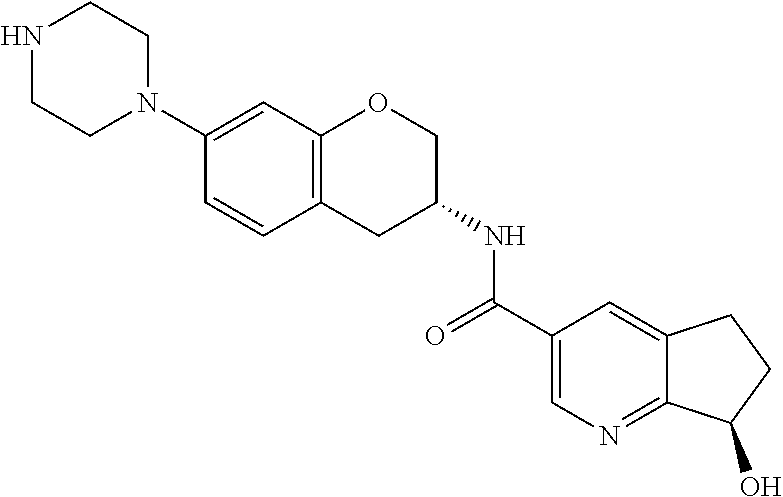 |
 |
 |
 |
 |
 |
 |
 |
 |
 |
 |
 |
 |
 |
 |
 |
 |
 |
 |
 |
 |
 |
 |
 |
 |
 |
 |
 |
 |
 |
 |
 |
 |
 |
 |
 |
 |
 |
 |
 |
 |
 |
 |
 |
 |
 |
 |
 |
 |
 |
 |
 |
 |
 |
 |
 |
 |
 |
 |
 |
 |
 |
 |
 |
 |
 |
 |
 |
 |
 |
 |
 |
 |
 |
 |
 |
 |
 |
 |
 |
 |
 |
 |
 |
 |
 |
 |
 |
 |
 |
 |
 |
 |
 |
 |
 |
 |
 |
 |
 |
 |
 |
 |
 |
 |
 |
 |
 |
 |
 |
 |
 |
 |
 |
 |
 |
 |
 |
 |
 |
 |
 |
 |
 |
 |
 |
 |
 |
 |
 |
 |
 |
 |
 |
 |
 |
 |
 |
 |
 |
 |
 |
 |
 |
 |
 |
 |
 |
 |
 |
 |
 |
 |
 |
 |
 |
 |
 |
 |
 |
 |
 |
 |
 |
 |
 |
 |
 |
 |
 |
 |
 |
 |
 |
 |
 |
 |
 |
 |
 |
 |
 |
 |
 |
 |
 |
 |
 |
 |
 |
 |
 |
 |
 |
 |
 |
 |
 |
 |
 |
 |
 |
 |
 |
 |
 |
 |
 |
 |
 |
 |
 |
 |
 |
 |
 |
 |
 |
 |
 |
 |
 |
 |
 |
 |
 |
 |
 |
 |
 |
 |
 |
 |
 |
 |
 |
 |
 |
 |
 |
 |
 |
 |
 |
 |
 |
 |
 |
 |
 |
 |
 |
 |
 |
 |
 |
 |
 |
 |
 |
 |
 |
 |
 |
 |
 |
 |
 |
 |
 |
 |
 |
 |
 |
 |
 |
 |
 |
 |
 |
 |
 |
 |
 |
 |
 |
 |
 |
 |
 |
 |
 |
 |
 |
 |
 |
 |
 |
 |
 |
 |
 |
 |
 |
 |
 |
 |
 |
 |
 |
 |
 |
 |
 |
 |
 |
 |
 |
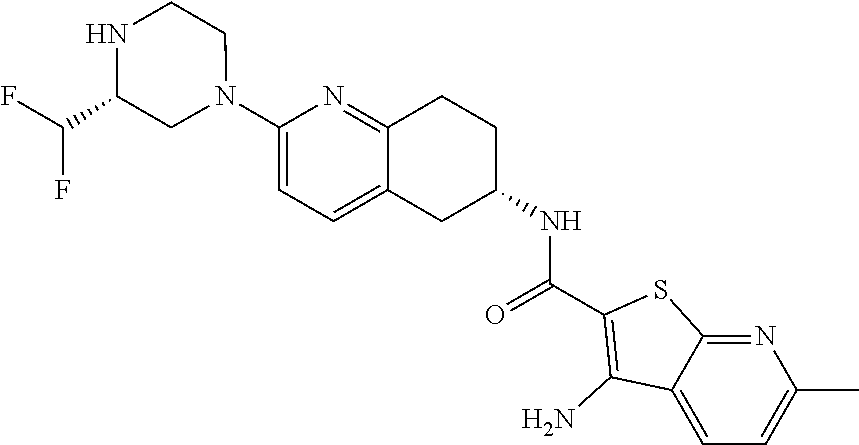 |
 |
 |
 |
 |
 |
 |
 |
 |
 |
 |
 |
 |
 |
 |
 |
 |
 |
 |
 |
 |
 |
 |
 |
 |
 |
 |
 |
 |
 |
 |
 |
 |
 |
 |
 |
 |
 |
 |
 |
 |
 |
 |
 |
 |
 |
 |
 |
 |
 |
 |
 |
 |
 |
 |
 |
 |
 |
 |
 |
 |
 |
 |
 |
 |
 |
 |
 |
 |
 |
 |
 |
 |
 |
 |
 |
 |
 |
 |
 |
 |
 |
 |
 |
 |
 |
 |
 |
 |
 |
 |
 |
 |
 |
 |
 |
 |
 |
 |
 |
 |
Those skilled in the art will recognize, or be able to ascertain, using no more than routine experimentation, numerous equivalents to the specific embodiments described specifically herein. Such equivalents are intended to be encompassed in the scope of the following claims.
Claims (15)
1. A compound of Formula (VI)

or a pharmaceutically acceptable salt thereof,
wherein:
X is chosen from C(R)(R″) and O;
each of Y1, Y2, and Y3 is independently chosen from C(R3) and N;
R′ is chosen from H, deuterium, and CH3;
each of R and R″ is independently chosen from H, halogens, —OH, —CN, C1-C6 alkyl optionally substituted with one or more Ri, R and R″ together with the carbon they are attached form a spirocyclic cyclopropyl optionally substituted with one or more Ri, wherein any R, R″, or Ri group being or containing hydrogen can independently have one or more hydrogen replaced with deuterium;
each Ri is independently chosen from halogen, —OH, and CH3;
R1 is chosen from 6-12 membered fused and nonfused heteroaryls optionally substituted with one or more substituent chosen from R5 and/or R6, and further wherein any R1 group containing hydrogen can have one or more hydrogen replaced with deuterium;
R2 is chosen from N-linked 4-12 membered heterocyclyls, C-linked 4-12 membered heterocyclyls, and an —O-linked 4-12 membered heterocyclyl, wherein the 4-12 membered heterocyclyls are optionally substituted with one or more R5 (which can be the same or different from the one or more R5 of R1), and further wherein any hydrogen in a R2 group can have one or more hydrogen replaced with deuterium;
each R3 is independently chosen from H, (C1-C6) alkyl, (C1-C6) alkoxy, (C1-C6) haloalkyl, (C1-C6) haloalkoxy, halogen, —OH, —CN, (C3-C8) cycloalkyl, heterocycloalkyl, aryl, and heteroaryl groups, wherein each of (C1-C6) alkyl, (C1-C6) alkoxy, (C1-C6) haloalkyl, (C1-C6) haloalkoxy, cycloalkyl, heterocycloalkyl, aryl, and heteroaryl groups are optionally substituted with one or more R7;
R4 is chosen from H, (C1-C6) alkyl, (C1-C6) alkoxy, (C1-C6) haloalkyl, (C1-C6) haloalkoxy, halogen, —OH, —CN, (C3-C8) cycloalkyl, heterocycloalkyl, aryl, and heteroaryl groups, wherein each of (C1-C6) alkyl, (C1-C6) alkoxy, (C1-C6) haloalkyl, (C1-C6) haloalkoxy, (C3-C8) cycloalkyl, heterocycloalkyl, aryl, and heteroaryl are optionally substituted with one or more R5, and further wherein any R4 group containing hydrogen can have one or more hydrogen replaced with deuterium;
each R5 is independently chosen from —OH, —NH2, amido-(C1-C6) alkyl, (C1-C6) alkyl, (C1-C6) alkoxy, (C1-C6) haloalkyl, (C1-C6) haloalkoxy, halogen, cycloalkyl, heterocycloalkyl, and —C(O)-heterocycloalkyl groups, wherein each of —NH2, amido-(C1-C6) alkyl, (C1-C6) alkyl, (C1-C6) alkoxy, (C1-C6) haloalkyl, (C1-C6) haloalkoxy, cycloalkyl, heterocycloalkyl, and —C(O)-heterocycloalkyl are optionally substituted with one or more substituent independently chosen from (C1-C6) alkyl, (C1-C6) alkoxy, —NH2, and —OH, and wherein any R5 group containing hydrogen can have one or more hydrogen replaced with deuterium;
each R6 is independently chosen from -amino alkyl-aryls, -amino alkyl-heteroaryls, -amino alkyl-cyclyl, and -amino alkyl-heterocyclyl groups, wherein each of the R6 groups are optionally substituted with one or more substituent chosen from —OH, —NH2, halogens, (C1-C6) alkyl, (C1-C6) alkoxy, and (C1-C6) haloalkyl groups, and further wherein any R6 group containing hydrogen can have one or more hydrogen replaced with deuterium;
each R7 is independently chosen from —OH, —NH2, (C1-C6) alkyl, (C1-C6) alkoxy, (C1-C6) haloalkyl, (C1-C6) haloalkoxy, halogen, cycloalkyl, —C(O)-cycloalkyl, heterocycloalkyl, and —C(O)-heterocycloalkyl groups, wherein each of —NH2, (C1-C6) alkyl, (C1-C6) alkoxy, (C1-C6) haloalkyl, (C1-C6) haloalkoxy, halogen, cycloalkyl, —C(O)-cycloalkyl, heterocycloalkyl, and —C(O)-heterocycloalkyl are optionally substituted with one or more substituent independently chosen from (C1-C6) alkyl, (C1-C6) alkoxy, and —OH;
and
n is 0, 1, 2, or 3.
2. The compound of claim 1 , of Formula (II):

or a pharmaceutically acceptable salt thereof, wherein
each of X, R1, R2, R3, R7 and n are as defined in Formula (VI);
R4 is chosen from H, (C1-C6) alkyl, halogen, and —OH;
each R5 is independently chosen from —OH, —NH2, —NHC(O)CH3, —C(O)NHCH3, (C1-C6) alkyl, (C1-C6) alkoxy, (C1-C6) haloalkyl, (C1-C6) haloalkoxy, halogen, cycloalkyl, heterocycloalkyl, and —C(O)-heterocycloalkyl groups, wherein each of —NH2, —NHC(O)CH3, —C(O)NHCH3, (C1-C6) alkyl, (C1-C6) alkoxy, (C1-C6) haloalkyl, (C1-C6) haloalkoxy, cycloalkyl, heterocycloalkyl, and —C(O)-heterocycloalkyl are optionally substituted with one or more substituent independently chosen from (C1-C6) alkyl, (C1-C6) alkoxy, —NH2, and —OH; and
each R6 is independently chosen from —NH(C1-C6)alkyl-aryls, —NH(C1-C6)alkyl-heteroaryls, —NH(C1-C6)alkyl-cyclyl, and —NH(C1-C6)alkyl-heterocyclyl groups, wherein each of the R6 groups are optionally substituted with one or more substituent chosen from —OH, halogens, (C1-C6) alkyl, (C1-C6) alkoxy, and (C1-C6) haloalkyl groups.
3. The compound of claim 1 , of Formula (IIaa):

or a pharmaceutically acceptable salt thereof, wherein
R1 is chosen from 8-9-membered heteroaryls substituted with one or more substituent chosen from R5 and R6, wherein each R5 and R6 are independently as defined in Formula (II);
R2 is chosen from N-linked 6-12 membered heterocyclyls or C-linked 6-12 membered heterocyclyls optionally substituted with one or more R5, wherein each R5 is independently chosen from —OH, —NH2, —NHC(O)CH3, —C(O)NHCH3, (C1-C6)alkyl, (C1-C6) alkoxy, (C1-C6) haloalkyl, (C1-C6) haloalkoxy, halagen, cycloalkyl, heterocycloalkyl, and —C(O)-heterocycloalkyl groups, wherein each of —NH2, —MHC(O)CH3, —C(O)NHCH3, (C1-C6) alkyl, (C1-C6) alkoxy, (C1-C6) haloalkyl, (C1-C6) haloalkoxy, cycloalkyl, heterocycloalkyl, and —C(O)-heterocycloalkyl are optionally substituted with one or more substituent independently chosen from (C1-C6) alkyl, (C1-C6) alkoxy, —NH2, and —OH; and
R3 is independently chosen from H, (C1-C6) alkyl, halogen, and —CN, wherein the (C1-C6) alkyl groups are optionally substituted with R7 wherein each R7 is independently as defined in Formula (VI).
4. The compound of claim 1 , of Formula (IIb′):

or a pharmaceutically acceptable salt thereof, wherein
R′ is chosen from H and CH3;
R1 is chosen from 8-9 membered heteroaryls substituted with one or more substituent chosen from R5 and R6, wherein each R5 and/or R6 (if present) are independently as defined in Formula (VI);
R2 is chosen from N-linked 6-12 membered heterocyclyls or C-linked 6-12 membered heterocyclyls optionally substituted with one or more R5, wherein each R5 is independently as defined in Formula (VI); and
R3 is independently chosen from H, (C1-C6) alkyl, halogen, and —CN, wherein the (C1-C6) alkyl groups are optionally substituted with R7 wherein each R7 is independently as defined in Formula (VI).
5. The compound of any one of claims 1 -4 , wherein R1, optionally substituted with R5 and/or R6, is chosen from


6. The compound of any one of claims 1 -4 , wherein R2, optionally substituted with R5, is chosen from


7. The compound of any one of claims 1 -4 , wherein R1, optionally substituted with R5 and/or R6, is chosen from

R2, optionally substituted with R5, is chosen from

8. The compound of any one of claims 1 -4 , wherein R1, optionally substituted with R5 and/or R6, is chosen from

and
R2, optionally substituted with R5, is chosen from

9. The compound of claim 1 , of Formula (VII):

or a pharmaceutically acceptable sa thereof, wherein
Y is chosen from C(R3) and N;
R′ is chosen from H, deuterium, and CH3;
R1 is chosen from 6-11 membered heteroaryls optionally substituted with one or more substituent chosen from R5 and/or R6;
R2 is chosen from N-linked 4-12 membered heterocyclyls and C-linked 4-12 membered heterocyclyls, wherein the heterocyclyls are optionally substituted with one or more R5, and further wherein any R2 group containing hydrogen can have one or more hydrogen replaced with deuterium;
each R3 is independently chosen from H, deuterium, (C1-C6) alkyl, (C1-C6) alkoxy, (C1-C6) haloalkyl, (C1-C6) haloalkoxy, halogen, —OH, —CN, wherein each of (C1-C6) alkyl, (C1-C6) alkoxy, (C1-C6) haloalkyl, (C1-C6) haloalkoxy, cycloalkyl, heterocycloalkyl, aryl, and heteroaryl groups are optionally substituted with one or more R7;
R4 is chosen from H, (C1-C6) alkyl, halogen, —OH, —CN, and further wherein any R4 group containing hydrogen can have one or more hydrogen replaced with deuterium;
each R5 (if present) is independently chosen from —OH, —NH2, NHC(O)CH3, —C(O)NHCH3, (C1-C6) alkyl, (C1-C6) alkoxy, (C1-C6) haloalkyl, (C1-C6) haloalkoxy, halogen, cycloalkyl, heterocycloalkyl, and —C(O)-heterocycloalkyl groups, wherein each of —NH2, —NHC(O)CH3, —C(O)NHCH3, (C1-C6) alkyl, (C1-C6) alkoxy, (C1-C6) haloalkyl, (C1-C6) haloalkoxy, cycloalkyl, heterocycloalkyl, and —C(O)-heterocycloalkyl are optionally substituted with one or more substituent independently chosen from (C1-C6) alkoxy, —NH2, and —OH, and wherein any R5 group containing hydrogen can have one or more hydrogen replaced with deuterium;
each R6 (if present) is chosen from —NH(C1-C6)alkyl-aryls, —NH(C1-C6) alkyl-heteroaryls, —NH(C1-C6)alkyl-heterocyclyl groups, and —NH(C1-C6) alkyl-heterocyclyl groups, wherein each of the R6 groups are optionally substituted with one or more substituent chosen from —OH, —NH2, halogens, (C1-C6) alkyl, (C1-C6) alkoxy, and (C1-C6) haloalkyl groups, and further wherein any R6 group containing hydrogen can have one or more hydrogen replaced with deuterium;
each R7 is independently chosen from —OH, —NH2, (C1-C6) alkyl, (C1-C6) alkoxy, (C1-C6) haloalkyl, (C1-C6) haloalkoxy, halogen, cycloalkyl, —C(O)-cycloalkyl, heterocycloalkyl, and —C(O)-heterocycloalkyl groups, wherein each of —NH2, (C1-C6) alkyl, (C1-C6) alkoxy, (C1-C6) haloalkyl, (C1-C6) haloalkoxy, halogen, cycloalkyl, —C(O)-cycloalkyl, heterocycloalkyl, and —C(O)-heterocycloalkyl are optionally substituted with one or more substituent independently chosen from (C1-C6) alkyl, (C1-C6) alkoxy, and —OH;
and
n is 0, 1, 2, or 3.
10. The compound of claim 9 , of Formula (IIIaa):

or a pharmaceutically acceptable salt thereof, wherein
R1 is chosen from 8-11 membered heteroaryls optionally substituted with one or more R5;
R2 is chosen from N-linked 4-12 membered heterocyclyls and C-linked 4-12 membered heterocyclyls, optionally substituted with one or more R5;
each R5 (if present) is independently chosen from —OH, —NH2, NHC(O)CH3, (C1-C6) alkyl, (C1-C6) alkoxy, (C1-C6) haloalkyl, (C1-C6) haloalkoxy, halogen, cycloalkyl, heterocycloalkyl, and —C(O)-heterocycloalkyl groups, wherein each of —NH2, —NHC(O)CH3, (C1-C6) alkyl, (C1-C6) alkoxy, (C1-C6) haloalkyl, (C1-C6) haloalkoxy, cycloalkyl, heterocycloalkyl, and —C(O)-heterocycloalkyl are optionally substituted with one or more substituent independently chosen from (C1-C6) alkoxy, —NH2, and —OH; and
n is 0, 1, 2, or 3.
11. The compound of claim 9 , of Formula (VIIaa):

or a pharmaceutically acceptable thereof, wherein
R1 is chosen from 8-9 membered heteroaryls optionally substituted with one or more R5;
R2 is chosen from N-linked 4-12 membered heterocyclyls optionally substituted with one or more R5;
each R5 (if present) is independently chosen from —OH, —NH2, NHC(O)CH3, (C1-C6) alkyl, (C1-C6) alkoxy, (C1-C6) haloalkyl, (C1-C6) haloalkoxy, halogen, cycloalkyl, heterocycloalkyl, and —C(O)-heterocycloalkyl groups, wherein each of —NH2, —NHC(O)CH3, (C1-C6) alkyl, (C1-C6) alkoxy, (C1-C6) haloalkyl, (C1-C6) haloalkoxy, cycloalkyl, heterocycloalkyl, and —C(O)-heterocycloalkyl are optionally substituted with one or more substituent independently chosen from (C1-C6) alkoxy, —NH2, and —OH;
and
n is 0, 1, 2, or 3.
12. The compound of any one of claim 10 or 11 , wherein R1 is chosen from

wherein B is chosen from a bond or C;
Z is chosen from N, S, C(Rii);
Rii is chosen from H, CH3 and R5;
R2 is chosen from N-linked 5-8 membered heterocyclyls substituted with one to three R5;
each R5 (if present) is independently chosen from —OH, —NH2, NHC(O)CH3, (C1-C6) alkyl, (C1-C6) alkoxy, (C1-C6) haloalkyl, (C1-C6) haloalkoxy, halogen, cycloalkyl, heterocycloalkyl, and —C(O)-heterocycloalkyl groups, wherein each of —NH2, —NHC(O)CH3, (C1-C6) alkyl, (C1-C6) alkoxy, (C1-C6) haloalkyl, (C1-C6) haloalkoxy, cycloalkyl, heterocycloalkyl, and —C(O)-heterocycloalkyl are optionally substituted with one or more substituent independently chosen from (C1-C6) alkoxy, —NH2, and —OH;
and
n is 0, 1, 2, or 3.
13. The compound of any one of claims 9 -11 wherein
R1, optionally substituted with R5, is chosen from

and R2, optionally substituted with R5, is chosen from


14. The compound claim 1 , chosen from any of the following compounds


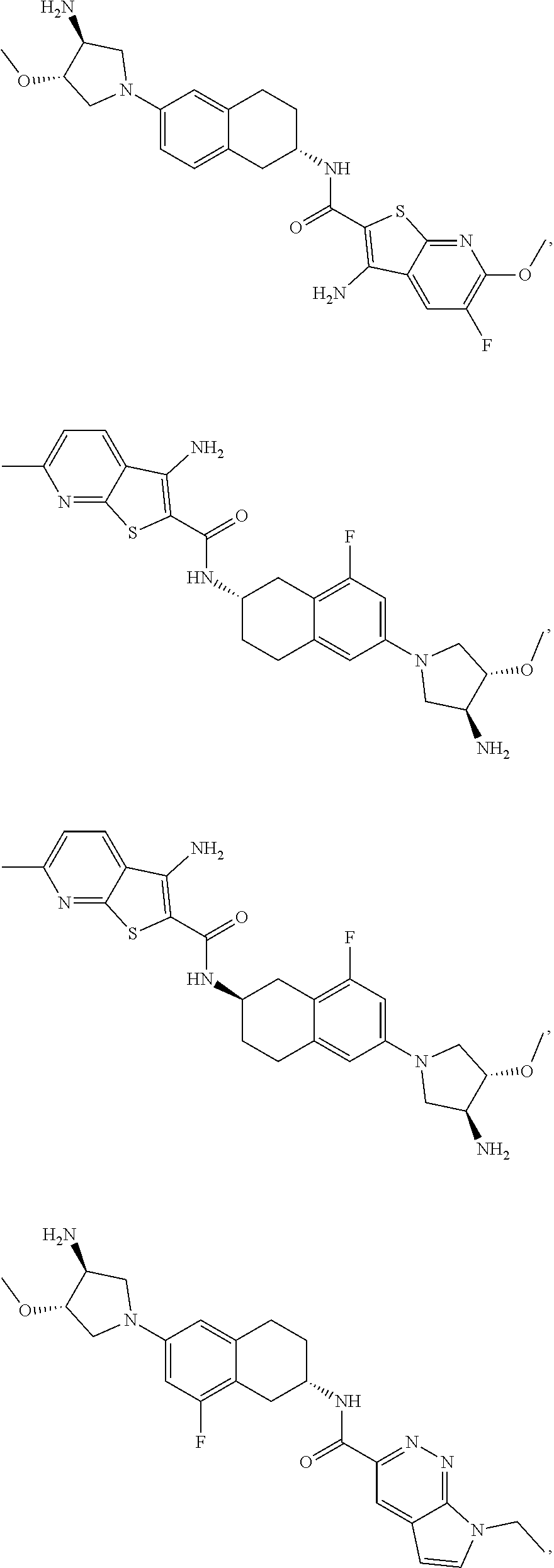


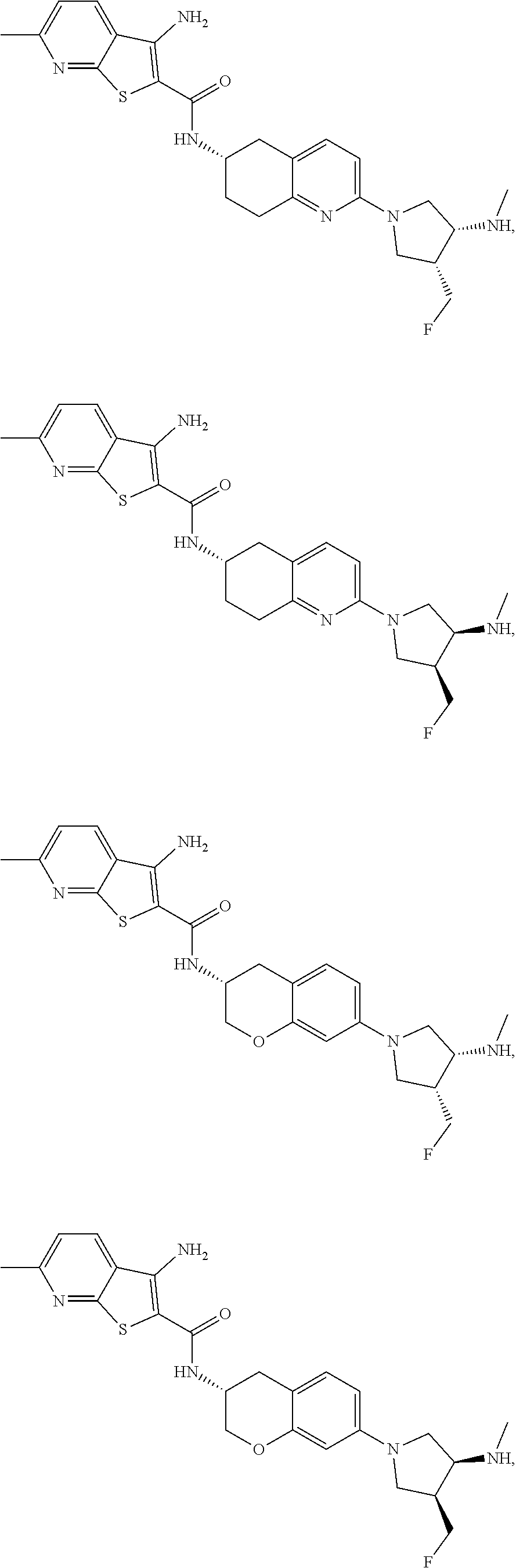


or a pharmaceutically acceptable salt thereof.
15. The compound of claim 1 , chosen from the following compounds:
10-1: (R)-3-amino-N-(5-fluoro-7-(piperazin-1-yl)chroman-3-yl)-6-methylthieno[2,3-b]pyridine-2-carboxamide;
10-5: (S)-3-amino-N-(5-fluoro-7-(piperazin-1-yl)chroman-3-yl)-6-methylthieno[2,3-b]pyridine-2-carboxamide;
10-15: 3-amino-N-[(3R)-5-fluoro-7-(piperazin-1-yl)-3,4-dihydro-2H-1-benzopyran-3-yl]-N,6-dimethylthieno[2,3-b]pyridine-2-carboxamide;
10-16: 3-amino-N-[(3S)-5-fluoro-7-(piperazin-1-yl)-3,4-dihydro-2H-1-benzopyran-3-yl]-N,6-dimethylthieno[2,3-b]pyridine-2-carboxamide;
11-1: N-((2S)-6-(3,8-diazabicyclo[3.2.1]octan-3-yl)-1,2,3,4-tetrahydronaphthalen-2-yl)-3-amino-6-methylthieno[2,3-b]pyridine-2-carboxamide;
11-2: N-((2R)-6-(3,8-diazabicyclo[3.2.1]octan-3-yl)-1,2,3,4-tetrahydronaphthalen-2-yl)-3-amino-6-methylthieno[2,3-b]pyridine-2-carboxamide;
23-1: 7-amino-N-[(6S)-2-[(3S,4S)-3-amino-4-methoxypyrrolidin-1-yl]-5,6,7,8-tetrahydroquinolin-6-yl]-3-methylthieno[2,3-b]pyrazine-6-carboxamide;
23-2: 7-amino-N-[(6R)-2-[(3S,4S)-3-amino-4-methoxypyrrolidin-1-yl]-5,6,7,8-tetrahydroquinolin-6-yl]-3-methylthieno[2,3-b]pyrazine-6-carboxamide;
23-3: 3-amino-N-[(6S)-2-[(3S,4S)-3-amino-4-methoxypyrrolidin-1-yl]-5,6,7,8-tetrahydroquinolin-6-yl]-4,6-dimethylthieno[2,3-b]pyridine-2-carboxamide;
23-4: 3-amino-N-[(6S)-2-[(3S,4S)-3-amino-4-methoxypyrrolidin-1-yl]-5,6,7,8-tetrahydroquinolin-6-yl]-6-methylthieno[2,3-b]pyridine-2-carboxamide;
23-5: 3-amino-N-[(6R)-2-[(3S,4S)-3-amino-4-methoxypyrrolidin-1-yl]-5,6,7,8-tetrahydroquinolin-6-yl]-6-methylthieno[2,3-b]pyridine-2-carboxamide;
23-6: 7-amino-3-methyl-N-[(6S)-2-(piperazin-1-yl)-5,6,7,8-tetrahydroquinolin-6-yl]thieno[2,3-b]pyrazine-6-carboxamide;
23-7: 3-amino-6-methyl-N-[(6S)-2-(piperazin-1-yl)-5,6,7,8-tetrahydroquinolin-6-yl]thieno[2,3-b]pyridine-2-carboxamide;
23-8: 3-amino-6-methyl-N-[(6R)-2-(piperazin-1-yl)-5,6,7,8-tetrahydroquinolin-6-yl]thieno[2,3-b]pyridine-2-carboxamide;
23-9: 6-amino-2-methyl-N-[(6S)-2-(piperazin-1-yl)-5,6,7,8-tetrahydroquinolin-6-yl]thieno[2,3-d][1,3]thiazole-5-carboxamide;
23-12: 3-amino-N-[(6S)-2-{3,8-diazabicyclo[3.2.1]octan-3-yl}-5,6,7,8-tetrahydroquinolin-6-yl]-6-methylthieno[2,3-b]pyridine-2-carboxamide;
23-13: 7-amino-N-[(6S)-2-{3,8-diazabicyclo[3.2.1]octan-3-yl}-5,6,7,8-tetrahydroquinolin-6-yl]-3-methylthieno[2,3-b]pyrazine-6-carboxamide;
23-14: 3-amino-4,6-dimethyl-N-[(6S)-2-(piperazin-1-yl)-5,6,7,8-tetrahydroquinolin-6-yl]thieno[2,3-b]pyridine-2-carboxamide;
23-17: 3-amino-N-[(6S)-4-fluoro-2-(piperazin-1-yl)-5,6,7,8-tetrahydroquinolin-6-yl]-6-methylthieno[2,3-b]pyridine-2-carboxamide;
23-18: 3-amino-N-[(6S)-2-{3,8-diazabicyclo[3.2.1]octan-3-yl}-4-fluoro-5,6,7,8-tetrahydroquinolin-6-yl]-6-methylthieno[2,3-b]pyridine-2-carboxamide;
24-1: 3-amino-N-[(6S)-2-[(3R,4R)-3-amino-4-(methoxymethyl)pyrrolidin-1-yl]-5,6,7,8-tetrahydroquinolin-6-yl]-6-methylthieno[2,3-b]pyridine-2-carboxamide;
24-2: 3-amino-N-[(6S)-2-[(3S,4S)-3-amino-4-(methoxymethyl)pyrrolidin-1-yl]-5,6,7,8-tetrahydroquinolin-6-yl]-6-methylthieno[2,3-b]pyridine-2-carboxamide;
25: 3-amino-N-[(6S)-2-[(3S,4R)-3-amino-4-(difluoromethyl)pyrrolidin-1-yl]-5,6,7,8-tetrahydroquinolin-6-yl]-6-methylthieno[2,3-b]pyridine-2-carboxamide;
26-1: 3-amino-N-[(6S)-2-[(3S,4R)-3-(methoxymethyl)-4-(methylamino)pyrrolidin-1-yl]-5,6,7,8-tetrahydroquinolin-6-yl]-6-methylthieno[2,3-b]pyridine-2-carboxamide;
26-2: 3-amino-N-[(6S)-2-[(3R,4S)-3-(methoxymethyl)-4-(methylamino)pyrrolidin-1-yl]-5,6,7,8-tetrahydroquinolin-6-yl]-6-methylthieno[2,3-b]pyridine-2-carboxamide;
27-1: 3-amino-N-[(6S)-2-[(3R,4R)-3-amino-4-(fluoromethyl)pyrrolidin-1-yl]-5,6,7,8-tetrahydroquinolin-6-yl]-6-methylthieno[2,3-b]pyridine-2-carboxamide;
27-2: 3-amino-N-[(6S)-2-[(3S,4S)-3-amino-4-(fluoromethyl)pyrrolidin-1-yl]-5,6,7,8-tetrahydroquinolin-6-yl]-6-methylthieno[2,3-b]pyridine-2-carboxamide;
28-1: 3-amino-N-[(6S)-2-[(3S,4S)-3-amino-4-(2-methoxyethoxy)pyrrolidin-1-yl]-5,6,7,8-tetrahydroquinolin-6-yl]-6-methylthieno[2,3-b]pyridine-2-carboxamide;
28-2: 3-amino-N-[(6S)-2-[(3R,4R)-3-amino-4-(2-methoxyethoxy)pyrrolidin-1-yl]-5,6,7,8-tetrahydroquinolin-6-yl]-6-methylthieno[2,3-b]pyridine-2-carboxamide;
29-1: 3-amino-N-[(6S)-2-[(9S)-9-amino-1,4-dioxa-7-azaspiro[4.4]nonan-7-yl]-5,6,7,8-tetrahydroquinolin-6-yl]-6-methylthieno[2,3-b]pyridine-2-carboxamide;
29-2: 3-amino-N-[(6S)-2-[(9R)-9-amino-1,4-dioxa-7-azaspiro[4.4]nonan-7-yl]-5,6,7,8-tetrahydroquinolin-6-yl]-6-methylthieno[2,3-b]pyridine-2-carboxamide;
30-1: 3-amino-N-[(6S)-3-fluoro-2-(piperazin-1-yl)-5,6,7,8-tetrahydroquinolin-6-yl]-6-methylthieno[2,3-b]pyridine-2-carboxamide;
30-2: 3-amino-N-[(6R)-3-fluoro-2-(piperazin-1-yl)-5,6,7,8-tetrahydroquinolin-6-yl]-6-methylthieno[2,3-b]pyridine-2-carboxamide;
31-3: 3-amino-6-methyl-N-[(6′S)-2′-(piperazin-1-yl)-6′,7′-dihydro-5′H-spiro[cyclopropane-1,8′-quinoline]-6′-yl]thieno[2,3-b]pyridine-2-carboxamide;
31-4: 3-amino-6-methyl-N-[(6′R)-2′-(piperazin-1-yl)-6′,7′-dihydro-5′H-spiro[cyclopropane-1,8′-quinoline]-6′-yl]thieno[2,3-b]pyridine-2-carboxamide;
142: 3-amino-N-[(6S)-2-[(3S,4S)-3-amino-4-ethoxypyrrolidin-1-yl]-5,6,7,8-tetrahydroquinolin-6-yl]-6-methylthieno[2,3-b]pyridine-2-carboxamide;
203: 3-amino-N-[(6S)-2-[(3S,4S)-3-amino-4-methoxypyrrolidin-1-yl]-5,6,7,8-tetrahydroquinolin-6-yl]-5-fluoro-6-methylthieno[2,3-b]pyridine-2-carboxamide;
204: 3-amino-5-fluoro-6-methyl-N-[(6S)-2-(piperazin-1-yl)-5,6,7,8-tetrahydroquinolin-6-yl]thieno[2,3-b]pyridine-2-carboxamide;
205: 3-amino-6-methyl-N-[(6S,8S)-8-methyl-2-(piperazin-1-yl)-5,6,7,8-tetrahydroquinolin-6-yl]thieno[2,3-b]pyridine-2-carboxamide;
206: 3-amino-6-methyl-N-[(6R,8S)-8-methyl-2-(piperazin-1-yl)-5,6,7,8-tetrahydroquinolin-6-yl]thieno[2,3-b]pyridine-2-carboxamide;
207: 3-amino-6-methyl-N-[(6S,8R)-8-methyl-2-(piperazin-1-yl)-5,6,7,8-tetrahydroquinolin-6-yl]thieno[2,3-b]pyridine-2-carboxamide;
208: 3-amino-6-methyl-N-[(6R,8R)-8-methyl-2-(piperazin-1-yl)-5,6,7,8-tetrahydroquinolin-6-yl]thieno[2,3-b]pyridine-2-carboxamide;
210: 3-amino-N-[(6S)-2-[(3S,4S)-4-amino-3-methoxy-3-methylpyrrolidin-1-yl]-5,6,7,8-tetrahydroquinolin-6-yl]-6-methylthieno[2,3-b]pyridine-2-carboxamide;
211: 3-amino-N-[(6S)-2-[(3R,4R)-4-amino-3-methoxy-3-methylpyrrolidin-1-yl]-5,6,7,8-tetrahydroquinolin-6-yl]-6-methylthieno[2,3-b]pyridine-2-carboxamide;
239: 3-amino-N-[(6S)-2-[(3S,4S)-3-amino-4-methoxy-3-methylpyrrolidin-1-yl]-5,6,7,8-tetrahydroquinolin-6-yl]-6-methylthieno[2,3-b]pyridine-2-carboxamide;
240: 3-amino-N-[(6S)-2-[(3R,4R)-3-amino-4-methoxy-3-methylpyrrolidin-1-yl]-5,6,7,8-tetrahydroquinolin-6-yl]-6-methylthieno[2,3-b]pyridine-2-carboxamide;
254: 3-amino-N-[(6S)-2-[(3S,4R)-3-amino-4-ethoxypyrrolidin-1-yl]-5,6,7,8-tetrahydroquinolin-6-yl]-6-methylthieno[2,3-b]pyridine-2-carboxamide;
255: 3-amino-N-[(6S)-2-[(3R,4S)-3-amino-4-ethoxypyrrolidin-1-yl]-5,6,7,8-tetrahydroquinolin-6-yl]-6-methylthieno[2,3-b]pyridine-2-carboxamide;
269: 3-amino-N-[(6S)-2-[(3S,4R)-3-amino-4-methoxypyrrolidin-1-yl]-5,6,7,8-tetrahydroquinolin-6-yl]-6-methylthieno[2,3-b]pyridine-2-carboxamide;
270: 3-amino-N-[(6S)-2-[(3R,4S)-3-amino-4-methoxypyrrolidin-1-yl]-5,6,7,8-tetrahydroquinolin-6-yl]-6-methylthieno[2,3-b]pyridine-2-carboxamide;
279: 7-amino-N-[(6S)-2-[(3S,4S)-4-amino-3-methoxy-3-methylpyrrolidin-1-yl]-5,6,7,8-tetrahydroquinolin-6-yl]-3-methylthieno[2,3-b]pyrazine-6-carboxamide;
280: 7-amino-N-[(6S)-2-[(3R,4R)-4-amino-3-methoxy-3-methylpyrrolidin-1-yl]-5,6,7,8-tetrahydroquinolin-6-yl]-3-methylthieno[2,3-b]pyrazine-6-carboxamide;
285: 3-amino-N-[(6S)-2-[(3S,4S)-3-amino-4-cyclobutoxypyrrolidin-1-yl]-5,6,7,8-tetrahydroquinolin-6-yl]-6-methylthieno[2,3-b]pyridine-2-carboxamide;
296: 3-amino-N-[(6S)-2-[(3R,4R)-3-amino-4-(methoxymethyl)pyrrolidin-1-yl]-5,6,7,8-tetrahydroquinolin-6-yl]-4,6-dimethylthieno[2,3-b]pyridine-2-carboxamide;
297: 3-amino-N-[(6S)-2-[(3S,4S)-3-amino-4-(methoxymethyl)pyrrolidin-1-yl]-5,6,7,8-tetrahydroquinolin-6-yl]-4,6-dimethylthieno[2,3-b]pyridine-2-carboxamide;
298: 7-amino-N-[(6S)-2-[(3R,4R)-3-amino-4-(methoxymethyl)pyrrolidin-1-yl]-5,6,7,8-tetrahydroquinolin-6-yl]-3-methylthieno[2,3-b]pyrazine-6-carboxamide;
299: 7-amino-N-[(6S)-2-[(3S,4S)-3-amino-4-(methoxymethyl)pyrrolidin-1-yl]-5,6,7,8-tetrahydroquinolin-6-yl]-3-methylthieno[2,3-b]pyrazine-6-carboxamide;
300: 3-amino-N-[(6S)-2-[(3R,4R)-3-amino-4-(methoxymethyl)pyrrolidin-1-yl]-3-fluoro-5,6,7,8-tetrahydroquinolin-6-yl]-6-methylthieno[2,3-b]pyridine-2-carboxamide;
301: 3-amino-N-[(6S)-2-[(3S,4S)-3-amino-4-(methoxymethyl)pyrrolidin-1-yl]-3-fluoro-5,6,7,8-tetrahydroquinolin-6-yl]-6-methylthieno[2,3-b]pyridine-2-carboxamide;
302: 3-amino-N-[(6R)-2-[(3R,4R)-3-amino-4-(methoxymethyl)pyrrolidin-1-yl]-3-fluoro-5,6,7,8-tetrahydroquinolin-6-yl]-6-methylthieno[2,3-b]pyridine-2-carboxamide;
303: 3-amino-N-[(6R)-2-[(3S,4S)-3-amino-4-(methoxymethyl)pyrrolidin-1-yl]-3-fluoro-5,6,7,8-tetrahydroquinolin-6-yl]-6-methylthieno[2,3-b]pyridine-2-carboxamide;
311: 3-amino-N-[(6S)-2-[(3S,4S)-3-methoxy-4-(methylamino)pyrrolidin-1-yl]-5,6,7,8-tetrahydroquinolin-6-yl]-6-methylthieno[2,3-b]pyridine-2-carboxamide;
312: 3-amino-N-[(6S)-2-[(3S,4S)-3-methoxy-4-(methylamino)pyrrolidin-1-yl]-5,6,7,8-tetrahydroquinolin-6-yl]-4,6-dimethylthieno[2,3-b]pyridine-2-carboxamide;
320: 3-amino-N-[(6S)-2-[(3S,4S)-3-amino-4-(propan-2-yloxy)pyrrolidin-1-yl]-5,6,7,8-tetrahydroquinolin-6-yl]-6-methylthieno[2,3-b]pyridine-2-carboxamide;
321: 3-amino-N-[(6S)-2-[(3S,4R)-3-amino-4-(propan-2-yloxy)pyrrolidin-1-yl]-5,6,7,8-tetrahydroquinolin-6-yl]-6-methylthieno[2,3-b]pyridine-2-carboxamide;
322: 3-amino-N-[(6S)-2-[(3R,4S)-3-amino-4-(propan-2-yloxy)pyrrolidin-1-yl]-5,6,7,8-tetrahydroquinolin-6-yl]-6-methylthieno[2,3-b]pyridine-2-carboxamide;
327: 3-amino-N-[(6S)-2-[(3R,4S)-3-amino-4-(methoxymethyl)pyrrolidin-1-yl]-5,6,7,8-tetrahydroquinolin-6-yl]-6-methylthieno[2,3-b]pyridine-2-carboxamide;
328: 3-amino-N-[(6S)-2-[(3S,4R)-3-amino-4-(methoxymethyl)pyrrolidin-1-yl]-5,6,7,8-tetrahydroquinolin-6-yl]-6-methylthieno[2,3-b]pyridine-2-carboxamide;
331: 3-amino-N-[(6S)-2-[(3R,4S)-3-hydroxy-3-methyl-4-(methylamino)pyrrolidin-1-yl]-5,6,7,8-tetrahydroquinolin-6-yl]-6-methylthieno[2,3-b]pyridine-2-carboxamide;
332: 3-amino-N-[(6S)-2-[(3S,4R)-3-hydroxy-3-methyl-4-(methylamino)pyrrolidin-1-yl]-5,6,7,8-tetrahydroquinolin-6-yl]-6-methylthieno[2,3-b]pyridine-2-carboxamide;
341: 3-amino-N-[(6S)-2-[(3S,4R)-4-amino-3-(methoxymethyl)-3-methylpyrrolidin-1-yl]-5,6,7,8-tetrahydroquinolin-6-yl]-6-methylthieno[2,3-b]pyridine-2-carboxamide;
342: 3-amino-N-[(6S)-2-[(3R,4R)-4-amino-3-(methoxymethyl)-3-methylpyrrolidin-1-yl]-5,6,7,8-tetrahydroquinolin-6-yl]-6-methylthieno[2,3-b]pyridine-2-carboxamide;
343: 3-amino-N-[(6S)-2-[(3S,4S)-4-amino-3-(methoxymethyl)-3-methylpyrrolidin-1-yl]-5,6,7,8-tetrahydroquinolin-6-yl]-6-methylthieno[2,3-b]pyridine-2-carboxamide;
344: 3-amino-N-[(6S)-2-[(3R,4S)-4-amino-3-(methoxymethyl)-3-methylpyrrolidin-1-yl]-5,6,7,8-tetrahydroquinolin-6-yl]-6-methylthieno[2,3-b]pyridine-2-carboxamide;
345: 3-amino-N-[(6S)-2-[(3R,4R)-3-amino-4-(difluoromethyl)pyrrolidin-1-yl]-5,6,7,8-tetrahydroquinolin-6-yl]-6-methylthieno[2,3-b]pyridine-2-carboxamide;
346: 3-amino-N-[(6S)-2-[(3S,4S)-3-amino-4-(difluoromethyl)pyrrolidin-1-yl]-5,6,7,8-tetrahydroquinolin-6-yl]-6-methylthieno[2,3-b]pyridine-2-carboxamide;
347: 3-amino-N-[(6S)-2-[(3R,4S)-3-amino-4-(difluoromethyl)pyrrolidin-1-yl]-5,6,7,8-tetrahydroquinolin-6-yl]-6-methylthieno[2,3-b]pyridine-2-carboxamide;
354: 3-amino-N-[(6S)-2-[3,8-diazabicyclo[3.2.1]octan-3-yl]-5,6,7,8-tetrahydroquinolin-6-yl]-4,6-dimethylthieno[2,3-b]pyridine-2-carboxamide;
363: 3-amino-N-[(6S)-2-[(3R,4S)-3-amino-4-(trifluoromethyl)pyrrolidin-1-yl]-5,6,7,8-tetrahydroquinolin-6-yl]-6-methylthieno[2,3-b]pyridine-2-carboxamide;
364: 3-amino-N-[(6S)-2-[(3S,4R)-3-amino-4-(trifluoromethyl)pyrrolidin-1-yl]-5,6,7,8-tetrahydroquinolin-6-yl]-6-methylthieno[2,3-b]pyridine-2-carboxamide;
376: 3-amino-N-[(6S)-2-[(3S,4R)-3-(difluoromethyl)-4-(methylamino)pyrrolidin-1-yl]-5,6,7,8-tetrahydroquinolin-6-yl]-6-methylthieno[2,3-b]pyridine-2-carboxamide;
377: 3-amino-N-[(6S)-2-[(3R,4S)-3-(difluoromethyl)-4-(methylamino)pyrrolidin-1-yl]-5,6,7,8-tetrahydroquinolin-6-yl]-6-methylthieno[2,3-b]pyridine-2-carboxamide;
384: 3-amino-N-[(6S)-2-[(3R,4S)-3-amino-4-(fluoromethyl)pyrrolidin-1-yl]-5,6,7,8-tetrahydroquinolin-6-yl]-6-methylthieno[2,3-b]pyridine-2-carboxamide;
385: 3-amino-N-[(6S)-2-[(3S,4R)-3-amino-4-(fluoromethyl)pyrrolidin-1-yl]-5,6,7,8-tetrahydroquinolin-6-yl]-6-methylthieno[2,3-b]pyridine-2-carboxamide;
427: 3-amino-N-[(6S)-2-[(3R,4S)-4-amino-3-methoxy-3-methylpyrrolidin-1-yl]-5,6,7,8-tetrahydroquinolin-6-yl]-6-methylthieno[2,3-b]pyridine-2-carboxamide;
428: 3-amino-N-[(6S)-2-[(3S,4R)-4-amino-3-methoxy-3-methylpyrrolidin-1-yl]-5,6,7,8-tetrahydroquinolin-6-yl]-6-methylthieno[2,3-b]pyridine-2-carboxamide;
430: 3-amino-N-[(6S)-2-[(5S,9R)-9-amino-2-oxa-7-azaspiro[4.4]nonan-7-yl]-5,6,7,8-tetrahydroquinolin-6-yl]-6-methylthieno[2,3-b]pyridine-2-carboxamide;
431: 3-amino-N-[(6S)-2-[(5R,9S)-9-amino-2-oxa-7-azaspiro[4.4]nonan-7-yl]-5,6,7,8-tetrahydroquinolin-6-yl]-6-methylthieno[2,3-b]pyridine-2-carboxamide;
437: 3-amino-N-[(6S)-2-[(5R,9R)-9-amino-2-oxa-7-azaspiro[4.4]nonan-7-yl]-5,6,7,8-tetrahydroquinolin-6-yl]-6-methylthieno[2,3-b]pyridine-2-carboxamide;
441: 3-amino-N-[(6S)-2-[(3R,4R)-3-(fluoromethyl)-4-(methylamino)pyrrolidin-1-yl]-5,6,7,8-tetrahydroquinolin-6-yl]-6-methylthieno[2,3-b]pyridine-2-carboxamide; or
442: 3-amino-N-[(6S)-2-[(3S,4S)-3-(fluoromethyl)-4-(methylamino)pyrrolidin-1-yl]-5,6,7,8-tetrahydroquinolin-6-yl]-6-methylthieno[2,3-b]pyridine-2-carboxamide.
Priority Applications (1)
| Application Number | Priority Date | Filing Date | Title |
|---|---|---|---|
| US16/637,692 US11524966B1 (en) | 2017-08-11 | 2018-08-09 | Carboxamides as ubiquitin-specific protease inhibitors |
Applications Claiming Priority (3)
| Application Number | Priority Date | Filing Date | Title |
|---|---|---|---|
| US201762544083P | 2017-08-11 | 2017-08-11 | |
| PCT/US2018/046061 WO2019032863A1 (en) | 2017-08-11 | 2018-08-09 | Carboxamides as ubiquitin-specific protease inhibitors |
| US16/637,692 US11524966B1 (en) | 2017-08-11 | 2018-08-09 | Carboxamides as ubiquitin-specific protease inhibitors |
Publications (1)
| Publication Number | Publication Date |
|---|---|
| US11524966B1 true US11524966B1 (en) | 2022-12-13 |
Family
ID=63405399
Family Applications (1)
| Application Number | Title | Priority Date | Filing Date |
|---|---|---|---|
| US16/637,692 Active US11524966B1 (en) | 2017-08-11 | 2018-08-09 | Carboxamides as ubiquitin-specific protease inhibitors |
Country Status (9)
| Country | Link |
|---|---|
| US (1) | US11524966B1 (en) |
| EP (1) | EP3665169A1 (en) |
| JP (1) | JP2020530469A (en) |
| AR (1) | AR112468A1 (en) |
| AU (1) | AU2018316254B2 (en) |
| CA (1) | CA3072449A1 (en) |
| MA (1) | MA49841A (en) |
| TW (1) | TW201920157A (en) |
| WO (1) | WO2019032863A1 (en) |
Cited By (1)
| Publication number | Priority date | Publication date | Assignee | Title |
|---|---|---|---|---|
| US20210323975A1 (en) * | 2018-08-09 | 2021-10-21 | Valo Early Discovery, Inc. | Carboxamides as ubiquitin-specific protease inhibitors |
Families Citing this family (8)
| Publication number | Priority date | Publication date | Assignee | Title |
|---|---|---|---|---|
| WO2019032863A1 (en) | 2017-08-11 | 2019-02-14 | Forma Therapeutics, Inc. | Carboxamides as ubiquitin-specific protease inhibitors |
| EP3833441A1 (en) | 2018-08-09 | 2021-06-16 | Valo Early Discovery, Inc. | Inhibiting deubiquitinase usp25 and usp28 |
| CN111909181B (en) * | 2019-05-09 | 2023-02-07 | 杭州普济远成生物医药科技有限公司 | A class of ubiquitination specific protease inhibitors and its preparation method and application |
| CN111943879A (en) * | 2020-08-03 | 2020-11-17 | 南通大学 | A kind of (3S, 4R) 3-amino-4 (methoxymethyl) pyrrolidine-1-carboxylic acid tert-butyl ester and its synthesis method |
| US20250289829A1 (en) * | 2022-04-28 | 2025-09-18 | Chaser Therapeutics, Inc. | Deubiquitinase inhibitor and use thereof |
| CN115974747A (en) * | 2022-09-30 | 2023-04-18 | 上海北卡医药技术有限公司 | A preparation method and application of ethyl 3-(3-chloropropyl)-4-oxopyrrolidine-1-carboxylate |
| CN118121608A (en) * | 2022-12-01 | 2024-06-04 | 杭州普济远成生物医药科技有限公司 | Ubiquitin specific protease inhibitor salt form, ubiquitin specific protease inhibitor crystal form, preparation methods and application of ubiquitin specific protease inhibitor salt form and ubiquitin specific protease inhibitor crystal form |
| CN117916246A (en) * | 2022-12-01 | 2024-04-19 | 杭州普济远成生物医药科技有限公司 | Ubiquitination-specific protease inhibitor salt form, crystal form, preparation method and application thereof |
Citations (11)
| Publication number | Priority date | Publication date | Assignee | Title |
|---|---|---|---|---|
| WO2000078934A2 (en) | 1999-06-22 | 2000-12-28 | School Of Pharmacy, University Of London | Use of the ubiquitin specific protease usp25 in the diagnosis and treatment of alzheimer's disease |
| WO2005037845A1 (en) | 2003-10-17 | 2005-04-28 | Rigel Pharmaceuticals, Inc. | Benzothiazole and thiazole[5,5-b] pyridine compositions and their use as ubiquitin ligase inhibitors |
| WO2006068618A1 (en) | 2004-12-23 | 2006-06-29 | Astrazeneca Ab | New compounds |
| WO2010092153A1 (en) | 2009-02-13 | 2010-08-19 | Sanofi-Aventis | New substituted tetrahydronapthalenes, method for the production thereof, and use thereof as drugs |
| WO2010099166A1 (en) | 2009-02-27 | 2010-09-02 | Siga Technologies, Inc. | Thienopyridine derivatives for the treatment and prevention of dengue virus infections |
| WO2012040527A2 (en) | 2010-09-24 | 2012-03-29 | The Regents Of The University Of Michigan | Deubiquitinase inhibitors and methods for use of the same |
| WO2014105952A2 (en) | 2012-12-28 | 2014-07-03 | The United States Of America, As Represented By The Secretary, Department Of Health And Human Services | Inhibitors of the usp1/uaf1 deubiquitinase complex and uses thereof |
| WO2014116859A1 (en) | 2013-01-23 | 2014-07-31 | The University Of Chicago | Methods and compositions for inhibiting human copper trafficking proteins atox1 and ccs |
| WO2017139778A1 (en) | 2016-02-12 | 2017-08-17 | Forma Therapeutics, Inc. | Thienopyridine carboxamides as ubiquitin-specific protease inhibitors |
| WO2017139779A1 (en) | 2016-02-12 | 2017-08-17 | Forma Therapeutics, Inc. | Thienopyrazine carboxamides as ubiquitin-specific protease inhibitors |
| WO2019032863A1 (en) | 2017-08-11 | 2019-02-14 | Forma Therapeutics, Inc. | Carboxamides as ubiquitin-specific protease inhibitors |
-
2018
- 2018-08-09 WO PCT/US2018/046061 patent/WO2019032863A1/en not_active Ceased
- 2018-08-09 TW TW107127893A patent/TW201920157A/en unknown
- 2018-08-09 MA MA049841A patent/MA49841A/en unknown
- 2018-08-09 JP JP2020507569A patent/JP2020530469A/en active Pending
- 2018-08-09 AU AU2018316254A patent/AU2018316254B2/en active Active
- 2018-08-09 AR ARP180102268 patent/AR112468A1/en unknown
- 2018-08-09 EP EP18760137.2A patent/EP3665169A1/en active Pending
- 2018-08-09 CA CA3072449A patent/CA3072449A1/en active Pending
- 2018-08-09 US US16/637,692 patent/US11524966B1/en active Active
Patent Citations (13)
| Publication number | Priority date | Publication date | Assignee | Title |
|---|---|---|---|---|
| WO2000078934A2 (en) | 1999-06-22 | 2000-12-28 | School Of Pharmacy, University Of London | Use of the ubiquitin specific protease usp25 in the diagnosis and treatment of alzheimer's disease |
| WO2005037845A1 (en) | 2003-10-17 | 2005-04-28 | Rigel Pharmaceuticals, Inc. | Benzothiazole and thiazole[5,5-b] pyridine compositions and their use as ubiquitin ligase inhibitors |
| WO2006068618A1 (en) | 2004-12-23 | 2006-06-29 | Astrazeneca Ab | New compounds |
| WO2010092153A1 (en) | 2009-02-13 | 2010-08-19 | Sanofi-Aventis | New substituted tetrahydronapthalenes, method for the production thereof, and use thereof as drugs |
| WO2010099166A1 (en) | 2009-02-27 | 2010-09-02 | Siga Technologies, Inc. | Thienopyridine derivatives for the treatment and prevention of dengue virus infections |
| WO2012040527A2 (en) | 2010-09-24 | 2012-03-29 | The Regents Of The University Of Michigan | Deubiquitinase inhibitors and methods for use of the same |
| WO2014105952A2 (en) | 2012-12-28 | 2014-07-03 | The United States Of America, As Represented By The Secretary, Department Of Health And Human Services | Inhibitors of the usp1/uaf1 deubiquitinase complex and uses thereof |
| WO2014116859A1 (en) | 2013-01-23 | 2014-07-31 | The University Of Chicago | Methods and compositions for inhibiting human copper trafficking proteins atox1 and ccs |
| WO2017139778A1 (en) | 2016-02-12 | 2017-08-17 | Forma Therapeutics, Inc. | Thienopyridine carboxamides as ubiquitin-specific protease inhibitors |
| WO2017139779A1 (en) | 2016-02-12 | 2017-08-17 | Forma Therapeutics, Inc. | Thienopyrazine carboxamides as ubiquitin-specific protease inhibitors |
| US20190359628A1 (en) | 2016-02-12 | 2019-11-28 | Forma Therapeutics, Inc. | Thienopyrazine Carboxamides as Ubiquitin-Specific Protease Inhibitors |
| US20200017525A1 (en) | 2016-02-12 | 2020-01-16 | Forma Therapeutics, Inc. | Thienopyridine Carboxamides as Ubiquitin-Specific Protease Inhibitors |
| WO2019032863A1 (en) | 2017-08-11 | 2019-02-14 | Forma Therapeutics, Inc. | Carboxamides as ubiquitin-specific protease inhibitors |
Non-Patent Citations (63)
Cited By (2)
| Publication number | Priority date | Publication date | Assignee | Title |
|---|---|---|---|---|
| US20210323975A1 (en) * | 2018-08-09 | 2021-10-21 | Valo Early Discovery, Inc. | Carboxamides as ubiquitin-specific protease inhibitors |
| US12162888B2 (en) * | 2018-08-09 | 2024-12-10 | Valo Health, Inc. | Carboxamides as ubiquitin-specific protease inhibitors |
Also Published As
| Publication number | Publication date |
|---|---|
| CA3072449A1 (en) | 2019-02-14 |
| MA49841A (en) | 2020-06-17 |
| TW201920157A (en) | 2019-06-01 |
| AR112468A1 (en) | 2019-10-30 |
| JP2020530469A (en) | 2020-10-22 |
| AU2018316254A1 (en) | 2020-02-20 |
| AU2018316254B2 (en) | 2022-07-14 |
| WO2019032863A1 (en) | 2019-02-14 |
| EP3665169A1 (en) | 2020-06-17 |
Similar Documents
| Publication | Publication Date | Title |
|---|---|---|
| US12162888B2 (en) | Carboxamides as ubiquitin-specific protease inhibitors | |
| US12077536B2 (en) | BCL-2 inhibitors | |
| AU2018316254B2 (en) | Carboxamides as ubiquitin-specific protease inhibitors | |
| US11919902B2 (en) | Aryl-bipyridine amine derivatives as phosphatidylinositol phosphate kinase inhibitors | |
| KR101787680B1 (en) | Kinase Inhibitor and Use Thereof | |
| AU2018388464B2 (en) | 4-azaindole compounds | |
| IL296918A (en) | Allosteric chromenone inhibitors of phosphoinositide 3-kinase (pi3k) for the treatment of diseases associated with p13k modulation | |
| US10696692B2 (en) | Amido-benzyl sulfone and sulfoxide derivates | |
| TW201130848A (en) | Pyrrolopyrimidine compounds as inhibitors of CDK4/6 | |
| AU2012302011A1 (en) | Antibacterial compounds and methods for use | |
| WO2016168641A1 (en) | Tricyclic modulators of tnf signaling | |
| US20200017525A1 (en) | Thienopyridine Carboxamides as Ubiquitin-Specific Protease Inhibitors | |
| CN108699065B (en) | Tricyclic compounds and compositions as kinase inhibitors | |
| WO2025165930A1 (en) | Methods for treating spinal muscular atrophy | |
| WO2025194599A1 (en) | Heterocycle ulk1/2 inhibitors and methods of use thereof | |
| WO2025106482A1 (en) | Compounds and compositions as smarca2/4 degraders and uses thereof | |
| EP4562018A1 (en) | Compounds for treating huntington's disease |
Legal Events
| Date | Code | Title | Description |
|---|---|---|---|
| FEPP | Fee payment procedure |
Free format text: ENTITY STATUS SET TO UNDISCOUNTED (ORIGINAL EVENT CODE: BIG.); ENTITY STATUS OF PATENT OWNER: SMALL ENTITY |
|
| FEPP | Fee payment procedure |
Free format text: ENTITY STATUS SET TO SMALL (ORIGINAL EVENT CODE: SMAL); ENTITY STATUS OF PATENT OWNER: SMALL ENTITY |
|
| FEPP | Fee payment procedure |
Free format text: ENTITY STATUS SET TO UNDISCOUNTED (ORIGINAL EVENT CODE: BIG.); ENTITY STATUS OF PATENT OWNER: SMALL ENTITY |
|
| FEPP | Fee payment procedure |
Free format text: ENTITY STATUS SET TO SMALL (ORIGINAL EVENT CODE: SMAL); ENTITY STATUS OF PATENT OWNER: SMALL ENTITY |
|
| STCF | Information on status: patent grant |
Free format text: PATENTED CASE |