US11519014B2 - Specific substrate of an ALDH isoenzyme - Google Patents
Specific substrate of an ALDH isoenzyme Download PDFInfo
- Publication number
- US11519014B2 US11519014B2 US16/320,071 US201716320071A US11519014B2 US 11519014 B2 US11519014 B2 US 11519014B2 US 201716320071 A US201716320071 A US 201716320071A US 11519014 B2 US11519014 B2 US 11519014B2
- Authority
- US
- United States
- Prior art keywords
- aldh
- isoenzyme
- fluorescence
- propionate
- cell population
- Prior art date
- Legal status (The legal status is an assumption and is not a legal conclusion. Google has not performed a legal analysis and makes no representation as to the accuracy of the status listed.)
- Active, expires
Links
- 0 *C(=O)Oc1ccc2c(c1)Oc1cc(OC(C)=O)ccc1C21OC(=O)c2ccccc21 Chemical compound *C(=O)Oc1ccc2c(c1)Oc1cc(OC(C)=O)ccc1C21OC(=O)c2ccccc21 0.000 description 13
- BZLIUTNOLBDGHI-DKGUADPCSA-N CC1=C(/C=C/C(C)=C/C=C/C(C)=C/C(=O)Oc2ccc3c(c2)Oc2cc(OC(=O)/C=C(C)/C=C/C=C(C)/C=C/C4=C(C)CCCC4(C)C)ccc2C32OC(=O)c3ccccc32)C(C)(C)CCC1 Chemical compound CC1=C(/C=C/C(C)=C/C=C/C(C)=C/C(=O)Oc2ccc3c(c2)Oc2cc(OC(=O)/C=C(C)/C=C/C=C(C)/C=C/C4=C(C)CCCC4(C)C)ccc2C32OC(=O)c3ccccc32)C(C)(C)CCC1 BZLIUTNOLBDGHI-DKGUADPCSA-N 0.000 description 2
- UIPXPPZNKZHWIS-JMDDXPFUSA-N CC1=C(/C=C/C(C)=C/C=C/C(C)=C/C(=O)Oc2ccc3nc4ccc(=O)cc-4oc3c2)C(C)(C)CCC1 Chemical compound CC1=C(/C=C/C(C)=C/C=C/C(C)=C/C(=O)Oc2ccc3nc4ccc(=O)cc-4oc3c2)C(C)(C)CCC1 UIPXPPZNKZHWIS-JMDDXPFUSA-N 0.000 description 2
- RYQSUBYGXVUIBR-UHFFFAOYSA-N CCC(=O)Oc1ccc2nc3ccc(=O)cc-3oc2c1 Chemical compound CCC(=O)Oc1ccc2nc3ccc(=O)cc-3oc2c1 RYQSUBYGXVUIBR-UHFFFAOYSA-N 0.000 description 2
- GRXBKSRZMMTPHZ-UHFFFAOYSA-N CCCCCC(=O)Oc1ccc2c(-c3ccc(OC)cc3C)c3ccc(=O)cc-3oc2c1 Chemical compound CCCCCC(=O)Oc1ccc2c(-c3ccc(OC)cc3C)c3ccc(=O)cc-3oc2c1 GRXBKSRZMMTPHZ-UHFFFAOYSA-N 0.000 description 2
- DHSNCRHSIFNRJY-UHFFFAOYSA-N CCCCCC(=O)Oc1ccc2c(c1)Oc1cc(OC(=O)CCCCC)ccc1C21OC(=O)c2ccccc21 Chemical compound CCCCCC(=O)Oc1ccc2c(c1)Oc1cc(OC(=O)CCCCC)ccc1C21OC(=O)c2ccccc21 DHSNCRHSIFNRJY-UHFFFAOYSA-N 0.000 description 2
- QGHXEFIQNZNKKX-UHFFFAOYSA-N CCCCCC(=O)Oc1ccc2nc3ccc(=O)cc-3oc2c1 Chemical compound CCCCCC(=O)Oc1ccc2nc3ccc(=O)cc-3oc2c1 QGHXEFIQNZNKKX-UHFFFAOYSA-N 0.000 description 2
- IINYOXLNKCKTBT-UHFFFAOYSA-N CCCCCCCC(=O)Oc1ccc2c(-c3ccc(OC)cc3C)c3ccc(=O)cc-3oc2c1 Chemical compound CCCCCCCC(=O)Oc1ccc2c(-c3ccc(OC)cc3C)c3ccc(=O)cc-3oc2c1 IINYOXLNKCKTBT-UHFFFAOYSA-N 0.000 description 2
- UWZNXQHGTKMTSX-UHFFFAOYSA-N CCCCCCCC(=O)Oc1ccc2c(c1)Oc1cc(OC(=O)CCCCCCC)ccc1C21OC(=O)c2ccccc21 Chemical compound CCCCCCCC(=O)Oc1ccc2c(c1)Oc1cc(OC(=O)CCCCCCC)ccc1C21OC(=O)c2ccccc21 UWZNXQHGTKMTSX-UHFFFAOYSA-N 0.000 description 2
- USWKEAQGEWBNPV-UHFFFAOYSA-N CCCCCCCC(=O)Oc1ccc2ccc(=O)oc2c1 Chemical compound CCCCCCCC(=O)Oc1ccc2ccc(=O)oc2c1 USWKEAQGEWBNPV-UHFFFAOYSA-N 0.000 description 2
- BUIDZAYVKXXNQV-UHFFFAOYSA-N CCCCCCCC(=O)Oc1ccc2nc3ccc(=O)cc-3oc2c1 Chemical compound CCCCCCCC(=O)Oc1ccc2nc3ccc(=O)cc-3oc2c1 BUIDZAYVKXXNQV-UHFFFAOYSA-N 0.000 description 2
- GDFYWTUATHWQDB-UHFFFAOYSA-N CCN(CC)c1ccc(C(=O)Oc2ccc3nc4ccc(=O)cc-4oc3c2)cc1 Chemical compound CCN(CC)c1ccc(C(=O)Oc2ccc3nc4ccc(=O)cc-4oc3c2)cc1 GDFYWTUATHWQDB-UHFFFAOYSA-N 0.000 description 2
- WNCDBAFDLZRVOH-UHFFFAOYSA-N O=C(Oc1ccc2nc3ccc(=O)cc-3oc2c1)c1ccccc1 Chemical compound O=C(Oc1ccc2nc3ccc(=O)cc-3oc2c1)c1ccccc1 WNCDBAFDLZRVOH-UHFFFAOYSA-N 0.000 description 2
- ZIZXOKRKCGSBQM-UHFFFAOYSA-M CC(C)(C)[Si](C)(C)Oc1ccc2c(=O)c3ccc(O[Si](C)(C)C(C)(C)C)cc3oc2c1.COc1ccc(-c2c3ccc(=O)cc-3oc3cc(O)ccc23)c(C)c1.COc1ccc([Mg]Br)c(C)c1.O=c1c2ccc(O)cc2oc2cc(O)ccc12 Chemical compound CC(C)(C)[Si](C)(C)Oc1ccc2c(=O)c3ccc(O[Si](C)(C)C(C)(C)C)cc3oc2c1.COc1ccc(-c2c3ccc(=O)cc-3oc3cc(O)ccc23)c(C)c1.COc1ccc([Mg]Br)c(C)c1.O=c1c2ccc(O)cc2oc2cc(O)ccc12 ZIZXOKRKCGSBQM-UHFFFAOYSA-M 0.000 description 1
- ZJQWKLCFUMLLGQ-UHFFFAOYSA-N COc1ccc(-c2c3ccc(=O)cc-3oc3cc(O)ccc23)c(C)c1 Chemical compound COc1ccc(-c2c3ccc(=O)cc-3oc3cc(O)ccc23)c(C)c1 ZJQWKLCFUMLLGQ-UHFFFAOYSA-N 0.000 description 1
- GNBHRKFJIUUOQI-UHFFFAOYSA-N O=C1OC2(c3ccc(O)cc3Oc3cc(O)ccc32)c2ccccc21 Chemical compound O=C1OC2(c3ccc(O)cc3Oc3cc(O)ccc32)c2ccccc21 GNBHRKFJIUUOQI-UHFFFAOYSA-N 0.000 description 1
- ORHBXUUXSCNDEV-UHFFFAOYSA-N O=c1ccc2ccc(O)cc2o1 Chemical compound O=c1ccc2ccc(O)cc2o1 ORHBXUUXSCNDEV-UHFFFAOYSA-N 0.000 description 1
- HSSLDCABUXLXKM-UHFFFAOYSA-N O=c1ccc2nc3ccc(O)cc3oc-2c1 Chemical compound O=c1ccc2nc3ccc(O)cc3oc-2c1 HSSLDCABUXLXKM-UHFFFAOYSA-N 0.000 description 1
Images


Classifications
-
- C—CHEMISTRY; METALLURGY
- C12—BIOCHEMISTRY; BEER; SPIRITS; WINE; VINEGAR; MICROBIOLOGY; ENZYMOLOGY; MUTATION OR GENETIC ENGINEERING
- C12Q—MEASURING OR TESTING PROCESSES INVOLVING ENZYMES, NUCLEIC ACIDS OR MICROORGANISMS; COMPOSITIONS OR TEST PAPERS THEREFOR; PROCESSES OF PREPARING SUCH COMPOSITIONS; CONDITION-RESPONSIVE CONTROL IN MICROBIOLOGICAL OR ENZYMOLOGICAL PROCESSES
- C12Q1/00—Measuring or testing processes involving enzymes, nucleic acids or microorganisms; Compositions therefor; Processes of preparing such compositions
- C12Q1/007—Measuring or testing processes involving enzymes, nucleic acids or microorganisms; Compositions therefor; Processes of preparing such compositions involving isoenzyme profiles
-
- C—CHEMISTRY; METALLURGY
- C12—BIOCHEMISTRY; BEER; SPIRITS; WINE; VINEGAR; MICROBIOLOGY; ENZYMOLOGY; MUTATION OR GENETIC ENGINEERING
- C12Q—MEASURING OR TESTING PROCESSES INVOLVING ENZYMES, NUCLEIC ACIDS OR MICROORGANISMS; COMPOSITIONS OR TEST PAPERS THEREFOR; PROCESSES OF PREPARING SUCH COMPOSITIONS; CONDITION-RESPONSIVE CONTROL IN MICROBIOLOGICAL OR ENZYMOLOGICAL PROCESSES
- C12Q1/00—Measuring or testing processes involving enzymes, nucleic acids or microorganisms; Compositions therefor; Processes of preparing such compositions
- C12Q1/26—Measuring or testing processes involving enzymes, nucleic acids or microorganisms; Compositions therefor; Processes of preparing such compositions involving oxidoreductase
- C12Q1/32—Measuring or testing processes involving enzymes, nucleic acids or microorganisms; Compositions therefor; Processes of preparing such compositions involving oxidoreductase involving dehydrogenase
-
- C—CHEMISTRY; METALLURGY
- C12—BIOCHEMISTRY; BEER; SPIRITS; WINE; VINEGAR; MICROBIOLOGY; ENZYMOLOGY; MUTATION OR GENETIC ENGINEERING
- C12Q—MEASURING OR TESTING PROCESSES INVOLVING ENZYMES, NUCLEIC ACIDS OR MICROORGANISMS; COMPOSITIONS OR TEST PAPERS THEREFOR; PROCESSES OF PREPARING SUCH COMPOSITIONS; CONDITION-RESPONSIVE CONTROL IN MICROBIOLOGICAL OR ENZYMOLOGICAL PROCESSES
- C12Q2334/00—O-linked chromogens for determinations of hydrolase enzymes, e.g. glycosidases, phosphatases, esterases
- C12Q2334/20—Coumarin derivatives
-
- C—CHEMISTRY; METALLURGY
- C12—BIOCHEMISTRY; BEER; SPIRITS; WINE; VINEGAR; MICROBIOLOGY; ENZYMOLOGY; MUTATION OR GENETIC ENGINEERING
- C12Q—MEASURING OR TESTING PROCESSES INVOLVING ENZYMES, NUCLEIC ACIDS OR MICROORGANISMS; COMPOSITIONS OR TEST PAPERS THEREFOR; PROCESSES OF PREPARING SUCH COMPOSITIONS; CONDITION-RESPONSIVE CONTROL IN MICROBIOLOGICAL OR ENZYMOLOGICAL PROCESSES
- C12Q2334/00—O-linked chromogens for determinations of hydrolase enzymes, e.g. glycosidases, phosphatases, esterases
- C12Q2334/40—Triphenylmethane dye chromogens, e.g. fluorescein derivatives
Definitions
- the present invention relates to a specific substrate of an ALDH isoenzyme, to a composition comprising at least one such substrate, to a diagnostic marker comprising such a substrate, and to their associated uses and methods.
- ALDHs Aldehyde dehydrogenases
- oxidation dehydrogenation
- nineteen genes encoding ALDHs have been identified in the human genome. These genes participate in a wide variety of biological processes, including the detoxification of aldehydes generated exogenously and endogenously.
- ALDHs are found in all subcellular regions including the cytosol, mitochondria, endoplasmic reticulum, and nucleus, many of which are found in more than one compartment. Most ALDHs have a broad tissue distribution and exhibit distinct substrate specificity.
- ALDHs Generally considered as detoxifying enzymes, ALDHs have been shown to protect against aldehyde-induced cytotoxicity. ALDHs also play a central role in physiological functions and processes, such as embryogenesis and development.
- the ALDH1 isoenzyme plays a central role in embryogenesis and development by mediating retinoic acid signaling. It is also involved in the detoxification of methional while ALDH3 is involved in that of 4-hydroxynonal, wherein both compounds are endogenous apoptogenic aldehydes. ALDH1 and ALDH3 are also related to the cellular defense mechanisms against UV radiation inducing damage in the ocular tissue.
- the ALDH2 isoenzyme is a mitochondrial isoenzyme mainly related to the detoxification of acetaldehyde in the second stage of alcohol metabolism.
- ALDHs were studied for their potential use as a universal marker of normal and cancerous stem cells, since some of the ALDH isoenzymes have been identified as key elements of these cells. For example, ALDH1 has been shown to be high in hematopoietic stem cells and could be used to isolate them.
- ALDEFLUORTM test (Stemcell Technologies Inc.). This ALDEFLUORTM test uses a fluorescent substrate that can be metabolized by many isoenzymes of ALDH.
- the substrate of ALDH BODIPY-aminacetaldehyde (BAAA) is converted to BODIPY-aminoacetate in the presence of ALDH, which accumulates in the cells and increases their fluorescence by the emission of a green color.
- BAAA BODIPY-aminacetaldehyde
- ALDEFLUORTM does not differentiate between the different isoenzymes of ALDH.
- the object of the present invention is therefore a specific substrate for an ALDH isoenzyme comprising a compound:
- A is thus the esterified form of A-OH which is a fluorescent tracer, when the latter is free.
- the present invention also relates to the use of a specific substrate according to the invention for quantifying an ALDH isoenzyme in a cell population.
- the present invention also relates to the use of a specific substrate according to the invention for distinguishing healthy stem cells from cancer stem cells.
- the present invention also relates to the use of a specific substrate according to the invention for characterizing the different stages of a cancer or the different stages of stem cell differentiation.
- the present invention also relates to a composition comprising at least one specific substrate according to the invention.
- the present invention also relates to a diagnostic marker comprising a specific substrate according to the invention.
- the present invention also relates to the use of a marker according to the invention for the diagnosis of a disease involving deregulation of an ALDH isoenzyme.
- the marker is used to determine whether a subject is capable of responding to therapy that inhibits the activity of an ALDH isoenzyme and/or is directed against cancer stem cells.
- the present invention also relates to a method for distinguishing cells expressing at least one ALDH isoenzyme in a cell population, wherein the method comprises:
- the present invention also relates to a kit for quantifying an ALDH isoenzyme comprising at least one specific substrate according to the invention.
- the invention relates to a specific substrate for an ALDH isoenzyme comprising a compound:
- the compound of formula (II) may also be described as having the formula: R—COO-A-OOC—R′, in which the fluorescent tracer is of formula HO-A-OH and is fluorescein.
- specific substrate of an ALDH isoenzyme is meant a chemical molecule that will interact specifically with a particular ALDH isoenzyme such as ALDH1 or ALDH3, for example, in order to produce a chemical reaction which, in the context of the present invention, will make it possible to release a fluorescent molecule (A-OH) thus making it possible to identify with certainty the particular ALDH isoenzyme.
- A-OH fluorescent molecule
- the specific substrate will be cleaved by an ALDH isoenzyme which will allow the release of the fluorescent tracer A-OH.
- the specific substrate according to the invention results from the esterification of the fluorescent tracer A-OH with an acylating agent derived from the corresponding acid RCOOH or R′COOH.
- the corresponding ester is propionate, in the case where R and/or R′, whose RCOOH acid and/or R′COOH is a hexanoic acid, the ester corresponding a hexanoate, in the case where R and/or R′ whose acid RCOOH and/or R′COOH is a retinoic acid, the corresponding ester is retinoate, in the case where R and/or R′ whose acid RCOOH and/or R′COOH is a benzoic acid, the corresponding ester is benzoate, in the case where R and R′ whose acid RCOOH and/or R′COOH is a 4-diethylaminobenzoic acid, the corresponding ester is 4-diethylaminobenzoate, in the case where R and R′ whose acid RCOOH and/or R′COOH is a hexanoic acid, the ester corresponding a hexanoate, in the case where R and/or R′
- the corresponding ester is octanoate, in the case where R and/or R′ is an ethyl, the corresponding ester is propionate, in the case where R and or R′ is phenyl, the corresponding ester is benzoate, in the case where R and/or R′ is 3-aminopropyl, the corresponding ester is 4-aminobutyrate, etc.
- A is defined such that the hydroxylated form of A (which is A-OH), is a fluorescent tracer.
- the latter forms an ester with the specific substrates forming formulas (I) R—COO-A and (II) R—COO-A-OOC—R′ which, after cleavage of the ester function, leads to the release of RCOOH acid. and/or R′COOH and the fluorescent tracer A-OH.
- Table 1 gives the structure of the substituents R and R′ according to the invention, linked to the fluorescent tracer. The table also indicates the specificity of each substrate with respect to the ALDH isoenzymes.
- fluorescent tracer is meant a chemical compound that may be identified by fluorescence.
- a fluorescent tracer according to the invention is a fluorochrome or a fluorophore, i.e. a chemical substance capable of emitting fluorescence light after excitation.
- the fluorophore will be released under the action of an ALDH isoenzyme.
- Fluorophores are well known to those skilled in the art (see, for example, Manafi (2000) Int. J. Food Microbiol. 60: 205-218).
- A-OH is chosen from 7-hydroxycoumarin, a fluorophore of the tokyo green family, in particular 2-methyl-4-methoxy-Tokyo Green, resorufin and fluorescein.
- These tracers are all known to those skilled in the art and are either commercially available or can be synthesized by methods well known to those skilled in the art.
- 2-methyl-4-methoxy-Tokyo Green is also named 6-Hydroxy-9-(4-methoxy-2-methylphenyl)-3H-xanthen-3-one, 2-Me-4-OMe Tokyo Green or 2-Me-4-OMe TG.
- resorufin retinoate resorufine propionate, resorufine octanoate, resorufin benzoate, resorufine 4-aminobutyrate, resorufin hexanoate, resorufin 4-diethylaminobenzoate or resorufin 4-hydroxy-2-nonenoate, 7-hydroxycoumarin retinoate, 7-hydroxycoumarin propionate, 7-hydroxycoumarin octanoate, 7-hydroxycoumarin benzoate, 4-hydroxycoumarin 4-aminobutyrate, 7-hydroxycoumarin hexanoate, 7-hydroxycoumarine 4-diethylaminobenzoate or 7-hydroxycoumarine 4-hydroxy-2-nonenoate, 2-methyl-4-methoxy-Tokyo Green retinoate, 2-methyl-4-methoxy-Tokyo Green retinoate, 2-methyl-4-methoxy-Tokyo
- ALDH aldehyde dehydrogenases
- aldehyde dehydrogenases represents a group of dehydrogenase-like enzymes that exist in constitutive and inducible forms.
- ALDHs In human beings, 19 ALDHs have been identified, including as many genes. They are divided into subgroups: ALDH1 comprising ALDH1A1, ALDH1A2, ALDH1A3, ALDH1B1, ALDH1L1 and ALDH1L2, ALDH2, ALDH3 comprising ALDH3A1, ALDH3A2, ALDH3B1 and ALDH3B2, ALDH4, ALDH5, ALDH6, ALDH7, ALDH8, ALDH9, ALDH16, and ALDH18.
- ALDH1 comprising ALDH1A1, ALDH1A2, ALDH1A3, ALDH1B1, ALDH1L1 and ALDH1L2, ALDH2, ALDH2, ALDH3 comprising ALDH3A1, ALDH3A2, ALDH3B1 and ALDH3B2, ALDH4, ALDH5, ALDH6, ALDH7, ALDH8, ALDH9, ALDH16, and ALDH18.
- a specific substrate according to the invention is a specific substrate for ALDH1 or ALDH3.
- the ALDH isoenzyme is ALDH1
- R, and R′ which are identical or different, are chosen in order to form retinoate, hexanoate or propionate.
- a specific substrate according to the invention is chosen from among resorufine retinoate, resorufine hexanoate, resorufine propionate, 7-hydroxycoumarin retinoate, 7-hydroxycoumarin hexanoate, 7-hydroxycoumarin propionate, 2-methyl-4-methoxy-Tokyo Green retinoate, 2-methyl-4-methoxy-Tokyo Green hexanoate, 2-methyl-4-methoxy-Tokyo Green propionate, fluorescein di-retinoate, fluorescein dipropionate, fluorescein di-hexanoate.
- R and R′ which are identical or different, are chosen in order to obtain octanoate, 4-hydroxy-2-nonenoate, 4-diethylaminobenzoate or benzoate.
- a specific substrate according to the invention is chosen from among resorufin octanoate, resorufin 4-hydroxy-2-nonenoate, resorufin benzoate, resorufine 4-diethylaminobenzoate, 7-hydroxycoumarin octanoate, 7-hydroxycoumarine 4-hydroxy-2-nonenoate, 7-hydroxycoumarin benzoate, 7-hydroxycoumarine 4-diethylaminobenzoate, 2-methyl-4-methoxy-Tokyo Green octanoate, 2-methyl-4-methoxy-Tokyo Green 4-hydroxy-2-nonenoate, 2-methyl-4-methoxy-Tokyo Green benzoate, 2-methyl-4-methoxy-Tokyo Green hexanoate, fluorescein di-octanoate, fluorescein di-4-hydroxy-2-nonenoate, fluorescein di-benzoate
- R and R′ which are identical or different, are chosen in order to obtain 4-aminobutyrate.
- a specific substrate according to the invention is chosen from among resorufin 4-aminobutyrate, 7-hydroxycoumarin 4-aminobutyrate and 2-methyl-4-methoxy-Tokyo Green 4-aminobutyrate, fluorescein di-4-aminobutyrate.
- the present invention also relates to a composition comprising at least one specific substrate according to the invention.
- composition according to the invention thus comprises 1, 2, 3, 4, 5, 6, 7, 8, 9, 10, 11, 12, 13, 14, 15, 17, 18, 19 or more specific substrates according to the invention.
- the composition thus makes it possible to detect and directly identify several isoenzymes of ALDH.
- the composition comprises a specific substrate of ADLH1 and a specific substrate for ALDH3, or a specific substrate for ALDH1 and ALDH9, or ALDH3 and ALDH 9, or ALDH1, ALDH3 and ALDH9.
- composition according to the invention may, for example, comprise one or more of the following specific substrates: resorufin retinoate, resorufine propionate, resorufine octanoate, resorufin benzoate, resorufine 4-aminobutyrate, resorufin hexanoate or resorufin 4-hydroxy-2-nonenoate, resorufin 4-diethylaminobenzoate, 7-hydroxycoumarin retinoate, 7-hydroxycoumarin propionate, 7-hydroxycoumarin octanoate, 7-hydroxycoumarin benzoate, 7-hydroxycoumarin 4-aminobutyrate, 7-hydroxycoumarin hexanoate or 7-hydroxycoumarine 4-hydroxy-2-nonenoate, 7-hydroxycoumarine 4-diethylaminobenzoate, 2-methyl-4-methoxy Tokyo Green, 2-methyl-4-methoxy-Tokyo Green propionate
- the specific substrate according to the invention is characterized in that the ALDH isoenzyme is detected in a cell population.
- cell population is meant a set of cells of the same or different origin and whose characteristics (genetic sequences, levels of expression, state of differentiation) are identical or different.
- the cell population comprises at least 2 cells, for example 10, 100, 1000 or 1000000 cells.
- the specific substrate is detected in vitro or ex vivo by the use of the fluorescence plate technique, the flow cytometry technique and/or the immunofluorescence technique.
- the specific substrates according to the invention are useful for identifying the different ALDH isoenzymes. They make it possible, in particular, to identify cells expressing the different ALDH isoenzymes (for example, certain types of stem cells) and to distinguish them in a mixed population from those which do not express an ALDH isoenzyme or not the same ALDH isoenzyme.
- the substrates according to the invention may also make it possible to distinguish cells which express an ALDH isoenzyme to a greater degree than the cells which express it to a lesser degree.
- the present invention relates to the use of at least one specific substrate according to the invention for quantifying at least one ALDH isoenzyme in a cell population.
- the present invention also relates to the use of at least one specific substrate according to the invention for isolating and/or selecting a part of a cell population overexpressing an ALDH isoenzyme.
- the present invention also relates to the use of at least one specific substrate according to the invention for sorting all or part of a cell population according to its expression of at least one ALDH isoenzyme.
- At least one ALDH isoenzyme is defined as 1, 2, 3, 4, 5, 6, 7, 8, 9, 10, 11, 12, 13, 14, 15, 17, 18 or 19 ALDH isoenzymes.
- the 19 isoenzymes have been described previously.
- At least one specific substrate according to the invention has the same meaning as previously described.
- the present invention also relates to a method for quantifying at least one ALDH isoenzyme in a cell population, comprising the use of at least one specific substrate according to the invention.
- Quantification may be performed using a fluorescence plate technique.
- the identification and/or quantification of the different isoenzymes of ALDH makes it possible to distinguish and/or identify different cell types.
- the present invention also relates to the use of at least one specific substrate according to the invention for distinguishing healthy stem cells from cancer stem cells.
- It also relates to a method for distinguishing healthy stem cells from cancer stem cells comprising the use of at least one specific substrate according to the invention.
- the method and the use also make it possible to isolate these cells, for example by including a step of isolating the cells having a fluorescence.
- cancer stem cells means stem cells of cancer of the bladder, breast, cervix, colon, head and neck, liver, lung, pancreas, prostate, ovarian, leukemia.
- the specific substrate according to the invention is used to distinguish the stem cells from solid cancers and/or hematological malignant tumors.
- solid cancer means breast, lung or prostate cancer.
- hematological malignancies is meant, for example, leukemia, lymphoma or myeloma.
- the stem cells of interest are cancerous or healthy hematopoietic cells.
- the identification and/or quantification of the different ALDH isoenzymes also makes it possible to characterize different stages of a disease or cell differentiation.
- the present invention also relates to the use of at least one specific substrate according to the invention for characterizing the various stages of a cancer or the different stages of stem cell differentiation.
- It also relates to a method for characterizing the various stages of a cancer or the different stages of stem cell differentiation comprising the use of at least one specific substrate according to the invention.
- differentiated stages of stem cells are meant the stages which are well known to those skilled in the art, in particular the following stages: undifferentiated cells, poorly differentiated cells, moderately differentiated cells, and well differentiated cells.
- different stages of a cancer are meant the stages which are well known to those skilled in the art, in particular the following stages: tumor or undifferentiated cancer, tumor or poorly differentiated cancer, tumor or moderately differentiated cancer, tumor or well differentiated cancer.
- the specific substrates according to the invention are useful as a diagnostic marker by allowing the identification and/or quantification of the different ALDH isoenzymes.
- the present invention therefore also relates to a diagnostic marker comprising a specific substrate according to the invention.
- diagnosis marker is meant the meaning commonly attributed to these terms by those skilled in the art, i.e. a characteristic element making it possible to confirm or invalidate a diagnosis.
- the diagnostic marker according to the invention is a specific substrate according to the invention.
- the present invention also relates to the use of a marker according to the invention for the diagnosis of a disease involving deregulation of an ALDH isoenzyme.
- It also relates to a method for diagnosing a disease involving deregulation of an ALDH isoenzyme comprising the use of a marker according to the invention.
- a disease involving deregulation of an ALDH isoenzyme is a disease implying that the isoenzyme will be overexpressed or under-expressed in the patient in relation to the so-called normal expression, i.e. the expression observed in a healthy subject.
- overexpressed or “overexpression” is meant an expression rate in the sick subject that is greater than that of the healthy subject.
- under expressed means an expression rate in the patient that is less than that of the healthy subject.
- Such a disease may be selected from cancers, disorders of sperm motility, ischemia, head trauma or pancreatitis.
- cancer is meant, for example, leukemia, breast cancer or lung cancer.
- “Sperm motility disorders” means disorders affecting the rate at which sperm can move and pass through the woman's cervix, uterus and fallopian tubes.
- the present invention also relates to the use of a marker according to the invention for determining whether a subject is capable of responding to a therapy that inhibits the activity of an ALDH isoenzyme and/or is directed against cancer stem cells.
- It also relates to a method for determining whether a subject is capable of responding to a therapy that inhibits the activity of an ALDH isoenzyme and/or is directed against cancer stem cells comprising the use of a marker according to the invention.
- subject refers to a warm-blooded animal such as a mammal, animal or human, in particular a human being.
- the subject may be a healthy subject or a subject suffering from, or having the potential to be afflicted by, one or more diseases and/or conditions described within the scope of the present invention.
- a therapy inhibiting the activity of an ALDH isoenzyme is meant a therapy whose direct or indirect target is an ALDH isoenzyme such as, for example, ALDH1, ALDH3, ALDH9 or several ALDH isoenzymes.
- cancer stem cells By “therapy directed against cancer stem cells” is meant a therapy whose target would be cancer stem cells, one of the characteristics of which is the high level of ALDH.
- the present invention also relates to a method for distinguishing cells expressing at least one ALDH isoenzyme in a cell population, wherein the method comprises:
- bringing into contact is meant, in particular, the incubation with at least one specific substrate according to the invention for a defined time ranging from a few minutes, for example 30 minutes, to several hours, for example 4 hours or more, with the cell population.
- a “cell population” is as defined above. “At least one ALDH isoenzyme” and “at least one specific substrate according to the invention” are as defined above.
- the measurement of the fluorescence may be carried out by any method known to those skilled in the art.
- an increased fluorescence relative to the fluorescence of the cell population before the population is brought into contact with the specific substrate is meant a florescence of the studied cell population greater than the fluorescence of this same cell population before it has been brought into contact with the specific substrate according to the invention.
- the method may also include an additional step d) comprising distinguishing between cells expressing the at least two ALDH isoenzymes of the cell.
- This distinction may, for example, be made by observing different fluorescence colors depending on the isoenzyme detected.
- the method involves contacting the cell population with resorufin retinoate and 7-hydroxycoumarin octanoate, cells with increased red fluorescence will be identified as expressing ALDH1, while cells with increased blue fluorescence will be identified as expressing ALDH3.
- the present invention also relates to a kit for the various uses mentioned in the context of the present invention, in particular for quantifying an ALDH isoenzyme, more particularly in a cell population comprising at least one specific substrate according to the invention.
- the kit may also be a kit for the diagnosis of a disease involving deregulation of an ALDH isoenzyme, wherein the disease is chosen, for example, from: cancers, disorders of sperm motility, ischemia, head trauma or pancreatitis, in order to determine whether a subject is capable of responding to therapy that inhibits the activity of an ALDH isoenzyme and/or is directed against cancer stem cells in order to distinguish healthy stem cells from cancer stem cells, for example to distinguish stem cells from solid cancers and/or hematological malignancies; or to characterize the different stages of a cancer or the different stages of stem cell differentiation.
- the disease is chosen, for example, from: cancers, disorders of sperm motility, ischemia, head trauma or pancreatitis, in order to determine whether a subject is capable of responding to therapy that inhibits the activity of an ALDH isoenzyme and/or is directed against cancer stem cells in order to distinguish healthy stem cells from cancer stem cells, for example to distinguish stem cells from solid cancers and/or
- kits according to the invention may, for example, also comprise instructions for the use of the kit for determining the quantity of an ALDH isoenzyme, in particular in a cell population, for the diagnosis of a disease involving deregulation of an ALDH isoenzyme, to determine whether a subject is capable of responding to therapy that inhibits the activity of an ALDH isoenzyme and/or is directed against cancer stem cells, to distinguish healthy cancer stem cells, or to characterize the different stages of a cancer, or the different stages of stem cell differentiation.
- kits may be provided in the form of a solid (for example freeze-dried) or in liquid form.
- Kits of the present invention may optionally include different containers (e.g. ampule, test tube, vial or bottle) for each compound. Each compound will usually be aliquoted in its container or provided in a concentrated form. Other suitable containers for carrying out certain steps of the methods described in the context of the present invention may also be provided.
- containers e.g. ampule, test tube, vial or bottle
- FIG. 1 Michaelis-Menten plot to determine the K m and V max of resorufine propionate on ALDH1A1, ALDH2 and ALDH3A1.
- FIG. 2 Test of ALDH1 activity by resorufine propionate after treatment with ALDH1A1 interfering the RNA.
- FIG. 3 Test of ALDH1 activity by resorufin propionate after treatment with inhibitors of ALDH 1 and 3.
- FIG. 4 ALDH1 activity detected by flow cytometry via resorufine propionate.
- FIG. 5 Test of ALDH1 activity by resorufin retinoate and fluorescein di-retinoate and ALDH3 by resorufin benzoate and fluorescein dibenzoate after retinoic acid treatment.
- FIG. 6 Test of ALDH1 activity by resorufin retinoate and fluorescein di-retinoate, and ALDH3 by resorufin benzoate and fluorescein dibenzoate after Disulfiram (DSF) treatment.
- the column chromatographies were carried out on Macherey-Nagel silica gel 60M (40-63 ⁇ m) under air pressure.
- Mass spectra were recorded in positive mode on a hybrid time-of-flight mass spectrometer (MicroTOFQ-II, Bruker Daltonics, Bremen) with an electrospray source (ESI).
- ESI electrospray source
- the spray gas flow was at 0.4 bar and the capillary voltage at 3500 v.
- the solutions were perfused at 10 ⁇ l/min in a solvent mixture (methanol/dichloromethane/water 45/40/15) with 1% formic acid.
- the mass range of the assay was 50-1000 m-z and calibration was performed with sodium formate.
- Resorufin hexanoate Resorufin octanoate Resorufine benzoate
- Resorufin 4- diethylaminobenzoate Resorufine retinoate 2-Methyl-4-methoxy-Tokyo Green hexanoate 2-Methyl-4-methoxy-Tokyo Green octanoate 4-hydroxycoumarin octanoate Fluorescein di-hexanoate Fluorescein dioctanoate Fluorescein di-retinoate
- the compounds were prepared from resorufin (sodium salt) (Sigma) with the corresponding acid chloride (2 equivalents) in dichloromethane (0.05M) in the presence of DIPEA (diisopropylethylamine, 2 equivalents).
- the compound was prepared in the same manner as the preceding ester using commercial retinoic acid (40% yield).
- the crude (orange-red solid) obtained was washed with MeOH and purified by chromatography on silica gel (MeOH/DCM: 1/99). Further washing with EtOH then MeOH gave 100 mg (40%) of pure product.
- 2-Me-4-MeO tokyo-green (CAS No. 643755-84-4: 6-hydroxy-9-(4-methoxy-2-methylphenyl)-3H-Xanthen-3-one) was synthesized in two steps: a bis-silylation of the commercial 3,6-dihydroxyxanth-9-one carried out according to the procedure described in the article “J. Biol. Chem Vol. 264, No. 14. Issue of May 15, PP. 8171-8178, 1989” led to 3,6-bis (t-butyldimethylsilyloxy) xanthone.
- a second step carried out according to the procedure described in the article “Chem. Eur. J. 2014, 20, 447-455” consisting of treatment with magnesium from 2-bromo-3-methoxytoluene followed by acid hydrolysis gave 2-Me-4-MeO tokyo green.
- the compounds were prepared conventionally using the corresponding acid chlorides.
- the compound was prepared from 2.1 equivalents of retinoic acid, 2.1 equivalents of EDCI, 0.1 equivalents of 4-DMAP. Scale: 0.5 mmol, purification by chromatography on silica gel (PE/EtOAc: 80/20). Yellow solid, 45% yield. M.p. 145-150° C. (dec);
- esters were prepared in the same manner as previously from 7-hydroxycoumarin and acid chloride in the presence of DIPEA.
- NCI-H522 and A549 lung cancer cells as well as leukemia lines were used.
- the cells were obtained from American Type Culture Collection (ATCC), the European Collection of Cell Cultures (ECACC) and Deutsche Sammlung von Mikroorganismen and Zellkultruren (DSMZ).
- ATCC American Type Culture Collection
- ECACC European Collection of Cell Cultures
- DSMZ Deutsche Sammlung von Mikroorganismen and Zellkultruren
- a range of resorufine propionate was made: 250, 200, 150, 125, 100, 90, 80 and 70 ⁇ M and 0 ⁇ M.
- 50 ⁇ L of recombinant enzyme solution at 2.5 mU/well ALDH1A1 (R&D Sytems, 5869-DH), ALDH2 (abcam, ab87415) and ALDH3A1 (R&D Sytems, 6705-DH) was added. The incubation was carried out for 30 minutes at +37° C.
- the HL-60 cells were inoculated at a concentration of 50.000 cells/well in RPMI-1640 medium without phenol red supplemented with L-Glutamine, Penicillin, Streptomycin and 10% Fetal Calf Serum (FCS) supplemented with dimethyl ampalthiolester (DIMATE) a specific inhibitor ALDH 1 and 3, morpholino ampal thiolester (MATE) a specific inhibitor of ALDH3, at concentrations of 8 ⁇ M respectively.
- DIMATE dimethyl ampalthiolester
- MATE morpholino ampal thiolester
- the substrates of the different ALDHs respectively resorufine propionate for ALDH1 and resorufin 4-diethylaminobenzoate for ALDH3, were added to a final concentration of 10 ⁇ M and then incubated for one hour at +37° C.
- the HL-60 cells were inoculated at a concentration of 50.000 cells/well in RPMI-1640 medium without phenol red supplemented with L-Glutamine, Penicillin, Streptomycin and 10% Fetal Calf Serum (FCS) supplemented with disulfiram (DSF), an inhibitor of ALDH activity, at concentrations of 250 nM and 1000 nM. The cells were then incubated for 1 hour.
- substrates of the different ALDHs resorufin retinoate and fluorescein di-retinoate for ALDH1, and fluorescein benzoate and fluorescein di-benzoate for ALDH 3 were added to a final concentration of 5 ⁇ M then incubated for 30 minutes at +37° C.
- the HL-60 cells were inoculated at a concentration of 50.000 cells/well in RPMI-1640 medium without phenol red supplemented with L-Glutamine, Penicillin, Streptomycin and 10% Fetal Calf Serum (FCS) supplemented with retinoic acid, known to be an inhibitor of ALDH activity at 1 ⁇ M and 10 ⁇ M concentrations. The cells were then incubated for 72 hours.
- FCS Fetal Calf Serum
- the substrates of the different ALDHs resorufine retinoate and fluorescein di-retetinoate for ALDH1, and fluorescein benzene and fluorescein di-benzote for ALDH3, were added to a final concentration of 5 ⁇ M then incubated for 30 minutes at +37° C.
- the NCI-H522 cells were seeded at a concentration of 250.000 cells/plate, corresponding to a confluence of 40-50%, in RPMI-1640 medium supplemented with L-Glutamine, Penicillin, Streptomycin and 10% Fetal Calf Serum (FCS) overnight at 37° C. The next day, the medium was replaced by the same medium without FCS.
- the transfection solution was then prepared by diluting 100 nM in 500 ⁇ L of culture medium without FCS, to which 500 ⁇ L of culture medium without FCS supplemented with 3 ⁇ L of lipofectamine 2000 (Invitrogen) was added. The solution was then incubated for 30 minutes at room temperature and then drops added to the cell solution.
- the mixture was incubated at +37° C. in a 5% CO 2 incubator for 8 hours. After the incubation, the medium was changed by medium supplemented with FCS and the cells were left in culture for 48 hours. The inhibition of the protein was validated by Western Blot. The specific activity of ALDH1A1 was then assayed by fluorescence.
- the cells were inoculated at a concentration of 1 ⁇ 10 4 cells/well in a 96-well plate in 100 ⁇ l in RPMI-1640 medium without phenol red supplemented with L-Glutamine, Penicillin, Streptomycin and 10% Fetal Calf Serum (FCS) supplemented with 10 ⁇ M resorufin propionate.
- FCS Fetal Calf Serum
- the NCI-H522 cells were added at a cell concentration of 50.000 cells/well and then incubated in RPMI-1640 medium supplemented with L-Glutamine, Penicillin, Streptomycin and 10% Fetal Calf Serum overnight at +37° C. with a 5% CO 2 atmosphere.
- the culture medium was changed with either DIMATE (5 ⁇ M) or the treatment vehicle and incubated for 6 hours.
- the cells were incubated for 30 minutes with culture medium supplemented with 10 ⁇ M of resorufin propionate, were then washed with cold PBS and then fixed with paraformaldehyde for 15 minutes at 37° C.
- the cells were permeabilized and saturated with PBS; 3% bovine albumin; 0.3% triton for 1 hour.
- the incubation was carried out with the anti-ALDH1A1 antibody (R&D System, MAB5869) for 1 hour at +37° C., then with an anti-mouse antibody coupled to fluorescein for 1 hour at room temperature in the dark, with PBS washes between the two steps.
- 3 washes with PBS were carried out then the microscopy glasses were mounted with an anti-decoloration support supplemented with DAPI. The cells were then observed under a microscope.
- the cell pellet was then taken up in fresh supplemented medium containing 10 ⁇ M of resorufin propionate, and then incubated for 1 hour in a polycarbonate tube at 37° C., 5% CO 2 . After incubation, the cells were then centrifuged and then washed in cold PBSx1 and finally taken up in 200 mL of cold PBSx1. The solution was then analyzed by flow cytometry (Ex 590 nm/Em560 nm or red laser).
- FIG. 1 shows the data obtained to determine the K m and V max of resorufine propionate. The results are also shown in Table 4 below.
- FIG. 2 The results of the assay of ALDH1 activity by resorufine propionate after treatment with RNA interfering ALDH1A1 are illustrated in FIG. 2 which shows that a complete inhibition of ALDH1A1 is observed at 100 nM of siRNA which induces a decrease significant (P ⁇ 0.05) signal resorufine propionate.
- FIG. 3 The results of the test of ALDH1 activity by resorufin propionate after treatment with inhibitors of ALDH 1 and 3 are illustrated in FIG. 3 and shows a significant inhibition of fluorescence (P ⁇ 0.001) after treatment with DIMATE (inhibitor of ALDH 1 and 3) unlike MATE which is a specific inhibitor of ALDH3.
- FIG. 4 illustrates ALDH1 activity detected by flow cytometry via resorufin propionate.
- the untreated condition demonstrates the presence of live positive ALDH1 cells (Calcein-AM).
- FIG. 5 shows that a significant (P ⁇ 0.001) or (P ⁇ 0.01) level of activity inhibition of ALDH1 for resorufin retinoate and fluorescein di-retinoate and ALDH3 for benzoate of resorufin and fluorescein di-benzoate.
- Bone marrow (Mo) and blood (Sg) were obtained from 33 patients with their enlightened chords. The evaluations were performed on whole blood after lysis of red blood cells or bone marrow.
- the isolation of the blast cells was performed by a Navios flow cytometer (Beckman Coulter®) according to the phenotype of the latter indicated in Table 5 (CD34+, CD117+ or CD45 weak).
- the ALDH1 and ALDH3 activity was evaluated by incubating the reagents: resorufin retinoate or resorufin octanoate at 5 ⁇ mol ⁇ 1 and fluorescein di-retinoate or fluorescein dioctanoate at 0.8 ⁇ mol ⁇ 1 in the blood total after lysis of red blood cells or in bone marrow extract for 30 minutes at 37° C.
- the fluorescence observed is analyzed by cytometry making it possible to give a value of the median fluorescence intensity (MFI) corresponding to the relative activity of each ALDH isoform of the blast cells.
- MFI median fluorescence intensity
- AML Acute Leukemia Myeloide
- AREB Refractory Anemia with Excess Blasts
- Sg blood
- Mo bone marrow
- IFM value of the Median Fluorescence Intensity
Landscapes
- Chemical & Material Sciences (AREA)
- Organic Chemistry (AREA)
- Life Sciences & Earth Sciences (AREA)
- Zoology (AREA)
- Wood Science & Technology (AREA)
- Proteomics, Peptides & Aminoacids (AREA)
- Health & Medical Sciences (AREA)
- Engineering & Computer Science (AREA)
- Microbiology (AREA)
- Biochemistry (AREA)
- Physics & Mathematics (AREA)
- Molecular Biology (AREA)
- Biotechnology (AREA)
- Biophysics (AREA)
- Analytical Chemistry (AREA)
- Immunology (AREA)
- Bioinformatics & Cheminformatics (AREA)
- General Engineering & Computer Science (AREA)
- General Health & Medical Sciences (AREA)
- Genetics & Genomics (AREA)
- Measuring Or Testing Involving Enzymes Or Micro-Organisms (AREA)
- Preparation Of Compounds By Using Micro-Organisms (AREA)
- Investigating Or Analysing Biological Materials (AREA)
Abstract
Description
-
- (a) of formula (I): R—COO-A (I) resulting from the esterification of a fluorescent tracer A-OH with an acylating agent derived from the corresponding acid RCOOH, in which R is chosen to form retinoate, propionate, octanoate, benzoate, 4-aminobutyrate, hexanoate, 4-diethylaminobenzoate or 4-hydroxy-2-nonenoate; or
- (b) of formula (II):

-
- in which R and R′, which are identical or different, are chosen in order to form retinoate, propionate, octanoate, benzoate, 4-aminobutyrate, hexanoate, 4-diethylaminobenzoate or 4-hydroxy-2-nonenoate.
-
- (a) of formula (I): R—COO-A (I); or
- (b) of formula (II):

-
- in which:
- R and R′, which are identical or different, are chosen in order to form retinoate, propionate, octanoate, benzoate, 4-aminobutyrate, hexanoate, 4-diethylaminobenzoate or 4-hydroxy-2-nonenoate; and
- A-OH is a fluorescent tracer.
- in which:
-
- (a) bringing the cell population into contact with at least one specific substrate according to the invention,
- (b) measuring the fluorescence of the cell population; and
- (c) identifying cells with increased fluorescence relative to the fluorescence of the cell population before this population is brought into contact with at least one specific substrate according to the invention.
-
- (a) of formula (I): R—COO-A (I) resulting from the esterification of a fluorescent tracer A-OH with an acylating agent derived from the corresponding acid RCOOH, in which R is chosen in order to form retinoate, propionate, octanoate, benzoate, 4-aminobutyrate, hexanoate, 4-diethylaminobenzoate or 4-hydroxy-2-nonenoate; or
- (b) of formula (II):

-
- in which R and R′, which are identical or different, are chosen in order to form retinoate, propionate, octanoate, benzoate, 4-aminobutyrate, hexanoate, 4-diethylaminobenzoate or 4-hydroxy-2-nonenoate.
| TABLE 1 | ||
| Acylating agent (R/R′) | Specific ALDH | |
 |
ALDH1 | |
 |
ALDH1 | |
 |
ALDH1 | |
 |
ALDH3 | |
 |
ALDH3 | |
 |
ALDH3 | |
 |
ALDH9 | |
| TABLE 2 | ||
| Emission | ||
| Tracer | Structures and formulas | color |
| 7- hydroxycoumarine |
 |
blue |
| Formula = C9H6O3 | ||
| Fluorescein |
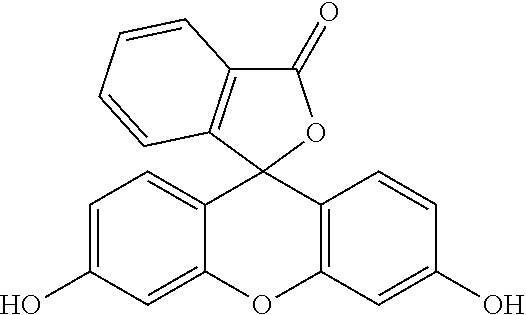 |
green |
| Formula = C20H12O5 | ||
| 2-methyl-4- methoxy- Tokyo Green |
 |
green |
| Formula = C21H16O4 | ||
| Resorufin |
 |
red |
| Formula = C12H7NO3 | ||
-
- (a) bringing the cell population into contact with at least one specific substrate according to the invention,
- (b) measuring the fluorescence of the cell population; and
- (c) identifying cells with increased fluorescence relative to the fluorescence of the cell population before the population is brought into contact with the at least one specific substrate.
| TABLE 3 | |
 |
Resorufine propionate |
 |
Resorufin hexanoate |
 |
Resorufin octanoate |
 |
Resorufine benzoate |
 |
Resorufin 4- diethylaminobenzoate |
 |
Resorufine retinoate |
 |
2-Methyl-4-methoxy-Tokyo Green hexanoate |
 |
2-Methyl-4-methoxy-Tokyo Green octanoate |
 |
4-hydroxycoumarin octanoate |
 |
Fluorescein di-hexanoate |
 |
Fluorescein dioctanoate |
 |
Fluorescein di-retinoate |


| TABLE 4 | |||||
| ALDH1 | ALDH2 | ALDH3 | |||
| Vmax | 12132 | 6693 | 8141 | ||
| Km | 115.5 | 116.0 | 445.1 | ||
| Km/Vmax | 105.04 | 57.69 | 18.29 | ||
| Increase | 1 | 0.54 | 0.17 | ||
| TABLE 4 |
| Patient parameters included in the study of the different activities of Aldehydes Dehydrogenases. |
| Resorufin | Resorufin | Fluorescein | Fluorescein | ||||||
| Type of | Relapse | Phenotypes | Retinoate | Octanoate | di-retinoate | octanoate | |||
| Pt No | Age | Pathology | sampling | (Y/N) | of blasts | (IFM) | (IFM) | (IFM) | (IFM) |
| 1 | 74 | LAM | Sg | Y | CD34 pos. | 59.47 | 11.05 | 147.18 | 65.23 |
| 2 | 50 | LAM | Sg | N | CD34 pos. | 34.98 | 10.26 | 56.44 | 34.07 |
| 3 | 50 | LAM | Mo | N | CD34 pos. | 129.14 | 20.1 | 104.36 | 214.5 |
| 4 | 44 | LAM | Sg | Y | CD34 pos. | 121.23 | 12.72 | 230.7 | 103.44 |
| 5 | 91 | LAM | Mo | Y | CD45 weak | 2.01 | 3.7 | 16.23 | 6.11 |
| 6 | 91 | LAM | Sg | Y | CD117 pos. | 69 | 61.13 | 299.48 | 37.47 |
| 7 | 82 | LAM | Sg | N | CD45 weak | 3.03 | 10.66 | ||
| 8 | 84 | LAM | Sg | N | CD45 weak | 2.08 | 25 | 151 | 9.05 |
| 9 | 93 | LAM | Sg | N | CD45 weak | 8.99 | 25.83 | 169 | 8.74 |
| 10 | 78 | LAM | Sg | N | CD45 weak | 1.5 | 1.93 | 27.5 | 3.55 |
| 11 | 67 | AREB | Mo | N | CD34 pos. | 40.46 | 20.32 | 72.4 | 9.5 |
| 12 | 74 | LAM | Sg | Y | CD34 pos. | 548 | 12.45 | 349 | 64 |
| 13 | 74 | LAM | Sg | Y | CD34 pos. | 83.29 | 6.5 | 91.03 | 245.88 |
| 14 | 80 | AREB | Sg | Y | CD34 pos. | 14.8 | 13.71 | 114.2 | 1.07 |
| 15 | 80 | AREB | Sg | Y | CD34 pos. | 86.29 | 5.94 | 144.98 | 87.99 |
| 16 | 71 | LAM | Sg | Y | CD34 pos. | 15.18 | 670 | 773 | 14.3 |
| 17 | 71 | LAM | Sg | Y | CD34 pos. | 74.79 | 8.82 | 139.26 | 94.44 |
| 18 | 39 | LAM | Mo | N | CD117 pos. | 160.58 | 11.53 | 119.1 | 176.9 |
| 19 | 39 | LAM | Mo | N | CD117 pos. | 59.03 | 8.01 | 54.01 | 25.93 |
| 20 | 39 | LAM | Sg | N | CD117 pos. | 252.73 | 4.35 | 28.27 | 422.55 |
| 21 | 53 | LAM | Sg | N/D | CD117 pos. | 66 | 78.82 | 246 | 35.26 |
| 22 | 53 | LAM | Mo | N/D | CD34 pos. | 64.7 | 8.02 | 33.11 | 2.87 |
| 23 | 53 | LAM | Mo | N | CD34 pos. | 26.71 | 568 | 2.41 | 17.67 |
| 24 | 53 | LAM | Mo | N | CD34 pos. | 83.04 | 14.64 | 131.04 | 78.47 |
| 25 | 78 | LAM | Sg | Y | CD34 pos. | 71.71 | 46.24 | 176.61 | 64.29 |
| 26 | 71 | LAM | Mo | Y | CD34 pos. | 101.54 | 11.6 | 144.5 | 64.3 |
| 27 | 93 | LAM | Sg | Y | CD34 pos. | 73.52 | 6.57 | 217.5 | 123.02 |
| 28 | 70 | AREB | Sg | Y | CD34 pos. | 97.79 | 9.79 | 112 | 48.19 |
| 29 | 60 | LAM | Mo | N | CD34 pos. | 171.6 | 13.23 | 74.26 | 133.5 |
| 30 | 70 | LAM | Mo | Y | CD34 pos. | 39.26 | 91.95 | 139.19 | 29.68 |
| 31 | 70 | LAM | Sg | Y | CD34 pos. | 34.26 | 15.22 | 101.1 | 26.3 |
| 32 | 72 | LAM | Sg | N | CD34 pos. | 25.06 | 4.08 | 27.7 | 19.04 |
| 33 | 72 | LAM | Mo | N | CD34 pos. | 70 | 3.58 | 25.66 | 33.82 |
| AML, Acute Leukemia Myeloide; AREB, Refractory Anemia with Excess Blasts; Sg, blood; Mo, bone marrow; IFM, value of the Median Fluorescence Intensity. | |||||||||
Claims (7)


Applications Claiming Priority (3)
| Application Number | Priority Date | Filing Date | Title |
|---|---|---|---|
| FR1657324A FR3054564B1 (en) | 2016-07-28 | 2016-07-28 | SUBSTRATE SPECIFIC TO AN ISOENZYME OF THE ALDH |
| FR1657324 | 2016-07-28 | ||
| PCT/EP2017/068985 WO2018019927A1 (en) | 2016-07-28 | 2017-07-27 | Specific substrate of an aldh isoenzyme |
Publications (2)
| Publication Number | Publication Date |
|---|---|
| US20190233871A1 US20190233871A1 (en) | 2019-08-01 |
| US11519014B2 true US11519014B2 (en) | 2022-12-06 |
Family
ID=57583191
Family Applications (1)
| Application Number | Title | Priority Date | Filing Date |
|---|---|---|---|
| US16/320,071 Active 2038-12-06 US11519014B2 (en) | 2016-07-28 | 2017-07-27 | Specific substrate of an ALDH isoenzyme |
Country Status (8)
| Country | Link |
|---|---|
| US (1) | US11519014B2 (en) |
| EP (1) | EP3491143A1 (en) |
| JP (1) | JP7050748B2 (en) |
| CN (1) | CN109715822A (en) |
| CA (1) | CA3031587A1 (en) |
| FR (1) | FR3054564B1 (en) |
| IL (1) | IL264481B2 (en) |
| WO (1) | WO2018019927A1 (en) |
Families Citing this family (1)
| Publication number | Priority date | Publication date | Assignee | Title |
|---|---|---|---|---|
| CN116609525B (en) * | 2023-05-26 | 2023-10-27 | 杭州圣域生物医药科技有限公司 | Methods for screening inhibitors of chromatin remodeling complexes based on intracellular ALDH3B1 protein levels |
Citations (13)
| Publication number | Priority date | Publication date | Assignee | Title |
|---|---|---|---|---|
| US3378463A (en) * | 1965-06-22 | 1968-04-16 | Army Usa | Method of measuring enzyme activity |
| WO1995000660A1 (en) | 1993-06-28 | 1995-01-05 | Chemunex | Method for assessing microorganism viability |
| EP0989137A2 (en) | 1998-09-25 | 2000-03-29 | Tokyo Gas Co., Ltd. | Diagnostic agents for pancreatic exocrine function |
| WO2000034507A1 (en) | 1998-12-07 | 2000-06-15 | Duke University | A method of isolating stem cells |
| WO2008112164A2 (en) | 2007-03-08 | 2008-09-18 | The Board Of Trustees Of The Leland Stanford Junior University | Mitochondrial aldehyde dehydrogenase-2 modulators and methods of use thereof |
| WO2009031708A1 (en) | 2007-09-05 | 2009-03-12 | Sumitomo Chemical Company, Limited | Coumarin compound and use thereof |
| WO2010028175A1 (en) | 2008-09-08 | 2010-03-11 | The Board Of Trustees Of The Leland Stanford Junior University | Modulators of aldehyde dehydrogenase activity and methods of use thereof |
| WO2010048144A2 (en) | 2008-10-21 | 2010-04-29 | Ge Healthcare Limited | Imaging and radiotherapy methods |
| WO2010062308A1 (en) | 2008-10-28 | 2010-06-03 | The Board Of Trustees Of The Leland Stanford Junior University | Modulators of aldehyde dehydrogenase and methods of use thereof |
| JP2011184303A (en) | 2010-03-04 | 2011-09-22 | Univ Of Tsukuba | Method for producing bone regeneration promoter |
| US20120237931A1 (en) | 2011-03-14 | 2012-09-20 | Katz Ruth L | Identification and monitoring of circulating cancer stem cells |
| US20140072990A1 (en) | 2010-05-25 | 2014-03-13 | The University Of Tokyo | Fluorescent substrate for detection of enzymatic activity of nitrile-related enzyme |
| WO2014130834A1 (en) | 2013-02-21 | 2014-08-28 | The Johns Hopkins University | Red fluorescent aldehyde dehydrogenase (aldh) substrate |
Family Cites Families (1)
| Publication number | Priority date | Publication date | Assignee | Title |
|---|---|---|---|---|
| CN1179108A (en) * | 1995-02-02 | 1998-04-15 | 耐克麦德英梅金公司 | Contrast agents for in vivo imaging based on light transmission and reflection |
-
2016
- 2016-07-28 FR FR1657324A patent/FR3054564B1/en active Active
-
2017
- 2017-07-27 IL IL264481A patent/IL264481B2/en unknown
- 2017-07-27 WO PCT/EP2017/068985 patent/WO2018019927A1/en not_active Ceased
- 2017-07-27 CA CA3031587A patent/CA3031587A1/en active Pending
- 2017-07-27 CN CN201780057477.5A patent/CN109715822A/en active Pending
- 2017-07-27 JP JP2019503937A patent/JP7050748B2/en active Active
- 2017-07-27 EP EP17749666.8A patent/EP3491143A1/en active Pending
- 2017-07-27 US US16/320,071 patent/US11519014B2/en active Active
Patent Citations (17)
| Publication number | Priority date | Publication date | Assignee | Title |
|---|---|---|---|---|
| US3378463A (en) * | 1965-06-22 | 1968-04-16 | Army Usa | Method of measuring enzyme activity |
| WO1995000660A1 (en) | 1993-06-28 | 1995-01-05 | Chemunex | Method for assessing microorganism viability |
| EP0989137A2 (en) | 1998-09-25 | 2000-03-29 | Tokyo Gas Co., Ltd. | Diagnostic agents for pancreatic exocrine function |
| WO2000034507A1 (en) | 1998-12-07 | 2000-06-15 | Duke University | A method of isolating stem cells |
| WO2008112164A2 (en) | 2007-03-08 | 2008-09-18 | The Board Of Trustees Of The Leland Stanford Junior University | Mitochondrial aldehyde dehydrogenase-2 modulators and methods of use thereof |
| JP2010523476A (en) | 2007-03-08 | 2010-07-15 | ザ ボード オブ トラスティーズ オブ ザ リーランド スタンフォード ジュニア ユニバーシティ | Mitochondrial aldehyde dehydrogenase-2 modulator and method of use thereof |
| WO2009031708A1 (en) | 2007-09-05 | 2009-03-12 | Sumitomo Chemical Company, Limited | Coumarin compound and use thereof |
| WO2010028175A1 (en) | 2008-09-08 | 2010-03-11 | The Board Of Trustees Of The Leland Stanford Junior University | Modulators of aldehyde dehydrogenase activity and methods of use thereof |
| JP2012506439A (en) | 2008-10-21 | 2012-03-15 | ジーイー・ヘルスケア・リミテッド | Imaging and radiation therapy |
| WO2010048144A2 (en) | 2008-10-21 | 2010-04-29 | Ge Healthcare Limited | Imaging and radiotherapy methods |
| WO2010062308A1 (en) | 2008-10-28 | 2010-06-03 | The Board Of Trustees Of The Leland Stanford Junior University | Modulators of aldehyde dehydrogenase and methods of use thereof |
| JP2012506856A (en) | 2008-10-28 | 2012-03-22 | ボード オブ トラスティーズ オブ ザ レランド スタンフォード ジュニア ユニバーシティ | Modulator of aldehyde dehydrogenase and method of use thereof |
| JP2011184303A (en) | 2010-03-04 | 2011-09-22 | Univ Of Tsukuba | Method for producing bone regeneration promoter |
| US20140072990A1 (en) | 2010-05-25 | 2014-03-13 | The University Of Tokyo | Fluorescent substrate for detection of enzymatic activity of nitrile-related enzyme |
| US20120237931A1 (en) | 2011-03-14 | 2012-09-20 | Katz Ruth L | Identification and monitoring of circulating cancer stem cells |
| WO2014130834A1 (en) | 2013-02-21 | 2014-08-28 | The Johns Hopkins University | Red fluorescent aldehyde dehydrogenase (aldh) substrate |
| US20150369738A1 (en) | 2013-02-21 | 2015-12-24 | The Johns Hopkins University | Red fluorescent aldehyde dehydrogenase (aldh) substrate |
Non-Patent Citations (14)
| Title |
|---|
| Alnouti, Y. et al., "Tissue Distribution, Ontogeny, and Regulation of Aldehyde Dehydrogenase (Aldh) Enzymes mRna by Prototypical Microsomal Enzyme Inducers in Mice" Toxicological Sciences 101(1):51-64 (2008). |
| Eshghi et al., "Synthesis of fluorescein aromatic esters in the presence of P205/Si02 as catalyst and their hydrolysis studies in the presence of lipase", Dyes and Pigments, vol. 89, No. 2, May 1, 2011, pp. 120-126. |
| French Search Report for Application No. FR 1657324 dated Mar. 21, 2017. |
| Ge, F., et al. "Synthesis and study on hydrolytic properties of fluorescein esters" Dyes and Pigments 72:322-236 (2007). |
| He, Feng-Ying, et al. "Studies on Crystal Structure and Hydrolysis Features of the Fluorescein Dibenzoate" Acta Chemica Sinica 51:119-124(1993), with English abstract. |
| Imaging Science and Photochemistry, vol. 32, No. 1 (Jan. 2014) China Academic Journal Electronic Publishing House in Chinese. |
| International Search Report for Application No. PCT/EP2017/068985 dated Oct. 30, 2017. |
| Jones at el., "Assessment of aldehyde dehydrogenase in viable cells", Blood, vol. 85, No. 10, May 15, 1995, pp. 2742-2746. |
| Kitson et al., Biochem. J. 316: 225-232 (1996). * |
| Kitson et al., Enzymology and Molecular Biology of Carbonyl Metabolism 6, chapter 23, pp. 201-208 (1996). * |
| Minn, I., et al. "A red-shifted fluorescent substrate for aldehyde dehydrogenase" Nature Communications pp. 1-9 (2014). |
| Rotman et al., Proc. Nat'l. Acad. Sci. USA 55(1): 134-141 (1966). * |
| Wang, Liufang, et al. "Synthsis of Some Fluorescein Diesters and Their Bilogical Fluorescence Activity" Chinese Journal of Luminescence 8(4):317-322 (1987), with English abstract. |
| Wierzchowski et al., "Fluorimetric Detection of Aldehyde Dehydrogenase Activity in Human Blood, Saliva, and Organ Biopsies and Kinetic Differentiation between Class I and Class III Isozymes", Analytical Biochemistry, vol. 245, No. 1, Feb. 1, 1997, pp. 69-78. |
Also Published As
| Publication number | Publication date |
|---|---|
| JP7050748B2 (en) | 2022-04-08 |
| IL264481B2 (en) | 2024-09-01 |
| IL264481B1 (en) | 2024-05-01 |
| EP3491143A1 (en) | 2019-06-05 |
| FR3054564A1 (en) | 2018-02-02 |
| CN109715822A (en) | 2019-05-03 |
| IL264481A (en) | 2019-02-28 |
| US20190233871A1 (en) | 2019-08-01 |
| CA3031587A1 (en) | 2018-02-01 |
| WO2018019927A1 (en) | 2018-02-01 |
| FR3054564B1 (en) | 2018-08-31 |
| JP2019525762A (en) | 2019-09-12 |
Similar Documents
| Publication | Publication Date | Title |
|---|---|---|
| US12215118B2 (en) | Quinone methide analog signal amplification | |
| Naviaux et al. | Retained features of embryonic metabolism in the adult MRL mouse | |
| KR101011347B1 (en) | Rhodamine derivatives and fluorescein derivatives for detecting copper ions, and probes using the same | |
| Liu et al. | Constructing a fluorescent probe for specific detection of cysteine over homocysteine and glutathione based on a novel cysteine-binding group but-3-yn-2-one | |
| US20130150254A1 (en) | Reagents and methods for direct labeling of nucleotides | |
| US20140221665A1 (en) | Luminescent substrate for luciferase | |
| US20190233871A1 (en) | Specific substrate of an aldh isoenzyme | |
| US7465814B2 (en) | Sulfonate compound and fluorescent probe using the same | |
| CN113637048B (en) | Two-photon fluorescent probe of gamma-glutamyl transpeptidase and preparation method and application thereof | |
| EP3341384B1 (en) | Compounds as stimuli-responsive probes, methods and applications thereof | |
| CN110105391A (en) | Alkaline phosphatase response type molecular probe and its application | |
| WO2018002613A1 (en) | Compounds, linked with haptens, for the detection of senescent cells | |
| KR102105937B1 (en) | Fluorescent probe compound for detecting cancer cell and a cancer cell detection fluorescence sensor comprising the same | |
| CN106467739B (en) | The specificity fluorescent probe of catechol O-methyltransferase and its application | |
| US20230052551A1 (en) | Fluorescent probe for detection of enpp activity | |
| CN113774106A (en) | Method for detecting genotoxicity by using 3D hepatocyte in-vitro micronucleus cytomics | |
| CN116375586B (en) | Nitrogen mustard active probes and their applications | |
| Gonçalves et al. | Enzymatic profiling in prostate and breast cancer cells: phosphate hydrolysis and alcohol oxidation | |
| Zhang et al. | A high-sensitivity fluorescent probe with a self-immolative spacer for real-time ratiometric detection and imaging of alkaline phosphatase activity | |
| US20240166594A1 (en) | Photocaged citrulline analogs and methods for site-specific incorporation of citrulline into proteins | |
| US20250281649A1 (en) | Probe directed to enzyme aldh1a3 and use thereof in the diagnosis of glioblastoma | |
| Kadirvel et al. | Bioreductive molecular probe: fluorescence signalling upon reduction of an azo group | |
| CN104781246A (en) | Fluorescent chemical dyes for visualizing symmetric and asymmetric divisions of neural stem cells | |
| CN116183572A (en) | A near-infrared fluorescent probe for detecting thioredoxin reductase and its application | |
| Xia et al. | Improved synthesis of a fluorogenic ceramidase substrate |
Legal Events
| Date | Code | Title | Description |
|---|---|---|---|
| FEPP | Fee payment procedure |
Free format text: ENTITY STATUS SET TO UNDISCOUNTED (ORIGINAL EVENT CODE: BIG.); ENTITY STATUS OF PATENT OWNER: LARGE ENTITY |
|
| AS | Assignment |
Owner name: CENTRE NATIONAL DE LA RECHERCHE SCIENTIFIQUE, FRANCE Free format text: ASSIGNMENT OF ASSIGNORS INTEREST;ASSIGNORS:CEYLAN, ISMAIL;MARTIN, GUILLAUME;QUASH, GERARD;AND OTHERS;SIGNING DATES FROM 20190114 TO 20190214;REEL/FRAME:048387/0920 Owner name: CENTRE NATIONAL DE LA RECHERCHE SCIENTIFIQUE, FRAN Free format text: ASSIGNMENT OF ASSIGNORS INTEREST;ASSIGNORS:CEYLAN, ISMAIL;MARTIN, GUILLAUME;QUASH, GERARD;AND OTHERS;SIGNING DATES FROM 20190114 TO 20190214;REEL/FRAME:048387/0920 Owner name: UNIVERSITE CLAUDE BERNARD LYON 1, FRANCE Free format text: ASSIGNMENT OF ASSIGNORS INTEREST;ASSIGNORS:CEYLAN, ISMAIL;MARTIN, GUILLAUME;QUASH, GERARD;AND OTHERS;SIGNING DATES FROM 20190114 TO 20190214;REEL/FRAME:048387/0920 Owner name: ADVANCED BIODESIGN, FRANCE Free format text: ASSIGNMENT OF ASSIGNORS INTEREST;ASSIGNORS:CEYLAN, ISMAIL;MARTIN, GUILLAUME;QUASH, GERARD;AND OTHERS;SIGNING DATES FROM 20190114 TO 20190214;REEL/FRAME:048387/0920 |
|
| STPP | Information on status: patent application and granting procedure in general |
Free format text: APPLICATION DISPATCHED FROM PREEXAM, NOT YET DOCKETED |
|
| AS | Assignment |
Owner name: ADVANCED BIODESIGN, FRANCE Free format text: ASSIGNMENT OF ASSIGNORS INTEREST;ASSIGNORS:CENTRE NATIONAL DE LA RECHERCHE SCIENTIFIQUE;UNIVERSITE CLAUDE BERNARD LYON 1;REEL/FRAME:053051/0832 Effective date: 20190520 |
|
| STPP | Information on status: patent application and granting procedure in general |
Free format text: NON FINAL ACTION MAILED |
|
| STPP | Information on status: patent application and granting procedure in general |
Free format text: RESPONSE TO NON-FINAL OFFICE ACTION ENTERED AND FORWARDED TO EXAMINER |
|
| STPP | Information on status: patent application and granting procedure in general |
Free format text: NON FINAL ACTION MAILED |
|
| STPP | Information on status: patent application and granting procedure in general |
Free format text: RESPONSE TO NON-FINAL OFFICE ACTION ENTERED AND FORWARDED TO EXAMINER |
|
| STPP | Information on status: patent application and granting procedure in general |
Free format text: FINAL REJECTION MAILED |
|
| STPP | Information on status: patent application and granting procedure in general |
Free format text: NON FINAL ACTION MAILED |
|
| STPP | Information on status: patent application and granting procedure in general |
Free format text: RESPONSE TO NON-FINAL OFFICE ACTION ENTERED AND FORWARDED TO EXAMINER |
|
| STPP | Information on status: patent application and granting procedure in general |
Free format text: NOTICE OF ALLOWANCE MAILED -- APPLICATION RECEIVED IN OFFICE OF PUBLICATIONS |
|
| STPP | Information on status: patent application and granting procedure in general |
Free format text: PUBLICATIONS -- ISSUE FEE PAYMENT VERIFIED |
|
| STCF | Information on status: patent grant |
Free format text: PATENTED CASE |
|
| FEPP | Fee payment procedure |
Free format text: MAINTENANCE FEE REMINDER MAILED (ORIGINAL EVENT CODE: REM.); ENTITY STATUS OF PATENT OWNER: LARGE ENTITY |