US11518933B2 - Precursor based method of synthesis and fabrication of hybrid lighting phosphors with high quantum efficiency, and significantly enhanced thermal and photostability - Google Patents
Precursor based method of synthesis and fabrication of hybrid lighting phosphors with high quantum efficiency, and significantly enhanced thermal and photostability Download PDFInfo
- Publication number
- US11518933B2 US11518933B2 US16/304,495 US201716304495A US11518933B2 US 11518933 B2 US11518933 B2 US 11518933B2 US 201716304495 A US201716304495 A US 201716304495A US 11518933 B2 US11518933 B2 US 11518933B2
- Authority
- US
- United States
- Prior art keywords
- inorganic
- compound
- phosphor compound
- organic hybrid
- group
- Prior art date
- Legal status (The legal status is an assumption and is not a legal conclusion. Google has not performed a legal analysis and makes no representation as to the accuracy of the status listed.)
- Active, expires
Links
- WIQWORJXPIKDFB-UHFFFAOYSA-K BrCCCCCBr.BrCCCCCBr.Brc1cccnc1.C1=Nc2ccccc2C1.C1=Nc2ccccc2C1.CCCBr.CCCn1cnc2ccccc21.Cc1ccc2c(c1)CC=N2.Cc1ccc2ncn(CCCCCn3cnc4ccc(C)cc43)c2c1.O=C(OOI)[Cu]([Cs])[Cs].OCc1ccccc1.O[Na].O[Na].O[Na].c1ccc(COc2cccnc2)cc1.c1ccc2c(c1)ncn2CCCCCn1cnc2ccccc21 Chemical compound BrCCCCCBr.BrCCCCCBr.Brc1cccnc1.C1=Nc2ccccc2C1.C1=Nc2ccccc2C1.CCCBr.CCCn1cnc2ccccc21.Cc1ccc2c(c1)CC=N2.Cc1ccc2ncn(CCCCCn3cnc4ccc(C)cc43)c2c1.O=C(OOI)[Cu]([Cs])[Cs].OCc1ccccc1.O[Na].O[Na].O[Na].c1ccc(COc2cccnc2)cc1.c1ccc2c(c1)ncn2CCCCCn1cnc2ccccc21 WIQWORJXPIKDFB-UHFFFAOYSA-K 0.000 description 1
- BVUYACVXCLZSQF-UHFFFAOYSA-L BrCCCCCBr.C1=CN=CC1.CS(C)=O.CSCn1cnc2ccccc21.O[Na].O[Na].[C+]1=Nc2ccccc2C1.c1cn(CCCCCn2ccnc2)cn1 Chemical compound BrCCCCCBr.C1=CN=CC1.CS(C)=O.CSCn1cnc2ccccc21.O[Na].O[Na].[C+]1=Nc2ccccc2C1.c1cn(CCCCCn2ccnc2)cn1 BVUYACVXCLZSQF-UHFFFAOYSA-L 0.000 description 1
Images


Classifications
-
- C—CHEMISTRY; METALLURGY
- C09—DYES; PAINTS; POLISHES; NATURAL RESINS; ADHESIVES; COMPOSITIONS NOT OTHERWISE PROVIDED FOR; APPLICATIONS OF MATERIALS NOT OTHERWISE PROVIDED FOR
- C09K—MATERIALS FOR MISCELLANEOUS APPLICATIONS, NOT PROVIDED FOR ELSEWHERE
- C09K11/00—Luminescent materials, e.g. electroluminescent or chemiluminescent
- C09K11/06—Luminescent materials, e.g. electroluminescent or chemiluminescent containing organic luminescent materials
-
- C—CHEMISTRY; METALLURGY
- C07—ORGANIC CHEMISTRY
- C07F—ACYCLIC, CARBOCYCLIC OR HETEROCYCLIC COMPOUNDS CONTAINING ELEMENTS OTHER THAN CARBON, HYDROGEN, HALOGEN, OXYGEN, NITROGEN, SULFUR, SELENIUM OR TELLURIUM
- C07F1/00—Compounds containing elements of Groups 1 or 11 of the Periodic Table
- C07F1/005—Compounds containing elements of Groups 1 or 11 of the Periodic Table without C-Metal linkages
-
- C—CHEMISTRY; METALLURGY
- C07—ORGANIC CHEMISTRY
- C07F—ACYCLIC, CARBOCYCLIC OR HETEROCYCLIC COMPOUNDS CONTAINING ELEMENTS OTHER THAN CARBON, HYDROGEN, HALOGEN, OXYGEN, NITROGEN, SULFUR, SELENIUM OR TELLURIUM
- C07F1/00—Compounds containing elements of Groups 1 or 11 of the Periodic Table
- C07F1/08—Copper compounds
-
- H01L51/0091—
-
- H—ELECTRICITY
- H10—SEMICONDUCTOR DEVICES; ELECTRIC SOLID-STATE DEVICES NOT OTHERWISE PROVIDED FOR
- H10K—ORGANIC ELECTRIC SOLID-STATE DEVICES
- H10K85/00—Organic materials used in the body or electrodes of devices covered by this subclass
- H10K85/30—Coordination compounds
- H10K85/361—Polynuclear complexes, i.e. complexes comprising two or more metal centers
-
- H—ELECTRICITY
- H10—SEMICONDUCTOR DEVICES; ELECTRIC SOLID-STATE DEVICES NOT OTHERWISE PROVIDED FOR
- H10K—ORGANIC ELECTRIC SOLID-STATE DEVICES
- H10K85/00—Organic materials used in the body or electrodes of devices covered by this subclass
- H10K85/30—Coordination compounds
- H10K85/371—Metal complexes comprising a group IB metal element, e.g. comprising copper, gold or silver
-
- C—CHEMISTRY; METALLURGY
- C09—DYES; PAINTS; POLISHES; NATURAL RESINS; ADHESIVES; COMPOSITIONS NOT OTHERWISE PROVIDED FOR; APPLICATIONS OF MATERIALS NOT OTHERWISE PROVIDED FOR
- C09K—MATERIALS FOR MISCELLANEOUS APPLICATIONS, NOT PROVIDED FOR ELSEWHERE
- C09K2211/00—Chemical nature of organic luminescent or tenebrescent compounds
- C09K2211/10—Non-macromolecular compounds
- C09K2211/1018—Heterocyclic compounds
- C09K2211/1025—Heterocyclic compounds characterised by ligands
- C09K2211/1029—Heterocyclic compounds characterised by ligands containing one nitrogen atom as the heteroatom
-
- C—CHEMISTRY; METALLURGY
- C09—DYES; PAINTS; POLISHES; NATURAL RESINS; ADHESIVES; COMPOSITIONS NOT OTHERWISE PROVIDED FOR; APPLICATIONS OF MATERIALS NOT OTHERWISE PROVIDED FOR
- C09K—MATERIALS FOR MISCELLANEOUS APPLICATIONS, NOT PROVIDED FOR ELSEWHERE
- C09K2211/00—Chemical nature of organic luminescent or tenebrescent compounds
- C09K2211/10—Non-macromolecular compounds
- C09K2211/1018—Heterocyclic compounds
- C09K2211/1025—Heterocyclic compounds characterised by ligands
- C09K2211/1044—Heterocyclic compounds characterised by ligands containing two nitrogen atoms as heteroatoms
-
- C—CHEMISTRY; METALLURGY
- C09—DYES; PAINTS; POLISHES; NATURAL RESINS; ADHESIVES; COMPOSITIONS NOT OTHERWISE PROVIDED FOR; APPLICATIONS OF MATERIALS NOT OTHERWISE PROVIDED FOR
- C09K—MATERIALS FOR MISCELLANEOUS APPLICATIONS, NOT PROVIDED FOR ELSEWHERE
- C09K2211/00—Chemical nature of organic luminescent or tenebrescent compounds
- C09K2211/18—Metal complexes
- C09K2211/188—Metal complexes of other metals not provided for in one of the previous groups
-
- H01L51/5016—
-
- H01L51/5271—
-
- H—ELECTRICITY
- H10—SEMICONDUCTOR DEVICES; ELECTRIC SOLID-STATE DEVICES NOT OTHERWISE PROVIDED FOR
- H10K—ORGANIC ELECTRIC SOLID-STATE DEVICES
- H10K2101/00—Properties of the organic materials covered by group H10K85/00
- H10K2101/10—Triplet emission
-
- H—ELECTRICITY
- H10—SEMICONDUCTOR DEVICES; ELECTRIC SOLID-STATE DEVICES NOT OTHERWISE PROVIDED FOR
- H10K—ORGANIC ELECTRIC SOLID-STATE DEVICES
- H10K50/00—Organic light-emitting devices
- H10K50/10—OLEDs or polymer light-emitting diodes [PLED]
- H10K50/11—OLEDs or polymer light-emitting diodes [PLED] characterised by the electroluminescent [EL] layers
-
- H—ELECTRICITY
- H10—SEMICONDUCTOR DEVICES; ELECTRIC SOLID-STATE DEVICES NOT OTHERWISE PROVIDED FOR
- H10K—ORGANIC ELECTRIC SOLID-STATE DEVICES
- H10K50/00—Organic light-emitting devices
- H10K50/80—Constructional details
- H10K50/85—Arrangements for extracting light from the devices
- H10K50/856—Arrangements for extracting light from the devices comprising reflective means
Definitions
- the present invention relates to the field of light emitting materials, which emit strongly over the entire visible spectrum, including for example white, orange, green, blue and yellow color, devices made therefrom, and methods of making these materials and devices.
- SSL Solid-state lighting
- LEDs light-emitting diodes
- WLEDs Low-cost and high-efficiency white light emitting diodes
- incandescent e.g. 15 lm/W
- fluorescent lighting e.g. 114 lm/W
- Other applications range from computer displays to car headlights.
- major setbacks of SSL are the cost, the dependence on the rare earth (“RE”) elements, which are in serious supply shortage, and the lack of their recyclability, thus causing damages to the environment.
- RE rare earth
- the present invention met such a need. Described herein is a novel class of phosphor compounds that emit intensive yellow or orange light with high luminescence quantum efficiency, coupled with large Stokes shift that greatly reduces self-absorption. Advantages of these phosphors also include high quantum yields and prolonged stability.
- the present invention provides an inorganic-organic hybrid phosphor compound of the formula Cu m X m (L 1 ) o (L 2 ) p , wherein:
- X is a halogen
- L 1 is an organic multi-dentate ligand, wherein at least two atoms of the ligand are heteroatoms each independently selected from N, O and S and the two heteroatoms are each coordinated to a Cu atom in a respective cluster so that each of said L 1 links two Cu m X m clusters,
- L 2 is an organic mono-dentate or multi-dentate ligand, wherein at least 1 atom of the ligand are heteroatoms independently selected from N, O and S and the Cu atom is coordinated to one of these heteroatoms,
- n is an integer of 1, 2, 3, 4, 5, or 6, and
- L 1 and L 2 are independently a 5-10 membered heteraryl or heterocyclyl group.
- X is I
- m is 1, 2 3 or 4.
- the inorganic-organic hybrid phosphor compound is characterized by a crystal structure that consists essentially of a Cu—X motif selected from the group of rhomboid dimers, cubane tetramers, and other Cu m X m clusters.
- L 1 is bi-dentate ligand and L 2 is a mono-dentate ligand.
- the inorganic-organic hybrid phosphor compound o is 2, p is 0, and said crystalline structure is formed from a plurality of recur-ring 1D Cu 4 X 4 (L 1 ) 2 structures, wherein said recurring 1D Cu 4 X 4 (L 1 ) 2 structure is formed from a recurring unit of Cu 4 X 4 (L 1 ) 2
- the 1D lattice structures stack together with each other through the aligned organic ligands to form orderly 2D and/or 3D crystalline lattice structures.
- o is 2
- p is 0, and said crystalline structure is formed from a plurality of recurring 2D-Cu 4 X 4 (L) 2 lattice structures, wherein said recurring 2D-Cu 4 X 4 (L 12 structure is formed from a recurring unit of Cu 4 X 4 (L 1 ) 2 .
- an orderly 3D crystalline lattice structures are formed via recurring Cu 4 X 4 (L 1 ) 2 units extended in all three dimensions, preferably linked by covalent bonding.
- X is I
- L 1 is an organic ligand comprising a 5, 6, 7, 9 or 10-membered substituted or unsubstituted heteroaromatic group.
- L 1 is a bidentate ligand selected from pyrimidine (pm), bipyridine (bpy), bi-imidazole, benzoimidazole, and bi-benzoimidazole and pyrazine (pz), each optionally substituted by one, two or three substituents independently selected from halogens, —OR 1 , —SR 1 , —C 1 -C 4 SR 1 , —C 1 -C 4 alkyl, —NO 2 , —CN and —NR a R b , wherein R 1 at each occurrence is independently hydrogen (H) or C 1 -C 4 alkyl, and R a and R b are independently hydrogen or C 1 -C 4 alkyl.
- L is selected from 5-methyl-pyrimidine (5-me-pm), 4,6-dimethyl-pyrimidine (4,6-dm-pm), 1,3-propandiamine (pda), 3,3′-bipyridine (3,3′-bpy), 1,3-bis(4-pyridyl)propane (bpp), 4,4′-dipyridyl sulfide (4,4′-dps), ethylene diamine (en), bibenzoimidazolylpentane (bbipe), diimidazolylpentanedipe, bi-5-methyl-benzoimid-azolylpentane (bmbipe), 1,4-butyldiamine (1,4-bda), bi-5,6-di-methyl-benzoimid-azolylpentane (bdmbipe), and 1-(methylsulfur-methylenyl)-benzoimidazole (msmbi).
- the phosphor compound is selected from 1D-Cu 4 I 4 (bbipe) 2 , 1D-Cu 4 I 4 (msmbi) 2 , 2D-Cu 4 I 4 (pda) 2 , 2D-Cu 4 I 4 (dipe) 2 , 2D-Cu 4 I 4 (bmbipe) 2 , 2D-Cu 4 I 4 (bpp) 2 , 2D-Cu 4 I 4 (4,4′-dps) 2 , 3D-Cu 4 I 4 (1,4-bda) 2 , 3D-Cu 4 I 4 (en) 2 , 3D-Cu 4 I 4 (dipe) 2 , and 2D-Cu 4 I 4 (5-me-pm) 2 .
- the present invention provides a composite, comprising a mixture of Cu 4 X 4 (L 1 ) 2 and Cu 2 X 2 (L 1 ′)(L 2 ′) 2 .
- X is a halogen
- L 1 is a multi-dentate ligand
- L 1 ′ is a mon-dentate ligand or a multi-dentate ligand
- L 2 ′ is a mono-dentate ligand.
- L 1 ′ is a mono-dentate ligand including for example triphenyl-phosphine (tpp), py, bpy, bpp, pm, pz, 4-Cl-py, 3-Br-py, 3-I-py, 4-NH 2 -py, 2-Br-pm, 3-CH 3 -py (3-picoline) and 4-CH 3 -py (4-picoline).
- tpp triphenyl-phosphine
- py, bpy, bpp pm
- pz pz
- Cu 4 I 4 (L 1 ) 2 is a phosphor compound emitting yellow or orange light.
- Cu 2 X 2 (L 1 ′)(L 2 ′) 2 is a phosphor compound emitting blue light.
- the yellow or orange phosphor compound and the blue phosphor compound are each in the form of a network having a 1D, 2D or 3D crystalline lattice structure, and the amount of the blue phosphor compound is about 1% to about 99%, all subranges and subvalues included, of the total weight of said yellow or orange phosphor compound and said blue phosphor compound. In some embodiments, the amount of the blue phosphor compound is about 5% to about 30% by weight.
- the present invention provides light-emitting diodes characterized by a chip coated with an inorganic-organic hybrid phosphor compound or composite disclosed herein.
- the present invention provides a method of emitting a visible light comprising exposing the phosphor compound or the composite described herein to an excitation source with blue, UV or near UV light.
- the present invention provides a method of preparing the phosphor compound described herein, comprising the steps of
- the solution comprises an alcohol solvent.
- step (b) further comprises heating said solution.
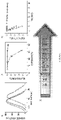
- FIGS. 1 ( a )- 1 ( d ) illustrates the Cu 4 I 4 clusters and extended network structures.
- FIGS. 2 ( a )- 2 ( d ) illustrates characteristics of selected compounds.
- 2 ( a ) Photoluminescence spectra ( ⁇ ex 360 nm) of selected compounds: 3 (black), 7 (red), 10 (blue), 11 (green), 15 (orange), 17 (purple);
- Various embodiments of the present invention provides a novel class of CuX (X: halide) based inorganic-organic hybrid structures with excellent luminescence efficiency and stability.
- X molecular Copper (I) iodide clusters containing monodentate ligand (e.g. pyridine)
- both the photo and thermal stability of the new structures are significantly improved as a result of incorporating the strongly emissive CuI core into 1D, 2D or 3D extended networks.
- Crystalline inorganic-organic hybrid compounds combine the good features of both constituents in a single crystal lattice, thereby giving rise to significant enhancement of their overall optical properties.
- Some of these hybird compounds have been reported for their strong luminescences.
- compounds made of copper(I) halides (mostly iodides) and mono-dentate or bi-dentate N-containing ligands are of particular interest due to their solution processability, structural diversity, earth abundance, and high luminescence. As a result they are considered as one of the most promising material groups as low-cost, rare earth element-free phosphor candidates.
- Various structure motifs have been prepared by mixing copper iodide and organic ligands of different ratios and under different reaction conditions.
- Rhomboid dimers, cubic tetramers and staircase-like chains are the three most common building motifs of this compound family. Most of these compounds are luminescent and emit within the visible light region. However, the compounds disclosed in earlier reports suffer from low quantum yield (QY). On the other hand, Cu 2 I 2 dimer-based molecular structures show high QYs comparable to commercial phosphors, however, their photo and thermal stability are generally poor. In attempt of resolving these issues and preparing phosphors with both high QY and framework stability, a new synthetic approach has been developed.
- the new approach generally involves a two-step process: (1) synthesis of highly emissive Cu m X m molecular clusters as precursors, and (2) construction of robust and extended network structures using these molecular precursors as building blocks and ligands that form strong Cu—N bonds as linkers.
- the multi-dentate ligands connect the Cu m X m molecular clusters to form a network having a 1D, 2D or 3D crystalline lattice structure.
- the present invention provides an inorganic-organic hybrid phosphor compound of the formula Cu m X m (L 1 ) o (L 2 ) p .
- X is a halogen.
- L 1 is an organic multi-dentate ligand, wherein at least two atoms of the ligand are heteroatoms independently selected from N, O and S and the two atoms are each coordinated to a Cu atom in a respective Cu m X m cluster. As a result, each L 1 links two adjacent Cu m X m clusters.
- L 2 is an organic mono-dentate or multi-dentate ligand, wherein at least 1 atom of the ligand are heteroatoms independently selected from N, O and S and the Cu atom is coordinated to one of these heteroatoms.
- a multi-dentate ligand can coordinate to two, three or more Cu atoms.
- the subscript m is an integer of 1, 2, 3, 4, 5, or 6.
- the subscripts o and p are each independently selected from 0, 1, 2, 3, 4, 5, and 6, provided that o and p are not both 0.
- the atoms of the compound are arranged to form a network having a 1-D, 2-D or 3-D crystalline lattice structure.
- Each L 1 coordinates to two recurring units of Cu m X m in the network crystalline structure.
- the crystalline lattice structure of the above compounds consists essentially of a motif selected from rhomboid dimers, cubane tetramers and staircase chains. In some embodiments, the crystalline lattice structure consists essentially of cubane tetramers.
- CuX as used herein includes copper (I) fluoride, copper (I) chloride, copper (I) bromide and copper (I) iodide.
- X is I.
- the cubic Cu 4 I 4 clusters demonstrate the strongest emission in yellow-orange region, making them attractive phosphor candidates for “warm” WLEDs (low CCT, high CRI).
- the geometry of the Cu 4 I 4 is usually a distorted cubane, and can also be considered as two Cu 2 I 2 dimer fragments oriented perpendicular to each other.
- the multi-dentate ligand serves an important role in the formation of the extended network structure.
- L 1 and L 2 be the same or different multi-dentate ligands.
- the formula can be simplified as Cu m X m (L) o+p , where L is the multi-dentate ligand.
- the inorganic-organic hybrid phosphor compound has a formula of Cu 4 X 4 (L) 2 .
- p is 0 and the compound is Cu m X m (L 1 ) o , wherein o is 1, 2, 3 or 4.
- L 1 contains a 5- and/or 6-membered substituted or unsubstituted heteroaromatic group.
- An organic ligand contains one or more heteroatoms in an aromatic ring, an aliphatic group, or each of these.
- a multi-dentate ligand thus may have a symmetrical or asymmetric structure, wherein each of two heteroatom-containing moieties coordinates to a Cu atom.
- Non-limiting examples of rings containing heteroatoms include azepinyl, benzimidazolyl, benzisoxazolyl, benzofurazanyl, benzopyranyl, benzothiopyranyl, benzofuryl, benzothiazolyl, benzothienyl, benzoxazolyl, chromanyl, cinnolinyl, dihydrobenzofuryl, dihydrobenzothienyl, dihydrobenzothiopyranyl, dihydrobenzothiopyranyl sulfone, 1,3-dioxolanyl, furyl, imidazolidinyl, imidazolinyl, imidazolyl, indolinyl, indolyl, isochromanyl, isoindolinyl, isoquinolinyl, isothiazolidinyl, isothiazolyl, isothiazolidinyl, morpholinyl, naphthyridiny
- Non-limiting examples of non-ring structures containing heteroatoms include aminoalkyl, thiol, thioether, hydroxyl, ether, amide, ester, and carboxylic acid.
- Further examples of bidentate ligands include pyrimidine (pm), bipyridine (bpy), bi-imidazole, benzoimidazole, and bi-benzoimidazole and pyrazine (pz).
- aryl, heteroaryl, ring, or aliphatic moiety of a ligand is optionally substituted by one, two or three substituents.
- substituents include halogens, —OR 1 , —SR 1 , —C 1 -C 4 SR 1 , —C 1 -C 4 alkyl, —NO 2 , —CN and —NR a R b , wherein R 1 at each occurrence is independently hydrogen (H) or C 1 -C 4 alkyl, and R a and R b are independently hydrogen or C 1 -C 4 alkyl.
- a multi-dentate ligand can contain a linker connecting two heteroatom-containing moieties, each of which coordinates to a Cu atom.
- the ligand can be an aryl group linked to a non-aryl group, two aryl groups joined into the same molecule, two amino groups linked together.
- the linker between two heteoatom-containing moieties in a ligand can be an aryl group, a heteroaryl group, a straight or branched chain structure, a non-aromatic ring, a single atom, or any combination of these.
- the linker is a C1-C10 carbon linker, wherein any carbon in the linker can be further substituted or replaced with a heteroatom.
- bi-dentate ligands include benzoimidazolyl-propane (bipr), 5-methyl-pyrimidine (5-me-pm), 4,6-dimethyl-pyrimidine (4,6-dm-pm), 1,3-propandiamine (pda), 3,3′-bipyridine (3,3′-bpy), 1,3-bis(4-pyridyl)propane (bpp), 4,4′-dipyridyl sulfide (4,4′-dps), ethylene diamine (en), bibenzoimidazolylpentane (bbipe), diimidazolylpentane (dipe), bi-5-methyl-benzoimidazolylpentane (bmbipe), 1,4-butyldiamine (1,4-bda), bi-5,6-di-methyl-benzoimidazolylpentane (bdmbipe), and 1-(methyl-sulfurmethylenyl)-benzoimi
- the extended network constructed from the highly emissive molecular cluster precursor and the multi-dentate ligand can be a 1D, 2D or 3D structure.
- the network structure is a crystalline structure formed from a plurality of recur-ring 1D Cu 4 X 4 (L 1 ) 2 lattice structures, and the recurring 1D-Cu 4 X 4 (L 1 ) 2 structure is formed from a recurring unit of Cu 4 X 4 (L 1 ) 2 .
- compound 8 of Table 1 includes a bi-dentate ligand (msmbi), which coordinates to two clusters through a sulfur and a nitrogen atom.
- the 1D lattice structures can stack together with each other through the aligned organic ligands to form orderly 2D and/or 3D crystalline lattice structures.
- the network structure is a crystalline structure formed from a plurality of recurring 2D-Cu 4 X 4 (L 1 ) 2 lattice structures, and the recurring 2D-Cu 4 X 4 (L) 2 structure is formed from a recurring unit of Cu 4 X 4 (L 1 ) 2 .
- Examples include compounds 9, 10, 11, 12 and 14 of Table 1.
- the network structure is a crystalline structure formed from a plurality of recurring 3D-Cu 4 X 4 (L 1 ) 2 lattice structures, and the recurring 3D-Cu 4 X 4 (L 1 ) 2 structure is formed from a recurring unit of Cu 4 X 4 (L 1 ) 2 .
- Examples include compounds 15, 16 and 17 of Table 1.
- the phosphor compound may emit a yellow or orange light.
- Exemplary phosphor compounds include 1D-Cu 4 I 4 (bbipe) 2 , 1D-Cu 4 I 4 (msmbi) 2 , 2D-Cu 4 I 4 (pda) 2 , 2D-Cu 4 I 4 (dipe) 2 , 2D-Cu 4 I 4 (bmbipe) 2 , 2D-Cu 4 I 4 (bpp) 2 , 2D-Cu 4 I 4 (4,4′-dps) 2 , 3D-Cu 4 I 4 (1,4-bda) 2 , 3D-Cu 4 I 4 (en) 2 , 3D-Cu 4 I 4 (dipe) 2 , and 2D-Cu 4 I 4 (5-me-pm) 2 .
- Additional examples of phosphor compounds emitting green, blue, orange or yellow light include 1D-Cu 2 I 2 (tpp) 2 (1,3-bpp), 1D-Cu 2 I 2 (tpp) 2 (4,4′-dps), 1D-Cu 2 I 2 (5-me-pm) 2 , 2D-Cu 2 I 2 (3,3′-bpy) 2 , 1D-Cu 2 I 2 (tpp) 2 (5-Br-pm), and nD-Cu 4 I 4 (bdmbipe) x .
- Additional example compounds of the present invention include 3D-Cu 4 I 4 (ted) 4 (TED: 1,4-Diazabicyclo[2.2.2]octane) and 0D-Cu 2 I 2 (tpp) 2 (4,6-dm-pm) 2 . It is noted that 0D compounds described herein can also be used as soluble molecular precursors to prepare the 1D, 2D, 3D compounds with extended network.
- the composite includes a yellow or orange phosphor compound and a blue phosphor compound.
- the yellow or orange phosphor compound is generally of the formula Cu m X m (L 1 ) o (L 2 ) p , which is defined above.
- the yellow or orange phosphor compound is Cu 4 X 4 (L 1 ) 2 , wherein X is iodide and L 1 is a multi-dentate ligand as described above.
- the blue phosphor compound can be represented with Cu u X v (L 1 ′) s (L 2 ′) t , wherein X is a halogen, L 1 ′ is a mon-dentate ligand or a multi-dentate ligand, L 2 ′ is a mono-dentate ligand.
- the multi-dentate and mono-dentate ligands are as described above.
- the subscripts u, v, s and t are each independently 1, 2, 3, or 4.
- x is iodide
- u and v are each 2.
- the blue phosphor is of the formula Cu 2 X 2 (L 1 ′)(L 2 ′) 2 , wherein X is iodide.
- L 1 ′ is a multi-dentate ligand which is described above.
- L 2 ′ is a mono-dentate ligand is ligand doped into the phosphor to modify its emission color.
- L 2 ′ examples include triphenylphosphine (tpp), py, bpy, bpp, pm, pz, 4-Cl-py, 3-Br-py, 3-I-py, 4-NH 2 -py, 2-Br-pm, 3-CH 3 -py (3-picoline) and 4-CH 3 -py (4-picoline).
- a blue phosphor compound can be prepared by, for example, doping a yellow or orange phosphor compound with a secondary ligand during ligand exchange stage.
- the composite can emit a new color.
- the amount of the blue phosphor compound is about 0.1% to about 99.9% of the total weight of the yellow or orange phosphor compound and the blue phosphor compound.
- Exemplary ranges of amount of the blue phosphor compound include about 1-5%, about 5-10%, about 10-15%, about 15-20% and about 20-25%.
- Other exemplary ranges of the blue phosphor include less than about 30%, less than about 20%, less than about 15%, less than about 10%, less than about 5%, and less than about 1% of the total weight of the yellow or orange phosphor compound and the blue phosphor compound.
- Further non-limiting examples of the amount of the blue phosphor compound in the mixture include about 1%, about 2%, about 3%, about 5%, about 8%, about 10%, about 15%, about 20%, and about 25%.
- the compounds of the present invention can be configured into structures that are useful in the fabrication of electrical and optical devices by conventional means well known to those of ordinary skill in the art. These include, but are not limited, to interlayer dielectric devices in microelectronics, thermo-electric devices for cooling, beating and generating electricity, and quantum well laser structures useful in optoelectric devices for the generation or modulation of light radiation, including the modulation of light radiation for the transmission of information.
- the compounds of the present invention may also be used in infra-red photodetectors, lasers for spectroscopic and fiber optic applications, electroluminescent lasers and electronic phosphors.
- the inorganic-organic hybrid compounds can be used in light-emitting devices to generate direct white light.
- LEDs Light emitting diodes
- LEDs Light emitting diodes based on the inorganic-organic hybrid compounds or composite of the present invention are prepared by substituting the inorganic-organic hybrid compounds of the present invention for the semiconductor compounds conventionally used in the semiconductor die of an LED. That is, a chip/die coated with the inorganic-organic compound or composite of the present invention is placed in conductive contact between an anode and a cathode within a reflective cavity. The chip/die converts electricity to light, which is an excitation source for the phosphor to absorb and then emit light.
- the phosphor compound is exposed to a light excitation source which can be for example, a blue or UV or near-UV die/chip.
- the phosphor absorbs the blue, UV or near-UV light and convert them to yellow or other colored light.
- the method includes (a) placing a die or chip coated with an inorganic-organic compound or composite of the present invention in conductive contact between an anode and a cathode within a reflective cavity; and (b) passing a current from the anode to the cathode.
- the phosphor compound can also be coated on a substrate (e.g. a lamp, a film, a garment or any suitable surface).
- an excitation source e.g. UV, visible light, or infrared
- Another aspect of the invention provides a method of preparing the phosphor compound described herein.
- the method includes:
- a secondary mono-dentate or multi-dentate ligand L 2 can also be introduced at step (b).
- Non-limiting examples of L 1 ′ and L 2 ′ independently include triphenylphosphine (tpp), py, bpy, bpp, pm, pz, 4-Cl-py, 3-Br-py, 3-I-py, 4-NH 2 -py, 2-Br-pm, 3-CH 3 -py (3-picoline) and 4-CH 3 -py (4-picoline).
- m is 4, and o is 2 or 4, and p is 2 or 0.
- X is Br, I or Cl.
- Various solvents can be used in the solution. In some embodiments, the solvent is an alcohol. Examples include methanol, ethanol, and propanol.
- Synthesis of 0D-Cu 4 I 4 (4-bz-py) 4 (4) The synthesis of pure powder sample of 4 was similar to that of 2 except the ligand. Orange cubic crystals were obtained after precursor 1 (0.1 mmol) and 4-bz-py (0.4 mmol) mixture was heated at 100° C. for 5 days in a thick-wall Pyrex tube (90% yield based on Cu).
- the 0D-Cu 4 I 4 (py) 4 (1) was selected as a molecular precursor for the synthesis. It was well dispersed in ethanol solution prior to ligand substitution. The stability of the cluster in ethanol was confirmed via UV-Vis absorption spectroscopy. Ligand substitution was accomplished through the addition of a second multi-dentate ligand to the solution accompanied by heating. A variety of ligands with different types, lengths and functional groups (including several newly designed imidazole derivatives) were successfully exchanged with py of the precursor.
- Solid state photoluminescence spectra were collected at room temperature (RT). The emission spectra confirm that all compounds emit strongly in the yellow-orange color region (emission maxima: 545-620 nm, FIG. 2 a ) and their emission profile is a single band type.
- the internal quantum yields (IQYs) of these compounds were measured at room temperature. The values range from 56% to 96%. High IQYs are maintained in extended network structures (1D-3D), as in the case of molecular cubanes. Luminescence decay measurements were conducted on selected compounds (4, 7, 11 and 15). Their lifetime values are 14.48, 14.13, 15.26 and 11.74 ⁇ s, respectively, characteristic of typical phosphor materials. The fact that extended structures have similar lifetimes as the Cu 4 I 4 clusters suggests that the emission behaviors of the two types of structures are similar.
- IQY was measured before and after the exposure, and the results show that the IQY remain almost the same after 30 days of continuous and unprotected exposure in air (2.5% decreased in IQY values, FIG. 2 c ), which is significantly better than 0D-Cu 4 I 4 (py) 4 and 0D-Cu 4 I 4 (3-pc) 4 structures under the identical conditions.
- the latter compounds dropped 70% in IQY values.
- the greatly enhanced stability and high quantum efficiency make the Cu 4 I 4 -based network structures the most suitable candidates as lighting phosphors.
- the IQYs of these white phosphors are between 70% and 82%, among the highest values reported to date.
- Compound 10 emits orange light with a large Stokes shift, and as a result its composite phosphors emit much warmer white light, with CCT values between 2500 and 3200 K.
- the Cu 4 I 4 -based phosphors are also solution processable, allowing for facile coating on various substrates.
- a solution of water soluble binder PolyOx N-750 and the M4 phosphor was prepared in bulk ethanol, which was solidified after the evaporation of the ethanol leaving behind a thin resin film of uniformly dispersed phosphor.
- a prototype lighting device was fabricated using a remote coating approach in which the phosphor was separated from the excitation source. To prepare the device, a thin layer of the phosphor with binder was coated onto the inner surface of a lamp covering. To evaluate the coating quality, the coated layer was removed from the surface as uniform thin film.
- a UV fluorescent light bulb was installed inside the lamp to serve as the excitation source. At working condition, the lamp produces pure warm white light. After several weeks of constant illumination, the light quality is unchanged, as the phosphors are stable under working conditions.
Landscapes
- Chemical & Material Sciences (AREA)
- Organic Chemistry (AREA)
- Engineering & Computer Science (AREA)
- Materials Engineering (AREA)
- Inorganic Chemistry (AREA)
- Physics & Mathematics (AREA)
- High Energy & Nuclear Physics (AREA)
- Electroluminescent Light Sources (AREA)
Abstract
Description
-
- and p are each independently selected from 0, 1, 2, 3, 4, and 6, provided that o and p are not both 0,
- wherein the atoms of the compound are arranged to form a network having a 1-D, 2-D or 3-D crystalline lattice structure.


| TABLE 1 |
| List of new Cu4I4 based compounds with |
| unit cell parameters and space groups. |
| Space | ||
| Compound | Unit Cell Constants (Å, °) | Group |
| 0D-Cu4I4(3-bzo-py)4 (2) | a = 20.7422 (13) | C2/c |
| b = 15.9253 (10) | ||
| c = 17.7211 (18) | ||
| β = 121.6130 (10) | ||
| 0D-Cu4I4(4-bz-py)4 (4) | a = 18.1159 (8) | P21/c |
| b = 22.3929 (10) | ||
| c = 23.9526 (10) | ||
| β = 92.959 (3) | ||
| 0D-Cu4I4(prbi)4 (6) | a = 23.8687(8) | C2/c |
| b = 23.8070(9) | ||
| c = 19.3331(7) | ||
| β = 124.010(2) | ||
| 1D-Cu4I4(msmbi)2 (8) | a = 10.9115(4) | P-1 |
| b = 11.0763(4) | ||
| c = 12.8694(5) | ||
| α = 71.844(2) | ||
| β = 85.177(2) | ||
| γ = 85.809(2) | ||
| 2D-Cu4I4(dipe)2 (10) | a = 8.7880 (4) | Cc |
| b = 20.3211 (11) | ||
| c = 18.57702 (9) | ||
| β = 99.700 (2) | ||
| 2D-Cu4I4(bmbipe)2 (11) | a = 11.4927 (4) | P-1 |
| b = 14.4582 (5) | ||
| c = 15.9437 (6) | ||
| α = 77.440 (2) | ||
| β = 71.127 (2) | ||
| γ = 75.992 (2) | ||
| 2D-Cu4I4(5-me-pm)2 (13) | a = 13.1679 (4) | C2/c |
| b = 10.7065 (4) | ||
| c = 14.8078 (5) | ||
| β = 105.146 (2) | ||
| 3D-Cu4I4(1,4-bda)2 (15) | a = 7.3332(4) | P-1 |
| b = 7.3925(4) | ||
| c = 20.3805 (10) | ||
| α = 85.853 (3) | ||
| β = 79.752 (2) | ||
| γ = 89.939(10) | ||
| 3D-Cu4I4(dipe)2 (17) | a = 17.5305 (8) | Fdd2 |
| b = 36.1060 (17) | ||
| c = 10.7829 (5) | ||
| 3-bzo-py = 3-benzyloxy-pyridine, | ||
| 4-bz-py = 4-benzyl-pyridine, | ||
| prbi = 1-propyl-1H-benzo[d]imidazole, | ||
| msmbi = 1-((methylthio)methyl)-1H-benzo[d]imidazole, | ||
| dipe = 1,5-di(1H-imidazol-1-yl)pentane, | ||
| bmbipe = 1,5-bis(5-methyl-1H-benzo[d]imidazol-1-y1)pentane, | ||
| 5-me-pm = 5-methyl-pyrimidine, 1,4-bda = 1,4-butanediamine | ||
| Samples of both single crystal and power forms were obtained. Single crystal data for 9 new compounds: 2, 4, 6 (0D), 8 (1D), 10, 11, 13 (2D), and 15, 17 (3D) are summarized in Table 1. The purity of the powder samples was confirmed by powder X-ray diffraction (PXRD) analysis. | ||
| TABLE 2 |
| Estimated band gaps, emission energies, colors, IQY values and decomposition |
| temperatures of Cu4I4-based compounds (λex = 360 nm). |
| Band gap | λem | IQY | Decomp. Temp. | |||
| # | Compounds | (eV) | (nm) | Color | (%) | (° C.) |
| 1 | 0D-Cu4I4(py)4 | 2.7 | 560 | Yellow | 92.3 ± 1.1 | 60 |
| 2 | 0D-Cu4I4(3-bzo-py)4 | 2.9 | 590 | Yellow | 85.6 ± 0.4 | 130 |
| 3 | 0D-Cu4I4(3-pc)4 | 2.8 | 560 | Yellow | 94.3 ± 1.2 | 60 |
| 4 | 0D-Cu4I4(4-bz-py)4 | 2.7 | 560 | Yellow | 95.7 ± 1.3 | 120 |
| 5 | 0D-Cu4I4(4-ph-py)4 | 2.6 | 545 | Yellow | 93.2 ± 0.3 | 110 |
| 6 | 0D-Cu4I4(prbi)4 | 2.7 | 600 | orange | 96.1 ± 1.1 | 160 |
| 7 | 1D-Cu4I4(bbipe)2 | 2.7 | 560 | Yellow | 71.8 ± 1.3 | 320 |
| 8 | 1D-Cu4I4(msmbi)2 | 3.2 | 550 | Yellow | 70.2 ± 0.3 | 150 |
| 9 | 2D-Cu4I4(pda)2 | 3.0 | 616 | Orange | 65.3 ± 0.5 | 200 |
| 10 | 2D-Cu4I4(dipe)2 | 2.8 | 620 | Orange | 64.4 ± 0.7 | 290 |
| 11 | 2D-Cu4I4(bmbipe)2 | 2.7 | 550 | Yellow | 67.1 ± 0.4 | 350 |
| 12 | 2D-Cu4I4(bpp)2 | 2.6 | 613 | Orange | 56.2 ± 0.5 | 240 |
| 14 | 2D-Cu4I4(4,4′-dps)2 | 2.4 | 577 | Yellow | 60.6 ± 1.2 | 220 |
| 15 | 3D-Cu4I4(1,4-bda)2 | 3.1 | 585 | Yellow | 60.7 ± 1.4 | 230 |
| 16 | 3D-Cu4I4(en)2 | 3.0 | 590 | Yellow | 70.1 ± 1.2 | 160 |
| 17 | 3D-Cu4I4(dipe)2 | 2.9 | 580 | Yellow | 65.6 ± 1.3 | 300 |
| TABLE 3 |
| CIE, CRI, CCT and IQY of composite white phosphors. |
| Sample | wt % | |||||
| Label | of BP | CIE | CRI | CCT(K) | IQY(%) | |
| — | BP | — | 0.16, 0.17 | — | — | 91.1 ± 1.1 |
| M1 | 17/BP | 16 | 0.34, 0.35 | 73.9 | 4988 | 82.2 ± 0.4 |
| M2 | 17/ |
12 | 0.35, 0.37 | 71.2 | 4613 | 76.3 ± 0.5 |
| M3 | 17/BP | 8 | 0.40, 0.43 | 62.3 | 3736 | 71.7 ± 1.2 |
| |
10/BP | 14 | 0.39, 0.34 | 78.9 | 3132 | 80.1 ± 0.5 |
| |
10/BP | 11 | 0.40, 0.30 | 70.3 | 2712 | 76.5 ± 1.2 |
| |
10/BP | 8 | 0.41, 0.31 | 72.4 | 2534 | 70.3 ± 0.3 |
Claims (17)
Priority Applications (1)
| Application Number | Priority Date | Filing Date | Title |
|---|---|---|---|
| US16/304,495 US11518933B2 (en) | 2016-05-25 | 2017-05-15 | Precursor based method of synthesis and fabrication of hybrid lighting phosphors with high quantum efficiency, and significantly enhanced thermal and photostability |
Applications Claiming Priority (3)
| Application Number | Priority Date | Filing Date | Title |
|---|---|---|---|
| US201662341185P | 2016-05-25 | 2016-05-25 | |
| US16/304,495 US11518933B2 (en) | 2016-05-25 | 2017-05-15 | Precursor based method of synthesis and fabrication of hybrid lighting phosphors with high quantum efficiency, and significantly enhanced thermal and photostability |
| PCT/US2017/032604 WO2017205092A1 (en) | 2016-05-25 | 2017-05-15 | Precursor based method of synthesis and fabrication of hybrid lighting phosphors with high quantum efficiency, and significantly enhanced thermal and photostability |
Publications (2)
| Publication Number | Publication Date |
|---|---|
| US20190292450A1 US20190292450A1 (en) | 2019-09-26 |
| US11518933B2 true US11518933B2 (en) | 2022-12-06 |
Family
ID=60412488
Family Applications (1)
| Application Number | Title | Priority Date | Filing Date |
|---|---|---|---|
| US16/304,495 Active 2039-12-15 US11518933B2 (en) | 2016-05-25 | 2017-05-15 | Precursor based method of synthesis and fabrication of hybrid lighting phosphors with high quantum efficiency, and significantly enhanced thermal and photostability |
Country Status (4)
| Country | Link |
|---|---|
| US (1) | US11518933B2 (en) |
| EP (1) | EP3464298B1 (en) |
| CN (1) | CN109311913A (en) |
| WO (1) | WO2017205092A1 (en) |
Families Citing this family (5)
| Publication number | Priority date | Publication date | Assignee | Title |
|---|---|---|---|---|
| JP2020519713A (en) * | 2017-05-04 | 2020-07-02 | ラトガース,ザ ステート ユニバーシティ オブ ニュー ジャージー | Luminescent and dispersible hybrid materials that combine ionic and coordinate bonds in molecular crystals |
| CN112955437A (en) * | 2018-11-05 | 2021-06-11 | 默克专利有限公司 | Compounds useful in organic electronic devices |
| CN113292580B (en) * | 2021-06-16 | 2022-09-27 | 中山大学 | Preparation and application of a blue-emitting copper bromide hybrid crystal with high quantum yield |
| CN118931378A (en) * | 2024-08-15 | 2024-11-12 | 四川美尔科新材料技术有限公司 | A kind of optical synergistic active agent and its application |
| CN119371442B (en) * | 2024-10-24 | 2026-04-14 | 南方科技大学 | Novel hybridized cuprous iodide luminescent material, preparation method and fluorescent application thereof |
Citations (4)
| Publication number | Priority date | Publication date | Assignee | Title |
|---|---|---|---|---|
| US20120045862A1 (en) * | 2010-07-29 | 2012-02-23 | University Of Southern California | Co-deposition methods for the fabrication of organic optoelectronic devices |
| US20140197400A1 (en) | 2011-08-19 | 2014-07-17 | Rutgers, The State University Of New Jersey | Solid-state compositions and methods for generating white light |
| WO2014201377A1 (en) | 2013-06-14 | 2014-12-18 | Rutgers, The State University Of New Jersey | Light emitting hybrid semiconductors based on ib-vii binary compounds |
| US20160028036A1 (en) | 2013-03-11 | 2016-01-28 | University Of Florida Research Foundation, Inc. | Quantum-Dot Based Hybrid LED Lighting Devices |
-
2017
- 2017-05-15 CN CN201780029160.0A patent/CN109311913A/en active Pending
- 2017-05-15 EP EP17803290.0A patent/EP3464298B1/en active Active
- 2017-05-15 US US16/304,495 patent/US11518933B2/en active Active
- 2017-05-15 WO PCT/US2017/032604 patent/WO2017205092A1/en not_active Ceased
Patent Citations (6)
| Publication number | Priority date | Publication date | Assignee | Title |
|---|---|---|---|---|
| US20120045862A1 (en) * | 2010-07-29 | 2012-02-23 | University Of Southern California | Co-deposition methods for the fabrication of organic optoelectronic devices |
| US20140197400A1 (en) | 2011-08-19 | 2014-07-17 | Rutgers, The State University Of New Jersey | Solid-state compositions and methods for generating white light |
| US20160028036A1 (en) | 2013-03-11 | 2016-01-28 | University Of Florida Research Foundation, Inc. | Quantum-Dot Based Hybrid LED Lighting Devices |
| WO2014201377A1 (en) | 2013-06-14 | 2014-12-18 | Rutgers, The State University Of New Jersey | Light emitting hybrid semiconductors based on ib-vii binary compounds |
| CN105408447A (en) | 2013-06-14 | 2016-03-16 | 新泽西鲁特格斯州立大学 | Light emitting hybrid semiconductors based on IB-VII binary compounds |
| US10177325B2 (en) * | 2013-06-14 | 2019-01-08 | Rutgers, The State University Of New Jersey | Light emitting hybrid semiconductors based on IB-VII binary compounds |
Non-Patent Citations (5)
Also Published As
| Publication number | Publication date |
|---|---|
| CN109311913A (en) | 2019-02-05 |
| EP3464298A1 (en) | 2019-04-10 |
| WO2017205092A1 (en) | 2017-11-30 |
| US20190292450A1 (en) | 2019-09-26 |
| EP3464298B1 (en) | 2022-07-06 |
| WO2017205092A8 (en) | 2018-12-06 |
| EP3464298A4 (en) | 2020-02-19 |
Similar Documents
| Publication | Publication Date | Title |
|---|---|---|
| Liu et al. | Copper iodide based hybrid phosphors for energy‐efficient general lighting technologies | |
| EP3464298B1 (en) | Precursor based method of synthesis and fabrication of hybrid lighting phosphors with high quantum efficiency, and significantly enhanced thermal and photostability | |
| Popy et al. | “This or that”–light emission from hybrid organic–inorganic vs. coordination Cu (I) halides | |
| US11613695B2 (en) | Luminescent and dispersible hybrid materials combining ionic and coordinate bonds in molecular crystals | |
| Bolink et al. | Green light-emitting solid-state electrochemical cell obtained from a homoleptic iridium (III) complex containing ionically charged ligands | |
| Kajjam et al. | Triphenylamine-based donor–π–acceptor organic phosphors: synthesis, characterization and theoretical study | |
| US20150194611A1 (en) | Air-stable, blue light emitting chemical compounds | |
| TW201031733A (en) | Materials for organic electroluminescent devices | |
| US10177325B2 (en) | Light emitting hybrid semiconductors based on IB-VII binary compounds | |
| Yan et al. | Regioselective Syntheses of Imidazo [4, 5-b] pyrazin-2-ylidene-Based Chelates and Blue Emissive Iridium (III) Phosphors for Solution-Processed OLEDs | |
| CN103052644A (en) | Copper (I) complexes for optoelectronic devices | |
| Zhuang et al. | A mechanochemically synthesized hybrid bismuth halide as highly efficient red phosphor for blue chip‐based WLED | |
| CN102510890B (en) | Materials For Electronic Devices | |
| US8957217B2 (en) | Phosphorescent material, their preparations and applications | |
| Hei et al. | Solution-Processable Copper Halide Based Hybrid Materials Consisting of Cationic Ligands with Different Coordination Modes | |
| CN111205273A (en) | Bivalent platinum complex and preparation method and application thereof | |
| Chen et al. | The facile synthesis of homoleptic phenylpyridazine iridium (III) complexes and their application in high efficiency OLEDs | |
| WO2015033597A1 (en) | Benzobisthiazole compound | |
| Ge et al. | Yellow organic light-emitting diodes based on phosphorescent iridium (III) pyrazine complexes: Fine tuning of emission color | |
| CN115991724B (en) | Blue phosphorescent divalent platinum complex, preparation method and application thereof, and organic photoelectric device | |
| Li et al. | Zero-dimensional organic–inorganic hybrid cadmium halides with broadband blue light emission | |
| EP4563584A1 (en) | Divalent metal complex, preparation method therefor and use thereof, and organic optoelectronic device | |
| CN111018880B (en) | Thermally activated delayed fluorescence material and organic light emitting diode prepared by using same | |
| KR20200096944A (en) | Bridged bis(azinyl)amine phosphorescent emitting composition | |
| CN108409797B (en) | A kind of organometallic complex, its preparation method and its application |
Legal Events
| Date | Code | Title | Description |
|---|---|---|---|
| FEPP | Fee payment procedure |
Free format text: ENTITY STATUS SET TO UNDISCOUNTED (ORIGINAL EVENT CODE: BIG.); ENTITY STATUS OF PATENT OWNER: SMALL ENTITY |
|
| FEPP | Fee payment procedure |
Free format text: ENTITY STATUS SET TO SMALL (ORIGINAL EVENT CODE: SMAL); ENTITY STATUS OF PATENT OWNER: SMALL ENTITY |
|
| AS | Assignment |
Owner name: RUTGERS, THE STATE UNIVERSITY OF NEW JERSEY, NEW JERSEY Free format text: ASSIGNMENT OF ASSIGNORS INTEREST;ASSIGNORS:LI, JING;FANG, YANG;LIU, WEI;REEL/FRAME:050841/0708 Effective date: 20190925 Owner name: RUTGERS, THE STATE UNIVERSITY OF NEW JERSEY, NEW J Free format text: ASSIGNMENT OF ASSIGNORS INTEREST;ASSIGNORS:LI, JING;FANG, YANG;LIU, WEI;REEL/FRAME:050841/0708 Effective date: 20190925 |
|
| STPP | Information on status: patent application and granting procedure in general |
Free format text: NON FINAL ACTION MAILED |
|
| STPP | Information on status: patent application and granting procedure in general |
Free format text: RESPONSE TO NON-FINAL OFFICE ACTION ENTERED AND FORWARDED TO EXAMINER |
|
| STPP | Information on status: patent application and granting procedure in general |
Free format text: FINAL REJECTION MAILED |
|
| STPP | Information on status: patent application and granting procedure in general |
Free format text: RESPONSE AFTER FINAL ACTION FORWARDED TO EXAMINER |
|
| STPP | Information on status: patent application and granting procedure in general |
Free format text: ADVISORY ACTION MAILED |
|
| STPP | Information on status: patent application and granting procedure in general |
Free format text: RESPONSE AFTER FINAL ACTION FORWARDED TO EXAMINER |
|
| STPP | Information on status: patent application and granting procedure in general |
Free format text: NOTICE OF ALLOWANCE MAILED -- APPLICATION RECEIVED IN OFFICE OF PUBLICATIONS |
|
| STPP | Information on status: patent application and granting procedure in general |
Free format text: PUBLICATIONS -- ISSUE FEE PAYMENT VERIFIED |
|
| STCF | Information on status: patent grant |
Free format text: PATENTED CASE |
|
| AS | Assignment |
Owner name: NATIONAL SCIENCE FOUNDATION, VIRGINIA Free format text: CONFIRMATORY LICENSE;ASSIGNOR:STATE UNIVERSITY OF NEW JERSEY, RUTGERS;REEL/FRAME:069067/0623 Effective date: 20210105 |
|
| CC | Certificate of correction |