US11512770B2 - Gearbox assembly - Google Patents

Gearbox assembly Download PDF

Info

Publication number
US11512770B2
US11512770B2 US16/950,220 US202016950220A US11512770B2 US 11512770 B2 US11512770 B2 US 11512770B2 US 202016950220 A US202016950220 A US 202016950220A US 11512770 B2 US11512770 B2 US 11512770B2
Authority
US
United States
Prior art keywords
bracket
jackshaft
differential line
assembly
failure
Prior art date
Legal status (The legal status is an assumption and is not a legal conclusion. Google has not performed a legal analysis and makes no representation as to the accuracy of the status listed.)
Active, expires
Application number
US16/950,220
Other versions
US20210071749A1 (en
Inventor
Adil Sardi
Sébastien Caminade
Frédéric Vermande
Eric DELBOS
Current Assignee (The listed assignees may be inaccurate. Google has not performed a legal analysis and makes no representation or warranty as to the accuracy of the list.)
Ratier Figeac SAS
Original Assignee
Ratier Figeac SAS
Priority date (The priority date is an assumption and is not a legal conclusion. Google has not performed a legal analysis and makes no representation as to the accuracy of the date listed.)
Filing date
Publication date
Priority claimed from EP16306336.5A external-priority patent/EP3306137A1/en
Application filed by Ratier Figeac SAS filed Critical Ratier Figeac SAS
Priority to US16/950,220 priority Critical patent/US11512770B2/en
Assigned to RATIER-FIGEAC SAS reassignment RATIER-FIGEAC SAS ASSIGNMENT OF ASSIGNORS INTEREST (SEE DOCUMENT FOR DETAILS). Assignors: CAMINADE, Sébastien, DELBOS, ERIC, SARDI, Adil, VERMANDE, FRÉDÉRIC
Publication of US20210071749A1 publication Critical patent/US20210071749A1/en
Priority to EP21208756.3A priority patent/EP4001699A1/en
Application granted granted Critical
Publication of US11512770B2 publication Critical patent/US11512770B2/en
Active legal-status Critical Current
Adjusted expiration legal-status Critical

Links

Images

Classifications

    • FMECHANICAL ENGINEERING; LIGHTING; HEATING; WEAPONS; BLASTING
    • F16ENGINEERING ELEMENTS AND UNITS; GENERAL MEASURES FOR PRODUCING AND MAINTAINING EFFECTIVE FUNCTIONING OF MACHINES OR INSTALLATIONS; THERMAL INSULATION IN GENERAL
    • F16HGEARING
    • F16H57/00General details of gearing
    • F16H57/02Gearboxes; Mounting gearing therein
    • F16H57/03Gearboxes; Mounting gearing therein characterised by means for reinforcing gearboxes, e.g. ribs
    • FMECHANICAL ENGINEERING; LIGHTING; HEATING; WEAPONS; BLASTING
    • F16ENGINEERING ELEMENTS AND UNITS; GENERAL MEASURES FOR PRODUCING AND MAINTAINING EFFECTIVE FUNCTIONING OF MACHINES OR INSTALLATIONS; THERMAL INSULATION IN GENERAL
    • F16HGEARING
    • F16H57/00General details of gearing
    • F16H57/02Gearboxes; Mounting gearing therein
    • F16H57/021Shaft support structures, e.g. partition walls, bearing eyes, casing walls or covers with bearings
    • BPERFORMING OPERATIONS; TRANSPORTING
    • B64AIRCRAFT; AVIATION; COSMONAUTICS
    • B64DEQUIPMENT FOR FITTING IN OR TO AIRCRAFT; FLIGHT SUITS; PARACHUTES; ARRANGEMENT OR MOUNTING OF POWER PLANTS OR PROPULSION TRANSMISSIONS IN AIRCRAFT
    • B64D35/00Transmitting power from power plants to propellers or rotors; Arrangements of transmissions
    • BPERFORMING OPERATIONS; TRANSPORTING
    • B64AIRCRAFT; AVIATION; COSMONAUTICS
    • B64DEQUIPMENT FOR FITTING IN OR TO AIRCRAFT; FLIGHT SUITS; PARACHUTES; ARRANGEMENT OR MOUNTING OF POWER PLANTS OR PROPULSION TRANSMISSIONS IN AIRCRAFT
    • B64D41/00Power installations for auxiliary purposes
    • FMECHANICAL ENGINEERING; LIGHTING; HEATING; WEAPONS; BLASTING
    • F16ENGINEERING ELEMENTS AND UNITS; GENERAL MEASURES FOR PRODUCING AND MAINTAINING EFFECTIVE FUNCTIONING OF MACHINES OR INSTALLATIONS; THERMAL INSULATION IN GENERAL
    • F16HGEARING
    • F16H1/00Toothed gearings for conveying rotary motion
    • F16H1/02Toothed gearings for conveying rotary motion without gears having orbital motion
    • F16H1/20Toothed gearings for conveying rotary motion without gears having orbital motion involving more than two intermeshing members
    • F16H1/22Toothed gearings for conveying rotary motion without gears having orbital motion involving more than two intermeshing members with a plurality of driving or driven shafts; with arrangements for dividing torque between two or more intermediate shafts
    • FMECHANICAL ENGINEERING; LIGHTING; HEATING; WEAPONS; BLASTING
    • F16ENGINEERING ELEMENTS AND UNITS; GENERAL MEASURES FOR PRODUCING AND MAINTAINING EFFECTIVE FUNCTIONING OF MACHINES OR INSTALLATIONS; THERMAL INSULATION IN GENERAL
    • F16HGEARING
    • F16H57/00General details of gearing
    • F16H57/02Gearboxes; Mounting gearing therein
    • F16H2057/02039Gearboxes for particular applications
    • F16H2057/02082Gearboxes for particular applications for application in vehicles other than propelling, e.g. adjustment of parts

Definitions

  • the present invention relates to gearbox assemblies, especially, but not exclusively, for aircraft.
  • Gearbox assemblies are provided in e.g. aircraft where aircraft parts, accessories, actuators are driven by power from the aircraft engine(s) via alternators and/or hydraulic pumps. Power from the aircraft engine drives alternators and/or hydraulic pumps and electrical and/or hydraulic power then powers actuators/electrical or hydraulic motors etc.
  • the rotational velocity of the motor is greater than that required or desired to drive the components, actuators, etc. and so a gearbox reduces or steps down the rotational velocity of the motor to a velocity suitable for the driven load.
  • the gearbox reduces the rotational velocity using a number of intermeshed gears between the motor and a drive output to the parts to be driven. In reducing the rotational velocity of the motor output, torque is increased through the series of gear stages and associated shafts.
  • Such gearbox assemblies are used e.g. with actuators to control wing flaps, landing gear, tail flaps, Horizontal Stabilizer Trim Actuators (HSTA) also known as trimmable horizontal stabilizer actuators (THSAs) etc.
  • HSTA Horizontal Stabilizer Trim Actuators
  • THSAs trimmable horizontal stabilizer actuators
  • Gearbox actuator systems may be provided with brake mechanisms that prevent complete failure in the event of fracture of the power transmission shaft from the engine.
  • One solution is known as no-back irreversibility brakes or NBB. This, in the event of shaft fracture, causes high deceleration followed by standstill, with excess kinetic energy dissipated by losses of the rotating shafts.
  • gearbox and transmission systems provide crucially important functions in aircraft, and failure of all or part of the system can be catastrophic. It is important, therefore, to perform regular and frequency safety inspections and maintenance on the many parts that make up these mechanically complex systems. This is, of course, costly and time consuming, but necessary for safety.
  • the present disclosure provides a gearbox assembly with means for providing redundancy at selected locations where failure can lead to loss of torque transmission between component parts of the assembly.
  • This redundancy is preferably provided at locations where fracture is more likely to occur—i.e. at locations known to be more vulnerable to fracture, or where bearings exist, as bearings are also known to be common failure points.
  • redundancy is provided by providing a reinforcement component across two component parts between which a crack or failure would cause loss of torque transmission.
  • the reinforcement could be a plate or bracket to hold the torque transmitting components together in the event of a failure occurring in the gearbox assembly between them.
  • FIG. 1 shows a perspective and partly exploded view of a typical gearbox assembly
  • FIG. 2 shows a sectional view of a typical gearbox assembly
  • FIG. 3 is an exploded perspective view of the assembly of FIG. 2 ;
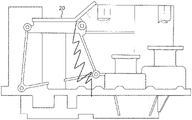
  • FIG. 4A is the view of FIG. 2 showing points of vulnerability
  • FIG. 4B shows further points of vulnerability
  • FIG. 5A is the view of FIG. 4 incorporation a solution of this disclosure to a horizontal crack in the casing
  • FIG. 5B is a perspective view of the solution of FIG. 5A ;
  • FIG. 6A is the view of FIG. 4 incorporation a solution of this disclosure to a vertical crack in the casing
  • FIG. 6B is a perspective view of the solution of FIG. 6A ;
  • FIG. 7 shows a solution of this disclosure to a potential bearing failure
  • FIG. 8A is the view of FIG. 4 incorporation a solution of this disclosure to a crack in the casing
  • FIG. 8B is a perspective view of the solution of FIG. 8A ;
  • FIG. 9 shows a solution to a potential bearing failure
  • FIG. 10 shows an alternative solution to a bearing failure
  • FIG. 11A is the view of FIG. 4 incorporation a solution of this disclosure to a crack in the casing
  • FIG. 11B is a perspective view of the solution of FIG. 11A ;
  • FIG. 12A is the view of FIG. 4 incorporation a solution of this disclosure to a crack in the casing
  • FIGS. 12B and 12C are perspective views of alternative solutions of FIG. 12A ;
  • FIG. 13A is the view of FIG. 4 incorporation a solution of this disclosure to a crack in the casing
  • FIG. 13B is a perspective view of the solution of FIG. 13A ;
  • FIG. 14 shows a solution to a bearing failure
  • FIGS. 15A, 15B and 15C show solutions to different failures
  • FIG. 16 is a schematic view of a gear box assembly showing where failures may occur
  • FIG. 17 is a schematic view of part of the assembly of FIG. 16 incorporating a bracket as a reinforcement component;
  • FIG. 18 is a schematic view of a gear box assembly showing where failures may occur.
  • FIG. 19 is a schematic view of part of the assembly of FIG. 18 incorporating a fail safe plate as a reinforcement component.
  • a typical gearbox assembly comprises an input transmission shaft from the engine.
  • These shafts are provided with toothed wheels 3 that are in meshing engagement with toothed wheels 4 of a differential line gear stage 5 .
  • the differential line gear stage has further toothed wheels 6 in meshing engagement with toothed wheels 7 of a jackshaft gear stage 8 through which a jackshaft 9 passes.
  • the jackshaft stage has toothed wheels 10 in meshing engagement with toothed wheels 11 of a bull gear stage 12 .
  • the intermeshing gear stages thus reduce the rotational velocity from the engine, attached to the input shafts 1 , 2 , transmitting torque through the gear stages to drive the load at the gearbox output.
  • FIG. 2 shows that bearings are provided for the rotating shafts.
  • gear assembly components are, as shown most clearly in the exploded view of FIG. 3 , mounted in a casing 14 which is closed at the bottom by a cover 15 .
  • a cover 15 At the top is provided the POB (pressure off brake) arrangement and the NBB arrangement within respective housings 16 , 17 .
  • redundancy is provided at one or more of these potential points of single failure such that should the failure occur, there will be no loss (or no complete loss) of torque transmission between the respective gearbox parts.
  • the redundancy provided is a means to avoid separation between the parts of the system that would be separated by the crack. In the embodiments shown, this is provided by a bracket or plate but some other form of reinforcement or bridging could provide the redundancy.
  • secondary or additional bearings are provided as a back-up in the event of failure of the primary bearing.
  • FIG. 5A shows where a horizontal casing crack might occur, corresponding to failure 1 of FIG. 4A . This could prevent meshing between the bull gear and the jackshaft and prevent torque transmission at this point.
  • FIGS. 5A and 5B show two possible solutions. In a first solution, redundancy is provided by locating a claw stop 18 at a distance from the moveable part of the main stage to limit any vertical shifting; cables can also be attached in a manner to prevent rotation at the crack.
  • FIG. 5B shows a solution that can be provided as an alternative or additional means of providing redundancy, wherein a bracket 19 or plate (an external bracket in the examples) is provided to link the NBB housing 17 to the assembly cover 15 .
  • FIGS. 6A and 6B show the situation identified by failure 2 in FIG. 4A where there is a vertical crack in the casing and can also prevent meshing between the bull gears and the jackshaft.
  • One solution would be to add redundancy in the form of a top cover across the location where the crack could occur.
  • An alternative or additional solution is to provide a bracket 20 at the top of the assembly linking the NBB housing 17 to the top of the assembly casing 14 as seen in FIG. 6B
  • FIG. 7 shows a solution to the bearing failure 3 at the jackshaft.
  • the primary bearings are shown at 21 and 22 .
  • the shaft is extended in the axial direction and provided with unloaded secondary bearings 21 a , 22 a integrated with the shaft.
  • the backlash effect will be prevented or reduced by the secondary bearings coming into play.
  • FIGS. 8A and *b show the situation identified by failure 4 in FIG. 4A where there is potential for a vertical crack in the casing in the jackshaft stage 8 which can prevent meshing between the jackshaft stage and the differentia line stage.
  • the solutions mentioned and shown in FIGS. 6A and 6B would be appropriate here too.
  • FIG. 9 shows the situation for bearing failure 5 of FIG. 4A . Redundancy can be provided in the same way as described in relation to FIG. 7 .
  • FIG. 10 shows the situation for bearing failure 6 of FIG. 4A where, again, redundancy can be provided with additional unloaded journal bearings 23 .
  • FIGS. 11A and 11B show the situation providing redundancy for failure 7 of FIG. 4A where a crack could occur in the casing at the level of the POB 16 .
  • the solution shown in FIG. 11B is to provide redundancy by means of a bracket 24 across the top of the casing 14 .
  • FIGS. 12A, 12B and 12C show the situation providing redundancy for failure 8 of FIG. 4A where a crack could occur in the casing at the level of the motor interface—i.e. where the transmission input shafts 1 , 2 are.
  • the solution shown in FIG. 12B is to provide redundancy by means of a bracket 25 linking the motor interface or cover 26 to the assembly casing.
  • the alternative or additional solution shown in FIG. 12C is to provide a bracket 27 linking the two hydraulic motors 28 a , 28 b.
  • FIGS. 13A and 13B show the situation providing redundancy for potential failure 9 of FIG. 4A of a longitudinal crack between the POB components 29 a , 29 b .
  • the solution shown in FIG. 13B is to provide a bracket 30 linking the two components.
  • An alternative or additional redundancy could be provided by a bracket (not shown) linking the parts of the casing providing the interfaces for the two POB components.
  • FIG. 14 shows the situation for bearing failure 10 of FIG. 4A where, again, redundancy can be provided with additional unloaded journal bearings 31 .
  • FIGS. 15A , B and C show alternative or additional locations for redundancy-providing brackets for the failures mentioned above.
  • an upper external bracket 32 can be provided linking the NBB housing to the POB interfaces ( FIGS. 15B and 15C ).
  • a lower external bracket 33 can be provided linking the two hydraulic motors to a screw shaft bearing.
  • the purpose of the reinforcement components is to kick in to maintain transmission between parts of the assembly if a failure in connection between torque transmitting parts, such as a crack or fracture, occurs.
  • the reinforcement components are, in normal circumstances, unloaded, i.e. do not perform any torque transmitting function between the assembly parts and only become loaded if a failure in the assembly occurs.
  • the clearance is defined to have a minimum spacing from the assembly parts to ensure that the reinforcement component remains unloaded in normal circumstances—i.e. in the absence of a failure in the assembly parts even if there is some degree of deflection of the assembly parts under maximum load.
  • the degree of possible deflection under maximum load should be determined and the clearance should be set to allow that deflection to occur without the reinforcement kicking in or becoming loaded.
  • FIGS. 16 and 17 are referred to describe an example where the reinforcement component is a bracket.
  • FIG. 16 is a schematic view of a Gear Box Assembly in which the bracket function can be incorporated. This is similar to the assembly shown in FIGS. 1 to 6 and includes an assembly of shafts and gears as known in the art provided in a housing comprising an upper housing 100 and a lower housing 200 .
  • the assembly includes a motor shaft 300 , a differential shaft 400 , a jackshaft 500 and a screw shaft 600 .
  • failures can occur at various locations. For example, a failure can occur between the screw shaft and the jackshaft (case 1), between the differential shaft and the jackshaft (case 2), or in the jackshaft itself (case 3).
  • a reinforcement component 19 in this example a bracket
  • the bracket does not provide any reinforcement to the assembly—i.e. it is unloaded.
  • the amount of clearance should be so as to allow normal or expected deflection of the housing parts under load without a crack or failure occurring.
  • the unloaded state is also ensured by the manner in which the bracket is installed relative to the assembly parts.
  • the bracket is fastened by a fixed link 800 to one side of the assembly housing and is attached to the other side by a spherical link 900 .
  • a failure in this example a crack in the upper housing between the jackshaft and the screw shaft—the opposing forces due to gear meshing will tend to push the jackshaft and the screw shaft away from each other.
  • the bracket will kick in to keep the meshing transmission in place by holding both sides of the housing together.
  • the reinforcement component is a fail safe plate 19 ′ shown to prevent loss of transmission when a failure (e.g. crack or rupture) occurs on the lower housing 200 .
  • a failure e.g. crack or rupture
  • the failure could be, for example, a jackshaft disconnect (case 1), a disconnect between the differential shaft and the jackshaft (case 2), a disconnect between the motor shaft and the differential shaft (case 3) or a disconnect between the screw shaft and the jackshaft (case 4).
  • the plate 19 ′ is arranged such that when there is no failure in the assembly, no loading or reinforcement is provided by the plate, and the plate only kicks in if a failure occurs. Again, as shown in FIG.
  • the unloaded state is ensured by having a clearance 700 ′ between the plate and the housing.
  • the amount of clearance should be so as to allow normal or expected deflection of the housing parts under load without a crack or failure occurring.
  • the plate is fitted into the housing at a press link 1000 , at one end. In the event of a failure, the opposing forces, again, will tend to push the jackshaft and the screw shaft away from each other. The plate will then come into play to hold both sides of the housing together and thus keep the meshing transmission in place.

Landscapes

  • Engineering & Computer Science (AREA)
  • General Engineering & Computer Science (AREA)
  • Mechanical Engineering (AREA)
  • General Details Of Gearings (AREA)

Abstract

A gearbox assembly comprising a plurality of component parts in torque transmission connection via gear, shaft and/or housing components; the assembly further comprising means for providing redundancy at selected locations where failure can lead to loss of torque transmission between component parts of the assembly.

Description

PRIORITY
This application is a continuation in part of U.S. application Ser. No. 15/672,444 filed Aug. 9, 2017 which claims priority to European Patent Application No. 16306336.5 filed Oct. 10, 2016, the entire contents of both are incorporated herein by reference.
TECHNICAL FIELD
The present invention relates to gearbox assemblies, especially, but not exclusively, for aircraft.
BACKGROUND
Gearbox assemblies are provided in e.g. aircraft where aircraft parts, accessories, actuators are driven by power from the aircraft engine(s) via alternators and/or hydraulic pumps. Power from the aircraft engine drives alternators and/or hydraulic pumps and electrical and/or hydraulic power then powers actuators/electrical or hydraulic motors etc.
The rotational velocity of the motor is greater than that required or desired to drive the components, actuators, etc. and so a gearbox reduces or steps down the rotational velocity of the motor to a velocity suitable for the driven load. The gearbox reduces the rotational velocity using a number of intermeshed gears between the motor and a drive output to the parts to be driven. In reducing the rotational velocity of the motor output, torque is increased through the series of gear stages and associated shafts.
Such gearbox assemblies are used e.g. with actuators to control wing flaps, landing gear, tail flaps, Horizontal Stabilizer Trim Actuators (HSTA) also known as trimmable horizontal stabilizer actuators (THSAs) etc.
Gearbox actuator systems may be provided with brake mechanisms that prevent complete failure in the event of fracture of the power transmission shaft from the engine. One solution is known as no-back irreversibility brakes or NBB. This, in the event of shaft fracture, causes high deceleration followed by standstill, with excess kinetic energy dissipated by losses of the rotating shafts.
Such gearbox and transmission systems provide crucially important functions in aircraft, and failure of all or part of the system can be catastrophic. It is important, therefore, to perform regular and frequency safety inspections and maintenance on the many parts that make up these mechanically complex systems. This is, of course, costly and time consuming, but necessary for safety.
It is well-known that there a locations or components in a gearbox that are more vulnerable to failure than others.
It is an object of this disclosure to provide a gearbox assembly which is less vulnerable to catastrophic failure, without the need to increase safety inspections and maintenance.
SUMMARY
The present disclosure provides a gearbox assembly with means for providing redundancy at selected locations where failure can lead to loss of torque transmission between component parts of the assembly.
This redundancy is preferably provided at locations where fracture is more likely to occur—i.e. at locations known to be more vulnerable to fracture, or where bearings exist, as bearings are also known to be common failure points.
Increased vulnerability has been identified in the following gearbox locations:
    • The meshing between the bull gear and the jackshaft: this can be due to a horizontal crack in the casing e.g. in the NBB section; a vertical crack in the casing, or due to a jackshaft bearing failure.
    • The meshing between the jackshaft and the differential line; this may be due to a vertical crack in the casing or failure of the main shaft bearings.
    • Loss of transmission between the differential line, the jackshaft and the input shaft: this can be due to differential line bearing failure, a crack in the casing at brake interface level, or a crack in the cover at the motor interface level.
    • A longitudinal crack in the casing.
    • Bearing failures in the motors shafts.
If any of these failures occur, there will be a loss of transmission between parts of the assembly and so a break in the power transmission from the motor to the load to be driven; such a failure can also lead to a loss of NBB irreversibility thus leaving the system with no fail-safe in the event of damage to the transmission shaft.
Most preferably, redundancy is provided by providing a reinforcement component across two component parts between which a crack or failure would cause loss of torque transmission.
The reinforcement could be a plate or bracket to hold the torque transmitting components together in the event of a failure occurring in the gearbox assembly between them.
In the case of bearing failure, a possible way of providing redundancy is to provide secondary bearings that kick in when a primary bearing fails.
BRIEF DESCRIPTION OF THE DRAWINGS
Preferred embodiments will now be described with reference to the drawings, wherein:
FIG. 1 shows a perspective and partly exploded view of a typical gearbox assembly;
FIG. 2 shows a sectional view of a typical gearbox assembly;
FIG. 3 is an exploded perspective view of the assembly of FIG. 2;
FIG. 4A is the view of FIG. 2 showing points of vulnerability;
FIG. 4B shows further points of vulnerability;
FIG. 5A is the view of FIG. 4 incorporation a solution of this disclosure to a horizontal crack in the casing;
FIG. 5B is a perspective view of the solution of FIG. 5A;
FIG. 6A is the view of FIG. 4 incorporation a solution of this disclosure to a vertical crack in the casing;
FIG. 6B is a perspective view of the solution of FIG. 6A;
FIG. 7 shows a solution of this disclosure to a potential bearing failure;
FIG. 8A is the view of FIG. 4 incorporation a solution of this disclosure to a crack in the casing;
FIG. 8B is a perspective view of the solution of FIG. 8A;
FIG. 9 shows a solution to a potential bearing failure;
FIG. 10 shows an alternative solution to a bearing failure;
FIG. 11A is the view of FIG. 4 incorporation a solution of this disclosure to a crack in the casing;
FIG. 11B is a perspective view of the solution of FIG. 11A;
FIG. 12A is the view of FIG. 4 incorporation a solution of this disclosure to a crack in the casing;
FIGS. 12B and 12C are perspective views of alternative solutions of FIG. 12A;
FIG. 13A is the view of FIG. 4 incorporation a solution of this disclosure to a crack in the casing;
FIG. 13B is a perspective view of the solution of FIG. 13A;
FIG. 14 shows a solution to a bearing failure;
FIGS. 15A, 15B and 15C show solutions to different failures;
FIG. 16 is a schematic view of a gear box assembly showing where failures may occur;
FIG. 17 is a schematic view of part of the assembly of FIG. 16 incorporating a bracket as a reinforcement component;
FIG. 18 is a schematic view of a gear box assembly showing where failures may occur; and
FIG. 19 is a schematic view of part of the assembly of FIG. 18 incorporating a fail safe plate as a reinforcement component.
DETAILED DESCRIPTION
With reference to FIG. 1, a typical gearbox assembly comprises an input transmission shaft from the engine. In this case, there are two input shafts—a right channel input shaft 1 and a centre channel input shaft 2. These shafts are provided with toothed wheels 3 that are in meshing engagement with toothed wheels 4 of a differential line gear stage 5. The differential line gear stage has further toothed wheels 6 in meshing engagement with toothed wheels 7 of a jackshaft gear stage 8 through which a jackshaft 9 passes. The jackshaft stage has toothed wheels 10 in meshing engagement with toothed wheels 11 of a bull gear stage 12.
The intermeshing gear stages thus reduce the rotational velocity from the engine, attached to the input shafts 1, 2, transmitting torque through the gear stages to drive the load at the gearbox output.
These components can be seen in the cross-section of FIG. 2 which also shows that bearings are provided for the rotating shafts.
These gear assembly components (collectively 13) are, as shown most clearly in the exploded view of FIG. 3, mounted in a casing 14 which is closed at the bottom by a cover 15. At the top is provided the POB (pressure off brake) arrangement and the NBB arrangement within respective housings 16, 17.
As mentioned above, various locations/parts of such a gearbox assembly have been identified as being potential points of single failure, whereby a single failure can lead to a loss of torque transmission.
These points are identified in FIGS. 4A and 4B as follows:
a. Bull gear vs. jackshaft meshing
    • 1. Casing failure (horizontal crack—NBB section)
    • 2. Casing failure (vertical crack)
    • 3. Bearings failure (jackshaft)
b. Jackshaft vs. differential line meshing
    • 4. Casing failure (vertical crack)
    • 5. Bearing failures (main shaft)
c. Differential line vs. jackshaft vs. input shaft
    • 6. Bearing failures (differential input)
    • 7. Casing failure (crack at POB interface level)
    • 8. Cover failure (crack at motor interface level)
      a+b+c bull gear vs. jackshaft vs. differential line meshings
    • 9. Casing failure (longitudinal crack)
d. Hydraulic input shafts vs. differential line
    • 10. Bearing failures (hydraulic motor shafts)
According to the present disclosure, redundancy is provided at one or more of these potential points of single failure such that should the failure occur, there will be no loss (or no complete loss) of torque transmission between the respective gearbox parts.
As a general point, where the potential failure is a crack, the redundancy provided is a means to avoid separation between the parts of the system that would be separated by the crack. In the embodiments shown, this is provided by a bracket or plate but some other form of reinforcement or bridging could provide the redundancy.
For bearing failures, secondary or additional bearings are provided as a back-up in the event of failure of the primary bearing.
The various potential failure points and means of providing redundancy will now be discussed in turn with reference to FIGS. 5 to 15.
FIG. 5A shows where a horizontal casing crack might occur, corresponding to failure 1 of FIG. 4A. This could prevent meshing between the bull gear and the jackshaft and prevent torque transmission at this point. FIGS. 5A and 5B show two possible solutions. In a first solution, redundancy is provided by locating a claw stop 18 at a distance from the moveable part of the main stage to limit any vertical shifting; cables can also be attached in a manner to prevent rotation at the crack. FIG. 5B shows a solution that can be provided as an alternative or additional means of providing redundancy, wherein a bracket 19 or plate (an external bracket in the examples) is provided to link the NBB housing 17 to the assembly cover 15.
FIGS. 6A and 6B show the situation identified by failure 2 in FIG. 4A where there is a vertical crack in the casing and can also prevent meshing between the bull gears and the jackshaft. One solution would be to add redundancy in the form of a top cover across the location where the crack could occur. An alternative or additional solution is to provide a bracket 20 at the top of the assembly linking the NBB housing 17 to the top of the assembly casing 14 as seen in FIG. 6B
FIG. 7 shows a solution to the bearing failure 3 at the jackshaft. The primary bearings are shown at 21 and 22. To provide redundancy, the shaft is extended in the axial direction and provided with unloaded secondary bearings 21 a, 22 a integrated with the shaft. In the event of failure of one or more of the primary bearings, the backlash effect will be prevented or reduced by the secondary bearings coming into play.
FIGS. 8A and *b show the situation identified by failure 4 in FIG. 4A where there is potential for a vertical crack in the casing in the jackshaft stage 8 which can prevent meshing between the jackshaft stage and the differentia line stage. The solutions mentioned and shown in FIGS. 6A and 6B would be appropriate here too.
FIG. 9 shows the situation for bearing failure 5 of FIG. 4A. Redundancy can be provided in the same way as described in relation to FIG. 7.
FIG. 10 shows the situation for bearing failure 6 of FIG. 4A where, again, redundancy can be provided with additional unloaded journal bearings 23.
FIGS. 11A and 11B show the situation providing redundancy for failure 7 of FIG. 4A where a crack could occur in the casing at the level of the POB 16. The solution shown in FIG. 11B is to provide redundancy by means of a bracket 24 across the top of the casing 14.
FIGS. 12A, 12B and 12C show the situation providing redundancy for failure 8 of FIG. 4A where a crack could occur in the casing at the level of the motor interface—i.e. where the transmission input shafts 1,2 are. The solution shown in FIG. 12B is to provide redundancy by means of a bracket 25 linking the motor interface or cover 26 to the assembly casing. The alternative or additional solution shown in FIG. 12C is to provide a bracket 27 linking the two hydraulic motors 28 a, 28 b.
FIGS. 13A and 13B show the situation providing redundancy for potential failure 9 of FIG. 4A of a longitudinal crack between the POB components 29 a, 29 b. The solution shown in FIG. 13B is to provide a bracket 30 linking the two components. An alternative or additional redundancy could be provided by a bracket (not shown) linking the parts of the casing providing the interfaces for the two POB components.
FIG. 14 shows the situation for bearing failure 10 of FIG. 4A where, again, redundancy can be provided with additional unloaded journal bearings 31.
FIGS. 15A, B and C show alternative or additional locations for redundancy-providing brackets for the failures mentioned above. For failures 1, 2, 4, 7 and 9, for example, an upper external bracket 32 can be provided linking the NBB housing to the POB interfaces (FIGS. 15B and 15C). For failure case 8, a lower external bracket 33 can be provided linking the two hydraulic motors to a screw shaft bearing.
As discussed above, the purpose of the reinforcement components is to kick in to maintain transmission between parts of the assembly if a failure in connection between torque transmitting parts, such as a crack or fracture, occurs. The reinforcement components are, in normal circumstances, unloaded, i.e. do not perform any torque transmitting function between the assembly parts and only become loaded if a failure in the assembly occurs.
To ensure the reinforcement components are, in normal circumstances, unloaded, but ready to kick in in the case of failure, they are positioned such that there is a clearance between the reinforcement component and the assembly parts. The clearance is defined to have a minimum spacing from the assembly parts to ensure that the reinforcement component remains unloaded in normal circumstances—i.e. in the absence of a failure in the assembly parts even if there is some degree of deflection of the assembly parts under maximum load. Thus, for a given assembly, the degree of possible deflection under maximum load should be determined and the clearance should be set to allow that deflection to occur without the reinforcement kicking in or becoming loaded.
This positioning is described in more detail, by way of example only, with reference to FIGS. 16 to 19.
FIGS. 16 and 17 are referred to describe an example where the reinforcement component is a bracket.
FIG. 16 is a schematic view of a Gear Box Assembly in which the bracket function can be incorporated. This is similar to the assembly shown in FIGS. 1 to 6 and includes an assembly of shafts and gears as known in the art provided in a housing comprising an upper housing 100 and a lower housing 200. The assembly includes a motor shaft 300, a differential shaft 400, a jackshaft 500 and a screw shaft 600.
As previously discussed, failures can occur at various locations. For example, a failure can occur between the screw shaft and the jackshaft (case 1), between the differential shaft and the jackshaft (case 2), or in the jackshaft itself (case 3).
With reference to FIG. 17, a reinforcement component 19 (in this example a bracket) is provided such that when the assembly is ‘healthy’—i.e. there is no crack or failure between transmitting parts—the bracket does not provide any reinforcement to the assembly—i.e. it is unloaded. This is achieved by designing the component or bracket 19 to have some clearance 700 between the bracket and the assembly parts. As mentioned above, the amount of clearance should be so as to allow normal or expected deflection of the housing parts under load without a crack or failure occurring. In the example shown, the unloaded state is also ensured by the manner in which the bracket is installed relative to the assembly parts. Here, the bracket is fastened by a fixed link 800 to one side of the assembly housing and is attached to the other side by a spherical link 900. In the case of a failure—in this example a crack in the upper housing between the jackshaft and the screw shaft—the opposing forces due to gear meshing will tend to push the jackshaft and the screw shaft away from each other. At this time, the bracket will kick in to keep the meshing transmission in place by holding both sides of the housing together.
In another example, described with reference to FIGS. 18 and 19, the reinforcement component is a fail safe plate 19′ shown to prevent loss of transmission when a failure (e.g. crack or rupture) occurs on the lower housing 200. Again, the failure could be, for example, a jackshaft disconnect (case 1), a disconnect between the differential shaft and the jackshaft (case 2), a disconnect between the motor shaft and the differential shaft (case 3) or a disconnect between the screw shaft and the jackshaft (case 4). Again, the plate 19′ is arranged such that when there is no failure in the assembly, no loading or reinforcement is provided by the plate, and the plate only kicks in if a failure occurs. Again, as shown in FIG. 19, the unloaded state is ensured by having a clearance 700′ between the plate and the housing. As above, the amount of clearance should be so as to allow normal or expected deflection of the housing parts under load without a crack or failure occurring. The plate is fitted into the housing at a press link 1000, at one end. In the event of a failure, the opposing forces, again, will tend to push the jackshaft and the screw shaft away from each other. The plate will then come into play to hold both sides of the housing together and thus keep the meshing transmission in place.
Using the redundancy of this disclosure, safety of the system is improved without the need to add extra safety and maintenance checks.
The term “about” is intended to include the degree of error associated with measurement of the particular quantity based upon the equipment available at the time of filing the application.
The terminology used herein is for the purpose of describing particular embodiments only and is not intended to be limiting of the present disclosure. As used herein, the singular forms “a”, “an” and “the” are intended to include the plural forms as well, unless the context clearly indicates otherwise. It will be further understood that the terms “comprises” and/or “comprising,” when used in this specification, specify the presence of stated features, integers, steps, operations, elements, and/or components, but do not preclude the presence or addition of one or more other features, integers, steps, operations, element components, and/or groups thereof.
While the present disclosure has been described with reference to an exemplary embodiment or embodiments, it will be understood by those skilled in the art that various changes may be made and equivalents may be substituted for elements thereof without departing from the scope of the present disclosure. In addition, many modifications may be made to adapt a particular situation or material to the teachings of the present disclosure without departing from the essential scope thereof. Therefore, it is intended that the present disclosure not be limited to the particular embodiment disclosed as the best mode contemplated for carrying out this present disclosure, but that the present disclosure will include all embodiments falling within the scope of the claims.
Claims (10)

The invention claimed is:
1. A gearbox assembly comprising a plurality of component parts in torque transmission connection via gear, shaft and/or housing components; the assembly further comprising:
an unloaded reinforcement bracket arranged to provide redundancy at selected locations where a crack would lead to loss of torque transmission between component parts of the assembly;
wherein the unloaded reinforcement bracket is provided across two component parts and does not provide any reinforcement in the absence of the crack,
wherein the unloaded reinforcement bracket is arranged such that in response to the crack being formed in a torque transmission path between the two component parts, the unloaded reinforcement bracket becomes loaded to provide torque transmission between the two component parts.
2. A gearbox assembly as claimed in claim 1, wherein said component parts include a plurality of gear stages each comprising a shaft and one or more toothed wheels via which the gear stages are connected, and a plurality of gearbox assembly housing components.
3. A gearbox assembly as claimed in claim 2, wherein the bracket is fixed between at least two of any of the shafts, the toothed wheels and the housing components.
4. A gearbox assembly as claimed in claim 3, comprising a differential line gear stage in torque transmitting engagement with a jackshaft and a housing component enclosing the differential line gear stage and the jackshaft, and wherein the bracket is provided across the housing components.
5. A gearbox assembly as claimed in claim 3, comprising a differential line gear stage in torque transmitting engagement with an input shaft and a housing component enclosing the differential line gear stage and the input shaft, and wherein the bracket is provided across the housing components.
6. A gearbox assembly as claimed in claim 2, comprising a bull gear in torque transmitting engagement with a jackshaft and a housing component enclosing the bull gear and the jackshaft, and wherein the unloaded reinforcement bracket comprises a bracket across the housing components.
7. A gearbox assembly as claimed in claim 6, comprising a differential line gear stage in torque transmitting engagement with a jackshaft and a housing component enclosing the differential line gear stage and the jackshaft, and wherein the bracket is provided across the housing components.
8. A gearbox assembly as claimed in claim 6, comprising a differential line gear stage in torque transmitting engagement with an input shaft and a housing component enclosing the differential line gear stage and the input shaft, and wherein the bracket is provided across the housing components.
9. A gearbox assembly as claimed in claim 2, comprising a differential line gear stage in torque transmitting engagement with a jackshaft and a housing component enclosing the differential line gear stage and the jackshaft, and wherein the bracket is provided across the housing components.
10. A gearbox assembly as claimed in claim 2, comprising a differential line gear stage in torque transmitting engagement with an input shaft and a housing component enclosing the differential line gear stage and the input shaft, and wherein the bracket is provided across the housing components.
US16/950,220 2016-10-10 2020-11-17 Gearbox assembly Active 2038-02-16 US11512770B2 (en)

Priority Applications (2)

Application Number Priority Date Filing Date Title
US16/950,220 US11512770B2 (en) 2016-10-10 2020-11-17 Gearbox assembly
EP21208756.3A EP4001699A1 (en) 2020-11-17 2021-11-17 Gearbox assembly

Applications Claiming Priority (5)

Application Number Priority Date Filing Date Title
EP16306336.5 2016-10-10
EP16306336.5A EP3306137A1 (en) 2016-10-10 2016-10-10 Gearbox assembly providing redundancy
EP16306336 2016-10-10
US15/672,444 US20180100575A1 (en) 2016-10-10 2017-08-09 Gearbox assembly
US16/950,220 US11512770B2 (en) 2016-10-10 2020-11-17 Gearbox assembly

Related Parent Applications (1)

Application Number Title Priority Date Filing Date
US15/672,444 Continuation-In-Part US20180100575A1 (en) 2016-10-10 2017-08-09 Gearbox assembly

Publications (2)

Publication Number Publication Date
US20210071749A1 US20210071749A1 (en) 2021-03-11
US11512770B2 true US11512770B2 (en) 2022-11-29

Family

ID=74849933

Family Applications (1)

Application Number Title Priority Date Filing Date
US16/950,220 Active 2038-02-16 US11512770B2 (en) 2016-10-10 2020-11-17 Gearbox assembly

Country Status (1)

Country Link
US (1) US11512770B2 (en)

Citations (15)

* Cited by examiner, † Cited by third party
Publication number Priority date Publication date Assignee Title
US3183043A (en) 1962-10-18 1965-05-11 Westinghouse Electric Corp Fail-safe bearing structure
DE3441699A1 (en) 1984-11-15 1986-05-15 Thyssen Industrie Ag, 4300 Essen Winch drive, in particular for offshore stations
US4742730A (en) 1982-09-30 1988-05-10 The Boeing Company Failsafe rotary actuator
US5042321A (en) 1989-01-31 1991-08-27 Mazda Motor Corporation Transmission structure for an automotive vehicle
US5070830A (en) 1990-07-17 1991-12-10 Saturn Corporation Powertrain and stiffening bracket therefor
WO1997022817A1 (en) 1995-12-15 1997-06-26 Sikorsky Aircraft Corporation Method for fabricating a split path transmission providing equal torque splitting
US20040214682A1 (en) 2003-04-28 2004-10-28 Sbabo Thomas L. Dual stage differential speed transmission
US20050130792A1 (en) 2003-11-10 2005-06-16 Drago Raymond J. High ratio, reduced size epicyclic gear transmission for rotary wing aircraft with improved safety and noise reduction
US7186198B2 (en) 2005-02-24 2007-03-06 Selva Jr Efrain A Transaxle
US20070219044A1 (en) 2005-06-23 2007-09-20 Karem Aircraft, Inc. Lightweight reduction gearbox
WO2011096913A1 (en) 2010-02-03 2011-08-11 Moog Inc. Structurally-redundant actuators
US8657716B1 (en) 2012-09-13 2014-02-25 American Axle & Manufacturing, Inc. Drive train component with structural cover
US20180100575A1 (en) 2016-10-10 2018-04-12 Ratier-Figeac Sas Gearbox assembly
US10295044B2 (en) * 2016-10-12 2019-05-21 Ford Global Technologies, Llc Brace for powerplant
US10598268B2 (en) * 2017-04-18 2020-03-24 Toyota Jidosha Kabushiki Kaisha Support structure of vehicle drive system unit

Patent Citations (17)

* Cited by examiner, † Cited by third party
Publication number Priority date Publication date Assignee Title
US3183043A (en) 1962-10-18 1965-05-11 Westinghouse Electric Corp Fail-safe bearing structure
US4742730A (en) 1982-09-30 1988-05-10 The Boeing Company Failsafe rotary actuator
DE3441699A1 (en) 1984-11-15 1986-05-15 Thyssen Industrie Ag, 4300 Essen Winch drive, in particular for offshore stations
US5042321A (en) 1989-01-31 1991-08-27 Mazda Motor Corporation Transmission structure for an automotive vehicle
US5070830A (en) 1990-07-17 1991-12-10 Saturn Corporation Powertrain and stiffening bracket therefor
WO1997022817A1 (en) 1995-12-15 1997-06-26 Sikorsky Aircraft Corporation Method for fabricating a split path transmission providing equal torque splitting
EP0866926A1 (en) 1995-12-15 1998-09-30 Sikorsky Aircraft Corporation Method for fabricating a split path transmission providing equal torque splitting
US20040214682A1 (en) 2003-04-28 2004-10-28 Sbabo Thomas L. Dual stage differential speed transmission
US20050130792A1 (en) 2003-11-10 2005-06-16 Drago Raymond J. High ratio, reduced size epicyclic gear transmission for rotary wing aircraft with improved safety and noise reduction
US7186198B2 (en) 2005-02-24 2007-03-06 Selva Jr Efrain A Transaxle
US20070219044A1 (en) 2005-06-23 2007-09-20 Karem Aircraft, Inc. Lightweight reduction gearbox
WO2011096913A1 (en) 2010-02-03 2011-08-11 Moog Inc. Structurally-redundant actuators
US8657716B1 (en) 2012-09-13 2014-02-25 American Axle & Manufacturing, Inc. Drive train component with structural cover
US20140073471A1 (en) 2012-09-13 2014-03-13 American Axle & Manufacturing, Inc. Drive train component with structural cover
US20180100575A1 (en) 2016-10-10 2018-04-12 Ratier-Figeac Sas Gearbox assembly
US10295044B2 (en) * 2016-10-12 2019-05-21 Ford Global Technologies, Llc Brace for powerplant
US10598268B2 (en) * 2017-04-18 2020-03-24 Toyota Jidosha Kabushiki Kaisha Support structure of vehicle drive system unit

Non-Patent Citations (1)

* Cited by examiner, † Cited by third party
Title
Extended European Search Report for European Patent Application No. 16306336.5 dated Apr. 13, 2017, 9 pages.

Also Published As

Publication number Publication date
US20210071749A1 (en) 2021-03-11

Similar Documents

Publication Publication Date Title
US10759518B2 (en) Gearbox assembly
US20180100575A1 (en) Gearbox assembly
EP2054299B1 (en) Jam-tolerant actuator
US8960031B2 (en) Aircraft stabilizer actuator
EP3712063B1 (en) Aircraft drive system
US20130249444A1 (en) High integrity rotary actuator and method of operation
US20060144996A1 (en) Apparatus for the adjustment of horizontal stabilizers for aircraft
WO1990009314A1 (en) Multi-fuseable shaft
US11408491B2 (en) Electromechanical actuator assembly
US11512770B2 (en) Gearbox assembly
EP2960152B1 (en) Torque limitation systems and methods
EP4001699A1 (en) Gearbox assembly
EP3300214A1 (en) Redundant channel motor and method
US9016151B2 (en) High integrity linear actuator and method of operation
JP4483412B2 (en) Torque limiter
US20250136270A1 (en) Differential lock actuator systems and methods for moving flight control surface
US20240083590A1 (en) Propulsion unit comprising a transmission system, several electric motors and at least one remote coupling system, aircraft comprising at least one such propulsion unit
US12208881B2 (en) Rotary actuation for thin wing applications
EP3315839B1 (en) Compressor surge protection
US20250033787A1 (en) Propulsion unit comprising at least one electric motor and a coupling system positioned on either side of a transmission system
US4359880A (en) Backlash free shear joint
US10723452B2 (en) Engine systems for rotorcraft
US20110094324A1 (en) Actuator System
EP4575263A1 (en) Dual load path for an actuator
US20250146563A1 (en) Fault tolerant rotary ema

Legal Events

Date Code Title Description
FEPP Fee payment procedure

Free format text: ENTITY STATUS SET TO UNDISCOUNTED (ORIGINAL EVENT CODE: BIG.); ENTITY STATUS OF PATENT OWNER: LARGE ENTITY

STPP Information on status: patent application and granting procedure in general

Free format text: APPLICATION DISPATCHED FROM PREEXAM, NOT YET DOCKETED

AS Assignment

Owner name: RATIER-FIGEAC SAS, FRANCE

Free format text: ASSIGNMENT OF ASSIGNORS INTEREST;ASSIGNORS:SARDI, ADIL;CAMINADE, SEBASTIEN;VERMANDE, FREDERIC;AND OTHERS;REEL/FRAME:054992/0417

Effective date: 20161025

STPP Information on status: patent application and granting procedure in general

Free format text: DOCKETED NEW CASE - READY FOR EXAMINATION

STPP Information on status: patent application and granting procedure in general

Free format text: NOTICE OF ALLOWANCE MAILED -- APPLICATION RECEIVED IN OFFICE OF PUBLICATIONS

STPP Information on status: patent application and granting procedure in general

Free format text: PUBLICATIONS -- ISSUE FEE PAYMENT VERIFIED

STCF Information on status: patent grant

Free format text: PATENTED CASE