US11510994B2 - Linkers for improving the stability of bioconjugates and the selectivity of payload release - Google Patents
Linkers for improving the stability of bioconjugates and the selectivity of payload release Download PDFInfo
- Publication number
- US11510994B2 US11510994B2 US17/554,668 US202117554668A US11510994B2 US 11510994 B2 US11510994 B2 US 11510994B2 US 202117554668 A US202117554668 A US 202117554668A US 11510994 B2 US11510994 B2 US 11510994B2
- Authority
- US
- United States
- Prior art keywords
- compound
- mmol
- dichloromethane
- tlc
- dcm
- Prior art date
- Legal status (The legal status is an assumption and is not a legal conclusion. Google has not performed a legal analysis and makes no representation as to the accuracy of the status listed.)
- Active
Links
- 0 *C(=O)N(C(*)=O)C(C)C Chemical compound *C(=O)N(C(*)=O)C(C)C 0.000 description 13
- CZFBSMHOICQDPU-UHFFFAOYSA-N CC(C)NC(C(=O)C(C)C)C(C)C Chemical compound CC(C)NC(C(=O)C(C)C)C(C)C CZFBSMHOICQDPU-UHFFFAOYSA-N 0.000 description 9
- IYJABCRTOKHXOY-UHFFFAOYSA-N CC(C)CCC(=O)CCCOCCC(=O)NC(C)C.CC(C)CCC(=O)NC(C)C.CC(C)CCCC(=O)CCCOCCC(=O)NC(C)C.CC(C)CCCC(=O)NC(C)C.CC(C)CCCCCC(=O)NC(C)C Chemical compound CC(C)CCC(=O)CCCOCCC(=O)NC(C)C.CC(C)CCC(=O)NC(C)C.CC(C)CCCC(=O)CCCOCCC(=O)NC(C)C.CC(C)CCCC(=O)NC(C)C.CC(C)CCCCCC(=O)NC(C)C IYJABCRTOKHXOY-UHFFFAOYSA-N 0.000 description 5
- SPAAWJRDNHZIHQ-UHFFFAOYSA-N CC(C)CC(=O)C(C)C.CC(C)CC(=O)CCCC(=O)C(C)C.CC(C)NC(=O)CCCCC(=O)C(C)C.CC(C)NC(=O)CCOCCCC(=O)C(C)C Chemical compound CC(C)CC(=O)C(C)C.CC(C)CC(=O)CCCC(=O)C(C)C.CC(C)NC(=O)CCCCC(=O)C(C)C.CC(C)NC(=O)CCOCCCC(=O)C(C)C SPAAWJRDNHZIHQ-UHFFFAOYSA-N 0.000 description 4
- AGQBVOXLPOBCDV-UHFFFAOYSA-N CC(C)ON1C(=O)CCC1=O.Cc1c(F)c(F)c(F)c(OC(C)C)c1F Chemical compound CC(C)ON1C(=O)CCC1=O.Cc1c(F)c(F)c(F)c(OC(C)C)c1F AGQBVOXLPOBCDV-UHFFFAOYSA-N 0.000 description 3
- OLMZPYNGHVSXOF-UHFFFAOYSA-N CC(C)CC(=O)CCCC(=O)C(C)C Chemical compound CC(C)CC(=O)CCCC(=O)C(C)C OLMZPYNGHVSXOF-UHFFFAOYSA-N 0.000 description 2
- NPQANEVTSGFSHD-UHFFFAOYSA-N CC(C)CCC(=O)C(C)C.CC(C)CCC(=O)CCCOCCC(=O)C(C)C.CC(C)CCCC(=O)C(C)C.CC(C)CCCC(=O)CCCOCCC(=O)C(C)C.CC(C)CCCCCC(=O)C(C)C Chemical compound CC(C)CCC(=O)C(C)C.CC(C)CCC(=O)CCCOCCC(=O)C(C)C.CC(C)CCCC(=O)C(C)C.CC(C)CCCC(=O)CCCOCCC(=O)C(C)C.CC(C)CCCCCC(=O)C(C)C NPQANEVTSGFSHD-UHFFFAOYSA-N 0.000 description 2
- LSSWMFTZIKNMAT-UHFFFAOYSA-N CC(C)CCC(=O)CCCOCCC(=O)C(C)C.CC(C)CCCC(=O)C(C)C.CC(C)CCCCCC(=O)C(C)C Chemical compound CC(C)CCC(=O)CCCOCCC(=O)C(C)C.CC(C)CCCC(=O)C(C)C.CC(C)CCCCCC(=O)C(C)C LSSWMFTZIKNMAT-UHFFFAOYSA-N 0.000 description 2
- QLIGEKFBFYFRAN-UHFFFAOYSA-N CC(C)CCC(=O)CCCOCCC(=O)NC(C)C.CC(C)CCCC(=O)NC(C)C.CC(C)CCCCCC(=O)NC(C)C Chemical compound CC(C)CCC(=O)CCCOCCC(=O)NC(C)C.CC(C)CCCC(=O)NC(C)C.CC(C)CCCCCC(=O)NC(C)C QLIGEKFBFYFRAN-UHFFFAOYSA-N 0.000 description 2
- AAMBBAMFEUDZDW-UHFFFAOYSA-N CC(C)CCCC(=O)CC(C)C Chemical compound CC(C)CCCC(=O)CC(C)C AAMBBAMFEUDZDW-UHFFFAOYSA-N 0.000 description 2
- NQDOCLXQTQYUDH-UHFFFAOYSA-N CC(C)N1C(=O)C=CC1=O Chemical compound CC(C)N1C(=O)C=CC1=O NQDOCLXQTQYUDH-UHFFFAOYSA-N 0.000 description 2
- VRPWJPPXKGHLIO-MHZLTWQESA-N COCCCC(=O)CCOCCNC(=O)CCOCCCC(=O)[C@H](CCC(=O)O)NC(=O)CCOCCCC(=O)CCN1C(=O)C=CC1=O Chemical compound COCCCC(=O)CCOCCNC(=O)CCOCCCC(=O)[C@H](CCC(=O)O)NC(=O)CCOCCCC(=O)CCN1C(=O)C=CC1=O VRPWJPPXKGHLIO-MHZLTWQESA-N 0.000 description 2
- SGATZRZKHLDQFN-VEDXPAESSA-N *.COCCCC(=O)CCOCC(COCCC(=O)NCCOC)(COCCC(=O)NCCOC)CC(=O)[C@H](CCC(C)C)NC(=O)CCOCCCC(=O)CCN1C(=O)C=C(C(C)C)C1=O.[2HH].[2HH].[2H][2H].[2H][2H] Chemical compound *.COCCCC(=O)CCOCC(COCCC(=O)NCCOC)(COCCC(=O)NCCOC)CC(=O)[C@H](CCC(C)C)NC(=O)CCOCCCC(=O)CCN1C(=O)C=C(C(C)C)C1=O.[2HH].[2HH].[2H][2H].[2H][2H] SGATZRZKHLDQFN-VEDXPAESSA-N 0.000 description 1
- HFGXKNJYKYZSRZ-KYYDUREMSA-N C.COCCCC(=O)CCOCC(COCCC(=O)NCCOC)(COCCC(=O)NCCOC)CC(=O)CCCC(=O)[C@H](CCC(=O)O)NC(=O)CCOCCCC(=O)CCN1C(=O)C=CC1=O Chemical compound C.COCCCC(=O)CCOCC(COCCC(=O)NCCOC)(COCCC(=O)NCCOC)CC(=O)CCCC(=O)[C@H](CCC(=O)O)NC(=O)CCOCCCC(=O)CCN1C(=O)C=CC1=O HFGXKNJYKYZSRZ-KYYDUREMSA-N 0.000 description 1
- LRTARUAIHOMVEU-UQIIZPHYSA-N C.COCCNC(=O)CCOCCCC(=O)CCCC(=O)[C@H](CCC(=O)O)NC(=O)CCOCCCC(=O)CCN1C(=O)C=CC1=O Chemical compound C.COCCNC(=O)CCOCCCC(=O)CCCC(=O)[C@H](CCC(=O)O)NC(=O)CCOCCCC(=O)CCN1C(=O)C=CC1=O LRTARUAIHOMVEU-UQIIZPHYSA-N 0.000 description 1
- YQHMORVYVSATHW-LIXHSFDYSA-N C=C1C=Cc2ccc(OC(=O)N(C)CCN(C)C(=O)OCc3ccc(NC(=O)[C@H](CCCCC(N)=O)NC(=O)[C@@H](NC(=O)CC[C@H](NC(=O)CCOCCCC(=O)CCN4C(=O)C=CC4=O)C(=O)CCCC(=O)CC(COCCC(=O)CCCOC)(COCCC(=O)NCCOC)COCCC(=O)NCCOC)C(C)C)cc3)cc2O1.COCCCC(=O)CCOCC(COCCC(=O)NCCOC)(COCCC(=O)NCCOC)CC(=O)[C@H](CCC(=O)N[C@H](C(=O)N[C@@H](CCCCC(N)=O)C(=O)Nc1ccc(COC(=O)N(C)CCN(C)C(=O)Oc2ccc3ccc(=O)oc3c2)cc1)C(C)C)NC(=O)CCOCCCC(=O)CCN1C(=O)C=CC1=O Chemical compound C=C1C=Cc2ccc(OC(=O)N(C)CCN(C)C(=O)OCc3ccc(NC(=O)[C@H](CCCCC(N)=O)NC(=O)[C@@H](NC(=O)CC[C@H](NC(=O)CCOCCCC(=O)CCN4C(=O)C=CC4=O)C(=O)CCCC(=O)CC(COCCC(=O)CCCOC)(COCCC(=O)NCCOC)COCCC(=O)NCCOC)C(C)C)cc3)cc2O1.COCCCC(=O)CCOCC(COCCC(=O)NCCOC)(COCCC(=O)NCCOC)CC(=O)[C@H](CCC(=O)N[C@H](C(=O)N[C@@H](CCCCC(N)=O)C(=O)Nc1ccc(COC(=O)N(C)CCN(C)C(=O)Oc2ccc3ccc(=O)oc3c2)cc1)C(C)C)NC(=O)CCOCCCC(=O)CCN1C(=O)C=CC1=O YQHMORVYVSATHW-LIXHSFDYSA-N 0.000 description 1
- VXFUGECEGBTOSO-OOANVRTBSA-N C=C1C=Cc2ccc(OC(=O)N(C)CCN(C)C(=O)OCc3ccc(NC(=O)[C@H](CCCCC(N)=O)NC(=O)[C@@H](NC(=O)CC[C@H](NC(=O)CCOCCCC(=O)CCN4C(=O)CC(C)C4=O)C(=O)CCCC(=O)CC(COCCC(=O)CCCOC)(COCCC(=O)NCCOC)COCCC(=O)NCCOC)C(C)C)cc3)cc2O1.COCCCC(=O)CCOCC(COCCC(=O)NCCOC)(COCCC(=O)NCCOC)CC(=O)[C@H](CCC(=O)N[C@H](C(=O)N[C@@H](CCCCC(N)=O)C(=O)Nc1ccc(COC(=O)N(C)CCN(C)C(=O)Oc2ccc3ccc(=O)oc3c2)cc1)C(C)C)NC(=O)CCOCCCC(=O)CCN1C(=O)CC(C)C1=O Chemical compound C=C1C=Cc2ccc(OC(=O)N(C)CCN(C)C(=O)OCc3ccc(NC(=O)[C@H](CCCCC(N)=O)NC(=O)[C@@H](NC(=O)CC[C@H](NC(=O)CCOCCCC(=O)CCN4C(=O)CC(C)C4=O)C(=O)CCCC(=O)CC(COCCC(=O)CCCOC)(COCCC(=O)NCCOC)COCCC(=O)NCCOC)C(C)C)cc3)cc2O1.COCCCC(=O)CCOCC(COCCC(=O)NCCOC)(COCCC(=O)NCCOC)CC(=O)[C@H](CCC(=O)N[C@H](C(=O)N[C@@H](CCCCC(N)=O)C(=O)Nc1ccc(COC(=O)N(C)CCN(C)C(=O)Oc2ccc3ccc(=O)oc3c2)cc1)C(C)C)NC(=O)CCOCCCC(=O)CCN1C(=O)CC(C)C1=O VXFUGECEGBTOSO-OOANVRTBSA-N 0.000 description 1
- SYBYTAAJFKOIEJ-UHFFFAOYSA-N CC(=O)C(C)C Chemical compound CC(=O)C(C)C SYBYTAAJFKOIEJ-UHFFFAOYSA-N 0.000 description 1
- KWAXNRHVWILTTK-UHFFFAOYSA-N CC(=O)C(C)C.CC(C)C(=O)ON1C(=O)CCC1=O.Cc1c(F)c(F)c(F)c(OC(=O)C(C)C)c1F Chemical compound CC(=O)C(C)C.CC(C)C(=O)ON1C(=O)CCC1=O.Cc1c(F)c(F)c(F)c(OC(=O)C(C)C)c1F KWAXNRHVWILTTK-UHFFFAOYSA-N 0.000 description 1
- NEXRBOIBAPYJKR-UHFFFAOYSA-N CC(C)C(=O)CCCCCC(=O)C(C)C Chemical compound CC(C)C(=O)CCCCCC(=O)C(C)C NEXRBOIBAPYJKR-UHFFFAOYSA-N 0.000 description 1
- RTFJZZQMPPVTKY-UHFFFAOYSA-N CC(C)C(=O)CCCCCN1C(=O)CC(C(C)C)C1=O.CC(C)C(=O)CCCN1C(=O)CC(C(C)C)C1=O.CC(C)C(=O)CCN1C(=O)CC(C(C)C)C1=O.CC(C)C(=O)CCOCCCC(=O)CCCN1C(=O)CC(C(C)C)C1=O.CC(C)C(=O)OCCCC(=O)CCN1C(=O)CC(C(C)C)C1=O Chemical compound CC(C)C(=O)CCCCCN1C(=O)CC(C(C)C)C1=O.CC(C)C(=O)CCCN1C(=O)CC(C(C)C)C1=O.CC(C)C(=O)CCN1C(=O)CC(C(C)C)C1=O.CC(C)C(=O)CCOCCCC(=O)CCCN1C(=O)CC(C(C)C)C1=O.CC(C)C(=O)OCCCC(=O)CCN1C(=O)CC(C(C)C)C1=O RTFJZZQMPPVTKY-UHFFFAOYSA-N 0.000 description 1
- HXMYLYXOGJJNSM-UHFFFAOYSA-N CC(C)C(=O)CCCCCN1C(=O)CC(C(C)C)C1=O.CC(C)C(=O)CCCN1C(=O)CC(C(C)C)C1=O.CC(C)C(=O)CCOCCCC(=O)CCN1C(=O)CC(C(C)C)C1=O Chemical compound CC(C)C(=O)CCCCCN1C(=O)CC(C(C)C)C1=O.CC(C)C(=O)CCCN1C(=O)CC(C(C)C)C1=O.CC(C)C(=O)CCOCCCC(=O)CCN1C(=O)CC(C(C)C)C1=O HXMYLYXOGJJNSM-UHFFFAOYSA-N 0.000 description 1
- CAIPPBUYSCQAQR-UHFFFAOYSA-N CC(C)C(=O)ON1C(=O)CCC1=O.CC(C)C(=O)Oc1c(F)c(F)cc(F)c1F Chemical compound CC(C)C(=O)ON1C(=O)CCC1=O.CC(C)C(=O)Oc1c(F)c(F)cc(F)c1F CAIPPBUYSCQAQR-UHFFFAOYSA-N 0.000 description 1
- SNWANQDXUAUMLL-NAEFBPSXSA-N CC(C)C(NC(=O)CCCCCN1C(=O)C=CC1=O)C(=O)C[C@@H](CCCNC(N)=O)C(=O)Nc1ccc(COC(=O)N(C)CCN(C)C(=O)Oc2ccc3ccc(=O)oc3c2)cc1 Chemical compound CC(C)C(NC(=O)CCCCCN1C(=O)C=CC1=O)C(=O)C[C@@H](CCCNC(N)=O)C(=O)Nc1ccc(COC(=O)N(C)CCN(C)C(=O)Oc2ccc3ccc(=O)oc3c2)cc1 SNWANQDXUAUMLL-NAEFBPSXSA-N 0.000 description 1
- URFROVUWUJDGLB-VLLRMEKGSA-N CC(C)C(NC(=O)CCOCCOCCCC(=O)CCN1C(=O)C=CC1=O)C(=O)C[C@@H](CCCNC(N)=O)C(=O)Nc1ccc(COC(=O)N(C)CCN(C)C(=O)Oc2ccc3ccc(=O)oc3c2)cc1 Chemical compound CC(C)C(NC(=O)CCOCCOCCCC(=O)CCN1C(=O)C=CC1=O)C(=O)C[C@@H](CCCNC(N)=O)C(=O)Nc1ccc(COC(=O)N(C)CCN(C)C(=O)Oc2ccc3ccc(=O)oc3c2)cc1 URFROVUWUJDGLB-VLLRMEKGSA-N 0.000 description 1
- RFXNKDVZUVAUGO-ZHTVTHNJSA-N CC(C)C(NC(=O)CCOCCOCCOCCOCCOCCOCCOCCOCCOCCOCCOCCOCCOCCOCCOCCOCCOCCOCCOCCOCCOCCOCCOCCOCCCC(=O)CCCN1C(=O)C=CC1=O)C(=O)C[C@@H](CCCNC(N)=O)C(=O)Nc1ccc(COC(=O)N(C)CCN(C)C(=O)Oc2ccc3ccc(=O)oc3c2)cc1 Chemical compound CC(C)C(NC(=O)CCOCCOCCOCCOCCOCCOCCOCCOCCOCCOCCOCCOCCOCCOCCOCCOCCOCCOCCOCCOCCOCCOCCOCCOCCCC(=O)CCCN1C(=O)C=CC1=O)C(=O)C[C@@H](CCCNC(N)=O)C(=O)Nc1ccc(COC(=O)N(C)CCN(C)C(=O)Oc2ccc3ccc(=O)oc3c2)cc1 RFXNKDVZUVAUGO-ZHTVTHNJSA-N 0.000 description 1
- NJNASWYRBQDJPX-UHFFFAOYSA-N CC(C)CC(=O)C(C)C.CC(C)CCC(=O)C(C)C Chemical compound CC(C)CC(=O)C(C)C.CC(C)CCC(=O)C(C)C NJNASWYRBQDJPX-UHFFFAOYSA-N 0.000 description 1
- QVUWNZSOSLWUTI-UHFFFAOYSA-N CC(C)N1C(=O)CCC1=O.Cc1c(F)c(F)c(F)c(C(C)C)c1F Chemical compound CC(C)N1C(=O)CCC1=O.Cc1c(F)c(F)c(F)c(C(C)C)c1F QVUWNZSOSLWUTI-UHFFFAOYSA-N 0.000 description 1
- ASHDCLPPXVWZMD-UHFFFAOYSA-N CC(C)NC(=O)CCCCCN1C(=O)CC(C(C)C)C1=O.CC(C)NC(=O)CCCN1C(=O)CC(C(C)C)C1=O.CC(C)NC(=O)CCN1C(=O)CC(C(C)C)C1=O.CC(C)NC(=O)CCOCCCC(=O)CCCN1C(=O)CC(C(C)C)C1=O.CC(C)NC(=O)OCCCC(=O)CCN1C(=O)CC(C(C)C)C1=O Chemical compound CC(C)NC(=O)CCCCCN1C(=O)CC(C(C)C)C1=O.CC(C)NC(=O)CCCN1C(=O)CC(C(C)C)C1=O.CC(C)NC(=O)CCN1C(=O)CC(C(C)C)C1=O.CC(C)NC(=O)CCOCCCC(=O)CCCN1C(=O)CC(C(C)C)C1=O.CC(C)NC(=O)OCCCC(=O)CCN1C(=O)CC(C(C)C)C1=O ASHDCLPPXVWZMD-UHFFFAOYSA-N 0.000 description 1
- WKSZJKFJKPQCOX-UHFFFAOYSA-N CC(C)NC(=O)CCCCN1C(=O)CC(C(C)C)C1=O.CC(C)NC(=O)CCCN1C(=O)CC(C(C)C)C1=O.CC(C)NC(=O)CCOCCCC(=O)CCN1C(=O)CC(C(C)C)C1=O Chemical compound CC(C)NC(=O)CCCCN1C(=O)CC(C(C)C)C1=O.CC(C)NC(=O)CCCN1C(=O)CC(C(C)C)C1=O.CC(C)NC(=O)CCOCCCC(=O)CCN1C(=O)CC(C(C)C)C1=O WKSZJKFJKPQCOX-UHFFFAOYSA-N 0.000 description 1
- ZUSJDKDHYRHYNA-KDXMTYKHSA-N COCCCC(=O)CCOCC(CCC(=O)CCCC(=O)[C@H](CCC(=O)O)NC(=O)CCOCCCC(=O)CCN1C(=O)C=CC1=O)(COCCC(=O)NCCOC)COCCC(=O)NCCOC Chemical compound COCCCC(=O)CCOCC(CCC(=O)CCCC(=O)[C@H](CCC(=O)O)NC(=O)CCOCCCC(=O)CCN1C(=O)C=CC1=O)(COCCC(=O)NCCOC)COCCC(=O)NCCOC ZUSJDKDHYRHYNA-KDXMTYKHSA-N 0.000 description 1
- ISFRSFXUQADHIX-UHFFFAOYSA-N COCCNC(=O)CCOCCC(C)C Chemical compound COCCNC(=O)CCOCCC(C)C ISFRSFXUQADHIX-UHFFFAOYSA-N 0.000 description 1
- XFDMMIWUIGXJTP-VWLOTQADSA-N COCCNC(=O)CCOCCCC(=O)CCCC(=O)[C@H](CCC(=O)O)NC(=O)CCOCCCC(=O)CCN1C(=O)C=CC1=O Chemical compound COCCNC(=O)CCOCCCC(=O)CCCC(=O)[C@H](CCC(=O)O)NC(=O)CCOCCCC(=O)CCN1C(=O)C=CC1=O XFDMMIWUIGXJTP-VWLOTQADSA-N 0.000 description 1
- KXVUKQVUCWFNTO-WFMQGQLMSA-N COCCOCCOCCOCCOCCOCCOCCOCCNC(=O)CCOCC(COCCC(=O)NCCOCCOCCOCCOCCOCCOCCOCCOC)(COCCC(=O)NCCOCCOCCOCCOCCOCCOCCOCCOC)CC(=O)CCCC(=O)[C@H](CC(=O)NC(C(=O)N[C@@H](CCCCC(N)=O)C(=O)Nc1ccc(COC(=O)N(C)CCN(C)C(=O)Oc2ccc3ccc(=O)oc3c2)cc1)C(C)C)NC(=O)CCN1C(=O)C=CC1=O Chemical compound COCCOCCOCCOCCOCCOCCOCCOCCNC(=O)CCOCC(COCCC(=O)NCCOCCOCCOCCOCCOCCOCCOCCOC)(COCCC(=O)NCCOCCOCCOCCOCCOCCOCCOCCOC)CC(=O)CCCC(=O)[C@H](CC(=O)NC(C(=O)N[C@@H](CCCCC(N)=O)C(=O)Nc1ccc(COC(=O)N(C)CCN(C)C(=O)Oc2ccc3ccc(=O)oc3c2)cc1)C(C)C)NC(=O)CCN1C(=O)C=CC1=O KXVUKQVUCWFNTO-WFMQGQLMSA-N 0.000 description 1
- CCZMQBTZHWPFQI-VVNDGXATSA-N COCCOCCOCCOCCOCCOCCOCCOCCNC(=O)CCOCC(COCCC(=O)NCCOCCOCCOCCOCCOCCOCCOCCOC)(COCCC(=O)NCCOCCOCCOCCOCCOCCOCCOCCOC)CC(=O)CCCC(=O)[C@H](CCC(=O)NC(C(=O)N[C@@H](CCCCC(N)=O)C(=O)Nc1ccc(COC(=O)N(C)CCN(C)C(=O)Oc2ccc3ccc(=O)oc3c2)cc1)C(C)C)NC(=O)CCCCCN1C(=O)C=CC1=O Chemical compound COCCOCCOCCOCCOCCOCCOCCOCCNC(=O)CCOCC(COCCC(=O)NCCOCCOCCOCCOCCOCCOCCOCCOC)(COCCC(=O)NCCOCCOCCOCCOCCOCCOCCOCCOC)CC(=O)CCCC(=O)[C@H](CCC(=O)NC(C(=O)N[C@@H](CCCCC(N)=O)C(=O)Nc1ccc(COC(=O)N(C)CCN(C)C(=O)Oc2ccc3ccc(=O)oc3c2)cc1)C(C)C)NC(=O)CCCCCN1C(=O)C=CC1=O CCZMQBTZHWPFQI-VVNDGXATSA-N 0.000 description 1
- YKGCBXBLUQMJAQ-COIGQOFDSA-N COCCOCCOCCOCCOCCOCCOCCOCCNC(=O)CCOCC(COCCC(=O)NCCOCCOCCOCCOCCOCCOCCOCCOC)(COCCC(=O)NCCOCCOCCOCCOCCOCCOCCOCCOC)CC(=O)CCCC(=O)[C@H](CCC(=O)NC(C(=O)N[C@@H](CCCCC(N)=O)C(=O)Nc1ccc(COC(=O)N(C)CCN(C)C(=O)Oc2ccc3ccc(=O)oc3c2)cc1)C(C)C)NC(=O)CCOCCOCCOCCOCCCC(=O)CCN1C(=O)C=CC1=O Chemical compound COCCOCCOCCOCCOCCOCCOCCOCCNC(=O)CCOCC(COCCC(=O)NCCOCCOCCOCCOCCOCCOCCOCCOC)(COCCC(=O)NCCOCCOCCOCCOCCOCCOCCOCCOC)CC(=O)CCCC(=O)[C@H](CCC(=O)NC(C(=O)N[C@@H](CCCCC(N)=O)C(=O)Nc1ccc(COC(=O)N(C)CCN(C)C(=O)Oc2ccc3ccc(=O)oc3c2)cc1)C(C)C)NC(=O)CCOCCOCCOCCOCCCC(=O)CCN1C(=O)C=CC1=O YKGCBXBLUQMJAQ-COIGQOFDSA-N 0.000 description 1
- ACWYOZFPZQNRFC-SGBRDTAUSA-N COCCOCCOCCOCCOCCOCCOCCOCCNC(=O)CCOCC(COCCC(=O)NCCOCCOCCOCCOCCOCCOCCOCCOC)(COCCC(=O)NCCOCCOCCOCCOCCOCCOCCOCCOC)CC(=O)[C@H](CC(=O)NC(C(=O)N[C@@H](CCCCC(N)=O)C(=O)Nc1ccc(COC(=O)N(C)CCN(C)C(=O)Oc2ccc3ccc(=O)oc3c2)cc1)C(C)C)NC(=O)CCN1C(=O)C=CC1=O Chemical compound COCCOCCOCCOCCOCCOCCOCCOCCNC(=O)CCOCC(COCCC(=O)NCCOCCOCCOCCOCCOCCOCCOCCOC)(COCCC(=O)NCCOCCOCCOCCOCCOCCOCCOCCOC)CC(=O)[C@H](CC(=O)NC(C(=O)N[C@@H](CCCCC(N)=O)C(=O)Nc1ccc(COC(=O)N(C)CCN(C)C(=O)Oc2ccc3ccc(=O)oc3c2)cc1)C(C)C)NC(=O)CCN1C(=O)C=CC1=O ACWYOZFPZQNRFC-SGBRDTAUSA-N 0.000 description 1
- KCRBCPHRHVURBR-WFMQGQLMSA-N COCCOCCOCCOCCOCCOCCOCCOCCNC(=O)CCOCC(COCCC(=O)NCCOCCOCCOCCOCCOCCOCCOCCOC)(COCCC(=O)NCCOCCOCCOCCOCCOCCOCCOCCOC)CC(=O)[C@H](CCC(=O)NC(C(=O)N[C@@H](CCCCC(N)=O)C(=O)Nc1ccc(COC(=O)N(C)CCN(C)C(=O)Oc2ccc3ccc(=O)oc3c2)cc1)C(C)C)NC(=O)CCCCCN1C(=O)C=CC1=O Chemical compound COCCOCCOCCOCCOCCOCCOCCOCCNC(=O)CCOCC(COCCC(=O)NCCOCCOCCOCCOCCOCCOCCOCCOC)(COCCC(=O)NCCOCCOCCOCCOCCOCCOCCOCCOC)CC(=O)[C@H](CCC(=O)NC(C(=O)N[C@@H](CCCCC(N)=O)C(=O)Nc1ccc(COC(=O)N(C)CCN(C)C(=O)Oc2ccc3ccc(=O)oc3c2)cc1)C(C)C)NC(=O)CCCCCN1C(=O)C=CC1=O KCRBCPHRHVURBR-WFMQGQLMSA-N 0.000 description 1
- IZXJTYLODOHXCT-KYLFSSAASA-N COCCOCCOCCOCCOCCOCCOCCOCCNC(=O)CCOCC(COCCC(=O)NCCOCCOCCOCCOCCOCCOCCOCCOC)(COCCC(=O)NCCOCCOCCOCCOCCOCCOCCOCCOC)CC(=O)[C@H](CCC(=O)NC(C(=O)N[C@@H](CCCCC(N)=O)C(=O)Nc1ccc(COC(=O)N(C)CCN(C)C(=O)Oc2ccc3ccc(=O)oc3c2)cc1)C(C)C)NC(=O)CCOCCOCCOCCOCCCC(=O)CCN1C(=O)C=CC1=O Chemical compound COCCOCCOCCOCCOCCOCCOCCOCCNC(=O)CCOCC(COCCC(=O)NCCOCCOCCOCCOCCOCCOCCOCCOC)(COCCC(=O)NCCOCCOCCOCCOCCOCCOCCOCCOC)CC(=O)[C@H](CCC(=O)NC(C(=O)N[C@@H](CCCCC(N)=O)C(=O)Nc1ccc(COC(=O)N(C)CCN(C)C(=O)Oc2ccc3ccc(=O)oc3c2)cc1)C(C)C)NC(=O)CCOCCOCCOCCOCCCC(=O)CCN1C(=O)C=CC1=O IZXJTYLODOHXCT-KYLFSSAASA-N 0.000 description 1
- RKKXWQFMMBNORJ-VCBMVCJGSA-N COCCOCCOCCOCCOCCOCCOCCOCCOCCOCCOCCOCCOCCOCCOCCOCCOCCOCCOCCOCCOCCOCCOCCOCCCC(=O)C(CC(=O)NC(C(=O)N[C@@H](CCCCC(N)=O)C(=O)Nc1ccc(COC(=O)N(C)CCN(C)C(=O)Oc2ccc3ccc(=O)oc3c2)cc1)C(C)C)NC(=O)CCN1C(=O)C=CC1=O Chemical compound COCCOCCOCCOCCOCCOCCOCCOCCOCCOCCOCCOCCOCCOCCOCCOCCOCCOCCOCCOCCOCCOCCOCCOCCCC(=O)C(CC(=O)NC(C(=O)N[C@@H](CCCCC(N)=O)C(=O)Nc1ccc(COC(=O)N(C)CCN(C)C(=O)Oc2ccc3ccc(=O)oc3c2)cc1)C(C)C)NC(=O)CCN1C(=O)C=CC1=O RKKXWQFMMBNORJ-VCBMVCJGSA-N 0.000 description 1
- YAQMIZIBLYCPPX-VQIHZXOCSA-N COCCOCCOCCOCCOCCOCCOCCOCCOCCOCCOCCOCCOCCOCCOCCOCCOCCOCCOCCOCCOCCOCCOCCOCCNC(=O)CCOCC(COCCC(=O)NCCOCCOCCOCCOCCOCCOCCOCCOCCOCCOCCOCCOCCOCCOCCOCCOCCOCCOCCOCCOCCOCCOCCOCCOC)(COCCC(=O)NCCOCCOCCOCCOCCOCCOCCOCCOCCOCCOCCOCCOCCOCCOCCOCCOCCOCCOCCOCCOCCOCCOCCOCCOC)CC(=O)CCCC(=O)[C@H](CC(=O)NC(C(=O)N[C@@H](CCCCC(N)=O)C(=O)Nc1ccc(COC(=O)N(C)CCN(C)C(=O)Oc2ccc3ccc(=O)oc3c2)cc1)C(C)C)NC(=O)CCN1C(=O)C=CC1=O Chemical compound COCCOCCOCCOCCOCCOCCOCCOCCOCCOCCOCCOCCOCCOCCOCCOCCOCCOCCOCCOCCOCCOCCOCCOCCNC(=O)CCOCC(COCCC(=O)NCCOCCOCCOCCOCCOCCOCCOCCOCCOCCOCCOCCOCCOCCOCCOCCOCCOCCOCCOCCOCCOCCOCCOCCOC)(COCCC(=O)NCCOCCOCCOCCOCCOCCOCCOCCOCCOCCOCCOCCOCCOCCOCCOCCOCCOCCOCCOCCOCCOCCOCCOCCOC)CC(=O)CCCC(=O)[C@H](CC(=O)NC(C(=O)N[C@@H](CCCCC(N)=O)C(=O)Nc1ccc(COC(=O)N(C)CCN(C)C(=O)Oc2ccc3ccc(=O)oc3c2)cc1)C(C)C)NC(=O)CCN1C(=O)C=CC1=O YAQMIZIBLYCPPX-VQIHZXOCSA-N 0.000 description 1
- XLMZQBFTYCSQLX-IUCTUGHPSA-N COCCOCCOCCOCCOCCOCCOCCOCCOCCOCCOCCOCCOCCOCCOCCOCCOCCOCCOCCOCCOCCOCCOCCOCCNC(=O)CCOCC(COCCC(=O)NCCOCCOCCOCCOCCOCCOCCOCCOCCOCCOCCOCCOCCOCCOCCOCCOCCOCCOCCOCCOCCOCCOCCOCCOC)(COCCC(=O)NCCOCCOCCOCCOCCOCCOCCOCCOCCOCCOCCOCCOCCOCCOCCOCCOCCOCCOCCOCCOCCOCCOCCOCCOC)CC(=O)CCCC(=O)[C@H](CCC(=O)NC(C(=O)N[C@@H](CCCCC(N)=O)C(=O)Nc1ccc(COC(=O)N(C)CCN(C)C(=O)Oc2ccc3ccc(=O)oc3c2)cc1)C(C)C)NC(=O)CCCCCN1C(=O)C=CC1=O Chemical compound COCCOCCOCCOCCOCCOCCOCCOCCOCCOCCOCCOCCOCCOCCOCCOCCOCCOCCOCCOCCOCCOCCOCCOCCNC(=O)CCOCC(COCCC(=O)NCCOCCOCCOCCOCCOCCOCCOCCOCCOCCOCCOCCOCCOCCOCCOCCOCCOCCOCCOCCOCCOCCOCCOCCOC)(COCCC(=O)NCCOCCOCCOCCOCCOCCOCCOCCOCCOCCOCCOCCOCCOCCOCCOCCOCCOCCOCCOCCOCCOCCOCCOCCOC)CC(=O)CCCC(=O)[C@H](CCC(=O)NC(C(=O)N[C@@H](CCCCC(N)=O)C(=O)Nc1ccc(COC(=O)N(C)CCN(C)C(=O)Oc2ccc3ccc(=O)oc3c2)cc1)C(C)C)NC(=O)CCCCCN1C(=O)C=CC1=O XLMZQBFTYCSQLX-IUCTUGHPSA-N 0.000 description 1
- YJGCOUUYLGLOAL-ZVTPWJEISA-N COCCOCCOCCOCCOCCOCCOCCOCCOCCOCCOCCOCCOCCOCCOCCOCCOCCOCCOCCOCCOCCOCCOCCOCCNC(=O)CCOCC(COCCC(=O)NCCOCCOCCOCCOCCOCCOCCOCCOCCOCCOCCOCCOCCOCCOCCOCCOCCOCCOCCOCCOCCOCCOCCOCCOC)(COCCC(=O)NCCOCCOCCOCCOCCOCCOCCOCCOCCOCCOCCOCCOCCOCCOCCOCCOCCOCCOCCOCCOCCOCCOCCOCCOC)CC(=O)CCCC(=O)[C@H](CCC(=O)NC(C(=O)N[C@@H](CCCCC(N)=O)C(=O)Nc1ccc(COC(=O)N(C)CCN(C)C(=O)Oc2ccc3ccc(=O)oc3c2)cc1)C(C)C)NC(=O)CCOCCOCCOCCOCCCC(=O)CCN1C(=O)C=CC1=O Chemical compound COCCOCCOCCOCCOCCOCCOCCOCCOCCOCCOCCOCCOCCOCCOCCOCCOCCOCCOCCOCCOCCOCCOCCOCCNC(=O)CCOCC(COCCC(=O)NCCOCCOCCOCCOCCOCCOCCOCCOCCOCCOCCOCCOCCOCCOCCOCCOCCOCCOCCOCCOCCOCCOCCOCCOC)(COCCC(=O)NCCOCCOCCOCCOCCOCCOCCOCCOCCOCCOCCOCCOCCOCCOCCOCCOCCOCCOCCOCCOCCOCCOCCOCCOC)CC(=O)CCCC(=O)[C@H](CCC(=O)NC(C(=O)N[C@@H](CCCCC(N)=O)C(=O)Nc1ccc(COC(=O)N(C)CCN(C)C(=O)Oc2ccc3ccc(=O)oc3c2)cc1)C(C)C)NC(=O)CCOCCOCCOCCOCCCC(=O)CCN1C(=O)C=CC1=O YJGCOUUYLGLOAL-ZVTPWJEISA-N 0.000 description 1
- CMEOUEHKECRZTL-KYHOGLALSA-N COCCOCCOCCOCCOCCOCCOCCOCCOCCOCCOCCOCCOCCOCCOCCOCCOCCOCCOCCOCCOCCOCCOCCOCCNC(=O)CCOCC(COCCC(=O)NCCOCCOCCOCCOCCOCCOCCOCCOCCOCCOCCOCCOCCOCCOCCOCCOCCOCCOCCOCCOCCOCCOCCOCCOC)(COCCC(=O)NCCOCCOCCOCCOCCOCCOCCOCCOCCOCCOCCOCCOCCOCCOCCOCCOCCOCCOCCOCCOCCOCCOCCOCCOC)CC(=O)[C@H](CC(=O)NC(C(=O)N[C@@H](CCCCC(N)=O)C(=O)Nc1ccc(COC(=O)N(C)CCN(C)C(=O)Oc2ccc3ccc(=O)oc3c2)cc1)C(C)C)NC(=O)CCN1C(=O)C=CC1=O Chemical compound COCCOCCOCCOCCOCCOCCOCCOCCOCCOCCOCCOCCOCCOCCOCCOCCOCCOCCOCCOCCOCCOCCOCCOCCNC(=O)CCOCC(COCCC(=O)NCCOCCOCCOCCOCCOCCOCCOCCOCCOCCOCCOCCOCCOCCOCCOCCOCCOCCOCCOCCOCCOCCOCCOCCOC)(COCCC(=O)NCCOCCOCCOCCOCCOCCOCCOCCOCCOCCOCCOCCOCCOCCOCCOCCOCCOCCOCCOCCOCCOCCOCCOCCOC)CC(=O)[C@H](CC(=O)NC(C(=O)N[C@@H](CCCCC(N)=O)C(=O)Nc1ccc(COC(=O)N(C)CCN(C)C(=O)Oc2ccc3ccc(=O)oc3c2)cc1)C(C)C)NC(=O)CCN1C(=O)C=CC1=O CMEOUEHKECRZTL-KYHOGLALSA-N 0.000 description 1
- MBHNAHXOPIITGA-VQIHZXOCSA-N COCCOCCOCCOCCOCCOCCOCCOCCOCCOCCOCCOCCOCCOCCOCCOCCOCCOCCOCCOCCOCCOCCOCCOCCNC(=O)CCOCC(COCCC(=O)NCCOCCOCCOCCOCCOCCOCCOCCOCCOCCOCCOCCOCCOCCOCCOCCOCCOCCOCCOCCOCCOCCOCCOCCOC)(COCCC(=O)NCCOCCOCCOCCOCCOCCOCCOCCOCCOCCOCCOCCOCCOCCOCCOCCOCCOCCOCCOCCOCCOCCOCCOCCOC)CC(=O)[C@H](CCC(=O)NC(C(=O)N[C@@H](CCCCC(N)=O)C(=O)Nc1ccc(COC(=O)N(C)CCN(C)C(=O)Oc2ccc3ccc(=O)oc3c2)cc1)C(C)C)NC(=O)CCCCCN1C(=O)C=CC1=O Chemical compound COCCOCCOCCOCCOCCOCCOCCOCCOCCOCCOCCOCCOCCOCCOCCOCCOCCOCCOCCOCCOCCOCCOCCOCCNC(=O)CCOCC(COCCC(=O)NCCOCCOCCOCCOCCOCCOCCOCCOCCOCCOCCOCCOCCOCCOCCOCCOCCOCCOCCOCCOCCOCCOCCOCCOC)(COCCC(=O)NCCOCCOCCOCCOCCOCCOCCOCCOCCOCCOCCOCCOCCOCCOCCOCCOCCOCCOCCOCCOCCOCCOCCOCCOC)CC(=O)[C@H](CCC(=O)NC(C(=O)N[C@@H](CCCCC(N)=O)C(=O)Nc1ccc(COC(=O)N(C)CCN(C)C(=O)Oc2ccc3ccc(=O)oc3c2)cc1)C(C)C)NC(=O)CCCCCN1C(=O)C=CC1=O MBHNAHXOPIITGA-VQIHZXOCSA-N 0.000 description 1
- KWXLCWWPOKJPCS-LQYVJULMSA-N COCCOCCOCCOCCOCCOCCOCCOCCOCCOCCOCCOCCOCCOCCOCCOCCOCCOCCOCCOCCOCCOCCOCCOCCNC(=O)CCOCC(COCCC(=O)NCCOCCOCCOCCOCCOCCOCCOCCOCCOCCOCCOCCOCCOCCOCCOCCOCCOCCOCCOCCOCCOCCOCCOCCOC)(COCCC(=O)NCCOCCOCCOCCOCCOCCOCCOCCOCCOCCOCCOCCOCCOCCOCCOCCOCCOCCOCCOCCOCCOCCOCCOCCOC)CC(=O)[C@H](CCC(=O)NC(C(=O)N[C@@H](CCCCC(N)=O)C(=O)Nc1ccc(COC(=O)N(C)CCN(C)C(=O)Oc2ccc3ccc(=O)oc3c2)cc1)C(C)C)NC(=O)CCOCCOCCOCCOCCCC(=O)CCN1C(=O)C=CC1=O Chemical compound COCCOCCOCCOCCOCCOCCOCCOCCOCCOCCOCCOCCOCCOCCOCCOCCOCCOCCOCCOCCOCCOCCOCCOCCNC(=O)CCOCC(COCCC(=O)NCCOCCOCCOCCOCCOCCOCCOCCOCCOCCOCCOCCOCCOCCOCCOCCOCCOCCOCCOCCOCCOCCOCCOCCOC)(COCCC(=O)NCCOCCOCCOCCOCCOCCOCCOCCOCCOCCOCCOCCOCCOCCOCCOCCOCCOCCOCCOCCOCCOCCOCCOCCOC)CC(=O)[C@H](CCC(=O)NC(C(=O)N[C@@H](CCCCC(N)=O)C(=O)Nc1ccc(COC(=O)N(C)CCN(C)C(=O)Oc2ccc3ccc(=O)oc3c2)cc1)C(C)C)NC(=O)CCOCCOCCOCCOCCCC(=O)CCN1C(=O)C=CC1=O KWXLCWWPOKJPCS-LQYVJULMSA-N 0.000 description 1
- UYIKTGUFXPSFBH-INPRVSJKSA-N COCOCOCOCOCOCOCOCOCOCOCOCOCOCOCOCOCOCOCOCOCOCOCOCCCC(=O)C(CCC(=O)NC(C(=O)N[C@@H](CCCNC(N)=O)C(=O)Cc1ccc(COC(=O)N(C)CCN(C)C(=O)Oc2ccc3ccc(=O)oc3c2)cc1)C(C)C)NC(=O)CCCCCN1C(=O)C=CC1=O Chemical compound COCOCOCOCOCOCOCOCOCOCOCOCOCOCOCOCOCOCOCOCOCOCOCOCCCC(=O)C(CCC(=O)NC(C(=O)N[C@@H](CCCNC(N)=O)C(=O)Cc1ccc(COC(=O)N(C)CCN(C)C(=O)Oc2ccc3ccc(=O)oc3c2)cc1)C(C)C)NC(=O)CCCCCN1C(=O)C=CC1=O UYIKTGUFXPSFBH-INPRVSJKSA-N 0.000 description 1
- QIYRQPYOQURUGF-GTPUIXOGSA-N COCOCOCOCOCOCOCOCOCOCOCOCOCOCOCOCOCOCOCOCOCOCOCOCCCC(=O)C(CCC(=O)NC(C(=O)N[C@@H](CCCNC(N)=O)C(=O)Cc1ccc(COC(=O)N(C)CCN(C)C(=O)Oc2ccc3ccc(=O)oc3c2)cc1)C(C)C)NC(=O)CCOCCOCCOCCOCCCC(=O)CCN1C(=O)C=CC1=O Chemical compound COCOCOCOCOCOCOCOCOCOCOCOCOCOCOCOCOCOCOCOCOCOCOCOCCCC(=O)C(CCC(=O)NC(C(=O)N[C@@H](CCCNC(N)=O)C(=O)Cc1ccc(COC(=O)N(C)CCN(C)C(=O)Oc2ccc3ccc(=O)oc3c2)cc1)C(C)C)NC(=O)CCOCCOCCOCCOCCCC(=O)CCN1C(=O)C=CC1=O QIYRQPYOQURUGF-GTPUIXOGSA-N 0.000 description 1
- YAEHSBHJKXQFNX-UHFFFAOYSA-N Cc1cc(F)c(F)c(OC(=O)C(C)C)c1F Chemical compound Cc1cc(F)c(F)c(OC(=O)C(C)C)c1F YAEHSBHJKXQFNX-UHFFFAOYSA-N 0.000 description 1
Images


Classifications
-
- A—HUMAN NECESSITIES
- A61—MEDICAL OR VETERINARY SCIENCE; HYGIENE
- A61K—PREPARATIONS FOR MEDICAL, DENTAL OR TOILETRY PURPOSES
- A61K47/00—Medicinal preparations characterised by the non-active ingredients used, e.g. carriers or inert additives; Targeting or modifying agents chemically bound to the active ingredient
- A61K47/50—Medicinal preparations characterised by the non-active ingredients used, e.g. carriers or inert additives; Targeting or modifying agents chemically bound to the active ingredient the non-active ingredient being chemically bound to the active ingredient, e.g. polymer-drug conjugates
- A61K47/51—Medicinal preparations characterised by the non-active ingredients used, e.g. carriers or inert additives; Targeting or modifying agents chemically bound to the active ingredient the non-active ingredient being chemically bound to the active ingredient, e.g. polymer-drug conjugates the non-active ingredient being a modifying agent
- A61K47/68—Medicinal preparations characterised by the non-active ingredients used, e.g. carriers or inert additives; Targeting or modifying agents chemically bound to the active ingredient the non-active ingredient being chemically bound to the active ingredient, e.g. polymer-drug conjugates the non-active ingredient being a modifying agent the modifying agent being an antibody, an immunoglobulin or a fragment thereof, e.g. an Fc-fragment
- A61K47/6889—Conjugates wherein the antibody being the modifying agent and wherein the linker, binder or spacer confers particular properties to the conjugates, e.g. peptidic enzyme-labile linkers or acid-labile linkers, providing for an acid-labile immuno conjugate wherein the drug may be released from its antibody conjugated part in an acidic, e.g. tumoural or environment
-
- C—CHEMISTRY; METALLURGY
- C07—ORGANIC CHEMISTRY
- C07D—HETEROCYCLIC COMPOUNDS
- C07D405/00—Heterocyclic compounds containing both one or more hetero rings having oxygen atoms as the only ring hetero atoms, and one or more rings having nitrogen as the only ring hetero atom
- C07D405/02—Heterocyclic compounds containing both one or more hetero rings having oxygen atoms as the only ring hetero atoms, and one or more rings having nitrogen as the only ring hetero atom containing two hetero rings
- C07D405/12—Heterocyclic compounds containing both one or more hetero rings having oxygen atoms as the only ring hetero atoms, and one or more rings having nitrogen as the only ring hetero atom containing two hetero rings linked by a chain containing hetero atoms as chain links
-
- A—HUMAN NECESSITIES
- A61—MEDICAL OR VETERINARY SCIENCE; HYGIENE
- A61K—PREPARATIONS FOR MEDICAL, DENTAL OR TOILETRY PURPOSES
- A61K47/00—Medicinal preparations characterised by the non-active ingredients used, e.g. carriers or inert additives; Targeting or modifying agents chemically bound to the active ingredient
- A61K47/50—Medicinal preparations characterised by the non-active ingredients used, e.g. carriers or inert additives; Targeting or modifying agents chemically bound to the active ingredient the non-active ingredient being chemically bound to the active ingredient, e.g. polymer-drug conjugates
- A61K47/51—Medicinal preparations characterised by the non-active ingredients used, e.g. carriers or inert additives; Targeting or modifying agents chemically bound to the active ingredient the non-active ingredient being chemically bound to the active ingredient, e.g. polymer-drug conjugates the non-active ingredient being a modifying agent
- A61K47/54—Medicinal preparations characterised by the non-active ingredients used, e.g. carriers or inert additives; Targeting or modifying agents chemically bound to the active ingredient the non-active ingredient being chemically bound to the active ingredient, e.g. polymer-drug conjugates the non-active ingredient being a modifying agent the modifying agent being an organic compound
- A61K47/542—Carboxylic acids, e.g. a fatty acid or an amino acid
-
- A—HUMAN NECESSITIES
- A61—MEDICAL OR VETERINARY SCIENCE; HYGIENE
- A61K—PREPARATIONS FOR MEDICAL, DENTAL OR TOILETRY PURPOSES
- A61K47/00—Medicinal preparations characterised by the non-active ingredients used, e.g. carriers or inert additives; Targeting or modifying agents chemically bound to the active ingredient
- A61K47/50—Medicinal preparations characterised by the non-active ingredients used, e.g. carriers or inert additives; Targeting or modifying agents chemically bound to the active ingredient the non-active ingredient being chemically bound to the active ingredient, e.g. polymer-drug conjugates
- A61K47/51—Medicinal preparations characterised by the non-active ingredients used, e.g. carriers or inert additives; Targeting or modifying agents chemically bound to the active ingredient the non-active ingredient being chemically bound to the active ingredient, e.g. polymer-drug conjugates the non-active ingredient being a modifying agent
- A61K47/54—Medicinal preparations characterised by the non-active ingredients used, e.g. carriers or inert additives; Targeting or modifying agents chemically bound to the active ingredient the non-active ingredient being chemically bound to the active ingredient, e.g. polymer-drug conjugates the non-active ingredient being a modifying agent the modifying agent being an organic compound
- A61K47/545—Heterocyclic compounds
-
- A—HUMAN NECESSITIES
- A61—MEDICAL OR VETERINARY SCIENCE; HYGIENE
- A61K—PREPARATIONS FOR MEDICAL, DENTAL OR TOILETRY PURPOSES
- A61K47/00—Medicinal preparations characterised by the non-active ingredients used, e.g. carriers or inert additives; Targeting or modifying agents chemically bound to the active ingredient
- A61K47/50—Medicinal preparations characterised by the non-active ingredients used, e.g. carriers or inert additives; Targeting or modifying agents chemically bound to the active ingredient the non-active ingredient being chemically bound to the active ingredient, e.g. polymer-drug conjugates
- A61K47/51—Medicinal preparations characterised by the non-active ingredients used, e.g. carriers or inert additives; Targeting or modifying agents chemically bound to the active ingredient the non-active ingredient being chemically bound to the active ingredient, e.g. polymer-drug conjugates the non-active ingredient being a modifying agent
- A61K47/56—Medicinal preparations characterised by the non-active ingredients used, e.g. carriers or inert additives; Targeting or modifying agents chemically bound to the active ingredient the non-active ingredient being chemically bound to the active ingredient, e.g. polymer-drug conjugates the non-active ingredient being a modifying agent the modifying agent being an organic macromolecular compound, e.g. an oligomeric, polymeric or dendrimeric molecule
- A61K47/59—Medicinal preparations characterised by the non-active ingredients used, e.g. carriers or inert additives; Targeting or modifying agents chemically bound to the active ingredient the non-active ingredient being chemically bound to the active ingredient, e.g. polymer-drug conjugates the non-active ingredient being a modifying agent the modifying agent being an organic macromolecular compound, e.g. an oligomeric, polymeric or dendrimeric molecule obtained otherwise than by reactions only involving carbon-to-carbon unsaturated bonds, e.g. polyureas or polyurethanes
- A61K47/60—Medicinal preparations characterised by the non-active ingredients used, e.g. carriers or inert additives; Targeting or modifying agents chemically bound to the active ingredient the non-active ingredient being chemically bound to the active ingredient, e.g. polymer-drug conjugates the non-active ingredient being a modifying agent the modifying agent being an organic macromolecular compound, e.g. an oligomeric, polymeric or dendrimeric molecule obtained otherwise than by reactions only involving carbon-to-carbon unsaturated bonds, e.g. polyureas or polyurethanes the organic macromolecular compound being a polyoxyalkylene oligomer, polymer or dendrimer, e.g. PEG, PPG, PEO or polyglycerol
-
- A—HUMAN NECESSITIES
- A61—MEDICAL OR VETERINARY SCIENCE; HYGIENE
- A61K—PREPARATIONS FOR MEDICAL, DENTAL OR TOILETRY PURPOSES
- A61K47/00—Medicinal preparations characterised by the non-active ingredients used, e.g. carriers or inert additives; Targeting or modifying agents chemically bound to the active ingredient
- A61K47/50—Medicinal preparations characterised by the non-active ingredients used, e.g. carriers or inert additives; Targeting or modifying agents chemically bound to the active ingredient the non-active ingredient being chemically bound to the active ingredient, e.g. polymer-drug conjugates
- A61K47/51—Medicinal preparations characterised by the non-active ingredients used, e.g. carriers or inert additives; Targeting or modifying agents chemically bound to the active ingredient the non-active ingredient being chemically bound to the active ingredient, e.g. polymer-drug conjugates the non-active ingredient being a modifying agent
- A61K47/68—Medicinal preparations characterised by the non-active ingredients used, e.g. carriers or inert additives; Targeting or modifying agents chemically bound to the active ingredient the non-active ingredient being chemically bound to the active ingredient, e.g. polymer-drug conjugates the non-active ingredient being a modifying agent the modifying agent being an antibody, an immunoglobulin or a fragment thereof, e.g. an Fc-fragment
- A61K47/6801—Drug-antibody or immunoglobulin conjugates defined by the pharmacologically or therapeutically active agent
- A61K47/6803—Drugs conjugated to an antibody or immunoglobulin, e.g. cisplatin-antibody conjugates
Definitions
- the present disclosure relates to antibody-drug conjugates (ADCs), fragment-drug conjugates (FDCs), and peptide-drug conjugates (PDCs), where the disclosed linker architectures may widen therapeutic windows.
- ADCs antibody-drug conjugates
- FDCs fragment-drug conjugates
- PDCs peptide-drug conjugates
- a number of antibody-drug conjugates utilize linkers with cleavable triggers that are substrates for enzymes found in the endolysosomal compartments. Ideally, this increases the therapeutic window of an ADC by reducing the amount of cytotoxin released in extracellular tissues while still allowing for cytotoxin release after internalization by the targeted cells.
- Dipeptide triggers e.g., Val-Cit, Val-Ala, and Phe-Lys
- CTB lysosomal protease cathepsin B
- CTB lysosomal protease cathepsin B
- cathepsins have been found in extracellular/pericellular locations and elevated levels of circulating cathepsins in the serum of cancer patients have been evaluated for use as diagnostic biomarkers. While catalytic activity is optimal at the low pH in the lysosome, there are potent regulators of their activity in the extracellular milieu, and studies have found all the cathepsins are capable of processing substrates at neutral and oxidizing conditions. This is especially true of CTS, which maintains activity over a broad pH optimum, and thus is likely of more physiological importance in the extracellular environment.
- One approach to eliminating CES1c-mediated release is to leverage steric hindrance from the antibody by utilizing short linkers or engineered conjugation sites in sterically shielded regions of the antibody. Since the cathepsins are unaffected by steric hindrance from the antibody, this approach provides specific CTB-mediated payload release relative to CES1c, but does not address payload release by the other cysteine cathepsins.
- the present disclosure is based, in part, on the surprising and unexpected discovery that the selectivity and rates of cathepsin-mediated payload release can be influenced by the architecture of an orthogonally placed branched linker.
- the rate of cathepsin-mediated payload release can be reduced by a synergistic effect provided by steric factors of the targeting vector (e.g., an antibody) and the novel linker architectures.
- the linker architectures for conjugates disclosed herein do not solely rely on the structure-activity relationship (SAR) of the cleavable trigger or the large steric bulk of a closely positioned targeting vector (e.g., antibody) to alter payload release.
- the trigger can be conjugated at large distances from the antibody and still exhibit altered payload release, including reductions of payload release by exopeptidases such as CTL and CTS.
- these linkers improve therapeutic windows by reducing off-target payload release caused by extracellular cathepsins.
- these linkers exhibit altered payload release even within conjugates that lack the steric protection from a full antibody (e.g., from an scFv, FAB, or other small targeting biologic).
- the linkers of the present disclosure further increase the effectiveness of steric hindrance of the targeting vector.
- the present disclosure provides a compound of Formula (I) or a pharmaceutically acceptable salt, solvate, or isomer thereof:
- the present disclosure provides a compound of Formula (III) or a pharmaceutically acceptable salt, solvate, or isomer thereof:
- FIG. 1A shows a non-limiting modular approach to the synthesis of linker architectures of the present disclosure with varying y, n D′ and D, where a is the number of methylene groups in the amino acid side chain (e.g., 1 or 2), b is the number of beta-alanine spacers (e.g., 0 or 1), and c is the number of atoms in the chain between the maleimide nitrogen and the carbonyl group (e.g., 2, 5, and 18).
- D′ includes both a and b, and D includes both a and c.
- FIG. 1B shows the synthesis of Val-Cit cleavable linker 13.
- FIG. 1C provides the 1 H NMR and HPLC spectrum obtained for Compound 13 of FIG. 1B .
- FIG. 2A shows the synthesis of linear control Compound 18 [A].
- FIG. 2B shows the synthesis of linear control Compound 19 [B].
- FIG. 2C shows the synthesis of linear control Compound 22 [C].
- FIG. 3B provides the 1 H NMR and HPLC spectrum obtained for Compound 29 of FIG. 3A
- FIG. 3D provides the 1 H NMR and HPLC spectrum obtained for conjugate 32 of FIG. 3C .
- FIG. 3F provides the 1 H NMR and HPLC spectrum obtained for conjugate 39 of FIG. 3E .
- FIG. 4C provides the 1 H NMR and HPLC spectrum obtained for conjugate 53 of FIG. 4B .
- FIG. 4D provides the 1 H NMR and HPLC spectrum obtained for conjugate 87 of FIG. 4B .
- FIG. 4F provides the 1 H NMR and HPLC spectrum obtained for conjugate 56 of FIG. 4D .
- FIG. 4G provides the 1 H NMR and HPLC spectrum obtained for conjugate 90 of FIG. 4D .
- FIG. 5B provides the 1 H NMR and HPLC spectrum obtained for conjugate 70 of FIG. 5A .
- FIG. 5C provides the 1 H NMR and HPLC spectrum obtained for conjugate 102 of FIG. 5A .
- FIG. 5E provides the 1 H NMR and HPLC spectrum obtained for conjugate 73 of FIG. 5D .
- FIG. 5F provides the 1 H NMR and HPLC spectrum obtained for conjugate 105 of FIG. 5D .
- FIG. 6B provides the 1 H NMR and HPLC spectrum obtained for conjugate 62 of FIG. 6A .
- FIG. 6C provides the 1 H NMR and HPLC spectrum obtained for conjugate 96 of FIG. 6A .
- FIG. 6E provides the 1 H NMR and HPLC spectrum obtained for conjugate 81 of FIG. 6D .
- FIG. 6F provides the 1 H NMR and HPLC spectrum obtained for conjugate 111 of FIG. 6D .
- FIG. 7 shows the synthesis of DAR2 conjugates of Formula (III) disclosed herein.
- FIG. 8 provides an SDS-PAGE analysis for the conjugation of payloads with linkers of the present disclosure.
- FIG. 9 provides UV/Vis absorption spectra for controls, linear conjugates, and DAR2 conjugates of the present disclosure.
- FIG. 10 is a schematic showing conjugates with minimal shielding from the antibody and different linker architectures.
- FIG. 11 provides various conjugates with linear or orthogonal linker architectures having large antibody-payload distances.
- FIG. 12 shows a conjugate having a pro-fluorophore probe and the assay used to monitor fluorescence.
- FIG. 13 shows the raw data for payload release from control conjugates and conjugates of the present disclosure with minimal shielding from antibody.
- FIG. 14A shows a graph of percent release of payload from conjugates subjected to LYS, CTB, CTK, CTL, CTS, or SER.
- FIG. 14B shows a graph of the percent reduction in payload release from conjugates relative to a linear linker (control) when subjected to LYS, CTB, CTK, CTL, CTS, or SER.
- FIG. 15 is a schematic showing linear and orthogonal linker-containing conjugates having varying distances between the payload and targeting vector (e.g., an antibody).
- the payload and targeting vector e.g., an antibody
- FIG. 16 shows examples of linear and 1 ⁇ 24 control conjugates having various distances between the payload and targeting vector (e.g., an antibody).
- targeting vector e.g., an antibody
- FIG. 17 shows examples of 3 ⁇ 8 conjugates of Formula (II) of the present disclosure having various distances between the payload and targeting vector (e.g., an antibody).
- targeting vector e.g., an antibody
- FIG. 18 shows examples of 3 ⁇ 24 conjugates of Formula (II) of the present disclosure having various distances between the payload and targeting vector (e.g., an antibody).
- targeting vector e.g., an antibody
- FIG. 19 shows the raw data for payload release from the linear and 1 ⁇ 24 conjugates of FIG. 16 as antibody-payload distance decreases.
- FIG. 20 shows the raw data for payload release from the 3 ⁇ 8 conjugates of FIG. 17 as antibody-payload distance decreases.
- FIG. 21 shows the raw data for payload release from the 3 ⁇ 24 conjugates of FIG. 18 as antibody-payload distance decreases.
- alkylene or “alkylene chain”, as used herein, refers to a fully saturated, straight or branched divalent hydrocarbon chain radical, and having from one to twelve carbon atoms.
- C 1 -C 12 alkylene include methylene, ethylene, propylene, n-butylene, and the like.
- the alkylene chain is attached to the rest of the molecule through a single bond and to a radical group (e.g., those described herein) through a single bond.
- the points of attachment of the alkylene chain to the rest of the molecule and to the radical group can be through one carbon or any two carbons within the chain. Unless stated otherwise specifically in the specification, an alkylene chain can be optionally substituted.
- alkenylene or “alkenylene chain”, as used herein, refers to an unsaturated, straight or branched divalent hydrocarbon chain radical having one or more olefins and from two to twelve carbon atoms.
- C 2 -C 12 alkenylene include ethenylene, propenylene, n-butenylene, and the like.
- the alkenylene chain is attached to the rest of the molecule through a single bond and to a radical group (e.g., those described herein) through a single bond.
- the points of attachment of the alkenylene chain to the rest of the molecule and to the radical group can be through one carbon or any two carbons within the chain. Unless stated otherwise specifically in the specification, an alkenylene chain can be optionally substituted.
- alkynylene or “alkynylene chain”, as used herein, refers to an unsaturated, straight or branched divalent hydrocarbon chain radical having one or more alkynes and from two to twelve carbon atoms.
- C 2 -C 12 alkynylene include ethynylene, propynylene, n-butynylene, and the like.
- the alkynylene chain is attached to the rest of the molecule through a single bond and to a radical group (e.g., those described herein) through a single bond.
- the points of attachment of the alkynylene chain to the rest of the molecule and to the radical group can be through any two carbons within the chain having a suitable valency.
- an alkynylene chain can be optionally substituted.
- amino acid residue refers to the subunit or portion of an amino acid that is incorporated into a compound of the present disclosure.
- the amino acid residue is formed by replacing at least one atom of an amino acid, e.g., a hydrogen of a —COOH and/or —NH group with a bond to a second moiety.
- the amino acid is modified such that the disclosed compound contains an “amino acid residue” or “residue of an amino acid” and not the amino acid itself.
- the A moiety of Formula (I), Formula (II), and Formula (III) is an amino acid residue that binds each of D 1 , D 2 , and D 3 as shown in the following non-limiting structure:
- salts include those obtained by reacting the active compound functioning as a base, with an inorganic or organic acid to form a salt, for example, salts of hydrochloric acid, sulfuric acid, phosphoric acid, methanesulfonic acid, camphorsulfonic acid, oxalic acid, maleic acid, succinic acid, citric acid, formic acid, hydrobromic acid, benzoic acid, tartaric acid, fumaric acid, salicylic acid, mandelic acid, carbonic acid, etc.
- acid addition salts may be prepared by reaction of the compounds with the appropriate inorganic or organic acid via any of a number of known methods.
- substituted means any of the groups described herein (e.g., alkyl, alkenyl, alkynyl, alkoxy, aryl, aralkyl, carbocyclyl, cycloalkyl, cycloalkenyl, cycloalkynyl, haloalkyl, heterocyclyl, and/or heteroaryl) wherein at least one hydrogen atom is replaced by a bond to a non-hydrogen atoms such as, but not limited to: a halogen atom such as F, Cl, Br, and I; an oxygen atom in groups such as hydroxyl groups, alkoxy groups, and ester groups; a sulfur atom in groups such as thiol groups, thioalkyl groups, sulfone groups, sulfonyl groups, and sulfoxide groups; a nitrogen atom in groups such as amines, amides, alkylamines, dialkylamines, ary
- “Substituted” also means any of the above groups in which one or more hydrogen atoms are replaced by a higher-order bond (e.g., a double- or triple-bond) to a heteroatom such as oxygen in oxo, carbonyl, carboxyl, and ester groups; and nitrogen in groups such as imines, oximes, hydrazones, and nitriles.
- a higher-order bond e.g., a double- or triple-bond
- nitrogen in groups such as imines, oximes, hydrazones, and nitriles.
- substituted includes any of the above groups in which one or more hydrogen atoms are replaced with —NR g R h , —NR g C( ⁇ O)R h , —NR g C( ⁇ O)NR g R h , —NR g C( ⁇ O)OR h , —NR g SO 2 R h , —OC( ⁇ O)NR g R h , —OR g , —SR g , —SOR g , —SO 2 R g , —OSO 2 R g , —SO 2 OR g , ⁇ NSO 2 R g , and —SO 2 NR g R h .
- “Substituted” also means any of the above groups in which one or more hydrogen atoms are replaced with —C( ⁇ O)R g , —C( ⁇ O)OR g , —C( ⁇ O)NR g R h , —CH 2 SO 2 R g , —CH 2 SO 2 NR g R h .
- R g and R h are the same or different and independently hydrogen, alkyl, alkenyl, alkynyl, alkoxy, alkylamino, thioalkyl, aryl, aralkyl, cycloalkyl, cycloalkenyl, cycloalkynyl, cycloalkylalkyl, haloalkyl, haloalkenyl, haloalkynyl, heterocyclyl, N-heterocyclyl, heterocycloalkyl, heteroaryl, N-heteroaryl and/or heteroarylalkyl.
- “Substituted” further means any of the above groups in which one or more hydrogen atoms are replaced by a bond to an amino, cyano, hydroxyl, imino, nitro, oxo, thioxo, halo, alkyl, alkenyl, alkynyl, alkoxy, alkylamino, thioalkyl, aryl, aralkyl, cycloalkyl, cycloalkenyl, cycloalkynyl, cycloalkylalkyl, haloalkyl, haloalkenyl, haloalkynyl, heterocyclyl, N-heterocyclyl, heterocycloalkyl, heteroaryl, N-heteroaryl and/or heteroarylalkyl group.
- each of the foregoing substituents can also be optionally substituted with one or more of the above substituents.
- Discrete PEG or “dPEG”, as used herein, refers to a polyethylene oxide composition of a single molecular entity (in contrast to a mixture that contains two or more molecular entities).
- the dPEGs described herein are specific to a single or discrete ethylene oxide homolog.
- a specific dPEG product, and not a polydisperse mixture is used in the linkers and conjugates of the present disclosure.
- antibody as used herein is used in the broadest sense and specifically covers intact monoclonal antibodies, polyclonal antibodies, monospecific antibodies, multispecific antibodies (e.g., bispecific antibodies), and antibody fragments that exhibit the desired biological activity provided that the antibody fragment have the requisite number of attachment sites for a drug-linker.
- the native form of an antibody is a tetramer and consists of two identical pairs of immunoglobulin chains, each pair having one light chain and one heavy chain. In each pair, the light and heavy chain variable regions (VL and VH) are together primarily responsible for binding to an antigen.
- the light chain and heavy chain variable domains consist of a framework region interrupted by three hypervariable regions, also called “complementarity determining regions” or “CDRs.”
- the constant regions may be recognized by and interact with the immune system.
- An antibody can be of any type (e.g., IgG, IgE, IgM, IgD, and IgA), class (e.g., IgG1, IgG2, IgG3, IgG4, IgA1 and IgA2) or subclass.
- the antibody can be derived from any suitable species. In some aspects, the antibody is of human or murine origin.
- An antibody can be, for example, human, humanized or chimeric.
- the term “monoclonal antibody” as used herein refers to an antibody obtained from a population of substantially homogeneous antibodies, i.e., the individual antibodies comprising the population are identical except for possible naturally-occurring mutations that may be present in minor amounts. Monoclonal antibodies are highly specific, being directed against a single antigenic site. The modifier “monoclonal” indicates the character of the antibody as being obtained from a substantially homogeneous population of antibodies, and is not to be construed as requiring production of the antibody by any particular method.
- antibody fragment refers to a portion of an intact antibody, comprising the antigen-binding or variable region thereof (e.g., VH and/or VL).
- the antibody fragment In order to be of use in the present invention, the antibody fragment must have the requisite number of sites for attachment to a drug-linker.
- the attachment sites can be naturally occurring or non-naturally occurring.
- antigen refers to an entity to which an antibody specifically binds.
- the present disclosure provides an alternative approach to altering selectivity and rates of cathepsin-mediated payload release through the effect of a modified architecture of an orthogonally placed linker, or through the combined effects of a targeting vector (e.g. an antibody or fragment) and the orthogonal linker architectures.
- a targeting vector e.g. an antibody or fragment
- the present disclosure provides a compound of Formula (I) or a pharmaceutically acceptable salt, solvate, or isomer thereof:
- FG 1 is a reactive functional group capable of reacting with a chemical moiety of a targeting vector (e.g., an antibody, antibody fragment, or peptide).
- FG 1 is an electrophilic functional group capable of reacting with a nucleophilic moiety (e.g., a functional group) of a targeting vector.
- FG 1 is a reactive functional group capable of conjugation to an amino acid side chain on a biologic (e.g., an antibody, antibody fragment, or peptide).
- FG 1 is a reactive functional group disclosed in Hermanson, Greg T. (2013) Bioconjugate Techniques (Third Edition). Elsevier Inc., which is incorporated herein by reference in its entirety.
- FG 1 is a reactive functional group selected from the group consisting of carboxylic acids, active esters (e.g., tetrafluorophenyl ester (TFP), N-hydroxysuccinimidyl ester (NHS), etc.), ⁇ , ⁇ -unsaturated amides, maleimides, and ⁇ -halo acetamides.
- active esters e.g., tetrafluorophenyl ester (TFP), N-hydroxysuccinimidyl ester (NHS), etc.
- FG 1 is a reactive functional group selected from the group consisting of carboxylic acids, active esters, maleimide, and ⁇ -halo acetamides.
- FG 1 comprises an imide
- the imide is a cyclic imide. In some embodiments, FG 1 is maleimide
- FG 1 is a reactive functional group capable of conjugation to a non-natural amino acid side chain on a biologic. Accordingly, in some embodiments, FG 1 is an alkyne, azide, aminoxy, or other functional group known in the art, including those described in Hermanson, Greg T. (2013) Bioconjugate Techniques (Third Edition). Elsevier Inc., which is incorporated herein by reference in its entirety.
- FG 1 is a reactive group capable of reacting with another chemical moiety that can then be used for further conjugation or chemical reactions and is selected from oxygen, nitrogen, sulfur, carbon, or other functional groups known to those in the art.
- the FG 1 employed for preparing the conjugates of the present disclosure is a bis-maleimide moiety. Without being bound by any particular theory, a bis-maleimide moiety can re-bridge the disulfide bond to improve stability of the biologic, provide a more uniform DAR, and/or reduce the probability of deconjugation of the linker-payload.
- FG 1 comprises a protecting group capable of masking a reactive chemical moiety. Examples of suitable protecting groups are described in Wuts, Peter G. M. and Greene, Theodora W. (2014) Protecting Groups in Organic Chemistry (4 th edition). John Wiley & Sons, Inc., which is incorporated herein by reference in its entirety.
- the protecting group of FG 1 is selected from the group consisting of Boc, Cbz, Fmoc, THP, and Bn.
- FG 2 is a reactive functional group capable of conjugation to a trigger and/or payload. In some embodiments, FG 2 is a reactive functional group capable of conjugation to a trigger. In some embodiments, FG 2 is a reactive functional group capable of conjugation to a payload.
- FG 2 is a reactive functional group selected from the group consisting of carboxylic acids, esters (e.g., an active ester including, but not limited to a TFP or NHS ester), carboxylic anhydrides, acid chlorides, thiols, amines, and amides.
- FG 2 is a reactive functional group selected from the group consisting of carboxylic acids, esters, carboxylic anhydrides, and acid chlorides.
- FG 2 is a reactive functional group selected from the group consisting of carboxylic acids and esters.
- FG 2 is an amine or amine masked with a protecting group.
- the amine is a primary (—NH 2 —) or secondary amine (—NHR—, wherein R is —C 1-5 alkyl, —CH 2 C 3-6 cycloalkyl, —C 3-6 cycloalkyl, and the like).
- FG 2 is an acid halide, carboxylic acid, or ester. In some embodiments, FG 2 is a carboxylic acid or ester. In some embodiments, FG 2 is
- R 1 is a halogen, —OH, —O-alkyl, —O-cycloalkyl, —O-heterocyclyl, —O-aryl, —O-heteroaryl, —OC(O)alkyl, or —OC(O)aryl.
- FG 2 is
- FG 2 is
- the linkers of the present disclosure comprise a Branching Point B.
- the Branching Point B can be any atom or moiety that connects the multiple arms of a polyethylene glycol-based chain of Formula (I) to the spacer D 2 .
- the Branching Point B is a carbon or nitrogen atom.
- the Branching Point B is a carbon atom.
- the linkers of the present disclosure comprise hub A, to which the targeting vector linker FG 1 , trigger/payload linker FG 2 , and Branching Point B directly, or indirectly connect.
- A is a carbon atom.
- A is a nitrogen atom.
- A is an amino acid residue.
- A is
- D 1 , D 2 , and D 3 are each independently an alkylene, cycloalkenylene, alkenylene, or alkynylene, optionally comprising one or more heteroatoms selected from N or O, and optionally substituted with one or more oxo groups. In some embodiments of the present disclosure, D 1 , D 2 , and D 3 are each independently an alkylene, alkenylene, or alkynylene, optionally comprising one or more heteroatoms selected from N or O, and optionally substituted with one or more oxo groups.
- D 1 , D 2 , and D 3 are each independently an alkylene, optionally comprising one or more heteroatoms selected from N or O, and optionally substituted with one or more oxo groups.
- the alkylene is a C1-C10 alkylene.
- the alkylene is a C1-C5 alkylene.
- the alkylene is a C1-C3 alkylene.
- the alkenylene is a C2-C10 alkenylene.
- the alkynylene is a C2-C10 alkynylene.
- D 1 , D 2 , and D 3 each independently comprises a —(CH 2 CH 2 O) z — subunit, wherein z is as defined herein, e.g., z is an integer from 1 to 5, including any subrange or value therebetween.
- D 1 , D 2 , and D 3 each independently comprises one or more amide groups and/or one or more oxo groups.
- D 1 , D 2 , and D 3 each independently comprises one or more amide groups.
- D 1 refers to a spacer moiety between FG 1 and A (not inclusive).
- D 1 is a C1-C10 alkylene.
- the C1-C10 alkylene is optionally substituted.
- the C1-C10 alkylene comprises at least one amide and/or sulfonamide group.
- the C1-C10 alkylene comprises at least one amide group.
- the C1-C10 alkylene comprises at least one amide group and a —(CH 2 CH 2 O) z — subunit, wherein z is as defined herein, e.g., z is an integer from 1 to 5, including any subrange or value therebetween.
- D 1 is an optionally substituted C1-C3 alkylene. In some embodiments, e.g., when A is a carbon atom, D 1 is selected from the group consisting of: optionally substituted
- z is 1-4. In some embodiments, z is 2 or 4. In some embodiments, e.g., when A is a carbon atom, D 1 is selected from the group consisting of:
- D 1 is selected from the group consisting of: optionally substituted
- z is 1-4. In some embodiments, z is 2 or 4. In some embodiments, e.g., when A is
- D 1 is selected from the group consisting of:
- D 2 refers to a spacer moiety between A and Branch Point B (not inclusive).
- D 2 is a C1-C10 alkylene.
- the C1-C10 alkylene is optionally substituted.
- the C1-C10 alkylene comprises at least one amide group.
- the C1-C10 alkylene comprises at least one amide group and a —(CH 2 CH 2 O) z — subunit, wherein z is as defined herein, e.g., z is an integer from 1 to 5, including any subrange or value therebetween.
- D 2 is an optionally substituted C1-C3 alkylene. In some embodiments, e.g., when A is a carbon atom, D 2 is
- D 2 is selected from the group consisting of optionally substituted
- z′ is an integer from 1 to 5, including any subrange or value therebetween. In some embodiments, z′ is an integer from 1 to 4. In some embodiments, z′ is an integer from 2 to 4. In some embodiments, e.g., when A is
- D 2 is —NH— or
- D 3 refers to a spacer moiety between A and FG 2 (not inclusive).
- D 3 is the side chain of amino acid residue A, e.g., the side chain of a lysine, ornithine, 2,4-diaminobutyric acid (DAB), 2,3-diaminopropanoic acid (DAP), serine, threonine, tyrosine, cysteine, aspartic acid, or glutamic acid residue.
- D 3 is an alkylene.
- D 3 is a C1-C5 alkylene.
- D 3 is a C1-C3 alkylene.
- the alkylene is optionally substituted, e.g., with F, alkyl, alkoxy, oxo, or combination thereof.
- D 3 is methylene (—CH 2 —) or ethylene (—CH 2 CH 2 —).
- D′ as used herein in Formula (I) represents the sum of atoms in a linear chain between B and FG 2 :
- D′ is less than or equal to 22. In some embodiments, D′ is less than or equal to 12. In some embodiments, D′ is less than or equal to 11. In some embodiments, D′ is less than or equal to 10. In some embodiments, D′ is less than or equal to 9. In some embodiments, D′ is 12. In some embodiments, D′ is 11. In some embodiments, D′ is 10. In some embodiments, D′ is 9. In some embodiments, D′ is 8. In some embodiments, D′ is 7. In some embodiments, D′ is 6. In some embodiments, D′ is 4. In some embodiments, D′ is 4. In some embodiments, D′ is from 4 to 22, including any range or value therebetween. In some embodiments, D′ is from 4 to 12.
- D′ is from 4 to 11. In some embodiments, D′ is from 4 to 10. In some embodiments, D′ is from 4 to 9. In some embodiments, D′ is from 4 to 8. In some embodiments, D′ is from 5 to 12. In some embodiments, D′ is from 5 to 11. In some embodiments, D′ is from 5 to 10. In some embodiments, D′ is from 5 to 9. In some embodiments, D′ is from 5 to 8. In some embodiments, D′ is from 6 to 12. In some embodiments, D′ is from 6 to 11. In some embodiments, D′ is from 6 to 10. In some embodiments, D′ is from 6 to 9. In some embodiments, D′ is from 6 to 8. In some embodiments, D′ is 6 or 10. In some embodiments, D′ is 5 or 9.
- D′ is 8 or 9. In some embodiments, D′ is 4 or 5. In some embodiments, D′ represents the sum of contiguous atoms in D 2 , D 3 , and A. In some embodiments, D′ represents the sum of atoms in D 2 , D 3 , and A.
- D′ can also be defined as a distance in angstroms.
- D′ is about 6 ⁇ to about 30 ⁇ , e.g., about 6 ⁇ , 7 ⁇ , 8 ⁇ , 9 ⁇ , 10 ⁇ , 11 ⁇ , 12 ⁇ , 13 ⁇ , 14 ⁇ , 15 ⁇ , 16 ⁇ , 17 ⁇ , 18 ⁇ , 19 ⁇ , 20 ⁇ , 21 ⁇ , 22 ⁇ , 23 ⁇ , 24 ⁇ , 25 ⁇ , 26 ⁇ , 27 ⁇ , 28 ⁇ , 29 ⁇ , or 30 ⁇ , including all subranges and values therebetween.
- D′ is about 6 ⁇ to about 20 ⁇ .
- D′ is about 6 ⁇ to about 10 ⁇ . In some embodiments, D′ is about 10 ⁇ to about 15 ⁇ . In some embodiments, D′ is about 15 ⁇ to about 20 ⁇ . In some embodiments, D′ is about 10 ⁇ to about 30 ⁇ . In some embodiments, when D′ is measured in angstroms, the distance is through space as determined by crystallography (e.g., X-ray crystallography) or 3-D modeling software.
- crystallography e.g., X-ray crystallography
- 3-D modeling software 3-D modeling software.
- the compound of Formula (I) is further characterized by a value D, which is defined as the number of atoms in a linear chain between the targeting vector FG 1 and FG 2 . In some embodiments, D is greater than 10. In some embodiments, the distance D is from 10 to 30 atoms. In some embodiments, the distance D is 10 atoms, 14 atoms, or 27 atoms. In some embodiments, D is 10 atoms. In some embodiments, the percent of payload released from a linker compound of Formula (I) is reduced as the value D decreases.
- there is a synergistic effect between D and D′ such that percent payload release from a linker compound of Formula (I) is reduced when D′ is less than or equal to 22 (e.g., 22, 21, 20, 19, 18, 17, 16, 15, 14, 13, 12, 11, 10, 9, 8, 7, 6, 5, 4) and D is greater than or equal to 10 atoms.
- there is a synergistic effect between D and D′ such that percent payload release from a linker compound of Formula (I) is reduced when D′ is less than or equal to 22 (e.g., 22, 21, 20, 19, 18, 17, 16, 15, 14, 13, 12, 11, 10, 9, 8, 7, 6, 5, 4) and D is 10 atoms.
- there is a synergistic effect between D and D′ such that percent payload release from a linker compound of Formula (I) is reduced when D′ is 4 to 12 atoms and the value of D is 10 atoms. In some embodiments, there is a synergistic effect between D and D′, such that percent payload release from a linker compound of Formula (I) is reduced when D′ is 5 and the value of D is 10 atoms. In some embodiments, there is a synergistic effect between D and D′, such that percent payload release from a linker compound of Formula (I) is reduced when D′ is 6 and the value of D is 10 atoms.
- there is a synergistic effect between D and D′ such that percent payload release from a linker compound of Formula (I) is reduced when D′ is 9 and the value of D is 10 atoms.
- there is a synergistic effect between D and D′ such that percent payload release from a linker compound of Formula (I) is reduced when D′ is 10 and the value of D is 10 atoms.
- the percent of payload released from a linker compound of Formula (I) can decrease as the value D decreases due to increased steric shielding from the antibody.
- both D′ 6/5 and D′ 10/9 magnify steric shielding and reduce payload release.
- D′ 6/5 magnifies steric shielding and reduces payload release.
- the compounds of Formula (I) include a (dPEG x ) y moiety, wherein x represents the number of repeating units and y the number of dPEG arms.
- x is an integer from 4 to 24, e.g., 4, 5, 6, 7, 8, 9, 10, 11, 12, 13, 14, 15, 16, 17, 18, 19, 20, 21, 22, 23, or 24. In some embodiments, x is 4. In some embodiments, x is 8. In some embodiments, x is 12. In some embodiments, x is 16. In some embodiments, x is 20. In some embodiments, x is 24. In some embodiments x is 8 or 24.
- y is 2. In some embodiments, y is 3.
- x is 4 and y is 2. In some embodiments, x is 8 and y is 2. In some embodiments, x is 12 and y is 2. In some embodiments, x is 16 and y is 2. In some embodiments, x is 24 and y is 2. In some embodiments, x is 4 and y is 3. In some embodiments, x is 8 and y is 3. In some embodiments, x is 12 and y is 3. In some embodiments, x is 16 and y is 3. In some embodiments, x is 24 and y is 3. In some embodiments x is an integer from 4 to 24 and y is 3. In some embodiments x is an integer from 8 to 24 and y is 3. In some embodiments, x is 8 or 24 and y is 3.
- the compound of Formula (I) is a compound of Formula (Ia) or a pharmaceutically acceptable salt, solvate, or isomer thereof:
- FG 1 , FG 2 , D 1 , D 3 , D′, x and y are as defined above in Formula (I);
- v is 0 or 1
- v is O. In some embodiments, v is 1. In some embodiments, v is 1 and w is 1, 2, or 3. In some embodiments, v is 1 and w is 1 or 2. In some embodiments, v is 1, w is 1.
- the compound of Formula (I) is a compound of Formula (Ib) or a pharmaceutically acceptable salt, solvate, or isomer thereof:
- FG 1 , FG 2 , D 1 , D 2 , D′, x and y are as defined above in Formula (I);
- t is an integer from 0 to 4.
- t is 0, 1, 2, or 3. In some embodiments, t is 0, 1, or 2. In some embodiments, t is 0 or 1. In some embodiments, t is 0. In some embodiments, t is 1.
- the compound of Formula (Ib) has the structure:
- R 1 is a leaving group and FG 1 , D 1 , D 2 , D′, t, x, and y are as defined herein.
- R 1 is a halogen, —OH, —O-alkyl, —O-cycloalkyl, —O-heterocyclyl, —O-aryl, —O-heteroaryl, —OC(O)alkyl, or —OC(O)aryl.
- the compound of Formula (Ib) has the structure:
- R 2 is H, alkyl, aryl, cycloalkyl, alkylenecycloalkyl, alkylenearyl, or alkyleneheteroaryl and FG 1 , D 1 , D 2 , D′, t, x, and y are as defined herein.
- R 2 is any nitrogen protecting group known in the art, including, but not limited to Boc, Cbz, Fmoc, THP, and Bn.
- the compound of Formula (I) is a compound of Formula (Ic) or a pharmaceutically acceptable salt, solvate, or isomer thereof:
- FG 1 , FG 2 , D 1 , D′, x and y are as defined above in Formula (I);
- t is an integer from 0 to 4.
- v is 0 or 1
- t is 0, 1, 2, or 3. In some embodiments, t is 0, 1, or 2. In some embodiments, t is 0 or 1. In some embodiments, t is 0. In some embodiments, t is 1.
- vis 0. In some embodiments, vis 1. In some embodiments, v is 1 and w is 1, 2, or 3. In some embodiments, v is 1 and w is 1 or 2. In some embodiments, v is 1, w is 1.
- the compound of Formula (I) is a compound of Formula (Ic1), (Ic2), or a pharmaceutically acceptable salt, solvate, or isomer thereof:
- FG 1 , FG 2 , D 1 , D′, x and y are as defined above in Formula (I);
- the compound of Formula (I) is a compound of Formula (Id), or a pharmaceutically acceptable salt, solvate, or isomer thereof:
- t is an integer from 0 to 4.
- v 0 or 1
- t is 0, 1, 2, or 3. In some embodiments, t is 0, 1, or 2. In some embodiments, t is 0 or 1. In some embodiments, t is 0. In some embodiments, t is 1.
- v is 0. In some embodiments, v is 1. In some embodiments, v is 1 and w is 1, 2, or 3. In some embodiments, v is 1 and w is 1 or 2. In some embodiments, v is 1, w is 1.
- the compound of Formula (I) is a compound of Formula (Id1), or a pharmaceutically acceptable salt, solvate, or isomer thereof:
- z is independently an integer from 1 to 10.
- z is an integer from 1 to 8. In some embodiments, z is an integer from 1 to 4. In some embodiments, z is an integer from 2 to 8. In some embodiments, z is an integer from 2 to 4. In some embodiments, z is 4. In some embodiments, z is 2. In some embodiments, z is 1.
- the compound of Formula (I) is a compound of Formula (Id2), or a pharmaceutically acceptable salt, solvate, or isomer thereof:
- z and z′ are each independently an integer from 1 to 10.
- z and z′ are each independently an integer from 1 to 8. In some embodiments, z and z′ are each independently an integer from 1 to 4. In some embodiments, z and z′ are each independently an integer from 2 to 8. In some embodiments, z and z′ are each independently an integer from 2 to 4. In some embodiments, z is 4. In some embodiments, z is 2. In some embodiments, z is 1. In some embodiments, z′ is 4. In some embodiments, z′ is 2. In some embodiments, z′ is 1. In some embodiments, z is 2 or 4 and z′ is 4.
- the compound of Formula (I) is a compound of Formula (Id3), or a pharmaceutically acceptable salt, solvate, or isomer thereof:
- x and D′ are as defined above in Formula (I);
- the compound of Formula (I) is selected from the group consisting of:
- R 1 is —OH
- x 8 or 24.
- the compound of Formula (I) is selected from the group consisting of:
- R 1 is —OH
- x 8 or 24.
- the compound of Formula (I) is selected from the group consisting of:
- R 1 is H
- the present disclosure provides a compound of Formula (II) or a pharmaceutically acceptable salt, solvate, or isomer thereof:
- FG 1 , A, B, dPEG, D 1 , D 2 , D 3 , x, and y are as defined herein;
- q is 0 or 1
- T is a releasable trigger
- P is a payload
- D′ represents the sum of atoms in a linear chain between B and T.
- D 1 , D 2 , and D 3 are each independently an alkylene, cycloalkenylene, alkenylene, or alkynylene, optionally comprising one or more heteroatoms selected from N or O, and optionally substituted with one or more oxo groups.
- D 1 , D 2 , and D 3 are each independently an alkylene, alkenylene, or alkynylene, optionally comprising one or more heteroatoms selected from N or O, and optionally substituted with one or more oxo groups.
- D 1 , D 2 , and D 3 are each independently an alkylene, optionally comprising one or more heteroatoms selected from N or O, and optionally substituted with one or more oxo groups.
- the alkylene is a C1-C10 alkylene.
- the alkylene is a C1-C5 alkylene.
- the alkylene is a C1-C3 alkylene.
- the alkylene is a C1-C3 alkylene optionally substituted with an oxo.
- the alkenylene is a C2-C10 alkenylene.
- the alkynylene is a C2-C10 alkynylene.
- D 1 , D 2 , and D 3 each independently comprises a —(CH 2 CH 2 O) z — subunit, wherein z is as defined herein, e.g., z is an integer from 1 to 5, including any subrange or value therebetween.
- D 1 , D 2 , and D 3 each independently comprises one or more amide groups.
- D 1 refers to a spacer moiety between FG 1 and A (not inclusive).
- D 1 is a C1-C10 alkylene.
- the C1-C10 alkylene is optionally substituted.
- the C1-C10 alkylene comprises at least one amide and/or sulfonamide group.
- the C1-C10 alkylene comprises at least one amide group.
- the C1-C10 alkylene comprises at least one amide group and a —(CH 2 CH 2 O) z — subunit, wherein z is as defined herein, e.g., z is an integer from 1 to 5, including any subrange or value therebetween.
- D 1 is an optionally substituted C1-C3 alkylene. In some embodiments, e.g., when A is a carbon atom, D 1 is selected from the group consisting of: optionally substituted
- z is 1-4. In some embodiments, z is 2 or 4. In some embodiments, e.g., when A is a carbon atom, D 1 is selected from the group consisting of:
- D 1 is selected from the group consisting of: optionally substituted
- z is 1-4. In some embodiments, z is 2 or 4. In some embodiments, e.g., when A is
- D 1 is selected from the group consisting of:
- D 2 refers to a spacer moiety between A and Branch Point B (not inclusive).
- D 2 is a C1-C10 alkylene.
- the C1-C10 alkylene is optionally substituted.
- the C1-C10 alkylene comprises at least one amide group.
- the C1-C10 alkylene comprises at least one amide group and a —(CH 2 CH 2 O) z — subunit, wherein z is as defined herein, e.g., z is an integer from 1 to 5, including any subrange or value therebetween.
- D 2 is an optionally substituted C1-C3 alkylene. In some embodiments, e.g., when A is a carbon atom, D 2 is
- D 2 is selected from the group consisting of optionally substituted
- z′ is an integer from 1 to 5, including any subrange or value therebetween. In some embodiments, z′ is an integer from 1 to 4. In some embodiments, z′ is an integer from 2 to 4. In some embodiments, e.g., when A is
- D 2 is —NH— or
- D 3 refers to a spacer moiety between A and Releasable Trigger T (not inclusive).
- D 3 is the side chain of amino acid residue A, e.g., the side chain of a lysine, ornithine, 2,4-diaminobutyric acid (DAB), 2,3-diaminopropanoic acid (DAP), serine, threonine, tyrosine, cysteine, aspartic acid, or glutamic acid residue.
- D 3 is an alkylene.
- D 3 is a C1-C5 alkylene.
- D 3 is a C1-C3 alkylene.
- the alkylene is optionally substituted, e.g., with F, alkyl, alkoxy, oxo, or combination thereof.
- D 3 is a C1-C3 alkylene optionally substituted with an oxo.
- D 3 is a C2-C3 alkylene optionally substituted with an oxo.
- D 3 is
- D 3 is methylene (—CH 2 —) or ethylene (—CH 2 CH 2 —). In some embodiments D 3 is ethylene (—CH 2 CH 2 —) or propylene (—CH 2 CH 2 CH 2 —).
- T is a cleavable trigger that may be activated by some type of enzymatic or chemical stimuli.
- the cleavable trigger is a polypeptide.
- the polypeptide comprises 2, 3, 4, 5, or 6 amino acid residues.
- the polypeptide comprises 2, 3, or 4 amino acid residues.
- at least one amino acid residue in the polypeptide is a valine residue.
- the polypeptide comprises Valine-Citrulline (Val-Cit), Valine-Alanine (Val-Ala), Valine-Valine (Val-Val), or other peptides found to be cleaved by cysteine proteases.
- the cleavable trigger is a dipeptide that is acted upon (e.g., processed/digested) by certain enzymes such as cathepsins including B, K, L, or S.
- the dipeptide is selected from the group consisting of Valine-Citrulline (Val-Cit), Valine-Alanine (Val-Ala), Valine-Valine (Val-Val), or other peptides found to be cleaved by cysteine proteases.
- the cleavable trigger is a glucuronide, which can be acted upon by ⁇ -glucuronidase.
- the cleavable trigger is selected from the group consisting of substituted or unsubstituted hydrazine or disulfides, which can be acted upon by chemical stimuli such as pH or biological thiols.
- Other cleavable triggers known to those in the art may be employed to modulate payload release.
- the cleavable trigger may include one or more optional self-immolative moieties between the trigger and the payload and may be selected from para-amino benzyl alcohol (PABA), dicarbamates, methylene alkoxy dicarbamate, or other self-immolative species known to those in the art.
- PABA para-amino benzyl alcohol
- Val-Cit is used as an enzymatically cleavable trigger.
- a disulfide is used as a chemically cleavable trigger.
- self-immolative linkers include, but are not limited to, PABA, thio ethyl carbamate, and bis carbamate.
- the cleavable trigger is any trigger disclosed in Hermanson, Greg T. (2013) Bioconjugate Techniques (Third Edition). Elsevier Inc., which is incorporated herein by reference in its entirety.
- P is a payload and may include molecules intended for either therapeutic or diagnostic purposes.
- the payload is a therapeutic moiety designed to treat a specific condition and may be chosen from auristatins, maytansinoids, PBDs, tubulysins, amanatins, duocarmycins, or other payloads known to those in the art.
- the payload may be a profluorophore, fluorophore, or chelator used for diagnostic and imaging purposes and may be chosen from the fluoresceins, rhodamines, cyanines, coumarins, DOTAs, NOTAs, or other functional molecules known to those in the art.
- the payload is a profluorophore and is either an aminocoumarin or a hydroxycoumarin used in a non-limiting manner to demonstrate proof-of-concept.
- D′ as used herein in Formula (II) represents the sum of atoms in a linear chain between B and cleavable trigger T.
- D′ is less than or equal to 22. In some embodiments, D′ is less than or equal to 13. In some embodiments, D′ is less than or equal to 12. In some embodiments, D′ is less than or equal to 11. In some embodiments, D′ is less than or equal to 10. In some embodiments, D′ is less than or equal to 9. In some embodiments, D′ is 13. In some embodiments, D′ is 12. In some embodiments, D′ is 11. In some embodiments, D′ is 10. In some embodiments, D′ is 9. In some embodiments, D′ is 8. In some embodiments, D′ is 7. In some embodiments, D′ is 6. In some embodiments, D′ is 5. In some embodiments, D′ is 4.
- D′ is from 5 to 22, including any range or value therebetween. In some embodiments, D′ is from 5 to 13. In some embodiments, D′ is from 5 to 12. In some embodiments, D′ is from 5 to 11. In some embodiments, D′ is from 5 to 10. In some embodiments, D′ is from 5 to 9. In some embodiments, D′ is from 5 or 8. In some embodiments, D′ is from 6 to 13. In some embodiments, D′ is from 6 to 12. In some embodiments, D′ is from 6 to 11. In some embodiments, D′ is from 6 to 10. In some embodiments, D′ is from 6 to 9. In some embodiments, D′ is from 6 to 8. In some embodiments, D′ is from 7 to 13. In some embodiments, D′ is from 7 to 12.
- D′ is from 7 to 11. In some embodiments, D′ is from 7 to 10. In some embodiments, D′ is from 7 to 9. In some embodiments, D′ is 7 or 8. In some embodiments, D′ is 6 or 10. In some embodiments, D′ is 5 or 9. In some embodiments, D′ is 8 or 9. In some embodiments, D′ is 4 or 5. In some embodiments, D′ represents the sum of contiguous atoms in D 2 , D 3 , and A. In some embodiments, D′ represents the sum of atoms in D 2 , D 3 , and A.
- D′ can also be defined as a distance in angstroms.
- D′ is about 6 ⁇ to about 30 ⁇ , e.g., about 6 ⁇ , 7 ⁇ , 8 ⁇ , 9 ⁇ , 10 ⁇ , 11 ⁇ , 12 ⁇ , 13 ⁇ , 14 ⁇ , 15 ⁇ , 16 ⁇ , 17 ⁇ , 18 ⁇ , 19 ⁇ , 20 ⁇ , 21 ⁇ , 22 ⁇ , 23 ⁇ , 24 ⁇ , 25 ⁇ , 26 ⁇ , 27 ⁇ , 28 ⁇ , 29 ⁇ , or 30 ⁇ , including all ranges and values therebetween.
- D′ is about 6 ⁇ to about 20 ⁇ .
- D′ is about 6 ⁇ to about 10 ⁇ . In some embodiments, D′ is about 10 ⁇ to about 15 ⁇ . In some embodiments, D′ is about 15 ⁇ to about 20 ⁇ . In some embodiments, D′ is about 10 ⁇ to about 30 ⁇ . In some embodiments, when D′ is measured in angstroms, the distance is through space as determined by crystallography (e.g., X-ray crystallography) or 3-D modeling software.
- crystallography e.g., X-ray crystallography
- 3-D modeling software 3-D modeling software.
- the compound of Formula (II) is further characterized by a value D, which is defined as the number of atoms in a linear chain between the targeting vector FG 1 and the cleavable trigger T.
- the distance D is from 10 to 30 atoms.
- the distance D is 10 atoms, 14 atoms, or 27 atoms.
- D is 10 atoms.
- the percent of payload released from a compound of Formula (II) is reduced as the value D decreases.
- there is a synergistic effect between D and D′ such that percent payload release from a linker compound of Formula (II) is reduced when D′ is less than or equal to 22 (e.g., 22, 21, 20, 19, 18, 17, 16, 15, 14, 13, 12, 11, 10, 9, 8, 7, 6) and D is greater than or equal to 10 atoms.
- there is a synergistic effect between D and D′ such that percent payload release from a linker compound of Formula (II) is reduced when D′ is less than or equal to 22 (e.g., 22, 21, 20, 19, 18, 17, 16, 15, 14, 13, 12, 11, 10, 9, 8, 7, 6, 5, 4) and D is 10 atoms.
- there is a synergistic effect between D and D′ such that percent payload release from a linker compound of Formula (II) is reduced when D′ is 4 to 12 atoms and the value of D is 10 atoms. In some embodiments, there is a synergistic effect between D and D′, such that percent payload release from a linker compound of Formula (II) is reduced when D′ is 5 and the value of D is 10 atoms. In some embodiments, there is a synergistic effect between D and D′, such that percent payload release from a linker compound of Formula (II) is reduced when D′ is 6 and the value of D is 10 atoms.
- the percent of payload released from a linker compound of Formula (II) can decrease as the value D decreases due to increased steric shielding from the antibody. Without being bound by any particular theory, linker compounds of Formula (II) with D′ ⁇ 22 magnify this effect.
- both D′ 6/5 and D′ 10/9 magnify steric shielding and reduce payload release.
- D′ 6/5 magnifies steric shielding and reduces payload release.
- the compound of Formula (II) is a compound of Formula (IIa) or a pharmaceutically acceptable salt, solvate, or isomer thereof:
- FG 1 , D 1 , D 3 , x and y are as defined herein;
- T and P are as defined above in Formula (II);
- v is 0 or 1
- v is 0. In some embodiments, v is 1. In some embodiments, v is 1 and w is 1, 2, or 3. In some embodiments, v is 1 and w is 1 or 2. In some embodiments, v is 1, w is 1.
- the compound of Formula (II) is a compound of Formula (IIb) or a pharmaceutically acceptable salt, solvate, or isomer thereof:
- FG 1 , D 1 , D 2 , x and y are as defined herein;
- T and P are as defined above in Formula (II);
- t is an integer from 0 to 4.
- FG 1 , D 1 , x and y are as defined herein;
- t is an integer from 0 to 4.
- the compound of Formula (II) is a compound of Formula (IIc1), (IIc2), or a pharmaceutically acceptable salt, solvate, or isomer thereof:
- FG 1 , D 1 , x and y are as defined herein;
- the compound of Formula (II) is a compound of Formula (IId), or a pharmaceutically acceptable salt, solvate, or isomer thereof:
- v is 0 or 1
- t is 0, 1, 2, or 3. In some embodiments, t is 0, 1, or 2. In some embodiments, t is 0 or 1. In some embodiments, t is 0. In some embodiments, t is 1.
- v is 0. In some embodiments, v is 1. In some embodiments, v is 1 and w is 1, 2, or 3. In some embodiments, v is 1 and w is 1 or 2. In some embodiments, v is 1, w is 1.
- the compound of Formula (II) is a compound of Formula (IId1), or a pharmaceutically acceptable salt, solvate, or isomer thereof:
- T and P are as defined above in Formula (II);
- z is independently an integer from 1 to 10.
- z is an integer from 1 to 8. In some embodiments, z is an integer from 1 to 4. In some embodiments, z is an integer from 2 to 8. In some embodiments, z is an integer from 2 to 4. In some embodiments, z is 4. In some embodiments, z is 2. In some embodiments, z is 1.
- the compound of Formula (II) is a compound of Formula (IId2), or a pharmaceutically acceptable salt, solvate, or isomer thereof:
- T and P are as defined above in Formula (II);
- z and z′ are each independently an integer from 1 to 10.
- z and z′ are each independently an integer from 1 to 8. In some embodiments, z and z′ are each independently an integer from 1 to 4. In some embodiments, z and z′ are each independently an integer from 2 to 8. In some embodiments, z and z′ are each independently an integer from 2 to 4. In some embodiments, z is 4. In some embodiments, z is 2. In some embodiments, z is 1. In some embodiments, z′ is 4. In some embodiments, z′ is 2. In some embodiments, z′ is 1. In some embodiments, z is 2 or 4 and z′ is 4.
- the compound of Formula (II) is a compound of Formula (IId3), or a pharmaceutically acceptable salt, solvate, or isomer thereof:
- x is as defined herein;
- T and P are as defined above in Formula (II);
- the present disclosure provides a compound of Formula (III) or a pharmaceutically acceptable salt, solvate, or isomer thereof:
- A, B, dPEG, D 1 , D 2 , D 3 , q, x, and y are as defined above in Formula (I) or Formula (II);
- T, P, and D′ are as defined above in Formula (II);
- X is a targeting vector.
- X is a targeting moiety that binds, complexes with, reacts, or associates with a specific epitope, antigen or targeted moiety on the vasculature, extracellular matrix, lymphatic system, cell surface, or any other surface.
- X is an antibody.
- the antibody is large antibody.
- X is an antibody fragment or engineered domain.
- X is a small polypeptide.
- X is an organic moiety.
- the present disclosure provides compounds that include a rabbit IgG conjugate (145 kDa).
- the present disclosure provides compounds that include a “null” conjugate with no biologic, which represents the smallest size limit (0 kDa) of a targeting moiety and can be used to demonstrate proof-of-concept on targeting vectors of different sizes.
- D 1 refers to a spacer moiety between FG 1 and A (not inclusive).
- D 1 is a C1-C10 alkylene.
- the C1-C10 alkylene is optionally substituted.
- the C1-C10 alkylene comprises at least one imide, amide and/or sulfonamide group.
- the C1-C10 alkylene comprises at least one imide and/or amide group.
- the imide is a cyclic imide.
- the C1-C10 alkylene comprises at least one amide group.
- the C1-C10 alkylene comprises at least one amide group and a —(CH 2 CH 2 O) z — subunit, wherein z is as defined herein, e.g., z is an integer from 1 to 5, including any subrange or value therebetween.
- D1 is an optionally substituted C1-C3 alkylene. In some embodiments, e.g., when A is a carbon atom, D 1 is selected from the group consisting of: optionally substituted
- z is 1-4. In some embodiments, z is 2 or 4. In some embodiments, e.g., when A is a carbon atom, D 1 is selected from the group consisting of:
- D 1 is selected from the group consisting of: optionally substituted
- z is 1-4. In some embodiments, z is 2 or 4. In some embodiments, e.g., when A is
- D 1 is selected from the group consisting of:
- D′ as used herein in Formula (III) represents the sum of atoms in a linear chain between B and cleavable trigger T.
- D′ is less than or equal to 22. In some embodiments, D′ is less than or equal to 13. In some embodiments, D′ is less than or equal to 12. In some embodiments, D′ is less than or equal to 11. In some embodiments, D′ is less than or equal to 10. In some embodiments, D′ is less than or equal to 9. In some embodiments, D′ is 13. In some embodiments, D′ is 12. In some embodiments, D′ is 11. In some embodiments, D′ is 10. In some embodiments, D′ is 9. In some embodiments, D′ is 8. In some embodiments, D′ is 7. In some embodiments, D′ is 6. In some embodiments, D′ is 5. In some embodiments, D′ is 4.
- D′ is from 5 to 22, including any range or value therebetween. In some embodiments, D′ is from 5 to 13. In some embodiments, D′ is from 5 to 12. In some embodiments, D′ is from 5 to 11. In some embodiments, D′ is from 5 to 10. In some embodiments, D′ is from 5 to 9. In some embodiments, D′ is from 5 or 8. In some embodiments, D′ is from 6 to 13. In some embodiments, D′ is from 6 to 12. In some embodiments, D′ is from 6 to 11. In some embodiments, D′ is from 6 to 10. In some embodiments, D′ is from 6 to 9. In some embodiments, D′ is from 6 to 8. In some embodiments, D′ is from 7 to 13. In some embodiments, D′ is from 7 to 12.
- D′ is from 7 to 11. In some embodiments, D′ is from 7 to 10. In some embodiments, D′ is from 7 to 9. In some embodiments, D′ is 7 or 8. In some embodiments, D′ is 6 or 10. In some embodiments, D′ is 5 or 9. In some embodiments, D′ is 8 or 9. In some embodiments, D′ is 4 or 5. In some embodiments, D′ represents the sum of contiguous atoms in D 2 , D 3 , and A. In some embodiments, D′ represents the sum of atoms in D 2 , D 3 , and A.
- D′ can also be defined as a distance in angstroms.
- D′ is about 6 ⁇ to about 30 ⁇ , e.g., about 6 ⁇ , 7 ⁇ , 8 ⁇ , 9 ⁇ , 10 ⁇ , 11 ⁇ , 12 ⁇ , 13 ⁇ , 14 ⁇ , 15 ⁇ , 16 ⁇ , 17 ⁇ , 18 ⁇ , 19 ⁇ , 20 ⁇ , 21 ⁇ , 22 ⁇ , 23 ⁇ , 24 ⁇ , 25 ⁇ , 26 ⁇ , 27 ⁇ , 28 ⁇ , 29 ⁇ , or 30 ⁇ , including all ranges and values therebetween.
- D′ is about 6 ⁇ to about 20 ⁇ .
- D′ is about 6 ⁇ to about 10 ⁇ . In some embodiments, D′ is about 10 ⁇ to about 15 ⁇ . In some embodiments, D′ is about 15 ⁇ to about 20 ⁇ . In some embodiments, D′ is about 10 ⁇ to about 30 ⁇ . In some embodiments, when D′ is measured in angstroms, the distance is through space as determined by crystallography (e.g., X-ray crystallography) or 3-D modeling software.
- crystallography e.g., X-ray crystallography
- 3-D modeling software 3-D modeling software.
- the compound of Formula (III) is further characterized by a value D, which is defined as the number of atoms in a linear chain between the targeting vector X and the trigger T.
- the distance D is from 10 to 30 atoms.
- the distance D is 10 atoms, 14 atoms, or 27 atoms.
- D is 10 atoms.
- the percent of payload release for a compound of Formula (III) is reduced as the value D decreases.
- there is a synergistic effect between D and D′ such that percent payload release from a linker compound of Formula (III) is reduced when D′ is less than or equal to 22 (e.g., 22, 21, 20, 19, 18, 17, 16, 15, 14, 13, 12, 11, 10, 9, 8, 7, 6) and D is greater than or equal to 10 atoms.
- there is a synergistic effect between D and D′ such that percent payload release from a linker compound of Formula (III) is reduced when D′ is less than or equal to 22 (e.g., 22, 21, 20, 19, 18, 17, 16, 15, 14, 13, 12, 11, 10, 9, 8, 7, 6, 5, 4) and D is 10 atoms.
- there is a synergistic effect between D and D′ such that percent payload release from a linker compound of Formula (III) is reduced when D′ is 4 to 12 atoms and the value of D is 10 atoms. In some embodiments, there is a synergistic effect between D and D′, such that percent payload release from a linker compound of Formula (III) is reduced when D′ is 5 and the value of D is 10 atoms. In some embodiments, there is a synergistic effect between D and D′, such that percent payload release from a linker compound of Formula (III) is reduced when D′ is 6 and the value of D is 10 atoms.
- the percent of payload released from a linker compound of Formula (III) can decrease as the value D decreases due to increased steric shielding from the antibody. Without being bound by any particular theory, linker compounds of Formula (III) with D′ ⁇ 22 magnify this effect.
- both D′ 6/5 and D′ 10/9 magnify steric shielding and reduce payload release.
- D′ 6/5 magnifies steric shielding and reduces payload release.
- the compound of Formula (III) is a compound of Formula (IIIb), or a pharmaceutically acceptable salt, solvate, or isomer thereof:
- D 1 , D 2 , x and y are as defined above in Formula (I) or Formula (II);
- T and P are as defined above in Formula (II);
- t is an integer from 0 to 4.
- t is 0, 1, 2, or 3. In some embodiments, t is 0, 1, or 2. In some embodiments, t is 0 or 1. In some embodiments, t is 0. In some embodiments, t is 1.
- the linkers of the present disclosure improve the therapeutic window of an ADC.
- the linkers of the present disclosure are expected to exhibit slower cathepsin-mediated release in extracellular tissues (where the targeting vector is usually intact and provides steric shielding due to the synergistic effect of the linker), while still exhibiting faster cathepsin-mediated release after internalization and catabolism of the targeting vector in the cell/lysosome.
- D 1 , D 2 , and D 3 are each independently an alkylene, alkenylene, or alkynylene, optionally comprising one or more heteroatoms selected from N or O, and optionally substituted with one or more oxo groups.
- FG 1 is a reactive functional group capable of conjugation to a targeting vector
- FG 2 is a reactive functional group capable of conjugation to a payload
- v 0 or 1
- each x is independently an integer from 4 to 48;
- y is 2 or 3;
- D 1 and D 3 are each independently a spacer moiety.
- FG 1 is a reactive functional group capable of conjugation to a targeting vector
- FG 2 is a reactive functional group capable of conjugation to a payload
- t is an integer from 0 to 4.
- each x is independently an integer from 4 to 48;
- y is 2 or 3;
- D 1 and D 2 are each independently a spacer moiety.
- FG 1 is a reactive functional group capable of conjugation to a targeting vector
- FG 2 is a reactive functional group capable of conjugation to a payload
- t is an integer from 0 to 4.
- v 0 or 1
- each x is independently an integer from 4 to 48;
- y is 2 or 3;
- D 1 is a spacer moiety
- t is an integer from 0 to 4.
- v 0 or 1
- each x is independently an integer from 4 to 48;
- y is 2 or 3;
- z is an integer from 1 to 10.
- t is an integer from 0 to 4.
- v 0 or 1
- w is an integer from 1 to 5;
- each x is independently an integer from 4 to 48;
- z is an integer from 1 to 10.
- t is an integer from 0 to 4.
- v 0 or 1
- w is an integer from 1 to 5;
- each x is independently an integer from 4 to 48;
- y is 2 or 3;
- z and z′ are each independently an integer from 1 to 10.
- D 1 , D 2 , and D 3 are each independently an alkylene, alkenylene, or alkynylene, optionally comprising one or more heteroatoms selected from N or O, and optionally substituted with one or more oxo groups.
- z′ is an integer from 1 to 5.
- FG 1 is a reactive functional group capable of conjugation to a targeting vector
- T is a releasable trigger
- P is a payload
- t is an integer from 0 to 4.
- each x is independently an integer from 4 to 48;
- y is 2 or 3;
- D 1 and D 2 are each independently a spacer moiety.
- D 1 , D 2 , and D 3 are each independently an alkylene, alkenylene, or alkynylene, optionally comprising one or more heteroatoms selected from N or O, and optionally substituted with one or more oxo groups.
- z′ is an integer from 1 to 5.
- 35g The conjugate of any one of embodiments, 35-35f, wherein A is a nitrogen atom.
- 35i The conjugate of any one of embodiments 35-35h, wherein the releasable trigger T is a Val-Cit, Val-Ala, or Phe-Lys releasable trigger.
- T is a releasable trigger
- P is a payload
- X is a targeting vector
- t is an integer from 0 to 4.
- each x is independently an integer from 4 to 48;
- y is 2 or 3;
- D 1 and D 2 are each independently a spacer moiety.
- Flash Chromatography was performed on a Teledyne Isco Rf chromatography system with pre-packed RediSep Rf silica gel columns. Reactions were monitored and final products were characterized by thin-layer chromatography (TLC) using RediSep silica gel TLC plates. Plates were visualized with UV and/or iodine. Reactions were monitored and final products were characterized by HPLC analysis on an Agilent 1100 equipped with an ELSD detector using one of the methods below:
- Mobile phases were either 50 mM triethylammonium acetate at pH 7.0 (A1), 10 mM ammonium formate at pH 3.5 (A2), or methanol (B).
- Am3033 Ascentis Express C18, 90 ⁇ , 2.7 ⁇ m, 150 ⁇ 4.6 mm, 45° C., 0.8 mL/min; 30% B for 0.3 min, gradient to 99% B over 27 min, hold at 99% B for 6 min.
- Am6010 Ascentis Express C18, 90 ⁇ , 2.7 ⁇ m, 150 ⁇ 4.6 mm, 45° C., 1.0 mL/min; 60% B for 1.4 min, gradient to 99% B over 7.6 min, hold at 99% B for 1 min.
- FIG. 1A , FIG. 3A , FIG. 3C , FIG. 3E , FIG. 4B , FIG. 4E , FIG. 5A , FIG. 5 D, FIG. 6A , FIG. 6D and FIG. 6G Reaction schemes for the synthesis of linear comparator compounds are provided in FIGS. 2A-2C .
- Hydrophilic shielding structures could be prepared with different numbers of PEG arms (y), and different numbers of EO units (n) in each arm.
- Central branched cores based on amino acids provided attachment points for the trigger-payload, the hydrophilic shielding structure, and the biologic.
- the amino acid side chains of the central cores established the distance between the branch-point of the shielding structure and the cleavable trigger (D′), and this distance could be incremented by incorporating an additional spacer.
- the side chain also contributed to the distance between the biologic and the cleavable trigger (D), and heterobifunctional linkers of different lengths attached to the central core would then combine with the amino acid side chain to establish the final overall distance between the biologic and the cleavable trigger (D).
- the distances D and D′ are defined in terms of atoms between the first nitrogen atom of the cleavable trigger and the biologic or the branch point of the hydrophilic shield, respectively.
- the solvent was removed on the rotary evaporator and the residue taken up in dichloromethane, allowed to stand for 2 hours at 4° C., and the solid was filtered off. The solvent was removed under reduced pressure to provide 196 g of 3 as a crude solid that was used in the sub sequent step without further purification or characterization.
- the resultant precipitated product was collected on a Buchner funnel.
- the solid was once again dissolved in saturated aqueous NaHCO 3 (400 mL) and heated until dissolution. An additional 200 mL of water was added and the aqueous solution was extracted with ethyl acetate (4 ⁇ 100 mL). The aqueous layer was then placed in a flask fitted with an overhead stirrer and acidified to by the addition of 10% citric acid, and after white precipitate began to form additional water was added to aid with stirring. The addition of 10% citric acid was continued until the pH reached 3.1. The resulting slurry was collected on a Buchner funnel, the solid was rinsed with water (2 ⁇ 500 mL) while on the Buchner.
- the solid was suspended in 1.5 L of MTBE with vigorous stirring for 15 minutes, collected on a Buchner funnel, and dried under high vacuum to give a pale yellow powdery solid.
- the solid was suspended in 250 mL MTBE and stirred vigorously overnight. The solid was collected on a Buchner funnel and dried under high vacuum to provide 47.3 g (88%) of Compound 5 as a pale yellow powdery solid.
- the product was characterized by HPLC and 1 H NMR (d 6 -DMSO).
- the reaction was diluted to 100 mL with dichloromethane, washed with 10% HCl (3 ⁇ 20 mL), and concentrated.
- the resultant oil was taken up in 60 mL of water, washed with MTBE (2 ⁇ 20 mL), ethyl acetate (20 mL), and hexanes (20 mL). Salt was added and the aqueous phase was extracted with dichloromethane (3 ⁇ 50 mL). The organics were washed with brine, dried over MgSO 4 , filtered over celite, and concentrated under reduced pressure to give 3.238 g (84%) of an off-white powdery solid.
- the reaction was diluted with dichloromethane and washed with 10% HCl (3 ⁇ 50 mL), brine, dried over MgSO 4 , filtered over celite, and concentrated to give a pale orange viscous oil.
- the oil was taken up in 400 mL water, washed with MTBE (3 ⁇ 50 mL), hexanes (50 mL), the aqueous phase was saturated with salt and extracted with dichloromethane (3 ⁇ 200 mL). The extracts were dried, filtered, and concentrated onto 40 g of silica gel. The residue was purified on a 220 g column with dichloromethane and methanol.
- Tubes 10-42 were pooled, concentrated, and dried under high vacuum to provide 15.97 g of Compound 44 as a viscous pale yellow oil.
- TLC 90:10 DCM:MeOH, visualized with iodine
- R f 0.37.
- the product was characterized by MALDI (calculated: 1566.8981, observed: 1589.851 [M+H+Na] + ), HPLC, and 1 H NMR (CDCl 3 ).
- the reaction was diluted with dichloromethane and washed with 10% HCl (5 ⁇ 100 mL), brine, and concentrated to give a pale orange viscous oil.
- the oil was taken up in 750 mL water and washed with MTBE (2 ⁇ 100 mL), ethyl acetate (2 ⁇ 100 mL), and hexanes (100 mL).
- the aqueous phase was extracted with dichloromethane (3 ⁇ 200 mL).
- the combined extracts were washed with brine, dried over MgSO 4 and 5 g silica gel, filtered over celite and a 20 g bed of silica gel, and concentrated to give a pale orange solid.
- the reaction was diluted to 200 mL with dichloromethane and washed with 10% HCl (3 ⁇ 10 mL).
- the dichloromethane was removed and the oil taken up in 100 mL water and washed with MTBE (3 ⁇ 25 mL) and hexanes (25 mL).
- the aqueous phase was saturated with salt and extracted with dichloromethane (3 ⁇ 100 mL).
- the organics were washed with brine, dried over MgSO 4 , filtered over celite, and concentrated to give a pale yellow oil.
- the residue was pre-absorbed onto 12 g of silica gel and purified on an 80 g column with dichloromethane and methanol.
- Tubes 7-35 were pooled and concentrated to give 4.54 g (84%) of Compound 48 as a clear colorless viscous oil.
- TLC 90:10 DCM:MeOH, visualized with UV and iodine
- R f 0.41.
- the product was characterized by MALDI (calculated: 1752.0033, observed: 1775.071 [M+H+Na] + ), HPLC, and 1 H NMR (CDCl 3 ).
- the reaction was diluted to 200 mL with dichloromethane, washed with 10% HCl (5 ⁇ 10 mL), washed with brine, dried over MgSO 4 , filtered over celite, and concentrated under reduced pressure to provide an oil.
- the oil was suspended in MTBE and stirred vigorously for 10 minutes. The solvent was decanted. This was repeated once more and the oil was pre-absorbed onto 2 g of silica gel and flashed on a 12 g column with dichloromethane and methanol. Tubes 5-10 were pooled and concentrated. Drying under high vacuum provided 416 mg (55%) of Compound 51 as a clear nearly colorless oil.
- Tubes 8-14 were pooled, concentrated, and dried under vacuum to provide 261 mg (67%) of Compound 53 as a clear pale yellow oil.
- TLC 85:15 DCM:MeOH, visualized with UV and iodine
- R f 0.25.
- the product was characterized by ESI (calculated: 2623.3745, observed: 2624.3818 [M+H] + ), HPLC, and 1 HNMR (d 6 -DMSO) ( FIG. 4C ).
- Tubes 6-15 were pooled, concentrated, and dried under vacuum to provide 354 mg (70%) of Compound 87 as an off-white powdery solid.
- TLC 85:15 DCM:MeOH, visualized with UV and iodine
- R f 0.63.
- the product was characterized by HRMS (calculated: 4736.6328, observed: 4737.6401 [M+H] + ), HPLC, and 1 H NMR (d 6 -DMSO) ( FIG. 4D ).
- Tubes 7-15 were pooled, concentrated, and dried under vacuum to provide 0.328 g (65%) of Compound 105 as a white powdery solid.
- TLC 85:15 DCM:MeOH, visualized with UV and iodine
- R f 0.45.
- the product was characterized by HRMS (calculated: 4602.5752, observed: 2323.2842 [M+CHO2 ⁇ ⁇ H] 2 ⁇ ), HPLC, and 1 H NMR (d 6 -DMSO) ( FIG. 5F ).
- Tubes 1-7 were pooled, concentrated, and dried under high vacuum to give 1.62 g (61%) of Compound 92 as a white powdery solid.
- TLC 85:15 DCM:MeOH, visualized with UV and iodine
- R f 0.65.
- the product was characterized by FT-ICR (calculated: 3795.1834, observed: 3796.1989 [M+H] + , 3820.1826 [M+Na+H] + ), HPLC, and 1 H NMR (CDCl 3 ).
- Tubes 7-20 were pooled and concentrated to provide 1.687 g (82%) of Compound 77 as a pale yellow oil.
- TLC 85:15 DCM:MeOH, visualized with iodine
- R f 0.42 with a minor impurity spot. The purity was verified by HPLC and the product was used in the subsequent step without further purification or characterization.
- Tubes 9-17 were pooled, concentrated, and dried under vacuum to provide 417 mg (75%) of Compound 81 as a pale yellow viscous oil.
- TLC 85:15 DCM:MeOH, visualized with UV and iodine
- R f 0.49.
- the product was characterized by LRMS (calculated: 2433.2540, observed: 2434.3 [M+H] + ), HPLC, and 1 H NMR (d 6 -DMSO) ( FIG. 6E ).
- Tubes 6-25 were pooled, concentrated, and dried under high vacuum to provide 1.92 g (87%) of Compound 107 as a white solid.
- TLC 85:15 DCM:MeOH, visualized with UV and iodine
- R f 0.33
- the purity was verified by HPLC and the product was used in the subsequent step without further purification or characterization.
- Linear IgG conjugates and DAR 2IgG conjugates of Formula (III) were prepared from the compounds in Table 1 according to the process depicted in FIG. 7 , which is described in detail below.
- Purified rabbit antibody was obtained from ImmunoReagents, Inc. (PN Rb-003-C.01) at a concentration of 11.1 mg/mL. All other reagents and solvents were purchased from commercial sources and used as provided. All buffer solutions were prepared with MilliQ water, sterile filtered, and degassed by purging with argon. Reduction was carried out in a polypropylene 50 mL VWR centrifuge tube, and conjugations were performed in polypropylene 1.5 mL Eppendorf safe-lock tubes.
- Tris-EDTA buffer (20 mM Tris, 1 mM EDTA, pH 8.8) using a 4 mL Amicon and the antibody was reconstituted to a final volume of 20 mL Tris-EDTA buffer.
- To the antibody (0.274 ⁇ mol, 40 mg, 20 mL, 2 mg/mL) in Tris-EDTA buffer was added 1:2 2-mercaptoethanol:Tris-EDTA buffer (3500 eq, 0.959 mmol, 203 ⁇ L) and the mixture was incubated at 37° C. for 2.5 hours.
- the solution was divided into two 10 mL portions and buffer exchanged into phosphate buffer (40 mM phosphate, 20 mM NaCl, 6 mM EDTA, pH 6.0) using two 14 mL Amicons. After exchange, the portions were combined and reconstituted to a final volume of 20 mL phosphate buffer, and this was divided into 20 1 mL aliquots for conjugation reactions. To each of the aliquots of reduced rabbit antibody (0.014 ⁇ mol, 2 mg, 1 mL, 2 mg/mL) was added one of the eighteen linker-payloads (10 eq, 0.137 ⁇ mol, 1 mM in DMF, 137 ⁇ L).
- DAR2 conjugates were used because they tend to minimize complications from solubility/aggregation of high DAR species and minimize differences in payload release rates due to DAR distribution (isolates the variable of linker architecture).
- UV/Vis Analysis the uncorrected fluorophore-antibody ratio (FAR) for each conjugate in Table 2 was determined by UV/Vis absorption spectroscopy (A 280 /A 310 ) by the formula:
- ⁇ 310 0.0081 M-1 cm-1 for the trigger-coumarin probe
- CF 1.13 as a correction factor for the trigger-probe absorption at 280 nm.
- the final corrected FAR was then determined by subtracting the FAR of a control IgG, which was reduced and quenched with an excess of maleimide and run in parallel to each IgG conjugated to the linker-payload. These blanks generally provided a FAR of 0.24-0.29.
- D Linker-Payload Conjugate (atoms) (y, n, D′) A 280 A 310 DAR A 75 18-Linear 0.336 0.032 2.5 B 16 19-Linear 0.365 0.041 3.0 C 9 22-Linear 0.349 0.039 3.0 D 27 29-1, 24, NA 0.412 0.039 2.5 E 14 32-1, 24, NA 0.335 0.032 2.5 F 10 39-1, 24, NA 0.375 0.039 2.8 G 27 102-3, 8, 10 0.338 0.031 2.4 H 14 105-3, 8, 10 0.326 0.033 2.7 I 10 111-3, 8, 9 0.364 0.037 2.7 J 27 70-3, 8, 6 0.373 0.035 2.5 K 14 73-3, 8, 6 0.257 0.026 2.7 L 10 81-3, 8, 5 0.29 0.031 2.8 M 27 87-3, 24, 10 0.381 0.047 3.4 N 14 90-3, 24, 10 0.333
- Human liver lysosome preparations were obtained from XenoTech (CAT #H0610.L).
- Cathepsin B, cathepsin K, and cathepsin L were obtained from Millipore Sigma (CAT #C8571-25UG, CAT #219461, and CAT #219402).
- Cathepsin S was obtained from Abcam (CAT #191650).
- Mouse serum was obtained from Invitrogen (CAT #10410). All other reagents and solvents were purchased from commercial sources and used as provided. All buffer solutions were prepared with MilliQ water, sterile filtered, and degassed by purging with argon. Pre-activation of the enzymes was performed in polypropylene 1.5 mL Eppendorf safe-lock tubes at 37° C.
- Payload release assays were performed at 37° C. in opaque white 96-well plates fitted with polyester adhesive film (VWR), which was removed for fluorescence readings. Fluorescence measurements were made on a Molecular Devices Gemini XPS microplate reader ( ⁇ Ex 325, ⁇ Em 455). For all experiments the conjugates were added as solutions in pH 5.5 acetate buffer with 10% DMSO and at a probe concentration of 20 ⁇ M. A 20 ⁇ M solution of the free coumarin fluorophore in pH 5.5 acetate buffer with 10% DMSO was also prepared gravimetrically.
- a set of linker architectures was prepared that varied the number of atoms between the first heteroatom of the P2 residue, which is the first residue displaying selectivity and recognized by the S2 enzyme site, and the branch point ( FIG. 11 ).
- This structural variable is defined as D′.
- This variable could also be defined as the distance between the site on the dipeptide cleaved by the enzyme and the quaternary branch point (the distance D 2 , D 3 , and A in Formula (I) or the present claims), which in this case would be D′+7.
- the linear control B has a 30 ⁇ distance between the antibody and payload, while the other conjugates (D, J, G, P, and M; see Table 1) maintain a 40 ⁇ (27 atom) distance.
- Percent payload release of the conjugates with dipeptide linkers was evaluated at the 22 hour time point using a pro-fluorophore probe to monitor payload release by fluorescence.
- the null conjugates, the IgG conjugates, and the free coumarin were prepared as solutions in pH 5.5 acetate buffer with 10% DMSO and at a probe concentration of 20 uM. Solutions of the null conjugates were determined by mass. The concentrations of the IgG conjugates were determined by A310, and they were diluted to a concentration of 20 uM. For DAR 2 conjugates this is a conjugate concentration of 10 uM, however all solutions were normalized to a maximum possible coumarin concentration of 20 uM.
- the general layout for assays in a 96-well plate is shown in FIG. 12 .
- Payload release of the conjugates by lysosomes was determined as follows. 200 uL of human liver lysosomes (XenoTech CAT #H0610.L) was diluted with 200 uL of 50 mM NaAc, with 4 mM TCEP and adjusted to pH 5.0, and incubated at 37 C for 15 minutes. To each of the wells in a 96-well plate (according to FIG.
- Payload release of the conjugates in mouse serum was determined as follows. 418 uL of mouse serum (Invitrogen CAT #10410) was diluted with 1254 uL of phosphate buffered saline at pH 7.4. The mixture was incubated at 37 C for 15 minutes. To each of the wells in a 96-well plate (according to FIG. 12 ) was added 80 uL of serum and 20 uL of the conjugate solution to give a final volume of 100 uL in each well with a linker-probe concentration of 4 ⁇ M in each well. A control sample representing 100% payload release was also analyzed, which substituted the 20 ⁇ L of the conjugate with 20 ⁇ L of the free coumarin.
- the plate was placed in an incubator at 37° C. and at the given time points the emission spectra were obtained from 400-500 nm at an excitation wavelength of 325 nm. Payload release was monitored by plotting fluorescence versus time. A control sample representing 100% payload release was also monitored in parallel, which substituted 20 uL of the conjugated with 20 uL of the free coumarin. The fluorescence versus time data was then converted to percent release for direct comparison of the different assays.
- the conjugates in FIG. 11 used longer linkers that placed the trigger at a distance of 40 ⁇ (27 atoms) from the antibody to minimize steric shielding from the biologic.
- linkers that exhibit in vitro payload release resistance in vitro are still ultimately processed and release their payloads when they reach target cells in vivo. Presumably this is due to the fact that once the ADC is internalized it is sequestered in the endolysosomal compartments, where it will eventually undergo proteolytic degradation. As long as a threshold level of cytotoxin is released, the appropriate end-point is observed.
- excess payload release from prior art linkers i.e., lacking the orthogonal multi-branched moieties of the present disclosure, has been shown to result in a plateau effect in the therapeutic window without a concomitant increase in efficacy.
- CTB is an exopeptidase in the acidic environment of the lysosome (the pH used in these assays), but it functions as an endopeptidase at neutral pH.
- cathepsin-mediated payload release is generally unaffected by proximity of the antibody to the cleavable trigger.
- the linear series of conjugates was evaluated at antibody-trigger distances (D) of 116 ⁇ , 30 ⁇ , and 20 ⁇ .
- the 1 ⁇ 24 dPEG, 3 ⁇ 8 dPEG, and 3 ⁇ 24 dPEG series of conjugates were evaluated at antibody-trigger distances (D) of 40 ⁇ (27 atoms), 25 ⁇ (14 atoms), and 20 ⁇ (10 atoms).
- cathepsin-mediated payload release within each series of conjugates is reduced as the antibody-trigger distance D decreases from 40 ⁇ (27 atoms) to 25 ⁇ (14 atoms) to 20 ⁇ (10 atoms).
- Ratios of payload release at decreasing IgG-payload distances (D) were calculated for each linker architecture by comparing the percent payload release for a given conjugate to the percent payload release for the conjugate in the same series having the longest D value.
- the linear linkers of the prior art have the same cathepsin-mediated payload release regardless of shielding from the antibody due to decreasing D. This translated to payload release ratios of ⁇ 1.0 for all distances, which highlights the lack of steric shielding by the antibody.
- FIGS. 24A-24B show payload release and ratios of payload release in lysosomes, respectively.
- FIGS. 26A-26B show payload release and ratios of payload release by CTK, which is an endopeptidase that is generally tolerant of extended substrates.
- CTK which is an endopeptidase that is generally tolerant of extended substrates.
- the orthogonal architectures show similar ratios of payload release for all y, D′, and x.
- FIGS. 27A-27B show payload release and ratios of payload release by CTL, which is an endopeptidase that is generally less affected by steric hindrance.
- CTL which is an endopeptidase that is generally less affected by steric hindrance.
- FIGS. 28A-28B show payload release and ratios of payload release by CTS, which is an endopeptidase.
- CTS which is an endopeptidase.
- Ratios of payload release at decreasing IgG-payload distances (D) were calculated for each architecture by comparing the percent payload release for a given conjugate to the percent payload release for the conjugate in the series having the longest D.
- linear linkers exhibited payload release ratios of ⁇ 1.00 in lysosomes and all the cathepsins, confirming that cathepsin-mediated release is generally not influenced by the steric hindrance from the antibody.
- FIGS. 23A-28B presents the percentage of payload released from the conjugates with the six different linker architectures, each conjugated at three different distances to the anti-body.
- the results establish that large hydrophilic shielding structures placed in orthogonal positions can inhibit cathepsin-mediated payload release from conjugates.
- an overall reduction in payload release is correlated with an increase in steric congestion around the cleavable trigger, which makes intuitive sense.
- steric shielding can be altered by changes in D, D′, y, and n, and the resultant effect on payload release is nuanced and depends on both the combination of structural variables and the enzyme.
- the change in payload release as antibody steric hindrance changes can be explored by comparing the ratios of payload release for a given linker architecture conjugated at long, intermediate, and short antibody-trigger distances.
- the analysis in FIGS. 23B-28B presents payload release ratios Dintermediate/Dlong and Dshort/Dlong. These values represent payload release from each of the six linker architectures as the antibody is moved closer, relative to its longest distance.
- Linker architectures with ratios near one provide conjugates with payload release that is unaffected by changes in steric hindrance.
- Linker architectures with ratios less than one provide conjugates with payload release that is affected by changes in antibody steric hindrance. Similar ratios for different linker architectures imply similar dependencies on antibody steric hindrance while smaller ratios imply greater dependencies, regardless of differences in absolute payload release rates.
- the ratios of cathepsin-mediated payload re-lease from conjugates with linear linkers approach 1.00, especially for the endopeptidases. These ratios indicate little dependence of cathepsin-mediated release on anti-body steric hindrance and a conjugate with a linear linker architecture could be expected to release the same amount of payload regardless of changes in antibody steric shielding.
- conjugates are able to leverage the full protection of the anti-body and will show changes in payload release due to changes in antibody steric hindrance that are largely dominated by the presence or absence of the large anti-body.
- Conjugates that leverage the full protection of the biologic may exhibit an inhibition of endopeptidase-mediated payload release that is correlated with changes in anti-body steric shielding, but the difference does not depend on the nuances of linker structure.
- the influence of the biologic is not as great at this intermediate conjugation distance, and does not overwhelm the influence of the linker.
- the type of linker can affect the ratios by 10% (CTL), 15% (CTS), and 27% (CTK) in a manner that correlates with increasing n and/or decreasing D′.
- Conjugates that do not leverage the full protection of the biologic, either due to linker length, conjugation site, or size may exhibit an inhibition of endopeptidase-mediated payload release that is correlated with changes in antibody steric shielding, and the magnitude of the difference is approximately correlated with increasing n and decreasing D′.
- the compound of Formula (III) is further characterized by a value D, which is defined as the number of atoms in a linear chain between the targeting vector X and the trigger T.
- the distance D is from 10 to 30 atoms.
- the distance D is 10 atoms, 14 atoms, or 27 atoms.
- D is 10 atoms.
- the percent of payload release for a compound of Formula (III) is reduced as the value D decreases.
- there is a synergistic effect between D and D′ such that percent payload release for a compound of Formula (III) is reduced when D′ is 6 and the value of D is reduced to 10 atoms.
Landscapes
- Health & Medical Sciences (AREA)
- Engineering & Computer Science (AREA)
- Bioinformatics & Cheminformatics (AREA)
- Chemical & Material Sciences (AREA)
- Epidemiology (AREA)
- Medicinal Chemistry (AREA)
- Pharmacology & Pharmacy (AREA)
- Life Sciences & Earth Sciences (AREA)
- Animal Behavior & Ethology (AREA)
- General Health & Medical Sciences (AREA)
- Public Health (AREA)
- Veterinary Medicine (AREA)
- Immunology (AREA)
- Organic Chemistry (AREA)
- Medicinal Preparation (AREA)
- Peptides Or Proteins (AREA)
Abstract
Description

wherein:
-
- FG1 is a reactive functional group capable of conjugation to a targeting vector;
- FG2 is a reactive functional group capable of conjugation to a trigger and/or payload;
- A is an amino acid residue or a trivalent or tetravalent atom;
- B is a first branch point;
- PEG is a polyethylene glycol-based chain comprising linear, branched, monodisperse, and/or polydisperse PEG;
- x is an integer from 4 to 48;
- y is 2 or 3; and
- D1, D2, and D3 are each independently a spacer moiety,
wherein D′ represents the sum of atoms in a linear chain between B and FG2.

wherein:
-
- FG1 is a reactive functional group capable of conjugation to a targeting vector;
- A is a trivalent or tetravalent atom;
- B is a first branch point;
- T is a releasable trigger;
- P is a payload;
- PEG is a polyethylene glycol-based chain comprising linear, branched, monodisperse, and/or polydisperse PEG;
- q is 0 or 1;
- x is an integer from 4 to 48;
- y is 2 or 3; and
- D1, D2, and D3 are each independently a spacer moiety,
wherein D′ represents the sum of atoms in a linear chain between B and T.

wherein:
-
- A is a trivalent or tetravalent atom;
- B is a first branch point;
- T is a releasable trigger;
- P is a payload;
- X is a targeting vector;
- PEG is a polyethylene glycol-based chain comprising linear, branched, monodisperse, and/or polydisperse PEG;
- q is 0 or 1;
- x is an integer from 4 to 48;
- y is 2 or 3; and
- D1, D2, and D3 are each independently a spacer moiety,
wherein D′ represents the sum of atoms in a linear chain between B and T.


wherein:
-
- FG1 is a reactive functional group capable of conjugation to a targeting vector;
- FG2 is a reactive functional group capable of conjugation to a trigger and/or payload;
- A is an amino acid residue or a trivalent or tetravalent atom;
- B is a first branch point;
- PEG is a polyethylene glycol-based chain comprising linear, branched, monodisperse, and/or polydisperse PEG;
- x is an integer from 4 to 48;
- y is 2 or 3; and
- D1, D2, and D3 are each independently a spacer moiety,
- wherein D′ represents the sum of atoms in a linear chain between B and FG2.
Functional Group Linking to Targeting Vectors

In some embodiments, the imide is a cyclic imide. In some embodiments, FG1 is maleimide


wherein R1 is a halogen, —OH, —O-alkyl, —O-cycloalkyl, —O-heterocyclyl, —O-aryl, —O-heteroaryl, —OC(O)alkyl, or —OC(O)aryl. In some embodiments, FG2 is


(NHS ester). In some embodiments, FG2 is

Branching Point B

Spacer Moieties

wherein z is 1-4. In some embodiments, z is 2 or 4. In some embodiments, e.g., when A is a carbon atom, D1 is selected from the group consisting of:

each of which is optionally substituted. In some embodiments, e.g., when A is

D1 is selected from the group consisting of: optionally substituted

wherein z is 1-4. In some embodiments, z is 2 or 4. In some embodiments, e.g., when A is

D1 is selected from the group consisting of:

each of which is optionally substituted.

wherein v is 0 or 1, such that when v is 1, w is 1 to 5. In some embodiments, e.g., when A is a carbon atom, D2 is selected from the group consisting of optionally substituted

wherein z′ is an integer from 1 to 5, including any subrange or value therebetween. In some embodiments, z′ is an integer from 1 to 4. In some embodiments, z′ is an integer from 2 to 4. In some embodiments, e.g., when A is

D2 is —NH— or


wherein:

wherein:

wherein R1 is a leaving group and FG1, D1, D2, D′, t, x, and y are as defined herein. In some embodiments, R1 is a halogen, —OH, —O-alkyl, —O-cycloalkyl, —O-heterocyclyl, —O-aryl, —O-heteroaryl, —OC(O)alkyl, or —OC(O)aryl.

wherein R2 is H, alkyl, aryl, cycloalkyl, alkylenecycloalkyl, alkylenearyl, or alkyleneheteroaryl and FG1, D1, D2, D′, t, x, and y are as defined herein. In some embodiments, R2 is any nitrogen protecting group known in the art, including, but not limited to Boc, Cbz, Fmoc, THP, and Bn.

wherein:

wherein:

wherein:

wherein:

wherein:

wherein:


wherein R1 is —OH,

and x is 8 or 24.


wherein R1 is —OH,

and x is 8 or 24.


wherein R1 is H,

a is 0 or 1; and x is 8 or 24.
Conjugates of the Present Disclosure (Formula II)

wherein:

wherein z is 1-4. In some embodiments, z is 2 or 4. In some embodiments, e.g., when A is a carbon atom, D1 is selected from the group consisting of:

each of which is optionally substituted. In some embodiments, e.g., when A is

D1 is selected from the group consisting of: optionally substituted

wherein z is 1-4. In some embodiments, z is 2 or 4. In some embodiments, e.g., when A is

D1 is selected from the group consisting of:

each of which is optionally substituted.

wherein v is 0 or 1, such that when v is 1, w is 1 to 5. In some embodiments, e.g., when A is a carbon atom, D2 is selected from the group consisting of optionally substituted

wherein z′ is an integer from 1 to 5, including any subrange or value therebetween. In some embodiments, z′ is an integer from 1 to 4. In some embodiments, z′ is an integer from 2 to 4. In some embodiments, e.g., when A is

D2 is —NH— or
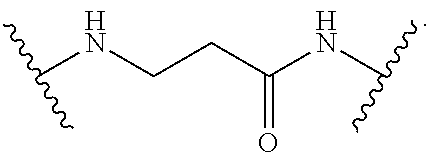

In some embodiments D3 is methylene (—CH2—) or ethylene (—CH2CH2—). In some embodiments D3 is ethylene (—CH2CH2—) or propylene (—CH2CH2CH2—).
Cleavable Triggers


wherein:

wherein:

wherein:

wherein:

wherein:

wherein:

wherein:

wherein:

wherein:

wherein z is 1-4. In some embodiments, z is 2 or 4. In some embodiments, e.g., when A is a carbon atom, D1 is selected from the group consisting of:

each of which is optionally substituted. In some embodiments, e.g., when A is

D1 is selected from the group consisting of: optionally substituted

wherein z is 1-4. In some embodiments, z is 2 or 4. In some embodiments, e.g., when A is

D1 is selected from the group consisting of:

each of which is optionally substituted.
Distance Factors


wherein:

wherein:
-
- FG1 is a reactive functional group capable of conjugation to a targeting vector;
- FG2 is a reactive functional group capable of conjugation to a payload;
- A is a trivalent or tetravalent atom;
- B is a first branch point;
- PEG is a polyethylene glycol-based chain comprising linear, branched, monodisperse, and/or polydisperse PEG;
- x is an integer from 4 to 48;
- y is 2 or 3; and
- D1, D2, and D3 are each independently a spacer moiety,
- wherein D′ represents the sum of atoms in a linear chain between B and FG2.

or a pharmaceutically acceptable salt, solvate, or isomer thereof,
wherein:

or a pharmaceutically acceptable salt, solvate, or isomer thereof,
wherein:

or a pharmaceutically acceptable salt, solvate, or isomer thereof,
wherein:


pharmaceutically acceptable salt, solvate, or isomer thereof,
wherein:

or a pharmaceutically acceptable salt, solvate, or isomer thereof,
wherein:

pharmaceutically acceptable salt, solvate, or isomer thereof,
wherein:

wherein:
-
- FG1 is a reactive functional group capable of conjugation to a targeting vector;
- A is a trivalent or tetravalent atom;
- B is a first branch point;
- T is a releasable trigger;
- P is a payload;
- PEG is a polyethylene glycol-based chain comprising linear, branched, monodisperse, and/or polydisperse PEG;
- q is 0 or 1;
- x is an integer from 4 to 48;
- y is 2 or 3; and
- D1, D2, and D3 are each independently a spacer moiety,
- wherein D′ represents the sum of atoms in a linear chain between B and T.

wherein z is 2 or 4.

wherein z′ is an integer from 1 to 5.

or a pharmaceutically acceptable salt, solvate, or isomer thereof,
wherein:

wherein:
-
- A is a trivalent or tetravalent atom;
- B is a first branch point;
- T is a releasable trigger;
- P is a payload;
- X is a targeting vector;
- PEG is a polyethylene glycol-based chain comprising linear, branched, monodisperse, and/or polydisperse PEG;
- q is 0 or 1;
- x is an integer from 4 to 48;
- y is 2 or 3; and
- D1, D2, and D3 are each independently a spacer moiety,
- wherein D′ represents the sum of atoms in a linear chain between B and T.

wherein z is 2 or 4.

wherein z′ is an integer from 1 to 5.

or a pharmaceutically acceptable salt, solvate, or isomer thereof, wherein:
| TABLE 1 |
| Synthesized and Evaluated Compounds of the Present Disclosure. |
| Cmpd | ||
| No. | Code | Structure |
| 18 | A |
 |
| (Linear Control) | ||
| 19 | B |
 |
| (Linear Control) | ||
| 22 | C |
 |
| (Linear Control) | ||
| 29 | D |
 |
| (Sidewinder 24) | ||
| 32 | E |
 |
| (Sidewinder 24) | ||
| 39 | F |
 |
| (Sidewinder 24) | ||
| 53 | J |
 |
| (C2-Tris 8) | ||
| 56 | K |
 |
| (C2-Tris 8) | ||
| 62 | L |
 |
| (Tris 8) | ||
| 70 | G |
 |
| (C2-Tris 8) | ||
| 73 | H |
 |
| (C2-Tris 8) | ||
| 81 | I |
 |
| (Tris 8) | ||
| 87 | P |
 |
| (C2-Tris 24) | ||
| 90 | Q |
 |
| (C2-Tris 24) | ||
| 96 | R |
 |
| (Tris 24) | ||
| 102 | M |
 |
| (C2-Tris 24) | ||
| 105 | N |
 |
| (C2-Tris 24) | ||
| 111 | O |
 |
| (Tris 24) | ||
| TABLE 2 |
| Determination of Drug-Antibody Ratio (DAR) Across |
| Various Linker Architectures. |
| D | Linker-Payload | ||||
| Conjugate | (atoms) | (y, n, D′) | A280 | A310 | DAR |
| A | 75 | 18-Linear | 0.336 | 0.032 | 2.5 |
| |
16 | 19-Linear | 0.365 | 0.041 | 3.0 |
| |
9 | 22-Linear | 0.349 | 0.039 | 3.0 |
| |
27 | 29-1, 24, NA | 0.412 | 0.039 | 2.5 |
| |
14 | 32-1, 24, NA | 0.335 | 0.032 | 2.5 |
| |
10 | 39-1, 24, NA | 0.375 | 0.039 | 2.8 |
| |
27 | 102-3, 8, 10 | 0.338 | 0.031 | 2.4 |
| |
14 | 105-3, 8, 10 | 0.326 | 0.033 | 2.7 |
| I | 10 | 111-3, 8, 9 | 0.364 | 0.037 | 2.7 |
| |
27 | 70-3, 8, 6 | 0.373 | 0.035 | 2.5 |
| |
14 | 73-3, 8, 6 | 0.257 | 0.026 | 2.7 |
| |
10 | 81-3, 8, 5 | 0.29 | 0.031 | 2.8 |
| |
27 | 87-3, 24, 10 | 0.381 | 0.047 | 3.4 |
| |
14 | 90-3, 24, 10 | 0.333 | 0.03 | 2.4 |
| |
10 | 96-3, 24, 9 | 0.378 | 0.039 | 2.7 |
| |
27 | 53-3, 24, 6 | 0.366 | 0.04 | 2.9 |
| |
14 | 56-3, 24, 6 | 0.367 | 0.041 | 3.0 |
| |
10 | 62-3, 24, 5 | 0.319 | 0.033 | 2.7 |
| Average | 2.7 | ||||
| St Dv | 0.26 | ||||
| |
10% | ||||
% Paylod Release=Conjugate Em455/Coumarin Em455
Claims (10)


Priority Applications (2)
| Application Number | Priority Date | Filing Date | Title |
|---|---|---|---|
| US17/554,668 US11510994B2 (en) | 2021-01-29 | 2021-12-17 | Linkers for improving the stability of bioconjugates and the selectivity of payload release |
| US17/952,108 US20230158169A1 (en) | 2021-01-29 | 2022-09-23 | Linkers for improving the stability of bioconjugates and the selectivity of payload release |
Applications Claiming Priority (2)
| Application Number | Priority Date | Filing Date | Title |
|---|---|---|---|
| US202163143470P | 2021-01-29 | 2021-01-29 | |
| US17/554,668 US11510994B2 (en) | 2021-01-29 | 2021-12-17 | Linkers for improving the stability of bioconjugates and the selectivity of payload release |
Related Child Applications (1)
| Application Number | Title | Priority Date | Filing Date |
|---|---|---|---|
| US17/952,108 Division US20230158169A1 (en) | 2021-01-29 | 2022-09-23 | Linkers for improving the stability of bioconjugates and the selectivity of payload release |
Publications (2)
| Publication Number | Publication Date |
|---|---|
| US20220265848A1 US20220265848A1 (en) | 2022-08-25 |
| US11510994B2 true US11510994B2 (en) | 2022-11-29 |
Family
ID=82652822
Family Applications (2)
| Application Number | Title | Priority Date | Filing Date |
|---|---|---|---|
| US17/554,668 Active US11510994B2 (en) | 2021-01-29 | 2021-12-17 | Linkers for improving the stability of bioconjugates and the selectivity of payload release |
| US17/952,108 Pending US20230158169A1 (en) | 2021-01-29 | 2022-09-23 | Linkers for improving the stability of bioconjugates and the selectivity of payload release |
Family Applications After (1)
| Application Number | Title | Priority Date | Filing Date |
|---|---|---|---|
| US17/952,108 Pending US20230158169A1 (en) | 2021-01-29 | 2022-09-23 | Linkers for improving the stability of bioconjugates and the selectivity of payload release |
Country Status (3)
| Country | Link |
|---|---|
| US (2) | US11510994B2 (en) |
| EP (1) | EP4284437A4 (en) |
| WO (1) | WO2022165335A1 (en) |
Families Citing this family (2)
| Publication number | Priority date | Publication date | Assignee | Title |
|---|---|---|---|---|
| CA3266080A1 (en) * | 2022-09-07 | 2024-03-14 | Xadcera Biopharmaceutical (Suzhou) Co., Ltd. | Anti-trop2/egfr antibodies and uses thereof |
| IL324453A (en) * | 2023-05-12 | 2026-01-01 | Biocytogen Pharmaceuticals Beijing Co Ltd | Linker compounds and ligand-drug conjugates, preparation methods and uses thereof |
Citations (6)
| Publication number | Priority date | Publication date | Assignee | Title |
|---|---|---|---|---|
| WO2015057699A2 (en) | 2013-10-15 | 2015-04-23 | Seattle Genetics, Inc. | Pegylated drug-linkers for improved ligand-drug conjugate pharmacokinetics |
| US20170313656A1 (en) * | 2011-08-30 | 2017-11-02 | Quanta Biodesign, Ltd. | Branched Discrete PEG Constructs |
| US20190298844A1 (en) | 2016-10-17 | 2019-10-03 | Princeton Enduring Biotech, Inc. | Long Acting Multi-Specific Molecules And Related Methods |
| US10786497B2 (en) | 2013-08-16 | 2020-09-29 | Equip, Llc | Discrete PEG constructs |
| US20200361870A1 (en) | 2012-08-31 | 2020-11-19 | Sutro Biopharma, Inc. | Modified amino acids |
| US20210009757A1 (en) | 2018-03-20 | 2021-01-14 | Nof Corporation | Branched monodispersed polyethylene glycol, intermediate and methods for producing same |
-
2021
- 2021-12-17 US US17/554,668 patent/US11510994B2/en active Active
-
2022
- 2022-01-31 WO PCT/US2022/014566 patent/WO2022165335A1/en not_active Ceased
- 2022-01-31 EP EP22746801.4A patent/EP4284437A4/en active Pending
- 2022-09-23 US US17/952,108 patent/US20230158169A1/en active Pending
Patent Citations (8)
| Publication number | Priority date | Publication date | Assignee | Title |
|---|---|---|---|---|
| US20170313656A1 (en) * | 2011-08-30 | 2017-11-02 | Quanta Biodesign, Ltd. | Branched Discrete PEG Constructs |
| US20200317612A1 (en) | 2011-08-30 | 2020-10-08 | Quanta Biodesign, Ltd | Branched Discrete PEG Constructs |
| US20200361870A1 (en) | 2012-08-31 | 2020-11-19 | Sutro Biopharma, Inc. | Modified amino acids |
| US10786497B2 (en) | 2013-08-16 | 2020-09-29 | Equip, Llc | Discrete PEG constructs |
| WO2015057699A2 (en) | 2013-10-15 | 2015-04-23 | Seattle Genetics, Inc. | Pegylated drug-linkers for improved ligand-drug conjugate pharmacokinetics |
| US20160310612A1 (en) | 2013-10-15 | 2016-10-27 | Seattle Genetics, Inc. | Pegylated drug-linkers for improved ligand-drug conjugate pharmacokinetics |
| US20190298844A1 (en) | 2016-10-17 | 2019-10-03 | Princeton Enduring Biotech, Inc. | Long Acting Multi-Specific Molecules And Related Methods |
| US20210009757A1 (en) | 2018-03-20 | 2021-01-14 | Nof Corporation | Branched monodispersed polyethylene glycol, intermediate and methods for producing same |
Non-Patent Citations (9)
| Title |
|---|
| Bargh, J.D., et al., "Cleavable linkers in antibody-drug conjugates," Chemical Society Reviews, 2019, 48, 4361-4374 (DOI: 10.1039/c8cs00676h). |
| Burke, P. J., et al., "Optimization of a PEGylated Glucuronide-Monomethylauristatin E Linker for Antibody-Drug Conjugates," Molecular Cancer Therapeutics 2017, 16(1), 116-123. |
| Giese, M., et al. Bioconjugate Chem. 2021, 32, 10, S-1 to S-124 (Supporting Information). |
| Giese, M., et al., "Linker Architectures as Steric Auxiliaries for Altering Enzyme-Mediated Payload Release from Bioconjugates," Bioconjugate Chem. 2021, 32, 10, 2257-2267. |
| International Search Report and Written Opinion dated Apr. 12, 2022, for International Application No. PCT/US2022/014566, 9 pages. |
| Levengood, M. R., et al., "Orthogonal Cysteine Protection Enables Homogeneous Multi-Drug Antibody-Drug Conjugates," Angew. Chem. Int. Ed. 2017, 56, 733-737. |
| Lyon, R. P., et al., "Reducing hydrophobicity of homogeneous antibody-drug conjugates improves pharmacokinetics and therapeutic index," Nature Biotechnology 2015, 33, 733-736. |
| Pabst, M., et al., "Modulation of drug-linker design to enhance in vivo potency of homogeneous antibody-drug conjugates," J. Contr. Rel., 2017, 253, 160-164. |
| Su, D., et al., "Modulating Antibody-Drug Conjugate Payload Metabolism by Conjugation Site and Linker Modification," Bioconjugate Chem. 2018, 29, 1155-1167. |
Also Published As
| Publication number | Publication date |
|---|---|
| EP4284437A1 (en) | 2023-12-06 |
| US20220265848A1 (en) | 2022-08-25 |
| US20230158169A1 (en) | 2023-05-25 |
| WO2022165335A1 (en) | 2022-08-04 |
| EP4284437A4 (en) | 2026-01-14 |
Similar Documents
| Publication | Publication Date | Title |
|---|---|---|
| US11547763B2 (en) | Enediyne conjugates | |
| AU2019282767B2 (en) | Camptothecin conjugates | |
| AU2015308179B2 (en) | Stability-modulating linkers for use with antibody drug conjugates | |
| DK2911696T3 (en) | Drug-protein conjugates | |
| KR101660146B1 (en) | Enediyne compounds, conjugates thereof, and uses and methods therefor | |
| CN114728073B (en) | Selective release of drugs from internalized conjugates of biologically active compounds | |
| US20230158169A1 (en) | Linkers for improving the stability of bioconjugates and the selectivity of payload release | |
| JP2023105175A (en) | Process for preparation of glucuronide drug-linkers and intermediates thereof | |
| JP2021532162A (en) | 1H-pyrazolo [4,3-d] pyrimidine compounds as toll-like receptor 7 (TLR7) agonists and methods and uses thereof. | |
| EP3668871A1 (en) | 6-amino-7,9-dihydro-8h-purin-8-one derivatives as immunostimulant toll-like receptor 7 (tlr7) agonists | |
| KR20200041911A (en) | Toll-like receptor 7 (TLR7) agonists with tricyclic moieties, conjugates thereof, and methods and uses thereof | |
| EP3433278A1 (en) | Process for the preparation of pegylated drug-linkers and intermediates thereof | |
| CA2973354A1 (en) | Benzodiazepine dimers, conjugates thereof, and methods of making and using | |
| EP3976112A1 (en) | Acetal-based cleavable linkers | |
| JP7023933B2 (en) | Seco-cyclopropyrroloindole compound, its antibody-drug conjugate, and how to make and use it. | |
| CA2338000C (en) | Water-soluble 4-thio-maleimido derivatives and methods for their production | |
| WO2021260232A1 (en) | Methods for the preparation of linker payload constructs | |
| HK1208186B (en) | Drug-protein conjugates |
Legal Events
| Date | Code | Title | Description |
|---|---|---|---|
| FEPP | Fee payment procedure |
Free format text: ENTITY STATUS SET TO UNDISCOUNTED (ORIGINAL EVENT CODE: BIG.); ENTITY STATUS OF PATENT OWNER: SMALL ENTITY |
|
| FEPP | Fee payment procedure |
Free format text: ENTITY STATUS SET TO SMALL (ORIGINAL EVENT CODE: SMAL); ENTITY STATUS OF PATENT OWNER: SMALL ENTITY |
|
| AS | Assignment |
Owner name: EQIP, LLC, OHIO Free format text: ASSIGNMENT OF ASSIGNORS INTEREST;ASSIGNORS:GIESE, MATTHEW;DAVIS, PAUL D;SIGNING DATES FROM 20210203 TO 20210205;REEL/FRAME:060631/0059 |
|
| STPP | Information on status: patent application and granting procedure in general |
Free format text: PUBLICATIONS -- ISSUE FEE PAYMENT VERIFIED |
|
| STCF | Information on status: patent grant |
Free format text: PATENTED CASE |
|
| AS | Assignment |
Owner name: AUDAX PRIVATE DEBT LLC, AS AGENT, MASSACHUSETTS Free format text: SECURITY INTEREST;ASSIGNOR:EQIP, LLC;REEL/FRAME:064554/0194 Effective date: 20230810 |
|
| CC | Certificate of correction |