US11499893B2 - Method and device for transferring nanoparticle monolayer by using capillary tube - Google Patents
Method and device for transferring nanoparticle monolayer by using capillary tube Download PDFInfo
- Publication number
- US11499893B2 US11499893B2 US16/757,369 US201816757369A US11499893B2 US 11499893 B2 US11499893 B2 US 11499893B2 US 201816757369 A US201816757369 A US 201816757369A US 11499893 B2 US11499893 B2 US 11499893B2
- Authority
- US
- United States
- Prior art keywords
- nanoparticle monolayer
- nanoparticle
- transferring
- capillary tube
- substrate
- Prior art date
- Legal status (The legal status is an assumption and is not a legal conclusion. Google has not performed a legal analysis and makes no representation as to the accuracy of the status listed.)
- Active, expires
Links
Images




Classifications
-
- B—PERFORMING OPERATIONS; TRANSPORTING
- B82—NANOTECHNOLOGY
- B82B—NANOSTRUCTURES FORMED BY MANIPULATION OF INDIVIDUAL ATOMS, MOLECULES, OR LIMITED COLLECTIONS OF ATOMS OR MOLECULES AS DISCRETE UNITS; MANUFACTURE OR TREATMENT THEREOF
- B82B3/00—Manufacture or treatment of nanostructures by manipulation of individual atoms or molecules, or limited collections of atoms or molecules as discrete units
- B82B3/0061—Methods for manipulating nanostructures
- B82B3/0076—Methods for manipulating nanostructures not provided for in groups B82B3/0066 - B82B3/0071
-
- G—PHYSICS
- G01—MEASURING; TESTING
- G01N—INVESTIGATING OR ANALYSING MATERIALS BY DETERMINING THEIR CHEMICAL OR PHYSICAL PROPERTIES
- G01N1/00—Sampling; Preparing specimens for investigation
- G01N1/02—Devices for withdrawing samples
- G01N1/10—Devices for withdrawing samples in the liquid or fluent state
- G01N1/14—Suction devices, e.g. pumps; Ejector devices
-
- B—PERFORMING OPERATIONS; TRANSPORTING
- B05—SPRAYING OR ATOMISING IN GENERAL; APPLYING FLUENT MATERIALS TO SURFACES, IN GENERAL
- B05D—PROCESSES FOR APPLYING FLUENT MATERIALS TO SURFACES, IN GENERAL
- B05D1/00—Processes for applying liquids or other fluent materials
- B05D1/18—Processes for applying liquids or other fluent materials performed by dipping
- B05D1/185—Processes for applying liquids or other fluent materials performed by dipping applying monomolecular layers
-
- B—PERFORMING OPERATIONS; TRANSPORTING
- B05—SPRAYING OR ATOMISING IN GENERAL; APPLYING FLUENT MATERIALS TO SURFACES, IN GENERAL
- B05D—PROCESSES FOR APPLYING FLUENT MATERIALS TO SURFACES, IN GENERAL
- B05D7/00—Processes, other than flocking, specially adapted for applying liquids or other fluent materials to particular surfaces or for applying particular liquids or other fluent materials
- B05D7/24—Processes, other than flocking, specially adapted for applying liquids or other fluent materials to particular surfaces or for applying particular liquids or other fluent materials for applying particular liquids or other fluent materials
-
- G—PHYSICS
- G01—MEASURING; TESTING
- G01N—INVESTIGATING OR ANALYSING MATERIALS BY DETERMINING THEIR CHEMICAL OR PHYSICAL PROPERTIES
- G01N21/00—Investigating or analysing materials by the use of optical means, i.e. using sub-millimetre waves, infrared, visible or ultraviolet light
- G01N21/62—Systems in which the material investigated is excited whereby it emits light or causes a change in wavelength of the incident light
- G01N21/63—Systems in which the material investigated is excited whereby it emits light or causes a change in wavelength of the incident light optically excited
- G01N21/65—Raman scattering
-
- B—PERFORMING OPERATIONS; TRANSPORTING
- B82—NANOTECHNOLOGY
- B82B—NANOSTRUCTURES FORMED BY MANIPULATION OF INDIVIDUAL ATOMS, MOLECULES, OR LIMITED COLLECTIONS OF ATOMS OR MOLECULES AS DISCRETE UNITS; MANUFACTURE OR TREATMENT THEREOF
- B82B3/00—Manufacture or treatment of nanostructures by manipulation of individual atoms or molecules, or limited collections of atoms or molecules as discrete units
- B82B3/0009—Forming specific nanostructures
- B82B3/0038—Manufacturing processes for forming specific nanostructures not provided for in groups B82B3/0014 - B82B3/0033
-
- B—PERFORMING OPERATIONS; TRANSPORTING
- B82—NANOTECHNOLOGY
- B82Y—SPECIFIC USES OR APPLICATIONS OF NANOSTRUCTURES; MEASUREMENT OR ANALYSIS OF NANOSTRUCTURES; MANUFACTURE OR TREATMENT OF NANOSTRUCTURES
- B82Y40/00—Manufacture or treatment of nanostructures
-
- G—PHYSICS
- G01—MEASURING; TESTING
- G01N—INVESTIGATING OR ANALYSING MATERIALS BY DETERMINING THEIR CHEMICAL OR PHYSICAL PROPERTIES
- G01N1/00—Sampling; Preparing specimens for investigation
- G01N1/02—Devices for withdrawing samples
- G01N1/10—Devices for withdrawing samples in the liquid or fluent state
- G01N1/14—Suction devices, e.g. pumps; Ejector devices
- G01N2001/1472—Devices not actuated by pressure difference
- G01N2001/149—Capillaries; Sponges
-
- G—PHYSICS
- G01—MEASURING; TESTING
- G01N—INVESTIGATING OR ANALYSING MATERIALS BY DETERMINING THEIR CHEMICAL OR PHYSICAL PROPERTIES
- G01N21/00—Investigating or analysing materials by the use of optical means, i.e. using sub-millimetre waves, infrared, visible or ultraviolet light
- G01N21/62—Systems in which the material investigated is excited whereby it emits light or causes a change in wavelength of the incident light
- G01N21/63—Systems in which the material investigated is excited whereby it emits light or causes a change in wavelength of the incident light optically excited
- G01N21/65—Raman scattering
- G01N21/658—Raman scattering enhancement Raman, e.g. surface plasmons
Definitions
- the present disclosure relates to a method and a device for transferring a nanoparticle monolayer by using a capillary tube.
- a monolayer structure of nanoparticles formed through self-assembly at the water-organic solvent interface exhibits unique mechanical, optical and electrical properties distinguished from those of individual nanoparticles. For this reason, it draws a lot of attentions as a next-generation material capable of solving the problems of the existing technology in various fields such as high-efficiency electrodes, molecule detection, energy harvesting, etc.
- the nanoparticle monolayer present at the liquid-liquid interface is generally transferred onto a solid substrate for practical applications.
- the method most frequently used for the transfer of the nanoparticle monolayer at the interface onto a solid substrate is Langmuir film deposition [Lu, Y., Liu, G. L. & Lee, L. P. High-density silver nanoparticle film with temperature-controllable interparticle spacing for a tunable surface enhanced Raman scattering substrate. Nano Lett. 5, 5-9 (2005)].
- the Langmuir film deposition is achieved simply by contacting the substrate with the nanoparticle monolayer at the interface. If the contact orientation of the substrate is perpendicular to the interface, it is called Langmuir-Blodgett (LB) deposition, and if the contact orientation of the substrate is parallel to the interface, it is called Langmuir-Schaefer (LS) deposition.
- LB Langmuir-Blodgett
- LS Langmuir-Schaefer
- the Langmuir film deposition is advantageous in that a large-area substrate can be prepared via a relatively simple process and the density of nanoparticles is also controllable.
- the Langmuir film deposition is applicable only to a substrate having planar structure because the substrate should contact with the interface uniformly.
- the conventional Langmuir film deposition has been applied limitedly only to planar substrates such as glass, silicon, etc., and is difficult to be applied to solid surfaces with various structures and surface properties that can be found around us.
- the Langmuir film deposition is disadvantageous in that precise control of the transfer area and shape of the nanoparticle monolayer as well as the location of transfer is difficult.
- ⁇ CP rnicrocontact printing
- the ⁇ CP technology partially solves the substrate dependence and poor maneuverability problems of the Langmuir film deposition method, there have been problems that the polymer stamp used as a medium may be deformed during the transfer, e.g., shrinkage, swelling, etc., and the nanoparticles may be lost if the attraction between the nanoparticle monolayer and the polymer stamp is larger than the attraction between the nanoparticle monolayer and the substrate.
- the ⁇ CP technology is difficult to be applied to a substrate made of a soft material, particularly a biological surface, having possibility of potential damage during the transfer because sufficient pressure has to be applied during the transfer onto a substrate using a polymer stamp.
- the nanoparticle structure deposited onto a solid substrate by using the technologies described above can be applied to various fields including electronic devices, catalysts, energy harvesting, etc.
- the fields of microfluidic systems and optical molecular detection such as inspection of food surface, inspection of illegal substance such as drugs, detection of counterfeit banknotes, etc. are expected to be highly promising in particular.
- exemplary embodiments of the present disclosure are directed to providing a method and a device for transferring a nanoparticle monolayer by using a capillary tube, wherein a uniform nanoparticle monolayer can be transferred with high reproducibility regardless of structure and surface energy of a substrate.
- exemplary embodiments of the present disclosure are directed to providing a method and a device for transferring a nanoparticle monolayer by using a capillary tube, wherein area and nanoparticles of a transferred nanoparticle monolayer can be controlled.
- exemplary embodiments of the present disclosure are directed to providing a method and a device for transferring a nanoparticle monolayer by using a capillary tube, which enable the fabrication of a microfluidic device coupled with an optical molecular detection system by introducing a nanoparticle monolayer into a microfluidic channel with a small diameter.
- exemplary embodiments of the present disclosure are directed to providing a method and a device capable of detecting harmful materials such as agrochemicals, illegal substance such as drugs, etc., explosives, or the like in real time in situ on various solid surfaces such as variety of food, clothes, banknotes, etc. or on cell surface of organisms or microorganisms, etc.
- Exemplary embodiments of the present disclosure provide a method for transferring a nanoparticle monolayer, wherein a nanoparticle monolayer is separated and transferred to a substrate by using a capillary tube.
- the method for transferring a nanoparticle monolayer includes: a step of forming a nanoparticle monolayer at a liquid-gas interface; a step of separating the nanoparticle monolayer into a capillary tube by contacting the capillary tube with the liquid-gas interface; and a step of transferring the nanoparticle monolayer in the capillary tube to a substrate.
- exemplary embodiments of the present disclosure provide a device for transferring a nanoparticle monolayer, which includes a capillary tube separating and then transferring a nanoparticle monolayer.
- the device includes: a nanoparticle monolayer-forming unit wherein a nanoparticle monolayer is formed at a liquid-gas interface; and the capillary tube provided to the monolayer-forming unit.
- exemplary embodiments of the present disclosure provide a method for detecting a material to be detected, which includes: a step of separating and transferring a nanoparticle monolayer to a substrate on which a material to be detected is located by using a capillary tube; and a step of detecting the material to be detected on the substrate from a Raman signal of the transferred nanoparticle monolayer.
- exemplary embodiments of the present disclosure provide a device for detecting a material to be detected, which includes: a capillary tube separating and then transferring a nanoparticle monolayer; and a detection unit irradiating a laser to the transferred nanoparticle monolayer and detecting the material to be detected from a Raman signal of the nanoparticle monolayer.
- the detection method and device may be for detection of a drug or an explosive on the surface of clothes or banknotes or for detection of harmful materials on food surface.
- exemplary embodiments of the present disclosure provide a method for determining a counterfeit banknote, which includes: a step of separating a nanoparticle monolayer by using a capillary tube and transferring the nanoparticle monolayer in the capillary tube to at least one part of an authentic banknote, wherein a banknote is determined to be authentic if a Raman signal is detected from the transferred nanoparticle monolayer.
- exemplary embodiments of the present disclosure provide a method for fabricating a microfluidic channel, which includes a step of separating and transferring a nanoparticle monolayer into a microfluidic channel by using a capillary tube.
- the exemplary embodiments of the present disclosure are applicable to nonplanar solid substrate of various structures because the effect of the curvature of a substrate is little since a capillary tube with a small diameter is used.
- nanoparticle monolayer at the liquid interface can be directly contacted with solid substrate, a uniform nanoparticle monolayer can be transferred with reproducibility and without loss of nanoparticles by van der Waals attraction, unlike the existing ⁇ CP technology.
- the nanoparticle monolayer at the liquid interface maintains high stability inside a capillary tube, which in turn allows a good operability of the capillary tube, the nanoparticle monolayer can be transferred to a desired location with higher accuracy as compared to the Langmuir film deposition method.
- the nanoparticle monolayer may be used as a probe of an optical sensor. Since the diameter of laser-irradiated area is micrometer scale in general, the existing large-area transfer method exhibits low efficiency in number of nanoparticles per laser-irradiated area. In contrast, according to the exemplary embodiments of the present disclosure, the efficiency in number of nanoparticles per laser-irradiated area can be improved greatly because a nanoparticle monolayer may be transferred onto an area similar to the laser-irradiated area, e.g., an area with a diameter of 1 mm or smaller.
- the method and the device for transferring a nanoparticle monolayer by using a capillary tube require only a commercially available glass capillary tube, transfer can be achieved simply at low cost without requiring special equipment or high-level expertise.
- multiple nanoparticle monolayers can be transferred at the same time by using a bundle of multiple capillary tubes and the patterning of a complicated shape is also possible.
- a nanoparticle monolayer can be easily introduced with reproducibility to solid surfaces having various structures and surface properties, such as fabrics, food, banknotes, etc., to which reproducible transfer is difficult with the existing method. Accordingly, the present disclosure can be widely used for various applications such as food safety test such as detection of residual agrochemicals as well as high-speed in-situ inspection of illegal drugs, explosives, etc., prevention of counterfeit banknotes, or the like.
- FIG. 1 schematically illustrates the transfer of a nanoparticle monolayer by using a capillary tube according to an exemplary embodiment of the present disclosure.
- FIG. 2 shows a gold nanoparticle monolayer with a size of 50 nm, located at a liquid-gas interface, which has been transferred onto a 1 cm ⁇ 1 cm PDMS substrate by using the existing method in a comparative example of the present disclosure.
- FIGS. 3A-3D show a gold nanoparticle monolayer with a size of 50 nm, which has been transferred onto PDMS substrates with various sizes by using a capillary tube in an example of the present disclosure.
- FIGS. 4A and 4B show a spherical gold nanoparticle monolayer with a size of 50 nm, which has been transferred at the same time ( FIG. 4A ), and has been patterned into the characters ‘NRG’ ( FIG. 4B ), by using a bundle of multiple capillary tubes in an example of the present disclosure.
- FIGS. 5A-5F show UV datum for six types of various nanoparticles in an example of the present disclosure.
- FIGS. 6A-6F show a result of observing monolayer of various nanoparticles that have been transferred to glass substrates by using a capillary tube with a scanning electron microscope in an example of the present disclosure: spherical gold nanoparticles with a size of 50 nm ( FIG. 6A ), spherical gold nanoparticles with a size of 17 nm ( FIG. 6B ), gold nanoparticles of a core-shell structure with a silica shell attached on the surface of spherical gold nanoparticles with a size of 50 nm ( FIG. 6C ), gold nanorods ( FIG. 6D ), spherical silver nanoparticles with a size of 45 nm ( FIG. 6E ), and spherical silver nanoparticles with a size of 30 nm ( FIG. 6F ).
- FIGS. 7A-7D show a gold nanoparticle monolayer with a size of 50 nm, which has been transferred onto the soft surface of a leaf (front and back sides) with a diameter of 1 mm in an example of the present disclosure.
- FIG. 8 shows a scanning electron microscopic image of a gold nanoparticle monolayer with a size of 50 nm, which has been transferred onto a PDMS surface where Escherichia coli is present with high density, in an example of the present disclosure.
- FIGS. 9A-9G show a result of fabricating various PDMS microfluidic channels with a width of 1 mm and a depth of 650 ⁇ m and then transferring a spherical gold nanoparticle monolayer with a size of 50 ⁇ m into the channels by using a capillary tube in an example of the present disclosure.
- FIG. 10 shows a result of detecting 1 mM rhodamine 6G inside a microfluidic channel to which a gold nanorod monolayer has been transferred through surface-enhanced Raman scattering in an example of the present disclosure.
- FIG. 11 shows a result of transferring a spherical gold nanoparticle monolayer with a size of 50 nm to a textile fabric of clothing surface so as to have a diameter of 1 mm by using a capillary tube in an example of the present disclosure.
- FIG. 12 shows a result of detecting benzocaine from a spherical gold nanoparticle monolayer which has been transferred to a surface of clothing having the benzocaine, a cocaine-like drug, through surface-enhanced Raman scattering in an example of the present disclosure.
- FIG. 13 shows a spherical gold nanoparticle monolayer with a size of 50 nm which has been transferred to a surface of rice grain so as to have a diameter of 1 mm by using a capillary tube in an example of the present disclosure.
- FIG. 14 shows a result of detecting chlorpyrifos-methyl, which is an agrochemical, from a spherical gold nanoparticle monolayer which has been transferred to a surface of rice grain having the commercially available agrochemical through surface-enhanced Raman scattering in an example of the present disclosure.
- FIG. 15 shows a spherical gold nanoparticle monolayer with a size of 50 nm which has been transferred to a surface of orange peel so as to have a diameter of 1 mm by using a capillary tube in an example of the present disclosure.
- FIG. 16 shows a result of detecting chlorpyrifos-methyl, which is an agrochemical, from a spherical gold nanoparticle monolayer which has been transferred to a surface of orange peel having the commercially available agrochemical through surface-enhanced Raman scattering in an example of the present disclosure.
- FIG. 17 shows several spots on a US 100-dollar bill to which chemical codes for preventing counterfeit banknotes are to be inserted in an example of the present disclosure.
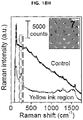
- FIGS. 18A-18J show a result of Raman signal measurement showing that a strong peak occurs in common near 250 cm ⁇ 1 from all locations of gold nanoparticle monolayers which have been transferred to a 100-dollar bill in an example of the present disclosure.
- nano refers to a size of 1000 nm or less.
- 2-dimensional means that, although the horizontal size and vertical size of a structure does not have at least one order of magnitude difference, the horizontal size and a thickness and the vertical size and the thickness have at least one order of magnitude difference (difference of at least 10 times).
- a plate shape is a 2-dimensional shape.
- a harmful material refers to various agrochemicals such as an organophosphate, organochlorine, mercury-based or carbamate-based pesticide etc. such as chlorpyrifos, chlorpyrifos-methyl, parathion, methylparathion, carbophenothion, fenitrothion, etc. detected from food, etc., or other materials known as harmful to the human body.
- agrochemicals such as an organophosphate, organochlorine, mercury-based or carbamate-based pesticide etc.
- chlorpyrifos chlorpyrifos-methyl, parathion, methylparathion, carbophenothion, fenitrothion, etc. detected from food, etc., or other materials known as harmful to the human body.
- a drug includes an illegal drug such as philopon, cocaine, marijuana, etc. or other drugs the distribution, etc. of which is restricted or forbidden by law.
- the present disclosure provides a technology of separating a nanoparticle monolayer present at a liquid-gas interface, more specifically, e.g., an interface between an aqueous solution and air, with a capillary tube in a narrow region by utilizing a capillary action where water surface rise in a thin tube due to surface tension and then transferring the separated nanoparticle monolayer to a substrate by inverting the capillary tube.
- a liquid-gas interface more specifically, e.g., an interface between an aqueous solution and air
- exemplary embodiments of the present disclosure provide a method for separating and then transferring a nanoparticle monolayer by using a capillary tube.
- the method may include: a step of forming a nanoparticle monolayer at a liquid-gas interface; a step of selectively separating the nanoparticle monolayer by contacting the capillary tube with the liquid-gas interface and by locally and selectively containing the nanoparticle monolayer into a capillary tube; and a step of transferring the nanoparticle monolayer in the capillary tube to a substrate by inverting the capillary tube and contacting the capillary tube with the substrate.
- exemplary embodiments of the present disclosure provide a device for transferring a nanoparticle monolayer by using a capillary tube, which includes a capillary tube separating and then transferring a nanoparticle monolayer.
- the device may be a device for transferring a nanoparticle monolayer by using a capillary tube, which includes: a nanoparticle monolayer-forming unit wherein a nanoparticle monolayer is formed at a liquid-gas interface; and the capillary tube provided to the monolayer-forming unit.
- FIG. 1 schematically shows the transfer of a nanoparticle monolayer formed at an interface between nanoparticle aqueous solution and air through self-assembly to a solid substrate by using a capillary tube according to an exemplary embodiment of the present disclosure.
- nanoparticles dispersed in water may be self-assembled as a monolayer at an interface between water and air by controlling interparticle interaction using an organic solvent.
- a liquid-gas interface may be formed by forming a liquid-liquid interface first and then evaporating the upper liquid, or a liquid-gas interface may be formed directly.
- the monolayer present at a liquid-air interface may be transferred after evaporating the liquid phase existing in the upper layer.
- a nanoparticle monolayer is formed first on an interface between water and hexane and then transferred to a substrate after evaporating hexane.
- an organic solvent such as benzene, toluene, chloroform, hexane, a fatty acid such as oleic acid, an aliphatic amine such as oleylamine, etc. may be used to form an interface with water.
- an alcohol may be added to the liquid-liquid interface to induce the self-assembly of the nanoparticles.
- an organic solvent such as benzene, toluene, hexane, chloroform, etc. may be used as the lower liquid phase.
- the gas phase may be air.
- a capillary tube is contacted with the interface at which the nanoparticle monolayer is present and the nanoparticle monolayer is accommodated in the capillary tube together with the liquid through capillary action.
- a capillary tube with a cross-sectional diameter 2 mm or less e.g., 0.1-2 mm, 0.1-1.5 mm or 0.1-1 mm, may be contacted vertically with a water-air interface where a nanoparticle monolayer is present.
- the water level inside the capillary tube rises rapidly by the capillary force occurring due to the surface tension of water.
- the nanoparticle monolayer present in the capillary tube is elevated together with water while maintaining its structure at the interface.
- the capillary tube is separated and then inverted such that the opening of the capillary tube which has been contacted with the water surface faces upward, the solution in the capillary tube descends in the opposite direction due to gravitational force, and the nanoparticle monolayer structure is exposed to the opening of the capillary tube.
- nanoparticle monolayer exposed to the opening of the capillary tube is contacted vertically with a solid substrate surface desired to be transferred to and then is detached, only the nanoparticle monolayer remains on the solid substrate surface due to the van der Waals interaction between the nanoparticles and the solid substrate.
- loss of the nanoparticles can be minimized because the direct contact of the nanoparticle monolayer with the solid substrate at the interface is induced through van der Waals attraction without using a secondary polymer stamp. Meanwhile, electrostatic attraction may also be utilized instead of the van der Waals attraction.
- the nanoparticle monolayer which has been transferred by using the capillary tube becomes comparatively more uniform.
- the nanoparticles at the interface cannot help existing irregularly to the extent that where the nanoparticles exist and where they do not exist is largely divided even in the naked eye. Therefore, if such nanoparticles are transferred with a large area, non-uniform transfer is unavoidable since the parts where the nanoparticles exist have to be transferred together with the parts where they do not exist. However, when the nanoparticles are transferred by using a capillary tube, they can be transferred more uniformly with higher reproducibility because a monolayer can be locally separated and transferred from the parts where the nanoparticles exist.
- the nanoparticle monolayer separated and transferred by the capillary tube may have a diameter of approximately 0.1-2 mm and an area of approximately 0.01-4 mm 2 .
- the transferred nanoparticles may have a diameter of 5-200 nm.
- the nanoparticles are not particularly limited.
- the transferred nanoparticle may be one or more selected from an inorganic material such as a metal, a metal oxide, etc., or an organic material.
- the metal may be Au, Ag, Pd, Pt, Al, Cu, Co, Cr, Mn, Ni, Fe, etc.
- the inorganic material may be silica, a quantum dot, a lanthanide, iron oxide, etc.
- the organic material may be polystyrene, polyethylene glycol, etc.
- the shape of the transferred nanoparticle is not particularly limited.
- the transferred nanoparticle may have one or more shape selected from a group consisting of a sphere, a rod, an ellipsoid, a dendrimer, a tetrahedron, a hexahedron, an octahedron, a 2-dimensional quadrangle and a 2-dimensional triangle.
- the nanoparticle may have a core-shell structure.
- the substrate is not limited as long as it can accept the nanoparticle monolayer from the capillary tube.
- it may be a hydrophilic or hydrophobic substrate, more specifically a hydrophilic or hydrophobic solid substrate.
- the substrate may be one or more substrate selected from a polymer, glass, ITO, silicon, a metal, paper, a cell, etc.
- the polymer substrate may be one or more selected from PDMS, PMMA, a hydrogel, etc.
- the metal substrate may be one or more selected from Au, Ag, Pd, Pt, Al, Cu, Co, Cr, Mn, Ni, Fe, etc.
- the substrate may be a planar substrate, a substrate with coarse surface roughness, or a curved substrate with large curvature, and may include a fibrous substrate, a porous substrate, etc.
- the substrate may be one or more of various food including rice, vegetable, fruit, meat, seafood, etc., clothing, paper such as a banknote, etc., a porous filter, a cell of a living body or a microorganism, etc.
- the cell of a living body may be a skin cell of an animal or a plant.
- the microorganism may be E. coli etc. coated on a substrate.
- the method and the device using the capillary tube of the present disclosure are very useful for such substrates that require nondestructive and precise manipulation,
- the substrate for the transfer may be a microfluidic channel.
- multiple nanoparticle monolayers with small area may be transferred at once to the same substrate by using multiple capillary tubes.
- patterning of complex shape is also possible by controlling the location of transfer.
- the shape or area of the transferred nanoparticles can be controlled by variously controlling the structure, shape or area of the capillary tube.
- exemplary embodiments of the present disclosure also provide a method for detecting a material to be detected, which includes: a step of separating and transferring a nanoparticle monolayer to a substrate by using a capillary tube; and a step of detecting the material to be detected on the substrate from a Raman signal of the transferred nanoparticle monolayer.
- the transferring step may include: a step of forming a nanoparticle monolayer at a liquid-gas interface; a step of separating the nanoparticle monolayer into the capillary tube by contacting the capillary tube with the liquid-gas interface; and a step of transferring the nanoparticle monolayer in the capillary tube to the substrate.
- Exemplary embodiments of the present disclosure also provide a device for transferring a nanoparticle monolayer by using a capillary tube, which includes a capillary tube separating a nanoparticle monolayer and then transferring the same to a substrate.
- the device may include: a nanoparticle monolayer-forming unit where a nanoparticle monolayer is formed at a liquid-gas interface; and the capillary tube provided to the monolayer-forming unit.
- the method and the device can be usefully used to detect a drug or an explosive on clothing surface or banknote surface, or to detect a harmful material on food surface.
- Exemplary embodiments of the present disclosure also provide a method for detecting a counterfeit banknote, which includes a step of separating a nanoparticle monolayer by using a capillary tube and transferring the nanoparticle monolayer in the capillary tube to at least one part of an authentic banknote, wherein a banknote is determined to be authentic if a Raman signal is detected from the transferred nanoparticle monolayer.
- Exemplary embodiments of the present disclosure also provide a method for fabricating a microfluidic channel, which includes a step of separating and transferring a nanoparticle monolayer into a microfluidic channel by using a capillary tube.
- capillary action is used to selectively separate a nanoparticle monolayer with a small area. Accordingly, a uniform nanoparticle monolayer can be transferred with reproducibility regardless of the surface properties and structures of solid substrates. In addition, transfer can be achieved with low cost and very high speed simply and with high accessibility by using a commercially available glass capillary tube without using special expertise and expensive equipment.
- the method and the device of the present disclosure may be widely used for high-speed in-situ inspection of illegal drugs, explosives, harmful materials, etc. or technology for preventing counterfeit banknotes by transferring a nanoparticle monolayer to the surface of textile clothing, various food such as rice grains, orange, etc., or paper such as banknotes, etc.
- n-hexane 3 mL of n-hexane was cautiously added to 9 mL of a nanoparticle aqueous solution to form an interface. Then, after adding 4.5 mL of ethanol onto the nanoparticle aqueous solution, n-hexane was evaporated completely at room temperature for 6 hours.
- the hexane was added to form an interface with the aqueous solution.
- metal nanoparticles remain stable at the interface due to the energy by the surface tension, self-assembly does not occur when only hexane is added because the electrostatic repulsion between the nanoparticles is stronger. Ethanol can induce self-assembly by reducing the electrostatic repulsion since ethanol weakens the charge of the molecules surrounding the nanoparticles.
- a 1 cm ⁇ 1 cm PDMS substrate was contacted horizontally with the interface at which the nanoparticle monolayer was present and then detached.
- FIG. 2 shows a spherical gold nanoparticle monolayer with a size of 50 nm, present at a water-air interface, which was transferred onto a 1 cm ⁇ 1 cm PDMS substrate, in Comparative Example of the present disclosure.
- the solid substrate having affinity for the nanoparticles was contacted horizontally and then detached.
- n-hexane 3 mL of n-hexane was cautiously added to 9 mL of a nanoparticle aqueous solution to form an interface. Then, after adding 4.5 mL of ethanol onto the nanoparticle aqueous solution, n-hexane was evaporated completely at room temperature for 6 hours.
- the aqueous solution was allowed to rise inside the capillary tube to a certain level. Then, the capillary tube was pulled out.
- the pulled out capillary tube was inverted such that the solution inside the capillary tube descended down to the opposite opening by gravitational force.
- the capillary tube in this state was contacted vertically to the transferring parts of PDMS and glass substrates and then detached.
- FIGS. 3A-3D show pictures of gold nanoparticle monolayers with a size of 50 nm which were transferred with various sizes to a PDMS substrate by the transferring technique using the capillary tube in Example of the present disclosure.
- the transferred area varied depending on the diameter of the opening of the capillary tube. Unlike the monolayer of Comparative Example transferred without using a capillary tube, the monolayer was transferred relatively uniformly with less cracking.
- FIGS. 4A and 4B show multiple nanoparticle monolayers transferred at the same time using a bundle of multiple capillary tubes. As seen from FIGS. 4A and 4B , not only a simple pattern but also a complex pattern such as ‘NRG’ can be achieved since precise control of transfer location is possible by using the capillary tube.
- NVG complex pattern
- FIGS. 5A-5F show UV data for six types of different nanoparticles, obtained in Example of the present disclosure.
- FIGS. 6A-6F show a result of analyzing nanoparticle monolayers of various shapes and compositions that have been transferred to glass substrates by using a capillary tube with a scanning electron microscope in Example of the present disclosure.
- spherical gold nanoparticles with a size of 50 nm FIG. 6A
- spherical gold nanoparticles with a size of 17 nm FIG. 6B
- gold nanoparticles of a core-shell structure with a silica shell attached on the surface of spherical gold nanoparticles with a size of 50 nm FIG. 6C
- gold nanorods FIG. 6D
- spherical silver nanoparticles with a size of 45 nm FIG. 6E
- spherical silver nanoparticles with a size of 30 nm FIG. 6F
- FIGS. 7A-7D show a result of transferring a nanoparticle monolayer onto a leaf surface, which is a living body substrate having a soft surface in Example of the present disclosure.
- FIGS. 7A and 7B show the front and back side of one leaf respectively
- FIGS. 7C and 7D show the front and back side of another leaf respectively.
- FIG. 8 shows a scanning electron microscopic image of a gold nanoparticle monolayer which has been transferred onto a PDMS surface where E. coli is coated with high density.
- the gold nanoparticle monolayer is coated uniformly on the surface of E. coli , and the E. coli maintains its cylindrical structure well without being split or destroyed since no pressure is applied during the process.
- a microfluidic channel was prepared by detaching the hardened PDMS. Then, a gold nanoparticle monolayer was transferred to have a diameter of 1 mm into the channel by using a capillary tube.
- the gold nanoparticle monolayer was able to be transferred precisely to desired locations into the channels having various widths and structures.
- the Raman signal of rhodamine 6G was detected inside the microfluidic channel.
- the nanoparticle monolayer could be transferred with a diameter of 1 mm with reproducibility even onto a rough surface of clothing having a fibrous structure.
- a spherical gold nanoparticle monolayer with a size of 50 nm was transferred by using a capillary tube.
- FIG. 14 shows that the Raman signal of the agrochemical (chlorpyrifos-methyl) occurs selectively only in the region of the nanoparticle monolayer on the rice grain surface.
- the lower limit of detection was 10 ⁇ M, which shows that the agrochemical can be detected sensitively even for a much smaller amount than the recommended concentration of the agrochemical, 0.7-1.4 mM.
- FIG. 15 shows that the nanoparticle monolayer was transferred to the surface of orange peel with a large curvature and rough surface, like the rice grain.
- FIG. 16 shows the Raman signals occurring on the orange peel when a 785-nm laser was irradiated.
- the Raman signal of the agrochemical occurred only in the region of the nanoparticle monolayer.
- the lower limit of detection was 1 ⁇ M, which shows that the agrochemical can be detected sensitively even for a much smaller amount than the recommended concentration of the agrochemical, 0.7-1.4 mM.
- FIGS. 18A-18J show that strong Raman signals were observed around 250 cm ⁇ 1 at all the locations where the gold nanoparticle monolayers was transferred onto the 100-dollar bill.
- FIGS. 18A-18J show that the characteristic optical signals of gold nanoparticles are observed from the spherical gold nanoparticle monolayers with a size of 50 nm, which have been transferred to various locations on the 100-dollar bill, which suggests that the potential technique for preventing counterfeit banknote is possible based on this.
- the signals are signals due to the Au—O bonding of the gold nanoparticles. This result suggests that the nanoparticle monolayer transferred onto a banknote by using a capillary tube can serve as a small-area code exhibiting a non-counterfeitable, characteristic chemical signal.
- the method for transferring a nanoparticle monolayer by using a capillary tube is advantageous in that reproducible transfer is possible regardless of the surface properties and structures of substrates and the method is widely applicable in terms of nanoparticle type, transfer location, transfer area, etc.
- the nanoparticle monolayer may be used as a probe of an optical sensor. Since the diameter of laser-irradiated area is micrometer scale in general, the existing large-area transfer method exhibits low efficiency in number of nanoparticles per laser-irradiated area.
- the efficiency in number of nanoparticles per laser-irradiated area can be improved greatly because a nanoparticle monolayer may be transferred to have an area similar to the laser-irradiated area, e.g., an area with a diameter of 1 mm or less.
- transfer is possible regardless of the composition and shape of nanoparticles.
- spherical gold nanoparticles having different sizes, as well as a gold nanorod with a different shape, a core-shell nanoparticle with a silica shell attached on the surface, and silver nanoparticles with a different composition etc.
- nanoparticle monolayer is transferred through contact between the substrate surface and the liquid interface, nondestructive transfer is possible even onto a substrate with soft surface that may be destroyed in its structure upon application of pressure or onto a substrate requiring delicate manipulation.
- the transfer process is simple when compared with the existing nanometer-scale lithography, electrochemical deposition or Langmuir-Blodgett method, without requiring especial equipment or high-level expertise of experimenter.
- the method for transferring a nanoparticle monolayer by using a capillary tube may be applicable to food safety inspection, in-situ high-speed inspection of illegal drugs as well as a technique for preventing banknote counterfeiting by transferring a nanoparticle monolayer onto various solid surfaces such as textile clothing, various food, cells, paper such as banknotes, etc. It is expected to greatly extend the application of nanoparticles with precisely controlled structures in various fields requiring fast and sensitive molecule detection.
- a nanoparticle monolayer can be transferred relatively uniformly regardless of the surface properties and structure of a solid substrate by a simple method without special equipment. Accordingly, the application of the nanoparticle monolayer transfer, which has been restricted to laboratory environments, can be extended greatly for in-situ detection in various fields such as biomedicine, forensic medicine, food, drugs, etc.
Landscapes
- Chemical & Material Sciences (AREA)
- Engineering & Computer Science (AREA)
- Life Sciences & Earth Sciences (AREA)
- Crystallography & Structural Chemistry (AREA)
- Nanotechnology (AREA)
- Health & Medical Sciences (AREA)
- Pathology (AREA)
- General Health & Medical Sciences (AREA)
- General Physics & Mathematics (AREA)
- Immunology (AREA)
- Biochemistry (AREA)
- Physics & Mathematics (AREA)
- Analytical Chemistry (AREA)
- Manufacturing & Machinery (AREA)
- Hydrology & Water Resources (AREA)
- Nuclear Medicine, Radiotherapy & Molecular Imaging (AREA)
- Wood Science & Technology (AREA)
- Investigating, Analyzing Materials By Fluorescence Or Luminescence (AREA)
- Physical Or Chemical Processes And Apparatus (AREA)
Abstract
Description
Claims (20)
Applications Claiming Priority (5)
| Application Number | Priority Date | Filing Date | Title |
|---|---|---|---|
| KR20170136396 | 2017-10-20 | ||
| KR10-2017-0136396 | 2017-10-20 | ||
| KR10-2018-0116757 | 2018-10-01 | ||
| KR1020180116757A KR102086740B1 (en) | 2017-10-20 | 2018-10-01 | Method and Apparatus for Transfer of Nanoparticle Monolayer Using Capillary Tube |
| PCT/KR2018/012422 WO2019078676A2 (en) | 2017-10-20 | 2018-10-19 | Method and device for transferring nanoparticle monolayer by using capillary tube |
Publications (2)
| Publication Number | Publication Date |
|---|---|
| US20200333217A1 US20200333217A1 (en) | 2020-10-22 |
| US11499893B2 true US11499893B2 (en) | 2022-11-15 |
Family
ID=66285916
Family Applications (1)
| Application Number | Title | Priority Date | Filing Date |
|---|---|---|---|
| US16/757,369 Active 2040-01-26 US11499893B2 (en) | 2017-10-20 | 2018-10-19 | Method and device for transferring nanoparticle monolayer by using capillary tube |
Country Status (2)
| Country | Link |
|---|---|
| US (1) | US11499893B2 (en) |
| KR (1) | KR102086740B1 (en) |
Families Citing this family (4)
| Publication number | Priority date | Publication date | Assignee | Title |
|---|---|---|---|---|
| CN115963097B (en) * | 2022-10-20 | 2026-03-31 | 东南大学 | A method for preparing a flexible gold nanoparticle/PDMS substrate, its products and applications |
| CN115901905A (en) * | 2022-11-24 | 2023-04-04 | 湖南科技大学 | A method for micro-nano manipulation, assembly and testing of single-particle materials |
| CN116730278A (en) * | 2023-04-06 | 2023-09-12 | 武汉大学 | High-reliability transfer method of nano material based on water assistance |
| KR20240175252A (en) * | 2023-06-12 | 2024-12-19 | 성균관대학교산학협력단 | Surface-enhanced Raman scattering (SERS) induced structure transfer method for rubbing swabbing technique |
Citations (7)
| Publication number | Priority date | Publication date | Assignee | Title |
|---|---|---|---|---|
| KR100597280B1 (en) | 2004-07-01 | 2006-07-06 | 한국기계연구원 | Method of attaching nanomaterials using Langmuir blotjet |
| KR100768632B1 (en) | 2006-10-30 | 2007-10-18 | 삼성전자주식회사 | Dispersion method of nanoparticles and method of manufacturing nanoparticle thin film using same |
| JP2014128871A (en) | 2012-12-04 | 2014-07-10 | Fei Co | System for delivering very small amount of fluid |
| US20160189920A1 (en) * | 2011-09-19 | 2016-06-30 | Fei Company | Localized, in-vacuum modification of small structures |
| KR20160112282A (en) | 2015-03-18 | 2016-09-28 | 포항공과대학교 산학협력단 | Suction nozzle |
| KR20160147005A (en) | 2014-04-29 | 2016-12-21 | 솔 발테익스 에이비 | Methods of capturing and aligning an assembly of nanowires |
| KR20170000726A (en) | 2015-06-24 | 2017-01-03 | 서강대학교산학협력단 | Nanogap structure having ultrasmall void between metal cores and molecular sensing apparatus and method using the same, and method for preparing the nanogap structure by selective etching |
-
2018
- 2018-10-01 KR KR1020180116757A patent/KR102086740B1/en active Active
- 2018-10-19 US US16/757,369 patent/US11499893B2/en active Active
Patent Citations (7)
| Publication number | Priority date | Publication date | Assignee | Title |
|---|---|---|---|---|
| KR100597280B1 (en) | 2004-07-01 | 2006-07-06 | 한국기계연구원 | Method of attaching nanomaterials using Langmuir blotjet |
| KR100768632B1 (en) | 2006-10-30 | 2007-10-18 | 삼성전자주식회사 | Dispersion method of nanoparticles and method of manufacturing nanoparticle thin film using same |
| US20160189920A1 (en) * | 2011-09-19 | 2016-06-30 | Fei Company | Localized, in-vacuum modification of small structures |
| JP2014128871A (en) | 2012-12-04 | 2014-07-10 | Fei Co | System for delivering very small amount of fluid |
| KR20160147005A (en) | 2014-04-29 | 2016-12-21 | 솔 발테익스 에이비 | Methods of capturing and aligning an assembly of nanowires |
| KR20160112282A (en) | 2015-03-18 | 2016-09-28 | 포항공과대학교 산학협력단 | Suction nozzle |
| KR20170000726A (en) | 2015-06-24 | 2017-01-03 | 서강대학교산학협력단 | Nanogap structure having ultrasmall void between metal cores and molecular sensing apparatus and method using the same, and method for preparing the nanogap structure by selective etching |
Non-Patent Citations (6)
Also Published As
| Publication number | Publication date |
|---|---|
| US20200333217A1 (en) | 2020-10-22 |
| KR102086740B1 (en) | 2020-03-09 |
| KR20190044494A (en) | 2019-04-30 |
Similar Documents
| Publication | Publication Date | Title |
|---|---|---|
| US20200333217A1 (en) | Method and device for transferring nanoparticle monolayer by using capillary tube | |
| Zhong et al. | Facile on-site aqueous pollutant monitoring using a flexible, ultralight, and robust surface-enhanced Raman spectroscopy substrate: interface self-assembly of Au@ Ag nanocubes on a polyvinyl chloride template | |
| Dahman | Nanotechnology and functional materials for engineers | |
| Loh et al. | Nanofountain‐probe‐based high‐resolution patterning and single‐cell injection of functionalized nanodiamonds | |
| Lee et al. | Lipid-nanostructure hybrids and their applications in nanobiotechnology | |
| Shi et al. | Free‐Standing 2D Nanoassemblies | |
| Zhang et al. | Interaction force measurement between E. coli cells and nanoparticles immobilized surfaces by using AFM | |
| Handrea-Dragan et al. | Multifunctional structured platforms: from patterning of polymer-based films to their subsequent filling with various nanomaterials | |
| Du et al. | Breath-taking patterns: discontinuous hydrophilic regions for photonic crystal beads assembly and patterns revisualization | |
| US20040202682A1 (en) | Liquid-liquid interfacial nanoparticle assemblies | |
| Chang et al. | Generalized on-demand production of nanoparticle monolayers on arbitrary solid surfaces via capillarity-mediated inverse transfer | |
| Mahbub et al. | Introduction to nanomaterials and nanomanufacturing for nanosensors | |
| Berganza et al. | Enhancement of magnetic surface-enhanced Raman scattering detection by tailoring Fe3O4@ Au nanorod shell thickness and its application in the on-site detection of antibiotics in water | |
| US10712271B2 (en) | Plasmonic micropillar array with embedded nanoparticles for large area cell force sensing | |
| Zhai et al. | Engineering single nanopores on gold nanoplates by tuning crystal screw dislocation | |
| Peethan et al. | Facile fabrication of plasmonic wettability contrast paper surface for droplet array-based SERS sensing | |
| JP5455923B2 (en) | Partial derivatization of particles | |
| Fu et al. | Biologically inspired superwetting surface enhanced Raman scattering (SERS) substrates | |
| Peng et al. | Cool microcontact printing to fabricate thermosensitive microgel patterns | |
| Das et al. | Covalently modulated and transiently visible writing: Rational association of two extremes of water wettabilities | |
| Chakraborty et al. | A splendid blend of nanotechnology and forensic Science | |
| Chen et al. | Surfactant-free method to prevent gold nanoparticle aggregation and its surface-enhanced raman scattering applications | |
| JP5072847B2 (en) | Chemical / biological detection array | |
| Yoon et al. | Photo-induced liquid-based slippery materials for highly efficient particle aggregation | |
| Marć et al. | Coffee-ring formation through the use of the multi-ring mechanism guided by the self-assembly of magnetic nanoparticles |
Legal Events
| Date | Code | Title | Description |
|---|---|---|---|
| FEPP | Fee payment procedure |
Free format text: ENTITY STATUS SET TO UNDISCOUNTED (ORIGINAL EVENT CODE: BIG.); ENTITY STATUS OF PATENT OWNER: SMALL ENTITY |
|
| FEPP | Fee payment procedure |
Free format text: ENTITY STATUS SET TO SMALL (ORIGINAL EVENT CODE: SMAL); ENTITY STATUS OF PATENT OWNER: SMALL ENTITY |
|
| AS | Assignment |
Owner name: SOGANG UNIVERSITY RESEARCH FOUNDATION, KOREA, REPUBLIC OF Free format text: ASSIGNMENT OF ASSIGNORS INTEREST;ASSIGNORS:KANG, TAEWOOK;CHANG, JEEHAN;LEE, JAEKYEONG;REEL/FRAME:053049/0358 Effective date: 20200625 |
|
| STPP | Information on status: patent application and granting procedure in general |
Free format text: APPLICATION DISPATCHED FROM PREEXAM, NOT YET DOCKETED |
|
| STPP | Information on status: patent application and granting procedure in general |
Free format text: DOCKETED NEW CASE - READY FOR EXAMINATION |
|
| STPP | Information on status: patent application and granting procedure in general |
Free format text: NOTICE OF ALLOWANCE MAILED -- APPLICATION RECEIVED IN OFFICE OF PUBLICATIONS |
|
| STPP | Information on status: patent application and granting procedure in general |
Free format text: PUBLICATIONS -- ISSUE FEE PAYMENT VERIFIED |
|
| STCF | Information on status: patent grant |
Free format text: PATENTED CASE |
|
| MAFP | Maintenance fee payment |
Free format text: PAYMENT OF MAINTENANCE FEE, 4TH YR, SMALL ENTITY (ORIGINAL EVENT CODE: M2551); ENTITY STATUS OF PATENT OWNER: SMALL ENTITY Year of fee payment: 4 |