US11496873B2 - System for connecting a mobile device to a motor vehicle - Google Patents
System for connecting a mobile device to a motor vehicle Download PDFInfo
- Publication number
- US11496873B2 US11496873B2 US17/283,592 US201917283592A US11496873B2 US 11496873 B2 US11496873 B2 US 11496873B2 US 201917283592 A US201917283592 A US 201917283592A US 11496873 B2 US11496873 B2 US 11496873B2
- Authority
- US
- United States
- Prior art keywords
- mobile device
- motor vehicle
- connection
- bluetooth
- signal
- Prior art date
- Legal status (The legal status is an assumption and is not a legal conclusion. Google has not performed a legal analysis and makes no representation as to the accuracy of the status listed.)
- Active
Links
Images


Classifications
-
- G—PHYSICS
- G01—MEASURING; TESTING
- G01S—RADIO DIRECTION-FINDING; RADIO NAVIGATION; DETERMINING DISTANCE OR VELOCITY BY USE OF RADIO WAVES; LOCATING OR PRESENCE-DETECTING BY USE OF THE REFLECTION OR RERADIATION OF RADIO WAVES; ANALOGOUS ARRANGEMENTS USING OTHER WAVES
- G01S13/00—Systems using the reflection or reradiation of radio waves, e.g. radar systems; Analogous systems using reflection or reradiation of waves whose nature or wavelength is irrelevant or unspecified
- G01S13/02—Systems using reflection of radio waves, e.g. primary radar systems; Analogous systems
- G01S13/06—Systems determining position data of a target
- G01S13/46—Indirect determination of position data
-
- H—ELECTRICITY
- H01—ELECTRIC ELEMENTS
- H01Q—ANTENNAS, i.e. RADIO AERIALS
- H01Q1/00—Details of, or arrangements associated with, antennas
- H01Q1/27—Adaptation for use in or on movable bodies
- H01Q1/32—Adaptation for use in or on road or rail vehicles
- H01Q1/3208—Adaptation for use in or on road or rail vehicles characterised by the application wherein the antenna is used
-
- H—ELECTRICITY
- H04—ELECTRIC COMMUNICATION TECHNIQUE
- H04B—TRANSMISSION
- H04B17/00—Monitoring; Testing
- H04B17/30—Monitoring; Testing of propagation channels
- H04B17/309—Measuring or estimating channel quality parameters
- H04B17/318—Received signal strength
-
- H—ELECTRICITY
- H04—ELECTRIC COMMUNICATION TECHNIQUE
- H04W—WIRELESS COMMUNICATION NETWORKS
- H04W4/00—Services specially adapted for wireless communication networks; Facilities therefor
- H04W4/30—Services specially adapted for particular environments, situations or purposes
- H04W4/40—Services specially adapted for particular environments, situations or purposes for vehicles, e.g. vehicle-to-pedestrians [V2P]
-
- H—ELECTRICITY
- H04—ELECTRIC COMMUNICATION TECHNIQUE
- H04W—WIRELESS COMMUNICATION NETWORKS
- H04W4/00—Services specially adapted for wireless communication networks; Facilities therefor
- H04W4/80—Services using short range communication, e.g. near-field communication [NFC], radio-frequency identification [RFID] or low energy communication
-
- G—PHYSICS
- G01—MEASURING; TESTING
- G01S—RADIO DIRECTION-FINDING; RADIO NAVIGATION; DETERMINING DISTANCE OR VELOCITY BY USE OF RADIO WAVES; LOCATING OR PRESENCE-DETECTING BY USE OF THE REFLECTION OR RERADIATION OF RADIO WAVES; ANALOGOUS ARRANGEMENTS USING OTHER WAVES
- G01S13/00—Systems using the reflection or reradiation of radio waves, e.g. radar systems; Analogous systems using reflection or reradiation of waves whose nature or wavelength is irrelevant or unspecified
- G01S13/02—Systems using reflection of radio waves, e.g. primary radar systems; Analogous systems
- G01S13/06—Systems determining position data of a target
- G01S13/46—Indirect determination of position data
- G01S2013/468—Indirect determination of position data by Triangulation, i.e. two antennas or two sensors determine separately the bearing, direction or angle to a target, whereby with the knowledge of the baseline length, the position data of the target is determined
Definitions
- the proposed invention relates to a system for connecting a mobile device to a motor vehicle via a Bluetooth connection according to the preamble of claim 1 , wherein the mobile device and the motor vehicle are coupled via a Bluetooth Low Energy connection, and to a method for connecting a mobile device to a motor vehicle via a Bluetooth connection according to the preamble of claim 10 .
- a mobile device such as a mobile phone, smartphone or the like
- a motor vehicle it is common to connect a mobile device, such as a mobile phone, smartphone or the like, to a motor vehicle.
- a mobile device for example a mobile radio device
- the mobile device must be coupled to the motor vehicle in several steps, for which purpose, for example, a Bluetooth Classic connection (hereinafter referred to as Bluetooth connection for the sake of simplicity) may be used.
- Bluetooth connection for the sake of simplicity
- the devices to be coupled must both be visible.
- the motor vehicle must be brought into a certain state, e.g., by selecting the appropriate function, and an action is also required on the side of the mobile device to make it visible. Only when both devices are set to this state may coupling via a Bluetooth connection take place. Further actions, such as selecting the respective device at the other communication partner and confirming a code, are also required.
- a Bluetooth connection is always understood to be a classic Bluetooth connection (also called Bluetooth Classic), as opposed to a Bluetooth Low Energy connection (also called BLE or BTLE connection).
- the mobile device and the motor vehicle are first coupled via a Bluetooth Low Energy (BLE) connection and the same is used to establish the Bluetooth connection.
- Bluetooth Low Energy is a radio technology that allows devices to connect with lower power consumption, a longer range and a simpler coupling algorithm compared to traditional Bluetooth.
- either the motor vehicle or the mobile device periodically sends packets on a so-called advertising channel. The other device listens periodically on this channel, wherein the contact is successful as soon as a packet is received.
- This Bluetooth Low Energy connection allows the mobile device and the motor vehicle to exchange various information, as explained in more detail below.
- the system comprises a processing unit.
- the processing unit is used to first detect a signal strength of a signal transmitted between the mobile device and the motor vehicle (i.e., from the mobile device to the motor vehicle or vice versa). Based on the signal strength, the processing unit may subsequently determine a position of the mobile device with respect to the motor vehicle.
- the position of the mobile device within the vehicle may also be determined, i.e., whether it is a device belonging to a driver or another passenger of the motor vehicle.
- a connecting unit of the system may now first couple the mobile device and the motor vehicle via a Bluetooth Low Energy connection. This is only performed when the specific position of the mobile device is located within the motor vehicle. Subsequently a Bluetooth connection may be setup between the mobile device and the motor vehicle. For this purpose, on the one hand, the already existing Bluetooth Low Energy connection is used, via which the mobile device and the motor vehicle are already connected, and from which the mutual identity is already known. On the other hand, the position of the mobile device is used.
- the processing unit is configured to associate the determined position with a stored profile for a Bluetooth connection.
- the processing unit may determine whether the mobile device is the mobile device of a driver or another passenger.
- the driver may be assigned a different profile than another passenger.
- the profiles may be distinguished by different rights. For example, a profile may specify that the driver's mobile device is coupled to the motor vehicle for a telephone connection, whereas another passenger's mobile device is provided only for transferring music data.
- targeted Bluetooth connections may be established, which already define which profiles are to be used for the Bluetooth connection without additional manual input.
- the proposed system is therefore able to provide a simpler connection setup, where it is not necessary to define via a manual input which rights are to be made available to the mobile device in the motor vehicle when coupling via Bluetooth. This is done solely based on the determined position of the mobile device.
- the processing unit is configured to detect a transmission energy and/or a signal-to-noise ratio (SNR ratio) of the signal transmitted between the mobile device and the motor vehicle.
- SNR ratio signal-to-noise ratio
- RSSI signal strength
- SNR ratio signal-to-noise ratio
- the position of the mobile device may be determined in an improved manner. Since not only the signal strength is used, but also other information of the signal, the position may be determined more precisely and not only based on the signal strength. For example, machine learning (e.g., based on neural networks) may be used to interpret the various values of signal strength, transmission energy, and/or SNR ratio.
- the system comprises one or more antennas arranged in the motor vehicle. These antennas may be used to receive the signal transmitted between the mobile device and the motor vehicle. Due to the positions of the various antennas in the motor vehicle, it is possible to determine the signal strength at various positions in the motor vehicle and, based on this, to determine the position of the mobile device. For example, based on the signal received from the antennas, the processing unit may perform triangulation to determine an accurate position of the mobile device in the motor vehicle.
- the connecting unit is configured to determine information about the mobile device and the motor vehicle using the Bluetooth Low Energy connection.
- This information may include, for example, information that displays an image of the device, or information about preferences of the device, such as which Bluetooth profile this mobile device usually connects to, in order to make those exact connections based on that information.
- the information may therefore include, for example, stored profiles, associated individuals, further information, the device and/or historical data indicating how the mobile device has been connected to date.
- the historical data may indicate that the mobile device was previously identified as the driver's device and connected to the motor vehicle using that profile. Based on this historical data, the mobile device may, for example, be connected as the driver's device even if it is located on the passenger seat.
- the connecting unit is configured to automatically couple the mobile device and the motor vehicle via the Bluetooth connection.
- the Bluetooth Low Energy connection may be established as described above. Once contact has been established, either the mobile device or the motor vehicle may initiate coupling via Bluetooth Low Energy. For this purpose, only a message about the pending coupling is displayed on the two devices, i.e., a display unit of the motor vehicle and a display unit of the mobile device. This message and/or the coupling must now be confirmed by a user, such as the driver or other passenger.
- Bluetooth connections which usually require a code to be entered, this case only requires confirmation of the coupling. Since the devices are already known to each other via the Bluetooth Low Energy connection, it is not necessary to enter additional codes, e.g., to perform identification. Therefore, if such a Bluetooth Low Energy connection exists, it is not necessary either to enter a code for a Bluetooth connection to be established. Rather, this may be automated by the motor vehicle or mobile device without requiring manual input from a user.
- a method for connecting a mobile device to a motor vehicle via a Bluetooth connection comprises the following steps: Detecting a signal strength of a signal transmitted between the mobile device and the motor vehicle, determining the position of the mobile device with respect to the motor vehicle based on the signal strength, coupling the mobile device and the motor vehicle via a Bluetooth Low Energy connection, establishing a Bluetooth connection between the mobile device and the motor vehicle, and coupling the mobile device to the motor vehicle via the Bluetooth connection based on the position of the mobile device and the Bluetooth Low Energy connection.
- a computer program product which comprises a program code which is configured to cause a computer to execute the method as described above.
- a computer program product such as a computer program means
- a storage medium such as a memory card, USB stick, CD-ROM, DVD
- this may be done by transmitting a corresponding file with the computer program product or computer program means.
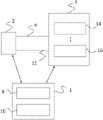
- FIG. 1 shows a schematic block diagram of a system for connecting a mobile device to a motor vehicle
- FIG. 2 shows a schematic flowchart of a method for connecting a mobile device to a motor vehicle.
- FIG. 1 shows a system 1 for connecting a mobile device 2 to a motor vehicle 4 .
- the system 1 may be part of the motor vehicle 4 or may be arranged separately therefrom. Further, the system 1 may also comprise one or more parts that may be arranged in different or the same positions (i.e., in the motor vehicle 4 or outside thereof).
- the mobile device 2 and the motor vehicle 4 are first coupled via a Bluetooth Low Energy connection 6 .
- the same is established between the mobile device 2 and the motor vehicle 4 by the motor vehicle 4 detecting that a mobile device 2 is within range. This is done, for example, via a signal strength of a signal transmitted by the mobile device 2 or the motor vehicle 4 .
- the signal strength of the signal sent between the device 2 and the motor vehicle 4 may be determined by a processing unit 8 of the system 1 . Based on the signal strength, the processing unit 8 may determine a position of the mobile device 2 , in particular whether the mobile device 2 is inside or outside the motor vehicle 4 . In addition to the signal strength (RSSI), the processing unit 8 may further use a signal-to-noise ratio or a transmission energy to determine the exact position of the mobile device 2 .
- RSSI signal strength
- One or more antennas 14 , 16 may be provided in the motor vehicle 4 for determining the signal strength of a signal of the mobile device 2 .
- the processing unit 8 may use signals received from the antennas 14 , 16 to perform, for example, triangulation of the signals to determine the exact position of the device 2 with respect to the motor vehicle 4 or even within the motor vehicle 4 .
- the position of the mobile device 2 may also define whether the mobile device 2 is a device of a driver or another passenger of the motor vehicle 4 .
- a connecting unit 10 of the system 1 may now first couple the mobile device 2 and the motor vehicle 4 via a Bluetooth Low Energy connection 6 .
- the connecting unit 10 may setup a Bluetooth connection 12 between the mobile device 2 and the motor vehicle 4 .
- both the position of the mobile device 2 and the Bluetooth Low Energy connection 6 are used.
- the position of the mobile device 2 on the one hand determines whether a connection is to be established at all. When the mobile device 2 is outside the motor vehicle 4 , neither a Bluetooth Low Energy connection 6 nor a Bluetooth connection 12 is established. If a more precise position of the mobile device 2 in the motor vehicle 4 is known, the same may be used to determine which profile is used to connect the mobile device 2 to the motor vehicle 4 .
- the profile may define which rights are assigned to the mobile device 2 in the motor vehicle 4 .
- the Bluetooth connection 12 it is possible for the Bluetooth connection 12 to be established without further manual input by a user, as the mobile device 2 and the motor vehicle 4 are already communicating and are known to each other via the Bluetooth Low Energy connection 6 . A further confirmation of the devices to one another by entering a code may therefore be omitted.
- FIG. 2 shows a schematic flow chart of a method for connecting a mobile device 2 to a motor vehicle 4 via a Bluetooth connection 12 .
- the mobile device 2 and the motor vehicle 4 are initially coupled via a Bluetooth Low Energy connection 6 .
- the signal strength of a signal transmitted between the mobile device 2 and the motor vehicle 4 is detected. This may be done as described in connection with FIG. 1 .
- a second step S 2 the position of the mobile device 2 with respect to the motor vehicle 4 is determined.
- the signal may be received by a plurality of antennas 14 , 16 in the motor vehicle 4 and the position of the mobile device 2 may be determined by different signal strengths at each of the antennas 14 , 16 .
- the mobile device 2 may first be coupled to the motor vehicle 4 via a Bluetooth Low Energy connection 6 .
- a fourth step S 4 the Bluetooth connection 12 between the mobile device 2 and the motor vehicle 4 may be established and the mobile device 2 and the motor vehicle 4 may be coupled using the Bluetooth Low Energy connection 6 .
- the mobile device 2 may then be connected to the motor vehicle 4 via the Bluetooth connection 12 using an associated profile. Where possible, the profile takes into account the position of the mobile device 2 within the motor vehicle 4 .
- the system and/or method described thus makes it possible to connect a mobile device to a motor vehicle in a simple manner, whereby in particular different profiles may be assigned to a device in an automated manner based on an already existing Bluetooth Low Energy connection for a Bluetooth connection to be established.
Landscapes
- Engineering & Computer Science (AREA)
- Computer Networks & Wireless Communication (AREA)
- Signal Processing (AREA)
- Radar, Positioning & Navigation (AREA)
- Remote Sensing (AREA)
- Physics & Mathematics (AREA)
- General Physics & Mathematics (AREA)
- Mobile Radio Communication Systems (AREA)
- Quality & Reliability (AREA)
- Electromagnetism (AREA)
- Telephone Function (AREA)
- Electric Propulsion And Braking For Vehicles (AREA)
Abstract
Description
- 1 System
- 2 Mobile device
- 4 Motor vehicle
- 6 Bluetooth Low Energy connection
- 8 Processing unit
- 10 Connecting unit
- 12 Bluetooth connection
- 16 Antennas
- S1-S5 Method steps
Claims (8)
Applications Claiming Priority (3)
| Application Number | Priority Date | Filing Date | Title |
|---|---|---|---|
| DE102018124734.6 | 2018-10-08 | ||
| DE102018124734.6A DE102018124734B4 (en) | 2018-10-08 | 2018-10-08 | System for connecting a mobile device to a motor vehicle |
| PCT/DE2019/100856 WO2020074041A1 (en) | 2018-10-08 | 2019-09-27 | System for connecting a mobile device to a motor vehicle |
Publications (2)
| Publication Number | Publication Date |
|---|---|
| US20210392481A1 US20210392481A1 (en) | 2021-12-16 |
| US11496873B2 true US11496873B2 (en) | 2022-11-08 |
Family
ID=68344573
Family Applications (1)
| Application Number | Title | Priority Date | Filing Date |
|---|---|---|---|
| US17/283,592 Active US11496873B2 (en) | 2018-10-08 | 2019-09-27 | System for connecting a mobile device to a motor vehicle |
Country Status (4)
| Country | Link |
|---|---|
| US (1) | US11496873B2 (en) |
| CN (1) | CN112806036B (en) |
| DE (1) | DE102018124734B4 (en) |
| WO (1) | WO2020074041A1 (en) |
Citations (9)
| Publication number | Priority date | Publication date | Assignee | Title |
|---|---|---|---|---|
| DE102012214458A1 (en) | 2011-08-25 | 2013-02-28 | Ford Global Technologies, Llc | METHOD AND DEVICE FOR A NAHFELD COMMUNICATION SYSTEM FOR THE EXCHANGE OF OCCUPATIONAL INFORMATION |
| US20140073244A1 (en) | 2012-09-10 | 2014-03-13 | Samsung Electronics Co., Ltd. | Method and device for executing application |
| DE102014107506A1 (en) | 2014-05-27 | 2015-12-03 | Lonexx GmbH | Method for exchanging user data between mobile terminals |
| US20160071082A1 (en) | 2014-09-05 | 2016-03-10 | Ebay Inc. | Automated splitting of costs incurred during a shared vehicle travel |
| US20170105101A1 (en) | 2015-10-08 | 2017-04-13 | Voxx International Corporation | System and method for micro-locating and communicating with a portable vehicle control device |
| DE102016121894A1 (en) | 2015-11-23 | 2017-05-24 | Ford Global Technologies, Llc | Simplified connection with and separation of vehicle computing systems |
| WO2018000134A1 (en) | 2016-06-27 | 2018-01-04 | 华为技术有限公司 | Bluetooth connection method and terminal |
| WO2018000156A1 (en) | 2016-06-27 | 2018-01-04 | 华为技术有限公司 | Method for establishing classic bluetooth connection between dual-mode bluetooth devices, and dual-mode bluetooth device |
| US10425767B1 (en) * | 2018-03-30 | 2019-09-24 | Shopkick, Inc. | Determining properties associated with signal sources |
Family Cites Families (13)
| Publication number | Priority date | Publication date | Assignee | Title |
|---|---|---|---|---|
| CN101808276A (en) * | 2010-03-19 | 2010-08-18 | 王从敏 | Vehicle communication terminal and vehicle communication system |
| DE102012023109B4 (en) * | 2012-11-27 | 2023-03-30 | Audi Ag | Method for data transmission between a mobile phone and a motor vehicle and motor vehicle |
| US9008917B2 (en) * | 2012-12-27 | 2015-04-14 | GM Global Technology Operations LLC | Method and system for detecting proximity of an end device to a vehicle based on signal strength information received over a bluetooth low energy (BLE) advertising channel |
| US10284709B2 (en) * | 2014-01-06 | 2019-05-07 | Ford Global Technologies, Llc | Apparatus and method for in-vehicle location of a mobile device |
| US9859998B2 (en) * | 2015-08-20 | 2018-01-02 | Samsung Electronics Co., Ltd. | Apparatus and method for identifying and localizing vehicle occupant and on-demand personalization |
| US10471964B2 (en) * | 2014-10-10 | 2019-11-12 | Wpj Holdings, Inc. | System and method for collecting vehicle use and driving behavior data using a mobile communication device and bluetooth low energy (BLE) device |
| DE102014017165A1 (en) * | 2014-11-20 | 2016-06-09 | Audi Ag | A motor vehicle and method for controlling communication between a motor vehicle and a mobile device |
| US9167418B1 (en) * | 2015-06-22 | 2015-10-20 | Invictus Technology Group, Inc. | Method and apparatus for controlling input to a mobile computing device located inside a vehicle |
| US9967717B2 (en) * | 2015-09-01 | 2018-05-08 | Ford Global Technologies, Llc | Efficient tracking of personal device locations |
| US10231123B2 (en) * | 2015-12-07 | 2019-03-12 | GM Global Technology Operations LLC | Bluetooth low energy (BLE) communication between a mobile device and a vehicle |
| US20170196032A1 (en) * | 2016-01-05 | 2017-07-06 | Livio, Inc. | Methods and systems for managing a mobile device in communication with a vehicle |
| US10328898B2 (en) * | 2016-10-12 | 2019-06-25 | Denso International America, Inc. | Passive entry / passive start systems and methods for vehicles |
| CN107948958A (en) * | 2017-11-16 | 2018-04-20 | 中科创达软件股份有限公司 | A kind of method, apparatus and central equipment that information is transmitted based on BLE |
-
2018
- 2018-10-08 DE DE102018124734.6A patent/DE102018124734B4/en active Active
-
2019
- 2019-09-27 WO PCT/DE2019/100856 patent/WO2020074041A1/en not_active Ceased
- 2019-09-27 US US17/283,592 patent/US11496873B2/en active Active
- 2019-09-27 CN CN201980065382.7A patent/CN112806036B/en active Active
Patent Citations (10)
| Publication number | Priority date | Publication date | Assignee | Title |
|---|---|---|---|---|
| DE102012214458A1 (en) | 2011-08-25 | 2013-02-28 | Ford Global Technologies, Llc | METHOD AND DEVICE FOR A NAHFELD COMMUNICATION SYSTEM FOR THE EXCHANGE OF OCCUPATIONAL INFORMATION |
| US20140073244A1 (en) | 2012-09-10 | 2014-03-13 | Samsung Electronics Co., Ltd. | Method and device for executing application |
| DE102014107506A1 (en) | 2014-05-27 | 2015-12-03 | Lonexx GmbH | Method for exchanging user data between mobile terminals |
| US20160071082A1 (en) | 2014-09-05 | 2016-03-10 | Ebay Inc. | Automated splitting of costs incurred during a shared vehicle travel |
| US20170105101A1 (en) | 2015-10-08 | 2017-04-13 | Voxx International Corporation | System and method for micro-locating and communicating with a portable vehicle control device |
| DE102016121894A1 (en) | 2015-11-23 | 2017-05-24 | Ford Global Technologies, Llc | Simplified connection with and separation of vehicle computing systems |
| US20170149946A1 (en) * | 2015-11-23 | 2017-05-25 | Ford Global Technologies, Llc | Simplified connection to and disconnection from vehicle computing systems |
| WO2018000134A1 (en) | 2016-06-27 | 2018-01-04 | 华为技术有限公司 | Bluetooth connection method and terminal |
| WO2018000156A1 (en) | 2016-06-27 | 2018-01-04 | 华为技术有限公司 | Method for establishing classic bluetooth connection between dual-mode bluetooth devices, and dual-mode bluetooth device |
| US10425767B1 (en) * | 2018-03-30 | 2019-09-24 | Shopkick, Inc. | Determining properties associated with signal sources |
Also Published As
| Publication number | Publication date |
|---|---|
| CN112806036A (en) | 2021-05-14 |
| DE102018124734B4 (en) | 2025-11-27 |
| WO2020074041A1 (en) | 2020-04-16 |
| DE102018124734A1 (en) | 2020-04-09 |
| US20210392481A1 (en) | 2021-12-16 |
| CN112806036B (en) | 2024-07-26 |
Similar Documents
| Publication | Publication Date | Title |
|---|---|---|
| US9467800B2 (en) | Method and apparatus for registering new Bluetooth device | |
| CN109089329B (en) | Method and device for WLAN connection of mobile terminal and vehicle-mounted terminal | |
| JP5714985B2 (en) | Near field communication device | |
| CN108966194B (en) | System and method for realizing Bluetooth non-inductive connection between mobile phone and vehicle-mounted terminal | |
| US10231273B2 (en) | Vehicle wireless device connection management with switchover of primary connected device | |
| US20080039018A1 (en) | Method and apparatus for automatic connection between mobile communication terminal and bluetooth handsfree device | |
| US20160150066A1 (en) | Method and Apparatus for Providing In-Vehicle Bluetooth Pairing | |
| CN106304259A (en) | Vehicle-mounted WIFI method for intelligent connection and device | |
| CN110784846B (en) | Vehicle-mounted Bluetooth equipment identification method and device, electronic equipment and storage medium | |
| CN102308581A (en) | Systems and methods for provisioning wireless networking connections | |
| CN105242959A (en) | Method and apparatus for controlling bluetooth load | |
| CN109152088B (en) | Wireless device connection management method | |
| CN101820481B (en) | Wireless communication terminal and wireless communication method | |
| JP2020202526A (en) | Communication system | |
| CN107645716B (en) | Method and apparatus for transforming host-shared vehicle remote connections | |
| CN108966173A (en) | The automobile wireless configuration being connect with external wireless access point | |
| US20120094602A1 (en) | Bluetooth headset for mobile phone | |
| WO2017134816A1 (en) | Vehicle-mounted device and in-vehicle communication method | |
| US20210392481A1 (en) | System for connecting a mobile device to a motor vehicle | |
| CN107454659B (en) | Terminal identification method, system, terminal equipment and base station | |
| JP2002281041A (en) | Transmission method and transmission device | |
| KR101655823B1 (en) | Method and apparatus for controlling usage of mobile device in vehicle | |
| KR20090059277A (en) | Automated setup system and method of driver's convenience device using portable communication device | |
| CN113196831B (en) | Communication device, communication control method, and non-transitory computer-readable medium | |
| DE102009054253A1 (en) | Communication method and communication device for a vehicle |
Legal Events
| Date | Code | Title | Description |
|---|---|---|---|
| FEPP | Fee payment procedure |
Free format text: ENTITY STATUS SET TO UNDISCOUNTED (ORIGINAL EVENT CODE: BIG.); ENTITY STATUS OF PATENT OWNER: LARGE ENTITY |
|
| AS | Assignment |
Owner name: BAYERISCHE MOTOREN WERKE AKTIENGESELLSCHAFT, GERMANY Free format text: ASSIGNMENT OF ASSIGNORS INTEREST;ASSIGNORS:BURGNER, PETER;BRONZI, WALTER;SEIFERT, ALEXANDRA;SIGNING DATES FROM 20200130 TO 20210307;REEL/FRAME:055871/0845 |
|
| STPP | Information on status: patent application and granting procedure in general |
Free format text: DOCKETED NEW CASE - READY FOR EXAMINATION |
|
| STPP | Information on status: patent application and granting procedure in general |
Free format text: NON FINAL ACTION MAILED |
|
| STPP | Information on status: patent application and granting procedure in general |
Free format text: RESPONSE TO NON-FINAL OFFICE ACTION ENTERED AND FORWARDED TO EXAMINER |
|
| STPP | Information on status: patent application and granting procedure in general |
Free format text: FINAL REJECTION MAILED |
|
| STPP | Information on status: patent application and granting procedure in general |
Free format text: RESPONSE AFTER FINAL ACTION FORWARDED TO EXAMINER |
|
| STPP | Information on status: patent application and granting procedure in general |
Free format text: NOTICE OF ALLOWANCE MAILED -- APPLICATION RECEIVED IN OFFICE OF PUBLICATIONS |
|
| STPP | Information on status: patent application and granting procedure in general |
Free format text: PUBLICATIONS -- ISSUE FEE PAYMENT VERIFIED |
|
| STCF | Information on status: patent grant |
Free format text: PATENTED CASE |
|
| MAFP | Maintenance fee payment |
Free format text: PAYMENT OF MAINTENANCE FEE, 4TH YEAR, LARGE ENTITY (ORIGINAL EVENT CODE: M1551); ENTITY STATUS OF PATENT OWNER: LARGE ENTITY Year of fee payment: 4 |