US11492353B2 - Methods and compounds for treating Paramyxoviridae virus infections - Google Patents
Methods and compounds for treating Paramyxoviridae virus infections Download PDFInfo
- Publication number
- US11492353B2 US11492353B2 US16/879,491 US202016879491A US11492353B2 US 11492353 B2 US11492353 B2 US 11492353B2 US 202016879491 A US202016879491 A US 202016879491A US 11492353 B2 US11492353 B2 US 11492353B2
- Authority
- US
- United States
- Prior art keywords
- alkyl
- methyl
- compound
- formula
- butyl
- Prior art date
- Legal status (The legal status is an assumption and is not a legal conclusion. Google has not performed a legal analysis and makes no representation as to the accuracy of the status listed.)
- Active, expires
Links
- 0 *c1nc([8*])c2c([10*])cc([C@]3([6*])O[C@]([5*])(CO[7*])[C@]([3*])([H])[C@@]3([1*])[2*])n2n1 Chemical compound *c1nc([8*])c2c([10*])cc([C@]3([6*])O[C@]([5*])(CO[7*])[C@]([3*])([H])[C@@]3([1*])[2*])n2n1 0.000 description 151
- NDIFZDCTUPBJME-UHFFFAOYSA-N CC(C)P(C)(C)=O Chemical compound CC(C)P(C)(C)=O NDIFZDCTUPBJME-UHFFFAOYSA-N 0.000 description 16
- XIHMEQVZTBXVKW-UHFFFAOYSA-N CC(C)P(C)(C)=[Y] Chemical compound CC(C)P(C)(C)=[Y] XIHMEQVZTBXVKW-UHFFFAOYSA-N 0.000 description 15
- HKFFOCAJIPEERM-UHFFFAOYSA-N C=C(C)CC(C)(C)CC(=C)CC Chemical compound C=C(C)CC(C)(C)CC(=C)CC HKFFOCAJIPEERM-UHFFFAOYSA-N 0.000 description 4
- WFPVWZVVBBZYAL-UHFFFAOYSA-N C=P(CC)(CC)CC Chemical compound C=P(CC)(CC)CC WFPVWZVVBBZYAL-UHFFFAOYSA-N 0.000 description 4
- KHYDKBKZURRDFN-UHFFFAOYSA-N C.[H]N(C)C(C)C(=O)OC Chemical compound C.[H]N(C)C(C)C(=O)OC KHYDKBKZURRDFN-UHFFFAOYSA-N 0.000 description 3
- VABBJJOSOCPYIT-UHFFFAOYSA-N COC(=O)C(C)OC Chemical compound COC(=O)C(C)OC VABBJJOSOCPYIT-UHFFFAOYSA-N 0.000 description 3
- AEYNZCKBSRDAAE-UHFFFAOYSA-N C.[H]N(C)C(C)(C)C(=O)OC Chemical compound C.[H]N(C)C(C)(C)C(=O)OC AEYNZCKBSRDAAE-UHFFFAOYSA-N 0.000 description 2
- WDEMIWMINWMROL-UHFFFAOYSA-N C.[H]N(C)CC(=O)OC Chemical compound C.[H]N(C)CC(=O)OC WDEMIWMINWMROL-UHFFFAOYSA-N 0.000 description 2
- UJBNVYLBVGMXPI-UHFFFAOYSA-N CCC(OC)C(=O)OC Chemical compound CCC(OC)C(=O)OC UJBNVYLBVGMXPI-UHFFFAOYSA-N 0.000 description 2
- HTNSZALANQBGCC-UHFFFAOYSA-N CCP(=O)(CC)C(C)C Chemical compound CCP(=O)(CC)C(C)C HTNSZALANQBGCC-UHFFFAOYSA-N 0.000 description 2
- QRMHDGWGLNLHMN-UHFFFAOYSA-N COCC(=O)OC Chemical compound COCC(=O)OC QRMHDGWGLNLHMN-UHFFFAOYSA-N 0.000 description 2
- SUDQEXYMNHNOEI-UHFFFAOYSA-N COCOC(=O)OC Chemical compound COCOC(=O)OC SUDQEXYMNHNOEI-UHFFFAOYSA-N 0.000 description 2
- MDEDOIDXVJXDBW-UHFFFAOYSA-N COCOC(C)=O Chemical compound COCOC(C)=O MDEDOIDXVJXDBW-UHFFFAOYSA-N 0.000 description 2
- RDOXTESZEPMUJZ-UHFFFAOYSA-N COc1ccccc1 Chemical compound COc1ccccc1 RDOXTESZEPMUJZ-UHFFFAOYSA-N 0.000 description 2
- AHAKTJFLOYGNHZ-PAIFPSOFSA-N *.CCOC(=O)[C@H](C)N.CCOC(=O)[C@H](C)NP(=O)(Cl)Oc1ccccc1.Cl.O=P(Cl)(Cl)Oc1ccccc1 Chemical compound *.CCOC(=O)[C@H](C)N.CCOC(=O)[C@H](C)NP(=O)(Cl)Oc1ccccc1.Cl.O=P(Cl)(Cl)Oc1ccccc1 AHAKTJFLOYGNHZ-PAIFPSOFSA-N 0.000 description 1
- RJYPHVOHOSWFBK-KUITUFPNSA-N B.CCC(CC)COC(=O)[C@H](C)N.CCC(CC)COC(=O)[C@H](C)NP(=O)(Cl)Oc1ccccc1.Cl.O=P(Cl)(Cl)Oc1ccccc1 Chemical compound B.CCC(CC)COC(=O)[C@H](C)N.CCC(CC)COC(=O)[C@H](C)NP(=O)(Cl)Oc1ccccc1.Cl.O=P(Cl)(Cl)Oc1ccccc1 RJYPHVOHOSWFBK-KUITUFPNSA-N 0.000 description 1
- DBFMLWCCDZWNNI-YUEOMCPTSA-N C#CC(O)(c1ccc2c(N)ncnn12)[C@H](OCc1ccccc1)[C@H](C)[C@H](O)CC.C#C[C@@]1(c2ccc3c(N)ncnn23)O[C@H](CC)[C@@H](C)[C@H]1OCc1ccccc1 Chemical compound C#CC(O)(c1ccc2c(N)ncnn12)[C@H](OCc1ccccc1)[C@H](C)[C@H](O)CC.C#C[C@@]1(c2ccc3c(N)ncnn23)O[C@H](CC)[C@@H](C)[C@H]1OCc1ccccc1 DBFMLWCCDZWNNI-YUEOMCPTSA-N 0.000 description 1
- MFPOIRNOOYJRAK-IGNRNBBQSA-N C#CC(O)(c1ccc2c(N)ncnn12)[C@H](OCc1ccccc1)[C@H](C)[C@H](O)CC.CC[C@H]1O[C@@](O)(c2ccc3c(N)ncnn23)[C@H](OCc2ccccc2)[C@@H]1C Chemical compound C#CC(O)(c1ccc2c(N)ncnn12)[C@H](OCc1ccccc1)[C@H](C)[C@H](O)CC.CC[C@H]1O[C@@](O)(c2ccc3c(N)ncnn23)[C@H](OCc2ccccc2)[C@@H]1C MFPOIRNOOYJRAK-IGNRNBBQSA-N 0.000 description 1
- WMDQWWWCUDUMHG-DBSOXPNRSA-N C#C[C@@]1(c2ccc3c(N)ccnn23)O[C@H](CO)[C@@H](O)[C@H]1O.C#C[C@@]1(c2ccc3c(N)ccnn23)O[C@H](COP(=O)(O)OP(=O)(O)OP(=O)(O)O)[C@@H](O)[C@H]1O.C#C[C@@]1(c2ccc3c(N)ccnn23)O[C@H](COP(=O)(OCCSC(=O)C(C)(C)C)OCCSC(=O)C(C)(C)C)[C@@H](O)[C@H]1O.CC(C)(C)C(=O)SCCOP(=O)(OCCSC(=O)C(C)(C)C)OC[C@H]1O[C@@](C#N)(c2ccc3c(N)ccnn23)[C@H](O)[C@@H]1O.CCOC(=O)[C@H](C)NP(=O)(N[C@@H](C)C(=O)OCC)OC[C@H]1O[C@@](C#N)(c2ccc3c(N)ccnn23)[C@H](O)[C@@H]1O.C[C@@]1(c2ccc3c(N)ccnn23)O[C@H](CO)[C@@H](O)[C@H]1O.C[C@@]1(c2ccc3c(N)ccnn23)O[C@H](COP(=O)(O)OP(=O)(O)OP(=O)(O)O)[C@@H](O)[C@H]1O.N#C[C@@]1(c2ccc3c(N)ccnn23)O[C@H](COP(=O)(O)OP(=O)(O)OP(=O)(O)O)[C@@H](O)[C@H]1O.N#C[C@@]1(c2ccc3c(N)ncnn23)O[C@H](COP(=O)(O)OP(=O)(O)OP(=O)(O)O)[C@@H](O)[C@H]1F Chemical compound C#C[C@@]1(c2ccc3c(N)ccnn23)O[C@H](CO)[C@@H](O)[C@H]1O.C#C[C@@]1(c2ccc3c(N)ccnn23)O[C@H](COP(=O)(O)OP(=O)(O)OP(=O)(O)O)[C@@H](O)[C@H]1O.C#C[C@@]1(c2ccc3c(N)ccnn23)O[C@H](COP(=O)(OCCSC(=O)C(C)(C)C)OCCSC(=O)C(C)(C)C)[C@@H](O)[C@H]1O.CC(C)(C)C(=O)SCCOP(=O)(OCCSC(=O)C(C)(C)C)OC[C@H]1O[C@@](C#N)(c2ccc3c(N)ccnn23)[C@H](O)[C@@H]1O.CCOC(=O)[C@H](C)NP(=O)(N[C@@H](C)C(=O)OCC)OC[C@H]1O[C@@](C#N)(c2ccc3c(N)ccnn23)[C@H](O)[C@@H]1O.C[C@@]1(c2ccc3c(N)ccnn23)O[C@H](CO)[C@@H](O)[C@H]1O.C[C@@]1(c2ccc3c(N)ccnn23)O[C@H](COP(=O)(O)OP(=O)(O)OP(=O)(O)O)[C@@H](O)[C@H]1O.N#C[C@@]1(c2ccc3c(N)ccnn23)O[C@H](COP(=O)(O)OP(=O)(O)OP(=O)(O)O)[C@@H](O)[C@H]1O.N#C[C@@]1(c2ccc3c(N)ncnn23)O[C@H](COP(=O)(O)OP(=O)(O)OP(=O)(O)O)[C@@H](O)[C@H]1F WMDQWWWCUDUMHG-DBSOXPNRSA-N 0.000 description 1
- FSBMSSKIZXSHQT-FCPPRMSRSA-N C#C[C@@]1(c2ccc3c(N)ccnn23)O[C@H](COP(=O)(OCCSC(=O)C(C)(C)C)OCCSC(=O)C(C)(C)C)[C@@H](O)[C@H]1O.C#C[C@@]1(c2ccc3c(N)ncnn23)O[C@H](COP(=O)(O)OP(=O)(O)OP(=O)(O)O)[C@@H](O)[C@H]1O.C[C@@]1(c2ccc3c(N)ccnn23)O[C@H](COP(=O)(O)OP(=O)(O)OP(=O)(O)O)[C@@H](O)[C@H]1O.N#C[C@@]1(c2ccc3c(N)ccnn23)O[C@H](COP(=O)(O)OP(=O)(O)OP(=O)(O)O)[C@@H](O)[C@H]1O Chemical compound C#C[C@@]1(c2ccc3c(N)ccnn23)O[C@H](COP(=O)(OCCSC(=O)C(C)(C)C)OCCSC(=O)C(C)(C)C)[C@@H](O)[C@H]1O.C#C[C@@]1(c2ccc3c(N)ncnn23)O[C@H](COP(=O)(O)OP(=O)(O)OP(=O)(O)O)[C@@H](O)[C@H]1O.C[C@@]1(c2ccc3c(N)ccnn23)O[C@H](COP(=O)(O)OP(=O)(O)OP(=O)(O)O)[C@@H](O)[C@H]1O.N#C[C@@]1(c2ccc3c(N)ccnn23)O[C@H](COP(=O)(O)OP(=O)(O)OP(=O)(O)O)[C@@H](O)[C@H]1O FSBMSSKIZXSHQT-FCPPRMSRSA-N 0.000 description 1
- JDTBFXJNFNXAJC-KMFYTCFWSA-N C#C[C@@]1(c2ccc3c(N)ncnn23)O[C@H](CC)[C@@H](C)[C@H]1OCc1ccccc1.C#C[C@@]1(c2ccc3c(N)ncnn23)O[C@H](CO)[C@@H](O)[C@H]1O Chemical compound C#C[C@@]1(c2ccc3c(N)ncnn23)O[C@H](CC)[C@@H](C)[C@H]1OCc1ccccc1.C#C[C@@]1(c2ccc3c(N)ncnn23)O[C@H](CO)[C@@H](O)[C@H]1O JDTBFXJNFNXAJC-KMFYTCFWSA-N 0.000 description 1
- FQQQKNGJHFTHLO-IEAFMSIGSA-N C#C[C@@]1(c2ccc3c(N)ncnn23)O[C@H](CO)[C@@H](O)[C@H]1O.C#C[C@@]1(c2ccc3c(N)ncnn23)O[C@H](COP(=O)(O)OP(=O)(O)OP(=O)(O)O)[C@@H](O)[C@H]1O Chemical compound C#C[C@@]1(c2ccc3c(N)ncnn23)O[C@H](CO)[C@@H](O)[C@H]1O.C#C[C@@]1(c2ccc3c(N)ncnn23)O[C@H](COP(=O)(O)OP(=O)(O)OP(=O)(O)O)[C@@H](O)[C@H]1O FQQQKNGJHFTHLO-IEAFMSIGSA-N 0.000 description 1
- XADVEEQNBOVWDO-BZNVDPIBSA-N C#C[C@@]1(c2ccc3c(N)ncnn23)O[C@H](CO)[C@@H](O)[C@H]1O.C#C[C@@]1(c2ccc3c(N)ncnn23)O[C@H](COP(=O)(OCCSC(=O)C(C)(C)C)OCCSC(=O)C(C)(C)C)[C@@H](O)[C@H]1O Chemical compound C#C[C@@]1(c2ccc3c(N)ncnn23)O[C@H](CO)[C@@H](O)[C@H]1O.C#C[C@@]1(c2ccc3c(N)ncnn23)O[C@H](COP(=O)(OCCSC(=O)C(C)(C)C)OCCSC(=O)C(C)(C)C)[C@@H](O)[C@H]1O XADVEEQNBOVWDO-BZNVDPIBSA-N 0.000 description 1
- BMTHNXKOZAPXIP-UHFFFAOYSA-N C.C=P(CC)(CC)CC Chemical compound C.C=P(CC)(CC)CC BMTHNXKOZAPXIP-UHFFFAOYSA-N 0.000 description 1
- RBVKKQRWWWHXKY-RCMWEQEASA-N C.CC(C)OC(=O)[C@H](C)N.CC(C)OC(=O)[C@H](C)NP(=O)(Cl)Oc1ccccc1.Cl.O=P(Cl)(Cl)Oc1ccccc1 Chemical compound C.CC(C)OC(=O)[C@H](C)N.CC(C)OC(=O)[C@H](C)NP(=O)(Cl)Oc1ccccc1.Cl.O=P(Cl)(Cl)Oc1ccccc1 RBVKKQRWWWHXKY-RCMWEQEASA-N 0.000 description 1
- KWLVMIKSXPHDMJ-KSSKNTBUSA-N C.CC1(C)O[C@@H]2C[C@@H](COCc3ccccc3)O[C@@H]2O1.CC[C@@H]1C[C@@H](O)C(O)O1 Chemical compound C.CC1(C)O[C@@H]2C[C@@H](COCc3ccccc3)O[C@@H]2O1.CC[C@@H]1C[C@@H](O)C(O)O1 KWLVMIKSXPHDMJ-KSSKNTBUSA-N 0.000 description 1
- PJCRAHPEHHJLBZ-UYKJJZQTSA-N C.CC[C@@H]1C[C@@H](O)C(=O)O1.CC[C@@H]1C[C@@H](O)C(O)O1 Chemical compound C.CC[C@@H]1C[C@@H](O)C(=O)O1.CC[C@@H]1C[C@@H](O)C(O)O1 PJCRAHPEHHJLBZ-UYKJJZQTSA-N 0.000 description 1
- PRFZTPSXYZBIPU-DKRXTYGHSA-N C.CC[C@H]1OC(=O)[C@H](F)[C@@H]1C.CC[C@H]1OC(O)[C@H](F)[C@@H]1C Chemical compound C.CC[C@H]1OC(=O)[C@H](F)[C@@H]1C.CC[C@H]1OC(O)[C@H](F)[C@@H]1C PRFZTPSXYZBIPU-DKRXTYGHSA-N 0.000 description 1
- RQLSEXDMRHQUGL-SXYVNDJMSA-N C.CC[C@H]1OC(O)[C@H](F)[C@@H]1C.CC[C@H]1OC(OC)[C@H](F)[C@@H]1C Chemical compound C.CC[C@H]1OC(O)[C@H](F)[C@@H]1C.CC[C@H]1OC(OC)[C@H](F)[C@@H]1C RQLSEXDMRHQUGL-SXYVNDJMSA-N 0.000 description 1
- VWLCJLNCVAYWRW-UHFFFAOYSA-N C.[H]N(C)C(C)(C)C(=O)OC(C)C Chemical compound C.[H]N(C)C(C)(C)C(=O)OC(C)C VWLCJLNCVAYWRW-UHFFFAOYSA-N 0.000 description 1
- HCCJYVNSLMWSEE-UHFFFAOYSA-N C.[H]N(C)C(C)(C)C(=O)OCC Chemical compound C.[H]N(C)C(C)(C)C(=O)OCC HCCJYVNSLMWSEE-UHFFFAOYSA-N 0.000 description 1
- SGPHSLFWNCZOOB-UHFFFAOYSA-N C.[H]N(C)C(C)(C)C(=O)OCC(C)C Chemical compound C.[H]N(C)C(C)(C)C(=O)OCC(C)C SGPHSLFWNCZOOB-UHFFFAOYSA-N 0.000 description 1
- WDPDUCVQYUVQFI-UHFFFAOYSA-N C.[H]N(C)C(C)(C)C(=O)OCCC Chemical compound C.[H]N(C)C(C)(C)C(=O)OCCC WDPDUCVQYUVQFI-UHFFFAOYSA-N 0.000 description 1
- LMJWEKSDPNYTHN-UHFFFAOYSA-N C.[H]N(C)C(C)(C)C(=O)OCCCC Chemical compound C.[H]N(C)C(C)(C)C(=O)OCCCC LMJWEKSDPNYTHN-UHFFFAOYSA-N 0.000 description 1
- AXHPPNJOKWKOCT-UHFFFAOYSA-N C.[H]N(C)C(C)C(=O)OC(C)C Chemical compound C.[H]N(C)C(C)C(=O)OC(C)C AXHPPNJOKWKOCT-UHFFFAOYSA-N 0.000 description 1
- IIJXOEXHFYUNTQ-UHFFFAOYSA-N C.[H]N(C)C(C)C(=O)OCC Chemical compound C.[H]N(C)C(C)C(=O)OCC IIJXOEXHFYUNTQ-UHFFFAOYSA-N 0.000 description 1
- IKCTYXDKLJWDPQ-UHFFFAOYSA-N C.[H]N(C)C(C)C(=O)OCC(C)C Chemical compound C.[H]N(C)C(C)C(=O)OCC(C)C IKCTYXDKLJWDPQ-UHFFFAOYSA-N 0.000 description 1
- DQVWNYFZXQFOFC-UHFFFAOYSA-N C.[H]N(C)C(C)C(=O)OCCC Chemical compound C.[H]N(C)C(C)C(=O)OCCC DQVWNYFZXQFOFC-UHFFFAOYSA-N 0.000 description 1
- WLVJLJNZXDYBTE-UHFFFAOYSA-N C.[H]N(C)C(C)C(=O)OCCCC Chemical compound C.[H]N(C)C(C)C(=O)OCCCC WLVJLJNZXDYBTE-UHFFFAOYSA-N 0.000 description 1
- SZEDCYQXSSLVRU-UHFFFAOYSA-N C.[H]N(C)CC(=O)OC(C)C Chemical compound C.[H]N(C)CC(=O)OC(C)C SZEDCYQXSSLVRU-UHFFFAOYSA-N 0.000 description 1
- ILNCADAMCIZXKI-UHFFFAOYSA-N C.[H]N(C)CC(=O)OCC Chemical compound C.[H]N(C)CC(=O)OCC ILNCADAMCIZXKI-UHFFFAOYSA-N 0.000 description 1
- ZOBQOUYBVXSPIS-UHFFFAOYSA-N C.[H]N(C)CC(=O)OCC(C)C Chemical compound C.[H]N(C)CC(=O)OCC(C)C ZOBQOUYBVXSPIS-UHFFFAOYSA-N 0.000 description 1
- LQPFBTOTACJURR-UHFFFAOYSA-N C.[H]N(C)CC(=O)OCCC Chemical compound C.[H]N(C)CC(=O)OCCC LQPFBTOTACJURR-UHFFFAOYSA-N 0.000 description 1
- BVTITTHKWFOWJW-UHFFFAOYSA-N C.[H]N(C)CC(=O)OCCCC Chemical compound C.[H]N(C)CC(=O)OCCCC BVTITTHKWFOWJW-UHFFFAOYSA-N 0.000 description 1
- OYFUUOZYRGVGSD-UHFFFAOYSA-N C.[H]OC(=O)C(C)(C)N([H])C Chemical compound C.[H]OC(=O)C(C)(C)N([H])C OYFUUOZYRGVGSD-UHFFFAOYSA-N 0.000 description 1
- FKGOCYKKERGUEL-UHFFFAOYSA-N C.[H]OC(=O)CN([H])C Chemical compound C.[H]OC(=O)CN([H])C FKGOCYKKERGUEL-UHFFFAOYSA-N 0.000 description 1
- YDLJLEJXDSZXLI-LGUFXAMNSA-N C1CCOC1.CC1(C)O[C@@H]2C[C@@H](CO)O[C@@H]2O1.CC1(C)O[C@@H]2C[C@@H](COCc3ccccc3)O[C@@H]2O1 Chemical compound C1CCOC1.CC1(C)O[C@@H]2C[C@@H](CO)O[C@@H]2O1.CC1(C)O[C@@H]2C[C@@H](COCc3ccccc3)O[C@@H]2O1 YDLJLEJXDSZXLI-LGUFXAMNSA-N 0.000 description 1
- IHKOXYNAMXNNDK-OLQVQODUSA-N C1C[C@H]2CCO[C@H]2O1 Chemical compound C1C[C@H]2CCO[C@H]2O1 IHKOXYNAMXNNDK-OLQVQODUSA-N 0.000 description 1
- VPKGPFGQCCXALY-UHFFFAOYSA-N C=C(CC)CC(C)(C)CC(=C)C(C)C Chemical compound C=C(CC)CC(C)(C)CC(=C)C(C)C VPKGPFGQCCXALY-UHFFFAOYSA-N 0.000 description 1
- OTMSDBZUPAUEDD-UHFFFAOYSA-N CC Chemical compound CC OTMSDBZUPAUEDD-UHFFFAOYSA-N 0.000 description 1
- NSEGRNXBADWICN-UHFFFAOYSA-N CC(=O)C(C)NP(=O)(Oc1ccccc1)C(C)C Chemical compound CC(=O)C(C)NP(=O)(Oc1ccccc1)C(C)C NSEGRNXBADWICN-UHFFFAOYSA-N 0.000 description 1
- LTRDMNLBJOMDOG-UXHQLWPTSA-N CC(=O)OC(C)=O.CC[C@H]1OC(=O)[C@H](OCc2ccccc2)[C@@H]1C.CC[C@H]1OC(O)[C@H](OCc2ccccc2)[C@@H]1C Chemical compound CC(=O)OC(C)=O.CC[C@H]1OC(=O)[C@H](OCc2ccccc2)[C@@H]1C.CC[C@H]1OC(O)[C@H](OCc2ccccc2)[C@@H]1C LTRDMNLBJOMDOG-UXHQLWPTSA-N 0.000 description 1
- KJOONRXXALHYPY-ZOIXPRJZSA-N CC(=O)OC[C@@H]1C[C@H]2OC(C)(C)O[C@H]2O1.CC1(C)O[C@@H]2C[C@@H](CO)O[C@@H]2O1 Chemical compound CC(=O)OC[C@@H]1C[C@H]2OC(C)(C)O[C@H]2O1.CC1(C)O[C@@H]2C[C@@H](CO)O[C@@H]2O1 KJOONRXXALHYPY-ZOIXPRJZSA-N 0.000 description 1
- XCYQOUXVBBAOBR-UBOBGKJCSA-N CC(C)(C)C(=O)SCCOP(=O)(OCCSC(=O)C(C)(C)C)OC[C@H]1O[C@@](C#N)(c2ccc3c(N)ccnn23)[C@H](O)[C@@H]1O.CC(C)OC(=O)[C@H](C)NP(=O)(OC[C@H]1O[C@@](C#N)(c2ccc3c(N)ccnn23)[C@H](O)[C@@H]1O)Oc1ccccc1.CCC(CC)COC(=O)[C@H](C)NP(=O)(OC[C@H]1O[C@@](C#N)(c2ccc3c(N)ccnn23)[C@H](O)[C@@H]1O)Oc1ccccc1.CCOC(=O)[C@H](C)NP(=O)(N[C@@H](C)C(=O)OCC)OC[C@H]1O[C@@](C#N)(c2ccc3c(N)ccnn23)[C@H](O)[C@@H]1O.CCOC(=O)[C@H](C)NP(=O)(OC[C@H]1O[C@@](C#N)(c2ccc3c(N)ccnn23)[C@H](O)[C@@H]1O)Oc1ccccc1.N#C[C@@]1(c2ccc3c(N)ccnn23)O[C@H](CO)C[C@H]1O Chemical compound CC(C)(C)C(=O)SCCOP(=O)(OCCSC(=O)C(C)(C)C)OC[C@H]1O[C@@](C#N)(c2ccc3c(N)ccnn23)[C@H](O)[C@@H]1O.CC(C)OC(=O)[C@H](C)NP(=O)(OC[C@H]1O[C@@](C#N)(c2ccc3c(N)ccnn23)[C@H](O)[C@@H]1O)Oc1ccccc1.CCC(CC)COC(=O)[C@H](C)NP(=O)(OC[C@H]1O[C@@](C#N)(c2ccc3c(N)ccnn23)[C@H](O)[C@@H]1O)Oc1ccccc1.CCOC(=O)[C@H](C)NP(=O)(N[C@@H](C)C(=O)OCC)OC[C@H]1O[C@@](C#N)(c2ccc3c(N)ccnn23)[C@H](O)[C@@H]1O.CCOC(=O)[C@H](C)NP(=O)(OC[C@H]1O[C@@](C#N)(c2ccc3c(N)ccnn23)[C@H](O)[C@@H]1O)Oc1ccccc1.N#C[C@@]1(c2ccc3c(N)ccnn23)O[C@H](CO)C[C@H]1O XCYQOUXVBBAOBR-UBOBGKJCSA-N 0.000 description 1
- HHGBKHQYNQVVHZ-COOQKABSSA-N CC(C)(C)C(=O)SCCOP(=O)(OCCSC(=O)C(C)(C)C)OC[C@H]1O[C@@](C#N)(c2ccc3c(N)ncnn23)[C@H](O)[C@@H]1O.N#C[C@@]1(c2ccc3c(N)ncnn23)O[C@H](CO)[C@@H](O)[C@H]1O Chemical compound CC(C)(C)C(=O)SCCOP(=O)(OCCSC(=O)C(C)(C)C)OC[C@H]1O[C@@](C#N)(c2ccc3c(N)ncnn23)[C@H](O)[C@@H]1O.N#C[C@@]1(c2ccc3c(N)ncnn23)O[C@H](CO)[C@@H](O)[C@H]1O HHGBKHQYNQVVHZ-COOQKABSSA-N 0.000 description 1
- YSGULFMLWSBIOL-UHFFFAOYSA-N CC(C)N1CCCNC1=O Chemical compound CC(C)N1CCCNC1=O YSGULFMLWSBIOL-UHFFFAOYSA-N 0.000 description 1
- BSFQZBCXXFYUEM-VIFPVBQESA-N CC(C)N[C@@H](C)COC(=O)C(C)(C)C Chemical compound CC(C)N[C@@H](C)COC(=O)C(C)(C)C BSFQZBCXXFYUEM-VIFPVBQESA-N 0.000 description 1
- KXCKKWQDSIYZIP-LWRMMRIRSA-N CC(C)OC(=O)[C@@H](C)NP(=O)(OC[C@H]1O[C@@](C)(c2ccc3c(N)ccnn23)[C@H](F)[C@@H]1O)Oc1ccccc1.CC(C)OC(=O)[C@H](C)NP(=O)(OC[C@H]1O[C@@](C#N)(c2ccc3c(N)ccnn23)[C@H](O)[C@@H]1O)Oc1ccccc1.CCC(CC)COC(=O)[C@H](C)NP(=O)(OC[C@H]1O[C@@](C#N)(c2ccc3c(N)ccnn23)[C@H](O)[C@@H]1O)Oc1ccccc1.CCOC(=O)[C@@H](C)NP(=O)(OC[C@H]1O[C@@](C)(c2ccc3c(N)ccnn23)[C@H](F)[C@@H]1O)Oc1ccccc1.CCOC(=O)[C@H](C)NP(=O)(OC[C@H]1O[C@@](C#N)(c2ccc3c(N)ccnn23)[C@H](F)[C@@H]1O)Oc1ccccc1.CCOC(=O)[C@H](C)NP(=O)(OC[C@H]1O[C@@](C#N)(c2ccc3c(N)ccnn23)[C@H](O)[C@@H]1O)Oc1ccccc1.C[C@@]1(c2ccc3c(N)ccnn23)O[C@H](CO)[C@@H](O)[C@H]1F.C[C@@]1(c2ccc3c(N)ccnn23)O[C@H](COP(=O)(O)OP(=O)(O)OP(=O)(O)O)[C@@H](O)[C@H]1F.N#C[C@@]1(c2ccc3c(N)ccnn23)O[C@H](CO)C[C@H]1O.N#C[C@@]1(c2ccc3c(N)ccnn23)O[C@H](CO)[C@@H](O)[C@H]1F.N#C[C@@]1(c2ccc3c(N)ccnn23)O[C@H](CO)[C@@H](O)[C@H]1O Chemical compound CC(C)OC(=O)[C@@H](C)NP(=O)(OC[C@H]1O[C@@](C)(c2ccc3c(N)ccnn23)[C@H](F)[C@@H]1O)Oc1ccccc1.CC(C)OC(=O)[C@H](C)NP(=O)(OC[C@H]1O[C@@](C#N)(c2ccc3c(N)ccnn23)[C@H](O)[C@@H]1O)Oc1ccccc1.CCC(CC)COC(=O)[C@H](C)NP(=O)(OC[C@H]1O[C@@](C#N)(c2ccc3c(N)ccnn23)[C@H](O)[C@@H]1O)Oc1ccccc1.CCOC(=O)[C@@H](C)NP(=O)(OC[C@H]1O[C@@](C)(c2ccc3c(N)ccnn23)[C@H](F)[C@@H]1O)Oc1ccccc1.CCOC(=O)[C@H](C)NP(=O)(OC[C@H]1O[C@@](C#N)(c2ccc3c(N)ccnn23)[C@H](F)[C@@H]1O)Oc1ccccc1.CCOC(=O)[C@H](C)NP(=O)(OC[C@H]1O[C@@](C#N)(c2ccc3c(N)ccnn23)[C@H](O)[C@@H]1O)Oc1ccccc1.C[C@@]1(c2ccc3c(N)ccnn23)O[C@H](CO)[C@@H](O)[C@H]1F.C[C@@]1(c2ccc3c(N)ccnn23)O[C@H](COP(=O)(O)OP(=O)(O)OP(=O)(O)O)[C@@H](O)[C@H]1F.N#C[C@@]1(c2ccc3c(N)ccnn23)O[C@H](CO)C[C@H]1O.N#C[C@@]1(c2ccc3c(N)ccnn23)O[C@H](CO)[C@@H](O)[C@H]1F.N#C[C@@]1(c2ccc3c(N)ccnn23)O[C@H](CO)[C@@H](O)[C@H]1O KXCKKWQDSIYZIP-LWRMMRIRSA-N 0.000 description 1
- AFAWYGQGNPGAGQ-XGYSPZRHSA-N CC(C)OC(=O)[C@@H](C)NP(=O)(OC[C@H]1O[C@@](C)(c2ccc3c(N)ccnn23)[C@H](F)[C@@H]1O)Oc1ccccc1.CCOC(=O)[C@@H](C)NP(=O)(OC[C@H]1O[C@@](C)(c2ccc3c(N)ccnn23)[C@H](F)[C@@H]1O)Oc1ccccc1.C[C@@]1(c2ccc3c(N)ccnn23)O[C@H](CO)[C@@H](O)[C@H]1F.C[C@@]1(c2ccc3c(N)ccnn23)O[C@H](COP(=O)(O)OP(=O)(O)OP(=O)(O)O)[C@@H](O)[C@H]1F.N#C[C@@]1(c2ccc3c(N)ccnn23)C[C@H](CO)[C@@H](O)[C@H]1F.N#C[C@@]1(c2ccc3c(N)ncnn23)O[C@H](COP(=O)(O)OP(=O)(O)OP(=O)(O)O)[C@@H](O)[C@H]1F Chemical compound CC(C)OC(=O)[C@@H](C)NP(=O)(OC[C@H]1O[C@@](C)(c2ccc3c(N)ccnn23)[C@H](F)[C@@H]1O)Oc1ccccc1.CCOC(=O)[C@@H](C)NP(=O)(OC[C@H]1O[C@@](C)(c2ccc3c(N)ccnn23)[C@H](F)[C@@H]1O)Oc1ccccc1.C[C@@]1(c2ccc3c(N)ccnn23)O[C@H](CO)[C@@H](O)[C@H]1F.C[C@@]1(c2ccc3c(N)ccnn23)O[C@H](COP(=O)(O)OP(=O)(O)OP(=O)(O)O)[C@@H](O)[C@H]1F.N#C[C@@]1(c2ccc3c(N)ccnn23)C[C@H](CO)[C@@H](O)[C@H]1F.N#C[C@@]1(c2ccc3c(N)ncnn23)O[C@H](COP(=O)(O)OP(=O)(O)OP(=O)(O)O)[C@@H](O)[C@H]1F AFAWYGQGNPGAGQ-XGYSPZRHSA-N 0.000 description 1
- HKKURWIMBNIZSO-FGKPYEQWSA-N CC(C)OC(=O)[C@@H](C)NP(=O)(OC[C@H]1O[C@@](C)(c2ccc3c(N)ncnn23)[C@H](F)[C@@H]1O)Oc1ccccc1.C[C@@]1(c2ccc3c(N)ncnn23)O[C@H](CO)[C@@H](O)[C@H]1F Chemical compound CC(C)OC(=O)[C@@H](C)NP(=O)(OC[C@H]1O[C@@](C)(c2ccc3c(N)ncnn23)[C@H](F)[C@@H]1O)Oc1ccccc1.C[C@@]1(c2ccc3c(N)ncnn23)O[C@H](CO)[C@@H](O)[C@H]1F HKKURWIMBNIZSO-FGKPYEQWSA-N 0.000 description 1
- KSZBVGCJMQXIGM-FNDLBOOQSA-N CC(C)OC(=O)[C@H](C)NP(=O)(Cl)Oc1ccccc1.CC(C)OC(=O)[C@H](C)NP(=O)(OC[C@H]1O[C@@](C#N)(c2ccc3c(N)ncnn23)[C@H](O)[C@@H]1O)Oc1ccccc1.COP(=O)(OC)OC.Cn1ccnc1.N#C[C@@]1(c2ccc3c(N)ncnn23)O[C@H](CO)[C@@H](O)[C@H]1O Chemical compound CC(C)OC(=O)[C@H](C)NP(=O)(Cl)Oc1ccccc1.CC(C)OC(=O)[C@H](C)NP(=O)(OC[C@H]1O[C@@](C#N)(c2ccc3c(N)ncnn23)[C@H](O)[C@@H]1O)Oc1ccccc1.COP(=O)(OC)OC.Cn1ccnc1.N#C[C@@]1(c2ccc3c(N)ncnn23)O[C@H](CO)[C@@H](O)[C@H]1O KSZBVGCJMQXIGM-FNDLBOOQSA-N 0.000 description 1
- ASJGMRJECDSYCV-UHFFFAOYSA-N CC(C)P1(=O)CC(C)(C)C(C)(C)C(C)(C)C1 Chemical compound CC(C)P1(=O)CC(C)(C)C(C)(C)C(C)(C)C1 ASJGMRJECDSYCV-UHFFFAOYSA-N 0.000 description 1
- NKTPMQXJJSIIPB-UHFFFAOYSA-N CC.CC(=O)C(C)NP(=O)(Oc1ccccc1)C(C)C Chemical compound CC.CC(=O)C(C)NP(=O)(Oc1ccccc1)C(C)C NKTPMQXJJSIIPB-UHFFFAOYSA-N 0.000 description 1
- BHFJMSALJTVTJM-UHFFFAOYSA-N CC1=CCNCC1.CC1CCNCC1.CN1CCNCC1.CN1CCOCC1.CN1CCS(=O)(=O)CC1.CN1CCSCC1.Cc1cc(C)nc(C)c1.Cc1cc(Cl)cc(Cl)c1.Cc1ccc(CN)cc1.Cc1cccc(C)c1C.Cc1cccc(CN(CCO)CCO)c1.Cc1cccc(CN2CCOCC2)c1 Chemical compound CC1=CCNCC1.CC1CCNCC1.CN1CCNCC1.CN1CCOCC1.CN1CCS(=O)(=O)CC1.CN1CCSCC1.Cc1cc(C)nc(C)c1.Cc1cc(Cl)cc(Cl)c1.Cc1ccc(CN)cc1.Cc1cccc(C)c1C.Cc1cccc(CN(CCO)CCO)c1.Cc1cccc(CN2CCOCC2)c1 BHFJMSALJTVTJM-UHFFFAOYSA-N 0.000 description 1
- VMHNUUFCUQRXHQ-UHFFFAOYSA-N CC1CCOP(=O)(C(C)C)O1 Chemical compound CC1CCOP(=O)(C(C)C)O1 VMHNUUFCUQRXHQ-UHFFFAOYSA-N 0.000 description 1
- DKJCSMHIPYRALV-UHFFFAOYSA-N CCC(=O)OCOC Chemical compound CCC(=O)OCOC DKJCSMHIPYRALV-UHFFFAOYSA-N 0.000 description 1
- XPQZBPGQKUMECK-HUPBQKMKSA-N CCC(CC)COC(=O)[C@H](C)NP(=O)(Cl)Oc1ccccc1.CCC(CC)COC(=O)[C@H](C)NP(=O)(OC[C@H]1O[C@@](C#N)(c2ccc3c(N)ncnn23)[C@H](O)[C@@H]1O)Oc1ccccc1.COP(=O)(OC)OC.Cn1ccnc1.N#C[C@@]1(c2ccc3c(N)ncnn23)O[C@H](CO)[C@@H](O)[C@H]1O Chemical compound CCC(CC)COC(=O)[C@H](C)NP(=O)(Cl)Oc1ccccc1.CCC(CC)COC(=O)[C@H](C)NP(=O)(OC[C@H]1O[C@@](C#N)(c2ccc3c(N)ncnn23)[C@H](O)[C@@H]1O)Oc1ccccc1.COP(=O)(OC)OC.Cn1ccnc1.N#C[C@@]1(c2ccc3c(N)ncnn23)O[C@H](CO)[C@@H](O)[C@H]1O XPQZBPGQKUMECK-HUPBQKMKSA-N 0.000 description 1
- YJCOBCIYLYVAGA-UHFFFAOYSA-N CCC(OC)C(=O)OC(C)C Chemical compound CCC(OC)C(=O)OC(C)C YJCOBCIYLYVAGA-UHFFFAOYSA-N 0.000 description 1
- BVGRSGSFEIMTRH-UHFFFAOYSA-N CCC(OC)C(=O)OCC(C)C Chemical compound CCC(OC)C(=O)OCC(C)C BVGRSGSFEIMTRH-UHFFFAOYSA-N 0.000 description 1
- YMSNKITZUMSCDX-UHFFFAOYSA-N CCCC(=O)OCOC Chemical compound CCCC(=O)OCOC YMSNKITZUMSCDX-UHFFFAOYSA-N 0.000 description 1
- WTJSITYIPKQJGD-UHFFFAOYSA-N CCCCC(=O)OCOC Chemical compound CCCCC(=O)OCOC WTJSITYIPKQJGD-UHFFFAOYSA-N 0.000 description 1
- JDJWQETUMXXWPD-UHFFFAOYSA-N CCCCOC(=O)C(C)OC Chemical compound CCCCOC(=O)C(C)OC JDJWQETUMXXWPD-UHFFFAOYSA-N 0.000 description 1
- AKPGKEPGAYWANB-UHFFFAOYSA-N CCCCOC(=O)C(CC)OC Chemical compound CCCCOC(=O)C(CC)OC AKPGKEPGAYWANB-UHFFFAOYSA-N 0.000 description 1
- IWPATTDMSUYMJV-UHFFFAOYSA-N CCCCOC(=O)COC Chemical compound CCCCOC(=O)COC IWPATTDMSUYMJV-UHFFFAOYSA-N 0.000 description 1
- YQZYGKACYCNBRW-UHFFFAOYSA-N CCCCOC(=O)OCOC Chemical compound CCCCOC(=O)OCOC YQZYGKACYCNBRW-UHFFFAOYSA-N 0.000 description 1
- CYIRLFJPTCUCJB-UHFFFAOYSA-N CCCOC(=O)C(C)OC Chemical compound CCCOC(=O)C(C)OC CYIRLFJPTCUCJB-UHFFFAOYSA-N 0.000 description 1
- FNTXONGXBJMFBS-UHFFFAOYSA-N CCCOC(=O)C(CC)OC Chemical compound CCCOC(=O)C(CC)OC FNTXONGXBJMFBS-UHFFFAOYSA-N 0.000 description 1
- FIABMSNMLZUWQH-UHFFFAOYSA-N CCCOC(=O)COC Chemical compound CCCOC(=O)COC FIABMSNMLZUWQH-UHFFFAOYSA-N 0.000 description 1
- ZMSSBBFIMUUQPV-UHFFFAOYSA-N CCCOC(=O)OCOC Chemical compound CCCOC(=O)OCOC ZMSSBBFIMUUQPV-UHFFFAOYSA-N 0.000 description 1
- WHRLOJCOIKOQGL-UHFFFAOYSA-N CCOC(=O)C(C)OC Chemical compound CCOC(=O)C(C)OC WHRLOJCOIKOQGL-UHFFFAOYSA-N 0.000 description 1
- GLEMXNLSKLWVSW-UHFFFAOYSA-N CCOC(=O)C(CC)OC Chemical compound CCOC(=O)C(CC)OC GLEMXNLSKLWVSW-UHFFFAOYSA-N 0.000 description 1
- JLEKJZUYWFJPMB-UHFFFAOYSA-N CCOC(=O)COC Chemical compound CCOC(=O)COC JLEKJZUYWFJPMB-UHFFFAOYSA-N 0.000 description 1
- QVNFJZHOWVJSJP-UHFFFAOYSA-N CCOC(=O)OCOC Chemical compound CCOC(=O)OCOC QVNFJZHOWVJSJP-UHFFFAOYSA-N 0.000 description 1
- VVMGGOKWTWILRS-ZNNIJRRISA-N CCOC(=O)[C@@H](C)NP(=O)(OC[C@H]1O[C@@](C)(c2ccc3c(N)ncnn23)[C@H](F)[C@@H]1O)Oc1ccccc1.C[C@@]1(c2ccc3c(N)ncnn23)O[C@H](CO)[C@@H](O)[C@H]1F Chemical compound CCOC(=O)[C@@H](C)NP(=O)(OC[C@H]1O[C@@](C)(c2ccc3c(N)ncnn23)[C@H](F)[C@@H]1O)Oc1ccccc1.C[C@@]1(c2ccc3c(N)ncnn23)O[C@H](CO)[C@@H](O)[C@H]1F VVMGGOKWTWILRS-ZNNIJRRISA-N 0.000 description 1
- SXRWSQCUDRRVQB-LUXOLXNHSA-N CCOC(=O)[C@H](C)NP(=O)(Cl)Oc1ccccc1.CCOC(=O)[C@H](C)NP(=O)(OC[C@H]1O[C@@](C#N)(c2ccc3c(N)ncnn23)[C@H](F)[C@@H]1O)Oc1ccccc1.COP(=O)(OC)OC.Cn1ccnc1.N#C[C@@]1(c2ccc3c(N)ncnn23)O[C@H](CO)[C@@H](O)[C@H]1F Chemical compound CCOC(=O)[C@H](C)NP(=O)(Cl)Oc1ccccc1.CCOC(=O)[C@H](C)NP(=O)(OC[C@H]1O[C@@](C#N)(c2ccc3c(N)ncnn23)[C@H](F)[C@@H]1O)Oc1ccccc1.COP(=O)(OC)OC.Cn1ccnc1.N#C[C@@]1(c2ccc3c(N)ncnn23)O[C@H](CO)[C@@H](O)[C@H]1F SXRWSQCUDRRVQB-LUXOLXNHSA-N 0.000 description 1
- QBVWTASDFDMSEG-LUXOLXNHSA-N CCOC(=O)[C@H](C)NP(=O)(Cl)Oc1ccccc1.CCOC(=O)[C@H](C)NP(=O)(OC[C@H]1O[C@@](C#N)(c2ccc3c(N)ncnn23)[C@H](O)[C@@H]1O)Oc1ccccc1.COP(=O)(OC)OC.Cn1ccnc1.N#C[C@@]1(c2ccc3c(N)ncnn23)O[C@H](CO)[C@@H](O)[C@H]1O Chemical compound CCOC(=O)[C@H](C)NP(=O)(Cl)Oc1ccccc1.CCOC(=O)[C@H](C)NP(=O)(OC[C@H]1O[C@@](C#N)(c2ccc3c(N)ncnn23)[C@H](O)[C@@H]1O)Oc1ccccc1.COP(=O)(OC)OC.Cn1ccnc1.N#C[C@@]1(c2ccc3c(N)ncnn23)O[C@H](CO)[C@@H](O)[C@H]1O QBVWTASDFDMSEG-LUXOLXNHSA-N 0.000 description 1
- RGKUYIOYPUPILV-XFUVTRDBSA-N CCOC(=O)[C@H](C)NP(=O)(N[C@@H](C)C(=O)OCC)OC[C@H]1O[C@@](C#N)(c2ccc3c(N)ncnn23)[C@H](O)[C@@H]1O.N#C[C@@]1(c2ccc3c(N)ncnn23)O[C@H](CO)[C@@H](O)[C@H]1O Chemical compound CCOC(=O)[C@H](C)NP(=O)(N[C@@H](C)C(=O)OCC)OC[C@H]1O[C@@](C#N)(c2ccc3c(N)ncnn23)[C@H](O)[C@@H]1O.N#C[C@@]1(c2ccc3c(N)ncnn23)O[C@H](CO)[C@@H](O)[C@H]1O RGKUYIOYPUPILV-XFUVTRDBSA-N 0.000 description 1
- SIXKKXACTBKGOK-AOSRDXRWSA-N CCOC(=O)[C@H](C)NP(=O)(OC[C@H]1O[C@@](C#N)(c2ccc3c(N)ccnn23)[C@H](F)[C@@H]1O)Oc1ccccc1 Chemical compound CCOC(=O)[C@H](C)NP(=O)(OC[C@H]1O[C@@](C#N)(c2ccc3c(N)ccnn23)[C@H](F)[C@@H]1O)Oc1ccccc1 SIXKKXACTBKGOK-AOSRDXRWSA-N 0.000 description 1
- UJIAQNZHSDJZRL-WLIDMSMYSA-N CCOC(C)=O.CC[C@@H]1C[C@@H](O)C(=O)O1.CC[C@@H]1C[C@@H](OCc2ccccc2)C(=O)O1.O=[Ag][Ag] Chemical compound CCOC(C)=O.CC[C@@H]1C[C@@H](O)C(=O)O1.CC[C@@H]1C[C@@H](OCc2ccccc2)C(=O)O1.O=[Ag][Ag] UJIAQNZHSDJZRL-WLIDMSMYSA-N 0.000 description 1
- YESWKBVKIFESOH-SJRGKBRRSA-N CC[C@@H](O)[C@@H](C)[C@@H](OCc1ccccc1)C(C)(O)c1ccc2c(N)ncnn12.CC[C@H]1OC(C)(c2ccc3c(N)ncnn23)[C@H](OCc2ccccc2)[C@@H]1C Chemical compound CC[C@@H](O)[C@@H](C)[C@@H](OCc1ccccc1)C(C)(O)c1ccc2c(N)ncnn12.CC[C@H]1OC(C)(c2ccc3c(N)ncnn23)[C@H](OCc2ccccc2)[C@@H]1C YESWKBVKIFESOH-SJRGKBRRSA-N 0.000 description 1
- LUWNIQMRYUQXLJ-IYBFKFLTSA-N CC[C@@H](O)[C@@H](C)[C@@H](OCc1ccccc1)C(C)(O)c1ccc2c(N)ncnn12.CC[C@H]1O[C@@](O)(c2ccc3c(N)ncnn23)[C@H](OCc2ccccc2)[C@@H]1C Chemical compound CC[C@@H](O)[C@@H](C)[C@@H](OCc1ccccc1)C(C)(O)c1ccc2c(N)ncnn12.CC[C@H]1O[C@@](O)(c2ccc3c(N)ncnn23)[C@H](OCc2ccccc2)[C@@H]1C LUWNIQMRYUQXLJ-IYBFKFLTSA-N 0.000 description 1
- BOKUSIWUNWSMGA-YRCAJGTFSA-N CC[C@@H]1C[C@@H](OCc2ccccc2)C(=O)O1.CC[C@@H]1C[C@@H](OCc2ccccc2)C(O)(c2ccc3c(N)ncnn23)O1.C[Si](C)(C)C.Nc1ncnn2c(Br)ccc12.[Li]CCCC Chemical compound CC[C@@H]1C[C@@H](OCc2ccccc2)C(=O)O1.CC[C@@H]1C[C@@H](OCc2ccccc2)C(O)(c2ccc3c(N)ncnn23)O1.C[Si](C)(C)C.Nc1ncnn2c(Br)ccc12.[Li]CCCC BOKUSIWUNWSMGA-YRCAJGTFSA-N 0.000 description 1
- YQVQEBWNDVJECE-JOBUSGOKSA-N CC[C@@H]1C[C@@H](OCc2ccccc2)C(C#N)(c2ccc3c(N)ncnn23)O1.CC[C@@H]1C[C@@H](OCc2ccccc2)C(O)(c2ccc3c(N)ncnn23)O1.C[Si](C)(C)C#N Chemical compound CC[C@@H]1C[C@@H](OCc2ccccc2)C(C#N)(c2ccc3c(N)ncnn23)O1.CC[C@@H]1C[C@@H](OCc2ccccc2)C(O)(c2ccc3c(N)ncnn23)O1.C[Si](C)(C)C#N YQVQEBWNDVJECE-JOBUSGOKSA-N 0.000 description 1
- ZZEFIEFXODCXRN-WPBKWUDVSA-N CC[C@@H]1C[C@@H](OCc2ccccc2)C(C#N)(c2ccc3c(N)ncnn23)O1.ClB(Cl)Cl.N#C[C@@]1(c2ccc3c(N)ncnn23)O[C@H](CO)C[C@H]1O Chemical compound CC[C@@H]1C[C@@H](OCc2ccccc2)C(C#N)(c2ccc3c(N)ncnn23)O1.ClB(Cl)Cl.N#C[C@@]1(c2ccc3c(N)ncnn23)O[C@H](CO)C[C@H]1O ZZEFIEFXODCXRN-WPBKWUDVSA-N 0.000 description 1
- KOSUAQPNYBIUHU-ZAYSEVDDSA-N CC[C@H]1OC(=O)[C@H](F)[C@@H]1C.CC[C@H]1OC(O)(c2ccc3c(N)ncnn23)[C@H](F)[C@@H]1C.Nc1ncnn2c(Br)ccc12 Chemical compound CC[C@H]1OC(=O)[C@H](F)[C@@H]1C.CC[C@H]1OC(O)(c2ccc3c(N)ncnn23)[C@H](F)[C@@H]1C.Nc1ncnn2c(Br)ccc12 KOSUAQPNYBIUHU-ZAYSEVDDSA-N 0.000 description 1
- DPPGXUQKOYJZAX-DWMZPLDFSA-N CC[C@H]1OC(=O)[C@H](OCc2ccccc2)[C@@H]1C.CC[C@H]1OC(O)(c2ccc3c(N)ncnn23)[C@H](OCc2ccccc2)[C@@H]1C.Nc1ncnn2c(Br)ccc12 Chemical compound CC[C@H]1OC(=O)[C@H](OCc2ccccc2)[C@@H]1C.CC[C@H]1OC(O)(c2ccc3c(N)ncnn23)[C@H](OCc2ccccc2)[C@@H]1C.Nc1ncnn2c(Br)ccc12 DPPGXUQKOYJZAX-DWMZPLDFSA-N 0.000 description 1
- RNKLMEWAVXRFOA-XQJFHCGWSA-N CC[C@H]1OC(C#N)(c2ccc3c(N)ncnn23)[C@H](F)[C@@H]1C.CC[C@H]1OC(O)(c2ccc3c(N)ncnn23)[C@H](F)[C@@H]1C Chemical compound CC[C@H]1OC(C#N)(c2ccc3c(N)ncnn23)[C@H](F)[C@@H]1C.CC[C@H]1OC(O)(c2ccc3c(N)ncnn23)[C@H](F)[C@@H]1C RNKLMEWAVXRFOA-XQJFHCGWSA-N 0.000 description 1
- LQNQPDSICFJTSX-DDDSBKSTSA-N CC[C@H]1OC(C#N)(c2ccc3c(N)ncnn23)[C@H](F)[C@@H]1C.N#C[C@@]1(c2ccc3c(N)ncnn23)O[C@H](CO)[C@@H](O)[C@H]1F Chemical compound CC[C@H]1OC(C#N)(c2ccc3c(N)ncnn23)[C@H](F)[C@@H]1C.N#C[C@@]1(c2ccc3c(N)ncnn23)O[C@H](CO)[C@@H](O)[C@H]1F LQNQPDSICFJTSX-DDDSBKSTSA-N 0.000 description 1
- XWCKCNNFNZRUBT-RVPBWNRFSA-N CC[C@H]1OC(C#N)(c2ccc3c(N)ncnn23)[C@H](OCc2ccccc2)[C@@H]1C.CC[C@H]1OC(O)(c2ccc3c(N)ncnn23)[C@H](OCc2ccccc2)[C@@H]1C Chemical compound CC[C@H]1OC(C#N)(c2ccc3c(N)ncnn23)[C@H](OCc2ccccc2)[C@@H]1C.CC[C@H]1OC(O)(c2ccc3c(N)ncnn23)[C@H](OCc2ccccc2)[C@@H]1C XWCKCNNFNZRUBT-RVPBWNRFSA-N 0.000 description 1
- QIFZVNHNNAGOGW-CBVIBSMBSA-N CC[C@H]1OC(C#N)(c2ccc3c(N)ncnn23)[C@H](OCc2ccccc2)[C@@H]1C.N#C[C@@]1(c2ccc3c(N)ncnn23)O[C@H](CO)[C@@H](O)[C@H]1O.N#C[C@]1(c2ccc3c(N)ncnn23)O[C@H](CO)[C@@H](O)[C@H]1O Chemical compound CC[C@H]1OC(C#N)(c2ccc3c(N)ncnn23)[C@H](OCc2ccccc2)[C@@H]1C.N#C[C@@]1(c2ccc3c(N)ncnn23)O[C@H](CO)[C@@H](O)[C@H]1O.N#C[C@]1(c2ccc3c(N)ncnn23)O[C@H](CO)[C@@H](O)[C@H]1O QIFZVNHNNAGOGW-CBVIBSMBSA-N 0.000 description 1
- PKAZEOBQGPDLJT-XQJFHCGWSA-N CC[C@H]1OC(C)(c2ccc3c(N)ncnn23)[C@H](F)[C@@H]1C.CC[C@H]1OC(O)(c2ccc3c(N)ncnn23)[C@H](F)[C@@H]1C Chemical compound CC[C@H]1OC(C)(c2ccc3c(N)ncnn23)[C@H](F)[C@@H]1C.CC[C@H]1OC(O)(c2ccc3c(N)ncnn23)[C@H](F)[C@@H]1C PKAZEOBQGPDLJT-XQJFHCGWSA-N 0.000 description 1
- MRPCTSZSTMGDTQ-ROTVYWNVSA-N CC[C@H]1OC(C)(c2ccc3c(N)ncnn23)[C@H](F)[C@@H]1C.C[C@@]1(c2ccc3c(N)ncnn23)O[C@H](CO)[C@@H](O)[C@H]1F.C[C@]1(c2ccc3c(N)ncnn23)O[C@H](CO)[C@@H](O)[C@H]1F Chemical compound CC[C@H]1OC(C)(c2ccc3c(N)ncnn23)[C@H](F)[C@@H]1C.C[C@@]1(c2ccc3c(N)ncnn23)O[C@H](CO)[C@@H](O)[C@H]1F.C[C@]1(c2ccc3c(N)ncnn23)O[C@H](CO)[C@@H](O)[C@H]1F MRPCTSZSTMGDTQ-ROTVYWNVSA-N 0.000 description 1
- HKMUJMWFMVEWHR-BGNYBCNXSA-N CC[C@H]1OC(C)(c2ccc3c(N)ncnn23)[C@H](OCc2ccccc2)[C@@H]1C.C[C@@]1(c2ccc3c(N)ncnn23)O[C@H](CO)[C@@H](O)[C@H]1O Chemical compound CC[C@H]1OC(C)(c2ccc3c(N)ncnn23)[C@H](OCc2ccccc2)[C@@H]1C.C[C@@]1(c2ccc3c(N)ncnn23)O[C@H](CO)[C@@H](O)[C@H]1O HKMUJMWFMVEWHR-BGNYBCNXSA-N 0.000 description 1
- ZOHGFVQIWWXAOH-UHFFFAOYSA-N CN1CCCCC1.CN1CCCCC1.CN1CCCCCC1.CN1CCOC1.CN1CCOCC1.CN1CCSCC1 Chemical compound CN1CCCCC1.CN1CCCCC1.CN1CCCCCC1.CN1CCOC1.CN1CCOCC1.CN1CCSCC1 ZOHGFVQIWWXAOH-UHFFFAOYSA-N 0.000 description 1
- LCGLNKUTAGEVQW-UHFFFAOYSA-N COC Chemical compound COC LCGLNKUTAGEVQW-UHFFFAOYSA-N 0.000 description 1
- AMCBXFAKLFFSQZ-UHFFFAOYSA-N COC(C)C(=O)OC(C)C Chemical compound COC(C)C(=O)OC(C)C AMCBXFAKLFFSQZ-UHFFFAOYSA-N 0.000 description 1
- UTCSRBHECNVUMS-UHFFFAOYSA-N COC(C)C(=O)OCC(C)C Chemical compound COC(C)C(=O)OCC(C)C UTCSRBHECNVUMS-UHFFFAOYSA-N 0.000 description 1
- XYXFJNIUUWEUIJ-UHFFFAOYSA-N COCC(=O)OC(C)C Chemical compound COCC(=O)OC(C)C XYXFJNIUUWEUIJ-UHFFFAOYSA-N 0.000 description 1
- XSUDPSQLPJCECO-UHFFFAOYSA-N COCC(=O)OCC(C)C Chemical compound COCC(=O)OCC(C)C XSUDPSQLPJCECO-UHFFFAOYSA-N 0.000 description 1
- OHLVGBXMHDWRRX-UHFFFAOYSA-N COCC(F)(F)F Chemical compound COCC(F)(F)F OHLVGBXMHDWRRX-UHFFFAOYSA-N 0.000 description 1
- DLUBGGJBEPVSNJ-UHFFFAOYSA-N COCOC(=O)C(C)(C)C Chemical compound COCOC(=O)C(C)(C)C DLUBGGJBEPVSNJ-UHFFFAOYSA-N 0.000 description 1
- SWWBFBQQMSFYGD-UHFFFAOYSA-N COCOC(=O)C(C)C Chemical compound COCOC(=O)C(C)C SWWBFBQQMSFYGD-UHFFFAOYSA-N 0.000 description 1
- XGOHABQBRFIYEO-UHFFFAOYSA-N COCOC(=O)CC(C)C Chemical compound COCOC(=O)CC(C)C XGOHABQBRFIYEO-UHFFFAOYSA-N 0.000 description 1
- LPSAMRCQIYFGGP-UHFFFAOYSA-N COCOC(=O)Cc1ccccc1 Chemical compound COCOC(=O)Cc1ccccc1 LPSAMRCQIYFGGP-UHFFFAOYSA-N 0.000 description 1
- JYJZNAUZHNIPBH-UHFFFAOYSA-N COCOC(=O)OC(C)(C)C Chemical compound COCOC(=O)OC(C)(C)C JYJZNAUZHNIPBH-UHFFFAOYSA-N 0.000 description 1
- XDHYRCKZWDAHRN-UHFFFAOYSA-N COCOC(=O)OC(C)C Chemical compound COCOC(=O)OC(C)C XDHYRCKZWDAHRN-UHFFFAOYSA-N 0.000 description 1
- ZXBSOAHZUSHOJT-UHFFFAOYSA-N COCOC(=O)OCC(C)C Chemical compound COCOC(=O)OCC(C)C ZXBSOAHZUSHOJT-UHFFFAOYSA-N 0.000 description 1
- LLJADAUNIIPZAN-UHFFFAOYSA-N COCOC(=O)OCc1ccccc1 Chemical compound COCOC(=O)OCc1ccccc1 LLJADAUNIIPZAN-UHFFFAOYSA-N 0.000 description 1
- XJPNUXFVIXRMGY-UHFFFAOYSA-N COCOC(=O)Oc1ccccc1 Chemical compound COCOC(=O)Oc1ccccc1 XJPNUXFVIXRMGY-UHFFFAOYSA-N 0.000 description 1
- CIPHRKZADBHZMA-UHFFFAOYSA-N COCOC(=O)c1ccccc1 Chemical compound COCOC(=O)c1ccccc1 CIPHRKZADBHZMA-UHFFFAOYSA-N 0.000 description 1
- GQKZBCPTCWJTAS-UHFFFAOYSA-N COCc1ccccc1 Chemical compound COCc1ccccc1 GQKZBCPTCWJTAS-UHFFFAOYSA-N 0.000 description 1
- MERNVKGUVJSUHN-UHFFFAOYSA-N COP(=O)(OC)C(C)(C)C Chemical compound COP(=O)(OC)C(C)(C)C MERNVKGUVJSUHN-UHFFFAOYSA-N 0.000 description 1
- CHLICZRVGGXEOD-UHFFFAOYSA-N COc1ccc(C)cc1 Chemical compound COc1ccc(C)cc1 CHLICZRVGGXEOD-UHFFFAOYSA-N 0.000 description 1
- UYDXQVLUXSUPNW-YLJVXNLESA-N C[C@@H]1[C@@H](CO)O[C@@](C)(c2ccc3c(N)ncnn23)[C@@H]1OCc1ccccc1.C[C@@]1(c2ccc3c(N)ncnn23)O[C@H](COP(=O)(O)OP(=O)(O)OP(=O)(O)O)[C@@H](O)[C@H]1F Chemical compound C[C@@H]1[C@@H](CO)O[C@@](C)(c2ccc3c(N)ncnn23)[C@@H]1OCc1ccccc1.C[C@@]1(c2ccc3c(N)ncnn23)O[C@H](COP(=O)(O)OP(=O)(O)OP(=O)(O)O)[C@@H](O)[C@H]1F UYDXQVLUXSUPNW-YLJVXNLESA-N 0.000 description 1
- XYQGNPHASSLWFG-CWFFWBQPSA-N C[C@@]1(c2ccc3c(N)ncnn23)O[C@H](CO)[C@@H](O)[C@H]1O.C[C@@]1(c2ccc3c(N)ncnn23)O[C@H](COP(=O)(O)OP(=O)(O)OP(=O)(O)O)[C@@H](O)[C@H]1O Chemical compound C[C@@]1(c2ccc3c(N)ncnn23)O[C@H](CO)[C@@H](O)[C@H]1O.C[C@@]1(c2ccc3c(N)ncnn23)O[C@H](COP(=O)(O)OP(=O)(O)OP(=O)(O)O)[C@@H](O)[C@H]1O XYQGNPHASSLWFG-CWFFWBQPSA-N 0.000 description 1
- FLTZXMLWSFYHFD-UHFFFAOYSA-N Cc1ccc(NCC(=O)N(C)C)cc1.Cc1ccc(NCC(N)=O)cc1.Cc1ccc(OCC(N)=O)cc1.Cc1ccc(OCCC(N)=O)cc1.Cc1ccc(OCCNC(N)=O)cc1.Cc1ccc(OCCOC(N)=O)cc1 Chemical compound Cc1ccc(NCC(=O)N(C)C)cc1.Cc1ccc(NCC(N)=O)cc1.Cc1ccc(OCC(N)=O)cc1.Cc1ccc(OCCC(N)=O)cc1.Cc1ccc(OCCNC(N)=O)cc1.Cc1ccc(OCCOC(N)=O)cc1 FLTZXMLWSFYHFD-UHFFFAOYSA-N 0.000 description 1
- OIMBUKIJACCWIL-UHFFFAOYSA-N Cc1ccccc1.Cc1ccccn1.Cc1cccnc1.Cc1ccncc1.Cc1cncs1.Cc1cscn1.Cc1nccs1.[H]n1ccnc1C.[H]n1cnc(C)c1 Chemical compound Cc1ccccc1.Cc1ccccn1.Cc1cccnc1.Cc1ccncc1.Cc1cncs1.Cc1cscn1.Cc1nccs1.[H]n1ccnc1C.[H]n1cnc(C)c1 OIMBUKIJACCWIL-UHFFFAOYSA-N 0.000 description 1
- BKWPUACHNLXLHE-CWFFWBQPSA-N N#C[C@@]1(c2ccc3c(N)ncnn23)O[C@H](CO)[C@@H](O)[C@H]1F.N#C[C@@]1(c2ccc3c(N)ncnn23)O[C@H](COP(=O)(O)OP(=O)(O)OP(=O)(O)O)[C@@H](O)[C@H]1F Chemical compound N#C[C@@]1(c2ccc3c(N)ncnn23)O[C@H](CO)[C@@H](O)[C@H]1F.N#C[C@@]1(c2ccc3c(N)ncnn23)O[C@H](COP(=O)(O)OP(=O)(O)OP(=O)(O)O)[C@@H](O)[C@H]1F BKWPUACHNLXLHE-CWFFWBQPSA-N 0.000 description 1
- SGPSPVMMKCNFRG-CWFFWBQPSA-N N#C[C@@]1(c2ccc3c(N)ncnn23)O[C@H](CO)[C@@H](O)[C@H]1O.N#C[C@@]1(c2ccc3c(N)ncnn23)O[C@H](COP(=O)(O)OP(=O)(O)OP(=O)(O)O)[C@@H](O)[C@H]1O Chemical compound N#C[C@@]1(c2ccc3c(N)ncnn23)O[C@H](CO)[C@@H](O)[C@H]1O.N#C[C@@]1(c2ccc3c(N)ncnn23)O[C@H](COP(=O)(O)OP(=O)(O)OP(=O)(O)O)[C@@H](O)[C@H]1O SGPSPVMMKCNFRG-CWFFWBQPSA-N 0.000 description 1
- VNWKTOKETHGBQD-UHFFFAOYSA-N [H]C Chemical compound [H]C VNWKTOKETHGBQD-UHFFFAOYSA-N 0.000 description 1
- VKWJMTLAAJULGF-UHFFFAOYSA-N [H]C(=O)OCOC Chemical compound [H]C(=O)OCOC VKWJMTLAAJULGF-UHFFFAOYSA-N 0.000 description 1
- ROSDSFDQCJNGOL-UHFFFAOYSA-N [H]N(C)C Chemical compound [H]N(C)C ROSDSFDQCJNGOL-UHFFFAOYSA-N 0.000 description 1
- AHZBIPPXGFSEJH-UHFFFAOYSA-N [H]N(C)C(C)C(=O)OC(C)C Chemical compound [H]N(C)C(C)C(=O)OC(C)C AHZBIPPXGFSEJH-UHFFFAOYSA-N 0.000 description 1
- KHRLPZJTPHCMSQ-UHFFFAOYSA-N [H]N(C)C(C)C(=O)OCC Chemical compound [H]N(C)C(C)C(=O)OCC KHRLPZJTPHCMSQ-UHFFFAOYSA-N 0.000 description 1
- SPFKPFQILWXIGU-UHFFFAOYSA-N [H]N(C)C(C)C(=O)OCC(C)C Chemical compound [H]N(C)C(C)C(=O)OCC(C)C SPFKPFQILWXIGU-UHFFFAOYSA-N 0.000 description 1
- GPBOTXULMNYQLP-UHFFFAOYSA-N [H]N(C)C(C)C(=O)OCC1CCN(C)CC1 Chemical compound [H]N(C)C(C)C(=O)OCC1CCN(C)CC1 GPBOTXULMNYQLP-UHFFFAOYSA-N 0.000 description 1
- QUYXVFIXJJLNBP-UHFFFAOYSA-N [H]N(C)C(C)C(=O)OCC1CCOCC1 Chemical compound [H]N(C)C(C)C(=O)OCC1CCOCC1 QUYXVFIXJJLNBP-UHFFFAOYSA-N 0.000 description 1
- ZFTPYEARCADPFQ-UHFFFAOYSA-N [H]N(C)C(C)C(=O)OCCC Chemical compound [H]N(C)C(C)C(=O)OCCC ZFTPYEARCADPFQ-UHFFFAOYSA-N 0.000 description 1
- SLWYUISJNCMGAD-UHFFFAOYSA-N [H]N(C)C(C)C(=O)OCCCC Chemical compound [H]N(C)C(C)C(=O)OCCCC SLWYUISJNCMGAD-UHFFFAOYSA-N 0.000 description 1
- YZUKNFZHXSOGQC-UHFFFAOYSA-N [H]N(C)C(C)C(=O)OCCOC Chemical compound [H]N(C)C(C)C(=O)OCCOC YZUKNFZHXSOGQC-UHFFFAOYSA-N 0.000 description 1
- YFCBBIWXYBRHCL-UHFFFAOYSA-N [H]N(C)C(Cc1ccccc1)C(=O)OCC Chemical compound [H]N(C)C(Cc1ccccc1)C(=O)OCC YFCBBIWXYBRHCL-UHFFFAOYSA-N 0.000 description 1
- JFJNFFDNNWQDFU-UHFFFAOYSA-N [H]N(C)C(Cc1ccccc1)C(=O)OCC1CCOCC1 Chemical compound [H]N(C)C(Cc1ccccc1)C(=O)OCC1CCOCC1 JFJNFFDNNWQDFU-UHFFFAOYSA-N 0.000 description 1
- TVJFMIKANBKKJG-UHFFFAOYSA-N [H]N(C)C(Cc1ccccc1)C(=O)OCCC Chemical compound [H]N(C)C(Cc1ccccc1)C(=O)OCCC TVJFMIKANBKKJG-UHFFFAOYSA-N 0.000 description 1
- MHZAHAJNFGQGFF-UHFFFAOYSA-N [H]N(C)C(Cc1ccccc1)C(=O)OCCCC Chemical compound [H]N(C)C(Cc1ccccc1)C(=O)OCCCC MHZAHAJNFGQGFF-UHFFFAOYSA-N 0.000 description 1
- BAVYZALUXZFZLV-UHFFFAOYSA-N [H]N([H])C Chemical compound [H]N([H])C BAVYZALUXZFZLV-UHFFFAOYSA-N 0.000 description 1
- OKKJLVBELUTLKV-UHFFFAOYSA-N [H]OC Chemical compound [H]OC OKKJLVBELUTLKV-UHFFFAOYSA-N 0.000 description 1
- GDFAOVXKHJXLEI-UHFFFAOYSA-N [H]OC(=O)C(C)N([H])C Chemical compound [H]OC(=O)C(C)N([H])C GDFAOVXKHJXLEI-UHFFFAOYSA-N 0.000 description 1
- ICPWFHKNYYRBSZ-UHFFFAOYSA-N [H]OC(=O)C(C)OC Chemical compound [H]OC(=O)C(C)OC ICPWFHKNYYRBSZ-UHFFFAOYSA-N 0.000 description 1
- GVSTYPOYHNVKHY-UHFFFAOYSA-N [H]OC(=O)C(CC)OC Chemical compound [H]OC(=O)C(CC)OC GVSTYPOYHNVKHY-UHFFFAOYSA-N 0.000 description 1
- RMIODHQZRUFFFF-UHFFFAOYSA-N [H]OC(=O)COC Chemical compound [H]OC(=O)COC RMIODHQZRUFFFF-UHFFFAOYSA-N 0.000 description 1
- YFSIWWRQBCYJQM-UHFFFAOYSA-N [H]OC(=O)OCOC Chemical compound [H]OC(=O)OCOC YFSIWWRQBCYJQM-UHFFFAOYSA-N 0.000 description 1
Classifications
-
- A—HUMAN NECESSITIES
- A61—MEDICAL OR VETERINARY SCIENCE; HYGIENE
- A61K—PREPARATIONS FOR MEDICAL, DENTAL OR TOILETRY PURPOSES
- A61K31/00—Medicinal preparations containing organic active ingredients
- A61K31/33—Heterocyclic compounds
- A61K31/395—Heterocyclic compounds having nitrogen as a ring hetero atom, e.g. guanethidine or rifamycins
- A61K31/53—Heterocyclic compounds having nitrogen as a ring hetero atom, e.g. guanethidine or rifamycins having six-membered rings with three nitrogens as the only ring hetero atoms, e.g. chlorazanil, melamine
-
- C—CHEMISTRY; METALLURGY
- C07—ORGANIC CHEMISTRY
- C07D—HETEROCYCLIC COMPOUNDS
- C07D487/00—Heterocyclic compounds containing nitrogen atoms as the only ring hetero atoms in the condensed system, not provided for by groups C07D451/00 - C07D477/00
- C07D487/02—Heterocyclic compounds containing nitrogen atoms as the only ring hetero atoms in the condensed system, not provided for by groups C07D451/00 - C07D477/00 in which the condensed system contains two hetero rings
- C07D487/04—Ortho-condensed systems
-
- A—HUMAN NECESSITIES
- A61—MEDICAL OR VETERINARY SCIENCE; HYGIENE
- A61K—PREPARATIONS FOR MEDICAL, DENTAL OR TOILETRY PURPOSES
- A61K31/00—Medicinal preparations containing organic active ingredients
- A61K31/66—Phosphorus compounds
- A61K31/675—Phosphorus compounds having nitrogen as a ring hetero atom, e.g. pyridoxal phosphate
-
- A—HUMAN NECESSITIES
- A61—MEDICAL OR VETERINARY SCIENCE; HYGIENE
- A61K—PREPARATIONS FOR MEDICAL, DENTAL OR TOILETRY PURPOSES
- A61K31/00—Medicinal preparations containing organic active ingredients
- A61K31/70—Carbohydrates; Sugars; Derivatives thereof
- A61K31/7042—Compounds having saccharide radicals and heterocyclic rings
- A61K31/7052—Compounds having saccharide radicals and heterocyclic rings having nitrogen as a ring hetero atom, e.g. nucleosides, nucleotides
- A61K31/706—Compounds having saccharide radicals and heterocyclic rings having nitrogen as a ring hetero atom, e.g. nucleosides, nucleotides containing six-membered rings with nitrogen as a ring hetero atom
-
- A—HUMAN NECESSITIES
- A61—MEDICAL OR VETERINARY SCIENCE; HYGIENE
- A61K—PREPARATIONS FOR MEDICAL, DENTAL OR TOILETRY PURPOSES
- A61K45/00—Medicinal preparations containing active ingredients not provided for in groups A61K31/00 - A61K41/00
- A61K45/06—Mixtures of active ingredients without chemical characterisation, e.g. antiphlogistics and cardiaca
-
- A—HUMAN NECESSITIES
- A61—MEDICAL OR VETERINARY SCIENCE; HYGIENE
- A61K—PREPARATIONS FOR MEDICAL, DENTAL OR TOILETRY PURPOSES
- A61K9/00—Medicinal preparations characterised by special physical form
- A61K9/0012—Galenical forms characterised by the site of application
- A61K9/007—Pulmonary tract; Aromatherapy
- A61K9/0073—Sprays or powders for inhalation; Aerolised or nebulised preparations generated by other means than thermal energy
- A61K9/0078—Sprays or powders for inhalation; Aerolised or nebulised preparations generated by other means than thermal energy for inhalation via a nebulizer such as a jet nebulizer, ultrasonic nebulizer, e.g. in the form of aqueous drug solutions or dispersions
-
- A—HUMAN NECESSITIES
- A61—MEDICAL OR VETERINARY SCIENCE; HYGIENE
- A61P—SPECIFIC THERAPEUTIC ACTIVITY OF CHEMICAL COMPOUNDS OR MEDICINAL PREPARATIONS
- A61P31/00—Antiinfectives, i.e. antibiotics, antiseptics, chemotherapeutics
- A61P31/12—Antivirals
-
- A—HUMAN NECESSITIES
- A61—MEDICAL OR VETERINARY SCIENCE; HYGIENE
- A61P—SPECIFIC THERAPEUTIC ACTIVITY OF CHEMICAL COMPOUNDS OR MEDICINAL PREPARATIONS
- A61P31/00—Antiinfectives, i.e. antibiotics, antiseptics, chemotherapeutics
- A61P31/12—Antivirals
- A61P31/14—Antivirals for RNA viruses
-
- A—HUMAN NECESSITIES
- A61—MEDICAL OR VETERINARY SCIENCE; HYGIENE
- A61P—SPECIFIC THERAPEUTIC ACTIVITY OF CHEMICAL COMPOUNDS OR MEDICINAL PREPARATIONS
- A61P31/00—Antiinfectives, i.e. antibiotics, antiseptics, chemotherapeutics
- A61P31/12—Antivirals
- A61P31/14—Antivirals for RNA viruses
- A61P31/16—Antivirals for RNA viruses for influenza or rhinoviruses
-
- A—HUMAN NECESSITIES
- A61—MEDICAL OR VETERINARY SCIENCE; HYGIENE
- A61P—SPECIFIC THERAPEUTIC ACTIVITY OF CHEMICAL COMPOUNDS OR MEDICINAL PREPARATIONS
- A61P43/00—Drugs for specific purposes, not provided for in groups A61P1/00-A61P41/00
-
- C—CHEMISTRY; METALLURGY
- C07—ORGANIC CHEMISTRY
- C07F—ACYCLIC, CARBOCYCLIC OR HETEROCYCLIC COMPOUNDS CONTAINING ELEMENTS OTHER THAN CARBON, HYDROGEN, HALOGEN, OXYGEN, NITROGEN, SULFUR, SELENIUM OR TELLURIUM
- C07F9/00—Compounds containing elements of Groups 5 or 15 of the Periodic Table
- C07F9/02—Phosphorus compounds
- C07F9/547—Heterocyclic compounds, e.g. containing phosphorus as a ring hetero atom
- C07F9/6561—Heterocyclic compounds, e.g. containing phosphorus as a ring hetero atom containing systems of two or more relevant hetero rings condensed among themselves or condensed with a common carbocyclic ring or ring system, with or without other non-condensed hetero rings
-
- C—CHEMISTRY; METALLURGY
- C07—ORGANIC CHEMISTRY
- C07H—SUGARS; DERIVATIVES THEREOF; NUCLEOSIDES; NUCLEOTIDES; NUCLEIC ACIDS
- C07H19/00—Compounds containing a hetero ring sharing one ring hetero atom with a saccharide radical; Nucleosides; Mononucleotides; Anhydro-derivatives thereof
- C07H19/02—Compounds containing a hetero ring sharing one ring hetero atom with a saccharide radical; Nucleosides; Mononucleotides; Anhydro-derivatives thereof sharing nitrogen
- C07H19/04—Heterocyclic radicals containing only nitrogen atoms as ring hetero atom
-
- C—CHEMISTRY; METALLURGY
- C07—ORGANIC CHEMISTRY
- C07H—SUGARS; DERIVATIVES THEREOF; NUCLEOSIDES; NUCLEOTIDES; NUCLEIC ACIDS
- C07H7/00—Compounds containing non-saccharide radicals linked to saccharide radicals by a carbon-to-carbon bond
- C07H7/06—Heterocyclic radicals
-
- Y—GENERAL TAGGING OF NEW TECHNOLOGICAL DEVELOPMENTS; GENERAL TAGGING OF CROSS-SECTIONAL TECHNOLOGIES SPANNING OVER SEVERAL SECTIONS OF THE IPC; TECHNICAL SUBJECTS COVERED BY FORMER USPC CROSS-REFERENCE ART COLLECTIONS [XRACs] AND DIGESTS
- Y02—TECHNOLOGIES OR APPLICATIONS FOR MITIGATION OR ADAPTATION AGAINST CLIMATE CHANGE
- Y02A—TECHNOLOGIES FOR ADAPTATION TO CLIMATE CHANGE
- Y02A50/00—TECHNOLOGIES FOR ADAPTATION TO CLIMATE CHANGE in human health protection, e.g. against extreme weather
- Y02A50/30—Against vector-borne diseases, e.g. mosquito-borne, fly-borne, tick-borne or waterborne diseases whose impact is exacerbated by climate change
Definitions
- the invention relates generally to methods and compounds for treating Paramyxoviridae virus infections, particularly methods and nucleosides for treating respiratory syncytial virus infections and parainfluenza virus infections.
- Paramyxoviruses of the Paramyxoviridae family are negative-sense, single-stranded, RNA viruses that are responsible for many prevalent human and animal diseases. These viruses comprise at least two major subfamilies, Paramyxovirinae and Pneumovirinae.
- the subfamily Paramyxovirina includes the human parainfluenza viruses (HPIV), measles virus and mumps virus.
- HPIV human parainfluenza viruses
- measles virus measles virus
- mumps virus mumps virus.
- HPIV are the second most common cause of lower respiratory tract infection in younger children and collectively cause about 75% of the cases of Croup (http://www.cdc.gov/ncidod/dvrd/revb/respiratory/hpivfeat.htm). HPIVs can cause repeated infections throughout life including upper respiratory tract illness and even serious lower respiratory tract disease (e.g., pneumonia, bronchitis, and bronchiolitis), the latter being especially of concern among the elderly, and among patients with compromised immune systems (Sable, Infect. Dis. Clin. North Am. 1995, 9, 987-1003). Currently, no vaccines are available to prevent HPIV infections. Therefore there is a need for anti-Paramyxovirina therapeutics.
- the subfamily Pneumovirinae includes Human respiratory syncytial virus (HRSV). Almost all children will have had an HRSV infection by their second birthday. HRSV is the major cause of lower respiratory tract infections in infancy and childhood with 0.5% to 2% of those infected requiring hospitalization. The elderly and adults with chronic heart, lung disease or those that are immunosuppressed also have a high risk for developing severe HRSV disease (http://www.cdc.gov/rsv/index.html). No vaccine to prevent HRSV infection is currently available. The monoclonal antibody palivizumab is available for infants at high risk, e.g., premature infants or those with either cardiac or lung disease, but the cost for general use is often prohibitive. Ribavirin has also been used to treat HRSV infections but has limited efficacy. Therefore, there is a need for anti-Pneumovirinae therapeutics and anti-Paramyxoviridae therapeutics in general.
- Ribosides of the nucleobases pyrrolo[1,2-f][1,2,4]triazine, imidazo[1,5-f][1,2,4]triazine, imidazo[1,2-f][1,2,4]triazine, and [1,2,4]triazolo[4,3-f][1,2,4]triazine have been disclosed in Carbohydrate Research 2001, 331(1), 77-82; Nucleosides & Nucleotides (1996), 15(1-3), 793-807; Tetrahedron Letters (1994), 35(30), 5339-42; Heterocycles (1992), 34(3), 569-74; J. Chem. Soc. Perkin Trans.
- a method for treating a Paramyxoviridae infection in a mammal in need thereof comprising administering a therapeutically effective amount of a compound of Formula I:
- each R 1 is H or halogen
- each R 2 , R 3 or R 5 is independently H, OR a , N(R a ) 2 , N 3 , CN, NO 2 , S(O) n R a , halogen, (C 1 -C 8 )alkyl, (C 4 -C 8 )carbocyclylalkyl, (C 1 -C 8 ) substituted alkyl, (C 2 -C 8 )alkenyl, (C 2 -C 8 ) substituted alkenyl, (C 2 -C 8 )alkynyl or (C 2 -C 8 ) substituted alkynyl;
- R 2 , R 3 or R 5 on adjacent carbon atoms when taken together are —O(CO)O— or when taken together with the ring carbon atoms to which they are attached form a double bond;
- R 6 is OR a , N(R a ) 2 , N 3 , CN, NO 2 , S(O) n R a , —C( ⁇ O)R 11 , —C( ⁇ O)OR 11 , —C( ⁇ O)NR 11 R 12 , —C( ⁇ O)SR 11 , —S(O)R 11 , —S(O) 2 R 11 , —S(O)(OR 11 ), —S(O) 2 (OR 11 ), —SO 2 NR 11 R 12 , halogen, (C 1 -C 8 )alkyl, (C 4 -C 8 )carbocyclylalkyl, (C 1 -C 8 ) substituted alkyl, (C 2 -C 8 )alkenyl, (C 2 -C 8 ) substituted alkenyl, (C 2 -C 8 )alkynyl, (C 2 -C 8 ) substituted alkynyl,
- each n is independently 0, 1, or 2;
- each R a is independently H, (C 1 -C 8 )alkyl, (C 2 -C 8 )alkenyl, (C 2 -C 8 )alkynyl, aryl(C 1 -C 8 )alkyl, (C 4 -C 8 )carbocyclylalkyl, —C( ⁇ O)R 11 , —C( ⁇ O)OR 11 , —C( ⁇ O)NR 11 R 12 , —C( ⁇ O)SR 11 , —S(O)R 11 , —S(O) 2 R 11 , —S(O)(OR 11 ), —S(O) 2 (OR 11 ), or —SO 2 NR 11 R 12 ;
- R 7 is H, —C( ⁇ O)R 11 , —C( ⁇ O)OR 11 , —C( ⁇ O)NR 11 R 12 , —C( ⁇ O)SR 11 , —S(O)R 11 , —S(O) 2 R 11 , —S(O)(OR 11 ), —S(O) 2 (OR 11 ), —SO 2 NR 11 R 12 , or
- each Y or Y 1 is, independently, O, S, NR, + N(O)(R), N(OR), + N(O)(OR), or N—NR 2 ;
- W 1 and W 2 when taken together, are —Y 3 (C(R y ) 2 ) 3 Y 3 —; or one of W 1 or W 2 together with either R 3 or R 4 is —Y 3 — and the other of W 1 or W 2 is Formula Ia; or W 1 and W 2 are each, independently, a group of the Formula Ia:
- each Y 2 is independently a bond, O, CR 2 , NR, + N(O)(R), N(OR), + N(O)(OR), N—NR 2 , S, S—S, S(O), or S(O) 2 ;
- each Y 3 is independently O, S, or NR;
- M2 is 0, 1 or 2;
- each R x is independently R y or the formula:
- each M1a, M1c, and M1d is independently 0 or 1;
- M12c is 0, 1, 2, 3, 4, 5, 6, 7, 8, 9, 10, 11 or 12;
- each R y is independently H, F, Cl, Br, I, OH, R, —C( ⁇ Y 1 )R, —C( ⁇ Y 1 )OR, —C( ⁇ Y 1 )N(R) 2 , —N(R) 2 , — + N(R) 3 , —SR, —S(O)R, —S(O) 2 R, —S(O)(OR), —S(O) 2 (OR), —OC( ⁇ Y 1 )R, —OC( ⁇ Y 1 )OR, —OC( ⁇ Y 1 )(N(R) 2 ), —SC( ⁇ Y 1 )R, —SC( ⁇ Y 1 )OR, —SC( ⁇ Y 1 )(N(R) 2 ), —N(R)C( ⁇ Y 1 )R, —N(R)C( ⁇ Y 1 )OR, —N(R)C( ⁇ Y 1 )N(R) 2 , SO 2 NR 2 ,
- each R is independently H, (C 1 -C 8 ) alkyl, (C 1 -C 8 ) substituted alkyl, (C 2 -C 8 )alkenyl, (C 2 -C 8 ) substituted alkenyl, (C 2 -C 8 ) alkynyl, (C 2 -C 8 ) substituted alkynyl, C 6 -C 20 aryl, C 6 -C 20 substituted aryl, C 2 -C 20 heterocyclyl, C 2 -C 20 substituted heterocyclyl, arylalkyl or substituted arylalkyl;
- W 3 is W 4 or W 5 ;
- W 4 is R, —C(Y 1 )R y , —C(Y 1 )W 5 , —SO 2 R y , or —SO 2 W 5 ; and
- W 5 is a carbocycle or a heterocycle wherein W 5 is independently substituted with 0 to 3 R y groups;
- each R 8 is halogen, NR 11 R 12 , N(R 11 )OR 11 , NR 11 NR 11 R 12 , N 3 , NO, NO 2 , CHO, CN, —CH( ⁇ NR 11 ), —CH ⁇ NNHR 11 , —CH ⁇ N(OR 11 ), —CH(OR 11 ) 2 , —C( ⁇ O)NR 11 R 12 , —C( ⁇ S)NR 11 R 12 , —C( ⁇ O)OR 11 , (C 1 -C 8 )alkyl, (C 2 -C 8 )alkenyl, (C 2 -C 8 )alkynyl, (C 4 -C 8 )carbocyclylalkyl, optionally substituted aryl, optionally substituted heteroaryl, —C( ⁇ O)(C 1 -C 8 )alkyl, —S(O) n (C 1 -C 8 )alkyl, aryl(C 1 -C
- each R 9 or R 10 is independently H, halogen, NR 11 R 12 , N(R 11 )OR 11 , NR 11 NR 11 R 12 , N 3 , NO, NO 2 , CHO, CN, —CH( ⁇ NR 11 ), —CH ⁇ NHNR 11 , —CH ⁇ N(OR 11 ), —CH(OR 11 ) 2 , —C( ⁇ O)NR 11 R 12 , —C( ⁇ S)NR 11 R 12 , —C( ⁇ O)OR 11 , R 11 , OR 11 or SR 11 ;
- each R 11 or R 12 is independently H, (C 1 -C 8 )alkyl, (C 2 -C 8 )alkenyl, (C 2 -C 8 )alkynyl, (C 4 -C 8 )carbocyclylalkyl, optionally substituted aryl, optionally substituted heteroaryl, —C( ⁇ O)(C 1 -C 8 )alkyl, —S(O) n (C 1 -C 8 )alkyl or aryl(C 1 -C 8 )alkyl; or R 11 and R 12 taken together with a nitrogen to which they are both attached form a 3 to 7 membered heterocyclic ring wherein any one carbon atom of said heterocyclic ring can optionally be replaced with —O—, —S— or —NR a —; and
- each (C 1 -C 8 )alkyl, (C 2 -C 8 )alkenyl, (C 2 -C 8 )alkynyl or aryl(C 1 -C 8 )alkyl of each R 2 , R 3 , R 5 , R 6 , R 11 or R 12 is, independently, optionally substituted with one or more halo, hydroxy, CN, N 3 , N(R a ) 2 or OR a ; and wherein one or more of the non-terminal carbon atoms of each said (C 1 -C 8 )alkyl may be optionally replaced with —O—, —S— or —NR a —.
- the method comprises administering a therapeutically effective amount of a racemate, enantiomer, diastereomer, tautomer, polymorph, pseudopolymorph, amorphous form, hydrate or solvate of a compound of Formula I or a pharmaceutically acceptable salt or ester thereof to a mammal in need thereof.
- the method comprises treating a Paramyxovirina infection in a mammal in need thereof by administering a therapeutically effective amount of a compound of Formula I or a pharmaceutically acceptable salt or ester thereof.
- the method comprises treating a parainfluenza, measles or mumps virus infection in a mammal in need thereof by administering a therapeutically effective amount of a compound of Formula I or a pharmaceutically acceptable salt or ester thereof.
- the method comprises treating a parainfluenza virus infection in a mammal in need thereof by administering a therapeutically effective amount of a compound of Formula I or a pharmaceutically acceptable salt or ester thereof.
- the method comprises treating a Pneumovirinae infection in a mammal in need thereof by administering a therapeutically effective amount of a compound of Formula I or a pharmaceutically acceptable salt or ester thereof.
- the method comprises treating a respiratory syncytial virus infection in a mammal in need thereof by administering a therapeutically effective amount of a compound of Formula I or a pharmaceutically acceptable salt or ester thereof.
- the method comprises administering a therapeutically effective amount of a pharmaceutical composition comprising an effective amount of a Formula I compound, or a pharmaceutically acceptable salt or ester thereof, in combination with a pharmaceutically acceptable diluent or carrier.
- the method comprises administering a therapeutically effective amount of a pharmaceutical composition comprising an effective amount of a Formula I compound, or a pharmaceutically acceptable salt or ester thereof, in combination with at least one additional therapeutic agent.
- the method comprises administering a therapeutically effective amount of a combination pharmaceutical agent comprising:
- a) a first pharmaceutical composition comprising a compound of Formula I; or a pharmaceutically acceptable salt, solvate, or ester thereof;
- a second pharmaceutical composition comprising at least one additional therapeutic agent active against infectious Paramyxoviridae viruses.
- the present application provides for a method of inhibiting a Paramyxoviridae RNA-dependent RNA polymerase, comprising contacting a cell infected with a Paramyxoviridae virus with an effective amount of a compound of Formula I; or a pharmaceutically acceptable salts, solvate, and/or ester thereof.
- a compound of Formula I or a pharmaceutically acceptable salt, solvate, and/or ester thereof to treat a viral infection caused by a Paramyxoviridae virus.
- the invention also provides processes and novel intermediates disclosed herein which are useful for preparing Formula I compounds of the invention.
- novel methods for synthesis, analysis, separation, isolation, purification, characterization, and testing of the compounds of this invention are provided.
- a method of treating a Paramyxoviridae infection in a mammal in need thereof comprising administering a therapeutically effective amount of a compound of Formula I represented by Formula II:
- each R 1 is H or halogen
- each R 2 is OR a or halogen
- each R 3 or R 5 is independently H, OR a , N(R a ) 2 , N 3 , CN, NO 2 , S(O) n R a , halogen, (C 1 -C 8 )alkyl, (C 4 -C 8 )carbocyclylalkyl, (C 1 -C 8 ) substituted alkyl, (C 2 -C 8 )alkenyl, (C 2 -C 8 ) substituted alkenyl, (C 2 -C 8 )alkynyl or (C 2 -C 8 ) substituted alkynyl;
- R 2 , R 3 or R 5 on adjacent carbon atoms when taken together are —O(CO)O— or when taken together with the ring carbon atoms to which they are attached form a double bond;
- R 6 is OR a , N(R a ) 2 , N 3 , CN, S(O) n R a , —C( ⁇ O)R 11 , —C( ⁇ O)OR 11 , —C( ⁇ O)NR 11 R 12 , —C( ⁇ O)SR 11 , —S(O)R 11 , —S(O) 2 R 11 , —S(O)(OR 11 ), —S(O) 2 (OR 11 ), —SO 2 NR 11 R 12 , halogen, (C 1 -C 8 )alkyl, (C 4 -C 8 )carbocyclylalkyl, (C 1 -C 8 ) substituted alkyl, (C 2 -C 8 )alkenyl, (C 2 -C 8 ) substituted alkenyl, (C 2 -C 8 )alkynyl, or (C 2 -C 8 ) substituted alkynyl;
- each n is independently 0, 1, or 2;
- each R a is independently H, (C 1 -C 8 )alkyl, (C 2 -C 8 )alkenyl, (C 2 -C 8 )alkynyl, aryl(C 1 -C 8 )alkyl, (C 4 -C 8 )carbocyclylalkyl, —C( ⁇ O)R 11 , —C( ⁇ O)OR 11 , —C( ⁇ O)NR 11 R 12 , —C( ⁇ O)SR 11 , —S(O)R 11 , —S(O) 2 R 11 , —S(O)(OR 11 ), —S(O) 2 (OR 11 ), or —SO 2 NR 11 R 12 ;
- R 7 is H, —C( ⁇ O)R 11 , —C( ⁇ O)OR 11 , —C( ⁇ O)NR 11 R 12 , —C( ⁇ O)SR 11 , —S(O)R 11 , —S(O) 2 R 11 , —S(O)(OR 11 ), —S(O) 2 (OR 11 ), —SO 2 NR 11 R 12 , or
- each Y or Y 1 is, independently, O, S, NR, + N(O)(R), N(OR), + N(O)(OR), or N—NR 2 ;
- W 1 and W 2 when taken together, are —Y 3 (C(R y ) 2 ) 3 Y 3 —; or one of W 1 or W 2 together with either R 3 or R 4 is —Y 3 — and the other of W 1 or W 2 is Formula Ia; or W 1 and W 2 are each, independently, a group of the Formula Ia:
- each Y 2 is independently a bond, O, CR 2 , NR, + N(O)(R), N(OR), + N(O)(OR), N—NR 2 , S, S—S, S(O), or S(O) 2 ;
- each Y 3 is independently O, S, or NR;
- M2 is 0, 1 or 2;
- each R x is independently R y or the formula:
- each M1a, M1c, and M1d is independently 0 or 1;
- M12c is 0, 1, 2, 3, 4, 5, 6, 7, 8, 9, 10, 11 or 12;
- each R y is independently H, F, Cl, Br, I, OH, R, —C( ⁇ Y 1 )R, —C( ⁇ Y 1 )OR, —C( ⁇ Y 1 )N(R) 2 , —N(R) 2 , — + N(R) 3 , —SR, —S(O)R, —S(O) 2 R, —S(O)(OR), —S(O) 2 (OR), —OC( ⁇ Y 1 )R, —OC( ⁇ Y 1 )OR, —OC( ⁇ Y 1 )(N(R) 2 ), —SC( ⁇ Y 1 )R, —SC( ⁇ Y 1 )OR, —SC( ⁇ Y 1 )(N(R) 2 ), —N(R)C( ⁇ Y 1 )R, —N(R)C( ⁇ Y 1 )OR, —N(R)C( ⁇ Y 1 )N(R) 2 , —SO 2 NR 2
- each R is independently H, (C 1 -C 8 ) alkyl, (C 1 -C 8 ) substituted alkyl, (C 2 -C 8 )alkenyl, (C 2 -C 8 ) substituted alkenyl, (C 2 -C 8 ) alkynyl, (C 2 -C 8 ) substituted alkynyl, C 6 -C 20 aryl, C 6 -C 20 substituted aryl, C 2 -C 20 heterocyclyl, C 2 -C 20 substituted heterocyclyl, arylalkyl or substituted arylalkyl;
- W 3 is W 4 or W 5 ;
- W 4 is R, —C(Y 1 )R y , —C(Y 1 )W 5 , —SO 2 R y , or —SO 2 W 5 ; and
- W 5 is a carbocycle or a heterocycle wherein W 5 is independently substituted with 0 to 3 R y groups;
- each R 8 is halogen, NR 11 R 12 , N(R 11 )OR 11 , NR 11 NR 11 R 12 , N 3 , NO, NO 2 , CHO, CN, —CH( ⁇ NR 11 ), —CH ⁇ NNHR 11 , —CH ⁇ N(OR 11 ), —CH(OR 11 ) 2 , —C( ⁇ O)NR 11 R 12 , —C( ⁇ S)NR 11 R 12 , —C( ⁇ O)OR 11 , (C 1 -C 8 )alkyl, (C 2 -C 8 )alkenyl, (C 2 -C 8 )alkynyl, (C 4 -C 8 )carbocyclylalkyl, optionally substituted aryl, optionally substituted heteroaryl, —C( ⁇ O)(C 1 -C 8 )alkyl, —S(O) n (C 1 -C 8 )alkyl, aryl(C 1 -C
- each R 9 is independently H, halogen, NR 11 R 12 , N(R 11 )OR 11 , NR 11 NR 11 R 12 , N 3 , NO, NO 2 , CHO, CN, —CH( ⁇ NR 11 ), —CH ⁇ NHNR 11 , —CH ⁇ N(OR 11 ), —CH(OR 11 ) 2 , —C( ⁇ O)NR 11 R 12 , —C( ⁇ S)NR 11 R 12 , —C( ⁇ O)OR 11 , R 11 , OR 11 or SR 11 ;
- each R 11 or R 12 is independently H, (C 1 -C 8 )alkyl, (C 2 -C 8 )alkenyl, (C 2 -C 8 )alkynyl, (C 4 -C 8 )carbocyclylalkyl, optionally substituted aryl, optionally substituted heteroaryl, —C( ⁇ O)(C 1 -C 8 )alkyl, —S(O) n (C 1 -C 8 )alkyl or aryl(C 1 -C 8 )alkyl; or R 11 and R 12 taken together with a nitrogen to which they are both attached form a 3 to 7 membered heterocyclic ring wherein any one carbon atom of said heterocyclic ring can optionally be replaced with —O—, —S— or —NR a —; and
- each (C 1 -C 8 )alkyl, (C 2 -C 8 )alkenyl, (C 2 -C 8 )alkynyl or aryl(C 1 -C 8 )alkyl of each R 3 , R 5 , R 6 , R 11 or R 12 is, independently, optionally substituted with one or more halo, hydroxy, CN, N 3 , N(R a ) 2 or OR a ; and wherein one or more of the non-terminal carbon atoms of each said (C 1 -C 8 )alkyl may be optionally replaced with —O—, —S— or —NR a —.
- R 1 of Formula II is H.
- R 6 of Formula II is N 3 , CN, halogen, (C 1 -C 8 )alkyl, (C 1 -C 8 ) substituted alkyl, (C 2 -C 8 )alkenyl, (C 2 -C 8 ) substituted alkenyl, (C 2 -C 8 )alkynyl, or (C 2 -C 8 ) substituted alkynyl.
- R 6 of Formula II is CN, methyl, ethenyl, or ethynyl.
- R 6 of Formula II is CN. In another aspect of this embodiment, R 6 of Formula II is methyl. In another aspect of this embodiment, R 5 of Formula II is H. In another aspect of this embodiment, R 2 of Formula II is OR a . In another aspect of this embodiment, R 2 of Formula II is OH. In another aspect of this embodiment, R 2 of Formula II is F. In another aspect of this embodiment, R 3 of Formula II is OR a . In another aspect of this embodiment, R 3 of Formula II is OH, —OC( ⁇ O)R 11 , or —OC( ⁇ O)OR 11 . In another aspect of this embodiment, R 3 of Formula II is OH. In another aspect of this embodiment, R 8 of Formula II is NR 11 R 12 .
- R 8 of Formula II is NH 2 . In another aspect of this embodiment, R 8 of Formula II is OR 11 . In another aspect of this embodiment, R 8 of Formula II is OH. In another aspect of this embodiment, R 9 of Formula II is H. In another aspect of this embodiment, R 9 of Formula II is NR 11 R 12 . In another aspect of this embodiment, R 9 of Formula II is NH 2 . In another aspect of this embodiment, R 7 of Formula II is H, —C( ⁇ O)R 11 , —C( ⁇ O)OR 11 or
- R 7 of Formula II is H. In another aspect of this embodiment, R 7 of Formula II is
- the Paramyxoviridae infection is caused by a Paramyxovirina virus.
- the Paramyxovirina virus is a parainfluenza, measles or mumps virus.
- the Paramyxovirina virus is a Respirovirus virus.
- the Paramyxovirina virus is a type 1 or 3 Human parainfluenza virus.
- the Paramyxoviridae infection is caused by a Pneumovirinae virus.
- the Pneumovirinae virus is a respiratory syncytial virus.
- the Pneumovirinae virus is a Human respiratory syncytial virus.
- a method of treating a Paramyxoviridae infection in a mammal in need thereof comprising administering a therapeutically effective amount of a compound of Formula I represented by Formula III:
- each R 2 is OR a or F
- each R 3 is OR a ;
- R 6 is OR a , N(R a ) 2 , N 3 , CN, S(O) n R a , —C( ⁇ O)R 11 , —C( ⁇ O)OR 11 , —C( ⁇ O)NR 11 R 12 , —C( ⁇ O)SR 11 , —S(O)R 11 , —S(O) 2 R 11 , —S(O)(OR 11 ), —S(O) 2 (OR 11 ), —SO 2 NR 11 R 12 , halogen, (C 1 -C 8 )alkyl, (C 4 -C 8 )carbocyclylalkyl, (C 1 -C 8 ) substituted alkyl, (C 2 -C 8 )alkenyl, (C 2 -C 8 ) substituted alkenyl, (C 2 -C 8 )alkynyl, or (C 2 -C 8 ) substituted alkynyl;
- each n is independently 0, 1, or 2;
- each R a is independently H, (C 1 -C 8 )alkyl, (C 2 -C 8 )alkenyl, (C 2 -C 8 )alkynyl, aryl(C 1 -C 8 )alkyl, (C 4 -C 8 )carbocyclylalkyl, —C( ⁇ O)R 11 , —C( ⁇ O)OR 11 , —C( ⁇ O)NR 11 R 12 , —C( ⁇ O)SR 11 , —S(O)R 11 , —S(O) 2 R 11 , —S(O)(OR 11 ), —S(O) 2 (OR 11 ), or —SO 2 NR 11 R 12 ;
- R 7 is H, —C( ⁇ O)R 11 , —C( ⁇ O)OR 11 , —C( ⁇ O)NR 11 R 12 , —C( ⁇ O)SR 11 , —S(O)R 11 , —S(O) 2 R 11 , —S(O)(OR 11 ), —S(O) 2 (OR 11 ), SO 2 NR 11 R 12 , or
- each Y or Y 1 is, independently, O, S, NR, + N(O)(R), N(OR), + N(O)(OR), or N—NR 2 ;
- W 1 and W 2 when taken together, are —Y 3 (C(R y ) 2 ) 3 Y 3 —; or one of W 1 or W 2 together with either R 3 or R 4 is —Y 3 — and the other of W 1 or W 2 is Formula Ia; or W 1 and W 2 are each, independently, a group of the Formula Ia:
- each Y 2 is independently a bond, O, CR 2 , NR, + N(O)(R), N(OR), + N(O)(OR), N—NR 2 , S, S—S, S(O), or S(O) 2 ;
- each Y 3 is independently O, S, or NR;
- M2 is 0, 1 or 2;
- each R x is independently R y or the formula:
- each M1a, M1c, and M1d is independently 0 or 1;
- M12c is 0, 1, 2, 3, 4, 5, 6, 7, 8, 9, 10, 11 or 12;
- each R y is independently H, F, Cl, Br, I, OH, R, —C( ⁇ Y 1 )R, —C( ⁇ Y 1 )OR, —C( ⁇ Y 1 )N(R) 2 , —N(R) 2 , — + N(R) 3 , —SR, —S(O)R, —S(O) 2 R, —S(O)(OR), —S(O) 2 (OR), —OC( ⁇ Y 1 )R, —OC( ⁇ Y 1 )OR, —OC( ⁇ Y 1 )(N(R) 2 ), —SC( ⁇ Y 1 )R, —SC( ⁇ Y 1 )OR, —SC( ⁇ Y 1 )(N(R) 2 ), —N(R)C( ⁇ Y 1 )R, —N(R)C( ⁇ Y 1 )OR, —N(R)C( ⁇ Y 1 )N(R) 2 , —SO 2 NR 2
- each R is independently H, (C 1 -C 8 ) alkyl, (C 1 -C 8 ) substituted alkyl, (C 2 -C 8 )alkenyl, (C 2 -C 8 ) substituted alkenyl, (C 2 -C 8 ) alkynyl, (C 2 -C 8 ) substituted alkynyl, C 6 -C 20 aryl, C 6 -C 20 substituted aryl, C 2 -C 20 heterocyclyl, C 2 -C 20 substituted heterocyclyl, arylalkyl or substituted arylalkyl;
- W 3 is W 4 or W 5 ;
- W 4 is R, —C(Y 1 )R y , —C(Y 1 )W 5 , —SO 2 R y , or —SO 2 W 5 ; and
- W 5 is a carbocycle or a heterocycle wherein W 5 is independently substituted with 0 to 3 R y groups;
- each R 8 is halogen, NR 11 R 12 , N(R 11 )OR 11 , NR 11 NR 11 R 12 , N 3 , NO, NO 2 , CHO, CN, —CH( ⁇ NR 11 ), —CH ⁇ NNHR 11 , —CH ⁇ N(OR 11 ), —CH(OR 11 ) 2 , —C( ⁇ O)NR 11 R 12 , —C( ⁇ S)NR 11 R 12 , —C( ⁇ O)OR 11 , (C 1 -C 8 )alkyl, (C 2 -C 8 )alkenyl, (C 2 -C 8 )alkynyl, (C 4 -C 8 )carbocyclylalkyl, optionally substituted aryl, optionally substituted heteroaryl, —C( ⁇ O)(C 1 -C 8 )alkyl, —S(O) n (C 1 -C 8 )alkyl, aryl(C 1 -C
- each R 9 is independently H, halogen, NR 11 R 12 , N(R 11 )OR 11 , NR 11 NR 11 R 12 , N 3 , NO, NO 2 , CHO, CN, —CH( ⁇ NR 11 ), —CH ⁇ NHNR 11 , —CH ⁇ N(OR 11 ), —CH(OR 11 ) 2 , —C( ⁇ O)NR 11 R 12 , —C( ⁇ S)NR 11 R 12 , —C( ⁇ O)OR 11 , R 11 , OR 11 or SR 11 ; and
- each R 11 or R 12 is independently H, (C 1 -C 8 )alkyl, (C 2 -C 8 )alkenyl, (C 2 -C 8 )alkynyl, (C 4 -C 8 )carbocyclylalkyl, optionally substituted aryl, optionally substituted heteroaryl, —C( ⁇ O)(C 1 -C 8 )alkyl, —S(O) n (C 1 -C 8 )alkyl or aryl(C 1 -C 8 )alkyl; or R 11 and R 12 taken together with a nitrogen to which they are both attached form a 3 to 7 membered heterocyclic ring wherein any one carbon atom of said heterocyclic ring can optionally be replaced with —O—, —S— or —NR a —; and
- each (C 1 -C 8 )alkyl, (C 2 -C 8 )alkenyl, (C 2 -C 8 )alkynyl or aryl(C 1 -C 8 )alkyl of each R 6 , R 11 or R 12 is, independently, optionally substituted with one or more halo, hydroxy, CN, N 3 , N(R a ) 2 or OR a ; and wherein one or more of the non-terminal carbon atoms of each said (C 1 -C 8 )alkyl may be optionally replaced with —O—, —S— or —NR a —.
- R 6 of Formula III is N 3 , CN, halogen, (C 1 -C 8 )alkyl, (C 1 -C 8 ) substituted alkyl, (C 2 -C 8 )alkenyl, (C 2 -C 8 ) substituted alkenyl, (C 2 -C 8 )alkynyl, or (C 2 -C 8 ) substituted alkynyl.
- R 6 of Formula III is CN, methyl, ethenyl, or ethynyl.
- R 6 of Formula III is CN.
- R 6 of Formula III is methyl.
- R 2 of Formula III is OR a .
- R 2 of Formula III is OH.
- R 2 of Formula III is F.
- R 3 of Formula III is OH, —OC( ⁇ O)R 11 , or —OC( ⁇ O)OR 11 .
- R 3 of Formula III is OH.
- R 8 of Formula III is NR 11 R 12 .
- R 8 of Formula III is NH 2 .
- R 8 of Formula III is OR 11 .
- R 8 of Formula III is OH.
- R 9 of Formula III is H. In another aspect of this embodiment, R 9 of Formula III is NR 11 R 12 . In another aspect of this embodiment, R 9 of Formula III is NH 2 . In another aspect of this embodiment, R 7 of Formula III is H, —C( ⁇ O)R 11 , —C( ⁇ O)OR 11 or
- R 7 of Formula III is H. In another aspect of this embodiment, R 7 of Formula III is
- R 6 of Formula III is N 3 , CN, halogen, (C 1 -C 8 )alkyl, (C 1 -C 8 ) substituted alkyl, (C 2 -C 8 )alkenyl, (C 2 -C 8 ) substituted alkenyl, (C 2 -C 8 )alkynyl, or (C 2 -C 8 ) substituted alkynyl and R 8 is NH 2 .
- R 6 of Formula III is CN, methyl, ethenyl, or ethynyl.
- R 6 of Formula III is CN. In another aspect of this embodiment, R 6 of Formula III is methyl. In another aspect of this embodiment, R 2 of Formula III is OR a . In another aspect of this embodiment, R 2 of Formula III is OH, —OC( ⁇ O)R 11 , or —OC( ⁇ O)OR 11 . In another aspect of this embodiment, R 2 of Formula III is OH. In another aspect of this embodiment, R 2 of Formula III is F. In another aspect of this embodiment, R 3 of Formula III is OH, —OC( ⁇ O)R 11 , or —OC( ⁇ O)OR 11 . In another aspect of this embodiment, R 3 of Formula III is OH. In another aspect of this embodiment, R 9 of Formula III is H.
- R 9 of Formula III is NR 11 R 12 . In another aspect of this embodiment, R 9 of Formula III is NH 2 . In another aspect of this embodiment, R 7 of Formula III is H, —C( ⁇ O)R 11 , —C( ⁇ O)OR 11 or
- R 7 of Formula III is H. In another aspect of this embodiment, R 7 of Formula III is
- R 6 of Formula III is CN, methyl, ethenyl, or ethynyl, R 8 is NH 2 , and R 9 is H.
- R 6 of Formula III is CN.
- R 6 of Formula III is methyl.
- R 2 of Formula III is OR a .
- R 2 of Formula III is OH, —OC( ⁇ O)R 11 , or —OC( ⁇ O)OR 11 .
- R 2 of Formula III is OH.
- R 2 of Formula III is F.
- R 3 of Formula III is OH, —OC( ⁇ O)R 11 , or —OC( ⁇ O)OR 11 .
- R 3 of Formula III is OH.
- R 7 of Formula III is H, —C( ⁇ O)R 11 , —C( ⁇ O)OR 11 or
- R 7 of Formula III is H. In another aspect of this embodiment, R 7 of Formula III is
- the Paramyxoviridae infection is caused by a Paramyxovirina virus.
- the Paramyxovirina virus is a parainfluenza, measles or mumps virus.
- the Paramyxovirina virus is a Respirovirus virus.
- the Paramyxovirina virus is a type 1 or 3 Human parainfluenza virus.
- the Paramyxoviridae infection is caused by a Pneumovirinae virus.
- the Pneumovirinae virus is a respiratory syncytial virus.
- the Pneumovirinae virus is a Human respiratory syncytial virus.
- each R 1 is H or halogen
- each R 3 or R 5 is independently H, OR a , N(R a ) 2 , N 3 , CN, NO 2 , S(O) n R a , halogen, (C 1 -C 8 )alkyl, (C 4 -C 8 )carbocyclylalkyl, (C 1 -C 8 ) substituted alkyl, (C 2 -C 8 )alkenyl, (C 2 -C 8 ) substituted alkenyl, (C 2 -C 8 )alkynyl or (C 2 -C 8 ) substituted alkynyl;
- R 6 is OR a , N(R a ) 2 , N 3 , CN, S(O) n R a , —C( ⁇ O)R 11 , —C( ⁇ O)OR 11 , —C( ⁇ O)NR 11 R 12 , —C( ⁇ O)SR 11 , —S(O)R 11 , —S(O) 2 R 11 , —S(O)(OR 11 ), —S(O) 2 (OR 11 ), —SO 2 NR 11 R 12 , halogen, (C 1 -C 8 )alkyl, (C 4 -C 8 )carbocyclylalkyl, (C 1 -C 8 ) substituted alkyl, (C 2 -C 8 )alkenyl, (C 2 -C 8 ) substituted alkenyl, (C 2 -C 8 )alkynyl, or (C 2 -C 8 ) substituted alkynyl;
- each n is independently 0, 1, or 2;
- each R a is independently H, (C 1 -C 8 )alkyl, (C 2 -C 8 )alkenyl, (C 2 -C 8 )alkynyl, aryl(C 1 -C 8 )alkyl, (C 4 -C 8 )carbocyclylalkyl, —C( ⁇ O)R 11 , —C( ⁇ O)OR 11 , —C( ⁇ O)NR 11 R 12 , —C( ⁇ O)SR 11 , —S(O)R 11 , —S(O) 2 R 11 , —S(O)(OR 11 ), —S(O) 2 (OR 11 ), or —SO 2 NR 11 R 12 ;
- R 7 is H, —C( ⁇ O)R 11 , —C( ⁇ O)OR 11 , —C( ⁇ O)NR 11 R 12 , —C( ⁇ O)SR 11 , —S(O)R 11 , —S(O) 2 R 11 , —S(O)(OR 11 ), —S(O) 2 (OR 11 ), —SO 2 NR 11 R 12 , or
- each Y or Y 1 is, independently, O, S, NR, + N(O)(R), N(OR), + N(O)(OR), or N—NR 2 ;
- W 1 and W 2 when taken together, are —Y 3 (C(R y ) 2 ) 3 Y 3 —; or one of W 1 or W 2 together with either R 3 or R 4 is —Y 3 — and the other of W 1 or W 2 is Formula Ia; or W 1 and W 2 are each, independently, a group of the Formula Ia:
- each Y 2 is independently a bond, O, CR 2 , NR, + N(O)(R), N(OR), + N(O)(OR), N—NR 2 , S, S—S, S(O), or S(O) 2 ;
- each Y 3 is independently O, S, or NR;
- M2 is 0, 1 or 2;
- each R x is independently R y or the formula:
- each M1a, M1c, and M1d is independently 0 or 1;
- M12c is 0, 1, 2, 3, 4, 5, 6, 7, 8, 9, 10, 11 or 12;
- each R y is independently H, F, Cl, Br, I, OH, R, —C( ⁇ Y 1 )R, —C( ⁇ Y 1 )OR, —C( ⁇ Y 1 )N(R) 2 , —N(R) 2 , — + N(R) 3 , —SR, —S(O)R, —S(O) 2 R, —S(O)(OR), —S(O) 2 (OR), —OC( ⁇ Y 1 )R, —OC( ⁇ Y 1 )OR, —OC( ⁇ Y 1 )(N(R) 2 ), —SC( ⁇ Y 1 )R, —SC( ⁇ Y 1 )OR, —SC( ⁇ Y 1 )(N(R) 2 ), —N(R)C( ⁇ Y 1 )R, —N(R)C( ⁇ Y 1 )OR, —N(R)C( ⁇ Y 1 )N(R) 2 , —SO 2 NR 2
- each R is independently H, (C 1 -C 8 ) alkyl, (C 1 -C 8 ) substituted alkyl, (C 2 -C 8 )alkenyl, (C 2 -C 8 ) substituted alkenyl, (C 2 -C 8 ) alkynyl, (C 2 -C 8 ) substituted alkynyl, C 6 -C 20 aryl, C 6 -C 20 substituted aryl, C 2 -C 20 heterocyclyl, C 2 -C 20 substituted heterocyclyl, arylalkyl or substituted arylalkyl;
- W 3 is W 4 or W 5 ;
- W 4 is R, —C(Y 1 )R y , —C(Y 1 )W 5 , —SO 2 R y , or —SO 2 W 5 ; and
- W 5 is a carbocycle or a heterocycle wherein W 5 is independently substituted with 0 to 3 R y groups;
- each R 8 is halogen, NR 11 R 12 , N(R 11 )OR 11 , NR 11 NR 11 R 12 , N 3 , NO, NO 2 , CHO, CN, —CH( ⁇ NR 11 ), —CH ⁇ NNHR 11 , —CH ⁇ N(OR 11 ), —CH(OR 11 ) 2 , —C( ⁇ O)NR 11 R 12 , —C( ⁇ S)NR 11 R 12 , —C( ⁇ O)OR 11 , (C 1 -C 8 )alkyl, (C 2 -C 8 )alkenyl, (C 2 -C 8 )alkynyl, (C 4 -C 8 )carbocyclylalkyl, optionally substituted aryl, optionally substituted heteroaryl, —C( ⁇ O)(C 1 -C 8 )alkyl, —S(O) n (C 1 -C 8 )alkyl, aryl(C 1 -C
- each R 9 is independently H, halogen, NR 11 R 12 , N(R 11 )OR 11 , NR 11 NR 11 R 12 , N 3 , NO, NO 2 , CHO, CN, —CH( ⁇ NR 11 ), —CH ⁇ NHNR 11 , —CH ⁇ N(OR 11 ), —CH(OR 11 ) 2 , —C( ⁇ O)NR 11 R 12 , —C( ⁇ S)NR 11 R 12 , —C( ⁇ O)OR 11 , R 11 , OR 11 or SR 11 ;
- each R 11 or R 12 is independently H, (C 1 -C 8 )alkyl, (C 2 -C 8 )alkenyl, (C 2 -C 8 )alkynyl, (C 4 -C 8 )carbocyclylalkyl, optionally substituted aryl, optionally substituted heteroaryl, —C( ⁇ O)(C 1 -C 8 )alkyl, —S(O) n (C 1 -C 8 )alkyl or aryl(C 1 -C 8 )alkyl; or R 11 and R 12 taken together with a nitrogen to which they are both attached form a 3 to 7 membered heterocyclic ring wherein any one carbon atom of said heterocyclic ring can optionally be replaced with —O—, —S— or —NR a —; and
- each (C 1 -C 8 )alkyl, (C 2 -C 8 )alkenyl, (C 2 -C 8 )alkynyl or aryl(C 1 -C 8 )alkyl of each R 3 , R 5 , R 6 , R 11 or R 12 is, independently, optionally substituted with one or more halo, hydroxy, CN, N 3 , N(R a ) 2 or OR a ; and wherein one or more of the non-terminal carbon atoms of each said (C 1 -C 8 )alkyl may be optionally replaced with —O—, —S— or —NR a —.
- R 6 is N 3 , CN, halogen, (C 1 -C 8 )alkyl, (C 1 -C 8 ) substituted alkyl, (C 2 -C 8 )alkenyl, (C 2 -C 8 ) substituted alkenyl, (C 2 -C 8 )alkynyl, or (C 2 -C 8 ) substituted alkynyl.
- R 6 is CN, methyl, ethenyl, or ethynyl.
- R 6 is CN.
- R 6 is methyl.
- R 1 is H.
- R 3 is OH, —OC( ⁇ O)R 11 , or —OC( ⁇ O)OR 11 .
- R 3 is OH.
- R 8 is NR 11 R 12 .
- R 8 is NH 2 .
- R 8 is OR 11 .
- R 8 is OH.
- R 9 is H.
- R 9 is NR 11 R 12 .
- R 9 is NH 2 .
- R 7 is H, —C( ⁇ O)R 11 , —C( ⁇ O)OR 11 or
- R 7 is H. In another aspect of this embodiment, R 7 is
- R 6 is N 3 , CN, halogen, (C 1 -C 8 )alkyl, (C 1 -C 8 ) substituted alkyl, (C 2 -C 8 )alkenyl, (C 2 -C 8 ) substituted alkenyl, (C 2 -C 8 )alkynyl, or (C 2 -C 8 ) substituted alkynyl and R 8 is NH 2 .
- R 6 is CN, methyl, ethenyl, or ethynyl.
- R 6 is CN.
- R 6 is methyl.
- R 1 is H.
- R 3 is OH, —OC( ⁇ O)R 11 , or —OC( ⁇ O)OR 11 .
- R 3 is OH.
- R 9 is H.
- R 9 is NR 11 R 12 .
- R 9 is NH 2 .
- R 7 is H, —C( ⁇ O)R 11 , —C( ⁇ O)OR 11 or
- R 7 is H. In another aspect of this embodiment, R 7 is
- R 6 is CN, methyl, ethenyl, or ethynyl, R 8 is NH 2 , and R 9 is H.
- R 1 is H.
- R 6 is CN.
- R 6 is methyl.
- R 3 is OH, —OC( ⁇ O)R 11 , or —OC( ⁇ O)OR 11 .
- R 3 is OH.
- R 7 is H, —C( ⁇ O)R 11 , —C( ⁇ O)OR 11 or
- R 7 is H. In another aspect of this embodiment, R 7 is
- a method of treating a Paramyxoviridae infection in a mammal in need thereof comprising administering a therapeutically effective amount of a compound of Formulas I-IV, wherein R 11 or R 12 is independently H, (C 1 -C 8 )alkyl, (C 2 -C 8 )alkenyl, (C 2 -C 8 )alkynyl, (C 4 -C 8 )carbocyclylalkyl, optionally substituted aryl, optionally substituted heteroaryl, —C( ⁇ O)(C 1 -C 8 )alkyl, —S(O) n (C 1 -C 8 )alkyl or aryl(C 1 -C 8 )alkyl.
- R 11 or R 12 is independently H, (C 1 -C 8 )alkyl, (C 2 -C 8 )alkenyl, (C 2 -C 8 )alkynyl, (C 4 -C 8 )carb
- R 11 and R 12 taken together with a nitrogen to which they are both attached, form a 3 to 7 membered heterocyclic ring wherein any one carbon atom of said heterocyclic ring can optionally be replaced with —O—, —S— or —NR a —. Therefore, by way of example and not limitation, the moiety NR 11 R 12 can be represented by the heterocycles:
- a method of treating a Paramyxoviridae infection in a mammal in need thereof comprising administering a therapeutically effective amount of a compound of Formula I-IV, wherein each R 3 , R 4 , R 5 , R 6 , R 11 or R 12 is, independently, (C 1 -C 8 )alkyl, (C 2 -C 8 )alkenyl, (C 2 -C 8 )alkynyl or aryl(C 1 -C 8 )alkyl, wherein said (C 1 -C 8 )alkyl, (C 2 -C 8 )alkenyl, (C 2 -C 8 )alkynyl or aryl(C 1 -C 8 )alkyl are, independently, optionally substituted with one or more halo, hydroxy, CN, N 3 , N(R a ) 2 or OR a .
- R 3 , R 4 , R 5 , R 6 , R 11 or R 12 could represent moieties such as —CH(NH 2 )CH 3 , —CH(OH)CH2CH3, —CH(NH 2 )CH(CH 3 ) 2 , —CH 2 CF 3 , —(CH 2 ) 2 CH(N 3 )CH 3 , —(CH 2 ) 6 NH 2 and the like.
- a method of treating a Paramyxoviridae infection in a mammal in need thereof comprising administering a therapeutically effective amount of a compound of Formula I-IV, wherein R 3 , R 4 , R 5 , R 6 , R 11 or R 12 is (C 1 -C 8 )alkyl wherein one or more of the non-terminal carbon atoms of each said (C 1 -C 8 )alkyl may be optionally replaced with —O—, —S— or —NR a —.
- R 3 , R 4 , R 5 , R 6 , R 11 or R 12 could represent moieties such as —CH 2 OCH 3 , —CH 2 OCH 2 CH 3 , —CH 2 OCH(CH 3 ) 2 , —CH 2 SCH 3 , —(CH 2 ) 6 OCH 3 , —(CH 2 ) 6 N(CH 3 ) 2 and the like.
- a method of treating a Paramyxoviridae infection in a sample comprising administering an effective amount of a compound of Formula I selected from the group consisting of:
- a compound of the invention or “a compound of Formula I” means a compound of Formula I or a pharmaceutically acceptable salt, thereof.
- a compound of Formula (number) means a compound of that formula and pharmaceutically acceptable salts, thereof.
- Alkyl is hydrocarbon containing normal, secondary, tertiary or cyclic carbon atoms.
- an alkyl group can have 1 to 20 carbon atoms (i.e, C 1 -C 20 alkyl), 1 to 8 carbon atoms (i.e., C 1 -C 8 alkyl), or 1 to 6 carbon atoms (i.e., C 1 -C 6 alkyl).
- alkyl groups include, but are not limited to, methyl (Me, —CH 3 ), ethyl (Et, —CH 2 CH 3 ), 1-propyl (n-Pr, n-propyl, —CH 2 CH 2 CH 3 ), 2-propyl (i-Pr, i-propyl, —CH(CH 3 ) 2 ), 1-butyl (n-Bu, n-butyl, —CH 2 CH 2 CH 2 CH 3 ), 2-methyl-1-propyl (i-Bu, i-butyl, —CH 2 CH(CH 3 ) 2 ), 2-butyl (s-Bu, s-butyl, —CH(CH 3 )CH 2 CH 3 ), 2-methyl-2-propyl (t-Bu, t-butyl, —C(CH 3 ) 3 ), 1-pentyl (n-pentyl, —CH 2 CH 2 CH 2 CH 3 ), 2-pentyl (—CH(CH 3 )
- Alkoxy means a group having the formula —O-alkyl, in which an alkyl group, as defined above, is attached to the parent molecule via an oxygen atom.
- the alkyl portion of an alkoxy group can have 1 to 20 carbon atoms (i.e., C 1 -C 20 alkoxy), 1 to 12 carbon atoms (i.e., C 1 -C 12 alkoxy), or 1 to 6 carbon atoms (i.e., C 1 -C 6 alkoxy).
- alkoxy groups include, but are not limited to, methoxy (—O—CH 3 or —OMe), ethoxy (—OCH 2 CH 3 or —OEt), t-butoxy (—O—C(CH 3 ) 3 or —OtBu) and the like.
- Haloalkyl is an alkyl group, as defined above, in which one or more hydrogen atoms of the alkyl group is replaced with a halogen atom.
- the alkyl portion of a haloalkyl group can have 1 to 20 carbon atoms (i.e., C 1 -C 20 haloalkyl), 1 to 12 carbon atoms (i.e., C 1 -C 12 haloalkyl), or 1 to 6 carbon atoms (i.e., C 1 -C 6 alkyl).
- suitable haloalkyl groups include, but are not limited to, —CF 3 , —CHF 2 , —CFH 2 , —CH 2 CF 3 , and the like.
- Alkenyl is a hydrocarbon containing normal, secondary, tertiary or cyclic carbon atoms with at least one site of unsaturation, i.e. a carbon-carbon, sp 2 double bond.
- an alkenyl group can have 2 to 20 carbon atoms (i.e., C 2 -C 20 alkenyl), 2 to 8 carbon atoms (i.e., C 2 -C 8 alkenyl), or 2 to 6 carbon atoms (i.e., C 2 -C 6 alkenyl).
- alkenyl groups include, but are not limited to, ethylene or vinyl (—CH ⁇ CH 2 ), allyl (—CH 2 CH ⁇ CH 2 ), cyclopentenyl (—C 5 H 7 ), and 5-hexenyl (—CH 2 CH 2 CH 2 CH 2 CH ⁇ CH 2 ).
- Alkynyl is a hydrocarbon containing normal, secondary, tertiary or cyclic carbon atoms with at least one site of unsaturation, i.e. a carbon-carbon, sp triple bond.
- an alkynyl group can have 2 to 20 carbon atoms (i.e., C 2 -C 20 alkynyl), 2 to 8 carbon atoms (i.e., C 2 -C 8 alkyne), or 2 to 6 carbon atoms (i.e., C 2 -C 6 alkynyl).
- suitable alkynyl groups include, but are not limited to, acetylenic (—C ⁇ CH), propargyl (—CH 2 C ⁇ CH), and the like.
- Alkylene refers to a saturated, branched or straight chain or cyclic hydrocarbon radical having two monovalent radical centers derived by the removal of two hydrogen atoms from the same or two different carbon atoms of a parent alkane.
- an alkylene group can have 1 to 20 carbon atoms, 1 to 10 carbon atoms, or 1 to 6 carbon atoms.
- Typical alkylene radicals include, but are not limited to, methylene (—CH 2 —), 1,1-ethyl (—CH(CH 3 )—), 1,2-ethyl (—CH 2 CH 2 —), 1,1-propyl (—CH(CH 2 CH 3 )—), 1,2-propyl (—CH 2 CH(CH 3 )—), 1,3-propyl (—CH 2 CH 2 CH 2 —), 1,4-butyl (—CH 2 CH 2 CH 2 CH 2 —), and the like.
- Alkenylene refers to an unsaturated, branched or straight chain or cyclic hydrocarbon radical having two monovalent radical centers derived by the removal of two hydrogen atoms from the same or two different carbon atoms of a parent alkene.
- alkenylene group can have 1 to 20 carbon atoms, 1 to 10 carbon atoms, or 1 to 6 carbon atoms.
- Typical alkenylene radicals include, but are not limited to, 1,2-ethylene (—CH ⁇ CH—).
- Alkynylene refers to an unsaturated, branched or straight chain or cyclic hydrocarbon radical having two monovalent radical centers derived by the removal of two hydrogen atoms from the same or two different carbon atoms of a parent alkyne.
- an alkynylene group can have 1 to 20 carbon atoms, 1 to 10 carbon atoms, or 1 to 6 carbon atoms.
- Typical alkynylene radicals include, but are not limited to, acetylene (—C ⁇ C—), propargyl (—CH 2 C ⁇ C—), and 4-pentynyl (—CH 2 CH 2 CH 2 C ⁇ C—).
- Ammonia refers generally to a nitrogen radical which can be considered a derivative of ammonia, having the formula —N(X) 2 , where each “X” is independently H, substituted or unsubstituted alkyl, substituted or unsubstituted carbocyclyl, substituted or unsubstituted heterocyclyl, etc.
- the hybridization of the nitrogen is approximately sp 3 .
- Nonlimiting types of amino include —NH 2 , —N(alkyl) 2 , —NH(alkyl), —N(carbocyclyl) 2 , —NH(carbocyclyl), —N(heterocyclyl) 2 , —NH(heterocyclyl), —N(aryl) 2 , —NH(aryl), —N(alkyl)(aryl), —N(alkyl)(heterocyclyl), —N(carbocyclyl)(heterocyclyl), —N(aryl)(heteroaryl), —N(alkyl)(heteroaryl), etc.
- alkylamino refers to an amino group substituted with at least one alkyl group.
- Nonlimiting examples of amino groups include —NH 2 , —NH(CH 3 ), —N(CH 3 ) 2 , —NH(CH 2 CH 3 ), —N(CH 2 CH 3 ) 2 , —NH(phenyl), —N(phenyl) 2 , —NH(benzyl), —N(benzyl) 2 , etc.
- Substituted alkylamino refers generally to alkylamino groups, as defined above, in which at least one substituted alkyl, as defined herein, is attached to the amino nitrogen atom.
- Non-limiting examples of substituted alkylamino includes —NH(alkylene-C(O)—OH), —NH(alkylene-C(O)—O-alkyl), —N(alkylene-C(O)—OH) 2 , —N(alkylene-C(O)—O-alkyl) 2 , etc.
- Aryl means an aromatic hydrocarbon radical derived by the removal of one hydrogen atom from a single carbon atom of a parent aromatic ring system.
- an aryl group can have 6 to 20 carbon atoms, 6 to 14 carbon atoms, or 6 to 10 carbon atoms.
- Typical aryl groups include, but are not limited to, radicals derived from benzene (e.g., phenyl), substituted benzene, naphthalene, anthracene, biphenyl, and the like.
- Arylalkyl refers to an acyclic alkyl radical in which one of the hydrogen atoms bonded to a carbon atom, typically a terminal or sp 3 carbon atom, is replaced with an aryl radical.
- Typical arylalkyl groups include, but are not limited to, benzyl, 2-phenylethan-1-yl, naphthylmethyl, 2-naphthylethan-1-yl, naphthobenzyl, 2-naphthophenylethan-1-yl and the like.
- the arylalkyl group can comprise 7 to 20 carbon atoms, e.g., the alkyl moiety is 1 to 6 carbon atoms and the aryl moiety is 6 to 14 carbon atoms.
- Arylalkenyl refers to an acyclic alkenyl radical in which one of the hydrogen atoms bonded to a carbon atom, typically a terminal or sp 3 carbon atom, but also an sp 2 carbon atom, is replaced with an aryl radical.
- the aryl portion of the arylalkenyl can include, for example, any of the aryl groups disclosed herein, and the alkenyl portion of the arylalkenyl can include, for example, any of the alkenyl groups disclosed herein.
- the arylalkenyl group can comprise 8 to 20 carbon atoms, e.g., the alkenyl moiety is 2 to 6 carbon atoms and the aryl moiety is 6 to 14 carbon atoms.
- Arylalkynyl refers to an acyclic alkynyl radical in which one of the hydrogen atoms bonded to a carbon atom, typically a terminal or sp 3 carbon atom, but also an sp carbon atom, is replaced with an aryl radical.
- the aryl portion of the arylalkynyl can include, for example, any of the aryl groups disclosed herein, and the alkynyl portion of the arylalkynyl can include, for example, any of the alkynyl groups disclosed herein.
- the arylalkynyl group can comprise 8 to 20 carbon atoms, e.g., the alkynyl moiety is 2 to 6 carbon atoms and the aryl moiety is 6 to 14 carbon atoms.
- substituted in reference to alkyl, alkylene, aryl, arylalkyl, alkoxy, heterocyclyl, heteroaryl, carbocyclyl, etc., for example, “substituted alkyl”, “substituted alkylene”, “substituted aryl”, “substituted arylalkyl”, “substituted heterocyclyl”, and “substituted carbocyclyl” means alkyl, alkylene, aryl, arylalkyl, heterocyclyl, carbocyclyl respectively, in which one or more hydrogen atoms are each independently replaced with a non-hydrogen substituent.
- Typical substituents include, but are not limited to, —X, —R b , —O ⁇ , ⁇ O, —OR b , —SR b , —S ⁇ , —NR b 2 , —N + R b 3 , ⁇ NR b , —CX 3 , —CN, —OCN, —SCN, —N ⁇ C ⁇ O, —NCS, —NO, —NO 2 , ⁇ N 2 , —N 3 , —NHC( ⁇ O)R b , —OC( ⁇ O)R b , —NHC( ⁇ O)NR b 2 , —S( ⁇ O) 2 —, —S( ⁇ O) 2 OH, —S( ⁇ O) 2 R b , —OS( ⁇ O) 2 OR b , —S( ⁇ O) 2 NR b 2 , —S( ⁇ O)R b , —OP
- Alkylene, alkenylene, and alkynylene groups may also be similarly substituted. Unless otherwise indicated, when the term “substituted” is used in conjunction with groups such as arylalkyl, which have two or more moieties capable of substitution, the substituents can be attached to the aryl moiety, the alkyl moiety, or both.
- prodrug refers to any compound that when administered to a biological system generates the drug substance, i.e., active ingredient, as a result of spontaneous chemical reaction(s), enzyme catalyzed chemical reaction(s), photolysis, and/or metabolic chemical reaction(s).
- a prodrug is thus a covalently modified analog or latent form of a therapeutically active compound.
- Heteroalkyl refers to an alkyl group where one or more carbon atoms have been replaced with a heteroatom, such as, O, N, or S.
- a heteroatom e.g., O, N, or S
- the resulting heteroalkyl groups are, respectively, an alkoxy group (e.g., —OCH 3 , etc.), an amine (e.g., —NHCH 3 , —N(CH 3 ) 2 , etc.), or a thioalkyl group (e.g., —SCH 3 ).
- the resulting heteroalkyl groups are, respectively, an alkyl ether (e.g., —CH 2 CH 2 —O—CH 3 , etc.), an alkyl amine (e.g., —CH 2 NHCH 3 , —CH 2 N(CH 3 ) 2 , etc.), or a thioalkyl ether (e.g., —CH 2 —S—CH 3 ).
- an alkyl ether e.g., —CH 2 CH 2 —O—CH 3 , etc.
- an alkyl amine e.g., —CH 2 NHCH 3 , —CH 2 N(CH 3 ) 2 , etc.
- a thioalkyl ether e.g., —CH 2 —S—CH 3
- the resulting heteroalkyl groups are, respectively, a hydroxyalkyl group (e.g., —CH 2 CH 2 —OH), an aminoalkyl group (e.g., —CH 2 NH 2 ), or an alkyl thiol group (e.g., —CH 2 CH 2 —SH).
- a heteroalkyl group can have, for example, 1 to 20 carbon atoms, 1 to 10 carbon atoms, or 1 to 6 carbon atoms.
- a C 1 -C 6 heteroalkyl group means a heteroalkyl group having 1 to 6 carbon atoms.
- Heterocycle or “heterocyclyl” as used herein includes by way of example and not limitation those heterocycles described in Paquette, Leo A.; Principles of Modern Heterocyclic Chemistry (W.A. Benjamin, New York, 1968), particularly Chapters 1, 3, 4, 6, 7, and 9; The Chemistry of Heterocyclic Compounds, A Series of Monographs ” (John Wiley & Sons, New York, 1950 to present), in particular Volumes 13, 14, 16, 19, and 28; and J. Am. Chem. Soc . (1960) 82:5566.
- heterocycle includes a “carbocycle” as defined herein, wherein one or more (e.g.
- heterocycle or “heterocyclyl” includes saturated rings, partially unsaturated rings, and aromatic rings (i.e., heteroaromatic rings).
- Substituted heterocyclyls include, for example, heterocyclic rings substituted with any of the substituents disclosed herein including carbonyl groups.
- a non-limiting example of a carbonyl substituted heterocyclyl is:
- heterocycles include by way of example and not limitation pyridyl, dihydroypyridyl, tetrahydropyridyl (piperidyl), thiazolyl, tetrahydrothiophenyl, sulfur oxidized tetrahydrothiophenyl, pyrimidinyl, furanyl, thienyl, pyrrolyl, pyrazolyl, imidazolyl, tetrazolyl, benzofuranyl, thianaphthalenyl, indolyl, indolenyl, quinolinyl, isoquinolinyl, benzimidazolyl, piperidinyl, 4-piperidonyl, pyrrolidinyl, 2-pyrrolidonyl, pyrrolinyl, tetrahydrofuranyl, tetrahydroquinolinyl, tetrahydroisoquinolinyl, decahydroquinolinyl
- carbon bonded heterocycles are bonded at position 2, 3, 4, 5, or 6 of a pyridine, position 3, 4, 5, or 6 of a pyridazine, position 2, 4, 5, or 6 of a pyrimidine, position 2, 3, 5, or 6 of a pyrazine, position 2, 3, 4, or 5 of a furan, tetrahydrofuran, thiofuran, thiophene, pyrrole or tetrahydropyrrole, position 2, 4, or 5 of an oxazole, imidazole or thiazole, position 3, 4, or 5 of an isoxazole, pyrazole, or isothiazole, position 2 or 3 of an aziridine, position 2, 3, or 4 of an azetidine, position 2, 3, 4, 5, 6, 7, or 8 of a quinoline or position 1, 3, 4, 5, 6, 7, or 8 of an isoquinoline.
- carbon bonded heterocycles include 2-pyridyl, 3-pyridyl, 4-pyridyl, 5-pyridyl, 6-pyridyl, 3-pyridazinyl, 4-pyridazinyl, 5-pyridazinyl, 6-pyridazinyl, 2-pyrimidinyl, 4-pyrimidinyl, 5-pyrimidinyl, 6-pyrimidinyl, 2-pyrazinyl, 3-pyrazinyl, 5-pyrazinyl, 6-pyrazinyl, 2-thiazolyl, 4-thiazolyl, or 5-thiazolyl.
- nitrogen bonded heterocycles are bonded at position 1 of an aziridine, azetidine, pyrrole, pyrrolidine, 2-pyrroline, 3-pyrroline, imidazole, imidazolidine, 2-imidazoline, 3-imidazoline, pyrazole, pyrazoline, 2-pyrazoline, 3-pyrazoline, piperidine, piperazine, indole, indoline, 1H-indazole, position 2 of a isoindole, or isoindoline, position 4 of a morpholine, and position 9 of a carbazole, or ⁇ -carboline.
- nitrogen bonded heterocycles include 1-aziridyl, 1-azetedyl, 1-pyrrolyl, 1-imidazolyl, 1-pyrazolyl, and 1-piperidinyl.
- Heterocyclylalkyl refers to an acyclic alkyl radical in which one of the hydrogen atoms bonded to a carbon atom, typically a terminal or sp 3 carbon atom, is replaced with a heterocyclyl radical (i.e., a heterocyclyl-alkylene-moiety).
- Typical heterocyclyl alkyl groups include, but are not limited to heterocyclyl-CH 2 —, 2-(heterocyclyl)ethan-1-yl, and the like, wherein the “heterocyclyl” portion includes any of the heterocyclyl groups described above, including those described in Principles of Modern Heterocyclic Chemistry .
- heterocyclyl group can be attached to the alkyl portion of the heterocyclyl alkyl by means of a carbon-carbon bond or a carbon-heteroatom bond, with the proviso that the resulting group is chemically stable.
- the heterocyclyl alkyl group comprises 3 to 20 carbon atoms, e.g., the alkyl portion of the arylalkyl group is 1 to 6 carbon atoms and the heterocyclyl moiety is 2 to 14 carbon atoms.
- heterocyclylalkyls include by way of example and not limitation 5-membered sulfur, oxygen, and/or nitrogen containing heterocycles such as thiazolylmethyl, 2-thiazolylethan-1-yl, imidazolylmethyl, oxazolylmethyl, thiadiazolylmethyl, etc., 6-membered sulfur, oxygen, and/or nitrogen containing heterocycles such as piperidinylmethyl, piperazinylmethyl, morpholinylmethyl, pyridinylmethyl, pyridizylmethyl, pyrimidylmethyl, pyrazinylmethyl, etc.
- heterocycles such as thiazolylmethyl, 2-thiazolylethan-1-yl, imidazolylmethyl, oxazolylmethyl, thiadiazolylmethyl, etc.
- 6-membered sulfur, oxygen, and/or nitrogen containing heterocycles such as piperidinylmethyl, piperazinylmethyl, morpholinylmethyl, pyridinylmethyl,
- Heterocyclylalkenyl refers to an acyclic alkenyl radical in which one of the hydrogen atoms bonded to a carbon atom, typically a terminal or sp 3 carbon atom, but also a sp 2 carbon atom, is replaced with a heterocyclyl radical (i.e., a heterocyclyl-alkenylene-moiety).
- the heterocyclyl portion of the heterocyclyl alkenyl group includes any of the heterocyclyl groups described herein, including those described in Principles of Modern Heterocyclic Chemistry , and the alkenyl portion of the heterocyclyl alkenyl group includes any of the alkenyl groups disclosed herein.
- heterocyclyl group can be attached to the alkenyl portion of the heterocyclyl alkenyl by means of a carbon-carbon bond or a carbon-heteroatom bond, with the proviso that the resulting group is chemically stable.
- the heterocyclyl alkenyl group comprises 4 to 20 carbon atoms, e.g., the alkenyl portion of the heterocyclyl alkenyl group is 2 to 6 carbon atoms and the heterocyclyl moiety is 2 to 14 carbon atoms.
- Heterocyclylalkynyl refers to an acyclic alkynyl radical in which one of the hydrogen atoms bonded to a carbon atom, typically a terminal or sp 3 carbon atom, but also an sp carbon atom, is replaced with a heterocyclyl radical (i.e., a heterocyclyl-alkynylene-moiety).
- the heterocyclyl portion of the heterocyclyl alkynyl group includes any of the heterocyclyl groups described herein, including those described in Principles of Modern Heterocyclic Chemistry , and the alkynyl portion of the heterocyclyl alkynyl group includes any of the alkynyl groups disclosed herein.
- heterocyclyl group can be attached to the alkynyl portion of the heterocyclyl alkynyl by means of a carbon-carbon bond or a carbon-heteroatom bond, with the proviso that the resulting group is chemically stable.
- the heterocyclyl alkynyl group comprises 4 to 20 carbon atoms, e.g., the alkynyl portion of the heterocyclyl alkynyl group is 2 to 6 carbon atoms and the heterocyclyl moiety is 2 to 14 carbon atoms.
- Heteroaryl refers to an aromatic heterocyclyl having at least one heteroatom in the ring.
- suitable heteroatoms which can be included in the aromatic ring include oxygen, sulfur, and nitrogen.
- Non-limiting examples of heteroaryl rings include all of those aromatic rings listed in the definition of “heterocyclyl”, including pyridinyl, pyrrolyl, oxazolyl, indolyl, isoindolyl, purinyl, furanyl, thienyl, benzofuranyl, benzothiophenyl, carbazolyl, imidazolyl, thiazolyl, isoxazolyl, pyrazolyl, isothiazolyl, quinolyl, isoquinolyl, pyridazyl, pyrimidyl, pyrazyl, etc.
- Carbocycle or “carbocyclyl” refers to a saturated (i.e., cycloalkyl), partially unsaturated (e.g., cycloakenyl, cycloalkadienyl, etc.) or aromatic ring having 3 to 7 carbon atoms as a monocycle, 7 to 12 carbon atoms as a bicycle, and up to about 20 carbon atoms as a polycycle.
- Monocyclic carbocycles have 3 to 7 ring atoms, still more typically 5 or 6 ring atoms.
- Bicyclic carbocycles have 7 to 12 ring atoms, e.g., arranged as a bicyclo [4,5], [5,5], [5,6] or [6,6] system, or 9 or 10 ring atoms arranged as a bicyclo [5,6] or [6,6] system, or spiro-fused rings.
- Non-limiting examples of monocyclic carbocycles include cyclopropyl, cyclobutyl, cyclopentyl, 1-cyclopent-1-enyl, 1-cyclopent-2-enyl, 1-cyclopent-3-enyl, cyclohexyl, 1-cyclohex-1-enyl, 1-cyclohex-2-enyl, 1-cyclohex-3-enyl, and phenyl.
- Non-limiting examples of bicyclo carbocycles includes naphthyl, tetrahydronapthalene, and decaline.
- Carbocyclylalkyl refers to to an acyclic akyl radical in which one of the hydrogen atoms bonded to a carbon atom is replaced with a carbocyclyl radical as described herein.
- Typical, but non-limiting, examples of carbocyclylalkyl groups include cyclopropylmethyl, cyclopropylethyl, cyclobutylmethyl, cyclopentylmethyl and cyclohexylmethyl.
- Arylheteroalkyl refers to a heteroalkyl as defined herein, in which a hydrogen atom (which may be attached either to a carbon atom or a heteroatom) has been replaced with an aryl group as defined herein.
- the aryl groups may be bonded to a carbon atom of the heteroalkyl group, or to a heteroatom of the heteroalkyl group, provided that the resulting arylheteroalkyl group provides a chemically stable moiety.
- an arylheteroalkyl group can have the general formulae -alkylene-O-aryl, -alkylene-O-alkylene-aryl, -alkylene-NH-aryl, -alkylene-NH-alkylene-aryl, -alkylene-S-aryl, -alkylene-S-alkylene-aryl, etc.
- any of the alkylene moieties in the general formulae above can be further substituted with any of the substituents defined or exemplified herein.
- Heteroarylalkyl refers to an alkyl group, as defined herein, in which a hydrogen atom has been replaced with a heteroaryl group as defined herein.
- Non-limiting examples of heteroaryl alkyl include —CH 2 -pyridinyl, —CH 2 -pyrrolyl, —CH 2 -oxazolyl, —CH 2 -indolyl, —CH 2 -isoindolyl, —CH 2 -purinyl, —CH 2 -furanyl, —CH 2 -thienyl, —CH 2 -benzofuranyl, —CH 2 -benzothiophenyl, —CH 2 -carbazolyl, —CH 2 -imidazolyl, —CH 2 -thiazolyl, —CH 2 -isoxazolyl, —CH 2 -pyrazolyl, —CH 2 -isothiazolyl, —CH 2
- optionally substituted in reference to a particular moiety of the compound of Formula I-III (e.g., an optionally substituted aryl group) refers to a moiety wherein all substituents are hydrogen or wherein one or more of the hydrogens of the moiety may be replaced by substituents such as those listed under the definition of “substituted”.
- the term “optionally replaced” in reference to a particular moiety of the compound of Formula I-III e.g., the carbon atoms of said (C 1 -C 8 )alkyl may be optionally replaced by —O—, —S—, or —NR a —) means that one or more of the methylene groups of the (C 1 -C 8 )alkyl may be replaced by 0, 1, 2, or more of the groups specified (e.g., —O—, —S—, or —NR a —).
- non-terminal carbon atom(s) in reference to an alkyl, alkenyl, alkynyl, alkylene, alkenylene, or alkynylene moiety refers to the carbon atoms in the moiety that intervene between the first carbon atom of the moiety and the last carbon atom in the moiety. Therefore, by way of example and not limitation, in the alkyl moiety —CH 2 (C*)H 2 (C*)H 2 CH 3 or alkylene moiety —CH 2 (C*)H 2 (C*)H 2 CH 2 — the C* atoms would be considered to be the non-terminal carbon atoms.
- Certain Y and Y 1 alternatives are nitrogen oxides such as + N(O)(R) or + N(O)(OR). These nitrogen oxides, as shown here attached to a carbon atom, can also be represented by charge separated groups such as
- Linker or “link” means a chemical moiety comprising a covalent bond or a chain of atoms.
- Linkers include repeating units of alkyloxy (e.g. polyethyleneoxy, PEG, polymethyleneoxy) and alkylamino (e.g. polyethyleneamino, JeffamineTM); and diacid ester and amides including succinate, succinamide, diglycolate, malonate, and caproamide.
- oxygen-linked means that if a bond between two moieties can be formed by using more than one type of atom in a moiety, then the bond formed between the moieties is through the atom specified.
- a nitrogen-linked amino acid would be bonded through a nitrogen atom of the amino acid rather than through an oxygen or carbon atom of the amino acid.
- one or more of W 1 or W 2 are independently a radical of a nitrogen-linked naturally occurring ⁇ -amino acid ester.
- naturally occurring amino acids include isoleucine, leucine, lysine, methionine, phenylalanine, threonine, tryptophan, valine, alanine, asparagine, aspartic acid, cysteine, glutamic acid, glutamine, glycine, proline, selenocysteine, serine, tyrosine, arginine, histidine, ornithine and taurine.
- the esters of these amino acids comprise any of those described for the substitutent R, particularly those in which R is optionally substituted (C 1 -C 8 )alkyl.
- purine or “pyrimidine” base comprises, but is not limited to, adenine, N 6 -alkylpurines, N 6 -acylpurines (wherein acyl is C(O)(alkyl, aryl, alkylaryl, or arylalkyl), N 6 -benzylpurine, N 6 -halopurine, N 6 -vinylpurine, N 6 -acetylenic purine, N 6 -acyl purine, N 6 -hydroxyalkyl purine, N 6 -allylaminopurine, N 6 -thioallyl purine, N 2 -alkylpurines, N 2 -alkyl-6-thiopurines, thymine, cytosine, 5-fluorocytosine, 5-methylcytosine, 6-azapyrimidine, including 6-azacytosine, 2- and/or 4-mercaptopyrmidine, uracil, 5-halouracil, including 5-fluorouracil, C 5
- Purine bases include, but are not limited to, guanine, adenine, hypoxanthine, 2,6-diaminopurine, and 6-chloropurine.
- the purine and pyrimidine bases of Formula I-III are linked to the ribose sugar, or analog thereof, through a nitrogen atom of the base. Functional oxygen and nitrogen groups on the base can be protected as necessary or desired.
- Suitable protecting groups are well known to those skilled in the art, and include trimethylsilyl, dimethylhexylsilyl, t-butyldimethylsilyl, and t-butyldiphenylsilyl, trityl, alkyl groups, and acyl groups such as acetyl and propionyl, methanesulfonyl, and p-toluenesulfonyl.
- the carbon atoms of the compounds of Formula I-IV are intended to have a valence of four.
- the remaining carbon substitutents needed to provide a valence of four should be assumed to be hydrogen.
- Protecting group refers to a moiety of a compound that masks or alters the properties of a functional group or the properties of the compound as a whole.
- the chemical substructure of a protecting group varies widely.
- One function of a protecting group is to serve as an intermediate in the synthesis of the parental drug substance.
- Chemical protecting groups and strategies for protection/deprotection are well known in the art. See: “Protective Groups in Organic Chemistry”, Theodora W. Greene (John Wiley & Sons, Inc., New York, 1991. Protecting groups are often utilized to mask the reactivity of certain functional groups, to assist in the efficiency of desired chemical reactions, e.g. making and breaking chemical bonds in an ordered and planned fashion.
- Protection of functional groups of a compound alters other physical properties besides the reactivity of the protected functional group, such as the polarity, lipophilicity (hydrophobicity), and other properties which can be measured by common analytical tools.
- Chemically protected intermediates may themselves be biologically active or inactive.
- Protected compounds may also exhibit altered, and in some cases, optimized properties in vitro and in vivo, such as passage through cellular membranes and resistance to enzymatic degradation or sequestration. In this role, protected compounds with intended therapeutic effects may be referred to as prodrugs.
- Another function of a protecting group is to convert the parental drug into a prodrug, whereby the parental drug is released upon conversion of the prodrug in vivo. Because active prodrugs may be absorbed more effectively than the parental drug, prodrugs may possess greater potency in vivo than the parental drug.
- Protecting groups are removed either in vitro, in the instance of chemical intermediates, or in vivo, in the case of prodrugs. With chemical intermediates, it is not particularly important that the resulting products after deprotection, e.g. alcohols, be physiologically acceptable, although in general it is more desirable if the products are pharmacologically innocuous.
- Prodrug moiety means a labile functional group which separates from the active inhibitory compound during metabolism, systemically, inside a cell, by hydrolysis, enzymatic cleavage, or by some other process (Bundgaard, Hans, “Design and Application of Prodrugs” in Textbook of Drug Design and Development (1991), P. Krogsgaard-Larsen and H. Bundgaard, Eds. Harwood Academic Publishers, pp. 113-191).
- Enzymes which are capable of an enzymatic activation mechanism with the phosphonate prodrug compounds of the invention include, but are not limited to, amidases, esterases, microbial enzymes, phospholipases, cholinesterases, and phosphases.
- Prodrug moieties can serve to enhance solubility, absorption and lipophilicity to optimize drug delivery, bioavailability and efficacy.
- a prodrug moiety may include an active metabolite or drug itself.
- prodrug moieties include the hydrolytically sensitive or labile acyloxymethyl esters —CH 2 OC( ⁇ O)R 30 and acyloxymethyl carbonates —CH 2 OC( ⁇ O)OR 30 where R 30 is C 1 -C 6 alkyl, C 1 -C 6 substituted alkyl, C 6 -C 20 aryl or C 6 -C 20 substituted aryl.
- R 30 is C 1 -C 6 alkyl, C 1 -C 6 substituted alkyl, C 6 -C 20 aryl or C 6 -C 20 substituted aryl.
- the acyloxyalkyl ester was used as a prodrug strategy for carboxylic acids and then applied to phosphates and phosphonates by Farquhar et al (1983) J. Pharm. Sci. 72: 324; also U.S. Pat. Nos.
- a prodrug moiety is part of a phosphate group.
- the acyloxyalkyl ester may be used to deliver phosphoric acids across cell membranes and to enhance oral bioavailability.
- a close variant of the acyloxyalkyl ester, the alkoxycarbonyloxyalkyl ester (carbonate), may also enhance oral bioavailability as a prodrug moiety in the compounds of the combinations of the invention.
- An exemplary acyloxymethyl ester is pivaloyloxymethoxy, (POM) —CH 2 OC( ⁇ O)C(CH 3 ) 3 .
- An exemplary acyloxymethyl carbonate prodrug moiety is pivaloyloxymethylcarbonate (POC) —CH 2 OC( ⁇ O)OC(CH 3 ) 3 .
- the phosphate group may be a phosphate prodrug moiety.
- the prodrug moiety may be sensitive to hydrolysis, such as, but not limited to those comprising a pivaloyloxymethyl carbonate (POC) or POM group.
- the prodrug moiety may be sensitive to enzymatic potentiated cleavage, such as a lactate ester or a phosphonamidate-ester group.
- Aryl esters of phosphorus groups are reported to enhance oral bioavailability (DeLambert et al (1994) J. Med. Chem. 37: 498). Phenyl esters containing a carboxylic ester ortho to the phosphate have also been described (Khamnei and Torrence, (1996) J. Med. Chem. 39:4109-4115). Benzyl esters are reported to generate the parent phosphonic acid. In some cases, substituents at the ortho- or para-position may accelerate the hydrolysis. Benzyl analogs with an acylated phenol or an alkylated phenol may generate the phenolic compound through the action of enzymes, e.g.
- proesters contain an ethylthio group in which the thiol group is either esterified with an acyl group or combined with another thiol group to form a disulfide. Deesterification or reduction of the disulfide generates the free thio intermediate which subsequently breaks down to the phosphoric acid and episulfide (Puech et al (1993) Antiviral Res., 22: 155-174; Benzaria et al (1996) J. Med. Chem. 39: 4958). Cyclic phosphonate esters have also been described as prodrugs of phosphorus-containing compounds (Erion et al, U.S. Pat. No. 6,312,662).
- a compound of Formula I-IV and its pharmaceutically acceptable salts may exist as different polymorphs or pseudopolymorphs.
- crystalline polymorphism means the ability of a crystalline compound to exist in different crystal structures. The crystalline polymorphism may result from differences in crystal packing (packing polymorphism) or differences in packing between different conformers of the same molecule (conformational polymorphism).
- crystalline pseudopolymorphism means the ability of a hydrate or solvate of a compound to exist in different crystal structures.
- the pseudopolymorphs of the instant invention may exist due to differences in crystal packing (packing pseudopolymorphism) or due to differences in packing between different conformers of the same molecule (conformational pseudopolymorphism).
- the instant invention comprises all polymorphs and pseudopolymorphs of the compounds of Formula I-III and their pharmaceutically acceptable salts.
- a compound of Formula I-IV and its pharmaceutically acceptable salts may also exist as an amorphous solid.
- an amorphous solid is a solid in which there is no long-range order of the positions of the atoms in the solid. This definition applies as well when the crystal size is two nanometers or less.
- Additives, including solvents, may be used to create the amorphous forms of the instant invention.
- the instant invention comprises all amorphous forms of the compounds of Formula I-IV and their pharmaceutically acceptable salts.
- R x comprises a R y substituent.
- R y can be R.
- R can be W 3 .
- W 3 can be W 4 and W 4 can be R or comprise substituents comprising R y .
- One of ordinary skill in the art of medicinal chemistry understands that the total number of such substituents is reasonably limited by the desired properties of the compound intended. Such properties include, by way of example and not limitation, physical properties such as molecular weight, solubility or log P, application properties such as activity against the intended target, and practical properties such as ease of synthesis.
- W 3 and R y are recursive substituents in certain embodiments.
- each recursive substituent can independently occur 20, 19, 18, 17, 16, 15, 14, 13, 12, 11, 10, 9, 8, 7, 6, 5, 4, 3, 2, 1, or 0, times in a given embodiment.
- each recursive substituent can independently occur 12 or fewer times in a given embodiment.
- each recursive substituent can independently occur 3 or fewer times in a given embodiment.
- W 3 will occur 0 to 8 times
- R y will occur 0 to 6 times in a given embodiment.
- W 3 will occur 0 to 6 times and R y will occur 0 to 4 times in a given embodiment.
- Recursive substituents are an intended aspect of the invention.
- One of ordinary skill in the art of medicinal chemistry understands the versatility of such substituents.
- treating means reversing, alleviating, inhibiting the progress of, or preventing the disorder or condition to which such term applies, or one or more symptoms of such disorder or condition.
- treatment refers to the act of treating, as “treating” is defined immediately above.
- terapéuticaally effective amount is the amount of compound of Formula I-IV present in a composition described herein that is needed to provide a desired level of drug in the secretions and tissues of the airways and lungs, or alternatively, in the bloodstream of a subject to be treated to give an anticipated physiological response or desired biological effect when such a composition is administered by the chosen route of administration.
- the precise amount will depend upon numerous factors, for example the particular compound of Formula I-IV, the specific activity of the composition, the delivery device employed, the physical characteristics of the composition, its intended use, as well as patient considerations such as severity of the disease state, patient cooperation, etc., and can readily be determined by one skilled in the art based upon the information provided herein.
- normal saline means a water solution containing 0.9% (w/v) NaCl.
- hypertonic saline means a water solution containing greater than 0.9% (w/v) NaCl.
- 3% hypertonic saline would contain 3% (w/v) NaCl.
- the compounds of the Formula I-IV may comprise a phosphate group as R 7 , which may be a prodrug moiety
- each Y or Y 1 is, independently, O, S, NR, + N(O)(R), N(OR), + N(O)(OR), or N—NR 2 ;
- W 1 and W 2 when taken together, are —Y 3 (C(R y ) 2 ) 3 Y 3 —; or one of W 1 or W 2 together with either R 3 or R 4 is —Y 3 — and the other of W 1 or W 2 is Formula Ia; or W 1 and W 2 are each, independently, a group of Formula Ia:
- each Y 2 is independently a bond, O, CR 2 , NR, + N(O)(R), N(OR), + N(O)(OR), N—NR 2 , S, S—S, S(O), or S(O) 2 ;
- each Y 3 is independently O, S, or NR;
- M2 is 0, 1 or 2;
- each R y is independently H, F, Cl, Br, I, OH, R, —C( ⁇ Y 1 )R, —C( ⁇ Y 1 )OR, —C( ⁇ Y 1 )N(R) 2 , —N(R) 2 , — + N(R) 3 , —SR, —S(O)R, —S(O) 2 R, —S(O)(OR), —S(O) 2 (OR), —OC( ⁇ Y 1 )R, —OC( ⁇ Y 1 )OR, —OC( ⁇ Y 1 )(N(R) 2 ), —SC( ⁇ Y 1 )R, —SC( ⁇ Y 1 )OR, —SC( ⁇ Y 1 )(N(R) 2 ), —N(R)C( ⁇ Y 1 )R, —N(R)C( ⁇ Y 1 )OR, or —N(R)C( ⁇ Y 1 )N(R) 2 , —SO 2 NR 2
- each R x is independently R y , a protecting group, or the formula:
- M1a, M1c, and M1d are independently 0 or 1;
- M12c is 0, 1, 2, 3, 4, 5, 6, 7, 8, 9, 10, 11 or 12;
- each R is H, halogen, (C 1 -C 8 ) alkyl, (C 1 -C 8 ) substituted alkyl, (C 2 -C 8 ) alkenyl, (C 2 -C 8 ) substituted alkenyl, (C 2 -C 8 ) alkynyl, (C 2 -C 8 ) substituted alkynyl, C 6 -C 20 aryl, C 6 -C 20 substituted aryl, C 2 -C 20 heterocycle, C 2 -C 20 substituted heterocyclyl, arylalkyl, substituted arylalkyl or a protecting group;
- W 3 is W 4 or W 5 ;
- W 4 is R, —C(Y 1 )R y , —C(Y 1 )W 5 , —SO 2 R y , or —SO 2 W 5 ; and
- W 5 is a carbocycle or a heterocycle wherein W 5 is independently substituted with 0 to 3 R y groups.
- W 5 carbocycles and W 5 heterocycles may be independently substituted with 0 to 3 R y groups.
- W 5 may be a saturated, unsaturated or aromatic ring comprising a mono- or bicyclic carbocycle or heterocycle.
- W 5 may have 3 to 10 ring atoms, e.g., 3 to 7 ring atoms.
- the W 5 rings are saturated when containing 3 ring atoms, saturated or mono-unsaturated when containing 4 ring atoms, saturated, or mono- or di-unsaturated when containing 5 ring atoms, and saturated, mono- or di-unsaturated, or aromatic when containing 6 ring atoms.
- a W 5 heterocycle may be a monocycle having 3 to 7 ring members (2 to 6 carbon atoms and 1 to 3 heteroatoms selected from N, O, P, and S) or a bicycle having 7 to 10 ring members (4 to 9 carbon atoms and 1 to 3 heteroatoms selected from N, O, P, and S).
- W 5 heterocyclic monocycles may have 3 to 6 ring atoms (2 to 5 carbon atoms and 1 to 2 heteroatoms selected from N, O, and S); or 5 or 6 ring atoms (3 to 5 carbon atoms and 1 to 2 heteroatoms selected from N and S).
- W 5 heterocyclic bicycles have 7 to 10 ring atoms (6 to 9 carbon atoms and 1 to 2 heteroatoms selected from N, O, and S) arranged as a bicyclo [4,5], [5,5], [5,6], or [6,6] system; or 9 to 10 ring atoms (8 to 9 carbon atoms and 1 to 2 hetero atoms selected from N and S) arranged as a bicyclo [5,6] or [6,6] system.
- the W 5 heterocycle may be bonded to Y 2 through a carbon, nitrogen, sulfur or other atom by a stable covalent bond.
- W 5 heterocycles include for example, pyridyl, dihydropyridyl isomers, piperidine, pyridazinyl, pyrimidinyl, pyrazinyl, s-triazinyl, oxazolyl, imidazolyl, thiazolyl, isoxazolyl, pyrazolyl, isothiazolyl, furanyl, thiofuranyl, thienyl, and pyrrolyl.
- W 5 also includes, but is not limited to, examples such as:
- W 5 carbocycles and heterocycles may be independently substituted with 0 to 3 R groups, as defined above.
- substituted W 5 carbocycles include:
- substituted phenyl carbocycles include:
- Formula I-IV compounds include substructures such as:
- each Y 2b is, independently, O or N(R).
- each Y 2b is O and each R x is independently:
- M12c is 1, 2 or 3 and each Y 2 is independently a bond, O, CR 2 , or S.
- one Y 2b —R x is NH(R) and the other Y 2b —R x is O—R x wherein R x is:
- each Y 2b is O and each R x is independently:
- each Y 2b is O and each R x is independently:
- M12c is 1 and Y 2 is a bond, O, or CR 2 .
- Formulas I-IV compounds include substructures such as:
- each Y 3 is, independently, O or N(R). In another aspect of this embodiment, each Y 3 is O. In another aspect of this embodiment, the substructure is:
- R y is W 5 as defined herein.
- each Y 2c is, independently, O, N(R y ) or S.
- Formula I-IV compounds includes the substructures wherein one of W 1 or W 2 together with either R 3 or R 4 is —Y 3 — and the other of W 1 or W 2 is Formula Ia.
- Such an embodiment is represented by a compound of Formula Ib selected from:
- each Y and Y 3 is O.
- W 1 or W 2 is Y 2b —R x ; each Y, Y 3 and Y 2b is O and R x is:
- M12c is 1, 2 or 3 and each Y 2 is independently a bond, O, CR 2 , or S.
- W 1 or W 2 is Y 2b —R x ; each Y, Y 3 and Y 2b is O and R x is:
- W 1 or W 2 is Y 2b —R x ; each Y, Y 3 and Y 2b is O and R x is:
- M12c is 1 and Y 2 is a bond, O, or CR 2 .
- W 5 is a carbocycle such as phenyl or substituted phenyl.
- the substructure is:
- R x is:
- M12c is 1, 2 or 3 and each Y 2 is independently a bond, O, CR 2 , or S.
- the chiral carbon of the amino acid and lactate moieties may be either the R or S configuration or the racemic mixture.
- R y is (C 1 -C 8 ) alkyl, (C 1 -C 8 ) substituted alkyl, (C 2 -C 8 ) alkenyl, (C 2 -C 8 ) substituted alkenyl, (C 2 -C 8 ) alkynyl or (C 2 -C 8 ) substituted alkynyl.
- R y is (C 1 -C 8 ) alkyl, (C 1 -C 8 ) substituted alkyl, (C 2 -C 8 ) alkenyl, (C 2 -C 8 ) substituted alkenyl, (C 2 -C 8 ) alkynyl or (C 2 -C 8 ) substituted alkynyl; and R is CH 3 .
- R y is (C 1 -C 8 ) alkyl, (C 1 -C 8 ) substituted alkyl, (C 2 -C 8 ) alkenyl, (C 2 -C 8 ) substituted alkenyl, (C 2 -C 8 ) alkynyl or (C 2 -C 8 ) substituted alkynyl; R is CH 3 ; and each Y 2 is —NH—.
- W 1 and W 2 are, independently, nitrogen-linked, naturally occurring amino acids or naturally occurring amino acid esters.
- W 1 and W 2 are, independently, naturally-occurring 2-hydroxy carboxylic acids or naturally-occurring 2-hydroxy carboxylic acid esters wherein the acid or ester is linked to P through the 2-hydroxy group.
- each R x is, independently, (C 1 -C 8 ) alkyl. In another aspect of this embodiment, each R x is, independently, C 6 -C 20 aryl or C 6 -C 20 substituted aryl.
- W 1 and W 2 are independently selected from one of the formulas in Tables 20.1-20.37 and Table 30.1 below.
- the variables used in Tables 20.1-20.37 e.g., W 23 , R 21 , etc.
- Tables 20.1-20.37 pertain only to Tables 20.1-20.37, unless otherwise indicated.
- each R 21 is independently H or (C 1 -C 8 )alkyl
- each R 22 is independently H, R 21 , R 23 or R 24 wherein each R 24 is independently substituted with 0 to 3 R 23 ;
- each R 23 is independently R 23a , R 23b , R 23c or R 23d , provided that when R 23 is bound to a heteroatom, then R 23 is R 23c or R 23d ;
- each R 23a is independently F, Cl, Br, I, —CN, N 3 or —NO 2 ;
- each R 23b is independently Y 21 ;
- each R 23c is independently —R 2x , —N(R 2x )(R 2x ), —SR 2x , —S(O)R 2x , —S(O) 2 R 2x , —S(O)(OR 2x ), —S(O) 2 (OR 2x ), —OC( ⁇ Y 21 )R 2x , —OC( ⁇ Y 21 )OR 2x , —OC( ⁇ Y 21 )(N(R 2x )(R 2x )), —SC( ⁇ Y 21 )R 2x , —SC( ⁇ Y 21 )OR 2x , —SC( ⁇ Y 21 )(N(R 2x )(R 2x )), —N(R 2x )(C( ⁇ Y 21 )R 2x , —N(R 2x )C( ⁇ Y 21 )OR 2x , or —N(R 2x )C( ⁇ Y 21 )(N(R 2x
- each R 23d is independently —C( ⁇ Y 21 )R 2x , —C( ⁇ Y 21 )OR 2x or —C( ⁇ Y 21 )(N(R 2x )(R 2x ));
- each R 2x is independently H, (C 1 -C 8 )alkyl, (C 2 -C 8 )alkenyl, (C 2 -C 8 )alkynyl, aryl, heteroaryl; or two R 2x taken together with a nitrogen to which they are both attached form a 3 to 7 membered heterocyclic ring wherein any one carbon atom of said heterocyclic ring can optionally be replaced with —O—, —S— or —NR 21 —; and wherein one or more of the non-terminal carbon atoms of each said (C 1 -C 8 )alkyl may be optionally replaced with —O—, —S— or —NR 21 —;
- each R 24 is independently (C 1 -C 8 )alkyl, (C 2 -C 8 )alkenyl, or (C 2 -C 8 )alkynyl;
- each R 25 is independently R 24 wherein each R 24 is substituted with 0 to 3 R 23 groups;
- each R 25a is independently (C 1 -C 8 )alkylene, (C 2 -C 8 )alkenylene, or (C 2 -C 8 )alkynylene any one of which said (C 1 -C 8 )alkylene, (C 2 -C 8 )alkenylene, or (C 2 -C 8 )alkynylene is substituted with 0-3 R 23 groups;
- each W 23 is independently W 24 or W 25 ;
- each W 24 is independently R 25 , —C( ⁇ Y 21 )R 25 , —C( ⁇ Y 21 )W 25 , —SO 2 R 25 , —SO 2 W 25 ;
- each W 25 is independently carbocycle or heterocycle wherein W 25 is independently substituted with 0 to 3 R 22 groups;
- each Y 21 is independently O or S.
- Embodiments of R x include esters, carbamates, carbonates, thioesters, amides, thioamides, and urea groups:
- any reference to the compounds of the invention described heerein also includes a reference to a physiologically acceptable salt thereof.
- physiologically acceptable salts of the compounds of the invention include salts derived from an appropriate base, such as an alkali metal or an alkaline earth (for example, Na + , Li + , K + , Ca +2 and Mg +2 ), ammonium and NR 4 + (wherein R is defined herein).
- Physiologically acceptable salts of a nitrogen atom or an amino group include (a) acid addition salts formed with inorganic acids, for example, hydrochloric acid, hydrobromic acid, sulfuric acid, sulfamic acids, phosphoric acid, nitric acid and the like; (b) salts formed with organic acids such as, for example, acetic acid, oxalic acid, tartaric acid, succinic acid, maleic acid, fumaric acid, gluconic acid, citric acid, malic acid, ascorbic acid, benzoic acid, isethionic acid, lactobionic acid, tannic acid, palmitic acid, alginic acid, polyglutamic acid, naphthalenesulfonic acid, methanesulfonic acid, p-toluenesulfonic acid, benzenesulfonic acid, naphthalenedisulfonic acid, polygalacturonic acid, malonic acid, sulfosalicylic acid
- salts of active ingredients of the compounds of the invention will be physiologically acceptable, i.e. they will be salts derived from a physiologically acceptable acid or base.
- salts of acids or bases which are not physiologically acceptable may also find use, for example, in the preparation or purification of a physiologically acceptable compound. All salts, whether or not derived form a physiologically acceptable acid or base, are within the scope of the present invention.
- compositions herein comprise compounds of the invention in their un-ionized, as well as zwitterionic form, and combinations with stoichiometric amounts of water as in hydrates.
- the compounds of the invention may have chiral centers, e.g. chiral carbon or phosphorus atoms.
- the compounds of the invention thus include racemic mixtures of all stereoisomers, including enantiomers, diastereomers, and atropisomers.
- the compounds of the invention include enriched or resolved optical isomers at any or all asymmetric, chiral atoms. In other words, the chiral centers apparent from the depictions are provided as the chiral isomers or racemic mixtures.
- racemic and diastereomeric mixtures are all within the scope of the invention.
- the racemic mixtures are separated into their individual, substantially optically pure isomers through well-known techniques such as, for example, the separation of diastereomeric salts formed with optically active adjuncts, e.g., acids or bases followed by conversion back to the optically active substances.
- optically active adjuncts e.g., acids or bases followed by conversion back to the optically active substances.
- the desired optical isomer is synthesized by means of stereospecific reactions, beginning with the appropriate stereoisomer of the desired starting material.
- chiral refers to molecules which have the property of non-superimposability of the mirror image partner, while the term “achiral” refers to molecules which are superimposable on their mirror image partner.
- stereoisomers refers to compounds which have identical chemical constitution, but differ with regard to the arrangement of the atoms or groups in space.
- Diastereomer refers to a stereoisomer with two or more centers of chirality and whose molecules are not mirror images of one another. Diastereomers have different physical properties, e.g. melting points, boiling points, spectral properties, reactivities and biological properties. For example, the compounds of Formula I-IV may have a chiral phosphorus atom when R 7 is
- W 1 and W 2 are different.
- W 1 or W 2 also has a chiral center, for example with W 1 or W 2 is a nitrogen-linked, chiral, naturally occurring ⁇ -amino acid ester, then the compound of Formula I-IV will exists as diastereomers because there are two centers of chirality in the molecule. All such diastereomers and their uses described herein are encompassed by the instant invention. Mixtures of diastereomers may be separate under high resolution analytical procedures such as electrophoresis, crystallization and/or chromatography. Diastereomeres may have different physical attributes such as, but not limited to, solubility, chemical stabilities and crystallinity and may also have different biological properties such as, but not limited to, enzymatic stability, absorption and metabolic stability.
- Enantiomers refer to two stereoisomers of a compound which are non-superimposable mirror images of one another.
- racemic mixture A 50:50 mixture of enantiomers is referred to as a racemic mixture or a racemate, which may occur where there has been no stereoselection or stereospecificity in a chemical reaction or process.
- racemic mixture and “racemate” refer to an equimolar mixture of two enantiomeric species, devoid of optical activity.
- the compounds of the invention can also exist as tautomeric isomers in certain cases. Although only one delocalized resonance structure may be depicted, all such forms are contemplated within the scope of the invention.
- ene-amine tautomers can exist for purine, pyrimidine, imidazole, guanidine, amidine, and tetrazole systems and all their possible tautomeric forms are within the scope of the invention.
- Another aspect of the invention relates to methods of inhibiting the activity of Paramyxoviridae polymerase comprising the step of treating a sample suspected of containing Paramyxoviridae with a composition of the invention.
- compositions of the invention may act as inhibitors of Paramyxoviridae polymerase, as intermediates for such inhibitors or have other utilities as described below.
- the inhibitors will bind to locations on the surface or in a cavity of Paramyxoviridae polymerase having a geometry unique to Paramyxoviridae polymerase.
- Compositions binding Paramyxoviridae polymerase may bind with varying degrees of reversibility. Those compounds binding substantially irreversibly are ideal candidates for use in this method of the invention. Once labeled, the substantially irreversibly binding compositions are useful as probes for the detection of Paramyxoviridae polymerase.
- the invention relates to methods of detecting Paramyxoviridae polymerase in a sample suspected of containing Paramyxoviridae polymerase comprising the steps of: treating a sample suspected of containing Paramyxoviridae polymerase with a composition comprising a compound of the invention bound to a label; and observing the effect of the sample on the activity of the label.
- Suitable labels are well known in the diagnostics field and include stable free radicals, fluorophores, radioisotopes, enzymes, chemiluminescent groups and chromogens.
- the compounds herein are labeled in conventional fashion using functional groups such as hydroxyl, carboxyl, sulfhydryl or amino.
- samples suspected of containing Paramyxoviridae polymerase include natural or man-made materials such as living organisms; tissue or cell cultures; biological samples such as biological material samples (blood, serum, urine, cerebrospinal fluid, tears, sputum, saliva, tissue samples, and the like); laboratory samples; food, water, or air samples; bioproduct samples such as extracts of cells, particularly recombinant cells synthesizing a desired glycoprotein; and the like.
- the sample will be suspected of containing an organism which produces Paramyxoviridae polymerase, frequently a pathogenic organism such as a Paramyxoviridae virus.
- Samples can be contained in any medium including water and organic solvent ⁇ water mixtures. Samples include living organisms such as humans, and man made materials such as cell cultures.
- the treating step of the invention comprises adding the composition of the invention to the sample or it comprises adding a precursor of the composition to the sample.
- the addition step comprises any method of administration as described above.
- the activity of Paramyxoviridae polymerase after application of the composition can be observed by any method including direct and indirect methods of detecting Paramyxoviridae polymerase activity. Quantitative, qualitative, and semiquantitative methods of determining Paramyxoviridae polymerase activity are all contemplated. Typically one of the screening methods described above are applied, however, any other method such as observation of the physiological properties of a living organism are also applicable.
- Organisms that contain Paramyxoviridae polymerase include the Paramyxoviridae virus.
- the compounds of this invention are useful in the treatment or prophylaxis of Paramyxoviridae infections in animals or in man.
- compositions of the invention are screened for inhibitory activity against Paramyxoviridae polymerase by any of the conventional techniques for evaluating enzyme activity.
- typically compositions are first screened for inhibition of Paramyxoviridae polymerase in vitro and compositions showing inhibitory activity are then screened for activity in vivo.
- Compositions having in vitro Ki (inhibitory constants) of less then about 5 ⁇ 10 ⁇ 6 M and preferably less than about 1 ⁇ 10 ⁇ 7 M are preferred for in vivo use.
- the compounds of this invention are formulated with conventional carriers and excipients, which will be selected in accord with ordinary practice.
- Tablets will contain excipients, glidants, fillers, binders and the like.
- Aqueous formulations are prepared in sterile form, and when intended for delivery by other than oral administration generally will be isotonic. All formulations will optionally contain excipients such as those set forth in the “Handbook of Pharmaceutical Excipients” (1986). Excipients include ascorbic acid and other antioxidants, chelating agents such as EDTA, carbohydrates such as dextran, hydroxyalkylcellulose, hydroxyalkylmethylcellulose, stearic acid and the like.
- the pH of the formulations ranges from about 3 to about 11, but is ordinarily about 7 to 10.
- the formulations, both for veterinary and for human use, of the invention comprise at least one active ingredient, as above defined, together with one or more acceptable carriers therefor and optionally other therapeutic ingredients, particularly those additional therapeutic ingredients as discussed herein.
- the carrier(s) must be “acceptable” in the sense of being compatible with the other ingredients of the formulation and physiologically innocuous to the recipient thereof.
- the formulations include those suitable for the foregoing administration routes.
- the formulations may conveniently be presented in unit dosage form and may be prepared by any of the methods well known in the art of pharmacy. Techniques and formulations generally are found in Remington's Pharmaceutical Sciences (Mack Publishing Co., Easton, Pa.). Such methods include the step of bringing into association the active ingredient with the carrier which constitutes one or more accessory ingredients.
- the formulations are prepared by uniformly and intimately bringing into association the active ingredient with liquid carriers or finely divided solid carriers or both, and then, if necessary, shaping the product.
- Formulations of the present invention suitable for oral administration may be presented as discrete units such as capsules, cachets or tablets each containing a predetermined amount of the active ingredient; as a powder or granules; as a solution or a suspension in an aqueous or non-aqueous liquid; or as an oil-in-water liquid emulsion or a water-in-oil liquid emulsion.
- the active ingredient may also be administered as a bolus, electuary or paste.
- a tablet is made by compression or molding, optionally with one or more accessory ingredients.
- Compressed tablets may be prepared by compressing in a suitable machine the active ingredient in a free-flowing form such as a powder or granules, optionally mixed with a binder, lubricant, inert diluent, preservative, surface active or dispersing agent.
- Molded tablets may be made by molding in a suitable machine a mixture of the powdered active ingredient moistened with an inert liquid diluent.
- the tablets may optionally be coated or scored and optionally are formulated so as to provide slow or controlled release of the active ingredient therefrom.
- the formulations are preferably applied as a topical ointment or cream containing the active ingredient(s) in an amount of, for example, 0.075 to 20% w/w (including active ingredient(s) in a range between 0.1% and 20% in increments of 0.1% w/w such as 0.6% w/w, 0.7% w/w, etc.), preferably 0.2 to 15% w/w and most preferably 0.5 to 10% w/w.
- the active ingredients may be employed with either a paraffinic or a water-miscible ointment base.
- the active ingredients may be formulated in a cream with an oil-in-water cream base.
- the aqueous phase of the cream base may include, for example, at least 30% w/w of a polyhydric alcohol, i.e. an alcohol having two or more hydroxyl groups such as propylene glycol, butane 1,3-diol, mannitol, sorbitol, glycerol and polyethylene glycol (including PEG 400) and mixtures thereof.
- the topical formulations may desirably include a compound which enhances absorption or penetration of the active ingredient through the skin or other affected areas. Examples of such dermal penetration enhancers include dimethyl sulphoxide and related analogs.
- the oily phase of the emulsions of this invention may be constituted from known ingredients in a known manner. While the phase may comprise merely an emulsifier (otherwise known as an emulgent), it desirably comprises a mixture of at least one emulsifier with a fat or an oil or with both a fat and an oil. Preferably, a hydrophilic emulsifier is included together with a lipophilic emulsifier which acts as a stabilizer. It is also preferred to include both an oil and a fat.
- the emulsifier(s) with or without stabilizer(s) make up the so-called emulsifying wax
- the wax together with the oil and fat make up the so-called emulsifying ointment base which forms the oily dispersed phase of the cream formulations.
- Emulgents and emulsion stabilizers suitable for use in the formulation of the invention include Tween® 60, Span® 80, cetostearyl alcohol, benzyl alcohol, myristyl alcohol, glyceryl mono-stearate and sodium lauryl sulfate.
- the choice of suitable oils or fats for the formulation is based on achieving the desired cosmetic properties.
- the cream should preferably be a non-greasy, non-staining and washable product with suitable consistency to avoid leakage from tubes or other containers.
- Straight or branched chain, mono- or dibasic alkyl esters such as di-isoadipate, isocetyl stearate, propylene glycol diester of coconut fatty acids, isopropyl myristate, decyl oleate, isopropyl palmitate, butyl stearate, 2-ethylhexyl palmitate or a blend of branched chain esters known as Crodamol CAP may be used, the last three being preferred esters. These may be used alone or in combination depending on the properties required. Alternatively, high melting point lipids such as white soft paraffin and/or liquid paraffin or other mineral oils are used.
- compositions according to the present invention comprise a combination according to the invention together with one or more pharmaceutically acceptable carriers or excipients and optionally other therapeutic agents.
- Pharmaceutical formulations containing the active ingredient may be in any form suitable for the intended method of administration.
- tablets, troches, lozenges, aqueous or oil suspensions, dispersible powders or granules, emulsions, hard or soft capsules, syrups or elixirs may be prepared.
- Compositions intended for oral use may be prepared according to any method known to the art for the manufacture of pharmaceutical compositions and such compositions may contain one or more agents including sweetening agents, flavoring agents, coloring agents and preserving agents, in order to provide a palatable preparation.
- Tablets containing the active ingredient in admixture with non-toxic pharmaceutically acceptable excipient which are suitable for manufacture of tablets are acceptable.
- excipients may be, for example, inert diluents, such as calcium or sodium carbonate, lactose, calcium or sodium phosphate; granulating and disintegrating agents, such as maize starch, or alginic acid; binding agents, such as starch, gelatin or acacia; and lubricating agents, such as magnesium stearate, stearic acid or talc. Tablets may be uncoated or may be coated by known techniques including microencapsulation to delay disintegration and adsorption in the gastrointestinal tract and thereby provide a sustained action over a longer period. For example, a time delay material such as glyceryl monostearate or glyceryl distearate alone or with a wax may be employed.
- Formulations for oral use may be also presented as hard gelatin capsules where the active ingredient is mixed with an inert solid diluent, for example calcium phosphate or kaolin, or as soft gelatin capsules wherein the active ingredient is mixed with water or an oil medium, such as peanut oil, liquid paraffin or olive oil.
- an inert solid diluent for example calcium phosphate or kaolin
- an oil medium such as peanut oil, liquid paraffin or olive oil.
- Aqueous suspensions of the invention contain the active materials in admixture with excipients suitable for the manufacture of aqueous suspensions.
- excipients include a suspending agent, such as sodium carboxymethylcellulose, methylcellulose, hydroxypropyl methylcelluose, sodium alginate, polyvinylpyrrolidone, gum tragacanth and gum acacia, and dispersing or wetting agents such as a naturally-occurring phosphatide (e.g., lecithin), a condensation product of an alkylene oxide with a fatty acid (e.g., polyoxyethylene stearate), a condensation product of ethylene oxide with a long chain aliphatic alcohol (e.g., heptadecaethyleneoxycetanol), a condensation product of ethylene oxide with a partial ester derived from a fatty acid and a hexitol anhydride (e.g., polyoxyethylene sorbitan monooleate).
- the aqueous suspension may also contain one or more preservatives such as ethyl or n-propyl p-hydroxy-benzoate, one or more coloring agents, one or more flavoring agents and one or more sweetening agents, such as sucrose or saccharin.
- Oil suspensions may be formulated by suspending the active ingredient in a vegetable oil, such as arachis oil, olive oil, sesame oil or coconut oil, or in a mineral oil such as liquid paraffin.
- the oral suspensions may contain a thickening agent, such as beeswax, hard paraffin or cetyl alcohol.
- Sweetening agents, such as those set forth above, and flavoring agents may be added to provide a palatable oral preparation.
- These compositions may be preserved by the addition of an antioxidant such as ascorbic acid.
- Dispersible powders and granules of the invention suitable for preparation of an aqueous suspension by the addition of water provide the active ingredient in admixture with a dispersing or wetting agent, a suspending agent, and one or more preservatives.
- a dispersing or wetting agent e.g., sodium tartrate
- suspending agent e.g., sodium EDTA
- preservatives e.g., sodium bicarbonate, sodium bicarbonate, sodium bicarbonate, sodium bicarbonate
- the pharmaceutical compositions of the invention may also be in the form of oil-in-water emulsions.
- the oily phase may be a vegetable oil, such as olive oil or arachis oil, a mineral oil, such as liquid paraffin, or a mixture of these.
- Suitable emulsifying agents include naturally-occurring gums, such as gum acacia and gum tragacanth, naturally-occurring phosphatides, such as soybean lecithin, esters or partial esters derived from fatty acids and hexitol anhydrides, such as sorbitan monooleate, and condensation products of these partial esters with ethylene oxide, such as polyoxyethylene sorbitan monooleate.
- the emulsion may also contain sweetening and flavoring agents.
- Syrups and elixirs may be formulated with sweetening agents, such as glycerol, sorbitol or sucrose. Such formulations may also contain a demulcent, a preservative, a flavoring or a coloring agent.
- sweetening agents such as glycerol, sorbitol or sucrose.
- Such formulations may also contain a demulcent, a preservative, a flavoring or a coloring agent.
- compositions of the invention may be in the form of a sterile injectable preparation, such as a sterile injectable aqueous or oleaginous suspension.
- a sterile injectable preparation such as a sterile injectable aqueous or oleaginous suspension.
- This suspension may be formulated according to the known art using those suitable dispersing or wetting agents and suspending agents which have been mentioned above.
- the sterile injectable preparation may also be a sterile injectable solution or suspension in a non-toxic parenterally acceptable diluent or solvent, such as a solution in 1,3-butane-diol or prepared as a lyophilized powder.
- the acceptable vehicles and solvents that may be employed are water, Ringer's solution and isotonic sodium chloride solution.
- sterile fixed oils may conventionally be employed as a solvent or suspending medium.
- any bland fixed oil may be employed including synthetic mono- or diglycerides.
- fatty acids such as oleic
- a time-release formulation intended for oral administration to humans may contain approximately 1 to 1000 mg of active material compounded with an appropriate and convenient amount of carrier material which may vary from about 5 to about 95% of the total compositions (weight:weight).
- the pharmaceutical composition can be prepared to provide easily measurable amounts for administration.
- an aqueous solution intended for intravenous infusion may contain from about 3 to 500 ⁇ g of the active ingredient per milliliter of solution in order that infusion of a suitable volume at a rate of about 30 mL/hr can occur.
- Formulations suitable for topical administration to the eye also include eye drops wherein the active ingredient is dissolved or suspended in a suitable carrier, especially an aqueous solvent for the active ingredient.
- the active ingredient is preferably present in such formulations in a concentration of 0.5 to 20%, advantageously 0.5 to 10%, and particularly about 1.5% w/w.
- Formulations suitable for topical administration in the mouth include lozenges comprising the active ingredient in a flavored basis, usually sucrose and acacia or tragacanth; pastilles comprising the active ingredient in an inert basis such as gelatin and glycerin, or sucrose and acacia; and mouthwashes comprising the active ingredient in a suitable liquid carrier.
- Formulations for rectal administration may be presented as a suppository with a suitable base comprising for example cocoa butter or a salicylate.
- Formulations suitable for intrapulmonary or nasal administration have a particle size for example in the range of 0.1 to 500 microns, such as 0.5, 1, 30, 35 etc., which is administered by rapid inhalation through the nasal passage or by inhalation through the mouth so as to reach the alveolar sacs.
- Suitable formulations include aqueous or oily solutions of the active ingredient.
- Formulations suitable for aerosol or dry powder administration may be prepared according to conventional methods and may be delivered with other therapeutic agents such as compounds heretofore used in the treatment or prophylaxis of Paramyxoviridae infections as described below.
- the invention is a novel, efficacious, safe, nonirritating and physiologically compatible inhalable composition
- a compound of Formula I-IV or a pharmaceutically acceptable salt thereof, suitable for treating Paramyxoviridae infections and potentially associated bronchiolitis.
- Preferred pharmaceutically acceptable salts are inorganic acid salts including hydrochloride, hydrobromide, sulfate or phosphate salts as they may cause less pulmonary irritation.
- the inhalable formulation is delivered to the endobronchial space in an aerosol comprising particles with a mass median aerodynamic diameter (MMAD) between about 1 and about 5 ⁇ m.
- MMAD mass median aerodynamic diameter
- the compound of Formula I-IV is formulated for aerosol delivery using a nebulizer, pressurized metered dose inhaler (pMDI), or dry powder inhaler (DPI).
- Non-limiting examples of nebulizers include atomizing, jet, ultrasonic, pressurized, vibrating porous plate, or equivalent nebulizers including those nebulizers utilizing adaptive aerosol delivery technology (Denyer, J. Aerosol medicine Pulmonary Drug Delivery 2010, 23 Supp 1, S1-S10).
- a jet nebulizer utilizes air pressure to break a liquid solution into aerosol droplets.
- An ultrasonic nebulizer works by a piezoelectric crystal that shears a liquid into small aerosol droplets.
- a pressurized nebulization system forces solution under pressure through small pores to generate aerosol droplets.
- a vibrating porous plate device utilizes rapid vibration to shear a stream of liquid into appropriate droplet sizes.
- the formulation for nebulization is delivered to the endobronchial space in an aerosol comprising particles with a MMAD predominantly between about 1 ⁇ m and about 5 ⁇ m using a nebulizer able to aerosolize the formulation of the compound of Formula I-IV into particles of the required MMAD.
- the majority of aerosolized particles should not have a MMAD greater than about 5 ⁇ m. If an aerosol contains a large number of particles with a MMAD larger than 5 ⁇ m, the particles are deposited in the upper airways decreasing the amount of drug delivered to the site of inflammation and bronchoconstriction in the lower respiratory tract. If the MMAD of the aerosol is smaller than about 1 ⁇ m, then the particles have a tendency to remain suspended in the inhaled air and are subsequently exhaled during expiration.
- the aerosol formulation for nebulization delivers a therapeutically efficacious dose of the compound of Formula I-IV to the site of Paramyxoviridae infection sufficient to treat the Paramyxoviridae infection.
- the amount of drug administered must be adjusted to reflect the efficiency of the delivery of a therapeutically efficacious dose of the compound of Formula I-IV.
- a combination of the aqueous aerosol formulation with the atomizing, jet, pressurized, vibrating porous plate, or ultrasonic nebulizer permits, depending on the nebulizer, about, at least, 20, to about 90%, typically about 70% delivery of the administered dose of the compound of Formula I-IV into the airways.
- at least about 30 to about 50% of the active compound is delivered. More preferably, about 70 to about 90% of the active compound is delivered.
- a compound of Formula I-IV or a pharmaceutically acceptable salt thereof is delivered as a dry inhalable powder.
- the compounds of the invention are administered endobronchially as a dry powder formulation to efficacious deliver fine particles of compound into the endobronchial space using dry powder or metered dose inhalers.
- the compound of Formula I-IV is processed into particles with, predominantly, MMAD between about 1 ⁇ m and about 5 ⁇ m by milling spray drying, critical fluid processing, or precipitation from solution. Media milling, jet milling and spray-drying devices and procedures capable of producing the particle sizes with a MMAD between about 1 ⁇ m and about 5 ⁇ m are well know in the art.
- excipients are added to the compound of Formula I-IV before processing into particles of the required sizes.
- excipients are blended with the particles of the required size to aid in dispersion of the drug particles, for example by using lactose as an excipient.
- Particle size determinations are made using devices well known in the art.
- a multi-stage Anderson cascade impactor or other suitable method such as those specifically cited within the US Pharmacopoeia Chapter 601 as characterizing devices for aerosols within metered-dose and dry powder inhalers.
- a compound of Formula I-IV is delivered as a dry powder using a device such as a dry powder inhaler or other dry powder dispersion devices.
- dry powder inhalers and devices include those disclosed in U.S. Pat. Nos. 5,458,135; 5,740,794; 5,775,320; 5,785,049; 3,906,950; 4,013,075; 4,069,819; 4,995,385; 5,522,385; 4,668,218; 4,667,668; 4,805,811 and 5,388,572.
- dry powder inhalers and devices include those disclosed in U.S. Pat. Nos. 5,458,135; 5,740,794; 5,775,320; 5,785,049; 3,906,950; 4,013,075; 4,069,819; 4,995,385; 5,522,385; 4,668,218; 4,667,668; 4,805,811 and 5,388,572.
- One design is a metering device in which a reservoir for the drug is place within the device and the patient adds a dose of the drug into the inhalation chamber.
- the second design is a factory-metered device in which each individual dose has been manufactured in a separate container. Both systems depend on the formulation of the drug into small particles of MMAD from 1 ⁇ m and about 5 ⁇ m, and often involve co-formulation with larger excipient particles such as, but not limited to, lactose.
- Drug powder is placed in the inhalation chamber (either by device metering or by breakage of a factory-metered dosage) and the inspiratory flow of the patient accelerates the powder out of the device and into the oral cavity.
- Non-laminar flow characteristics of the powder path cause the excipient-drug aggregates to decompose, and the mass of the large excipient particles causes their impaction at the back of the throat, while the smaller drug particles are deposited deep in the lungs.
- a compound of Formula I-IV, or a pharmaceutically acceptable salt thereof is delivered as a dry powder using either type of dry powder inhaler as described herein, wherein the MMAD of the dry powder, exclusive of any excipients, is predominantly in the range of 1 ⁇ m to about 5 ⁇ m.
- a compound of Formula I-IV is delivered as a dry powder using a metered dose inhaler.
- metered dose inhalers and devices include those disclosed in U.S. Pat. Nos. 5,261,538; 5,544,647; 5,622,163; 4,955,371; 3,565,070; 3,361,306 and 6,116,234.
- a compound of Formula I-IV, or a pharmaceutically acceptable salt thereof is delivered as a dry powder using a metered dose inhaler wherein the MMAD of the dry powder, exclusive of any excipients, is predominantly in the range of about 1-5 ⁇ m.
- Formulations suitable for vaginal administration may be presented as pessaries, tampons, creams, gels, pastes, foams or spray formulations containing in addition to the active ingredient such carriers as are known in the art to be appropriate.
- Formulations suitable for parenteral administration include aqueous and non-aqueous sterile injection solutions which may contain anti-oxidants, buffers, bacteriostats and solutes which render the formulation isotonic with the blood of the intended recipient; and aqueous and non-aqueous sterile suspensions which may include suspending agents and thickening agents.
- the formulations are presented in unit-dose or multi-dose containers, for example sealed ampoules and vials, and may be stored in a freeze-dried (lyophilized) condition requiring only the addition of the sterile liquid carrier, for example water for injection, immediately prior to use.
- sterile liquid carrier for example water for injection
- Extemporaneous injection solutions and suspensions are prepared from sterile powders, granules and tablets of the kind previously described.
- Preferred unit dosage formulations are those containing a daily dose or unit daily sub-dose, as herein above recited, or an appropriate fraction thereof, of the active ingredient.
- formulations of this invention may include other agents conventional in the art having regard to the type of formulation in question, for example those suitable for oral administration may include flavoring agents.
- the invention further provides veterinary compositions comprising at least one active ingredient as above defined together with a veterinary carrier therefor.
- Veterinary carriers are materials useful for the purpose of administering the composition and may be solid, liquid or gaseous materials which are otherwise inert or acceptable in the veterinary art and are compatible with the active ingredient. These veterinary compositions may be administered orally, parenterally or by any other desired route.
- controlled release formulations in which the release of the active ingredient are controlled and regulated to allow less frequency dosing or to improve the pharmacokinetic or toxicity profile of a given active ingredient.
- Effective dose of active ingredient depends at least on the nature of the condition being treated, toxicity, whether the compound is being used prophylactically (lower doses) or against an active viral infection, the method of delivery, and the pharmaceutical formulation, and will be determined by the clinician using conventional dose escalation studies. It can be expected to be from about 0.0001 to about 100 mg/kg body weight per day; typically, from about 0.01 to about 10 mg/kg body weight per day; more typically, from about 0.01 to about 5 mg/kg body weight per day; most typically, from about 0.05 to about 0.5 mg/kg body weight per day.
- the daily candidate dose for an adult human of approximately 70 kg body weight will range from 1 mg to 1000 mg, preferably between 5 mg and 500 mg, and may take the form of single or multiple doses.
- One or more compounds of the invention are administered by any route appropriate to the condition to be treated. Suitable routes include oral, rectal, nasal, pulmonary, topical (including buccal and sublingual), vaginal and parenteral (including subcutaneous, intramuscular, intravenous, intradermal, intrathecal and epidural), and the like. It will be appreciated that the preferred route may vary with for example the condition of the recipient.
- An advantage of the compounds of this invention is that they are orally bioavailable and can be dosed orally.
- compositions of the invention are also used in combination with other active ingredients.
- the other active therapeutic agent is active against Paramyxoviridae virus infections, particularly respiratory syncytial virus infections and/or parainfluenza virus infections.
- Non-limiting examples of these other active therapeutic agents are ribavirin, palivizumab, motavizumab, RSV-IGIV (RespiGam®), MEDI-557, A-60444, MDT-637, BMS-433771, and mixtures thereof.
- additional active therapeutics used to treat respiratory symptoms and sequelae of infection may be used in combination with the compounds of Formula I-IV.
- the additional agents are preferably administered orally or by direct inhalation.
- other preferred additional therapeutic agents in combination with the compounds of Formula I-IV for the treatment of viral respiratory infections include, but are not limited to, bronchodilators and corticosteroids.
- Glucocorticoids which were first introduced as an asthma therapy in 1950 (Carryer, Journal of Allergy, 21, 282-287, 1950), remain the most potent and consistently effective therapy for this disease, although their mechanism of action is not yet fully understood (Morris, J. Allergy Clin. Immunol., 75 (1 Pt) 1-13, 1985).
- oral glucocorticoid therapies are associated with profound undesirable side effects such as truncal obesity, hypertension, glaucoma, glucose intolerance, acceleration of cataract formation, bone mineral loss, and psychological effects, all of which limit their use as long-term therapeutic agents (Goodman and Gilman, 10th edition, 2001).
- a solution to systemic side effects is to deliver steroid drugs directly to the site of inflammation.
- corticosteroids Inhaled corticosteroids (ICS) have been developed to mitigate the severe adverse effects of oral steroids.
- corticosteroids that may be used in combinations with the compounds of Formula I-IV are dexamethasone, dexamethasone sodium phosphate, fluorometholone, fluorometholone acetate, loteprednol, loteprednol etabonate, hydrocortisone, prednisolone, fludrocortisones, triamcinolone, triamcinolone acetonide, betamethasone, beclomethasone diproprionate, methylprednisolone, fluocinolone, fluocinolone acetonide, flunisolide, fluocortin-21-butylate, flumethasone, flumetasone pivalate, budesonide, halobetasol propionate, mometasone furoate, fluticasone propionate, cicl
- anti-inflammatory signal transduction modulators like phosphodiesterase inhibitors (e.g. PDE-4, PDE-5, or PDE-7 specific), transcription factor inhibitors (e.g. blocking NF ⁇ B through IKK inhibition), or kinase inhibitors (e.g. blocking P38 MAP, JNK, PI3K, EGFR or Syk) is a logical approach to switching off inflammation as these small molecules target a limited number of common intracellular pathways—those signal transduction pathways that are critical points for the anti-inflammatory therapeutic intervention (see review by P. J.
- non-limiting additional therapeutic agents include: 5-(2,4-Difluoro-phenoxy)-1-isobutyl-1H-indazole-6-carboxylic acid (2-dimethylamino-ethyl)-amide (P38 Map kinase inhibitor ARRY-797); 3-Cyclopropylmethoxy-N-(3,5-dichloro-pyridin-4-yl)-4-difluorormethoxy-benzamide (PDE-4 inhibitor Roflumilast); 4-[2-(3-cyclopentyloxy-4-methoxyphenyl)-2-phenyl-ethyl]-pyridine (PDE-4 inhibitor CDP-840); N-(3,5-dichloro-4-pyridinyl)-4-(difluoromethoxy)-8-[(methylsulfonyl)amino]-1-dibenzofurancarboxamide (PDE-4 inhibitor Oglemilast); N-(3,5-Dichloro
- Combinations comprising inhaled ⁇ 2-adrenoreceptor agonist bronchodilators such as formoterol, albuterol or salmeterol with the compounds of Formula I-IV are also suitable, but non-limiting, combinations useful for the treatment of respiratory viral infections.
- Combinations of inhaled ⁇ 2-adrenoreceptor agonist bronchodilators such as formoterol or salmeterol with ICS's are also used to treat both the bronchoconstriction and the inflammation (Symbicort® and Advair®, respectively).
- the combinations comprising these ICS and ⁇ 2-adrenoreceptor agonist combinations along with the compounds of Formula I-IV are also suitable, but non-limiting, combinations useful for the treatment of respiratory viral infections.
- anticholinergics are of potential use and, therefore, useful as an additional therapeutic agents in combination with the compounds of Formula I-IV for the treatment of viral respiratory infections.
- anticholinergics include, but are not limited to, antagonists of the muscarinic receptor (particularly of the M3 subtype) which have shown therapeutic efficacy in man for the control of cholinergic tone in COPD (Witek, 1999); 1- ⁇ 4-Hydroxy-1-[3,3,3-tris-(4-fluoro-phenyl)-propionyl]-pyrrolidine-2-carbonyl ⁇ -pyrrolidine-2-carboxylic acid (1-methyl-piperidin-4-ylmethyl)-amide; 3-[3-(2-Diethylamino-acetoxy)-2-phenyl-propionyloxy]-8-isopropyl-8-methyl-8-azonia-bicyclo[3.2.1]octane (Ipratropium-N
- the compounds of Formula I-IV may also be combined with mucolytic agents to treat both the infection and symptoms of respiratory infections.
- a non-limiting example of a mucolytic agent is ambroxol.
- the compounds of Formula I-IV may be combined with expectorants to treat both the infection and symptoms of respiratory infections.
- a non-limiting example of an expectorant is guaifenesin.
- Nebulized hypertonic saline is used to improve immediate and long-term clearance of small airways in patients with lung diseases (Kuzik, J. Pediatrics 2007, 266).
- the compounds of Formula I-IV may also be combined with nebulized hypertonic saline particularly when the Paramyxoviridae virus infection is complicated with bronchiolitis.
- the combination of the compounds of Formula I-IV with hypertonic saline may also comprise any of the additional agents discussed above.
- nebulized about 3% hypertonic saline is used.
- any compound of the invention with one or more additional active therapeutic agents in a unitary dosage form for simultaneous or sequential administration to a patient.
- the combination therapy may be administered as a simultaneous or sequential regimen.
- the combination When administered sequentially, the combination may be administered in two or more administrations.
- Co-administration of a compound of the invention with one or more other active therapeutic agents generally refers to simultaneous or sequential administration of a compound of the invention and one or more other active therapeutic agents, such that therapeutically effective amounts of the compound of the invention and one or more other active therapeutic agents are both present in the body of the patient.
- Co-administration includes administration of unit dosages of the compounds of the invention before or after administration of unit dosages of one or more other active therapeutic agents, for example, administration of the compounds of the invention within seconds, minutes, or hours of the administration of one or more other active therapeutic agents.
- a unit dose of a compound of the invention can be administered first, followed within seconds or minutes by administration of a unit dose of one or more other active therapeutic agents.
- a unit dose of one or more other therapeutic agents can be administered first, followed by administration of a unit dose of a compound of the invention within seconds or minutes.
- a unit dose of a compound of the invention may be desirable to administer a unit dose of a compound of the invention first, followed, after a period of hours (e.g., 1-12 hours), by administration of a unit dose of one or more other active therapeutic agents. In other cases, it may be desirable to administer a unit dose of one or more other active therapeutic agents first, followed, after a period of hours (e.g., 1-12 hours), by administration of a unit dose of a compound of the invention.
- the combination therapy may provide “synergy” and “synergistic”, i.e. the effect achieved when the active ingredients used together is greater than the sum of the effects that results from using the compounds separately.
- a synergistic effect may be attained when the active ingredients are: (1) co-formulated and administered or delivered simultaneously in a combined formulation; (2) delivered by alternation or in parallel as separate formulations; or (3) by some other regimen.
- a synergistic effect may be attained when the compounds are administered or delivered sequentially, e.g. in separate tablets, pills or capsules, or by different injections in separate syringes.
- an effective dosage of each active ingredient is administered sequentially, i.e. serially
- effective dosages of two or more active ingredients are administered together.
- a synergistic anti-viral effect denotes an antiviral effect which is greater than the predicted purely additive effects of the individual compounds of the combination.
- the present application provides for methods of inhibiting Paramyxoviridae polymerase in a cell, comprising: contacting a cell infected with HCV with an effective amount of a compound of Formula I-IV, or a pharmaceutically acceptable salt, solvate, and/or ester thereof, whereby Paramyxoviridae polymerase is inhibited.
- the present application provides for methods of inhibiting Paramyxoviridae polymerase in a cell, comprising: contacting a cell infected with HCV with an effective amount of a compound of Formula I-IV, or a pharmaceutically acceptable salt, solvate, and/or ester thereof, and at least one additional active therapeutic agent, whereby Paramyxoviridae polymerase is inhibited.
- the present application provides for methods of inhibiting Paramyxoviridae polymerase in a cell, comprising: contacting a cell infected with Paramyxoviridae virus with an effective amount of a compound of Formula I-IV, or a pharmaceutically acceptable salt, solvate, and/or ester thereof, and at least one additional active therapeutic agent selected
- the present application provides for methods of treating Paramyxoviridae virus infection in a patient, comprising: administering to the patient a therapeutically effective amount of a compound of Formula I-IV, or a pharmaceutically acceptable salt, solvate, and/or ester thereof.
- the present application provides for methods of treating Paramyxoviridae virus infection in a patient, comprising: administering to the patient a therapeutically effective amount of a compound of Formula I-IV, or a pharmaceutically acceptable salt, solvate, and/or ester thereof, and at least one additional active therapeutic agent, whereby Paramyxoviridae polymerase is inhibited.
- the present application provides for methods of treating Paramyxoviridae virus infection in a patient, comprising: administering to the patient a therapeutically effective amount of a compound of Formula I-IV, or a pharmaceutically acceptable salt, solvate, and/or ester thereof, and at least one additional active therapeutic agent.
- the invention includes novel and unobvious compounds produced by a process comprising contacting a compound of this invention with a mammal for a period of time sufficient to yield a metabolic product thereof.
- Such products typically are identified by preparing a radiolabelled (e.g. 14 C or 3 H) compound of the invention, administering it parenterally in a detectable dose (e.g.
- metabolite structures are determined in conventional fashion, e.g. by MS or NMR analysis. In general, analysis of metabolites is done in the same way as conventional drug metabolism studies well-known to those skilled in the art.
- the conversion products so long as they are not otherwise found in vivo, are useful in diagnostic assays for therapeutic dosing of the compounds of the invention even if they possess no HCV polymerase inhibitory activity of their own.
- compositions and methods for determining stability of compounds in surrogate gastrointestinal secretions are known.
- Compounds are defined herein as stable in the gastrointestinal tract where less than about 50 mole percent of the protected groups are deprotected in surrogate intestinal or gastric juice upon incubation for 1 hour at 37° C. Simply because the compounds are stable to the gastrointestinal tract does not mean that they cannot be hydrolyzed in vivo.
- the prodrugs of the invention typically will be stable in the digestive system but may be substantially hydrolyzed to the parental drug in the digestive lumen, liver or other metabolic organ, or within cells in general.
- TMSC1 chlorotrimethylsilane
- TMSBr bromotrimethylsilane
- TMSOTf (trimethylsilyl)trifluoromethylsulfonate
- TEA triethylamine
- TBA tributylamine TBAP tributylammonium pyrophosphate
- TEAB triethylammonium bicarbonate
- TFA trifluoroacetic acid TLC or tlc thin layer chromatography Tr triphenylmethyl Tol 4-methylbenzoyl Turbo Grignard 1:1 mixture of isopropylmagnesium chloride and lithium chloride ⁇ parts per million down field from tetramethylsilane
- the 2-ethylbutyl alanine chlorophosphoramidate ester B was prepared using the same procedure as chloridate A except substituting 2-ethylbutyl alanine ester for ethyl alanine ester.
- the material is used crude in the next reaction. Treatment with methanol or ethanol forms the displaced product with the requisite LCMS signal.
- the isopropyl alanine chlorophosphoramidate ester C was prepared using the same procedure as chloridate A except substituting isopropyl alanine ester for the ethyl alanine ester. The material is used crude in the next reaction. Treatment with methanol or ethanol forms the displaced product with the requisite LCMS signal.
- the commercially available lactol (10 g, 23.8 mmol) was dissolved in anhydrous DMSO (30 mL) under N 2 (g). Ac 2 O (20 mL) was added and the resultant reaction mixture stirred at RT for 48 h. The reaction mixture was poured onto ice H 2 O (500 mL) and the mixture stirred for 20 min. The mixture was extracted with EtOAc (3 ⁇ 200 mL) and the combined organic extracts were then washed with H 2 O (3 ⁇ 200 mL). The organic extract was dried over anhydrous MgSO 4 , filtered and concentrated under reduced pressure. The residue was dissolved in CH 2 Cl 2 and subjected to silica gel chromatography eluting with 25% EtOAc in hexanes to provide the lactone (9.55 g, 96%).
- the bromopyrazole (prepared according to WO2009/132135) (0.5 g, 2.4 mmol) was suspended in anhydrous THF (10 mL) under N 2 (g). The suspension was stirred and TMSCl (0.67 mL, 5.28 mmol) was added. The mixture was stirred for 20 min. at RT and then cooled to ⁇ 78° C. after which time a solution of n-BuLi (6 mL, 1.6 N in hexanes, 9.6 mmol) was added slowly. The reaction mixture was stirred for 10 min. at ⁇ 78° C. and then the lactone (1 g, 2.4 mmol) was added via syringe.
- the hydroxy nucleoside (1.1 g, 2.0 mmol) was dissolved in anhydrous CH 2 Cl 2 (40 mL) and the solution cooled with stirring to 0° C. under N 2 (g).
- TMSCN (0.931 mL, 7 mmol) was added and the mixture stirred for a further 10 min.
- TMSOTf (1.63 mL, 9.0 mmol) was slowly added to the reaction and the mixture stirred for 1 h.
- the reaction mixture was then diluted with CH 2 Cl 2 (120 mL) and aqueous NaHCO 3 (120 mL) was added to quench the reaction. The reaction mixture was stirred for a further 10 min and the organic layer separated.
- the tribenzyl cyano nucleoside (70 mg, 0.124 mmol) was dissolved in anhydrous CH 2 Cl 2 (2 mL) and cooled to ⁇ 78° C. under N 2 (g). A solution of BCl 3 (1N in CH 2 Cl 2 , 0.506 mL, 0.506 mmol) was added and the reaction mixture stirred for 1 h. at ⁇ 78° C. When the reaction was complete by LC/MS, MeOH was added to quench the reaction. The reaction mixture was allowed to warm to room RT and the solvent removed under reduced pressure.
- the starting nucleoside (prepared as described in the synthesis of compound 2) (0.355 g, 0.765 mmol) was dissolved in anhydrous THF (35 mL) and cooled to 0° C. with stirring under N 2 (g). A solution of methyl magnesium chloride (2 mL, 6 mmol) (3N in THF) was added and the resultant mixture stirred overnight. Acetic acid (7 mmol) was added to quench the reaction and then the solvents were removed by rotory under reduced pressure. The residue was re-dissolved in CH 2 Cl 2 and the solution subjected to a plug of silica gel to isolate the product (0.355 g) as a crude mixture. LC/MS (m/z: 480, M +1 ).
- the crude material was dissolved in anhydrous CH 2 Cl 2 (20 mL) and placed under N 2 (g). The solution was stirred and treated with methanesulfonic acid (0.2 mL, 2.74 mmol). The reaction mixture was stirred for 12 h at RT and then quenched by the addition of Et 3 N (3.5 mmol). The mixture was concentrated under reduced pressure and the residue subjected to silica gel chromatography to provide the methyl substituted nucleoside (0.174 g, 0.377 mmol, 44% yield) as a 4:1 mixture of beta- and alpha-anomers respectively.
- the benzylated nucleoside material (0.134 g, 0.290 mmol), Degussa catalyst (0.268 g) and AcOH (30 mL) were mixed together.
- the reaction atmosphere was charged with H 2 (g) and the reaction stirred for 2 h.
- the catalyst was removed by filtration and the mixture concentrated under reduced pressure.
- the residue was dissolved in a minimal amount of H 2 O and subjected to reverse phase HPLC (C 18 hydro RP column) to isolate the ⁇ -anomer 3 (0.086 g, 0.217 mmol, 57% yield).
- the nucleoside 3 (0.011 g, 0.04 mmol) was dissolved in trimethylphosphate (2 mL) and cooled to 0° C. The mixture was stirred under an atmosphere of N 2 (g) and 1-Methylimidazole (0.320 mL, 5 mmol) followed by the alaninylmonoisopropyl, monophenol phosphorchloridate C (0.240 mL, 4.4 mmol) was added. The reaction mixture was stirred for 2 h. at 0° C. and then allowed to warm slowly to RT. while monitoring by LC/MS. When complete by LCMS, the reaction mixture was treated with H 2 O (5 mL) and then concentrated under reduced pressure.
- the nucleoside 3 (0.026 g, 0.092 mmol) was dissolved in trimethylphosphate (2 mL) and cooled to 0° C. The mixture was stirred under N 2 (g) and 1-methylimidazole (0.062 mL, 0.763 mmol) followed by the chloridate A (0.160 g, 0.552 mmol) were added. The reaction mixture was stirred for 2 h. at 0° C. and then allowed to warm slowly to RT. H 2 O (5 mL) was added to quench the reaction and then the mixture concentrated under reduced pressure. The residue was dissolved in CH 2 Cl 2 and subjected to silica gel chromatography eluting with 0-100% EtOAc in hexanes.
- the nucleoside 3 (0.022 g, 0.056 mmol) was dissolved in trimethylphosphate (1 mL) and stirred under N 2 (g). Phosphorous oxychloride (0.067 mL, 0.73 mmol) was added and the mixture stirred for 2 h. Monitoring by analytical ion-exchange column determined the time at which >80 percent of monophosphate was formed. A solution of tributylamine (0.44 mL, 1.85 mmol) and triethylammonium pyrophosphate (0.327 g, 0.72 mmol) dissolved in anhydrous DMF (1 mL) was added.
- the acetate material (1.2 g, 5.5 mmol) (J. Org. Chem. 1985, 50, 3547, De Bernardo et al) was dissolved in a 1:1 mixture MeOH and THF (10 mL). A 1N solution of NaOH(aq) (10 mL) was added until the pH was 13. The reaction mixture was stirred for 2 h and then neutralized to pH 8-9 by the addition of AcOH. The mixture was extracted with EtOAc (10 ⁇ 30 mL) and the combined organic extracts dried over anhydrous Na 2 SO 4 , filtered and concentrated under reduced pressure. The residue was subjected to silica gel chromatography eluting with 0-70% EtOAc in hexanes to give the desired product (866 mg, 90%).
- the benzyl ether (910 mg, 3.44 mmol) was dissolved in a 1:1 AcOH and H 2 O (20 mL) mixture and stirred at 60° C. for 7 h. The mixture was concentrated under reduced pressure and the residue subjected to silica gel chromatography eluting with 0-70% EtOAc in hexanes to give the diol product (705 mg, 91%).
- the diol (705 mg, 3.14 mmol) was dissolved in benzene (30 mL) and treated with a silver carbonate celite mixture (3.46 g, 6.28 mmol). The resultant mixture was stirred at 80° C. under N 2 (g) for 2 h. The mixture was then cooled to RT, filtered and concentrated under reduced pressure. The residue was subjected to silica gel chromatography eluting with 0-70% EtOAc in hexanes to give the lactone product (600 mg, 86%).
- the lactone (600 mg, 2.7 mmol) was dissolved in EtOAc (30 mL) and treated with silver oxide (626 mg, 2.7 mmol) followed by benzyl bromide (387 ⁇ L, 3.24 mmol). The reaction mixture was then stirred at 50° C. under N 2 (g) for 8 h. Additional silver oxide (300 mg) was then added and the resultant mixture stirred at 50° C. for 16 h. Additional benzyl bromide (50 uL) and silver oxide (150 mg) were added and the mixture stirred for an additional 8 h. The reaction mixture was allowed to cool, filtered and then concentrated under reduced pressure. The residue was subjected to silica gel chromatography eluting with 0-20% EtOAc in hexanes to give the title product (742 mg, 88%).
- the benzyl ether (150 mg, 0.329 mmol) was dissolved in anhydrous CH 2 Cl 2 (2 mL) and the mixture stirred under Ar(g) at ⁇ 20° C.
- a 1M BCl 3 solution in CH 2 Cl 2 (724 ⁇ L, 0.724 mmol) was added dropwise and the resultant mixture stirred for 2 h.
- Additional 1M BCl 3 in CH 2 Cl 2 (724 ⁇ L, 0.724 mmol) was added and stirring continued for 2 h.
- the mixture was then cooled to ⁇ 78° C. and slowly treated with a 2:1 mixture of Et 3 N and MeOH (3 mL). The mixture was stirred for 10 min and then treated with MeOH (10 mL).
- the nucleoside 1 (45 mg, 0.15 mmol) was dissolved in anhydrous trimethyl phosphate (0.5 mL) and the solution stirred under N 2 (g) at 0° C. Methyl imidazole (36 ⁇ L, 0.45 mmol) was added to the solution. Chlorophosphoramidate C (69 mg, 0.225 mmol) was dissolved in anhydrous THF (0.25 mL) and added dropwise to the nucleoside mixture. When the reaction was complete by LCMS, the reaction mixture was diluted with EtOAc and washed with saturated aqueous NaHCO 3 solution, saturated NaCl, dried over anhydrous Na 2 SO 4 , filtered and concentrated under reduced pressure. The residue was subjected to silica gel chromatography eluting with 0-5% MeOH in CH 2 Cl 2 followed by preparative HPLC to give the product (20.9 mg, 25%).
- Compound 11 was prepared from Compound 2 and chloridate A using same method as for the preparation of compound 8.
- the nucleoside 1 (14.6 mg, 0.05 mmol) was dissolved in anhydrous trimethyl phosphate (0.5 mL) and stirred under N 2 (g) at RT.
- POCl 3 (9.2 ⁇ L, 0.1 mmol) was added and the mixture stirred for 60 min.
- Alanine ethyl ester hydrochloride (61 mg, 0.4 mmol) and then Et 3 N (70 ⁇ L, 0.5 mmol) was added.
- the resultant mixture was stirred for 15 min. and then additional Et 3 N (70 ⁇ l, 0.5 mmol) was added to give a solution pH of 9-10.
- the mixture was stirred for 2 h.
- the nucleoside alcohol (0.6 g, 1.08 mmol) (prepared as described in Compound 1 synthesis) was dissolved in anhydrous THF (8 mL) and placed under N 2 (g). The reaction mixture was stirred and cooled to 0° C. and then treated with a 0.5N solution of ethynyl magnesium bromide in THF (17.2 mL, 17.2 mmol). The reaction mixture was stirred overnight at RT. AcOH (1.5 mL) was added to quench the reaction. The mixture was concentrated under reduced pressure and the residue redissolved in CH 2 Cl 2 . The solution subjected to a plug of silica gel eluting with 0 to 80% EtOAc in Hexanes to provide the title product as a crude mixture.
- the tribenzyl nucleoside (0.650 g, 1.16 mmol) was dissolved in anhydrous CH 2 Cl 2 (30 mL) and cooled to ⁇ 78° C. under N 2 (g).
- a solution of boron tribromide (1 N in CH 2 Cl 2 , 5.5 mL) was added and the reaction mixture stirred for 1 h. at ⁇ 78° C.
- a solution of MeOH (10 mL) and pyridine (2 mL) was added to quench the reaction and the mixture was allowed to rise to RT.
- the mixture was concentrated under reduced pressure and subjected to preparative HPLC to provide the ⁇ -anomer (20 mg) and ⁇ -anomer 13 (110 mg)
- the tribenzyl alcohol from Compound 1 synthesis (0.250 g, 0.453 mmol) was dissolved in anhydrous THF (25 mL) and stirred under N 2 (g). The reaction mixture was cooled to 0° C. and then a 3.0 N solution of methyl magnesium chloride in THF (1.2 mL, 3.62 mmol) was added. The reaction mixture was stirred overnight at RT. Acetic acid (1.5 mL) was added to quench the reaction and then the mixture was concentrated under reduced pressure. The residue was redissolved in CH 2 Cl 2 and subjected to a plug of silica gel eluting with 0 to 80% EtOAc in hexanes. The crude product (0.452 g) was then used in the next reaction without further purification.
- the tribenzyl nucleoside (0.20 g, 0.364 mmol) was dissolved in AcOH (30 mL). and charged with Pd/C (Degussa) (400 mg). The stirred mixture was flushed with N 2 (g) three times and then H 2 (g) was introduced, The reaction was stirred under H 2 (g) for 2 h. and then the catalyst removed by filtration. The solution was concentrated under reduced pressure and under the residue was re-dissolved in H 2 O. The solution was subjected to preparative HPLC under neutral conditions to provide the ⁇ -anomer and ⁇ -anomer 14 in 81% yield.
- the nucleoside 1 (0.028 g, 0.096 mmol) was dissolved in trimethylphosphate (1 mL). The reaction was stirred under N 2 (g) and then treated with 1H-tetrazole (0.021 g, 0.29 mmol). The reaction mixture was cooled to 0° C. and the phosphane (Nucleoside Nucleotides, Nucleic acids; 14; 3-5; 1995; 763-766. Lefebvre, Isabelle; Pompon, Alain; Perigaud, Christian; Girardet, Jean-Luc; Gosselin, Gilles; et al.) (87 mg, 0.192 mmol) was added. The reaction was stirred for 2 h.
- Compound 16 was prepared using the same method as compound 15 except substituting compound 13 as the starting nucleoside.
- Another aspect of the invention relates to methods of inhibiting viral infections, comprising the step of treating a sample or subject suspected of needing such inhibition with a composition of the invention.
- samples suspected of containing a virus include natural or man-made materials such as living organisms; tissue or cell cultures; biological samples such as biological material samples (blood, serum, urine, cerebrospinal fluid, tears, sputum, saliva, tissue samples, and the like); laboratory samples; food, water, or air samples; bioproduct samples such as extracts of cells, particularly recombinant cells synthesizing a desired glycoprotein; and the like.
- biological material samples blood, serum, urine, cerebrospinal fluid, tears, sputum, saliva, tissue samples, and the like
- laboratory samples food, water, or air samples
- bioproduct samples such as extracts of cells, particularly recombinant cells synthesizing a desired glycoprotein; and the like.
- samples will be suspected of containing an organism which induces a viral infection, frequently a pathogenic organism such as a tumor virus.
- Samples can be contained in any medium including water and organic solvent ⁇ water mixtures. Samples include living organisms such as humans, and man made materials such as cell cultures.
- the anti-virus activity of a compound of the invention after application of the composition can be observed by any method including direct and indirect methods of detecting such activity. Quantitative, qualitative, and semiquantitative methods of determining such activity are all contemplated. Typically one of the screening methods described above are applied, however, any other method such as observation of the physiological properties of a living organism are also applicable.
- the antiviral activity of a compound of the invention can be measured using standard screening protocols that are known.
- the antiviral activity of a compound can be measured using the following general protocols.
- Antiviral activity against RSV is determined using an in vitro cytoprotection assay in Hep2 cells.
- compounds inhibiting the virus replication exhibit cytoprotective effect against the virus-induced cell killing that can be quantified using a cell viability reagent.
- the method used is similar to methods previously described in published literature (Chapman et al., Antimicrob Agents Chemother. 2007, 51(9):3346-53.)
- Hep2 cells are obtained from ATCC (Manassas, VI) and maintained in MEM media supplemented with 10% fetal bovine serum and penicillin/streptomycin. Cells are passaged twice a week and kept at subconfluent stage. Commercial stock of RSV strain A2 (Advanced Biotechnologies, Columbia, Md.) is titered before compound testing to determine the appropriate dilution of the virus stock that generates desirable cytopathic effect in Hep2 cells.
- Hep2 cells are seeded into 96-well plates 24 hours before the assay at a density of 3,000 cells/well.
- compounds to be tested are serially diluted in cell culture media. Eight concentrations in 3-fold serial dilution increments are prepared for each tested compound and 100 uL/well of each dilution is transferred in duplicate onto plates with seeded Hep2 cells. Subsequently, appropriate dilution of virus stock previously determined by titration is prepared in cell culture media and 100 uL/well is added to test plates containing cells and serially diluted compounds.
- Each plate includes three wells of infected untreated cells and three wells of uninfected cells that served as 0% and 100% virus inhibition control, respectively.
- RSV-induced cytopathic effect is determined using a Cell TiterGlo reagent (Promega, Madison, Wis.) followed by a luminescence read-out. The percentage inhibition is calculated for each tested concentration relative to the 0% and 100% inhibition controls and the EC50 value for each compound is determined by non-linear regression as a concentration inhibiting the RSV-induced cytopathic effect by 50%.
- Ribavirin purchased from Sigma, St. Louis, Mo. is used as a positive control for antiviral activity.
- Cytotoxicity of tested compounds is determined in uninfected Hep2 cells in parallel with the antiviral activity using the cell viability reagent in a similar fashion as described before for other cell types (Cihlar et al., Antimicrob Agents Chemother. 2008, 52(2):655-65).
- the same protocol as for the determination of antiviral activity is used for the measurement of compound cytotoxicity except that the cells are not infected with RSV. Instead, fresh cell culture media (100 uL/well) without the virus is added to tested plates with cells and prediluted compounds. Cells are then incubated for 4 days followed by a cell viability test using CellTiter Glo reagent and a luminescence read-out.
- Untreated cell and cells treated with 50 ug/mL puromycin (Sigma, St. Louis, Mo.) are used as 100% and 0% cell viability control, respectively.
- the percent of cell viability is calculated for each tested compound concentration relative to the 0% and 100% controls and the CC50 value is determined by non-linear regression as a compound concentration reducing the cell viability by 50%.
- RSV ribonucleoprotein (RNP) complexes were prepared from a method modified from Mason et al (1).
- HEp-2 cells were plated at a density of 7.1 ⁇ 10 4 cells/cm 2 in MEM+10% fetal bovine serum (FBS) and allowed to attach overnight at 37° C. (5% CO 2 ).
- FBS fetal bovine serum
- the media was replaced with MEM+2% FBS supplemented with 2 ⁇ g/mL actinomycin D and returned to 37° C. for one hour.
- the cells were then washed once with PBS and treated with 35 mL of PBS+250 ⁇ g/mL lyso-lecithin for one minute, after which all liquid was aspirated.
- the cells were harvested by scrapping them into 1.2 mL of buffer A [50 mM TRIS acetate (pH 8.0), 100 mM potassium acetate, 1 mM DTT and 2 ⁇ g/mL actinomycin D] and lysed by repeated passage through an 18 gauge needle (10 times).
- the cell lysate was placed in ice for 10 minutes and then centrifuged at 2400 g for 10 minutes at 4° C.
- the supernatant (S1) was removed and the pellet (P1) was disrupted in 600 uL of Buffer B [10 mM TRIS acetate (pH 8.0), 10 mM potassium acetate and 1.5 mM MgCl 2 ] supplemented with 1% Triton X-100 by repeated passage through an 18 gauge needle (10 times).
- the resuspended pellet was placed in ice for 10 minutes and then centrifuged at 2400 g for 10 minutes at 4° C.
- the supernatant (S2) was removed and the pellet (P2) was disrupted in 600 uL of Buffer B supplemented with 0.5% deoxycholate and 0.1% Tween 40.
- the resuspended pellet was placed in ice for 10 minutes and then centrifuged at 2400 g for 10 minutes at 4° C.
- the supernatant (S3) fraction containing the enriched RSV RNP complexes, was collected and the protein concentration determined by UV absorbance at 280 nm. Aliquoted RSV RNP S3 fractions were stored at ⁇ 80° C.
- Transcription reactions contained 25 ⁇ g of crude RSV RNP complexes in 30 ⁇ L of reaction buffer [50 mM TRIS-acetate (pH 8.0), 120 mM potassium acetate, 5% glycerol, 4.5 mM MgCl 2 , 3 mM DTT, 2 mM ethyleneglycol-bis(2-aminoethylether)-tetraacetic acid (EGTA), 50 ⁇ g/mL BSA, 2.5 U RNasin (Promega), ATP, GTP, UTP, CTP and 1.5 uCi [ ⁇ - 32 P] NTP (3000 Ci/mmol)].
- reaction buffer [50 mM TRIS-acetate (pH 8.0), 120 mM potassium acetate, 5% glycerol, 4.5 mM MgCl 2 , 3 mM DTT, 2 mM ethyleneglycol-bis(2-aminoethylether)-tetraacetic acid (EGTA
- the radiolabled nucleotide used in the transcription assay was selected to match the nucleotide analog being evaluated for inhibition of RSV RNP transcription.
- the three remaining nucleotides were added at a final concentration of 100 ⁇ M.
- RNA sample loading buffer Sigma
- agarose/MOPS gel containing 2M formaldehyde
- the Parainfluenza Cytoprotection assay uses Vero cells and Parainfluenza 3 strain C 243. Briefly virus and cells are mixed in the presence of test compound and incubated for 7 days. The virus is pre-titered such that control wells exhibit 85 to 95% loss of cell viability due to virus replication. Therefore, antiviral effect or cytoprotection is observed when compounds prevent virus replication.
- Each assay plate contains cell control wells (cells only), virus control wells (cells plus virus), compound toxicity control wells (cells plus compound only), compound colorimetric control wells (compound only), as well as experimental wells (compound plus cells plus virus).
- Cytoprotection and compound cytotoxicity are assessed by MTS (CellTiter®96 Reagent, Promega, Madison Wis.) dye reduction. The % reduction in viral cytopathic effects (CPE) is determined and reported; IC 50 (concentration inhibiting virus replication by 50%), TC 50 (concentration resulting in 50% cell death) and a calculated TI (therapeutic index TC 50 /IC 50 ) are provided along with a graphical representation of the antiviral activity and compound cytotoxicity when compounds are tested in dose-response. Each assay includes ribavirin as a positive control.
- Vero cells (Kidney, African green monkey, Cercopithecus aethiops ) were obtained from the American Type Culture Collection (ATCC, Rockville, Md.) and are grown in Dulbecco's Modified Eagle's Medium (DMEM) supplemented with 10% fetal bovine serum (FBS), 2.0 mM L-Glutamine, 100 units/ml Penicillin and 100 ug/ml Streptomycin (“growth medium”). Cells are sub-cultured twice a week at a split ratio of 1:10 using standard cell culture techniques. Total cell number and percent viability determinations are performed using a hemacytometer and trypan blue exclusion. Cell viability must be greater than 95% for the cells to be utilized in the assay. The cells are seeded in 96-well tissue culture plates the day before the assay at a concentration of 1 ⁇ 10 4 cells/well.
- DMEM Dulbecco's Modified Eagle's Medium
- FBS fetal bovine serum
- growth medium 100 units/m
- the virus used for this assay is Parainfluenza 3 strain C 243. This virus was obtained from the American Type Culture Collection (ATCC) and was grown in Vero cells for the production of stock virus pools. For each assay, a pre-titered aliquot of virus is removed from the freezer ( ⁇ 80° C.) and allowed to thaw slowly to room temperature in a biological safety cabinet. The virus is resuspended and diluted into tissue culture medium such that the amount of virus added to each well is the amount determined to give between 85 to 95% cell killing at 6-7 days post-infection.
- ATCC American Type Culture Collection
- the assay plates are stained with the soluble tetrazolium-based dye MTS (3-(4,5-dimethylthiazol-2-yl)-5-(3-carboxymethoxyphenyl)-2-(4-sulfophenyl)-2H-tetrazolium; CellTiter® 96 Reagent, Promega) to determine cell viability and quantify compound toxicity.
- MTS is metabolized by the mitochondrial enzymes of metabolically active cells to yield a soluble formazan product, allowing the rapid quantitative analysis of cell viability and compound cytotoxicity.
- This reagent is a stable, single solution that does not require preparation before use.
- MTS reagent 20-25 ⁇ L of MTS reagent is added per well and the microtiter plates are then incubated for 4-6 hrs at 37° C., 5% CO 2 to assess cell viability.
- Adhesive plate sealers are used in place of the lids, the sealed plate is inverted several times to mix the soluble formazan product and the plate is read spectrophotometrically at 490/650 nm with a Molecular Devices Vmax or SpectraMax Plus plate reader.
- % Cytopathic Effect (CPE) Reduction % Cell Viability
- IC 25 , IC 50 , IC 95 , TC 25 , TC 50 , and TC 95 and other indices are calculated and the graphical results summary is displayed.
- Raw data for both antiviral activity and toxicity with a graphical representation of the data are provided in a printout summarizing the individual compound activity.
- the Table below shows the activity of selected compounds against Parainfluenza 3 virus.
Landscapes
- Health & Medical Sciences (AREA)
- Chemical & Material Sciences (AREA)
- Organic Chemistry (AREA)
- Life Sciences & Earth Sciences (AREA)
- General Health & Medical Sciences (AREA)
- Animal Behavior & Ethology (AREA)
- Veterinary Medicine (AREA)
- Public Health (AREA)
- Pharmacology & Pharmacy (AREA)
- Medicinal Chemistry (AREA)
- Molecular Biology (AREA)
- Engineering & Computer Science (AREA)
- Epidemiology (AREA)
- Biochemistry (AREA)
- Virology (AREA)
- Bioinformatics & Cheminformatics (AREA)
- Genetics & Genomics (AREA)
- Biotechnology (AREA)
- Chemical Kinetics & Catalysis (AREA)
- Nuclear Medicine, Radiotherapy & Molecular Imaging (AREA)
- General Chemical & Material Sciences (AREA)
- Pulmonology (AREA)
- Oncology (AREA)
- Communicable Diseases (AREA)
- Dispersion Chemistry (AREA)
- Otolaryngology (AREA)
- Pharmaceuticals Containing Other Organic And Inorganic Compounds (AREA)
- Saccharide Compounds (AREA)
- Nitrogen Condensed Heterocyclic Rings (AREA)
- Medicines That Contain Protein Lipid Enzymes And Other Medicines (AREA)
- Medicines Containing Antibodies Or Antigens For Use As Internal Diagnostic Agents (AREA)
Abstract
Description


In another aspect of this embodiment, R7 of Formula II is H. In another aspect of this embodiment, R7 of Formula II is


In another aspect of this embodiment, R7 of Formula III is H. In another aspect of this embodiment, R7 of Formula III is


In another aspect of this embodiment, R7 of Formula III is H. In another aspect of this embodiment, R7 of Formula III is


In another aspect of this embodiment, R7 of Formula III is H. In another aspect of this embodiment, R7 of Formula III is


In another aspect of this embodiment, R7 is H. In another aspect of this embodiment, R7 is


In another aspect of this embodiment, R7 is H. In another aspect of this embodiment, R7 is


In another aspect of this embodiment, R7 is H. In another aspect of this embodiment, R7 is


and the like.


or a pharmaceutically acceptable salt or ester thereof.


or a pharmaceutically acceptable salt or ester thereof.


or a pharmaceutically acceptable salt or ester thereof.
Definitions


respectively, and are intended to be equivalent to the aforementioned representations for the purposes of describing this invention.

has the same meaning as


wherein each Y or Y1 is, independently, O, S, NR, +N(O)(R), N(OR), +N(O)(OR), or N—NR2; W1 and W2, when taken together, are —Y3(C(Ry)2)3Y3—; or one of W1 or W2 together with either R3 or R4 is —Y3— and the other of W1 or W2 is Formula Ia; or W1 and W2 are each, independently, a group of Formula Ia:


of Formula I-IV compounds include substructures such as:
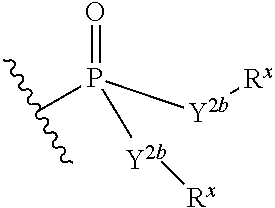
wherein each Y2b is, independently, O or N(R). In another aspect of this embodiment, each Y2b is O and each Rx is independently:

wherein M12c is 1, 2 or 3 and each Y2 is independently a bond, O, CR2, or S. In another aspect of this embodiment, one Y2b—Rx is NH(R) and the other Y2b—Rx is O—Rx wherein Rx is:

wherein M12c is 2. In another aspect of this embodiment, each Y2b is O and each Rx is independently:

wherein M12c is 2. In another aspect of this embodiment, each Y2b is O and each Rx is independently:

wherein M12c is 1 and Y2 is a bond, O, or CR2.

of Formulas I-IV compounds include substructures such as:

wherein each Y3 is, independently, O or N(R). In another aspect of this embodiment, each Y3 is O. In another aspect of this embodiment, the substructure is:

wherein Ry is W5 as defined herein.

of Formula I-IV includes the substructures:

wherein each Y2c is, independently, O, N(Ry) or S.

of Formula I-IV compounds includes the substructures wherein one of W1 or W2 together with either R3 or R4 is —Y3— and the other of W1 or W2 is Formula Ia. Such an embodiment is represented by a compound of Formula Ib selected from:

In another aspect of the embodiment of Formula Ib, each Y and Y3 is O. In another aspect of the embodiment of Formula Ib, W1 or W2 is Y2b—Rx; each Y, Y3 and Y2b is O and Rx is:

wherein M12c is 1, 2 or 3 and each Y2 is independently a bond, O, CR2, or S. In another aspect of the embodiment of Formula Ib, W1 or W2 is Y2b—Rx; each Y, Y3 and Y2b is O and Rx is:

wherein M12c is 2. In another aspect of the embodiment of Formula Ib, W1 or W2 is Y2b—Rx; each Y, Y3 and Y2b is O and Rx is:

wherein M12c is 1 and Y2 is a bond, O, or CR2.

of Formula I-IV compounds includes a substructure:

wherein W5 is a carbocycle such as phenyl or substituted phenyl. In another aspect of this embodiment, the substructure is:

wherein Y2b is O or N(R) and the phenyl carbocycle is substituted with 0 to 3 R groups. In another aspect of this embodiment of the substructure, Rx is:

wherein M12c is 1, 2 or 3 and each Y2 is independently a bond, O, CR2, or S.

of Formula I-IV includes substructures:

The chiral carbon of the amino acid and lactate moieties may be either the R or S configuration or the racemic mixture.

of Formula I-IV is substructure

wherein each Y2 is, independently, —O— or —NH—. In another aspect of this embodiment, Ry is (C1-C8) alkyl, (C1-C8) substituted alkyl, (C2-C8) alkenyl, (C2-C8) substituted alkenyl, (C2-C8) alkynyl or (C2-C8) substituted alkynyl. In another aspect of this embodiment, Ry is (C1-C8) alkyl, (C1-C8) substituted alkyl, (C2-C8) alkenyl, (C2-C8) substituted alkenyl, (C2-C8) alkynyl or (C2-C8) substituted alkynyl; and R is CH3. In another aspect of this embodiment, Ry is (C1-C8) alkyl, (C1-C8) substituted alkyl, (C2-C8) alkenyl, (C2-C8) substituted alkenyl, (C2-C8) alkynyl or (C2-C8) substituted alkynyl; R is CH3; and each Y2 is —NH—. In another aspect of this embodiment, W1 and W2 are, independently, nitrogen-linked, naturally occurring amino acids or naturally occurring amino acid esters. In another aspect of this embodiment, W1 and W2 are, independently, naturally-occurring 2-hydroxy carboxylic acids or naturally-occurring 2-hydroxy carboxylic acid esters wherein the acid or ester is linked to P through the 2-hydroxy group.

of Formula I-IV is substructure:

In one aspect of this embodiment, each Rx is, independently, (C1-C8) alkyl. In another aspect of this embodiment, each Rx is, independently, C6-C20 aryl or C6-C20 substituted aryl.

is selected from


of Formulas I-IV is substructure

wherein W1 and W2 are independently selected from one of the formulas in Tables 20.1-20.37 and Table 30.1 below. The variables used in Tables 20.1-20.37 (e.g., W23, R21, etc.) pertain only to Tables 20.1-20.37, unless otherwise indicated.
| TABLE 20.1 | |||
 |
1 | ||
 |
2 | ||
 |
3 | ||
 |
4 | ||
 |
5 | ||
 |
6 | ||
 |
7 | ||
 |
8 | ||
| TABLE 20.2 | |||
 |
9 | ||
 |
10 | ||
 |
11 | ||
| TABLE 20.3 | |||
 |
12 | ||
 |
13 | ||
 |
14 | ||
 |
15 | ||
 |
16 | ||
 |
17 | ||
 |
18 | ||
 |
19 | ||
| TABLE 20.4 | |||
 |
20 | ||
 |
21 | ||
 |
22 | ||
| TABLE 20.5 | |||
 |
23 | ||
 |
24 | ||
 |
25 | ||
 |
26 | ||
 |
27 | ||
 |
28 | ||
 |
29 | ||
 |
30 | ||
| TABLE 20.6 | |||
 |
31 | ||
 |
32 | ||
 |
33 | ||
| TABLE 20.7 | |||
 |
34 | ||
 |
35 | ||
 |
36 | ||
 |
37 | ||
 |
38 | ||
 |
39 | ||
 |
40 | ||
 |
41 | ||
| TABLE 20.8 | |||
 |
42 | ||
 |
43 | ||
 |
44 | ||
 |
45 | ||
 |
46 | ||
 |
47 | ||
 |
48 | ||
 |
49 | ||
| TABLE 20.9 | ||
 |
50 | |
 |
51 | |
 |
52 | |
 |
53 | |
 |
54 | |
 |
55 | |
 |
56 | |
 |
57 | |
| TABLE 20.10 | ||
 |
58 | |
 |
59 | |
 |
60 | |
| TABLE 20.11 | ||
 |
61 | |
 |
62 | |
 |
63 | |
 |
64 | |
 |
65 | |
 |
66 | |
 |
67 | |
 |
68 | |
| TABLE 20.12 | ||
 |
69 | |
 |
70 | |
 |
71 | |
| TABLE 20.13 | ||
 |
72 | |
 |
73 | |
 |
74 | |
 |
75 | |
 |
76 | |
 |
77 | |
 |
78 | |
 |
79 | |
| TABLE 20.14 | ||||
 |
80 | |||
 |
81 | |||
 |
82 | |||
| TABLE 20.15 | ||
 |
83 | |
 |
84 | |
 |
85 | |
 |
86 | |
 |
87 | |
 |
88 | |
 |
89 | |
 |
90 | |
| TABLE 20.16 | ||
 |
91 | |
 |
92 | |
 |
93 | |
 |
94 | |
 |
95 | |
 |
96 | |
 |
97 | |
 |
98 | |
| TABLE 20.17 | ||
 |
99 | |
 |
100 | |
 |
101 | |
 |
102 | |
 |
103 | |
 |
104 | |
 |
105 | |
 |
106 | |
| TABLE 20.18 | ||
 |
107 | |
 |
108 | |
 |
109 | |
| TABLE 20.19 | ||
 |
110 | |
 |
111 | |
 |
112 | |
 |
113 | |
 |
114 | |
 |
115 | |
 |
116 | |
 |
117 | |
| TABLE 20.20 | ||
 |
118 | |
 |
119 | |
 |
120 | |
| TABLE 20.21 | ||
 |
121 | |
 |
122 | |
 |
123 | |
 |
124 | |
 |
125 | |
 |
126 | |
 |
127 | |
 |
128 | |
| TABLE 20.22 | ||
 |
129 | |
 |
130 | |
 |
131 | |
| TABLE 20.23 | ||
 |
132 | |
 |
133 | |
 |
134 | |
 |
135 | |
 |
136 | |
 |
137 | |
 |
138 | |
 |
139 | |
| TABLE 20.24 | |
 |
140 |
 |
141 |
 |
142 |
 |
143 |
 |
144 |
 |
145 |
 |
146 |
 |
147 |
| TABLE 20.25 | |
 |
148 |
 |
149 |
 |
150 |
 |
151 |
 |
152 |
 |
153 |
 |
154 |
 |
155 |
 |
156 |
 |
157 |
 |
158 |
 |
159 |
| TABLE 20.26 | |
 |
160 |
 |
161 |
 |
162 |
 |
163 |
 |
164 |
 |
165 |
 |
166 |
 |
167 |
 |
168 |
 |
169 |
 |
170 |
 |
171 |
| TABLE 20.27 | |
 |
172 |
 |
173 |
 |
174 |
 |
175 |
 |
176 |
 |
177 |
 |
178 |
 |
179 |
| TABLE 20.28 | |
 |
180 |
 |
181 |
 |
182 |
 |
183 |
 |
184 |
 |
185 |
| TABLE 20.29 | |
 |
186 |
 |
187 |
 |
188 |
 |
189 |
 |
190 |
 |
191 |
 |
192 |
 |
193 |
| TABLE 20.30 | |
 |
194 |
 |
195 |
 |
196 |
 |
197 |
 |
198 |
 |
199 |
| TABLE 20.31 | |
 |
200 |
 |
201 |
 |
202 |
 |
203 |
 |
204 |
 |
205 |
 |
206 |
 |
207 |
| TABLE 20.32 | |
 |
208 |
 |
209 |
 |
210 |
 |
211 |
 |
212 |
 |
213 |
| TABLE 20.33 | |
 |
214 |
 |
215 |
 |
216 |
 |
217 |
 |
218 |
 |
219 |
 |
220 |
 |
221 |
| TABLE 20.34 | |
 |
222 |
 |
223 |
 |
224 |
 |
225 |
 |
226 |
 |
227 |
| TABLE 20.35 | |
 |
228 |
 |
229 |
 |
230 |
 |
231 |
 |
232 |
 |
233 |
 |
234 |
 |
235 |
| TABLE 20.36 | |
 |
236 |
 |
237 |
 |
238 |
 |
239 |
 |
240 |
 |
241 |
 |
242 |
 |
243 |
| TABLE 20.37 | |
 |
244 |
 |
245 |
 |
246 |
 |
247 |
| TABLE 30.1 | |
 |
67 |
 |
68 |
 |
69 |
 |
70 |
 |
71 |
 |
258 |
 |
248 |
 |
249 |
 |
250 |
 |
251 |
 |
252 |
 |
253 |
 |
254 |
 |
255 |
 |
256 |
 |
257 |


and W1 and W2 are different. When at least one of either W1 or W2 also has a chiral center, for example with W1 or W2 is a nitrogen-linked, chiral, naturally occurring α-amino acid ester, then the compound of Formula I-IV will exists as diastereomers because there are two centers of chirality in the molecule. All such diastereomers and their uses described herein are encompassed by the instant invention. Mixtures of diastereomers may be separate under high resolution analytical procedures such as electrophoresis, crystallization and/or chromatography. Diastereomeres may have different physical attributes such as, but not limited to, solubility, chemical stabilities and crystallinity and may also have different biological properties such as, but not limited to, enzymatic stability, absorption and metabolic stability.

| TABLE 1 |
| List of abbreviations and acronyms. |
| Abbreviation | Meaning |
| Ac2O | acetic anhydride |
| AIBN | 2,2’-azobis(2-methylpropionitrile) |
| Bn | benzyl |
| BnBr | benzylbromide |
| BSA | bis(trimethylsilyl)acetamide |
| BzCl | benzoyl chloride |
| CDI | carbonyl diimidazole |
| DABCO | 1,4-diazabicyclo[2.2.2]octane |
| DBN | 1,5-diazabicyclo[4.3.0]non-5-ene |
| DDQ | 2,3-dichloro-5,6-dicyano-1,4-benzoquinone |
| DBU | 1,5-diazabicyclo[5.4.0]undec-5-ene |
| DCA | dichloroacetamide |
| DCC | dicyclohexylcarbodiimide |
| DCM | dichloromethane |
| DMAP | 4-dimethylaminopyridine |
| DME | 1,2-dimethoxyethane |
| DMTCl | dimethoxytrityl chloride |
| DMSO | dimethylsulfoxide |
| DMTr | 4,4’-dimethoxytrityl |
| DMF | dimethylformamide |
| EtOAc | ethyl acetate |
| ESI | electrospray ionization |
| HMDS | hexamethyldisilazane |
| HPLC | High pressure liquid chromatography |
| LDA | lithium diisopropylamide |
| LRMS | low resolution mass spectrum |
| MCPBA | meta-chloroperbenzoic acid |
| MeCN | acetonitrile |
| MeOH | methanol |
| MMTC | mono methoxytrityl chloride |
| m/z or m/e | mass to charge ratio |
| MH+ | mass plus 1 |
| MH− | mass minus 1 |
| MsOH | methanesulfonic acid |
| MS or ms | mass spectrum |
| NBS | N-bromosuccinimide |
| Ph | phenyl |
| rt or r.t. | room temperature |
| TBAF | tetrabutylammonium fluoride |
| TMSC1 | chlorotrimethylsilane |
| TMSBr | bromotrimethylsilane |
| TMSI | iodotrimethylsilane |
| TMSOTf | (trimethylsilyl)trifluoromethylsulfonate |
| TEA | triethylamine |
| TBA | tributylamine |
| TBAP | tributylammonium pyrophosphate |
| TBSCl | t-butyldimethylsilyl chloride |
| TEAB | triethylammonium bicarbonate |
| TFA | trifluoroacetic acid |
| TLC or tlc | thin layer chromatography |
| Tr | triphenylmethyl |
| Tol | 4-methylbenzoyl |
| Turbo Grignard | 1:1 mixture of isopropylmagnesium chloride and lithium chloride |
| δ | parts per million down field from tetramethylsilane |


| Compound | EC50/uM | CC50/uM |
| 1 | 0.48 | >100 |
| 10 | 0.18 | 47 |
| 12 | 6.5 | >100 |
| 13 | 34 | >100 |
| 14 | 2.7 | 92 |
| 15 | 0.15 | >100 |
| 16 | 3.3 | >100 |
RSV RNP Preparation
-
- 1) Mason, S., Lawetz, C., Gaudette, Y., Do, F., Scouten, E., Lagace, L., Simoneau, B. and Liuzzi, M. (2004) Polyadenylation-dependent screening assay for respiratory syncytial virus RNA transcriptase activity and identification of an inhibitor. Nucleic Acids Research, 32, 4758-4767.
| Compound | IC50/uM | ||
| 6 | 3.6 | ||
| 17 | 1.5 | ||
| 18 | 1.6 | ||
| 19 | 1.5 | ||
| 20 | 0.8 | ||
Description of the Parainfluenza Cytoprotection Assay
| Compound | IC50/uM | TC50/uM |
| 1 | 1.71 | >30 |
| 14 | 5.23 | >30 |
Claims (37)


Priority Applications (2)
| Application Number | Priority Date | Filing Date | Title |
|---|---|---|---|
| US16/879,491 US11492353B2 (en) | 2010-07-22 | 2020-05-20 | Methods and compounds for treating Paramyxoviridae virus infections |
| US17/854,818 US12509466B2 (en) | 2010-07-22 | 2022-06-30 | Methods and compounds for treating paramyxoviridae virus infections |
Applications Claiming Priority (5)
| Application Number | Priority Date | Filing Date | Title |
|---|---|---|---|
| US36660910P | 2010-07-22 | 2010-07-22 | |
| US13/189,373 US20120027752A1 (en) | 2010-07-22 | 2011-07-22 | Methods and compounds for treating paramyxoviridae virus infections |
| US14/613,719 US10065958B2 (en) | 2010-07-22 | 2015-02-04 | Methods and compounds for treating Paramyxoviridae virus infections |
| US16/042,085 US10696679B2 (en) | 2010-07-22 | 2018-07-23 | Methods and compounds for treating paramyxoviridae virus infections |
| US16/879,491 US11492353B2 (en) | 2010-07-22 | 2020-05-20 | Methods and compounds for treating Paramyxoviridae virus infections |
Related Parent Applications (2)
| Application Number | Title | Priority Date | Filing Date |
|---|---|---|---|
| US16/042,085 Continuation US10696679B2 (en) | 2010-07-22 | 2018-07-23 | Methods and compounds for treating paramyxoviridae virus infections |
| US16/042,085 Division US10696679B2 (en) | 2010-07-22 | 2018-07-23 | Methods and compounds for treating paramyxoviridae virus infections |
Related Child Applications (2)
| Application Number | Title | Priority Date | Filing Date |
|---|---|---|---|
| US17/854,818 Continuation US12509466B2 (en) | 2010-07-22 | 2022-06-30 | Methods and compounds for treating paramyxoviridae virus infections |
| US17/854,818 Division US12509466B2 (en) | 2010-07-22 | 2022-06-30 | Methods and compounds for treating paramyxoviridae virus infections |
Publications (2)
| Publication Number | Publication Date |
|---|---|
| US20210061806A1 US20210061806A1 (en) | 2021-03-04 |
| US11492353B2 true US11492353B2 (en) | 2022-11-08 |
Family
ID=44534635
Family Applications (6)
| Application Number | Title | Priority Date | Filing Date |
|---|---|---|---|
| US13/189,373 Abandoned US20120027752A1 (en) | 2010-07-22 | 2011-07-22 | Methods and compounds for treating paramyxoviridae virus infections |
| US14/579,348 Abandoned US20150111839A1 (en) | 2010-07-22 | 2014-12-22 | Methods and compounds for treating paramyxoviridae virus infections |
| US14/613,719 Active 2032-03-08 US10065958B2 (en) | 2010-07-22 | 2015-02-04 | Methods and compounds for treating Paramyxoviridae virus infections |
| US16/042,085 Active US10696679B2 (en) | 2010-07-22 | 2018-07-23 | Methods and compounds for treating paramyxoviridae virus infections |
| US16/879,491 Active 2031-12-08 US11492353B2 (en) | 2010-07-22 | 2020-05-20 | Methods and compounds for treating Paramyxoviridae virus infections |
| US17/854,818 Active 2033-06-11 US12509466B2 (en) | 2010-07-22 | 2022-06-30 | Methods and compounds for treating paramyxoviridae virus infections |
Family Applications Before (4)
| Application Number | Title | Priority Date | Filing Date |
|---|---|---|---|
| US13/189,373 Abandoned US20120027752A1 (en) | 2010-07-22 | 2011-07-22 | Methods and compounds for treating paramyxoviridae virus infections |
| US14/579,348 Abandoned US20150111839A1 (en) | 2010-07-22 | 2014-12-22 | Methods and compounds for treating paramyxoviridae virus infections |
| US14/613,719 Active 2032-03-08 US10065958B2 (en) | 2010-07-22 | 2015-02-04 | Methods and compounds for treating Paramyxoviridae virus infections |
| US16/042,085 Active US10696679B2 (en) | 2010-07-22 | 2018-07-23 | Methods and compounds for treating paramyxoviridae virus infections |
Family Applications After (1)
| Application Number | Title | Priority Date | Filing Date |
|---|---|---|---|
| US17/854,818 Active 2033-06-11 US12509466B2 (en) | 2010-07-22 | 2022-06-30 | Methods and compounds for treating paramyxoviridae virus infections |
Country Status (31)
| Country | Link |
|---|---|
| US (6) | US20120027752A1 (en) |
| EP (1) | EP2595980B1 (en) |
| JP (2) | JP5969471B2 (en) |
| KR (2) | KR101924765B1 (en) |
| CN (2) | CN103052631B (en) |
| AP (1) | AP3269A (en) |
| AU (4) | AU2011280910B2 (en) |
| BR (2) | BR112013001553B1 (en) |
| CA (1) | CA2804840C (en) |
| CL (1) | CL2013000077A1 (en) |
| CO (1) | CO6690740A2 (en) |
| CR (2) | CR20170278A (en) |
| EA (2) | EA201691118A1 (en) |
| EC (1) | ECSP13012458A (en) |
| ES (1) | ES2524356T3 (en) |
| FR (1) | FR20C1065I2 (en) |
| IL (2) | IL224043A (en) |
| MA (1) | MA34470B1 (en) |
| ME (1) | ME01924B (en) |
| MX (1) | MX2013000744A (en) |
| NL (1) | NL301084I2 (en) |
| NO (2) | NO2020047I1 (en) |
| NZ (1) | NZ606156A (en) |
| PE (2) | PE20130400A1 (en) |
| PH (1) | PH12013500035A1 (en) |
| PL (1) | PL2595980T3 (en) |
| PT (1) | PT2595980E (en) |
| SG (1) | SG186830A1 (en) |
| SI (1) | SI2595980T1 (en) |
| UA (1) | UA111163C2 (en) |
| WO (1) | WO2012012776A1 (en) |
Cited By (11)
| Publication number | Priority date | Publication date | Assignee | Title |
|---|---|---|---|---|
| US11660307B2 (en) | 2020-01-27 | 2023-05-30 | Gilead Sciences, Inc. | Methods for treating SARS CoV-2 infections |
| US11701372B2 (en) | 2020-04-06 | 2023-07-18 | Gilead Sciences, Inc. | Inhalation formulations of 1'-cyano substituted carba-nucleoside analogs |
| US11780844B2 (en) | 2022-03-02 | 2023-10-10 | Gilead Sciences, Inc. | Compounds and methods for treatment of viral infections |
| US11814406B2 (en) | 2020-08-27 | 2023-11-14 | Gilead Sciences, Inc. | Compounds and methods for treatment of viral infections |
| US11903953B2 (en) | 2020-05-29 | 2024-02-20 | Gilead Sciences, Inc. | Remdesivir treatment methods |
| US11939347B2 (en) | 2020-06-24 | 2024-03-26 | Gilead Sciences, Inc. | 1′-cyano nucleoside analogs and uses thereof |
| US11975017B2 (en) | 2017-07-11 | 2024-05-07 | Gilead Sciences, Inc. | Compositions comprising an RNA polymerase inhibitor and cyclodextrin for treating viral infections |
| US12012431B2 (en) | 2020-03-12 | 2024-06-18 | Gilead Sciences, Inc. | Methods of preparing 1′-cyano nucleosides |
| US12030906B2 (en) | 2017-05-01 | 2024-07-09 | Gilead Sciences, Inc. | Crystalline forms of (s)-2-ethylbutyl 2-(((s)-(((2r,3s,4r,5r)-5-(4-aminopyrrolo[2,1-f] [1,2,4]triazin-7-yl)-5-cyano-3,4-dihydroxytetrahydrofuran-2-yl)methoxy) (phenoxy) phosphoryl)amino)propanoate |
| US12357577B1 (en) | 2024-02-02 | 2025-07-15 | Gilead Sciences, Inc. | Pharmaceutical formulations and uses thereof |
| US12509466B2 (en) | 2010-07-22 | 2025-12-30 | Gilead Sciences, Inc. | Methods and compounds for treating paramyxoviridae virus infections |
Families Citing this family (110)
| Publication number | Priority date | Publication date | Assignee | Title |
|---|---|---|---|---|
| HRP20130048T1 (en) | 2008-04-23 | 2013-02-28 | Gilead Sciences, Inc. | CARBA-NUCLEOSIDE ANALYSIS FOR ANTI-VIRUS THERAPY |
| WO2011035250A1 (en) | 2009-09-21 | 2011-03-24 | Gilead Sciences, Inc. | Processes and intermediates for the preparation of 1'-substituted carba-nucleoside analogs |
| MX2012015292A (en) | 2010-06-24 | 2013-05-30 | Gilead Sciences Inc | PIRAZOLO [1, 5] PYRIMIDINS IN THE FORM OF ANTIVIRAL AGENTS. |
| EA025311B1 (en) | 2010-07-19 | 2016-12-30 | Гайлид Сайэнсиз, Инк. | Methods for the preparation of diasteromerically pure phosphoramidate prodrugs |
| SG10201610936RA (en) | 2011-12-22 | 2017-02-27 | Alios Biopharma Inc | Substituted nucleosides, nucleotides and analogs thereof |
| JP6122868B2 (en) | 2011-12-22 | 2017-04-26 | ギリアード サイエンシーズ, インコーポレイテッド | Pyrazolo [1,5-A] pyrimidine as an antiviral agent |
| KR102068856B1 (en) * | 2012-03-13 | 2020-01-21 | 길리애드 사이언시즈, 인코포레이티드 | 2'- substituted carba-nucleoside analogs for antiviral treatment |
| USRE48171E1 (en) | 2012-03-21 | 2020-08-25 | Janssen Biopharma, Inc. | Substituted nucleosides, nucleotides and analogs thereof |
| RS58437B1 (en) * | 2012-03-21 | 2019-04-30 | Alios Biopharma Inc | Substituted nucleosides, nucleotides and analogs thereof |
| US9441007B2 (en) | 2012-03-21 | 2016-09-13 | Alios Biopharma, Inc. | Substituted nucleosides, nucleotides and analogs thereof |
| KR102181318B1 (en) | 2012-04-17 | 2020-11-20 | 길리애드 사이언시즈, 인코포레이티드 | Compounds and methods for antiviral treatment |
| CN103232507B (en) * | 2012-04-27 | 2016-07-06 | 北京大学 | Modified nucleoside monomer and synthetic method thereof and application |
| HUE029038T2 (en) | 2012-05-25 | 2017-01-30 | Janssen Sciences Ireland Uc | Uracyl spirooxetane nucleosides |
| WO2014035140A2 (en) * | 2012-08-30 | 2014-03-06 | Kainos Medicine, Inc. | Compounds and compositions for modulating histone methyltransferase activity |
| WO2014042433A2 (en) * | 2012-09-14 | 2014-03-20 | Kainos Medicine, Inc. | Compounds and compositions for modulating adenosine a3 receptor activity |
| GEP201706757B (en) | 2012-12-21 | 2017-10-25 | Alios Biopharma Inc | Substituted nucleosides, nucleotides and analogs thereof |
| UA119050C2 (en) * | 2013-11-11 | 2019-04-25 | Ґілеад Саєнсиз, Інк. | PYROL [1.2-f] [1.2.4] TRIASINES USED FOR TREATMENT OF RESPIRATORY-SYNCITAL VIRAL INFECTIONS |
| WO2015143712A1 (en) | 2014-03-28 | 2015-10-01 | Merck Sharp & Dohme Corp. | 4'-substituted nucleoside reverse transcriptase inhibitors |
| TWI678369B (en) * | 2014-07-28 | 2019-12-01 | 美商基利科學股份有限公司 | Thieno[3,2-d]pyrimidine, furo[3,2-d]pyrimidine, and pyrrolo[3,2-d]pyrimidines useful for treating respiratory syncitial virus infections |
| TWI673283B (en) | 2014-08-21 | 2019-10-01 | 美商基利科學股份有限公司 | 2'-chloro aminopyrimidinone and pyrimidine dione nucleosides |
| TWI740546B (en) * | 2014-10-29 | 2021-09-21 | 美商基利科學股份有限公司 | Methods for the preparation of ribosides |
| IL296496B2 (en) | 2014-12-26 | 2024-10-01 | Univ Emory | N4-hydroxycytidine, history and related antiviral uses |
| EA039561B1 (en) * | 2015-01-20 | 2022-02-10 | Джилид Сайэнс, Инк. | Compounds for treating filoviridae virus infections |
| JPWO2016117622A1 (en) * | 2015-01-22 | 2017-11-02 | 国立大学法人岐阜大学 | Tetrazole derivatives and antiviral agents |
| MY197231A (en) | 2015-07-22 | 2023-06-06 | Enanta Pharm Inc | Benzodiazepine derivatives as rsv inhibitors |
| HRP20220355T1 (en) * | 2015-09-16 | 2022-05-13 | Gilead Sciences, Inc. | Methods for treating coronaviridae infections |
| MX391226B (en) | 2015-09-23 | 2025-03-21 | Merck Sharp & Dohme Llc | 4'-SUBSTITUTED NUCLEOSIDE REVERSE TRANSCRIPTASE INHIBITORS AND PREPARATIONS THEREOF. |
| CN114456176B (en) | 2016-03-28 | 2024-08-30 | 因赛特公司 | Pyrrolotriazine compounds as TAM inhibitors |
| WO2017184668A1 (en) | 2016-04-20 | 2017-10-26 | Gilead Sciences, Inc. | Methods for treating flaviviridae virus infections |
| WO2017184670A2 (en) | 2016-04-22 | 2017-10-26 | Gilead Sciences, Inc. | Methods for treating zika virus infections |
| CN106083962B (en) * | 2016-06-08 | 2018-12-18 | 成都倍特药业有限公司 | A kind of compound and preparation method thereof with cyclophosphamide structure |
| US10202412B2 (en) | 2016-07-08 | 2019-02-12 | Atea Pharmaceuticals, Inc. | β-D-2′-deoxy-2′-substituted-4′-substituted-2-substituted-N6-substituted-6-aminopurinenucleotides for the treatment of paramyxovirus and orthomyxovirus infections |
| CN116036112A (en) * | 2017-03-14 | 2023-05-02 | 吉利德科学公司 | Methods of Treating Feline Coronavirus Infection |
| CA3075950A1 (en) * | 2017-09-18 | 2019-03-21 | Janssen Biopharma, Inc. | Substituted nucleosides, nucleotides and analogs thereof |
| WO2019067864A1 (en) * | 2017-09-29 | 2019-04-04 | Enanta Pharmaceuticals, Inc. | Combination pharmaceutical agents as rsv inhibitors |
| KR102626210B1 (en) | 2017-12-07 | 2024-01-18 | 에모리 유니버시티 | N4-hydroxycytidine and derivatives and anti-viral uses related thereto |
| US11040975B2 (en) | 2017-12-08 | 2021-06-22 | Merck Sharp & Dohme Corp. | Carbocyclic nucleoside reverse transcriptase inhibitors |
| CA3133300A1 (en) | 2019-03-18 | 2020-09-24 | Enanta Pharmaceuticals, Inc. | Benzodiazepine derivatives as rsv inhibitors |
| IL286328B1 (en) | 2019-03-22 | 2026-04-01 | Gilead Sciences Inc | Bridged tricyclic carbamoylpyridone compounds and their pharmaceutical use |
| AU2020267486B2 (en) | 2019-05-09 | 2025-12-18 | Aligos Therapeutics, Inc. | Modified cyclic dinucleoside compounds as STING modulators |
| US11505558B1 (en) | 2019-10-04 | 2022-11-22 | Enanta Pharmaceuticals, Inc. | Antiviral heterocyclic compounds |
| AU2020378005A1 (en) * | 2019-11-05 | 2022-05-26 | Dermira, Inc. | ROR gamma T inhibitors and topical uses thereof |
| CN110776512A (en) * | 2019-11-28 | 2020-02-11 | 成都傲飞生物化学品有限责任公司 | Preparation method of nucleoside analogue |
| CN113214262B (en) * | 2020-02-05 | 2023-07-07 | 华创合成制药股份有限公司 | Compound containing guanidine group, and preparation method and application thereof |
| CN113214263B (en) * | 2020-02-06 | 2022-09-30 | 北京桦冠医药科技有限公司 | Synthetic method of Rudesiwei key intermediate |
| WO2021158851A1 (en) * | 2020-02-07 | 2021-08-12 | Cai Gu Huang | Pharmaceutical formulation containing remdesivir |
| TWI874791B (en) | 2020-02-18 | 2025-03-01 | 美商基利科學股份有限公司 | Antiviral compounds |
| TWI791193B (en) | 2020-02-18 | 2023-02-01 | 美商基利科學股份有限公司 | Antiviral compounds |
| AU2021224588B2 (en) | 2020-02-18 | 2024-07-18 | Gilead Sciences, Inc. | Antiviral compounds |
| TWI794742B (en) | 2020-02-18 | 2023-03-01 | 美商基利科學股份有限公司 | Antiviral compounds |
| CN113292565B (en) * | 2020-02-24 | 2023-01-31 | 浙江森科建设有限公司 | Nucleoside compound and preparation method and application thereof |
| WO2021168930A1 (en) * | 2020-02-25 | 2021-09-02 | 顾世海 | Tablet of remdesivir and preparation method therefor |
| WO2021175296A1 (en) * | 2020-03-04 | 2021-09-10 | 中国科学院上海药物研究所 | Intermediate of remdesivir and preparation method therefor |
| CA3169348A1 (en) | 2020-03-20 | 2021-09-23 | Gilead Sciences, Inc. | Prodrugs of 4'-c-substituted-2-halo-2'-deoxyadenosine nucleosides and methods of making and using the same |
| CN113493480B (en) * | 2020-04-03 | 2025-04-15 | 南京正大天晴制药有限公司 | A preparation method of a remdesivir isomer and its analysis method |
| WO2021208910A1 (en) * | 2020-04-13 | 2021-10-21 | 山东华铂凯盛生物科技有限公司 | Polymer preparation for treating virus infection, and preparation method therefor and use thereof |
| US20230158074A1 (en) * | 2020-04-16 | 2023-05-25 | The General Hospital Corporation | B cell immunomodulatory therapy for acute respiratory distress syndrome |
| CN111494349A (en) * | 2020-04-30 | 2020-08-07 | 中国人民解放军空军军医大学 | Redecevir oral instant membrane and preparation method thereof |
| WO2021222807A1 (en) * | 2020-04-30 | 2021-11-04 | Ajk Pharmaceutical Llc | Fatty acyl and fatty ether conjugates of remdesivir and its active metabolites as antivirals |
| US20210346416A1 (en) * | 2020-05-05 | 2021-11-11 | Ralph Lipp | Pharmaceutical Compositions and Methods for their Use in Antiviral Therapy |
| CN111961057A (en) * | 2020-05-26 | 2020-11-20 | 李小冬 | Alpha-configuration nucleoside and application thereof in treating feline coronavirus infection |
| CA3182179A1 (en) | 2020-06-11 | 2021-12-16 | Fabio E.S. Souza | Novel crystalline form of remdesivir |
| AU2021300281A1 (en) * | 2020-06-30 | 2023-02-02 | Dermira, Inc. | RORγt inhibitors and topical uses thereof |
| WO2022016073A1 (en) * | 2020-07-17 | 2022-01-20 | Board Of Regents, The University Of Texas System | Pharmaceutical compositions for delivery of remdesivir by inhalation |
| LT4192839T (en) | 2020-08-06 | 2025-11-25 | REMDESIVIR INTERMEDIATES | |
| MX2023002233A (en) | 2020-08-24 | 2023-03-15 | Gilead Sciences Inc | Phospholipid compounds and uses thereof. |
| CN114149434A (en) * | 2020-09-08 | 2022-03-08 | 安徽诺全药业有限公司 | Heterocyclic compound and preparation method and application thereof |
| WO2022086840A1 (en) | 2020-10-19 | 2022-04-28 | Enanta Pharmaceuticals, Inc. | Heterocyclic compounds as anti-viral agents |
| TW202406932A (en) | 2020-10-22 | 2024-02-16 | 美商基利科學股份有限公司 | Interleukin-2-fc fusion proteins and methods of use |
| JP7659628B2 (en) | 2020-11-11 | 2025-04-09 | ギリアード サイエンシーズ, インコーポレイテッド | Methods for identifying HIV patients susceptible to treatment with antibodies directed against the gp120 CD4 binding site - Patents.com |
| CN114507256B (en) * | 2020-11-16 | 2025-02-28 | 上海医药集团股份有限公司 | A chiral isomer of remdesivir, preparation method and application thereof |
| EP4249462A4 (en) | 2020-11-18 | 2024-10-16 | Tokuyama Corporation | PROCESS FOR PRODUCING A KETONE DERIVATIVE |
| RU2756921C1 (en) * | 2020-11-20 | 2021-10-07 | Общество С Ограниченной Ответственностью "Технология Лекарств" | Method for obtaining remdesivir and phosphoramidates |
| CN116874490B (en) * | 2020-12-30 | 2026-04-14 | 深圳安泰维生物医药有限公司 | Compound ATV014 or pharmaceutically acceptable salts thereof and pharmaceutical compositions thereof |
| US12558364B2 (en) | 2021-01-20 | 2026-02-24 | Regents Of The University Of Minnesota | Next generation remdesivir antivirals |
| WO2022166581A1 (en) * | 2021-02-07 | 2022-08-11 | 石家庄迪斯凯威医药科技有限公司 | Nucleotide derivative, pharmaceutical composite thereof and use thereof |
| US12612412B2 (en) | 2021-02-26 | 2026-04-28 | Enanta Pharmaceuticals, Inc. | Antiviral heterocyclic compounds |
| CN112843073A (en) * | 2021-03-30 | 2021-05-28 | 山东省农业科学院畜牧兽医研究所 | Application of Reddesivir (Remdesivir) in preparation of anti-bovine parainfluenza virus type 3 medicine |
| JP7688152B2 (en) | 2021-04-16 | 2025-06-03 | ギリアード サイエンシーズ, インコーポレイテッド | Method for preparing carbanucleosides using amides |
| WO2022251318A1 (en) | 2021-05-26 | 2022-12-01 | Gilead Sciences, Inc. | Phospholipid formulations of 1'-cyano substituted carba-nucleoside analogs |
| JP7719954B2 (en) | 2021-08-18 | 2025-08-06 | ギリアード サイエンシーズ, インコーポレイテッド | Phospholipid compounds and methods for producing and using same |
| WO2023102472A1 (en) * | 2021-12-01 | 2023-06-08 | The Scripps Research Institute | Antiviral prodrugs and formulations thereof |
| PT4440702T (en) | 2021-12-03 | 2025-08-13 | Gilead Sciences Inc | Therapeutic compounds for hiv virus infection |
| WO2023102523A1 (en) | 2021-12-03 | 2023-06-08 | Gilead Sciences, Inc. | Therapeutic compounds for hiv virus infection |
| JP7765637B2 (en) | 2021-12-03 | 2025-11-06 | ギリアード サイエンシーズ, インコーポレイテッド | Therapeutic compounds for HIV virus infections |
| TW202348228A (en) | 2022-02-24 | 2023-12-16 | 德商艾斯巴赫生物有限公司 | Viral combination therapy |
| CR20240367A (en) * | 2022-03-03 | 2024-09-30 | Gilead Sciences Inc | ANTIVIRAL COMPOUNDS AND METHODS OF THEIR PREPARATION AND USE. |
| TWI856796B (en) | 2022-04-06 | 2024-09-21 | 美商基利科學股份有限公司 | Bridged tricyclic carbamoylpyridone compounds and uses thereof |
| AR129003A1 (en) | 2022-04-07 | 2024-07-03 | Enanta Pharm Inc | HETEROCYCLIC ANTIVIRAL COMPOUNDS |
| WO2023211997A1 (en) | 2022-04-27 | 2023-11-02 | Enanta Pharmaceuticals, Inc. | Antiviral compounds |
| WO2024006376A1 (en) * | 2022-06-29 | 2024-01-04 | Gilead Sciences, Inc. | Solid forms of a nucleoside analogue and uses thereof |
| WO2024006461A1 (en) * | 2022-06-30 | 2024-01-04 | Gilead Sciences, Inc. | Solid forms of a nucleoside analogue and uses thereof |
| EP4547659A1 (en) | 2022-07-01 | 2025-05-07 | Gilead Sciences, Inc. | Therapeutic compounds useful for the prophylactic or therapeutic treatment of an hiv virus infection |
| WO2024044477A1 (en) | 2022-08-26 | 2024-02-29 | Gilead Sciences, Inc. | Dosing and scheduling regimen for broadly neutralizing antibodies |
| EP4598934A1 (en) | 2022-10-04 | 2025-08-13 | Gilead Sciences, Inc. | 4'-thionucleoside analogues and their pharmaceutical use |
| JP2025540572A (en) | 2022-11-18 | 2025-12-16 | ギリアード サイエンシーズ, インコーポレイテッド | How to Treat a Poxvirus Infection |
| AR132464A1 (en) | 2023-04-19 | 2025-07-02 | Gilead Sciences Inc | CAPSID INHIBITOR DOSAGE REGIMEN |
| EP4719608A1 (en) | 2023-05-31 | 2026-04-08 | Gilead Sciences, Inc. | Quinazolinyl-indazole derivatives as therapeutic compounds for hiv |
| AU2024281548A1 (en) | 2023-05-31 | 2025-11-13 | Gilead Sciences, Inc. | Solid forms of compounds useful in the treatment of hiv |
| KR20260046169A (en) | 2023-07-28 | 2026-04-06 | 길리애드 사이언시즈, 인코포레이티드 | Weekly renacapavir regimen for the treatment and prevention of HIV |
| WO2025042394A1 (en) | 2023-08-23 | 2025-02-27 | Gilead Sciences, Inc. | Dosing regimen of hiv capsid inhibitor |
| CN122055369A (en) | 2023-10-11 | 2026-05-15 | 吉利德科学公司 | Bridged tricyclic carbamoyl pyridone compounds and uses thereof |
| TW202515549A (en) | 2023-10-11 | 2025-04-16 | 美商基利科學股份有限公司 | Bridged tricyclic carbamoylpyridone compounds and uses thereof |
| AU2024360779A1 (en) | 2023-10-11 | 2026-04-16 | Gilead Sciences, Inc. | Bridged tricyclic carbamoylpyridone compounds and uses thereof |
| US20250230163A1 (en) | 2023-12-22 | 2025-07-17 | Gilead Sciences, Inc. | Solid forms of hiv integrase inhibitors |
| US20250333424A1 (en) | 2024-03-01 | 2025-10-30 | Gilead Sciences, Inc. | Antiviral compounds |
| US20250289822A1 (en) | 2024-03-01 | 2025-09-18 | Gilead Sciences, Inc. | Solid forms of hiv integrase inhibitors |
| US20250296932A1 (en) | 2024-03-01 | 2025-09-25 | Gilead Sciences, Inc. | Pharmaceutical compositions comprising hiv integrase inhibitors |
| US20260007683A1 (en) | 2024-06-14 | 2026-01-08 | Gilead Sciences, Inc. | Pharmaceutical compositions comprising hiv integrase inhibitors |
| WO2026076265A1 (en) | 2024-10-03 | 2026-04-09 | Gilead Sciences, Inc. | Combination therapy comprising bridged tricyclic carbamoylpyridone compounds and p-glycoprotein inhibitors |
Citations (150)
| Publication number | Priority date | Publication date | Assignee | Title |
|---|---|---|---|---|
| US4816570A (en) | 1982-11-30 | 1989-03-28 | The Board Of Regents Of The University Of Texas System | Biologically reversible phosphate and phosphonate protective groups |
| US4968788A (en) | 1986-04-04 | 1990-11-06 | Board Of Regents, The University Of Texas System | Biologically reversible phosphate and phosphonate protective gruops |
| WO1991019721A1 (en) | 1990-06-13 | 1991-12-26 | Arnold Glazier | Phosphorous produgs |
| US5663159A (en) | 1990-09-14 | 1997-09-02 | Institute Of Organic Chemistry And Biochemistry Of The Academy Of Sciences Of The Czech Republic | Prodrugs of phosphonates |
| WO1999045029A1 (en) | 1998-03-03 | 1999-09-10 | Novo Nordisk A/S | New salt forms of (2e)- 5-amino-5- methylhex-2- enoic acid n-methyl-n-((1r)-1-(n- methyl-n-((1r)-1-(methylcarbamoyl)-2- phenylethyl)carbamoyl)-2- (2-naphtyl)ethyl)amide |
| WO2000056734A1 (en) | 1999-03-20 | 2000-09-28 | Aventis Cropscience Gmbh | Bicyclic heterocycles, method for producing them and their use as herbicides and pharmaceutical agents |
| WO2000075157A1 (en) | 1999-06-03 | 2000-12-14 | Abbott Laboratories | Oligonucleotide synthesis with lewis acids as activators |
| WO2001032153A2 (en) | 1999-11-04 | 2001-05-10 | Shire Biochem Inc. | Method for the treatment or prevention of flaviviridae viral infection using nucleoside analogues |
| WO2001060315A2 (en) | 2000-02-18 | 2001-08-23 | Shire Biochem Inc. | Method for the treatment or prevention of flavivirus infections using nucleoside analogues |
| US6312662B1 (en) | 1998-03-06 | 2001-11-06 | Metabasis Therapeutics, Inc. | Prodrugs phosphorus-containing compounds |
| WO2001090121A2 (en) | 2000-05-23 | 2001-11-29 | Idenix (Cayman) Limited | Methods and compositions for treating hepatitis c virus |
| WO2002008241A2 (en) | 2000-07-21 | 2002-01-31 | Gilead Sciences, Inc. | Prodrugs of phosphonate nucleotide analogues and methods for selecting and making same |
| WO2002018404A2 (en) | 2000-08-30 | 2002-03-07 | F. Hoffmann-La Roche Ag | Nucleoside derivatives for the treatment of hepatitis c |
| WO2002032920A2 (en) | 2000-10-18 | 2002-04-25 | Pharmasset Limited | Modified nucleosides for treatment of viral infections and abnormal cellular proliferation |
| WO2002057287A2 (en) | 2001-01-22 | 2002-07-25 | Merck & Co., Inc. | Nucleoside derivatives as inhibitors of rna-dependent rna viral polymerase |
| US6475985B1 (en) | 1998-03-27 | 2002-11-05 | Regents Of The University Of Minnesota | Nucleosides with antiviral and anticancer activity |
| US6476030B1 (en) | 1998-10-16 | 2002-11-05 | Merck Sharp & Dohme Ltd. | Pyrazolo-triazine derivatives as ligands for GABA receptors |
| US20030092775A1 (en) | 2001-09-13 | 2003-05-15 | Hansgeorg Ernst | Process for the preparation of meso-zeaxanthin |
| WO2003093272A1 (en) | 2002-05-02 | 2003-11-13 | Merck Sharp & Dohme Limited | Imidazo-triazine derivatives as ligands for gaba receptors |
| WO2003093273A1 (en) | 2002-05-02 | 2003-11-13 | Merck Sharp & Dohme Limited | Imidazo-triazine derivatives as ligands for gaba receptors |
| US6656915B1 (en) | 1999-09-15 | 2003-12-02 | Biocryst Pharmaceuticals, Inc. | Inhibiting T-cell proliferation |
| WO2003100009A2 (en) | 2002-05-23 | 2003-12-04 | Biocryst Pharmaceuticals, Inc. | Enhancing the efficacy of reverse transcriptase and dna polymerase inhibitors (nucleoside analogs) using pnp inhibitors and/or 2'-deoxyguanosine and/or prodrug thereof |
| US20040006002A1 (en) | 2001-09-28 | 2004-01-08 | Jean-Pierre Sommadossi | Methods and compositions for treating flaviviruses and pestiviruses using 4'-modified nucleoside |
| US20040023901A1 (en) | 2002-02-28 | 2004-02-05 | Cook Phillip D. | Nucleoside 5'-monophosphate mimics and their prodrugs |
| US20040063658A1 (en) | 2002-05-06 | 2004-04-01 | Roberts Christopher Don | Nucleoside derivatives for treating hepatitis C virus infection |
| WO2004046331A2 (en) | 2002-11-15 | 2004-06-03 | Idenix (Cayman) Limited | 2’-branched nucleosides and flaviviridae mutation |
| US20040138170A1 (en) | 2002-03-06 | 2004-07-15 | Montgomery John A. | Nucleosides, preparation thereof and use as inhibitors of rna viral polymerases |
| WO2004112687A2 (en) | 2003-06-26 | 2004-12-29 | Biotron Limited | Antiviral acylguanidine compounds and methods |
| WO2005009418A2 (en) | 2003-07-25 | 2005-02-03 | Idenix (Cayman) Limited | Purine nucleoside analogues for treating diseases caused by flaviviridae including hepatitis c |
| US6909011B2 (en) | 2001-12-28 | 2005-06-21 | Dsm Fine Chemicals Austria Nfg Gmbh & Co Kg | Process for preparing protected, enantiomer-enriched cyanohydrins by in-situ derivatization |
| US20050187180A1 (en) | 1996-10-28 | 2005-08-25 | University Of Washington | Induction of viral mutation by incorporation of miscoding ribonucleoside analogs into viral RNA |
| US20050209166A1 (en) | 2004-03-16 | 2005-09-22 | Boehringer Ingelheim International Gmbh | Glucopyranosyl-substituted phenyl derivatives, medicaments containing such compounds, their use and process for their manufacture |
| US20050215513A1 (en) | 2003-04-25 | 2005-09-29 | Boojamra Constantine G | Antiviral phosphonate analogs |
| WO2005123087A2 (en) | 2004-06-15 | 2005-12-29 | Merck & Co., Inc. | C-purine nucleoside analogs as inhibitors of rna-dependent rna viral polymerase |
| WO2006031725A2 (en) | 2004-09-14 | 2006-03-23 | Pharmasset, Inc. | Preparation of 2'fluoro-2'- alkyl- substituted or other optionally substituted ribofuranosyl pyrimidines and purines and their derivatives |
| WO2006050161A2 (en) | 2004-10-29 | 2006-05-11 | Biocryst Pharmaceuticals, Inc. | Therapeutic furopyrimidines and thienopyrimidines |
| WO2006065335A2 (en) | 2004-10-21 | 2006-06-22 | Merck & Co., Inc. | Fluorinated pyrrolo[2,3-d]pyrimidine nucleosides for the treatment of rna-dependent rna viral infection |
| WO2006064033A2 (en) | 2004-12-16 | 2006-06-22 | Boehringer Ingelheim International Gmbh | Glucopyranosyl-substituted benzene derivatives, medicaments containing such compounds, their use and process for their manufacture |
| US20060142238A1 (en) | 2003-07-21 | 2006-06-29 | Mcguigan Christopher | Chemical compounds |
| US7078403B1 (en) | 1999-06-18 | 2006-07-18 | Biota Scientific Management Pty Ltd. | Antiviral agents |
| US7105493B2 (en) | 2000-05-26 | 2006-09-12 | Idenix Pharmaceuticals, Inc. | Methods and compositions for treating flaviviruses and pestiviruses |
| US20060241064A1 (en) | 2005-04-25 | 2006-10-26 | Genelabs Technologies, Inc. | Nucleoside compounds for treating viral infections |
| WO2006121820A1 (en) | 2005-05-05 | 2006-11-16 | Valeant Research & Development | Phosphoramidate prodrugs for treatment of viral infection |
| WO2006135978A1 (en) | 2005-06-24 | 2006-12-28 | Biotron Limited | Antiviral compounds and methods |
| US7166604B2 (en) | 2000-12-18 | 2007-01-23 | Biota Scientific Management Pty Ltd | Antiviral agents |
| WO2007027248A2 (en) | 2005-05-16 | 2007-03-08 | Valeant Research & Development | 3', 5' - cyclic nucleoside analogues for treatment of hcv |
| WO2007056170A2 (en) | 2005-11-02 | 2007-05-18 | Bayer Healthcare Ag | Pyrrolo[2,1-f] [1,2,4] triazin-4-ylamines igf-1r kinase inhibitors for the treatment of cancer and other hyperproliferative diseases |
| WO2007064931A2 (en) | 2005-12-02 | 2007-06-07 | Bayer Healthcare Llc | Substituted 4-amino-pyrrolotriazine derivatives useful for treating hyper-proliferative disorders and diseases associated with angiogenesis |
| WO2007062542A2 (en) | 2005-12-01 | 2007-06-07 | Basilea Pharmaceutica Ag | Process for the manufacture of epoxybutanol intermediates |
| WO2007064883A2 (en) | 2005-12-02 | 2007-06-07 | Bayer Healthcare Llc. | Substituted 4-amino-pyrrolotriazine derivatives useful for treating hyper-proliferative disorders and diseases associated with angiogenesis |
| WO2007065289A2 (en) | 2005-12-09 | 2007-06-14 | Basilea Pharmaceutica Ag | 4-oxo-(iso)tretinoin for the topical treatment of severe dermatological disorders |
| WO2007065829A1 (en) | 2005-12-09 | 2007-06-14 | F. Hoffmann-La Roche Ag | Antiviral nucleosides |
| WO2007095269A2 (en) | 2006-02-14 | 2007-08-23 | Merck & Co., Inc. | Nucleoside aryl phosphoramidates for the treatment of rna-dependent rna viral infection |
| WO2007097991A2 (en) | 2006-02-16 | 2007-08-30 | Pharmasset, Inc. | Methods and kits for dosing of antiviral agents |
| US7268119B2 (en) | 2003-08-27 | 2007-09-11 | Biota Scientific Management Pty Ltd | Tricyclic nucleosides or nucleotides as therapeutic agents |
| WO2007113294A1 (en) | 2006-04-03 | 2007-10-11 | Ludwig-Maximilians-Universität München | Process for synthesizing organoelemental compounds |
| US7285658B2 (en) | 2002-02-28 | 2007-10-23 | Biota, Inc. | Nucleotide mimics and their prodrugs |
| WO2007135134A1 (en) | 2006-05-22 | 2007-11-29 | Anadys Pharmaceuticals, Inc. | Crystalline a and b forms of a maleate salt of 5-amino-3- (2 ', 3 '-di-o-acetyl-beta-d-ribofuranosyl) -3h-thiaz0l0 [4, 5-d] pyrimidin-2-one |
| WO2008005542A2 (en) | 2006-07-07 | 2008-01-10 | Gilead Sciences, Inc., | Antiviral phosphinate compounds |
| WO2008055870A1 (en) | 2006-11-06 | 2008-05-15 | Boehringer Ingelheim International Gmbh | Glucopyranosyl-substituted benzyl-benzonitrile derivatives, medicaments containing such compounds, their use and process for their manufacture |
| WO2008079206A1 (en) | 2006-12-20 | 2008-07-03 | Merck & Co., Inc. | Nucleoside cyclic phosphoramidates for the treatment of rna-dependent rna viral infection |
| US20080161324A1 (en) | 2006-09-14 | 2008-07-03 | Johansen Lisa M | Compositions and methods for treatment of viral diseases |
| WO2008082601A2 (en) | 2006-12-28 | 2008-07-10 | Idenix Pharmaceuticals, Inc. | Compounds and pharmaceutical compositions for the treatment of viral infections |
| WO2008085508A2 (en) | 2007-01-05 | 2008-07-17 | Merck & Co., Inc. | Nucleoside aryl phosphoramidates for the treatment of rna-dependent rna viral infection |
| WO2008089105A2 (en) | 2007-01-12 | 2008-07-24 | Biocryst Pharmaceuticals, Inc. | Antiviral nucleoside analogs |
| WO2008116064A2 (en) | 2007-03-21 | 2008-09-25 | Bristol-Myers Squibb Company | Fused heterocyclic compounds useful for the treatment of proliferative, allergic, autoimmune or inflammatory diseases |
| WO2008121634A2 (en) | 2007-03-30 | 2008-10-09 | Pharmasset, Inc. | Nucleoside phosphoramidate prodrugs |
| WO2008141079A1 (en) | 2007-05-10 | 2008-11-20 | Biocryst Pharmaceuticals, Inc. | Tetrahydrofuro [3 4-d] dioxolane compounds for use in the treatment of viral infections and cancer |
| US20090004138A1 (en) | 2005-03-08 | 2009-01-01 | Biota Scientific Management Pty Ltd | Bicyclic Nucleosides and Nucleotides as Therapeutic Agents |
| WO2009009951A1 (en) | 2007-07-16 | 2009-01-22 | Zhengzhou University | 2'-fluoro-4'-substituted nucleosides, the preparation and use |
| WO2009018609A1 (en) | 2007-08-03 | 2009-02-12 | Biotrom Limited | Hepatitis c antiviral compositions and methods |
| US7514410B2 (en) | 2005-03-29 | 2009-04-07 | Biocryst Pharmaceuticals, Inc. | Hepatitis C therapies |
| US7560434B2 (en) | 2004-06-22 | 2009-07-14 | Biocryst Pharmaceuticals, Inc. | AZA nucleosides, preparation thereof and use as inhibitors of RNA viral polymerases |
| US20090221524A1 (en) | 2005-10-03 | 2009-09-03 | Kotra Lakshmi P | Odcase inhibitors for the treatment of malaria |
| US20090233879A1 (en) | 2008-03-17 | 2009-09-17 | Hetero Drugs Limited | Novel nucleoside derivatives |
| WO2009131926A1 (en) | 2008-04-23 | 2009-10-29 | Bristol-Myers Squibb Company | Quinuclidine compounds as alpha-7 nicotinic acetylcholine receptor ligands |
| WO2009132135A1 (en) | 2008-04-23 | 2009-10-29 | Gilead Sciences, Inc. | 1' -substituted carba-nucleoside analogs for antiviral treatment |
| WO2010002877A2 (en) | 2008-07-03 | 2010-01-07 | Biota Scientific Management | Bycyclic nucleosides and nucleotides as therapeutic agents |
| WO2010036407A2 (en) | 2008-05-15 | 2010-04-01 | Biocryst Pharmaceuticals, Inc. | Antiviral nucleoside analogs |
| US20100203015A1 (en) | 2009-02-10 | 2010-08-12 | Gilead Sciences, Inc. | Carba-nucleoside analogs for antiviral treatment |
| WO2010099458A1 (en) | 2009-02-27 | 2010-09-02 | Intermune, Inc. | Combination of a nucleoside polymerase inhibitor with a macrocyclic protease inhibitor and use thereof in the treatment of hepatitis c, liver fibrosis and impaired liver function |
| WO2010111381A2 (en) | 2009-03-24 | 2010-09-30 | Biocryst Pharmaceuticals, Inc. | Useful pharmaceutical salts of 7-[(3r, 4r)-3-hydroxy-4-hydroxymethyl-pyrrolidin-1-ylmethyl]-3,5-dihydro-pyrrolo[3,2-d]pyrimidin-4-one |
| US20100249068A1 (en) | 2009-03-20 | 2010-09-30 | Alios Biopharma, Inc. | Substituted nucleoside and nucleotide analogs |
| US20100298257A1 (en) | 2009-05-20 | 2010-11-25 | Pharmasset, Inc. | Nucleoside phosphoramidates |
| US20100305202A1 (en) | 2007-11-22 | 2010-12-02 | Yong Youn Hwang | Lyophilized pharmaceutical composition with improved stability containing taxane derivatives, and method of manufacturing the same |
| WO2011011303A1 (en) | 2009-07-21 | 2011-01-27 | Gilead Sciences, Inc. | Inhibitors of flaviviridae viruses |
| US20110070194A1 (en) | 2009-09-21 | 2011-03-24 | Gilead Sciences, Inc. | 2'-fluoro substituted carba-nucleoside analogs for antiviral treatment |
| WO2011035231A1 (en) | 2009-09-21 | 2011-03-24 | Gilead Sciences, Inc. | 2' -fluoro substituted carba-nucleoside analogs for antiviral treatment |
| WO2011035250A1 (en) | 2009-09-21 | 2011-03-24 | Gilead Sciences, Inc. | Processes and intermediates for the preparation of 1'-substituted carba-nucleoside analogs |
| WO2011080568A2 (en) | 2009-12-28 | 2011-07-07 | Development Center For Biotechnology | Novel pyrimidine compounds as mtor and p13k inhibitors |
| US7994139B2 (en) | 2008-03-05 | 2011-08-09 | Biocryst Pharmaceuticals, Inc. | Antiviral therapeutic agents |
| WO2011123645A2 (en) | 2010-03-31 | 2011-10-06 | Pharmasset, Inc. | Nucleoside phosphoramidates |
| WO2011123672A1 (en) | 2010-03-31 | 2011-10-06 | Pharmasset, Inc. | Purine nucleoside phosphoramidate |
| WO2011150288A1 (en) | 2010-05-28 | 2011-12-01 | Gilead Sciences, Inc. | 1'-substituted-carba-nucleoside prodrugs for antiviral treatment |
| US20120009147A1 (en) | 2009-09-21 | 2012-01-12 | Gilead Sciences, Inc. | 2'-fluoro substituted carba-nucleoside analogs for antiviral treatment |
| WO2012012776A1 (en) | 2010-07-22 | 2012-01-26 | Gilead Sciences, Inc. | Methods and compounds for treating paramyxoviridae virus infections |
| WO2012012465A1 (en) | 2010-07-19 | 2012-01-26 | Clarke, Michael, O'neil Hanrahan | Methods for the preparation of diasteromerically pure phosphoramidate prodrugs |
| US20120071434A1 (en) | 2010-09-22 | 2012-03-22 | Alios Biopharma, Inc. | Substituted nucleotide analogs |
| WO2012039791A1 (en) | 2010-09-20 | 2012-03-29 | Gilead Sciences, Inc. | 2' -fluoro substituted carba-nucleoside analogs for antiviral treatment |
| WO2012051570A1 (en) | 2010-10-15 | 2012-04-19 | Shanta Bantia | Methods and compositions for inhibition of polymerase |
| US20120107274A1 (en) | 2010-09-13 | 2012-05-03 | Gilead Sciences, Inc. | 2'-fluoro substituted carba-nucleoside analogs for antiviral treatment |
| WO2012142523A2 (en) | 2011-04-13 | 2012-10-18 | Gilead Sciences, Inc. | 1'-substituted pyrimidine n-nucleoside analogs for antiviral treatment |
| WO2012158643A1 (en) | 2011-05-13 | 2012-11-22 | Ah Usa 42 Llc | Hendra and nipah virus g glycoprotein immunogenic compositions |
| US20130143835A1 (en) | 2011-12-05 | 2013-06-06 | Medivir Ab | HCV Polymerase Inhibitors |
| WO2013084165A1 (en) | 2011-12-05 | 2013-06-13 | Medivir Ab | Hcv polymerase inhibitors |
| US20130315868A1 (en) | 2012-05-22 | 2013-11-28 | Idenix Pharmaceuticals, Inc. | D-amino acid compounds for liver disease |
| WO2014033617A1 (en) | 2012-08-31 | 2014-03-06 | Novartis Ag | 2'-ethynyl nucleoside derivatives for treatment of viral infections |
| WO2014042433A2 (en) | 2012-09-14 | 2014-03-20 | Kainos Medicine, Inc. | Compounds and compositions for modulating adenosine a3 receptor activity |
| WO2014078463A1 (en) | 2012-11-19 | 2014-05-22 | Merck Sharp & Dohme Corp. | 2 -alkynyl substituted nucleoside derivatives for treating viral diseases |
| WO2014078778A2 (en) | 2012-11-16 | 2014-05-22 | Biocryst Pharmaceuticals, Inc. | Antiviral azasugar-containing nucleosides |
| WO2014116755A1 (en) | 2013-01-22 | 2014-07-31 | Massachusetts Institute Of Technology | Uses of dihydro bases |
| US20140219958A1 (en) | 2013-02-01 | 2014-08-07 | Enanta Pharmaceuticals, Inc. | 5, 6-d2 uridine nucleoside/tide derivatives |
| WO2014169280A2 (en) | 2013-04-12 | 2014-10-16 | Achillion Pharmaceuticals, Inc. | Deuterated nucleoside prodrugs useful for treating hcv |
| US8889159B2 (en) | 2011-11-29 | 2014-11-18 | Gilead Pharmasset Llc | Compositions and methods for treating hepatitis C virus |
| US20150031687A1 (en) | 2012-09-10 | 2015-01-29 | Hoffmann-La Roche Inc. | Novel 6-amino acid heteroaryldihydropyrimidines for the treatment and prophylaxis of hepatitis B virus infection |
| US8980865B2 (en) | 2011-12-22 | 2015-03-17 | Alios Biopharma, Inc. | Substituted nucleotide analogs |
| WO2015069939A1 (en) | 2013-11-11 | 2015-05-14 | Gilead Sciences, Inc. | Pyrrolo [1,2,f] [1,2,4] triazines useful for treating respiratory syncitial virus infections |
| US20150210682A1 (en) | 2014-01-30 | 2015-07-30 | Hoffmann-La Roche Inc. | Novel dihydroquinolizinones for the treatment and prophylaxis of hepatitis B virus infection |
| US20150252057A1 (en) | 2014-03-07 | 2015-09-10 | Hoffmann-La Roche Inc. | Novel 6-fused heteroaryldihydropyrimidines for the treatment and prophylaxis of hepatitis B virus infection |
| WO2015173164A1 (en) | 2014-05-13 | 2015-11-19 | F. Hoffmann-La Roche Ag | Novel dihydroquinolizinones for the treatment and prophylaxis of hepatitis b virus infection |
| US9243022B2 (en) | 2012-12-21 | 2016-01-26 | Alios Biopharma, Inc. | Substituted nucleosides, nucleotides and analogs thereof |
| WO2016012470A1 (en) | 2014-07-25 | 2016-01-28 | F. Hoffmann-La Roche Ag | New amorphous and crystalline forms of (3s)-4-[[(4r)-4-(2-chloro-4-fluoro-phenyl)-5-methoxycarbonyl-2-thiazol-2-yl-1, 4-dihydropyrimidin-6-yl]methyl]morpholine-3-carboxylic acid |
| WO2016023877A1 (en) | 2014-08-14 | 2016-02-18 | F. Hoffmann-La Roche Ag | Novel pyridazones and triazinones for the treatment and prophylaxis of hepatitis b virus infection |
| US20160058779A1 (en) | 2014-06-02 | 2016-03-03 | The Board Of Regents Of The University Of Texas System | Methods for treating viral infections using hydrogen sulfide donors |
| US20160122374A1 (en) | 2014-10-29 | 2016-05-05 | Gilead Sciences, Inc. | Methods for treating filoviridae virus infections |
| US20160122344A1 (en) | 2014-11-03 | 2016-05-05 | Hoffmann-La Roche Inc. | Novel 6,7-dihydrobenzo[a]quinolizin-2-one derivatives for the treatment and prophylaxis of hepatitis B virus infection |
| US20160176899A1 (en) | 2014-12-23 | 2016-06-23 | Hoffmann-La Roche Inc. | Co-crystals of 5-amino-2-oxothiazolo[4,5-d]pyrimidin-3(2h)-yl-5-hydroxymethyl tetrahydrofuran-3-yl acetate and methods for preparing and using the same |
| WO2016102438A1 (en) | 2014-12-23 | 2016-06-30 | F. Hoffmann-La Roche Ag | Process for the preparation of 4-phenyl-5-alkoxycarbonyl-2-thiazol-2-yl-1,4-dihydropyrimidine analogues |
| WO2016107832A1 (en) | 2014-12-30 | 2016-07-07 | F. Hoffmann-La Roche Ag | Novel tetrahydropyridopyrimidines and tetrahydropyridopyridines for the treatment and prophylaxis of hepatitis b virus infection |
| WO2016107833A1 (en) | 2014-12-31 | 2016-07-07 | F. Hoffmann-La Roche Ag | A novel high-throughput method for quantification of hbv cccdna from cell lysate by real-time pcr |
| US9393256B2 (en) | 2011-09-16 | 2016-07-19 | Gilead Pharmasset Llc | Methods for treating HCV |
| WO2016120186A1 (en) | 2015-01-27 | 2016-08-04 | F. Hoffmann-La Roche Ag | Recombinant hbv cccdna, the method to generate thereof and the use thereof |
| US20160220586A1 (en) | 2013-09-11 | 2016-08-04 | INSERM (Institut National de la Santé et de la Recherche Médicale) | Methods and pharmaceutical compositions for the treatment of hepatitis b virus infection |
| US20160237090A1 (en) | 2015-01-16 | 2016-08-18 | Hoffmann-La Roche Inc. | Novel pyrazine compounds for the treatment of infectious diseases |
| WO2016128335A1 (en) | 2015-02-11 | 2016-08-18 | F. Hoffmann-La Roche Ag | Novel 2-oxo-6,7-dihydrobenzo[a]quinolizine-3-carboxylic acid derivatives for the treatment and prophylaxis of hepatitis b virus infection |
| US9452154B2 (en) | 2010-12-20 | 2016-09-27 | Gilead Sciences, Inc. | Methods for treating HCV |
| US9481703B2 (en) | 2013-09-04 | 2016-11-01 | Medivir Ab | HCV polymerase inhibitors |
| US20170071964A1 (en) | 2015-09-16 | 2017-03-16 | Gilead Sciences, Inc. | Methods for treating arenaviridae and coronaviridae virus infections |
| US9616076B2 (en) | 2014-06-02 | 2017-04-11 | The Board Of Regents Of The University Of Texas Systems | Methods for treating viral infections using hydrogen sulfide donors |
| WO2017184668A1 (en) | 2016-04-20 | 2017-10-26 | Gilead Sciences, Inc. | Methods for treating flaviviridae virus infections |
| WO2018145148A1 (en) | 2017-02-08 | 2018-08-16 | Biotron Limited | Methods of treating influenza |
| WO2018204198A1 (en) | 2017-05-01 | 2018-11-08 | Gilead Sciences, Inc. | Crystalline forms of (s) 2 ethylbutyl 2 (((s) (((2r,3s,4r,5r) 5 (4 aminopyrrolo[2,1-f] [1,2,4]triazin-7-yl)-5-cyano-3,4-dihydroxytetrahydrofuran-2 yl)methoxy)(phenoxy) phosphoryl)amino)propanoate |
| WO2019014247A1 (en) | 2017-07-11 | 2019-01-17 | Gilead Sciences, Inc. | Compositions comprising an rna polymerase inhibitor and cyclodextrin for treating viral infections |
| CN111265532A (en) | 2020-01-21 | 2020-06-12 | 中国人民解放军军事科学院军事医学研究院 | Application of substituted aminopropionate compounds in the treatment of 2019-nCoV infection |
| US10682368B2 (en) | 2017-03-14 | 2020-06-16 | Gilead Sciences, Inc. | Methods of treating feline coronavirus infections |
| US20210283150A1 (en) | 2020-01-27 | 2021-09-16 | Gilead Sciences, Inc. | Methods for treating sars cov-2 infections |
| US20210309689A1 (en) | 2020-03-12 | 2021-10-07 | Gilead Sciences, Inc. | Methods of preparing 1'-cyano nucleosides |
| WO2021207049A1 (en) | 2020-04-06 | 2021-10-14 | Gilead Sciences, Inc. | Inhalation formulations of 1'-cyano substituted carbanucleoside analogs |
| US20210393653A1 (en) | 2020-05-29 | 2021-12-23 | Gilead Sciences, Inc. | Remdesivir treatment methods |
| US20220081462A1 (en) | 2020-08-27 | 2022-03-17 | Gilead Sciences, Inc. | Compounds and methods for treatment of viral infections |
Family Cites Families (66)
| Publication number | Priority date | Publication date | Assignee | Title |
|---|---|---|---|---|
| US1003489A (en) | 1911-04-10 | 1911-09-19 | Minnie Moritz | Barber's reversible hair-cloth. |
| US3361306A (en) | 1966-03-31 | 1968-01-02 | Merck & Co Inc | Aerosol unit dispensing uniform amounts of a medically active ingredient |
| US3565070A (en) | 1969-02-28 | 1971-02-23 | Riker Laboratories Inc | Inhalation actuable aerosol dispenser |
| FR2224175B1 (en) | 1973-04-04 | 1978-04-14 | Isf Spa | |
| US4069819A (en) | 1973-04-13 | 1978-01-24 | Societa Farmaceutici S.P.A. | Inhalation device |
| IT1017153B (en) | 1974-07-15 | 1977-07-20 | Isf Spa | APPARATUS FOR INHALATIONS |
| SE438261B (en) | 1981-07-08 | 1985-04-15 | Draco Ab | USE IN A DOSHALATOR OF A PERFORED MEMBRANE |
| US4805811A (en) | 1985-03-29 | 1989-02-21 | Aktiebolaget Draco | Dosage device |
| SE448277B (en) | 1985-04-12 | 1987-02-09 | Draco Ab | INDICATOR DEVICE WITH A DOSAGE DEVICE FOR MEDICINAL PRODUCTS |
| US4894376A (en) | 1988-02-26 | 1990-01-16 | Trustees Of The University Of Pennsylvania | Methods of treating diseases characterized by hyperexcitability of neurons |
| IT1228459B (en) | 1989-02-23 | 1991-06-19 | Phidea S R L | INHALER WITH REGULAR AND COMPLETE EMPTYING OF THE CAPSULE. |
| US4955371A (en) | 1989-05-08 | 1990-09-11 | Transtech Scientific, Inc. | Disposable inhalation activated, aerosol device for pulmonary medicine |
| WO1993000951A1 (en) | 1991-07-02 | 1993-01-21 | Inhale, Inc. | Method and device for delivering aerosolized medicaments |
| US5261538A (en) | 1992-04-21 | 1993-11-16 | Glaxo Inc. | Aerosol testing method |
| US5785049A (en) | 1994-09-21 | 1998-07-28 | Inhale Therapeutic Systems | Method and apparatus for dispersion of dry powder medicaments |
| US5388572A (en) | 1993-10-26 | 1995-02-14 | Tenax Corporation (A Connecticut Corp.) | Dry powder medicament inhalator having an inhalation-activated piston to aerosolize dose and deliver same |
| US5522385A (en) | 1994-09-27 | 1996-06-04 | Aradigm Corporation | Dynamic particle size control for aerosolized drug delivery |
| US5622163A (en) | 1994-11-29 | 1997-04-22 | Iep Group, Inc. | Counter for fluid dispensers |
| US5544647A (en) | 1994-11-29 | 1996-08-13 | Iep Group, Inc. | Metered dose inhalator |
| US6116234A (en) | 1999-02-01 | 2000-09-12 | Iep Pharmaceutical Devices Inc. | Metered dose inhaler agitator |
| DK1163250T3 (en) | 1999-03-24 | 2006-11-13 | Exiqon As | Improved synthesis of [2.2.1] bicyclonucleosides |
| US6596700B2 (en) | 2000-05-26 | 2003-07-22 | Idenix Pharmaceuticals Inc. | Methods of treating hepatitis delta virus infection with β-L-2'-deoxy-nucleosides |
| TWI332507B (en) | 2002-11-19 | 2010-11-01 | Hoffmann La Roche | Antiviral nucleoside derivatives |
| US20050129764A1 (en) | 2003-12-11 | 2005-06-16 | Vergez Juan A. | Osmotic device containing licofelone |
| JP2005187428A (en) | 2003-12-26 | 2005-07-14 | Univ Of Tokyo | Anti-MGL antibody treatment for filovirus |
| JP2005185235A (en) | 2003-12-26 | 2005-07-14 | Univ Of Tokyo | Methods and kits for diagnosis of susceptibility to viral infection. |
| US20070020299A1 (en) | 2003-12-31 | 2007-01-25 | Pipkin James D | Inhalant formulation containing sulfoalkyl ether cyclodextrin and corticosteroid |
| CN101043893A (en) | 2004-10-21 | 2007-09-26 | 默克公司 | Fluorinated pyrrolo[2,3-d]pyrimidine nucleosides for the treatment of rna-dependent rna viral infection |
| NO20055456L (en) | 2005-11-17 | 2007-05-18 | Fluens Synthesis As | Continuous flow reactor |
| JP5225991B2 (en) | 2006-07-18 | 2013-07-03 | アナディス ファーマシューティカルズ インク | Carbonate and carbamate prodrugs of thiazolo [4,5-d] pyrimidine |
| SI2308514T1 (en) | 2007-03-23 | 2013-09-30 | To-Bbb Holding B.V. | Conjugates for targeted drug delivery across the blood-brain barrier |
| US20090176732A1 (en) * | 2007-12-21 | 2009-07-09 | Alios Biopharma Inc. | Protected nucleotide analogs |
| EP2342616A2 (en) | 2008-09-23 | 2011-07-13 | Alnylam Pharmaceuticals Inc. | Chemical modifications of monomers and oligonucleotides with cycloaddition |
| WO2011100131A2 (en) | 2010-01-28 | 2011-08-18 | Alnylam Pharmacuticals, Inc. | Monomers and oligonucleotides comprising cycloaddition adduct(s) |
| WO2013039861A2 (en) | 2011-09-12 | 2013-03-21 | modeRNA Therapeutics | Engineered nucleic acids and methods of use thereof |
| HK1224229A1 (en) | 2013-06-26 | 2017-08-18 | Alios Biopharma, Inc. | Substituted nucleosides, nucleotides and analogs thereof |
| JP6562908B2 (en) | 2013-10-11 | 2019-08-21 | ヤンセン バイオファーマ インク. | Substituted nucleosides, substituted nucleotides and analogs thereof |
| WO2015143712A1 (en) | 2014-03-28 | 2015-10-01 | Merck Sharp & Dohme Corp. | 4'-substituted nucleoside reverse transcriptase inhibitors |
| HUE051986T2 (en) | 2014-06-24 | 2021-04-28 | Janssen Biopharma Inc | Substituted nucleosides, nucleotides and analogs thereof for use in the treatment of viral infection |
| TN2016000566A1 (en) | 2014-06-24 | 2018-04-04 | Alios Biopharma Inc | Substituted nucleosides, nucleotides and analogs thereof |
| TWI678369B (en) | 2014-07-28 | 2019-12-01 | 美商基利科學股份有限公司 | Thieno[3,2-d]pyrimidine, furo[3,2-d]pyrimidine, and pyrrolo[3,2-d]pyrimidines useful for treating respiratory syncitial virus infections |
| GB201503578D0 (en) | 2015-03-03 | 2015-04-15 | Ge Healthcare Bio Sciences Ab | Sanitization method for affinity chromatography matrices |
| US11963972B2 (en) | 2016-03-23 | 2024-04-23 | Emory University | Antiviral agents and nucleoside analogs for treatment of Zika virus |
| CN109748944B (en) | 2017-11-03 | 2021-12-10 | 中国科学院上海药物研究所 | 5 '-deoxy-5' -isopropyl substituted amino nucleoside compound, and preparation method and application thereof |
| CN113214334A (en) | 2020-02-05 | 2021-08-06 | 华创合成制药股份有限公司 | Compound for treating virus infection and preparation method and application thereof |
| TWI791193B (en) | 2020-02-18 | 2023-02-01 | 美商基利科學股份有限公司 | Antiviral compounds |
| WO2021168930A1 (en) | 2020-02-25 | 2021-09-02 | 顾世海 | Tablet of remdesivir and preparation method therefor |
| CN111233929B (en) | 2020-02-28 | 2023-02-28 | 成都阿奇生物医药科技有限公司 | Deuterated nucleoside analogue and preparation method and application thereof |
| EP4171653A2 (en) | 2020-06-24 | 2023-05-03 | Regeneron Pharmaceuticals, Inc. | Tubulysins and protein-tubulysin conjugates |
| CA3187821A1 (en) | 2020-06-24 | 2021-12-30 | Gilead Sciences, Inc. | 1'-cyano nucleoside analogs and uses thereof |
| KR20230170948A (en) | 2021-04-16 | 2023-12-19 | 길리애드 사이언시즈, 인코포레이티드 | Method for producing carbanucleosides using amides |
| TW202317144A (en) | 2021-06-14 | 2023-05-01 | 美商維納拓爾斯製藥公司 | Orally-bioavailable nucleoside analogs |
| WO2023102472A1 (en) | 2021-12-01 | 2023-06-08 | The Scripps Research Institute | Antiviral prodrugs and formulations thereof |
| EP4486746A1 (en) | 2022-03-02 | 2025-01-08 | Gilead Sciences, Inc. | Compounds and methods for treatment of viral infections |
| TW202525810A (en) | 2022-03-02 | 2025-07-01 | 美商基利科學股份有限公司 | Compounds and methods for treatment of viral infections |
| CN119604286A (en) | 2022-06-06 | 2025-03-11 | 吉利德科学公司 | Methods for treating viral infections including SARS-CoV-2 |
| WO2024006376A1 (en) | 2022-06-29 | 2024-01-04 | Gilead Sciences, Inc. | Solid forms of a nucleoside analogue and uses thereof |
| WO2024006461A1 (en) | 2022-06-30 | 2024-01-04 | Gilead Sciences, Inc. | Solid forms of a nucleoside analogue and uses thereof |
| WO2024054618A1 (en) | 2022-09-09 | 2024-03-14 | Gilead Sciences, Inc. | Methods for treatment of viral infections |
| WO2024076951A2 (en) | 2022-10-04 | 2024-04-11 | The Scripps Research Institute | Antiviral prodrugs and formulations thereof |
| TWI883612B (en) | 2022-10-27 | 2025-05-11 | 美商基利科學股份有限公司 | Pharmaceutical formulations and uses thereof |
| JP2025540572A (en) | 2022-11-18 | 2025-12-16 | ギリアード サイエンシーズ, インコーポレイテッド | How to Treat a Poxvirus Infection |
| TW202545959A (en) | 2023-04-28 | 2025-12-01 | 美商基利科學股份有限公司 | Compounds and methods for treatment of viral infections |
| WO2025054278A1 (en) | 2023-09-06 | 2025-03-13 | Gilead Sciences, Inc. | Solid forms of a nucleoside analogue and uses thereof |
| CN121843949A (en) | 2023-09-15 | 2026-04-10 | 吉利德科学公司 | Compounds and methods for treating viral infections |
| US20250109157A1 (en) | 2023-09-28 | 2025-04-03 | Gilead Sciences, Inc. | Compounds and methods for treatment of viral infections |
-
2011
- 2011-07-22 ES ES11743709.5T patent/ES2524356T3/en active Active
- 2011-07-22 UA UAA201302207A patent/UA111163C2/en unknown
- 2011-07-22 PT PT117437095T patent/PT2595980E/en unknown
- 2011-07-22 CA CA2804840A patent/CA2804840C/en active Active
- 2011-07-22 WO PCT/US2011/045102 patent/WO2012012776A1/en not_active Ceased
- 2011-07-22 CR CR20170278A patent/CR20170278A/en unknown
- 2011-07-22 US US13/189,373 patent/US20120027752A1/en not_active Abandoned
- 2011-07-22 KR KR1020187001641A patent/KR101924765B1/en active Active
- 2011-07-22 EA EA201691118A patent/EA201691118A1/en unknown
- 2011-07-22 EA EA201390152A patent/EA025252B1/en unknown
- 2011-07-22 PL PL11743709T patent/PL2595980T3/en unknown
- 2011-07-22 BR BR112013001553-5A patent/BR112013001553B1/en active IP Right Grant
- 2011-07-22 EP EP11743709.5A patent/EP2595980B1/en active Active
- 2011-07-22 KR KR1020137004005A patent/KR101821680B1/en active Active
- 2011-07-22 IL IL224043A patent/IL224043A/en active IP Right Grant
- 2011-07-22 CN CN201180035776.1A patent/CN103052631B/en active Active
- 2011-07-22 PE PE2013000120A patent/PE20130400A1/en active IP Right Grant
- 2011-07-22 MX MX2013000744A patent/MX2013000744A/en active IP Right Grant
- 2011-07-22 MA MA35665A patent/MA34470B1/en unknown
- 2011-07-22 ME MEP-2014-148A patent/ME01924B/en unknown
- 2011-07-22 NZ NZ606156A patent/NZ606156A/en unknown
- 2011-07-22 CN CN201510615482.6A patent/CN105343098B/en active Active
- 2011-07-22 AP AP2013006680A patent/AP3269A/en active
- 2011-07-22 AU AU2011280910A patent/AU2011280910B2/en active Active
- 2011-07-22 PH PH1/2013/500035A patent/PH12013500035A1/en unknown
- 2011-07-22 JP JP2013520895A patent/JP5969471B2/en active Active
- 2011-07-22 SG SG2012095683A patent/SG186830A1/en unknown
- 2011-07-22 PE PE2017001124A patent/PE20171155A1/en unknown
- 2011-07-22 BR BR122020020745A patent/BR122020020745B8/en active IP Right Grant
- 2011-07-22 SI SI201130275T patent/SI2595980T1/en unknown
-
2013
- 2013-01-08 CL CL2013000077A patent/CL2013000077A1/en unknown
- 2013-01-10 CO CO13004212A patent/CO6690740A2/en active IP Right Grant
- 2013-02-20 CR CR20130073A patent/CR20130073A/en unknown
- 2013-02-22 EC ECSP13012458 patent/ECSP13012458A/en unknown
-
2014
- 2014-12-22 US US14/579,348 patent/US20150111839A1/en not_active Abandoned
-
2015
- 2015-02-04 US US14/613,719 patent/US10065958B2/en active Active
- 2015-10-08 AU AU2015238851A patent/AU2015238851A1/en not_active Abandoned
-
2016
- 2016-05-01 IL IL245348A patent/IL245348B/en active IP Right Grant
- 2016-07-06 JP JP2016134371A patent/JP2016216480A/en active Pending
-
2017
- 2017-02-23 AU AU2017201230A patent/AU2017201230B2/en active Active
-
2018
- 2018-07-23 US US16/042,085 patent/US10696679B2/en active Active
-
2019
- 2019-07-23 AU AU2019208167A patent/AU2019208167B2/en active Active
-
2020
- 2020-05-20 US US16/879,491 patent/US11492353B2/en active Active
- 2020-12-18 FR FR20C1065C patent/FR20C1065I2/en active Active
- 2020-12-23 NL NL301084C patent/NL301084I2/en unknown
- 2020-12-23 NO NO2020047C patent/NO2020047I1/en unknown
-
2022
- 2022-06-30 US US17/854,818 patent/US12509466B2/en active Active
-
2025
- 2025-07-24 NO NO2025034C patent/NO2025034I1/en unknown
Patent Citations (256)
| Publication number | Priority date | Publication date | Assignee | Title |
|---|---|---|---|---|
| US4816570A (en) | 1982-11-30 | 1989-03-28 | The Board Of Regents Of The University Of Texas System | Biologically reversible phosphate and phosphonate protective groups |
| US4968788A (en) | 1986-04-04 | 1990-11-06 | Board Of Regents, The University Of Texas System | Biologically reversible phosphate and phosphonate protective gruops |
| WO1991019721A1 (en) | 1990-06-13 | 1991-12-26 | Arnold Glazier | Phosphorous produgs |
| US5663159A (en) | 1990-09-14 | 1997-09-02 | Institute Of Organic Chemistry And Biochemistry Of The Academy Of Sciences Of The Czech Republic | Prodrugs of phosphonates |
| US5792756A (en) | 1990-09-14 | 1998-08-11 | Institute Of Organic Chemistry And Biochemistry Of The Academy Of Sciences Of The Czech Republic | Prodrugs of phosphonates |
| US20050187180A1 (en) | 1996-10-28 | 2005-08-25 | University Of Washington | Induction of viral mutation by incorporation of miscoding ribonucleoside analogs into viral RNA |
| WO1999045029A1 (en) | 1998-03-03 | 1999-09-10 | Novo Nordisk A/S | New salt forms of (2e)- 5-amino-5- methylhex-2- enoic acid n-methyl-n-((1r)-1-(n- methyl-n-((1r)-1-(methylcarbamoyl)-2- phenylethyl)carbamoyl)-2- (2-naphtyl)ethyl)amide |
| US6312662B1 (en) | 1998-03-06 | 2001-11-06 | Metabasis Therapeutics, Inc. | Prodrugs phosphorus-containing compounds |
| US6475985B1 (en) | 1998-03-27 | 2002-11-05 | Regents Of The University Of Minnesota | Nucleosides with antiviral and anticancer activity |
| US6476030B1 (en) | 1998-10-16 | 2002-11-05 | Merck Sharp & Dohme Ltd. | Pyrazolo-triazine derivatives as ligands for GABA receptors |
| WO2000056734A1 (en) | 1999-03-20 | 2000-09-28 | Aventis Cropscience Gmbh | Bicyclic heterocycles, method for producing them and their use as herbicides and pharmaceutical agents |
| US7368437B1 (en) | 1999-03-20 | 2008-05-06 | Bayer Cropscience Ag | Bicyclic heterocycles, processes for their preparation and their use as herbicides and pharmaceutical agents |
| WO2000075157A1 (en) | 1999-06-03 | 2000-12-14 | Abbott Laboratories | Oligonucleotide synthesis with lewis acids as activators |
| US7078403B1 (en) | 1999-06-18 | 2006-07-18 | Biota Scientific Management Pty Ltd. | Antiviral agents |
| US6656915B1 (en) | 1999-09-15 | 2003-12-02 | Biocryst Pharmaceuticals, Inc. | Inhibiting T-cell proliferation |
| WO2001032153A2 (en) | 1999-11-04 | 2001-05-10 | Shire Biochem Inc. | Method for the treatment or prevention of flaviviridae viral infection using nucleoside analogues |
| WO2001060315A2 (en) | 2000-02-18 | 2001-08-23 | Shire Biochem Inc. | Method for the treatment or prevention of flavivirus infections using nucleoside analogues |
| WO2001090121A2 (en) | 2000-05-23 | 2001-11-29 | Idenix (Cayman) Limited | Methods and compositions for treating hepatitis c virus |
| US20030050229A1 (en) | 2000-05-23 | 2003-03-13 | Jean-Pierre Sommadossi | Methods and compositions for treating hepatitis C virus |
| US7608597B2 (en) | 2000-05-23 | 2009-10-27 | Idenix Pharmaceuticals, Inc. | Methods and compositions for treating hepatitis C virus |
| US7105493B2 (en) | 2000-05-26 | 2006-09-12 | Idenix Pharmaceuticals, Inc. | Methods and compositions for treating flaviviruses and pestiviruses |
| US7390791B2 (en) | 2000-07-21 | 2008-06-24 | Gilead Sciences, Inc. | Prodrugs of phosphonate nucleotide analogues |
| US7803788B2 (en) | 2000-07-21 | 2010-09-28 | Gilead Sciences, Inc. | Prodrugs of phosphonate nucoleotide analogues |
| WO2002008241A2 (en) | 2000-07-21 | 2002-01-31 | Gilead Sciences, Inc. | Prodrugs of phosphonate nucleotide analogues and methods for selecting and making same |
| WO2002018404A2 (en) | 2000-08-30 | 2002-03-07 | F. Hoffmann-La Roche Ag | Nucleoside derivatives for the treatment of hepatitis c |
| WO2002032920A2 (en) | 2000-10-18 | 2002-04-25 | Pharmasset Limited | Modified nucleosides for treatment of viral infections and abnormal cellular proliferation |
| US7166604B2 (en) | 2000-12-18 | 2007-01-23 | Biota Scientific Management Pty Ltd | Antiviral agents |
| US20040067901A1 (en) | 2001-01-22 | 2004-04-08 | Balkrishen Bhat | Nucleoside derivatives as inhibitors of RNA-dependent RNA viral polymerase |
| WO2002057287A2 (en) | 2001-01-22 | 2002-07-25 | Merck & Co., Inc. | Nucleoside derivatives as inhibitors of rna-dependent rna viral polymerase |
| WO2002057425A2 (en) | 2001-01-22 | 2002-07-25 | Merck & Co., Inc. | Nucleoside derivatives as inhibitors of rna-dependent rna viral polymerase |
| US7125855B2 (en) | 2001-01-22 | 2006-10-24 | Merck & Co., Inc. | Nucleoside derivatives as inhibitors of RNA-dependent RNA viral polymerase |
| US20030092775A1 (en) | 2001-09-13 | 2003-05-15 | Hansgeorg Ernst | Process for the preparation of meso-zeaxanthin |
| US20040006002A1 (en) | 2001-09-28 | 2004-01-08 | Jean-Pierre Sommadossi | Methods and compositions for treating flaviviruses and pestiviruses using 4'-modified nucleoside |
| US6909011B2 (en) | 2001-12-28 | 2005-06-21 | Dsm Fine Chemicals Austria Nfg Gmbh & Co Kg | Process for preparing protected, enantiomer-enriched cyanohydrins by in-situ derivatization |
| US7807653B2 (en) | 2002-02-28 | 2010-10-05 | Biota Scientific Management Pty Ltd | Nucleotide mimics and their prodrugs |
| US20040023901A1 (en) | 2002-02-28 | 2004-02-05 | Cook Phillip D. | Nucleoside 5'-monophosphate mimics and their prodrugs |
| US7285658B2 (en) | 2002-02-28 | 2007-10-23 | Biota, Inc. | Nucleotide mimics and their prodrugs |
| US7598230B2 (en) | 2002-02-28 | 2009-10-06 | Biota Scientific Management Pty Ltd | Nucleotide mimics and their prodrugs |
| US20040138170A1 (en) | 2002-03-06 | 2004-07-15 | Montgomery John A. | Nucleosides, preparation thereof and use as inhibitors of rna viral polymerases |
| WO2003093273A1 (en) | 2002-05-02 | 2003-11-13 | Merck Sharp & Dohme Limited | Imidazo-triazine derivatives as ligands for gaba receptors |
| US20060058303A1 (en) | 2002-05-02 | 2006-03-16 | Chambers Mark S | Imidazo-triazine derivatives as ligands for gaba receptors |
| WO2003093272A1 (en) | 2002-05-02 | 2003-11-13 | Merck Sharp & Dohme Limited | Imidazo-triazine derivatives as ligands for gaba receptors |
| US7176203B2 (en) | 2002-05-02 | 2007-02-13 | Merck Sharp & Dohme Ltd. | Imidazo-triazine derivatives as ligands for gaba receptors |
| US20040063658A1 (en) | 2002-05-06 | 2004-04-01 | Roberts Christopher Don | Nucleoside derivatives for treating hepatitis C virus infection |
| US20050250728A1 (en) | 2002-05-23 | 2005-11-10 | Shanta Bantia | Enhancing the efficacy of reverse transcriptase and dna polymerase inhibitors (nucleoside analogs) using pnp inhibitors and/or 2'-deoxyguanosine and/or prodrug thereof |
| WO2003100009A2 (en) | 2002-05-23 | 2003-12-04 | Biocryst Pharmaceuticals, Inc. | Enhancing the efficacy of reverse transcriptase and dna polymerase inhibitors (nucleoside analogs) using pnp inhibitors and/or 2'-deoxyguanosine and/or prodrug thereof |
| WO2004046331A2 (en) | 2002-11-15 | 2004-06-03 | Idenix (Cayman) Limited | 2’-branched nucleosides and flaviviridae mutation |
| US20050215513A1 (en) | 2003-04-25 | 2005-09-29 | Boojamra Constantine G | Antiviral phosphonate analogs |
| WO2004112687A2 (en) | 2003-06-26 | 2004-12-29 | Biotron Limited | Antiviral acylguanidine compounds and methods |
| USRE47589E1 (en) | 2003-07-21 | 2019-09-03 | NuCana plc | Phosphoramidate compounds and methods of use |
| US20060142238A1 (en) | 2003-07-21 | 2006-06-29 | Mcguigan Christopher | Chemical compounds |
| US7951787B2 (en) | 2003-07-21 | 2011-05-31 | Cardiff Protides Limited | Phosphoramidate compounds and methods of use |
| WO2005009418A2 (en) | 2003-07-25 | 2005-02-03 | Idenix (Cayman) Limited | Purine nucleoside analogues for treating diseases caused by flaviviridae including hepatitis c |
| US7713941B2 (en) | 2003-08-27 | 2010-05-11 | Biota Scientific Management Pty Ltd | Tricyclic nucleosides or nucleotides as therapeutic agents |
| US7268119B2 (en) | 2003-08-27 | 2007-09-11 | Biota Scientific Management Pty Ltd | Tricyclic nucleosides or nucleotides as therapeutic agents |
| US20050209166A1 (en) | 2004-03-16 | 2005-09-22 | Boehringer Ingelheim International Gmbh | Glucopyranosyl-substituted phenyl derivatives, medicaments containing such compounds, their use and process for their manufacture |
| WO2005092877A1 (en) | 2004-03-16 | 2005-10-06 | Boehringer Ingelheim International Gmbh | Glucopyranosyl-substituted benzol derivatives, drugs containing said compounds, the use thereof and method for the production thereof |
| WO2005123087A2 (en) | 2004-06-15 | 2005-12-29 | Merck & Co., Inc. | C-purine nucleoside analogs as inhibitors of rna-dependent rna viral polymerase |
| US7560434B2 (en) | 2004-06-22 | 2009-07-14 | Biocryst Pharmaceuticals, Inc. | AZA nucleosides, preparation thereof and use as inhibitors of RNA viral polymerases |
| WO2006031725A2 (en) | 2004-09-14 | 2006-03-23 | Pharmasset, Inc. | Preparation of 2'fluoro-2'- alkyl- substituted or other optionally substituted ribofuranosyl pyrimidines and purines and their derivatives |
| US20080280842A1 (en) | 2004-10-21 | 2008-11-13 | Merck & Co., Inc. | Fluorinated Pyrrolo[2,3-D]Pyrimidine Nucleosides for the Treatment of Rna-Dependent Rna Viral Infection |
| WO2006065335A2 (en) | 2004-10-21 | 2006-06-22 | Merck & Co., Inc. | Fluorinated pyrrolo[2,3-d]pyrimidine nucleosides for the treatment of rna-dependent rna viral infection |
| US7429571B2 (en) | 2004-10-29 | 2008-09-30 | Biocryst Pharmaceuticals, Inc. | Therapeutic furopyrimidines and thienopyrimidines |
| WO2006050161A2 (en) | 2004-10-29 | 2006-05-11 | Biocryst Pharmaceuticals, Inc. | Therapeutic furopyrimidines and thienopyrimidines |
| WO2006064033A2 (en) | 2004-12-16 | 2006-06-22 | Boehringer Ingelheim International Gmbh | Glucopyranosyl-substituted benzene derivatives, medicaments containing such compounds, their use and process for their manufacture |
| US20090004138A1 (en) | 2005-03-08 | 2009-01-01 | Biota Scientific Management Pty Ltd | Bicyclic Nucleosides and Nucleotides as Therapeutic Agents |
| US20100291031A2 (en) | 2005-03-08 | 2010-11-18 | Biota Scientific Management Pty Ltd | Bicyclic nucleosides and nucleotides as therapeutic agents |
| US7514410B2 (en) | 2005-03-29 | 2009-04-07 | Biocryst Pharmaceuticals, Inc. | Hepatitis C therapies |
| US20060241064A1 (en) | 2005-04-25 | 2006-10-26 | Genelabs Technologies, Inc. | Nucleoside compounds for treating viral infections |
| WO2006121820A1 (en) | 2005-05-05 | 2006-11-16 | Valeant Research & Development | Phosphoramidate prodrugs for treatment of viral infection |
| WO2007027248A2 (en) | 2005-05-16 | 2007-03-08 | Valeant Research & Development | 3', 5' - cyclic nucleoside analogues for treatment of hcv |
| WO2006135978A1 (en) | 2005-06-24 | 2006-12-28 | Biotron Limited | Antiviral compounds and methods |
| US20090221524A1 (en) | 2005-10-03 | 2009-09-03 | Kotra Lakshmi P | Odcase inhibitors for the treatment of malaria |
| WO2007056170A2 (en) | 2005-11-02 | 2007-05-18 | Bayer Healthcare Ag | Pyrrolo[2,1-f] [1,2,4] triazin-4-ylamines igf-1r kinase inhibitors for the treatment of cancer and other hyperproliferative diseases |
| WO2007062542A2 (en) | 2005-12-01 | 2007-06-07 | Basilea Pharmaceutica Ag | Process for the manufacture of epoxybutanol intermediates |
| WO2007064931A2 (en) | 2005-12-02 | 2007-06-07 | Bayer Healthcare Llc | Substituted 4-amino-pyrrolotriazine derivatives useful for treating hyper-proliferative disorders and diseases associated with angiogenesis |
| WO2007064883A2 (en) | 2005-12-02 | 2007-06-07 | Bayer Healthcare Llc. | Substituted 4-amino-pyrrolotriazine derivatives useful for treating hyper-proliferative disorders and diseases associated with angiogenesis |
| WO2007065829A1 (en) | 2005-12-09 | 2007-06-14 | F. Hoffmann-La Roche Ag | Antiviral nucleosides |
| WO2007065289A2 (en) | 2005-12-09 | 2007-06-14 | Basilea Pharmaceutica Ag | 4-oxo-(iso)tretinoin for the topical treatment of severe dermatological disorders |
| WO2007095269A2 (en) | 2006-02-14 | 2007-08-23 | Merck & Co., Inc. | Nucleoside aryl phosphoramidates for the treatment of rna-dependent rna viral infection |
| WO2007097991A2 (en) | 2006-02-16 | 2007-08-30 | Pharmasset, Inc. | Methods and kits for dosing of antiviral agents |
| US20110084230A1 (en) | 2006-04-03 | 2011-04-14 | Paul Knochel | Process for Synthesizing Organoelemental Compounds |
| WO2007113294A1 (en) | 2006-04-03 | 2007-10-11 | Ludwig-Maximilians-Universität München | Process for synthesizing organoelemental compounds |
| WO2007135134A1 (en) | 2006-05-22 | 2007-11-29 | Anadys Pharmaceuticals, Inc. | Crystalline a and b forms of a maleate salt of 5-amino-3- (2 ', 3 '-di-o-acetyl-beta-d-ribofuranosyl) -3h-thiaz0l0 [4, 5-d] pyrimidin-2-one |
| US20080107628A1 (en) | 2006-07-07 | 2008-05-08 | Boojamra Constantine G | Phosphonate inhibitors of HCV |
| US7842672B2 (en) | 2006-07-07 | 2010-11-30 | Gilead Sciences, Inc. | Phosphonate inhibitors of HCV |
| WO2008005542A2 (en) | 2006-07-07 | 2008-01-10 | Gilead Sciences, Inc., | Antiviral phosphinate compounds |
| US20080161324A1 (en) | 2006-09-14 | 2008-07-03 | Johansen Lisa M | Compositions and methods for treatment of viral diseases |
| WO2008055870A1 (en) | 2006-11-06 | 2008-05-15 | Boehringer Ingelheim International Gmbh | Glucopyranosyl-substituted benzyl-benzonitrile derivatives, medicaments containing such compounds, their use and process for their manufacture |
| WO2008079206A1 (en) | 2006-12-20 | 2008-07-03 | Merck & Co., Inc. | Nucleoside cyclic phosphoramidates for the treatment of rna-dependent rna viral infection |
| WO2008082601A2 (en) | 2006-12-28 | 2008-07-10 | Idenix Pharmaceuticals, Inc. | Compounds and pharmaceutical compositions for the treatment of viral infections |
| US8071568B2 (en) | 2007-01-05 | 2011-12-06 | Merck Sharp & Dohme Corp. | Nucleoside aryl phosphoramidates for the treatment of RNA-dependent RNA viral infection |
| US20100035835A1 (en) | 2007-01-05 | 2010-02-11 | Frank Narjes | Nucleoside aryl phosphoramidates for the treatment of rna-dependent rna viral infection |
| WO2008085508A2 (en) | 2007-01-05 | 2008-07-17 | Merck & Co., Inc. | Nucleoside aryl phosphoramidates for the treatment of rna-dependent rna viral infection |
| WO2008089105A2 (en) | 2007-01-12 | 2008-07-24 | Biocryst Pharmaceuticals, Inc. | Antiviral nucleoside analogs |
| US20100015094A1 (en) | 2007-01-12 | 2010-01-21 | Babu Yarlagadda S | Antiviral nucleoside analogs |
| WO2008116064A2 (en) | 2007-03-21 | 2008-09-25 | Bristol-Myers Squibb Company | Fused heterocyclic compounds useful for the treatment of proliferative, allergic, autoimmune or inflammatory diseases |
| US20100016251A1 (en) | 2007-03-30 | 2010-01-21 | Pharmasset, Inc. | Nucleoside phosphoramidate prodrugs |
| US20110257122A1 (en) | 2007-03-30 | 2011-10-20 | Pharmasset, Inc. | Nucleoside phosphoramidate prodrugs |
| WO2008121634A2 (en) | 2007-03-30 | 2008-10-09 | Pharmasset, Inc. | Nucleoside phosphoramidate prodrugs |
| US8242085B2 (en) | 2007-05-10 | 2012-08-14 | Biocryst Pharmaceuticals, Inc. | Tetrahydrofuro [3,4-D] dioxolane compounds for use in the treatment of viral infections and cancer |
| WO2008141079A1 (en) | 2007-05-10 | 2008-11-20 | Biocryst Pharmaceuticals, Inc. | Tetrahydrofuro [3 4-d] dioxolane compounds for use in the treatment of viral infections and cancer |
| WO2009009951A1 (en) | 2007-07-16 | 2009-01-22 | Zhengzhou University | 2'-fluoro-4'-substituted nucleosides, the preparation and use |
| US20100234584A1 (en) | 2007-07-16 | 2010-09-16 | Junbiao Chang | 2'-Fluorine-4'-Substituted-Nucleoside Analogues, Preparation Methods and Uses Thereof |
| WO2009018609A1 (en) | 2007-08-03 | 2009-02-12 | Biotrom Limited | Hepatitis c antiviral compositions and methods |
| US20100305202A1 (en) | 2007-11-22 | 2010-12-02 | Yong Youn Hwang | Lyophilized pharmaceutical composition with improved stability containing taxane derivatives, and method of manufacturing the same |
| US7994139B2 (en) | 2008-03-05 | 2011-08-09 | Biocryst Pharmaceuticals, Inc. | Antiviral therapeutic agents |
| US20090233879A1 (en) | 2008-03-17 | 2009-09-17 | Hetero Drugs Limited | Novel nucleoside derivatives |
| US8008264B2 (en) | 2008-04-23 | 2011-08-30 | Gilead Sciences, Inc. | 1′-substituted carba-nucleoside analogs for antiviral treatment |
| US20110293563A1 (en) | 2008-04-23 | 2011-12-01 | Gilead Sciences, Inc. | 1'substituted carba-nucleoside analogs for antiviral treatment |
| WO2009132123A1 (en) | 2008-04-23 | 2009-10-29 | Gilead Sciences, Inc. | Carba-nucleoside analogs for antiviral treatment |
| WO2009132135A1 (en) | 2008-04-23 | 2009-10-29 | Gilead Sciences, Inc. | 1' -substituted carba-nucleoside analogs for antiviral treatment |
| US8012941B2 (en) | 2008-04-23 | 2011-09-06 | Gilead Sciences, Inc. | Carba-nucleoside analogs for antiviral treatment |
| US20130034521A1 (en) | 2008-04-23 | 2013-02-07 | Gilead Sciences, Inc. | 1'-substituted carba-nucleoside analogs for antiviral treatment |
| WO2009131926A1 (en) | 2008-04-23 | 2009-10-29 | Bristol-Myers Squibb Company | Quinuclidine compounds as alpha-7 nicotinic acetylcholine receptor ligands |
| US20130344028A2 (en) | 2008-04-23 | 2013-12-26 | Gilead Sciences, Inc. | 1'-substituted carba-nucleoside analogs for antiviral treatment |
| US20100021425A1 (en) | 2008-04-23 | 2010-01-28 | Gilead Sciences, Inc. | 1'-substituted carba-nucleoside analogs for antiviral treatment |
| US20090317361A1 (en) | 2008-04-23 | 2009-12-24 | Gilead Sciences, Inc. | Carba-nucleoside analogs for antiviral treatment |
| USRE46762E1 (en) | 2008-04-23 | 2018-03-27 | Gilead Sciences, Inc | 1′-substituted carba-nucleoside analogs for antiviral treatment |
| US8853171B2 (en) | 2008-04-23 | 2014-10-07 | Gilead Sciences, Inc. | 1′-substituted carba-nucleoside analogs for antiviral treatment |
| US8318682B2 (en) | 2008-04-23 | 2012-11-27 | Gilead Sciences, Inc. | 1′substituted carba-nucleoside analogs for antiviral treatment |
| WO2010036407A2 (en) | 2008-05-15 | 2010-04-01 | Biocryst Pharmaceuticals, Inc. | Antiviral nucleoside analogs |
| WO2010002877A2 (en) | 2008-07-03 | 2010-01-07 | Biota Scientific Management | Bycyclic nucleosides and nucleotides as therapeutic agents |
| US8119607B2 (en) | 2008-07-03 | 2012-02-21 | Biota Scientific Management Pty Ltd | Bicyclic nucleosides and nucleotides as therapeutic agents |
| US20100035836A1 (en) | 2008-07-03 | 2010-02-11 | Paula Francom | Bicyclic nucleosides and nucleotides as therapeutic agents |
| WO2010093608A1 (en) | 2009-02-10 | 2010-08-19 | Gilead Sciences, Inc. | Carba-nucleoside analogs for antiviral treatment |
| US8012942B2 (en) | 2009-02-10 | 2011-09-06 | Gilead Sciences, Inc. | Carba-nucleoside analogs for antiviral treatment |
| US20100203015A1 (en) | 2009-02-10 | 2010-08-12 | Gilead Sciences, Inc. | Carba-nucleoside analogs for antiviral treatment |
| WO2010099458A1 (en) | 2009-02-27 | 2010-09-02 | Intermune, Inc. | Combination of a nucleoside polymerase inhibitor with a macrocyclic protease inhibitor and use thereof in the treatment of hepatitis c, liver fibrosis and impaired liver function |
| US20100249068A1 (en) | 2009-03-20 | 2010-09-30 | Alios Biopharma, Inc. | Substituted nucleoside and nucleotide analogs |
| WO2010111381A2 (en) | 2009-03-24 | 2010-09-30 | Biocryst Pharmaceuticals, Inc. | Useful pharmaceutical salts of 7-[(3r, 4r)-3-hydroxy-4-hydroxymethyl-pyrrolidin-1-ylmethyl]-3,5-dihydro-pyrrolo[3,2-d]pyrimidin-4-one |
| WO2010135569A1 (en) | 2009-05-20 | 2010-11-25 | Pharmasset, Inc. | N- [ (2 ' r) -2 ' -deoxy-2 ' -fluoro-2 ' -methyl-p-phenyl-5 ' -uridylyl] -l-alanine 1-methylethyl ester and process for its production |
| US20100298257A1 (en) | 2009-05-20 | 2010-11-25 | Pharmasset, Inc. | Nucleoside phosphoramidates |
| WO2011011303A1 (en) | 2009-07-21 | 2011-01-27 | Gilead Sciences, Inc. | Inhibitors of flaviviridae viruses |
| US20110230654A1 (en) | 2009-09-21 | 2011-09-22 | Gilead Sciences, Inc. | Processes and intermediates for the preparation of 1'-substituted carba-nucleoside analogs |
| US7973013B2 (en) * | 2009-09-21 | 2011-07-05 | Gilead Sciences, Inc. | 2'-fluoro substituted carba-nucleoside analogs for antiviral treatment |
| US20120009147A1 (en) | 2009-09-21 | 2012-01-12 | Gilead Sciences, Inc. | 2'-fluoro substituted carba-nucleoside analogs for antiviral treatment |
| US8455451B2 (en) | 2009-09-21 | 2013-06-04 | Gilead Sciences, Inc. | 2'-fluoro substituted carba-nucleoside analogs for antiviral treatment |
| US10023600B2 (en) | 2009-09-21 | 2018-07-17 | Gilead Sciences, Inc. | Processes and intermediates for the preparation of 1′-substituted carba-nucleoside analogs |
| WO2011035231A1 (en) | 2009-09-21 | 2011-03-24 | Gilead Sciences, Inc. | 2' -fluoro substituted carba-nucleoside analogs for antiviral treatment |
| US20110070194A1 (en) | 2009-09-21 | 2011-03-24 | Gilead Sciences, Inc. | 2'-fluoro substituted carba-nucleoside analogs for antiviral treatment |
| US10988498B2 (en) | 2009-09-21 | 2021-04-27 | Gilead Sciences, Inc. | Processes and intermediates for the preparation of 1′-substituted carba-nucleoside analogs |
| US20210403497A1 (en) | 2009-09-21 | 2021-12-30 | Gilead Sciences, Inc. | Processes and intermediates for the preparation of 1`-substituted carba-nucleoside analogs |
| WO2011035250A1 (en) | 2009-09-21 | 2011-03-24 | Gilead Sciences, Inc. | Processes and intermediates for the preparation of 1'-substituted carba-nucleoside analogs |
| WO2011080568A2 (en) | 2009-12-28 | 2011-07-07 | Development Center For Biotechnology | Novel pyrimidine compounds as mtor and p13k inhibitors |
| WO2011123672A1 (en) | 2010-03-31 | 2011-10-06 | Pharmasset, Inc. | Purine nucleoside phosphoramidate |
| WO2011123645A2 (en) | 2010-03-31 | 2011-10-06 | Pharmasset, Inc. | Nucleoside phosphoramidates |
| WO2011123668A2 (en) | 2010-03-31 | 2011-10-06 | Pharmasset, Inc. | Stereoselective synthesis of phosphorus containing actives |
| WO2011150288A1 (en) | 2010-05-28 | 2011-12-01 | Gilead Sciences, Inc. | 1'-substituted-carba-nucleoside prodrugs for antiviral treatment |
| US20120020921A1 (en) | 2010-05-28 | 2012-01-26 | Gilead Sciences, Inc. | 1'-substituted-carba-nucleoside prodrugs for antiviral treatment |
| US8415308B2 (en) | 2010-05-28 | 2013-04-09 | Gilead Sciences, Inc. | 1′-substituted-carba-nucleoside prodrugs for antiviral treatment |
| US9487544B2 (en) | 2010-07-19 | 2016-11-08 | Gilead Sciences, Inc. | Methods for the preparation of diasteromerically pure phosphoramidate prodrugs |
| US20130281686A1 (en) | 2010-07-19 | 2013-10-24 | Gilead Sciences, Inc. | Methods for the preparation of diasteromerically pure phosphoramidate prodrugs |
| WO2012012465A1 (en) | 2010-07-19 | 2012-01-26 | Clarke, Michael, O'neil Hanrahan | Methods for the preparation of diasteromerically pure phosphoramidate prodrugs |
| US9090642B2 (en) | 2010-07-19 | 2015-07-28 | Gilead Sciences, Inc. | Methods for the preparation of diasteromerically pure phosphoramidate prodrugs |
| US10065958B2 (en) | 2010-07-22 | 2018-09-04 | Gilead Sciences, Inc. | Methods and compounds for treating Paramyxoviridae virus infections |
| WO2012012776A1 (en) | 2010-07-22 | 2012-01-26 | Gilead Sciences, Inc. | Methods and compounds for treating paramyxoviridae virus infections |
| US20150152116A1 (en) | 2010-07-22 | 2015-06-04 | Gilead Sciences, Inc. | Methods and compounds for treating paramyxoviridae virus infections |
| US10696679B2 (en) | 2010-07-22 | 2020-06-30 | Gilead Sciences, Inc. | Methods and compounds for treating paramyxoviridae virus infections |
| US20150111839A1 (en) | 2010-07-22 | 2015-04-23 | Gilead Sciences, Inc. | Methods and compounds for treating paramyxoviridae virus infections |
| US20120027752A1 (en) | 2010-07-22 | 2012-02-02 | Gilead Sciences, Inc. | Methods and compounds for treating paramyxoviridae virus infections |
| US20120107274A1 (en) | 2010-09-13 | 2012-05-03 | Gilead Sciences, Inc. | 2'-fluoro substituted carba-nucleoside analogs for antiviral treatment |
| WO2012039787A1 (en) | 2010-09-20 | 2012-03-29 | Gilead Sciences, Inc. | 2' -fluoro substituted carba-nucleoside analogs for antiviral treatment |
| WO2012039791A1 (en) | 2010-09-20 | 2012-03-29 | Gilead Sciences, Inc. | 2' -fluoro substituted carba-nucleoside analogs for antiviral treatment |
| US8871737B2 (en) | 2010-09-22 | 2014-10-28 | Alios Biopharma, Inc. | Substituted nucleotide analogs |
| US9278990B2 (en) | 2010-09-22 | 2016-03-08 | Alios Biopharma, Inc. | Substituted nucleotide analogs |
| WO2012040127A1 (en) | 2010-09-22 | 2012-03-29 | Alios Biopharma, Inc. | Substituted nucleotide analogs |
| US20120071434A1 (en) | 2010-09-22 | 2012-03-22 | Alios Biopharma, Inc. | Substituted nucleotide analogs |
| WO2012051570A1 (en) | 2010-10-15 | 2012-04-19 | Shanta Bantia | Methods and compositions for inhibition of polymerase |
| US9452154B2 (en) | 2010-12-20 | 2016-09-27 | Gilead Sciences, Inc. | Methods for treating HCV |
| WO2012142523A2 (en) | 2011-04-13 | 2012-10-18 | Gilead Sciences, Inc. | 1'-substituted pyrimidine n-nucleoside analogs for antiviral treatment |
| WO2012158643A1 (en) | 2011-05-13 | 2012-11-22 | Ah Usa 42 Llc | Hendra and nipah virus g glycoprotein immunogenic compositions |
| US9393256B2 (en) | 2011-09-16 | 2016-07-19 | Gilead Pharmasset Llc | Methods for treating HCV |
| US8889159B2 (en) | 2011-11-29 | 2014-11-18 | Gilead Pharmasset Llc | Compositions and methods for treating hepatitis C virus |
| US9549941B2 (en) | 2011-11-29 | 2017-01-24 | Gilead Pharmasset Llc | Compositions and methods for treating hepatitis C virus |
| WO2013084165A1 (en) | 2011-12-05 | 2013-06-13 | Medivir Ab | Hcv polymerase inhibitors |
| US20130143835A1 (en) | 2011-12-05 | 2013-06-06 | Medivir Ab | HCV Polymerase Inhibitors |
| US9605018B2 (en) | 2011-12-22 | 2017-03-28 | Alios Biopharma, Inc. | Substituted nucleotide analogs |
| US8980865B2 (en) | 2011-12-22 | 2015-03-17 | Alios Biopharma, Inc. | Substituted nucleotide analogs |
| US20130315868A1 (en) | 2012-05-22 | 2013-11-28 | Idenix Pharmaceuticals, Inc. | D-amino acid compounds for liver disease |
| WO2014033617A1 (en) | 2012-08-31 | 2014-03-06 | Novartis Ag | 2'-ethynyl nucleoside derivatives for treatment of viral infections |
| US20150031687A1 (en) | 2012-09-10 | 2015-01-29 | Hoffmann-La Roche Inc. | Novel 6-amino acid heteroaryldihydropyrimidines for the treatment and prophylaxis of hepatitis B virus infection |
| WO2014042433A2 (en) | 2012-09-14 | 2014-03-20 | Kainos Medicine, Inc. | Compounds and compositions for modulating adenosine a3 receptor activity |
| WO2014078778A2 (en) | 2012-11-16 | 2014-05-22 | Biocryst Pharmaceuticals, Inc. | Antiviral azasugar-containing nucleosides |
| WO2014078463A1 (en) | 2012-11-19 | 2014-05-22 | Merck Sharp & Dohme Corp. | 2 -alkynyl substituted nucleoside derivatives for treating viral diseases |
| US9249174B2 (en) | 2012-12-21 | 2016-02-02 | Alios Biopharma, Inc. | Substituted nucleosides, nucleotides and analogs thereof |
| US9243022B2 (en) | 2012-12-21 | 2016-01-26 | Alios Biopharma, Inc. | Substituted nucleosides, nucleotides and analogs thereof |
| WO2014116755A1 (en) | 2013-01-22 | 2014-07-31 | Massachusetts Institute Of Technology | Uses of dihydro bases |
| US20140219958A1 (en) | 2013-02-01 | 2014-08-07 | Enanta Pharmaceuticals, Inc. | 5, 6-d2 uridine nucleoside/tide derivatives |
| US10034893B2 (en) | 2013-02-01 | 2018-07-31 | Enanta Pharmaceuticals, Inc. | 5, 6-D2 uridine nucleoside/tide derivatives |
| WO2014169280A2 (en) | 2013-04-12 | 2014-10-16 | Achillion Pharmaceuticals, Inc. | Deuterated nucleoside prodrugs useful for treating hcv |
| US9828408B2 (en) | 2013-09-04 | 2017-11-28 | Medivir Ab | HCV polymerase inhibitors |
| US9540411B2 (en) | 2013-09-04 | 2017-01-10 | Medivir Ab | HCV polymerase inhibitors |
| US9481703B2 (en) | 2013-09-04 | 2016-11-01 | Medivir Ab | HCV polymerase inhibitors |
| US20160220586A1 (en) | 2013-09-11 | 2016-08-04 | INSERM (Institut National de la Santé et de la Recherche Médicale) | Methods and pharmaceutical compositions for the treatment of hepatitis b virus infection |
| US9701682B2 (en) | 2013-11-11 | 2017-07-11 | Gilead Sciences, Inc. | Pyrrolo[1,2-f][1,2,4]triazines useful for treating respiratory syncitial virus infections |
| US20150133395A1 (en) | 2013-11-11 | 2015-05-14 | Gilead Sciences, Inc. | PYRROLO[1,2-f][1,2,4]TRIAZINES USEFUL FOR TREATING RESPIRATORY SYNCITIAL VIRUS INFECTIONS |
| US10377761B2 (en) | 2013-11-11 | 2019-08-13 | Gilead Sciences, Inc. | Pyrrolo[1,2-f][1,2,4]triazines useful for treating respiratory syncitial virus infections |
| US10059716B2 (en) | 2013-11-11 | 2018-08-28 | Gilead Sciences, Inc. | Pyrrolo[1,2-f][1,2,4]triazines useful for treating respiratory syncitial virus infections |
| WO2015069939A1 (en) | 2013-11-11 | 2015-05-14 | Gilead Sciences, Inc. | Pyrrolo [1,2,f] [1,2,4] triazines useful for treating respiratory syncitial virus infections |
| US9388208B2 (en) | 2013-11-11 | 2016-07-12 | Gilead Sciences, Inc. | Pyrrolo[1,2-f][1,2,4]triazines useful for treating respiratory syncitial virus infections |
| US20150210682A1 (en) | 2014-01-30 | 2015-07-30 | Hoffmann-La Roche Inc. | Novel dihydroquinolizinones for the treatment and prophylaxis of hepatitis B virus infection |
| US20150252057A1 (en) | 2014-03-07 | 2015-09-10 | Hoffmann-La Roche Inc. | Novel 6-fused heteroaryldihydropyrimidines for the treatment and prophylaxis of hepatitis B virus infection |
| WO2015173164A1 (en) | 2014-05-13 | 2015-11-19 | F. Hoffmann-La Roche Ag | Novel dihydroquinolizinones for the treatment and prophylaxis of hepatitis b virus infection |
| US9504701B2 (en) | 2014-06-02 | 2016-11-29 | The Board Of Regents Of The University Of Texas System | Methods for treating viral infections using hydrogen sulfide donors |
| US20160058779A1 (en) | 2014-06-02 | 2016-03-03 | The Board Of Regents Of The University Of Texas System | Methods for treating viral infections using hydrogen sulfide donors |
| US9616076B2 (en) | 2014-06-02 | 2017-04-11 | The Board Of Regents Of The University Of Texas Systems | Methods for treating viral infections using hydrogen sulfide donors |
| WO2016012470A1 (en) | 2014-07-25 | 2016-01-28 | F. Hoffmann-La Roche Ag | New amorphous and crystalline forms of (3s)-4-[[(4r)-4-(2-chloro-4-fluoro-phenyl)-5-methoxycarbonyl-2-thiazol-2-yl-1, 4-dihydropyrimidin-6-yl]methyl]morpholine-3-carboxylic acid |
| WO2016023877A1 (en) | 2014-08-14 | 2016-02-18 | F. Hoffmann-La Roche Ag | Novel pyridazones and triazinones for the treatment and prophylaxis of hepatitis b virus infection |
| WO2016069825A1 (en) | 2014-10-29 | 2016-05-06 | Gilead Sciences, Inc. | Methods for the preparation of ribosides |
| WO2016069826A1 (en) | 2014-10-29 | 2016-05-06 | Gilead Sciences, Inc. | Methods for treating filoviridae virus infections |
| US20160122374A1 (en) | 2014-10-29 | 2016-05-05 | Gilead Sciences, Inc. | Methods for treating filoviridae virus infections |
| US11266666B2 (en) | 2014-10-29 | 2022-03-08 | Gilead Sciences, Inc. | Methods for treating Filoviridae virus infections |
| US9724360B2 (en) | 2014-10-29 | 2017-08-08 | Gilead Sciences, Inc. | Methods for treating Filoviridae virus infections |
| US20200197422A1 (en) | 2014-10-29 | 2020-06-25 | Gilead Sciences, Inc. | Methods for the preparation of ribosides |
| US20160122356A1 (en) | 2014-10-29 | 2016-05-05 | Gilead Sciences, Inc. | Methods for the preparation of ribosides |
| US10695357B2 (en) | 2014-10-29 | 2020-06-30 | Gilead Sciences, Inc. | Methods for treating filoviridae virus infections |
| US9949994B2 (en) | 2014-10-29 | 2018-04-24 | Gilead Sciences, Inc. | Methods for treating Filoviridae virus infections |
| US20210052613A1 (en) | 2014-10-29 | 2021-02-25 | Gilead Sciences, Inc. | Methods for treating filoviridae virus infections |
| WO2016069827A1 (en) | 2014-10-29 | 2016-05-06 | Gilead Sciences, Inc. | Methods for treating filoviridae virus infections |
| US10251898B2 (en) | 2014-10-29 | 2019-04-09 | Gilead Sciences, Inc. | Methods for treating Filoviridae virus infections |
| US20160122344A1 (en) | 2014-11-03 | 2016-05-05 | Hoffmann-La Roche Inc. | Novel 6,7-dihydrobenzo[a]quinolizin-2-one derivatives for the treatment and prophylaxis of hepatitis B virus infection |
| US20160176899A1 (en) | 2014-12-23 | 2016-06-23 | Hoffmann-La Roche Inc. | Co-crystals of 5-amino-2-oxothiazolo[4,5-d]pyrimidin-3(2h)-yl-5-hydroxymethyl tetrahydrofuran-3-yl acetate and methods for preparing and using the same |
| WO2016102438A1 (en) | 2014-12-23 | 2016-06-30 | F. Hoffmann-La Roche Ag | Process for the preparation of 4-phenyl-5-alkoxycarbonyl-2-thiazol-2-yl-1,4-dihydropyrimidine analogues |
| WO2016107832A1 (en) | 2014-12-30 | 2016-07-07 | F. Hoffmann-La Roche Ag | Novel tetrahydropyridopyrimidines and tetrahydropyridopyridines for the treatment and prophylaxis of hepatitis b virus infection |
| WO2016107833A1 (en) | 2014-12-31 | 2016-07-07 | F. Hoffmann-La Roche Ag | A novel high-throughput method for quantification of hbv cccdna from cell lysate by real-time pcr |
| US20160237090A1 (en) | 2015-01-16 | 2016-08-18 | Hoffmann-La Roche Inc. | Novel pyrazine compounds for the treatment of infectious diseases |
| WO2016120186A1 (en) | 2015-01-27 | 2016-08-04 | F. Hoffmann-La Roche Ag | Recombinant hbv cccdna, the method to generate thereof and the use thereof |
| WO2016128335A1 (en) | 2015-02-11 | 2016-08-18 | F. Hoffmann-La Roche Ag | Novel 2-oxo-6,7-dihydrobenzo[a]quinolizine-3-carboxylic acid derivatives for the treatment and prophylaxis of hepatitis b virus infection |
| US11007208B2 (en) | 2015-09-16 | 2021-05-18 | Gilead Sciences, Inc. | Methods for treating arenaviridae and coronaviridae virus infections |
| US10695361B2 (en) | 2015-09-16 | 2020-06-30 | Gilead Sciences, Inc. | Methods for treating arenaviridae and coronaviridae virus infections |
| US20210393659A1 (en) | 2015-09-16 | 2021-12-23 | Gilead Sciences, Inc. | Methods for treating arenaviridae and coronaviridae virus infections |
| US11382926B2 (en) | 2015-09-16 | 2022-07-12 | Gilead Sciences, Inc. | Methods for treating Arenaviridae and Coronaviridae virus infections |
| US10251904B2 (en) | 2015-09-16 | 2019-04-09 | Gilead Sciences, Inc. | Methods for treating arenaviridae and coronaviridae virus infections |
| US20170071964A1 (en) | 2015-09-16 | 2017-03-16 | Gilead Sciences, Inc. | Methods for treating arenaviridae and coronaviridae virus infections |
| WO2017049060A1 (en) | 2015-09-16 | 2017-03-23 | Gilead Sciences, Inc. | Methods for treating arenaviridae and coronaviridae virus infections |
| WO2017184668A1 (en) | 2016-04-20 | 2017-10-26 | Gilead Sciences, Inc. | Methods for treating flaviviridae virus infections |
| WO2018145148A1 (en) | 2017-02-08 | 2018-08-16 | Biotron Limited | Methods of treating influenza |
| US20200376014A1 (en) | 2017-03-14 | 2020-12-03 | Gilead Sciences, Inc. | Methods of treating feline coronavirus infections |
| US10682368B2 (en) | 2017-03-14 | 2020-06-16 | Gilead Sciences, Inc. | Methods of treating feline coronavirus infections |
| US11260070B2 (en) | 2017-03-14 | 2022-03-01 | Gilead Sciences, Inc. | Methods of treating feline coronavirus infections |
| US10836787B2 (en) | 2017-05-01 | 2020-11-17 | Gilead Sciences, Inc. | Crystalline forms of (S)-2-ethylbutyl 2-(((S)-(((2R,3S,4R,5R)-5- (4-aminopyrrolo[2,1-f] [1,2,4]triazin-7-yl)-5-cyano-3,4-dihydroxytetrahydrofuran-2-yl)methoxy)(phenoxy) phosphoryl)amino)propanoate |
| WO2018204198A1 (en) | 2017-05-01 | 2018-11-08 | Gilead Sciences, Inc. | Crystalline forms of (s) 2 ethylbutyl 2 (((s) (((2r,3s,4r,5r) 5 (4 aminopyrrolo[2,1-f] [1,2,4]triazin-7-yl)-5-cyano-3,4-dihydroxytetrahydrofuran-2 yl)methoxy)(phenoxy) phosphoryl)amino)propanoate |
| US20180346504A1 (en) | 2017-05-01 | 2018-12-06 | Gilead Sciences, Inc. | Crystalline forms of (s)-2-ethylbutyl 2-(((s)-(((2r,3s,4r,5r)-5- (4-aminopyrrolo[2,1-f] [1,2,4]triazin-7-yl)-5-cyano-3,4-dihydroxytetrahydrofuran-2-yl)methoxy) (phenoxy) phosphoryl)amino)propanoate |
| US20200360420A1 (en) | 2017-07-11 | 2020-11-19 | Gilead Sciences, Inc. | Compositions comprising an rna polymerase inhibitor and cyclodextrin for treating viral infections |
| WO2019014247A1 (en) | 2017-07-11 | 2019-01-17 | Gilead Sciences, Inc. | Compositions comprising an rna polymerase inhibitor and cyclodextrin for treating viral infections |
| US20190083525A1 (en) | 2017-07-11 | 2019-03-21 | Gilead Sciences, Inc. | Compositions comprising an rna polymerase inhibitor and cyclodextrin for treating viral infections |
| US11266681B2 (en) | 2017-07-11 | 2022-03-08 | Gilead Sciences, Inc. | Compositions comprising an RNA polymerase inhibitor and cyclodextrin for treating viral infections |
| US10675296B2 (en) | 2017-07-11 | 2020-06-09 | Gilead Sciences, Inc. | Compositions comprising an RNA polymerase inhibitor and cyclodextrin for treating viral infections |
| CN111265532A (en) | 2020-01-21 | 2020-06-12 | 中国人民解放军军事科学院军事医学研究院 | Application of substituted aminopropionate compounds in the treatment of 2019-nCoV infection |
| US20210283150A1 (en) | 2020-01-27 | 2021-09-16 | Gilead Sciences, Inc. | Methods for treating sars cov-2 infections |
| US20210309689A1 (en) | 2020-03-12 | 2021-10-07 | Gilead Sciences, Inc. | Methods of preparing 1'-cyano nucleosides |
| US20210330685A1 (en) | 2020-04-06 | 2021-10-28 | Gilead Sciences, Inc. | Inhalation formulations of 1'-cyano substituted carba-nucleoside analogs |
| WO2021207049A1 (en) | 2020-04-06 | 2021-10-14 | Gilead Sciences, Inc. | Inhalation formulations of 1'-cyano substituted carbanucleoside analogs |
| US20210393653A1 (en) | 2020-05-29 | 2021-12-23 | Gilead Sciences, Inc. | Remdesivir treatment methods |
| US20220081462A1 (en) | 2020-08-27 | 2022-03-17 | Gilead Sciences, Inc. | Compounds and methods for treatment of viral infections |
Non-Patent Citations (441)
| Title |
|---|
| Adlington et al., "Synthesis of novel C-nucleosides with potential applications in combination and parallel synthesis," Tetrahedron Letters, 2000, 41:575-578. |
| Alessandrini, et al., Synthesis of Differently Protected 1-C-methyl-ribofuranoses Intermediates for the Preparation of Biologically Active 1′-C-methyl-ribonucleosides, Journal of Carbohydrate Chemistry, 2008, pp. 332-344, vol. 27, No. 5. |
| Ali, et al., Quantitative structure-activity relationships (QSAR) of two series of O-aryl or N-acyl O-ethyl phosphoramidate and phosphorodiamidate fungicides incorporating amino acid ethyl esters, Bulletin of Environmental Contamination and Toxicology, 2000, pp. 415-420, vol. 65, No. 4. |
| Arimilli, et al., Synthesis, In Vitro Biological Evaluation and Oral Bioavailability of 9-[2-(phosphonomethoxy)propyl]adenine (PMPA) Prodrugs, Antiviral Chemistry & Chemotherapy, 1997, pp. 557-564, vol. 8, No. 6. |
| Aripo Patent Office, Form 21 and Substantive Examination Report (in English) for AP Application No. AP/P/2010/005439, dated Mar. 18, 2014. |
| Aripo Patent Office, Form 21 for AP Patent Application No. AP/P/2011/005818, dated Sep. 19, 2013. |
| Aripo Patent Office, Official Action (ARIPO Form No. 18) with Substantive Search and Examination Report for AP Application No. AP/P/2010/005414, dated Mar. 14, 2014. |
| Aripo Patent Office, Search and Exam Report for AP Application No. AP/P/2012/006189, dated Jun. 26, 2014. |
| Aripo Patent Office, Search Report for AP Patent Application No. AP/P/2011/005818, dated Sep. 19, 2013. |
| Asbun, et al., Synthesis of 5-substituted Pyrimidines. II, Journal of Organic Chemistry, 1968, pp. 140-142, vol. 31. |
| Australia Patent Office, First Examination Report for AU Patent Application No. 2009240630, dated Jun. 14, 2012. |
| Australia Patent Office, First Examination Report for AU Patent Application No. 2009240642, dated Aug. 2, 2012. |
| Australia Patent Office, Patent Examination Report No. 1 for AU Application No. 2011280910, dated Jun. 10, 2014. |
| Australia Patent Office, Patent Examination Report No. 1 for AU Application No. 2011306066, dated Nov. 21, 2013. |
| Australia Patent Office, Patent Examination Report No. 1 for AU Patent Application No. 2010213873, dated Jun. 4, 2014. |
| Australia Patent Office, Patent Examination Report No. 1 for AU Patent Application No. 2010295392, dated Sep. 16, 2014. |
| Australia Patent Office, Patent Examination Report No. 1 for AU Patent Application No. 2011282241, dated Jul. 9, 2014. |
| Ballini, et al., Enantioselective Synthesis of the Lactone Moiety of the Mevinic Acids using D-Xylose as a Chiral Precursor, Journal of the Chemical Society, Perkin Transactions 1, 1991, pp. 490-491. |
| Balzarini, et al., Inhibition of Feline (FIPV) and Human (SARS) Coronavirus by Semisynthetic Derivatives of Glycopeptide Antibiotics, Antiviral Research, 2006, pp. 20-33, vol. 72. |
| Bandini, et al., Indium tribromide: a highly effective catalyst for the addition of trimethylsilyl cyanide to α-hetero-substituted ketone, Tetrahedron Letters, 2001, pp. 3041-3043. vol. 42. |
| Barker, et al., 2,3,5-Tri-O-benzyl-D-ribosyl and -L-arabinosyl Bromides, Journal of Organic Chemistry, 1961, pp. 4605-4609, vol. 26, No. 11. |
| Barl, et al., The halogen/magnesium-exchange using iPrMgCl⋅LiCl and related exchange reagents, Heterocycles, Jan. 2014, pp. 827-844, vol. 88, No. 2. |
| Beer et al., "Characteristics of Filoviridae: Marburg and Ebola Viruses," Naturwissenschaften, 1999, 86:8-17. |
| Belokon, et al., Optimized catalysts for the asymmetric addition of trimethylsilyl cyanide to aldehydes and ketones, Tetrahedron, 2001, pp. 771-779, vol. 57. |
| Benksim, et al., A Novel Stereospecific Synthesis of Glycosyl Cyanides from 1,2-O-sulfinyl Derivatives, Organic Letters, 2004, pp. 3913-3915, vol. 6, No. 22. |
| Benzaria, et al., Synthesis, In Vitro Antiviral Evaluation, and Stability Studies of Bis(S-acyl-2-thioethyl) Ester Derivatives of 9-[2-(phosphonomethoxy)ethyl]adenine (PMEA) as Potential PMEA prodrugs with Improved Oral Bioavailability, J. Med. Chem., 1996, pp. 4958-4965, vol. 39, No. 25. |
| Bio, et al., Practical Synthesis of a Potent Hepatitis C Virus RNA Replication Inhibitor, J. Org. Chem., 2004, pp. 6257-6266, vol. 69, No. 19. |
| Bobeck, et al., Advances in Nucleoside Monophosphate Prodrugs as Anti-HCV Agents, Antiviral Therapy, 2010, pp. 935-950, vol. 15. |
| Bojack, et al., Design and Synthesis of Inhibitors of Adenosine and AMP Deaminases, Organic Letters, 2001, pp. 839-842, vol. 3, No. 6. |
| Bowie et al., "RIG-I: tri-ing to discriminate between self and non-self RNA," Trends in Immunology, Apr. 2007, 28(4): 147-150. |
| Boyer, et al., Pathogenesis, diagnosis and management of hepatitis C, Journal of Hepatology, 2000, pp. 98-112, vol. 32. |
| Bozza, Zika Outbreak, Brazil 2015, ISARIC, 2015, 28 pages. |
| Bradley et al., "The Management of Community—Acquired Pneumonia in Infants and Children Older Than 3 Months of Age: Clinical Practice Guidelines by the Pediatric Infectious Diseases Society and the Infectious Diseases Society of America", Pediatric Community Pneumonia Guidelines, Clinical Infectious Diseases, Oct. 2011, 53(7):e25-e76. |
| Brands et al., "Crystallization-Induced Diastereomer Transformations," Chem. Rev., 2006, 106(7): 2711-2733. |
| Brazilian Office Action in BR Appln. No. 12 2020 018569 4, dated Dec. 28, 2020, 21 pages. |
| Brazilian Office Action in BR Appln. No. 12 2020 019211 9, dated Jan. 19, 2021, 21 pages. |
| Brazilian Office Action in BR Appln. No. 12 2020 020745, dated Jan. 21, 2021, 19 pages. |
| Brazilian Patent Office, Instructions to Third Party Submission, BR 11 2013 001267-6, Jan. 15, 2019, 6 pages. |
| Brazilian Patent Office, Response to Third Party Submission, BR 11 2013 001267-6, Jan. 19, 2019, 15 pages. |
| Brazilian Patent Office, Third Party Submission for BR 11 2013 001267-6, Jan. 15, 2019, 25 pages. |
| Brittain, 2016. Polymorphism in pharmaceutical solids. [Book]. |
| Brittain, Polymorphism in Pharmaceutical Solids, 2nd Edition, 2009, pp. 183-226, Informa Healthcare USA, Inc. |
| Brotschi et al., "Bipyridyl and biphenyl DNA: A recognition motif based on interstrand aromatic stacking," Chemistry—A European Journal, 2005, 11(6):1911-1923. |
| Brown, Progress towards improving antiviral therapy for hepatitis C virus polymerase inhibitors. Part O: Nucleoside analogues, 2009, pp. 709-725, vol. 18. |
| Bullard-Feibelman, et al., The FDA-approved drug Sofosbuvir inhibits Zika Virus infection, Antiviral Res., Jan. 1, 2018, pp. 134-140, vol. 137. |
| Burns, A Glimmer of Hope for Fatal Feline Disease, JAVMAnews, Dec. 15, 2017, 5 pages. |
| Butora, et al., Synthesis and HCV inhibitory properties of 9-deaza- and 7,9-dideaza-7-oxa-2′-C-methyladenosine, Bioorganic & Medicinal Chemistry, 2007, pp. 5219-5229, vol. 15, No. 15. |
| Cabirol, et al., Robust and Efficient, yet Uncatalyzed, Synthesis of Triarylsilyl-protected Cyanohydrins from Ketones, 2008, pp. 2446-2449, vol. 73. |
| Caira, Crystalline Polymorphism of Organic Compounds, Topics in Current Chemistry, 1998, pp. 163-208, vol. 198. |
| Calès, et al., Treatment of liver fibrosis: clinical aspects, Gastroentérologie Clinique et Biologique, 2009, pp. 958-966, vol. 33, No. 10-11. |
| Calisher, et al., Antigenic Relationships between Flaviviruses as Determined by Cross-neutralization Tests with Polyclonal Antisera, Journal of General Virology, 1989, pp. 37-43, vol. 70. |
| Camps, Studies on Structurally Simple -αβ-butenolides-II, Tetrahedron, 1982, pp. 2395-2402, vol. 38, No. 15. |
| Canadian Patent Office, Office Action for CA Patent Application No. 2,773,772, dated Aug. 12, 2014. |
| Carey et al., "Addition, Condensation and Substitution Reactions of Carbonyl Compounds," Advanced Organic Chemistry: Part B: Reaction and Synthesis, Springer Science & Business Media, 2007, pp. 629-711. |
| Carroll, Robust Antiviral Efficacy upon Administration of a Nucleoside Analog to Hepatitis C Virus-Infected Chimpanzees, Antimicrobial Agents and Chemotherapy, 2009, pp. 926-934, vol. 53, No. 3. |
| Carryer et al., "The effect of cortisone on bronchial asthma and hay fever occurring in subjects sensitive to ragweed pollen", Journal of Allergy, Jul. 1950, 21(4): 282-287. |
| CAS No. 1476-52-4, "Desethyl Chloroquine", ChemSRc, retrieved on Jul. 29, 2021, retrieved from URL <"https://www.chemsrc.com/en/cas/1476-52-4_1032909.html">, 5 pages. |
| CAS No. 4298-15-1, "2-[4-[(7-chloroquinolin-4-yl)amino]pentylamino]ethanol", ChemSRc, retrieved on Jul. 29, 2021, retrieved from URL <"https://www.chemsrc.com/en/cas/4298-15-1_589766.html">, 4 pages. |
| CAS No. 54-05-7, "Chloroquine", ChemSRc, retrieved on Jul. 29, 2021, retrieved from URL <"https://www.chemsrc.com/en/cas/54-05-7_419322.html">, 16 pages. |
| CAS Registry No. 1809249-37-3, "L-Alanine, N-[(S)-hydroxyphenoxyphosphinyl]-, 2-ethylbutyl ester, 6-ester with 2-C-(4-aminopyrrolo[2,1-f][1,2,4]triazin-7-yl)-2,5-anhydro-D-altrononitrile", American Cemical Society, retrieved on Jul. 27, 2021, retrieved from URL <"https://commonchemistry.cas.org/detail?cas_rn=1809249-37-3">, 3 pages. |
| Chapman, et al., RSV604, a Novel Inhibitor of Respiratory Syncytial Virus Replication, Antimicrobial Agents and Chemotherapy, 2007, pp. 3346-3353, vol. 51, No. 9. |
| Chile Patent Office, First Office Action for CL Patent Application No. 1906-2011, dated Aug. 9, 2011. |
| Chile Patent Office, Opposition filed Against CL Patent Application 00076-2013, Jun. 18, 2014. |
| Chile Patent Office, Opposition for CL Patent Application No. 727-2013, Oct. 15, 2013. |
| Chile Patent Office, Second Office Action for CL Patent Application No. 1906-2011, dated Oct. 16, 2013. |
| China First Request For Invalidation to China Patent Application No. 201180035776.1, filed Jun. 1, 2020, 57 pages. |
| China Second Request For Invalidation to China Patent Application No. 201180035776.1, filed Jun. 11, 2020, 28 pages. |
| Chinese Office Action in CN Appln. No. 201580059613.5, dated Sep. 16, 2020, 7 pages. |
| Chinese Patent Office, First Examination Report for CN Patent Application No. 200980120218.8, dated Nov. 13, 2012. |
| Chinese Patent Office, First Office Action for CN Patent Application No. 201080011690.0, dated Jun. 8, 2013. |
| Chinese Patent Office, Notification of Reexamination for CN Patent Application No. 200980120218.8, dated Sep. 1, 2014. |
| Chinese Patent Office, Notification of the First Office Action and Search Report for CN Patent Application No. 201080041902.X, dated Nov. 12, 2013. |
| Chinese Patent Office, Notification of the First Office Action for CN Patent Application No. 201180035776.1, dated Feb. 27, 2014. |
| Chinese Patent Office, Notification of the First Office Action, with Search Report, for CN Patent Application No. 201080041946.2, dated Dec. 18, 2013. |
| Chinese Patent Office, Notification of the Second Office Action & Search Report for CN Patent Application No. 201080011690.0, dated Jan. 8, 2014. |
| Chinese Patent Office, Notification of the Third Office Action for CN Patent Application No. 201080011690.0, dated Jul. 29, 2014. |
| Chinese Patent Office, Office Action for CN Patent Application No. 200980114224.2, dated Aug. 19, 2013. |
| Chinese Patent Office, Office Action for CN Patent Application No. 200980114224.2, dated Nov. 30, 2012. |
| Chinese Patent Office, Office Action with Search Report for CN Patent Application No. 201180035281.9, dated Jun. 27, 2014. |
| Chinese Patent Office, Rejection Decision for CN Patent Application No. 200980120218.8, dated Feb. 7, 2014. |
| Chinese Patent Office, Second Examination Report for CN Patent Application No. 200980120218.8, dated Jun. 21, 2013. |
| Cho, et al., Discovery of the First C-Nucleoside HCV Polymerase Inhibitor (GS-6620) with Demonstrated Antiviral Response in HCV Infected Patients, J. Med. Chem., 2014, pp. 1812-1825, vol. 57, No. 5. |
| Cho, et al., Synthesis and antiviral Activity of a Series of 1′-Substituted 4-aza-7,9-dideazaadenosine C-Nucleosides, Bioorganic & Medicinal Chemistry Letters, 2012, pp. 2705-2707, vol. 22. |
| Cihlar, et al., Design and Profiling of GS-9148, a Novel Nucleotide Analog Active against Nucleoside-resistant Variants of Human Immunodeficiency Virus Type 1, and Its Orally Bioavailable Phosphonoamidate Prodrug, GS-9131, Antimicrobial Agents and Chemotherapy, 2008, pp. 655-665, vol. 52, No. 2. |
| Clark, et al., Design, Synthesis, and Antiviral Activity of 2′-Deoxy-2′-fluoro-2′-C-methylcytidine, a Potent Inhibitor of Hepatitis C Virus Replication, Journal of Medicinal Chemistry, 2005, pp. 5504-5508, vol. 48, No. 17. |
| Clarke, et al., Discovery of beta-D-2′-Deoxy-2′-alpha-Fluoro-4′-alpha-Cyano-5-aza-7,9-Dideaza Adenosine as a Potent Nucleoside Inhibitor of Respiratory Syncytial Virus with Excellent Selectivity Over Mitochondrial RNA and DNA Polymerases, Bioorganic & Medicinal Chemistry Letters, Apr. 29, 2015, pp. 2484-2487, vol. 25. |
| Colacino, et al., Synthesis and Biological Evaluation of Some 5-Nitro- and 5-Amino Derivatives of 2′-Deoxycytidine, 2′,3′-Dideoxyuridine, and 2′,3′-Dideoxycytidine, Nucleoside, Nucleotides & Nucleic Acids, 2003, pp. 2013-2026, vol. 22, No. 11. |
| Colombia Patent Office, First Examination Report (in English) for CO Patent Application No. 10-131479, dated Oct. 23, 2012. |
| Colombia Patent Office, First Examination Report for CO Patent Application No. 10-121513-5, dated Dec. 10, 2012. |
| Colombia Patent Office, Office Action for CO Application No. 13 004212, dated Dec. 4, 2013. |
| Colombia Patent Office, Office Action for CO Patent Application No. 11-109.501, dated Nov. 27, 2012. |
| Colombia Patent Office, Office Action for CO Patent Application No. 13-235103-1, dated Aug. 27, 2014. |
| Colombia Patent Office, Resolution 56673 for CO Patent Application 10-131479, Sep. 27, 2013. |
| Colombia Patent Office, Resolution No. 72986 for CO Patent Application No. 10-121513-5, Dec. 23, 2013. |
| Colombia Patent Office, Second Examination Report (in English) for CO Patent Application No. 10-131479, dated Jun. 20, 2013. |
| Colombian Patent Office, Office Action No. 425 for CO Patent Application No. 12 050 579, dated Jan. 21, 2014. |
| Costa Rican Office Action in CR Appln. No. 2017-0000278, dated Apr. 8, 2021, 17 pages (with English translation). |
| Costa Rican Office Action in CR Appln. No. 2017-0165, dated Dec. 30, 2020, 17 pages (with English translation). |
| Dai, et al., Synthesis of 2′-C-β-Fluoromethyluridine, Organic Letters, 2003, pp. 807-810, vol. 5, No. 6. |
| Damont et al., "Synthesis of 1'-C-Fluoromethyladenosine," Nucleosides, Nucleotides, and Nucleic Acids, 2007, 26:1431-1434. |
| De Clercq, Antiviral Drugs: Current State of the Art, J. Clin. Virol., 2001, pp. 73-89, vol. 22, No. 1. |
| De Clercq, Molecular Targets for Antiviral Agents, The Journal of Pharmacology and Experimental Therapeutics, 2001, pp. 1-10, vol. 297, No. 1. |
| De Francesco, et al., Approaching a New Era for Hepatitis C Virus Therapy: Inhibitors of the NS3-4A Serine Protease and the NS5B RNA-Dependent RNA Polymerase, Antiviral Research, 2003, pp. 1-16, vol. 58, No. 1. |
| De Las Heras, Synthesis of Ribosyl and Arabinosyl Cyanides by Reaction of 1-O-Acyl Sugars with Trimethylsilyl Cyanide, Journal of the Chemical Society, Perkin Transactions 1, 1982, pp. 903-907. |
| De Lombaert, et al., N-Phosphonomethyl Dipeptides and Their Phosphonate Prodrugs, a New Generation of Neutral Endopeptidase (NEP, EC 3.4.24.11) Inhibitors, J. Med. Chem., 1994, pp. 498-511, vol. 37, No. 4. |
| Decision Acceptance Form for VN Patent Application No. 1-2012-03889, dated Mar. 27, 2013. |
| Di Bisceglie, et al., The Unmet Challenges of Hepatitis C, Scientific American, Oct. 1999, pp. 80-85. |
| Dolzhenko, et al., Pyrazolo[1,5-a][1,3,5]Triazines(5-Aza-9-Deazapurines): Synthesis and Biological Activity, Heterocycles, 2008, pp. 1575-1622, vol. 75, No. 7. |
| Domingo, et al., The quasispecies (extremely heterogeneous) nature of viral RNA genome populations: biological relevance—a review, Gene, 1985, pp. 1-8, vol. 40. |
| Dondoni, et al., Thiazole-Based Synthesis of Formyl C-Glycosides, Journal of Organic Chemistry, 1994, pp. 6404-6414, vol. 59. |
| Dudfield, et al., Synthesis of C-ribosyl 1,2,4-triazolo[3,4-f][1,2,4]triazines as Inhibitors of Adenosine and AMP Deaminasses, J. Chem. Soc., Perkin Trans. 1, 1999, pp. 2937-2942. |
| Dudfield, P. et al., Synthesis of C-ribosyl imidazo[2,1-f][1,2,4]triazines as inhibitors of adenosine and AMP deaminases, J. Chem. Soc, Perkin Trans l, 1999, pp. 2929-2936. |
| Durcan et al., "Hydroxychloroquine Blood Levels in Systemic Lupus Erythematosus: Clarifying Dosing Controversies and Improving Adherence", Journal of Rheumatology, 2015, 42(11):2092-2097. |
| Dymock, et al., Novel approaches to the treatment of hepatitis C virus infection, Antiviral Chemistry & Chemotherapy, 2000, pp. 79-96, vol. 11, No. 2. |
| Ecuador Patent Office, Opposition for EC Patent Application No. SP-13-12451, Apr. 23, 2014. |
| Ecuador Patent Office, Opposition for EC Patent Application No. SP-2012-11817, May 27, 2013. |
| Ecuador Patent Office, Statement of Opposition for EC Patent Application No. SP-10-10609, Mar. 31, 2011. |
| El Safadi, et al., 5-Modified-2′-dU and 2′-dC as Mutagenic Anti HIV-1 Proliferation Agents: Synthesis and Activity, Journal of Medicinal Chemistry, 2010, pp. 1534-1545, vol. 53, No. 4. |
| El Salvador Patent Office, Official Action for SV National Phase Entry of International Application No. PCT/US2010/049471, dated Nov. 6, 2013. |
| Eurasian Patent Office, First Examination Report for EA Patent Application No. 201071128, dated Apr. 25, 2012. |
| Eurasian Patent Office, First Examination Report for EA Patent Application No. 201071170, dated Apr. 25, 2012. |
| Eurasian Patent Office, First Office Action for EA Patent Application No. 201190110/28, dated Apr. 26, 2012. |
| Eurasian Patent Office, First Office Action for EA Patent Application No. 201390141/28, with English translation. |
| Eurasian Patent Office, Office Action for EA Patent Application No. 201390152, dated Apr. 14, 2014. |
| Eurasian Patent Office, Official Action for EA Patent Application No. 201390133, dated Mar. 27, 2014. |
| Eurasian Patent Office, Second Examination Report for EA Patent Application No. 201071128, dated Oct. 24, 2012. |
| Eurasian Patent Office, Second Examination Report for EA Patent Application No. 201071170, dated Oct. 25, 2012. |
| Eurasian Patent Office, Second Office Action for EA Patent Application No. 201190110/28, dated Jan. 28, 2013. |
| Eurasian Patent Office, Third Examination Report for EA Patent Application No. 201071128, dated Apr. 29, 2013. |
| Eurasian Patent Office, Third Examination Report for EA Patent Application No. 201071170, dated Oct. 10, 2013. |
| Eurasian Patent Office, Third Office Action for EA Application No. 201190110/28, dated Oct. 18, 2013. |
| European Office Action in EP Appln. No. 16770866.8, dated Dec. 23, 2020, 4 pages. |
| European Patent Office, Communication pursuant to Article 94(3) EPC for EP Patent Application No. 10763083.2, dated May 2, 2014. |
| European Patent Office, Communication pursuant to Article 94(3) EPC for EP Patent Application No. 11715792.5, dated Feb. 14, 2014. |
| European Patent Office, Communication under 161/162 for EP Patent Application No. 10704068.5, dated Sep. 6, 2011. |
| European Patent Office, Communication under 161/162 for EP Patent Application No. 10763083.2, dated May 11, 2012. |
| European Patent Office, Communication under 161/162 for EP Patent Application No. 11715792.5, dated Apr. 26, 2013. |
| European Patent Office, Communication under 161/162 for EP Patent Application No. 11743400.1, dated Feb. 26, 2013. |
| European Patent Office, Communication under 161/162 for EP Patent Application No. 11743709.5, dated Mar. 1, 2013. |
| European Patent Office, Extended European Search Report for EP Application No. 13194605.5, dated Mar. 13, 2014. |
| European Patent Office, First Office Action for EP Patent Application No. 10704068.5, dated Jun. 18, 2012. |
| European Patent Office, International Preliminary Report on Patentability and Written Opinion for PCT International Application No. PCT/US2009/041432, dated Oct. 26, 2010, 7 pages. |
| European Patent Office, International Preliminary Report on Patentability and Written Opinion for PCT International Application No. PCT/US2010/049471, dated Mar. 27, 2012, 7 pages. |
| European Patent Office, International Preliminary Report on Patentability and Written Opinion for PCT International Application No. PCT/US2010/049508, dated Mar. 27, 2012, 6 pages. |
| European Patent Office, International Preliminary Report on Patentability and Written Opinion for PCT International Application No. PCT/US2011/038253, dated Dec. 4, 2012, 6 pages. |
| European Patent Office, International Preliminary Report on Patentability and Written Opinion for PCT International Application No. PCT/US2011/044581, dated Jan. 22, 2013, 7 pages. |
| European Patent Office, International Preliminary Report on Patentability for PCT International Application No. PCT/US2009/041447, dated Oct. 26, 2010, 7 pages. |
| European Patent Office, International Preliminary Report on Patentability for PCT International Application No. PCT/US2010/023586, dated Aug. 16, 2011, 6 pages. |
| European Patent Office, International Preliminary Report on Patentability for PCT International Application No. PCT/US2011/028897, dated Mar. 26, 2013, 7 pages. |
| European Patent Office, International Preliminary Report on Patentability for PCT International Application No. PCT/US2011/029441, dated Mar. 26, 2013, 7 pages. |
| European Patent Office, International Preliminary Report on Patentability for PCT International Application No. PCT/US2011/045102, dated Jan. 22, 2013, 5 pages. |
| European Patent Office, International Preliminary Report on Patentability for PCT International Application No. PCT/US2015/057932, dated May 2, 2017, 11 pages. |
| European Patent Office, International Preliminary Report on Patentability for PCT International Application No. PCT/US2015/057933, dated May 2, 2017, 7 pages. |
| European Patent Office, International Preliminary Report on Patentability for PCT International Application No. PCT/US2015/057934, dated May 2, 2017, 14 pages. |
| European Patent Office, International Preliminary Report on Patentability for PCT International Application No. PCT/US2018/022166, dated Sep. 26, 2019, 8 pages. |
| European Patent Office, International Search Report and Written Opinion for PCT International Application No. PCT/US2009/041432, dated Aug. 11, 2009, 5 pages. |
| European Patent Office, International Search Report and Written Opinion for PCT International Application No. PCT/US2009/041447, dated Aug. 7, 2009, 5 pages. |
| European Patent Office, International Search Report and Written Opinion for PCT International Application No. PCT/US2010/023586, dated Aug. 4, 2010, 4 pages. |
| European Patent Office, International Search Report and Written Opinion for PCT International Application No. PCT/US2010/049471, dated Nov. 18, 2010, 5 pages. |
| European Patent Office, International Search Report and Written Opinion for PCT International Application No. PCT/US2010/049508, dated Nov. 5, 2010, 4 pages. |
| European Patent Office, International Search Report and Written Opinion for PCT International Application No. PCT/US2011/028897, dated Aug. 1, 2011, 6 pages. |
| European Patent Office, International Search Report and Written Opinion for PCT International Application No. PCT/US2011/029441, dated Aug. 1, 2011, 12 pages. |
| European Patent Office, International Search Report and Written Opinion for PCT International Application No. PCT/US2011/038253, dated Jul. 29, 2011, 9 pages. |
| European Patent Office, International Search Report and Written Opinion for PCT International Application No. PCT/US2011/044581, dated Nov. 7, 2011, 10 pages. |
| European Patent Office, International Search Report and Written Opinion for PCT International Application No. PCT/US2011/045102, dated Nov. 9, 2011, 8 pages. |
| European Patent Office, International Search Report and Written Opinion for PCT International Application No. PCT/US2015/057932, dated May 6, 2016, 17 pages. |
| European Patent Office, International Search Report and Written Opinion for PCT International Application No. PCT/US2015/057933, dated Jan. 21, 2016, 9 pages. |
| European Patent Office, International Search Report and Written Opinion for PCT International Application No. PCT/US2015/057934, dated Mar. 18, 2016, 20 pages. |
| European Patent Office, International Search Report and Written Opinion for PCT International Application No. PCT/US2017/028243, dated Aug. 29, 2017, 12 pages. |
| European Patent Office, International Search Report and Written Opinion for PCT International Application No. PCT/US2017/028251, dated Sep. 13, 2017, 22 pages. |
| European Patent Office, International Search Report and Written Opinion for PCT International Application No. PCT/US2018/022166, dated May 25, 2018, 13 pages. |
| European Patent Office, International Search Report and Written Opinion for PCT International Application No. PCT/US2018/029974, dated Sep. 18, 2018, 17 pages. |
| European Patent Office, International Search Report for PCT International Application No. PCT/US2016/052092, dated Oct. 11, 2016, 11 pages. |
| Farquhar, et al., Biologically Reversible Phosphate-Protective Groups, Journal of Pharmaceutical Sciences, 1983, pp. 324-325, vol. 72, No. 3. |
| Fauquet et al., "Abbreviations for vertebrate virus species names", Archives of Virology, Dec. 31, 1999, pp. 1865-1880. |
| Flint et al., "Functional analysis of cell surface-expressed hepatitis C virus E2 glycoprotein," J. Virol., Aug. 1999, 73(8): 6782-6790. |
| Foster et al., "Deuterium isotope effects in studies of drug metabolism," Trends in Pharmacological Sciences, Jan. 1984, 5:524-7. |
| Franchetti et al., Antitumor Activity of C-Methyl-β-D-ribofuranosyladenine Nuceoside Ribonuceotide Reductase Inhibitors, J. Med. Chem. 2005, pp. 4983-4989, vol. 48. |
| Freeman et al., "3 Prodrug Design for Phosphates and Phosphonates," Progress in Medicinal Chemistry, 1997, 34: 111-147. |
| Fukumoto, et al., Viral Dynamics of Hepatiis C Early After Orthotopic Liver Transplantation: Evidence for Rapid Turnover of Serum Virions, Hepatology, 1996, pp. 1351-1354, vol. 24. |
| Garcia, et al., Synthesis of (2,3,4,6-tetra-O-acetyl-alpha-D-glycopyranosyl)thiophene derivatives as new C-nucleoside analogues, J. Carbohydrate Chemistry, 2001, pp. 681-687, vol. 20, No. 7/8. |
| Gardelli, et al., Phosphoramidate Prodrugs of 2′-C-Methylcytidine for Therapy of Hepatitis C Virus Infection, Journal of Medicinal Chemistry, 2009, pp. 5394-5407, vol. 52, No. 17. |
| George et al., "Preparation of silyl-and germylmetallic compounds," Journal of the American Chemical Society, Jan. 1960, 82(2):403-6. |
| Gleeson, et al., Prediction of the Potency of Inhibitors of Adenosine Deaminase by QM/MM Calculations, Chem. Commun., 2003, pp. 2180-2181. |
| Gordon, et al., Control of Hepatitis C: A Medicinal Chemistry Perspective, J. Med. Chem., 2005, pp. 1-20, vol. 48, No. 1. |
| Greene, et al., Protective Groups in Organic Synthesis, 1991, pp. 118-142, John Wiley & Sons. |
| Greene, T.W. and Wuts, P.G.M. (1991) Protective Groups in Organic Synthesis, published by John Wiley & Sons, v Inc., p. 1-4, 10-14, 47-53 and 100-103. |
| Gudmundsson, et al., Synthesis of imidazo[1,2-a]pyridine C-Nucleosides with an Unexpected Site of Ribosylation, Journal of Organic Chemistry, 1997, pp. 3453-3459, vol. 62. |
| Gudmundsson, et al., The Condensation of 2,6-dichloroimidazo[1,2-a]pyridine C-nucleoside with an Unexpected Site of Ribosylation, Tetrahedron Letters, 1996, pp. 2365-2368, vol. 7, No. 14. |
| Gunic, et al., Cyclic monophosphate prodrugs of base-modified 2′-C-methyl ribonucleosides as potent inhibitors of hepatitis C virus RNA replication, Bioorganic & Medicinal Chemistry Letters, 2007, pp. 2452-2455, vol. 17. |
| Hamann, et al., Synthesis and antiviral evaluation of 7,9-dideaza-8-thiapurine C-nucleoside derivatives, Collection Symposium Series, 2008, pp. 347-349, vol. 10. |
| Hamann, et al., Synthesis and antiviral evaluation of thieno[3,4-d]pyrimidine C-nucleoside analogues of 2′,3′-dideoxy- and 2′,3′-dideoxy-2′,3′-didehydro-adenosine and -inosine, Bioorganic & Medicinal Chemistry, 2009, pp. 2321-2326, vol. 17. |
| Han, et al., Synthesis of 1-Chloroacetyl-1-dehydroxy-2,3,5-tri-O-benzoyl-β-D-ribofuranose. A Potentially Versatile Intermediate forthe Synthesis of C-Nucleosides, Synthetic Communications, 1992, pp. 2815-2822, vol. 22, No. 19. |
| Haraguchi, K. et al., Stereoselective Synthesis of 1′-C-Branched Uracil Nucleosides From Uridine, Nucleosides & Nucleotides, 1995, pp. 417-420, vol. 14, No. 3-5. |
| Harcourt, et al., Molecular Characterization of the Polymerase Gene and Genomic Termini of Nipah Virus, Virology, 2001, pp. 192-201, vol. 287. |
| Harki, et al., Synthesis and Antiviral Activity of 5-Substituted Cytidine Analogues: Identification of Potent Inhibitor of Viral RNA-Dependent RNA Polymerases, Journal of Medicinal Chemistry, 2006, pp. 6166-6169, vol. 49, No. 21. |
| Hayashi, et al., C-Nucleosides, A Synthesis of 2-Substituted 7-(b-D-Ribofuranosyl)-Pyrrolo[2,1-f]-1,2,4-Triazines. A New Type of "Purine Like" C-Nucleoside, Heterocycles, 1992, pp. 569-574, vol. 34, No. 3. |
| Hecker, et al., Liver Targeted Prodrugs of 2′-C-Methyladenosine for Therapy of Hepatitis C Virus Infection, J. Med. Chem., 2007, pp. 3891-3896, vol. 50, No. 16. |
| Hoffmann, et al., When, in the context of drug design, can a fluorine atom successfully substitute a hydroxyl group?, International Journal of Quantum Chemistry, 2002, pp. 419-427, vol. 89. |
| Huang et al., "Recent development of therapeutics for chronic HCV infection," Antiviral Research, Sep. 2006, 71(2-3): 351-362. |
| India Notice of Post-Grant Opposition in India Patent Application No. 201727012821 (India Patent No. 332280, filed Jun. 30, 2020, 639 pages. |
| India Opposition Notice to India Patent Patent Application No. 1328/CHENP/2013 (India Patent No. 319927), filed Jun. 30, 2020, 259 pages (part 1, pp. 1-129). |
| India Opposition Notice to India Patent Patent Application No. 1328/CHENP/2013 (India Patent No. 319927), filed Jun. 30, 2020, 259 pages (part 2, pp. 130-259). |
| Indian Office Action in IN Appln. No. 201948034308, dated Jun. 11, 2020, 5 pages. |
| Indian Post Grant Opposition Hearing Notice in IN Patent Application No. 1328/CHENP/2013, dated Dec. 10, 2021, 12 pages. |
| Indonesia Patent Office, First Examination Report for ID Patent Application No. W00 2010 03923, dated Apr. 5, 2013. |
| Indonesia Patent Office, First Examination Report for ID Patent Application No. W00 2010 03957, dated Apr. 25, 2013. |
| Indonesia Patent Office, Substantive Examination Report Stage 1 for ID Application No. W-00201103126, dated Jun. 10, 2014. |
| Israel Patent Office, First Examination Report for IL Patent Application No. 208515, dated Jan. 6, 2013. |
| Israel Patent Office, First Examination Report for IL Patent Application No. 208701, dated Jan. 13, 2013. |
| Israel Patent Office, First Office Action for IL Patent Application No. 214396, dated Jul. 8, 2013. |
| Israel Patent Office, Notification of Defects for IL Patent Application No. 208515, Aug. 25, 2014. |
| Israel Patent Office, Notification of Defects for IL Patent Application No. 208701, Aug. 25, 2014. |
| Israel Patent Office, Notification of Defects for IL Patent Application No. 214396, Nov. 11, 2013. |
| Israel Patent Office, Notification of Defects for IL Patent Application No. 218599, Aug. 25, 2014. |
| Israel Patent Office, Notification Prior to Examination for IL Patent Application No. 218599, dated Nov. 13, 2012. |
| Israel Patent Office, Notification Prior to Examination for IL Patent Application No. 218752, dated Jan. 20, 2014. |
| Israel Patent Office, Supplement to First Examination Report for IL Patent Application No. 208515, dated Jan. 15, 2013. |
| Itoh, et al., Divergent and Stereocontrolled Approach to the Synthesis of Uracil Nucleosides Branched at the Anomeric Position, J. Org. Chem, 1995, pp. 656-662, vol. 60. |
| Japanese Office Action in JP Appln. No. 2019-559276, dated Oct. 7, 2020, 6 pages (English translation only). |
| Japanese Patent Office, First Examination Report for JP Patent Application No. 2011-506429, dated Aug. 22, 2013. |
| Japanese Patent Office, First Examination Report for JP Patent Application No. 2011-506435, dated Aug. 22, 2013. |
| Japanese Patent Office, Notice of Reasons for Rejection for Japanese Patent Appln. No. JP 2017-520934, dated Mar. 30, 2018. |
| Japanese Patent Office, Notification of Reasons for Rejection for JP Application No. 2011-549324, dated Jul. 28, 2014. |
| Japanese Patent Office, Notification of Reasons for Rejection for JP Application No. 2011-549324, dated Mar. 26, 2014. |
| Japanese Patent Office, Notification of Reasons for Rejection for JP Application No. 2012-529958, dated Aug. 5, 2014. |
| Japanese Patent Office, Notification of Reasons for Rejection for JP Application No. 2012-529963, dated Aug. 28, 2014. |
| Japanese Patent Office, Response as filed for JP Application No. 2017-520934, 15 pages. |
| Jasko, et al., 5′-Phosphonates of Ribonucleosides and 2′-Deoxyribonucleosides: Synthesis and Antiviral Activity, Nucleosides & Nucleotides, 1993, pp. 879-893, vol. 12, No. 8. |
| Kabat, et al., Nucleosides, CXLVIII, Synthesis of 6-(β-D-Ribofuranosyl)picolinamide: A Novel C-Nucleoside from D-Ribonolactone, Chemical & Pharmaceutical Bulletin, 1988, pp. 634-640, vol. 36, No. 2. |
| Kaewkhao et al., "High sensitivity methods to quantify chloroquine and its metabolite in human blood samples using LC-MS/MS", Bioanalysis, Mar. 2019, 11(5):333-347. |
| Kalil et al., "Baricitinib plus Remdesivir for hospitalized adults with Covid-19," New England Journal of Medicine, Dec. 11, 2020, 13 pages. |
| Khamnei, et al., Neighboring Group Catalysis in the Design of Nucleotide Prodrugs, J. Med. Chem., 1996, pp. 4109-4115, vol. 39, No. 20. |
| Kim, et al., Reversal of the Progression of Fatal Coronavirus Infection in Cats by a Broad-Spectrum Coronavirus Protease Inhibitor, PLOS Pathogens, Mar. 30, 2016, 18 pages. |
| Klumpp, et al., The Novel Nucleoside Analog R1479 (4′-Azidocytidine) is a Potent Inhibitor of NS5B-dependent RNA Synthesis and Hepatitis C virus Replication in Cell Culture, Journal of Biological Chemistry, 2006, pp. 3793-3799, vol. 281, No. 7. |
| Knaggs, et al. A QSAR Study Investigating the Effect of L-Alanine Ester Variation on the Anti-HIV Activity of Some Phosphoramidate Derivatives of d4T, 2000, pp. 2075-2078. |
| Knutsen, et al., Synthesis of Imidazo-fused Bridgehead-nitrogen C-Nucleosides : Coupling-Elimination Reactions of 2,5-Anhydro-3,4,6-tri-O-benzoyl-D-allonic Acid, J. Chem. Soc. Perkin Trans l, 1985, pp. 621-630. |
| Knutsen, et al., Synthesis of Imidazo-fused Bridgehead-nitrogen C-Nucleosides via Dehydrative Coupling Reactions of 2,5-Anhydro-3,4,6-tri-O-benzoyl-D-allonic Acid, J. Chem. Soc. Perkin Trans l, 1984, pp. 229-238. |
| Kobe, et al., Use of Distance Geometry Approach for the In Vitro Antiviral Activity Evaluation of N-bridgehead C-nucleosides, European J. Med. Chem., 1992, pp. 259-266, vol. 27, No. 3. |
| Kushner et al., "Pharmacological uses and perspectives of heavy water and deuterated compounds," Canadian Journal of Physiology and Pharmacology, Feb. 1999, 77(2):79-88. |
| Kuzik et al., "Nebulized Hypertonic Saline in the Treatment of Viral Bronchiolitis in Infants", The Journal of Pediatrics, Sep. 2007, 151(3):266-270.e1. |
| Lefebvre, et al., Mononucleoside Phosphotriester Derivatives with S-Acyl-2-thioethyl Bioreversible Phosphate-Protecting Groups: Intracellular Delivery of 3′-Azido-2′,3′-dideoxythymidine 5′-Monophosphate, Journal of Medicinal Chemistry, 1995, pp. 3941-3950, vol. 38, No. 20. |
| Lefebvre, et al., Synthesis, Decomposition Pathways and ‘In Vitro’ Evaluation of Bioreversible Phosphotriesters of Azt, Nucleosides, Nucleotides & Nucleic Acids, 1995, pp. 763-766, vol. 14, No. 3-5. |
| Leyssen et al., "Molecular strategies to inhibit the replication of RNA Viruses," Antiviral Research, 2008, 78:9-25. |
| Lindell, et al., Synthesis and Biochemical Testing of 3-(Carboxyphenylethyl)imidazo[2,1-f][1,2,4]triazines as Inhibitors of AMP Deaminase, ACS Medicinal Chemistry Letters, 2010, pp. 286-289, vol. 1, No. 6. |
| Lo et al., "GS-5734 and its parent nucleoside analog inhibit Filo-, Pneumo-, and Paramyxovimses," Scientific Reports, 2017, 7(43395):1-7. |
| Lovelette, 1,2,4-Triazines. Synthesis of selected members of the s-triazolo[3,4-f][1,2,4]triazine and tetrazolo[1,5-f][1,2,4]triazine ring systems, Journal of Heterocyclic Chemistry, 1979, pp. 555-560, vol. 16. |
| Lu, Chengping, Veterinary Microbiology 5th edition, Jan. 31, 2013, p. 431, China Agriculure Press (No English Translation available). |
| Martell, et al., Hepatitis C Virus (HCV) Circulates as a Population of Different but Closely Related Genomes: Quasispecies Nature of HCV Genome Distribution, Journal of Virology, 1992, pp. 3225-3229, vol. 6695. |
| Martin et al., "Hint2, A Mitochondrial Apoptotic Sensitizer Down-Regulated in Hepatocellular Carcinoma," Gastroenterology, Jun. 2006, 130(7):2179-2188. |
| Mason, et al., Polyadenylation-dependent screening assay for respiratory syncytial virus RNA transcriptase activity and identification of an inhibitor, Nucleic Acids Research, 2004, pp. 4758-4767, vol. 32, No. 16. |
| Matulic-Adamic, et al., Synthesis of 3-(β-D-Ribofuranosyl)-2-Fluoropyridine and 3-(β-D-Ribofuranosyl)-Pyridin-2-one, Tetrahedron Letters, 1997, pp. 203-206, vol. 38, No. 2. |
| Matulic-Adamic, et al., Synthesis of 5-(β-D-Ribofuranosyl)-Pyridin-2-one: a ‘Deletion-Modified’ Analogue of Uridine, Tetrahedron Letters, 1997, pp. 1669-1672, vol. 38, No. 10. |
| McGuigan et al., "Design, synthesis and biological evaluation of phosphorodiamidate prodrugs of antiviral and anticancer nucleosides," European Journal of Medical Chemistry, 2013, 70:326-340. |
| McGuigan, et al. Application of Phosphoramidate ProTide Technology Significantly Improves Antiviral Potency of Carbocyclic Adenosine Derivatives, 2006, pp. 7215-7226. |
| McGuigan, et al., Aryl Phosphoramidate Derivatives of d4T Have Improved Anti-HIV Efficacy in Tissue Culture and May Act by the Generation of a Novel Intracellular Metabolite, J. Med. Chem., 1996, pp. 1748-1753, vol. 39. |
| McGuigan, et al., Intracellular Delivery of Bioactive AZT Nucleotides by Aryl Phosphate Derivatives of AZT, J. Med. Chem., 1993, pp. 1048-1052, vol. 36, No. 8. |
| Mehellou, et al., Aryloxy Phosphoramidate Triesters: a Technology for Delivering Monophosphorylated Nucleosides and Sugarsinto Cells, ChemMedChem, 2009, pp. 1779-1791, vol. 4. |
| Meppen, et al., Cyclic phosphoramidates as prodrugs of 2′-C-methylcytidine, European Journal of Medicinal Chemistry, 2009, pp. 3765-3770, vol. 49, No. 9. |
| Meppen, et al., Medi-404—A Prodrug Approach forthe Treatment of HCV Infection, Abstracts of papers, 236th ACS National Meeting, Philadelphia, PA, United States, Aug. 17-21, 2008. |
| Metobo, et al., Practical synthesis of 1′-substituted Tubercidin C-nucleoside analogs, Tetrahedron Letters, Feb. 2012, pp. 484-486, vol. 53, No. 5. |
| Mexico Patent Office, English translation of Office Action for MX Application No. MX/a/2013/003179, dated Feb. 25, 2014. |
| Mexico Patent Office, First Examination Report (in English) for MX Application No. MX/a/2010/011661, dated Oct. 26, 2011. |
| Mexico Patent Office, Office Action for MX Application No. MX/a/2011/008409, dated Mar. 25, 2014. |
| Mexico Patent Office, Office Action for MX Application No. MX/a/2013/000656, dated Apr. 22, 2014. |
| Mexico Patent Office, Office Action for MX Application No. MX/a/2013/000656, dated Aug. 4, 2014. |
| Mexico Patent Office, Office Action for MX Application No. MX/a/2013/000744, dated Apr. 22, 2014. |
| Mexico Patent Office, Response Filed to Office Action for MX application No. MX/a/2013000656, dated Apr. 22, 2014. |
| Mexico Patent Office, Response Filed to the Office Action for MX Application No. MX/a/20100011661, dated Nov. 19, 2014, 5 pages. |
| Mexico Patent Office, Response Filed to the Office Action for MX Application No. MX/a/2013000656, dated Nov. 19, 2014, 5 pages. |
| Mexico Patent Office, Response Filed to the Office Action for MX application No. MX/a/2013000744_07282014, 21 pages. |
| Migliaccio, et al., Characterization of Resistance to Non-obligate Chain-terminating Ribonucleoside Analogs That Inhibit Hepatitis C Virus Replication in vitro, The Journal of Biological Chemistry, 2003, pp. 49164-49170, vol. 278, No. 49. |
| Mitchell, et al., Bioreversible Protection for the Phospho Group: Bioactivation of the Di(4-acyloxybenzyl) and Mono(4-acyloxybenzyl) Phosphoesters of Methylphosphonate and Phosphonoacetate, J. Chem. Soc., Perkin Trans. 1, 1992, pp. 2345-2353. |
| Mitchell, et al., Synthesis of C-Nucleoside Isosteres of 9-(2-Hydroxyethoxymethyl)guanine (Acyclovir), J. Het. Chem., 1984, pp. 697-699, vol. 21, No. 3. |
| Moennig, et al., The Pestiviruses, Advances in Virus Research, 1992, pp. 53-98, vol. 41. |
| Moradpour, et al., Replication of hepatitis C virus, Nature Reviews Microbiology, 2007, pp. 453-463, vol. 5, No. 6. |
| Morris, "Mechanisms of action and therapeutic role of corticosteroids in asthma", J. Allergy Clin. Immunol., Jan. 1985, 75(1 Pt): 1-13. |
| Moscow, et al., Reduced Folate Carrier Gene (RFC1) Expression and Anti-Folate Resistance in Transfected and Non-Selected Cell Lines, International Journal of Cancer, 1997, pp. 184-190, vol. 72. |
| Mossel et al., "Exogenous ACE2 expression allows refractory cell lines to support severe acute respiratory syndrome coronavirus replication," Journal of Virology, Mar. 15, 2005, 79(6):3846-50. |
| Munster et al., "Hydroxychloroquine concentration-response relationships in patients with rheumatoid arthritis", Arthritis Rheumatology, Jun. 2002, 46(6):1460-1469. |
| Murakami et al., Mechanism of Activation of PSI-7851 and Its Diastereoisomer PSI-7977, The Journal of Biological Chemistry, 2010, pp. 34337-34347, vol. 285, No. 45. |
| Murakami, et al., Mechanism of Activation of Beta-D-2′-Fluoro-2′-C-Methylcytidine and Inhibition of Hepatitis C Virus NS5B RNA Polymerase, Antimicrob Agents Chemother., Feb. 2007, pp. 503-509, vol. 51, No. 2. |
| Murphy, et al., The Nucleoside Analog GS-441524 Strongly Inhibits Feline Infectious Peritonisitis (FIP) Virus in Tissue Culture and Experimental Cat Infection Studies, Veterinary Microbiology, 2018, pp. 226-233, vol. 219. |
| Neumann, et al., Hepatitis C Viral Dynamics in Vivo and the Antiviral Efficacy of Interferon-α Therapy, Science, 1998, pp. 103-107, vol. 282. |
| New Zealand Patent Office, First Examination Report for NZ Patent Application No. 588400, dated Apr. 11, 2011. |
| New Zealand Patent Office, First Examination Report for NZ Patent Application No. 588670, dated Apr. 8, 2011. |
| New Zealand Patent Office, First Examination Report for NZ Patent Application No. 608070, dated Nov. 7, 2013. |
| New Zealand Patent Office, Further Examination Report for NZ Application No. 594370, dated Oct. 8, 2013. |
| New Zealand Patent Office, Response filed for Examination Report for NZ Application No. 588400, dated Jul. 11, 2012, 2 pages. |
| New Zealand Patent Office, Second Examination Report and Notice of Acceptance for NZ Patent Application No. 588400, dated Jul. 27, 2012. |
| Nishimura, et al., Synthesis of pyrrolo[2,1-f][1,2,4]triazine C-nucleosides. Isosteres of sangivamycin, tubercidin, and toyocamycin, Carbohydrate Research, 2001, pp. 77-82, vol. 331. |
| Notice of Decision for EG Patent application No. 68/2013, date unknown—Agent's report dated May 17, 2015. |
| Notification of Application Under Consideration for EA Patent Application No. 201390133, dated Mar. 13, 2013. |
| Notification of Formalities Examination for EA Patent Application No. 201390152, dated Apr. 2, 2013. |
| Notification of Formalities Examination for UA Patent Application No. 201301999, dated Mar. 27, 2013. |
| Notification of Formalities Examination Notification of Examination Completed for EA Patent Application No. 201390133, dated Mar. 13, 2013. |
| Notification of the Second Office Action for CN Patent Application No. 201180035776.1, dated Oct. 30, 2014 (with English translation). |
| Notification of the Second Office Action for CN Patent Application No. 201180035776.1, dated Oct. 30, 2014, 5 pages (English translation). |
| Office Action dated Sep. 14, 2012 for U.S. Appl. No. 13/189,373. |
| Office Action issued by the Chilean Patent Office for patent application No. 00076-2013, dated Aug. 31, 2015, 7 pages—First Examination Report with Agent Summary (3 paqes). |
| Office Action No. 519 for CO Patent Application No. 13 004.205. |
| Official Action for EA Patent Application No. 201390133, dated Jan. 15, 2015 (and English translation). |
| Ogura, et al., Reaction of Ethynyl Compounds with Lactones, Journal of Organic Chemistry, 1972, pp. 72-75, vol. 37, No. 1. |
| Olsen et al., "A 7-Deaza-Adenosine Analog Is a Potent and Selective Inhibitor of Hepatitis C Virus Replication with Excellent Pharmacokinetic Properties," Antimicrobial Agents and Chemotherapy, 2004, 3944-3953. |
| Otter, B. et al., Conformational Properties of Purine-Like C-Nucleosides, Nucleosides & Nucleotides, 1996, pp. 793-807, vol. 15, No. 1-3. |
| Pakistan Notice of Opposition to the Grant of Patent On Pakistan Application No. 684/2015 (Pakistan Patent No. 143378), dated Aug. 5, 2020, 9 pages. |
| Pankiewicz, et al., C-Nucleoside Analogues of Nicotinamide Mononucleotide (NMN), Nucleosides and Nucleotides, 1988, pp. 589-593, vol. 7, No. 5&6. |
| Pankiewicz, et al., Efficient Synthesis of 5-(β-D-Ribofuranosyl)nicotinamide and its α-Isomer, Journal of Organic Chemistry, 1988, pp. 3473-3479, vol. 53. |
| Patani et al., "Bioisosterism: a rational approach in drug design," Chem. Rev., 1996, 96:3147-3176. |
| Patil et al., 4-Aza-7,9-Dideazaadenosine, a New Cytotoxic Synthetic C-Nucleoside Analogue of Adenosine, Tetrahedron Letters, 1994, pp. 5339-5342, vol. 35, No. 30. |
| Patil, et al., C-Glycosylation of Substituted Heterocycles under Friedel-Crafts Conditions (II): Robosylation of Multi-Functionalized Thiophenes and Furans for the Synthesis of Purine-Like C-Nucleosides, Nucleosides & Nucleotides, 1990, pp. 937-956, vol. 9, No. 7. |
| Patil, et al., Synthesis of Pyrrolo[2,1-f][1,2,4]triazine Congeners of Nucleic Acid Purines via the N-Amination of 2-Substituted Pyrroles, J. Het. Chem., 1994, pp. 781-786, vol. 31. |
| Patil, et al., Synthesis of some new thieno[3,4-d]pyrimidines and their C-nucleosides, Journal of Heterocyclic Chemistry, 1993, pp. 509-515, vol. 30, No. 2. |
| Pelet et al., "High throughput screening assay for negative single stranded RNA virus polymerase inhibitors," J. Virol, Methods, Sep. 2005, 128(1-2): 29-36. |
| Perrone et al., "First Example of Phosphoramidate Approach Applied to a 4′-Substituted Purine Nucleoside (4′-Azidoadenosine): Conversion of an Inactive Nucleoside to a Submicromolar Compound versus Hepatitis C Virus," Journal of Medicinal Chemistry, Oct. 2007, 50(22): 5463-5470. |
| Perrone, et al., Application of the Phosphoramidate ProTide Approach to 4′-Azidouridine Confers Sub-micromolar Potency versus Hepatitis C Virus on an Inactive Nucleoside, Journal of Medicinal Chemistry, 2007, pp. 1840-1849, vol. 50, No. 8. |
| Peru Patent Office, Office Action in PE Application No. 1464, dated Sep. 12, 2013. |
| Peruvian Office Action in PE Patent Application No. 001124-2017/DIN, dated Jan. 28, 2022, 24 pages (with English translation). |
| Peterson et al., Prodrug approaches to improving the oral absorption of antiviral nucleotide analogues, Expert Opinion, Drug Deliv., 2009, pp. 405-420, vol. 6, No. 4. |
| Piccirilli, et al., A Direct Route to 3-(D-Ribofuranosyl)pyridine Nucleosides, Helvetica Chimica Acta, 1991, pp. 397-406, vol. 74. |
| Pierra, et al., Synthesis and Pharmacokinetics of Valopicitabine (NM283), and Efficient Prodrug of the Potent Anti-HCV Agent 2′-C-Methylcytidine, Journal of Medicinal Chemistry, 2006, pp. 6614-6620, vol. 49, No. 22. |
| Poduch, et al., Design of Inhibitors of Orotidine Monophosphate Decarboxylase Using Bioisosteric Replacement and Determination of Inhibition Kinetics, Journal of Medicinal Chemistry, 2006, pp. 4937-4945, vol. 49, No. 16. |
| Porter, et al., Zika virus, drug discovery, and student projects, ScienceBlogs, Mar. 9, 2016, 7 pages. |
| Puech, et al., Intracellular Delivery of Nucleoside Monophosphates through a Reductase-mediated Activation Process, Antiviral Research, 1993, pp. 155-174, vol. 22, No. 4. |
| Ramasamy, et al., Synthesis and Antitumor Activity of Certain 3-B-D-Ribofuranosyl-1,2,4-triazolo[3,4-f]-1,2,4-triazines Related to Formycin Prepared via Ring Closure of a 1,2,4-Triazine Precursor, J. Med. Chem., 1986, pp. 2231-2235, vol. 29, No. 11. |
| Rao, et al., C-Glycosylation of Substituted Heterocycles under Friedel-Crafts Conditions (I): A Two-Step Synthesis of the Thieno[3,4-d]Pyrimidine C-Nucleoside Analog of Inosine, Tetrahedron Letters, 1988, pp. 3537-3540, vol. 29, No. 29. |
| Reddy, et al., Stereoselective Synthesis of Nucleoside Monophosphate HepDirectTM Prodrugs, Tet. Lett., 2005, pp. 4321-4324, vol. 46. |
| Resolution No. 48031 for CO Patent Application No. 10-121.513, rec'd Oct. 7, 2014 (8 pages) (English translation). |
| Ross et al., Synthesis of Diastereomerically Pure Nucleotide andPhosphoramidates, J. Org. Chem., 2011,pp. 8311-8319, vol. 76. |
| Sacramento, et al., The clinically approved antiviral drug Sofosbuvir inhibits Zika Virus replication, Nature, Jan. 18, 2017. |
| Schul, et al., A Dengue Fever Viremia Model in Mice Shows Reduction in Viral Replication and Suppression of the Inflammatory Response after Treatment with Antiviral Drugs, Journal of Infectious Diseases, 2007, pp. 665-674, vol. 195. |
| Schultz, Prodrugs of Biologically Active Phosphate Esters, Bioorganic & Medicinal Chemistry, 2003, pp. 885-898, vol. 11. |
| Scott, et al., Interferon-a-2b Plus Ribavirin: A Review of its Use in the Management of Chronic Hepatitis C, Drugs, 2002, pp. 507-556, vol. 62, No. 3. |
| Shekunov, et al., Crystallization processes in pharmaceutical technology and drug delivery design, Journal of Crystal Growth, 2000, pp. 122-136, vol. 211. |
| Shi et al., "Synthesis and anti-viral activity of a series of d- and 1-2′-deoxy-2′-fluororibonucleosides in the subgenomic HCV replicon system," Bioorganic & Medicinal Chemistry, Mar. 2005, 13(5):1641-1652. |
| Siegel, Discovery and Synthesis of a Phosphoramidate Prodrug of a Pyrrolo[2,1-f][triazin-4-amino] Adenine C-Nucleoside(GS-5734) for the Treatment of Ebola and Emerging Viruses, J. Med. Chem., Feb. 14, 2017, 51 pages. |
| Siegel, et al., Supporting Information Discovery and Synthesis of a Phosphoramidate Prodrug of a Pyrrolo[2,1-f][triazin-4-amino] Adenine C-Nucleoside (GS-5734) for the Treatment of Ebola and Emerging Viruses Contents, J. Med. Chem., Jan. 26, 2017, 26 pages. |
| Silverman et al., The Organic Chemistry of Drug Design and Drug Action, 1992, pp. 19-23. |
| Silverman, The Organic Chemistry of Drug Design and Drug Action, 2nd Ed., 2004, pp. 29-34. |
| Sofia et al., "Discovery of a β-d-2′-Deoxy-2′-α-fluoro-2′-β-C-methyluridine Nucleotide Prodrug (PSI-7977) for the Treatment of Hepatitis C Virus," Journal of Medicinal Chemistry, Sep. 2010, 53(19):7202-7218. |
| Srivastav, et al., Antiviral Activity of Various 1-(2′-Deoxy-β-D-lyxofuranosyl), 1-(2′-Fluoro-β-D-xylofuranosyl), 1-(3′-Fluor-β-D-arabinofuranosyl), and 2′-Fluoro-2′,3′-didehydro-2′,3′-dideoxyribose Pyrimidine Nucleoside Analogues against Duck Hepatitis B Virus (DHBV) and Human Hepatitis B Virus (HBV) Replication, Journal of Medicinal Chemistry, 2010, pp. 7156-7166, vol. 53, No. 19. |
| Stein et al., "Phosphorylation of Nucleoside Analog Antiretrovirals: A Review for Clinicians," Pharmacotherapy, Jan. 2001, 21(1):11-34. |
| Stella et al., "Cyclodextrins," Toxicologic Pathology, 2008, 36(1):30-42. |
| Taiwan Cancellation Brief and Exhibits to Taiwan Patent No. 1687432, dated Jul. 17, 2020, 536 pages (part 1, pp. 1-233). |
| Taiwan Cancellation Brief and Exhibits to Taiwan Patent No. 1687432, dated Jul. 17, 2020, 536 pages (part 2, pp. 234-536). |
| Taiwan Patent Office, Amended Claims filed in response to Office Action for TW Application No. 099131868, dated Oct. 12, 2014, 12 pages. |
| Taiwan Patent Office, First Examination Report for TW Patent Application No. 098113324, dated Oct. 30, 2012. |
| Taiwan Patent Office, Office Action with Search Report for TW Patent Application No. 099131868, dated May 22, 2014. |
| Taiwan Patent Office, Office Action with Search Report for TW Patent Application No. 102115415, dated May 15, 2014. |
| Tapia, et al., Combination of a Mutagenic Agent with a Reverse Transcriptase Inhibitor Results in Systematic Inhibition of HIV-1 Infection, Virology, 2005, pp. 1-8, vol. 338. |
| Towner et Al., Newly Discovered Ebola Virus Associated with Hemorrhagic Fever Outbreak in Uganda, PLoS Pathogens, 2008, 6 pages, vol. 4, Issue 11. |
| U.S. Appl. No. 12/248,176, filed Apr. 22, 2009, Thomas Butler. |
| U.S. Appl. No. 12/886,248, filed Sep. 20, 2010, Thomas Butler. |
| U.S. Appl. No. 13/196,117, filed Aug. 2, 2011, Thomas Butler. |
| U.S. Appl. No. 13/649,511, filed Oct. 11, 2012, Thomas Butler. |
| U.S. Appl. No. 13/813,886, filed Jun. 25, 2013, Aesop Cho. |
| U.S. Appl. No. 14/746,430, filed Jun. 22, 2015, Aesop Cho. |
| U.S. Appl. No. 14/926,062, filed Oct. 29, 2015, Byoung Chun. |
| U.S. Appl. No. 14/926,063, filed Oct. 29, 2015, Steven Donald Axt. |
| U.S. Appl. No. 15/246,240, filed Aug. 24, 2016, Byoung Chun. |
| U.S. Appl. No. 15/267,433, filed Sep. 16, 2016, Michael O'Neil Hanrahan Clarke. |
| U.S. Appl. No. 15/579,650, filed Jan. 20, 2022, Byoung Kwon Chun. |
| U.S. Appl. No. 15/902,690, filed Feb. 22, 2018, Byoung Chun. |
| U.S. Appl. No. 15/919,750, filed Mar. 13, 2018, Michel Joseph Perron. |
| U.S. Appl. No. 15/964,597, filed Apr. 27, 2018, Katrien Brak. |
| U.S. Appl. No. 16/011,055, filed Jun. 18, 2018, Thomas Butler. |
| U.S. Appl. No. 16/031,620, filed Jul. 10, 2018, Nate Larson. |
| U.S. Appl. No. 16/265,016, filed Feb. 1, 2019, Michael O'Neil Hanrahan Clarke. |
| U.S. Appl. No. 16/274,049, filed Feb. 12, 2019, Byoung Chun. |
| U.S. Appl. No. 16/692,966, filed Nov. 22, 2019, Steven Axt. |
| U.S. Appl. No. 16/852,102, filed Apr. 17, 2020, Michel Joseph Perron. |
| U.S. Appl. No. 16/863,566, filed Apr. 30, 2020, Michael O'Neil Hanrahan Clarke. |
| U.S. Appl. No. 16/865209, filed May 1, 2020, Nate Larson. |
| U.S. Appl. No. 16/881,419, filed May 22, 2020, Byoung-Kwon Chun. |
| U.S. Appl. No. 16/988,250, filed Aug. 7, 2020, Thomas Butler. |
| U.S. Appl. No. 17/069,248, filed Oct. 13, 2020, Katrien Brak. |
| U.S. Appl. No. 17/158,391, filed Jan. 26, 2021, Cihlar. |
| U.S. Appl. No. 17/198,829, filed Mar. 11, 2021, Pavel. R. Badalov. |
| U.S. Appl. No. 17/209,639, filed Mar. 23, 2021, Thomas Butler. |
| U.S. Appl. No. 17/222,066, filed Apr. 5, 2021, Michael O'Neil Hanrahan Clarke. |
| U.S. Appl. No. 17/222,125, filed Apr. 5, 2021, Scott Ellis. |
| U.S. Appl. No. 17/333,389, filed May 28, 2021, Thomas Cihlar. |
| U.S. Appl. No. 17/355,813, filed Jun. 23, 2021, Daniel H. Byun. |
| U.S. Appl. No. 17/458,023, filed Aug. 26, 2021, Byoung-Kwon Chun. |
| U.S. Appl. No. 17/578,682, filed Jan. 19, 2022, Michel Joseph Perron. |
| U.S. Appl. No. 17/585,651, filed Jan. 27, 2022, Nate Larson. |
| U.S. Appl. No. 17/665,724, filed Feb. 7, 2022, Steven Donald Axt. |
| U.S. Appl. No. 17/676,920, filed Feb. 22, 2022, Thomas Cihlar. |
| U.S. Appl. No. 17/748,400, filed May 19, 2022, Michael O'Neil Hanrahan Clarke. |
| Uchiyama, et al., O-selective Phosphorylation of Nucleosides without N-protection, J. Org. Chem., Jan. 1, 1993, vol. 58, No. 2. |
| Ukraine Patent Office, First Examination Report for UA Patent Application No. 2010 13030, dated Mar. 2, 2013. |
| Ukraine Patent Office, First Office Action for UA Application No. a 2011 10568. |
| Ukraine Patent Office, Second Office Action for UA Patent Application No. 2011 10568, dated Aug. 11, 2014. |
| United States Patent and Trademark Office, Final Rejection for U.S. Appl. No. 12/886,248, filed Aug. 21, 2014. |
| United States Patent and Trademark Office, Notice of Allowance for U.S. Appl. No. 12/428,176, filed Apr. 12, 2011. |
| United States Patent and Trademark Office, Notice of Allowance for U.S. Appl. No. 12/428,176, filed Jan. 6, 2011. |
| United States Patent and Trademark Office, Notice of Allowance for U.S. Appl. No. 12/428,234, filed Apr. 7, 2011. |
| United States Patent and Trademark Office, Notice of Allowance for U.S. Appl. No. 12/702,957, filed Apr. 26, 2011. |
| United States Patent and Trademark Office, Notice of Allowance for U.S. Appl. No. 12/885,917, filed Feb. 17, 2011. |
| United States Patent and Trademark Office, Notice of Allowance for U.S. Appl. No. 13/050,820, filed Jan. 31, 2013. |
| United States Patent and Trademark Office, Notice of Allowance for U.S. Appl. No. 13/117,060, filed Aug. 10, 2012. |
| United States Patent and Trademark Office, Notice of Allowance for U.S. Appl. No. 13/117,060, filed Nov. 28, 2012. |
| United States Patent and Trademark Office, Notice of Allowance for U.S. Appl. No. 13/196,117, filed Jul. 16, 2012. |
| United States Patent and Trademark Office, Notice of Allowance for U.S. Appl. No. 13/196,117, filed Mar. 27, 2012. |
| United States Patent and Trademark Office, Notice of Allowance for U.S. Appl. No. 13/649,511, filed Feb. 13, 2014. |
| United States Patent and Trademark Office, Notice of Allowance for U.S. Appl. No. 13/649,511, filed Jun. 3, 2014. |
| United States Patent and Trademark Office, Office Action (Restriction Requirement) for U.S. Appl. No. 12/886,248, filed Sep. 14, 2012. |
| United States Patent and Trademark Office, Office Action for U.S. Appl. No. 12/428,234, filed Dec. 23, 2010. |
| United States Patent and Trademark Office, Office Action for U.S. Appl. No. 12/702,957, filed Dec. 23, 2010. |
| United States Patent and Trademark Office, Office Action for U.S. Appl. No. 12/886,248, filed Mar. 4, 2013. |
| United States Patent and Trademark Office, Office Action for U.S. Appl. No. 12/886,248, filed Nov. 6, 2012. |
| United States Patent and Trademark Office, Office Action for U.S. Appl. No. 13/050,820, filed Mar. 27, 2012. |
| United States Patent and Trademark Office, Office Action for U.S. Appl. No. 13/050,820, filed Oct. 16, 2012. |
| United States Patent and Trademark Office, Office Action for U.S. Appl. No. 13/196,117, filed Sep. 23, 2011. |
| United States Patent and Trademark Office, Office Action for U.S. Appl. No. 13/649,511, filed Aug. 15, 2013. |
| United States Patent and Trademark Office, Office Action for U.S. Appl. No. 13/649,511, filed Jan. 22, 2013. |
| United States Patent and Trademark Office, Office Action for U.S. Appl. No. 13/813,886, filed Sep. 24, 2014. |
| United States Patent and Trademark Office, Office Action for U.S. Appl. No. 14/613,719, filed Jul. 21, 2016. |
| United States Patent and Trademark Office, Office Action for U.S. Appl. No. 14/613,719, filed Nov. 4, 2016. |
| United States Patent and Trademark Office, Pre-Appeal Brief for U.S. Appl. No. 14/613,719, filed Feb. 6, 2017. |
| United States Patent and Trademark Office, Pre-Appeal Decision for U.S. Appl. No. 14/613,719, filed Mar. 14, 2017. |
| Uruguayan Office Action in UY Appln. No. 36.376, dated Jan. 11, 2021, 9 pages (with English translation). |
| Vaghefi, et al., Synthesis and Antiviral Activity of Certain Nucleoside 5′-Phosphonoformate Derivatives, Journal of Medicinal Chemistry, 1986, pp. 1389-1393, vol. 29, No. 8. |
| Venkatachalam, et al. Effect of change in nucleoside structure on the activation and antiviral activity of phosphoramidate derivatives, 2005, pp. 5408-5423. |
| Vietnam Patent Office, First Examination Report for VN Patent Application No. 1-2010-02653, dated Apr. 26, 2012. |
| Vietnam Patent Office, First Examination Report for VN Patent Application No. 1-2010-02939, dated Apr. 19, 2012. |
| Vietnam Patent Office, First Office Action for VN Patent Application No. 1-2012-03895, dated Feb. 8, 2013. |
| Vietnam Patent Office, Second Examination Report for VN Patent Application No. 1-2010-02939, dated Jul. 26, 2012. |
| Walker et al., "Plasma chloroquine and desethylchloroquine concentrations in children during and after chloroquine treatment for malaria.", British Journal Clinical Pharmacology, Dec. 1983, 16(6):701-705. |
| Wang et al., "ANNOVAR: functional annotation of genetic variants from high-throughput sequencing data," Nucleic Acids Research, 2010, 38(16): e164, 7 pages. |
| Wang et al., "Remdesivir and chloroquine effectively inhibit the recently emerged novel coronavirus (2019-nCoV) in vitro", Cell Research, 2020, 30:269-271. |
| Warren et al., "Protection against filovirus diseases by a novel broad-spectrum nucleoside analogue BCX4430", Nature, Apr. 2014, 508(7496):402-405. |
| Warren, et al., Therapeutic efficacy of the small molecules GS-5734 against Ebola virus in rhesus monkeys, Nature, Mar. 17, 2016, 19 pages. |
| Wu, et al., Synthetic Methodologies for C-NuScleosides, Synthesis, 2004, pp. 1533-1553, vol. 10. |
| Xie et al., "A nanoluciferase SARS-CoV-2 for rapid neutralization testing and screening of anti-infective drugs for COVID-19," Nature Communications, Oct. 15, 2020, 11(1):1-1. |
| Yamanaka, et al., Metabolic Studies on BMS-200475, a New Antiviral Compound Active against Hepatitis B Virus, Antimicrobial Agents and Chemotherapy, 1999, p. 190, vol. 43, No. 1. |
| Yang et al., "Lewis acid catalyzed direct cyanation of indoles and pyrroles with N-cyano-N-phenyl-p-toluenesulfonamide (NCTS)," Organic Letters, 2011, 13(20): 5608-5611. |
| Yoon et al., "High-throughput screening-based identification of paramyxovims inhibitors," J. Biomol. Screen., Aug. 2008, 13(7): 591-608. |
| Yoshimura, et al., Synthesis and Biological Evaluation of 1′-C-Cyano-Pyrimidine Nucleosides, Nucleosides & Nucleotides, 1996, pp. 305-324, vol. 15, No. 1-3. |
| Zhang, et al., A Practical Synthesis of (2R)-3,5-di-O-benzoyl-2-fluoro-2-C-methyl-D-ribono-y-lactone, Tetrahedron: Asymmetry, 2009, pp. 305-312, vol. 20. |
| Zhu et al., "A novel coronavirus from patients with pneumonia in China, 2019," New England Journal of Medicine, Jan. 24, 2020, 14 pages. |
Cited By (19)
| Publication number | Priority date | Publication date | Assignee | Title |
|---|---|---|---|---|
| US12509466B2 (en) | 2010-07-22 | 2025-12-30 | Gilead Sciences, Inc. | Methods and compounds for treating paramyxoviridae virus infections |
| US12030906B2 (en) | 2017-05-01 | 2024-07-09 | Gilead Sciences, Inc. | Crystalline forms of (s)-2-ethylbutyl 2-(((s)-(((2r,3s,4r,5r)-5-(4-aminopyrrolo[2,1-f] [1,2,4]triazin-7-yl)-5-cyano-3,4-dihydroxytetrahydrofuran-2-yl)methoxy) (phenoxy) phosphoryl)amino)propanoate |
| US11975017B2 (en) | 2017-07-11 | 2024-05-07 | Gilead Sciences, Inc. | Compositions comprising an RNA polymerase inhibitor and cyclodextrin for treating viral infections |
| US11660307B2 (en) | 2020-01-27 | 2023-05-30 | Gilead Sciences, Inc. | Methods for treating SARS CoV-2 infections |
| US12012431B2 (en) | 2020-03-12 | 2024-06-18 | Gilead Sciences, Inc. | Methods of preparing 1′-cyano nucleosides |
| US11701372B2 (en) | 2020-04-06 | 2023-07-18 | Gilead Sciences, Inc. | Inhalation formulations of 1'-cyano substituted carba-nucleoside analogs |
| US11975012B2 (en) | 2020-05-29 | 2024-05-07 | Gilead Sciences, Inc. | Remdesivir treatment methods |
| US11903953B2 (en) | 2020-05-29 | 2024-02-20 | Gilead Sciences, Inc. | Remdesivir treatment methods |
| US11939347B2 (en) | 2020-06-24 | 2024-03-26 | Gilead Sciences, Inc. | 1′-cyano nucleoside analogs and uses thereof |
| US12404289B2 (en) | 2020-06-24 | 2025-09-02 | Gilead Sciences, Inc. | 1′-cyano nucleoside analogs and uses thereof |
| US11926645B2 (en) | 2020-08-27 | 2024-03-12 | Gilead Sciences, Inc. | Compounds and methods for treatment of viral infections |
| US11814406B2 (en) | 2020-08-27 | 2023-11-14 | Gilead Sciences, Inc. | Compounds and methods for treatment of viral infections |
| US12297226B2 (en) | 2020-08-27 | 2025-05-13 | Gilead Sciences, Inc. | Compounds and methods for treatment of viral infections |
| US11851438B2 (en) | 2022-03-02 | 2023-12-26 | Gilead Sciences, Inc. | 1′-cyano nucleoside analogs and methods for treatment of viral infections |
| US11845755B2 (en) | 2022-03-02 | 2023-12-19 | Gilead Sciences, Inc. | Compounds and methods for treatment of viral infections |
| US12180217B2 (en) | 2022-03-02 | 2024-12-31 | Gilead Sciences, Inc. | Compounds and methods for treatment of viral infections |
| US12448383B2 (en) | 2022-03-02 | 2025-10-21 | Gilead Sciences, Inc. | Compounds and methods for treatment of viral infections |
| US11780844B2 (en) | 2022-03-02 | 2023-10-10 | Gilead Sciences, Inc. | Compounds and methods for treatment of viral infections |
| US12357577B1 (en) | 2024-02-02 | 2025-07-15 | Gilead Sciences, Inc. | Pharmaceutical formulations and uses thereof |
Also Published As
Similar Documents
| Publication | Publication Date | Title |
|---|---|---|
| US12509466B2 (en) | Methods and compounds for treating paramyxoviridae virus infections | |
| US20120107274A1 (en) | 2'-fluoro substituted carba-nucleoside analogs for antiviral treatment | |
| HK1183487B (en) | Methods and compounds for treating paramyxoviridae virus infections | |
| OA16300A (en) | Methods and compounds for treating paramyxoviridae virus infections. | |
| HK1221657B (en) | Methods and compounds for treating paramyxoviridae virus infections |
Legal Events
| Date | Code | Title | Description |
|---|---|---|---|
| AS | Assignment |
Owner name: GILEAD SCIENCES, INC., CALIFORNIA Free format text: ASSIGNMENT OF ASSIGNORS INTEREST;ASSIGNORS:MACKMAN, RICHARD L.;PARRISH, JAY P.;RAY, ADRIAN S.;AND OTHERS;SIGNING DATES FROM 20111017 TO 20111018;REEL/FRAME:052716/0993 |
|
| FEPP | Fee payment procedure |
Free format text: ENTITY STATUS SET TO UNDISCOUNTED (ORIGINAL EVENT CODE: BIG.); ENTITY STATUS OF PATENT OWNER: LARGE ENTITY |
|
| AS | Assignment |
Owner name: GILEAD SCIENCES, INC., CALIFORNIA Free format text: ASSIGNMENT OF ASSIGNORS INTEREST;ASSIGNORS:MACKMAN, RICHARD L.;PARRISH, JAY P.;RAY, ADRIAN S.;AND OTHERS;SIGNING DATES FROM 20111017 TO 20111018;REEL/FRAME:052827/0364 |
|
| STPP | Information on status: patent application and granting procedure in general |
Free format text: APPLICATION DISPATCHED FROM PREEXAM, NOT YET DOCKETED |
|
| STPP | Information on status: patent application and granting procedure in general |
Free format text: DOCKETED NEW CASE - READY FOR EXAMINATION |
|
| STPP | Information on status: patent application and granting procedure in general |
Free format text: NOTICE OF ALLOWANCE MAILED -- APPLICATION RECEIVED IN OFFICE OF PUBLICATIONS |
|
| STPP | Information on status: patent application and granting procedure in general |
Free format text: NOTICE OF ALLOWANCE MAILED -- APPLICATION RECEIVED IN OFFICE OF PUBLICATIONS |
|
| STPP | Information on status: patent application and granting procedure in general |
Free format text: PUBLICATIONS -- ISSUE FEE PAYMENT VERIFIED |
|
| STCF | Information on status: patent grant |
Free format text: PATENTED CASE |
|
| STPP | Information on status: patent application and granting procedure in general |
Free format text: WITHDRAW FROM ISSUE AWAITING ACTION |
|
| STPP | Information on status: patent application and granting procedure in general |
Free format text: DOCKETED NEW CASE - READY FOR EXAMINATION |
|
| STPP | Information on status: patent application and granting procedure in general |
Free format text: NOTICE OF ALLOWANCE MAILED -- APPLICATION RECEIVED IN OFFICE OF PUBLICATIONS |
|
| STPP | Information on status: patent application and granting procedure in general |
Free format text: PUBLICATIONS -- ISSUE FEE PAYMENT VERIFIED |
|
| STCF | Information on status: patent grant |
Free format text: PATENTED CASE |
|
| CC | Certificate of correction | ||
| MAFP | Maintenance fee payment |
Free format text: PAYMENT OF MAINTENANCE FEE, 4TH YEAR, LARGE ENTITY (ORIGINAL EVENT CODE: M1551); ENTITY STATUS OF PATENT OWNER: LARGE ENTITY Year of fee payment: 4 |