US11488687B2 - System and method for improved estimation of functional potential of genomes and metagenomes - Google Patents
System and method for improved estimation of functional potential of genomes and metagenomes Download PDFInfo
- Publication number
- US11488687B2 US11488687B2 US15/841,477 US201715841477A US11488687B2 US 11488687 B2 US11488687 B2 US 11488687B2 US 201715841477 A US201715841477 A US 201715841477A US 11488687 B2 US11488687 B2 US 11488687B2
- Authority
- US
- United States
- Prior art keywords
- string
- protein family
- map
- genome
- module
- Prior art date
- Legal status (The legal status is an assumption and is not a legal conclusion. Google has not performed a legal analysis and makes no representation as to the accuracy of the status listed.)
- Active, expires
Links
Images



Classifications
-
- G—PHYSICS
- G16—INFORMATION AND COMMUNICATION TECHNOLOGY [ICT] SPECIALLY ADAPTED FOR SPECIFIC APPLICATION FIELDS
- G16B—BIOINFORMATICS, i.e. INFORMATION AND COMMUNICATION TECHNOLOGY [ICT] SPECIALLY ADAPTED FOR GENETIC OR PROTEIN-RELATED DATA PROCESSING IN COMPUTATIONAL MOLECULAR BIOLOGY
- G16B25/00—ICT specially adapted for hybridisation; ICT specially adapted for gene or protein expression
- G16B25/10—Gene or protein expression profiling; Expression-ratio estimation or normalisation
-
- G—PHYSICS
- G16—INFORMATION AND COMMUNICATION TECHNOLOGY [ICT] SPECIALLY ADAPTED FOR SPECIFIC APPLICATION FIELDS
- G16B—BIOINFORMATICS, i.e. INFORMATION AND COMMUNICATION TECHNOLOGY [ICT] SPECIALLY ADAPTED FOR GENETIC OR PROTEIN-RELATED DATA PROCESSING IN COMPUTATIONAL MOLECULAR BIOLOGY
- G16B20/00—ICT specially adapted for functional genomics or proteomics, e.g. genotype-phenotype associations
- G16B20/20—Allele or variant detection, e.g. single nucleotide polymorphism [SNP] detection
-
- G—PHYSICS
- G16—INFORMATION AND COMMUNICATION TECHNOLOGY [ICT] SPECIALLY ADAPTED FOR SPECIFIC APPLICATION FIELDS
- G16B—BIOINFORMATICS, i.e. INFORMATION AND COMMUNICATION TECHNOLOGY [ICT] SPECIALLY ADAPTED FOR GENETIC OR PROTEIN-RELATED DATA PROCESSING IN COMPUTATIONAL MOLECULAR BIOLOGY
- G16B20/00—ICT specially adapted for functional genomics or proteomics, e.g. genotype-phenotype associations
-
- G—PHYSICS
- G16—INFORMATION AND COMMUNICATION TECHNOLOGY [ICT] SPECIALLY ADAPTED FOR SPECIFIC APPLICATION FIELDS
- G16B—BIOINFORMATICS, i.e. INFORMATION AND COMMUNICATION TECHNOLOGY [ICT] SPECIALLY ADAPTED FOR GENETIC OR PROTEIN-RELATED DATA PROCESSING IN COMPUTATIONAL MOLECULAR BIOLOGY
- G16B40/00—ICT specially adapted for biostatistics; ICT specially adapted for bioinformatics-related machine learning or data mining, e.g. knowledge discovery or pattern finding
-
- G—PHYSICS
- G16—INFORMATION AND COMMUNICATION TECHNOLOGY [ICT] SPECIALLY ADAPTED FOR SPECIFIC APPLICATION FIELDS
- G16B—BIOINFORMATICS, i.e. INFORMATION AND COMMUNICATION TECHNOLOGY [ICT] SPECIALLY ADAPTED FOR GENETIC OR PROTEIN-RELATED DATA PROCESSING IN COMPUTATIONAL MOLECULAR BIOLOGY
- G16B40/00—ICT specially adapted for biostatistics; ICT specially adapted for bioinformatics-related machine learning or data mining, e.g. knowledge discovery or pattern finding
- G16B40/20—Supervised data analysis
-
- G—PHYSICS
- G16—INFORMATION AND COMMUNICATION TECHNOLOGY [ICT] SPECIALLY ADAPTED FOR SPECIFIC APPLICATION FIELDS
- G16B—BIOINFORMATICS, i.e. INFORMATION AND COMMUNICATION TECHNOLOGY [ICT] SPECIALLY ADAPTED FOR GENETIC OR PROTEIN-RELATED DATA PROCESSING IN COMPUTATIONAL MOLECULAR BIOLOGY
- G16B40/00—ICT specially adapted for biostatistics; ICT specially adapted for bioinformatics-related machine learning or data mining, e.g. knowledge discovery or pattern finding
- G16B40/30—Unsupervised data analysis
-
- G06N7/005—
-
- G—PHYSICS
- G06—COMPUTING OR CALCULATING; COUNTING
- G06N—COMPUTING ARRANGEMENTS BASED ON SPECIFIC COMPUTATIONAL MODELS
- G06N7/00—Computing arrangements based on specific mathematical models
- G06N7/01—Probabilistic graphical models, e.g. probabilistic networks
Definitions
- the embodiments herein generally relates to the field of estimation of functional potential of genomes/metagenomes, and, more particularly, to a method and system for estimation of this functional potential using gene context information.
- the microbial world is dominated by prokaryotic organisms, a majority of which are bacteria which inhabit diverse ecosystems ranging from aquatic, terrestrial, hot springs to various organs of the human body like skin, gut and lungs. Although ‘micro’ in size, the role played by these organisms is immense. Bacteria display the greatest range in metabolic ability ranging from decomposition of organic matter, cycling of nutrients in aquatic systems to shaping the host health. With emergence of metagenomics, the human microbiota has gained significant attention and enriched our knowledge of the resident microbes and their potential functional roles.
- Functional potential primarily refers to the key metabolic pathways which are required for the maintenance of homeostasis within an organism or the ones required in breakdown and metabolism while obtaining nutrition from available resources.
- a metabolic pathway consists of a series of biochemical reactions connected by their intermediates where the products of one reaction are the substrates for subsequent reactions, and so on. The individual reactions are catalyzed by one or more enzymes with the help of co-factors. Every enzyme is product of a gene and often a multitude of genes are involved in synthesis of related group enzymes for a particular pathway.
- the genes forming a pathway in bacterial genomes are usually not distributed randomly in the genome but are organized into groups of gene-clusters for improved efficiency. Subsequently, accurate characterization and quantification of such gene-clusters in a genome as well as a metagenome are quintessential to characterize the functional potential of a genome/metagenome.
- an embodiment herein provides a system for estimation of pathway based functional potential in genomes and metagenomes.
- the system comprises a public database, a memory and a processor.
- the public database provides a metabolic reaction knowledgebase.
- the metabolic reaction knowledgebase comprises compounds in pathways as nodes and reactions in pathways as edges.
- the processor is coupled with the memory.
- the processor is configured to perform the steps of: connecting the nodes and edges to create a reaction network; identifying a plurality of seed modules in the reaction network; creating a tag map for each of the identified seed modules represented by a module ID, wherein the tag map having a plurality of tag map values; providing a list of six queries to a biomedical literature search engine wherein the queries are generated using the plurality of tag map values, wherein the biomedical literature search engine results in the generation of a new list having a set of top search engine IDs and corresponding organisms; creating an organism map for each of the tag map by mapping the module ID with the corresponding organisms; creating a genome protein family map and a seed module protein family map using the organism map; refining the identified seed modules using the genome protein family map and the seed module protein family map, wherein the refining based on a gene context information results in the generation of a new tag map; creating a matrix of genomes against pathways using genome protein family map and the new tag map; creating a matrix of genomes against domains
- an embodiment provides a method for estimation of functional potential of pathways in genomes and metagenomes.
- a metabolic reaction knowledgebase from a public database is extracted.
- the metabolic reaction knowledgebase comprises compounds in pathways as nodes and reactions in pathways as edges.
- the nodes and edges are then connected to create a reaction network.
- a plurality of seed modules are then identified in the reaction network.
- a tag map is created for each of the identified seed modules represented by a module ID.
- the tag map having a plurality of tag map values.
- a list of six queries is provided to a biomedical literature search engine wherein the queries are generated using the plurality of tag map values.
- the biomedical literature search engine results in the generation of a new list having a set of top search engine IDs and corresponding organisms.
- an organism map is created for each of the tag map by mapping the module ID with the corresponding organisms.
- a genome protein family map and a seed module protein family map is created using the organism map.
- the identified seed modules are refined using the genome protein family map and the seed module protein family map.
- the refining based on a gene context information results in the generation of a new tag map.
- a matrix of genomes against pathways is created using genome protein family map and the new tag map.
- a matrix of genomes against domains is also created using genome protein family map.
- a domain probability of occurrence of the domain in the refined seed module in the genome is calculated.
- a domain presence score, a domain skew index and a module probability score is calculated using the domain probability score to predict the functional potential of the pathways in the genome.
- a non-transitory computer-readable medium having embodied thereon a computer program for estimation of functional potential of pathways in genomes and metagenomes.
- a metabolic reaction knowledgebase from a public database is extracted.
- the metabolic reaction knowledgebase comprises compounds in pathways as nodes and reactions in pathways as edges.
- the nodes and edges are then connected to create a reaction network.
- a plurality of seed modules are then identified in the reaction network.
- a tag map is created for each of the identified seed modules represented by a module ID.
- the tag map having a plurality of tag map values.
- a list of six queries is provided to a biomedical literature search engine wherein the queries are generated using the plurality of tag map values.
- the biomedical literature search engine results in the generation of a new list having a set of top search engine IDs and corresponding organisms.
- an organism map is created for each of the tag map by mapping the module ID with the corresponding organisms.
- a genome protein family map and a seed module protein family map is created using the organism map.
- the identified seed modules are refined using the genome protein family map and the seed module protein family map.
- the refining based on a gene context information results in the generation of a new tag map.
- a matrix of genomes against pathways is created using genome protein family map and the new tag map.
- a matrix of genomes against domains is also created using genome protein family map.
- a domain probability of occurrence of the domain in the refined seed module in the genome is calculated.
- a domain presence score, a domain skew index and a module probability score is calculated using the domain probability score to predict the functional potential of the pathways in the genome.
- any block diagram herein represent conceptual views of illustrative systems embodying the principles of the present subject matter.
- any flow charts, flow diagrams, state transition diagrams, pseudo code, and the like represent various processes which may be substantially represented in computer readable medium and so executed by a computing device or processor, whether or not such computing device or processor is explicitly shown.
- FIG. 1 illustrates a block diagram of a system for estimation of functional potential of pathways in genomes and metagenomes, in accordance with an embodiment of the present disclosure
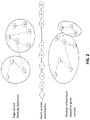
- FIG. 2 shows a refinement of modules based on the gene context information, in accordance with an embodiment of the present disclosure
- FIG. 3 is a flowchart illustrating the steps involved for estimation of functional potential of pathways in genomes and metagenomes, in accordance with an embodiment of the present disclosure
- FIG. 4 shows depiction of genes in a pathway within genome G1 where pathway does not exist but homologs of constituent genes occur scattered on the genome in accordance with an embodiment of the present disclosure
- FIG. 5 shows depiction of genome G2 where existence of pathway P is experimentally verified and constituting genes form a cluster on the genome in accordance with an embodiment of the present disclosure
- FIG. 6 shows the structure of tag map TM in accordance with an embodiment of the disclosure
- FIG. 7 depicts the identification of modules using fast greedy algorithm based on edge connectivity for mannose metabolism pathway in Escherichia coli as an example in accordance with an embodiment of the present disclosure
- FIG. 8 depicts the importance of accounting for genome context in identifying correct functional modules in bacteria for the example used in FIG. 6 , in accordance with an embodiment of the disclosure.
- FIG. 9 depicts the new modules defined for the example used in FIG. 6 after the refinement in accordance with an embodiment of the present disclosure.
- FIG. 1 where similar reference characters denote corresponding features consistently throughout the figures, there are shown preferred embodiments and these embodiments are described in the context of the following exemplary system and/or method.
- a system 100 for estimation of functional potential of pathways in genomes/metagenomes is shown in the block diagram of FIG. 1 .
- the system uses gene context information to estimate the functional potential of pathways.
- the disclosure provides a sophisticated pathway annotation using a set of innovative steps comprising of six query strings abbreviated as ‘6Q’.
- the disclosure uses a multidimensional module tag map to build a backend knowledge base and use it for an iterative literature search.
- a Hidden Markov Model (HMM) based search is used to infer the gene context and refine the modules using a graph theory based approach. It should be appreciated that the use of any other model is well within the scope of this disclosure.
- HMM Hidden Markov Model
- a score is assigned to compute the contribution of each pathway within the genome/metagenome.
- the system 100 comprises an input module 102 or user interface 102 , a memory 104 , a processor 106 and a public database 108 in communication with the memory 104 as shown in FIG. 1 .
- the processor 106 configured to execute a plurality of algorithms stored in the memory 104 .
- the processor 106 further includes a plurality of modules for performing various functions.
- the system 100 receives metagenomic samples collected from different environments using the user interface 102 .
- the samples received are then further analyzed to understand the functional potential of plurality of microbes comprising the microbiome.
- Functional potential primarily refers to the key metabolic pathways which are required for the maintenance of homeostasis within an organism or the ones required in breakdown and metabolism while obtaining nutrition from available resources.
- the user interface 102 may include a variety of software and hardware interfaces.
- the user interface 102 may allow the system 100 to interact with the user directly or through the client devices.
- the user interface 102 can facilitate multiple communications within a wide variety of networks and protocol types, including wired networks, for example, LAN, cable, etc., and wireless networks, such as WLAN, cellular, or satellite.
- the user interface 102 may include one or more ports for connecting a number of devices including assistive technology devices or adaptive products used by people with disability to one another or to another server.
- the system 100 also includes a public database 108 .
- a metabolic reaction knowledgebase is extracted from the public database 108 .
- a metabolic reaction involves reactants and products represented as compounds/metabolites involved in the reaction.
- the metabolic reaction knowledgebase comprises compounds involved in the pathways as nodes, while the reaction in the pathways as edges.
- a KEGG database has been used for extracting edge information.
- the system 100 might involve extraction of edge and node information using other pathway databases like PATRIC, BioCyc etc.
- the nodes and edges of a metabolic reaction network maybe in the form of ‘XML’ files or any other file in another embodiments.
- the nodes and edges are connected to create an undirected reaction network R.
- the processor 106 is configured to identify a plurality of seed modules in the reaction network R.
- the reaction network R gives information about connections between the compounds which are used for creating the initial network. Most networks consist of modules which are densely connected themselves but sparsely connected to other modules.
- the ‘edge betweenness’ score of an edge is used to measure the number of shortest paths through it. In this iterative process the edge betweenness is calculated, edge with the highest score is removed and the score is recalculated.
- the ‘Fastgreedy’ method can also be used for identifying the plurality of seed modules ‘M 1 . . . M n ’. The use of any other method for identifying a plurality of seeds is well within the scope of this disclosure.
- the processor 106 further configured to create a tag map (TM) for each of the identified seed modules represented by a module ID as shown in FIG. 6 .
- the tag map is a multidimensional representation in the computer memory. It should be appreciated that each of the plurality of seed modules comprises a plurality of tag map values.
- each entry of the tag map comprises of six values as follows. The first value is a unique alphanumeric ID for a module such as a ‘TM_key’. The unique alphanumeric ID forms the primary identifier. The second value for the module as ‘NameString’. The second value is a manually curated string identifier for a pathway module. The third value is for the module as ‘ReactantString’.
- the third value is a manually curated string identifier for source metabolite/reactant.
- the fourth value is for the module as ‘ProductString’.
- the fourth value is a manually curated string identifier for target metabolite/product.
- the fifth value is for the module as ‘MetabolismString’.
- the fifth value is a manually curated string specifying Degradation (D)/Synthesis (S)/Metabolism (M).
- the sixth value is for the protein family list or the Pfam list as ‘PfamList’.
- the sixth value is an empty string whose values get populated at a later stage.
- the processor 106 further configured to generate an organism map for each of the tag map.
- the system 100 further generates a list of six queries to a biomedical literature search engine corresponding to the plurality of tag map values corresponding to the tag map.
- a total of six queries (Q1 to Q6) are generated for each of the unique alphanumeric ID. These queries are various permutation and combination of plurality of tag map values in addition to additional requirement.
- the list of six queries comprises:
- a curated biomedical literature search engine such as PubMed is used.
- the use of any other search engine is well within the scope of this disclosure.
- the six queries Q1 to Q6 are provided as input to the search engine.
- the search engine provides output as six lists L1 to L6 of PubMed IDs corresponding to the six input queries.
- the PubMed IDs are sorted by relevance for each query.
- Each list is then filtered to obtain the top 100 hits.
- the consensus PubMed IDs with occurrences in at least four of the six lists are stored in a new list ‘NL’.
- a pre-calculated mapping of PubMed IDs to the organisms is then created to generate a hash ‘PO’ with PubMed IDs as key and organism names as ‘values’.
- the hash ‘PO’ is used to find the organism names mapped to each PubMed ID in the list ‘NL’.
- the output organism names is stored in a new list ‘OL’, thus creating the organism map corresponding to the tag map.
- searching can also be performed on other literature database such as Pubtator etc. with same 6 Query approach.
- the processor 106 further configured to create a genome protein family map and a seed module protein family map using the organism map.
- the genome protein family map or the genome Pfam map is created as follows: initially a protein domain database ‘PDM’ is created. Any method present in the art can be used for that purpose. Further a database ‘BGD’ is created consisting of FASTA format protein sequences of bacterial genome with ‘genome name’ as primary identifiers (or keys) for each entry. Subsequently, a Hidden Markov model (HMM) based protein domain search (using HMMER in this implementation) on ‘BGD’ using ‘PDM’ as domain database is performed. Finally Pfams are obtained corresponding to each genome ‘G’ and a mapping hash ‘GP’ is created with ‘key’ as ‘genome name’ and ‘value’ as Pfam list ‘PLG’.
- HMM Hidden Markov model
- Each ‘PLG’ list is sorted based on corresponding gene locations.
- NCBI .ptt files were used as reference.
- assignments may be done using other HMM databases like InterPro, SMART etc. or PSSM based databases like conserved domain database (CDD).
- CDD conserved domain database
- the genome context information can be obtained using any other bank or source such as Genbank file of a genome as reference too.
- the seed module protein family map is created as follows.
- the corresponding Pfam IDs are obtained as a list ‘PLM’ for each edge of network created for each of the modules ‘TM_key’.
- the corresponding Pfam IDs are obtained from KGML.
- the sixth value of the hash ‘TM’ is updated with the list ‘PLM’ as obtained above.
- the processor 106 further configured to refine the identified seed modules as shown in the schematic representation of FIG. 2 .
- the refinement is done based on gene context information using the genome protein family map and the seed module protein family map.
- the module contents corresponding to the fifth values (‘PfamList’) of ‘TM’ for each modules M 1 . . . M n are identified.
- a location array ‘LA’ is created for ‘PfamList’ of each module using ‘GP’ as reference.
- all location arrays are merged into a single location array ‘SLA’ keeping only unique locations.
- Location clusters are then identified from ‘SLA’ separated not more than 10 genes. And finally, each new cluster is assigned as ‘NewModuleID’.
- a new multi-dimensional module tag map ‘TM2’ is created with ‘NewModuleID’ as key and following two values.
- the first value for the new modules as ‘NewPfamList’ (pfams constituting the new module).
- the ‘OrganismList’ comprises organisms which have the new module.
- the processor 106 further configured to create a matrix of genomes against pathways using the genome protein family map and the new tag map.
- this referred pathway corresponds to our defined pathway and not a public pathway like KEGG.
- the genome protein family map is used to search for those organisms which have all the Pfams in the gene context.
- a matrix of Genome vs Pathways is then created for pathways M 1 . . . M m and Genomes G 1 . . . G n .
- a matrix of genomes against domains is created using genome protein family map.
- the processor 106 is also configured to calculate a functional potential of pathways in terms of three scores.
- the three scores are calculated using domain probability.
- the domain probability is referred as the probability of occurrence of i th domain ‘D’ in the seed module ‘M’ present in the genome ‘G’.
- the domain probability is calculated using the formula shown below:
- the three scores include domain presence score (DPS), domain skew index (DSI), and module probability score (MPS).
- DPS domain presence score
- DSI domain skew index
- MPS module probability score
- the domain skew index is calculated using following formula:
- the module probability score is calculated using following formula:
- n Total number of domains in a module ‘M’ in genome ‘G’ for P i D ⁇ 0
- a flowchart 200 illustrates the steps involved for estimation of functional potential of pathways in genomes and metagenomes.
- a metabolic reaction knowledgebase from the public database 108 is extracted.
- the metabolic reaction knowledgebase comprises multiple compounds and reactions.
- the compounds in pathways are referred as nodes and reactions in pathways are referred as edges.
- the nodes and edges are connected to create a reaction network.
- the plurality of seed modules are identified in the reaction network using an edge betweenness score of the edges.
- a ‘FastGreedy’ method is used for identifying the plurality of seed modules.
- the multi-dimensional module tag map is created for each of the identified seed modules represented by a module ID.
- the tag map has the plurality of tag map values including the value for the primary identifier, the first value for string identifier for the pathway module, the second value for string identifier for source metabolite/reactant, the third value for string identifier for target metabolite/product, the fourth value for string specifying degradation/synthesis/metabolism and the fifth value for the Pfam list.
- the list of six queries is provided to the biomedical literature search engine corresponding to the plurality of tag map values.
- the biomedical literature search engine results in the generation of a new list having a set of top search engine IDs and corresponding organisms.
- the organism map is created for each of the tag map by mapping the module IDs with the corresponding organisms.
- the genome protein family map and a seed module protein family map is created using the organism map.
- the identified seed modules are refined based on a gene context information using the genome protein family map and the seed module protein family map.
- the refining results in the generation of the new tag map.
- a matrix of genomes against pathways is created using genome protein family map and the new tag map.
- the referred pathway corresponds to our defined pathway and not a public pathway like KEGG.
- the matrix of genomes against domains is created using genome protein family map.
- a domain probability score of occurrence of the domain in the seed module in the genome is calculated.
- the domain presence score, the domain skew index and the module probability score is calculated using the domain probability to predict the functional potential of the pathways in the genome.
- FIGS. 4 and 5 depicts a case study wherein the occurrence of Genes 1, 2, 3, 4 that are constituents of pathway P in (a) Genome G1 which lacks the pathway and (b) Genome G2 which is experimentally proven to possess it.
- FIG. 4 shows that genome G1 contains homologs for all genes within this pathway but they are scattered on the genome probably functional in other pathways separately as shown with the help of dotted lines in the figure. A method not accounting for genome context will also annotate this mere presence of four genes on the genome as a pathway, which would give misleading results.
- FIG. 5 shows that in Genome G2 the genes of pathway P are arranged in a juxtaposed manner and form the actual pathway.
- the homologs of Gene 3 and Gene 4 occur elsewhere on the genome also but are not part of the pathway P under study. These homologs, which can bring about discrepant overestimation of copy number of a gene on the genome can also be removed out of calculation using genomic organization as an add-on.
- the primary identifiers include ‘TM_key’ and ‘NameString’ which help in identification of the manually curated modules.
- the NameString comprises “ReactantString_ProductString”.
- the ReactantString and ProductString identify the initial substrate and the final product of the corresponding module.
- MetabolismString indicates whether the module involves degradation of substrate/biosynthesis of product/metabolism.
- PfamList includes the HMM based PFAM assignments to each enzyme (edge of the network) connecting all intermediates between initial substrate and final product.
- the module includes four genes, which carry out biosynthesis (‘Metabolism String’) of GDP-L-Fucose (‘ProductString’ or final product) from Mannose-1-Phosphate (‘ReactantString’ or initial substrate).
- the pfam domains corresponding to these four genes have been listed in the column PfamList as shown in the table below:
- Escherichia coli was used as a reference organism to create list ‘OL’ for module 00051_Mannose-1-Phosphate_GDP-L-Fucose
- KEGG edge connectivity's in KEGG might not always represent actual biological phenomena correctly.
- An example is depicted below where Mannose metabolism pathway is shown according to edge connections provided by KEGG. The problem with the assignments arises because all parts of this pathway are not observed in all organisms.
- KEGG depicts all the interactions known for each compound irrespective of the organism being considered.
- the mannan pathway is observed only in eukaryotes while GDP fucose formation pathway is a prokaryotic pathway.
- Alginate pathways are observed in only few genera in bacteria e.g. Pseudomonas .
- the modules defined using these connections only as the basis may mask the actual biological significance.
- the modules predicted after refinement with gene context information are shown below in FIG. 9 .
- the genome context based module refinement defines new modules which have biological significance.
- the pathway from Mannose-6-phosphate to GDP-L fucose has been well characterized experimentally in bacteria and forms a gene cluster on genomes possessing this pathway.
- the pathway for alginate production has also been shown to occur in clustered arrangement on the Pseudomonas genome.
- the modules defined after using genome context are in agreement with experimental findings in literature.
- the hardware device can be any kind of device which can be programmed including e.g. any kind of computer like a server or a personal computer, or the like, or any combination thereof.
- the device may also include means which could be e.g. hardware means like e.g. an application-specific integrated circuit (ASIC), a field-programmable gate array (FPGA), or a combination of hardware and software means, e.g.
- ASIC application-specific integrated circuit
- FPGA field-programmable gate array
- the means can include both hardware means and software means.
- the method embodiments described herein could be implemented in hardware and software.
- the device may also include software means.
- the embodiments may be implemented on different hardware devices, e.g. using a plurality of CPUs.
- the embodiments herein can comprise hardware and software elements.
- the embodiments that are implemented in software include but are not limited to, firmware, resident software, microcode, etc.
- the functions performed by various modules described herein may be implemented in other modules or combinations of other modules.
- a computer-usable or computer readable medium can be any apparatus that can comprise, store, communicate, propagate, or transport the program for use by or in connection with the instruction execution system, apparatus, or device.
- the medium can be an electronic, magnetic, optical, electromagnetic, infrared, or semiconductor system (or apparatus or device) or a propagation medium.
- Examples of a computer-readable medium include a semiconductor or solid state memory, magnetic tape, a removable computer diskette, a random access memory (RAM), a read-only memory (ROM), a rigid magnetic disk and an optical disk.
- Current examples of optical disks include compact disk-read only memory (CD-ROM), compact disk-read/write (CD-R/W) and DVD.
- a data processing system suitable for storing and/or executing program code will include at least one processor coupled directly or indirectly to memory elements through a system bus.
- the memory elements can include local memory employed during actual execution of the program code, bulk storage, and cache memories which provide temporary storage of at least some program code in order to reduce the number of times code must be retrieved from bulk storage during execution.
- I/O devices can be coupled to the system either directly or through intervening I/O controllers.
- Network adapters may also be coupled to the system to enable the data processing system to become coupled to other data processing systems or remote printers or storage devices through intervening private or public networks. Modems, cable modem and Ethernet cards are just a few of the currently available types of network adapters.
- a representative hardware environment for practicing the embodiments may include a hardware configuration of an information handling/computer system in accordance with the embodiments herein.
- the system herein comprises at least one processor or central processing unit (CPU).
- the CPUs are interconnected via system bus to various devices such as a random access memory (RAM), read-only memory (ROM), and an input/output (I/O) adapter.
- RAM random access memory
- ROM read-only memory
- I/O input/output
- the I/O adapter can connect to peripheral devices, such as disk units and tape drives, or other program storage devices that are readable by the system.
- the system can read the inventive instructions on the program storage devices and follow these instructions to execute the methodology of the embodiments herein.
- the system further includes a user interface adapter that connects a keyboard, mouse, speaker, microphone, and/or other user interface devices such as a touch screen device (not shown) to the bus to gather user input.
- a communication adapter connects the bus to a data processing network
- a display adapter connects the bus to a display device which may be embodied as an output device such as a monitor, printer, or transmitter, for example.
Landscapes
- Engineering & Computer Science (AREA)
- Health & Medical Sciences (AREA)
- Life Sciences & Earth Sciences (AREA)
- Physics & Mathematics (AREA)
- Medical Informatics (AREA)
- Bioinformatics & Cheminformatics (AREA)
- General Health & Medical Sciences (AREA)
- Theoretical Computer Science (AREA)
- Biophysics (AREA)
- Spectroscopy & Molecular Physics (AREA)
- Evolutionary Biology (AREA)
- Bioinformatics & Computational Biology (AREA)
- Biotechnology (AREA)
- Data Mining & Analysis (AREA)
- Genetics & Genomics (AREA)
- Bioethics (AREA)
- Molecular Biology (AREA)
- Artificial Intelligence (AREA)
- Computer Vision & Pattern Recognition (AREA)
- Databases & Information Systems (AREA)
- Epidemiology (AREA)
- Evolutionary Computation (AREA)
- Public Health (AREA)
- Software Systems (AREA)
- Chemical & Material Sciences (AREA)
- Proteomics, Peptides & Aminoacids (AREA)
- Analytical Chemistry (AREA)
- Information Retrieval, Db Structures And Fs Structures Therefor (AREA)
Abstract
Description
Where,
K=1 if domain is found in context with other domains in the module
K=0 if domain is not found in context with other domains in the module or is absent in the genome.
ΣDi is the copy number of domain Di in genome ‘G’
DPSM G=Σi=1 n K
Where,
n=Total number of domains in a module ‘M’ in a genome ‘G’
K=1 if domain is found in context with other domains in the module.
K=0 if domain is not found in context with other domains in the module or is absent in the genome.
Where,
J=Total number of genomes present in the database where Σ Di≠0
ΣG Di is the copy number of ith domain ‘D’ in genome ‘G’.
Where,
n=Total number of domains in a module ‘M’ in genome ‘G’ for Pi D≠0
| Metabolism | |||||
| TM_key | NameString | ReactantString | ProductString | String | PfamList |
| 00051 | Mannose- | Mannose-1- | GDP-L-Fucose | Biosynthesis | PGM_PMM |
| Fucose | Phosphate | MannoseP_isomer | |||
| GDP_Man_dehyd | |||||
| Epimerase | |||||
IIb. Input for 6Q Approach and Module-Reference Organism Mapping
Claims (6)
Applications Claiming Priority (2)
| Application Number | Priority Date | Filing Date | Title |
|---|---|---|---|
| IN201621044472 | 2016-12-27 | ||
| IN201621044472 | 2016-12-27 |
Publications (2)
| Publication Number | Publication Date |
|---|---|
| US20180181702A1 US20180181702A1 (en) | 2018-06-28 |
| US11488687B2 true US11488687B2 (en) | 2022-11-01 |
Family
ID=60673359
Family Applications (1)
| Application Number | Title | Priority Date | Filing Date |
|---|---|---|---|
| US15/841,477 Active 2041-02-07 US11488687B2 (en) | 2016-12-27 | 2017-12-14 | System and method for improved estimation of functional potential of genomes and metagenomes |
Country Status (2)
| Country | Link |
|---|---|
| US (1) | US11488687B2 (en) |
| EP (1) | EP3343416B1 (en) |
Families Citing this family (5)
| Publication number | Priority date | Publication date | Assignee | Title |
|---|---|---|---|---|
| CN109063417B (en) * | 2018-07-09 | 2022-03-15 | 福建国脉生物科技有限公司 | A Genotype Filling Method for Constructing Hidden Markov Chains |
| JP7305789B2 (en) * | 2019-04-12 | 2023-07-10 | タタ・コンサルタンシー・サーヴィシズ・リミテッド | Systems and methods for bioremediation of contaminants |
| EP3979833A4 (en) * | 2019-06-06 | 2023-06-07 | Tata Consultancy Services Limited | SYSTEM AND METHOD FOR CONTROLLING PATHOGENIC BACTERIAL INFECTIONS OF PLANTS |
| CN114927173B (en) * | 2022-04-06 | 2024-03-05 | 西北工业大学 | Metabolic pathway prediction method based on label correlation and graph representation learning |
| CN117079712B (en) * | 2023-08-30 | 2024-02-20 | 中国农业科学院农业信息研究所 | A method, device, equipment and medium for mining pathway gene clusters |
Family Cites Families (4)
| Publication number | Priority date | Publication date | Assignee | Title |
|---|---|---|---|---|
| WO2001013105A1 (en) * | 1999-07-30 | 2001-02-22 | Agy Therapeutics, Inc. | Techniques for facilitating identification of candidate genes |
| US8000949B2 (en) * | 2001-06-18 | 2011-08-16 | Genego, Inc. | Methods for identification of novel protein drug targets and biomarkers utilizing functional networks |
| US20130116930A1 (en) * | 2011-08-22 | 2013-05-09 | The Board Of Trustees Of The Leland Stanford Junior University | Method and System for Assessment of Regulatory Variants in a Genome |
| US20210073352A9 (en) * | 2015-01-23 | 2021-03-11 | Data4Cure, Inc. | System and method for drug target and biomarker discovery and diagnosis using a multidimensional multiscale module map |
-
2017
- 2017-12-13 EP EP17206988.2A patent/EP3343416B1/en active Active
- 2017-12-14 US US15/841,477 patent/US11488687B2/en active Active
Non-Patent Citations (8)
| Title |
|---|
| Bose et al. PLoS One (vol. 10, No. 11 (2015):16 pages. * |
| Dudhagara et al. Genomics Proteomics Bioinformatics vol. 13 (2015):296-303. * |
| Huson et al. In Methods in Molecular Biology 856:Evolutionary Genomics, ed. Anisimova; Humana Press (2012): Chapter 17—Introduction to the Analysis of Environmental Sequences: Metagenomics with MEGAN:20 pages. * |
| Kowar et al. BMC Bioinformatics vol. 14 (2013):10 pages. * |
| Ogata, H. et al. (2000). "A heuristic graph comparison algorithm and its application to detect functionally related enzyme clusters," Nucleic Acids Research, vol. 28, No. 20; pp. 4021-4028. |
| Sorokina, M. et al. (Nov. 2015). "A new network representation of the metabolism to detect chemical transformation modules," BMC Bioinformatics, vol. 16, No. 385; pp. 1-9. |
| Teixeira, A.S. et al. "Spanning edge betweenness," Eleventh Workshop on Mining and Learning with Graphs, Aug. 11, 2013, Chicago. IL; 6 pages. |
| Zhao, S. et al. (Oct. 2013). "Discovery of new enzymes and metabolic pathways using structure and genome context." Nature, vol. 502, No. 7473; pp. 693-702. |
Also Published As
| Publication number | Publication date |
|---|---|
| EP3343416A1 (en) | 2018-07-04 |
| US20180181702A1 (en) | 2018-06-28 |
| EP3343416B1 (en) | 2024-03-06 |
| EP3343416C0 (en) | 2024-03-06 |
Similar Documents
| Publication | Publication Date | Title |
|---|---|---|
| Kuijjer et al. | Estimating sample-specific regulatory networks | |
| EP3343416B1 (en) | System and method for improved estimation of functional potential of genomes and metagenomes | |
| Nguyen et al. | TIPP: taxonomic identification and phylogenetic profiling | |
| Roush et al. | Cydrasil 3, a curated 16S rRNA gene reference package and web app for cyanobacterial phylogenetic placement | |
| AU2020409017B2 (en) | Linking individual datasets to a database | |
| US20140067813A1 (en) | Parallelization of synthetic events with genetic surprisal data representing a genetic sequence of an organism | |
| US20180301227A1 (en) | Predicting health outcomes | |
| US12222963B2 (en) | Data-sharding for efficient record search | |
| Campillo et al. | Mitochondrial genomes of the bird genus Piranga: rates of sequence evolution, and discordance between mitochondrial and nuclear markers | |
| Saitou et al. | Allele frequency impacts the cross-ancestry portability of gene expression prediction in lymphoblastoid cell lines | |
| Wang et al. | Advances, challenges and opportunities of phylogenetic and social network analysis using COVID-19 data | |
| Qiao et al. | Poisson hurdle model-based method for clustering microbiome features | |
| Li et al. | TLSEA: a tool for lncRNA set enrichment analysis based on multi-source heterogeneous information fusion | |
| Qi et al. | Transcriptome-wide association studies at cell-state level using single-cell eQTL data | |
| US12045219B2 (en) | Scoring method for matches based on age probability | |
| Li et al. | Correlated allele frequency changes reveal clonal structure and selection in temporal genetic data | |
| Podda et al. | Classification of Neisseria meningitidis genomes with a bag-of-words approach and machine learning | |
| Babalola et al. | Shotgun metagenomics dataset of Striga hermonthica-infested maize (Zea mays L.) rhizospheric soil microbiome | |
| Dong et al. | FunGraph: A statistical protocol to reconstruct omnigenic multilayer interactome networks for complex traits | |
| Shen et al. | MSeqDR Quick‐Mitome (QM): Combining Phenotype‐Guided Variant Interpretation and Machine Learning Classifiers to Aid Primary Mitochondrial Disease Genetic Diagnosis | |
| AU2023254037B2 (en) | Accelerated hidden markov models for genotype analysis | |
| US20210158902A1 (en) | System and method for allele interpretation using a graph-based reference genome | |
| Ruau et al. | Comparison of automated and human assignment of MeSH terms on publicly-available molecular datasets | |
| Farhadi et al. | DiMo: discovery of microRNA motifs using deep learning and motif embedding | |
| CA3165254C (en) | Linking individual datasets to a database |
Legal Events
| Date | Code | Title | Description |
|---|---|---|---|
| FEPP | Fee payment procedure |
Free format text: ENTITY STATUS SET TO UNDISCOUNTED (ORIGINAL EVENT CODE: BIG.); ENTITY STATUS OF PATENT OWNER: LARGE ENTITY |
|
| AS | Assignment |
Owner name: TATA CONSULTANCY SERVICES LIMITED, INDIA Free format text: ASSIGNMENT OF ASSIGNORS INTEREST;ASSIGNORS:MANDE, SHARMILA SHEKHAR;ANAND, SWADHA;BHUSAN, KUNTAL KUMAR;AND OTHERS;REEL/FRAME:044419/0961 Effective date: 20161026 |
|
| STPP | Information on status: patent application and granting procedure in general |
Free format text: DOCKETED NEW CASE - READY FOR EXAMINATION |
|
| STPP | Information on status: patent application and granting procedure in general |
Free format text: RESPONSE TO NON-FINAL OFFICE ACTION ENTERED AND FORWARDED TO EXAMINER |
|
| STPP | Information on status: patent application and granting procedure in general |
Free format text: NON FINAL ACTION MAILED |
|
| STPP | Information on status: patent application and granting procedure in general |
Free format text: RESPONSE TO NON-FINAL OFFICE ACTION ENTERED AND FORWARDED TO EXAMINER |
|
| STPP | Information on status: patent application and granting procedure in general |
Free format text: NOTICE OF ALLOWANCE MAILED -- APPLICATION RECEIVED IN OFFICE OF PUBLICATIONS |
|
| STPP | Information on status: patent application and granting procedure in general |
Free format text: PUBLICATIONS -- ISSUE FEE PAYMENT VERIFIED |
|
| STCF | Information on status: patent grant |
Free format text: PATENTED CASE |
|
| MAFP | Maintenance fee payment |
Free format text: PAYMENT OF MAINTENANCE FEE, 4TH YEAR, LARGE ENTITY (ORIGINAL EVENT CODE: M1551); ENTITY STATUS OF PATENT OWNER: LARGE ENTITY Year of fee payment: 4 |