US11482014B2 - 3D auto-labeling with structural and physical constraints - Google Patents
3D auto-labeling with structural and physical constraints Download PDFInfo
- Publication number
- US11482014B2 US11482014B2 US17/026,057 US202017026057A US11482014B2 US 11482014 B2 US11482014 B2 US 11482014B2 US 202017026057 A US202017026057 A US 202017026057A US 11482014 B2 US11482014 B2 US 11482014B2
- Authority
- US
- United States
- Prior art keywords
- auto
- vehicle
- seeds
- label
- program code
- Prior art date
- Legal status (The legal status is an assumption and is not a legal conclusion. Google has not performed a legal analysis and makes no representation as to the accuracy of the status listed.)
- Active, expires
Links
Images




Classifications
-
- G—PHYSICS
- G01—MEASURING; TESTING
- G01S—RADIO DIRECTION-FINDING; RADIO NAVIGATION; DETERMINING DISTANCE OR VELOCITY BY USE OF RADIO WAVES; LOCATING OR PRESENCE-DETECTING BY USE OF THE REFLECTION OR RERADIATION OF RADIO WAVES; ANALOGOUS ARRANGEMENTS USING OTHER WAVES
- G01S13/00—Systems using the reflection or reradiation of radio waves, e.g. radar systems; Analogous systems using reflection or reradiation of waves whose nature or wavelength is irrelevant or unspecified
- G01S13/86—Combinations of radar systems with non-radar systems, e.g. sonar, direction finder
- G01S13/862—Combination of radar systems with sonar systems
-
- B—PERFORMING OPERATIONS; TRANSPORTING
- B60—VEHICLES IN GENERAL
- B60W—CONJOINT CONTROL OF VEHICLE SUB-UNITS OF DIFFERENT TYPE OR DIFFERENT FUNCTION; CONTROL SYSTEMS SPECIALLY ADAPTED FOR HYBRID VEHICLES; ROAD VEHICLE DRIVE CONTROL SYSTEMS FOR PURPOSES NOT RELATED TO THE CONTROL OF A PARTICULAR SUB-UNIT
- B60W60/00—Drive control systems specially adapted for autonomous road vehicles
- B60W60/001—Planning or execution of driving tasks
- B60W60/0027—Planning or execution of driving tasks using trajectory prediction for other traffic participants
-
- G—PHYSICS
- G01—MEASURING; TESTING
- G01S—RADIO DIRECTION-FINDING; RADIO NAVIGATION; DETERMINING DISTANCE OR VELOCITY BY USE OF RADIO WAVES; LOCATING OR PRESENCE-DETECTING BY USE OF THE REFLECTION OR RERADIATION OF RADIO WAVES; ANALOGOUS ARRANGEMENTS USING OTHER WAVES
- G01S13/00—Systems using the reflection or reradiation of radio waves, e.g. radar systems; Analogous systems using reflection or reradiation of waves whose nature or wavelength is irrelevant or unspecified
- G01S13/86—Combinations of radar systems with non-radar systems, e.g. sonar, direction finder
- G01S13/865—Combination of radar systems with lidar systems
-
- G—PHYSICS
- G01—MEASURING; TESTING
- G01S—RADIO DIRECTION-FINDING; RADIO NAVIGATION; DETERMINING DISTANCE OR VELOCITY BY USE OF RADIO WAVES; LOCATING OR PRESENCE-DETECTING BY USE OF THE REFLECTION OR RERADIATION OF RADIO WAVES; ANALOGOUS ARRANGEMENTS USING OTHER WAVES
- G01S13/00—Systems using the reflection or reradiation of radio waves, e.g. radar systems; Analogous systems using reflection or reradiation of waves whose nature or wavelength is irrelevant or unspecified
- G01S13/86—Combinations of radar systems with non-radar systems, e.g. sonar, direction finder
- G01S13/867—Combination of radar systems with cameras
-
- G—PHYSICS
- G01—MEASURING; TESTING
- G01S—RADIO DIRECTION-FINDING; RADIO NAVIGATION; DETERMINING DISTANCE OR VELOCITY BY USE OF RADIO WAVES; LOCATING OR PRESENCE-DETECTING BY USE OF THE REFLECTION OR RERADIATION OF RADIO WAVES; ANALOGOUS ARRANGEMENTS USING OTHER WAVES
- G01S13/00—Systems using the reflection or reradiation of radio waves, e.g. radar systems; Analogous systems using reflection or reradiation of waves whose nature or wavelength is irrelevant or unspecified
- G01S13/88—Radar or analogous systems specially adapted for specific applications
- G01S13/93—Radar or analogous systems specially adapted for specific applications for anti-collision purposes
- G01S13/931—Radar or analogous systems specially adapted for specific applications for anti-collision purposes of land vehicles
-
- G—PHYSICS
- G01—MEASURING; TESTING
- G01S—RADIO DIRECTION-FINDING; RADIO NAVIGATION; DETERMINING DISTANCE OR VELOCITY BY USE OF RADIO WAVES; LOCATING OR PRESENCE-DETECTING BY USE OF THE REFLECTION OR RERADIATION OF RADIO WAVES; ANALOGOUS ARRANGEMENTS USING OTHER WAVES
- G01S17/00—Systems using the reflection or reradiation of electromagnetic waves other than radio waves, e.g. lidar systems
- G01S17/02—Systems using the reflection of electromagnetic waves other than radio waves
- G01S17/06—Systems determining position data of a target
- G01S17/42—Simultaneous measurement of distance and other co-ordinates
-
- G—PHYSICS
- G01—MEASURING; TESTING
- G01S—RADIO DIRECTION-FINDING; RADIO NAVIGATION; DETERMINING DISTANCE OR VELOCITY BY USE OF RADIO WAVES; LOCATING OR PRESENCE-DETECTING BY USE OF THE REFLECTION OR RERADIATION OF RADIO WAVES; ANALOGOUS ARRANGEMENTS USING OTHER WAVES
- G01S17/00—Systems using the reflection or reradiation of electromagnetic waves other than radio waves, e.g. lidar systems
- G01S17/86—Combinations of lidar systems with systems other than lidar, radar or sonar, e.g. with direction finders
-
- G—PHYSICS
- G01—MEASURING; TESTING
- G01S—RADIO DIRECTION-FINDING; RADIO NAVIGATION; DETERMINING DISTANCE OR VELOCITY BY USE OF RADIO WAVES; LOCATING OR PRESENCE-DETECTING BY USE OF THE REFLECTION OR RERADIATION OF RADIO WAVES; ANALOGOUS ARRANGEMENTS USING OTHER WAVES
- G01S17/00—Systems using the reflection or reradiation of electromagnetic waves other than radio waves, e.g. lidar systems
- G01S17/88—Lidar systems specially adapted for specific applications
- G01S17/89—Lidar systems specially adapted for specific applications for mapping or imaging
-
- G—PHYSICS
- G01—MEASURING; TESTING
- G01S—RADIO DIRECTION-FINDING; RADIO NAVIGATION; DETERMINING DISTANCE OR VELOCITY BY USE OF RADIO WAVES; LOCATING OR PRESENCE-DETECTING BY USE OF THE REFLECTION OR RERADIATION OF RADIO WAVES; ANALOGOUS ARRANGEMENTS USING OTHER WAVES
- G01S17/00—Systems using the reflection or reradiation of electromagnetic waves other than radio waves, e.g. lidar systems
- G01S17/88—Lidar systems specially adapted for specific applications
- G01S17/93—Lidar systems specially adapted for specific applications for anti-collision purposes
- G01S17/931—Lidar systems specially adapted for specific applications for anti-collision purposes of land vehicles
-
- G—PHYSICS
- G01—MEASURING; TESTING
- G01S—RADIO DIRECTION-FINDING; RADIO NAVIGATION; DETERMINING DISTANCE OR VELOCITY BY USE OF RADIO WAVES; LOCATING OR PRESENCE-DETECTING BY USE OF THE REFLECTION OR RERADIATION OF RADIO WAVES; ANALOGOUS ARRANGEMENTS USING OTHER WAVES
- G01S7/00—Details of systems according to groups G01S13/00, G01S15/00, G01S17/00
- G01S7/48—Details of systems according to groups G01S13/00, G01S15/00, G01S17/00 of systems according to group G01S17/00
- G01S7/4802—Details of systems according to groups G01S13/00, G01S15/00, G01S17/00 of systems according to group G01S17/00 using analysis of echo signal for target characterisation; Target signature; Target cross-section
-
- G—PHYSICS
- G01—MEASURING; TESTING
- G01S—RADIO DIRECTION-FINDING; RADIO NAVIGATION; DETERMINING DISTANCE OR VELOCITY BY USE OF RADIO WAVES; LOCATING OR PRESENCE-DETECTING BY USE OF THE REFLECTION OR RERADIATION OF RADIO WAVES; ANALOGOUS ARRANGEMENTS USING OTHER WAVES
- G01S7/00—Details of systems according to groups G01S13/00, G01S15/00, G01S17/00
- G01S7/48—Details of systems according to groups G01S13/00, G01S15/00, G01S17/00 of systems according to group G01S17/00
- G01S7/4808—Evaluating distance, position or velocity data
-
- G—PHYSICS
- G06—COMPUTING OR CALCULATING; COUNTING
- G06N—COMPUTING ARRANGEMENTS BASED ON SPECIFIC COMPUTATIONAL MODELS
- G06N3/00—Computing arrangements based on biological models
- G06N3/02—Neural networks
- G06N3/04—Architecture, e.g. interconnection topology
-
- G—PHYSICS
- G06—COMPUTING OR CALCULATING; COUNTING
- G06N—COMPUTING ARRANGEMENTS BASED ON SPECIFIC COMPUTATIONAL MODELS
- G06N3/00—Computing arrangements based on biological models
- G06N3/02—Neural networks
- G06N3/04—Architecture, e.g. interconnection topology
- G06N3/045—Combinations of networks
-
- G—PHYSICS
- G06—COMPUTING OR CALCULATING; COUNTING
- G06N—COMPUTING ARRANGEMENTS BASED ON SPECIFIC COMPUTATIONAL MODELS
- G06N3/00—Computing arrangements based on biological models
- G06N3/02—Neural networks
- G06N3/04—Architecture, e.g. interconnection topology
- G06N3/0464—Convolutional networks [CNN, ConvNet]
-
- G—PHYSICS
- G06—COMPUTING OR CALCULATING; COUNTING
- G06N—COMPUTING ARRANGEMENTS BASED ON SPECIFIC COMPUTATIONAL MODELS
- G06N3/00—Computing arrangements based on biological models
- G06N3/02—Neural networks
- G06N3/08—Learning methods
-
- G—PHYSICS
- G06—COMPUTING OR CALCULATING; COUNTING
- G06N—COMPUTING ARRANGEMENTS BASED ON SPECIFIC COMPUTATIONAL MODELS
- G06N3/00—Computing arrangements based on biological models
- G06N3/02—Neural networks
- G06N3/08—Learning methods
- G06N3/084—Backpropagation, e.g. using gradient descent
-
- G—PHYSICS
- G06—COMPUTING OR CALCULATING; COUNTING
- G06N—COMPUTING ARRANGEMENTS BASED ON SPECIFIC COMPUTATIONAL MODELS
- G06N3/00—Computing arrangements based on biological models
- G06N3/02—Neural networks
- G06N3/08—Learning methods
- G06N3/0895—Weakly supervised learning, e.g. semi-supervised or self-supervised learning
-
- G—PHYSICS
- G06—COMPUTING OR CALCULATING; COUNTING
- G06N—COMPUTING ARRANGEMENTS BASED ON SPECIFIC COMPUTATIONAL MODELS
- G06N3/00—Computing arrangements based on biological models
- G06N3/02—Neural networks
- G06N3/08—Learning methods
- G06N3/09—Supervised learning
-
- G—PHYSICS
- G06—COMPUTING OR CALCULATING; COUNTING
- G06T—IMAGE DATA PROCESSING OR GENERATION, IN GENERAL
- G06T7/00—Image analysis
- G06T7/30—Determination of transform parameters for the alignment of images, i.e. image registration
-
- G—PHYSICS
- G06—COMPUTING OR CALCULATING; COUNTING
- G06T—IMAGE DATA PROCESSING OR GENERATION, IN GENERAL
- G06T7/00—Image analysis
- G06T7/70—Determining position or orientation of objects or cameras
-
- G—PHYSICS
- G06—COMPUTING OR CALCULATING; COUNTING
- G06T—IMAGE DATA PROCESSING OR GENERATION, IN GENERAL
- G06T7/00—Image analysis
- G06T7/70—Determining position or orientation of objects or cameras
- G06T7/73—Determining position or orientation of objects or cameras using feature-based methods
- G06T7/75—Determining position or orientation of objects or cameras using feature-based methods involving models
-
- G—PHYSICS
- G06—COMPUTING OR CALCULATING; COUNTING
- G06V—IMAGE OR VIDEO RECOGNITION OR UNDERSTANDING
- G06V10/00—Arrangements for image or video recognition or understanding
- G06V10/70—Arrangements for image or video recognition or understanding using pattern recognition or machine learning
- G06V10/764—Arrangements for image or video recognition or understanding using pattern recognition or machine learning using classification, e.g. of video objects
-
- G—PHYSICS
- G06—COMPUTING OR CALCULATING; COUNTING
- G06V—IMAGE OR VIDEO RECOGNITION OR UNDERSTANDING
- G06V10/00—Arrangements for image or video recognition or understanding
- G06V10/70—Arrangements for image or video recognition or understanding using pattern recognition or machine learning
- G06V10/82—Arrangements for image or video recognition or understanding using pattern recognition or machine learning using neural networks
-
- G—PHYSICS
- G06—COMPUTING OR CALCULATING; COUNTING
- G06V—IMAGE OR VIDEO RECOGNITION OR UNDERSTANDING
- G06V20/00—Scenes; Scene-specific elements
- G06V20/50—Context or environment of the image
- G06V20/56—Context or environment of the image exterior to a vehicle by using sensors mounted on the vehicle
-
- G—PHYSICS
- G06—COMPUTING OR CALCULATING; COUNTING
- G06V—IMAGE OR VIDEO RECOGNITION OR UNDERSTANDING
- G06V20/00—Scenes; Scene-specific elements
- G06V20/50—Context or environment of the image
- G06V20/56—Context or environment of the image exterior to a vehicle by using sensors mounted on the vehicle
- G06V20/58—Recognition of moving objects or obstacles, e.g. vehicles or pedestrians; Recognition of traffic objects, e.g. traffic signs, traffic lights or roads
- G06V20/584—Recognition of moving objects or obstacles, e.g. vehicles or pedestrians; Recognition of traffic objects, e.g. traffic signs, traffic lights or roads of vehicle lights or traffic lights
-
- G—PHYSICS
- G06—COMPUTING OR CALCULATING; COUNTING
- G06V—IMAGE OR VIDEO RECOGNITION OR UNDERSTANDING
- G06V20/00—Scenes; Scene-specific elements
- G06V20/60—Type of objects
- G06V20/64—Three-dimensional [3D] objects
-
- B—PERFORMING OPERATIONS; TRANSPORTING
- B60—VEHICLES IN GENERAL
- B60W—CONJOINT CONTROL OF VEHICLE SUB-UNITS OF DIFFERENT TYPE OR DIFFERENT FUNCTION; CONTROL SYSTEMS SPECIALLY ADAPTED FOR HYBRID VEHICLES; ROAD VEHICLE DRIVE CONTROL SYSTEMS FOR PURPOSES NOT RELATED TO THE CONTROL OF A PARTICULAR SUB-UNIT
- B60W2420/00—Indexing codes relating to the type of sensors based on the principle of their operation
- B60W2420/40—Photo, light or radio wave sensitive means, e.g. infrared sensors
- B60W2420/403—Image sensing, e.g. optical camera
-
- B60W2420/42—
-
- B—PERFORMING OPERATIONS; TRANSPORTING
- B60—VEHICLES IN GENERAL
- B60W—CONJOINT CONTROL OF VEHICLE SUB-UNITS OF DIFFERENT TYPE OR DIFFERENT FUNCTION; CONTROL SYSTEMS SPECIALLY ADAPTED FOR HYBRID VEHICLES; ROAD VEHICLE DRIVE CONTROL SYSTEMS FOR PURPOSES NOT RELATED TO THE CONTROL OF A PARTICULAR SUB-UNIT
- B60W2552/00—Input parameters relating to infrastructure
-
- B—PERFORMING OPERATIONS; TRANSPORTING
- B60—VEHICLES IN GENERAL
- B60W—CONJOINT CONTROL OF VEHICLE SUB-UNITS OF DIFFERENT TYPE OR DIFFERENT FUNCTION; CONTROL SYSTEMS SPECIALLY ADAPTED FOR HYBRID VEHICLES; ROAD VEHICLE DRIVE CONTROL SYSTEMS FOR PURPOSES NOT RELATED TO THE CONTROL OF A PARTICULAR SUB-UNIT
- B60W2554/00—Input parameters relating to objects
- B60W2554/40—Dynamic objects, e.g. animals, windblown objects
- B60W2554/404—Characteristics
-
- G—PHYSICS
- G06—COMPUTING OR CALCULATING; COUNTING
- G06N—COMPUTING ARRANGEMENTS BASED ON SPECIFIC COMPUTATIONAL MODELS
- G06N3/00—Computing arrangements based on biological models
- G06N3/02—Neural networks
- G06N3/04—Architecture, e.g. interconnection topology
- G06N3/048—Activation functions
-
- G—PHYSICS
- G06—COMPUTING OR CALCULATING; COUNTING
- G06T—IMAGE DATA PROCESSING OR GENERATION, IN GENERAL
- G06T2207/00—Indexing scheme for image analysis or image enhancement
- G06T2207/10—Image acquisition modality
- G06T2207/10016—Video; Image sequence
-
- G—PHYSICS
- G06—COMPUTING OR CALCULATING; COUNTING
- G06T—IMAGE DATA PROCESSING OR GENERATION, IN GENERAL
- G06T2207/00—Indexing scheme for image analysis or image enhancement
- G06T2207/10—Image acquisition modality
- G06T2207/10028—Range image; Depth image; 3D point clouds
-
- G—PHYSICS
- G06—COMPUTING OR CALCULATING; COUNTING
- G06T—IMAGE DATA PROCESSING OR GENERATION, IN GENERAL
- G06T2207/00—Indexing scheme for image analysis or image enhancement
- G06T2207/20—Special algorithmic details
- G06T2207/20081—Training; Learning
-
- G—PHYSICS
- G06—COMPUTING OR CALCULATING; COUNTING
- G06T—IMAGE DATA PROCESSING OR GENERATION, IN GENERAL
- G06T2207/00—Indexing scheme for image analysis or image enhancement
- G06T2207/20—Special algorithmic details
- G06T2207/20084—Artificial neural networks [ANN]
-
- G—PHYSICS
- G06—COMPUTING OR CALCULATING; COUNTING
- G06T—IMAGE DATA PROCESSING OR GENERATION, IN GENERAL
- G06T2207/00—Indexing scheme for image analysis or image enhancement
- G06T2207/30—Subject of image; Context of image processing
- G06T2207/30196—Human being; Person
-
- G—PHYSICS
- G06—COMPUTING OR CALCULATING; COUNTING
- G06T—IMAGE DATA PROCESSING OR GENERATION, IN GENERAL
- G06T2207/00—Indexing scheme for image analysis or image enhancement
- G06T2207/30—Subject of image; Context of image processing
- G06T2207/30241—Trajectory
-
- G—PHYSICS
- G06—COMPUTING OR CALCULATING; COUNTING
- G06T—IMAGE DATA PROCESSING OR GENERATION, IN GENERAL
- G06T2207/00—Indexing scheme for image analysis or image enhancement
- G06T2207/30—Subject of image; Context of image processing
- G06T2207/30248—Vehicle exterior or interior
- G06T2207/30252—Vehicle exterior; Vicinity of vehicle
-
- G—PHYSICS
- G06—COMPUTING OR CALCULATING; COUNTING
- G06T—IMAGE DATA PROCESSING OR GENERATION, IN GENERAL
- G06T2207/00—Indexing scheme for image analysis or image enhancement
- G06T2207/30—Subject of image; Context of image processing
- G06T2207/30248—Vehicle exterior or interior
- G06T2207/30252—Vehicle exterior; Vicinity of vehicle
- G06T2207/30261—Obstacle
Definitions
- Certain aspects of the present disclosure generally relate to machine learning and, more particularly, 3D auto-labeling of objects bound by structural and physical constraints.
- Machine vision is distinct from the field of digital image processing because of the desire to recover a three-dimensional (3D) structure of the world from images and using the 3D structure for fully understanding a scene. That is, machine vision strives to provide a high-level understanding of a surrounding environment, as performed by the human visual system.
- autonomous agents may rely on a trained deep neural network (DNN) to identify objects within areas of interest in an image of a surrounding scene of the autonomous agent.
- DNN deep neural network
- a DNN may be trained to identify and track objects captured by one or more sensors, such as light detection and ranging (LIDAR) sensors, sonar sensors, red-green-blue (RGB) cameras, RGB-depth (RGB-D) cameras, and the like.
- LIDAR light detection and ranging
- RGB red-green-blue
- RGB-D RGB-depth
- the DNN may be trained to understand a scene from a video input based on annotations of automobiles within the scene.
- annotating video is a challenging task involving deep understanding of visual scenes.
- a method for 3D auto-labeling of objects with predetermined structural and physical constraints includes identifying initial object-seeds for all frames from a given frame sequence of a scene. The method also includes refining each of the initial object-seeds over the 2D/3D data, while complying with the predetermined structural and physical constraints to auto-label 3D object vehicles within the scene. The method further includes linking the auto-label 3D object vehicles over time into trajectories while respecting the predetermined structural and physical constraints.
- a non-transitory computer-readable medium includes program code recorded thereon for 3D auto-labeling of objects with predetermined structural and physical constraints, in which the program code is executed by a processor.
- the non-transitory computer-readable medium includes program code to identify initial object-seeds for all frames from a given frame sequence of a scene.
- the non-transitory computer-readable medium also includes program code to refine each of the initial object-seeds over the 2D/3D data, while complying with the predetermined structural and physical constraints to auto-label 3D object vehicles within the scene.
- the non-transitory computer-readable medium further includes program code to link the auto-label 3D object vehicles over time into trajectories while respecting the predetermined structural and physical constraints.
- a system for 3D auto-labeling of objects with predetermined structural and physical constraints includes an object-seed detection module.
- the object-seed detection module trained to identify initial object-seeds for all frames from a given frame sequence of a scene.
- the system also includes an object-seed refinement module.
- the object-seed refinement module is trained to refine each of the initial object-seeds over the 2D/3D data, while complying with the predetermined structural and physical constraints to auto-label 3D object vehicles within the scene.
- the system further includes a 3D auto-labeling module.
- 3D auto-labeling module is trained to link the auto-label 3D object vehicles over time into trajectories while respecting the predetermined structural and physical constraints.
- FIG. 1 illustrates an example implementation of designing a system using a system-on-a-chip (SOC) for 3D auto-labeling with structural and physical constraints, in accordance with aspects of the present disclosure.
- SOC system-on-a-chip
- FIG. 2 is a block diagram illustrating a software architecture that may modularize functions for 3D auto-labeling with structural and physical constraints, according to aspects of the present disclosure.
- FIG. 3 is a diagram illustrating an example of a hardware implementation for a 3D auto-labeling system with structural and physical constraints, according to aspects of the present disclosure.
- FIG. 4 is a block diagram of a 3D auto-labeling pipeline for the 3D auto-labeling system of FIG. 3 , according to aspects of the present disclosure.
- FIGS. 5A-5C illustrate surface projection of an object using signed-distance-fields (SDFs), according to aspects of the present disclosure.
- SDFs signed-distance-fields
- FIG. 6 is a diagram of the initialization portion of a 3D auto-labeling pipeline for the 3D auto-labeling system of FIG. 3 , according to aspects of the present disclosure.
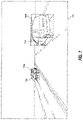
- FIG. 7 shows examples of 3D labels output by a 3D auto-labeling pipeline for the 3D auto-labeling system of FIG. 3 , in accordance with an illustrative configuration of the present disclosure.
- FIG. 8 illustrates a system architecture of a 3D auto-labeling pipeline for the 3D auto-labeling system of FIG. 3 , according to aspects of the present disclosure.
- FIG. 9 is a flowchart illustrating a method of 3D auto-labeling of objects with structural and physical constraints, according to aspects of the present disclosure.
- Deep learning often involves large labeled datasets to reach state-of-the-art performance.
- 3D cuboids are one annotation type because they allow for proper reasoning over all nine degrees of freedom (three degrees of freedom for each instance of location, orientation, and metric extent).
- acquiring enough labels to train 3D object detectors can be laborious and costly, as it mostly relies on a large number of human annotators.
- Conventional approaches to scaling up annotation pipelines include better tooling, active learning, or a combination thereof. These approaches often rely on heuristics and involve humans in the loop to correct the semi-automatic labeling, especially for difficult edge cases.
- aspects of the present disclosure provide an improvement over the conventional annotation methods by using several different priors for auto-labeling objects (e.g., vehicles and non-vehicles). These priors include things such as the vehicles are located on the ground, vehicles cannot penetrate other vehicles, vehicles have four wheels, etc.
- This aspect of the present disclosure effectively uses shape priors to auto-label objects.
- the shape priors include certain constraints, including that the vehicle is rigid, the vehicle should be located on the ground, and the vehicle cannot penetrate another vehicle.
- One aspect of the present disclosure provides an improved three-dimensional (3D) annotation and object-detection system by relying on differentiable rendering of shape priors.
- differentiable rendering of shape priors enables recovery of metric scale, pose, and shape of objects (e.g., vehicles, in the case of an autonomous-driving system) in the wild.
- a 3D auto-labeling pipeline specifies, as input, 2D detections (e.g., bounding boxes or instance masks) and sparse LIDAR point clouds. LIDAR point clouds are now ubiquitous in 3D robotics applications. In fact, the object detections themselves can even be produced by off-the-shelf 2D object detectors.
- One configuration of the 3D annotation and object-detection system includes a continuously traversable coordinate shape-space (CSS) that combines a signed-distance-field (SDF) shape-space (e.g., a “DeepSDF” shape-space framework) with normalized object coordinates (NOCS).
- SDF signed-distance-field
- NOCS normalized object coordinates
- the auto-labeling loop includes (1) leveraging 2D annotations to localize instances, (2) running the CSS network on an extracted patch of an input image, (3) re-projecting NOCS into the scene via LIDAR, (4) recovering an object model from the CSS, (5) computing an approximate pose via 3D-3D correspondences, and (6) running projective and geometric alignment for refinement of the initial estimate.
- shape prior is information known about the shape of objects in advance.
- the shape prior information may recognize that vehicles should have a rigid shape.
- This shape prior information may be expanded to improve the accuracy of auto labeling.
- the shape priors may include the following information, such as the vehicles should have four or more wheels, the vehicles should be located on the ground, and the vehicles should not penetrate each other.
- FIG. 1 illustrates an example implementation of the aforementioned system and method for 3D auto-labeling with structural and physical constraints using a system-on-a-chip (SOC) 100 of an ego vehicle 150 .
- the SOC 100 may include a single processor or multi-core processors (e.g., a central processing unit), in accordance with certain aspects of the present disclosure.
- Variables e.g., neural signals and synaptic weights
- system parameters associated with a computational device e.g., neural network with weights
- delays e.g., frequency bin information, and task information
- task information may be stored in a memory block.
- the SOC 100 may be based on an Advanced Risk Machine (ARM) instruction set or the like.
- the SOC 100 may be a server computer in communication with the ego vehicle 150 .
- the ego vehicle 150 may include a processor and other features of the SOC 100 .
- instructions loaded into a processor (e.g., CPU 102 ) or the NPU 108 of the ego vehicle 150 may include code for 3D auto-labeling with structural and physical constraints of objects (e.g., vehicle and non-vehicle objects) within an image captured by the sensor processor 114 .
- FIG. 2 is a block diagram illustrating a software architecture 200 that may modularize functions for planning and control of an ego vehicle using a 3D auto-labeling system with structural and physical constraints, according to aspects of the present disclosure.
- a controller application 202 may be designed such that it may cause various processing blocks of an SOC 220 (for example a CPU 222 , a DSP 224 , a GPU 226 , and/or an NPU 228 ) to perform supporting computations during run-time operation of the controller application 202 .
- an SOC 220 for example a CPU 222 , a DSP 224 , a GPU 226 , and/or an NPU 228 .
- the controller application 202 may be configured to call functions defined in a user space 204 that may, for example, analyze a scene in a video captured by a monocular camera of an ego vehicle based on 3D auto-labeling of objects in the scene.
- 3D auto-labeling of objects e.g., vehicle and non-vehicle objects
- the controller application 202 may make a request to compile program code associated with a library defined in a 3D auto-labeling application programming interface (API) 206 to label vehicles within a scene of a video captured by the monocular camera of the ego vehicle using structural and physical constraints as shape priors.
- API application programming interface
- a run-time engine 208 which may be compiled code of a run-time framework, may be further accessible to the controller application 202 .
- the controller application 202 may cause the run-time engine 208 , for example, to perform monocular (single-camera) 3D detection and auto-labeling.
- the run-time engine 208 may in turn send a signal to an operating system 210 , such as a Linux Kernel 212 , running on the SOC 220 .
- the operating system 210 may cause a computation to be performed on the CPU 222 , the DSP 224 , the GPU 226 , the NPU 228 , or some combination thereof.
- the 3D auto-labeling system 300 may be implemented with an interconnected architecture, represented generally by an interconnect 308 .
- the interconnect 308 may include any number of point-to-point interconnects, buses, and/or bridges depending on the specific application of the 3D auto-labeling system 300 and the overall design constraints of the car 350 .
- the interconnect 308 links together various circuits, including one or more processors and/or hardware modules, represented by a sensor module 302 , a vehicle perception module 310 , a processor 320 , a computer-readable medium 322 , a communication module 324 , a locomotion module 326 , a location module 328 , a planner module 330 , and a controller module 340 .
- the interconnect 308 may also link various other circuits such as timing sources, peripherals, voltage regulators, and power management circuits, which are well known in the art, and therefore, will not be described any further.
- the 3D auto-labeling system 300 includes the processor 320 coupled to the computer-readable medium 322 .
- the processor 320 performs processing, including the execution of software stored on the computer-readable medium 322 to provide functionality, according to the present disclosure.
- the software when executed by the processor 320 , causes the 3D auto-labeling system 300 to perform the various functions described for ego vehicle perception of auto-labeled scenes within video captured by a single camera of an ego vehicle, such as the car 350 , or any of the modules (e.g., 302 , 310 , 324 , 326 , 328 , 330 , and/or 340 ).
- the computer-readable medium 322 may also be used for storing data that is manipulated by the processor 320 when executing the software.
- the sensor module 302 may obtain images via different sensors, such as a first sensor 304 and a second sensor 306 .
- the first sensor 304 may be a vision sensor (e.g., a stereoscopic camera or a red-green-blue (RGB) camera) for capturing 2D RGB images.
- the second sensor 306 may be a ranging sensor, such as a light detection and ranging (LIDAR) sensor or a radio detection and ranging (RADAR) sensor.
- LIDAR light detection and ranging
- RADAR radio detection and ranging
- aspects of the present disclosure are not limited to the aforementioned sensors, as other types of sensors (e.g., thermal, sonar, and/or lasers) are also contemplated for either of the first sensor 304 or the second sensor 306 .
- a DSRC-compliant GPS unit includes hardware and software to make the car 350 and/or the location module 328 compliant with one or more of the following DSRC standards, including any derivative or fork thereof: EN 12253:2004 Dedicated Short-Range Communication—Physical layer using microwave at 5.9 GHz (review); EN 12795:2002 Dedicated Short-Range Communication (DSRC)—DSRC Data link layer: Medium Access and Logical Link Control (review); EN 12834:2002 Dedicated Short-Range Communication—Application layer (review); EN 13372:2004 Dedicated Short-Range Communication (DSRC)—DSRC profiles for RTTT applications (review); and EN ISO 14906:2004 Electronic Fee Collection—Application interface.
- DSRC Dedicated Short-Range Communication
- a DSRC-compliant GPS unit within the location module 328 is operable to provide GPS data describing the location of the car 350 with space-level accuracy for accurately directing the car 350 to a desired location.
- the car 350 is driving to a predetermined location and desires partial sensor data.
- Space-level accuracy means the location of the car 350 is described by the GPS data sufficient to confirm a location of the car 350 parking space. That is, the location of the car 350 is accurately determined with space-level accuracy based on the GPS data from the car 350 .
- the network access point 360 includes Bluetooth® communication networks or a cellular communications network for sending and receiving data, including via short messaging service (SMS), multimedia messaging service (MMS), hypertext transfer protocol (HTTP), direct data connection, wireless application protocol (WAP), e-mail, DSRC, full-duplex wireless communications, mmWave, Wi-Fi (infrastructure mode), Wi-Fi (ad-hoc mode), visible light communication, TV white space communication, and satellite communication.
- the network access point 360 may also include a mobile data network that may include 3G, 4G, 5G, LTE, LTE-V2X, LTE-D2D, VoLTE, or any other mobile data network or combination of mobile data networks. Further, the network access point 360 may include one or more IEEE 802.11 wireless networks.
- the 3D auto-labeling system 300 also includes the planner module 330 for planning a selected trajectory to perform a route/action (e.g., collision avoidance) of the car 350 and the controller module 340 to control the locomotion of the car 350 .
- the controller module 340 may perform the selected action via the locomotion module 326 for autonomous operation of the car 350 along, for example, a selected route.
- the planner module 330 and the controller module 340 may collectively override a user input when the user input is expected (e.g., predicted) to cause a collision according to an autonomous level of the car 350 .
- the modules may be software modules running in the processor 320 , resident/stored in the computer-readable medium 322 , and/or hardware modules coupled to the processor 320 , or some combination thereof.
- the National Highway Traffic Safety Administration has defined different “levels” of autonomous vehicles (e.g., Level 0, Level 1, Level 2, Level 3, Level 4, and Level 5). For example, if an autonomous vehicle has a higher level number than another autonomous vehicle (e.g., Level 3 is a higher level number than Levels 2 or 1), then the autonomous vehicle with a higher level number offers a greater combination and quantity of autonomous features relative to the vehicle with the lower level number.
- level e.g., Level 0, Level 1, Level 2, Level 3, Level 4, and Level 5
- Level 3 is a higher level number than Levels 2 or 1
- the autonomous vehicle with a higher level number offers a greater combination and quantity of autonomous features relative to the vehicle with the lower level number.
- Level 0 In a Level 0 vehicle, the set of advanced driver assistance system (ADAS) features installed in a vehicle provide no vehicle control, but may issue warnings to the driver of the vehicle.
- ADAS advanced driver assistance system
- a vehicle which is Level 0 is not an autonomous or semi-autonomous vehicle.
- Level 1 In a Level 1 vehicle, the driver is ready to take driving control of the autonomous vehicle at any time.
- the set of ADAS features installed in the autonomous vehicle may provide autonomous features such as: adaptive cruise control (ACC); parking assistance with automated steering; and lane keeping assistance (LKA) type II, in any combination.
- ACC adaptive cruise control
- LKA lane keeping assistance
- Level 2 In a Level 2 vehicle, the driver is obliged to detect objects and events in the roadway environment and respond if the set of ADAS features installed in the autonomous vehicle fail to respond properly (based on the driver's subjective judgement).
- the set of ADAS features installed in the autonomous vehicle may include accelerating, braking, and steering.
- the set of ADAS features installed in the autonomous vehicle can deactivate immediately upon takeover by the driver.
- Level 3 In a Level 3 ADAS vehicle, within known, limited environments (such as freeways), the driver can safely turn their attention away from driving tasks, but must still be prepared to take control of the autonomous vehicle when needed.
- Level 4 In a Level 4 vehicle, the set of ADAS features installed in the autonomous vehicle can control the autonomous vehicle in all but a few environments, such as severe weather.
- the driver of the Level 4 vehicle enables the automated system (which is comprised of the set of ADAS features installed in the vehicle) only when it is safe to do so.
- the automated Level 4 vehicle is enabled, driver attention is not required for the autonomous vehicle to operate safely and consistent within accepted norms.
- Level 5 In a Level 5 vehicle, other than setting the destination and starting the system, no human intervention is involved.
- the automated system can drive to any location where it is legal to drive and make its own decision (which may vary based on the jurisdiction where the vehicle is located).
- a highly autonomous vehicle is an autonomous vehicle that is Level 3 or higher. Accordingly, in some configurations the car 350 is one of the following: a Level 0 non-autonomous vehicle; a Level 1 autonomous vehicle; a Level 2 autonomous vehicle; a Level 3 autonomous vehicle; a Level 4 autonomous vehicle; a Level 5 autonomous vehicle; and an HAV.
- the vehicle perception module 310 may be in communication with the sensor module 302 , the processor 320 , the computer-readable medium 322 , the communication module 324 , the locomotion module 326 , the location module 328 , the planner module 330 , the transceiver 332 , and the controller module 340 .
- the vehicle perception module 310 receives sensor data from the sensor module 302 .
- the sensor module 302 may receive the sensor data from the first sensor 304 and the second sensor 306 .
- the vehicle perception module 310 may receive sensor data directly from the first sensor 304 or the second sensor 306 to perform 3D auto-labeling of vehicle and non-vehicle objects from images captured by the first sensor 304 or the second sensor 306 of the car 350 .
- the vehicle perception module 310 includes an object-seed detection module 312 , an object-seed refinement module 314 , a 3D auto-labeling module 316 , and a vehicle trajectory module 318 (e.g., based on video auto-labels).
- the object-seed detection module 312 , the object-seed refinement module 314 , the 3D auto-labeling module 316 , and the vehicle trajectory module 318 may be components of a same or different artificial neural network, such as a deep neural network (DNN).
- An object-seed model of the object-seed detection module 312 and/or the object-seed refinement module 314 is not limited to a deep neural network.
- the vehicle perception module 310 receives a data stream from the first sensor 304 and/or the second sensor 306 .
- the data stream may include a 2D RGB image from the first sensor 304 and LIDAR data points from the second sensor 306 .
- the data stream may include multiple frames, such as image frames.
- the first sensor 304 captures monocular (single camera) 2D RGB images.
- the vehicle perception module 310 is configured to understand a scene from a video input (e.g., the sensor module) based on 3D auto-labels describing objects (e.g., vehicles) within the scene as a perception task during autonomous driving of the car 350 .
- aspects of the present disclosure are directed to a method for auto-labeling 3D objects including identifying, by the object-seed detection module 312 , initial object-seeds for all frames from a given frame sequence of a scene.
- the object-seeds are objects that may be vehicles, but are also non-vehicle objects.
- the object-seed refinement module 314 performs an optimization procedure to refine each initial seed over 2D/3D information, while respecting physical and structural constraints (e.g., map and road constraints).
- this portion of the 3D auto-labeling method involves physical and structural shape prior constraints.
- additional shape prior information including that a vehicle should have wheels, must be located on the ground, and not penetrate another are applied.
- the 3D auto-labeling module completes the labeling of the 3D vehicle and non-vehicle objects.
- Another optimization is provided by the vehicle trajectory module 318 , which links the 3D objects over time, creating smooth trajectories while respecting the road and physical boundaries, for example, as shown in FIG. 4 .
- FIG. 4 is a block diagram of a 3D auto-labeling pipeline 400 for the 3D auto-labeling system 300 , in accordance with an illustrative configuration of the present disclosure.
- a dataset 410 potentially includes both real image and LIDAR data and synthetic input data.
- the synthetic input data can include computer-rendered driving scenes and CAD models of different types of vehicles with ground-truth annotations.
- the synthetic input data is used for training a coordinate shape-space (CSS) network 430 .
- a 2D object detector e.g., the vehicle perception module 310 of FIG.
- the vehicle perception module 310 inputs the 2D label 420 a , the 2D label 420 b , and the 2D label 420 c to the CSS network 430 .
- the vehicle perception module 310 for each 2D-labeled object, produces a 2D normalized object coordinates (NOCS) image and a shape vector.
- the vehicle perception module 310 decodes the 2D NOCS image and the shape vector to an object model in the CSS network 430 (e.g., continuously traversable CSS network).
- the vehicle perception module 310 then back-projects, in a frustum, the 2D NOCS image to a corresponding LIDAR point cloud.
- the vehicle perception module 310 also identifies one or more correspondences between the LIDAR point cloud and the object model to produce an initial estimate of an affine transformation between the LIDAR point cloud and the object model.
- the object-seed refinement module 314 performs an optimization process 440 , which involves iteratively refining the estimate of the affine transformation via differentiable geometric and visual alignment using a differentiable signed-distance-field (SDF) renderer.
- the 3D auto-labeling module 316 can then perform an auto-label verification process 450 to discard obviously incorrect auto-labels before harvesting them into the CSS label pool 460 .
- the CSS network 430 can be retrained (retraining 470 in FIG. 4 ), and the next training loop over the dataset 410 can begin.
- FIGS. 5A-8 Various aspects of the 3D auto-labeling pipeline 400 are discussed in further detail in connection with FIGS. 5A-8 below.
- DeepSDF coordinate-space framework
- the concept is to transform input models into SDFs where each value signifies the distance to the closest surface, with positive and negative values representing exterior and interior regions, respectively.
- the SDF representation is desirable because it is generally easy for a neural network to learn.
- these configurations combine the shape-space with NOCS to form a continuously traversable CSS, as discussed above. To that end, these configurations resize the models to unit diameter and interpret 3D coordinates of the 0-level set as dense surface descriptions.
- each vehicle corresponds to a single shape vector.
- (0,1,1) might be an SUV
- (0,1,0) might be a convertible
- (0,0,1) might be a Porsche®.
- the vectors are continuous, meaning that the CSS is continuously traversed from one vehicle to another (as if one vehicle “morphs” into another as the shape-space is traversed).
- the CSS is three dimensional, but in other configurations it is possible to have a shape-space of a different dimensionality.
- One component of the 3D auto-labeling pipeline 400 is the ability to optimize objects regarding prose, scale, and shape. These functions are performed by the object-seed refinement module 314 , as discussed above. To that end, these configurations include a differentiable SDF renderer. This differentiable SDF renderer avoids mesh-related problems, such as connectivity or intersections, and includes a different way of sampling the representation. These configurations also employ an alternative formulation for rendering implicit surfaces that lends itself to back-propagation.
- One aspect of the differentiable SDF renderer is the projection of a 0-isosurface.
- these configurations include a differentiable way to access the implicit surface. Simply selecting query points based on their signed-distance values does not form a derivative with respect to the latent vector. Moreover, the regularly sampled locations are approximately on the surface.
- n j ⁇ f ⁇ ( x i ; z ) ⁇ x i .
- the query location can be projected onto a 3D surface position p i :
- FIGS. 5A-5C A schematic explanation is provided in FIGS. 5A-5C .
- FIGS. 5A-5C illustrate the surface projection 500 of an object using SDFs, in accordance with an illustrative configuration of the present disclosure.
- FIG. 5A illustrates an object surface 510 within a query grid 520 . As indicated in FIG. 5A , locations interior to object surface 510 have negative SDF values, and those exterior to object surface 510 have positive SDF values.
- FIG. 5B illustrates the normals for points 530 exterior to object surface 510 .
- FIG. 5C illustrates the projected object-surface points 540 that lie on object surface 510 .
- Another aspect of the differentiable SDF renderer is the use of surface tangent disks.
- surface elements Surfels
- the differentiable SDF representation in these configurations yields oriented points and can be immediately used to render surface disks.
- disk diameters are selected that are large enough to close holes.
- the surface discs can be constructed as follows:
- n i ⁇ f ⁇ ( p i ; z ) ⁇ p i , estimate the 3D coordinates of the resulting tangent plane visible in the screen.
- the distance d of the plane to each 2D pixel (u, v) can be computed by solving a system of linear equations for the plane and camera projection, resulting in the following solution:
- Another aspect of the differentiable SDF renderer is the rendering function.
- these configurations employ a function that composes layers of 2D-projected disks onto an image plane. This can include combining colors from different point primitives based on their depth values. The closer the primitive is to the camera, the stronger its contribution.
- w i exp ⁇ ( - D ⁇ i ⁇ ⁇ ) ⁇ M i ⁇ j ⁇ exp ⁇ ( - D ⁇ i ⁇ ⁇ ) ⁇ M j , where ⁇ tilde over (D) ⁇ is the normalized depth, and ⁇ is a transparency constant with ⁇ being completely opaque as only the closest primitive is rendered.
- D normalized depth
- ⁇ a transparency constant with ⁇ being completely opaque as only the closest primitive is rendered.
- the 3D auto-labeling module 316 can run multiple loops (iterations) of the 3D auto-labeling pipeline 400 during a training phase.
- the CSS label pool 460 includes entirely synthetic labels
- the CSS network 430 e.g., trained CSS network
- the results can be noisy NOCS predictions that are reliable only for well-behaved object instances in the scene.
- the vehicle perception module 310 directs a predetermined training curriculum in which the CSS network 430 is first exposed to easy annotations, and the vehicle perception module 310 increases the difficulty over subsequent training loops.
- the difficulty of an annotation can be defined by measuring the pixel sizes of the 2D label, the amount of intersection with other 2D labels, and whether the 2D label touches the border of the image (often indicating object truncation).
- the vehicle perception module 310 includes thresholds for these criteria to define a curriculum of increasing difficulty.
- the CSS network 430 is derived from a ResNet18 backbone and follows an encoder-decoder structure, processing 128 ⁇ 128 input patches to output a NOCS map of the same size and a 3D shape vector. Additional details regarding the structure of the CSS network 430 are provided below in connection with the discussion of FIG. 8 .
- the vehicle perception module 310 trains the CSS Network 430 to infer 2D NOCS maps and shape vectors from patches. As mentioned above, such a mapping can be bootstrapped from the synthetic input data.
- FIG. 6 is a diagram of the initialization portion of a 3D auto-labeling pipeline 600 for the 3D auto-labeling system 300 of FIG. 3 , in accordance with an illustrative configuration of the present disclosure.
- RANSAC random sample consensus
- optimization process 440 employs the differentiable SDF renderer discussed above to produce a rendering for which maximum alignment with is sought. Because the predicted can be noisy (especially during the first training loop), minimizing dissimilarity (min ⁇ ⁇ ⁇ ) can yield unsatisfactory solutions. Instead, the optimization process 440 determines, for each rendered spatial pixel r i in the closest NOCS-space neighbor in , named m j , and sets them in correspondence if their NOCS distance is below a threshold. To allow gradient flow, the object-seed refinement module 314 uses their spatial indices to resample the image locally. The loss is then the mean distance over all such correspondences C 2D in NOCS space:
- the vehicle perception module 310 determines the nearest neighbor from l and keeps it if it is closer than 0.25 m. Because the vehicle perception module 310 generally produces good initializations, outliers in the optimization can be avoided through the use of a tight threshold.
- the 3D loss is the mean distance over all correspondences C 3D :
- the terms are not balanced (e.g., weighted) because both loss terms work with similar magnitudes.
- additional losses include losses from structural and physical constraints.
- the object-seed refinement module 314 is configured to access a vehicle shape prior information regarding road and physical boundaries.
- the object-seed refinement module 314 is configured to adjust the linking of the 3D object vehicles over time by applying the road and physical boundaries to the trajectories, which may be optimized based on additional losses from the imposed structural and physical constraints.
- the optimization framework may lead to incorrect results at times, resulting in a reduction of the influence of incorrectly-inferred auto-labels.
- the object-seed refinement module 314 enforces geometrical and projective verification to remove the worst auto-labels (e.g., cuboids).
- the object-seed refinement module 314 measures the number of LIDAR points that are in a narrow band (0.2 m) around the surface of the auto-label and rejects it if fewer than 60% are outside this band.
- the object-seed refinement module 314 defines a projective constraint in which auto-labels are rejected if the rendered mask's Intersection Over Union (IoU) with the provided 2D label falls below 70%.
- IoU Intersection Over Union
- the auto-labels that survive auto-label verification process 450 are harvested and added to the CSS label pool 460 .
- the first training loop there is a mixture of synthetic and real samples, in subsequent training loops, that are used to retrain the CSS Network 430 .
- the CSS network 430 is retrained, leading to better initializations and more accurate auto-labels.
- FIG. 7 shows examples of 3D labels output by a 3D auto-labeling pipeline 400 of FIG. 4 for the 3D auto-labeling system 300 of FIG. 3 , in accordance with an illustrative configuration of the present disclosure.
- the scene depicted in input image 710 includes an object 720 (a vehicle) and an object 730 (another vehicle).
- the 3D auto-labeling module 316 has extracted 3D label 740 a for the object 720 and the 3D label 740 b for the object 730 .
- FIG. 7 illustrates that the 3D labels output to a 3D object detector (e.g., object-seed detection module 312 and object-seed refinement module 314 ) are cuboids (e.g., 3D bounding boxes), in this configuration.
- a 3D object detector e.g., object-seed detection module 312 and object-seed refinement module 314
- cuboids e.g., 3D bounding boxes
- 3D cuboid auto-labels are not the final goal but rather a means to an end—namely, 3D object detection.
- 3D object detection As those skilled in the art are aware, once the 3D auto-labeling module 316 has automatically extracted a 3D label (e.g., a cuboid) for an object, it is a relatively simple matter for the vehicle perception module 310 to perform 3D object detection of the object based, at least in part, on the extracted 3D label for the object.
- the vehicle trajectory module 318 is trained to plan a trajectory of an ego vehicle according to linked trajectories of auto-labeled 3D object vehicles while respecting road and physical boundaries
- FIG. 8 illustrates a system architecture of a 3D auto-labeling pipeline 800 for the 3D auto-labeling system 300 of FIG. 3 , in accordance with an illustrative configuration of the present disclosure.
- the CSS Network 430 includes a ResNet18 backbone architecture.
- the decoders use bilinear interpolation as an upsampling operation rather than deconvolution to decrease the number of parameters and the number of computations. Each upsampling is followed by concatenation of the output feature map with the feature map from the previous level and one convolutional layer.
- the CSS network 430 is trained on synthetic input data, it can be initialized with ImageNet weights, and the first five layers are frozen to prevent overfitting to peculiarities of the rendered data.
- five heads 805 of CSS network 430 are responsible for the output of U, V, and W channels of the NOCS, as well as the object's mask ( 610 ) and its latent vector (e.g., shape vector 620 ), encoding its DeepSDF shape.
- the pose estimation block 810 is based on a 3D-3D correspondence estimation.
- a procedure is defined as follows: the CSS network 430 outputs NOCS, mapping each RGB pixel to a 3D location on the object's surface.
- the NOCS are back-projected onto the LIDAR frustum points 650 using the provided camera parameters.
- CSS network 430 outputs a latent vector (e.g., shape vector 620 ), which is then fed to the DeepSDF network 820 (DSDF) and transformed to a surface point cloud using a 0-isosurface projection, as discussed above. Because the DeepSDF network 820 is trained to output normalized models placed at the origin, each point on the resulting model surface represents NOCS. At this point, the system is ready to proceed with pose estimation.
- a latent vector e.g., shape vector 620
- the NOCS are used to establish correspondences between frustum points and model points.
- Back-projected frustum NOCS are compared to the predicted model coordinates, and nearest neighbors for each frustum point are estimated.
- the RANSAC can be used for robust outlier rejection.
- four random points (n) are selected from the set of correspondences and fed to the Procrustes algorithm, providing initial estimates for the pose and scale of the model (i.e., an initial estimate of an affine transformation).
- the following RANSAC parameters can be used: the number of iterations k is based on a standard function of the desired probability of success p using a theoretical result:
- a threshold of 0.2 m is used to estimate the inliers and choose the best fit.
- the final pose and scale of the initial affine transformation discussed above are computed based on the inliers of the best fit.
- optimization process 440 proceeds with the optimization stage (refer once again to FIG. 8 ).
- the input is formed for the DeepSDF network 820 .
- the DeepSDF network 820 outputs SDF values for each query point on the query grid 520 , which are used for the 0-isosurface projection, providing a dense surface-point cloud.
- the resulting point cloud is then transformed using the estimated pose and scale coming from the pose estimation block 810 .
- the points that are not visible from the given camera view can be filtered using simple back-face culling, because surface normals have already been computed for the 0-isosurface projection.
- the vehicle perception module 310 can apply 3D losses between the resulting transformed point cloud and the input LIDAR frustum points.
- the surface point cloud is also used as an input to the differentiable renderer 860 , which renders NOCS as RGB and applies 2D losses between the NOCS prediction of the CSS network 430 and the output NOCS of the differentiable renderer 860 .
- the latent vector (e.g., shape vector 620 ) and the pose 830 are then updated, and the process is repeated until termination.
- the 3D losses discussed above support obtaining a precise pose/shape alignment with the frustum points. In some cases, however, a few points are available, resulting in poor alignment results.
- the 2D losses enable precise alignment in the screen space over dense pixels but are generally unsuitable for 3D scale and translation optimization and rely heavily on their initial estimates.
- the combination of the two losses (2D and 3D) provides the best of both worlds: dense 2D alignment and robust scale/translation estimation.
- FIG. 9 is a flowchart illustrating a method for 3D auto-labeling of objects with structural and physical constraints, according to aspects of the present disclosure.
- the method 900 begins at block 902 , in which an object detector, using 2D/3D data, identifies initial object-seeds for all frames from a given frame sequence of a scene.
- an object detector using 2D/3D data
- the object-seed detection module 312 is trained to identify initial object-seeds for all frames from a given frame sequence of a scene from the sensor module 302 .
- the object-seeds are objects that may be vehicles, but are also non-vehicle objects, as shown in FIG. 4 .
- each of the initial object-seeds is refined over the 2D/3D data, while complying with predetermined physical and structural constraints to auto-label 3D object vehicles within the scene.
- the object-seed refinement module 314 is trained to refine the initial object-seeds from the object-seed detection module 312 by applying predetermined shape prior information (e.g., map and road constraints). Once identified, an optimization procedure of the object-seed refinement module improves each initial object-seed over the 2D/3D information, while respecting map and road constraints. This portion of the method 900 involves shape prior.
- the additional shape prior information e.g., vehicle should have wheels, must be located on the ground, and does not penetrate another
- the additional shape prior information are applied to constrain the 3D object detection and enable the 3D auto-labeling module 316 to auto-label 3D object vehicles in a scene, as shown in FIG. 4 .
- the auto-label 3D object vehicles are linked over time into trajectories while respecting the predetermined structural and physical constraints.
- the vehicle trajectory module 318 is trained to link the the auto-label 3D object vehicles over time into trajectories while complying with the predetermined structural and physical constraints.
- the method 900 also includes accessing vehicle shape prior information regarding road and physical boundaries.
- the method 900 further includes adjusting the linking of the 3D object vehicles over time by applying the road and physical boundaries to the trajectories. This enables the method 900 to link the auto-label 3D object vehicles of block 906 .
- a trajectory of an ego vehicle is planned according to linked trajectories of the auto-label 3D object vehicles while respecting road and physical boundaries.
- the vehicle trajectory module 318 is configured to plan a trajectory of an ego vehicle (e.g., car 350 ), according to linked trajectories of the auto-label 3D object vehicles while respecting road and physical boundaries.
- the controller module 340 is configured to select vehicle control actions (e.g., acceleration, braking, steering, etc.).
- the method 900 further includes performing three-dimensional object detection of the auto-label 3D vehicle objects within the scene.
- the method 900 also includes performing three-dimensional pose detection of the auto-label 3D vehicle objects within the scene.
- the method 900 may be performed by the SOC 100 ( FIG. 1 ) or the software architecture 200 ( FIG. 2 ) of the ego vehicle 150 ( FIG. 1 ). That is, each of the elements of method 900 may, for example, but without limitation, be performed by the SOC 100 , the software architecture 200 , or the processor (e.g., CPU 102 ) and/or other components included therein of the ego vehicle 150 .
- the processor e.g., CPU 102
- the various operations of methods described above may be performed by any suitable means capable of performing the corresponding functions.
- the means may include various hardware and/or software component(s) and/or module(s), including, but not limited to, a circuit, an application-specific integrated circuit (ASIC), or processor.
- ASIC application-specific integrated circuit
- determining encompasses a wide variety of actions. For example, “determining” may include calculating, computing, processing, deriving, investigating, looking up (e.g., looking up in a table, a database or another data structure), ascertaining, and the like. Additionally, “determining” may include receiving (e.g., receiving information), accessing (e.g., accessing data in a memory), and the like. Furthermore, “determining” may include resolving, selecting, choosing, establishing, and the like.
- a phrase referring to “at least one of” a list of items refers to any combination of those items, including single members.
- “at least one of: a, b, or c” is intended to cover: a, b, c, a-b, a-c, b-c, and a-b-c.
- DSP digital signal processor
- ASIC application-specific integrated circuit
- FPGA field-programmable gate array signal
- PLD programmable logic device
- the processor may be a microprocessor, but in the alternative, the processor may be any commercially available processor, controller, microcontroller, or state machine specially configured as described herein.
- a processor may also be implemented as a combination of computing devices, e.g., a combination of a DSP and a microprocessor, a plurality of microprocessors, one or more microprocessors in conjunction with a DSP core, or any other such configuration.
- a software module may reside in any form of storage medium that is known in the art. Some examples of storage media may include random access memory (RAM), read-only memory (ROM), flash memory, erasable programmable read-only memory (EPROM), electrically erasable programmable read-only memory (EEPROM), registers, a hard disk, a removable disk, a CD-ROM, and so forth.
- RAM random access memory
- ROM read-only memory
- EPROM erasable programmable read-only memory
- EEPROM electrically erasable programmable read-only memory
- registers a hard disk, a removable disk, a CD-ROM, and so forth.
- a software module may comprise a single instruction, or many instructions, and may be distributed over several different code segments, among different programs, and across multiple storage media.
- a storage medium may be coupled to a processor such that the processor can read information from, and write information to, the storage medium. In the alternative, the storage medium may be integral to the processor.
- the methods disclosed herein comprise one or more steps or actions for achieving the described method.
- the method steps and/or actions may be interchanged with one another without departing from the scope of the claims.
- the order and/or use of specific steps and/or actions may be modified without departing from the scope of the claims.
- an example hardware configuration may comprise a processing system in a device.
- the processing system may be implemented with a bus architecture.
- the bus may include any number of interconnecting buses and bridges depending on the specific application of the processing system and the overall design constraints.
- the bus may link together various circuits including a processor, machine-readable media, and a bus interface.
- the bus interface may connect a network adapter, among other things, to the processing system via the bus.
- the network adapter may implement signal processing functions.
- a user interface e.g., keypad, display, mouse, joystick, etc.
- the bus may also link various other circuits, such as timing sources, peripherals, voltage regulators, power management circuits, and the like, which are well known in the art, and therefore, will not be described any further.
- the processor may be responsible for managing the bus and processing, including the execution of software stored on the machine-readable media.
- Examples of processors that may be specially configured according to the present disclosure include microprocessors, microcontrollers, DSP processors, and other circuitry that can execute software.
- Software shall be construed broadly to mean instructions, data, or any combination thereof, whether referred to as software, firmware, middleware, microcode, hardware description language, or otherwise.
- Machine-readable media may include, by way of example, random access memory (RAM), flash memory, read-only memory (ROM), programmable read-only memory (PROM), erasable programmable read-only memory (EPROM), electrically erasable programmable read-only memory (EEPROM), registers, magnetic disks, optical disks, hard drives, or any other suitable storage medium, or any combination thereof.
- RAM random access memory
- ROM read-only memory
- PROM programmable read-only memory
- EPROM erasable programmable read-only memory
- EEPROM electrically erasable programmable read-only memory
- registers magnetic disks, optical disks, hard drives, or any other suitable storage medium, or any combination thereof.
- the machine-readable media may be embodied in a computer-program product.
- the computer-program product may comprise packaging materials.
- the machine-readable media may be part of the processing system separate from the processor.
- the machine-readable media, or any portion thereof may be external to the processing system.
- the machine-readable media may include a transmission line, a carrier wave modulated by data, and/or a computer product separate from the device, all which may be accessed by the processor through the bus interface.
- the machine-readable media, or any portion thereof may be integrated into the processor, such as the case may be with cache and/or specialized register files.
- the various components discussed may be described as having a specific location, such as a local component, they may also be configured in various ways, such as certain components being configured as part of a distributed computing system.
- the processing system may be configured with one or more microprocessors providing the processor functionality and external memory providing at least a portion of the machine-readable media, all linked together with other supporting circuitry through an external bus architecture.
- the processing system may comprise one or more neuromorphic processors for implementing the neuron models and models of neural systems described herein.
- the processing system may be implemented with an ASIC with the processor, the bus interface, the user interface, supporting circuitry, and at least a portion of the machine-readable media integrated into a single chip, or with one or more PGAs, PLDs, controllers, state machines, gated logic, discrete hardware components, or any other suitable circuitry, or any combination of circuits that can perform the various functions described throughout the present disclosure.
- the machine-readable media may comprise a number of software modules.
- the software modules include instructions that, when executed by the processor, cause the processing system to perform various functions.
- the software modules may include a transmission module and a receiving module.
- Each software module may reside in a single storage device or be distributed across multiple storage devices.
- a software module may be loaded into RAM from a hard drive when a triggering event occurs.
- the processor may load some of the instructions into cache to increase access speed.
- One or more cache lines may then be loaded into a special purpose register file for execution by the processor.
- Computer-readable media include both computer storage media and communication media, including any medium that facilitates transfer of a computer program from one place to another.
- a storage medium may be any available medium that can be accessed by a computer.
- such computer-readable media can comprise RAM, ROM, EEPROM, CD-ROM or other optical disk storage, magnetic disk storage or other magnetic storage devices, or any other medium that can carry or store desired program code in the form of instructions or data structures and that can be accessed by a computer. Additionally, any connection is properly termed a computer-readable medium.
- Disk and disc include compact disc (CD), laser disc, optical disc, digital versatile disc (DVD), floppy disk, and Blu-ray® disc; where disks usually reproduce data magnetically, while discs reproduce data optically with lasers.
- computer-readable media may comprise non-transitory computer-readable media (e.g., tangible media).
- computer-readable media may comprise transitory computer-readable media (e.g., a signal). Combinations of the above should also be included within the scope of computer-readable media.
- certain aspects may comprise a computer program product for performing the operations presented herein.
- a computer program product may comprise a computer-readable medium having instructions stored (and/or encoded) thereon, the instructions being executable by one or more processors to perform the operations described herein.
- the computer program product may include packaging material.
- modules and/or other appropriate means for performing the methods and techniques described herein can be downloaded and/or otherwise obtained by a user terminal and/or base station as applicable.
- a user terminal and/or base station can be coupled to a server to facilitate the transfer of means for performing the methods described herein.
- various methods described herein can be provided via storage means (e.g., RAM, ROM, a physical storage medium such as a CD or floppy disk, etc.), such that a user terminal and/or base station can obtain the various methods upon coupling or providing the storage means to the device.
- storage means e.g., RAM, ROM, a physical storage medium such as a CD or floppy disk, etc.
- any other suitable technique for providing the methods and techniques described herein to a device can be utilized.
Landscapes
- Engineering & Computer Science (AREA)
- Physics & Mathematics (AREA)
- General Physics & Mathematics (AREA)
- Theoretical Computer Science (AREA)
- Radar, Positioning & Navigation (AREA)
- Remote Sensing (AREA)
- Computer Networks & Wireless Communication (AREA)
- Evolutionary Computation (AREA)
- Health & Medical Sciences (AREA)
- Artificial Intelligence (AREA)
- Computing Systems (AREA)
- Software Systems (AREA)
- General Health & Medical Sciences (AREA)
- Multimedia (AREA)
- Electromagnetism (AREA)
- Molecular Biology (AREA)
- Mathematical Physics (AREA)
- Life Sciences & Earth Sciences (AREA)
- Biomedical Technology (AREA)
- Biophysics (AREA)
- Computational Linguistics (AREA)
- Data Mining & Analysis (AREA)
- General Engineering & Computer Science (AREA)
- Computer Vision & Pattern Recognition (AREA)
- Databases & Information Systems (AREA)
- Medical Informatics (AREA)
- Automation & Control Theory (AREA)
- Human Computer Interaction (AREA)
- Transportation (AREA)
- Mechanical Engineering (AREA)
- Image Analysis (AREA)
- Traffic Control Systems (AREA)
Abstract
Description
- 1. Given the normal of a projected point
estimate the 3D coordinates of the resulting tangent plane visible in the screen. The distance d of the plane to each 2D pixel (u, v) can be computed by solving a system of linear equations for the plane and camera projection, resulting in the following solution:
where K−1 is the inverse camera matrix, followed by back-projection to get the final 3D plane coordinate: P=K−1·(u d,v·d,d)T.
- 2. Estimate the distance between the plane vertex and surface point and clamp, if it is larger than the disc diameter: M=max(diam−∥pi−P∥2, 0). To ensure watertightness, the diameter from the query location density is computed: diam=min1≠j∥xi=xj∥2√{square root over (3)}. Performing the foregoing calculations for each pixel yields a depth map Di and a tangential distance mask Mi at point pi.

where {tilde over (D)} is the normalized depth, and σ is a transparency constant with σ→∞ being completely opaque as only the closest primitive is rendered. The foregoing formulation enables gradient flow from pixels to surface points and allows image-based optimization. The foregoing optimization functions following the initialization phase can be carried out by the object-


where w is the inlier probability and n represents the independently selected data points. In one configuration, p=0.9 and w=0.7.
Claims (20)
Priority Applications (4)
| Application Number | Priority Date | Filing Date | Title |
|---|---|---|---|
| US17/026,057 US11482014B2 (en) | 2019-11-14 | 2020-09-18 | 3D auto-labeling with structural and physical constraints |
| CN202011267490.3A CN112800822A (en) | 2019-11-14 | 2020-11-13 | 3D automatic tagging with structural and physical constraints |
| JP2020189646A JP2021089724A (en) | 2019-11-14 | 2020-11-13 | 3d auto-labeling with structural and physical constraints |
| JP2025077183A JP2025120177A (en) | 2019-11-14 | 2025-05-07 | 3D Automatic Labeling with Structural and Physical Constraints |
Applications Claiming Priority (2)
| Application Number | Priority Date | Filing Date | Title |
|---|---|---|---|
| US201962935246P | 2019-11-14 | 2019-11-14 | |
| US17/026,057 US11482014B2 (en) | 2019-11-14 | 2020-09-18 | 3D auto-labeling with structural and physical constraints |
Publications (2)
| Publication Number | Publication Date |
|---|---|
| US20210150231A1 US20210150231A1 (en) | 2021-05-20 |
| US11482014B2 true US11482014B2 (en) | 2022-10-25 |
Family
ID=75908879
Family Applications (2)
| Application Number | Title | Priority Date | Filing Date |
|---|---|---|---|
| US16/853,953 Active 2041-03-26 US11462023B2 (en) | 2019-11-14 | 2020-04-21 | Systems and methods for 3D object detection |
| US17/026,057 Active 2041-03-12 US11482014B2 (en) | 2019-11-14 | 2020-09-18 | 3D auto-labeling with structural and physical constraints |
Family Applications Before (1)
| Application Number | Title | Priority Date | Filing Date |
|---|---|---|---|
| US16/853,953 Active 2041-03-26 US11462023B2 (en) | 2019-11-14 | 2020-04-21 | Systems and methods for 3D object detection |
Country Status (2)
| Country | Link |
|---|---|
| US (2) | US11462023B2 (en) |
| JP (2) | JP2021089724A (en) |
Cited By (1)
| Publication number | Priority date | Publication date | Assignee | Title |
|---|---|---|---|---|
| US20230009766A1 (en) * | 2021-07-08 | 2023-01-12 | Argo Ai Gmbh | Method and Processing Unit for Processing Sensor Data of Several Different Sensors with an Artificial Neural Network in a Vehicle |
Families Citing this family (45)
| Publication number | Priority date | Publication date | Assignee | Title |
|---|---|---|---|---|
| US11204605B1 (en) * | 2018-08-03 | 2021-12-21 | GM Global Technology Operations LLC | Autonomous vehicle controlled based upon a LIDAR data segmentation system |
| US11915192B2 (en) | 2019-08-12 | 2024-02-27 | Walmart Apollo, Llc | Systems, devices, and methods for scanning a shopping space |
| US11462023B2 (en) * | 2019-11-14 | 2022-10-04 | Toyota Research Institute, Inc. | Systems and methods for 3D object detection |
| US11473931B2 (en) * | 2020-09-15 | 2022-10-18 | Waymo Llc | Surfel map editing |
| CA3139480A1 (en) * | 2020-11-17 | 2022-05-17 | Uatc, Llc | Systems and methods for generating synthetic motion predictions |
| US11557129B2 (en) | 2021-04-27 | 2023-01-17 | Argo AI, LLC | Systems and methods for producing amodal cuboids |
| US20240303908A1 (en) * | 2021-04-30 | 2024-09-12 | Google Llc | Multiresolution deep implicit functions for three-dimensional shape representation |
| KR102346304B1 (en) * | 2021-05-13 | 2022-01-03 | 주식회사 토르 드라이브 | Sensor fusion-based object detection system and method especially for big-size or complex shape object |
| WO2022250796A1 (en) * | 2021-05-28 | 2022-12-01 | Nvidia Corporation | Synthesizing high resolution 3d shapes from lower resolution representations for synthetic data generation systems and applications |
| EP4099208A1 (en) * | 2021-06-01 | 2022-12-07 | Dassault Systèmes | Deep parameterization for 3d shape optimization |
| US11614527B2 (en) * | 2021-06-21 | 2023-03-28 | Cyngn, Inc. | Self-adaptive liDAR-camera synchronization system |
| CN113408454B (en) * | 2021-06-29 | 2024-02-06 | 上海高德威智能交通系统有限公司 | Traffic target detection method, device, electronic equipment and detection system |
| CN113627478A (en) * | 2021-07-08 | 2021-11-09 | 深圳市优必选科技股份有限公司 | Target detection method, target detection device and robot |
| US11978259B2 (en) * | 2021-07-09 | 2024-05-07 | Ford Global Technologies, Llc | Systems and methods for particle filter tracking |
| US12340520B2 (en) * | 2022-04-20 | 2025-06-24 | Mitsubishi Electric Research Laboratories, Inc. | System and method for motion prediction in autonomous driving |
| US12518510B2 (en) | 2022-04-27 | 2026-01-06 | Ecopia Tech Corporation | Machine learning for vector map generation |
| CA3241704A1 (en) * | 2022-04-27 | 2023-11-02 | Yuanming SHU | Machine learning for vector map generation |
| CN115115700B (en) * | 2022-05-17 | 2023-04-11 | 清华大学 | Object attitude estimation method and device, electronic equipment and storage medium |
| CN114677501A (en) * | 2022-05-30 | 2022-06-28 | 松立控股集团股份有限公司 | License plate detection method based on two-dimensional Gaussian bounding box overlapping degree measurement |
| US12288408B2 (en) | 2022-10-11 | 2025-04-29 | Walmart Apollo, Llc | Systems and methods of identifying individual retail products in a product storage area based on an image of the product storage area |
| US12430608B2 (en) | 2022-10-11 | 2025-09-30 | Walmart Apollo, Llc | Clustering of items with heterogeneous data points |
| US12591847B2 (en) | 2022-10-11 | 2026-03-31 | Walmart Apollo, Llc | Systems and methods of transforming image data to product storage facility location information |
| US12450558B2 (en) | 2022-10-11 | 2025-10-21 | Walmart Apollo, Llc | Systems and methods of selecting an image from a group of images of a retail product storage area |
| US12380400B2 (en) | 2022-10-14 | 2025-08-05 | Walmart Apollo, Llc | Systems and methods of mapping an interior space of a product storage facility |
| US12333488B2 (en) | 2022-10-21 | 2025-06-17 | Walmart Apollo, Llc | Systems and methods of detecting price tags and associating the price tags with products |
| US12367457B2 (en) | 2022-11-09 | 2025-07-22 | Walmart Apollo, Llc | Systems and methods of verifying price tag label-product pairings |
| CN115825973B (en) * | 2022-11-22 | 2025-09-02 | 武汉万集光电技术有限公司 | Laser radar-based positioning method, device, and readable storage medium |
| CN115984458B (en) * | 2022-12-12 | 2023-10-03 | 广东横琴全域空间人工智能有限公司 | Method, system and controller for extracting target object model based on radiation field |
| US12602890B2 (en) * | 2022-12-12 | 2026-04-14 | Nvidia Corporation | Neural vector fields for 3D shape generation |
| US12374115B2 (en) | 2023-01-24 | 2025-07-29 | Walmart Apollo, Llc | Systems and methods of using cached images to determine product counts on product storage structures of a product storage facility |
| US12469005B2 (en) | 2023-01-24 | 2025-11-11 | Walmart Apollo, Llc | Methods and systems for creating reference image templates for identification of products on product storage structures of a product storage facility |
| US12450883B2 (en) | 2023-01-24 | 2025-10-21 | Walmart Apollo, Llc | Systems and methods for processing images captured at a product storage facility |
| US12412149B2 (en) | 2023-01-30 | 2025-09-09 | Walmart Apollo, Llc | Systems and methods for analyzing and labeling images in a retail facility |
| US12524902B2 (en) | 2023-01-30 | 2026-01-13 | Walmart Apollo, Llc | Systems and methods for detecting support members of product storage structures at product storage facilities |
| US12361375B2 (en) | 2023-01-30 | 2025-07-15 | Walmart Apollo, Llc | Systems and methods of updating model templates associated with images of retail products at product storage facilities |
| US12567167B2 (en) | 2023-02-06 | 2026-03-03 | Walmart Apollo, Llc | Systems and methods for analyzing depth in images obtained in product storage facilities to detect outlier items |
| US12469255B2 (en) | 2023-02-13 | 2025-11-11 | Walmart Apollo, Llc | Systems and methods for identifying different product identifiers that correspond to the same product |
| CN116309788B (en) * | 2023-03-23 | 2024-08-06 | 中铁武汉电气化局集团有限公司 | 3D point cloud railway contact line cross-sectional area detection method |
| CN116630953B (en) * | 2023-04-21 | 2025-11-28 | 杭州飞步科技有限公司 | Monocular image 3D target detection method based on nerve volume rendering |
| CN116682080B (en) * | 2023-05-04 | 2026-01-20 | 陕西法士特汽车传动集团有限责任公司 | Vehicle drivable area target recognition method and system based on three-dimensional point cloud |
| US12437263B2 (en) | 2023-05-30 | 2025-10-07 | Walmart Apollo, Llc | Systems and methods of monitoring location labels of product storage structures of a product storage facility |
| CN116665170A (en) * | 2023-06-08 | 2023-08-29 | 中汽创智科技有限公司 | Training of target detection model and target detection method, device, equipment and medium |
| CN117351310B (en) * | 2023-09-28 | 2024-03-12 | 山东大学 | Multimodal 3D target detection method and system based on depth completion |
| US12626394B2 (en) | 2024-02-23 | 2026-05-12 | Toyota Research Institute, Inc. | Fast self-supervised single image to categorical 3D objects machine learning model training |
| CN117974746B (en) * | 2024-04-01 | 2024-07-09 | 北京理工大学长三角研究院(嘉兴) | Point cloud 2D depth surface triangulation composition method, device, system and equipment |
Citations (15)
| Publication number | Priority date | Publication date | Assignee | Title |
|---|---|---|---|---|
| US20080152193A1 (en) * | 2006-12-22 | 2008-06-26 | Tetsuya Takamori | Output apparatus, output method and program |
| US20100104199A1 (en) * | 2008-04-24 | 2010-04-29 | Gm Global Technology Operations, Inc. | Method for detecting a clear path of travel for a vehicle enhanced by object detection |
| US20150334371A1 (en) * | 2014-05-19 | 2015-11-19 | Rockwell Automation Technologies, Inc. | Optical safety monitoring with selective pixel array analysis |
| US20160042253A1 (en) | 2014-08-05 | 2016-02-11 | Sri International | Multi-Dimensional Realization of Visual Content of an Image Collection |
| US20160070986A1 (en) | 2014-09-04 | 2016-03-10 | Xerox Corporation | Domain adaptation for image classification with class priors |
| US20160091897A1 (en) * | 2014-09-26 | 2016-03-31 | Volvo Car Corporation | Method of trajectory planning for yielding maneuvers |
| WO2017062635A1 (en) | 2015-10-06 | 2017-04-13 | Evolv Technologies, Inc. | Training artificial intelligence |
| US20180136332A1 (en) | 2016-11-15 | 2018-05-17 | Wheego Electric Cars, Inc. | Method and system to annotate objects and determine distances to objects in an image |
| US20180341021A1 (en) * | 2017-05-24 | 2018-11-29 | Jena-Optronik Gmbh | Method For Detecting And Autonomously Tracking A Target Object Using A LIDAR Sensor |
| US20190286153A1 (en) * | 2018-03-15 | 2019-09-19 | Nvidia Corporation | Determining drivable free-space for autonomous vehicles |
| US20190311202A1 (en) | 2018-04-10 | 2019-10-10 | Adobe Inc. | Video object segmentation by reference-guided mask propagation |
| US20190354745A1 (en) | 2016-12-14 | 2019-11-21 | MAGNETI MARELLI S.p.A. | Object recognition system based on an adaptive 3d generic model |
| US10540572B1 (en) | 2019-01-31 | 2020-01-21 | StradVision, Inc. | Method for auto-labeling training images for use in deep learning network to analyze images with high precision, and auto-labeling device using the same |
| US20200394458A1 (en) * | 2019-06-17 | 2020-12-17 | Nvidia Corporation | Weakly-supervised object detection using one or more neural networks |
| US20210149022A1 (en) * | 2019-11-14 | 2021-05-20 | Toyota Research Institute, Inc. | Systems and methods for 3d object detection |
Family Cites Families (3)
| Publication number | Priority date | Publication date | Assignee | Title |
|---|---|---|---|---|
| EP3399465B1 (en) | 2017-05-05 | 2025-02-26 | Dassault Systèmes | Forming a dataset for fully-supervised learning |
| US10740647B2 (en) | 2018-03-14 | 2020-08-11 | Adobe Inc. | Detecting objects using a weakly supervised model |
| US10726567B2 (en) * | 2018-05-03 | 2020-07-28 | Zoox, Inc. | Associating LIDAR data and image data |
-
2020
- 2020-04-21 US US16/853,953 patent/US11462023B2/en active Active
- 2020-09-18 US US17/026,057 patent/US11482014B2/en active Active
- 2020-11-13 JP JP2020189646A patent/JP2021089724A/en active Pending
-
2025
- 2025-05-07 JP JP2025077183A patent/JP2025120177A/en active Pending
Patent Citations (15)
| Publication number | Priority date | Publication date | Assignee | Title |
|---|---|---|---|---|
| US20080152193A1 (en) * | 2006-12-22 | 2008-06-26 | Tetsuya Takamori | Output apparatus, output method and program |
| US20100104199A1 (en) * | 2008-04-24 | 2010-04-29 | Gm Global Technology Operations, Inc. | Method for detecting a clear path of travel for a vehicle enhanced by object detection |
| US20150334371A1 (en) * | 2014-05-19 | 2015-11-19 | Rockwell Automation Technologies, Inc. | Optical safety monitoring with selective pixel array analysis |
| US20160042253A1 (en) | 2014-08-05 | 2016-02-11 | Sri International | Multi-Dimensional Realization of Visual Content of an Image Collection |
| US20160070986A1 (en) | 2014-09-04 | 2016-03-10 | Xerox Corporation | Domain adaptation for image classification with class priors |
| US20160091897A1 (en) * | 2014-09-26 | 2016-03-31 | Volvo Car Corporation | Method of trajectory planning for yielding maneuvers |
| WO2017062635A1 (en) | 2015-10-06 | 2017-04-13 | Evolv Technologies, Inc. | Training artificial intelligence |
| US20180136332A1 (en) | 2016-11-15 | 2018-05-17 | Wheego Electric Cars, Inc. | Method and system to annotate objects and determine distances to objects in an image |
| US20190354745A1 (en) | 2016-12-14 | 2019-11-21 | MAGNETI MARELLI S.p.A. | Object recognition system based on an adaptive 3d generic model |
| US20180341021A1 (en) * | 2017-05-24 | 2018-11-29 | Jena-Optronik Gmbh | Method For Detecting And Autonomously Tracking A Target Object Using A LIDAR Sensor |
| US20190286153A1 (en) * | 2018-03-15 | 2019-09-19 | Nvidia Corporation | Determining drivable free-space for autonomous vehicles |
| US20190311202A1 (en) | 2018-04-10 | 2019-10-10 | Adobe Inc. | Video object segmentation by reference-guided mask propagation |
| US10540572B1 (en) | 2019-01-31 | 2020-01-21 | StradVision, Inc. | Method for auto-labeling training images for use in deep learning network to analyze images with high precision, and auto-labeling device using the same |
| US20200394458A1 (en) * | 2019-06-17 | 2020-12-17 | Nvidia Corporation | Weakly-supervised object detection using one or more neural networks |
| US20210149022A1 (en) * | 2019-11-14 | 2021-05-20 | Toyota Research Institute, Inc. | Systems and methods for 3d object detection |
Non-Patent Citations (8)
| Title |
|---|
| 2D to 3D Label Propagation for Object Detection in Point Cloud. Lertniphonphan et al. (Year: 2018). * |
| Chen, et al., "Beat the MTurkers: Automatic Image Labeling from Weak 3D Supervision," 2014 IEEE Conference on Computer Vision and Pattern Recognition, Columbus, OH, 2014, pp. 3198-3205. |
| Engelmann, et al., "SAMP: Shape and Motion Priors for 4D Vehicle Reconstruction", Computer Vision and Pattern Recognition, arXiv:2005.00922v1, May 2, 2020. |
| Piewak, et al., "Boosting LiDAR-based Semantic Labeling by Cross-Modal Training Data Generation," Computer Vision—ECCV 2018 Workshops. ECCV 2018. Lecture Notes in Computer Science, vol. 11134. Springer, Cham. |
| Vehicle Detection Techniques for Collision Avoidance Systems: A Review. Mukhtar et al. (Year: 2015). * |
| Zakharov, et al., "Autolabeling 3D Objects with Differentiable Rendering of SDF Shape Priors," Computer Vision and Pattern Recognition, arXiv:1911.11288v2, Apr. 2, 2020. |
| Zeng, et al., "Multi-view Self-supervised Deep Learning for 6D Pose Estimation in the Amazon Picking Challenge", International Conference on Robotics and Automation (ICRA) 2017, arXiv:1609.09475v3. |
| Zimmer, et al., "3D BAT: A Semi-Automatic, Web-based 3D Annotation Toolbox for Full-Surround, Multi-Modal Data Streams", Computer Vision and Pattern Recognition, arXiv:1905.00525v1, May 1, 2020. |
Cited By (2)
| Publication number | Priority date | Publication date | Assignee | Title |
|---|---|---|---|---|
| US20230009766A1 (en) * | 2021-07-08 | 2023-01-12 | Argo Ai Gmbh | Method and Processing Unit for Processing Sensor Data of Several Different Sensors with an Artificial Neural Network in a Vehicle |
| US12165394B2 (en) * | 2021-07-08 | 2024-12-10 | Ford Global Technologies, Llc | Method and processing unit for processing sensor data of several different sensors with an artificial neural network in a vehicle |
Also Published As
| Publication number | Publication date |
|---|---|
| JP2021089724A (en) | 2021-06-10 |
| US20210149022A1 (en) | 2021-05-20 |
| US11462023B2 (en) | 2022-10-04 |
| JP2025120177A (en) | 2025-08-15 |
| US20210150231A1 (en) | 2021-05-20 |
Similar Documents
| Publication | Publication Date | Title |
|---|---|---|
| US20210150231A1 (en) | 3d auto-labeling with structural and physical constraints | |
| US11475628B2 (en) | Monocular 3D vehicle modeling and auto-labeling using semantic keypoints | |
| US12073580B2 (en) | Self-supervised 3D keypoint learning for monocular visual odometry | |
| US12524894B2 (en) | Scale-aware depth estimation using multi-camera projection loss | |
| US11704821B2 (en) | Camera agnostic depth network | |
| US11064178B2 (en) | Deep virtual stereo odometry | |
| US12387503B2 (en) | Adversarial object-aware neural scene rendering for 3D object detection | |
| CN112800822A (en) | 3D automatic tagging with structural and physical constraints | |
| US20230252796A1 (en) | Self-supervised compositional feature representation for video understanding | |
| US12552040B2 (en) | System and method for unknown object manipulation from pure synthetic stereo data | |
| JP2025505648A (en) | A method for training neural networks using semi-pseudo labels. | |
| Zhu et al. | A survey on deep learning approaches for data integration in autonomous driving system | |
| US12555255B2 (en) | Absolute depth estimation from a single image using online depth scale transfer | |
| US20240355042A1 (en) | Fusing neural radiance fields by registration and blending | |
| US12288340B2 (en) | System and method for 3D object perception trained from pure synthetic stereo data | |
| US20260073537A1 (en) | Transferring salient depth properties from labeled data to unlabeled datasets for monocular depth estimation | |
| Zhang et al. | 3D car-detection based on a Mobile Deep Sensor Fusion Model and real-scene applications | |
| US12626394B2 (en) | Fast self-supervised single image to categorical 3D objects machine learning model training | |
| US20250296238A1 (en) | Multi-object 3d shape completion in the wild from a single rgb-d image via latent 3d octmae | |
| Bhatia et al. | Road Image Segmentation for Autonomous Car |
Legal Events
| Date | Code | Title | Description |
|---|---|---|---|
| FEPP | Fee payment procedure |
Free format text: ENTITY STATUS SET TO UNDISCOUNTED (ORIGINAL EVENT CODE: BIG.); ENTITY STATUS OF PATENT OWNER: LARGE ENTITY |
|
| AS | Assignment |
Owner name: TOYOTA RESEARCH INSTITUTE, INC., CALIFORNIA Free format text: ASSIGNMENT OF ASSIGNORS INTEREST;ASSIGNORS:KEHL, WADIM;ZAKHAROV, SERGEY;GAIDON, ADRIEN DAVID;SIGNING DATES FROM 20200916 TO 20200918;REEL/FRAME:053924/0436 |
|
| STPP | Information on status: patent application and granting procedure in general |
Free format text: APPLICATION DISPATCHED FROM PREEXAM, NOT YET DOCKETED |
|
| STPP | Information on status: patent application and granting procedure in general |
Free format text: DOCKETED NEW CASE - READY FOR EXAMINATION |
|
| STPP | Information on status: patent application and granting procedure in general |
Free format text: NON FINAL ACTION MAILED |
|
| STPP | Information on status: patent application and granting procedure in general |
Free format text: NOTICE OF ALLOWANCE MAILED -- APPLICATION RECEIVED IN OFFICE OF PUBLICATIONS |
|
| STPP | Information on status: patent application and granting procedure in general |
Free format text: PUBLICATIONS -- ISSUE FEE PAYMENT VERIFIED |
|
| STCF | Information on status: patent grant |
Free format text: PATENTED CASE |
|
| AS | Assignment |
Owner name: TOYOTA JIDOSHA KABUSHIKI KAISHA, JAPAN Free format text: ASSIGNMENT OF ASSIGNORS INTEREST;ASSIGNOR:TOYOTA RESEARCH INSTITUTE, INC.;REEL/FRAME:062074/0688 Effective date: 20221024 |