US11471091B2 - Mind strength trainer - Google Patents
Mind strength trainer Download PDFInfo
- Publication number
- US11471091B2 US11471091B2 US12/931,101 US93110111A US11471091B2 US 11471091 B2 US11471091 B2 US 11471091B2 US 93110111 A US93110111 A US 93110111A US 11471091 B2 US11471091 B2 US 11471091B2
- Authority
- US
- United States
- Prior art keywords
- bio
- subject
- processor
- mental
- user
- Prior art date
- Legal status (The legal status is an assumption and is not a legal conclusion. Google has not performed a legal analysis and makes no representation as to the accuracy of the status listed.)
- Active, expires
Links
Images




Classifications
-
- A—HUMAN NECESSITIES
- A61—MEDICAL OR VETERINARY SCIENCE; HYGIENE
- A61B—DIAGNOSIS; SURGERY; IDENTIFICATION
- A61B5/00—Measuring for diagnostic purposes; Identification of persons
- A61B5/24—Detecting, measuring or recording bioelectric or biomagnetic signals of the body or parts thereof
- A61B5/316—Modalities, i.e. specific diagnostic methods
- A61B5/369—Electroencephalography [EEG]
- A61B5/375—Electroencephalography [EEG] using biofeedback
-
- A—HUMAN NECESSITIES
- A61—MEDICAL OR VETERINARY SCIENCE; HYGIENE
- A61B—DIAGNOSIS; SURGERY; IDENTIFICATION
- A61B5/00—Measuring for diagnostic purposes; Identification of persons
- A61B5/72—Signal processing specially adapted for physiological signals or for diagnostic purposes
- A61B5/7271—Specific aspects of physiological measurement analysis
- A61B5/7282—Event detection, e.g. detecting unique waveforms indicative of a medical condition
-
- A—HUMAN NECESSITIES
- A61—MEDICAL OR VETERINARY SCIENCE; HYGIENE
- A61M—DEVICES FOR INTRODUCING MEDIA INTO, OR ONTO, THE BODY; DEVICES FOR TRANSDUCING BODY MEDIA OR FOR TAKING MEDIA FROM THE BODY; DEVICES FOR PRODUCING OR ENDING SLEEP OR STUPOR
- A61M21/00—Other devices or methods to cause a change in the state of consciousness; Devices for producing or ending sleep by mechanical, optical, or acoustical means, e.g. for hypnosis
-
- G—PHYSICS
- G06—COMPUTING OR CALCULATING; COUNTING
- G06F—ELECTRIC DIGITAL DATA PROCESSING
- G06F3/00—Input arrangements for transferring data to be processed into a form capable of being handled by the computer; Output arrangements for transferring data from processing unit to output unit, e.g. interface arrangements
- G06F3/01—Input arrangements or combined input and output arrangements for interaction between user and computer
- G06F3/011—Arrangements for interaction with the human body, e.g. for user immersion in virtual reality
- G06F3/015—Input arrangements based on nervous system activity detection, e.g. brain waves [EEG] detection, electromyograms [EMG] detection, electrodermal response detection
-
- A—HUMAN NECESSITIES
- A61—MEDICAL OR VETERINARY SCIENCE; HYGIENE
- A61M—DEVICES FOR INTRODUCING MEDIA INTO, OR ONTO, THE BODY; DEVICES FOR TRANSDUCING BODY MEDIA OR FOR TAKING MEDIA FROM THE BODY; DEVICES FOR PRODUCING OR ENDING SLEEP OR STUPOR
- A61M21/00—Other devices or methods to cause a change in the state of consciousness; Devices for producing or ending sleep by mechanical, optical, or acoustical means, e.g. for hypnosis
- A61M2021/0005—Other devices or methods to cause a change in the state of consciousness; Devices for producing or ending sleep by mechanical, optical, or acoustical means, e.g. for hypnosis by the use of a particular sense, or stimulus
- A61M2021/0016—Other devices or methods to cause a change in the state of consciousness; Devices for producing or ending sleep by mechanical, optical, or acoustical means, e.g. for hypnosis by the use of a particular sense, or stimulus by the smell sense
-
- A—HUMAN NECESSITIES
- A61—MEDICAL OR VETERINARY SCIENCE; HYGIENE
- A61M—DEVICES FOR INTRODUCING MEDIA INTO, OR ONTO, THE BODY; DEVICES FOR TRANSDUCING BODY MEDIA OR FOR TAKING MEDIA FROM THE BODY; DEVICES FOR PRODUCING OR ENDING SLEEP OR STUPOR
- A61M21/00—Other devices or methods to cause a change in the state of consciousness; Devices for producing or ending sleep by mechanical, optical, or acoustical means, e.g. for hypnosis
- A61M2021/0005—Other devices or methods to cause a change in the state of consciousness; Devices for producing or ending sleep by mechanical, optical, or acoustical means, e.g. for hypnosis by the use of a particular sense, or stimulus
- A61M2021/0022—Other devices or methods to cause a change in the state of consciousness; Devices for producing or ending sleep by mechanical, optical, or acoustical means, e.g. for hypnosis by the use of a particular sense, or stimulus by the tactile sense, e.g. vibrations
-
- A—HUMAN NECESSITIES
- A61—MEDICAL OR VETERINARY SCIENCE; HYGIENE
- A61M—DEVICES FOR INTRODUCING MEDIA INTO, OR ONTO, THE BODY; DEVICES FOR TRANSDUCING BODY MEDIA OR FOR TAKING MEDIA FROM THE BODY; DEVICES FOR PRODUCING OR ENDING SLEEP OR STUPOR
- A61M21/00—Other devices or methods to cause a change in the state of consciousness; Devices for producing or ending sleep by mechanical, optical, or acoustical means, e.g. for hypnosis
- A61M2021/0005—Other devices or methods to cause a change in the state of consciousness; Devices for producing or ending sleep by mechanical, optical, or acoustical means, e.g. for hypnosis by the use of a particular sense, or stimulus
- A61M2021/0027—Other devices or methods to cause a change in the state of consciousness; Devices for producing or ending sleep by mechanical, optical, or acoustical means, e.g. for hypnosis by the use of a particular sense, or stimulus by the hearing sense
-
- A—HUMAN NECESSITIES
- A61—MEDICAL OR VETERINARY SCIENCE; HYGIENE
- A61M—DEVICES FOR INTRODUCING MEDIA INTO, OR ONTO, THE BODY; DEVICES FOR TRANSDUCING BODY MEDIA OR FOR TAKING MEDIA FROM THE BODY; DEVICES FOR PRODUCING OR ENDING SLEEP OR STUPOR
- A61M21/00—Other devices or methods to cause a change in the state of consciousness; Devices for producing or ending sleep by mechanical, optical, or acoustical means, e.g. for hypnosis
- A61M2021/0005—Other devices or methods to cause a change in the state of consciousness; Devices for producing or ending sleep by mechanical, optical, or acoustical means, e.g. for hypnosis by the use of a particular sense, or stimulus
- A61M2021/0044—Other devices or methods to cause a change in the state of consciousness; Devices for producing or ending sleep by mechanical, optical, or acoustical means, e.g. for hypnosis by the use of a particular sense, or stimulus by the sight sense
-
- A—HUMAN NECESSITIES
- A61—MEDICAL OR VETERINARY SCIENCE; HYGIENE
- A61M—DEVICES FOR INTRODUCING MEDIA INTO, OR ONTO, THE BODY; DEVICES FOR TRANSDUCING BODY MEDIA OR FOR TAKING MEDIA FROM THE BODY; DEVICES FOR PRODUCING OR ENDING SLEEP OR STUPOR
- A61M2205/00—General characteristics of the apparatus
- A61M2205/50—General characteristics of the apparatus with microprocessors or computers
- A61M2205/502—User interfaces, e.g. screens or keyboards
-
- A—HUMAN NECESSITIES
- A61—MEDICAL OR VETERINARY SCIENCE; HYGIENE
- A61M—DEVICES FOR INTRODUCING MEDIA INTO, OR ONTO, THE BODY; DEVICES FOR TRANSDUCING BODY MEDIA OR FOR TAKING MEDIA FROM THE BODY; DEVICES FOR PRODUCING OR ENDING SLEEP OR STUPOR
- A61M2205/00—General characteristics of the apparatus
- A61M2205/50—General characteristics of the apparatus with microprocessors or computers
- A61M2205/52—General characteristics of the apparatus with microprocessors or computers with memories providing a history of measured variating parameters of apparatus or patient
-
- A—HUMAN NECESSITIES
- A61—MEDICAL OR VETERINARY SCIENCE; HYGIENE
- A61M—DEVICES FOR INTRODUCING MEDIA INTO, OR ONTO, THE BODY; DEVICES FOR TRANSDUCING BODY MEDIA OR FOR TAKING MEDIA FROM THE BODY; DEVICES FOR PRODUCING OR ENDING SLEEP OR STUPOR
- A61M2205/00—General characteristics of the apparatus
- A61M2205/70—General characteristics of the apparatus with testing or calibration facilities
-
- A—HUMAN NECESSITIES
- A61—MEDICAL OR VETERINARY SCIENCE; HYGIENE
- A61M—DEVICES FOR INTRODUCING MEDIA INTO, OR ONTO, THE BODY; DEVICES FOR TRANSDUCING BODY MEDIA OR FOR TAKING MEDIA FROM THE BODY; DEVICES FOR PRODUCING OR ENDING SLEEP OR STUPOR
- A61M2230/00—Measuring parameters of the user
- A61M2230/08—Other bio-electrical signals
- A61M2230/10—Electroencephalographic signals
-
- A—HUMAN NECESSITIES
- A61—MEDICAL OR VETERINARY SCIENCE; HYGIENE
- A61M—DEVICES FOR INTRODUCING MEDIA INTO, OR ONTO, THE BODY; DEVICES FOR TRANSDUCING BODY MEDIA OR FOR TAKING MEDIA FROM THE BODY; DEVICES FOR PRODUCING OR ENDING SLEEP OR STUPOR
- A61M2230/00—Measuring parameters of the user
- A61M2230/60—Muscle strain, i.e. measured on the user
-
- A—HUMAN NECESSITIES
- A61—MEDICAL OR VETERINARY SCIENCE; HYGIENE
- A61M—DEVICES FOR INTRODUCING MEDIA INTO, OR ONTO, THE BODY; DEVICES FOR TRANSDUCING BODY MEDIA OR FOR TAKING MEDIA FROM THE BODY; DEVICES FOR PRODUCING OR ENDING SLEEP OR STUPOR
- A61M2230/00—Measuring parameters of the user
- A61M2230/65—Impedance, e.g. conductivity, capacity
Definitions
- Mantra meditation can be viewed as a highly sophisticated and personalized neuro feedback session where the feedback is played out in the mental domain as opposed to the electrical domain of electroencephalogram (EEG) signals.
- EEG electroencephalogram
- mantra meditation rising of a mantra in subject's mind in response to a deviation in mental state, could be thought of as a self-reward.
- mantra meditation is a mental game wherein, mind acquires the skills to supervise, alert and reward itself.
- the reward merges with the goal (which is a certain mental state) itself. Further down, the goal ceases to exist as the subject's consciousness tends to merge with the goal.
- the present invention is a collection of algorithms and control system components, some of which can be combinatorially used in training a human mind to develop instincts to flex mental state in response to onset of electrically identifiable mental events. It has hardware and software means to excite a subject's senses with a variety of types of bio stimuli, collect a variety of types of bio response signals in response to mental states or said stimuli, tag the collected signal segments, identify patterns underlying specific mental states and process bio signals in real-time to calculate required bio stimuli outputs in user-interactive or automated environment.
- An objective of the invention is to prepare human mind for easy and more effective learning of mantra meditation technique, which involves the following steps
- Another objective of the present invention is providing a better method to identify, sort, analyze and correlate bio signals collected from a human's body at various occasions. This is based on a trigger-mark manually set by the subject upon recording.
- Another objective of the present invention is providing a superior method of forming classes of bio signals aided by recurring personal moods of the subject rather than mere electrical characteristics of signals.
- Another objective of the present invention is providing a method to analyze and threshold signals based on their trending, that is, duration of patterns rather than amplitudes in the temporal or spectral domain.
- Yet another objective of the present invention is usage of bio signal libraries not limited to EEG for analyzing mental states.
- Yet another objective of the present invention is providing an algorithm to evaluate and synthesize bio stimuli (known as mantras in the context of this patent) with emphasis on personalizing its effects based on analysis of subject's feedback as well as bio signal responses.
- a final objective of the present invention is providing an algorithm to condition human mind on a causal relationship between certain bio stimuli and non-brooding mental states so that playing of such stimuli triggers positive thoughts.
- FIG. 1 shows a portable Mind Strength Trainer in accordance with the 1 st embodiment.
- FIG. 2 shows electrical schematics of a Mind Strength Trainer.
- FIG. 3 is a top level operational flowchart of the device made of block diagrams.
- FIG. 4 is a flowchart that has block diagrams describing the process of building a bio signal library.
- FIG. 5 has block diagrams describing the process of validating a bio signal library.
- FIG. 6 describes the process of characterizing signal sub-segments in order to find their common attributes.
- FIG. 7 is a flowchart describing the process of selecting a suitable mantra.
- FIG. 8 has block diagrams depicting how the device operates in closed-loop mode.
- FIG. 9 has block diagrams showing the open-loop mode of operation of the device.
- FIG. 10 shows a second embodiment of the invention, which is not portable.
- FIG. 1 illustrates the 1 st embodiment of a Mind Strength Trainer which is in the form of a portable headset device 100 .
- the device primarily comprises of at least one bio actuator 120 , at least one bio sensor 150 and signal processing electronics (such as signal conditioning & data acquisition electronics 155 , actuator-driver 125 and signal processor 170 ) that channel signals between sensors and actuators.
- the bio sensor 150 used is a dry EEG (electro encephalogram) sensor electrode that collects EEG signals from subject's body and channels it through signal processing electronics.
- the bio-actuator 120 is a headphone that plays mantras 110 in the form of audio-stimuli into subject's ears.
- mantra 110 is a methodically engineered bio stimulus, defined in the context of the present invention. It is depicted as a non-physical entity in FIG. 1 .
- Another important element of the present invention are two disparate states of subject's mind called the brooding 160 and non-brooding 170 mental states which causes change in the EEG patterns that control this device.
- brooding states, non-brooding states and mantras are explained below in order to better understand the working this embodiment.
- brooding states of mind While the associated life events are called brooding sessions or brooding events.
- the signature of a brooding session is cyclic ruminations where the subject goes over thoughts and feelings the same way over and over again, for no reason and having no control.
- sensors and actuators of various types suiting individual's sensory input and output—preferences may be used to achieve the intended results.
- signals sourced from said sensors exhibit a certain measure of correlation (higher than a threshold level) with the mental states of the individual wearing the device.
- a ‘higher than threshold level’ correlation is said to exist between a certain type of signal and the underlying mental state of the individual wearing the device, if segments of said signal collected from said individual during said mental state at disparate occasions exhibit a magnitude of mathematical correlation larger than a previously set threshold level when computed between themselves as opposed to signal segments collected from other mental sessions (states).
- a preferred bio actuator suitable for the embodiment is a pair of headphones optionally having noise canceling features.
- the headphone also plays menu items to the subject when the device wants to interact with the subject.
- device 100 has a button 101 to record brooding events, a second button 102 to record non-brooding events and a third button 103 to choose the operating mode of the device. It also preferably has a micro-phone 104 to take voice inputs and at least one communication port 105 such as USB or Bluetooth® to interact with a display device or external computing devices or a network. Also it is important that the button-press events be able to trigger the channels handling signal-acquisition, so that the acquired signals can be time-stamped in synch with said button-press events and stored in memory as data segments containing adequate amounts of pre-trigger, in-trigger and post-trigger history.
- FIG. 2 provides an electrical schematic of the 1st embodiment. Though this depiction portrays only one EEG channel for bio signal input and one audio channel for bio actuator output, it may be remembered that in practice, a multitude of sensor and actuator types could be chosen, combined, deployed, and tuned as preferred by the user 10 . For example, a plurality of sensors of similar type (such as multiple EEG sensors tapping from multiple locations of the subject's head as described in the first embodiment) or dissimilar types (such as an EEG sensor and a skin conductance sensor working simultaneously on subject's body) could be combined and tuned as suiting to an individual. Typical bio sensors available are EEG, EMG, skin conductance, breath rhythm, voice, and cochlear response sensors, kome kami switches etc. If acceptable to the subject, bio sensors could also be embedded into the subject's body to directly tap neuro signals.
- Bio actuator 120 together with driver 125 are designed to drive stimuli such as audio, video, smell, taste and tactile stimuli, capable of capturing the attention of the human subject.
- bio actuators of similar or dissimilar types could also be simultaneously deployed on subject's body to the preference of the individual. If acceptable to the subject, bio actuators could be embedded into the subject's body to directly stimulate the neural system. Together with control logic inside processor 170 (which determines when or whether to drive the bio actuators), they form an alerting mechanism for stimulating the subject.
- the data acquisition device 155 electrically communicates with bio sensors 150 and is capable of acquiring data from the using configurable triggering modes in time domain. Together, they form a signal channeling means that stream data to the device in real time.
- the device also comprise of a memory 190 able to receive, store and retrieve data pertaining to signals and stimuli in various pre-designated groups and communicating with said data acquisition devices and said bio actuators via processor 170 .
- An important part of the embodiment is a set of ‘preferred’ stimuli patterns driving actuators 120 in order to pleasantly jolt human consciousness.
- Participants of this stimuli group are systematically tested on the user to statistically identify the most effective and consistent (or the ‘optimal’) ones, that suits the user's personality.
- optimal stimuli identified are also called mantras 110 and are stored in the operating memory 190 of the device.
- the device's selector mechanism can randomly change the mantras that fire, to enhance the personal experiences of the user.
- This logic provides a game-like environment, where the user's mind gets habituated to experiences of controlled length. As the user gets used to the device's ways, the habituation logic challenges him/her to anticipate an alert stimulus. In other words, it trains the subject's mind to self-awaken from brooding states by virtue of self-generated alerts. Eventually, this leads to the ability to automatically reflex away from non-productive states even without wearing the device.
- Memory 190 Also stored in memory 190 is a number of operational states 122 , able to associate each said machine task to at least one operational state of the machine. Memory 190 also hosts various signal processing algorithms and an operating system that runs the device.
- An interactive interface 180 optionally consisting of display, touch screen-input and menu items able to communicate user settings and preferences back and forth between user and the machine via one of communication ports 105 is provided. Additionally, there are buttons 101 , 102 and 103 provided on the device to enact quick action short-cut functions (such as On/Off, Record, Stop, Toggle menu items, Change operating modes etc).
- the user is also able to interact with the device by means of voice communication, by hearing operational instructions through headphone 120 and responding through microphone 104 .
- signal processor 170 communicating with data acquisition device 155 , bio actuators driver 125 , memory controller 191 , user interface 180 and the buttons 101 , 102 & 103 .
- FIG. 3 is the top level flow chart for the operation of 1 st embodiment of the invention when it is used to train human mind to controllably flex between mental states.
- a Mind Strength Trainer the device or machine starts off by setting it to Learning Mode 300 by pressing button 103 . From there subject has a choice to branch out to path 301 (where he/she learns to sense their brooding moods) or path 302 (where subject tunes to his/her non-brooding moods) or do both. In any case, subject needs to complete path 303 (selecting mantras) before switching to Operating Mode 342 .
- the first step in pursuing paths 301 and 302 is building a library of bio signal segments (EEG signals in the context of the 1 st embodiment) by the subject, which is represented by blocks 310 or 311 in FIG. 3 .
- the procedures represented by blocks 310 and 311 are identical in nature and are further elaborated in FIG. 4 flowchart.
- the libraries thus built are validated (blocks 320 and 322 of FIG. 3 ) by the machine and the validation process is explained in FIG. 5 .
- Members of a validated library will have similar trends, shapes, durations and attributes. Members may comprise of up to 3 sub-segments corresponding to slip-in, dwell-in and wake up sessions of the subject's mind.
- the machine separates and characterizes (block 330 or 324 in FIG. 3 ) sub-segments using their time domain or frequency domain traits. Process of characterization of sub-sections is elaborated in FIG. 6 .
- Mantra Finding comprises of an initial manual screening (blocks 332 and 334 ) of variety bio-stimuli by the subject, which has the following steps:
- Smell of pines or a bird's tweet or feel of breeze are examples.
- audio clips comprising binaural beats or musical sounds may be chosen.
- the machine evaluates (block 340 of FIG. 3 ) the selected stimuli using an elaborate algorithm flowcharted in FIG. 7 . Outcome of this procedure (the most favorite candidates for mantras) are further engineered to enhance their surprise appeal and archived back in memory 190 .
- the device Once the device is trained to identify the slip-in and dwell-in sessions of targeted mental states and it has the most suitable mantras in store (block 341 ), it is ready to end the Learning Mode and start the Operating Mode (block 342 ) of the device.
- subject needs to choose if he/she wants to pursue an open-loop operation 360 or closed-loop operation 350 of the device. To make this choice, it is important for the subject to judge which moods he/she encountered were of identical (if not of similar) nature, repeating in natural life and if the collected signals were of high integrity in terms of coherence& confidence interval.
- the machine aids the judgment process by displaying the library members, associated voice tags and computed confidence intervals.
- the voice tag attached to a segment helps the subject remember the circumstances under which he/she collected that particular bio signal.
- Block 350 of FIG. 3 represents the closed loop mode of operation which is further explained in the flowchart of FIG. 8 .
- the open loop operation (block 360 ) is flowcharted in FIG. 9 .
- the subject chooses when or if he/she would stop using the device.
- the subject progresses through levels of mental games where the subject's mind is made progressively sensitive to subtler changes in mental states.
- the subject is able to carry mantras in his/her minds and gain supervisory abilities at all times, without a need for an external device (block 351 ) to monitor or alert.
- mantras play instinctively inside subject's mind to ward off brooding states, even with the device's output stimuli turned off.
- subjects undergoing open loop training are also able to establish causal relationships between their moods (non-brooding, positive moods in this case) and stimuli generated by the device. In both the cases, they gain ability to reflect on their mental states and learn to remain in non-brooding states than in brooding conditions.
- FIG. 4 explains how a bio signal segment is collected from subject's body, entirely at the discretion of the subject. This flowchart and the following description pertain to brooding states of the subject. It may be borne in mind that the same procedure is used to capture non-brooding states too.
- the subject would identify situations in life when he/she gets lost in thoughts occasionally (if not frequently). Examples are some regular chore sessions (morning commute, restroom time, in front of shaving mirror, brushing teeth etc) when you're left to yourself. Else, it could be certain occasions that trigger your brooding thoughts such as, after meeting with your boss, thinking about a lost love, a missed opportunity, self-hate or self-admiration sessions etc. Another example is subjects being thrown into a bad mood upon encountering a certain race. Subject starts wearing the device in its Learning Mode and when he/she realizes that he/she is caught in a brooding session, he presses (block 410 ) an easily reachable Record button 101 on the headset.
- buttons 101 and 102 could be on the left and right sides of the headset.
- the device captures a segment of bio signal (EEG in this case) that encompasses the trigger event (manual button pressing event), pre-trigger history (past signal representing brooding) and post-trigger data (signal representing woke-up state of subject's mind).
- EEG bio signal
- pre-trigger history past signal representing brooding
- post-trigger data signal representing woke-up state of subject's mind.
- Length of pre-trigger history is pre-set to a high value (several minutes) so that a possible sign of slipping into the brooding state could be captured and contrasted against the dwell-in period.
- pre-trigger history would comprise of EEG activities that reflect a waking up of subject's mind (which happens when subject realizes that he/she had been ruminating for a while) followed by the button pressing event itself.
- Post-trigger data captured is programmed to be a shorter one, which would comprise of subject's woke-up mental states.
- subject also has the ability to choose the signal segment size and size of the buffer needed to store data in each capture.
- the device After pressing the record button, the device prompts the subject 10 to add (block 450 ) a voice tag to the segment that would be archived along with the segment which would later be of assistance to identify the event type. For example, subject could say “had been thinking about so and so during the morning commute” etc. This input will be accepted via microphone 104 of FIG. 1 embodiment. Subject can build simultaneous libraries grouped according to their contexts or stick to a singular type of event.
- Subject 10 is preferred to wear the device for several days or weeks until he/she feels confident that he/she has encountered and captured enough number of brooding situations of similar (if not identical) nature.
- the validation procedure comprise primarily of mathematically checking for similarity between segments of signals within the library, with assistance from the subject in choosing situations having most similar underlying moods. If the machine finds difficulty in quantizing similarities, the subject or a field expert would guide the machine through the process by suggesting threshold levels etc. Validation of library and training of machine on a validated set improves the quality of mental state detection during machine operation.
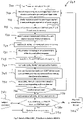
- FIG. 5 shows the operational flowchart of validation procedure. It comprises of:
- Receiving (block 532 ) inputs M, O and P (three indices) from the subject to split (block 530 ) the signal segment into up to 3 sub-segments representing 3 regions of mental activity within the captured brooding session.
- Determining M, O and P is an interactive operation where the subject 10 is presented with a visual display of the signal trace via interface 108 of the device. If sufficient pre-trigger history has been captured, the subject will be able to identify a slip-in transient (to be called S 1 sub-segment) in the earlier section of the trace where he/she drifted into the brooding mood.
- S 1 sub-segment slip-in transient
- M, O and P are essentially indices of the boundary points that define the three sub-segments.
- Computed C 2 will be an array of numbers between 0 and 1.0 representing the coherence function (one-sided, magnitude squared coherence) between the sub-segments at various frequency steps of interest. While at least two windows per sub-segment are necessary, a higher number of windows improve the confidence interval of coherence computation.
- comparing (block 570 ) of final contents of memory space C 2 G 1 (i.e., comparing the statistically representative value for the array) against a subject inputted threshold level T for expected coherence number.
- FIG. 6 is a flowchart depicting steps (blocks) involved in the characterization process that determine attributes that are most common to the sub-segments.
- Common time-domain attributes (transient shapes, rise/fall times, DC levels etc) and frequency-domain attributes (frequency components, power spectral density for a certain frequency bin, area under PSD curve in a frequency band etc) are computed on the sub-segments, tabulated and presented to the subject via user interface 108 (blocks 640 , 641 , 642 , 643 and 644 ).
- the machine helps the subject choose (blocks 644 and 660 ) the ‘best’ attribute available (named AXD) to represent the dwell-in session of his/her brooding state.
- An optimal stimuli is a stimuli that (a) can alter the mental process of (or in other words: capture the attention of, or distract, or surprise) a subject in a pleasant way and (b) maintains its distractive power satisfactorily over hundreds of repetitions.
- FIG. 7 depicts the typical signal-processing steps involved in choosing optimized mantras.
- a first stimulus (audio clip in the present case) is chosen and played at random times of the day, for several days and corresponding bio responses (EEG signals in the present case) from the subject's body are recorded by the device each time.
- the intent here is to surprise the subject with stimuli at most unexpected situations, collect the bio responses and check if the quality of bio response degrades with time.
- the capturing process (block 705 ) is auto-triggered by the stimuli so that a pre-trigger (pre-stimulus) segment ‘Z ⁇ ’ and a post-trigger (post-stimulus) segment ‘Z+’ of equal length are obtained.
- TRANZ an initial transient part of ‘Z+’ is identified as TRANZ which encompasses the ‘moment of surprise’ caused by the unexpected stimulus.
- Segment TRANZ obtained from the first run is archived (block 720 ) in location TRANZO of memory 190 .
- two parameters are computed on the 1st bio response and saved in memory 190 . They are a Correlation Coefficient CORZ calculated between segments ‘Z ⁇ ’ and ‘Z+’ and TRANZT which is length of segment TRANZ.
- CORTRAN is the Correlation Coefficient computed between the TRANZ segment from the current response to the segment stored in memory location TRANZ 0 .
- An example for optimization is adding of a deep silence section (by activating the noise cancelling circuitry of the headset) just before playing of the audio clip.
- Another example is having a preamble of smell or taste stimuli (subject to the availability of the necessary bio actuators and drivers) just before mantra is played.
- the process of optimization is very subjective and is done interactively (block 781 ) with the user.
- An optimized stimulus is archived (block 790 ) as a mantra.
- closed loop operation is a process where the subject senses his/her brooding states and develops instincts to flex mind away. Duration of this operation is entirely up to the subject and it may take several months or even years to master the mind flexing skills.
- FIG. 8 flowcharts the various steps involved in closed loop operation.
- the data acquisition part is adjusted (block 800 ) so that it is able to collect enough number of samples per channel at the required sampling rate, to compute the AXD attribute (derived per procedure in FIG. 6 ) every cycle. If AXD attribute chosen is a frequency domain characteristic needing multiple windows & averaging, care needs to be taken to satisfy a maximum of those conditions while remaining within the real time computing power offered by the processor and operating system of the device.
- AXD is detected, it is checked (block 813 ) whether it lasts longer than ‘TL’, a first Time Limit prescribed by the subject to weed out short events. This is done by randomly sampling sections of the frame collected, for sustained AXD activity in time or frequency domains. If such activity is found to recur even after ‘TL’, a running coherence/correlation check is initiated on frames of captured data. Coherence calculation is preferred if multiple windows were involved in the computation of AXD attribute. Correlation coefficient would work better, if dealing with AXDs defined for transient events (such as bursts in EEG, rise in skin conductivity level, temple movements captured by Kome Kami switch etc). If such running coherence (or correlation coefficient) remain above limit ‘L1’ iteratively set by the user for a second time limit ‘TLL’ (also set by the user), a mantra alert is played (block 820 ) to the user.
- TLL time limit
- a ‘wake-up act’ which comprise of enacting explicit bodily expressions to acknowledge the mantra alert.
- the wake-up act needs to contain an element of self-reflection and be performed with complete self awareness (not like a mechanical ritual) and positivism. Examples are a wide smile, a deep breath, self-patting on the back or even a few dance steps.
- These explicit acts break the brooding cycle and instantly switches subject's mind into non-brooding states. In other words, these are optional acts that ‘amplify’ and ‘reinforce’ the subject's mantra experience and enhance mantra's power to break ruminating cycles.
- the device After many days (or weeks or even months) of operating the device at a particular setting, it gets to a stage where the subject will be able to ‘sense’ (as determined and acknowledged by block 840 which monitors trends in brooding durations' consistency against a given threshold setting) the onset of a brooding state and predict a mantra coming, before it is triggered by the device. This happens because of the conditioning of subject's mind on causality between sustenance of the mental state and the stimuli played. In other words, the device becomes able to ‘habituate’ the subject to the ‘togetherness’ of a mental state with a stimulus.
- Block 840 is responsible to validate if the subject is getting ‘sufficiently’ habituated to the current setting, by analyzing the consistency in subject's past brooding durations. If not, it repeatedly launches block 841 logic until the desirable outcomes prevail consistently. Once the subject gets ‘sufficiently’ conditioned, it may even be possible for the subject to precipitate a mantra triggering by ‘faking’ a brooding state. Either way, operating the device becomes an interesting mind game for the subject while he/she sub-consciously learns to watch over or supervise his/her own mental states.
- the device' output i.e. mantra stimuli
- the subject will be able to ‘re-enact the mantra experience mentally’ (virtual playing of mantra in mind) when events leading to a brooding condition initiates in real life.
- the mantra, its preamble and the wake-up act integrates into a unique, highly personalized mental experience for the subject which gets embedded in subject's mind. Thus it is enough for the subject to ‘mentally replay’ the mantra experience to toggle into a non-brooding state.
- blocks 850 and 851 are optional steps where the subject can lower the detection thresholds and get sooner and faster alerts when mind slips into brooding states. This would result in the driving of appropriate hardware challenging the subject to be more sensitive to brooding levels (or challenging to beat the machine unto playing alerts).
- the ultimate level attainable in this mental game is where the subject's response to a brooding state (which would ideally comprise of self-recollection of the mantra in tandem with self-awakening) becomes near-spontaneous with the brooding state's onset.
- self-awakening traits start manifesting as a natural reflex reaction in the subject's behavior in response to brooding states.
- the subject wouldn't need to use the machine any more in that level. It may however be noted that said measure of spontaneity is highly subjective and its acceptable levels are best decided by the respective individuals using the device.
- the activities performed during the operating phase of the device helps the subject develop the supervisory abilities and mental instincts (hence the ‘mental muscles’) to flex his/her mind at will. Also it leaves the subject with a mantra in the form of an ingrained mental experience that helps him/her easily master mantra meditation techniques such as Transcendental meditationTM
- the open loop operation (represented by block 360 of FIG. 3 and elaborated in FIG. 9 ) is a mode wherein, the subject learns to identify his/her non-brooding (positive) states that usually happens without his/her knowledge.
- the device continuously scans (block 910 ) the EEG stream for a previously determined attribute representing a non-brooding mood. Usually such moods are short transients when compared to the brooding states.
- the subject is alerted (block 930 ) using a mantra.
- mantra plays, subject takes a moment to reflect (block 940 ) on his/her state optionally with the help of a ritual.
- the subject's mind is conditioned on the causality between non-brooding states and mantras.
- machine plays (block 950 ) the same mantra to the subject at random times of the day in an open-loop manner (regardless of input EEG signal state).
- subject's mind associates that mantra with non-brooding events. This automatically triggers positive thoughts in subject's mind and helps him/her stay positive.
- the mantra and associated personal experiences gets embedded in subject's mind eventually eliminating a need for external stimuli.
- the subject is able to make use of this mantra when he/she formally initiates mantra meditation.
- FIG. 10 depicts a second embodiment of the Mind Strength Trainer that has a ‘non-portable’ configuration. They are preferably stationed in a controlled environment (such as a physician's office) and hence have the ability to accept and process a slew of bio signal inputs and drive many types of bio actuators than a portable headset device.
- a controlled environment such as a physician's office
- the subject using such machine will be able to experiment with various bio sensors worn internally or external to the body, tune their gains, acquisition parameters and filter settings to suite personal preferences. Also he/she'll have a chance to evaluate various bio stimuli and tweak their channels before choosing the right one/combination.
- this configuration can serve as a test station to study subject's body characteristics and match them with appropriate stimuli.
- signal processing components ( 1020 , 1040 ) have the same functionalities as the corresponding parts 155 , 170 and 125 of the 1 st embodiment, except that they can handle a varied range of inputs and outputs.
- Operation of the device remains essentially similar to the first embodiment, except that the user-interface of the software has a more elaborate menu offering more possibilities of mixing and matching signals in accordance with user needs.
- the device could be built around a handheld device (an iPod for example), sensors & actuators may be wirelessly strewn over the internet or could even be remotely controlled by a physician.
- Mind Strength Trainer and it's algorithms may be used in less obvious ways as described in FIG. 3 .
- the subject could develop and build on his/her mind flexing abilities even without having or collecting recurring moods (brooding, non-brooding etc), validated libraries of signals or their identified attributes.
- the machine will be used to monitor known electrical characteristics (such as the power spectral density of beta component of EEG, computed with 1 Hz bin size, 128 FFT lines, Hanning window, 10 linear averages etc) of the signal and whether they sustain beyond certain duration or not.
- This or any other method of operation that trains human mind on causality between mental activity and an artificially generated alarm would help attain (mental) supervisory abilities, which is the fundamental building block of any meditation technique.
- the subject doesn't necessarily need to scientifically derive a mantra as described in specifications. He/she could use commonly or previously known mantras or even use random stimuli (with less desirable effects) to operate the machine.
- this machine could be used for different purposes (than as a meditation aid) and by second parties working on subject's mind (than the subject doing it all by himself). For example, it could be used to collect signals while engaged in physical activities of a specific kind. Thus, signals may be collected corresponding to physical conditions such as drowsiness, drunkenness, kicking a ball or running. Or, it could be used by a physician or neuro feedback expert looking for signs of depression etc.
Landscapes
- Health & Medical Sciences (AREA)
- Engineering & Computer Science (AREA)
- Life Sciences & Earth Sciences (AREA)
- General Health & Medical Sciences (AREA)
- Biomedical Technology (AREA)
- Physics & Mathematics (AREA)
- Public Health (AREA)
- Animal Behavior & Ethology (AREA)
- Veterinary Medicine (AREA)
- Heart & Thoracic Surgery (AREA)
- Pathology (AREA)
- Theoretical Computer Science (AREA)
- Biophysics (AREA)
- Psychology (AREA)
- Psychiatry (AREA)
- Surgery (AREA)
- General Engineering & Computer Science (AREA)
- Medical Informatics (AREA)
- Molecular Biology (AREA)
- Human Computer Interaction (AREA)
- Hematology (AREA)
- Anesthesiology (AREA)
- Acoustics & Sound (AREA)
- General Physics & Mathematics (AREA)
- Neurosurgery (AREA)
- Neurology (AREA)
- Dermatology (AREA)
- Artificial Intelligence (AREA)
- Computer Vision & Pattern Recognition (AREA)
- Physiology (AREA)
- Signal Processing (AREA)
- Measurement Of The Respiration, Hearing Ability, Form, And Blood Characteristics Of Living Organisms (AREA)
- Measurement And Recording Of Electrical Phenomena And Electrical Characteristics Of The Living Body (AREA)
Abstract
Description
| Pat. No. | Kind Code | U.S. Patents Issue Date | Patentee |
| 5,813,993 | A | Sep. 29, 1998 | Kaplan |
| 6,625,485 | B2 | Sep. 23, 2003 | Levendowski |
| 5,724,987 | A | Mar. 10, 1998 | Gevins |
| 5,911,581 | A | Jun. 15, 1999 | Reynolds |
Claims (6)
Priority Applications (2)
| Application Number | Priority Date | Filing Date | Title |
|---|---|---|---|
| US12/931,101 US11471091B2 (en) | 2010-07-29 | 2011-01-24 | Mind strength trainer |
| US18/644,094 US20240268734A1 (en) | 2011-01-24 | 2024-04-24 | Mind Watcher Device |
Applications Claiming Priority (2)
| Application Number | Priority Date | Filing Date | Title |
|---|---|---|---|
| US40055410P | 2010-07-29 | 2010-07-29 | |
| US12/931,101 US11471091B2 (en) | 2010-07-29 | 2011-01-24 | Mind strength trainer |
Related Child Applications (1)
| Application Number | Title | Priority Date | Filing Date |
|---|---|---|---|
| US18/644,094 Continuation-In-Part US20240268734A1 (en) | 2011-01-24 | 2024-04-24 | Mind Watcher Device |
Publications (2)
| Publication Number | Publication Date |
|---|---|
| US20120029379A1 US20120029379A1 (en) | 2012-02-02 |
| US11471091B2 true US11471091B2 (en) | 2022-10-18 |
Family
ID=45527450
Family Applications (1)
| Application Number | Title | Priority Date | Filing Date |
|---|---|---|---|
| US12/931,101 Active 2031-04-11 US11471091B2 (en) | 2010-07-29 | 2011-01-24 | Mind strength trainer |
Country Status (1)
| Country | Link |
|---|---|
| US (1) | US11471091B2 (en) |
Families Citing this family (29)
| Publication number | Priority date | Publication date | Assignee | Title |
|---|---|---|---|---|
| KR20130133629A (en) | 2012-05-29 | 2013-12-09 | 삼성전자주식회사 | Method and apparatus for executing voice command in electronic device |
| US11172859B2 (en) | 2014-01-28 | 2021-11-16 | Medibotics | Wearable brain activity device with auditory interface |
| US10234942B2 (en) | 2014-01-28 | 2019-03-19 | Medibotics Llc | Wearable and mobile brain computer interface (BCI) device and method |
| US9814426B2 (en) | 2012-06-14 | 2017-11-14 | Medibotics Llc | Mobile wearable electromagnetic brain activity monitor |
| US11662819B2 (en) | 2015-05-12 | 2023-05-30 | Medibotics | Method for interpreting a word, phrase, and/or command from electromagnetic brain activity |
| TWI495455B (en) * | 2012-12-26 | 2015-08-11 | Lite On Electronics Guangzhou | Electroencephalogram sensing device |
| EP3917167A3 (en) | 2013-06-14 | 2022-03-09 | Oticon A/s | A hearing assistance device with brain computer interface |
| US9288588B2 (en) * | 2013-09-06 | 2016-03-15 | Starkey Laboratories, Inc | Method and apparatus for creating binaural beats using hearing aids |
| KR102333704B1 (en) * | 2013-09-30 | 2021-12-01 | 삼성전자주식회사 | Method for processing contents based on biosignals, and thereof device |
| CN104434032A (en) * | 2014-10-29 | 2015-03-25 | 安徽省科普产品工程研究中心有限责任公司 | Device for measuring concentration degree of brain |
| US20160267798A1 (en) * | 2015-03-10 | 2016-09-15 | Cento e Vinte 120 Participaçoes e Empreendimentos Ltda. | System, device, and method to develop human characteristics and brain training with specialized computer-based applications |
| RS62703B1 (en) * | 2015-10-22 | 2022-01-31 | Mbraintrain Doo Beograd | Mobile system and method for biophysiological signal acquisition for estimating mental states embedded into wireless headset with headphones |
| US10831922B1 (en) | 2015-10-30 | 2020-11-10 | United Services Automobile Association (Usaa) | System and method for access control |
| CN105476631A (en) * | 2015-11-25 | 2016-04-13 | 华南理工大学 | EEG (electroencephalogram) based sleep detection and sleep aid method and device |
| FR3058628B1 (en) | 2016-11-15 | 2021-07-30 | Cosciens | DEVICE FOR MEASURING AND / OR STIMULATING BRAIN ACTIVITY |
| US11723579B2 (en) | 2017-09-19 | 2023-08-15 | Neuroenhancement Lab, LLC | Method and apparatus for neuroenhancement |
| WO2019077421A1 (en) * | 2017-10-17 | 2019-04-25 | Gaurav Gupta | A system and method for customised meditation |
| FR3074052A1 (en) * | 2017-11-30 | 2019-05-31 | Dreem | DEVICE FOR STIMULATING THE CEREBRAL ACTIVITY OF A PERSON COMPRISING A CONTROL ELEMENT |
| US11717686B2 (en) | 2017-12-04 | 2023-08-08 | Neuroenhancement Lab, LLC | Method and apparatus for neuroenhancement to facilitate learning and performance |
| US12280219B2 (en) | 2017-12-31 | 2025-04-22 | NeuroLight, Inc. | Method and apparatus for neuroenhancement to enhance emotional response |
| EP3731749B1 (en) | 2017-12-31 | 2025-07-09 | Neuroenhancement Lab, LLC | System for neuroenhancement to enhance emotional response |
| US11364361B2 (en) | 2018-04-20 | 2022-06-21 | Neuroenhancement Lab, LLC | System and method for inducing sleep by transplanting mental states |
| CA3112564A1 (en) | 2018-09-14 | 2020-03-19 | Neuroenhancement Lab, LLC | System and method of improving sleep |
| CN109550137A (en) * | 2018-11-17 | 2019-04-02 | 北京华谛盟家具有限公司 | For assisting the sofa of meditation |
| EP3659496A1 (en) * | 2018-11-29 | 2020-06-03 | Koninklijke Philips N.V. | Selection of sensory stimuli for neurofeedback training |
| US11786694B2 (en) | 2019-05-24 | 2023-10-17 | NeuroLight, Inc. | Device, method, and app for facilitating sleep |
| CA3192636A1 (en) * | 2020-08-25 | 2022-03-03 | Innereye Ltd. | Method and system for quantifying attention |
| US11500463B2 (en) | 2020-12-30 | 2022-11-15 | Imagine Technologies, Inc. | Wearable electroencephalography sensor and device control methods using same |
| CN114652330B (en) * | 2022-02-11 | 2023-03-24 | 北京赋思强脑科技有限公司 | Method, device and equipment for evaluating meditation training based on historical electroencephalogram signals |
Citations (16)
| Publication number | Priority date | Publication date | Assignee | Title |
|---|---|---|---|---|
| US4220142A (en) * | 1977-09-01 | 1980-09-02 | Raymond C. Rosen | Behavioral shaping device for eliminating nocturnal sounds |
| US5033082A (en) * | 1989-07-31 | 1991-07-16 | Nelson Industries, Inc. | Communication system with active noise cancellation |
| US5311877A (en) * | 1991-10-02 | 1994-05-17 | Mazda Motor Corporation | Waking degree maintaining apparatus |
| US5377100A (en) * | 1993-03-08 | 1994-12-27 | The United States Of America As Represented By The Administrator Of The National Aeronautics And Space Administration | Method of encouraging attention by correlating video game difficulty with attention level |
| US5724987A (en) | 1991-09-26 | 1998-03-10 | Sam Technology, Inc. | Neurocognitive adaptive computer-aided training method and system |
| US5813993A (en) | 1996-04-05 | 1998-09-29 | Consolidated Research Of Richmond, Inc. | Alertness and drowsiness detection and tracking system |
| US5911581A (en) | 1995-02-21 | 1999-06-15 | Braintainment Resources, Inc. | Interactive computer program for measuring and analyzing mental ability |
| US6167298A (en) * | 1998-01-08 | 2000-12-26 | Levin; Richard B. | Devices and methods for maintaining an alert state of consciousness through brain wave monitoring |
| US20010031930A1 (en) * | 1999-12-19 | 2001-10-18 | Roizen Michael F. | Alarm upon detection of impending sleep state |
| US20030171688A1 (en) * | 2002-03-06 | 2003-09-11 | Yoo Jae Sup | Mind controller |
| US6625485B2 (en) | 1998-12-31 | 2003-09-23 | Advanced Brain Monitoring, Inc. | Method for the quantification of human alertness |
| US20040138578A1 (en) * | 2002-07-25 | 2004-07-15 | Pineda Jaime A. | Method and system for a real time adaptive system for effecting changes in cognitive-emotive profiles |
| US20070060831A1 (en) * | 2005-09-12 | 2007-03-15 | Le Tan T T | Method and system for detecting and classifyng the mental state of a subject |
| US20070173733A1 (en) * | 2005-09-12 | 2007-07-26 | Emotiv Systems Pty Ltd | Detection of and Interaction Using Mental States |
| US20080039737A1 (en) * | 1999-12-02 | 2008-02-14 | The General Hospital Corporation, A Massachusetts Corporation | Method and apparatus for measuring indices of brain activity during motivational and emotional function |
| US20080319335A1 (en) * | 2007-06-20 | 2008-12-25 | Neuropace, Inc. | System and method for automatically adjusting detection thresholds in a feedback-controlled neurological event detector |
-
2011
- 2011-01-24 US US12/931,101 patent/US11471091B2/en active Active
Patent Citations (16)
| Publication number | Priority date | Publication date | Assignee | Title |
|---|---|---|---|---|
| US4220142A (en) * | 1977-09-01 | 1980-09-02 | Raymond C. Rosen | Behavioral shaping device for eliminating nocturnal sounds |
| US5033082A (en) * | 1989-07-31 | 1991-07-16 | Nelson Industries, Inc. | Communication system with active noise cancellation |
| US5724987A (en) | 1991-09-26 | 1998-03-10 | Sam Technology, Inc. | Neurocognitive adaptive computer-aided training method and system |
| US5311877A (en) * | 1991-10-02 | 1994-05-17 | Mazda Motor Corporation | Waking degree maintaining apparatus |
| US5377100A (en) * | 1993-03-08 | 1994-12-27 | The United States Of America As Represented By The Administrator Of The National Aeronautics And Space Administration | Method of encouraging attention by correlating video game difficulty with attention level |
| US5911581A (en) | 1995-02-21 | 1999-06-15 | Braintainment Resources, Inc. | Interactive computer program for measuring and analyzing mental ability |
| US5813993A (en) | 1996-04-05 | 1998-09-29 | Consolidated Research Of Richmond, Inc. | Alertness and drowsiness detection and tracking system |
| US6167298A (en) * | 1998-01-08 | 2000-12-26 | Levin; Richard B. | Devices and methods for maintaining an alert state of consciousness through brain wave monitoring |
| US6625485B2 (en) | 1998-12-31 | 2003-09-23 | Advanced Brain Monitoring, Inc. | Method for the quantification of human alertness |
| US20080039737A1 (en) * | 1999-12-02 | 2008-02-14 | The General Hospital Corporation, A Massachusetts Corporation | Method and apparatus for measuring indices of brain activity during motivational and emotional function |
| US20010031930A1 (en) * | 1999-12-19 | 2001-10-18 | Roizen Michael F. | Alarm upon detection of impending sleep state |
| US20030171688A1 (en) * | 2002-03-06 | 2003-09-11 | Yoo Jae Sup | Mind controller |
| US20040138578A1 (en) * | 2002-07-25 | 2004-07-15 | Pineda Jaime A. | Method and system for a real time adaptive system for effecting changes in cognitive-emotive profiles |
| US20070060831A1 (en) * | 2005-09-12 | 2007-03-15 | Le Tan T T | Method and system for detecting and classifyng the mental state of a subject |
| US20070173733A1 (en) * | 2005-09-12 | 2007-07-26 | Emotiv Systems Pty Ltd | Detection of and Interaction Using Mental States |
| US20080319335A1 (en) * | 2007-06-20 | 2008-12-25 | Neuropace, Inc. | System and method for automatically adjusting detection thresholds in a feedback-controlled neurological event detector |
Non-Patent Citations (4)
| Title |
|---|
| "Timer." https://en.wikipedia.org/wiki/Timer. * |
| An article titled ‘Force Trainer’ from Wikipedia, the free encyclopedia (http://en.wikipedia.org/wiki/Force_Trainer), about a toy that uses EEG signals to effect motion of objects, published Nov. 7, 2013. |
| An article titled ‘Mindflex’ from Wikipedia, the free encyclopedia (http://en.wikipedia.org/wiki/Mindflex), about a toy that uses EEG signals to effect motion of objects, published May 23, 2013. |
| An article titled ‘Neurofeedback’ from Wikipedia, the free encyclopedia (http://en.wikipedia.org/wiki/Neurofeedback), about technics such as alpha-theta training of mind, published Sep. 12, 2015. |
Also Published As
| Publication number | Publication date |
|---|---|
| US20120029379A1 (en) | 2012-02-02 |
Similar Documents
| Publication | Publication Date | Title |
|---|---|---|
| US11471091B2 (en) | Mind strength trainer | |
| US8517912B2 (en) | Medical hypnosis device for controlling the administration of a hypnosis experience | |
| CA2935813C (en) | Adaptive brain training computer system and method | |
| AU2009268428B2 (en) | Device, system, and method for treating psychiatric disorders | |
| US10417923B2 (en) | Systems, apparatuses, and methods for memory recall and reactivation by targeted stimulation | |
| CN101198277B (en) | Systems for physiological and psycho-physiological monitoring | |
| US20250352121A1 (en) | Multiple frequency neurofeedback brain wave training techniques, systems, and methods | |
| US20090099474A1 (en) | System and method for combined bioelectric sensing and biosensory feedback based adaptive therapy for medical disorders | |
| JP2018505712A (en) | Method and apparatus for enhancing memory fixation | |
| JP2012053656A (en) | Communication support device and method | |
| CN106991270A (en) | A computer system for determining the state of the mind and providing perceptual countermeasures to the subject | |
| Miranda et al. | On harnessing the electroencephalogram for the musical braincap | |
| US20200077941A1 (en) | Adaptive neurofeedback brain wave training techniques, systems, and methods | |
| US20160247380A1 (en) | Wearable repetitive behavior awareness device and method | |
| WO2022144813A1 (en) | Wearable device and method for stress detection, emotion recognition and emotion management | |
| US20200073475A1 (en) | Artificial intelligence assisted neurofeedback brain wave training techniques, systems, and methods | |
| Gupta et al. | Significance of alpha brainwaves in meditation examined from the study of binaural beats | |
| US20200069209A1 (en) | Neurofeedback brain wave synchrony training techniques, systems, and methods | |
| CN116868277A (en) | Emotion regulation method and system based on real-time biosensor signals of subjects | |
| JP2011087784A (en) | Living body action reaction analysis system | |
| CN112402767B (en) | Eye movement desensitization reprocessing intervention system and eye movement desensitization reprocessing intervention method | |
| Charij et al. | Using biometric measurement in real-time as a sympathetic system in computer games | |
| JP2024114009A (en) | Biobehavioral Response Analysis System |
Legal Events
| Date | Code | Title | Description |
|---|---|---|---|
| STPP | Information on status: patent application and granting procedure in general |
Free format text: DOCKETED NEW CASE - READY FOR EXAMINATION |
|
| STPP | Information on status: patent application and granting procedure in general |
Free format text: NON FINAL ACTION MAILED |
|
| STCV | Information on status: appeal procedure |
Free format text: NOTICE OF APPEAL FILED |
|
| STCV | Information on status: appeal procedure |
Free format text: NOTICE OF APPEAL FILED |
|
| STCV | Information on status: appeal procedure |
Free format text: APPEAL BRIEF (OR SUPPLEMENTAL BRIEF) ENTERED AND FORWARDED TO EXAMINER |
|
| STCV | Information on status: appeal procedure |
Free format text: EXAMINER'S ANSWER TO APPEAL BRIEF MAILED |
|
| STCV | Information on status: appeal procedure |
Free format text: ON APPEAL -- AWAITING DECISION BY THE BOARD OF APPEALS |
|
| STCV | Information on status: appeal procedure |
Free format text: REQUEST RECONSIDERATION AFTER BOARD OF APPEALS DECISION |
|
| STCV | Information on status: appeal procedure |
Free format text: BOARD OF APPEALS DECISION RENDERED AFTER REQUEST FOR RECONSIDERATION |
|
| STPP | Information on status: patent application and granting procedure in general |
Free format text: DOCKETED NEW CASE - READY FOR EXAMINATION |
|
| STPP | Information on status: patent application and granting procedure in general |
Free format text: AWAITING RESPONSE FOR INFORMALITY, FEE DEFICIENCY OR CRF ACTION |
|
| STPP | Information on status: patent application and granting procedure in general |
Free format text: DOCKETED NEW CASE - READY FOR EXAMINATION |
|
| STPP | Information on status: patent application and granting procedure in general |
Free format text: NON FINAL ACTION MAILED |
|
| STPP | Information on status: patent application and granting procedure in general |
Free format text: RESPONSE TO NON-FINAL OFFICE ACTION ENTERED AND FORWARDED TO EXAMINER |
|
| STPP | Information on status: patent application and granting procedure in general |
Free format text: NON FINAL ACTION MAILED |
|
| STPP | Information on status: patent application and granting procedure in general |
Free format text: RESPONSE TO NON-FINAL OFFICE ACTION ENTERED AND FORWARDED TO EXAMINER |
|
| FEPP | Fee payment procedure |
Free format text: ENTITY STATUS SET TO MICRO (ORIGINAL EVENT CODE: MICR); ENTITY STATUS OF PATENT OWNER: MICROENTITY |
|
| STPP | Information on status: patent application and granting procedure in general |
Free format text: PUBLICATIONS -- ISSUE FEE PAYMENT VERIFIED |
|
| STCF | Information on status: patent grant |
Free format text: PATENTED CASE |
|
| CC | Certificate of correction | ||
| CC | Certificate of correction | ||
| MAFP | Maintenance fee payment |
Free format text: PAYMENT OF MAINTENANCE FEE, 4TH YEAR, MICRO ENTITY (ORIGINAL EVENT CODE: M3551); ENTITY STATUS OF PATENT OWNER: MICROENTITY Year of fee payment: 4 |