US11466047B2 - Cyclic di-nucleotide compounds as sting agonists - Google Patents
Cyclic di-nucleotide compounds as sting agonists Download PDFInfo
- Publication number
- US11466047B2 US11466047B2 US16/611,624 US201816611624A US11466047B2 US 11466047 B2 US11466047 B2 US 11466047B2 US 201816611624 A US201816611624 A US 201816611624A US 11466047 B2 US11466047 B2 US 11466047B2
- Authority
- US
- United States
- Prior art keywords
- group
- alkyl
- independently selected
- alkenylene
- alkylene
- Prior art date
- Legal status (The legal status is an assumption and is not a legal conclusion. Google has not performed a legal analysis and makes no representation as to the accuracy of the status listed.)
- Active, expires
Links
- 0 *C1(*)CP(=C)(C)CC2([2*])[C@]([1*])(C)[Y][C@]([6*])([C@]([7*])([8*])CP(=C)(C)C[C@]3(*)C(*)([3*])[C@](*)(C)C[C@]13*)[C@]2([4*])[5*] Chemical compound *C1(*)CP(=C)(C)CC2([2*])[C@]([1*])(C)[Y][C@]([6*])([C@]([7*])([8*])CP(=C)(C)C[C@]3(*)C(*)([3*])[C@](*)(C)C[C@]13*)[C@]2([4*])[5*] 0.000 description 16
- OKLCREZRLXRPDY-UHFFFAOYSA-N CC(C)c1ccc2c(N)ccnn12.CC(C)c1cnc2c(N)ccnn12.CC(C)c1cnn2c(=O)[nH]c(N)nc12.CC(C)c1cnn2c(N)ccnc12.CC(C)n1cc(F)c2c(N)ccnc21.CC(C)n1ccc2c(N)ncnc21.CC(C)n1cnc2c(N)ccnc21.CC(C)n1cnc2c1N=CCC2=O.CC(C)n1nnc2c(=O)[nH]c(N)nc21.CC(C)n1nnc2c(N)ccnc21.Cc1nc2c(ncn2C(C)C)c(=O)[nH]1 Chemical compound CC(C)c1ccc2c(N)ccnn12.CC(C)c1cnc2c(N)ccnn12.CC(C)c1cnn2c(=O)[nH]c(N)nc12.CC(C)c1cnn2c(N)ccnc12.CC(C)n1cc(F)c2c(N)ccnc21.CC(C)n1ccc2c(N)ncnc21.CC(C)n1cnc2c(N)ccnc21.CC(C)n1cnc2c1N=CCC2=O.CC(C)n1nnc2c(=O)[nH]c(N)nc21.CC(C)n1nnc2c(N)ccnc21.Cc1nc2c(ncn2C(C)C)c(=O)[nH]1 OKLCREZRLXRPDY-UHFFFAOYSA-N 0.000 description 10
- CYCIBXHMBOQCFS-UHFFFAOYSA-N C#CCC1CSSCC1C(C)C.CC(C)CCOCCOCCOCCC(=O)OC(C)(C)C Chemical compound C#CCC1CSSCC1C(C)C.CC(C)CCOCCOCCOCCC(=O)OC(C)(C)C CYCIBXHMBOQCFS-UHFFFAOYSA-N 0.000 description 5
- LWPXHYFKUQVXRK-UHFFFAOYSA-N CC(C)c1cnc2c(N)ccnn12.CC(C)n1ccc2c(N)ccnc21.CC(C)n1cnc2c(=O)[nH]c(N)nc21.CC(C)n1cnc2c(N)ccnc21.CC(C)n1cnc2c1N=CCC2=O Chemical compound CC(C)c1cnc2c(N)ccnn12.CC(C)n1ccc2c(N)ccnc21.CC(C)n1cnc2c(=O)[nH]c(N)nc21.CC(C)n1cnc2c(N)ccnc21.CC(C)n1cnc2c1N=CCC2=O LWPXHYFKUQVXRK-UHFFFAOYSA-N 0.000 description 4
- RRAJFMHYJVJQMX-UHFFFAOYSA-N C#CCC1CSSCC1OC(C)C.CC(C)CCCC(=O)OC(C)C.CC(C)OCCOCCOCCOCCC(=O)OC(C)(C)C Chemical compound C#CCC1CSSCC1OC(C)C.CC(C)CCCC(=O)OC(C)C.CC(C)OCCOCCOCCOCCC(=O)OC(C)(C)C RRAJFMHYJVJQMX-UHFFFAOYSA-N 0.000 description 3
- LRLKVENYPCOJLO-JKZSSGBRSA-N CC(C)C[C@@H](C)C(=O)OC(C)C.CC(C)OCCCC(=O)OC(C)(C)C.CC(C)OCCSC(=O)C(C)(C)C.CCCCCCCCCCCCCCCCCCCCOCCCOC(C)C.CCCCCCCCCCCCCCCCCCOCCOC(C)C.CCCCCCCCCCCCCCCCCCOC[C@H](COC(C)C)OC.CCCCCCCCCCCCCCCCOCCCOC(C)C.CCCCCCCCCCCCCCOC(CO)COC(C)C.CCCCCCCCCCCCCCOCC(COC(C)C)OCCCCCCCCCCCCCC.CCCCCCCCCCCCOCCCOC(C)C.CCCCCCCCOCCCOC(C)C.CCCCCCCCOCCOC(C)C Chemical compound CC(C)C[C@@H](C)C(=O)OC(C)C.CC(C)OCCCC(=O)OC(C)(C)C.CC(C)OCCSC(=O)C(C)(C)C.CCCCCCCCCCCCCCCCCCCCOCCCOC(C)C.CCCCCCCCCCCCCCCCCCOCCOC(C)C.CCCCCCCCCCCCCCCCCCOC[C@H](COC(C)C)OC.CCCCCCCCCCCCCCCCOCCCOC(C)C.CCCCCCCCCCCCCCOC(CO)COC(C)C.CCCCCCCCCCCCCCOCC(COC(C)C)OCCCCCCCCCCCCCC.CCCCCCCCCCCCOCCCOC(C)C.CCCCCCCCOCCCOC(C)C.CCCCCCCCOCCOC(C)C LRLKVENYPCOJLO-JKZSSGBRSA-N 0.000 description 3
- STXAIZTXNIZXCQ-UHFFFAOYSA-N CC(=O)c1cn(C(C)C)nn1.CC(=O)c1cnn(C(C)C)c1.CC(=O)c1ncn(C(C)C)n1.CC(C)C1=CCc2c(N)ccnc21.CC(C)n1cnc2c(N(C)C)ncnc21.CC(C)n1cnc2c(N)cccc21.CC(C)n1cnc2c(N)cccc21.CC(C)n1cnc2c(N)ccnc21.CC(C)n1cnc2c(NCCO)ccnc21.CC(C)n1cnc2ccccc21.CC(C)n1cnc2cnc(N(C)C)nc21.CCCNc1ccc2ncn(C(C)C)c2n1.Cc1ccnc2c1ncn2C(C)C Chemical compound CC(=O)c1cn(C(C)C)nn1.CC(=O)c1cnn(C(C)C)c1.CC(=O)c1ncn(C(C)C)n1.CC(C)C1=CCc2c(N)ccnc21.CC(C)n1cnc2c(N(C)C)ncnc21.CC(C)n1cnc2c(N)cccc21.CC(C)n1cnc2c(N)cccc21.CC(C)n1cnc2c(N)ccnc21.CC(C)n1cnc2c(NCCO)ccnc21.CC(C)n1cnc2ccccc21.CC(C)n1cnc2cnc(N(C)C)nc21.CCCNc1ccc2ncn(C(C)C)c2n1.Cc1ccnc2c1ncn2C(C)C STXAIZTXNIZXCQ-UHFFFAOYSA-N 0.000 description 2
- HZUGLQTUHGPXLX-UHFFFAOYSA-N CC(C)c1ccc2c(N)ccnn12.CC(C)c1cnc2c(N)ccnn12.CC(C)c1cnn2c(=O)[nH]c(N)nc12.CC(C)c1cnn2c(N)ccnc12.CC(C)n1cc(F)c2c(N)ccnc21.CC(C)n1ccc2c(N)ncnc21.CC(C)n1cnc2c(N)ccnc21.CC(C)n1cnc2c(N)nnnc21.CC(C)n1cnc2c1N=CCC2=O.CC(C)n1nnc2c(N)ccnc21.CCOc1nc(N)nc2c1ncn2C(C)C.Cc1nc2c(ncn2C(C)C)c(=O)[nH]1.Cc1nc2c(nnn2C(C)C)c(=O)[nH]1 Chemical compound CC(C)c1ccc2c(N)ccnn12.CC(C)c1cnc2c(N)ccnn12.CC(C)c1cnn2c(=O)[nH]c(N)nc12.CC(C)c1cnn2c(N)ccnc12.CC(C)n1cc(F)c2c(N)ccnc21.CC(C)n1ccc2c(N)ncnc21.CC(C)n1cnc2c(N)ccnc21.CC(C)n1cnc2c(N)nnnc21.CC(C)n1cnc2c1N=CCC2=O.CC(C)n1nnc2c(N)ccnc21.CCOc1nc(N)nc2c1ncn2C(C)C.Cc1nc2c(ncn2C(C)C)c(=O)[nH]1.Cc1nc2c(nnn2C(C)C)c(=O)[nH]1 HZUGLQTUHGPXLX-UHFFFAOYSA-N 0.000 description 2
- PCMZYLKFMOFDDZ-UHFFFAOYSA-N CC(C)c1nnc2c(N)ccnn12.CC(C)c1nnc2n1C=CCC2=O.CC(C)n1cnc2c(=O)[nH]c(F)nc21.CCCNc1ncnc2c1ncn2C(C)C.CCOc1nc(C)nc2c1ncn2C(C)C.CNc1ncc2ncn(C(C)C)c2n1.COc1ncnc2c1ncn2C(C)C.CSc1ccnc2c1ncn2C(C)C.Cc1nc(N)c2ncn(C(C)C)c2n1.Cc1nc2c(nc(F)n2C(C)C)c(=O)[nH]1.Cc1nc2c(ncn2C(C)C)c(=O)[nH]1.Cc1nc2c(ncn2C(C)C)c(=O)[nH]1 Chemical compound CC(C)c1nnc2c(N)ccnn12.CC(C)c1nnc2n1C=CCC2=O.CC(C)n1cnc2c(=O)[nH]c(F)nc21.CCCNc1ncnc2c1ncn2C(C)C.CCOc1nc(C)nc2c1ncn2C(C)C.CNc1ncc2ncn(C(C)C)c2n1.COc1ncnc2c1ncn2C(C)C.CSc1ccnc2c1ncn2C(C)C.Cc1nc(N)c2ncn(C(C)C)c2n1.Cc1nc2c(nc(F)n2C(C)C)c(=O)[nH]1.Cc1nc2c(ncn2C(C)C)c(=O)[nH]1.Cc1nc2c(ncn2C(C)C)c(=O)[nH]1 PCMZYLKFMOFDDZ-UHFFFAOYSA-N 0.000 description 2
- KZYZEXVDFVTQPF-UHFFFAOYSA-N CC(C)n1c(F)nc2c(N)ccnc21.CC(C)n1cnc2c(=O)[nH]ncc21.CC(C)n1cnc2c(Cl)ccnc21.CC(C)n1cnc2c(N)cncc21.CC(C)n1nnc2c(Cl)ccnc21.CC(C)n1nnc2c(N)ccnc21.Cc1cc(=O)c2ncn(C(C)C)c2[nH]1.Cc1cc2c(ncn2C(C)C)c(=O)[nH]1.Cc1nc(N)c2ncn(C(C)C)c2n1.Cc1nc(N)c2ncn(C(C)C)c2n1.Cc1nc2c(c(F)cn2C(C)C)c(=O)[nH]1.Cc1nc2c(ccn2C(C)C)c(=O)[nH]1.Cc1nc2c(nnn2C(C)C)c(=O)[nH]1 Chemical compound CC(C)n1c(F)nc2c(N)ccnc21.CC(C)n1cnc2c(=O)[nH]ncc21.CC(C)n1cnc2c(Cl)ccnc21.CC(C)n1cnc2c(N)cncc21.CC(C)n1nnc2c(Cl)ccnc21.CC(C)n1nnc2c(N)ccnc21.Cc1cc(=O)c2ncn(C(C)C)c2[nH]1.Cc1cc2c(ncn2C(C)C)c(=O)[nH]1.Cc1nc(N)c2ncn(C(C)C)c2n1.Cc1nc(N)c2ncn(C(C)C)c2n1.Cc1nc2c(c(F)cn2C(C)C)c(=O)[nH]1.Cc1nc2c(ccn2C(C)C)c(=O)[nH]1.Cc1nc2c(nnn2C(C)C)c(=O)[nH]1 KZYZEXVDFVTQPF-UHFFFAOYSA-N 0.000 description 2
- KWMVDSNFXXIYAM-VGAASZOHSA-N Nc1nc2c(ncn2[C@@H]2O[C@@H]3COP(=O)(O)O[C@H]4C[C@H](n5cnc6c(N)ccnc65)O[C@@H]4COP(=S)(S)O[C@@H]2C3)c(=O)[nH]1.Nc1nc2c(ncn2[C@@H]2O[C@@H]3COP(=O)(O)O[C@H]4[C@H](F)[C@H](n5cnc6c(N)ccnc65)O[C@@H]4COP(=S)(S)O[C@@H]2[C@@H]3F)c(=O)[nH]1.Nc1nc2c(ncn2[C@@H]2O[C@@H]3COP(=S)(S)O[C@H]4C[C@H](n5cnc6c5N=CCC6=O)O[C@@H]4COP(O)(=S)O[C@@H]2C3)c(=O)[nH]1 Chemical compound Nc1nc2c(ncn2[C@@H]2O[C@@H]3COP(=O)(O)O[C@H]4C[C@H](n5cnc6c(N)ccnc65)O[C@@H]4COP(=S)(S)O[C@@H]2C3)c(=O)[nH]1.Nc1nc2c(ncn2[C@@H]2O[C@@H]3COP(=O)(O)O[C@H]4[C@H](F)[C@H](n5cnc6c(N)ccnc65)O[C@@H]4COP(=S)(S)O[C@@H]2[C@@H]3F)c(=O)[nH]1.Nc1nc2c(ncn2[C@@H]2O[C@@H]3COP(=S)(S)O[C@H]4C[C@H](n5cnc6c5N=CCC6=O)O[C@@H]4COP(O)(=S)O[C@@H]2C3)c(=O)[nH]1 KWMVDSNFXXIYAM-VGAASZOHSA-N 0.000 description 2
- XKESQWJHHJWMAN-VDZADEFUSA-N Nc1nc2c(ncn2[C@@H]2O[C@@H]3COP(=S)(S)O[C@H]4C[C@H](c5cnc6c(N)ccnn56)O[C@@H]4COP(=S)(S)O[C@@H]2C3)c(=O)[nH]1.Nc1nc2c(ncn2[C@@H]2O[C@@H]3COP(=S)(S)O[C@H]4[C@H]5OC[C@]4(COP(O)(=S)O[C@@H]2[C@H]3F)O[C@H]5n2cnc3c(N)ccnc32)c(=O)[nH]1.Nc1nc2c(ncn2[C@@H]2O[C@@H]3COP(O)(=S)O[C@H]4C[C@H](n5cnc6c(N)ccnc65)O[C@@H]4COP(=S)(S)O[C@@H]2C3)c(=O)[nH]1 Chemical compound Nc1nc2c(ncn2[C@@H]2O[C@@H]3COP(=S)(S)O[C@H]4C[C@H](c5cnc6c(N)ccnn56)O[C@@H]4COP(=S)(S)O[C@@H]2C3)c(=O)[nH]1.Nc1nc2c(ncn2[C@@H]2O[C@@H]3COP(=S)(S)O[C@H]4[C@H]5OC[C@]4(COP(O)(=S)O[C@@H]2[C@H]3F)O[C@H]5n2cnc3c(N)ccnc32)c(=O)[nH]1.Nc1nc2c(ncn2[C@@H]2O[C@@H]3COP(O)(=S)O[C@H]4C[C@H](n5cnc6c(N)ccnc65)O[C@@H]4COP(=S)(S)O[C@@H]2C3)c(=O)[nH]1 XKESQWJHHJWMAN-VDZADEFUSA-N 0.000 description 2
- KZMUIJRMEXUBNL-BHXLNNDWSA-N Nc1nc2c(ncn2[C@@H]2O[C@@H]3COP(=S)(S)O[C@H]4C[C@H](c5cnc6c(N)ncnn56)O[C@@H]4COP(O)(=S)O[C@@H]2C3)c(=O)[nH]1 Chemical compound Nc1nc2c(ncn2[C@@H]2O[C@@H]3COP(=S)(S)O[C@H]4C[C@H](c5cnc6c(N)ncnn56)O[C@@H]4COP(O)(=S)O[C@@H]2C3)c(=O)[nH]1 KZMUIJRMEXUBNL-BHXLNNDWSA-N 0.000 description 2
- DVBJIADOGDKGJG-HLTQTTEZSA-N Nc1nc2c(ncn2[C@@H]2O[C@@H]3COP(=S)(S)O[C@H]4C[C@H](n5ccc6c(N)ccnc65)O[C@@H]4COP(O)(=S)O[C@@H]2C3)c(=O)[nH]1.Nc1nc2c(ncn2[C@@H]2O[C@@H]3COP(=S)(S)O[C@H]4C[C@H](n5cnc6c(N)ccnc65)O[C@@H]4COP(O)(=S)O[C@@H]2C3)c(=O)[nH]1.Nc1nc2c(ncn2[C@@H]2O[C@@H]3COP(=S)(S)O[C@H]4[C@H](F)[C@H](n5cnc6c(N)ccnc65)O[C@@H]4COP(O)(=S)O[C@@H]2[C@@H]3F)c(=O)[nH]1 Chemical compound Nc1nc2c(ncn2[C@@H]2O[C@@H]3COP(=S)(S)O[C@H]4C[C@H](n5ccc6c(N)ccnc65)O[C@@H]4COP(O)(=S)O[C@@H]2C3)c(=O)[nH]1.Nc1nc2c(ncn2[C@@H]2O[C@@H]3COP(=S)(S)O[C@H]4C[C@H](n5cnc6c(N)ccnc65)O[C@@H]4COP(O)(=S)O[C@@H]2C3)c(=O)[nH]1.Nc1nc2c(ncn2[C@@H]2O[C@@H]3COP(=S)(S)O[C@H]4[C@H](F)[C@H](n5cnc6c(N)ccnc65)O[C@@H]4COP(O)(=S)O[C@@H]2[C@@H]3F)c(=O)[nH]1 DVBJIADOGDKGJG-HLTQTTEZSA-N 0.000 description 2
- GFUPNMIFSRBUPV-GBRREHTMSA-N Nc1nc2c(ncn2[C@@H]2O[C@@H]3COP(=S)(S)O[C@H]4C[C@H](n5ccc6c(N)ncnc65)O[C@@H]4COP(O)(=S)O[C@@H]2C3)c(=O)[nH]1 Chemical compound Nc1nc2c(ncn2[C@@H]2O[C@@H]3COP(=S)(S)O[C@H]4C[C@H](n5ccc6c(N)ncnc65)O[C@@H]4COP(O)(=S)O[C@@H]2C3)c(=O)[nH]1 GFUPNMIFSRBUPV-GBRREHTMSA-N 0.000 description 2
- GIYNNUBYGNCCBL-BPHZFJIRSA-N Nc1nc2c(ncn2[C@@H]2O[C@@H]3COP(=S)(S)O[C@H]4C[C@H](n5cnc6c(=O)[nH]cnc65)O[C@@H]4COP(O)(=S)O[C@@H]2C3)c(=O)[nH]1 Chemical compound Nc1nc2c(ncn2[C@@H]2O[C@@H]3COP(=S)(S)O[C@H]4C[C@H](n5cnc6c(=O)[nH]cnc65)O[C@@H]4COP(O)(=S)O[C@@H]2C3)c(=O)[nH]1 GIYNNUBYGNCCBL-BPHZFJIRSA-N 0.000 description 2
- IAERBJXFEKVRRD-OVQJQDBCSA-N Nc1nc2c(ncn2[C@@H]2O[C@@H]3COP(=S)(S)O[C@H]4C[C@H](n5cnc6c(N)ccnc65)O[C@@H]4COP(=O)(O)O[C@@H]2C3)c(=O)[nH]1.Nc1nc2c(ncn2[C@@H]2O[C@@H]3COP(=S)(S)O[C@H]4[C@H]5OC[C@]4(COP(=O)(O)O[C@@H]2[C@H]3F)O[C@H]5n2cnc3c(N)ccnc32)c(=O)[nH]1.Nc1nc2c(ncn2[C@@H]2S[C@@H]3COP(=S)(S)O[C@H]4[C@H](F)[C@H](n5cnc6c(N)ccnc65)O[C@@H]4COP(O)(=S)O[C@@H]2[C@@H]3O)c(=O)[nH]1 Chemical compound Nc1nc2c(ncn2[C@@H]2O[C@@H]3COP(=S)(S)O[C@H]4C[C@H](n5cnc6c(N)ccnc65)O[C@@H]4COP(=O)(O)O[C@@H]2C3)c(=O)[nH]1.Nc1nc2c(ncn2[C@@H]2O[C@@H]3COP(=S)(S)O[C@H]4[C@H]5OC[C@]4(COP(=O)(O)O[C@@H]2[C@H]3F)O[C@H]5n2cnc3c(N)ccnc32)c(=O)[nH]1.Nc1nc2c(ncn2[C@@H]2S[C@@H]3COP(=S)(S)O[C@H]4[C@H](F)[C@H](n5cnc6c(N)ccnc65)O[C@@H]4COP(O)(=S)O[C@@H]2[C@@H]3O)c(=O)[nH]1 IAERBJXFEKVRRD-OVQJQDBCSA-N 0.000 description 2
- XDVJWJGVNXZZNA-BPHZFJIRSA-N Nc1nc2c(ncn2[C@@H]2O[C@@H]3COP(=S)(S)O[C@H]4C[C@H](n5cnc6c(N)ncnc65)O[C@@H]4COP(O)(=S)O[C@@H]2C3)c(=O)[nH]1 Chemical compound Nc1nc2c(ncn2[C@@H]2O[C@@H]3COP(=S)(S)O[C@H]4C[C@H](n5cnc6c(N)ncnc65)O[C@@H]4COP(O)(=S)O[C@@H]2C3)c(=O)[nH]1 XDVJWJGVNXZZNA-BPHZFJIRSA-N 0.000 description 2
- IHJDCFWBUHBQCI-WJFDLDKASA-N Nc1nc2c(ncn2[C@@H]2O[C@@H]3COP(=S)(S)O[C@H]4[C@H](F)[C@H](n5cnc6c(N)ccnc65)O[C@@H]4COP(=O)(O)O[C@@H]2[C@@H]3F)c(=O)[nH]1.Nc1nc2c(ncn2[C@@H]2S[C@@H]3COP(=S)(S)O[C@H]4[C@H](F)[C@H](n5cnc6c(N)ccnc65)O[C@@H]4COP(=O)(O)O[C@@H]2[C@@H]3O)c(=O)[nH]1.Nc1nc2c(ncn2[C@@H]2S[C@@H]3COP(=S)(S)O[C@H]4[C@H]5OC[C@]4(COP(=O)(O)O[C@@H]2[C@@H]3O)O[C@H]5n2cnc3c(N)ccnc32)c(=O)[nH]1 Chemical compound Nc1nc2c(ncn2[C@@H]2O[C@@H]3COP(=S)(S)O[C@H]4[C@H](F)[C@H](n5cnc6c(N)ccnc65)O[C@@H]4COP(=O)(O)O[C@@H]2[C@@H]3F)c(=O)[nH]1.Nc1nc2c(ncn2[C@@H]2S[C@@H]3COP(=S)(S)O[C@H]4[C@H](F)[C@H](n5cnc6c(N)ccnc65)O[C@@H]4COP(=O)(O)O[C@@H]2[C@@H]3O)c(=O)[nH]1.Nc1nc2c(ncn2[C@@H]2S[C@@H]3COP(=S)(S)O[C@H]4[C@H]5OC[C@]4(COP(=O)(O)O[C@@H]2[C@@H]3O)O[C@H]5n2cnc3c(N)ccnc32)c(=O)[nH]1 IHJDCFWBUHBQCI-WJFDLDKASA-N 0.000 description 2
- XNSCBPRILFHPPI-BVSIUGKSSA-N Nc1nc2c(ncn2[C@@H]2O[C@@H]3COP(O)(=S)O[C@H]4C[C@H](n5ccc6c(N)ccnc65)O[C@@H]4COP(=S)(S)O[C@@H]2C3)c(=O)[nH]1.Nc1nc2c(ncn2[C@@H]2O[C@@H]3COP(O)(=S)O[C@H]4[C@H](F)[C@H](n5cnc6c(N)ccnc65)O[C@@H]4COP(=S)(S)O[C@@H]2[C@@H]3F)c(=O)[nH]1.Nc1nc2c(ncn2[C@@H]2O[C@@H]3COP(O)(=S)O[C@H]4[C@H]5OC[C@]4(COP(=S)(S)O[C@@H]2[C@H]3F)O[C@H]5n2cnc3c(N)ccnc32)c(=O)[nH]1 Chemical compound Nc1nc2c(ncn2[C@@H]2O[C@@H]3COP(O)(=S)O[C@H]4C[C@H](n5ccc6c(N)ccnc65)O[C@@H]4COP(=S)(S)O[C@@H]2C3)c(=O)[nH]1.Nc1nc2c(ncn2[C@@H]2O[C@@H]3COP(O)(=S)O[C@H]4[C@H](F)[C@H](n5cnc6c(N)ccnc65)O[C@@H]4COP(=S)(S)O[C@@H]2[C@@H]3F)c(=O)[nH]1.Nc1nc2c(ncn2[C@@H]2O[C@@H]3COP(O)(=S)O[C@H]4[C@H]5OC[C@]4(COP(=S)(S)O[C@@H]2[C@H]3F)O[C@H]5n2cnc3c(N)ccnc32)c(=O)[nH]1 XNSCBPRILFHPPI-BVSIUGKSSA-N 0.000 description 2
- NYZGCCHIQFFNFA-SCTZVFICSA-N Nc1nc2c(ncn2[C@@H]2O[C@@H]3COP(O)(=S)O[C@H]4[C@H](F)[C@H](n5cnc6c(N)ncnc65)O[C@@H]4COP(=S)(S)O[C@@H]2[C@@H]3F)c(=O)[nH]1 Chemical compound Nc1nc2c(ncn2[C@@H]2O[C@@H]3COP(O)(=S)O[C@H]4[C@H](F)[C@H](n5cnc6c(N)ncnc65)O[C@@H]4COP(=S)(S)O[C@@H]2[C@@H]3F)c(=O)[nH]1 NYZGCCHIQFFNFA-SCTZVFICSA-N 0.000 description 2
- PMKYHKDCMAXVRP-DJFLQATOSA-N C.C.CC(C)(C)[Si](C)(C)O[C@@H]1[C@H]2COP(=S)(S)O[C@H]3[C@H](F)[C@H](n4cnc5c(N)ncnc54)O[C@@H]3COP(=O)(O)O[C@H]1[C@H](n1cnc3c(=O)[nH]c(N)nc31)S2.Nc1nc2c(ncn2[C@@H]2S[C@@H]3COP(=S)(S)O[C@H]4[C@H](F)[C@H](n5cnc6c(N)ncnc65)O[C@@H]4COP(=O)(O)O[C@@H]2[C@@H]3O)c(=O)[nH]1 Chemical compound C.C.CC(C)(C)[Si](C)(C)O[C@@H]1[C@H]2COP(=S)(S)O[C@H]3[C@H](F)[C@H](n4cnc5c(N)ncnc54)O[C@@H]3COP(=O)(O)O[C@H]1[C@H](n1cnc3c(=O)[nH]c(N)nc31)S2.Nc1nc2c(ncn2[C@@H]2S[C@@H]3COP(=S)(S)O[C@H]4[C@H](F)[C@H](n5cnc6c(N)ncnc65)O[C@@H]4COP(=O)(O)O[C@@H]2[C@@H]3O)c(=O)[nH]1 PMKYHKDCMAXVRP-DJFLQATOSA-N 0.000 description 1
- WKIUEYDCKMHIBN-UKHPPSRGSA-N C.C.CC(C)(C)[Si](C)(C)O[C@@H]1[C@H]2COP(=S)(S)O[C@H]3[C@H](F)[C@H](n4cnc5c(N)ncnc54)O[C@@H]3COP(=O)(S)O[C@H]1[C@H](n1cnc3c(=O)[nH]c(N)nc31)S2.CN.CN.Nc1nc2c(ncn2[C@@H]2S[C@@H]3COP(=S)(S)O[C@H]4[C@H](F)[C@H](n5cnc6c(N)ncnc65)O[C@@H]4COP(O)(=S)O[C@@H]2[C@@H]3O)c(=O)[nH]1 Chemical compound C.C.CC(C)(C)[Si](C)(C)O[C@@H]1[C@H]2COP(=S)(S)O[C@H]3[C@H](F)[C@H](n4cnc5c(N)ncnc54)O[C@@H]3COP(=O)(S)O[C@H]1[C@H](n1cnc3c(=O)[nH]c(N)nc31)S2.CN.CN.Nc1nc2c(ncn2[C@@H]2S[C@@H]3COP(=S)(S)O[C@H]4[C@H](F)[C@H](n5cnc6c(N)ncnc65)O[C@@H]4COP(O)(=S)O[C@@H]2[C@@H]3O)c(=O)[nH]1 WKIUEYDCKMHIBN-UKHPPSRGSA-N 0.000 description 1
- JRESFNHFQHVBAW-XMTIPHDUSA-N C.C.CC(C)(C)[Si](C)(C)O[C@H]1[C@H]2OC[C@]1(CO)O[C@H]2n1cnc2c(NC(=O)c3ccccc3)ncnc21.CC[C@]12CO[C@H]([C@@H]1O[Si](C)(C)C(C)(C)C)[C@H](n1cnc3c(NC(=O)c4ccccc4)ncnc31)O2 Chemical compound C.C.CC(C)(C)[Si](C)(C)O[C@H]1[C@H]2OC[C@]1(CO)O[C@H]2n1cnc2c(NC(=O)c3ccccc3)ncnc21.CC[C@]12CO[C@H]([C@@H]1O[Si](C)(C)C(C)(C)C)[C@H](n1cnc3c(NC(=O)c4ccccc4)ncnc31)O2 JRESFNHFQHVBAW-XMTIPHDUSA-N 0.000 description 1
- JJPPQCBSJSKNAC-ODFAUBMESA-N C.C.CC(C)C(=O)Nc1nc2c(ncn2[C@@H]2O[C@H](CO)[C@@H](F)[C@H]2O)c(=O)[nH]1.Nc1nc2c(ncn2[C@@H]2O[C@H](CO)[C@@H](F)[C@H]2O)c(=O)[nH]1 Chemical compound C.C.CC(C)C(=O)Nc1nc2c(ncn2[C@@H]2O[C@H](CO)[C@@H](F)[C@H]2O)c(=O)[nH]1.Nc1nc2c(ncn2[C@@H]2O[C@H](CO)[C@@H](F)[C@H]2O)c(=O)[nH]1 JJPPQCBSJSKNAC-ODFAUBMESA-N 0.000 description 1
- BSOUCHYDJYRNPF-YPGOUPFZSA-O C.C.CC(C)C(=O)Nc1nc2c(ncn2[C@@H]2O[C@H](CO)[C@@H](F)[C@H]2OP(=S)(OCCC#N)OC[C@H]2O[C@@H](n3cnc4c(NC(=O)c5ccccc5)ncnc43)[C@@H](F)[C@@H]2OC(=O)S)c(=O)[nH]1.CC[C@H]1O[C@@H](n2cnc3c(=O)[nH]c(NC(=O)C(C)C)nc32)[C@H](OP(=S)(OCCC#N)OC[C@H]2O[C@@H](n3cnc4c(NC(=O)c5ccccc5)ncnc43)[C@@H](F)[C@@H]2OC(=O)S)[C@@H]1F.N.c1cc[nH+]cc1 Chemical compound C.C.CC(C)C(=O)Nc1nc2c(ncn2[C@@H]2O[C@H](CO)[C@@H](F)[C@H]2OP(=S)(OCCC#N)OC[C@H]2O[C@@H](n3cnc4c(NC(=O)c5ccccc5)ncnc43)[C@@H](F)[C@@H]2OC(=O)S)c(=O)[nH]1.CC[C@H]1O[C@@H](n2cnc3c(=O)[nH]c(NC(=O)C(C)C)nc32)[C@H](OP(=S)(OCCC#N)OC[C@H]2O[C@@H](n3cnc4c(NC(=O)c5ccccc5)ncnc43)[C@@H](F)[C@@H]2OC(=O)S)[C@@H]1F.N.c1cc[nH+]cc1 BSOUCHYDJYRNPF-YPGOUPFZSA-O 0.000 description 1
- BBRQHRARYGXMJY-RZCTZPCTSA-N C.C.CC(C)C(=O)Nc1nc2c(ncn2[C@@H]2O[C@H](CO)[C@H](F)[C@H]2OP(=O)(O)OC[C@]23CO[C@H]([C@@H]2C)[C@H](n2cnc4c(NC(=O)c5ccccc5)ncnc42)O3)c(=O)[nH]1.CC(C)C(=O)Nc1nc2c(ncn2[C@@H]2O[C@H](CO)[C@H](F)[C@H]2OP(=O)(O)OC[C@]23CO[C@H]([C@@H]2O)[C@H](n2cnc4c(NC(=O)c5ccccc5)ncnc42)O3)c(=O)[nH]1.N.N Chemical compound C.C.CC(C)C(=O)Nc1nc2c(ncn2[C@@H]2O[C@H](CO)[C@H](F)[C@H]2OP(=O)(O)OC[C@]23CO[C@H]([C@@H]2C)[C@H](n2cnc4c(NC(=O)c5ccccc5)ncnc42)O3)c(=O)[nH]1.CC(C)C(=O)Nc1nc2c(ncn2[C@@H]2O[C@H](CO)[C@H](F)[C@H]2OP(=O)(O)OC[C@]23CO[C@H]([C@@H]2O)[C@H](n2cnc4c(NC(=O)c5ccccc5)ncnc42)O3)c(=O)[nH]1.N.N BBRQHRARYGXMJY-RZCTZPCTSA-N 0.000 description 1
- CDMDVTUTBXZVJL-BYFQIHSQSA-O C.C.CC(C)C(=O)Nc1nc2c(ncn2[C@@H]2O[C@H](CO)[C@H](F)[C@H]2OP(=O)(O)OC[C@]23CO[C@H]([C@@H]2C)[C@H](n2cnc4c(NC(=O)c5ccccc5)ncnc42)O3)c(=O)[nH]1.CC[C@H]1O[C@@H](n2cnc3c(=O)[nH]c(NC(=O)C(C)C)nc32)[C@H](OP(=O)(O)OC[C@]23CO[C@H]([C@@H]2O[Si](C)(C)C(C)(C)C)[C@H](n2cnc4c(NC(=O)c5ccccc5)ncnc42)O3)C1F.N.c1cc[nH+]cc1 Chemical compound C.C.CC(C)C(=O)Nc1nc2c(ncn2[C@@H]2O[C@H](CO)[C@H](F)[C@H]2OP(=O)(O)OC[C@]23CO[C@H]([C@@H]2C)[C@H](n2cnc4c(NC(=O)c5ccccc5)ncnc42)O3)c(=O)[nH]1.CC[C@H]1O[C@@H](n2cnc3c(=O)[nH]c(NC(=O)C(C)C)nc32)[C@H](OP(=O)(O)OC[C@]23CO[C@H]([C@@H]2O[Si](C)(C)C(C)(C)C)[C@H](n2cnc4c(NC(=O)c5ccccc5)ncnc42)O3)C1F.N.c1cc[nH+]cc1 CDMDVTUTBXZVJL-BYFQIHSQSA-O 0.000 description 1
- HOBMWQOGTMQNLX-LQQMAEIDSA-N C.C.CC(C)C(=O)Nc1nc2c(ncn2[C@@H]2S[C@H](CO)[C@@H](O[Si](C)(C)C(C)(C)C)[C@H]2OP(=O)(O)OC[C@H]2O[C@@H](n3cnc4c(NC(=O)c5ccccc5)ncnc43)[C@@H](F)[C@@H]2OC(=O)c2ccccc2)c(=O)[nH]1.CC[C@H]1S[C@@H](n2cnc3c(=O)[nH]c(NC(=O)C(C)C)nc32)[C@H](OP(=O)(O)OC[C@H]2O[C@@H](n3cnc4c(NC(=O)c5ccccc5)ncnc43)[C@@H](F)[C@@H]2OC(=O)c2ccccc2)[C@@H]1O[Si](C)(C)C(C)(C)C.c1ccncc1 Chemical compound C.C.CC(C)C(=O)Nc1nc2c(ncn2[C@@H]2S[C@H](CO)[C@@H](O[Si](C)(C)C(C)(C)C)[C@H]2OP(=O)(O)OC[C@H]2O[C@@H](n3cnc4c(NC(=O)c5ccccc5)ncnc43)[C@@H](F)[C@@H]2OC(=O)c2ccccc2)c(=O)[nH]1.CC[C@H]1S[C@@H](n2cnc3c(=O)[nH]c(NC(=O)C(C)C)nc32)[C@H](OP(=O)(O)OC[C@H]2O[C@@H](n3cnc4c(NC(=O)c5ccccc5)ncnc43)[C@@H](F)[C@@H]2OC(=O)c2ccccc2)[C@@H]1O[Si](C)(C)C(C)(C)C.c1ccncc1 HOBMWQOGTMQNLX-LQQMAEIDSA-N 0.000 description 1
- VOWCNTRUOZJKFM-POEDTEQBSA-N C.C.CC(C)C(=O)Nc1nc2c(ncn2[C@@H]2S[C@H](CO)[C@@H](O[Si](C)(C)C(C)(C)C)[C@H]2OP(=O)(S)OC[C@H]2O[C@@H](n3cnc4c(NC(=O)c5ccccc5)ncnc43)[C@@H](F)[C@@H]2OC(=O)c2ccccc2)c(=O)[nH]1.CC[C@H]1S[C@@H](n2cnc3c(=O)[nH]c(NC(=O)C(C)C)nc32)[C@H](OP(=O)(S)OC[C@H]2O[C@@H](n3cnc4c(NC(=O)c5ccccc5)ncnc43)[C@@H](F)[C@@H]2OC(=O)c2ccccc2)[C@@H]1O[Si](C)(C)C(C)(C)C.N.c1ccncc1 Chemical compound C.C.CC(C)C(=O)Nc1nc2c(ncn2[C@@H]2S[C@H](CO)[C@@H](O[Si](C)(C)C(C)(C)C)[C@H]2OP(=O)(S)OC[C@H]2O[C@@H](n3cnc4c(NC(=O)c5ccccc5)ncnc43)[C@@H](F)[C@@H]2OC(=O)c2ccccc2)c(=O)[nH]1.CC[C@H]1S[C@@H](n2cnc3c(=O)[nH]c(NC(=O)C(C)C)nc32)[C@H](OP(=O)(S)OC[C@H]2O[C@@H](n3cnc4c(NC(=O)c5ccccc5)ncnc43)[C@@H](F)[C@@H]2OC(=O)c2ccccc2)[C@@H]1O[Si](C)(C)C(C)(C)C.N.c1ccncc1 VOWCNTRUOZJKFM-POEDTEQBSA-N 0.000 description 1
- FZKKMDUKYRDMSS-XTIIBSINSA-O C.C.CC[C@H]1O[C@@H](n2cnc3c(NC(=O)c4ccccc4)ncnc32)[C@@H](F)[C@@H]1O[PH](=O)S.N.O=C(Nc1ncnc2c1ncn2[C@@H]1O[C@H](CO)[C@@H](O[PH](=O)S)[C@@H]1F)c1ccccc1.c1cc[nH+]cc1 Chemical compound C.C.CC[C@H]1O[C@@H](n2cnc3c(NC(=O)c4ccccc4)ncnc32)[C@@H](F)[C@@H]1O[PH](=O)S.N.O=C(Nc1ncnc2c1ncn2[C@@H]1O[C@H](CO)[C@@H](O[PH](=O)S)[C@@H]1F)c1ccccc1.c1cc[nH+]cc1 FZKKMDUKYRDMSS-XTIIBSINSA-O 0.000 description 1
- SBKATKJRXWZKEA-VTJWCWDESA-N C.C.CC[C@H]1S[C@@H](n2cnc3c(=O)[nH]c(NC(=O)C(C)C)nc32)[C@H](OP(=O)(O)OC[C@H]2O[C@@H](n3cnc4c(NC(=O)c5ccccc5)ncnc43)[C@@H](F)[C@@H]2OC(=O)c2ccccc2)[C@@H]1O[Si](C)(C)C(C)(C)C.CC[C@H]1S[C@@H](n2cnc3c(=O)[nH]c(NC(=O)C(C)C)nc32)[C@H](OP(O)OC[C@H]2O[C@@H](n3cnc4c(NC(=O)c5ccccc5)ncnc43)[C@@H](F)[C@@H]2OC(=O)c2ccccc2)[C@@H]1O[Si](C)(C)C(C)(C)C.c1ccncc1 Chemical compound C.C.CC[C@H]1S[C@@H](n2cnc3c(=O)[nH]c(NC(=O)C(C)C)nc32)[C@H](OP(=O)(O)OC[C@H]2O[C@@H](n3cnc4c(NC(=O)c5ccccc5)ncnc43)[C@@H](F)[C@@H]2OC(=O)c2ccccc2)[C@@H]1O[Si](C)(C)C(C)(C)C.CC[C@H]1S[C@@H](n2cnc3c(=O)[nH]c(NC(=O)C(C)C)nc32)[C@H](OP(O)OC[C@H]2O[C@@H](n3cnc4c(NC(=O)c5ccccc5)ncnc43)[C@@H](F)[C@@H]2OC(=O)c2ccccc2)[C@@H]1O[Si](C)(C)C(C)(C)C.c1ccncc1 SBKATKJRXWZKEA-VTJWCWDESA-N 0.000 description 1
- BXSFOWXMZBQSNS-XCVZSNDFSA-P C.CC#N.CC[C@H]1O[C@@H](n2cnc3c(=O)[nH]c(NC(=O)C(C)C)nc32)[C@H](OP(=S)(OCCC#N)OC[C@H]2O[C@@H](n3cnc4c(NC(=O)c5ccccc5)ncnc43)[C@@H](F)[C@@H]2OC(=O)S)[C@@H]1F.CC[C@H]1O[C@@H](n2cnc3c(=O)[nH]c(NC(=O)C(C)C)nc32)[C@H](OP(OCCC#N)OC[C@H]2O[C@@H](n3cnc4c(NC(=O)c5ccccc5)ncnc43)[C@@H](F)[C@@H]2OC(=O)S)[C@@H]1F.c1cc[nH+]cc1.c1cc[nH+]cc1 Chemical compound C.CC#N.CC[C@H]1O[C@@H](n2cnc3c(=O)[nH]c(NC(=O)C(C)C)nc32)[C@H](OP(=S)(OCCC#N)OC[C@H]2O[C@@H](n3cnc4c(NC(=O)c5ccccc5)ncnc43)[C@@H](F)[C@@H]2OC(=O)S)[C@@H]1F.CC[C@H]1O[C@@H](n2cnc3c(=O)[nH]c(NC(=O)C(C)C)nc32)[C@H](OP(OCCC#N)OC[C@H]2O[C@@H](n3cnc4c(NC(=O)c5ccccc5)ncnc43)[C@@H](F)[C@@H]2OC(=O)S)[C@@H]1F.c1cc[nH+]cc1.c1cc[nH+]cc1 BXSFOWXMZBQSNS-XCVZSNDFSA-P 0.000 description 1
- OSTONTVZMOQPIK-DHXBCRINSA-P C.CC#N.CC[C@H]1O[C@@H](n2cnc3c(=O)[nH]c(NC(=O)C(C)C)nc32)[C@H](OP(OCCC#N)OC[C@H]2O[C@@H](n3cnc4c(NC(=O)c5ccccc5)ncnc43)[C@@H](F)[C@@H]2OC(=O)S)[C@@H]1F.O=PO[C@H]1[C@H](F)[C@H](n2cnc3c(NC(=O)c4ccccc4)ncnc32)O[C@@H]1CO.S.[C-]#[N+]CCOP(O[C@@H]1[C@H](F)[C@@H](CC)O[C@H]1n1cnc2c(=O)[nH]c(NC(=O)C(C)C)nc21)N(C(C)C)C(C)C.c1cc[nH+]cc1.c1cc[nH+]cc1 Chemical compound C.CC#N.CC[C@H]1O[C@@H](n2cnc3c(=O)[nH]c(NC(=O)C(C)C)nc32)[C@H](OP(OCCC#N)OC[C@H]2O[C@@H](n3cnc4c(NC(=O)c5ccccc5)ncnc43)[C@@H](F)[C@@H]2OC(=O)S)[C@@H]1F.O=PO[C@H]1[C@H](F)[C@H](n2cnc3c(NC(=O)c4ccccc4)ncnc32)O[C@@H]1CO.S.[C-]#[N+]CCOP(O[C@@H]1[C@H](F)[C@@H](CC)O[C@H]1n1cnc2c(=O)[nH]c(NC(=O)C(C)C)nc21)N(C(C)C)C(C)C.c1cc[nH+]cc1.c1cc[nH+]cc1 OSTONTVZMOQPIK-DHXBCRINSA-P 0.000 description 1
- LGJALDPRVHLZHD-GIHGYXFPSA-N C.CC(C)(C)[Si](C)(C)O[C@@H]1[C@H]2COP(=S)(S)O[C@H]3[C@H](F)[C@H](n4cnc5c(N)ncnc54)O[C@@H]3COP(=O)(O)O[C@H]1[C@H](n1cnc3c(=O)[nH]c(N)nc31)S2.CC(C)C(=O)Nc1nc2c(ncn2[C@@H]2S[C@@H]3COP(=S)(S)O[C@H]4[C@H](F)[C@H](n5cnc6c(NC(=O)c7ccccc7)ncnc65)O[C@@H]4COP(=O)(O)O[C@@H]2[C@@H]3O[Si](C)(C)C(C)(C)C)c(=O)[nH]1 Chemical compound C.CC(C)(C)[Si](C)(C)O[C@@H]1[C@H]2COP(=S)(S)O[C@H]3[C@H](F)[C@H](n4cnc5c(N)ncnc54)O[C@@H]3COP(=O)(O)O[C@H]1[C@H](n1cnc3c(=O)[nH]c(N)nc31)S2.CC(C)C(=O)Nc1nc2c(ncn2[C@@H]2S[C@@H]3COP(=S)(S)O[C@H]4[C@H](F)[C@H](n5cnc6c(NC(=O)c7ccccc7)ncnc65)O[C@@H]4COP(=O)(O)O[C@@H]2[C@@H]3O[Si](C)(C)C(C)(C)C)c(=O)[nH]1 LGJALDPRVHLZHD-GIHGYXFPSA-N 0.000 description 1
- VKIIBCOENWQKJS-GWRKXKAMSA-N C.CC(C)(C)[Si](C)(C)O[C@@H]1[C@H]2COP(=S)(S)O[C@H]3[C@H](F)[C@H](n4cnc5c(N)ncnc54)O[C@@H]3COP(=O)(S)O[C@H]1[C@H](n1cnc3c(=O)[nH]c(N)nc31)S2.CC(C)C(=O)Nc1nc2c(ncn2[C@@H]2S[C@@H]3COP(=S)(S)O[C@H]4[C@H](F)[C@H](n5cnc6c(NC(=O)c7ccccc7)ncnc65)O[C@@H]4COP(=O)(S)O[C@@H]2[C@@H]3O[Si](C)(C)C(C)(C)C)c(=O)[nH]1.CN.CN.N.N Chemical compound C.CC(C)(C)[Si](C)(C)O[C@@H]1[C@H]2COP(=S)(S)O[C@H]3[C@H](F)[C@H](n4cnc5c(N)ncnc54)O[C@@H]3COP(=O)(S)O[C@H]1[C@H](n1cnc3c(=O)[nH]c(N)nc31)S2.CC(C)C(=O)Nc1nc2c(ncn2[C@@H]2S[C@@H]3COP(=S)(S)O[C@H]4[C@H](F)[C@H](n5cnc6c(NC(=O)c7ccccc7)ncnc65)O[C@@H]4COP(=O)(S)O[C@@H]2[C@@H]3O[Si](C)(C)C(C)(C)C)c(=O)[nH]1.CN.CN.N.N VKIIBCOENWQKJS-GWRKXKAMSA-N 0.000 description 1
- OQHRCMANMDAZGR-DAVIBAGVSA-O C.CC(C)(C)[Si](C)(C)O[C@H]1[C@H]2OC[C@]1(CO)O[C@H]2n1cnc2c(NC(=O)c3ccccc3)ncnc21.CCCC.CCN.CC[C@H]1O[C@@H](n2cnc3c(=O)[nH]c(NC(=O)C(C)C)nc32)[C@H](OC(=O)O)[C@H]1F.CC[C@H]1O[C@@H](n2cnc3c(=O)[nH]c(NC(=O)C(C)C)nc32)[C@H](OP(O)OC[C@]23CO[C@H]([C@@H]2O[Si](C)(C)C(C)(C)C)[C@H](n2cnc4c(NC(=O)c5ccccc5)ncnc42)O3)[C@H]1F.c1cc[nH+]cc1 Chemical compound C.CC(C)(C)[Si](C)(C)O[C@H]1[C@H]2OC[C@]1(CO)O[C@H]2n1cnc2c(NC(=O)c3ccccc3)ncnc21.CCCC.CCN.CC[C@H]1O[C@@H](n2cnc3c(=O)[nH]c(NC(=O)C(C)C)nc32)[C@H](OC(=O)O)[C@H]1F.CC[C@H]1O[C@@H](n2cnc3c(=O)[nH]c(NC(=O)C(C)C)nc32)[C@H](OP(O)OC[C@]23CO[C@H]([C@@H]2O[Si](C)(C)C(C)(C)C)[C@H](n2cnc4c(NC(=O)c5ccccc5)ncnc42)O3)[C@H]1F.c1cc[nH+]cc1 OQHRCMANMDAZGR-DAVIBAGVSA-O 0.000 description 1
- QEPRVZNLKHSKGF-JCWJRDDXSA-N C.CC(C)C(=O)Nc1nc2c(ncn2C2O[C@@H]3COP(=S)(S)O[C@H]4[C@H](F)[C@H](n5cnc6c(NC(=O)c7ccccc7)ncnc65)O[C@@H]4COP(=S)(OCCC#N)O[C@@H]2[C@@H]3F)c(=O)[nH]1.N.Nc1nc2c(ncn2[C@@H]2O[C@@H]3COP(=S)(S)O[C@H]4[C@H](F)[C@H](n5cnc6c(N)ncnc65)O[C@@H]4COP(O)(=S)O[C@@H]2[C@@H]3F)c(=O)[nH]1.Nc1nc2c(ncn2[C@@H]2O[C@@H]3COP(=S)(S)O[C@H]4[C@H](F)[C@H](n5cnc6c(N)ncnc65)O[C@@H]4COP(O)(=S)O[C@@H]2[C@@H]3F)c(=O)[nH]1 Chemical compound C.CC(C)C(=O)Nc1nc2c(ncn2C2O[C@@H]3COP(=S)(S)O[C@H]4[C@H](F)[C@H](n5cnc6c(NC(=O)c7ccccc7)ncnc65)O[C@@H]4COP(=S)(OCCC#N)O[C@@H]2[C@@H]3F)c(=O)[nH]1.N.Nc1nc2c(ncn2[C@@H]2O[C@@H]3COP(=S)(S)O[C@H]4[C@H](F)[C@H](n5cnc6c(N)ncnc65)O[C@@H]4COP(O)(=S)O[C@@H]2[C@@H]3F)c(=O)[nH]1.Nc1nc2c(ncn2[C@@H]2O[C@@H]3COP(=S)(S)O[C@H]4[C@H](F)[C@H](n5cnc6c(N)ncnc65)O[C@@H]4COP(O)(=S)O[C@@H]2[C@@H]3F)c(=O)[nH]1 QEPRVZNLKHSKGF-JCWJRDDXSA-N 0.000 description 1
- VTHFEJJHCDMVLO-YFIRRCTBSA-N C.CC(C)C(=O)Nc1nc2c(ncn2[C@@H]2O[C@H](CO)C[C@H]2OC(=O)S)c(=O)[nH]1.CC[C@@H]1C[C@@H](OC(=O)[S-])[C@H](n2cnc3c(=O)[nH]c(NC(=O)C(C)C)nc32)O1.[NH4+].c1cc[nH+]cc1 Chemical compound C.CC(C)C(=O)Nc1nc2c(ncn2[C@@H]2O[C@H](CO)C[C@H]2OC(=O)S)c(=O)[nH]1.CC[C@@H]1C[C@@H](OC(=O)[S-])[C@H](n2cnc3c(=O)[nH]c(NC(=O)C(C)C)nc32)O1.[NH4+].c1cc[nH+]cc1 VTHFEJJHCDMVLO-YFIRRCTBSA-N 0.000 description 1
- MDRNQYIQGHOZFU-UDEHRHFMSA-O C.CC(C)C(=O)Nc1nc2c(ncn2[C@@H]2O[C@H](COP(=S)(OCCC#N)O[C@H]3C[C@H](n4cnc5c(NC(=O)c6ccccc6)ncnc54)O[C@@H]3CCS)C[C@H]2OP=O)c(=O)[nH]1.CC(C)C(=O)Nc1nc2c(ncn2[C@@H]2O[C@H](COP(=S)(OCCC#N)O[C@H]3C[C@H](n4cnc5c(NC(=O)c6ccccc6)ncnc54)O[C@@H]3COS)C[C@H]2OP=O)c(=O)[nH]1.[NH4+].c1cc[nH+]cc1 Chemical compound C.CC(C)C(=O)Nc1nc2c(ncn2[C@@H]2O[C@H](COP(=S)(OCCC#N)O[C@H]3C[C@H](n4cnc5c(NC(=O)c6ccccc6)ncnc54)O[C@@H]3CCS)C[C@H]2OP=O)c(=O)[nH]1.CC(C)C(=O)Nc1nc2c(ncn2[C@@H]2O[C@H](COP(=S)(OCCC#N)O[C@H]3C[C@H](n4cnc5c(NC(=O)c6ccccc6)ncnc54)O[C@@H]3COS)C[C@H]2OP=O)c(=O)[nH]1.[NH4+].c1cc[nH+]cc1 MDRNQYIQGHOZFU-UDEHRHFMSA-O 0.000 description 1
- FSJQXQLMOLTDMG-QBPUBNEJSA-N C.CC(C)C(=O)Nc1nc2c(ncn2[C@@H]2S[C@@H]3COP(=S)(S)O[C@H]4[C@H](F)[C@H](n5cnc6c(NC(=O)c7ccccc7)ncnc65)O[C@@H]4COP(=O)(O)O[C@@H]2[C@@H]3O[Si](C)(C)C(C)(C)C)c(=O)[nH]1.CC(C)C(=O)Nc1nc2c(ncn2[C@@H]2S[C@@H]3COP(=S)(SCc4ccc(Cl)cc4Cl)O[C@H]4[C@H](F)[C@H](n5cnc6c(NC(=O)c7ccccc7)ncnc65)O[C@@H]4COP(=O)(O)O[C@@H]2[C@@H]3O[Si](C)(C)C(C)(C)C)c(=O)[nH]1.[2H]B[U] Chemical compound C.CC(C)C(=O)Nc1nc2c(ncn2[C@@H]2S[C@@H]3COP(=S)(S)O[C@H]4[C@H](F)[C@H](n5cnc6c(NC(=O)c7ccccc7)ncnc65)O[C@@H]4COP(=O)(O)O[C@@H]2[C@@H]3O[Si](C)(C)C(C)(C)C)c(=O)[nH]1.CC(C)C(=O)Nc1nc2c(ncn2[C@@H]2S[C@@H]3COP(=S)(SCc4ccc(Cl)cc4Cl)O[C@H]4[C@H](F)[C@H](n5cnc6c(NC(=O)c7ccccc7)ncnc65)O[C@@H]4COP(=O)(O)O[C@@H]2[C@@H]3O[Si](C)(C)C(C)(C)C)c(=O)[nH]1.[2H]B[U] FSJQXQLMOLTDMG-QBPUBNEJSA-N 0.000 description 1
- UBZGBICXIMNHJQ-YXRLAIRASA-N C.CC(C)C(=O)Nc1nc2c(ncn2[C@@H]2S[C@@H]3COP(=S)(SCc4ccc(Cl)cc4Cl)O[C@H]4[C@H](F)[C@H](n5cnc6c(NC(=O)c7ccccc7)ncnc65)O[C@@H]4COP(=O)(S)O[C@@H]2[C@@H]3O[Si](C)(C)C(C)(C)C)c(=O)[nH]1.CC(C)C(=O)Nc1nc2c(ncn2[C@@H]2S[C@H](CO)[C@@H](O[Si](C)(C)C(C)(C)C)[C@H]2OP(=O)(S)OC[C@H]2O[C@@H](n3cnc4c(NC(=O)c5ccccc5)ncnc43)[C@@H](F)[C@@H]2O)c(=O)[nH]1.N.N.O=c1c2ccccc2nnn1OP(=S)(On1nnc2ccccc2c1=O)SCc1ccc(Cl)cc1Cl Chemical compound C.CC(C)C(=O)Nc1nc2c(ncn2[C@@H]2S[C@@H]3COP(=S)(SCc4ccc(Cl)cc4Cl)O[C@H]4[C@H](F)[C@H](n5cnc6c(NC(=O)c7ccccc7)ncnc65)O[C@@H]4COP(=O)(S)O[C@@H]2[C@@H]3O[Si](C)(C)C(C)(C)C)c(=O)[nH]1.CC(C)C(=O)Nc1nc2c(ncn2[C@@H]2S[C@H](CO)[C@@H](O[Si](C)(C)C(C)(C)C)[C@H]2OP(=O)(S)OC[C@H]2O[C@@H](n3cnc4c(NC(=O)c5ccccc5)ncnc43)[C@@H](F)[C@@H]2O)c(=O)[nH]1.N.N.O=c1c2ccccc2nnn1OP(=S)(On1nnc2ccccc2c1=O)SCc1ccc(Cl)cc1Cl UBZGBICXIMNHJQ-YXRLAIRASA-N 0.000 description 1
- ACEFGANFASARSS-AMPRQUIHSA-M C.CC(C)C(=O)Nc1nc2c(ncn2[C@@H]2S[C@H](CO)[C@@H](O[Si](C)(C)C(C)(C)C)[C@H]2OP(=O)(O)OC[C@H]2O[C@@H](n3cnc4c(NC(=O)c5ccccc5)ncnc43)[C@@H](F)[C@@H]2O)c(=O)[nH]1.CC(C)C(=O)Nc1nc2c(ncn2[C@@H]2S[C@H](CO)[C@@H](O[Si](C)(C)C(C)(C)C)[C@H]2OP(=O)(O)OC[C@H]2O[C@@H](n3cnc4c(NC(=O)c5ccccc5)ncnc43)[C@@H](F)[C@@H]2OC(=O)c2ccccc2)c(=O)[nH]1.O[Na] Chemical compound C.CC(C)C(=O)Nc1nc2c(ncn2[C@@H]2S[C@H](CO)[C@@H](O[Si](C)(C)C(C)(C)C)[C@H]2OP(=O)(O)OC[C@H]2O[C@@H](n3cnc4c(NC(=O)c5ccccc5)ncnc43)[C@@H](F)[C@@H]2O)c(=O)[nH]1.CC(C)C(=O)Nc1nc2c(ncn2[C@@H]2S[C@H](CO)[C@@H](O[Si](C)(C)C(C)(C)C)[C@H]2OP(=O)(O)OC[C@H]2O[C@@H](n3cnc4c(NC(=O)c5ccccc5)ncnc43)[C@@H](F)[C@@H]2OC(=O)c2ccccc2)c(=O)[nH]1.O[Na] ACEFGANFASARSS-AMPRQUIHSA-M 0.000 description 1
- STGNOVIUOOBQDV-NUBLLJRWSA-M C.CC(C)C(=O)Nc1nc2c(ncn2[C@@H]2S[C@H](CO)[C@@H](O[Si](C)(C)C(C)(C)C)[C@H]2OP(=O)(S)OC[C@H]2O[C@@H](n3cnc4c(NC(=O)c5ccccc5)ncnc43)[C@@H](F)[C@@H]2O)c(=O)[nH]1.CC(C)C(=O)Nc1nc2c(ncn2[C@@H]2S[C@H](CO)[C@@H](O[Si](C)(C)C(C)(C)C)[C@H]2OP(=O)(S)OC[C@H]2O[C@@H](n3cnc4c(NC(=O)c5ccccc5)ncnc43)[C@@H](F)[C@@H]2OC(=O)c2ccccc2)c(=O)[nH]1.N.N.O[Na] Chemical compound C.CC(C)C(=O)Nc1nc2c(ncn2[C@@H]2S[C@H](CO)[C@@H](O[Si](C)(C)C(C)(C)C)[C@H]2OP(=O)(S)OC[C@H]2O[C@@H](n3cnc4c(NC(=O)c5ccccc5)ncnc43)[C@@H](F)[C@@H]2O)c(=O)[nH]1.CC(C)C(=O)Nc1nc2c(ncn2[C@@H]2S[C@H](CO)[C@@H](O[Si](C)(C)C(C)(C)C)[C@H]2OP(=O)(S)OC[C@H]2O[C@@H](n3cnc4c(NC(=O)c5ccccc5)ncnc43)[C@@H](F)[C@@H]2OC(=O)c2ccccc2)c(=O)[nH]1.N.N.O[Na] STGNOVIUOOBQDV-NUBLLJRWSA-M 0.000 description 1
- RSEQMDOCICUMJJ-FEDKGLPOSA-K C.CC(C)[Li]Cl.CC[C@H]1OC(=O)[C@H](OCc2ccccc2)[C@@H]1C.CC[C@H]1OC(O)(c2cnc3c(N)ncnn23)[C@H](OCc2ccccc2)[C@@H]1C.C[Mg]Cl.Nc1ncnn2c(Br)cnc12.[MgH]Cl Chemical compound C.CC(C)[Li]Cl.CC[C@H]1OC(=O)[C@H](OCc2ccccc2)[C@@H]1C.CC[C@H]1OC(O)(c2cnc3c(N)ncnn23)[C@H](OCc2ccccc2)[C@@H]1C.C[Mg]Cl.Nc1ncnn2c(Br)cnc12.[MgH]Cl RSEQMDOCICUMJJ-FEDKGLPOSA-K 0.000 description 1
- NWZSPEIFZUKHOO-JVMNQZIDSA-P C.CC[C@H]1O[C@@H](n2cnc3c(=O)[nH]c(NC(=O)C(C)C)nc32)[C@H](OP(=O)(O)OC[C@]23CO[C@H]([C@@H]2O[Si](C)(C)C(C)(C)C)[C@H](n2cnc4c(NC(=O)c5ccccc5)ncnc42)O3)C1F.CC[C@H]1O[C@@H](n2cnc3c(=O)[nH]c(NC(=O)C(C)C)nc32)[C@H](OP(O)OC[C@]23CO[C@H]([C@@H]2O[Si](C)(C)C(C)(C)C)[C@H](n2cnc4c(NC(=O)c5ccccc5)ncnc42)O3)[C@H]1F.c1cc[nH+]cc1.c1cc[nH+]cc1 Chemical compound C.CC[C@H]1O[C@@H](n2cnc3c(=O)[nH]c(NC(=O)C(C)C)nc32)[C@H](OP(=O)(O)OC[C@]23CO[C@H]([C@@H]2O[Si](C)(C)C(C)(C)C)[C@H](n2cnc4c(NC(=O)c5ccccc5)ncnc42)O3)C1F.CC[C@H]1O[C@@H](n2cnc3c(=O)[nH]c(NC(=O)C(C)C)nc32)[C@H](OP(O)OC[C@]23CO[C@H]([C@@H]2O[Si](C)(C)C(C)(C)C)[C@H](n2cnc4c(NC(=O)c5ccccc5)ncnc42)O3)[C@H]1F.c1cc[nH+]cc1.c1cc[nH+]cc1 NWZSPEIFZUKHOO-JVMNQZIDSA-P 0.000 description 1
- MPFGMUBLBYLKFT-MJSKNBPKSA-N C.CC[C@H]1O[C@@H](n2cnc3c(N(C(=O)c4ccccc4)C(=O)c4ccccc4)ncnc32)[C@@H](F)[C@@H]1OC(=O)c1ccccc1.CC[C@H]1O[C@@H](n2cnc3c(NC(=O)c4ccccc4)ncnc32)[C@@H](F)[C@@H]1O.O=C(Cl)c1ccccc1 Chemical compound C.CC[C@H]1O[C@@H](n2cnc3c(N(C(=O)c4ccccc4)C(=O)c4ccccc4)ncnc32)[C@@H](F)[C@@H]1OC(=O)c1ccccc1.CC[C@H]1O[C@@H](n2cnc3c(NC(=O)c4ccccc4)ncnc32)[C@@H](F)[C@@H]1O.O=C(Cl)c1ccccc1 MPFGMUBLBYLKFT-MJSKNBPKSA-N 0.000 description 1
- RCXQTVWQZJGEEM-CZCRSFNLSA-N C.CC[C@H]1O[C@@H](n2cnc3c(N(C(=O)c4ccccc4)C(=O)c4ccccc4)ncnc32)[C@@H](F)[C@@H]1OC(=O)c1ccccc1.CC[C@H]1O[C@@H](n2cnc3c(NC(=O)c4ccccc4)ncnc32)[C@@H](F)[C@@H]1OC(=O)c1ccccc1.N.O Chemical compound C.CC[C@H]1O[C@@H](n2cnc3c(N(C(=O)c4ccccc4)C(=O)c4ccccc4)ncnc32)[C@@H](F)[C@@H]1OC(=O)c1ccccc1.CC[C@H]1O[C@@H](n2cnc3c(NC(=O)c4ccccc4)ncnc32)[C@@H](F)[C@@H]1OC(=O)c1ccccc1.N.O RCXQTVWQZJGEEM-CZCRSFNLSA-N 0.000 description 1
- FVMFJPRSNZDFQM-ARQITFAFSA-N C.CC[C@H]1S[C@@H](n2cnc3c(=O)[nH]c(NC(=O)C(C)C)nc32)[C@H](OC(=O)O)[C@@H]1O[Si](C)(C)C(C)(C)C.CC[C@H]1S[C@@H](n2cnc3c(=O)[nH]c(NC(=O)C(C)C)nc32)[C@H](OP(O)OC[C@H]2O[C@@H](n3cnc4c(NC(=O)c5ccccc5)ncnc43)[C@@H](F)[C@@H]2OC(=O)c2ccccc2)[C@@H]1O[Si](C)(C)C(C)(C)C.O=C(Nc1ncnc2c1ncn2[C@@H]1O[C@H](CO)[C@@H](OC(=O)c2ccccc2)[C@@H]1F)c1ccccc1.c1ccncc1 Chemical compound C.CC[C@H]1S[C@@H](n2cnc3c(=O)[nH]c(NC(=O)C(C)C)nc32)[C@H](OC(=O)O)[C@@H]1O[Si](C)(C)C(C)(C)C.CC[C@H]1S[C@@H](n2cnc3c(=O)[nH]c(NC(=O)C(C)C)nc32)[C@H](OP(O)OC[C@H]2O[C@@H](n3cnc4c(NC(=O)c5ccccc5)ncnc43)[C@@H](F)[C@@H]2OC(=O)c2ccccc2)[C@@H]1O[Si](C)(C)C(C)(C)C.O=C(Nc1ncnc2c1ncn2[C@@H]1O[C@H](CO)[C@@H](OC(=O)c2ccccc2)[C@@H]1F)c1ccccc1.c1ccncc1 FVMFJPRSNZDFQM-ARQITFAFSA-N 0.000 description 1
- MLDWEMRQAZAXSZ-JOBJKTNFSA-N C.CC[C@H]1S[C@@H](n2cnc3c(=O)[nH]c(NC(=O)C(C)C)nc32)[C@H](OP(=O)(S)OC[C@H]2O[C@@H](n3cnc4c(NC(=O)c5ccccc5)ncnc43)[C@@H](F)[C@@H]2OC(=O)c2ccccc2)[C@@H]1O[Si](C)(C)C(C)(C)C.CC[C@H]1S[C@@H](n2cnc3c(=O)[nH]c(NC(=O)C(C)C)nc32)[C@H](OP(O)OC[C@H]2O[C@@H](n3cnc4c(NC(=O)c5ccccc5)ncnc43)[C@@H](F)[C@@H]2OC(=O)c2ccccc2)[C@@H]1O[Si](C)(C)C(C)(C)C.O=c1ssc2ccccc12.c1ccncc1.c1ccncc1 Chemical compound C.CC[C@H]1S[C@@H](n2cnc3c(=O)[nH]c(NC(=O)C(C)C)nc32)[C@H](OP(=O)(S)OC[C@H]2O[C@@H](n3cnc4c(NC(=O)c5ccccc5)ncnc43)[C@@H](F)[C@@H]2OC(=O)c2ccccc2)[C@@H]1O[Si](C)(C)C(C)(C)C.CC[C@H]1S[C@@H](n2cnc3c(=O)[nH]c(NC(=O)C(C)C)nc32)[C@H](OP(O)OC[C@H]2O[C@@H](n3cnc4c(NC(=O)c5ccccc5)ncnc43)[C@@H](F)[C@@H]2OC(=O)c2ccccc2)[C@@H]1O[Si](C)(C)C(C)(C)C.O=c1ssc2ccccc12.c1ccncc1.c1ccncc1 MLDWEMRQAZAXSZ-JOBJKTNFSA-N 0.000 description 1
- RJGSKMZFDNRDEZ-MAIUAEIFSA-P C.Nc1nc2c(ncn2[C@@H]2O[C@@H]3COP(=S)(S)O[C@H]4[C@H]5OC[C@]4(COP(=O)(O)O[C@@H]2[C@H]3F)O[C@H]5n2cnc3c(N)ncnc32)c(=O)[nH]1.Nc1nc2c(ncn2[C@@H]2O[C@@H]3COP(=S)(S)O[C@H]4[C@H]5OC[C@]4(COP(=O)(O)O[C@@H]2[C@H]3F)O[C@H]5n2cnc3c(NC(=O)c4ccccc4)ncnc32)c(=O)[nH]1.c1cc[nH+]cc1.c1cc[nH+]cc1 Chemical compound C.Nc1nc2c(ncn2[C@@H]2O[C@@H]3COP(=S)(S)O[C@H]4[C@H]5OC[C@]4(COP(=O)(O)O[C@@H]2[C@H]3F)O[C@H]5n2cnc3c(N)ncnc32)c(=O)[nH]1.Nc1nc2c(ncn2[C@@H]2O[C@@H]3COP(=S)(S)O[C@H]4[C@H]5OC[C@]4(COP(=O)(O)O[C@@H]2[C@H]3F)O[C@H]5n2cnc3c(NC(=O)c4ccccc4)ncnc32)c(=O)[nH]1.c1cc[nH+]cc1.c1cc[nH+]cc1 RJGSKMZFDNRDEZ-MAIUAEIFSA-P 0.000 description 1
- WHKAXUCLHCHSEE-OTPFGOEZSA-P CC#N.CC(C)C(=O)Nc1nc2c(ncn2[C@@H]2O[C@H](COP(=S)(OCCC#N)O[C@H]3C[C@H](n4cnc5c(NC(=O)c6ccccc6)ncnc54)O[C@@H]3CCS)C[C@H]2OP=O)c(=O)[nH]1.CC(C)C(=O)Nc1nc2c(ncn2[C@@H]2O[C@H](COP(OCCC#N)O[C@H]3C[C@H](n4cnc5c(NC(=O)c6ccccc6)ncnc54)O[C@@H]3CCS)C[C@H]2OP=O)c(=O)[nH]1.S.c1cc[nH+]cc1.c1cc[nH+]cc1 Chemical compound CC#N.CC(C)C(=O)Nc1nc2c(ncn2[C@@H]2O[C@H](COP(=S)(OCCC#N)O[C@H]3C[C@H](n4cnc5c(NC(=O)c6ccccc6)ncnc54)O[C@@H]3CCS)C[C@H]2OP=O)c(=O)[nH]1.CC(C)C(=O)Nc1nc2c(ncn2[C@@H]2O[C@H](COP(OCCC#N)O[C@H]3C[C@H](n4cnc5c(NC(=O)c6ccccc6)ncnc54)O[C@@H]3CCS)C[C@H]2OP=O)c(=O)[nH]1.S.c1cc[nH+]cc1.c1cc[nH+]cc1 WHKAXUCLHCHSEE-OTPFGOEZSA-P 0.000 description 1
- NDBMQLQPEVSVGT-SUNBKXJRSA-N CC(C)(C)OC[C@H]1O[C@@H](n2cnc3c(N)ncnc32)C(O)[C@H]1OC(C)(C)C.CC(C)(C)OC[C@H]1O[C@@H](n2cnc3c(N)ncnc32)C(O)[C@H]1OC(C)(C)C.CC(C)(C)OC[C@H]1O[C@@H](n2cnc3c(N)ncnc32)[C@@H](O)[C@@H]1OC(C)(C)C.CC(C)(C)OC[C@H]1O[C@@H](n2cnc3c(N)ncnc32)[C@@H](O)[C@@H]1OC(C)(C)C.CC(C)(C)OC[C@H]1O[C@@H](n2cnc3c(N)ncnc32)[C@H](O)[C@@H]1OC(C)(C)C.CC(C)O[C@@H]1[C@@H](COC(C)(C)C)O[C@@H](n2cnc3c(N)ncnc32)[C@@H]1O.CC(C)O[C@H]1[C@H](O)[C@H](n2cnc3c(N)ncnc32)O[C@@H]1COC(C)(C)C Chemical compound CC(C)(C)OC[C@H]1O[C@@H](n2cnc3c(N)ncnc32)C(O)[C@H]1OC(C)(C)C.CC(C)(C)OC[C@H]1O[C@@H](n2cnc3c(N)ncnc32)C(O)[C@H]1OC(C)(C)C.CC(C)(C)OC[C@H]1O[C@@H](n2cnc3c(N)ncnc32)[C@@H](O)[C@@H]1OC(C)(C)C.CC(C)(C)OC[C@H]1O[C@@H](n2cnc3c(N)ncnc32)[C@@H](O)[C@@H]1OC(C)(C)C.CC(C)(C)OC[C@H]1O[C@@H](n2cnc3c(N)ncnc32)[C@H](O)[C@@H]1OC(C)(C)C.CC(C)O[C@@H]1[C@@H](COC(C)(C)C)O[C@@H](n2cnc3c(N)ncnc32)[C@@H]1O.CC(C)O[C@H]1[C@H](O)[C@H](n2cnc3c(N)ncnc32)O[C@@H]1COC(C)(C)C NDBMQLQPEVSVGT-SUNBKXJRSA-N 0.000 description 1
- RDIHVLFMTOAVOH-JANKGFFASA-N CC(C)(C)OO.CC(C)C(=O)Nc1nc2c(ncn2[C@@H]2O[C@@H]3COP(=O)(OCCC#N)O[C@H]4[C@H](F)[C@H](n5cnc6c(NC(=O)c7ccccc7)ncnc65)O[C@@H]4COP(=S)(SCc4ccc(Cl)cc4Cl)O[C@@H]2[C@@H]3F)c(=O)[nH]1.CC(C)C(=O)Nc1nc2c(ncn2[C@@H]2O[C@H](CO)[C@@H](F)[C@H]2OP(=S)(OC[C@H]2O[C@@H](n3cnc4c(NC(=O)c5ccccc5)ncnc43)[C@@H](F)[C@@H]2O)SCc2ccc(Cl)cc2Cl)c(=O)[nH]1.CC(C)N(C(C)C)P(OCCC#N)N(C(C)C)C(C)C Chemical compound CC(C)(C)OO.CC(C)C(=O)Nc1nc2c(ncn2[C@@H]2O[C@@H]3COP(=O)(OCCC#N)O[C@H]4[C@H](F)[C@H](n5cnc6c(NC(=O)c7ccccc7)ncnc65)O[C@@H]4COP(=S)(SCc4ccc(Cl)cc4Cl)O[C@@H]2[C@@H]3F)c(=O)[nH]1.CC(C)C(=O)Nc1nc2c(ncn2[C@@H]2O[C@H](CO)[C@@H](F)[C@H]2OP(=S)(OC[C@H]2O[C@@H](n3cnc4c(NC(=O)c5ccccc5)ncnc43)[C@@H](F)[C@@H]2O)SCc2ccc(Cl)cc2Cl)c(=O)[nH]1.CC(C)N(C(C)C)P(OCCC#N)N(C(C)C)C(C)C RDIHVLFMTOAVOH-JANKGFFASA-N 0.000 description 1
- GXQMPYUKZTUBIH-ZEJBBZCBSA-N CC(C)(C)[Si](C)(C)Cl.CC[C@H]1S[C@@H](n2cnc3c(=O)[nH]c(NC(=O)C(C)C)nc32)[C@H](O)[C@@H]1C.CC[C@H]1S[C@@H](n2cnc3c(=O)[nH]c(NC(=O)C(C)C)nc32)[C@H](O)[C@@H]1O.CC[C@H]1S[C@@H](n2cnc3c(=O)[nH]c(NC(=O)C(C)C)nc32)[C@H](O[Si](C)(C)C(C)(C)C)[C@@H]1O Chemical compound CC(C)(C)[Si](C)(C)Cl.CC[C@H]1S[C@@H](n2cnc3c(=O)[nH]c(NC(=O)C(C)C)nc32)[C@H](O)[C@@H]1C.CC[C@H]1S[C@@H](n2cnc3c(=O)[nH]c(NC(=O)C(C)C)nc32)[C@H](O)[C@@H]1O.CC[C@H]1S[C@@H](n2cnc3c(=O)[nH]c(NC(=O)C(C)C)nc32)[C@H](O[Si](C)(C)C(C)(C)C)[C@@H]1O GXQMPYUKZTUBIH-ZEJBBZCBSA-N 0.000 description 1
- HVKOECKCLBGDKX-ICUYBYRVSA-N CC(C)(C)[Si](C)(C)Cl.CC[C@]12CO[C@H]([C@@H]1O)[C@H](n1cnc3c(NC(=O)c4ccccc4)ncnc31)O2.CC[C@]12CO[C@H]([C@@H]1O[Si](C)(C)C(C)(C)C)[C@H](n1cnc3c(NC(=O)c4ccccc4)ncnc31)O2.[2H]CF Chemical compound CC(C)(C)[Si](C)(C)Cl.CC[C@]12CO[C@H]([C@@H]1O)[C@H](n1cnc3c(NC(=O)c4ccccc4)ncnc31)O2.CC[C@]12CO[C@H]([C@@H]1O[Si](C)(C)C(C)(C)C)[C@H](n1cnc3c(NC(=O)c4ccccc4)ncnc31)O2.[2H]CF HVKOECKCLBGDKX-ICUYBYRVSA-N 0.000 description 1
- YADZBGMNQZHZEB-MDQUYUDWSA-O CC(C)C(=O)Nc1nc2c(ncn2C2O[C@@H]3COP(=S)(S)O[C@H]4[C@H](F)[C@H](n5cnc6c(NC(=O)c7ccccc7)ncnc65)O[C@@H]4COP(=S)(OCCC#N)O[C@@H]2[C@@H]3F)c(=O)[nH]1.CC(C)C(=O)Nc1nc2c(ncn2[C@@H]2O[C@@H]3COP(S)O[C@H]4[C@H](F)[C@H](n5cnc6c(NC(=O)c7ccccc7)ncnc65)O[C@@H]4COP(=S)(OCCC#N)O[C@@H]2[C@@H]3F)c(=O)[nH]1.N.O=c1ssc2ccccc12.c1cc[nH+]cc1 Chemical compound CC(C)C(=O)Nc1nc2c(ncn2C2O[C@@H]3COP(=S)(S)O[C@H]4[C@H](F)[C@H](n5cnc6c(NC(=O)c7ccccc7)ncnc65)O[C@@H]4COP(=S)(OCCC#N)O[C@@H]2[C@@H]3F)c(=O)[nH]1.CC(C)C(=O)Nc1nc2c(ncn2[C@@H]2O[C@@H]3COP(S)O[C@H]4[C@H](F)[C@H](n5cnc6c(NC(=O)c7ccccc7)ncnc65)O[C@@H]4COP(=S)(OCCC#N)O[C@@H]2[C@@H]3F)c(=O)[nH]1.N.O=c1ssc2ccccc12.c1cc[nH+]cc1 YADZBGMNQZHZEB-MDQUYUDWSA-O 0.000 description 1
- XGFLDOBFQLOUMK-QAGMDJAQSA-N CC(C)C(=O)Nc1nc2c(ncn2[C@@H]2O[C@@H]3COP(=O)(OCCC#N)O[C@H]4[C@H](F)[C@H](n5cnc6c(NC(=O)c7ccccc7)ncnc65)O[C@@H]4COP(=S)(SCc4ccc(Cl)cc4Cl)O[C@@H]2[C@@H]3F)c(=O)[nH]1.CN.Nc1nc2c(ncn2[C@@H]2O[C@@H]3COP(=O)(O)O[C@H]4[C@H](F)[C@H](n5cnc6c(N)ncnc65)O[C@@H]4COP(=S)(S)O[C@@H]2[C@@H]3F)c(=O)[nH]1 Chemical compound CC(C)C(=O)Nc1nc2c(ncn2[C@@H]2O[C@@H]3COP(=O)(OCCC#N)O[C@H]4[C@H](F)[C@H](n5cnc6c(NC(=O)c7ccccc7)ncnc65)O[C@@H]4COP(=S)(SCc4ccc(Cl)cc4Cl)O[C@@H]2[C@@H]3F)c(=O)[nH]1.CN.Nc1nc2c(ncn2[C@@H]2O[C@@H]3COP(=O)(O)O[C@H]4[C@H](F)[C@H](n5cnc6c(N)ncnc65)O[C@@H]4COP(=S)(S)O[C@@H]2[C@@H]3F)c(=O)[nH]1 XGFLDOBFQLOUMK-QAGMDJAQSA-N 0.000 description 1
- GDJQJSSYZBUPHM-BJOMHIHTSA-O CC(C)C(=O)Nc1nc2c(ncn2[C@@H]2O[C@@H]3COP(=S)(OCCC#N)O[C@H]4C[C@H](n5cnc6c(NC(=O)c7ccccc7)ncnc65)O[C@@H]4COP(=S)(S)O[C@@H]2C3)c(=O)[nH]1.CC(C)C(=O)Nc1nc2c(ncn2[C@@H]2O[C@@H]3COP(=S)(OCCC#N)O[C@H]4C[C@H](n5cnc6c(NC(=O)c7ccccc7)ncnc65)O[C@@H]4COP(S)O[C@@H]2C3)c(=O)[nH]1.S.[NH4+].c1cc[nH+]cc1 Chemical compound CC(C)C(=O)Nc1nc2c(ncn2[C@@H]2O[C@@H]3COP(=S)(OCCC#N)O[C@H]4C[C@H](n5cnc6c(NC(=O)c7ccccc7)ncnc65)O[C@@H]4COP(=S)(S)O[C@@H]2C3)c(=O)[nH]1.CC(C)C(=O)Nc1nc2c(ncn2[C@@H]2O[C@@H]3COP(=S)(OCCC#N)O[C@H]4C[C@H](n5cnc6c(NC(=O)c7ccccc7)ncnc65)O[C@@H]4COP(S)O[C@@H]2C3)c(=O)[nH]1.S.[NH4+].c1cc[nH+]cc1 GDJQJSSYZBUPHM-BJOMHIHTSA-O 0.000 description 1
- WQTRZGYFTDYAIY-YDRCXYKWSA-N CC(C)C(=O)Nc1nc2c(ncn2[C@@H]2O[C@@H]3COP(=S)(OCCC#N)O[C@H]4C[C@H](n5cnc6c(NC(=O)c7ccccc7)ncnc65)O[C@@H]4COP(=S)(S)O[C@@H]2C3)c(=O)[nH]1.CCO.CN.Nc1nc2c(ncn2[C@@H]2O[C@@H]3COP(O)(=S)O[C@H]4C[C@H](n5cnc6c(N)ncnc65)O[C@@H]4COP(=S)(S)O[C@@H]2C3)c(=O)[nH]1.Nc1nc2c(ncn2[C@@H]2O[C@@H]3COP(O)(=S)O[C@H]4C[C@H](n5cnc6c(N)ncnc65)O[C@@H]4COP(=S)(S)O[C@@H]2C3)c(=O)[nH]1.[NH4+] Chemical compound CC(C)C(=O)Nc1nc2c(ncn2[C@@H]2O[C@@H]3COP(=S)(OCCC#N)O[C@H]4C[C@H](n5cnc6c(NC(=O)c7ccccc7)ncnc65)O[C@@H]4COP(=S)(S)O[C@@H]2C3)c(=O)[nH]1.CCO.CN.Nc1nc2c(ncn2[C@@H]2O[C@@H]3COP(O)(=S)O[C@H]4C[C@H](n5cnc6c(N)ncnc65)O[C@@H]4COP(=S)(S)O[C@@H]2C3)c(=O)[nH]1.Nc1nc2c(ncn2[C@@H]2O[C@@H]3COP(O)(=S)O[C@H]4C[C@H](n5cnc6c(N)ncnc65)O[C@@H]4COP(=S)(S)O[C@@H]2C3)c(=O)[nH]1.[NH4+] WQTRZGYFTDYAIY-YDRCXYKWSA-N 0.000 description 1
- SBRZQWYVHBDBHY-YRBGPRQTSA-O CC(C)C(=O)Nc1nc2c(ncn2[C@@H]2O[C@@H]3COP(=S)(OCCC#N)O[C@H]4C[C@H](n5cnc6c(NC(=O)c7ccccc7)ncnc65)O[C@@H]4COP(S)O[C@@H]2C3)c(=O)[nH]1.CC(C)C(=O)Nc1nc2c(ncn2[C@@H]2O[C@H](COP(=S)(OCCC#N)O[C@H]3C[C@H](n4cnc5c(NC(=O)c6ccccc6)ncnc54)O[C@@H]3COS)C[C@H]2OP=O)c(=O)[nH]1.[2H]P(C)P.[NH4+].c1cc[nH+]cc1 Chemical compound CC(C)C(=O)Nc1nc2c(ncn2[C@@H]2O[C@@H]3COP(=S)(OCCC#N)O[C@H]4C[C@H](n5cnc6c(NC(=O)c7ccccc7)ncnc65)O[C@@H]4COP(S)O[C@@H]2C3)c(=O)[nH]1.CC(C)C(=O)Nc1nc2c(ncn2[C@@H]2O[C@H](COP(=S)(OCCC#N)O[C@H]3C[C@H](n4cnc5c(NC(=O)c6ccccc6)ncnc54)O[C@@H]3COS)C[C@H]2OP=O)c(=O)[nH]1.[2H]P(C)P.[NH4+].c1cc[nH+]cc1 SBRZQWYVHBDBHY-YRBGPRQTSA-O 0.000 description 1
- MCTICERZKLHMKB-PXNSVEHWSA-N CC(C)C(=O)Nc1nc2c(ncn2[C@@H]2O[C@@H]3COP(=S)(SCc4ccc(Cl)cc4Cl)O[C@H]4[C@H]5OC[C@]4(COP(=O)(O)O[C@@H]2[C@H]3F)O[C@H]5n2cnc3c(NC(=O)c4ccccc4)ncnc32)c(=O)[nH]1.CC(C)C(=O)Nc1nc2c(ncn2[C@@H]2O[C@H](CO)[C@H](F)[C@H]2OP(=O)(O)OC[C@]23CO[C@H]([C@@H]2O)[C@H](n2cnc4c(NC(=O)c5ccccc5)ncnc42)O3)c(=O)[nH]1.N.O=c1c2ccccc2nnn1OP(=S)(On1nnc2ccccc2c1=O)SCc1ccc(Cl)cc1Cl Chemical compound CC(C)C(=O)Nc1nc2c(ncn2[C@@H]2O[C@@H]3COP(=S)(SCc4ccc(Cl)cc4Cl)O[C@H]4[C@H]5OC[C@]4(COP(=O)(O)O[C@@H]2[C@H]3F)O[C@H]5n2cnc3c(NC(=O)c4ccccc4)ncnc32)c(=O)[nH]1.CC(C)C(=O)Nc1nc2c(ncn2[C@@H]2O[C@H](CO)[C@H](F)[C@H]2OP(=O)(O)OC[C@]23CO[C@H]([C@@H]2O)[C@H](n2cnc4c(NC(=O)c5ccccc5)ncnc42)O3)c(=O)[nH]1.N.O=c1c2ccccc2nnn1OP(=S)(On1nnc2ccccc2c1=O)SCc1ccc(Cl)cc1Cl MCTICERZKLHMKB-PXNSVEHWSA-N 0.000 description 1
- UUFICADHSRFBEI-PPPPCPHESA-O CC(C)C(=O)Nc1nc2c(ncn2[C@@H]2O[C@@H]3COP(S)O[C@H]4[C@H](F)[C@H](n5cnc6c(NC(=O)c7ccccc7)ncnc65)O[C@@H]4COP(=S)(OCCC#N)O[C@@H]2[C@@H]3F)c(=O)[nH]1.CC(C)C(=O)Nc1nc2c(ncn2[C@@H]2O[C@H](CO)[C@@H](F)[C@H]2OP(=S)(OCCC#N)OC[C@H]2O[C@@H](n3cnc4c(NC(=O)c5ccccc5)ncnc43)[C@@H](F)[C@@H]2OC(=O)S)c(=O)[nH]1.CP(=O)(Cl)Oc1ccccc1.N.c1cc[nH+]cc1 Chemical compound CC(C)C(=O)Nc1nc2c(ncn2[C@@H]2O[C@@H]3COP(S)O[C@H]4[C@H](F)[C@H](n5cnc6c(NC(=O)c7ccccc7)ncnc65)O[C@@H]4COP(=S)(OCCC#N)O[C@@H]2[C@@H]3F)c(=O)[nH]1.CC(C)C(=O)Nc1nc2c(ncn2[C@@H]2O[C@H](CO)[C@@H](F)[C@H]2OP(=S)(OCCC#N)OC[C@H]2O[C@@H](n3cnc4c(NC(=O)c5ccccc5)ncnc43)[C@@H](F)[C@@H]2OC(=O)S)c(=O)[nH]1.CP(=O)(Cl)Oc1ccccc1.N.c1cc[nH+]cc1 UUFICADHSRFBEI-PPPPCPHESA-O 0.000 description 1
- GQGXAHHENNAGHM-FWSRBYDZSA-P CC(C)C(=O)Nc1nc2c(ncn2[C@@H]2O[C@H](CO)C[C@H]2OC(=O)S)c(=O)[nH]1.CC(C)C(=O)Nc1nc2c(ncn2[C@@H]2O[C@H](COP(OCCC#N)O[C@H]3C[C@H](n4cnc5c(NC(=O)c6ccccc6)ncnc54)O[C@@H]3CCS)C[C@H]2OP=O)c(=O)[nH]1.CC[C@H]1O[C@@H](n2cnc3c(NC(=O)c4ccccc4)ncnc32)C[C@@H]1OP(OCCC#N)N(C(C)C)C(C)C.c1cc[nH+]cc1.c1cc[nH+]cc1 Chemical compound CC(C)C(=O)Nc1nc2c(ncn2[C@@H]2O[C@H](CO)C[C@H]2OC(=O)S)c(=O)[nH]1.CC(C)C(=O)Nc1nc2c(ncn2[C@@H]2O[C@H](COP(OCCC#N)O[C@H]3C[C@H](n4cnc5c(NC(=O)c6ccccc6)ncnc54)O[C@@H]3CCS)C[C@H]2OP=O)c(=O)[nH]1.CC[C@H]1O[C@@H](n2cnc3c(NC(=O)c4ccccc4)ncnc32)C[C@@H]1OP(OCCC#N)N(C(C)C)C(C)C.c1cc[nH+]cc1.c1cc[nH+]cc1 GQGXAHHENNAGHM-FWSRBYDZSA-P 0.000 description 1
- IQCQDMZCEKGEDZ-VSSPOVMUSA-N CC(C)C(=O)Nc1nc2c(ncn2[C@@H]2O[C@H](CO)[C@@H](F)[C@H]2O)c(=O)[nH]1.CC[C@H]1O[C@@H](n2cnc3c(=O)[nH]c(NC(=O)C(C)C)nc32)[C@H](O)[C@@H]1F.COc1ccc(C(Cl)(c2ccccc2)c2ccc(OC)cc2)cc1 Chemical compound CC(C)C(=O)Nc1nc2c(ncn2[C@@H]2O[C@H](CO)[C@@H](F)[C@H]2O)c(=O)[nH]1.CC[C@H]1O[C@@H](n2cnc3c(=O)[nH]c(NC(=O)C(C)C)nc32)[C@H](O)[C@@H]1F.COc1ccc(C(Cl)(c2ccccc2)c2ccc(OC)cc2)cc1 IQCQDMZCEKGEDZ-VSSPOVMUSA-N 0.000 description 1
- YTMLWMLFNKOUQA-ZRGVEGIASA-N CC(C)C(=O)Nc1nc2c(ncn2[C@@H]2O[C@H](CO)[C@@H](F)[C@H]2OP(=S)(OC[C@H]2O[C@@H](n3cnc4c(NC(=O)c5ccccc5)ncnc43)[C@@H](F)[C@@H]2O)SCc2ccc(Cl)cc2Cl)c(=O)[nH]1.CC[C@H]1O[C@@H](n2cnc3c(=O)[nH]c(NC(=O)C(C)C)nc32)[C@H](OP(=S)(OC[C@H]2O[C@@H](n3cnc4c(NC(=O)c5ccccc5)ncnc43)[C@@H](F)[C@@H]2O)SCc2ccc(Cl)cc2Cl)[C@@H]1F Chemical compound CC(C)C(=O)Nc1nc2c(ncn2[C@@H]2O[C@H](CO)[C@@H](F)[C@H]2OP(=S)(OC[C@H]2O[C@@H](n3cnc4c(NC(=O)c5ccccc5)ncnc43)[C@@H](F)[C@@H]2O)SCc2ccc(Cl)cc2Cl)c(=O)[nH]1.CC[C@H]1O[C@@H](n2cnc3c(=O)[nH]c(NC(=O)C(C)C)nc32)[C@H](OP(=S)(OC[C@H]2O[C@@H](n3cnc4c(NC(=O)c5ccccc5)ncnc43)[C@@H](F)[C@@H]2O)SCc2ccc(Cl)cc2Cl)[C@@H]1F YTMLWMLFNKOUQA-ZRGVEGIASA-N 0.000 description 1
- XSTDXRSMWLZYEL-ZWAMTFLVSA-N CC(C)C(=O)Nc1nc2c(ncn2[C@@H]2S[C@@H]3COP(=S)(SCc4ccc(Cl)cc4Cl)O[C@H]4[C@H](F)[C@H](n5cnc6c(NC(=O)c7ccccc7)ncnc65)O[C@@H]4COP(=O)(O)O[C@@H]2[C@@H]3O[Si](C)(C)C(C)(C)C)c(=O)[nH]1.CC(C)C(=O)Nc1nc2c(ncn2[C@@H]2S[C@H](CO)[C@@H](O[Si](C)(C)C(C)(C)C)[C@H]2OP(=O)(O)OC[C@H]2O[C@@H](n3cnc4c(NC(=O)c5ccccc5)ncnc43)[C@@H](F)[C@@H]2O)c(=O)[nH]1.O=c1c2ccccc2nnn1OP(=S)(On1nnc2ccccc2c1=O)SCc1ccc(Cl)cc1Cl Chemical compound CC(C)C(=O)Nc1nc2c(ncn2[C@@H]2S[C@@H]3COP(=S)(SCc4ccc(Cl)cc4Cl)O[C@H]4[C@H](F)[C@H](n5cnc6c(NC(=O)c7ccccc7)ncnc65)O[C@@H]4COP(=O)(O)O[C@@H]2[C@@H]3O[Si](C)(C)C(C)(C)C)c(=O)[nH]1.CC(C)C(=O)Nc1nc2c(ncn2[C@@H]2S[C@H](CO)[C@@H](O[Si](C)(C)C(C)(C)C)[C@H]2OP(=O)(O)OC[C@H]2O[C@@H](n3cnc4c(NC(=O)c5ccccc5)ncnc43)[C@@H](F)[C@@H]2O)c(=O)[nH]1.O=c1c2ccccc2nnn1OP(=S)(On1nnc2ccccc2c1=O)SCc1ccc(Cl)cc1Cl XSTDXRSMWLZYEL-ZWAMTFLVSA-N 0.000 description 1
- CZRNYOSPLWTQLT-RSOUXEHASA-N CC(C)C(=O)Nc1nc2c(ncn2[C@@H]2S[C@H](CO)[C@@H](O)[C@H]2O)c(=O)[nH]1.CC[C@H]1S[C@@H](n2cnc3c(=O)[nH]c(NC(=O)C(C)C)nc32)[C@H](O)[C@@H]1O.COc1ccc(C(Cl)(c2ccccc2)c2ccc(OC)cc2)cc1 Chemical compound CC(C)C(=O)Nc1nc2c(ncn2[C@@H]2S[C@H](CO)[C@@H](O)[C@H]2O)c(=O)[nH]1.CC[C@H]1S[C@@H](n2cnc3c(=O)[nH]c(NC(=O)C(C)C)nc32)[C@H](O)[C@@H]1O.COc1ccc(C(Cl)(c2ccccc2)c2ccc(OC)cc2)cc1 CZRNYOSPLWTQLT-RSOUXEHASA-N 0.000 description 1
- LDCVPTZHOKEXNO-RCKARPRWSA-N CC(C)C(=O)Nc1nc2c(ncn2[C@@H]2S[C@H](CO)[C@@H](O)[C@H]2O)c(=O)[nH]1.Nc1nc2c(ncn2[C@@H]2S[C@H](CO)[C@@H](O)[C@H]2O)c(=O)[nH]1 Chemical compound CC(C)C(=O)Nc1nc2c(ncn2[C@@H]2S[C@H](CO)[C@@H](O)[C@H]2O)c(=O)[nH]1.Nc1nc2c(ncn2[C@@H]2S[C@H](CO)[C@@H](O)[C@H]2O)c(=O)[nH]1 LDCVPTZHOKEXNO-RCKARPRWSA-N 0.000 description 1
- LJJMEIFCUWISCH-UVEQHKNTSA-N CC(C)C(Cl)(O[Si](Cl)(C(C)C)C(C)C)C(C)C.CC(C)[Si]1(C(C)C)OC[C@H]2O[C@@H](c3cnc4c(N)ncnn34)[C@H](O)[C@@H]2O[Si](C(C)C)(C(C)C)O1.Nc1ncnn2c([C@@H]3O[C@H](CO)[C@@H](O)[C@H]3O)cnc12 Chemical compound CC(C)C(Cl)(O[Si](Cl)(C(C)C)C(C)C)C(C)C.CC(C)[Si]1(C(C)C)OC[C@H]2O[C@@H](c3cnc4c(N)ncnn34)[C@H](O)[C@@H]2O[Si](C(C)C)(C(C)C)O1.Nc1ncnn2c([C@@H]3O[C@H](CO)[C@@H](O)[C@H]3O)cnc12 LJJMEIFCUWISCH-UVEQHKNTSA-N 0.000 description 1
- OVLVGKTVKUJVPU-WTNYTYDUSA-N CC(C)[Si]1(C(C)C)OC[C@H]2O[C@@H](c3cnc4c(N(C(=O)c5ccccc5)C(=O)c5ccccc5)ncnn34)C[C@@H]2O[Si](C(C)C)(C(C)C)O1.CC(C)[Si]1(C(C)C)OC[C@H]2O[C@@H](c3cnc4c(N)ncnn34)C[C@@H]2O[Si](C(C)C)(C(C)C)O1.O=C(Cl)c1ccccc1 Chemical compound CC(C)[Si]1(C(C)C)OC[C@H]2O[C@@H](c3cnc4c(N(C(=O)c5ccccc5)C(=O)c5ccccc5)ncnn34)C[C@@H]2O[Si](C(C)C)(C(C)C)O1.CC(C)[Si]1(C(C)C)OC[C@H]2O[C@@H](c3cnc4c(N)ncnn34)C[C@@H]2O[Si](C(C)C)(C(C)C)O1.O=C(Cl)c1ccccc1 OVLVGKTVKUJVPU-WTNYTYDUSA-N 0.000 description 1
- VJULZQBKWUFLES-WSNYDHGESA-N CC(C)[Si]1(C(C)C)OC[C@H]2O[C@@H](c3cnc4c(N)ncnn34)C[C@@H]2O[Si](C(C)C)(C(C)C)O1.CC(C)[Si]1(C(C)C)OC[C@H]2O[C@@H](c3cnc4c(N)ncnn34)[C@H](OC(=S)n3ccnc3)[C@@H]2O[Si](C(C)C)(C(C)C)O1 Chemical compound CC(C)[Si]1(C(C)C)OC[C@H]2O[C@@H](c3cnc4c(N)ncnn34)C[C@@H]2O[Si](C(C)C)(C(C)C)O1.CC(C)[Si]1(C(C)C)OC[C@H]2O[C@@H](c3cnc4c(N)ncnn34)[C@H](OC(=S)n3ccnc3)[C@@H]2O[Si](C(C)C)(C(C)C)O1 VJULZQBKWUFLES-WSNYDHGESA-N 0.000 description 1
- FQOMOJXJCNTAIC-YHQWPOIHSA-N CC(C)[Si]1(C(C)C)OC[C@H]2O[C@@H](c3cnc4c(N)ncnn34)[C@H](O)[C@@H]2O[Si](C(C)C)(C(C)C)O1.CC(C)[Si]1(C(C)C)OC[C@H]2O[C@@H](c3cnc4c(N)ncnn34)[C@H](OC(=S)n3ccnc3)[C@@H]2O[Si](C(C)C)(C(C)C)O1.S=C(n1ccnc1)n1ccnc1 Chemical compound CC(C)[Si]1(C(C)C)OC[C@H]2O[C@@H](c3cnc4c(N)ncnn34)[C@H](O)[C@@H]2O[Si](C(C)C)(C(C)C)O1.CC(C)[Si]1(C(C)C)OC[C@H]2O[C@@H](c3cnc4c(N)ncnn34)[C@H](OC(=S)n3ccnc3)[C@@H]2O[Si](C(C)C)(C(C)C)O1.S=C(n1ccnc1)n1ccnc1 FQOMOJXJCNTAIC-YHQWPOIHSA-N 0.000 description 1
- JQIPEBLZYYGAPF-UHFFFAOYSA-N CC(C)c1ccc2c(N)ccnn12.CC(C)c1cnc2c(N)ccnn12.CC(C)c1cnn2c(N)ccnc12.CC(C)n1cc(F)c2c(N)ccnc21.CC(C)n1ccc2c(N)ccnc21.CC(C)n1cnc2c(N)ccnc21.CC(C)n1cnc2c1N=CCC2=O.CC(C)n1nnc2c(N)ccnc21.Cc1nc2c(C(C)C)cnn2c(=O)[nH]1.Cc1nc2c(ncn2C(C)C)c(=O)[nH]1.Cc1nc2c(nnn2C(C)C)c(=O)[nH]1 Chemical compound CC(C)c1ccc2c(N)ccnn12.CC(C)c1cnc2c(N)ccnn12.CC(C)c1cnn2c(N)ccnc12.CC(C)n1cc(F)c2c(N)ccnc21.CC(C)n1ccc2c(N)ccnc21.CC(C)n1cnc2c(N)ccnc21.CC(C)n1cnc2c1N=CCC2=O.CC(C)n1nnc2c(N)ccnc21.Cc1nc2c(C(C)C)cnn2c(=O)[nH]1.Cc1nc2c(ncn2C(C)C)c(=O)[nH]1.Cc1nc2c(nnn2C(C)C)c(=O)[nH]1 JQIPEBLZYYGAPF-UHFFFAOYSA-N 0.000 description 1
- XECXPAXHLKBOPQ-WISWZMFVSA-M CC[C@@H]1C[C@@H](OC(=O)Oc2ccccc2)[C@H](n2cnc3c(=O)[nH]c(NC(=O)C(C)C)nc32)O1.CC[C@@H]1C[C@@H](OC(=O)[S-])[C@H](n2cnc3c(=O)[nH]c(NC(=O)C(C)C)nc32)O1.S.[Li][Li].[NH4+] Chemical compound CC[C@@H]1C[C@@H](OC(=O)Oc2ccccc2)[C@H](n2cnc3c(=O)[nH]c(NC(=O)C(C)C)nc32)O1.CC[C@@H]1C[C@@H](OC(=O)[S-])[C@H](n2cnc3c(=O)[nH]c(NC(=O)C(C)C)nc32)O1.S.[Li][Li].[NH4+] XECXPAXHLKBOPQ-WISWZMFVSA-M 0.000 description 1
- IPIVFUXUPXXIJG-XMCGUOCLSA-N CC[C@H]1OC(O)(c2cnc3c(N)ncnn23)[C@H](OCc2ccccc2)[C@@H]1C.ClB(Cl)Cl.Nc1ncnn2c(C3O[C@H](CO)[C@@H](O)[C@H]3O)cnc12 Chemical compound CC[C@H]1OC(O)(c2cnc3c(N)ncnn23)[C@H](OCc2ccccc2)[C@@H]1C.ClB(Cl)Cl.Nc1ncnn2c(C3O[C@H](CO)[C@@H](O)[C@H]3O)cnc12 IPIVFUXUPXXIJG-XMCGUOCLSA-N 0.000 description 1
- JJGYXGKZKZWAGL-RRFJBIMHSA-N CC[C@H]1O[C@@H](c2cnc3c(NC(=O)c4ccccc4)ncnn23)C[C@@H]1O Chemical compound CC[C@H]1O[C@@H](c2cnc3c(NC(=O)c4ccccc4)ncnn23)C[C@@H]1O JJGYXGKZKZWAGL-RRFJBIMHSA-N 0.000 description 1
- DJXZECCSCYBKBN-BPTATDOASA-N CC[C@H]1O[C@@H](n2cnc3c(=O)[nH]c(NC(=O)C(C)C)nc32)[C@H](O)[C@@H]1F Chemical compound CC[C@H]1O[C@@H](n2cnc3c(=O)[nH]c(NC(=O)C(C)C)nc32)[C@H](O)[C@@H]1F DJXZECCSCYBKBN-BPTATDOASA-N 0.000 description 1
- UFRMMOAUAJFRCQ-QLEWNTOMSA-N CC[C@H]1O[C@@H](n2cnc3c(=O)[nH]c(NC(=O)C(C)C)nc32)[C@H](O)[C@@H]1F.CC[C@H]1O[C@@H](n2cnc3c(=O)[nH]c(NC(=O)C(C)C)nc32)[C@H](OP(=S)(OC[C@H]2O[C@@H](n3cnc4c(NC(=O)c5ccccc5)ncnc43)[C@@H](F)[C@@H]2O)SCc2ccc(Cl)cc2Cl)[C@@H]1F.O=C(Nc1ncnc2c1ncn2[C@@H]1O[C@H](CO)[C@@H](O)[C@@H]1F)c1ccccc1.O=c1c2ccccc2nnn1O.S=P(Cl)(Cl)SCc1ccc(Cl)cc1Cl Chemical compound CC[C@H]1O[C@@H](n2cnc3c(=O)[nH]c(NC(=O)C(C)C)nc32)[C@H](O)[C@@H]1F.CC[C@H]1O[C@@H](n2cnc3c(=O)[nH]c(NC(=O)C(C)C)nc32)[C@H](OP(=S)(OC[C@H]2O[C@@H](n3cnc4c(NC(=O)c5ccccc5)ncnc43)[C@@H](F)[C@@H]2O)SCc2ccc(Cl)cc2Cl)[C@@H]1F.O=C(Nc1ncnc2c1ncn2[C@@H]1O[C@H](CO)[C@@H](O)[C@@H]1F)c1ccccc1.O=c1c2ccccc2nnn1O.S=P(Cl)(Cl)SCc1ccc(Cl)cc1Cl UFRMMOAUAJFRCQ-QLEWNTOMSA-N 0.000 description 1
- CGJGXNIEDDWLDC-FCIXAOMPSA-N CC[C@H]1O[C@@H](n2cnc3c(=O)[nH]c(NC(=O)C(C)C)nc32)[C@H](O)[C@H]1F.CC[C@H]1O[C@@H](n2cnc3c(=O)[nH]c(NC(=O)C(C)C)nc32)[C@H](OC(=O)Oc2ccccc2)[C@H]1F.C[PH](=O)Oc1ccccc1 Chemical compound CC[C@H]1O[C@@H](n2cnc3c(=O)[nH]c(NC(=O)C(C)C)nc32)[C@H](O)[C@H]1F.CC[C@H]1O[C@@H](n2cnc3c(=O)[nH]c(NC(=O)C(C)C)nc32)[C@H](OC(=O)Oc2ccccc2)[C@H]1F.C[PH](=O)Oc1ccccc1 CGJGXNIEDDWLDC-FCIXAOMPSA-N 0.000 description 1
- VQLYVJYWWIUOSS-ZCZIFAQMSA-N CC[C@H]1O[C@@H](n2cnc3c(=O)[nH]c(NC(=O)C(C)C)nc32)[C@H](OC(=O)O)[C@H]1F Chemical compound CC[C@H]1O[C@@H](n2cnc3c(=O)[nH]c(NC(=O)C(C)C)nc32)[C@H](OC(=O)O)[C@H]1F VQLYVJYWWIUOSS-ZCZIFAQMSA-N 0.000 description 1
- OEVNMFNFBGUDOL-UQEOXENKSA-N CC[C@H]1O[C@@H](n2cnc3c(=O)[nH]c(NC(=O)C(C)C)nc32)[C@H](OC(=O)O)[C@H]1F.CC[C@H]1O[C@@H](n2cnc3c(=O)[nH]c(NC(=O)C(C)C)nc32)[C@H](OC(=O)Oc2ccccc2)[C@H]1F Chemical compound CC[C@H]1O[C@@H](n2cnc3c(=O)[nH]c(NC(=O)C(C)C)nc32)[C@H](OC(=O)O)[C@H]1F.CC[C@H]1O[C@@H](n2cnc3c(=O)[nH]c(NC(=O)C(C)C)nc32)[C@H](OC(=O)Oc2ccccc2)[C@H]1F OEVNMFNFBGUDOL-UQEOXENKSA-N 0.000 description 1
- ULVWXIDGTNTAHV-XVPPZGPQSA-N CC[C@H]1O[C@@H](n2cnc3c(NC(=O)c4ccccc4)ncnc32)[C@@H](F)[C@@H]1O.CC[C@H]1O[C@@H](n2cnc3c(NC(=O)c4ccccc4)ncnc32)[C@@H](F)[C@@H]1OP=O.C[PH](=O)Oc1ccccc1.Oc1ccccc1 Chemical compound CC[C@H]1O[C@@H](n2cnc3c(NC(=O)c4ccccc4)ncnc32)[C@@H](F)[C@@H]1O.CC[C@H]1O[C@@H](n2cnc3c(NC(=O)c4ccccc4)ncnc32)[C@@H](F)[C@@H]1OP=O.C[PH](=O)Oc1ccccc1.Oc1ccccc1 ULVWXIDGTNTAHV-XVPPZGPQSA-N 0.000 description 1
- ODGLORURPNBDSE-LGBPIZMFSA-N CC[C@H]1O[C@@H](n2cnc3c(NC(=O)c4ccccc4)ncnc32)[C@@H](F)[C@@H]1OP=O.CC[C@H]1O[C@@H](n2cnc3c(NC(=O)c4ccccc4)ncnc32)[C@@H](F)[C@@H]1O[PH](=O)S.N.Oc1ccccc1.S.[Li][Li] Chemical compound CC[C@H]1O[C@@H](n2cnc3c(NC(=O)c4ccccc4)ncnc32)[C@@H](F)[C@@H]1OP=O.CC[C@H]1O[C@@H](n2cnc3c(NC(=O)c4ccccc4)ncnc32)[C@@H](F)[C@@H]1O[PH](=O)S.N.Oc1ccccc1.S.[Li][Li] ODGLORURPNBDSE-LGBPIZMFSA-N 0.000 description 1
- CBCHZEYUCWFBAF-GPYSFNMBSA-N CC[C@H]1S[C@@H](n2cnc3c(=O)[nH]c(NC(=O)C(C)C)nc32)[C@H](O)[C@@H]1C.CC[C@H]1S[C@@H](n2cnc3c(=O)[nH]c(NC(=O)C(C)C)nc32)[C@H](O[Si](C)(C)C(C)(C)C)[C@@H]1O.C[PH](=O)Oc1ccccc1.[H]P(=O)(Oc1ccccc1)O[C@@H]1[C@H](C)[C@@H](CC)S[C@H]1n1cnc2c(=O)[nH]c(NC(=O)C(C)C)nc21.[H]P(C)(=O)O[C@@H]1[C@@H](CC)S[C@@H](n2cnc3c(=O)[nH]c(NC(=O)C(C)C)nc32)[C@@H]1O[Si](C)(C)C(C)(C)C Chemical compound CC[C@H]1S[C@@H](n2cnc3c(=O)[nH]c(NC(=O)C(C)C)nc32)[C@H](O)[C@@H]1C.CC[C@H]1S[C@@H](n2cnc3c(=O)[nH]c(NC(=O)C(C)C)nc32)[C@H](O[Si](C)(C)C(C)(C)C)[C@@H]1O.C[PH](=O)Oc1ccccc1.[H]P(=O)(Oc1ccccc1)O[C@@H]1[C@H](C)[C@@H](CC)S[C@H]1n1cnc2c(=O)[nH]c(NC(=O)C(C)C)nc21.[H]P(C)(=O)O[C@@H]1[C@@H](CC)S[C@@H](n2cnc3c(=O)[nH]c(NC(=O)C(C)C)nc32)[C@@H]1O[Si](C)(C)C(C)(C)C CBCHZEYUCWFBAF-GPYSFNMBSA-N 0.000 description 1
- YKMSNCMOOVCNJA-XBMUNGEKSA-N N.[H]P(=O)(O)O[C@@H]1[C@H](C)[C@@H](CC)S[C@H]1n1cnc2c(=O)[nH]c(NC(=O)C(C)C)nc21 Chemical compound N.[H]P(=O)(O)O[C@@H]1[C@H](C)[C@@H](CC)S[C@H]1n1cnc2c(=O)[nH]c(NC(=O)C(C)C)nc21 YKMSNCMOOVCNJA-XBMUNGEKSA-N 0.000 description 1
- DJEICRARTLNSMJ-BSKQQBMMSA-N N.[H]P(=O)(O)O[C@@H]1[C@H](C)[C@@H](CC)S[C@H]1n1cnc2c(=O)[nH]c(NC(=O)C(C)C)nc21.[H]P(=O)(Oc1ccccc1)O[C@@H]1[C@H](C)[C@@H](CC)S[C@H]1n1cnc2c(=O)[nH]c(NC(=O)C(C)C)nc21.[H]P(C)(=O)O[C@@H]1[C@@H](CC)S[C@@H](n2cnc3c(=O)[nH]c(NC(=O)C(C)C)nc32)[C@@H]1O[Si](C)(C)C(C)(C)C Chemical compound N.[H]P(=O)(O)O[C@@H]1[C@H](C)[C@@H](CC)S[C@H]1n1cnc2c(=O)[nH]c(NC(=O)C(C)C)nc21.[H]P(=O)(Oc1ccccc1)O[C@@H]1[C@H](C)[C@@H](CC)S[C@H]1n1cnc2c(=O)[nH]c(NC(=O)C(C)C)nc21.[H]P(C)(=O)O[C@@H]1[C@@H](CC)S[C@@H](n2cnc3c(=O)[nH]c(NC(=O)C(C)C)nc32)[C@@H]1O[Si](C)(C)C(C)(C)C DJEICRARTLNSMJ-BSKQQBMMSA-N 0.000 description 1
- DJMVUGVXFDMVRL-MFRTWQQUSA-N Nc1nc2c(ncn2[C@@H]2O[C@@H]3COP(=O)(O)O[C@H]4C[C@H](n5cnc6c(N)ncnc65)O[C@@H]4COP(=S)(S)O[C@@H]2C3)c(=O)[nH]1 Chemical compound Nc1nc2c(ncn2[C@@H]2O[C@@H]3COP(=O)(O)O[C@H]4C[C@H](n5cnc6c(N)ncnc65)O[C@@H]4COP(=S)(S)O[C@@H]2C3)c(=O)[nH]1 DJMVUGVXFDMVRL-MFRTWQQUSA-N 0.000 description 1
- HEAUCHBWSQMSEX-JBLCYPDHSA-N Nc1nc2c(ncn2[C@@H]2O[C@@H]3COP(=O)(O)O[C@H]4[C@H](F)[C@H](n5cnc6c(N)ncnc65)O[C@@H]4COP(=S)(S)O[C@@H]2[C@@H]3F)c(=O)[nH]1 Chemical compound Nc1nc2c(ncn2[C@@H]2O[C@@H]3COP(=O)(O)O[C@H]4[C@H](F)[C@H](n5cnc6c(N)ncnc65)O[C@@H]4COP(=S)(S)O[C@@H]2[C@@H]3F)c(=O)[nH]1 HEAUCHBWSQMSEX-JBLCYPDHSA-N 0.000 description 1
- WSXAVTRIMRTDTF-MFRTWQQUSA-N Nc1nc2c(ncn2[C@@H]2O[C@@H]3COP(=S)(S)O[C@H]4C[C@H](n5cnc6c(N)ncnc65)O[C@@H]4COP(=O)(O)O[C@@H]2C3)c(=O)[nH]1 Chemical compound Nc1nc2c(ncn2[C@@H]2O[C@@H]3COP(=S)(S)O[C@H]4C[C@H](n5cnc6c(N)ncnc65)O[C@@H]4COP(=O)(O)O[C@@H]2C3)c(=O)[nH]1 WSXAVTRIMRTDTF-MFRTWQQUSA-N 0.000 description 1
- HMNAJGIHVNCEMM-SCTZVFICSA-N Nc1nc2c(ncn2[C@@H]2O[C@@H]3COP(=S)(S)O[C@H]4[C@H](F)[C@H](n5cnc6c(=O)[nH]cnc65)O[C@@H]4COP(O)(=S)O[C@@H]2[C@@H]3F)c(=O)[nH]1 Chemical compound Nc1nc2c(ncn2[C@@H]2O[C@@H]3COP(=S)(S)O[C@H]4[C@H](F)[C@H](n5cnc6c(=O)[nH]cnc65)O[C@@H]4COP(O)(=S)O[C@@H]2[C@@H]3F)c(=O)[nH]1 HMNAJGIHVNCEMM-SCTZVFICSA-N 0.000 description 1
- JWUFXWZGRYCCQO-VEYXHVCISA-N Nc1nc2c(ncn2[C@@H]2O[C@@H]3COP(=S)(S)O[C@H]4[C@H](F)[C@H](n5cnc6c(=O)[nH]cnc65)O[C@@H]4COP(O)(=S)O[C@@H]2[C@@H]3F)c(=O)[nH]1.Nc1nc2c(ncn2[C@@H]2O[C@@H]3COP(O)(=S)O[C@H]4C[C@H](n5cnc6c5N=CCC6=O)O[C@@H]4COP(=S)(S)O[C@@H]2C3)c(=O)[nH]1 Chemical compound Nc1nc2c(ncn2[C@@H]2O[C@@H]3COP(=S)(S)O[C@H]4[C@H](F)[C@H](n5cnc6c(=O)[nH]cnc65)O[C@@H]4COP(O)(=S)O[C@@H]2[C@@H]3F)c(=O)[nH]1.Nc1nc2c(ncn2[C@@H]2O[C@@H]3COP(O)(=S)O[C@H]4C[C@H](n5cnc6c5N=CCC6=O)O[C@@H]4COP(=S)(S)O[C@@H]2C3)c(=O)[nH]1 JWUFXWZGRYCCQO-VEYXHVCISA-N 0.000 description 1
- QXBMMJOVQQSWOO-JBLCYPDHSA-N Nc1nc2c(ncn2[C@@H]2O[C@@H]3COP(=S)(S)O[C@H]4[C@H](F)[C@H](n5cnc6c(N)ncnc65)O[C@@H]4COP(=O)(O)O[C@@H]2[C@@H]3F)c(=O)[nH]1 Chemical compound Nc1nc2c(ncn2[C@@H]2O[C@@H]3COP(=S)(S)O[C@H]4[C@H](F)[C@H](n5cnc6c(N)ncnc65)O[C@@H]4COP(=O)(O)O[C@@H]2[C@@H]3F)c(=O)[nH]1 QXBMMJOVQQSWOO-JBLCYPDHSA-N 0.000 description 1
- FQPGPZZHLGESMO-DIVCIGFCSA-N Nc1nc2c(ncn2[C@@H]2O[C@@H]3COP(=S)(S)O[C@H]4[C@H](F)[C@H](n5cnc6c(N)ncnc65)O[C@@H]4COP(O)(=S)O[C@@H]2[C@@H]3F)c(=O)[nH]1.Nc1nc2c(ncn2[C@@H]2O[C@@H]3COP(=S)(S)O[C@H]4[C@H](F)[C@H](n5cnc6c(N)ncnc65)O[C@@H]4COP(O)(=S)O[C@@H]2[C@@H]3F)c(=O)[nH]1 Chemical compound Nc1nc2c(ncn2[C@@H]2O[C@@H]3COP(=S)(S)O[C@H]4[C@H](F)[C@H](n5cnc6c(N)ncnc65)O[C@@H]4COP(O)(=S)O[C@@H]2[C@@H]3F)c(=O)[nH]1.Nc1nc2c(ncn2[C@@H]2O[C@@H]3COP(=S)(S)O[C@H]4[C@H](F)[C@H](n5cnc6c(N)ncnc65)O[C@@H]4COP(O)(=S)O[C@@H]2[C@@H]3F)c(=O)[nH]1 FQPGPZZHLGESMO-DIVCIGFCSA-N 0.000 description 1
- CKXVIUDVJGUGLU-QSADSQCZSA-N Nc1nc2c(ncn2[C@@H]2O[C@@H]3COP(=S)(S)O[C@H]4[C@H](F)[C@H](n5cnc6c5N=CCC6=O)O[C@@H]4COP(O)(=S)O[C@@H]2[C@@H]3F)c(=O)[nH]1.Nc1nc2c(ncn2[C@@H]2O[C@@H]3COP(O)(=S)O[C@H]4C[C@H](n5cnc6c5N=CCC6=O)O[C@@H]4COP(=S)(S)O[C@@H]2C3)c(=O)[nH]1 Chemical compound Nc1nc2c(ncn2[C@@H]2O[C@@H]3COP(=S)(S)O[C@H]4[C@H](F)[C@H](n5cnc6c5N=CCC6=O)O[C@@H]4COP(O)(=S)O[C@@H]2[C@@H]3F)c(=O)[nH]1.Nc1nc2c(ncn2[C@@H]2O[C@@H]3COP(O)(=S)O[C@H]4C[C@H](n5cnc6c5N=CCC6=O)O[C@@H]4COP(=S)(S)O[C@@H]2C3)c(=O)[nH]1 CKXVIUDVJGUGLU-QSADSQCZSA-N 0.000 description 1
- VUKIPPCSECSCFN-MBOHVICMSA-N Nc1nc2c(ncn2[C@@H]2O[C@@H]3COP(=S)(S)O[C@H]4[C@H]5OC[C@]4(COP(=O)(O)O[C@@H]2[C@H]3F)O[C@H]5n2cnc3c(N)ncnc32)c(=O)[nH]1 Chemical compound Nc1nc2c(ncn2[C@@H]2O[C@@H]3COP(=S)(S)O[C@H]4[C@H]5OC[C@]4(COP(=O)(O)O[C@@H]2[C@H]3F)O[C@H]5n2cnc3c(N)ncnc32)c(=O)[nH]1 VUKIPPCSECSCFN-MBOHVICMSA-N 0.000 description 1
- XYTPKCGMBXSMAS-FBGMQKFGSA-N Nc1nc2c(ncn2[C@@H]2O[C@@H]3COP(=S)(S)O[C@H]4[C@H]5OC[C@]4(COP(O)(=S)O[C@@H]2[C@H]3F)O[C@H]5n2cnc3c(N)ncnc32)c(=O)[nH]1 Chemical compound Nc1nc2c(ncn2[C@@H]2O[C@@H]3COP(=S)(S)O[C@H]4[C@H]5OC[C@]4(COP(O)(=S)O[C@@H]2[C@H]3F)O[C@H]5n2cnc3c(N)ncnc32)c(=O)[nH]1 XYTPKCGMBXSMAS-FBGMQKFGSA-N 0.000 description 1
- NOZNQKBVNJYKMU-GBRREHTMSA-N Nc1nc2c(ncn2[C@@H]2O[C@@H]3COP(O)(=S)O[C@H]4C[C@H](n5ccc6c(N)ncnc65)O[C@@H]4COP(=S)(S)O[C@@H]2C3)c(=O)[nH]1 Chemical compound Nc1nc2c(ncn2[C@@H]2O[C@@H]3COP(O)(=S)O[C@H]4C[C@H](n5ccc6c(N)ncnc65)O[C@@H]4COP(=S)(S)O[C@@H]2C3)c(=O)[nH]1 NOZNQKBVNJYKMU-GBRREHTMSA-N 0.000 description 1
- SYRIKJWUWMSCJG-BPHZFJIRSA-N Nc1nc2c(ncn2[C@@H]2O[C@@H]3COP(O)(=S)O[C@H]4C[C@H](n5cnc6c(=O)[nH]cnc65)O[C@@H]4COP(=S)(S)O[C@@H]2C3)c(=O)[nH]1 Chemical compound Nc1nc2c(ncn2[C@@H]2O[C@@H]3COP(O)(=S)O[C@H]4C[C@H](n5cnc6c(=O)[nH]cnc65)O[C@@H]4COP(=S)(S)O[C@@H]2C3)c(=O)[nH]1 SYRIKJWUWMSCJG-BPHZFJIRSA-N 0.000 description 1
- MYSNPHAILBRSIF-ORIVDQSMSA-N Nc1nc2c(ncn2[C@@H]2O[C@@H]3COP(O)(=S)O[C@H]4C[C@H](n5cnc6c(N)ncnc65)O[C@@H]4COP(=S)(S)O[C@@H]2C3)c(=O)[nH]1.Nc1nc2c(ncn2[C@@H]2O[C@@H]3COP(O)(=S)O[C@H]4C[C@H](n5cnc6c(N)ncnc65)O[C@@H]4COP(=S)(S)O[C@@H]2C3)c(=O)[nH]1 Chemical compound Nc1nc2c(ncn2[C@@H]2O[C@@H]3COP(O)(=S)O[C@H]4C[C@H](n5cnc6c(N)ncnc65)O[C@@H]4COP(=S)(S)O[C@@H]2C3)c(=O)[nH]1.Nc1nc2c(ncn2[C@@H]2O[C@@H]3COP(O)(=S)O[C@H]4C[C@H](n5cnc6c(N)ncnc65)O[C@@H]4COP(=S)(S)O[C@@H]2C3)c(=O)[nH]1 MYSNPHAILBRSIF-ORIVDQSMSA-N 0.000 description 1
- SENIWSBUJBTIJU-FBGMQKFGSA-N Nc1nc2c(ncn2[C@@H]2O[C@@H]3COP(O)(=S)O[C@H]4[C@H]5OC[C@]4(COP(=S)(S)O[C@@H]2[C@H]3F)O[C@H]5n2cnc3c(N)ncnc32)c(=O)[nH]1 Chemical compound Nc1nc2c(ncn2[C@@H]2O[C@@H]3COP(O)(=S)O[C@H]4[C@H]5OC[C@]4(COP(=S)(S)O[C@@H]2[C@H]3F)O[C@H]5n2cnc3c(N)ncnc32)c(=O)[nH]1 SENIWSBUJBTIJU-FBGMQKFGSA-N 0.000 description 1
- RMJDXPFDOAZABB-LGASULCASA-N Nc1nc2c(ncn2[C@@H]2S[C@@H]3COP(=S)(S)O[C@H]4[C@H](F)[C@H](n5cnc6c(N)ncnc65)O[C@@H]4COP(=O)(O)O[C@@H]2[C@@H]3O)c(=O)[nH]1 Chemical compound Nc1nc2c(ncn2[C@@H]2S[C@@H]3COP(=S)(S)O[C@H]4[C@H](F)[C@H](n5cnc6c(N)ncnc65)O[C@@H]4COP(=O)(O)O[C@@H]2[C@@H]3O)c(=O)[nH]1 RMJDXPFDOAZABB-LGASULCASA-N 0.000 description 1
- VRDGNLJYVXMIQC-OUCGJSHZSA-N Nc1nc2c(ncn2[C@@H]2S[C@@H]3COP(=S)(S)O[C@H]4[C@H](F)[C@H](n5cnc6c(N)ncnc65)O[C@@H]4COP(O)(=S)O[C@@H]2[C@@H]3O)c(=O)[nH]1 Chemical compound Nc1nc2c(ncn2[C@@H]2S[C@@H]3COP(=S)(S)O[C@H]4[C@H](F)[C@H](n5cnc6c(N)ncnc65)O[C@@H]4COP(O)(=S)O[C@@H]2[C@@H]3O)c(=O)[nH]1 VRDGNLJYVXMIQC-OUCGJSHZSA-N 0.000 description 1
- OYTDQPWDKOESLI-XLFILICESA-N Nc1nc2c(ncn2[C@@H]2S[C@@H]3COP(=S)(S)O[C@H]4[C@H]5OC[C@]4(COP(=O)(O)O[C@@H]2[C@@H]3O)O[C@H]5n2cnc3c(N)ncnc32)c(=O)[nH]1 Chemical compound Nc1nc2c(ncn2[C@@H]2S[C@@H]3COP(=S)(S)O[C@H]4[C@H]5OC[C@]4(COP(=O)(O)O[C@@H]2[C@@H]3O)O[C@H]5n2cnc3c(N)ncnc32)c(=O)[nH]1 OYTDQPWDKOESLI-XLFILICESA-N 0.000 description 1
Classifications
-
- C—CHEMISTRY; METALLURGY
- C07—ORGANIC CHEMISTRY
- C07H—SUGARS; DERIVATIVES THEREOF; NUCLEOSIDES; NUCLEOTIDES; NUCLEIC ACIDS
- C07H21/00—Compounds containing two or more mononucleotide units having separate phosphate or polyphosphate groups linked by saccharide radicals of nucleoside groups, e.g. nucleic acids
-
- A—HUMAN NECESSITIES
- A61—MEDICAL OR VETERINARY SCIENCE; HYGIENE
- A61P—SPECIFIC THERAPEUTIC ACTIVITY OF CHEMICAL COMPOUNDS OR MEDICINAL PREPARATIONS
- A61P35/00—Antineoplastic agents
-
- A—HUMAN NECESSITIES
- A61—MEDICAL OR VETERINARY SCIENCE; HYGIENE
- A61P—SPECIFIC THERAPEUTIC ACTIVITY OF CHEMICAL COMPOUNDS OR MEDICINAL PREPARATIONS
- A61P37/00—Drugs for immunological or allergic disorders
- A61P37/02—Immunomodulators
-
- C—CHEMISTRY; METALLURGY
- C07—ORGANIC CHEMISTRY
- C07H—SUGARS; DERIVATIVES THEREOF; NUCLEOSIDES; NUCLEOTIDES; NUCLEIC ACIDS
- C07H21/00—Compounds containing two or more mononucleotide units having separate phosphate or polyphosphate groups linked by saccharide radicals of nucleoside groups, e.g. nucleic acids
- C07H21/02—Compounds containing two or more mononucleotide units having separate phosphate or polyphosphate groups linked by saccharide radicals of nucleoside groups, e.g. nucleic acids with ribosyl as saccharide radical
-
- C—CHEMISTRY; METALLURGY
- C07—ORGANIC CHEMISTRY
- C07H—SUGARS; DERIVATIVES THEREOF; NUCLEOSIDES; NUCLEOTIDES; NUCLEIC ACIDS
- C07H21/00—Compounds containing two or more mononucleotide units having separate phosphate or polyphosphate groups linked by saccharide radicals of nucleoside groups, e.g. nucleic acids
- C07H21/04—Compounds containing two or more mononucleotide units having separate phosphate or polyphosphate groups linked by saccharide radicals of nucleoside groups, e.g. nucleic acids with deoxyribosyl as saccharide radical
Definitions
- the present disclosure relates to cyclic di-nucleotide compounds and derivatives thereof that may be useful as STING (Stimulator of Interferon Genes) agonists that activate the STING pathway.
- STING Stimulator of Interferon Genes
- the present disclosure also relates to processes for the synthesis and to uses of such cyclic di-nucleotide compounds.
- the immune system has evolved to recognize and neutralize different types of threats in order to maintain the homeostasis of the host, and it is generally broken down into two arms: adaptive and innate.
- the adaptive immune system is specialized to recognize as foreign those antigens not naturally expressed in the host and to mount an anti-antigen response through the coordinated actions of many leukocyte subsets.
- the hallmark of adaptive immune responses is their ability to provide “memory” or long-lasting immunity against the encountered antigen. While this specific and long-lasting effect is critical to host health and survival, the adaptive immune response requires time to generate a full-blown response.
- the innate immune system compensates for this time delay and is specialized to act quickly against different insults or danger signals. It provides the first line of defense against bacteria, viruses, parasites and other infectious threats, but it also responds strongly to certain danger signals associated with cellular or tissue damage.
- the innate immune system has no antigen specificity but does respond to a variety of effector mechanisms. Opsonization, phagocytosis, activation of the complement system, and production of soluble bioactive molecules such as cytokines or chemokines are all mechanisms by which the innate immune system mediates its response. By responding to these damage-associated molecular patterns (DAMPs) or pathogen-associated molecular patterns (PAMPs) described above, the innate immune system is able to provide broad protection against a wide range of threats to the host.
- DAMPs damage-associated molecular patterns
- PAMPs pathogen-associated molecular patterns
- cytosolic DNA and RNA are among these PAMPs and DAMPs. It has recently been demonstrated that the main sensor for cytosolic DNA is cGAS (cyclic GMP-AMP synthase). Upon recognition of cytosolic DNA, cGAS catalyzes the generation of the cyclic-dinucleotide 2′3′-cGAMP, an atypical second messenger that strongly binds to the ER-transmembrane adaptor protein STING. A conformational change is undergone by cGAMP-bound STING, which translocates to a perinuclear compartment and induces the activation of critical transcription factors IRF-3 and NF- ⁇ B. This leads to a strong induction of type I interferons and production of pro-inflammatory cytokines such as IL-6, TNF- ⁇ and IFN- ⁇ .
- pro-inflammatory cytokines such as IL-6, TNF- ⁇ and IFN- ⁇ .
- type I interferons and pro-inflammatory cytokines on various cells of the immune system has been very well established.
- these molecules strongly potentiate T-cell activation by enhancing the ability of dendritic cells and macrophages to uptake, process, present and cross-present antigens to T-cells.
- the T-cell stimulatory capacity of these antigen-presenting cells is augmented by the up-regulation of critical co-stimulatory molecules, such as CD80 or CD86.
- type I interferons can rapidly engage their cognate receptors and trigger the activation of interferon-responsive genes that can significantly contribute to adaptive immune cell activation.
- type I interferons are shown to have antiviral activities by directly inhibiting human hepatitis B virus and hepatitis C virus replication, and by stimulating immune responses to virally infected cells.
- Compounds that can induce type I interferon production are used in vaccines, where they act as adjuvants, enhancing specific immune responses to antigens and minimizing side effects by reducing dosage and broadening the immune response.
- interferons and compounds that can induce interferon production, have potential use in the treatment of human cancers. Such molecules are potentially useful as anti-cancer agents with multiple pathways of activity. Interferons can inhibit human tumor cell proliferation directly and may be synergistic with various approved chemotherapeutic agents. Type I interferons can significantly enhance anti-tumor immune responses by inducing activation of both the adaptive and innate immune cells. Finally, tumor invasiveness may be inhibited by interferons by modulating enzyme expression related to tissue remodeling.
- the present disclosure relates to novel compounds of general formula (I).
- the present disclosure relates to compounds having the general structural formula (I):
- Embodiments of the disclosure include compounds of general formula (I), and pharmaceutically acceptable salts, hydrates, solvates, or prodrugs thereof, as well as synthesis and isolation of compounds of general formula (I), and pharmaceutically acceptable salts, hydrates, solvates, or prodrugs thereof.
- the compounds of general formula (I), and their pharmaceutically acceptable salts, hydrates, solvates, and/or prodrugs may be useful as agents to induce immune responses, to induce STING-dependent type I interferon production, and/or to treat a cell proliferation disorders, such as cancers, in a subject.
- the compounds of general formula (I) could further be used in combination with other therapeutically effective agents, including but not limited to, other drugs useful for the treatment of cell proliferation disorders, such as cancers.
- the invention further relates to processes for preparing compounds of general formula (I), and pharmaceutical compositions that comprise compounds of general formula (I) and pharmaceutically acceptable salts thereof.
- the present disclosure includes compounds of general formula (I), and pharmaceutically acceptable salts, hydrates, solvates, or prodrugs thereof. These compounds and their pharmaceutically acceptable salts, hydrates, solvates, and/or prodrugs may be useful as agents to induce immune responses, to induce STING-dependent type I interferon production, and/or to treat a cell proliferation disorder.
- Embodiments disclosed herein relate to compounds of general formula (I):
- Base 1 and Base 2 are each independently selected from the group consisting of
- each R 9 C 1 -C 20 alkyl is optionally substituted by 0 to 3 substituents independently selected from the group consisting of OH, —O—C 1 -C 20 alkyl, —S—C(O)C 1 -C 6 alkyl, and C(O)OC 1 -C 6 alkyl; optionally R 1a and R 3 are connected to form C 1 -C 6 alkylene, C 2 -C 6 alkenylene, —O—C 1 -C 6 alkylene, or —O—C 2 -C 6 alkenylene, such that where R 1a and R 3 are connected to form —O—C 1 -C 6 alkylene, or —O—C 2 -C 6 alkenylene, said O is bound at the R 3 position; optionally R 2a and R 3 are connected to form C 1 -C 6 alkylene, C 2 -C 6 alkenylene, —O—C 1 -C 6 alkylene, or —O—C 2
- the disclosure relates to compounds of general structural formula (I), or pharmaceutically acceptable salts, hydrates, or solvates thereof. In specific embodiments, the disclosure relates to compounds of general structural formula (I), or pharmaceutically acceptable salts thereof.
- Base 1 and Base 2 are each independently selected from the group consisting of
- Base 1 and Base 2 each may be independently substituted by 0-3 substituents R 10 , where each R 10 is independently selected from the group consisting of F, Cl, I, Br, OH, SH, NH 2 , C 1-3 alkyl, C 3-6 cycloalkyl, O(C 1-3 alkyl), O(C 3-6 cycloalkyl), S(C 1-3 alkyl), S(C 3-6 cycloalkyl), NH(C 1-3 alkyl), NH(C 3-6 cycloalkyl), N(C 1-3 alkyl) 2 , and N(C 3-6 cycloalkyl) 2 .
- Base 1 and Base 2 are each independently selected from the group consisting of
- Base 1 and Base 2 each may be independently substituted by 0-3 substituents R 10 , where each R 10 is independently selected from the group consisting of F, Cl, I, Br, OH, SH, NH 2 , C 1-3 alkyl, C 3-6 cycloalkyl, O(C 1-3 alkyl), O(C 3-6 cycloalkyl), S(C 1-3 alkyl), S(C 3-6 cycloalkyl), NH(C 1-3 alkyl), NH(C 3-6 cycloalkyl), N(C 1-3 alkyl) 2 , and N(C 3-6 cycloalkyl) 2 .
- R 10 is independently selected from the group consisting of F, Cl, I, Br, OH, SH, NH 2 , C 1-3 alkyl, C 3-6 cycloalkyl, O(C 1-3 alkyl), O(C 3-6 cycloalkyl), S(C 1-3 alkyl), S(C 3-6 cycloalkyl),
- Y and Y a are each independently selected from the group consisting of —O— and —S—.
- Y is —O—
- Y a is —O—
- Y is —O—
- Y a is —S—
- Y is —S—
- Y a is —O—
- Y is —S—
- Y a is —S—.
- all other groups are as provided in the general formula (I) above or in the first embodiment described above.
- X a and X a1 are each independently selected from the group consisting of —O—, —S—, and —CH 2 —. In aspects of this embodiment, X a and X a1 are each independendently selected from the group consisting of —O— and —S—. In this embodiment, all other groups are as provided in the general formula (I) above or in the first through second embodiments described above.
- X b and X b1 are each independently selected from the group consisting of —O—, —S—, and —CH 2 —. In aspects of this embodiment, X b and X b1 are each independendently selected from the group consisting of —O— and —S—. In this embodiment, all other groups are as provided in the general formula (I) above or in the first through third embodiments described above.
- X c and X c1 are each independently selected from the group consisting of —OR 9 , —SR 9 , and —NR 9 R 9 , where each R 9 is independently selected from the group consisting of H, C 1 -C 20 alkyl,
- each R 9 C 1 -C 20 alkyl is optionally substituted by 0 to 3 substituents independently selected from the group consisting of OH, —O—C 1 -C 20 alkyl, —S—C(O)C 1 -C 6 alkyl, and C(O)OC 1 -C 6 alkyl.
- X c and X c1 are each independently selected from the group consisting of —OH, —SH,
- X c and X c1 are each independently selected from the group consisting of —OH and —SH. In all aspects of this embodiment, all other groups are as provided in the general formula (I) above or in the first through fourth embodiment described above.
- X d and X d1 are each independently selected from the group consisting of O and S.
- all other groups are as provided in the general formula (I) above or in the first through fifth embodiments described above.
- R 1 and R 1a are each H.
- all other groups are as provided in the general formula (I) above or in the first through sixth embodiments described above.
- R 2 and R 2a are each independently selected from the group consisting of H, F, Cl, I, Br, OH, CN, N 3 , C 1 -C 6 alkyl, and C 1 -C 6 haloalkyl, where said R 2 and R 2a C 1 -C 6 alkyl or C 1 -C 6 haloalkyl are substituted by 0 to 3 substituents selected from the group consisting of OH, CN, and N 3 .
- R 2 and R 2a are each independently selected from the group consisting of H, F, Cl, I, Br, OH, CN, N 3 , CF 3 , CH 3 , CH 2 OH, and CH 2 CH 3 .
- R 2 and R 2a are each independently selected from the group consisting of H, F, Cl, OH, CN, N 3 , and CH 3 . In even more particular aspects, R 2 and R 2a are each independently selected from the group consisting of H, F, and OH. In even still more particular aspects, R 2 is H. In all aspects of this embodiment, all other groups are as provided in the general formula (I) above or in the first through seventh embodiments described above.
- R 3 is selected from the group consisting H, F, Cl, I, Br, OH, CN, N 3 , C 1 -C 6 alkyl, and C 1 -C 6 haloalkyl, where said R 3 C 1 -C 6 alkyl or C 1 -C 6 haloalkyl are substituted by 0 to 3 substituents selected from the group consisting of OH, CN, and N 3 .
- R 3 is selected from the group consisting of H, F, Cl, I, Br, OH, CN, N 3 , CF 3 , CH 3 , CH 2 OH, and CH 2 CH 3 .
- R 3 is selected from the group consisting of H, F, Cl, OH, CN, N 3 , and CH 3 . In even more particular aspects, R 3 is selected from the group consisting of H, F, and OH. In even still more particular aspects, R 3 is H. In all aspects of this embodiment, all other groups are as provided in the general formula (I) above or in the first through eighth embodiments described above.
- R 4 and R 4a are each independently selected from the group consisting of H, F, Cl, I, Br, CN, OH, N 3 , C 1 -C 6 alkyl, and C 1 -C 6 haloalkyl, where said R 4 and R 4a , C 1 -C 6 alkyl or C 1 -C 6 haloalkyl are substituted by 0 to 3 substituents selected from the group consisting of OH, CN, and N 3 .
- R 4 and R 4a are each independently selected from the group consisting of H, F, Cl, I, Br, OH, CN, N 3 , CF 3 , CH 3 , CH 2 OH, and CH 2 CH 3 .
- R 4 and R 4a are each independently selected from the group consisting of H, F, Cl, OH, CN, N 3 , and CH 3 . In even more particular aspects, R 4 and R 4a are each independently selected from the group consisting of H, F, and OH. In all aspects of this embodiment, all other groups are as provided in the general formula (I) above or in the first through ninth embodiments described above.
- R 5 is selected from the group consisting of H, F, I, Br, OH, CN, N 3 , C 1 -C 6 alkyl, and C 1 -C 6 haloalkyl, where said R 5 C 1 -C 6 alkyl or C 1 -C 6 haloalkyl are substituted by 0 to 3 substituents selected from the group consisting of OH, CN, and N 3 .
- R 5 is selected from the group consisting of H, F, Cl, I, Br, OH, CN, N 3 , CF 3 , CH 3 , CH 2 OH, and CH 2 CH 3 .
- R 5 is selected from the group consisting of H, F, Cl, OH, CN, N 3 , and CH 3 . In even more particular aspects, R 5 is selected from the group consisting of H, F, and OH. In all aspects of this embodiment, all other groups are as provided in the general formula (I) above or in the first through tenth embodiments described above.
- R 6 and R 6a are each independently selected from the group consisting of H, F, Cl, I, Br, OH, CN, N 3 , C 1 -C 6 alkyl, C 2 -C 6 alkenyl, and C 2 -C 6 alkynyl, where said R 6 and R 6a C 1 -C 6 alkyl, C 2 -C 6 alkenyl, and C 2 -C 6 alkynyl are substituted by 0 to 3 substituents selected from the group consisting of F, Cl, Br, I, OH, CN, and N 3 .
- R 6 and R 6a are each independently selected from the group consisting of H, F, Cl, I, Br, OH, CN, N 3 , CF 3 , CH 3 , CH 2 OH, CH 2 CH 3 , —CH ⁇ CH 2 , —C ⁇ CH, and —C ⁇ C—CH.
- R 6 and R 6a are each independently selected from the group consisting of H, F, CN, N 3 , CH 3 , —CH ⁇ CH 2 , and —C ⁇ CH.
- R 6 and R 6a are each H. In all aspects of this embodiment, all other groups are as provided in the general formula (I) above or in the first through eleventh embodiments described above.
- R 7 and R 7a are each independently selected from the group consisting of H, C 1 -C 6 alkyl, and C 1 -C 6 haloalkyl, where said R 7 and R 7a C 1 -C 6 alkyl or C 1 -C 6 haloalkyl are substituted by 0 to 3 substituents selected from the group consisting of OH, CN, and N 3 .
- R 7 and R 7a are each independently selected from the group consisting of H, CF 3 , CH 3 , and CH 2 CH 3 .
- R 7 and R 7a are each H. In all aspects of this embodiment, all other groups are as provided in the general formula (I) above or in the first through twelfth embodiments described above.
- R 8 and R 8a are each independently selected from the group consisting of H, C 1 -C 6 alkyl, and C 1 -C 6 haloalkyl, where said R 8 and R 8a C 1 -C 6 alkyl or C 1 -C 6 haloalkyl are substituted by 0 to 3 substituents selected from the group consisting of OH, CN, and N 3 .
- R 8 and R 8a are each independently selected from the group consisting of H, CF 3 , CH 3 , and CH 2 CH 3 .
- R 8 and R 8a are each H. In all aspects of this embodiment, all other groups are as provided in the general formula (I) above or in the first through thirteenth embodiments described above.
- R 1a and R 3 are connected to form C 1 -C 6 alkylene, C 2 -C 6 alkenylene, —O—C 1 -C 6 alkylene, or —O—C 2 -C 6 alkenylene, such that where R 1a and R 3 are connected to form —O—C 1 -C 6 alkylene or —O—C 2 -C 6 alkenylene, said O is bound at the R 3 position.
- all other groups are as provided in the general formula (I) above or in the first through fourteenth embodiments described above.
- R 2a and R 3 are connected to form C 1 -C 6 alkylene, C 2 -C 6 alkenylene, —O—C 1 -C 6 alkylene, or —O—C 2 -C 6 alkenylene, such that where R 2a and R 3 are connected to form —O—C 1 -C 6 alkylene or —O—C 2 -C 6 alkenylene, said O is bound at the R 3 position.
- all other groups are as provided in the general formula (I) above or in the first through fourteenth embodiments described above.
- R 3 and R 6a are connected to form C 2 -C 6 alkylene, C 2 -C 6 alkenylene, —O—C 1 -C 6 alkylene, or —O—C 2 -C 6 alkenylene such that where R 3 and R 6a are connected to form —O—C 1 -C 6 alkylene or —O—C 2 -C 6 alkenylene, said O is bound at the R 3 position.
- all other groups are as provided in the general formula (I) above or in the first through fourteenth embodiments described above.
- R 4 and R 5 are connected to form C 1 -C 6 alkylene, C 2 -C 6 alkenylene, —O—C 1 -C 6 alkylene, or —O—C 2 -C 6 alkenylene, such that where R 4 and R 5 are connected to form —O—C 1 -C 6 alkylene or —O—C 2 -C 6 alkenylene, said O is bound at the R 5 position.
- all other groups are as provided in the general formula (I) above or in the first through fourteenth embodiments described above.
- R 5 and R 6 are connected to form C 1 -C 6 alkylene, C 2 -C 6 alkenylene, —O—C 1 -C 6 alkylene, or —O—C 2 -C 6 alkenylene, such that where R 5 and R 6 are connected to form —O—C 1 -C 6 alkylene or —O—C 2 -C 6 alkenylene, said O is bound at the R 5 position.
- all other groups are as provided in the general formula (I) above or in the first through fourteenth embodiments described above.
- R 7 and R 8 are connected to form C 1 -C 6 alkylene or C 2 -C 6 alkenylene.
- all other groups are as provided in the general formula (I) above or in the first through fourteenth embodiments described above.
- R 7a and R 8a are connected to form C 1 -C 6 alkylene or C 2 -C 6 alkenylene.
- all other groups are as provided in the general formula (I) above or in the first through fourteenth embodiments described above.
- Base 1 and Base 2 are each independently selected from the group consisting of
- each R 9 C 1 -C 6 alkyl is optionally substituted by 1 to 2 substituents independently selected from the group consisting of OH, —O—C 1 -C 20 alkyl, —S—C(O)C 1 -C 6 alkyl, and —C(O)OC 1 -C 6 alkyl; optionally R 3 and R 6a are connected to form C 2 -C 6 alkylene, C 2 -C 6 alkenylene, —O—C 1 -C 6 alkylene, or —O—C 2 -C 6 alkenylene, such that where R 3 and R 6a are connected to form —O—C 1 -C 6 alkylene or —O—C 2 -C 6 alkenylene, said O is bound at the R 3 position; and optionally R 5 and R 6 are connected to form C 1 -C 6 alkylene, C 2 -C 6 alkenylene, —O—C 1 -C 6 alkylene, or —O—C 2
- Base′ and Base 2 are each independently selected from the group consisting of
- Y a are each independently selected from the group consisting of —O— and —S—;
- X a and X a1 are each independently selected from the group consisting of O and S;
- X b and X b1 are each independently selected from the group consisting of O and S;
- X c and X c1 are each independently selected from the group consisting of —OH, —SH,
- X d and X d1 are each independently selected from the group consisting of O and S;
- R 1 and R 1a are each H;
- R 2 and R 2a are each independently selected from the group consisting of H, F, Cl, I, Br, OH, CN, N 3 , CF 3 , CH 3 , CH 2 OH, and CH 2 CH 3 ;
- R 3 is selected from the group consisting of H, F, Cl, I, Br, OH, CN, N 3 , CF 3 , CH 3 , CH 2 OH, and CH 2 CH 3 ;
- R 4 and R 4a are each independently selected from the group consisting of H, F, Cl, I, Br, OH, CN, N 3 , CF 3 , CH 3 , CH 2 OH, and CH 2 CH 3 ;
- R 5 is selected from the group consisting of H, F, Cl, I, Br, OH, CN, N 3 , CF 3 , CH 3 , CH 2 OH, and
- Base 1 and Base 2 are each independently selected from the group consisting of
- Base 1 and Base 2 are each independently selected from the group consisting of
- Base′ and Base 2 are each independently selected from the group consisting of
- Base 1 and Base 2 are each independently selected from the group consisting of
- Y and Y a are each independently selected from the group consisting of —O— and —S—;
- X a and X a1 are each independently O;
- X b and X b1 are each independently O;
- X c and X c1 are each independently selected from the group consisting of —SH and —OH;
- X d and X d1 are each independently selected from the group consisting of O and S;
- R 2 and R 2a are each H;
- R 2 is H;
- R 2a is selected from the group consisting of H, F, and OH;
- R 3 is selected from the group consisting of H, F, and OH;
- R 4 is selected from the group consisting of H, F, and OH;
- R 4a is H;
- R 5 is selected from the group consisting of H, F, and OH;
- R 6 and R 6a are each H;
- R 7 and R 7a are each H; and
- Base 1 and Base 2 are each independently selected from the group consisting of
- Y and Y a are each independently selected from the group consisting of —O— and —S—;
- X a and X a1 are each independently O;
- X b and X b1 are each independently O;
- X c and X c1 are each independently selected from the group consisting of —SH and —OH;
- X d and X d1 are each independently selected from the group consisting of O and S;
- R 1 and R 1a are each H;
- R 2 is H;
- R 2a is selected from the group consisting of H, F, and OH;
- R 3 is selected from the group consisting of H, F, and OH;
- R 4 is selected from the group consisting of H, F, and OH;
- R 4a is H;
- R 5 is selected from the group consisting of H, F, and OH;
- R 6 and R 6a are each H;
- R 7 and R 7a are each H; and
- a twenty-ninth embodiment relates to a pharmaceutical composition, said pharmaceutical composition comprising (a) a compound according to any one of general formula (I) above or the first through twenty-eighth embodiments described above or a pharmaceutically acceptable salt thereof; and (b) a pharmaceutically acceptable carrier.
- a thirtieth embodiment relates to methods of inducing an immune response in a subject, comprising administering a therapeutically effective amount of a compound according to any one of general formula (I) above or the first through twenty-eighth embodiments described above or a pharmaceutically acceptable salt thereof to the subject.
- a thirty-first embodiment relates to methods of inducing an immune response in a subject, comprising administering a therapeutically effective amount of a composition according to the twenty-ninth embodiment described above to the subject.
- a thirty-second embodiment relates to methods of inducing a STING-dependent type I interferon production in a subject, comprising administering a therapeutically effective amount of a compound according to any one of general formula (I) above or the first through twenty-eighth embodiments described above or a pharmaceutically acceptable salt thereof to the subject.
- a thirty-third embodiment relates to methods of inducing STING-dependent type I interferon production in a subject, comprising administering a therapeutically effective amount of a composition according to the twenty-ninth embodiment described above to the subject.
- a thirty-fourth embodiment relates to methods of inducing STING-dependent cytokine production in a subject, comprising administering a therapeutically effective amount of a compound according to any one of general formula (I) above or the first through twenty-eighth embodiments described above or a pharmaceutically acceptable salt thereof to the subject.
- a thirty-fifth embodiment relates to methods of inducing a STING-dependent cytokine production in a subject, comprising administering a therapeutically effective amount of a composition according to the twenty-ninth embodiment described above to the subject.
- variables Base 1 , Base 2 , Y, Y a , X a , X a1 , X b , X b1 , X c , X c1 , X d , X d1 , R 1 , R 1a , R 2 , R 2a , R 3 , R 4 , R 4a , R 5 , R 6 , R 6a , R 7 , R 7a , R 8 , R 8a , and R 9 of general formula (I), and the various aspects thereof, are each selected independently from each other.
- the disclosure relates to the compounds set forth above, or pharmaceutically acceptable salts, hydrates, or solvates thereof. In specific embodiments, the disclosure relates to the compounds set forth above or pharmaceutically acceptable salts thereof.
- a thirty-seventh embodiment relates to a pharmaceutical composition, said pharmaceutical composition comprising (a) a compound according to the thirty-sixth embodiment above or a pharmaceutically acceptable salt thereof; and (b) a pharmaceutically acceptable carrier.
- a thirty-eight embodiment relates to methods of inducing an immune response in a subject, comprising administering a therapeutically effective amount of a compound according to the thirty-sixth embodiment above or a pharmaceutically acceptable salt thereof to the subject.
- a thirty-ninth embodiment relates to methods of inducing an immune response in a subject, comprising administering a therapeutically effective amount of a composition according to the thirty-seventh embodiment above to the subject.
- a fortieth embodiment relates to methods of inducing STING-dependent type I interferon production in a subject, comprising administering a therapeutically effective amount of a compound according to the thirty-sixth embodiment above or a pharmaceutically acceptable salt thereof to the subject.
- a forty-first embodiment relates to methods of inducing STING-dependent type I interferon production in a subject, comprising administering a therapeutically effective amount of a composition according to the thirty-seventh embodiment above to the subject.
- a forty-second embodiment relates to methods of inducing STING-dependent cytokine production in a subject, comprising administering a therapeutically effective amount of a compound according to the thirty-sixth embodiment above or a pharmaceutically acceptable salt thereof to the subject.
- a forty-third embodiment relates to methods of inducing a STING-dependent cytokine production in a subject, comprising administering a therapeutically effective amount of a composition according to the thirty-seventh embodiment above to the subject.
- a forty-fourth embodiment relates to methods of treating a cell proliferation disorder in a patient in need of therapy, comprising administering a therapeutically effective amount of a compound of general formula (I), or a pharmaceutically acceptable salt thereof to the patient.
- the cell proliferation disorder is cancer.
- a forty-fifth embodiment relates to methods of treating a cell proliferation disorder in a patient in need of therapy, said method comprising administering a therapeutically effective amount of a composition according to the thirty-seventh embodiment described above to the patient.
- the cell proliferation disorder is cancer.
- a forty-sixth embodiment relates to a compound selected from the exemplary species depicted in Examples 1 through 27 shown below.
- a forty-seventh embodiment relates to a a pharmaceutical composition, said pharmaceutical composition comprising (a) a compound according to the forty-sixth embodiment above or a pharmaceutically acceptable salt thereof; and (b) a pharmaceutically acceptable carrier.
- a forty-eighth embodiment relates to methods of inducing an immune response in a subject, comprising administering a therapeutically effective amount of a compound according to the forty-sixth embodiment above or a pharmaceutically acceptable salt thereof to the subject.
- a forty-ninth embodiment relates to methods of inducing an immune response in a subject, comprising administering a therapeutically effective amount of a composition according to the forty-seventh embodiment above to the subject.
- a fiftieth embodiment relates to methods of inducing STING-dependent type I interferon production in a subject, comprising administering a therapeutically effective amount of a compound according to the forty-sixth embodiment above or a pharmaceutically acceptable salt thereof to the subject.
- a fifty-first embodiment relates to methods of inducing STING-dependent type I interferon production in a subject, comprising administering a therapeutically effective amount of a composition according to the forty-seventh embodiment above to the subject.
- a fifty-second embodiment relates to methods of inducing STING-dependent cytokine production in a subject, comprising administering a therapeutically effective amount of a compound according to the forty-sixth embodiment above or a pharmaceutically acceptable salt thereof to the subject.
- a fifty-third embodiment relates to methods of inducing STING-dependent cytokine production in a subject, comprising administering a therapeutically effective amount of a composition according to the forty-seventh embodiment above to the subject.
- a fifty-fourth embodiment relates to methods of treating a cell proliferation disorder in a patient in need of therapy, comprising administering a therapeutically effective amount of according to the forty-sixth embodiment above or a pharmaceutically acceptable salt thereof to the patient.
- the cell proliferation disorder is cancer.
- a fifty-fifth embodiment relates to methods of treating a cell proliferation disorder in a patient in need of therapy, said method comprising administering a therapeutically effective amount of a composition according to the fifty-seventh embodiment described above to the patient.
- the cell proliferation disorder is cancer.
- composition comprising an effective amount of a compound of general formula (I), or a pharmaceutically acceptable salt thereof, and a pharmaceutically acceptable carrier.
- an active agent selected from the group consisting of STING agonist compounds, anti-viral compounds, antigens, adjuvants, CTLA-4 and PD-1 pathway antagonists and other immunomodulatory agents, lipids, liposomes, peptides, anti-cancer and chemotherapeutic agents.
- a pharmaceutical combination that is (i) a compound of general formula (I), or a pharmaceutically acceptable salt thereof, and (ii) an active agent selected from the group consisting of STING agonist compounds, anti-viral compounds, antigens, adjuvants, CTLA-4 and PD-1 pathway antagonists and other immunomodulatory agents, lipids, liposomes, peptides, anti-cancer and chemotherapeutic agents; wherein the compound of general formula (I), or pharmaceutically acceptable salt thereof, and the active agent are each employed in an amount that renders the combination effective for inducing an immune response in a patient.
- a method of inducing an immune response in a patient which comprises administering to the subject a therapeutically effective amount of a composition of (a), a composition of (b), or a combination of (c).
- a method of inducing STING-dependent type I interferon production in a patient which comprises administering to the subject a therapeutically effective amount of a composition of (a), a composition of (b), or a combination of (c).
- a method of inducing STING-dependent cytokine production in a patient which comprises administering to the subject a therapeutically effective amount of a compound of general formula (I), or a pharmaceutically acceptable salt thereof.
- a method of inducing STING-dependent cytokine production in a patient which comprises administering to the subject a therapeutically effective amount of a composition of (a), a composition of (b), or a combination of (c).
- composition of (a), a composition of (b), or a combination of (c) A method of treating a cell proliferation disorder in a subject, said method comprising administering a therapeutically effective amount of a composition of (a), a composition of (b), or a combination of (c) to the subject.
- the present disclosure also includes a compound of the present disclosure for use (i) in, (ii) as a medicament for, or (iii) in the preparation of a medicament for: (a) inducing an immune response in a patient, or (b) inducing STING-dependent cytokine production in a patient.
- the compounds of the present disclosure can optionally be employed in combination with one or more active agents selected from STING agonist compounds, anti-viral compounds, antigens, adjuvants, CTLA-4 and PD-1 pathway antagonists and other immunomodulatory agents, lipids, liposomes, peptides, anti-cancer agents, and chemotherapeutic agents.
- Additional embodiments of the disclosure include the pharmaceutical compositions, combinations and methods set forth in (a) through (m) above and the uses set forth in the preceding paragraph, wherein the compound of the present disclosure employed therein is a compound of one of the embodiments, aspects, instances, occurrences, or features of the compounds described above. In all of these embodiments, the compound may optionally be used in the form of a pharmaceutically acceptable salt, as appropriate.
- the term “subject” refers to a mammal that has been the object of treatment, observation, or experiment.
- the mammal may be male or female.
- the mammal may be one or more selected from the group consisting of humans, bovine (e.g., cows), porcine (e.g., pigs), ovine (e.g., sheep), capra (e.g., goats), equine (e.g., horses), canine (e.g., domestic dogs), feline (e.g., house cats), Lagomorpha (rabbits), rodents (e.g., rats or mice), Procyon lotor (e.g., raccoons).
- the subject is human.
- immune response relates to any one or more of the following: specific immune response, non-specific immune response, both specific and non-specific response, innate response, primary immune response, adaptive immunity, secondary immune response, memory immune response, immune cell activation, immune cell proliferation, immune cell differentiation, and cytokine expression.
- a compound of general formula (I), or a pharmaceutically acceptable salt of the foregoing is administered in conjunction with one or more additional therapeutic agents including anti-viral compounds, vaccines intended to stimulate an immune response to one or more predetermined antigens, adjuvants, CTLA-4 and PD-1 pathway antagonists and other immunomodulatory agents, lipids, liposomes, peptides, anti-cancer agents, and chemotherapeutic agents, etc.
- additional therapeutic agents including anti-viral compounds, vaccines intended to stimulate an immune response to one or more predetermined antigens, adjuvants, CTLA-4 and PD-1 pathway antagonists and other immunomodulatory agents, lipids, liposomes, peptides, anti-cancer agents, and chemotherapeutic agents, etc.
- a compound of general formula (I), or a pharmaceutically acceptable salt of the foregoing is administered in conjunction with one or more additional compositions including anti-viral compounds, vaccines intended to stimulate an immune response to one or more predetermined antigens, adjuvants, CTLA-4 and PD-1 pathway antagonists and other immunomodulatory agents, lipids, liposomes, peptides, anti-cancer agents, and chemotherapeutic agents, etc.
- alkyl refers to a monovalent straight or branched chain, saturated aliphatic hydrocarbon radical having a number of carbon atoms in the specified range.
- C 1-6 alkyl refers to any of the hexyl alkyl and pentyl alkyl isomers as well as n-, iso-, sec- and tert-butyl, n- and iso-propyl, ethyl, and methyl.
- C 1-4 alkyl refers to n-, iso-, sec- and tert-butyl, n- and isopropyl, ethyl, and methyl.
- alkylene refers to a bivalent straight chain, saturated aliphatic hydrocarbon radical having a number of carbon atoms in the specified range.
- alkenyl refers to a monovalent straight or branched chain, unsaturated aliphatic hydrocarbon radical having a number of carbon atoms in the specified range and including one or more double bond.
- alkenylene refers to a bivalent straight chain, unsaturated aliphatic hydrocarbon radical having a number of carbon atoms in the specified range and including one or more double bond.
- alkynyl refers to a monovalent straight or branched chain, unsaturated aliphatic hydrocarbon radical having a number of carbon atoms in the specified range and including one or more triple bond.
- alkynylene refers to a bivalent straight chain, unsaturated aliphatic hydrocarbon radical having a number of carbon atoms in the specified range and including one or more triple bond.
- halogen refers to fluorine, chlorine, bromine, and iodine (alternatively referred to as fluoro, chloro, bromo, and iodo or F, Cl, Br, and I).
- haloalkyl refers to an alkyl group as defined above in which one or more of the hydrogen atoms have been replaced with a halogen.
- C 1-6 haloalkyl (or “C 1 -C 6 haloalkyl”) refers to a C 1 to C 6 linear or branched alkyl group as defined above with one or more halogen substituents.
- fluoroalkyl has an analogous meaning except the halogen substituents are restricted to fluoro.
- Suitable fluoroalkyls include the series (CH 2 ) 0-4 CF 3 (i.e., trifluoromethyl, 2,2,2-trifluoroethyl, 3,3,3-trifluoro-n-propyl, etc.).
- haloalkenyl refers to an alkenyl group as defined above in which one or more of the hydrogen atoms have been replaced with a halogen.
- haloalkynyl refers to an alkynyl group as defined above in which one or more of the hydrogen atoms have been replaced with a halogen.
- alkoxy as used herein, alone or in combination, includes an alkyl group connected to the oxy connecting atom.
- alkoxy also includes alkyl ether groups, where the term “alkyl” is defined above, and “ether” means two alkyl groups with an oxygen atom between them.
- suitable alkoxy groups include methoxy, ethoxy, n-propoxy, i-propoxy, n-butoxy, s-butoxy, t-butoxy, methoxymethane (also referred to as “dimethyl ether”), and methoxyethane (also referred to as “ethyl methyl ether”).
- cycloalkyl refers to a saturated hydrocarbon containing one ring having a specified number of carbon atoms.
- examples of cycloalkyl include cyclopropyl, cyclobutyl, cyclopentyl, and cyclohexyl.
- heterocycle represents a stable 3- to 6-membered monocyclic that is either saturated or unsaturated, and that consists of carbon atoms and from one to two heteroatoms selected from the group consisting of N, O, and S.
- the heterocyclic ring may be attached at any heteroatom or carbon atom which results in the creation of a stable structure.
- the term includes heteroaryl moieties.
- heterocyclic elements include, but are not limited to, azepinyl, benzimidazolyl, benzisoxazolyl, benzofurazanyl, benzopyranyl, benzothiopyranyl, benzofuryl, benzothiazolyl, benzothienyl, benzoxazolyl, chromanyl, cinnolinyl, dihydrobenzofuryl, dihydrobenzothienyl, dihydrobenzothiopyranyl, dihydrobenzothiopyranyl sulfone, 1,3-dioxolanyl, furyl, imidazolidinyl, imidazolinyl, imidazolyl, indolinyl, indolyl, isochromanyl, isoindolinyl, isoquinolinyl, isothiazolidinyl, isothiazolyl, isothiazolidinyl, morpholinyl, naphthyrid
- spirocycle or “spirocyclic ring” refers to a pendant cyclic group formed by substituents on a single atom.
- a hydrate is the compound complexed with water
- a solvate is the compound complexed with a solvent, which may be an organic solvent or an inorganic solvent.
- a “stable” compound is a compound that can be prepared and isolated and whose structure and properties remain or can be caused to remain essentially unchanged for a period of time sufficient to allow use of the compound for the purposes described herein (e.g., therapeutic administration to a subject).
- the compounds of the present invention are limited to stable compounds embraced by general formula (I), or pharmaceutically acceptable salts thereof.
- one or more item includes a single item selected from the list as well as mixtures of two or more items selected from the list.
- the atoms may exhibit their natural isotopic abundances, or one or more of the atoms may be artificially enriched in a particular isotope having the same atomic number, but an atomic mass or mass number different from the atomic mass or mass number predominantly found in nature.
- the present disclosure is meant to include all suitable isotopic variations of the compounds of general formula (I), and pharmaceutically acceptable salts of the foregoing.
- different isotopic forms of hydrogen (H) include protium ( 1 H), deuterium ( 2 H), and tritium ( 3 H). Protium is the predominant hydrogen isotope found in nature.
- Enriching for deuterium may afford certain therapeutic advantages, such as increasing in vivo half-life or reducing dosage requirements, or may provide a compound useful as a standard for characterization of biological samples.
- Isotopically-enriched compounds within general formula (I), and the pharmaceutically acceptable salts of the foregoing can be prepared without undue experimentation by conventional techniques well known to those skilled in the art or by processes analogous to those described in the Schemes and Examples herein using appropriate isotopically-enriched reagents and/or intermediates.
- the compounds are isotopically enriched with deuterium.
- one or more of Base 1 , Base 2 , Y, Y a , X a , X a1 , X b , X b1 , X c , X c1 , X d , X d1 , R 1 , R 1a , R 2 , R 2a , R 3 , R 4 , R 4a , R 5 , R 6 , R 6a , R 7 , R 7a , R 8 , R 8a , and R 9 may include deuterium.
- a straight line at a chiral center includes both (R) and (S) stereoisomers and mixtures thereof. Also, unless otherwise specified (e.g., 100% purified compound), reference to a particular stereochemistry at a position provides a compound having the indicated stereochemistry but does not exclude the presence of stereoisomers having different stereochemistry at the indicated position.
- the invention includes all possible enantiomers and diastereomers and mixtures of two or more stereoisomers, for example mixtures of enantiomers and/or diastereomers, in all ratios.
- enantiomers are a subject of the invention in enantiomerically pure form, both as levorotatory and as dextrorotatory antipodes, in the form of racemates and in the form of mixtures of the two enantiomers in all ratios.
- the invention includes both the cis form and the trans form, as well as mixtures of these forms in all ratios.
- the preparation of individual stereoisomers can be carried out, if desired, by separation of a mixture by customary methods, for example by chromatography or crystallization, by the use of stereochemically uniform starting materials for the synthesis or by stereoselective synthesis.
- a derivatization can be carried out before a separation of stereoisomers.
- the separation of a mixture of stereoisomers can be carried out at an intermediate step during the synthesis of a compound of general formula (I), or a pharmaceutically acceptable salt of the foregoing, or it can be done on a final racemic product.
- Absolute stereochemistry may be determined by X-ray crystallography of crystalline products or crystalline intermediates that are derivatized, if necessary, with a reagent containing a stereogenic center of known configuration.
- the present invention includes all such isomers, as well as salts, solvates (including hydrates), and solvated salts of such racemates, enantiomers, diastereomers, and mixtures thereof.
- the compounds of the present invention can be employed in the form of pharmaceutically acceptable salts.
- pharmaceutically acceptable salts can be used with compounds for treating patients.
- Non-pharmaceutical salts may, however, be useful in the preparation of intermediate compounds.
- salt refers to a salt (including an inner salt such as a zwitterion) that possesses effectiveness similar to the parent compound and that is not biologically or otherwise undesirable (e.g., is neither toxic nor otherwise deleterious to the recipient thereof).
- an embodiment of the invention provides pharmaceutically acceptable salts of the compounds of the invention.
- salt(s) denotes any of the following: acidic salts formed with inorganic and/or organic acids, as well as basic salts formed with inorganic and/or organic bases.
- Salts of compounds of the invention may be formed by methods known to those of ordinary skill in the art, for example, by reacting a compound of the invention with an amount of acid or base, such as an equivalent amount, in a medium such as one in which the salt precipitates or in aqueous medium followed by lyophilization.
- Exemplary acid addition salts include acetates, ascorbates, benzoates, benzenesulfonates, bisulfates, borates, butyrates, citrates, camphorates, camphorsulfonates, fumarates, hydrochlorides, hydrobromides, hydroiodides, lactates, maleates, methanesulfonates (“mesylates”), naphthalenesulfonates, nitrates, oxalates, phosphates, propionates, salicylates, succinates, sulfates, tartarates, thiocyanates, toluenesulfonates (also known as tosylates) and the like.
- Suitable salts include acid addition salts that may, for example, be formed by mixing a solution of a compound with a solution of a pharmaceutically acceptable acid such as hydrochloric acid, sulfuric acid, acetic acid, trifluoroacetic acid, or benzoic acid. Additionally, acids that are generally considered suitable for the formation of pharmaceutically useful salts from basic pharmaceutical compounds are discussed, for example, by P. Stahl et al, Camille G. (eds.), Handbook of Pharmaceutical Salts. Properties, Selection and Use . (2002) Zurich: Wiley-VCH; S. Berge et al, Journal of Pharmaceutical Sciences (1977) 66(1) 1-19; P. Gould, International J.
- Exemplary basic salts include ammonium salts, alkali metal salts such as sodium, lithium, and potassium salts, alkaline earth metal salts such as calcium and magnesium salts, salts with organic bases (for example, organic amines) such as dicyclohexylamine, t-butyl amine, choline, and salts with amino acids such as arginine, lysine and the like.
- alkali metal salts such as sodium, lithium, and potassium salts
- alkaline earth metal salts such as calcium and magnesium salts
- salts with organic bases for example, organic amines
- organic bases for example, organic amines
- amino acids such as arginine, lysine and the like.
- Basic nitrogen-containing groups may be quarternized with agents such as lower alkyl halides (e.g., methyl, ethyl, and butyl chlorides, bromides and iodides), dialkyl sulfates (e.g., dimethyl, diethyl, and dibutyl sulfates), long chain halides (e.g., decyl, lauryl, and stearyl chlorides, bromides and iodides), aralkyl halides (e.g., benzyl and phenethyl bromides), and others.
- lower alkyl halides e.g., methyl, ethyl, and butyl chlorides, bromides and iodides
- dialkyl sulfates e.g., dimethyl, diethyl, and dibutyl sulfates
- long chain halides e.g., decyl, lauryl, and
- Compounds carrying an acidic moiety can be mixed with suitable pharmaceutically acceptable salts to provide, for example, alkali metal salts (e.g., sodium or potassium salts), alkaline earth metal salts (e.g., calcium or magnesium salts), and salts formed with suitable organic ligands such as quaternary ammonium salts.
- suitable pharmaceutically acceptable salts for example, alkali metal salts (e.g., sodium or potassium salts), alkaline earth metal salts (e.g., calcium or magnesium salts), and salts formed with suitable organic ligands such as quaternary ammonium salts.
- an acid such as —COOH
- pharmaceutically acceptable esters can be employed to modify the solubility or hydrolysis characteristics of the compound.
- zwitterions when a compound of the invention contains both a basic moiety, such as, but not limited to an aliphatic primary, secondary, tertiary or cyclic amine, an aromatic or heteroaryl amine, pyridine or imidazole, and an acidic moiety, such as, but not limited to tetrazole or carboxylic acid, zwitterions (“inner salts”) may be formed and are included within the terms “salt(s)” as used herein. It is understood that certain compounds of the invention may exist in zwitterionic form, having both anionic and cationic centers within the same compound and a net neutral charge. Such zwitterions are included within the invention.
- PG1 or PG2 represents a protecting group, selected from the options described below. All other variables have the same meaning as provided above.
- compositions described herein having therapeutic applications may be administered to a patient for the purpose of inducing an immune response, inducing STING-dependent cytokine production and/or inducing anti-tumor activity.
- administration and variants thereof (e.g., “administering” a compound) means providing the compound to the individual in need of treatment.
- additional active agents e.g., antiviral agents useful for treating HCV infection or anti-tumor agents for treating cancers
- “administration” and its variants are each understood to include concurrent and sequential provision of the compound or salt and other agents.
- the compounds disclosed herein may be STING agonists. These compounds are potentially useful in treating diseases or disorders including, but not limited to, cell proliferation disorders.
- Cell-proliferation disorders include, but are not limited to, cancers, benign papillomatosis, gestational trophoblastic diseases, and benign neoplastic diseases, such as skin papilloma (warts) and genital papilloma.
- the disease or disorder to be treated is a cell proliferation disorder.
- the cell proliferation disorder is cancer.
- the cancer is selected from brain and spinal cancers, cancers of the head and neck, leukemia and cancers of the blood, skin cancers, cancers of the reproductive system, cancers of the gastrointestinal system, liver and bile duct cancers, kidney and bladder cancers, bone cancers, lung cancers, malignant mesothelioma, sarcomas, lymphomas, glandular cancers, thyroid cancers, heart tumors, germ cell tumors, malignant neuroendocrine (carcinoid) tumors, midline tract cancers, and cancers of unknown primary (i.e., cancers in which a metastasized cancer is found but the original cancer site is not known).
- the cancer is present in an adult patient; in additional embodiments, the cancer is present in a pediatric patient.
- the cancer is AIDS-related.
- the cancer is selected from brain and spinal cancers.
- the cancer is selected from the group consisting of anaplastic astrocytomas, glioblastomas, astrocytomas, and estheosioneuroblastomas (also known as olfactory blastomas).
- the brain cancer is selected from the group consisting of astrocytic tumor (e.g., pilocytic astrocytoma, subependymal giant-cell astrocytoma, diffuse astrocytoma, pleomorphic xanthoastrocytoma, anaplastic astrocytoma, astrocytoma, giant cell glioblastoma, glioblastoma, secondary glioblastoma, primary adult glioblastoma, and primary pediatric glioblastoma), oligodendroglial tumor (e.g., oligodendroglioma, and anaplastic oligodendroglioma), oligoastrocytic tumor (e.g., oligoastrocytoma, and anaplastic oligoastrocytoma), ependymoma (e.g., myxopapillary ependymoma, and anaplastic aplastic
- the cancer is selected from cancers of the head and neck, including nasopharyngeal cancers, nasal cavity and paranasal sinus cancers, hypopharyngeal cancers, oral cavity cancers (e.g., squamous cell carcinomas, lymphomas, and sarcomas), lip cancers, oropharyngeal cancers, salivary gland tumors, cancers of the larynx (e.g., laryngeal squamous cell carcinomas, rhabdomyosarcomas), and cancers of the eye or ocular cancers.
- the ocular cancer is selected from the group consisting of intraocular melanoma and retinoblastoma.
- the cancer is selected from leukemia and cancers of the blood.
- the cancer is selected from the group consisting of myeloproliferative neoplasms, myelodysplastic syndromes, myelodysplastic/myeloproliferative neoplasms, acute myeloid leukemia (AML), myelodysplastic syndrome (MDS), chronic myelogenous leukemia (CML), myeloproliferative neoplasm (MPN), post-MPN AML, post-MDS AML, del(5q)-associated high risk MDS or AML, blast-phase chronic myelogenous leukemia, angioimmunoblastic lymphoma, acute lymphoblastic leukemia, Langerans cell histiocytosis, hairy cell leukemia, and plasma cell neoplasms including plasmacytomas and multiple myelomas.
- Leukemias referenced herein may be acute or chronic.
- the cancer is selected from skin cancers.
- the skin cancer is selected from the group consisting of melanoma, squamous cell cancers, and basal cell cancers.
- the cancer is selected from cancers of the reproductive system.
- the cancer is selected from the group consisting of breast cancers, cervical cancers, vaginal cancers, ovarian cancers, prostate cancers, penile cancers, and testicular cancers.
- the cancer is a breast cancer selected from the group consisting of ductal carcinomas and phyllodes tumors.
- the breast cancer may be male breast cancer or female breast cancer.
- the cancer is a cervical cancer selected from the group consisting of squamous cell carcinomas and adenocarcinomas.
- the cancer is an ovarian cancer selected from the group consisting of epithelial cancers.
- the cancer is selected from cancers of the gastrointestinal system.
- the cancer is selected from the group consisting of esophageal cancers, gastric cancers (also known as stomach cancers), gastrointestinal carcinoid tumors, pancreatic cancers, gallbladder cancers, colorectal cancers, and anal cancer.
- the cancer is selected from the group consisting of esophageal squamous cell carcinomas, esophageal adenocarcinomas, gastric adenocarcinomas, gastrointestinal carcinoid tumors, gastrointestinal stromal tumors, gastric lymphomas, gastrointestinal lymphomas, solid pseudopapillary tumors of the pancreas, pancreatoblastoma, islet cell tumors, pancreatic carcinomas including acinar cell carcinomas and ductal adenocarcinomas, gallbladder adenocarcinomas, colorectal adenocarcinomas, and anal squamous cell carcinomas.
- the cancer is selected from liver and bile duct cancers.
- the cancer is liver cancer (also known as hepatocellular carcinoma).
- the cancer is bile duct cancer (also known as cholangiocarcinoma); in instances of these embodiments, the bile duct cancer is selected from the group consisting of intrahepatic cholangiocarcinoma and extrahepatic cholangiocarcinoma.
- the cancer is selected from kidney and bladder cancers.
- the cancer is a kidney cancer selected from the group consisting of renal cell cancer, Wilms tumors, and transitional cell cancers.
- the cancer is a bladder cancer selected from the group consisting of urethelial carcinoma (a transitional cell carcinoma), squamous cell carcinomas, and adenocarcinomas.
- the cancer is selected from bone cancers.
- the bone cancer is selected from the group consisting of osteosarcoma, malignant fibrous histiocytoma of bone, Ewing sarcoma, chordoma (cancer of the bone along the spine).
- the cancer is selected from lung cancers.
- the lung cancer is selected from the group consisting of non-small cell lung cancer, small cell lung cancers, bronchial tumors, and pleuropulmonary blastomas.
- the cancer is selected from malignant mesothelioma.
- the cancer is selected from the group consisting of epithelial mesothelioma and sarcomatoids.
- the cancer is selected from sarcomas.
- the sarcoma is selected from the group consisting of central chondrosarcoma, central and periosteal chondroma, fibrosarcoma, clear cell sarcoma of tendon sheaths, and Kaposi's sarcoma.
- the cancer is selected from lymphomas.
- the cancer is selected from the group consisting of Hodgkin lymphoma (e.g., Reed-Sternberg cells), non-Hodgkin lymphoma (e.g., diffuse large B-cell lymphoma, follicular lymphoma, mycosis fungoides, Sezary syndrome, primary central nervous system lymphoma), cutaneous T-cell lymphomas, primary central nervous system lymphomas.
- Hodgkin lymphoma e.g., Reed-Sternberg cells
- non-Hodgkin lymphoma e.g., diffuse large B-cell lymphoma, follicular lymphoma, mycosis fungoides, Sezary syndrome, primary central nervous system lymphoma
- cutaneous T-cell lymphomas e.g., T-cell lymphomas.
- the cancer is selected from glandular cancers.
- the cancer is selected from the group consisting of adrenocortical cancer (also known as adrenocortical carcinoma or adrenal cortical carcinoma), pheochromocytomas, paragangliomas, pituitary tumors, thymoma, and thymic carcinomas.
- the cancer is selected from thyroid cancers.
- the thyroid cancer is selected from the group consisting of medullary thyroid carcinomas, papillary thyroid carcinomas, and follicular thyroid carcinomas.
- the cancer is selected from germ cell tumors.
- the cancer is selected from the group consisting of malignant extracranial germ cell tumors and malignant extragonadal germ cell tumors.
- the malignant extragonadal germ cell tumors are selected from the group consisting of nonseminomas and seminomas.
- the cancer is selected from heart tumors.
- the heart tumor is selected from the group consisting of malignant teratoma, lymphoma, rhabdomyosacroma, angiosarcoma, chondrosarcoma, infantile fibrosarcoma, and synovial sarcoma.
- the cell-proliferation disorder is selected from benign papillomatosis, benign neoplastic diseases and gestational trophoblastic diseases.
- the benign neoplastic disease is selected from skin papilloma (warts) and genital papilloma.
- the gestational trophoblastic disease is selected from the group consisting of hydatidiform moles, and gestational trophoblastic neoplasia (e.g., invasive moles, choriocarcinomas, placental-site trophoblastic tumors, and epithelioid trophoblastic tumors).
- treatment and “treating” refer to all processes in which there may be a slowing, interrupting, arresting, controlling, or stopping of the progression of a disease or disorder described herein.
- the terms do not necessarily indicate a total elimination of all disease or disorder symptoms.
- administering should be understood to include providing a compound described herein, or a pharmaceutically acceptable salt thereof, and compositions of the foregoing to a subject.
- the amount of a compound administered to a subject is an amount sufficient to induce an immune response and/or to induce STING-dependent type I interferon production in the subject.
- the amount of a compound can be an “effective amount” or “therapeutically effective amount,” such that the subject compound is administered in an amount that will elicit, respectively, a biological or medical (i.e., intended to treat) response of a tissue, system, animal, or human that is being sought by a researcher, veterinarian, medical doctor, or other clinician.
- An effective amount does not necessarily include considerations of toxicity and safety related to the administration of a compound.
- An effective amount of a compound will vary with the particular compound chosen (e.g., considering the potency, efficacy, and/or half-life of the compound); the route of administration chosen; the condition being treated; the severity of the condition being treated; the age, size, weight, and physical condition of the subject being treated; the medical history of the subject being treated; the duration of the treatment; the nature of a concurrent therapy; the desired therapeutic effect; and like factors and can be routinely determined by the skilled artisan.
- the compounds disclosed herein may be administered by any suitable route including oral and parenteral administration.
- Parenteral administration is typically by injection or infusion and includes intravenous, intramuscular, intratumoral, and subcutaneous injection or infusion.
- the compounds disclosed herein may be administered once or according to a dosing regimen where a number of doses are administered at varying intervals of time for a given period of time. For example, doses may be administered one, two, three, or four times per day. Doses may be administered until the desired therapeutic effect is achieved or indefinitely to maintain the desired therapeutic effect. Suitable dosing regimens for a compound disclosed herein depend on the pharmacokinetic properties of that compound, such as absorption, distribution and half-life, that can be determined by a skilled artisan.
- suitable dosing regimens including the duration such regimens are administered, for a compound disclosed herein depend on the disease or condition being treated, the severity of the disease or condition, the age and physical condition of the subject being treated, the medical history of the subject being treated, the nature of concurrent therapy, the desired therapeutic effect, and like factors within the knowledge and expertise of the skilled artisan. It will be further understood by such skilled artisans that suitable dosing regimens may require adjustment given an individual subject's response to the dosing regimen or over time as the individual subject needs change. Typical daily dosages may vary depending upon the particular route of administration chosen.
- One embodiment of the present disclosure provides for a method of treating a cell proliferation disorder comprising administration of a therapeutically effective amount of a compound of general formula (I), or a pharmaceutically acceptable salt of the foregoing, to a subject in need of treatment thereof.
- the disease or disorder to be treated is a cell proliferation disorder.
- the cell proliferation disorder is cancer.
- the cancer is selected from brain and spinal cancers, cancers of the head and neck, leukemia and cancers of the blood, skin cancers, cancers of the reproductive system, cancers of the gastrointestinal system, liver and bile duct cancers, kidney and bladder cancers, bone cancers, lung cancers, malignant mesothelioma, sarcomas, lymphomas, glandular cancers, thyroid cancers, heart tumors, germ cell tumors, malignant neuroendocrine (carcinoid) tumors, midline tract cancers, and cancers of unknown primary.
- a compound of general formula (I), or a pharmaceutically acceptable salt of the foregoing in a therapy.
- the compound may be useful in a method of inducing an immune response and/or inducing STING-dependent type I interferon production in a subject, such as a mammal in need of such inhibition, comprising administering an effective amount of the compound to the subject.
- a pharmaceutical composition comprising at least one compound of general formula (I), or at least one pharmaceutically acceptable salt of the foregoing, for use in potential treatment to induce an immune response and/or to induce STING-dependent type I interferon production.
- the disease or disorder to be treated is a cell proliferation disorder.
- the cell proliferation disorder is cancer.
- the cancer is selected from brain and spinal cancers, cancers of the head and neck, leukemia and cancers of the blood, skin cancers, cancers of the reproductive system, cancers of the gastrointestinal system, liver and bile duct cancers, kidney and bladder cancers, bone cancers, lung cancers, malignant mesothelioma, sarcomas, lymphomas, glandular cancers, thyroid cancers, heart tumors, germ cell tumors, malignant neuroendocrine (carcinoid) tumors, midline tract cancers, and cancers of unknown primary.
- composition as used herein is intended to encompass a dosage form comprising a specified compound in a specified amount, as well as any dosage form that results, directly or indirectly, from combination of a specified compound in a specified amount. Such term is intended to encompass a dosage form comprising a compound of general formula (I), or a pharmaceutically acceptable salt, hydrate, solvate, or prodrug of the foregoing, and one or more pharmaceutically acceptable carriers or excipients.
- the dosage form comprises compounds of general structural formula (I), or a pharmaceutically acceptable salt, hydrate, or solvate thereof, and one or more pharmaceutically acceptable carriers or excipients.
- the dosage form comprises compounds of general structural formula (I), or a pharmaceutically acceptable salt thereof, and one or more pharmaceutically acceptable carriers or excipients.
- the compositions of the present disclosure encompass any composition made by admixing a compound of the present disclosure and one or more pharmaceutically acceptable carrier or excipients.
- pharmaceutically acceptable it is meant the carriers or excipients are compatible with the compound disclosed herein and with other ingredients of the composition.
- the compounds of general formula (I), or pharmaceutically acceptable salts of the foregoing can be administered by means that produces contact of the active agent with the agent's site of action.
- the compounds can be administered by conventional means available for use in conjunction with pharmaceuticals, either as individual therapeutic agents or in a combination of therapeutic agents.
- the compounds can be administered alone, but typically are administered with a pharmaceutical carrier selected on the basis of the chosen route of administration and standard pharmaceutical practice.
- compositions comprising a compound of general formula (I), or a pharmaceutically acceptable salt of the foregoing, and one or more pharmaceutically acceptable carriers or excipients.
- the composition may be prepared and packaged in bulk form in which a therapeutically effective amount of a compound of the disclosure can be extracted and then given to a subject, such as with powders or syrups.
- the composition may be prepared and packaged in unit dosage form in which each physically discrete unit contains a therapeutically effective amount of a compound of general formula (I), or a pharmaceutically acceptable salt of the foregoing.
- dosage forms include those adapted for (1) oral administration, such as tablets, capsules, caplets, pills, troches, powders, syrups, elixirs, suspensions, solutions, emulsions, sachets, and cachets; and (2) parenteral administration, such as sterile solutions, suspensions, and powders for reconstitution.
- suitable pharmaceutically acceptable carriers or excipients will vary depending upon the particular dosage form chosen.
- suitable pharmaceutically acceptable carriers or excipients may be chosen for a particular function that they may serve in the composition.
- certain pharmaceutically acceptable carriers or excipients may be chosen for their ability to facilitate the production of uniform dosage forms. Certain pharmaceutically acceptable carriers or excipients may be chosen for their ability to facilitate the production of stable dosage forms. Certain pharmaceutically acceptable carriers or excipients may be chosen for their ability to facilitate the carrying or transporting of a compound disclosed herein, once administered to the subject, from one organ or portion of the body to another organ or another portion of the body. Certain pharmaceutically acceptable carriers or excipients may be chosen for their ability to enhance patient compliance.
- Suitable pharmaceutically acceptable excipients include the following types of excipients: diluents, lubricants, binders, disintegrants, fillers, glidants, granulating agents, coating agents, wetting agents, solvents, co-solvents, suspending agents, emulsifiers, sweeteners, flavoring agents, flavor masking agents, coloring agents, anti-caking agents, hemectants, chelating agents, plasticizers, viscosity increasing agents, antioxidants, preservatives, stabilizers, surfactants, and buffering agents.
- compositions of the disclosure are prepared using techniques and methods known to those skilled in the art. Some methods commonly used in the art are described in R EMINGTON'S P HARMACEUTICAL S CIENCES (Mack Publishing Company).
- the disclosure is directed to a solid oral dosage form such as a tablet or capsule comprising a therapeutically effective amount of a compound of general formula (I), or a pharmaceutically acceptable salt of the foregoing, and a diluent or filler.
- Suitable diluents and fillers include lactose, sucrose, dextrose, mannitol, sorbitol, starch (e.g., corn starch, potato starch, and pre-gelatinized starch), cellulose and its derivatives, (e.g., microcrystalline cellulose), calcium sulfate, and dibasic calcium phosphate.
- the solid oral dosage form may further comprise a binder.
- Suitable binders include starch (e.g., corn starch, potato starch, and pre-gelatinized starch) gelatin, acacia, sodium alginate, alginic acid, tragacanth, guar gum, povidone, and cellulose and its derivatives (e.g., microcrystalline cellulose).
- the solid oral dosage form may further comprise a disintegrant. Suitable disintegrants include crospovidone, sodium starch glycolate, croscarmelose, alginic acid, and sodium carboxymethyl cellulose.
- the solid oral dosage form may further comprise a lubricant. Suitable lubricants include stearic acid, magnesium stearate, calcium stearate, and talc.
- dosage unit formulations for oral administration can be microencapsulated.
- the composition can also be prepared to prolong or sustain the release as, for example, by coating or embedding particulate material in polymers, wax, or the like.
- the compounds disclosed herein may also be coupled with soluble polymers as targetable drug carriers.
- soluble polymers can include polyvinylpyrrolidone, pyrancopolymer, polyhydroxypropylmethacrylamidephenol, polyhydroxyethylaspartamidephenol, or polyethyleneoxidepolylysine substituted with palmitoyl residues.
- the compounds of the disclosure may be coupled to a class of biodegradable polymers useful in achieving controlled release of a drug, for example polylactic acid, polepsilon caprolactone, polyhydroxy butyric acid, polyorthoesters, polyacetals, polydihydropyrans, polycyanacrylates, and cross-linked or amphipathic block copolymers of hydrogels.
- the disclosure is directed to a liquid oral dosage form.
- Oral liquids such as solutions, syrups, and elixirs can be prepared in dosage unit form so that a given quantity contains a predetermined amount of a compound or a pharmaceutically acceptable salt thereof disclosed herein.
- Syrups can be prepared by dissolving the compound of the disclosure in a suitably flavored aqueous solution; elixirs are prepared through the use of a non-toxic alcoholic vehicle.
- Suspensions can be formulated by dispersing a compound disclosed herein in a non-toxic vehicle.
- Solubilizers and emulsifiers such as ethoxylated isostearyl alcohols and polyoxy ethylene sorbitol ethers, preservatives, flavor additives such as peppermint oil, or other natural sweeteners or saccharin or other artificial sweeteners and the like can also be added.
- compositions for parenteral administration include aqueous and non-aqueous sterile injection solutions that may contain anti-oxidants, buffers, bacteriostats, and solutes that render the formulation isotonic with the blood of the intended recipient; and aqueous and non-aqueous sterile suspensions that may include suspending agents and thickening agents.
- the compositions may be presented in unit-dose or multi-dose containers, for example sealed ampoules and vials, and may be stored in a freeze-dried (lyophilized) condition requiring only the addition of the sterile liquid carrier, for example water for injections, immediately prior to use.
- Extemporaneous injection solutions and suspensions may be prepared from sterile powders, granules, and tablets.
- the compounds of general formula (I), and/or pharmaceutically acceptable salts of the foregoing may be administered in combination with one or more additional active agents.
- one or more compounds of general formula (I), or one or more pharmaceutically acceptable salts of the foregoing, and the one or more additional active agents may be co-administered.
- the additional active agent(s) may be administered in a single dosage form with the compound of general formula (I), or pharmaceutically acceptable salt of the foregoing, or the additional active agent(s) may be administered in separate dosage form(s) from the dosage form containing the compound of general formula (I), or pharmaceutically acceptable salt of the foregoing.
- the additional active agent(s) may be one or more agents selected from the group consisting of STING agonist compounds, anti-viral compounds, antigens, adjuvants, anti-cancer agents, CTLA-4, LAG-3 and PD-1 pathway antagonists, lipids, liposomes, peptides, cytotoxic agents, chemotherapeutic agents, immunomodulatory cell lines, checkpoint inhibitors, vascular endothelial growth factor (VEGF) receptor inhibitors, topoisomerase II inhibitors, smoothen inhibitors, alkylating agents, anti-tumor antibiotics, anti-metabolites, retinoids, and immunomodulatory agents including but not limited to anti-cancer vaccines.
- STING agonist compounds STING agonist compounds
- anti-viral compounds antigens, adjuvants, anti-cancer agents
- CTLA-4, LAG-3 and PD-1 pathway antagonists lipids, liposomes, peptides
- cytotoxic agents chemotherapeutic agents
- immunomodulatory cell lines checkpoint
- a compound disclosed herein may be used in combination with one or more other active agents, including but not limited to, other anti-cancer agents that are used in the prevention, treatment, control, amelioration, or reduction of risk of a particular disease or condition (e.g., cell proliferation disorders).
- a compound disclosed herein is combined with one or more other anti-cancer agents for use in the prevention, treatment, control amelioration, or reduction of risk of a particular disease or condition for which the compounds disclosed herein are useful.
- Such other active agents may be administered, by a route and in an amount commonly used therefor, contemporaneously or sequentially with a compound of the present disclosure.
- compositions of the present disclosure include those that also contain one or more other active ingredients, in addition to a compound disclosed herein.
- a compound disclosed herein may be administered either simultaneously with, or before or after, one or more other active agent(s).
- a compound disclosed herein may be administered separately, by the same or different route of administration, or together in the same pharmaceutical composition as the other agent(s).
- Products provided as combinations may include a composition comprising a compound of general formula (I), or a pharmaceutically acceptable salt of the foregoing, and one or more other active agent(s) together in the same pharmaceutical composition, or may include a composition comprising a compound of general formula (I), or a pharmaceutically acceptable salt of the foregoing, and a composition comprising one or more other active agent(s) in separate form, e.g. in the form of a kit or in any form designed to enable separate administration either concurrently or on separate dosing schedules.
- the weight ratio of a compound of general formula (I), or a pharmaceutically acceptable salt of the foregoing, to a second active agent may be varied and will depend upon the therapeutically effective dose of each agent. Generally, a therapeutically effective dose of each will be used. Combinations of a compound disclosed herein and other active agents will generally also be within the aforementioned range, but in each case, a therapeutically effective dose of each active agent should be used. In such combinations, the compound disclosed herein and other active agents may be administered separately or in conjunction. In addition, the administration of one element may be prior to, concurrent to, or subsequent to the administration of other agent(s).
- this disclosure provides a composition comprising a compound of general formula (I), or a pharmaceutically acceptable salt of the foregoing, and at least one other active agent as a combined preparation for simultaneous, separate or sequential use in therapy.
- the therapy is the treatment of a cell proliferation disorder, such as cancer.
- the disclosure provides a kit comprising two or more separate pharmaceutical compositions, at least one of which contains a compound of general formula (I), or a pharmaceutically acceptable salt of the foregoing.
- the kit comprises means for separately retaining said compositions, such as a container, divided bottle, or divided foil packet.
- An example of such a kit is a blister pack, as typically used for the packaging of tablets, capsules, and the like.
- kits of this disclosure may be used for administration of different dosage forms, for example, oral and parenteral, for administration of the separate compositions at different dosage intervals, or for titration of the separate compositions against one another.
- a kit of the disclosure typically comprises directions for administration.
- Disclosed herein is a use of a compound of general formula (I), or a pharmaceutically acceptable salt of the foregoing, for treating a cell proliferation disorder, where the medicament is prepared for administration with another active agent.
- the disclosure also provides the use of another active agent for treating a cell proliferation disorder, where the medicament is administered with a compound of general formula (I), or a pharmaceutically acceptable salt of the foregoing.
- the disclosure also provides the use of a compound of general formula (I), or a pharmaceutically acceptable salt of the foregoing, for treating a cell proliferation disorder, where the patient has previously (e.g., within 24 hours) been treated with another active agent.
- the disclosure also provides the use of another active agent for treating a cell proliferation disorder, where the patient has previously (e.g., within 24 hours) been treated with a compound of general formula (I), or a pharmaceutically acceptable salt of the foregoing.
- the second agent may be administered a week, several weeks, a month, or several months after the administration of a compound disclosed herein.
- STING agonist compounds that may be used in combination with the compounds of general formula (I), or pharmaceutically acceptable salts of the foregoing, disclosed herein include but are not limited to cyclic di-nucleotide compounds.
- Anti-viral compounds that may be used in combination with the compounds of general formula (I), or pharmaceutically acceptable salts of the foregoing, disclosed herein include hepatitis B virus (HBV) inhibitors, hepatitis C virus (HCV) protease inhibitors, HCV polymerase inhibitors, HCV NS4A inhibitors, HCV NS5A inhibitors, HCV NS5b inhibitors, and human immunodeficiency virus (HIV) inhibitors.
- HBV hepatitis B virus
- HCV hepatitis C virus
- HCV polymerase inhibitors HCV NS4A inhibitors
- HCV NS5A inhibitors HCV NS5b inhibitors
- HCV NS5b inhibitors human immunodeficiency virus
- Antigens and adjuvants that may be used in combination with the compounds of general formula (I), or the pharmaceutically acceptable salts of the foregoing, include B7 costimulatory molecule, interleukin-2, interferon-y, GM-CSF, CTLA-4 antagonists, OX-40/0X-40 ligand, CD40/CD40 ligand, sargramostim, levamisol, vaccinia virus, Bacille Calmette-Guerin (BCG), liposomes, alum, Freund's complete or incomplete adjuvant, detoxified endotoxins, mineral oils, surface active substances such as lipolecithin, pluronic polyols, polyanions, peptides, and oil or hydrocarbon emulsions.
- BCG Bacille Calmette-Guerin
- Adjuvants such as aluminum hydroxide or aluminum phosphate, can be added to increase the ability of the vaccine to trigger, enhance, or prolong an immune response.
- Additional materials such as cytokines, chemokines, and bacterial nucleic acid sequences, like CpG, a toll-like receptor (TLR) 9 agonist as well as additional agonists for TLR 2, TLR 4, TLR 5, TLR 7, TLR 8, TLR9, including lipoprotein, LPS, monophosphoryllipid A, lipoteichoic acid, imiquimod, resiquimod, and in addition retinoic acid-inducible gene I (RIG-I) agonists such as poly I:C, used separately or in combination with the described compositions are also potential adjuvants.
- TLR toll-like receptor
- CLTA-4 and PD-1 pathways are important negative regulators of immune response.
- Activated T-cells up-regulate CTLA-4, which binds on antigen-presenting cells and inhibits T-cell stimulation, IL-2 gene expression, and T-cell proliferation; these anti-tumor effects have been observed in mouse models of colon carcinoma, metastatic prostate cancer, and metastatic melanoma.
- PD-1 binds to active T-cells and suppresses T-cell activation; PD-1 antagonists have demonstrated anti-tumor effects as well.
- CTLA-4 and PD-1 pathway antagonists that may be used in combination with the compounds of general formula (Ia), the compounds of general formula (Ib), the compounds of general formula (I), or the pharmaceutically acceptable salts of the foregoing, disclosed herein, include ipilimumab, tremelimumab, nivolumab, pembrolizumab, CT-011, AMP-224, and MDX-1106.
- PD-1 antagonist or “PD-1 pathway antagonist” means any chemical compound or biological molecule that blocks binding of PD-L1 expressed on a cancer cell to PD-1 expressed on an immune cell (T-cell, B-cell, or NKT-cell) and preferably also blocks binding of PD-L2 expressed on a cancer cell to the immune-cell expressed PD-1.
- Alternative names or synonyms for PD-1 and its ligands include: PDCD1, PD1, CD279, and SLEB2 for PD-1; PDCD1-L1, PDL1, B7H1, B7-4, CD274, and B7-H for PD-L1; and PDCD1L2, PDL2, B7-DC, Btdc, and CD273 for PD-L2.
- the PD-1 antagonist blocks binding of human PD-L1 to human PD-1, and preferably blocks binding of both human PD-L1 and PD-L2 to human PD-1.
- Human PD-1 amino acid sequences can be found in NCBI Locus No.: NP_005009.
- Human PD-L1 and PD-L2 amino acid sequences can be found in NCBI Locus No.: NP_054862 and NP_079515, respectively.
- PD-1 antagonists useful in any of the treatment method, medicaments and uses of the present disclosure include a monoclonal antibody (mAb), or antigen binding fragment thereof, which specifically binds to PD-1 or PD-L1, and preferably specifically binds to human PD-1 or human PD-L1.
- the mAb may be a human antibody, a humanized antibody, or a chimeric antibody and may include a human constant region.
- the human constant region is selected from the group consisting of IgG1, IgG2, IgG3, and IgG4 constant regions, and in preferred embodiments, the human constant region is an IgG1 or IgG4 constant region.
- the antigen binding fragment is selected from the group consisting of Fab, Fab′-SH, F(ab′) 2 , scFv, and Fv fragments.
- mAbs that bind to human PD-L1 are described in PCT International Patent Application Nos. WO2013/019906 and WO2010/077634 A1 and in U.S. Pat. No. 8,383,796.
- Specific anti-human PD-L1 mAbs useful as the PD-1 antagonist in the treatment method, medicaments and uses of the present disclosure include MPDL3280A, BMS-936559, MEDI4736, MSB0010718C, and an antibody that comprises the heavy chain and light chain variable regions of SEQ ID NO:24 and SEQ ID NO:21, respectively, of WO2013/019906.
- immune-adhesion molecules that specifically bind to PD-1 are described in PCT International Patent Application Publication Nos. WO2010/027827 and WO2011/066342.
- AMP-224 also known as B7-DCIg
- B7-DCIg a PD-L2-FC fusion protein and binds to human PD-1.
- cytotoxic agents examples include, but are not limited to, arsenic trioxide (sold under the tradename T RISENOX ®), asparaginase (also known as L-asparaginase, and Erwinia L-asparaginase, sold under the tradenames E LSPAR ® and K IDROLASE ®).
- Chemotherapeutic agents that may be used in combination with the compounds of general formula (I), or pharmaceutically acceptable salts of the foregoing, disclosed herein include abiraterone acetate, altretamine, anhydrovinblastine, auristatin, bexarotene, bicalutamide, BMS 184476, 2,3,4,5,6-pentafluoro-N-(3-fluoro-4-methoxyphenyl)benzene sulfonamide, bleomycin, N,N-dimethyl-L-valyl-L-valyl-N-methyl-L-valyl-L-prolyl-1-Lproline-t-butylamide, cachectin, cemadotin, chlorambucil, cyclophosphamide, 3′,4′-didehydro-4′deoxy-8′-norvin-caleukoblastine, docetaxol, doxetaxel, cyclophosphamide,
- vascular endothelial growth factor (VEGF) receptor inhibitors include, but are not limited to, bevacizumab (sold under the trademark AVASTIN), axitinib (described in PCT International Patent Publication No. WO01/002369), Brivanib Alaninate ((S)-((R)-1-(4-(4-Fluoro-2-methyl-1H-indol-5-yloxy)-5-methylpyrrolo[2,1-f][1,2,4]triazin-6-yloxy)propan-2-yl)2-aminopropanoate, also known as BMS-582664), motesanib (N-(2,3-dihydro-3,3-dimethyl-1H-indol-6-yl)-2-[(4-pyridinylmethyl)amino]-3-pyridinecarboxamide.
- bevacizumab sold under the trademark AVASTIN
- axitinib described in PCT International Patent Publication
- topoisomerase II inhibitors include but are not limited to, etoposide (also known as VP-16 and Etoposide phosphate, sold under the tradenames TOPOSAR, VEPESID, and ETOPOPHOS), and teniposide (also known as VM-26, sold under the tradename VUMON).
- etoposide also known as VP-16 and Etoposide phosphate, sold under the tradenames TOPOSAR, VEPESID, and ETOPOPHOS
- teniposide also known as VM-26, sold under the tradename VUMON
- alkylating agents include but are not limited to, 5-azacytidine (sold under the trade name VIDAZA), decitabine (sold under the trade name of DECOGEN), temozolomide (sold under the trade names TEMCAD, TEMODAR, and TEMODAL), dactinomycin (also known as actinomycin-D and sold under the tradename COSMEGEN), melphalan (also known as L-PAM, L-sarcolysin, and phenylalanine mustard, sold under the tradename ALKERAN), altretamine (also known as hexamethylmelamine (HMNI), sold under the tradename HEXALEN), carmustine (sold under the tradename BCNU), bendamustine (sold under the tradename TREANDA), busulfan (sold under the tradenames B USULFEX ® and M YLERAN ®), carboplatin (sold under the tradename P ARAPLATIN ®), lomustine (also known as CC), 5-
- anti-tumor antibiotics examples include, but are not limited to, doxorubicin (sold under the tradenames A DRIAMYCIN ® and R UBEX ®), bleomycin (sold under the tradename L ENOXANE ®), daunorubicin (also known as dauorubicin hydrochloride, daunomycin, and rubidomycin hydrochloride, sold under the tradename C ERUBIDINE ®), daunorubicin liposomal (daunorubicin citrate liposome, sold under the tradename D AUNO X OME ®), mitoxantrone (also known as DHAD, sold under the tradename N OVANTRONE ®), epirubicin (sold under the tradename E LLENCE TM), idarubicin (sold under the tradenames I DAMYCIN ®, I DAMYCIN PFS®), and mitomycin C (sold under the tradename M UTAMYC
- anti-metabolites include, but are not limited to, claribine (2-chlorodeoxyadenosine, sold under the tradename L EUSTATIN ®), 5-fluorouracil (sold under the tradename A DRUCIL ®), 6-thioguanine (sold under the tradename P URINETHOL ®), pemetrexed (sold under the tradename A LIMTA ®), cytarabine (also known as arabinosylcytosine (Ara-C), sold under the tradename C YTOSAR -U®), cytarabine liposomal (also known as Liposomal Ara-C, sold under the tradename D EPOCYT TM), decitabine (sold under the tradename D ACOGEN ®), hydroxyurea and (sold under the tradenames H YDREA ®, D ROXIA TM and M YLOCEL TM) fludarabine (sold under the tradename F LUDARA ®),
- retinoids examples include, but are not limited to, alitretinoin (sold under the tradename P ANRETIN ®), tretinoin (all-trans retinoic acid, also known as ATRA, sold under the tradename V ESANOID ®), Isotretinoin (13-c/s-retinoic acid, sold under the tradenames A CCUTANE ®, A MNESTEEM ® C LARAVIS ®, C LARUS ®, D ECUTAN ®, I SOTANE ®, I ZOTECH ® O RATANE ®, I SOTRET ®, and S OTRET ®), and bexarotene (sold under the tradename T ARGRETIN ®)
- STING agonists by (i) binding to the STING protein as evidenced by a reduction in binding of tritiated cGAMP ligand to the STING protein by at least 20% at 20 uM (concentration of compound being tested) in a STING Biochemical [3H]cGAMP Competition Assay and/or (ii) demonstrating interferon production with a 6% or greater induction of IFN- ⁇ secretion at 30 uNT in the THP1 cell assay (where induction caused by cGAMP at 300/1 was set at 100%).
- the ability of compounds to bind STING is quantified by the ability to compete with tritiated cGAMP ligand for human STING receptor membrane using a radioactive filter-binding assay.
- the binding assay employs STING receptor obtained from Hi-Five cell membranes overexpressing full-length HAQ STING prepared in-house and tritiated cGAMP ligand also purified in-house.
- Step 1 N-(9-((2R,3S,4S,5R)-4-fluoro-3-hydroxy-5-(hydroxymethyl)tetrahydrofuran-2-yl)-6-oxo-6,9-dihydro-1H-purin-2-yl)isobutyramide
- Step 2 N-(9-((2R,3S,4S,5R)-5-((bis(4-methoxyphenyl)(phenyl)methoxy)methyl)-4-fluoro-3-hydroxytetrahydrofuran-2-yl)-6-oxo-6,9-dihydro-1H-purin-2-yl)isobutyramide
- N-(9-((2R,3 S,4 S,5R)-4-fluoro-3-hydroxy-5-(hydroxymethyl)tetrahydrofuran-2-yl)-6-oxo-6,9-dihydro-1H-purin-2-yl)isobutyramide (1.30 g, 3.66 mmol) was co-evaporated with Py (3 ⁇ 10 mL) and re-dissolved in Py (26 mL). To the solution at 0° C. to 5° C. was added DMTrCl (1.36 g, 4.02 mmol). It was stirred at RT for 3 h and then concentrated.
- Step 1 (3R,4R,5R)-2-(4-aminoimidazo[2,1-f][1,2,4]triazin-7-yl)-3,4-bis(benzyloxy)-5-((benzyloxy)methyl)tetrahydrofuran-2-ol
- i-PrMgCl-LiCl 1.3M in THF, 0.16 L, 0.21 mol was added while maintaining the internal temperature below 10° C.
- the mixture was diluted with sat aq NH 4 Cl (100 mL) and extracted with EtOAc (3 ⁇ 1000 mL). The combined organic layers were dried over Na 2 SO 4 and concentrated under reduced pressure.
- Step 2 7-((3S,4R,5R)-3,4-bis(benzyloxy)-5-((benzyloxy)methyl)tetrahydrofuran-2-yl)imidazo[2,1-f][1,2,4]triazin-4-amine
- Step 3 (3R,4S,5R)-2-(4-aminoimidazo[2,1-f][1,2,4]triazin-7-yl)-5-(hydroxymethyl)-tetrahydrofuran-3,4-diol
- Step 4 (6aR,8S,9S,9aS)-8-(4-aminoimidazo[2,1-f][1,2,4]triazin-7-yl)-2,2,4,4-tetraisopropyltetrahydro-6H-furo[3,2-f][1,3,5,2,4]trioxadisilocin-9-ol
- Step 5 O-((6aR,8S,9S,9aR)-8-(4-aminoimidazo[2,1-f][1,2,4]triazin-7-yl)-2,2,4,4-tetraisopropyltetrahydro-6H-furo[3,2-f][1,3,5,2,4]trioxadisilocin-9-yl) 1H-imidazole-1-carbothioate
- Step 6 7-((6aR,8R,9aS)-2,2,4,4-tetraisopropyltetrahydro-6H-furo[3,2-j][1,3,5,2,4]trioxadisilocin-8-yl)imidazo[2,1-f][1,2,4]triazin-4-amine
- Step 7 N-benzoyl-N-(7-((6aR,8R,9aS)-2,2,4,4-tetraisopropyltetrahydro-6H-furo[3,2-f][1,3,5,2,4]trioxadisilocin-8-yl)imidazo[2,1-f][1,2,4]triazin-4-yl)benzamide
- Step 8 N-(7-((2R,4S,5R)-4-hydroxy-5-(hydroxymethyl)tetrahydrofuran-2-yl)imidazo[2,1-f][1,2,4]triazin-4-yl)benzamide
- Step 1 N-(9-((2R,3R,4S,5R)-3,4-dihydroxy-5-(hydroxymethyl)tetrahydrothiophen-2-yl)-6-oxo-6,9-dihydro-1H-purin-2-yl)isobutyramide
- Step 2 N-(9-((2R,3R,4S,5R)-5-((bis(4-methoxyphenyl)(phenyl)methoxy)methyl)-3,4-dihydroxytetrahydrothiophen-2-yl)-6-oxo-6,9-dihydro-1H-purin-2-yl)isobutyramide
- Step 3 N-(9-((2R,3R,4S,5R)-5-((bis(4-methoxyphenyl)(phenyl)methoxy)methyl)-4-((tert-butyldimethylsilyl)oxy)-3-hydroxytetrahydrothiophen-2-yl)-6-oxo-6,9-dihydro-1H-purin-2-yl)isobutyramide and N-(9-((2R,3R,4S,5R)-5-((bis (4-methoxyphenyl)(phenyl)methoxy)methyl)-3-((tert-butyldimethylsilyl)oxy)-4-hydroxytetrahydrothiophen-2-yl)-6-oxo-6,9-dihydro-1H-purin-2-yl)isobutyramide
- Step 4 (2R,3R,4S,5R)-5-((bis(4-methoxyphenyl)(phenyl)methoxy)methyl)-4-((tert-butyldimethylsilyl)oxy)-2-(2-isobutyramido-6-oxo-1,6-dihydro-9H-purin-9-yl)tetrahydrothiophen-3-yl phenyl phosphonate and (2R,3S,4R,5R)-2-((bis(4-methoxyphenyl)(phenyl)methoxy)methyl)-4-((tert-butyldimethylsilyl)oxy)-5-(2-isobutyramido-6-oxo-1,6-dihydro-9H-purin-9-yl)tetrahydrothiophen-3-yl phenyl phosphonate
- Step 5 ammonium (2R,3R,4S,5R)-5-((bis(4-methoxyphenyl)(phenyl)methoxy)methyl)-4-((tert-butyldimethylsilyl)oxy)-2-(2-isobutyramido-6-oxo-1,6-dihydro-9H-purin-9-yl)tetrahydrothiophen-3-yl phosphonate
- Step 1 (2R,3S,4S,5R)-5-((bis(4-methoxyphenyl)(phenyl)methoxy)methyl)-4-fluoro-2-(2-isobutyramido-6-oxo-1,6-dihydro-9H-purin-9-yl)tetrahydrofuran-3-yl phenyl phosphonate
- Step 2 (2R,3S,4S,5R)-5-((bis(4-methoxyphenyl)(phenyl)methoxy)methyl)-4-fluoro-2-(2-isobutyramido-6-oxo-1,6-dihydro-9H-purin-9-yl)tetrahydrofuran-3-yl phosphonate
- Examples 1 and 2 2-amino-9-[(5R,7R,8S,12aR,14R,15S,15aR,16R)-14-(6-amino-9H-purin-9-yl)-15,16-difluoro-10-hydroxy-2-sulfanyl-2,10-disulfidooctahydro-12H-5,8-methanofuro[3,2-l][1,3,6,9,11,2,10]pentaoxadiphosphacyclotetradecin-7-yl]-1,9-dihydro-6H-purin-6-one (Diastereomer 1) and 2-amino-9-[(5R,7R,8S,12aR,14R,15S,15aR,16R)-14-(6-amino-9H-purin-9-yl)-15,16-difluoro-10-hydroxy-2-sulfanyl-2,10-disulfidooctahydro-12H
- Step 1 (2R,3R,4S,5R)-5-(6-benzamido-9H-purin-9-yl)-2-((bis(4-methoxyphenyl)(phenyl)methoxy)methyl)-4-fluorotetrahydrofuran-3-yl phenyl phosphonate
- Step 2 Ammonium O-((2R,3R,4S,5R)-5-(6-benzamido-9H-purin-9-yl)-2-((bis(4-methoxyphenyl)(phenyl)methoxy)methyl)-4-fluorotetrahydrofuran-3-yl)phosphonothioate
- Step 3 pyridin-1-ium O-((2R,3R,4S,5R)-5-(6-benzamido-9H-purin-9-yl)-4-fluoro-2-(hydroxymethyl)tetrahydrofuran-3-yl) phosphonothioate
- Step 4 pyridin-1-ium O-((2R,3R,4S,5R)-5-(6-benzamido-9H-purin-9-yl)-2-((((((2R,3S,4R,5R)-5-((bis(4-methoxyphenyl)(phenyl)methoxy)methyl)-4-fluoro-2-(2-isobutyramido-6-oxo-1,6-dihydro-9H-purin-9-yl)tetrahydrofuran-3-yl)oxy)(2-cyanoethoxy)phosphanyl)oxy)methyl)-4-fluorotetrahydrofuran-3-yl) phosphonothioate
- Step 5 pyridin-1-ium O-((2R,3R,4S,5R)-5-(6-benzamido-9H-purin-9-yl)-2-((((((2R,3S,4R,5R)-5-((bis(4-methoxyphenyl)(phenyl)methoxy)methyl)-4-fluoro-2-(2-isobutyramido-6-oxo-1,6-dihydro-9H-purin-9-yl)tetrahydrofuran-3-yl)oxy)(2-cyanoethoxy)phosphorothioyl)oxy)methyl)-4-fluorotetrahydrofuran-3-yl) phosphonothioate
- Step 6 ammonium O-((2R,3R,4S,5R)-5-(6-benzamido-9H-purin-9-yl)-2-((((2-cyanoethoxy)(((2R,3S,4R,5R)-4-fluoro-5-(hydroxymethyl)-2-(2-isobutyramido-6-oxo-1,6-dihydro-9H-purin-9-yl)tetrahydrofuran-3-yl)oxy)phosphorothioyl)oxy)methyl)-4-fluorotetrahydrofuran-3-yl) phosphonothioate
- Step 7 pyridinium (5R,7R,8S,12aR,14R,15S,15aR,16R)-10-(2-cyanoethoxy)-15,16-difluoro-7- ⁇ 2-[(2-methylpropanoyl)amino]-6-oxo-1,6-dihydro-9H-purin-9-yl ⁇ -14- ⁇ 6-[(phenylcarbonyl)amino]-9H-purin-9-yl ⁇ octahydro-12H-5,8-methanofuro[3,2-l][1,3,6,9,11,2,10]pentaoxadiphosphacyclotetradecine-2-thiolate 10-sulfide
- Step 8 ammonium (5R,7R,8S,12aR,14R,15S,15aR,16R)-10-(2-cyanoethoxy)-15,16-difluoro-7- ⁇ 2-[(2-methylpropanoyl)amino]-6-oxo-1,6-dihydro-9H-purin-9-yl ⁇ -14- ⁇ 6-[(phenylcarbonyl)amino]-9H-purin-9-yl ⁇ octahydro-12H-5,8-methanofuro[3,2-l][1,3,6,9,11,2,10]pentaoxadiphosphacyclotetradecine-2-thiolate 2,10-disulfide
- Step 9 2-amino-9-[(5R,7R,8S,12aR,14R,15S,15aR,16R)-14-(6-amino-9H-purin-9-yl)-15,16-difluoro-10-hydroxy-2-sulfanyl-2,10-disulfidooctahydro-12H-5,8-methanofuro[3,2-l][1,3,6,9,11,2,10]pentaoxachphosphacyclotetradecin-7-yl]-1,9-dihydro-6H-purin-6-one (Diastereomers 1-2)
- Example 1 (diastereomer 1) (T R : 13.58 min): LCMS (ES, m/z): 727.3 [M+H] + .
- 31 P-NMR (162 MHz, D 2 O) ⁇ 113.21 (s), 54.13 (s).
- Example 2 (diastereomer 2) (T R : 12.77 min): LCMS (ES, m/z): 727.3 [M+H] + .
- 31 P-NMR (162 MHz, D 2 O) ⁇ 113.30 (s), 60.84 (s).
- Examples 3 through 9 were prepared according to procedures analogous to those outlined in Examples 1 and 2 above using appropriate monomers, described as Preparations or as obtained from commercial sources, in the coupling step.
- Examples 10 and 11 2-amino-9-[(5S,7R,8R,12aR,14R,15aS)-14-(6-amino-9H-purin-9-yl)-2-hydroxy-10-sulfanyl-2,10-disulfidooctahydro-12H-5,8-methanofuro[3,2-l][1,3,6,9,11,2,10]pentaoxadiphosphacyclotetradecin-7-yl]-1,9-dihydro-6H-purin-6-one (Diastereomer 1) and 2-amino-9-[(5S,7R,8R,12aR,14R,15aS)-14-(6-amino-9H-purin-9-yl)-2-hydroxy-10-sulfanyl-2,10-disulfidooctahydro-12H-5,8-methanofuro[3,2-l][1,3,6,9,11,2,10]pentaox
- Step 1 Ammonium O-((2R,3R,5S)-5-((bis(4-methoxyphenyl)(phenyl)methoxy)methyl)-2-(2-isobutyramido-6-oxo-1,6-dihydro-9H-purin-9-yl)tetrahydrofuran-3-yl) phosphonothioate
- Step 2 Pyridin-1-ium O-((2R,3R,5S)-5-(hydroxymethyl)-2-(2-isobutyramido-6-oxo-1,6-dihydro-9H-purin-9-yl)tetrahydrofuran-3-yl) phosphonothioate
- Step 3 Pyridin-1-ium O-((2R,3R,5S)-5-((((((2R,3S,5R)-5-(6-benzamido-9H-purin-9-yl)-2-((bis(4-methoxyphenyl)(phenyl)methoxy)methyl)tetrahydrofuran-3-yl)oxy)(2-cyanoethoxy)phosphanyl)oxy)methyl)-2-(2-isobutyramido-6-oxo-1,6-dihydro-9H-purin-9-yl)tetrahydrofuran-3-yl) phosphonothioate
- Step 4 Pyridin-1-ium O-((2R,3R,5S)-5-((((((2R,3S,5R)-5-(6-benzamido-9H-purin-9-yl)-2-((bis(4-methoxyphenyl)(phenyl)methoxy)methyl)tetrahydrofuran-3-yl)oxy)(2-cyanoethoxy)phosphorothioyl)oxy)methyl)-2-(2-isobutyramido-6-oxo-1,6-dihydro-9H-purin-9-yl)tetrahydrofuran-3-yl) phosphonothioate
- Step 5 Ammonium O-((2R,3R,5S)-5-((((((2R,3S,5R)-5-(6-benzamido-9H-purin-9-yl)-2-(hydroxymethyl)tetrahydrofuran-3-yl)oxy)(2-cyanoethoxy)phosphorothioyl)oxy)methyl)-2-(2-isobutyramido-6-oxo-1,6-dihydro-9H-purin-9-yl)tetrahydrofuran-3-yl) phosphonothioate
- Step 6 Pyridinium (5S,7R,8R,12aR,14R,15aS)-2-(2-cyanoethoxy)-7- ⁇ 2-[(2-methylpropanoyl) amino]-6-oxo-1,6-dihydro-9H-purin-9-yl ⁇ -14- ⁇ 6-[(phenylcarbonyl)amino]-9H-purin-9-yl ⁇ octahydro-12H-5,8-methanofuro[3,2-l][1,3,6,9,11,2,10]pentaoxadiphosphacyclotetradecine-10-thiolate 2-sulfide
- Step 7 Ammonium (5S,7R,8R,12aR,14R,15aS)-2-(2-cyanoethoxy)-7- ⁇ 2-[(2-methylpropanoyl) amino]-6-oxo-1,6-dihydro-9H-purin-9-yl ⁇ -14- ⁇ 6-[(phenylcarbonyl)amino]-9H-purin-9-yl ⁇ octahydro-12H-5,8-methanofuro[3,24][1,3,6,9,11,2,10]pentaoxadiphosphacyclotetradecine-10-thiolate 2,10-disulfide
- Step 8 2-amino-9-[(5S,7R,8R,12aR,14R,15aS)-14-(6-amino-9H-purin-9-yl)-2-hydroxy-10-sulfanyl-2,10-disulfidooctahydro-12H-5,8-methanofuro[3,2-l][1,3,6,9,11,2,10]pentaoxachphosphacyclotetradecin-7-yl]-1,9-dihydro-6H-purin-6-one
- Example 10 (diastereomer 1) (T R : 13.88 min): LCMS (ES, m/z): 689.0 [M ⁇ H] ⁇ .
- 1 H-NMR 300 MHz, D 2 O): ⁇ 8.33 (s, 1H), 8.07 (s, 1H), 8.78 (s, 1H), 6.35-6.33 (m, 1H), 5.73-5.69 (m, 1H), 5.57-5.56 (m, 1H), 5.30-5.27 (m, 1H), 4.49-4.69 (m, 1H), 4.25-4.08 (m, 3H), 3.98-3.81 (m, 2H), 2.91-2.72 (m, 2H), 2.56-2.34 (m, 2H).
- 31 P-NMR (121 MHz, D 2 O): ⁇ 113.61 (s), 55.67-55.58 (m).
- Example 11 (diastereomer 2) (T R : 20.67 min): LCMS (ES, m/z): 689.0 [M ⁇ H] ⁇ .
- 1 H-NMR: (300 MHz, D 2 O): ⁇ 8.29 (s, 1H), 8.27 (s, 1H), 8.24 (s, 1H), 6.37-6.33 (m, 1H), 5.74 (d, J 7.2 Hz, 1H), 5.51-5.43 (m, 1H), 5.33-5.29 (m, 1H), 4.50-4.47 (m, 1H), 4.32-4.29 (m, 1H), 4.22-4.12 (m, 1H), 3.98-3.96 (m, 2H), 3.84-3.78 (m, 1H), 3.00-2.87 (m, 2H), 2.56-2.38 (m, 2H).
- Examples 12 through 15 were prepared according to procedures analogous to those outlined in Examples 10 and 11 above using the appropriate monomers, described as Preparations or as obtained from commercial sources, in the coupling step.
- Example 16 2-amino-9-[(5R,7R,8R,12aR,14R,15S,15aR,16S)-14-(6-amino-9H-purin-9-yl)-15-fluoro-10,16-dihydroxy-2-sulfanyl-2,10-disulfidooctahydro-12H-5,8-methanofuro[3,2-l][1,3,9,11,6,2,10]tetraoxathiadiphosphacyclotetradecin-7-yl]-1,9-dihydro-6H-purin-6-one
- Step 1 (2R,3R,4S,5R)-5-(6-(N-benzoylbenzamido)-9H-purin-9-yl)-2-((bis(4-methoxyphenyl)(phenyl)methoxy)methyl)-4-fluorotetrahydrofuran-3-yl benzoate
- Step 2 (2R,3R,4S,5R)-5-(6-benzamido-9H-purin-9-yl)-2-((bis(4-methoxyphenyl)(phenyl)methoxy)methyl)-4-fluorotetrahydrofuran-3-yl benzoate
- Step 4 pyridin-1-ium O-(((2R,3R,4S,5R)-5-(6-benzamido-9H-purin-9-yl)-3-(benzoyloxy)-4-fluorotetrahydrofuran-2-yl)methyl)O-((2R,3R,4S,5R)-5-((bis(4-methoxyphenyl)(phenyl)methoxy)methyl)-4-((tert-butyldimethylsilyl)oxy)-2-(2-isobutyramido-6-oxo-1,6-dihydro-9H-purin-9-yl)tetrahydrothiophen-3-yl) phosphorothioate
- Step 5 ammonium O-(((2R,3R,4S,5R)-5-(6-benzamido-9H-purin-9-yl)-3-(benzoyloxy)-4-fluorotetrahydrofuran-2-yl)methyl) O-((2R,3R,4S,5R)-4-((tert-butyldimethylsilyl)oxy)-5-(hydroxymethyl)-2-(2-isobutyramido-6-oxo-1,6-dihydro-9H-purin-9-yl)tetrahydrothiophen-3-yl)phosphorothioate
- Step 6 ammonium O-(((2R,3R,4S,5R)-5-(6-benzamido-9H-purin-9-yl)-3-(benzoyloxy)-4-fluorotetrahydrofuran-2-yl)methyl) O-((2R,3R,4S,5R)-4-((tert-butyldimethylsilyl)oxy)-5-(hydroxymethyl)-2-(2-isobutyramido-6-oxo-1,6-dihydro-9H-purin-9-yl)tetrahydrothiophen-3-yl)phosphorothioate
- Step 7 ammonium O-(((2R,3R,4S,5R)-5-(6-benzamido-9H-purin-9-yl)-4-fluoro-3-hydroxytetrahydrofuran-2-yl)methyl) O-((2R,3R,4S,5R)-4-((tert-butyldimethylsilyl)oxy)-5-(hydroxymethyl)-2-(2-isobutyramido-6-oxo-1,6-dihydro-9H-purin-9-yl)tetrahydrothiophen-3-yl)phosphorothioate
- Step 8 ammonium (5R,7R,8R,12aR,14R,15S,15aR,16S)-16- ⁇ [tert-butyl(dimethyl)silyl]oxy ⁇ -2-[(2,4-dichlorobenzyl)sulfanyl]-15-fluoro-7- ⁇ 2-[(2-methylpropanoyl)amino]-6-oxo-1,6-dihydro-9H-purin-9-yl ⁇ -14- ⁇ 6-[(phenylcarbonyl)amino]-9H-purin-9-yl ⁇ octahydro-12H-5,8-methanofuro[3,2-l][1,3,9,11,6,2,10]tetraoxathiadiphosphacyclotetradecine-10-thiolate 10-oxide 2-sulfide
- Step 9 diammonium (5R,7R,8R,12aR,14R,15S,15aR,16S)-16- ⁇ [tert-butyl(dimethyl)silyl]oxy ⁇ -15-fluoro-7- ⁇ 2-[(2-methylpropanoyl)amino]-6-oxo-1,6-dihydro-9H-purin-9-yl ⁇ -14- ⁇ 6-[(phenylcarbonyl)amino]9H-purin-9-yl ⁇ octahydro-12H-5,8-methanofuro[3,2-l][1,3,9,11,6,2,10]tetraoxathiadiphosphacyclotetradecine-2,10-bis(thiolate) 10-oxide 2-sulfide
- Step 10 diethanaminium (5R,7R,8R,12aR,14R,15S,15aR,16S)-7-(2-amino-6-oxo-1,6-dihydro-9H-purin-9-yl)-14-(6-amino-9H-purin-9-yl)-16- ⁇ [tert-butyl(dimethyl)silyl]oxy ⁇ -15-fluorooctahydro-12H-5,8-methanofuro[3,2-l][1,3,9,11,6,2,10]tetraoxathiadiphosphacyclotetradecine-2,10-bis(thiolate) 10-oxide 2-sulfide
- Diammonium (5R,7R,8R,12aR,14R,15S,15aR,16S)-16- ⁇ [tert-butyl(dimethyl) silyl]oxy ⁇ -15-fluoro-7- ⁇ 2-[(2-methylpropanoyl)amino]-6-oxo-1,6-dihydro-9H-purin-9-yl ⁇ -14- ⁇ 6-[(phenylcarbonyl)amino]-9H-purin-9-yl ⁇ octahydro-12H-5,8-methanofuro[3,2-l][1,3,9,11,6,2,10]tetraoxathiadiphosphacyclotetradecine-2,10-bis(thiolate) 10-oxide 2-sulfide (40 mg, 0.037 mmol) was dissolved in a solution of CH 3 NH 2 in EtOH (33%, 10 mL). The mixture was stirred at RT for 3 h, then was concentrated to give a crude product, which was used
- Step 11 2-amino-9-[(5R,7R,8R,12aR,14R,15S,15aR,16S)-14-(6-amino-9H-purin-9-yl)-15-fluoro-10,16-dihydroxy-2-sulfanyl-2,10-disulfidooctahydro-12H-5,8-methanofuro[3,2-l][1,3,9,11,6,2,10]tetraoxathiadiphosphacyclotetradecin-7-yl]-1,9-dihydro-6H-purin-6-one
- Example 17 2-amino-9-[(5R,7R,8S,12aR,14R,15R,15aS,18S)-14-(6-amino-9H-purin-9-yl)-18-fluoro-10-hydroxy-10-oxido-2-sulfanyl-2-sulfidohexahydro-14H-15,12a-(epoxymethano)-5,8-methanofuro[3,2-l][1,3,6,9,11,2,10]pentaoxadiphosphacyclotetradecin-7(12H)-yl]-1,9-dihydro-6H-purin-6-one
- Step 1 N-(9-((1R,3R,4R,7S)-1-((bis(4-methoxyphenyl)(phenyl)methoxy)methyl)-7-((tert-butyldimethylsilyl)oxy)-2,5-dioxabicyclo[2.2.1]heptan-3-yl)-9H-purin-6-yl)benzamide
- N-(9-((1R,3R,4R,7S)-1-((bis(4-methoxyphenyl)(phenyl)methoxy)methyl)-7-hydroxy-2,5-dioxabicyclo[2.2.1]heptan-3-yl)-9H-purin-6-yl)benzamide 800 mg, 1.17 mmol was co-evaporated with Py (3 ⁇ 5 mL) and then re-dissolved in DMF (5 ml) under Ar. To the solution was added imidazole (397 mg, 5.84 mmol) and tert-butylchlorodimethylsilane (440 mg, 2.92 mmol), and the solution was stirred at RT for 5 h.
- Step 2 N-(9-((1S,3R,4R,7S)-7-((tert-butyldimethylsilyl)oxy)-1-(hydroxymethyl)-2,5-dioxabicyclo[2.2.1]heptan-3-yl)-9H-purin-6-yl)benzamide
- Step 3 pyridin-1-ium ((1R,3R,4R,7S)-3-(6-benzamido-9H-purin-9-yl)-7-((tert-butyldimethylsilyl)oxy)-2,5-dioxabicyclo[2.2.1]heptan-1-yl)methyl ((2R,3S,4S,5R)-5-((bis(4-methoxyphenyl)(phenyl)methoxy)methyl)-4-fluoro-2-(2-isobutyramido-6-oxo-1,6-dihydro-9H-purin-9-yl)tetrahydrofuran-3-yl) phosphite
- Step 4 pyridin-1-ium ((1R,3R,4R,7S)-3-(6-benzamido-9H-purin-9-yl)-7-((tert-butyldimethylsilyl)oxy)-2,5-dioxabicyclo[2.2.1]heptan-1-yl)methyl ((2R,3S,5R)-5-((bis(4-methoxyphenyl)(phenyl)methoxy)methyl)-4-fluoro-2-(2-isobutyramido-6-oxo-1,6-dihydro-9H-purin-9-yl)tetrahydrofuran-3-yl) phosphate
- Step 5 ammonium ((1R,3R,4R,7S)-3-(6-benzamido-9H-purin-9-yl)-7-((tert-butyldimethylsilyl)oxy)-2,5-dioxabicyclo[2.2.1]heptan-1-yl)methyl ((2R,3S,4S,5R)-4-fluoro-5-(hydroxymethyl)-2-(2-isobutyramido-6-oxo-1,6-dihydro-9H-purin-9-yl)tetrahydrofuran-3-yl)phosphate
- Step 6 Ammonium ((1R,3R,4R,7S)-3-(6-benzamido-9H-purin-9-yl)-7-hydroxy-2,5-dioxabicyclo[2.2.1]heptan-1-yl)methyl ((2R,3S,4S,5R)-4-fluoro-5-(hydroxymethyl)-2-(2-isobutyramido-6-oxo-1,6-dihydro-9H-purin-9-yl)tetrahydrofuran-3-yl)phosphate
- Step 7 N- ⁇ 9-[(5R,7R,8S,12aR,14R,15R,15aS,18S)-2-[(2,4-dichlorobenzyl)sulfanyl]-18-fluoro-10-hydroxy-7- ⁇ 2-[(2-methylpropanoyl)amino]-6-oxo-1,6-dihydro-9H-purin-9-yl ⁇ -10-oxido-2-sulfidohexahydro-14H-15,12a-(epoxymethano)-5,8-methanofuro[3,2-l][1,3,6,9,11,2,10]pentaoxadiphosphacyclotetradecin-14(12H)-yl]-9H-purin-6-yl ⁇ benzamide
- Step 8 dipyridinium (5R,7R,8S,12aR,14R,15R,15aS,18S)-7-(2-amino-6-oxo-1,6-dihydro-9H-purin-9-yl)-18-fluoro-14- ⁇ 6-[(phenylcarbonyl)amino]-9H-purin-9-yl ⁇ -2-sulfidohexahydro-14H-15,12a-(epoxymethano)-5,8-methanofuro[3,2-l][1,3,6,9,11,2,10]pentaoxadiphosphacyclotetradecin-10(12H)-olate 10-oxide 2-sulfide
- Step 9 2-Amino-9-[(5R,7R,8S,12aR,14R,15R,15aS,18S)-14-(6-amino-9H-purin-9-yl)-18-fluoro-10-hydroxy-10-oxido-2-sulfanyl-2-sulfidohexahydro-14H-15,12a-(epoxymethano)-5,8-methanofuro[3,2-l][1,3,6,9,11,2,10]pentaoxadiphosphacyclotetradecin-7(12H)-yl]-1,9-dihydro-6H-purin-6-one
- Examples 18 through 19 were prepared according to procedures analogous to those outlined in Example 17 above using the appropriate monomers, described as Preparations or as obtained from commercial sources, in the coupling step.
- Example 20 2-amino-9-[(5R,7R,8R,12aR,14R,15S,15aR,16S)-14-(6-amino-9H-purin-9-yl)-15-fluoro-10,16-dihydroxy-10-oxido-2-sulfanyl-2-sulfidooctahydro-12H-5,8-methanofuro[3,2-l][1,3,9,11,6,2,10]tetraoxathiadiphosphacyclotetradecin-7-yl]-1,9-dihydro-6H-purin-6-one
- Step 1 ((2R,3R,4S,5R)-5-(6-benzamido-9H-purin-9-yl)-3-(benzoyloxy)-4-fluorotetrahydrofuran-2-yl)methyl ((2R,3R,4S,5R)-5-((bis(4-methoxyphenyl)(phenyl)methoxy)methyl)-4-((tert-butyldimethylsilyl)oxy)-2-(2-isobutyramido-6-oxo-1,6-dihydro-9H-purin-9-yl)tetrahydrothiophen-3-yl) phosphate
- Step 2 ((2R,3R,4S,5R)-5-(6-benzamido-9H-purin-9-yl)-3-(benzoyloxy)-4-fluorotetrahydrofuran-2-yl)methyl ((2R,3R,4S,5R)-4-((tert-butyldimethylsilyl)oxy)-5-(hydroxymethyl)-2-(2-isobutyramido-6-oxo-1,6-dihydro-9H-purin-9-yl)tetrahydrothiophen-3-yl) phosphate
- Step 3 ((2R,3R,4S,5R)-5-(6-benzamido-9H-purin-9-yl)-4-fluoro-3-hydroxytetrahydrofuran-2-yl)methyl ((2R,3R,4S,5R)-4-((tert-butyldimethylsilyl)oxy)-5-(hydroxymethyl)-2-(2-isobutyramido-6-oxo-1,6-dihydro-9H-purin-9-yl)tetrahydrothiophen-3-yl) phosphate
- Step 4 (5R,7R,8R,12aR,14R,15S,15aR,16S)-16- ⁇ [tert-butyl(dimethyl)silyl]oxy ⁇ -2-[(2,4-dichlorobenzyl)sulfanyl]-15-fluoro-7- ⁇ 2-[(2-methylpropanoyl)amino]-6-oxo-1,6-dihydro-9H-purin-9-yl ⁇ -14- ⁇ 6-[(phenylcarbonyl)amino]-9H-purin-9-yl ⁇ octahydro-12H-5,8-methanofuro[3,2-l][1,3,9,11,6,2,10]tetraoxathiadiphosphacyclotetradecin-10-olate 10-oxide 2-sulfide
- Step 5 (5R,7R,8R,12aR,14R,15S,15aR,16S)-16- ⁇ [tert-butyl(dimethyl)silyl]oxy ⁇ -15-fluoro-7- ⁇ 2-[(2-methylpropanoyl)amino]-6-oxo-1,6-dihydro-9H-purin-9-yl ⁇ -14- ⁇ 6-[(phenylcarbonyl)amino]-9H-purin-9-yl ⁇ -2-sulfidooctahydro-12H-5,8-methanofuro[3,2-l][1,3,9,11,6,2,10]tetraoxathiadiphosphacyclotetradecin-10-olate 10-oxide 2-sulfide
- Step 6 (5R,7R,8R,12aR,14R,15S,15aR,16S)-7-(2-amino-6-oxo-1,6-dihydro-9H-purin-9-yl)-14-(6-amino-9H-purin-9-yl)-16- ⁇ [tert-butyl(dimethyl)silyl]oxy ⁇ -15-fluoro-2-sulfidooctahydro-12H-5,8-methanofuro[3,2-l][1,3,9,11,6,2,10]tetraoxathiadiphosphacyclotetradecin-10-olate 10-oxide 2-sulfide
- Step 7 2-amino-9-[(5R,7R,8R,12aR,14R,15S,15aR,16S)-14-(6-amino-9H-purin-9-yl)-15-fluoro-10,16-dihydroxy-10-oxido-2-sulfanyl-2-sulfidooctahydro-12H-5,8-methanofuro[3,2-l][1,3,9,11,6,2,10]tetraoxathiadiphosphacyclotetradecin-7-yl]-1,9-dihydro-6H-purin-6-one
- Example 21 as shown in Table 4 below, was prepared according to procedures analogous to those outlined in Example 20 above using the appropriate monomers, described as Preparations or as obtained from commercial sources, in the coupling step.
- Example 22 2-amino-9-[(5R,7R,8S,12aR,14R,15S,15aR,16R)-14-(6-amino-9H-purin-9-yl)-15,16-difluoro-2-hydroxy-2-oxido-10-sulfanyl-10-sulfidooctahydro-12H-5,8-methanofuro[3,2-l][1,3,6,9,11,2,10]pentaoxadiphosphacyclotetradecin-7-yl]-1,9-dihydro-6H-purin-6-one
- Step 1 O-(((2R,3R,4S,5R)-5-(6-benzamido-9H-purin-9-yl)-4-fluoro-3-hydroxytetrahydrofuran-2-yl)methyl) O-((2R,3S,4R,5R)-5-((bis(4-methoxyphenyl)(phenyl)methoxy)methyl)-4-fluoro-2-(2-isobutyramido-6-oxo-1H-purin-9(6H)-yl)tetrahydrofuran-3-yl)S-2,4-dichlorobenzyl phosphorodithioate
- 2,4-dichlorobenzyl phosphorodichloridodithioate (714 mg, 2.19 mmol) and 3-hydroxybenzo[d][1,2,3]triazin-4(3H)-one (734 mg, 4.50 mmol) were kept under high vacuum for 2 h, then added 1,4-dioxane (4 ml) and Py (0.492 ml, 6.08 mmol). The mixture was stirred at RT for 2 h, and resulting solid was filtered off. The solid was washed with 1,4-dioxane (3 ml), and the combined filtrate was concentrated.
- Step 2 O-(((2R,3R,4S,5R)-5-(6-benzamido-9H-purin-9-yl)-4-fluoro-3-hydroxytetrahydrofuran-2-yl)methyl)S-2,4-dichlorobenzyl O-((2R,3S,4R,5R)-4-fluoro-5-(hydroxymethyl)-2-(2-isobutyramido-6-oxo-1H-purin-9(6H)-yl)tetrahydrofuran-3-yl) phosphorodithioate
- Step 3 N—O-[(5R,7R,8S,12aR,14R,15S,15aR,16R)-2-(2-cyanoethoxy)-10-[(2,4-dichlorobenzyl)sulfanyl]-15,16-difluoro-7- ⁇ 2-[(2-methylpropanoyl)amino]-6-oxo-1,6-dihydro-9H-purin-9-yl ⁇ -2-oxido-10-sulfidooctahydro-12H-5,8-methanofuro[3,2-l][1,3,6,9,11,2,10]pentaoxadiphosphacyclotetradecin-14-yl]-9H-purin-6-yl)benzamide
- Step 4 2-Amino-9-[(5R,7R,8S,12aR,14R,15S,15aR,16R)-14-(6-amino-9H-purin-9-yl)-15,16-difluoro-2-hydroxy-2-oxido-10-sulfanyl-10-sulfidooctahydro-12H-5,8-methanofuro[3,2-l][1,3,6,9,11,2,10]pentaoxadiphosphacyclotetradecin-7-yl]-1,9-dihydro-6H-purin-6-one
- Example 23 as shown in Table 5 below, was prepared according to procedures analogous to those outlined in Example 22 above using the appropriate monomers, described as Preparations or as obtained from commercial sources, in the coupling step.
- Example 24 2-amino-9-[(5S,7R,8R,12aR,14R,15aS)-10-hydroxy-14-(6-oxo-1,6-dihydro-9H-purin-9-yl)-2-sulfanyl-2,10-disulfidooctahydro-12H-5,8-methanofuro[3,2-l][1,3,6,9,11,2,10]pentaoxadiphosphacyclotetradecin-7-yl]-1,9-dihydro-6H-purin-6-one (Diastereomer 1)
- STING agonists by (i) binding to the STING protein as evidenced by a reduction in binding of tritiated cGAMP ligand to the STING protein by at least 20% at 20 uM (concentration of compound being tested) in a STING Biochemical [3H]cGAMP Competition Assay and/or (ii) demonstrating interferon production with a 6% or greater induction of IFN- ⁇ secretion at 30 uM in the TFLP1 cell assay (where induction caused by cGAMP at 30 uM was set at 100%).
- the reaction was stirred for 2 h at 37° C. and then added directly to an Amicon Ultra-15 10K centrifuge tube and spun for 1 h at 4,000 g.
- the collected solution was then purified on a semi-prep Mono Q column using the following mobile phases:
- a recombinant DNA vector was chemically synthesized to express the truncated human cGAS enzyme (residues 161-522). To aid in expression and purification, the amino terminus contains a hexahistidine tag, SUMO tag and TEV cleavage site. The recombinant enzyme was overexpressed in R OSETTA TM 2(DE3) Single Competent Cells (Novagen). Affinity purification was carried out using HIS-Select HF Nickel Affinity Gel (Sigma) followed by size exclusion chromatography using a Hi-Load 26/60 S UPERDEX 200 prep grade column (GE Healthcare). Fractions were pooled, concentrated, flash-frozen in liquid nitrogen and stored at ⁇ 80° C. until needed.
- the ability of compounds to bind STING is quantified by their ability to compete with tritiated cGAMP ligand for human STING receptor membrane using a radioactive filter-binding assay.
- the binding assay employs STING receptor obtained from Trichoplusia ni cell membranes ( T.ni ; Expression Systems, cat #94-002F, www.expressionsystems.com) overexpressing full-length HAQ STING and tritiated cGAMP ligand.
- the basic HAQ STING filtration assay protocol is as follows:
- the compounds were serially titrated by the Hamilton STARPlus CORE in a 96-well plate (Greiner, #651201) using a 1:3 ten-point dose response format.
- a 2.2 ug/ml working concentration of STING membrane (SEQ. ID. No. 1) was prepared by diluting concentrated membrane into assay buffer (lx PBS; Invitrogen #SH30028.02) and douncing 7 ⁇ using a manual tissue homogenizer (Wheaton, #357546). 148 uL of prepared membrane was then manually added to each well of a 96-well deep-well polypropylene plate (Fisher Scientific, #12-566-121).
- the percent activity for each compound concentration was calculated by measuring the amount of remaining radioactivity.
- the plot of percent activity versus the log of compound concentration was fit with a 4-parameter dose response equation to calculate EC 50 values.
- Compound concentrations tested were 20.000, 637.00, 2.200, 0.740, 0.247, 0.082, 0.027, 0.009, 0.003, and 0.001 ⁇ M with 1.0% residual DMSO.
- STING virus was generated using an insect cell baculovirus system. Spodoptera frugiperda Sf21 cells (Kempbio, Inc.) were diluted to 5e5 cells/ml in Sf-900II SFM media (LifeTechnologies #10902088) without antibiotics. The cell suspension was added to each well of a treated 6-well plate (2 mL per well, 1e6 cells total), and the cells were allowed to adhere for at least 30 min.
- a 1 mL co-transfection mix was assembled by combining 500 ng of HAQ STING [STING(1-379)R71H,G230A,H232R,R293Q-GG-AviTag-GS-HRV3C-HIS8/pBAC1] DNA (Genewiz custom synthesis) with 1 mL Sf-900II SFM media containing 104, Cellfectin® II Reagent (Invitrogen #10362100) and 100 ng viral backbone BestBac 2.0, v-cath/chiA Deleted Linearized Baculovirus DNA (Expression Systems #91-002). The transfection mixtures were allowed to incubate for 30 min.
- P0 viral supernatant was added to 50 mL uninfected Sf21 cells (seeded the day prior to infection at a density of 5 ⁇ 10 5 cells/mL to allow for one overnight doubling) in Sf-900II SFM media containing 5 ⁇ g/mL gentamicin (Invitrogen #15710072). The infected cells were then incubated at 27° C. for 3 days while shaking at 110 rpm (ATR Biotech Multitron Infors HT #AJ118).
- Cryopreservation media containing Sf-900II SFM media with 10% heat inactivated FBS, 10% DMSO (Sigma #D2650), and 5 ⁇ g/ml gentamicin was prepared and sterilized through 0.22 ⁇ M filter immediately prior to use.
- P1 cell pellets were resuspended to a density of 2e7 cells/ml and aliquoted into cryovials (1 mL per vial). Cryovials were placed in MR.
- P2 viral stock 0.5 mL of the P1 viral supernatant was added to 50 mL uninfected Sf21 cells (seeded the day prior to infection at a density of 5 ⁇ 10 5 cells/mL to allow for one overnight doubling) in Sf-900II SFM media containing 5 ⁇ g/mL gentamicin. These cells were incubated at 27° C. for 3 days while shaking at 110 rpm before harvesting P2 stock with centrifugation at 2000 ⁇ g for 10 min at 4° C. The P2 viral supernatants were poured off and discarded, while the P2 cell pellets were used to generate P2 BIICs following the same protocol described above. The baculovirus generation protocol has been validated to consistently produce P1/P2 BIICs with titers of 2e9 pfu/mL (2e7 cells/mL ⁇ 100 pfu/cell).
- P1/P2 BIICs were amplified overnight by adding thawed BIICs to Sf21 cells seeded at a density of 1.0 ⁇ 10 6 cells/mL.
- the volume of BIIC used to infect the culture was calculated using an assumed BIIC titer of 2e9 pfu/ml to achieve an MOI of 10 in the overnight amplification. After culturing overnight, the cells were counted on a ViCell XR to confirm infection had occurred (cell size ⁇ 3 ⁇ m larger than uninfected cells and viability approximately 80-90%).
- Lysis buffer [25 mM HEPES pH 7.5, 10 mM MgCl 2 , 20 mM KCl, (Benzonase 1:5000, Complete Protease Inhibitor tab/50 mL)] was added to the pellet of cells expressing full-length STING (HAQ) prepared above at 5 mL Lysis buffer per g of cell pellet. The pellet was resuspended and dounced twenty times using a Wheaton Dounce Homogenizer to disrupt the cell membrane. Homogenized lysate was then passed through the E MULSIFLEX -C5 microfluidizer at a pressure close to 5000PSI.
- the resuspended pellet was centrifuged at 36,000 rpm (100,000 ⁇ g) in a 45Ti rotor ultra-high speed centrifuge for 45 min, 4° C. The supernatant was removed. The pellet then was resuspended in wash buffer [(25 mM HEPES pH7.5, 1 mM MgCl 2 , 20 mM KCl, 1M NaCl (Complete Protease Inhibitor tab/50 mL)] at a volume of 50 mL pellet/centrifuge tube. The pellet/wash buffer mixture was then homogenized, using a glass homogenizer on ice (20 strokes), followed by centrifugation at 36,000 rpm for 45 min at 4° C.
- wash buffer [(25 mM HEPES pH7.5, 1 mM MgCl 2 , 20 mM KCl, 1M NaCl (Complete Protease Inhibitor tab/50 mL)] at a volume of 50 m
- the supernatant was removed. The wash step was repeated once more.
- the resulting membrane was resuspended in 20 mM HEPES pH 7.5, 500 mM NaCl, 10% glycerol, EDTA-free Protease Inhibitors (1tablet/50 mL).
- the protein concentration was measured by Bradford assay (Bio-Rad Protein Assay, Cat #500-0006), and protein enrichment was determined by SDS-PAGE and confirmed by Western blot.
- the resuspended membranes were stored at ⁇ 80° C.
- Certain compounds of the disclosure were evaluated in HAQ STING in vitro binding assay as described above.
- the following table tabulates the biological data for these compounds as EC 50 values.
- the ability of compounds to bind STING is quantified by their ability to compete with tritiated cGAMP ligand for human STING receptor membrane using a radioactive filter-binding assay.
- the binding assay employs STING receptor obtained from Trichoplusia ni cell membranes ( T.ni ; Expression Systems, cat #94-002F, overexpressing full-length WT STING and tritiated cGAMP ligand.
- the basic WT STING filtration assay protocol is as follows:
- 16 nM of [ 3 H] c-GAMP ligand was prepared by diluting into assay buffer, and 50 uL of this working stock was manually added to each well of the assay plate. After ligand addition, 2 uL of either titrated test compound, DMSO control (Sigma #276855), or cold cGAMP control was added to the appropriate wells using a B IOMEK FX. The serially titrated compound was prepared on a Hamilton STARPlus CORE in a 96-well plate (Greiner, #651201) using a 1:3 ten-point dose response format. Following compound addition, a 2.2 ug/ml working concentration of STING membrane (SEQ. ID. No.
- the filter plates were then dried at 55° C. for 30 min using a pressurized VWR oven before 30 uL of U LTIMA G OLD F scintillate was added to each well. Tritium levels for each reaction well were then measured using a PerkinElmer TopCount plate reader.
- the percent activity for each compound concentration was calculated by measuring the amount of remaining radioactivity.
- the plot of percent activity versus the log of compound concentration was fit with a 4-parameter dose response equation to calculate EC 50 values.
- Compound concentrations tested were 20.000, 637.00, 2.200, 0.740, 0.247, 0.082, 0.027, 0.009, 0.003, and 0.001 ⁇ M with 1.0% residual DMSO.
- STING virus was generated using an insect cell baculovirus system. Spodoptera frugiperda Sf21 cells (Kempbio, Inc.) were diluted to 5e5 cells/ml in Sf-900II SFM media (LifeTechnologies #10902088) without antibiotics. The cell suspension was added to each well of a treated 6-well plate (2 mL per well, 1e6 cells total), and the cells were allowed to adhere for at least 30 min.
- a 1 mL co-transfection mix was assembled by combining 500 ng of WT STING[STING(1-379)H232R-gg-AviTag-gs-HRV3C-HIS8/pBAC1] (Genewiz custom synthesis) with 1 mL Sf-900II SFM media containing 10 ⁇ L C ELLFECTIN ® II Reagent (Invitrogen #10362100) and 100 ng viral backbone BestBac 2.0, v-cath/chiA Deleted Linearized Baculovirus DNA (Expression Systems #91-002). The transfection mixtures were allowed to incubate for 30 min.
- Pb viral stocks 0.5 mL of P0 viral supernatant was added to 50 mL uninfected Sf21 cells (seeded the day prior to infection at a density of 5 ⁇ 10 5 cells/mL to allow for one overnight doubling) in Sf-900II SFM media containing 5 ⁇ g/mL gentamicin (Invitrogen #15710072). The infected cells were then incubated at 27° C. for 3 days while shaking at 110 rpm (ATR Biotech Multitron Infors HT #AJ118).
- Cryopreservation media containing Sf-900II SFM media with 10% heat inactivated FBS, 10% DMSO (Sigma #D2650), and 5 ⁇ g/ml gentamicin was prepared and sterilized through 0.22 ⁇ M filter immediately prior to use.
- P1 cell pellets were resuspended to a density of 2e7 cells/ml and aliquoted into cryovials (1 mL per vial). Cryovials were placed in M R .
- P2 viral stock 0.5 mL of the P1 viral supernatant was added to 50 mL uninfected Sf21 cells (seeded the day prior to infection at a density of 5 ⁇ 10 5 cells/mL to allow for one overnight doubling) in Sf-900II SFM media containing 5 ⁇ g/mL gentamicin. These cells were incubated at 27° C. for 3 days while shaking at 110 rpm before harvesting P2 stock with centrifugation at 2000 ⁇ g for 10 min at 4° C. The P2 viral supernatants were poured off and discarded, while the P2 cell pellets were used to generate P2 BIICs following the same protocol described above. The baculovirus generation protocol has been validated to consistently produce P1/P2 BIICs with titers of 2e9 pfu/mL (2e7 cells/mL ⁇ 100 pfu/cell).
- P1/P2 BIICs were amplified overnight by adding thawed BIICs to Sf21 cells seeded at a density of 1.0 ⁇ 10 6 cells/mL.
- the volume of BIIC used to infect the culture was calculated using an assumed BIIC titer of 2e9 pfu/ml to achieve an MOI of 10 in the overnight amplification. After culturing overnight, the cells were counted on a ViCell XR to confirm infection had occurred (cell size ⁇ 3 ⁇ m larger than uninfected cells and viability approximately 80-90%).
- Lysis buffer [25 mM HEPES pH 7.5, 10 mM MgCl 2 , 20 mM KCl, (Benzonase 1:5000, Complete Protease Inhibitor tab/50 mL)] was added to the pellet of cells expressing full-length STING (WT) prepared above at 5 mL Lysis buffer per g of cell pellet. The pellet was resuspended and dounced twenty times using a Wheaton Dounce Homogenizer to disrupt the cell membrane. Homogenized lysate was then passed through the emulsiflex-05 microfluidizer at a pressure close to 5000 PSI.
- the resuspended pellet was centrifuged at 36,000 rpm (100,000 ⁇ g) in a 45Ti rotor ultra-high speed centrifuge for 45 min, 4° C. The supernatant was removed. The pellet then was resuspended in wash buffer [(25 mM HEPES pH 7.5, 1 mM MgCl 2 , 20 mM KCl, 1M NaCl (Complete Protease Inhibitor tab/50 mL)] at a volume of 50 mL/pellet/centrifuge tube. The pellet/wash buffer mixture was then homogenized, using a glass homogenizer on ice (20 strokes), followed by centrifugation at 36,000 rpm for 45 min at 4° C.
- wash buffer [(25 mM HEPES pH 7.5, 1 mM MgCl 2 , 20 mM KCl, 1M NaCl (Complete Protease Inhibitor tab/50 mL)] at a volume
- the supernatant was removed. The wash step was repeated once more.
- the resulting membrane was resuspended in 20 mM HEPES pH 7.5, 500 mM NaCl, 10% glycerol, EDTA-free Protease Inhibitors (1 tablet/50 mL).
- the protein concentration was measured by Bradford assay (Bio-Rad Protein Assay, Cat #500-0006), and protein enrichment was determined by SDS-PAGE and confirmed by Western blot.
- the resuspended membranes were stored at ⁇ 80° C.
- a Labcyte Echo 550 acoustic dispenser was used to transfer 120 nL of compound dissolved in DMSO into the wells of an empty, sterile 384-well microplate, (Corning, Cat. No. 3712).
- THP1 cells American Type Culture Collection, Cat. No. TIB202
- Recovery Medium Life Technologies, Cat. No. 12648-010
- RPMI 1640+L-Glutamine & phenol red Life Technologies, Cat. No. 11875-085; 0.5% heat inactivated fetal bovine serum, Sigma Aldrich, Cat. No. F4135; 1 mM Sodium Pyruvate, Life Technologies, Cat.
- the assay was started by dispensing 40 ⁇ L of the previously prepared cell suspension into the wells of the plate containing compounds. After 5 h incubation at 37° C., 5% CO 2 in a humidified atmosphere, the plate of cells and compounds was centrifuged at 200 ⁇ g for 5 min at RT. From each well, 5 ⁇ L of supernatant was transferred into corresponding wells of a white 384-well plate (Perkin Elmer, Cat. No. 6005620). To these supernatant-containing wells was added 10 ⁇ L of 5 ⁇ Anti-Analyte Acceptor beads (50 ⁇ g/mL of AlphaLISA HiBlock Buffer) and incubated for 30 min at RT while shaking on an orbital plate shaker.
- 5 ⁇ Anti-Analyte Acceptor beads 50 ⁇ g/mL of AlphaLISA HiBlock Buffer
- the percent effect of the AlphaLISA signal at each compound concentration was calculated based on 30 uM cGAMP positive controls and 0.3% DMSO negative controls.
- the plot of percent effect versus the log of compound concentration was fit with a 4-parameter concentration response equation to calculate EC 50 values.
- the test compounds were tested at concentrations 30000, 10000, 3333, 1111, 370.4, 123.4, 41.2, 13.7, 4.6, and 1.5 nM with 0.3% residual DMSO.
- the control compound, cGAMP was tested at concentrations 100000, 33333, 11111, 3704, 1235, 412, 137, 46, and 15 nM with 0.3% residual DMSO.
- Example 1 TABLE 9 IFN- ⁇ secretion in THP1 cell culture (5 h) % Effect at 30 ⁇ M relative to Compound 2′3′-cGAMP Example 1 165 Example 2 175 Example 3 128 Example 4 146 Example 5 95 Example 6 91 Example 7 173 Example 8 110 Example 9 26 Example 10 91 Example 11 51 Example 12 116 Example 13 95 Example 14 422 Example 15 357 Example 16 107 Example 17 145 Example 18 153 Example 19 250 Example 20 137 Example 21 45 Example 22 117 Example 23 152 Example 24 168 Example 25 281 Example 26 75 Example 27 164
Landscapes
- Chemical & Material Sciences (AREA)
- Health & Medical Sciences (AREA)
- Life Sciences & Earth Sciences (AREA)
- Organic Chemistry (AREA)
- Biochemistry (AREA)
- Molecular Biology (AREA)
- General Health & Medical Sciences (AREA)
- Engineering & Computer Science (AREA)
- Biotechnology (AREA)
- Genetics & Genomics (AREA)
- Nuclear Medicine, Radiotherapy & Molecular Imaging (AREA)
- Chemical Kinetics & Catalysis (AREA)
- General Chemical & Material Sciences (AREA)
- Medicinal Chemistry (AREA)
- Pharmacology & Pharmacy (AREA)
- Animal Behavior & Ethology (AREA)
- Public Health (AREA)
- Veterinary Medicine (AREA)
- Immunology (AREA)
- Bioinformatics & Cheminformatics (AREA)
- Pharmaceuticals Containing Other Organic And Inorganic Compounds (AREA)
Abstract
Description

or pharmaceutically acceptable salts, hydrates, solvates, or prodrugs thereof, as described herein. Embodiments of the disclosure include compounds of general formula (I), and pharmaceutically acceptable salts, hydrates, solvates, or prodrugs thereof, as well as synthesis and isolation of compounds of general formula (I), and pharmaceutically acceptable salts, hydrates, solvates, or prodrugs thereof. The compounds of general formula (I), and their pharmaceutically acceptable salts, hydrates, solvates, and/or prodrugs, may be useful as agents to induce immune responses, to induce STING-dependent type I interferon production, and/or to treat a cell proliferation disorders, such as cancers, in a subject. The compounds of general formula (I) could further be used in combination with other therapeutically effective agents, including but not limited to, other drugs useful for the treatment of cell proliferation disorders, such as cancers. The invention further relates to processes for preparing compounds of general formula (I), and pharmaceutical compositions that comprise compounds of general formula (I) and pharmaceutically acceptable salts thereof.

or a pharmaceutically acceptable salts, hydrates, solvates, or prodrugs thereof, wherein Base1 and Base2 are each independently selected from the group consisting of


where Base1 and Base2 each may be independently substituted by 0-3 substituents R10, where each R10 is independently selected from the group consisting of F, Cl, I, Br, OH, SH, NH2, C1-3 alkyl, C3-6 cycloalkyl, O(C1-3 alkyl), O(C3-6 cycloalkyl), S(C1-3 alkyl), S(C3-6 cycloalkyl), NH(C1-3 alkyl), NH(C3-6 cycloalkyl), N(C1-3 alkyl)2, and N(C3-6 cycloalkyl)2; Y and Ya are each independently selected from the group consisting of —O—, —S—, —SO2—, —CH2—, and —CF2—; Xa and Xa1 are each independently selected from the group consisting of —O—, —S—, and —CH2—; Xb and Xb1 are each independently selected from the group consisting of —O—, —S—, and —CH2—; Xc and Xc1 are each independently selected from the group consisting of SR9, OR9, and NR9R9; Xd and Xd1 are each independently selected from the group consisting of O and S; R1 and R1a are each independently selected from the group consisting of H, F, Cl, Br, I, OH, CN, N3, C1-C6 alkyl, C2-C6 alkenyl, C2-C6 alkynyl, C1-C6 haloalkyl, C2-C6 haloalkenyl, C2-C6 haloalkynyl, —O—C1-C6 alkyl, —O—C2-C6 alkenyl, and —O—C2-C6 alkynyl, where said R1 and R1a C1-C6 alkyl, C2-C6 alkenyl, C2-C6 alkynyl, C1-C6 haloalkyl, C2-C6 haloalkenyl, C2-C6 haloalkynyl, —O—C1-C6 alkyl, —O—C2-C6 alkenyl, and —O—C2-C6 alkynyl are substituted by 0 to 3 substituents selected from the group consisting of F, Cl, Br, I, OH, CN, and N3; R2 and R2a are each independently selected from the group consisting of H, F, Cl, Br, I, OH, CN, N3, C1-C6 alkyl, C2-C6 alkenyl, C2-C6 alkynyl, C1-C6 haloalkyl, C2-C6 haloalkenyl, C2-C6 haloalkynyl, —O—C1-C6 alkyl, —O—C2-C6 alkenyl, and —O—C2-C6 alkynyl, where said R2 and R2a C1-C6 alkyl, C2-C6 alkenyl, C2-C6 alkynyl, C1-C6 haloalkyl, C2-C6 haloalkenyl, C2-C6 haloalkynyl, —O—C1-C6 alkyl, —O—C2-C6 alkenyl, and —O—C2-C6 alkynyl are substituted by 0 to 3 substituents selected from the group consisting of F, Cl, Br, I, OH, CN, and N3; R3 is selected from the group consisting of H, F, Cl, Br, I, OH, CN, N3, C1-C6 alkyl, C2-C6 alkenyl, C2-C6 alkynyl, C1-C6 haloalkyl, C2-C6 haloalkenyl, C2-C6 haloalkynyl, —O—C1-C6 alkyl, —O—C2-C6 alkenyl, and —O—C2-C6 alkynyl, where said R3 C1-C6 alkyl, C2-C6 alkenyl, C2-C6 alkynyl, C1-C6 haloalkyl, C2-C6 haloalkenyl, C2-C6 haloalkynyl, —O—C1-C6 alkyl, —O—C2-C6 alkenyl, and —O—C2-C6 alkynyl are substituted by 0 to 3 substituents selected from the group consisting of F, Cl, Br, I, OH, CN, and N3; R4 and R4a are each independently selected from the group consisting of H, F, Cl, Br, I, OH, CN, N3, C1-C6 alkyl, C2-C6 alkenyl, C2-C6 alkynyl, C1-C6 haloalkyl, C2-C6 haloalkenyl, C2-C6 haloalkynyl, —O—C1-C6 alkyl, —O—C2-C6 alkenyl, and —O—C2-C6 alkynyl, where said R4 and R4a C1-C6 alkyl, C2-C6 alkenyl, C2-C6 alkynyl, C1-C6 haloalkyl, C2-C6 haloalkenyl, C2-C6 haloalkynyl, —O—C1-C6 alkyl, —O—C2-C6 alkenyl, and —O—C2-C6 alkynyl are substituted by 0 to 3 substituents selected from the group consisting of F, Cl, Br, I, OH, CN, and N3; R5 is selected from the group consisting of H, F, Cl, Br, I, OH, CN, N3, C1-C6 alkyl, C2-C6 alkenyl, C2-C6 alkynyl, C1-C6 haloalkyl, C2-C6 haloalkenyl, C2-C6 haloalkynyl, —O—C1-C6 alkyl, —O—C2-C6 alkenyl, and —O—C2-C6 alkynyl, where said R5 C1-C6 alkyl, C2-C6 alkenyl, C2-C6 alkynyl, C1-C6 haloalkyl, C2-C6 haloalkenyl, C2-C6 haloalkynyl, —O—C1-C6 alkyl, —O—C2-C6 alkenyl, and —O—C2-C6 alkynyl are substituted by 0 to 3 substituents selected from the group consisting of F, Cl, Br, I, OH, CN, and N3; R6 and R6a are each independently selected from the group consisting of H, F, Cl, Br, I, OH, CN, N3, C1-C6 alkyl, C2-C6 alkenyl, C2-C6 alkynyl, C1-C6 haloalkyl, C2-C6 haloalkenyl, C2-C6 haloalkynyl, —O—C1-C6 alkyl, —O—C2-C6 alkenyl, and —O—C2-C6 alkynyl, where said R6 and R6a C1-C6 alkyl, C2-C6 alkenyl, C2-C6 alkynyl, C1-C6 haloalkyl, C2-C6 haloalkenyl, C2-C6 haloalkynyl, —O—C1-C6 alkyl, —O—C2-C6 alkenyl, and —O—C2-C6 alkynyl are substituted by 0 to 3 substituents selected from the group consisting of F, Cl, Br, I, OH, CN, and N3; R7 and R7a are each independently selected from the group consisting of H, F, Cl, Br, I, OH, CN, N3, C1-C6 alkyl, C2-C6 alkenyl, C2-C6 alkynyl, C1-C6 haloalkyl, C2-C6 haloalkenyl, C2-C6 haloalkynyl, —O—C1-C6 alkyl, —O—C2-C6 alkenyl, and —O—C2-C6 alkynyl, where said R7 and R7a C1-C6 alkyl, C2-C6 alkenyl, C2-C6 alkynyl, C1-C6 haloalkyl, C2-C6 haloalkenyl, C2-C6 haloalkynyl, —O—C1-C6 alkyl, —O—C2-C6 alkenyl, and —O—C2-C6 alkynyl are substituted by 0 to 3 substituents selected from the group consisting of F, Cl, Br, I, OH, CN, and N3; R8 and R8a are each independently selected from the group consisting of H, F, Cl, Br, I, OH, CN, N3, C1-C6 alkyl, C2-C6 alkenyl, C2-C6 alkynyl, C1-C6 haloalkyl, C2-C6 haloalkenyl, C2-C6 haloalkynyl, —O—C1-C6 alkyl, —O—C2-C6 alkenyl, and —O—C2-C6 alkynyl, where said R8 and R8a C1-C6 alkyl, C2-C6 alkenyl, C2-C6 alkynyl, C1-C6 haloalkyl, C2-C6 haloalkenyl, C2-C6 haloalkynyl, —O—C1-C6 alkyl, —O—C2-C6 alkenyl, and —O—C2-C6 alkynyl are substituted by 0 to 3 substituents selected from the group consisting of F, Cl, Br, I, OH, CN, and N3; each R9 is independently selected from the group consisting of H, C1-C20 alkyl,

where each R9 C1-C20 alkyl is optionally substituted by 0 to 3 substituents independently selected from the group consisting of OH, —O—C1-C20 alkyl, —S—C(O)C1-C6 alkyl, and C(O)OC1-C6 alkyl; optionally R1a and R3 are connected to form C1-C6 alkylene, C2-C6 alkenylene, —O—C1-C6 alkylene, or —O—C2-C6 alkenylene, such that where R1a and R3 are connected to form —O—C1-C6 alkylene, or —O—C2-C6 alkenylene, said O is bound at the R3 position; optionally R2a and R3 are connected to form C1-C6 alkylene, C2-C6 alkenylene, —O—C1-C6 alkylene, or —O—C2-C6 alkenylene, such that where R2a and R3 are connected to form —O—C1-C6 alkylene, or —O—C2-C6 alkenylene, said O is bound at the R3 position; optionally R3 and R6a are connected to form C1-C6 alkylene, C2-C6 alkenylene, —O—C1-C6 alkylene, or —O—C2-C6 alkenylene, such that where R3 and R6a are connected to form —O—C1-C6 alkylene, or —O—C2-C6 alkenylene, said O is bound at the R3 position; optionally R4 and R5 are connected to form C1-C6 alkylene, C2-C6 alkenylene, —O—C1-C6 alkylene, or —O—C2-C6 alkenylene, such that where R4 and R5 are connected to form —O—C1-C6 alkylene, or —O—C2-C6 alkenylene, said O is bound at the R5 position; optionally R5 and R6 are connected to form —O—C1-C6 alkylene, —O—C2-C6 alkenylene, or —O—C2-C6 alkynylene, such that where R5 and R6 are connected to form —O—C1-C6 alkylene, —O—C2-C6 alkenylene, or —O—C2-C6 alkynylene, said O is bound at the R5 position; optionally R7 and R8 are connected to form C1-C6 alkylene or C2-C6 alkenylene; and optionally R7a and R8a are connected to form C1-C6 alkylene or C2-C6 alkenylene; and provided that at least one of

In embodiments, the disclosure relates to compounds of general structural formula (I), or pharmaceutically acceptable salts, hydrates, or solvates thereof. In specific embodiments, the disclosure relates to compounds of general structural formula (I), or pharmaceutically acceptable salts thereof.

where Base1 and Base2 each may be independently substituted by 0-3 substituents R10, where each R10 is independently selected from the group consisting of F, Cl, I, Br, OH, SH, NH2, C1-3 alkyl, C3-6 cycloalkyl, O(C1-3 alkyl), O(C3-6 cycloalkyl), S(C1-3 alkyl), S(C3-6 cycloalkyl), NH(C1-3 alkyl), NH(C3-6 cycloalkyl), N(C1-3 alkyl)2, and N(C3-6 cycloalkyl)2. In particular aspects, Base1 and Base2 are each independently selected from the group consisting of

where Base1 and Base2 each may be independently substituted by 0-3 substituents R10, where each R10 is independently selected from the group consisting of F, Cl, I, Br, OH, SH, NH2, C1-3 alkyl, C3-6 cycloalkyl, O(C1-3 alkyl), O(C3-6 cycloalkyl), S(C1-3 alkyl), S(C3-6 cycloalkyl), NH(C1-3 alkyl), NH(C3-6 cycloalkyl), N(C1-3 alkyl)2, and N(C3-6 cycloalkyl)2. In all aspects of this embodiment, all other groups are as provided in the general formula (I) above.

where each R9 C1-C20 alkyl is optionally substituted by 0 to 3 substituents independently selected from the group consisting of OH, —O—C1-C20 alkyl, —S—C(O)C1-C6 alkyl, and C(O)OC1-C6 alkyl. In particular aspects, Xc and Xc1 are each independently selected from the group consisting of —OH, —SH,


where Base1 and Base2 each may be independently substituted by 0-3 substituents R10, where each R10 is independently selected from the group consisting of F, Cl, I, Br, OH, SH, NH2, C1-3 alkyl, C3-6 cycloalkyl, O(C1-3 alkyl), O(C3-6 cycloalkyl), S(C1-3 alkyl), S(C3-6 cycloalkyl), NH(C1-3 alkyl), NH(C3-6 cycloalkyl), N(C1-3 alkyl)2, and N(C3-6 cycloalkyl)2; Y and Ya are each independently selected from the group consisting of —O— and —S—; Xa and Xa1 are each independently selected from the group consisting of O and S; Xb and Xb1 are each independently selected from the group consisting of O and S; Xc and Xc1 are each independently selected from the group consisting of SR9, OR9, and NR9R9; Xd and Xd1 are each independently selected from the group consisting of O and S; R1 and R1a are each H; R2 and R2a are each independently selected from the group consisting of H, F, Cl, Br, I, OH, CN, N3, C1-C6 alkyl, and C1-C6 haloalkyl, where said R2 and R2a C1-C6 alkyl or C1-C6 haloalkyl are substituted by 0 to 3 substituents selected from the group consisting of OH, CN, and N3; R3 is selected from the group consisting of H, F, Cl, Br, I, OH, CN, N3, C1-C6 alkyl, and C1-C6 haloalkyl, where said R3 C1-C6 alkyl or C1-C6 haloalkyl are substituted by 0 to 3 substituents selected from the group consisting of OH, CN, and N3; R4 and R4a are each independently selected from the group consisting of H, F, Cl, I, Br, CN, OH, N3, C1-C6 alkyl, and C1-C6 haloalkyl, where said R4 and R4a C1-C6 alkyl or C1-C6 haloalkyl are substituted by 0 to 3 substituents selected from the group consisting of OH, CN, and N3; R5 is selected from the group consisting of H, F, Cl, Br, I, OH, N3, C1-C6 alkyl, and C1-C6 haloalkyl, where said R5 C1-C6 alkyl or C1-C6 haloalkyl are substituted by 0 to 3 substituents selected from the group consisting of F, Cl, Br, I, OH, CN, and N3; R6 and R6a are each independently selected from the group consisting of H, F, Cl, I, Br, OH, CN, N3, C1-C6 alkyl, C2-C6 alkenyl, and C2-C6 alkynyl, where said R6 and R6a C1-C6 alkyl, C2-C6 alkenyl, and C2-C6 alkynyl are substituted by 0 to 3 substituents selected from the group consisting of F, Cl, Br, I, OH, CN, and N3; R7 and R7a are each independently selected from the group consisting of H, C1-C6 alkyl, and C1-C6 haloalkyl, where said R7 and R7a C1-C6 alkyl or C1-C6 haloalkyl are substituted by 0 to 3 substituents selected from the group consisting of OH, CN, and N3; R8 and R8a are each independently selected from the group consisting of H, C1-C6 alkyl, and C1-C6 haloalkyl, where said R8 and R8a C1-C6 alkyl or C1-C6 haloalkyl are substituted by 0 to 3 substituents selected from the group consisting of OH, CN, and N3; each R9 is independently selected from the group consisting of H, C1-C6 alkyl,

where each R9 C1-C6 alkyl is optionally substituted by 1 to 2 substituents independently selected from the group consisting of OH, —O—C1-C20 alkyl, —S—C(O)C1-C6 alkyl, and —C(O)OC1-C6 alkyl; optionally R3 and R6a are connected to form C2-C6 alkylene, C2-C6 alkenylene, —O—C1-C6 alkylene, or —O—C2-C6 alkenylene, such that where R3 and R6a are connected to form —O—C1-C6 alkylene or —O—C2-C6 alkenylene, said O is bound at the R3 position; and optionally R5 and R6 are connected to form C1-C6 alkylene, C2-C6 alkenylene, —O—C1-C6 alkylene, or —O—C2-C6 alkenylene, such that where R5 and R6 are connected to form —O—C1-C6 alkylene or —O—C2-C6 alkenylene, said O is bound at the R5 position. In this embodiment, all other groups are as provided in the general formula (I) above or in the first through fourteenth embodiments described above.

and Ya are each independently selected from the group consisting of —O— and —S—; Xa and Xa1 are each independently selected from the group consisting of O and S; Xb and Xb1 are each independently selected from the group consisting of O and S; Xc and Xc1 are each independently selected from the group consisting of —OH, —SH,


Xd and Xd1 are each independently selected from the group consisting of O and S; R1 and R1a are each H; R2 and R2a are each independently selected from the group consisting of H, F, Cl, I, Br, OH, CN, N3, CF3, CH3, CH2OH, and CH2CH3; R3 is selected from the group consisting of H, F, Cl, I, Br, OH, CN, N3, CF3, CH3, CH2OH, and CH2CH3; R4 and R4a are each independently selected from the group consisting of H, F, Cl, I, Br, OH, CN, N3, CF3, CH3, CH2OH, and CH2CH3; R5 is selected from the group consisting of H, F, Cl, I, Br, OH, CN, N3, CF3, CH3, CH2OH, and CH2CH3; R6 and R6a are each independently selected from the group consisting of H, F, Cl, I, Br, OH, CN, N3, CF3, CH3, CH2OH, CH2CH3, —CH═CH2, —C≡CH, and —C≡C—CH; R7 and R7a are each independently selected from the group consisting of H, CF3, CH3, and CH2CH3; R8 and R8a are each independently selected from the group consisting of H, CF3, CH3, and CH2CH3; optionally R3 and R6a are connected to C2-C6 alkylene, C2-C6 alkenylene, —O—C1-C6 alkylene, or —O—C2-C6 alkenylene, such that where R3 and R6a are connected to form —O—C1-C6 alkylene or —O—C2-C6 alkenylene, said O is bound at the R3 position; and optionally R5 and R6 are connected to form C1-C6 alkylene, C2-C6 alkenylene, —O—C1-C6 alkylene, or —O—C2-C6 alkenylene, such that where R5 and R6 are connected to form —O—C1-C6 alkylene or —O—C2-C6 alkenylene, said O is bound at the R5 position. In this embodiment, all other groups are as provided in the general formula (I) above or in the first through fourteenth embodiments described above.

Y and Ya are each independently selected from the group consisting of —O— and —S—; Xa and Xa1 are each O; Xb and Xb1 are each 0; Xc and Xc1 are each independently selected from the group consisting of —OH, and —SH; Xd and Xd1 are each independently selected from the group consisting of O and S; R1 and R1a are each H; R2 and R2a are each independently selected from the group consisting of H, F, Cl, OH, CN, N3, and CH3; R3 is selected from the group consisting of H, F, Cl, OH, CN, N3, and CH3; R4 and R4a are each independently selected from the group consisting of H, F, Cl, OH, CN, N3, and CH3; R5 is selected from the group consisting of H, F, Cl, OH, CN, N3, and CH3; R6 and R6a are each independently selected from the group consisting of H, F, CN, N3, CH3, —CH═CH2, and —C≡CH; R7 and R7a are each H; R8 and R8a are each H; optionally R3 and R6a are connected to form —O—C1-C6 alkylene or —O—C2-C6 alkenylene, such that O is bound at the R3 position; and optionally R5 and R6 are connected to form C1-C6 alkylene, C2-C6 alkenylene, —O—C1-C6 alkylene, or —O—C2-C6 alkenylene, such that where R5 and R6 are connected to form —O—C1-C6 alkylene or —O—C2-C6 alkenylene, said O is bound at the R5 position. In this embodiment, all other groups are as provided in the general formula (I) above or in the first through fourteenth embodiments described above.

Y and Ya are each independently selected from the group consisting of —O— and —S—; Xa and Xa1 are each 0; Xb and Xb1 are each 0; Xc and Xc1 are each independently selected from the group consisting of —OH and —SH; Xd and Xd1 are each independently selected from the group consisting of O and S; R1 and R1a are each H; R2 and R2a are each independently selected from the group consisting of H, F, Cl, OH, CN, N3, and CH3; R3 is selected from the group consisting of H, F, Cl, OH, CN, N3, and CH3; R4 and R4a are each independently selected from the group consisting of H, F, Cl, OH, CN, N3, and CH3; R5 is selected from the group consisting of H, F, Cl, OH, CN, N3, and CH3; R6 and R6a are each independently selected from the group consisting of H, F, CN, N3, CH3, —CH═CH2, and —C≡CH; R7 and R7a are each H; R8 and R8a are each H; optionally R3 and R6a are connected to form —O—C1-C6 alkylene or —O—C2-C6 alkenylene, such that where R3 and R6a are connected to form —O—C1-C6 alkylene or —O—C2-C6 alkenylene, said 0 is bound at the R3 position; and optionally R5 and R6 are connected to form C1-C6 alkylene, C2-C6 alkenylene, —O—C1-C6 alkylene, or —O—C2-C6 alkenylene, such that where R5 and R6 are connected to form —O—C1-C6 alkylene or —O—C2-C6 alkenylene, said O is bound at the R5 position. In this embodiment, all other groups are as provided in the general formula (I) above or in the first through fourteenth embodiments described above.

Y and Ya are each independently selected from the group consisting of —O— and —S—; Xa and Xa1 are each 0; Xb and Xb1 are each 0; Xc and Xc1 are each independently selected from the group consisting of SH and OH; Xd and Xd1 are each independently selected from the group consisting of O and S; R1 and R1a are each H; R2 and R2a are each independently selected from the group consisting of H, F, and OH; R3 is selected from the group consisting of H, F, and OH; R4 and R4a are each independently selected from the group consisting of H, F, and OH; R5 is selected from the group consisting of H, F, and OH; R6 and R6a are each H; R7 and R7a are each H; R8 and R8a are each H; and optionally R3 and R6a are connected to form —O—C1-C6 alkylene or —O—C2-C6 alkenylene, such that where R3 and R6a are connected to form —O—C alkylene or —O—C2-C6 alkenylene, said O is bound at the R3 position. In this embodiment, all other groups are as provided in the general formula (I) above or in the first through fourteenth embodiments described above.

Y and Ya are each independently selected from the group consisting of —O— and —S—; Xa and Xa1 are each independently O; Xb and Xb1 are each independently O; Xc and Xc1 are each independently selected from the group consisting of —SH and —OH; Xd and Xd1 are each independently selected from the group consisting of O and S; R2 and R2a are each H; R2 is H; R2a is selected from the group consisting of H, F, and OH; R3 is selected from the group consisting of H, F, and OH; R4 is selected from the group consisting of H, F, and OH; R4a is H; R5 is selected from the group consisting of H, F, and OH; R6 and R6a are each H; R7 and R7a are each H; and R8 and R8a are each H. In this embodiment, all other groups are as provided in the general formula (I) above or in the first through fourteenth embodiments described above.


and pharmaceutically acceptable salts, hydrates, solvates, and prodrugs thereof. In aspects, the disclosure relates to the compounds set forth above, or pharmaceutically acceptable salts, hydrates, or solvates thereof. In specific embodiments, the disclosure relates to the compounds set forth above or pharmaceutically acceptable salts thereof.

Salts


Method 2


Method 3

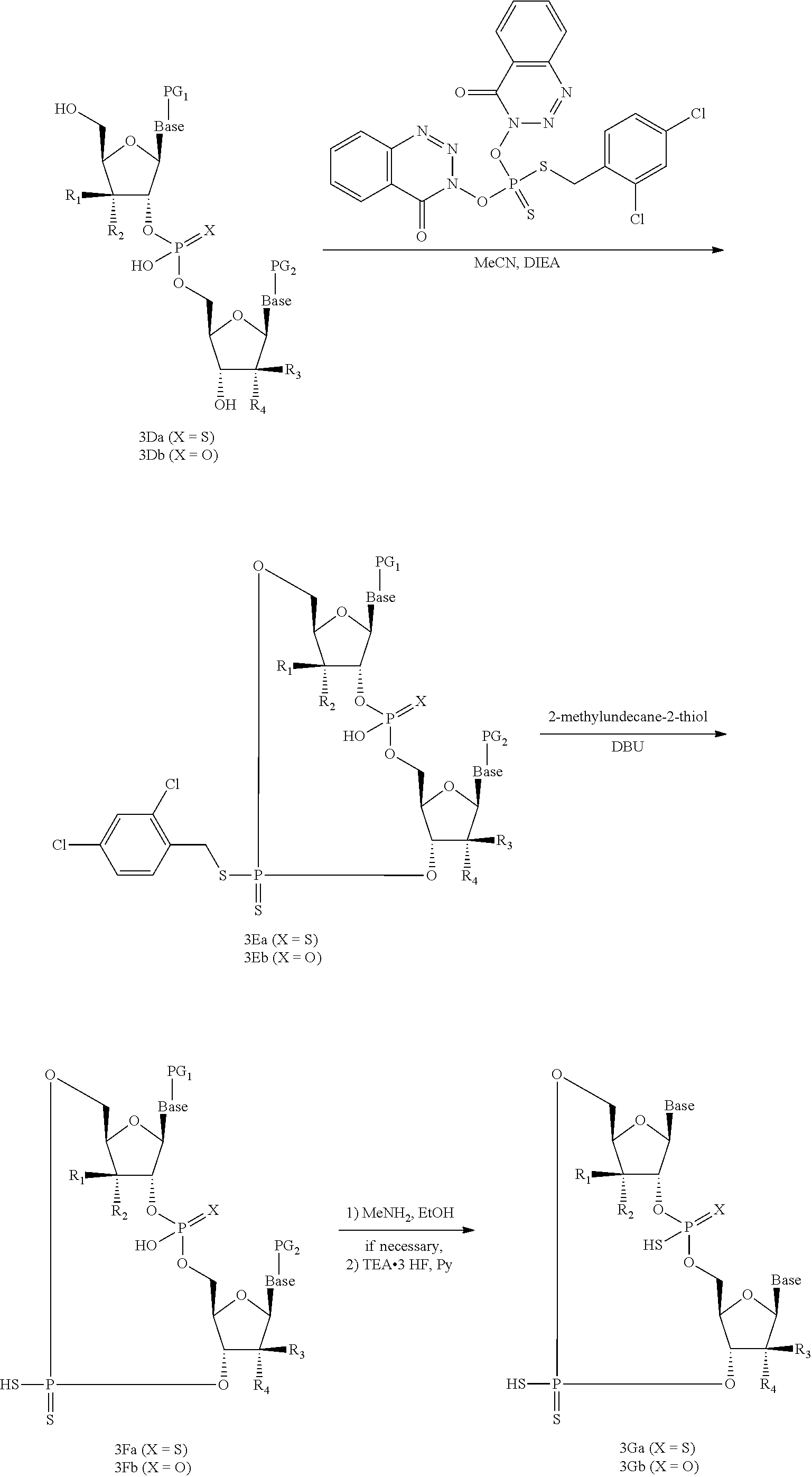
Method 4

Methods of Use
- 19F-NMR 19F nuclear magnetic resonance spectroscopy
- 1H-NMR Proton nuclear magnetic resonance spectroscopy
- 31P-NMR 31P nuclear magnetic resonance spectroscopy
- Å Angstrom
- AcOH Acetic acid
- aq Aqueous
- ATP Adenosine 5′-triphosphate
- BF3—OEt2 Boron trifuoride diethyl etherate
- Bn Benzyl
- Bz Benzoyl
- BzCl Benzoyl chloride
- CD3OD Deuterium-enriched methyl alcohol, deuterium-enriched methanol
- Ci Curie, a non-standard unit of radioactivity; 1Ci=3.7×10¹⁰Bq, where Bq is Becquerel, the SI unit of radioactivity, equivalent to 1 disintegration per second (dps)
- d Doublet
- D2O Deuterium-enriched water
- DBU 1,8-diazabicyclo(5.4.0)undec-7-ene
- DCA Dichloroacetic acid
- DCM, CH2Cl2 Dichloromethane
- ddd Doublet of doublet of doublet
- ddt Doublet of doublet of triplet
- DIEA N,N-diisopropylethylamine
- DMF N,N-dimethylformamide
- DMSO Dimethyl sulfoxide
- DMTr 4,4′-dimethoxytrityl
- DMTrCl 4,4′-dimethoxytrityl chloride
- DPCP Diphenyl phosphorochloridate
- dq Doublet of quartet
- #e # Standard exponential notation for #×10#; for example 2e5=2×10⁵
- EC50 half maximal effective concentration, concentration of a drug, antibody or toxicant that induces a response halfway between the baseline and maximum after a specified exposure time
- EDTA Ethylenediaminetetraacetic acid
- eq Equivalents
- ES Electron spray
- Et Ethyl
- Et2O Diethyl ether
- Et3N, TEA Triethylamine
- Et3N.3HF Triethylamine trihydrogen floride
- Et3SiH, Si(C2H5)3H Triethylsilane
- EtOAc Ethyl acetate
- EtOH Ethyl alcohol, ethanol
- g Gram
- GTP Guanosine 5′-triphosphate
- h Hour
- HEPES 2-[4-(2-hydroxyethyl)piperazin-1-yl]ethanesulfortic acid, a zwitterionic organic chemical buffering agent
- hept Heptet
- Hex Hexanes
- HF-Pyr, HF-Py Hydrogen fluoride pyridine complex
- HPLC High performance liquid chromatography
- Hz Hertz
- iPrMgCl-LiCl Isopropylmagnesium chloride lithium chloride compled
- J NMR Coupling constant
- L Liter
- LCMS Liquid chromatography mass spectroscopy
- Li2S Dilithium sulfide
- m Multiplet
- M Molar, moles per liter
- mCi Millicurie
- Me, CH3 Methyl
- MeCN, ACN, CH3CH Acetonitrile
- MeMgBr, CH3MgBr Methylmagnesium bromide
- MeNH, CH3NH2 Methylamine
- MeOH Methanol
- mg Milligram
- MgCl2 Magnesium chloride
- MHz Megahertz
- min Minute(s)
- mL,ml Milliliter
- mM Millimole per liter
- mm Millimeter
- mmol Millimole
- MOI Multiplicity of infection
- mol Mole
- N Normal
- ng Nanogram(s)
- nL Nanoliter
- nm Nanometer
- nM Nanomolar
- pfu Particle-forming units
- Ph phenyl
- PSI, psi Pounds per square inch
- Py Pyridine
- q Quartet
- RPM, rpm Revolutions per minute
- RT, rt Room temperature, approximately 25° C.
- s Singlet
- sat Saturated
- t Triplet
- tBuOOH t-Butylhydrogen peroxide
- TEAA Triethyl ammonium acetate
- THF Tetrahydrofuran
- TLC Thin layer chromatography
- TMSCl Trimethylsilyl chloride, Si(CH3)3Cl
- TR Retention time
- TrisCl Tris(hydroxymethyl)aminomethane hydrochloride
- v/v Volume/volume
- xg Times gravity; the force applied to a spinning sample in terms of multiples of the gravitational force
- λem Emission wavelength
- λex Excitation wavelength
- μg Microgram
- μL, uL Microliter
- μM, uM Micromolar
- μm Micrometer, micron
- μmol Micromole


| TABLE 1 | |||
| Mass | |||
| Example | Structure | Name | [M + H]+ |
| 3 |
 |
2-amino-9-[(5S,7R,8R,12aR,14R,15aS)- 14-(6-amino-9H-purin-9-yl)-10-hydroxy- 2-sulfanyl-2,10-disulfidooctahydro-12H- 5,8-methanofuro[3,2-1][1,3,6,9,11,2,10] pentaoxadiphosphacyclotetradecin- 7-yl]-1,9-dihydro-6H-purin-6- one (Diastereomer 1) | 691 |
| 4 |
 |
2-amino-9-[(5S,7R,8R,12aR,14R,15aS)- 14-(6-amino-9H-purin-9-yl)-10-hydroxy- 2-sulfanyl-2,10-disulfidooctahydro-12H- 5,8-methanofuro[3,2-1][1,3,6,9,11,2,10] pentaoxadiphosphacyclotetradecin- 7-yl]-1,9-dihydro-6H-purin-6- one (Diastereomer 2) | 691 |
| 5 |
 |
2-amino-9-[(5S,7R,8R,12aR,14R,15aS)- 14-(4-amino-7H-pyrrolo[2,3-d]pyrimidin- 7-yl)-10-hydroxy-2-sulfanyl-2,10- disulfidooctahydro-12H-5,8- methanofuro[3,2-1][1,3,6,9,11,2,10]penta- oxadiphosphacyclotetradecin-7-yl]-1,9- dihydro-6H-purin-6-one (Diastereomer 1) | 690 |
| 6 |
 |
2-amino-9-[(5S,7R,8R,12aR,14R,15aS)- 14-(4-amino-7H-pyrrolo[2,3-d]pyrimidin- 7-yl)-10-hydroxy-2-sulfanyl-2,10- disulfidooctahydro-12H-5,8- methanofuro[3,2-1][1,3,6,9,11,2,10]penta- oxadiphosphacyclotetradecin-7-yl]-1,9- dihydro-6H-purin-6-one (Diastereomer 2) | 690 |
| 7 |
 |
2-amino-9-[(5S,7R,8R,12aR,14R,15aS)- 14-(4-aminoimidazo[2,1-f][1,2,4]triazin-7- yl)-10-hydroxy-2-sulfanyl-2,10- disulfidooctahydro-12H-5,8- methanofuro[3,2-1][1,3,6,9,11,2,10]penta- oxadiphosphacyclotetradecin-7-yl]-1,9- dihydro-6H-purin-6-one (Diastereomer 1) | 691 |
| 8 |
 |
2-amino-9-[(5S,7R,8R,12aR,14R,15aS)- 14-(4-aminoimidazo[2,1-f][1,2,4]triazin-7- yl)-10-hydroxy-2-sulfanyl-2,10- disulfidooctahydro-12H-5,8- methanofuro[3,2-1][1,3,6,9,11,2,10]penta- oxadiphosphacyclotetradecin-7-yl]-1,9- dihydro-6H-purin-6-one (Diastereomer 2) | 691 |
| 9 |
 |
2-amino-9-[(5R,7R,8S,12aR,14R,15R, 15aS,18S)-14-(6-amino-9H-purin-9-yl)- 18-fluoro-10-hydroxy-2-sulfanyl-2,10- disulfidohexahydro-14H-15,12a- (epoxymethano)-5,8-methanofuro[3,2- 1][1,3,6,9,11,2,10] pentaoxadiphosphacyclotetradecin- 7(12H)-yl]-1,9-dihydro-6H- purin-6-one | 737 |


| TABLE 2 | |||
| Mass | |||
| Example | Structure | Name | [M + H]+ |
| 12 |
 |
2-amino-9-[(5R,7R,8S,12aR,14R,15S, 15aR,16R)-14-(6-amino-9H-purin-9-yl)- 15,16-difluoro-2-hydroxy-10-sulfanyl- 2,10-disulfidooctahydro-12H-5,8- methanofuro[3,2-1][1,3,6,9,11,2,10] pentaoxadiphosphacyclotetradecin-7-yl]- 1,9-dihydro-6H-purin-6-one (Diastereomer 1) | 727 |
| 13 |
 |
2-amino-9-[(5R,7R,8S,12aR,14R,15S, 15aR,16R)-14-(6-amino-9H-purin-9-yl)- 15,16-difluoro-2-hydroxy-10-sulfanyl- 2,10-disulfidooctahydro-12H-5,8- methanofuro[3,2-1][1,3,6,9,11,2,10] pentaoxadiphosphacyclotetradecin-7-yl]- 1,9-dihydro-6H-purin-6-one (Diastereomer 2) | 727 |
| 14 |
 |
2-amino-9-[(5S,7R,8R,12aR,14R,15aS)- 14-(4-amino-7H-pyrrolo[2,3-d]pyrimidin- 7-yl)-2-hydroxy-10-sulfanyl-2,10- disulfidooctahydro-12H-5,8- methanofuro[3,2-1][1,3,6,9,11,2,10] pentaoxadiphosphacyclotetradecin-7-yl]- 1,9-dihydro-6H-purin-6-one (Diastereomer 1) | 690 |
| 15 |
 |
2-amino-9-[(5R,7R,8S,12aR,14R,15R, 15aS,18S)-14-(6-amino-9H-purin-9-yl)- 18-fluoro-2-hydroxy-10-sulfanyl-2,10- disulfidohexahydro-14H-15,12a- (epoxymethano)-5,8-methanofuro[3,2- 1][1,3,6,9,11,2,10] pentaoxadiphosphacyclotetradecin- 7(12H)-yl]-1,9-dihydro-6H- purin-6-one (Diastereomer 1) | 737 |


| TABLE 3 | |||
| Mass | |||
| Example | Structure | Name | [M + H]+ |
| 18 |
 |
2-amino-9-[(5S,7R,8R,12aR,14R,15aS)- 14-(6-amino-9H-purin-9-yl)-10-hydroxy- 10-oxido-2-sulfanyl-2-sulfidooctahydro- 12H-5,8-methanofuro[3,2-1][1,3,6,9,11, 2,10]pentaoxadiphosphacyclotetradecin-7- yl]-1,9-dihydro-6H-purin-6-one | 673 |
| 19 |
 |
2-amino-9-[(5R,7R,8S,12aR,14R,15S, 15aR,16R)-14-(6-amino-9H-purin-9-yl)- 15,16-difluoro-10-hydroxy-10-oxido-2- sulfanyl-2-sulfidooctahydro-12H-5,8- methanofuro[3,2-1][1,3,6,9,11,2,10] pentaoxadiphosphacyclotetradecin- 7-yl]-1,9-dihydro-6H-purin-6-one | 709 |


| TABLE 4 | |||
| Mass | |||
| Example | Structure | Name | [M + H]+ |
| 21 |
 |
2-amino-9-[(5R,7R,8R,12aR,14R,15R, 15aS,18S)-14-(6-amino-9H-purin-9-yl)- 10,18-dihydroxy-10-oxido-2-sulfanyl-2- sulfidohexahydro-14H-15,12a- (epoxymethano)-5,8-methanofuro[3,2- 1][1,3,9,11,6,2,10] tetraoxathiadiphosphacyclotetradecin- 7(12H)-yl]-1,9-dihydro-6H- purin-6-one | 735 |


| TABLE 5 | |||
| Mass | |||
| Example | Structure | Name | [M + H]+ |
| 23 |
 |
2-amino-9-[(5S,7R,8R,12aR,14R,15aS)- 14-(6-amino-9H-purin-9-yl)-2-hydroxy-2- oxido-10-sulfanyl-10-sulfidooctahydro- 12H-5,8-methanofuro[3,2-1] [1,3,6,9,11,2,10] pentaoxadiphosphacyclotetradecin- 7-yl]-1,9-dihydro-6H-purin-6-one | 673 |

| TABLE 6 | |||
| Mass | |||
| Example | Structure | Name | [M + H]+ |
| 25 |
 |
2-amino-9-[(5S,7R,8R,12aR,14R, 15aS)-10-hydroxy-14-(6-oxo-1,6- dihydro-9H-purin-9-yl)-2-sulfanyl- 2,10-disulfidooctahydro-12H-5,8- methanofuro[3,2-1][1,3,6,9,11,2,10] pentaoxadiphosphacyclotetradecin-7- yl]-1,9-dihydro-6H-purin-6-one (Diastereomer 2) | 690 |
| 26 |
 |
2-amino-9-[(5S,7R,8R,12aR,14R,15aS)- 2-hydroxy-14-(6-oxo-1,6-dihydro-9H- purin-9-yl)-10-sulfanyl-2,10- disulfidooctahydro-12H-5,8- methanofuro[3,2-1][1,3,6,9,11,2,10] pentaoxadiphosphacyclotetradecin-7- yl]-1,9-dihydro-6H-purin-6-one | 690 |
| 27 |
 |
2-amino-9- [(5R,7R,8S,12aR,14R,15S,15aR,16R)- 15,16-difluoro-10-hydroxy-14-(6-oxo- 1,6-dihydro-9H-purin-9-yl)-2-sulfanyl- 2,10-disulfidooctahydro-12H-5,8- methanofuro[3,2-1][1,3,6,9,11,2,10] pentaoxadiphosphacyclotetradecin-7- yl]-1,9-dihydro-6H-purin-6-one | 726 |
| Component | Volume (uL) | Final Concentration |
| STING membrane | 148 | 1.5 | ug/ml |
| 3H-cGAMP | 50 | 2.0 | nM |
| Low Control (cold cGAMP) | 2 | 10 | uM |
| Test compound/DMSO | 2 | 10 | uM |
| Full-Length HAQ STING [STING(1-379)R71H, G230A, |
| H232R, R293Q-GG-AviTag-GS-HRV3C-HIS8]Amino Acid |
| Sequence: |
| (SEQ. ID. No. 1) |
| MPHSSLHPSIPCPRGHGAQKAALVLLSACLVTLWGLGEPPEHTLRYLVLH |
| LASLQLGLLLNGVCSLAEELHHIHSRYRGSYWRTVRACLGCPLRRGALLL |
| LSIYFYYSLPNAVGPPFTWMLALLGLSQALNILLGLKGLAPAEISAVCEK |
| GNFNVAHGLAWSYYIGYLRLILPELQARIRTYNQHYNNLLRGAVSQRLYI |
| LLPLDCGVPDNLSMADPNIRFLDKLPQQTADRAGIKDRVYSNSIYELLEN |
| GQRAGTCVLEYATPLQTLFAMSQYSQAGFSREDRLEQAKLFCQTLEDILA |
| DAPESQNNCRLIAYQEPADDSSFSLSQEVLRHLRQEEKEEVTVGSLKTSA |
| VPSTSTMSQEPELLISGMEKPLPLRTDFSGGGLNDIFEAQKIEWHEGSLE |
| VLFQGPHHHHHHHH |
| Full-length HAQ [STING(1-379)R71H, G230A, H232R, |
| R293Q-GG-AviTag-GS-HRV3C-HIS8/pBAC1] Plasmid DNA |
| Sequence: |
| (SEQ. ID. No. 2) |
| GGAACGGCTCCGCCCACTATTAATGAAATTAAAAATTCCAATTTTAAAAA |
| ACGCAGCAAGAGAAACATTTGTATGAAAGAATGCGTAGAAGGAAAGAAAA |
| ATGTCGTCGACATGCTGAACAACAAGATTAATATGCCTCCGTGTATAAAA |
| AAAATATTGAACGATTTGAAAGAAAACAATGTACCGCGCGGCGGTATGTA |
| CAGGAAGAGGTTTATACTAAACTGTTACATTGCAAACGTGGTTTCGTGTG |
| CCAAGTGTGAAAACCGATGTTTAATCAAGGCTCTGACGCATTTCTACAAC |
| CACGACTCCAAGTGTGTGGGTGAAGTCATGCATCTTTTAATCAAATCCCA |
| AGATGTGTATAAACCACCAAACTGCCAAAAAATGAAAACTGTCGACAAGC |
| TCTGTCCGTTTGCTGGCAACTGCAAGGGTCTCAATCCTATTTGTAATTAT |
| TGAATAATAAAACAATTATAAATGCTAAATTTGTTTTTTATTAACGATAC |
| AAACCAAACGCAACAAGAACATTTGTAGTATTATCTATAATTGAAAACGC |
| GTAGTTATAATCGCTGAGGTAATATTTAAAATCATTTTCAAATGATTCAC |
| AGTTAATTTGCGACAATATAATTTTATTTTCACATAAACTAGACGCCTTG |
| TCGTCTTCTTCTTCGTATTCCTTCTCTTTTTCATTTTTCTCTTCATAAAA |
| ATTAACATAGTTATTATCGTATCCATATATGTATCTATCGTATAGAGTAA |
| ATTTTTTGTTGTCATAAATATATATGTCTTTTTTAATGGGGTGTATAGTA |
| CCGCTGCGCATAGTTTTTCTGTAATTTACAACAGTGCTATTTTCTGGTAG |
| TTCTTCGGAGTGTGTTGCTTTAATTATTAAATTTATATAATCAATGAATT |
| TGGGATCGTCGGTTTTGTACAATATGTTGCCGGCATAGTACGCAGCTTCT |
| TCTAGTTCAATTACACCATTTTTTAGCAGCACCGGATTAACATAACTTTC |
| CAAAATGTTGTACGAACCGTTAAACAAAAACAGTTCACCTCCCTTTTCTA |
| TACTATTGTCTGCGAGCAGTTGTTTGTTGTTAAAAATAACAGCCATTGTA |
| ATGAGACGCACAAACTAATATCACAAACTGGAAATGTCTATCAATATATA |
| GTTGCTGATCAGATCTGATCATGGAGATAATTAAAATGATAACCATCTCG |
| CAAATAAATAAGTATTTTACTGTTTTCGTAACAGTTTTGTAATAAAAAAA |
| CCTATAAATATAGGATCCATGCCCCACTCCAGCCTGCATCCATCCATCCC |
| GTGTCCCAGGGGTCACGGGGCCCAGAAGGCAGCCTTGGTTCTGCTGAGTG |
| CCTGCCTGGTGACCCTTTGGGGGCTAGGAGAGCCACCAGAGCACACTCTC |
| CGGTACCTGGTGCTCCACCTAGCCTCCCTGCAGCTGGGACTGCTGTTAAA |
| CGGGGTCTGCAGCCTGGCTGAGGAGCTGCACCACATCCACTCCAGGTACC |
| GGGGCAGCTACTGGAGGACTGTGCGGGCCTGCCTGGGCTGCCCCCTCCGC |
| CGTGGGGCCCTGTTGCTGCTGTCCATCTATTTCTACTACTCCCTCCCAAA |
| TGCGGTCGGCCCGCCCTTCACTTGGATGCTTGCCCTCCTGGGCCTCTCGC |
| AGGCACTGAACATCCTCCTGGGCCTCAAGGGCCTGGCCCCAGCTGAGATC |
| TCTGCAGTGTGTGAAAAAGGGAATTTCAACGTGGCCCATGGGCTGGCATG |
| GTCATATTACATCGGATATCTGCGGCTGATCCTGCCAGAGCTCCAGGCCC |
| GGATTCGAACTTACAATCAGCATTACAACAACCTGCTACGGGGTGCAGTG |
| AGCCAGCGGCTGTATATTCTCCTCCCATTGGACTGTGGGGTGCCTGATAA |
| CCTGAGTATGGCTGACCCCAACATTCGCTTCCTGGATAAACTGCCCCAGC |
| AGACCGCTGACCGTGCTGGCATCAAGGATCGGGTTTACAGCAACAGCATC |
| TATGAGCTTCTGGAGAACGGGCAGCGGGCGGGCACCTGTGTCCTGGAGTA |
| CGCCACCCCCTTGCAGACTTTGTTTGCCATGTCACAATACAGTCAAGCTG |
| GCTTTAGCCGGGAGGATAGGCTTGAGCAGGCCAAACTCTTCTGCCAGACA |
| CTTGAGGACATCCTGGCAGATGCCCCTGAGTCTCAGAACAACTGCCGCCT |
| CATTGCCTACCAGGAACCTGCAGATGACAGCAGCTTCTCGCTGTCCCAGG |
| AGGTTCTCCGGCACCTGCGGCAGGAGGAAAAGGAAGAGGTTACTGTGGGC |
| AGCTTGAAGACCTCAGCGGTGCCCAGTACCTCCACGATGTCCCAAGAGCC |
| TGAGCTCCTCATCAGTGGAATGGAAAAGCCCCTCCCTCTCCGCACGGATT |
| TCTCTGGCGGTGGCCTGAACGACATCTTCGAAGCCCAGAAAATCGAATGG |
| CATGAAGGCAGCCTGGAAGTGCTGTTCCAGGGCCCACACCACCATCATCA |
| CCATCACCATTAATGAGCGGCCGCACTCGAGCACCACCACCACCACCACT |
| AACCTAGGTAGCTGAGCGCATGCAAGCTGATCCGGGTTATTAGTACATTT |
| ATTAAGCGCTAGATTCTGTGCGTTGTTGATTTACAGACAATTGTTGTACG |
| TATTTTAATAATTCATTAAATTTATAATCTTTAGGGTGGTATGTTAGAGC |
| GAAAATCAAATGATTTTCAGCGTCTTTATATCTGAATTTAAATATTAAAT |
| CCTCAATAGATTTGTAAAATAGGTTTCGATTAGTTTCAAACAAGGGTTGT |
| TTTTCCGAACCGATGGCTGGACTATCTAATGGATTTTCGCTCAACGCCAC |
| AAAACTTGCCAAATCTTGTAGCAGCAATCTAGCTTTGTCGATATTCGTTT |
| GTGTTTTGTTTTGTAATAAAGGTTCGACGTCGTTCAAAATATTATGCGCT |
| TTTGTATTTCTTTCATCACTGTCGTTAGTGTACAATTGACTCGACGTAAA |
| CACGTTAAATAGAGCTTGGACATATTTAACATCGGGCGTGTTAGCTTTAT |
| TAGGCCGATTATCGTCGTCGTCCCAACCCTCGTCGTTAGAAGTTGCTTCC |
| GAAGACGATTTTGCCATAGCCACACGACGCCTATTAATTGTGTCGGCTAA |
| CACGTCCGCGATCAAATTTGTAGTTGAGCTTTTTGGAATTATTTCTGATT |
| GCGGGCGTTTTTGGGCGGGTTTCAATCTAACTGTGCCCGATTTTAATTCA |
| GACAACACGTTAGAAAGCGATGGTGCAGGCGGTGGTAACATTTCAGACGG |
| CAAATCTACTAATGGCGGCGGTGGTGGAGCTGATGATAAATCTACCATCG |
| GTGGAGGCGCAGGCGGGGCTGGCGGCGGAGGCGGAGGCGGAGGTGGTGGC |
| GGTGATGCAGACGGCGGTTTAGGCTCAAATGTCTCTTTAGGCAACACAGT |
| CGGCACCTCAACTATTGTACTGGTTTCGGGCGCCGTTTTTGGTTTGACCG |
| GTCTGAGACGAGTGCGATTTTTTTCGTTTCTAATAGCTTCCAACAATTGT |
| TGTCTGTCGTCTAAAGGTGCAGCGGGTTGAGGTTCCGTCGGCATTGGTGG |
| AGCGGGCGGCAATTCAGACATCGATGGTGGTGGTGGTGGTGGAGGCGCTG |
| GAATGTTAGGCACGGGAGAAGGTGGTGGCGGCGGTGCCGCCGGTATAATT |
| TGTTCTGGTTTAGTTTGTTCGCGCACGATTGTGGGCACCGGCGCAGGCGC |
| CGCTGGCTGCACAACGGAAGGTCGTCTGCTTCGAGGCAGCGCTTGGGGTG |
| GTGGCAATTCAATATTATAATTGGAATACAAATCGTAAAAATCTGCTATA |
| AGCATTGTAATTTCGCTATCGTTTACCGTGCCGATATTTAACAACCGCTC |
| AATGTAAGCAATTGTATTGTAAAGAGATTGTCTCAAGCTCGGATCGATCC |
| CGCACGCCGATAACAAGCCTTTTCATTTTTACTACAGCATTGTAGTGGCG |
| AGACACTTCGCTGTCGTCGAGGTTTAAACGCTTCCTCGCTCACTGACTCG |
| CTGCGCTCGGTCGTTCGGCTGCGGCGAGCGGTATCAGCTCACTCAAAGGC |
| GGTAATACGGTTATCCACAGAATCAGGGGATAACGCAGGAAAGAACATGT |
| GAGCAAAAGGCCAGCAAAAGGCCAGGAACCGTAAAAAGGCCGCGTTGCTG |
| GCGTTTTTCCATAGGCTCCGCCCCCCTGACGAGCATCACAAAAATCGACG |
| CTCAAGTCAGAGGTGGCGAAACCCGACAGGACTATAAAGATACCAGGCGT |
| TTCCCCCTGGAAGCTCCCTCGTGCGCTCTCCTGTTCCGACCCTGCCGCTT |
| ACCGGATACCTGTCCGCCTTTCTCCCTTCGGGAAGCGTGGCGCTTTCTCA |
| TAGCTCACGCTGTAGGTATCTCAGTTCGGTGTAGGTCGTTCGCTCCAAGC |
| TGGGCTGTGTGCACGAACCCCCCGTTCAGCCCGACCGCTGCGCCTTATCC |
| GGTAACTATCGTCTTGAGTCCAACCCGGTAAGACACGACTTATCGCCACT |
| GGCAGCAGCCACTGGTAACAGGATTAGCAGAGCGAGGTATGTAGGCGGTG |
| CTACAGAGTTCTTGAAGTGGTGGCCTAACTACGGCTACACTAGAAGGACA |
| GTATTTGGTATCTGCGCTCTGCTGAAGCCAGTTACCTTCGGAAAAAGAGT |
| TGGTAGCTCTTGATCCGGCAAACAAACCACCGCTGGTAGCGGTGGTTTTT |
| TTGTTTGCAAGCAGCAGATTACGCGCAGAAAAAAAGGATCTCAAGAAGAT |
| CCTTTGATCTTTTCTACGGGGTCTGACGCTCAGTGGAACGAAAACTCACG |
| TTAAGGGATTTTGGTCATGAGATTATCAAAAAGGATCTTCACCTAGATCC |
| TTTTAAATTAAAAATGAAGTTTTAAATCAATCTAAAGTATATATGAGTAA |
| ACTTGGTCTGACAGTTACCAATGCTTAATCAGTGAGGCACCTATCTCAGC |
| GATCTGTCTATTTCGTTCATCCATAGTTGCCTGACTCCCCGTCGTGTAGA |
| TAACTACGATACGGGAGGGCTTACCATCTGGCCCCAGTGCTGCAATGATA |
| CCGCGAGACCCACGCTCACCGGCTCCAGATTTATCAGCAATAAACCAGCC |
| AGCCGGAAGGGCCGAGCGCAGAAGTGGTCCTGCAACTTTATCCGCCTCCA |
| TCCAGTCTATTAATTGTTGCCGGGAAGCTAGAGTAAGTAGTTCGCCAGTT |
| AATAGTTTGCGCAACGTTGTTGCCATTGCTACAGGCATCGTGGTGTCACG |
| CTCGTCGTTTGGTATGGCTTCATTCAGCTCCGGTTCCCAACGATCAAGGC |
| GAGTTACATGATCCCCCATGTTGTGCAAAAAAGCGGTTAGCTCCTTCGGT |
| CCTCCGATCGTTGTCAGAAGTAAGTTGGCCGCAGTGTTATCACTCATGGT |
| TATGGCAGCACTGCATAATTCTCTTACTGTCATGCCATCCGTAAGATGCT |
| TTTCTGTGACTGGTGAGTACTCAACCAAGTCATTCTGAGAATAGTGTATG |
| CGGCGACCGAGTTGCTCTTGCCCGGCGTCAATACGGGATAATACCGCGCC |
| ACATAGCAGAACTTTAAAAGTGCTCATCATTGGAAAACGTTCTTCGGGGC |
| GAAAACTCTCAAGGATCTTACCGCTGTTGAGATCCAGTTCGATGTAACCC |
| ACTCGTGCACCCAACTGATCTTCAGCATCTTTTACTTTCACCAGCGTTTC |
| TGGGTGAGCAAAAACAGGAAGGCAAAATGCCGCAAAAAAGGGAATAAGGG |
| CGACACGGAAATGTTGAATACTCATACTCTTCCTTTTTCAATATTATTGA |
| AGCATTTATCAGGGTTATTGTCTCATGAGCGGATACATATTTGAATGTAT |
| TTAGAAAAATAAACAAATAGGGGTTCCGCGCACATTTCCCCGAAAAGTGC |
| CACCTGACGCGCCCTGTAGCGGCGCATTAAGCGCGGCGGGTGTGGTGGTT |
| ACGCGCAGCGTGACCGCTACACTTGCCAGCGCCCTAGCGCCCGCTCCTTT |
| CGCTTTCTTCCCTTCCTTTCTCGCCACGTTCGCCGGCTTTCCCCGTCAAG |
| CTCTAAATCGGGGGCTCCCTTTAGGGTTCCGATTTAGTGCTTTACGGCAC |
| CTCGACCCCAAAAAACTTGATTAGGGTGATGGTTCACGTAGTGGGCCATC |
| GCCCTGATAGACGGTTTTTCGCCCTTTGACGTTGGAGTCCACGTTCTTTA |
| ATAGTGGACTCTTGTTCCAAACTGGAACAACACTCAACCCTATCTCGGTC |
| TATTCTTTTGATTTATAAGGGATTTTGCCGATTTCGGCCTATTGGTTAAA |
| AAATGAGCTGATTTAACAAAAATTTAACGCGAATTTTAACAAAATATTAA |
| CGTTTACAATTTCCCATTCGCCATTCAGGCTGCGCAACTGTTGGGAAGGG |
| CGATCGGTGCGGGCCTCTTCGCTATTACGCCA |
| TABLE 7 |
| 3H-cGAMP filtration binding assay for HAQ STING |
| Compound | EC50 (nM) | ||
| Example 1 | <1 | ||
| Example 2 | 2 | ||
| Example 3 | 2 | ||
| Example 5 | <1 | ||
| Example 6 | 28 | ||
| Example 7 | <1 | ||
| Example 8 | 7 | ||
| Example 9 | 349 | ||
| Example 16 | 5 | ||
| Example 17 | 15 | ||
| Example 20 | 1 | ||
| Example 21 | 217 | ||
| Example 27 | <1 | ||
| Component | Volume (uL) | Final Concentration |
| STING membrane | 148 | 1.5 | ug/ml |
| 3H-cGAMP | 50 | 4.0 | nM |
| Low Control (cold cGAMP) | 2 | 10 | uM |
| Test compound/DMSO | 2 | 10 | uM |
| Full-Length STING WT [STING(1-379)H232R-gg-AviTag- |
| gs-HRV3C-HIS8] Amino Acid Sequence: |
| (SEQ. ID. No. 3) |
| MPHSSLHPSIPCPRGHGAQKAALVLLSACLVTLWGLGEPPEHTLRYLVLH |
| LASLQLGLLLNGVCSLAEELRHIHSRYRGSYWRTVRACLGCPLRRGALLL |
| LSIYFYYSLPNAVGPPFTWMLALLGLSQALNILLGLKGLAPAEISAVCEK |
| GNFNVAHGLAWSYYIGYLRLILPELQARIRTYNQHYNNLLRGAVSQRLYI |
| LLPLDCGVPDNLSMADPNIRFLDKLPQQTGDRAGIKDRVYSNSIYELLEN |
| GQRAGTCVLEYATPLQTLFAMSQYSQAGFSREDRLEQAKLFCRTLEDILA |
| DAPESQNNCRLIAYQEPADDSSFSLSQEVLRHLRQEEKEEVTVGSLKTSA |
| VPSTSTMSQEPELLISGMEKPLPLRTDFSGGGLNDIFEAQKIEWHEGSLE |
| VLFQGPHHHHHHHH |
| Full-length WT STING [STING(1-379)H232R-gg-AviTag- |
| gs-HRV3C-HIS8/pBAC1] plasmid sequence: |
| (SEQ. ID. No. 4) |
| GGAACGGCTCCGCCCACTATTAATGAAATTAAAAATTCCAATTTTAAAAA |
| ACGCAGCAAGAGAAACATTTGTATGAAAGAATGCGTAGAAGGAAAGAAAA |
| ATGTCGTCGACATGCTGAACAACAAGATTAATATGCCTCCGTGTATAAAA |
| AAAATATTGAACGATTTGAAAGAAAACAATGTACCGCGCGGCGGTATGTA |
| CAGGAAGAGGTTTATACTAAACTGTTACATTGCAAACGTGGTTTCGTGTG |
| CCAAGTGTGAAAACCGATGTTTAATCAAGGCTCTGACGCATTTCTACAAC |
| CACGACTCCAAGTGTGTGGGTGAAGTCATGCATCTTTTAATCAAATCCCA |
| AGATGTGTATAAACCACCAAACTGCCAAAAAATGAAAACTGTCGACAAGC |
| TCTGTCCGTTTGCTGGCAACTGCAAGGGTCTCAATCCTATTTGTAATTAT |
| TGAATAATAAAACAATTATAAATGTCAAATTTGTTTTTTATTAACGATAC |
| AAACCAAACGCAACAAGAACATTTGTAGTATTATCTATAATTGAAAACGC |
| GTAGTTATAATCGCTGAGGTAATATTTAAAATCATTTTCAAATGATTCAC |
| AGTTAATTTGCGACAATATAATTTTATTTTCACATAAACTAGACGCCTTG |
| TCGTCTTCTTCTTCGTATTCCTTCTCTTTTTCATTTTTCTCTTCATAAAA |
| ATTAACATAGTTATTATCGTATCCATATATGTATCTATCGTATAGAGTAA |
| ATTTTTTGTTGTCATAAATATATATGTCTTTTTTAATGGGGTGTATAGTA |
| CCGCTGCGCATAGTTTTTCTGTAATTTACAACAGTGCTATTTTCTGGTAG |
| TTCTTCGGAGTGTGTTGCTTTAATTATTAAATTTATATAATCAATGAATT |
| TGGGATCGTCGGTTTTGTACAATATGTTGCCGGCATAGTACGCAGCTTCT |
| TCTAGTTCAATTACACCATTTTTTAGCAGCACCGGATTAACATAACTTTC |
| CAAAATGTTGTACGAACCGTTAAACAAAAACAGTTCACCTCCCTTTTCTA |
| TACTATTGTCTGCGAGCAGTTGTTTGTTGTTAAAAATAACAGCCATTGTA |
| ATGAGACGCACAAACTAATATCACAAACTGGAAATGTCTATCAATATATA |
| GTTGCTGATCAGATCTGATCATGGAGATAATTAAAATGATAACCATCTCG |
| CAAATAAATAAGTATTTTACTGTTTTCGTAACAGTTTTGTAATAAAAAAA |
| CCTATAAATATAGGATCCATGCCCCACTCCAGCCTGCATCCATCCATCCC |
| GTGTCCCAGGGGTCACGGGGCCCAGAAGGCAGCCTTGGTTCTGCTGAGTG |
| CCTGCCTGGTGACCCTTTGGGGGCTAGGAGAGCCACCAGAGCACACTCTC |
| CGGTACCTGGTGCTCCACCTAGCCTCCCTGCAGCTGGGACTGCTGTTAAA |
| CGGGGTCTGCAGCCTGGCTGAGGAGCTGCGCCACATCCACTCCAGGTACC |
| GGGGCAGCTACTGGAGGACTGTGCGGGCCTGCCTGGGCTGCCCCCTCCGC |
| CGTGGGGCCCTGTTGCTGCTGTCCATCTATTTCTACTACTCCCTCCCAAA |
| TGCGGTCGGCCCGCCCTTCACTTGGATGCTTGCCCTCCTGGGCCTCTCGC |
| AGGCACTGAACATCCTCCTGGGCCTCAAGGGCCTGGCCCCAGCTGAGATC |
| TCTGCAGTGTGTGAAAAAGGGAATTTCAACGTGGCCCATGGGCTGGCATG |
| GTCATATTACATCGGATATCTGCGGCTGATCCTGCCAGAGCTCCAGGCCC |
| GGATTCGAACTTACAATCAGCATTACAACAACCTGCTACGGGGTGCAGTG |
| AGCCAGCGGCTGTATATTCTCCTCCCATTGGACTGTGGGGTGCCTGATAA |
| CCTGAGTATGGCTGACCCCAACATTCGCTTCCTGGATAAACTGCCCCAGC |
| AGACCGGTGACCGTGCTGGCATCAAGGATCGGGTTTACAGCAACAGCATC |
| TATGAGCTTCTGGAGAACGGGCAGCGGGCGGGCACCTGTGTCCTGGAGTA |
| CGCCACCCCCTTGCAGACTTTGTTTGCCATGTCACAATACAGTCAAGCTG |
| GCTTTAGCCGGGAGGATAGGCTTGAGCAGGCCAAACTCTTCTGCCGGACA |
| CTTGAGGACATCCTGGCAGATGCCCCTGAGTCTCAGAACAACTGCCGCCT |
| CATTGCCTACCAGGAACCTGCAGATGACAGCAGCTTCTCGCTGTCCCAGG |
| AGGTTCTCCGGCACCTGCGGCAGGAGGAAAAGGAAGAGGTTACTGTGGGC |
| AGCTTGAAGACCTCAGCGGTGCCCAGTACCTCCACGATGTCCCAAGAGCC |
| TGAGCTCCTCATCAGTGGAATGGAAAAGCCCCTCCCTCTCCGCACGGATT |
| TCTCTGGCGGTGGCCTGAACGACATCTTCGAAGCCCAGAAAATCGAATGG |
| CATGAAGGCAGCCTGGAAGTGCTGTTCCAGGGCCCACACCACCATCATCA |
| CCATCACCATTAATGAGCGGCCGCACTCGAGCACCACCACCACCACCACT |
| AACCTAGGTAGCTGAGCGCATGCAAGCTGATCCGGGTTATTAGTACATTT |
| ATTAAGCGCTAGATTCTGTGCGTTGTTGATTTACAGACAATTGTTGTACG |
| TATTTTAATAATTCATTAAATTTATAATCTTTAGGGTGGTATGTTAGAGC |
| GAAAATCAAATGATTTTCAGCGTCTTTATATCTGAATTTAAATATTAAAT |
| CCTCAATAGATTTGTAAAATAGGTTTCGATTAGTTTCAAACAAGGGTTGT |
| TTTTCCGAACCGATGGCTGGACTATCTAATGGATTTTCGCTCAACGCCAC |
| AAAACTTGCCAAATCTTGTAGCAGCAATCTAGCTTTGTCGATATTCGTTT |
| GTGTTTTGTTTTGTAATAAAGGTTCGACGTCGTTCAAAATATTATGCGCT |
| TTTGTATTTCTTTCATCACTGTCGTTAGTGTACAATTGACTCGACGTAAA |
| CACGTTAAATAGAGCTTGGACATATTTAACATCGGGCGTGTTAGCTTTAT |
| TAGGCCGATTATCGTCGTCGTCCCAACCCTCGTCGTTAGAAGTTGCTTCC |
| GAAGACGATTTTGCCATAGCCACACGACGCCTATTAATTGTGTCGGCTAA |
| CACGTCCGCGATCAAATTTGTAGTTGAGCTTTTTGGAATTATTTCTGATT |
| GCGGGCGTTTTTGGGCGGGTTTCAATCTAACTGTGCCCGATTTTAATTCA |
| GACAACACGTTAGAAAGCGATGGTGCAGGCGGTGGTAACATTTCAGACGG |
| CAAATCTACTAATGGCGGCGGTGGTGGAGCTGATGATAAATCTACCATCG |
| GTGGAGGCGCAGGCGGGGCTGGCGGCGGAGGCGGAGGCGGAGGTGGTGGC |
| GGTGATGCAGACGGCGGTTTAGGCTCAAATGTCTCTTTAGGCAACACAGT |
| CGGCACCTCAACTATTGTACTGGTTTCGGGCGCCGTTTTTGGTTTGACCG |
| GTCTGAGACGAGTGCGATTTTTTTCGTTTCTAATAGCTTCCAACAATTGT |
| TGTCTGTCGTCTAAAGGTGCAGCGGGTTGAGGTTCCGTCGGCATTGGTGG |
| AGCGGGCGGCAATTCAGACATCGATGGTGGTGGTGGTGGTGGAGGCGCTG |
| GAATGTTAGGCACGGGAGAAGGTGGTGGCGGCGGTGCCGCCGGTATAATT |
| TGTTCTGGTTTAGTTTGTTCGCGCACGATTGTGGGCACCGGCGCAGGCGC |
| CGCTGGCTGCACAACGGAAGGTCGTCTGCTTCGAGGCAGCGCTTGGGGTG |
| GTGGCAATTCAATATTATAATTGGAATACAAATCGTAAAAATCTGCTATA |
| AGCATTGTAATTTCGCTATCGTTTACCGTGCCGATATTTAACAACCGCTC |
| AATGTAAGCAATTGTATTGTAAAGAGATTGTCTCAAGCTCGGATCGATCC |
| CGCACGCCGATAACAAGCCTTTTCATTTTTACTACAGCATTGTAGTGGCG |
| AGACACTTCGCTGTCGTCGAGGTTTAAACGCTTCCTCGCTCACTGACTCG |
| CTGCGCTCGGTCGTTCGGCTGCGGCGAGCGGTATCAGCTCACTCAAAGGC |
| GGTAATACGGTTATCCACAGAATCAGGGGATAACGCAGGAAAGAACATGT |
| GAGCAAAAGGCCAGCAAAAGGCCAGGAACCGTAAAAAGGCCGCGTTGCTG |
| GCGTTTTTCCATAGGCTCCGCCCCCCTGACGAGCATCACAAAAATCGACG |
| CTCAAGTCAGAGGTGGCGAAACCCGACAGGACTATAAAGATACCAGGCGT |
| TTCCCCCTGGAAGCTCCCTCGTGCGCTCTCCTGTTCCGACCCTGCCGCTT |
| ACCGGATACCTGTCCGCCTTTCTCCCTTCGGGAAGCGTGGCGCTTTCTCA |
| TAGCTCACGCTGTAGGTATCTCAGTTCGGTGTAGGTCGTTCGCTCCAAGC |
| TGGGCTGTGTGCACGAACCCCCCGTTCAGCCCGACCGCTGCGCCTTATCC |
| GGTAACTATCGTCTTGAGTCCAACCCGGTAAGACACGACTTATCGCCACT |
| GGCAGCAGCCACTGGTAACAGGATTAGCAGAGCGAGGTATGTAGGCGGTG |
| CTACAGAGTTCTTGAAGTGGTGGCCTAACTACGGCTACACTAGAAGGACA |
| GTATTTGGTATCTGCGCTCTGCTGAAGCCAGTTACCTTCGGAAAAAGAGT |
| TGGTAGCTCTTGATCCGGCAAACAAACCACCGCTGGTAGCGGTGGTTTTT |
| TTGTTTGCAAGCAGCAGATTACGCGCAGAAAAAAAGGATCTCAAGAAGAT |
| CCTTTGATCTTTTCTACGGGGTCTGACGCTCAGTGGAACGAAAACTCACG |
| TTAAGGGATTTTGGTCATGAGATTATCAAAAAGGATCTTCACCTAGATCC |
| TTTTAAATTAAAAATGAAGTTTTAAATCAATCTAAAGTATATATGAGTAA |
| ACTTGGTCTGACAGTTACCAATGCTTAATCAGTGAGGCACCTATCTCAGC |
| GATCTGTCTATTTCGTTCATCCATAGTTGCCTGACTCCCCGTCGTGTAGA |
| TAACTACGATACGGGAGGGCTTACCATCTGGCCCCAGTGCTGCAATGATA |
| CCGCGAGACCCACGCTCACCGGCTCCAGATTTATCAGCAATAAACCAGCC |
| AGCCGGAAGGGCCGAGCGCAGAAGTGGTCCTGCAACTTTATCCGCCTCCA |
| TCCAGTCTATTAATTGTTGCCGGGAAGCTAGAGTAAGTAGTTCGCCAGTT |
| AATAGTTTGCGCAACGTTGTTGCCATTGCTACAGGCATCGTGGTGTCACG |
| CTCGTCGTTTGGTATGGCTTCATTCAGCTCCGGTTCCCAACGATCAAGGC |
| GAGTTACATGATCCCCCATGTTGTGCAAAAAAGCGGTTAGCTCCTTCGGT |
| CCTCCGATCGTTGTCAGAAGTAAGTTGGCCGCAGTGTTATCACTCATGGT |
| TATGGCAGCACTGCATAATTCTCTTACTGTCATGCCATCCGTAAGATGCT |
| TTTCTGTGACTGGTGAGTACTCAACCAAGTCATTCTGAGAATAGTGTATG |
| CGGCGACCGAGTTGCTCTTGCCCGGCGTCAATACGGGATAATACCGCGCC |
| ACATAGCAGAACTTTAAAAGTGCTCATCATTGGAAAACGTTCTTCGGGGC |
| GAAAACTCTCAAGGATCTTACCGCTGTTGAGATCCAGTTCGATGTAACCC |
| ACTCGTGCACCCAACTGATCTTCAGCATCTTTTACTTTCACCAGCGTTTC |
| TGGGTGAGCAAAAACAGGAAGGCAAAATGCCGCAAAAAAGGGAATAAGGG |
| CGACACGGAAATGTTGAATACTCATACTCTTCCTTTTTCAATATTATTGA |
| AGCATTTATCAGGGTTATTGTCTCATGAGCGGATACATATTTGAATGTAT |
| TTAGAAAAATAAACAAATAGGGGTTCCGCGCACATTTCCCCGAAAAGTGC |
| CACCTGACGCGCCCTGTAGCGGCGCATTAAGCGCGGCGGGTGTGGTGGTT |
| ACGCGCAGCGTGACCGCTACACTTGCCAGCGCCCTAGCGCCCGCTCCTTT |
| CGCTTTCTTCCCTTCCTTTCTCGCCACGTTCGCCGGCTTTCCCCGTCAAG |
| CTCTAAATCGGGGGCTCCCTTTAGGGTTCCGATTTAGTGCTTTACGGCAC |
| CTCGACCCCAAAAAACTTGATTAGGGTGATGGTTCACGTAGTGGGCCATC |
| GCCCTGATAGACGGTTTTTCGCCCTTTGACGTTGGAGTCCACGTTCTTTA |
| ATAGTGGACTCTTGTTCCAAACTGGAACAACACTCAACCCTATCTCGGTC |
| TATTCTTTTGATTTATAAGGGATTTTGCCGATTTCGGCCTATTGGTTAAA |
| AAATGAGCTGATTTAACAAAAATTTAACGCGAATTTTAACAAAATATTAA |
| CGTTTACAATTTCCCATTCGCCATTCAGGCTGCGCAACTGTTGGGAAGGG |
| CGATCGGTGCGGGCCTCTTCGCTATTACGCCA |
| TABLE 8 |
| 3H-cGAMP filtration binding assay for WT STING |
| Compound | EC50 (nM) | ||
| Example 1 | <1 | ||
| Example 2 | 9 | ||
| Example 3 | 4 | ||
| Example 4 | <1 | ||
| Example 5 | 8 | ||
| Example 6 | 115 | ||
| Example 7 | <1 | ||
| Example 8 | 13 | ||
| Example 9 | 4393 | ||
| Example 10 | 6 | ||
| Example 11 | 34 | ||
| Example 12 | 171 | ||
| Example 13 | 223 | ||
| Example 14 | 244 | ||
| Example 15 | 79 | ||
| Example 16 | 18 | ||
| Example 18 | 1 | ||
| Example 19 | 1 | ||
| Example 20 | 3 | ||
| Example 21 | 1554 | ||
| Example 22 | 517 | ||
| Example 23 | 69 | ||
| Example 24 | 19 | ||
| Example 25 | 2 | ||
| Example 26 | 409 | ||
| TABLE 9 |
| IFN-β secretion in THP1 cell culture (5 h) |
| % Effect at | |||
| 30 μM | |||
| relative to | |||
| Compound | 2′3′-cGAMP | ||
| Example 1 | 165 | ||
| Example 2 | 175 | ||
| Example 3 | 128 | ||
| Example 4 | 146 | ||
| Example 5 | 95 | ||
| Example 6 | 91 | ||
| Example 7 | 173 | ||
| Example 8 | 110 | ||
| Example 9 | 26 | ||
| Example 10 | 91 | ||
| Example 11 | 51 | ||
| Example 12 | 116 | ||
| Example 13 | 95 | ||
| Example 14 | 422 | ||
| Example 15 | 357 | ||
| Example 16 | 107 | ||
| Example 17 | 145 | ||
| Example 18 | 153 | ||
| Example 19 | 250 | ||
| Example 20 | 137 | ||
| Example 21 | 45 | ||
| Example 22 | 117 | ||
| Example 23 | 152 | ||
| Example 24 | 168 | ||
| Example 25 | 281 | ||
| Example 26 | 75 | ||
| Example 27 | 164 | ||
Claims (17)


Priority Applications (1)
| Application Number | Priority Date | Filing Date | Title |
|---|---|---|---|
| US16/611,624 US11466047B2 (en) | 2017-05-12 | 2018-05-07 | Cyclic di-nucleotide compounds as sting agonists |
Applications Claiming Priority (3)
| Application Number | Priority Date | Filing Date | Title |
|---|---|---|---|
| US201762505194P | 2017-05-12 | 2017-05-12 | |
| US16/611,624 US11466047B2 (en) | 2017-05-12 | 2018-05-07 | Cyclic di-nucleotide compounds as sting agonists |
| PCT/US2018/031380 WO2018208667A1 (en) | 2017-05-12 | 2018-05-07 | Cyclic di-nucleotide compounds as sting agonists |
Publications (2)
| Publication Number | Publication Date |
|---|---|
| US20200062798A1 US20200062798A1 (en) | 2020-02-27 |
| US11466047B2 true US11466047B2 (en) | 2022-10-11 |
Family
ID=64104909
Family Applications (1)
| Application Number | Title | Priority Date | Filing Date |
|---|---|---|---|
| US16/611,624 Active 2039-09-22 US11466047B2 (en) | 2017-05-12 | 2018-05-07 | Cyclic di-nucleotide compounds as sting agonists |
Country Status (3)
| Country | Link |
|---|---|
| US (1) | US11466047B2 (en) |
| EP (1) | EP3621624B1 (en) |
| WO (1) | WO2018208667A1 (en) |
Families Citing this family (30)
| Publication number | Priority date | Publication date | Assignee | Title |
|---|---|---|---|---|
| CN114751950B (en) | 2016-03-18 | 2025-04-18 | 免疫传感器公司 | Cyclic dinucleotide compounds and methods of use |
| KR102569881B1 (en) | 2016-07-06 | 2023-08-22 | 에프-스타 테라퓨틱스 인코포레이티드 | Compounds, compositions and methods for treating disease |
| JP7591348B2 (en) | 2017-02-21 | 2024-11-28 | ボード オブ レジェンツ,ザ ユニバーシティ オブ テキサス システム | Cyclic dinucleotides as agonists of interferon gene stimulatory factor-dependent signal transduction. |
| US11638716B2 (en) | 2017-08-31 | 2023-05-02 | F-star Therapeutics, Inc. | Compounds, compositions, and methods for the treatment of disease |
| WO2019051488A1 (en) | 2017-09-11 | 2019-03-14 | Sperovie Biosciences, Inc. | Compounds compositions, and methods for the treatment of disease |
| WO2019051489A1 (en) | 2017-09-11 | 2019-03-14 | Sperovie Biosciences, Inc. | Compounds, compositions, and methods for the treatment of disease |
| EP3727401A4 (en) * | 2017-12-20 | 2022-04-06 | Merck Sharp & Dohme Corp. | CYCLIC DINUCLEOTIDE COMPOUNDS USED AS STING AGONISTS |
| US12291548B2 (en) | 2018-07-10 | 2025-05-06 | Sperovie Biosciences, Inc. | Compounds, compositions, and methods for the treatment of disease |
| EP3873484B1 (en) | 2018-10-29 | 2023-08-23 | Venenum Biodesign, LLC | Novel sting agonists |
| US11110106B2 (en) | 2018-10-29 | 2021-09-07 | Venenum Biodesign, LLC | Sting agonists for treating bladder cancer and solid tumors |
| WO2020117623A1 (en) * | 2018-12-07 | 2020-06-11 | Merck Sharp & Dohme Corp. | Cyclic di-nucleotide compounds as sting agonists |
| WO2020117624A1 (en) * | 2018-12-07 | 2020-06-11 | Merck Sharp & Dohme Corp. | Cyclic di-nucleotide compounds as sting agonists |
| US20220033431A1 (en) * | 2018-12-07 | 2022-02-03 | Merck Sharp & Dohme Corp. | Cyclic Di-Nucleotide Compounds as STING Agonists |
| WO2020205323A1 (en) * | 2019-03-29 | 2020-10-08 | Merck Sharp & Dohme Corp. | Stable formulations of cyclic dinucleotide sting agonist compounds and methods of use thereof |
| EP3962493A2 (en) | 2019-05-03 | 2022-03-09 | Flagship Pioneering Innovations V, Inc. | Methods of modulating immune activity/level of irf or sting or of treating cancer, comprising the administration of a sting modulator and/or purinergic receptor modulator or postcellular signaling factor |
| AU2020267486B2 (en) | 2019-05-09 | 2025-12-18 | Aligos Therapeutics, Inc. | Modified cyclic dinucleoside compounds as STING modulators |
| JP7622031B2 (en) | 2019-07-05 | 2025-01-27 | タンボ・インコーポレイテッド | Trans-cyclooctene bioorthogonal agents and uses in cancer and immunotherapy |
| BR112022000854A2 (en) | 2019-07-19 | 2022-03-08 | Immunesensor Therapeutics Inc | Antibody-sting agonist conjugates and their use in immunotherapy |
| TWI794742B (en) | 2020-02-18 | 2023-03-01 | 美商基利科學股份有限公司 | Antiviral compounds |
| AU2021224588B2 (en) | 2020-02-18 | 2024-07-18 | Gilead Sciences, Inc. | Antiviral compounds |
| TWI874791B (en) | 2020-02-18 | 2025-03-01 | 美商基利科學股份有限公司 | Antiviral compounds |
| WO2021206158A1 (en) | 2020-04-10 | 2021-10-14 | 小野薬品工業株式会社 | Method of cancer therapy |
| CA3178464A1 (en) | 2020-05-15 | 2021-11-18 | Immunesensor Therapeutics, Inc. | Sting agonist combination treatments with immune checkpoint inhibitors |
| US12589162B2 (en) | 2020-08-07 | 2026-03-31 | Tambo, Inc. | Trans-cyclooctene prodrug of monomethyl auristatin E |
| JP2023553069A (en) * | 2020-12-08 | 2023-12-20 | エフ. ホフマン-ラ ロシュ アーゲー | Novel synthesis of phosphorodithioate oligonucleotides |
| JP7688152B2 (en) | 2021-04-16 | 2025-06-03 | ギリアード サイエンシーズ, インコーポレイテッド | Method for preparing carbanucleosides using amides |
| CN118284423A (en) | 2021-07-23 | 2024-07-02 | 免疫传感器治疗股份有限公司 | Combination therapy of STING agonists and cytokines |
| JP7719954B2 (en) | 2021-08-18 | 2025-08-06 | ギリアード サイエンシーズ, インコーポレイテッド | Phospholipid compounds and methods for producing and using same |
| GB202304385D0 (en) | 2023-03-24 | 2023-05-10 | Prostate Cancer Res | Combinatorial IL-15 therapy |
| CN119930724B (en) * | 2024-12-18 | 2025-10-28 | 湖南大学 | An induced activated self-delivery cyclic dinucleoside derivative and its preparation method and use in anti-tumor immunotherapy |
Citations (61)
| Publication number | Priority date | Publication date | Assignee | Title |
|---|---|---|---|---|
| WO2001002369A2 (en) | 1999-07-02 | 2001-01-11 | Agouron Pharmaceuticals, Inc. | Indazole compounds and pharmaceutical compositions for inhibiting protein kinases, and methods for their use |
| WO2002010192A2 (en) | 2000-08-01 | 2002-02-07 | Novartis Ag | Somatostatin analogues |
| WO2002057245A1 (en) | 2001-01-19 | 2002-07-25 | Arco Chemical Technology, L.P. | Epoxidation catalyst and process |
| WO2002068470A2 (en) | 2001-02-26 | 2002-09-06 | Pharma Pacific Pty Ltd | Interferon-alpha induced gene |
| WO2004004771A1 (en) | 2002-07-03 | 2004-01-15 | Ono Pharmaceutical Co., Ltd. | Immunopotentiating compositions |
| WO2004056875A1 (en) | 2002-12-23 | 2004-07-08 | Wyeth | Antibodies against pd-1 and uses therefor |
| WO2004072286A1 (en) | 2003-01-23 | 2004-08-26 | Ono Pharmaceutical Co., Ltd. | Substance specific to human pd-1 |
| US20060040887A1 (en) | 2004-03-15 | 2006-02-23 | Karaolis David K | Method for stimulating the immune, inflammatory or neuroprotective response |
| US20060167241A1 (en) | 2003-07-15 | 2006-07-27 | Mitsui Chemicals, Inc. | Method for synthesizing cyclic bisdinucleoside |
| US20080286296A1 (en) | 2005-11-08 | 2008-11-20 | Thomas Ebensen | Cyclic-Dinucleotides and Its Conjugates as Adjuvants and Their Uses in Pharmaceutical Compositions |
| WO2010027827A2 (en) | 2008-08-25 | 2010-03-11 | Amplimmune, Inc. | Targeted costimulatory polypeptides and methods of use to treat cancer |
| WO2010047774A2 (en) | 2008-10-20 | 2010-04-29 | The Texas A & M University System | Inhibitors of mycobacterium tuberculosis malate synthase, methods of marking and uses thereof |
| WO2010077634A1 (en) | 2008-12-09 | 2010-07-08 | Genentech, Inc. | Anti-pd-l1 antibodies and their use to enhance t-cell function |
| WO2011066342A2 (en) | 2009-11-24 | 2011-06-03 | Amplimmune, Inc. | Simultaneous inhibition of pd-l1/pd-l2 |
| US8008449B2 (en) | 2005-05-09 | 2011-08-30 | Medarex, Inc. | Human monoclonal antibodies to programmed death 1 (PD-1) and methods for treating cancer using anti-PD-1 antibodies alone or in combination with other immunotherapeutics |
| US20110271358A1 (en) | 2008-09-26 | 2011-11-03 | Dana-Farber Cancer Institute, Inc. | Human anti-pd-1, pd-l1, and pd-l2 antibodies and uses therefor |
| US8168757B2 (en) | 2008-03-12 | 2012-05-01 | Merck Sharp & Dohme Corp. | PD-1 binding proteins |
| US8354509B2 (en) | 2007-06-18 | 2013-01-15 | Msd Oss B.V. | Antibodies to human programmed death receptor PD-1 |
| WO2013019906A1 (en) | 2011-08-01 | 2013-02-07 | Genentech, Inc. | Methods of treating cancer using pd-1 axis binding antagonists and mek inhibitors |
| US8383796B2 (en) | 2005-07-01 | 2013-02-26 | Medarex, Inc. | Nucleic acids encoding monoclonal antibodies to programmed death ligand 1 (PD-L1) |
| WO2013185052A1 (en) | 2012-06-08 | 2013-12-12 | Aduro Biotech | Compostions and methods for cancer immunotherapy |
| WO2014079335A1 (en) | 2012-11-26 | 2014-05-30 | 华为技术有限公司 | Ip packet processing method, apparatus and network system |
| WO2014093936A1 (en) | 2012-12-13 | 2014-06-19 | Aduro Biotech, Inc. | Compositions comprising cyclic purine dinucleotides having defined stereochemistries and methods for their preparation and use |
| WO2014099941A1 (en) | 2012-12-19 | 2014-06-26 | Idenix Pharmaceuticals, Inc. | 4'-fluoro nucleosides for the treatment of hcv |
| WO2014099824A1 (en) | 2012-12-19 | 2014-06-26 | Board Of Regents, The University Of Texas System | Pharmaceutical targeting of a mammalian cyclic di-nucleotide signaling pathway |
| US20140206640A1 (en) | 2011-04-13 | 2014-07-24 | Merck Sharp & Dohme Corp. | 2'-azido substituted nucleoside derivatives and methods of use thereof for the treatment of viral diseases |
| US20140329889A1 (en) | 2013-05-03 | 2014-11-06 | The Regents Of The University Of California | Cyclic di-nucleotide induction of type i interferon |
| US20140341976A1 (en) | 2013-05-18 | 2014-11-20 | Aduro Biotech, Inc. | Compositions and methods for inhibiting "stimulator of interferon gene" -dependent signalling |
| WO2014189806A1 (en) | 2013-05-18 | 2014-11-27 | Aduro Biotech, Inc. | Compositions and methods for inhibiting "stimulator of interferon gene" dependent signalling |
| WO2014189805A1 (en) | 2013-05-18 | 2014-11-27 | Auro Biotech, Inc. | Compositions and methods for activating "stimulator of interferon gene"-dependent signalling |
| WO2015017652A1 (en) | 2013-07-31 | 2015-02-05 | Memorial Sloan-Kettering Cancer Center | Sting crystals and modulators |
| WO2015077354A1 (en) | 2013-11-19 | 2015-05-28 | The University Of Chicago | Use of sting agonist as cancer treatment |
| WO2015074145A1 (en) | 2013-11-22 | 2015-05-28 | Brock University | Use of fluorinated cyclic dinucleotides as oral vaccine adjuvants |
| US20150158886A1 (en) | 2013-12-06 | 2015-06-11 | Rutgers, The State University Of New Jersey | Cyclic dinucleosides |
| WO2015148746A1 (en) | 2014-03-28 | 2015-10-01 | Merck Sharp & Dohme Corp. | 4'-substituted nucleoside-derivatives as hiv reverse transcriptase inhibitors |
| WO2015161137A1 (en) | 2014-04-16 | 2015-10-22 | Idenix Pharmaceuticals, Inc. | 3'-substituted methyl or alkynyl nucleosides for the treatment of hcv |
| WO2015185565A1 (en) | 2014-06-04 | 2015-12-10 | Glaxosmithkline Intellectual Property Development Limited | Cyclic di-nucleotides as modulators of sting |
| WO2015189117A1 (en) | 2014-06-12 | 2015-12-17 | Bayer Pharma Aktiengesellschaft | Heterobicyclically substituted 4-oxobutane acid derivatives and use thereof |
| US20160074507A1 (en) | 2014-09-16 | 2016-03-17 | Institut Curie | Method for preparing viral particles with cyclic dinucleotide and use of said particles for inducing immune response |
| WO2016100261A2 (en) | 2014-12-17 | 2016-06-23 | Lipogen Llc | Method of treating cancer with cgamp or cgasmp |
| WO2016096577A1 (en) | 2014-12-16 | 2016-06-23 | Invivogen | Combined use of a chemotherapeutic agent and a cyclic dinucleotide for cancer treatment |
| WO2016096174A1 (en) | 2014-12-16 | 2016-06-23 | Invivogen | Fluorinated cyclic dinucleotides for cytokine induction |
| WO2016120305A1 (en) | 2015-01-29 | 2016-08-04 | Glaxosmithkline Intellectual Property Development Limited | Cyclic dinucleotides useful for the treatment of inter alia cancer |
| WO2016120605A1 (en) | 2015-01-27 | 2016-08-04 | Bae Systems Plc | Reactive materials |
| WO2016145102A1 (en) | 2015-03-10 | 2016-09-15 | Aduro Biotech, Inc. | Compositions and methods for activating "stimulator of interferon gene" -dependent signalling |
| WO2017011522A1 (en) | 2015-07-16 | 2017-01-19 | Sonavex, Inc. | Microcavity-containing polymeric medical devices for enhanced ultrasonic echogenicity |
| WO2017011622A1 (en) | 2015-07-14 | 2017-01-19 | Spring Bank Pharmaceuticals, Inc. | Compounds and compositions that induce rig-i-and other pattern recongnition receptors |
| WO2017011920A1 (en) | 2015-07-22 | 2017-01-26 | The Royal Institution For The Advancement Of Learning/Mcgill University | Compounds and uses thereof in the treatment of cancers and other medical conditions |
| WO2017027645A1 (en) | 2015-08-13 | 2017-02-16 | Merck Sharp & Dohme Corp. | Cyclic di-nucleotide compounds as sting agonists |
| US20170050967A1 (en) | 2015-08-20 | 2017-02-23 | The Board Of Trustees Of The Leland Stanford Junior University | Ganciclovir derivatives for modulating innate and adaptive immunity and for use in immunotherapy |
| EP3135290A1 (en) | 2014-04-21 | 2017-03-01 | Fudan University | Antitumor use of cyclic dinucleotide cgmp |
| WO2017075477A1 (en) | 2015-10-28 | 2017-05-04 | Aduro Biotech, Inc. | Compositions and methods for activating "stimulator of interferon gene"-dependent signalling |
| US20170158724A1 (en) | 2015-12-03 | 2017-06-08 | Glaxosmithkline Intellectual Property Development Limited | Novel Compounds |
| WO2017100305A2 (en) | 2015-12-07 | 2017-06-15 | Opi Vi - Ip Holdco Llc | Composition of antibody construct-agonist conjugates and methods of use thereof |
| WO2017123657A1 (en) | 2016-01-11 | 2017-07-20 | Gary Glick | Cyclic dinucleotides for treating conditions associated with sting activity such as cancer |
| WO2017123669A1 (en) | 2016-01-11 | 2017-07-20 | Gary Glick | Cyclic dinucleotides for treating conditions associated with sting activity such as cancer |
| WO2017161349A1 (en) | 2016-03-18 | 2017-09-21 | Immune Sensor, Llc | Cyclic di-nucleotide compounds and methods of use |
| WO2017175156A1 (en) | 2016-04-07 | 2017-10-12 | Glaxosmithkline Intellectual Property Development Limited | Heterocyclic amides useful as protein modulators |
| WO2017175147A1 (en) | 2016-04-07 | 2017-10-12 | Glaxosmithkline Intellectual Property Development Limited | Heterocyclic amides useful as protein modulators |
| WO2017216726A1 (en) | 2016-06-13 | 2017-12-21 | Glaxosmithkline Intellectual Property Development Limited | Substituted pyridines as inhibitors of dnmt1 |
| WO2018009466A1 (en) | 2016-07-05 | 2018-01-11 | Aduro Biotech, Inc. | Locked nucleic acid cyclic dinucleotide compounds and uses thereof |
-
2018
- 2018-05-07 WO PCT/US2018/031380 patent/WO2018208667A1/en not_active Ceased
- 2018-05-07 US US16/611,624 patent/US11466047B2/en active Active
- 2018-05-07 EP EP18798351.5A patent/EP3621624B1/en active Active
Patent Citations (73)
| Publication number | Priority date | Publication date | Assignee | Title |
|---|---|---|---|---|
| WO2001002369A2 (en) | 1999-07-02 | 2001-01-11 | Agouron Pharmaceuticals, Inc. | Indazole compounds and pharmaceutical compositions for inhibiting protein kinases, and methods for their use |
| WO2001002369A3 (en) | 1999-07-02 | 2002-04-25 | Agouron Pharma | Indazole compounds and pharmaceutical compositions for inhibiting protein kinases, and methods for their use |
| WO2002010192A2 (en) | 2000-08-01 | 2002-02-07 | Novartis Ag | Somatostatin analogues |
| WO2002057245A1 (en) | 2001-01-19 | 2002-07-25 | Arco Chemical Technology, L.P. | Epoxidation catalyst and process |
| WO2002068470A2 (en) | 2001-02-26 | 2002-09-06 | Pharma Pacific Pty Ltd | Interferon-alpha induced gene |
| WO2004004771A1 (en) | 2002-07-03 | 2004-01-15 | Ono Pharmaceutical Co., Ltd. | Immunopotentiating compositions |
| US7595048B2 (en) | 2002-07-03 | 2009-09-29 | Ono Pharmaceutical Co., Ltd. | Method for treatment of cancer by inhibiting the immunosuppressive signal induced by PD-1 |
| WO2004056875A1 (en) | 2002-12-23 | 2004-07-08 | Wyeth | Antibodies against pd-1 and uses therefor |
| US7488802B2 (en) | 2002-12-23 | 2009-02-10 | Wyeth | Antibodies against PD-1 |
| US7521051B2 (en) | 2002-12-23 | 2009-04-21 | Medimmune Limited | Methods of upmodulating adaptive immune response using anti-PD-1 antibodies |
| US20080025979A1 (en) | 2003-01-23 | 2008-01-31 | Tasuku Honjo | Substance Specific to Human Pd-1 |
| WO2004072286A1 (en) | 2003-01-23 | 2004-08-26 | Ono Pharmaceutical Co., Ltd. | Substance specific to human pd-1 |
| US20060167241A1 (en) | 2003-07-15 | 2006-07-27 | Mitsui Chemicals, Inc. | Method for synthesizing cyclic bisdinucleoside |
| US20060040887A1 (en) | 2004-03-15 | 2006-02-23 | Karaolis David K | Method for stimulating the immune, inflammatory or neuroprotective response |
| US8008449B2 (en) | 2005-05-09 | 2011-08-30 | Medarex, Inc. | Human monoclonal antibodies to programmed death 1 (PD-1) and methods for treating cancer using anti-PD-1 antibodies alone or in combination with other immunotherapeutics |
| US8383796B2 (en) | 2005-07-01 | 2013-02-26 | Medarex, Inc. | Nucleic acids encoding monoclonal antibodies to programmed death ligand 1 (PD-L1) |
| US20080286296A1 (en) | 2005-11-08 | 2008-11-20 | Thomas Ebensen | Cyclic-Dinucleotides and Its Conjugates as Adjuvants and Their Uses in Pharmaceutical Compositions |
| US8354509B2 (en) | 2007-06-18 | 2013-01-15 | Msd Oss B.V. | Antibodies to human programmed death receptor PD-1 |
| US8168757B2 (en) | 2008-03-12 | 2012-05-01 | Merck Sharp & Dohme Corp. | PD-1 binding proteins |
| WO2010027827A2 (en) | 2008-08-25 | 2010-03-11 | Amplimmune, Inc. | Targeted costimulatory polypeptides and methods of use to treat cancer |
| US20110271358A1 (en) | 2008-09-26 | 2011-11-03 | Dana-Farber Cancer Institute, Inc. | Human anti-pd-1, pd-l1, and pd-l2 antibodies and uses therefor |
| WO2010047774A2 (en) | 2008-10-20 | 2010-04-29 | The Texas A & M University System | Inhibitors of mycobacterium tuberculosis malate synthase, methods of marking and uses thereof |
| WO2010077634A1 (en) | 2008-12-09 | 2010-07-08 | Genentech, Inc. | Anti-pd-l1 antibodies and their use to enhance t-cell function |
| WO2011066342A2 (en) | 2009-11-24 | 2011-06-03 | Amplimmune, Inc. | Simultaneous inhibition of pd-l1/pd-l2 |
| US20140206640A1 (en) | 2011-04-13 | 2014-07-24 | Merck Sharp & Dohme Corp. | 2'-azido substituted nucleoside derivatives and methods of use thereof for the treatment of viral diseases |
| WO2013019906A1 (en) | 2011-08-01 | 2013-02-07 | Genentech, Inc. | Methods of treating cancer using pd-1 axis binding antagonists and mek inhibitors |
| WO2013185052A1 (en) | 2012-06-08 | 2013-12-12 | Aduro Biotech | Compostions and methods for cancer immunotherapy |
| WO2014079335A1 (en) | 2012-11-26 | 2014-05-30 | 华为技术有限公司 | Ip packet processing method, apparatus and network system |
| WO2014093936A1 (en) | 2012-12-13 | 2014-06-19 | Aduro Biotech, Inc. | Compositions comprising cyclic purine dinucleotides having defined stereochemistries and methods for their preparation and use |
| WO2014099941A1 (en) | 2012-12-19 | 2014-06-26 | Idenix Pharmaceuticals, Inc. | 4'-fluoro nucleosides for the treatment of hcv |
| WO2014099824A1 (en) | 2012-12-19 | 2014-06-26 | Board Of Regents, The University Of Texas System | Pharmaceutical targeting of a mammalian cyclic di-nucleotide signaling pathway |
| US20140329889A1 (en) | 2013-05-03 | 2014-11-06 | The Regents Of The University Of California | Cyclic di-nucleotide induction of type i interferon |
| WO2014179760A1 (en) | 2013-05-03 | 2014-11-06 | The Regents Of The University Of California | Cyclic di-nucleotide induction of type i interferon |
| US20150056224A1 (en) | 2013-05-18 | 2015-02-26 | Aduro Biotech, Inc. | Compositions and methods for activating stimulator of interferon gene-dependent signalling |
| WO2014189805A1 (en) | 2013-05-18 | 2014-11-27 | Auro Biotech, Inc. | Compositions and methods for activating "stimulator of interferon gene"-dependent signalling |
| US20140341976A1 (en) | 2013-05-18 | 2014-11-20 | Aduro Biotech, Inc. | Compositions and methods for inhibiting "stimulator of interferon gene" -dependent signalling |
| WO2014189806A1 (en) | 2013-05-18 | 2014-11-27 | Aduro Biotech, Inc. | Compositions and methods for inhibiting "stimulator of interferon gene" dependent signalling |
| US9724408B2 (en) | 2013-05-18 | 2017-08-08 | Aduro Biotech, Inc. | Compositions and methods for activating stimulator of interferon gene-dependent signalling |
| WO2015017652A1 (en) | 2013-07-31 | 2015-02-05 | Memorial Sloan-Kettering Cancer Center | Sting crystals and modulators |
| WO2015077354A1 (en) | 2013-11-19 | 2015-05-28 | The University Of Chicago | Use of sting agonist as cancer treatment |
| US20160287698A1 (en) | 2013-11-22 | 2016-10-06 | Brock University | Use of fluorinated cyclic dinucleotides as oral vaccine adjuvants |
| WO2015074145A1 (en) | 2013-11-22 | 2015-05-28 | Brock University | Use of fluorinated cyclic dinucleotides as oral vaccine adjuvants |
| US20150158886A1 (en) | 2013-12-06 | 2015-06-11 | Rutgers, The State University Of New Jersey | Cyclic dinucleosides |
| WO2015148746A1 (en) | 2014-03-28 | 2015-10-01 | Merck Sharp & Dohme Corp. | 4'-substituted nucleoside-derivatives as hiv reverse transcriptase inhibitors |
| WO2015161137A1 (en) | 2014-04-16 | 2015-10-22 | Idenix Pharmaceuticals, Inc. | 3'-substituted methyl or alkynyl nucleosides for the treatment of hcv |
| EP3135290A1 (en) | 2014-04-21 | 2017-03-01 | Fudan University | Antitumor use of cyclic dinucleotide cgmp |
| WO2015185565A1 (en) | 2014-06-04 | 2015-12-10 | Glaxosmithkline Intellectual Property Development Limited | Cyclic di-nucleotides as modulators of sting |
| WO2015189117A1 (en) | 2014-06-12 | 2015-12-17 | Bayer Pharma Aktiengesellschaft | Heterobicyclically substituted 4-oxobutane acid derivatives and use thereof |
| US20160074507A1 (en) | 2014-09-16 | 2016-03-17 | Institut Curie | Method for preparing viral particles with cyclic dinucleotide and use of said particles for inducing immune response |
| US20160362441A1 (en) | 2014-12-16 | 2016-12-15 | Invivogen | Cyclic dinucleotides for cytokine induction |
| WO2016096174A1 (en) | 2014-12-16 | 2016-06-23 | Invivogen | Fluorinated cyclic dinucleotides for cytokine induction |
| WO2016096577A1 (en) | 2014-12-16 | 2016-06-23 | Invivogen | Combined use of a chemotherapeutic agent and a cyclic dinucleotide for cancer treatment |
| WO2016100261A2 (en) | 2014-12-17 | 2016-06-23 | Lipogen Llc | Method of treating cancer with cgamp or cgasmp |
| WO2016120605A1 (en) | 2015-01-27 | 2016-08-04 | Bae Systems Plc | Reactive materials |
| WO2016120305A1 (en) | 2015-01-29 | 2016-08-04 | Glaxosmithkline Intellectual Property Development Limited | Cyclic dinucleotides useful for the treatment of inter alia cancer |
| WO2016145102A1 (en) | 2015-03-10 | 2016-09-15 | Aduro Biotech, Inc. | Compositions and methods for activating "stimulator of interferon gene" -dependent signalling |
| WO2017011622A1 (en) | 2015-07-14 | 2017-01-19 | Spring Bank Pharmaceuticals, Inc. | Compounds and compositions that induce rig-i-and other pattern recongnition receptors |
| WO2017011522A1 (en) | 2015-07-16 | 2017-01-19 | Sonavex, Inc. | Microcavity-containing polymeric medical devices for enhanced ultrasonic echogenicity |
| WO2017011920A1 (en) | 2015-07-22 | 2017-01-26 | The Royal Institution For The Advancement Of Learning/Mcgill University | Compounds and uses thereof in the treatment of cancers and other medical conditions |
| WO2017027645A1 (en) | 2015-08-13 | 2017-02-16 | Merck Sharp & Dohme Corp. | Cyclic di-nucleotide compounds as sting agonists |
| WO2017027646A1 (en) | 2015-08-13 | 2017-02-16 | Merck Sharp & Dohme Corp. | Cyclic di-nucleotide compounds as sting agonists |
| US20170050967A1 (en) | 2015-08-20 | 2017-02-23 | The Board Of Trustees Of The Leland Stanford Junior University | Ganciclovir derivatives for modulating innate and adaptive immunity and for use in immunotherapy |
| WO2017075477A1 (en) | 2015-10-28 | 2017-05-04 | Aduro Biotech, Inc. | Compositions and methods for activating "stimulator of interferon gene"-dependent signalling |
| US20170158724A1 (en) | 2015-12-03 | 2017-06-08 | Glaxosmithkline Intellectual Property Development Limited | Novel Compounds |
| WO2017093933A1 (en) | 2015-12-03 | 2017-06-08 | Glaxosmithkline Intellectual Property Development Limited | Cyclic purine dinucleotides as modulators of sting |
| WO2017100305A2 (en) | 2015-12-07 | 2017-06-15 | Opi Vi - Ip Holdco Llc | Composition of antibody construct-agonist conjugates and methods of use thereof |
| WO2017123657A1 (en) | 2016-01-11 | 2017-07-20 | Gary Glick | Cyclic dinucleotides for treating conditions associated with sting activity such as cancer |
| WO2017123669A1 (en) | 2016-01-11 | 2017-07-20 | Gary Glick | Cyclic dinucleotides for treating conditions associated with sting activity such as cancer |
| WO2017161349A1 (en) | 2016-03-18 | 2017-09-21 | Immune Sensor, Llc | Cyclic di-nucleotide compounds and methods of use |
| WO2017175156A1 (en) | 2016-04-07 | 2017-10-12 | Glaxosmithkline Intellectual Property Development Limited | Heterocyclic amides useful as protein modulators |
| WO2017175147A1 (en) | 2016-04-07 | 2017-10-12 | Glaxosmithkline Intellectual Property Development Limited | Heterocyclic amides useful as protein modulators |
| WO2017216726A1 (en) | 2016-06-13 | 2017-12-21 | Glaxosmithkline Intellectual Property Development Limited | Substituted pyridines as inhibitors of dnmt1 |
| WO2018009466A1 (en) | 2016-07-05 | 2018-01-11 | Aduro Biotech, Inc. | Locked nucleic acid cyclic dinucleotide compounds and uses thereof |
Non-Patent Citations (61)
| Title |
|---|
| Ablasser et al., Cell intrinsic immunity spreads to bystander cells via the intercellular transfer of cGAMP, Nature, Nov. 28, 2013, 530-546, 503. |
| Ablasser et al., cGAS produces a 2′-5′-linked cyclic dinucleotide second messenger that activates STING, Nature, Jun. 20, 2013, 380-385, 498. |
| Ausmees et al., Genetic Data Indicate that Proteins Containing the GGDEF Domain Possess Diguanylate Cyclase Activity, FEMS Microbiology, 2001, 163-167, Letters 204. |
| Berge, S.M., et al.,, "Pharmaceutical Salts", J. Pharm. Sci, 1977, pp. 1-19, vol. 66, No. 1. |
| Bhattacharya et al., Total Synthesis of 2′-deoxy-2′-arafluoro-tubericidin, -toyocamycin, -sangivamycin and certain related molecules, J. Chem. Soc., Perkin Trans. 1; Organic and Bio-Organic Chemistry, 1995, 1543-1550, 12. |
| Boehr et al., Establishing the Principles of Recognition in the Adenine-Binding Region of an Aminoglycoside Antibiotic Kinase [APH(3′)-IIIa], Biochemistry, 2005, 12445-12453, 44(37). |
| Bookser et al., High-Throughput Five Minute Microwave Accelerated Glycosylation Approach to the Synthesis of Nucleoside Libraries, JOC Article, 2007, 173-179, 72. |
| Bruno et al., N-Substituted 2-aminobiphenylpalladium Methanesulfonate Precatalysts and Their Use in C-C and C-N Cross Couplings, The Journal of Organic Chamistry, 2014, 4161-4166, 79. |
| Dande et al., Improving RNA Interference in Mammalian Cells by 4′-Thio-Modified Small Interfering RNA (siRNA): Effect on siRNA Activity and Nuclease Stability When Used in Combination with 2′-O-Alkyl Modifications, Journal of Medicinal Chemistry, 2006, 1624-1634, 49(5). |
| Diner et al., The Innate Immune DNA Sensor cGAS Produces a Noncanonical Cyclic Dinucleotide that Activates Human STING, 3 Cell Reports, Cell Reports, 2013, 1355-1361, 3. |
| Downey et al., DMXAA Causes Tumor Site-Specific Vascular Disruption in Murine Non-Small Molecule Lung Cancer, and Like the Endogenous Non-Canonical Cyclic Dinucleotide STING Agonist, 2′3′-cGAMP, Induces M2 Macrophage Repolarization, PLOS One, 2014, 1-14, 9-6-e99988. |
| Ertem et al., Synthesis of RNA oligomers on heterogeneous templates, Nature, 1996, 238-240, 379-18. |
| Fagundes et al., Building unique bonds to fight misplaced DNA, Cell Research, 2013, 1065-1066, 2-9. |
| Fu, Juan, et al., STING agonist formulated cancer vaccines can cure established tumors resistant to PD-1 blockade, Science Translational Medicine, 2015, 1-13, 7. |
| Gadthula et al., Synthesis and Anti-HIV Activity of β-D-3′-Azido-2′,3′-unsaturated Nucleosides and β-D-3′-Azido-3′deoxyribofuranosylnucleosides, Nucleoside, Nucleotides, Nucleic Acids, 2005, 1707-1727, 24. |
| Gaffney et al., One-Flask Syntheses of c-di-GMP and the [Rp,Rp] and [Rp,Sp] Thiophosphate Analogues, Organic Letters, 2010, 3269-3271, 12-14. |
| Gao et al., Cyclic [G(2′,5′)pA(3′,5″)p] Is the Metazoan Second Messenger Produced by DNA-Activated Cyclic GMP-AMP Synthase, Cell, 2013, 1094-1107, 153. |
| Gao et al., Structure-Function Ananlysis of STING Activation by c[G(2′,5′)pA(3′,5′)p] and Targeting by Antiviral DMXAA, Cell, 2013, 748-762, 154. |
| Goerlitzer, et al., 1,3-Dicarbonyl Compounds. XIV: 4-Oxo-4H-[1]benzofuro[3,2-b]pyrans, Archiv der Pharmazie, 1980, 385-398, vol. 313; Issue 5. |
| Gosselin et al., Systematic Synthesis and Biological Evaluation of α- and β-D-lyxofuranosyl Nucleosides of the Five Naturally Occurring Nucleic Acid Bases, J. Med. Chem, 1987, 982-991, 30. |
| Gould, Salt Selections for Basic Drugs, Intl. J. Pharmaceutics, 1986, pp. 201-217, vol. 33. |
| Guanghui Yi et al., Single Nucleotide Polymorphisms of Human STING Can Affect Innate Immune Response to Cyclic Dinucleotides, PLOS One, 2013, 1-16, 8-10-e77846. |
| Heping Shi, et al., Molecular basis for the specific recognition of the metazoan cyclic GMP-AMP by the innate immune adaptor protein STING, PNAS, 2015, 8947-8952, vol. 112/No. 29. |
| Ikeuchi et al., Practical synthesis of natural plant-growth regulator 2-azahypoxanthine, its derivatives, and biotin-labeled probes, Organic & Biomolecular Chemistry, 2014, 3813, 12(23). |
| Joshi et al., Selectivity of montmorillonite catalyzed prebiotic reactions of D, L-nucleotides, Orig Life Evol Biosph, 2007, 3-26, 37-3. |
| Kim et al., A Convenient and Versatile Syntheses of 2′ (and 3′) amino (and azido)-2′(and 3′) deoxyadenosine as Diverse Synthetic Precursors of Cyclic Adenosine Diphosphate Ribose (cADPR), Bull. Korean Chem. Soc., 2004, 243, 25-2. |
| Kobayashi et al., Bacterial c-di-GMP Affects Hematopoietic Stem/Progenitors and their Niches through STING, Cell Reports, 2015, 71-84, 11. |
| Kranzusch et al., Structure-Guided Reporgramming of Human cGAS Dinucleotide Linkage Specificity, Cell Inc., Elsevier Inc., 2014, 1011-1021, 158. |
| Li et al., Cyclic GMP-AMP Synthase is Activated by Double-Stranded DNA-Induced Oligomerization, Immunity, 2013, 1019-1031, 39. |
| Li et al., Hydrolysis of 2′3′-cGAMP by ENPPI and Design of Nonhydrolyzable Analogs, 10 Nature Chemical Biology 1043 (Dec. 2014); Li et al., Hydrolysis of 2′3′-cGAMP by ENPPI and Design of Nonhydrolyzable Analogs: ERRATUM, Nature Chemical Biology, 2014, 1043, 10. |
| Li et al., Synthesis of 2′-Deoxy-2′-C—a-methylpurine Nucleosides, Synthesis, 2005, 2865-2870, 2005(17). |
| Liu et al., Activated STING in a Vascular and Pulmonary Syndrome, The New England Journal of Medicine, 2015, 507, 371-6. |
| Liu et al., Hepatitis B Virus Polymerase Disrupts K63-Linked Ubiquitination of STING to Block Inate Cytosolic DNA-Sensing Pathways, Journal of Virology, 2015, 2287, 89-4. |
| Lolicato et al., Cyclic Dinucleotides Bind the C-Linker of HCN4 to Control Channel cGAMP Responsiveness, 10 Nature Chemical Biology 457 (Jun. 2014); Lolicato et al., Cyclic Dinucleotides Bind the C-Linker of HCN4 to Control Channel cGAMP Responsiveness, Nature Chemical Biology, 2014, 457, 10. |
| Mikhailov et al., Conformational Peculiarities of 5′-C-methylnucleosides, Bioorganicheskaya Khimiya, 1989, 969-975, 15(7). |
| Minakawa et al., Nucleosides and nucleotides. 116. Convenient syntheses of 3-deazaadenosine, 3-deazaguanosine, and 3-deazainosine via ring closure of 5-ethynyl-1-B-D-ribofuranosylimidazole-4-carboxamide or -carbonitrile. Tetrahedron, 1993, 557-570, 49(3). |
| Minakawa et al., Nucleosides and Nucleotides. 143. Synthesis of 5-Amino-4-imidazolecarboxamide (AICA) Deoxyribosides from Deoxyinosines and Their Conversion into 3-Deazapurine Derivatives, Chemical & Pharmaceutical Bulletin, 1996, 288-295, 44(2). |
| O'Neill et al., Sensing the Dark Side of DNA, Sceince, 2013, 763, 339. |
| Ora et al., Hydrolytic reactions of cyclic bis(3′-5′) diadenylic acid (c-di-AMP), J. Phys. Org. Chem, 2013, 218-225, 26. |
| Panne et al., Cytosolic DNA sensing unraveled, Nature Chemical Biology, 2013, 533, 9. |
| Patil et al., 4-aza-7,9-dideazaadenosine, a new cytotoxic synthetic C-nucleoside analogue of adenosine, Tetrahedron Letters, 1994, 5339-5342, 35(30). |
| Puech et al., Synthesis of 9-(3-deoxy- and 2,3-dideoxy-3-fluoro-β-D-xylofuranosyl)guanines as potential antiviral agents, Tetrahedron Letters, 1989, 3171-3174, 30-24. |
| Ramesh et al., A convenient synthesis of 1-(β-D-ribofuranosyl)imidazo[4,5-d]pyridazin-4(5H)-one (2-aza-3-deazainosine) and its 2′-deoxy counterpart by ring closure of imidazole nucleosides, Journal of the Chemical Society, Perkin Transaction 1, 1989, 1769-1774, 10. |
| Ren et al., Structural Basis for Molecular Discrimination by a 3′,3′-cGAMP Sensing Riboswitch, Cell Reports, 2015, 1-12, 11. |
| Robins et al., Nucleic acid related compounds. 74. Synthesis and biological activity of 2′(and 3′)-deoxy-2′(and 3′)-methylenenucleoside analogs that function as mechanism-based inhibitors of S-adenosyl-L-homocysteine hydrolase and/or ribonucleotide reductase, Journal of Medicinal Chemistry, 1992, 2283-2293, 35(12). |
| Robins et al., Nucleic Acid-Related Compounds. 91. Biomimetic Reactions Are in Harmony with Loss of 2′-Substituents as Free Radicals (Not Anions) during Mechanism-Based Inactivation of Ribonucleotide Reductases. Differential Interactions of Azide, Halogen, and Alkylthio, J. Am. Chem. Soc., 1996, pp. 11341-11348, 118(46). |
| Roembke et al., A cyclic dinucleotide contianing 2-aminopurine is a general fluorescent sensor for c-di-GMP and 3′-3′-cGAMP, Molecular BioSystems, 2014, 1568-1575, 10. |
| Sawai et al., Preparation and Properties of Oligocytidylates with 2′-5′ Internucleotide Linkage, Chem. Pharm. Bull. Jpn, 1985, 361-366, 58. |
| Sawai et al., Synthesis of 2′-5′ Linked Oligouridylates in Awueous Medium using the Pd2+ Ion, Chem. Pharm. Bull, 1981, 2237-2245, 29(8). |
| Seela et al., Fluorinated Pyrrolo[2,3-d]pyrimidine Nucleosides: 7-Fluoro-7-deazapurine 2′-Deoxyribofuranosides and 2′-Deoxy-2′-fluoroarabinofuranosyl Derivatives, Synthesis, 2006, 2005-2012, (12). |
| Simm et al., Phenotypic Convergence Mediated by GGDEF-Domain-Containing Proteins, Journal of Bacteriology, 2005, 6816-6823, 187(19). |
| Stahl et al., Aminoquinazoline Compounds as A2A Antagonist, Handbook of Pharmaceutical Salts Properties, Selection, and Use, 2002, 330-331. |
| Sun et al., Cyclic GMP-AMP Synthase Is a Cytosolic DNA Sensor That Activates the Type I Interferon Pathway, Science, 2013, 786, 339. |
| Tezuka, T. et al, Synthesis of 2′-Modified Cyclic Bis(3′-5′)diadenylic Acids (c-di-AMPs) and Their Promotion of Cell Division in a Freshwater Green Alga, Chem. Lett., 2012, 1723-1725, 41. |
| Tosolini et al., Human Monocyte Recognition of Adenosine-Based Cyclic Dinucleotides Unveils the A2a G∞s Protein-Coupled Receptor Tonic Inhibition of Mitochondrially Induced Cell Death, Molecular and Cellular Biology, 2015, 479-495, 35-2. |
| Urata et al., Regio- and Diastereo-Selectivity of Montmorillonite-Catalyzed Oligomerization of Racemic Adenosine 5′-Phosphorimidazolide, Nucleosides, Nucleotides and Nucleic Acids, Nucleosides, Nucleotides and Nucleic Acids, 2008, 421-430, 27. |
| Wang et al., Synthesis and Biological Activity of 5-Fluorotubercidin, Nucleosides, Nucleotides and Nucleic Acids, 2004, 161-170, 23(1). |
| Wu et al., Cyclic GMP-AMP Is an Endogenous Second Messenger in Innate Immune Signaling by Cytosolic DNA, Science 826, 2013, 826-830, 339. |
| Zeng et al., MAVS, cGAS, and Endogenous Retroviruses in T-Independent B Cell Responses, Science, 2014, 1486-1492, 346-6216. |
| Zhang et al., Cyclic GMP-AMP Containing Mixed Phosphodiester Linkages Is An Endogenous High-Affinity Ligand for STING, Molecular Cell, 2013, 226-235, 51. |
| Zhou et al., The ER-Associated Protein ZDHHC1 Is a Positive Regulator of DNA Virus-Triggered, MITA/STING-Dependent Innate Immune Signaling, Cell Host & Microbe, 2014, 450-461, 16. |
Also Published As
| Publication number | Publication date |
|---|---|
| EP3621624B1 (en) | 2023-08-30 |
| US20200062798A1 (en) | 2020-02-27 |
| WO2018208667A1 (en) | 2018-11-15 |
| EP3621624A4 (en) | 2021-03-24 |
| EP3621624A1 (en) | 2020-03-18 |
Similar Documents
| Publication | Publication Date | Title |
|---|---|---|
| EP3621624B1 (en) | Cyclic di-nucleotide compounds as sting agonists | |
| US10738074B2 (en) | Cyclic di-nucleotide compounds as STING agonists | |
| US11685761B2 (en) | Cyclic di-nucleotide compounds as sting agonists | |
| ES2893532T3 (en) | Benzo[b]thiophene compounds as STING agonists | |
| JP7326319B2 (en) | Benzothiophenes and Related Compounds as STING Agonists | |
| US11702430B2 (en) | Aza-benzothiophene compounds as STING agonists | |
| US12421273B2 (en) | Ectonucleotidase inhibitors and methods of use thereof | |
| ES2848724T3 (en) | Cyclic dinucleotide compounds | |
| AU2016229146A1 (en) | Compositions and methods for activating "stimulator of interferon gene" -dependent signalling | |
| US20220033435A1 (en) | Cyclic Di-Nucleotide Compounds as STING Agonists | |
| US20220033431A1 (en) | Cyclic Di-Nucleotide Compounds as STING Agonists | |
| US20220024964A1 (en) | Cyclic Di-Nucleotide Compounds as STING Agonists | |
| US11453697B1 (en) | Cyclic di-nucleotide compounds as sting agonists |
Legal Events
| Date | Code | Title | Description |
|---|---|---|---|
| FEPP | Fee payment procedure |
Free format text: ENTITY STATUS SET TO UNDISCOUNTED (ORIGINAL EVENT CODE: BIG.); ENTITY STATUS OF PATENT OWNER: LARGE ENTITY |
|
| STPP | Information on status: patent application and granting procedure in general |
Free format text: DOCKETED NEW CASE - READY FOR EXAMINATION |
|
| AS | Assignment |
Owner name: MERCK SHARP & DOHME CORP., NEW JERSEY Free format text: ASSIGNMENT OF ASSIGNORS INTEREST;ASSIGNORS:WU, WEN-LIAN;LIM, JONGWON;CUMMING, JARED N.;AND OTHERS;SIGNING DATES FROM 20190308 TO 20190508;REEL/FRAME:052607/0894 |
|
| STPP | Information on status: patent application and granting procedure in general |
Free format text: EX PARTE QUAYLE ACTION MAILED |
|
| STPP | Information on status: patent application and granting procedure in general |
Free format text: NOTICE OF ALLOWANCE MAILED -- APPLICATION RECEIVED IN OFFICE OF PUBLICATIONS |
|
| AS | Assignment |
Owner name: MERCK SHARP AND DOHME LLC, NEW JERSEY Free format text: MERGER;ASSIGNOR:MERCK SHARP AND DOHME CORP.;REEL/FRAME:060566/0848 Effective date: 20220407 |
|
| AS | Assignment |
Owner name: MERCK SHARP & DOHME LLC, NEW JERSEY Free format text: MERGER;ASSIGNOR:MERCK SHARP & DOHME CORP.;REEL/FRAME:061102/0145 Effective date: 20220407 |
|
| STPP | Information on status: patent application and granting procedure in general |
Free format text: PUBLICATIONS -- ISSUE FEE PAYMENT VERIFIED |
|
| STCF | Information on status: patent grant |
Free format text: PATENTED CASE |
|
| MAFP | Maintenance fee payment |
Free format text: PAYMENT OF MAINTENANCE FEE, 4TH YEAR, LARGE ENTITY (ORIGINAL EVENT CODE: M1551); ENTITY STATUS OF PATENT OWNER: LARGE ENTITY Year of fee payment: 4 |