US11466011B2 - Compounds and their use as inhibitors of N-myristoyl transferase - Google Patents
Compounds and their use as inhibitors of N-myristoyl transferase Download PDFInfo
- Publication number
- US11466011B2 US11466011B2 US16/923,133 US202016923133A US11466011B2 US 11466011 B2 US11466011 B2 US 11466011B2 US 202016923133 A US202016923133 A US 202016923133A US 11466011 B2 US11466011 B2 US 11466011B2
- Authority
- US
- United States
- Prior art keywords
- alkyl
- methyl
- pyridin
- imidazo
- group
- Prior art date
- Legal status (The legal status is an assumption and is not a legal conclusion. Google has not performed a legal analysis and makes no representation as to the accuracy of the status listed.)
- Active
Links
- 0 **OB(O**)c1ccccc1.CC.CO Chemical compound **OB(O**)c1ccccc1.CC.CO 0.000 description 2
- YEOAAQMCKFJWKF-UHFFFAOYSA-N Cc1nn(C)c(C)c1CCOc1cc(F)ccc1-c1ccc2c(c1)c(CN(C)C)nn2C Chemical compound Cc1nn(C)c(C)c1CCOc1cc(F)ccc1-c1ccc2c(c1)c(CN(C)C)nn2C YEOAAQMCKFJWKF-UHFFFAOYSA-N 0.000 description 2
- NOFHITBPQVMOIX-UHFFFAOYSA-N C#CCCCCC(CO)c1c(C)nn(C)c1C Chemical compound C#CCCCCC(CO)c1c(C)nn(C)c1C NOFHITBPQVMOIX-UHFFFAOYSA-N 0.000 description 1
- RSSCGFDITJLHFV-UHFFFAOYSA-N C#CCCCCC(COc1c(F)cccc1-c1ccc2c(c1)c(CN(C)C)nn2C)c1c(C)nn(C)c1C Chemical compound C#CCCCCC(COc1c(F)cccc1-c1ccc2c(c1)c(CN(C)C)nn2C)c1c(C)nn(C)c1C RSSCGFDITJLHFV-UHFFFAOYSA-N 0.000 description 1
- SUGUSVZKVZMUHD-UHFFFAOYSA-N C#Cc1nn(C)c(C)c1Br.C=Cc1c(C#N)nn(C)c1C.COC(=O)c1nn(C)c(C)c1CCCl.COC(=O)c1nn(C)c(C)c1CCO.Cc1c(CCO)c(C#N)nn1C Chemical compound C#Cc1nn(C)c(C)c1Br.C=Cc1c(C#N)nn(C)c1C.COC(=O)c1nn(C)c(C)c1CCCl.COC(=O)c1nn(C)c(C)c1CCO.Cc1c(CCO)c(C#N)nn1C SUGUSVZKVZMUHD-UHFFFAOYSA-N 0.000 description 1
- HJVUXONXMOFWNU-UHFFFAOYSA-N C.CCCc1cnc2ccc(-c3cc(F)ccc3OCCc3c(CO)nn(C)c3C)cn12.CNCc1cnc2ccc(-c3ccc(F)cc3OCCc3c(C)nn(C)c3C)cn12 Chemical compound C.CCCc1cnc2ccc(-c3cc(F)ccc3OCCc3c(CO)nn(C)c3C)cn12.CNCc1cnc2ccc(-c3ccc(F)cc3OCCc3c(C)nn(C)c3C)cn12 HJVUXONXMOFWNU-UHFFFAOYSA-N 0.000 description 1
- ICLBRQKWKYGSFL-UHFFFAOYSA-N C=Cc1c(C(=O)N(C)C)nn(C)c1C.Cc1c(Br)c(C(=O)N(C)C)nn1C.Cc1c(Br)c(C(=O)O)nn1C.Cc1c(CCO)c(C(=O)N(C)C)nn1C Chemical compound C=Cc1c(C(=O)N(C)C)nn(C)c1C.Cc1c(Br)c(C(=O)N(C)C)nn1C.Cc1c(Br)c(C(=O)O)nn1C.Cc1c(CCO)c(C(=O)N(C)C)nn1C ICLBRQKWKYGSFL-UHFFFAOYSA-N 0.000 description 1
- HTVBPZPAFLDTDF-UHFFFAOYSA-N C=Cc1c(C(=O)N2CCCC2)nn(C)c1C.Cc1c(Br)c(C(=O)N2CCCC2)nn1C.Cc1c(Br)c(C(=O)O)nn1C.Cc1c(CCO)c(C(=O)N2CCCC2)nn1C Chemical compound C=Cc1c(C(=O)N2CCCC2)nn(C)c1C.Cc1c(Br)c(C(=O)N2CCCC2)nn1C.Cc1c(Br)c(C(=O)O)nn1C.Cc1c(CCO)c(C(=O)N2CCCC2)nn1C HTVBPZPAFLDTDF-UHFFFAOYSA-N 0.000 description 1
- PPKPKCXXEMODBW-UHFFFAOYSA-N C=Cc1c(C(=O)N2CCOCC2)nn(C)c1C.Cc1c(Br)c(C(=O)N2CCOCC2)nn1C.Cc1c(Br)c(C(=O)O)nn1C.Cc1c(CCCl)c(C(=O)N2CCOCC2)nn1C.Cc1c(CCO)c(C(=O)N2CCOCC2)nn1C Chemical compound C=Cc1c(C(=O)N2CCOCC2)nn(C)c1C.Cc1c(Br)c(C(=O)N2CCOCC2)nn1C.Cc1c(Br)c(C(=O)O)nn1C.Cc1c(CCCl)c(C(=O)N2CCOCC2)nn1C.Cc1c(CCO)c(C(=O)N2CCOCC2)nn1C PPKPKCXXEMODBW-UHFFFAOYSA-N 0.000 description 1
- QUSFLWZPFHWBPE-UHFFFAOYSA-N CC(=O)CCc1nn(C)c(C)c1CCOc1cc(F)ccc1-c1ccc2ncc(CCN)n2c1 Chemical compound CC(=O)CCc1nn(C)c(C)c1CCOc1cc(F)ccc1-c1ccc2ncc(CCN)n2c1 QUSFLWZPFHWBPE-UHFFFAOYSA-N 0.000 description 1
- STNSWWPIZCQGND-UHFFFAOYSA-N CC(=O)N(C)Cc1nn(C)c(C)c1CCOc1cc(F)ccc1-c1ccc2ncc(CCN)n2c1 Chemical compound CC(=O)N(C)Cc1nn(C)c(C)c1CCOc1cc(F)ccc1-c1ccc2ncc(CCN)n2c1 STNSWWPIZCQGND-UHFFFAOYSA-N 0.000 description 1
- BXPJNMLYRFYINZ-UHFFFAOYSA-N CC(=O)NCc1nn(C)c(C)c1CCOc1c(F)cccc1-c1ccc2ncc(CCN)n2c1.CNC(=O)c1nn(C)c(C)c1CCOc1c(F)cccc1-c1ccc2ncc(CCN)n2c1.Cc1c(CCOc2c(F)cccc2-c2ccc3ncc(CCN)n3c2)c(C(=O)N(C)C)nn1C.Cc1c(CCOc2c(F)cccc2-c2ccc3ncc(CCN)n3c2)c(CO)nn1C Chemical compound CC(=O)NCc1nn(C)c(C)c1CCOc1c(F)cccc1-c1ccc2ncc(CCN)n2c1.CNC(=O)c1nn(C)c(C)c1CCOc1c(F)cccc1-c1ccc2ncc(CCN)n2c1.Cc1c(CCOc2c(F)cccc2-c2ccc3ncc(CCN)n3c2)c(C(=O)N(C)C)nn1C.Cc1c(CCOc2c(F)cccc2-c2ccc3ncc(CCN)n3c2)c(CO)nn1C BXPJNMLYRFYINZ-UHFFFAOYSA-N 0.000 description 1
- PUJHJYSJHAIWGA-UHFFFAOYSA-N CC(=O)c1nn(C)c2ccc(-c3ccc(F)cc3OCCc3scnc3C)cc12 Chemical compound CC(=O)c1nn(C)c2ccc(-c3ccc(F)cc3OCCc3scnc3C)cc12 PUJHJYSJHAIWGA-UHFFFAOYSA-N 0.000 description 1
- AHKMHUCDIHQYHM-UHFFFAOYSA-N CC(C)(C)OC(=O)N1CC(c2nnc3ccc(-c4ccc(F)cc4OS(C)(=O)=O)cn23)C1 Chemical compound CC(C)(C)OC(=O)N1CC(c2nnc3ccc(-c4ccc(F)cc4OS(C)(=O)=O)cn23)C1 AHKMHUCDIHQYHM-UHFFFAOYSA-N 0.000 description 1
- TYOYCUXPDRHVHM-UHFFFAOYSA-N CC(C)(C)OC(=O)N1CCCC1c1nnc2ccc(-c3ccc(F)cc3OS(C)(=O)=O)cn12 Chemical compound CC(C)(C)OC(=O)N1CCCC1c1nnc2ccc(-c3ccc(F)cc3OS(C)(=O)=O)cn12 TYOYCUXPDRHVHM-UHFFFAOYSA-N 0.000 description 1
- YQCKGRBZQISAIQ-UHFFFAOYSA-N CC1(C)OB(c2ccc3nn(COCC[Si](C)(C)C)cc3c2)OC1(C)C.C[Si](C)(C)CCOCn1cc2cc(Br)ccc2n1.Cc1nn(C)c(C)c1CCOc1cc(F)ccc1-c1ccc2n[nH]c(CC#N)c2c1.Cc1nn(C)c(C)c1CCOc1cc(F)ccc1-c1ccc2n[nH]c(CCNC(=O)OC(C)(C)C)c2c1.Cc1nn(C)c(C)c1CCOc1cc(F)ccc1-c1ccc2n[nH]c(CCl)c2c1.Cc1nn(C)c(C)c1CCOc1cc(F)ccc1-c1ccc2nn(COCC[Si](C)(C)C)c(CO)c2c1.Cc1nn(C)c(C)c1CCOc1cc(F)ccc1-c1ccc2nn(COCC[Si](C)(C)C)cc2c1.[H]C(=O)c1c2cc(-c3ccc(F)cc3OCCc3c(C)nn(C)c3C)ccc2nn1COCC[Si](C)(C)C Chemical compound CC1(C)OB(c2ccc3nn(COCC[Si](C)(C)C)cc3c2)OC1(C)C.C[Si](C)(C)CCOCn1cc2cc(Br)ccc2n1.Cc1nn(C)c(C)c1CCOc1cc(F)ccc1-c1ccc2n[nH]c(CC#N)c2c1.Cc1nn(C)c(C)c1CCOc1cc(F)ccc1-c1ccc2n[nH]c(CCNC(=O)OC(C)(C)C)c2c1.Cc1nn(C)c(C)c1CCOc1cc(F)ccc1-c1ccc2n[nH]c(CCl)c2c1.Cc1nn(C)c(C)c1CCOc1cc(F)ccc1-c1ccc2nn(COCC[Si](C)(C)C)c(CO)c2c1.Cc1nn(C)c(C)c1CCOc1cc(F)ccc1-c1ccc2nn(COCC[Si](C)(C)C)cc2c1.[H]C(=O)c1c2cc(-c3ccc(F)cc3OCCc3c(C)nn(C)c3C)ccc2nn1COCC[Si](C)(C)C YQCKGRBZQISAIQ-UHFFFAOYSA-N 0.000 description 1
- AEYMQORHFDDNTK-UHFFFAOYSA-N CCC(=O)c1nn(C)c(C)c1CCOc1cc(F)ccc1-c1ccc2ncc(CCN)n2c1 Chemical compound CCC(=O)c1nn(C)c(C)c1CCOc1cc(F)ccc1-c1ccc2ncc(CCN)n2c1 AEYMQORHFDDNTK-UHFFFAOYSA-N 0.000 description 1
- AZQKRQAJHUXZNH-UHFFFAOYSA-N CCC(=O)c1nn(C)c(C)c1CCOc1cc(F)ccc1-c1ccc2ncc(CCNC)n2c1 Chemical compound CCC(=O)c1nn(C)c(C)c1CCOc1cc(F)ccc1-c1ccc2ncc(CCNC)n2c1 AZQKRQAJHUXZNH-UHFFFAOYSA-N 0.000 description 1
- LDXAGBZBRDJMAM-UHFFFAOYSA-N CCC(=O)c1nn(C)c(C)c1CCOc1cc(F)ccc1-c1ccc2ncc(CNC)n2c1 Chemical compound CCC(=O)c1nn(C)c(C)c1CCOc1cc(F)ccc1-c1ccc2ncc(CNC)n2c1 LDXAGBZBRDJMAM-UHFFFAOYSA-N 0.000 description 1
- MZVSAANCGZVKFR-UHFFFAOYSA-N CCCCc1nnc2ccc(-c3ccc(F)cc3OCCc3c(C)nn(C)c3C)cn12 Chemical compound CCCCc1nnc2ccc(-c3ccc(F)cc3OCCc3c(C)nn(C)c3C)cn12 MZVSAANCGZVKFR-UHFFFAOYSA-N 0.000 description 1
- PAVDRARZOZEZNS-UHFFFAOYSA-N CCCc1cnc2ccc(-c3cc(F)ccc3OCCc3c(C(=O)N(C)C)nn(C)c3C)cn12.CCCc1cnc2ccc(-c3cc(F)ccc3OCCc3c(C(=O)NC)nn(C)c3C)cn12.CCCc1cnc2ccc(-c3cc(F)ccc3OCCc3c(C(=O)O)nn(C)c3C)cn12.CCCc1cnc2ccc(-c3cc(F)ccc3OCCc3c(C(N)=O)nn(C)c3C)cn12 Chemical compound CCCc1cnc2ccc(-c3cc(F)ccc3OCCc3c(C(=O)N(C)C)nn(C)c3C)cn12.CCCc1cnc2ccc(-c3cc(F)ccc3OCCc3c(C(=O)NC)nn(C)c3C)cn12.CCCc1cnc2ccc(-c3cc(F)ccc3OCCc3c(C(=O)O)nn(C)c3C)cn12.CCCc1cnc2ccc(-c3cc(F)ccc3OCCc3c(C(N)=O)nn(C)c3C)cn12 PAVDRARZOZEZNS-UHFFFAOYSA-N 0.000 description 1
- PEFZJEYHOXNWDB-UHFFFAOYSA-N CCCc1cnc2ccc(-c3cccc(F)c3OCCc3c(C(=O)N(C)C)nn(C)c3C)cn12.CCCc1cnc2ccc(-c3cccc(F)c3OCCc3c(C(=O)NC)nn(C)c3C)cn12.CCCc1cnc2ccc(-c3cccc(F)c3OCCc3c(C(=O)O)nn(C)c3C)cn12.CCCc1cnc2ccc(-c3cccc(F)c3OCCc3c(C(N)=O)nn(C)c3C)cn12 Chemical compound CCCc1cnc2ccc(-c3cccc(F)c3OCCc3c(C(=O)N(C)C)nn(C)c3C)cn12.CCCc1cnc2ccc(-c3cccc(F)c3OCCc3c(C(=O)NC)nn(C)c3C)cn12.CCCc1cnc2ccc(-c3cccc(F)c3OCCc3c(C(=O)O)nn(C)c3C)cn12.CCCc1cnc2ccc(-c3cccc(F)c3OCCc3c(C(N)=O)nn(C)c3C)cn12 PEFZJEYHOXNWDB-UHFFFAOYSA-N 0.000 description 1
- LOLXVULLJOSMGT-UHFFFAOYSA-N CCCc1cnc2ccc(-c3cccc(F)c3OCCc3c(CN)nn(C)c3C)cn12.CCCc1cnc2ccc(-c3cccc(F)c3OCCc3c(CNC(C)=O)nn(C)c3C)cn12.CCCc1cnc2ccc(-c3cccc(F)c3OCCc3c(CNS(C)(=O)=O)nn(C)c3C)cn12.CCCc1cnc2ccc(-c3cccc(F)c3OCCc3c(CO)nn(C)c3C)cn12 Chemical compound CCCc1cnc2ccc(-c3cccc(F)c3OCCc3c(CN)nn(C)c3C)cn12.CCCc1cnc2ccc(-c3cccc(F)c3OCCc3c(CNC(C)=O)nn(C)c3C)cn12.CCCc1cnc2ccc(-c3cccc(F)c3OCCc3c(CNS(C)(=O)=O)nn(C)c3C)cn12.CCCc1cnc2ccc(-c3cccc(F)c3OCCc3c(CO)nn(C)c3C)cn12 LOLXVULLJOSMGT-UHFFFAOYSA-N 0.000 description 1
- IHRGMGOPHOREIH-UHFFFAOYSA-N CCCc1nn(C)c(C)c1CCOc1cc(F)ccc1-c1ccc2ncc(CCN)n2c1 Chemical compound CCCc1nn(C)c(C)c1CCOc1cc(F)ccc1-c1ccc2ncc(CCN)n2c1 IHRGMGOPHOREIH-UHFFFAOYSA-N 0.000 description 1
- BTZZWTOYHZBHMQ-UHFFFAOYSA-N CCCc1nn(C)c2ccc(-c3ccc(F)c(F)c3OCCc3c(C)nn(C)c3C)cc12 Chemical compound CCCc1nn(C)c2ccc(-c3ccc(F)c(F)c3OCCc3c(C)nn(C)c3C)cc12 BTZZWTOYHZBHMQ-UHFFFAOYSA-N 0.000 description 1
- CFRGZDZXQLFVCW-UHFFFAOYSA-N CCNCc1cnc2ccc(-c3ccc(F)cc3OCCc3c(C)nn(C)c3C)cn12 Chemical compound CCNCc1cnc2ccc(-c3ccc(F)cc3OCCc3c(C)nn(C)c3C)cn12 CFRGZDZXQLFVCW-UHFFFAOYSA-N 0.000 description 1
- BRLBLBLPVDPDKS-UHFFFAOYSA-N CCOC(=O)Cc1c(C(F)(F)F)nn(C)c1C.Cc1[nH]nc(C(F)(F)F)c1Br.Cc1c(Br)c(C(F)(F)F)nn1C.Cc1c(CC#N)c(C(F)(F)F)nn1C.Cc1c(CCO)c(C(F)(F)F)nn1C.Cc1c(CO)c(C(F)(F)F)nn1C.Cc1c(COS(C)(=O)=O)c(C(F)(F)F)nn1C.[H]C(=O)c1c(C(F)(F)F)nn(C)c1C Chemical compound CCOC(=O)Cc1c(C(F)(F)F)nn(C)c1C.Cc1[nH]nc(C(F)(F)F)c1Br.Cc1c(Br)c(C(F)(F)F)nn1C.Cc1c(CC#N)c(C(F)(F)F)nn1C.Cc1c(CCO)c(C(F)(F)F)nn1C.Cc1c(CO)c(C(F)(F)F)nn1C.Cc1c(COS(C)(=O)=O)c(C(F)(F)F)nn1C.[H]C(=O)c1c(C(F)(F)F)nn(C)c1C BRLBLBLPVDPDKS-UHFFFAOYSA-N 0.000 description 1
- RNWBRNZKOWMEPZ-UHFFFAOYSA-N CN(C)Cc1n[nH]c2ccc(-c3ccc(F)cc3OCCc3cccnc3)cc12 Chemical compound CN(C)Cc1n[nH]c2ccc(-c3ccc(F)cc3OCCc3cccnc3)cc12 RNWBRNZKOWMEPZ-UHFFFAOYSA-N 0.000 description 1
- YRWJVRAKMIULHA-UHFFFAOYSA-N CN(C)Cc1n[nH]c2ccc(-c3ccc(F)cc3OCCn3ccnc3)cc12 Chemical compound CN(C)Cc1n[nH]c2ccc(-c3ccc(F)cc3OCCn3ccnc3)cc12 YRWJVRAKMIULHA-UHFFFAOYSA-N 0.000 description 1
- YSRYGQKSLJMENY-UHFFFAOYSA-N CN(C)Cc1n[nH]c2ccc(-c3ccc(F)cc3OCCn3cnc4ccccc43)cc12 Chemical compound CN(C)Cc1n[nH]c2ccc(-c3ccc(F)cc3OCCn3cnc4ccccc43)cc12 YSRYGQKSLJMENY-UHFFFAOYSA-N 0.000 description 1
- YHEKEXLKQOGHQO-UHFFFAOYSA-N CN(C)Cc1n[nH]c2ccc(-c3ccc(F)cc3OCCn3cncn3)cc12 Chemical compound CN(C)Cc1n[nH]c2ccc(-c3ccc(F)cc3OCCn3cncn3)cc12 YHEKEXLKQOGHQO-UHFFFAOYSA-N 0.000 description 1
- NHGFPHOBFUARRD-UHFFFAOYSA-N CN(C)Cc1n[nH]c2ccc(-c3ccc(F)cc3OCc3cccnc3)cc12 Chemical compound CN(C)Cc1n[nH]c2ccc(-c3ccc(F)cc3OCc3cccnc3)cc12 NHGFPHOBFUARRD-UHFFFAOYSA-N 0.000 description 1
- DKWLLFCVRQBFBW-UHFFFAOYSA-N CN(C)Cc1n[nH]c2ccc(-c3cccc(OCCn4ccnc4)c3)cc12 Chemical compound CN(C)Cc1n[nH]c2ccc(-c3cccc(OCCn4ccnc4)c3)cc12 DKWLLFCVRQBFBW-UHFFFAOYSA-N 0.000 description 1
- JEWXDJCOAZUVMM-UHFFFAOYSA-N CN(C)Cc1n[nH]c2ccc(-c3cccc(OCc4cccnc4)c3)cc12 Chemical compound CN(C)Cc1n[nH]c2ccc(-c3cccc(OCc4cccnc4)c3)cc12 JEWXDJCOAZUVMM-UHFFFAOYSA-N 0.000 description 1
- QKLVOJTWUVKSMU-UHFFFAOYSA-N CN(C)Cc1n[nH]c2ccc(-c3cccc(OCc4ccncc4)c3)cc12 Chemical compound CN(C)Cc1n[nH]c2ccc(-c3cccc(OCc4ccncc4)c3)cc12 QKLVOJTWUVKSMU-UHFFFAOYSA-N 0.000 description 1
- SJZALQLOMJHEDU-UHFFFAOYSA-N CN(C)Cc1n[nH]c2ccc(-c3ccccc3OCCc3ccccc3)cc12 Chemical compound CN(C)Cc1n[nH]c2ccc(-c3ccccc3OCCc3ccccc3)cc12 SJZALQLOMJHEDU-UHFFFAOYSA-N 0.000 description 1
- CNFLPVCEQAUODO-UHFFFAOYSA-N CN(C)Cc1n[nH]c2ccc(-c3ccccc3OCCc3cccnc3)cc12 Chemical compound CN(C)Cc1n[nH]c2ccc(-c3ccccc3OCCc3cccnc3)cc12 CNFLPVCEQAUODO-UHFFFAOYSA-N 0.000 description 1
- PISGTPACJSZIRQ-UHFFFAOYSA-N CN(C)Cc1n[nH]c2ccc(-c3ccccc3OCCc3cnc4ccccc4c3)cc12 Chemical compound CN(C)Cc1n[nH]c2ccc(-c3ccccc3OCCc3cnc4ccccc4c3)cc12 PISGTPACJSZIRQ-UHFFFAOYSA-N 0.000 description 1
- JXCDXARSFXASBV-UHFFFAOYSA-N CN(C)Cc1n[nH]c2ccc(-c3ccccc3OCCn3ccnc3)cc12 Chemical compound CN(C)Cc1n[nH]c2ccc(-c3ccccc3OCCn3ccnc3)cc12 JXCDXARSFXASBV-UHFFFAOYSA-N 0.000 description 1
- QWDCCERUTLMMIL-UHFFFAOYSA-N CN(C)Cc1n[nH]c2ccc(-c3ccccc3OCc3ccccc3)cc12 Chemical compound CN(C)Cc1n[nH]c2ccc(-c3ccccc3OCc3ccccc3)cc12 QWDCCERUTLMMIL-UHFFFAOYSA-N 0.000 description 1
- NWDIYJNESGRPPR-UHFFFAOYSA-N CN(C)Cc1n[nH]c2ccc(-c3ccccc3OCc3cccnc3)cc12 Chemical compound CN(C)Cc1n[nH]c2ccc(-c3ccccc3OCc3cccnc3)cc12 NWDIYJNESGRPPR-UHFFFAOYSA-N 0.000 description 1
- HVZHJBIYBBUQPK-UHFFFAOYSA-N CN(C)Cc1nn(C)c2ccc(-c3ccc(F)cc3O)cc12 Chemical compound CN(C)Cc1nn(C)c2ccc(-c3ccc(F)cc3O)cc12 HVZHJBIYBBUQPK-UHFFFAOYSA-N 0.000 description 1
- RYLCYXHJLUNZTK-UHFFFAOYSA-N CN(C)Cc1nn(C)c2ccc(-c3ccc(F)cc3OCCn3ccnc3)cc12 Chemical compound CN(C)Cc1nn(C)c2ccc(-c3ccc(F)cc3OCCn3ccnc3)cc12 RYLCYXHJLUNZTK-UHFFFAOYSA-N 0.000 description 1
- UQUYROLHCHHSLU-UHFFFAOYSA-N CN(C)Cc1nn(C)c2ccc(-c3ccc(F)cc3OCCn3cncn3)cc12 Chemical compound CN(C)Cc1nn(C)c2ccc(-c3ccc(F)cc3OCCn3cncn3)cc12 UQUYROLHCHHSLU-UHFFFAOYSA-N 0.000 description 1
- BLCXCQZUGKGYLP-UHFFFAOYSA-N CN(C)Cc1nn(C)c2ccc(-c3ccc(F)cc3OS(C)(=O)=O)cc12 Chemical compound CN(C)Cc1nn(C)c2ccc(-c3ccc(F)cc3OS(C)(=O)=O)cc12 BLCXCQZUGKGYLP-UHFFFAOYSA-N 0.000 description 1
- CCCCLXQDFPICBV-UHFFFAOYSA-N CN(C)Cc1nn(C)c2ccc(-c3cccc(F)c3OS(C)(=O)=O)cc12 Chemical compound CN(C)Cc1nn(C)c2ccc(-c3cccc(F)c3OS(C)(=O)=O)cc12 CCCCLXQDFPICBV-UHFFFAOYSA-N 0.000 description 1
- QNRQGQAXTWDGJR-UHFFFAOYSA-N CN(C)Cc1nn(C2CCCCO2)c2ccc(-c3ccc(F)cc3OS(C)(=O)=O)cc12 Chemical compound CN(C)Cc1nn(C2CCCCO2)c2ccc(-c3ccc(F)cc3OS(C)(=O)=O)cc12 QNRQGQAXTWDGJR-UHFFFAOYSA-N 0.000 description 1
- ZMNONLDXHHIENU-UHFFFAOYSA-N CN(C)Cc1nn(C2CCCCO2)c2ccc(-c3cccc(OS(C)(=O)=O)c3)cc12 Chemical compound CN(C)Cc1nn(C2CCCCO2)c2ccc(-c3cccc(OS(C)(=O)=O)c3)cc12 ZMNONLDXHHIENU-UHFFFAOYSA-N 0.000 description 1
- FPIUOXHRYSBRBW-UHFFFAOYSA-N CN(C)Cc1nn(C2CCCCO2)c2ccc(-c3ccccc3OS(C)(=O)=O)cc12 Chemical compound CN(C)Cc1nn(C2CCCCO2)c2ccc(-c3ccccc3OS(C)(=O)=O)cc12 FPIUOXHRYSBRBW-UHFFFAOYSA-N 0.000 description 1
- WBSKGAMJBAPIDC-UHFFFAOYSA-N CN(C)Cc1nnc2ccc(-c3ccc(Cl)cc3OS(C)(=O)=O)cn12 Chemical compound CN(C)Cc1nnc2ccc(-c3ccc(Cl)cc3OS(C)(=O)=O)cn12 WBSKGAMJBAPIDC-UHFFFAOYSA-N 0.000 description 1
- QIHVOSWBUOOZFQ-UHFFFAOYSA-N CN(C)Cc1nnc2ccc(-c3ccc(F)cc3OCCc3cnn(C)c3)cn12.Cc1nn(C)c(C)c1CCOc1cc(C#N)ccc1-c1ccc2nnc(CN(C)C)n2c1.Cc1nn(C)c(C)c1OCCc1cc(F)ccc1-c1ccc2nnc(CN(C)C)n2c1.Cc1nnc(C)n1CCCc1cc(F)ccc1-c1ccc2nnc(CN(C)C)n2c1.Cc1nnn(C)c1CCOc1cc(F)ccc1-c1ccc2nnc(CN(C)C)n2c1 Chemical compound CN(C)Cc1nnc2ccc(-c3ccc(F)cc3OCCc3cnn(C)c3)cn12.Cc1nn(C)c(C)c1CCOc1cc(C#N)ccc1-c1ccc2nnc(CN(C)C)n2c1.Cc1nn(C)c(C)c1OCCc1cc(F)ccc1-c1ccc2nnc(CN(C)C)n2c1.Cc1nnc(C)n1CCCc1cc(F)ccc1-c1ccc2nnc(CN(C)C)n2c1.Cc1nnn(C)c1CCOc1cc(F)ccc1-c1ccc2nnc(CN(C)C)n2c1 QIHVOSWBUOOZFQ-UHFFFAOYSA-N 0.000 description 1
- WGPGJIYYRBPWHE-UHFFFAOYSA-N CN(C)Cc1nnc2ccc(-c3ccc(F)cc3OS(C)(=O)=O)cn12 Chemical compound CN(C)Cc1nnc2ccc(-c3ccc(F)cc3OS(C)(=O)=O)cn12 WGPGJIYYRBPWHE-UHFFFAOYSA-N 0.000 description 1
- HVEYHNQAFVSLPO-UHFFFAOYSA-N CN(CCc1nnc2ccc(-c3ccc(F)cc3OS(C)(=O)=O)cn12)C(=O)OC(C)(C)C Chemical compound CN(CCc1nnc2ccc(-c3ccc(F)cc3OS(C)(=O)=O)cn12)C(=O)OC(C)(C)C HVEYHNQAFVSLPO-UHFFFAOYSA-N 0.000 description 1
- MJPCEEQMZTYELA-UHFFFAOYSA-N CN(Cc1nnc2ccc(-c3ccc(F)cc3OS(C)(=O)=O)cn12)C(=O)OC(C)(C)C Chemical compound CN(Cc1nnc2ccc(-c3ccc(F)cc3OS(C)(=O)=O)cn12)C(=O)OC(C)(C)C MJPCEEQMZTYELA-UHFFFAOYSA-N 0.000 description 1
- SLKKKLCMOWTNMJ-NLNMOSCCSA-N CN/C(C)=C(/CCOc1c(F)cccc1-c1ccc2ncc(CCN)n2c1)C(=N)C(=O)N(C)C.CN/C(C)=C(/CCOc1c(F)cccc1-c1ccc2ncc(CCN)n2c1)C(=N)C(=O)O.CN/C(C)=C(/CCOc1c(F)cccc1-c1ccc2ncc(CCN)n2c1)C(=N)C(N)=O.CN/C(C)=C(/CCOc1c(F)cccc1-c1ccc2ncc(CCN)n2c1)C(=N)CO.CNC(=O)C(=N)/C(CCOc1c(F)cccc1-c1ccc2ncc(CCN)n2c1)=C(/C)NC Chemical compound CN/C(C)=C(/CCOc1c(F)cccc1-c1ccc2ncc(CCN)n2c1)C(=N)C(=O)N(C)C.CN/C(C)=C(/CCOc1c(F)cccc1-c1ccc2ncc(CCN)n2c1)C(=N)C(=O)O.CN/C(C)=C(/CCOc1c(F)cccc1-c1ccc2ncc(CCN)n2c1)C(=N)C(N)=O.CN/C(C)=C(/CCOc1c(F)cccc1-c1ccc2ncc(CCN)n2c1)C(=N)CO.CNC(=O)C(=N)/C(CCOc1c(F)cccc1-c1ccc2ncc(CCN)n2c1)=C(/C)NC SLKKKLCMOWTNMJ-NLNMOSCCSA-N 0.000 description 1
- OGHTYYKNRZGZRA-WDXATAHASA-N CN/C(C)=C(/CCOc1c(F)cccc1-c1ccc2ncc(CCN)n2c1)C(=N)CN.CN/C(C)=C(/CCOc1c(F)cccc1-c1ccc2ncc(CCN)n2c1)C(=N)CNC(C)=O.CN/C(C)=C(/CCOc1c(F)cccc1-c1ccc2ncc(CCN)n2c1)C(=N)CNS(C)(=O)=O.CN/C(C)=C(/CCOc1ccc(F)cc1-c1ccc2ncc(CCN)n2c1)C(=N)C(=O)O.CN/C(C)=C(/CCOc1ccc(F)cc1-c1ccc2ncc(CCN)n2c1)C(=N)C(N)=O Chemical compound CN/C(C)=C(/CCOc1c(F)cccc1-c1ccc2ncc(CCN)n2c1)C(=N)CN.CN/C(C)=C(/CCOc1c(F)cccc1-c1ccc2ncc(CCN)n2c1)C(=N)CNC(C)=O.CN/C(C)=C(/CCOc1c(F)cccc1-c1ccc2ncc(CCN)n2c1)C(=N)CNS(C)(=O)=O.CN/C(C)=C(/CCOc1ccc(F)cc1-c1ccc2ncc(CCN)n2c1)C(=N)C(=O)O.CN/C(C)=C(/CCOc1ccc(F)cc1-c1ccc2ncc(CCN)n2c1)C(=N)C(N)=O OGHTYYKNRZGZRA-WDXATAHASA-N 0.000 description 1
- YAZFNCOVEOXJQS-MATJBTMNSA-N CN/C(C)=C(/CCOc1ccc(F)cc1-c1ccc2ncc(CCN)n2c1)C(=N)C(=O)N(C)C.CN/C(C)=C(/CCOc1ccc(F)cc1-c1ccc2ncc(CCN)n2c1)C(=N)C(N)=O.CN/C(C)=C(/CCOc1ccc(F)cc1-c1ccc2ncc(CCN)n2c1)C(=N)CO.CNC(=O)C(=N)/C(CCOc1ccc(F)cc1-c1ccc2ncc(CCN)n2c1)=C(/C)NC Chemical compound CN/C(C)=C(/CCOc1ccc(F)cc1-c1ccc2ncc(CCN)n2c1)C(=N)C(=O)N(C)C.CN/C(C)=C(/CCOc1ccc(F)cc1-c1ccc2ncc(CCN)n2c1)C(=N)C(N)=O.CN/C(C)=C(/CCOc1ccc(F)cc1-c1ccc2ncc(CCN)n2c1)C(=N)CO.CNC(=O)C(=N)/C(CCOc1ccc(F)cc1-c1ccc2ncc(CCN)n2c1)=C(/C)NC YAZFNCOVEOXJQS-MATJBTMNSA-N 0.000 description 1
- HGIYFFGDILVNBA-UHFFFAOYSA-N CNC(=O)c1nn(C)c(C)c1CCOc1ccc(F)cc1-c1ccc2ncc(CCN)n2c1.Cc1c(CCOc2ccc(F)cc2-c2ccc3ncc(CCN)n3c2)c(C(=O)N(C)C)nn1C.Cc1c(CCOc2ccc(F)cc2-c2ccc3ncc(CCN)n3c2)c(C(=O)O)nn1C.Cc1c(CCOc2ccc(F)cc2-c2ccc3ncc(CCN)n3c2)c(C(N)=O)nn1C Chemical compound CNC(=O)c1nn(C)c(C)c1CCOc1ccc(F)cc1-c1ccc2ncc(CCN)n2c1.Cc1c(CCOc2ccc(F)cc2-c2ccc3ncc(CCN)n3c2)c(C(=O)N(C)C)nn1C.Cc1c(CCOc2ccc(F)cc2-c2ccc3ncc(CCN)n3c2)c(C(=O)O)nn1C.Cc1c(CCOc2ccc(F)cc2-c2ccc3ncc(CCN)n3c2)c(C(N)=O)nn1C HGIYFFGDILVNBA-UHFFFAOYSA-N 0.000 description 1
- UVZRMJAWEWQSCP-UHFFFAOYSA-N CNCCc1cnc2ccc(-c3ccc(F)c(F)c3OCCc3c(C)nn(C)c3C)cn12 Chemical compound CNCCc1cnc2ccc(-c3ccc(F)c(F)c3OCCc3c(C)nn(C)c3C)cn12 UVZRMJAWEWQSCP-UHFFFAOYSA-N 0.000 description 1
- HVQIVWYNRIOHLA-UHFFFAOYSA-N CNCCc1cnc2ccc(-c3ccc(F)cc3OCCc3c(C#N)nn(C)c3C)cn12 Chemical compound CNCCc1cnc2ccc(-c3ccc(F)cc3OCCc3c(C#N)nn(C)c3C)cn12 HVQIVWYNRIOHLA-UHFFFAOYSA-N 0.000 description 1
- HHZYYJQOFNHHGQ-UHFFFAOYSA-N CNCCc1cnc2ccc(-c3ccc(F)cc3OCCc3c(C(=O)N(C)C)nn(C)c3C)cn12 Chemical compound CNCCc1cnc2ccc(-c3ccc(F)cc3OCCc3c(C(=O)N(C)C)nn(C)c3C)cn12 HHZYYJQOFNHHGQ-UHFFFAOYSA-N 0.000 description 1
- DRIYRHKMQSLPLN-UHFFFAOYSA-N CNCCc1cnc2ccc(-c3ccc(F)cc3OCCc3c(C(=O)O)nn(C)c3C)cn12 Chemical compound CNCCc1cnc2ccc(-c3ccc(F)cc3OCCc3c(C(=O)O)nn(C)c3C)cn12 DRIYRHKMQSLPLN-UHFFFAOYSA-N 0.000 description 1
- KFRROMBDNPLZST-UHFFFAOYSA-N CNCCc1cnc2ccc(-c3ccc(F)cc3OCCc3c(C(N)=O)nn(C)c3C)cn12 Chemical compound CNCCc1cnc2ccc(-c3ccc(F)cc3OCCc3c(C(N)=O)nn(C)c3C)cn12 KFRROMBDNPLZST-UHFFFAOYSA-N 0.000 description 1
- NFBQYTAZQAEZJV-UHFFFAOYSA-N CNCCc1cnc2ccc(-c3ccc(F)cc3OCCc3c(C)nn(C)c3C)cn12 Chemical compound CNCCc1cnc2ccc(-c3ccc(F)cc3OCCc3c(C)nn(C)c3C)cn12 NFBQYTAZQAEZJV-UHFFFAOYSA-N 0.000 description 1
- UBZDVMLOBGAIAU-UHFFFAOYSA-N CNCCc1cnc2ccc(-c3ccc(F)cc3OCCc3c(CO)nn(C)c3C)cn12 Chemical compound CNCCc1cnc2ccc(-c3ccc(F)cc3OCCc3c(CO)nn(C)c3C)cn12 UBZDVMLOBGAIAU-UHFFFAOYSA-N 0.000 description 1
- HAESAYMGOPDWJD-UHFFFAOYSA-N CNCCc1cnc2ccc(-c3cccc(F)c3OCCc3c(C)nn(C)c3C)cn12 Chemical compound CNCCc1cnc2ccc(-c3cccc(F)c3OCCc3c(C)nn(C)c3C)cn12 HAESAYMGOPDWJD-UHFFFAOYSA-N 0.000 description 1
- BHODOLOYWBLGKL-UHFFFAOYSA-N CNCCc1n[nH]c2ccc(-c3ccc(F)cc3OCCc3c(C)nn(C)c3C)cc12 Chemical compound CNCCc1n[nH]c2ccc(-c3ccc(F)cc3OCCc3c(C)nn(C)c3C)cc12 BHODOLOYWBLGKL-UHFFFAOYSA-N 0.000 description 1
- RAKHGBJIGABLKV-UHFFFAOYSA-N CNCCc1nn(C)c2ccc(-c3ccc(F)cc3OCCc3c(C)nn(C)c3C)cc12 Chemical compound CNCCc1nn(C)c2ccc(-c3ccc(F)cc3OCCc3c(C)nn(C)c3C)cc12 RAKHGBJIGABLKV-UHFFFAOYSA-N 0.000 description 1
- VPVVSJLCAHDNAV-UHFFFAOYSA-N CNCCc1nnc2ccc(-c3ccc(F)cc3OCCc3c(C(=O)N(C)C)nn(C)c3C)cn12 Chemical compound CNCCc1nnc2ccc(-c3ccc(F)cc3OCCc3c(C(=O)N(C)C)nn(C)c3C)cn12 VPVVSJLCAHDNAV-UHFFFAOYSA-N 0.000 description 1
- ZHGWWOBSLQRFJJ-UHFFFAOYSA-N CNCc1cnc2ccc(-c3ccc(F)cc3OCCc3c(C#N)nn(C)c3C)cn12 Chemical compound CNCc1cnc2ccc(-c3ccc(F)cc3OCCc3c(C#N)nn(C)c3C)cn12 ZHGWWOBSLQRFJJ-UHFFFAOYSA-N 0.000 description 1
- YFMWOQFKHRXYAY-UHFFFAOYSA-N CNCc1cnc2ccc(-c3ccc(F)cc3OCCc3c(C(=O)N(C)C)nn(C)c3C)cn12 Chemical compound CNCc1cnc2ccc(-c3ccc(F)cc3OCCc3c(C(=O)N(C)C)nn(C)c3C)cn12 YFMWOQFKHRXYAY-UHFFFAOYSA-N 0.000 description 1
- MBXOQSBYJGTGRF-UHFFFAOYSA-N CNCc1cnc2ccc(-c3ccc(F)cc3OCCc3c(C(=O)O)nn(C)c3C)cn12 Chemical compound CNCc1cnc2ccc(-c3ccc(F)cc3OCCc3c(C(=O)O)nn(C)c3C)cn12 MBXOQSBYJGTGRF-UHFFFAOYSA-N 0.000 description 1
- DRQKGYMPFPBGKO-UHFFFAOYSA-N CNCc1cnc2ccc(-c3ccc(F)cc3OCCc3c(C(N)=O)nn(C)c3C)cn12 Chemical compound CNCc1cnc2ccc(-c3ccc(F)cc3OCCc3c(C(N)=O)nn(C)c3C)cn12 DRQKGYMPFPBGKO-UHFFFAOYSA-N 0.000 description 1
- QLJHARWCDJAMEM-UHFFFAOYSA-N CNCc1cnc2ccc(-c3ccc(F)cc3OCCc3c(C)nn(C)c3C)cn12 Chemical compound CNCc1cnc2ccc(-c3ccc(F)cc3OCCc3c(C)nn(C)c3C)cn12 QLJHARWCDJAMEM-UHFFFAOYSA-N 0.000 description 1
- QXBOHHHMYNZKDF-UHFFFAOYSA-N CNCc1cnc2ccc(-c3ccc(F)cc3OCCc3c(C)nn(C)c3C)cn12.CNCc1nnc2ccc(-c3ccc(F)cc3OCCc3c(C)nn(C)c3C)cn12.CNCc1nnc2ccc(-c3ccc(F)cc3OCCc3c(C)nn(C)c3C)nn12.Cc1nn(C)c(C)c1CCOc1cc(F)ccc1-c1ccc2nnc(CN(C)C)n2c1.Cc1nn(C)c(C)c1CCOc1cc(F)ccc1-c1cn2c(CN(C)C)nnc2cn1 Chemical compound CNCc1cnc2ccc(-c3ccc(F)cc3OCCc3c(C)nn(C)c3C)cn12.CNCc1nnc2ccc(-c3ccc(F)cc3OCCc3c(C)nn(C)c3C)cn12.CNCc1nnc2ccc(-c3ccc(F)cc3OCCc3c(C)nn(C)c3C)nn12.Cc1nn(C)c(C)c1CCOc1cc(F)ccc1-c1ccc2nnc(CN(C)C)n2c1.Cc1nn(C)c(C)c1CCOc1cc(F)ccc1-c1cn2c(CN(C)C)nnc2cn1 QXBOHHHMYNZKDF-UHFFFAOYSA-N 0.000 description 1
- LTVREMLEVOQUSW-UHFFFAOYSA-N CNCc1cnc2ccc(-c3ccc(F)cc3OCCc3c(CO)nn(C)c3C)cn12 Chemical compound CNCc1cnc2ccc(-c3ccc(F)cc3OCCc3c(CO)nn(C)c3C)cn12 LTVREMLEVOQUSW-UHFFFAOYSA-N 0.000 description 1
- NBQIWBXJWVOVSO-UHFFFAOYSA-N CNCc1cnc2ccc(-c3ccc(F)cc3OCCc3c(COC)nn(C)c3C)cn12 Chemical compound CNCc1cnc2ccc(-c3ccc(F)cc3OCCc3c(COC)nn(C)c3C)cn12 NBQIWBXJWVOVSO-UHFFFAOYSA-N 0.000 description 1
- BVMMGEOIOYDXJJ-UHFFFAOYSA-N CNCc1cnc2ccc(-c3ccc(F)cc3OCCc3c(CS(C)(=O)=O)nn(C)c3C)cn12 Chemical compound CNCc1cnc2ccc(-c3ccc(F)cc3OCCc3c(CS(C)(=O)=O)nn(C)c3C)cn12 BVMMGEOIOYDXJJ-UHFFFAOYSA-N 0.000 description 1
- ARHABNCDIGXPKE-UHFFFAOYSA-N CNCc1cnc2ccc(-c3cccc(F)c3OCCc3c(C)nn(C)c3C)cn12 Chemical compound CNCc1cnc2ccc(-c3cccc(F)c3OCCc3c(C)nn(C)c3C)cn12 ARHABNCDIGXPKE-UHFFFAOYSA-N 0.000 description 1
- AOWYBPGYNYKECX-UHFFFAOYSA-N CNCc1nn(C)c2ccc(-c3cc(F)ccc3OCCc3c(C)nn(C)c3C)cc12 Chemical compound CNCc1nn(C)c2ccc(-c3cc(F)ccc3OCCc3c(C)nn(C)c3C)cc12 AOWYBPGYNYKECX-UHFFFAOYSA-N 0.000 description 1
- WFPXDAHBJRAQDB-UHFFFAOYSA-N CNCc1nn(C)c2ccc(-c3ccc(F)cc3OCCc3c(C)nn(C)c3C)cc12 Chemical compound CNCc1nn(C)c2ccc(-c3ccc(F)cc3OCCc3c(C)nn(C)c3C)cc12 WFPXDAHBJRAQDB-UHFFFAOYSA-N 0.000 description 1
- UYVCQTKBILAAPM-UHFFFAOYSA-N CNCc1nn(C)c2ccc(-c3cccc(F)c3OCCc3c(C)nn(C)c3C)cc12 Chemical compound CNCc1nn(C)c2ccc(-c3cccc(F)c3OCCc3c(C)nn(C)c3C)cc12 UYVCQTKBILAAPM-UHFFFAOYSA-N 0.000 description 1
- PERLXRQTEJFNRK-UHFFFAOYSA-N CNCc1nnc2ccc(-c3ccc(F)cc3OCCc3c(C(=O)N(C)C)nn(C)c3C)cn12 Chemical compound CNCc1nnc2ccc(-c3ccc(F)cc3OCCc3c(C(=O)N(C)C)nn(C)c3C)cn12 PERLXRQTEJFNRK-UHFFFAOYSA-N 0.000 description 1
- YKINKKAGDQMIHD-UHFFFAOYSA-N CNCc1nnc2ccc(-c3ccc(F)cc3OCCc3c(C(=O)N4CCCC4)nn(C)c3C)cn12 Chemical compound CNCc1nnc2ccc(-c3ccc(F)cc3OCCc3c(C(=O)N4CCCC4)nn(C)c3C)cn12 YKINKKAGDQMIHD-UHFFFAOYSA-N 0.000 description 1
- NIWAAHIPMDGEGU-UHFFFAOYSA-N CNCc1nnc2ccc(-c3ccc(F)cc3OCCc3c(C(=O)N4CCOCC4)nn(C)c3C)cn12 Chemical compound CNCc1nnc2ccc(-c3ccc(F)cc3OCCc3c(C(=O)N4CCOCC4)nn(C)c3C)cn12 NIWAAHIPMDGEGU-UHFFFAOYSA-N 0.000 description 1
- XKTKITDJRCHNHD-UHFFFAOYSA-N CNCc1nnc2ccc(-c3ccc(F)cc3OCCc3c(C(F)(F)F)nn(C)c3C)cn12 Chemical compound CNCc1nnc2ccc(-c3ccc(F)cc3OCCc3c(C(F)(F)F)nn(C)c3C)cn12 XKTKITDJRCHNHD-UHFFFAOYSA-N 0.000 description 1
- JNFGABAWJCZIAY-UHFFFAOYSA-N CNCc1nnc2ccc(-c3ccc(F)cc3OCCc3c(C)nn(C(F)F)c3C)cn12 Chemical compound CNCc1nnc2ccc(-c3ccc(F)cc3OCCc3c(C)nn(C(F)F)c3C)cn12 JNFGABAWJCZIAY-UHFFFAOYSA-N 0.000 description 1
- NWAWOFRXXWSHQK-UHFFFAOYSA-N CNCc1nnc2ccc(-c3ccc(F)cc3OCCc3c(C)nn(C)c3C)cn12 Chemical compound CNCc1nnc2ccc(-c3ccc(F)cc3OCCc3c(C)nn(C)c3C)cn12 NWAWOFRXXWSHQK-UHFFFAOYSA-N 0.000 description 1
- LZFXHDKZDAKOMU-UHFFFAOYSA-N CNCc1nnc2ccc(-c3ccc(F)cc3OCCc3c(C)nn(C)c3C)cn12.CNCc1nnc2ccc(-c3ccc(F)cc3OCCc3c(C)nn(C)c3C)nn12.Cc1nn(C)c(C)c1CCOc1cc(F)ccc1-c1ccc2nnc(CN(C)C)n2c1.Cc1nn(C)c(C)c1CCOc1cc(F)ccc1-c1cn2c(CN(C)C)nnc2cn1 Chemical compound CNCc1nnc2ccc(-c3ccc(F)cc3OCCc3c(C)nn(C)c3C)cn12.CNCc1nnc2ccc(-c3ccc(F)cc3OCCc3c(C)nn(C)c3C)nn12.Cc1nn(C)c(C)c1CCOc1cc(F)ccc1-c1ccc2nnc(CN(C)C)n2c1.Cc1nn(C)c(C)c1CCOc1cc(F)ccc1-c1cn2c(CN(C)C)nnc2cn1 LZFXHDKZDAKOMU-UHFFFAOYSA-N 0.000 description 1
- NPFQMKFQVDHLHF-UHFFFAOYSA-N CNCc1nnc2ccc(-c3ccc(F)cc3OCCc3c(COC)nn(C)c3C)cn12.Cc1c(CCOc2c(F)cccc2-c2ccc3ncc(CCN)n3c2)c(C(=O)O)nn1C.Cc1c(CCOc2c(F)cccc2-c2ccc3ncc(CCN)n3c2)c(C(N)=O)nn1C.Cc1nn(C)c(C)c1CCOc1cc(F)ccc1-c1ccc2[nH]nc(C3CCC3)c2c1.Cc1nn(C)c(C)c1CCOc1cc(F)ccc1-c1ccc2c(c1)c(C1CCC1)nn2C Chemical compound CNCc1nnc2ccc(-c3ccc(F)cc3OCCc3c(COC)nn(C)c3C)cn12.Cc1c(CCOc2c(F)cccc2-c2ccc3ncc(CCN)n3c2)c(C(=O)O)nn1C.Cc1c(CCOc2c(F)cccc2-c2ccc3ncc(CCN)n3c2)c(C(N)=O)nn1C.Cc1nn(C)c(C)c1CCOc1cc(F)ccc1-c1ccc2[nH]nc(C3CCC3)c2c1.Cc1nn(C)c(C)c1CCOc1cc(F)ccc1-c1ccc2c(c1)c(C1CCC1)nn2C NPFQMKFQVDHLHF-UHFFFAOYSA-N 0.000 description 1
- ZNNFYIQJPZDTNS-UHFFFAOYSA-N CNCc1nnc2ccc(-c3ccc(F)cc3OCCc3scnc3C)cn12 Chemical compound CNCc1nnc2ccc(-c3ccc(F)cc3OCCc3scnc3C)cn12 ZNNFYIQJPZDTNS-UHFFFAOYSA-N 0.000 description 1
- DQCUPMLLGNUBOX-UHFFFAOYSA-N CNCc1nnc2ccc(-c3ncc(F)cc3OCCc3c(C)nn(C)c3C)cn12 Chemical compound CNCc1nnc2ccc(-c3ncc(F)cc3OCCc3c(C)nn(C)c3C)cn12 DQCUPMLLGNUBOX-UHFFFAOYSA-N 0.000 description 1
- UOCDATJUHUTXSN-UHFFFAOYSA-N CNCc1nnc2ccc(-c3ncccc3OCCc3c(C)nn(C)c3C)cn12 Chemical compound CNCc1nnc2ccc(-c3ncccc3OCCc3c(C)nn(C)c3C)cn12 UOCDATJUHUTXSN-UHFFFAOYSA-N 0.000 description 1
- ACGDSEPKGFLNER-UHFFFAOYSA-N COCCNC(=O)c1nn(C)c(C)c1CCOc1cc(F)ccc1-c1ccc2ncc(CCN)n2c1 Chemical compound COCCNC(=O)c1nn(C)c(C)c1CCOc1cc(F)ccc1-c1ccc2ncc(CCN)n2c1 ACGDSEPKGFLNER-UHFFFAOYSA-N 0.000 description 1
- QFPMCDSOISRGMM-UHFFFAOYSA-N COCc1nn(C)c(C)c1CCOc1cc(F)ccc1-c1ccc2ncc(CCN)n2c1 Chemical compound COCc1nn(C)c(C)c1CCOc1cc(F)ccc1-c1ccc2ncc(CCN)n2c1 QFPMCDSOISRGMM-UHFFFAOYSA-N 0.000 description 1
- CHYPKJBIJXFFTK-UHFFFAOYSA-N COc1c(B(O)O)ccc(F)c1F.OB(O)c1ccc(F)c(F)c1O Chemical compound COc1c(B(O)O)ccc(F)c1F.OB(O)c1ccc(F)c(F)c1O CHYPKJBIJXFFTK-UHFFFAOYSA-N 0.000 description 1
- UJVDXJJGOUTSAE-UHFFFAOYSA-N COc1ccc(CCCn2c(C)nnc2C)c(-c2ccc3nnc(CN(C)C)n3c2)c1.Cc1ccc(-c2cn3c(CN(C)C)nnc3cn2)c(OCCc2c(C)nn(C)c2C)c1 Chemical compound COc1ccc(CCCn2c(C)nnc2C)c(-c2ccc3nnc(CN(C)C)n3c2)c1.Cc1ccc(-c2cn3c(CN(C)C)nnc3cn2)c(OCCc2c(C)nn(C)c2C)c1 UJVDXJJGOUTSAE-UHFFFAOYSA-N 0.000 description 1
- REPAGQAKCOOUMS-UHFFFAOYSA-N COc1ccc(OCCn2c(C)nnc2C)c(-c2ccc3nnc(CN(C)C)n3c2)c1.Cc1ccc(-c2cn3c(CN(C)C)nnc3cn2)c(OCCc2c(C)nn(C)c2C)c1.Cc1nn(C)c(C)c1CCOc1cc(C#N)ccc1-c1ccc2nnc(CN(C)C)n2c1 Chemical compound COc1ccc(OCCn2c(C)nnc2C)c(-c2ccc3nnc(CN(C)C)n3c2)c1.Cc1ccc(-c2cn3c(CN(C)C)nnc3cn2)c(OCCc2c(C)nn(C)c2C)c1.Cc1nn(C)c(C)c1CCOc1cc(C#N)ccc1-c1ccc2nnc(CN(C)C)n2c1 REPAGQAKCOOUMS-UHFFFAOYSA-N 0.000 description 1
- JAYFPAANPMPPSF-UHFFFAOYSA-N CS(=O)(=O)Oc1cc(F)ccc1-c1ccc2nnc(CNC(=O)c3ccccc3)n2c1 Chemical compound CS(=O)(=O)Oc1cc(F)ccc1-c1ccc2nnc(CNC(=O)c3ccccc3)n2c1 JAYFPAANPMPPSF-UHFFFAOYSA-N 0.000 description 1
- MVFHYNNGYNEPCT-UHFFFAOYSA-N Cc1c(CCO)c(CC(C)C)nn1C.Cc1nn(C)c(CC(C)C)c1CCO Chemical compound Cc1c(CCO)c(CC(C)C)nn1C.Cc1nn(C)c(CC(C)C)c1CCO MVFHYNNGYNEPCT-UHFFFAOYSA-N 0.000 description 1
- LFNUBSODPNOEQX-UHFFFAOYSA-N Cc1c(CCOc2c(F)cccc2-c2ccc3ncc(CCN)n3c2)c(CN)nn1C.Cc1c(CCOc2c(F)cccc2-c2ccc3ncc(CCN)n3c2)c(CNS(C)(=O)=O)nn1C.Cc1c(CCOc2ccc(F)cc2-c2ccc3ncc(CCN)n3c2)c(C(=O)O)nn1C.Cc1c(CCOc2ccc(F)cc2-c2ccc3ncc(CCN)n3c2)c(C(N)=O)nn1C Chemical compound Cc1c(CCOc2c(F)cccc2-c2ccc3ncc(CCN)n3c2)c(CN)nn1C.Cc1c(CCOc2c(F)cccc2-c2ccc3ncc(CCN)n3c2)c(CNS(C)(=O)=O)nn1C.Cc1c(CCOc2ccc(F)cc2-c2ccc3ncc(CCN)n3c2)c(C(=O)O)nn1C.Cc1c(CCOc2ccc(F)cc2-c2ccc3ncc(CCN)n3c2)c(C(N)=O)nn1C LFNUBSODPNOEQX-UHFFFAOYSA-N 0.000 description 1
- TXHXUHAUGHBDFR-UHFFFAOYSA-N Cc1c(CCOc2cc(F)ccc2-c2ccc3ncc(CCN(C)C)n3c2)c(C(=O)N(C)C)nn1C Chemical compound Cc1c(CCOc2cc(F)ccc2-c2ccc3ncc(CCN(C)C)n3c2)c(C(=O)N(C)C)nn1C TXHXUHAUGHBDFR-UHFFFAOYSA-N 0.000 description 1
- SUGCIGNSSVMXTF-UHFFFAOYSA-N Cc1c(CCOc2cc(F)ccc2-c2ccc3ncc(CCN)n3c2)c(C(=O)N(C)C)nn1C Chemical compound Cc1c(CCOc2cc(F)ccc2-c2ccc3ncc(CCN)n3c2)c(C(=O)N(C)C)nn1C SUGCIGNSSVMXTF-UHFFFAOYSA-N 0.000 description 1
- HMQHVKCKZCNGLT-UHFFFAOYSA-N Cc1c(CCOc2cc(F)ccc2-c2ccc3ncc(CCN)n3c2)c(C(=O)N2CCOCC2)nn1C Chemical compound Cc1c(CCOc2cc(F)ccc2-c2ccc3ncc(CCN)n3c2)c(C(=O)N2CCOCC2)nn1C HMQHVKCKZCNGLT-UHFFFAOYSA-N 0.000 description 1
- TYPCNZXHFYBIDR-UHFFFAOYSA-N Cc1c(CCOc2cc(F)ccc2-c2ccc3ncc(CCN)n3c2)c(C(=O)O)nn1C Chemical compound Cc1c(CCOc2cc(F)ccc2-c2ccc3ncc(CCN)n3c2)c(C(=O)O)nn1C TYPCNZXHFYBIDR-UHFFFAOYSA-N 0.000 description 1
- ILJNTNLCFRQTST-UHFFFAOYSA-N Cc1c(CCOc2cc(F)ccc2-c2ccc3ncc(CCN)n3c2)c(C(N)=O)nn1C Chemical compound Cc1c(CCOc2cc(F)ccc2-c2ccc3ncc(CCN)n3c2)c(C(N)=O)nn1C ILJNTNLCFRQTST-UHFFFAOYSA-N 0.000 description 1
- QEFLZPAADNZJQO-UHFFFAOYSA-N Cc1c(CCOc2cc(F)ccc2-c2ccc3ncc(CCN)n3c2)c(CCS(C)(=O)=O)nn1C Chemical compound Cc1c(CCOc2cc(F)ccc2-c2ccc3ncc(CCN)n3c2)c(CCS(C)(=O)=O)nn1C QEFLZPAADNZJQO-UHFFFAOYSA-N 0.000 description 1
- CJDXPOFYNAGSHY-UHFFFAOYSA-N Cc1c(CCOc2cc(F)ccc2-c2ccc3ncc(CCN)n3c2)c(CN(C)S(C)(=O)=O)nn1C Chemical compound Cc1c(CCOc2cc(F)ccc2-c2ccc3ncc(CCN)n3c2)c(CN(C)S(C)(=O)=O)nn1C CJDXPOFYNAGSHY-UHFFFAOYSA-N 0.000 description 1
- DZKNIPJGQRZENY-UHFFFAOYSA-N Cc1c(CCOc2cc(F)ccc2-c2ccc3ncc(CCN)n3c2)c(CN)nn1C Chemical compound Cc1c(CCOc2cc(F)ccc2-c2ccc3ncc(CCN)n3c2)c(CN)nn1C DZKNIPJGQRZENY-UHFFFAOYSA-N 0.000 description 1
- SRMGXLYUPSKLKO-UHFFFAOYSA-N Cc1c(CCOc2cc(F)ccc2-c2ccc3ncc(CCN)n3c2)c(CO)nn1C Chemical compound Cc1c(CCOc2cc(F)ccc2-c2ccc3ncc(CCN)n3c2)c(CO)nn1C SRMGXLYUPSKLKO-UHFFFAOYSA-N 0.000 description 1
- FLMIAKHUUGRLKW-UHFFFAOYSA-N Cc1c(CCOc2cc(F)ccc2-c2ccc3ncc(CCN)n3c2)c(CS(C)(=O)=O)nn1C Chemical compound Cc1c(CCOc2cc(F)ccc2-c2ccc3ncc(CCN)n3c2)c(CS(C)(=O)=O)nn1C FLMIAKHUUGRLKW-UHFFFAOYSA-N 0.000 description 1
- BDFXBLAWJNLSHR-UHFFFAOYSA-N Cc1c(CCOc2cc(F)ccc2-c2ccc3ncc(CN(C)C)n3c2)c(C(=O)N(C)C)nn1C Chemical compound Cc1c(CCOc2cc(F)ccc2-c2ccc3ncc(CN(C)C)n3c2)c(C(=O)N(C)C)nn1C BDFXBLAWJNLSHR-UHFFFAOYSA-N 0.000 description 1
- BRCQGISVPFUQJJ-UHFFFAOYSA-N Cc1c(CCOc2cc(F)ccc2-c2ccc3nnc(C4CNC4)n3c2)c(C(=O)N(C)C)nn1C Chemical compound Cc1c(CCOc2cc(F)ccc2-c2ccc3nnc(C4CNC4)n3c2)c(C(=O)N(C)C)nn1C BRCQGISVPFUQJJ-UHFFFAOYSA-N 0.000 description 1
- NQQHBJIEIGZGIY-UHFFFAOYSA-N Cc1c(CCOc2cc(F)ccc2-c2ccc3nnc(CN(C)C)n3c2)c(CC(C)C)nn1C Chemical compound Cc1c(CCOc2cc(F)ccc2-c2ccc3nnc(CN(C)C)n3c2)c(CC(C)C)nn1C NQQHBJIEIGZGIY-UHFFFAOYSA-N 0.000 description 1
- IWIVSVODRNEVAL-UHFFFAOYSA-N Cc1cn(CCOc2cc(F)ccc2-c2ccc3[nH]nc(CN(C)C)c3c2)c(C)n1 Chemical compound Cc1cn(CCOc2cc(F)ccc2-c2ccc3[nH]nc(CN(C)C)c3c2)c(C)n1 IWIVSVODRNEVAL-UHFFFAOYSA-N 0.000 description 1
- XOMYEDIMELQRLM-UHFFFAOYSA-N Cc1n[nH]c(C)c1CCOc1cc(F)ccc1-c1ccc2c(c1)c(CN(C)C)nn2C Chemical compound Cc1n[nH]c(C)c1CCOc1cc(F)ccc1-c1ccc2c(c1)c(CN(C)C)nn2C XOMYEDIMELQRLM-UHFFFAOYSA-N 0.000 description 1
- KDEMJAHJAVKEAK-UHFFFAOYSA-N Cc1nc(C)c(CCOc2cc(F)ccc2-c2ccc3c(c2)c(CN(C)C)nn3C)s1 Chemical compound Cc1nc(C)c(CCOc2cc(F)ccc2-c2ccc3c(c2)c(CN(C)C)nn3C)s1 KDEMJAHJAVKEAK-UHFFFAOYSA-N 0.000 description 1
- RLVAWYNRMBAUMH-UHFFFAOYSA-N Cc1ncsc1CCOc1cc(Cl)ccc1-c1ccc2nnc(CN(C)C)n2c1 Chemical compound Cc1ncsc1CCOc1cc(Cl)ccc1-c1ccc2nnc(CN(C)C)n2c1 RLVAWYNRMBAUMH-UHFFFAOYSA-N 0.000 description 1
- NFYAJPGOYWHHRT-UHFFFAOYSA-N Cc1ncsc1CCOc1cc(F)ccc1-c1ccc2[nH]nc(CN(C)C)c2c1 Chemical compound Cc1ncsc1CCOc1cc(F)ccc1-c1ccc2[nH]nc(CN(C)C)c2c1 NFYAJPGOYWHHRT-UHFFFAOYSA-N 0.000 description 1
- JBUKUXVDZUEJTR-UHFFFAOYSA-N Cc1ncsc1CCOc1cc(F)ccc1-c1ccc2c(c1)c(C(C)N(C)C)nn2C Chemical compound Cc1ncsc1CCOc1cc(F)ccc1-c1ccc2c(c1)c(C(C)N(C)C)nn2C JBUKUXVDZUEJTR-UHFFFAOYSA-N 0.000 description 1
- AJWKVYNSWSCSOH-UHFFFAOYSA-N Cc1ncsc1CCOc1cc(F)ccc1-c1ccc2c(c1)c(C(C)N)nn2C Chemical compound Cc1ncsc1CCOc1cc(F)ccc1-c1ccc2c(c1)c(C(C)N)nn2C AJWKVYNSWSCSOH-UHFFFAOYSA-N 0.000 description 1
- ZGCWFTKIJGQKSN-UHFFFAOYSA-N Cc1ncsc1CCOc1cc(F)ccc1-c1ccc2c(c1)c(CN(C)C)nn2C Chemical compound Cc1ncsc1CCOc1cc(F)ccc1-c1ccc2c(c1)c(CN(C)C)nn2C ZGCWFTKIJGQKSN-UHFFFAOYSA-N 0.000 description 1
- ZHBKGQQHTLQBFC-UHFFFAOYSA-N Cc1ncsc1CCOc1cc(F)ccc1-c1ccc2nnc(CN)n2c1 Chemical compound Cc1ncsc1CCOc1cc(F)ccc1-c1ccc2nnc(CN)n2c1 ZHBKGQQHTLQBFC-UHFFFAOYSA-N 0.000 description 1
- SOXNKJCQBRQUMS-UHFFFAOYSA-N Cc1nn(C)c(C)c1CCOc1c(-c2ccc3c(c2)c(CN(C)C)nn3C)ccc(F)c1F Chemical compound Cc1nn(C)c(C)c1CCOc1c(-c2ccc3c(c2)c(CN(C)C)nn3C)ccc(F)c1F SOXNKJCQBRQUMS-UHFFFAOYSA-N 0.000 description 1
- BOKTVSDGZKGEIS-UHFFFAOYSA-N Cc1nn(C)c(C)c1CCOc1c(-c2ccc3ncc(CCN)n3c2)ccc(F)c1F Chemical compound Cc1nn(C)c(C)c1CCOc1c(-c2ccc3ncc(CCN)n3c2)ccc(F)c1F BOKTVSDGZKGEIS-UHFFFAOYSA-N 0.000 description 1
- FFXNXGVLQXOGME-UHFFFAOYSA-N Cc1nn(C)c(C)c1CCOc1c(F)cccc1-c1ccc2c(c1)c(CN(C)C)nn2C Chemical compound Cc1nn(C)c(C)c1CCOc1c(F)cccc1-c1ccc2c(c1)c(CN(C)C)nn2C FFXNXGVLQXOGME-UHFFFAOYSA-N 0.000 description 1
- LTIUIAZYEMWWAL-UHFFFAOYSA-N Cc1nn(C)c(C)c1CCOc1c(F)cccc1-c1ccc2c(c1)c(CN)nn2C Chemical compound Cc1nn(C)c(C)c1CCOc1c(F)cccc1-c1ccc2c(c1)c(CN)nn2C LTIUIAZYEMWWAL-UHFFFAOYSA-N 0.000 description 1
- NPQQGTVKASXGNJ-UHFFFAOYSA-N Cc1nn(C)c(C)c1CCOc1c(F)cccc1-c1ccc2ncc(CCN)n2c1 Chemical compound Cc1nn(C)c(C)c1CCOc1c(F)cccc1-c1ccc2ncc(CCN)n2c1 NPQQGTVKASXGNJ-UHFFFAOYSA-N 0.000 description 1
- BIMRJUQNMOYCFL-UHFFFAOYSA-N Cc1nn(C)c(C)c1CCOc1c(F)cccc1-c1ccc2ncc(CN(C)C)n2c1 Chemical compound Cc1nn(C)c(C)c1CCOc1c(F)cccc1-c1ccc2ncc(CN(C)C)n2c1 BIMRJUQNMOYCFL-UHFFFAOYSA-N 0.000 description 1
- IYTUGLOTFLHEMT-UHFFFAOYSA-N Cc1nn(C)c(C)c1CCOc1cc(Cl)ccc1-c1ccc2nnc(CN(C)C)n2c1 Chemical compound Cc1nn(C)c(C)c1CCOc1cc(Cl)ccc1-c1ccc2nnc(CN(C)C)n2c1 IYTUGLOTFLHEMT-UHFFFAOYSA-N 0.000 description 1
- CGEINWMYWNHNPM-UHFFFAOYSA-N Cc1nn(C)c(C)c1CCOc1cc(F)ccc1-c1ccc2[nH]nc(CN(C)C)c2c1 Chemical compound Cc1nn(C)c(C)c1CCOc1cc(F)ccc1-c1ccc2[nH]nc(CN(C)C)c2c1 CGEINWMYWNHNPM-UHFFFAOYSA-N 0.000 description 1
- NIISIJSOUPUQBN-UHFFFAOYSA-N Cc1nn(C)c(C)c1CCOc1cc(F)ccc1-c1ccc2c(c1)c(CN)nn2C Chemical compound Cc1nn(C)c(C)c1CCOc1cc(F)ccc1-c1ccc2c(c1)c(CN)nn2C NIISIJSOUPUQBN-UHFFFAOYSA-N 0.000 description 1
- DXRJVUILNJUTMV-UHFFFAOYSA-N Cc1nn(C)c(C)c1CCOc1cc(F)ccc1-c1ccc2ncc(CCN(C)C)n2c1 Chemical compound Cc1nn(C)c(C)c1CCOc1cc(F)ccc1-c1ccc2ncc(CCN(C)C)n2c1 DXRJVUILNJUTMV-UHFFFAOYSA-N 0.000 description 1
- BNLMWIVAQYRMBV-UHFFFAOYSA-N Cc1nn(C)c(C)c1CCOc1cc(F)ccc1-c1ccc2ncc(CCN)n2c1 Chemical compound Cc1nn(C)c(C)c1CCOc1cc(F)ccc1-c1ccc2ncc(CCN)n2c1 BNLMWIVAQYRMBV-UHFFFAOYSA-N 0.000 description 1
- MZEITNFKMHQVQB-UHFFFAOYSA-N Cc1nn(C)c(C)c1CCOc1cc(F)ccc1-c1ccc2ncc(CN(C)C)n2c1 Chemical compound Cc1nn(C)c(C)c1CCOc1cc(F)ccc1-c1ccc2ncc(CN(C)C)n2c1 MZEITNFKMHQVQB-UHFFFAOYSA-N 0.000 description 1
- CTHCWIPNSJRMOZ-UHFFFAOYSA-N Cc1nn(C)c(C)c1CCOc1cc(F)ccc1-c1ccc2nnc(C3CCCN3)n2c1 Chemical compound Cc1nn(C)c(C)c1CCOc1cc(F)ccc1-c1ccc2nnc(C3CCCN3)n2c1 CTHCWIPNSJRMOZ-UHFFFAOYSA-N 0.000 description 1
- PRTHRWCUJBPLFL-UHFFFAOYSA-N Cc1nn(C)c(C)c1CCOc1cc(F)ccc1-c1ccc2nnc(C3CNC3)n2c1 Chemical compound Cc1nn(C)c(C)c1CCOc1cc(F)ccc1-c1ccc2nnc(C3CNC3)n2c1 PRTHRWCUJBPLFL-UHFFFAOYSA-N 0.000 description 1
- CGIRNLNMTDPFAC-UHFFFAOYSA-N Cc1nn(C)c(C)c1CCOc1cc(F)ccc1-c1ccc2nnc(CN(C)C)n2c1 Chemical compound Cc1nn(C)c(C)c1CCOc1cc(F)ccc1-c1ccc2nnc(CN(C)C)n2c1 CGIRNLNMTDPFAC-UHFFFAOYSA-N 0.000 description 1
- IOMPDKCGNFGXCK-UHFFFAOYSA-N Cc1nn(C)c(C)c1CCOc1cc(F)ccc1-c1ccc2nnc(CN)n2c1 Chemical compound Cc1nn(C)c(C)c1CCOc1cc(F)ccc1-c1ccc2nnc(CN)n2c1 IOMPDKCGNFGXCK-UHFFFAOYSA-N 0.000 description 1
- MTRJWOMRUSVMSJ-UHFFFAOYSA-N Cc1nn(C)c(C)c1CCOc1ccc(F)cc1-c1ccc2c(c1)c(CN(C)C)nn2C Chemical compound Cc1nn(C)c(C)c1CCOc1ccc(F)cc1-c1ccc2c(c1)c(CN(C)C)nn2C MTRJWOMRUSVMSJ-UHFFFAOYSA-N 0.000 description 1
- BPCJABBEFNVJHW-UHFFFAOYSA-N Cc1nn(C)c(C)c1CCOc1ccc(F)cc1-c1ccc2c(c1)c(CN)nn2C Chemical compound Cc1nn(C)c(C)c1CCOc1ccc(F)cc1-c1ccc2c(c1)c(CN)nn2C BPCJABBEFNVJHW-UHFFFAOYSA-N 0.000 description 1
- LKOSDCGZMVITRB-UHFFFAOYSA-N Cc1nn(C)c(C)c1CCOc1cccnc1Br Chemical compound Cc1nn(C)c(C)c1CCOc1cccnc1Br LKOSDCGZMVITRB-UHFFFAOYSA-N 0.000 description 1
- BFISKUINKXQNKA-UHFFFAOYSA-N Cc1nn(C)c(CC(C)C)c1CCOc1cc(F)ccc1-c1ccc2nnc(CN(C)C)n2c1 Chemical compound Cc1nn(C)c(CC(C)C)c1CCOc1cc(F)ccc1-c1ccc2nnc(CN(C)C)n2c1 BFISKUINKXQNKA-UHFFFAOYSA-N 0.000 description 1
- QYQLEYTXFMOLEI-UHFFFAOYSA-N NNc1ccc(Br)cn1 Chemical compound NNc1ccc(Br)cn1 QYQLEYTXFMOLEI-UHFFFAOYSA-N 0.000 description 1
- KICBMEBPADMWPA-UHFFFAOYSA-N [H]C(=O)c1cnc2ccc(-c3ccc(F)cc3OCCc3c(C)nn(C)c3C)cn12 Chemical compound [H]C(=O)c1cnc2ccc(-c3ccc(F)cc3OCCc3c(C)nn(C)c3C)cn12 KICBMEBPADMWPA-UHFFFAOYSA-N 0.000 description 1
- AHEDAOMLHMPDES-UHFFFAOYSA-N [H]C(=O)c1nn(C)c2ccc(-c3cc(F)ccc3OCCc3c(C)nn(C)c3C)cc12 Chemical compound [H]C(=O)c1nn(C)c2ccc(-c3cc(F)ccc3OCCc3c(C)nn(C)c3C)cc12 AHEDAOMLHMPDES-UHFFFAOYSA-N 0.000 description 1
- UZGJTLHMAHJQCP-UHFFFAOYSA-N [H]C(=O)c1nn(C)c2ccc(-c3ccc(F)c(F)c3OCCc3c(C)nn(C)c3C)cc12 Chemical compound [H]C(=O)c1nn(C)c2ccc(-c3ccc(F)c(F)c3OCCc3c(C)nn(C)c3C)cc12 UZGJTLHMAHJQCP-UHFFFAOYSA-N 0.000 description 1
- JIZNIPQYKMICHM-UHFFFAOYSA-N [H]C(=O)c1nn(C)c2ccc(-c3ccc(F)cc3OCCc3c(C)nn(C)c3C)cc12 Chemical compound [H]C(=O)c1nn(C)c2ccc(-c3ccc(F)cc3OCCc3c(C)nn(C)c3C)cc12 JIZNIPQYKMICHM-UHFFFAOYSA-N 0.000 description 1
- UKAQKGINBDMRHP-UHFFFAOYSA-N [H]C(=O)c1nn(C)c2ccc(-c3cccc(F)c3OCCc3c(C)nn(C)c3C)cc12 Chemical compound [H]C(=O)c1nn(C)c2ccc(-c3cccc(F)c3OCCc3c(C)nn(C)c3C)cc12 UKAQKGINBDMRHP-UHFFFAOYSA-N 0.000 description 1
Images


Classifications
-
- C—CHEMISTRY; METALLURGY
- C07—ORGANIC CHEMISTRY
- C07D—HETEROCYCLIC COMPOUNDS
- C07D487/00—Heterocyclic compounds containing nitrogen atoms as the only ring hetero atoms in the condensed system, not provided for by groups C07D451/00 - C07D477/00
- C07D487/02—Heterocyclic compounds containing nitrogen atoms as the only ring hetero atoms in the condensed system, not provided for by groups C07D451/00 - C07D477/00 in which the condensed system contains two hetero rings
- C07D487/04—Ortho-condensed systems
-
- A—HUMAN NECESSITIES
- A61—MEDICAL OR VETERINARY SCIENCE; HYGIENE
- A61P—SPECIFIC THERAPEUTIC ACTIVITY OF CHEMICAL COMPOUNDS OR MEDICINAL PREPARATIONS
- A61P3/00—Drugs for disorders of the metabolism
- A61P3/08—Drugs for disorders of the metabolism for glucose homeostasis
- A61P3/10—Drugs for disorders of the metabolism for glucose homeostasis for hyperglycaemia, e.g. antidiabetics
-
- A—HUMAN NECESSITIES
- A61—MEDICAL OR VETERINARY SCIENCE; HYGIENE
- A61P—SPECIFIC THERAPEUTIC ACTIVITY OF CHEMICAL COMPOUNDS OR MEDICINAL PREPARATIONS
- A61P31/00—Antiinfectives, i.e. antibiotics, antiseptics, chemotherapeutics
- A61P31/12—Antivirals
- A61P31/14—Antivirals for RNA viruses
- A61P31/16—Antivirals for RNA viruses for influenza or rhinoviruses
-
- A—HUMAN NECESSITIES
- A61—MEDICAL OR VETERINARY SCIENCE; HYGIENE
- A61P—SPECIFIC THERAPEUTIC ACTIVITY OF CHEMICAL COMPOUNDS OR MEDICINAL PREPARATIONS
- A61P31/00—Antiinfectives, i.e. antibiotics, antiseptics, chemotherapeutics
- A61P31/12—Antivirals
- A61P31/14—Antivirals for RNA viruses
- A61P31/18—Antivirals for RNA viruses for HIV
-
- A—HUMAN NECESSITIES
- A61—MEDICAL OR VETERINARY SCIENCE; HYGIENE
- A61P—SPECIFIC THERAPEUTIC ACTIVITY OF CHEMICAL COMPOUNDS OR MEDICINAL PREPARATIONS
- A61P33/00—Antiparasitic agents
- A61P33/02—Antiprotozoals, e.g. for leishmaniasis, trichomoniasis, toxoplasmosis
- A61P33/06—Antimalarials
-
- A—HUMAN NECESSITIES
- A61—MEDICAL OR VETERINARY SCIENCE; HYGIENE
- A61P—SPECIFIC THERAPEUTIC ACTIVITY OF CHEMICAL COMPOUNDS OR MEDICINAL PREPARATIONS
- A61P35/00—Antineoplastic agents
-
- C—CHEMISTRY; METALLURGY
- C07—ORGANIC CHEMISTRY
- C07D—HETEROCYCLIC COMPOUNDS
- C07D231/00—Heterocyclic compounds containing 1,2-diazole or hydrogenated 1,2-diazole rings
- C07D231/54—Heterocyclic compounds containing 1,2-diazole or hydrogenated 1,2-diazole rings condensed with carbocyclic rings or ring systems
- C07D231/56—Benzopyrazoles; Hydrogenated benzopyrazoles
-
- C—CHEMISTRY; METALLURGY
- C07—ORGANIC CHEMISTRY
- C07D—HETEROCYCLIC COMPOUNDS
- C07D401/00—Heterocyclic compounds containing two or more hetero rings, having nitrogen atoms as the only ring hetero atoms, at least one ring being a six-membered ring with only one nitrogen atom
- C07D401/02—Heterocyclic compounds containing two or more hetero rings, having nitrogen atoms as the only ring hetero atoms, at least one ring being a six-membered ring with only one nitrogen atom containing two hetero rings
- C07D401/12—Heterocyclic compounds containing two or more hetero rings, having nitrogen atoms as the only ring hetero atoms, at least one ring being a six-membered ring with only one nitrogen atom containing two hetero rings linked by a chain containing hetero atoms as chain links
-
- C—CHEMISTRY; METALLURGY
- C07—ORGANIC CHEMISTRY
- C07D—HETEROCYCLIC COMPOUNDS
- C07D403/00—Heterocyclic compounds containing two or more hetero rings, having nitrogen atoms as the only ring hetero atoms, not provided for by group C07D401/00
- C07D403/02—Heterocyclic compounds containing two or more hetero rings, having nitrogen atoms as the only ring hetero atoms, not provided for by group C07D401/00 containing two hetero rings
- C07D403/12—Heterocyclic compounds containing two or more hetero rings, having nitrogen atoms as the only ring hetero atoms, not provided for by group C07D401/00 containing two hetero rings linked by a chain containing hetero atoms as chain links
-
- C—CHEMISTRY; METALLURGY
- C07—ORGANIC CHEMISTRY
- C07D—HETEROCYCLIC COMPOUNDS
- C07D417/00—Heterocyclic compounds containing two or more hetero rings, at least one ring having nitrogen and sulfur atoms as the only ring hetero atoms, not provided for by group C07D415/00
- C07D417/02—Heterocyclic compounds containing two or more hetero rings, at least one ring having nitrogen and sulfur atoms as the only ring hetero atoms, not provided for by group C07D415/00 containing two hetero rings
- C07D417/12—Heterocyclic compounds containing two or more hetero rings, at least one ring having nitrogen and sulfur atoms as the only ring hetero atoms, not provided for by group C07D415/00 containing two hetero rings linked by a chain containing hetero atoms as chain links
-
- C—CHEMISTRY; METALLURGY
- C07—ORGANIC CHEMISTRY
- C07D—HETEROCYCLIC COMPOUNDS
- C07D471/00—Heterocyclic compounds containing nitrogen atoms as the only ring hetero atoms in the condensed system, at least one ring being a six-membered ring with one nitrogen atom, not provided for by groups C07D451/00 - C07D463/00
- C07D471/02—Heterocyclic compounds containing nitrogen atoms as the only ring hetero atoms in the condensed system, at least one ring being a six-membered ring with one nitrogen atom, not provided for by groups C07D451/00 - C07D463/00 in which the condensed system contains two hetero rings
- C07D471/04—Ortho-condensed systems
-
- Y—GENERAL TAGGING OF NEW TECHNOLOGICAL DEVELOPMENTS; GENERAL TAGGING OF CROSS-SECTIONAL TECHNOLOGIES SPANNING OVER SEVERAL SECTIONS OF THE IPC; TECHNICAL SUBJECTS COVERED BY FORMER USPC CROSS-REFERENCE ART COLLECTIONS [XRACs] AND DIGESTS
- Y02—TECHNOLOGIES OR APPLICATIONS FOR MITIGATION OR ADAPTATION AGAINST CLIMATE CHANGE
- Y02A—TECHNOLOGIES FOR ADAPTATION TO CLIMATE CHANGE
- Y02A50/00—TECHNOLOGIES FOR ADAPTATION TO CLIMATE CHANGE in human health protection, e.g. against extreme weather
- Y02A50/30—Against vector-borne diseases, e.g. mosquito-borne, fly-borne, tick-borne or waterborne diseases whose impact is exacerbated by climate change
Definitions
- This invention relates to compounds of formula (I) and salts thereof which have activity as inhibitors of N-myristoyl transferase (NMT).
- NMT N-myristoyl transferase
- the invention also relates to uses of such compounds as medicaments, in particular in the treatment of a disease or disorder in which inhibition of N-myristoyl transferase provides a therapeutic or prophylactic effect.
- diseases include protozoan infections (such as malaria and leishmaniasis), viral infections (such as human rhinovirus and HIV), and hyperproliferative disorders (such as B-cell lymphoma).
- NMT N-myristoyl transferase
- myristic acid a saturated 14-carbon fatty acid
- myristoyl-Coenzyme A myr-CoA
- N-myristoylation by NMT follows an ordered Bi-Bi mechanism.
- Myr-CoA binds to NMT in the first NMT binding pocket prior to the binding of a protein substrate (Rudnick, D. A., C. A. McWherter, W. J. Rocque, et al., J. Biol. Chem., 1991. 266(15): p. 9732-9739.).
- the bound myr-CoA facilitates the opening of a second binding pocket where the protein substrate binds.
- transfer of myristate to the protein substrate takes place via a nucleophilic addition-elimination reaction, finally with the release of CoA and the myristoylated protein.
- NMT plays a key role in protein trafficking, mediation of protein-protein interactions, stabilization of protein structures and signal transduction in living systems. Inhibition of the NMT enzyme has the potential to disrupt multi-protein pathways, which is an attractive characteristic to reduce the risk of the development of resistance in, for example, treatment or prophylaxis of microbial infections and hyperproliferative disorders.
- NMT fungal and mammalian enzymes from various sources have been well characterized, see for example the following references: Saccharomyces cerevisiae (Duronio, R. J., D. A. Towler, R. O. Heuckeroth, et al., Science, 1989. 243(4892): p. 796-800), Candida albicans (Wiegand, R. C., C. Carr, J. C. Minnerly, et al., J. Biol. Chem., 1992. 267(12): p. 8591-8598) and Cryptococcus neoformans (Lodge, J. K., R. L. Johnson, R. A.
- NMT has also been characterised in protozoan parasites. See for example the following references: Plasmodium falciparum (Pf) (Gunaratne, R. S., M. Sajid, I. T. Ling, et al., Biochem. J., 2000. 348: p. 459-463), Plasmodium vivax (Pv), Leishmania major (Lm) (Price, H. P., M. R. Menon, C. Panethymitaki, et al., J. Biol. Chem., 2003. 278(9): p. 7206-7214.), Leishmania donovani (Ld) (Branningan, J. A., B. A. Smith, Z.
- Inhibition of human NMT has also been suggested as a target for treating or preventing various diseases or disorders, for example hyperproliferative disorders (cancers, e.g. human colorectal cancer, gallbladder carcinoma, brain tumors, lymphomas such as B-cell lymphoma) (Resh M D. 1993. Biochem. Biophys. Acta 1115, 307-22), and viral infections such as HIV (Gottlinger H G, Sodroski J G, Haseltine W A. 1989. Proc. Nat. Acad. Sci. USA 86:5781-85; Bryant M L, Ratner L. 1990. Proc. Natl. Acad. Sci. USA 87:523-27) and human rhinovirus (HRV) (Davis M P, Bottley, G, Beales L P, Killington, R A, Rowlands D J, Tuthill, T J, 2008 Journal of Virology 82 4169-4174).
- cancers e.g. human colorectal cancer, gallbladder
- NMT NMT binding pocket
- Myr-CoA binding pocket the binding pocket in NMT.
- peptide binding pocket the binding pocket in NMT.
- a further indazole-containing analogue (1-(5-(4-fluoro-2-methylphenyl)-1H-indazol-3-yl)-N,N-dimethylmethanamine) was disclosed as part of a presentation “Selective inhibitors of protozoan protein N-myristoyl transferases” on 18 Sep. 2012 during a Symposium “Emerging Paradigms in Anti-Infective Drug Design” held at the London School of Hygiene and Tropical Medicine.
- NMT N-myristoyl transferase
- Y is selected from the group consisting of —CH—, —C(R 2 )— and —N—;
- R 1 is a group of formula —X-L-A;
- X is selected from the group consisting of —O—, —N(H)— and —S—, or is absent;
- L is selected from the group consisting of —(CHR 12 ) m — and —(CHR 12 ) m O—, or is absent;
- m is 1, 2 or 3;
- A is a 6-10-membered aromatic carbocycle or a 5-10-membered aromatic heterocycle, said aromatic carbocycle or heterocycle being optionally substituted with 1, 2, or 3 substituents each independently selected from the group consisting of —F, —Cl, —Br, —OCH 3 , —OCF 3 , —CN, —C 1-6 alkyl optionally substituted by up to 3 halogen, hydroxyl, or —OC 1-4
- the compounds of the invention have surprisingly been found to have activity as inhibitors of N-myristoyl transferase.
- the invention also provides a pharmaceutical composition
- a pharmaceutical composition comprising an NMT inhibitor according to the invention and a pharmaceutically acceptable carrier.
- the invention also provides an NMT inhibitor or a pharmaceutical composition according to the invention for use as a medicament.
- the invention also provides an NMT inhibitor or a pharmaceutical composition according to the invention for use in the prevention or treatment of a disease or disorder in which inhibition of N-myristoyl transferase provides a therapeutic or prophylactic effect.
- the invention also provides use of an NMT inhibitor according to the invention for the manufacture of a medicament for the prevention or treatment of a disease or disorder in which inhibition of N-myristoyl transferase provides a therapeutic or prophylactic effect.
- the invention also provides a method of treating or preventing a disease or disorder in which inhibition of N-myristoyl transferase provides a therapeutic or prophylactic effect in a mammal, which comprises administering to the mammal a therapeutically effective amount of an NMT inhibitor or pharmaceutical composition according to the invention.
- the invention also provides a kit of parts comprising: (a) a first pharmaceutical composition comprising an NMT inhibitor according to the invention and a pharmaceutically acceptable carrier; and (b) a second pharmaceutical composition comprising a further therapeutic agent, preferably a further N-myristoyl transferase inhibitor, and a pharmaceutically acceptable carrier.
- FIGS. 1A-C show tables containing NMT (N-myristoyl transferase) IC 50 ( ⁇ M) and EC 50 ( ⁇ M) values for Example compounds 1 to 51, 53 to 58, 60, 62, 63, and 66 to 101 of the invention tested for their ability to inhibit NMT of various species. Details of the assay are described at (a) below.
- the table further shows EC 50 ( ⁇ M) values for certain Example compounds of the invention tested for their ability to inhibit Plasmodium falciparum viability (Pf strains 3D7 or NF54 (NF54 results shown in bold text), details of which are described at (b) below.
- the table also shows the EC 50 ( ⁇ M) results of the P.
- the table further shows the results of how certain Example compounds of the invention performed in a mouse malaria model. The percentage reduction in the parasite burden for mice treated with a compound of the invention over control mice is indicated in the table. Details of the mouse malaria model are provided at (c) below. The table also shows EC 50 values for certain Example compounds of the invention tested for their ability to inhibit metabolic activity in BL-41 cells. Details of the assay are described at (d) below.
- FIG. 2 shows a representation of a 96-well plate used to determine the inhibitory effects of Example compounds of the invention in a metabolic activity assay using HeLa and/or BL-41 cells.
- FIG. 3 shows a table containing EC 50 values for Example compounds 30 and 33 of the invention tested for their ability to inhibit metabolic activity in HeLa cells. Details of the assay are described at (d) below.
- FIG. 4 shows the effect of Example 30 on rhinovirus production in HeLa cells. Details of the assay are described at (e) below.
- FIG. 5 a -5 c show the results for Examples 30, 35, 49 and 50 when tested in a rhinovirus replication assay in the human HeLa Ohio cell line, details of which are described at (f) below.
- FIGS. 5 a and 5 b show the virus-induced cytopathic effect (CPE) measured by a Metabolic Activity Assay (MTS assay) 2 days post-infection. The cell viability of the inhibitor-treated but uninfected cells was measured in parallel by MTS 2 days post-treatment, and the results are shown in FIG. 5 c.
- CPE virus-induced cytopathic effect
- MTS assay Metabolic Activity Assay
- NMT inhibitor as used herein is intended to cover any moiety which binds to NMT and inhibits its activity.
- the inhibitors may act as competitive inhibitors, or partial competitive inhibitors.
- the inhibitor may bind to NMT at the myr-CoA binding pocket or at the peptide binding pocket (or inhibit NMT through another mechanism).
- Compounds of the present invention preferably bind and inhibit NMT through the peptide binding pocket.
- alkyl means both straight and branched chain saturated hydrocarbon groups.
- alkyl groups include methyl, ethyl, n-propyl, iso-propyl, n-butyl, t-butyl, i-butyl, sec-butyl, pentyl and hexyl groups.
- unbranched alkyl groups there are preferred methyl, ethyl, n-propyl, iso-propyl, n-butyl groups.
- branched alkyl groups there may be mentioned t-butyl, i-butyl, 1-ethylpropyl and 1-ethylbutyl groups.
- alkylene means both straight and branched chain divalent hydrocarbon radical.
- alkyl groups include methylene, ethylene, n-propylene, iso-propylene, n-butylene, t-butylene, i-butylene, sec-butylene, pentylene and hexylene groups.
- unbranched alkyl groups there are preferred methylene, ethylene, n-propylene, iso-propylene, n-butylene groups.
- branched alkyl groups there may be mentioned t-butylene, i-butylene, 1-ethyl propylene and 1-ethylbutylene groups
- alkenyl means both straight and branched chain unsaturated hydrocarbon groups with at least one carbon carbon double bond.
- alkenyl groups include ethenyl, propenyl, butenyl, pentenyl and hexenyl.
- Preferred alkenyl groups include ethenyl, 1-propenyl, 2-propenyl and but-2-enyl.
- alkenylene refers to a straight or branched chain divalent hydrocarbon radical with at least one carbon carbon double bond.
- alkenylene groups include ethenylene, 1-propenylene, 2-propenylene and but-2-enylene.
- alkynyl means both straight and branched chain unsaturated hydrocarbon groups with at least one carbon carbon triple bond.
- alkynyl groups include ethynyl, propynyl, butynyl, pentynyl and hexynyl.
- Preferred alkynyl groups include ethynyl, 1-propynyl and 2-propynyl.
- alkynylene means both straight and branched chain divalent hydrocarbon radical with at least one carbon carbon triple bond.
- alkynylene groups include ethynylene, 1-propynylene, 2-propynylene, butynylene, pentynylene and hexynylene.
- the term “carbocycle” is intended to mean any 3- to 13-membered carbon ring system, which may be saturated, partially unsaturated, or aromatic.
- the carbon ring system may be monocyclic or contain more than one ring (e.g. the ring system may be bicyclic).
- monocyclic saturated carbocycles include cyclopropyl, cyclobutyl, cyclopentyl, cyclohexyl, cycloheptyl, cyclooctyl.
- Examples of bicyclic saturated carbocycles include bicyclooctane, bicyclononane, bicyclodecane (decalin) and bicyclooctane.
- a further example of a saturated carbocycle is adamantane.
- monocyclic non-saturated carbocycles include cyclobutene, cyclopentene, cyclopentadiene, cyclohexene.
- aromatic carbocycles include phenyl and naphthyl. Further examples of aromatic carbocycles include tetrahydronaphthyl (tetralin) and indane.
- cycloalkyl means a saturated group in a ring system.
- a cycloalkyl group can be monocyclic or bicyclic.
- a bicyclic group may, for example, be fused or bridged.
- monocyclic cycloalkyl groups include cyclopropyl, cyclobutyl and cyclopentyl.
- Other examples of monocyclic cycloalkyl groups are cyclohexyl, cycloheptyl and cyclooctyl.
- Examples of bicyclic cycloalkyl groups include bicyclo [2. 2.1]hept-2-yl.
- the cycloalkyl group is monocyclic.
- cycloalkylene means a 3- to 7-membered non-aromatic alicyclic divalent hydrocarbon radical
- examples of cycloalkylene include cyclopropylene, cyclobutylene and cyclopentylene.
- Other examples of monocyclic cycloalkyl groups are cyclohexylene and cycloheptylene.
- the cycloalkylene group is monocyclic.
- halogen or “halo” means fluorine, chlorine, bromine or iodine. Fluorine, chlorine and bromine are particularly preferred.
- haloalkyl means an alkyl group having a halogen substituent
- dihaloalkyl means an alkyl group having two halogen substituents
- trihaloalkyl means an alkyl group having three halogen substituents.
- haloalkyl groups include fluoromethyl, chloromethyl, bromomethyl, fluoromethyl, fluoropropyl and fluorobutyl groups; examples of dihaloalkyl groups include difluoromethyl and difluoroethyl groups; examples of trihaloalkyl groups include trifluoromethyl and trifluoroethyl groups.
- heterocyclyl means an aromatic or a non-aromatic cyclic group of carbon atoms wherein from one to four of the carbon atoms is/are replaced by one or more heteroatoms independently selected from nitrogen, oxygen or sulfur.
- a heterocyclyl (or heterocycle) group may, for example, be monocyclic or bicyclic. In a bicyclic heterocyclyl (or heterocycle) group there may be one or more heteroatoms in each ring, or only in one of the rings.
- a heteroatom may be S, O or N, and is preferably 0 or N.
- monocyclic non-aromatic heterocyclyl examples include aziridinyl, azetidinyl, pyrrolidinyl, imidazolidinyl, pyrazolidinyl, piperidinyl, piperazinyl, tetrahydrofuranyl, tetrahydropyranyl, morpholinyl, thiomorpholinyl and azepanyl.
- monocyclic aromatic heterocyclyl (or heterocycle) groups include furanyl, thienyl, pyrrolyl, oxazolyl, thiazolyl, imidazolyl, oxadiazolyl, thiadiazolyl, pyridyl, triazolyl, triazinyl, tetrazolyl, pyridazyl, isothiazolyl, isoxazolyl, pyrazinyl, pyrazolyl and pyrimidinyl.
- bicyclic aromatic heterocyclyl groups include quinoxalinyl, quinazolinyl, pyridopyrazinyl, benzoxazolyl, benzothiophenyl, benzimidazolyl, naphthyridinyl, quinolinyl, benzofuranyl, indolyl, benzothiazolyl, oxazolyl[4,5-b]pyridiyl, pyridopyrimidinyl, isoquinolinyl and benzodroxazole.
- bicyclic aromatic heterocyclyl groups include those in which one of the rings is aromatic and the other is non-aromatic, such as dihydrobenzofuranyl, indanyl, indolinyl, isoindolinyl, tetrahydroisoquinolinyl, tetrahydroquinolyl and benzoazepanyl.
- the compounds of the invention may contain chiral (asymmetric) centers.
- the molecule as a whole may be chiral.
- the individual stereoisomers (enantiomers and diastereoisomers) and mixtures of these are within the scope of the present invention.
- any one feature of the NMT inhibitors of the invention may be combined with any embodiment or preferred aspect of another feature of the NMT inhibitors of the invention to create a further embodiment.
- X is selected from the group consisting of —O—, —N(H)— and —S—.
- L is selected from the group consisting of —(CHR 12 ) m — and —(CHR 12 ) m O—.
- X is selected from the group consisting of —O—, —N(H)— and —S— and L is selected from the group consisting of —(CHR 12 ) m — and —(CHR 12 ) m O—.
- E, J, G and M are each C(R 7 ), and K and Q are each nitrogen.
- q is 1, R 10 is hydrogen and R 11 is hydrogen.
- q is 1, R 10 is hydrogen and R 11 is hydrogen and E, J, G and M are each C(R 7 ), and K and Q are each nitrogen.
- A is a 6-10-membered aromatic carbocycle or a 5-10-membered aromatic heterocycle, said aromatic carbocycle or heterocycle being optionally substituted with 1, 2, or 3 substituents each independently selected from the group consisting of —F, —Cl, —Br, —OCH 3 , —OCF 3 , —CN, —C 1-6 alkyl optionally substituted by up to 3 halogen, hydroxyl, or —OC 1-4 alkyl groups, —S(O)C 1-4 alkyl, —S(O) 2 C 1-4 alkyl, —C(O)N(R 9 ) 2 , —CH 2 C(O)N(R 9 ) 2 , —S(O) 2 NHC 1-4 alkyl, —S(O) 2 N(C 1-4 alkyl) 2 , —NHC 1-4 alkyl, —N(C 1-4 alkyl) 2 , —NHC(O)
- A is a 6-10-membered aromatic carbocycle or a 5-10-membered aromatic heterocycle, said aromatic carbocycle or heterocycle being optionally substituted with 1, 2, or 3 substituents each independently selected from the group consisting of —F, —Cl, —Br, —OCH 3 , —OCF 3 , —CN, —C 1-6 alkyl optionally substituted by up to 3 halogen, hydroxyl, or —OC 1-4 alkyl groups, —S(O)C 1-4 alkyl, —S(O) 2 C 1-4 alkyl, —C(O)N(R 9 ) 2 , —CH 2 C(O)N(R 9 ) 2 , —S(O) 2 NHC 1-4 alkyl, —S(O) 2 N(C 1-4 alkyl) 2 , —NHC 1-4 alkyl, —N(C 1-4 alkyl) 2 , —NHC(O)
- the compound has the formula (IA)
- R 1 , R 2 , s, E, J G, K, Q, M, q, R 3 , R 4 , R 5 and R 6 , R 7 , R 8 , R 9 , R 10 and R 11 are as defined in formula (I).
- the compound has the formula (IB)
- R 1 , R 2 , s, E, J, G, K, Q, M, R 3 , R 4 , R 5 and R 6 are as defined in formula (I).
- the NMT inhibitor has the formula (IA*):
- each R 2* is independently selected from the group consisting of —F, —Cl, —Br, —OCH 3 , —OCF 3 , —CN, —C 1-4 alkyl optionally substituted by up to 3 halogen or hydroxyl groups, —S(O)C 1-4 alkyl, —S(O) 2 C 1-4 alkyl, —S(O) 2 NHC 1-4 alkyl, —S(O) 2 N(C 1-4 alkyl) 2 , —NHC 1-4 alkyl, —N(C 1-4 alkyl) 2 , —NHC(O)C 1-4 alkyl, —NHC(O)CF 3 , and —NHS(O) 2 C 1-4 alkyl (preferably selected from the group consisting of —F, —Cl, —Br, —OCH 3 , —OCF 3 , —CN, —C 1-4 alkyl optionally substituted by up to 3 hal
- the NMT inhibitor of the invention is a compound of formula (I) (or for example (IA) or (IA′′)), with the proviso the compound is not a compound of formula (IA*).
- the NMT inhibitor of the invention is a compound of formula (I) (or for example (IA) or (IA′′)), with the proviso the compound is pot a compound of formula (IA***).
- NMT inhibitor of the invention is a compound of formula (IA**) or (IB):
- At least two of the variable ring atoms in the core bicyclic moiety of formula (I) are carbon.
- at least two of E, J, G, K, Q and M are selected from the group consisting of C(R 7 ) and carbon (with it being possible for E, J, G, Q and M to be C(R 7 ), and it being possible for K to be carbon).
- At least one of the variable ring atoms in the core bicyclic moiety of formula (I) is nitrogen.
- at least one of E, J, G, K, Q and M is selected from the group consisting of nitrogen and N(R 8 ).
- K is either carbon or nitrogen and, where K is carbon, either Q is N(R 8 ) and M is nitrogen or C(R 7 ), or Q is nitrogen and M is N(R 8 ).
- E, J and G are each C(R 7 ), K is carbon, Q is N(R 8 ), and M is nitrogen.
- E, J and G are each C(R 7 ), and K, Q and M are each nitrogen.
- E and G are each C(R 7 ), and J, K, Q and M are each nitrogen.
- J and G are each C(R 7 ), and E, K, Q and M are each nitrogen.
- E, J, G and M are each C(R 7 ), and K and Q are each nitrogen.
- E, J and G are each C(R 7 ), K is carbon, Q is N(R 8 ), and M is nitrogen; E, J and G are each C(R 7 ), and K, Q and M are each nitrogen; or E, J, G and M are each C(R 7 ), and K and Q are each nitrogen.
- E, J and G are each C(R 7 ), K is carbon, Q is N(R 8 ), and M is nitrogen; or E, J and G are each C(R 7 ), and K, Q and M are each nitrogen.
- Y is —CH— or —C(R 2′ )—; preferably Y is —CH—. In another embodiment Y is —N—.
- each R 2 is independently selected from the group consisting of —F, —Cl, —Br, —OCH 3 , —OCF 3 , —CN, and —C 1-4 alkyl optionally substituted by up to 3 halogen or hydroxyl groups. More preferably R 2 is F or Cl.
- A is an aromatic carbocycle or heterocycle selected from the group consisting of phenyl, pyridinyl, quinolinyl, imidazolyl, benzimidazolyl, pyrazolyl, thiazolyl, 1,2,3-triazolyl and 1,2,4-triazolyl, said aromatic carbocycle or heterocycle being optionally substituted with 1, 2, or 3 groups independently selected from the group consisting of —C 1-4 alkyl (for example methyl), wherein each —C 1-4 alkyl is optionally substituted by up to 3 halogen, hydroxyl or —OC 1-4 alkyl groups; C(O)N(R 9 ) 2 (for example —C(O)N(H)C 1-4 alkyl or —C(O)N(R 9 ) 2 wherein the two R 9 groups and the N they are bonded to form a 4 to 7 membered non-aromatic heterocycle, the heterocycle optionally comprising 1 or 2 further heteroatoms selected from
- A is optionally substituted with 1, 2, or 3 groups independently selected from the group consisting of —C 1-4 alkyl (for example methyl), wherein each —C 1-4 alkyl is optionally substituted by up to 3 halogen, hydroxyl or —OC 1-4 alkyl groups (preferably one —OC 1 alkyl group; more preferably one OCH 3 group); C(O)N(R 9 ) 2 (for example —C(O)N(H)C 1-4 -alkyl or —C(O)N(R 9 ) 2 wherein the two R 9 groups and the N they are bonded to form a 4 to 7 membered non-aromatic heterocycle, the heterocycle optionally comprising 1 or 2 further heteroatoms selected from N, O and S (for example wherein the two R 9 and the N they are bonded to form a morpholine or pyrrolidine ring)), —CH 2 C(O)N(R 9 ) 2 (for example —CH— 2 C(O) 2 (for
- A is optionally substituted with 1, 2, or 3 groups independently selected from the group consisting of —C 1-4 alkyl (for example methyl), wherein each —C 1-4 alkyl is optionally substituted by up to 3 halogen, hydroxyl or —OC 1-4 alkyl groups (preferably one —OC 1-4 alkyl group; more preferably one OCH 3 group); —C(O)N(H)C 1-4 alkyl (for example —C(O)N(H)CH 3 ) or —C(O)N(R 9 ) 2 wherein the two R 9 groups and the N they are bonded to form a 4 to 7 membered non-aromatic heterocycle, the heterocycle optionally comprising 1 or 2 further heteroatoms selected from N, O and S (for example wherein the two R 9 and the N they are bonded to form a morpholine or pyrrolidine ring), —CH 2 C(O)N(H)C 1-4 -alkyl, —CH
- A is optionally substituted with 1, 2, or 3 groups independently selected from the group consisting of —C 1-4 alkyl (for example methyl), wherein each —C 1-4 alkyl is optionally substituted by up to 3 halogen, hydroxyl or —OC 1-4 alkyl groups (preferably one —OC 1-4 alkyl group; more preferably one OCH 3 group); —C(O)N(H)C 1-4 alkyl (for example —C(O)N(H)CH 3 ) or —C(O)N(R 9 ) 2 wherein the two R 9 and the N they are bonded to form a morpholine or pyrrolidine ring (preferably a morpholine ring), —CH 2 C(O)N(H)C 1-4 alkyl, —CH 2 C(O)N(H)C 1-4 alkyl, and —C(O)N(H)C 1-4 alkylOC 1-4 alkyl; and more preferably substituted with
- A is optionally substituted with 1, 2, or 3 groups independently selected from the group consisting of —C 1-4 alkyl (for example methyl), wherein each —C 1-4 alkyl is optionally substituted by up to 3 halogen, hydroxyl or —OC 1-4 alkyl groups preferably one —OC 1-4 alkyl group; more preferably one OCH 3 group); C(O)N(R 9 ) 2 (for example —C(O)N(H)C 1-4 alkyl or —C(O)N(R 9 ) 2 wherein the two R 9 groups and the N they are bonded to form a 4 to 7 membered non-aromatic heterocycle, the heterocycle optionally comprising 1 or 2 further heteroatoms selected from N, O and S (for example wherein the two R 9 and the N they are bonded to form a morpholine or pyrrolidine ring)), —CH 2 C(O)N(R 9 ) 2 (for example —CH— 2 C(O)
- A is substituted with 1, 2, or 3 groups, and at least one of the substituents is —C 1-4 alkyl (for example methyl), wherein each —C 1-4 alkyl is optionally substituted by up to 3 halogen, hydroxyl or —OC 1-4 alkyl groups (preferably one —OC 1-4 alkyl group; more preferably one —OCH 3 group); C(O)N(R 9 ) 2 (for example —C(O)N(H)C 1-4 alkyl or —C(O)N(R 9 ) 2 wherein the two R 9 groups and the N they are bonded to form a 4 to 7 membered non-aromatic heterocycle, the heterocycle optionally comprising 1 or 2 further heteroatoms selected from N, O and S (for example wherein the two R 9 and the N they are bonded to form a morpholine or pyrrolidine ring)), —CH 2 C(O)N(R 9 ) 2 (for example —CH— 2 C
- A is substituted with 1, 2, or 3 groups, and at least one of the substituents is —CH 2 N(R 13 ) 2 or C 1-4 alkyl (for example methyl), wherein each —C 1-4 alkyl is optionally substituted by up to 3 halogen, hydroxyl or —OC 1-4 alkyl groups (preferably one —OC 1-4 alkyl group; more preferably one OCH 3 group).
- A is substituted with 1, 2, or 3 groups, and at least one of the substituents is C(O)N(R 9 ) 2 (for example —C(O)N(H)C 1-4 alkyl or —C(O)N(R 9 ) 2 wherein the two R 9 groups and the N they are bonded to form a 4 to 7 membered non-aromatic heterocycle, the heterocycle optionally comprising 1 or 2 further heteroatoms selected from N, O and S (for example wherein the two R 9 and the N they are bonded to form a morpholine or pyrrolidine ring)), CH 2 N(R 9 )C(O)C 1-4 alkyl or CH 2 N(R 13 )S(O) 2 C 1-4 alkyl (for example CH 2 N(H)S(O) 2 C 1-4 alkyl).
- C(O)N(R 9 ) 2 for example —C(O)N(H)C 1-4 alkyl or —C(O)N(R 9 )
- A is substituted with 1, 2, or 3 groups, and at least one of the substituents is —C(O)N(R 9 ) 2 , —C(O)N(R 13 )C 1-4 alkylOC 1-4 alkyl, —C(O)N(C 1-4 alkylOC 1-4 alkyl) 2 , —CH 2 C(O)N(R 9 ) 2 , —CH— 2 C(O)N(R 13 )C 1-4 alkylOC 1-4 alkyl, —CH 2 C(O)N(C 1-4 alkylOC 1-4 alkyl) 2 , —NHC(O)C 1-4 alkyl, —NHC(O)CF 3 , CH 2 N(R 13 )C(O)C 1-4 alkyl.
- A is substituted with 1, 2, or 3 groups, and at least one of the substituents is —C(O)N(R 9 ) 2 , —C(O)N(R 13 )C 1-4 alkylOC 1-4 alkyl, —C(O)N(C 1-4 alkylOC 1-4 alkyl) 2 , —CH 2 C(O)N(R 9 ) 2 , —CH 2 C(O)N(R 13 )C 1-4 alkylOC 1-4 alkyl, —CH 2 C(O)N(C 1-4 alkylOC 1-4 alkyl) 2 , —NHC(O)C 1-4 alkyl, —NHC(O)CF 3 , CH 2 N(R 13 )C(O)C 1-4 alkyl, CO 2 H, and CH 2 N(H)S(O) 2 C 1-4 alkyl.
- At least one of the substituents is C(O)N(R 9 ) 2 (for example —C(O)N(H)C 1-4 -alkyl or —C(O)N(R 9 ) 2 wherein the two R 9 groups and the N they are bonded to form a 4 to 7 membered non-aromatic heterocycle, the heterocycle optionally comprising 1 or 2 further heteroatoms selected from N, O and S (for example wherein the two R 9 and the N they are bonded to form a morpholine or pyrrolidine ring)), —CH 2 C(O)N(R 9 ) 2 (for example —CH— 2 C(O)N(H)C 1-4 alkyl), —CH 2 C(O)N(R 9 ) 2 (for example —CH 2 C(O)N(H)C 1-4 alkyl), —C(O)N(R 13 )C 1-4 -alkylOC 1-4 alkyl (for example —C(O)N(R
- At least one of the substituents is C(O)N(R 9 ) 2 (for example —C(O)N(H)C 1-4 alkyl) or —CH 2 C(O)N(R 9 ) 2 (for example —CH 2 C(O)N(H)C 1-4 alkyl).
- A is substituted pyrazolyl (such as a 4-pyrazolyl) or thiazolyl (such as a 5-thiazolyl).
- X is O. In another preferred embodiment X is absent.
- L is —(CH 2 ) m — or —(CH 2 ) m O—; more preferably L is —(CH 2 ) m —.
- m is 1 or 2; preferably 2.
- X is —O—; L is —(CH 2 ) m and m is 1 or 2.
- L is —(CHR 12 ) m — or —(CHR 12 ) m O—; and one R 12 is a terminal C 1-6 alkynyl optionally substituted by up to 3 —F, —Cl, —Br, I, —OH, —OCH 3 , —OCF 3 or —CN groups, and more preferably one R 12 is a terminal unsubstituted C 1-6 alkynyl.
- all other R 12 groups are hydrogen.
- R 7 is hydrogen or methyl
- R 8 is hydrogen or methyl
- R 1 is a group of formula -L-A, in which group L is directly bonded to group A and to the phenyl ring shown in formula (I).
- R 1 is a group of formula —X-A, in which group X is directly bonded to group A and to the phenyl ring shown in formula (I).
- R 1 is a group of formula -A, in which group A is directly bonded to the phenyl ring shown in formula (I).
- X is O
- L is —(CH 2 ) m —
- m is 1 or 2
- A is an aromatic carbocycle or heterocycle selected from the group consisting of phenyl, pyridinyl, quinolinyl, imidazolyl, benzimidazolyl, pyrazolyl, thiazolyl, 1,2,3-triazolyl and 1,2,4-triazolyl, said aromatic carbocycle or heterocycle being optionally substituted with 1, 2, or 3 groups independently selected from the group consisting of —C 1-4 alkyl (for example methyl), wherein each —C 1-4 alkyl is optionally substituted by up to 3 halogen, hydroxyl or —OC 1-4 alkyl groups; —C(O)N(R 9 ) 2 (for example —C(O)N(H)C 1-4 alkyl); and —CH 2 C(O)N(R 9 ) 2 (for example —CH 2 C(O)N(H)C 1-4
- X is absent, L is —(CH 2 ) m —, m is 3, and A is an aromatic carbocycle or heterocycle selected from the group consisting of phenyl, pyridinyl, quinolinyl, imidazolyl, benzimidazolyl, pyrazolyl, thiazolyl, 1,2,3-triazolyl and 1,2,4-triazolyl, said aromatic carbocycle or heterocycle being optionally substituted with 1, 2, or 3 groups independently selected from the group consisting of —C 1-4 alkyl (for example methyl), wherein each —C 1-4 alkyl is optionally substituted by up to 3 halogen, hydroxyl or —OC 1-4 alkyl groups; —C(O)N(R 9 ) 2 (for example —C(O)N(H)C 1-4 alkyl); and —CH 2 C(O)N(R 9 ) 2 (for example —CH 2 C(O)N(H)C 1-4 alkyl); and
- R 3 and R 4 are both hydrogen. In another preferred embodiment, R 3 is hydrogen and R 4 is methyl.
- R 5 and R 6 are both methyl. In another preferred embodiment, R 5 and R 6 are both hydrogen. In another preferred embodiment, R 5 is hydrogen and R 6 is methyl.
- q is 0 or 1 and the R 3 group and the R 5 group and the intervening atoms form a 3 to 7 membered non-aromatic heterocycle composed of the intervening atoms and bond, or the intervening atoms and —(CHR a ) r —.
- a 4 to 6 membered non-aromatic heterocycle is formed; and more preferably a 4 membered non-aromatic heterocycle.
- q is 1.
- q is 1 and the R 10 group and the R 5 group and the intervening atoms form a 3 to 7 membered non-aromatic heterocycle composed of the intervening atoms and —(CHR a ) r —.
- a 4 to 6 membered non-aromatic heterocycle is formed.
- A is phenyl
- X is —O—
- L is —(CH 2 ) m —
- m is 1 or 2
- s is 0
- E, J and G are each C(R 7 );
- K is carbon;
- Q is N(R 8 );
- M is nitrogen;
- R 3 and R 4 are each hydrogen;
- R 5 and R 6 are each methyl; and
- R 8 is hydrogen.
- A is 3-pyridinyl.
- the compound has the formula (IA′) or (IB′)
- R 1 is a group of formula —X-L-A; A is 3-pyridinyl; X is —O—; L is —(CH 2 ) m —; m is 1 or 2; R 2′ is hydrogen or fluorine; Q is N(R 8 ); M is nitrogen; E, J and G are each C(R 7 ); K is carbon; R 3 and R 4 are each hydrogen; R 5 and R 6 are each methyl; and R 8 is hydrogen.
- A is 4-quinolinyl. In one preferred embodiment, A is 4-quinolinyl; X is —O—; L is —(CH 2 ) m —; m is 1 or 2; s is 0; E, J and G are each C(R 7 ); K is carbon; Q is N(R 8 ); M is nitrogen; R 3 and R 4 are each hydrogen; R 5 and R 6 are each methyl; and R 8 is hydrogen.
- A is 1-imidazolyl, said imidazolyl being optionally substituted by 1 or 2 methyl groups.
- the compound has the formula (IA′) or (IB′)
- R 1 is a group of formula —X-L-A;
- A is 1-imidazolyl, said imidazolyl being optionally substituted by 1 or 2 methyl groups;
- X is —O—;
- L is —(CH 2 ) m —;
- m is 1 or 2;
- R 2′ is hydrogen or fluorine;
- E, J and G are each C(R 7 );
- K is carbon;
- Q is N(R 8 );
- M is nitrogen;
- R 3 and R 4 are each hydrogen;
- R 5 and R 6 are each methyl; and
- R 8 is hydrogen or methyl.
- A is 1-benzimidazolyl.
- the compound has the formula (IA′)
- R 1 is a group of formula —X-L-A; A is 1-benzimidazolyl; X is —O—; L is —(CH 2 ) m —; m is 1 or 2; R 2′ is fluorine or hydrogen; E, J and G are each C(R 7 ); K is carbon; Q is N(R 8 ); M is nitrogen; R 3 and R 4 are each hydrogen; R 5 and R 6 are each methyl; and R 8 is hydrogen.
- A is an optionally substituted 4-pyrazolyl, such as a 4-pyrazolyl optionally substituted by up to 3 substituents independently selected from the group consisting of —C 1-4 alkyl, wherein each —C 1-4 alkyl is optionally substituted by up to 3 halogen, hydroxyl or —OC 1-4 alkyl groups; —C(O)N(R 9 ) 2 (for example —C(O)N(H)C 1-4 alkyl), and —CH 2 C(O)N(R 9 ) 2 (for example —CH 2 C(O)N(H)C 1-4 alkyl); and R 9 where present is each selected from the group consisting of hydrogen and —C 1-4 alkyl, or two R 9 groups and the N they are bonded to from a 4 to 7 membered non-aromatic heterocycle, the heterocycle optionally comprising 1 or 2 further heteroatoms selected from N, O and S.
- 4-pyrazolyl such as a 4-pyrazolyl optionally
- A is 4-pyrazolyl optionally substituted by up to 3 —C 1-4 alkyl; —CH 2 OC 1-4 alkyl, CF 2 H, CF 3 , C(O)N(Me) 2 , —C(O)-1-pyrazole; or —C(O)-4-morpholine groups. More preferably A is 4-pyrazolyl substituted with one or two methyl groups and one —C 1-4 alkyl; —CH 2 OC 1-4 alkyl, CF 2 H, CF 3 , C(O)N(Me) 2 , —C(O)-1-pyrazole; or —C(O)-4-morpholine group.
- the compound has the formula (IA′′)
- R 1 is a group of formula —X-L-A; A is 4-pyrazolyl, said pyrazolyl being optionally substituted with up to 3 methyl groups; X is —O— or absent (preferably —O—); L is —(CH 2 ) m — or —(CH 2 ) m —O— (preferably —(CH 2 ) m —); m is 1, 2 or 3 (preferably 1 or 2); each R 2′ is independently selected from the group consisting of hydrogen, fluorine, chlorine, —CN and methyl; R 3 and R 4 are each hydrogen; R 3 is hydrogen or methyl; R 4 is hydrogen or methyl; R 5 is hydrogen or methyl; R 6 is hydrogen or methyl; when present R 10 is hydrogen or methyl; when present R 11 is hydrogen or methyl; or the R 3 group and the R 5 group and the intervening atoms form a 3 to 7 membered non-aromatic heterocycle composed of the intervening atoms and bond, or the intervening atoms
- E, J and G are each C(R 7 ), K is carbon, Q is N(R 8 ), M is nitrogen; and R 8 is hydrogen or methyl; ii) E, J and G are each C(R 7 ), and K, Q and M are each nitrogen; iii) E and G are each C(R 7 ), and J, K, Q and M are each nitrogen; iv) J and G are each C(R 7 ), and E, K, Q and M are each nitrogen; or v) E, J, G and M are each C(R 7 ), and K and Q are each nitrogen; and more preferably E, J and G are each C(R 7 ), and K, Q and M are each nitrogen; E, J and G are each C(R 7 ), K is carbon, Q is N(R 8 ), M is nitrogen, and R 8 is hydrogen or methyl; or E, J, G and M are each C(R 7 ), and K and Q are each nitrogen.
- Y is —CH— or —C(R 2 )—.
- the compound may have formula (IAA)
- R 2′ is selected from the group consisting of fluorine, chlorine, —CN and methyl (preferably fluorine); and R 2′′ is selected from the group consisting of hydrogen, fluorine, chlorine, —CN and methyl; or the compound may have formula (IA ⁇ circumflex over ( ) ⁇ circumflex over ( ) ⁇ )
- R 2′ is selected from the group consisting of fluorine, chlorine, —CN and methyl (preferably fluorine); and R 2′′ is selected from the group consisting of hydrogen, fluorine, chlorine, —CN and methyl; or the compound may have formula (IA ⁇ circumflex over ( ) ⁇ circumflex over ( ) ⁇ circumflex over ( ) ⁇ )
- R 2′ is selected from the group consisting of fluorine, chlorine, —CN and methyl (preferably fluorine); and R 2′′ is selected from the group consisting of hydrogen, fluorine, chlorine, —CN and methyl.
- R 1 is a group of formula —X-L-A;
- A is 4-pyrazolyl, said pyrazolyl being optionally substituted with up to 3 methyl groups;
- X is —O— or absent;
- L is —(CH 2 ) m — or —(CH 2 ) m —O—;
- m is 2;
- R 2′ is selected from the group consisting of fluorine, chlorine —CN and methyl (preferably fluorine); q is 0,
- R 3 is hydrogen or methyl
- R 4 is hydrogen or methyl
- R 5 is hydrogen or methyl
- R 6 is hydrogen or methyl
- R 3 group and the R 5 group and the intervening atoms form a 3 to 7 membered non-aromatic heterocycle composed of the intervening atoms and bond, or the intervening atoms and —(CHR a ) r —; (more preferably R 5 and R 6 are both methyl); R 7 where present is hydrogen or methyl; R 8 where present is hydrogen or methyl; and E, J, G, K, Q and M are as defined in formula (I); and, preferably i) E, J and G are each C(R 7 ), K is carbon, Q is N(R 8 ), M is nitrogen; and R 8 is hydrogen or methyl; ii) E, J and G are each C(R 7 ), and K, Q and M are each nitrogen; iii) E and G are each C(R 7 ), and J, K, Q and M are each nitrogen; iv) J and G are each C(R 7 ), and E, K, Q and M are each nitrogen; or v) E, J, G
- R 1 is a group of formula —X-L-A;
- A is 4-pyrazolyl, said pyrazolyl being optionally substituted with up to 3 methyl groups;
- X is —O— or absent;
- L is —(CH 2 ) m — or —(CH 2 ) m —O—;
- m is 2;
- R 2′ is fluorine;
- R 3 and R 4 are each hydrogen; q is 0, R 5 and R 6 are each independently hydrogen or methyl (more preferably R 5 and R 6 are both methyl); or the R 3 group and the R 5 group and the intervening atoms form a 3 to 7 membered non-aromatic heterocycle composed of the intervening atoms and bond, or the intervening atoms and —(CHR a ) r —;
- R 7 where present is hydrogen or methyl;
- R 8 is methyl;
- K is carbon;
- the compound has the formula (IA′)
- R 1 is a group of formula —X-L-A;
- A is 4-pyrazolyl, said pyrazolyl being optionally substituted with up to 3 methyl groups;
- X is —O— or absent;
- L is —(CH 2 ) m — or —(CH 2 ) m —O—;
- m is 2;
- R 2′ is selected from the group consisting of fluorine, chlorine —CN and methyl (preferably fluorine);
- R 3 is hydrogen or methyl;
- R 4 is hydrogen or methyl;
- R 5 is hydrogen or methyl;
- R 6 is hydrogen or methyl; or the R 3 group and the R 5 group and the intervening atoms form a 3 to 7 membered non-aromatic heterocycle composed of the intervening atoms and bond, or the intervening atoms and —(CHR a ) r —; (more preferably R 5 and R 6 are both methyl);
- R 7 where present is hydrogen or
- E, J and G are each C(R 7 ), K is carbon, Q is N(R 8 ), M is nitrogen; and R 8 is hydrogen or methyl; ii) E, J and G are each C(R 7 ), and K, Q and M are each nitrogen; iii) E and G are each C(R 7 ), and J, K, Q and M are each nitrogen; iv) J and G are each C(R 7 ), and E, K, Q and M are each nitrogen; or v) E, J, G and M are each C(R 7 ), and K and Q are each nitrogen.
- the compound has the formula (IA′)
- R 1 is a group of formula —X-L-A;
- A is 4-pyrazolyl, said pyrazolyl being optionally substituted with up to 3 methyl groups;
- X is —O— or absent;
- L is —(CH 2 ) m — or —(CH 2 ) m —O—;
- m is 2;
- R 2′ is fluorine;
- R 3 and R 4 are each hydrogen;
- R 5 and R 6 are each independently hydrogen or methyl (more preferably R 5 and R 6 are both methyl);
- R 7 where present is hydrogen or methyl;
- R 8 is methyl;
- K is carbon;
- E, J and G are as defined in formula (I).
- the compound has the formula (IA′)
- R 1 is a group of formula —X-L-A;
- A is 4-pyrazolyl, said pyrazolyl being optionally substituted with up to 3 methyl groups;
- X is —O— or absent;
- L is —(CH 2 ) m — or —(CH 2 ) m —O—;
- m is 2;
- R 2′ is fluorine;
- R 3 and R 4 are each hydrogen;
- R 5 and R 6 are each independently hydrogen or methyl (more preferably R 5 and R 6 are both methyl);
- R 7 where present is hydrogen or methyl;
- Q, M and K are each nitrogen; and
- E, J and G are each C(R 7 ).
- the compound has the formula (IA′′′′)
- R 1 is a group of formula —X-L-A;
- A is 4-pyrazolyl, said pyrazolyl being optionally substituted with up to 3 methyl groups;
- X is —O— or absent;
- L is —(CH 2 ) m — or —(CH 2 ) m —O—;
- m is 2;
- R 2′ is selected from the group consisting of fluorine, —CN and methyl;
- R 3 and R 4 are each hydrogen;
- R 5 and R 6 are each independently hydrogen or methyl (more preferably R 5 and R 6 are both methyl);
- R 7 where present is hydrogen or methyl;
- R 8 where present is hydrogen or methyl; and
- E, J, G, K, Q and M are as defined in formula (I).
- E, J and G are each C(R 7 ), K is carbon, Q is N(R 8 ), M is nitrogen; and R 8 is hydrogen or methyl; ii) E, J and G are each C(R 7 ), and K, Q and M are each nitrogen; iii) E and G are each C(R 7 ), and J, K, Q and M are each nitrogen; iv) J and G are each C(R 7 ), and E, K, Q and M are each nitrogen; or v) E, J, G and M are each C(R 7 ), and K and Q are each nitrogen.
- the compound has the formula (IA′′′′)
- R 1 is a group of formula —X-L-A;
- A is 4-pyrazolyl, said pyrazolyl being optionally substituted with up to 3 methyl groups;
- X is —O— or absent;
- L is —(CH 2 ) m — or —(CH 2 ) m —O—;
- m is 2;
- R 2′ is fluorine;
- R 3 and R 4 are each hydrogen;
- R 5 and R 6 are each independently hydrogen or methyl (more preferably R 5 and R 6 are both methyl);
- R 7 where present is hydrogen or methyl;
- R 8 is methyl;
- K is carbon;
- E, J and G are as defined in formula (I).
- the compound has the formula (IA′′′′)
- R 1 is a group of formula —X-L-A;
- A is 4-pyrazolyl, said pyrazolyl being optionally substituted with up to 3 methyl groups;
- X is —O— or absent;
- L is —(CH 2 ) m — or —(CH 2 ) m —O—;
- m is 2;
- R 2′ is fluorine;
- R 3 and R 4 are each hydrogen;
- R 5 and R 6 are each independently hydrogen or methyl (more preferably R 5 and R 6 are both methyl);
- R 7 where present is hydrogen or methyl;
- Q, M and K are each nitrogen; and
- E, J and G are each C(R 7 ).
- A is an optionally substituted 5-thiazolyl, such as a 5-thiazolyl optionally substituted by 1 or 2 methyl groups.
- the compound has the formula (IA′′)
- R 1 is a group of formula —X-L-A;
- A is 5-thiazolyl optionally substituted with 1 or 2 methyl groups (more preferably A is 5-thiazolyl substituted with one methyl group at the 4-position; or substituted with two methyl groups, one at the 2-position and one at the 4-position);
- X is —O—;
- L is —(CH 2 ) m —;
- m is 1, 2 or 3 (preferably 1 or 2);
- R 2′ is hydrogen, chlorine or fluorine (preferably fluorine);
- R 3 is hydrogen or methyl;
- R 4 is hydrogen or methyl;
- R 5 is hydrogen or methyl;
- R 6 is hydrogen or methyl; when present R 10 is hydrogen or methyl; when present R 11 is hydrogen or methyl; or the R 3 group and the R 5 group and the intervening atoms form a 3 to 7 membered non-aromatic heterocycle composed of the intervening atoms and bond, or the intervening atoms and —
- Y is —CH— or —C(R 2′ )—.
- the compound may have formula (IA ⁇ circumflex over ( ) ⁇ )
- R 2′ is selected from the group consisting of fluorine and chlorine (preferably fluorine);
- R 2′′ is selected from the group consisting of hydrogen, fluorine and chlorine; or the compound may have formula (IA ⁇ circumflex over ( ) ⁇ circumflex over ( ) ⁇ )
- R 2′ is selected from the group consisting of fluorine and chlorine (preferably fluorine); and R 2′′ is selected from the group consisting of hydrogen, fluorine and chlorine; or the compound may have formula (IA ⁇ circumflex over ( ) ⁇ circumflex over ( ) ⁇ circumflex over ( ) ⁇ )
- R 2′ is selected from the group consisting of fluorine and chlorine (preferably fluorine); and R 2′′ is selected from the group consisting of hydrogen, fluorine and chlorine.
- the compound has the formula (IA′)
- R 1 is a group of formula —X-L-A;
- A is 5-thiazolyl optionally substituted with 1 or 2 methyl groups (more preferably A is 5-thiazolyl substituted with one methyl group at the 4-position; or substituted with two methyl groups, one at the 2-position and one at the 4-position);
- X is —O—;
- L is —(CH 2 ) m —;
- m is 1, 2 or 3 (preferably 3);
- R 2′ is hydrogen, chlorine or fluorine (preferably fluorine);
- R 3 is hydrogen or methyl;
- R 4 is hydrogen or methyl;
- R 5 is hydrogen or methyl;
- R 6 is hydrogen or methyl; when present R 10 is hydrogen or methyl; when present R 11 is hydrogen or methyl; or the R 3 group and the R 5 group and the intervening atoms form a 3 to 7 membered non-aromatic heterocycle composed of the intervening atoms and bond, or the intervening atoms and —(
- A is selected from the group consisting of optionally substituted 1,2,4-triazol-1-yl, optionally substituted 1,2,4-triazol-4-yl, optionally substituted 1,2,4-triazol-3-yl and optionally substituted 1,2,3-triazol-4-yl.
- X is absent and L is —(CH 2 ) 3 —.
- A is preferably optionally substituted 1,2,4-triazol-1-yl.
- the compound has the formula (IA′′)
- R 1 is a group of formula —X-L-A;
- A is selected from the group consisting of optionally substituted 1,2,4-triazol-1-yl, optionally substituted 1,2,4-triazol-4-yl, optionally substituted 1,2,4-triazol-3-yl and optionally substituted 1,2,3-triazol-4-yl;
- X is —O— or absent;
- L is —(CH 2 ) m —; m is 2 or 3;
- R 2′ is hydrogen or fluorine (more preferably R 2′ is fluorine);
- R 2′′ is hydrogen or —OCH 3 ;
- R 3 and R 4 are each hydrogen;
- K is carbon;
- Q is N(R 8 ); M is nitrogen;
- R 8 is methyl or hydrogen; and
- E, J and G are as defined in formula (I).
- X is absent and L is —(CH 2 ) 3 —.
- the compound has the formula (IA′′′)
- R 1 is a group of formula —X-L-A;
- A is selected from the group consisting of optionally substituted 1,2,4-triazol-1-yl, optionally substituted 1,2,4-triazol-4-yl, optionally substituted 1,2,4-triazol-3-yl and optionally substituted 1,2,3-triazol-4-yl;
- X is —O— or absent;
- L is —(CH 2 ) m —; m is 2 or 3;
- R 2′ is hydrogen or fluorine (more preferably R 2′ is fluorine);
- R 2′′ is hydrogen or —OCH 3 ;
- R 3 and R 4 are each hydrogen;
- R 5 and R 6 are each methyl;
- K, Q and M are each nitrogen; and
- E, J and G are as defined in formula (I).
- X is absent and L is —(CH 2 ) 3 —.
- the compound has the formula (IA′′′)
- R 1 is a group of formula —X-L-A;
- A is selected from the group consisting of optionally substituted 1,2,4-triazol-1-yl, optionally substituted 1,2,4-triazol-4-yl, optionally substituted 1,2,4-triazol-3-yl and optionally substituted 1,2,3-triazol-4-yl;
- X is absent;
- L is —(CH 2 ) 3 —;
- R 2′ is fluorine;
- R 2′′ is hydrogen or —OCH 3 ;
- R 3 and R 4 are each hydrogen;
- R 5 and R 6 are each methyl;
- K, Q and M are each nitrogen; and
- E, J and G are as defined in formula (I).
- the compound has the formula (IB)
- R 1 is a group of formula —X-L-A; X is —O—; L is —(CH 2 ) m —; m is 1 or 2; A is selected from the group consisting of optionally substituted 3-pyridinyl, 4-pyridinyl and 1-imidazolyl; s is 0; R 3 and R 4 are each hydrogen; R 5 and R 6 are each methyl; K is carbon; Q is N(R 8 ); M is nitrogen; and R 8 is hydrogen; and E, J, and G are as defined in formula (I).
- the compound has the formula (IB)
- R 1 is a group of formula —X-L-A; X is —O—; L is —(CH 2 ) m —; m is 1 or 2; A is selected from the group consisting of optionally substituted 3-pyridinyl, 4-pyridinyl and 1-imidazolyl; s is 0 or 1; R 2 is fluorine; q is 0 or 1 (preferably q is 0); R 3 and R 4 are each hydrogen; R 5 and R 6 are each methyl; R 10 and R 11 are each hydrogen or methyl; K, Q and M are each nitrogen; and E, J, and G are as defined in formula (I).
- NMT inhibitors of the invention include, but are not limited to, the compounds specifically named in the Examples herein, and salts thereof.
- the NMT inhibitor is any one of Example compound nos. 1 to 122 (for example, Example compound nos. 1 to 108, 1 to 101, 1 to 67, or 1 to 51), or a salt thereof.
- the NMT inhibitor is a compound selected from the group consisting of: 17, 7, 18, 30, 29, 24, 36, 35, 33, 37, 45, 46, 47, 48, 49, and 50, or a salt thereof.
- the NMT inhibitor compound of the invention is selection from the groups consisting of example 2, 3, 4, 6, 7, 8, 9, 10, 11, 12, 13, 17, 18, 19, 20, 22, 23, 24, 26, 28, 29, 30 and 32, 33, 34, 35, 36, 37, 38, 39, 41, 42, 43, 45, 46, 48, 49, and 50, 53, 55, 56, 57, 58, 60, 62, 63, 66, 67, 68, 69, 70, 71, 72, 74, 75, 76, 77, 78, 79, 80, 81, 82, 86, 86, 88, 89, 90, 91, 92, 93, 94, 95, and 96.
- the compound of the invention is selection from the groups consisting of example 8, 9, 17, 18, 20, 22, 24, 29, 30, 31, 32, 33, 35, 36, 39, and 48. In another preferred embodiment, the compound of the invention is selection from the groups consisting of example 7 and 8. In another preferred embodiment, the compound of the invention is selection from the groups consisting of example 7, 8, 17 and 18.
- the compound of the invention is selection from the groups consisting of example 7, 17, 53, 56, 70, 77, 78, 85, 92, 94. In another preferred embodiment, the compound of the invention is selection from the groups consisting of example 8, 17.18, 29, 30, 35, 37, 39, 53, 55, 56, 62, 68, 70, 72, 76 and 92. In another preferred embodiment, the compound of the invention is selection from the groups consisting of example 7, 17, 18 and 30. In another preferred embodiment, the compound of the invention is selection from the groups consisting of example 17, 18, 30, 49, 50, 62, 63, 70, 76, 77, 83, 86, 94, 97, and 100. In another preferred embodiment, the compound of the invention is selection from the groups consisting of example 30, 34, 49, and 50.
- the NMT inhibitor is any one of the following compounds:
- the NMT inhibitor is any one of the following compounds:
- the compounds of the invention have activity as inhibitors of N-myristoyl transferase.
- the NMT inhibitors of the invention may be competitive inhibitors or partial competitive inhibitors of the NMT enzyme.
- the NMT inhibitors of the invention may thus be used in the treatment of diseases or disorders associated with NMT activity or may be used in the treatment of a disease or disorder by targeting NMT activity (for example in microbial infections, hyperproliferative diseases, picornavirus infections). Accordingly, there is provided an NMT inhibitor according to the invention, or a pharmaceutical composition comprising the NMT inhibitor and a pharmaceutically acceptable carrier, for use as a medicament.
- NMT inhibitor according to the invention, or a pharmaceutical composition comprising the NMT inhibitor and a pharmaceutically acceptable carrier, for use in the treatment or prophylaxis of a disease or disorder in which inhibition of N-myristoyl transferase provides a therapeutic or prophylactic effect.
- the invention also provides a method for the treatment or prophylaxis of a disease or disorder in a subject in which inhibition of N-myristoyl transferase provides a therapeutic or prophylactic effect in a mammal, which comprises administering to the mammal a therapeutically effective amount of an NMT inhibitor according to the invention, or of a pharmaceutical composition comprising the NMT inhibitor and a pharmaceutically acceptable carrier.
- the invention also provides the use of an NMT inhibitor according to the invention for the manufacture of a medicament for the treatment or prophylaxis of a disease or disorder in which inhibition of N-myristoyl transferase provides a therapeutic or prophylactic effect.
- microbial infections e.g. fungal infections
- protozoan infections such as malaria, leishmaniasis, human African trypanosomiasis (sleeping sickness) and American trypanosomiasis (Chagas disease).
- the disease or disorder is a protozoan infection caused by a species of Plasmodium, Leishmania or Trypanosoma (for example Plasmodium falciparum, Plasmodium vivax, Leishmania donovani, Leishmania major, Trypanosome brucei, Trypanosoma cruzi ).
- a species of Plasmodium, Leishmania or Trypanosoma for example Plasmodium falciparum, Plasmodium vivax, Leishmania donovani, Leishmania major, Trypanosome brucei, Trypanosoma cruzi ).
- NMT inhibition of human NMT has also been suggested as a target for treating or preventing various diseases or disorders, for example hyperproliferative disorders (cancers, e.g. human colorectal cancer, gallbladder carcinoma, brain tumors, lymphomas such as B-cell lymphoma), and viral infections such as picornavirus infections, for example rhinovirus (HRV, also known as the common cold) or lentivirus infections for example HIV, and so NMT inhibitors of the invention find use the treatment or prevention of those disorders.
- hyperproliferative disorders e.g. human colorectal cancer, gallbladder carcinoma, brain tumors, lymphomas such as B-cell lymphoma
- viral infections such as picornavirus infections, for example rhinovirus (HRV, also known as the common cold) or lentivirus infections for example HIV
- N-myristoyl transferase provides a therapeutic or prophylactic effect
- diseases or disorders in which inhibition of N-myristoyl transferase provides a therapeutic or prophylactic effect include neurological diseases/disorders, ischemia, osteoporosis and diabetes.
- NMT inhibitors are selective for a non-human NMT (e.g. Plasmodium falciparum, Plasmodium vivax, Leishmania donovani, Leishmania major, Trypanosoma brucei, Trypanosoma cruzi ) over human NMT (human NMT1 and/or human NMT2) may be particularly useful in the treatment of conditions associated with those species (e.g. malaria, leishmaniasis, sleeping sickness).
- a selective NMT inhibitor may result in fewer side effects compared with use of a less selective compound.
- NMT inhibitors are selective for a non-human NMT (e.g.
- NMT inhibitors are considered selective if the ratio of human NMT IC 50 value to non-human NMT IC 50 value is greater than 5, preferably greater than 10, more preferably greater than 100, most preferably greater than 1000.
- Compounds which are particularly good inhibitors of human NMT may be preferred for use in the treatment and/or prevention of viral infections (e.g. HIV, HRV) and cancers, as well as other conditions for which inhibition of human NMT has been suggested as a means of therapy.
- viral infections e.g. HIV, HRV
- cancers e.g., cancers, as well as other conditions for which inhibition of human NMT has been suggested as a means of therapy.
- the NMT inhibitor of the invention may be in the form of a pharmaceutically acceptable salt.
- Salts of compounds of the invention which are suitable for use in medicine are those wherein a counter-ion is pharmaceutically acceptable.
- salts having non-pharmaceutically acceptable counter-ions are within the scope of the present invention, for example, for use as intermediates in the preparation of the compounds of the invention and their pharmaceutically acceptable salts.
- Suitable salts according to the invention include those formed with organic Or inorganic acids or bases.
- suitable salts formed with acids according to the invention include those formed with mineral acids, strong organic carboxylic acids, such as alkanecarboxylic acids of 1 to 4 carbon atoms which are unsubstituted or substituted, for example, by halogen, such as saturated or unsaturated dicarboxylic acids, such as hydroxycarboxylic acids, such as amino acids, or with organic sulfonic acids, such as (C 1 -C 4 )-alkyl- or aryl-sulfonic acids which are unsubstituted or substituted, for example by halogen.
- Pharmaceutically acceptable acid addition salts include those formed from hydrochloric, hydrobromic, sulphuric, nitric, citric, tartaric, acetic, phosphoric, lactic, pyruvic, acetic, trifluoroacetic, succinic, perchloric, fumaric, maleic, glycolic, lactic, salicylic, oxaloacetic, methanesulfonic, ethanesulfonic, p-toluenesulfonic, formic, benzoic, malonic, naphthalene-2-sulfonic, benzenesulfonic, isethionic, ascorbic, malic, phthalic, aspartic, and glutamic acids, lysine and arginine.
- Other acids which may or may not in themselves be pharmaceutically acceptable, may be useful as intermediates in obtaining the compounds of the invention and their pharmaceutical acceptable acid addition salts.
- Pharmaceutically acceptable base salts include ammonium salts, alkali metal salts, for example those of potassium and sodium, alkaline earth metal salts, for example those of calcium and magnesium, and salts with organic bases, for example dicyclohexylamine, N-methyl-D-glucamine, morpholine, thiomorpholine, piperidine, pyrrolidine, a mono-, di- or tri-lower alkylamine, for example ethyl-, tert-butyl-, diethyl-, diisopropyl-, triethyl-, tributyl- or dimethyl-propylamine, or a mono-, di- or trihydroxy lower alkylamine, for example mono-, di- or triethanolamine. Corresponding internal salts may furthermore be formed.
- NMT inhibitors of the invention may therefore be present in the form of solvates.
- Solvates of NMT inhibitors of the invention which are suitable for use in medicine are those wherein the associated solvent is pharmaceutically acceptable.
- a hydrate is an example of a pharmaceutically acceptable solvate.
- solvates having non-pharmaceutically acceptable associated solvents may find use as intermediates in the preparation of the NMT inhibitors according to the invention.
- the amount of active ingredient which is required to achieve a therapeutic effect will, of course, vary with the particular compound, the route of administration, the subject under treatment, including the type, species, age, weight, sex, and medical condition of the subject and the renal and hepatic function of the subject, and the particular disorder or disease being treated, as well as its severity.
- An ordinarily skilled physician, veterinarian or clinician can readily determine and prescribe the effective amount of the drug required to prevent, counter or arrest the progress of the condition.
- Oral dosages of the present invention when used for the indicated effects, will range between about 0.01 mg per kg of body weight per day (mg/kg/day) to about 100 mg/kg/day, preferably 0.01 mg per kg of body weight per day (mg/kg/day) to 10 mg/kg/day, and most preferably 0.1 to 5.0 mg/kg/day, for adult humans.
- the compositions are preferably provided in the form of tablets or other forms of presentation provided in discrete units containing 0.01, 0.05, 0.1, 0.5, 1.0, 2.5, 5.0, 10.0, 15.0, 25.0, 50.0, 100, and 500 milligrams of the active ingredient for the symptomatic adjustment of the dosage to the patient to be treated.
- a medicament typically contains from about 0.01 mg to about 500 mg of the active ingredient, preferably from about 1 mg to about 100 mg of active ingredient. Intravenously, the most preferred doses will range from about 0.1 to about 10 mg/kg/minute during a constant rate infusion.
- NMT inhibitors of the present invention may be administered in a single daily dose, or the total daily dosage may be administered in divided doses of two, three or four times daily.
- preferred NMT inhibitors of the present invention can be administered in intranasal form via topical use of suitable intranasal vehicles, or via transdermal routes, using those forms of transdermal skin patches well known to those of ordinary skill in the art. To be administered in the form of a transdermal delivery system, the dosage administration will, of course, be continuous rather than inter-mittent throughout the dosage regimen.
- the invention provides a pharmaceutical formulation or composition comprising an NMT inhibitor according to the invention, and a pharmaceutically acceptable diluent, excipient or carrier (collectively referred to herein as “carrier” materials).
- carrier materials
- Pharmaceutical compositions of the invention may take the form of a pharmaceutical formulation as described below.
- the pharmaceutical formulations according to the invention include those suitable for oral, parenteral (including subcutaneous, intradermal, intramuscular, intravenous [bolus or infusion], and intraarticular), intranasal (also known as nasal administration), inhalation (including fine particle dusts or mists which may be generated by means of various types of metered dose pressurized aerosols, nebulizers or insufflators) insufflation, rectal, intraperitoneal and topical (including dermal, buccal, sublingual, and intraocular) administration, although the most suitable route may depend upon, for example, the condition and disorder of the recipient.
- parenteral including subcutaneous, intradermal, intramuscular, intravenous [bolus or infusion], and intraarticular
- intranasal also known as nasal administration
- inhalation including fine particle dusts or mists which may be generated by means of various types of metered dose pressurized aerosols, nebulizers or insufflators
- rectal including dermal, buc
- the NMT inhibitor according to the present invention is administered by intranasal, inhalation (including fine particle dusts or mists which may be generated by means of various types of metered dose pressurized aerosols, nebulizers or insufflators) or insufflation administration.
- intranasal, inhalation including fine particle dusts or mists which may be generated by means of various types of metered dose pressurized aerosols, nebulizers or insufflators
- insufflation administration are especially preferred for, for example, the treatment of a picornaviarl infection, such as human rhinovirus infection.
- Such a method of administration allows for low doses of NMT inhibitor to be administered, which can lead to a reduction in side-effects.
- a daily dose of 10 to 0.01 ⁇ g, preferably 1 to 0.01 ⁇ g, and more preferably in the region of as low as 0.1 ⁇ g (100 ng) of NMT inhibitor may be used.
- the formulations may conveniently be presented in unit dosage form and may be prepared by any of the methods well known in the art of pharmacy. All methods include the step of bringing the active ingredient into association with the carrier which constitutes one or more accessory ingredients. In general the formulations are prepared by uniformly and intimately bringing into association the active ingredient with liquid carriers or finely divided solid carriers or both and then, if necessary, shaping the product into the desired formulation.
- Formulations of the present invention suitable for oral administration may be presented as discrete units such as capsules, cachets, pills or tablets each containing a predetermined amount of the active ingredient; as a powder or granules; as a solution or a suspension in an aqueous liquid or a non-aqueous liquid, for example as elixirs, tinctures, suspensions or syrups; or as an oil-in-water liquid emulsion or a water-in-oil liquid emulsion.
- the active ingredient may also be presented as a bolus, electuary or paste.
- a tablet may be made by compression or moulding, optionally with one or more accessory ingredients.
- Compressed tablets may be prepared by compressing in a suitable machine the active ingredient in a free-flowing form such as a powder or granules, optionally mixed with a binder, lubricant, inert diluent, lubricating, surface active or dispersing agent.
- Moulded tablets may be made by moulding in a suitable machine a mixture of the powdered compound moistened with an inert liquid diluent.
- the tablets may optionally be coated or scored and may be formulated so as to provide slow or controlled release of the active ingredient therein.
- the present NMT inhibitors can, for example, be administered in a form suitable for immediate release or extended release.
- Immediate release or extended release can be achieved by the use of suitable pharmaceutical compositions comprising the present NMT inhibitors, or, particularly in the case of extended release, by the use of devices such as subcutaneous implants or osmotic pumps.
- suitable pharmaceutical compositions comprising the present NMT inhibitors, or, particularly in the case of extended release, by the use of devices such as subcutaneous implants or osmotic pumps.
- the present NMT inhibitors may also be administered liposomally.
- compositions for oral administration include suspensions which can contain, for example, microcrystalline cellulose for imparting bulk, alginic acid or sodium alginate as a suspending agent, methylcellulose as a viscosity enhancer, and sweeteners or flavoring agents such as those known in the art; and immediate release tablets which can contain, for example, microcrystalline cellulose, dicalcium phosphate, starch, magnesium stearate, calcium sulfate, sorbitol, glucose and/or lactose and/or other excipients, binders, extenders, disintegrants, diluents and lubricants such as those known in the art.
- Suitable binders include starch, gelatin, natural sugars such as glucose or beta-lactose, corn sweeteners, natural and synthetic gums such as acacia, tragacanth or sodium alginate, carboxymethylcellulose, polyethylene glycol, waxes and the like.
- Disintegrators include without limitation starch, methylcellulose, agar, bentonite, xanthan gum and the like.
- the NMT inhibitors according to the invention can also be delivered through the oral cavity by sublingual and/or buccal administration. Molded tablets, compressed tablets or freeze-dried tablets are exemplary forms which may be used.
- compositions include those formulating the present NMT inhibitors with fast dissolving diluents such as mannitol, lactose, sucrose and/or cyclodextrins. Also included in such formulations may be high molecular weight excipients such as celluloses (avicel) or polyethylene glycols (PEG). Such formulations can also include an excipient to aid mucosal adhesion such as hydroxy propyl cellulose (HPC), hydroxy propyl methyl cellulose (HPMC), sodium carboxy methyl cellulose (SCMC), maleic anhydride copolymer (e.g., Gantrez), and agents to control release such as polyacrylic copolymer (e.g. Carbopol 934).
- fast dissolving diluents such as mannitol, lactose, sucrose and/or cyclodextrins.
- high molecular weight excipients such as celluloses (avicel) or polyethylene glycols (P
- Lubricants, glidants, flavors, coloring agents and stabilizers may also be added for ease of fabrication and use.
- Lubricants used in these dosage forms include sodium oleate, sodium stearate, magnesium stearate, sodium benzoate, sodium acetate, sodium chloride and the like.
- the oral drug components can be combined with any oral, non-toxic, pharmaceutically acceptable inert carrier such as ethanol, glycerol, water, and the like.
- the NMT inhibitors of the present invention can also be administered in the form of liposome delivery systems, such as small unilamellar vesicles, large unilamellar vesicles and multilamellar vesicles.
- Liposomes can be formed from a variety of phospholipids, 1,2-dipalmitoylphosphatidylcholine, phosphatidyl ethanolamine (cephaline), or phosphatidylcholine (lecithin).
- Formulations for parenteral administration include aqueous and non-aqueous sterile injection solutions which may contain anti-oxidants, buffers, bacteriostats and solutes which render the formulation isotonic with the blood of the intended recipient; and aqueous and non-aqueous sterile suspensions which may include suspending agents and thickening agents.
- the formulations may be presented in unit-dose or multi-dose containers, for example sealed ampoules and vials, and may be stored in a freeze-dried (lyophilised) condition requiring only the addition of the sterile liquid carrier, for example saline or water-for-injection, immediately prior to use.
- compositions for parenteral administration include injectable solutions or suspensions which can contain, for example, suitable non-toxic, parenterally acceptable diluents or solvents, such as mannitol, 1,3-butanediol, water, Ringer's solution, an isotonic sodium chloride solution, or other suitable dispersing or wetting and suspending agents, including synthetic mono- or diglycerides, and fatty acids, including oleic acid, or Cremaphor.
- suitable non-toxic, parenterally acceptable diluents or solvents such as mannitol, 1,3-butanediol, water, Ringer's solution, an isotonic sodium chloride solution, or other suitable dispersing or wetting and suspending agents, including synthetic mono- or diglycerides, and fatty acids, including oleic acid, or Cremaphor.
- compositions for intranasal, aerosol or inhalation administration include solutions in saline, which can contain, for example, benzyl alcohol or other suitable preservatives, absorption promoters to enhance bioavailability, and/or other solubilizing or dispersing agents such as those known in the art.
- Formulations for rectal administration may be presented as a suppository with the usual carriers such as cocoa butter, synthetic glyceride esters or polyethylene glycol. Such carriers are typically solid at ordinary temperatures, but liquefy and/or dissolve in the rectal cavity to, release the drug.
- Formulations for topical administration in the mouth include lozenges comprising the active ingredient in a flavoured basis such as sucrose and acacia or tragacanth, and pastilles comprising the active ingredient in a basis such as gelatin and glycerine or sucrose and acacia.
- exemplary compositions for topical administration include a topical carrier such as Plastibase (mineral oil gelled with polyethylene).
- Preferred unit dosage formulations are those containing an effective dose, as hereinbefore recited, or an appropriate fraction thereof, of the active ingredient.
- formulations of this invention may include other agents conventional in the art having regard to the type of formulation in question, for example those suitable for oral administration may include flavouring agents.
- an NMT inhibitor of the invention may be used as the sole active ingredient in a medicament, it is also possible for the NMT inhibitor to be used in combination with one or more further therapeutic agents. Accordingly there is provided an NMT inhibitor of the invention, together with a further therapeutic ingredient, for simultaneous, sequential or separate administration.
- Such further therapeutic agents may be further NMT inhibitors, for example a further NMT inhibitor according to the invention (i.e. a further compound of formula (I) or salt thereof).
- Further therapeutic agents may also be different therapeutic agents; for example further therapeutic agents useful for treatment of malaria, leishmaniasis, human African trypanosomiasis (sleeping sickness) and American trypanosomiasis (Chagas disease); anti-fungal agents; anti-viral agents (including anti-HIV agents); chemotherapeutic agents (e.g. anti-lymphoma agents); antidepressants; anxiolytic agents; anti-psychotic agents; anti-osteoporosis agents; anti-ischemia agents and/or anti-diabetic agents.
- further therapeutic agents useful for treatment of malaria leishmaniasis, human African trypanosomiasis (sleeping sickness) and American trypanosomiasis (Chagas disease)
- anti-fungal agents include anti-viral agents
- chemotherapeutic agents e.g. anti-lymphoma agents
- antidepressants e.g. anti-lymphoma agents
- anxiolytic agents e.g. anti
- the NMT inhibitor of the invention is administered in combination with an effective amount of a further anti-protozoan agent, for example (i) an anti-malarial agent selected from the group consisting of chloroquine, primaquine, amodiaquine.
- a further anti-protozoan agent for example (i) an anti-malarial agent selected from the group consisting of chloroquine, primaquine, amodiaquine.
- an anti-leishmaniasis agent selected from the group consisting of amphotericin B, miltefo
- the NMT inhibitor of the invention may be effectively administered in combination with an effective amount of an anti-lymphoma agent selected from the group consisting of adriamycin, bleomycin, blenoxane, dacarbazine, deltasone, cyclophosphamide, Cytoxan, DTIC, doxorubicin, etoposide, matulane, mechlorethamine, Mustargen, Mustine, Natulan, VCR, Neosar, nitrogen mustard, Oncovin, Orasone, Prednisone, procarbazine, VP-16, Velban, Velbe, Velsar, VePesid, vinblastine and vincristine.
- an anti-lymphoma agent selected from the group consisting of adriamycin, bleomycin, blenoxane, dacarbazine, deltasone, cyclophosphamide, Cytoxan, DTIC, doxorubicin, etoposide, mat
- NMT inhibitors of the invention can be used in combination with other agents useful for the treatment or prophylaxis of a disease or disorder in which inhibition of N-myristoyl transferase provides a therapeutic or prophylactic effect.
- the individual components of such combinations can be administered separately at different times during the course of therapy or concurrently in divided or single combination forms.
- the present invention is therefore to be understood as embracing all such regimes of simultaneous or alternating treatment and the term “administering” is to be interpreted accordingly.
- the NMT inhibitors of the invention are utilized in combination with one or more further therapeutic agent(s), either concurrently or sequentially, the following combination ratios and dosage ranges are preferred: when combined with a further therapeutic agent, the NMT inhibitor of the invention may for example be employed in a weight ratio to the further therapeutic agent within the range from about 10:1 to about 1:10.
- the invention also provides a kit of parts comprising: (a) a first pharmaceutical composition comprising an NMT inhibitor according to the invention and a pharmaceutically acceptable carrier; and (b) a second pharmaceutical composition comprising a further therapeutic agent, preferably a further N-myristoyl transferase inhibitor, and a pharmaceutically acceptable carrier.
- the NMT inhibitor of the invention is for the treatment or prevention of rhinovirus (HRV, also known as the common cold)
- the NMT inhibitors of the invention may be utilized in combination with one or more further therapeutic agent(s), either concurrently or sequentially, for the treatment of HRV and/or for the treatment of asthma and/or for the treatment of chronic obstructive pulmonary disease (COPD).
- HRV rhinovirus
- COPD chronic obstructive pulmonary disease
- the further therapeutic agent(s) may be selected from the group consisting of: pleconaril, pirodavir, vapendavir BTA-798, V-073, rupintrivir, enviroxime, IFN- ⁇ (SNG001); corticosteroids (inhaled and oral, for example beclomethasone, fluticasone, budesonide, ciclesonide), beta agonists (for example salbutamol, levosalbutamol, terbutaline, pirbuterol, procaterol, clenbuterol, metaproterenol, fenoterol, bitolterol mesylate, ritodrine, isoprenaline, salmeterol, formoterol, bambuterol, clenbuterol, olodaterol and indacaterol) muscarinic antagonists (for example ipratropium and diphenhydramine), leukotriene receptor antagonists (for example monteluka), cor
- the NMT inhibitor of the invention comprises an isotope atom, preferably a radioactive isotope atom.
- an isotope atom is an atom of an element that is not the most common naturally occurring isotope.
- Such NMT inhibitors may find use as diagnostic agents for the diagnosis of a disease or disorder in which inhibition of NMT provides a therapeutic or prophylactic effect.
- the present invention also provides for use of an NMT inhibitor comprising an isotope atom, preferably a radioactive isotope atom, as a diagnostic agent for the diagnosis of a disease or disorder in which inhibition of NMT provides a therapeutic or prophylactic effect.
- the present invention also provides an NMT inhibitor in which L is —(CHR 12 ) m — or —(CHR 12 ) m O—, and one R 12 is a terminal C 1-6 alkynyl optionally substituted by up to 3 —F, —Cl, —Br, I, —OH, —OCH 3 , —OCF 3 or —CN groups (and more preferably one R 12 is a terminal unsubstituted C 1-6 alkynyl and/or when present, all other R 12 groups are hydrogen), for use as a diagnostic agent for the diagnosis of a disease or disorder in which inhibition of NMT provides a therapeutic or prophylactic effect.
- ‘click chemistry’ for example using an azide analogue, can be used detect the NMT inhibitor.
- the NMT inhibitors of the invention also find use as reference compounds in methods of discovering other inhibitors of NMT.
- the invention also provides use of an NMT inhibitor according to the invention (i.e. a compound of formula (I) or salt thereof), for example an NMT inhibitor comprising an isotope atom (preferably a radioactive isotope atom) or an NMT inhibitor in which L is —(CHR 12 ) m — or —(CHR 12 ) m O—, and one R 12 is a terminal C 1-6 alkynyl optionally substituted by up to 3 —F, —Cl, —Br, I, —OH, —OCH 3 , —OCF 3 or —CN groups, as a reference compound in a method of identifying a further inhibitor of N-myristoyl transferase.
- an NMT inhibitor according to the invention i.e. a compound of formula (I) or salt thereof
- an NMT inhibitor comprising an isotope atom (preferably
- such a method may involve a competitive binding experiment in which binding of an NMT inhibitor according to the invention to an NMT enzyme is reduced by the presence of a further compound which has NMT-binding characteristics, for example stronger NMT-binding characteristics than the NMT inhibitor of the invention in question (i.e the compound of formula (I) or salt thereof).
- a further compound which has NMT-binding characteristics for example stronger NMT-binding characteristics than the NMT inhibitor of the invention in question (i.e the compound of formula (I) or salt thereof).
- NMT inhibitor in which L is —(CHR 12 ) m — or —(CHR 12 ) m O—, and one R 12 is a terminal C 1-6 alkynyl optionally substituted by up to 3 —F, —Cl, —Br, I, —OH, —OCH 3 , —OCF 3 or —CN groups, ‘click chemistry’, for example using an azide analogue, can be used detect the NMT inhibitor.
- one R 12 is a terminal unsubstituted C 1-6 alkynyl and/or, when present, all other R 12 groups are hydrogen
- the invention also provides a process for the preparation of an NMT inhibitor according to the invention, in which X and L are present; R 4 is hydrogen; R 5 and R 6 are each C 1-6 alkyl; K is carbon; Q is N(R 8 ); M is nitrogen; and R 8 is hydrogen; the process comprising:
- Ms represents —S(O) 2 CH 3 ;
- Pg represents a protecting group, preferably a 2-tetrahydropyranyl group;
- K is carbon;
- M is nitrogen;
- E, J, G, R 2 , R 3 and s are as defined in formula (I); with a compound of formula (XI) HNR 5 R 6 (XI) in which R 5 and R 6 are each C 1-6 alkyl; and a source of hydride to produce a compound of formula (XII)
- the compound of formula (X) may for example be produced by reacting a compound of formula (XIX)
- Pg represents a protecting group, preferably a 2-tetrahydropyranyl group
- K is carbon
- M is nitrogen
- E, J, G, R 2 , R 3 and s are as defined in formula (I); with methanesulfonyl chloride in the presence of a base such as triethylamine.
- the compound of formula (XIX) may for example be produced reacting a compound of formula (XX)
- Pg represents a protecting group, preferably a 2-tetrahydropyranyl group
- K is carbon
- M is nitrogen
- E, J, G, and R 3 are as defined in formula (I); with a compound of formula (XXI)
- each R A independently represents hydrogen, C 1-6 alkyl, or the two OR A groups together form a —O—C(CH 3 ) 2 —C(CH 3 ) 2 —O— group; under Suzuki coupling conditions; e.g. in the presence of a palladium catalyst such as tetrakis (triphenylphosphine)palladium(0) and a base such as potassium phosphate.
- a palladium catalyst such as tetrakis (triphenylphosphine)palladium(0)
- a base such as potassium phosphate.
- the step of subjecting the compound of formula (XIV) to deprotection conditions to produce a compound of formula (I) may comprise contacting the compound of formula (XIV) with an acid (e.g. HCl).
- an acid e.g. HCl
- the invention also provides a process for the preparation of an NMT inhibitor according to the invention in which X and L are present; K is carbon; Q is N(R 8 ); M is nitrogen; R 4 is hydrogen; R 8 is methyl; and R 5 and R 6 are each C 1-6 alkyl; the process comprising:
- Ms represents —S(O) 2 CH 3 ; K is carbon; Q is N(R 8 ); M is nitrogen; R 8 is methyl; R 4 is hydrogen; R 5 and R 6 are each C 1-6 alkyl; and E, J, G, R 2 , R 3 , R 5 , R 6 and s are as defined in formula (I); with a compound of formula (XIII) A-L-XH (XIII); in which L and X are present, and in which A, L and X are as defined in formula (I); to produce a compound of formula (I); and (ii) optionally converting the compound of formula (I) to a pharmaceutically acceptable salt thereof.
- the compound of formula (XV) may for example be produced by reacting a compound of formula (XXII)
- Ms represents —S(O) 2 CH 3 ; K is carbon; Q is N(R 8 ); M is nitrogen; R 8 is methyl; and E, J, G, R 2 , R 3 and s are as defined in formula (I); with a compound of formula (XI) HNR 5 R 6 (XI) in which R 5 and R 6 are each C 1-6 alkyl; and a source of hydride.
- the compound of formula (XXII) may for example be produced by reacting a compound of formula (XXIII)
- K is carbon
- Q is N(R 8 ); M is nitrogen; R 8 is methyl; and E, J, G, R 2 , R 3 and s are as defined in formula (I); with methanesulfonyl chloride in the presence of a base such as triethylamine.
- the compound of formula (XXIII) may for example be produced by reacting a compound of formula (XXIV)
- K is carbon
- Q is N(R 8 ); M is nitrogen; R 8 is methyl; and E, J, G and R 3 are as defined in formula (I); with a compound of formula (XXI) as defined above, under Suzuki coupling conditions, e.g. in the presence of a palladium catalyst such as tetrakis (triphenylphosphine)palladium(0) and a base such as potassium phosphate.
- a palladium catalyst such as tetrakis (triphenylphosphine)palladium(0) and a base such as potassium phosphate.
- the invention also provides a process for the preparation of an NMT inhibitor according to the invention in which X and L are present; K is carbon; Q is N(R 8 ); M is nitrogen; R 8 is methyl; and R 5 and R 6 are each hydrogen; the process comprising:
- Ms represents —S(O) 2 CH 3 ; K is carbon; Q is N(R 8 ); M is nitrogen; R 8 is methyl; Pg′ is a protecting group, preferably a benzoyl group; and E, J, G, R 2 , R 3 R 4 and s are as defined in formula (I); with a compound of formula (XIII) A-L-XH (XIII);
- the step of subjecting the compound of formula (XVII) to deprotection conditions to produce a compound of formula (I) may comprise contacting the compound of formula (XVII) with an acid (e.g. HCl).
- an acid e.g. HCl
- the invention also provides a process for the preparation of an NMT inhibitor according to the invention in which R 4 is hydrogen; K is carbon; Q is N(R 8 ); M is nitrogen; and R 8 is methyl; the process comprising:
- the compound of formula (XVIII) may for example be produced by reacting a compound of formula (XXV)
- the compound of formula (XVIII) may for example be produced by reacting a compound of formula (XXII)
- Ms represents S(O) 2 CH 3 ; K is carbon; Q is N(R 8 ); M is nitrogen; R 8 is methyl; and E, J, G, R 2 , R 3 and s are as defined in formula (I); with a compound of formula (XIII) A-L-XH (XIII); in which L and X are present, and in which A, L and X are as defined in formula (I).
- the compound of formula (I) where R 5 and R 6 are each hydrogen may be converted into a further compound of formula (I) where R 5 and R 8 are each methyl, for example by reacting with paraformaldehyde and acetic acid, followed by sodium acetoxyborohydride.
- the compound of formula (I) where R 5 and R 6 are each hydrogen may be converted into a further compound of formula (I) where R 5 is methyl and R 6 is hydrogen, for example by i) conversion of the primary amine group (i.e. —NR 5 R 6 , wherein both R 5 and R 6 are hydrogen) into the corresponding formyl amide (i.e. —NH—CH(O)) or into a carbamate, followed by ii) reduction (e.g. with lithium aluminium hydride) to produce the further compound of formula (I) where R 5 is methyl and R 6 is hydrogen.
- the invention also provides a process for the preparation of an NMT inhibitor according to the invention in which R 3 , R 4 , R 5 and R 6 are each hydrogen; K is carbon; Q is N(R 8 ); M is nitrogen; and R 8 is methyl; the process comprising:
- K is carbon; Q is N(R 8 ); M is nitrogen; R 8 is methyl; and E, J, G, R 1 , R 2 and s are as defined in formula (I); with a reducing agent to produce a compound of formula (I); and (ii) optionally converting the compound of formula (I) to a pharmaceutically acceptable salt thereof.
- the compound of formula (XIX) may for example be produced by reacting a compound of formula (XXVI)
- K is carbon
- Q is N(R 8 ); M is nitrogen; R 8 is methyl; and E, J, G, R 1 , R 2 and s are as defined in formula (I); with hydroxylamine hydrochloride and sodium acetate.
- the invention also provides a process for the preparation of an NMT inhibitor according to the invention in which X and L are present; R 5 and R 6 are each C 1-6 alkyl; K, Q and M are each nitrogen; the process comprising:
- the invention also provides a process for the preparation of an NMT inhibitor according to the invention in which X and L are present; R 5 and R 6 are each hydrogen; and K, Q and M are each nitrogen; the process comprising:
- Ms represents —S(O) 2 CH 3 ; K, Q and M are each nitrogen; Pg′ is a protecting group, preferably a benzoyl group; and E, J, G, R 2 , R 3 , R 4 and s are as defined in formula (I); with a compound of formula (XIII) A-L-XH (XIII); in which L and X are present, and A, L and X are as defined in formula (I); to produce a compound of formula (XVII)
- the step of subjecting the compound of formula (XVII) to deprotection conditions to produce a compound of formula (I) may comprise contacting the compound of formula (XVII) with an acid (e.g. HCl).
- an acid e.g. HCl
- the compound of formula (I) where R 5 and R 6 are each hydrogen may be converted into a further compound of formula (I) where R 5 and R 6 are each methyl, for example by reacting with paraformaldehyde and acetic acid, followed by sodium acetoxyborohydride.
- the compound of formula (XVI) may for example be produced by reaction of a compound of formula (XXVII)
- K, Q and M are each nitrogen; and E, J, G, R 2 , R 3 , R 4 and s are as defined in formula (I); with methanesulfonyl chloride in the presence of a base such as triethylamine.
- the compound of formula (XXVII) may for example be produced by reaction of a compound of formula (XXVIII)
- the compound of formula (XXVIII) may for example be produced by reacting a compound of formula (XXIX)
- the invention also provides a process for the preparation of an NMT inhibitor according to the invention in which X is O, L is present; K is carbon; Q is N(R 8 ); M is nitrogen; R 4 is hydrogen; R 8 is methyl; and R 5 and R 6 are each C 1-6 alkyl; the process comprising:
- K is carbon; Q is N(R 8 ); M is nitrogen; R 8 is methyl; R 4 is hydrogen; R 5 and R 6 are each C 1-6 alkyl; and E, J, G, R 2 , R 3 , R 5 , R 6 and s are as defined in formula (I); with a compound of formula (XLI) A-L-O-Ts (XLI); in which Ts represents a para-toluene-sulfonyl group; L is present; and A and L are as defined in formula (I); to produce a compound of formula (I); and (ii) optionally converting the compound of formula (I) to a pharmaceutically acceptable salt thereof.
- XLI A-L-O-Ts
- the compound of formula (XL) may for example be produced by reacting a compound of formula (XLII)
- examples 53-108 (with the exception of examples 74, 75, 79-82, 87-89 and 96) was determined by analytical hplc using an Eclipse Extend 5 ⁇ m C18 (150 ⁇ 4.6 mm) or Shimadzu L Column 2 ODS 5 ⁇ m C18 (150 ⁇ 4.6 mm) column using gradient elution of acetonitrile in water containing 10 mM ammonium acetate over 12 mins.
- the purity of examples 87-89 and 96 were determined by analytical hplc using a Gemini NX 3 ⁇ m C18 (50 ⁇ 4.6 mm) column using gradient elution of acetonitrile in water containing 0.05% formic acid over 12 mins.
- the THP (tetrahydropyranyl) protected indazole was dissolved in a 1:1 mixture of THF and methanol (2 ml), then treated with a solution of HCl in isopropanol (6M, 1 ml). The reaction mixture was left at room temperature for 2 days. All volatiles were removed under reduced pressure and the residue was partitioned between ethyl acetate (20 ml) and saturated sodium carbonate solution (10 ml). The organic phase was dried over Na 2 SO 4 , concentrated under reduced pressure and the crude product purified by flash column chromatography.
- the THP protected indazole was dissolved in a 1:1 mixture of THF and methanol (2 ml), then treated with a solution of HCl in isopropanol (6M, 1 ml). The reaction mixture was heated to 40° C. at room temperature for 6 h-2 days. All volatiles were removed under reduced pressure and the residue was partitioned between ethyl acetate (20 ml) and saturated sodium carbonate solution (10 ml). The organic phase was dried over Na 2 SO 4 , concentrated under reduced pressure and the product purified by LC-MS.
- heterocyclic carboxaldehydes e.g. the indazolecarboxaldehyde
- a solution of the appropriate amine in ethanol (2 ml) was stirred at room temperature overnight.
- Volatile material was removed under reduced pressure and residue dissolved in ethanol (5 ml), then treated with solid sodium borohydride (5 mol equiv).
- excess regent was destroyed by addition of 1N HCl and the mixture concentrated in vacuo.
- the residue was partitioned between ethyl acetate (20 ml) and saturated sodium carbonate solution (10 ml).
- a solution of the appropriate phenylmethane sulphonate in dry acetonitrile in a microwave vial was treated with a solution of the appropriate alcohol (1 mol equiv), followed by solid sodium t-butoxide (1 mol equiv).
- the vial was sealed then heated under microwave irradiation to 140° C. for 10 mins.
- the reaction mixture was partitioned between ethyl acetate (20 ml) and saturated sodium carbonate solution (10 ml).
- Boc protected amine was dissolved in a 1:1 mixture of THF and methanol (2 ml), then treated with a solution of HCl in isopropanol (6M, 1 ml). The reaction mixture was stirred at room temperature overnight. All volatiles were removed under reduced pressure and the product purified by LC-MS using a gradient elution from methanol/water/formic acid (5:95:0.1 to 98:2:0.1).
- the Boc protected amine was dissolved in dioxane and treated with a solution of HCl in dioxane (6M, 2 ml). The reaction mixture was stirred at room temperature overnight. All volatiles were removed under reduced pressure and the product triturated with ether redissolved in water and freeze dried.
- the Boc protected amine was dissolved in dichloromethane then treated with trifluoroacetic acid at 0° C. The solution was stirred at room temperature for 3 hr. The solvent was removed under reduced pressure and the residue triturated with diethyl ether. The product was dissolved in water and freeze-dried.
- the crude product was purified by column chromatography by elution with ethyl acetate/hexane (50:50, then 75:25 and 100:0). Fractions containing unreacted diethyl 3-acetyl-3-(3-methylbutanoyl)pentanedioate eluted first followed by fractions containing a mixture of both desired products, which were combined and evaporated. Partial separation of the regiosomeric products was achieved using column chromatography by elution with DCM/ethyl acetate (70:30, then 50:50).
- the aqueous phase was further extracted with dichloromethane (20 ml) and the combined organic extracts were dried (Na 2 SO 4 ) and concentrated under reduced pressure.
- the crude product was purified by column chromatography by elution with ethyl acetate then ethyl acetate/diethylamine (100:0 then 95:5).
- the aqueous phase was further extracted with dichloromethane (20 ml) and the combined organic extracts were dried (Na 2 SO 4 ) and concentrated under reduced pressure.
- the crude product was triturated with cyclohexane to give 5-chloro-2-(3-((dimethylamino)methyl)-[1,2,4]triazolo[4,3-a]pyridin-6-yl)phenyl methanesulfonate as a orange solid (280 mg, 92%) mp 169-170° C.
- Methylhydrazine (2.6 mL, 42 mmol) was added dropwise to Ethyl 3-acetyl-4-oxopentanoate (7.18 g, 38.6 mmol) in acetic acid (60 mL) at 0° C. and the yellow solution was stirred at room temperature for 20 hr. The majority of acetic acid was removed in vacuo and the residue was neutralised by saturated aqueous sodium carbonate solution (100 mL). Ethyl acetate (100 mL) was added to extract the product and the yellow organic layer was washed with brine (100 mL), dried Over MgSO 4 and concentrated in vacuo.
- DMPU 1,3-Dimethyl-3,4,5,6-tetrahydro-2(1H)-pyrimidinone
- the mixture was slowly warmed to 0° C. in 1 hr and water (5 mL) was added to quench the reaction.
- Ethyl acetate (3 ⁇ 200 mL) was used to extract the product and the organic layer was washed with saturated aqueous ammonium chloride solution (20 mL), hydrochloric acid (1M, 20 mL), saturated aqueous sodium carbonate solution (20 mL), brine (20 mL), dried over MgSO 4 and concentrated in vacuo to give an orange liquid.
- Lithium aluminium hydride (2M in THF, 0.46 mL, 0.93 mmol) was added to Ethyl 2-(1,3,5-trimethyl-1H-pyrazol-4-yl)oct-7-ynoate (233 mg, 0.843 mmol) in anhydrous THF (10 mL) at 0° C. under nitrogen to give a colourless solution which was stirred at room temperature for 45 min.
- Water (50 ⁇ L), 15% sodium hydroxide (50 ⁇ L), followed by water (150 ⁇ L) were added at 0° C. to give a cloudy white mixture which was stirred at room temperature for 20 min.
- MgSO 4 was added and the mixture was stirred for another 20 min.
- tert-butyl N-(2- ⁇ 6-bromoimidazo[1,2-a]pyridin-3-yl ⁇ ethyl)carbamate (1.0 g, 50%) 1 H NMR (400 MHz, DMSO-d 6 ) ⁇ 8.64 (s, 1H), 7.51 (d, 1H), 7.41 (s, 1H), 7.30 (d, 1H), 6.95 (t, 1H), 3.26 (t, 2H), 3.00 (t, 2H), 1.43 (s, 9H) and tert-butyl N-[(tert-butoxy)carbonyl]-N- ⁇ 2-[6-bromo-imidazo[1,2-a]pyridin-3-yl]ethyl ⁇ carbamate (900 mg, 35%).
- reaction mixture was filtered through a pad of Celite and washed the filtration cake with 10% MeOH/DCM (2 ⁇ 15 mL). The combined filtrate was evaporated to dryness under reduced pressure.
- the crude product was purified column chromatography to afford 6-(3-fluoro-2-hydroxyphenyl)imidazo[1, 2-a]pyridine-3-carbaldehyde (720 mg, 51%) as a light yellow solid.
- reaction mixture was filtered through Celite and washed with 10% MeOH in DCM.
- the reaction mixture was concentrated under reduced pressure and purified by column chromatography to afford tert-butyl (2-(6-(3-fluoro-2-hydroxyphenyl) imidazo [1, 2-a]pyridin-3-yl) ethyl) carbamate (600 mg, 76%).
- reaction mixture was filtered through Celite and washed with 10% MeOH in DCM.
- the reaction mixture was concentrated under reduced pressure and purified by column chromatography to afford tort-butyl (2-(6-(3, 4-difluoro-2-hydroxyphenyl) imidazo [1, 2-a]pyridin-3-yl) ethyl) carbamate (38 mg, 31%).
- the product from Step 1 (70 mg) was dissolved in dioxane (2 ml) and treated with a solution of HCl in dioxane (4M, 3 ml). The solution was stirred at room temperature for 3 hr. The solvent was removed under reduced pressure and the residue triturated with diethyl ether. The crude product was dissolved in water and freeze-dried to provide the title compound as a hydrochloride salt (45 mg, 79%) LC-MS rt 10.8 min MW 435.
- intermediate 16 (220 mg, 0.47 mmol was reacted with 2-(1,3,5-trimethyl-1H-pyrazol-4-yl)ethanol (132 mg, 0.86 mmol) and cesium carbonate (209 mg, 0.64 mmol) in DMF (5.0 ml).
- the crude product was partially purified by column chromatography by elution with dichloromethane/acetone (80:20).
- the product from Step 1 (80 mg) was dissolved in dioxane (2 ml) and treated with a solution of HCl in dioxane (4M, 3 ml). The solution was stirred at room temperature for 3 hr. The solvent was removed under reduced pressure and the residue triturated with diethyl ether. The crude product was dissolved in water and freeze-dried to provide the title compound as a light yellow hydrochloride salt (50 mg, 77%) LC-MS rt 10.9 min MH + 423.
- the mixture was purged with argon for 15 min before addition of dichloro[1,1′-bis(diphenylphosphino)ferrocene]palladium(II) dichloromethane adduct (34 mg, 0.04 mmol) and the reaction mixture was heated under reflux overnight under an argon atmosphere. After being cooled to room temperature, the mixture was diluted with ethyl acetate, washed with saturated sodium bicarbonate solution, water and brine.
- tert-butyl N-methyl-N-[(6- ⁇ 3-[2-(1,3,5-trimethyl-1H-pyrazol-4-yl)ethoxy]pyridin-2-yl ⁇ -[1,2,4]triazolo[4,3-a]pyridin-3-yl)methyl]carbamate 80 mg was dissolved in dioxane (5 ml) and treated with a solution of HCl in dioxane (4M, 5 ml). The solution was stirred at room temperature for 3 hr. The solvent was removed under reduced pressure and the residue triturated with diethyl ether.
- the crude product was purified by column chromatography on silica by gradient elution with DCM/methanol/ammonia (95:5:0-95:5:1-90:10:2). Fractions containing the desired product were combined and evaporated under reduced pressure to give crude product, which was further purified by SCX chromatography by elution with 2M NH 3 in methanol. The basic eluent was evaporated to give the title compound as a colourless oil (110 mg, 60%).
- 6- ⁇ 4-fluoro-2-[2-(1,3,5-trimethyl-1H-pyrazol-4-yl)ethoxy]phenyl ⁇ imidazo[1,2-a]pyridine-3-carbaldehyde (Intermediate 20, 45 mg, 0.11 mmol) was dissolved in methanol (1 mL) and was treated with dimethylamine solution (2M in THF, 0.11 mL, 0.22 mmol) followed by acetic acid (0.005 ml). The mixture was stirred at room temperature for 1 h before addition of solid sodium cyanoborohydride (10.9 mg, 0.17 mmol).
- 6- ⁇ 4-fluoro-2-[2-(1,3,5-trimethyl-1H-pyrazol-4-yl)ethoxy]phenyl ⁇ imidazo[1,2-a]pyridine-3-carbaldehyde (Intermediate 20, 45 mg, 0.11 mmol) was dissolved in methanol (1 mL) and was treated with ethylamine solution (2M in THF, 0.11 mL, 0.22 mmol) followed by acetic acid (0.005 ml). The mixture was stirred at room temperature for 1 h before addition of solid sodium cyanoborohydride (10.9 mg, 0.17 mmol).
Landscapes
- Organic Chemistry (AREA)
- Chemical & Material Sciences (AREA)
- Health & Medical Sciences (AREA)
- Life Sciences & Earth Sciences (AREA)
- Veterinary Medicine (AREA)
- Public Health (AREA)
- Virology (AREA)
- Pharmacology & Pharmacy (AREA)
- General Chemical & Material Sciences (AREA)
- Animal Behavior & Ethology (AREA)
- General Health & Medical Sciences (AREA)
- Nuclear Medicine, Radiotherapy & Molecular Imaging (AREA)
- Medicinal Chemistry (AREA)
- Chemical Kinetics & Catalysis (AREA)
- Tropical Medicine & Parasitology (AREA)
- Diabetes (AREA)
- Communicable Diseases (AREA)
- Molecular Biology (AREA)
- Oncology (AREA)
- AIDS & HIV (AREA)
- Pulmonology (AREA)
- Emergency Medicine (AREA)
- Endocrinology (AREA)
- Engineering & Computer Science (AREA)
- Bioinformatics & Cheminformatics (AREA)
- Hematology (AREA)
- Obesity (AREA)
- Pharmaceuticals Containing Other Organic And Inorganic Compounds (AREA)
Abstract

Description

wherein:
Y is selected from the group consisting of —CH—, —C(R2)— and —N—;
R1 is a group of formula —X-L-A;
X is selected from the group consisting of —O—, —N(H)— and —S—, or is absent;
L is selected from the group consisting of —(CHR12)m— and —(CHR12)mO—, or is absent;
m is 1, 2 or 3;
A is a 6-10-membered aromatic carbocycle or a 5-10-membered aromatic heterocycle, said aromatic carbocycle or heterocycle being optionally substituted with 1, 2, or 3 substituents each independently selected from the group consisting of —F, —Cl, —Br, —OCH3, —OCF3, —CN, —C1-6alkyl optionally substituted by up to 3 halogen, hydroxyl, or —OC1-4alkyl groups, —S(O)C1-4alkyl, —S(O)2C1-4alkyl, —C(O)N(R9)2, —C(O)N(R13)C1-4alkylOC1-4alkyl, —C(O)N(C1-4alkylOC1-4-alkyl)2, —CH2C(O)N(R9)2, —CH2C(O)N(R13)C1-4alkylOC1-4alkyl, —CH2C(O)N(C1-4alkylOC1-4alkyl)2, —S(O)2NHC1-4alkyl, —S(O)2N(C1-4alkyl)2, —NHC1-4alkyl, —N(C1-4alkyl)2, —NHC(O)C1-4alkyl, —NHC(O)CF3, —NHS(O)2C1-4alkyl, CH2N(R13)2, CH2N(R13)C(O)C1-4alkyl, CH2N(R13)S(O)2C1-4alkyl, —CH2S(O)2C1-4alkyl, and CO2H;
s is 0, 1, 2, or 3;
each R2 is independently selected from the group consisting of —F, —Cl, —Br, —OCH3, —OCF3, —CN, —C1-4alkyl optionally substituted by up to 3 halogen or hydroxyl groups, —S(O)C1-4alkyl, —S(O)2C1-4alkyl, —S(O)2NHC1-4alkyl, —S(O)2N(C1-4alkyl)2, —NHC1-4alkyl, —N(C1-4alkyl)2, —NHC(O)C1-4alkyl, —NHC(O)CF3, and —NHS(O)2C1-4alkyl;
E, J and G are each independently nitrogen or C(R7);
K is carbon or nitrogen;
when K is carbon, either Q is N(R8) and M is nitrogen or C(R7), or Q is nitrogen and M is N(R8);
when K is nitrogen, Q is nitrogen or C(R7) and M is nitrogen or C(R7);
and further wherein at least 2 of E, J, G, K, Q and M are selected from the group consisting of carbon and C(R7);
q is 0 or 1;
R3 is hydrogen or methyl; R4 is hydrogen or methyl;
R5 is hydrogen or C1-6alkyl optionally substituted by up to 3 —F, —Cl, —Br, —OH, —OCH3, —OCF3 or —CN groups; R6 is hydrogen or C1-6alkyl optionally substituted by up to 3 —F, —Cl, —Br, —OH, —OCH3, —OCF3 or —CN groups; or the R5 and R6 groups and the N they are bonded to form a 4 to 7 membered non-aromatic heterocycle, the heterocycle optionally comprising 1 or 2 further heteroatoms selected from N, O and S, optionally substituted by up to 3 —F, —Cl, —Br, —OH, —OCH3, —OCF3 or —CN groups;
when present R19 is hydrogen or methyl;
when present R11 is hydrogen or methyl;
or the R3 group and the R5 group and the intervening atoms form a 3 to 7 membered non-aromatic heterocycle composed of the intervening atoms and bond, or the intervening atoms and —(CHRa)r—; or the R10 group and the R5 group and the intervening atoms form a 3 to 7 membered non-aromatic heterocycle composed of the intervening atoms and —(CHRa)r—;
r is 1, 2, 3, 4 or 5; Ra is hydrogen or methyl;
each R7 is independently selected from the group consisting of hydrogen, halogen, C1-4alkoxy, and C1-4alkyl optionally substituted with 1, 2 or 3 halogens; and
R8 is selected from the group selected from hydrogen and C1-4alkyl;
each R9 is independently selected from the group consisting of hydrogen and C1-4alkyl, or two R9 groups and the N they are bonded to form a 4 to 7 membered non-aromatic heterocycle, the heterocycle optionally comprising 1 or 2 further heteroatoms selected from N, O and S;
each R12 is independently selected from the group consisting of hydrogen, C1-6alkyl optionally substituted by up to 3 —F, —Cl, —Br, I, —OH, —OCH3, —OCF3 or —CN groups, C1-6alkenyl optionally substituted by up to 3 —F, —Cl, —Br, I, —OH, —OCH3, —OCF3 or —CN groups, and C1-6alkynyl optionally substituted by up to 3 —F, —Cl, —Br, I, —OH, —OCH3, —OCF3 or —CN groups; and each R13 is independently selected from the group consisting of hydrogen and C1-4 alkyl.

wherein R1, R2, s, E, J G, K, Q, M, q, R3, R4, R5 and R6, R7, R8, R9, R10 and R11 are as defined in formula (I).

wherein R1, R2, s, E, J, G, K, Q, M, R3, R4, R5 and R6 are as defined in formula (I).

wherein each R2* is independently selected from the group consisting of —F, —Cl, —Br, —OCH3, —OCF3, —CN, —C1-4 alkyl optionally substituted by up to 3 halogen or hydroxyl groups, —S(O)C1-4alkyl, —S(O)2C1-4alkyl, —S(O)2NHC1-4alkyl, —S(O)2N(C1-4alkyl)2, —NHC1-4alkyl, —N(C1-4alkyl)2, —NHC(O)C1-4alkyl, —NHC(O)CF3, and —NHS(O)2C1-4 alkyl (preferably selected from the group consisting of —F, —Cl, —Br, —OCH3, —OCF3, —CN, —C1-4 alkyl optionally substituted by up to 3 halogen or hydroxyl groups; more preferably selected from the group consisting of —F and —Cl; most preferably —F); and
R2** is selected from the group consisting of —H, —F, —Cl, —Br, —OCH3, —OCF3, —CN, —C1-4alkyl optionally substituted by up to 3 halogen or hydroxyl groups, —S(O)C1-4alkyl, —S(O)2C1-4alkyl, —S(O)2NHC1-4alkyl, —S(O)2N(C1-4alkyl)2, —NHC1-4 alkyl, —N(C1-4alkyl)2, —NHC(O)C1-4alkyl, —NHC(O)CF3, and —NHS(O)2C1-4alkyl (preferably selected from the group consisting of —H, —F, —Cl, —Br, —OCH3, —OCF3, —CN, —C1-4alkyl optionally substituted by up to 3 halogen or hydroxyl groups; more preferably selected from the group consisting of —H, —F and —Cl). More preferably the compound has the formula (IA***):


wherein s is 0, 1 or 2 for formula (IA**); and s is 0, 1, 2 or 3 for (IB).

wherein R1 is a group of formula —X-L-A; A is 3-pyridinyl; X is —O—; L is —(CH2)m—; m is 1 or 2; R2′ is hydrogen or fluorine; Q is N(R8); M is nitrogen; E, J and G are each C(R7); K is carbon; R3 and R4 are each hydrogen; R5 and R6 are each methyl; and R8 is hydrogen.

wherein R1 is a group of formula —X-L-A; A is 1-imidazolyl, said imidazolyl being optionally substituted by 1 or 2 methyl groups; X is —O—; L is —(CH2)m—; m is 1 or 2; R2′ is hydrogen or fluorine; E, J and G are each C(R7); K is carbon; Q is N(R8); M is nitrogen; R3 and R4 are each hydrogen; R5 and R6 are each methyl; and R8 is hydrogen or methyl.

wherein R1 is a group of formula —X-L-A; A is 1-benzimidazolyl; X is —O—; L is —(CH2)m—; m is 1 or 2; R2′ is fluorine or hydrogen; E, J and G are each C(R7); K is carbon; Q is N(R8); M is nitrogen; R3 and R4 are each hydrogen; R5 and R6 are each methyl; and R8 is hydrogen.

wherein R1 is a group of formula —X-L-A; A is 4-pyrazolyl, said pyrazolyl being optionally substituted with up to 3 methyl groups; X is —O— or absent (preferably —O—); L is —(CH2)m— or —(CH2)m—O— (preferably —(CH2)m—); m is 1, 2 or 3 (preferably 1 or 2); each R2′ is independently selected from the group consisting of hydrogen, fluorine, chlorine, —CN and methyl; R3 and R4 are each hydrogen; R3 is hydrogen or methyl; R4 is hydrogen or methyl;
R5 is hydrogen or methyl; R6 is hydrogen or methyl;
when present R10 is hydrogen or methyl;
when present R11 is hydrogen or methyl;
or the R3 group and the R5 group and the intervening atoms form a 3 to 7 membered non-aromatic heterocycle composed of the intervening atoms and bond, or the intervening atoms and —(CHRa)r—; or the R10 group and the R5 group and the intervening atoms form a 3 to 7 membered non-aromatic heterocycle composed of the intervening atoms and —(CHRa)r—; (more preferably at least one of R5 and R6 is methyl, most preferably R5 and R6 are both methyl);
r is 1, 2, 3, 4 or 5; Ra is hydrogen or methyl;
R7 where present is hydrogen or methyl; R8 where present is hydrogen or methyl; and E, J, G, K, Q and M are as defined in formula (I). Within that embodiment, preferably
i) E, J and G are each C(R7), K is carbon, Q is N(R8), M is nitrogen; and R8 is hydrogen or methyl;
ii) E, J and G are each C(R7), and K, Q and M are each nitrogen;
iii) E and G are each C(R7), and J, K, Q and M are each nitrogen;
iv) J and G are each C(R7), and E, K, Q and M are each nitrogen; or
v) E, J, G and M are each C(R7), and K and Q are each nitrogen; and more preferably E, J and G are each C(R7), and K, Q and M are each nitrogen; E, J and G are each C(R7), K is carbon, Q is N(R8), M is nitrogen, and R8 is hydrogen or methyl; or E, J, G and M are each C(R7), and K and Q are each nitrogen.

and wherein R2′ is selected from the group consisting of fluorine, chlorine, —CN and methyl (preferably fluorine); and
R2″ is selected from the group consisting of hydrogen, fluorine, chlorine, —CN and methyl; or the compound may have formula (IA{circumflex over ( )}{circumflex over ( )})

wherein R2′ is selected from the group consisting of fluorine, chlorine, —CN and methyl (preferably fluorine); and
R2″ is selected from the group consisting of hydrogen, fluorine, chlorine, —CN and methyl; or the compound may have formula (IA{circumflex over ( )}{circumflex over ( )}{circumflex over ( )})

wherein R2′ is selected from the group consisting of fluorine, chlorine, —CN and methyl (preferably fluorine); and
R2″ is selected from the group consisting of hydrogen, fluorine, chlorine, —CN and methyl.
i) E, J and G are each C(R7), K is carbon, Q is N(R8), M is nitrogen; and R8 is hydrogen or methyl;
ii) E, J and G are each C(R7), and K, Q and M are each nitrogen;
iii) E and G are each C(R7), and J, K, Q and M are each nitrogen;
iv) J and G are each C(R7), and E, K, Q and M are each nitrogen; or
v) E, J, G and M are each C(R7), and K and Q are each nitrogen.

wherein R1 is a group of formula —X-L-A; A is 4-pyrazolyl, said pyrazolyl being optionally substituted with up to 3 methyl groups; X is —O— or absent; L is —(CH2)m— or —(CH2)m—O—; m is 2; R2′ is selected from the group consisting of fluorine, chlorine —CN and methyl (preferably fluorine);
R3 is hydrogen or methyl; R4 is hydrogen or methyl;
R5 is hydrogen or methyl; R6 is hydrogen or methyl; or
the R3 group and the R5 group and the intervening atoms form a 3 to 7 membered non-aromatic heterocycle composed of the intervening atoms and bond, or the intervening atoms and —(CHRa)r—; (more preferably R5 and R6 are both methyl); R7 where present is hydrogen or methyl; R8 where present is hydrogen or methyl; and E, J, G, K, Q and M are as defined in formula (I). Within that embodiment, preferably
i) E, J and G are each C(R7), K is carbon, Q is N(R8), M is nitrogen; and R8 is hydrogen or methyl;
ii) E, J and G are each C(R7), and K, Q and M are each nitrogen;
iii) E and G are each C(R7), and J, K, Q and M are each nitrogen;
iv) J and G are each C(R7), and E, K, Q and M are each nitrogen; or
v) E, J, G and M are each C(R7), and K and Q are each nitrogen.

wherein R1 is a group of formula —X-L-A; A is 4-pyrazolyl, said pyrazolyl being optionally substituted with up to 3 methyl groups; X is —O— or absent; L is —(CH2)m— or —(CH2)m—O—; m is 2; R2′ is fluorine; R3 and R4 are each hydrogen; R5 and R6 are each independently hydrogen or methyl (more preferably R5 and R6 are both methyl); R7 where present is hydrogen or methyl; R8 is methyl; K is carbon; Q is N(R8); M is nitrogen; and E, J and G are as defined in formula (I).

wherein R1 is a group of formula —X-L-A; A is 4-pyrazolyl, said pyrazolyl being optionally substituted with up to 3 methyl groups; X is —O— or absent; L is —(CH2)m— or —(CH2)m—O—; m is 2; R2′ is fluorine; R3 and R4 are each hydrogen; R5 and R6 are each independently hydrogen or methyl (more preferably R5 and R6 are both methyl); R7 where present is hydrogen or methyl; Q, M and K are each nitrogen; and E, J and G are each C(R7).

wherein R1 is a group of formula —X-L-A; A is 4-pyrazolyl, said pyrazolyl being optionally substituted with up to 3 methyl groups; X is —O— or absent; L is —(CH2)m— or —(CH2)m—O—; m is 2; R2′ is selected from the group consisting of fluorine, —CN and methyl; R3 and R4 are each hydrogen; R5 and R6 are each independently hydrogen or methyl (more preferably R5 and R6 are both methyl); R7 where present is hydrogen or methyl; R8 where present is hydrogen or methyl; and E, J, G, K, Q and M are as defined in formula (I). Within that embodiment, preferably
i) E, J and G are each C(R7), K is carbon, Q is N(R8), M is nitrogen; and R8 is hydrogen or methyl;
ii) E, J and G are each C(R7), and K, Q and M are each nitrogen;
iii) E and G are each C(R7), and J, K, Q and M are each nitrogen;
iv) J and G are each C(R7), and E, K, Q and M are each nitrogen; or
v) E, J, G and M are each C(R7), and K and Q are each nitrogen.

wherein R1 is a group of formula —X-L-A; A is 4-pyrazolyl, said pyrazolyl being optionally substituted with up to 3 methyl groups; X is —O— or absent; L is —(CH2)m— or —(CH2)m—O—; m is 2; R2′ is fluorine; R3 and R4 are each hydrogen; R5 and R6 are each independently hydrogen or methyl (more preferably R5 and R6 are both methyl); R7 where present is hydrogen or methyl; R8 is methyl; K is carbon; Q is N(R8); M is nitrogen; and E, J and G are as defined in formula (I).

wherein R1 is a group of formula —X-L-A; A is 4-pyrazolyl, said pyrazolyl being optionally substituted with up to 3 methyl groups; X is —O— or absent; L is —(CH2)m— or —(CH2)m—O—; m is 2; R2′ is fluorine; R3 and R4 are each hydrogen; R5 and R6 are each independently hydrogen or methyl (more preferably R5 and R6 are both methyl); R7 where present is hydrogen or methyl; Q, M and K are each nitrogen; and E, J and G are each C(R7).

wherein R1 is a group of formula —X-L-A; A is 5-thiazolyl optionally substituted with 1 or 2 methyl groups (more preferably A is 5-thiazolyl substituted with one methyl group at the 4-position; or substituted with two methyl groups, one at the 2-position and one at the 4-position); X is —O—; L is —(CH2)m—; m is 1, 2 or 3 (preferably 1 or 2); R2′ is hydrogen, chlorine or fluorine (preferably fluorine); R3 is hydrogen or methyl; R4 is hydrogen or methyl;
R5 is hydrogen or methyl; R6 is hydrogen or methyl;
when present R10 is hydrogen or methyl;
when present R11 is hydrogen or methyl;
or the R3 group and the R5 group and the intervening atoms form a 3 to 7 membered non-aromatic heterocycle composed of the intervening atoms and bond, or the intervening atoms and —(CHRa)r—; or the R10 group and the R5 group and the intervening atoms form a 3 to 7 membered non-aromatic heterocycle composed of the intervening atoms and —(CHRa)r—;
r is 1, 2, 3, 4 or 5; Ra is hydrogen or methyl (preferably R3 and R4 are each independently hydrogen or methyl; and R5 and R6 are each independently hydrogen or methyl;) K is carbon; Q is N(R8); M is nitrogen; R8 is methyl; and E, J and G are as defined in formula (I).

and wherein R2′ is selected from the group consisting of fluorine and chlorine (preferably fluorine); and

wherein R2′ is selected from the group consisting of fluorine and chlorine (preferably fluorine); and
R2″ is selected from the group consisting of hydrogen, fluorine and chlorine; or the compound may have formula (IA{circumflex over ( )}{circumflex over ( )}{circumflex over ( )})

wherein R2′ is selected from the group consisting of fluorine and chlorine (preferably fluorine); and
R2″ is selected from the group consisting of hydrogen, fluorine and chlorine.

wherein R1 is a group of formula —X-L-A; A is 5-thiazolyl optionally substituted with 1 or 2 methyl groups (more preferably A is 5-thiazolyl substituted with one methyl group at the 4-position; or substituted with two methyl groups, one at the 2-position and one at the 4-position); X is —O—; L is —(CH2)m—; m is 1, 2 or 3 (preferably 3); R2′ is hydrogen, chlorine or fluorine (preferably fluorine); R3 is hydrogen or methyl; R4 is hydrogen or methyl;
R5 is hydrogen or methyl; R6 is hydrogen or methyl;
when present R10 is hydrogen or methyl;
when present R11 is hydrogen or methyl;
or the R3 group and the R5 group and the intervening atoms form a 3 to 7 membered non-aromatic heterocycle composed of the intervening atoms and bond, or the intervening atoms and —(CHRa), —; or the R10 group and the R5 group and the intervening atoms form a 3 to 7 membered non-aromatic heterocycle composed of the intervening atoms and —(CHRa)r—;
r is 1, 2, 3, 4 or 5; Ra is hydrogen or methyl (preferably R3 and R4 are each independently hydrogen or methyl; and R5 and R6 are each independently hydrogen or methyl); K, Q and M are each nitrogen; and E, J and G are as defined in formula (I).

wherein R1 is a group of formula —X-L-A; A is selected from the group consisting of optionally substituted 1,2,4-triazol-1-yl, optionally substituted 1,2,4-triazol-4-yl, optionally substituted 1,2,4-triazol-3-yl and optionally substituted 1,2,3-triazol-4-yl; X is —O— or absent; L is —(CH2)m—; m is 2 or 3; R2′ is hydrogen or fluorine (more preferably R2′ is fluorine); R2″ is hydrogen or —OCH3; R3 and R4 are each hydrogen; R5 and R6 are each methyl; K is carbon; Q is N(R8); M is nitrogen; R8 is methyl or hydrogen; and E, J and G are as defined in formula (I). Within that embodiment, preferably X is absent and L is —(CH2)3—.

wherein R1 is a group of formula —X-L-A; A is selected from the group consisting of optionally substituted 1,2,4-triazol-1-yl, optionally substituted 1,2,4-triazol-4-yl, optionally substituted 1,2,4-triazol-3-yl and optionally substituted 1,2,3-triazol-4-yl; X is —O— or absent; L is —(CH2)m—; m is 2 or 3; R2′ is hydrogen or fluorine (more preferably R2′ is fluorine); R2″ is hydrogen or —OCH3; R3 and R4 are each hydrogen; R5 and R6 are each methyl; K, Q and M are each nitrogen; and E, J and G are as defined in formula (I). Within that embodiment, preferably X is absent and L is —(CH2)3—.

wherein R1 is a group of formula —X-L-A; A is selected from the group consisting of optionally substituted 1,2,4-triazol-1-yl, optionally substituted 1,2,4-triazol-4-yl, optionally substituted 1,2,4-triazol-3-yl and optionally substituted 1,2,3-triazol-4-yl; X is absent; L is —(CH2)3—; R2′ is fluorine; R2″ is hydrogen or —OCH3; R3 and R4 are each hydrogen; R5 and R6 are each methyl; K, Q and M are each nitrogen; and E, J and G are as defined in formula (I).

wherein R1 is a group of formula —X-L-A; X is —O—; L is —(CH2)m—; m is 1 or 2;
A is selected from the group consisting of optionally substituted 3-pyridinyl, 4-pyridinyl and 1-imidazolyl;
s is 0; R3 and R4 are each hydrogen; R5 and R6 are each methyl; K is carbon; Q is N(R8); M is nitrogen; and R8 is hydrogen; and E, J, and G are as defined in formula (I).

wherein R1 is a group of formula —X-L-A; X is —O—; L is —(CH2)m—; m is 1 or 2;
A is selected from the group consisting of optionally substituted 3-pyridinyl, 4-pyridinyl and 1-imidazolyl;
s is 0 or 1; R2 is fluorine; q is 0 or 1 (preferably q is 0); R3 and R4 are each hydrogen; R5 and R6 are each methyl; R10 and R11 are each hydrogen or methyl; K, Q and M are each nitrogen;
and E, J, and G are as defined in formula (I).


or a salt thereof. In another embodiment, the NMT inhibitor is any one of the following compounds:


or a salt thereof.

in which Ms represents —S(O)2CH3; Pg represents a protecting group, preferably a 2-tetrahydropyranyl group; K is carbon; M is nitrogen; and E, J, G, R2, R3 and s are as defined in formula (I);
with a compound of formula (XI)
HNR5R6 (XI)
in which R5 and R6 are each C1-6alkyl;
and a source of hydride to produce a compound of formula (XII)

(ii) reacting the compound of formula (XII) with a compound of formula (XIII)
A-L-XH (XIII)
in which L and X are present, and in which A, L and X are as defined in formula (I);
to produce a compound of formula (XIV)

(iii) subjecting the compound of formula (XIV) to deprotection conditions to produce a compound of formula (I); and
(iv) optionally converting the compound of formula (I) to a pharmaceutically acceptable salt thereof.

in which Pg represents a protecting group, preferably a 2-tetrahydropyranyl group; K is carbon; M is nitrogen; and E, J, G, R2, R3 and s are as defined in formula (I);
with methanesulfonyl chloride in the presence of a base such as triethylamine.

in which Pg represents a protecting group, preferably a 2-tetrahydropyranyl group; K is carbon; M is nitrogen; and E, J, G, and R3 are as defined in formula (I);
with a compound of formula (XXI)

in which each RA independently represents hydrogen, C1-6 alkyl, or the two ORA groups together form a —O—C(CH3)2—C(CH3)2—O— group;
under Suzuki coupling conditions; e.g. in the presence of a palladium catalyst such as tetrakis (triphenylphosphine)palladium(0) and a base such as potassium phosphate.

in which Ms represents —S(O)2CH3; K is carbon; Q is N(R8); M is nitrogen; R8 is methyl; R4 is hydrogen; R5 and R6 are each C1-6alkyl; and E, J, G, R2, R3, R5, R6 and s are as defined in formula (I);
with a compound of formula (XIII)
A-L-XH (XIII);
in which L and X are present, and in which A, L and X are as defined in formula (I); to produce a compound of formula (I); and
(ii) optionally converting the compound of formula (I) to a pharmaceutically acceptable salt thereof.

in which Ms represents —S(O)2CH3; K is carbon; Q is N(R8); M is nitrogen; R8 is methyl; and E, J, G, R2, R3 and s are as defined in formula (I);
with a compound of formula (XI)
HNR5R6 (XI)
in which R5 and R6 are each C1-6alkyl;
and a source of hydride.

in which K is carbon; Q is N(R8); M is nitrogen; R8 is methyl; and E, J, G, R2, R3 and s are as defined in formula (I);
with methanesulfonyl chloride in the presence of a base such as triethylamine.

in which K is carbon; Q is N(R8); M is nitrogen; R8 is methyl; and E, J, G and R3 are as defined in formula (I);
with a compound of formula (XXI) as defined above, under Suzuki coupling conditions, e.g. in the presence of a palladium catalyst such as tetrakis (triphenylphosphine)palladium(0) and a base such as potassium phosphate.

in which Ms represents —S(O)2CH3; K is carbon; Q is N(R8); M is nitrogen; R8 is methyl; Pg′ is a protecting group, preferably a benzoyl group; and E, J, G, R2, R3 R4 and s are as defined in formula (I);
with a compound of formula (XIII)
A-L-XH (XIII);

(ii) subjecting the compound of formula (XVII) to deprotection conditions to produce a compound of formula (I); and
(iii) optionally converting the compound of formula (I) to a pharmaceutically acceptable salt thereof.

in which K is carbon; Q is N(R8); M is nitrogen; R8 is methyl; and E, J, G, R1, R2, R3 and s are as defined in formula (I);
with a compound of formula (XI)
HNR5R6 (XI)
in which R5 and R6 are as defined as in formula (I);
and a source of hydride to produce a compound of formula (I);
(ii) optionally converting the compound of formula (I) into a further compound of formula (I); and
(iii) optionally converting the compound of formula (I) to a pharmaceutically acceptable salt thereof.

in which K is carbon; Q is N(R8); M is nitrogen; R8 is methyl; and E, J, G, R2, R3 and s are as defined in formula (I);
with a compound of formula (XIII)
A-L-XH (XIII);
in which L and X are present, and in which A, L and X are as defined in formula (I);
under Mitsunobu conditions, for example using triphenylphosphine and di-isopropyl azodicarboxylate.

in which Ms represents S(O)2CH3; K is carbon; Q is N(R8); M is nitrogen; R8 is methyl; and E, J, G, R2, R3 and s are as defined in formula (I);
with a compound of formula (XIII)
A-L-XH (XIII);
in which L and X are present, and in which A, L and X are as defined in formula (I).

in which K is carbon; Q is N(R8); M is nitrogen; R8 is methyl; and E, J, G, R1, R2 and s are as defined in formula (I);
with a reducing agent to produce a compound of formula (I); and
(ii) optionally converting the compound of formula (I) to a pharmaceutically acceptable salt thereof.

in which K is carbon; Q is N(R8); M is nitrogen; R8 is methyl; and E, J, G, R1, R2 and s are as defined in formula (I);
with hydroxylamine hydrochloride and sodium acetate.

in which Ms represents —S(O)2CH3; K, Q and M are each nitrogen; R5 and R6 are each C1-6alkyl; and E, J, G, R2, R3 R4 and s are as defined in formula (I);
with a compound of formula (XIII)
A-L-XH (XIII);
in which L and X are present, and in which A, L and X are as defined in formula (I);
to produce a compound of formula (I); and
(ii) optionally converting the compound of formula (I) to a pharmaceutically acceptable salt thereof.
General Method VII

in which Ms represents —S(O)2CH3; K, Q and M are each nitrogen; Pg′ is a protecting group, preferably a benzoyl group; and E, J, G, R2, R3, R4 and s are as defined in formula (I);
with a compound of formula (XIII)
A-L-XH (XIII);
in which L and X are present, and A, L and X are as defined in formula (I);
to produce a compound of formula (XVII)

(ii) subjecting the compound of formula (XVII) to deprotection conditions to produce a compound of formula (I);
(iii) optionally converting the compound of formula (I) into a further compound of formula (I); and
(iv) optionally converting the compound of formula (I) to a pharmaceutically acceptable salt thereof.

in which K, Q and M are each nitrogen; and E, J, G, R2, R3, R4 and s are as defined in formula (I);
with methanesulfonyl chloride in the presence of a base such as triethylamine.

in which K, Q and M are each nitrogen; and E, J, G, R3 and R4 are as defined in formula (I);
with a compound of formula (XXI) as defined above, under Suzuki coupling conditions, e.g. in the presence of a palladium catalyst such as tetrakis (triphenylphosphine)palladium(0) and a base such as potassium phosphate.

with a compound of formula (XXX)

in which R3 and R4 are as defined in formula (I).

in which; K is carbon; Q is N(R8); M is nitrogen; R8 is methyl; R4 is hydrogen; R5 and R6 are each C1-6alkyl; and E, J, G, R2, R3, R5, R6 and s are as defined in formula (I);
with a compound of formula (XLI)
A-L-O-Ts (XLI);
in which Ts represents a para-toluene-sulfonyl group; L is present; and A and L are as defined in formula (I);
to produce a compound of formula (I); and
(ii) optionally converting the compound of formula (I) to a pharmaceutically acceptable salt thereof.

in which; K is carbon; Q is N(R8); M is nitrogen; R8 is methyl; and E, J, G, R2, R3 and s are as defined in formula (I);
with a compound of formula (XI)
HNR5R6 (XI)
in which R5 and R6 are each C1-6alkyl;
and a source of hydride.


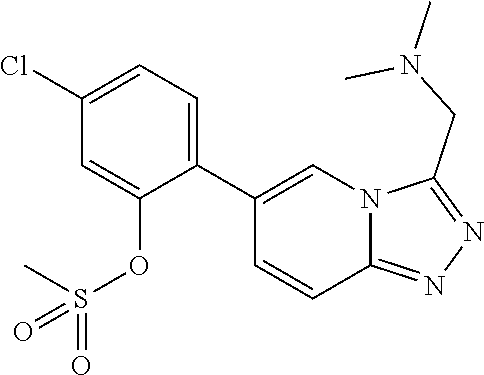


| General Procedure | |||||
| SM | Re- | Boc | |||||||
| inter- | duc- | De- | |||||||
| medi- | Mesyl | THP | tive | pro- | |||||
| Ex | ate | meth- | meth- | amina- | tec- | ||||
| No | Structure | No | od | od | tion | tion | | Characterisation | |
| 2 |
 |
1 | A | A | 11.8 mg, yield over 2 steps: 32% | LC-MS rt 12.8 min MH+ 372 1H NMR (400 MHz, Chloroform-d) δ 7.99 (d, J = 1.2 Hz, 1H), 7.53 (dd, J = 8.5, 1.6 Hz, 1H), 7.46-7.39 (m, 2H), 7.33 (td, J = 7.9, 1.9 Hz, 1H), 7.24 (td, J = 5.1, 4.7, 2.2 Hz, 3H), 7.17 (dd, J = 7.3, 2.1 Hz, 2H), 7.07 (t, J = 7.4 Hz, 1H), 7.01 (d, J = 8.2 Hz, 1H), 4.22 (t, J = 6.8 Hz, 2H), 3.90 (s, 2H), 3.04 (t, J = 6.8 Hz, 2H), 2.37 (s, 6H). | |||
| 3 |
 |
1 | A | A | 15.9 mg, yield over 2 steps: 37% | LC-MS rt 10.9 min MH+ 409 1H NMR (400 MHz, Chloroform-d) δ 8.84 (d, J = 4.5 Hz, 1H), 8.17 (d, J = 8.4 Hz, 1H), 8.04 (d, J = 1.3 Hz, 1H), 7.91 (d, J = 8.2 Hz, 1H), 7.74 (dd, J = 8.3, 6.9 Hz, 1H), 7.66 (dd, J = 8.7, 1.6 Hz, 1H), 7.54 (t, j = 7.6 Hz, 1H), 7.51-7.44 (m, 3H), 7.38 (td, J = 7.8, 1.8 Hz, 1H), 7.20-7.12 (m, 2H), 5.58 (s, 2H), 3.85 (s, 2H), 2.32 (s, 6H). | |||
| 4 |
 |
1 | A | A | 3.3 mg, yield over 2 steps: 7.7% | LC-MS rt 8.8 min MH+ 373 1H NMR (400 MHz, Chloroform-d) δ 8.47 (dd, J = 4.9, 1.7 Hz, 1H), 8.46 (d, J = 2.3 Hz, 1H), 7.92 (d, J = 1.1 Hz, 1H), 7.50 (d, J = 8.7 Hz, 1H), 7.46-7.38 (m, 3H), 7.33 (td, J = 7.9, 1.9 Hz, 1H), 7.13-7.04 (m, 2H), 6.99 (d, J = 8.1 Hz, 1H), 4.22 (t, J = 6.2 Hz, 2H), 3.93 (s, 2H), 3.02 (t, J = 6.2 Hz, 2H), 2.40 (s, 6H). | |||
| 5 |
 |
1 | A | A | 10.9 mg, yield over 2 steps: 30% | LC-MS rt 7.7 min MH+ 362 1H NMR (400 MHz, Methanol-d4) δ 7.87 (d, J = 1.2 Hz, 1H), 7.52 (d, J = 8.6 Hz, 1H), 7.45-7.35 (m, 3H), 7.41-7.31 (m, 1H), 7.10-7.00 (m, 2H), 6.95 (s, 1H), 6.84 (s, 1H), 4.32 (s, 2H), 4.24 (s, 2H), 3.92 (s, 2H), 2.35 (s, 6H). | |||
| 6 |
 |
1 | C | A | 17.2 mg, yield over 2 steps: 10% | LC-MS rt 2.2 min (50-98) MH+ 358 1H NMR (400 MHz, Chloroform-d) δ 8.07 (d, J = 1.3 Hz, 1H), 7.67 (dd, J = 8.8, 1.8 Hz, 1H), 7.47 (d, J = 8.6 Hz, 1H), 7.44 (dd, J = 7.8, 1.8 Hz, 1H), 7.40-7.27 (m, 7H), 7.10 (t, J = 7.5 Hz, 3H), 5.12 (s, 2H), 3.91 (s, 2H), 2.36 (s, 6H). | |||
| 7 |
 |
2 2 | A B | A B | 5.9 mg, yield over 2 steps: 14% 31 mg, 42% | LC-MS rt 11.1 min MH+ 422 1H NMR (400 MHz, Chloroform-d) δ 7.92 (s, 1H), 7.46 (d, J = 1.3 Hz, 2H), 7.31 (dd, J = 8.5, 6.9 Hz, 1H), 6.75 (td, J = 8.1, 2.4 Hz, 1H), 6.69 (dd, J = 11.0, 2.5 Hz, 1H), 3.95 (t, J = 7.1 Hz, 2H), 3.90 (s, 2H), 3.64 (s, 3H), 2.75 (t, J = 7.1 Hz, 2H), 2.36 (s, 6H), 2.07 (s, 3H), 1.92 (s, 3H). “data as above” | |||
| 8 |
 |
2 | A | A | 10.0 mg, yield over 2 steps: 25% | LC-MS rt 8.9 min MH+ 391 1H NMR (400 MHz, Chloroform-d) δ 8.48 (dd, J = 4.9, 1.7 Hz, 1H), 8.44 (d, J = 2.2 Hz, 1H), 7.84 (d, J = 2.1 Hz, 1H), 7.48 (d, J = 8.7 Hz, 1H), 7.41 (dt, J = 7.8, 2.0 Hz, 1H), 7.35-7.28 (m, 2H), 7.08 (dd, J = 7.8, 4.7 Hz, 1H), 6.75 (td, J = 8.3, 2.5 Hz, 1H), 6.69 (dd, J = 10.8, 2.5 Hz, 1H), 4.18 (t, J = 6.1 Hz, 2H), 3.91 (d, J = 2.4 Hz, 2H), 3.01 (t, J = 6.1 Hz, 2H), 2.38 (s, 6H). | |||
| 9 |
 |
2 | A | A | 14.2 mg, yield over 2 steps: 40% | LC-MS rt 9.5 min MH+ 377 1H NMR (400 MHz, Chloroform-d) δ 8.63 (d, J = 2.0 Hz, 1H), 8.56 (dd, J = 4.8, 1.7 Hz, 1H), 7.93 (d, J = 1.6 Hz, 1H), 7.62 (dt, J = 7.9, 2.1 Hz, 1H), 7.54 (dd, J = 8.8, 1.5 Hz, 1H), 7.41 (d, J = 8.6 Hz, 1H), 7.37 (dd, J = 9.2, 6.7 Hz, 1H), 7.24 (dd, J = 7.9, 4.9 Hz, 1H), 6.82 (ddd, J = 10.7, 5.1, 2.5 Hz, 2H), 5.08 (s, 2H), 3.86 (s, 2H), 2.34 (s, 6H). | |||
| 10 |
 |
2 | A | A | 15.1 mg, yield over 2 steps: 40% | LC-MS rt 4.0 min MH+ 380. 1H NMR (400 MHz, Methanol-d4) δ 7.88-7.79 (m, 1H), 7.53 (d, J = 8.6 Hz, 1H), 7.42 (d, J = 1.5 Hz, 1H), 7.35 (dd, J = 7.4, 1.5 Hz, 2H), 6.95 (s, 1H), 6.87 (d, J = 11.0 Hz, 1H), 6.84 (s, 1H), 6.80 (td, J = 8.3, 2.5 Hz, 1H), 4.34 (dd, J = 5.3, 3.9 Hz, 2H), 4.30-4.23 (m, 2H), 3.91 (s, 2H), 2.33 (s, 6H). | |||
| 11 |
 |
2 | A | A | 11.9 mg, yield over 2 steps: 28% | LC-MS rt 9.4 min MH+ 430. 1H NMR (400 MHz, Chloroform-d) δ 7.81 (d, J = 1.2 Hz, 1H), 7.72 (s, 1H), 7.60 (d, 1H), 7.36-7.17 (m, 5H), 6.77 (d, J = 2.4 Hz, 1H), 6.64 (dd, J = 10.6, 2.5 Hz, 1H), 4.50 (t, 1H), 4.28 (t, 2H), 4.04 (s, 2H), 2.48 (s, 6H). | |||
| 12 |
 |
2 | A | A | 3.7 mg, yield over 2 steps: 10% | LC-MS rt 9.9 min MH+ 381. 1H NMR (400 MHz, Chloroform-d) δ 7.99 (s, 1H), 7.83 (d, J = 2.7 Hz, 2H), 7.51 (d, J = 8.4 Hz, 2H), 7.34-7.29 (m, 1H), 7.13 (dd, J = 8.5, 1.7 Hz, 1H), 6.79 (d, J = 2.4 Hz, 1H), 6.72-6.62 (m, 1H), 4.49 (t, J = 4.7 Hz, 2H), 4.32 (t, J = 4.7 Hz, 2H), 3.94 (s, 2H), 2.40 (s, 6H). | |||
| 13 |
 |
2 | A | A | 9.7 mg, yield over 2 steps: 24% | LC-MS rt 8.5 min MH+ 408. 1H NMR (400 MHz, Chloroform-d) δ 7.80 (d, J = 1.2 Hz, 1H), 7.55 (d, J = 8.6 Hz, 1H), 7.32 (dd, J = 8.4, 6.8 Hz, 1H), 7.20 (dd, J = 8.7, 1.6 Hz, 1H), 6.79 (td, J = 8.3, 2.4 Hz, 1H), 6.67 (dd, J = 10.7, 2.4 Hz, 1H), 6.41 (s, 1H), 4.16 (t, J = 5.6 Hz, 2H), 4.07 (t, J = 5.0 Hz, 2H), 3.93 (s, 2H), 2.40 (s, 6H), 2.11 (s, 3H), 2.03 (s, 3H). | |||
| 14 |
 |
3 | A | A | 5.4 mg, yield over 2 steps: 15% | LC-MS rt 9.4 min MH+ 359 1H NMR (400 MHz, Chloroform-d) δ 8.76 (d, J = 2.2 Hz, 1H), 8.63 (dd, J = 5.0, 1.6 Hz, 1H), 8.05 (d, J = 1.7 Hz, 1H), 7.85 (dt, J = 7.8, 1.9 Hz, 1H), 7.64 (dd, J = 8.7, 1.8 Hz, 1H), 7.53 (d, J = 8.8 Hz, 1H), 7.46-7.34 (m, 2H), 7.31-7.29 (m, 1H), 7.28 (s, 1H), 7.01-6.95 (m, 1H), 5.19 (s, 2H), 3.91 (s, 2H), 2.38 (s, 6H). | |||
| 15 |
 |
3 | A | A | 6.1 mg, yield over 2 steps: 17% | LC-MS rt 8.8 min MH+ 359. 1H NMR (400 MHz, Chloroform-d) δ 8.69-8.63 (m, 2H), 8.05 (d, J = 1.5 Hz, 1H), 7.64 (dd, J = 8.7, 1.6 Hz, 1H), 7.53 (d, J = 8.7 Hz, 1H), 7.46-7.41 (m, 2H), 7.40 (d, 1H), 7.32-7.27 (m, 2H), 6.95 (dd, J = 8.2, 2.5 Hz, 1H), 5.21 (s, 2H), 3.95 (s, 2H), 2.40 (s, 6H). | |||
| 16 |
 |
3 | A | A | 6.1 mg, yield over 2 steps: 17% | LC-MS rt 7.7 min MH+ 362 1H NMR (400 MHz, Chloroform-d) δ 8.02 (d, J = 1.4 Hz, 1H), 7.68 (s, 1H), 7.60 (dd, J = 8.6, 1.7 Hz, 1H), 7.50 (d, J = 8.7 Hz, 1H), 7.37 (t, J = 8.0 Hz, 1H), 7.27 (td, 1H), 7.14 (t, J = 2.1 Hz, 1H), 7.13-7.10 (m, 2H), 6.86 (dd, J = 8.1, 2.4 Hz, 1H), 4.40 (t, 2H), 4.33 (t, 2H), 3.94 (s, 2H), 2.39 (s, 6H). | |||
| 17 |
 |
6 | A | 13.5 mg, 31% | LC-MS rt 11.6 min MH+ 436 1H NMR (400 MHz, Chloroform-d) δ 7.88 (d, J = 1.8 Hz, 1H), 7.48 (dd, J = 8.7, 1.5 Hz, 1H), 7.35 (d, J = 8.7 Hz, 1H), 7.33-7.26 (m, 1H), 6.73 (td, J = 8.3, 2.5 Hz, 1H), 6.67 (dd, J = 10.8, 2.4 Hz, 1H), 4.08 (s, 3H), 3.93 (t, J = 7.2 Hz, 2H), 3.83 (s, 2H), 3.63 (s, 3H), 2.75 (t, J = 7.3 Hz, 2H), 2.33 (s, 6H), 2.08 (s, 3H), 1.92 (s, 3H). | ||||
| 18 |
 |
6 | A | 40.6 mg, 91% | LC-MS rt 11.8 min MH+ 422 1H NMR (400 MHz, Methanol-d4) δ 7.77 (d, J = 1.4 Hz, 1H), 7.45 (d, J = 8.9 Hz, 1H), 7.40 (dd, J = 8.8, 1.5 Hz, 1H), 7.29 (dd, J = 8.5, 6.8 Hz, 1H), 6.83 (dd, J = 11.2, 2.5 Hz, 1H), 6.73 (td, J = 8.3, 2.5 Hz, 1H), 4.07 (s, 3H), 4.07 (s, 3H), 4.01 (t, J = 6.4 Hz, 2H), 3.55 (s, 2H), 2.71 (t, J = 6.5 Hz, 2H), 2.44 (s, 3H), 1.91 (s, 3H), 1.86 (s, 3H). | ||||
| 19 |
 |
5 | General method for alkylation using alkyltosylates | 19.9 mg, 56% | LC-MS rt 10.4 min MH+ 395 1H NMR (400 MHz, Chloroform-d) δ 7.93 (s, 1H), 7.85-7.77 (m, 2H), 7.39 (d, J = 8.7 Hz, 1H), 7.32 (dd, J = 8.4, 6.8 Hz, 1H), 7.23 (dd, J = 8.7, 1.6 Hz, 1H), 6.79 (td, J = 8.1, 2.4 Hz, 1H), 6.66 (dd, J = 10.6, 2.4 Hz, 1H), 4.48 (t, J = 4.9 Hz, 2H), 4.30 (t, J = 4.8 Hz, 2H), 4.10 (s, 3H), 3.84 (s, 2H), 2.33 (s, 6H). |
| 20 |
 |
4 | |
90 mg, 38% | LC-MS rt 7.05 min (prep) MH+ 436 1H NMR (400 MHz, Methanol-d4) δ 8.54 (s, 1H), 7.84-7.77 (m, 1H), 7.53 (d, J = 8.7 Hz, 1H), 7.44 (dd, J = 8.8, 1.6 Hz, 1H), 7.30 (dd, J = 8.3, 6.8 Hz, 1H), 6.86 (dd, J = 11.2, 2.5 Hz, 1H), 6.76 (td, J = 8.3, 2.5 Hz, 1H), 4.25 (s, 2H), 4.13 (s, 3H), 4.03 (t, J = 6.5 Hz, 2H), 3.57 (s, 3H), 2.73 (t, J = 6.4 Hz, 2H), 2.62 (s, 6H), 1.90 (s, 3H), 1.89 (s, 3H). | |||
| 21 |
 |
5 | A | 11.7 mg, 44% | LC-MS rt 6.7 min (20-98%) MH+ 394 1H NMR (400 MHz, Methanol-d4) δ 8.35 (s, 2H), 7.71 (d, J = 1.0 Hz, 1H), 7.66 (d, J = 8.6 Hz, 1H), 7.42 (dd, J = 8.7, 1.5 Hz, 1H), 7.34-7.27 (m, 2H), 7.08 (s, 1H), 6.97 (s, 1H), 6.90 (dd, J = 11.0, 2.4 Hz, 1H), 6.81 (td, J = 8.3, 2.2 Hz, 1H), 4.66 (s, 2H), 4.35 (t, J = 4.7 Hz, 2H), 4.30-4.23 (m, 2H), 4.20 (s, 3H), 2.99 (s, 6H). | |||
| 22 |
 |
5 | A | 4.5 mg, 15% | LC-MS rt 11.1 min (20-98%) MH+ 439 1H NMR (400 MHz, Methanol-d4) δ 8.93 (s, 1H), 8.24 (s, 1H), 7.97 (d, J = 8.8 Hz, 1H), 7.86 (dd, J = 8.8, 1.6 Hz, 1H), 7.77 (dd, J = 8.5, 6.7 Hz, 1H), 7.33 (dd, J = 11.2, 2.5 Hz, 1H), 7.22 (td, J = 8.3, 2.5 Hz, 1H), 4.87 (s, 2H), 4.66-4.53 (m, 5H), 3.51 (t, J = 5.8 Hz, 2H), 3.19 (s, 6H), 2.89 (s, 3H), 2.44 (s, 3H). | |||
| 23 |
 |
5 | A | 2.8 mg, 44% | LC-MS rt 10.3 min (20-98%) MH+ 422 1H NMR (400 MHz, Methanol-d4) δ 8.50 (s, 1H), 7.97 (d, J = 1.4 Hz, 1H), 7.70 (dd, J = 8.8, 1.5 Hz, 1H), 7.63 (d, J = 8.6 Hz, 1H), 7.57 (d, J = 8.7 Hz, 1H), 7.45 (dd, J = 8.8, 1.6 Hz, 1H), 7.32 (td, 9.1, 8.7, 6.8 Hz, 1H), 6.90 (dd, J = 11.2, 2.5 Hz, 1H), 6.77 (td, J = 8.3, 2.5 Hz, 1H), 6.71-6.65 (m, 1H), 4.56 (s, 1H), 4.51 (s, 1H), 4.17 (s, 2H), 4.16 (s, 2H), 4.08 (t, J = 6.4 Hz, 2H), 2.85 (s, 3H), 2.83 (s, 3H), 2.76 (t, J = 6.4 Hz, 2H), 1.91 (s, 6H). | |||
| 24 |
 |
5 | A | 14.5 mg, 57% | LC-MS rt 11.6 min (20-98%) MH+ 424 (400 MHz, Methanol- d4) δ 8.67 (s, 1H), 8.54 (s, 1H), 7.81 (d, J = 1.2 Hz, 1H), 7.52 (d, J = 8.7 Hz, 1H), 7.41 (dd, J = 8.9, 1.4 Hz, 1H), 7.34 (dd, J = 8.4, 6.7 Hz, 1H), 6.91 (dd, J = 11.1, 2.5 Hz, 1H), 6.80 (td, J = 8.3, 2.4 Hz, 1H), 4.40 (s, 2H), 4.22 (t, J = 5.8 Hz, 2H), 4.15 (s, 3H), 3.19 (t, J = 5.8 Hz, 2H), 2.73 (s, 6H), 2.11 (s, 3H). | |||
| 25 |
 |
7 | C | 22 mg, 55% | LC-MS rt 12.6 min (5-98%) MH+ 411. 1H NMR (400 MHz, Chloroform-d) δ 8.69 (s, 1H), 7.67 (d, J = 1.1 Hz, 1H), 7.39 (dd, J = 8.9, 1.7 Hz, 1H), 7.34-7.30 (m, 1H), 7.30-7.27 (m, 1H), 6.73 (td, J = 8.3, 2.5 Hz, 1H), 6.68 (dd, J = 10.8, 2.4 Hz, 1H), 5.32 (s, 2H), 4.80 (q, J = 6.8 Hz, 1H), 4.20-4.07 (m, 2H), 4.04 (s, 3H), 3.21-3.06 (m, 2H), 2.07 (s, 3H), 1.81 (d, J = 6.8 Hz, 3H). | |||
| 26 |
 |
Prod- uct from exam- ple 25 | D | 3.1 mg, 26% | LC-MS rt 12.8 min (5-98%) MH+ 439 1H NMR (400 MHz, Methanol-d4) δ 8.67 (s, 1H), 8.50 (s, 1H), 7.82 (d, J = 0.9 Hz, 1H), 7.55 (d, J = 8.7 Hz, 1H), 7.42 (dd, J = 8.8, 1.4 Hz, 1H), 7.34 (dd, J = 8.5, 6.7 Hz, 1H), 6.92 (dd, J = 11.1, 2.5 Hz, 1H), 6.81 (td, J = 8.3, 2.4 Hz, 1H), 4.23 (t, J = 5.7 Hz, 2H), 4.17 (s, 3H), 3.20 (t, J = 5.8 Hz, 2H), 2.80 (s, 6H), 2.11 (s, 3H), 1.84 (d, J = 6.9 Hz, 3H). | |||
| 27 |
 |
8 | D | general method for benzamide deprotection | 15 mg, 64% | LC-MS rt 10.9 min (5-98%) MH+ 384. 1H NMR (400 MHz, Methanol-d4) δ 8.66 (s, 1H), 8.46 (d, J = 1.5 Hz, 1H), 7.73-7.65 (m, 1H), 7.51-7.44 (m, 3H), 6.99 (dd, J = 11.1, 2.4 Hz, 1H), 6.85 (td, J = 8.3, 2.4 Hz, 1H), 4.51 (s, 2H), 4.29 (t, J = 5.8 Hz, 2H), 3.26 (t, J = 5.8 Hz, 2H), 2.20 (s, 3H). |
| 28 |
 |
8 | D | general method for benzamide deprotection | 20 mg, 86% | LC-MS rt 11.0 min (5-98%) MH+ 395. 1H NMR (400 MHz, Chloroform-d) δ 8.32 (d, J = 1.4 Hz, 1H), 7.73 (d, J = 9.8 Hz, 1H), 7.37 (dd, J = 9.5, 1.6 Hz, 1H), 7.31 (dd, J = 8.4, 6.5 Hz, 1H), 6.78 (td, J = 8.1, 2.4 Hz, 1H), 6.72 (dd, J = 10.8, 2.5 Hz, 1H), 4.45 (s, 2H), 4.00 (t, J = 7.2 Hz, 2H), 3.66 (s, 3H), 2.79 (t, J = 7.2 Hz, 2H), 2.11 (s, 3H), 1.99 (s, 3H), 1.81 (s, 2H). |
| 29 |
 |
9 | |
24 mg, 40% | LC-MS rt 12.2 min (5-98%) MH+ 436 1H NMR (400 MHz, CDCl3) δ 8.38 (s, 1H), 7.87 (s, 1H), 7.64-7.47 (m, 2H), 7.15-6.97 (m, 3H), 4.64 (s, 2H), 4.17 (s, 3H), 3.97 (t, J = 6.5 Hz, 2H), 3.55 (s, 3H), 2.91 (s, 6H), 2.69 (t, J = 6.5 Hz, 2H), 1.92 (s, 3H), 1.87 (s, 3H). | ||||
| 30 |
 |
10 | |
40 mg, 33% | LC-MS rt 12.3 min (5-98%) MH+ 436 1H NMR (400 MHz, MeOD) δ 8.39 (s, 1H), 7.89 (d, J = 4.0 Hz, 1H), 7.62-7.51 (m, 2H), 7.19 (h, J = 5.1 Hz, 3H), 4.64 (s, 2H), 4.20 (s, 3H), 3.76 (t, J = 6.9 Hz, 2H), 3.49 (s, 3H), 2.93 (s, 6H), 2.59 (t, J = 6.8 Hz, 2H), 1.90 (s, 3H), 1.88 (s, 3H). | ||||
| 36 |
 |
2 | E | B | 23.8 mg, 43% | LC-MS rt 11.6 min MH+ 411. 1H NMR (400 MHz, MeOD) 8.66 (s, 1H), 8.50 (s, 1H), 7.85-7.80 (m, 1H), 7.53 (d, J = 8.7 Hz, 1H), 7.39 (dd, J = 8.7, 1.4 Hz, 1H), 7.34 (dd, J = 8.5, 6.7 Hz, 1H), 6.90 (dd, J = 11.2, 2.5 Hz, 1H), 6.79 (td, J = 8.4, 2.5 Hz, 1H), 4.61 (s, 2H), 4.21 (t, J = 5.8 Hz, 2H), 3.18 (t, J = 5.7 Hz, 2H), 2.87 (s, 6H), 2.09 (s, 3H). | |||
| 37 |
 |
11 | |
40 mg; 28% | LC-MS rt 10.5 min MH+ 423 1H NMR (400 MHz, Methanol-d4) 8.54 (d, J = 1.4 Hz, 1H), 8.20 (s, 1H), 7.72 (d, J = 9.4 Hz, 1H), 7.52 (dd, J = 9.3, 1.4 Hz, 1H), 7.43 (dd, J = 8.5, 6.6 Hz, 1H), 6.94 (dd, J = 10.9, 2.4 Hz, 1H), 6.82 (td, J = 8.3, 2.4 Hz, 1H), 4.30 (s, 2H), 4.12 (t, J = 6.6 Hz, 2H), 3.60 (s, 3H), 2.81 (t, J = 6.6 Hz, 2H), 2.51 (s, 6H), 1.99 (s, 3H), 1.98 (s, 3H). | ||||
| 38 |
 |
12 | | A | 46 mg, 56% | LC-MS rt 10.3 min MH+ 398. 1H NMR (400 MHz, Methanol- d4) δ 8.66 (s, 1H), 8.50 (d, J = 1.4 Hz, 1H), 8.41 (s, 1H), 7.72 (d, J = 9.5 Hz, 1H), 7.51 (dd, J = 9.5, 1.5 Hz, 1H), 7.46 (dd, J = 8.5, 6.6 Hz, 1H), 7.00 (dd, J = 11.1, 2.5 Hz, 1H), 6.86 (td, J = 8.3, 2.4 Hz, 1H), 4.63 (s, 2H), 4.30 (t, J = 5.9 Hz, 2H), 3.26 (t, J = 5.8 Hz, 2H), 2.73 (s, 3H), 2.21 (s, 3H). | |||
| 39 |
 |
13 | | A | 53 mg, 61% | LC-MS rt 10.6 min MH+ 409. 1H NMR (400 MHz, Methanol- d4) 8.51-8.45 (m, 1H), 8.33 (s, 1H), 7.74 (d, J = 9.7 Hz, 1H), 7.54 (dd, J = 9.3, 1.5 Hz, 1H), 7.44 (dd, J = 8.5, 6.5 Hz, 1H), 6.97 (dd, J = 11.2, 2.4 Hz, 1H), 6.84 (td, J = 8.3, 2.5 Hz, 1H), 4.69 (s, 2H), 4.13 (t, J = 6.5 Hz, 2H), 3.60 (s, 3H), 2.85-2.77 (m, 5H), 2.02 (s, 3H), 1.95 (s, 3H). | |||
| 40 |
 |
13 | |
28 mg; 24% | LC-MS rt 11.2 min MH+ 428 1H NMR (400 MHz, Chloroform-d) δ 8.49 (s, 1H), 8.45-8.39 (m, 1H), 7.72 (d, J = 9.4 Hz, 1H), 7.36-7.26 (m, 2H), 7.08 (dd, J = 8.1, 2.0 Hz, 1H), 6.98 (d, J = 2.0 Hz, 1H), 4.19 (t, J = 6.3 Hz, 2H), 4.00 (s, 2H), 3.21 (t, J = 6.3 Hz, 2H), 2.31 (s, 6H), 2.26 (s, 5H). | ||||
| 41 |
 |
4 | |
42 mg; 31% | LC-MS rt 10.5 min MH+ 423 1H NMR (400 MHz, Methanol-d4) δ 8.58-8.51 (m, 1H), 8.26 (s, 1H), 7.72 (d, J = 9.3 Hz, 1H), 7.52 (dd, J = 9.8, 1.8 Hz, 1H), 7.40 (d, J = 8.2 Hz, 1H), 7.16 (d, J = 2.0 Hz, 1H), 7.09 (dd, J = 8.0, 1.9 Hz, 1H), 4.15 (s, 2H), 4.12 (t, J = 6.7 Hz, 2H), 3.60 (s, 3H), 2.81 (t, J = 6.5 Hz, 2H), 2.39 (s, 6H), 1.98 (s, 6H). | ||||
| 42 |
 |
11 | |
42 mg; 25% | LC-MS rt 12.0 min, MH+ 465. 1H NMR (400 MHz, Methanol- d4) δ 8.51 (d, J = 6.3 Hz, 1H), 8.26 (s, 1H), 7.79-7.65 (m, 1H), 7.53 (dd, J = 9.6, 1.6 Hz, 1H), 7.44 (dd, J = 8.5, 6.6 Hz, 1H), 6.94 (ddd, J = 11.1, 5.2, 2.5 Hz, 1H), 6.83 (td, J = 8.3, 2.5 Hz, 1H), 4.22-4.03 (m, 4H), 3.63 (s, 3H), 2.83 (t, J = 6.6 Hz, 2H), 2.37 (s, 6H), 2.22 (d, J =7.4 Hz, 2H), 2.02 (s, 3H), 1.90-1.71 (m, 1H), 0.88-0.72 (m, 6H). | ||||
| 43 |
 |
11 | |
51 mg, 30% | LC-MS rt 12.2 min, MH+ 465. 1H NMR (400 MHz, Methanol- d4) 8.53 (d, J = 1.5 Hz, 1H), 8.21 (s, 1H), 7.72 (d, J = 5.5 Hz, 1H), 7.51 (dd, J = 9.6, 1.5 Hz, 1H), 7.43 (dd, J = 8.5, 6.6 Hz, 1H), 6.98-6.90 (m, 1H), 6.82 (td, J = 8.3, 2.4 Hz, 1H), 4.28 (s, 2H), 4.14 (t, J = 6.6 Hz, 2H), 3.63 (s, 3H), 2.82 (t, J = 6.6 Hz, 2H), 2.49 (s, 6H), 2.26 (d, J = 7.5 Hz, 2H), 2.02 (s, 3H), 1.81-1.67 (m, 1H), 0.82 (d, J = 6.5 Hz, 6H). | ||||
| 45 |
 |
15 | | B | 71 mg, ~100% | LC-MS rt 10.8 min MH+ 421. 1H NMR (400 MHz, DM50-d6) δ 8.40 (s, 1H), 7.78 (d, 1H), 7.56 (d, 1H), 7.40 (dd, 1H), 7.02 (dd, 1H), 6.88 (td, 1H), 4.68 (m, 1H), 4.43 (m, 4H), 4.03 (t, 2H), 3.58 (s, 3H), 2.71 (t, 2H), 1.97 (s, 3H), 1.90 (s, 3H). | |||
| 48 |
 |
13 | | B | 15 mg, ~100% | LC-MS rt 10.3 min MH+ 466. 1H NMR (400 MHz, DMSO-d6) δ 9.37 (br.s, 2H), 8.71 (s, 1H), 7.78 (d, 1H), 7.52 (d, 1H), 7.49 (dd, 1H), 7.11 (dd, 1H), 6.91 (td, 1H), 4.78 (s, 2H), 4.09 (t, 2H), 3.65 (s, 3H), 3.04 (s, 3H), 2.88 (s, 3H), 2.81 (t, 2H), 2.67 (t, 3H), 1.99 (s, 3H). | |||
| 49 |
 |
17 | E | 170 mg, 99% | LC-MS rt 12.2 min (5-98%) MH+ 454 1H NMR (400 MHz, Chloroform-d) δ 7.85 (s, 1H), 7.45 (d, J = 8.5 Hz, 1H), 7.31 (d, J = 8.8 Hz, 1H), 7.07 (ddd, J = 8.3, 5.7, 2.1 Hz, 1H), 6.91, (q, J = 8.6 Hz, 1H), 4.04 (s, 3H), 3.81 (s, 3H), 3.70 (t,..1,:l 7.5 Hz, 2H), 3.53 (s, 3H), 2.55 (t, J = 7.6 Hz, 2H), 2.29 (s, 6H), 1.89 (s, 3H), 1.85 (s, 3H). | ||||
| 53 |
 |
24 | | B | 44 mg, 99% | hplc rt 3.9 min LC-MS MH+ 408; 1H NMR (400 MHz, DMSO-d6) δ 9.70 (s, 1H), 9.18 (s, 1H), 8.40 (s, 1H), 8.07 (d, 1H), 7.99 (d, 1H), 7.72 (td, 1H), 7.14 (dd, 1H), 6.99 (td, 1H), 4.73 (s, 2H), 4.07 (t, 2H), 3.63 (s, 3H), 2.74 (t, 2H), 2.67 (s, 3H), 2.03 (s, 3H), 1.97 (s, 3H). | |||
| 54 |
 |
12 | | B | 25 mg, 94% | hplc rt 4.7 min LC-MS MH+ 445; 1H NMR (400 MHz, DMSO-d6) δ 8.96 (s, 1H), 8.24 (s, 1H), 7.95 (d, 1H), 7.89 (d, 1H), 7.51 (dd, 1H), 7.05 (d, 1H), 6.93 (d, 1H), 4.66 (s, 2H), 3.97 (t, 2H), 3.58 (s, 3H), 2.70 (t, 2H), 2.63 (s, 3H), 1.94 (s, 3H), 1.84 (s, 3H). | |||
| 55 |
 |
12 | | B | 80 mg, 97% | LC-MS MH+ 463; 1H NMR (400 MHz, DMSO-d) δ 9.30 (s, 2H), 8.71 (s, 1H), 7.79 (d, 1H), 7.49 (td, 1H),7.47 (d, 1H), 7.12 (dd, 1H), 6.96 (td, 1H), 4.81 (t, 2H), 4.10 (t, 2H), 3.72 (s, 3H), 2.87 (t, 2H), 2.71 (t, 2H), 2.01 (s, 3H) | |||
| 66 |
 |
18 | | C | 18 mg, 97% | LC-MS MH+ 478; 1H NMR (400 MHz, DMSO-d6) δ 9.05 (br.s 1H), 8.97 (br.s, 1H), 8.44 (s, 1H), 7.76 (d, 1H), 7.47 (d, 1H), 7.40 (td, 1H), 7.11 (dd, 1H), 6.92 (td, 1H), 4.72 (m, 2H), 4.45 (m, 4H), 4.10 (t, 2H), 3.67 (s, 3H), 3.06 (s, 3H), 2.88 (s, 3H), 2.84 (t, 2H), 2.01 (s, 3H). | |||
| 67 |
 |
16 | | B | 4 mg, 60% | LC-MS MH+ 480; 1H NMR (400 MHz, CD3OD) δ 8.88 (s, 1H), 8.23 (d, 1H), 8.04 (d, 1H), 7.54 (td, 1H), 7.05 (dd, 1H), 6.91 (td, 1H), 4.20 (t, 2H), 3.77 (s, 3H), 3.75-3 70 (m, 4H), 3.07 (s, 3H), 2.97-2.90 (m, 5H), 2.87 (s, 3H), 2.19 (s, 3H). | |||
| 69 |
 |
22 | | B | 10 mg, 83% | LC-MS MH+ 406; 1H NMR (400 MHz, DMSO-d6) δ 8.92 (s, 1H), 8.14 (s, 1H), 8.10 (br.s, 2H), 8.00 (dd, 1H), 7.55 (td, 1H), 7.15 (dd, 1H), 6.97 (td, 1H), 4.05 (t, 2H), 3.59 (s, 3H), 3.42 (t, 2H), 3.20 (m, 2H), 2.71 (t, 2H), 2.02 (s, 3H), 1.92 (s, 3H). | |||


Details of Biological Assays, and Data
(a)
-
- PfNMT Final Concentration: 500 ng/mL
- PbNMT Final Concentration: 400 ng/mL
- LmNMT Final Concentration: 400 ng/mL
- LdNMT Final Concentration: 400 ng/mL
- TbNMT Final Concentration: 500 ng/mL
- PfNMT, PbNMT, LmNMT and LdNMT Peptide Substrate: Homo sapiens p60src (2-16) Amino Acids, final concentration 4.0 μM, Sequence: GSNKSKPKDASQRRR-NH2, as in PvNMT.
- TbNMT Peptide Substrate: Plasmodium falciparum ARF (2-16) amino acids final concentration 4.0 μM Sequence: GLYVSRLFNRLFQKK-NH2.
% growth=(culture under drug)−(uninfected RBC)/(culture with no drug)−(uninfected RBC)×100
and the EC50 value was determined.
| Hela | BL-41 | ||
| Cell suspension | 16,000 | 700,000 | |
| concentration (cells/mL) | |||
| cells per well | 800 | 35,000 | |
Assay Procedure:
| (nM) |
| 2000 | |
| 1000 | |
| 500 | |
| 200 | |
| 20 | |
| 2 | |
| 0 | (DMSO Control) |
Virus Titre Assay:
| (nM) |
| 500 | |
| 250 | |
| 125 | |
| 50 | |
| 25 | |
| 10 | |
| 5 | |
| 2 | |
| 1 | |
| 0.5 | |
| 0 | (DMSO Control) |
Cell Viability Assay:
% CPE=100×OD490 nm[(uninfected compound treated control−infected compound treated test sample)/(uninfected compound treated control−infected DMSO treated control)].
Claims (20)


Priority Applications (2)
| Application Number | Priority Date | Filing Date | Title |
|---|---|---|---|
| US16/923,133 US11466011B2 (en) | 2015-06-29 | 2020-07-08 | Compounds and their use as inhibitors of N-myristoyl transferase |
| US17/874,324 US20220411431A1 (en) | 2015-06-29 | 2022-07-27 | Novel compounds and their use in therapy |
Applications Claiming Priority (6)
| Application Number | Priority Date | Filing Date | Title |
|---|---|---|---|
| GB1511382.2 | 2015-06-29 | ||
| GB1511382 | 2015-06-29 | ||
| GBGB1511382.2A GB201511382D0 (en) | 2015-06-29 | 2015-06-29 | Novel compounds and their use in therapy |
| PCT/GB2016/000134 WO2017001812A1 (en) | 2015-06-29 | 2016-06-29 | Compounds and their use as inhibitors of n-myristoyl transferase |
| US201715739166A | 2017-12-22 | 2017-12-22 | |
| US16/923,133 US11466011B2 (en) | 2015-06-29 | 2020-07-08 | Compounds and their use as inhibitors of N-myristoyl transferase |
Related Parent Applications (2)
| Application Number | Title | Priority Date | Filing Date |
|---|---|---|---|
| PCT/GB2016/000134 Continuation WO2017001812A1 (en) | 2015-06-29 | 2016-06-29 | Compounds and their use as inhibitors of n-myristoyl transferase |
| US15/739,166 Continuation US10759804B2 (en) | 2015-06-29 | 2016-06-29 | Compounds and their use as inhibitors of N-myristoyl transferase |
Related Child Applications (1)
| Application Number | Title | Priority Date | Filing Date |
|---|---|---|---|
| US17/874,324 Continuation US20220411431A1 (en) | 2015-06-29 | 2022-07-27 | Novel compounds and their use in therapy |
Publications (2)
| Publication Number | Publication Date |
|---|---|
| US20200339586A1 US20200339586A1 (en) | 2020-10-29 |
| US11466011B2 true US11466011B2 (en) | 2022-10-11 |
Family
ID=53872374
Family Applications (3)
| Application Number | Title | Priority Date | Filing Date |
|---|---|---|---|
| US15/739,166 Active US10759804B2 (en) | 2015-06-29 | 2016-06-29 | Compounds and their use as inhibitors of N-myristoyl transferase |
| US16/923,133 Active US11466011B2 (en) | 2015-06-29 | 2020-07-08 | Compounds and their use as inhibitors of N-myristoyl transferase |
| US17/874,324 Abandoned US20220411431A1 (en) | 2015-06-29 | 2022-07-27 | Novel compounds and their use in therapy |
Family Applications Before (1)
| Application Number | Title | Priority Date | Filing Date |
|---|---|---|---|
| US15/739,166 Active US10759804B2 (en) | 2015-06-29 | 2016-06-29 | Compounds and their use as inhibitors of N-myristoyl transferase |
Family Applications After (1)
| Application Number | Title | Priority Date | Filing Date |
|---|---|---|---|
| US17/874,324 Abandoned US20220411431A1 (en) | 2015-06-29 | 2022-07-27 | Novel compounds and their use in therapy |
Country Status (7)
| Country | Link |
|---|---|
| US (3) | US10759804B2 (en) |
| EP (1) | EP3313833B1 (en) |
| DK (1) | DK3313833T3 (en) |
| ES (1) | ES2860629T3 (en) |
| GB (1) | GB201511382D0 (en) |
| PL (1) | PL3313833T3 (en) |
| WO (1) | WO2017001812A1 (en) |
Cited By (1)
| Publication number | Priority date | Publication date | Assignee | Title |
|---|---|---|---|---|
| US20220071960A1 (en) * | 2018-12-19 | 2022-03-10 | Imperial College Innovations Limited | Cancer treatments |
Families Citing this family (14)
| Publication number | Priority date | Publication date | Assignee | Title |
|---|---|---|---|---|
| GB201511382D0 (en) | 2015-06-29 | 2015-08-12 | Imp Innovations Ltd | Novel compounds and their use in therapy |
| GB201820659D0 (en) * | 2018-12-19 | 2019-01-30 | Imperial Innovations Ltd | Novel compostions and their use in therapy |
| CN116102541B (en) * | 2019-07-18 | 2025-04-08 | 石药集团中奇制药技术(石家庄)有限公司 | Compounds as NMT inhibitors and uses thereof |
| MX2022009528A (en) | 2020-02-04 | 2022-11-14 | Mindset Pharma Inc | 3-PYRROLIDINE-INDOLE DERIVATIVES AS SEROTONINERGIC PSYCHEDELIC AGENTS FOR THE TREATMENT OF CNS DISORDERS. |
| GB202014736D0 (en) | 2020-09-18 | 2020-11-04 | Imperial College Innovations Ltd | Novel compounds and their use in therapy |
| WO2022082306A1 (en) * | 2020-10-20 | 2022-04-28 | Pacylex Pharmaceuticals Inc. | Use of n-myristoyl transferase (nmt) inhibitors in the treatment of cancer, autoimmune disorders, and inflammatory disorders |
| GB202017367D0 (en) | 2020-11-02 | 2020-12-16 | Imperial College Innovations Ltd | Novel use |
| US20250059184A1 (en) * | 2021-12-15 | 2025-02-20 | Delix Therapeutics, Inc. | Imidazopyridine psychoplastogens and uses thereof |
| AU2023336804A1 (en) | 2022-09-09 | 2025-01-16 | Imperial College Innovations Limited | Cytotoxic imidazo[1,2-a]pyridine compounds and their use in therapy |
| CN119264131A (en) * | 2023-07-05 | 2025-01-07 | 南京同诺康医药科技有限公司 | NMT inhibitors and preparation methods and uses thereof |
| WO2025077671A1 (en) * | 2023-10-09 | 2025-04-17 | 浙江海正药业股份有限公司 | Polysubstituted aryl derivative and preparation method therefor and use thereof |
| WO2025103409A1 (en) * | 2023-11-16 | 2025-05-22 | 南京同诺康医药科技有限公司 | Nmt inhibitor, preparation method therefor, and use thereof |
| GB202403391D0 (en) | 2024-03-08 | 2024-04-24 | Myricx Pharma Ltd | Novel compounds and their use in therapy |
| WO2025256560A1 (en) * | 2024-06-12 | 2025-12-18 | 海南先声再明医药股份有限公司 | Polysubstituted aryl compound, composition thereof and use thereof |
Citations (107)
| Publication number | Priority date | Publication date | Assignee | Title |
|---|---|---|---|---|
| US2917511A (en) | 1958-01-30 | 1959-12-15 | Merck & Co Inc | Bicyclic-nitrogen-heterocyclic compounds |
| US3050525A (en) | 1960-12-14 | 1962-08-21 | John B Bicking | Certain derivatives of s-triazolo [4, 3-a]-pyridine |
| US3145215A (en) | 1961-12-19 | 1964-08-18 | Sterling Drug Inc | Indazole derivatives |
| US3457269A (en) | 1967-02-24 | 1969-07-22 | Sterling Drug Inc | N-substituted phenyl and n-substituted phenylalkyl 3 - indazolecarboxamides and preparation thereof |
| US3678059A (en) | 1969-10-07 | 1972-07-18 | Ciba Geigy Corp | 3-aminoalkylidene-indazoles |
| US3705175A (en) | 1969-04-01 | 1972-12-05 | Egyt Gyogyszervegyeszeti Gyar | Indazole-3-carboxylic amides |
| EP0261964A2 (en) | 1986-09-26 | 1988-03-30 | Beecham Group Plc | Azabicyclic compounds and their use as 5-ht3 receptor antagonists |
| JPS63310891A (en) | 1987-06-12 | 1988-12-19 | Yoshitomi Pharmaceut Ind Ltd | Condensed pyridazine compound |
| GB2208862A (en) | 1987-08-20 | 1989-04-19 | Sandoz Ag | Esters and amides of cyclic carboxylic acids and cyclic alcohols and amines |
| US4886808A (en) | 1985-04-27 | 1989-12-12 | Beecham Group P.L.C. | Indazolyl carboxylic acid amides useful for treating migraine clusters headache, trigeminal neuralgia or emesis |
| US5017573A (en) | 1988-07-29 | 1991-05-21 | Dainippon Pharmaceutical Co., Ltd. | Indazole-3-carboxylic acid derivatives |
| US5037844A (en) | 1989-07-25 | 1991-08-06 | Duphar International Research B.V. | Substituted 1H-indazole-3-carboxamides |
| JPH03223280A (en) | 1990-01-26 | 1991-10-02 | Dainippon Pharmaceut Co Ltd | New method for producing indazole-3-carboxamide derivatives |
| WO1992004025A1 (en) | 1990-08-31 | 1992-03-19 | Warner-Lambert Company | Amino acid analogs as cck antagonists |
| WO1992005174A1 (en) | 1990-09-26 | 1992-04-02 | Beecham Group Plc | 3,9-diazabicyclo (3.3.1) nonan-7-yl derivatives, process and intermediates for their preparation and pharmaceutical compositions containing them |
| EP0494774A1 (en) | 1991-01-11 | 1992-07-15 | MERCK SHARP & DOHME LTD. | Indazole-substituted fivemembered heteroaromatic compounds |
| EP0517984A1 (en) | 1991-06-11 | 1992-12-16 | Merrell Dow Pharmaceuticals Inc. | Derivatives of amide analogs of certain methano bridged quinolizines |
| US5190953A (en) | 1992-03-26 | 1993-03-02 | A. H. Robins Company, Incorporated | Heterocyclic carboxylic acid amides and esters of azabicyclic compounds as gastric prokinetic, antiemetic, anxiolytic and antiarrhythmic agents |
| WO1993003725A1 (en) | 1991-08-20 | 1993-03-04 | Smithkline Beecham Plc | 5-ht4 receptor antagonists |
| JPH05230057A (en) | 1990-11-27 | 1993-09-07 | Dainippon Pharmaceut Co Ltd | Optically active indazole-3-carboxamide derivative and antiemetic containing the same as an active ingredient |
| US5246945A (en) | 1991-02-20 | 1993-09-21 | Nisshin Flour Milling Co., Ltd. | Piperidine derivatives |
| JPH06135960A (en) | 1991-12-25 | 1994-05-17 | Dainippon Pharmaceut Co Ltd | Indazole-3-carboxamide derivative |
| EP0623621A1 (en) | 1993-04-30 | 1994-11-09 | Nisshin Flour Milling Co., Ltd. | Oxazabicyclo derivatives and their use as 5-HT4 receptor agonists |
| US5665725A (en) | 1991-06-13 | 1997-09-09 | H. Lundbeck | Piperidine derivatives having anxiolytic effect |
| US5684003A (en) | 1994-10-20 | 1997-11-04 | Nisshin Flour Milling Co., Ltd. | 5-HT4 receptor agonists |
| US5798367A (en) | 1995-03-16 | 1998-08-25 | Eli Lilly And Company | Indazolecarboxamides |
| US5861414A (en) | 1994-12-23 | 1999-01-19 | Glaxo Group Limited | Piperidineacetic acid derivatives useful as fibrinogen antagonist agent |
| US5914405A (en) | 1997-10-07 | 1999-06-22 | Eli Lilly And Company | Process for preparing 3-substituted indazoles |
| JPH11279156A (en) | 1998-03-31 | 1999-10-12 | Dai Ichi Seiyaku Co Ltd | Indazole derivative |
| US5985867A (en) | 1997-03-31 | 1999-11-16 | Dupont Pharmaceuticals Company | Indazoles of cyclic ureas useful as HIV protease inhibitors |
| WO1999061426A1 (en) | 1998-05-22 | 1999-12-02 | Scios Inc. | Heterocyclic compounds and methods to treat cardiac failure and other disorders |
| US6069152A (en) | 1997-10-07 | 2000-05-30 | Eli Lilly And Company | 5-HT4 agonists and antagonists |
| GB2345486A (en) | 1999-01-11 | 2000-07-12 | Glaxo Group Ltd | Heteroaromatic protein tyrosine kinase inhibitors |
| US6096746A (en) | 1995-05-31 | 2000-08-01 | Nisshin Flour Milling Co., Ltd. | Indazole compound containing a monocyclic amine structure |
| WO2000063215A2 (en) | 1999-04-16 | 2000-10-26 | Sanofi-Synthelabo | Indazole derivatives, preparation and therapeutic application thereof |
| WO2001002369A2 (en) | 1999-07-02 | 2001-01-11 | Agouron Pharmaceuticals, Inc. | Indazole compounds and pharmaceutical compositions for inhibiting protein kinases, and methods for their use |
| US6303625B1 (en) | 1998-07-27 | 2001-10-16 | Ortho-Mcneil Pharmaceutical, Inc. | Triazolopyridines for the treatment of thrombosis disorders |
| EP0765873B1 (en) | 1991-10-11 | 2002-04-17 | Dupont Pharmaceuticals Company | Cyclic ureas and analogues useful as retroviral protease inhibitors |
| US6376491B1 (en) | 1998-12-18 | 2002-04-23 | Basilea Pharmaceutica Ag | Bicyclic compounds |
| US20020103229A1 (en) | 2000-07-31 | 2002-08-01 | Bhagwat Shripad S. | Indazole derivatives as JNK inhibitors and compositions and methods related thereto |
| US20020119972A1 (en) | 2000-02-11 | 2002-08-29 | Katerina Leftheris | Cannabinoid receptor modulators, their processes of preparation, and use of cannabinoid receptor modulators for treating respiratory and non-respiratory diseases |
| US6458781B1 (en) | 1998-04-27 | 2002-10-01 | David Thomas Connor | Substituted diarylalkyl amides as calcium channel antagonists |
| US20020161022A1 (en) | 2000-01-18 | 2002-10-31 | Reich Siegfried Heinz | Indazole compounds, pharmaceutical compositions, and methods for mediating or inhibiting cell proliferation |
| US20030096838A1 (en) | 2001-03-09 | 2003-05-22 | Pfizer Inc. | Novel triazolo-pyridines anti-inflammatory compounds |
| US20030109550A1 (en) | 2001-09-19 | 2003-06-12 | Michael Clare | Substituted indazole compounds for the treatment of inflammation |
| US20030149034A1 (en) | 2000-05-10 | 2003-08-07 | Lee Jin-Ho | Indazoles substituted with1,1-dioxoisothiazolidine useful as inhibitors of cell proliferation |
| US20030153507A1 (en) | 2001-06-11 | 2003-08-14 | Canan-Koch Stacie S. | HIV protease inhibitors, compositions containing the same, their pharmaceutical uses and materials for their synthesis |
| US20030207883A1 (en) | 2001-07-03 | 2003-11-06 | Chiron Corporation | Indazole benzimidazole compounds |
| US20040009968A1 (en) | 2002-01-25 | 2004-01-15 | Hayley Binch | Indazole compounds useful as protein kinase inhibitors |
| US20040014764A1 (en) | 2002-03-29 | 2004-01-22 | Smith Charles D. | N-myristoyltransferase inhibitor compositions and methods of use |
| US20040014802A1 (en) | 2002-03-11 | 2004-01-22 | Gilles Dutruc-Rosset | Aminoindazole derivatives and intermediates, preparation thereof, and pharmaceutical compositions thereof |
| US20040053958A1 (en) | 2002-08-30 | 2004-03-18 | Pfizer Inc. | Di and trifluoro-triazolo-pyridines anti-inflammatory compounds |
| US20040058912A1 (en) | 2000-12-27 | 2004-03-25 | Hamed Aissaoui | Novel benzazepines and related heterocyclic derivatives which are useful as orexin receptor antagonists |
| US20040106667A1 (en) | 2002-03-11 | 2004-06-03 | Dominique Damour | Substituted indazoles, compositions containing them, method of production and use |
| US20040138286A1 (en) | 2001-06-12 | 2004-07-15 | Naonori Imazaki | Rho kinase inhibitors |
| US20040157877A1 (en) | 2002-08-30 | 2004-08-12 | Pfizer Inc | Cycloalkyl-[4-(trifluorophenyl)-oxazol-5yl]-triazolo-pyridines |
| US20040176325A1 (en) | 2003-03-03 | 2004-09-09 | Mark Munson | P38 inhibitors and methods of use thereof |
| WO2004077682A2 (en) | 2003-02-25 | 2004-09-10 | 4Tech Gesellschaft Für Technologie- Und Know-How-Transfer Gmbh | Method and circuits for detecting unidirectional errors |
| US20040204591A1 (en) | 2001-06-11 | 2004-10-14 | Agouron Pharmaceuticals, Inc. | HIV protease inhibitors, compositions containing the same, their pharmaceutical uses and materials for their synthesis |
| WO2005014554A1 (en) | 2003-08-08 | 2005-02-17 | Astex Therapeutics Limited | 1h-indazole-3-carboxamide compounds as mapkap kinase modulators |
| US20050070546A1 (en) | 2001-09-14 | 2005-03-31 | Arrington Kenneth L. | Tyrosine kinase inhibitors |
| US20050075365A1 (en) | 2003-02-14 | 2005-04-07 | Pfizer, Inc. | Novel triazolo-pyridines as anti-inflammatory compounds |
| US20060004000A1 (en) | 2002-10-02 | 2006-01-05 | Sanofi-Aventis | Indazolecarboxamide derivatives, preparation and use thereof as CDK1, CDK2 and CDK4 inhibitors |
| US20060035922A1 (en) | 2004-08-12 | 2006-02-16 | Mathias John P | Triazolopyridinylsulfanyl derivatives as p38 MAP kinase inhibitors |
| US20060100248A1 (en) | 2000-02-04 | 2006-05-11 | Giti Garthwaite | Blockade of voltage dependent sodium channels |
| US20060135764A1 (en) | 2004-12-22 | 2006-06-22 | Theravance, Inc. | Indazole-carboxamide compounds |
| US20060135589A1 (en) | 2002-08-10 | 2006-06-22 | Astex Technology, Inc. | 1h-Indazole-3-carboxamide compounds as cyclin dependent kinase (cdk) inhibitors |
| EP1674464A1 (en) | 2004-12-23 | 2006-06-28 | Santhera Pharmaceuticals (Schweiz) GmbH | Novel thrombin inhibitors |
| US20060142345A1 (en) | 2003-07-30 | 2006-06-29 | Agouron Pharmaceuticals, Inc. | 3,5 Disubstituted indazole compounds, pharmaceutical compositions, and methods for mediating or inhibiting cell proliferation |
| US20060281789A1 (en) | 2003-07-30 | 2006-12-14 | Kyowa Hakko Kogyo Co., Ltd | Protein kinase inhibitors |
| US20060287324A1 (en) | 2005-06-17 | 2006-12-21 | Chongqing Sun | Bicyclic heterocycles as cannabinoid-1 receptor modulators |
| US20070197522A1 (en) | 2004-03-05 | 2007-08-23 | Edwards Paul J | Dpp-iv inhibitors |
| US20080039457A1 (en) | 2006-08-07 | 2008-02-14 | Incyte Corporation | Triazolotriazines as kinase inhibitors |
| WO2008040995A1 (en) | 2006-10-07 | 2008-04-10 | Peakdale Molecular Limited | Indazoles for use as dpp-iv inhibitors |
| WO2008153858A1 (en) | 2007-06-05 | 2008-12-18 | Schering Corporation | Polycyclic indazole derivatives and their use as erk inhibitors for the treatment of cancer |
| US20090082348A1 (en) | 2003-07-30 | 2009-03-26 | Kyowa Hakko Kogyo Co., Ltd. | Indazole derivatives |
| US20090124612A1 (en) | 2006-07-14 | 2009-05-14 | Amgen Inc. | Fused heterocyclic derivatives and methods of use |
| US20090203690A1 (en) | 2007-06-08 | 2009-08-13 | Abbott Laboratories | 5-substituted indazoles as kinase inhibitors |
| US20090209577A1 (en) | 2004-08-18 | 2009-08-20 | Pfizer Inc. | Novel Triazolopyridine Compounds |
| US20090215817A1 (en) | 2004-08-18 | 2009-08-27 | Pfizer Inc | Novel Triazolopyridine Compounds for the Treatment of Inflammation |
| US20090247504A1 (en) | 2006-02-03 | 2009-10-01 | Ian Churcher | Indazole Derivatives for Treatment of Alzheimer's Disease |
| US20090270402A1 (en) | 2007-06-28 | 2009-10-29 | Calderwood David J | Novel triazolopyridazines |
| US20090291968A1 (en) | 2006-03-23 | 2009-11-26 | Guy Georges | Substituted indazole derivatives, their manufacture and use as pharmaceutical agents |
| US20090318436A1 (en) | 2006-07-14 | 2009-12-24 | Amgen Inc. | Fused heterocyclic derivatives and methods of use |
| US20100113421A1 (en) | 2006-10-06 | 2010-05-06 | Williams Theresa M | Non-nucleoside reverse transcriptase inhibitors |
| US20100120731A1 (en) | 2007-03-02 | 2010-05-13 | Bernat Vidal Juan | 3-([1,2,4]triazolo [4,3-a]pyridin-7-yl)benzamide derivatives |
| US20100222331A1 (en) | 2007-06-12 | 2010-09-02 | Boehringer Ingelheim International Gmbh | New compounds |
| US20100240662A1 (en) | 2001-10-12 | 2010-09-23 | Choongwae Pharma Corporation | Reverse-turn mimetics and method relating thereto |
| US20110039891A1 (en) | 2003-10-15 | 2011-02-17 | Ube Industries, Ltd. | Methods for treating a disease in which Rho kinase is involved |
| WO2011019738A1 (en) | 2009-08-10 | 2011-02-17 | Galenea Corporation | Compounds and methods of use thereof |
| US20110124626A1 (en) | 2008-07-18 | 2011-05-26 | Takeda Pharmaceutical Company Limited | Benzazepine derivatives and their use as histamine h3 antagonists |
| WO2012095781A1 (en) | 2011-01-13 | 2012-07-19 | Pfizer Limited | Indazole derivatives as sodium channel inhibitors |
| US20130039906A1 (en) | 2011-08-12 | 2013-02-14 | Steven Do | PYRAZOLO[3,4-c]PYRIDINE COMPOUNDS AND METHODS OF USE |
| WO2013083991A1 (en) | 2011-12-06 | 2013-06-13 | Imperial Innovations Limited | Novel compounds and their use in therapy |
| WO2013133556A1 (en) | 2012-03-05 | 2013-09-12 | 한국화학연구원 | Novel triazolo pyridazine derivative and use therefor |
| US8557841B2 (en) | 2002-09-04 | 2013-10-15 | Bristol-Myers Squibb Company | Heterocyclic aromatic compounds useful as growth hormone secretagogues |
| US20130280245A1 (en) | 2010-11-16 | 2013-10-24 | Impact Therapeutics, Inc. | 3-Aryl-6-aryl-[1,2,4]triazolo[4,3-alpha]pyridines as Inhibitors of Cell Proliferation and the Use Thereof |
| US20130303529A1 (en) | 2006-07-14 | 2013-11-14 | Amgen Inc. | Fused heterocyclic derivatives and methods of use |
| US20130310373A1 (en) | 2009-03-30 | 2013-11-21 | Astellas Pharma Inc. | Pyrimidine compound |
| US20140031360A1 (en) | 2010-12-09 | 2014-01-30 | Amgen Inc. | Bicyclic compounds as pim inhibitors |
| US20140227284A1 (en) | 2011-07-22 | 2014-08-14 | Pacylex Pharmaceuticals Inc. | Synthetic lethality and the treatment of cancer |
| US20140378474A1 (en) | 2012-01-27 | 2014-12-25 | Novartis Ag | 5-membered heteroarylcarboxamide derivatives as plasma kallikrein inhibitors |
| US20160002224A1 (en) | 2013-03-14 | 2016-01-07 | John J. Acton, III | Novel indole derivatives useful as anti-diabetic agents |
| US20160060224A1 (en) | 2008-09-02 | 2016-03-03 | University Of Dundee | N-myristoyl transferase inhibitors |
| US20170081315A1 (en) | 2008-05-20 | 2017-03-23 | Bayer Pharma Aktiengesellschaft | Phenyl and benzodioxinyl substituted indazoles derivatives |
| US20180237416A1 (en) | 2011-09-14 | 2018-08-23 | Samumed, Llc | Indazole-3-carboxamides and their use as wnt/b-catenin signaling pathway inhibitors |
| US20180370974A1 (en) | 2015-06-29 | 2018-12-27 | Imperial Innovations Limited | Compounds And Their Use As Inhibitors Of N-Myristoyl Transferase |
-
2015
- 2015-06-29 GB GBGB1511382.2A patent/GB201511382D0/en not_active Ceased
-
2016
- 2016-06-29 WO PCT/GB2016/000134 patent/WO2017001812A1/en not_active Ceased
- 2016-06-29 EP EP16736218.5A patent/EP3313833B1/en active Active
- 2016-06-29 US US15/739,166 patent/US10759804B2/en active Active
- 2016-06-29 ES ES16736218T patent/ES2860629T3/en active Active
- 2016-06-29 DK DK16736218.5T patent/DK3313833T3/en active
- 2016-06-29 PL PL16736218T patent/PL3313833T3/en unknown
-
2020
- 2020-07-08 US US16/923,133 patent/US11466011B2/en active Active
-
2022
- 2022-07-27 US US17/874,324 patent/US20220411431A1/en not_active Abandoned
Patent Citations (107)
| Publication number | Priority date | Publication date | Assignee | Title |
|---|---|---|---|---|
| US2917511A (en) | 1958-01-30 | 1959-12-15 | Merck & Co Inc | Bicyclic-nitrogen-heterocyclic compounds |
| US3050525A (en) | 1960-12-14 | 1962-08-21 | John B Bicking | Certain derivatives of s-triazolo [4, 3-a]-pyridine |
| US3145215A (en) | 1961-12-19 | 1964-08-18 | Sterling Drug Inc | Indazole derivatives |
| US3457269A (en) | 1967-02-24 | 1969-07-22 | Sterling Drug Inc | N-substituted phenyl and n-substituted phenylalkyl 3 - indazolecarboxamides and preparation thereof |
| US3705175A (en) | 1969-04-01 | 1972-12-05 | Egyt Gyogyszervegyeszeti Gyar | Indazole-3-carboxylic amides |
| US3678059A (en) | 1969-10-07 | 1972-07-18 | Ciba Geigy Corp | 3-aminoalkylidene-indazoles |
| US4886808A (en) | 1985-04-27 | 1989-12-12 | Beecham Group P.L.C. | Indazolyl carboxylic acid amides useful for treating migraine clusters headache, trigeminal neuralgia or emesis |
| EP0261964A2 (en) | 1986-09-26 | 1988-03-30 | Beecham Group Plc | Azabicyclic compounds and their use as 5-ht3 receptor antagonists |
| JPS63310891A (en) | 1987-06-12 | 1988-12-19 | Yoshitomi Pharmaceut Ind Ltd | Condensed pyridazine compound |
| GB2208862A (en) | 1987-08-20 | 1989-04-19 | Sandoz Ag | Esters and amides of cyclic carboxylic acids and cyclic alcohols and amines |
| US5017573A (en) | 1988-07-29 | 1991-05-21 | Dainippon Pharmaceutical Co., Ltd. | Indazole-3-carboxylic acid derivatives |
| US5037844A (en) | 1989-07-25 | 1991-08-06 | Duphar International Research B.V. | Substituted 1H-indazole-3-carboxamides |
| JPH03223280A (en) | 1990-01-26 | 1991-10-02 | Dainippon Pharmaceut Co Ltd | New method for producing indazole-3-carboxamide derivatives |
| WO1992004025A1 (en) | 1990-08-31 | 1992-03-19 | Warner-Lambert Company | Amino acid analogs as cck antagonists |
| WO1992005174A1 (en) | 1990-09-26 | 1992-04-02 | Beecham Group Plc | 3,9-diazabicyclo (3.3.1) nonan-7-yl derivatives, process and intermediates for their preparation and pharmaceutical compositions containing them |
| JPH05230057A (en) | 1990-11-27 | 1993-09-07 | Dainippon Pharmaceut Co Ltd | Optically active indazole-3-carboxamide derivative and antiemetic containing the same as an active ingredient |
| EP0494774A1 (en) | 1991-01-11 | 1992-07-15 | MERCK SHARP & DOHME LTD. | Indazole-substituted fivemembered heteroaromatic compounds |
| US5246945A (en) | 1991-02-20 | 1993-09-21 | Nisshin Flour Milling Co., Ltd. | Piperidine derivatives |
| EP0517984A1 (en) | 1991-06-11 | 1992-12-16 | Merrell Dow Pharmaceuticals Inc. | Derivatives of amide analogs of certain methano bridged quinolizines |
| US5665725A (en) | 1991-06-13 | 1997-09-09 | H. Lundbeck | Piperidine derivatives having anxiolytic effect |
| WO1993003725A1 (en) | 1991-08-20 | 1993-03-04 | Smithkline Beecham Plc | 5-ht4 receptor antagonists |
| EP0765873B1 (en) | 1991-10-11 | 2002-04-17 | Dupont Pharmaceuticals Company | Cyclic ureas and analogues useful as retroviral protease inhibitors |
| JPH06135960A (en) | 1991-12-25 | 1994-05-17 | Dainippon Pharmaceut Co Ltd | Indazole-3-carboxamide derivative |
| US5190953A (en) | 1992-03-26 | 1993-03-02 | A. H. Robins Company, Incorporated | Heterocyclic carboxylic acid amides and esters of azabicyclic compounds as gastric prokinetic, antiemetic, anxiolytic and antiarrhythmic agents |
| EP0623621A1 (en) | 1993-04-30 | 1994-11-09 | Nisshin Flour Milling Co., Ltd. | Oxazabicyclo derivatives and their use as 5-HT4 receptor agonists |
| US5684003A (en) | 1994-10-20 | 1997-11-04 | Nisshin Flour Milling Co., Ltd. | 5-HT4 receptor agonists |
| US5861414A (en) | 1994-12-23 | 1999-01-19 | Glaxo Group Limited | Piperidineacetic acid derivatives useful as fibrinogen antagonist agent |
| US5798367A (en) | 1995-03-16 | 1998-08-25 | Eli Lilly And Company | Indazolecarboxamides |
| US6096746A (en) | 1995-05-31 | 2000-08-01 | Nisshin Flour Milling Co., Ltd. | Indazole compound containing a monocyclic amine structure |
| US5985867A (en) | 1997-03-31 | 1999-11-16 | Dupont Pharmaceuticals Company | Indazoles of cyclic ureas useful as HIV protease inhibitors |
| US5914405A (en) | 1997-10-07 | 1999-06-22 | Eli Lilly And Company | Process for preparing 3-substituted indazoles |
| US6069152A (en) | 1997-10-07 | 2000-05-30 | Eli Lilly And Company | 5-HT4 agonists and antagonists |
| JPH11279156A (en) | 1998-03-31 | 1999-10-12 | Dai Ichi Seiyaku Co Ltd | Indazole derivative |
| US6458781B1 (en) | 1998-04-27 | 2002-10-01 | David Thomas Connor | Substituted diarylalkyl amides as calcium channel antagonists |
| WO1999061426A1 (en) | 1998-05-22 | 1999-12-02 | Scios Inc. | Heterocyclic compounds and methods to treat cardiac failure and other disorders |
| US6303625B1 (en) | 1998-07-27 | 2001-10-16 | Ortho-Mcneil Pharmaceutical, Inc. | Triazolopyridines for the treatment of thrombosis disorders |
| US6376491B1 (en) | 1998-12-18 | 2002-04-23 | Basilea Pharmaceutica Ag | Bicyclic compounds |
| GB2345486A (en) | 1999-01-11 | 2000-07-12 | Glaxo Group Ltd | Heteroaromatic protein tyrosine kinase inhibitors |
| WO2000063215A2 (en) | 1999-04-16 | 2000-10-26 | Sanofi-Synthelabo | Indazole derivatives, preparation and therapeutic application thereof |
| WO2001002369A2 (en) | 1999-07-02 | 2001-01-11 | Agouron Pharmaceuticals, Inc. | Indazole compounds and pharmaceutical compositions for inhibiting protein kinases, and methods for their use |
| US20020161022A1 (en) | 2000-01-18 | 2002-10-31 | Reich Siegfried Heinz | Indazole compounds, pharmaceutical compositions, and methods for mediating or inhibiting cell proliferation |
| US20060100248A1 (en) | 2000-02-04 | 2006-05-11 | Giti Garthwaite | Blockade of voltage dependent sodium channels |
| US20020119972A1 (en) | 2000-02-11 | 2002-08-29 | Katerina Leftheris | Cannabinoid receptor modulators, their processes of preparation, and use of cannabinoid receptor modulators for treating respiratory and non-respiratory diseases |
| US20030149034A1 (en) | 2000-05-10 | 2003-08-07 | Lee Jin-Ho | Indazoles substituted with1,1-dioxoisothiazolidine useful as inhibitors of cell proliferation |
| US20020103229A1 (en) | 2000-07-31 | 2002-08-01 | Bhagwat Shripad S. | Indazole derivatives as JNK inhibitors and compositions and methods related thereto |
| US20040058912A1 (en) | 2000-12-27 | 2004-03-25 | Hamed Aissaoui | Novel benzazepines and related heterocyclic derivatives which are useful as orexin receptor antagonists |
| US20030096838A1 (en) | 2001-03-09 | 2003-05-22 | Pfizer Inc. | Novel triazolo-pyridines anti-inflammatory compounds |
| US20030153507A1 (en) | 2001-06-11 | 2003-08-14 | Canan-Koch Stacie S. | HIV protease inhibitors, compositions containing the same, their pharmaceutical uses and materials for their synthesis |
| US20040204591A1 (en) | 2001-06-11 | 2004-10-14 | Agouron Pharmaceuticals, Inc. | HIV protease inhibitors, compositions containing the same, their pharmaceutical uses and materials for their synthesis |
| US20040138286A1 (en) | 2001-06-12 | 2004-07-15 | Naonori Imazaki | Rho kinase inhibitors |
| US20030207883A1 (en) | 2001-07-03 | 2003-11-06 | Chiron Corporation | Indazole benzimidazole compounds |
| US20050070546A1 (en) | 2001-09-14 | 2005-03-31 | Arrington Kenneth L. | Tyrosine kinase inhibitors |
| US20030109550A1 (en) | 2001-09-19 | 2003-06-12 | Michael Clare | Substituted indazole compounds for the treatment of inflammation |
| US20100240662A1 (en) | 2001-10-12 | 2010-09-23 | Choongwae Pharma Corporation | Reverse-turn mimetics and method relating thereto |
| US20040009968A1 (en) | 2002-01-25 | 2004-01-15 | Hayley Binch | Indazole compounds useful as protein kinase inhibitors |
| US20040106667A1 (en) | 2002-03-11 | 2004-06-03 | Dominique Damour | Substituted indazoles, compositions containing them, method of production and use |
| US20040014802A1 (en) | 2002-03-11 | 2004-01-22 | Gilles Dutruc-Rosset | Aminoindazole derivatives and intermediates, preparation thereof, and pharmaceutical compositions thereof |
| US20040014764A1 (en) | 2002-03-29 | 2004-01-22 | Smith Charles D. | N-myristoyltransferase inhibitor compositions and methods of use |
| US20060135589A1 (en) | 2002-08-10 | 2006-06-22 | Astex Technology, Inc. | 1h-Indazole-3-carboxamide compounds as cyclin dependent kinase (cdk) inhibitors |
| US20040157877A1 (en) | 2002-08-30 | 2004-08-12 | Pfizer Inc | Cycloalkyl-[4-(trifluorophenyl)-oxazol-5yl]-triazolo-pyridines |
| US20040053958A1 (en) | 2002-08-30 | 2004-03-18 | Pfizer Inc. | Di and trifluoro-triazolo-pyridines anti-inflammatory compounds |
| US8557841B2 (en) | 2002-09-04 | 2013-10-15 | Bristol-Myers Squibb Company | Heterocyclic aromatic compounds useful as growth hormone secretagogues |
| US20060004000A1 (en) | 2002-10-02 | 2006-01-05 | Sanofi-Aventis | Indazolecarboxamide derivatives, preparation and use thereof as CDK1, CDK2 and CDK4 inhibitors |
| US20050075365A1 (en) | 2003-02-14 | 2005-04-07 | Pfizer, Inc. | Novel triazolo-pyridines as anti-inflammatory compounds |
| WO2004077682A2 (en) | 2003-02-25 | 2004-09-10 | 4Tech Gesellschaft Für Technologie- Und Know-How-Transfer Gmbh | Method and circuits for detecting unidirectional errors |
| US20040176325A1 (en) | 2003-03-03 | 2004-09-09 | Mark Munson | P38 inhibitors and methods of use thereof |
| US20060142345A1 (en) | 2003-07-30 | 2006-06-29 | Agouron Pharmaceuticals, Inc. | 3,5 Disubstituted indazole compounds, pharmaceutical compositions, and methods for mediating or inhibiting cell proliferation |
| US20060281789A1 (en) | 2003-07-30 | 2006-12-14 | Kyowa Hakko Kogyo Co., Ltd | Protein kinase inhibitors |
| US20090082348A1 (en) | 2003-07-30 | 2009-03-26 | Kyowa Hakko Kogyo Co., Ltd. | Indazole derivatives |
| WO2005014554A1 (en) | 2003-08-08 | 2005-02-17 | Astex Therapeutics Limited | 1h-indazole-3-carboxamide compounds as mapkap kinase modulators |
| US20110039891A1 (en) | 2003-10-15 | 2011-02-17 | Ube Industries, Ltd. | Methods for treating a disease in which Rho kinase is involved |
| US20070197522A1 (en) | 2004-03-05 | 2007-08-23 | Edwards Paul J | Dpp-iv inhibitors |
| US20060035922A1 (en) | 2004-08-12 | 2006-02-16 | Mathias John P | Triazolopyridinylsulfanyl derivatives as p38 MAP kinase inhibitors |
| US20090209577A1 (en) | 2004-08-18 | 2009-08-20 | Pfizer Inc. | Novel Triazolopyridine Compounds |
| US20090215817A1 (en) | 2004-08-18 | 2009-08-27 | Pfizer Inc | Novel Triazolopyridine Compounds for the Treatment of Inflammation |
| US20060135764A1 (en) | 2004-12-22 | 2006-06-22 | Theravance, Inc. | Indazole-carboxamide compounds |
| EP1674464A1 (en) | 2004-12-23 | 2006-06-28 | Santhera Pharmaceuticals (Schweiz) GmbH | Novel thrombin inhibitors |
| US20060287324A1 (en) | 2005-06-17 | 2006-12-21 | Chongqing Sun | Bicyclic heterocycles as cannabinoid-1 receptor modulators |
| US20090247504A1 (en) | 2006-02-03 | 2009-10-01 | Ian Churcher | Indazole Derivatives for Treatment of Alzheimer's Disease |
| US20090291968A1 (en) | 2006-03-23 | 2009-11-26 | Guy Georges | Substituted indazole derivatives, their manufacture and use as pharmaceutical agents |
| US20090124612A1 (en) | 2006-07-14 | 2009-05-14 | Amgen Inc. | Fused heterocyclic derivatives and methods of use |
| US20130303529A1 (en) | 2006-07-14 | 2013-11-14 | Amgen Inc. | Fused heterocyclic derivatives and methods of use |
| US20090318436A1 (en) | 2006-07-14 | 2009-12-24 | Amgen Inc. | Fused heterocyclic derivatives and methods of use |
| US20080039457A1 (en) | 2006-08-07 | 2008-02-14 | Incyte Corporation | Triazolotriazines as kinase inhibitors |
| US20100113421A1 (en) | 2006-10-06 | 2010-05-06 | Williams Theresa M | Non-nucleoside reverse transcriptase inhibitors |
| WO2008040995A1 (en) | 2006-10-07 | 2008-04-10 | Peakdale Molecular Limited | Indazoles for use as dpp-iv inhibitors |
| US20100120731A1 (en) | 2007-03-02 | 2010-05-13 | Bernat Vidal Juan | 3-([1,2,4]triazolo [4,3-a]pyridin-7-yl)benzamide derivatives |
| WO2008153858A1 (en) | 2007-06-05 | 2008-12-18 | Schering Corporation | Polycyclic indazole derivatives and their use as erk inhibitors for the treatment of cancer |
| US20090203690A1 (en) | 2007-06-08 | 2009-08-13 | Abbott Laboratories | 5-substituted indazoles as kinase inhibitors |
| US20100222331A1 (en) | 2007-06-12 | 2010-09-02 | Boehringer Ingelheim International Gmbh | New compounds |
| US20090270402A1 (en) | 2007-06-28 | 2009-10-29 | Calderwood David J | Novel triazolopyridazines |
| US20170081315A1 (en) | 2008-05-20 | 2017-03-23 | Bayer Pharma Aktiengesellschaft | Phenyl and benzodioxinyl substituted indazoles derivatives |
| US20110124626A1 (en) | 2008-07-18 | 2011-05-26 | Takeda Pharmaceutical Company Limited | Benzazepine derivatives and their use as histamine h3 antagonists |
| US20160060224A1 (en) | 2008-09-02 | 2016-03-03 | University Of Dundee | N-myristoyl transferase inhibitors |
| US20130310373A1 (en) | 2009-03-30 | 2013-11-21 | Astellas Pharma Inc. | Pyrimidine compound |
| WO2011019738A1 (en) | 2009-08-10 | 2011-02-17 | Galenea Corporation | Compounds and methods of use thereof |
| US20130280245A1 (en) | 2010-11-16 | 2013-10-24 | Impact Therapeutics, Inc. | 3-Aryl-6-aryl-[1,2,4]triazolo[4,3-alpha]pyridines as Inhibitors of Cell Proliferation and the Use Thereof |
| US20140031360A1 (en) | 2010-12-09 | 2014-01-30 | Amgen Inc. | Bicyclic compounds as pim inhibitors |
| WO2012095781A1 (en) | 2011-01-13 | 2012-07-19 | Pfizer Limited | Indazole derivatives as sodium channel inhibitors |
| US20140227284A1 (en) | 2011-07-22 | 2014-08-14 | Pacylex Pharmaceuticals Inc. | Synthetic lethality and the treatment of cancer |
| US20130039906A1 (en) | 2011-08-12 | 2013-02-14 | Steven Do | PYRAZOLO[3,4-c]PYRIDINE COMPOUNDS AND METHODS OF USE |
| US20180237416A1 (en) | 2011-09-14 | 2018-08-23 | Samumed, Llc | Indazole-3-carboxamides and their use as wnt/b-catenin signaling pathway inhibitors |
| WO2013083991A1 (en) | 2011-12-06 | 2013-06-13 | Imperial Innovations Limited | Novel compounds and their use in therapy |
| US20140378474A1 (en) | 2012-01-27 | 2014-12-25 | Novartis Ag | 5-membered heteroarylcarboxamide derivatives as plasma kallikrein inhibitors |
| WO2013133556A1 (en) | 2012-03-05 | 2013-09-12 | 한국화학연구원 | Novel triazolo pyridazine derivative and use therefor |
| US20160002224A1 (en) | 2013-03-14 | 2016-01-07 | John J. Acton, III | Novel indole derivatives useful as anti-diabetic agents |
| US20180370974A1 (en) | 2015-06-29 | 2018-12-27 | Imperial Innovations Limited | Compounds And Their Use As Inhibitors Of N-Myristoyl Transferase |
Non-Patent Citations (68)
Cited By (1)
| Publication number | Priority date | Publication date | Assignee | Title |
|---|---|---|---|---|
| US20220071960A1 (en) * | 2018-12-19 | 2022-03-10 | Imperial College Innovations Limited | Cancer treatments |
Also Published As
| Publication number | Publication date |
|---|---|
| EP3313833B1 (en) | 2021-01-06 |
| DK3313833T3 (en) | 2021-02-15 |
| EP3313833A1 (en) | 2018-05-02 |
| US20200339586A1 (en) | 2020-10-29 |
| US20220411431A1 (en) | 2022-12-29 |
| US20180370974A1 (en) | 2018-12-27 |
| ES2860629T3 (en) | 2021-10-05 |
| US10759804B2 (en) | 2020-09-01 |
| PL3313833T3 (en) | 2021-06-28 |
| GB201511382D0 (en) | 2015-08-12 |
| WO2017001812A1 (en) | 2017-01-05 |
Similar Documents
| Publication | Publication Date | Title |
|---|---|---|
| US11466011B2 (en) | Compounds and their use as inhibitors of N-myristoyl transferase | |
| US11180490B2 (en) | Cyclopropyl urea formyl peptide 2 receptor and formyl peptide 1 receptor agonists | |
| US9278968B2 (en) | Imidazopyridine compounds | |
| US12091409B2 (en) | Ether linked triazoles as NRF2 activators | |
| US11691978B2 (en) | Pyrazole derivatives useful as 5-lipoxygenase activating protein (FLAP) inhibitors | |
| US11078216B2 (en) | Bisaryl amides as NRF2 activators | |
| US20050288515A1 (en) | Chemical compounds | |
| EP1244648B1 (en) | Chemokine receptor binding heterocyclic compounds | |
| US11773101B2 (en) | GPR35 modulators | |
| US20250154127A1 (en) | Bicyclic heteroaryl compounds and uses thereof | |
| US20200071310A1 (en) | N-aryl pyrazoles as nrf2 regulators | |
| US20180305331A1 (en) | Pyridone derivatives and their use as kinase inhibitors | |
| US20070142437A1 (en) | Chemical compounds | |
| US10689387B2 (en) | Crystalline form of (1R,2R)-2-[4-(3-methyl-1H-pyrazol-5-yl)benzoyl]-N-(4-oxo-4,5,6,7-tetrahydropyrazolo[1,5-A]pyrazin-3-yl)cyclohexanecarboxamide | |
| US20240245673A1 (en) | Papain-like protease (PLpro) inhibitors | |
| US20230286948A1 (en) | Haloalkylpyridyl triazole mll1-wdr5 protein-protein interaction inhibitor | |
| AU2023357817A1 (en) | 8-hydroxyquinoline compound and use thereof | |
| US20230174481A1 (en) | Kinase inhibitors | |
| HK40012826B (en) | Crystalline form of (1r,2r)-2-[4-(3-methy1-1h-pyrazol-5-yl)benzoyl]-n-(4-oxo-4,5,6,7-tetrahydropyrazolo[1,5-a]pyrazin-3-yl)cyclohexanecarboxamide | |
| HK40012826A (en) | Crystalline form of (1r,2r)-2-[4-(3-methy1-1h-pyrazol-5-yl)benzoyl]-n-(4-oxo-4,5,6,7-tetrahydropyrazolo[1,5-a]pyrazin-3-yl)cyclohexanecarboxamide |
Legal Events
| Date | Code | Title | Description |
|---|---|---|---|
| AS | Assignment |
Owner name: IMPERIAL INNOVATIONS LIMITED, UNITED KINGDOM Free format text: ASSIGNMENT OF ASSIGNORS INTEREST;ASSIGNORS:BELL, ANDREW SIMON;TATE, EDWARD WILLIAM;LEATHERBARROW, ROBIN JOHN;AND OTHERS;SIGNING DATES FROM 20171202 TO 20180122;REEL/FRAME:053144/0926 Owner name: IMPERIAL WHITE CITY INCUBATOR LIMITED, ENGLAND Free format text: ASSIGNMENT OF ASSIGNORS INTEREST;ASSIGNOR:IMPERIAL INNOVATIONS LIMITED;REEL/FRAME:053144/0686 Effective date: 20190228 Owner name: IMPERIAL COLLEGE INNOVATIONS LIMITED, UNITED KINGDOM Free format text: CHANGE OF NAME;ASSIGNOR:IMPERIAL WHITE CITY INCUBATOR LIMITED;REEL/FRAME:053144/0736 Effective date: 20190304 |
|
| FEPP | Fee payment procedure |
Free format text: ENTITY STATUS SET TO UNDISCOUNTED (ORIGINAL EVENT CODE: BIG.); ENTITY STATUS OF PATENT OWNER: SMALL ENTITY |
|
| FEPP | Fee payment procedure |
Free format text: ENTITY STATUS SET TO SMALL (ORIGINAL EVENT CODE: SMAL); ENTITY STATUS OF PATENT OWNER: SMALL ENTITY |
|
| STPP | Information on status: patent application and granting procedure in general |
Free format text: DOCKETED NEW CASE - READY FOR EXAMINATION |
|
| STPP | Information on status: patent application and granting procedure in general |
Free format text: NON FINAL ACTION MAILED |
|
| STPP | Information on status: patent application and granting procedure in general |
Free format text: RESPONSE TO NON-FINAL OFFICE ACTION ENTERED AND FORWARDED TO EXAMINER |
|
| STPP | Information on status: patent application and granting procedure in general |
Free format text: NON FINAL ACTION MAILED |
|
| STPP | Information on status: patent application and granting procedure in general |
Free format text: RESPONSE TO NON-FINAL OFFICE ACTION ENTERED AND FORWARDED TO EXAMINER |
|
| STPP | Information on status: patent application and granting procedure in general |
Free format text: FINAL REJECTION MAILED |
|
| STPP | Information on status: patent application and granting procedure in general |
Free format text: RESPONSE AFTER FINAL ACTION FORWARDED TO EXAMINER |
|
| STPP | Information on status: patent application and granting procedure in general |
Free format text: NOTICE OF ALLOWANCE MAILED -- APPLICATION RECEIVED IN OFFICE OF PUBLICATIONS |
|
| STPP | Information on status: patent application and granting procedure in general |
Free format text: AWAITING TC RESP., ISSUE FEE NOT PAID |
|
| STPP | Information on status: patent application and granting procedure in general |
Free format text: NOTICE OF ALLOWANCE MAILED -- APPLICATION RECEIVED IN OFFICE OF PUBLICATIONS |
|
| STPP | Information on status: patent application and granting procedure in general |
Free format text: PUBLICATIONS -- ISSUE FEE PAYMENT VERIFIED |
|
| STCF | Information on status: patent grant |
Free format text: PATENTED CASE |