US11466003B2 - Nitrogenous heterocyclic aromatic compound, preparation method therefor, pharmaceutical composition thereof, and application thereof - Google Patents
Nitrogenous heterocyclic aromatic compound, preparation method therefor, pharmaceutical composition thereof, and application thereof Download PDFInfo
- Publication number
- US11466003B2 US11466003B2 US16/321,457 US201716321457A US11466003B2 US 11466003 B2 US11466003 B2 US 11466003B2 US 201716321457 A US201716321457 A US 201716321457A US 11466003 B2 US11466003 B2 US 11466003B2
- Authority
- US
- United States
- Prior art keywords
- substituted
- unsubstituted
- compound
- ring
- alkyl
- Prior art date
- Legal status (The legal status is an assumption and is not a legal conclusion. Google has not performed a legal analysis and makes no representation as to the accuracy of the status listed.)
- Active, expires
Links
- 0 *.B.C.C.C.C:C:C.[1*]c1ccc([2*])c(C:C:C)c1C(:C):N Chemical compound *.B.C.C.C.C:C:C.[1*]c1ccc([2*])c(C:C:C)c1C(:C):N 0.000 description 28
- NSZMTRRJCWTCLR-UHFFFAOYSA-N C.CC(C)(C)c1ccccn1 Chemical compound C.CC(C)(C)c1ccccn1 NSZMTRRJCWTCLR-UHFFFAOYSA-N 0.000 description 4
- PAMNCWWPXGITPU-UHFFFAOYSA-N C.CCOC(=O)c1cnc2ccc(-c3ccccc3-c3cccc(C)n3)nn12.COC(=O)c1ccc(-c2cccc(C)n2)c(-c2ccc3ncc(C(N)=O)n3c2)c1.Cc1cccc(-c2ccc(C(=O)O)cc2-c2ccc3ncc(C(N)=O)n3c2)n1.Cc1cccc(-c2ccccc2-c2ccc3ncc(C(=O)O)n3n2)n1.Cc1cccc(-c2ccccc2C2=CC3C(C(=O)O)=NNC3C=C2)n1.Cc1coc(-c2ccccc2-c2ccc3ncc(C(N)=O)n3c2)n1 Chemical compound C.CCOC(=O)c1cnc2ccc(-c3ccccc3-c3cccc(C)n3)nn12.COC(=O)c1ccc(-c2cccc(C)n2)c(-c2ccc3ncc(C(N)=O)n3c2)c1.Cc1cccc(-c2ccc(C(=O)O)cc2-c2ccc3ncc(C(N)=O)n3c2)n1.Cc1cccc(-c2ccccc2-c2ccc3ncc(C(=O)O)n3n2)n1.Cc1cccc(-c2ccccc2C2=CC3C(C(=O)O)=NNC3C=C2)n1.Cc1coc(-c2ccccc2-c2ccc3ncc(C(N)=O)n3c2)n1 PAMNCWWPXGITPU-UHFFFAOYSA-N 0.000 description 2
- ZQEPUUOQJIWIFJ-UHFFFAOYSA-N CC(C)(C)B1OC(C)(C)C(C)(C)O1 Chemical compound CC(C)(C)B1OC(C)(C)C(C)(C)O1 ZQEPUUOQJIWIFJ-UHFFFAOYSA-N 0.000 description 2
- RYELJIXAAATHAG-UHFFFAOYSA-N CC(C)(C)Cc1ccccc1F Chemical compound CC(C)(C)Cc1ccccc1F RYELJIXAAATHAG-UHFFFAOYSA-N 0.000 description 2
- LYRGLUUCAVAYDY-UHFFFAOYSA-N CC(C)(C)c1ccc(F)cc1C(C)(C)C Chemical compound CC(C)(C)c1ccc(F)cc1C(C)(C)C LYRGLUUCAVAYDY-UHFFFAOYSA-N 0.000 description 2
- BAKFWBGLGQBJAO-UHFFFAOYSA-N CC(C)(C)c1ccc2[nH]cnc2c1.CC(C)(C)c1ccc2ccoc2c1.CC(C)(C)c1ccc2occc2c1 Chemical compound CC(C)(C)c1ccc2[nH]cnc2c1.CC(C)(C)c1ccc2ccoc2c1.CC(C)(C)c1ccc2occc2c1 BAKFWBGLGQBJAO-UHFFFAOYSA-N 0.000 description 2
- KBUQNVSGGSFHPI-UHFFFAOYSA-N CC(C)(C)c1cccc(F)c1C(C)(C)C Chemical compound CC(C)(C)c1cccc(F)c1C(C)(C)C KBUQNVSGGSFHPI-UHFFFAOYSA-N 0.000 description 2
- SEOMMYGICIHJHP-UHFFFAOYSA-N CC(C)(C)c1ccccc1F Chemical compound CC(C)(C)c1ccccc1F SEOMMYGICIHJHP-UHFFFAOYSA-N 0.000 description 2
- OKDDQKQLNCEHFA-UHFFFAOYSA-N CNC(=O)c1cnc2ccc(-c3ccccc3-c3cccc(C)n3)cn12.Cc1cccc(-c2c(F)cccc2-c2ccc3ncc(C(N)=O)n3c2)n1.Cc1cccc(-c2ccccc2-c2ccc3ncc(C(=O)N(C)C)n3c2)n1.Cc1cccc(-c2ccccc2-c2ccc3ncc(C(=O)O)n3c2)n1.Cc1cccc(-c2ccccc2-c2ccc3ncc(C(N)=O)n3c2)n1.Cc1cccc(-c2ccccc2-c2ccc3ncc(CN)n3c2)n1 Chemical compound CNC(=O)c1cnc2ccc(-c3ccccc3-c3cccc(C)n3)cn12.Cc1cccc(-c2c(F)cccc2-c2ccc3ncc(C(N)=O)n3c2)n1.Cc1cccc(-c2ccccc2-c2ccc3ncc(C(=O)N(C)C)n3c2)n1.Cc1cccc(-c2ccccc2-c2ccc3ncc(C(=O)O)n3c2)n1.Cc1cccc(-c2ccccc2-c2ccc3ncc(C(N)=O)n3c2)n1.Cc1cccc(-c2ccccc2-c2ccc3ncc(CN)n3c2)n1 OKDDQKQLNCEHFA-UHFFFAOYSA-N 0.000 description 2
- GYGXNZUTBLWWFK-UHFFFAOYSA-N COc1ccc(-c2cccc(C)n2)c(-c2ccc3ncc(C(N)=O)n3c2)c1.Cc1cccc(-c2ccc(C#N)cc2-c2ccc3ncc(C(N)=O)n3c2)n1.Cc1cccc(-c2ccccc2-c2ccc3nc(C)c(C(N)=O)n3c2)n1.Cc1cccc(-c2ccccc2-c2ccc3ncc(CC=O)n3c2)n1.Cc1csc(-c2ccccc2-c2ccc3ncc(C(N)=O)n3c2)n1.Cc1nc(-c2ccccc2-c2ccc3ncc(C(N)=O)n3c2)cs1 Chemical compound COc1ccc(-c2cccc(C)n2)c(-c2ccc3ncc(C(N)=O)n3c2)c1.Cc1cccc(-c2ccc(C#N)cc2-c2ccc3ncc(C(N)=O)n3c2)n1.Cc1cccc(-c2ccccc2-c2ccc3nc(C)c(C(N)=O)n3c2)n1.Cc1cccc(-c2ccccc2-c2ccc3ncc(CC=O)n3c2)n1.Cc1csc(-c2ccccc2-c2ccc3ncc(C(N)=O)n3c2)n1.Cc1nc(-c2ccccc2-c2ccc3ncc(C(N)=O)n3c2)cs1 GYGXNZUTBLWWFK-UHFFFAOYSA-N 0.000 description 2
- WBKXJBURCRUIGG-UHFFFAOYSA-N COc1cccc(-c2ccccc2-c2ccc3ncc(C(N)=O)n3c2)n1.Cc1cccc(-c2ccccc2-c2ccc3c(cnn3C(N)=O)c2)n1.Cc1cccc(-c2ccccc2-c2ccc3ncc(-c4nnn[nH]4)n3c2)n1.Cc1cccc(-c2ccccc2-c2ccc3ncc(C#N)n3c2)n1.Cc1cccc(-c2ccccc2-c2ccc3ncc(N)n3c2)n1.Cc1cccc(-c2ccncc2-c2ccc3ncc(C(N)=O)n3c2)n1 Chemical compound COc1cccc(-c2ccccc2-c2ccc3ncc(C(N)=O)n3c2)n1.Cc1cccc(-c2ccccc2-c2ccc3c(cnn3C(N)=O)c2)n1.Cc1cccc(-c2ccccc2-c2ccc3ncc(-c4nnn[nH]4)n3c2)n1.Cc1cccc(-c2ccccc2-c2ccc3ncc(C#N)n3c2)n1.Cc1cccc(-c2ccccc2-c2ccc3ncc(N)n3c2)n1.Cc1cccc(-c2ccncc2-c2ccc3ncc(C(N)=O)n3c2)n1 WBKXJBURCRUIGG-UHFFFAOYSA-N 0.000 description 2
- VPGGJTVMTQQETQ-UHFFFAOYSA-N COc1cccc(C(C)(C)C)n1.Cc1cccc(C(C)(C)C)n1.Cc1ccn(C(C)(C)C)n1.Cc1csc(C(C)(C)C)n1.Cc1nc(C(C)(C)C)cs1 Chemical compound COc1cccc(C(C)(C)C)n1.Cc1cccc(C(C)(C)C)n1.Cc1ccn(C(C)(C)C)n1.Cc1csc(C(C)(C)C)n1.Cc1nc(C(C)(C)C)cs1 VPGGJTVMTQQETQ-UHFFFAOYSA-N 0.000 description 2
- QNNHNEAFPBMEKT-LIEXNAFNSA-N Cc1ccc(F)c(-c2ccccc2-c2ccc3ncc(C(N)=O)n3c2)n1.Cc1cccc(-c2ccccc2-c2ccc3nccc(C#N)c3c2)n1.Cc1ccnc(-c2ccccc2-c2ccc3ncc(C(N)=O)n3c2)n1.Cc1cncc(-c2ccccc2-c2ccc3ncc(C(N)=O)n3c2)n1.Cc1nc(-c2ccccc2-c2ccc3ncc(C(N)=O)n3c2)ccc1Cl.[2H]C([2H])([2H])c1cccc(-c2ccccc2-c2ccc3ncc(C(N)=O)n3c2)n1 Chemical compound Cc1ccc(F)c(-c2ccccc2-c2ccc3ncc(C(N)=O)n3c2)n1.Cc1cccc(-c2ccccc2-c2ccc3nccc(C#N)c3c2)n1.Cc1ccnc(-c2ccccc2-c2ccc3ncc(C(N)=O)n3c2)n1.Cc1cncc(-c2ccccc2-c2ccc3ncc(C(N)=O)n3c2)n1.Cc1nc(-c2ccccc2-c2ccc3ncc(C(N)=O)n3c2)ccc1Cl.[2H]C([2H])([2H])c1cccc(-c2ccccc2-c2ccc3ncc(C(N)=O)n3c2)n1 QNNHNEAFPBMEKT-LIEXNAFNSA-N 0.000 description 2
- WYSIZPJRBWPWGC-UHFFFAOYSA-N Cc1cccc(-c2cc(F)ccc2-c2ccc3ncc(C(N)=O)n3c2)n1.Cc1cccc(-c2ccc(F)cc2-c2ccc3ncc(C(N)=O)n3c2)n1.Cc1cccc(-c2cccc(F)c2-c2ccc3ncc(C(N)=O)n3c2)n1.Cc1cccc(-c2ccccc2-c2ccc3ncc(C(=O)NO)n3c2)n1.Cc1cccc(-c2ccccc2-c2ccc3nccn3c2)n1.NC(=O)c1cnc2ccc(-c3ccccc3-c3ccccn3)cn12 Chemical compound Cc1cccc(-c2cc(F)ccc2-c2ccc3ncc(C(N)=O)n3c2)n1.Cc1cccc(-c2ccc(F)cc2-c2ccc3ncc(C(N)=O)n3c2)n1.Cc1cccc(-c2cccc(F)c2-c2ccc3ncc(C(N)=O)n3c2)n1.Cc1cccc(-c2ccccc2-c2ccc3ncc(C(=O)NO)n3c2)n1.Cc1cccc(-c2ccccc2-c2ccc3nccn3c2)n1.NC(=O)c1cnc2ccc(-c3ccccc3-c3ccccn3)cn12 WYSIZPJRBWPWGC-UHFFFAOYSA-N 0.000 description 2
- JFDJFYLVRIDNFH-UHFFFAOYSA-N Cc1cccc(-c2cc3nccn3cc2-c2ccc3ncc(C(N)=O)n3c2)n1.Cc1cccc(-c2ccc(Oc3ccccc3F)cc2-c2ccc3ncc(C(N)=O)n3c2)n1.Cc1cccc(-c2ccccc2-c2ccc3ncc(C(=O)NC4CC4)n3c2)n1.Cc1cccc(-c2ccccc2-c2ccc3ncc(C(=O)NC4CCOCC4)n3c2)n1.Cc1cccc(-c2ccccc2-c2ccc3ncc(C(=O)NCCN4CCOCC4)n3c2)n1.Cc1noc(-c2ccccc2-c2ccc3ncc(C(N)=O)n3c2)n1 Chemical compound Cc1cccc(-c2cc3nccn3cc2-c2ccc3ncc(C(N)=O)n3c2)n1.Cc1cccc(-c2ccc(Oc3ccccc3F)cc2-c2ccc3ncc(C(N)=O)n3c2)n1.Cc1cccc(-c2ccccc2-c2ccc3ncc(C(=O)NC4CC4)n3c2)n1.Cc1cccc(-c2ccccc2-c2ccc3ncc(C(=O)NC4CCOCC4)n3c2)n1.Cc1cccc(-c2ccccc2-c2ccc3ncc(C(=O)NCCN4CCOCC4)n3c2)n1.Cc1noc(-c2ccccc2-c2ccc3ncc(C(N)=O)n3c2)n1 JFDJFYLVRIDNFH-UHFFFAOYSA-N 0.000 description 2
- PHTJXCFZQOBVDF-UHFFFAOYSA-N Cc1cccc(-c2ccc(C(N)=O)cc2-c2ccc3ncc(C(N)=O)n3c2)n1.Cc1cccc(-c2ccccc2-c2ccc3[nH]nc(C(N)=O)c3c2)n1.Cc1cccc(-c2ccccc2-c2ccc3ncc(C(=N)N)n3c2)n1.Cc1cccc(-c2ccccc2-c2ccc3ncc(S(N)(=O)=O)n3c2)n1.Cc1cccc(-c2ccccc2-c2ccc3nnc(C(=O)O)n3c2)n1.Cc1nc(-c2ccccc2-c2ccc3ncc(C(N)=O)n3c2)ccc1F Chemical compound Cc1cccc(-c2ccc(C(N)=O)cc2-c2ccc3ncc(C(N)=O)n3c2)n1.Cc1cccc(-c2ccccc2-c2ccc3[nH]nc(C(N)=O)c3c2)n1.Cc1cccc(-c2ccccc2-c2ccc3ncc(C(=N)N)n3c2)n1.Cc1cccc(-c2ccccc2-c2ccc3ncc(S(N)(=O)=O)n3c2)n1.Cc1cccc(-c2ccccc2-c2ccc3nnc(C(=O)O)n3c2)n1.Cc1nc(-c2ccccc2-c2ccc3ncc(C(N)=O)n3c2)ccc1F PHTJXCFZQOBVDF-UHFFFAOYSA-N 0.000 description 2
- UJBHMZWPJMSBJP-VVHCEJCRSA-N Cc1cccc(-c2ccc(OCc3ccccc3F)cc2-c2ccc3ncc(C(N)=O)n3c2)n1.Cc1cccc(-c2ccccc2-c2ccc3ncc(C(N)=O)n3n2)n1.Cc1cccc(-c2ccccc2-c2ccc3ncc(C(N)=O)nc3c2)n1.Cc1cccc(-c2cscc2-c2ccc3ncc(C(N)=O)n3c2)n1.[2H]C([2H])([2H])N(C(=O)c1cnc2ccc(-c3cc(F)ccc3-c3cccc(C)n3)cn12)C([2H])([2H])[2H].[2H]C([2H])([2H])NC(=O)c1cnc2ccc(-c3ccccc3-c3cccc(C)n3)cn12 Chemical compound Cc1cccc(-c2ccc(OCc3ccccc3F)cc2-c2ccc3ncc(C(N)=O)n3c2)n1.Cc1cccc(-c2ccccc2-c2ccc3ncc(C(N)=O)n3n2)n1.Cc1cccc(-c2ccccc2-c2ccc3ncc(C(N)=O)nc3c2)n1.Cc1cccc(-c2cscc2-c2ccc3ncc(C(N)=O)n3c2)n1.[2H]C([2H])([2H])N(C(=O)c1cnc2ccc(-c3cc(F)ccc3-c3cccc(C)n3)cn12)C([2H])([2H])[2H].[2H]C([2H])([2H])NC(=O)c1cnc2ccc(-c3ccccc3-c3cccc(C)n3)cn12 UJBHMZWPJMSBJP-VVHCEJCRSA-N 0.000 description 2
- CEDSEIXMTOCXSA-UHFFFAOYSA-N Cc1cccc(-c2ccccc2-c2ccc3[nH]ncc3c2)n1.Cc1cccc(-c2ccccc2-c2ccc3ncnc(N)c3c2)n1.Cc1cccc(-c2ccccc2-c2ccc3ncnn3c2)n1.Cc1cccc(-c2ccccc2-c2ccc3nnc(C(N)=O)n3c2)n1.Cc1cccc(-c2ccccc2-c2ccc3nncn3c2)n1.Cc1cccc(-c2ccccc2-c2ccn3ncc(C(N)=O)c3c2)n1 Chemical compound Cc1cccc(-c2ccccc2-c2ccc3[nH]ncc3c2)n1.Cc1cccc(-c2ccccc2-c2ccc3ncnc(N)c3c2)n1.Cc1cccc(-c2ccccc2-c2ccc3ncnn3c2)n1.Cc1cccc(-c2ccccc2-c2ccc3nnc(C(N)=O)n3c2)n1.Cc1cccc(-c2ccccc2-c2ccc3nncn3c2)n1.Cc1cccc(-c2ccccc2-c2ccn3ncc(C(N)=O)c3c2)n1 CEDSEIXMTOCXSA-UHFFFAOYSA-N 0.000 description 2
- ROXPPYRGINNVME-GDFLROJSSA-N Cc1cccc(-c2ccccc2-c2ccc3nc[nH]c(=O)c3c2)n1.Cc1nccc(-c2ccccc2-c2ccc3ncc(C(N)=O)n3c2)n1.Cn1ccc(-c2ccccc2-c2ccc3ncc(C(N)=O)n3c2)n1.NC(=O)c1cnc2ccc(-c3ccccc3-c3cccc(C(F)(F)F)n3)cn12.[2H]C([2H])([2H])NC(=O)c1cnc2ccc(-c3cc(F)ccc3-c3cccc(C)n3)cn12.[2H]C([2H])([2H])c1cccc(-c2ccc(F)cc2-c2ccc3ncc(C(N)=O)n3c2)n1 Chemical compound Cc1cccc(-c2ccccc2-c2ccc3nc[nH]c(=O)c3c2)n1.Cc1nccc(-c2ccccc2-c2ccc3ncc(C(N)=O)n3c2)n1.Cn1ccc(-c2ccccc2-c2ccc3ncc(C(N)=O)n3c2)n1.NC(=O)c1cnc2ccc(-c3ccccc3-c3cccc(C(F)(F)F)n3)cn12.[2H]C([2H])([2H])NC(=O)c1cnc2ccc(-c3cc(F)ccc3-c3cccc(C)n3)cn12.[2H]C([2H])([2H])c1cccc(-c2ccc(F)cc2-c2ccc3ncc(C(N)=O)n3c2)n1 ROXPPYRGINNVME-GDFLROJSSA-N 0.000 description 2
- DUCNMBAEJUBWRT-UHFFFAOYSA-N B.Cc1cccc(-c2ccccc2-c2ccc3ncc(C(N)=O)n3c2)n1.Cc1cccc(-c2ccccc2-c2ccc3ncc(CN)n3c2)n1 Chemical compound B.Cc1cccc(-c2ccccc2-c2ccc3ncc(C(N)=O)n3c2)n1.Cc1cccc(-c2ccccc2-c2ccc3ncc(CN)n3c2)n1 DUCNMBAEJUBWRT-UHFFFAOYSA-N 0.000 description 1
- JZPTVOJFACVCBH-UHFFFAOYSA-N B=NS.Cc1cccc(-c2cc(N)ncc2Br)n1.Cc1cccc(-c2cc3nccn3cc2-c2ccc3ncc(C(N)=O)n3c2)n1.Cc1cccc(-c2cc3nccn3cc2Br)n1.Cc1cccc(-c2ccnc(N)c2)n1.Cc1cccc(Br)n1.Nc1cc(OBO)ccn1.O=CCCl Chemical compound B=NS.Cc1cccc(-c2cc(N)ncc2Br)n1.Cc1cccc(-c2cc3nccn3cc2-c2ccc3ncc(C(N)=O)n3c2)n1.Cc1cccc(-c2cc3nccn3cc2Br)n1.Cc1cccc(-c2ccnc(N)c2)n1.Cc1cccc(Br)n1.Nc1cc(OBO)ccn1.O=CCCl JZPTVOJFACVCBH-UHFFFAOYSA-N 0.000 description 1
- AXCYLWMAHLRAME-UHFFFAOYSA-N BrB(Br)Br.C.COc1cc(F)ccc1-c1cccc(C)n1.COc1cc(F)ccc1OBO.Cc1cccc(-c2ccc(F)cc2-c2ccc3ncc(C(N)=O)n3c2)n1.Cc1cccc(-c2ccc(F)cc2O)n1.Cc1cccc(-c2ccc(F)cc2OS(=O)(=O)C(F)(F)F)n1.Cc1cccc(Br)n1.O=S(=O)(OS(=O)(=O)C(F)(F)F)C(F)(F)F Chemical compound BrB(Br)Br.C.COc1cc(F)ccc1-c1cccc(C)n1.COc1cc(F)ccc1OBO.Cc1cccc(-c2ccc(F)cc2-c2ccc3ncc(C(N)=O)n3c2)n1.Cc1cccc(-c2ccc(F)cc2O)n1.Cc1cccc(-c2ccc(F)cc2OS(=O)(=O)C(F)(F)F)n1.Cc1cccc(Br)n1.O=S(=O)(OS(=O)(=O)C(F)(F)F)C(F)(F)F AXCYLWMAHLRAME-UHFFFAOYSA-N 0.000 description 1
- ZOHFARGIAMQENS-UHFFFAOYSA-N BrB(Br)Br.CCCC[Sn](CCCC)(CCCC)c1cccc(C)n1.COc1cc(C#N)ccc1-c1cccc(C)n1.COc1cc(C#N)ccc1Br.Cc1cccc(-c2ccc(C#N)cc2-c2ccc3ncc(C(N)=O)n3c2)n1.Cc1cccc(-c2ccc(C#N)cc2O)n1.Cc1cccc(-c2ccc(C#N)cc2OS(=O)(=O)C(F)(F)F)n1.O=S(=O)(OOOS(=O)(=O)C(F)(F)F)C(F)(F)F Chemical compound BrB(Br)Br.CCCC[Sn](CCCC)(CCCC)c1cccc(C)n1.COc1cc(C#N)ccc1-c1cccc(C)n1.COc1cc(C#N)ccc1Br.Cc1cccc(-c2ccc(C#N)cc2-c2ccc3ncc(C(N)=O)n3c2)n1.Cc1cccc(-c2ccc(C#N)cc2O)n1.Cc1cccc(-c2ccc(C#N)cc2OS(=O)(=O)C(F)(F)F)n1.O=S(=O)(OOOS(=O)(=O)C(F)(F)F)C(F)(F)F ZOHFARGIAMQENS-UHFFFAOYSA-N 0.000 description 1
- GKCFHUNESNKEOZ-UHFFFAOYSA-M BrB(Br)Br.CCOC(=O)c1cnc2ccc(-c3ccccc3-c3cccc(C)n3)cn12.CCOC(=O)c1cnc2ccc(B3OC(C)(C)C(C)(C)O3)cn12.COc1ccccc1-c1cccc(C)n1.COc1ccccc1OBO.Cc1cccc(-c2ccccc2-c2ccc3ncc(C(=O)O)n3c2)n1.Cc1cccc(-c2ccccc2O)n1.Cc1cccc(-c2ccccc2OS(=O)(=O)C(F)(F)F)n1.Cc1cccc(Br)n1.O=S(=O)(OOOS(=O)(=O)C(F)(F)F)C(F)(F)F.O[Na] Chemical compound BrB(Br)Br.CCOC(=O)c1cnc2ccc(-c3ccccc3-c3cccc(C)n3)cn12.CCOC(=O)c1cnc2ccc(B3OC(C)(C)C(C)(C)O3)cn12.COc1ccccc1-c1cccc(C)n1.COc1ccccc1OBO.Cc1cccc(-c2ccccc2-c2ccc3ncc(C(=O)O)n3c2)n1.Cc1cccc(-c2ccccc2O)n1.Cc1cccc(-c2ccccc2OS(=O)(=O)C(F)(F)F)n1.Cc1cccc(Br)n1.O=S(=O)(OOOS(=O)(=O)C(F)(F)F)C(F)(F)F.O[Na] GKCFHUNESNKEOZ-UHFFFAOYSA-M 0.000 description 1
- RJRXGJQVVCCARC-UHFFFAOYSA-N BrB(Br)Br.COc1cnccc1-c1cccc(C)n1.COc1cnccc1OBO.Cc1cccc(-c2ccncc2-c2ccc3ncc(C(N)=O)n3c2)n1.Cc1cccc(-c2ccncc2O)n1.Cc1cccc(-c2ccncc2OS(=O)(=O)C(F)(F)F)n1.Cc1cccc(Br)n1.NC(=O)c1cnc2ccc(B(O)O)cn12.NC(=O)c1cnc2ccc(B(O)O)cn12.NC(=O)c1cnc2ccc(Br)cn12.O=C(O)c1cnc2ccc(Br)cn12.O=S(=O)(OOOS(=O)(=O)C(F)(F)F)C(F)(F)F Chemical compound BrB(Br)Br.COc1cnccc1-c1cccc(C)n1.COc1cnccc1OBO.Cc1cccc(-c2ccncc2-c2ccc3ncc(C(N)=O)n3c2)n1.Cc1cccc(-c2ccncc2O)n1.Cc1cccc(-c2ccncc2OS(=O)(=O)C(F)(F)F)n1.Cc1cccc(Br)n1.NC(=O)c1cnc2ccc(B(O)O)cn12.NC(=O)c1cnc2ccc(B(O)O)cn12.NC(=O)c1cnc2ccc(Br)cn12.O=C(O)c1cnc2ccc(Br)cn12.O=S(=O)(OOOS(=O)(=O)C(F)(F)F)C(F)(F)F RJRXGJQVVCCARC-UHFFFAOYSA-N 0.000 description 1
- XUMBYSFVYYCUCQ-UHFFFAOYSA-N Brc1ccc2nccn2c1.Cc1cccc(-c2ccccc2-c2ccc3ncc(S(N)(=O)=O)n3c2)n1.NS(=O)(=O)c1cnc2ccc(Br)cn12 Chemical compound Brc1ccc2nccn2c1.Cc1cccc(-c2ccccc2-c2ccc3ncc(S(N)(=O)=O)n3c2)n1.NS(=O)(=O)c1cnc2ccc(Br)cn12 XUMBYSFVYYCUCQ-UHFFFAOYSA-N 0.000 description 1
- QZTBMANILWFJQT-UHFFFAOYSA-N Brc1ccc2ncnn2c1.Cc1cccc(-c2ccccc2-c2ccc3ncnn3c2)n1.Cc1cccc(-c2ccccc2B(O)O)n1 Chemical compound Brc1ccc2ncnn2c1.Cc1cccc(-c2ccccc2-c2ccc3ncnn3c2)n1.Cc1cccc(-c2ccccc2B(O)O)n1 QZTBMANILWFJQT-UHFFFAOYSA-N 0.000 description 1
- YYDJZXSVWUXXIV-ONXHFZSDSA-N Brc1cccc(Br)n1.O=S(=O)(OS(=O)(=O)C(F)(F)F)C(F)(F)F.OBOc1ccccc1O.[2H]C([2H])([2H])c1cccc(-c2ccccc2-c2ccc3ncc(C(N)=O)n3c2)n1.[2H]C([2H])([2H])c1cccc(-c2ccccc2O)n1.[2H]C([2H])([2H])c1cccc(-c2ccccc2OS(=O)(=O)C(F)(F)F)n1.[2H]C([2H])([2H])c1cccc(Br)n1 Chemical compound Brc1cccc(Br)n1.O=S(=O)(OS(=O)(=O)C(F)(F)F)C(F)(F)F.OBOc1ccccc1O.[2H]C([2H])([2H])c1cccc(-c2ccccc2-c2ccc3ncc(C(N)=O)n3c2)n1.[2H]C([2H])([2H])c1cccc(-c2ccccc2O)n1.[2H]C([2H])([2H])c1cccc(-c2ccccc2OS(=O)(=O)C(F)(F)F)n1.[2H]C([2H])([2H])c1cccc(Br)n1 YYDJZXSVWUXXIV-ONXHFZSDSA-N 0.000 description 1
- DRBOKQTZHKABOR-UHFFFAOYSA-N Brc1cscc1Br.CCCC[Sn](CCCC)(CCCC)c1cccc(C)n1.Cc1cccc(-c2cscc2-c2ccc3ncc(C(N)=O)n3c2)n1.NC(=O)c1cnc2ccc(-c3cscc3Br)cn12 Chemical compound Brc1cscc1Br.CCCC[Sn](CCCC)(CCCC)c1cccc(C)n1.Cc1cccc(-c2cscc2-c2ccc3ncc(C(N)=O)n3c2)n1.NC(=O)c1cnc2ccc(-c3cscc3Br)cn12 DRBOKQTZHKABOR-UHFFFAOYSA-N 0.000 description 1
- CSTWHIXOWZERHO-UHFFFAOYSA-N C.C.C.C.C.C.C.C.C.C.CC(=O)n1cccn1.CN(C)C(=O)c1cnc[nH]1.CNC(=O)c1cnc[nH]1.NC(=O)c1cn[nH]c1.NC(=O)c1cnc[nH]1.NC(=O)c1nnc[nH]1.NCc1cnc[nH]1.Nc1ccncn1.Nc1cnc[nH]1.O=C(NO)c1cnc[nH]1.O=C(O)c1cnc[nH]1 Chemical compound C.C.C.C.C.C.C.C.C.C.CC(=O)n1cccn1.CN(C)C(=O)c1cnc[nH]1.CNC(=O)c1cnc[nH]1.NC(=O)c1cn[nH]c1.NC(=O)c1cnc[nH]1.NC(=O)c1nnc[nH]1.NCc1cnc[nH]1.Nc1ccncn1.Nc1cnc[nH]1.O=C(NO)c1cnc[nH]1.O=C(O)c1cnc[nH]1 CSTWHIXOWZERHO-UHFFFAOYSA-N 0.000 description 1
- LLHWQFLLHXITJJ-UHFFFAOYSA-N C.C.C.C.C.C.C.C.C.CC(C)(C)c1ccc2ncc(C(=O)NO)n2c1.CC(C)(C)c1ccc2ncc(C(N)=O)n2c1.CC(C)(C)c1ccc2ncc(CN)n2c1.CC(C)(C)c1ccc2nccn2c1.CC(C)(C)c1ccc2ncnc(N)c2c1.CC(C)(C)c1ccc2ncnn2c1.CC(C)(C)c1ccn2ncc(C(N)=O)c2c1.CN(C)C(=O)c1cnc2ccc(C(C)(C)C)cn12.CNC(=O)c1cnc2ccc(C(C)(C)C)cn12 Chemical compound C.C.C.C.C.C.C.C.C.CC(C)(C)c1ccc2ncc(C(=O)NO)n2c1.CC(C)(C)c1ccc2ncc(C(N)=O)n2c1.CC(C)(C)c1ccc2ncc(CN)n2c1.CC(C)(C)c1ccc2nccn2c1.CC(C)(C)c1ccc2ncnc(N)c2c1.CC(C)(C)c1ccc2ncnn2c1.CC(C)(C)c1ccn2ncc(C(N)=O)c2c1.CN(C)C(=O)c1cnc2ccc(C(C)(C)C)cn12.CNC(=O)c1cnc2ccc(C(C)(C)C)cn12 LLHWQFLLHXITJJ-UHFFFAOYSA-N 0.000 description 1
- OEUWXRAPSLJXIL-UHFFFAOYSA-N C.C.C.C.C.C.C.C.C.CCOC(=O)c1cnc[nH]1.COC(=O)c1cn[nH]c1.Cc1cnc[nH]1.Cc1nc[nH]c1C(N)=O.N#Cc1cnc[nH]1.NC(=O)c1ccoc1.O=C(O)c1cn[nH]c1.O=C(O)c1nnc[nH]1.O=CCc1cnc[nH]1.c1ncc(-c2nnn[nH]2)[nH]1 Chemical compound C.C.C.C.C.C.C.C.C.CCOC(=O)c1cnc[nH]1.COC(=O)c1cn[nH]c1.Cc1cnc[nH]1.Cc1nc[nH]c1C(N)=O.N#Cc1cnc[nH]1.NC(=O)c1ccoc1.O=C(O)c1cn[nH]c1.O=C(O)c1nnc[nH]1.O=CCc1cnc[nH]1.c1ncc(-c2nnn[nH]2)[nH]1 OEUWXRAPSLJXIL-UHFFFAOYSA-N 0.000 description 1
- SCQSLTTYLRXFBS-UHFFFAOYSA-N C.C.C.C.C.C.CC(=O)n1ncc2cc(C(C)(C)C)ccc21.CC(C)(C)c1ccc2[nH]ncc2c1.CC(C)(C)c1ccc2ncc(-c3nnn[nH]3)n2c1.CC(C)(C)c1ccc2ncc(C#N)n2c1.CC(C)(C)c1ccc2ncc(CC=O)n2c1.CC(C)(C)c1ccc2ncc(N)n2c1.CC(C)(C)c1ccc2nnc(C(N)=O)n2c1.CC(C)(C)c1ccc2nncn2c1 Chemical compound C.C.C.C.C.C.CC(=O)n1ncc2cc(C(C)(C)C)ccc21.CC(C)(C)c1ccc2[nH]ncc2c1.CC(C)(C)c1ccc2ncc(-c3nnn[nH]3)n2c1.CC(C)(C)c1ccc2ncc(C#N)n2c1.CC(C)(C)c1ccc2ncc(CC=O)n2c1.CC(C)(C)c1ccc2ncc(N)n2c1.CC(C)(C)c1ccc2nnc(C(N)=O)n2c1.CC(C)(C)c1ccc2nncn2c1 SCQSLTTYLRXFBS-UHFFFAOYSA-N 0.000 description 1
- SMEWVTPFBMHTSD-UHFFFAOYSA-N C.C.C.C.C.C.CC(C)(C)c1ccc2nnc(C(=O)O)n2c1.CC(C)(C)c1ccc2occ(C(N)=O)c2c1.CC(C)(C)c1ccn2ncc(C(=O)O)c2c1.CCOC(=O)c1cnc2ccc(C(C)(C)C)cn12.COC(=O)c1cnn2ccc(C(C)(C)C)cc12.Cc1cnc2ccc(C(C)(C)C)cn12.Cc1nc2ccc(C(C)(C)C)cn2c1C(N)=O Chemical compound C.C.C.C.C.C.CC(C)(C)c1ccc2nnc(C(=O)O)n2c1.CC(C)(C)c1ccc2occ(C(N)=O)c2c1.CC(C)(C)c1ccn2ncc(C(=O)O)c2c1.CCOC(=O)c1cnc2ccc(C(C)(C)C)cn12.COC(=O)c1cnn2ccc(C(C)(C)C)cc12.Cc1cnc2ccc(C(C)(C)C)cn12.Cc1nc2ccc(C(C)(C)C)cn2c1C(N)=O SMEWVTPFBMHTSD-UHFFFAOYSA-N 0.000 description 1
- BYQXOPPNWAZGDN-ICMJTWPQSA-N C.CC(C)(C)C(C)(F)F.[2H]C([2H])([2H])C(C)(C)C Chemical compound C.CC(C)(C)C(C)(F)F.[2H]C([2H])([2H])C(C)(C)C BYQXOPPNWAZGDN-ICMJTWPQSA-N 0.000 description 1
- QLVQMNKLUIQQKA-ICMJTWPQSA-N C.CC(C)(C)CCN1CCCCC1.[2H]C([2H])([2H])C(C)(C)C Chemical compound C.CC(C)(C)CCN1CCCCC1.[2H]C([2H])([2H])C(C)(C)C QLVQMNKLUIQQKA-ICMJTWPQSA-N 0.000 description 1
- NSMLRBACPONSQT-LIEXNAFNSA-N C.Cc1ccc(C)c(C(C)(C)C)n1.Cc1ccnc(C(C)(C)C)n1.Cc1nc(C(C)(C)C)ccc1Cl.Cc1nc(C(C)(C)C)ccc1F.[2H]C([2H])([2H])c1cccc(C(C)(C)C)n1 Chemical compound C.Cc1ccc(C)c(C(C)(C)C)n1.Cc1ccnc(C(C)(C)C)n1.Cc1nc(C(C)(C)C)ccc1Cl.Cc1nc(C(C)(C)C)ccc1F.[2H]C([2H])([2H])c1cccc(C(C)(C)C)n1 NSMLRBACPONSQT-LIEXNAFNSA-N 0.000 description 1
- XSLFVSFDYSSXRF-UHFFFAOYSA-N C.Cc1ccc(F)c(-c2ccccc2-c2ccc3ncc(C(N)=O)n3c2)n1.Cc1ccc(F)c(-c2ccccc2O)n1.Cc1ccc(F)c(-c2ccccc2OS(=O)(=O)C(F)(F)F)n1.Cc1ccc(F)c(Br)n1.O=S(=O)(OS(=O)(=O)C(F)(F)F)C(F)(F)F.OBOc1ccccc1O Chemical compound C.Cc1ccc(F)c(-c2ccccc2-c2ccc3ncc(C(N)=O)n3c2)n1.Cc1ccc(F)c(-c2ccccc2O)n1.Cc1ccc(F)c(-c2ccccc2OS(=O)(=O)C(F)(F)F)n1.Cc1ccc(F)c(Br)n1.O=S(=O)(OS(=O)(=O)C(F)(F)F)C(F)(F)F.OBOc1ccccc1O XSLFVSFDYSSXRF-UHFFFAOYSA-N 0.000 description 1
- SNNCEZRRYOIACK-UHFFFAOYSA-N C.Cc1cccc(-c2ccccc2-c2ccc3ncc(C#N)nc3c2)n1.Cc1cccc(-c2ccccc2-c2ccc3ncc(C(N)=O)nc3c2)n1.Clc1cnc2ccc(Br)cc2n1.N#C[Zn]C#N.N#Cc1cnc2ccc(Br)cc2n1.OO Chemical compound C.Cc1cccc(-c2ccccc2-c2ccc3ncc(C#N)nc3c2)n1.Cc1cccc(-c2ccccc2-c2ccc3ncc(C(N)=O)nc3c2)n1.Clc1cnc2ccc(Br)cc2n1.N#C[Zn]C#N.N#Cc1cnc2ccc(Br)cc2n1.OO SNNCEZRRYOIACK-UHFFFAOYSA-N 0.000 description 1
- VXFVKOOOKJXHFI-UHFFFAOYSA-N C.Cc1cccc(-c2ccccc2-c2ccc3ncc(C(N)=O)n3c2)n1.Cc1cccc(-c2ccccc2O)n1.Cc1cccc(-c2ccccc2OS(=O)(=O)C(F)(F)F)n1.Cc1cccc(Br)n1.O=S(=O)(OS(=O)(=O)C(F)(F)F)C(F)(F)F.OBOc1ccccc1O Chemical compound C.Cc1cccc(-c2ccccc2-c2ccc3ncc(C(N)=O)n3c2)n1.Cc1cccc(-c2ccccc2O)n1.Cc1cccc(-c2ccccc2OS(=O)(=O)C(F)(F)F)n1.Cc1cccc(Br)n1.O=S(=O)(OS(=O)(=O)C(F)(F)F)C(F)(F)F.OBOc1ccccc1O VXFVKOOOKJXHFI-UHFFFAOYSA-N 0.000 description 1
- NQIQRGUHOZKCQK-UHFFFAOYSA-N C.Cc1ccnc(-c2ccccc2-c2ccc3ncc(C(N)=O)n3c2)n1.Cc1ccnc(-c2ccccc2O)n1.Cc1ccnc(-c2ccccc2OS(=O)(=O)C(F)(F)F)n1.Cc1ccnc(Br)n1.O=S(=O)(OS(=O)(=O)C(F)(F)F)C(F)(F)F.OBOc1ccccc1O Chemical compound C.Cc1ccnc(-c2ccccc2-c2ccc3ncc(C(N)=O)n3c2)n1.Cc1ccnc(-c2ccccc2O)n1.Cc1ccnc(-c2ccccc2OS(=O)(=O)C(F)(F)F)n1.Cc1ccnc(Br)n1.O=S(=O)(OS(=O)(=O)C(F)(F)F)C(F)(F)F.OBOc1ccccc1O NQIQRGUHOZKCQK-UHFFFAOYSA-N 0.000 description 1
- YVRIDRJLPPWIRE-UHFFFAOYSA-N C.Cc1cncc(-c2ccccc2-c2ccc3ncc(C(N)=O)n3c2)n1.Cc1cncc(-c2ccccc2O)n1.Cc1cncc(-c2ccccc2OS(=O)(=O)C(F)(F)F)n1.Cc1cncc(Br)n1.O=S(=O)(OS(=O)(=O)C(F)(F)F)C(F)(F)F.OBOc1ccccc1O Chemical compound C.Cc1cncc(-c2ccccc2-c2ccc3ncc(C(N)=O)n3c2)n1.Cc1cncc(-c2ccccc2O)n1.Cc1cncc(-c2ccccc2OS(=O)(=O)C(F)(F)F)n1.Cc1cncc(Br)n1.O=S(=O)(OS(=O)(=O)C(F)(F)F)C(F)(F)F.OBOc1ccccc1O YVRIDRJLPPWIRE-UHFFFAOYSA-N 0.000 description 1
- YAXYIELEZAWOKE-UHFFFAOYSA-N C.Cc1nc(-c2ccccc2-c2ccc3ncc(C(N)=O)n3c2)ccc1Cl.Cc1nc(-c2ccccc2O)ccc1Cl.Cc1nc(-c2ccccc2OS(=O)(=O)C(F)(F)F)ccc1Cl.Cc1nc(Br)ccc1Cl.O=S(=O)(OS(=O)(=O)C(F)(F)F)C(F)(F)F.OBOc1ccccc1O Chemical compound C.Cc1nc(-c2ccccc2-c2ccc3ncc(C(N)=O)n3c2)ccc1Cl.Cc1nc(-c2ccccc2O)ccc1Cl.Cc1nc(-c2ccccc2OS(=O)(=O)C(F)(F)F)ccc1Cl.Cc1nc(Br)ccc1Cl.O=S(=O)(OS(=O)(=O)C(F)(F)F)C(F)(F)F.OBOc1ccccc1O YAXYIELEZAWOKE-UHFFFAOYSA-N 0.000 description 1
- RSEDFPJOQUCDDY-UHFFFAOYSA-N C.Cc1nc(-c2ccccc2-c2ccc3ncc(C(N)=O)n3c2)ccc1F.Cc1nc(-c2ccccc2O)ccc1F.Cc1nc(-c2ccccc2OS(=O)(=O)C(F)(F)F)ccc1F.Cc1nc(Br)ccc1F.O=S(=O)(OS(=O)(=O)C(F)(F)F)C(F)(F)F.OBOc1ccccc1O Chemical compound C.Cc1nc(-c2ccccc2-c2ccc3ncc(C(N)=O)n3c2)ccc1F.Cc1nc(-c2ccccc2O)ccc1F.Cc1nc(-c2ccccc2OS(=O)(=O)C(F)(F)F)ccc1F.Cc1nc(Br)ccc1F.O=S(=O)(OS(=O)(=O)C(F)(F)F)C(F)(F)F.OBOc1ccccc1O RSEDFPJOQUCDDY-UHFFFAOYSA-N 0.000 description 1
- ZFLKJZGCPZLLLN-UHFFFAOYSA-N C.Cc1nccc(-c2ccccc2-c2ccc3ncc(C(N)=O)n3c2)n1.Cc1nccc(-c2ccccc2O)n1.Cc1nccc(-c2ccccc2OS(=O)(=O)C(F)(F)F)n1.Cc1nccc(Cl)n1.O=S(=O)(OS(=O)(=O)C(F)(F)F)C(F)(F)F.OBOc1ccccc1O Chemical compound C.Cc1nccc(-c2ccccc2-c2ccc3ncc(C(N)=O)n3c2)n1.Cc1nccc(-c2ccccc2O)n1.Cc1nccc(-c2ccccc2OS(=O)(=O)C(F)(F)F)n1.Cc1nccc(Cl)n1.O=S(=O)(OS(=O)(=O)C(F)(F)F)C(F)(F)F.OBOc1ccccc1O ZFLKJZGCPZLLLN-UHFFFAOYSA-N 0.000 description 1
- CEAYFGLEDJBWPR-UHFFFAOYSA-N C.Cn1ccc(-c2ccccc2-c2ccc3ncc(C(N)=O)n3c2)n1.Cn1ccc(-c2ccccc2O)n1.Cn1ccc(-c2ccccc2OS(=O)(=O)C(F)(F)F)n1.Cn1ccc(Br)n1.O=S(=O)(N(c1ccccc1)S(=O)(=O)C(F)(F)F)C(F)(F)F.OBOc1ccccc1O Chemical compound C.Cn1ccc(-c2ccccc2-c2ccc3ncc(C(N)=O)n3c2)n1.Cn1ccc(-c2ccccc2O)n1.Cn1ccc(-c2ccccc2OS(=O)(=O)C(F)(F)F)n1.Cn1ccc(Br)n1.O=S(=O)(N(c1ccccc1)S(=O)(=O)C(F)(F)F)C(F)(F)F.OBOc1ccccc1O CEAYFGLEDJBWPR-UHFFFAOYSA-N 0.000 description 1
- NWECLHXOOCYUFR-UHFFFAOYSA-N C/C(N)=N\O.Cc1noc(-c2ccccc2-c2ccc3ncc(C(N)=O)n3c2)n1.Cc1noc(-c2ccccc2Br)n1.O=C(Cl)c1ccccc1Br Chemical compound C/C(N)=N\O.Cc1noc(-c2ccccc2-c2ccc3ncc(C(N)=O)n3c2)n1.Cc1noc(-c2ccccc2Br)n1.O=C(Cl)c1ccccc1Br NWECLHXOOCYUFR-UHFFFAOYSA-N 0.000 description 1
- PFDYDNYIIZNCJA-UHFFFAOYSA-N C=C(OC)c1ccc(C(C)(C)C)c(C(C)(C)C)c1.CC(=O)c1ccc(C(C)(C)C)c(C(C)(C)C)c1.CC(=O)c1ccc(C(C)(C)C)c(C(C)(C)C)c1.CC(C)(C)c1ccc(C#N)cc1C(C)(C)C.CC(C)(C)c1ccc(F)cc1C(C)(C)C.CC(C)(C)c1ccc(F)cc1C(C)(C)C.CC(C)(C)c1ccc(Oc2ccccc2F)cc1C(C)(C)C.CC(C)(C)c1cccc(F)c1C(C)(C)C.CC(C)(C)c1ccccc1C(C)(C)C.COc1ccc(C(C)(C)C)c(C(C)(C)C)c1.Cc1cccc(C(C)(C)C)c1C(C)(C)C.Cc1ccccc1COc1ccc(C(C)(C)C)c(C(C)(C)C)c1 Chemical compound C=C(OC)c1ccc(C(C)(C)C)c(C(C)(C)C)c1.CC(=O)c1ccc(C(C)(C)C)c(C(C)(C)C)c1.CC(=O)c1ccc(C(C)(C)C)c(C(C)(C)C)c1.CC(C)(C)c1ccc(C#N)cc1C(C)(C)C.CC(C)(C)c1ccc(F)cc1C(C)(C)C.CC(C)(C)c1ccc(F)cc1C(C)(C)C.CC(C)(C)c1ccc(Oc2ccccc2F)cc1C(C)(C)C.CC(C)(C)c1cccc(F)c1C(C)(C)C.CC(C)(C)c1ccccc1C(C)(C)C.COc1ccc(C(C)(C)C)c(C(C)(C)C)c1.Cc1cccc(C(C)(C)C)c1C(C)(C)C.Cc1ccccc1COc1ccc(C(C)(C)C)c(C(C)(C)C)c1 PFDYDNYIIZNCJA-UHFFFAOYSA-N 0.000 description 1
- JODVIBSESJJSCA-UHFFFAOYSA-N C=O.CC Chemical compound C=O.CC JODVIBSESJJSCA-UHFFFAOYSA-N 0.000 description 1
- CWXLRBFOVHOBLI-KXEFIXHRSA-N CC(=N)c1cnc[nH]1.CC(=O)c1[nH]cnc1C.CC(=O)c1ccoc1.CC(=O)c1cnc[nH]1.CC(=O)c1cnc[nH]1.CC(=O)c1cnc[nH]1.CC(=O)c1cnc[nH]1.CC(=O)c1cnccn1.CCOC(=O)c1cnc[nH]1.CCc1cnc[nH]1.CCc1cnc[nH]1.CN(C)C(=O)c1cnc[nH]1.CNC(=O)c1cnc[nH]1.CNC(=O)c1cnc[nH]1.CNC(=O)c1cnc[nH]1.CS(=O)(=O)c1cnc[nH]1.Cc1ccncn1.Cc1cnc[nH]1.Cc1cnc[nH]1.Cc1cnc[nH]1.O=C(NC1CC1)c1cnc[nH]1.O=C1C=CN=CC1.[2H]C([2H])([2H])N(C)C(=O)c1cnc[nH]1.c1ncc(C2=NN=NC2)[nH]1 Chemical compound CC(=N)c1cnc[nH]1.CC(=O)c1[nH]cnc1C.CC(=O)c1ccoc1.CC(=O)c1cnc[nH]1.CC(=O)c1cnc[nH]1.CC(=O)c1cnc[nH]1.CC(=O)c1cnc[nH]1.CC(=O)c1cnccn1.CCOC(=O)c1cnc[nH]1.CCc1cnc[nH]1.CCc1cnc[nH]1.CN(C)C(=O)c1cnc[nH]1.CNC(=O)c1cnc[nH]1.CNC(=O)c1cnc[nH]1.CNC(=O)c1cnc[nH]1.CS(=O)(=O)c1cnc[nH]1.Cc1ccncn1.Cc1cnc[nH]1.Cc1cnc[nH]1.Cc1cnc[nH]1.O=C(NC1CC1)c1cnc[nH]1.O=C1C=CN=CC1.[2H]C([2H])([2H])N(C)C(=O)c1cnc[nH]1.c1ncc(C2=NN=NC2)[nH]1 CWXLRBFOVHOBLI-KXEFIXHRSA-N 0.000 description 1
- ILDNNDRUGNUHBF-UHFFFAOYSA-N CC(=N)c1cnc[nH]1.CS(=O)(=O)c1cnc[nH]1.Cc1ccncc1 Chemical compound CC(=N)c1cnc[nH]1.CS(=O)(=O)c1cnc[nH]1.Cc1ccncc1 ILDNNDRUGNUHBF-UHFFFAOYSA-N 0.000 description 1
- BJFVWVNBIQYPLS-XFLRBBOISA-N CC(=O)C(C)(C)C.CC(C)(C)C(=O)NC1CC1.CN(C)C(=O)C(C)(C)C.CNC(=O)C(C)(C)C.CNC(=O)C(C)(C)C.[2H]C([2H])([2H])N(C)C(=O)C(C)(C)C Chemical compound CC(=O)C(C)(C)C.CC(C)(C)C(=O)NC1CC1.CN(C)C(=O)C(C)(C)C.CNC(=O)C(C)(C)C.CNC(=O)C(C)(C)C.[2H]C([2H])([2H])N(C)C(=O)C(C)(C)C BJFVWVNBIQYPLS-XFLRBBOISA-N 0.000 description 1
- NIZTUNOQGFLSMT-PQPBCGGDSA-N CC(=O)C1=NC2C=C(C(C)(C)C)C=CC2N=C1.CC(=O)c1cnc2ccc(C(C)(C)C)nn12.CC(=O)c1cnc2ccc(C(C)(C)C)nn12.CC(C)(C)C1=CC2C(=O)NC=NC2C=C1.CC(C)(C)c1ccc2ncc(C(=O)NC3CC3)n2c1.CC(C)(C)c1ccc2ncc(C(N)=O)n2n1.CC1=CC=NC2C=CC(C(C)(C)C)=CC12.CNC(=O)c1cnc2ccc(C(C)(C)C)cn12.[2H]C([2H])([2H])N(C)C(=O)c1cnc2ccc(C(C)(C)C)cn12 Chemical compound CC(=O)C1=NC2C=C(C(C)(C)C)C=CC2N=C1.CC(=O)c1cnc2ccc(C(C)(C)C)nn12.CC(=O)c1cnc2ccc(C(C)(C)C)nn12.CC(C)(C)C1=CC2C(=O)NC=NC2C=C1.CC(C)(C)c1ccc2ncc(C(=O)NC3CC3)n2c1.CC(C)(C)c1ccc2ncc(C(N)=O)n2n1.CC1=CC=NC2C=CC(C(C)(C)C)=CC12.CNC(=O)c1cnc2ccc(C(C)(C)C)cn12.[2H]C([2H])([2H])N(C)C(=O)c1cnc2ccc(C(C)(C)C)cn12 NIZTUNOQGFLSMT-PQPBCGGDSA-N 0.000 description 1
- HKWZRQCWRIHGGV-UHFFFAOYSA-N CC(=O)CCl.Cc1coc(-c2ccccc2-c2ccc3ncc(C(N)=O)n3c2)n1.Cc1coc(-c2ccccc2Br)n1.NC(=O)c1ccccc1Br Chemical compound CC(=O)CCl.Cc1coc(-c2ccccc2-c2ccc3ncc(C(N)=O)n3c2)n1.Cc1coc(-c2ccccc2Br)n1.NC(=O)c1ccccc1Br HKWZRQCWRIHGGV-UHFFFAOYSA-N 0.000 description 1
- BKGSMEBJBLTISF-UHFFFAOYSA-N CC(=O)c1c(C)nc2ccc(C(C)(C)C)cn12.CC(=O)c1cnc2ccc(C(C)(C)C)cn12.CC(=O)c1coc2ccc(C(C)(C)C)cc12.CC(C)(C)c1ccc2c(c1)C(=O)CC=N2.CC(C)(C)c1ccc2ncc(S(C)(=O)=O)n2c1.CCOC(=O)c1cnc2ccc(C(C)(C)C)cn12.CNC(=O)c1cnc2ccc(C(C)(C)C)cn12.Cc1cnc2ccc(C(C)(C)C)cn12 Chemical compound CC(=O)c1c(C)nc2ccc(C(C)(C)C)cn12.CC(=O)c1cnc2ccc(C(C)(C)C)cn12.CC(=O)c1coc2ccc(C(C)(C)C)cc12.CC(C)(C)c1ccc2c(c1)C(=O)CC=N2.CC(C)(C)c1ccc2ncc(S(C)(=O)=O)n2c1.CCOC(=O)c1cnc2ccc(C(C)(C)C)cn12.CNC(=O)c1cnc2ccc(C(C)(C)C)cn12.Cc1cnc2ccc(C(C)(C)C)cn12 BKGSMEBJBLTISF-UHFFFAOYSA-N 0.000 description 1
- SLAOVCXLUGUZSH-UHFFFAOYSA-N CC(=O)c1ccc(-c2nc(-c3ccc4c(c3)OCO4)c(-c3ccccn3)[nH]2)cc1 Chemical compound CC(=O)c1ccc(-c2nc(-c3ccc4c(c3)OCO4)c(-c3ccccn3)[nH]2)cc1 SLAOVCXLUGUZSH-UHFFFAOYSA-N 0.000 description 1
- WTYPPVMPZNEGDP-UHFFFAOYSA-N CC(=O)c1ccc(C(C)(C)C)c(C(C)(C)C)c1 Chemical compound CC(=O)c1ccc(C(C)(C)C)c(C(C)(C)C)c1 WTYPPVMPZNEGDP-UHFFFAOYSA-N 0.000 description 1
- DUDCYHPGEYYQDE-JGSRSFKMSA-N CC(=O)c1cnc2ccc(C(C)(C)C)cc2n1.CC(C)(C)c1ccc2ncc(C(=O)NC3CC3)n2c1.CC(C)(C)c1ccc2ncc(C(=O)NC3CCOCC3)n2c1.CC(C)(C)c1ccc2ncc(C(=O)NCCN3CCOCC3)n2c1.[2H]C([2H])([2H])N(C)C(=O)c1cnc2ccc(C(C)(C)C)cn12 Chemical compound CC(=O)c1cnc2ccc(C(C)(C)C)cc2n1.CC(C)(C)c1ccc2ncc(C(=O)NC3CC3)n2c1.CC(C)(C)c1ccc2ncc(C(=O)NC3CCOCC3)n2c1.CC(C)(C)c1ccc2ncc(C(=O)NCCN3CCOCC3)n2c1.[2H]C([2H])([2H])N(C)C(=O)c1cnc2ccc(C(C)(C)C)cn12 DUDCYHPGEYYQDE-JGSRSFKMSA-N 0.000 description 1
- QRKQBNMPLHRUJG-UHFFFAOYSA-N CC(=O)c1cnc2ccc(C(C)(C)C)cn12 Chemical compound CC(=O)c1cnc2ccc(C(C)(C)C)cn12 QRKQBNMPLHRUJG-UHFFFAOYSA-N 0.000 description 1
- HPWRYFYMBIVITI-UHFFFAOYSA-N CC(=O)c1cnc2ccc(C(C)(C)C)cn12.CC(=O)c1cnc2ccc(C(C)(C)C)cn12.CC(=O)c1nnc2ccc(C(C)(C)C)cn12.CC(C)(C)c1ccc2ncc(-c3nnc[nH]3)n2c1.CC(C)(C)c1ccc2nccn2c1.CC(C)(C)c1ccc2nccn2c1.CC(C)(C)c1ccc2nccn2c1.CCc1cnc2ccc(C(C)(C)C)cn12.CCc1cnc2ccc(C(C)(C)C)cn12.CN(C)C(=O)c1cnc2ccc(C(C)(C)C)cn12.CNC(=O)c1cnc2ccc(C(C)(C)C)cn12.CNC(=O)c1cnc2ccc(C(C)(C)C)cn12.Cc1cnc2ccc(C(C)(C)C)cn12.Cc1cnc2ccc(C(C)(C)C)cn12.Cc1ncnc2ccc(C(C)(C)C)cc12 Chemical compound CC(=O)c1cnc2ccc(C(C)(C)C)cn12.CC(=O)c1cnc2ccc(C(C)(C)C)cn12.CC(=O)c1nnc2ccc(C(C)(C)C)cn12.CC(C)(C)c1ccc2ncc(-c3nnc[nH]3)n2c1.CC(C)(C)c1ccc2nccn2c1.CC(C)(C)c1ccc2nccn2c1.CC(C)(C)c1ccc2nccn2c1.CCc1cnc2ccc(C(C)(C)C)cn12.CCc1cnc2ccc(C(C)(C)C)cn12.CN(C)C(=O)c1cnc2ccc(C(C)(C)C)cn12.CNC(=O)c1cnc2ccc(C(C)(C)C)cn12.CNC(=O)c1cnc2ccc(C(C)(C)C)cn12.Cc1cnc2ccc(C(C)(C)C)cn12.Cc1cnc2ccc(C(C)(C)C)cn12.Cc1ncnc2ccc(C(C)(C)C)cc12 HPWRYFYMBIVITI-UHFFFAOYSA-N 0.000 description 1
- PQVXFXWTXIOXSF-HLTUUWBFSA-N CC(=O)c1cnccn1.CNC(=O)c1cnc[nH]1.O=C(NC1CC1)c1cnc[nH]1.O=C(NC1CCOCC1)c1cnc[nH]1.O=C(NCCN1CCOCC1)c1cnc[nH]1.O=c1ccnc[nH]1.[2H]C([2H])([2H])N(C)C(=O)c1cnc[nH]1 Chemical compound CC(=O)c1cnccn1.CNC(=O)c1cnc[nH]1.O=C(NC1CC1)c1cnc[nH]1.O=C(NC1CCOCC1)c1cnc[nH]1.O=C(NCCN1CCOCC1)c1cnc[nH]1.O=c1ccnc[nH]1.[2H]C([2H])([2H])N(C)C(=O)c1cnc[nH]1 PQVXFXWTXIOXSF-HLTUUWBFSA-N 0.000 description 1
- GYKQWOBXJHLLAP-UHFFFAOYSA-N CC(=O)c1nnc[nH]1 Chemical compound CC(=O)c1nnc[nH]1 GYKQWOBXJHLLAP-UHFFFAOYSA-N 0.000 description 1
- AKTAAEBWMOWPSL-UHFFFAOYSA-N CC(C)(C)C(=O)NC1CCCCC1.CC(C)(C)C(=O)NCCN1CCOCC1 Chemical compound CC(C)(C)C(=O)NC1CCCCC1.CC(C)(C)C(=O)NCCN1CCOCC1 AKTAAEBWMOWPSL-UHFFFAOYSA-N 0.000 description 1
- UCOYZNXMDZDMJT-UHFFFAOYSA-N CC(C)(C)C.CCOC(=O)C(C)(C)C.COC(=O)C(C)(C)C Chemical compound CC(C)(C)C.CCOC(=O)C(C)(C)C.COC(=O)C(C)(C)C UCOYZNXMDZDMJT-UHFFFAOYSA-N 0.000 description 1
- DVUKAROOLHKKBC-UHFFFAOYSA-N CC(C)(C)C1CCOCC1 Chemical compound CC(C)(C)C1CCOCC1 DVUKAROOLHKKBC-UHFFFAOYSA-N 0.000 description 1
- RNLHHCJGVNACFF-UHFFFAOYSA-N CC(C)(C)N.CNC(C)(C)C Chemical compound CC(C)(C)N.CNC(C)(C)C RNLHHCJGVNACFF-UHFFFAOYSA-N 0.000 description 1
- OILJIEKQCVHNMM-UHFFFAOYSA-N CC(C)(C)N1CCOCC1 Chemical compound CC(C)(C)N1CCOCC1 OILJIEKQCVHNMM-UHFFFAOYSA-N 0.000 description 1
- HLEIMSOLPXIGIS-UHFFFAOYSA-N CC(C)(C)S(C)(=O)=O Chemical compound CC(C)(C)S(C)(=O)=O HLEIMSOLPXIGIS-UHFFFAOYSA-N 0.000 description 1
- GHFYTLQQIUUEFZ-UHFFFAOYSA-N CC(C)(C)[Si](C)(C)Cl.CCCC[Sn](CCCC)(CCCC)c1cccc(C)n1.COc1ccc(-c2cccc(C)n2)c(-c2ccc3ncc(C(N)=O)n3c2)c1.COc1ccc(-c2cccc(C)n2)c(O)c1.COc1ccc(-c2cccc(C)n2)c(OS(=O)(=O)C(F)(F)F)c1.COc1ccc(Br)c(O)c1.COc1ccc(Br)c(O[Si](C)(C)C(C)(C)C)c1.O=S(=O)(OOOS(=O)(=O)C(F)(F)F)C(F)(F)F Chemical compound CC(C)(C)[Si](C)(C)Cl.CCCC[Sn](CCCC)(CCCC)c1cccc(C)n1.COc1ccc(-c2cccc(C)n2)c(-c2ccc3ncc(C(N)=O)n3c2)c1.COc1ccc(-c2cccc(C)n2)c(O)c1.COc1ccc(-c2cccc(C)n2)c(OS(=O)(=O)C(F)(F)F)c1.COc1ccc(Br)c(O)c1.COc1ccc(Br)c(O[Si](C)(C)C(C)(C)C)c1.O=S(=O)(OOOS(=O)(=O)C(F)(F)F)C(F)(F)F GHFYTLQQIUUEFZ-UHFFFAOYSA-N 0.000 description 1
- FKWCSOKWWMZUAV-UHFFFAOYSA-N CC(C)(C)c1cc2nccn2cc1C(C)(C)C Chemical compound CC(C)(C)c1cc2nccn2cc1C(C)(C)C FKWCSOKWWMZUAV-UHFFFAOYSA-N 0.000 description 1
- OXQCYWABBGJARZ-UHFFFAOYSA-N CC(C)(C)c1ccc(C#N)cc1C(C)(C)C Chemical compound CC(C)(C)c1ccc(C#N)cc1C(C)(C)C OXQCYWABBGJARZ-UHFFFAOYSA-N 0.000 description 1
- JCSWUJQXEQKILA-UHFFFAOYSA-N CC(C)(C)c1ccc(C(N)=O)cc1C(C)(C)C Chemical compound CC(C)(C)c1ccc(C(N)=O)cc1C(C)(C)C JCSWUJQXEQKILA-UHFFFAOYSA-N 0.000 description 1
- YXPPQVJGFMLVGA-UHFFFAOYSA-N CC(C)(C)c1ccc(OCc2ccccc2F)cc1C(C)(C)C Chemical compound CC(C)(C)c1ccc(OCc2ccccc2F)cc1C(C)(C)C YXPPQVJGFMLVGA-UHFFFAOYSA-N 0.000 description 1
- WBKRGJGHZABOFP-UHFFFAOYSA-N CC(C)(C)c1ccc(Oc2ccccc2F)cc1C(C)(C)C Chemical compound CC(C)(C)c1ccc(Oc2ccccc2F)cc1C(C)(C)C WBKRGJGHZABOFP-UHFFFAOYSA-N 0.000 description 1
- BESGXZMFJNIUAZ-UHFFFAOYSA-N CC(C)(C)c1ccc2[nH]ccc2c1.CC(C)(C)c1ccc2[nH]ccc2c1 Chemical compound CC(C)(C)c1ccc2[nH]ccc2c1.CC(C)(C)c1ccc2[nH]ccc2c1 BESGXZMFJNIUAZ-UHFFFAOYSA-N 0.000 description 1
- IFJDALUHMALFIU-UHFFFAOYSA-N CC(C)(C)c1ccc2[nH]ccc2c1.CC(C)(C)c1ccc2[nH]ncc2c1.CC(C)(C)c1ccc2scnc2c1 Chemical compound CC(C)(C)c1ccc2[nH]ccc2c1.CC(C)(C)c1ccc2[nH]ncc2c1.CC(C)(C)c1ccc2scnc2c1 IFJDALUHMALFIU-UHFFFAOYSA-N 0.000 description 1
- GMRREOMGOHLYIZ-UHFFFAOYSA-N CC(C)(C)c1ccc2c(c1)C=CC2 Chemical compound CC(C)(C)c1ccc2c(c1)C=CC2 GMRREOMGOHLYIZ-UHFFFAOYSA-N 0.000 description 1
- QKBYZDYHJJJHJD-UHFFFAOYSA-N CC(C)(C)c1ccc2c(c1)N=CC2.CC(C)(C)c1ccc2ncncc2c1 Chemical compound CC(C)(C)c1ccc2c(c1)N=CC2.CC(C)(C)c1ccc2ncncc2c1 QKBYZDYHJJJHJD-UHFFFAOYSA-N 0.000 description 1
- FYWKJRVIEMMAMG-UHFFFAOYSA-N CC(C)(C)c1ccc2ncc(C(=O)NC3CCOCC3)n2c1.CC(C)(C)c1ccc2ncc(C(=O)NCCN3CCOCC3)n2c1 Chemical compound CC(C)(C)c1ccc2ncc(C(=O)NC3CCOCC3)n2c1.CC(C)(C)c1ccc2ncc(C(=O)NCCN3CCOCC3)n2c1 FYWKJRVIEMMAMG-UHFFFAOYSA-N 0.000 description 1
- WYBSQHLRTLWZRM-UHFFFAOYSA-N CC(C)(C)c1ccc2ncc(S(C)(=O)=O)n2c1 Chemical compound CC(C)(C)c1ccc2ncc(S(C)(=O)=O)n2c1 WYBSQHLRTLWZRM-UHFFFAOYSA-N 0.000 description 1
- KHHIMEWBDSCXOR-UHFFFAOYSA-N CC(C)(C)c1ccc2ncccc2c1.CC(C)(C)c1cnc2c(c1)CC=N2.CC(C)(C)c1nc2ncccc2[nH]1 Chemical compound CC(C)(C)c1ccc2ncccc2c1.CC(C)(C)c1cnc2c(c1)CC=N2.CC(C)(C)c1nc2ncccc2[nH]1 KHHIMEWBDSCXOR-UHFFFAOYSA-N 0.000 description 1
- CTGUVYTVLNUKJQ-UHFFFAOYSA-N CC(C)(C)c1ccc2ncncc2c1.CC(C)(C)c1cnc2c(c1)CC=N2 Chemical compound CC(C)(C)c1ccc2ncncc2c1.CC(C)(C)c1cnc2c(c1)CC=N2 CTGUVYTVLNUKJQ-UHFFFAOYSA-N 0.000 description 1
- KOGMELIARWOUIZ-VRDZSHGBSA-N CC(C)(C)c1cccc(C(F)(F)F)n1.Cc1ccc(C)c(C(C)(C)C)n1.Cc1coc(C(C)(C)C)n1.Cc1nc(C(C)(C)C)ccc1Cl.Cc1nc(C(C)(C)C)ccc1F.Cc1noc(C(C)(C)C)n1.Cn1ccc(C(C)(C)C)n1.[2H]C([2H])([2H])c1cccc(C(C)(C)C)n1 Chemical compound CC(C)(C)c1cccc(C(F)(F)F)n1.Cc1ccc(C)c(C(C)(C)C)n1.Cc1coc(C(C)(C)C)n1.Cc1nc(C(C)(C)C)ccc1Cl.Cc1nc(C(C)(C)C)ccc1F.Cc1noc(C(C)(C)C)n1.Cn1ccc(C(C)(C)C)n1.[2H]C([2H])([2H])c1cccc(C(C)(C)C)n1 KOGMELIARWOUIZ-VRDZSHGBSA-N 0.000 description 1
- HJRUWXLTWWSOMJ-UHFFFAOYSA-N CC(C)(C)c1cccc(C(F)(F)F)n1.Cc1cncc(C(C)(C)C)n1.Cc1coc(C(C)(C)C)n1.Cc1nccc(C(C)(C)C)n1.Cc1noc(C(C)(C)C)n1.Cn1ccc(C(C)(C)C)n1 Chemical compound CC(C)(C)c1cccc(C(F)(F)F)n1.Cc1cncc(C(C)(C)C)n1.Cc1coc(C(C)(C)C)n1.Cc1nccc(C(C)(C)C)n1.Cc1noc(C(C)(C)C)n1.Cn1ccc(C(C)(C)C)n1 HJRUWXLTWWSOMJ-UHFFFAOYSA-N 0.000 description 1
- SZURZHQMGVKJLV-UHFFFAOYSA-N CC(C)(C)c1ccccc1C(C)(C)C Chemical compound CC(C)(C)c1ccccc1C(C)(C)C SZURZHQMGVKJLV-UHFFFAOYSA-N 0.000 description 1
- NVQUMACQCJVKOB-UHFFFAOYSA-N CC(C)(C)c1ccncc1C(C)(C)C Chemical compound CC(C)(C)c1ccncc1C(C)(C)C NVQUMACQCJVKOB-UHFFFAOYSA-N 0.000 description 1
- MVJIADFSQHXQBL-UHFFFAOYSA-N CC(C)(C)c1cscc1C(C)(C)C Chemical compound CC(C)(C)c1cscc1C(C)(C)C MVJIADFSQHXQBL-UHFFFAOYSA-N 0.000 description 1
- UMWZTRLWXUAFIB-UHFFFAOYSA-N CC(C)(C)c1nc2cnccc2[nH]1 Chemical compound CC(C)(C)c1nc2cnccc2[nH]1 UMWZTRLWXUAFIB-UHFFFAOYSA-N 0.000 description 1
- OKQVUMMFRMUJMX-UHFFFAOYSA-N CC(C)(C)c1nnc[nH]1 Chemical compound CC(C)(C)c1nnc[nH]1 OKQVUMMFRMUJMX-UHFFFAOYSA-N 0.000 description 1
- RAXXGXXLTADAAF-UHFFFAOYSA-N CC1(C)OB(B2OC(C)(C)C(C)(C)O2)OC1(C)C.Cc1cccc(-c2ccccc2-c2ccc3ncnc(N)c3c2)n1.Cc1cccc(-c2ccccc2B(O)O)n1.Cc1cccc(-c2ccccc2OS(=O)(=O)C(F)(F)F)n1.Nc1ncnc2ccc(Br)cc12 Chemical compound CC1(C)OB(B2OC(C)(C)C(C)(C)O2)OC1(C)C.Cc1cccc(-c2ccccc2-c2ccc3ncnc(N)c3c2)n1.Cc1cccc(-c2ccccc2B(O)O)n1.Cc1cccc(-c2ccccc2OS(=O)(=O)C(F)(F)F)n1.Nc1ncnc2ccc(Br)cc12 RAXXGXXLTADAAF-UHFFFAOYSA-N 0.000 description 1
- KQHNEEVLOLEJKT-QUJBOQHCSA-N CC1=NCC=C1.CC[C@@H]1CCCC[C@@H]1NC.Cc1ccn(-c2ccccc2-c2ccc3ncc(C(N)=O)n3c2)n1.Cc1ccn(-c2ccccc2O)n1.Cc1ccn(-c2ccccc2OS(=O)(=O)C(F)(F)F)n1.O=S(=O)(OOOS(=O)(=O)C(F)(F)F)C(F)(F)F.Oc1ccccc1I Chemical compound CC1=NCC=C1.CC[C@@H]1CCCC[C@@H]1NC.Cc1ccn(-c2ccccc2-c2ccc3ncc(C(N)=O)n3c2)n1.Cc1ccn(-c2ccccc2O)n1.Cc1ccn(-c2ccccc2OS(=O)(=O)C(F)(F)F)n1.O=S(=O)(OOOS(=O)(=O)C(F)(F)F)C(F)(F)F.Oc1ccccc1I KQHNEEVLOLEJKT-QUJBOQHCSA-N 0.000 description 1
- HQLHENVDBDRCDB-UHFFFAOYSA-N CCCC[Sn](CCCC)(CCCC)c1cccc(C)n1.CCOC(=O)c1cnc2ccc(-c3ccccc3-c3cccc(C)n3)nn12.CCOC(=O)c1cnc2ccc(-c3ccccc3C)nn12.CCOC(=O)c1cnc2ccc(-c3ccccc3O)nn12.CCOC(=O)c1cnc2ccc(Cl)nn12.Cc1cccc(-c2ccccc2-c2ccc3ncc(C(=O)O)n3n2)n1.Cc1cccc(-c2ccccc2-c2ccc3ncc(C(N)=O)n3n2)n1.O=S(=O)(OS(=O)(=O)C(F)(F)F)C(F)(F)F.OBOc1ccccc1O Chemical compound CCCC[Sn](CCCC)(CCCC)c1cccc(C)n1.CCOC(=O)c1cnc2ccc(-c3ccccc3-c3cccc(C)n3)nn12.CCOC(=O)c1cnc2ccc(-c3ccccc3C)nn12.CCOC(=O)c1cnc2ccc(-c3ccccc3O)nn12.CCOC(=O)c1cnc2ccc(Cl)nn12.Cc1cccc(-c2ccccc2-c2ccc3ncc(C(=O)O)n3n2)n1.Cc1cccc(-c2ccccc2-c2ccc3ncc(C(N)=O)n3n2)n1.O=S(=O)(OS(=O)(=O)C(F)(F)F)C(F)(F)F.OBOc1ccccc1O HQLHENVDBDRCDB-UHFFFAOYSA-N 0.000 description 1
- PNXMKWLQOILILC-UHFFFAOYSA-M CCCC[Sn](CCCC)(CCCC)c1cccc(C)n1.COC(=O)c1ccc(-c2cccc(C)n2)c(-c2ccc3ncc(C(N)=O)n3c2)c1.COC(=O)c1ccc(-c2cccc(C)n2)c(O)c1.COC(=O)c1ccc(-c2cccc(C)n2)c(OS(=O)(=O)C(F)(F)F)c1.COC(=O)c1ccc(Br)c(O)c1.Cc1cccc(-c2ccc(C(=O)O)cc2-c2ccc3ncc(C(N)=O)n3c2)n1.O=S(=O)(OS(=O)(=O)C(F)(F)F)C(F)(F)F.O[Na] Chemical compound CCCC[Sn](CCCC)(CCCC)c1cccc(C)n1.COC(=O)c1ccc(-c2cccc(C)n2)c(-c2ccc3ncc(C(N)=O)n3c2)c1.COC(=O)c1ccc(-c2cccc(C)n2)c(O)c1.COC(=O)c1ccc(-c2cccc(C)n2)c(OS(=O)(=O)C(F)(F)F)c1.COC(=O)c1ccc(Br)c(O)c1.Cc1cccc(-c2ccc(C(=O)O)cc2-c2ccc3ncc(C(N)=O)n3c2)n1.O=S(=O)(OS(=O)(=O)C(F)(F)F)C(F)(F)F.O[Na] PNXMKWLQOILILC-UHFFFAOYSA-M 0.000 description 1
- NPYMKFPJQFHMFQ-UHFFFAOYSA-N CCCC[Sn](CCCC)(CCCC)c1cccc(C)n1.Cc1cccc(-c2ccc(OCc3ccccc3F)cc2-c2ccc3ncc(C(N)=O)n3c2)n1.NC(=O)c1cnc2ccc(-c3cc(OCc4ccccc4F)ccc3I)cn12 Chemical compound CCCC[Sn](CCCC)(CCCC)c1cccc(C)n1.Cc1cccc(-c2ccc(OCc3ccccc3F)cc2-c2ccc3ncc(C(N)=O)n3c2)n1.NC(=O)c1cnc2ccc(-c3cc(OCc4ccccc4F)ccc3I)cn12 NPYMKFPJQFHMFQ-UHFFFAOYSA-N 0.000 description 1
- LJOGMBRRTYQMAV-UHFFFAOYSA-M CCCC[Sn](CCCC)(CCCC)c1cccc(C)n1.NC(=O)c1cnc2ccc(-c3cc(Oc4ccccc4F)ccc3I)cn12.NC(=O)c1cnc2ccc(-c3cc(Oc4ccccc4F)ccc3N)cn12.Nc1ccc(Oc2ccccc2F)cc1.Nc1ccc(Oc2ccccc2F)cc1Br.O=COO[Cs].O=[N+]([O-])c1ccc(F)cc1.O=[N+]([O-])c1ccc(Oc2ccccc2F)cc1.Oc1ccccc1F.[CsH] Chemical compound CCCC[Sn](CCCC)(CCCC)c1cccc(C)n1.NC(=O)c1cnc2ccc(-c3cc(Oc4ccccc4F)ccc3I)cn12.NC(=O)c1cnc2ccc(-c3cc(Oc4ccccc4F)ccc3N)cn12.Nc1ccc(Oc2ccccc2F)cc1.Nc1ccc(Oc2ccccc2F)cc1Br.O=COO[Cs].O=[N+]([O-])c1ccc(F)cc1.O=[N+]([O-])c1ccc(Oc2ccccc2F)cc1.Oc1ccccc1F.[CsH] LJOGMBRRTYQMAV-UHFFFAOYSA-M 0.000 description 1
- RVVPTBUBLYLXAO-UHFFFAOYSA-N CCOC(=O)C(Cl)C(C)=O.CCOC(=O)CC(C)=O.CCOC(=O)c1c(C)nc2ccc(Br)cn12.Cc1cccc(-c2ccccc2-c2ccc3nc(C)c(C(N)=O)n3c2)n1.Cc1nc2ccc(Br)cn2c1C(=O)O.Cc1nc2ccc(Br)cn2c1C(N)=O.Nc1ccc(Br)cn1 Chemical compound CCOC(=O)C(Cl)C(C)=O.CCOC(=O)CC(C)=O.CCOC(=O)c1c(C)nc2ccc(Br)cn12.Cc1cccc(-c2ccccc2-c2ccc3nc(C)c(C(N)=O)n3c2)n1.Cc1nc2ccc(Br)cn2c1C(=O)O.Cc1nc2ccc(Br)cn2c1C(N)=O.Nc1ccc(Br)cn1 RVVPTBUBLYLXAO-UHFFFAOYSA-N 0.000 description 1
- OMTPZSQNPGCTFR-UHFFFAOYSA-N CCOC(=O)c1cnc2ccc(-c3ccccc3-c3cccc(C)n3)cn12.COC(=O)c1cnn2ccc(-c3ccccc3-c3cccc(C)n3)cc12.Cc1cccc(-c2ccccc2-c2ccc3ncc(C)n3c2)n1.Cc1cccc(-c2ccccc2-c2ccc3occ(C(N)=O)c3c2)n1.Cc1cccc(-c2ccccc2-c2ccn3ncc(C(=O)O)c3c2)n1.Cc1ccn(-c2ccccc2-c2ccc3ncc(C(N)=O)n3c2)n1 Chemical compound CCOC(=O)c1cnc2ccc(-c3ccccc3-c3cccc(C)n3)cn12.COC(=O)c1cnn2ccc(-c3ccccc3-c3cccc(C)n3)cc12.Cc1cccc(-c2ccccc2-c2ccc3ncc(C)n3c2)n1.Cc1cccc(-c2ccccc2-c2ccc3occ(C(N)=O)c3c2)n1.Cc1cccc(-c2ccccc2-c2ccn3ncc(C(=O)O)c3c2)n1.Cc1ccn(-c2ccccc2-c2ccc3ncc(C(N)=O)n3c2)n1 OMTPZSQNPGCTFR-UHFFFAOYSA-N 0.000 description 1
- GQBNVNIFOKVBKZ-UHFFFAOYSA-N CCOC(=O)c1cnc2ccc(-c3ccccc3-c3cccc(C)n3)cn12.COC(=O)c1cnn2ccc(-c3ccccc3-c3ccccn3)cc12.Cc1cccc(-c2ccccc2-c2ccc3ncc(C)n3c2)n1.Cc1cccc(-c2ccccc2-c2ccc3occ(C(N)=O)c3c2)n1.Cc1cccc(-c2ccccc2-c2ccn3ncc(C(=O)O)c3c2)n1.Cc1ccn(-c2ccccc2-c2ccc3ncc(C(N)=O)n3c2)n1 Chemical compound CCOC(=O)c1cnc2ccc(-c3ccccc3-c3cccc(C)n3)cn12.COC(=O)c1cnn2ccc(-c3ccccc3-c3ccccn3)cc12.Cc1cccc(-c2ccccc2-c2ccc3ncc(C)n3c2)n1.Cc1cccc(-c2ccccc2-c2ccc3occ(C(N)=O)c3c2)n1.Cc1cccc(-c2ccccc2-c2ccn3ncc(C(=O)O)c3c2)n1.Cc1ccn(-c2ccccc2-c2ccc3ncc(C(N)=O)n3c2)n1 GQBNVNIFOKVBKZ-UHFFFAOYSA-N 0.000 description 1
- JIXSZNFAQSMFEQ-UHFFFAOYSA-M CCOC(=O)c1cnn2ccc(-c3ccccc3-c3cccc(C)n3)cc12.CCOC(=O)c1cnn2ccc(Br)cc12.Cc1cccc(-c2ccccc2-c2ccn3ncc(C(=O)O)c3c2)n1.Cc1cccc(-c2ccccc2-c2ccn3ncc(C(N)=O)c3c2)n1.Cc1cccc(-c2ccccc2B(O)O)n1.O[Na] Chemical compound CCOC(=O)c1cnn2ccc(-c3ccccc3-c3cccc(C)n3)cc12.CCOC(=O)c1cnn2ccc(Br)cc12.Cc1cccc(-c2ccccc2-c2ccn3ncc(C(=O)O)c3c2)n1.Cc1cccc(-c2ccccc2-c2ccn3ncc(C(N)=O)c3c2)n1.Cc1cccc(-c2ccccc2B(O)O)n1.O[Na] JIXSZNFAQSMFEQ-UHFFFAOYSA-M 0.000 description 1
- ZFAKVAHXFHZBCC-UHFFFAOYSA-N CCOC(=O)c1coc2ccc(Br)cc12.Cc1cccc(-c2ccccc2-c2ccc3occ(C(N)=O)c3c2)n1.NC(=O)c1coc2ccc(Br)cc12.O=C(O)c1coc2ccc(Br)cc12.O=Cc1cc(Br)ccc1O Chemical compound CCOC(=O)c1coc2ccc(Br)cc12.Cc1cccc(-c2ccccc2-c2ccc3occ(C(N)=O)c3c2)n1.NC(=O)c1coc2ccc(Br)cc12.O=C(O)c1coc2ccc(Br)cc12.O=Cc1cc(Br)ccc1O ZFAKVAHXFHZBCC-UHFFFAOYSA-N 0.000 description 1
- GBWPPEUQTIHAMY-UHFFFAOYSA-N CCOC(=O)c1nnc2ccc(Br)cn12.Cc1cccc(-c2ccccc2-c2ccc3nnc(C(=O)O)n3c2)n1.Cc1cccc(-c2ccccc2-c2ccc3nnc(C(=O)O)n3c2)n1.Cc1cccc(-c2ccccc2-c2ccc3nnc(C(N)=O)n3c2)n1.Cc1cccc(-c2ccccc2-c2ccc3nncn3c2)n1.Cc1cccc(-c2ccccc2B(O)O)n1 Chemical compound CCOC(=O)c1nnc2ccc(Br)cn12.Cc1cccc(-c2ccccc2-c2ccc3nnc(C(=O)O)n3c2)n1.Cc1cccc(-c2ccccc2-c2ccc3nnc(C(=O)O)n3c2)n1.Cc1cccc(-c2ccccc2-c2ccc3nnc(C(N)=O)n3c2)n1.Cc1cccc(-c2ccccc2-c2ccc3nncn3c2)n1.Cc1cccc(-c2ccccc2B(O)O)n1 GBWPPEUQTIHAMY-UHFFFAOYSA-N 0.000 description 1
- VHEYZKBANHAWKE-UHFFFAOYSA-N CCOC(OCC)C(C)Br.Cc1cccc(-c2ccccc2-c2ccc3ncc(C)n3c2)n1.Cc1cnc2ccc(Br)cn12.Nc1ccc(Br)cn1 Chemical compound CCOC(OCC)C(C)Br.Cc1cccc(-c2ccccc2-c2ccc3ncc(C)n3c2)n1.Cc1cnc2ccc(Br)cn12.Nc1ccc(Br)cn1 VHEYZKBANHAWKE-UHFFFAOYSA-N 0.000 description 1
- QMKKJBRRKIKWFK-UHFFFAOYSA-N CNC(=O)C(C)(C)C Chemical compound CNC(=O)C(C)(C)C QMKKJBRRKIKWFK-UHFFFAOYSA-N 0.000 description 1
- XVFHYLMGKRMUHO-UHFFFAOYSA-N CNC(=O)c1cnc2ccc(-c3ccccc3-c3cccc(C)n3)cn12.Cc1cccc(-c2ccccc2-c2ccc3ncc(C(=O)O)n3c2)n1 Chemical compound CNC(=O)c1cnc2ccc(-c3ccccc3-c3cccc(C)n3)cn12.Cc1cccc(-c2ccccc2-c2ccc3ncc(C(=O)O)n3c2)n1 XVFHYLMGKRMUHO-UHFFFAOYSA-N 0.000 description 1
- FFOMMRKNKUMMQH-UHFFFAOYSA-N COC(=O)c1ccc(C(C)(C)C)c(C(C)(C)C)c1 Chemical compound COC(=O)c1ccc(C(C)(C)C)c(C(C)(C)C)c1 FFOMMRKNKUMMQH-UHFFFAOYSA-N 0.000 description 1
- YYKNQJSGJPPXOZ-UHFFFAOYSA-N COC(=O)c1ccc2nccc(Br)c2c1.Cc1cccc(-c2ccccc2-c2ccnc3ccc(C(=O)O)cc23)n1.Cc1cccc(-c2ccccc2-c2ccnc3ccc(C(N)=O)cc23)n1.Cc1cccc(-c2ccccc2B(O)O)n1.[CH3-] Chemical compound COC(=O)c1ccc2nccc(Br)c2c1.Cc1cccc(-c2ccccc2-c2ccnc3ccc(C(=O)O)cc23)n1.Cc1cccc(-c2ccccc2-c2ccnc3ccc(C(N)=O)cc23)n1.Cc1cccc(-c2ccccc2B(O)O)n1.[CH3-] YYKNQJSGJPPXOZ-UHFFFAOYSA-N 0.000 description 1
- LVAAQRLXPMJIIO-UHFFFAOYSA-M COC(=O)c1n[nH]c2ccc(-c3ccccc3-c3cccc(C)n3)cc12.COC(=O)c1n[nH]c2ccc(Br)cc12.Cc1cccc(-c2ccccc2-c2ccc3[nH]nc(C(=O)O)c3c2)n1.Cc1cccc(-c2ccccc2-c2ccc3[nH]nc(C(N)=O)c3c2)n1.O[Na] Chemical compound COC(=O)c1n[nH]c2ccc(-c3ccccc3-c3cccc(C)n3)cc12.COC(=O)c1n[nH]c2ccc(Br)cc12.Cc1cccc(-c2ccccc2-c2ccc3[nH]nc(C(=O)O)c3c2)n1.Cc1cccc(-c2ccccc2-c2ccc3[nH]nc(C(N)=O)c3c2)n1.O[Na] LVAAQRLXPMJIIO-UHFFFAOYSA-M 0.000 description 1
- VJNSETJJEASEQN-UHFFFAOYSA-N COc1ccc(C(C)(C)C)c(C(C)(C)C)c1 Chemical compound COc1ccc(C(C)(C)C)c(C(C)(C)C)c1 VJNSETJJEASEQN-UHFFFAOYSA-N 0.000 description 1
- ZMZDPHPKROQVNT-UHFFFAOYSA-N COc1cccc(-c2ccccc2-c2ccc3ncc(C(N)=O)n3c2)n1.COc1cccc(-c2ccccc2O)n1.COc1cccc(-c2ccccc2OS(=O)(=O)C(F)(F)F)n1.COc1cccc(Br)n1.O=S(=O)(OOOS(=O)(=O)C(F)(F)F)C(F)(F)F.OBOc1ccccc1O Chemical compound COc1cccc(-c2ccccc2-c2ccc3ncc(C(N)=O)n3c2)n1.COc1cccc(-c2ccccc2O)n1.COc1cccc(-c2ccccc2OS(=O)(=O)C(F)(F)F)n1.COc1cccc(Br)n1.O=S(=O)(OOOS(=O)(=O)C(F)(F)F)C(F)(F)F.OBOc1ccccc1O ZMZDPHPKROQVNT-UHFFFAOYSA-N 0.000 description 1
- PWGMCMHEVYHFEO-UHFFFAOYSA-N Cc1cccc(-c2ccc(C(N)=O)cc2-c2ccc3ncc(C(N)=O)n3c2)n1 Chemical compound Cc1cccc(-c2ccc(C(N)=O)cc2-c2ccc3ncc(C(N)=O)n3c2)n1 PWGMCMHEVYHFEO-UHFFFAOYSA-N 0.000 description 1
- IDBDVIOSJCOZTP-OZFTUFNFSA-N Cc1cccc(-c2ccc(F)cc2-c2ccc3ncc(C(N)=O)n3c2)n1.Cc1cccc(-c2ccc(F)cc2OS(=O)(=O)C(F)(F)F)n1.[2H]C([2H])([2H])N(C(=O)c1cnc2ccc(-c3cc(F)ccc3-c3cccc(C)n3)cn12)C([2H])([2H])[2H].[2H]C([2H])([2H])NC(=O)c1cnc2ccc(-c3cc(F)ccc3-c3cccc(C)n3)cn12 Chemical compound Cc1cccc(-c2ccc(F)cc2-c2ccc3ncc(C(N)=O)n3c2)n1.Cc1cccc(-c2ccc(F)cc2OS(=O)(=O)C(F)(F)F)n1.[2H]C([2H])([2H])N(C(=O)c1cnc2ccc(-c3cc(F)ccc3-c3cccc(C)n3)cn12)C([2H])([2H])[2H].[2H]C([2H])([2H])NC(=O)c1cnc2ccc(-c3cc(F)ccc3-c3cccc(C)n3)cn12 IDBDVIOSJCOZTP-OZFTUFNFSA-N 0.000 description 1
- BHEHIGNHNYPYPP-UHFFFAOYSA-N Cc1cccc(-c2ccc(Oc3ccccc3F)cc2-c2ccc3ncc(C(N)=O)n3c2)n1 Chemical compound Cc1cccc(-c2ccc(Oc3ccccc3F)cc2-c2ccc3ncc(C(N)=O)n3c2)n1 BHEHIGNHNYPYPP-UHFFFAOYSA-N 0.000 description 1
- ZOBIGEHZPRAEJI-UHFFFAOYSA-N Cc1cccc(-c2ccccc2-c2ccc3[nH]ncc3c2)n1.Cc1cccc(-c2ccccc2-c2ccc3c(cnn3C(N)=O)c2)n1.O=C=NS(=O)(=O)Cl.[NaH] Chemical compound Cc1cccc(-c2ccccc2-c2ccc3[nH]ncc3c2)n1.Cc1cccc(-c2ccccc2-c2ccc3c(cnn3C(N)=O)c2)n1.O=C=NS(=O)(=O)Cl.[NaH] ZOBIGEHZPRAEJI-UHFFFAOYSA-N 0.000 description 1
- JNTGFFMAHSXCBQ-UHFFFAOYSA-N Cc1cccc(-c2ccccc2-c2ccc3[nH]ncc3c2)n1.Cc1cccc(-c2ccccc2OS(=O)(=O)C(F)(F)F)n1.OB(O)c1ccc2[nH]ncc2c1 Chemical compound Cc1cccc(-c2ccccc2-c2ccc3[nH]ncc3c2)n1.Cc1cccc(-c2ccccc2OS(=O)(=O)C(F)(F)F)n1.OB(O)c1ccc2[nH]ncc2c1 JNTGFFMAHSXCBQ-UHFFFAOYSA-N 0.000 description 1
- YGIKTIDHOJRYEK-UHFFFAOYSA-N Cc1cccc(-c2ccccc2-c2ccc3ncc(-c4nnn[nH]4)n3c2)n1.Cc1cccc(-c2ccccc2-c2ccc3ncc(C#N)n3c2)n1.Cc1cccc(-c2ccccc2-c2ccc3ncc(C(N)=O)n3c2)n1 Chemical compound Cc1cccc(-c2ccccc2-c2ccc3ncc(-c4nnn[nH]4)n3c2)n1.Cc1cccc(-c2ccccc2-c2ccc3ncc(C#N)n3c2)n1.Cc1cccc(-c2ccccc2-c2ccc3ncc(C(N)=O)n3c2)n1 YGIKTIDHOJRYEK-UHFFFAOYSA-N 0.000 description 1
- LOVTYEXAWYNVIU-UHFFFAOYSA-N Cc1cccc(-c2ccccc2-c2ccc3ncc(C#N)n3c2)n1.Cc1cccc(-c2ccccc2-c2ccc3ncc(C(=N)N)n3c2)n1 Chemical compound Cc1cccc(-c2ccccc2-c2ccc3ncc(C#N)n3c2)n1.Cc1cccc(-c2ccccc2-c2ccc3ncc(C(=N)N)n3c2)n1 LOVTYEXAWYNVIU-UHFFFAOYSA-N 0.000 description 1
- HYVLWVHFXLKHCM-UHFFFAOYSA-N Cc1cccc(-c2ccccc2-c2ccc3ncc(C(=O)N(C)C)n3c2)n1.Cc1cccc(-c2ccccc2-c2ccc3ncc(C(=O)O)n3c2)n1 Chemical compound Cc1cccc(-c2ccccc2-c2ccc3ncc(C(=O)N(C)C)n3c2)n1.Cc1cccc(-c2ccccc2-c2ccc3ncc(C(=O)O)n3c2)n1 HYVLWVHFXLKHCM-UHFFFAOYSA-N 0.000 description 1
- RKHVWSDTHSSLMR-UHFFFAOYSA-N Cc1cccc(-c2ccccc2-c2ccc3ncc(C(=O)NC4CC4)n3c2)n1.NC1CC1.O=C(CC1CC1)c1cnc2ccc(Br)cn12.O=C(O)c1cnc2ccc(Br)cn12 Chemical compound Cc1cccc(-c2ccccc2-c2ccc3ncc(C(=O)NC4CC4)n3c2)n1.NC1CC1.O=C(CC1CC1)c1cnc2ccc(Br)cn12.O=C(O)c1cnc2ccc(Br)cn12 RKHVWSDTHSSLMR-UHFFFAOYSA-N 0.000 description 1
- YTSJJEPDQJQBTK-UHFFFAOYSA-N Cc1cccc(-c2ccccc2-c2ccc3ncc(C(=O)NC4CCOCC4)n3c2)n1.NC1CCOCC1.O=C(CC1CCOCC1)c1cnc2ccc(Br)cn12.O=C(O)c1cnc2ccc(Br)cn12 Chemical compound Cc1cccc(-c2ccccc2-c2ccc3ncc(C(=O)NC4CCOCC4)n3c2)n1.NC1CCOCC1.O=C(CC1CCOCC1)c1cnc2ccc(Br)cn12.O=C(O)c1cnc2ccc(Br)cn12 YTSJJEPDQJQBTK-UHFFFAOYSA-N 0.000 description 1
- IZKUAVWGFRDAAC-UHFFFAOYSA-N Cc1cccc(-c2ccccc2-c2ccc3ncc(C(=O)NCCN4CCOCC4)n3c2)n1.NCCN1CCOCC1.O=C(CCCN1CCOCC1)c1cnc2ccc(Br)cn12.O=C(O)c1cnc2ccc(Br)cn12 Chemical compound Cc1cccc(-c2ccccc2-c2ccc3ncc(C(=O)NCCN4CCOCC4)n3c2)n1.NCCN1CCOCC1.O=C(CCCN1CCOCC1)c1cnc2ccc(Br)cn12.O=C(O)c1cnc2ccc(Br)cn12 IZKUAVWGFRDAAC-UHFFFAOYSA-N 0.000 description 1
- SBKSUYSDPLQUCG-UHFFFAOYSA-N Cc1cccc(-c2ccccc2-c2ccc3ncc(C(=O)NO)n3c2)n1.Cc1cccc(-c2ccccc2-c2ccc3ncc(C(=O)O)n3c2)n1 Chemical compound Cc1cccc(-c2ccccc2-c2ccc3ncc(C(=O)NO)n3c2)n1.Cc1cccc(-c2ccccc2-c2ccc3ncc(C(=O)O)n3c2)n1 SBKSUYSDPLQUCG-UHFFFAOYSA-N 0.000 description 1
- VGRPLHUSKHWPKE-UHFFFAOYSA-N Cc1cccc(-c2ccccc2-c2ccc3ncc(C(=O)O)n3c2)n1.Cc1cccc(-c2ccccc2-c2ccc3ncc(N)n3c2)n1 Chemical compound Cc1cccc(-c2ccccc2-c2ccc3ncc(C(=O)O)n3c2)n1.Cc1cccc(-c2ccccc2-c2ccc3ncc(N)n3c2)n1 VGRPLHUSKHWPKE-UHFFFAOYSA-N 0.000 description 1
- VXHVPFSHRCPKMA-UHFFFAOYSA-N Cc1cccc(-c2ccccc2-c2ccc3ncc(C(N)=O)n3c2)n1 Chemical compound Cc1cccc(-c2ccccc2-c2ccc3ncc(C(N)=O)n3c2)n1 VXHVPFSHRCPKMA-UHFFFAOYSA-N 0.000 description 1
- PFWFJBCXYNBXFF-MUTAZJQDSA-N Cc1cccc(-c2ccccc2-c2ccc3ncc(C(N)=O)n3c2)n1.[2H]C([2H])([2H])NC(=O)c1cnc2ccc(-c3ccccc3-c3cccc(C)n3)cn12 Chemical compound Cc1cccc(-c2ccccc2-c2ccc3ncc(C(N)=O)n3c2)n1.[2H]C([2H])([2H])NC(=O)c1cnc2ccc(-c3ccccc3-c3cccc(C)n3)cn12 PFWFJBCXYNBXFF-MUTAZJQDSA-N 0.000 description 1
- XFBDAHGZWLYMRB-UHFFFAOYSA-N Cc1cccc(-c2ccccc2-c2ccc3ncc(N)n3c2)n1.Cc1cccc(-c2ccccc2-c2ccc3ncc(NC=O)n3c2)n1 Chemical compound Cc1cccc(-c2ccccc2-c2ccc3ncc(N)n3c2)n1.Cc1cccc(-c2ccccc2-c2ccc3ncc(NC=O)n3c2)n1 XFBDAHGZWLYMRB-UHFFFAOYSA-N 0.000 description 1
- YPZFSVOVNWPQQF-UHFFFAOYSA-N Cc1cccc(-c2ccccc2-c2ccc3nccc(C#N)c3c2)n1.Cc1cccc(-c2ccccc2-c2ccc3nccc(O)c3c2)n1.Cc1cccc(-c2ccccc2-c2ccc3nccc(OS(=O)(=O)C(F)(F)F)c3c2)n1.O=S(=O)(OS(=O)(=O)C(F)(F)F)C(F)(F)F.Oc1ccnc2ccc(Br)cc12 Chemical compound Cc1cccc(-c2ccccc2-c2ccc3nccc(C#N)c3c2)n1.Cc1cccc(-c2ccccc2-c2ccc3nccc(O)c3c2)n1.Cc1cccc(-c2ccccc2-c2ccc3nccc(OS(=O)(=O)C(F)(F)F)c3c2)n1.O=S(=O)(OS(=O)(=O)C(F)(F)F)C(F)(F)F.Oc1ccnc2ccc(Br)cc12 YPZFSVOVNWPQQF-UHFFFAOYSA-N 0.000 description 1
- ZUWDGJWNJMJEBX-UHFFFAOYSA-N Cc1cccc(-c2ccccc2-c2ccc3nccn3c2)n1.Cc1cccc(-c2ccccc2OS(=O)(=O)C(F)(F)F)n1.OB(O)c1ccc2nccn2c1 Chemical compound Cc1cccc(-c2ccccc2-c2ccc3nccn3c2)n1.Cc1cccc(-c2ccccc2OS(=O)(=O)C(F)(F)F)n1.OB(O)c1ccc2nccn2c1 ZUWDGJWNJMJEBX-UHFFFAOYSA-N 0.000 description 1
- KPQBPHXODFBHHD-UHFFFAOYSA-N Cc1cccc(-c2ccccc2C2=CC3C(=O)NC=NC3C=C2)n1.O=c1[nH]cnc2ccc(Br)cc12 Chemical compound Cc1cccc(-c2ccccc2C2=CC3C(=O)NC=NC3C=C2)n1.O=c1[nH]cnc2ccc(Br)cc12 KPQBPHXODFBHHD-UHFFFAOYSA-N 0.000 description 1
- GDOWIMXGLPXTHG-UHFFFAOYSA-N Cc1csc(-c2ccccc2-c2ccc3ncc(C(N)=O)n3c2)n1.Cc1csc(-c2ccccc2O)n1.Cc1csc(-c2ccccc2OS(=O)(=O)C(F)(F)F)n1.Cc1csc(Br)n1.O=S(=O)(OOOS(=O)(=O)C(F)(F)F)C(F)(F)F.OBOc1ccccc1O Chemical compound Cc1csc(-c2ccccc2-c2ccc3ncc(C(N)=O)n3c2)n1.Cc1csc(-c2ccccc2O)n1.Cc1csc(-c2ccccc2OS(=O)(=O)C(F)(F)F)n1.Cc1csc(Br)n1.O=S(=O)(OOOS(=O)(=O)C(F)(F)F)C(F)(F)F.OBOc1ccccc1O GDOWIMXGLPXTHG-UHFFFAOYSA-N 0.000 description 1
- OXPRMXMFUVNWKB-UHFFFAOYSA-N Cc1nc(-c2ccccc2-c2ccc3ncc(C(N)=O)n3c2)cs1.Cc1nc(-c2ccccc2O)cs1.Cc1nc(-c2ccccc2OS(=O)(=O)C(F)(F)F)cs1.Cc1nc(Br)cs1.O=S(=O)(OOOS(=O)(=O)C(F)(F)F)C(F)(F)F.OBOc1ccccc1O Chemical compound Cc1nc(-c2ccccc2-c2ccc3ncc(C(N)=O)n3c2)cs1.Cc1nc(-c2ccccc2O)cs1.Cc1nc(-c2ccccc2OS(=O)(=O)C(F)(F)F)cs1.Cc1nc(Br)cs1.O=S(=O)(OOOS(=O)(=O)C(F)(F)F)C(F)(F)F.OBOc1ccccc1O OXPRMXMFUVNWKB-UHFFFAOYSA-N 0.000 description 1
- NTUWVYGQQAOHOO-UHFFFAOYSA-M NC(=O)c1cnc2ccc(-c3cc(OCc4ccccc4F)ccc3N)cn12.Nc1ccc(OCc2ccccc2F)cc1Br.O=COO[Cs].O=[N+]([O-])c1ccc(F)cc1Br.O=[N+]([O-])c1ccc(OCc2ccccc2F)cc1Br.OCc1ccccc1F.[CsH] Chemical compound NC(=O)c1cnc2ccc(-c3cc(OCc4ccccc4F)ccc3N)cn12.Nc1ccc(OCc2ccccc2F)cc1Br.O=COO[Cs].O=[N+]([O-])c1ccc(F)cc1Br.O=[N+]([O-])c1ccc(OCc2ccccc2F)cc1Br.OCc1ccccc1F.[CsH] NTUWVYGQQAOHOO-UHFFFAOYSA-M 0.000 description 1
- VNKZDWHZSPNHJH-UHFFFAOYSA-N O=C(NC1CCOCC1)c1cnc[nH]1.O=C(NCCN1CCOCC1)c1cnc[nH]1 Chemical compound O=C(NC1CCOCC1)c1cnc[nH]1.O=C(NCCN1CCOCC1)c1cnc[nH]1 VNKZDWHZSPNHJH-UHFFFAOYSA-N 0.000 description 1
- NSPMIYGKQJPBQR-UHFFFAOYSA-N c1nnc[nH]1 Chemical compound c1nnc[nH]1 NSPMIYGKQJPBQR-UHFFFAOYSA-N 0.000 description 1
Classifications
-
- C—CHEMISTRY; METALLURGY
- C07—ORGANIC CHEMISTRY
- C07D—HETEROCYCLIC COMPOUNDS
- C07D471/00—Heterocyclic compounds containing nitrogen atoms as the only ring hetero atoms in the condensed system, at least one ring being a six-membered ring with one nitrogen atom, not provided for by groups C07D451/00 - C07D463/00
- C07D471/02—Heterocyclic compounds containing nitrogen atoms as the only ring hetero atoms in the condensed system, at least one ring being a six-membered ring with one nitrogen atom, not provided for by groups C07D451/00 - C07D463/00 in which the condensed system contains two hetero rings
- C07D471/04—Ortho-condensed systems
-
- A—HUMAN NECESSITIES
- A61—MEDICAL OR VETERINARY SCIENCE; HYGIENE
- A61K—PREPARATIONS FOR MEDICAL, DENTAL OR TOILETRY PURPOSES
- A61K31/00—Medicinal preparations containing organic active ingredients
- A61K31/33—Heterocyclic compounds
- A61K31/395—Heterocyclic compounds having nitrogen as a ring hetero atom, e.g. guanethidine or rifamycins
- A61K31/41—Heterocyclic compounds having nitrogen as a ring hetero atom, e.g. guanethidine or rifamycins having five-membered rings with two or more ring hetero atoms, at least one of which being nitrogen, e.g. tetrazole
- A61K31/4164—1,3-Diazoles
- A61K31/4188—1,3-Diazoles condensed with other heterocyclic ring systems, e.g. biotin, sorbinil
-
- A—HUMAN NECESSITIES
- A61—MEDICAL OR VETERINARY SCIENCE; HYGIENE
- A61K—PREPARATIONS FOR MEDICAL, DENTAL OR TOILETRY PURPOSES
- A61K31/00—Medicinal preparations containing organic active ingredients
- A61K31/33—Heterocyclic compounds
- A61K31/395—Heterocyclic compounds having nitrogen as a ring hetero atom, e.g. guanethidine or rifamycins
- A61K31/435—Heterocyclic compounds having nitrogen as a ring hetero atom, e.g. guanethidine or rifamycins having six-membered rings with one nitrogen as the only ring hetero atom
- A61K31/4353—Heterocyclic compounds having nitrogen as a ring hetero atom, e.g. guanethidine or rifamycins having six-membered rings with one nitrogen as the only ring hetero atom ortho- or peri-condensed with heterocyclic ring systems
- A61K31/437—Heterocyclic compounds having nitrogen as a ring hetero atom, e.g. guanethidine or rifamycins having six-membered rings with one nitrogen as the only ring hetero atom ortho- or peri-condensed with heterocyclic ring systems the heterocyclic ring system containing a five-membered ring having nitrogen as a ring hetero atom, e.g. indolizine, beta-carboline
-
- A—HUMAN NECESSITIES
- A61—MEDICAL OR VETERINARY SCIENCE; HYGIENE
- A61K—PREPARATIONS FOR MEDICAL, DENTAL OR TOILETRY PURPOSES
- A61K31/00—Medicinal preparations containing organic active ingredients
- A61K31/33—Heterocyclic compounds
- A61K31/395—Heterocyclic compounds having nitrogen as a ring hetero atom, e.g. guanethidine or rifamycins
- A61K31/435—Heterocyclic compounds having nitrogen as a ring hetero atom, e.g. guanethidine or rifamycins having six-membered rings with one nitrogen as the only ring hetero atom
- A61K31/44—Non condensed pyridines; Hydrogenated derivatives thereof
- A61K31/4427—Non condensed pyridines; Hydrogenated derivatives thereof containing further heterocyclic ring systems
- A61K31/4439—Non condensed pyridines; Hydrogenated derivatives thereof containing further heterocyclic ring systems containing a five-membered ring with nitrogen as a ring hetero atom, e.g. omeprazole
-
- A—HUMAN NECESSITIES
- A61—MEDICAL OR VETERINARY SCIENCE; HYGIENE
- A61K—PREPARATIONS FOR MEDICAL, DENTAL OR TOILETRY PURPOSES
- A61K31/00—Medicinal preparations containing organic active ingredients
- A61K31/33—Heterocyclic compounds
- A61K31/395—Heterocyclic compounds having nitrogen as a ring hetero atom, e.g. guanethidine or rifamycins
- A61K31/435—Heterocyclic compounds having nitrogen as a ring hetero atom, e.g. guanethidine or rifamycins having six-membered rings with one nitrogen as the only ring hetero atom
- A61K31/44—Non condensed pyridines; Hydrogenated derivatives thereof
- A61K31/4427—Non condensed pyridines; Hydrogenated derivatives thereof containing further heterocyclic ring systems
- A61K31/444—Non condensed pyridines; Hydrogenated derivatives thereof containing further heterocyclic ring systems containing a six-membered ring with nitrogen as a ring heteroatom, e.g. amrinone
-
- A—HUMAN NECESSITIES
- A61—MEDICAL OR VETERINARY SCIENCE; HYGIENE
- A61K—PREPARATIONS FOR MEDICAL, DENTAL OR TOILETRY PURPOSES
- A61K31/00—Medicinal preparations containing organic active ingredients
- A61K31/33—Heterocyclic compounds
- A61K31/395—Heterocyclic compounds having nitrogen as a ring hetero atom, e.g. guanethidine or rifamycins
- A61K31/495—Heterocyclic compounds having nitrogen as a ring hetero atom, e.g. guanethidine or rifamycins having six-membered rings with two or more nitrogen atoms as the only ring heteroatoms, e.g. piperazine or tetrazines
- A61K31/50—Pyridazines; Hydrogenated pyridazines
- A61K31/5025—Pyridazines; Hydrogenated pyridazines ortho- or peri-condensed with heterocyclic ring systems
-
- A—HUMAN NECESSITIES
- A61—MEDICAL OR VETERINARY SCIENCE; HYGIENE
- A61K—PREPARATIONS FOR MEDICAL, DENTAL OR TOILETRY PURPOSES
- A61K31/00—Medicinal preparations containing organic active ingredients
- A61K31/33—Heterocyclic compounds
- A61K31/395—Heterocyclic compounds having nitrogen as a ring hetero atom, e.g. guanethidine or rifamycins
- A61K31/495—Heterocyclic compounds having nitrogen as a ring hetero atom, e.g. guanethidine or rifamycins having six-membered rings with two or more nitrogen atoms as the only ring heteroatoms, e.g. piperazine or tetrazines
- A61K31/505—Pyrimidines; Hydrogenated pyrimidines, e.g. trimethoprim
- A61K31/506—Pyrimidines; Hydrogenated pyrimidines, e.g. trimethoprim not condensed and containing further heterocyclic rings
-
- A—HUMAN NECESSITIES
- A61—MEDICAL OR VETERINARY SCIENCE; HYGIENE
- A61K—PREPARATIONS FOR MEDICAL, DENTAL OR TOILETRY PURPOSES
- A61K31/00—Medicinal preparations containing organic active ingredients
- A61K31/33—Heterocyclic compounds
- A61K31/395—Heterocyclic compounds having nitrogen as a ring hetero atom, e.g. guanethidine or rifamycins
- A61K31/495—Heterocyclic compounds having nitrogen as a ring hetero atom, e.g. guanethidine or rifamycins having six-membered rings with two or more nitrogen atoms as the only ring heteroatoms, e.g. piperazine or tetrazines
- A61K31/505—Pyrimidines; Hydrogenated pyrimidines, e.g. trimethoprim
- A61K31/517—Pyrimidines; Hydrogenated pyrimidines, e.g. trimethoprim ortho- or peri-condensed with carbocyclic ring systems, e.g. quinazoline, perimidine
-
- A—HUMAN NECESSITIES
- A61—MEDICAL OR VETERINARY SCIENCE; HYGIENE
- A61K—PREPARATIONS FOR MEDICAL, DENTAL OR TOILETRY PURPOSES
- A61K31/00—Medicinal preparations containing organic active ingredients
- A61K31/33—Heterocyclic compounds
- A61K31/395—Heterocyclic compounds having nitrogen as a ring hetero atom, e.g. guanethidine or rifamycins
- A61K31/535—Heterocyclic compounds having nitrogen as a ring hetero atom, e.g. guanethidine or rifamycins having six-membered rings with at least one nitrogen and one oxygen as the ring hetero atoms, e.g. 1,2-oxazines
- A61K31/5375—1,4-Oxazines, e.g. morpholine
- A61K31/5377—1,4-Oxazines, e.g. morpholine not condensed and containing further heterocyclic rings, e.g. timolol
-
- A—HUMAN NECESSITIES
- A61—MEDICAL OR VETERINARY SCIENCE; HYGIENE
- A61P—SPECIFIC THERAPEUTIC ACTIVITY OF CHEMICAL COMPOUNDS OR MEDICINAL PREPARATIONS
- A61P13/00—Drugs for disorders of the urinary system
- A61P13/12—Drugs for disorders of the urinary system of the kidneys
-
- A—HUMAN NECESSITIES
- A61—MEDICAL OR VETERINARY SCIENCE; HYGIENE
- A61P—SPECIFIC THERAPEUTIC ACTIVITY OF CHEMICAL COMPOUNDS OR MEDICINAL PREPARATIONS
- A61P17/00—Drugs for dermatological disorders
- A61P17/02—Drugs for dermatological disorders for treating wounds, ulcers, burns, scars, keloids, or the like
-
- A—HUMAN NECESSITIES
- A61—MEDICAL OR VETERINARY SCIENCE; HYGIENE
- A61P—SPECIFIC THERAPEUTIC ACTIVITY OF CHEMICAL COMPOUNDS OR MEDICINAL PREPARATIONS
- A61P19/00—Drugs for skeletal disorders
- A61P19/02—Drugs for skeletal disorders for joint disorders, e.g. arthritis, arthrosis
-
- A—HUMAN NECESSITIES
- A61—MEDICAL OR VETERINARY SCIENCE; HYGIENE
- A61P—SPECIFIC THERAPEUTIC ACTIVITY OF CHEMICAL COMPOUNDS OR MEDICINAL PREPARATIONS
- A61P19/00—Drugs for skeletal disorders
- A61P19/08—Drugs for skeletal disorders for bone diseases, e.g. rachitism, Paget's disease
- A61P19/10—Drugs for skeletal disorders for bone diseases, e.g. rachitism, Paget's disease for osteoporosis
-
- A—HUMAN NECESSITIES
- A61—MEDICAL OR VETERINARY SCIENCE; HYGIENE
- A61P—SPECIFIC THERAPEUTIC ACTIVITY OF CHEMICAL COMPOUNDS OR MEDICINAL PREPARATIONS
- A61P25/00—Drugs for disorders of the nervous system
-
- A—HUMAN NECESSITIES
- A61—MEDICAL OR VETERINARY SCIENCE; HYGIENE
- A61P—SPECIFIC THERAPEUTIC ACTIVITY OF CHEMICAL COMPOUNDS OR MEDICINAL PREPARATIONS
- A61P25/00—Drugs for disorders of the nervous system
- A61P25/28—Drugs for disorders of the nervous system for treating neurodegenerative disorders of the central nervous system, e.g. nootropic agents, cognition enhancers, drugs for treating Alzheimer's disease or other forms of dementia
-
- A—HUMAN NECESSITIES
- A61—MEDICAL OR VETERINARY SCIENCE; HYGIENE
- A61P—SPECIFIC THERAPEUTIC ACTIVITY OF CHEMICAL COMPOUNDS OR MEDICINAL PREPARATIONS
- A61P27/00—Drugs for disorders of the senses
- A61P27/02—Ophthalmic agents
-
- A—HUMAN NECESSITIES
- A61—MEDICAL OR VETERINARY SCIENCE; HYGIENE
- A61P—SPECIFIC THERAPEUTIC ACTIVITY OF CHEMICAL COMPOUNDS OR MEDICINAL PREPARATIONS
- A61P3/00—Drugs for disorders of the metabolism
- A61P3/08—Drugs for disorders of the metabolism for glucose homeostasis
- A61P3/10—Drugs for disorders of the metabolism for glucose homeostasis for hyperglycaemia, e.g. antidiabetics
-
- A—HUMAN NECESSITIES
- A61—MEDICAL OR VETERINARY SCIENCE; HYGIENE
- A61P—SPECIFIC THERAPEUTIC ACTIVITY OF CHEMICAL COMPOUNDS OR MEDICINAL PREPARATIONS
- A61P31/00—Antiinfectives, i.e. antibiotics, antiseptics, chemotherapeutics
- A61P31/12—Antivirals
-
- A—HUMAN NECESSITIES
- A61—MEDICAL OR VETERINARY SCIENCE; HYGIENE
- A61P—SPECIFIC THERAPEUTIC ACTIVITY OF CHEMICAL COMPOUNDS OR MEDICINAL PREPARATIONS
- A61P35/00—Antineoplastic agents
-
- A—HUMAN NECESSITIES
- A61—MEDICAL OR VETERINARY SCIENCE; HYGIENE
- A61P—SPECIFIC THERAPEUTIC ACTIVITY OF CHEMICAL COMPOUNDS OR MEDICINAL PREPARATIONS
- A61P35/00—Antineoplastic agents
- A61P35/02—Antineoplastic agents specific for leukemia
-
- A—HUMAN NECESSITIES
- A61—MEDICAL OR VETERINARY SCIENCE; HYGIENE
- A61P—SPECIFIC THERAPEUTIC ACTIVITY OF CHEMICAL COMPOUNDS OR MEDICINAL PREPARATIONS
- A61P35/00—Antineoplastic agents
- A61P35/04—Antineoplastic agents specific for metastasis
-
- A—HUMAN NECESSITIES
- A61—MEDICAL OR VETERINARY SCIENCE; HYGIENE
- A61P—SPECIFIC THERAPEUTIC ACTIVITY OF CHEMICAL COMPOUNDS OR MEDICINAL PREPARATIONS
- A61P9/00—Drugs for disorders of the cardiovascular system
-
- A—HUMAN NECESSITIES
- A61—MEDICAL OR VETERINARY SCIENCE; HYGIENE
- A61P—SPECIFIC THERAPEUTIC ACTIVITY OF CHEMICAL COMPOUNDS OR MEDICINAL PREPARATIONS
- A61P9/00—Drugs for disorders of the cardiovascular system
- A61P9/10—Drugs for disorders of the cardiovascular system for treating ischaemic or atherosclerotic diseases, e.g. antianginal drugs, coronary vasodilators, drugs for myocardial infarction, retinopathy, cerebrovascula insufficiency, renal arteriosclerosis
-
- C—CHEMISTRY; METALLURGY
- C07—ORGANIC CHEMISTRY
- C07D—HETEROCYCLIC COMPOUNDS
- C07D401/00—Heterocyclic compounds containing two or more hetero rings, having nitrogen atoms as the only ring hetero atoms, at least one ring being a six-membered ring with only one nitrogen atom
- C07D401/02—Heterocyclic compounds containing two or more hetero rings, having nitrogen atoms as the only ring hetero atoms, at least one ring being a six-membered ring with only one nitrogen atom containing two hetero rings
- C07D401/10—Heterocyclic compounds containing two or more hetero rings, having nitrogen atoms as the only ring hetero atoms, at least one ring being a six-membered ring with only one nitrogen atom containing two hetero rings linked by a carbon chain containing aromatic rings
-
- C—CHEMISTRY; METALLURGY
- C07—ORGANIC CHEMISTRY
- C07D—HETEROCYCLIC COMPOUNDS
- C07D405/00—Heterocyclic compounds containing both one or more hetero rings having oxygen atoms as the only ring hetero atoms, and one or more rings having nitrogen as the only ring hetero atom
- C07D405/02—Heterocyclic compounds containing both one or more hetero rings having oxygen atoms as the only ring hetero atoms, and one or more rings having nitrogen as the only ring hetero atom containing two hetero rings
- C07D405/10—Heterocyclic compounds containing both one or more hetero rings having oxygen atoms as the only ring hetero atoms, and one or more rings having nitrogen as the only ring hetero atom containing two hetero rings linked by a carbon chain containing aromatic rings
-
- C—CHEMISTRY; METALLURGY
- C07—ORGANIC CHEMISTRY
- C07D—HETEROCYCLIC COMPOUNDS
- C07D409/00—Heterocyclic compounds containing two or more hetero rings, at least one ring having sulfur atoms as the only ring hetero atoms
- C07D409/14—Heterocyclic compounds containing two or more hetero rings, at least one ring having sulfur atoms as the only ring hetero atoms containing three or more hetero rings
-
- C—CHEMISTRY; METALLURGY
- C07—ORGANIC CHEMISTRY
- C07D—HETEROCYCLIC COMPOUNDS
- C07D413/00—Heterocyclic compounds containing two or more hetero rings, at least one ring having nitrogen and oxygen atoms as the only ring hetero atoms
- C07D413/02—Heterocyclic compounds containing two or more hetero rings, at least one ring having nitrogen and oxygen atoms as the only ring hetero atoms containing two hetero rings
- C07D413/10—Heterocyclic compounds containing two or more hetero rings, at least one ring having nitrogen and oxygen atoms as the only ring hetero atoms containing two hetero rings linked by a carbon chain containing aromatic rings
-
- C—CHEMISTRY; METALLURGY
- C07—ORGANIC CHEMISTRY
- C07D—HETEROCYCLIC COMPOUNDS
- C07D487/00—Heterocyclic compounds containing nitrogen atoms as the only ring hetero atoms in the condensed system, not provided for by groups C07D451/00 - C07D477/00
- C07D487/02—Heterocyclic compounds containing nitrogen atoms as the only ring hetero atoms in the condensed system, not provided for by groups C07D451/00 - C07D477/00 in which the condensed system contains two hetero rings
- C07D487/04—Ortho-condensed systems
-
- C—CHEMISTRY; METALLURGY
- C07—ORGANIC CHEMISTRY
- C07D—HETEROCYCLIC COMPOUNDS
- C07D519/00—Heterocyclic compounds containing more than one system of two or more relevant hetero rings condensed among themselves or condensed with a common carbocyclic ring system not provided for in groups C07D453/00 or C07D455/00
-
- C—CHEMISTRY; METALLURGY
- C07—ORGANIC CHEMISTRY
- C07B—GENERAL METHODS OF ORGANIC CHEMISTRY; APPARATUS THEREFOR
- C07B2200/00—Indexing scheme relating to specific properties of organic compounds
- C07B2200/05—Isotopically modified compounds, e.g. labelled
Definitions
- the present invention relates to a nitrogenous aromatic heterocyclic compound, a preparation method, a composition and a use thereof.
- TGF- ⁇ Transforming growth factor- ⁇
- TGF- ⁇ is a multifunctional cytokine that participates in the regulation of cell proliferation, differentiation and apoptosis through the complex receptor signaling pathway on the cell surface in an autocrine, paracrine and endocrine manner.
- TGF- ⁇ and various related proteins such as activins, inhibins, bone morphogenetic proteins and Mullerian-inhibiting substances belong to TGF- ⁇ superfamily (TGF- ⁇ s).
- TGF- ⁇ has three major cellular receptors which are type I, type II, and type III receptors.
- Type I and type II receptors are transmembrane serine/threonine kinases, which transmit signals at the same time.
- Type III receptor does not transmit signal and plays a role of transferring TGF- ⁇ to type II receptor indirectly affecting signal transduction.
- the TGF- ⁇ signaling pathway mainly involves TGF- ⁇ -Smad signaling pathway.
- the Smad protein family is an intracellular signal transduction protein discovered in recent years, and there are eight Smad protein molecules known in humans.
- TGF- ⁇ After activation of TGF- ⁇ in the form of an inactive protein complex, TGF- ⁇ forms a bis-dimeric receptor complex with the type II receptor (TGF ⁇ R II) and the type I receptor (TGF ⁇ R I, also known as ALK5 (activin-like kinase 5)).
- TGF ⁇ R II type II receptor
- TGF ⁇ R I also known as ALK5 (activin-like kinase 5)
- the type II receptor is phosphorylated and activates the type I receptor.
- the type I receptor phosphorylates the Smad protein molecule (Smad2/3) which is then released into the cytosol and forms a complex with Smad4 protein.
- the complex is transferred into the nucleus and regulates the transcription of the TGF- ⁇ target gene to produce biological effects by binding to different transcription factors and transcriptional coactivators or transcriptional co-inhibitors.
- the TGF- ⁇ -Smad signaling pathway plays an important role in the regulation of cell proliferation, differentiation, apoptosis, adhesion, migration, extracellular matrix synthesis, wound repair, and immune function (Nature 2003, 425, 577).
- TGF- ⁇ signaling is associated with many diseases, e.g., cancer, renal fibrosis, liver fibrosis, pulmonary fibrosis, viral infection, chronic nephritis, acute nephritis, diabetic nephropathy, osteoporosis, arthritis, wound healing, ulceration, corneal trauma, heart valve stenosis, congestive cardiac necrosis, neurological impairment, Alzheimer's syndrome, peritoneal or subcutaneous adhesions, atherosclerosis and tumor metastasis.
- the important node TGF ⁇ R I (ALK5) of the TGF- ⁇ signaling pathway is an ideal target for the treatment of these diseases.
- Inhibiting the phosphorylation of its downstream signal Smad2 or Smad3 by ALK5 can block or partially block the transmission of TGF- ⁇ signals into cells and correct the abnormalities of the TGF- ⁇ signals, thereby treating and preventing various ALK5-mediated diseases ( Nat Rev Drug Discov. 2012 October, 11(10): 790-811 ; Pharmacology & Therapeutics 147 (2015) 22-31).
- Some compounds which can be used as ALK5 inhibitors have been disclosed in the prior art, e.g., WO2012002680, WO2009022171, WO2009133070, WO2004048383, WO2004013135, WO2002094833.
- the present inventors have unexpectedly discovered that a new class of nitrogenous aromatic heterocyclic compounds can be used as ALK5 inhibitors, and thus they can be used to treat and prevent various diseases mediated by ALK5.
- the technical problem to be solved in the present invention is to provide a novel ALK5 inhibitor which is completely different from that of the prior art for treating and/or preventing various ALK5-mediated diseases.
- the present invention provides a nitrogenous aromatic heterocyclic compound represented by formula I or a pharmaceutically acceptable salt thereof:
- ring Z is a 5-6 membered heteroaromatic ring having at least one N;
- ring Q is a benzene ring or a 5-6 membered heteroaromatic ring
- ring A is a substituted or unsubstituted benzene ring or a substituted or unsubstituted 5-6 membered heteroaromatic ring;
- ring B is a substituted or unsubstituted 5-6 membered heteroaromatic ring
- Z 1 is N or C
- Z 2 is S, O, N, NR a1 or CR 2′ ;
- Z 3 is S, O, N, NR a2 or CR 3′ ;
- Z 4 is S, O, N, NR a3 or CR 4′ ;
- Z 5 is N, CR 5′ or a single bond
- Z 2 is S, O or NR a1 , or Z 3 is S, O or NR a2 , or Z 4 is S, O or NR a3 , Z 1 is C and Z 5 is a single bond;
- Z 3 is N or CR 3′
- Z 4 is N or CR 4′
- Z 3 and Z 4 are not N simultaneously;
- Z 3 is S or O
- Z 2 is N or CR 2′
- Z 4 is N or CR 4′
- Z 2 and Z 4 are not N simultaneously;
- Z 4 when Z 4 is S or O, Z 2 is N or CR 2′ , Z 3 is N or CR 3′ , Z 2 and Z 3 are not N simultaneously;
- Z 1 when Z 5 is not a single bond, Z 1 is C, at most one of Z 2 , Z 3 , Z 4 and Z 5 is N;
- Y 1 is S, O, N, NR 3 or CR 4 ;
- Y 2 is N, CR 5 or a single bond
- a 1 is C; each of A 3 and A 4 is independently N or C, A 2 is N, O, S, CR a4 , CR 10 or CR 13 , R 13 is halogen, deuterium or cyano;
- each of R 1 and R 2 is independently hydrogen, deuterium, halogen, cyano, nitro, substituted or unsubstituted C 1-6 alkyl, C 2-8 alkenyl, C 2-8 alkynyl, C 3-8 cycloalkyl, 3-10 membered heterocyclyl, or —R 9 , the substituent in the substituted C 1-6 alkyl is selected from the group consisting of deuterium, halogen, C 3-8 cycloalkyl, 3-10 membered heterocyclyl and R 10 (the number of the substituent is preferably 1 to 3), when there are more substituents than one, the substituents are the same or different;
- R 9 is —OR b1 , —NR b2 R b3 , —SR b4 , —C(O)OR b5 , —C(O)NR b6 R b7 , —C(O)N(R b8 )OR b9 , —
- each of R 4 and R 5 is independently hydrogen, deuterium, halogen, cyano, nitro, substituted or unsubstituted C 1-6 alkyl, substituted or unsubstituted C 2-8 alkenyl, substituted or unsubstituted C 2-8 alkynyl, substituted or unsubstituted C 3-8 cycloalkyl, substituted or unsubstituted C 3-8 cycloalkenyl, substituted or unsubstituted 3-10 membered heterocyclyl, substituted or unsubstituted aryl, substituted or unsubstituted heteroaryl or —R 100 ; the substituent in the substituted C 1-6 alkyl is selected from the group consisting of deuterium, halogen, C 3-8 cycloalkyl, C 3-8 cycloalkyl substituted by 1 to 3 R 101 and/or R 121 , C 3-8 cycloalkenyl, C 3-8 cycloalkenyl substituted
- Y 1 is NR 3 or CR 4 and Y 2 is CR 5 , R 1 and R 3 , R 1 and R 4 , R 4 and R 5 , R 2 and R 3 , or R 2 and R 5 together with the atom to which they are attached form a substituted or unsubstituted 5-6 membered aromatic ring or a substituted or unsubstituted 5-6 membered heteroaromatic ring
- the substituent in the substituted 5-6 membered aromatic ring or the substituted 5-6 membered heteroaromatic ring is selected from the group consisting of R a5 , R 108 and R 128 (the number of the substituent is preferably 1 to 4), when there are more substituents than one, the substituents are the same or different
- the substituted or unsubstituted 5-6 membered heteroaromatic ring refers to be a substituted or unsubstituted 5-6 membered heteroaromatic ring having 1 to 3 heteroatoms selected from the group
- each of R 2′ , R 3′ , R 4′ and R 5′ is independently hydrogen, deuterium, halogen, cyano, nitro, substituted or unsubstituted C 1-6 alkyl, substituted or unsubstituted C 2-8 alkenyl, substituted or unsubstituted C 2-8 alkynyl, substituted or unsubstituted C 3-8 cycloalkyl, substituted or unsubstituted C 3-8 cycloalkenyl, substituted or unsubstituted 3-10 membered heterocyclyl, substituted or unsubstituted aryl, substituted or unsubstituted heteroaryl, and —R 11 ; the substituent in the substituted C 1-6 alkyl is selected from the group consisting of deuterium, halogen, C 3-8 cycloalkyl, C 3-8 cycloalkyl substituted by 1 to 3 R 109 and/or R 129 , C 3-8 cycloalkeny
- each of R 3 , R a1-a7 , R b1-b34 and R c1-c38 is independently hydrogen, C 1-4 acyl, substituted or unsubstituted C 1-6 alkyl, substituted or unsubstituted C 6-10 aryl, substituted or unsubstituted heteroaryl, substituted or unsubstituted C 3-8 cycloalkyl, substituted or unsubstituted C 3-8 cycloalkenyl or substituted or unsubstituted 3-10 membered heterocyclyl; the substituent in the substituted C 1-6 alkyl, the substituted C 6-10 aryl, the substituted heteroaryl, the substituted C 3-8 cycloalkyl, the substituted C 3-8 cycloalkenyl or the substituted 3-10 membered heterocyclyl is selected from the group consisting of halogen, deuterium, cyano, oxo
- the substituent in the substituted benzene ring or the substituted 5-6 membered heteroaromatic ring is selected from the group consisting of deuterium, halogen, cyano, nitro, substituted or unsubstituted C 1-6 alkyl, substituted or unsubstituted C 2-8 alkenyl, substituted or unsubstituted C 2-8 alkynyl, substituted or unsubstituted C 3-8 cycloalkyl, substituted or unsubstituted C 3-8 cycloalkenyl, substituted or unsubstituted 3-10 membered heterocyclyl, substituted or unsubstituted aryl, substituted or unsubstituted heteroaryl and —R 1016 ; the substituent in the substituted C 1-6 alkyl is selected from the group consisting of deuterium, halogen, C 3-8 cycloalkyl, C 3-8 cycloalkyl substituted
- each of R 10 to R 1023 and R 11 is independently —OR c1 , —NR c2 R c3 , —SR c4 , —C(O)OR c5 , —C(O)NR c6 R c7 , —C(O)N(R c8 )OR c9 , —C(O)R c10 , —S(O)R c11 , —S(O)OR c12 , —S(O)NR c13 R c14 , —S(O) 2 R c15 , —S(O) 2 OR c16 , —S(O) 2 NR c17 R c18 , —OC(O)R c19 , —OC(O)OR c20 , —OC(O)NR c21 R c22 , —N(R c23 )C(O)R c24 , —N(R c25
- each of R 12 to R 1223 is independently halogen, deuterium, cyano, oxo, C 1-6 alkyl or C 1-6 alkyl substituted by halogen;
- R 2 , R 4 and R 5 are hydrogen, R 3 is hydrogen or methyl.
- R 2 and R 4 are hydrogen, and R 5 is hydrogen or —CH 2 CH 2 COOH, the moiety
- R 4′ is not —NR c2 R c3 or —N(R c23 )C(O)R c24 ;
- R 2 is not —CH(CO 2 H)OC(CH 3 ) 3 ;
- Z 2 when Z 2 is S, Z 3 is CR 3′ , Z 4 is CR 4′ , R 1 is hydrogen, and Y 2 is N, R 4 is not —NR c2 R c3 or —N(R c27 )C(O)NR c28 R c29 .
- the substituent in the substituted C 1-6 alkyl, the substituted C 6-10 aryl, the substituted heteroaryl, the substituted C 3-8 cycloalkyl, the substituted C 3-8 cycloalkenyl or the substituted 3-10 membered heterocyclyl can also be aryl substituted by halogen.
- each of R 10 to R 1023 and R 11 is independently oxo
- R 10x1 and/or R 12x1 are each independently preferably a 3-10 membered heterocyclyl having 1-4 heteroatoms independently selected from the group consisting of N, O and S; x1 is 3, 11 or 19; the 3-10 membered heterocyclyl is preferably morpholinyl
- R 10x2 and/or R 12x2 are each independently preferably C 6 -C 10 aryl; x2 is 4, 12 or 20; the C 6 -C 10 aryl is preferably phenyl or naphthyl;
- R 10x3 and/or R 12x3 are each independently preferably a C 1 -C 10 heteroaryl having 1-4 heteroatoms selected from the group consisting of N, O and S; x3 is 5, 13 or 21; the heteroaryl is preferably
- the halogen is preferably F, Cl, Br or I;
- the C 1-4 acyl is preferably formyl (—CHO), acetyl (—COCH 2 ), propionyl (—COCH 2 CH 3 ) or butyryl (—COCH 2 CH 2 CH 3 );
- the C 1-6 alkyl contained in the substituted or unsubstituted C 1-6 alkyl and the C 1-6 alkyl are each independently preferably methyl, ethyl, n-propyl, isopropyl, n-butyl, isobutyl, tert-butyl, n-pentyl, isopentyl, neopentyl, n-hexyl, 2-methylpentyl, 3-methylpentyl, 2,2-dimethylbutyl or 2,3-dimethylbutyl;
- R 10x4 and/or R 12x4 are independently preferably cyclopropyl, cyclobutyl, cyclopentyl or cyclohexyl; x4 is 1, 9, or 17;
- the C 2-8 alkenyl and the C 2-8 alkenyl contained in the substituted or unsubstituted C 2-8 alkenyl are each independently preferably C 2 -C 4 alkenyl;
- the C 2 -C 4 alkenyl is preferably vinyl, allyl, propenyl, 1-butenyl, 2-butenyl or 2-methylpropenyl;
- the C 2-8 alkynyl and the C 2-8 alkynyl contained in the substituted or unsubstituted C 2-8 alkynyl are each independently preferably C 2 -C 4 alkynyl; the C 2 -C 4 alkynyl is preferably ethynyl, propynyl, 1-butynyl, 2-butynyl or 3-methylpropynyl;
- the C 3-8 cycloalkenyl and the C 3-8 cycloalkenyl contained in the substituted or unsubstituted C 3-8 cycloalkenyl are each independently preferably cyclopropenyl, cyclobutenyl, cyclopentenyl, and cyclohexenyl, cycloheptenyl, 1,3-cyclohexadienyl or 1,4-cyclohexadienyl; x5 is 2, 10 or 18.
- the 5-6 membered heteroaromatic ring having at least one N is preferably a 5-6 membered heteroaromatic ring having 1-3 heteroatoms wherein the heteroatom is N, or selected from the group consisting of N and O, the group consisting of N and S, or the group consisting of N, O and S.
- Z 1 is N or C;
- Z 2 is S, O, N or CR 2′ ;
- R 2′ is H or halogen;
- Z 3 is S, N or CR 3 , R 3′ is H;
- Z 4 is S, N, NR a3 or CR 4′ , R a3 is hydrogen or C 1-6 alkyl,
- R 4′ is hydrogen, C 1-6 alkyl or halogen;
- Z 5 is CR 5′ or a single bond, R 5′ is hydrogen, substituted or unsubstituted C 1-6 alkyl or —R 11 , wherein the substituent in the substituted C 1-6 alkyl is selected from the group consisting of deuterium and halogen;
- R 11 is —OR c1 ,
- R c1 is C 1-6 alkyl.
- the substituted C 1-6 alkyl is preferably
- the 5-6 membered heteroaromatic ring having at least one N is preferably pyridine ring, pyrazole ring or thiazole ring.
- the 5-6 membered heteroaromatic ring having at least one N is preferably pyridine ring, pyrazine ring, oxazole ring or 1,2,4-oxadiazole ring.
- the 5-6 membered heteroaromatic ring is preferably 5-6 membered heteroaromatic ring having 1 to 3 heteroatoms selected from the group consisting of N, O and S.
- Y 2 can also be NR 5y1 ; wherein R 5y1 is defined as R 5 .
- R 5y1 is defined as R 5 .
- the substituent attached to the 5-6 membered heteroaromatic ring is selected from the group consisting of R a5 , R 108 and R 128 (the number of the substituent is preferably 1 to 4); when there are more substituents than one, the substituents are the same or different;
- the substituted or unsubstituted 5-6 membered heteroaromatic ring refers to be a substituted or unsubstituted 5-6 membered heteroaromatic ring having 1-3 heteroatoms selected from the group consisting of O, S and N.
- Y 1 is S or CR 4 ; R 4 is hydrogen or halogen; Y 2 is N, CR 5 or a single bond, R 5 is hydrogen, halogen, cyano or —R 100 ; —R 100 is —OR c1 , —C(O)OR c5 , —C(O)NR c6 R c7 or —C(O)R c10 , R c1 is substituted or unsubstituted C 1-6 alkyl, or substituted or unsubstituted C 6-10 aryl; R c5 is C 1-6 alkyl; R c6 and R c7 are hydrogen; R c10 is C 1-6 alkyl; the substituent in the substituted C 1-6 alkyl is selected from the group consisting of aryl or aryl substituted by halogen; the substituent in the substituted C 6-10 is one or more than one halogen; R 1 is hydrogen or halogen; R 2 is hydrogen.
- R 5 is —R 100 and —R 100 is —OR c1
- the substituted C 1-6 alkyl is preferably
- the substituted C 6-10 aryl is preferably
- the 5-6 membered heteroaromatic ring is preferably pyridine ring.
- R 1 and R 2 is hydrogen, Y 1 is CH, Y 2 is CR 5 , R 5 is cyano) or
- R 1 and R 2 is hydrogen, Y 1 is CH, Y 2 is CR 5 , R 5 is —R 100 , —R 100 is —OR c1 , R c1 is methyl).
- R 1 and R 2 are hydrogen, Y 1 is CH, Y 2 is CR 5 , R 5 is F),
- R 1 and R 2 are hydrogen, Y 2 is CH, Y 1 is CR 4 , R 4 is F),
- R 1 and R 2 are hydrogen, Y 1 is CH, Y 2 is CR 5 , R 5 is —R 100 , —R 100 is —C(O)NR c6 R c7 , R c6 and R c7 are hydrogen),
- R 1 and R 2 are hydrogen, Y 1 is CH, Y 2 is CR 5 , R 5 is —R 100 , —R 100 is —OR c1 , R c1 is
- R 1 and R 2 are hydrogen; Y 1 is CR 4 , Y 2 is NR 5y1 , R 4 and R 5y1 together with the atom to which they are attached form imidazole ring),
- R 1 and R 2 are hydrogen, Y 1 is CH, Y 2 is CR 5 , R 5 is —R 100 , —R 100 is —OR c1 , R c1 is
- R 1 and R 2 are hydrogen, Y 1 is CH, Y 2 is CR 5 , R 5 is —R 100 , —R 100 is —C(O)R c10 , R c10 is methyl) or
- R 1 and R 2 are hydrogen, Y 1 is CH, Y 2 is CR 5 , R 5 is —R 100 , —R 100 is —C(O)OR c5 , R c5 is methyl).
- the substituent in the substituted benzene ring or the substituted 5-6 membered heteroaromatic ring is selected from the group consisting of cyano, C 1-6 alkyl, heteroaryl and R 1016 ;
- R 1016 is —NR c2 R c3 , —C(O)OR c5 , —C(O)NR c6 R c7 , —C(O)N(R c8 )OR c9 or —S(O)NR c13 R c14 , wherein each of R c2 , R c3 , R c5 , R c6 , R c7 , R c8 , R c9 , R c13 and R c14 is independently hydrogen, C 1-4 acyl, substituted or unsubstituted C 1-6 alkyl, C 3-8 cycloalkyl or 3-10 membered hetero
- the substituent in the substituted benzene ring or the substituted 5-6 membered heteroaromatic ring is selected from the group consisting of —NR c2 R c3 , —C(O)OR c5 , —C(O)NR c6 R c7 , —C(O)N(R c8 )OR c9 and —S(O)NR c13 R c14 , wherein, each of R c2 and R c3 is independently hydrogen or C 1-4 acyl; R c5 is hydrogen or C 1-6 alkyl; each of R c6 and R c7 is independently hydrogen, C 1-4 acyl, substituted or unsubstituted C 1-6 alkyl, C 3-8 cycloalkyl or 3-10 membered heterocyclyl, R c8 and R c9 are hydrogen; R c13 and R c14 are hydrogen.
- the —C(O)OR c5 is preferably
- the —C(O)NR c6 R c7 is preferably
- the —C(O)N(R c8 )OR c is preferably
- the —S(O)NR c13 R c14 is preferably
- the substituted or unsubstituted 5-6 membered heteroaromatic ring is preferably a substituted or unsubstituted 5-6 membered heteroaromatic ring having 1-4 heteroatoms selected from the group consisting of N, O and S.
- the substituted or unsubstituted 5-6 membered heteroaromatic ring is preferably substituted or unsubstituted pyridine ring, substituted or unsubstituted pyrimidine ring, substituted or unsubstituted imidazole ring, substituted or unsubstituted pyrazole ring, substituted or unsubstituted triazole ring or substituted or unsubstituted furan ring.
- the substituted 5-6 membered heteroaromatic ring is preferably
- the substituted or unsubstituted 5-6 membered heteroaromatic ring is more preferably substituted or unsubstituted pyrazine ring or substituted or unsubstituted pyridazine ring.
- the substituted 5-6 membered heteroaromatic ring is more preferably,
- ring A is preferably pyridine ring, pyridazine ring or benzene ring;
- ring B is preferably substituted or unsubstituted imidazole ring, substituted or unsubstituted pyrimidine ring, substituted or unsubstituted pyridine ring, substituted or unsubstituted pyridazine ring, substituted or unsubstituted pyrazine ring, substituted or unsubstituted pyrazole ring, substituted or unsubstituted triazole ring, or, substituted or unsubstituted furan ring.
- ring B when the substituent in the substituted 5-6 membered heteroaromatic ring is substituted C 1-6 alkyl, the substituent in the substituted C 1-6 alkyl is not —NH 2 .
- ring B when ring B is a 5-6 membered heteroaromatic ring, the 5-6 membered heteroaromatic ring is not pyrazole ring.
- ring B is a 5-6 membered heteroaromatic ring
- the 5-6 membered heteroaromatic ring is not triazole ring
- ring B is a substituted 5-6 membered heteroaromatic ring
- the substituted 5-6 membered heteroaromatic ring is not
- the atoms attached to A 3 are carbon atoms.
- ring B is preferably a substituted 5-6 membered heteroaromatic ring
- the substituent in the substituted 5-6 membered heteroaromatic ring is preferably located at a carbon atom (more preferably located at the carbon atom attached to A 3 in the moiety
- the number of the substituent is preferably 1.
- Z 1 is preferably C;
- Z 2 is preferably S or CR 2′ ;
- Z 3 is preferably CR 3′ ;
- Z 4 is preferably CR 4′ ;
- Z 5 is preferably CR 5′ or a single bond; any of R 2′ , R 3′ , R 4′ and R 5′ is independently preferably hydrogen, substituted or unsubstituted C 1-6 alkyl or —R 10 ;
- a 2 is preferably CR a4 , CR 10 or CR 13 ;
- Y 1 is preferably CR 4 ;
- Y 2 is preferably N or CR 5 .
- the nitrogenous aromatic heterocyclic compound represented by formula I is preferably selected from the group consisting of
- the present invention also provides a process for preparing nitrogenous aromatic heterocyclic compound represented by formula I, comprising conducting a coupling reaction of a compound represented by formula I-1 with a compound represented by formula I-2 as shown below;
- X 1 is Cl, Br, I or —OSO 2 CF 3
- X 2 is —BF 3 K or —B(OR 35 ) 2 ;
- X 2 is Cl, Br, I or —OSO 2 CF 3
- X 1 is —BF 3 K or —B(OR 35 ) 2 ;
- R 35 is hydrogen or C 1 -C 6 alkyl, or two OR 35 together with the boron atom to which they are attached form
- R 1 , R 2 , Z 1 , Z 2 , Z 3 , Z 4 , Z 5 , Y 1 , Y 2 , A 1 , A 2 , A 3 , A 4 , ring Z, ring Q, ring A and ring B are defined as above.
- the conditions for the coupling reaction may be conventional conditions for such reactions in the art.
- the present invention preferably comprises conducting the coupling reaction of the compound represented by formula I-1 with the compound represented by formula I-2 in the presence of a base and a palladium catalyst in a solvent.
- the solvent is preferably an organic solvent and/or water.
- the organic solvent may be an organic solvent commonly used in such reactions in the art, as long as it does not affect the progress of the reaction.
- the organic solvent is preferably selected from the group consisting of aromatics solvent, alcohols solvent, nitriles solvent and ethers solvent.
- the aromatics solvent is preferably toluene.
- the alcohols solvent is preferably C 1-4 alcohols solvent, e.g., ethanol.
- the nitriles solvent is preferably acetonitrile.
- the ethers solvent is preferably 1,4-dioxane.
- the amount of the solvent is not particularly limited as long as it does not affect the progress of the reaction.
- the palladium catalyst may be a conventional palladium catalyst for such reactions in the art, preferably tetrakis(triphenylphosphine)palladium and/or Pd(dppf)Cl 2 .
- the palladium catalyst is generally used in a catalytic amount, and the molar ratio of the palladium catalyst to the compound represented by formula I-1 is preferably 0.1 to 1.
- the base may be a conventional base for such reactions in the art, preferably selected from the group consisting of sodium carbonate, potassium acetate and potassium phosphate.
- the amount of the base is not particularly limited as long as it does not affect the progress of the reaction, and the molar ratio of the base to the compound represented by formula I-1 is preferably 1:1 to 1:5, more preferably 1:2 to 1:3.
- the amount ratio of the compound represented by formula I-1 to the compound represented by formula I-2 is not particularly limited as long as it does not affect the progress of the reaction, and the molar ratio of the compound represented by formula I-1 to the compound represented by formula I-2 is preferably 1:0.5 to 1:2 (e.g., 1:1.2).
- the temperature of the coupling reaction may be a conventional temperature for such reactions in the art, preferably 50 to 100° C., more preferably 80 to 95° C.
- the progress of the coupling reaction can be monitored by a conventional detection method in the art (e.g., TLC, GC, HPLC or HNMR, etc.), generally disappearance of the compound of formula I-1 is seen as completion of the reaction, the duration of the coupling reaction is preferably 8 to 15 hours.
- the coupling reaction is preferably conducted under nitrogen atmosphere.
- the present invention also provides a process for preparing the nitrogenous aromatic heterocyclic compound represented by formula I, comprising conducting a coupling reaction of a compound represented by formula II-1 with a compound represented by formula II-2 as shown below;
- X 3 is Cl, Br, I or —OSO 2 CF 3 ;
- X 4 is SnBu 3 ;
- X 4 is Cl, Br, I or —OSO 2 CF 3 ;
- X 3 is SnBu 3 ;
- R 1 , R 2 , Z 1 , Z 2 , Z 3 , Z 4 , Z 5 , Y 1 , Y 2 , A 1 , A 2 , A 3 , A 4 , ring Z, ring Q, ring A and ring B are defined as above.
- ring Z is preferably pyridine ring.
- the conditions of the coupling reaction may be conventional conditions for such reactions in the art.
- the present invention preferably comprises conducting the coupling reaction of the compound represented by formula II-1 with the compound represented by formula II-2 under the catalysis of palladium in a solvent.
- the solvent is preferably an anhydrous organic solvent.
- the organic solvent may be a solvent commonly used in such reactions in the art, as long as it does not affect the progress of the reaction.
- the organic solvent is preferably an aromatics solvent.
- the aromatics solvent is preferably toluene.
- the amount of the solvent is not particularly limited as long as it does not affect the progress of the reaction.
- the palladium catalyst may be a conventional palladium catalyst for such reactions in the art, preferably tetrakis(triphenylphosphine)palladium and/or Pd(dppf)C 1-2 .
- the palladium catalyst is generally used in a catalytic amount, and the molar ratio of the palladium catalyst to the compound represented by formula I-1 is preferably 0.1 to 1.
- the amount ratio of the compound represented by formula II-1 to the compound represented by formula II-2 is not particularly limited as long as it does not affect the progress of the reaction, and the molar ratio of the compound represented by formula I-1 to the compound represented by formula I-2 is preferably 1:0.5 to 1:2 (e.g., 1:1).
- the temperature of the coupling reaction may be a conventional temperature for such reactions in the art, preferably 50 to 100° C., more preferably 80 to 95° C. (e.g., 90° C.).
- the progress of the coupling reaction can be monitored by a conventional detection method in the art (e.g., TLC, GC, HPLC or HNMR, etc.), generally disappearance of the compound of formula II-1 is seen as completion of the reaction, the duration of the coupling reaction is preferably 8 to 15 hours.
- the coupling reaction is preferably conducted under nitrogen atmosphere.
- At least one of the aromatic heterocyclic compound or pharmaceutically acceptable salt thereof prepared by the above methods can be purified by column chromatograph, high performance liquid chromatography, crystallization or other proper conditions.
- the conditions and steps used in the purification method such as column chromatograph, high performance liquid chromatography and crystallization can refer to conventional conditions and steps in the art.
- the compounds described herein includes, but are not limited to, their optical isomers, racemates, and other mixtures.
- a single enantiomer or diastereomer e.g., an optically active structure
- the methods for the resolution of a racemic mixture or a mixture of diastereomers can be conventional separation methods, for example, crystallization with a resolving agent or chromatography (e.g., chiral high performance liquid chromatography (HPLC) column).
- HPLC high performance liquid chromatography
- such compounds include compounds having Z- and E-configuration (or cis- and tram-) C ⁇ C double bond.
- the compounds described herein may exist in various tautomeric forms, and the term “compound” includes all tautomers of the compound.
- the compounds herein also include their different crystal forms, including polycrystals and clathrates.
- the term “salt” also includes all isomers of the compound, e.g., racemates, other mixtures, Z- and E-configuration, tautomers and crystalline forms.
- the present invention also provides a use of the nitrogenous aromatic heterocyclic compound represented by formula I or the pharmaceutically acceptable salt thereof in manufacturing an ALK5 inhibitor or manufacturing a medicament for treating or preventing an ALK5 mediated disease.
- the “ALK5 mediated disease” includes but is not limited to the group consisting of cancer, organ fibrosis, viral infection, chronic nephritis, acute nephritis, diabetic nephropathy, osteoporosis, arthritis, wound healing, ulceration, corneal trauma, heart valve stenosis, congestive cardiac necrosis, neurologic impairment, Alzheimer's syndrome, peritoneal or subcutaneous adhesions, atherosclerosis and tumor metastasis, is preferably cancer and/or organ fibrosis.
- the cancer includes but is not limited to the group consisting of colon cancer, pancreatic cancer, breast cancer, prostate cancer, lung cancer, brain cancer, ovarian cancer, cervical cancer, testicular cancer, kidney cancer, head or neck cancer, bone cancer, skin cancer, rectal cancer, liver cancer, colon cancer, esophagus cancer, stomach cancer, pancreatic cancer, thyroid cancer, bladder cancer, lymphoma, leukemia and melanoma.
- the organ fibrosis includes but is not limited to the group consisting of renal fibrosis, liver fibrosis and pulmonary fibrosis.
- the present invention also provides a pharmaceutical composition
- a pharmaceutical composition comprising a prophylactically and/or therapeutically effective amount of one or more than one of the nitrogenous aromatic heterocyclic compound represented by formula I and the pharmaceutically acceptable salt thereof, and a pharmaceutically acceptable carrier.
- the term “therapeutically effective amount” means (i) the amount of the compound of the present invention required for preventing or treating the specific disease or disorder described in the application; (ii) the amount of the compound of the present invention required for attenuating, ameliorating or eliminating one or more symptoms of the specific disease or disorder described in the application; or (iii) the amount of the compound of the present invention required for preventing or delaying the onset of one or more symptoms of the specific disease or disorder described in the application.
- the amount for treating human patients may range from 0.0001 mg/kg to 50 mg/kg, most commonly 0.001 mg/kg to 10 mg/kg by body weight, e.g., within the range from 0.01 mg/kg to 1 mg/kg. Such amounts may be administered, for example 1 to 5 times a day.
- the pharmaceutical composition can be formulated into various unit dosage forms such as tablets, pills, powders, liquids, suspensions, emulsions, granules, capsules, suppositories and injections (solutions and suspensions) and the like, preferably tablets, pills, granules, and capsules and the like.
- any known and widely used excipients in the art can be used, e.g., carriers, such as lactose, white sugar, sodium chloride, glucose, urea, starch, calcium carbonate, kaolin, crystalline cellulose and silicic acid and the like; adhesives, such as water, ethanol, propanol, ordinary syrup, glucose solution, starch solution, gelatin solution, carboxymethyl cellulose, shellac, methylcellulose and potassium phosphate, polyvinylpyrrolidone and the like; disintegrants, such as dry starch, sodium alginate, agar powder and kelp powder, sodium bicarbonate, calcium carbonate, fatty acid ester of polythene dehydrated sorbitol, sodium lauryl sulfate, stearic acid monoglyceride, starch and lactose and the like; disintegration inhibitors, such as white sugar, glyceryl tristearate, coconut oil and hydrogenated
- any known and widely used excipients in the art can be used, e.g, carriers, such as lactose, starch, coconut oil, hardened vegetable oil, kaolin and talc and the like; adhesives, such as gum arabic powder, tragacanth powder, gelatin and ethanol and the like; disintegrants, such as agar and kelp powder and the like.
- carriers such as lactose, starch, coconut oil, hardened vegetable oil, kaolin and talc and the like
- adhesives such as gum arabic powder, tragacanth powder, gelatin and ethanol and the like
- disintegrants such as agar and kelp powder and the like.
- any known and widely used excipients in the art can be used, e.g., polyethylene glycol, coconut oil, higher alcohols, higher alcohol esters, gelatin and semi-synthetic glycerides and the like.
- a solution or suspension may be sterilized (preferably by adding an appropriate amount of sodium chloride, glucose or glycerol, etc.), then prepared into a blood-isotonic injection with the isotonic pressure of the blood.
- Any suitable carriers in the art may also be used in the preparation of the injection.
- conventional solubilizers, buffers and analgesics and the like may be added.
- the administration route of the pharmaceutical composition do not have special requirements.
- Various preparations for administration are selected according to the age, gender, other conditions and symptoms of patients. For example, tablets, pills, solutions, suspensions, emulsions, granules or capsules for oral administration; injection preparations can be administered individually, or mixed with an injectable conveying liquid (such as glucose solution and amino acid solution) and intravenously injected; the suppository is administered rectally.
- an injectable conveying liquid such as glucose solution and amino acid solution
- a single dash “—” or a double dash, “ ⁇ ”, indicating the bond order of the bond between the named substituent and its parent moiety; wherein the single dash indicates a single bond, a double dash indicates a double bond or a pair of single bonds in the case of a spiro ring substituent.
- a single bond can be formed between the substituent and its parent moiety; in addition, the substituent is read “from left to right” unless otherwise indicated.
- C 1-6 alkoxycarbonyloxy group and —OC(O)(C 1-6 alkyl) have a same meaning; likewise, arylalkyl, arylalkyl-, and -alkylaryl have a same meaning.
- alkyl used in the present invention refers to a branched and linear saturated aliphatic hydrocarbyl group having 1 to 20 carbon atoms, preferably 1 to 12 carbon atoms, more preferably 1 to 6 carbon atoms, e.g., methyl, ethyl, n-propyl, isopropyl, n-butyl, tert-butyl, isobutyl, pentyl, hexyl, heptyl, octyl, nonyl, decyl, 4,4-dimethylpentyl, 2,2,4-trimethylpentyl, undecyl, dodecyl, and various isomers thereof and the like.
- C x1-y1 alkyl (x1 and y1 are integers) wherein the number of carbon atoms is specified, e.g., “C 1-6 alkyl”, has a same definition as the term “alkyl” in this paragraph except the range of the number of carbon atoms.
- alkyl acts as a linker between two groups of other types, it can also be linear or branched, and examples include, but are not limited to —CH 2 —, —CH 2 CH 2 —, —CH 2 CH 2 CHC(CH 3 )—, —CH 2 CH 2 (CH 2 CH 3 )CH 2 —.
- cycloalkyl used in the present invention refers to a monocyclic or bicyclic cycloalkyl ring system.
- the monocyclic system refers to a cyclic hydrocarbyl group having 3 to 8 carbon atoms, which may be saturated or unsaturated but not aromatic. In certain embodiments, the cycloalkyl group is fully saturated. Examples of monocyclic cycloalkyl include cyclopropyl, cyclobutyl, cyclopentyl, cyclopentenyl, cyclohexyl, cyclohexenyl, cycloheptyl and cyclooctyl.
- the bicyclic cycloalkyl ring system refers to a bridged monocyclic ring or a fused bicyclic ring.
- the bridged monocyclic ring contains a monocyclic cycloalkyl ring wherein two non-adjacent carbon atoms of the monocyclic ring are linked by an alkylene bridge having one to three additional carbon atoms (i.e., a bridge of —(CH 2 ) w — wherein w is 1, 2 or 3).
- bicyclic systems include, but are not limited to, bicyclo[3.1.1]heptane, bicyclo[2.2.1]heptane, bicyclo[2.2.2]octane, bicyclo[3.2.2]nonane, bicyclo[3.3.1]nonane and bicyclo[4.2.1]nonane.
- the fused bicyclic cycloalkyl ring system includes a monocyclic cycloalkyl ring fused to phenyl, monocyclic cycloalkyl, monocyclic cycloalkenyl, monocyclic heterocyclyl or monocyclic heteroaryl.
- the bridged or fused bicyclic cycloalkyl attaches to the parent moiety of the molecular via any carbon atom contained in the monocyclic cycloalkyl ring.
- the cycloalkyl group is optionally substituted by one or two groups independently selected from the group consisting of oxo or thioxo.
- the fused bicyclic cycloalkyl is fused to phenyl ring, a 5- or 6-membered monocyclic cycloalkyl, a 5- or 6-membered monocyclic cycloalkenyl, a 5- or 6-membered monocyclic heterocyclyl or a 5- or 6-membered monocyclic cycloalkyl of 5- or 6-membered monocyclic heteroaryl, wherein the fused bicyclic cycloalkyl may be optionally substituted by one or two groups independently selected from the group consisting of oxo or thioxo.
- cycloalkenyl used in the present invention refers to a monocyclic or bicyclic cycloalkenyl ring system.
- the monocyclic system refers to a cyclic hydrocarbyl group having 3 to 8 carbon atoms, which may be unsaturated (i.e., contain at least one cyclic carbon-carbon double bond) but is not aromatic. Examples of the monocyclic system include cyclopentene and cyclohexene.
- the bicyclic cycloalkenyl ring refers to a bridged monocyclic ring or a fused bicyclic ring.
- the bridged monocyclic ring contains a monocyclic cycloalkenyl ring wherein two non-adjacent carbon atoms of the monocyclic ring are linked by an alkylene bridge having one to three additional carbon atoms (i.e., a bridge of —(CH 2 ) w — wherein w is 1, 2 or 3).
- alkylene bridge having one to three additional carbon atoms
- bicyclic cycloalkenyl group include, but are not limited to, norbornenyl and bicyclo[2.2.2]octenyl.
- the fused bicyclic cycloalkenyl ring system includes a monocyclic cycloalkenyl ring which is fused to phenyl, a monocyclic cycloalkyl, a monocyclic cycloalkenyl, a monocyclic heterocyclyl or a monocyclic heteroaryl.
- the bridged or fused bicyclic cycloalkenyl attaches to the parent moiety of the molecular via any carbon atom contained in the monocyclic cycloalkenyl ring.
- the cycloalkenyl group may be optionally substituted by one or two groups independently selected from the group consisting of oxo or thioxo.
- alkoxy refers to a cyclic or non-cyclic alkyl having an indicated number of carbon atoms attached via an oxygen bridge. Therefore, “alkoxy” includes the definition of the above alkyl and cycloalkyl.
- alkenyl refers to a linear, branched or cyclic non-aromatic hydrocarbyl having an indicated number of carbon atoms and at least one carbon-carbon double bond. Preferably one carbon-carbon double bond is present, and up to four non-aromatic carbon-carbon double bonds may be present.
- C 2-8 alkenyl refers to an alkenyl group having 2 to 8 carbon atoms.
- C 2-6 alkenyl refers to an alkenyl group having 2 to 6 carbon atoms, including ethenyl, propenyl, butenyl, 2-methylbutenyl and cyclohexenyl.
- the double bond can be present in the linear chain, branched chain or cyclic portion of the alkenyl, and if it is indicated to be a substituted alkenyl, the alkenyl can be substituted.
- alkynyl refers to a linear, branched, or cyclic hydrocarbyl having an indicated number of carbon atoms and at least one carbon-carbon triple bond. Up to three carbon-carbon triple bonds may be present.
- C 2-12 alkynyl refers to an alkynyl group having 2 to 12 carbon atoms.
- C 2-6 alkynyl refers to an alkynyl group having 2 to 6 carbon atoms, including but not limited to ethynyl, propynyl, butynyl, and 3-methylbutynyl.
- aryl refers to phenyl (i.e., a monocyclic aryl) or an aromatic bicyclic ring system containing at least one benzene ring or a bicyclic ring system containing only carbon atoms.
- a bicyclic aryl may be azulenyl, naphthyl, or a phenyl group fused to a monocyclic cycloalkyl, a monocyclic cycloalkenyl or a monocyclic heterocyclic ring.
- the bicyclic aryl is attached to the parent molecule via any carbon atom contained in the phenyl moiety of the bicyclic system or any carbon atom bearing naphthyl or an azulene ring.
- a fused monocyclic cycloalkyl or monocyclic heterocyclyl moiety of the bicyclic aryl can be optionally substituted by one or two groups independently selected from the group consisting of oxo or thioxo.
- bicyclic aryl include, but are not limited to, azulenyl, naphthyl, dihydroindene-1-yl, dihydroindene-2-yl, dihydroindene-3-yl, dihydroindene-4-yl, 2,3-dihydroindole-4-yl, 2,3-dihydroindole-5-yl, 2,3-dihydroindole-6-yl, 2,3-dihydroindole-7-yl, indene-1-yl, indene-2-yl, indene-3-yl, indene-4-yl, dihydronaphthalene-2-yl, dihydronaphthalene-3-yl, dihydronaphthalene-4-yl, dihydronaphthalene-1-yl, 5,6,7,8-tetrahydronaphthalene-1-yl, 5,6,7,8-tetrahydronaphthalene-1-y
- the bicyclic aryl is a naphthyl ring or a phenyl ring each of which is fused to a 5- or 6-membered monocyclic cycloalkyl, a 5- or 6-membered monocyclic cycloalkenyl or a 5- or 6-membered monocyclic heterocyclyl, wherein the fused cycloalkyl, cycloalkenyl and heterocyclyl may be optionally substituted by one or two groups independently selected from the group consisting of oxo or thioxo.
- cyano refers to —CN
- halogen refers to fluorine, chlorine, bromine or iodine.
- heteroaryl refers to a monocyclic or bicyclic heteroaryl system containing at least one heteroaryl ring.
- the monocyclic heteroaryl can be a 5- or 6-membered ring.
- the 5-membered ring consists of two double bonds and one, two, three or four nitrogen atoms or one oxygen atom or sulfur atom.
- the 6-membered ring consists of three double bonds and one, two, three or four nitrogen atoms.
- the 5- or 6-membered heteroaryl is attached to the parent molecule via any carbon or nitrogen atom contained in the heteroaryl.
- monocyclic heteroaryl include, but are not limited to, furyl, imidazolyl, isoxazolyl, isothiazolyl, oxadiazolyl, oxazolyl, pyridyl, pyridazinyl, pyrimidinyl, pyrazinyl, pyrazolyl, pyrrolyl, tetrazolyl, thiadiazolyl, thiazolyl, thienyl, triazolyl and triazinyl.
- the bicyclic heteroaryl consists of a monocyclic heteroaryl which is fused to phenyl, a monocyclic cycloalkyl, a monocyclic cycloalkenyl, a monocyclic heterocyclyl or a monocyclic heteroaryl.
- the fused cycloalkyl or heterocyclyl moiety of the bicyclic heteroaryl may be optionally substituted by one or two groups independently selected from the group consisting of oxo or thioxo.
- the bicyclic heteroaryl contains a fused cycloalkyl, cycloalkenyl or heterocyclyl ring
- the bicyclic heteroaryl is attached to the parent molecule via any carbon or nitrogen atoms contained in the monocyclic heteroaryl portion of the bicyclic system.
- the bicyclic heteroaryl is a monocyclic heteroaryl which is fused to a benzene ring or a monocyclic heteroaryl
- the bicyclic heteroaryl is attached to the parent molecule via any carbon or nitrogen atoms in the bicyclic ring system.
- bicyclic heteroaryl include, but are not limited to, benzimidazolyl, benzofuranyl, benzothienyl, benzooxadiazolyl, benzothiazolyl, cinnolinyl, 5,6-dihydroquinolin-2-yl, 5,6-dihydroquinolin-1-yl, furopyridinyl, indazolyl, indolyl, isoquinolinyl, naphthyridinyl, purinyl, quinolinyl, 5,6,7,8-tetrahydroquinolin-2-yl, 5,6,7,8-tetrahydroquinolin-3-yl, 5,6,7,8-tetrahydroquinolin-4-yl, 5,6,7,8-tetrahydroisoquinolin-1-yl, thienopyridyl, 4,5,6,7-tetrahydro[c][1,2,5]oxadiazolyl and
- the fused bicyclic heteroaryl is fused to a 5- or 6-membered monocyclic heteroaryl ring which is fused to phenyl ring, a 5- or 6-membered monocyclic cycloalkyl, a 5- or 6-membered monocyclic cycloalkenyl, a 5- or 6-membered monocyclic heterocyclyl or a 5- or 6-membered monocyclic heteroaryl, wherein the fused cycloalkyl, cycloalkenyl and heterocyclyl may be optionally substituted by one or two groups independently selected from the group consisting of oxo or thioxo.
- heterocyclyl or “heterocyclic ring” as used herein refers to a monocyclic heterocyclic ring or a bicyclic heterocyclic ring.
- the monocyclic heterocyclic ring is a 3, 4, 5, 6 or 7-membered ring having at least one heteroatom selected from the group consisting of O, N and S, wherein the ring is saturated or unsaturated, but not aromatic.
- the monocyclic heterocyclic ring is attached to the parent molecule via any carbon or nitrogen atoms contained in the monocyclic heterocyclic ring.
- monocyclic heterocyclic ring examples include, but are not limited to, azetidinyl, azepanyl, aziridine, diazepanyl, 1,3-dioxanyl, 1,3-dioxolanyl, 1,3-dithiolanyl, 1,3-dithianyl, imidazolinyl, imidazolidinyl, isothiazolidinyl, isothiazolyl, isoxazolinyl, morpholinyl, oxadiazolinyl, oxadiazolidinyl, oxazolinyl, oxazolidinyl, piperazinyl, piperidinyl, pyranyl, pyrazolinyl, pyrazolidinyl, pyrrolinyl, pyrrolidinyl, tetrahydrofuranyl, tetrahydrothiophenyl, thiadiazolinyl, thiadiazoliny
- the bicyclic heterocyclic ring is a monocyclic heterocyclic ring which is fused to phenyl, a monocyclic cycloalkyl, a monocyclic cycloalkenyl, a monocyclic heterocyclyl or a monocyclic heteroaryl.
- the bicyclic heterocyclic ring is attached to the parent molecule via any carbon or nitrogen atoms contained in the monocyclic heterocyclic moiety of the bicyclic system.
- bicyclic heterocyclyl include, but are not limited to, 2,3-dihydrobenzofuran-2-yl, 2,3-dihydrobenzofuran-3-yl, indoline-1-yl, indoline-2-yl, indoline-3-yl, 2,3-dihydrobenzothiophen-2-yl, decahydroquinolinyl, decahydroisoquinolinyl, octahydro-1H-indolyl, octahydrobenzofuranyl.
- the heterocyclyl may be optionally substituted by one or two groups independently selected from the group consisting of oxo or thioxo.
- the bicyclic heterocyclyl is a 5- or 6-membered monocyclic heterocyclic ring which is fused to benzene ring, a 5- or 6-membered monocyclic cycloalkyl, a 5- or 6-membered monocyclic cycloalkenyl, a 5- or 6-membered monocyclic heterocyclyl or a 5- or 6-membered monocyclic heteroaryl, wherein the bicyclic heterocyclyl may be optionally substituted by one or two groups independently selected from the group consisting of oxo or thioxo.
- hydroxy refers to —OH.
- nitro refers to —NO 2 .
- oxo refers to ⁇ O.
- thioxo refers to ⁇ S.
- the substituent of “C x1 -C y1 ” (x1 and y1 are integers) having an indicated number of carbon atoms, e,g, “C x1 -C y1 ” alkyl, “C x1 -C y1 ” cycloalkyl group, “C x1 -C y1 ” cycloalkenyl, “C x1 -C y1 ” alkoxy, “C x1 -C y1 ” alkenyl, “C x1 -C y1 ” alkynyl, “C x1 -C y1 ” aryl, “C x1 -C y1 ” heteroaryl or “C x1 -C y1 ” heterocyclyl refers to the number of carbon atoms which does not contain a substituent, for example, a C 1 -C 10 alkyl refers to a C 1 -C
- any group which is substituted by one or more substituents than one does not include those substituents which is of impractical high steric hindrance, synthetically unfeasible, and/or inherently labile.
- the term “pharmaceutically acceptable salt” as used herein refers to a pharmaceutically acceptable salt and solvate formed with an acid or a base.
- Such pharmaceutically acceptable salts include, but are not limited to, a salt formed with an inorganic acid, e.g., hydrochloride, phosphate, diphosphate, hydrobromide, sulfate, sulfinate, nitrate, and the like; s salt formed with an organic acid, e.g., malate, maleate, fumarate, tartrate, succinate, citrate, acetate, lactate, sulfonate, tosylate, 2-hydroxy ethyl sulfonate, benzoate, salicylate, stearate and alkanoate such as acetate, a salt formed with HOOC—(CH 2 ) n —COOH wherein n is 0 to 4, and the like.
- pharmaceutically acceptable cations include, but are not limited to, sodium, potassium,
- the “solvate” e.g., “hydrate” is formed by the interaction of a solvent and a compound.
- the term “compound” should be understood to include a solvate of a compound (including a hydrate of a compound).
- “salt” also includes a solvate of a salt (e.g., a hydrate of a salt).
- Suitable solvates are pharmaceutically acceptable, e.g., hydrates, which include monohydrates and hemihydrates.
- the reagents and raw materials used in the present invention are commercially available.
- the room temperature refers to an ambient temperature of 10° C. to 35° C.
- the nitrogenous aromatic heterocyclic compound of the present invention can be a ALK5 inhibitor, and can be used to manufacturing a medicament for treating cancer, renal fibrosis, liver fibrosis, pulmonary fibrosis, viral infection, chronic nephritis, acute nephritis, diabetic nephropathy, osteoporosis, arthritis, wound healing, ulceration, corneal trauma, heart valve stenosis, congestive cardiac necrosis, neurological impairment, Alzheimer's syndrome, peritoneal or subcutaneous adhesions, atherosclerosis and tumor metastasis.
- ALK5 inhibitor ALK5 inhibitor
- the reagents and raw materials (except intermediates) used in the present invention are commercially available.
- the room temperature used in the present invention refers to an ambient temperature of 10° C. to 35° C. Overnight refers to 8 to 15 hours. Reflux is the reflux temperature of a solvent at normal pressure. All mass spectra were determined by Agilent 6110. All nuclear magnetic data was contained by Bruker Avance-400.
- Triethylamine (0.45 mL, 3.29 mmol) and compound 1-d (0.4 g, 2.16 mmol) were dissolved in dichloromethane (20 mL). The solution was cooled with ice water, and trifluoromethanesulfonic anhydride (0.44 mL, 2.59 mmol) was slowly added. The reaction solution was stirred at room temperature overnight, then diluted with water (15 mL). The organic layer was separated and the aqueous layer was extracted with dichloromethane (10 mL ⁇ 2). The organic layers were combined, dried over anhydrous sodium sulfate and evaporated under reduced pressure.
- reaction solution was evaporated under reduced pressure to remove the organic solvent, diluted with water (10 mL) and dichloromethane (10 mL) and the organic layer was discarded.
- the aqueous layer was cooled to 0° C., neutralized to pH of 5-6 with hydrochloric acid (6 M), extracted with chloroform/isopropanol (3/1).
- the organic phase was washed with saturated brine, dried over anhydrous sodium sulfate and evaporated under reduced pressure.
- the residue was purified by preparative HPLC to give compound 17 (21 mg) and 18-a (25 mg).
- TBDMSCl tert-Butyldimethylsilyl chloride
- imidazole 0.4 g, 5.91 mmol
- the reaction solution was stirred at room temperature overnight.
- water and ethyl acetate were added to the reaction solution, then the organic layer was separated and the aqueous layer was extracted with ethyl acetate.
- the organic layers were combined, washed with water and saturated brine, dried over anhydrous sodium sulfate, filtered and evaporated. The residue was purified by silica gel column chromatography to give compound 29-c (1.0 g, 80%).
- LC-MS (ESI): m/z 317.0 [M+H] + .
- 2,6-Dibromopyridine (1 g, 4.22 mmol) was dissolved in tetrahydrofuran (10 mL) and the solution was cooled to ⁇ 78° C., followed by slow addition of n-butyl lithium (2.5 M, 2.03 mL, 5.07 mmol). The reaction solution was stirred at low temperature for half an hour, followed by addition of deuterated iodomethane (0.32 mL, 5.07 mmol). The reaction solution was warmed to room temperature and stirred for one hour. After the reaction was quenched with water (10 mL), the mixture was extracted with ethyl acetate (10 mL ⁇ 3).
- Comparative embodiment 1 Synthetic route of comparative compound C-1
- kinase buffer 40 mM Tris (pH 7.5), 20 mM MgCl 2 , 0.10% BSA, 1 mM DTT.
- the final concentration of the compound was 10 ⁇ M, and the compound was prepared to a 100-fold concentration, i.e, 1 mM.
- 100 ⁇ L compound of the 100-fold concentration was added to the second well of a 384-well plate, and 60 ⁇ L of 100% DMSO was added to other wells.
- 30 ⁇ L compound in the second well was transferred to the third well, and the compound was 3-fold diluted in sequence to give 10 different concentrations.
- 50 nL compound was transferred to a reaction plate by echo.
- Kinase reaction the kinase was added to 1 ⁇ kinase buffer to prepare 2 ⁇ kinase solution.
- the final concentration of kinase solution was 25 nM of ALK5.
- Peptide TGFbR1 purchased from Signal Chem, catalog number T36-58
- ATP were added to 1 ⁇ kinase buffer to prepare 2 ⁇ substrate solution.
- the final concentration of substrate solution was 0.1 mg/mL of polypeptide TGFbR1 and 7 ⁇ M of ATP.
- 2.5 ⁇ L of 2 ⁇ kinase solution was added to a 384-well reaction plate (containing 50 nL compound dissolved in 100% DMSO), 1 ⁇ kinase buffer was added to the negative control well.
- reaction plated was incubated at room temperature for 10 minutes. 2.5 ⁇ L of 2 ⁇ substrate solution was added to the 384-well reaction plate. The 384-well plate was covered with a lid and incubate at 30° C. for 1 hour. ADP-Glo reagent (purchased from Promege, catalog number v9102) was equilibrated to room temperature. 5 ⁇ L of ADP-Glo reagent was transferred to the reaction well of the 384-well plate to terminate the reaction.
- ADP-Glo reagent purchased from Promege, catalog number v9102
- reaction results 10 ⁇ L of kinase detection reagent was added to each reaction well, the 384-well plate was shaken for 1 minute, and allowed to stand for 30 minutes at room temperature. The luminescence value of the sample was read by Synegy.
- SB431542 (CAS No.: 301836-41-9) is a known ALK5 inhibitor having following structure:
Landscapes
- Health & Medical Sciences (AREA)
- Chemical & Material Sciences (AREA)
- Organic Chemistry (AREA)
- Life Sciences & Earth Sciences (AREA)
- Medicinal Chemistry (AREA)
- Pharmacology & Pharmacy (AREA)
- Animal Behavior & Ethology (AREA)
- General Health & Medical Sciences (AREA)
- Public Health (AREA)
- Veterinary Medicine (AREA)
- Chemical Kinetics & Catalysis (AREA)
- Nuclear Medicine, Radiotherapy & Molecular Imaging (AREA)
- General Chemical & Material Sciences (AREA)
- Engineering & Computer Science (AREA)
- Bioinformatics & Cheminformatics (AREA)
- Physical Education & Sports Medicine (AREA)
- Diabetes (AREA)
- Epidemiology (AREA)
- Orthopedic Medicine & Surgery (AREA)
- Rheumatology (AREA)
- Oncology (AREA)
- Urology & Nephrology (AREA)
- Hematology (AREA)
- Immunology (AREA)
- Emergency Medicine (AREA)
- Endocrinology (AREA)
- Obesity (AREA)
- Dermatology (AREA)
- Virology (AREA)
- Communicable Diseases (AREA)
- Ophthalmology & Optometry (AREA)
- Biomedical Technology (AREA)
- Neurology (AREA)
- Neurosurgery (AREA)
- Cardiology (AREA)
- Heart & Thoracic Surgery (AREA)
- Vascular Medicine (AREA)
- Hospice & Palliative Care (AREA)
- Psychiatry (AREA)
- Pharmaceuticals Containing Other Organic And Inorganic Compounds (AREA)
Abstract
Description


C1-6 alkyl, C1-6 alkyl substituted by halogen, aryl, heteroaryl, C3-8 cycloalkyl, C3-8 cycloalkenyl, 3-10 membered heterocyclyl, —ORd1, —NRd2Rd3, —SRd4, —C(O)ORd5, —C(O)NRd6Rd7, —C(O)N(Rd8)ORd9, —C(O)Rd10, —S(O)Rd11, —S(O)ORd12, —S(O)NRd13Rd14, —S(O)2Rd15, —S(O)2ORd16, —S(O)2NRd17Rd18, —OC(O)Rd19, —OC(O)ORd20, —OC(O)NRd21Rd22, —N(Rd23)C(O)Rd24, —N(Rd25)C(O)ORd26, —N(Rd27)C(O)NRd28Rd29, —N(Rd30)S(O)2Rd31, N(Rd32)C(═NRd33)NRd34 and —OP(O)(ORd35)2; each of Rd1-d35 is independently hydrogen, substituted or unsubstituted C1-6 alkyl or substituted or unsubstituted C3-8 cycloalkyl; the substituent in the substituted C1-6 alkyl or the substituted C3-8 cycloalkyl is selected from the group consisting of halogen, deuterium, cyano, oxo, C1-6 alkyl and C1-6 alkyl substituted by halogen (the number of the substituent is preferably 1 to 3); or, Rd2 and Rd3, Rd6 and Rd7, Rd13 and Rd14, Rd17 and Rd18, Rd21 and Rd22 or Rd28 and Rd29 together with the N to which they are attached form a substituted or unsubstituted 3-10 membered heterocyclyl, the substituent in the substituted 3-10 membered heterocyclyl is selected from the group consisting of Ra7 and R1216 (the number of the substituent is preferably 1 to 4);

is not


is not


is not


is not


is not


or —C(NH)NRc2Rc3, wherein Rc2 and Rc3 are defined as above.

or tetrahydro-2H-pyranyl);


Z1 is N or C; Z2 is S, O, N or CR2′; R2′ is H or halogen; Z3 is S, N or CR3, R3′ is H; Z4 is S, N, NRa3 or CR4′, Ra3 is hydrogen or C1-6 alkyl, R4′ is hydrogen, C1-6 alkyl or halogen; Z5 is CR5′ or a single bond, R5′ is hydrogen, substituted or unsubstituted C1-6 alkyl or —R11, wherein the substituent in the substituted C1-6 alkyl is selected from the group consisting of deuterium and halogen; R11 is —ORc1, Rc1 is C1-6 alkyl. In the definition of R5, the substituted C1-6 alkyl is preferably


is preferably


is preferably


Y2 can also be NR5y1; wherein R5y1 is defined as R5. When Y1 is CR4 and Y2 is NR5y1, R4 and R5y1 together the atom to which they are attached form a substituted or unsubstituted 5-6 membered heteroaromatic ring, the substituent attached to the 5-6 membered heteroaromatic ring is selected from the group consisting of Ra5, R108 and R128 (the number of the substituent is preferably 1 to 4); when there are more substituents than one, the substituents are the same or different; the substituted or unsubstituted 5-6 membered heteroaromatic ring refers to be a substituted or unsubstituted 5-6 membered heteroaromatic ring having 1-3 heteroatoms selected from the group consisting of O, S and N. When Y1 is CR4 and Y2 is NR5y1, R4 and R5y1 together with the atom to which they are attached form imidazole ring.

Y1 is S or CR4; R4 is hydrogen or halogen; Y2 is N, CR5 or a single bond, R5 is hydrogen, halogen, cyano or —R100; —R100 is —ORc1, —C(O)ORc5, —C(O)NRc6Rc7 or —C(O)Rc10, Rc1 is substituted or unsubstituted C1-6 alkyl, or substituted or unsubstituted C6-10 aryl; Rc5 is C1-6 alkyl; Rc6 and Rc7 are hydrogen; Rc10 is C1-6 alkyl; the substituent in the substituted C1-6 alkyl is selected from the group consisting of aryl or aryl substituted by halogen; the substituent in the substituted C6-10 is one or more than one halogen; R1 is hydrogen or halogen; R2 is hydrogen.

when R5 is —R100 and —R100 is —ORc1, in the definition of Rc1, the substituted C1-6 alkyl is preferably

the substituted C6-10 aryl is preferably


is preferably

(R1 and R2 are hydrogen, Y1 and Y2 is CH),

(R1 and R2 is hydrogen, Y1 is CH, Y2 is N),

(R1 and R2 is hydrogen, Y1 is CH, Y2 is CR5, R5 is cyano) or

(R1 and R2 is hydrogen, Y1 is CH, Y2 is CR5, R5 is —R100, —R100 is —ORc1, Rc1 is methyl).

is more preferably

(R1 is F, R2 is hydrogen; Y1 and Y2 are CH),

(R1 is hydrogen, R2 is F; Y1 and Y2 are CH),

(R1 and R2 are hydrogen, Y1 is CH, Y2 is CR5, R5 is F),

(R1 and R2 are hydrogen, Y2 is CH, Y1 is CR4, R4 is F),

(R1 and R2 are hydrogen, Y1 is CH, Y2 is CR5, R5 is —R100, —R100 is —C(O)NRc6Rc7, Rc6 and Rc7 are hydrogen),

(R1 and R2 are hydrogen, Y1 is S, Y2 is a single bond),

(R1 and R2 are hydrogen, Y1 is CH, Y2 is CR5, R5 is —R100, —R100 is —ORc1, Rc1 is

which is C1-6 alkyl substituted by “aryl substituted by halogen”),

—N(R1 and R2 are hydrogen; Y1 is CR4, Y2 is NR5y1, R4 and R5y1 together with the atom to which they are attached form imidazole ring),

(R1 and R2 are hydrogen, Y1 is CH, Y2 is CR5, R5 is —R100, —R100 is —ORc1, Rc1 is

which is aryl substituted by halogen),

(R1 and R2 are hydrogen, Y1 is CH, Y2 is CR5, R5 is —R100, —R100 is —C(O)Rc10, Rc10 is methyl) or

(R1 and R2 are hydrogen, Y1 is CH, Y2 is CR5, R5 is —R100, —R100 is —C(O)ORc5, Rc5 is methyl).


The —C(O)ORc5 is preferably

The —C(O)NRc6Rc7 is preferably


The —C(O)N(Rc8)ORc is preferably

The —S(O)NRc13Rc14 is preferably


is preferably


is more preferably


wherein, the 1-position N and 2-position C link to ring A.

wherein, the 1-position N and 2-position C link to ring A.

in the definition of ring B, the atoms attached to A3 are carbon atoms.

); the number of the substituent is preferably 1.


| TABLE 1 |
| IC50 of the activity of the compound toward ALK5 |
| ALK5 | ALK5 | ||||
| Compound | IC50 (nM) | Compound | IC50 (nM) | ||
| SB431542 | 108 | C-1 | >10000 | ||
| 1 | 192 | 2 | 16.5 | ||
| 3 | 27 | 4 | 5703 | ||
| 5 | 243 | 6 | 82 | ||
| 7 | 85 | 8 | 45 | ||
| 9 | 16 | 10 | 35 | ||
| 11 | 145 | 12 | 45 | ||
| 13 | 337 | 14 | 53 | ||
| 15 | 360 | 16 | 1300 | ||
| 17 | >10000 | 18 | 4738 | ||
| 19 | >10000 | 20 | 535 | ||
| 21 | 72 | 22 | 560 | ||
| 23 | 110 | 24 | 45 | ||
| 25 | 73 | 26 | 38 | ||
| 27 | 193 | 28 | 674 | ||
| 29 | 38 | 30 | 2926 | ||
| 31 | 126 | 32 | 339 | ||
| 33 | 221 | 34 | 581 | ||
| 35 | 579 | 37 | 63 | ||
| 38 | 18 | 39 | 196 | ||
| 40 | 12 | 41 | 649 | ||
| 42 | 144 | 43 | 15 | ||
| 44 | 322 | 45 | 15 | ||
| 46 | 16 | 47 | 126 | ||
| 48 | 237 | 49 | 102 | ||
| 50 | 13 | 51 | 48 | ||
| 52 | 415 | 53 | 6.9 | ||
| 54 | 98 | 55 | 13 | ||
| 56 | 19 | 57 | 56 | ||
| 58 | 46 | 59 | 39 | ||
| 60 | 64 | 61 | 114 | ||
| 63 | 74 | / | / | ||

Claims (14)
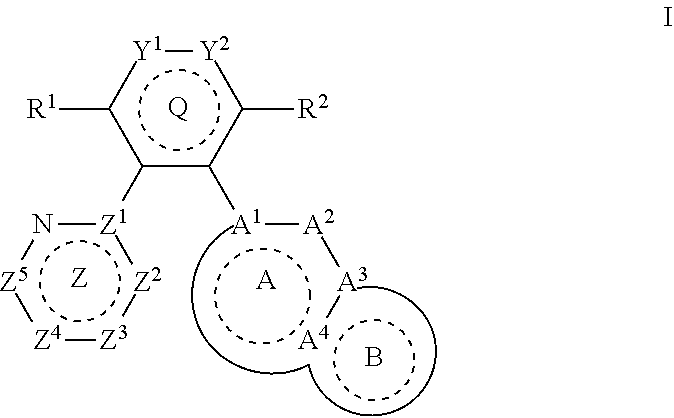


Applications Claiming Priority (3)
| Application Number | Priority Date | Filing Date | Title |
|---|---|---|---|
| CN201610613592 | 2016-07-29 | ||
| CN201610613592.3 | 2016-07-29 | ||
| PCT/CN2017/091940 WO2018019106A1 (en) | 2016-07-29 | 2017-07-06 | Nitrogenous heterocyclic aromatic compound, preparation method therefor, pharmaceutical composition thereof, and application thereof |
Publications (2)
| Publication Number | Publication Date |
|---|---|
| US20210300916A1 US20210300916A1 (en) | 2021-09-30 |
| US11466003B2 true US11466003B2 (en) | 2022-10-11 |
Family
ID=61015534
Family Applications (1)
| Application Number | Title | Priority Date | Filing Date |
|---|---|---|---|
| US16/321,457 Active 2039-05-10 US11466003B2 (en) | 2016-07-29 | 2017-07-06 | Nitrogenous heterocyclic aromatic compound, preparation method therefor, pharmaceutical composition thereof, and application thereof |
Country Status (13)
| Country | Link |
|---|---|
| US (1) | US11466003B2 (en) |
| EP (1) | EP3492461B1 (en) |
| JP (1) | JP7007359B2 (en) |
| KR (1) | KR102365333B1 (en) |
| CN (1) | CN107663206B (en) |
| AU (1) | AU2017302959B2 (en) |
| CA (1) | CA3035115C (en) |
| IL (1) | IL264511B2 (en) |
| MX (1) | MX395175B (en) |
| RU (1) | RU2729999C1 (en) |
| SG (1) | SG11201901773QA (en) |
| TW (1) | TWI735626B (en) |
| WO (1) | WO2018019106A1 (en) |
Families Citing this family (5)
| Publication number | Priority date | Publication date | Assignee | Title |
|---|---|---|---|---|
| CN110066277B (en) | 2018-01-24 | 2021-07-23 | 上海璎黎药业有限公司 | Aromatic heterocyclic substituted olefin compound, its preparation method, pharmaceutical composition and application |
| CN110015987B (en) * | 2019-05-22 | 2020-11-20 | 南京合巨药业有限公司 | Preparation method of 2,3 '-dimethoxy- [2,4' ] bipyridyl |
| TWI768781B (en) * | 2020-03-24 | 2022-06-21 | 大陸商杭州阿諾生物醫藥科技有限公司 | TRANSFORMING GROWTH FACTOR-β RECEPTOR INHIBITOR |
| US12668593B2 (en) | 2020-09-28 | 2026-06-30 | Sichuan Kelun-Biotech Biopharmaceutical Co., Ltd. | Pyrazole compound and preparation method therefor and use thereof |
| WO2025077671A1 (en) * | 2023-10-09 | 2025-04-17 | 浙江海正药业股份有限公司 | Polysubstituted aryl derivative and preparation method therefor and use thereof |
Citations (16)
| Publication number | Priority date | Publication date | Assignee | Title |
|---|---|---|---|---|
| EP0574174A2 (en) | 1992-06-03 | 1993-12-15 | Eli Lilly And Company | Angiotensin II antagonists |
| WO2002094833A1 (en) | 2001-05-24 | 2002-11-28 | Eli Lilly And Company | Novel pyrrole derivatives as pharmaceutical agents |
| WO2004013135A1 (en) | 2002-07-31 | 2004-02-12 | Smithkline Beecham Corporation | 2-phenylpyridin-4-yl derivatives as alk5 inhibitors |
| WO2004048383A1 (en) | 2002-11-21 | 2004-06-10 | Eli Lilly And Company | Mixed lineage kinase modulators |
| WO2004111036A1 (en) | 2003-06-16 | 2004-12-23 | Smithkline Beecham Corporation | 4- (heterocyclyl- fused phenyl)- 3- (phenyl or pyrid -2- yl) pyrazoles as inhibitors of the alk-5- receptor |
| WO2005016862A1 (en) * | 2003-08-14 | 2005-02-24 | Asahi Kasei Pharma Corporation | Substituted arylalkanoic acid derivative and use thereof |
| CN1956979A (en) | 2004-03-05 | 2007-05-02 | 大正制药株式会社 | Thiazole derivatives |
| US20070142376A1 (en) | 2005-12-16 | 2007-06-21 | Alcon, Inc. | Control of intraocular pressure using alk5 modulation agents |
| WO2009022171A1 (en) | 2007-08-13 | 2009-02-19 | Astrazeneca Ab | Pyridinyiioxy pyridines as alk5 inhibitors |
| WO2009133070A1 (en) | 2008-04-29 | 2009-11-05 | Novartis Ag | Imidazo-pyridine derivatives as activin-like receptor kinase (alk4 or alk5) inhibitors |
| WO2010121162A1 (en) | 2009-04-17 | 2010-10-21 | Summa Health Systems Llc | Use of transforming growth factor-b receptor inhibitors to suppress ocular scarring |
| US8080568B1 (en) | 2010-06-29 | 2011-12-20 | Ewha University - Industry Collaboration Foundation | 2-pyridyl substituted imidazoles as therapeutic ALK5 and/or ALK4 inhibitors |
| JP2012193123A (en) | 2011-03-15 | 2012-10-11 | Konica Minolta Holdings Inc | Method for producing nitrogen-containing condensed heterocyclic compound |
| CN102958930A (en) | 2010-06-28 | 2013-03-06 | 默克专利有限公司 | 2,4- diaryl - substituted [1,8] naphthyridines as kinase inhibitors for use against cancer |
| WO2014055955A1 (en) | 2012-10-05 | 2014-04-10 | Rigel Pharmaceuticals, Inc. | Gdf-8 inhibitors |
| CN103764655A (en) | 2011-07-13 | 2014-04-30 | Sk化学公司 | 2-pyridyl substituted imidazoles as ALK5 and/or ALK4 inhibitors |
-
2017
- 2017-07-06 US US16/321,457 patent/US11466003B2/en active Active
- 2017-07-06 RU RU2019105829A patent/RU2729999C1/en active
- 2017-07-06 CA CA3035115A patent/CA3035115C/en active Active
- 2017-07-06 SG SG11201901773QA patent/SG11201901773QA/en unknown
- 2017-07-06 EP EP17833409.0A patent/EP3492461B1/en active Active
- 2017-07-06 JP JP2019504925A patent/JP7007359B2/en active Active
- 2017-07-06 MX MX2019001225A patent/MX395175B/en unknown
- 2017-07-06 CN CN201710547913.9A patent/CN107663206B/en active Active
- 2017-07-06 AU AU2017302959A patent/AU2017302959B2/en active Active
- 2017-07-06 KR KR1020197005815A patent/KR102365333B1/en active Active
- 2017-07-06 WO PCT/CN2017/091940 patent/WO2018019106A1/en not_active Ceased
- 2017-07-28 TW TW106125566A patent/TWI735626B/en not_active IP Right Cessation
-
2019
- 2019-01-28 IL IL264511A patent/IL264511B2/en unknown
Patent Citations (30)
| Publication number | Priority date | Publication date | Assignee | Title |
|---|---|---|---|---|
| US5612360A (en) * | 1992-06-03 | 1997-03-18 | Eli Lilly And Company | Angiotensin II antagonists |
| EP0574174A2 (en) | 1992-06-03 | 1993-12-15 | Eli Lilly And Company | Angiotensin II antagonists |
| WO2002094833A1 (en) | 2001-05-24 | 2002-11-28 | Eli Lilly And Company | Novel pyrrole derivatives as pharmaceutical agents |
| WO2004013135A1 (en) | 2002-07-31 | 2004-02-12 | Smithkline Beecham Corporation | 2-phenylpyridin-4-yl derivatives as alk5 inhibitors |
| WO2004048383A1 (en) | 2002-11-21 | 2004-06-10 | Eli Lilly And Company | Mixed lineage kinase modulators |
| JP2006527722A (en) | 2003-06-16 | 2006-12-07 | スミスクライン・ビーチャム・コーポレイション | 4- (Heterocycle-fused phenyl) -3- (phenyl or pyrid-2-yl) pyrazole as an inhibitor of the ALK-5 receptor |
| WO2004111036A1 (en) | 2003-06-16 | 2004-12-23 | Smithkline Beecham Corporation | 4- (heterocyclyl- fused phenyl)- 3- (phenyl or pyrid -2- yl) pyrazoles as inhibitors of the alk-5- receptor |
| WO2005016862A1 (en) * | 2003-08-14 | 2005-02-24 | Asahi Kasei Pharma Corporation | Substituted arylalkanoic acid derivative and use thereof |
| KR20060079190A (en) | 2003-08-14 | 2006-07-05 | 아사히 가세이 파마 가부시키가이샤 | Substituted arylalkanoic acid derivatives and uses thereof |
| US20070213333A1 (en) | 2003-08-14 | 2007-09-13 | Asahi Kasei Phama Corporation | Substituted arylalkanoic acid derivatives and use thereof |
| JP2007528362A (en) | 2003-08-14 | 2007-10-11 | 旭化成ファーマ株式会社 | Substituted arylalkanoic acid derivatives and uses thereof |
| US7470807B2 (en) | 2003-08-14 | 2008-12-30 | Asahi Kasei Pharma Corporation | Substituted arylalkanoic acid derivatives and use thereof |
| CN1956979A (en) | 2004-03-05 | 2007-05-02 | 大正制药株式会社 | Thiazole derivatives |
| US20070142376A1 (en) | 2005-12-16 | 2007-06-21 | Alcon, Inc. | Control of intraocular pressure using alk5 modulation agents |
| WO2009022171A1 (en) | 2007-08-13 | 2009-02-19 | Astrazeneca Ab | Pyridinyiioxy pyridines as alk5 inhibitors |
| WO2009133070A1 (en) | 2008-04-29 | 2009-11-05 | Novartis Ag | Imidazo-pyridine derivatives as activin-like receptor kinase (alk4 or alk5) inhibitors |
| CN102695511A (en) | 2009-04-17 | 2012-09-26 | 舒玛健康系统有限责任公司 | Use of transforming growth factor-Beta receptor inhibitors to suppress ocular scarring |
| WO2010121162A1 (en) | 2009-04-17 | 2010-10-21 | Summa Health Systems Llc | Use of transforming growth factor-b receptor inhibitors to suppress ocular scarring |
| US20100267731A1 (en) | 2009-04-17 | 2010-10-21 | Summa Health Systems, LLC | Use of transforming growth factor-b receptor inhibitors to suppress ocular scarring |
| JP2012524073A (en) | 2009-04-17 | 2012-10-11 | スムマ ヘルス システムズ エルエルシー | Use of transforming growth factor-beta receptor inhibitors to inhibit eye scarring |
| CN102958930A (en) | 2010-06-28 | 2013-03-06 | 默克专利有限公司 | 2,4- diaryl - substituted [1,8] naphthyridines as kinase inhibitors for use against cancer |
| US20130102603A1 (en) | 2010-06-28 | 2013-04-25 | Merck Patent Gesellschaft Mit Beschrankter Haftung | 2,4-diaryl - substituted [1,8] naphthyridines as kinase inhibitors for use against cancer |
| WO2012002680A2 (en) | 2010-06-29 | 2012-01-05 | Ewha University-Industry Collaboration Foundation | 2-pyridyl substituted imidazoles as therapeutic alk5 and/or alk4 inhibitors |
| US20110319406A1 (en) | 2010-06-29 | 2011-12-29 | Ewha University-Industry Collaboration Foundation | 2-pyridyl substituted imidazoles as therapeutic alk5 and/or alk4 inhibitors |
| US8080568B1 (en) | 2010-06-29 | 2011-12-20 | Ewha University - Industry Collaboration Foundation | 2-pyridyl substituted imidazoles as therapeutic ALK5 and/or ALK4 inhibitors |
| CN103025731A (en) | 2010-06-29 | 2013-04-03 | 梨花女子大学校产学协力团 | 2-pyridyl-substituted imidazoles as ALK5 and/or ALK4 inhibitors |
| JP2013533252A (en) | 2010-06-29 | 2013-08-22 | イファ ユニーバーシティ−インダストリー コラボレーション ファウンデーション | Imidazole substituted with 2-pyridyl as therapeutic ALK5 and / or ALK4 inhibitor |
| JP2012193123A (en) | 2011-03-15 | 2012-10-11 | Konica Minolta Holdings Inc | Method for producing nitrogen-containing condensed heterocyclic compound |
| CN103764655A (en) | 2011-07-13 | 2014-04-30 | Sk化学公司 | 2-pyridyl substituted imidazoles as ALK5 and/or ALK4 inhibitors |
| WO2014055955A1 (en) | 2012-10-05 | 2014-04-10 | Rigel Pharmaceuticals, Inc. | Gdf-8 inhibitors |
Non-Patent Citations (59)
| Title |
|---|
| Chemical Abstracts STN Registry Database Record for RN 1269048-57-8, Entered STN on Mar. 21, 2011. (Year: 2011). * |
| Chemical Abstracts STN Registry Database Record for RN 159749-81-2, Entered STN on Dec. 23, 1994. (Year: 1994). * |
| Chemical Abstracts STN Registry Database, record for RN 1185447-31-7, "5-[5-Fluoro-2-(1H-pyrazol-1-yl)phenyl]-1,6-dihydro-3-methyl-1-(1-methylethyl)imidazo[4,5-c]pyrazole", Entered into STN on Sep. 17, 2009. (Year: 2009). * |
| Chemical Abstracts STN Registry Database, record for RN 1347592-57-7, entered STN: Dec. 2, 2011. (Year: 2011). * |
| Chemical Abstracts STN Registry Database, record for RN 1350133-65-1, entered STN: Dec. 7, 2011. (Year: 2011). * |
| Chemical Abstracts STN Registry Database, record for RN 1350283-76-9, entered STN: Dec. 7, 2011. (Year: 2011). * |
| Chemical Abstracts STN Registry Database, record for RN 477703-12-1, entered into STN Dec. 24, 2002. (Year: 2002). * |
| Chemical Abstracts STN Registry Database, record for RN 860631-34-1, "3-(1-methyl-1H-indazol-5-yl)-4-(2-pyridinyl)-benzenepropanoic acid"; Entered STN on Aug. 17, 2005. (Year: 2005). * |
| Communication pursuant to Article 94(3) EPC dated Jun. 17, 2021 issued in counterpart European Application No. 17 833 409.0, 4 pages. |
| Data base Registry[online]RN 1347096-42-7, Jan. 12, 2011, STN. |
| Data base Registry[online]RN 1347343-36-5, Feb. 12, 2011, STN. |
| Data base Registry[online]RN 1347592-57-7, Feb. 12, 2011, STN. |
| Data base Registry[online]RN 1347861-72-6, Apr. 12, 2011, STN. |
| Data base Registry[online]RN 1348108-96-2, Apr. 12, 2011, STN. |
| Data base Registry[online]RN 1348313-73-4, Apr. 12, 2011, STN. |
| Data base Registry[online]RN 1348415-89-3, Apr. 12, 2011, STN. |
| Data base Registry[online]RN 13486928-30-0, Jan. 12, 2011, STN. |
| Data base Registry[online]RN 1349001-52-0, May 12, 2011, STN. |
| Data base Registry[online]RN 1349009-24-0, May 12, 2011, STN. |
| Data base Registry[online]RN 1349029-63-5, May 12, 2011, STN. |
| Data base Registry[online]RN 1349073-33-1, May 12, 2011, STN. |
| Data base Registry[online]RN 1350133-65-1, Jul. 12, 2011, STN. |
| Data base Registry[online]RN 1350283-76-9, Jul. 12, 2011, STN. |
| Extended European Search Report issued in the counterpart European application No. 17833409.0 dated Jan. 13, 2020. |
| First Examination Report issued in the counterpart Australian application No. 2017302959 dated Apr. 2, 2020. |
| First Office Action and First Search Report issued in the counterpart Chinese application No. 201710547913.9 dated Dec. 24, 2019. |
| First Office Action issued in counterpart Canadian application No. 3,035,115 dated Apr. 14, 2020, 5 pages. |
| First Office Action issued in counterpart Indian application No. 201927007816 dated Apr. 23, 2020, 6 pages. |
| First Office Action issued in counterpart New Zealand application No. 751116 dated Jul. 24, 2020, 6 pages. |
| First Office Action issued in the counterpart Israeli application No. 264511 dated Oct. 25, 2020, with English translation, 11 pages. |
| First Office Action issued in the counterpart Korean application No. 10-2019-7005815 dated Nov. 30, 2020, with English translation, 13 pages. |
| First Office Action issued in the counterpart Russian application No. 2019105829 dated Oct. 10, 2019. |
| Gellibert F et al., "Design of novel quinazoline derivatives and related analogues as potent and selective ALK5 inhibitors", Bioorganic & Medicinal Chemistry Letters, vol. 19, No. 8, 2009, pp. 2277-2281. |
| Gellibert; J. Med. Chem. 2004, 47, 18, 4494-4506. DOI: 10.1021/jm0400247 (Year: 2004). * |
| International Search Report and Written Opinion of PCT/CN2017/091940 dated Sep. 30, 2017. |
| Kubiczkova; J Transl Med 10, 183 (2012). https://doi.org/10.1186/1479-5876-10-183 (Year: 2012). * |
| Malihe Ebrahimi et al., "Interactions between activin-like kinase (ALK5) receptor and its inhibitors and the construction of a docking descriptor-based QSAR model", Journal of the Brazilian Chemical Society, vol. 23, No. 11, 2012, pp. 2043-2053. |
| Marike Marjolijn Van Beuge et al., "Enhanced effectivity of an ALK5-inhibitor after cell-specific delivery to hepatic stellate cells in mice with liver injury", PLOS One, vol. 8, No. 2, 2013, pp. 1-9. |
| Mark L Boys et al., "Discovery of a series of 2-(1H-pyrazol-1-yl)pyridines as ALK5 inhibitors with potential utility in the prevention of dermal scarring", Bioorganic & Medicinal Chemistry Letters, vol. 22, No. 10, 2012, pp. 3392-3397. |
| National Center for Biotechnology Information. PubChem Substance Record for SID 316937786, SID 316937786, Source: ChemBridge. https://pubchem.ncbi.nlm.nih.gov/substance/316937786. Available Sep. 1, 2016. (Year: 2016). * |
| National Center for Biotechnology Information. PubChem Substance Record for SID 316945036, SID 316945036, Source: ChemBridge. https://pubchem.ncbi.nlm.nih.gov/substance/316945036. Available Sep. 1, 2016. (Year: 2016). * |
| Neuzillet et al., "Targeting the TGFβ pathway for cancer therapy", Pharmacology & Therapeutics, 2015, vol. 147, pp. 22-31. |
| Notice of Reasons for Refusal dated Mar. 16, 2021 issued in corresponding Japanese Patent Application No. 2019-504925, with English translation, 6 pages. |
| Notice of Reasons for Refusal issued in counterpart Japanese application No. 2019-504925 dated Jun. 23, 2020, 9 pages. |
| Notification of Reason for Refusal dated Jun. 18, 2021 issued in counterpart Korean Application No. 10-2019-7005815, with English translation, 11 pages. |
| Office Action dated Apr. 22, 2022 issued in MX Patent Application MX/a/2019/001225, with English translation, 10 pages. |
| Office Action dated May 27, 2021 issued in counterpart Mexican Application No. MX/a/2019/001225, with English translation, 13 pages. |
| Ren Ji-Xia et al., "Pharmacophore modeling and virtual screening for the discovery of new transforming growth factor-beta type I receptor (ALK5) inhibitors", European Journal of Medicinal Chemistry, vol. 44, No. 11, pp. 4259-4265. |
| Reznickova Eva et al., "ALK5 kinase inhibitory activity and synthesis of 2,3,4-substituted 5,5-dimethyl-5,6-dihydro-4H-pyrrolo[1,2-b]pyrazoles", European Journal of Medicinal Chemistry, vol. 127, 2017, pp. 632-642. |
| Rik Derynck et al., "Smad-dependent and smad-independent pathways in TGF-β family signalling", Nature, 2003, vol. 425,No. 9, pp. 577-584. |
| Rosemary J. Akhurst et al., "Targeting the TGF-β signalling pathway in disease", Nat Rev Drug Discov., 2012, vol. 11, No. 10, pp. 790-811. |
| Second Office Action dated Oct. 19, 2021 issued in counterpart IL application No. 264511, with English translation, 8 pages. |
| Second Office Action dated Oct. 28, 2021 issued in counterpart MX application No. MX/a/2019/001225, with English translation, 15 pages. |
| Second Office Action issued in counterpart Chinese application No. 201710547913.9 dated Jul. 7, 2020, 12 pages. |
| Second Office Action issued in counterpart Russian application No. 2019105829 dated Feb. 27, 2020. |
| Second Written Opinion issued in the counterpart Singaporean Application No. 11201901773Q dated Dec. 6, 2021, 8 pages. |
| Written opinion issued in counterpart Singaporean application No. 112019017730 dated Jun. 4, 2020, 8 pages. |
| Ya-Ling Zou et al., "Solvent and base in one: tetra-n-butylammonium acetate as a multi-purpose Ionic liquid medium for ru-catalyzed directed mono- and Di-o-C—H arylation reactions", Eur. J. Org. Chem., 2017, pp. 6274-6282. |
| You-Gui Li et al.,"Bulky Phosphane ligand for monoselective ruthenium-catalayzed, directed o-C—H arylation with challenging aryl chlorides", Synlett, 2016, vol. 28, No. 4, pp. 499-503. |
Also Published As
| Publication number | Publication date |
|---|---|
| US20210300916A1 (en) | 2021-09-30 |
| JP7007359B2 (en) | 2022-01-24 |
| EP3492461A1 (en) | 2019-06-05 |
| RU2729999C1 (en) | 2020-08-13 |
| SG11201901773QA (en) | 2019-04-29 |
| WO2018019106A1 (en) | 2018-02-01 |
| IL264511B2 (en) | 2023-07-01 |
| EP3492461B1 (en) | 2024-10-23 |
| KR102365333B1 (en) | 2022-02-23 |
| KR20190034293A (en) | 2019-04-01 |
| CN107663206A (en) | 2018-02-06 |
| JP2019522038A (en) | 2019-08-08 |
| AU2017302959B2 (en) | 2021-01-28 |
| TW201803864A (en) | 2018-02-01 |
| MX395175B (en) | 2025-03-25 |
| EP3492461A4 (en) | 2020-02-12 |
| MX2019001225A (en) | 2019-09-13 |
| CA3035115C (en) | 2021-10-26 |
| NZ751116A (en) | 2020-12-18 |
| TWI735626B (en) | 2021-08-11 |
| IL264511A (en) | 2019-02-28 |
| AU2017302959A1 (en) | 2019-03-21 |
| CN107663206B (en) | 2021-06-18 |
| CA3035115A1 (en) | 2018-02-01 |
| IL264511B1 (en) | 2023-03-01 |
Similar Documents
| Publication | Publication Date | Title |
|---|---|---|
| US11384048B2 (en) | Aromatic vinyl or aromatic ethyl derivative, preparation method therefor, intermediate, pharmaceutical composition, and application | |
| US20210300916A1 (en) | Nitrogenous heterocyclic aromatic compound, preparation method therefor, pharmaceutical composition thereof, and application thereof | |
| US20230277547A1 (en) | Substituted quinoxaline dna-pk inhibitors | |
| US8268999B2 (en) | Tri-cyclic pyrazolopyridine kinase inhibitors | |
| US11584745B2 (en) | Aromatic heterocyclic compound, intermediate thereof, preparation method therefor, and pharmaceutical composition and use thereof | |
| US20070043068A1 (en) | Pyrrolo-pyridine kinase modulators | |
| US20080221119A1 (en) | Pyrrolo-pyridine kinase modulators | |
| US11174254B2 (en) | Aniline-substituted 1,2-dihydropyrrol[3,4-C]pyridin/pyrimidin-3-one derivative and use thereof | |
| US20110098298A1 (en) | New Pyridin-3-Amine Derivatives | |
| AU2007268056A1 (en) | Thiophene-carboxamides useful as inhibitors of protein kinases | |
| EP2398810A1 (en) | Tetrahydrothiazolopyridine inhibitors of phosphatidylinositol 3-kinase | |
| US11447490B2 (en) | Aromatic heterocyclic substituted olefin compound, preparation method for same, pharmaceutical composition of same, and applications thereof | |
| NZ751116B2 (en) | Nitrogenous heterocyclic aromatic compound, preparation method therefor, pharmaceutical composition thereof, and application thereof | |
| HK40002888B (en) | Nitrogenous heterocyclic aromatic compound, preparation method therefor, pharmaceutical composition thereof, and application thereof | |
| HK40002888A (en) | Nitrogenous heterocyclic aromatic compound, preparation method therefor, pharmaceutical composition thereof, and application thereof | |
| HK40006154B (en) | Aromatic heterocyclic compound, intermediate thereof, preparation method therefor, and pharmaceutical composition and use thereof | |
| HK40006154A (en) | Aromatic heterocyclic compound, intermediate thereof, preparation method therefor, and pharmaceutical composition and use thereof | |
| CN120058708A (en) | Alkynyl alcohol derivative and medical application thereof |
Legal Events
| Date | Code | Title | Description |
|---|---|---|---|
| AS | Assignment |
Owner name: SHANGHAI YINGLI PHARMACEUTICAL CO., LTD, CHINA Free format text: ASSIGNMENT OF ASSIGNORS INTEREST;ASSIGNORS:XU, ZUSHENG;LOU, YANGTONG;CHEN, LI;REEL/FRAME:048159/0593 Effective date: 20190121 |
|
| FEPP | Fee payment procedure |
Free format text: ENTITY STATUS SET TO UNDISCOUNTED (ORIGINAL EVENT CODE: BIG.); ENTITY STATUS OF PATENT OWNER: LARGE ENTITY |
|
| STPP | Information on status: patent application and granting procedure in general |
Free format text: RESPONSE TO NON-FINAL OFFICE ACTION ENTERED AND FORWARDED TO EXAMINER |
|
| STPP | Information on status: patent application and granting procedure in general |
Free format text: NON FINAL ACTION MAILED |
|
| STPP | Information on status: patent application and granting procedure in general |
Free format text: RESPONSE TO NON-FINAL OFFICE ACTION ENTERED AND FORWARDED TO EXAMINER |
|
| STPP | Information on status: patent application and granting procedure in general |
Free format text: FINAL REJECTION MAILED |
|
| STPP | Information on status: patent application and granting procedure in general |
Free format text: ADVISORY ACTION MAILED |
|
| STPP | Information on status: patent application and granting procedure in general |
Free format text: RESPONSE AFTER FINAL ACTION FORWARDED TO EXAMINER |
|
| STPP | Information on status: patent application and granting procedure in general |
Free format text: NOTICE OF ALLOWANCE MAILED -- APPLICATION RECEIVED IN OFFICE OF PUBLICATIONS |
|
| STPP | Information on status: patent application and granting procedure in general |
Free format text: PUBLICATIONS -- ISSUE FEE PAYMENT RECEIVED |
|
| STPP | Information on status: patent application and granting procedure in general |
Free format text: PUBLICATIONS -- ISSUE FEE PAYMENT VERIFIED |
|
| STCF | Information on status: patent grant |
Free format text: PATENTED CASE |
|
| MAFP | Maintenance fee payment |
Free format text: PAYMENT OF MAINTENANCE FEE, 4TH YEAR, LARGE ENTITY (ORIGINAL EVENT CODE: M1551); ENTITY STATUS OF PATENT OWNER: LARGE ENTITY Year of fee payment: 4 |