US11459247B2 - Iron oxide modified halloysite nanomaterial - Google Patents
Iron oxide modified halloysite nanomaterial Download PDFInfo
- Publication number
- US11459247B2 US11459247B2 US16/594,454 US201916594454A US11459247B2 US 11459247 B2 US11459247 B2 US 11459247B2 US 201916594454 A US201916594454 A US 201916594454A US 11459247 B2 US11459247 B2 US 11459247B2
- Authority
- US
- United States
- Prior art keywords
- hnt
- adsorption
- phosphate
- nanomaterial
- iron
- Prior art date
- Legal status (The legal status is an assumption and is not a legal conclusion. Google has not performed a legal analysis and makes no representation as to the accuracy of the status listed.)
- Active
Links
Images




Classifications
-
- B—PERFORMING OPERATIONS; TRANSPORTING
- B01—PHYSICAL OR CHEMICAL PROCESSES OR APPARATUS IN GENERAL
- B01J—CHEMICAL OR PHYSICAL PROCESSES, e.g. CATALYSIS OR COLLOID CHEMISTRY; THEIR RELEVANT APPARATUS
- B01J20/00—Solid sorbent compositions or filter aid compositions; Sorbents for chromatography; Processes for preparing, regenerating or reactivating thereof
- B01J20/02—Solid sorbent compositions or filter aid compositions; Sorbents for chromatography; Processes for preparing, regenerating or reactivating thereof comprising inorganic material
- B01J20/06—Solid sorbent compositions or filter aid compositions; Sorbents for chromatography; Processes for preparing, regenerating or reactivating thereof comprising inorganic material comprising oxides or hydroxides of metals not provided for in group B01J20/04
-
- C—CHEMISTRY; METALLURGY
- C02—TREATMENT OF WATER, WASTE WATER, SEWAGE, OR SLUDGE
- C02F—TREATMENT OF WATER, WASTE WATER, SEWAGE, OR SLUDGE
- C02F1/00—Treatment of water, waste water, or sewage
- C02F1/28—Treatment of water, waste water, or sewage by sorption
- C02F1/281—Treatment of water, waste water, or sewage by sorption using inorganic sorbents
-
- B—PERFORMING OPERATIONS; TRANSPORTING
- B01—PHYSICAL OR CHEMICAL PROCESSES OR APPARATUS IN GENERAL
- B01J—CHEMICAL OR PHYSICAL PROCESSES, e.g. CATALYSIS OR COLLOID CHEMISTRY; THEIR RELEVANT APPARATUS
- B01J20/00—Solid sorbent compositions or filter aid compositions; Sorbents for chromatography; Processes for preparing, regenerating or reactivating thereof
- B01J20/02—Solid sorbent compositions or filter aid compositions; Sorbents for chromatography; Processes for preparing, regenerating or reactivating thereof comprising inorganic material
- B01J20/10—Solid sorbent compositions or filter aid compositions; Sorbents for chromatography; Processes for preparing, regenerating or reactivating thereof comprising inorganic material comprising silica or silicate
- B01J20/12—Naturally occurring clays or bleaching earth
-
- B—PERFORMING OPERATIONS; TRANSPORTING
- B01—PHYSICAL OR CHEMICAL PROCESSES OR APPARATUS IN GENERAL
- B01J—CHEMICAL OR PHYSICAL PROCESSES, e.g. CATALYSIS OR COLLOID CHEMISTRY; THEIR RELEVANT APPARATUS
- B01J20/00—Solid sorbent compositions or filter aid compositions; Sorbents for chromatography; Processes for preparing, regenerating or reactivating thereof
- B01J20/28—Solid sorbent compositions or filter aid compositions; Sorbents for chromatography; Processes for preparing, regenerating or reactivating thereof characterised by their form or physical properties
- B01J20/28002—Solid sorbent compositions or filter aid compositions; Sorbents for chromatography; Processes for preparing, regenerating or reactivating thereof characterised by their form or physical properties characterised by their physical properties
- B01J20/28004—Sorbent size or size distribution, e.g. particle size
- B01J20/28007—Sorbent size or size distribution, e.g. particle size with size in the range 1-100 nanometers, e.g. nanosized particles, nanofibers, nanotubes, nanowires or the like
-
- B—PERFORMING OPERATIONS; TRANSPORTING
- B01—PHYSICAL OR CHEMICAL PROCESSES OR APPARATUS IN GENERAL
- B01J—CHEMICAL OR PHYSICAL PROCESSES, e.g. CATALYSIS OR COLLOID CHEMISTRY; THEIR RELEVANT APPARATUS
- B01J20/00—Solid sorbent compositions or filter aid compositions; Sorbents for chromatography; Processes for preparing, regenerating or reactivating thereof
- B01J20/30—Processes for preparing, regenerating, or reactivating
- B01J20/32—Impregnating or coating ; Solid sorbent compositions obtained from processes involving impregnating or coating
- B01J20/3202—Impregnating or coating ; Solid sorbent compositions obtained from processes involving impregnating or coating characterised by the carrier, support or substrate used for impregnation or coating
- B01J20/3204—Inorganic carriers, supports or substrates
-
- B—PERFORMING OPERATIONS; TRANSPORTING
- B01—PHYSICAL OR CHEMICAL PROCESSES OR APPARATUS IN GENERAL
- B01J—CHEMICAL OR PHYSICAL PROCESSES, e.g. CATALYSIS OR COLLOID CHEMISTRY; THEIR RELEVANT APPARATUS
- B01J20/00—Solid sorbent compositions or filter aid compositions; Sorbents for chromatography; Processes for preparing, regenerating or reactivating thereof
- B01J20/30—Processes for preparing, regenerating, or reactivating
- B01J20/32—Impregnating or coating ; Solid sorbent compositions obtained from processes involving impregnating or coating
- B01J20/3231—Impregnating or coating ; Solid sorbent compositions obtained from processes involving impregnating or coating characterised by the coating or impregnating layer
- B01J20/3234—Inorganic material layers
- B01J20/3236—Inorganic material layers containing metal, other than zeolites, e.g. oxides, hydroxides, sulphides or salts
-
- C—CHEMISTRY; METALLURGY
- C02—TREATMENT OF WATER, WASTE WATER, SEWAGE, OR SLUDGE
- C02F—TREATMENT OF WATER, WASTE WATER, SEWAGE, OR SLUDGE
- C02F1/00—Treatment of water, waste water, or sewage
- C02F1/28—Treatment of water, waste water, or sewage by sorption
- C02F1/288—Treatment of water, waste water, or sewage by sorption using composite sorbents, e.g. coated, impregnated, multi-layered
-
- B—PERFORMING OPERATIONS; TRANSPORTING
- B01—PHYSICAL OR CHEMICAL PROCESSES OR APPARATUS IN GENERAL
- B01J—CHEMICAL OR PHYSICAL PROCESSES, e.g. CATALYSIS OR COLLOID CHEMISTRY; THEIR RELEVANT APPARATUS
- B01J2220/00—Aspects relating to sorbent materials
- B01J2220/40—Aspects relating to the composition of sorbent or filter aid materials
- B01J2220/42—Materials comprising a mixture of inorganic materials
-
- C—CHEMISTRY; METALLURGY
- C02—TREATMENT OF WATER, WASTE WATER, SEWAGE, OR SLUDGE
- C02F—TREATMENT OF WATER, WASTE WATER, SEWAGE, OR SLUDGE
- C02F2101/00—Nature of the contaminant
- C02F2101/10—Inorganic compounds
- C02F2101/105—Phosphorus compounds
-
- C—CHEMISTRY; METALLURGY
- C02—TREATMENT OF WATER, WASTE WATER, SEWAGE, OR SLUDGE
- C02F—TREATMENT OF WATER, WASTE WATER, SEWAGE, OR SLUDGE
- C02F2305/00—Use of specific compounds during water treatment
- C02F2305/08—Nanoparticles or nanotubes
Definitions
- Some approaches for removing molecules from water include the use of nanostructures such as nanotubules and more specifically, halloysite nanotubules.
- Some molecules possess a chemical charge and removal thereof is particularly challenging. For instance, anions such as phosphate are particularly difficult to remove from water using nanomaterials that are negatively charged.
- Clay nano-sorbents are one of the research areas that have significant promise to be applied in the field.
- Nanoclay mineral sorbents are widely used in environmental remediation due to their low-cost, adequate availability, environmental compatibility, and adsorption efficiency. Adsorption is reported to be one of the most effective processes for phosphate removal with advantages of low-cost, high efficiency, and simple operation.
- HNTs halloysite nanotubes
- kaolin i.e., Al 2 Si 2 O 5 (OH) 4 .nH 2 O
- HNT chemical structure can be similar to that of kaolin (i.e., Al 2 Si 2 O 5 (OH) 4 .nH 2 O), and is comprised of octahedral alumina crystals in the inner layer and a tetrahedral silica in the outer layer. Its attractive features include high specific surface area, availability of micropores, and presence of positive and negatively charged surface sites.
- HNTs are used as reinforcement fillers in polymers, as drug delivery agents, and as nanoreactors/nanotemplates for synthesis of functional materials, as well as in environmental remediation.
- this disclosure improves upon the current state of HNT preparation and application for use including in the treatment of fluids such as water.
- this disclosure includes the modification of HNT with nano-scale iron oxide (such as Fe 2 O 3 ).
- the HNT can be modified with nano-scale iron oxide under mild conditions.
- the modified HNT can be used to remove environmentally significant molecules from water and other fluids.
- FIG. 1 is a representative TEM micrograph, including (a) raw HNT; (b) STEM images of 1Fe-HNT; (c,d) element-specific images of 1Fe-HNT; (e) length distribution of HNTs; (f) diameter distribution of HNTs; and (g) lumen diameter distribution of HNTs.
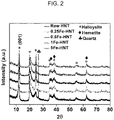
- FIG. 2 is an X-ray diffraction of raw HNT and iron oxide modified HNT.
- FIG. 3 is a graph of (a) electrophoretic mobility and (b) adsorption capacity values as a function of pH for raw HNT and 1Fe-HNT.
- FIG. 4 is a data plot of (a) phosphate adsorption kinetics for raw HNT, 1Fe-HNT, and adsorption within the first 30-minutes (inset); (b) a model of phosphate adsorption kinetics with pseudo-second order; and (c) a model of phosphate adsorption kinetics with intraparticle diffusion.
- FIG. 5 is a graph of the effect of initial concentration on the adsorption capacity of raw HNT and 1Fe-HNT.
- FIG. 6 is a chart of the effect of common coexisting ions on the adsorption capacity of Fe-HNT.
- FIG. 7 is a graph of (a) the effect of adsorbent dosage on phosphate removal depicted in percent removal and (b) the amount adsorbed of per gram of sorbent.
- the present application generally relates to a nanomaterial including a modified halloysite nanomaterial and method of preparation and use including for selective ion removal from water.
- the modified halloysite nanomaterial can be used for the treatment of fluids, such as water for the removal of molecules such as inorganic pollutants or other ions.
- this disclosure relates to an adsorbent including the modified halloysite nanomaterial and a method of preparation and use including the treatment of numerous contaminated water types, such as removing anions from water including the treatment of water for inorganic pollutants such as phosphate.
- the disclosure includes a novel nanohybrid for the use in treating water and can be used for numerous problems related to the molecular content of water.
- This disclosure includes processes for removing ions such as phosphate with materials such as nanotubules, and particularly halloysite nanotubules.
- the disclosure includes a nanomaterial including a halloysite nanomaterial (e.g., HNT), modified with nanoscale molecules such as nanoscale iron oxide.
- This nanohybrid can be used to treat fluids such as water in order to remove certain ions, especially anions such as phosphate.
- the disclosure includes a method for removing phosphate from water using halloysite nanotubules modified with nanoscale molecules such as iron oxide.
- a halloysite nanomaterial e.g., HNT
- HNT halloysite nanomaterial
- Fe 2 O 3 nano-scale iron oxide
- the modified HNT provides enhanced phosphate removal from water according to an embodiment.
- This disclosure provides the removal of environmentally important ions, such as phosphate, with a novel nanohybrid.
- environmentally important ions such as phosphate
- the use of an abundant, environmentally friendly nanotubular clay and its modification using a sustainable approach is provided according to an embodiment. It is particularly challenging to remove anions from water with most nanomaterials that are negatively charged. The material abundance, environmental friendliness, and low-cost are some of the particular advantages of this disclosure. It is particularly challenging to remove anions from water with most nanomaterials, i.e. ions that are negatively charged.
- This disclosure aids in solving these problems, amongst others including the removal of inorganic pollutants from water and that could be applied in tandem with a wide variety of treatment systems.
- the nanomaterial can be used for numerous contaminated water types according to an embodiment.
- Solutions may be prepared with reagent grade chemicals and deionized water (Milli-Q system). Iron (III) chloride hexahydrate (FeCl 3 .6H 2 O) and ammonia were obtained from SureChem (Suffolk, U.K.) and VWR Chemicals (Leuven, Belgium), respectively. Glacial acetic acid was purchased from Fisher Scientific (Fair Lawn, N.J., U.S.A). HNTs and monopotassium phosphate (KH 2 PO 4 ) were procured from Sigma-Aldrich Company Ltd. (Saint Louis, Mo., U.S.A.).
- a modified sol-gel method may be used to surface modify HNTs.
- the preparation of the modified HNT may be conducted in the following steps. For example, 3 g of HNT is dispersed in 300 mL Milli-Q water and is magnetically stirred for 1 h.
- a desired amount (corresponding to the percent iron loadings) of FeCl 3 .6H 2 O is dissolved in 150 mL Milli-Q water and diluted ammonium solution is added to the iron solutions so that the moles of hydroxides (from NH 4 OH) are three times the moles of iron in the solution to achieve the right proportion to form hydroxyiron (Fe(OH) 3 ).
- This hydroxyiron solution is then added drop-wise to the HNT mixture and mixed at 350 rpm for 24 h.
- the dispersion mixture is separated by centrifugation and washed with Milli-Q water several times prior to drying in air, overnight.
- the dried sample is collected and exposed to glacial acetic acid vapors in a furnace at 80° C. for 2 h.
- the Fe-HNT samples prepared at different iron loadings of 0.25, 0.5, 1, and 5 wt. %, are designated in the text as 0.25Fe-HNT, 0.5Fe-HNT, 1Fe-HNT, and 5Fe-HNT, respectively.
- the surface morphology of the samples was studied with a JEOL JSM-7610F field emission SEM at an accelerating voltage of 5 kV.
- TEM images were obtained by placing the sample on lacey carbon film using an FEI Talos F200X TEM, and operating the TEM at 200 kV; the TEM is equipped with an STEM and an energy dispersive X-ray spectroscope (EDX).
- EDX energy dispersive X-ray spectroscope
- the specific surface area of HNT and modified HNT was measured with a Micromeritics ASAP 2020 BET N2 (Norcross, Ga., U.S.A.) surface area analyzer at 77 K.
- the most efficient sorbent dose was determined from studies performed with sorbent amount ranging between 0.1 to 8.0 g L ⁇ 1 .
- the sorbent dose used for the proceeding experiments was 3 g L ⁇ 1 as this was found to be the most efficient and economically feasible amount.
- Kinetic experiments were conducted at time intervals ranging between 0.5 to 240 min to determine the equilibrium contact time and maximum adsorption capacity.
- Experiments investigating the effect of pH on adsorption capacity were conducted at a pH range of 2 to 10.
- Experiments investigating the effects of initial phosphate concentration were conducted following the pH experiments at initial phosphate concentrations ranging between 0.5 mg L ⁇ 1 to 100 mg L ⁇ 1 at a fixed pH of 4.0.
- C 0 (mg L ⁇ 1 ), and C t (mg L ⁇ 1 ) denote the initial and equilibrium phosphate concentrations, respectively, V(L) is the volume of the solution, and W(g) is the mass of the adsorbent used.
- the pseudo first order and pseudo second order kinetics models provide limited insights into the diffusion mechanism underlying this adsorption process.
- the Weber and Morris intraparticle diffusion model was used to identify the steps that occurred during the adsorption process and to elucidate whether intra-particle diffusion is the rate-limiting factor.
- q t (mg ⁇ g ⁇ 1 ) is the amount of phosphate adsorbed at time t (min)
- k p is the intraparticle diffusion rate constant (mg ⁇ g ⁇ min 0.5 )
- C is a constant. The values of k p and C can be determined from the intercept and slope of the linear plot of q t versus t 0.5 .
- R L dimensionless constant
- the Freundlich isotherm depicts a non-ideal and reversible adsorption process not restricted to monolayer adsorption (G. Chen, B. Han, H. Yan, Interaction of Cationic Surfactants with Iron and Sodium Montmorillonite Suspensions, Journal of Colloid and Interface Science, 201 (1998) 158-163).
- EM images of raw HNT and 1Fe-HNT reveal the tubular structure of the clays. Clearer illustrations of the structure of the raw HNT and 1Fe-HNT are obtained through HRTEM imaging, as shown in FIG. 1 at (a) and (b), respectively. 1Fe-HNT is chosen for TEM characterization since it is used for the equilibrium experiments.
- TEM images of the raw HNTs ( FIG. 1 at (a)) illustrate the tubular structures of nanoclay, with open ends and a hollow cavity (lumen). A significant difference in HNT size before and after modification ( FIG. 1 AT (b)) is not observed.
- FIG. 1 AT (b) A significant difference in HNT size before and after modification
- FIG. 1 AT (b) A significant difference in HNT size before and after modification
- the Fe 2 O 3 nanoparticles shown in FIG. 1 at (b) it is observed that the Fe 2 O 3 nanoparticles are anchored on the surface of the HNTs. The average diameter of the Fe 2 O 3 nanoparticles on the surface
- the length of the raw HNTs range between 68 to 1520 nm ( FIG. 1 at (e)), while the external diameter determined to be between 20 to 150 nm ( FIG. 1 at (f)).
- the lumen diameter is found to be between 10 to 28 nm ( FIG. 1 at (g)).
- FIG. 3 presents the N 2 adsorption/desorption isotherms of HNT and modified HNTs at different iron oxide loadings. According to the classifications of International Union of Pure and Applied Chemistry (IUPAC), all isotherms of the raw and modified HNTs were of type II (K. S. Sing, R. T.
- HNTs are primarily composed of silica and alumina with trace amount of CaO, SrO, TiO 2 , phosphorous pentoxide, and sulfur trioxides.
- Raw HNTs contain a certain amount of Fe 2 O 3 (0.59 wt. %), which increases with the increase in reagent loading. Iron content is also shown to increase after hybridization with iron oxide. The amount of iron loading for 0.2, 0.5, 1, and 5Fe-HNT can be deduced from the table to be 0.92, 1.85, 2.47, and 5.98 wt. %, respectively.
- the XRD patterns of raw HNT and iron oxide modified HNTs are shown in FIG. 2 .
- Clay minerals are primarily distinguished by the noticeable basal cleavage of the layered silicate structures.
- the first order basal reflection (001) for raw HNT is at 7.49 ⁇ , which is indicative of a kaolin-type mineral and of dehydrated halloysite (Brindley, Identification of clay minerals by X-ray diffraction analysis, (1955)).
- the diffraction peaks at 11.8°, 19.9°, 24.7°, 35°, 38.3°, 54.9°, and 62.5° correspond to the d values of 7.49 ⁇ , 4.46 ⁇ , 3.60 ⁇ , 2.56 ⁇ , 2.35 ⁇ , 1.67 ⁇ , and 1.48 ⁇ , respectively, which can be indexed to raw HNT (K. Zhu, Y. Duan, F. Wang, P. Gao, H. Jia, C. Ma, C. Wang, Silane-modified halloysite/Fe3O4 nanocomposites: simultaneous removal of Cr (VI) and Sb (V) and positive effects of Cr (VI) on Sb (V) adsorption, Chemical Engineering Journal, 311 (2017) 236-246; C.
- the electrophoretic mobility of HNT and 1Fe-HNT as a function of solution pH is shown in FIG. 3 at (a).
- the positive charge at a low pH for raw HNT can arise from protonation of the hydroxyl groups on the clay edges or at surface defects sites (P. Yuan, P. D. Southon, Z. Liu, M. E. Green, J. M. Hook, S. J. Antill, C. J. Kepert, Functionalization of halloysite clay nanotubes by grafting with ⁇ -aminopropyltriethoxysilane, The Journal of Physical Chemistry C, 112 (2008) 15742-1575; R.
- the low adsorption capacity could be attributed to a strong presence of uncharged H 3 PO 4 species.
- pH>PZC the external surface of raw HNT is negatively charged (upon deprotonation) and the adsorption capacity is found to be 1.5 mg ⁇ g ⁇ 1 . This indicates that phosphate is likely been removed via electrostatic attraction between the anionic species and the positively charged inner lumen of HNTs.
- HNTs have large pore diameters ranging between 10 to 30 nm, which can allow easy access of phosphate anions and bind in the inner lumen (W. Jinhua, Z. Xiang, Z. Bing, Z. Yafei, Z. Rui, L. Jindun, C.
- the kinetic data fit with pseudo-first order and pseudo-second order models are shown in FIG. 4 at (b) and (c) and the key parameters are listed in Table 1. It is known that the pseudo-first order kinetic model provides a better fit for the initial stage of the reaction process, specifically for those sorbents with rapid adsorption propensity (Y. Ho, G. McKay, A comparison of chemisorption kinetic models applied to pollutant removal on various sorbents, Process safety and environmental protection, 76 (1998) 332-340). The values of the correlation coefficient R 2 for the pseudo-first order model is relatively lower than that for the pseudo-second order model.
- the calculated value of g e,calc (mg ⁇ g ⁇ 1 ) for 1Fe-HNT is significantly lower than the experimental value of q e,exp (mg ⁇ g ⁇ 1 ) obtained from the pseudo-first order model. This indicates that the pseudo-first order kinetic model is not suitable to describe the adsorption process.
- the rate constant for 1Fe-HNT in the first regime is greater than the second (k p2 ); this indicates that intraparticle diffusion is the rate determining step of the entire adsorption process (J. Chen, L.-g. Yan, H.-q. Yu, S. Li, L.-l. Qin, G.-q. Liu, Y.-f Li, B. Du, Efficient removal of phosphate by facile prepared magnetic diatomite and illite clay from aqueous solution, Chemical Engineering Journal, 287 (2016) 162-172; P. Luo, Y. Zhao, B. Zhang, J. Liu, Y. Yang, J. Liu, Study on the adsorption of Neutral Red from aqueous solution onto halloysite nanotubes, Water research, 44 (2010) 1489-1497).
- the Langmuir and Freundlich isotherms are presented in FIG. 5 and the key parameters are listed in Table 2.
- the monolayer capacities are near the experimental adsorption capacity results, indicating an agreement with the Langmuir model.
- the Freundlich isotherm model showed lower correlation coefficients but R 2 values were greater than 0.90 for both sorbents (Table 2).
- the Freundlich constant K F is associated with the adsorption capacity of the sorbent; a higher value indicates a higher affinity for the adsorbate (P. Luo, Y. Zhao, B. Zhang, J. Liu, Y. Yang, J. Liu, Study on the adsorption of Neutral Red from aqueous solution onto halloysite nanotubes, Water research, 44 (2010) 1489-1497).
- anions that adsorb by inner-sphere complexation either display little sensitivity to ionic strength or respond to increasing ionic strength with increased adsorption (G. Zhang, H. Liu, R. Liu, J. Qu, Removal of phosphate from water by a Fe—Mn binary oxide adsorbent, Journal of colloid and interface science, 335 (2009) 168-174; R. Giesler, T. Andersson, L. Lövgren, P. Persson, Phosphate sorption in aluminum- and iron-rich humus soils, Soil Science Society of America Journal, 69 (2005) 77-86).
- Chubar and coworkers N. Chubar, V. Kanibolotskyy, V.
- the graph shows the effect of adsorbent dosage on phosphate removal depicted in percent removal at (a) and the amount adsorbed per gram of sorbent at (b).
- the initial phosphate concentration was 10 mgL ⁇ 1
- the pH was 5
- the contact time was 120 minutes.
- the nanomaterial may include 0.25 wt % iron modified HNT, 0.50 wt % iron modified HNT, 1.0 wt % iron modified HNT, and 5.0 wt % iron modified HNT.
- the disclosure includes a facile, sustainable procedure for the preparation of a highly adsorbent iron oxide modified halloysite nanotube adsorbent that can be used for a number of suitable applications.
- the iron oxide modified halloysite nanotube adsorbent is highly selective toward phosphate.
- the adsorbent can be used for the removal of heavy metals from water. It can also be used to move arsenic from water.
- the adsorbent can also be applied in wastewater treatment.
- the adsorbent can also be used for desalination.
- the adsorbent can be used in the treatment of contaminated groundwater.
- the adsorbent can be used in a packed bed filter and used for wastewater treatment in a scale setup.
- a packed bed filter with the adsorbent can be used in tandem with a granulated activated carbon filter or with a membrane filter.
- the present disclosure does not make use of a nitrogen atmosphere to prepare the adsorbent. This is because in an embodiment, the adsorbent does not use magnetic particles. Further, the present disclosure may make use of iron oxide nanoparticles with a diameter of approximately from 5 nm to 6 nm. In an embodiment, the iron oxide nanoparticles have a diameter of about 5.6 nm.
Landscapes
- Chemical & Material Sciences (AREA)
- Organic Chemistry (AREA)
- Inorganic Chemistry (AREA)
- Chemical Kinetics & Catalysis (AREA)
- Analytical Chemistry (AREA)
- Life Sciences & Earth Sciences (AREA)
- Engineering & Computer Science (AREA)
- Geochemistry & Mineralogy (AREA)
- Dispersion Chemistry (AREA)
- Water Supply & Treatment (AREA)
- Environmental & Geological Engineering (AREA)
- Hydrology & Water Resources (AREA)
- Crystallography & Structural Chemistry (AREA)
- Materials Engineering (AREA)
- Nanotechnology (AREA)
- Solid-Sorbent Or Filter-Aiding Compositions (AREA)
Abstract
Description
q t =k p t 0.5 +C (3)
| TABLE 1 |
| Kinetic parameters for phosphate |
| adsorption onto HNT and 1Fe-HNT. |
| Sorbents |
| Kinetic models | Raw HNT | 1Fe-HNT | ||
| qe, exP (mg · g−1) | 1.32 | 2.10 | ||
| Pseudo-first order | ||||
| qe, calc (mg · g−1) | 1.13 | 0.14 | ||
| k1 (min−1) | 0.0691 | 0.0299 | ||
| R2 | 0.906 | 0.967 | ||
| Pseudo-second order | ||||
| qe, calc (mg · g−1) | 1.31 | 2.10 | ||
| k2 (g · mg−1 · min−1) | 0.174 | 0.107 | ||
| R2 | 0.995 | 0.997 | ||
| Intra-particle diffusion | ||||
| kp (mg · g · min0.5) | 0.0290 | |||
| C | 0.874 | |||
| R2 | 0.980 | |||
| kp1 (mg · g · min0.5) | 0.0959 | |||
| C1 | 1.15 | |||
| R2 | 0.988 | |||
| kp2 (mg · g · min0.5) | 0.0465 | |||
| C2 | 1.40 | |||
| R2 | 0.986 | |||
| TABLE 2 |
| Langmuir and Freundlich isotherm parameters |
| for phosphate adsorption on HNT and 1Fe-HNT. |
| Sorbents |
| Equilibrium adsorption models | Raw HNT | 1Fe-HNT | ||
| qe, exp (mg · g−1) | 3.43 | 5.46 | ||
| Langmuir | ||||
| Xm (mg · g−1) | 3.56 | 5.13 | ||
| B | 0.133 | 0.339 | ||
| RL | 0.070 | 0.029 | ||
| R2 | 0.973 | 0.955 | ||
| Freundlich | ||||
| KF (mg g−1(dm3/g)n) | 0.769 | 1.42 | ||
| 1/n | 0.342 | 0.312 | ||
| R2 | 0.952 | 0.904 | ||
Claims (4)
Priority Applications (1)
| Application Number | Priority Date | Filing Date | Title |
|---|---|---|---|
| US16/594,454 US11459247B2 (en) | 2018-10-19 | 2019-10-07 | Iron oxide modified halloysite nanomaterial |
Applications Claiming Priority (2)
| Application Number | Priority Date | Filing Date | Title |
|---|---|---|---|
| US201862747966P | 2018-10-19 | 2018-10-19 | |
| US16/594,454 US11459247B2 (en) | 2018-10-19 | 2019-10-07 | Iron oxide modified halloysite nanomaterial |
Publications (2)
| Publication Number | Publication Date |
|---|---|
| US20200123025A1 US20200123025A1 (en) | 2020-04-23 |
| US11459247B2 true US11459247B2 (en) | 2022-10-04 |
Family
ID=70281301
Family Applications (1)
| Application Number | Title | Priority Date | Filing Date |
|---|---|---|---|
| US16/594,454 Active US11459247B2 (en) | 2018-10-19 | 2019-10-07 | Iron oxide modified halloysite nanomaterial |
Country Status (1)
| Country | Link |
|---|---|
| US (1) | US11459247B2 (en) |
Cited By (1)
| Publication number | Priority date | Publication date | Assignee | Title |
|---|---|---|---|---|
| US20250074628A1 (en) * | 2023-09-05 | 2025-03-06 | Blue Origin, Llc | Aluminosilicate reinforced silicone syntactic thermal protection system |
Families Citing this family (10)
| Publication number | Priority date | Publication date | Assignee | Title |
|---|---|---|---|---|
| KR102492879B1 (en) | 2018-04-25 | 2023-01-27 | 제이에프이미네라르 가부시키가이샤 | Metahalloysite powder and method for producing the same |
| CN114599607A (en) * | 2019-10-28 | 2022-06-07 | 杰富意矿物股份有限公司 | Halloysite powder |
| CN114763633B (en) * | 2021-01-13 | 2023-07-25 | 南开大学 | Recyclable carrier for long-acting control of membrane biological pollution by adopting D-amino acid, and preparation method and application thereof |
| CN112499842B (en) * | 2021-02-05 | 2021-05-07 | 华夏碧水环保科技有限公司北京分公司 | Pretreatment system and pretreatment method for chemical synthesis pharmaceutical high-salt high-concentration wastewater |
| WO2023282874A1 (en) * | 2021-07-08 | 2023-01-12 | Gebze Teknik Universitesi | Semiconductor heterogeneous catalyst with photocatalytic effect under visible light |
| WO2024030037A1 (en) * | 2022-08-05 | 2024-02-08 | Qatar Foundation For Education, Science And Community Development | Multifunctional halloysite-based ceramic membrane for water treatment applications |
| CN115739012B (en) * | 2022-10-28 | 2024-04-16 | 湖南大学 | Siliceous ferrihydrite coated halloysite nanotube composite adsorbent and preparation method and application thereof |
| US11717804B1 (en) * | 2022-11-16 | 2023-08-08 | King Abdulaziz University | Modified nanoclay for heavy metal and salt removal from water |
| CN117654431B (en) * | 2023-12-04 | 2024-06-14 | 松山湖材料实验室 | Nanocomposite and preparation method and application thereof |
| US12545757B1 (en) * | 2024-12-27 | 2026-02-10 | King Saud University | Method for preparing a clay-polymer composite |
Citations (5)
| Publication number | Priority date | Publication date | Assignee | Title |
|---|---|---|---|---|
| US20060102871A1 (en) * | 2003-04-08 | 2006-05-18 | Xingwu Wang | Novel composition |
| US20060163160A1 (en) | 2005-01-25 | 2006-07-27 | Weiner Michael L | Halloysite microtubule processes, structures, and compositions |
| US20070292459A1 (en) | 2005-07-18 | 2007-12-20 | Cooper Sarah M | Halloysite microtubule processes, structures, and compositions |
| CN103990429A (en) | 2014-05-29 | 2014-08-20 | 苏州科技学院 | Halloysite nanotube-ammonium phosphate composite material and preparation method and application thereof |
| US20180305543A1 (en) * | 2015-10-20 | 2018-10-25 | Indian Institute Of Technology Delhi | Composite Fibers Having Aligned Inorganic Nano Structures of High Aspect Ratio and Preparation Method |
-
2019
- 2019-10-07 US US16/594,454 patent/US11459247B2/en active Active
Patent Citations (6)
| Publication number | Priority date | Publication date | Assignee | Title |
|---|---|---|---|---|
| US20060102871A1 (en) * | 2003-04-08 | 2006-05-18 | Xingwu Wang | Novel composition |
| US20060163160A1 (en) | 2005-01-25 | 2006-07-27 | Weiner Michael L | Halloysite microtubule processes, structures, and compositions |
| US20070292459A1 (en) | 2005-07-18 | 2007-12-20 | Cooper Sarah M | Halloysite microtubule processes, structures, and compositions |
| CN103990429A (en) | 2014-05-29 | 2014-08-20 | 苏州科技学院 | Halloysite nanotube-ammonium phosphate composite material and preparation method and application thereof |
| CN103990429B (en) | 2014-05-29 | 2016-04-13 | 苏州科技学院 | A kind of halloysite nanotubes-ammonium phosphate salt composite and its production and use |
| US20180305543A1 (en) * | 2015-10-20 | 2018-10-25 | Indian Institute Of Technology Delhi | Composite Fibers Having Aligned Inorganic Nano Structures of High Aspect Ratio and Preparation Method |
Non-Patent Citations (4)
| Title |
|---|
| Chen, et al.; "Preparation of hollow iron/halloysite nanocomposites with enhanced electromagnetic performances" Royal Society of Chemistry; 2018; (7 pages). |
| Demori, et al; "Evaluation of surfactants addition as compatibilizers for halloysite nanotubes filled polypropylene nanocomposites"; American Institute of Physics; 2014; (5 pages). |
| Szczepanik et al., Synthesis, characterization and photocatalytic activity of TiO2-halloysite and Fe2O3-halloysite nanocomposites for photodegradation of chloroanilines in water, Applied Clay Science, vol. 149, Dec. 1, 2017, pp. 118-126; https://doi.org/10.1016/j.clay.2017.08.016 (Year: 2017). * |
| Xie., et al., Magnetic halloysite nanotubes/iron oxide composites for the adsorption of dyes, Chemical Engineering Journal, vol. 168, Issue 2, Apr. 1, 2011, pp. 959-963, https://doi.org/10.1016/j.cej.2011.02.031 (Year: 2011). * |
Cited By (1)
| Publication number | Priority date | Publication date | Assignee | Title |
|---|---|---|---|---|
| US20250074628A1 (en) * | 2023-09-05 | 2025-03-06 | Blue Origin, Llc | Aluminosilicate reinforced silicone syntactic thermal protection system |
Also Published As
| Publication number | Publication date |
|---|---|
| US20200123025A1 (en) | 2020-04-23 |
Similar Documents
| Publication | Publication Date | Title |
|---|---|---|
| US11459247B2 (en) | Iron oxide modified halloysite nanomaterial | |
| Almasri et al. | Adsorption of phosphate on iron oxide doped halloysite nanotubes | |
| Qi et al. | Development of a magnetic core-shell Fe3O4@ TA@ UiO-66 microsphere for removal of arsenic (III) and antimony (III) from aqueous solution | |
| Jiang et al. | Preparation of magnetically recoverable bentonite–Fe3O4–MnO2 composite particles for Cd (II) removal from aqueous solutions | |
| Zhou et al. | Adsorption behavior and mechanism of arsenic on mesoporous silica modified by iron-manganese binary oxide (FeMnOx/SBA-15) from aqueous systems | |
| Lou et al. | Enhanced removal of As (III)/(V) from water by simultaneously supported and stabilized Fe-Mn binary oxide nanohybrids | |
| Deng et al. | Synthesis of magnetic CoFe2O4/ordered mesoporous carbon nanocomposites and application in Fenton-like oxidation of rhodamine B | |
| Hua | Adsorption of low-concentration arsenic from water by co-modified bentonite with manganese oxides and poly (dimethyldiallylammonium chloride) | |
| Wang et al. | Dual functional sites strategies toward enhanced heavy metal remediation: Interlayer expanded Mg-Al layered double hydroxide by intercalation with L-cysteine | |
| Ge et al. | Hierarchical iron containing γ-MnO2 hollow microspheres: a facile one-step synthesis and effective removal of As (III) via oxidation and adsorption | |
| Chen et al. | Facile synthesis of mesoporous Ce–Fe bimetal oxide and its enhanced adsorption of arsenate from aqueous solutions | |
| Habuda-Stanić et al. | Arsenic removal by nanoparticles: a review | |
| Ma et al. | Efficient adsorption of Selenium (IV) from water by hematite modified magnetic nanoparticles | |
| Du et al. | The behavior of phosphate adsorption and its reactions on the surfaces of Fe–Mn oxide adsorbent | |
| Lai et al. | Adsorption of phosphate from water by easily separable Fe3O4@ SiO2 core/shell magnetic nanoparticles functionalized with hydrous lanthanum oxide | |
| Lu et al. | Phosphate removal from aqueous solutions by a nano-structured Fe–Ti bimetal oxide sorbent | |
| Ramesh et al. | Adsorption of inorganic and organic arsenic from aqueous solutions by polymeric Al/Fe modified montmorillonite | |
| Gupta et al. | Cadmium removal and recovery from aqueous solutions by novel adsorbents prepared from orange peel and Fe2O3 nanoparticles | |
| TWI453165B (en) | Methods of making water treatment compositions | |
| Wang et al. | Adsorptive removal of phosphate by magnetic Fe3O4@ C@ ZrO2 | |
| Jia et al. | Enhanced adsorption of Cr (vi) on BiOBr under alkaline conditions: interlayer anion exchange | |
| US7655148B2 (en) | Water treatment compositions and methods of making and using | |
| Cheng et al. | Dispersion–precipitation synthesis of nanosized magnetic iron oxide for efficient removal of arsenite in water | |
| Hou et al. | Synthesis of core–shell structured magnetic mesoporous silica microspheres with accessible carboxyl functionalized surfaces and radially oriented large mesopores as adsorbents for the removal of heavy metal ions | |
| US20190352196A1 (en) | Method for adsorption of toxic contaminants from water |
Legal Events
| Date | Code | Title | Description |
|---|---|---|---|
| FEPP | Fee payment procedure |
Free format text: ENTITY STATUS SET TO UNDISCOUNTED (ORIGINAL EVENT CODE: BIG.); ENTITY STATUS OF PATENT OWNER: SMALL ENTITY |
|
| FEPP | Fee payment procedure |
Free format text: ENTITY STATUS SET TO SMALL (ORIGINAL EVENT CODE: SMAL); ENTITY STATUS OF PATENT OWNER: SMALL ENTITY |
|
| STPP | Information on status: patent application and granting procedure in general |
Free format text: DOCKETED NEW CASE - READY FOR EXAMINATION |
|
| STPP | Information on status: patent application and granting procedure in general |
Free format text: NON FINAL ACTION MAILED |
|
| STPP | Information on status: patent application and granting procedure in general |
Free format text: RESPONSE TO NON-FINAL OFFICE ACTION ENTERED AND FORWARDED TO EXAMINER |
|
| STPP | Information on status: patent application and granting procedure in general |
Free format text: NOTICE OF ALLOWANCE MAILED -- APPLICATION RECEIVED IN OFFICE OF PUBLICATIONS |
|
| AS | Assignment |
Owner name: QATAR FOUNDATION FOR EDUCATION, SCIENCE AND COMMUNITY DEVELOPMENT, QATAR Free format text: ASSIGNMENT OF ASSIGNORS INTEREST;ASSIGNORS:ALMASRI, DEMA;HUSSIEN, MUATAZ;AHZI, SAID;REEL/FRAME:058115/0417 Effective date: 20211114 |
|
| STCB | Information on status: application discontinuation |
Free format text: ABANDONMENT FOR FAILURE TO CORRECT DRAWINGS/OATH/NONPUB REQUEST |
|
| FEPP | Fee payment procedure |
Free format text: PETITION RELATED TO MAINTENANCE FEES GRANTED (ORIGINAL EVENT CODE: PTGR); ENTITY STATUS OF PATENT OWNER: SMALL ENTITY |
|
| STPP | Information on status: patent application and granting procedure in general |
Free format text: PUBLICATIONS -- ISSUE FEE PAYMENT VERIFIED |
|
| STPP | Information on status: patent application and granting procedure in general |
Free format text: DOCKETED NEW CASE - READY FOR EXAMINATION |
|
| FEPP | Fee payment procedure |
Free format text: PETITION RELATED TO MAINTENANCE FEES GRANTED (ORIGINAL EVENT CODE: PTGR); ENTITY STATUS OF PATENT OWNER: SMALL ENTITY |
|
| STPP | Information on status: patent application and granting procedure in general |
Free format text: NOTICE OF ALLOWANCE MAILED -- APPLICATION RECEIVED IN OFFICE OF PUBLICATIONS |
|
| STPP | Information on status: patent application and granting procedure in general |
Free format text: PUBLICATIONS -- ISSUE FEE PAYMENT VERIFIED |
|
| STCF | Information on status: patent grant |
Free format text: PATENTED CASE |
|
| AS | Assignment |
Owner name: HAMAD BIN KHALIFA UNIVERSITY, QATAR Free format text: ASSIGNMENT OF ASSIGNORS INTEREST;ASSIGNOR:QATAR FOUNDATION FOR EDUCATION, SCIENCE & COMMUNITY DEVELOPMENT;REEL/FRAME:069936/0656 Effective date: 20240430 |
|
| MAFP | Maintenance fee payment |
Free format text: PAYMENT OF MAINTENANCE FEE, 4TH YR, SMALL ENTITY (ORIGINAL EVENT CODE: M2551); ENTITY STATUS OF PATENT OWNER: SMALL ENTITY Year of fee payment: 4 |