US11440982B2 - Ester polymer, preparation method therefor and use thereof - Google Patents
Ester polymer, preparation method therefor and use thereof Download PDFInfo
- Publication number
- US11440982B2 US11440982B2 US16/614,723 US201816614723A US11440982B2 US 11440982 B2 US11440982 B2 US 11440982B2 US 201816614723 A US201816614723 A US 201816614723A US 11440982 B2 US11440982 B2 US 11440982B2
- Authority
- US
- United States
- Prior art keywords
- group
- same
- different
- independently
- acid
- Prior art date
- Legal status (The legal status is an assumption and is not a legal conclusion. Google has not performed a legal analysis and makes no representation as to the accuracy of the status listed.)
- Active, expires
Links
- WFDIJRYMOXRFFG-UHFFFAOYSA-N CC(=O)OC(C)=O Chemical compound CC(=O)OC(C)=O WFDIJRYMOXRFFG-UHFFFAOYSA-N 0.000 description 22
- 0 [3H]C(=O)B**CC(=O)N(C)C Chemical compound [3H]C(=O)B**CC(=O)N(C)C 0.000 description 19
- ROSDSFDQCJNGOL-UHFFFAOYSA-N CNC Chemical compound CNC ROSDSFDQCJNGOL-UHFFFAOYSA-N 0.000 description 3
- NREPHZYYYNNDOU-UHFFFAOYSA-N C.C.C.C.O=C(COCCO)N(CCO)CCO.O=C1COCCO1.OCCNCCO.[H]C([H])(C(=C)C([H])([H])C(C)(C)C)C(CC(=O)OCCOCC(=O)N(CCC)CCO)C(=O)OCCOCC(=O)N(CCO)CCO.[H]C([H])(C(=C)C([H])([H])C(C)(C)C)C1CC(=O)OC1=O Chemical compound C.C.C.C.O=C(COCCO)N(CCO)CCO.O=C1COCCO1.OCCNCCO.[H]C([H])(C(=C)C([H])([H])C(C)(C)C)C(CC(=O)OCCOCC(=O)N(CCC)CCO)C(=O)OCCOCC(=O)N(CCO)CCO.[H]C([H])(C(=C)C([H])([H])C(C)(C)C)C1CC(=O)OC1=O NREPHZYYYNNDOU-UHFFFAOYSA-N 0.000 description 2
- YCMGHGLIMWXIJT-UHFFFAOYSA-N C.C.C.C.CC(O)CN(CC(C)O)C(=O)COCCO.CC(O)CNCC(C)O.O=C1COCCO1.[H]C([H])(C(=C)C([H])([H])C(C)(C)C)C(CC(=O)OCCOCC(=O)N(CC(C)O)CC(C)O)C(=O)OCCOCC(=O)N(CC(C)C)CC(C)O.[H]C([H])(C(=C)C([H])([H])C(C)(C)C)C1CC(=O)OC1=O Chemical compound C.C.C.C.CC(O)CN(CC(C)O)C(=O)COCCO.CC(O)CNCC(C)O.O=C1COCCO1.[H]C([H])(C(=C)C([H])([H])C(C)(C)C)C(CC(=O)OCCOCC(=O)N(CC(C)O)CC(C)O)C(=O)OCCOCC(=O)N(CC(C)C)CC(C)O.[H]C([H])(C(=C)C([H])([H])C(C)(C)C)C1CC(=O)OC1=O YCMGHGLIMWXIJT-UHFFFAOYSA-N 0.000 description 1
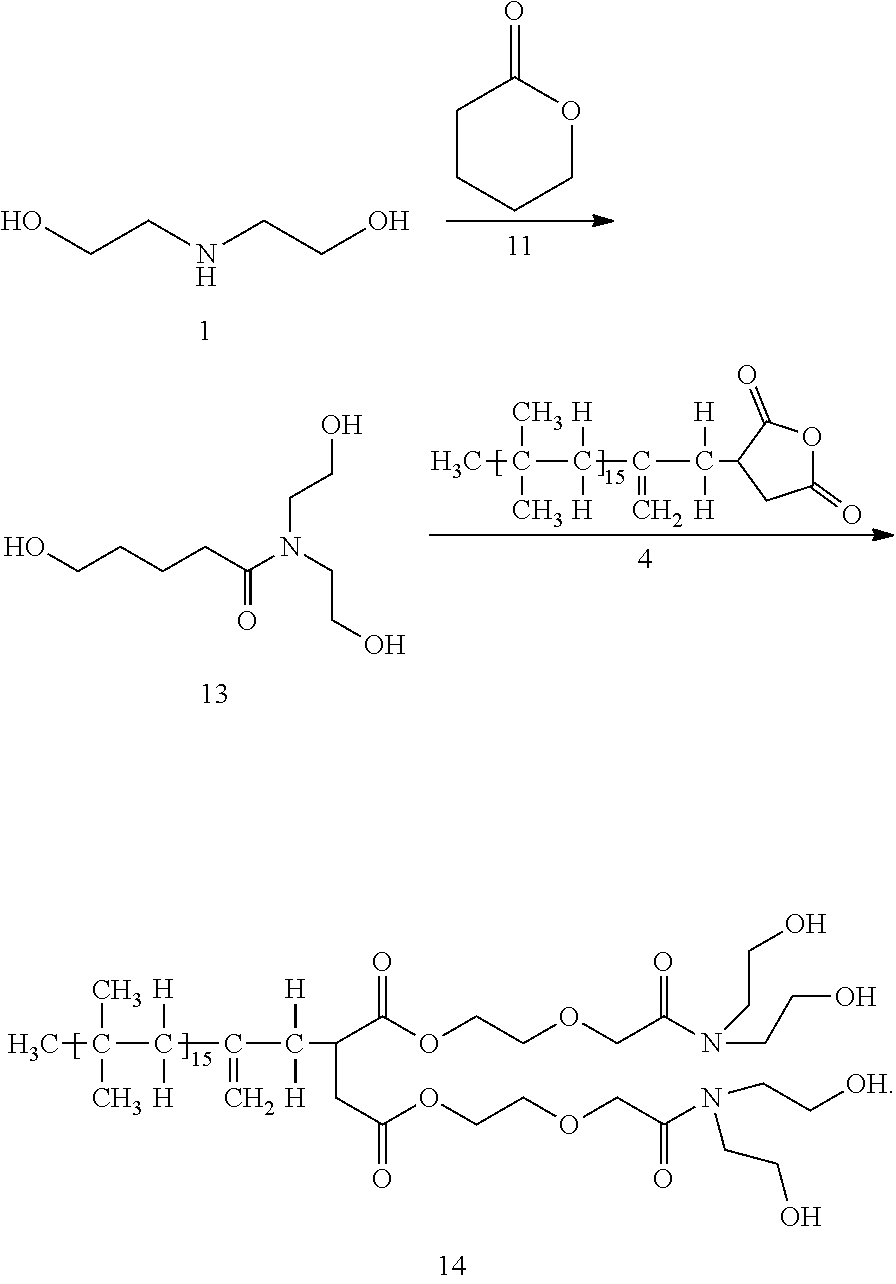
- BTTRKNBIEZKVPL-UHFFFAOYSA-N C.C.C.C.O=C(CCCCO)N(CCO)CCO.O=C1CCCCO1.OCCNCCO.[H]C([H])(C(=C)C([H])([H])C(C)(C)C)C(CC(=O)OCCOCC(=O)N(CCC)CCO)C(=O)OCCOCC(=O)N(CCO)CCO.[H]C([H])(C(=C)C([H])([H])C(C)(C)C)C1CC(=O)OC1=O Chemical compound C.C.C.C.O=C(CCCCO)N(CCO)CCO.O=C1CCCCO1.OCCNCCO.[H]C([H])(C(=C)C([H])([H])C(C)(C)C)C(CC(=O)OCCOCC(=O)N(CCC)CCO)C(=O)OCCOCC(=O)N(CCO)CCO.[H]C([H])(C(=C)C([H])([H])C(C)(C)C)C1CC(=O)OC1=O BTTRKNBIEZKVPL-UHFFFAOYSA-N 0.000 description 1
Images


Classifications
-
- C—CHEMISTRY; METALLURGY
- C08—ORGANIC MACROMOLECULAR COMPOUNDS; THEIR PREPARATION OR CHEMICAL WORKING-UP; COMPOSITIONS BASED THEREON
- C08F—MACROMOLECULAR COMPOUNDS OBTAINED BY REACTIONS ONLY INVOLVING CARBON-TO-CARBON UNSATURATED BONDS
- C08F110/00—Homopolymers of unsaturated aliphatic hydrocarbons having only one carbon-to-carbon double bond
- C08F110/04—Monomers containing three or four carbon atoms
- C08F110/08—Butenes
- C08F110/10—Isobutene
-
- C—CHEMISTRY; METALLURGY
- C08—ORGANIC MACROMOLECULAR COMPOUNDS; THEIR PREPARATION OR CHEMICAL WORKING-UP; COMPOSITIONS BASED THEREON
- C08F—MACROMOLECULAR COMPOUNDS OBTAINED BY REACTIONS ONLY INVOLVING CARBON-TO-CARBON UNSATURATED BONDS
- C08F8/00—Chemical modification by after-treatment
- C08F8/14—Esterification
-
- C—CHEMISTRY; METALLURGY
- C08—ORGANIC MACROMOLECULAR COMPOUNDS; THEIR PREPARATION OR CHEMICAL WORKING-UP; COMPOSITIONS BASED THEREON
- C08F—MACROMOLECULAR COMPOUNDS OBTAINED BY REACTIONS ONLY INVOLVING CARBON-TO-CARBON UNSATURATED BONDS
- C08F267/00—Macromolecular compounds obtained by polymerising monomers on to polymers of unsaturated polycarboxylic acids or derivatives thereof as defined in group C08F22/00
- C08F267/04—Macromolecular compounds obtained by polymerising monomers on to polymers of unsaturated polycarboxylic acids or derivatives thereof as defined in group C08F22/00 on to polymers of anhydrides
-
- C—CHEMISTRY; METALLURGY
- C08—ORGANIC MACROMOLECULAR COMPOUNDS; THEIR PREPARATION OR CHEMICAL WORKING-UP; COMPOSITIONS BASED THEREON
- C08F—MACROMOLECULAR COMPOUNDS OBTAINED BY REACTIONS ONLY INVOLVING CARBON-TO-CARBON UNSATURATED BONDS
- C08F8/00—Chemical modification by after-treatment
- C08F8/30—Introducing nitrogen atoms or nitrogen-containing groups
- C08F8/32—Introducing nitrogen atoms or nitrogen-containing groups by reaction with amines
-
- C—CHEMISTRY; METALLURGY
- C08—ORGANIC MACROMOLECULAR COMPOUNDS; THEIR PREPARATION OR CHEMICAL WORKING-UP; COMPOSITIONS BASED THEREON
- C08L—COMPOSITIONS OF MACROMOLECULAR COMPOUNDS
- C08L95/00—Compositions of bituminous materials, e.g. asphalt, tar, pitch
-
- C—CHEMISTRY; METALLURGY
- C09—DYES; PAINTS; POLISHES; NATURAL RESINS; ADHESIVES; COMPOSITIONS NOT OTHERWISE PROVIDED FOR; APPLICATIONS OF MATERIALS NOT OTHERWISE PROVIDED FOR
- C09K—MATERIALS FOR MISCELLANEOUS APPLICATIONS, NOT PROVIDED FOR ELSEWHERE
- C09K8/00—Compositions for drilling of boreholes or wells; Compositions for treating boreholes or wells, e.g. for completion or for remedial operations
- C09K8/52—Compositions for preventing, limiting or eliminating depositions, e.g. for cleaning
- C09K8/524—Compositions for preventing, limiting or eliminating depositions, e.g. for cleaning organic depositions, e.g. paraffins or asphaltenes
-
- C—CHEMISTRY; METALLURGY
- C08—ORGANIC MACROMOLECULAR COMPOUNDS; THEIR PREPARATION OR CHEMICAL WORKING-UP; COMPOSITIONS BASED THEREON
- C08F—MACROMOLECULAR COMPOUNDS OBTAINED BY REACTIONS ONLY INVOLVING CARBON-TO-CARBON UNSATURATED BONDS
- C08F2810/00—Chemical modification of a polymer
- C08F2810/40—Chemical modification of a polymer taking place solely at one end or both ends of the polymer backbone, i.e. not in the side or lateral chains
Definitions
- the present application relates to a polymer, and more particularly, to an ester polymer suitable for use as a dispersant and/or a polymerization inhibitor.
- Asphaltenes generally defined as petroleum components that are insoluble in n-heptane but soluble in toluene, are a class of materials defined by their solubility, which are components of heavy oils that are hardest to be processed and have the highest relative molecular weight and the highest polarity.
- solubility are components of heavy oils that are hardest to be processed and have the highest relative molecular weight and the highest polarity.
- the presence of asphaltenes provides heavy oils the characteristics of colloidal systems, and where the environment in which the asphaltenes are present changes due to a change in temperature, pressure or composition, flocculation and sedimentation of asphaltenes may easily occur, which adversely affects the production, storage, transportation and processing of petroleum.
- the flocculation and sedimentation of asphaltenes may cause a reduction of permeability and a reversal of wettability to rocks, a permanent damage to oil deposit, and a blockage of peripheral equipment such as well pipes, separators and the like, so that the production efficiency may be seriously lowered.
- the flocculation and sedimentation of asphaltenes may cause the scaling of pumping pipelines and related processing equipment, so that the transmission efficiency may be seriously affected.
- asphaltenes may be deposited on the surfaces of hot solid bodies (such as the walls of a reactor, a furnace tube of a heating furnace and the walls of a heat exchanger) as a coke precursor, which may cause the coking and inactivation of catalysts or the coking and scaling of equipment, thereby reducing the production efficiency and bringing difficulty to the processing and utilization of heavy oils.
- hot solid bodies such as the walls of a reactor, a furnace tube of a heating furnace and the walls of a heat exchanger
- a most cost effective way to prevent the flocculation and sedimentation of asphaltenes is to add a chemical additive (a dispersant and/or an inhibitor).
- chemical additives include alkyl phenols, alkyl sulfonic acids, alkyl pyrrolidones, alkyl phenol polyoxyethylene ethers, fatty acid ester polyols, alkyl phenolic resins, oil soluble polymers, and novel ionic liquids, among others.
- the conclusions in literatures regarding the dispersion and polymerization inhibiting effect of chemical additives are different, which may be associated with the type and structure of asphaltenes, the solvent conditions and the evaluation method of chemical additives.
- Asphaltene dispersants known in the art are, for example, combinations of alkylphenol-formaldehyde resins with hydrophilic-lipophilic vinyl polymers as disclosed in patents CA 2029465C and CA 2075749C.
- Dodecylbenzenesulfonic acid (DBSA) is described in U.S. Pat. No. 4,414,035A and published papers D. L. Chang, H. S. Fogler (SPE paper No. 25185, 1993) and Francia Marcano (Energy & Fuels, 2015, 29 (5): 2813-2822), among others, as having asphaltene-dispersing properties.
- ester polymer having a structure represented by the following formula (I):
- the group T represents the backbone of the ester polymer
- the group B is each independently selected from O or S;
- the group A is each independently selected from O, S or NR′′;
- the group N b is each independently selected from H or —R′′′—B′H, wherein at least one of the two N b on the same nitrogen atom is —R′′′—B′H;
- the group R′′ is each independently selected from H or C 1-10 hydrocarbyl
- the group B′ is each independently selected from O or S;
- each y same as or different from each other, independently represents an integer between 1 and 6;
- n is an integer between 1 and 10.
- the backbone of the ester polymer according to the present application represented by the group T is selected from the group consisting of polyolefins, polyethers and polyesters.
- the present application provides a method for producing an ester polymer, comprising the step of subjecting a matrix polymer to an esterification reaction with at least one compound represented by the following formula (II):
- the matrix polymer refers to a polymer comprising a —COOH group and/or a
- the group B is selected from O or S;
- the group A is each independently selected from O, S or NR′′;
- the group R′ represents C 1-10 hydrocarbylene group, the group R′ being optionally substituted by a group selected from alkoxy, hydroxy, amino and mercapto;
- the group N b is each independently selected from H or —R′′′—B′H, with at least one of them being —R′′′—B′H;
- the group R′′ is each independently selected from H or C 1-10 hydrocarbyl
- the group B′ is each independently selected from O or S;
- y represents an integer between 1 and 6.
- the production method of the present application further comprises a step of reacting at least one compound represented by the following formula (III),
- the group N b is each independently selected from H or —R′′′—B′H, with at least one of them being —R′′′—B′H; and the group R′′′, same as or different from each other, each independently represents C 1-10 hydrocarbylene group, each group R′′′ being optionally substituted by a group selected from alkoxy, hydroxy, amino and mercapto;
- the group B′ is each independently selected from O or S;
- the group B is each independently selected from O or S;
- the group A is each independently selected from O, S or NR′′;
- the group R′′ is each independently selected from H or C 1-10 hydrocarbyl
- each y same as or different from each other, independently represents an integer between 1 and 6.
- the present application provides the use of the ester polymer according to the present application and/or the ester polymer prepared by the method according to the present application as a dispersant and/or a polymerization inhibitor, particularly as an asphaltene dispersant and/or polymerization inhibitor.
- the ester polymer according to the present application When used as a dispersant and/or a polymerization inhibitor, particularly an asphaltene dispersant and/or polymerization inhibitor, the ester polymer according to the present application exhibits excellent dispersion and polymerization inhibition properties, for example more effective capability of reducing or solving the flocculation deposition phenomenon of asphaltenes caused by a change of external conditions, as compared with existing materials.
- FIG. 1 is a 1 H NMR spectrum of the intermediate compound 3 obtained in Example 1;
- FIG. 2 is a liquid chromatography mass (LCMS) spectrum of the intermediate compound 3;
- FIG. 3 is an infrared spectrum of the product polymer 5 obtained in Example 1;
- FIG. 4 is a 1 H NMR spectrum of the intermediate compound 7 obtained in Example 2;
- FIG. 5 is an infrared spectrum of the product polymer 8 obtained in Example 2;
- FIG. 6 is an infrared spectrum of the product polymer 10 obtained in Example 3.
- FIG. 7 is a 1 H NMR spectrum of the intermediate compound 13 obtained in Comparative Example 1;
- FIG. 8 is an infrared spectrum of the product polymer 14 obtained in Comparative Example 1.
- FIG. 9 is an infrared spectrum of the product polymer D-02 obtained in Comparative Example 2.
- any numerical value (including the end values of numerical ranges) provided herein is not limited to the precise value recited, but should be interpreted as covering any value close to said precise value.
- one or more new numerical ranges can be obtained by arbitrarily combining the end values of the range, an end value with a specific value provided within the range, or various specific values provided within the range. Such new numerical ranges should also be considered as being specifically disclosed herein.
- the molecular weights of all polymers are number average molecular weights Mn.
- ester polymer having a structure represented by the following formula (I):
- the group T represents the backbone of the ester polymer
- the group B same as or different from each other, is each independently selected from O or S, preferably O;
- the group A is each independently selected from O, S or NR′′, preferably O or S, more preferably O;
- the group N b is each independently selected from H or —R′′′—B′H, wherein at least one of the two N b on the same nitrogen atom is —R′′′—B′H, preferably the two N b are each independently —R′′′—B′H;
- the group R′′ is independently selected from H or C 1-10 hydrocarbyl group, preferably selected from H or C 1-6 linear or branched alkyl group, more preferably selected from H or C 1-4 linear or branched alkyl group, most preferably H;
- the group B′ is each independently selected from O or S, preferably O;
- each y same as or different from each other, independently represents an integer between 1 and 6, preferably between 1 and 3, most preferably 1;
- n is an integer between 1 and 10, preferably between 1 and 5, most preferably 2.
- the group B represents O; the group R, same as or different from each other, each independently represents C 1-6 linear or branched alkylene group; the group A, same as or different from each other, is each independently selected from O or S; the group R′, same as or different from each other, each independently represents C 1-6 linear or branched alkylene group; the group N b , same as or different from each other, each independently represents —R′′′—B′H; the group R′′′, same as or different from each other, each independently represents C 1-6 linear or branched alkylene group; the group B′ represents O; each y, same as or different from each other, independently represents an integer between 1 and 3; and m is an integer between 1 and 5.
- the backbone of the ester polymer according to the present application represented by the group T is selected from the group consisting of polyolefins, polyethers and polyesters, preferably polyolefins, including but not limited to homopolymers or copolymers of C 2-20 olefins, more preferably homopolymers or copolymers of C 2-10 olefins, such as polyethylene, polypropylene, polybutene, polyisobutylene, polypentene, polyhexene, polyoctene, polynonene and polydecene.
- polyolefins including but not limited to homopolymers or copolymers of C 2-20 olefins, more preferably homopolymers or copolymers of C 2-10 olefins, such as polyethylene, polypropylene, polybutene, polyisobutylene, polypentene, polyhexene, polyoctene, polynonene and polydecen
- the ester polymer according to the present application has a number average molecular weight of about 600 to about 10500, more preferably about 800 to about 4500.
- the present application provides a method for producing an ester polymer, comprising the step of subjecting a matrix polymer to an esterification reaction with at least one compound represented by the following formula (II):
- the matrix polymer refers to a polymer comprising a —COOH group and/or a
- the group B is selected from O or S, preferably O;
- the group A is each independently selected from O, S or NR′′, preferably O or S, more preferably O;
- the group R′ represents C 1-10 hydrocarbylene group, preferably C 1-6 linear or branched alkylene group, more preferably C 1-4 linear or branched alkylene group, the group R′ being optionally substituted by a group selected from alkoxy, hydroxy, amino and mercapto, preferably being unsubstituted;
- the group N b same as or different from each other, is each independently selected from H or —R′′′—B′H, with at least one of them being —R′′′—B′H, preferably each independently —R′′′—B′H;
- the group R′′ is independently selected from H or C 1-10 hydrocarbyl group, preferably selected from H or C 1-6 linear or branched alkyl group, more preferably selected from H or C 1-4 linear or branched alkyl group, most preferably H;
- the group R′′′ each independently represents C 1-10 hydrocarbylene group, preferably C 1-6 linear or branched alkylene group, more preferably C 1-4 linear or branched alkylene group, each group R′′′ being optionally substituted by a group selected from alkoxy, hydroxy, amino and mercapto, preferably being unsubstituted;
- the group B′ same as or different from each other, is each independently selected from O or S, preferably O;
- y represents an integer between 1 and 6, preferably between 1 and 3, most preferably 1.
- the production method of the present application further comprises a step of subjecting at least one compound represented by the following formula (III),
- the group N b is each independently selected from H or —R′′′—B′H, with at least one of them being —R′′′—B′H, preferably each independently —R′′′—B′H;
- the group R′′′ same as or different from each other, each independently represents C 1-10 hydrocarbylene group, preferably C 1-6 linear or branched alkylene group, more preferably C 1-4 linear or branched alkylene group, each group R′′′ being optionally substituted by a group selected from alkoxy, hydroxy, amino and mercapto, preferably being unsubstituted; and
- the group B′ is each independently selected from O or S, preferably O;
- the group B is each independently selected from O or S, preferably O;
- the group A is each independently selected from O, S or NR′′, preferably O or S, more preferably O;
- the group R′′ is independently selected from H or C 1-10 hydrocarbyl group, preferably selected from H or C 1-6 linear or branched alkyl group, more preferably selected from H or C 1-4 linear or branched alkyl group, most preferably H; and
- each y same as or different from each other, independently represents an integer between 1 and 6, preferably between 1 and 3, most preferably 1.
- the group B represents O; the group R, same as or different from each other, each independently represents C 1-6 linear or branched alkylene group; the group A, same as or different from each other, is each independently selected from O or S; the group R′, same as or different from each other, each independently represents C 1-6 linear or branched alkylene group; the group N b , same as or different from each other, each independently represents —R′′′—B′H; the group R′′′, same as or different from each other, each independently represents C 1-6 linear or branched alkylene group; the group B′ represents O; and each y, same as or different from each other, independently represents an integer between 1 and 3.
- the compound of formula (III) is selected from the group consisting of alcohol amines, thiol amines, or mixtures thereof, preferably alcohol amines comprising two hydroxyl groups, thiol amines comprising two mercapto groups, or mixtures thereof, more preferably C1-C10 alcohol amines comprising two hydroxyl groups, C1-C10 thiol amines comprising two mercapto groups, or mixtures thereof, for example, one or more selected form the group consisting of ethanolamine, propanolamine, butanolamine, pentanolamine, hexanolamine, ethanediolamine, propanediol amine, butanediolamine, pentanediolamine, hexanediolamine, ethanethiol amine, propanethiol amine, butanethiol amine, pentanethiol amine, hexanethiol amine, ethanedit
- the compound of formula (IVA) is one or more selected from the group consisting of ether species comprising hydroxyl and carboxyl groups, ether species comprising mercapto and carboxyl groups, and ether species comprising amino and carboxyl groups, preferably one or more selected from the group consisting of etherification products of alkylene glycols with hydroxy acids, etherification products of alkylene dithiols with hydroxy acids, and etherification products of alcohol amines with hydroxy acids, more preferably one or more selected from the group consisting of etherification products of C1-C5 alkylene glycols with C1-C5 hydroxy acids, etherification products of C1-C5 alkylene dithiols with C1-C5 hydroxy acids, and etherification products of C1-C5 alcohol amines with C1-C5 hydroxy acids, for example, one or more selected from the group consisting of 2-(2-hydroxyethoxy)-acetic acid, 3-(2-hydroxyethoxy)-
- the compound of formula (IVB) is one or more selected from the group consisting of oxalactones, thiolactones and azalactones, preferably oxalactones; for example, one or more selected from the group consisting of oxapropiolactone, oxabutyrolactone (dioxane dione), oxavalerolactone, oxacaprolactone, oxaheptalactone, oxaoctanolide, thiapropiolactone, thiabutyrolactone, thiavalerolactone, thiacaprolactone, thiaheptalactone, thiaoctanolide, azapropiolactone, azabutyrolactone, azavalerolactone, azacaprolactone, azaheptalactone and azaoctanolide.
- oxapropiolactone oxabutyrolactone (dioxan
- the compound of formula (III) is selected from a compound of the following formula (V):
- R 1 and R 2 are each independently selected from C1-C10 alkylene group, preferably C1-C6 alkylene group, more preferably C1-C4 alkylene group, and R 1 and R 2 being optionally substituted by a group selected from alkoxy, hydroxy, amino and mercapto, preferably being unsubstituted.
- the compound of formula (IVB) is selected from a compound of the following formula (VI):
- R 3 and R 4 are each independently selected from H or C1-C8 alkyl group, preferably H or C1-C4 alkyl group, the alkyl group being optionally substituted by a group selected from alkoxy, hydroxy, amino and mercapto, preferably being unsubstituted.
- the molar ratio between the compound of formula (III) and the total amount of the compounds of formula (IVA) and formula (IVB) in said acylation reaction of the compound of formula (III) with the compound of formula (IVA) and/or the compound of formula (IVB) is about 1:0.1-10, preferably about 1:0.5-5, more preferably about 1:0.9-1.1.
- the reaction temperature of the acylation reaction is about 50° C. to about 150° C., more preferably about 80° C. to about 120° C.; the reaction pressure is about 0.1 MPa to about 10 MPa, more preferably about 0.1 MPa to about 5 MPa; the reaction time is about 0.1 h to about 10 h, more preferably about 4 h to about 8 h.
- the reaction temperature of the acylation reaction is about 80° C. to about 120° C.; the reaction pressure is about 0.1 MPa to about 5 MPa; and the reaction time is about 4 h to about 8 h.
- an inert gas preferably nitrogen, may be introduced during the acylation reaction.
- a solvent may be optionally added during the acylation reaction. Where a solvent is added, it may be one or more selected from the group consisting of butane, cyclobutane, pentane, cyclopentane, hexane, cyclohexane, heptane, n-heptane, octane, cyclooctane, nonane, undecane, dodecane, benzene, toluene, xylene, cumene, vegetable oil, carbon tetrachloride, dichloroethane and liquid paraffin, preferably toluene and/or xylene.
- the amount of the solvent is not particularly limited, and is preferably about 10% to about 200% by mass relative to the compound of the formula (III). After the reaction is completed, the solvent may be removed in any appropriate manner known to those skilled in the art.
- a catalyst may be optionally added during the acylation reaction. Where a catalyst is added, it may be one or more selected from the group consisting of silica, carclazyte, magnesium silicate, alumina, silica gel and molecular sieve, and preferably silica.
- the amount of the catalyst is preferably about 0.1% to to about 20%, preferably about 0.5% to about 2%, by mass relative to the compound of formula (III).
- the polymer comprising a —COOH group and/or a
- the polymer is a polyolefin, polyether or polyester.
- the number average molecular weight of the polymer comprising a —COOH group and/or a
- the molar ratio of the polymer calculated on the basis of the —COOH group and/or the
- the reaction temperature of the esterification reaction is about 100° C. to about 300° C., and more preferably about 120° C. to about 200° C.; the reaction pressure is about 0.1 MPa to about 10 MPa, more preferably about 0.1 MPa to about 5 MPa; the reaction time is about 0.1 h to about 10 h, more preferably about 2 h to about 8 h.
- the reaction temperature of the esterification reaction is about 120° C. to about 200° C.; the reaction pressure is about 0.1 MPa to about 5 MPa; and the reaction time is about 2 h to about 8 h.
- an inert gas preferably nitrogen, may be introduced during the esterification reaction.
- a solvent may be optionally added during the esterification reaction. Where a solvent is added, it may be one or more selected from the group consisting of butane, cyclobutane, pentane, cyclopentane, hexane, cyclohexane, heptane, n-heptane, octane, cyclooctane, nonane, undecane, dodecane, benzene, toluene, xylene, cumene, vegetable oil, carbon tetrachloride, dichloroethane and liquid paraffin.
- the amount of the solvent is not particularly limited, and is preferably about 10% to about 200% by mass relative to the polymer comprising a —COOH group and/or a
- the solvent may be removed in any appropriate manner known to those skilled in the art.
- a catalyst may be optionally added during the esterification reaction. Where a catalyst is added, it may be one or more selected from the group consisting of silica, carclazyte, magnesium silicate, alumina, silica gel and molecular sieve, and preferably silica.
- the amount of the catalyst is preferably about 0.1% to about 20%, more preferably about 0.5% to about 2%, by mass relative to the polymer comprising a —COOH group and/or a
- the polymer comprising a —COOH group and/or a
- the polymer is the product of an addition reaction of a polymer comprising a —C ⁇ C— bond with an alkenyl acid and/or alkenyl anhydride, more preferably the product of an addition reaction of a polymer comprising u —C ⁇ C— bonds in the molecule with an alkenyl acid and/or alkenyl anhydride, wherein u represents the ratio of the total number of the —C ⁇ C— groups in the polymer to the number of molecules of the polymer, which may be a non-integer as being an average value.
- the u is preferably in a range of 1 ⁇ u ⁇ 10, more preferably in a range of 1 ⁇ u ⁇ 5.
- the polymer is the product of an addition reaction of a polyolefin, polyether and/or polyester comprising u —C ⁇ C— bonds in the molecule with an alkenyl acid and/or alkenyl anhydride.
- the polymer comprising a —C ⁇ C— bond is a polymer comprising 1 to 2 —C ⁇ C— bonds in the molecule, more preferably a polyolefin comprising 1 to 2 —C ⁇ C— bonds in the molecule, and even more preferably a poly- ⁇ -olefin comprising one —C ⁇ CH 2 bond in the molecule obtained after olefin polymerization.
- the polyolefin comprising 1 to 2 —C ⁇ C— bonds is preferably a homopolymer or copolymer of a C 2-20 olefin, more preferably a polymer of a C 2-20 ⁇ -olefin.
- the number average molecular weight of the polymer comprising a —C ⁇ C— bond is about 500 to about 10,000, more preferably about 600 to about 6,000, and even more preferably about 600 to about 3,000.
- the alkenyl acid and/or alkenyl anhydride is a C 3-10 alkenyl acid and/or alkenyl anhydride, more preferably a C 4-10 alkenyl diacid and/or alkenyl dianhydride, for example, one or more selected from the group consisting of acrylic acid, crotonic acid, pentenoic acid, hexenoic acid, heptenoic acid, octenoic acid, nonenoic acid, decenoic acid, butenedioic acid, pentenedioic acid, hexenedioic acid, heptenedioic acid, octenedioic acid, nonenedioic acid, decenedioic acid, maleic anhydride, butenedioic anhydride, pentenedioic anhydride, hexenedioic anhydride, heptenedioic anhydride, octenedioic anhydride, nonenedi
- the molar ratio between the polymer comprising a —C ⁇ C— bond (calculated on the basis of the —C ⁇ C— bond) and the alkenyl acid and/or alkenyl anhydride is about 1:0.1-10, preferably about 1:0.5-5, more preferably about 1:0.9-1.1; the reaction temperature of the reaction between the polymer comprising a —C ⁇ C— bond and the alkenyl acid and/or alkenyl anhydride is about 100° C. to about 350° C., more preferably about 200° C.
- the reaction pressure is about 0.1 MPa to about 10 MPa, more preferably about 0.1 MPa to about 5 MPa; the reaction time is about 0.1 h to about 10 h, more preferably about 0.5 h to about 10 h.
- the molar ratio between the polymer comprising a —C ⁇ C— bond (calculated on the basis of the —C ⁇ C— bond) and the alkenyl acid and/or alkenyl anhydride is about 1:0.9-1.1; the reaction temperature is about 200° C. to about 300° C.; the reaction pressure is about 0.1 MPa to about 5 MPa; the reaction time is about 0.5 h to about 10 h.
- an inert gas preferably nitrogen, is introduced during the reaction.
- Solvents may be optionally added during the reaction between the polymer comprising a —C ⁇ C— bond and the alkenyl acid and/or alkenyl anhydride.
- a solvent may be one or more selected from the group consisting of water, DMF, NMP, acetone, DMSO, butane, cyclobutane, pentane, cyclopentane, hexane, cyclohexane, heptane, n-heptane, octane, cyclooctane, nonane, undecane, dodecane, benzene, toluene, xylene, cumene, vegetable oil, carbon tetrachloride and dichloroethane, preferably toluene and/or xylene.
- the amount of the solvent is not particularly limited, and is preferably about 10% to about 200% by mass relative to the polymer comprising a —C ⁇ C— bond.
- a catalyst may be optionally added during the reaction between the polymer comprising a —C ⁇ C— bond and the alkenyl acid and/or alkenyl anhydride. Where a catalyst is added, it may be one or more selected from the group consisting of silica, carclazyte, magnesium silicate, alumina, silica gel and molecular sieve, and preferably silica.
- the amount of the catalyst is preferably about 0.1% to to about 20%, more preferably about 0.5% to about 2%, by mass relative to the polyolefin comprising a —C ⁇ C— bond.
- the catalyst and the solvent may be removed from the reaction mixture finally obtained by any appropriate manner commonly known, thereby providing the ester polymer.
- ester polymer of the present application is suitable for use as a dispersant and/or polymerization inhibitor, particularly as an asphaltene dispersant and/or polymerization inhibitor.
- the present application also provides the use of the ester polymer according to the present application and/or the ester polymer obtained by the method according to the present application as a dispersant and/or polymerization inhibitor, in particular as an asphaltene dispersant and/or polymerization inhibitor.
- ester polymer according to the present application When the ester polymer according to the present application is used as a dispersant and/or polymerization inhibitor, particularly as an asphaltene dispersant and/or polymerization inhibitor, it shows excellent dispersing and polymerization inhibiting properties.
- the present application provides the following technical solutions:
- the group T represents the backbone of the ester polymer
- the group B is each independently selected from O or S, preferably O;
- the group R same as or different from each another, each independently represents C 1-10 hydrocarbylene group, preferably C 1-6 linear or branched alkylene group, more preferably C 1-4 linear or branched alkylene group;
- the group A is each independently selected from O, S or NH, preferably O or S, more preferably O;
- the group R′ same as or different from each other, each independently represents C 1-10 hydrocarbylene group, preferably C 1-6 linear or branched alkylene group, more preferably C 1-4 linear or branched alkylene group;
- the group N b is each independently selected from H or —R′′′—B′H, wherein at least one of the two N b within the same repeating unit, i.e. on the same nitrogen atom, is —R′′′—B′H, more preferably the two N b are each independently —R′′′—B′H;
- the group B′ is each independently selected from O or S, preferably O;
- each y same as or different from each other, independently represents an integer between 1 and 6, preferably between 1 and 3, most preferably 1;
- n is an integer between 1 and 10, preferably between 1 and 5, most preferably 2.
- Item 2 The ester polymer according to Item 1, wherein the backbone represented by the group T is one or more selected from the group consisting of polyolefins, polyethers and polyesters, preferably polyolefins.
- Item 3 The ester polymer according to Item 2, wherein the polyolefin is a homopolymer or copolymer of a C 2-20 olefin.
- the group T represents a polyolefin chain
- the group B represents O
- the group R same as or different from each other, each independently represents C 1-6 linear or branched alkylene group;
- the group A same as or different from each other, is each independently selected from O or S;
- the group R′ same as or different from each other, each independently represents C 1-6 linear or branched alkylene group
- the group N b same as or different from each other, each independently represents —R′′′—B′H;
- the group R′′′ same as or different from each other, each independently represents C 1-6 linear or branched alkylene group
- the group B′ represents O
- each y same as or different from each other, independently represents an integer between 1 and 3;
- n is an integer between 1 and 5.
- the group T represents a polyolefin chain
- the group B represents O
- the group R same as or different from each other, each independently represents C 1-4 linear or branched alkylene group;
- the group A represents O
- the group R′ same as or different from each other, each independently represents C 1-4 linear or branched alkylene group;
- the group N b same as or different from each other, each independently represents —R′′′—B′H;
- the group R′′′ same as or different from each other, each independently represents C 1-4 linear or branched alkylene group
- the group B′ represents O
- y 1;
- Item 6 The ester polymer according to any one of Items 1 to 5, wherein the ester polymer has a number average molecular weight of about 600 to about 10500, preferably about 800 to about 4500.
- Item 7 A method for producing an ester polymer, comprising the step of subjecting a matrix polymer to an esterification reaction with a compound represented by the following formula (II):
- the matrix polymer is a polymer comprising a —COOH group and/or a
- the group B is selected from O or S, preferably O;
- the group R same as or different from each another, each independently represents C 1-10 hydrocarbylene group, preferably C 1-6 linear or branched alkylene group, more preferably C 1-4 linear or branched alkylene group;
- the group A is each independently selected from O, S or NH, preferably O or S, more preferably O;
- the group R′ represents C 1-10 hydrocarbylene group, preferably C 1-6 linear or branched alkylene group, more preferably C 1-4 linear or branched alkylene group;
- the group N b is each independently selected from H or —R′′′—B′H, with at least one of them being —R′′′—B′H, more preferably each independently being —R′′′—B′H;
- the group B′ is each independently selected from O or S, preferably O;
- y represents an integer between 1 and 6, preferably between 1 and 3, most preferably 1.
- Item 8 The method according to Item 7, further comprising a step of subjecting a compound represented by the following formula (III),
- the group N b is each independently selected from H or —R′′′—B′H, with at least one of them being —R′′′—B′H, more preferably each independently being —R′′′—B′H;
- the group B′ is each independently selected from O or S, preferably O;
- the group B is each independently selected from O or S, preferably O;
- the group R same as or different from each another, each independently represents C 1-10 hydrocarbylene group, preferably C 1-6 linear or branched alkylene group, more preferably C 1-4 linear or branched alkylene group;
- the group A is each independently selected from O, S or NH, preferably O or S, more preferably O;
- the group R′ each independently represents C 1-10 hydrocarbylene group, preferably C 1-6 linear or branched alkylene group, more preferably C 1-4 linear or branched alkylene group;
- each y same as or different from each other, independently represents an integer between 1 and 6, preferably between 1 and 3, most preferably 1.
- Item 9 The method according to Item 7 or 8, wherein the group B represents O; the group R, same as or different from each other, each independently represents C 1-6 linear or branched alkylene group; the group A, same as or different from each other, is each independently selected from O or S; the group R′, same as or different from each other, each independently represents C 1-6 linear or branched alkylene group; the group N b , same as or different from each other, each independently represents —R′′′—B′H; the group R′′′, same as or different from each other, each independently represents C 1-6 linear or branched alkylene group; the group B′ represents O; and each y, same as or different from each other, independently represents an integer between 1 and 3.
- Item 10 The method according to Item 9, wherein the group B represents O; the group R, same as or different from each other, each independently represents C 1-4 linear or branched alkylene group; the group A represents O; the group R′, same as or different from each other, each independently represents C 1-4 linear or branched alkylene group; the group N b , same as or different from each other, each independently represents —R′′′—B′H; the group R′′′, same as or different from each other, each independently represents C 1-4 linear or branched alkylene group; the group B′ represents O; and y is 1.
- Item 11 The method according to any one of Items 8 to 10, wherein the compound of formula (III) is an alcohol amine and/or a thiol amine, preferably an alcohol amine comprising two hydroxyl groups and/or a thiol amine comprising two mercapto groups, more preferably a C1-C10 alcohol amine comprising two hydroxyl groups and/or a C1-C10 thiol amine comprising two mercapto groups.
- the compound of formula (III) is an alcohol amine and/or a thiol amine, preferably an alcohol amine comprising two hydroxyl groups and/or a thiol amine comprising two mercapto groups, more preferably a C1-C10 alcohol amine comprising two hydroxyl groups and/or a C1-C10 thiol amine comprising two mercapto groups.
- Item 12 The method according to any one of Items 8-11, wherein the compound of formula (IVA) is one or more selected from the group consisting of ether species comprising hydroxyl and carboxyl groups, ether species comprising mercapto and carboxyl groups, and ether species comprising amino and carboxyl groups, preferably one or more selected from the group consisting of etherification products of alkylene glycols with hydroxy acids, etherification products of alkylene dithiols with hydroxy acids, and etherification products of alcohol amines with hydroxy acids, more preferably one or more selected from the group consisting of etherification products of C1-C5 alkylene glycols with C1-C5 hydroxy acids, etherification products of C1-C5 alkylene dithiols with C1-C5 hydroxy acids, and etherification products of C1-C5 alcohol amines with C1-C5 hydroxy acids.
- the compound of formula (IVA) is one or more selected from the group consisting of ether species
- Item 13 The method according to any one of Items 8-12, wherein the compound of formula (IVB) is one or more selected from the group consisting of oxalactones, thiolactones and azalactones, preferably oxalactones.
- Item 14 The method according to any one of Items 8-13, wherein the compound of formula (III) is one or more selected from the group consisting of ethanolamine, propanolamine, butanolamine, pentanolamine, hexanolamine, ethanediolamine, propanediolamine, butanediolamine, pentanediolamine, hexanediolamine, ethanethiolamine, propanethiolamine, butanthiolamine, pentanthiolamine, hexanethiolamine, ethanedithiolamine, propanedithiolamine, butanedithiolamine, pentanedithiolamine, and hexanedithiolamine; the compound of formula (IVA) is one or more selected from the group consisting of 2-(2-hydroxyethoxy)-acetic acid, 3-(2-hydroxyethoxy)-propionic acid, 3-(2-hydroxyethoxy)-butyric acid, 2-(3-hydroxypropoxy)-acetic acid, 2-(4-hydroxy
- Item 15 The method according to any one of Items 8-13, wherein the compound of formula (III) is selected from a compound of the following formula (V):
- R 1 and R 2 are each independently selected from C1-C10 alkylene group, preferably C1-C4 alkylene group.
- Item 16 The method according to any one of Items 8-13 or 15, wherein the compound of formula (IVB) is selected from a compound of the following formula (VI):
- R 3 and R 4 are each independently selected from H or C1-C10 alkyl group, preferably H or C1-C4 alkyl.
- Item 17 The method according to any one of Items 7 to 16, wherein the polymer comprising a —COOH group and/or a
- group is a polymer comprising q —COOH groups and/or
- the polymer groups in the polymer to the number of molecules of the polymer, and is in a range of 1 ⁇ q ⁇ 10, preferably 1 ⁇ q ⁇ 5, particularly preferably the polymer is a polyolefin, a polyether or a polyester.
- Item 18 The method according to any one of Items 7 to 17, wherein the number average molecular weight of the polymer comprising a —COOH group and/or a
- Item 19 The method according to any one of Items 8-18, wherein in the acylation reaction of the compound of formula (III) with the compound of formula (IVA) and/or the compound of formula (IVB), the molar ratio between the compound of formula (III) and the total amount of the compound of formula (IVA) and the compound of formula (IVB) is about 1:0.1-10, preferably about 1:0.5-5, more preferably about 1:0.9-1.1; the reaction temperature is about 50° C. to about 150° C., preferably about 80° C. to about 120° C.; the reaction pressure is about 0.1 MPa to about 10 MPa, preferably about 0.1 MPa to about 5 MPa; the reaction time is about 0.1 h to about 10 h, preferably about 4 h to about 8 h.
- Item 20 The method according to any one of Items 7-19, wherein in the esterification reaction of the polymer comprising a —COOH group and/or a
- the reaction temperature is about 100° C. to about 300° C., preferably about 120° C. to about 200° C.
- the reaction pressure is about 0.1 MPa to about 10 MPa, preferably about 0.1 MPa to about 5 MPa
- the reaction time is about 0.1 h to about 10 h, preferably about 2 h to about 8 h.
- Item 21 The method according to any one of Items 7 to 20, wherein the polymer comprising a —COOH group and/or a
- a group is the product of an addition reaction of a polymer comprising a —C ⁇ C— bond with an alkenyl acid and/or an alkenyl anhydride, preferably the product of an addition reaction of a polymer comprising u —C ⁇ C— bonds in the molecule with an alkenyl acid and/or an alkenyl anhydride, and further preferably the product of an addition reaction of a polyolefin, polyether and/or polyester comprising u —C ⁇ C— bonds in the molecule with an alkenyl acid and/or an alkenyl anhydride, wherein u represents the ratio of the total number of the —C ⁇ C— group in the polymer to the number of molecules of the polymer, and is in a range of 1 ⁇ u ⁇ 10, preferably 1 ⁇ u ⁇ 5.
- Item 22 The method according to Item 21, wherein the polymer comprising a —C ⁇ C— bond is a polymer comprising a 1 to 2 —C ⁇ C— bonds in the molecule, more preferably a polyolefin comprising a 1 to 2 —C ⁇ C— bonds in the molecule, and even more preferably a poly- ⁇ -olefin comprising one —C ⁇ CH 2 bond in the molecule.
- Item 23 The method according to Item 21 or 22, wherein the number average molecular weight of the polymer comprising a —C ⁇ C— bond is about 500 to about 10,000, more preferably about 600 to about 6,000, and even more preferably about 600 to about 3,000.
- Item 24 The method according to any one of Items 21-23, wherein the polyolefin comprising a —C ⁇ C— bond is selected from the group consisting of homopolymers or copolymers of C 2-20 olefins, preferably polymers of C 2-20 ⁇ -olefins.
- Item 25 The method according to any one of Items 21-24, wherein the alkenyl acid and/or alkenyl anhydride is a C 3-10 alkenyl acid and/or alkenyl anhydride, more preferably a C 4-10 alkenyl diacid and/or alkenyl dianhydride.
- Item 26 The method according to any one of Items 21-25, wherein the alkenyl acid and/or alkenyl anhydride is one or more selected from the group consisting of acrylic acid, crotonic acid, pentenoic acid, hexenoic acid, heptenoic acid, octenoic acid, nonenoic acid, decenoic acid, butenedioic acid, pentenedioic acid, hexenedioic acid, heptenedioic acid, octenedioic acid, nonenedioic acid, decenedioic acid, maleic anhydride, butenedioic anhydride, pentenedioic anhydride, hexenedioic anhydride, heptenedioic anhydride, octenedioic anhydride, nonenedioic anhydride, and decenedioic anhydride.
- acrylic acid crotonic acid
- pentenoic acid hexenoic acid,
- Item 27 Use of the ester polymer according to any one of Items 1 to 6 and/or the ester polymer obtained by the method according to any one of Items 7 to 26 as a dispersant and/or polymerization inhibitor, particularly as an asphaltene dispersant and/or polymerization inhibitor.
- Diethanolamine analytically pure (standard 98%), available from Beijing Coupling Technologies, Inc.;
- Diisopropanolamine analytically pure (standard 98%), available from Beijing Coupling Technologies, Inc.;
- Triethanolamine analytically pure (standard 98%), available from Beijing Coupling Technologies, Inc.;
- 1,4-dioxan-2-one analytically pure (standard 98%), available from Beijing Coupling Technologies, Inc.;
- Valerolactone analytically pure (standard 98%), available from Beijing Coupling Technologies, Inc.;
- Infrared spectrum obtained by using a Nicolet 6700 FT-IR Spectrometer manufactured by Thermo Fisher Scientific Co., USA;
- Liquid chromatography mass (LCMS) spectrum obtained by using a Shimadzu Liquid Chromatography-Mass Spectrometer LCMS-2020, Shimadzu Corporation, Japan, with an ELSD detector.
- dispersion effect of each dispersant tested was evaluated by the method for preparing samples according to ASTM D7061-2012 and the method for evaluating an asphaltene chemical additive described in “Stable dispersion effect of a chemical additive in asphaltenes” by Cheng L I et al., Petroleum Journal (Petroleum Processing), 2016, 32 (5), pages 1005-1012.
- the test method is as follows: A sample solution of an oil sample in toluene with a mass ratio of 1:9 was prepared. A given amount of the sample solution was weighed, a given amount of a dispersant was added, stirring was performed for 30 minutes by using a magnetic stirrer, 2 mL of the resulted sample solution comprising the dispersant was removed and mixed with 23 mL of n-heptane, immediately transferred to a sample cell, and measured by using a Turberscan Stability Analyzer (Turberscan Lab Stability Analyzer, manufactured by Formulation Company, French). The temperature for the measurement was 30° C., the scanning time was 3 h, and the scanning interval was 1 min.
- Turberscan Stability Analyzer Turberscan Stability Analyzer
- ISP degree of change in light intensity within 3 h
- X i represents the average value of the intensity of the back-scattered light (or the intensity of the transmitted light) obtained at different heights of the sample cell in each scanning;
- n is the number of scans that is 181.
- the ISP value is an indication of the degree of instability of the system, and the larger the ISP value, the more unstable the system, the more easily the asphaltenes flocculate and settle.
- the degree of ISP value Change (C ISP ) was defined to visually and quantitatively evaluate the capacity of the dispersant for dispersing and stabilizing the asphaltenes, in accordance with the following equation (2):
- the dispersant shows an effect of dispersing and stablizing asphaltenes only when C ISP ⁇ 0, and the smaller the C ISP , the more significant the effect of the dispersant.
- FIG. 1 The 1 HNMR spectrum of the Intermediate Compound 3 obtained after the first-step reaction of Example 1 is shown in FIG. 1 , its liquid chromatography mass (LCMS) spectrum is shown in FIG. 2 and the IR spectrum of the Product Polymer 5 is shown in FIG. 3 .
- LCMS liquid chromatography mass
- FIG. 3 the IR spectrum of the Product Polymer 5 is shown in FIG. 3 .
- the conversion rate of the reaction is high, and the yield of the Intermediate Compound 3 after the first-step reaction is nearly 99%.
- TAA triethanolamine
- Tahe vacuum residue having a boiling point higher than 540° C. (provided by Sinopec Research Institute of Petroleum Processing, composition and properties shown in Table 1 below) was used as a test object, the above asphaltene dispersants L-01, L-02, L-03, D-01, D-02, commercially available dispersant F110 (available from Croda Company, UK), dodecylbenzenesulfonic acid (DBSA, purity 90%, J & K Reagent) and lubricating oil ashless dispersant polyisobutene amide T154 (produced by Jinzhou Petrochemical Co., Ltd.) were evaluated for their effect of dispersing asphaltenes in a n-heptane-toluene-vacuum residue system when added in an amount of 50 ppm, 200 ppm, 500 ppm and 1000 ppm (mass ratio of the additive to the vacuum residue).
Landscapes
- Chemical & Material Sciences (AREA)
- Organic Chemistry (AREA)
- Health & Medical Sciences (AREA)
- Chemical Kinetics & Catalysis (AREA)
- Medicinal Chemistry (AREA)
- Polymers & Plastics (AREA)
- Engineering & Computer Science (AREA)
- Materials Engineering (AREA)
- General Chemical & Material Sciences (AREA)
- Structural Engineering (AREA)
- Civil Engineering (AREA)
- Life Sciences & Earth Sciences (AREA)
- General Life Sciences & Earth Sciences (AREA)
- Addition Polymer Or Copolymer, Post-Treatments, Or Chemical Modifications (AREA)
- Polyesters Or Polycarbonates (AREA)
- Polyethers (AREA)
Abstract
Description


| TABLE 1 |
| Composition and properties of the Tahe |
| vacuum residue (THVR) used in the test |
| Item | THVR | ||
| Origin | China | ||
| Name | Tahe | ||
| ρ (20° C.)/(g · cm−3) | 1.07 | ||
| w (S), % | 3.6 | ||
| w (N), % | 0.59 | ||
| w (Ni)/(μg · g−1) | 82.7 | ||
| w (V)/(μg · g−1) | 532 | ||
| w (Ni + V)/(μg · g−1) | 614.9 | ||
| w (saturated fraction), % | 7.1 | ||
| w (aromatic fraction), % | 32.2 | ||
| w (colloid), % | 22.4 | ||
| w (aromatic fraction + colloid), % | 54.6 | ||
| w (asphaltenes), % | 38.3 | ||
| Carbon residue, % | 37.5 | ||
| TABLE 2 |
| Evaluation results of the dispersion efficiency of |
| each dispersant (including blank test) |
| Sample | ISP value | CISP | |
| Blank sample | THVR | 12.3 | / |
| Dispersant | THVR + 50 ppm DBSA | 13.70 | 11.38% |
| concentration | THVR + 50 ppm F110 | 10.29 | −16.34% |
| of 50 ppm | THVR + 50 ppm T154 | 12.35 | 0.40% |
| THVR + 50 ppm D-01 | 8.34 | −32.20% | |
| THVR + 50 ppm D-02 | 10.69 | −13.09% | |
| THVR + 50 ppm L-01 | 1.85 | −84.96% | |
| THVR + 50 ppm L-02 | 2.34 | −80.98% | |
| THVR + 50 ppm L-03 | 1.19 | −90.33% | |
| Dispersant | THVR + 200 ppm DBSA | 15.36 | 24.88% |
| concentration | THVR + 200 ppm F110 | 8.33 | −31.72% |
| of 200 ppm | THVR + 200 ppm T154 | 11.44 | −6.99% |
| THVR + 200 ppm D-01 | 6.77 | −44.96% | |
| THVR + 200 ppm D-02 | 7.39 | −39.92% | |
| THVR + 200 ppm L-01 | 0.16 | −98.70% | |
| THVR + 200 ppm L-02 | 0.64 | −94.80% | |
| THVR + 200 ppm L-03 | 0.11 | −99.11% | |
| Dispersant | THVR + 500 ppm DBSA | 17.23 | 40.08% |
| concentration | THVR + 500 ppm F110 | 3.25 | −73.58% |
| of 500 ppm | THVR + 500 ppm T154 | 9.67 | −21.62% |
| THVR + 500 ppm D-01 | 2.28 | −81.46% | |
| THVR + 500 ppm D-02 | 3.16 | −74.31% | |
| THVR + 500 ppm L-01 | 0.11 | −99.11% | |
| THVR + 500 ppm L-02 | 0.13 | −98.94% | |
| THVR + 500 ppm L-03 | 0.09 | −99.27% | |
| Dispersant | THVR + 1000 ppm DBSA | 22.93 | 86.42% |
| concentration | THVR + 1000 ppm F110 | 0.83 | −93.25% |
| of 1000 ppm | THVR + 1000 ppm T154 | 2.31 | −81.22% |
| THVR + 1000 ppm D-01 | 0.78 | −93.65% | |
| THVR + 1000 ppm D-02 | 2.34 | −80.98% | |
| THVR + 1000 ppm L-01 | 0.09 | −99.27% | |
| THVR + 1000 ppm L-02 | 0.11 | −99.11% | |
| THVR + 1000 ppm L-03 | 0.07 | −99.43% | |
Claims (20)


Applications Claiming Priority (3)
| Application Number | Priority Date | Filing Date | Title |
|---|---|---|---|
| CN201710346651 | 2017-05-17 | ||
| CN201710346651.X | 2017-05-17 | ||
| PCT/CN2018/087068 WO2018210262A1 (en) | 2017-05-17 | 2018-05-16 | Ester polymer, preparation method therefor and use thereof |
Publications (2)
| Publication Number | Publication Date |
|---|---|
| US20200181300A1 US20200181300A1 (en) | 2020-06-11 |
| US11440982B2 true US11440982B2 (en) | 2022-09-13 |
Family
ID=64273367
Family Applications (1)
| Application Number | Title | Priority Date | Filing Date |
|---|---|---|---|
| US16/614,723 Active 2039-06-27 US11440982B2 (en) | 2017-05-17 | 2018-05-16 | Ester polymer, preparation method therefor and use thereof |
Country Status (5)
| Country | Link |
|---|---|
| US (1) | US11440982B2 (en) |
| EP (1) | EP3626753B1 (en) |
| CN (1) | CN108948237B (en) |
| SA (1) | SA519410537B1 (en) |
| WO (1) | WO2018210262A1 (en) |
Citations (11)
| Publication number | Priority date | Publication date | Assignee | Title |
|---|---|---|---|---|
| US4414035A (en) | 1979-05-21 | 1983-11-08 | Petrolite Corporation | Method for the removal of asphaltenic deposits |
| US4525288A (en) * | 1983-08-15 | 1985-06-25 | Texaco Inc. | Lubricants containing hydroxyalkoxy acid amides of alkyl amines as friction reducers |
| EP0263706A2 (en) | 1986-10-07 | 1988-04-13 | Exxon Chemical Patents Inc. | Adducts or reactants modified with a lactone and oleaginous compositions containing same |
| CA2029465C (en) | 1989-11-08 | 2002-02-19 | William K. Stephenson | Asphaltene dispersants-inhibitors |
| WO2004065430A1 (en) | 2003-01-21 | 2004-08-05 | The Lubrizol Corporation | Low color polyisobutylene succinic anhydride-derived emulsifiers |
| CA2075749C (en) | 1991-08-12 | 2004-11-02 | William K. Stephenson | Desalting adjunct chemistry |
| WO2005033151A1 (en) | 2003-09-19 | 2005-04-14 | Basf Aktiengesellschaft | Method for the production of copolymers |
| US6946524B2 (en) | 2000-09-01 | 2005-09-20 | Cognis Deutschland Gmbh & Co. Kg | Methods for producing polyester amides based on polyisobutylenes, polyester amides produced thereby, and uses therefor in stabilizing crude oil |
| WO2009068570A1 (en) | 2007-11-26 | 2009-06-04 | Revolymer Limited | Amphiphilic copolymeric material |
| WO2013189568A1 (en) | 2012-06-21 | 2013-12-27 | Byk-Chemie Gmbh | Ionic bonding group-containing comb polymers |
| CN105601787A (en) | 2015-12-24 | 2016-05-25 | 江苏苏博特新材料股份有限公司 | Method for preparing cement dispersant with both high water reduction effect and viscosity reduction effect |
Family Cites Families (2)
| Publication number | Priority date | Publication date | Assignee | Title |
|---|---|---|---|---|
| CN103087802A (en) * | 2013-02-06 | 2013-05-08 | 连云港市添立润化工有限公司 | Renewable energy based ashless dispersant and its preparation method |
| CN103263872B (en) * | 2013-04-28 | 2015-11-25 | 京东方科技集团股份有限公司 | A kind of dispersant and color pigment liquid, photoresist |
-
2018
- 2018-05-16 CN CN201810465130.0A patent/CN108948237B/en active Active
- 2018-05-16 US US16/614,723 patent/US11440982B2/en active Active
- 2018-05-16 EP EP18802833.6A patent/EP3626753B1/en active Active
- 2018-05-16 WO PCT/CN2018/087068 patent/WO2018210262A1/en not_active Ceased
-
2019
- 2019-11-12 SA SA519410537A patent/SA519410537B1/en unknown
Patent Citations (11)
| Publication number | Priority date | Publication date | Assignee | Title |
|---|---|---|---|---|
| US4414035A (en) | 1979-05-21 | 1983-11-08 | Petrolite Corporation | Method for the removal of asphaltenic deposits |
| US4525288A (en) * | 1983-08-15 | 1985-06-25 | Texaco Inc. | Lubricants containing hydroxyalkoxy acid amides of alkyl amines as friction reducers |
| EP0263706A2 (en) | 1986-10-07 | 1988-04-13 | Exxon Chemical Patents Inc. | Adducts or reactants modified with a lactone and oleaginous compositions containing same |
| CA2029465C (en) | 1989-11-08 | 2002-02-19 | William K. Stephenson | Asphaltene dispersants-inhibitors |
| CA2075749C (en) | 1991-08-12 | 2004-11-02 | William K. Stephenson | Desalting adjunct chemistry |
| US6946524B2 (en) | 2000-09-01 | 2005-09-20 | Cognis Deutschland Gmbh & Co. Kg | Methods for producing polyester amides based on polyisobutylenes, polyester amides produced thereby, and uses therefor in stabilizing crude oil |
| WO2004065430A1 (en) | 2003-01-21 | 2004-08-05 | The Lubrizol Corporation | Low color polyisobutylene succinic anhydride-derived emulsifiers |
| WO2005033151A1 (en) | 2003-09-19 | 2005-04-14 | Basf Aktiengesellschaft | Method for the production of copolymers |
| WO2009068570A1 (en) | 2007-11-26 | 2009-06-04 | Revolymer Limited | Amphiphilic copolymeric material |
| WO2013189568A1 (en) | 2012-06-21 | 2013-12-27 | Byk-Chemie Gmbh | Ionic bonding group-containing comb polymers |
| CN105601787A (en) | 2015-12-24 | 2016-05-25 | 江苏苏博特新材料股份有限公司 | Method for preparing cement dispersant with both high water reduction effect and viscosity reduction effect |
Non-Patent Citations (4)
| Title |
|---|
| Chang et al.; Asphaltene Stabilization in Alkyl Solvents Using Oil-Soluble Amphiphiles; SPE International Symposium on Oilfield Chemistry, New Orleans, LA, U.S.A., Mar. 2-5, 1993, Society of Petroleum Engineers. |
| Cheng; Study on Green Synthesis and Application of Polyisobutylene Succinic Acid Alkylol Amine Emulsifier; M.D. Dissertation; Nanjing University of Science & Technology; Mar. 2014. |
| Li et al.; Dispersion and Stabilization Effectiveness of Chemical Additives on Asphaltene; Acta Petrolei Sinica (Petroleum Processing Section); Oct. 2016, vol. 32 No. 5, pp. 1005-1012. |
| Marcano et al.; Evaluation of the Chemical Additive Effect on Asphaltene Aggregation in Dead Oils: A Comparative Study between Ultraviolet-Visible and Near-Infiared-Laser Light Scattering Techniques; Energy Fuels 2015, 29, 2813-2822, ACS Publications; DOI: 10.1021/ef502071t. |
Also Published As
| Publication number | Publication date |
|---|---|
| CN108948237B (en) | 2021-06-11 |
| WO2018210262A1 (en) | 2018-11-22 |
| EP3626753A1 (en) | 2020-03-25 |
| SA519410537B1 (en) | 2022-11-23 |
| US20200181300A1 (en) | 2020-06-11 |
| CA3062575A1 (en) | 2019-11-27 |
| EP3626753B1 (en) | 2022-02-09 |
| EP3626753A4 (en) | 2021-03-03 |
| CN108948237A (en) | 2018-12-07 |
Similar Documents
| Publication | Publication Date | Title |
|---|---|---|
| CN103374436B (en) | Methanol-fueled engine oil compositions and manufacture method thereof | |
| JP4929085B2 (en) | Alkyl acrylate copolymer dispersants and their use | |
| AU2015212854B2 (en) | Corrosion inhibitors for fuels and lubricants | |
| US8338344B2 (en) | Cold flow improver | |
| US11078418B2 (en) | Corrosion inhibitors for fuels and lubricants | |
| JP2014501326A (en) | Continuously variable transmission fluid with long-term anti-shudder durability | |
| US10844308B2 (en) | Corrosion inhibitors for fuels and lubricants | |
| US20120053101A1 (en) | Functionalized Maleated Fatty Acids as Non Acidic Fluid Additives | |
| CN101113367B (en) | Additive for delayed coking unit to reduce fouling and coking of furnace tube and increase liquid yield | |
| US20140338254A1 (en) | Process For Reducing Fouling In The Processing Of Liquid Hydrocarbons | |
| US20200181300A1 (en) | Ester polymer, preparation method therefor and use thereof | |
| JP4783209B2 (en) | Fluidity improver for fuel oil and fuel oil composition | |
| CA3062575C (en) | Ester polymer, production method therefor and use thereof | |
| US6265360B1 (en) | Compositions containing wax modifiers | |
| CN109553988B (en) | Asphaltene dispersant compositions and methods of dispersing asphaltene deposits | |
| CN106590850B (en) | A kind of lubricating oil composition of worm gear and its manufacturing method | |
| CN109553782B (en) | Composite dispersant and preparation method thereof | |
| CN104946352B (en) | Lubricant oil composite | |
| JP2010047747A (en) | Lubricant additive and lubricant composition | |
| US11274181B2 (en) | Polyimide dispersants and methods of making and using thereof | |
| CN104946350B (en) | Lubricant oil composite | |
| JP2010077403A (en) | Lubricating oil additive and lubricating oil composition | |
| US20140274835A1 (en) | Method of providing high coefficients of friction across oil-lubricating friction clutches |
Legal Events
| Date | Code | Title | Description |
|---|---|---|---|
| AS | Assignment |
Owner name: CHINA PETROLEUM & CHEMICAL CORPORATION, CHINA Free format text: ASSIGNMENT OF ASSIGNORS INTEREST;ASSIGNORS:LI, CHENG;TIAN, SONGBAI;WANG, XIAOWEI;AND OTHERS;REEL/FRAME:051042/0315 Effective date: 20191023 Owner name: RESEARCH INSTITUTE OF PETROLEUM PROCESSING, SINOPEC, CHINA Free format text: ASSIGNMENT OF ASSIGNORS INTEREST;ASSIGNORS:LI, CHENG;TIAN, SONGBAI;WANG, XIAOWEI;AND OTHERS;REEL/FRAME:051042/0315 Effective date: 20191023 |
|
| FEPP | Fee payment procedure |
Free format text: ENTITY STATUS SET TO UNDISCOUNTED (ORIGINAL EVENT CODE: BIG.); ENTITY STATUS OF PATENT OWNER: LARGE ENTITY |
|
| AS | Assignment |
Owner name: RESEARCH INSTITUTE OF PETROLEUM PROCESSING, SINOPEC, CHINA Free format text: CORRECTIVE ASSIGNMENT TO CORRECT THE EXECUTION DATE PREVIOUSLY RECORDED AT REEL: 051042 FRAME: 0315. ASSIGNOR(S) HEREBY CONFIRMS THE ASSIGNMENT;ASSIGNORS:LI, CHENG;TIAN, SONGBAI;WANG, XIAOWEI;AND OTHERS;SIGNING DATES FROM 20191023 TO 20191025;REEL/FRAME:051577/0758 Owner name: CHINA PETROLEUM & CHEMICAL CORPORATION, CHINA Free format text: CORRECTIVE ASSIGNMENT TO CORRECT THE EXECUTION DATE PREVIOUSLY RECORDED AT REEL: 051042 FRAME: 0315. ASSIGNOR(S) HEREBY CONFIRMS THE ASSIGNMENT;ASSIGNORS:LI, CHENG;TIAN, SONGBAI;WANG, XIAOWEI;AND OTHERS;SIGNING DATES FROM 20191023 TO 20191025;REEL/FRAME:051577/0758 |
|
| STPP | Information on status: patent application and granting procedure in general |
Free format text: DOCKETED NEW CASE - READY FOR EXAMINATION |
|
| STPP | Information on status: patent application and granting procedure in general |
Free format text: NON FINAL ACTION MAILED |
|
| STPP | Information on status: patent application and granting procedure in general |
Free format text: NOTICE OF ALLOWANCE MAILED -- APPLICATION RECEIVED IN OFFICE OF PUBLICATIONS |
|
| STPP | Information on status: patent application and granting procedure in general |
Free format text: PUBLICATIONS -- ISSUE FEE PAYMENT VERIFIED |
|
| STCF | Information on status: patent grant |
Free format text: PATENTED CASE |
|
| CC | Certificate of correction | ||
| MAFP | Maintenance fee payment |
Free format text: PAYMENT OF MAINTENANCE FEE, 4TH YEAR, LARGE ENTITY (ORIGINAL EVENT CODE: M1551); ENTITY STATUS OF PATENT OWNER: LARGE ENTITY Year of fee payment: 4 |