US11436765B2 - Method and system for fast reprojection - Google Patents
Method and system for fast reprojection Download PDFInfo
- Publication number
- US11436765B2 US11436765B2 US16/685,659 US201916685659A US11436765B2 US 11436765 B2 US11436765 B2 US 11436765B2 US 201916685659 A US201916685659 A US 201916685659A US 11436765 B2 US11436765 B2 US 11436765B2
- Authority
- US
- United States
- Prior art keywords
- image
- coordinate
- images
- domain
- interpolation
- Prior art date
- Legal status (The legal status is an assumption and is not a legal conclusion. Google has not performed a legal analysis and makes no representation as to the accuracy of the status listed.)
- Active
Links
Images




Classifications
-
- G06T11/006—
-
- G—PHYSICS
- G06—COMPUTING OR CALCULATING; COUNTING
- G06T—IMAGE DATA PROCESSING OR GENERATION, IN GENERAL
- G06T12/00—Tomographic reconstruction from projections
- G06T12/20—Inverse problem, i.e. transformations from projection space into object space
-
- G—PHYSICS
- G06—COMPUTING OR CALCULATING; COUNTING
- G06T—IMAGE DATA PROCESSING OR GENERATION, IN GENERAL
- G06T2211/00—Image generation
- G06T2211/40—Computed tomography
- G06T2211/428—Real-time
Definitions
- the present invention relates to computed tomographic imaging.
- the invention is applicable to various computed tomography techniques, including, for example, X-ray Computed Tomography (CT), single photon emission computed tomography (SPECT), positron emission tomography (PET), synchrotron radiation tomography, certain modes of magnetic resonance imaging (MRI), ultrasound tomography, optical tomography, synthetic aperture radar, and other tomographic imaging modalities.
- CT X-ray Computed Tomography
- SPECT single photon emission computed tomography
- PET positron emission tomography
- synchrotron radiation tomography certain modes of magnetic resonance imaging (MRI)
- MRI magnetic resonance imaging
- ultrasound tomography optical tomography
- synthetic aperture radar and other tomographic imaging modalities.
- the invention described here is a method and system for use in the reconstruction of images from tomographic data.
- Methods and systems of the invention provide the ability determine the forward projection (also known as reprojection, or X-ray transform) of a digital (discrete) image in a variety of imaging geometries, including parallel-beam, fan-beam, 3D cone-beam, and 3D helical (spiral) cone-beam. Methods and systems of the invention can also be used to determine the adjoint operation of forward projection, that is, backprojection, in the same imaging geometries.
- forward projection also known as reprojection, or X-ray transform
- Methods and systems of the invention can also be used to determine the adjoint operation of forward projection, that is, backprojection, in the same imaging geometries.
- the invention is a family of fast algorithms for the backprojection of images from tomographic projections or the reprojection of images to produce tomographic projections, which alone or in combination are key components in tomographic image formation.
- Backprojection can be used directly for the reconstruction of an image from projections such as in the filtered backprojection method.
- backprojection and reprojection can be used in a loop or repeatedly for the iterative or deep-learning-based reconstruction of images from tomographic projections.
- Reprojection can also be used in processes of correction or mitigation of image artifacts, such those due to as beam hardening, scatter, misalignment, etc.
- the invention improves on the methods and systems for performing the backprojection and reprojection computational operations, in computational requirements, namely by providing higher speed and/or reduced memory requirements, or improved accuracy, or combination thereof.
- Computed tomography techniques including X-ray Computed Tomography (CT), single photon emission computed tomography (SPECT), positron emission tomography (PET), synchrotron radiation, etc. are well-established imaging modalities.
- CT X-ray Computed Tomography
- SPECT single photon emission computed tomography
- PET positron emission tomography
- synchrotron radiation etc.
- systems using these imaging modalities referred to as tomographic imaging systems
- systems using these imaging modalities are used in applications such as medical, biomedical, security, and industrial, with the scanned objects being patients, small animals, material or tissue samples, pieces of luggage, or manufactured parts.
- reprojection which, for a given two-dimension (2D) or three dimensional (3D) image, produces a set of numbers known as projections, which are closely related to the set of measurements that would be measured by a detector array in a tomographic system.
- backprojection which is the adjoint or transpose of reprojection, and which, for a given set of projections or pre-processed projections, creates a corresponding image.
- reprojection and backprojection affects the quality of images produced by tomographic imaging systems. Also, reprojection and backprojection are some of the most computationally demanding operations in tomographic imaging systems. For these reasons, much effort has been devoted to the development of reprojection and backprojection methods that are both accurate and computationally efficient when implemented on computers or special-purpose hardware.
- the methods of this invention are significantly more efficient computationally, or more accurate, or both, than previously described related tomographic RP/BP methods such as those described in [3, 7, 8].
- the various reprojectors described above also have corresponding backprojection methods, with related advantages and drawbacks.
- a preferred method for back projection in computed tomography obtains a pixel image.
- a subject is imaged with a divergent beam source to obtain image projections taken along a collection of lines, curves, or surfaces.
- Intermediate-images are produced, one or more of which are sampled on a sheared Cartesian grid from selected projections.
- Digital image coordinate transformations are performed on selected intermediate-images, the parameters of one or more coordinate transformations being chosen such that Fourier spectral support of the intermediate-image is modified so that a region of interest has an increased extent along one or more coordinate direction and the aggregates of the intermediate-images can be represented with a desired accuracy by sparse samples.
- Subsets of transformed intermediate-images are aggregated to produce aggregate intermediate-images. The transformations and aggregating are repeated in a recursive manner until all projections and intermediate images have been processed and aggregated to form the pixel image.
- a preferred method for forward projection in computed tomography obtains output tomographic projections from a pixel image.
- the pixel image is provided as an input image.
- Digital image coordinate transformations are performed on the input image to produce multiple intermediate-images, the parameters of one or more coordinate transformations being chosen such that Fourier spectral support of an intermediate-image being produced is modified so that a region of interest has a reduced extent along one or more coordinate direction and the intermediate-images can be represented with a desired accuracy by sparse samples.
- the coordinate transformations are repeated in a recursive manner, for a finite number of recursions, to produce additional intermediate-images of which one or more are sampled on a sheared Cartesian grid.
- Samples of the output tomographic projections are produced by interpolation of the intermediate-images onto lines, curves or surface, and weighted summation of the data along lines, curves, or surfaces.
- FIGS. 1A-1C are illustrations of some of the tomographic imaging geometries to which this invention is applicable.
- FIG. 1A 2D Parallel beam Geometry with view-angle ⁇ and detector coordinate t
- FIG. 1B 2D Curved Fan Beam Geometry with source-angle ⁇ and fan angle ⁇
- FIG. 1C 3D Curved Cone Beam Geometry with a helical trajectory; source-angle ⁇ , fan-angle ⁇ and vertical detector coordinates v;
- FIGS. 2A-2B illustrate details of the geometry of parallel-beam projection.
- FIG. 2A The projection ray ( ⁇ f)(t) is the line-integral computed along the line indicated by the red dashed arrow. The set of all such line-integrals for all t ⁇ form a single parallel-beam projection at view ⁇ .
- FIG. 2B The geometry used in the derivation of shear-scale based RP as explained in Appendix A;
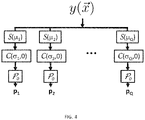
- FIG. 4 is a block-diagram of slow, non-hierarchical shear-based RP as described in Section 1.2.1.
- the input image is y and the output parallel-beam projections are p 1 , . . . , p Q .
- the intermediate blocks represent shear operators , shear-scale operators , and reprojections at a single-view angle 0 ;
- FIGS. 5A-5D are illustrations of the Fourier interpretation of RP via shear and scale.
- FIG. 5A A path from the root to a single leaf of the block-diagram in FIG. 4 corresponding to RP at a single parallel-beam view-angle.
- FIG. 5B Fourier transform of input image. The solid line represents the spectral support of a single parallel-beam projection at view angle ⁇ as explained by the Fourier Slice theorem. The striped square is simply to illustrate the geometric transformation.
- FIG. 5C The shear operator ( ⁇ tan ⁇ ) along the x 1 axis causes the Fourier transform to be sheared along ⁇ 2 such that the spectral support of p ⁇ lies on the ⁇ 1 -axis
- FIG. 5D The subsequent shear-scale operator (sec ⁇ , 0) results in a coordinate scaling along x 1 by a factor of sec ⁇ , and a stretching of the spectral support along the ⁇ 1 axis by sec ⁇ ;
- FIG. 6 is block diagram of hierarchical RP for the parallel-beam geometry in the continuous-domain.
- This block-diagram is a modification of FIG. 4 .
- the input image is y and the output parallel-beam projections are p 1 , p 2 , . . . , p Q .
- the shear and shear-scale operators are rearranged in a hierarchical manner in order that both block-diagrams produce the same output;
- FIG. 7 is an illustration of the discrete-domain hierarchical reprojection algorithm
- FIGS. 8A-8E illustrate the changes in spectral support and DTFT contents for images in the discrete-domain hierarchical reprojection algorithm
- FIGS. 9A-9B illustrate the partitioning of the spectral support and DTFT contents for images in the discrete-domain hierarchical reprojection algorithm
- FIGS. 10A-10B illustrate the Fourier-domain partitioning scheme as explained in Section 1.3.1 FIG. 10A Spectral support of input image is divided into two “half-planes”: horizontally and vertically oriented half-planes FIG. 10B The partitioning of the DTFT domain after L levels of recursive hierarchical partitioning.
- the m th wedge corresponds to the kernel-stage input image I L,m d in FIG. 7 ;
- FIGS. 12A-12D illustrate the frequency manipulations in the pre-decomposition stage of the hierarchy corresponding to the block-diagram in FIG. 11 and explained in Section 1.3.3. Because of the periodicty of the DTFT the parts extending beyond the ⁇ boundaries are wrapped in the [ ⁇ , ⁇ ] interval along ⁇ c but this is not shown in subfigures C-D for simplicity;
- FIGS. 13A-13B illustrate the transformation between the DTFT of the parent and child image, which as explained in Section 1.3.5, can be used to determine the shear parameters in the decomposition stage.
- FIG. 13A Spectral support of parent image I l,m d
- FIG. 13B Spectral support of parent image upon shearing. After decimation this will yield the child image I l+1,3m d . Because of the periodicty of the DTFT the parts extending beyond the ⁇ boundaries are wrapped in the [ ⁇ , ⁇ ] interval along ⁇ s but this is not shown for simplicity;
- FIGS. 14A-14D illustrate the kernel-stage operations in parallel-beam ( FIG. 14A-B ) vs fan-beam ( FIG. 14C-D ) geometries as explained in Section 1.3.6.
- FIG. 14A In the parallel beam case the shear-scale operator is equivalent to interpolating the input image along a set of slanted, parallel lines.
- FIG. 14B The zero-view-projection operator is equivalent to summing the shear-scaled image along the slow coordinate.
- FIG. 14C In contrast in the fan-beam case the first operation is an interpolation onto a set of slanted, non-parallel lines followed by FIG. 14D summing the resulting image along the slow coordinate;
- FIG. 15 illustrates the transformation between fan-beam and parallel-beam geometries.
- a ray in the fan-beam geometry parameterized by ( ⁇ , ⁇ ) is equivalent to a parallel-beam parameterization of ( ⁇ , t) as specified in (44);
- FIGS. 16A-16D illustrate the computation of the kernel-stage interpolation coordinates as explained in Section 1.3.6.
- FIG. 16A The DTFT of the input image showing the spectral support of the parallel beam projection containing the ray whose parallel-beam view angle is ⁇ ′ (i.e., “the spectral support of the ray”).
- FIG. 16B The DTFT of the kernel-stage input image that contains the spectrum of this parallel-beam projection
- FIG. 16C shows the location of the ray ( ⁇ ′, t′) in the coordinate system of the input image y (in FIG. 11 ) and
- FIG. 16D shows the location of this ray when transformed into the coordinate system of the relevant kernel-stage input image;
- FIGS. 17A-17B illustrate the geometry of 3D curved-panel cone-beam geometry to accompany equations (64)-(65).
- FIG. 17A The rays in the projection set are parameterized by sourc-angle ⁇ , fan-angle ⁇ and vertical detector coordinate v.
- the trajectory of the source is helica/spiral.
- FIG. 17B Circular source trajectory;
- FIGS. 18A-18B are illustrations of the Fourier Slice Theorem in 3D.
- FIG. 18A In spatial coordinates a 3D parallel-beam X-ray transform projection is parameterized by a azimuthal angle ⁇ and elevation angle ⁇ .
- FIG. 18B In the 3D Fourier domain the support of this projection is a 2D plane that is oriented at ( ⁇ , ⁇ ) as shown;
- FIGS. 19A-19G illustrate the Fourier analysis of decomposition stages of the 2.5D method as explained in Section 2.2.1.
- FIG. 19A-C Shows the evolution of the DTFT support of a single child branch in a decomposition stage node of the 2D RP algorithm.
- the striped region in FIG. 19A is the subset of the DTFT of the parent image that gets retained in the child image.
- Recursively applying the evolution in FIG. 19A-C to all the decomposition levels we see that the subset of the DTFT of the input image that gets retained in a kernel-stage input image is as shown in D.
- FIG. 19A-C Shows the evolution of the DTFT support of a single child branch in a decomposition stage node of the 2D RP algorithm.
- the striped region in FIG. 19A is the subset of the DTFT of the parent image that gets retained in the child image.
- Recursively applying the evolution in FIG. 19A-C to all the decomposition levels we see that
- FIG. 19E In the narrow-cone method every z-slice of the input image is operated on identically so the 3D spectral support corresponding to the 2D spectral support shown in FIG. 19D is a slab extended along ⁇ z .
- FIG. 19F For large
- FIG. 19G A side view of FIG. 19F showing how the spectral support of the projection falls outside the support of the kernel-stage input image;
- FIG. 20 illustrates separable resampling in the kernel-stage as explained in Section 2.2.2(d):
- the interpolation of the ray (solid line) that passes through the points v L and ⁇ L from the underlying 3D volume y[m f , m s , m z ], can be computed with a sequence of two 1D interpolations onto the line h f (the dashed gray) followed by onto the line h z (the dashed gray line) as stated in (77);
- FIG. 21 is a block diagram of DIA reprojection algorithm for narrow cone-angle geometries as explained in Section 2.2.3.
- the input is the 3D image volume y d , at the top of the block-diagram, and the output is the 3D projections volume P[m ⁇ , m ⁇ , m v ] at the bottom of the block-diagram;
- FIG. 22 is a block diagram of DIA reprojection algorithm for narrow cone-angle geometries that operates in the hybrid space-Fourier domain.
- the input is the 3D image volume y d , at the top of the block-diagram, and the output is the 3D projections volume P[m ⁇ , m ⁇ , m v ] at the bottom of the block-diagram;
- FIGS. 23A-23D illustrate the justification for the wide cone kernel-stage strategy as explained in Section 2.3.1.1
- the union of the spectral supports of all the kernel-stage input images is the full 3D DTFT of the input image. This suggests that any cone-beam projection can be produced by manipulating and combining one or more kernel-stage images;
- FIGS. 24A-24B illustrate the partitioning of ⁇ - ⁇ plane for the low cone-angle method
- FIG. 24A Partition of 2D frequency plane for the 2D DIA method as shown in FIG. 10 .
- FIG. 24B Partitioning of ⁇ - ⁇ plane for the corresponding low-cone-angle DIA method;
- FIGS. 25A-25E are illustrations of the diamond shape of a cell in the ⁇ - ⁇ plane as explained in Section 2.3.2(c).
- FIG. 25A A subset of the ⁇ - ⁇ plane. Four points in the plane are indicated by (i)-(iv). Each point corresponds to a 3D PB projection.
- FIG. 25B-E The 3D spectral support of the 3D PB projections corresponding to points (i)-(iv). In each plot the spectral support of the projection is shown by the cross-hatched plane and the spectral support of the kernel-stage image is indicated by the rectangular cuboid. While in cases (i)-(iii) the spectral support of the projection lies inside the kernel-stage image, in case (iv) it does not. This leads to the diamond shape of the cell in FIG. 25A shown by the solid black diamond;
- FIGS. 26A-26C illustrate the partitioning of the whole ⁇ - ⁇ plane in a greedy manner as explained in Section 2.3.2(d)
- FIG. 26A First the whole ⁇ -axis is partitioned by a row of diamond-shaped cells, FIG. 26B After the row is complete the partitioning is extended to the adjacent row of cells in a greedy manner. For every cell in this row three of the four corners (solid circles) have already been determined. The fourth corner is determined by finding the point with the largest ⁇ that can be contained in the spectral support of the relevant kernel-stage input image as shown in FIG. 26C .
- FIG. 26C The three spectral supports corresponding to the solid circles in FIG.
- 26B are indicated by the planes; differentiated by the line-style of the plane edge (dashed, dotted and dot-dashed). The spectral support of the kernel-stage image containing them is shown by the cuboid containing the planes;
- FIGS. 27A-27B illustrate how the spectral support of any intermediate image can be transformed to baseband by a sequence of 1D shears as explained in Section 2.3.2(e).
- FIG. 27A Recall in the 2D algorithm the spectral support of any intermediate image corresponds to a slanted strip in the DTFT of the input image. This spectral support can be transformed to baseband by a shear in the DTFT domain along w, that is equivalent to a shear in the space domain along f.
- FIG. 27B In the case of wide-cone angle RP method, a sequence of two shears can transform the spectral support of any intermediate image to baseband.
- the spectral support of the intermediate image, in the DTFT domain of the input image is as shown in (b 1 ), after a shear in the Fourier domain in ⁇ s - ⁇ f the spectral support is transformed to the slab shown in (b 2 ), and after a shear in ⁇ s - ⁇ z the spectral support is transformed to the slab shown in (b 3 ) such that it has a low bandwidth along ⁇ s ;
- FIGS. 28A-28C illustrate the hierarchical relationship of ⁇ - ⁇ cells in different levels of the decomposition stage
- FIG. 28A The partitioning of the ⁇ - ⁇ plane for the lowest decomposition level is constructed by extending the greedy method of FIG. 26 to the relevant subset of the whole plane.
- FIG. 28B The ⁇ - ⁇ partitioning in the second lowest decomposition levels is constructed by combining the cells from the lowest decomposition levels in groups of 3 ⁇ 3. Each parent cell, indicated by the thick diamonds, contains a set of 3 ⁇ 3 child cells.
- FIG. 28C The ⁇ - ⁇ partitioning in the highest decomposition level results after repeated 3 ⁇ 3 combinations of lower levels.
- FIG. 29 is an illustration that rays that are close in ⁇ , ⁇ are also spatially localized.
- the dashed lines represent the location of the rays that have a small range in ⁇ and ⁇ .
- the solid lines surrounding the dashed lines denote a box that contains these rays and is inside the FOV. This box has a limited extent in z;
- FIGS. 30A-30C illustrate how spatial Localization of rays within a ⁇ - ⁇ cell allows for the intermediate images to be cropped in such a way that their z-extent scales by a factor of 3 from one level to the next. Without loss of generality we are showing the case of a CCB geometry.
- FIG. 30A All rays that share the same ( ⁇ , ⁇ ) intersect the cylinderical shell of the FOV in a 3D curve that lies on a plane.
- FIG. 30B The curves corresponding to the four corner points of a ⁇ - ⁇ diamond in the lowest decomposition level are shown by the black curves. The containing volume of the whole cell is computed by finding the z extent of these curves.
- FIG. 30A All rays that share the same ( ⁇ , ⁇ ) intersect the cylinderical shell of the FOV in a 3D curve that lies on a plane.
- FIG. 30B The curves corresponding to the four corner points of a ⁇ - ⁇ diamond in the lowest decom
- the containing volume of the three lowest levels in the decomposition stage are indicated by solid, dashed and dotted ellipsses respectively.
- the z-extent of the three containing volumes scales by a factor of 3 from a child to a parent level;
- FIGS. 31A-31E are illustrations of transformation to baseband in the Fourier and spatial domains.
- FIG. 31A Consider the intermediate image corresponding to the ⁇ - ⁇ cell indicated by the thick-lined diamond.
- FIG. 31B The spectral support of this image in the domain of the DTFT of the input image to the RP algorithm.
- FIG. 31C The spatial support, i.e. the borders of the containing volume, in the coordinate system of the input image to the RP algorithm.
- FIG. 31D The spectral support of this image after transformation to baseband. Note that the bandwidth along ⁇ s is small.
- FIG. 31E The spatial support of this intermediate image after transformation to baseband;
- FIGS. 32A-32E illustrate how an additional shear along z allows for a tighter cropping of the FOV.
- Spectral ( FIG. 32A ) and spatial ( FIG. 32B ) support of an intermediate image in the frame of the RP input image.
- Spectral ( FIG. 32C ) and spatial ( FIG. 32D ) support of the intermediate image after transformation to baseband.
- Spectral ( FIG. 32E ) and spatial ( FIG. 32F ) support of the intermediate image after the additional z-f shear that results in a smaller z-extent and therefore allows for tighter cropping.
- FIG. 32G Side view of the containing volumes of the intermediate image after the two transformations that show how the additional z-f transformation results in a reduction in the z-extent and therefore allows for tighter cropping;
- FIG. 33 is a block diagram of DIA reprojection algorithm for wide cone-angle geometries as explained in Section 2.3.9.
- the input is the 3D image volume y d , at the top of the block-diagram, and the output is the 3D projections volume p d at the bottom of the block-diagram;
- FIG. 34 is a block diagram of DIA backprojection algorithm for wide cone-angle geometries as explained in Section 2.4.
- the input is the 3D projections volume p d at the top of the block-diagram and the output is the 3D image volume y d , at the bottom of the block-diagram;
- FIG. 35 is a block diagram of DIA backprojection algorithm for narrow cone-angle geometry that operates in the hybrid space-Fourier domain;
- FIG. 36 is a block diagram of DIA backprojection algorithm for narrow cone-angle geometry that operates fully in the space domain;
- FIGS. 37A-37F illustrate the modeling of beamlets.
- FIG. 37A Geometry of a single ray with parallel-beam detector coordinate t and view-angle ⁇ .
- FIG. 37B Integration width for finite detector modeling.
- FIG. 37C Computing r (distance from a sample to source).
- FIG. 37D Beamlets from a point source to a set of detectorlets.
- FIG. 37E Integration width for finite focal spot modeling.
- FIG. 37F Beamlets from a set of detectorlets to a point detector;
- FIGS. 38A-38B illustrate the modeling of beamlets along detector row coordinate v as explained in Section 3.2
- FIG. 38A Geometry of finite detector width
- FIG. 38B Geometry of finite focal spot
- FIGS. 39A-39B are illustrations of the forward cumulative sum operator and its adjoint.
- FIG. 39A Matrix A s representing the forward cumulative sum operator. The entries in the cross-hatched region are 1. All other entries are zeros. The dark lines denote the borders between regions. The dashed lines denote individual rows or columns.
- FIG. 39B The matrix of the adjoint of cumulative sum operator denoted A s T ;
- FIG. 40 is pseudocode for the adjoint of cumulative sum part of integrating detector interpolation
- FIG. 41 is a schematic diagram of a preferred embodiment that includes the reprojection and backprojection computed tomography system of the invention.
- FIG. 42 illustrates a general computer system that can perform preferred methods of the invention and can serve as both the image reconstructor 10 and the computer 20 of FIG. 41 .
- Preferred embodiments provides advances in efficiency. Important aspects of preferred embodiments include methods to obtain a pixel image (1) operating within the parallel-beam geometry, rather than a divergent-beam geometry, for the majority of the operations, (2) representing images in the hybrid space-Fourier domain rather than the space domain, (3) allowing adjacent 2D slices of the 3D volume to be operated on independently, and (4) determining the image transformations and cropping that allow for an efficient implementation on geometries with large cone angles.
- Preferred embodiments can be implemented in reconfigurable hardware such as field-programmable gate array (FPGA), or special purpose hardware such as an application specific integrated circuit (ASIC), in which cases no separate storage of instructions or computer programs is required instead the structure of the hardware (computing circuit) is adapted to execute the methods of this invention on image data fed into this hardware, which then produces the desired output in accordance with methods of the invention.
- FPGA field-programmable gate array
- ASIC application specific integrated circuit
- embodiments of the present invention may comprise computer program products comprising computer executable instructions stored on a non-transitory computer readable medium that, when executed, cause a computer to undertake methods according to the present invention, or a computer configured to carry out such methods.
- the executable instructions may comprise computer program language instructions that have been compiled into a machine-readable format.
- the non-transitory computer-readable medium may comprise, by way of example, a magnetic, optical, signal-based, and/or circuitry medium useful for storing data.
- the instructions may be downloaded entirely or in part from a networked computer.
- results of methods of the present invention may be displayed on one or more monitors or displays (e.g., as text, graphics, charts, code, etc.), printed on suitable media, stored in appropriate memory or storage, etc.
- the interpolated signal g d is defined as follows. Given a discrete-domain signal y d , sampling interval T, some interpolating function ⁇ (such as the sinc or a spline-based function), and a set of output coordinates ⁇ x n
- y d is the original discrete-domain signal.
- the continuous-domain function y is what is produced when y d is interpolated from the discrete-domain to the continuous-domain using basis function ⁇ .
- g d is the discrete-domain signal that is produced by sampling y(x) at the set of output coordinates ⁇ x n ⁇ .
- the discrete-domain 1D interpolation operation from y d to g d can be written in one step as follows:
- ⁇ ⁇ ⁇ m ⁇ ⁇ ⁇ ⁇ ⁇ ( x 1 T - m 1 ) ⁇ ⁇ ⁇ ( x 2 T - m 2 ) ⁇ ⁇ ⁇ ( x 3 T - m 3 ) ⁇ y d ⁇ [ m ⁇ ]
- ⁇ is the basis function and separable interpolation is shown. If desired, non-separable interpolation may be used too.
- Decimation by an integer factor D is implemented as the adjoint of spline interpolation by an integer factor D.
- * is the 1D convolution operator.
- the dashed arrow shows the line on which the line-integral is computed for a fixed angle ⁇ and detector coordinate t.
- RP can also be expressed as performing a different image transformation (a shear followed by a coordinate scaling, which we denote by and refer to as a shear-scale) and then integrating the shear-scaled image along the second (vertical) coordinate (and scaling the output by 1/cos ⁇ ):
- the shear-based RP expression (9) can be restated in terms of the shear-scale operator, or a sequence of a shear and scale operator:
- FIG. 4 is the block diagram representation of (16).
- the input image is y( ⁇ right arrow over (x) ⁇ ).
- the Q output parallel-beam projections p 1 , p 2 , . . . , p Q correspond to view-angles ⁇ 1 , ⁇ 2 , . . . , ⁇ Q .
- the Fourier-domain interpretation combines (a) the Fourier Slice theorem with (b) Fourier-domain understanding of spatial-domain linear geometric image transformations (such as a shear and shear-scale) as explained in Section 1.1.3.
- the Fourier slice says that the 1D Fourier transform of a projection at an angle ⁇ is equal to a radial cut through the 2D Fourier transform of the input image oriented at an angle ⁇ .
- p ⁇ ( t ) ( ⁇ y )( ⁇ right arrow over (x) ⁇ ) (17)
- FIG. 5A shows a block diagram of the operations performed on the input image. It shows the path from the root to a single leaf of the block diagram in FIG. 4 .
- the input image y is subject to a shear, denoted by the block ( ⁇ tan ⁇ ) to produce the image g 1 , which in turn is subject to the shear-scale operator ( ⁇ sec ⁇ , 0) to produce the image g 2 .
- FIGS. 5B-D show the effect of these two operations in the Fourier domain.
- FIG. 5B-D the coordinate transformations of the Fourier transform are illustrated by their effect on a square shaped region in the Fourier domain.
- the thick line oriented at angle ⁇ relative to the ⁇ 1 axis represents the spectral support of a single parallel-beam projection at view angle ⁇ as explained by the Fourier Slice theorem.
- FIG. 5C shows the spectral support of the sheared image g 1 . It shows that the Fourier transform of the input image is sheared along ⁇ 2 such that the Fourier content of the desired projection p ⁇ (the thick line originally oriented at an angle ⁇ relative to the ⁇ 1 axis) lies on the ⁇ 1 axis.
- the root node of this hierarchy is the input image y( ⁇ right arrow over (x) ⁇ ) and the leaves are the output projections p 1 , p 2 , . . . , p Q .
- the first L levels of the hierarchy are called the decomposition stage. At every node in the decomposition stage, the parent image is diverted into three child branches. The image in each child branch is sheared by a different shear factor to produce three child images. (In this particular embodiment of the algorithm, in the central branch of each node the shear factor is 0, so it is omitted).
- This ternary hierarchy has L levels and therefore the number of images after L levels, i.e. at the end of the decomposition stage, is 3 L .
- L levels i.e. at the end of the decomposition stage
- the “ . . . ”s in the block-diagram indicate that in sections of the block-diagram that are not fully illustrated, the missing sections are easily inferred from the nearby sections that are fully illustrated i.e., in the missing sections the blockdiagram should be constructed in a similar hierarchical manner to nearby sections that are fully illustrated.
- each input node of the kernel-stage the parent image is diverted into child branches.
- Each child branch corresponds to an output projection at a single view angle.
- the input image is first subjected to a shear-scale image transformation operator ( ⁇ right arrow over ( ⁇ ) ⁇ ), followed by a zero-view-angle projection.
- the shear and shear-scale parameters in the hierarchy are chosen to satisfy (20). In addition they are chosen such that when this algorithm is implemented in the discrete-domain the intermediate images can be efficiently sampled by leveraging Shannon-Nyquist sampling theory. More details on this are in later sections (1.2.4 and 1.3) in which the discrete-domain methods are described.
- the number of projections produced by every kernel-stage node is not necessarily equal and therefore the kernel-stage of the hierarchical tree is not necessarily ternary.
- FIG. 7 shows the discrete-domain version of the hierarchical RP operator.
- T T t i.e. the image sample spacing is equal to the detector coordinate sample spacing. If T t ⁇ T, the scale parameter of the kernel-stage shear-scale operator can be adjusted to accommodate it.
- the image labeled I l,m d is the discrete-domain equivalent of I l,m in FIG. 6 .
- the blocks labeled, , and 0 are the discrete-domain equivalent of the shear, shear-scale and zero angle-projection operators in the continuous-domain block diagram ( FIG. 6 ).
- the block labeled “rotate-90” is a clockwise image rotation by ⁇ /2 radians and is used to be able to reproject a parallel-beam projection at any ⁇ (not just for ⁇ [ ⁇ /4, ⁇ /4)).
- the decimation blocks denoted by ⁇ D, perform the D-fold reduction in samples in every level. It is the hierarchical structure in conjunction with the decimation that deliver the speedup of the fast algorithm.
- the input to a discrete-domain image transformation operator is a set of samples y d [ ⁇ right arrow over (m) ⁇ ] and the output is the set of samples g d [ ⁇ right arrow over (m) ⁇ ].
- the operator is defined as a sequence of three operations (a) performing the discrete to continuous transformation (y d ⁇ y):
- y ⁇ ( x 1 , x 2 ) ⁇ m 1 ⁇ ⁇ m 2 ⁇ y ⁇ d ⁇ [ m 1 , m 2 ] ⁇ ⁇ ⁇ ( x 1 T - m 1 , x 2 T - m 2 ) ( 21 )
- ⁇ is some basis function (such as the sinc or spline functions)
- ⁇ d is the basis function weights as explained in Section 1.1.4
- V [ 1 ⁇ 0 1 ] .
- y ⁇ ( x 1 , x 2 ) ⁇ m 1 ⁇ ⁇ m 2 ⁇ y ⁇ d ⁇ [ m 1 , m 2 ] ⁇ ⁇ 1 ⁇ ( x 1 T - m 1 ) ⁇ ⁇ 2 ⁇ ( x 2 T - m 2 ) ( 22 )
- ⁇ 2 satisfies the interpolation condition property (2) (such as the sinc function) but ⁇ 1 does not (such as a B-spline function). Then the final discrete output image is
- the decimation operator scales the frequency content, expanding it by a factor D, along the coordinate along which the decimation is performed (the second coordinate in this case).
- the input image y d is diverted into three branches.
- FIG. 8A shows the input image y d in the Fourier domain.
- the notion of spectral support is similar for discrete domain images as it is for continuous domain images.
- the spectral support of an image y d is the support of its DTFT ⁇ d i.e., contained within a square of size [ ⁇ , ⁇ ] ⁇ [ ⁇ , ⁇ ].
- We are further assuming that the spectral support of the image is restricted to a disc of radius ⁇ inscribed inside the square, indicated by the circle.
- wedges whose principal axis is more aligned with the ⁇ 1 axis than the ⁇ 2 axis as horizontal wedges (eg. wedges W 1,1 , W 1,2 , W 1,3 in FIG. 9A ) and those whose principal axis is more aligned with ⁇ 2 axis as vertical wedges (eg. wedges W 1,4 , W 1,5 , W 1,6 in FIG. 9A ).
- the dashed diagonal, radial line segment denotes the spectral support of a parallel-beam projection.
- the radial line segment has length 2 ⁇ because we are assuming that the spectral support of the image is a disc of radius ⁇ .
- one of the wedges is striped while the other two are not.
- the striped wedge is the one that happens to contain the spectral support of the parallel-beam projection on which we are focusing.
- V T [ 1 0 2 / 3 1 ] , as explained in Section 1.1.3. So the spectral support of the sheared input image is as shown in FIG. 8B . (It is easy to verify that the wedge boundary points
- FIGS. 8A-C we only depict what happens to the subset of the spectral support that we care about. Specifically we design the operations in a particular branch to manipulate the spectral support wedge of interest (striped region) from the parent image and preserve it intact in the child image. For example in the transformation from FIG. 8A to FIG. 8B all the components of the parent image's spectral support are subject to the same transformation, i.e. a shearing along ⁇ 2 . This results in the parts of the spectral support that we do not care about being pushed outside the baseband square [ ⁇ , ⁇ ] ⁇ [ ⁇ , ⁇ ] and, because of the periodicity of the DTFT, being aliased back into the baseband square.
- the transformations are designed so that the aliased components do not overlap the spectral support wedge of interest.
- all the components of the spectral support are subject to the same transformation—a 3-fold stretching along the ⁇ 2 axis and then a restriction/cropping to [ ⁇ , ⁇ ] (assuming the use of an ideal low-pass filter).
- the low-pass filtering causes the components of the spectral support that we do not care about to be truncated along the ⁇ 2 axis and therefore not preserved intact.
- the DTFT of each of the 6 images will contain the DTFT of the input image on one of the 6 wedges that partition the spectral support of the input y d .
- the input image I L,m d is diverted into B m branches. Each branch corresponds to a parallel-beam projection at a single view angle ⁇ .
- These B m output views are exactly those whose spectral support lies in wedge W L,m (ref (35)).
- FIGS. 8D-E show the spectral support of the input image.
- the dashed line is spectral support of the parallel-beam projection of interest which is contained in the wedge of interest (striped region).
- the shear scale transformation to result in the spectral support of the projection to lie on the horizontal axis and be stretched to fill the baseband square, as shown in FIG. 8E .
- the shear-scale parameters should be chosen to conform to (20) while accounting for the decimation along the second spatial coordinate. which is included in the discrete algorithm. More details of how this is done for the fan-beam geometry is in Section 1.3.6
- fast and slow coordinate directions We refer to the coordinate along which the decimation is performed as the slow coordinate direction. This word encapsulates the idea that the bandwidth of an image, after one or more low-pass filtering operations along a single coordinate direction, is small along that coordinate. Therefore the image is slowly varying along that coordinate. In contrast the other coordinate direction is referred to as the fast coordinate direction. We use the subscripts f and s for fast and slow, respectively.
- the input is a 2D image y d [m 1 , m 2 ] and the output is a set of projections for the fan-beam geometry.
- this 2D data set is the set of samples ⁇ p[n ⁇ , n ⁇ ]
- the output sample p[n ⁇ , n ⁇ ] corresponds to a ray whose fan-beam parameters are view-angle ⁇ [n ⁇ ] and fan-angle ⁇ [n ⁇ ].
- the region in the 2D DTFT domain corresponding to parallel-beam view angle ⁇ [ ⁇ /4, +3 ⁇ /4) be defined as the first (or vertically oriented) half-plane: the remaining non-speckled region in FIG. 10A .
- the half-plane be divided into 3 L wedges ⁇ W L,m ⁇ as shown in FIG. 10B .
- the corners, on the right hand side, of the m th wedge are at: ( ⁇ , ⁇ + ⁇ wedge ( m ⁇ 1)) and( ⁇ , ⁇ + ⁇ wedge m ) (36)
- the wedges in the vertically-oriented half-plane are obtained by applying a counter-clockwise ⁇ /2-rotation to the wedges in the horizontally-oriented half-plane.
- Any ray in the 2D tomographic geometry can be parameterized by ( ⁇ , t) such that ⁇ [ ⁇ /4, +3 ⁇ /4).
- a ray is the line upon which the tomographic line-integral of the object is computed.
- the line-integral along a ray parameterized by ( ⁇ , t) is a sample of the continuous-domain parallel-beam projection at view-angle ⁇ .
- a continuous-domain parallel-beam projection parameterized by view-angle ⁇ is the set of line-integrals along all rays ( ⁇ ,t): ⁇ t ⁇ .
- the 1D Fourier transform of this parallel-beam projection ⁇ f is equal to a radial cut through the 2D Fourier transform of the (continuous-domain) image y oriented at an angle ⁇ . Consequently the information necessary to compute the line integral along the ray ( ⁇ , t) is contained in a radial cut, oriented at angle ⁇ , through the 2D Fourier transform of y.
- ⁇ -cut we can compute the parallel-beam projection of y d at view-angle ⁇ . More explicitly, given this ⁇ -cut, we can compute the projection along any ray whose parameterization is ( ⁇ , t). Conversely in order to compute the projection along a ray ( ⁇ , t) all we need is the ⁇ -cut through 2D DTFT of the image y d . Note that any ⁇ -cut will be fully contained within one of the 2 ⁇ 3 L wedges shown in FIG. 10B .
- the line integral along the ray with view-angle ⁇ could be computed from the image I l,m( ⁇ ,l) where
- V [ 1 / U f 0 0 1 ] (and respectively
- FIGS. 12A-12D show the frequency domain manipulations in the top level of the algorithm.
- FIG. 12A shows the input image in the Fourier domain.
- the first image transformation is an up interpolation in each coordinate direction by U s and U f (shown in the left branch of the block diagram in FIG. 11 and the top row of FIGS. 12A-12B ).
- U s and U f shown in the left branch of the block diagram in FIG. 11 and the top row of FIGS. 12A-12B .
- FIG. 13A depicts the partition of the Fourier-plane at the input to a decomposition level.
- n t is the detector index of the output projections.
- m 2 ⁇ N s , ⁇ N s +1, . . . , +N s ⁇ .
- This set of points shown by the large black dots in FIG. 14A , lies on a set of parallel lines with a slope ⁇ 2 relative to the slow coordinate axis and separated by ⁇ 1 along the fast coordinate axis.
- FIG. 14B where the black dots represent the pixels of the image g d [n t , m s ].
- the parallel-beam kernel-stage operation can be rephrased as a sequence of two operations: (i) a fast-direction 1D interpolation of the 2D kernel-stage input image onto a set of parallel lines, and (ii) summation along the slow direction (i.e., over m s ) in order to produce a full parallel-beam projection at a single view-angle ⁇ .
- the reason that the lines are parallel is that all the rays share the same PB view-angle ⁇ .
- the fan-beam kernel-stage operation shown in FIG. 14C-D , is exactly the same as the parallel-beam kernel-stage operation except that the fast-direction 1D interpolation is onto a set of non-parallel lines.
- Each line corresponds to a ray with fan-beam parameters ( ⁇ , ⁇ ), and is the set of points ⁇ (a ⁇ , ⁇ +b ⁇ , ⁇ m s , m s )
- m s ⁇ N s , ⁇ N s +1, . . . , +N s ⁇ shown by the black dots in FIG. 14C .
- the parameters of the fast direction interpolation are a function of the fan-beam view-angle and fan-angle of the particular ray.
- m s ⁇ ) ⁇ as the kernel-stage interpolation coordinates for this ray.
- Different columns in FIG. 14D correspond to different rays ( ⁇ k , ⁇ k ).
- Summing over m s produces the corresponding line integral along the ray parameterized by ( ⁇ , ⁇ ). Each such line integral corresponds to a sample (i.e., entry) in the output array p[n ⁇ , n ⁇ ].
- the kernel-stage interpolation coordinates h ⁇ , ⁇ [m s ] are computed.
- the ray coordinates are first transformed from the fan-beam geometry to the parallel-beam geometry.
- the cumulative image transformation from the input of the decomposition stage to the appropriate kernel-stage image from which the ray is synthesized is computed. This image transformation is used to compute the coordinates of the ray in the kernel-stage image i.e., the interpolation coordinates.
- n HP ⁇ ( ⁇ ) ⁇ ⁇ ⁇ n ⁇ HP ⁇ ( ⁇ ) ⁇ %2 ⁇ ⁇ for ⁇ ⁇ ⁇ ⁇ R ( 45 )
- ⁇ ⁇ n ⁇ HP ⁇ ( ⁇ ) ⁇ ⁇ ⁇ ⁇ ( ⁇ - ( - ⁇ 4 ) ) / ⁇ 2 ⁇ ( 46 )
- HP ⁇ ( ⁇ ) ⁇ ⁇ ⁇ ( - ⁇ 4 ) + ( ( ⁇ - ( - ⁇ 4 ) ) ⁇ % ⁇ ⁇ 2 ⁇ ( 47 )
- T HP ⁇ ( ⁇ , t ) ⁇ t if ⁇ ⁇ n ⁇ HP ⁇ ( ⁇ ) ⁇ ⁇ is ⁇ ... ⁇ , 0 , 1 , 4 , 5 , ... - t if ⁇ ⁇ n ⁇ HP ⁇ ( ⁇ ) ⁇ ⁇ is ⁇
- Equation (46) take as input any angle ⁇ and identifies which of the following intervals it lies in:
- ⁇ 2 intervals partition the whole real line.
- ⁇ HP can be any integer, but we want to assign it to either the horizontally or vertically-oriented half-planes so we simply apply modulo-2 in order to map all the even (and respectively odd ⁇ HP ) to the horizontally-oriented half-plane (and, respectively, the vertically-oriented half-plane) as specified in (45).
- the equation for detector coordinate (48) simply applies the well-known identity for the parallel-beam tomographic geometry that the ray ( ⁇ , t) is equivalent to the ray ( ⁇ + ⁇ , ⁇ t).
- FIGS. 16A-16D The computation of the kernel-stage interpolation coordinates is illustrated in FIGS. 16A-16D .
- FIG. 16A shows the spectral support of the image at the input of the algorithm (image y d in FIG. 11 ).
- FIG. 16B shows the spectral support of the kernel-stage image I L,m KER ( ⁇ ′) d .
- I L,m KER ( ⁇ ′) d the kernel-stage input image from which projection ⁇ ′ is computed.
- the wedge, in the frequency domain, that “contains this projection”, W L,m KER ( ⁇ ′) is denoted by the cross-hatched region in FIGS. 16A-B .
- the image transformation consists of the following operations:
- Equations (55)-(56), which specify the coordinates of two points on that line for a ray with PB parameterization ( ⁇ ′, t′), are sufficient to figure out the coordinates of the resampled points.
- the length of the DFT i.e. the amount of zero-padding, needs to be chosen larger enough relative to the m f -extent of the input image y d to avoid circular shifts and to ensure that the kernel-stage input image is linearly, rather than circularly, convolved as is standard practice in signal processing.
- the RP/BP method for the cone-beam geometries for arbitrary source trajectories is the main component of this invention. It consists of two variants: first the method for geometries with a narrow cone-angle that is simpler to describe; and second the method for an arbitrarily wide cone-angle that is more complicated.
- Both methods take a 3D image volume as input and produce a set of 3D cone-beam projections as output.
- the discrete-domain image volume be the input to the 3D cone-beam reprojection operator.
- the treatment of the case T ⁇ 1 would be similar to that described in Sections 1.2 and 1.3 for the parallel beam and fan beam cases.
- the output projections would also be a 3D function p( ⁇ , ⁇ , v). Every point in p( ⁇ , ⁇ , v) corresponds to a 1D line-integral through the input image y. Specifically this line passes through the source and detector positions parameterized by ⁇ , ⁇ , v.
- the tomographic geometry is illustrated in FIG. 17A . It shows the helical cone-beam geometry for a curved detector panel.
- the dotted curve shows the helical trajectory of the source around the object.
- the radius of the helix is D and the pitch is h i.e., for every full turn of the helix, the change in the x 3 coordinate is h.
- the source-angle ⁇ is as shown.
- the fan-angle ca is as shown in FIG. 17A ).
- ⁇ and ⁇ are the source angle and fan-angle familiar from the 2D fan-beam geometry.
- the parameter v is the detector row coordinate that defines the elevation angle of the ray.
- the detector coordinates are defined on a virtual detector that passes through the origin of the coordinate system (labeled “virtual detector”).
- the locations in the 3D coordinate system (x 1 , x 2 , x 3 ) of the source ⁇ right arrow over (x) ⁇ src ( ⁇ , ⁇ , v) and detector ⁇ right arrow over (x) ⁇ det ( ⁇ , ⁇ , v) for the ray parameterized by ( ⁇ , ⁇ , v) are given as follows.
- x ⁇ src ⁇ ( ⁇ , ⁇ , ⁇ ) [ D ⁇ ⁇ sin ⁇ ( ⁇ ) - D ⁇ ⁇ cos ⁇ ( ⁇ ) s 0 + h 2 ⁇ ⁇ ⁇ ⁇ ] ( 64 )
- x ⁇ det ⁇ ( ⁇ , ⁇ , ⁇ ) x ⁇ src ⁇ ( ⁇ , ⁇ , ⁇ ) + [ cos ⁇ ⁇ ( ⁇ ) - sin ⁇ ( ⁇ ) 0 sin ⁇ ( ⁇ ) cos ⁇ ( ⁇ ) 0 0 0 1 ] ⁇ [ D ⁇ ⁇ sin ⁇ ⁇ ⁇ D ⁇ ( - 1 + cos ⁇ ⁇ ⁇ ) ⁇ ] ( 65 )
- ⁇ right arrow over (x) ⁇ ray be the normalized direction vector from the source to the detector:
- x ⁇ ray ⁇ ( ⁇ , ⁇ , ⁇ ) x ⁇ det ⁇ ( ⁇ , ⁇ , ⁇ ) - x ⁇ src ⁇ ( ⁇ , ⁇ , ⁇ ) ⁇ x ⁇ det ⁇ ( ⁇ , ⁇ , ⁇ ) - x ⁇ src ⁇ ( ⁇ , ⁇ , ⁇ ) ⁇ ( 66 )
- 3D X-ray transform of a 3D function y( ⁇ right arrow over (x) ⁇ ) as the set of all line integrals in the direction ⁇ right arrow over (d) ⁇ ⁇ , ⁇ .
- the 3D Fourier Slice Theorem says that the Fourier content needed to compute the projection ⁇ , ⁇ f lies on the rotated plane shown in FIG. 18B .
- the RP methods for the fan-beam geometry can be fairly easily modified to the cone-beam geometries in which the maximum cone-angle of the rays is small.
- the fan-beam RP method can be applied to each 2D z-slice individually for the majority of the method. For this reason we call it the 2.5D method.
- every ⁇ 3 -plane of the spectral support of y is subject to an identical in-plane transformation.
- FIGS. 19A-C are almost the same as FIG. 8 ( i - iii ) but depict both the wedge of interest and the parallelogram-shaped bounding box containing the wedge (denoted by the striped region).
- the bounding box Prior to the shear the bounding box is parallelogram-shaped as shown by the striped region in FIG. 19A . After the shear it is a rectangle that stradles the ⁇ f axis as shown in FIG. 19B , and after stretching it is a rectangle that fills the DTFT domain [ ⁇ , ⁇ ) ⁇ [ ⁇ , ⁇ ) as shown in FIG. 19C .
- spectral support of the kernel-stage image I L,n d contains the parallelogram-shaped bounding box containing wedge W L,n (indicated by the striped region shown in FIG. 19D ).
- spectral support of the input image that is preserved in I L,n d is a parellelepiped as shown in FIG. 19E —simply the parallelogram-shaped strip from FIG. 19D extended by replication along ⁇ z .
- FIGS. 19F-G show such a scenario where
- ⁇ 0.
- the region of the plane in FIG. 19F that is cross hatched falls inside the slab, which is shown by the dashed lines, but the region that is striped falls outside the slab.
- FIG. 19G shows a side view of the same scenario. Here the regions inside, and outside, the slab are indicated by the solid, and dotted lines, respectively. Consequently the 2.5D method can only be used to compute rays with small cone-angle. We leave further discussion of this cone-angle restriction to Section 2.3 where we describe a preferred method for wide cone-angle geometries.
- the kernel-stage is a sequence of two operations (i) interpolation from an image onto a set of non-parallel lines, each corresponding to a single output ray parameterized by ( ⁇ , ⁇ , v), and (ii) summation along the slow direction.
- the input to the interpolation is a 2D kernel-stage image I L,n d [m f , m s ] and the interpolation is 1D and along the fast direction m f
- the input to the interpolation is a 3D kernel-stage image I L,n d [m f , m s , m z ] and the interpolation is performed in a separable way using 1D interpolation along the fast direction (m f ) followed by 1D interpolation along the z direction (m z ).
- n is a set of triplet indices.
- the number of these sets is equal to the number of kernel-stage input images, i.e., 2 ⁇ 3 L .
- the size of one set is not necessarily the same as the size of another, i.e., the number of rays synthesized from different kernel stage images can be different.
- the preferred way of determining these sets is to pre-compute them prior to the kernel stage and look them up during the execution of the kernel-stage.
- the set construction precomputation is as follows:
- Step 1 iterate through all the indices of the output volume.
- Step 2 For each index triplet (m ⁇ , m ⁇ , m v ) determine the ray parameterization ( ⁇ , ⁇ , v) from the geometry specification.
- Step 3 Determine the set to which the triplet index belongs by the following formula:
- the modulo by ⁇ maps ⁇ to the range [ ⁇ /4, +3 ⁇ /4) similarly to (46), since the domain of m KER is [ ⁇ /4, +3 ⁇ /4).
- Step 4 Append/insert the triplet index (m ⁇ , m ⁇ , m v ) to the set n .
- the set of output ray indices n is determined as explained in (a). And then these rays are computed from the input kernel-stage image by interpolation. For each triplet index (m ⁇ , m ⁇ , m v ) in the set n , interpolation from the 3D input image I L,n d onto a 1D set of samples along the ray corresponding to the index.
- the kernel-stage interpolation coordinates for a ray are computed by first transforming the ray from the cone-beam geometry to the coordinate system of the discrete domain input image y d , and then applying the cumulative image transformation that transforms the ray to the appropriate kernel-stage input image.
- Equations (64) and (65) give the coordinates of two points on this ray: the source location ⁇ right arrow over (x) ⁇ scr ( ⁇ , ⁇ , v) and the detector location ⁇ right arrow over (x) ⁇ det ( ⁇ , ⁇ , v). We want to transform these two points to the coordinate system of the appropriate kernel-stage image.
- ⁇ ⁇ ⁇ 0 [ U f 0 0 0 U s 0 0 1 ] ⁇ [ cos ⁇ ⁇ d ⁇ ⁇ ⁇ 2 sin ⁇ ⁇ d ⁇ ⁇ ⁇ 2 0 sin ⁇ ⁇ - d ⁇ ⁇ ⁇ 2 cos ⁇ ⁇ d ⁇ ⁇ ⁇ 2 0 0 0 1 ] ⁇ [ 1 T 0 0 0 1 T 0 0 0 1 T 3 ] ⁇ x ⁇ src ( 75 )
- ⁇ ⁇ d ⁇ 0 ⁇ if ⁇ ⁇ n ⁇ , ⁇ ⁇ 3 L 1 ⁇ ⁇ if ⁇ ⁇ n ⁇ , ⁇ > 3 L
- a eff 2.5 ⁇ D [ 1 / ⁇ f 0 0 ⁇ eff ⁇ 3 L / ⁇ s 3 L / ⁇ s 0 0 0 1 ] ( 76 )
- FIG. 20 It is the 3D version of FIGS. 16A-16D .
- the ray in question is represented by the thick arrow connecting the two heavy dots, which represent the points v L and ⁇ L .
- Second we perform a summation of g along m s followed by multiplication by a weight w ⁇ , ⁇ ,v i.e., p( ⁇ , ⁇ , v) w ⁇ , ⁇ ,v ⁇ m s g[m s ].
- Step 1 describes 1D interpolation along the m f coordinate, which is identical for every slice m z .
- Step 1 The output of Step 1 is a 2D image g 1 .
- Step 2 describes 1D interpolation along the second coordinate of g 1 to produce the 1D signal g.
- FIG. 21 shows a block diagram of a preferred embodiment of the RP method.
- the input is the discrete-domain 3D image volume y d [ ⁇ right arrow over (m) ⁇ ] and the output are the projections of the volume—a 3D volume p d [m ⁇ , m ⁇ , m v ].
- the overall structure is exactly as in the fan-beam method described previously.
- the pre-decomposition stage there is a binary split (just as in FIG. 11 ), followed by a rotation of 0 or 90 degrees depending on the branch, and up-interpolation along the f and s coordinate directions.
- each node is ternary (just as in FIG. 7 ), resulting in 2 ⁇ 3 L input images at the kernel-stage.
- the intermediate images are denoted I l,m d to reflect their correspondence to the block-diagrams for the 2D geometries ( FIGS. 7 and 11 ).
- the decomposition stage operates in the hybrid space-Fourier domain. Let us take a closer look at the constituent blocks of the block diagram in FIG. 21 :
- N the FFT length
- This interpolation is separably performed—first along the fast coordinate, and then along the z coordinate as described in (79)-(80).
- the spline transform part of each of the interpolations has been lifted up the hierarchical tree, so only the spline-FIR part is performed here. Specifically the spline transform for the z interpolation is performed in the pre-decomposition stage, and the spline transform for the fast-direction interpolation is performed in the IFFT block at the start of the kernel-stage.
- FIG. 22 the block diagram for the RP method for the 2D fan-beam geometry in FIG. 22 . It is a simplification of FIG. 21 , the block-diagram for the 3D narrow cone method. Unlike the 3D narrow cone method, it operates on two dimensions instead of three. So the image is not indexed along the z coordinate and the projections are not indexed along the v coordinate.
- the 3D and 2D methods are identical in that the operations of the 2D method are exactly that of the 3D method restricted to a single slice.
- the block labeled “SPL FIR+SUM” performs interpolation and summation just like in the 3D method.
- a 1D fast direction interpolation is performed as described in Section 1.3.6 and FIG. 14C-D .
- the sets of indices corresponding to the kernel stage images n are computed as described in Section 2.2.2(a), but contain 2D index pairs (n ⁇ , n ⁇ ), as opposed to 3D index triplets (n ⁇ , n ⁇ , n v ).
- the narrow-cone DIA method (Section 2.2) is attractive because it operates on 2D slices for the majority of the method and only performs 3D interpolations in the kernel-stage, but, as explained in Section 2.2.1, it is unable to compute rays whose inclination angle ⁇ is large in absolute value because the Fourier-domain support of the kernel-stage images is insufficient ( FIGS. 19F-G ).
- each kernel-stage input image is a parallelepiped.
- the union of the Fourier support of all the kernel-stage input images is the full DTFT spectral support of the input image, i.e. the cube [ ⁇ , ⁇ ] 3 shown in FIG. 23D .
- decomposition stage strategy It is constructed such that every ray can be synthesized from a kernel-stage input image.
- Every ray that we want to synthesize is parameterized by a parallel-beam view angle ( ⁇ ) and a cone-angle ( ⁇ ), as explained in Section 2.1. So considering the 2D ⁇ - ⁇ plane, we know the limits of ⁇ are (0°, 180°] and the limit of ⁇ is the maximum cone-angle. We determine how to partition the ⁇ - ⁇ plane such that every cell represents a single kernel-stage input image.
- FIGS. 24A-24B show the ⁇ - ⁇ partitioning that is used, in effect, in the narrow-cone-angle method.
- the range of ( ⁇ , ⁇ ) of interest is [ ⁇ /4, 3 ⁇ /4) ⁇ [ ⁇ MAX , ⁇ MAX ], for some small ⁇ MAX .
- FIG. 24A shows the partitioning of the 2D Frequency plane, reproduced from FIG. 10 , and described in Section 1.3.1.
- FIG. 24B shows how that partitioning is represented on the ⁇ - ⁇ plane.
- FIGS. 25A-25B demonstrates that the region of the ⁇ - ⁇ plane corresponding to rays whose spectral support is fully contained in the kernel-stage image is shaped like a diamond.
- FIG. 25A shows a certain portion of the ⁇ - ⁇ plane and
- FIG. 25B-E illustrates the 3D spectral support corresponding to four points in the ⁇ - ⁇ plane
- the 3D spectral support of this kernel-stage image is a slab that is perpendicular to the ⁇ s axis. This slab is the rectangular cuboid illustrated in the subplots of FIG. 25B
- the 2D spectral supports of the 3D PB projections at each of these view-angles is shown in FIGS. 25B-E respectively. Note that the spectral supports (i-iii) do lie inside the spectral support of the kernel-stage image, but the spectral support (iv) does not.
- This diamond-shape is seen to hold, empirically, for typical ranges of ⁇ and ⁇ assuming that the underlying spectral support of the object is the cube [ ⁇ , ⁇ ] 3 . Specifically, fix a point ( ⁇ 0 , ⁇ 0 ) in the ⁇ - ⁇ plane and a ⁇ range ( ⁇ 0 ⁇ *, ⁇ 0 + ⁇ *). Then the parellelepiped bounding slab that contains the spectral support of 3D PB projections in this range will resemble one of the parallelpipeds in FIG. 23A-C .
- FIG. 26A a cell adjacent to and above any cell in the row we have constructed and shown in FIG. 26A i.e., cells for which the cone-angle ⁇ is a little greater than zero. Three of the four corners of this cell, denoted by the three dots in FIG. 26B , have already been determined. So we only need to find the fourth corner of this new cell.
- Each of these three ( ⁇ , ⁇ ) points corresponds to a spectral support that lies on a different plane. Specifically the normal to the plane has angles of azimuth and elevation equal to ⁇ and ⁇ , respectively, relative to the ⁇ f axis.
- These three spectral support planes and their bounding box are shown in FIG. 26C .
- the fourth point in this ⁇ - ⁇ cell is determined by considering the mid-point of the cell, denoted ⁇ , in FIG. 26B .
- the intermediate image I l,m corresponds to the wedge w l,m of the spectral support of the input image in FIG. 27A (a 1 ).
- This parallelogram-shaped region can be “transformed to baseband” by a single shear as shown in FIG. 27A (a 2 ). This baseband transformation causes the spectral support of interest to have a low bandwidth along the slow coordinate and therefore allows for sparse sampling along the slow coordinate direction.
- the intermediate image corresponds to a region of the spectral support of the input image that is a union of planes, as shown by the parallelepiped bounding box in FIG. 26C .
- the parallelepiped bounding box can be transformed to baseband by a sequence of two shears as shown in FIG. 27B .
- FIG. 27B (b 1 ) shows a typical parallelepiped box containing the region of the spectral support of the input image that corresponds to a particular intermediate image.
- the first shear is in ⁇ s ⁇ f , i.e. the shear is along the ⁇ s coordinate direction but the magnitude of each 1D shift is proportionate to the ⁇ f coordinate.
- the spectral support is as shown in FIG. 27B (b 2 ).
- the second shear is in ⁇ s ⁇ z , i.e. i.e. the shear is along the ⁇ s coordinate direction but the magnitude of each 1D shift is proportionate to the ⁇ z coordinate.
- the spectral support is as shown in FIG.
- the transformation of an intermediate image to baseband using one or more shears implies that the intermediate-image is sampled in space on a sheared Cartesian grid; a Cartesian grid that has been subject to one or more shears.
- FIG. 28A In order to construct the diamond shaped cells of the parent level in the hierarchical decomposition tree we simply combine the cells from FIG. 28A in groups of 3 ⁇ 3.
- FIG. 28B shows this combination.
- the cells from FIG. 28A are reproduced as is and denoted by thin lines to indicate that they are child cells.
- the parent cells in this stage are denoted by thick lines. Note that every thick-bordered parent cell consists of 3 ⁇ 3 child cells.
- FIG. 28C shows what the ⁇ - ⁇ partitioning looks like at the top-most level.
- a circular cone beam (CCB) geometry FIG. 17B
- the maximum cone-angle is 10°.
- the procedure for a different cone angle is the same. So any ray to be computed can be parameterized by ( ⁇ , ⁇ ) where ⁇ [ ⁇ 45°, +135°) and ⁇ [ ⁇ 10°, +10°].
- At the top-most level we partition the rectangle [ ⁇ 45°, +135°) ⁇ [ ⁇ 10°, +10°]. This rectangle is shown in FIG. 28C split in two parts in order to fit it on the page while maintaining the aspect ratio of the FIG. 28A-B .
- Each truncated-diamond shaped cell here is constructed by combining the thick-bordered parent cells from (c) in groups of 3 ⁇ 3.
- every intermediate image in the hierarchy corresponds to a diamond-shaped cell in the ⁇ - ⁇ domain (such as shown in FIGS. 28A-28C ), and can be used to compute a 3D PB projection parameterized by ⁇ , ⁇ as long as ( ⁇ , ⁇ ) lies inside this diamond-shaped cell.
- the cell in the ⁇ , ⁇ plane corresponds to a subset of the spectral support of the input image. Specifically this subset is the union of all spectral support planes, each of which corresponds to a 3D PB projection, whose angles of azimuth and elevation ( ⁇ , ⁇ ) lie within that diamond-shaped cell.
- a spectral support subset is illustrated in FIG. 26C .
- the input image has six children images. Each child corresponds to a wedge-shaped subset of the Fourier support, labeled W 1,1 , . . . , W 1,6 in FIG. 9A , and corresponds to a roughly 30° range of PB view-angles.
- FIGS. 28C-A describe the hierarchical partitioning scheme of the ⁇ - ⁇ plane used in the decomposition stages of the wide cone-angle RP method.
- this method we translate this to a hierarchical block diagram, similar to the those for the previously described methods (such as FIG. 21 ), in which the parent-to-child branching mirrors the hierarchical partitioning of the ⁇ - ⁇ plane shown in FIGS. 28A-28C .
- FIG. 28A-C shows that in lower levels of the hierarchy, every parent cell is divided into 3 ⁇ 3 children cells, the block diagram of the method will also have a 9-way partitioning of all but the top levels.
- each parent cell is constructed by combining 9 child cells. But recall also that the slow bandwidth of each child image is 3 ⁇ smaller than the slow bandwidth of the parent image. So in every level the number of images increases by a factor of R 2 but the slow bandwidth of each image decreases by a factor of R. This suggests that the number of samples in every successive level will increase by a factor of R. This would potentially severely negatively affect computational cost—even if only restricted to the lower levels of the decomposition tree.
- FIGS. 30A-30C demonstrate the R ⁇ scaling in z-extent.
- the FOV has a cylindrical shape. This both makes the analysis easier and is realistic for typical tomographic geometries.
- FIG. 30A shows a set of rays for a fixed ( ⁇ 0 , ⁇ 0 ). They are parallel to each other and share the same elevation angle. Consequently these rays form a plane whose intersection with the cylindrical shell is an ellipse in this plane. We say that this ellipse corresponds to the point ( ⁇ 0 , ⁇ 0 ) in the ⁇ - ⁇ plane.
- FIG. 30B shows the four ellipses that correspond to the four corners of a kernel-stage cell. As expected they are spatially localized.
- a volume containing the ellipses corresponding to all the points in this kernel-stage ( ⁇ , ⁇ )-cell Let us call this the containing volume of that cell. This containing volume is determined by maximizing and minimizing z for each fixed (x, y) on the edge of the cylinder. The containing volume is therefore the subset of the cylinder that is in between two planes. And each of these planes when intersected with the cylindrical shell forms an ellipse in 3D. So the containing volume is defined by a pair of ellipses.
- FIG. 30C shows three pairs of ellipses.
- the inner most pair is denoted by solid lines
- the next outer pair is denoted by dashed lines
- the outer most pair is denoted by dotted lines.
- These three pairs of ellipses correspond to the containing volumes of a cell in the ⁇ - ⁇ plane, its parent cell, and its grand parent cell respectively.
- the borders of the region can be computed by considering the four corners of the ⁇ - ⁇ cell only. It is also empirically seen that the volume of these containing volume regions scales by a factor of R ⁇ from child to parent.
- the containing volume of a given ( ⁇ , ⁇ ) cell is not just a single volume as depicted in FIG. 29 , but a union of multiple such volumes.
- rays with FB view-angle ⁇ and ⁇ + ⁇ are no longer synthesized from the same volume.
- Section 1.1.3 specifies the dual relationship between spatial domain and Fourier domain linear transformation operations. In particular, Section 1.1.3 implies that a shear in the 3D Fourier domain correspond to a shear in the spatial domain.
- FIGS. 31A-31E depict the transformation to baseband in the Fourier and space domains.
- the ⁇ - ⁇ cell corresponding to the intermediate image that we are considering is shown by the thick-lined diamond.
- FIG. 31B shows this subset of the spectral support of the input image.
- This figure is similar to FIGS. 25 and 26C , but because all the axes are of equal scaling, and the intermediate image corresponds to the lowest level of the hierarchy (i.e. a small ⁇ - ⁇ cell), the spectral support is a very thin parallelepiped-shaped slab.
- FIG. 31C shows the containing volume of this kernel-stage image, as explained in Section 2.3.4.
- FIG. 31D represents the spectral support of this kernel-stage image when transformed to baseband.
- the order of coordinates is ⁇ f , ⁇ s , ⁇ z .
- the transformation to go from the parent to a child image in a node is dependent on the central ( ⁇ , ⁇ ) of the cells corresponding the parent and the child images.
- the transformation involves a shear along ⁇ s and a spatial cropping along z at least.
- V p and V c the linear “baseband”-transformations of the parent and child
- the ⁇ s -shear to go from the parent to the child involves undoing the parent baseband (“bb”) transformation and applying the child baseband transformation.
- ⁇ 0 be any point in the spectral support of a kernel-stage image eg. a point in the spectral support slab shown in FIG. 31B .
- V p ⁇ c ⁇ [ 1 - tan ⁇ ⁇ ⁇ c + tan ⁇ ⁇ ⁇ p 0 0 1 0 0 tan ⁇ ⁇ ⁇ c ⁇ ⁇ cos ⁇ ⁇ ⁇ c - tan ⁇ ⁇ ⁇ p ⁇ cos ⁇ ⁇ ⁇ p 1 ] ⁇ [ 1 - tan ⁇ ⁇ ⁇ c + tan ⁇ ⁇ ⁇ p 0 0 1 0 0 0 1 ] ⁇ [ 1 0 0 0 1 0 0 tan ⁇ ⁇ ⁇ c ⁇ ⁇ cos ⁇ ⁇ ⁇ c - tan ⁇ ⁇ ⁇ p ⁇ cos ⁇ ⁇ ⁇ p 1 ]
- the shears can actually be performed in any order.
- the spatial cropping can be computed from the FOV boundary of the parent and child images (such as shown in FIG. 31E ).
- FIGS. 32A-32E the additional z-f shear reduces the z-extent, without affecting the bandwidth requirements.
- the top most row ( FIGS. 32A-B )) shows the spectral support (A) and spatial support (B) of a particular intermediate in the frame of the input image.
- the spectral support ( FIG. 32C ) has a narrow bandwidth along ⁇ s , as desired, but the spatial support ( FIG. 32D ) does not have a limited enough extent in z.
- an additional shear in z-f can be applied to the image. This additional shear preserves the low ⁇ s bandwidth ( FIG. 32E ) but also reduces the z spatial extent ( FIG. 32F ). The reduction in z extent is more clearly seen in FIG. 32G .
- FIGS. 32A-32E The case shown in FIGS. 32A-32E is the worst-case ( ⁇ , ⁇ ) which had a 7 ⁇ tightness-ratio previously. With the additional z-f shear the tightness ratio reduces to 1.3 ⁇
- the images for which the cropping is not tight are those with large ⁇ and ⁇ . i.e. cells in the ⁇ - ⁇ plane for which
- Transforming these images to baseband involves the use of large shears along the fast and z coordinate directions. But the large shearing distorts the containing volumes of those cells in such a way that points that share the same s coordinate had greatly differing z-extents causing the z cropping to be inefficient.
- One strategy is to partition the whole ⁇ - ⁇ plane into identically-shaped diamond cells, each with a full ⁇ range of 30°.
- In the lower decomposition levels we operate in the Fourier-space-space domain as previously suggested.
- the kernel-stage of the wide-cone-beam method is very similar to the narrow-cone-beam method (Sec 2.2.2).
- rays are synthesized from the kernel-stage input image by a two-part resampling operation (fast-direction and z-direction) followed by summation along the slow-direction and weighting.
- the coordinates of the resampling are computed by transforming the ray from the real-world coordinate system to that of the kernel-stage input image. This transformation is computed by accumulating all the parent-to-child transformations from the root of the decomposition tree, i.e. the input image of the RP operator, to the leaf, i.e. the kernel-stage input image.
- n ⁇ ,v, ⁇ denotes the mapping of a ray with conebeam parameters ( ⁇ , v, ⁇ ) to a particular kernel-stage image as explained in Section 2.3.2.
- h f and h 2 are the parameterizations of the 3D line onto which the interpolation is performed which allows for a separable implementation.
- w ⁇ ,v, ⁇ is a scaling factor that might be necessary to compensate for the sparse sample spacing of kernel-stage image.
- FIG. 33 The block diagram for the FSS-domain method is shown in FIG. 33 . This block diagram is very similar to the block-diagram for the narrow-cone-angle algorithm.
- the input 3D image volume y d is at the top of the block-diagram and the output 3D projection volume P is at the bottom of the block-diagram.
- the set of output rays are computed by iterating through the set of indices n and interpolating from the 3D image volume J L,n d onto a 1D signal and summing along the slow coordinate direction (ref Section 2.2.2 and FIG. 20 ) to compute the rays of the output projections.
- this interpolation can be done in a separable manner. This last operation is indicated by the block labeled Resmpl+sum.
- the input to the backprojection operator is a projection volume P, shown at the top of the block-diagram, and the output is an image volume y d , shown at the bottom of the block-diagram.
- the backprojection block diagram is constructed by the operation of flow graph transposition (p. 410 of [4]): reversing the flow of the reprojection block diagram; replacing branches with summation junctions and vice versa, and replacing the individual blocks with their respective mathematical adjoints. So the following description is a reversal of that presented in 2.3.9. And the constitutent operators here are adjoints of the operators described there.
- the input to backprojection is the 3D volume of projections.
- the mapping of kernel-stage image I L,n d to the individual rays indices (m ⁇ , m ⁇ , m v ) is determined by looking up a precomputed lookup table n similarly to that described in Section 2.2.2(a).
- the partitioning of ⁇ - ⁇ looks like FIGS. 28A-28C and for the narrow cone-angle case this partition looks like FIGS. 24A-24B .
- the kernel-stage is shown at the top of FIG. 34 .
- Different subsets of the projection volume are used as input to different branches of the kernel-stage.
- the first operation is denoted by the block labeled sparseBP.
- This refers to a backprojection onto an image grid that is sparsely sampled along the slow coordinate; specifically a sheared Cartesian grid as explained in Section 2.3.2(e).
- sparseBP is an exact adjoint to the block labeled Resmpl+sum in FIG. 33 (and defined in (82)).
- the fast-direction interpolation operates on a kernel-stage input image I L,n d [m f , m s , m z ] and outputs g 1 [m ⁇ , ⁇ , m s , m z ].
- the first coordinate of the input image (m f , the fast coordinate index) is replaced in the output image by an index that runs over all the distinct pairs of ( ⁇ , ⁇ ) that are mapped to this kernel image I L,n .
- the z-direction interpolation operates on g 1 and outputs g 2 [m ⁇ , ⁇ , m s , m v ,].
- the last coordinate of the input image (nm, the z coordinate index) is replaced in the output image by m v , the detector row index.
- the operations in (84)-(85) are known as anterpolation i.e. the adjoint of interpolation. While here we have described a separable implementation of the forward and adjoint operations, the kernel could be implemented in a non-separable way.
- the backprojection weights w ⁇ ,v, ⁇ are chosen to be equal to the reprojection weights.
- an FFT is performed along the fast coordinate direction to transform the image from the spatial domain to the hybrid space-Fourier domain. If the FFS domain is used an additional FFT is performed along the z coordinate direction.
- each child image is first subject to the adjoint of decimation i.e. interpolation, denoted by the block labeled Interp. This is a 1D operation along the slow coordinate in which the sample rate is increased by a factor of D
- an image transformation is performed on the image. This is denoted by the block labeled xform.
- This image transformation is the adjoint of the corresponding transform in the reprojection method so the adjoints of each constituent operation are performed in reverse order.
- the adjoint of the voxel-wise complex multiplication is a complex multiplication by the complex conjugate of the original multiplicative factor, and the adjoint of interpolation is anterpolation.
- the forward operater is an f-s shear and uses a voxel-wise complex multiplication by e j ⁇ m s 2 ⁇ k f /N f , as described in (81), the corresponding node of the adjoint operator is a voxel-wise complex multiplication of its complex conjugate i.e., e ⁇ j ⁇ m s 2 ⁇ k f /N f .
- ⁇ tilde over (g) ⁇ 1 [ ⁇ , m s , m z ] ⁇ tilde over (g) ⁇ 2 [ ⁇ , m s , m z ]*h d ⁇ m s .
- the post-decomposition stage shown at the bottom of FIG. 34 , is the adjoint to the pre-decomposition stage described in Section 2.3.9.
- First an IFFT along the fast coordinate is performed to return the image from the hybrid space-Fourier domain to the space domain.
- an additional IFFT is performed along the z coordinate.
- the block labeled Interp is the adjoint to the decimation block in the pre-decomposition stage of FIG. 33 . If the decimation in the reprojection block diagram is a decimation by D along the slow direction as specified in (7), then the corresponding block of the backprojection block diagram is an interpolation along the slow direction by an integer factor D as specified by (6).
- the block labeled xform is an image transformation which is the adjoint of the image transformation indicated by the block xform in the pre-decomposition stage of FIG. 33 .
- FIG. 34 The description in Sections 2.4.1-2.4.3 and FIG. 34 refer to wide cone-angle backprojection.
- the block diagrams for the narrow cone-angle geometry ( FIGS. 35 and 36 ) are simplifications of FIG. 34 .
- FIG. 35 we show narrow cone-angle backprojection in the hybrid domain. It is the adjoint of FIG. 21 . It is similar to the wide cone-angle blockdiagram and simpler in the following ways.
- the blocks labelled kernel BP are similar to the blocks labeled sparse BP in FIG. 34 .
- the narrow cone-angle implementation is similar to the wide cone-angle implementation, and simpler in that the mapping of rays to kernel-stage image depends only on ⁇ and not ⁇ .
- the narrow cone-angle implementation is simpler than the wide cone-angle implementation in that the z-slices of the intermediate images are operated on independently of each other.
- the branching factor is exactly 3 in the narrow cone-angle case and typically 9 in the wide cone-angle case.
- the branching factor is exactly two in the narrow-cone-angle case.
- FIG. 36 is the version of narrow cone-angle backprojection that operates purely in the space domain. It is almost identical to FIG. 35 except for the following differences.
- the FFT and IFFT do not exist in FIG. 36 as there is no need to transform intermediate images between the hybrid space-Fourier and space domains.
- the implementation of the blocks labeled “shear-adj” in the space-domain ( FIG. 36 ) and hybrid-domain ( FIG. 35 ) versions are different. While in the latter it is implemented by a pixel-wise multiplication in the former it is implemented by a shift-invariant 1D filtering operation.
- Sections 2.4.1-2.4.3 refers to the RP-adjoint case.
- the operations remain almost identical but since there is no adjointness constraint, the types of interpolators used can differ.
- the anterpolation operations (84)(85) are replaced by normal 3D backprojection interpolation operations for the appropriate geometry (Chapter 3.6 of [2]).
- There is an outer loop over the subset of views that interact with the kernel-stage image i.e. the view-indices in the set n ).
- the grid of the kernel-stage input image, sparsely sampled along the slow direction, is transformed to physical space by inverting the transformation derived in Sections 1.3.6(b)-(c), in order to compute the interpolation coordinates and weights.
- reprojection weights w ⁇ , ⁇ ,v in (83) are combined with any weighting related to the specific backprojection method or geometry.
- weights are the Feldkamp-Davis-Kress weights (Chapter 3.6 of [2]) for circular cone beam geometries and Katsevich weights [6] for helical cone-beam geometries. These two kinds of weights can typically be combined by taking their product.
- Real X-ray systems are better modeled with finite, rather than infinitesmal, detector and source widths.
- the previously described RP and BP methods are easily modified to accommodate this.
- the finite source width, a.k.a finite focal spot can be modeled using the beamlet approach.
- the methods can be mixed and matched. All approaches require merely a modification of the kernel-stage resampling operations.
- every ray is computed by interpolating from the 2D kernel-stage input image onto a set of samples that lie on the ray, in the frame of the kernel-stage input image, and then summing those sampled values.
- Sections 1.3.6(b)-(c) derived the transformation of these samples from the frame of the input image y(x 1 , x 2 ) in physical space to that of the kernel-stage input image. So the location of these samples in physical space is computed by inverting the transformation derived in Sections 1.3.6(b)-(c).
- FIG. 37A depicts this ray and, by circles, the location of the samples along it in physical space
- the ray connects the source to an infinitesmally small detector.
- the fast direction is x 1 and the slow direction is x 2 .
- the slow direction sample spacing is denoted by ⁇ s .
- FIG. 37B illustrates the geometry of the finite detector width. Note that unlike in FIG. 37A the detector has a finite detector width of ⁇ DET . Rather than computing the 1D integral along the line from the source to an infinitesmally small detector, we want to compute the 2D integral in the cross-hatched triangular region that connects the source and the edges of the detector and divide by ⁇ DET .
- FIGS. 37B-C shows how x 1 MIN (x 2 ) and x 1 MAX (x 2 ) are computed.
- r the distance from the point (x 1 , x 2 ) to the source, as shown in FIG. 37C .
- the distance to the source is computed by first rotating the frame of reference by ⁇ .
- d SD the distance from the source to the detector along the ray that passes through (x 1 , x 2 ).
- One way to discretize the integral along x f in (87) is to interpolate onto multiple adjacent points (which we call “beamlet samples”) within the integration width, and perform a weighted average over them, such as prescribed by the Gaussian quadrature integral approximation rule [5]:
- the offsets ⁇ k ⁇ and weights ⁇ k ⁇ depend on the order of the Gaussian quadrature approximation.
- these multiple sets of adjacent beamlet samples are transformed from the coordinate system of the kernel-stage input image to the coordinate system of the RP input image, they are as shown by the black dots in FIG. 37D .
- the points at which the lines intersect the detector are known as detectorlets.
- the number and location of the detectorlets depends on the Gaussian quadrature scheme used.
- the lines themselves connecting the source to the detectorlets are known as beamlets.
- Both ⁇ and ⁇ circumflex over ( ⁇ ) ⁇ can be stored in look-up tables, and the support of ⁇ circumflex over ( ⁇ ) ⁇ is typically only slightly longer than that of ⁇ so the cost of performing the fast-direction interpolation only increases slightly, instead by a factor of K. 3.1.2 Finite Focal Spot
- FIG. 37E depicts how the integration widths for finite focal spot modeling are computed for a finite focal spot and a single infintesmal detectorlet.
- ⁇ circumflex over ( ⁇ ) ⁇ is the modified basis function defined in (93)
- h ⁇ , ⁇ [m s ] is the location of the samples along the ray as defined in (57)-(60)
- x 1 (m f , m s ) and x 2 (m f , m s ) are the coordinates of the sample
- finite focal spot modeling is combined with finite detector width modeling.
- the beamlets connect each of the K SRC sourcelets to each of the K DET detectorlets and the single summation in (90) becomes a double summation over the sourcelets and detectorlets.
- the integration basis function is modified similarly to be a function of three variables ⁇ circumflex over ( ⁇ ) ⁇ (x, w SRC , w DET ) to make the fast-direction interpolation similar to (94).
- the taps of the filter used to perform the interpolation i.e., samples of ⁇ circumflex over ( ⁇ ) ⁇
- samples of ⁇ circumflex over ( ⁇ ) ⁇ can be saved in a lookup table, or computed on the fly, or some combination of the two—eg. saved in sparse lookup table in combination with a cheap on the fly computation.
- Section 3.1 describes the modeling of the finite detector width and finite focal spot for the 2D fanbeam geometry.
- this modeling needs to be applied along both the detector coordinate u and the row coordinate v. This can be done in a separable manner by applying the fanbeam-type modeling as is during the fast-direction interpolation step and then applying a similar modeling during the z-direction interpolation step.
- the output of this step is an image volume g 1 [n ⁇ , ⁇ , m s , m z ]. Every 2D slice of this volume g 1 [n ⁇ , ⁇ , :, :], when transformed to the coordinate system of y the input image to the whole reprojector corresponds to a plane that passes through the center of the source and the detector panel as shown in FIG. 38A .
- FIGS. 38A-B show a side view cut through the geometry and detector panel. They are oriented perpendicular to the inplane views depicted in FIG. 37 .
- FIG. 38A depicts z-direction interpolation combined with finite detector width modeling, similarly to how FIG. 37B depicts fast direction interpolation combined with finite detector width modeling.
- the ray as a 1D line integral between an infinitesmal source and an infinitesmal detector we approximate the 2D integral in the shaded triangle that connects an infinitesmal source with a detector whose diameter is ⁇ DET .
- the 2D integral is formulated as the sum over inner strip integrals similar to (87).
- r FRAC is the same as in the fan-beam case i.e. it is distance of a point from a source when projected onto the x 1 -x 2 plane, as a fraction of the source-to-detector distance. So r FRAC ranges from 0.0 (at the source, at the left hand side of the subfigure) to 1.0 (at the detector, at the right hand side of the subfigure).
- FIG. 38B depicts z-direction interpolation combined with finite focal spot modeling, similarly to how FIG. 37E depicts fast direction interpolation combined with finite focal spot modeling.
- the ray as a 1D line integral between an infinitesmal source and an infinitesmal detector we approximate the 2D integral in the shaded triangle that connects an infinitesmal detector with a source whose diameter is ⁇ SRC .
- the 2D integral is again approximated by the sum of inner strip integrals similar to (87).
- the height of the shaded triangle at the location of the sample shown by the dot, i.e. the range of the inner strip integral, is w SRC-V .
- One way to incorporate both finite focal spot and finite detector width modeling into the z interpolation step at the same time is to use the beamlets method suggested in Section 3.1.2. It prescribes replacing the interpolation basis function ⁇ with a beamlet modified basis function ⁇ circumflex over ( ⁇ ) ⁇ (x, w SRC-V , w DET-V ). If the values of the beamlet-modified basis function were stored in a look-up table it would appear that it would need to be a 3D table.
- every sample of every ray that is mapped to a kernel stage input image g ⁇ , ⁇ d [m s ] is multiplied by a scalar weight ⁇ circumflex over ( ⁇ ) ⁇ ( . . . ) and accumulated into the kernel stage image ⁇ d .
- Section 3.1.1 instead of modeling finite-width detectors using detectorlets where the values of multiple adjacent samples are weighted and averaged as explained in Section 3.1.1, we now describe an alternative preferred embodiment in which the 2D integral over the shaded triangle in FIG. 37B or FIG. 38A can be evaluated more accurately.
- Sections 3.3.1-3.3.2 derive the method and Section 3.3.4 specifies exactly how it is used in the Kernel stage of the RP methods
- ⁇ (t) is the spline basis function of some order.
- g [ m ] h [ m+ 1] ⁇ h [ m ] (100) Consequently
- Each set n,m ⁇ contains triplet indices that all share the same view index m ⁇ . Separable interpolation is performed first in the fast direction and then the z direction.
- g 1 [m s , m z ] I L,n d [h f ⁇ , ⁇ ,v [m s ], m s , m z ].
- I L,n d [ ⁇ , m s , m z ] i.e. first an interpolation-integration step, followed by a finite differencing step.
- N ⁇ +1 the number of detector bound aries is N ⁇ +1 and let this set be defined as ⁇ ⁇ tilde over ( ⁇ ) ⁇ 1 , ⁇ tilde over ( ⁇ ) ⁇ 2 , . . . , ⁇ N ⁇ +1 ⁇ .
- the operations can be written as matrix-vector products with real-valued matrices.
- the adjoint of this operation is represented by multiplication by the transpose matrix A T .
- the matrix representing the filtering operator is derived by translating the sum in (123) into matrix form:
- a f ⁇ [ m , n ] ⁇ ⁇ ⁇ ⁇ ( s m - n ) for ⁇ ⁇ n ST ⁇ ( m ) ⁇ n ⁇ n ST ⁇ ( m ) + 3 0 otherwise
- a s ⁇ [ m , n ] ⁇ ⁇ ⁇ ⁇ for ⁇ ⁇ n ST ⁇ ( 0 ) ⁇ n ⁇ n ST ⁇ ( m ) - 1 0 otherwise ( 124 )
- FIG. 39A shows the matrix A s and FIG. 39B shows its transpose A s T .
- the entries in the hatched region are equal to a constant ⁇ tilde over ( ⁇ ) ⁇ ( ⁇ ) which is exactly 1.0 when ⁇ is a spline basis function of ⁇ tilde over ( ⁇ ) ⁇ which is its integrated version.
- the entries in the non-hatched region are zero.
- FIG. 40 displays code that computes the application of the operator A s T on an input signal h to produce the output signal ⁇ (y_hat). It iterates backwards over the input variable m.
- the function n ST (m) is as defined in (109) and is a monotonically increasing function of m.
- FIG. 37F shows the case of a finite focal spot and an infinitesmal detector.
- the input 1D signal ⁇ d is the m s th row of the kernel-stage input image and the output is a 1D signal g d [m] of length M containing all the rows to be synthesized from this kernel-stage image for a single view-angle ⁇ .
- the integration width due to the finite focal spot, at the m th output ray be w SRC m (Equation (95), scaled to the coordinate frame of the kernel stage input image).
- t m is the 1D interpolation coordinate for the m th ray for the infinitesmal source and infinitesmal detector case (ref (77)).
- h in terms of a spline basis function that incorporates both beamlet modeling of the finite focal spot and integrating detector modeling of the finite detector width:
- h ⁇ [ m ] ⁇ n ⁇ y ⁇ ⁇ [ n ] ⁇ ⁇ _ ⁇ ( s m - n , w SRC m ) ( 129 )
- ⁇ ⁇ ⁇ _ ⁇ ( x , w ) ⁇ ⁇ ⁇ ⁇ k ⁇ ⁇ k ⁇ ⁇ ⁇ ⁇ ( x + ⁇ k ⁇ w )
- ⁇ tilde over ( ⁇ ) ⁇ and ⁇ has a focal spot width parameter w.
- ⁇ is precomputed and stored in a lookup table for the expected range of focal spot widths w. Every point evaluated in the kernel stage has an associated width w SRC , as seen in FIG. 37E , and that is the width parameter that is used in ⁇ .
- Equation (138) says that when a shear is followed by a shear-scale the shear-parameters simply add and the scale parameter remains unchanged.
- H ⁇ [ k ] e i ⁇ ⁇ ⁇ ⁇ ⁇ 2 ⁇ ⁇ ⁇ ⁇ k N is equivalent to interpolating onto the continuous domain with a periodic sinc interpolator, delaying by a fractional shift ⁇ and resampling.
- ⁇ fractional shift
- FIG. 41 illustrates a system of the invention that includes an image reconstructor 10 that conducts reprojection and backprojection suitable for integrating detectors and addresses overlap of rays and voxels in image space.
- Image data is stored in mass storage 12 .
- An operator console 14 is used to direct system operations, and a display 16 can display reconstructed images.
- a computer 20 coordinates system operations and data acquisition.
- projection data of a subject under examination lying on an imaging table 22 is acquired by operating an X-ray source 24 under control of an X-ray controller 26 while spinning the gantry 28 under control of a gantry motor controller 30 , and moving the table 22 under control of a table motor controller 32 , with the controllers being coordinated by the computer 20 , instructed by commands given by an operator through the operator console 14 .
- An integrating detector array 34 detects radiation passing through the subject. Detected electrical signals at the detector are digitized and transmitted to the image reconstructor 10 and computer 20 , which stores reconstructed images in mass storage 12 .
- the image reconstructor 10 can be a software module implementing the method of this invention and running on the computer 20 , or a separate physical device, itself a computer running the software implementing a preferred method of the invention.
- the image reconstructor can be implemented in a combination of hardware, firmware, and software, including GPUs (graphical processing units), FPGAs, ASICS, circuit boards, and various electronic or electro-optical components.
- FIG. 42 illustrates a general computer system 1400 that can perform the above methods and can serve as both the image reconstructor 10 and the computer 20 of FIG. 1 .
- the system 1400 can represent such a computer in a computed tomography (CT) system, or other imaging system, or a processing device coupled with an imaging system for processing imaging data from an imagining system, and generating control signals such as acquisition parameter settings for an imaging system.
- CT computed tomography
- the computer system 1400 may include an ordered listing of a set of instructions 1402 that may be executed to cause the computer system 1400 to perform any one or more of the methods or computer-based functions disclosed herein.
- the computer system 1400 may operate as a stand-alone device or may be connected to other computer systems or peripheral devices, e.g., by using a network 1410 .
- the computer system 1400 may operate in the capacity of a server or as a client-user computer in a server-client user network environment, or as a peer computer system in a peer-to-peer (or distributed) network environment.
- the computer system 1400 may also be implemented as or incorporated into various devices, such as a personal computer or a mobile computing device capable of executing a set of instructions 1402 that specify actions to be taken by that machine, including and not limited to, accessing the internet or web through any form of browser.
- each of the systems described may include any collection of sub-systems that individually or jointly execute a set, or multiple sets, of instructions to perform one or more computer functions.
- the computer system 1400 may include a memory 1404 on a bus 1420 for communicating information. Code operable to cause the computer system to perform any of the acts or operations described herein may be stored in the memory 1404 .
- the memory 1404 may be a random-access memory, read-only memory, programmable memory, hard disk drive or any other type of volatile or non-volatile memory or storage device.
- the computer system 1400 may include a processor 1408 , such as a central processing unit (CPU) and/or a graphics processing unit (GPU).
- the processor 1408 may include one or more general processors, digital signal processors, application specific integrated circuits, field programmable gate arrays, digital circuits, optical circuits, analog circuits, combinations thereof, or other now known or later-developed devices for analyzing and processing data.
- the processor 1408 may implement the set of instructions 1402 or other software program, such as manually-programmed or computer-generated code for implementing logical functions.
- the logical function or any system element described may, among other functions, process and/or convert an analog data source such as an analog electrical, audio, or video signal, or a combination thereof, to a digital data source for audio-visual purposes or other digital processing purposes such as for compatibility for computer processing.
- an analog data source such as an analog electrical, audio, or video signal, or a combination thereof
- a digital data source for audio-visual purposes or other digital processing purposes such as for compatibility for computer processing.
- the computer system 1400 may also include a disk or optical drive unit 1415 .
- the disk drive unit 1415 may include a non-transitory computer-readable medium 1440 in which one or more sets of instructions 1402 , e.g., software, can be embedded. Further, the instructions 1402 may perform one or more of the operations as described herein.
- the instructions 1402 may reside completely, or at least partially, within the memory 1404 and/or within the processor 1408 during execution by the computer system 1400 . Accordingly, the data acquired by a scanner or imaging system and/or the numerical phantom data generated as described above may be stored in the memory 1404 and/or the disk unit 1415 .
- the memory 1404 and the processor 1408 also may include non-transitory computer-readable media as discussed above.
- a “computer-readable medium,” “computer-readable storage medium,” “machine readable medium,” “propagated-signal medium,” and/or “signal-bearing medium” may include any device that includes, stores, communicates, propagates, or transports software for use by or in connection with an instruction executable system, apparatus, or device.
- the machine-readable medium may selectively be, but not limited to, an electronic, magnetic, optical, electromagnetic, infrared, or semiconductor system, apparatus, device, or propagation medium.
- the computer system 1400 may include an input device 1425 , such as a keyboard or mouse, configured for a user to interact with any of the components of system 1400 . It may further include a display 1430 , such as a liquid crystal display (LCD), a cathode ray tube (CRT), or any other display suitable for conveying information.
- the display 1430 may act as an interface for the user to see the functioning of the processor 1408 , or specifically as an interface with the software stored in the memory 1404 or the drive unit 1415 .
- the computer system 1400 may include a communication interface 1436 that enables communications via the communications network 1410 .
- the network 1410 may include wired networks, wireless networks, or combinations thereof.
- the communication interface 1436 to the network may enable communications via any number of communication standards, such as 802.11, 802.17, 802.20, WiMax, cellular telephone standards, or other communication standards.
- the method and system may be realized in hardware, software, or a combination of hardware and software.
- the method and system may be realized in a centralized fashion in at least one computer system or in a distributed fashion where different elements are spread across several interconnected computer systems. Any kind of computer system or other apparatus adapted for carrying out the methods described herein is suited.
- a typical combination of hardware and software may be a general-purpose computer system with a computer program that, when being loaded and executed, controls the computer system such that it carries out the methods described herein.
- Such a programmed computer may be considered a special-purpose computer.
- the method and system may also be embedded in a computer program, which includes features enabling the implementation of the operations described herein and which, when loaded in a computer system, is able to carry out these operations.
- Computer program in the present context means any expression, in any language, code or notation, of a set of instructions intended to cause a system having an information processing capability to perform a particular function, either directly or after either or both of the following: a) conversion to another language, code or notation; b) reproduction in a different material form.
Landscapes
- Physics & Mathematics (AREA)
- General Physics & Mathematics (AREA)
- Engineering & Computer Science (AREA)
- Theoretical Computer Science (AREA)
- Algebra (AREA)
- Mathematical Analysis (AREA)
- Mathematical Optimization (AREA)
- Mathematical Physics (AREA)
- Pure & Applied Mathematics (AREA)
- Image Analysis (AREA)
- Apparatus For Radiation Diagnosis (AREA)
- Image Processing (AREA)
Abstract
Description
- [1] George A and Bresler Y, Shear-Based Fast Hierarchical Backprojection for Parallel-Beam Tomography, IEEE Trans Med Imag 26 (2007), 317-34.
- [2] Kak A C and Slaney M, Computerized Tomographic Imaging, IEEE Press, 1988.
- [3] George A K and Bresler Y, A fast fan-beam backprojection algorithm based on efficient sampling, Physics in medicine and biology 58 (2013), 1415.
- [4] Andreas Antoniou, Digital signal processing, McGraw-Hill, 2005.
- [5] Weisstein E W, Legendre-Gauss Quadrature, (2017), From MathWorld—A Wolfram Web Resource. http://mathworld.wolfram.com/Legendre-GaussQuadrature.html.
- [6] Noo F, Pack J, and Heuscher D, Exact helical reconstruction using native cone-beam geometries, Phys Med Biol 48 (2003), 3787-3818.
- [7] A. K. George and Y. Bresler, Fast hierarchical tomography methods and apparatus, Jun. 1, 2010, U.S. Pat. No. 7,729,526.
- [8] George & Bresler, Fast hierarchical tomography methods and apparatus, Feb. 21, 2012, U.S. Pat. No. 8,121,378.
- [9] Andrew Markoe, Analytic tomography, vol. 13, Cambridge University Press, 2006.
- [10] Blu T, Thevenaz P, and Unser M, MOMS: Maximal-Order Interpolation of Minimal Support, IEEE Trans Image Process 10 (2001), 1069-1080.


-
- a. Tomographic reconstruction refers to the mathematical problem of computing the values of a function y:n→
 given a set of line-integrals through it.
- b. A line in n can be fully characterized by a point in space {right arrow over (x)}0 and a unit direction vector {right arrow over (d)}, so a line-integral through y is defined as ∫−∞ ∞y({right arrow over (x)}0+t{right arrow over (d)})dt. We refer to the line along which this integral is performed as a “ray”.

- c. (Re)projection (RP) is the mathematical operation of computing a set of such line integrals from y({right arrow over (x)}). The phrase “compute a ray” refers to computing the integral along a single such line.
- d. The location and orientation of the lines along which integrals are computed depend on the geometry and physics of the data acquisition. In X-ray tomography the lines along which the integrals are computed connect an X-ray source to a detector. The geometry of the X-ray tomography problem refers to the description positions of the sources, and the relative position of the sources and detectors.
FIGS. 1A-1C show several common classes of tomographic geometries for 2D and 3D. - e. As shown in
FIGS. 1A-1C , the location of the source and the detector in common geometries can be characterized by a small number of parameters.- For example, as shown in
FIG. 1A , in the 2D parallel-beam geometry there are two parameters: the view-angle θ and the detector coordinate t. The set of sources lie on a line that is oriented at a view-angle θ relative to the X-axis. The detectors, numbering the same as the sources, lie on a parallel line to the sources. The line-integral lines connect each source to its corresponding detector. - In 2D fan-beam geometries, as shown in
FIG. 1B , the line integral lines connect a single source to multiple detectors. The location of the source is characterized by the source-radius D and the view-angle β. The location of the detectors is characterized by the fan-angle α. - The common 3D geometries have a similar parameterization to the 2D Fan Beam geometries. As shown in
FIG. 1C additional parameters capture the location and orientation of the line-integral lines in the third coordinate dimension. Comparing the 2D geometry inFIG. 1B to its 3D equivalent inFIG. 1C , we see that the 3D geometry parameterization has the following additional parameters. It has a third spatial coordinate x3. It has a second detector coordinate v, in addition to the fan-angle α, that characterizes the angle of inclination of the detector from the source, and the helical pitch h that encapsulates the movement of the source trajectory along the x3 coordinate axis. - While these are only a few of the possible tomographic geometries and associated parameterizations, they illustrate the ways in which the locations of the source and detectors are typically characterized.
- For example, as shown in
- f. In each of these geometries we consider a single projection to be the set of line-integrals that share the same view-angle. So for the 2D fan-beam geometries a single projection is the 1D function that is constructed by holding the view-angle β fixed and only varying the detector coordinate s or α, as appropriate. In the case of 3D cone-beam geometries a single projection is the 2D function that is constructed by holding the view-angle β fixed and varying the two detector coordinates (u, v), in the case of the flat cone beam geometry, or (α, v) in the case of the curved cone beam geometry.
- g. Backprojection is the mathematical adjoint to reprojection [9]. There are several tomographic reconstruction algorithms that first perform a preprocessing step in which the projections are filtered and weighted followed by a backprojection of those filtered projections to recover an estimate of the original function y.
1.1.2 Image Notation
- a. Tomographic reconstruction refers to the mathematical problem of computing the values of a function y:


-
- Suppose an image y({right arrow over (x)}) is transformed in the spatial domain by matrix V i.e. g({right arrow over (x)})=y(V{right arrow over (x)})
- Then in the Fourier domain the Fourier transform y({right arrow over (ω)}) of y({right arrow over (x)}) it undergoes the following transformation: G({right arrow over (ω)})=(1/|V|)Y(V−T{right arrow over (ω)}), where |V| is the determinant of the matrix V
- Consequently a point that is located at {right arrow over (x)}f in the input image y will be transformed to the location {right arrow over (x)}g=V−1{right arrow over (x)}f in the output image g.
- Similarly a point in the spectral support originally located at {right arrow over (ω)}f in the Fourier transform y({right arrow over (ω)}) of the input image y({right arrow over (x)}) will be transformed to the location {right arrow over (ω)}g=VT{right arrow over (ω)}f in the Fourier transform G({right arrow over (ω)}) of the output image g({right arrow over (x)}).
1.1.4 Spline Interpolation

ψ(0)=1 and ψ(k)=0 if k∈

The signal {right arrow over (y)}d is the set of weights of the basis function and the key is that ŷd≠{right arrow over (y)}d. Interpolation can be implemented cheaply in two steps:
-
- 1) An IIR filtering step, that we call a spline transform. In this step the weights yd of the basis function are computed from the input signal yd.
- 2) An FIR filtering step that we call a spline FIR operation. Here the output samples gd are produced from the basis function weights:
-
-
- This FIR filtering operation can be shift-varying if the output sample spacing is different from the input sample spacing. Since the support of the basis function ψ is small, the FIR filter has a small number of taps.
1.1.5 Interpolation Short-Hand
- This FIR filtering operation can be shift-varying if the output sample spacing is different from the input sample spacing. Since the support of the basis function ψ is small, the FIR filter has a small number of taps.
-


Here ψ is the basis function and separable interpolation is shown. If desired, non-separable interpolation may be used too.
1.1.6 Spline Decimation/Interpolation by an Integer Factor
Here * is the 1D convolution operator.
1.2 2D Parallel-Beam Geometry

The proof of this is in Section A. Henceforth, for conciseness, we sometimes use “sec θ” instead of “1/cos θ”.


-
- (μ): Shear by μ along the first coordinate. This operation is illustrated in

FIGS. 3A-B and is defined as follows
-
-
- (σ1, σ2): Shear-scale along the first coordinate, with parameter {right arrow over (σ)}=[σ1 σ2]T. The shear parameter is σ2 and the scale parameter is σ1. This operation is illustrated in the transformation from

FIG. 3A toFIG. 3C and is defined as
-
This says that a reprojection at an angle θ is equivalent to transforming the input image by the operator


1.2.2 Shear-Based RP: Fourier Interpretation
p θ(t)=(

then its Fourier transform satisfies(


Here we denote the Fourier transform operator in 1 or 2 coordinates by


Here {right arrow over (σ)}v=[σ1 v, σ2 v]T. In order for the hierarchical RP block diagram to be correct it is necessary and sufficient for the left hand side (LHS) of (19) to be equal to the LHS of (16). Via the identities (12)-(15), this requires that


where ψ is some basis function (such as the sinc or spline functions) and ŷd is the basis function weights as explained in Section 1.1.4, (b) applying the linear operator to the continuous-domain image i.e. g({right arrow over (x)})=y(V{right arrow over (x)}), and (c) sampling the transformed image on the original grid gd(m1, m2)=g(Tm1, Tm2). In practice the whole operation is performed in the discrete domain and no explicit transformation to the continuous domain is necessary.

In the case of the

Note that when the interpolator ψ is separable, both of these operations require only a 1D interpolation operation (as defined in (3)). If ψ is separable it can be expressed as ψ(x1, x2)=ψ1(x1)ψ2(x2) so (21) reduces to:
Let us pick a 2D basis function ψ such that ψ2 satisfies the interpolation condition property (2) (such as the sinc function) but ψ1 does not (such as a B-spline function). Then the final discrete output image is
The equality in (25) results from the interpolation condition property (2) i.e., ψ2(x)=0 if x∈


Notice that here the n1 th-row of the output image gd[n1, ⋅] is produced by convolving it with a shifted sampled version of the basis function ψ:
g d[⋅,n 2]=y d[⋅,n 2]*h d αn

This simplifies to a simple rearranging of pixels: gd[n1, n2]=yd[−n2, n1].

1.2.5 Fourier-Domain Partition Scheme
as explained in Section 1.1.3. So the spectral support of the sheared input image is as shown in
get transformed by VT to
Note that the wedge of interest (striped region) is now centered about the ω1 axis. After the decimation by D=3 the DTFT of the child image is as shown in

-
- 1. At the kernel-stage of the hierarchy the image transformation is not a simple shear-scale. Since the output projections are for the fan-beam geometry, a transformation equivalent to a parallel-to-fan mapping is incorporated into the shear-scale operator. For any ray in the fan-beam geometry, the fan-to-parallel transformation specifies what the parameterization of that ray would be in the parallel-beam geometry, i.e., view-angle θ∈[−π/4, 3π/4) and detector-coordinate t.
- 2. The intermediate images are over-sampled i.e., digitally interpolated to a denser sampling grid. The oversampling parameters (γs, γf) control the oversampling in the slow and fast direction of every intermediate image. Increasing oversampling improves the accuracy of the computed projections. The incorporation of the oversampling modifies the formulas for the decimation factor in level l=1 and the shear-parameters in the rest of the decomposition stage.
1.3.1 Fourier-Domain Partition Scheme
(π,−π+Δwedge(m−1)) and(π,−π+Δwedge m) (36)
The wedges in the vertically-oriented half-plane are obtained by applying a counter-clockwise π/2-rotation to the wedges in the horizontally-oriented half-plane.


where └ ┘ is the usual floor function
Here Δl=2π/3l. Conversely, given an arbitrary intermediate image Il,m, the set of rays whose line-integrals can be computed from it are those with view-angle θ∈[θmin l,m, θmax l,m] where
1.3.2 Oversampling
(and respectively
1.3.3 Pre-Decomposition Stage
Furthermore we want π/Us≤π/γs in order to enforce the prescribed oversampling so Us≥γs. Consequently we choose Ds≥(3Us/γs)≥3. A larger Ds will improve image quality (since the slow bandwidth of the parent wedge after the shear, as seen in
1.3.4 Decomposition Stage: Decimation
then the spectral support undergoes the following transformation:
Examining
This equation specifies a preferred choice for the shear factor μl.
1.3.6 Kernel Stage


where nt is the detector index of the output projections.

g β,α d[m s]=I d[h β,α[m s],m s] (43)
where hβ,α[ms]=aβ,α+bβ,αms is the equation of the line onto which the interpolation is performed. We refer to {hβ,α[ms]|ms∈

θ=(β−α) and t=D sin α (44)
Recall that while (44) returns a view-angle θ∈

So we find the equivalent parameterization (θ′, t′) of (44) such that
(which is always possible for any ray in the 2D tomographic geometry).
rotation: In order to simplify and unify the kernel-stage parameter equations we can exploit the symmetry introduced by
rotation in the right branch of the top level hierarchy (
rotation—the vertically-oriented half-plane (the non-shaded region in
and is therefore now in the original location of the horizontally-oriented half-plane. Similarly every wedge WL,m in the vertically-oriented half-plane gets rotated to the location of the wedge WL,m−3

These length
intervals partition the whole real line. The intervals are indexed by an integer ñHP such that the ñHP=0 interval is
ΘHP(θ) is the relative angle within that interval i.e. if θ lies in the interval [a, b) then ΘHP(θ)=θ−(a+b)/2. Note that ñHP can be any integer, but we want to assign it to either the horizontally or vertically-oriented half-planes so we simply apply modulo-2 in order to map all the even (and respectively odd ñHP) to the horizontally-oriented half-plane (and, respectively, the vertically-oriented half-plane) as specified in (45). The equation for detector coordinate (48) simply applies the well-known identity for the parallel-beam tomographic geometry that the ray (θ, t) is equivalent to the ray (θ+π, −t).
so that we consider the non-rotated branch of the hierarchy in
Note that even though I0,1 d is a discrete domain image the vectors {right arrow over (u)}0 and {right arrow over (v)}0 could have non-integer, fractional values.
Denoting the transformed points as {right arrow over (v)}L and {right arrow over (η)}L, then
where (44)-(48) specifies the transformation from (β, α) to (θ′, t′), and (50) specifies αeff.

G[k f ,m s]=Y[k f ,m s]e iαm

The rotated basis vectors are illustrated in
(


(


The right hand side of equation (69) describes the Fourier Transform of the image y evaluated on a plane that is constructed by applying two rotations to the ω2=0 plane: rotation by ξ about ω1 followed by rotation by θ about ω3. This plane is illustrated in


θ=β−α and ξ=arctan(v/D) (70)
2.2 3D Cone-Beam Geometry: Narrow Cone-Angle

In other words every ω3-plane of the spectral support of y is subject to an identical in-plane transformation.


β(m β)=β0+Δβ m β α(m α)=α0+Δα m α v(m v)=v 0+Δv m v (73)
So this step would be a direct application of these equations.
where mKER is specified in (37). In (74) the modulo by π maps θ to the range [−π/4, +3π/4) similarly to (46), since the domain of mKER is [−π/4, +3π/4).


g[m s =I L,n d[h f β,α,v[m s],m s ,h z β,α,v[m s]] (78)
Here we use the interpolation shorthand defined in 1.1.5.
g 1[m s ,m z]=I L,n d[h f β,α,v[m s],m s ,m z] [Step 1](79)
g[m s]=g 1[m s ,h f β,α,v[m s]] [Step 2](80)
Here
g[m s]=g 1[m s ,h z β,α,v[m s]]=I L,n d[h f β,α,v[m s],m s ,h z β,α,v[m s]]
2.2.3 Block Diagram
-
- SPLINE TRANSFORMS: This block at the start of the pre-decomposition stage does preparatory work for spline interpolations that are performed downstream in the block diagram. In the algorithm 1D interpolation is performed in a few different modules (such as at the end of the pre-decomposition stage and in the kernel-stage). As explained in Section 1.1.4, when using spline-based interpolation, the 1D interpolation operation can be split into a sequence of an IIR spline-transform followed by a spline-FIR. It turns out that the linearity and separability our method allows for the spline-transform to be performed at the start of the pre-decomposition stage of the RP rather than just prior to the spline-FIR part. Lifting the spline transforms to the start of the pre-decomposition stage allows for fewer arithmetic operations and a more favorable memory access pattern.
- In the block labeled SPLINE TRANSFORMS, three 1D spline transforms are performed—one along each coordinate axis of the input image. The corresponding spline FIR parts are carried out later in the RP (in the blocks labeled “SPLINE FIR, FFT”, at the end of the pre-decomposition stage, and “SPL FIR+SUM” in the kernel-stage).
- ROTATE-0 and ROTATE-90: Exactly as in the fan-beam algorithm (
FIG. 11 and B.1, there is a binary split in the pre-decomposition stage, with the child branches rotated clockwise about the mm axis, by 0 (a no-op) and by π/2 radians respectively:
I 0,1 d[m f ,m s ,m z]=g d[m f ,m s ,m z] and I 0,2 d[m f ,m s ,m z]=g d[−m s ,m f ,m z] - SPLINE FIR, FFT: This is a sequence of the following three operations.
- 1. Spline FIR along the fast coordinate, as defined in Section 1.1.4: Here the output coordinates are uniformly spaced set of output coordinates with (fractional) spacing 1/γf i.e.,
-
-
- Here ψ1D is the appropriate 1D spline basis function. Note that the accompanying spline transform for this spline FIR operation has been previously performed in the block labeled “Spline transforms”.
- 2. FFT along the fast coordinate: In order that the decomposition stage images be in the hybrid space-Fourier domain, an FFT is performed along the fast direction coordinate:
g out[⋅,m s ,m z]=DFT(g in[⋅,m s ,m z])- The coordinates of gout are kf, ms, mz. Because gout has conjugate symmetry along kf, we can truncate the frequency axis from {0, 1, . . . , N−1} to
-
to keep only about half the frequency channels. Here N, the FFT length, is chosen to be large enough to provide sufficient zero padding to ensure linear convolution, and avoid circular shifting, of all the images in the hierarchy.
-
- 3. Spline FIR along the slow coordinate onto uniformly spaced output coordinates with (fractional) spacing 1/γs: gout[kf, ms, mz]=Σmψ(ms/γs−m)gin[kf, m, mz]
Some of these three operations commute with each other so there are alternate orders in which they can be performed γs and γf depend on the oversampling factor chosen and are set as described in Section 1.3.3. - SHEAR: Just as in the fanbeam algorithm, in every node of the decomposition stage the input image is diverted into three branches. In each branch the image is subject to a shear along the fast coordinate by a different parameter. We use the periodic sinc (a.k.a Dirichlet kernel) interpolator and perform the shear in the hybrid space-Fourier domain as described in (63). As specified in Section 1.3.5 the shear factors are
- 3. Spline FIR along the slow coordinate onto uniformly spaced output coordinates with (fractional) spacing 1/γs: gout[kf, ms, mz]=Σmψ(ms/γs−m)gin[kf, m, mz]
0, and
in the three branches. So the shear operation on the ith child (i=1, 2, 3) is the following pixel-wise complex multiplication:
J l+1,3m−2+i[k f ,m s ,m z]=I l,m d[k f ,m s ,m z]e jα
where
Note that since the shearing is performed in-plane, every 2D slice of the image volume Il,m d [⋅, ⋅, mz] is handled identically. The operation is equivalent to an in-plane spatial shear along the fast coordinate direction.
-
- DECIM: This denotes 1D filtered decimation by a factor of 3 along the slow coordinate. As explained in B.2 it combines low-pass filtering and downsampling. For an input image that has Ns pixels along the slow direction, the output image will have roughly Ns/3 pixels along the slow direction. The decimation operator, denoted Decim in the block diagram and in the equations below, takes as input the 1D signal Jl,m[kf, ⋅, mz], for every kf, mz in the input image, and produces as output the 1D signal Il,m d[kf, ⋅, mz]

- DECIM: This denotes 1D filtered decimation by a factor of 3 along the slow coordinate. As explained in B.2 it combines low-pass filtering and downsampling. For an input image that has Ns pixels along the slow direction, the output image will have roughly Ns/3 pixels along the slow direction. The decimation operator, denoted Decim in the block diagram and


-
- IFFT: This block performs an inverse FFT along the fast coordinate. This is performed at the end of the decomposition levels to restore the image from the space-Fourier domain to the space domain: JL,m d[⋅, ms, mz]=IFFT(IL,m d[⋅, ms, mz]). During this IFFT we apply the conjugate symmetry to effectively expand the frequency channels from
to {0, 1, . . . , N−1}.
-
- SPL FIR+SUM: As described in Section 2.2.2 in the kernel-stage we perform interpolation onto non-parallel lines followed by summation along the slow coordinate. The indices of the output rays that are synthesized from the kernel-stage image IL,n is specified in the precomputed set as n described in Section 2.2.2(a). So in

FIG. 21 for the nth kernel-stage input image the setn is shown as an auxillary input to the block labeled “SPL FIR+SUM” via a horizontal arrow. The output of this block is depicted by multiple arrows, each denoting a single output voxel of the array pd.
- SPL FIR+SUM: As described in Section 2.2.2 in the kernel-stage we perform interpolation onto non-parallel lines followed by summation along the slow coordinate. The indices of the output rays that are synthesized from the kernel-stage image IL,n is specified in the precomputed set as

-
- 1. The images in the decomposition stage are arranged in a hierarchical tree with the input image at the root. The hierarchy is more complicated than the narrow-cone case to accommodate the wide cone-angle. There are multiple ways of organizing this 3D hierarchy. We describe a preferred embodiment for the hierarchy in Section 2.3.2.
- 2. Just as in the narrow-cone case every child image is computed by performing an image transformation and decimation of the parent image.
- 3. The kernel-stage is very similar to the narrow-cone case i.e., every output ray would be computed from a single kernel-stage input image using interpolation and summation.
2.3.2 Hierarchical Decomposition
Here the order of coordinates is ωf, ωs, ωz.
{right arrow over (ω)}bb,p


The shears can actually be performed in any order.
- 1(a) Shearing: It turns out that this operation can be performed, just as in the small cone-angle case, by a complex multiplication. It is, perhaps, easiest to see this as a f-s shear followed by a z-s shear. From the small cone-angle case we know that in the Fourier-space hybrid domain, when a spatial shear is performed along the Fourier coordinate direction, it is equivalent to a pixel-by-pixel complex multiplication. In our case, note that each of our two shears (f-s and z-s) conforms to this paradigm, and therefore each one can be performed by a pixel-by-pixel complex multiplication. We can then combine the two complex multiplications into a single pixel-by-pixel complex multiplication.
- 1(b) Decimation: Since the decimation is performed along the slow, spatial coordinate it is unchanged from the small cone-angle case.
- 1(c) Cropping along z: Cropping in a spatial coordinate direction is equivalent to filtering and decimation in the Fourier domain. So the wide-cone-angle method will require an extra filter-decimation along the ωz coordinate.
The case of Fourier-space-space (fast-slow-z) hybrid domain would be as follows: - 2(a) Shearing: We want to perform a f-s shear followed by a z-s shear. The f-s shear being in a hybrid Fourier-space domain can be performed by complex multiplication. And the z-s shear being fully in the spatial domain will require an interpolation along z. If the IIR part of the z-interpolation is lifted to the top level this will require only an FIR filtering.
- 2(b) Decimation: Since the decimation is performed along the slow spatial coordinate it is unchanged from the small cone-angle case.
- 2(c) Cropping along z: Cropping along the spatial coordinate is a no-op.
The advantages and disadvantages of implementing specific operations/modules in the Fourier-space-Fourier vs the Fourier-space-space domain are as follows:- Z-shearing: lower cost and higher quality in FSF than in FSS. But (a) the poor quality in FSS can be improved by using a compensating pre/post filter, and (b) to reduce computations in FSS the IIR part of the z-shearing can be lifted to the top of the decomposition tree
- Cropping: will be a no-op in FSS but will be an expensive filter-decimation in FSF
2.3.7 Tight Spatial Cropping
Here nβ,v,α denotes the mapping of a ray with conebeam parameters (β, v, α) to a particular kernel-stage image as explained in Section 2.3.2. As explained in Section 2.2.2, hf and h2 are the parameterizations of the 3D line onto which the interpolation is performed which allows for a separable implementation. wβ,v,α is a scaling factor that might be necessary to compensate for the sparse sample spacing of kernel-stage image.
2.3.9 Algorithm Outline
-
- Pre-decomposition stage: The input image yd has eighteen children (ref
FIG. 28C ). Each branch is first subjected to an image transformation denoted by xform. The transformation first involves a fully spatial 3D rotation as prescribed in Section 2.3.7.2. Each branch corresponds to a rotation by the following eighteen 3D angles (azimuthal,elevation):
{(−30°,0°),(0°,0°), . . . ,(+120°,°)}∪{(−15°,+150°),(+15°,15°), . . . ,(+135°,15°)}∪{(−15°,−15°),(+15°,−15°), . . . ,(+135°,−15°)}
The rotation can be followed by an upsampling along f, z or s, for improved accuracy (Section 1.3.2), which can be incorporated into the separable rotation at no extra cost. A cropping along z can be incorporated to exploit spatial locality (Section 2.3.4). This sequence of three operations that together makes up the image transformation denoted by xform, is followed by a decimation along the slow coordinate axis, as detailed in Section 1.2.4.B.2, and denoted here by Decim. The spatial transformation is followed by an FFT along f to transform into the FSS domain. In the case of FSF there is an additional FFT in z to transform into the FSF domain. • Decomposition stage: Every parent has 9 children. Each branch is first subject to an image transformation denoted by xform. This transformation is an f-s shear followed by z-s shear and cropping along z.
- Pre-decomposition stage: The input image yd has eighteen children (ref
-
- Kernel Stage: Just as in the narrow-cone case, an IFFT along f is performed to return the image to the fully spatial-domain. In the case of FSF an additional IFFT along z is performed. The set of indices n of output rays to be synthesized from a given kernel-stage image IL,n d are determined from a lookup table that has previously been computed similar to the 2.5D case (Section 2.2.2(a)).

- Kernel Stage: Just as in the narrow-cone case, an IFFT along f is performed to return the image to the fully spatial-domain. In the case of FSF an additional IFFT along z is performed. The set of indices

-
- Using a decomposition hierarchy that uses a different radix (parent to child branching factor) or different branching factors in different nodes.
- Partitioning the θ-ξ domain differently to result in different decomposition hierarchies
- Using a different mix of the three domains of interest i.e. fully spatial, FSS and FSF which result in a different ordering of operations.
- Using different upsampling factors in different nodes of the hierarchy.
- Splitting the interpolations into an IIR and FIR part and lifting the IIR part to a different node of the decomposition tree.
- Incorporating additional image transformations or skipping some of the image transformation operations described above. For example replacing a set of image transformations with a theoretically less optimal set of image transformations that is in practice more computationally efficient.
- Incorporating compensating filters in the Fourier or space domains to achieve higher accuracy. For example the spline interpolations used in the decomposition stages method could have a cumulative effect of suppressing higher frequencies. To compensate for this a filter that boosts higher frequencies can be applied in the kernel stage by a pixel-wise multiplication in hybrid space-Fourier domain prior to the IFFT in the Kernel-stage.
2.4 Backprojection


-
- 1. To perform a direct, non-iterative reconstruction of an image from tomographic projections. This typically involves some kind of filtering and preprocessing of the projections followed by a backprojection of those filtered projections to produce the reconstructed image. We call this the FBP case.
- 2. In conjunction with a reprojection operator such as in iterative reconstruction where backprojection and reprojection operators are applied multiple times. In this case it is often preferred that the backprojection and reprojection operators are close-to-exact mathematical adjoints of each other. We call this the RP-adjoint case


The limits of the outer integral x2 MIN and x2 MAX are as shown in

g β,α d[m s]=∫x
Here the offsets {δk} and weights {ζk} depend on the order of the Gaussian quadrature approximation. For example for the third order approximation, K=5 and the offsets {δk} and weights {ζk} are 0.5×[−0.90618, −0.538469, 0, 0.538469, 0.90618] and [0.236927, 0.478629, 0.568889, 0.478629, 0.236927] respectively.

Here ψ is the interpolation basis function.
Then (92) becomes:
Comparing (94), the interpolation formula for an extended detector, to (89), the formula for an infinitesmal detector, we see that the only change is that the original interpolation basis function ψ has been replaced by a modified basis function b that is now also a function of the integration width wDET. Both ψ and {circumflex over (ψ)} can be stored in look-up tables, and the support of {circumflex over (ψ)} is typically only slightly longer than that of ψ so the cost of performing the fast-direction interpolation only increases slightly, instead by a factor of K.
3.1.2 Finite Focal Spot
w SRC(x 1 ,x 2)=(1−r FRAC(x 1 ,x 2))ΔSRC/cos(β) (95)
Here {circumflex over (ψ)} is the modified basis function defined in (93), hβ,α[ms] is the location of the samples along the ray as defined in (57)-(60), and x1(mf, ms) and x2(mf, ms) are the coordinates of the sample with index (mf, ms).


g[m]=h[m+1]−h[m] (100)
Consequently
{tilde over (ψ)}(t)=∫t′=−∞ tψ(t′)dt′ (101)
then
3.3.2 Handling the Non-Compact Support of {tilde over (ψ)}
({tilde over (ψ)}(s m −n)≠0)&({tilde over (ψ)}(s m −n)≠0)⇔((s m −n)∈(−2,+2) (103)
⇔((n−s m)∈(−2,+2) (104)
⇔((n−s m)>−2)&((n−s m)<+2) (105)
⇔(n>(s m−2))&(n<(s m+2)) (106)
s m ∈


n ST(s m)+2,n ST(s m)+3} (108)
where we define n ST(m)

We break up the sum this way as we know, from (108)-(109), that the only four indices n for which {right arrow over (ψ)}(sm−n) will have a value that is neither zero nor ψ(∞) is {nST(m), nST(m)+1, . . . , nST(m)+3}.
-
- If sm and sm+1 lie within the same integer interval i.e. for some P∈, P≤sm<sm+1<(P+1):

- If sm and sm+1 lie within the same integer interval i.e. for some P∈
Since sm and sm+1 lie in the same integer interval nST(m)=nST(m+1). So when computing g[m]=h[m+1]−h [m] the first sums cancel and we get the following expression which consists of finite sums:
-
- If sm and sm+1 lie in different integer intervals then the first sums do not cancel exactly so
3.3.3 Interpolation with Integrating Detectors
-
- For m=0 explicitly compute h∞[m] and add in the normal four-tap summation to get h[m] i.e.
-
- For m>0, if sm lies in the same integer interval as sm−1 (i.e. └sm−1┘=└sm┘) then let h∞[m]=h∞[m−1] and add in the four-tap summation as in (114):
-
- For m>0, if sm lies in a different integer interval than sm−1 (i.e., └sm−1┘≠└sm┘) then increment h∞[m] by the difference:
and then add in the four-tap summation exactly as in (115).
i.e.
This scaling changes the sign when sm+1<sm. The only change to the algorithm is that the output is scaled by 1/(sm+1−sm).
So interpolation with integration detectors is the sum of two operators: a cumulative sum As and a filtering operator Af.
3.3.4 Kernel Stage: Separable Interpolation with Integrating Detectors


g 1 α
And therefore the adjoint filtering matrix is Af T[m, n]=Af[n, m]
Here tm is the 1D interpolation coordinate for the mth ray for the infinitesmal source and infinitesmal detector case (ref (77)).
We can then define h in terms of a spline basis function that incorporates both beamlet modeling of the finite focal spot and integrating detector modeling of the finite detector width:
Now consider a different parameterization of the same line {right arrow over (u)}0+s{right arrow over (u)}1 where {right arrow over (u)}0 lies on the x1 axis:
The points {right arrow over (u)}0 and {right arrow over (v)}0 are shown in
B Proofs of Shear and Shear-Scale Identities


g({right arrow over (x)})=(
Therefore


is equivalent to interpolating onto the continuous domain with a periodic sinc interpolator, delaying by a fractional shift τ and resampling. We start by computing the inverse DFT of the H[k]. Without loss of generality we are assuming that the signal and DFT length N=2M+1 is odd:
we get:
Claims (17)
Priority Applications (1)
| Application Number | Priority Date | Filing Date | Title |
|---|---|---|---|
| US16/685,659 US11436765B2 (en) | 2018-11-15 | 2019-11-15 | Method and system for fast reprojection |
Applications Claiming Priority (2)
| Application Number | Priority Date | Filing Date | Title |
|---|---|---|---|
| US201862767637P | 2018-11-15 | 2018-11-15 | |
| US16/685,659 US11436765B2 (en) | 2018-11-15 | 2019-11-15 | Method and system for fast reprojection |
Publications (2)
| Publication Number | Publication Date |
|---|---|
| US20200202590A1 US20200202590A1 (en) | 2020-06-25 |
| US11436765B2 true US11436765B2 (en) | 2022-09-06 |
Family
ID=71097441
Family Applications (1)
| Application Number | Title | Priority Date | Filing Date |
|---|---|---|---|
| US16/685,659 Active US11436765B2 (en) | 2018-11-15 | 2019-11-15 | Method and system for fast reprojection |
Country Status (1)
| Country | Link |
|---|---|
| US (1) | US11436765B2 (en) |
Families Citing this family (5)
| Publication number | Priority date | Publication date | Assignee | Title |
|---|---|---|---|---|
| WO2021224661A1 (en) * | 2020-05-07 | 2021-11-11 | Ecole Polytechnique Federale De Lausanne (Epfl) | Differentiable inverse rendering based on radiative backpropagation |
| WO2022031982A1 (en) * | 2020-08-05 | 2022-02-10 | The George Washington University | Massively parallel amplitude-only optical processing system and methods for machine learning |
| CN113658113B (en) * | 2021-07-28 | 2024-02-27 | 武汉联影医疗科技有限公司 | Medical image detection method and training method of medical image detection model |
| CN117218320B (en) * | 2023-11-08 | 2024-02-27 | 济南大学 | Space labeling method based on mixed reality |
| CN117849800B (en) * | 2024-03-07 | 2024-05-14 | 中国科学院空天信息创新研究院 | Multi-angle SAR image sequence generation method, device, equipment and storage medium |
Citations (8)
| Publication number | Priority date | Publication date | Assignee | Title |
|---|---|---|---|---|
| US20080212860A1 (en) * | 2005-06-07 | 2008-09-04 | Koninklijke Philips Electronics, N.V. | Fast Reconstruction Algorithm for Cone-Beam Ct |
| DE102007020879A1 (en) * | 2006-05-10 | 2009-04-02 | Gachon University Of Medicine & Science Industry-Academic Cooperation Foundation | Three dimensional image e.g. positron emission tomography image, reconstructing method, involves back-projecting sinogram data with projection angles for producing image data using symmetry properties, and projecting image data |
| US20100002955A1 (en) * | 2003-09-09 | 2010-01-07 | George Ashvin K | Method for image reconstruction using sparsity-Constrained correction |
| US20160247302A1 (en) * | 2006-02-13 | 2016-08-25 | The University Of Chicago | Image reconstruction from limited or incomplete data |
| US20170003392A1 (en) * | 2015-07-02 | 2017-01-05 | Texas Instruments Incorporated | Methods and Apparatus for LIDAR with DMD |
| WO2017019161A1 (en) * | 2015-07-27 | 2017-02-02 | Qualcomm Incorporated | Media label propagation in an ad hoc network |
| JP2018085140A (en) * | 2015-04-03 | 2018-05-31 | コグネックス・コーポレーション | Homography correction |
| US20190099146A1 (en) * | 2017-10-02 | 2019-04-04 | Wisconsin Alumni Research Foundation | System and method of quantitative angiograpy |
-
2019
- 2019-11-15 US US16/685,659 patent/US11436765B2/en active Active
Patent Citations (10)
| Publication number | Priority date | Publication date | Assignee | Title |
|---|---|---|---|---|
| US20100002955A1 (en) * | 2003-09-09 | 2010-01-07 | George Ashvin K | Method for image reconstruction using sparsity-Constrained correction |
| US7729526B2 (en) | 2003-09-09 | 2010-06-01 | The Board Of Trustees Of The University Of Illinois | Fast hierarchical tomography methods and apparatus |
| US8121378B2 (en) | 2003-09-09 | 2012-02-21 | The Board Of Trustees Of The University Of Illinois | Fast hierachical tomography methods and apparatus |
| US20080212860A1 (en) * | 2005-06-07 | 2008-09-04 | Koninklijke Philips Electronics, N.V. | Fast Reconstruction Algorithm for Cone-Beam Ct |
| US20160247302A1 (en) * | 2006-02-13 | 2016-08-25 | The University Of Chicago | Image reconstruction from limited or incomplete data |
| DE102007020879A1 (en) * | 2006-05-10 | 2009-04-02 | Gachon University Of Medicine & Science Industry-Academic Cooperation Foundation | Three dimensional image e.g. positron emission tomography image, reconstructing method, involves back-projecting sinogram data with projection angles for producing image data using symmetry properties, and projecting image data |
| JP2018085140A (en) * | 2015-04-03 | 2018-05-31 | コグネックス・コーポレーション | Homography correction |
| US20170003392A1 (en) * | 2015-07-02 | 2017-01-05 | Texas Instruments Incorporated | Methods and Apparatus for LIDAR with DMD |
| WO2017019161A1 (en) * | 2015-07-27 | 2017-02-02 | Qualcomm Incorporated | Media label propagation in an ad hoc network |
| US20190099146A1 (en) * | 2017-10-02 | 2019-04-04 | Wisconsin Alumni Research Foundation | System and method of quantitative angiograpy |
Non-Patent Citations (13)
| Title |
|---|
| Ahmad et al, Four-dimensional volume-of-interest reconstruction for cone-beam computed tomography-guided radiation therapy, 2011, Med. Phys. 38 (10): 5646-5656. (Year: 2011). * |
| Antoniou, Section 8.2.7 from Digital Signal Processing, 2005, McGraw-Hill Professional. |
| Blu et al., "MOMS: Maximal-Order Interpolation of Minimal Support", IEEE Transactions on Image Processing, 2001, pp. 1069-1080, vol. 10, No. 7, IEEE. |
| George et al, Shear-Based Fast Hierarchical Backprojection for Parallel-Beam Tomography, 2007, IEEE Transactions on Medical Imaging, 26(3):317-334. (Year: 2007). * |
| George et al., "A fast fan-beam backprojection algorithm based on efficient sampling", Physics in Medicine and Biology, 2013, pp. 1415-1431, vol. 58, Institute of Physics Publishing. |
| George et al., "Shear-Based Fast Hierarchical Backprojection for Parallel-Beam Tomography", IEEE Transactions on Medical Imaging, 2007, pp. 317-334, vol. 26, No. 3, IEEE. |
| Kak et al., Chapter 3 from Principles of Computerized Tomographic Imaging, 1988, IEEE Press. |
| Levakhina, ch. 3 Forward and backprojection model (FP/BP), Three-Dimensional Digital Tomosynthesis (2014), Springer Fachmedien Wisebaden, p. 43-74. (Year: 2014). * |
| Levakhina, Three-Dimensional Digital Tomosynthesis, 2014, Springer Fachmedian Wiesbaden, 43-74. (Year: 2014). * |
| Long et al, 3D Forward and Back-Projection for X-Ray CT Using Separable Footprints, 2010, IEEE Trans Med Imaging; 29(11): 1839-1850. (Year: 2010). * |
| Markoe, Definition 2.74 from Analytic Tomography, vol. 13, 2006, Cambridge University Press. |
| Noo et al., "Exact helical reconstruction using native cone-beam geometries", Physics in Medicine and Biology, 2003, pp. 3787-3818, vol. 48, Institute of Physics Publishing. |
| Weisstein, "Legendre-Gauss Quadrature", 2017, From MathWorld—A Wolfram Web Resource. |
Also Published As
| Publication number | Publication date |
|---|---|
| US20200202590A1 (en) | 2020-06-25 |
Similar Documents
| Publication | Publication Date | Title |
|---|---|---|
| US20200202590A1 (en) | Method and system for fast reprojection | |
| US8121378B2 (en) | Fast hierachical tomography methods and apparatus | |
| US6771732B2 (en) | Methods and apparatus for fast divergent beam tomography | |
| Xu et al. | Accelerating popular tomographic reconstruction algorithms on commodity PC graphics hardware | |
| US6332035B1 (en) | Fast hierarchical reprojection algorithms for 3D radon transforms | |
| EP1264275B1 (en) | Fast hierarchical reprojection algorithm for tomography | |
| US6282257B1 (en) | Fast hierarchical backprojection method for imaging | |
| US8121434B2 (en) | Multi-pass image resampling | |
| Basu et al. | O (N/sup 3/log N) backprojection algorithm for the 3-D Radon transform | |
| US8687869B2 (en) | System and method for acceleration of image reconstruction | |
| Wang et al. | Speedup OS-EM image reconstruction by PC graphics card technologies for quantitative SPECT with varying focal-length fan-beam collimation | |
| US6687422B1 (en) | Discrete image data interpolation using sub-unity shift | |
| Zhang et al. | Convolutional forward models for X-Ray computed tomography | |
| George et al. | Fast tomographic reconstruction via rotation-based hierarchical backprojection | |
| CN100448400C (en) | Method, system and program product for tomographic backprojection using a multicolor rendering engine | |
| US20040240719A1 (en) | Method for producing images in spiral computed tomography, and a spiral CT unit | |
| US6307911B1 (en) | Fast hierarchical backprojection for 3D Radon transform | |
| George et al. | A fast fan-beam backprojection algorithm based on efficient sampling | |
| Dittman et al. | Simple and efficient raycasting on modern GPU’s read-and-write memory for fast forward projections in iterative CBCT reconstruction | |
| McCann et al. | Region of interest x-ray computed tomography via corrected back projection | |
| Basu | Fast algorithms for tomography | |
| George et al. | A fast shear-like divergent-beam backprojection algorithm | |
| Zheng et al. | Reconstruction and visualization of model-based volume representations | |
| Getreuer | Pascal Getreuer | |
| Liao et al. | Accelerating Fourier volume rendering by polar coordinate data representation |
Legal Events
| Date | Code | Title | Description |
|---|---|---|---|
| FEPP | Fee payment procedure |
Free format text: ENTITY STATUS SET TO UNDISCOUNTED (ORIGINAL EVENT CODE: BIG.); ENTITY STATUS OF PATENT OWNER: SMALL ENTITY |
|
| FEPP | Fee payment procedure |
Free format text: ENTITY STATUS SET TO SMALL (ORIGINAL EVENT CODE: SMAL); ENTITY STATUS OF PATENT OWNER: SMALL ENTITY |
|
| STPP | Information on status: patent application and granting procedure in general |
Free format text: APPLICATION DISPATCHED FROM PREEXAM, NOT YET DOCKETED |
|
| STPP | Information on status: patent application and granting procedure in general |
Free format text: DOCKETED NEW CASE - READY FOR EXAMINATION |
|
| AS | Assignment |
Owner name: INSTARECON, ILLINOIS Free format text: ASSIGNMENT OF ASSIGNORS INTEREST;ASSIGNORS:GEORGE, ASHVIN K.;BROKISH, JEFFREY;BRESLER, YORAM;SIGNING DATES FROM 20200202 TO 20200218;REEL/FRAME:055150/0284 |
|
| STPP | Information on status: patent application and granting procedure in general |
Free format text: NON FINAL ACTION MAILED |
|
| STPP | Information on status: patent application and granting procedure in general |
Free format text: RESPONSE TO NON-FINAL OFFICE ACTION ENTERED AND FORWARDED TO EXAMINER |
|
| STPP | Information on status: patent application and granting procedure in general |
Free format text: FINAL REJECTION MAILED |
|
| STPP | Information on status: patent application and granting procedure in general |
Free format text: ADVISORY ACTION MAILED |
|
| STPP | Information on status: patent application and granting procedure in general |
Free format text: DOCKETED NEW CASE - READY FOR EXAMINATION |
|
| STPP | Information on status: patent application and granting procedure in general |
Free format text: NON FINAL ACTION MAILED |
|
| STPP | Information on status: patent application and granting procedure in general |
Free format text: RESPONSE TO NON-FINAL OFFICE ACTION ENTERED AND FORWARDED TO EXAMINER |
|
| STPP | Information on status: patent application and granting procedure in general |
Free format text: PUBLICATIONS -- ISSUE FEE PAYMENT RECEIVED |
|
| STPP | Information on status: patent application and granting procedure in general |
Free format text: PUBLICATIONS -- ISSUE FEE PAYMENT VERIFIED |
|
| STPP | Information on status: patent application and granting procedure in general |
Free format text: PUBLICATIONS -- ISSUE FEE PAYMENT VERIFIED |
|
| STCF | Information on status: patent grant |
Free format text: PATENTED CASE |
|
| AS | Assignment |
Owner name: NATIONAL INSTITUTES OF HEALTH (NIH), U.S. DEPT. OF HEALTH AND HUMAN SERVICES (DHHS), U.S. GOVERNMENT, MARYLAND Free format text: CONFIRMATORY LICENSE;ASSIGNOR:INSTARECON, INC.;REEL/FRAME:066338/0345 Effective date: 20240110 |
|
| AS | Assignment |
Owner name: HOEFLINGER, DANIEL E, MR., NEW HAMPSHIRE Free format text: ASSIGNMENT OF ASSIGNORS INTEREST;ASSIGNOR:INSTARECON, INC;REEL/FRAME:067142/0047 Effective date: 20231205 Owner name: MUNSON, DAVID C, JR, DR., NEW YORK Free format text: ASSIGNMENT OF ASSIGNORS INTEREST;ASSIGNOR:INSTARECON, INC;REEL/FRAME:067142/0047 Effective date: 20231205 Owner name: BRESLER, YORAM, DR., ILLINOIS Free format text: ASSIGNMENT OF ASSIGNORS INTEREST;ASSIGNOR:INSTARECON, INC;REEL/FRAME:067142/0047 Effective date: 20231205 |
|
| FEPP | Fee payment procedure |
Free format text: MAINTENANCE FEE REMINDER MAILED (ORIGINAL EVENT CODE: REM.); ENTITY STATUS OF PATENT OWNER: SMALL ENTITY |