US11429968B2 - Providing network access using blockchain payments - Google Patents
Providing network access using blockchain payments Download PDFInfo
- Publication number
- US11429968B2 US11429968B2 US16/652,649 US201716652649A US11429968B2 US 11429968 B2 US11429968 B2 US 11429968B2 US 201716652649 A US201716652649 A US 201716652649A US 11429968 B2 US11429968 B2 US 11429968B2
- Authority
- US
- United States
- Prior art keywords
- blockchain
- remote unit
- access
- network
- payment
- Prior art date
- Legal status (The legal status is an assumption and is not a legal conclusion. Google has not performed a legal analysis and makes no representation as to the accuracy of the status listed.)
- Active, expires
Links
Images




Classifications
-
- H—ELECTRICITY
- H04—ELECTRIC COMMUNICATION TECHNIQUE
- H04W—WIRELESS COMMUNICATION NETWORKS
- H04W12/00—Security arrangements; Authentication; Protecting privacy or anonymity
- H04W12/06—Authentication
-
- G—PHYSICS
- G06—COMPUTING OR CALCULATING; COUNTING
- G06Q—INFORMATION AND COMMUNICATION TECHNOLOGY [ICT] SPECIALLY ADAPTED FOR ADMINISTRATIVE, COMMERCIAL, FINANCIAL, MANAGERIAL OR SUPERVISORY PURPOSES; SYSTEMS OR METHODS SPECIALLY ADAPTED FOR ADMINISTRATIVE, COMMERCIAL, FINANCIAL, MANAGERIAL OR SUPERVISORY PURPOSES, NOT OTHERWISE PROVIDED FOR
- G06Q20/00—Payment architectures, schemes or protocols
- G06Q20/04—Payment circuits
- G06Q20/06—Private payment circuits, e.g. involving electronic currency used among participants of a common payment scheme
- G06Q20/065—Private payment circuits, e.g. involving electronic currency used among participants of a common payment scheme using e-cash
-
- G—PHYSICS
- G06—COMPUTING OR CALCULATING; COUNTING
- G06Q—INFORMATION AND COMMUNICATION TECHNOLOGY [ICT] SPECIALLY ADAPTED FOR ADMINISTRATIVE, COMMERCIAL, FINANCIAL, MANAGERIAL OR SUPERVISORY PURPOSES; SYSTEMS OR METHODS SPECIALLY ADAPTED FOR ADMINISTRATIVE, COMMERCIAL, FINANCIAL, MANAGERIAL OR SUPERVISORY PURPOSES, NOT OTHERWISE PROVIDED FOR
- G06Q20/00—Payment architectures, schemes or protocols
- G06Q20/30—Payment architectures, schemes or protocols characterised by the use of specific devices or networks
- G06Q20/32—Payment architectures, schemes or protocols characterised by the use of specific devices or networks using wireless devices
- G06Q20/325—Payment architectures, schemes or protocols characterised by the use of specific devices or networks using wireless devices using wireless networks
-
- G—PHYSICS
- G06—COMPUTING OR CALCULATING; COUNTING
- G06Q—INFORMATION AND COMMUNICATION TECHNOLOGY [ICT] SPECIALLY ADAPTED FOR ADMINISTRATIVE, COMMERCIAL, FINANCIAL, MANAGERIAL OR SUPERVISORY PURPOSES; SYSTEMS OR METHODS SPECIALLY ADAPTED FOR ADMINISTRATIVE, COMMERCIAL, FINANCIAL, MANAGERIAL OR SUPERVISORY PURPOSES, NOT OTHERWISE PROVIDED FOR
- G06Q20/00—Payment architectures, schemes or protocols
- G06Q20/38—Payment protocols; Details thereof
- G06Q20/40—Authorisation, e.g. identification of payer or payee, verification of customer or shop credentials; Review and approval of payers, e.g. check credit lines or negative lists
- G06Q20/401—Transaction verification
-
- H—ELECTRICITY
- H04—ELECTRIC COMMUNICATION TECHNIQUE
- H04L—TRANSMISSION OF DIGITAL INFORMATION, e.g. TELEGRAPHIC COMMUNICATION
- H04L9/00—Cryptographic mechanisms or cryptographic arrangements for secret or secure communications; Network security protocols
- H04L9/06—Cryptographic mechanisms or cryptographic arrangements for secret or secure communications; Network security protocols the encryption apparatus using shift registers or memories for block-wise or stream coding, e.g. DES systems or RC4; Hash functions; Pseudorandom sequence generators
- H04L9/0618—Block ciphers, i.e. encrypting groups of characters of a plain text message using fixed encryption transformation
- H04L9/0637—Modes of operation, e.g. cipher block chaining [CBC], electronic codebook [ECB] or Galois/counter mode [GCM]
-
- H04L2209/38—
-
- H—ELECTRICITY
- H04—ELECTRIC COMMUNICATION TECHNIQUE
- H04L—TRANSMISSION OF DIGITAL INFORMATION, e.g. TELEGRAPHIC COMMUNICATION
- H04L2209/00—Additional information or applications relating to cryptographic mechanisms or cryptographic arrangements for secret or secure communication H04L9/00
- H04L2209/80—Wireless
-
- H—ELECTRICITY
- H04—ELECTRIC COMMUNICATION TECHNIQUE
- H04L—TRANSMISSION OF DIGITAL INFORMATION, e.g. TELEGRAPHIC COMMUNICATION
- H04L9/00—Cryptographic mechanisms or cryptographic arrangements for secret or secure communications; Network security protocols
- H04L9/50—Cryptographic mechanisms or cryptographic arrangements for secret or secure communications; Network security protocols using hash chains, e.g. blockchains or hash trees
Definitions
- the subject matter disclosed herein relates generally to wireless communications and more particularly relates to network access using blockchain payments.
- 3GPP Third Generation Partnership Project
- AAA Access and Mobility Management Function
- CA Carrier Aggregation
- CCA Clear Channel Assessment
- CCE Control Channel Element
- CSI Channel State Information
- SSS Common Search Space
- DCI Downlink Control Information
- DL Downlink
- eCCA Enhanced Clear Channel Assessment
- eMBB Enhanced Mobile Broadband
- Evolved Node B Evolved Node B
- ETSI European Telecommunications Standards Institute
- FBE Frame Based Equipment
- FDD Frequency Division Duplex
- FDMA Frequency Division Multiple Access
- HARQ Hybrid Automatic Repeat Request
- IoT Internet-of-Things
- KPI Key Performance Indicators
- LAA Licensed Assisted Access
- LBE Load Based Equipment
- LBT Listen-Before-Talk
- LTE Long Term Evolution
- LTE-A Long Term Evolution
- LTE-A Medium Access Control
- a method of a network function for network access using blockchain payments includes receiving an authentication request message for a remote unit, the authentication request message including a remote unit identifier, the identifier indicating that the remote unit (e.g., a UE) is requesting network access via a blockchain payment, and generating an address for a blockchain network indicated by the remote unit identifier for receiving the blockchain payment.
- the method includes receiving a blockchain payment information message from the remote unit and providing network access to the remote unit in response to successfully validating the received blockchain payment information.
- Another method of a user equipment for network access using blockchain payments includes transmitting, by the user equipment, an authentication response message to a mobile communication network, the authentication response message including a remote unit identifier, the identifier indicating that the user equipment is requesting network access via a blockchain payment.
- the method includes receiving an address for a blockchain network indicated by the remote unit identifier and transmitting a blockchain payment information message associated with a blockchain payment to the received address.
- the method includes receiving network access in response to successful validation of the blockchain payment information message.
- FIG. 1 is a schematic block diagram illustrating one embodiment of a wireless communication system for network access using blockchain payments
- FIG. 2 is a block diagram illustrating another embodiment of a wireless communication system for network access using blockchain payments
- FIG. 3 a schematic block diagram illustrating one embodiment of a user equipment apparatus for network access using blockchain payments
- FIG. 4 a schematic block diagram illustrating one embodiment of an authentication apparatus for network access using blockchain payments
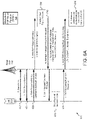
- FIG. 5A is a block diagram illustrating one embodiment of a network procedure for network access using blockchain payments
- FIG. 5B is a continuation of the network procedure of FIG. 5A ;
- FIG. 6A is a block diagram illustrating another embodiment of a network procedure for network access using blockchain payments
- FIG. 6B is a continuation of the network procedure of FIG. 6A ;
- FIG. 7 is a schematic block diagram illustrating one embodiment of a protocol architecture for network access using blockchain payments
- FIG. 8 is a schematic flow chart diagram illustrating one embodiment of a method for network access using blockchain payments.
- FIG. 9 is a schematic flow chart diagram illustrating another embodiment of a method for network access using blockchain payments.
- embodiments may be embodied as a system, apparatus, method, or program product. Accordingly, embodiments may take the form of an entirely hardware embodiment, an entirely software embodiment (including firmware, resident software, micro-code, etc.) or an embodiment combining software and hardware aspects.
- the disclosed embodiments may be implemented as a hardware circuit comprising custom very-large-scale integration (“VLSI”) circuits or gate arrays, off-the-shelf semiconductors such as logic chips, transistors, or other discrete components.
- VLSI very-large-scale integration
- the disclosed embodiments may also be implemented in programmable hardware devices such as field programmable gate arrays, programmable array logic, programmable logic devices, or the like.
- the disclosed embodiments may include one or more physical or logical blocks of executable code which may, for instance, be organized as an object, procedure, or function.
- embodiments may take the form of a program product embodied in one or more computer readable storage devices storing machine readable code, computer readable code, and/or program code, referred hereafter as code.
- the storage devices may be tangible, non-transitory, and/or non-transmission.
- the storage devices may not embody signals. In a certain embodiment, the storage devices only employ signals for accessing code.
- the computer readable medium may be a computer readable storage medium.
- the computer readable storage medium may be a storage device storing the code.
- the storage device may be, for example, but not limited to, an electronic, magnetic, optical, electromagnetic, infrared, holographic, micromechanical, or semiconductor system, apparatus, or device, or any suitable combination of the foregoing.
- a storage device More specific examples (a non-exhaustive list) of the storage device would include the following: an electrical connection having one or more wires, a portable computer diskette, a hard disk, a random-access memory (“RAM”), a read-only memory (“ROM”), an erasable programmable read-only memory (“EPROM” or Flash memory), a portable compact disc read-only memory (“CD-ROM”), an optical storage device, a magnetic storage device, or any suitable combination of the foregoing.
- a computer readable storage medium may be any tangible medium that can contain, or store a program for use by or in connection with an instruction execution system, apparatus, or device.
- the code may also be stored in a storage device that can direct a computer, other programmable data processing apparatus, or other devices to function in a particular manner, such that the instructions stored in the storage device produce an article of manufacture including instructions which implement the function/act specified in the schematic flowchart diagrams and/or schematic block diagrams.
- the code may also be loaded onto a computer, other programmable data processing apparatus, or other devices to cause a series of operational steps to be performed on the computer, other programmable apparatus, or other devices to produce a computer implemented process such that the code which execute on the computer or other programmable apparatus provide processes for implementing the functions/acts specified in the schematic flowchart diagrams and/or schematic block diagram.
- each block in the schematic flowchart diagrams and/or schematic block diagrams may represent a module, segment, or portion of code, which includes one or more executable instructions of the code for implementing the specified logical function(s).
- the disclosed embodiments consider online payments made via a blockchain network. Such payments can be nearly real-time (fast) and can trigger a sequence of other events, such as the creation and the assignment of connection information packages.
- this makes it possible for a mobile user to access a visited network (e.g., a mobile network or a WLAN network) even when the visited network does not have a roaming agreement with the user's home network.
- a visited network e.g., a mobile network or a WLAN network
- EAP-CRY Extensible Authentication Protocol
- system architectures and the procedures described herein facilitate network access with the EAP-CRY method.
- FIG. 1 depicts a wireless communication system 100 for network access using blockchain payments, according to embodiments of the disclosure.
- the wireless communication system 100 includes at least one remote unit 105 , an access network 120 containing at least one base unit 110 , wireless communication links 115 , a mobile core network 130 , and a blockchain network 160 .
- the access network 120 contains one or more WLAN (e.g., WI-FITM) access points.
- the wireless communication system 100 is compliant with the 5G system specified in the 3GPP specifications. More generally, however, the wireless communication system 100 may implement some other open or proprietary communication network, for example, LTE or WiMAX, among other networks.
- LTE or WiMAX wireless communication system architecture or protocol.
- the remote units 105 may include computing devices, such as desktop computers, laptop computers, personal digital assistants (“PDAs”), tablet computers, smart phones, smart televisions (e.g., televisions connected to the Internet), smart appliances (e.g., appliances connected to the Internet), set-top boxes, game consoles, security systems (including security cameras), vehicle on-board computers, network devices (e.g., routers, switches, modems), or the like.
- the remote units 105 include wearable devices, such as smart watches, fitness bands, optical head-mounted displays, or the like.
- the remote units 105 may be referred to as subscriber units, mobiles, mobile stations, users, terminals, mobile terminals, fixed terminals, subscriber stations, UE, user terminals, a device, or by other terminology used in the art.
- the remote units 105 may communicate directly with one or more of the base units 110 via uplink (“UL”) and downlink (“DL”) communication signals.
- UL and DL communication signals may be carried over the wireless communication links 115 .
- the base units 110 may be distributed over a geographic region.
- a base unit 110 may also be referred to as an access terminal, an access point, a base, a base station, a Node-B, an eNB, a gNB, a Home Node-B, a relay node, a device, or by any other terminology used in the art.
- the base units 110 may serve a number of remote units 105 within a serving area, for example, a cell or a cell sector via a wireless communication link 115 .
- the base units 110 may communicate directly with one or more of the remote units 105 via communication signals.
- the base units 110 transmit downlink (“DL”) communication signals to serve the remote units 105 in the time, frequency, and/or spatial domain. Furthermore, the DL communication signals may be carried over the wireless communication links 115 .
- the wireless communication links 115 may be any suitable carrier in licensed or unlicensed radio spectrum. The wireless communication links 115 facilitate communication between one or more of the remote units 105 and/or one or more of the base units 110 .
- the base units 110 are generally part of a radio access network (“RAN”), such as the access network 120 , that may include one or more controllers communicably coupled to one or more corresponding base units 110 . These and other elements of the radio access network are not illustrated, but are well known generally by those having ordinary skill in the art.
- the base units 110 connect to a mobile core network (e.g., in the visited network 130 ) via the access network 120 .
- the mobile core network is a 5G core (“5GC”) or the evolved packet core (“EPC”), which may be coupled to a data network 150 , like the Internet and private data networks, among other data networks.
- 5GC 5G core
- EPC evolved packet core
- Each mobile core network belongs to a single public land mobile network (“PLMN”).
- PLMN public land mobile network
- the mobile core network 130 includes several network functions (“NFs”), including control plane functions (such as the Authentication Function 132 ) and user plane functions (such as the Gateway Function 134 ).
- NFs network functions
- a mobile core network may include such control plane functions as an Access and Mobility Management Function (“AMF”), a Session Management Function (“SMF”), a Policy Control Function (“PCF”).
- AMF Access and Mobility Management Function
- SMF Session Management Function
- PCF Policy Control Function
- the Gateway Function 134 provides access to external data networks 150 .
- the Gateway Function 134 has an interface to the Authentication Function 132 and is configured by the Authentication Function 132 with rules that can apply certain limitations to the traffic between a UE and the data networks 150 .
- the Authentication Function 132 is a server that authorizes (or forbids) access to the network after running an authentication procedure with the remote unit 105 .
- the Authentication Function 132 implements an Extensible Authentication Protocol (“EAP”) server and the authentication procedure is an EAP exchange.
- EAP Extensible Authentication Protocol
- the Authentication Function 132 has an interface to one or more blockchain nodes 164 in the blockchain network 160 . Via this interface the Authentication Function 132 can make new blockchain transactions (payments) or confirm the existence of prior blockchain payments.
- the blockchain network 160 is a peer-to-peer network that maintains a secure shared ledger 166 , e.g., a list of transactions that have occurred in the past. This list of transactions is organized into blocks linked together, thus the name “blockchain.”
- the blockchain network 160 is composed of multiple (typically thousands) of blockchain nodes 164 , every one of which maintains a copy of the shared ledger 166 , also known as the “blockchain.”
- the blockchain network 160 provides application programming interfaces (APIs) that can be used by applications to interact with the blockchain.
- APIs application programming interfaces
- an application may use an API call to trigger a blockchain transaction, e.g., to transfer some funds to an account, or to be notified when his/her account receives new funds.
- Applications using the blockchain via appropriate APIs can be external to a blockchain node 164 or internal to a blockchain node 164 .
- the blockchain network 160 supports an external API (e.g., a JSON-RPC API) for use by external applications and a separate internal API (e.g., a JavaScriptTM API) for use by the internal applications.
- an external API e.g., a JSON-RPC API
- a separate internal API e.g., a JavaScriptTM API
- the remote unit 105 To request access to the data network 150 via the access network 120 (and the mobile core network) in exchange for a blockchain payment, the remote unit 105 implicitly signals to the mobile core network a request to purchase network access via a blockchain payment when it sends a remote unit identifier associated with the blockchain network 160 .
- the remote unit 105 submits its payment to the mobile core network 130 and, using its interface to the blockchain network 160 , the Authentication Function 132 validates the payment and broadcasts the transaction to the blockchain network 160 .
- the Gateway Function 134 then grants network access to the remote unit 105 .
- the wireless system 100 eliminates the need for a visited network or roaming agreements between networks, as the remote unit 105 is able to make a blockchain payment in exchange for network access.
- FIG. 2 depicts a network architecture 200 used for network access using blockchain payments, according to embodiments of the disclosure.
- the network architecture 200 may be modification of the wireless communication system 100 .
- the network architecture 200 includes a UE 205 , a gNB 210 , a radio access network (“RAN”) 215 , a mobile communication network 220 , and a blockchain network 160 .
- the UE 205 may be one embodiment of the remote unit 105
- the gNB 210 may be one embodiment of the base unit 110 , discussed above.
- the gNB 210 is a part of the RAN 215 , which itself is part of the mobile communication network 220 .
- the mobile communication network 220 includes the RAN 215 and a core access network 225 , which may be one embodiment of the mobile core network 130 , discussed above.
- the core access network 225 includes a gateway function 134 , an EAP server function 133 , and a blockchain node 164 .
- the EAP server function 133 may be one embodiment of the authentication function 132 discussed above.
- the EAP server function 133 and the blockchain node 164 are co-located, forming a blockchain EAP server function (“BESF”) 136 . This means that the core access network 225 is a part of the blockchain network 160 .
- the UE 205 sends an access request 201 to the mobile communication network 220 .
- the access request 201 includes a username and realm of the UE 205 (depicted here as “user@realm”).
- the specific realm includes will point to a blockchain network 160 through which the UE 205 desires to make a payment.
- FIG. 3 depicts one embodiment of a user equipment apparatus 300 that may be used for network access using blockchain payments, according to embodiments of the disclosure.
- the user equipment apparatus 300 may be one embodiment of the remote unit 105 and/or the UE 205 .
- the user equipment apparatus 300 may include a processor 305 , a memory 310 , an input device 315 , a display 320 , and a transceiver 325 .
- the input device 315 and the display 320 are combined into a single device, such as a touch screen.
- the user equipment apparatus 300 may not include any input device 315 and/or display 320 .
- the transceiver 325 includes at least one transmitter 330 and at least one receiver 335 . Additionally, the transceiver 325 may support at least one network interface 340 . Here, the network interface 340 facilitates communication with a base unit 110 and the mobile core network 130 .
- the processor 305 may include any known controller capable of executing computer-readable instructions and/or capable of performing logical operations.
- the processor 305 may be a microcontroller, a microprocessor, a central processing unit (“CPU”), a graphics processing unit (“GPU”), an auxiliary processing unit, a field programmable gate array (“FPGA”), or similar programmable controller.
- the processor 305 executes instructions stored in the memory 310 to perform the methods and routines described herein.
- the processor 305 is communicatively coupled to the memory 310 , the input device 315 , the display 320 , and the transceiver 325 .
- the transceiver 325 transmits an authentication response message to an authentication server in a mobile communication network, such as the BESF 136 .
- the authentication response message includes a remote unit identifier belonging to the user equipment apparatus 300 , such as a network address identifier (“NAI”) or user equipment identifier (“UEID”), which indicates that the remote unit is requesting network access via a blockchain payment.
- NAI network address identifier
- UEID user equipment identifier
- the remote unit identifier is an NAI with a domain or realm specific to a blockchain network through which the remote unit desires to make blockchain payment.
- different blockchain networks may have their own domains/realms, such that the desired blockchain network is easily identified by the NAI.
- the use of an NAI with a domain or realm specific to a blockchain network indicates to the authentication server that the user equipment apparatus 300 is requesting network access via a blockchain payment.
- the processor 305 implicitly signals its request to use a blockchain payment to access the network (as opposed to using a subscription or account with the network) by sending an authentication response message that includes the remote unit identifier associated with the blockchain network.
- the transceiver 325 receives, from the mobile communication network an address of a blockchain network (e.g., a first blockchain address).
- a blockchain network e.g., a first blockchain address
- the first blockchain address is a pay-to address in the blockchain network which was indicated by the remote unit identifier.
- the user equipment apparatus 300 does not rely on a network subscription to gain network access, but instead makes a blockchain payment to the mobile communication network in order to gain network access.
- the pay-to address is included within a payment request message received via the transceiver 325 .
- the payment request message may include the generated address and one or more value options.
- a value option refers to a quantity of network access (e.g., measured by time and/or data consumption) to be received in exchange for an amount of value (e.g., payment amount).
- Each value option in the payment request message indicates an amount of network access and corresponding payment value.
- the processor 305 controls the display 320 to present the one or more value options to the user. Moreover, the processor 305 may also control the display 320 to present an option to indicate a prior transaction.
- the input device 315 may receive a selection of a specific value option.
- the processors 305 In response to receiving the pay-to address in the indicated blockchain network (and in response to receiving user selection of a value option or indication of a prior transaction), the processors 305 generates a blockchain payment information message associated with the indicated blockchain network.
- the received blockchain payment information includes a new blockchain transaction (e.g., in response to the user selecting one of the value options).
- the received blockchain payment information is a reference to a prior blockchain transaction (e.g., in response to the user indicating a prior transaction).
- the transmitted blockchain payment information message indicates the value to be paid corresponding to the selected value option.
- the blockchain payment information message may contain a blockchain transaction.
- the blockchain payment information message may contain sufficient parameters for the authentication server to generate a blockchain transaction on behalf of the user equipment apparatus 300 .
- the transmitted blockchain payment information also includes a public key of the user equipment apparatus 300 .
- the transmitted blockchain payment information message may contain a transaction ID and/or signature.
- the processor 305 determines whether the referenced prior transaction has any remaining value. For example, where the blockchain payment purchases a block of time, the processor 305 may determine whether any time remains. As another example, where the blockchain payment purchases a quantity of data (e.g., 1 GB), the processor 305 may determine whether any data remains. Additionally, the authentication server validates the transmitted lock chain payment information message
- the user equipment apparatus 300 receives network access (e.g., to the mobile communication network). In certain embodiments, the user equipment apparatus 300 is granted limited access until the blockchain transaction is confirmed.
- the authentication server receives a plurality of confirmation messages from the blockchain network in response to the blockchain payment/transaction. Here, each confirmation message confirms successful “mining” and insertion of the transaction the shared ledger 166 of the blockchain network 160 .
- the mobile communication network provides network access to the user equipment apparatus 300 at a variety of levels based on the number of received confirmation messages.
- the mobile communication network may provide a first level of network access in response to validating the blockchain transaction and prior to receiving a first confirmation message.
- the first level of network access is a reduced level of access which limits at least one of a traffic rate of the remote unit, a number of destinations accessible to the remote unit via the network, and a number of communication protocols and ports accessible to the remote unit.
- mobile communication network may provide a second level of network access in response to receiving a first confirmation message.
- the second level of neck work access is an intermediate level access which relaxes some, but not all, of the limits of the first level of network access.
- the mobile communication network may provide a third level of network access in response to receiving a threshold number of confirmation messages.
- the third level of access is a full level of access which removes all the traffic limitations of the first level of access and the second level of access.
- the transceiver 325 receives confirmation message containing an encrypted master session key for protecting traffic between the user equipment apparatus 300 and a base unit.
- the processor 305 decrypts the master session key using the private key of the user equipment apparatus 300 .
- the transceiver 325 receives confirmation message in response to the authentication server validating the received blockchain payment information (e.g., validating a new transaction or validating a prior referenced transaction). Where the received blockchain payment information references a prior transaction, the processor 305 generates a new master session key.
- the processor 305 initiates an EAP session when communicating with the authentication server. In one embodiment, the processor 305 initiates an EAP-CRY session with the authentication server, with the payment request message being the first message of the EAP-CRY session. Moreover, the blockchain payment information message and confirmation message (including the message containing the encrypted master session key) are transmitted within the EAP-CRY session.
- the memory 310 in one embodiment, is a computer readable storage medium.
- the memory 310 includes volatile computer storage media.
- the memory 310 may include a RAM, including dynamic RAM (“DRAM”), synchronous dynamic RAM (“SDRAM”), and/or static RAM (“SRAM”).
- the memory 310 includes non-volatile computer storage media.
- the memory 310 may include a hard disk drive, a flash memory, or any other suitable non-volatile computer storage device.
- the memory 310 includes both volatile and non-volatile computer storage media.
- the memory 310 stores data relating to network access using blockchain payments, for example storing session keys, transaction IDs, blockchain addresses, remote unit identifiers, and the like.
- the memory 310 also stores program code and related data, such as an operating system or other controller algorithms operating on the user equipment apparatus 300 and one or more software applications.
- the input device 315 may include any known computer input device including a touch panel, a button, a keyboard, a stylus, a microphone, or the like.
- the input device 315 may be integrated with the display 320 , for example, as a touchscreen or similar touch-sensitive display.
- the input device 315 includes a touchscreen such that text may be input using a virtual keyboard displayed on the touchscreen and/or by handwriting on the touchscreen.
- the input device 315 includes two or more different devices, such as a keyboard and a touch panel.
- the display 320 may include any known electronically controllable display or display device.
- the display 320 may be designed to output visual, audible, and/or haptic signals.
- the display 320 includes an electronic display capable of outputting visual data to a user.
- the display 320 may include, but is not limited to, an LCD display, an LED display, an OLED display, a projector, or similar display device capable of outputting images, text, or the like to a user.
- the display 320 may include a wearable display such as a smart watch, smart glasses, a heads-up display, or the like.
- the display 320 may be a component of a smart phone, a personal digital assistant, a television, a table computer, a notebook (laptop) computer, a personal computer, a vehicle dashboard, or the like.
- the display 320 includes one or more speakers for producing sound.
- the display 320 may produce an audible alert or notification (e.g., a beep or chime).
- the display 320 includes one or more haptic devices for producing vibrations, motion, or other haptic feedback.
- all or portions of the display 320 may be integrated with the input device 315 .
- the input device 315 and display 320 may form a touchscreen or similar touch-sensitive display.
- the display 320 may be located near the input device 315 .
- the transceiver 325 is configured to communicate with the base unit 110 and with one or more network functions of a mobile communication network such as the authentication server.
- the transceiver 325 operates under the control of the processor 305 to transmit messages, data, and other signals and also to receive messages, data, and other signals.
- the processor 305 may selectively activate the transceiver (or portions thereof) at particular times in order to send and receive messages.
- the transceiver 325 may include one or more transmitters 330 and one or more receivers 335 .
- the transceiver 325 may support one or more the network interface 340 for communicating with the base unit 110 and/or authentication server.
- FIG. 4 depicts one embodiment of an authentication apparatus 400 that may be used for network access using blockchain payments, according to embodiments of the disclosure.
- the authentication apparatus 400 may be one embodiment of the authentication function 132 and/or the BESF 136 .
- the authentication apparatus 400 may include a processor 405 , a memory 410 , an input device 415 , a display 420 , and a transceiver 425 .
- the input device 415 and the display 420 are combined into a single device, such as a touch screen.
- the authentication apparatus 400 may not include any input device 415 and/or display 420 .
- the transceiver 425 includes at least one transmitter 430 and at least one receiver 435 . Additionally, the transceiver 425 may support at least one network interface 440 .
- the network interface 440 facilitates communication with one or more network functions, such as the gateway function 134 , and one or more blockchain nodes 164 in the blockchain network 160 .
- the transceiver 425 facilitates communication with a remote unit 105 , such as the UE 205 , via the base unit 110 (or gNB 210 ).
- the processor 405 may include any known controller capable of executing computer-readable instructions and/or capable of performing logical operations.
- the processor 405 may be a microcontroller, a microprocessor, a central processing unit (“CPU”), a graphics processing unit (“GPU”), an auxiliary processing unit, a field programmable gate array (“FPGA”), or similar programmable controller.
- the processor 405 executes instructions stored in the memory 410 to perform the methods and routines described herein.
- the processor 405 is communicatively coupled to the memory 410 , the input device 415 , the display 420 , and the transceiver 425 .
- the transceiver 425 receives an authentication request message for a remote unit, such as the UE 205 .
- the authentication request message includes a remote unit identifier, such as a network address identifier (“NAI”) or user equipment identifier (“UEID”), which indicates that the remote unit is requesting network access via a blockchain payment.
- NAI network address identifier
- UEID user equipment identifier
- the remote unit identifier is an NAI with a domain or realm specific to a blockchain network through which the remote unit desires to make blockchain payment.
- different blockchain networks may have their own domains/realms, such that the desired blockchain network is easily identified by the NAI.
- the use of an NAI with a domain or realm specific to a blockchain network indicates to the authentication apparatus 400 that the remote unit is requesting network access via a blockchain payment.
- the remote unit implicitly signals its request to use a blockchain payment to access the network (as opposed to using a subscription or account with the network) by sending the remote unit identifier associated with the blockchain network.
- the processor 405 Upon receiving the authentication message, the processor 405 examines the remote unit identifier.
- the remote unit has a subscription and the authentication apparatus 400 is located in a home network (e.g., H-PLMN) for the remote unit.
- the remote unit has a subscription in another network and the authentication apparatus 400 is located in a visited network (e.g., V-PLMN).
- the remote unit does not rely on a network subscription to gain network access, but instead makes a blockchain payment via the authentication apparatus 400 in order to gain network access.
- the processor 405 In response to the remote unit requesting network access via a blockchain payment, the processor 405 generates a first address for the blockchain network indicated by the remote unit identifier (e.g., a first “blockchain address”). The first address is a “pay-to” address for receiving the blockchain payment. In some embodiments, the processor 405 generates a new pay-to address in the blockchain network indicated by the remote unit identifier (e.g., NAI realm). As an example, the blockchain network indicated by the remote unit identifier may be the BitcoinTM network, wherein the processor 405 generates a new BitcoinTM address to accept the payment.
- embodiments describe making BitcoinTM payments, as BitcoinTM is a well-known example of blockchain technology. However, other blockchain technologies may be used with the described embodiments and may even perform better than the BitcoinTM network, e.g., due to offering shorter transaction confirmation delays.
- the processor 405 may reuse a previously generated blockchain address as the pay-to address for receiving the blockchain payment. In other embodiments, the processor 405 creates a new address each time a new payment should be made, in order to enhance anonymity and security. Additionally, the processor 405 controls the transceiver 425 to send the generated blockchain network address to the remote unit.
- the processor 405 controls the transceiver 425 to send a payment request message to the remote unit.
- the payment request message may include the generated address and one or more value options.
- a value option refers to a quantity of network access (e.g., measured by time and/or data consumption) to be received in exchange for an amount of value (e.g., payment amount).
- Each value option in the payment request message indicates an amount of network access and corresponding payment value.
- the transceiver 425 receives payment information from the remote unit.
- the processor 405 validates the received payment information and provides network access to the remote unit in response to successfully validating the received payment information.
- the received blockchain payment information includes a blockchain transaction.
- the received blockchain payment information is a reference to a prior blockchain transaction.
- the transceiver 425 receives a plurality of confirmation messages from the blockchain network in response to the blockchain payment/transaction.
- each confirmation message confirms successful “mining” and insertion of the transaction the shared ledger 166 of the blockchain network 160 .
- the processor 405 provides network access to remote unit at a variety of levels based on the number of received confirmation messages.
- the processor 405 may provide a first level of network access in response to validating the blockchain transaction and prior to receiving a first confirmation message.
- the first level of network access is a reduced level of access which limits at least one of a traffic rate of the remote unit, a number of destinations accessible to the remote unit via the network, and a number of communication protocols and ports accessible to the remote unit.
- processor 405 may provide a second level of network access in response to receiving a first confirmation message.
- the second level of neck work access is an intermediate level access which relaxes some, but not all, of the limits of the first level of network access.
- the processor 405 may provide a third level of network access in response to receiving a threshold number of confirmation messages.
- the third level of access is a full level of access which removes all the traffic limitations of the first level of access and the second level of access.
- the received blockchain payment information message indicates a value to be paid corresponding to a selected value option.
- the remote unit may present the various value options to the user, wherein the user selects a value option which is then included in the blockchain payment information message.
- the blockchain payment information message may contain a blockchain transaction.
- the blockchain payment information message may contain sufficient parameters for the processor 405 to generate a blockchain transaction on behalf of the remote unit.
- the received blockchain payment information also includes a public key of the remote unit.
- the received blockchain payment information message may contain a transaction ID and/or signature.
- the processor 405 validates the blockchain payment information by looking up the reference transaction ID and determining (e.g., using the signature) whether the referenced prior transaction was made by the remote unit (or user associated with remote unit). Further, the processor 405 determines whether the referenced prior transaction has any remaining value. For example, where the blockchain payment purchases a block of time, the processor 405 may determine whether any time remains. As another example, where the blockchain payment purchases a quantity of data (e.g., 1 GB), the processor 405 may determine whether any data remains.
- a quantity of data e.g. 1 GB
- the processor 405 Where the referenced prior transaction has remaining value, the processor 405 generates a confirmation message and grants network access until there is no remaining value associated with the transaction. If the referenced price transaction does not have remaining value (or was not made by the same user or remote unit), then the processor 405 generates a payment request message and controls the transceiver 45 to send the payment request message to the remote unit.
- the processor 405 generates a master session key for protecting traffic in the remote unit.
- the processor 405 generates the master session key in response to validating the received blockchain payment information (e.g., validating a new transaction or validating a prior referenced transaction). Where the received blockchain payment information references a prior transaction, the processor 405 generates a new master session key.
- the processor 405 encrypts the generated master session key using a public key associated with the remote unit and controls the transceiver 425 to send the encrypted master session keys the remote unit.
- the processor 405 may include the encrypted master session key in a confirmation message.
- the remote unit uses its private key (e.g., corresponding to the public key sent in the blockchain payment information message) to decrypt the master session key.
- the master session key serves as a common key between the remote unit and the access network for protecting the traffic on the air interface.
- the processor 405 controls the transceiver 425 to send a copy of the master session key to the base unit through which the remote unit accesses the network.
- the processor 405 initiates an EAP session when communicating with remote unit. In one embodiment, the processor 405 initiates an EAP-CRY session in response to generating the new pay-to address, with the payment request message being the first message of the EAP-CRY session. Moreover, the blockchain payment information message and confirmation message (including the message containing the encrypted master session key) are transmitted within the EAP-CRY session.
- EAP-CRY is an EAP method running on top of EAP, as discussed below with reference to FIG. 7 .
- the memory 410 in one embodiment, is a computer readable storage medium.
- the memory 410 includes volatile computer storage media.
- the memory 410 may include a RAM, including dynamic RAM (“DRAM”), synchronous dynamic RAM (“SDRAM”), and/or static RAM (“SRAM”).
- the memory 410 includes non-volatile computer storage media.
- the memory 410 may include a hard disk drive, a flash memory, or any other suitable non-volatile computer storage device.
- the memory 410 includes both volatile and non-volatile computer storage media.
- the memory 410 stores data relating to network access using blockchain payments, for example storing session keys, transaction IDs, blockchain addresses, remote unit identifiers, and the like.
- the memory 410 also stores program code and related data, such as an operating system or other controller algorithms operating on the authentication apparatus 400 and one or more software applications.
- the input device 415 may include any known computer input device including a touch panel, a button, a keyboard, a stylus, a microphone, or the like.
- the input device 415 may be integrated with the display 420 , for example, as a touchscreen or similar touch-sensitive display.
- the input device 415 includes a touchscreen such that text may be input using a virtual keyboard displayed on the touchscreen and/or by handwriting on the touchscreen.
- the input device 415 includes two or more different devices, such as a keyboard and a touch panel.
- the display 420 may include any known electronically controllable display or display device.
- the display 420 may be designed to output visual, audible, and/or haptic signals.
- the display 420 includes an electronic display capable of outputting visual data to a user.
- the display 420 may include, but is not limited to, an LCD display, an LED display, an OLED display, a projector, or similar display device capable of outputting images, text, or the like to a user.
- the display 420 may include a wearable display such as a smart watch, smart glasses, a heads-up display, or the like.
- the display 420 may be a component of a smart phone, a personal digital assistant, a television, a table computer, a notebook (laptop) computer, a personal computer, a vehicle dashboard, or the like.
- the display 420 includes one or more speakers for producing sound.
- the display 420 may produce an audible alert or notification (e.g., a beep or chime).
- the display 420 includes one or more haptic devices for producing vibrations, motion, or other haptic feedback.
- all or portions of the display 420 may be integrated with the input device 415 .
- the input device 415 and display 420 may form a touchscreen or similar touch-sensitive display.
- the display 420 may be located near the input device 415 .
- the transceiver 425 is configured to communicate with the blockchain network 160 , the remote unit 105 (via the base unit 110 ), and with one or more network functions of a mobile communication network.
- the transceiver 425 operates under the control of the processor 405 to transmit messages, data, and other signals and also to receive messages, data, and other signals.
- the processor 405 may selectively activate the transceiver (or portions thereof) at particular times in order to send and receive messages.
- the transceiver 425 may include one or more transmitters 430 and one or more receivers 435 .
- the transceiver 425 may support one or more the network interface 440 for communicating with the base unit 110 and/or remote unit 105 .
- FIGS. 5A-5B depict a network procedure 500 for network access using blockchain payments, according to embodiments of the disclosure.
- the network procedure 500 depicts an example of a remote unit (e.g., the UE 205 ) making a blockchain transaction to gain network access.
- the network procedure 500 involves the UE 205 , a base unit 110 , the BESF 136 , and the blockchain network 160 .
- the network procedure 500 begins with the UE 205 selecting an access network (represented by the base unit 110 ) and performing network association with the base unit 110 (see signaling 502 ).
- the base unit 110 is a gNB or eNB.
- the base unit 110 is a wireless access point, such as a WI-FITM hotspot or other WLAN AP.
- the base unit 110 After association, the base unit 110 initiates a EAP-based authentication procedure with the UE 205 (see signaling 504 ).
- the UE 205 is requested to provide its NAI or other UE ID. Recall that an NAI has the form ‘username@realm.’
- the UE 205 provides its NAI (or other UE ID) to the base unit 110 (see signaling 506 ).
- the NAI uses a special realm or domain name in order to indicate to the base unit 110 that the UE 205 wants to access the network by making a blockchain payment or cryptocurrency payment.
- the realm of the NAI indicates which blockchain network the UE 205 prefers to pay with.
- the realm ‘bitcoin.crypto’ may be used in the NAI to indicate that the UE 205 prefers to pay with bitcoins using the bitcoin blockchain network. Accordingly, by including the special realm, the UE 205 implicitly signals a request to access the network using a blockchain transaction.
- the base unit 110 sends an AAA request message to the BESF 136 .
- the BESF 136 is a backend function that is responsible to setup a payment session with the UE 205 and to authorize or reject the UE's access to the network by using an EAP-based method.
- the ‘username’ value of the special NAI can have any value and is not used further in the network procedure 500 .
- the BESF 136 then creates a new pay-to address (see block 508 ).
- the BESF 136 since the UE 205 indicates that it prefers to pay with bitcoins, the BESF 136 creates a new bitcoin address to accept the payment.
- a new address is created every time a new payment should be made in order to avoid using the same address and thus to enhance anonymity.
- the BESF 136 starts an EAP-CRY session with the UE 205 and sends an EAP-Request message carrying a Payment-Request message, the EAP-Request message encapsulated into an AAA message (see signaling 510 ).
- the EAP-Request/Payment-Request message is a EAP-CRY message that includes the created pay-to address and one or more Value options.
- the EAP-Request/Payment-Request message includes a Nonce parameter that is used when the UE has made a prior payment to this network. This is further discussed below with reference to FIG. 6 .
- the EAP-CRY is an EAP method running on top of EAP, as discussed below with reference to FIG. 7 .
- the EAP-Request or EAP-Response is an EAP message that carries an EAP-CRY message, such as ‘Payment-Request,’ or ‘Payment-Response,’ or ‘Payment-Complete.’
- a Value option indicates the value to be paid in order to allow network access for some time period. For example, a Value option (0.001, 1 hour) indicates that a payment of 0.001 bitcoins should be made to allow network access for 1 hour. In another embodiment, a Value option indicates the value to be paid in order to allow network access for some amount of traffic. For example, a Value option (0.001, 1 GByte) indicates that a payment of 0.001 bitcoins should be made to allow network access until 1 GByte of traffic has been consumed.
- the UE 205 presents a payment request to the user in response to receiving the EAP-Request/Payment-Request message.
- the UE 205 determines whether a prior payment has been made to the network and has remaining value.
- FIG. 6 describes the scenario where a prior payment was made. However, in the network procedure 500 is it assumed that there is no prior payment, thus the UE 205 asks the user to authorize a new payment and to select the value to be paid (see block 514 ). In the depicted example, the user selects to pay 0.002 bitcoins in order to access the network for 3 hours.
- the UE 205 sends a blockchain payment information message, such an EAP-Response/Payment-Response message, to the BESF 136 (see signaling 516 ) that includes a regular bitcoin transaction (recall the realm indicated a bitcoin payment and the pay-to address is a bitcoin address).
- this transaction includes: 1) a Transaction Identity (“TxID”), 2) one or more Inputs, and 3) one or more Outputs.
- TxID Transaction Identity
- Each Input refers to a previous Bitcoin transaction (TxID-i) and an output in this references transaction (Output-n).
- This referenced output indicates the bitcoins that were previously received by the user and will now be spent for making this payment (e.g., 0.002 bitcoins).
- each Input includes a Public Key and a Signature which prove that the user owns the bitcoins in the referenced output, e.g., the UE 205 holds the necessary private key.
- One Output indicates the value of bitcoins to be paid to the pay-to address (e.g., 0.002 bitcoins).
- An additional Output can be included to return change to the sender (e.g., when the referenced output in the Input is higher than the paid value of 0.002 bitcoins).
- the BESF 136 which maintains a copy of the bitcoin blockchain, validates the transaction sent by the UE 205 (see block 518 ).
- validation refers to confirming that the bitcoins in the referenced output are not already spent and that they are owned by the user who makes the payment. If the validation is successful, then a new transaction is broadcast in the blockchain network which will be processed as normally by all blockchain nodes (see signaling 520 ).
- the BESF 136 then creates a new Master Session Key (“MSK”, see block 522 ). For example, this key can be created randomly or by using any other appropriate method. Then the BESF 136 encrypts the MSK by using the public key of the UE 205 (e.g., sent prior by the UE 205 in the blockchain payment information message). The purpose of MSK is to serve as a common key between the UE 205 and the access network (e.g., base unit 110 ) for protecting the traffic on the air-interface. In case of WI-FITM access networks, the MSK is used to derive a Pairwise Master Key (PMK) and other child keys, as specified in IEEE 802.11 specification. If needed, the BESF 136 may also create an Extended MSK. Note, that the MSK and EMSK are keys created from a successful EAP method run (here, the EAP-CRY method).
- the procedure 500 continues at FIG. 5B with the BESF 136 sending the encrypted MSK to the UE 205 inside an EAP-Request/Payment-Complete message (see signaling 524 ).
- the UE 205 uses the associated private key to decrypt the MSK (see block 526 ) and then responds with an EAP-Response/Payment-Complete-Ack message (see signaling 528 ).
- the BESF 136 completes the EAP-CRY procedure by sending an EAP-Success message (see signaling 530 ). Via the EAP-Success message, the BESF 136 forwards the MSK to the base unit 110 so that it can protect the traffic on the air-interface.
- the UE 205 and the base unit 110 create keys for protecting the traffic on the air-interface by using the common MSK (see signaling 532 ). In the case of the base unit 110 being a WI-FITM access network, these keys can be created by means of the 4-way handshake specified in IEEE 802.11i.
- the UE 205 has submitted a payment (the new bitcoin transaction in signaling 516 ) which was validated by the BESF 136 and was broadcast in the blockchain network 160 . Note, however, that this payment is not yet confirmed by the blockchain network 160 . Until the payment is fully confirmed the mobile communication network may apply limitations to the traffic associated with the UE 205 (see block 534 ). For example, the UE 205 may be initially limited to a first level.
- the mobile communication network may accept the UE 205 , but limit the traffic rate of the UE 205 to some predefined value.
- the mobile communication network may accept the UE 205 , but allow the UE 205 to access only some predefined domains (e.g., google.com, facebook.com, etc.). These limitations could be defined by BESF 136 and be relayed to the Gateway Function 134 , that is responsible to enforce them.
- the payment transaction is already inserted into a bitcoin blockchain and goes through the normal mining process which may last for a long period of time.
- the mining may typically take from 10 min to a couple of hours, but for other blockchain networks 160 the mining may be considerably shorter (e.g., 1-3 min).
- the payment transaction is mined, it is inserted into a new block in the blockchain and the block is broadcast through the entire blockchain network 160 .
- the BESF 136 which is part of the blockchain network 160 .
- the payment transaction has one confirmation and, as a result, the BESF 136 may instruct the Gateway Function 134 to reduce the traffic limitations for the UE 205 (e.g., to increase the maximum traffic rate, etc., see block 538 ). Now the UE 205 is granted a second level of access.
- the payment transaction receives more and more confirmations.
- the BESF 136 determines that enough confirmations have been received (e.g., a threshold of N confirmations), then it instructs the Gateway Function 134 to remove the traffic limitations of the first and second levels for the UE 205 (see block 540 ). Note that there may still be limitations placed on the UE 205 unrelated to the payment confirmation.
- the procedure 500 ends.
- FIGS. 6A-6B depict a network procedure 600 for network access using blockchain payments, according to embodiments of the disclosure.
- the network procedure 600 depicts an example of a remote unit (e.g., the UE 205 ) requesting network access based on a prior payment to the blockchain network.
- the network procedure 600 involves the UE 205 , a base unit 110 , and the BESF 136 .
- the UE 205 has already made a blockchain payment and does not need to make another blockchain payment due to remaining value in the prior transaction. Because the UE 205 attempts to access the network again before the prior transaction expires, the UE 205 refers to the prior blockchain payment and proves it was the one to make the payment.
- the network procedure 600 begins with the UE 205 selecting an access network (represented by the base unit 110 ) and performing network association with the base unit 110 (see signaling 602 ). After association, the base unit 110 initiates a EAP-based authentication procedure with the UE 205 (see signaling 604 ). Here, the UE 205 is requested to provide its NAI or another UE ID. Recall that an NAI has the form ‘username@realm.’
- the UE 205 provides its NAI (or other UE ID) to the base unit 110 (see signaling 506 ).
- the NAI uses a special realm or domain name in order to indicate to the base unit 110 that the UE 205 wants to access the network by making a blockchain payment or cryptocurrency payment.
- the realm of the NAI indicates which blockchain network the UE 205 prefers to pay with. Accordingly, by including the special realm, the UE 205 implicitly signals a request to access the network using a blockchain transaction.
- the base unit 110 sends an AAA request message to the BESF 136 .
- the BESF 136 is a backend function that is responsible to setup a payment session with the UE 205 and to authorize or reject the UE's access to the network by using an EAP-based method.
- the ‘username’ value of the special NAI can have any value and is not used further in the network procedure 600 .
- the BESF 136 then creates a new pay-to address (see block 608 ).
- the BESF 136 since the UE 205 indicates that it prefers to pay with bitcoins, the BESF 136 creates a new bitcoin address to accept the payment.
- a new address is created every time a new payment should be made in order to avoid using the same address and thus to enhance anonymity.
- the BESF 136 starts an EAP-CRY session with the UE 205 by sending an EAP-Request/Payment-Request message, encapsulated into an AAA message (see signaling 610 ).
- This EAP-CRY message is a payment request message that includes the created pay-to address and one or more Value options, as discussed above.
- the UE 205 present a payment request to the user in response to receiving the EAP-Request/Payment-Request message.
- the UE 205 determines whether a prior payment has been made to the network and has remaining value. Here, is it assumed that there was prior payment with remaining value. Thus, the UE 205 determines (e.g., based on stored prior transactions) that it has already made a payment to access this network (see block 612 ).
- the UE 205 sends an EAP-Response/Payment-Response that does not include a new payment transaction, but includes only a reference to a prior transaction (TxID) and a Nonce_Signature (see signaling 614 ).
- the Nonce_Signature is derived by using the Nonce received in the payment request message (see signaling 610 ) and the private key that was used to sign the prior transaction. Essentially, the Nonce_Signature confirms that the UE 205 is the one which made the referred prior transaction.
- the BESF 136 Because the BESF 136 knows the public key associated with the referenced prior transaction, it uses the public key together with Nonce_Signature to confirm that the UE 205 is really the one which made the prior transaction ‘TxID’ (see block 616 ). Moreover, the BESF 136 also confirms that the prior transaction (e.g., payment) still has remaining value, e.g., its validity period has not expired, or its maximum data volume has not been reached (see block 616 ).
- the prior transaction e.g., payment
- the BESF 136 determines that the referenced prior transaction (e.g., payment) does not have remaining value, or that the UE 205 is not the one which made this transaction, then the BESF 136 sends another EAP-Request/Payment-Request asking the UE 205 to make a new payment (see optional signaling 618 ). In this case a Nonce is not provided.
- the UE 205 responds to the second payment request message (e.g., by making a new blockchain payment)
- the procedure shown in FIG. 5 is executed starting from the signaling 516 .
- the referenced prior transaction has remaining value.
- the BESF 136 In response to confirming/validating the referenced prior transaction, the BESF 136 then creates a new Master Session Key (“MSK”, see block 620 ) and encrypts the MSK by using the public key of the UE 205 .
- the BESF 136 sends the encrypted MSK to the UE 205 inside an EAP-Request/Payment-Complete message (see signaling 622 ).
- the UE 205 uses the associated private key to decrypt the MSK (see block 624 ) and then responds with an EAP-Response/Payment-Complete-Ack message (see signaling 626 ).
- the BESF 136 completes the EAP-CRY procedure by sending an EAP-Success message (see signaling 628 ). Via the EAP-Success message, the BESF 136 forwards the MSK to the base unit 110 so that it can protect the traffic on the air-interface.
- the UE 205 and the base unit 110 create keys for protecting the traffic on the air-interface by using the common MSK (see signaling 630 ). In the case of the base unit 110 being a WI-FITM access network, these keys can be created by means of the 4-way handshake specified in IEEE 802.11i.
- the mobile communication network may apply limitations to the traffic associated with the UE 205 (see block 632 ).
- the BESF 136 may define traffic limitations based on the number of received transaction confirmation messages and relay them to the Gateway Function 134 for enforcement, as discussed above.
- the procedure 600 ends.
- FIG. 7 depicts a protocol architecture 700 for network access using blockchain payments, according to embodiments of the disclosure.
- the protocol architecture 700 involves the remote unit 105 , the base unit 110 , and the BESF 136 .
- the protocol stack of the remote unit 105 includes a radio layer 705 which comprises the lower layers used to communicate with the base unit 110 over the air interface.
- the base unit 110 is a WLAN AP, such as a WI-FITM hotspot
- the radio layer 705 may include a WLAN layer and an IP layer (e.g., IPv4/v6).
- the remote unit 105 also includes an EAPoL layer 710 and an EAP layer 715 .
- the base unit 110 also has a corresponding Radio layer 705 , EAPoL layer 710 , and EAP layer 715 terminating connections with the layers in the remote unit 105 .
- the base unit 110 includes a networking stack 730 and a AAA layer 735 . Each of these terminates in a corresponding layer in the BESF 136 . Also, the base unit 110 and the BESF 136 each have an EAP layer 715 . Both the remote unit 105 and the BESF 136 include a EAP-CRY layer 720 .
- the EAP-CRY is an EAP method whose protocol runs between the remote unit 105 and the BESF 136 . Note that the EAP-CRY method runs on top of EAP.
- EAP-Request and/or EAP-Response messages are used to carry an EAP-CRY message, such as a Payment-Request, Payment-Response, Payment-Complete, Payment-Complete-Ack, or the like.
- an internal application 740 links the EAP-CRY layer 720 to the blockchain client 745 .
- Suitable APIs are used by the internal application 740 in order to communicate with the EAP-CRY protocol (e.g., with EAP-CRY 720 ) and with the blockchain client 745 , which provides access to the blockchain network 160 .
- Another networking stack 730 is used between the BESF 136 and the blockchain network 160 .
- the EAP-CRY layer 720 of the remote unit 105 has access to a list of payment transactions that were conducted by the remote unit in the past. Using the list, the remote unit can determine whether there is a prior payment with remaining value, as discussed above with reference to FIGS. 6A-6B . Also, note that the blockchain client 745 in the BESF 136 has access to the entire list of transactions recorded in the blockchain network 160 .
- FIG. 8 depicts a method 800 for network access using blockchain payments, according to embodiments of the disclosure.
- the method 800 is performed by a remote unit, such as the remote unit 105 , the UE 205 , and/or the user equipment apparatus 300 .
- the method 800 may be performed by a processor executing program code, for example, a microcontroller, a microprocessor, a CPU, a GPU, an auxiliary processing unit, a FPGA, or the like.
- the method 800 begins with transmitting 805 , by a remote unit, an authentication response message to a mobile communication network.
- the authentication response message includes a remote unit identifier, the identifier indicating that the remote unit is requesting network access via a blockchain payment.
- the method 800 includes receiving 810 an address for a blockchain network (e.g., a blockchain address), the specific blockchain network being indicated by the remote unit identifier.
- receiving 810 the address for the blotchy network includes initiating an EAP session, wherein the addresses received via the EAP session.
- various messages with the mobile communication network may be exchanged using the EAP method (e.g., corresponding to the EAP session).
- the method 800 includes transmitting 815 a blockchain payment information message associated with a blockchain payment to the received address.
- the blockchain payment information message is transmitted in response to receiving a payment request message from the mobile communication network, the payment request message including the generated address and one or more value options, each value option indicating an amount of network access and a corresponding payment value.
- the transmitted blockchain payment information message includes a new blockchain transmission. In such an embodiment, the transmitted blockchain payment information message indicates a value to be paid corresponding to a selected one of the one or more value options.
- transmitting 815 the blockchain payment information message comprises transmitting a reference to the prior transaction in a response to the payment request message.
- the remote unit determines to access the mobile communication network using a prior transaction (e.g., a prior transaction having remaining value and being made by the same user and/or remote unit).
- the method 800 includes receiving 820 network access in response to successful validation of the blockchain payment information message.
- receiving 820 network access includes receiving an encrypted master session key from the mobile communication network and decrypting the master session key with a private key of the remote unit.
- the transmitted blockchain payment information message may include a public key of the remote unit, wherein the encrypted master session key is decrypted using the corresponding private key.
- the master session key may be a new master session key.
- receiving 820 network access includes using the master session key to protect traffic communicated with the mobile communication network, e.g., over an air interface.
- receiving 820 network access includes receiving a first level of access in response to validating the blockchain payment information message and prior to the mobile communication network receiving a first transaction confirmation message.
- receiving 820 network access includes receiving a second level of access in response to the mobile communication network receiving the first transaction confirmation message.
- receiving 820 network access includes receiving a third level of access in response to the mobile communication network receiving a threshold number of transaction confirmation messages.
- the first level of access is a reduced level of access
- the second level of access is an intermediate level of access
- the third level of access is a full level of access.
- the third level of access removes the traffic limitations of the first level of access and of the second level of access.
- the first level of access limits at least one of a traffic rate of the remote unit, a number of destinations accessible to the remote unit via the network and a number of communication protocols and ports accessible to the remote unit.
- FIG. 9 depicts a method 900 for network access using blockchain payments, according to embodiments of the disclosure.
- the method 900 is performed by an apparatus, such as the authentication function 132 , the BESF 136 , and/or the authentication apparatus 400 .
- the method 900 may be performed by a processor executing program code, for example, a microcontroller, a microprocessor, a CPU, a GPU, an auxiliary processing unit, a FPGA, or the like.
- the method 900 begins with receiving 905 , at an authentication function and from a remote unit, an authentication request message including a remote unit identifier.
- unit identifier indicates that the remote unit is requesting network access via a blockchain payment.
- the authentication request message is embodied in an EAP response message.
- the method 900 includes generating 910 an address for a blockchain network indicated by the remote unit identifier.
- the generated address is for receiving the blockchain payment.
- generating 910 the address includes sending a payment request message to the remote unit, said payment request message including the generated address.
- the payment request message may include one or more value options, each value option indicating an amount of network access and a corresponding payment value.
- the generated address may be exchanged using an EAP method.
- the method 900 includes receiving 915 a blockchain payment information message from the remote unit.
- receiving 915 the blockchain payment information message includes validating the blockchain payment information.
- the blockchain payment information message is exchanged using the EAP method.
- the received blockchain payment information message includes a new blockchain transaction.
- the new blockchain transaction may indicate a value to be paid corresponding to a selected value option.
- the receipt watching payment information message references a prior blockchain transaction.
- the authentication server determines whether the reference prior transaction was made by the remote unit and whether there is remaining value associated with the referenced prior transaction. In response to the referenced prior transaction not having any remaining value or in response to determining that the referenced prior transaction was not made by the remote unit, the authentication server may resend the payment request message.
- the resent payment message may include an error code indicating that the referenced prior transaction is not valid.
- the method 900 includes providing 920 network access to the remote unit in response to successfully validating the received blockchain payment information.
- providing 920 network access to the remote unit includes generating master session key for protecting traffic of the remote unit, encrypting the master session key with a public key of the remote unit, and sending the encrypted master session key to the remote unit.
- the public key may be contained in the blockchain payment information message.
- the master session key may be a new master session key.
- providing 920 network access to the remote unit includes providing various levels of network access. For example, providing 920 network access may include receiving a first level of access in response to validating the blockchain payment information message and prior to the mobile communication network receiving a first transaction confirmation message. In another embodiment, providing 920 network access may include receiving a second level of access in response to the mobile communication network receiving the first transaction confirmation message. In a further embodiment, providing 920 network access may include receiving a third level of access in response to the mobile communication network receiving a threshold number of transaction confirmation messages. In these embodiments, the first level of access is a reduced level of access, the second level of access is an intermediate level of access, and the third level of access is a full level of access.
- the third level of access removes the traffic limitations of the first level of access and of the second level of access.
- the first level of access limits at least one of a traffic rate of the remote unit, a number of destinations accessible to the remote unit via the network and a number of communication protocols and ports accessible to the remote unit.
Landscapes
- Engineering & Computer Science (AREA)
- Business, Economics & Management (AREA)
- Accounting & Taxation (AREA)
- Computer Security & Cryptography (AREA)
- Computer Networks & Wireless Communication (AREA)
- General Physics & Mathematics (AREA)
- Theoretical Computer Science (AREA)
- Strategic Management (AREA)
- Physics & Mathematics (AREA)
- General Business, Economics & Management (AREA)
- Signal Processing (AREA)
- Finance (AREA)
- Mobile Radio Communication Systems (AREA)
- Financial Or Insurance-Related Operations Such As Payment And Settlement (AREA)
Abstract
Description
Claims (20)
Applications Claiming Priority (1)
| Application Number | Priority Date | Filing Date | Title |
|---|---|---|---|
| PCT/EP2017/082451 WO2019114934A1 (en) | 2017-12-12 | 2017-12-12 | Providing network access using blockchain payments |
Publications (2)
| Publication Number | Publication Date |
|---|---|
| US20200242603A1 US20200242603A1 (en) | 2020-07-30 |
| US11429968B2 true US11429968B2 (en) | 2022-08-30 |
Family
ID=60702739
Family Applications (1)
| Application Number | Title | Priority Date | Filing Date |
|---|---|---|---|
| US16/652,649 Active 2038-10-16 US11429968B2 (en) | 2017-12-12 | 2017-12-12 | Providing network access using blockchain payments |
Country Status (5)
| Country | Link |
|---|---|
| US (1) | US11429968B2 (en) |
| EP (1) | EP3724841B1 (en) |
| KR (1) | KR102535674B1 (en) |
| CN (1) | CN111344727B (en) |
| WO (1) | WO2019114934A1 (en) |
Cited By (1)
| Publication number | Priority date | Publication date | Assignee | Title |
|---|---|---|---|---|
| US20220417839A1 (en) * | 2021-06-28 | 2022-12-29 | At&T Intellectual Property I, L.P. | System and method of securing allocation of network functions for session slices |
Families Citing this family (36)
| Publication number | Priority date | Publication date | Assignee | Title |
|---|---|---|---|---|
| US10299149B2 (en) | 2013-03-15 | 2019-05-21 | DGS Global Systems, Inc. | Systems, methods, and devices for electronic spectrum management |
| US12256233B2 (en) | 2013-03-15 | 2025-03-18 | Digital Global Systems, Inc. | Systems and methods for automated financial settlements for dynamic spectrum sharing |
| US9078162B2 (en) | 2013-03-15 | 2015-07-07 | DGS Global Systems, Inc. | Systems, methods, and devices for electronic spectrum management |
| US10271233B2 (en) | 2013-03-15 | 2019-04-23 | DGS Global Systems, Inc. | Systems, methods, and devices for automatic signal detection with temporal feature extraction within a spectrum |
| US10219163B2 (en) | 2013-03-15 | 2019-02-26 | DGS Global Systems, Inc. | Systems, methods, and devices for electronic spectrum management |
| US10257727B2 (en) | 2013-03-15 | 2019-04-09 | DGS Global Systems, Inc. | Systems methods, and devices having databases and automated reports for electronic spectrum management |
| US10231206B2 (en) | 2013-03-15 | 2019-03-12 | DGS Global Systems, Inc. | Systems, methods, and devices for electronic spectrum management for identifying signal-emitting devices |
| US10237770B2 (en) | 2013-03-15 | 2019-03-19 | DGS Global Systems, Inc. | Systems, methods, and devices having databases and automated reports for electronic spectrum management |
| US12356206B2 (en) | 2013-03-15 | 2025-07-08 | Digital Global Systems, Inc. | Systems and methods for automated financial settlements for dynamic spectrum sharing |
| US10257729B2 (en) | 2013-03-15 | 2019-04-09 | DGS Global Systems, Inc. | Systems, methods, and devices having databases for electronic spectrum management |
| US11646918B2 (en) | 2013-03-15 | 2023-05-09 | Digital Global Systems, Inc. | Systems, methods, and devices for electronic spectrum management for identifying open space |
| US10257728B2 (en) | 2013-03-15 | 2019-04-09 | DGS Global Systems, Inc. | Systems, methods, and devices for electronic spectrum management |
| US10700794B2 (en) | 2017-01-23 | 2020-06-30 | Digital Global Systems, Inc. | Systems, methods, and devices for automatic signal detection based on power distribution by frequency over time within an electromagnetic spectrum |
| US12205477B2 (en) | 2017-01-23 | 2025-01-21 | Digital Global Systems, Inc. | Unmanned vehicle recognition and threat management |
| US10498951B2 (en) | 2017-01-23 | 2019-12-03 | Digital Global Systems, Inc. | Systems, methods, and devices for unmanned vehicle detection |
| US10459020B2 (en) | 2017-01-23 | 2019-10-29 | DGS Global Systems, Inc. | Systems, methods, and devices for automatic signal detection based on power distribution by frequency over time within a spectrum |
| US12183213B1 (en) | 2017-01-23 | 2024-12-31 | Digital Global Systems, Inc. | Unmanned vehicle recognition and threat management |
| WO2018228952A1 (en) * | 2017-06-12 | 2018-12-20 | British Telecommunications Public Limited Company | Expendable network access |
| US11539701B2 (en) | 2017-06-12 | 2022-12-27 | British Telecommunications Public Limited Company | Network access point |
| US11489693B2 (en) | 2017-06-12 | 2022-11-01 | British Telecommunications Public Limited Company | Home network access |
| GB2565411A (en) | 2017-06-12 | 2019-02-13 | British Telecomm | Improved hardware security module management |
| WO2018228974A1 (en) | 2017-06-12 | 2018-12-20 | British Telecommunications Public Limited Company | Expendable cryptographic key access |
| EP3759870B1 (en) * | 2018-02-26 | 2023-11-29 | Telefonaktiebolaget Lm Ericsson (Publ) | Network slicing with smart contracts |
| US10943461B2 (en) | 2018-08-24 | 2021-03-09 | Digital Global Systems, Inc. | Systems, methods, and devices for automatic signal detection based on power distribution by frequency over time |
| GB201815816D0 (en) * | 2018-09-28 | 2018-11-14 | Nchain Holdings Ltd | Computer-implemented system and method |
| KR102125659B1 (en) * | 2018-11-16 | 2020-06-23 | 알리바바 그룹 홀딩 리미티드 | Cross-chain interaction using domain name scheme in blockchain system |
| US10461421B1 (en) * | 2019-05-07 | 2019-10-29 | Bao Tran | Cellular system |
| CN111784319B (en) * | 2020-07-02 | 2021-07-27 | 财智云享(杭州)数据信息技术有限公司 | Communication data processing method and big data server based on blockchain payment network |
| US11785456B2 (en) * | 2020-08-18 | 2023-10-10 | Cisco Technology, Inc. | Delivering standalone non-public network (SNPN) credentials from an enterprise authentication server to a user equipment over extensible authentication protocol (EAP) |
| CN112423302B (en) * | 2020-12-02 | 2024-01-09 | 中国联合网络通信集团有限公司 | Wireless network access method, terminal and wireless access equipment |
| US20220376921A1 (en) * | 2021-05-21 | 2022-11-24 | At&T Mobility Ii Llc | Blockchain authenticator for dynamic spectrum sharing and blockchain cybersecurity services |
| CN115734224A (en) * | 2021-08-27 | 2023-03-03 | 武汉圆博科技有限公司 | A communication control method, access equipment and user equipment |
| CN116782225A (en) * | 2022-03-07 | 2023-09-19 | 华为技术有限公司 | Communication method, terminal equipment and communication device |
| JP7709659B2 (en) * | 2022-04-21 | 2025-07-17 | Ntt株式会社 | Wireless communication method and wireless communication system |
| CN116582901B (en) * | 2023-06-07 | 2025-10-28 | 中国联合网络通信集团有限公司 | Terminal scheduling method, device and storage medium |
| CN117479111B (en) * | 2023-12-25 | 2024-03-22 | 广州鲁邦通物联网科技股份有限公司 | Wi-Fi technology-based offline automatic payment method, system and device |
Citations (3)
| Publication number | Priority date | Publication date | Assignee | Title |
|---|---|---|---|---|
| US10194320B1 (en) * | 2017-07-30 | 2019-01-29 | Dell Products, Lp | Method and apparatus for assignment of subscription electronic SIM credentials via local service brokers |
| US20190109877A1 (en) * | 2017-10-11 | 2019-04-11 | Microsoft Technology Licensing, Llc | Secure application metering |
| US20210201396A1 (en) * | 2017-10-20 | 2021-07-01 | Hewlett Packard Enterprise Development Lp | Authenticating and paying for services using blockchain |
Family Cites Families (13)
| Publication number | Priority date | Publication date | Assignee | Title |
|---|---|---|---|---|
| US6954793B2 (en) * | 2002-05-13 | 2005-10-11 | Thomson Licensing S.A. | Pre-paid data card authentication in a public wireless LAN access system |
| US20130067081A1 (en) * | 2011-09-12 | 2013-03-14 | Qualcomm Incorporated | Mobile Device Authentication and Access to a Social Network |
| US20150163704A1 (en) * | 2013-12-11 | 2015-06-11 | Qualcomm Incorporated | Handover from cellular to wlan in integrated network |
| KR101591245B1 (en) * | 2014-05-09 | 2016-02-04 | 주식회사 코인플러그 | Bitcoin payment system based on the Wi-Fi networks |
| CN105704109B (en) * | 2014-11-28 | 2019-05-24 | 华为软件技术有限公司 | A kind of network access verifying method and equipment |
| US20160342989A1 (en) * | 2015-05-21 | 2016-11-24 | Mastercard International Incorporated | Method and system for processing blockchain-based transactions on existing payment networks |
| US20170017954A1 (en) * | 2015-07-14 | 2017-01-19 | Fmr Llc | Point-to-Point Transaction Guidance Apparatuses, Methods and Systems |
| CN105303728A (en) * | 2015-12-01 | 2016-02-03 | 北京博思汇众科技股份有限公司 | Payment terminal and payment method supporting mobile network access |
| CN106911641A (en) * | 2015-12-23 | 2017-06-30 | 索尼公司 | For authorizing the client terminal device for accessing, server unit and access control system |
| KR101637863B1 (en) * | 2016-01-05 | 2016-07-08 | 주식회사 코인플러그 | Security system and method for transmitting a password |
| US20170243209A1 (en) * | 2016-02-22 | 2017-08-24 | Bank Of America Corporation | System for grant of user access and data usage in a process data network |
| US11373183B2 (en) * | 2016-05-06 | 2022-06-28 | Mastercard International Incorporated | Method and system for instantaneous payment using recorded guarantees |
| CN106850200B (en) * | 2017-01-25 | 2019-10-22 | 中钞信用卡产业发展有限公司杭州区块链技术研究院 | A security method, system and terminal using blockchain-based digital currency |
-
2017
- 2017-12-12 US US16/652,649 patent/US11429968B2/en active Active
- 2017-12-12 EP EP17816733.4A patent/EP3724841B1/en active Active
- 2017-12-12 CN CN201780096749.2A patent/CN111344727B/en active Active
- 2017-12-12 KR KR1020207016559A patent/KR102535674B1/en active Active
- 2017-12-12 WO PCT/EP2017/082451 patent/WO2019114934A1/en not_active Ceased
Patent Citations (3)
| Publication number | Priority date | Publication date | Assignee | Title |
|---|---|---|---|---|
| US10194320B1 (en) * | 2017-07-30 | 2019-01-29 | Dell Products, Lp | Method and apparatus for assignment of subscription electronic SIM credentials via local service brokers |
| US20190109877A1 (en) * | 2017-10-11 | 2019-04-11 | Microsoft Technology Licensing, Llc | Secure application metering |
| US20210201396A1 (en) * | 2017-10-20 | 2021-07-01 | Hewlett Packard Enterprise Development Lp | Authenticating and paying for services using blockchain |
Non-Patent Citations (8)
Cited By (4)
| Publication number | Priority date | Publication date | Assignee | Title |
|---|---|---|---|---|
| US20220417839A1 (en) * | 2021-06-28 | 2022-12-29 | At&T Intellectual Property I, L.P. | System and method of securing allocation of network functions for session slices |
| US11910305B2 (en) * | 2021-06-28 | 2024-02-20 | At&T Intellectual Property I, L.P. | System and method of securing allocation of network functions for session slices |
| US20240155477A1 (en) * | 2021-06-28 | 2024-05-09 | At&T Intellectual Property I, L.P. | System and method of securing allocation of network functions for session slices |
| US12219473B2 (en) * | 2021-06-28 | 2025-02-04 | At&T Intellectual Property I, L.P. | System and method of securing allocation of network functions for session slices |
Also Published As
| Publication number | Publication date |
|---|---|
| CN111344727A (en) | 2020-06-26 |
| EP3724841B1 (en) | 2023-09-13 |
| KR20200097713A (en) | 2020-08-19 |
| BR112020011703A2 (en) | 2020-11-17 |
| EP3724841A1 (en) | 2020-10-21 |
| US20200242603A1 (en) | 2020-07-30 |
| KR102535674B1 (en) | 2023-05-22 |
| CN111344727B (en) | 2024-10-22 |
| EP3724841C0 (en) | 2023-09-13 |
| WO2019114934A1 (en) | 2019-06-20 |
| BR112020011703A8 (en) | 2023-04-25 |
Similar Documents
| Publication | Publication Date | Title |
|---|---|---|
| US11429968B2 (en) | Providing network access using blockchain payments | |
| EP3704885B1 (en) | User authentication using connection information provided by a blockchain network | |
| US12464362B2 (en) | Subscription onboarding using a verified digital identity | |
| US20240022908A1 (en) | Authentication using a digital identifier for ue access | |
| CN111615836B (en) | Provisioning remote units via blockchain network | |
| US11689930B2 (en) | Encrypted traffic detection | |
| US20240056313A1 (en) | Selecting a data connection based on digital certificate information | |
| US20240129739A1 (en) | Secure data collection via a messaging framework | |
| US20240313969A1 (en) | Establishing a trust relationship between an application entity and a wireless communication network | |
| US20260040071A1 (en) | Tunnel establishment for non-seamless wlan offloading | |
| BR112020011703B1 (en) | Apparatus and method for providing network access using blockchain payments |
Legal Events
| Date | Code | Title | Description |
|---|---|---|---|
| FEPP | Fee payment procedure |
Free format text: ENTITY STATUS SET TO UNDISCOUNTED (ORIGINAL EVENT CODE: BIG.); ENTITY STATUS OF PATENT OWNER: LARGE ENTITY |
|
| STPP | Information on status: patent application and granting procedure in general |
Free format text: APPLICATION DISPATCHED FROM PREEXAM, NOT YET DOCKETED |
|
| AS | Assignment |
Owner name: MOTOROLA MOBILITY LLC, ILLINOIS Free format text: ASSIGNMENT OF ASSIGNORS INTEREST;ASSIGNOR:SALKINTZIS, APOSTOLIS;REEL/FRAME:054180/0474 Effective date: 20200316 |
|
| AS | Assignment |
Owner name: LENOVO (SINGAPORE) PTE. LTD., SINGAPORE Free format text: CORRECTIVE ASSIGNMENT TO CORRECT THE RECEIVING PARTY DATA FROM MOTOROLA MOBILITY LLC TO LENOVO SINGAPORE PTE. LTD. PREVIOUSLY RECORDED ON REEL 054180 FRAME 0474. ASSIGNOR(S) HEREBY CONFIRMS THE ASSIGNMENT OF ASSIGNORS INTEREST;ASSIGNOR:SALKINTZIS, APOSTOLIS;REEL/FRAME:054248/0766 Effective date: 20200316 |
|
| STPP | Information on status: patent application and granting procedure in general |
Free format text: DOCKETED NEW CASE - READY FOR EXAMINATION |
|
| STPP | Information on status: patent application and granting procedure in general |
Free format text: NOTICE OF ALLOWANCE MAILED -- APPLICATION RECEIVED IN OFFICE OF PUBLICATIONS |
|
| STPP | Information on status: patent application and granting procedure in general |
Free format text: PUBLICATIONS -- ISSUE FEE PAYMENT VERIFIED |
|
| STCF | Information on status: patent grant |
Free format text: PATENTED CASE |
|
| MAFP | Maintenance fee payment |
Free format text: PAYMENT OF MAINTENANCE FEE, 4TH YEAR, LARGE ENTITY (ORIGINAL EVENT CODE: M1551); ENTITY STATUS OF PATENT OWNER: LARGE ENTITY Year of fee payment: 4 |