US11417702B2 - Semiconductor detector and method of manufacturing the same - Google Patents
Semiconductor detector and method of manufacturing the same Download PDFInfo
- Publication number
- US11417702B2 US11417702B2 US17/206,566 US202117206566A US11417702B2 US 11417702 B2 US11417702 B2 US 11417702B2 US 202117206566 A US202117206566 A US 202117206566A US 11417702 B2 US11417702 B2 US 11417702B2
- Authority
- US
- United States
- Prior art keywords
- semiconductor chip
- semiconductor
- reading electrode
- underfill
- electrode pad
- Prior art date
- Legal status (The legal status is an assumption and is not a legal conclusion. Google has not performed a legal analysis and makes no representation as to the accuracy of the status listed.)
- Active
Links
Images




Classifications
-
- H—ELECTRICITY
- H10—SEMICONDUCTOR DEVICES; ELECTRIC SOLID-STATE DEVICES NOT OTHERWISE PROVIDED FOR
- H10F—INORGANIC SEMICONDUCTOR DEVICES SENSITIVE TO INFRARED RADIATION, LIGHT, ELECTROMAGNETIC RADIATION OF SHORTER WAVELENGTH OR CORPUSCULAR RADIATION
- H10F39/00—Integrated devices, or assemblies of multiple devices, comprising at least one element covered by group H10F30/00, e.g. radiation detectors comprising photodiode arrays
- H10F39/10—Integrated devices
- H10F39/12—Image sensors
- H10F39/18—Complementary metal-oxide-semiconductor [CMOS] image sensors; Photodiode array image sensors
- H10F39/189—X-ray, gamma-ray or corpuscular radiation imagers
- H10F39/1895—X-ray, gamma-ray or corpuscular radiation imagers of the hybrid type
-
- G—PHYSICS
- G01—MEASURING; TESTING
- G01T—MEASUREMENT OF NUCLEAR OR X-RADIATION
- G01T1/00—Measuring X-radiation, gamma radiation, corpuscular radiation, or cosmic radiation
- G01T1/16—Measuring radiation intensity
- G01T1/24—Measuring radiation intensity with semiconductor detectors
- G01T1/242—Stacked detectors, e.g. for depth information
-
- G—PHYSICS
- G01—MEASURING; TESTING
- G01R—MEASURING ELECTRIC VARIABLES; MEASURING MAGNETIC VARIABLES
- G01R29/00—Arrangements for measuring or indicating electric quantities not covered by groups G01R19/00 - G01R27/00
- G01R29/08—Measuring electromagnetic field characteristics
- G01R29/0864—Measuring electromagnetic field characteristics characterised by constructional or functional features
- G01R29/0878—Sensors; antennas; probes; detectors
-
- H01L27/14661—
-
- G—PHYSICS
- G01—MEASURING; TESTING
- G01T—MEASUREMENT OF NUCLEAR OR X-RADIATION
- G01T1/00—Measuring X-radiation, gamma radiation, corpuscular radiation, or cosmic radiation
- G01T1/16—Measuring radiation intensity
- G01T1/24—Measuring radiation intensity with semiconductor detectors
- G01T1/247—Detector read-out circuitry
-
- H01L27/14636—
-
- H01L27/1469—
-
- H—ELECTRICITY
- H10—SEMICONDUCTOR DEVICES; ELECTRIC SOLID-STATE DEVICES NOT OTHERWISE PROVIDED FOR
- H10F—INORGANIC SEMICONDUCTOR DEVICES SENSITIVE TO INFRARED RADIATION, LIGHT, ELECTROMAGNETIC RADIATION OF SHORTER WAVELENGTH OR CORPUSCULAR RADIATION
- H10F39/00—Integrated devices, or assemblies of multiple devices, comprising at least one element covered by group H10F30/00, e.g. radiation detectors comprising photodiode arrays
- H10F39/011—Manufacture or treatment of image sensors covered by group H10F39/12
- H10F39/018—Manufacture or treatment of image sensors covered by group H10F39/12 of hybrid image sensors
-
- H—ELECTRICITY
- H10—SEMICONDUCTOR DEVICES; ELECTRIC SOLID-STATE DEVICES NOT OTHERWISE PROVIDED FOR
- H10F—INORGANIC SEMICONDUCTOR DEVICES SENSITIVE TO INFRARED RADIATION, LIGHT, ELECTROMAGNETIC RADIATION OF SHORTER WAVELENGTH OR CORPUSCULAR RADIATION
- H10F39/00—Integrated devices, or assemblies of multiple devices, comprising at least one element covered by group H10F30/00, e.g. radiation detectors comprising photodiode arrays
- H10F39/80—Constructional details of image sensors
- H10F39/811—Interconnections
-
- H10W74/012—
-
- H10W74/15—
-
- H10W90/00—
-
- H10W70/682—
-
- H10W72/072—
-
- H10W72/07254—
-
- H10W72/073—
-
- H10W72/07352—
-
- H10W72/07354—
-
- H10W72/232—
-
- H10W72/237—
-
- H10W72/244—
-
- H10W72/247—
-
- H10W72/248—
-
- H10W72/29—
-
- H10W72/321—
-
- H10W72/331—
-
- H10W72/344—
-
- H10W72/387—
-
- H10W72/856—
-
- H10W72/879—
-
- H10W72/932—
-
- H10W72/936—
-
- H10W72/9445—
-
- H10W90/722—
-
- H10W90/724—
-
- H10W90/732—
-
- H10W90/734—
-
- H10W90/735—
-
- H10W90/754—
Definitions
- the present invention relates to a semiconductor detector and a method of manufacturing the same.
- the present invention relates to a technique effectively applied to a semiconductor detector measuring energy of electromagnetic wave on the basis of an electric charge amount of electric charge carriers being generated by making incidence of the electromagnetic wave into a depletion layer applied with a drift electric field, the electric charge carriers being moved to and collected in a reading electrode by the drift electric field, and the present invention relates to a method of manufacturing the same.
- a silicon drift detector is often used for a fluorescent X-ray analyzer because of having higher resolution even in low energy and because not liquid nitrogen but a Peltier element is allowed to be used in cooling and others.
- the electric charge carriers being generated by making the incidence of the electromagnetic wave into the depletion layer are moved to the reading electrode by the drift electric field in a state in which the depletion layer is expanded to the entire semiconductor substrate by application of a reverse bias voltage to a p-n joint portion formed in the semiconductor substrate.
- This silicon drift detector includes the reading electrode having an extremely small size, and therefore, has an advantage that is a small electrostatic capacitance (parasitic capacitance) of the reading electrode.
- parasitic capacitance parasitic capacitance
- the silicon drift detector can measure the electromagnetic wave with the low energy, and can be used for, for example, fluorescent X-ray measurement.
- Patent Document 1 Japanese Patent Application Laid-Open Publication No. 2019-190934 describes a technique related to a silicon drift detector.
- a signal based on the electric charge amount collected to the reading electrode of the silicon drift detector is weak. Therefore, an amplifier is electrically connected to the reading electrode, and an amplified signal is generated by this amplifier from the signal based on the electric charge amount collected to the reading electrode. Then, the electromagnetic wave energy is measured on the basis of the generated amplified signal.
- the silicon drift detector including the reading electrode is formed in a first semiconductor chip
- the amplifier is formed in a second semiconductor chip that is different from the first semiconductor chip.
- the reading electrode formed in the first semiconductor chip and the amplifier formed in the second semiconductor chip are electrically connected to each other by, for example, a wire.
- the wire when the reading electrode and the amplifier are connected to each other by the wire, the wire necessarily contains a parasitic capacitance and a parasitic inductance. Therefore, the noises due to the parasitic capacitance and the parasitic inductance are superimposed on the signal output from the reading electrode. Particularly, since the signal based on the electric charge amount collected to the reading electrode is weak, even small noises cause adverse influence. Therefore, in order to improve sensitivity of the semiconductor detector including the silicon drift detector and the amplifier to the measurement of the electromagnetic wave energy, an electric connection structure connecting the amplifier and the reading electrode for achieving suppression of the parasitic capacitance and the parasitic inductance is desirable.
- An objective of the present invention is to provide a technique capable of improving a performance of a semiconductor detector.
- a semiconductor detector measures energy of electromagnetic wave on the basis of an electric charge amount of electric charge carriers being generated by making incidence of the electromagnetic wave into a depletion layer applied with a drift electric field, the electric charge carriers being moved to and collected in a reading electrode by the drift electric field.
- the semiconductor detector includes a first semiconductor chip that has a reading electrode and a reading electrode pad electrically connected to the reading electrode formed therein and a second semiconductor chip that has an amplifier electrically connected to the reading electrode pad and that is connected with the first semiconductor chip in a flip-chip connection state.
- an underfill is injected into a gap between the first semiconductor chip and the second semiconductor chip except for a first connection portion connecting the reading electrode pad and the amplifier.
- a method of manufacturing a semiconductor detector includes a step of preparing a first semiconductor chip that has a reading electrode and a reading electrode pad electrically connected to the reading electrode formed therein, a step of preparing a second semiconductor chip that has an amplifier, a step of connecting the first semiconductor chip and the semiconductor chip in a flip-chip connection state so that the reading electrode pad and the amplifier are electrically connected to each other, and a step of injecting an underfill into a gap between the first semiconductor chip and the second semiconductor chip except for a first connection portion connecting the reading electrode pad and the amplifier.
- a performance of a semiconductor detector can be improved.
- FIG. 1 is a diagram showing a schematic configuration of a semiconductor detector
- FIG. 2 is a planar view showing a mount configuration of a semiconductor detector according to a first related art
- FIG. 3 is a cross-sectional view showing the mount configuration of the semiconductor detector according to the first related art
- FIG. 4 is a planar view showing a mount configuration of a semiconductor detector according to a second related art
- FIG. 5 is a cross-sectional view showing the mount configuration of the semiconductor detector according to the second related art
- FIG. 6 is an enlarged view showing a connection structure connecting a first semiconductor chip and a second semiconductor chip
- FIG. 7 is a diagram for explaining a basic concept of a first embodiment
- FIG. 8 is a diagram for explaining a concept derived from the basic concept
- FIG. 9 is a planar view showing a configuration of the first semiconductor chip
- FIG. 10 is a cross-sectional view showing a flip-chip structure connecting the first semiconductor chip and the second semiconductor chip
- FIG. 11 is a planar view showing a configuration of the first semiconductor chip
- FIG. 12 is a cross-sectional view showing a flip-chip structure connecting the first semiconductor chip and the second semiconductor chip
- FIG. 13 is a planar view showing a configuration of the first semiconductor chip
- FIG. 14 is a cross-sectional view showing a flip-chip structure connecting the first semiconductor chip and the second semiconductor chip
- FIG. 15 is a cross-sectional view showing a configuration of a semiconductor detector according to a second embodiment.
- FIG. 16 is a diagram for explaining a verification result.
- FIG. 1 is a diagram showing a schematic configuration of a semiconductor detector.
- a semiconductor detector 100 includes: a silicon drift detector 10 ; and an amplifier 15 electrically connected to the silicon drift detector 10 .
- the silicon drift detector 10 includes a semiconductor substrate SUB made of silicon doped with, for example, an n-type impurity (donor).
- the semiconductor substrate SUB that is a constituent element of the silicon drift detector 10 has a front surface and a back surface. While the front surface of the semiconductor substrate SUB is called “window surface”, the back surface of the semiconductor substrate SUB is called “ring surface”.
- a p-type semiconductor region 11 electrically connected to a back contact BC is formed in a region closer to the front surface of the semiconductor substrate SUB.
- a p-n junction is formed by the p-type semiconductor region 11 and the semiconductor substrate SUB doped with the n-type impurity.
- a reverse bias voltage is applied to the p-n junction by adjustment of a voltage to be applied to the back contact BC.
- the depletion layer extends from the p-n junction, so that the semiconductor substrate SUB is depleted.
- a reading electrode 12 made of, for example, an n + -semiconductor region is formed.
- the reading electrode 12 functions as, for example, an anode electrode.
- a plurality of ring electrodes are formed so as to concentrically surround the reading electrode 12 .
- the ring electrodes particularly include an internal electrode R 1 formed on an inner circumference and an external electrode RX formed on an outer circumference. Different voltages are applied to the internal electrode R 1 and the external electrode RX. In this manner, a drift electric field is applied to the depleted semiconductor substrate SUB having the depletion layer.
- the amplifier 15 is electrically connected to the reading electrode 12 .
- a field effect transistor having a gate electrode, a source and a drain is formed in this amplifier 15 , and the gate electrode of the field effect transistor and the reading electrode 12 are electrically connected to each other.
- the X ray electromagnetic wave
- the X ray is made incident into the depletion layer existing in the depleted semiconductor substrate SUB.
- the X ray is absorbed in the depletion layer, so that a pair of electron and positive hole is formed.
- the X-ray energy is larger than a band gap of silicon making the semiconductor substrate SUB, the X-ray energy is used for energy for exciting an electron in a valance band of the silicon to a conduction band of the silicon.
- a plurality of electrons are excited to the conduction band in accordance with the X-ray energy.
- a potential difference is applied between the internal electrode R 1 and the external electrode RX, and therefore, the electron generated in the depletion layer is moved toward the reading electrode 12 by the drift electric field generated by this potential difference. In this manner, the electrons are collected to the reading electrode 12 .
- the reading electrode 12 is the anode electrode, and the electron is assumed to be the electric charge carrier collected to the reading electrode 12 .
- the weak signal generated by the electron collected to the reading electrode 12 is amplified by the amplifier 15 electrically connected to the reading electrode 12 , and an amplified signal is output from the semiconductor detector 100 .
- the X-ray energy is measured.
- a magnitude of the amplified signal is proportional to the electric charge amount of the electrons, and the electric charge amount collected to the reading electrode 12 varies depending on the X-ray energy, and therefore, the incident X-ray energy can be measured by analysis of the amplified signal in proportional to the electric charge amount of the electrons.
- the above-described semiconductor detector 100 is configured to be mounted.
- FIG. 2 is a planar view schematically showing the mount configuration of the semiconductor detector according to the first related art.
- a semiconductor detector 200 includes a wiring board WB on which a plurality of wirings are formed.
- FIG. 2 is a planar view in view from a lower surface of the wiring board WB. While a semiconductor chip CHP 1 having the silicon drift detector 10 formed therein is mounted on an upper surface of the wiring board WB, a semiconductor chip CHP 2 is mounted on a lower surface of the wiring board WB.
- a back surface (“ring surface”) of the semiconductor chip CHP 1 mounted on the upper surface of the wiring board WB is visible through an opening OP 1 formed in the wiring board WB.
- the silicon drift detector 10 formed in the semiconductor chip CHP 1 includes the reading electrode 12 .
- the amplifier is formed in the semiconductor chip CHP 2 .
- the amplifier includes, for example, the field effect transistor having a gate electrode, a source and a drain, and the semiconductor chip CHP 2 includes a gate terminal 20 electrically connected to the gate electrode and an output terminal 30 for use in outputting an output signal generated by the amplifier.
- the reading electrode 12 of the silicon drift detector 10 and the gate terminal 20 formed in the semiconductor chip CHP 2 are electrically connected to each other by a wire W.
- the semiconductor chip CHP 2 also includes a DC power supply terminal, a rest pulse terminal and others.
- FIG. 3 is a cross-sectional view schematically showing the mount configuration of the semiconductor detector according to the first related art.
- the semiconductor chip CHP 1 having the silicon drift detector 10 formed therein is mounted on the upper surface of the wiring board WB.
- the semiconductor chip CHP 2 having the amplifier formed therein is mounted on the lower surface of the wiring board WB.
- the reading electrode 12 formed in the semiconductor chip CHP 1 and the gate terminal 20 formed in the semiconductor chip CHP 2 are electrically connected to each other by the wire W.
- the wire W necessarily contains a parasitic capacitance and a parasitic inductance. Because of this, noises due to the parasitic capacitance and the parasitic inductance are superimposed on the signal output from the reading electrode 12 . Particularly, since the signal based on the electric charge amount collected to the reading electrode is weak, even extremely small noises cause large adverse influence. Therefore, in order to improve the sensitivity of the semiconductor detector 200 including the silicon drift detector 10 and the amplifier to the measurement of the X-ray energy, an electric connection structure connecting the gate terminal 20 and the reading electrode 12 for achieving suppression of the parasitic capacitance and the parasitic inductance is desirable.
- FIG. 4 is a planar view schematically showing a mount configuration of a semiconductor detector according to the second related art.
- a semiconductor detector 300 includes a wiring board WB on which a plurality of wirings are formed.
- FIG. 4 is a planar view in view from a lower surface of the wiring board WB.
- a semiconductor chip CHP 1 having a silicon drift detector 10 formed therein is mounted on an upper surface of the wiring board WB.
- a back surface (“ring surface”) of the semiconductor chip CHP 1 mounted on the upper surface of the wiring board WB is visible through an opening OP 1 formed in the wiring board WB.
- a semiconductor chip CHP 2 is arranged so as to overlap the semiconductor chip CHP 1 in a planar view. More specifically, an interlayer insulating film (not illustrated) is formed so as to cover the “ring surface” of the semiconductor chip CHP 1 , and a plurality of pads PD are formed on this interlayer insulating film. In a planar view, the semiconductor chip CHP 2 is arranged so as to overlap a pad layer having the plurality of pads PD formed therein. In this manner, in the semiconductor detector 300 according to the second related art, the semiconductor chip CHP 1 and the semiconductor chip CHP 2 are arranged to be layered so as to overlap each other in a planar view.
- FIG. 5 is a cross-sectional view schematically showing the mount configuration of the semiconductor detector according to the second related art.
- the semiconductor chip CHP 1 having the silicon drift detector 10 formed therein is mounted on the upper surface of the wiring board WB.
- the semiconductor chip CHP 2 having the amplifier formed therein is arranged in the lower surface of the semiconductor chip CHP 1 so as to overlap the semiconductor chip CHP 1 in a planar view. That is, in the second related art, the semiconductor chip CHP 1 and the semiconductor chip CHP 2 are connected to each other in a flip-chip connection state. More specifically, as shown in FIG. 5 , a reading electrode pad PD 1 formed in the semiconductor chip CHP 1 and a gate terminal 20 formed in the semiconductor chip CHP 2 are electrically connected to each other through a bump electrode (protruding electrode) BMP 1 . Similarly, an output electrode pad PD 2 formed in the semiconductor chip CHP 1 and an output terminal 30 formed in the semiconductor chip CHP 2 are electrically connected to each other through a bump electrode BMP 2 .
- the reading electrode pad PD 1 formed in the semiconductor chip CHP 1 and the gate terminal 20 formed in the semiconductor chip CHP 2 are electrically connected to each other through not the wire W but the bump electrode BMP 1 . Therefore, increase of the noises caused by the parasitic capacitance and the parasitic inductance due to the wire W can be suppressed. That is, according to the second related art, not the wire connection structure but the flip-chip connection structure is adopted for the electric connection structure connecting the semiconductor chip CHP 1 and the semiconductor chip CHP 2 , so that the parasitic capacitance and the parasitic inductance can be reduced.
- the wire W is not used for the connection between the reading electrode 12 and the gate terminal 20 , and therefore, it is conceivable that the parasitic capacitance and the parasitic inductance due to the wire W can be suppressed.
- it has been newly found that it is necessary to study the improvement since even the flip-chip connection structure is not sufficient in a point of view of the suppression of the occurrence of the noises due to the connection structure connecting the reading electrode pad PD 1 and the gate terminal 20 .
- the margin for the improvement existing in the second related art will be explained below.
- FIG. 6 is an enlarged view schematically showing the connection structure connecting the semiconductor chip CHP 1 and the semiconductor chip CHP 2 .
- the reading electrode pad PD 1 and the gate terminal 20 are electrically connected to each other by the bump electrode BMP 1
- the output electrode pad PD 2 and the output terminal 30 are electrically connected to each other by the bump electrode BMP 2 .
- the semiconductor chip CHP 1 and the semiconductor chip CHP 2 are connected to each other in the flip-chip connection state.
- an underfill 40 made of, for example, an insulating resin is injected into a gap between the semiconductor chip CHP 1 and the semiconductor chip CHP 2 that are connected in the flip-chip connection state. This is for improving a connection strength between the semiconductor chip CHP 1 and the semiconductor chip CHP 2 .
- the underfill 40 is made of the insulating resin, and has a high permittivity. Therefore, the present inventors have newly found that the injection of the underfill 40 as covering the periphery of the connection structure connecting the reading electrode pad PD 1 and the gate terminal 20 through the bump electrode BMP 1 causes an unignorable parasitic capacitance due to the underfill 40 , which results in the increase of the noises.
- the flip-chip connection structure can reduce the parasitic capacitance and the parasitic inductance due to the wire W, it is difficult to suppress the noises because of the parasitic capacitance due to the underfill 40 that is essential for the flip-chip connection structure. This issue is the margin for the improvement of the second related art.
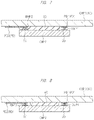
- FIG. 7 is a diagram for explaining a basic concept of the present first embodiment.
- the basic concept of the present first embodiment is a concept based on the injection of the underfill 40 into the gap between the semiconductor chip CHP 1 and the semiconductor chip CHP 2 in the flip-chip connection state, and the concept is no formation of the underfill 40 in the periphery of the connection structure connecting the reading electrode pad PD 1 and the gate terminal 20 through the bump electrode BMP 1 .
- the basic concept of the present first embodiment is the injection of the underfill 40 into the gap between the semiconductor chip CHP 1 and the semiconductor chip CHP 2 in the flip-chip connection state except for the periphery of the connection structure connecting the reading electrode pad PD 1 and the gate terminal 20 through the bump electrode BMP 1 .
- the connection strength between the semiconductor chip CHP 1 and the semiconductor chip CHP 2 in the flip-chip connection state can be secured by the underfill 40
- the increase of the parasitic capacitance due to the underfill 40 can be suppressed because of no intervention of the underfill 40 in the periphery of the connection structure connecting the reading electrode pad PD 1 and the gate terminal 20 through the bump electrode BMP 1 .
- the periphery of the connection structure connecting the reading electrode pad PD 1 and the gate terminal 20 through the bump electrode BMP 1 is vacuumed so as to have a low permittivity
- the increase of the parasitic capacitance due to the underfill 40 having the high permittivity can be suppressed.
- the increase of the noises due to the parasitic capacitance can be suppressed, and therefore, the sensitivity of the semiconductor detector to the measurement of the X-ray energy can be improved.
- FIG. 8 is a diagram for explaining a concept derived from the basic concept.
- the concept derived from the basic concept is a concept without not only the intervention of the underfill 40 in the periphery of the connection structure connecting the reading electrode pad PD 1 and the gate terminal 20 through the bump electrode BMP 1 but also intervention of the underfill 40 in periphery of the connection structure connecting the output electrode pad PD 2 and the output terminal 30 through the bump electrode BMP 2 .
- the noises due to the parasitic capacitance can be suppressed from being superimposed on the weak signal output from the reading electrode pad PD 1 , and besides, the noises due to the parasitic capacitance can be also suppressed from being superimposed on the amplified signal that is amplified by the amplifier formed in the semiconductor chip CHP 2 and output from the output terminal 30 .
- the sensitivity to the measurement of the X-ray energy can be further improved.
- the semiconductor chip CHP 1 having the reading electrode 12 and the reading electrode pad PD 1 electrically connected to the reading electrode 12 formed therein is prepared, and the semiconductor chip CHP 2 having the amplifier is prepared.
- the semiconductor chip CHP 1 and the semiconductor chip CHP 2 are connected to each other in the flip-chip connection state so that the reading electrode pad PD 1 and the amplifier are electrically connected to each other.
- the underfill 40 is injected into the gap between the semiconductor chip CHP 1 and the semiconductor chip CHP 2 except for the first connection portion connecting the reading electrode pad PD 1 and the amplifier. This manner achieves the basic concept of no formation of the underfill 40 in the periphery of the first connection portion connecting the reading electrode pad PD 1 and the amplifier.
- FIG. 9 is a planar view showing a schematic configuration of the semiconductor chip CHP 1 .
- a plurality of concentrically-arranged ring electrodes are formed in the “ring surface” of the semiconductor chip CHP 1 having the silicon drift detector 10 formed therein, and a plurality of pad electrodes PD are arranged in an upper layer of the layer where the plurality of ring electrodes are formed.
- the bump electrode BMP is formed on each of the plurality of pad electrodes PD. More specifically, one of the plurality of pad electrodes PD is the reading electrode pad PD 1 electrically connected to the reading electrode, and a bump electrode BMP 1 is mounted on this reading electrode pad PD 1 . Another one of the plurality of pad electrodes PD is the output electrode pad PD 2 , and the bump electrode BMP 2 is mounted on this output electrode pad PD 2 .
- a guide portion GD 1 is formed in the semiconductor chip CHP 1 .
- This guide portion GD 1 is made of a pad portion PD 3 and a protruding portion BMP 3 formed on the pad portion PD 3 .
- the pad portion PD 3 is formed in a pad layer where the plurality of pad electrodes PD are formed.
- the protruding portion BMP 3 is made of the same material as that of the bump electrode BMP.
- FIG. 10 is a cross-sectional view schematically showing the flip-chip connection structure connecting the semiconductor chip CHP 1 and the semiconductor chip CHP 2 .
- the reading electrode pad PD 1 formed in the semiconductor chip CHP 1 and the gate terminal 20 formed in semiconductor chip CHP 2 are connected to each other by the bump electrode BMP 1 .
- the connection structure connecting the reading electrode pad PD 1 and the gate terminal 20 through the bump electrode BMP 1 is referred to as “first connection structure”.
- the output electrode pad PD 2 formed in the semiconductor chip CHP 1 and the output terminal 30 formed in semiconductor chip CHP 2 are connected to each other by the bump electrode BMP 2 .
- the connection structure connecting the output electrode pad PD 2 and the output terminal 30 through the bump electrode BMP 2 is referred to as “second connection structure”.
- the guide portion GD 1 is formed between the “first connection structure” and the “second connection structure”.
- This guide portion GD 1 is made of the pad portion PD 3 and the protruding portion BMP 3 .
- the “first connection structure” can be suppressed from being surrounded by the underfill 40 . That is, the guide portion GD 1 is formed in order to suppress the surrounding of the “first connection structure” by the underfill 40 .
- the “first connection structure” is surrounded by a space having a lower permittivity than that of the underfill 40 .
- the configuration of the first specific aspect is achieved as follows.
- the semiconductor chip CHP 1 having the reading electrode, the reading electrode pad PD 1 electrically connected to the reading electrode, the output electrode pad PD 2 and the pad portion PD 3 formed therein are prepared.
- the semiconductor chip CHP 2 having the amplifier made of, for example, the field effect transistor having the gate electrode, the source and the drain is prepared. In this process, the semiconductor chip CHP 2 has the gate terminal 20 electrically connected to the gate electrode.
- the bump electrode BMP 1 is arranged on the reading electrode pad PD 1
- the bump electrode BMP 2 is arranged on the output electrode pad PD 2
- the protruding portion BMP 3 is arranged on the pad portion PD 3 .
- the semiconductor chip CHP 1 and the semiconductor chip CHP 2 are connected to each other in the flip-chip connection state so that the reading electrode pad PD 1 and the gate terminal 20 are connected to each other through the bump electrode BMP 1 and so that the output electrode pad PD 2 and the output terminal 30 are connected to each other through the bump electrode BMP 2 .
- the “first connection structure” and the “second connection structure” are formed, and the guide portion GD 1 made of the pad portion PD 3 and the protruding portion BMP 3 is formed.
- the underfill 40 is injected into the gap between the semiconductor chip CHP 1 and the semiconductor chip CHP 2 .
- the underfill 40 is injected in an arrow direction of FIG. 10 into the gap between the semiconductor chip CHP 1 and the semiconductor chip CHP 2 .
- the underfill 40 that is injected into the gap between the semiconductor chip CHP 1 and the semiconductor chip CHP 2 is blocked by the guide portion GD 1 and does not reach the periphery of the “first connection structure”. Therefore, the configuration of the first specific aspect is achieved.
- the above-described first specific aspect is the example of the guide portion GD 1 including the protruding portion BMP 3 made of the same conductive material as that of the bump electrode BMP.
- a second specific aspect is an example of a guide portion GD 2 made of an insulating material represented by, for example, a resist material.
- FIG. 11 is a planar view showing a schematic configuration of the semiconductor chip CHP 1 .
- the configuration of FIG. 11 is the same as the configuration of the first specific aspect, except for the guide portion GD 2 made of the insulating material such as the resist material.
- FIG. 12 is a cross-sectional view schematically showing the flip-chip connection structure connecting the semiconductor chip CHP 1 and the semiconductor chip CHP 2 .
- the guide portion GD 2 is formed between the “first connection structure” and the “second connection structure”.
- This guide portion GD 2 is made of the insulating material such as the resist material.
- the “first connection structure” is suppressed from being surrounded by the underfill 40 by the formation of the guide portion GD 2 between the semiconductor chip CHP 1 and the semiconductor chip CHP 2 .
- the “first connection structure” is surrounded by the space having the lower permittivity than that of the underfill 40 .
- the configuration of the second specific aspect is achieved as follows.
- the semiconductor chip CHP 1 having the reading electrode, the reading electrode pad PD 1 electrically connected to the reading electrode, the output electrode pad PD 2 and the guide portion GD 2 made of the resist material (resist film) formed therein is prepared.
- the guide portion GD 2 made of the resist film can be formed by, for example, applying, and then, patterning the resist material by using a photolithography technique.
- the semiconductor chip CHP 2 having the amplifier made of, for example, the field effect transistor having the gate electrode, the source and the drain is prepared.
- the semiconductor chip CHP 2 has the gate terminal 20 electrically connected to the gate electrode.
- the bump electrode BMP 1 is arranged on the reading electrode pad PD 1
- the bump electrode BMP 2 is arranged on the output electrode pad PD 2
- the protruding portion BMP 3 is arranged on the pad portion PD 3 .
- the semiconductor chip CHP 1 and the semiconductor chip CHP 2 are connected to each other in the flip-chip connection state so that the reading electrode pad PD 1 and the gate terminal 20 are connected to each other through the bump electrode BMP 1 and so that the output electrode pad PD 2 and the output terminal 30 are connected to each other through the bump electrode BMP 2 .
- the “first connection structure” and the “second connection structure” are formed, and the guide portion GD 2 made of the resist material is formed.
- the underfill 40 is injected into the gap between the semiconductor chip CHP 1 and the semiconductor chip CHP 2 .
- the underfill 40 is injected in an arrow direction of FIG. 12 into the gap between the semiconductor chip CHP 1 and the semiconductor chip CHP 2 .
- the underfill 40 that is injected into the gap between the semiconductor chip CHP 1 and the semiconductor chip CHP 2 is blocked by the guide portion GD 2 and does not reach the periphery of the “first connection structure”. Therefore, the configuration of the second specific aspect is achieved.
- first and second specific aspects is the example of the guide portion GD 1 (or the guide portion GD 2 ) in order to avoid the formation of the underfill 40 in the periphery of the “first connection structure”.
- a third specific aspect is an example of a guide portion GD 3 in order to avoid the formation of the underfill 40 in the periphery of the “second connection structure” in addition to the formation of the guide portion GD 1 in order to avoid the formation of the underfill 40 in the periphery of the “first connection structure”.
- FIG. 13 is a planar view showing a schematic configuration of the semiconductor chip CHP 1 .
- the configuration of FIG. 13 is the same as the configuration of the first specific aspect, except for the formation of not only the guide portion GD 1 but also the guide portion GD 3 .
- FIG. 14 is a cross-sectional view schematically showing the flip-chip connection structure connecting the semiconductor chip CHP 1 and the semiconductor chip CHP 2 .
- the guide portion GD 1 not only the guide portion GD 1 but also the guide portion GD 3 are formed between the “first connection structure” and the “second connection structure”.
- This guide portion GD 3 is made of a pad portion PD 4 and a protruding portion BMP 4 .
- both the “first connection structure” and the “second connection structure” are suppressed from being surrounded by the underfill 40 .
- each of the “first connection structure” and the “second connection structure” is surrounded by the space having the lower permittivity than that of the underfill 40 .
- the guide portion GD 1 and the guide portion GD 3 are formed between the “first connection structure” and the “second connection structure”, the basic concept of no formation of the underfill 40 in the periphery of the “first connection structure” is embodied, and besides, the configuration of no formation of the underfill 40 in the periphery of the “second connection structure” is also achieved.
- the configuration of the third specific aspect is achieved as follows.
- the semiconductor chip CHP 1 having the reading electrode, the reading electrode pad PD 1 electrically connected to the reading electrode, the output electrode pad PD 2 and the pad portions PD 3 and PD 4 formed therein is prepared.
- the semiconductor chip CHP 2 having the amplifier made of, for example, the field effect transistor having the gate electrode, the source and the drain is prepared.
- the semiconductor chip CHP 2 has the gate terminal 20 electrically connected to the gate electrode and the output terminal 30 for use in outputting the amplified signal.
- the bump electrode BMP 1 is arranged on the reading electrode pad PD 1
- the bump electrode BMP 2 is arranged on the output electrode pad PD 2
- the protruding portion BMP 3 is arranged on the pad portion PD 3
- the protruding portion PD 4 is arranged on the pad portion PD 4 .
- the semiconductor chip CHP 1 and the semiconductor chip CHP 2 are connected to each other in the flip-chip connection state so that the reading electrode pad PD 1 and the gate terminal 20 are connected to each other through the bump electrode BMP 1 and so that the output electrode pad PD 2 and the output terminal 30 are connected to each other through the bump electrode BMP 2 .
- the “first connection structure” and the “second connection structure” are formed between the semiconductor chip CHP 1 and the semiconductor chip CHP 2 .
- the guide portion GD 1 made of the pad portion PD 3 and the protruding portion BMP 3 and the guide portion GD 3 made of the pad portion PD 3 and the protruding portion BMP 4 are formed between the semiconductor chip CHP 1 and the semiconductor chip CHP 2 .
- the underfill 40 is injected into the gap between the semiconductor chip CHP 1 and the semiconductor chip CHP 2 .
- the underfill 40 that is injected into the gap between the semiconductor chip CHP 1 and the semiconductor chip CHP 2 is blocked by the guide portion GD 1 and does not reach the periphery of the “first connection structure”, and besides, is blocked by the guide portion GD 3 and does not reach the periphery of the “second connection structure”. Therefore, the configuration of the third specific aspect is achieved.
- the feature point of the present first embodiment is that the guide portion GD 1 is formed between the “first connection structure” and the “second connection structure” in order to suppress the covering of the “first connection structure” with the underfill 40 to embody the above-described basic concept.
- the underfill 40 that is injected into the gap between the semiconductor chip CHP 1 and the semiconductor chip CHP 2 is blocked by the guide portion GD 1 before reaching the “first connection structure”.
- the “first connection structure” is not covered with the underfill 40 but surrounded by the space having the lower permittivity than that of the underfill 40 .
- the increase of the parasitic capacitance due to the underfill 40 can be suppressed.
- the periphery of the “first connection structure” between the reading electrode pad PD 1 and the gate terminal 20 through the bump electrode BMP 1 is the space having the lower permittivity, the increase of the parasitic capacitance due to the underfill 40 having the higher permittivity can be suppressed. Therefore, according to the present first embodiment, the increase of the noises due to the parasitic capacitance can be suppressed, and thus, the sensitivity of the semiconductor detector 100 to the measurement of the X-ray energy can be improved.
- a large technical significance of the feature point of the present first embodiment is to form the space in the periphery of the “first connection structure”.
- the semiconductor detector 100 including the silicon drift detector 10 is used in a vacuum state. That is, in the semiconductor detector 100 , this is because it can be said that the formation of the space in the periphery of the “first connection structure” means that the periphery of the “first connection structure” is vacuumed, and is desirable in order to effectively reduce the parasitic capacitance because a permittivity of the vacuum state is the lowest.
- the semiconductor detector 100 is used in the vacuum state.
- it is necessary to reduce a dark current to be a cause of the noises and, the higher a temperature is, the larger the dark current is. Therefore, in the semiconductor detector 100 , a Peltier element is used for cooling to reduce the dark current to be the cause of the noises.
- a Peltier element is used for cooling to reduce the dark current to be the cause of the noises.
- the semiconductor detector 100 including the silicon drift detector 10 is used in the vacuum state.
- the feature point of the present first embodiment is achieved by, for example, the above-described first, second and third specific aspects.
- the protruding portion BMP 3 of the guide portion GD 1 is made of the same conductive material as that of the bump electrode BMP, an advantage of the first specific aspect is exemplified to be easiness of the height adjustment and easiness of insertion of the step of forming the guide portion GD 1 into the step of forming the “first connection structure”.
- the guide portion GD 2 is made of the insulating material represented by the resist material, an advantage of the second specific aspect is exemplified to be no concern of adverse electric influence on the closely-arranged “first connection structure”. And, in utilization of characteristics of the resist capable of simultaneously forming a plurality of micro patterns, this is exemplified to be, for example, no concern of adverse electric influence on other terminals (the output terminal, the DC power supply terminal, the rest pulse terminal and others) other than the “first connection structure” and others.
- an advantage of the third specific aspect is exemplified to be capable of forming the space having the low permittivity in in the periphery of the “first connection structure” because of the guide portion GD 1 , and besides, to be capable of forming the space having the low permittivity in the periphery of the “second connection structure” because of the guide portion GD 3 .
- the noises superimposed on the weak output signal from the reading electrode pad PD 1 can be reduced, and besides, the superimposed noises in the output of the amplified signal of the weak signal from the output terminal can be also reduced. Therefore, the sensitivity of the semiconductor detector 100 to the measurement of the X-ray energy can be further improved.
- a guide portion can be also formed in the peripheries of the DC power supply terminal, the reset pulse terminal and others other than the gate terminal 20 and the output terminal 30 of the amplifier 15 so as not to intervene the underfill. This configuration is effective for further reduction of the noises superimposed on the weak signal.
- the basic concept of the first embodiment is based on the injection of the underfill 40 into the gap between the semiconductor chip CHP 1 and the semiconductor chip CHP 2 in the flip-chip connection state, and the concept is no formation of the underfill 40 in the periphery of the “first connection structure” between the reading electrode pad PD 1 and the gate terminal 20 through the bump electrode BMP 1 .
- a basic concept of the present second embodiment is no injection of the underfill 40 into the gap between the semiconductor chip CHP 1 and the semiconductor chip CHP 2 in the flip-chip connection state.
- the underfill 40 having a high permittivity does not intervene in the periphery of the “first connection structure”
- the increase of the parasitic capacitance due to the underfill 40 can be suppressed.
- the noises superimposed on the weak signal that passes the “first connection structure” can be reduced, and therefore, the sensitivity of the semiconductor detector 100 to the measurement of the X-ray energy can be improved.
- the present second embodiment is based on the application of the basic concept of no injection of the underfill 40 into the gap between the semiconductor chip CHP 1 and the semiconductor chip CHP 2 in the flip-chip connection state in order to suppress the increase of the parasitic capacitance due to the underfill 40 , and is applied with the devisal for suppressing the reduction of the connection strength between the semiconductor chip CHP 1 and the semiconductor chip CHP 2 due to the application of this basic concept.
- a technical concept of the present second embodiment applied with this devisal will be explained below.
- FIG. 15 is a cross-sectional view showing a schematic configuration of a semiconductor detector according to the present second embodiment.
- a semiconductor detector 400 includes a semiconductor chip CHP 1 having a silicon drift detector 10 formed therein.
- a reading electrode pad PD 1 and an output electrode pad PD 2 are formed.
- the semiconductor detector 400 includes a wiring board WB that is connected to the semiconductor chip CHP 1 in a flip-chip connection state and that has an opening OP 2 .
- the wiring board WB and the semiconductor chip CHP 1 are connected to each other by, for example, an adhesive 50 .
- the semiconductor detector 400 further includes an amplifier electrically connected to the reading electrode pad PD 1 formed in the semiconductor chip CHP 1 , and includes a semiconductor chip CHP 2 that is arranged inside the opening OP 2 and that is connected to the semiconductor chip CHP 1 in a flip-chip connection state.
- the amplifier made of a field effect transistor having a gate electrode, a source and a drain is formed.
- the semiconductor chip CHP 2 has a gate terminal 20 electrically connected to the gate electrode and an output terminal 30 that outputs an amplified signal that is amplified by the amplifier.
- the reading electrode pad PD 1 formed in the semiconductor chip CHP 1 and the gate terminal 20 formed in the semiconductor chip CHP 2 are connected to each other by the bump electrode BMP 1 (“first connection structure”).
- the output electrode pad PD 2 formed in the semiconductor chip CHP 1 and the output terminal 30 formed in the semiconductor chip CHP 2 are connected to each other by the bump electrode BMP 2 (“second connection structure”).
- the flip-chip connection between the semiconductor chip CHP 1 and the semiconductor chip CHP 2 is achieved by the “first connection structure” and the “second connection structure”.
- the wiring board WB and the semiconductor chip CHP 1 are connected to each other in the flip-chip connection state, and the semiconductor chip CHP 1 and the semiconductor chip CHP 2 are also connected to each other in the flip-chip connection state.
- the underfill does not intervene between the semiconductor chip CHP 1 and the semiconductor chip CHP 2 including the “first connection structure” between the reading electrode pad PD 1 and the gate terminal 20 through the bump electrode BMP 1 and the “second connection structure” between the output electrode pad PD 2 and the output terminal 30 through the bump electrode BMP 2 .
- the underfill having the high permittivity does not intervene in the periphery of the “first connection structure”
- the increase of the parasitic capacitance due to the underfill can be suppressed.
- the noises superimposed on the weak signal that passes through the “first connection structure” can be reduced, and therefore, the sensitivity of the semiconductor detector 400 to the measurement of the X-ray energy can be improved.
- the following devisal has been made to the semiconductor detector 400 according to the present second embodiment in order to suppress the reduction of the connection strength between the semiconductor chip CHP 1 and the semiconductor chip CHP 2 . That is, as shown in FIG. 15 , the semiconductor chip CHP 2 is fixed at inside of the opening OP 2 formed in the wiring board WB by an adhesive 60 . In this manner, according to the present second embodiment, even without the usage of the underfill, the reliability of the connection between the semiconductor chip CHP 1 and the semiconductor chip CHP 2 can be improved by the firm fixation of the semiconductor chip CHP 2 to the wiring board WB by the adhesive 60 .
- the semiconductor detector 400 according to the present second embodiment since the underfill is not injected into the gap between the semiconductor chip CHP 1 and the semiconductor chip CHP 2 , the increase of the parasitic capacitance due to the underfill can be suppressed. And, even without the usage of the underfill, the reduction of the connection strength between the semiconductor chip CHP 1 and the semiconductor chip CHP 2 can be suppressed by the devisal of the fixation of the semiconductor chip CHP 2 at the inside of the opening OP 2 formed in the wiring board WB by the adhesive 60 . Therefore, it can be said that the semiconductor detector 400 according to the present second embodiment is superior in terms of achievement of both the suppression of the increase of the parasitic capacitance and the suppression of the reduction of the connection strength between the semiconductor chip CHP 1 and the semiconductor chip CHP 2 .
- FIG. 16 is a diagram for explaining a verification result.
- the first related art describes a “wire-bonding connection structure” in which the reading electrode and the gate terminal are connected to each other by the wire.
- a “Mn-Ka half width (eV)” is 130 to 135.
- the “Mn-Ka half width (eV)” indicates a half width of a peak of a K ⁇ radiation (5890 eV) of manganese (Mn). The more the noises are, the larger the half width is. Therefore, the smaller the “Mn-Ka half width (eV)” is, the higher the measurement sensitivity is, and the better its performance is.
- the second related art describes a “flip-chip connection structure” in which the reading electrode pad and the gate terminal are connected to each other by the bump electrode.
- the underfill is injected into the gap between the first semiconductor chip having the reading electrode pad formed therein and the second semiconductor chip having the gate terminal formed therein.
- the “Mn-Ka half width (eV)” is larger than that of the first related art because of the parasitic capacitance due to the underfill having the high permittivity.
- the guide portion is formed in the region closer to the reading electrode.
- the “first connection structure” between the reading electrode pad and the gate terminal through the bump electrode is not covered with the underfill but surrounded by the space.
- the “Mn-Ka half width (eV)” is 127 to 132. This means that the first embodiment (first specific aspect) reduces the influence of the parasitic capacitance due to the underfill and reduces the noises contained in the signal. Therefore, it can be found that the first embodiment (first specific aspect) can more improve the sensitivity of the semiconductor detector to the measurement of the X-ray energy than those of the first and second related arts.
- the guide portion is formed in the region closer to the reading electrode, and besides, the guide portion is also formed in the region closer to the output terminal.
- the “Mn-Ka half width (eV)” is 126 to 131.
- the first embodiment (third specific aspect) can also more improve the sensitivity of the semiconductor detector to the measurement of the X-ray energy than those of the first and second related arts.
- the underfill does not intervene between the first semiconductor chip having the reading electrode pad and the output electrode pad formed therein and the second semiconductor chip having the gate terminal and the output terminal formed therein.
- the “first connection structure” and the “second connection structure” are not covered with the underfill but surrounded by the space.
- the “Mn-Ka half width (eV)” is 127 to 132. Therefore, it can be found that the second embodiment can also more improve the sensitivity of the semiconductor detector to the measurement of the X-ray energy than those of the first and second related arts.
- the noises contained in the signal can be made less than those of the first and second related arts. As a result, the improvement of the sensitivity of the semiconductor detector to the measurement of the X-ray energy can be confirmed.
- the embodiments include the following aspect.
- the semiconductor detector In a semiconductor detector measuring energy of electromagnetic wave on the basis of an electric charge amount of electric charge carriers being generated by making incidence of the electromagnetic wave into a depletion layer applied with a drift electric field, the electric charge carriers being moved to and collected in a reading electrode by the drift electric field, the semiconductor detector includes: a first semiconductor chip that has the reading electrode and a reading electrode pad electrically connected to the reading electrode formed therein; a wiring board that is connected to the first semiconductor chip in a flip-chip connection state and that has an opening; and a second semiconductor chip that has an amplifier electrically connected to the reading electrode pad, that is arranged inside the opening and that is connected to the first semiconductor chip in a flip-chip connection state.
- the second semiconductor chip is fixed at inside of the opening by an adhesive, and an underfill does not intervene between the second semiconductor chip and the first semiconductor chip including a first connection portion connecting the reading electrode pad and the amplifier.
Landscapes
- Physics & Mathematics (AREA)
- General Physics & Mathematics (AREA)
- Health & Medical Sciences (AREA)
- Life Sciences & Earth Sciences (AREA)
- High Energy & Nuclear Physics (AREA)
- Molecular Biology (AREA)
- Spectroscopy & Molecular Physics (AREA)
- Electromagnetism (AREA)
- Solid State Image Pick-Up Elements (AREA)
- Measurement Of Radiation (AREA)
Abstract
Description
Claims (11)
Applications Claiming Priority (3)
| Application Number | Priority Date | Filing Date | Title |
|---|---|---|---|
| JP2020-093018 | 2020-05-28 | ||
| JPJP2020-093018 | 2020-05-28 | ||
| JP2020093018A JP7423423B2 (en) | 2020-05-28 | 2020-05-28 | Semiconductor detector and its manufacturing method |
Publications (2)
| Publication Number | Publication Date |
|---|---|
| US20210375978A1 US20210375978A1 (en) | 2021-12-02 |
| US11417702B2 true US11417702B2 (en) | 2022-08-16 |
Family
ID=74884817
Family Applications (1)
| Application Number | Title | Priority Date | Filing Date |
|---|---|---|---|
| US17/206,566 Active US11417702B2 (en) | 2020-05-28 | 2021-03-19 | Semiconductor detector and method of manufacturing the same |
Country Status (4)
| Country | Link |
|---|---|
| US (1) | US11417702B2 (en) |
| EP (1) | EP3916433B1 (en) |
| JP (1) | JP7423423B2 (en) |
| CN (1) | CN113740617B (en) |
Families Citing this family (4)
| Publication number | Priority date | Publication date | Assignee | Title |
|---|---|---|---|---|
| US10957672B2 (en) * | 2017-11-13 | 2021-03-23 | Taiwan Semiconductor Manufacturing Company, Ltd. | Package structure and method of manufacturing the same |
| KR20240107099A (en) | 2021-11-19 | 2024-07-08 | 닛뽕소다 가부시키가이샤 | Method for producing 2-alkylthio-1-imidazoylethanone compound |
| JP7792275B2 (en) * | 2022-03-11 | 2025-12-25 | 株式会社日立ハイテクアナリシス | Semiconductor detector and manufacturing method thereof |
| KR102708332B1 (en) * | 2022-03-23 | 2024-09-23 | 주식회사 비엘 | Scrap iron separation system using XRF |
Citations (8)
| Publication number | Priority date | Publication date | Assignee | Title |
|---|---|---|---|---|
| EP0510707A2 (en) * | 1991-04-26 | 1992-10-28 | Sumitomo Electric Industries, Ltd. | Multi-stage amplifier device and method for producing the same |
| EP1200533A1 (en) | 1999-07-30 | 2002-05-02 | 3M Innovative Properties Company | Method of producing a laminated structure |
| US20040118599A1 (en) | 2002-12-23 | 2004-06-24 | Motorola, Inc. | Selective underfill for flip chips and flip-chip assemblies |
| US20050167606A1 (en) * | 2003-08-20 | 2005-08-04 | Harrison Fiona A. | Cadmium-zinc-telluride detectors |
| US20090290680A1 (en) * | 2004-03-26 | 2009-11-26 | Nova R & D, Inc. | High resolution imaging system |
| US20120193545A1 (en) * | 2011-01-31 | 2012-08-02 | General Electric Company | Detector systems with anode incidence face and methods of fabricating the same |
| US20190067037A1 (en) | 2017-08-29 | 2019-02-28 | Ciena Corporation | Flip-chip high speed components with underfill |
| US20190324160A1 (en) | 2018-04-23 | 2019-10-24 | Hitachi, Ltd. | X-ray detector and x-ray measurement device using the same |
Family Cites Families (4)
| Publication number | Priority date | Publication date | Assignee | Title |
|---|---|---|---|---|
| RU2605523C2 (en) * | 2011-11-09 | 2016-12-20 | Конинклейке Филипс Н.В. | Radiation-sensitive detector device with charge-rejecting segment gaps |
| US9123837B2 (en) * | 2013-05-31 | 2015-09-01 | Oxford Instruments Analytical Oy | Semiconductor detector with radiation shield |
| CN104078431B (en) * | 2014-06-27 | 2017-02-01 | 中国科学院上海微系统与信息技术研究所 | Packaging and interconnecting structure and method for copper protruded points filled up with double layers of underfill |
| JP2016024085A (en) | 2014-07-22 | 2016-02-08 | 株式会社島津製作所 | Silicon drift detector |
-
2020
- 2020-05-28 JP JP2020093018A patent/JP7423423B2/en active Active
-
2021
- 2021-03-16 EP EP21162735.1A patent/EP3916433B1/en active Active
- 2021-03-17 CN CN202110285017.6A patent/CN113740617B/en active Active
- 2021-03-19 US US17/206,566 patent/US11417702B2/en active Active
Patent Citations (10)
| Publication number | Priority date | Publication date | Assignee | Title |
|---|---|---|---|---|
| EP0510707A2 (en) * | 1991-04-26 | 1992-10-28 | Sumitomo Electric Industries, Ltd. | Multi-stage amplifier device and method for producing the same |
| EP1200533A1 (en) | 1999-07-30 | 2002-05-02 | 3M Innovative Properties Company | Method of producing a laminated structure |
| US20020066528A1 (en) * | 1999-07-30 | 2002-06-06 | 3M Innovative Properties Company | Method of producing a laminated structure |
| US20040118599A1 (en) | 2002-12-23 | 2004-06-24 | Motorola, Inc. | Selective underfill for flip chips and flip-chip assemblies |
| US20050167606A1 (en) * | 2003-08-20 | 2005-08-04 | Harrison Fiona A. | Cadmium-zinc-telluride detectors |
| US20090290680A1 (en) * | 2004-03-26 | 2009-11-26 | Nova R & D, Inc. | High resolution imaging system |
| US20120193545A1 (en) * | 2011-01-31 | 2012-08-02 | General Electric Company | Detector systems with anode incidence face and methods of fabricating the same |
| US20190067037A1 (en) | 2017-08-29 | 2019-02-28 | Ciena Corporation | Flip-chip high speed components with underfill |
| US20190324160A1 (en) | 2018-04-23 | 2019-10-24 | Hitachi, Ltd. | X-ray detector and x-ray measurement device using the same |
| JP2019190934A (en) | 2018-04-23 | 2019-10-31 | 株式会社日立製作所 | X-ray detector and x-ray measuring device using the same |
Non-Patent Citations (1)
| Title |
|---|
| Search Report dated Sep. 9, 2021 in European Application No. 21162735.1. |
Also Published As
| Publication number | Publication date |
|---|---|
| CN113740617B (en) | 2024-10-11 |
| JP2021188983A (en) | 2021-12-13 |
| EP3916433A1 (en) | 2021-12-01 |
| EP3916433B1 (en) | 2025-01-15 |
| JP7423423B2 (en) | 2024-01-29 |
| US20210375978A1 (en) | 2021-12-02 |
| CN113740617A (en) | 2021-12-03 |
Similar Documents
| Publication | Publication Date | Title |
|---|---|---|
| US11417702B2 (en) | Semiconductor detector and method of manufacturing the same | |
| US6455858B1 (en) | Semiconductor radiation detector | |
| US9261610B2 (en) | High purity germanium detector | |
| JP6393347B2 (en) | Charge detection amplifier | |
| ITTO20100251A1 (en) | AVALANCHE PHOTODIODO OPERATING IN GEIGER MODE WITH HIGH SIGNAL NOISE REPORT AND RELATIVE MANUFACTURING PROCEDURE | |
| TWI806960B (en) | light detection device | |
| US20080230862A1 (en) | Method, Apparatus, Material, and System of Using a High Gain Avalanche Photodetector Transistor | |
| CN103872016B (en) | Semi-conductor test structure, its method of testing and manufacture method thereof | |
| US10971538B2 (en) | PiN diode structure having surface charge suppression | |
| US11604292B2 (en) | Charge preamplifier device and radiation detecting apparatus comprising the device | |
| Kandiah et al. | Limits of resolution of charge sensitive detector systems | |
| US20240105740A1 (en) | Photodiode device with enhanced characteristics | |
| US20250204058A1 (en) | Avalanche Photodiode With Field Plates | |
| Lund et al. | Epitaxial n-channel JFETs integrated on high resistivity silicon for X-ray detectors | |
| CN106249269B (en) | semiconductor detector | |
| KR101091205B1 (en) | Vertical silicon photomultiplier decreased dark current | |
| JP5218610B2 (en) | Optical semiconductor device | |
| CN117712217A (en) | A silicon carbide detector chip and circuit integrating BJT | |
| JP2008305857A (en) | Optical semiconductor device | |
| KR20170084387A (en) | Biosensor | |
| JPWO2012081109A1 (en) | Strip detector |
Legal Events
| Date | Code | Title | Description |
|---|---|---|---|
| AS | Assignment |
Owner name: HITACHI, LTD., JAPAN Free format text: ASSIGNMENT OF ASSIGNORS INTEREST;ASSIGNORS:HOZAWA, KAZUYUKI;TAKEZAKI, TAIICHI;REEL/FRAME:055663/0398 Effective date: 20210310 |
|
| FEPP | Fee payment procedure |
Free format text: ENTITY STATUS SET TO UNDISCOUNTED (ORIGINAL EVENT CODE: BIG.); ENTITY STATUS OF PATENT OWNER: LARGE ENTITY |
|
| STPP | Information on status: patent application and granting procedure in general |
Free format text: DOCKETED NEW CASE - READY FOR EXAMINATION |
|
| STPP | Information on status: patent application and granting procedure in general |
Free format text: NON FINAL ACTION MAILED |
|
| STPP | Information on status: patent application and granting procedure in general |
Free format text: RESPONSE TO NON-FINAL OFFICE ACTION ENTERED AND FORWARDED TO EXAMINER |
|
| STPP | Information on status: patent application and granting procedure in general |
Free format text: NOTICE OF ALLOWANCE MAILED -- APPLICATION RECEIVED IN OFFICE OF PUBLICATIONS |
|
| STPP | Information on status: patent application and granting procedure in general |
Free format text: PUBLICATIONS -- ISSUE FEE PAYMENT VERIFIED |
|
| STCF | Information on status: patent grant |
Free format text: PATENTED CASE |
|
| MAFP | Maintenance fee payment |
Free format text: PAYMENT OF MAINTENANCE FEE, 4TH YEAR, LARGE ENTITY (ORIGINAL EVENT CODE: M1551); ENTITY STATUS OF PATENT OWNER: LARGE ENTITY Year of fee payment: 4 |