US11411983B2 - Dynamic, resilient sensing system for automatic cyber-attack neutralization - Google Patents
Dynamic, resilient sensing system for automatic cyber-attack neutralization Download PDFInfo
- Publication number
- US11411983B2 US11411983B2 US16/654,319 US201916654319A US11411983B2 US 11411983 B2 US11411983 B2 US 11411983B2 US 201916654319 A US201916654319 A US 201916654319A US 11411983 B2 US11411983 B2 US 11411983B2
- Authority
- US
- United States
- Prior art keywords
- monitoring node
- values
- space
- industrial asset
- monitoring
- Prior art date
- Legal status (The legal status is an assumption and is not a legal conclusion. Google has not performed a legal analysis and makes no representation as to the accuracy of the status listed.)
- Active, expires
Links
Images


Classifications
-
- H—ELECTRICITY
- H04—ELECTRIC COMMUNICATION TECHNIQUE
- H04L—TRANSMISSION OF DIGITAL INFORMATION, e.g. TELEGRAPHIC COMMUNICATION
- H04L63/00—Network architectures or network communication protocols for network security
- H04L63/14—Network architectures or network communication protocols for network security for detecting or protecting against malicious traffic
- H04L63/1441—Countermeasures against malicious traffic
-
- G—PHYSICS
- G01—MEASURING; TESTING
- G01R—MEASURING ELECTRIC VARIABLES; MEASURING MAGNETIC VARIABLES
- G01R19/00—Arrangements for measuring currents or voltages or for indicating presence or sign thereof
- G01R19/0092—Measuring current only
-
- G—PHYSICS
- G06—COMPUTING OR CALCULATING; COUNTING
- G06F—ELECTRIC DIGITAL DATA PROCESSING
- G06F21/00—Security arrangements for protecting computers, components thereof, programs or data against unauthorised activity
- G06F21/50—Monitoring users, programs or devices to maintain the integrity of platforms, e.g. of processors, firmware or operating systems
- G06F21/55—Detecting local intrusion or implementing counter-measures
- G06F21/554—Detecting local intrusion or implementing counter-measures involving event detection and direct action
-
- G—PHYSICS
- G06—COMPUTING OR CALCULATING; COUNTING
- G06N—COMPUTING ARRANGEMENTS BASED ON SPECIFIC COMPUTATIONAL MODELS
- G06N20/00—Machine learning
-
- G—PHYSICS
- G06—COMPUTING OR CALCULATING; COUNTING
- G06N—COMPUTING ARRANGEMENTS BASED ON SPECIFIC COMPUTATIONAL MODELS
- G06N3/00—Computing arrangements based on biological models
- G06N3/02—Neural networks
- G06N3/04—Architecture, e.g. interconnection topology
- G06N3/045—Combinations of networks
-
- G—PHYSICS
- G06—COMPUTING OR CALCULATING; COUNTING
- G06N—COMPUTING ARRANGEMENTS BASED ON SPECIFIC COMPUTATIONAL MODELS
- G06N3/00—Computing arrangements based on biological models
- G06N3/02—Neural networks
- G06N3/04—Architecture, e.g. interconnection topology
- G06N3/045—Combinations of networks
- G06N3/0455—Auto-encoder networks; Encoder-decoder networks
-
- G—PHYSICS
- G06—COMPUTING OR CALCULATING; COUNTING
- G06N—COMPUTING ARRANGEMENTS BASED ON SPECIFIC COMPUTATIONAL MODELS
- G06N3/00—Computing arrangements based on biological models
- G06N3/02—Neural networks
- G06N3/04—Architecture, e.g. interconnection topology
- G06N3/0464—Convolutional networks [CNN, ConvNet]
-
- G—PHYSICS
- G06—COMPUTING OR CALCULATING; COUNTING
- G06N—COMPUTING ARRANGEMENTS BASED ON SPECIFIC COMPUTATIONAL MODELS
- G06N3/00—Computing arrangements based on biological models
- G06N3/02—Neural networks
- G06N3/08—Learning methods
- G06N3/088—Non-supervised learning, e.g. competitive learning
-
- G—PHYSICS
- G06—COMPUTING OR CALCULATING; COUNTING
- G06N—COMPUTING ARRANGEMENTS BASED ON SPECIFIC COMPUTATIONAL MODELS
- G06N3/00—Computing arrangements based on biological models
- G06N3/02—Neural networks
- G06N3/08—Learning methods
- G06N3/092—Reinforcement learning
-
- G—PHYSICS
- G01—MEASURING; TESTING
- G01R—MEASURING ELECTRIC VARIABLES; MEASURING MAGNETIC VARIABLES
- G01R19/00—Arrangements for measuring currents or voltages or for indicating presence or sign thereof
- G01R19/25—Arrangements for measuring currents or voltages or for indicating presence or sign thereof using digital measurement techniques
- G01R19/2506—Arrangements for conditioning or analysing measured signals, e.g. for indicating peak values ; Details concerning sampling, digitizing or waveform capturing
-
- G—PHYSICS
- G01—MEASURING; TESTING
- G01R—MEASURING ELECTRIC VARIABLES; MEASURING MAGNETIC VARIABLES
- G01R19/00—Arrangements for measuring currents or voltages or for indicating presence or sign thereof
- G01R19/25—Arrangements for measuring currents or voltages or for indicating presence or sign thereof using digital measurement techniques
- G01R19/2513—Arrangements for monitoring electric power systems, e.g. power lines or loads; Logging
-
- G—PHYSICS
- G01—MEASURING; TESTING
- G01R—MEASURING ELECTRIC VARIABLES; MEASURING MAGNETIC VARIABLES
- G01R35/00—Testing or calibrating of apparatus covered by the other groups of this subclass
-
- G—PHYSICS
- G06—COMPUTING OR CALCULATING; COUNTING
- G06N—COMPUTING ARRANGEMENTS BASED ON SPECIFIC COMPUTATIONAL MODELS
- G06N20/00—Machine learning
- G06N20/10—Machine learning using kernel methods, e.g. support vector machines [SVM]
Definitions
- Industrial control systems that operate physical systems (e.g., associated with power turbines, jet engines, locomotives, autonomous vehicles, etc.) are increasingly connected to the Internet. As a result, these control systems have been increasingly vulnerable to threats, such as cyber-attacks (e.g., associated with a computer virus, malicious software, etc.), that could disrupt electric power generation and distribution, damage engines, inflict vehicle malfunctions, etc.
- cyber-attacks e.g., associated with a computer virus, malicious software, etc.
- Current methods primarily consider attack detection in Information Technology (“IT,” such as, computers that store, retrieve, transmit, manipulate data) and Operation Technology (“OT,” such as direct monitoring devices and communication bus interfaces). Cyber-attacks can still penetrate through these protection layers and reach the physical “domain” as seen in 2010 with the Stuxnet attack.
- IT Information Technology
- OT Operation Technology
- a virtual sensing system may get a portion of sensor measurements that are healthy and uncompromised and use that information to provide healthy estimations for the measurements of the sensors that are compromised.
- this approach may present a combinatorial problem that requires that a substantial number of estimation models be developed and stored. As a result, this technique can require a relatively long development time frame using brute force methods.
- an industrial asset may be associated with a plurality of monitoring nodes, each monitoring node generating a series of monitoring node values over time that represent operation of the industrial asset.
- An abnormality detection computer may determine that an abnormal monitoring node is currently being attacked or experiencing fault.
- a dynamic, resilient estimator may construct, using only normal monitoring node values, a latent feature space (of lower dimensionality as compared to a temporal space) associated with latent features. The system also constructs, using normal monitoring node values, functions to project values into the latent feature space. Responsive to an indication that a node is currently being attacked or experiencing fault, the system may compute optimal values of the latent features to minimize a reconstruction error of the nodes not currently being attacked or experiencing a fault. The optimal values may then be projected back into the temporal space to provide estimated values and the current monitoring node values from the abnormal monitoring node are replaced with the estimated values.
- Some embodiments comprise: means for constructing, by a dynamic, resilient estimator using only normal monitoring node values over time that represent a normal operation of the industrial asset, a latent feature space, of lower dimensionality as compared to a temporal monitoring node space, associated with latent features; means for constructing, using only normal monitoring node values over time that represent a normal operation of the industrial asset, functions to project monitoring node values into the latent feature space; responsive to an indication that the at least one abnormal monitoring node is currently being attacked or experiencing a fault, means for automatically computing optimal values of the latent features to minimize a reconstruction error associated with the monitoring nodes not currently being attacked or experiencing a fault; means for projecting the optimal values from the latent feature space back into the temporal monitoring node space to provide estimated values of the at least one abnormal monitoring node currently being attacked or experiencing a fault; and means for replacing the current series of monitoring node values from the at least one abnormal monitoring node with the estimated values.
- Some technical advantages of some embodiments disclosed herein are improved systems and methods to protect an industrial asset from cyber-attacks in an automatic and accurate manner.
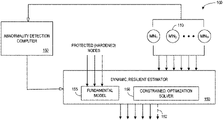
- FIG. 1 is a high-level block diagram of a system to protect an industrial asset according to some embodiments.
- FIG. 2 is an industrial asset protection method in accordance with some embodiments.
- FIG. 3 is a block diagram of an industrial asset protection system according to some embodiment.
- FIG. 4 illustrates a method of generating an abnormality alert in accordance with some embodiments.
- FIGS. 5 and 6 illustrate features, feature vectors, and decision boundaries in accordance with some embodiments.
- FIG. 7 is an abnormality detection model creation method according to some embodiments.
- FIG. 8 is a correlation heat map of monitoring nodes in accordance with some embodiments.
- FIG. 9 includes a portion of a virtual sensor lookup table according to some embodiments.
- FIG. 10 is an example of a global threat protection system in accordance with some embodiments when multiple gas turbines are involved in a system.
- FIG. 11 is a method that might be associated with an on-line operational process in accordance with some embodiments.
- FIG. 12 is a method of determining whether an attack is an independent attack or a dependent attack according to some embodiments.
- FIG. 13 illustrates a feature time series of an attack comparing the real-time feature of a monitoring node to the modeled feature of the monitoring node according to some embodiments.
- FIG. 14 illustrates a feature time series of a stealthy attack comparing the real-time feature of a monitoring node to the modeled feature of a monitoring node in accordance with some embodiments.
- FIG. 15 is an example of attack localization in a multiple-attack scenario according to some embodiments.
- FIG. 16 is a causal dependency matrix of monitoring nodes in accordance with some embodiments.
- FIG. 17 is an autonomous reconfigurable virtual sensing system architecture according to some embodiments.
- FIG. 18 illustrates a sliding window technique for real-time measurements in accordance with some embodiments.
- FIG. 19 is a method according to some embodiments.
- FIG. 20 is an example of features in principal component space in accordance with some embodiments.
- FIG. 21 is an example of an auto-encoder including encoder and decoder parts according to some embodiments.
- FIG. 22 illustrates a system associated with an optimization problem in accordance with some embodiments.
- FIG. 23 is a block diagram of an industrial asset protection platform according to some embodiments of the present invention.
- FIG. 24 is a tabular portion of a virtual sensor database in accordance with some embodiments.
- FIG. 25 is a virtual sensor display according to some embodiments.
- FIG. 26 is an autonomous reconfigurable virtual sensing system in accordance with some embodiments.
- Industrial control systems that operate physical systems are increasingly connected to the Internet.
- the term “industrial” might be associated with any system that is connected to an external source, such as the Internet in the case of a cyber-physical system or locally operating an air-gapped physical system.
- these control systems have been increasingly vulnerable to threats and, in some cases, multiple attacks may occur simultaneously.
- Protecting an asset may depend on detecting such attacks as well as naturally occurring faults and failures.
- Existing approaches to protect an industrial control system, such as failure and diagnostics technologies may not adequately address these threats—especially when multiple, simultaneous attacks occur. It would therefore be desirable to protect an industrial asset from cyber threats in an automatic and accurate manner.
- an operator of an industrial asset might want to implement “accommodation” procedures such that critical functions of the asset may automatically still function even in the event of one or more cyber-attacks or monitoring node failure (e.g., by replacing unhealthy sensor node data values with virtual sensor data values based on information obtained from other, healthy nodes).
- Some embodiments described herein may provide a system and method for autonomous reconfigurable virtual sensing to neutralize the effect of anomalies (cyber-attacks or faults) in the system measurements.
- the system may provide correct estimates of the compromised sensor measurements using the uncompromised sensor measurements, thus replacing the compromised sensors with healthy “virtual” (e.g., soft or surrogate) sensors.
- the virtual sensing estimator may use unsupervised learning methods to extract important features from sensor data in healthy conditions and cast an optimization problem that is solved on-line to reconstruct the attacked sensors in the underlying feature space.
- the method may work with various invertible features set with determined mapping from sensor-to-feature and feature-to-sensor spaces. That is, any invertible mapping between features and sensor space might be utilized by the neutralization technologies described herein.
- the optimization problem may be a constrained one, in some embodiments, where domain knowledge is utilized to determine the constraints.
- the system may be scalable because it requires minimal knowledge of the underlying system model and possible attack scenarios. Moreover, the identification of the dominant features of the sensor data may be done off-line, in an unsupervised way, using only normal operation data (that is, labeled data for attacks might not be required). The system may assume that a critical subset of measurements is reliable under various attack conditions, and these measurements may be enough to exercise a system predictive model for the rest of the sensors.
- FIG. 1 is a high-level architecture of a system 100 that might be used to protect an industrial asset such as a gas turbine.
- the system 100 may include a plurality of monitoring nodes 110 , each monitoring node generating a series of current monitoring node values over time that represent current operation of the industrial asset (e.g., a temperature, a speed, a voltage, etc.).
- An abnormality detection computer 160 coupled to the monitoring nodes 110 may be adapted to determine that a particular monitoring node is currently being attacked by a cyber-threat or is experiencing a failure (e.g., a sensor might be stuck).
- a dynamic, resilient estimator 150 may receive an indication of the abnormal monitoring node and, as a result, estimate a series of virtual node values for the attacked monitoring node based on information received from monitoring nodes that are not currently being attacked.
- the dynamic resilient, estimator 150 may include, according to some embodiments, a fundamental model 155 (e.g., which may receive information from a set of “critical” nodes that are hardened to protect from cyber-attack and thus always be deemed trustworthy to enable execution of a predictive model) and a constrained optimization solver 156 .
- the fundamental model 155 might, for example, be associated with a steady state lookup table, a steady state physics-based model, a transient physics-based model, etc.
- an estimation of series of virtual node values happens in real-time during normal operation as opposed to estimating the virtual node values after the abnormal monitoring node information is received. Soon after the abnormal monitoring node information is received, signals from abnormal monitoring nodes may be replaced by the most current virtual node values. The virtual sensor may then replace the series of monitoring node values from the attacked monitoring node with the virtual node values (e.g., as illustrated by the dashed arrow output 152 in FIG. 1 ).
- FIG. 2 is an industrial asset protection method that might be associated with the elements of the system of FIG. 1 .
- the flowcharts described herein do not imply a fixed order to the steps, and embodiments of the present invention may be practiced in any order that is practicable.
- any of the methods described herein may be performed by hardware, software, or any combination of these approaches.
- a computer-readable storage medium may store thereon instructions that when executed by a machine result in performance according to any of the embodiments described herein.
- a dynamic, resilient estimator may construct, using only normal monitoring node values over time that represent a normal operation of the industrial asset, a latent feature space, of lower dimensionality as compared to a temporal monitoring node space, associated with latent features.
- the dynamic, resilient estimator may construct, using only normal monitoring node values over time that represent a normal operation of the industrial asset, functions to project monitoring node values into the latent feature space. Responsive to an indication that the at least one abnormal monitoring node is currently being attacked or experiencing a fault, at S 230 the system may automatically compute optimal values of the latent features to minimize a reconstruction error associated with the monitoring nodes not currently being attacked or experiencing a fault.
- the system may project the optimal values from the latent feature space back into the temporal monitoring node space to provide estimated values of the at least one abnormal monitoring node currently being attacked or experiencing a fault.
- the current series of monitoring node values from the at least one abnormal monitoring node may be replaced with the estimated values.
- FIG. 3 is an example of an industrial asset protection system 300 .
- the system 300 may include a “normal space” data source 320 storing, for each of a plurality of monitoring nodes 310 , a series of normal values over time that represent normal operation of an industrial asset (e.g., collected from actual monitoring node 310 data as illustrated by the dashed line in FIG. 3 ).
- the system 300 may also include an “abnormal space” data source 330 storing series of values over time associated with monitoring nodes undergoing a cyber-attack (e.g., as recorded during an actual attack or as predicted by a high-fidelity physics-based industrial asset model) and/or experiencing a failure.
- an “abnormal space” data source 330 storing series of values over time associated with monitoring nodes undergoing a cyber-attack (e.g., as recorded during an actual attack or as predicted by a high-fidelity physics-based industrial asset model) and/or experiencing a failure.
- Information from the normal space data source 320 and the abnormal space data source 330 may be provided to an abnormality detection model creation computer 360 that uses this data to create a decision boundary (that is, a boundary that separates normal behavior from abnormal behavior).
- the decision boundary may then be used by an abnormality detection computer 350 executing an abnormality detection model 355 .
- the abnormality detection model 355 may, for example, monitor streams of data from the monitoring nodes 310 comprising data from sensor nodes, actuator nodes, and/or any other critical monitoring nodes (e.g., monitoring nodes MN 1 through MN N ) and automatically output an abnormality alert (e.g., indicating that various monitoring nodes of the industrial asset are normal, attacked, or experiencing a fault) to one or more remote monitoring devices 370 when appropriate (e.g., for display to a user) and/or to a dynamic, resilient estimator.
- an abnormality alert e.g., indicating that various monitoring nodes of the industrial asset are normal, attacked, or experiencing a fault
- remote monitoring devices 370 when appropriate (e.g., for display to a user) and/or to a dynamic, resilient estimator.
- the terms “automatically” or “autonomous” may refer to, for example, actions that can be performed with little or no human intervention.
- information about a detected abnormality may also be transmitted back to an industrial control system.
- devices may exchange information via any communication network which may be one or more of a Local Area Network (“LAN”), a Metropolitan Area Network (“MAN”), a Wide Area Network (“WAN”), a proprietary network, a Public Switched Telephone Network (“PSTN”), a Wireless Application Protocol (“WAP”) network, a Bluetooth network, a wireless LAN network, and/or an Internet Protocol (“IP”) network such as the Internet, an intranet, or an extranet.
- LAN Local Area Network
- MAN Metropolitan Area Network
- WAN Wide Area Network
- PSTN Public Switched Telephone Network
- WAP Wireless Application Protocol
- Bluetooth a Bluetooth network
- wireless LAN network a wireless LAN network
- IP Internet Protocol
- any devices described herein may communicate via one or more such communication networks.
- the abnormality detection model creation computer 360 may store information into and/or retrieve information from various data stores, such as the normal space data source 320 and the abnormal space data source 330 .
- the various data sources may be locally stored or reside remote from the abnormality detection model creation computer 360 .
- an abnormality threat detection model creation computer 360 is shown in FIG. 3 , any number of such devices may be included.
- various devices described herein might be combined according to embodiments of the present invention.
- the abnormality detection model creation computer 360 , normal space data source 320 , and abnormal space data source 330 might comprise a single apparatus.
- the abnormality detection model creation computer 360 and/or abnormality detection computer 350 functions may be performed by a constellation of networked apparatuses, in a distributed processing or cloud-based architecture.
- a user may access the system 300 via one of the monitoring devices 370 (e.g., a Personal Computer (“PC”), tablet, or smartphone) to view information about and/or manage attack and fault information in accordance with any of the embodiments described herein.
- the monitoring devices 370 e.g., a Personal Computer (“PC”), tablet, or smartphone
- an interactive graphical display interface may let a user define and/or adjust certain parameters (e.g., attack detection trigger levels or model configurations) and/or provide or receive automatically generated recommendations or results from the abnormality detection model creation computer 360 and/or the abnormality detection computer 350 .
- FIG. 4 is an industrial asset protection method that might be implemented according to some embodiments.
- the system may receive, from a plurality of monitoring nodes, a series of current values over time that represent a current operation of an industrial asset.
- the system may also generate, based on the received series of current values, a set of current feature vectors.
- an abnormality detection model may be accessed including at least one decision boundary.
- the model may be executed and an abnormality alert may be transmitted (e.g., to a dynamic, resilient estimator) based on the set of current feature vectors and the decision boundary when appropriate (e.g., when a cyber-attack or fault is detected).
- one or more response actions may be performed when an abnormality alert is transmitted.
- the system might automatically shut down all or a portion of the industrial asset (e.g., to let the detected potential cyber-attack or fault be further investigated).
- one or more parameters might be automatically modified, a software application might be automatically triggered to capture data and/or isolate possible causes, a virtual sensor might be created or deployed, etc.
- a system may take advantage of the physics of an industrial asset by learning a priori from tuned high fidelity equipment models and/or actual “on the job” data to detect single or multiple simultaneous adversarial threats to or faults in the system.
- monitoring node data may be converted to features using advanced feature-based methods, and the real-time operation of the control system may be monitoring in substantially real-time.
- Abnormalities may be detected by classifying the monitored data as being “normal” or “abnormal” (e.g., “attacked”).
- This decision boundary may be constructed in feature space using dynamic models and may help enable early detection of vulnerabilities (and potentially avert catastrophic failures) allowing an operator to restore the control system to normal operation in a timely fashion. Note, however, that in many cases a physics-based model of an industrial asset might not be readily available.
- FIGS. 5 and 6 illustrate features, feature vectors, and decision boundaries in accordance with some embodiments.
- FIG. 5 illustrates 500 boundaries and feature vectors for a monitoring node parameter in accordance with some embodiments.
- a graph 510 includes a first axis representing value weight 1 (“w 1 ”), a feature 1 , and a second axis representing value weight 2 (“w 2 ”), a feature 2 .
- Values for w 1 and w 2 might be associated with, for example, outputs from a Principal Component Analysis (“PCA”) performed on input data.
- PCA Principal Component Analysis
- the graph 510 represents compressor discharge temperature for a gas turbine but other values might be monitored instead (e.g., compressor pressure ratio, compressor inlet temperature, fuel flow, generator power, gas turbine exhaust temperature, etc.).
- the graph 510 includes an average boundary 512 (solid line), a minimum boundary 514 (dotted line), a maximum boundary 516 (dashed line), and an indication associated with current feature location for the monitoring node parameter (illustrated with an “X” on the graph 510 ). As illustrated in FIG. 5 , the current monitoring node location is between the minimum and maximum boundaries (that is, the “X” is between the dotted and dashed lines). As a result, the system may determine that the operation of the industrial asset is normal (and no attack or fault is being detected for that monitoring node).
- a graph 610 plots monitoring node outputs during normal operation (“+”) and when under attack or experiencing a fault (“ ⁇ ”) in three dimensions, such as dimensions associated with PCA: w 1 , w 2 , and w 3 .
- the graph 610 includes a dashed line indication of a normal operating space decision boundary 620 .
- an appropriate set of multi-dimensional feature vectors which may be extracted automatically (e.g., via an algorithm) and/or be manually input, might comprise a good predictor of measured data in a low dimensional vector space.
- appropriate decision boundaries may be constructed in a multi-dimensional space using a data set which is obtained via scientific principles associated with Design of Experiments (“DoE”) techniques.
- DoE Design of Experiments
- multiple algorithmic methods e.g., support vector machines or other machine learning based supervised learning techniques
- boundary margins may help to create a threat zone in a multi-dimensional feature space.
- margins may be dynamic in nature and adapted based on a transient or steady state model of the equipment and/or be obtained while operating the system as in self-learning systems from incoming data stream.
- a training method may be used for supervised learning to teach decision boundaries. This type of supervised learning may take into account an operator's knowledge about system operation (e.g., the differences between normal and abnormal operation).
- FIG. 7 illustrates a model creation method that might be performed by some or all of the elements of the system 100 , 300 described with respect to FIGS. 1 and 3 .
- the system may receive, for each of a plurality of monitoring nodes, a series of normal values over time that represent normal operation of the industrial asset and a set of normal feature vectors may be generated.
- the system may retrieve, for each of the plurality of monitoring nodes, a series of abnormal values over time that represent abnormal operation of the industrial asset and a set of abnormal feature vectors may be generated.
- the series of normal values might be obtained, for example, by DoE on an industrial control system associated with a power turbine, a jet engine, a locomotive, an autonomous vehicle, etc.
- a decision boundary may be automatically calculated and output for an abnormality detection model based on the sets of normal and abnormal feature vectors.
- the decision boundary might be associated with a line, a hyperplane, a non-linear boundary separating normal space from attacked space, and/or a plurality of decision boundaries.
- the abnormality detection model might be associated with the decision boundary, feature mapping functions, and/or feature parameters.
- a system may classify the status of an industrial control system having a plurality of monitoring nodes (including sensor, actuator, and controller nodes) as being normal or abnormal. This may enable tailored, resilient, and fault-tolerant control remedies, including the deployment of virtual sensors, against cyber-attacks and faults.
- time-series data may be received from a collection of monitoring nodes (e.g., sensor, actuator, and/or controller nodes).
- Features may then be extracted from the time series data for each monitoring node.
- the term “feature” may refer to, for example, mathematical characterizations of data. Examples of features as applied to data might include the maximum and minimum, mean, standard deviation, variance, settling time, Fast Fourier Transform (“FFT”) spectral components, linear and non-linear principal components, independent components, sparse coding, deep learning, etc.
- FFT Fast Fourier Transform
- the type and number of features for each monitoring node might be optimized using domain-knowledge, feature engineering, or ROC statistics.
- the local features for each monitoring node may be stacked to create the global feature vector.
- the global feature vector may also contain interactive feature involving two or more monitoring nodes, e.g. cross-correlation between two nodes.
- the features may be normalized and the dimension of the global feature vector can then be further reduced using any dimensionality reduction technique such as PCA.
- PCA dimensionality reduction technique
- the features may be calculated over a sliding window of the signal time series and the length of the window (and the duration of the slide) may be determined from domain knowledge and inspection of the data or using batch processing.
- features may be utilized in accordance with any of the embodiments described herein, including principal components (weights constructed with natural basis sets) and statistical features (e.g., mean, variance, skewness, kurtosis, maximum, minimum values of time series signals, location of maximum and minimum values, independent components, etc.).
- principal components weights constructed with natural basis sets
- statistical features e.g., mean, variance, skewness, kurtosis, maximum, minimum values of time series signals, location of maximum and minimum values, independent components, etc.
- Other examples include deep learning features (e.g., generated by mining experimental and/or historical data sets) and frequency domain features (e.g., associated with coefficients of Fourier or wavelet transforms).
- Embodiments may also be associated with time series analysis features, such as cross-correlations, auto-correlations, orders of the autoregressive, moving average model, parameters of the model, derivatives and integrals of signals, rise time, settling time, neural networks, etc. Still other examples include logical features (with semantic abstractions such as “yes” and “no”), geographic/position locations, and interaction features (mathematical combinations of signals from multiple monitoring nodes and specific locations). Embodiments may incorporate any number of features, with more features allowing the approach to become more accurate as the system learns more about the physical process and threat. According to some embodiments, dissimilar values from monitoring nodes may be normalized to unit-less space, which may allow for a simple way to compare outputs and strength of outputs.
- PCA information may be represented as weights in reduced dimensions.
- data from each monitoring node may be converted to low dimensional features (e.g., weights).
- monitoring node data is normalized as follows:
- S 0 is the average monitoring node output with all threats
- w j is the j th weight
- ⁇ j is the j th basis vector.
- the feature vectors may then be used as points in a multi-dimensional feature space.
- decisions may be made by comparing where each point falls with respect to a decision boundary that separates the space between two regions (or spaces): abnormal (“attack” or “fault”) space and normal operating space. If the point falls in the abnormal space, the industrial asset is undergoing an abnormal operation such as during a cyber-attack. If the point falls in the normal operating space, the industrial asset is not undergoing an abnormal operation such as during a cyber-attack or fault.
- an appropriate decision zone with boundaries is constructed using data sets as described herein with high fidelity models. For example, support vector machines may be used with a kernel function to construct a decision boundary. According to some embodiments, deep learning techniques may be used to construct decision boundaries.
- PLC Programmable Logic Controllers
- Computer worms can live in the PLC and be inactive for many days and can replicate itself into many targets as it finds them.
- IT and OT protection mechanisms cannot completely keep a PLC safe and different approaches may be needed to protect critical infrastructures from more advanced viruses and allow for an industrial asset to operate (including critical functions) even when being attacked.
- some embodiments described herein provide a multi-node virtual sensor to sustain operation of an industrial asset with no loss of critical function.
- the virtual sensor might utilize, for example, some or all of the following information to estimate true signals; (1) information from localization about which nodes were attacked independently, (2) features from monitoring nodes, and (3) a multi-node feature-based virtual sensor model trained a priori from the system data set. Estimated true signals may then be used in the respective nodes instead of attacked signals.
- the system may receive time series signals from various monitoring nodes (i.e., sensor, actuator, controller, etc.).
- monitoring nodes i.e., sensor, actuator, controller, etc.
- the time series signals might be generated from a set of output sensor nodes (“v”; both physical and virtual sensors already incorporated in the system), a set of actuator nodes (“u”; both hard and soft actuators generated from open or closed loop system), a set of output of controller nodes (“c”; controller node signals), and a set of reference nodes (“r”; reference signals).
- logicals are also considered as time series signals. Some or all combinations of these signals may be used for the purpose of accommodation with a virtual sensor.
- the virtual sensor matrix used for this purpose may, for example, estimate not only system sensor outputs, y, when an attack takes place to any of the sensor nodes, but also other signals to the control system; actuator node signals, u, controller node signals, c, reference signals, r, etc.
- the virtual sensor-based accommodation system may provide an intelligent system that is designed to estimate signals that are corrupted/attacked from the healthy signals it receives.
- Some embodiments described herein may provide a system and method for autonomous reconfigurable virtual sensing to neutralize the effect of anomalies (cyber-attack or faults) in system measurements.
- the system may provide correct estimates of compromised sensor measurements using uncompromised sensor measurements, thus replacing the comprised sensors with healthy virtual (or “soft”) sensors.
- the dynamic, resilient estimator may use, according to some embodiments, continuous dynamic learning.
- virtual sensor estimations may be computed on-line (during operation of the industrial asset) using a dynamic recursive method based on reinforcement learning.
- the system may be scalable, efficient, and automatically adjust its configuration to accommodate the time-varying uncompromised portion of the system sensors. Note that the system might work with partial, or no, a priori knowledge (e.g., a predetermined virtual sensor model).
- a virtual sensing system may satisfy some or all of the following four criteria:
- a system may receive time-series data from a collection of sensor monitoring nodes and replace independently attacked/faulty sensor(s) with their virtual estimate(s) as soon as an abnormality is detected.
- the system may construct a dynamic, resilient estimator using uncompromised sensors.
- Each of such dynamic, resilient estimators can use all (or a subset) of the remaining healthy sensors.
- ANOVA Analysis Of Variance
- correlation/regression analysis may be performed to rank the contributing factors.
- the system may then down-select the significant sensors, which are desirable for virtual modeling of each particular on-line sensor estimator. Then, using the aforementioned ANOVA or correlation analysis, the list of the factors to be used in each virtual model may pre-stored into the system, while the virtual sensing model is learnt and adapted online.
- FIG. 8 shows a correlation heat map 800 for ten monitoring nodes (sensors/actuators/controller nodes) of a gas turbine. Pairs of values may each have a correlation scores (e.g., from 1 indicating a strong correlation to zero indicating no correlation to ⁇ 1 indicating a strong negative correlation). For each node, the other nodes whose absolute value of the correlation coefficient is larger than a threshold (e.g., above 0.25) might be stored as main contributing factors. For the critical sensors of the system, or the ones that measure highly nonlinear dynamic phenomena, an off-line model could be learned and then adapted online.
- a threshold e.g., above 0.25
- the continuous learning may be based on Reinforcement Learning (“RL”) methodology.
- RL Reinforcement Learning
- an online learning algorithm such as Q-learning or the recursive least-squares method might be used for reinforcement learning.
- the approach might be interpreted as a Partially Observed Markov Decision Process (“POMDP”) with continuous state and action spaces.
- POMDP Partially Observed Markov Decision Process
- This POMDP may exhibit, for example, deterministic transitions when configuration transitions are specified by a sensor diagnostics and anomaly classification module.
- a reinforcement learning engine can work on a deep neural network using Q-learning thus comprising a deep Q-network.
- a reinforcement learning method running an online learning algorithm (e.g., a recursive least-square, a recursive weighted least square, Q-learning, etc.).
- This may comprise a “base” configuration of the system.
- the base configuration remains in place as long as there are no reported abnormalities (i.e., attacks or faults).
- the virtual sensing system automatically adopts into a “partial” configuration for which the healthy sensors are the inputs and the estimates of both the compromised sensors as well normal sensors are the outputs.
- the system may keep the healthy sensors in the estimation loop (i.e., forming a full-order observer) so that at each instant a learnt model for virtual estimations of all sensors is readily available. In this way, if another sensor is suddenly compromised, the system will keep running without facing discontinuity in the underlying optimization procedures of continuous learning.
- all or a subset of inputs may be used to compute each particular output.
- the virtual sensor estimator may be a full-order observer both during the base and partial configurations, hence providing estimates of the measurements of the sensors at all times.
- the correlation analysis previously described may be used to provide initial guess for the reward/penalty weighting functions in the reinforcement learning.
- the continuous learning described herein may serve as a core of a model-free (or partial-model) Kalman filter, which receives partial or full measurements (depending of the status of the system) and provide full-order (or reduced-order) output estimates.
- a Kalman Temporal Differences technique may be used to implement the Kalman Filter.
- the described reinforcement learning based continuous learning framework may satisfies the conditions 1 through 4 previously mentioned as long as the plant remains observable through usage of the uncompromised subset of sensors. If the plant loses this observability due to large number of sensors being compromised, the system may still provide virtual sensor estimates but some or all of the conditions may no longer be satisfied.
- an online observability test may be performed using the models built online and a warning may be generated by the dynamic, resilient estimator in this situation.
- statistical tests (such as X 2 test) may be performed online using the innovation signal of the uncompromised sensor measurements, which are readily available verses their virtual estimates, which are part of the virtual estimator outputs.
- FIG. 10 is an example of a global threat protection system 1000 in accordance with some embodiments when multiple gas turbines are involved in a system.
- the system 1000 includes three turbines (A, B, and C) and batches of values 1010 from threat nodes are collected for each generated over a period of time (e.g., 60 to 80 seconds).
- the batches of values 1010 from threat nodes overlap in time.
- the values 1010 from threat nodes may, for example, be stored in a matrix 1020 arranged by time (t 1 , t 2 , etc.) and by type of threat node (S 1 , S 5 , etc.).
- Feature engineering components 1030 may use information in each matrix 1020 to create a feature vector 1040 for each of the three turbines (e.g., the feature vector 1040 for turbine C might include FS C1 , FS C2 , etc.).
- the three feature vectors 1040 may then be combined into a single global feature vector 1050 for the system 1000 .
- Interaction features 1060 may be applied (e.g., associated with A*B*C, A+B+C, etc.) and an anomaly detection engine 1070 may compare the result with a decision boundary and output a threat alert signal when appropriate.
- FIG. 11 is a method that might be associated with an on-line operational process in accordance with some embodiments.
- the features are extracted at S 1120 from each observation of each monitoring node.
- each model then generates filtered or estimated features at S 1130 using stochastic estimation techniques, such as Kalman filtering.
- stochastic estimation techniques such as Kalman filtering.
- dynamic models may not be required to further filter or estimate features.
- the covariance matrix of the process noise needed for the stochastic estimator is readily available here as Q, which can be computed during training phase as the covariance of the error term e(t).
- each stochastic estimator is compared against its corresponding local decision boundary at S 1140 , also computed and pre-stored during the training phase. If the local boundary is not passed at S 1140 , the monitoring node is normal at S 1150 . Each monitoring node with an estimated feature that violates the corresponding decision boundary is reported as being under attack at S 1160 .
- the system post-processes the localized attack and determines whether the detected attack is an independent attack or it is an artifact of the previous attack through propagation of the effects in the closed-loop feedback control system at 51170 . This may provide additional information and insight and may be useful when multiple attacks are detected at the same time.
- FIG. 12 is a method of determining whether an attack is an independent attack or a dependent attack according to some embodiments.
- three tests may be performed to determine if an attack should be classified as an “independent attack” or a “dependent attack:” (1) a causal dependency test, (2) a propagation path test, and (3) a time separation test. Together, these three tests are referred to herein as the “attack dependency conformance test.”
- a causal dependency matrix may be used to determine if the current attack was potentially caused by a previous attack. If the current attack could not have been caused by a previous attack at S 1210 , it is classified as an “independent attack” at S 1220 .
- the system may check whether there is a potential causal dependency between the newly detected attack and any previously detected attack on other monitoring nodes. This check might be based on, for example, a binary matrix of causal dependencies between any two nodes (e.g., as described with respect to FIG. 16 ). The causal dependency matrix might be generated, according to some embodiments, based on domain knowledge. If no such possible dependencies exist, the attack is reported as an “independent attack” at S 1220 . Otherwise, the system may perform a second check.
- a propagation paths map may be used to determine if the current attack potentially propagated from a previous attack. If the current attack could not have propagated from a previous attack at S 1230 , it is classified as an “independent attack” at S 1220 .
- the system may check whether a propagation path is fulfilled. This might mean that, for example, if the effect of node 1 being under attack is propagated to node 4 , through node 3 , then an anomaly in node 1 can cause an anomaly on node 4 only if node 3 is already anomalous.
- the anomaly propagation paths might also be defined by domain knowledge and pre-stored in the localization system. If no such propagation paths are fulfilled, then the attack is reported an “independent attack” at S 1220 . Otherwise, the system may perform the third check.
- control loops time constraints may be used to determine if the current attack was potentially caused by a previous attack based on time separation. If the current attack could not have been caused by a previous attack based on time separation at S 1240 , it is classified as an “independent attack” at S 1220 .
- This time separation test may utilize the fact that if the attacked monitoring under investigation is an artifact of the closed-loop feedback system, then the effect should arise within a time window between the rise time and the settling time of the control loop corresponding to the monitoring node. However, since the system uses a dynamic estimator, a propagation time may need to be added throughout the estimator.
- the dynamic estimator will have n*p states, and therefore adds n*p sampling times delay into the system. Therefore, the expected time window for a dependent attack to occur might be defined by: 1.5* ⁇ + n*p ⁇ t ⁇ 5* ⁇ + n*p where ⁇ t is the time after any previously detected attacks on other nodes that has passed checks 1 and 2, and ⁇ is the time constant of the control loop responsible for the current node under investigation. If such a time-separation check is not passed, the system reports the attack as an independent attack at S 1220 .
- the current attack is classified as a “dependent attack” at S 2150 .
- attack and anomaly detection techniques may only provide a binary status of the overall system (whether it is under attack or not).
- Embodiments described herein may provide an additional layer of information by localizing the attack and determining not only if the system is under attack (or not) but also which node is exactly under attack.
- embodiments may provide a significant and automated solution to attack localization.
- the attack localization information may be important when responding to the attack, including operator action plans and resilient control under attack.
- Embodiments described herein may handle multiple simultaneous anomalies in the system, which is beyond the capability of the conventional fault detection systems. This may also let the approaches described herein be used as a fault detection and isolation technique for more sophisticated, multiple-fault scenarios.
- distributed detection and localization systems enabled by embodiments described herein across multiple equipment and systems may allow for a coordination of data to detect and precisely pin-point coordinated multi-prong attacks. This may further enable a relatively quick way to perform forensics and/or analysis after an attack.
- some embodiments may analyze information in the feature space, which has many advantages over working in the original signal spaces, including high-level data abstraction and modeling high dimensional spaces without adding substantial computational complexity.
- the feature-based method for localization may also extend feature vectors and/or incorporate new features into existing vectors as new learnings or alternate sources of data become available.
- Embodiments described herein may also enable use of heterogeneous sensor data in a large-scale interconnected system, even when the data comes from many geospatially located heterogeneous sensors (i.e., conventional plant sensors, unconventional sensors such as cell-phone data, logical, etc.). This may offer additional commercial advantages for post-mortem analysis after an attack.
- FIG. 13 illustrates a feature time series 1300 of a first attack example comparing the real-time feature of a monitoring node to the modeled feature of a monitoring node via a graph 1310 according to some embodiments.
- the examples described with respect to FIGS. 13 through 16 involve the following parameters for a gas power turbine (similar to those values described with respect to FIGS. 4 through 6 ):
- FIG. 14 shows the measured feature time series of the detected and localized attack 1430 along with the expected features 1420 estimated using the stochastic model-based estimation.
- the system may simulate a simultaneous attack on two monitoring nodes.
- both attacks are truly detected and localized within seconds.
- Out of the other 4 sensors, 3 are correctly not detected at all.
- One is detected (DWATT) at a later time, which is dependent attack.
- the results are summarized in the table 1500 of FIG. 15 .
- the table 1500 lists the attack nodes 1502 along with associated externally attacked data 1504 and attack detection and localization data 1506 .
- the causal dependency matrix 1600 for this example is shown in FIG. 16 .
- the matrix 1600 lists each potential attack node and whether or not that node can have an effect on each other node (with a “1” indicating a potential effect and a “0” indicating no potential effect).
- the second attack therefore passes both the causality test and the proportion test.
- time separation criterion in order for the CPD attack to be a dependent attack it must have happened within 4.25 ⁇ t ⁇ 9.5 sec after the CTD detection instance.
- the actual ⁇ t illustrated in the table 1500 is 3 sec (that is, 19 sec ⁇ 16 sec). Therefore, the time separation test is not passed and, as a result, the CPD attack is correctly reported as an “independent attack.”
- the DWATT sensor is also reported as being under attack. Note that there are two previously reported attacks, and the causality and propagation tests pass for both previous attacks (as shown in the matrix 2000 ). Using the time separation criterion, the DWATT attack instant must be with 15.5 ⁇ t ⁇ 47 sec after those attacks.
- the time separation test passes for both previous attacks and, therefore, the DWATT attack is correctly reported as a “dependent attack.” Note that, based some embodiments described herein, passing the time separation test even for one previously detected attack may still be enough to report DWATT as a dependent attack.
- FIG. 17 shows an architecture for an autonomous reconfigurable virtual sensing system 1700 .
- the system 1700 receives time-series measurements 1720 of the sensors as inputs.
- the measurements are pre-filtered 1720 for de-noising and outlier removal.
- Denoising may be done, for example, by low pass filtering using law pass filters whose individual cut-off frequencies may be turned based on the individual bandwidths of each sensor.
- Outlier removal might be performed online by computing the standard deviation of measurements over a sliding window.
- FIG. 18 illustrates a sliding window 1800 including a series of values per second. Referring again to FIG.
- the p normal sensors are specified by the conformance matrix logic 1760 and down-selected via the indexed selector 1730 to be inputted to the dynamic, resilient sensing system 1780 . Note that the normal subset may be continuously changing and, as a result, the internal learning configuration of the dynamic, resilient sensing system 1780 is also changing.
- ⁇ q a ] T ⁇ [ K+ 1] ⁇ ( ⁇ [ k ], . . . , ⁇ [ k ⁇ l ], ⁇ n [ k ], . . . , ⁇ n [ k ⁇ m ], k )
- l and m are the number of lags used for outputs and inputs, respectively; and the normal and abnormal sensors are depicted with superscripts, n and a, respectively. Note that both l and m might also be found automatically online and they might be time varying as well, hence making ⁇ a variable structure.
- a sparsity structure might be exploited in the dynamic, resilient sensing system 1780 to have a reduced-order observer, or to have a full order observer in which continuous learning computations may applied at each configuration change event until convergence is achieved. Estimator parameters may then remain constant until the next configuration change occurs.
- Some embodiments described herein may work in a feature space of much smaller dimension (as compared to the sensor space) and cast the problem as a generic optimization problem. Such an approach may not need training associated with specific attack scenarios, thus reducing development time and making the approach scalable. Moreover, because only a single model is required for each of feature extraction and reconstruction, the memory requirements may be substantially reduced.
- Embodiments may provide a resilient estimation method for sensors of a control system to maintain the integrity and availability of the system during abnormalities such as cyber-attacks, sensor faults, and/or sensor failures.
- the system may receive time-series data from a collection of sensors and replace attacked or faulty sensors with virtual estimates as soon as detection, localization, and/or conformance matrix logic sub-modules (e.g., of a sensor diagnostics and anomaly classification module) identify the problem.
- the system may construct a virtual estimator that uses the uncompromised sensors. Each of such virtual estimators may use all or a subset of the remaining healthy sensors.
- FIG. 19 is a method according to some embodiments.
- a latent feature space of lower dimension as compared to the temporal sensor space may be constructed.
- the latent feature space might be constructed, for example, using only normal operational data or a combination of normal and abnormal data.
- the functions to project the variables from temporal sensor space to latent feature space are constructed based on normal operational data. Note that these functions may be constructed completely offline, offline with continuous updates, or completely online using healthy information.
- constrained optimal values of the latent features are computed to minimize the reconstruction error of the healthy and uncompromised sensors at S 1930 .
- the optimal values from latent feature space are then projected back to the complete temporal sensor space to provide estimates of the compromised sensors.
- the temporal sensor space ⁇ N s ⁇ w contains time series information of N s sensors over a window of w samples.
- the latent feature space ⁇ N ⁇ contains the N ⁇ features extracted from the temporal sensor space with N ⁇ ⁇ N s ⁇ w.
- a goal of the feature extraction phase may be to derive the encoding map : ⁇ from the sensor space to the feature space and the decoding map : ⁇ from the feature space back into the temporal sensor space in such a way that minimizes the reconstruction error of the healthy sensors.
- ⁇ tilde over (X) ⁇ h can be in many suitable forms providing great flexibility to the proposed technology, in case PCA is used as basis for the encoder-decoder mapping:
- Embodiments of the encoder-decoder map may include: (i) a Principal Component Analysis (“PCA”), and (ii) deep autoencoders. Note, however, that any encoder-decoder map that captures the important characteristics of the temporal sensor space might be embedded in the described optimization problem and is therefore a candidate for this approach.
- PCA Principal Component Analysis
- FIG. 20 is an example 2000 of features in Principal Component (“PC”) space in accordance with some embodiments.
- the FIG. includes a three-dimensional graph 2010 of a feature associated with three variables: x1, x2, and x3.
- two PCs may be sufficient to capture the variation of the normal operational dataset.
- the optimization problem may solve for the optimal coordinates in the latent feature space, g 1 and g 2 .
- the temporal sensor space is three-dimensional, ⁇ 3
- the latent feature space is two-dimensional, ⁇ 2 .
- the encoding map may be the principle component projection from the sensor space to the latent feature space and the corresponding linear reconstruction map from the latent feature space to the sensor space may be used as the decoder function.
- the PC space i.e., the latent feature space
- the PCA-based approach may have the advantage of using a set of affine transformations, which allows the optimization problem to be solved for reconstruction during attack to remain convex thereby guaranteeing a global optimality of the solution.
- FIG. 21 is an example 2100 of an auto-encoder including encoder and decoder parts according to some embodiments.
- An encoder 2180 portion includes an input 2110 ( x ) and code 2120 (Z).
- a decoder 2190 portion includes the code 2120 (Z) and an output 2130 (x′).
- Note that an ability to model nonlinear and more complex set of transformations may be gained by using deep autoencoders instead of PCA. In this case, the transformations that are used are not linear and the convexity of the optimization problem (and therefore the global optimality guarantee) is possibly lost.
- the use of nonlinear transformations in many scenarios would achieve a better cost function value for the aforementioned optimization problem and thus represents a better approximation.
- a deep Convolutional Neural Network (“CNN”) or Recurrent Neural Network (“RNN) may be used to construct the autoencoder and be trained using only normal operational data. Once trained, the autoencoder network can be readily decomposed into the encoder and decoder maps where the output at the bottleneck constitutes the latent feature space.
- CNN Convolutional Neural Network
- RNN Recurrent Neural Network
- C ⁇ is the cost function to be minimized and l ⁇ is the feature vector that minimizes the error between the unattacked healthy measurements, X h , and estimates of the healthy sensor, ⁇ (u critical ,D(l)).
- the model for the estimates of the healthy sensor can be in many suitable forms providing great flexibility to the proposed technology, in case a deep auto-encoder is used as basis for the encoder-decoder mapping:
- the cost function can be created in various ways where less or zero weights are given to the compromised sensor measurements and higher weights are given to uncompromised sensor measurements.
- the weights can be a continuous function of the confidence levels that particular sensors are attacked.
- the optimization problem is a Quadratic Programming (“QP”) problem for the PCA case that is solved by an active-set QP solver and a Non-linear Programming Problem (“NLP”) for the auto-encoder case that is solved by a Sequential Quadratic Programming (“SQP”) solver.
- QP Quadratic Programming
- NLP Non-linear Programming Problem
- SQP Sequential Quadratic Programming
- FIG. 22 illustrates a system 2200 associated with an optimization problem 2250 in accordance with some embodiment.
- bounds on the values of the feature vector may be provided as constraints to the optimization problem. Such bounds might be derived, for example, based on an analysis of the sensor data to study the excursion regions of the feature vectors and/or based on the knowledge of the physics of the system.
- the rate bounds might, according to some embodiments, be functionalized on a current operation mode and current operation conditions.
- the initialization of the optimization problem might be done, according to some embodiments, using a feature set extracted from the last known health set of values. For future iterations, the reconstructed values might be used for initializations.
- a limit may be put on the increment that can happen to the reconstructed values from the previous time-step (i.e., rate limits in the feature space) to help ensure bumpless transfer to a fault condition and to help ensure realistic time-dependent behavior of the virtual sensors.
- rate bounds can be derived based on analysis of the normal sensor dataset as well as knowledge of the system characteristics.
- the rate bounds may, in some embodiments, be functionalized based on a current operation mode and current operation conditions.
- embodiments may provide a scalable architecture that requires no knowledge of an attack surface and/or attack type.
- Embodiments may be suitable for real-time applications because the problem is cast in as an optimization problem that can be solved efficiently in real-time.
- operation mode dependent programming of upper, lower, and/or rate bounds on the optimization problem may help provide: (i) realistic sensor reconstructions, (ii) smooth and bumpless time variation of the virtual estimates, and/or (iii) an efficient solution to the optimization problem.
- embodiments may provide relatively memory-efficient modeling.
- FIG. 23 is a block diagram of an industrial asset protection platform 2300 that may be, for example, associated with the systems 100 , 300 , 800 , 1000 of FIGS. 1, 3, and 10A respectively.
- the industrial asset protection platform 2300 comprises a processor 2310 , such as one or more commercially available Central Processing Units (“CPUs”) in the form of one-chip microprocessors, coupled to a communication device 2320 configured to communicate via a communication network (not shown in FIG. 23 ).
- the communication device 2320 may be used to communicate, for example, with one or more remote monitoring nodes, user platforms, digital twins, etc.
- the industrial asset protection platform 2300 further includes an input device 2340 (e.g., a computer mouse and/or keyboard to input virtual sensor parameters, localization data, modeling information, etc.) and/or an output device 2350 (e.g., a computer monitor to render a display, provide alerts, transmit recommendations, and/or create reports).
- an input device 2340 e.g., a computer mouse and/or keyboard to input virtual sensor parameters, localization data, modeling information, etc.
- an output device 2350 e.g., a computer monitor to render a display, provide alerts, transmit recommendations, and/or create reports.
- a mobile device, monitoring physical system, and/or PC may be used to exchange information with the industrial asset protection platform 2300 .
- the processor 2310 also communicates with a storage device 2330 .
- the storage device 2330 may comprise any appropriate information storage device, including combinations of magnetic storage devices (e.g., a hard disk drive), optical storage devices, mobile telephones, and/or semiconductor memory devices.
- the storage device 2330 stores a program 2312 and/or a virtual sensor model 2314 for controlling the processor 2310 .
- the processor 2310 performs instructions of the programs 2312 , 2314 , and thereby operates in accordance with any of the embodiments described herein. For example, the processor 2310 may determine that an abnormal monitoring node is currently being attacked or experiencing fault.
- the processor 2310 may construct, using only normal monitoring node values, a latent feature space (of lower dimensionality as compared to a temporal space) associated with latent features.
- the processor 2310 may also construct, using normal monitoring node values, functions to project values into the latent feature space. Responsive to an indication that a node is currently being attacked or experiencing fault, the processor 2310 may compute optimal values of the latent features to minimize a reconstruction error of the nodes not currently being attacked or experiencing a fault. The optimal values may then be projected back into the temporal space by the processor 2310 to provide estimated values. The processor 2310 may then replace the current monitoring node values from the abnormal monitoring node with the estimated values.
- the programs 2312 , 2314 may be stored in a compressed, uncompiled and/or encrypted format.
- the programs 2312 , 2314 may furthermore include other program elements, such as an operating system, clipboard application, a database management system, and/or device drivers used by the processor 2310 to interface with peripheral devices.
- information may be “received” by or “transmitted” to, for example: (i) the industrial asset protection platform 2300 from another device; or (ii) a software application or module within the industrial asset protection platform 2300 from another software application, module, or any other source.
- the storage device 2330 further stores a virtual sensor database 2400 .
- a virtual sensor database 2400 An example of a database that may be used in connection with the industrial asset protection platform 2300 will now be described in detail with respect to FIG. 24 . Note that the database described herein is only one example, and additional and/or different information may be stored therein. Moreover, various databases might be split or combined in accordance with any of the embodiments described herein.
- a table is shown that represents the virtual sensor database 2400 that may be stored at the industrial asset protection platform 2300 according to some embodiments.
- the table may include, for example, entries identifying industrial assets to be protected.
- the table may also define fields 2402 , 2404 , 2406 , 2408 , 2410 , 2412 , 2414 for each of the entries.
- the fields 2402 , 2404 , 2406 , 2408 , 2410 , 2412 , 2414 may, according to some embodiments, specify: an industrial asset identifier 2402 , an industrial asset description 2404 , a virtual sensor identifier 2406 , a matrix 2408 , description 2410 , a status 2412 , and an optimization solution 2414 .
- the virtual sensor database 2400 may be created and updated, for example, when a new physical system is monitored or modeled, an attack is detected, etc.
- the industrial asset identifier 2402 and industrial asset description 2404 may define a particular machine or system that will be protected.
- the virtual sensor identifier 2406 might be a unique alphanumeric code identifying a particular sensor being modeled for the industrial asset.
- the matrix 2408 might be associated with a correlation heat map or lookup table, the description 2410 might indicate what sensor is being estimated, and the status 2412 might indicate, for example, whether the associated monitoring node is operating normally or is currently undergoing a cyber-attack, experience a fault, and/or is being replaced (e.g., with a “predicted” value”).
- the optimization solution 2414 may be based, for example, on an optimization problem bound based on operational mode and/or current operating conditions. FIG.
- 25 is an example of a virtual sensor display 2500 that might be used, for example, to provide information 2510 to an operator and/or to provide an interactive interface allowing an operator to adjust virtual sensors as appropriate. Selection of an element on the display 2500 (e.g., via a touchscreen) might, for example, result in the presentation of more information about that element (e.g., via a popup window), allow an operator to adjust parameters associated with the element, etc.
- FIG. 26 shows a system 2600 that uses a dynamic, resilient sensing system 2670 in a controls and analytics platform.
- sensor measurement time-series values are combined 2640 with plant set-points and the result goes to a switch with bumpless transfer control 2630 via a controller 2610 and a plant 2620 .
- the sensors measurements time-series values also undergo pre-filtering 2650 before being passed to the dynamic, resilient sensing system 2670 via a first indexed selector 2660 .
- a second indexed selector 2680 controlled by sensor diagnostics and anomaly classification 2690 receives data from the dynamic, resilient sensing system 2670 and provides information for sensor software redundancy, sensor health analysis, and control of the switch 2630 .
- the healthy estimates of the abnormal sensors and their indices are the provided into the control loop and are used to replace of the original abnormal measurements. This is done through the switch with bumpless transfer control 2630 that might utilize any bumpless switching mechanism (such as a bumpless Proportional-Integral-Derivative (“PID”), a switched dynamic controller, a smooth transition controller, etc.). During normal operation, the switch 2630 is open and thus the plant sensor measurements are passed through the feedback loop.
- PID Proportional-Integral-Derivative
- the bumpless transfer control may help ensure smoothness of the signals during a transition and avoids abrupt (and potentially destabilizing) spikes in the control loop.
- the sensor measurement time-series may be a combination of the virtual sensor estimates (replacing the independently compromised sensors in accordance with any of the embodiments described herein) and the original plant sensors that are not independently compromised. This mechanism may help neutralize the effect of the abnormal measurements (which could be due to the abnormality of the sensor itself, such as a sensor fault, or a cyber-attack on the sensor) and maintains healthy operations of the plant.
- the switch 2630 can be re-opened as soon as the plant status is back to normal (again with bumpless transfer control) or may remain latched in for some additional period time and opened after that delay.
- the estimates of the abnormal measurement are also used for further health analytics.
- the system 2600 may also produce estimates of healthy measurements in real-time. These estimates may remain in “stand-by” and when any of those sensors becomes abnormal the 2600 system can adopt a new configuration. According to some embodiments, these estimates also provide software redundancy to increase the reliability of plant operations.
- Some embodiments described herein may provide systems and/or methods for autonomous reconfigurable virtual sensing to neutralize the effect of anomalies (e.g., cyber-attack or faults) in system measurements.
- Embodiments may provide correct estimates of compromised sensor measurements using uncompromised sensor measurements, thus replacing the comprised sensors with healthy virtual (or “soft”) sensors.
- a dynamic, resilient estimator may get a portion of the sensor measurements that are healthy and uncompromised and then use that information to provide healthy estimations for the measurements of sensors that are compromised.
- embodiments may improve cyber security and accommodate critical functionality associated with an industrial asset.
- Some embodiments may bypass signals from attacked sensors using estimated signals created using data from healthy sensors. This approach may allow for a correction mechanism to sustain the operations while alerting operators about a cyber-attack or fault.
- Some technical advantages of the embodiments described herein include an ability to replace faulty and/or attacked sensors with the corrected estimates to provide a resilient estimation for attack neutralization.
- Some embodiments may eliminate certain sensors to reduce cost (e.g., in a gas turbine one could replace low-speed and high-speed shaft speed sensors with virtual sensing).
- embodiments may provide a surrogate backup for critical and/or unreliable sensors and improved control performance (by having more sensors available including those that may be difficult or expensive to directly measure). As a result, sensor costs may be reduced and asset down-time because of cyber incents and faults may be limited to increase asset reliability and availability via software and algorithmic redundancy.
- virtual sensor data may replace a corresponding sensor monitoring node when needed.
- similar approaches may be taken with respect to other types of monitoring nodes.
- virtual data might replace an actuator monitoring node or a controller monitoring node that is currently experiencing an abnormality.
Landscapes
- Engineering & Computer Science (AREA)
- Theoretical Computer Science (AREA)
- Physics & Mathematics (AREA)
- Computer Security & Cryptography (AREA)
- Software Systems (AREA)
- General Engineering & Computer Science (AREA)
- Computing Systems (AREA)
- General Physics & Mathematics (AREA)
- Data Mining & Analysis (AREA)
- Evolutionary Computation (AREA)
- Artificial Intelligence (AREA)
- Mathematical Physics (AREA)
- Molecular Biology (AREA)
- Biomedical Technology (AREA)
- Biophysics (AREA)
- Computational Linguistics (AREA)
- General Health & Medical Sciences (AREA)
- Life Sciences & Earth Sciences (AREA)
- Health & Medical Sciences (AREA)
- Computer Hardware Design (AREA)
- Computer Networks & Wireless Communication (AREA)
- Signal Processing (AREA)
- Computer Vision & Pattern Recognition (AREA)
- Medical Informatics (AREA)
- Testing And Monitoring For Control Systems (AREA)
Abstract
Description
where S stands for a monitoring node quantity at “k” instant of time. Moreover, the output may then be expressed as a weighted linear combination of basis functions as follows:
where S0 is the average monitoring node output with all threats, wj is the jth weight, and Ψj is the jth basis vector. According to some embodiments, natural basis vectors are obtained using a covariance of the monitoring nodes' data matrix. Once the basis vectors are known, the weight may be found using the following equation (assuming that the basis sets are orthogonal):
w j=(S−S 0)TΨj
Note that weights may be an example of features used in a feature vector.
-
- 1. the virtual estimator is unbiased (i.e., zero-mean error);
- 2. the virtual estimator has white innovation (optimal in the sense of a Cramer-Rao information bound);
- 3. the virtual estimator is statistically efficient (i.e., the error asymptotically converging to zero); and
- 4. the estimation error standard division is comparable to the real sensor measurement (so the quality of the virtual estimations is comparable with the physical sensor measurement).
1.5*τ+n*p<Δt<5*τ+n*p
where Δt is the time after any previously detected attacks on other nodes that has passed
-
- Compressor Discharge Pressure (“CPD”),
- Compressor Discharge Temperature (“CTD”),
- Compressor Inlet Temperature (“CTIM”),
- Turbine Fuel Flow (“FQG”),
- Generator Electrical Power Output (“DWATT”), and
- Turbine Exhaust Temperature (“TTXM”).
Consider, for example, an attack on TTXM. In this single attack scenario, the system may want to verify whether it can detect and localize the attacked node. As illustrated inFIG. 13 , the attack is detected at t=11 sec. Using the embodiments described herein, the attack is detected within 1 sec and correctly localized to TTXM.FIG. 13 shows the measured feature time series of the detected andlocalized attack 1330 along with the generated features 1320 estimated using stochastic model-based estimation.
Ŝ=[Ŝ 1 Ŝ 2 . . . Ŝ N]T
Ŝ n=[Ŝ 1 n Ŝ 2 n . . . Ŝ p n]T ,Ŝ a=[Ŝ 1 a Ŝ 2 a . . . Ŝ q a]T
Ŝ[K+1]=ƒ(Ŝ[k], . . . ,Ŝ[k−l],Ŝ n[k], . . . ,Ŝn[k−m],k)
where l and m are the number of lags used for outputs and inputs, respectively; and the normal and abnormal sensors are depicted with superscripts, n and a, respectively. Note that both l and m might also be found automatically online and they might be time varying as well, hence making ƒ a variable structure. For substantially large-scale systems, a sparsity structure might be exploited in the dynamic,


subject to gLB≤g≤gUB, where Xh∈

-
- Physics-based steady state model plus the PCA model: {tilde over (X)}h=ƒphys.,st.st.(ucritical)+ϕg
- Lookup steady state model plus the PCA model: {tilde over (X)}h=ƒlookup(ucritical)+ϕg
- Physics-based transient model plus the PCA model: {acute over (X)}h=ƒtransient(ucritical)+ϕg
where ƒphys.,st.st. represents a physics-based steady state predictive model, ƒhookup represents a lookup table-based steady state predictive model, and ƒtransient represents a physics-based transient predictive model.
-
- Physics-based steady state model plus the decoded features: {tilde over (X)}h=ƒphys.,st.st.(ucritical)+(g)
- Lookup steady state model plus the decoded features: {tilde over (X)}h=ƒlookup(ucritical)+(g)
- Physics-based transient model plus the decoded features: {tilde over (X)}h=ƒtransient(ucritical)+(g)
- Physics-based steady state model plus the decoded features: {tilde over (X)}h=ƒphys.,st.st.(ucritical)+
Claims (23)
Priority Applications (1)
| Application Number | Priority Date | Filing Date | Title |
|---|---|---|---|
| US16/654,319 US11411983B2 (en) | 2019-10-16 | 2019-10-16 | Dynamic, resilient sensing system for automatic cyber-attack neutralization |
Applications Claiming Priority (1)
| Application Number | Priority Date | Filing Date | Title |
|---|---|---|---|
| US16/654,319 US11411983B2 (en) | 2019-10-16 | 2019-10-16 | Dynamic, resilient sensing system for automatic cyber-attack neutralization |
Publications (2)
| Publication Number | Publication Date |
|---|---|
| US20210120031A1 US20210120031A1 (en) | 2021-04-22 |
| US11411983B2 true US11411983B2 (en) | 2022-08-09 |
Family
ID=75491706
Family Applications (1)
| Application Number | Title | Priority Date | Filing Date |
|---|---|---|---|
| US16/654,319 Active 2040-07-16 US11411983B2 (en) | 2019-10-16 | 2019-10-16 | Dynamic, resilient sensing system for automatic cyber-attack neutralization |
Country Status (1)
| Country | Link |
|---|---|
| US (1) | US11411983B2 (en) |
Cited By (1)
| Publication number | Priority date | Publication date | Assignee | Title |
|---|---|---|---|---|
| US20220198001A1 (en) * | 2019-04-18 | 2022-06-23 | RunSafe Security, Inc. | Automated integration of a source modification engine |
Families Citing this family (10)
| Publication number | Priority date | Publication date | Assignee | Title |
|---|---|---|---|---|
| US11468164B2 (en) * | 2019-12-11 | 2022-10-11 | General Electric Company | Dynamic, resilient virtual sensing system and shadow controller for cyber-attack neutralization |
| EP3975363A1 (en) * | 2020-09-28 | 2022-03-30 | ABB Schweiz AG | Method and system for detecting phenomenon in electrical power network |
| CN113741372B (en) * | 2021-09-08 | 2023-01-24 | 南京富岛信息工程有限公司 | Method for reducing error alarm of deviation attack of industrial process control system |
| US12487879B2 (en) * | 2022-01-24 | 2025-12-02 | Nec Corporation | Anomaly detection on dynamic sensor data |
| US20230281504A1 (en) * | 2022-03-07 | 2023-09-07 | Oracle Financial Services Software Limited | Reinforcement learning agent to evaluate monitoring system strength |
| CN115952412A (en) * | 2022-07-29 | 2023-04-11 | 上海玫克生储能科技有限公司 | Abnormal value detection method, system, device and storage medium for energy storage power station |
| CN115514614B (en) * | 2022-11-15 | 2023-02-24 | 阿里云计算有限公司 | Cloud network anomaly detection model training method and storage medium based on reinforcement learning |
| US20240303324A1 (en) * | 2023-03-10 | 2024-09-12 | Blackberry Limited | Method and system for intrusion detection for an in-vehicle infotainment system |
| CN118938822A (en) * | 2024-07-22 | 2024-11-12 | 常熟理工学院 | Intelligent monitoring system and method for equipment operation status based on big data analysis |
| CN119652677B (en) * | 2025-02-17 | 2025-04-29 | 河南嵩山实验室产业研究院有限公司洛阳分公司 | Network elasticity modeling evaluation method and system for multiple attacks |
Citations (19)
| Publication number | Priority date | Publication date | Assignee | Title |
|---|---|---|---|---|
| WO2001048571A1 (en) * | 1999-12-29 | 2001-07-05 | Aspen Technology, Inc. | Sensor validation method and apparatus |
| US9942245B2 (en) | 2014-06-27 | 2018-04-10 | Siemens Aktiengesellschaft | Resilient control design for distributed cyber-physical systems |
| US20180157831A1 (en) * | 2016-12-06 | 2018-06-07 | General Electric Company | Automated attack localization and detection |
| US20180159877A1 (en) * | 2016-12-07 | 2018-06-07 | General Electric Company | Multi-mode boundary selection for threat detection in industrial asset control system |
| US20180157838A1 (en) * | 2016-12-07 | 2018-06-07 | General Electric Company | Feature and boundary tuning for threat detection in industrial asset control system |
| US20180255091A1 (en) * | 2017-03-02 | 2018-09-06 | General Electric Company | Cyber-attack detection and neutralization |
| US20180260561A1 (en) * | 2017-03-08 | 2018-09-13 | General Electric Company | Generic framework to detect cyber threats in electric power grid |
| US20180330083A1 (en) | 2017-05-15 | 2018-11-15 | General Electric Company | Anomaly forecasting and early warning generation |
| US20190056722A1 (en) * | 2017-08-21 | 2019-02-21 | General Electric Company | Data-driven model construction for industrial asset decision boundary classification |
| US20190058715A1 (en) | 2017-08-21 | 2019-02-21 | General Electric Company | Multi-class decision system for categorizing industrial asset attack and fault types |
| US20190068618A1 (en) * | 2017-08-22 | 2019-02-28 | General Electric Company | Using virtual sensors to accommodate industrial asset control systems during cyber attacks |
| US20190220374A1 (en) | 2016-09-16 | 2019-07-18 | Siemens Aktiengesellschaft | Cyberattack-resilient control system design |
| US20190230106A1 (en) * | 2018-01-19 | 2019-07-25 | General Electric Company | Autonomous reconfigurable virtual sensing system for cyber-attack neutralization |
| US20190230119A1 (en) | 2018-01-19 | 2019-07-25 | General Electric Company | Dynamic concurrent learning method to neutralize cyber attacks and faults for industrial asset monitoring nodes |
| US20210037044A1 (en) * | 2019-07-30 | 2021-02-04 | General Electric Company | Resilient estimation for grid situational awareness |
| US20210084056A1 (en) * | 2019-09-18 | 2021-03-18 | General Electric Company | Replacing virtual sensors with physical data after cyber-attack neutralization |
| US20210081270A1 (en) * | 2019-09-18 | 2021-03-18 | General Electric Company | Adaptive, self-tuning virtual sensing system for cyber-attack neutralization |
| US20210126943A1 (en) * | 2019-10-29 | 2021-04-29 | General Electric Company | Virtual sensor supervised learning for cyber-attack neutralization |
| US20210182385A1 (en) * | 2019-12-11 | 2021-06-17 | General Electric Company | Dynamic, resilient virtual sensing system and shadow controller for cyber-attack neutralization |
-
2019
- 2019-10-16 US US16/654,319 patent/US11411983B2/en active Active
Patent Citations (19)
| Publication number | Priority date | Publication date | Assignee | Title |
|---|---|---|---|---|
| WO2001048571A1 (en) * | 1999-12-29 | 2001-07-05 | Aspen Technology, Inc. | Sensor validation method and apparatus |
| US9942245B2 (en) | 2014-06-27 | 2018-04-10 | Siemens Aktiengesellschaft | Resilient control design for distributed cyber-physical systems |
| US20190220374A1 (en) | 2016-09-16 | 2019-07-18 | Siemens Aktiengesellschaft | Cyberattack-resilient control system design |
| US20180157831A1 (en) * | 2016-12-06 | 2018-06-07 | General Electric Company | Automated attack localization and detection |
| US20180159877A1 (en) * | 2016-12-07 | 2018-06-07 | General Electric Company | Multi-mode boundary selection for threat detection in industrial asset control system |
| US20180157838A1 (en) * | 2016-12-07 | 2018-06-07 | General Electric Company | Feature and boundary tuning for threat detection in industrial asset control system |
| US20180255091A1 (en) * | 2017-03-02 | 2018-09-06 | General Electric Company | Cyber-attack detection and neutralization |
| US20180260561A1 (en) * | 2017-03-08 | 2018-09-13 | General Electric Company | Generic framework to detect cyber threats in electric power grid |
| US20180330083A1 (en) | 2017-05-15 | 2018-11-15 | General Electric Company | Anomaly forecasting and early warning generation |
| US20190056722A1 (en) * | 2017-08-21 | 2019-02-21 | General Electric Company | Data-driven model construction for industrial asset decision boundary classification |
| US20190058715A1 (en) | 2017-08-21 | 2019-02-21 | General Electric Company | Multi-class decision system for categorizing industrial asset attack and fault types |
| US20190068618A1 (en) * | 2017-08-22 | 2019-02-28 | General Electric Company | Using virtual sensors to accommodate industrial asset control systems during cyber attacks |
| US20190230106A1 (en) * | 2018-01-19 | 2019-07-25 | General Electric Company | Autonomous reconfigurable virtual sensing system for cyber-attack neutralization |
| US20190230119A1 (en) | 2018-01-19 | 2019-07-25 | General Electric Company | Dynamic concurrent learning method to neutralize cyber attacks and faults for industrial asset monitoring nodes |
| US20210037044A1 (en) * | 2019-07-30 | 2021-02-04 | General Electric Company | Resilient estimation for grid situational awareness |
| US20210084056A1 (en) * | 2019-09-18 | 2021-03-18 | General Electric Company | Replacing virtual sensors with physical data after cyber-attack neutralization |
| US20210081270A1 (en) * | 2019-09-18 | 2021-03-18 | General Electric Company | Adaptive, self-tuning virtual sensing system for cyber-attack neutralization |
| US20210126943A1 (en) * | 2019-10-29 | 2021-04-29 | General Electric Company | Virtual sensor supervised learning for cyber-attack neutralization |
| US20210182385A1 (en) * | 2019-12-11 | 2021-06-17 | General Electric Company | Dynamic, resilient virtual sensing system and shadow controller for cyber-attack neutralization |
Non-Patent Citations (4)
| Title |
|---|
| He et al., Cyber-physical attacks and defences in the smart grid: a survey, IET Cyber-Phys. Syst., Theory Appl., 2016, vol. 1, Iss. 1, pp. 13-27. * |
| Jin et al., "An Adaptive Control Architecture for Mitigating Sensor and Actuator Attacks in Cyber-Physical Systems", IEEE Transactions on Automatic Control, vol. 62, Issue No. 11, pp. 6058-6064, Nov. 2017. |
| Mestha et al., Cyber-attack Detection and Accommodation Algorithm for Energy Delivery Systems, IEEE, 6 pages, Aug. 27-30, 2017. * |
| Yan et al., Cyberattack Detection for Cyber Physical Systems Security—A Preliminary Study, downloadable at http://papers.phmsociety.org/index.php/phmconf/article/view/508, 6 pages, Sep. 24, 2018. * |
Cited By (2)
| Publication number | Priority date | Publication date | Assignee | Title |
|---|---|---|---|---|
| US20220198001A1 (en) * | 2019-04-18 | 2022-06-23 | RunSafe Security, Inc. | Automated integration of a source modification engine |
| US11983265B2 (en) * | 2019-04-18 | 2024-05-14 | RunSafe Security, Inc. | Automated integration of a source modification engine |
Also Published As
| Publication number | Publication date |
|---|---|
| US20210120031A1 (en) | 2021-04-22 |
Similar Documents
| Publication | Publication Date | Title |
|---|---|---|
| US11468164B2 (en) | Dynamic, resilient virtual sensing system and shadow controller for cyber-attack neutralization | |
| US11729190B2 (en) | Virtual sensor supervised learning for cyber-attack neutralization | |
| US11487598B2 (en) | Adaptive, self-tuning virtual sensing system for cyber-attack neutralization | |
| US10805329B2 (en) | Autonomous reconfigurable virtual sensing system for cyber-attack neutralization | |
| US20210120031A1 (en) | Dynamic, resilient sensing system for automatic cyber-attack neutralization | |
| US20250147866A1 (en) | Resilient estimation for grid situational awareness | |
| US11916940B2 (en) | Attack detection and localization with adaptive thresholding | |
| US11740618B2 (en) | Systems and methods for global cyber-attack or fault detection model | |
| US10826922B2 (en) | Using virtual sensors to accommodate industrial asset control systems during cyber attacks | |
| US12437063B2 (en) | Unified multi-agent system for abnormality detection and isolation | |
| US11252169B2 (en) | Intelligent data augmentation for supervised anomaly detection associated with a cyber-physical system | |
| US11146579B2 (en) | Hybrid feature-driven learning system for abnormality detection and localization | |
| CN107491057B (en) | System and method for protecting industrial asset control system and computer readable medium | |
| US10417415B2 (en) | Automated attack localization and detection | |
| US11170314B2 (en) | Detection and protection against mode switching attacks in cyber-physical systems | |
| US10990668B2 (en) | Local and global decision fusion for cyber-physical system abnormality detection | |
| CN111727432B (en) | Cyber attack detection, localization, and neutralization for drones | |
| US20210084056A1 (en) | Replacing virtual sensors with physical data after cyber-attack neutralization | |
| US11503045B2 (en) | Scalable hierarchical abnormality localization in cyber-physical systems | |
| CN107390567B (en) | System and method for protecting industrial asset control systems | |
| US10671060B2 (en) | Data-driven model construction for industrial asset decision boundary classification | |
| US10686806B2 (en) | Multi-class decision system for categorizing industrial asset attack and fault types | |
| US11005870B2 (en) | Framework to develop cyber-physical system behavior-based monitoring |
Legal Events
| Date | Code | Title | Description |
|---|---|---|---|
| AS | Assignment |
Owner name: GENERAL ELECTRIC COMPANY, NEW YORK Free format text: ASSIGNMENT OF ASSIGNORS INTEREST;ASSIGNORS:DOKUCU, MUSTAFA TEKIN;ROYCHOWDHURY, SUBHRAJIT;ANUBI, OLUGBENGA;AND OTHERS;SIGNING DATES FROM 20191009 TO 20191016;REEL/FRAME:050733/0483 |
|
| FEPP | Fee payment procedure |
Free format text: ENTITY STATUS SET TO UNDISCOUNTED (ORIGINAL EVENT CODE: BIG.); ENTITY STATUS OF PATENT OWNER: LARGE ENTITY |
|
| STPP | Information on status: patent application and granting procedure in general |
Free format text: DOCKETED NEW CASE - READY FOR EXAMINATION |
|
| AS | Assignment |
Owner name: UNITED STATES DEPARTMENT OF ENERGY, DISTRICT OF COLUMBIA Free format text: CONFIRMATORY LICENSE;ASSIGNOR:GENERAL ELECTRIC GLOBAL RESEARCH CTR;REEL/FRAME:052150/0452 Effective date: 20191213 |
|
| STPP | Information on status: patent application and granting procedure in general |
Free format text: NON FINAL ACTION MAILED |
|
| STPP | Information on status: patent application and granting procedure in general |
Free format text: RESPONSE TO NON-FINAL OFFICE ACTION ENTERED AND FORWARDED TO EXAMINER |
|
| STPP | Information on status: patent application and granting procedure in general |
Free format text: NOTICE OF ALLOWANCE MAILED -- APPLICATION RECEIVED IN OFFICE OF PUBLICATIONS |
|
| STPP | Information on status: patent application and granting procedure in general |
Free format text: NOTICE OF ALLOWANCE MAILED -- APPLICATION RECEIVED IN OFFICE OF PUBLICATIONS |
|
| STCF | Information on status: patent grant |
Free format text: PATENTED CASE |
|
| AS | Assignment |
Owner name: GE INFRASTRUCTURE TECHNOLOGY LLC, SOUTH CAROLINA Free format text: ASSIGNMENT OF ASSIGNORS INTEREST;ASSIGNOR:GENERAL ELECTRIC COMPANY;REEL/FRAME:065727/0001 Effective date: 20231110 |
|
| MAFP | Maintenance fee payment |
Free format text: PAYMENT OF MAINTENANCE FEE, 4TH YEAR, LARGE ENTITY (ORIGINAL EVENT CODE: M1551); ENTITY STATUS OF PATENT OWNER: LARGE ENTITY Year of fee payment: 4 |