US11407717B2 - Benzimidazole derivatives and use thereof as IDH1 inhibitors - Google Patents
Benzimidazole derivatives and use thereof as IDH1 inhibitors Download PDFInfo
- Publication number
- US11407717B2 US11407717B2 US17/254,890 US201917254890A US11407717B2 US 11407717 B2 US11407717 B2 US 11407717B2 US 201917254890 A US201917254890 A US 201917254890A US 11407717 B2 US11407717 B2 US 11407717B2
- Authority
- US
- United States
- Prior art keywords
- mmol
- compound
- added
- solution
- stirred
- Prior art date
- Legal status (The legal status is an assumption and is not a legal conclusion. Google has not performed a legal analysis and makes no representation as to the accuracy of the status listed.)
- Active
Links
- 0 [2*]c1c([3*])cccc1C.[2*]c1cc([3*])ccc1C Chemical compound [2*]c1c([3*])cccc1C.[2*]c1cc([3*])ccc1C 0.000 description 17
- SEAJRMFOGKDMIF-MRXNPFEDSA-N C[C@H](c1ccccc1)n1c(Nc2ccc(OC(F)(F)F)cc2)nc2cc(CCC(=O)O)ccc21 Chemical compound C[C@H](c1ccccc1)n1c(Nc2ccc(OC(F)(F)F)cc2)nc2cc(CCC(=O)O)ccc21 SEAJRMFOGKDMIF-MRXNPFEDSA-N 0.000 description 5
- BAMUXLNNEPHMCY-HSZRJFAPSA-N O=C(O)CCc1ccc2c(c1)nc(Nc1ccc(OC(F)(F)F)cc1)n2[C@@H]1CCCc2ccccc21 Chemical compound O=C(O)CCc1ccc2c(c1)nc(Nc1ccc(OC(F)(F)F)cc1)n2[C@@H]1CCCc2ccccc21 BAMUXLNNEPHMCY-HSZRJFAPSA-N 0.000 description 5
- WUOZZMMDWGYARE-UHFFFAOYSA-N CCC1(C)CCC1 Chemical compound CCC1(C)CCC1 WUOZZMMDWGYARE-UHFFFAOYSA-N 0.000 description 4
- QAXAFGWHKFGSOG-JOCHJYFZSA-N CC[C@H](c1ccccc1)n1c(Nc2ccc(OC(F)(F)F)cc2)nc2cc(CCC(=O)O)ccc21 Chemical compound CC[C@H](c1ccccc1)n1c(Nc2ccc(OC(F)(F)F)cc2)nc2cc(CCC(=O)O)ccc21 QAXAFGWHKFGSOG-JOCHJYFZSA-N 0.000 description 4
- SDMBXEMYZCTFOZ-MRXNPFEDSA-N COc1ccccc1[C@@H](C)n1c(Nc2ccc(OC(F)(F)F)cc2)nc2cc(CCC(=O)O)ccc21 Chemical compound COc1ccccc1[C@@H](C)n1c(Nc2ccc(OC(F)(F)F)cc2)nc2cc(CCC(=O)O)ccc21 SDMBXEMYZCTFOZ-MRXNPFEDSA-N 0.000 description 4
- WLMSOAXWQKVMOD-VWLOTQADSA-N CC(C)(C)[C@H](c1ccccc1)n1c(Nc2ccc(OC(F)(F)F)cc2)nc2cc(CCC(=O)O)ccc21 Chemical compound CC(C)(C)[C@H](c1ccccc1)n1c(Nc2ccc(OC(F)(F)F)cc2)nc2cc(CCC(=O)O)ccc21 WLMSOAXWQKVMOD-VWLOTQADSA-N 0.000 description 3
- SEAJRMFOGKDMIF-INIZCTEOSA-N C[C@@H](c1ccccc1)n1c(Nc2ccc(OC(F)(F)F)cc2)nc2cc(CCC(=O)O)ccc21 Chemical compound C[C@@H](c1ccccc1)n1c(Nc2ccc(OC(F)(F)F)cc2)nc2cc(CCC(=O)O)ccc21 SEAJRMFOGKDMIF-INIZCTEOSA-N 0.000 description 3
- UZIIVEODQCHNCN-OAHLLOKOSA-N C[C@H](c1ccc(Cl)cc1)n1c(Nc2ccc(OC(F)(F)F)cc2)nc2cc(CCC(=O)O)ccc21 Chemical compound C[C@H](c1ccc(Cl)cc1)n1c(Nc2ccc(OC(F)(F)F)cc2)nc2cc(CCC(=O)O)ccc21 UZIIVEODQCHNCN-OAHLLOKOSA-N 0.000 description 3
- HDNMDORPFQGTPO-OAHLLOKOSA-N C[C@H](c1ccc(F)cc1)n1c(Nc2ccc(OC(F)(F)F)cc2)nc2cc(CCC(=O)O)ccc21 Chemical compound C[C@H](c1ccc(F)cc1)n1c(Nc2ccc(OC(F)(F)F)cc2)nc2cc(CCC(=O)O)ccc21 HDNMDORPFQGTPO-OAHLLOKOSA-N 0.000 description 3
- MPOUDAPFOURUIZ-OAHLLOKOSA-N C[C@H](c1cccc(Cl)c1)n1c(Nc2ccc(OC(F)(F)F)cc2)nc2cc(CCC(=O)O)ccc21 Chemical compound C[C@H](c1cccc(Cl)c1)n1c(Nc2ccc(OC(F)(F)F)cc2)nc2cc(CCC(=O)O)ccc21 MPOUDAPFOURUIZ-OAHLLOKOSA-N 0.000 description 3
- MFGGNXFBMJDCGS-UHFFFAOYSA-N O=C(O)CCc1ccc2c(c1)nc(Nc1ccc(OC(F)(F)F)cc1)n2C(c1ccccc1)c1ccccc1 Chemical compound O=C(O)CCc1ccc2c(c1)nc(Nc1ccc(OC(F)(F)F)cc1)n2C(c1ccccc1)c1ccccc1 MFGGNXFBMJDCGS-UHFFFAOYSA-N 0.000 description 3
- CFEHZBPYLRYKPN-JOCHJYFZSA-N O=C(O)CCc1ccc2c(c1)nc(Nc1ccc(OC(F)(F)F)cc1)n2[C@@H]1CCc2ccccc21 Chemical compound O=C(O)CCc1ccc2c(c1)nc(Nc1ccc(OC(F)(F)F)cc1)n2[C@@H]1CCc2ccccc21 CFEHZBPYLRYKPN-JOCHJYFZSA-N 0.000 description 3
- OTBFEBLAORZAFK-UHFFFAOYSA-N CC(C)(C)C(c1ccccc1)n1c(Nc2ccc(OC(F)(F)F)cc2)nc2cc(CCC(=O)O)ccc21.CC(c1ccccc1)n1c(Nc2ccc(OC(F)(F)F)cc2)nc2cc(CCC(=O)O)ccc21.O=C(O)CCc1ccc2c(c1)nc(Nc1ccc(OC(F)(F)F)cc1)n2C(c1ccccc1)C1CC1.O=C(O)CCc1ccc2c(c1)nc(Nc1ccc(OC(F)(F)F)cc1)n2C(c1ccccc1)c1ccccc1.O=C(O)CCc1ccc2c(c1)nc(Nc1ccc(OC(F)(F)F)cc1)n2C1CCc2ccccc21 Chemical compound CC(C)(C)C(c1ccccc1)n1c(Nc2ccc(OC(F)(F)F)cc2)nc2cc(CCC(=O)O)ccc21.CC(c1ccccc1)n1c(Nc2ccc(OC(F)(F)F)cc2)nc2cc(CCC(=O)O)ccc21.O=C(O)CCc1ccc2c(c1)nc(Nc1ccc(OC(F)(F)F)cc1)n2C(c1ccccc1)C1CC1.O=C(O)CCc1ccc2c(c1)nc(Nc1ccc(OC(F)(F)F)cc1)n2C(c1ccccc1)c1ccccc1.O=C(O)CCc1ccc2c(c1)nc(Nc1ccc(OC(F)(F)F)cc1)n2C1CCc2ccccc21 OTBFEBLAORZAFK-UHFFFAOYSA-N 0.000 description 2
- SUCUVDPXFJSZMK-UHFFFAOYSA-N CC(c1ccc(Cl)cc1)n1c(Nc2ccc(OC(F)(F)F)cc2)nc2cc(CCC(=O)O)ccc21.CC(c1ccc(F)cc1)n1c(Nc2ccc(OC(F)(F)F)cc2)nc2cc(CCC(=O)O)ccc21.CCC(c1ccccc1)n1c(Nc2ccc(OC(F)(F)F)cc2)nc2cc(CCC(=O)O)ccc21.CCC(c1ccccc1)n1c(Nc2ccc(OC(F)(F)F)cc2)nc2cc(CCC(=O)O)ccc21.O=C(O)CCc1ccc2c(c1)nc(Nc1ccc(OC(F)(F)F)cc1)n2C1CCCc2ccccc21 Chemical compound CC(c1ccc(Cl)cc1)n1c(Nc2ccc(OC(F)(F)F)cc2)nc2cc(CCC(=O)O)ccc21.CC(c1ccc(F)cc1)n1c(Nc2ccc(OC(F)(F)F)cc2)nc2cc(CCC(=O)O)ccc21.CCC(c1ccccc1)n1c(Nc2ccc(OC(F)(F)F)cc2)nc2cc(CCC(=O)O)ccc21.CCC(c1ccccc1)n1c(Nc2ccc(OC(F)(F)F)cc2)nc2cc(CCC(=O)O)ccc21.O=C(O)CCc1ccc2c(c1)nc(Nc1ccc(OC(F)(F)F)cc1)n2C1CCCc2ccccc21 SUCUVDPXFJSZMK-UHFFFAOYSA-N 0.000 description 2
- WSWYEYJRGPULCN-UHFFFAOYSA-N CC(c1cccc(Cl)c1)n1c(Nc2ccc(OC(F)(F)F)cc2)nc2cc(CCC(=O)O)ccc21.CC(c1ccccc1)n1c(Nc2ccc(OC(F)(F)F)cc2)nc2cc(CCC(=O)O)ccc21.CC(c1ccccc1Cl)n1c(Nc2ccc(OC(F)(F)F)cc2)nc2cc(CCC(=O)O)ccc21.COc1cccc(C(C)n2c(Nc3ccc(OC(F)(F)F)cc3)nc3cc(CCC(=O)O)ccc32)c1.COc1ccccc1C(C)n1c(Nc2ccc(OC(F)(F)F)cc2)nc2cc(CCC(=O)O)ccc21 Chemical compound CC(c1cccc(Cl)c1)n1c(Nc2ccc(OC(F)(F)F)cc2)nc2cc(CCC(=O)O)ccc21.CC(c1ccccc1)n1c(Nc2ccc(OC(F)(F)F)cc2)nc2cc(CCC(=O)O)ccc21.CC(c1ccccc1Cl)n1c(Nc2ccc(OC(F)(F)F)cc2)nc2cc(CCC(=O)O)ccc21.COc1cccc(C(C)n2c(Nc3ccc(OC(F)(F)F)cc3)nc3cc(CCC(=O)O)ccc32)c1.COc1ccccc1C(C)n1c(Nc2ccc(OC(F)(F)F)cc2)nc2cc(CCC(=O)O)ccc21 WSWYEYJRGPULCN-UHFFFAOYSA-N 0.000 description 2
- VTKXCTWIRGAXRT-UHFFFAOYSA-N CC1(C)CC(n2c(Nc3ccc(OC(F)(F)F)cc3)nc3cc(CCC(=O)O)ccc32)c2ccccc21.CC1(C)CCC(n2c(Nc3ccc(OC(F)(F)F)cc3)nc3cc(CCC(=O)O)ccc32)c2ccccc21.CC1(C)Cc2ccccc2C(n2c(Nc3ccc(OC(F)(F)F)cc3)nc3cc(CCC(=O)O)ccc32)C1.O=C(O)CCc1ccc2c(c1)nc(Nc1ccc(OC(F)(F)F)cc1)n2C1CCCc2cc(Cl)ccc21.O=C(O)CCc1ccc2c(c1)nc(Nc1ccc(OC(F)(F)F)cc1)n2C1CCc2cc(F)ccc21 Chemical compound CC1(C)CC(n2c(Nc3ccc(OC(F)(F)F)cc3)nc3cc(CCC(=O)O)ccc32)c2ccccc21.CC1(C)CCC(n2c(Nc3ccc(OC(F)(F)F)cc3)nc3cc(CCC(=O)O)ccc32)c2ccccc21.CC1(C)Cc2ccccc2C(n2c(Nc3ccc(OC(F)(F)F)cc3)nc3cc(CCC(=O)O)ccc32)C1.O=C(O)CCc1ccc2c(c1)nc(Nc1ccc(OC(F)(F)F)cc1)n2C1CCCc2cc(Cl)ccc21.O=C(O)CCc1ccc2c(c1)nc(Nc1ccc(OC(F)(F)F)cc1)n2C1CCc2cc(F)ccc21 VTKXCTWIRGAXRT-UHFFFAOYSA-N 0.000 description 2
- IXTRYIQWYKSODI-LFQCLUBVSA-N CC1(C)CC[C@@H](n2c(Nc3ccc(OC(F)(F)F)cc3)nc3cc(CCC(=O)O)ccc32)c2ccccc21.CC1(C)CC[C@H](n2c(Nc3ccc(OC(F)(F)F)cc3)nc3cc(CCC(=O)O)ccc32)c2ccccc21.CC1(C)Cc2ccccc2[C@H](n2c(Nc3ccc(OC(F)(F)F)cc3)nc3cc(CCC(=O)O)ccc32)C1.O=C(O)CCc1ccc2c(c1)nc(Nc1ccc(OC(F)(F)F)cc1)n2[C@@H]1CCCc2cc(Cl)ccc21.O=C(O)CCc1ccc2c(c1)nc(Nc1ccc(OC(F)(F)F)cc1)n2[C@H]1CCCc2cc(Cl)ccc21 Chemical compound CC1(C)CC[C@@H](n2c(Nc3ccc(OC(F)(F)F)cc3)nc3cc(CCC(=O)O)ccc32)c2ccccc21.CC1(C)CC[C@H](n2c(Nc3ccc(OC(F)(F)F)cc3)nc3cc(CCC(=O)O)ccc32)c2ccccc21.CC1(C)Cc2ccccc2[C@H](n2c(Nc3ccc(OC(F)(F)F)cc3)nc3cc(CCC(=O)O)ccc32)C1.O=C(O)CCc1ccc2c(c1)nc(Nc1ccc(OC(F)(F)F)cc1)n2[C@@H]1CCCc2cc(Cl)ccc21.O=C(O)CCc1ccc2c(c1)nc(Nc1ccc(OC(F)(F)F)cc1)n2[C@H]1CCCc2cc(Cl)ccc21 IXTRYIQWYKSODI-LFQCLUBVSA-N 0.000 description 2
- DIYQXKONKGLETJ-XMMPIXPASA-N CC1(C)C[C@@H](n2c(Nc3ccc(OC(F)(F)F)cc3)nc3cc(CCC(=O)O)ccc32)c2ccccc21 Chemical compound CC1(C)C[C@@H](n2c(Nc3ccc(OC(F)(F)F)cc3)nc3cc(CCC(=O)O)ccc32)c2ccccc21 DIYQXKONKGLETJ-XMMPIXPASA-N 0.000 description 2
- XRYMTUZIPFRACT-NGUZTQNQSA-N CC1(C)C[C@@H](n2c(Nc3ccc(OC(F)(F)F)cc3)nc3cc(CCC(=O)O)ccc32)c2ccccc21.CC1(C)C[C@H](n2c(Nc3ccc(OC(F)(F)F)cc3)nc3cc(CCC(=O)O)ccc32)c2ccccc21.CC1(C)Cc2ccccc2[C@@H](n2c(Nc3ccc(OC(F)(F)F)cc3)nc3cc(CCC(=O)O)ccc32)C1.O=C(O)CCc1ccc2c(c1)nc(Nc1ccc(OC(F)(F)F)cc1)n2[C@@H]1CCc2cc(F)ccc21.O=C(O)CCc1ccc2c(c1)nc(Nc1ccc(OC(F)(F)F)cc1)n2[C@H]1CCc2cc(F)ccc21 Chemical compound CC1(C)C[C@@H](n2c(Nc3ccc(OC(F)(F)F)cc3)nc3cc(CCC(=O)O)ccc32)c2ccccc21.CC1(C)C[C@H](n2c(Nc3ccc(OC(F)(F)F)cc3)nc3cc(CCC(=O)O)ccc32)c2ccccc21.CC1(C)Cc2ccccc2[C@@H](n2c(Nc3ccc(OC(F)(F)F)cc3)nc3cc(CCC(=O)O)ccc32)C1.O=C(O)CCc1ccc2c(c1)nc(Nc1ccc(OC(F)(F)F)cc1)n2[C@@H]1CCc2cc(F)ccc21.O=C(O)CCc1ccc2c(c1)nc(Nc1ccc(OC(F)(F)F)cc1)n2[C@H]1CCc2cc(F)ccc21 XRYMTUZIPFRACT-NGUZTQNQSA-N 0.000 description 2
- VNXBKJFUJUWOCW-UHFFFAOYSA-N CC1CC1 Chemical compound CC1CC1 VNXBKJFUJUWOCW-UHFFFAOYSA-N 0.000 description 2
- SGGHBBSWYXPCCO-FOYINRQWSA-N CC[C@@H](c1ccccc1)n1c(Nc2ccc(OC(F)(F)F)cc2)nc2cc(CCC(=O)O)ccc21.CC[C@H](c1ccccc1)n1c(Nc2ccc(OC(F)(F)F)cc2)nc2cc(CCC(=O)O)ccc21.CC[C@H](c1ccccc1)n1c(Nc2ccc(OC(F)(F)F)cc2)nc2cc(CCC(=O)O)ccc21.O=C(O)CCc1ccc2c(c1)nc(Nc1ccc(OC(F)(F)F)cc1)n2[C@@H]1CCCc2ccccc21.O=C(O)CCc1ccc2c(c1)nc(Nc1ccc(OC(F)(F)F)cc1)n2[C@H]1CCCc2ccccc21 Chemical compound CC[C@@H](c1ccccc1)n1c(Nc2ccc(OC(F)(F)F)cc2)nc2cc(CCC(=O)O)ccc21.CC[C@H](c1ccccc1)n1c(Nc2ccc(OC(F)(F)F)cc2)nc2cc(CCC(=O)O)ccc21.CC[C@H](c1ccccc1)n1c(Nc2ccc(OC(F)(F)F)cc2)nc2cc(CCC(=O)O)ccc21.O=C(O)CCc1ccc2c(c1)nc(Nc1ccc(OC(F)(F)F)cc1)n2[C@@H]1CCCc2ccccc21.O=C(O)CCc1ccc2c(c1)nc(Nc1ccc(OC(F)(F)F)cc1)n2[C@H]1CCCc2ccccc21 SGGHBBSWYXPCCO-FOYINRQWSA-N 0.000 description 2
- AWFQNIJXRHUPFA-PFFUPFJNSA-N CC[C@@H](c1ccccc1)n1c(Nc2ccc(OC(F)(F)F)cc2)nc2cc(CCC(=O)O)ccc21.C[C@@H](c1ccc(Cl)cc1)n1c(Nc2ccc(OC(F)(F)F)cc2)nc2cc(CCC(=O)O)ccc21.C[C@@H](c1ccc(F)cc1)n1c(Nc2ccc(OC(F)(F)F)cc2)nc2cc(CCC(=O)O)ccc21.C[C@H](c1ccc(Cl)cc1)n1c(Nc2ccc(OC(F)(F)F)cc2)nc2cc(CCC(=O)O)ccc21.C[C@H](c1ccc(F)cc1)n1c(Nc2ccc(OC(F)(F)F)cc2)nc2cc(CCC(=O)O)ccc21 Chemical compound CC[C@@H](c1ccccc1)n1c(Nc2ccc(OC(F)(F)F)cc2)nc2cc(CCC(=O)O)ccc21.C[C@@H](c1ccc(Cl)cc1)n1c(Nc2ccc(OC(F)(F)F)cc2)nc2cc(CCC(=O)O)ccc21.C[C@@H](c1ccc(F)cc1)n1c(Nc2ccc(OC(F)(F)F)cc2)nc2cc(CCC(=O)O)ccc21.C[C@H](c1ccc(Cl)cc1)n1c(Nc2ccc(OC(F)(F)F)cc2)nc2cc(CCC(=O)O)ccc21.C[C@H](c1ccc(F)cc1)n1c(Nc2ccc(OC(F)(F)F)cc2)nc2cc(CCC(=O)O)ccc21 AWFQNIJXRHUPFA-PFFUPFJNSA-N 0.000 description 2
- NPZQXNFLCFBKNM-JAUBEXOESA-N COc1cccc([C@@H](C)n2c(Nc3ccc(OC(F)(F)F)cc3)nc3cc(CCC(=O)O)ccc32)c1.COc1cccc([C@H](C)n2c(Nc3ccc(OC(F)(F)F)cc3)nc3cc(CCC(=O)O)ccc32)c1.COc1ccccc1[C@@H](C)n1c(Nc2ccc(OC(F)(F)F)cc2)nc2cc(CCC(=O)O)ccc21.C[C@@H](c1ccccc1)n1c(Nc2ccc(OC(F)(F)F)cc2)nc2cc(CCC(=O)O)ccc21.C[C@H](c1ccccc1)n1c(Nc2ccc(OC(F)(F)F)cc2)nc2cc(CCC(=O)O)ccc21 Chemical compound COc1cccc([C@@H](C)n2c(Nc3ccc(OC(F)(F)F)cc3)nc3cc(CCC(=O)O)ccc32)c1.COc1cccc([C@H](C)n2c(Nc3ccc(OC(F)(F)F)cc3)nc3cc(CCC(=O)O)ccc32)c1.COc1ccccc1[C@@H](C)n1c(Nc2ccc(OC(F)(F)F)cc2)nc2cc(CCC(=O)O)ccc21.C[C@@H](c1ccccc1)n1c(Nc2ccc(OC(F)(F)F)cc2)nc2cc(CCC(=O)O)ccc21.C[C@H](c1ccccc1)n1c(Nc2ccc(OC(F)(F)F)cc2)nc2cc(CCC(=O)O)ccc21 NPZQXNFLCFBKNM-JAUBEXOESA-N 0.000 description 2
- PKGHPKGZRSPNDN-LBTPYXRPSA-N COc1ccccc1[C@H](C)n1c(Nc2ccc(OC(F)(F)F)cc2)nc2cc(CCC(=O)O)ccc21.C[C@@H](c1cccc(Cl)c1)n1c(Nc2ccc(OC(F)(F)F)cc2)nc2cc(CCC(=O)O)ccc21.C[C@@H](c1ccccc1Cl)n1c(Nc2ccc(OC(F)(F)F)cc2)nc2cc(CCC(=O)O)ccc21.C[C@H](c1cccc(Cl)c1)n1c(Nc2ccc(OC(F)(F)F)cc2)nc2cc(CCC(=O)O)ccc21.C[C@H](c1ccccc1Cl)n1c(Nc2ccc(OC(F)(F)F)cc2)nc2cc(CCC(=O)O)ccc21 Chemical compound COc1ccccc1[C@H](C)n1c(Nc2ccc(OC(F)(F)F)cc2)nc2cc(CCC(=O)O)ccc21.C[C@@H](c1cccc(Cl)c1)n1c(Nc2ccc(OC(F)(F)F)cc2)nc2cc(CCC(=O)O)ccc21.C[C@@H](c1ccccc1Cl)n1c(Nc2ccc(OC(F)(F)F)cc2)nc2cc(CCC(=O)O)ccc21.C[C@H](c1cccc(Cl)c1)n1c(Nc2ccc(OC(F)(F)F)cc2)nc2cc(CCC(=O)O)ccc21.C[C@H](c1ccccc1Cl)n1c(Nc2ccc(OC(F)(F)F)cc2)nc2cc(CCC(=O)O)ccc21 PKGHPKGZRSPNDN-LBTPYXRPSA-N 0.000 description 2
- UYBFYWUSSFDVAK-HWCNWMRNSA-N Cc1ccc(Nc2nc3cc(CC4(C(=O)O)CCC4)ccc3n2[C@@H]2CCCc3ccccc32)cc1.O=C(O)C1(Cc2ccc3c(c2)nc(Nc2ccc(OC(F)(F)F)cc2)n3[C@H]2CCCc3ccccc32)CCC1 Chemical compound Cc1ccc(Nc2nc3cc(CC4(C(=O)O)CCC4)ccc3n2[C@@H]2CCCc3ccccc32)cc1.O=C(O)C1(Cc2ccc3c(c2)nc(Nc2ccc(OC(F)(F)F)cc2)n3[C@H]2CCCc3ccccc32)CCC1 UYBFYWUSSFDVAK-HWCNWMRNSA-N 0.000 description 2
- YXFVVABEGXRONW-UHFFFAOYSA-N Cc1ccccc1 Chemical compound Cc1ccccc1 YXFVVABEGXRONW-UHFFFAOYSA-N 0.000 description 2
- FWJCUGLOIWJNBX-VWLOTQADSA-N O=C(O)CCc1ccc2c(c1)nc(Nc1ccc(OC(F)(F)F)cc1)n2[C@@H](c1ccccc1)C1CC1 Chemical compound O=C(O)CCc1ccc2c(c1)nc(Nc1ccc(OC(F)(F)F)cc1)n2[C@@H](c1ccccc1)C1CC1 FWJCUGLOIWJNBX-VWLOTQADSA-N 0.000 description 2
- HSIQPGHVNWFOJM-FZKQIMNGSA-N *.*.CC1(C)C[C@@H](N[S@](=O)C(C)(C)C)c2ccccc21 Chemical compound *.*.CC1(C)C[C@@H](N[S@](=O)C(C)(C)C)c2ccccc21 HSIQPGHVNWFOJM-FZKQIMNGSA-N 0.000 description 1
- KDCNHIPSQYYHGW-UHFFFAOYSA-N *.B.C.CC[W]C Chemical compound *.B.C.CC[W]C KDCNHIPSQYYHGW-UHFFFAOYSA-N 0.000 description 1
- VLDOEEIBRUPGIG-UHFFFAOYSA-N *.B.CC[W]C Chemical compound *.B.CC[W]C VLDOEEIBRUPGIG-UHFFFAOYSA-N 0.000 description 1
- BTSJBFSINARGQU-WDDHVJNNSA-N *.C.CC1(C)C/C(=N\[S@](=O)C(C)(C)C)c2ccccc21 Chemical compound *.C.CC1(C)C/C(=N\[S@](=O)C(C)(C)C)c2ccccc21 BTSJBFSINARGQU-WDDHVJNNSA-N 0.000 description 1
- FVTHKMZSEWUHSO-SNVBAGLBSA-N *.CC1(C)C[C@@H](N)c2ccccc21 Chemical compound *.CC1(C)C[C@@H](N)c2ccccc21 FVTHKMZSEWUHSO-SNVBAGLBSA-N 0.000 description 1
- FTEJYMVHYRFHQB-UHFFFAOYSA-N C/N=N/O.C/N=N\O Chemical compound C/N=N/O.C/N=N\O FTEJYMVHYRFHQB-UHFFFAOYSA-N 0.000 description 1
- DUWHGGKSKMVCHE-FOKVNCPBSA-N CC(C)(C)[C@@H](c1ccccc1)n1c(Nc2ccc(OC(F)(F)F)cc2)nc2cc(CCC(=O)O)ccc21.CC(C)(C)[C@H](c1ccccc1)n1c(Nc2ccc(OC(F)(F)F)cc2)nc2cc(CCC(=O)O)ccc21.C[C@@H](c1ccccc1)n1c(Nc2ccc(OC(F)(F)F)cc2)nc2cc(CCC(=O)O)ccc21.O=C(O)CCc1ccc2c(c1)nc(Nc1ccc(OC(F)(F)F)cc1)n2[C@@H](c1ccccc1)C1CC1.O=C(O)CCc1ccc2c(c1)nc(Nc1ccc(OC(F)(F)F)cc1)n2[C@H](c1ccccc1)C1CC1 Chemical compound CC(C)(C)[C@@H](c1ccccc1)n1c(Nc2ccc(OC(F)(F)F)cc2)nc2cc(CCC(=O)O)ccc21.CC(C)(C)[C@H](c1ccccc1)n1c(Nc2ccc(OC(F)(F)F)cc2)nc2cc(CCC(=O)O)ccc21.C[C@@H](c1ccccc1)n1c(Nc2ccc(OC(F)(F)F)cc2)nc2cc(CCC(=O)O)ccc21.O=C(O)CCc1ccc2c(c1)nc(Nc1ccc(OC(F)(F)F)cc1)n2[C@@H](c1ccccc1)C1CC1.O=C(O)CCc1ccc2c(c1)nc(Nc1ccc(OC(F)(F)F)cc1)n2[C@H](c1ccccc1)C1CC1 DUWHGGKSKMVCHE-FOKVNCPBSA-N 0.000 description 1
- ODNLTKRDCZNIOG-FYDWJBOMSA-N CC(C)(C)[C@@H](c1ccccc1)n1c(Nc2ccc(OC(F)(F)F)cc2)nc2cc(CCC(=O)O)ccc21.CC(C)(C)[C@H](c1ccccc1)n1c(Nc2ccc(OC(F)(F)F)cc2)nc2cc(CCC(=O)O)ccc21.O=C(O)CCc1ccc2c(c1)nc(Nc1ccc(OC(F)(F)F)cc1)n2C(c1ccccc1)c1ccccc1.O=C(O)CCc1ccc2c(c1)nc(Nc1ccc(OC(F)(F)F)cc1)n2[C@@H](c1ccccc1)C1CC1.O=C(O)CCc1ccc2c(c1)nc(Nc1ccc(OC(F)(F)F)cc1)n2[C@H](c1ccccc1)C1CC1 Chemical compound CC(C)(C)[C@@H](c1ccccc1)n1c(Nc2ccc(OC(F)(F)F)cc2)nc2cc(CCC(=O)O)ccc21.CC(C)(C)[C@H](c1ccccc1)n1c(Nc2ccc(OC(F)(F)F)cc2)nc2cc(CCC(=O)O)ccc21.O=C(O)CCc1ccc2c(c1)nc(Nc1ccc(OC(F)(F)F)cc1)n2C(c1ccccc1)c1ccccc1.O=C(O)CCc1ccc2c(c1)nc(Nc1ccc(OC(F)(F)F)cc1)n2[C@@H](c1ccccc1)C1CC1.O=C(O)CCc1ccc2c(c1)nc(Nc1ccc(OC(F)(F)F)cc1)n2[C@H](c1ccccc1)C1CC1 ODNLTKRDCZNIOG-FYDWJBOMSA-N 0.000 description 1
- YKBZNYHDGKGRFM-MTJWLWKESA-N CC(C)c1cccc(Cl)c1.CC(C)c1ccccc1.CC(C)c1ccccc1.CC(C)c1ccccc1Cl.CC(c1ccccc1)c1ccccc1.CC[C@H](C)c1ccccc1.COc1cccc(C(C)C)c1.COc1ccccc1C(C)C.C[C@@H](CC(F)(F)F)c1ccccc1.C[C@H](c1ccccc1)C(C)(C)C.C[C@H](c1ccccc1)C1CC1.C[C@H]1CC(C)(C)Cc2ccccc21.C[C@H]1CC(C)(C)c2ccccc21.C[C@H]1CCC(C)(C)c2ccccc21.C[C@H]1CCCc2ccccc21.C[C@H]1CCc2ccccc21.Cc1ccc(C(C)C)cc1.Cc1ccc(C(C)C)cc1.Cc1ccc2c(c1)CCC[C@@H]2C.Cc1ccc2c(c1)CC[C@@H]2C Chemical compound CC(C)c1cccc(Cl)c1.CC(C)c1ccccc1.CC(C)c1ccccc1.CC(C)c1ccccc1Cl.CC(c1ccccc1)c1ccccc1.CC[C@H](C)c1ccccc1.COc1cccc(C(C)C)c1.COc1ccccc1C(C)C.C[C@@H](CC(F)(F)F)c1ccccc1.C[C@H](c1ccccc1)C(C)(C)C.C[C@H](c1ccccc1)C1CC1.C[C@H]1CC(C)(C)Cc2ccccc21.C[C@H]1CC(C)(C)c2ccccc21.C[C@H]1CCC(C)(C)c2ccccc21.C[C@H]1CCCc2ccccc21.C[C@H]1CCc2ccccc21.Cc1ccc(C(C)C)cc1.Cc1ccc(C(C)C)cc1.Cc1ccc2c(c1)CCC[C@@H]2C.Cc1ccc2c(c1)CC[C@@H]2C YKBZNYHDGKGRFM-MTJWLWKESA-N 0.000 description 1
- OSWQEIRWDOJFAY-GSPGRZODSA-N CC(C)c1cccc(Cl)c1.CC(C)c1ccccc1.CC(C)c1ccccc1Cl.CC(c1ccccc1)c1ccccc1.CC1CC(C)(C)Cc2ccccc21.CC1CCC(C)(C)c2ccccc21.CC1CCCc2ccccc21.CC[C@H](C)c1ccccc1.COc1cccc(C(C)C)c1.COc1ccccc1C(C)C.C[C@@H](CC(F)(F)F)c1ccccc1.C[C@H](c1ccccc1)C(C)(C)C.C[C@H](c1ccccc1)C1CC1.C[C@H]1CC(C)(C)c2ccccc21.C[C@H]1CCc2ccccc21.Cc1ccc(C(C)C)cc1.Cc1ccc(C(C)C)cc1.Cc1ccc(C(C)C)cc1.Cc1ccc2c(c1)CCCC2C.Cc1ccc2c(c1)CC[C@@H]2C Chemical compound CC(C)c1cccc(Cl)c1.CC(C)c1ccccc1.CC(C)c1ccccc1Cl.CC(c1ccccc1)c1ccccc1.CC1CC(C)(C)Cc2ccccc21.CC1CCC(C)(C)c2ccccc21.CC1CCCc2ccccc21.CC[C@H](C)c1ccccc1.COc1cccc(C(C)C)c1.COc1ccccc1C(C)C.C[C@@H](CC(F)(F)F)c1ccccc1.C[C@H](c1ccccc1)C(C)(C)C.C[C@H](c1ccccc1)C1CC1.C[C@H]1CC(C)(C)c2ccccc21.C[C@H]1CCc2ccccc21.Cc1ccc(C(C)C)cc1.Cc1ccc(C(C)C)cc1.Cc1ccc(C(C)C)cc1.Cc1ccc2c(c1)CCCC2C.Cc1ccc2c(c1)CC[C@@H]2C OSWQEIRWDOJFAY-GSPGRZODSA-N 0.000 description 1
- FUZAADPYOZGPBG-ZRDIBKRKSA-N CCC(Nc1ccc(/C=C/C(=O)OC)cc1[N+](=O)[O-])c1ccccc1 Chemical compound CCC(Nc1ccc(/C=C/C(=O)OC)cc1[N+](=O)[O-])c1ccccc1 FUZAADPYOZGPBG-ZRDIBKRKSA-N 0.000 description 1
- WBDXYSKMEYMCME-UHFFFAOYSA-N CCC(Nc1ccc(CCC(=O)OC)cc1N)c1ccccc1 Chemical compound CCC(Nc1ccc(CCC(=O)OC)cc1N)c1ccccc1 WBDXYSKMEYMCME-UHFFFAOYSA-N 0.000 description 1
- FUZAADPYOZGPBG-YBHKSSGVSA-N CC[C@@H](Nc1ccc(/C=C/C(=O)OC)cc1[N+](=O)[O-])c1ccccc1 Chemical compound CC[C@@H](Nc1ccc(/C=C/C(=O)OC)cc1[N+](=O)[O-])c1ccccc1 FUZAADPYOZGPBG-YBHKSSGVSA-N 0.000 description 1
- WBDXYSKMEYMCME-QGZVFWFLSA-N CC[C@@H](Nc1ccc(CCC(=O)OC)cc1N)c1ccccc1 Chemical compound CC[C@@H](Nc1ccc(CCC(=O)OC)cc1N)c1ccccc1 WBDXYSKMEYMCME-QGZVFWFLSA-N 0.000 description 1
- FCIAPOCSNCBGMT-IKXJNKEISA-N CC[C@@H](c1ccccc1)n1c(Nc2ccc(OC(F)(F)F)cc2)nc2cc(CCC(=O)O)ccc21.CC[C@H](c1ccccc1)n1c(Nc2ccc(OC(F)(F)F)cc2)nc2cc(CCC(=O)O)ccc21 Chemical compound CC[C@@H](c1ccccc1)n1c(Nc2ccc(OC(F)(F)F)cc2)nc2cc(CCC(=O)O)ccc21.CC[C@H](c1ccccc1)n1c(Nc2ccc(OC(F)(F)F)cc2)nc2cc(CCC(=O)O)ccc21 FCIAPOCSNCBGMT-IKXJNKEISA-N 0.000 description 1
- JLEKCUJSHFVEJC-MLIKNUSNSA-N CC[C@@H](c1ccccc1)n1c(Nc2ccc(OC(F)(F)F)cc2)nc2cc(CCC(=O)OC)ccc21.CC[C@H](c1ccccc1)n1c(Nc2ccc(OC(F)(F)F)cc2)nc2cc(CCC(=O)OC)ccc21 Chemical compound CC[C@@H](c1ccccc1)n1c(Nc2ccc(OC(F)(F)F)cc2)nc2cc(CCC(=O)OC)ccc21.CC[C@H](c1ccccc1)n1c(Nc2ccc(OC(F)(F)F)cc2)nc2cc(CCC(=O)OC)ccc21 JLEKCUJSHFVEJC-MLIKNUSNSA-N 0.000 description 1
- WYPSLSSDRCMUAW-HSZRJFAPSA-N CC[C@H](c1ccccc1)n1c(Nc2ccc(OC(F)(F)F)cc2)nc2cc(CCC(=O)OC)ccc21 Chemical compound CC[C@H](c1ccccc1)n1c(Nc2ccc(OC(F)(F)F)cc2)nc2cc(CCC(=O)OC)ccc21 WYPSLSSDRCMUAW-HSZRJFAPSA-N 0.000 description 1
- MIVXFPKSYGXEHI-KUKNWKGESA-N CN=NO.CO/C(O)=C(/CO)c1ccccc1.CO/C(O)=C(\CO)c1ccccc1.COC(O)=C(CO)c1ccccc1.COc1cccc(/C(CO)=N/O)c1.COc1cccc(/C(CO)=N\O)c1.COc1cccc(C(CO)=NO)c1 Chemical compound CN=NO.CO/C(O)=C(/CO)c1ccccc1.CO/C(O)=C(\CO)c1ccccc1.COC(O)=C(CO)c1ccccc1.COc1cccc(/C(CO)=N/O)c1.COc1cccc(/C(CO)=N\O)c1.COc1cccc(C(CO)=NO)c1 MIVXFPKSYGXEHI-KUKNWKGESA-N 0.000 description 1
- XDQXPDBJHJEVTL-XOVSCCBYSA-N COC(=O)/C=C/c1ccc(C[C@H](C)c2cccc(Cl)c2)c([N+](=O)[O-])c1 Chemical compound COC(=O)/C=C/c1ccc(C[C@H](C)c2cccc(Cl)c2)c([N+](=O)[O-])c1 XDQXPDBJHJEVTL-XOVSCCBYSA-N 0.000 description 1
- YKCBPCAUPCLZPX-MARXPDLDSA-N COC(=O)/C=C/c1ccc(C[C@H](C)c2ccccc2)c([N+](=O)[O-])c1 Chemical compound COC(=O)/C=C/c1ccc(C[C@H](C)c2ccccc2)c([N+](=O)[O-])c1 YKCBPCAUPCLZPX-MARXPDLDSA-N 0.000 description 1
- YZBUAULEKAJNIT-FYWRMAATSA-N COC(=O)/C=C/c1ccc(NC(c2ccccc2)c2ccccc2)c([N+](=O)[O-])c1 Chemical compound COC(=O)/C=C/c1ccc(NC(c2ccccc2)c2ccccc2)c([N+](=O)[O-])c1 YZBUAULEKAJNIT-FYWRMAATSA-N 0.000 description 1
- BQVZGKNFYGIIBJ-STRFDMGBSA-N COC(=O)/C=C/c1ccc(N[C@@H](C)c2ccccc2)c([N+](=O)[O-])c1 Chemical compound COC(=O)/C=C/c1ccc(N[C@@H](C)c2ccccc2)c([N+](=O)[O-])c1 BQVZGKNFYGIIBJ-STRFDMGBSA-N 0.000 description 1
- ITAAPEIYSPCURJ-RPAADVPWSA-N COC(=O)/C=C/c1ccc(N[C@@H](c2ccccc2)C(C)(C)C)c([N+](=O)[O-])c1 Chemical compound COC(=O)/C=C/c1ccc(N[C@@H](c2ccccc2)C(C)(C)C)c([N+](=O)[O-])c1 ITAAPEIYSPCURJ-RPAADVPWSA-N 0.000 description 1
- FDHVNKWVCGEMKJ-MEJUDOHFSA-N COC(=O)/C=C/c1ccc(N[C@@H](c2ccccc2)C2CC2)c([N+](=O)[O-])c1 Chemical compound COC(=O)/C=C/c1ccc(N[C@@H](c2ccccc2)C2CC2)c([N+](=O)[O-])c1 FDHVNKWVCGEMKJ-MEJUDOHFSA-N 0.000 description 1
- PYFIXUUZXVQXDE-SXAWMYDMSA-N COC(=O)/C=C/c1ccc(N[C@@H]2CC(C)(C)c3ccccc32)c([N+](=O)[O-])c1 Chemical compound COC(=O)/C=C/c1ccc(N[C@@H]2CC(C)(C)c3ccccc32)c([N+](=O)[O-])c1 PYFIXUUZXVQXDE-SXAWMYDMSA-N 0.000 description 1
- ABCCMKRJLGYDDA-DPCFLFMUSA-N COC(=O)/C=C/c1ccc(N[C@@H]2CCCc3ccccc32)c([N+](=O)[O-])c1 Chemical compound COC(=O)/C=C/c1ccc(N[C@@H]2CCCc3ccccc32)c([N+](=O)[O-])c1 ABCCMKRJLGYDDA-DPCFLFMUSA-N 0.000 description 1
- YRNVXGCELWNZGS-AYAUWGRQSA-N COC(=O)/C=C/c1ccc(N[C@@H]2CCc3ccccc32)c([N+](=O)[O-])c1 Chemical compound COC(=O)/C=C/c1ccc(N[C@@H]2CCc3ccccc32)c([N+](=O)[O-])c1 YRNVXGCELWNZGS-AYAUWGRQSA-N 0.000 description 1
- FYMJLPKNAQICJP-LHJMJDNXSA-N COC(=O)/C=C/c1ccc(N[C@H](C)c2ccc(Cl)cc2)c([N+](=O)[O-])c1 Chemical compound COC(=O)/C=C/c1ccc(N[C@H](C)c2ccc(Cl)cc2)c([N+](=O)[O-])c1 FYMJLPKNAQICJP-LHJMJDNXSA-N 0.000 description 1
- CXEUQMABRMNSJG-LHJMJDNXSA-N COC(=O)/C=C/c1ccc(N[C@H](C)c2ccc(F)cc2)c([N+](=O)[O-])c1 Chemical compound COC(=O)/C=C/c1ccc(N[C@H](C)c2ccc(F)cc2)c([N+](=O)[O-])c1 CXEUQMABRMNSJG-LHJMJDNXSA-N 0.000 description 1
- OPUTXXJCQOLBKU-CQSZACIVSA-N COC(=O)CCc1ccc(C[C@@H](C)c2ccccc2)c(N)c1 Chemical compound COC(=O)CCc1ccc(C[C@@H](C)c2ccccc2)c(N)c1 OPUTXXJCQOLBKU-CQSZACIVSA-N 0.000 description 1
- OPUTXXJCQOLBKU-AWEZNQCLSA-N COC(=O)CCc1ccc(C[C@H](C)c2ccccc2)c(N)c1 Chemical compound COC(=O)CCc1ccc(C[C@H](C)c2ccccc2)c(N)c1 OPUTXXJCQOLBKU-AWEZNQCLSA-N 0.000 description 1
- JVIGWTUZZVRRPK-UHFFFAOYSA-N COC(=O)CCc1ccc(NC(c2ccccc2)c2ccccc2)c(N)c1 Chemical compound COC(=O)CCc1ccc(NC(c2ccccc2)c2ccccc2)c(N)c1 JVIGWTUZZVRRPK-UHFFFAOYSA-N 0.000 description 1
- YGNMKRYTMNGFLX-FQEVSTJZSA-N COC(=O)CCc1ccc(N[C@@H](c2ccccc2)C(C)(C)C)c(N)c1 Chemical compound COC(=O)CCc1ccc(N[C@@H](c2ccccc2)C(C)(C)C)c(N)c1 YGNMKRYTMNGFLX-FQEVSTJZSA-N 0.000 description 1
- HFGWAGGKAGFJHE-FQEVSTJZSA-N COC(=O)CCc1ccc(N[C@@H](c2ccccc2)C2CC2)c(N)c1 Chemical compound COC(=O)CCc1ccc(N[C@@H](c2ccccc2)C2CC2)c(N)c1 HFGWAGGKAGFJHE-FQEVSTJZSA-N 0.000 description 1
- UZZWZCKHWJZPMT-LJQANCHMSA-N COC(=O)CCc1ccc(N[C@@H]2CC(C)(C)c3ccccc32)c(N)c1 Chemical compound COC(=O)CCc1ccc(N[C@@H]2CC(C)(C)c3ccccc32)c(N)c1 UZZWZCKHWJZPMT-LJQANCHMSA-N 0.000 description 1
- WWDYNHOYRAKWSG-GOSISDBHSA-N COC(=O)CCc1ccc(N[C@@H]2CCCc3ccccc32)c(N)c1 Chemical compound COC(=O)CCc1ccc(N[C@@H]2CCCc3ccccc32)c(N)c1 WWDYNHOYRAKWSG-GOSISDBHSA-N 0.000 description 1
- AFVFIWWTTUCWRS-QGZVFWFLSA-N COC(=O)CCc1ccc(N[C@@H]2CCc3ccccc32)c(N)c1 Chemical compound COC(=O)CCc1ccc(N[C@@H]2CCc3ccccc32)c(N)c1 AFVFIWWTTUCWRS-QGZVFWFLSA-N 0.000 description 1
- DLJPLZOCQBNPEH-GFCCVEGCSA-N COC(=O)CCc1ccc(N[C@H](C)c2ccc(Cl)cc2)c(N)c1 Chemical compound COC(=O)CCc1ccc(N[C@H](C)c2ccc(Cl)cc2)c(N)c1 DLJPLZOCQBNPEH-GFCCVEGCSA-N 0.000 description 1
- JRBGDWPOWSWPBX-GFCCVEGCSA-N COC(=O)CCc1ccc(N[C@H](C)c2ccc(F)cc2)c(N)c1 Chemical compound COC(=O)CCc1ccc(N[C@H](C)c2ccc(F)cc2)c(N)c1 JRBGDWPOWSWPBX-GFCCVEGCSA-N 0.000 description 1
- AWXUTGFINPNUCB-GFCCVEGCSA-N COC(=O)CCc1ccc(N[C@H](C)c2cccc(Cl)c2)c(N)c1 Chemical compound COC(=O)CCc1ccc(N[C@H](C)c2cccc(Cl)c2)c(N)c1 AWXUTGFINPNUCB-GFCCVEGCSA-N 0.000 description 1
- HGHKAGKQOBJZOM-CYBMUJFWSA-N COC(=O)CCc1ccc(N[C@H](C)c2ccccc2OC)c(N)c1 Chemical compound COC(=O)CCc1ccc(N[C@H](C)c2ccccc2OC)c(N)c1 HGHKAGKQOBJZOM-CYBMUJFWSA-N 0.000 description 1
- SZYLYYHLXXSJFQ-UHFFFAOYSA-N COC(=O)CCc1ccc2c(c1)nc(Nc1ccc(OC(F)(F)F)cc1)n2C(c1ccccc1)c1ccccc1 Chemical compound COC(=O)CCc1ccc2c(c1)nc(Nc1ccc(OC(F)(F)F)cc1)n2C(c1ccccc1)c1ccccc1 SZYLYYHLXXSJFQ-UHFFFAOYSA-N 0.000 description 1
- HSPUBUFELMIDCH-KRWDZBQOSA-N COC(=O)CCc1ccc2c(c1)nc(Nc1ccc(OC(F)(F)F)cc1)n2[C@@H](C)c1ccccc1 Chemical compound COC(=O)CCc1ccc2c(c1)nc(Nc1ccc(OC(F)(F)F)cc1)n2[C@@H](C)c1ccccc1 HSPUBUFELMIDCH-KRWDZBQOSA-N 0.000 description 1
- OPZBHHSMGSBYQB-SANMLTNESA-N COC(=O)CCc1ccc2c(c1)nc(Nc1ccc(OC(F)(F)F)cc1)n2[C@@H](c1ccccc1)C(C)(C)C Chemical compound COC(=O)CCc1ccc2c(c1)nc(Nc1ccc(OC(F)(F)F)cc1)n2[C@@H](c1ccccc1)C(C)(C)C OPZBHHSMGSBYQB-SANMLTNESA-N 0.000 description 1
- QCPPBQWEDOXSQY-SANMLTNESA-N COC(=O)CCc1ccc2c(c1)nc(Nc1ccc(OC(F)(F)F)cc1)n2[C@@H](c1ccccc1)C1CC1 Chemical compound COC(=O)CCc1ccc2c(c1)nc(Nc1ccc(OC(F)(F)F)cc1)n2[C@@H](c1ccccc1)C1CC1 QCPPBQWEDOXSQY-SANMLTNESA-N 0.000 description 1
- LAVKHLAHBNFUSE-RUZDIDTESA-N COC(=O)CCc1ccc2c(c1)nc(Nc1ccc(OC(F)(F)F)cc1)n2[C@@H]1CC(C)(C)c2ccccc21 Chemical compound COC(=O)CCc1ccc2c(c1)nc(Nc1ccc(OC(F)(F)F)cc1)n2[C@@H]1CC(C)(C)c2ccccc21 LAVKHLAHBNFUSE-RUZDIDTESA-N 0.000 description 1
- IFIXYOMIXGROSV-XMMPIXPASA-N COC(=O)CCc1ccc2c(c1)nc(Nc1ccc(OC(F)(F)F)cc1)n2[C@@H]1CCCc2ccccc21 Chemical compound COC(=O)CCc1ccc2c(c1)nc(Nc1ccc(OC(F)(F)F)cc1)n2[C@@H]1CCCc2ccccc21 IFIXYOMIXGROSV-XMMPIXPASA-N 0.000 description 1
- CSKBUMFCJUXVCU-HSZRJFAPSA-N COC(=O)CCc1ccc2c(c1)nc(Nc1ccc(OC(F)(F)F)cc1)n2[C@@H]1CCc2ccccc21 Chemical compound COC(=O)CCc1ccc2c(c1)nc(Nc1ccc(OC(F)(F)F)cc1)n2[C@@H]1CCc2ccccc21 CSKBUMFCJUXVCU-HSZRJFAPSA-N 0.000 description 1
- LHXQHEFZXDJUHT-MRXNPFEDSA-N COC(=O)CCc1ccc2c(c1)nc(Nc1ccc(OC(F)(F)F)cc1)n2[C@H](C)c1ccc(Cl)cc1 Chemical compound COC(=O)CCc1ccc2c(c1)nc(Nc1ccc(OC(F)(F)F)cc1)n2[C@H](C)c1ccc(Cl)cc1 LHXQHEFZXDJUHT-MRXNPFEDSA-N 0.000 description 1
- CDEPPSBTKLFSBU-MRXNPFEDSA-N COC(=O)CCc1ccc2c(c1)nc(Nc1ccc(OC(F)(F)F)cc1)n2[C@H](C)c1ccc(F)cc1 Chemical compound COC(=O)CCc1ccc2c(c1)nc(Nc1ccc(OC(F)(F)F)cc1)n2[C@H](C)c1ccc(F)cc1 CDEPPSBTKLFSBU-MRXNPFEDSA-N 0.000 description 1
- RSLYTHXQYRCPGN-MRXNPFEDSA-N COC(=O)CCc1ccc2c(c1)nc(Nc1ccc(OC(F)(F)F)cc1)n2[C@H](C)c1cccc(Cl)c1 Chemical compound COC(=O)CCc1ccc2c(c1)nc(Nc1ccc(OC(F)(F)F)cc1)n2[C@H](C)c1cccc(Cl)c1 RSLYTHXQYRCPGN-MRXNPFEDSA-N 0.000 description 1
- HSPUBUFELMIDCH-QGZVFWFLSA-N COC(=O)CCc1ccc2c(c1)nc(Nc1ccc(OC(F)(F)F)cc1)n2[C@H](C)c1ccccc1 Chemical compound COC(=O)CCc1ccc2c(c1)nc(Nc1ccc(OC(F)(F)F)cc1)n2[C@H](C)c1ccccc1 HSPUBUFELMIDCH-QGZVFWFLSA-N 0.000 description 1
- KGVGGVFVHNMGFT-QGZVFWFLSA-N COC(=O)CCc1ccc2c(c1)nc(Nc1ccc(OC(F)(F)F)cc1)n2[C@H](C)c1ccccc1OC Chemical compound COC(=O)CCc1ccc2c(c1)nc(Nc1ccc(OC(F)(F)F)cc1)n2[C@H](C)c1ccccc1OC KGVGGVFVHNMGFT-QGZVFWFLSA-N 0.000 description 1
- ATZZQNSYDBDXDP-SANMLTNESA-N COc1ccc(Nc2nc3cc(CCC(=O)O)ccc3n2[C@@H](c2ccccc2)C2CC2)cc1 Chemical compound COc1ccc(Nc2nc3cc(CCC(=O)O)ccc3n2[C@@H](c2ccccc2)C2CC2)cc1 ATZZQNSYDBDXDP-SANMLTNESA-N 0.000 description 1
- GQCDVHHAGMCPAH-UHFFFAOYSA-N COc1cccc(C)c1.COc1ccccc1C.Cc1ccc(C)cc1.Cc1ccc(C)cc1.Cc1cccc(Cl)c1.Cc1ccccc1.Cc1ccccc1Cl Chemical compound COc1cccc(C)c1.COc1ccccc1C.Cc1ccc(C)cc1.Cc1ccc(C)cc1.Cc1cccc(Cl)c1.Cc1ccccc1.Cc1ccccc1Cl GQCDVHHAGMCPAH-UHFFFAOYSA-N 0.000 description 1
- XGYNJNIICHSHRC-UHFFFAOYSA-N COc1cccc(C)c1.COc1ccccc1C.Cc1ccc(Cl)cc1.Cc1ccc(F)cc1.Cc1cccc(Cl)c1.Cc1ccccc1.Cc1ccccc1Cl Chemical compound COc1cccc(C)c1.COc1ccccc1C.Cc1ccc(Cl)cc1.Cc1ccc(F)cc1.Cc1cccc(Cl)c1.Cc1ccccc1.Cc1ccccc1Cl XGYNJNIICHSHRC-UHFFFAOYSA-N 0.000 description 1
- XHHBHACIASOAIM-NVVVYXDSSA-N C[C@@H](c1ccccc1)n1c(Nc2ccc(OC(F)(F)F)cc2)nc2cc(CCC(=O)O)ccc21.C[C@H](c1ccccc1)n1c(Nc2ccc(OC(F)(F)F)cc2)nc2cc(CCC(=O)O)ccc21.O=C(O)CCc1ccc2c(c1)nc(Nc1ccc(OC(F)(F)F)cc1)n2C(c1ccccc1)c1ccccc1.O=C(O)CCc1ccc2c(c1)nc(Nc1ccc(OC(F)(F)F)cc1)n2[C@@H]1CCc2ccccc21.O=C(O)CCc1ccc2c(c1)nc(Nc1ccc(OC(F)(F)F)cc1)n2[C@H]1CCc2ccccc21 Chemical compound C[C@@H](c1ccccc1)n1c(Nc2ccc(OC(F)(F)F)cc2)nc2cc(CCC(=O)O)ccc21.C[C@H](c1ccccc1)n1c(Nc2ccc(OC(F)(F)F)cc2)nc2cc(CCC(=O)O)ccc21.O=C(O)CCc1ccc2c(c1)nc(Nc1ccc(OC(F)(F)F)cc1)n2C(c1ccccc1)c1ccccc1.O=C(O)CCc1ccc2c(c1)nc(Nc1ccc(OC(F)(F)F)cc1)n2[C@@H]1CCc2ccccc21.O=C(O)CCc1ccc2c(c1)nc(Nc1ccc(OC(F)(F)F)cc1)n2[C@H]1CCc2ccccc21 XHHBHACIASOAIM-NVVVYXDSSA-N 0.000 description 1
- CMLIEYZUTYCBNY-STTWLDAWSA-N C[C@H](c1ccccc1)n1c(Nc2ccc(OC(F)(F)F)cc2)nc2cc(CCC(=O)O)ccc21.O=C(O)CCc1ccc2c(c1)nc(Nc1ccc(OC(F)(F)F)cc1)n2[C@@H]1CCc2ccccc21.O=C(O)CCc1ccc2c(c1)nc(Nc1ccc(OC(F)(F)F)cc1)n2[C@H]1CCc2ccccc21 Chemical compound C[C@H](c1ccccc1)n1c(Nc2ccc(OC(F)(F)F)cc2)nc2cc(CCC(=O)O)ccc21.O=C(O)CCc1ccc2c(c1)nc(Nc1ccc(OC(F)(F)F)cc1)n2[C@@H]1CCc2ccccc21.O=C(O)CCc1ccc2c(c1)nc(Nc1ccc(OC(F)(F)F)cc1)n2[C@H]1CCc2ccccc21 CMLIEYZUTYCBNY-STTWLDAWSA-N 0.000 description 1
- RNMAUIMMNAHKQR-QFBILLFUSA-N C[C@H]1C[C@@H](n2c(Nc3ccc(OC(F)(F)F)cc3)nc3cc(CCC(=O)O)ccc32)CC(C)(C)C1 Chemical compound C[C@H]1C[C@@H](n2c(Nc3ccc(OC(F)(F)F)cc3)nc3cc(CCC(=O)O)ccc32)CC(C)(C)C1 RNMAUIMMNAHKQR-QFBILLFUSA-N 0.000 description 1
- CXMAWGQBDSKTPK-UHFFFAOYSA-N Cc1ccc(Nc2nc3cc(CC4(C(=O)O)CCC4)ccc3n2C2CCCc3ccccc32)cc1 Chemical compound Cc1ccc(Nc2nc3cc(CC4(C(=O)O)CCC4)ccc3n2C2CCCc3ccccc32)cc1 CXMAWGQBDSKTPK-UHFFFAOYSA-N 0.000 description 1
- KBXXAXKUJGFVHY-UHFFFAOYSA-N NC(CC(F)(F)F)c1ccccc1 Chemical compound NC(CC(F)(F)F)c1ccccc1 KBXXAXKUJGFVHY-UHFFFAOYSA-N 0.000 description 1
- YEGPZLUQRVXFDA-UHFFFAOYSA-N O=C(O)C1(Cc2ccc3c(c2)nc(Nc2ccc(OC(F)(F)F)cc2)n3C2CCCc3ccccc32)CCC1 Chemical compound O=C(O)C1(Cc2ccc3c(c2)nc(Nc2ccc(OC(F)(F)F)cc2)n3C2CCCc3ccccc32)CCC1 YEGPZLUQRVXFDA-UHFFFAOYSA-N 0.000 description 1
- FEHWFAHTJOVLIV-UHFFFAOYSA-N [N-]=[N+]=NC(CC(F)(F)F)c1ccccc1 Chemical compound [N-]=[N+]=NC(CC(F)(F)F)c1ccccc1 FEHWFAHTJOVLIV-UHFFFAOYSA-N 0.000 description 1
Classifications
-
- A—HUMAN NECESSITIES
- A61—MEDICAL OR VETERINARY SCIENCE; HYGIENE
- A61K—PREPARATIONS FOR MEDICAL, DENTAL OR TOILETRY PURPOSES
- A61K31/00—Medicinal preparations containing organic active ingredients
- A61K31/33—Heterocyclic compounds
- A61K31/395—Heterocyclic compounds having nitrogen as a ring hetero atom, e.g. guanethidine or rifamycins
- A61K31/41—Heterocyclic compounds having nitrogen as a ring hetero atom, e.g. guanethidine or rifamycins having five-membered rings with two or more ring hetero atoms, at least one of which being nitrogen, e.g. tetrazole
- A61K31/4164—1,3-Diazoles
- A61K31/4184—1,3-Diazoles condensed with carbocyclic rings, e.g. benzimidazoles
-
- A—HUMAN NECESSITIES
- A61—MEDICAL OR VETERINARY SCIENCE; HYGIENE
- A61P—SPECIFIC THERAPEUTIC ACTIVITY OF CHEMICAL COMPOUNDS OR MEDICINAL PREPARATIONS
- A61P35/00—Antineoplastic agents
-
- C—CHEMISTRY; METALLURGY
- C07—ORGANIC CHEMISTRY
- C07D—HETEROCYCLIC COMPOUNDS
- C07D235/00—Heterocyclic compounds containing 1,3-diazole or hydrogenated 1,3-diazole rings, condensed with other rings
- C07D235/02—Heterocyclic compounds containing 1,3-diazole or hydrogenated 1,3-diazole rings, condensed with other rings condensed with carbocyclic rings or ring systems
- C07D235/04—Benzimidazoles; Hydrogenated benzimidazoles
- C07D235/24—Benzimidazoles; Hydrogenated benzimidazoles with hetero atoms or with carbon atoms having three bonds to hetero atoms with at the most one bond to halogen, e.g. ester or nitrile radicals, directly attached in position 2
- C07D235/30—Nitrogen atoms not forming part of a nitro radical
Definitions
- the present disclosure relates to a series of benzimidazole compounds and an application thereof as IDH1 mutant inhibitors, in particular, to a compound as represented by formula (I), a tautomer thereof, or a pharmaceutically acceptable salt thereof.
- Isocitrate dehydrogenase is an important enzyme in the citric acid cycle, and catalyzes the oxidative decarboxylation of isocitrate to 2-oxoglutarate (i.e. 2- ⁇ -ketoglutarate, ⁇ -KG).
- the protein encoded by the IDH1 gene is NADP(+)-dependent isocitrate dehydrogenase comprising a PTS-1 peroxidase targeting signal sequence found in the cytoplasm and peroxisomes. The presence of this enzyme in peroxisomes suggests a role for internal NADPH regeneration.
- Non-mutant enzyme such as wild-type IDH, catalyzes the oxidative decarboxylation of isocitrate while reducing NAD + (NADP + ) to NADP (NADPH): Isocitrate+NAD + (NADP + ) ⁇ -KG+CO 2 +NADP(NADPH)+
- IDH 1/2 mutant protein (IDH 1/2 m) has been found in a variety of tumors, including glioma, acute myeloid leukemia (AML), chondrosarcoma, intrahepatic cholangioma, melanoma, prostate cancer, angioimmunoblastic T cell lymphoma.
- AML acute myeloid leukemia
- chondrosarcoma intrahepatic cholangioma
- melanoma prostate cancer
- angioimmunoblastic T cell lymphoma angioimmunoblastic T cell lymphoma.
- IDH1 R132H histidine
- the IDH mutant protein has a new function, that is, it catalyzes the reduction of ⁇ -KG to produce a carcinogenic metabolite 2-hydroxyglutarate (2-HG).
- the production of 2-HG is believed to contribute to the formation and development of cancer (Dang L, Nature, 2009 Dec. 10; 462(7274):739-44).
- Normal cells produce very low levels of 2-HG, but cells with IDH mutations are able to produce high levels of 2-HG. High levels of 2-HG can also be found in tumors with IDH mutations.
- the inhibition of mutant IDH and the new activity thereof is a potential method for cancer treatment. Therefore, there is a need to obtain inhibitors of IDH mutants to inhibit the production of 2-HG.
- R 1 is selected from C 1-6 alkyl, C 3-6 cycloalkyl and phenyl, the C 1-6 alkyl, C 3-6 cycloalkyl and phenyl being optionally substituted with 1, 2 or 3 R a ;
- R 2 and R 3 are each independently selected from H, F, Cl, Br, I, OH, NH 2 , CN, COOH, C 1-6 alkyl and C 1-6 alkoxy, the C 1-6 alkyl and C 1-6 alkoxy being optionally substituted with 1, 2 or 3 R b ;
- R 1 and R 2 are joined together to form a C 4-6 cycloalkenyl optionally substituted with 1, 2 or 3 R c ;
- L is selected from —CH 2 CH 2 — and —C 3-6 cycloalkyl-CH 2 —;
- n is selected from 1, 2 and 3;
- R a , R b , and R c are each independently selected from F, Cl, Br, I, OH, NH 2 , CN, COOH, and Me;
- R 1 is selected from C 1-3 alkyl, cyclopropanyl and phenyl, the C 1-3 alkyl, cyclopropanyl and phenyl being optionally substituted with 1, 2 or 3 R a , and other variables are as defined in the present disclosure.
- R 1 is selected from CH 3 , CH 2 F, CHF 2 , CF 3 , CH 2 CH 3 , CH 2 CF 3 , CH 2 CH 2 CH 3 , C(CH 3 ) 3 ,
- R 2 and R 3 are each independently selected from H, F, Cl, Br, I, OH, NH 2 , CN, COOH, C 1-3 alkyl and C 1-3 alkoxy, the C 1-3 alkyl and C 1-3 alkoxy being optionally substituted with 1, 2 or 3 R b , and other variables are as defined in the present disclosure.
- R 2 and R 3 are each independently selected from H, F, Cl, Br, I, OH, NH 2 , CN, COOH, CH 3 and CH 3 O, the CH 3 and CH 3 O being optionally substituted with 1, 2 or 3 R b , and other variables are as defined in the present disclosure.
- R 2 and R 3 are each independently selected from H, F, Cl, Br, I, OH, NH 2 , CN, COOH, CH 3 , CH 2 F, CHF 2 , CF 3 and OCH 3 , and other variables are as defined in the present disclosure.
- the above-mentioned L is selected from —CH 2 CH 2 — and
- the above-mentioned compound, or an isomer thereof, or a pharmaceutically acceptable salt thereof is selected from
- E is selected from —CH 2 —, —CH 2 CH 2 —, —C(CH 3 ) 2 — and —C(CH 3 ) 2 CH 2 —;
- L is selected from —CH 2 CH 2 —
- R 1 , R 2 and R 3 are as defined in the present disclosure.
- the above-mentioned compound, or an isomer thereof, or a pharmaceutically acceptable salt thereof is selected from
- the present disclosure also provides the compound as shown in the following formula, or an isomer thereof, or a pharmaceutically acceptable salt thereof, which is selected from
- the above-mentioned compound is selected from
- the present disclosure also provides use of the above-mentioned compound, or an isomer thereof, or a pharmaceutically acceptable salt thereof in the manufacture of a medicament for treating a disease related to IDH1.
- pharmaceutically acceptable refers to those compounds, materials, compositions and/or dosage forms that within the scope of reliable medical judgment are suitable for contacting with human and animal tissues, without excessive toxicity, irritation, allergic reactions or other problems or complications, and that are commensurate with a reasonable benefit/risk ratio.
- pharmaceutically acceptable salt refers to a salt of the compound of the present disclosure, which is prepared from a compound with specific substituents discovered in the present disclosure and a relatively non-toxic acid or base.
- a base addition salt can be obtained by contacting the neutral form of the compound with a sufficient amount of base in a pure solution or a suitable inert solvent.
- Pharmaceutically acceptable base addition salts include sodium, potassium, calcium, ammonium, organic ammonia or magnesium salt or similar salts.
- an acid addition salt can be obtained by contacting the neutral form of the compound with a sufficient amount of acid in a pure solution or a suitable inert solvent.
- Examples of pharmaceutically acceptable acid addition salts include inorganic acid salts including, for example, hydrochloride, hydrobromide, nitrate, carbonate, bicarbonate, phosphate, monohydrogen phosphate, dihydrogen phosphate, sulfate, hydrogen sulfate, hydroiodide, phosphite, etc.; as well as organic acid salts, wherein the organic acid includes, for example, acetic acid, propionic acid, isobutyric acid, maleic acid, malonic acid, benzoic acid, succinic acid, octanedioic acid, fumaric acid, lactic acid, mandelic acid, phthalic acid, benzenesulfonic acid, p-toluene sulfonic acid, citric acid, tartaric acid and methanesulfonic acid, etc.; and also include salts of amino acids (such as arginine, etc.), and salts of organic acids such as glucuronic acid.
- the pharmaceutically acceptable salt of the present disclosure can be synthesized from the parent compound containing an acidic or basic functional group by conventional chemical methods. Generally, such salts are prepared by reacting these compounds in free acid or base form with stoichiometric amounts of appropriate bases or acids in water or organic solvents or a mixture of both.
- the compounds of the present disclosure may exist in specific geometric or isomeric forms.
- the present disclosure contemplates all such compounds, including cis and trans isomers, ( ⁇ )- and (+)-enantiomers, (R)- and (S)-enantiomers, diastereomers, (D)-isomers, (L)-isomers, and the racemic mixture and other mixtures thereof, such as enantiomers or diastereomeric enriched mixtures, which are all within the scope of the present disclosure.
- Additional asymmetric carbon atoms may be present in a substituent, such as alkyl. All these isomers and their mixtures are included in the scope of the present disclosure.
- optical isomer refers to isomers that are mirror images of each other.
- cis-trans isomer or “geometric isomer” is caused by the inability to rotate freely because of double bonds or single bonds of ring-forming carbon atoms.
- diastereomer refers to stereoisomers which have two or more chiral centers and the molecules are non-mirror-image relationship.
- (D)” or “(+)” means dextrorotation
- (L)” or “( ⁇ )” means levorotatory
- (DL)” or “( ⁇ )” means racemic.
- the wedge-shaped solid line)( ) and the wedge-shaped dashed line ( ) are used to indicate the absolute configuration of a stereocenter
- the straight solid line ( ) and the straight dashed line ( ) are used to indicate the relative configuration of a stereocenter
- the wavy line ( ) is used to indicate a wedge-shaped solid line ( ) or a wedge-shaped dashed line ( )
- the wavy line ( ) is used to indicate a straight solid line ( ) and a straight dashed line ( ).
- the following formula (A) means that the compound exists as a single isomer of formula (A-1) or formula (A-2) or as a mixture of the two isomers of formula (A-1) and formula (A-2).
- the following formula (B) means that the compound exists as a single isomer of formula (B-1) or formula (B-2) or as a mixture of the two isomers of formula (B-1) and formula (B-2).
- the following formula (C) represents that the compound exists as a single isomer of formula (C-1) or formula (C-2) or as a mixture of the two isomers of formula (C-1) and formula (C-2).
- tautomer or “tautomeric form” means that at room temperature, the isomers with different functional groups are in dynamic equilibrium and can be transformed into each other quickly. If tautomers are possible (such as in a solution), the chemical equilibrium of the tautomers can be reached.
- proton tautomer also referred to as prototropic tautomer, includes interconversion through proton migration, such as keto-enol isomerization and imine-enamine isomerization.
- Valence tautomer includes some recombination of bonding electrons for mutual transformation.
- keto-enol tautomerization is the tautomerism between two tautomers pentane-2,4-dione and 4-hydroxypent-3-en-2-one.
- enriched in one isomer means that the content of one isomer or enantiomer is less than 100%, and the content of the isomer or enantiomer is 60% or greater, or 70% or greater, or 80% or greater, or 90% or greater, or 95% or greater, or 96% or greater, or 97% or greater, or 98% or greater, or 99% or greater, or 99.5% or greater, or 99.6% or greater, or 99.7% or greater, or 99.8% or greater, or 99.9% or greater.
- the term “isomer excess” or “enantiomeric excess” refers to the difference between the relative percentages of two isomers or two enantiomers. For example, if the content of one isomer or enantiomer is 90% and the content of the other isomer or enantiomer is 10%, the isomer or enantiomer excess (ee value) is 80%.
- optically active (R)- and (S)-isomers and D and L isomers can be prepared by chiral synthesis or chiral reagents or other conventional techniques.
- an enantiomer of a compound of the present disclosure it can be prepared by asymmetric synthesis or derivatization with chiral auxiliary agents, in which the resulting mixture of diastereomers is separated, and the auxiliary group is cleaved to provide the pure desired enantiomer.
- the molecule when the molecule contains a basic functional group (such as an amino group) or an acidic functional group (such as a carboxyl group), it can form diastereomeric salts with appropriate optically active acids or bases, and then diastereomers can be resolved by conventional methods known in the art to recover the pure enantiomers.
- the separation of enantiomers and diastereomers is usually accomplished through the use of chromatography, which employs a chiral stationary phase and is optionally combined with chemical derivatization (for example, carbamate is generated from an amine).
- the compounds of the present disclosure may contain unnatural proportions of atomic isotopes on one or more of the atoms constituting the compound.
- compounds can be labeled with radioisotopes, such as tritium ( 3 H), iodine-125 ( 125 I) or C-14 ( 14 C).
- deuterated drugs can be formed by replacing hydrogen with deuterium. The bond between deuterium and carbon is stronger than that of ordinary hydrogen and carbon. Compared with non-deuterated drugs, deuterated drugs have reduced toxic side effects and increased drug stability, enhanced efficacy, extend biological half-life and other advantages. All changes in the isotopic composition of the compounds of the present disclosure, whether radioactive or not, are included in the scope of the present disclosure.
- substituted means that any one or more hydrogen atoms on a specific atom are replaced by substituents, including deuterium and hydrogen variants, as long as the valence of the specific atom is normal and the substituted compound is stable.
- substituent oxygen (i.e. ⁇ O)
- oxygen i.e. ⁇ O
- substituent two hydrogen atoms are replaced.
- Oxygen substitution does not occur on aromatic groups.
- optionally substituted means that the group may be substituted or unsubstituted. Unless otherwise specified, the type and number of substituents can be arbitrary on the basis that they can be chemically realized.
- any variable such as R
- its definition in each case is independent.
- the group can optionally be substituted with up to two Rs, and in each case R is selected independently.
- substituents and/or variants thereof are only permitted if such combinations result in stable compounds.
- linking group When the number of a linking group is 0, such as —(CRR) 0 —, it means that the linking group is a single bond.
- a substituent When a substituent is vacant, it means that the substituent is absent. For example, when X in A-X is vacant, it means that the structure is actually A.
- substituents can be bonded at any atom.
- the pyridyl group as a substituent can be connected to the substituted group through any carbon atom on the pyridine ring.
- the connection direction of the listed linking groups the connection direction is arbitrary. For example, if the linking group L in
- -M-W— is -M-W—, then -M-W— can connect ring A and ring B in the same direction as the reading order from left to right to form
- C 1-6 alkyl is used to indicate a linear or branched saturated hydrocarbon group composed of 1 to 6 carbon atoms.
- the C 1-6 alkyl group includes C 1-5 , C 1-4 , C 1-3 , C 1-2 , C 2-6 , C 2-4 , C 6 and C 5 alkyl groups, etc.; and can be monovalent (such as methyl), divalent (such as methylene) or multivalent (such as methyne).
- C 1-6 alkyl groups include, but are not limited to, methyl (Me), ethyl (Et), propyl (including n-propyl and isopropyl), butyl (including n-butyl, isobutyl, s-butyl and t-butyl), pentyl (including n-pentyl, isopentyl and neopentyl), hexyl, etc.
- C 1-3 alkyl is used to denote a linear or branched saturated hydrocarbon group composed of 1 to 3 carbon atoms.
- the C 1-3 alkyl group includes C 1-2 and C 2-3 alkyl groups, etc.; and can be monovalent (such as methyl), divalent (such as methylene) or multivalent (such as methine).
- Examples of C 1-3 alkyl groups include, but are not limited to, methyl (Me), ethyl (Et), propyl (including n-propyl and isopropyl), and the like.
- C 1-6 alkoxy refers to an alkyl group containing 1 to 6 carbon atoms that is attached to the rest of the molecule through an oxygen atom.
- the C 1-6 alkoxy group includes C 1-4 , C 1-3 , C 1-2 , C 2-6 , C 2-4 , C 6 , C 5 , C 4 , C 3 alkoxy, etc.
- C 1-6 alkoxy examples include but are not limited to methoxy, ethoxy, propoxy (including n-propoxy and isopropoxy), butoxy (including n-butoxy, isobutoxy, s-butoxy and t-butoxy), pentoxy (including n-pentoxy, isopentoxy and neopentoxy), hexoxy and the like.
- C 1-3 alkoxy refers to an alkyl group containing 1 to 3 carbon atoms that are attached to the rest of the molecule through an oxygen atom.
- the C 1-3 alkoxy group includes C 1-2 , C 2-3 , C 3 and C 2 alkoxy groups, etc.
- Examples of C 1-3 alkoxy groups include, but are not limited to, methoxy, ethoxy, propoxy (including n-propoxy and isopropoxy) and the like.
- C 3-6 cycloalkyl means a saturated cyclic hydrocarbon group composed of 3 to 6 carbon atoms, which is a monocyclic and bicyclic ring system.
- the C 3-6 cycloalkyl includes C 3-5 , C 4-5 and C 5-6 cycloalkyl, etc.; and can be monovalent, divalent or multivalent.
- Examples of C 3-6 cycloalkyl groups include, but are not limited to, cyclopropyl, cyclobutyl, cyclopentyl, cyclohexyl and the like.
- C 4-6 cycloalkenyl means a partially unsaturated cyclic hydrocarbon group composed of 4 to 6 carbon atoms containing at least one carbon-carbon double bond, which is monocyclic and bicyclic systems, wherein the bicyclic system includes spiro ring, fused ring and bridged ring, in which each ring is non-aromatic.
- the C 4-6 cycloalkenyl group includes a C 4-5 or C 5-6 cycloalkenyl group, etc.; and may be monovalent, divalent or multivalent.
- C 4-6 cycloalkenyl examples include, but are not limited to, cyclobutenyl, cyclopentenyl, cyclopentadienyl, cyclohexenyl, cyclohexadienyl, and the like.
- C 6-12 aromatic ring and “C 6-12 aryl” can be used interchangeably herein.
- the term “C 6-12 aromatic ring” or “C 6-12 aryl” means a cyclic hydrocarbon group composed of 6 to 12 carbon atoms with a conjugated ⁇ -electron system, which can be a single ring, a fused bicyclic ring or condensed tricyclic ring system in which each ring is aromatic. It can be monovalent, divalent or multivalent.
- C 6-12 aryl groups include C 6-10 , C 6-9 , C 6-8 , C 12 , C 10 , and C 6 aryl groups. Examples of C 6-12 aryl groups include, but are not limited to, phenyl, naphthyl (including 1-naphthyl, 2-naphthyl, etc.).
- C n ⁇ n+m or C n ⁇ C n+m includes any specific case of n to n+m carbons, for example, C 1-12 includes C 1 , C 2 , C 3 , C 4 , C 5 , C 6 , C 7 , C 8 , C 9 , C 10 , C 11 , and C 12 , including any range from n to n+m, for example, C 1-12 includes C 1-3 , C 1-6 , C 1-9 , C 3-6 , C 3-9 , C 3-12 , C 6-9 , C 6-12 , and C 9-12 , etc.
- n-membered to n+m-membered means that the number of atoms in the ring is from n to n+m
- a 3-12-membered ring includes a 3-membered ring, 4-membered ring, 5-membered ring, 6-membered ring, 7-membered ring, 8-membered ring, 9-membered ring, 10-membered ring, 11-membered ring, and 12-membered ring, including any range from n to n+m, for example, 3-12 membered ring includes 3-6 membered ring, 3-9 membered ring, 5-6 membered ring, 5-7 membered ring, 6-7 membered ring, 6-8 membered ring, and 6-10 membered ring and the like.
- leaving group refers to a functional group or atom that can be replaced by another functional group or atom through a substitution reaction (for example, an affinity substitution reaction).
- representative leaving groups include triflate; chlorine, bromine, iodine; sulfonate, such as mesylate, tosylate, p-bromobenzenesulfonate, p-toluenesulfonate, etc.; acyloxy, such as acetoxy, trifluoroacetoxy, etc.
- protecting group includes, but is not limited to, “amino protecting group”, “hydroxy protecting group” or “thiol protecting group”.
- amino protecting group refers to a protecting group suitable for preventing side reactions at the amino nitrogen position.
- Representative amino protecting groups include, but are not limited to: formyl; acyl, such as alkanoyl (such as acetyl, trichloroacetyl or trifluoroacetyl); alkoxycarbonyl, such as tert-butoxycarbonyl (Boc); arylmethyloxycarbonyl, such as benzyloxycarbonyl (Cbz) and 9-fluorenylmethyloxycarbonyl (Fmoc); arylmethyl, such as benzyl (Bn), trityl (Tr), 1,1-di-(4′-methoxyphenyl)methyl; silyl, such as trimethylsilyl (TMS) and tert-butyldimethylsily
- hydroxyl protecting group refers to a protecting group suitable for preventing side reactions of the hydroxyl group.
- Representative hydroxy protecting groups include but are not limited to: alkyl groups, such as methyl, ethyl, and tert-butyl; acyl groups, such as alkanoyl (such as acetyl); arylmethyl, such as benzyl (Bn), p-methyloxybenzyl (PMB), 9-fluorenylmethyl (Fm) and diphenylmethyl (diphenylmethyl, DPM); silyl, such as trimethylsilyl (TMS) and tert-butyldimethylsilyl (TBS) and so on.
- alkyl groups such as methyl, ethyl, and tert-butyl
- acyl groups such as alkanoyl (such as acetyl)
- arylmethyl such as benzyl (Bn), p-methyloxybenzyl (PMB), 9-
- the compounds of the present disclosure can be prepared by a variety of synthetic methods well known to those skilled in the art, including the specific embodiments listed below, the embodiments formed by their combination with other chemical synthesis methods, and equivalents or alternatives thereof known to those skilled in the art. Preferred embodiments include but are not limited to the examples of the present disclosure.
- aq stands for water
- HATU O-(7-azabenzotriazol-1-yl)-N,N,N′,N′-tetramethyluronium hexafluorophosphate
- EDC stands for N-(3-dimethylaminopropyl)-N′-ethylcarbodiimide hydrochloride
- m-CPBA stands for 3-chloroperoxybenzoic acid
- eq stands for equivalent
- CDI stands for carbonyl diimidazole
- DCM stands for dichloromethane
- PE stands for petroleum ether
- DIAD diisopropyl azodicarboxylate
- DMF stands for N,N-dimethylformamide
- DMSO stands for dimethyl sulfoxide
- EtOAc stands for ethyl acetate
- EtOH stands for ethanol
- MeOH stands for methanol
- CBz stands for benzyloxy
- THF tetrahydrofuran
- Boc 2 O stands for di-tert-butyl dicarbonate
- TFA trifluoroacetic acid
- DIPEA diisopropylethylamine
- SOCl 2 stands for thionyl chloride
- CS 2 carbon disulfide
- TsOH stands for p-toluenesulfonic acid
- NFSI stands for N-fluoro-N-(benzenesulfonyl)benzenesulfonamide
- NC S stands for 1-chloropyrrolidine-2,5-dione
- n-Bu 4 NF stands for tetrabutylammonium fluoride
- iPrOH stands for 2-propanol
- mp stands for melting point
- EDCI stands for 1-(3-dimethylaminopropyl)-3-ethylcarbodiimide hydrochloride.
- the compound of the present disclosure has a good inhibitory effect on the mutant IDH1R132H and IDH1R132C, and at the same time has no inhibitory effect on the wild-type IDH protein; at the cellular level, the compound of the present disclosure has a good 2-HG inhibitory effect on U87MG glioma cells with IDH1R132H mutation; the compound of the present disclosure has significant IDH1 mutant inhibitory effect and good selectivity, and at the same time has a better distribution ratio in brain tumors and parabrain tissues, which may reduce potential side effects on normal brain tissues
- Example 1B Under the protection of nitrogen gas, nickel chloride (1.99 g, 15.32 mmol) was added to a solution of Example 1A (1 g, 3.06 mmol) in methanol (20 mL), and after cooling to 0° C., sodium borohydride (695.57 mg, 18.39 mmol) was slowly added, and the mixed solution was stirred at 15° C. for 1 hour. The reaction was quenched by adding 100 mL of saturated ammonium chloride solution and stirring for 15 minutes. The reaction solution was extracted with ethyl acetate (80 mL ⁇ 3), and the combined organic phase was dried over anhydrous sodium sulfate, filtered, and concentrated under reduced pressure to obtain Example 1B, which was used directly in the next step without purification.
- Example 1C 4-(trifluoromethoxy)phenyl isothiocyanate (888.84 mg, 4.06 mmol) was added to a solution of Example 1B (1.1 g, 3.69 mmol) in tetrahydrofuran (20 mL), stirred at 40° C. for half an hour, then EDC.HCl (1.41 g, 7.37 mmol) was added and stirred at 70° C. for 16 hours. The reaction solution was diluted with 30 mL of water, and then extracted with ethyl acetate (30 mL ⁇ 3). The combined organic phase was dried over anhydrous sodium sulfate, filtered, and concentrated under reduced pressure to obtain a crude product, which was purified by column chromatography to obtain Example 1C.
- Lithium hydroxide (334.35 mg, 13.96 mmol) was added to a solution of Example 1C (1.35 g, 2.79 mmol) in tetrahydrofuran (10 mL) and water (10 mL), stirred at 15° C. for 16 hours, and the reaction solution was adjusted to pH 6 with 1M hydrochloric acid.
- the reaction solution was extracted with ethyl acetate (30 mL ⁇ 3), and the combined organic phase was dried over anhydrous sodium sulfate, filtered, and concentrated under reduced pressure to obtain a crude product.
- the crude product was diluted with 5 ml of ethyl acetate, and then 20 ml of petroleum ether was added to precipitate a white solid.
- Example 1 The solid was filtered, concentrated under reduced pressure, and then diluted with 10 ml of methyl tert-butyl ether, stirred for ten minutes, filtered, and the solid was concentrated under reduced pressure to obtain Example 1.
- Example 2B Under the protection of nitrogen gas, nickel chloride (1.99 g, 15.32 mmol) was added to a solution of Example 2A (1 g, 3.06 mmol) in methanol (20 mL), and after cooling to 0° C., sodium borohydride (695.57 mg, 18.39 mmol) was slowly added, and the mixed solution was stirred at 15° C. for 1 hour. The reaction was quenched by adding 100 mL of saturated ammonium chloride solution and stirring for 15 minutes. The reaction solution was extracted with ethyl acetate (80 mL ⁇ 3), and the combined organic phase was dried over anhydrous sodium sulfate, filtered, and concentrated under reduced pressure to obtain Example 2B, which was used directly in the next step without purification.
- Example 2C 4-(trifluoromethoxy)phenyl isothiocyanate (767.64 mg, 3.50 mmol) was added to a solution of Example 2B (950.00 mg, 3.18 mmol) in tetrahydrofuran (2 mL), stirred at 40° C. for half an hour, then EDCI (1.22 g, 6.37 mmol) was added and stirred at 70° C. for 16 hours.
- the reaction solution was diluted with 30 mL of water, and then extracted with ethyl acetate (30 mL ⁇ 3). The combined organic phase was dried over anhydrous sodium sulfate, filtered, and concentrated under reduced pressure to obtain a crude product, which was purified by column chromatography to obtain Example 2C.
- Lithium hydroxide (329.42 mg, 13.75 mmol) was added to a mixed solution of Example 2C (1.33 g, 2.75 mmol) in tetrahydrofuran (10 mL) and water (10 mL), stirred at 15° C. for 16 hours, and the reaction solution was adjusted to pH 6 with 1M hydrochloric acid.
- the reaction solution was extracted with ethyl acetate (30 mL ⁇ 3), and the combined organic phase was dried over anhydrous sodium sulfate, filtered, and concentrated under reduced pressure to obtain a crude product.
- the crude product was diluted with 5 ml of ethyl acetate, and then 20 ml of petroleum ether was added to precipitate a white solid.
- Example 2 The solid was filtered, concentrated under reduced pressure, and then diluted with 10 ml of methyl tert-butyl ether, stirred for ten minutes, filtered, and the solid was concentrated under reduced pressure to obtain Example 2.
- Example 3A The combined organic layer was washed with 200 mL (100 mL ⁇ 2) of saturated aqueous sodium chloride solution and dried over anhydrous sodium sulfate, filtered and concentrated under reduced pressure to obtain a residue. The residue was purified by column chromatography to obtain Example 3A.
- Example 3A To a solution of Example 3A (1.01 g, 2.80 mmol) in methanol (10 mL) and tetrahydrofuran (6 mL), nickel chloride (3.33 g, 14.00 mmol) was added and then a solution of sodium borohydride (1.38 g, 36.39 mmol) in dimethylformamide (3 mL) was added dropwise, while controlling the internal temperature not to exceed 10° C., and then the reaction mixture was stirred at 10° C. for 1 hour. Water (80 mL) and ethyl acetate (30 mL) were added to the mixture and filtered through a pad of celite.
- Example 3B The filter cake was washed with ethyl acetate (40 mL ⁇ 3), and the filtrate was extracted with 150 mL of ethyl acetate. The combined organic phase was washed with saturated brine (100 mL ⁇ 2), dried over anhydrous sodium sulfate and concentrated in vacuo to obtain Example 3B, which was used directly in the next step without purification.
- Example 3B 1-isothiocyanato-4-(trifluoromethoxy)benzene (515.06 mg, 2.35 mmol, 381.52 ⁇ L) was added to a solution of Example 3B (711 mg, 2.14 mmol) in tetrahydrofuran (8 mL), and the mixture was stirred at 45° C. for 1 hour, then EDCI (409.53 mg, 2.14 mmol) was added and the mixture was stirred at 70° C. for 15 hours. The reaction mixture was concentrated under reduced pressure to remove the solvent. The residue was diluted with 50 mL of water and extracted with 100 mL (50 mL ⁇ 2) of ethyl acetate.
- Lithium hydroxide (288.84 mg, 6.88 mmol) was added to a solution of Example 3C (713 mg, 1.38 mmol) in tetrahydrofuran (4 mL) and water (2 mL), and the mixture was stirred at 20° C. for 16 hours.
- the combined organic layer was washed with 200 mL (100 mL ⁇ 2) of saturated aqueous salt solution, dried with anhydrous sodium sulfate, filtered, and concentrated under reduced pressure to obtain a residue.
- Example 3D The residue was purified by high performance liquid chromatography (TFA conditions) to obtain Example 3D.
- Example 4A To a solution of Example 4A (1.01 g, 2.93 mmol) in methanol (6 mL) and tetrahydrofuran (6 mL), nickel chloride (3.49 g, 14.67 mmol) was added and then a solution of sodium borohydride (1.4 g, 38.1 mmol) in dimethylformamide (3 mL) was added dropwise, while controlling the internal temperature not to exceed 10° C., and then the reaction mixture was stirred at 10° C. for 1 hour. The mixture was poured into water (80 mL) and ethyl acetate (30 mL) and filtered through a pad of celite.
- Example 4B The filter cake was washed with ethyl acetate (40 mL ⁇ 3), the mixture was extracted with 150 mL of ethyl acetate. The combined organic phase was washed with saturated brine (100 mL ⁇ 2), dried over anhydrous sodium sulfate and concentrated in vacuo to obtain Example 4B, which was used directly in the next step without purification.
- Example 4B 1-isothiocyanoyl-4-(trifluoromethoxy)benzene (313.22 mg, 1.43 mmol) was added to a solution of Example 4B (411 mg, 1.30 mmol) in tetrahydrofuran (6 mL), and the mixture was stirred at 45° C. for 1 hour, then EDCI (249.04 mg, 1.30 mmol) was added and the mixture was stirred at 70° C. for 15 hours. The reaction mixture was concentrated under reduced pressure to remove the solvent. The residue was diluted with 50 mL of water and extracted with 100 mL (50 mL ⁇ 2) of ethyl acetate.
- Example 4C The combined organic layer was washed with 100 mL (50 mL ⁇ 2) of aqueous solution, dried over anhydrous sodium sulfate, filtered and concentrated under reduced pressure to obtain a residue. The residue was purified by column chromatography to obtain Example 4C, which was used directly in the next step without purification.
- Lithium hydroxide (139.33 mg, 3.32 mmol) was added to a solution of Example 4C (333 mg, 664.05 ⁇ mol) in tetrahydrofuran (4 mL) and water (2 mL), and the mixture was stirred at 20° C. for 16 hours.
- the combined organic layer was washed with 200 mL (100 mL ⁇ 2) of saline solution, and dried with anhydrous sodium sulfate, filtered and concentrated under reduced pressure to obtain a residue.
- Example 4 The residue was purified by high performance liquid chromatography (TFA conditions) to obtain Example 4.
- Example 5A which was used directly in the next step without purification.
- Example 5A 400 mg, 1.18 mmol
- nickel dichloride hexahydrate (1.12 g, 4.70 mmol) was added and then a solution of sodium borohydride (88.92 mg, 2.35 mmol) in dimethylformamide (1 mL) was added dropwise, while controlling the internal temperature not to exceed 10° C., and then the reaction mixture was stirred at 10° C. for 2 hours, then sodium borohydride (177.84 mg, 4.70 mmol) was added in batches at 0° C. and stirred at 15° C. 2 hours. The reaction mixture was diluted with water (20 mL) and then filtered.
- Example 5B which was used directly in the next step without purification.
- Example 5B 4-(trifluoromethoxy)phenylthio isocyanate (270.12 mg, 1.23 mmol) was added to a solution of Example 5B (350 mg, 1.12 mmol) in tetrahydrofuran (5 mL), and the mixture was stirred at 25° C. for 1 hour. Then EDCI (429.54 mg, 2.24 mmol) was added to the mixture and reacted at 70° C. for 2 hours. The reaction mixture was concentrated under reduced pressure to remove tetrahydrofuran. The residue was diluted with water (10 mL) and extracted with ethyl acetate (10 mL ⁇ 3).
- Example 5C which was used directly in the next step without further purification.
- Example 5C Lithium hydroxide monohydrate (126.52 mg, 3.02 mmol) was added to a solution of Example 5C (500 mg, 1.01 mmol) in water (5 mL), and the mixture was stirred at 20° C. for 16 hours. The mixture was adjusted to pH 6-7 with HCl (1M aqueous solution), and extracted with ethyl acetate (10 mL ⁇ 4). The combined organic layer was washed with brine (20 m ⁇ 1), dried with anhydrous sodium sulfate, and filtered and concentrated under reduced pressure to obtain the residue, which was separated and purified by high performance liquid chromatography (TFA conditions) to obtain Example 5.
- TFA conditions high performance liquid chromatography
- Example 6A which was used directly in the next step without purification.
- Example 6A To a solution of Example 6A (1.31 g, 3.72 mmol) in methanol (10 mL) was added nickel chloride (4.42 g, 18.59 mmol), and then a solution of sodium borohydride (1.97 g, 52.05 mmol) dissolved in dimethylformamide (3 mL) was added dropwise, while controlling the internal temperature not to exceed 10° C., and then the reaction mixture was stirred at 10° C. for 16 hours. The mixture was poured into water (100 mL), ethyl acetate (40 mL) and filtered through a pad of celite.
- Example 6B which was used directly in the next step without purification.
- Example 6B To a solution of Example 6B (1.09 g, 2.99 mmol) in tetrahydrofuran (15 mL) was added isothiocyanoyl-4-(trifluoromethoxy)benzene (720.97 mg, 3.29 mmol), and the mixture was stirred at 50° C. for 1 hour. Then EDCI (573.25 mg, 2.99 mmol) was added and the mixture was stirred at 70° C. for 15 hours. The reaction mixture was concentrated under reduced pressure to remove the solvent. The residue was diluted with 100 mL of water and extracted with 200 mL (100 mL ⁇ 2) of ethyl acetate.
- Example 6C To a solution of Example 6C (1.36 g, 2.64 mmol) in tetrahydrofuran (10 mL) and water (4 mL) was added lithium hydroxide (554.44 mg, 13.21 mmol), and the mixture was stirred at 25° C. for 16 hours.
- the combined organic layer was washed with 200 mL (100 mL ⁇ 2) of saline solution, dried over Na 2 SO 4 , filtered and concentrated under reduced pressure to obtain a residue.
- the residue was dissolved in EA (10 mL) and stirred at 25° C.
- Example 7A was purified by column chromatography to obtain Example 7A as a yellow oil.
- nickel chloride (1.42 g, 10.95 mmol) was added to a solution of Example 7A (0.79 g, 2.19 mmol) in methanol (10 mL), and after cooling to 0° C., sodium borohydride (828.40 mg, 21.90 mmol) was slowly added, and the mixed solution was stirred at 15° C. for 0.5 hour. The reaction was quenched by adding 50 mL of saturated ammonium chloride solution and stirring for 15 minutes.
- Example 7B was used directly in the next step without further purification.
- Example 7B To a solution of Example 7B (0.615 g, 1.85 mmol) in tetrahydrofuran (10 mL) was added 4-(trifluoromethoxy)phenyl isothiocyanate (486.02 mg, 2.22 mmol, 360.01 ⁇ L), the mixture was stirred at 40° C. for 0.5 hour, then EDC.HCl (708.46 mg, 3.70 mmol) was added and stirred at 70° C. for 5 hours. The reaction solution was diluted with 30 mL of water, and then extracted with ethyl acetate (30 mL ⁇ 3). The combined organic phase was dried over anhydrous sodium sulfate, filtered, and concentrated under reduced pressure to obtain a crude product, which was purification by column chromatography to obtain Example 7C as a yellow solid.
- Example 7C Lithium hydroxide (234.96 mg, 5.60 mmol) was added to a mixed solution of Example 7C (0.58 g, 1.12 mmol) in tetrahydrofuran (5 mL) and water (5 mL), and stirred at 20° C. for 16 hours.
- the reaction solution was adjusted to pH 6 with 1M hydrochloric acid, then diluted with 30 mL of water, and extracted with ethyl acetate (30 mL ⁇ 3).
- the combined organic phase was dried over anhydrous sodium sulfate, filtered, and concentrated under reduced pressure to obtain a crude product.
- the crude product was purified by high performance liquid chromatography to obtain Example 7.
- Example 8A 720 mg, 2.13 mmol
- MeOH 20 mL
- DMF 5 mL
- NiCl 2 .6H 2 O 2.02 g, 8.51 mmol
- NaBH 4 563.54 mg, 14.90 mmol
- the mixture was stirred at 0° C. for 1 hour.
- the reaction mixture was quenched by adding water (50 mL) and then diluted with ethyl acetate (50 mL).
- the mixture was filtered and extracted with ethyl acetate (30 mL ⁇ 3).
- the combined organic layer was washed with brine (100 mL ⁇ 1), dried over sodium sulfate, filtered and concentrated under reduced pressure to obtain Example 8B as a brown oil.
- the residue was used directly in the next step without further purification.
- Example 8B To a solution of Example 8B (800 mg, 2.58 mmol) in THF (10 mL) was added 4-(trifluoromethoxy)phenyl isothiocyanate (677.91 mg, 3.09 mmol, 502.16 ⁇ L). The mixture was stirred at 30° C. for 1 h. Then EDCI (988.19 mg, 5.15 mmol) was added and the mixture was stirred at 70° C. for 2 hours. The reaction mixture was diluted with water (30 mL) and extracted with ethyl acetate (20 mL ⁇ 3). The combined organic layer was washed with brine (30 mL ⁇ 1), dried over sodium sulfate, filtered and concentrated under reduced pressure to obtain a residue.
- Example 8C was purified by column chromatography to obtain Example 8C as a brown oil.
- Example 8C 450 mg, 908.19 ⁇ mol
- THF 2 mL
- H 2 O 2 mL
- LiOH.H 2 O 114.33 mg, 2.72 mmol
- the mixture was stirred at 20° C. for 16 hours.
- the mixture was adjusted to pH 7 with aqueous HCl (1M), and then extracted with ethyl acetate (10 mL ⁇ 3).
- the combined organic layer was washed with brine (20 mL), dried over Na 2 SO 4 , filtered and concentrated under reduced pressure, and purified by high performance liquid chromatography to obtain Example 8.
- nickel chloride (1.10 g, 8.50 mmol) was added to a solution of Example 9A (0.66 g, 1.70 mmol) in methanol (10 mL), and after cooling to 0° C., sodium borohydride (642.86 mg, 16.99 mmol) were added slowly. The mixed solution was stirred at 20° C. for 0.5 hour. The reaction was quenched by adding 50 mL of saturated ammonium chloride solution and stirring for 15 minutes.
- Example 9B was used directly in the next step without purification.
- Example 9B To a solution of Example 9B (0.41 g, 1.14 mmol) in tetrahydrofuran (10 mL), 4-(trifluoromethoxy)phenyl isothiocyanate (278 mg, 1.27 mmol, 205.93 ⁇ L) was added and stirred at 40° C. for 1 hour. Then EDC.HCl (436.11 mg, 2.27 mmol) was added and stirred at 70° C. for 12 hours. The reaction solution was diluted with 30 mL of water, and then extracted with ethyl acetate (30 mL ⁇ 3). The combined organic phase was dried over anhydrous sodium sulfate, filtered, and concentrated under reduced pressure to obtain a crude product, which was purified by column chromatography to obtain Example 9C as a yellow solid.
- Example 10A To a solution of Example 10A (1.19 g, 3.34 mmol) in methanol (10 mL), nickel chloride (3.97 g, 16.70 mmol) was added, and then a solution of sodium borohydride (1.39 g, 36.73 mmol) in dimethylformamide (5 mL) was added dropwise, while controlling the internal temperature not to exceed 10° C., and then the reaction mixture was stirred at 10° C. for 16 hours. The mixture was poured into water (100 mL), and ethyl acetate (40 mL) and filtered through a pad of celite.
- Example 10B The filter cake was washed with ethyl acetate (60 mL ⁇ 3) and the filtrate was extracted with 150 mL of ethyl acetate. The combined organic phases was washed with saturated brine (100 mL ⁇ 2), dried over anhydrous sodium sulfate and concentrated in vacuo to obtain Example 10B.
- Example 10B To a solution of Example 10B (1.11 g, 3.35 mmol) in tetrahydrofuran (15 mL), 1-isothiocyanoyl-4-(trifluoromethoxy)benzene (734.27 mg, 3.35 mmol, 543.90 ⁇ L) was added, and the mixture was stirred at 50° C. for 1 hour, then EDCI (642.11 mg, 3.35 mmol) was added and the mixture was stirred at 70° C. for 15 hours. The reaction mixture was concentrated under reduced pressure to remove the solvent. The residue was diluted with 100 mL of water and extracted with 200 mL (100 mL ⁇ 2) of ethyl acetate.
- Example 10C To a solution of Example 10C (1.32 g, 2.49 mmol) in tetrahydrofuran (6 mL) and water (3 mL), lithium hydroxide monohydrate (523.12 mg, 12.47 mmol) was added and the mixture was stirred at 25° C. for 16 hours.
- the combined organic layer was washed with 200 mL (100 mL ⁇ 2) of saturated saline solution, and dried over anhydrous sodium sulfate, filtered and concentrated under reduced pressure.
- Example 10 The resulting residue was dissolved in a mixed solution of ethyl acetate (4 mL) and petroleum ether (8 mL) and stirred at 25° C. for 60 minutes. The mixture was filtered and the filter cake was washed with a mixed solution of ethyl acetate (1 mL) and petroleum ether (2 mL), to obtain Example 10.
- Example 11A 420 mg, 1.14 mmol
- nickel chloride (1.35 g, 5.70 mmol) was added and then a solution of sodium borohydride (474.42 mg, 12.54 mmol) in dimethylformamide (3 mL) was added dropwise, while controlling the internal temperature not to exceed 10° C., and then the reaction mixture was stirred at 10° C. for 2 hours.
- the mixture was poured into water (80 mL), ethyl acetate (20 mL) and filter through a pad of celite. The filter cake was washed with ethyl acetate (50 mL ⁇ 3), and the mixture was extracted with 100 mL of ethyl acetate.
- the combined organic phase was washed with saturated brine (80 mL ⁇ 2), dried over anhydrous sodium sulfate and concentrated in vacuo to obtain Example 11B, which was used directly in the next step without purification.
- Example 11B To a solution of Example 11B (270 mg, 793.05 ⁇ mol) in tetrahydrofuran (5 mL), 1-isothiocyanato-4-(trifluoromethoxy)benzene (173.82 mg, 793.05 ⁇ mol, 128.76 ⁇ L) was added and the mixture was stirred at 50° C. for 1 hour, then EDCI (167.23 mg, 872.35 ⁇ mol) was added and the mixture was stirred at 70° C. for 15 hours. The reaction mixture was concentrated under reduced pressure to remove the solvent. The residue was diluted with 100 mL of water and extracted with 200 mL of ethyl acetate (100 mL ⁇ 2).
- Example 12 was obtained as a yellow oil.
- Example 12A To Example 12A (388 mg, 1.10 mmol) and nickel chloride hexahydrate (1.31 g, 5.51 mmol), MeOH (6 mL) and THF (6 mL) were added, and sodium borohydride (416.54 mg, 11.01 mmol) was added in batches at 5° C., and stirred at 5° C. for 0.5 hours.
- the reaction mixture was quenched by adding 100 mL of water, filtered, and the filtrate was extracted with 100 mL (50 mL ⁇ 2) of ethyl acetate.
- the combined organic layer was washed with 50 mL (50 mL ⁇ 1) of brine, dried over sodium sulfate, filtered, and concentrated under reduced pressure to obtain Example 12B.
- Example 12B To a solution of Example 12B (280 mg, 863.09 ⁇ mol) in THF (15 mL), isothiocyanoyl-4-(trifluoromethoxy)benzene (227.01 mg, 1.04 mmol, 168.16 ⁇ L) was added. After the addition, the mixture was stirred at 40° C. for 1 hour, and then EDCI (330.91 mg, 1.73 mmol) was added and stirred at 70° C. for 1 hour. The reaction mixture was concentrated under reduced pressure to remove THF, diluted with 80 mL of water and extracted with 100 mL (50 mL ⁇ 2) of ethyl acetate.
- Example 12C was obtained as a colorless oil.
- 3,3-Dimethylinden-1-one (3 g, 18.73 mmol) was dissolved in toluene (40 mL), into which titanium tetraisopropoxide (10.64 g, 37.46 mmol, 11.05 mL) and 2-methylpropane-2-sulfinamide (2.72 g, 22.48 mmol) were added, stirred at 60° C. for 24 hours, then 2-methylpropane-2-sulfinamide (2.72 g, 22.48 mmol) and titanium tetraisopropoxide (5.32 g, 18.73 mmol, 5.53 mL) were further added and stirred at 110° C. for 16 hours.
- reaction mixture was quenched by adding 200 mL of water, and then filtered.
- the filtrate was extracted with 160 mL (80 mL ⁇ 2) of ethyl acetate.
- the combined organic layer was washed with 80 mL (80 mL ⁇ 1) of brine, dried over sodium sulfate, filtered, and concentrated under reduced pressure, and purified by column chromatography to obtain compound Example 13A as a brown oil.
- Example 13A (1.4 g, 5.32 mmol) was dissolved in THF (20 mL) and water (574.67 mg, 31.89 mmol, 574.67 ⁇ L), into which sodium borohydride (1.01 g, 26.58 mmol) was added, and the mixture was stirred at 25° C. for 4 hours.
- the reaction mixture was quenched by adding 100 mL of water, and then extracted with 100 mL (50 mL ⁇ 2) of ethyl acetate.
- the combined organic layer was washed with 50 mL of saturated saline solution, dried over sodium sulfate, filtered and concentrated under reduced pressure, and purified by column chromatography to obtain compound Example 13B as a white solid.
- Example 13B To a solution of Example 13B (810 mg, 3.05 mmol) in MeOH (8 mL), HCl/dioxane (4M, 3 mL) was added and stirred at 20° C. for 0.5 hours. The mixture was diluted with methyl tert-butyl ether (15 mL) and stirred at 25° C. for 30 minutes, filtered, and dried in vacuum to obtain Example 13C as a white solid.
- Example 13D methyl (E)-3-(4-fluoro-3-nitro-phenyl)prop-2-enoate (400 mg, 1.78 mmol) in THF (12 mL), potassium carbonate (982.04 mg, 7.11 mmol) and Example 13C (491.69 mg, 2.49 mmol) were added and stirred at 65° C. for 16 hours.
- the mixture was diluted with 100 mL of water and extracted with 120 mL (60 mL ⁇ 2) of ethyl acetate.
- the combined organic layer was washed with 50 mL (50 mL ⁇ 1) of brine, dried over sodium sulfate, filtered and concentrated under reduced pressure, and purified by column chromatography to obtain Example 13D as a yellow oil.
- Example 13D (300 mg, 818.75 ⁇ mol) was dissolved in THF (5 mL) and MeOH (5 mL), into which Pd/C (50 mg, 10%) was added, the atmosphere was replaced with hydrogen gas for 3 times, and the mixture was stirred at 25° C. under H 2 (15 psi) for 16 hours. After filtration, the filtrate was concentrated under reduced pressure to obtain Example 13E as a brown oil.
- Example 13E (255 mg, 753.45 ⁇ mol) was dissolved in THF (8 mL), into which 1-isothiocyanoyl-4-(trifluoromethoxy)benzene (198.17 mg, 904.14 ⁇ mol, 146.79 ⁇ L) was added and stirred at 40° C. for 1 hour, then EDCI (288.87 mg, 1.51 mmol) was added and stirred at 70° C. for 1 hour. The reaction mixture was concentrated under reduced pressure to remove THF, diluted with 80 mL of water and extracted with 100 mL (50 mL ⁇ 2) of ethyl acetate.
- Example 13F was obtained as a white solid compound.
- 1 H NMR (400 MHz, CDCl 3 ) ⁇ 1.28-1.55 (m, 6H) 2.14-2.72 (m, 4H) 3.06 (br s, 2H) 3.69 (s, 3H) 5.50 (br s, 1H) 6.06 (br s, 1H) 6.92-7.60 (m, 11H).
- a dry bottle was filled with 1-(trifluoromethyl)-1,2-benzoiodo-3-one (3.28 g, 10.37 mmol) and CuBr (123.96 mg, 864.15 ⁇ mol, 26.32 ⁇ L).
- the bottle was evacuated and backfilled with nitrogen gas for three times. Then, azido(trimethyl)silane (2.49 g, 21.60 mmol, 2.84 mL) and styrene (900 mg, 8.64 mmol) dissolved in ACN (40 mL) were added to the above bottle.
- the reaction mixture was stirred at 40° C. for 1.5 hours.
- the reaction mixture was diluted with water (40 mL) and extracted with DCM (20 mL ⁇ 3).
- Example 14A as a colorless oily compound.
- Example 14A 1.1 g, 5.11 mmol
- MeOH MeOH
- CuSO 4 81.59 mg, 511.21 ⁇ mol, 78.46 ⁇ L
- NaBH 4 290.11 mg, 7.67 mmol
- the reaction mixture was diluted with water (20 mL) and extracted with ethyl acetate (20 mL ⁇ 3).
- the combined organic layer was washed with brine (20 mL ⁇ 2), dried over anhydrous sodium sulfate, filtered and concentrated under reduced pressure to obtain Example 14B as a brown oil, which was used in the next step without further purification.
- Example 14C To a solution of Example 14C (1 g, 2.54 mmol) in MeOH (20 mL), NiCl 2 .6H 2 O (2.41 g, 10.14 mmol) was added, and then NaBH 4 (959.38 mg, 25.36 mmol) was added in portions at 0° C., and the mixture was kept at 0° C. for 1 hour.
- the reaction mixture was diluted with water (50 mL) and extracted with ethyl acetate (50 mL ⁇ 3). The combined organic layer was washed with brine (50 mL ⁇ 1), dried over Na 2 SO 4 , filtered and concentrated under reduced pressure to obtain Example 14D as a brown oily residue, which was used directly in the next step without further purification.
- Example 14D To Example 14D (770 mg, 2.10 mmol) in THF (20 mL), 1-isothiocyanoyl-4-(trifluoromethoxy)benzene (552.78 mg, 2.52 mmol, 409.47 ⁇ L) was added. The mixture was stirred at 40° C. for 1 h. Then EDCI (805.79 mg, 4.20 mmol) was added and the mixture was stirred at 70° C. for 2 hours. The reaction mixture was diluted with water (50 mL) and extracted with ethyl acetate (30 mL ⁇ 3).
- Example 14E To a solution of Example 14E (220 mg, 398.93 ⁇ mol) in MeOH (3 mL) and H 2 O (3 mL), LiOH.H 2 O (50.22 mg, 1.20 mmol) was added. The mixture was stirred at 30° C. for 16 h. The mixture was stirred at 30° C. for another 3 hours. The mixture was adjusted to pH 5-6 with HCl (1M) solution to precipitate a solid, which was filtered and dried to obtain Example 14.
- Example 14F To a solution of Example 14F (300 mg, 543.99 ⁇ mol) in MeOH (4 mL) and H 2 O (4 mL), LiOH.H 2 O (68.48 mg, 1.63 mmol) was added. The mixture was stirred at 30° C. for 16 hours. The mixture was adjusted to pH 5-6 with HCl (1M) solution to precipitate a solid, which was filtered and dried to obtain Example 15.
- the IDH1 mutant catalyzes the NADPH-dependent reduction of ⁇ -KG ( ⁇ -ketoglutarate) to 2-HG (2-hydroxyglutarate), and the consumed NADPH can be read by fluorescence.
- Basic reaction buffer 50 mM KH 2 PO 4 , pH 7.5, 10 mM MgCl 2 , 10% glycerol, 150 mM NaCl, 0.05% BSA (bovine serum albumin), 2 mM b-ME (2-mercaptoethanol), 0.003% Brij35 (polyethylene glycol lauryl ether)
- Example 1 TABLE 1 IDH1 in vitro enzyme (IDH1R132H) activity IC 50 test results IDH1 R132H Example Structure (nM) Example 1 7.9 Example 2 464.5 Example 3 320 Example 4 125.5 Example 5 89.53 Example 6 3.94 Example 7 121.1 Example 8 2.88 Example 9 21.9 Example 10 343.6 Example 11 24.5 Example 12 15.69
- the compounds of the present disclosure have a good inhibitory effect on the mutant IDH1R132H and IDH1R132C, and at the same time have no inhibitory effect on the wild-type IDH protein.
- IDH1 catalyzes the reduction of isocitrate to ⁇ -ketoglutarate ( ⁇ -KG) in organisms, and the IDH1 mutant further catalyzes the reduction of ⁇ -KG to 2-hydroxyglutarate (2HG).
- the U87MG-IDH1-R132H cell strain is a stable transfected cell strain that can stably express IDH1-R132H mutant, obtained via screening by transfecting U87MG cells with IDH1-R132H, and the HT1080 cell strain contains an endogenous IDH1-R132C mutant.
- the compound was diluted 3-fold with DMSO and then added to the cell culture plate, at a total of 10 concentrations, double duplicate holes for each concentration.
- the negative control well contains only DMSO, and the positive control well contained BAY1436032 at a final concentration of 5 ⁇ M.
- the final concentration of DMSO in all wells was 0.5%.
- the IDH1 mutant cell line was seeded into a cell culture plate containing the compound at a density of 40,000 cells/well. The cells were incubated with the compound in a incubator at 37° C., 5% CO 2 for 3 days.
- the ATPlite 1 Step kit was used to detect the effect of the compound on the cell viability of the IDH1 mutant cell strain according to the instructions.
- Inhibition rate % (CPD-ZPE)/(HPE-ZPE) ⁇ 100%
- cytotoxicity % (1-CPD/ZPE) ⁇ 100%
- HPE average signal of positive control wells
- the compounds of the present disclosure have a good 2-HG inhibitory effect on U87MG brain glioma cells with IDH1R132H mutation.
- mice in group 1 were given a single injection of the drug at a dose of 1 mg/kg and a concentration of 0.5 mg/mL via tail vein, and animals in group 2 were given a compound at a dose of 20 mg/kg and a concentration of 2 mg/mL via gavage.
- Plasma samples were cross-collected from the animals at 0.0833 (tail vein injection group only), 0.25, 0.5, 1, 2, 4, 6, 8 and 24 hours after administration.
- the LC-MS/MS method was used to determine the drug concentration in the plasma sample, and the kinetic parameters of the tested drug are shown in Table 4:
- Example 6 of the present disclosure has good pharmacokinetic properties in mice.
Landscapes
- Chemical & Material Sciences (AREA)
- Organic Chemistry (AREA)
- Health & Medical Sciences (AREA)
- Animal Behavior & Ethology (AREA)
- Medicinal Chemistry (AREA)
- Pharmacology & Pharmacy (AREA)
- Life Sciences & Earth Sciences (AREA)
- General Health & Medical Sciences (AREA)
- Public Health (AREA)
- Veterinary Medicine (AREA)
- Nuclear Medicine, Radiotherapy & Molecular Imaging (AREA)
- General Chemical & Material Sciences (AREA)
- Chemical Kinetics & Catalysis (AREA)
- Epidemiology (AREA)
- Pharmaceuticals Containing Other Organic And Inorganic Compounds (AREA)
Abstract
Description
Isocitrate+NAD+(NADP+)→α-KG+CO2+NADP(NADPH)+


CH(CH3)2 and

and other variables are as defined in the present disclosure.

and other variables are as defined in the present disclosure.

is selected from

and other variables are as defined in the present disclosure.

is selected from

and other variables are as defined in the present disclosure.

is selected from

and other variables are as defined in the present disclosure.

is selected from
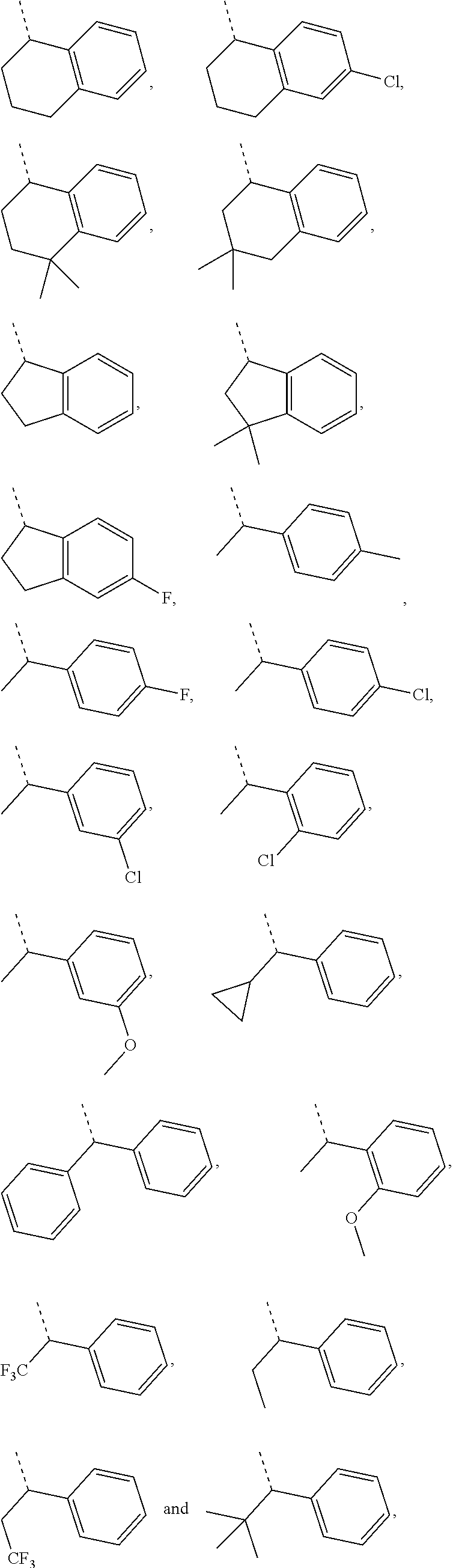
and other variables are as defined in the present disclosure.


and


is -M-W—, then -M-W— can connect ring A and ring B in the same direction as the reading order from left to right to form

and can also connect ring A and ring B in the opposite direction to the reading order from left to right to form

Combinations of the linking groups, substituents, and/or variants thereof are only permitted if such combinations result in stable compounds.

wherein, the groups are as defined in the compound of formula (I) of the present disclosure.


-
- IDH1 wt (wild type): 65 μM isocitrate+50 μM NADP
- IDH1(R132H): 1500 μM α-KG+15 μM NADPH
- IDH1(R132C): 500 μM α-KG+15 μM NADPH
| TABLE 1 |
| IDH1 in vitro enzyme (IDH1R132H) activity IC50 test results |
| IDH1 R132H | ||
| Example | Structure | (nM) |
| Example 1 |
 |
7.9 |
| Example 2 |
 |
464.5 |
| Example 3 |
 |
320 |
| Example 4 |
 |
125.5 |
| Example 5 |
 |
89.53 |
| Example 6 |
 |
3.94 |
| Example 7 |
 |
121.1 |
| Example 8 |
 |
2.88 |
| Example 9 |
 |
21.9 |
| Example 10 |
 |
343.6 |
| Example 11 |
 |
24.5 |
| Example 12 |
 |
15.69 |
| TABLE 2 |
| IDH1 in vitro enzyme (IDH1 R132C, WT) activity IC50 test results |
| IDH1 R132C | IDH1 WT | ||
| Example | Structure | (nM) | (nM) |
| Example 1 |
 |
101.8 | >10000 |
| Example 6 |
 |
12.79 | >10000 |
Inhibition rate %=(CPD-ZPE)/(HPE-ZPE)×100%
Cytotoxicity %=(1-CPD/ZPE)×100%
| TABLE 3 |
| IDH1 in vitro cell (U87MG) activity IC50 test results |
| U87MG | ||
| IDH1- | ||
| Ex- | R132H | |
| ample | Structure | (nM) |
| Ex- ample 1 |
 |
92.75 |
| Ex- ample 6 |
 |
38.25 |
| TABLE 4 |
| Pharmacokinetic evaluation parameters in mice |
| Tail vein injection group |
| Area under | ||||
| Clearance | Initial | Volume of | curve | |
| Cl | concentration | distribution | Half-life | AUC0-last |
| (mL/min/kg) | C0 (nM) | Vd (L/Kg) | T1/2 (h) | (nM · h) |
| 2.17 | 3541 | 0.690 | 2.90 | 15463 |
| Intragastric administration group |
| Time of | Area under | |||
| Highest | highest | curve | ||
| concentration | concentration | AUC0-last | Bioavailability | |
| Cmax (nM) | T1/2(h) | (nM · h) | F (%) | |
| 33350 | 1.00 | 306609 | 99.1 | |
Claims (16)


Applications Claiming Priority (3)
| Application Number | Priority Date | Filing Date | Title |
|---|---|---|---|
| CN201810672394.3 | 2018-06-26 | ||
| CN201810672394 | 2018-06-26 | ||
| PCT/CN2019/092997 WO2020001474A1 (en) | 2018-06-26 | 2019-06-26 | Benzimidazole derivatives and use thereof as idh1 inhibitors |
Publications (2)
| Publication Number | Publication Date |
|---|---|
| US20210206728A1 US20210206728A1 (en) | 2021-07-08 |
| US11407717B2 true US11407717B2 (en) | 2022-08-09 |
Family
ID=68986184
Family Applications (1)
| Application Number | Title | Priority Date | Filing Date |
|---|---|---|---|
| US17/254,890 Active US11407717B2 (en) | 2018-06-26 | 2019-06-26 | Benzimidazole derivatives and use thereof as IDH1 inhibitors |
Country Status (9)
| Country | Link |
|---|---|
| US (1) | US11407717B2 (en) |
| EP (1) | EP3816158B1 (en) |
| JP (1) | JP7258059B2 (en) |
| KR (1) | KR102584855B1 (en) |
| CN (1) | CN112533903B (en) |
| AU (1) | AU2019296173B2 (en) |
| CA (1) | CA3104760C (en) |
| EA (1) | EA202190009A1 (en) |
| WO (1) | WO2020001474A1 (en) |
Families Citing this family (1)
| Publication number | Priority date | Publication date | Assignee | Title |
|---|---|---|---|---|
| TWI760017B (en) * | 2019-12-23 | 2022-04-01 | 大陸商昆藥集團股份有限公司 | Salt form, crystalline form of idh1 mutant inhibitor and preparation method thereof |
Citations (12)
| Publication number | Priority date | Publication date | Assignee | Title |
|---|---|---|---|---|
| US20070105930A1 (en) * | 2003-12-19 | 2007-05-10 | Parmee Emma R | Cyclic guanidines, compositions containing such compounds and methods of use |
| CN103958506A (en) | 2011-09-27 | 2014-07-30 | 诺华股份有限公司 | 3-pyrimidin-4-yl-oxazolidin-2-ones as inhibitors of mutant IDH |
| WO2015121209A1 (en) | 2014-02-11 | 2015-08-20 | Bayer Pharma Aktiengesellschaft | Benzimidazol-2-amines as midh1 inhibitors |
| WO2016171756A1 (en) | 2015-04-21 | 2016-10-27 | Forma Therapeutics, Inc. | Quinolinone five-membered heterocyclic compounds as mutant-isocitrate dehydrogenase inhibitors |
| WO2017009325A1 (en) | 2015-07-16 | 2017-01-19 | Bayer Pharma Aktiengesellschaft | 5-hydroxyalkylbenzimidazoles as midh1 inhibitors |
| WO2017012967A1 (en) | 2015-07-21 | 2017-01-26 | Bayer Pharma Aktiengesellschaft | Fused imidazoles as midh1 inhibitors |
| US20170107194A1 (en) | 2013-07-11 | 2017-04-20 | Agios Pharmaceuticals, Inc | Therapeutically active compounds and their methods of use |
| WO2018010637A1 (en) | 2016-07-14 | 2018-01-18 | Shanghai Meton Pharmaceutical Co., Ltd | Iso-citrate dehydrogenase (idh) inhibitor |
| CN107641114A (en) | 2016-07-21 | 2018-01-30 | 南京圣和药业股份有限公司 | Compound and its application as isocitric dehydrogenase inhibitor |
| CN107849059A (en) | 2015-07-27 | 2018-03-27 | 伊莱利利公司 | 7 phenylethylcarbamate 4H pyrimidos [4,5 D] [the assimilation compound of 1,3] oxazines 2 and its purposes as mutant IDH1 inhibitor |
| CN107848985A (en) | 2015-07-27 | 2018-03-27 | 拜耳制药股份公司 | The method for preparing 3 (base of 2 anilino-, 1 cyclohexyl 1H benzimidazoles 5) propanoic derivatives of substitution |
| WO2018071404A1 (en) | 2016-10-11 | 2018-04-19 | Isocure Biosciences Inc. | Inhibitors of mutant isocitrate dehydrogenases and compositions and methods thereof |
Family Cites Families (8)
| Publication number | Priority date | Publication date | Assignee | Title |
|---|---|---|---|---|
| WO2008153701A1 (en) | 2007-05-24 | 2008-12-18 | Schering Corporation | Compounds for inhibiting ksp kinesin activity |
| KR20100042287A (en) * | 2007-07-31 | 2010-04-23 | 쉐링 코포레이션 | Anti-mitotic agent and aurora kinase inhibitor combination as anti-cancer treatment |
| US8168800B2 (en) * | 2007-11-02 | 2012-05-01 | The Regents Of The University Of California | Aβ-binding small molecules |
| US20110065671A1 (en) * | 2008-05-19 | 2011-03-17 | Harris Joel M | Bicyclic heterocycle derivatives and use thereof as gpr119 modulators |
| WO2012174312A2 (en) * | 2011-06-15 | 2012-12-20 | Glaxosmithkline Llc | Benzimidazole derivatives as antiviral agents |
| AU2015217788B2 (en) * | 2014-02-11 | 2019-06-27 | Deutsches Krebsforschungszentrum, Stiftung Des Öffentlichen Rechts | Benzimidazol-2-amines as mIDH1 inhibitors |
| ES2905564T3 (en) * | 2014-12-22 | 2022-04-11 | Us Health | Mutant IDH1 inhibitors useful in treating cancer |
| HUE059242T2 (en) * | 2016-07-29 | 2022-11-28 | Rapt Therapeutics Inc | Azetidine derivatives as chemokine receptor modulators and their use |
-
2019
- 2019-06-26 CA CA3104760A patent/CA3104760C/en active Active
- 2019-06-26 JP JP2020573027A patent/JP7258059B2/en active Active
- 2019-06-26 WO PCT/CN2019/092997 patent/WO2020001474A1/en not_active Ceased
- 2019-06-26 KR KR1020217001715A patent/KR102584855B1/en active Active
- 2019-06-26 CN CN201980039036.1A patent/CN112533903B/en active Active
- 2019-06-26 EP EP19827510.9A patent/EP3816158B1/en active Active
- 2019-06-26 EA EA202190009A patent/EA202190009A1/en unknown
- 2019-06-26 AU AU2019296173A patent/AU2019296173B2/en active Active
- 2019-06-26 US US17/254,890 patent/US11407717B2/en active Active
Patent Citations (16)
| Publication number | Priority date | Publication date | Assignee | Title |
|---|---|---|---|---|
| US20070105930A1 (en) * | 2003-12-19 | 2007-05-10 | Parmee Emma R | Cyclic guanidines, compositions containing such compounds and methods of use |
| CN103958506A (en) | 2011-09-27 | 2014-07-30 | 诺华股份有限公司 | 3-pyrimidin-4-yl-oxazolidin-2-ones as inhibitors of mutant IDH |
| US20140235620A1 (en) | 2011-09-27 | 2014-08-21 | Novartis Ag | 3-pyrimidin-4-yl-oxazolidin-2-ones as inhibitors of mutant idh |
| US20170107194A1 (en) | 2013-07-11 | 2017-04-20 | Agios Pharmaceuticals, Inc | Therapeutically active compounds and their methods of use |
| WO2015121209A1 (en) | 2014-02-11 | 2015-08-20 | Bayer Pharma Aktiengesellschaft | Benzimidazol-2-amines as midh1 inhibitors |
| WO2016171756A1 (en) | 2015-04-21 | 2016-10-27 | Forma Therapeutics, Inc. | Quinolinone five-membered heterocyclic compounds as mutant-isocitrate dehydrogenase inhibitors |
| WO2017009325A1 (en) | 2015-07-16 | 2017-01-19 | Bayer Pharma Aktiengesellschaft | 5-hydroxyalkylbenzimidazoles as midh1 inhibitors |
| WO2017012967A1 (en) | 2015-07-21 | 2017-01-26 | Bayer Pharma Aktiengesellschaft | Fused imidazoles as midh1 inhibitors |
| US20180118759A1 (en) | 2015-07-27 | 2018-05-03 | Eli Lilly And Company | 7-phenylethylamino-4h-pyrimido[4,5-d][1,3]oxazin-2-one compounds and their use as mutant idh1 inhibitors |
| US20180222871A1 (en) | 2015-07-27 | 2018-08-09 | Bayer Pharma Aktiengesellschaft | Method for preparing substituted 3-(2-anilino-1-cyclohexyl-1h-benzimidazol-5-yl)propanoic acid derivatives |
| CN107849059A (en) | 2015-07-27 | 2018-03-27 | 伊莱利利公司 | 7 phenylethylcarbamate 4H pyrimidos [4,5 D] [the assimilation compound of 1,3] oxazines 2 and its purposes as mutant IDH1 inhibitor |
| CN107848985A (en) | 2015-07-27 | 2018-03-27 | 拜耳制药股份公司 | The method for preparing 3 (base of 2 anilino-, 1 cyclohexyl 1H benzimidazoles 5) propanoic derivatives of substitution |
| WO2018010637A1 (en) | 2016-07-14 | 2018-01-18 | Shanghai Meton Pharmaceutical Co., Ltd | Iso-citrate dehydrogenase (idh) inhibitor |
| CN107641114A (en) | 2016-07-21 | 2018-01-30 | 南京圣和药业股份有限公司 | Compound and its application as isocitric dehydrogenase inhibitor |
| US20190161473A1 (en) | 2016-07-21 | 2019-05-30 | Nanjing Sanhome Pharmaceutical Co., Ltd. | Chemical compound of isocitrate dehydrogenase inhibitor, and application thereof |
| WO2018071404A1 (en) | 2016-10-11 | 2018-04-19 | Isocure Biosciences Inc. | Inhibitors of mutant isocitrate dehydrogenases and compositions and methods thereof |
Non-Patent Citations (7)
| Title |
|---|
| Cancer [online], [retrieved on Jul. 6, 2007], Retrieved from the internet, URL http://www.nlm.nih.gov/medlineplus/cancer.html>. * |
| Cancer and Metastasis Reviews (1998), 17(1), 91-106. * |
| Dang et al., "Cancer-associated IDH1 mutations produce 2-hydroxyglutarate," Nature, 462(7274):739, 18 pages, 2009. |
| English translation of International Search Report issued in International Patent Application No. PCT/CN2019/092997, dated Oct. 8, 2019. |
| Hartmann et al., "Type and frequency of IDH1 and IDH2 mutations are related to astrocytic and oligodendroglial differentiation and age: a study of 1,010 diffuse gliomas," Acta Neuropathol., 118:469-474, 2009. |
| Pusch et al., "Pan-mutant IDH1 inhibitor BAY 1436032 for effective treatment of IDH1 mutant astrocytoma in vivo," Acta Neuropathol., 133(4):629-644, 2017. |
| Science (1999), vol. 286, 531-537. * |
Also Published As
| Publication number | Publication date |
|---|---|
| EA202190009A1 (en) | 2021-03-25 |
| CA3104760A1 (en) | 2020-01-02 |
| AU2019296173B2 (en) | 2022-01-06 |
| KR20210022078A (en) | 2021-03-02 |
| EP3816158A4 (en) | 2022-01-26 |
| EP3816158C0 (en) | 2023-10-25 |
| JP2021529200A (en) | 2021-10-28 |
| JP7258059B2 (en) | 2023-04-14 |
| KR102584855B1 (en) | 2023-10-05 |
| WO2020001474A1 (en) | 2020-01-02 |
| US20210206728A1 (en) | 2021-07-08 |
| EP3816158B1 (en) | 2023-10-25 |
| EP3816158A1 (en) | 2021-05-05 |
| CA3104760C (en) | 2023-09-26 |
| CN112533903B (en) | 2022-08-16 |
| AU2019296173A1 (en) | 2021-02-04 |
| CN112533903A (en) | 2021-03-19 |
Similar Documents
| Publication | Publication Date | Title |
|---|---|---|
| US11919896B2 (en) | [1,2,4]triazolo[1,5-a]pyridine compound as JAK inhibitor and use thereof | |
| US10980814B2 (en) | Fused pentacyclic imidazole derivatives as modulators of TNF activity | |
| US9139593B2 (en) | Azetidine compounds, compositions and methods of use | |
| IL155875A (en) | Piperazinylpyrazine compounds as antagonists of serotonin 5-ht2 receptor | |
| TW200410694A (en) | Therapeutic agents | |
| JP7395762B2 (en) | Use of JAK inhibitors in the preparation of drugs for the treatment of JAK kinase-related diseases | |
| JP2023528073A (en) | N-phenylaminocarbonyl, pyridino-, pyrimidino and benzotropanes as GPR65 modulators | |
| EP3680237A1 (en) | Process for preparing substituted 2,3-dihydro-1h-inden-1-one retinoic acid-related orphan nuclear receptor antagonists for treating multiple sclerosis | |
| US20230017539A1 (en) | Tri-heterocyclic compound as jak inhibitor, and use thereof | |
| US11407717B2 (en) | Benzimidazole derivatives and use thereof as IDH1 inhibitors | |
| US12565481B2 (en) | 6,7-dimethoxy-3-(pyridin-2-yl)quinoline compounds for inhibiting RET | |
| US11760751B2 (en) | Benzo 2-azaspiro[4.4]nonane compound and use thereof | |
| US20230257398A1 (en) | Pyrimidine-based tricyclic compound and use thereof | |
| KR102433283B1 (en) | Deuterated derivatives of ruxolitinib | |
| US9505743B2 (en) | Matrix metalloproteinase inhibitors and methods for the treatment of pain and other diseases | |
| EA040879B1 (en) | Benzimidazole derivatives and their use as IDH1 inhibitors | |
| US11230544B1 (en) | Substituted 1,3,4-thiadiazoles as GLS1 inhibitors | |
| TW201000096A (en) | Four-membered ring-condensed pyrrolidine derivatives, and preparation method and medical use thereof | |
| US20240409560A1 (en) | Pyrimidine tricyclic derivative and pharmaceutical application thereof | |
| HK40041768B (en) | Benzimidazole derivatives and use thereof as idh1 inhibitors | |
| HK40041768A (en) | Benzimidazole derivatives and use thereof as idh1 inhibitors | |
| HK40013863B (en) | Deuterated derivatives of ruxolitinib | |
| HK40013863A (en) | Deuterated derivatives of ruxolitinib |
Legal Events
| Date | Code | Title | Description |
|---|---|---|---|
| AS | Assignment |
Owner name: KPC PHARMACEUTICALS, INC., CHINA Free format text: ASSIGNMENT OF ASSIGNORS INTEREST;ASSIGNORS:WANG, DAHAI;QIAN, WENYUAN;LIU, SHILAN;AND OTHERS;SIGNING DATES FROM 20201208 TO 20201209;REEL/FRAME:054824/0776 |
|
| FEPP | Fee payment procedure |
Free format text: ENTITY STATUS SET TO UNDISCOUNTED (ORIGINAL EVENT CODE: BIG.); ENTITY STATUS OF PATENT OWNER: LARGE ENTITY |
|
| STPP | Information on status: patent application and granting procedure in general |
Free format text: DOCKETED NEW CASE - READY FOR EXAMINATION |
|
| STPP | Information on status: patent application and granting procedure in general |
Free format text: NON FINAL ACTION MAILED |
|
| STPP | Information on status: patent application and granting procedure in general |
Free format text: RESPONSE TO NON-FINAL OFFICE ACTION ENTERED AND FORWARDED TO EXAMINER |
|
| STPP | Information on status: patent application and granting procedure in general |
Free format text: NOTICE OF ALLOWANCE MAILED -- APPLICATION RECEIVED IN OFFICE OF PUBLICATIONS |
|
| STCF | Information on status: patent grant |
Free format text: PATENTED CASE |
|
| MAFP | Maintenance fee payment |
Free format text: PAYMENT OF MAINTENANCE FEE, 4TH YEAR, LARGE ENTITY (ORIGINAL EVENT CODE: M1551); ENTITY STATUS OF PATENT OWNER: LARGE ENTITY Year of fee payment: 4 |