US11406631B2 - Hydrazone derivatives for preventing or treating EBV-related cancers - Google Patents
Hydrazone derivatives for preventing or treating EBV-related cancers Download PDFInfo
- Publication number
- US11406631B2 US11406631B2 US17/045,049 US201917045049A US11406631B2 US 11406631 B2 US11406631 B2 US 11406631B2 US 201917045049 A US201917045049 A US 201917045049A US 11406631 B2 US11406631 B2 US 11406631B2
- Authority
- US
- United States
- Prior art keywords
- group
- compound
- formula
- alkyl group
- alkyl
- Prior art date
- Legal status (The legal status is an assumption and is not a legal conclusion. Google has not performed a legal analysis and makes no representation as to the accuracy of the status listed.)
- Active, expires
Links
- BCRFXRSKGMHVKX-UHFFFAOYSA-N C[n+]1ccc(C(C)(C)C)c2ccccc21 Chemical compound C[n+]1ccc(C(C)(C)C)c2ccccc21 BCRFXRSKGMHVKX-UHFFFAOYSA-N 0.000 description 21
- WSOBUUGOJQXCJM-UHFFFAOYSA-N C[n+]1cccc2cc(C(C)(C)C)ccc21 Chemical compound C[n+]1cccc2cc(C(C)(C)C)ccc21 WSOBUUGOJQXCJM-UHFFFAOYSA-N 0.000 description 21
- ANJHBIHEJMACHS-UHFFFAOYSA-N CC(C)(C)c1ccc2ccc3ccc(C(C)(C)C)nc3c2n1 Chemical compound CC(C)(C)c1ccc2ccc3ccc(C(C)(C)C)nc3c2n1 ANJHBIHEJMACHS-UHFFFAOYSA-N 0.000 description 18
- MUHWHKNSGVLIRT-UHFFFAOYSA-N CC(C)(C)c1cc[n+]([RaH])cc1.C[Rb] Chemical compound CC(C)(C)c1cc[n+]([RaH])cc1.C[Rb] MUHWHKNSGVLIRT-UHFFFAOYSA-N 0.000 description 15
- BICJPADGJPENQI-UHFFFAOYSA-N CC(C)(C)c1ccc2ccc(C(C)(C)C)nc2n1 Chemical compound CC(C)(C)c1ccc2ccc(C(C)(C)C)nc2n1 BICJPADGJPENQI-UHFFFAOYSA-N 0.000 description 15
- UWKQJZCTQGMHKD-UHFFFAOYSA-N CC(C)(C)c1cccc(C(C)(C)C)n1 Chemical compound CC(C)(C)c1cccc(C(C)(C)C)n1 UWKQJZCTQGMHKD-UHFFFAOYSA-N 0.000 description 15
- JMMNMQZYGKZKEA-UHFFFAOYSA-N CC(C)(C)c1cc(C(C)(C)C)ncn1 Chemical compound CC(C)(C)c1cc(C(C)(C)C)ncn1 JMMNMQZYGKZKEA-UHFFFAOYSA-N 0.000 description 9
- HHHQLKSXLKAOEL-FLPWPZJFSA-N C1=C[Y]=c2ccccc2=C1.CC(C)(C)C.CC(C)(C)C.C[Rb].[RaH][n+]1ccccc1 Chemical compound C1=C[Y]=c2ccccc2=C1.CC(C)(C)C.CC(C)(C)C.C[Rb].[RaH][n+]1ccccc1 HHHQLKSXLKAOEL-FLPWPZJFSA-N 0.000 description 3
- RSCGWOGPOZUACV-UHFFFAOYSA-N CC(C)(C)c1cc[n+]([RaH])cc1.C[Rb].C[n+]1ccc(C(C)(C)C)c2ccccc21.C[n+]1cccc2cc(C(C)(C)C)ccc21 Chemical compound CC(C)(C)c1cc[n+]([RaH])cc1.C[Rb].C[n+]1ccc(C(C)(C)C)c2ccccc21.C[n+]1cccc2cc(C(C)(C)C)ccc21 RSCGWOGPOZUACV-UHFFFAOYSA-N 0.000 description 3
- UDIDDGJHVLMRBW-MSEGBBJSSA-N *.C/C=N/NC(C)=O.C/C=N/NC(C)=O.[CH2-2] Chemical compound *.C/C=N/NC(C)=O.C/C=N/NC(C)=O.[CH2-2] UDIDDGJHVLMRBW-MSEGBBJSSA-N 0.000 description 2
- OXLSKNVKNQYAEN-UHFFFAOYSA-N CC.CC.CC.CC.CC.CC.CC(C)(C)c1ccc2ccc(C(C)(C)C)nc2n1.CC(C)(C)c1ccc2ccc3ccc(C(C)(C)C)nc3c2n1.CC(C)(C)c1cccc(C(C)(C)C)n1 Chemical compound CC.CC.CC.CC.CC.CC.CC(C)(C)c1ccc2ccc(C(C)(C)C)nc2n1.CC(C)(C)c1ccc2ccc3ccc(C(C)(C)C)nc3c2n1.CC(C)(C)c1cccc(C(C)(C)C)n1 OXLSKNVKNQYAEN-UHFFFAOYSA-N 0.000 description 2
- GVGGJCJCBAMETP-LZRQKHJSSA-A CC[n+]1cccc2cc(/C=N/NC(=O)c3ccc4ccc(C(=O)N/N=C/c5ccc6c(ccc[n+]6CC)c5)nc4n3)ccc21.CC[n+]1cccc2cc(/C=N/NC(=O)c3cccc(C(=O)N/N=C/c4ccc5c(ccc[n+]5CC)c4)n3)ccc21.C[n+]1ccc(/C=N/NC(=O)c2ccc3ccc(C(=O)N/N=C/c4cc[n+](C)c5ccccc45)nc3n2)c2ccccc21.C[n+]1ccc(/C=N/NC(=O)c2ccc3ccc(C(=O)N/N=C/c4cc[n+](Cc5ccccc5)c5ccccc45)nc3n2)c2ccccc21.C[n+]1ccc(/C=N/NC(=O)c2ccc3ccc4ccc(C(=O)N/N=C/c5cc[n+](C)c6ccccc56)nc4c3n2)c2ccccc21.C[n+]1ccc(/C=N/NC(=O)c2ccc3ccc4ccc(C(=O)N/N=C/c5cc[n+](C)cc5)nc4c3n2)cc1.C[n+]1ccc(/C=N/NC(=O)c2cccc(C(=O)N/N=C/c3cc[n+](C)c4ccccc34)n2)c2ccccc21.C[n+]1ccc(/C=N/NC(=O)c2cccc(C(=O)N/N=C/c3cc[n+](Cc4ccccc4)c4ccccc34)n2)c2ccccc21.O=C(N/N=C/c1ccc2c(ccc[n+]2Cc2ccccc2)c1)c1ccc2ccc(C(=O)N/N=C/c3ccc4c(ccc[n+]4Cc4ccccc4)c3)nc2n1.O=C(N/N=C/c1ccc2c(ccc[n+]2Cc2ccccc2)c1)c1cccc(C(=O)N/N=C/c2ccc3c(ccc[n+]3Cc3ccccc3)c2)n1 Chemical compound CC[n+]1cccc2cc(/C=N/NC(=O)c3ccc4ccc(C(=O)N/N=C/c5ccc6c(ccc[n+]6CC)c5)nc4n3)ccc21.CC[n+]1cccc2cc(/C=N/NC(=O)c3cccc(C(=O)N/N=C/c4ccc5c(ccc[n+]5CC)c4)n3)ccc21.C[n+]1ccc(/C=N/NC(=O)c2ccc3ccc(C(=O)N/N=C/c4cc[n+](C)c5ccccc45)nc3n2)c2ccccc21.C[n+]1ccc(/C=N/NC(=O)c2ccc3ccc(C(=O)N/N=C/c4cc[n+](Cc5ccccc5)c5ccccc45)nc3n2)c2ccccc21.C[n+]1ccc(/C=N/NC(=O)c2ccc3ccc4ccc(C(=O)N/N=C/c5cc[n+](C)c6ccccc56)nc4c3n2)c2ccccc21.C[n+]1ccc(/C=N/NC(=O)c2ccc3ccc4ccc(C(=O)N/N=C/c5cc[n+](C)cc5)nc4c3n2)cc1.C[n+]1ccc(/C=N/NC(=O)c2cccc(C(=O)N/N=C/c3cc[n+](C)c4ccccc34)n2)c2ccccc21.C[n+]1ccc(/C=N/NC(=O)c2cccc(C(=O)N/N=C/c3cc[n+](Cc4ccccc4)c4ccccc34)n2)c2ccccc21.O=C(N/N=C/c1ccc2c(ccc[n+]2Cc2ccccc2)c1)c1ccc2ccc(C(=O)N/N=C/c3ccc4c(ccc[n+]4Cc4ccccc4)c3)nc2n1.O=C(N/N=C/c1ccc2c(ccc[n+]2Cc2ccccc2)c1)c1cccc(C(=O)N/N=C/c2ccc3c(ccc[n+]3Cc3ccccc3)c2)n1 GVGGJCJCBAMETP-LZRQKHJSSA-A 0.000 description 2
- FEDCDONSGRSQHP-UBAVURKZSA-T CC[n+]1cccc2cc(/C=N/NC(=O)c3ccc4ccc5ccc(C(=O)N/N=C/c6ccc7c(ccc[n+]7CC)c6)nc5c4n3)ccc21.O=C(N/N=C/c1cc[n+](Cc2ccccc2)c2ccccc12)c1ccc2ccc3ccc(C(=O)N/N=C/c4cc[n+](Cc5ccccc5)c5ccccc45)nc3c2n1.O=C(N/N=C/c1ccc2c(ccc[n+]2Cc2ccccc2)c1)c1ccc2ccc3ccc(C(=O)N/N=C/c4ccc5c(ccc[n+]5Cc5ccccc5)c4)nc3c2n1 Chemical compound CC[n+]1cccc2cc(/C=N/NC(=O)c3ccc4ccc5ccc(C(=O)N/N=C/c6ccc7c(ccc[n+]7CC)c6)nc5c4n3)ccc21.O=C(N/N=C/c1cc[n+](Cc2ccccc2)c2ccccc12)c1ccc2ccc3ccc(C(=O)N/N=C/c4cc[n+](Cc5ccccc5)c5ccccc45)nc3c2n1.O=C(N/N=C/c1ccc2c(ccc[n+]2Cc2ccccc2)c1)c1ccc2ccc3ccc(C(=O)N/N=C/c4ccc5c(ccc[n+]5Cc5ccccc5)c4)nc3c2n1 FEDCDONSGRSQHP-UBAVURKZSA-T 0.000 description 2
- WZOSFUJDJAPCQC-UHFFFAOYSA-N *.*.CC(=O)NN.CC(=O)NN.COC(C)=O.COC(C)=O.NN.O Chemical compound *.*.CC(=O)NN.CC(=O)NN.COC(C)=O.COC(C)=O.NN.O WZOSFUJDJAPCQC-UHFFFAOYSA-N 0.000 description 1
- GXIBIWBUOFPGAT-NFMSUCEZSA-N *.C/C=N/NC(C)=O.C/C=N/NC(C)=O Chemical compound *.C/C=N/NC(C)=O.C/C=N/NC(C)=O GXIBIWBUOFPGAT-NFMSUCEZSA-N 0.000 description 1
- SAIXAWJRUGENIS-UHFFFAOYSA-N *.CC(=O)NN.CC(=O)NN Chemical compound *.CC(=O)NN.CC(=O)NN SAIXAWJRUGENIS-UHFFFAOYSA-N 0.000 description 1
- YGSFNCRAZOCNDJ-UHFFFAOYSA-N *.CC(C)=O.CC(C)=O Chemical compound *.CC(C)=O.CC(C)=O YGSFNCRAZOCNDJ-UHFFFAOYSA-N 0.000 description 1
- YKFOJEKHFQVXCW-UHFFFAOYSA-X C.C.C.C.C[n+]1ccc(/C=N/NC(=O)c2ccc3ccc4ccc(C(=O)N/N=C/c5cc[n+](C)c6ccccc56)nc4c3n2)c2ccccc21.C[n+]1ccc(/C=N/NC(=O)c2ccc3ccc4ccc(C(=O)N/N=C/c5cc[n+](C)cc5)nc4c3n2)cc1.C[n+]1ccc(/C=N/NC(=O)c2cccc(C(=O)N/N=C/c3cc[n+](C)c4ccccc34)n2)c2ccccc21.C[n+]1ccc(/C=N/NC(=O)c2cccc(C(=O)N/N=C/c3cc[n+](Cc4ccccc4)c4ccccc34)n2)c2ccccc21.O=C(N/N=C/c1cc[n+](Cc2ccccc2)c2ccccc12)c1ccc2ccc3ccc(C(=O)N/N=C/c4cc[n+](Cc5ccccc5)c5ccccc45)nc3c2n1 Chemical compound C.C.C.C.C[n+]1ccc(/C=N/NC(=O)c2ccc3ccc4ccc(C(=O)N/N=C/c5cc[n+](C)c6ccccc56)nc4c3n2)c2ccccc21.C[n+]1ccc(/C=N/NC(=O)c2ccc3ccc4ccc(C(=O)N/N=C/c5cc[n+](C)cc5)nc4c3n2)cc1.C[n+]1ccc(/C=N/NC(=O)c2cccc(C(=O)N/N=C/c3cc[n+](C)c4ccccc34)n2)c2ccccc21.C[n+]1ccc(/C=N/NC(=O)c2cccc(C(=O)N/N=C/c3cc[n+](Cc4ccccc4)c4ccccc34)n2)c2ccccc21.O=C(N/N=C/c1cc[n+](Cc2ccccc2)c2ccccc12)c1ccc2ccc3ccc(C(=O)N/N=C/c4cc[n+](Cc5ccccc5)c5ccccc45)nc3c2n1 YKFOJEKHFQVXCW-UHFFFAOYSA-X 0.000 description 1
- QUBKAMSLVVNVTH-KPGSEMELSA-N CC(C)(C)C.CC(C)(C)C.C[Rb].[Y][Y]1=c2ccccc2=CC=C1.c1ccncc1 Chemical compound CC(C)(C)C.CC(C)(C)C.C[Rb].[Y][Y]1=c2ccccc2=CC=C1.c1ccncc1 QUBKAMSLVVNVTH-KPGSEMELSA-N 0.000 description 1
- FIJVWFXOAGOXHI-UHFFFAOYSA-N CC.CC.CC.CC.CC.CC.CC.CC.CC.CC(C)(C)c1cc(C(C)(C)C)ncn1.CC(C)(C)c1ccc2ccc(C(C)(C)C)nc2n1.CC(C)(C)c1ccc2ccc3ccc(C(C)(C)C)nc3c2n1.CC(C)(C)c1cccc(-c2cccc(C(C)(C)C)n2)n1.CC(C)(C)c1cccc(C(C)(C)C)n1 Chemical compound CC.CC.CC.CC.CC.CC.CC.CC.CC.CC(C)(C)c1cc(C(C)(C)C)ncn1.CC(C)(C)c1ccc2ccc(C(C)(C)C)nc2n1.CC(C)(C)c1ccc2ccc3ccc(C(C)(C)C)nc3c2n1.CC(C)(C)c1cccc(-c2cccc(C(C)(C)C)n2)n1.CC(C)(C)c1cccc(C(C)(C)C)n1 FIJVWFXOAGOXHI-UHFFFAOYSA-N 0.000 description 1
- IGPHNWQOSZCPFF-WIYCZQEJSA-P CCO.COC(=O)c1cccc(C(=O)OC)n1.C[n+]1ccc(/C=N/NC(=O)c2cccc(C(=O)N/N=C/c3cc[n+](C)c4ccccc34)n2)c2ccccc21.NNC(=O)c1cccc(C(=O)NN)n1.O=C(N/N=C/c1ccnc2ccccc12)c1cccc(C(=O)N/N=C/c2ccnc3ccccc23)n1.O=Cc1ccnc2ccccc12 Chemical compound CCO.COC(=O)c1cccc(C(=O)OC)n1.C[n+]1ccc(/C=N/NC(=O)c2cccc(C(=O)N/N=C/c3cc[n+](C)c4ccccc34)n2)c2ccccc21.NNC(=O)c1cccc(C(=O)NN)n1.O=C(N/N=C/c1ccnc2ccccc12)c1cccc(C(=O)N/N=C/c2ccnc3ccccc23)n1.O=Cc1ccnc2ccccc12 IGPHNWQOSZCPFF-WIYCZQEJSA-P 0.000 description 1
- WSWKVIOJHBPQNN-UHFFFAOYSA-N C[n+]1ccc(C(C)(C)C)c2ccccc21.C[n+]1cccc2cc(C(C)(C)C)ccc21 Chemical compound C[n+]1ccc(C(C)(C)C)c2ccccc21.C[n+]1cccc2cc(C(C)(C)C)ccc21 WSWKVIOJHBPQNN-UHFFFAOYSA-N 0.000 description 1
- VIHCSOHCDSXLEH-AKNSIARISA-N O=C(N/N=C/c1ccc2ncccc2c1)c1cc(C(=O)N/N=C/c2ccc3ncccc3c2)ncn1 Chemical compound O=C(N/N=C/c1ccc2ncccc2c1)c1cc(C(=O)N/N=C/c2ccc3ncccc3c2)ncn1 VIHCSOHCDSXLEH-AKNSIARISA-N 0.000 description 1
- GVMLIRNSCRUCGK-WMFSDKRHSA-N O=C(N/N=C/c1ccc2ncccc2c1)c1ccc2ccc(C(=O)N/N=C/c3ccc4ncccc4c3)nc2n1 Chemical compound O=C(N/N=C/c1ccc2ncccc2c1)c1ccc2ccc(C(=O)N/N=C/c3ccc4ncccc4c3)nc2n1 GVMLIRNSCRUCGK-WMFSDKRHSA-N 0.000 description 1
- XHWISSSSJXJPNC-RIOOQTRLSA-N O=C(N/N=C/c1ccc2ncccc2c1)c1ccc2ccc3ccc(C(=O)N/N=C/c4ccc5ncccc5c4)nc3c2n1 Chemical compound O=C(N/N=C/c1ccc2ncccc2c1)c1ccc2ccc3ccc(C(=O)N/N=C/c4ccc5ncccc5c4)nc3c2n1 XHWISSSSJXJPNC-RIOOQTRLSA-N 0.000 description 1
- LGOJWWDOIDVKFK-RVSCTIAXSA-N O=C(N/N=C/c1ccc2ncccc2c1)c1cccc(C(=O)N/N=C/c2ccc3ncccc3c2)n1 Chemical compound O=C(N/N=C/c1ccc2ncccc2c1)c1cccc(C(=O)N/N=C/c2ccc3ncccc3c2)n1 LGOJWWDOIDVKFK-RVSCTIAXSA-N 0.000 description 1
- GIWIESSNVOUFFE-AKNSIARISA-N O=C(N/N=C/c1ccnc2ccccc12)c1cc(C(=O)N/N=C/c2ccnc3ccccc23)ncn1 Chemical compound O=C(N/N=C/c1ccnc2ccccc12)c1cc(C(=O)N/N=C/c2ccnc3ccccc23)ncn1 GIWIESSNVOUFFE-AKNSIARISA-N 0.000 description 1
- RABVKOYVEFNZTC-WMFSDKRHSA-N O=C(N/N=C/c1ccnc2ccccc12)c1ccc2ccc(C(=O)N/N=C/c3ccnc4ccccc34)nc2n1 Chemical compound O=C(N/N=C/c1ccnc2ccccc12)c1ccc2ccc(C(=O)N/N=C/c3ccnc4ccccc34)nc2n1 RABVKOYVEFNZTC-WMFSDKRHSA-N 0.000 description 1
- LHSOXQZTYPXLHY-RIOOQTRLSA-N O=C(N/N=C/c1ccnc2ccccc12)c1ccc2ccc3ccc(C(=O)N/N=C/c4ccnc5ccccc45)nc3c2n1 Chemical compound O=C(N/N=C/c1ccnc2ccccc12)c1ccc2ccc3ccc(C(=O)N/N=C/c4ccnc5ccccc45)nc3c2n1 LHSOXQZTYPXLHY-RIOOQTRLSA-N 0.000 description 1
- RHLZRWUKAFFGDK-RVSCTIAXSA-N O=C(N/N=C/c1ccnc2ccccc12)c1cccc(C(=O)N/N=C/c2ccnc3ccccc23)n1 Chemical compound O=C(N/N=C/c1ccnc2ccccc12)c1cccc(C(=O)N/N=C/c2ccnc3ccccc23)n1 RHLZRWUKAFFGDK-RVSCTIAXSA-N 0.000 description 1
- HMTOHVQHVLDUNU-HIWNQQMRSA-N O=C(N/N=C/c1ccncc1)c1cc(C(=O)N/N=C/c2ccncc2)ncn1 Chemical compound O=C(N/N=C/c1ccncc1)c1cc(C(=O)N/N=C/c2ccncc2)ncn1 HMTOHVQHVLDUNU-HIWNQQMRSA-N 0.000 description 1
- CHVMBWBTBWUVOF-BKHCZYBLSA-N O=C(N/N=C/c1ccncc1)c1ccc2ccc(C(=O)N/N=C/c3ccncc3)nc2n1 Chemical compound O=C(N/N=C/c1ccncc1)c1ccc2ccc(C(=O)N/N=C/c3ccncc3)nc2n1 CHVMBWBTBWUVOF-BKHCZYBLSA-N 0.000 description 1
- GQKDMAVQTRJWAB-CMNXJCJSSA-N O=C(N/N=C/c1ccncc1)c1ccc2ccc3ccc(C(=O)N/N=C/c4ccncc4)nc3c2n1 Chemical compound O=C(N/N=C/c1ccncc1)c1ccc2ccc3ccc(C(=O)N/N=C/c4ccncc4)nc3c2n1 GQKDMAVQTRJWAB-CMNXJCJSSA-N 0.000 description 1
- YTBMFBDQVIOSOC-FWSOMWAYSA-N O=C(N/N=C/c1ccncc1)c1cccc(C(=O)N/N=C/c2ccncc2)n1 Chemical compound O=C(N/N=C/c1ccncc1)c1cccc(C(=O)N/N=C/c2ccncc2)n1 YTBMFBDQVIOSOC-FWSOMWAYSA-N 0.000 description 1
Images


Classifications
-
- C—CHEMISTRY; METALLURGY
- C07—ORGANIC CHEMISTRY
- C07D—HETEROCYCLIC COMPOUNDS
- C07D471/00—Heterocyclic compounds containing nitrogen atoms as the only ring hetero atoms in the condensed system, at least one ring being a six-membered ring with one nitrogen atom, not provided for by groups C07D451/00 - C07D463/00
- C07D471/02—Heterocyclic compounds containing nitrogen atoms as the only ring hetero atoms in the condensed system, at least one ring being a six-membered ring with one nitrogen atom, not provided for by groups C07D451/00 - C07D463/00 in which the condensed system contains two hetero rings
- C07D471/04—Ortho-condensed systems
-
- A—HUMAN NECESSITIES
- A61—MEDICAL OR VETERINARY SCIENCE; HYGIENE
- A61K—PREPARATIONS FOR MEDICAL, DENTAL OR TOILETRY PURPOSES
- A61K31/00—Medicinal preparations containing organic active ingredients
- A61K31/33—Heterocyclic compounds
- A61K31/395—Heterocyclic compounds having nitrogen as a ring hetero atom, e.g. guanethidine or rifamycins
- A61K31/435—Heterocyclic compounds having nitrogen as a ring hetero atom, e.g. guanethidine or rifamycins having six-membered rings with one nitrogen as the only ring hetero atom
- A61K31/47—Quinolines; Isoquinolines
- A61K31/4709—Non-condensed quinolines and containing further heterocyclic rings
-
- A—HUMAN NECESSITIES
- A61—MEDICAL OR VETERINARY SCIENCE; HYGIENE
- A61K—PREPARATIONS FOR MEDICAL, DENTAL OR TOILETRY PURPOSES
- A61K31/00—Medicinal preparations containing organic active ingredients
- A61K31/33—Heterocyclic compounds
- A61K31/395—Heterocyclic compounds having nitrogen as a ring hetero atom, e.g. guanethidine or rifamycins
- A61K31/435—Heterocyclic compounds having nitrogen as a ring hetero atom, e.g. guanethidine or rifamycins having six-membered rings with one nitrogen as the only ring hetero atom
- A61K31/44—Non condensed pyridines; Hydrogenated derivatives thereof
- A61K31/4427—Non condensed pyridines; Hydrogenated derivatives thereof containing further heterocyclic ring systems
- A61K31/444—Non condensed pyridines; Hydrogenated derivatives thereof containing further heterocyclic ring systems containing a six-membered ring with nitrogen as a ring heteroatom, e.g. amrinone
-
- A—HUMAN NECESSITIES
- A61—MEDICAL OR VETERINARY SCIENCE; HYGIENE
- A61K—PREPARATIONS FOR MEDICAL, DENTAL OR TOILETRY PURPOSES
- A61K31/00—Medicinal preparations containing organic active ingredients
- A61K31/33—Heterocyclic compounds
- A61K31/395—Heterocyclic compounds having nitrogen as a ring hetero atom, e.g. guanethidine or rifamycins
- A61K31/435—Heterocyclic compounds having nitrogen as a ring hetero atom, e.g. guanethidine or rifamycins having six-membered rings with one nitrogen as the only ring hetero atom
- A61K31/47—Quinolines; Isoquinolines
- A61K31/4738—Quinolines; Isoquinolines ortho- or peri-condensed with heterocyclic ring systems
- A61K31/4745—Quinolines; Isoquinolines ortho- or peri-condensed with heterocyclic ring systems condensed with ring systems having nitrogen as a ring hetero atom, e.g. phenantrolines
-
- A—HUMAN NECESSITIES
- A61—MEDICAL OR VETERINARY SCIENCE; HYGIENE
- A61K—PREPARATIONS FOR MEDICAL, DENTAL OR TOILETRY PURPOSES
- A61K31/00—Medicinal preparations containing organic active ingredients
- A61K31/33—Heterocyclic compounds
- A61K31/395—Heterocyclic compounds having nitrogen as a ring hetero atom, e.g. guanethidine or rifamycins
- A61K31/495—Heterocyclic compounds having nitrogen as a ring hetero atom, e.g. guanethidine or rifamycins having six-membered rings with two or more nitrogen atoms as the only ring heteroatoms, e.g. piperazine or tetrazines
- A61K31/505—Pyrimidines; Hydrogenated pyrimidines, e.g. trimethoprim
- A61K31/506—Pyrimidines; Hydrogenated pyrimidines, e.g. trimethoprim not condensed and containing further heterocyclic rings
-
- A—HUMAN NECESSITIES
- A61—MEDICAL OR VETERINARY SCIENCE; HYGIENE
- A61K—PREPARATIONS FOR MEDICAL, DENTAL OR TOILETRY PURPOSES
- A61K45/00—Medicinal preparations containing active ingredients not provided for in groups A61K31/00 - A61K41/00
- A61K45/06—Mixtures of active ingredients without chemical characterisation, e.g. antiphlogistics and cardiaca
-
- A—HUMAN NECESSITIES
- A61—MEDICAL OR VETERINARY SCIENCE; HYGIENE
- A61K—PREPARATIONS FOR MEDICAL, DENTAL OR TOILETRY PURPOSES
- A61K9/00—Medicinal preparations characterised by special physical form
- A61K9/0012—Galenical forms characterised by the site of application
- A61K9/0019—Injectable compositions; Intramuscular, intravenous, arterial, subcutaneous administration; Compositions to be administered through the skin in an invasive manner
-
- A—HUMAN NECESSITIES
- A61—MEDICAL OR VETERINARY SCIENCE; HYGIENE
- A61P—SPECIFIC THERAPEUTIC ACTIVITY OF CHEMICAL COMPOUNDS OR MEDICINAL PREPARATIONS
- A61P31/00—Antiinfectives, i.e. antibiotics, antiseptics, chemotherapeutics
- A61P31/12—Antivirals
- A61P31/20—Antivirals for DNA viruses
-
- A—HUMAN NECESSITIES
- A61—MEDICAL OR VETERINARY SCIENCE; HYGIENE
- A61P—SPECIFIC THERAPEUTIC ACTIVITY OF CHEMICAL COMPOUNDS OR MEDICINAL PREPARATIONS
- A61P35/00—Antineoplastic agents
-
- C—CHEMISTRY; METALLURGY
- C07—ORGANIC CHEMISTRY
- C07D—HETEROCYCLIC COMPOUNDS
- C07D401/00—Heterocyclic compounds containing two or more hetero rings, having nitrogen atoms as the only ring hetero atoms, at least one ring being a six-membered ring with only one nitrogen atom
- C07D401/02—Heterocyclic compounds containing two or more hetero rings, having nitrogen atoms as the only ring hetero atoms, at least one ring being a six-membered ring with only one nitrogen atom containing two hetero rings
- C07D401/12—Heterocyclic compounds containing two or more hetero rings, having nitrogen atoms as the only ring hetero atoms, at least one ring being a six-membered ring with only one nitrogen atom containing two hetero rings linked by a chain containing hetero atoms as chain links
-
- C—CHEMISTRY; METALLURGY
- C07—ORGANIC CHEMISTRY
- C07D—HETEROCYCLIC COMPOUNDS
- C07D401/00—Heterocyclic compounds containing two or more hetero rings, having nitrogen atoms as the only ring hetero atoms, at least one ring being a six-membered ring with only one nitrogen atom
- C07D401/14—Heterocyclic compounds containing two or more hetero rings, having nitrogen atoms as the only ring hetero atoms, at least one ring being a six-membered ring with only one nitrogen atom containing three or more hetero rings
Definitions
- the present invention relates to novel hydrazone derivatives, in particular cationic N-acylhydrazone derivatives, useful for treating or preventing cancers associated with the Epstein-Barr Virus (EBV-related cancers) by interfering with the interaction between the host cell protein nucleolin (NCL) and the virus-encoded EBNA1 mRNA in order to unveil tumour cells from EBV-related cancers to the immune system.
- EBV-related cancers Epstein-Barr Virus
- Epstein-Barr virus is the first oncogenic virus discovered in human and has been linked to various cancers that include Burkitt and Hodgkin lymphomas and 10% of gastric cancers.
- Another example is the nasopharyngeal carcinoma which is particularly frequent among men in China and Tunisia.
- EBV evades the host immune system but has an Achilles heel: its genome maintenance protein (GMP) EBNA1.
- GMP genome maintenance protein
- EBNA1 is essential for EBV genome replication and maintenance and as such expressed in all dividing EBV-infected cells.
- EBNA1 is highly antigenic and CD8+ T cells directed towards EBNA1 epitopes exist in all infected individuals.
- EBV has evolved a mechanism to limit EBNA1 production to the minimal level required for the viral genome replication and, at the same time, to minimize the production of EBNA1-derived antigenic peptides presented to the cytotoxic T cells through the MHC class I pathway.
- the central glycine-alanine repeat (GAr) of EBNA1 plays a critical role in this mechanism of immune evasion as it is able to self-inhibit the translation of its own mRNA in cis.
- EBNA1 ⁇ GAr The high level of EBNA1 protein and the efficient T cell response following the infection by an EBV strain encoding a truncated version of EBNA1 in which GAr has been deleted (EBNA1 ⁇ GAr) demonstrates the critical role of GAr in EBNA1 immune evasion.
- EBNA1 ⁇ GAr a polymorphism in the length of GAr exists and, importantly, the effect of GAr is length-dependent as a longer domain displays a stronger inhibitory effect on both mRNA translation and antigen presentation.
- the GAr-encoding mRNA sequence is GC rich and forms predicted G-quadruplex (G4) structures that have been implicated in the regulation of EBNA1 synthesis in vitro (Murat et al. Curr Opin Genet Dev 2014, 25, 22-29).
- G4 are particular secondary structures of nucleic acid formed by the stacking of G-quartets which correspond to a planar arrangement of 4 guanines connected by Hoogsteen hydrogen bonds.
- G4 structures within G-rich DNA or RNA sequences have been implicated in gene regulation where they can affect transcription, alternative splicing and translation. G4 modes of action are still relatively unknown but cellular factors that can interact with these structures are emerging.
- GAr-based EBNA1 immune evasion is considered a relevant therapeutic target to treat EBV-related cancers as most tumor cells from EBV-related cancers are infected by EBV whereas, in healthy individuals, the latent infection by EBV is primarily restricted to a specific small pool of memory B cells.
- overcoming GAr-based self-inhibition of EBNA1 translation should unveil EBV-carrying tumor cells to cytotoxic T cells without having significant effect on the vast majority of healthy host cells.
- a yeast-based ( Saccharomyces cerevisiae ) assay that recapitulates all the aspects of the GAr-based inhibition of translation, including the GAr-length dependency, has been developed, that allowed understanding the mechanisms of GAr-mediated mRNA translation—suppression in cis, as well as the cellular factors involved (Lista et al. Biotechnol J 2015, 10, 1670-1681). This assay was successfully used to identify small molecular weight compounds that can stimulate EBNA1 expression both in yeast and mammalian cells and that relieve GAr-based limitation of antigen presentation (Voisset et al. Dis Model Mech 2014, 7, 435-444).
- Nucleolin is a multifunctional DNA/RNA-binding protein widely conserved among eukaryotes. It is involved in RNA metabolism, in particular in rRNA maturation. NCL binds to G-rich sequences in coding and non-coding regions of various mRNA, many of which encode cancer-related proteins, and enhance their translation. In addition, NCL binds to some G4 structures within DNAs and RNAs. For example, it has been recently shown that NCL binds to and stabilizes G4 structures formed within the LTR promoter of HIV, thereby silencing the provirus transcription (Tosoni et al. Nucleic Acids Res 2015, 43, 8884-8897). NCL also affects the transcription of c-MYC by binding to and stabilizing G4 present in the promoter of this oncogene and that negatively regulate its activity.
- the Inventors have performed a genetic screen to identify host cell genes involved in the GAr-mediated inhibition of translation. This way, the yeast NSR1 gene encoding the orthologue of human NCL was identified, and it was shown that NCL is critically involved in GAr-based limitation of translation and antigen presentation, and thus in EBNA1 immune evasion.
- NCL-EBNA1 mRNA interaction appears as a relevant therapeutic target for the treatment and/or prevention of EBV-related cancers (see Lista et al., Nat Commun 2017, 8, 16043), and it was shown that PhenDC3 is able to prevent NCL from binding to G4 formed in the GAr mRNA sequence, and to stimulate GAr-limited translation and antigen presentation.
- novel hydrazone derivatives in particular cationic N-acylhydrazone derivatives, which were shown to interact with G4 formed in the GAr mRNA sequence involved in the translation of EBNA1, and which yielded positive results in the yeast assay mentioned above.
- the present invention relates to a compound of formula (I), or a hydrate or a solvate thereof:
- Ar 1 and Ar 2 may be identical or different and are each independently selected from the group consisting of groups of formula (II) and (III):
- R a is C 1 -C 6 alkyl, optionally substituted with a OH group, a O—(C 1 -C 4 )alkyl group, or a monocyclic or bicyclic 5- to 10-membered aromatic or heteroaromtic group
- R b is a hydrogen atom, a halogen atom, C 1 -C 6 alkyl optionally substituted with a OH group, or a O—(C 1 -C 4 )alkyl group
- Y 1 and Z 1 are independently CH or N + —R c , provided that al least one of Y 1 and Z 1 is N + —R c + and at least one of Y 1 and Z 1 is CH
- R c is C 1 -C 6 alkyl, optionally substituted with a OH group, a O—(C 1 -C 4 )alkyl group, or a monocyclic or bicyclic 5- to 10-membered aromatic or heteroaromtic group
- X 2 ⁇ is
- m, n, p, t, u and v may be identical or different and are each independently an integer selected from 0 to 2; q, r and s may be identical or different and are each independently an integer selected from 0 to 3; R 1 to R 9 may be identical or different and are each independently a halogen atom, a C 1 -C 6 alkyl group, a C 3 -C 8 cycloalkyl group, a O(C 1 -C 6 )alkyl group, a NR 10 R 11 group, a C 2 -C 6 alkenyl group, a C 5 -C 8 cycloalkenyl group, said C 1 -C 6 alkyl group, C 3 -C 8 cycloalkyl group, O(C 1 -C 6 )alkyl group, C 2 -C 6 alkenyl group, or C 5 -C 8 cycloalkenyl group being optionally substituted with one to three halogen atoms,
- L is (A), (C) or (E):
- Ar 1 and Ar 2 are not groups of formula (II) when L is (C) or (E), m, n, p, u and v may be identical or different and are each independently an integer selected from 0 to 2; s is an integer selected from 0 to 3; R 1 , R 2 , R 3 , R 6 , R 3 and R 9 may be identical or different and are each independently a halogen atom, a C 1 -C 6 alkyl group, a C 3 -C 8 cycloalkyl group, a O(C 1 -C 6 )alkyl group, a NR 10 R 11 group, a C 2 -C 6 alkenyl group, a C 5 -C 8 cycloalkenyl group said C 1 -C 6 alkyl group, C 3 -C 8 cycloalkyl group, O(C 1 -C 6 )alkyl group, C 2 -C 6 alkenyl group, or C 5 -C 8 cycl
- compounds of formula (I) according to the present invention do not include any metal complex or coordination compound.
- ⁇ pharmaceutically acceptable ⁇ is intended to mean what is useful to the preparation of a pharmaceutical composition, and what is generally safe and non-toxic, for a pharmaceutical use.
- ⁇ pharmaceutically acceptable salt ⁇ is intended to mean, in the framework of the present invention, a salt of a compound which is pharmaceutically acceptable, as defined above, and which possesses the pharmacological activity of the corresponding compound.
- the present invention relates to a composition
- a composition comprising:
- the present invention relates to a kit comprising at least:
- the present invention relates to the compounds or the compositions of the invention or the kit of the invention for use as drug, in particular for treating an Epstein-Barr-Virus (EBV)-related cancer.
- EBV Epstein-Barr-Virus
- the present invention relates to the use of a compound of formula (I) as defined above or below, or a hydrate or a solvate thereof, or the composition or kit of the invention, for the manufacture of a medicament for preventing or treating an EBV-related cancer.
- the present invention relates to a method for preventing or treating an EBV-related cancer comprising administering to a patient in need thereof a therapeutically effective amount of a compound of formula (I) as defined above or below, or a hydrate or a solvate thereof, or the composition or the kit of the invention.
- the present invention relates to a process for preparing the compounds of formula (I) as defined above or below.
- L is (A), (C), (D) or (E), more preferably L is (A), (C) or (E), even more preferably L is (A) or (C).
- L is (C) and s is 0, or L is (A), and
- R 1 to R 9 may be identical or different and are each independently a halogen atom, a C 1 -C 6 alkyl group, a O(C 1 -C 6 )alkyl group, or a NR 10 R 11 group,
- R 10 and R 11 may be identical or different and are each independently:
- R′ is a (C 1 -C 6 )alkyl group optionally substituted with a 5- to 10-membered aryl group, wherein said 5- to 10-membered aryl group is optionally substituted with a halogen atom, a C 1 -C 6 alkyl group, a O(C 1 -C 6 )alkyl group, a 3- to 8-membered heterocycloalkyl, a 5- to 8-membered heterocycloalkenyl, a N((C 1 -C 6 )alkyl) 2 group or a N((C 1 -C 6 )haloalkyl) 2 group.
- R 1 to R 9 may be identical or different and are each independently a halogen atom, a C 1 -C 6 alkyl group, a C 3 -C 8 cycloalkyl group, a O(C 1 -C 6 )alkyl group, a NR 10 R 11 group, a C 2 -C 6 alkenyl group, a C 5 -C 8 cycloalkenyl group; R 10 and R 11 may be identical or different and are each independently:
- R a is C 1 -C 6 alkyl, optionally substituted with a OH group, a O—(C 1 -C 4 )alkyl group or a monocyclic 5- or 6-membered aromatic or heteroaromtic group, such as a phenyl or a pyridine group.
- R a is C 1 -C 4 alkyl, optionally substituted with a OH group, a O—(C 1 -C 4 )alkyl group or a monocyclic 5- or 6-membered aromatic or heteroaromtic group, such as a phenyl or a pyridine group.
- R a is C 1 -C 4 alkyl, optionally substituted with a monocyclic 5- or 6-membered aromatic or heteroaromtic group, such as a phenyl or a pyridine group. Most preferably, R a is an ethyl, a methyl group or a benzyl group.
- R b is a hydrogen atom, a halogen atom, C 1 -C 6 alkyl optionally substituted with a OH group, or a O—(C 1 -C 4 )alkyl group, preferably R b is a hydrogen atom or a halogen atom, most preferably R b is a hydrogen atom.
- R c is C 1 -C 6 alkyl, optionally substituted with a OH group, a O—(C 1 -C 4 )alkyl group or a monocyclic 5- or 6-membered aromatic or heteroaromtic group, such as a phenyl or a pyridine group.
- R c is C 1 -C 4 alkyl, optionally substituted with a OH group, a O—(C 1 -C 4 )alkyl group or a monocyclic 5- or 6-membered aromatic or heteroaromtic group, such as a phenyl or a pyridine group.
- R c is C 1 -C 4 alkyl, optionally substituted with a monocyclic 5- or 6-membered aromatic or heteroaromtic group, such as a phenyl or a pyridine group. Most preferably, R c is an ethyl, a methyl group or a benzyl group.
- Ar 1 and Ar 2 may be identical or different and are each independently selected from the group consisting of groups of formula (II′), (III′) and (III′′):
- R a , R b and R c as defined above or below.
- Ar 1 and/or Ar 2 are of formula (II) or (II′), R a is a linear C 1 -C 4 alkyl optionally substituted with a phenyl group (preferably an ethyl, a methyl group or a benzyl group), and R b is a hydrogen or halogen atom, preferably a hydrogen atom.
- Ar 1 and/or (advantageously and) Ar 2 are of formula (II′), R a is ethyl, a methyl group or a benzyl group and R b is a hydrogen atom.
- Ar 1 and/or Ar 2 are of formula (III′) or (III′′), and R c is a linear C 1 -C 4 alkyl optionally substituted with a phenyl group, preferably an ethyl, a methyl group or a benzyl group.
- Ar 1 and/or (advantageously and) Ar 2 are of formula (III′), and R c is an ethyl, a methyl group or a benzyl group.
- X 2 ⁇ is one or a plurality of pharmaceutically acceptable anion(s), selected so as to obtain an overall electrically neutral (pharmaceutically acceptable) salt.
- Suitable pharmaceutically acceptable anions may be prepared from the corresponding base of an inorganic acid or an organic acid.
- inorganic acids are hydrochloric, hydrobromic, hydroiodic, nitric, carbonic, sulfuric and phosphoric acid.
- organic acids may be selected from aliphatic, cycloaliphatic, aromatic, araliphatic, heterocyclic, carboxylic and sulfonic classes of organic acids, examples of which are formic, acetic, propionic, succinic, glycolic, gluconic, lactic, malic, tartaric, citric, ascorbic, glucuronic, maleic, fumaric, pyruvic, aspartic, glutamic, benzoic, anthranilic, mesylic, 4-hydroxybenzoic, phenylacetic, mandelic, embonic (pamoic), methanesulfonic, ethanesulfonic, benzenesulfonic, pantothenic, 2-hydroxyethanesulfonic, toluenesulfonic, sulfanilic, cyclohexylaminosulfonic, stearic, algenic, hydroxybutyric, salicylic, galactaric and galacturonic acid
- the salts of the compounds of formula (I) may be prepared by conventional methods from the corresponding compound, for example, using an anion-exchange resin, pre-treated with the appropriate acid, optionally in the form of a metallic or alkaline or alkaline earth base, with any of the compounds of the invention.
- X 2 ⁇ is not a metallic ion.
- Compounds of the present invention do not include metal complexes or coordination compounds.
- X 2 ⁇ represents one or a plurality (generally 2) anion(s) as defined above with two negative charges.
- X 2 ⁇ represents 2 anions selected from the group consisting of a halogenide, a carboxylate, a C 1 -C 6 alkylsulfonate, a C 1 -C 6 haloalkylsulfonate and an alkylarylsulfonate, preferably a halogenide, a methanesulfonate, a trifluoromethanesulfonate or a tosylate.
- X 2 ⁇ represents 2 anions selected from the group consisting of Cl ⁇ , Br ⁇ , I ⁇ , and CF 3 SO 3 ⁇ , such as Br ⁇ , I ⁇ , and CF 3 SO 3 ⁇ .
- Ar 1 and Ar 2 are identical or different and are advantageously of formula (III).
- L is preferably of formula (A), (B), or (E), more preferably of formula (A) or (E).
- Ar 1 and/or Ar 2 is of formula (II)
- L is of formula (A).
- the compound of formula (I) is characterized in that: Ar 1 and Ar 2 are identical and selected from the group consisting of groups of formula (II′), (III′) and (III ⁇ ),
- R a is C 1 -C 6 alkyl, optionally substituted with a OH group, a O—(C 1 -C 4 )alkyl group or a monocyclic or bicyclic 5- to 10-membered aromatic or heteroaromatic group, preferably R a is ethyl, methyl or benzyl,
- R b is a hydrogen atom
- Y 1 and Z 1 are independently CH or NR c + , provided that al least one of Y 1 and Z 1 is NR c + and at least one of Y 1 and Z 1 is CH, R c is C 1 -C 6 alkyl, optionally substituted with a OH group, a O—(C 1 -C 4 )alkyl group, or a monocyclic or bicyclic 5- to 10-membered aromatic or heteroaromtic group, preferably R c is ethyl, methyl or benzyl, X 2 ⁇ is one or a plurality of pharmaceutically acceptable anion(s), selected so as to obtain an overall electrically neutral salt, preferably 2 I ⁇ or 2 Br ⁇ , L is (A), (C), (D) or (E), m, n, p, t, u and v may be identical or different and are each independently an integer selected from 0 to 2; s is an integer selected from 0 to 3; R 1 to R 9 may be identical or different and
- Ar 1 and Ar 2 are preferably identical, and of formula (II′), (III′) or (III ⁇ ).
- L is (C) and s is 0, or L is (A), and
- m, n, p, s, t, u and v are all 0.
- the compound of formula (I) is characterized in that: Ar 1 and Ar 2 may be identical or different and are each independently selected from the group consisting of groups of formula (II) and (III),
- R a is C 1 -C 6 alkyl, optionally substituted with a OH group, a O—(C 1 -C 4 )alkyl group or a monocyclic or bicyclic 5- to 10-membered aromatic or heteroaromatic group, preferably R a is a linear C 1 -C 4 alkyl optionally substituted with a phenyl group, more preferably R a is an ethyl, a methyl or a benzyl group, R b is a hydrogen atom, a halogen atom, C 1 -C 6 alkyl optionally substituted with a OH group, or a O—(C 1 -C 4 )alkyl group, preferably R b is a hydrogen or halogen atom, more preferably R b is a hydrogen atom, Y 1 and Z 1 are independently CH or N + —R c , provided that al least one of Y 1 and Z 1 is N + —R c + and at least one
- Ar 1 and Ar 2 may be identical or different and are each independently selected from the group consisting of formula (II), (III′) and (III ⁇ ).
- L is (C)
- s is 0 and Ar 1 and Ar 2 are preferably identical, and of formula (III), preferably of formula (III′) or (III ⁇ ), or L is (A)
- Ar 1 and Ar 2 are preferably identical, and of formula (II) or (III), preferably of formula (I′), (III′) or (III ⁇ ) and m and p are 0, and n is 0 or 1, or
- m, n, p, s, t, u and v are all 0.
- Exemplary cationic compounds of formula (I) are as follows:
- Ar 1 and Ar 2 are No L identical and are both 1a with R b being H and R a being methyl 1b with R b being H and R a being ethyl 1c with R b being H and R a being benzyl 2a with R c being methyl 2b with R c being ethyl 2c with R c being benzyl 3a with R c being methyl 3b with R c being ethyl 3c with R c being benzyl 4a with R b being H and R a being methyl 4b with R b being H and R a being ethyl 4c with R b being H and R a being benzyl 5a with R c being methyl 5b with R c being ethyl 5c with R c being benzyl 6a with R c being methyl 6b with R c being ethyl 6c with R c being benzyl 7a with R b being H and R a being
- the preferred exemplary cationic compounds of formula (I) are as follows:
- Ar 1 and Ar 2 are No L identical and are both 2a with R c being methyl 2b with R c being ethyl 2c with R c being benzyl 3a with R c being methyl 3b with R c being ethyl 3c with R c being benzyl 8a with R c being methyl 8b with R c being ethyl 8c with R c being benzyl 9a with R c being methyl 9b with R c being ethyl 9c with R c being benzyl 10a with R b being H and R a being methyl 10b with R b being H and R a being ethyl 10c with R b being H and R a being benzyl 11a with R c being methyl 11b with R c being ethyl 11c with R c being benzyl 12a with R c being methyl 12b with R c being ethyl 12c with R c being benzyl
- the compound is compound 2a, 2b, 2c, 3a, 3b, 3c, 5a, 5b, 5c, 6a, 6b, 6c, 7a, 7b, 7c, 8a, 8b, 8c, 9a, 9b, 9c, 10a, 10b, 10c, 11a, 11b, 11c, 12a, 12b, 12c, such as compound 2a, 2b, 2c, 3a, 3b, 3c, 7a, 7b, 7c, 8a, 8b, 8c, 9a, 9b, 9c, 10a, 10b, 10c, 11a, 11b, 11c, 12a, 12b, 12c, preferably compound 2a, 2b, 2c, 3a, 3b, 3c, 8a, 8b, 8c, 9a, 9b, 9c, 10a, 10b, 10c, 11a, 11b, 11c, 12a, 12b, 12c with X 2 ⁇ as defined above, especially representing 2 anions selected from
- the compound of the invention is compound 2a, 2c, 3b, 3c, 8a, 8c, 9b, 9c, 10a, 11a, 11c, 12b, 12c, in particular it is compound 2a, 2c, 10a, 11a, 11c with X 2 ⁇ representing 2 anions selected from the group consisting of Br ⁇ or I ⁇ .
- the compound of the invention is:
- the present invention encompasses only stable compounds.
- the compounds of formula (I) as described above may exist in tautomeric, diastereomeric or enantiomeric forms.
- the present invention contemplates all such compounds, including cis- and trans-diastereomers, E- and Z-stereomers, R- and S-enantiomers, diastereomers, d-isomers, l-isomers, the racemic mixtures thereof and other mixtures thereof.
- Pharmaceutically acceptable salts of such tautomeric, diastereomeric or enantiomeric forms are also included within the invention.
- cis and trans denote a form of geometric isomerism in which two carbon atoms connected by a double bond will each have a hydrogen atom on the same side of the double bond (“cis”) or on opposite sides of the double bond (“trans”).
- Some of the compounds described contain alkenyl groups, and are meant to include both cis and trans or “E” and “Z” geometric forms.
- the present invention includes R, S, and mixtures of R and S forms for each stereocenter present.
- a process for preparing the compounds of formula (I) comprises the following successive steps:
- L is as defined above, and R e is a O(C 1 -C 6 )alkyl group, said C 1 -C 6 alkyl being optionally substituted with a OH group, a O—(C 1 -C 4 )alkyl group or a monocyclic or bicyclic 5- to 10-membered aromatic or heteroaromtic group,
- Ar 1 ′ and Ar 2 ′ being identical or different and each independently selected from the group consisting of groups of formula (IIa) and (IIIa):
- Y 2 and Z 2 being independently CH or N, provided that al least one of Y 2 and Z 2 is N and at least one of Y 2 and Z 2 is CH, to obtain Intermediate (VI),
- R e is advantageously a O(C 1 -C 4 )alkyl group, optionally substituted with a OH, OCH 3 or phenyl group, such as a methyl, an ethyl or a benzyl group, preferably a methyl or ethyl group.
- Step a) is preferably performed under heating in a solvent such as an alcohol, preferably ethanol.
- Step b) is preferably performed under heating in a solvent such as an alcohol, preferably ethanol.
- Step c) is preferably performed under heating in a polar solvent such as a polar aprotic solvent, in particular dimethylformamide (DMF).
- a polar solvent such as a polar aprotic solvent, in particular dimethylformamide (DMF).
- the pharmaceutically acceptable excipient is selected, according to the dosage form and mode of administration desired, from the typical excipients known to persons skilled in the art.
- compositions according to the invention can be administered parenterally (such as intravenously or intradermally), topically, orally or rectally.
- ⁇ parenteral ⁇ as used herein includes subcutaneous, intravenous, intramuscular, intravesical or infusion techniques.
- ⁇ parenteral ⁇ refers to infusion techniques.
- formulations for parenteral administration may be in the form of aqueous or non-aqueous isotonic sterile injection solutions or suspensions.
- Injectable preparations for example, sterile injectable aqueous or oleaginous suspensions, may be formulated according to the known art using suitable dispersing or wetting agents and suspending agents.
- compositions of the invention are administered via oral route.
- Solid dosage forms for oral administration may include capsules, tablets, pills, powders, and granules.
- the compound is ordinarily combined with one or more adjuvants appropriate to the indicated route of administration.
- Such capsules or tablets can contain a controlled-release formulation as can be provided in a dispersion of active compound in hydroxypropylmethyl cellulose.
- the dosage forms can also comprise buffering agents such as sodium citrate, or magnesium or calcium carbonate or bicarbonate. Tablets and pills can additionally be prepared with enteric coatings.
- Liquid dosage forms for oral administration may include pharmaceutically acceptable emulsions, solutions, suspensions, syrups, and elixirs containing inert diluents commonly used in the art, such as water.
- Such compositions may also comprise adjuvants, such as wetting agents, emulsifying and suspending agents, and sweetening, flavoring, and perfuming agents.
- compositions of the invention may be manufactured into one or several dosage forms for the controlled, sustained or timed release of one or more of the ingredients, as known in the art.
- the amount of the compound of the invention that may be combined with the excipient materials to produce a single dosage of the composition will vary depending upon the subject and the particular mode of administration, as known in the art.
- the pharmaceutical composition of the invention may further comprise another one or more therapeutic compounds. Therefore, another aspect of the present invention encompasses a combination of a compound of formula (I) as described above, with one or more therapeutic compounds.
- the therapeutic compound is preferably selected from antibiotics, anticancer agents, steroidal and non-steroidal anti-inflammatory drugs, advantageously it is an anticancer agent.
- the antibiotic is preferably selected from the group consisting of beta-lactams, aminoglycosides, tetracyclines, glycylcyclines, macrolides, azalides, ketolides, synergistins, lincosanides, fluoroquinolones, phenicols, rifamycins, sulfamides, trimethoprim, glycopeptides, oxazolidinones, nitromidazoles and lipopeptides.
- the non-steroidal anti-inflammatory drug is preferably selected from the group consisting of salicylate and salts thereof, Celecoxib, Diclofenac and salts thereof, Diflunisal, Etodolac, Fenoprofen, Flurbiprofen, Ibuprofen, Indomethacin, Ketoprofen, Meclofenamate, Mefenamic acid, Meloxicam, Nabumetone, Naproxen, Oxaprozin, Piroxicam, Rofecoxib Salsalate, Sulindac, Tolmetin, and Valdecoxib.
- the steroidal anti-inflammatory drug is preferably selected from the group consisting of Prednisone, Methylprednisolone, Prednisolone, aldosterone, cortisol, cortisone, hydrocortisone, corticosterone, tixocortol, ciclesonide, prednicarbate Triamcinolone acetonide, triamcinolone alcohol, mometasone, amcinonide, budesonide, desonide, fluocinonide, fluocinolone acetonide, halcinonide, Hydrocortisone-17-valerate, halometasone, alclometasone, betamethasone, prednicarbate, clobetasone-17-butyrate, clobetasol-17-propionate, fluocortolone, fluocortolone, fluprednidene acetate, dexamethasone, and mixtures thereof, and the
- the anticancer agent is preferably cisplatine, methotrexate, cyclophosphamide, doxorubicin, fluorouracil.
- the combination comprises 1, 2, 3, 4, or 5 therapeutic compounds, preferably one therapeutic compound.
- the present invention relates to a kit comprising at least:
- antibiotics The antibiotics, anticancer agent, steroidal and non-steroidal anti-inflammatory drug is in particular as listed above in connection with the pharmaceutical composition for use of the invention.
- the compound or the composition or the kit of the invention is useful as a drug, typically for disrupting the GAr-based EBNA1 immune evasion of EBV, in particular by preventing the limitation of EBNA1 production in EBV-infected cells.
- the compound or the composition or the kit of the invention is in particular useful for stimulating the immune response towards EBNA1, and/or EBV-infected cells.
- the compound or the composition or the kit of the invention is in particular useful for preventing and/or treating an EBV-related cancer.
- the mechanism of action of the compound or the composition or the kit of the invention in preventing and/or treating an EBV-related cancer is advantageously related to their binding to G4 structures formed by mRNA and EBNA1. Such a mechanism is demonstrated by the results of in vitro experiments showing the binding of the compounds of the present invention to G4-EBNA1 structures. Contrary to the prior art, the anti-cancer action is not related to complexation of a metal cation such as iron.
- an EBV-related cancer ⁇ is understood as a cancer which is linked to the oncogenic Epstein-Barr virus.
- an ⁇ EBV-related cancer ⁇ is understood as a cancer wherein more than 50%, typically more than 90%, in particular more than 95% of tumoral cells are infected by EBV, whereas most non tumoral cells are advantageously not infected by EBV.
- B-cells memory cells
- EBERS in situ hybridization of EBV-encoded RNAs
- EBNA1 and other EBV-related antigens are also commonly used for immunohistochemistry (Grssser, F A et al., 1994 , Blood, 84, 3792-3798).
- the compound or the composition or the kit of the invention is used in combination, simultaneously, separately or sequentially, with ionizing or non-ionizing radiations or hyperthermia.
- said EBV-related cancer is: Hodgkin's lymphoma, Burkitt's lymphoma, Nasopharyngeal carcinoma, some gastric cancers (about 10% are related to EBV infection), lymphomas in immunosuppressed patients (such as AIDS-suffering patients, post-transplant patients), T/NK cell lymphomas (such as nasal T/NK lymphoma, aggressive NK-cell leukaemia, T cell lymphoproliferative disorder of childhood).
- the ⁇ effective dose ⁇ of a compound of the invention varies as a function of numerous parameters such as, for example, the route of administration and the weight, the age, the sex, the advancement of the pathology to be treated and the sensitivity of patient to be treated.
- patient includes any mammal, and is preferably a human being.
- ⁇ halogen ⁇ refers to a fluorine, bromine, chlorine or iodine atom, preferably a chlorine, bromine or fluorine atom.
- ⁇ C 1 -C 6 )alkyl ⁇ refers to a straight or branched saturated hydrocarbon chain containing from 1 to 6 carbon atoms including, but not limited to, methyl, ethyl, n-propyl, iso-propyl, n-butyl, iso-butyl, sec-butyl, t-butyl, n-pentyl, n-hexyl.
- ⁇ (C 1 -C 6 )haloalkyl ⁇ refers to a straight or branched saturated hydrocarbon chain containing from 1 to 6 carbon atoms substituted with halogen atoms, such as chlorine, bromine, iodine or fluorine atoms, preferably chlorine or fluorine atoms.
- halogen atoms such as chlorine, bromine, iodine or fluorine atoms, preferably chlorine or fluorine atoms.
- Examples of (C 1 -C 6 )haloalkyl include, but are not limited to, CH 2 Cl, CH 2 Br, CH 2 I, CH 2 F, CHF 2 , CF 3 , CH 2 CH 2 Cl, CH 2 CH 2 BR, CH 2 CH 2 , CH 2 CH 2 F.
- ⁇ (C 2 -C 6 )alkenyl ⁇ refers to a straight or branched unsaturated hydrocarbon chain containing from 2 to 6 carbon atoms and comprising at least one double bond including, but not limited to, ethenyl, propenyl, butenyl, pentenyl, hexenyl.
- ⁇ (C 3 -C 8 )cycloalkyl ⁇ refers to a hydrocarbon monocyclic or bicyclic (fused) ring having 3 to 8 carbon atoms including, but not limited to, cyclopropyl, cyclopentyl, cyclohexyl.
- ⁇ (C 5 -C 10 )cycloalkenyl ⁇ refers to a hydrocarbon monocyclic or bicyclic (fused) ring having 5 to 10 carbon atoms and comprising at least one double bond including, but not limited to, cyclopentenyl, cyclohexenyl.
- heterocycloalkyl ⁇ refers to a hydrocarbon monocyclic or bicyclic (fused) ring having 3 to 8 ring atoms, containing at least one heteroatom, preferably 1 or 2 heteratoms, in the ring.
- the heteroatom is preferably selected from O, N or S, and the S atom may be mono or dioxidized, i.e. the sulphur atom may be S, S(O) or SO 2 .
- heterocycloalkyls include, but are not limited to, epoxide, aziridine, pyrrolidinyl, tetrahydrofuranyl, tetrahydrothiophenyl, tetrahydropyranyl, piperidinyl, piperazinyl, morpholinyl, thiomorpholinyl.
- heterocycloalkenyl ⁇ refers to a hydrocarbon monocyclic or bicyclic (fused) ring having 5 to 8 ring atoms, containing at least one heteroatom, preferably 1 or 2 heteratoms, in the ring, and comprising at least one double bond.
- the heteroatom is preferably selected from O, N or S, and the S atom may be mono or dioxidized, i.e. the sulphur atom may be S, S(O) or SO 2 .
- heterocycloalkenyls include, but are not limited to, pyrrolyl, dihydrofuranyl, dihydrothiophenyl, dihydropyranyl, tetrahydropyridinyl, dihydrooxazinyl, oxindolyl, benzothiazinyl, benzothiazinonyl, phthalimidyl, indolinyle, isoindolinyle.
- an ⁇ aryl group ⁇ may be an aromatic or heteroaromatic group.
- aromatic group as used herein alone or as part of another group denotes optionally substituted homocyclic aromatic groups, preferably monocyclic or bicyclic (fused) groups, containing from 6 to 10 carbons in the ring portion, such as phenyl, naphthyl and indenyle. Phenyl and naphthyl are the most preferred aromatic groups.
- heteroaromatic as used herein alone or as part of another group denotes optionally substituted aromatic groups having at least one heteroatom in at least one ring, and preferably 5 or 6 atoms in each ring.
- the heteroaromatic group preferably has 1 to 3 heteroatoms preferably selected from O, N and S in the ring, and may be bonded to the remainder of the molecule through a carbon or heteroatom.
- heteroaromatics include furyl, thiophenyl, pyrrolyl, isoxazolyl, oxazolyl, isothiazolyl, thiazolyl, imidazolyl, triazolyl, pyridyl, pyrimidinyl, pyrazinyl, pyridazinyl, indolyl, isoxindolyl, benzoxazolyl, benzothiazolyl, benzotriazolyl, quinolinyl, isoquinolinyl or naphthyridinyl.
- the heteroaromatic group is selected from a pyridinyl, a pyrimidinyl, quinolinyl, isoquinolinyl, naphthyridinyl.
- the heteroaromatic group is a pyridine.
- alkylaryl ⁇ refers to a (C 1 -C 6 )alkyl-aryl group.
- the alkylaryl group is a (C 1 -C 6 )alkyl-aromatic group such as a benzyl group.
- an ⁇ alcohol ⁇ is understood as a linear or ramified hydrocarbon compound comprising between 1 and 6 carbon atom, substituted with 1 to 3 OH groups.
- an alcohol is a linear or ramified C 1 -C 6 hydrocarbon compound substituted with 1 OH group, such as methanol, ethanol, n-propanol, isopropanol or n-butanol.
- ⁇ leaving group ⁇ refers to a chemical group which can be easily replaced with a nucleophile during a nucleophilic substitution reaction, the nucleophile being in particular a nitrogen containing heteroaromatic group, such as a pyridinyl or a quinolinyl.
- a leaving group can be in particular a halogen atom or a sulfonate.
- the sulfonate is in particular a group ⁇ OSO 2 —R 10 with R 10 representing a (C 1 -C 6 )alkyl, aryl, aryl-(C 1 -C 6 )-alkyl or (C 1 -C 6 )-alkyl-aryl group.
- the sulfonate may be a mesylate (CH 3 —S(O 2 )O—), a triflate (CF3-S(O) 2 O—) or a tosylate (p-Me-C 6 H 4 —S(O) 2 O—).
- the leaving group is an halogen atom or a mesylate group, more specifically an iodine atom, a bromine atom or a mesylate group.
- Me stands for methyl and Ph stands for phenyl. More generally, the abbreviations used to refer to chemical groups have the meaning commonly known in the art.
- FIG. 1 shows a scheme representing the principles of a G4-FID assay.
- FIG. 2 shows a scheme representing the principles of a FRET-melting assay, where ⁇ D ⁇ stands for a donor fluorophore (FAM) and EALstands for an acceptor fluorophore (TAMRA).
- FAM donor fluorophore
- TAMRA acceptor fluorophore
- FIG. 3 shows an example of a melting curve quadruplex RNA F-EBNA1-T (0.2 ⁇ M, in K + 10 buffer) alone (solid line) and in the presence of compound 2a (1.0 ⁇ M) (dashed line).
- FIG. 4 shows a bar graph of the stabilization of F-EBNA1-T (0.2 ⁇ M), expressed as ⁇ T m (° C.) values, by compounds of the invention (1.0 ⁇ M) in K + 10 buffer in the presence of increasing concentrations of competitor DNA ds26 (SEQ ID no 3) (0, 15 and 50 molar equivalents).
- FIG. 5 shows a western blot identifying the presence of different proteins (OVA and 235GAr-OVA relatively to GAPDH) in H1299 cells after treatment with compound 2a.
- FIG. 6 shows western blots identifying the presence of protein EBNA41 relatively to GAPDH or Actine in different cell lines (namely B95.8, Mutu-1 and Raji), after treatment with compound 2a (B95.8, Mutu-1 and Raji) or compound 11a (Raji).
- FIG. 7 shows the IL2 concentration (in pg/mL) respectively with DMSO (control), 5 ⁇ M and 10 ⁇ M of compound 2a in DMSO with OVA and Gar-OVA (left), or with DMSO (control), 5 ⁇ M and 10 ⁇ M of compound 11a in DMSO with OVA and Gar-OVA (right).
- Stars indicate significant results (the higher the number of stars, the more significant). ⁇ ns ⁇ stands for not significant.
- FIG. 8 shows the cell viability (in %) for the control (DMSO) and various concentrations of compound 2a (left), or for the control (DMSO) and various concentrations of compound 11a (right). Stars indicate significant results (the higher the number of stars, the more significant).
- FIG. 9 shows the proximity ligation assay (PLA) performed in H1299 cells transfected with EBNA1 plasmids and treated respectively with pure DMSO (control assay), 5 ⁇ M of compound 2a in DMSO, and with 5 ⁇ M of compound 11a in DMSO.
- FIG. 10 shows the number of nuclear PLA dots per cell (transfected with EBNA1 plasmids) treated respectively with pure DMSO (control assay), 5 ⁇ M of compound 2a in DMSO, and with 5 ⁇ M of compound 11a in DMSO. Stars indicate significant results (the higher the number of stars, the more significant).
- DMSO dimethylsulfoxyde
- 1,8-Naphthyridine-2,7-dicarbohydrazide (L3) was obtained by the same experimental procedure from 2,7-dimethyl-1,8-naphthyridine-2,7-dicarboxylate (which is obtained as described by G. Newkome et al., J Org Chem 1990, 55, 2838 ⁇ 2842). Yield 2.45 g (97%).
- N′ 2 ,N′ 6 -Bis(quinolin-4-ylmethylene)pyridine-2,6-dicarbohydrazide (2) was obtained by following the same experimental procedure in 93% yield from pyridine-2,6-dicarbohydrazide L1 and quinoline-4-carbaldehyde.
- N′ 2 ,N′ 6 -Bis(quinolin-6-ylmethylene)pyridine-2,6-dicarbohydrazide (3) was obtained by following the same experimental procedure in 80% yield from pyridine-2,6-dicarbohydrazide L1 and quinoline-6-carbaldehyde.
- N′ 4 ,N′ 6 -Bis(pyridin-4-ylmethylene)pyrimidine-4,6-dicarbohydrazide (4) was obtained by following the same experimental procedure in 99% yield from pyrimidine-4,6-dicarbohydrazide L2 and pyridine-4-carbaldehyde.
- N′ 4 ,N′ 6 -Bis(quinolin-4-ylmethylene)pyrimidine-4,6-dicarbohydrazide (5) was obtained by following the same experimental procedure in 99% yield from pyrimidine-4,6-dicarbohydrazide L2 and quinoline-4-carbaldehyde.
- N′ 4 ,N′ 6 -Bis(quinolin-6-ylmethylene)pyrimidine-4,6-dicarbohydrazide (6) was obtained by following the same experimental procedure in 99% yield from pyrimidine-4,6-dicarbohydrazide L2 and quinoline-6-carbaldehyde.
- N′ 2 ,N′ 7 -Bis(pyridin-4-ylmethylene)-1,8-naphthyridine-2,7-dicarbohydrazide (7) was obtained by following the same experimental procedure in 78% yield from 1,8-naphthyridine-2,7-dicarbohydrazide L3 and pyridine-4-carbaldehyde.
- N′ 2 ,N′ 7 -Bis(pyridin-6-ylmethylene)-1,8-naphthyridine-2,7-dicarbohydrazide (9) was obtained by following the same experimental procedure in 80% yield from 1,8-naphthyridine-2,7-dicarbohydrazide L3 and quinoline-6-carbaldehyde.
- N′ 2 ,N′ 9 -Bis(pyridin-4-ylmethylene)-1,10-phenanthroline-2,9-dicarbohydrazide (10) was obtained by following the same experimental procedure in 77% yield from 1,10-phenanthroline-2,9-dicarbohydrazide L4 and pyridine-4-carbaldehyde.
- N′ 2 ,N′ 9 -Bis(quinolin-4-ylmethylene)-1,10-phenanthroline-2,9-dicarbohydrazide (11) was obtained by following the same experimental procedure in 55% yield from 1,10-phenanthroline-2,9-dicarbohydrazide L4 and quinoline-4-carbaldehyde.
- N′ 2 , N′ 6 -Bis[(1-methylquinolinium-4-yl)methylene]pyridine-2,6-dicarbohydrazide iodide (2a): was obtained from compound 2 (236.7 mg, 0.5 mmol) and iodomethane (9.3 mL, 10.6 g, 75 mmol) in 53% yield by following the general procedure A.
- N′ 2 ,N′ 6 -Bis[(1-benzylquinolinium-4-yl)methylene]pyridine-2,6-dicarbohydrazide bromide (2c) A mixture of compound 2 (236.7 mg, 0.5 mmol), benzyl bromide (1.2 mL, 1.71 g, 10 mmol) and DMF (3 mL) was heated at 60° C. during 18 h. After cooling to room temperature, the precipitate was filtered off and washed with DMF and ether. Finally, the product was dried in vacuum to afford compound 2c (354.8 mg, 87%) in a sufficiently pure form (as assessed by 1 H NMR and LC/MS), as a yellow-orange powder.
- 6b was obtained from compound L2 (0.5 mmol) and 6-formyl-1-ethylquinolinium iodide (1.1 mmol) in 96% yield by following general procedure B. Orange solid.
- This assay is based on the displacement of a fluorescent indicator (Thiazole Orange, hereinafter TO) from a G4-RNA structure (RNA G-quadruplex of EBNA1) by a putative ligand such as the compounds of the invention (see FIG. 1 ).
- This displacement is quantified as % TO displacement.
- the percentage of TO displacement is calculated from the fluorescence intensity (F) in the presence of a putative ligand, using:
- RNA affinity of putative ligands is evaluated using the concentration of a ligand required to decrease the fluorescence of the probe by 50% (noted DC 50 ), which is determined graphically from non-linear fitting of the displacement curve.
- DC 50 concentration of a ligand required to decrease the fluorescence of the probe by 50%
- oligoribonucleotide EBNA1 [5′-r(GGGGCAGGAGCAGGAGGA)-3′] (SEQ ID no 1) purified by reversed-phase HPLC was purchased from Eurogentec.
- the oligonucleotide was dissolved in K + ⁇ 100-buffer (10 mM lithium cacodylate, pH 7.3, 100 mM KCl, 1 mM EDTA, 1% DMSO). Oligonucleotide concentrations were determined on the basis of their absorbance at 260 nm. Prior to use, the oligonucleotide was pre-treated by heating at 95° C. for 5 min followed by a slow cooling to 25° C.
- Each G4-FID assay is performed in a 96-well microplates. Every ligand (compound) is tested on a line of the microplate, in duplicate (in other plate).
- the microplate is filled with (a) K + ⁇ 100 solution (qs for 200 ⁇ L) (b) 10 ⁇ L of a solution of pre-folded oligonucleotides (5 ⁇ M) and TO (10 ⁇ M-2 eq) and (c) an extemporaneously prepared 5 ⁇ M ligand solution in K + ⁇ 100 buffer (0 to 100 ⁇ L along the line of the microplate, i.e., from column A to column H: 0, 0.125, 0.25, 0.375, 0.5, 0.625, 0.75, 1.0, 1.25, 1.5, 2.0 and 2.5 ⁇ M) (see Largy et al., Anal Bioanal Chem 2011, 400, 34193427).
- fluorescence intensity is measured using the following experimental parameters: positioning delay: 0.5 s, 20 flashes per well, emission/excitation filters (nm): 485/520, gain adjusted at 80% of the fluorescence from the most fluorescent well (i.e., a well from column A).
- Results are shown in Table 1 below (lower DC 50 values indicate higher affinity of compounds to the G4-RNA structure of EBNA1). These results are based on triplicate assays.
- the FRET-melting assay is based on thermal denaturation of G4-ARN monitored by fluorescence due to the phenomenon of Förster Resonance Energy Transfer (FRET).
- FRET Förster Resonance Energy Transfer
- This method uses quadruplex-forming RNA sequence dual-labeled with two different fluorophores: a donor (fluorescein, or FAM) and an acceptor (tetramethylrhodamine, or TAMRA).
- FRET Förster Resonance Energy Transfer
- the quadruplex Upon thermal denaturation, the quadruplex unfolds and the fluorophores are separated, leading to decrease of the FRET effect and increase of the fluorescence of the donor (see FIG. 2 ).
- a melting curve of the G-quadruplex RNA can be obtained, which allows determining the temperature of denaturation at which 50% of the quadruples is unfolded (T 1 , FIG. 3 ).
- the FRET-melting assay allows assessing the affinity of small molecules (ligands) for the G4-RNA.
- the addition of a G4-ligand stabilizes the G-quadruplex structure and increases the denaturation temperature.
- the temperature of denaturation in the presence of ligands (T 2 ) can be compared with that obtained in the absence of ligands (T 1 ).
- values of ⁇ T m >20° C. correspond to ligands of high affinity.
- the dual-labeled oligoribonucleotide EBNA1 [5′-FAM-r(GGGGCAGGAGCAGGAGGA)-TAMRA-3′] (SEQ ID no 2) purified by reversed-phase HPLC was purchased from Eurogentec.
- the donor fluorophore was 6-carboxyfluorescein (FAM) and the acceptor fluorophore was 6-carboxytetramethylrhodamine (TAMRA).
- oligoribonucleotide F-EBNA1-T was dissolved in K + 10 buffer (10 mM lithium cacodylate buffer, pH 7.3, supplemented with 10 mM KCl and 90 mM LiCl).
- Duplex-DNA ds26 (5′CAA-TCG-GAT-CGA-ATT-CGA-TCC-GAT-TG-3′) (SEQ ID no 3) was prepared by heating this self-complementary strand at 90° C. for 5 min in K + 10 buffer followed by a slow cooling over 6 h.
- FRET-melting assay is performed in 96-well plates on real time PCR apparatus 7900HT Fast Real-Time PCR System using the heating ramp as follow: 5 min at 25° C., then increase of 0.5° C. every minute until 95° C. Each experimental condition was tested in duplicated in a volume of 25 ⁇ L for each sample.
- the 96-well plates (Applied Biosystems) were prepared by aliquoting the annealed RNA (24 ⁇ L of 0.21 ⁇ M solution in K + 10 buffer) into each well, followed by 1 ⁇ L of ligand solution (25 ⁇ M in K + 10 buffer).
- duplex competitors were added to 200 nM quadruplex sequences at final concentrations of 3.0 ⁇ M (15 eq) and 10.0 ⁇ M (50 eq), with a total reaction volume of 25 ⁇ L, with the labeled oligoribonucleotide (0.2 ⁇ M) and the ligand (1.0 ⁇ M). Measurements were made with excitation at 492 nm and detection at 516 nm. The change in the melting temperature in the presence of 1.0 ⁇ M putative ligand, ⁇ T m (1.0 ⁇ M), was calculated from at least two experiments by subtraction of the blank from the averaged melting temperature of each compound (1.0 ⁇ M).
- the aim of these experiments is to assess the effect of the inventive compounds on the GAr-based inhibition of protein expression.
- H1299 cells were transfected by plasmids allowing expression of either EBNA1 or, as a control EBNA1 ⁇ GAr and then treated, or not by various concentrations of the indicated compounds.
- GAr inhibits the translation of its own mRNA
- EBNA is significantly less expressed than EBNA1 ⁇ GAr leading to a weaker steady state level of the EBNA1 protein as compared to EBNA1 ⁇ GAr.
- Compounds able to interfere with GAr-based inhibition of translation will increase the steady state level of EBNA1, whereas a having no effect on EBNA1 ⁇ GAr.
- Results are shown in FIG. 5 .
- Treatment with compound 2a led to a significant increase in the steady-state level of 235GAr-OVA in H1299 cells in a dose-dependent manner. This effect is GAr-dependent since compound 2a had no significant effect on OVA expression.
- the ratio of the quantity of OVA or GAr-OVA relatively to GAPDH (the loading control) are indicated below the gel.
- B95.8 cells are derived from cotton-top Tamarin Monkey peripheral blood lymphocyte EBV-positif.
- Mutu-1 cells are derived from an EBV-positive Burkitt's lymphoma biopsy specimen from a Kenyan patient.
- Raji cells are EBV-positive type III latency Burkitt's lymphoma.
- Results are shown in FIG. 6 .
- Compounds 2a and 11a increase in a GAr-dependent manner EBNA1 expression in EBV-infected cells.
- the aim of this assay was to determine if compounds 2a and 11a were able to interfere (suppress) with the GAr-dependent limitation of EBNA1-derived antigenic peptid presentation.
- H1299 cells were transfected with 235GAr-OVA or OVA plasmids and murine MHC class I Kb plasmids.
- T-cell proliferation is determined using ELISA assay for Mouse IL-2 (IL-2 is a potent lymphoid cell growth factor which exerts its biological activity primarily in T cell). There is therefore a correlation between the quantity of IL2 released and the T-cell proliferation.
- Results are shown in FIG. 8 . Preliminary results indicate that compounds 2a and 11a are not significantly toxic on Mutu-1 cells when used at a concentration range (3110 ⁇ M) where they increase the expression of EBNA1.
- PKA Proximity Ligation Assay
- the aim of PLA is to assess if compounds 2a and 11a (like PhenDC3) do interfere with the ability of nucleolin (NCL) to interact with the G4s of the EBNA1 mRNA, hence leading to the GAr-dependent limitation of EBNA1 expression.
- NCL nucleolin
- EBNA1 mRNA do interfere using PLA (ref.: Proximity ligation assays: a recent addition to the proteomics toolbox. Weibrecht I Expert Rev Proteomics. 2010 doi: 10.1586/EPR.10.10) and that NCL directly interacts with the G-quadruplexes formed in the GAr-encoding sequence of EBNA1 mRNA (Lista et al. ( Nat Commun 2017, 8, 16043).
- the number of nuclear PLA dots per cell was significantly reduced when H1299 cells transfected with EBNA1 plasmids were treated with 5 ⁇ M of compounds 2a or 11a.
- Compounds 2a and 11a prevent the interaction between NCL- and the G4s of EBNA1 mRNA.
- the tested compounds 2a and 11a were shown to be effective in interacting in vitro with RNA G4 quadruplexes of EBNA1 protein. They were also shown to be effective in disrupting the ability of NCL to interact with the G-quadruplexes formed in the GAr-encoding sequence of EBNA1 mRNA, an interaction at the basis of the the GAr-based mechanism allowing EBNA1 immune evasion.
Landscapes
- Health & Medical Sciences (AREA)
- Chemical & Material Sciences (AREA)
- Organic Chemistry (AREA)
- Life Sciences & Earth Sciences (AREA)
- Veterinary Medicine (AREA)
- Medicinal Chemistry (AREA)
- Pharmacology & Pharmacy (AREA)
- Animal Behavior & Ethology (AREA)
- General Health & Medical Sciences (AREA)
- Public Health (AREA)
- Epidemiology (AREA)
- Chemical Kinetics & Catalysis (AREA)
- General Chemical & Material Sciences (AREA)
- Nuclear Medicine, Radiotherapy & Molecular Imaging (AREA)
- Virology (AREA)
- Dermatology (AREA)
- Engineering & Computer Science (AREA)
- Biotechnology (AREA)
- Molecular Biology (AREA)
- Communicable Diseases (AREA)
- Oncology (AREA)
- Pharmaceuticals Containing Other Organic And Inorganic Compounds (AREA)
Abstract
Description

wherein
Ar1 and Ar2 may be identical or different and are each independently selected from the group consisting of groups of formula (II) and (III):

Ra is C1-C6 alkyl, optionally substituted with a OH group, a O—(C1-C4)alkyl group, or a monocyclic or bicyclic 5- to 10-membered aromatic or heteroaromtic group,
Rb is a hydrogen atom, a halogen atom, C1-C6 alkyl optionally substituted with a OH group, or a O—(C1-C4)alkyl group,
Y1 and Z1 are independently CH or N+—Rc, provided that al least one of Y1 and Z1 is N+—Rc + and at least one of Y1 and Z1 is CH,
Rc is C1-C6 alkyl, optionally substituted with a OH group, a O—(C1-C4)alkyl group, or a monocyclic or bicyclic 5- to 10-membered aromatic or heteroaromtic group,
X2− is one or a plurality of pharmaceutically acceptable anion(s), selected so as to obtain an overall electrically neutral salt,
L is (A), (B), (C), (D) or (E):

m, n, p, t, u and v may be identical or different and are each independently an integer selected from 0 to 2;
q, r and s may be identical or different and are each independently an integer selected from 0 to 3;
R1 to R9 may be identical or different and are each independently a halogen atom, a C1-C6 alkyl group, a C3-C8 cycloalkyl group, a O(C1-C6)alkyl group, a NR10R11 group, a C2-C6 alkenyl group, a C5-C8 cycloalkenyl group,
said C1-C6 alkyl group, C3-C8 cycloalkyl group, O(C1-C6)alkyl group, C2-C6 alkenyl group, or C5-C8 cycloalkenyl group being optionally substituted with one to three halogen atoms, a OH group, a O—(C1-C6)alkyl group, a NH—(C1-C6)alkyl group or a NHC(O)—R′;
R10 and R11 may be identical or different and are each independently:
-
- a hydrogen atom,
- a C1-C6 alkyl group optionally substituted with a OH group, a O—(C1-C6)alkyl group, a NH—(C1-C6)alkyl group or a NHC(O)R′— group;
- or NR10R11, taken together, form a 3- to 8-membered heterocycloalkyl or 5- to 8-membered heterocycloalkenyl;
R′ is a (C1-C6)alkyl group optionally substituted with a C5-C10 aryl group, wherein said C5-C10 aryl group is optionally substituted with a halogen atom, a C1-C6 alkyl group, a O(C1-C6)alkyl group, a C2-C8 alkenyl group, a C5-C8 cycloalkenyl group, a 3- to 8-membered heterocycloalkyl, a 5- to 8-membered heterocycloalkenyl, a N((C1-C6)alkyl)2 group or a N((C1-C6)haloalkyl)2 group.

provided that Ar1 and Ar2 are not groups of formula (II) when L is (C) or (E),
m, n, p, u and v may be identical or different and are each independently an integer selected from 0 to 2;
s is an integer selected from 0 to 3;
R1, R2, R3, R6, R3 and R9 may be identical or different and are each independently a halogen atom, a C1-C6 alkyl group, a C3-C8 cycloalkyl group, a O(C1-C6)alkyl group, a NR10R11 group, a C2-C6 alkenyl group, a C5-C8 cycloalkenyl group said C1-C6 alkyl group, C3-C8 cycloalkyl group, O(C1-C6)alkyl group, C2-C6 alkenyl group, or C5-C8 cycloalkenyl group being optionally substituted with one to three halogen atoms, a OH group, a O—(C1-C6)alkyl group, a NH—(C1-C6)alkyl group or a NHC(O)—R′;
R10 and R11 may be identical or different and are each independently:
-
- a hydrogen atom,
- a C1-C6 alkyl group optionally substituted with a OH group, a —(C1-C6)alkyl group, a NH—(C1-C6)alkyl group or a NHC(O)—R′,
or NR10R11, taken together, form a 3- to 8-membered heterocycloalkyl or 5- to 8-membered heterocycloalkenyl,
R′ is a (C5-C6)alkyl group optionally substituted with a C5-C10 aryl group, wherein said C5-C10 aryl group is optionally substituted with a halogen atom, a C1-C8 alkyl group, a O(C1-C6)alkyl group, a C2-C8 alkenyl group, a C5-C8 cycloalkenyl group, a 3- to 8-membered heterocycloalkyl, a 5- to 8-membered heterocycloalkenyl, a N((C1-C6)alkyl)2 group or a N((C1-C6)haloalkyl)2 group.
-
- as active ingredient, the compound of formula (I) as described above or below, or a hydrate or a solvate thereof, and optionally another therapeutic agent selected from antibiotics, anticancer agents, steroidal and non-steroidal anti-inflammatory drugs, and
- a pharmaceutically acceptable excipient.
-
- a first composition comprising the compound of formula (I) as defined above or below, and a pharmaceutically acceptable excipient, and
- a second composition comprising another therapeutic agent preferably selected from antibiotics, anticancer agents, steroidal and non-steroidal anti-inflammatory drugs,
especially as a combination product for simultaneous, staggered or sequential use.
-
- m and p are 0, and n is 0 or 1, or
- m and n are 0, and p is 0 or 1, or
- n is 0, and m and p are identical and are 0 or 1, or
- m, n and p are 0.
-
- L is (B) and q and r are 0, or
- L is (D) and t is 0, or
- L is (E) and u and v are 0.
-
- a hydrogen atom,
- a C1-C5 alkyl group optionally substituted with a OH group, a O—(C1-C6)alkyl group, a NH—(C1-C6)alkyl group or a NHC(O)R′— group;
or NR10R11, taken together, form a 3- to 8-membered heterocycloalkyl;
R′ is as defined above or below.
-
- a hydrogen atom,
- a C1-C6 alkyl group optionally substituted with a OH group, a O—(C1-C6)alkyl group, a NH—(C1-C6)alkyl group,
or NR10R11, taken together, form a 3- to 8-membered heterocycloalkyl or 5- to 8-membered heterocycloalkenyl.
Ar1, Ar2

with Ra, Rb and Rc as defined above or below.
X2− is one or a plurality of pharmaceutically acceptable anion(s), selected so as to obtain an overall electrically neutral salt, preferably 2 I− or 2 Br−,
L is (A), (C), (D) or (E),
m, n, p, t, u and v may be identical or different and are each independently an integer selected from 0 to 2;
s is an integer selected from 0 to 3;
R1 to R9 may be identical or different and are each independently a halogen atom, a C1-C6 alkyl group, a C3-C8 cycloalkyl group, a O(C1-C6)alkyl group, a NR10R11 group, a C2-C6 alkenyl group, a C5-C8 cycloalkenyl group;
R10 and R11 may be identical or different and are each independently:
-
- a hydrogen atom,
- a C1-C6 alkyl group optionally substituted with a OH group, a O—(C1-C6)alkyl group, a NH—(C1-C6)alkyl group,
or NR10R11, taken together, form a 3- to 8-membered heterocycloalkyl or 5- to 8-membered heterocycloalkenyl.
-
- m and p are 0, and n is 0 or 1, or
- m and n are 0, and p is 0 or 1, or
- n is 0, and m and p are identical and are 0 or 1, or
- m, n and p are 0.
Rb is a hydrogen atom, a halogen atom, C1-C6 alkyl optionally substituted with a OH group, or a O—(C1-C4)alkyl group, preferably Rb is a hydrogen or halogen atom, more preferably Rb is a hydrogen atom,
Y1 and Z1 are independently CH or N+—Rc, provided that al least one of Y1 and Z1 is N+—Rc + and at least one of Y1 and Z1 is CH,
Rc is C1-C6 alkyl, optionally substituted with a OH group, a O—(C1-C4)alkyl group, or a monocyclic or bicyclic 5- to 10-membered aromatic or heteroaromtic group, preferably Rc a linear C1-C4 alkyl optionally substituted with a phenyl group, more preferably Rc is an ethyl, a methyl or a benzyl group,
X2− is one or a plurality of pharmaceutically acceptable anion(s), selected so as to obtain an overall electrically neutral salt, preferably X2− represents two anions selected from the group consisting of a halogenide, a carboxylate, a C1-C6alkylsulfonate, a C1-C6haloalkylsulfonate and an alkylarylsulfonate, more preferably X2− is 2 I− or 2 Br−,
L is (A), (C) or (E), provided that Ar1 and Ar2 are not groups of formula (II) when L is (C) or (E),
m, n, p, u and v may be identical or different and are each independently an integer selected from 0 to 2;
s is an integer selected from 0 to 3;
R1, R2, R3, R6, R3 and R9 may be identical or different and are each independently a halogen atom, a C1-C6 alkyl group, a C3-C8 cycloalkyl group, a O(C1-C6)alkyl group, a NR10R11 group, a C2-C8 alkenyl group, a C5-C8 cycloalkenyl group said C1-C6 alkyl group, C3-C8 cycloalkyl group, O(C1-C6)alkyl group, C2-C6 alkenyl group, or C5-C8 cycloalkenyl group being optionally substituted with one to three halogen atoms, a OH group, a O—(C1-C6)alkyl group, a NH—(C1-C6)alkyl group or a NHC(O)—R′;
R10 and R11 may be identical or different and are each independently:
-
- a hydrogen atom,
- a C1-C6 alkyl group optionally substituted with a OH group, a O—(C1-C6)alkyl group, a NH—(C1-C6)alkyl group or NHC(O)—R′,
or NR10R11, taken together, form a 3- to 8-membered heterocycloalkyl or 5- to 8-membered heterocycloalkenyl,
R′ is a (C1-C5)alkyl group optionally substituted with a C5-C10 aryl group, wherein said C5-C10 aryl group is optionally substituted with a halogen atom, a C1-C6 alkyl group, a O(C1-C6)alkyl group, a C2-C6 alkenyl group, a C5-C8cycloalkenyl group, a 3- to 8-membered heterocycloalkyl, a 5- to 8-membered heterocycloalkenyl, a N((C1-C6)alkyl)2 group or a N((C1-C6)haloalkyl)2 group.
-
- m and n are 0, and p is 0 or 1, or
- n is 0, and m and are identical and are 0 or 1, or
- m, n and p are 0.
| Ar1 and Ar2 are | ||
| No | L | identical and are both |
| 1a |  |  |
| with Rb being H and | ||
| Ra being methyl | ||
| 1b |  |  |
| with Rb being H and | ||
| Ra being ethyl | ||
| 1c |  |  |
| with Rb being H and | ||
| Ra being benzyl | ||
| 2a |  |  |
| with Rc being methyl | ||
| 2b |  |  |
| with Rc being ethyl | ||
| 2c |  |  |
| with Rc being benzyl | ||
| 3a |  |  |
| with Rc being methyl | ||
| 3b |  |  |
| with Rc being ethyl | ||
| 3c |  |  |
| with Rc being benzyl | ||
| 4a |  |  |
| with Rb being H and | ||
| Ra being methyl | ||
| 4b |  |  |
| with Rb being H and | ||
| Ra being ethyl | ||
| 4c |  |  |
| with Rb being H and | ||
| Ra being benzyl | ||
| 5a |  |  |
| with Rc being methyl | ||
| 5b |  |  |
| with Rc being ethyl | ||
| 5c |  |  |
| with Rc being benzyl | ||
| 6a |  | 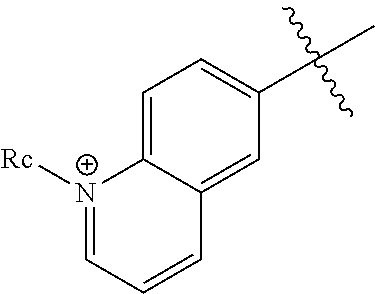 |
| with Rc being methyl | ||
| 6b |  |  |
| with Rc being ethyl | ||
| 6c |  |  |
| with Rc being benzyl | ||
| 7a |  |  |
| with Rb being H and | ||
| Ra being methyl | ||
| 7b |  |  |
| with Rb being H and | ||
| Ra being ethyl | ||
| 7c |  |  |
| with Rb being H and | ||
| Ra being benzyl | ||
| 8a |  |  |
| with Rc being methyl | ||
| 8b |  |  |
| with Rc being ethyl | ||
| 8c |  |  |
| with Rc being benzyl | ||
| 9a |  |  |
| with Rc being methyl | ||
| 9b |  |  |
| with Rc being ethyl | ||
| 9c |  |  |
| with Rc being benzyl | ||
| 10a |  |  |
| with Rb being H and | ||
| Ra being methyl | ||
| 10b |  |  |
| with Rb being H and | ||
| Ra being ethyl | ||
| 10c |  |  |
| with Rb being H and | ||
| Ra being benzyl | ||
| 11a |  |  |
| with Rc being methyl | ||
| 11b |  |  |
| with Rc being ethyl | ||
| 11c |  |  |
| with Rc being benzyl | ||
| 12a |  |  |
| with Rc being methyl | ||
| 12b |  |  |
| with Rc being ethyl | ||
| 12c |  |  |
| with Rc being benzyl | ||
with X2− as defined above, especially representing 2 anions selected from the group consisting of a halogenide, a carboxylate, a C1-C6alkylsulfonate, a C1-C6haloalkylsulfonate and an alkylarylsulfonate, preferably a halogenide, a methanesulfonate, a trifluoromethanesulfonate or a tosylate for instance, 2 anions selected from the group consisting of Cl−, Br−, I−, and CHF3SO3 −, such as Br−, I−, and CHF3SO3 −, preferably Br− or I−.
| Ar1 and Ar2 are | ||
| No | L | identical and are both |
| 2a |  |  |
| with Rc being methyl | ||
| 2b |  |  |
| with Rc being ethyl | ||
| 2c |  |  |
| with Rc being benzyl | ||
| 3a |  |  |
| with Rc being methyl | ||
| 3b |  |  |
| with Rc being ethyl | ||
| 3c |  |  |
| with Rc being benzyl | ||
| 8a |  |  |
| with Rc being methyl | ||
| 8b |  |  |
| with Rc being ethyl | ||
| 8c |  |  |
| with Rc being benzyl | ||
| 9a |  |  |
| with Rc being methyl | ||
| 9b |  |  |
| with Rc being ethyl | ||
| 9c |  |  |
| with Rc being benzyl | ||
| 10a |  |  |
| with Rb being H and | ||
| Ra being methyl | ||
| 10b |  |  |
| with Rb being H and | ||
| Ra being ethyl | ||
| 10c |  |  |
| with Rb being H and | ||
| Ra being benzyl | ||
| 11a |  |  |
| with Rc being methyl | ||
| 11b |  |  |
| with Rc being ethyl | ||
| 11c |  |  |
| with Rc being benzyl | ||
| 12a |  |  |
| with Rc being methyl | ||
| 12b |  |  |
| with Rc being ethyl | ||
| 12c |  |  |
| with Rc being benzyl | ||
with X2− as defined above, especially representing 2 anions selected from the group consisting of a halogenide, a carboxylate, a C1-C6alkylsulfonate, a C1-C6haloalkylsulfonate and an alkylarylsulfonate, preferably a halogenide, a methanesulfonate, a trifluoromethanesulfonate or a tosylate for instance, 2 anions selected from the group consisting of Cl−, Br−, I−, and CHF3SO3 −, such as Br−, I−, and CHF3SO3 −, preferably Br− or I−.


preferably 2a, 2c, 10a, 11a, and 11c, most preferably 2a.
Miscellaneous
-
- a) Condensing NH2NH2.H2O (hydrazine hydrate) with an ester of formula (IV),

wherein L is as defined above, and Re is a O(C1-C6)alkyl group, said C1-C6 alkyl being optionally substituted with a OH group, a O—(C1-C4)alkyl group or a monocyclic or bicyclic 5- to 10-membered aromatic or heteroaromtic group,

to obtain hydrazone (V), with L as defined above,
-
- b) Condensing the compound of formula (V) with an aldehyde of formula Ar1′—CHO
- and/or an aldehyde of formula Ar2′—CHO,
- b) Condensing the compound of formula (V) with an aldehyde of formula Ar1′—CHO

with Rb as defined above,
Y2 and Z2 being independently CH or N, provided that al least one of Y2 and Z2 is N and at least one of Y2 and Z2 is CH,
to obtain Intermediate (VI),

with L, Ar1′ and Ar2′ as defined above, and
-
- c) Alkylating Intermediate (VI) with an alkylating agent of formula Rd—Z, wherein
- Z is a leaving group, preferably a halogen atom such as Br or I, and
- Rd is a C1-C6 alkyl, optionally substituted with a OH group, a O—(C1-C4)alkyl group or a monocyclic or bicyclic 5- to 10-membered aromatic or heteroaromtic group,
to obtain the compound of formula (I) as defined above.

Pharmaceutical Compositions
-
- a first composition comprising the compound of formula (I) as defined above or below, and a pharmaceutically acceptable excipient, and
- a second composition comprising another therapeutic agent, preferably selected from antibiotics, anticancer agents, steroidal and non-steroidal anti-inflammatory drugs, advantageously an anticancer agent,
as a combination product for simultaneous, staggered or sequential use. The kit of the invention is used as drug, in particular for treating an EBV-related cancer.


where F0 is fluorescence intensity of the probe (TO) bound to RNA without added ligand. The percentage of displacement is then plotted as a function of the concentration of added ligand. The RNA affinity of putative ligands is evaluated using the concentration of a ligand required to decrease the fluorescence of the probe by 50% (noted DC50), which is determined graphically from non-linear fitting of the displacement curve. Low DC50 values (DC50<0.25 μM) typically indicate strong affinity of the ligand to G4-RNA.
2. Materials and Reagents
| TABLE 1 |
| DC50 values for TO displacement from |
| G4-RNA EBNA1 by various ligands. |
| Compound | DC50 (μM) | ||
| 2a | 0.26 ± 0.05 | ||
| 2c | 0.39 ± 0.02 | ||
| 3b | 0.74 ± 0.03 | ||
| 3c | 0.72 ± 0.03 | ||
| 8a | 0.61 ± 0.11 | ||
| 8c | 0.71 ± 0.10 | ||
| 9b | 0.80 ± 0.01 | ||
| 9c | 1.09 ± 0.10 | ||
| 10a | 0.32 ± 0.02 | ||
| 11a | 0.30 ± 0.03 | ||
| 11c | 0.34 ± 0.02 | ||
| 12b | 0.59 ± 0.03 | ||
| 12c | 0.65 ± 0.06 | ||
| TABLE 2 | |||||
| ΔTm (° C.) | |||||
| Ligand | Ligand + | Ligand + | |||
| Compound | alone | 3 μM ds26 | 10 |
||
| 2a | 16.4 ± 0.4 | 16.1 ± 0.4 | 14.2 ± 0.7 | ||
| 2c | 10.1 ± 0.9 | 11.4 ± 0.6 | 9.6 ± 0.2 | ||
| 3b | 5.9 ± 0.1 | 7.6 ± 0.5 | 7.4 ± 0.3 | ||
| 3c | 10.4 ± 0.3 | 12.2 ± 0.2 | 12.0 ± 0.2 | ||
| 8a | 16.2 ± 0.1 | 16.6 ± 0.2 | 17.7 ± 0.8 | ||
| 8c | 17.1 ± 0.3 | 16.7 ± 0.3 | 15.8 ± 0.3 | ||
| 9b | 11.8 ± 0.1 | 10.3 ± 0.2 | 8.8 ± 0.2 | ||
| 9c | 13.1 ± 0.6 | 12.3 ± 0.4 | 10.0 ± 1.7 | ||
| 10a | 15.7 ± 0.6 | 15.0 ± 0.6 | 12.5 ± 1.5 | ||
| 11a | 21.5 ± 0.2 | 21.1 ± 0.6 | 19.3 ± 1.1 | ||
| 11c | 20.1 ± 0.3 | 20.3 ± 0.4 | 17.0 ± 0.8 | ||
| 12b | 28.5 ± 1.1 | 25.9 ± 0.4 | 25.1 ± 0.8 | ||
| 12c | 25.3 ± 1.3 | 25.0 ± 0.7 | 22.7 ± 1.5 | ||
Claims (23)


Applications Claiming Priority (4)
| Application Number | Priority Date | Filing Date | Title |
|---|---|---|---|
| EP18305392.5A EP3549938A1 (en) | 2018-04-03 | 2018-04-03 | Novel hydrazone derivatives for preventing or treating ebv-related cancers |
| EP18305392.5 | 2018-04-03 | ||
| EP18305392 | 2018-04-03 | ||
| PCT/EP2019/058435 WO2019193071A1 (en) | 2018-04-03 | 2019-04-03 | Novel hydrazone derivatives for preventing or treating ebv-related cancers |
Publications (2)
| Publication Number | Publication Date |
|---|---|
| US20210161887A1 US20210161887A1 (en) | 2021-06-03 |
| US11406631B2 true US11406631B2 (en) | 2022-08-09 |
Family
ID=61965890
Family Applications (1)
| Application Number | Title | Priority Date | Filing Date |
|---|---|---|---|
| US17/045,049 Active 2039-04-18 US11406631B2 (en) | 2018-04-03 | 2019-04-03 | Hydrazone derivatives for preventing or treating EBV-related cancers |
Country Status (3)
| Country | Link |
|---|---|
| US (1) | US11406631B2 (en) |
| EP (2) | EP3549938A1 (en) |
| WO (1) | WO2019193071A1 (en) |
Citations (2)
| Publication number | Priority date | Publication date | Assignee | Title |
|---|---|---|---|---|
| CN105777783A (en) | 2016-02-25 | 2016-07-20 | 聊城大学 | (2-pyridylaldehyde)-2,6 pyridine diacylhydrazone copper compound, preparation method and application thereof |
| WO2018211148A1 (en) | 2017-05-19 | 2018-11-22 | Universite De Bretagne Occidentale | Bisquinolium derivatives for preventing or treating ebv-related cancers |
-
2018
- 2018-04-03 EP EP18305392.5A patent/EP3549938A1/en not_active Withdrawn
-
2019
- 2019-04-03 EP EP19715096.4A patent/EP3774770B1/en active Active
- 2019-04-03 US US17/045,049 patent/US11406631B2/en active Active
- 2019-04-03 WO PCT/EP2019/058435 patent/WO2019193071A1/en not_active Ceased
Patent Citations (3)
| Publication number | Priority date | Publication date | Assignee | Title |
|---|---|---|---|---|
| CN105777783A (en) | 2016-02-25 | 2016-07-20 | 聊城大学 | (2-pyridylaldehyde)-2,6 pyridine diacylhydrazone copper compound, preparation method and application thereof |
| CN105777783B (en) | 2016-02-25 | 2017-08-11 | 聊城大学 | The double acylhydrazone copper compounds of (2 pyridine carboxaldehyde) 2,6 pyridines, preparation method and applications |
| WO2018211148A1 (en) | 2017-05-19 | 2018-11-22 | Universite De Bretagne Occidentale | Bisquinolium derivatives for preventing or treating ebv-related cancers |
Non-Patent Citations (20)
| Title |
|---|
| Akao I, Sato Y, Mukai K, Uhara H, Furuya S, Hoshikawa T, Shimosato Y, Takeyama I. Detection of Epstein-Barr virus DNA in formalin-fixed paraflin-embedded tissue of nasopharyngeal carcinoma using polymerase chain reaction and in situ hybridization. The Laryngoscope. Mar. 1, 1991;101(3):279-83. |
| Chang KL, Chen YY, Shibata D, Weiss LM. Description of an in situ hybridization methodology for detection of Epstein-Barr virus RNA in paraffin-embedded tissues, with a survey of normal and neoplastic tissues. Diagnostic molecular pathology: the American journal of surgical pathology, part B. Dec. 1, 1992;1(4):246-55. |
| European Search Report for EP18305392 completed Sep. 19, 2018; 3 pages. |
| Gierczyk B, Zalas M. "Synthesis of substituted 1, 3, 4-thiadiazoles using Lawesson's reagent." Organic Preparations and Procedures International: The New Journal for Organic Synth. Organic Preparation and Procedures Co., Newton Highlands. MA. US Jun. 1, 2005;37(3):213-22. XP009144134. |
| GIERCZYK, B.; ZALAS, M.: "SYNTHESIS OF SUBSTITUTED 1,3,4-THIADIAZOLES USING LAWESSON'S REAGENT", ORGANIC PREPARATIONS AND PROCEDURES INTERNATIONAL: THE NEW JOURNAL FOR ORGANIC SYNTHESIS, ORGANIC PREPARATION AND PROCEDURES CO., NEWTON HIGHLANDS, MA., US, vol. 37, no. 3, 1 June 2005 (2005-06-01), US , pages 213 - 222, XP009144134, ISSN: 0030-4948, DOI: 10.1080/00304940509354950 |
| Grasser, F. A., et al. "Monoclonal antibodies directed against the Epstein-Barr virus-encoded nuclear antigen 1 (EBNA1): immunohistologic detection of EBNA1 in the malignant cells of Hodgkin's disease." BLOOD, 84 (1994) 3792-3798. |
| International Search Report for PCT/EP2019/058435 dated May 20, 2019; 5 pages. |
| JOAN L. BUSS ET.AL.: "The role of iron chelation in cancer therapy", CURRENT MEDICINAL CHEMISTRY, vol. 10, 1 January 2003 (2003-01-01), pages 1021 - 1034, XP002784895, DOI: 10.2174/0929867033457638 |
| Joan L. Buss et.al.: "The role of iron chelation in cancer therapy". Current Medicinal Chemistry, vol. 10(12). Jun. 1, 2003. pp. 1021-1034. XP002784895. |
| Kaplanek Robert et al: "Synthesis and biological activity evaluation of hydrazone derivatives based on a Trager's base skele". Bioorganic & Medicinal Chemistry. Pergamon. GB. vol. 23. No. 7. Jan. 23, 2015 (Jan. 23, 2015). pp. 1651-1659. XP029204964. |
| KAPLÁNEK ROBERT; HAVLÍK MARTIN; DOLENSKÝ BOHUMIL; RAK JAKUB; DžUBÁK PETR; KONEčNÝ PETR; HAJDÚCH MARIÁN; KRÁLOVÁ JARMILA;: "Synthesis and biological activity evaluation of hydrazone derivatives based on a Tröger’s base skele", BIOORGANIC & MEDICINAL CHEMISTRY, ELSEVIER, AMSTERDAM, NL, vol. 23, no. 7, 23 January 2015 (2015-01-23), AMSTERDAM, NL, pages 1651 - 1659, XP029204964, ISSN: 0968-0896, DOI: 10.1016/j.bmc.2015.01.029 |
| Largy E, Hamon F, Teulade Fichou MP. Development of a high throughput G4-FID assay for screening and evaluation of small molecules binding quadruplex nucleic acid structures. Analytical and bioanalytical chemistry. Jul. 2011;400(10):3419-27. |
| Lista MJ, Martins RP, Billant O, Contesse MA, Findakly S, Pochard P, Daskalogianni C, Beauvineau C, Guetta C, Jamin C, Teulade-Fichou MP. Nucleolin directly mediates Epstein-Barr virus immune evasion through binding to G-quadruplexes of EBNA1 mRNA. Nature communications. Jul. 7, 2017;8(1):1-3. |
| Lista MJ, Voisset C, Contesse MA, Friocourt G, Daskalogianni C, Bihel F, Fåhraeus R, Blondel M. The long-lasting love affair between the budding yeast Saccharomyces cerevisiae and the Epstein-Barr virus. Biotechnology journal. Sep. 2015;10(11):1670-81. |
| Murat P, Balasubramanian S. Existence and consequences of G-quadruplex structures in DNA. Current opinion in genetics & development. Apr. 1, 2014;25:22-9. |
| Tosoni E, Frasson I, Scalabrin M, Perrone R, Butovskaya E, Nadai M, Palú G, Fabris D, Richter SN. Nucleolin stabilizes G-quadruplex structures folded by the LTR promoter and silences HIV-1 viral transcription. Nucleic acids research. Oct. 15, 2015;43(18):8884-97. |
| Voisset C, Daskalogianni C, Contesse MA, Mazars A, Arbach H, Le Cann M, Soubigou F, Apcher S, Fahraeus R, Blondel M. A yeast-based assay identifies drugs that interfere with immune evasion of the Epstein-Barr virus. Disease models & mechanisms. Apr. 1, 2014;7(4):435-44. |
| Weiss LM, Movahed LA, Butler AE, Swanson SA, Frierson Jr HF, Cooper PH, Colby TV, Mills SE. Analysis of lymphoepithelioma and lymphoepithelioma-like carcinomas for Epstein-Barr viral genomes by in situ hybridization. The American journal of surgical pathology. Aug. 1, 1989;13(8):625-31. |
| Zhao Y et al: "A highly selective fluorescent chemosensor for AI+3 derivated from a-hydroxyquinoline". Inorganic Chemistry Communications. Elsevier. Amsterdam. NL. vol. 9. No. 9. Sep. 1, 2006 (Sep. 1, 2006). pp. 966-968. XP028039815. |
| ZHAO, Y. ; LIN, Z. ; LIAO, H. ; DUAN, C. ; MENG, Q.: "A highly selective fluorescent chemosensor for Al^3^+ derivated from 8-hydroxyquinoline", INORGANIC CHEMISTRY COMMUNICATIONS, ELSEVIER , AMSTERDAM, NL, vol. 9, no. 9, 1 September 2006 (2006-09-01), NL , pages 966 - 968, XP028039815, ISSN: 1387-7003, DOI: 10.1016/j.inoche.2006.05.030 |
Also Published As
| Publication number | Publication date |
|---|---|
| EP3774770B1 (en) | 2023-09-06 |
| EP3774770A1 (en) | 2021-02-17 |
| WO2019193071A1 (en) | 2019-10-10 |
| US20210161887A1 (en) | 2021-06-03 |
| EP3549938A1 (en) | 2019-10-09 |
Similar Documents
| Publication | Publication Date | Title |
|---|---|---|
| CN103068803B (en) | As imidazo [4, the 5-c] quinolines of DNA-PK inhibitor | |
| CN102803227B (en) | Morpholinylquinazoline | |
| JP6911031B2 (en) | Heterocyclic compounds as immunomodulators | |
| KR102363174B1 (en) | Hepatitis b core protein allosteric modulators | |
| TWI801492B (en) | Nitrogen-containing tricyclic compounds and uses thereof in medicine | |
| JP2020536106A (en) | Interferon gene stimulator (STING) regulator useful for the treatment of HIV | |
| CN103080092B (en) | Pyrazolo-quinolines compound | |
| CN107686486A (en) | Tricyclic nitrogen containing compounds and its application in medicine | |
| CN108347942A (en) | Hepatitis B core protein modulator | |
| CN107849050B (en) | compound | |
| CN110114071A (en) | Tricyclic compounds containing substituted pyridones and methods of using the same | |
| JP2003523392A (en) | Antiviral azaindole derivatives | |
| WO2012150234A1 (en) | Dihydroquinoline derivatives as bromodomain inhibitors | |
| WO2020020288A1 (en) | Sulfoximine compound as bromodomain protein inhibitor and pharmaceutical composition and medical use thereof | |
| JP2025172953A (en) | Benzene ring compounds | |
| Li et al. | Design, synthesis, and evaluation of new sugar-substituted imidazole derivatives as selective c-MYC transcription repressors targeting the promoter G-quadruplex | |
| CN113329998A (en) | Sulfonimidyl amide compounds and compositions for treating conditions associated with NLRP activity | |
| WO2024199372A1 (en) | New recruitment element of ubiquitin ligase and use thereof | |
| JP2023511082A (en) | 4'-O-methylene phosphonate nucleic acids and analogues thereof | |
| WO2018211148A1 (en) | Bisquinolium derivatives for preventing or treating ebv-related cancers | |
| CN108463462B (en) | Benzodiazepines as bromodomain inhibitors | |
| US20240261317A1 (en) | Methods of treating medical conditions and inhibiting line1 reverse transcriptaseusing a substituted 4-fluoro-2,5-dihydrofuranyl phosphonic acid or related compound | |
| US11406631B2 (en) | Hydrazone derivatives for preventing or treating EBV-related cancers | |
| CN114555189A (en) | Xanthophyllone derivatives as inhibitors of topoisomerase IB (TOP1) and/or tyrosyl-DNA phosphodiesterase 1(TDP1) | |
| CN120058702A (en) | Heterocyclic TEAD inhibitors |
Legal Events
| Date | Code | Title | Description |
|---|---|---|---|
| FEPP | Fee payment procedure |
Free format text: ENTITY STATUS SET TO UNDISCOUNTED (ORIGINAL EVENT CODE: BIG.); ENTITY STATUS OF PATENT OWNER: LARGE ENTITY |
|
| STPP | Information on status: patent application and granting procedure in general |
Free format text: APPLICATION DISPATCHED FROM PREEXAM, NOT YET DOCKETED |
|
| STPP | Information on status: patent application and granting procedure in general |
Free format text: DOCKETED NEW CASE - READY FOR EXAMINATION |
|
| AS | Assignment |
Owner name: UNIVERSITE PARIS-SACLAY, FRANCE Free format text: MERGER;ASSIGNOR:UNIVERSITE PARIS-SUD;REEL/FRAME:058630/0874 Effective date: 20210104 |
|
| AS | Assignment |
Owner name: UNIVERSITE PARIS-SACLAY, FRANCE Free format text: ASSIGNMENT OF ASSIGNORS INTEREST;ASSIGNORS:BLONDEL, MARC;QUILLEVERE, ALICIA;VOISSET, CECILE;AND OTHERS;SIGNING DATES FROM 20210519 TO 20210521;REEL/FRAME:059256/0884 Owner name: UNIV PARIS XIII PARIS-NORD VILLETANEUSE, FRANCE Free format text: ASSIGNMENT OF ASSIGNORS INTEREST;ASSIGNORS:BLONDEL, MARC;QUILLEVERE, ALICIA;VOISSET, CECILE;AND OTHERS;SIGNING DATES FROM 20210519 TO 20210521;REEL/FRAME:059256/0884 Owner name: UNIVERSITE DE PARIS, FRANCE Free format text: ASSIGNMENT OF ASSIGNORS INTEREST;ASSIGNORS:BLONDEL, MARC;QUILLEVERE, ALICIA;VOISSET, CECILE;AND OTHERS;SIGNING DATES FROM 20210519 TO 20210521;REEL/FRAME:059256/0884 Owner name: INSTITUT CURIE, FRANCE Free format text: ASSIGNMENT OF ASSIGNORS INTEREST;ASSIGNORS:BLONDEL, MARC;QUILLEVERE, ALICIA;VOISSET, CECILE;AND OTHERS;SIGNING DATES FROM 20210519 TO 20210521;REEL/FRAME:059256/0884 Owner name: CENTRE NATIONAL DE LA RECHERCHE SCIENTIFIQUE (CNRS), FRANCE Free format text: ASSIGNMENT OF ASSIGNORS INTEREST;ASSIGNORS:BLONDEL, MARC;QUILLEVERE, ALICIA;VOISSET, CECILE;AND OTHERS;SIGNING DATES FROM 20210519 TO 20210521;REEL/FRAME:059256/0884 Owner name: INSTITUT NATIONAL DE LA SANTE ET DE LA RECHERCHE MEDICALE (INSERM), FRANCE Free format text: ASSIGNMENT OF ASSIGNORS INTEREST;ASSIGNORS:BLONDEL, MARC;QUILLEVERE, ALICIA;VOISSET, CECILE;AND OTHERS;SIGNING DATES FROM 20210519 TO 20210521;REEL/FRAME:059256/0884 Owner name: CENTRE HOSPITALIER REGIONAL UNIVERSITAIRE DE BREST, FRANCE Free format text: ASSIGNMENT OF ASSIGNORS INTEREST;ASSIGNORS:BLONDEL, MARC;QUILLEVERE, ALICIA;VOISSET, CECILE;AND OTHERS;SIGNING DATES FROM 20210519 TO 20210521;REEL/FRAME:059256/0884 Owner name: UNIVERSITE DE BRETAGNE OCCIDENTALE, FRANCE Free format text: ASSIGNMENT OF ASSIGNORS INTEREST;ASSIGNORS:BLONDEL, MARC;QUILLEVERE, ALICIA;VOISSET, CECILE;AND OTHERS;SIGNING DATES FROM 20210519 TO 20210521;REEL/FRAME:059256/0884 |
|
| STPP | Information on status: patent application and granting procedure in general |
Free format text: NOTICE OF ALLOWANCE MAILED -- APPLICATION RECEIVED IN OFFICE OF PUBLICATIONS |
|
| AS | Assignment |
Owner name: UNIVERSITE PARIS-SACLAY, FRANCE Free format text: CORRECTIVE ASSIGNMENT TO CORRECT THE ASSIGNEE ADDRESS PREVIOUSLY RECORDED AT REEL: 058630 FRAME: 0874. ASSIGNOR(S) HEREBY CONFIRMS THE MERGER;ASSIGNOR:UNIVERSITE PARIS-SUD;REEL/FRAME:059952/0787 Effective date: 20210104 |
|
| AS | Assignment |
Owner name: UNIVERSITE PARIS CITE, FRANCE Free format text: CHANGE OF NAME;ASSIGNOR:UNIVERSITE DE PARIS;REEL/FRAME:060390/0122 Effective date: 20220304 |
|
| STPP | Information on status: patent application and granting procedure in general |
Free format text: PUBLICATIONS -- ISSUE FEE PAYMENT RECEIVED |
|
| STCF | Information on status: patent grant |
Free format text: PATENTED CASE |
|
| AS | Assignment |
Owner name: UNIVERSITE PARIS CITE, FRANCE Free format text: CORRECTIVE ASSIGNMENT TO CORRECT THE PROPERTY NUMBER 16930208 PREVIOUSLY RECORDED AT REEL: 060390 FRAME: 0122. ASSIGNOR(S) HEREBY CONFIRMS THE CHANGE OF NAME;ASSIGNOR:UNIVERSITE DE PARIS;REEL/FRAME:062387/0489 Effective date: 20220304 Owner name: UNIVERSITE PARIS CITE, FRANCE Free format text: CORRECTIVE ASSIGNMENT TO CORRECT THE PROPERTY NUMBERS PREVIOUSLY RECORDED AT REEL: 060390 FRAME: 0122. ASSIGNOR(S) HEREBY CONFIRMS THE CHANGE OF NAME;ASSIGNOR:UNIVERSITE DE PARIS;REEL/FRAME:062387/0489 Effective date: 20220304 |