US11406399B2 - Multi-barrel drill guide and anchor deployment assembly - Google Patents
Multi-barrel drill guide and anchor deployment assembly Download PDFInfo
- Publication number
- US11406399B2 US11406399B2 US16/596,321 US201916596321A US11406399B2 US 11406399 B2 US11406399 B2 US 11406399B2 US 201916596321 A US201916596321 A US 201916596321A US 11406399 B2 US11406399 B2 US 11406399B2
- Authority
- US
- United States
- Prior art keywords
- anchor
- suture
- metacarpal
- driver
- drill
- Prior art date
- Legal status (The legal status is an assumption and is not a legal conclusion. Google has not performed a legal analysis and makes no representation as to the accuracy of the status listed.)
- Active, expires
Links
Images




Classifications
-
- A—HUMAN NECESSITIES
- A61—MEDICAL OR VETERINARY SCIENCE; HYGIENE
- A61B—DIAGNOSIS; SURGERY; IDENTIFICATION
- A61B17/00—Surgical instruments, devices or methods
- A61B17/04—Surgical instruments, devices or methods for suturing wounds; Holders or packages for needles or suture materials
- A61B17/0401—Suture anchors, buttons or pledgets, i.e. means for attaching sutures to bone, cartilage or soft tissue; Instruments for applying or removing suture anchors
-
- A—HUMAN NECESSITIES
- A61—MEDICAL OR VETERINARY SCIENCE; HYGIENE
- A61B—DIAGNOSIS; SURGERY; IDENTIFICATION
- A61B17/00—Surgical instruments, devices or methods
- A61B17/16—Instruments for performing osteoclasis; Drills or chisels for bones; Trepans
- A61B17/17—Guides or aligning means for drills, mills, pins or wires
- A61B17/1714—Guides or aligning means for drills, mills, pins or wires for applying tendons or ligaments
-
- A—HUMAN NECESSITIES
- A61—MEDICAL OR VETERINARY SCIENCE; HYGIENE
- A61B—DIAGNOSIS; SURGERY; IDENTIFICATION
- A61B17/00—Surgical instruments, devices or methods
- A61B17/16—Instruments for performing osteoclasis; Drills or chisels for bones; Trepans
- A61B17/17—Guides or aligning means for drills, mills, pins or wires
- A61B17/1739—Guides or aligning means for drills, mills, pins or wires specially adapted for particular parts of the body
- A61B17/1782—Guides or aligning means for drills, mills, pins or wires specially adapted for particular parts of the body for the hand or wrist
-
- A—HUMAN NECESSITIES
- A61—MEDICAL OR VETERINARY SCIENCE; HYGIENE
- A61B—DIAGNOSIS; SURGERY; IDENTIFICATION
- A61B17/00—Surgical instruments, devices or methods
- A61B17/56—Surgical instruments or methods for treatment of bones or joints; Devices specially adapted therefor
- A61B17/58—Surgical instruments or methods for treatment of bones or joints; Devices specially adapted therefor for osteosynthesis, e.g. bone plates, screws or setting implements
- A61B17/68—Internal fixation devices, including fasteners and spinal fixators, even if a part thereof projects from the skin
- A61B17/683—Internal fixation devices, including fasteners and spinal fixators, even if a part thereof projects from the skin comprising bone transfixation elements, e.g. bolt with a distal cooperating element such as a nut
-
- A—HUMAN NECESSITIES
- A61—MEDICAL OR VETERINARY SCIENCE; HYGIENE
- A61F—FILTERS IMPLANTABLE INTO BLOOD VESSELS; PROSTHESES; DEVICES PROVIDING PATENCY TO, OR PREVENTING COLLAPSING OF, TUBULAR STRUCTURES OF THE BODY, e.g. STENTS; ORTHOPAEDIC, NURSING OR CONTRACEPTIVE DEVICES; FOMENTATION; TREATMENT OR PROTECTION OF EYES OR EARS; BANDAGES, DRESSINGS OR ABSORBENT PADS; FIRST-AID KITS
- A61F2/00—Filters implantable into blood vessels; Prostheses, i.e. artificial substitutes or replacements for parts of the body; Appliances for connecting them with the body; Devices providing patency to, or preventing collapsing of, tubular structures of the body, e.g. stents
- A61F2/02—Prostheses implantable into the body
- A61F2/08—Muscles; Tendons; Ligaments
- A61F2/0811—Fixation devices for tendons or ligaments
-
- A—HUMAN NECESSITIES
- A61—MEDICAL OR VETERINARY SCIENCE; HYGIENE
- A61B—DIAGNOSIS; SURGERY; IDENTIFICATION
- A61B17/00—Surgical instruments, devices or methods
- A61B17/04—Surgical instruments, devices or methods for suturing wounds; Holders or packages for needles or suture materials
- A61B17/06—Needles ; Sutures; Needle-suture combinations; Holders or packages for needles or suture materials
- A61B17/06114—Packages or dispensers for needles or sutures
- A61B17/06119—Packages or dispensers for needles or sutures of cylindrical shape
-
- A—HUMAN NECESSITIES
- A61—MEDICAL OR VETERINARY SCIENCE; HYGIENE
- A61B—DIAGNOSIS; SURGERY; IDENTIFICATION
- A61B17/00—Surgical instruments, devices or methods
- A61B17/16—Instruments for performing osteoclasis; Drills or chisels for bones; Trepans
- A61B17/1613—Component parts
- A61B17/1628—Motors; Power supplies
-
- A—HUMAN NECESSITIES
- A61—MEDICAL OR VETERINARY SCIENCE; HYGIENE
- A61B—DIAGNOSIS; SURGERY; IDENTIFICATION
- A61B17/00—Surgical instruments, devices or methods
- A61B17/16—Instruments for performing osteoclasis; Drills or chisels for bones; Trepans
- A61B17/1662—Instruments for performing osteoclasis; Drills or chisels for bones; Trepans for particular parts of the body
- A61B17/1686—Instruments for performing osteoclasis; Drills or chisels for bones; Trepans for particular parts of the body for the hand or wrist
-
- A—HUMAN NECESSITIES
- A61—MEDICAL OR VETERINARY SCIENCE; HYGIENE
- A61B—DIAGNOSIS; SURGERY; IDENTIFICATION
- A61B17/00—Surgical instruments, devices or methods
- A61B17/04—Surgical instruments, devices or methods for suturing wounds; Holders or packages for needles or suture materials
- A61B17/0401—Suture anchors, buttons or pledgets, i.e. means for attaching sutures to bone, cartilage or soft tissue; Instruments for applying or removing suture anchors
- A61B2017/0406—Pledgets
-
- A—HUMAN NECESSITIES
- A61—MEDICAL OR VETERINARY SCIENCE; HYGIENE
- A61B—DIAGNOSIS; SURGERY; IDENTIFICATION
- A61B17/00—Surgical instruments, devices or methods
- A61B17/04—Surgical instruments, devices or methods for suturing wounds; Holders or packages for needles or suture materials
- A61B17/0401—Suture anchors, buttons or pledgets, i.e. means for attaching sutures to bone, cartilage or soft tissue; Instruments for applying or removing suture anchors
- A61B2017/0409—Instruments for applying suture anchors
-
- A—HUMAN NECESSITIES
- A61—MEDICAL OR VETERINARY SCIENCE; HYGIENE
- A61B—DIAGNOSIS; SURGERY; IDENTIFICATION
- A61B17/00—Surgical instruments, devices or methods
- A61B17/04—Surgical instruments, devices or methods for suturing wounds; Holders or packages for needles or suture materials
- A61B2017/0496—Surgical instruments, devices or methods for suturing wounds; Holders or packages for needles or suture materials for tensioning sutures
-
- A—HUMAN NECESSITIES
- A61—MEDICAL OR VETERINARY SCIENCE; HYGIENE
- A61B—DIAGNOSIS; SURGERY; IDENTIFICATION
- A61B17/00—Surgical instruments, devices or methods
- A61B17/56—Surgical instruments or methods for treatment of bones or joints; Devices specially adapted therefor
- A61B2017/564—Methods for bone or joint treatment
-
- A—HUMAN NECESSITIES
- A61—MEDICAL OR VETERINARY SCIENCE; HYGIENE
- A61B—DIAGNOSIS; SURGERY; IDENTIFICATION
- A61B90/00—Instruments, implements or accessories specially adapted for surgery or diagnosis and not covered by any of the groups A61B1/00 - A61B50/00, e.g. for luxation treatment or for protecting wound edges
- A61B90/08—Accessories or related features not otherwise provided for
- A61B2090/0807—Indication means
- A61B2090/0811—Indication means for the position of a particular part of an instrument with respect to the rest of the instrument, e.g. position of the anvil of a stapling instrument
-
- A—HUMAN NECESSITIES
- A61—MEDICAL OR VETERINARY SCIENCE; HYGIENE
- A61F—FILTERS IMPLANTABLE INTO BLOOD VESSELS; PROSTHESES; DEVICES PROVIDING PATENCY TO, OR PREVENTING COLLAPSING OF, TUBULAR STRUCTURES OF THE BODY, e.g. STENTS; ORTHOPAEDIC, NURSING OR CONTRACEPTIVE DEVICES; FOMENTATION; TREATMENT OR PROTECTION OF EYES OR EARS; BANDAGES, DRESSINGS OR ABSORBENT PADS; FIRST-AID KITS
- A61F2/00—Filters implantable into blood vessels; Prostheses, i.e. artificial substitutes or replacements for parts of the body; Appliances for connecting them with the body; Devices providing patency to, or preventing collapsing of, tubular structures of the body, e.g. stents
- A61F2/02—Prostheses implantable into the body
- A61F2/08—Muscles; Tendons; Ligaments
- A61F2/0811—Fixation devices for tendons or ligaments
- A61F2002/0847—Mode of fixation of anchor to tendon or ligament
- A61F2002/0852—Fixation of a loop or U-turn, e.g. eyelets, anchor having multiple holes
-
- A—HUMAN NECESSITIES
- A61—MEDICAL OR VETERINARY SCIENCE; HYGIENE
- A61F—FILTERS IMPLANTABLE INTO BLOOD VESSELS; PROSTHESES; DEVICES PROVIDING PATENCY TO, OR PREVENTING COLLAPSING OF, TUBULAR STRUCTURES OF THE BODY, e.g. STENTS; ORTHOPAEDIC, NURSING OR CONTRACEPTIVE DEVICES; FOMENTATION; TREATMENT OR PROTECTION OF EYES OR EARS; BANDAGES, DRESSINGS OR ABSORBENT PADS; FIRST-AID KITS
- A61F2/00—Filters implantable into blood vessels; Prostheses, i.e. artificial substitutes or replacements for parts of the body; Appliances for connecting them with the body; Devices providing patency to, or preventing collapsing of, tubular structures of the body, e.g. stents
- A61F2/02—Prostheses implantable into the body
- A61F2/08—Muscles; Tendons; Ligaments
- A61F2/0811—Fixation devices for tendons or ligaments
- A61F2002/0876—Position of anchor in respect to the bone
- A61F2002/0882—Anchor in or on top of a bone tunnel, i.e. a hole running through the entire bone
Definitions
- the present invention relates to drills, anchor drivers, and a drill guide for drilling a pilot hole at a surgical repair site and inserting a suture anchor in the pilot hole and, more particularly, to a method for suspension of the CMC joint that minimizes patient irritation/discomfort and damage to the surrounding tissue.
- a body may include bone, soft tissue, and prosthetics.
- One body can be fixed in a position relative to another using connector devices, such as screws and suture anchors (e.g., cannulated knotless suture anchors and soft all suture anchors).
- suture anchors e.g., cannulated knotless suture anchors and soft all suture anchors.
- various orthopedic surgeries require the insertion and fixation of a suture anchor within a bone.
- a pilot hole is drilled into the bone.
- a standard single barrel drill guide is placed at the desired pilot hole location on the bone and a drill is placed through the drill guide to create the pilot hole. The drill is then removed and replaced with a driver pre-loaded with the suture anchor.
- a surgeon must completely remove the drill from the drill guide and insert the driver all while maintaining alignment of the drill guide with the pilot hole.
- Exchanging tools within the drill guide after creation of the pilot hole increases the risk that the alignment of the drill guide with the pilot hole will be lost.
- a loss of alignment requires additional surgical time to correct the misalignment, if even possible, and may potentially result in trauma to the tissue or bone surrounding the pilot hole. Loss of alignment can also result in the anchor inserter rod bending or the anchor not being able to insert fully into the pilot hole which can add cost as well as surgical time.
- an additional assistant may be required to help maintain alignment or attempt realignment.
- suture anchors deployed by conventional drivers are often too large for procedures that involve soft tissue fixation in the extremities.
- a bone hole drilled in an extremity must be shallow and have a narrow diameter due to the very nature of the location of the procedure.
- a shallow bone hole requires that the anchor have exceptional retention capacity, because any movement of the anchor away from the shallow bone hole might entirely release the anchor from the bone hole.
- the anchor may extend out of the shallow and narrow bone hole. Ill-fitting suture anchors have increased instability and can cause irritation or damage to tissue surrounding the exposed portion of the anchor.
- Attempts at addressing the problem include scaling down the size of a traditional suture anchor to fit within a shallow and narrow bone hole.
- the anchor loses retention capacity and thus is unstable within the bone hole.
- numerous factors can influence the retention capacity of a suture anchor, such as the type of tissue, the size of the bone hole, and the anchor's design, the method of deployment of the suture anchor can also influence a suture anchor's retention capacity.
- a suspension arthoplasty for thumb arthritis requires suspension of the CMC joint between the first metacarpal (i.e., thumb bone) and the second metacarpal (i.e. index finger bone).
- the suspension of the CMC joint is performed by first, drilling a tunnel between the first metacarpal and the second metacarpal, and then, using a pair of metal buttons with suture tied in between.
- a metal button is on both a medial side of the second metacarpal and a lateral side of the first metacarpal. The number of buttons, especially including the medially positioned button, increases the risk for irritation/discomfort to the patient and damage to the surrounding tissue.
- the present disclosure is directed to a method for suspension of the CMC joint that minimizes patient irritation/discomfort and damage to the surrounding tissue.
- the present invention is a method for suspending a first metacarpal in relative position to a second metacarpal.
- the method includes the steps of: (i) drilling a hole through the first metacarpal; (ii) inserting a drill guide through the hole in the first metacarpal; (iii) advancing the drill guide to a surface of the second metacarpal, and drilling a hole in the second metacarpal; (iv) inserting an anchor into the hole formed in the second metacarpal, wherein the anchor is attached to suture; (v) deploying the anchor within the second metacarpal; (vi) tensioning the suture attached to the anchor; and (vii) fixing the position of the first metacarpal relative to the second metacarpal using the suture.
- the method also includes the steps of attaching a fixation device to the suture and advancing the fixation device along the suture to over the hole in the first metacarpal.
- the method may also include the steps of deploying the fixation device over the hole in the first metacarpal and/or tying a knot in the suture proximal to the fixation device.
- the method also includes the step of tying a knot in the suture proximal to the hole in the first metacarpal.
- the method includes the step of tying the suture to at least one of a ligament or a tendon.
- the fixation device is an all-suture button and/or the anchor is an all-suture anchor.
- the drill guide may include an anchor driver extending therethrough and the anchor is loaded onto the anchor driver prior to insertion in the hole of the first metacarpal.
- the method step of deploying the anchor within the second metacarpal may also include the step of pulling the suture in a proximal direction using a feature of the drill guide.
- Suture material or sutures can include monofilament or multi-filament suture as well as any other metallic or non-metallic filamentary or wire-like material suitable for performing the function of a suture.
- This material can include both bioabsorbable and non-absorbable materials.
- Suture anchors can include soft suture anchors and rigid suture anchors.
- Soft suture anchors are formed from filaments of suture material which are retained within pre-formed bone holes by being deformable to increase their diameter to a size greater than that of the bone hole, to thereby reside within the cancellous bone and under the bone cortex.
- One such suture anchor is disclosed in U.S. Pat. No. 9,826,971 assigned to the assignee hereof and incorporated by reference herein in its entirety.
- soft anchors are commonly made entirely of suture materials, they are sometimes called “all-suture” anchors, and generally include a fibrous construct anchor body portion (or fibrous, braided or woven fabric-type structure such as a flexible web, as described in U.S. Pat. No. 9,173,652) and a suture or filament portion.
- fibrous construct anchor body portion or fibrous, braided or woven fabric-type structure such as a flexible web, as described in U.S. Pat. No. 9,173,652
- suture or filament portion a suture or filament portion.
- non-soft,” “hard” or “rigid” suture anchors generally include a “hard” anchor body portion (that may or may not include inner and outer members) and a suture/filament portion.
- the anchor body of such suture anchors may be formed of a biocompatible and/or bioabsorbable material. These materials may be of such composition that they are reabsorbed by the body, e.g., during the healing process of the bone.
- Exemplary materials that are suitable for use in the inner and outer members include, but are not limited to, polyetheretherketone (“PEEK”), polylactic acid/beta-tricalcium phosphate (“PLA/Beta-TCP”) composites, ultra-high molecular weight polyethylene (“UHMWPE”), as well as other metallic, non-metallic, and polymeric materials.
- PEEK polyetheretherketone
- PLA/Beta-TCP polylactic acid/beta-tricalcium phosphate
- UHMWPE ultra-high molecular weight polyethylene
- FIG. 1 is a first side view schematic representation of a multi-barrel drill guide and anchor deployment assembly in the pre-drill, pre-anchor deployment, pre-actuated configuration according to an embodiment
- FIG. 2 is a first side view schematic representation of a multi-barrel drill guide and anchor deployment assembly in the drill, pre-anchor deployment, pre-actuated configuration according to an embodiment
- FIG. 3 is a cross-sectional first side view schematic representation of the multi-barrel drill guide and anchor deployment assembly of FIG. 2 according to an embodiment
- FIG. 4 is a close-up cross-sectional first side view schematic representation of a locking mechanism of the multi-barrel drill guide and anchor deployment assembly of FIG. 2 according to an embodiment
- FIG. 5 is a cross-sectional front/perspective view schematic representation of the locking mechanism of the multi-barrel drill guide and anchor deployment assembly of FIG. 2 according to an embodiment
- FIG. 6 is a close-up second side view schematic representation of a notch of the locking mechanism of the multi-barrel drill guide and anchor deployment assembly of FIG. 2 according to an embodiment
- FIG. 7 is a first side view schematic representation of a multi-barrel drill guide and anchor deployment assembly in the post-drill, pre-anchor deployment, pre actuated configuration according to an embodiment
- FIG. 8 is a close-up cross-sectional first side view schematic representation of the second channel of the multi-barrel drill guide and anchor deployment assembly of FIG. 7 according to an embodiment
- FIG. 9 is a close-up first side view schematic representation of the shallow deployment button of multi-barrel drill guide and anchor deployment assembly in the pre-actuated/undeployed configuration according to an embodiment
- FIG. 10 is a close-up cross-sectional second side view schematic representation of the shallow deployment button of the multi-barrel drill guide and anchor deployment assembly of FIG. 9 according to an embodiment
- FIG. 11 is a close-up first side view schematic representation of the shallow deployment button of multi-barrel drill guide and anchor deployment assembly actuated/undeployed configuration according to an embodiment
- FIG. 12 is a close-up rear/perspective view schematic representation of the shallow deployment button of FIG. 11 according to an embodiment
- FIG. 13 is a rear view schematic representation of the shallow deployment button of FIG. 11 according to an embodiment
- FIG. 14 is a first side view schematic representation of the anchor driver of the multi-barrel drill guide and anchor deployment assembly in the actuated/undeployed configuration according to an embodiment
- FIG. 15 is a close-up review view schematic representation of the proximal ends of the sliding inserter and elongated body of FIG. 14 according to an embodiment
- FIG. 16 is a close-up first side view schematic representation of the proximal ends of the sliding inserter and elongated body of FIG. 14 according to an embodiment
- FIG. 17 is a close-up first side view schematic representation of the suture anchor in the undeployed state on the anchor driver of the multi-barrel drill guide and anchor deployment assembly according to an embodiment
- FIG. 18 is a first side view schematic representation of the shallow deployment button of multi-barrel drill guide and anchor deployment assembly in the actuated/deployed configuration according to an embodiment
- FIG. 19 is a close-up side/rear perspective view schematic representation of the shallow deployment button of FIG. 18 according to an embodiment
- FIG. 20 is a close-up first side view schematic representation of the suture anchor in the deployed state on the anchor driver of the multi-barrel drill guide and anchor deployment assembly according to an embodiment
- FIG. 21 is a close-up side view schematic representation of the suture anchor of FIG. 20 with the multi-barrel drill guide and anchor deployment assembly removed according to an embodiment
- FIG. 22 is a side view schematic representation of an embodiment of the suture anchor in the undeployed configuration according to an embodiment
- FIG. 23 is a side view schematic representation of the suture anchor of FIG. 22 loaded onto the anchor drive according to an embodiment r;
- FIG. 24 is a side view schematic representation of the suture anchor of FIG. 22 loaded onto the anchor driver and placed in a pilot hole according to an embodiment
- FIG. 26 is another side view schematic representation of the suture anchor of FIG. 22 between the undeployed and deployed configurations according to an embodiment
- FIG. 27 is a final side view schematic representation of the suture anchor of FIG. 22 between the undeployed and deployed configurations according to an embodiment
- FIG. 28 is a side view schematic representation of the suture anchor of FIG. 22 in the deployed configuration according to an embodiment
- FIG. 29 is a side view schematic representation of the suture anchor of FIG. 22 in the fully deployed configuration according to an embodiment
- FIG. 29A is a side view schematic representation of a suture anchor loaded onto the anchor driver according to an alternative embodiment
- FIG. 29B is a side view schematic representation of the suture anchor of FIG. 29A loaded onto the anchor driver in the partially deployed configuration according to an alternative embodiment
- FIG. 29C is a side view schematic representation of the suture anchor of FIG. 29A loaded onto the anchor driver in the fully deployed configuration according to an alternative embodiment
- FIG. 30 is a first side view schematic representation of an alternative embodiment of the multi-barrel drill guide and anchor deployment assembly in the pre-drill, pre-anchor deployment, pre-actuated configuration according to an embodiment
- FIG. 32 is a first side view schematic representation of the multi-barrel drill guide and anchor deployment assembly of FIG. 30 in the post-drill, pre-anchor deployment, pre-actuated configuration according to an embodiment
- FIG. 34 is a first side view schematic representation of the suture anchor of FIG. 33 in the deployed state according to an embodiment
- FIG. 35 is a side view schematic representation of an additional embodiment of the suture anchor in the undeployed state according to an embodiment
- FIG. 36 is a side view schematic representation of the suture anchor of FIG. 35 shortened and expanded in the deployed state according to an embodiment
- FIG. 37 is a side view schematic representation of a disposable drill with a pre-installed drill bit according to an alternative embodiment
- FIG. 38 is a schematic representation of an all suture soft tissue fixation device according to an embodiment:
- FIG. 40 is a side view schematic representation of a portion of the anchor driver of FIG. 39 ;
- FIG. 41 is a perspective view schematic representation of a spool portion of the anchor driver of FIG. 39 ;
- FIG. 42 is a perspective view schematic representation of a safety bar portion of the anchor driver of FIG. 39 ;
- FIG. 43 is a side perspective view schematic representation of a portion of the anchor driver of FIG. 39 ;
- FIG. 44 is a top view schematic representation of a portion of the anchor driver of FIG. 39 ;
- FIG. 45 is a side perspective view schematic representation of a portion of the anchor driver of FIG. 39 ;
- FIG. 46 is a side perspective view schematic representation of a portion of the anchor driver of FIG. 39 ;
- FIG. 48 is a side perspective view schematic representation of a portion of the anchor driver of FIG. 47 ;
- FIG. 49 is a side view schematic representation of a portion of the anchor driver of FIG. 47 ;
- FIG. 51 is a side view schematic representation of a portion of the anchor driver of FIG. 47 ;
- FIG. 53 is a side perspective view schematic representation of a portion of the anchor driver of FIG. 47 ;
- FIG. 54 is a top perspective view schematic representation of a portion of the anchor driver of FIG. 47 ;
- FIG. 55 is a side perspective view schematic representation of a portion of the anchor driver of FIG. 47 ;
- FIG. 56 is a perspective view schematic representation of an anchor in a fully deployed configuration/position/state
- FIG. 57 is a side view schematic representation of an anchor driver according to an alternative embodiment
- FIG. 59 is a side perspective view schematic representation of the anchor driver of FIG. 57 ;
- FIG. 60 is a side perspective view schematic representation of the anchor driver of FIG. 57 ;
- FIG. 61 is a side perspective view schematic representation of a portion of the anchor driver of FIG. 57 ;
- FIG. 62 is a perspective view schematic representation of an anchor in a fully deployed configuration/position/state
- FIG. 63 is a top view schematic representation of a drill guide extending through a first metacarpal, according to an embodiment
- FIG. 64 a top view schematic representation of suture tensioned between the first metacarpal and the second metacarpal, according to an embodiment
- FIG. 65 a top view schematic representation of a button fixed over the first metacarpal, according to an embodiment
- FIG. 66 is a side view schematic representation of an all-suture button in the expanded position, according to an embodiment.
- FIG. 67 is a side view schematic representation of the deployed configuration of the all-suture button, according to an embodiment.
- FIG. 1 a fully assembled first side 103 view schematic representation of a multi-barrel drill guide and anchor deployment assembly 100 in the pre-drill, pre-anchor deployment, pre-actuated configuration according to an embodiment.
- the assembly 100 includes, but is not limited to, a distal elongated body 102 extending along a central longitudinal axis x-x having a proximal end 104 and a distal end 106 , a handle 108 (which can include gripping features 109 ) extending from the elongated body 102 between the proximal end 104 and a distal end 106 , a distal tube or guide tip 128 (which can include gripping projections or teeth to assist with setting and maintaining position on bone) extending from the distal end 106 , and a proximal sliding inserter/anchor driver 118 / 114 .
- the elongated body 102 has an exterior, portions of which are sufficiently enclosed (as described above and shown in the FIGS.).
- the exterior portion of the elongated body 102 preferably comprises no movable parts that complicate or interfere with easy use of the assembly 100 .
- the handle 108 extends approximately perpendicular from the elongated body 102 between the proximal end 104 and the distal end 106 to increase balance and control of the assembly 100 .
- the handle 108 may extend at various angles relative to the central longitudinal axis x-x, from any location along the elongated body 102 , to provide stability when the user grips the handle 108 to place the assembly 100 against a desired pilot hole location on a bone.
- the elongated body 102 comprises a slot 120 extending in a proximal direction along an axis parallel to the central longitudinal axis x-x from the distal end 106 through at least a distal portion of the elongated body 102 , through a first opening 107 (formed in the top of the handle 108 and/or in the elongated body 102 ) and to a second larger opening 111 (formed in the top of the handle 108 and/or in the elongated body 102 ) which extends to the proximal end 104 .
- the slot 120 and openings 107 , 111 can extend along an axis perpendicular to the central longitudinal axis x-x and through the elongated body 102 into a first channel 110 (see FIG. 5 ) to the inside of a second side 105 of the assembly 100 .
- a track 113 including a first portion 113 A positioned along the inside of a second side 105 , and second portion 113 B positioned along the bottom inside of the elongated body 102 —extends in a distal direction along an axis parallel to the central longitudinal axis x-x from the proximal end 104 toward the distal end 106 , ending at or before the distal end 106 .
- the track 113 facilitates the movement of the proximal sliding inserter 118 along an axis parallel to the central longitudinal axis x-x from the proximal end 104 through at least a distal portion of the elongated body 102 (as described in detail below).
- the sliding inserter 118 comprises an anchor driver 114 attached thereto (shown in FIGS. 5 and 10 ).
- the anchor driver 114 of the sliding inserter 118 extends from the proximal end 104 of the elongated body 102 through at least a distal portion of the elongated body 102 .
- the anchor driver 114 does not extend into the distal tube or guide tip 128 (shown in FIG. 8 ).
- the multi-barrel drill guide and anchor deployment assembly 100 comprises a suture anchor 10 with a passing filament 11 loaded on the anchor driver 114 (described in detail later).
- the suture anchor 10 is loaded on distal end 115 of the anchor driver 114 , while the passing filament 11 extends along the length of the anchor driver 114 and is wrapped around or otherwise secured by a loading mechanism 117 at a proximal end 119 of the sliding inserter 118 (also shown in FIGS. 5 and 12 ).
- the proximal end can also include a malleting section or area on the back surface of the proximal end. This malleting section can provide a user with a surface to mallet and assist with setting and maintaining the distal end of the guide tube 128 in bone prior to drilling the hole.
- the loading mechanism 117 includes one or more notches 121 and a flexible substrate 122 .
- the flexible substrate 122 is composed of a foam material; however, any other semi-flexible material may be used.
- the flexibility of the flexible substrate 122 is such that the flexible substrate 122 may be easily removed from the sliding inserter 118 to free the passing filament 11 (which may or may not be attached to needles, as should be understood by a person of skill in the art in conjunction with a review of this disclosure).
- the flexible substrate 122 is sized or otherwise dimensioned to fit within a portion of the proximal end 119 of the sliding inserter 118 .
- the passing filament 11 is removably secured by the one or more notches 121 and the flexible substrate 122 to allow for release of the suture anchor 10 from the assembly 100 when the suture anchor 10 is in a deployed state in a pilot hole.
- the sliding inserter 118 also comprises an opening 123 configured to receive a drill bit 116 .
- the opening 123 is located or otherwise positioned at a distal end 124 of the sliding inserter 118 .
- the opening 123 on the sliding inserter 118 is aligned with an opening 125 on the elongated body 102 .
- the opening 125 is located or otherwise positioned between the proximal end 104 and the distal 106 of the elongated body 102 and connects to a second channel 112 within the elongated body 102 .
- the drill bit 116 extends through the opening 123 in the sliding inserter 118 and into the opening 125 of the elongated body 102 .
- the drill bit 116 is advanced into the second channel 112 of the elongated body 102 and through the connected distal tube or guide tip 128 .
- the assembly 100 is in a pre-drill configuration wherein the drill bit 116 extends only partially through the second channel 112 and not through the distal tube or guide tip 128 .
- FIG. 2 there is shown a fully assembled first side 103 view schematic representation of a multi-barrel drill guide and anchor deployment assembly 100 in the drill, pre-anchor deployment, pre-actuated configuration according to an embodiment.
- the drill bit 116 is in the drill configuration such that the drill bit 116 extends through the second channel 112 at a length corresponding to the desired or proper depth for the pilot hole.
- the drill bit 116 comprises a depth stop 126 at its proximal end 127 , which abuts the opening 123 in the sliding inserter 118 when the drill bit 116 has reached the proper depth in the pilot hole.
- the depth stop 126 prevents the drill bit 116 from extending any deeper into the bone than the proper depth for the pilot hole in a particular procedure. Similarly, the depth stop 126 also allows the user to determine if the drill bit 116 has been advanced far enough into the bone. As shown in FIG. 2 , in the drill configuration, the distal end 129 of the drill bit 116 extends out from the distal tube or guide tip 128 in order to drill the pilot hole.
- the elongated body 102 comprises the first channel 110 and the second channel 112 for receiving tools to drill the pilot hole and to insert the suture anchor 10 .
- the first channel 110 extends from proximal end 104 to the distal end 106 of the elongated body 102
- the second channel 112 extends from the opening 125 on the elongated body 102 to the distal end 106 .
- the first channel 110 and the second channel 112 have different entry points along the elongated body 102 .
- the two separate entry points accommodate the two tools—the drill bit 116 for drilling the pilot hole and the anchor driver 114 for inserting the suture anchor 10 into the drilled pilot hole.
- the first channel 110 extends approximately straight in a distal direction along an axis parallel to the central longitudinal axis x-x of the elongated body 102 from the proximal end 104 to distal end 106 .
- the second channel 112 extends at an angle relative to the first channel 110 and to the central longitudinal axis x-x, which allows the first channel 110 and the second channel 112 to have separate entry points and one convergence area 130 .
- the first channel 110 and the second channel 112 extend from different entry points along the elongated body 102
- the first channel 110 and the second channel 112 share a convergence area 130 proximal to a single exit point on the distal end 106 of the elongated body 102 .
- the convergence area 130 is where the channels 110 , 112 converge prior (i.e., proximal) to the single exit point.
- the single exit point is at a distal end 131 of the distal tube or guide tip 128 .
- the first channel 110 is separate and distinct from the second channel 112 between the entry points and the convergence area 130 .
- a user can employ the drill bit 116 in the second channel 112 by extending the drill bit 116 into the convergence area 130 and out of the distal tube or guide tip 128 , while the anchor driver 114 can sit (be positioned and not move) in the first channel 110 .
- the drill bit 116 is in the drill configuration with the distal end 129 of the drill bit 116 extending from the distal tube or guide tip 128 and the depth stop 126 abutting the opening 123 on the sliding inserter 118 .
- the second channel 112 extends at an angle relative to the central longitudinal axis x-x of the elongated body 102 and away from the first channel 110 in the proximal direction.
- the second channel 112 comprises a bend 132 , which is curved in a direction away from the first channel 110 .
- the second channel 112 may comprise the bend 132 at any point along the length of the second channel 112 between the convergence area 130 and the opening 125 on the elongated body 102 .
- This bend 132 is structured and configured to position/guide the semi-flexible drill bit 116 through the angled second channel 112 and straight out of the distal tube or guide tip 128 .
- the bend 132 curves the semi-flexible drill bit 116 such that the drill bit 116 is at an angle capable of exiting the distal tube or guide tip 128 , which is aligned with the first channel 110 (parallel to the central longitudinal axis x-x). As shown in FIG. 3 , the proximal end 127 of the drill bit 116 is at an angle relative to the distal end 129 of the drill bit 116 .
- the first channel 110 is substantially straight along the bottom of the elongated body 102 .
- the drill bit 116 When the drill bit 116 is in the drill configuration, the drill bit 116 extends through the convergence area 130 and out of the distal tube or guide tip 128 .
- the anchor driver 114 and suture anchor 10 In the pre-drill configuration (shown in FIG. 1 ) and drill configuration, the anchor driver 114 and suture anchor 10 is proximal the convergence area 130 in the first channel 110 . Without obstruction by the anchor driver 114 (and suture anchor 10 ) in the convergence area 130 , the drill bit 116 is free to pass via the second channel 112 through the convergence area 130 and out of the distal tube and guide tip 128 .
- the first channel 110 is aligned with the convergence area 130 and the distal tube and guide tip 128 such that the anchor driver 114 can be easily extended through the convergence area 130 and the distal tube and guide tip 128 without moving the assembly 100 (after the drill bit 116 has been removed).
- the suture anchor 10 is less likely to miss the previously drilled hole, and is more likely to be inserted in the pilot hole without adjusting the distal end 131 of the distal tube and guide tip 128 to sufficiently line up the pilot hole for deployment of the suture anchor 10 .
- the suture anchor 10 with passing filament 11 should be able to be easily delivered into the previously formed pilot hole without having to move or change the angle of the distal tube and guide tip 128 to locate the pilot hole.
- FIG. 4 there is shown is a close-up cross-sectional first side 103 view schematic representation of a locking mechanism 133 of the multi-barrel drill guide and anchor deployment assembly 100 of FIG. 2 .
- the locking mechanism 133 comprises the drill bit 116 , the opening 123 on the sliding inserter 118 and the opening 125 on the elongated body 102 .
- the drill bit 116 When the drill bit 116 extends through both openings 123 , 125 such that the distal end 129 of the drill bit 116 passes through at least a portion of the second channel 112 (and the elongated body 102 ) and the proximal end 127 of the drill bit 116 remains outside or exterior to the elongated body 102 , the drill bit 116 functions as a locking mechanism 133 .
- the drill bit 116 maintains the openings 123 , 125 in alignment and thereby blocks the sliding inserter 118 from advancing in the distal direction along the track 113 .
- the user can operate the drill bit 116 to drill the pilot hole without risking unintentional movement of the anchor driver 114 (and the suture anchor 10 ).
- FIGS. 5-6 there are shown first side 103 and second side 105 views of an illustrative embodiment of the locking mechanism 133 .
- FIG. 5 shows a cross-sectional front/perspective view of the locking mechanism 133 on the first side 103 of the assembly 100 .
- movement of the sliding inserter 118 along the track 113 between the first side 103 and the interior of the second side 105 of the assembly 100 is blocked or otherwise prohibited when the drill bit 116 extends through the opening 123 in the sliding inserter 118 and the opening 125 in the elongated body 102 .
- Movement of the sliding inserter 118 is thus contained to movement parallel to the central longitudinal axis x-x by the track 113 and is either permitted or obstructed by the absence or presence, respectively, of the drill bit 116 .
- FIG. 6 shows a close-up second side 105 view of a notch 134 of the locking mechanism 133 on the assembly 100 according to an additional embodiment of the locking mechanism 133 .
- the locking mechanism 133 additionally comprises a notch 134 on the second side 105 of the assembly 100 .
- the notch 134 extends outward from the elongated body 102 .
- the notch 134 is configured to engage with an aperture 135 in the sliding inserter 118 .
- the notch 134 and the corresponding aperture 135 are rectangular; however, any other compatible configurations of the notch 134 and aperture 135 may be used.
- the aperture 135 is engaged with the notch 134 .
- the aperture 135 surrounds the notch 134 .
- the user advances the sliding inserter 118 or otherwise applies force to the proximal end 119 of the sliding inserter 118 in the distal direction. Such force causes the aperture 135 of the sliding inserter 118 to slide past the notch 134 on the elongated body 102 .
- the sliding inserter 118 may then continue to advance in the track 113 to place the suture anchor 10 in the pilot hole.
- the user moves the sliding inserter 118 along the track 113 in the proximal direction until the aperture 135 of the sliding inserter 118 engages or otherwise locks over the notch 134 on the elongated body 102 .
- the opening 123 in the sliding inserter 118 is aligned with the opening 125 in the elongated body 102 .
- the sliding inserter 118 cannot move any farther in the proximal direction.
- FIG. 7 there is shown a first side 103 view schematic representation of a multi-barrel drill guide and anchor deployment assembly 100 in the post-drill, pre-anchor deployment, pre-actuated configuration according to an embodiment.
- a suture anchor 10 has been pre-loaded onto the distal end 115 of the anchor driver 114 of the sliding inserter 118 .
- the distal end 115 of the anchor driver 114 (with the suture anchor 10 ) extends through the first channel 110 up to the convergence area 130 , but not into the convergence area 130 .
- the anchor driver 114 (with the suture anchor 10 ) is free to move through the convergence area 130 and out of the distal tube and guide tip 128 .
- FIG. 8 there is shown a close-up cross-sectional first side 103 view schematic representation of the second channel 112 of the multi-barrel drill guide and anchor deployment assembly 100 of FIG. 7 .
- the drill bit 116 has been removed from the assembly 100 after the pilot hole has been drilled.
- the anchor driver 114 is free to advance along the first channel 110 via the sliding inserter 118 .
- the sliding inserter 118 is free to move in the distal direction along the track 113 because the drill bit 116 is no longer in place to act as the locking mechanism 133 between the sliding inserter 118 and the elongated body 102 .
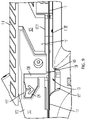
- FIG. 9 there is shown a close-up first side 103 view schematic representation of a shallow deployment button 136 of multi-barrel drill guide and anchor deployment assembly 100 in the pre-actuated/undeployed configuration according to an embodiment.
- a shallow deployment button 136 is located between the proximal end 104 and the distal end 106 of the elongated body 102 .
- the shallow deployment button 136 is located or otherwise positioned within a recess 137 on the first side 103 of the elongated body 102 .
- the shallow deployment button 136 may be positioned at other appropriate locations along the elongated body 102 .
- the shallow deployment button 136 is substantially flush with the first side 103 of the elongated body 102 to prevent potential interference with use of the assembly 100 before the suture anchor 10 is deployed.
- the shallow deployment button 136 is hingedly connected to the elongated body 102 within the recess 137 .
- one side of the shallow deployment button 136 is connected to the elongated body 102 via a hinge 138 in the recess 137 .
- the shallow deployment button 136 has a flange 139 which extends from the recess 137 into the first opening 107 (formed in the top of the handle 108 and/or in the elongated body 102 ). In particular, the flange 139 extends into the path of the track 113 .
- FIG. 10 there is shown a close-up cross-sectional second side 105 view schematic representation of the shallow deployment button 136 of the multi-barrel drill guide and anchor deployment assembly of FIG. 9 .
- the sliding inserter 118 is free to advance along the track 113 .
- the sliding inserter 118 moves along the track 113 until a portion 140 of the sliding inserter 118 contacts the flange 139 of the shallow deployment button 136 , which extends into the path of the track 113 , as shown in FIG. 9 .
- FIG. 11 there is shown a close-up first side 103 view schematic representation of the shallow deployment button 136 of multi-barrel drill guide and anchor deployment assembly 100 in the actuated/undeployed configuration according to an embodiment.
- the portion 140 of the sliding inserter 118 applies force on the flange 139 until the flange 139 is rotated out of the path of the track 113 .
- the sliding inserter 118 can advance farther distally along the track 113 to insert the suture anchor 10 into the pilot hole.
- the passing filament 11 extends in the first channel 110 and first opening 107 between the flange 139 and a feature 142 in the first opening 107 of the elongated body 102 .
- FIGS. 12-13 there is shown a close-up rear/perspective view and rear view schematic representations of the shallow deployment button 136 of FIG. 11 .
- FIGS. 12-13 show the shallow deployment button 136 in the actuated/undeployed configuration after it is rotated from the recess 137 .
- the shallow deployment button 136 comprises an indicator 141 which provides instructions for the user.
- the indicator 141 is an arrow pointing downward toward the feature 142 on the elongated body 102 .
- the user will press the shallow deployment button 136 downward toward the feature 142 (i.e., in the direction of the indicator 141 ) (as described in detail below).
- FIGS. 14-15 there is shown a first side 103 view and close-up rear view schematic representations of the anchor driver 114 of the multi-barrel drill guide and anchor deployment assembly 100 in the actuated/undeployed configuration according to an embodiment.
- the sliding inserter 118 can advance along the track 113 in the distal direction.
- the anchor driver 114 connected thereto also moves in the distal direction out of the distal tube and guide tip 128 , as shown in FIG. 14 .
- the anchor driver 114 (and the sliding inserter 118 ) are advanced until the suture anchor 10 loaded on the distal end 115 of the anchor driver 114 is fully inserted in the pilot hole.
- a proximal end surface 143 of the sliding inserter 118 is substantially flush with a proximal end surface 144 of the elongated body 102 , as shown in FIG. 15 .
- the substantial alignment of the proximal end surface 143 of the sliding inserter 118 and the proximal end surface 144 of the elongated body 102 provides confirmation to the user that the suture anchor 10 is fully inserted in the pilot hole.
- FIG. 16 there is shown a close-up first side 103 view schematic representation of the proximal ends 104 , 119 of the elongated body 102 and sliding inserter 118 of FIG. 14 .
- the suture anchor 10 on the distal end 115 of the anchor driver 114 has been fully inserted into the pilot hole.
- the proximal end surface 143 of the sliding inserter 118 is substantially flush with the proximal end surface 144 of the elongated body 102 .
- the portion 140 of the sliding inserter 118 comprises a shallow channel 145 .
- the shallow channel 145 is substantially aligned with the hinge 138 above the feature 142 on the elongated body 102 .
- the user can press or otherwise apply pressure/force downward on the shallow deployment button 136 toward the feature 142 (in the direction of the indicator 141 ).
- the shallow deployment button 136 moves downward via the hinge 138 and through the shallow channel 145 toward the feature 142 to deploy the suture anchor 10 .
- FIG. 17 there is shown a close-up first side 103 view schematic representation of the suture anchor 10 in the undeployed state on the anchor driver 114 of the multi-barrel drill guide and anchor deployment assembly 100 .
- the suture anchor 10 is shown in the undeployed state loaded on the anchor driver 114 (extending from the distal tube or guide tip 128 ).
- the suture anchor 10 comprises a first arm 12 and a second arm 13 which extend proximally toward the distal tube or guide tip 128 in the undeployed state.
- FIG. 18 there is shown a first side 103 view schematic representation of the shallow deployment button 136 of multi-barrel drill guide and anchor deployment assembly 100 in the actuated/deployed configuration according to an embodiment.
- the suture anchor 10 After the anchor driver 114 has been fully advanced and the suture anchor 10 has been fully inserted into the pilot hole, the suture anchor 10 must be deployed and then released from the assembly 100 .
- the user presses or otherwise applies force downward on the shallow deployment button 136 (in its actuated/undeployed configuration), as described above, resulting in the actuated/deployed configuration as shown in FIG. 18 .
- FIG. 19 there is shown a close-up side/rear perspective view schematic representation of the shallow deployment button 136 of FIG. 18 .
- the flange 139 presses or otherwise displaces the passing filament 11 toward the feature 142 , creating a new, longer path for the passing filament 11 .
- the assembly 100 has an additional indicator window 146 formed in the handle 108 (and/or in the elongated body 102 ).
- the indicator window 146 comprises a shallow deployment clicker 147 and a ridge 148 .
- the shallow deployment button 136 is connected to the shallow deployment clicker 147 such that when the shallow deployment button 136 is pressed downward to the actuated/deployed configuration, the shallow deployment clicker 147 deflects over the ridge 148 in the indicator window 146 , which is visible to the user.
- movement of the shallow deployment clicker 147 over the ridge 148 in the indicator window 146 causes an audible noise (e.g., click), providing an additional indication to the user that the shallow deployment button 136 is in the actuated/deployed configuration and the suture anchor 10 has reached the deployed state.
- FIG. 20 there is shown a close-up first side 103 view schematic representation of the suture anchor 10 in the deployed state on the distal end 115 of the anchor driver 114 of the multi-barrel drill guide and anchor deployment assembly 100 .
- actuation and deployment of the shallow deployment button 136 displaces the path of passing filament 11 , effectively removing slack and pulling the passing filament 11 in the proximal direction.
- the first arm 12 and the second arm 13 of the suture anchor 10 rotate in the distal direction toward each other (as the anchor is prevented from being pulled proximally by a force imparted in the opposite direction by the distal end of the anchor driver), as shown in FIG. 20 (and described below with reference to FIGS. 22-29 ).
- This causes the suture anchor 10 to fold itself further into the pilot hole and create a wedge which is wider than the drill diameter and locks the suture anchor 10 into place.
- FIG. 21 there is shown a close-up first side 103 view schematic representation of the suture anchor 10 of FIG. 20 with the multi-barrel drill guide and anchor deployment assembly 100 removed.
- the suture anchor 10 is removed from the assembly 100 by unwrapping or otherwise dislodging the passing filament 11 from the one or more notches 121 and the flexible block 122 at the proximal end 119 of the sliding inserter 118 .
- FIGS. 22-29 there are shown various views schematic representations of an embodiment wherein the suture anchor 10 is a shallow Y-Knot®.
- One such suture anchor is disclosed in U.S. patent application Ser. No. 15/687,040 assigned to the assignee hereof and incorporated by reference herein in its entirety.
- the suture anchor 10 of the shallow Y-Knot® embodiment illustrated in FIGS. 22-29 is a fibrous construct (anchor body) 20 having at least one passing filament 21 weaved therethrough.
- the fibrous construct 20 has a first arm 22 and a second arm 23 (as the first and second arms 12 , 13 shown in FIG. 17 ) with a proximal side 24 and a distal side 25 extending therebetween.
- the passing filament 21 has a first end 26 and a second end 27 woven through the fibrous construct 20 in a T-shape in the undeployed (or pre-deployment) configuration.
- the fibrous construct 20 is thicker than the passing filament 21 , providing greater tensile strength to the fibrous construct 20 (as compared to the filament 21 ) to minimize creep toward the top/proximal end of the pilot hole.
- the fibrous construct 20 is configured to and will widen and wedge into the bottom of the pilot hole to lock in place (based on the particular placement of the passing filament 21 through the fibrous construct 20 , the force and location thereof imparted by the deployment device (e.g., anchor driver 114 ) on the fibrous construct 20 , and the characteristics of the fibrous construct 20 itself).
- the deployment device e.g., anchor driver 114
- FIG. 23 shows one embodiment for passing locations 28 on the fibrous construct 20 .
- the passing filament 21 enters and exits the proximal side 24 and distal side 25 of the fibrous construct 20 at a plurality of passing locations 28 .
- the fibrous construct 20 is then loaded onto an anchor deployment device/inserter, such as the anchor driver 114 described above.
- the fibrous construct 20 is positioned within the anchor driver 114 such that the first end 26 of the filament 21 extends along a first side 29 of the anchor driver 114 and second end 27 of the filament 21 extends along a second side 30 of the anchor driver 114 .
- the fibrous construct 20 is implanted by the anchor driver 114 into a preformed pilot hole 31 .
- the anchor driver 114 is used to push the fibrous construct 20 into a narrow preformed pilot hole 31 (e.g., 10 mm deep).
- a narrow pilot hole 31 is often formed in smaller bones by necessity, such as those in extremities.
- the first arm 22 and second arm 23 of the fibrous construct 20 begin to fold or otherwise bend in the proximal direction the narrow width of the pilot hole 31 , as shown in FIG. 24 (also shown in FIG. 17 ).
- the anchor driver 114 is held in place, fully inserted in the pilot hole 31 , while the first and second ends 26 , 27 of the passing filament 21 are tensioned and pulled away from the fibrous construct 20 in the proximal direction.
- the first and second ends 26 , 27 of the passing filament 21 are pulled, lengths of fibrous construct 20 between each of the passing locations 28 are pulled closer together as slack in the passing filament 21 between the passing locations 28 is minimized.
- the first arm 22 and the second arm 23 of the fibrous construct 20 begin to rotate in the distal direction, as shown in FIG. 25 .
- the first and second ends 26 , 27 of the passing filament 21 are pulled farther and farther in the proximal direction away from the fibrous construct 20 and additional slack of the passing filament 21 between the passing locations 28 in the fibrous construct 20 is reduced.
- the first and second arms 22 , 23 of the fibrous construct 20 continue to fold or otherwise bend tighter in the distal direction, as shown in FIGS. 26-27 , and pleats 32 begin to form between adjacent passing locations 28 .
- Due to the added tension the first and second arms 22 , 23 of the fibrous construct 20 are pulled closer together toward the central longitudinal axis x-x through the fibrous construct 20 .
- the pleats 32 become more defined, as shown in FIG. 28 .
- first and second ends 26 , 27 of the passing filament 21 are pulled until there is no remaining slack between adjacent passing locations 28 in the fibrous construct 20 , as shown in FIG. 29 (and FIG. 21 ).
- Applying additional tension to the first and second ends 26 , 27 of the passing filament 21 strengthens the fibrous construct 20 by forcing the fibrous construct 20 to widen or expand inside the pilot hole 31 until it reaches a fully deployed configuration, as shown in FIG. 29 .
- the fibrous construct 20 expands in directions perpendicular to its length (i.e., width or thickness) to set and secure the anchor in place in the pilot hole 31 .
- the pleats 32 form a stack of the mattress thicknesses effectively increasing a diameter (as measured in relation to the central longitudinal axis x-x of the fibrous construct 20 and the pilot hole 31 ).
- This relative increase in size in distance from the central longitudinal axis x-x of the pilot hole 31 creates a retention force of the fibrous construct 20 , including the expansion in width and/or thickness described above.
- Poisson's ratio of width and/or mattress thickness growth during a reduction in length provides for an increase in deployment size that is additive to the increase due to the pleats 32 force of the fibrous construct 20 .
- Poisson's ratio defines the proportional decrease in a longitudinal measurement to the proportional increase in length in a sample of material that is elastically stretched. Therefore, if a material is compressed in the x-direction, for example, the material will expand in the y-direction and/or z-direction.
- the passing filament 21 can be removed from the fibrous construct 20 by pulling either end 26 , 27 until the entire passing filament 21 is removed.
- the final form of the fibrous construct 20 in the deployed state allows the passing filament 21 to easily slide therethrough, as the fibrous construct 20 is set and secured in the pilot hole 31 . That is, the tensile strength of the fibrous construct 20 in this configuration is sufficient to keep the fibrous construct 20 in place while the passing filament 21 is easily removed.
- FIG. 29A shows the fibrous construct 20 in a similar undeployed position as the fibrous construct 20 in FIG. 24 .
- FIG. 29B shows the fibrous construct 20 in a position about half way to full deployment, and
- FIG. 29C shows the fibrous construct 20 in a fully deployed configuration.
- the main difference between the embodiments shown in FIGS. 24-29 and the embodiments shown in 29 A- 29 C, includes the slack line that runs across the side of the inserter 114 (no. “21” written on the line) in FIG.
- FIGS. 30-36 there are shown various views schematic representations of an embodiment of the multi-barrel drill guide and anchor deployment assembly 100 wherein the suture anchor 10 is a Y-Knot® anchor 40 , for example, which can be any all suture anchor configured to perform the same functionality as described herein (as should be understood by a person of ordinary skill in the art in conjunction with a review of this disclosure).
- FIG. 30 shows the assembly 100 with a 1.3 mm or 1.8 mm Y-Knot® all suture anchor.
- One such suture anchor is disclosed in U.S. Pat. No. 9,826,971 assigned to the assignee hereof and incorporated by reference herein in its entirety.
- the drill bit 116 is loaded in the second channel 112 into the convergence area 130 such that the drill bit 116 acts as the locking mechanism 133 to ensure that the sliding inserter 118 will not move in transportation or during handling until the drill bit 116 is used and removed.
- the assembly 100 in addition to having a different all suture anchor, the assembly 100 does not have the shallow deployment button 136 or shallow deployment clicker 147 of the embodiment of the assembly 100 of FIGS. 1-22 . Otherwise, the assembly 100 is the same as the assembly 100 described and illustrated with respect to FIGS. 1-20 .
- FIG. 31 shows the drill bit 116 after it has drilled the proper depth for a pilot hole in a bone.
- the user will know the proper depth has been reached because the depth stop 126 on the drill bit 116 will contact the opening 123 of the sliding inserter 118 .
- FIG. 32 shows the assembly 100 after the drill bit 116 has been removed. The sliding inserter 118 is now free to be advance along the track 113 and insert the Y-Knot® 40 into a pilot hole.
- FIG. 33 shows the assembly 100 after the all suture anchor 40 is fully inserted into the pilot hole and deployed, while FIG. 34 shows the all suture anchor 40 deployed after the assembly 100 is removed.
- FIGS. 35-36 An embodiment of the Y-Knot® anchor (or soft anchor or “all-suture” anchor) 40 is illustrated in detail in FIGS. 35-36 .
- the all suture anchor 40 contains at least two sections: at least one filament 41 , which is a suture to be anchored; and a fibrous construct (anchor body) 40 , which is to form a portion of the anchor that can increase in width, thickness and/or diameter and shrink in length as part of deployment. See FIG. 35 , showing the fibrous construct 40 in the undeployed state; and FIG. 36 , showing the fibrous construct 40 “shortened” and “expanded” in the deployed state, which is additive to the increase due to the pleats).
- This soft anchor embodiment also takes advantage of Poisson's ratio, which captures the following cause/effect relationship: compressing a material in a first direction causes the material to expand in direction perpendicular to the first direction (i.e., if compressed in the x-direction, the material will expand in the y-direction and/or z-direction), and stretching/lengthening a material in a first direction causes the material to contract in directions perpendicular to the first direction.
- the filament 41 also plays a role in the deployment of the anchor even though the filament 41 may remain free (in some embodiments) to slide, and non-slidable in others (at least at a particular position or point in use) in relation to the fibrous construct 40 .
- the filament 41 helps to position, align and support the fibrous construct 40 , such that if the filament 41 were to be removed from the fibrous construct 40 after deployment of the anchor, the fibrous construct 40 may be free to spill (i.e., release), allowing the fibrous construct 40 to collapse and shrink in size, allowing for easy (and potentially undesirable) removal.
- the fibrous construct 40 has two primary functions. First, it becomes a base for the filament 41 to slide within. Second, when compressed and/or pleated during deployment, the fibrous construct 40 becomes more compact in one direction thereby expanding outwardly and increasing its overall width, thickness or diameter to create a retention capacity. This action of having the fibrous construct 40 change in shape to increase its overall width, thickness or diameter is a useful characteristic which may be used advantageously to secure the anchor in a hole or against a bony or soft tissue.
- FIG. 37 a side view schematic representation of a disposable drill 300 with a pre-installed drill bit 302 according to an alternative embodiment is shown.
- This disposable drill 300 and pre-installed drill bit 302 may be used in place of drill bit 116 , described above, or separately/independently therefrom.
- the disposable drill can include, but is not limited to, a motor 301 , a drill bit 302 attached to the motor with a specified/predetermined length so that it is configured to create an pilot hole with a desired length/depth for a particular procedure, disposable batteries 303 configured to supply power to the motor, and at least one switch 304 configured to be actuated (rotationally, linearly, perpendicular to the longitudinal axis of the device (“pushed”)) by a user to turn on the drill bit 302 , and/or set the desired speed of the drill bit 302 .
- the disposable drill 300 can also include a disposable plastic housing 305 to make the device lightweight, less expensive, and disposable.
- the disposable plastic housing 305 can be made from any plastic or combination of plastics.
- a pilot hole is typically made in bone before an anchor is inserted.
- the pilot hole is typically formed by using a drill bit to drill a hole for placement of the anchor.
- a drill handpiece and battery must be sterilized and ready for use in the surgery.
- a drill bit is typically drilled a certain depth through a drill guide, so a hard stop structure can be required on the drill guide, or a hard stop structure can be placed on the drill handpiece at a certain location to create an appropriate hard stop against the drill guide (as should be understood by a person of ordinary skill in the art in conjunction with a review of this disclosure).
- disposable drill 300 in accordance with an embodiment, there is no need for an additional drill handpiece and battery to be sterilized before the surgery. Also with the drill bit 302 pre-installed on the disposable drill 200 , the disposable drill 300 is ready to use out of the package and does not require the additional step of installing of the drill bit on the drill handpiece.
- the following described and illustrated two alternative driver designs are configured to work based on the same concept of pulling suture tails back/proximally from an anchor to deploy the anchor (see, e.g., FIGS. 18-21 and related description).
- the alternative driver designs may be used in place of the anchor driver 114 , described above, or separately/independently therefrom.
- Each of the following described and illustrated anchor driver devices works with an all suture soft tissue fixation device with a suture that is configured to slide after the anchor is deployed. In many procedures that involve soft tissue fixation in the extremities, it is necessary to have an anchor that can be deployed in a relatively shallow hole with a narrow diameter (as compared with other locations in the body).
- the uniqueness of the all suture soft tissue fixation device pertains, in part, to the weaving of the suture through the anchor which allows the anchor to sufficiently deploy in the bone tunnel (preferably at the bottom of the bone tunnel) while the driver is still inserted.
- the pattern which the suture is weaved through the anchor is unique in that it preferably does not start and end at the tips of the anchor (although, it can do so). Instead, it is started very close to the center and woven to the tip at one end then from there to the opposite tip and woven back to the center next to the starting position.
- the all suture soft tissue fixation device includes a fibrous construct (anchor body) 20 (e.g., no.
- FIGS. 39-56 illustrate one alternative embodiment of an anchor driver 200
- FIGS. 57-62 illustrate another alternative embodiment of an anchor driver 400 .
- the anchor driver 200 can include, but is not limited to, a forked distal driver tip 201 to position a suture anchor 10 in a bone hole (not shown).
- a depth stop 202 is positioned proximally of the forked distal driver tip 201 , and is configured to ensure that the driver is inserted a predetermined depth into the bone hole (e.g., 10 mm).
- a lever arm 203 is shown, which is configured to displace suture attached to the anchor 10 in order to deploy the anchor 10 (described below).
- a spool retaining arm 206 is also shown, and is configured to keep a suture spool 205 (detailed below) in a locked position until the spool 205 is intentionally released by a user.
- the anchor driver 200 can include a housing/cover (not shown) to cover the internal parts.
- the anchor driver 200 is shown open without a housing/cover to allow for illustration of the internal parts.
- a slot 207 is provided in the anchor driver 200 in which spool 205 sits.
- the slot 207 includes teeth 207 A configured to engage and lock with teeth 205 A of the spool ( FIG. 41 ) when the spool 205 is fully inserted into a locked position (described below).
- the spool retaining arm 206 is also configured to engage and lock with teeth 205 A of the spool ( FIG. 41 ) when the spool 205 is fully inserted into a locked position.
- a perspective view of the spool 205 is shown in FIG. 41 , and includes portions to wind suture 205 B, 205 C, and teeth 205 A.
- FIGS. 42 and 43 perspective views of the safety bar 204 alone and positioned within the anchor driver 200 , respectively, are shown.
- the anchor driver 200 is fully assembled (except for an optional housing/cover), and the spool 205 is shown in the locked position where the lateral surface 208 is positioned out a predetermined distance from the side 209 of the anchor driver 200 .
- the locked position a portion of teeth 207 A of the slot 207 is positioned in contacting relation with a portion of teeth 205 A of the spool 205 , and the spool retaining arm 206 is positioned between another portion of teeth 205 A of the spool 205 .
- the safety bar 204 is shown positioned is a slot of the anchor driver 200 under the lever arm 203 (which is configured to block the lever arm from contacting the suture limbs 26 and 27 ).
- the anchor 10 is also shown positioned on the forked distal driver tip 201 .
- FIG. 44 is a top perspective view of the distal end of the anchor driver 200 showing the anchor 10 positioned on the forked distal driver tip 201 (in an undeployed configuration/position) and ready for insertion into a bone hole.
- FIG. 45 is a side perspective view of the spool 205 in the locked position (as described above). As shown, the lateral surface 208 is positioned out a predetermined distance from the side 209 of the anchor driver 200 to form a spool release button.
- FIG. 46 is a side perspective view of the spool 205 in the unlocked/released position, where the lateral surface 208 has been pushed/actuated by a user to be substantially flush with the side 209 of the anchor driver 200 .
- This position of the spool 205 releases the teeth 205 A of the spool 205 from the teeth 207 A of the slot 207 and from the spool retaining arm 206 , allowing the spool 205 to freely spin and unwind the suture.
- the anchor driver 200 is preferably configured to be a single use device, and is packaged as shown in FIG. 47 (showing a side perspective view of anchor driver 200 in an undeployed configuration).
- anchor driver 200 is then inserted into the bone tunnel by striking the back of the driver (as should be understood by a person of skill in the art in conjunction with a review of this disclosure).
- the safety bar 204 can be removed and the lever arm 203 is squeezed to deploy the anchor 10 (see FIGS. 48-54 ).
- the lateral surface 208 of the spool 205 is pushed in to be flush with the side surface 209 of the driver body, and the driver 200 is removed from the insertion site ( FIG. 55 ).
- the driver 200 is removed from the insertion site ( FIG. 55 ).
- FIG. 48 the safety bar 204 is shown removed (after the anchor 10 is preferably fully inserted into a bone hole) to allow deployment of the anchor 10 .
- the lever arm 203 is actuated/pressed down by a user (similar to the embodiment shown and described with respect to FIGS. 18-21 ), which deflects the suture tails 26 , 27 (only from the anchor/distal side and not the spool proximal side because of the spool being in the locked position) to deploy the anchor 10 .
- FIG. 50 the tails of the anchor 10 are shown beginning to flip and point in the opposite/distal direction, as the suture 21 slack is taken out of the anchor by depressing the lever arm 203 .
- FIGS. 51 and 52 the lever arm 203 is shown being depressed about half way over the suture limbs 26 , 27 , further deploying the anchor 10 .
- FIGS. 53 and 54 the lever arm 203 is shown fully depressed over the suture limbs 26 , 27 , fully deploying the anchor 10 (preferably at the base of the bone hole).
- FIG. 55 the lateral surface 208 of the spool 205 is shown pushed in to be flush with the side surface 209 of the driver body, and the driver 200 is removed from the insertion site which unspools the suture.
- the anchor 10 is shown in its fully deployed state (preferably at the bottom of a bone hole) after the anchor driver 200 is removed.
- the anchor driver 400 can include, but is not limited to, a forked distal driver tip 401 to position a suture anchor 10 in a bone hole (not shown).
- a depth stop 402 is positioned proximally of the forked distal driver tip 401 , and is configured to ensure that the driver is inserted a predetermined depth into the bone hole (e.g., 10 mm).
- the lever arm 403 is configured to push the sliding cleat 405 back/proximally a predetermined distance (e.g., about 10 mm, which is an example appropriate distance to deploy the anchor 10 ). After pushing the cleat 405 proximally a predetermined distance, the lever arm 403 is configured to be positioned fully outside the channel 407 of the sliding cleat 405 . Because of this, the sliding cleat 405 is configured to freely slide up to the cleat release notch 406 at the distal end of the driver 400 . At this point, the driver 400 can be removed from the insertion site and the cleat 405 can be separated from the driver 400 with a pull on the suture tails 26 , 27 .
- a predetermined distance e.g., about 10 mm, which is an example appropriate distance to deploy the anchor 10 .
- anchor driver 400 is preferably configured to be a single use device, and is packaged as shown in FIG. 58 (showing a side perspective view of anchor driver 200 in an undeployed configuration). After drilling a bone hole/tunnel (e.g., a 10 mm deep and 1.5 mm diameter hole), anchor driver 400 is then inserted into the bone tunnel by striking the back of the driver (as should be understood by a person of skill in the art in conjunction with a review of this disclosure).
- a bone hole/tunnel e.g., a 10 mm deep and 1.5 mm diameter hole
- the lever arm 403 can be actuated by a user (e.g., squeezed) which pushes the sliding cleat 405 proximally to tension the suture tails 26 , 27 and deploy the anchor (see FIG. 60 ).
- a user e.g., squeezed
- the driver 400 can be removed from the insertion site and the sliding cleat 405 is configured to pull out from the front of the driver (see FIGS. 61, 62 ).
- the suture can be uncleated from the sliding cleat 405 and the suture tails can be pulled to ensure that the anchor is deployed.
- the anchor driver 400 is shown in an undeployed/unactuated position, and is ready to deploy the anchor 10 into a bone hole (not shown).
- the anchor driver 400 is shown after the lever arm 403 has been actuated making it clear of the channel 407 , and the anchor 10 has been deployed.
- the sliding cleat 405 is shown positioned at the release notch 406 , having moved through the channel 407 after the driver 400 has been removed from the insertion site.
- the sliding cleat 205 is shown completely removed from the driver 400 and is ready to be uncleated to the anchor 10 through the suture tails 26 , 27 .
- FIGS. 63-65 there are shown top views schematic representations of a hand 600 during various steps of a method for suspending a first metacarpal 602 in relative position to a second metacarpal 604 .
- a suspension arthroplasty for basal thumb arthritis requires suspension of the CMC joint between the first metacarpal (i.e., thumb bone) 602 and the second metacarpal (i.e., index finger bone) 604 .
- FIG. 63 shows a first step in the method for suspending the first metacarpal 602 in relative position to the second metacarpal 604 .
- a drill (not shown) is positioned on a lateral, first side 606 of the first metacarpal 602 .
- An exemplary drill is the disposable drill 300 , shown in FIG. 37 .
- the drill is used to drill a hole 608 through the lateral, first side 606 of the first metacarpal 602 .
- the drilled hole 608 is sized and configured to fit a drill guide 500 .
- the drill guide 500 can be any drill guide or combination drill guide and anchor driver.
- the drill guide 500 in FIG. 63 can be the multi-barrel drill guide and anchor deployment assembly 100 shown in FIG. 1 .
- the drill guide 500 is inserted into the hole 608 from the lateral, first side 606 of the first metacarpal 602 .
- the drill guide 500 is advanced to a lateral, first side 610 and surface 612 of the second metacarpal 604 .
- the distal tube and guide tip 128 of the multi-barrel drill guide and anchor deployment assembly 100 is advanced through the first metacarpal 602 to a surface 612 of the second metacarpal 604 .
- an anchor (not shown) is inserted into the second metacarpal 604 , after a hole is drilled therein (but not extending all the way through). While the anchor is inserted into the hole formed in the second metacarpal 604 , it does not extend through the second metacarpal 604 .
- the anchor can be any known suture anchors or the anchors described herein.
- the anchor can be the shallow Y-Knot anchor 20 illustrated in and described with respect to FIGS. 22-29 (as the anchor 10 shown loaded onto the multi-barrel drill guide and anchor deployment assembly 100 in FIGS. 20-21 ).
- the anchor can be inserted into the second metacarpal 604 via an anchor driver 200 , 400 , such as those shown in the embodiments illustrated in FIGS. 39-56 and 57-62 .
- the anchor is inserted into the second metacarpal 604 using the multi-barrel drill guide and anchor deployment assembly 100 of FIG. 1 .
- the anchor is inserted as described above with references to FIGS. 10-17 .
- the anchor driver 114 within the distal tube and guide tip 128 has the suture anchor 10 loaded thereon ( FIG. 14 ).
- the anchor driver 114 is advanced in the distal direction out of the distal tube and guide tip 128 until the anchor 10 is fully inserted into the second metacarpal 604 .
- the passing filament 11 connected to the suture anchor 10 remains connected to the multi-barrel drill guide and anchor deployment assembly 100 so that the suture anchor 10 can be tensioned and deployed.
- the anchor within the second metacarpal 604 is deployed.
- the process for deploying the anchor may vary depending on the type of anchor used.
- the anchor is the shallow Y-Knot®, described above.
- the shallow deployment button 136 is pressed downward to deploy the anchor 10 , as shown in FIG. 18 .
- the passing filament 11 is tensioned ( FIG. 19 ) (i.e., pulled in the proximal direction), causing the suture anchor 10 ( FIG. 20 ) to fold itself further into the second metacarpal 604 and create a wedge which is wider than the diameter within the second metacarpal 604 and locks the suture anchor 10 into place.
- the multi-barrel drill guide and anchor deployment assembly 100 can be removed, as shown in FIG. 21 and described above.
- FIG. 64 shows the hand 600 after the anchor is deployed and the drill guide 500 ( FIG. 63 ) has been removed from the first metacarpal 602 .
- the drill guide 500 has been removed such that suture 700 attached to the anchor, extends from the second metacarpal 604 and through the first metacarpal 602 .
- the suture 70 X must be tensioned and the tension must be fixed or otherwise locked.
- FIG. 65 shows an embodiment wherein a rigid button 702 is used to fix the tension in the suture 700 between the first metacarpal 602 and the second metacarpal 604 .
- the button 702 can be any suspensory fixation device as described in U.S. Pat. No. 9,700,403 assigned to the assignee hereof and incorporated by reference herein in its entirety, any suture suspension system as described in U.S. patent application Ser. No. 15/711,192, assigned to the assignee hereof and incorporated by reference herein in its entirety, and/or comprised of any soft suture anchor material.
- an embodiment of the suspensory fixation device or suspension system can include an elongated anchor member (also referred to as a “backstop,” which may or may not have preformed suture receiving apertures, where at least one of which can, but doesn't have to be, recessed within a surface of the elongated anchor member), and a suture threaded through at least one of the apertures.
- the suspensory fixation device or suspension system may be comprised of radiopaque fiber so that the button 702 (or backstop) can be seen in x-ray photographs.
- a purpose of using an all-suture anchor and an all-suture button 702 (or backstop) is to minimize irritation and discomfort to the patient at the surgical site.
- FIG. 66 there is shown a side schematic view representation of an all-suture button (or backstop) 702 loaded onto the suture 700 .
- FIG. 66 is used for exemplary purposes to show how the all-suture button 702 is loaded onto the suture 700 , which is connected to and extends from the anchor 10 .
- the anchor 10 is within the second metacarpal 604 —not on a medial, second side 614 thereof, as shown.
- the button 702 With the anchor 10 in the deployed state, the button 702 is moved distally along the suture 700 until it is against the lateral, first side 606 of the first metacarpal 602 . Once the button 702 is against the lateral, first side 606 of the first metacarpal 602 , additional tension in the suture 700 causes the button 702 to move from an expanded position to a compressed position. In the expanded position, ends of the button 702 are in a first direction along a longitudinal axis. When the button 702 moves into the compressed position, the ends of the button 702 rotate to a second direction different than the first direction.
- buttons 702 covers a surface area on the lateral, first side 606 of the first metacarpal 602 greater than the diameter of the bone hole 608 .
- Purposes of the button 702 structure, configuration, positioning and related functionality is to prevent the suture 700 from pulling out from the bone hole 608 , to maintain the tension in the suture 700 between the button 702 and the anchor 10 , and to suspend the first metacarpal 602 in relative position to the second metacarpal 604 .
- FIG. 67 there is shown a side schematic view of a knot 704 formed in the suture 700 proximally over the button 702 . Tying the knot 704 in the free suture 700 secures the button 702 in the compressed and deployed position. Excess portions of the suture 700 that extend from the knot 704 can be trimmed and removed to decrease the potential for irritation and discomfort.
- the knot 704 maintains the rigid button 702 in the desired position, and the suture 700 at the desired tension, over the bone hole 608 .
- the tension is fixed by tying the suture 700 to a ligament or tendon in the hand 600 .
- the suspension of the first metacarpal 602 and the second metacarpal 604 is created by tying a knot in the suture 700 around a ligament or tendon in the hand 600 .
- Filaments and sutures includes braided (i.e., multi-filament) suture and monofilament suture as well as any other metallic or non-metallic filamentary or wire-like material suitable for performing the function of a suture.
- This material can include both absorbable and non-absorbable materials.
Landscapes
- Health & Medical Sciences (AREA)
- Life Sciences & Earth Sciences (AREA)
- Surgery (AREA)
- Orthopedic Medicine & Surgery (AREA)
- Veterinary Medicine (AREA)
- General Health & Medical Sciences (AREA)
- Public Health (AREA)
- Engineering & Computer Science (AREA)
- Biomedical Technology (AREA)
- Heart & Thoracic Surgery (AREA)
- Animal Behavior & Ethology (AREA)
- Molecular Biology (AREA)
- Medical Informatics (AREA)
- Nuclear Medicine, Radiotherapy & Molecular Imaging (AREA)
- Oral & Maxillofacial Surgery (AREA)
- Dentistry (AREA)
- Rheumatology (AREA)
- Rehabilitation Therapy (AREA)
- Cardiology (AREA)
- Transplantation (AREA)
- Vascular Medicine (AREA)
- Neurology (AREA)
- Surgical Instruments (AREA)
Abstract
Description
Claims (10)
Priority Applications (1)
| Application Number | Priority Date | Filing Date | Title |
|---|---|---|---|
| US16/596,321 US11406399B2 (en) | 2018-10-08 | 2019-10-08 | Multi-barrel drill guide and anchor deployment assembly |
Applications Claiming Priority (2)
| Application Number | Priority Date | Filing Date | Title |
|---|---|---|---|
| US201862742716P | 2018-10-08 | 2018-10-08 | |
| US16/596,321 US11406399B2 (en) | 2018-10-08 | 2019-10-08 | Multi-barrel drill guide and anchor deployment assembly |
Publications (2)
| Publication Number | Publication Date |
|---|---|
| US20200107840A1 US20200107840A1 (en) | 2020-04-09 |
| US11406399B2 true US11406399B2 (en) | 2022-08-09 |
Family
ID=70052869
Family Applications (1)
| Application Number | Title | Priority Date | Filing Date |
|---|---|---|---|
| US16/596,321 Active 2040-03-02 US11406399B2 (en) | 2018-10-08 | 2019-10-08 | Multi-barrel drill guide and anchor deployment assembly |
Country Status (1)
| Country | Link |
|---|---|
| US (1) | US11406399B2 (en) |
Cited By (2)
| Publication number | Priority date | Publication date | Assignee | Title |
|---|---|---|---|---|
| WO2024163998A1 (en) * | 2023-02-03 | 2024-08-08 | Paragon 28, Inc. | Dynamic syndesmosis implant systems |
| WO2025065050A1 (en) * | 2023-09-26 | 2025-04-03 | Field Orthopaedics Pty Ltd | System and method for anchor deployment in tissue |
Families Citing this family (2)
| Publication number | Priority date | Publication date | Assignee | Title |
|---|---|---|---|---|
| KR102839635B1 (en) * | 2020-06-04 | 2025-07-28 | 콘메드 코포레이션 | Mechanical deployment device for pre-suture anchors |
| CN115737026B (en) * | 2022-11-29 | 2023-12-15 | 无锡科恩智造科技有限公司 | Tendon rebuilds integration apparatus guider |
Citations (13)
| Publication number | Priority date | Publication date | Assignee | Title |
|---|---|---|---|---|
| US4159716A (en) * | 1977-10-17 | 1979-07-03 | Borchers Clinton H | Method of compressing and realigning bone structures to correct splay foot |
| US20110137341A1 (en) * | 2001-08-30 | 2011-06-09 | Brian Thornes | Acromioclavicular joint fixation technique |
| US20110178557A1 (en) * | 2010-01-21 | 2011-07-21 | Rush Shannon M | Methods and devices for treating hallux valgus |
| US20110301648A1 (en) * | 2010-06-03 | 2011-12-08 | Trevor Lofthouse | Methods and Devices for Treating Hallux Valgus |
| US20120016426A1 (en) * | 2009-03-17 | 2012-01-19 | Bonfix Ltd. | Hallux abducto valgus assemblies |
| US20130041466A1 (en) * | 2011-07-08 | 2013-02-14 | Mtp Solutions, Llc | Soft tissue reconstruction |
| US20130103082A1 (en) * | 2011-10-25 | 2013-04-25 | Biomet Sports Medicine, Llc | Method and Apparatus for Interosseous Membrane Reconstruction |
| US20130184708A1 (en) * | 2010-08-29 | 2013-07-18 | Bonfix Ltd. | Orthopedic implant for treatment of bone deformities |
| US20130245700A1 (en) * | 2012-03-14 | 2013-09-19 | Ronald J. Choinski | Cmc repair using suture-button construct |
| US8795286B2 (en) * | 2009-09-25 | 2014-08-05 | Tarsus Medical Inc. | Methods and devices for treating a structural bone and joint deformity |
| US20140309689A1 (en) * | 2013-04-16 | 2014-10-16 | Arthrosurface Incorporated | Suture System and Method |
| US20180344314A1 (en) * | 2017-06-05 | 2018-12-06 | Conmed Corporation | Suture system and related methods for connecting and creating suspension between at least two bodies |
| US20190117210A1 (en) * | 2014-01-14 | 2019-04-25 | CMC Group LLC | Suture-locking washer for use with a bone anchor, and method for supporting the thumb of a patient after basal joint arthroplasty, and other novel orthopedic apparatus and other novel orthopedic procedures |
-
2019
- 2019-10-08 US US16/596,321 patent/US11406399B2/en active Active
Patent Citations (13)
| Publication number | Priority date | Publication date | Assignee | Title |
|---|---|---|---|---|
| US4159716A (en) * | 1977-10-17 | 1979-07-03 | Borchers Clinton H | Method of compressing and realigning bone structures to correct splay foot |
| US20110137341A1 (en) * | 2001-08-30 | 2011-06-09 | Brian Thornes | Acromioclavicular joint fixation technique |
| US20120016426A1 (en) * | 2009-03-17 | 2012-01-19 | Bonfix Ltd. | Hallux abducto valgus assemblies |
| US8795286B2 (en) * | 2009-09-25 | 2014-08-05 | Tarsus Medical Inc. | Methods and devices for treating a structural bone and joint deformity |
| US20110178557A1 (en) * | 2010-01-21 | 2011-07-21 | Rush Shannon M | Methods and devices for treating hallux valgus |
| US20110301648A1 (en) * | 2010-06-03 | 2011-12-08 | Trevor Lofthouse | Methods and Devices for Treating Hallux Valgus |
| US20130184708A1 (en) * | 2010-08-29 | 2013-07-18 | Bonfix Ltd. | Orthopedic implant for treatment of bone deformities |
| US20130041466A1 (en) * | 2011-07-08 | 2013-02-14 | Mtp Solutions, Llc | Soft tissue reconstruction |
| US20130103082A1 (en) * | 2011-10-25 | 2013-04-25 | Biomet Sports Medicine, Llc | Method and Apparatus for Interosseous Membrane Reconstruction |
| US20130245700A1 (en) * | 2012-03-14 | 2013-09-19 | Ronald J. Choinski | Cmc repair using suture-button construct |
| US20140309689A1 (en) * | 2013-04-16 | 2014-10-16 | Arthrosurface Incorporated | Suture System and Method |
| US20190117210A1 (en) * | 2014-01-14 | 2019-04-25 | CMC Group LLC | Suture-locking washer for use with a bone anchor, and method for supporting the thumb of a patient after basal joint arthroplasty, and other novel orthopedic apparatus and other novel orthopedic procedures |
| US20180344314A1 (en) * | 2017-06-05 | 2018-12-06 | Conmed Corporation | Suture system and related methods for connecting and creating suspension between at least two bodies |
Cited By (2)
| Publication number | Priority date | Publication date | Assignee | Title |
|---|---|---|---|---|
| WO2024163998A1 (en) * | 2023-02-03 | 2024-08-08 | Paragon 28, Inc. | Dynamic syndesmosis implant systems |
| WO2025065050A1 (en) * | 2023-09-26 | 2025-04-03 | Field Orthopaedics Pty Ltd | System and method for anchor deployment in tissue |
Also Published As
| Publication number | Publication date |
|---|---|
| US20200107840A1 (en) | 2020-04-09 |
Similar Documents
| Publication | Publication Date | Title |
|---|---|---|
| US11103233B2 (en) | Transosseous suture anchor | |
| EP1331886B1 (en) | Closure device for tissue repair | |
| US11406399B2 (en) | Multi-barrel drill guide and anchor deployment assembly | |
| JP2015510789A (en) | Suture-based knotless repair | |
| KR102389245B1 (en) | Multi-barrel drill guide | |
| US20260069263A1 (en) | Suture-implant construct and method of deploying the same | |
| JP2025148599A (en) | Multi-Barrel Drill Guide and Anchor Placement Assembly | |
| US20220249085A1 (en) | Tissue repair device |
Legal Events
| Date | Code | Title | Description |
|---|---|---|---|
| FEPP | Fee payment procedure |
Free format text: ENTITY STATUS SET TO UNDISCOUNTED (ORIGINAL EVENT CODE: BIG.); ENTITY STATUS OF PATENT OWNER: LARGE ENTITY |
|
| STPP | Information on status: patent application and granting procedure in general |
Free format text: NON FINAL ACTION MAILED |
|
| STPP | Information on status: patent application and granting procedure in general |
Free format text: RESPONSE TO NON-FINAL OFFICE ACTION ENTERED AND FORWARDED TO EXAMINER |
|
| STPP | Information on status: patent application and granting procedure in general |
Free format text: FINAL REJECTION MAILED |
|
| STPP | Information on status: patent application and granting procedure in general |
Free format text: RESPONSE AFTER FINAL ACTION FORWARDED TO EXAMINER |
|
| STPP | Information on status: patent application and granting procedure in general |
Free format text: ADVISORY ACTION MAILED |
|
| STPP | Information on status: patent application and granting procedure in general |
Free format text: DOCKETED NEW CASE - READY FOR EXAMINATION |
|
| STPP | Information on status: patent application and granting procedure in general |
Free format text: NOTICE OF ALLOWANCE MAILED -- APPLICATION RECEIVED IN OFFICE OF PUBLICATIONS |
|
| AS | Assignment |
Owner name: CONMED CORPORATION, NEW YORK Free format text: ASSIGNMENT OF ASSIGNORS INTEREST;ASSIGNORS:SUMMITT, MATTHEW;THIBODEAU, ROBERT;SIGNING DATES FROM 20191009 TO 20220517;REEL/FRAME:059942/0804 |
|
| STCF | Information on status: patent grant |
Free format text: PATENTED CASE |
|
| AS | Assignment |
Owner name: JPMORGAN CHASE BANK, N.A., AS ADMINISTRATIVE AGENT, ILLINOIS Free format text: SECURITY INTEREST;ASSIGNORS:CONMED CORPORATION;BIOREZ, INC.;BUFFALO FILTER LLC;AND OTHERS;REEL/FRAME:072097/0762 Effective date: 20250610 |
|
| MAFP | Maintenance fee payment |
Free format text: PAYMENT OF MAINTENANCE FEE, 4TH YEAR, LARGE ENTITY (ORIGINAL EVENT CODE: M1551); ENTITY STATUS OF PATENT OWNER: LARGE ENTITY Year of fee payment: 4 |