US11405705B2 - Multi-rate interleaved downstream frames in passive optical networks (PONs) - Google Patents
Multi-rate interleaved downstream frames in passive optical networks (PONs) Download PDFInfo
- Publication number
- US11405705B2 US11405705B2 US17/153,461 US202117153461A US11405705B2 US 11405705 B2 US11405705 B2 US 11405705B2 US 202117153461 A US202117153461 A US 202117153461A US 11405705 B2 US11405705 B2 US 11405705B2
- Authority
- US
- United States
- Prior art keywords
- subframe
- subframes
- rate
- olt
- downstream frame
- Prior art date
- Legal status (The legal status is an assumption and is not a legal conclusion. Google has not performed a legal analysis and makes no representation as to the accuracy of the status listed.)
- Active
Links
Images




Classifications
-
- H—ELECTRICITY
- H04—ELECTRIC COMMUNICATION TECHNIQUE
- H04Q—SELECTING
- H04Q11/00—Selecting arrangements for multiplex systems
- H04Q11/0001—Selecting arrangements for multiplex systems using optical switching
- H04Q11/0062—Network aspects
- H04Q11/0067—Provisions for optical access or distribution networks, e.g. Gigabit Ethernet Passive Optical Network (GE-PON), ATM-based Passive Optical Network (A-PON), PON-Ring
-
- H—ELECTRICITY
- H04—ELECTRIC COMMUNICATION TECHNIQUE
- H04J—MULTIPLEX COMMUNICATION
- H04J14/00—Optical multiplex systems
- H04J14/02—Wavelength-division multiplex systems
- H04J14/0227—Operation, administration, maintenance or provisioning [OAMP] of WDM networks, e.g. media access, routing or wavelength allocation
- H04J14/0241—Wavelength allocation for communications one-to-one, e.g. unicasting wavelengths
- H04J14/0242—Wavelength allocation for communications one-to-one, e.g. unicasting wavelengths in WDM-PON
- H04J14/0245—Wavelength allocation for communications one-to-one, e.g. unicasting wavelengths in WDM-PON for downstream transmission, e.g. optical line terminal [OLT] to ONU
-
- H—ELECTRICITY
- H04—ELECTRIC COMMUNICATION TECHNIQUE
- H04Q—SELECTING
- H04Q11/00—Selecting arrangements for multiplex systems
-
- H—ELECTRICITY
- H04—ELECTRIC COMMUNICATION TECHNIQUE
- H04Q—SELECTING
- H04Q11/00—Selecting arrangements for multiplex systems
- H04Q11/0001—Selecting arrangements for multiplex systems using optical switching
- H04Q11/0062—Network aspects
- H04Q11/0066—Provisions for optical burst or packet networks
-
- H—ELECTRICITY
- H04—ELECTRIC COMMUNICATION TECHNIQUE
- H04Q—SELECTING
- H04Q11/00—Selecting arrangements for multiplex systems
- H04Q11/0001—Selecting arrangements for multiplex systems using optical switching
- H04Q11/0062—Network aspects
- H04Q11/0071—Provisions for the electrical-optical layer interface
-
- H—ELECTRICITY
- H04—ELECTRIC COMMUNICATION TECHNIQUE
- H04Q—SELECTING
- H04Q11/00—Selecting arrangements for multiplex systems
- H04Q11/0001—Selecting arrangements for multiplex systems using optical switching
- H04Q11/0062—Network aspects
- H04Q2011/0064—Arbitration, scheduling or medium access control aspects
Definitions
- the present disclosure pertains to the field of Passive Optical Networks (PONs).
- PONs Passive Optical Networks
- the present disclosure relates to optical line transmitters (OLTs) in a PON transmitting data downstream to multiple Optical Network Units (ONUs) at multiple different data rates.
- OLTs optical line transmitters
- a PON is one system for providing network access over the last mile, which is the final portion of a telecommunications network that delivers communication to customers.
- a PON is a point to multi-point network comprising an OLT at a Central Office (CO), ONUs at user premises, and an optical distribution network (ODN) coupling the OLT to the ONUs.
- CO Central Office
- ODN optical distribution network
- Next Generation PONs may combine Time-Division Multiplexing (TDM) and Wavelength-Division Multiplexing (WDM) to support higher capacities so that increased numbers of users can be served by a single OLT with sufficient bandwidth per user.
- TDM PON Time-and-Wavelength Division PON
- WDM PON Wavelength-Division Multiplexing
- TWDM PON Time-and-Wavelength Division PON
- different wavelengths may be multiplexed together to share a single feeder fiber, and each wavelength may be shared by multiple users using TDM.
- an optical line transmitter comprises a memory storage comprising instructions, a processor in communication with the memory, wherein the processor executes the instructions to generate a multi-rate downstream frame having a pre-defined length, the multi-rate downstream frame comprising a plurality of subframes that are each associated with a respective data rate, and a transmitter coupled to the processor and configured to transmit each subframe of the plurality of subframes of the multi-rate downstream frame at the respective data rate.
- the processor is further configured to encapsulate the each subframe of the plurality of subframes to include a header that indicates a frame boundary of the each subframe e and the respective data rate associated with the each subframe.
- the processor is further configured to encapsulate the each subframe of the plurality of subframes to include a physical synchronization block (PSBd), the PSBd comprising a Subframe Length Indicator (SLI) field that indicates a subframe length of the each subframe.
- PSBd physical synchronization block
- SLI Subframe Length Indicator
- the processor is further configured to encapsulate the each subframe of the plurality of subframes to include a physical synchronization block (PSBd), a subframe length of the each subframe being carried in a reserved or unused field of the PSBd.
- PSBd physical synchronization block
- the processor is further configured to insert an End-of-Subframe (EoS) indicator between subframes of the plurality of subframes during transmission.
- EoS End-of-Subframe
- the pre-defined length of the multi-rate downstream frame is 125 microseconds.
- the plurality of subframes comprises a first subframe and a second subframe, the first subframe being associated with the respective data rate of 25 gigabits per second (25G), and the second subframe being associated with the respective data rate of 50 gigabits per second (50G).
- a first portion of the multi-rate downstream frame is allocated to the first subframe, and a second portion of the multi-rate downstream frame is allocated to the second subframe.
- a computer program product comprising computer executable instructions stored on a non-transitory computer readable medium.
- the instructions when executed by a processor, causes an OLT to generate a multi-rate downstream frame having a pre-defined length, the multi-rate downstream frame comprising a plurality of subframes that are each associated with a respective data rate, and transmit each of the plurality of subframes of the multi-rate downstream frame at the respective data rate.
- the computer executable instructions when executed by the processor, further cause the processor to encapsulate the each subframe of the plurality of subframes to include a header that indicates a frame boundary of the each subframe and the respective data rate associated with the each subframe.
- the each subframe of the plurality of subframes has a different length that is less than the pre-defined length.
- the each subframe of the plurality of subframes has a common length that is less than the pre-defined length.
- the computer executable instructions when executed by the processor, further cause the processor to combine a plurality of first payload frames associated with a first data rate to create a first subframe of the plurality of subframes, combine a plurality of second payload frames associated with a second data rate to create a second payload for a second subframe of the plurality of subframes, encapsulate the first subframe to include a first header indicating the first data rate, and encapsulate the second subframe to include a second header indicating the second data rate, wherein the first subframe and the second subframe are continuously transmitted.
- a method is implemented by an OLT, and the method comprises generating, by the OLT, a multi-rate downstream frame having a pre-defined length, the multi-rate downstream frame comprising a plurality of subframes that are each associated with a respective data rate, and transmitting, by the OLT, each subframe of the plurality of subframes at the respective data rate.
- generating the multi-rate downstream frame comprises encapsulating, by the OLT, the each subframe of the plurality of subframes to include a header that indicates a frame boundary of the each subframe and the respective data rate associated with the each subframe.
- generating the multi-rate downstream frame comprises encapsulating, by the OLT, the each subframe of the plurality of subframes to include a PSBd, the PSBd comprising a SLI field that indicates a subframe length of the each subframe.
- generating the multi-rate downstream frame comprises encapsulating, by the OLT, the each subframe of the plurality of subframes to include a physical synchronization block (PSBd), a subframe length of the each subframe being carried in a reserved or unused field of the PSBd.
- PSBd physical synchronization block
- the method further comprises inserting, by the OLT, an End-of-Subframe (EoS) indicator between the each subframe of the plurality of subframes during transmission to the ONU.
- EoS End-of-Subframe
- the pre-defined length of the multi-rate downstream frame is 125 microseconds.
- the plurality of subframes comprises a first subframe and a second subframe, the first subframe being associated with the respective data rate of 25 gigabits per second (25G), and the second subframe being associated with the respective data rate of 50 gigabits per second (50G).
- an ONU comprising a receiver configured to receive a multi-rate downstream frame, with the multi-rate downstream frame having a pre-defined length and comprising a plurality of subframes that are each associated with a different data rate, and a processor coupled to the receiver and configured to determine whether to process a subframe of the plurality of subframes based on a data rate indicated in a header of the subframe.
- the processor is further configured to process the subframe of the plurality of subframes in response to the header of the subframe indicating the data rate that is supported by the ONU.
- the processor is further configured to ignore the subframe of the plurality of subframes in response to the header of the subframe indicating the data rate that is not supported by the ONU.
- OLTs are only configured to transmit data downstream at a single data rate, regardless of whether the OLT is capable of transmitting data at multiple different data rates.
- the embodiments disclosed herein enable the OLT to transmit data downstream at multiple different data rates, thereby transmitting data in a more efficient manner to multiple ONUs.
- the ONUs may also receive data from the OLT at a faster rate when the ONU supports a particular data rate.
- FIG. 1 is a schematic diagram of a PON according to various embodiments of the disclosure.
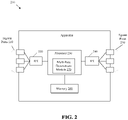
- FIG. 2 is a diagram of an apparatus according to various embodiments of the disclosure.
- FIG. 3 is a diagram illustrating a comparison between a multi-rate downstream frame and a standard downstream frame according to various embodiments of the disclosure.
- FIGS. 4A-4E show multi-rate downstream frame examples, illustrating various frame and subframe possibilities of multi-rate downstream frames according to various embodiments of the disclosure.
- FIG. 5 is a diagram illustrating an example of a header included in a multi-rate downstream frame according to various embodiments of the disclosure.
- FIG. 6 is a diagram illustrating an example of a portion of a header included in a multi-rate downstream frame according to various embodiments of the disclosure.
- FIG. 7 is a diagram illustrating an example of a multi-rate downstream frame including End-of-Subframe (EoS) indicators according to various embodiments of the disclosure.
- EoS End-of-Subframe
- FIG. 8 is a message sequence diagram illustrating a method of processing subframes within a multi-rate downstream frame according to various embodiments of the disclosure.
- FIG. 9 is a flowchart of a method of generating and transmitting a multi-rate downstream frame according to various embodiments of the disclosure.
- FIG. 10 is a flowchart of a method of receiving and processing a multi-rate downstream frame according to various embodiments of the disclosure.
- FIG. 11 is a diagram illustrating an apparatus configured to generate and transmit a multi-rate downstream frame according to various embodiments of the disclosure.
- FIG. 12 is a diagram illustrating an apparatus configured to receive and process a multi-rate downstream frame according to various embodiments of the disclosure.
- a data rate refers to a speed at which data can be transmitted from the OLT to an ONU, or from an ONU to an OLT.
- a data rate refers to a speed at which data can be transmitted from the OLT to an ONU, or from an ONU to an OLT.
- Gbps Gigabits per second
- upstream data is transmitted at about 1.25 Gbps.
- XG-PON ten Gbps PON
- downstream data is broadcasted at about 9.95328 Gbps (hereinafter referred to as 10G) while upstream data is transmitted at about 10 G or 2.5G.
- next generation high speed PON systems anticipate broadcasting data downstream at much higher data rates, such as 25 Gbps (hereinafter referred to as 25G) and 50 Gbps (hereinafter referred to as 50G).
- 25G 25 Gbps
- 50G 50 Gbps
- ITU-T International Telecommunication Union Telecommunication Standardization Sector
- G.hsp G.hsp
- typical OLTs in a PON only transmit data downstream to ONUs at a single data rate, even though the OLTs are capable of transmitting data downstream at more than one data rate.
- an OLT may be configured to transmit data at 1G, 2.5G, 10G, 25G, or 50G.
- the OLT is typically preset to transmit data downstream at only one of these data rates. For this reason, there is no protocol that can be used by an OLT to transmit data downstream at different data rates.
- the embodiments disclosed herein are directed to a protocol frame structure that enables an OLT to transmit data downstream at different data rates.
- the protocol frame structure may be created by dividing a typical downstream frame into multiple subframes, in which each subframe is associated with a different data rate, and each subframe includes a header indicating a respective data rate and/or a length of the subframe.
- the embodiments disclosed herein enable the OLT to transmit data downstream at multiple different data rates, thereby transmitting data in a more efficient manner to multiple ONUs.
- the ONUs may also receive data from the OLT at a faster rate when the ONU supports a particular data rate.
- FIG. 1 is a schematic diagram of a PON 100 .
- the PON 100 comprises an OLT 110 , ONUs 120 , and an ODN 130 that couples the OLT 110 to the ONUs 120 .
- the PON 100 is a communications network that may not require active components to distribute data between the OLT 110 and the ONUs 120 . Instead, the PON 100 may use passive optical components in the ODN 130 to distribute data between the OLT 110 and the ONUs 120 .
- the OLT 110 communicates with another network and with the ONUs 120 .
- the OLT 110 is an intermediary between the other network and the ONUs 120 .
- the OLT 110 forwards data received from the other network to the ONUs 120 and forwards data received from the ONUs 120 to the other network.
- the OLT 110 comprises a transmitter and a receiver.
- the OLT 110 comprises or includes a converter that converts the network protocol to the PON protocol and vice versa.
- the OLT 110 is typically located at a central location such as a CO, but it may also be located at other suitable locations.
- the ODN 130 is a data distribution network that comprises optical fiber cables, couplers, splitters, distributors, and other suitable components.
- the components include passive optical components that do not require power to distribute signals between the OLT 110 and the ONUs 120 .
- the components include active components such as optical amplifiers that do require power.
- the ODN 130 extends from the OLT 110 to the ONUs 120 in a branching configuration as shown, but the ODN 130 may be configured in any other suitable point-to-multipoint (P2MP) configuration.
- P2MP point-to-multipoint
- the ONUs 120 communicate with the OLT 110 and customers, and function as intermediaries between the OLT 110 and the customers. To do so, the ONUs 120 comprise optical transceivers that receive optical signals from the OLT 110 , convert the optical signals into electrical signals, and provide the electrical signals to the customers. The transceivers also receive electrical signals from the customers, convert the electrical signals into optical signals, and transmit the optical signals to the OLT 110 .
- ONUs 120 and optical network terminals (ONTs) are similar, and the terms may be used interchangeably.
- the ONUs 120 are typically located at distributed locations such as customer premises, but they may also be located at other suitable locations.
- a data rate refers to a speed at which data can be transmitted from the OLT 110 to an ONU 120 , or from an ONU 120 to an OLT 110 .
- PON 100 may be a current standard PON that is capable of providing data rates of 1G, 2.5G, or 10G. In this PON 100 , the OLT 110 and the ONUs 120 are capable of transmitting and receiving data at data rates of 1G, 2.5G, or 10G.
- PON 100 may also be a next generation high speed PON that is capable of implementing increased data rates, such as 25G, 50G, and 100G. In this PON 100 , the OLT 110 and the ONUs 120 are capable of transmitting and receiving data at data rates of 1G, 2.5G, 10G, 25G, 50G, and 100G.
- a standard OLT 110 in a next generation high speed PON 100 may be configured to transmit data downstream to ONUs 120 at any data rate, such as 1G, 2.5G, 10G, 25G, 50G, or 100G.
- the OLT 110 may be pre-configured to transmit data to an ONU 120 at a single data rate over one physical channel, even though the OLT 110 is capable of transmitting data downstream at different data rates. Therefore, there is a need for developing a protocol that can be implemented by an OLT 110 and understood by an ONU 120 to enable the OLT 110 to transmit data downstream to the ONU 120 at different data rates.
- an OLT 110 is configured to generate a multi-rate downstream frame having a pre-defined length, in which the multi-rate downstream frame comprises a plurality of subframes that are each associated with a different data rate.
- the OLT 110 may encapsulate the subframes to include a header that indicates a boundary of the subframe, a length of the subframe, and/or a data rate by which the subframe is transmitted to the ONU 120 .
- the OLT 110 may be configured to transmit each of the subframes at the respective data rate to the ONUs 120 within the PON 100 .
- FIG. 2 is a schematic diagram of an apparatus 200 according to various embodiments of the disclosure.
- the apparatus 200 may be, for example, an OLT 110 or an ONU 120 , and may be configured to implement the disclosed embodiments.
- the apparatus 200 comprises ingress ports 210 and a receiver (RX) 220 coupled to the ingress ports 210 for receiving data; a processor, logic unit, baseband unit, or central processing unit (CPU) 230 coupled to the RX 220 to process the data; a transmitter (TX) 240 coupled to the processor 230 and egress ports 250 coupled to the TX 240 for transmitting the data; and a memory 260 coupled to the processor 230 for storing the data.
- RX receiver
- CPU central processing unit
- the apparatus 200 may also comprise optical-to-electrical (OE) components, electrical-to-optical (EO) components, or radio frequency (RF) components coupled to the ingress ports 210 , the RX 220 , the TX 240 , and the egress ports 250 for ingress or egress of optical, electrical signals, or RF signals.
- OE optical-to-electrical
- EO electrical-to-optical
- RF radio frequency
- the processor 230 is any combination of hardware, middleware, firmware, or software.
- the processor 230 comprises any combination of one or more CPU chips, cores, field-programmable gate arrays (FPGAs), application-specific integrated circuits (ASICs), or digital signal processors (DSPs).
- the processor 230 communicates with the ingress ports 210 , the RX 220 , the TX 240 , the egress ports 250 , and the memory 260 .
- the processor 230 in some embodiments stores a multi-rate downstream module 270 , which implements the disclosed embodiments.
- the processor 230 can include memory for holding the multi-rate downstream module 270 , and the processor 230 can retrieve the multi-rate downstream module 270 and execute the instructions therein to perform operations of the apparatus 200 .
- the inclusion of the multi-rate downstream module 270 therefore provides a substantial improvement to the functionality of the apparatus 200 and effects a transformation of the apparatus 200 to a different state.
- the memory 260 stores the multi-rate downstream module 270 as instructions, and the processor 230 executes those instructions.
- the memory 260 comprises any combination of disks, tape drives, or solid-state drives.
- the apparatus 200 may use the memory 260 as an over-flow data storage device to store programs when the apparatus 200 selects those programs for execution.
- the apparatus 200 may use the memory 260 to store instructions.
- the apparatus 200 may use the memory 260 to store data that the apparatus 200 reads and/or generates during execution of those programs.
- the memory 260 may be volatile or non-volatile and may be any combination of read-only memory (ROM), random-access memory (RAM), ternary content-addressable memory (TCAM), or static RAM (SRAM).
- FIG. 3 is a diagram 300 illustrating a comparison between a standard downstream frame 305 and a multi-rate downstream frame 330 according to various embodiments of the disclosure.
- An OLT 110 may be configured to continuously transmit the standard downstream frames 305 in the downstream direction toward the ONUs 120 without any time delay in between the transmissions of the standard downstream frames 305 .
- the data transmitted by an OLT 110 may be partitioned into fixed size downstream frames 305 A-C having a pre-defined length 313 .
- the pre-defined length 313 comprises a predetermined time period length 313 or predetermined duration 313, but “length” will be used herein for brevity.
- the pre-defined length 313 of the standard downstream frame 305 A-C is a duration of 125 microseconds ( ⁇ s).
- the number of bytes transmitted in a standard downstream frame 305 A-C depends on the data rate employed by the OLT 110 in the PON 100 .
- 155520 bytes 38880 words
- 38880 bytes 9720 words
- the higher the data rate employed by the OLT 110 the more data can be transmitted in a single standard downstream frame 305 A-C having the pre-defined length 313 .
- a standard downstream frame 305 includes a header 310 and a payload 315 .
- the header 310 may be physical synchronization blocks (PSBds), and the payload 315 may be a physical interface (PHY) frame payload.
- the header 310 A-C may carry downstream synchronization information, which will be further described below with reference to FIGS. 5 and 6 .
- a start, or boundary, of a standard downstream frame 305 A-C is defined by the first bit of the header 310 A-C, or the PSBd.
- the payload 315 may include user data in the form of XG-PON encapsulation method (XGEM) packets that are packed together by the OLT 110 .
- the OLT 110 may pack the user data such that the length of the user data is less than the pre-defined length 313 of the standard downstream frame 305 .
- the payload 315 may have scrambled content that is protected by Forwarding Error Correction (FEC).
- FEC Forwarding Error Correction
- each payload 315 may further include a bandwidth map (BWmap) and one or more Physical Layer Operations, Administration, and Maintenance (PLOAM) messages.
- BWmap bandwidth map
- PLOAM Physical Layer Operations, Administration, and Maintenance
- the OLT 110 is configured to encapsulate each of the payloads 315 with the corresponding header 310 .
- the OLT 110 may encapsulate the payload 315 A to include the header 310 A and create the standard downstream frame 305 A.
- the OLT 110 may encapsulate the payload 315 B to include the header 310 B and create the standard downstream frame 305 B and encapsulate the payload 315 C to include the header 310 C and create the standard downstream frame 305 C. While only three standard downstream frames 305 are shown in the figure, it should be appreciated that the OLT 110 is configured to send any number of standard downstream frames 310 , such as to the ONU 120 , for example.
- the OLT 110 After encapsulating each of the payloads 315 to include the headers 310 , the OLT 110 is configured to transmit the standard downstream frames 305 to the ONUs 120 at a single pre-configured data rate.
- the OLT 110 may be preset to transmit at a particular wavelength and at a particular data rate, such as 10G. In this case, the OLT 110 transmits each of the standard downstream frames 305 at the single data rate of 10G, regardless of whether a particular user data in the payloads 315 should be transferred at a different data rate.
- FIG. 3 shows a multi-rate downstream transmission example including two multi-rate downstream frames 330 A and 330 B.
- the embodiments disclosed herein enable the OLT 110 to transmit multi-rate downstream frames 330 that essentially divide standard downstream frames 305 into multiple subframes based on the data rates available for transmission by the OLT 110 .
- a multi-rate downstream frame 330 has the same pre-defined length 313 as a standard downstream frame 305 , which may be, for example, 125 ⁇ s.
- the multi-rate downstream packet 330 includes multiple subframes.
- the multi-rate downstream frame 330 A includes subframes 340 A and 350 A in the example shown.
- the multi-rate downstream frame 330 B includes subframes 340 B and 350 B.
- Each subframe 340 A-B and 350 A-B includes a header 355 A-B or 370 A-B and a payload 360 A-B or 380 A-B.
- the multi-rate downstream frame 330 is the same pre-defined length 313 as the standard downstream frame 305 , and is divided into subframes 340 and 350 . As shown in FIG. 3 , the multi-rate downstream frame 330 A is divided into subframes 340 A and 350 A, and the multi-rate downstream frame 330 B is divided into subframes 340 B and 350 B. Subframe 340 A of multi-rate downstream frame 330 A comprises header 355 A and payload 360 A, while subframe 350 A comprises header 370 A and payload 380 A. Subframe 340 B of multi-rate downstream frame 330 B comprises header 355 B and payload 360 B, while subframe 350 B comprises header 370 B and payload 380 B.
- FIGS. 4A-4E show frame examples, illustrating various multi-rate downstream frame 330 and subframe 340 or 350 possibilities of multi-rate downstream frames 330 .
- a multi-rate downstream frame 330 having length 313 comprises equal length subframes 340 and 350 .
- successive multi-rate downstream frames 330 may also comprise identical subframes 340 and 350 .
- FIG. 4B shows a multi-rate downstream frame 330 A-B having subframes 340 A-B and 350 A-B of unequal sizes. However, the combination of the subframes 340 A-B and 350 A-B is still of the length 313 .
- FIG. 4C shows a first multi-rate downstream frame 330 A having subframes 340 A and 350 A of equal size, plus a second multi-rate downstream frame 330 B having subframes 340 B and 350 B of unequal size (and differing from the subframes of the first frame 330 A).
- FIG. 4D shows a multi-rate downstream frame 330 including three subframes 340 , 350 , and 390 . It should be noted that although the headers of the three subframes 340 , 350 , and 390 are portrayed as being smaller, this was done merely for illustration and is not meant to imply that the header size is variable. FIG. 4D shows a similar second subframe 330 .
- FIG. 4E shows a multi-rate downstream frame 330 A having three subframes 340 A, 350 A, and 390 A, and also shows a standard downstream frame 305 .
- This figure therefore shows frames having different numbers of subframes.
- This figure also shows subframes of different sizes within a frame.
- This figure shows an example data flow having a mix of standard and multi-rate downstream frames.
- a total length subframes within the multi-rate downstream frame 330 equals the pre-defined length 313 in some embodiments.
- each of the subframes 340 A-B and 350 A-B may be substantially the same length 322 A-B, or each of the subframes 340 A-B and 350 A-B may have different lengths 322 A-B.
- the payloads 360 A and 380 A within a multi-rate downstream frame 330 A may be substantially the same length, or may have different lengths.
- the payloads 360 A and 360 B between different multi-rate downstream frames 330 A and 330 B may have substantially the same length, or may have different lengths.
- each subframe within the multi-rate downstream frame 330 may be transmitted by the OLT 110 at a different data rate.
- subframe 340 is transmitted at a first data rate
- subframe 350 is transmitted at a second data rate.
- subframe 340 A includes data that is to be transmitted by the OLT 110 at a 25G data rate
- subframe 350 A may include data that is to be transmitted by the OLT 110 at a 50G data rate.
- subframe 340 A includes a header 355 A and a payload 360 A
- subframe 350 A includes a header 370 A and a payload 380 A
- the multi-rate downstream frame 330 B is the same pre-defined length 313 as the standard downstream frame 305 B, except that the multi-rate downstream frame 330 B is divided into subframes 340 B and 350 B.
- subframe 340 B may include data that is to be transmitted by the OLT 110 at a 25G data rate
- subframe 350 B may include data that is to be transmitted by the OLT 110 at a 50G data rate.
- the subframes 340 and 350 substantially evenly share the pre-defined length 313 of a multi-rate downstream frame 330 .
- the subframes 340 and 350 substantially evenly share the pre-defined length 313 in every multi-rate downstream frame 330 (i.e., all multi-rate downstream frame 330 are similarly divided into subframes 340 and 350 ).
- subframes 340 B and 350 B may evenly share the length 313 of the multi-rate downstream frame 330 B.
- the length for each of subframes 340 A and 350 A are the same.
- the length for each of subframes 340 B and 350 B are the same.
- the multi-rate downstream frame 330 A-B may include any number of subframes 340 A-B and 350 A-B that are each associated with a different data rate.
- the multi-rate downstream frame 330 A-B is equally divided into subframes 340 A-B and 350 A-B having an equal length, or a same length.
- subframes 340 A and 350 A may have different lengths, and the length of the subframes 340 A and 350 A may be less than the pre-defined length 313 of the multi-rate downstream frame 330 A.
- subframes 340 B and 350 B may also have different lengths that are less than the pre-defined length 313 of the multi-rate downstream frame 330 A.
- the lengths for each of subframes 340 A and 350 A may be different, and the sum of the lengths may equal the pre-defined length 313 .
- the length for each of subframes 340 B and 350 B may be different, and the sum of the lengths may equal the pre-defined length 313 .
- the lengths of the subframes 340 and 350 may be dynamically adjusted based on a size of the user data that needs to be included in each of the subframes. In the case when there are more than two subframes within a multi-rate downstream frame 330 , the length of each of the subframes may be dynamically allocated based on a size of the user data.
- the OLT 110 may be configured to create the multi-rate downstream frame 330 in a manner similar to how the OLT 110 creates the standard downstream frame 305 , except that the OLT 110 partitions the user data into the payloads 360 and 380 based on a data rate by which the user data should be transmitted.
- the OLT 110 may determine a data rate by which the user data should be transmitted in various different ways. For example, a service provider may indicate a data rate for certain user data (e.g., Ethernet packets) that are received by a PON 100 via a core network, and the OLT 110 may convert the user data into XGEM frames that may be transmitted in the PON 100 .
- These frames may be packed into, or added to, a particular subframe 340 or 350 based on the indicated data rate. For example, suppose that an OLT 110 receives user data that is indicated to be transmitted at a higher data rate, such as 50G. The OLT 110 may be configured to add the user data to the payload 380 A of the subframe 350 A when the OLT 110 is generating the multi-rate downstream frame 330 A.
- an OLT 110 may be configured to allocate user data to a particular subframe 340 or 350 based on available space. For example, when the OLT 110 is generating a multi-rate transmission packet, suppose that the subframe 340 A associated with a 25G data rate is full. In this case, the OLT 110 may dynamically assign the user data to the subframe 350 A associated with a 50G data rate, assuming that the subframe 350 A still has space left to carry user data. In this way, an OLT 110 may be configured to dynamically allocate user data to subframes 340 or 350 based on traffic within each of the subframes.
- the OLT 110 may encapsulate the subframes 340 and 350 to include a header 355 or 370 .
- the header 355 or 370 may be similar to header 310 in that the header 355 or 370 may comprise PSBds. However, the headers 355 or 370 may additionally include information that indicates a data rate associated with the subframe 340 or 350 .
- the headers 355 and 370 may indicate the data rate in a field of the header 355 or 370 , as will be further described below with reference to FIGS. 5 and 6 .
- the headers 355 or 370 may include a length 322 of a respective subframe 340 or 350 .
- the length may be a period of time or may be a number of bits or bytes, both of which may indicate the data rate associated with the respective subframe 340 or 350 .
- the length may be a size of the subframe 340 or 350 in bytes, 4 bytes, 8 bytes, or bits.
- the length may also be a time duration of the subframe 340 or 350 , such as microseconds, submicroseconds, or even nanoseconds.
- the length 322 of the respective subframe 340 or 350 may be carried in a new field of the PSBd, as described below with reference to FIG. 4 .
- the length of the respective subframe 340 or 350 may be carried by a reserved field or an unused field of the PSBd, as will be described below with reference to FIG. 6 .
- an OLT 110 may be configured to continuously transmit multi-rate downstream frames 330 in the downstream direction toward the ONUs 120 . As shown in FIG. 3 , the multi-rate downstream frames 330 are transmitted continuously without any time gap between the standard downstream frames 305 . According to these embodiments, the OLT 110 is configured to transmit data at multiple different data rates instead of a single data rate using the multi-rate downstream frame 330 structure shown in FIG. 3 . While FIG. 3 only shows two multi-rate downstream frames 330 , it should be appreciated that the OLT 110 is configured to generate and transmit any number of multi-rate downstream frames 330 .
- multiple subframes 340 and 350 (or more) that are associated with different data rates are interleaved together to create the multi-rate downstream frame 330 A-B.
- the interleaving of the multiple subframes 340 A-B and 350 A-B associated with different data rates within the multi-rate downstream frames 330 efficiently transmits user data at different data rates to multiple different ONUs 120 .
- FIG. 5 is a diagram 500 illustrating an example of a PSBd 502 included in a multi-rate downstream frame 330 according to various embodiments of the disclosure.
- the PSBd 502 may be similar to the header 355 and 370 of the subframes 340 and 350 .
- the PSBd 502 comprises a Physical Synchronization Sequence (Psync) field 503 , a Superframe Counter (SFC) structure field 506 , an Operation Control (OC) structure field 509 , and a Subframe Length Indicator (SLI) field 511 .
- Psync Physical Synchronization Sequence
- SFC Superframe Counter
- OC Operation Control
- SLI Subframe Length Indicator
- a standard PSBd as defined by the G.989.3 Standard Document, may include the PSync field 503 , SFC structure field 506 , and OC structure field 509 .
- the embodiments disclosed herein add a new field, the SLI field 511
- the Psync field 503 is a physical synchronization sequence that contains a fixed 64-bit pattern, or 8 bytes.
- the physical synchronization sequence contained in the Psync field 503 may be a specific coding pattern (also referred to herein as a Psync pattern) that supports, or identifies, a corresponding downstream data rate for a subframe 340 or 350 .
- different data rates correspond to different Psync patterns.
- some data rates may correspond to the same Psync pattern. Either way, an ONU 120 may only be configured to correctly detect the Psync pattern that is received at a data rate that is supported by the ONU 120 .
- Psync patterns included in the Psync field 503 corresponding to data rates not supported by the ONU 120 , will not be recognized by the ONU 120 .
- the ONU 120 may not be able to receive and process subframes 340 A-B and 350 A-B with Psync patterns that are unrecognizable.
- An ONU 120 may use this 64-bit Psync pattern to achieve alignment at a boundary of the multi-rate downstream frame 330 .
- the SFC structure field 506 is a 64-bit, or 8 byte, field that contains a 51-bit SFC value and a 13-bit Hybrid Error Correction (HEC) field.
- the SFC value in each subframe 340 or 350 of a single multi-rate downstream frame 330 is the same, and the SFC value included in the SFC structure field 506 for each subframe 340 or 350 is incremented by one with respect to the previous multi-rate downstream frame 330 .
- the OC structure field 509 is a 64-bit, or 8 byte field, that contains a 51-bit OC body and 13-bit HEC field. The format of the OC body is further described below with reference to FIG. 6 .
- the SLI field 511 is also 64-bits, or 8 bytes. In an embodiment, the SLI field 511 carries a length of the subframe 340 or 350 , which is a value that specifies the actual size of the subframe 340 or 350 . In an embodiment in which the multi-rate downstream frame 330 contains several subframes 340 or 350 having an equal length, the SLI field 511 may carry a value indicating an amount of subframes 340 or 350 within the multi-rate downstream frame 330 . In this case, the SLI field 511 may indicate how many subframes 340 or 350 are included in a 125 ⁇ s multi-rate downstream frame 330 .
- the OLT 110 is configured to encapsulate the payloads 360 and 380 to include the headers 355 and 370 , in which the headers 355 and 370 include the SLI field 511 .
- the ONU 120 may inspect the headers of the SLI field 511 to determine not just the length of the subframe 340 or 350 , but also a data rate of the subframe 340 or 350 based on the length of the subframe 340 or 350 and the pre-defined length 313 of the multi-rate downstream frame 330 .
- the headers 355 and 370 which may be PSBd 502 , signal to the ONU 120 that a new subframe 340 or 350 is being received, and the SLI field 511 within the headers 355 and 370 signal to the ONU 120 a data rate at which the subframe 340 or 350 is to be received.
- FIG. 6 is a diagram of a portion 600 of the PSBd 502 included in a multi-rate downstream frame 330 according to various embodiments of the disclosure.
- FIG. 6 shows the various subfields within the OC structure field 509 of the PSBd 502 , and the OC structure field 509 includes 51-bits.
- the diagram shown in FIG. 6 illustrates a mechanism of adding a new field to a PSBd to include a length of a subframe 340 or 350 .
- the diagram shown in FIG. 6 illustrates a mechanism of using an existing field in the PSBd 502 to include the length of the subframe 340 or 350 .
- the OC structure field 509 which is defined by the G.989.3 Standard Document, includes a PON-identifier (ID) Type (PIT) field 603 .
- the PIT field 603 is an 8-bit static field provisioned by an operator of the PON 100 that indicates an ODN architecture, a source of a reported launch power, and an ODN class.
- the PIT field 603 is further partitioned into a Reach Extender (RE) flag 618 , an ODN class field 621 , a DS FEC flag 624 , a Protocol Indication (P) Flag 627 , and a link type field 630 .
- RE Reach Extender
- ODN class field 621 an ODN class field 621
- DS FEC flag 624 a Protocol Indication (P) Flag 627
- P Protocol Indication
- the ODN class field 621 is a 3-bit field identifying the nominal optical parameters of the transceiver according to ODN optical path loss.
- the DS FEC flag 624 is a 1 bit flag that indicates whether FEC is enabled in the downstream direction.
- the P flag 627 is a protocol indication flag indicating a transmission convergence (TC) protocol.
- the link type field 630 is a 2-bit field indicating an optical link type.
- the OC structure field 509 which is defined by the G.989.3 Standard Document, further includes a PON-ID field 606 .
- the PON-ID field is a 32-bit static field provisioned by the operator of the PON 100 that identifies the TWDM channel termination within a certain domain.
- the PON-ID field 606 includes an administrative label field 633 and a Downstream Wavelength Channel Identification (DWLCH ID) field 640 .
- the administrative label field 633 is a 28-bit field supplied to the OLT 110 in accordance with a numbering plan and is treated transparently by the OLT 110 .
- the DWLCH ID field 640 is a 4-bit field that typically contains a downstream wavelength channel ID for multiple channel PONs. This field may be unused for single channel PONs, such as PON 100 as described herein.
- the OC structure field 509 which is defined by the G.989.3 Standard Document, further includes a Reserved (R) field 610 , a reference point indicator (C) field 613 , and a Transmit Optical Level (TOL) field 616 .
- the R field 610 is a field that is reserved for future use, and may include one or more bits.
- the C field 613 is a 1-bit field indicating a TOL point indicator, and the TOL field 616 is a 9-bit dynamic field maintained by the system that indicates a launch power of the OLT 110 into the ODN 130 .
- the DWLCH ID field 640 and the R field 610 contain reserved and/or unused bits.
- the length of the subframes 340 or 350 may be carried in either the DWLCH ID field 640 or the R field 610 .
- the length of the subframes 340 or 350 includes a value that specifies the actual size of the subframe 340 or 350 .
- the DWLCH ID field 640 or the R field 610 may carry a value indicating an amount of subframes 340 or 350 within the multi-rate downstream frame 330 .
- the DWLCH ID field 640 or the R field 610 may indicate how many subframes 340 or 350 are included in a 125 ⁇ s multi-rate downstream frame 330 .
- a length of the subframe 340 or 350 may be carried within the header 355 and 370 of the subframe 340 or 350 .
- the OLT 110 is configured to encapsulate the payloads 360 and 380 to include the headers 355 and 370 , in which the headers 355 and 370 include the DWLCH ID field 640 and the R field 610 .
- the length of the subframe 340 or 350 may be carried in the DWLCH ID field 640 or the R field 610 .
- the ONU 120 may inspect the DWLCH ID field 640 or the R field 610 within the headers 355 and 370 of the subframes 340 and 340 to determine not just the length of the subframe 340 or 350 , but also a data rate of the subframe 340 or 350 based on the length of the subframe 340 or 350 and the pre-defined length 313 of the multi-rate downstream frame 330 .
- the header 355 and 370 which may be PSBd 502 , signals to the ONU 120 that a new subframe 340 or 350 is being received, and the DWLCH ID field 640 or the R field 610 within the headers 355 and 370 indicates to the ONU 120 a data rate at which the subframe 340 or 350 is to be received.
- FIG. 7 is a diagram 700 illustrating an example of the multi-rate downstream frame 330 A including EoS indicators 705 A-B according to various embodiments of the disclosure.
- the multi-rate downstream frame 330 A is similar to the multi-rate downstream frame 330 A shown in FIG. 3 in that the multi-rate downstream frame 330 A includes subframes 340 A and 350 A.
- the subframes 340 A and 350 A include respective EoS indicators 705 A-B.
- the EoS indicators 705 A-B are positioned, or disposed, at the ends of the subframes 340 A and 350 A.
- EoS indicator 705 A is positioned at the end of the subframe 340 A
- EoS indicator 705 B is positioned at the end of the subframe 350 A.
- the EoS indicators 705 A-B may include a pre-defined number of unused, or empty, bits that add indicate the end of a subframe 340 or 350 .
- EoS indicator 705 A indicates an end, or a boundary, of the subframe 340 A
- the EoS indicator 705 B indicates an end, or a boundary, of the subframe 350 A.
- the EoS indicators 705 A-B are paddings between subframes 340 A and 350 A.
- the OLT 110 may be configured to add the EoS indicators 705 A-B to the end of the subframes 340 A and 350 A after encapsulating the payloads 360 A and 380 A to include the headers 355 A and 370 A.
- the OLT 110 is configured to continuously transmit multi-rate downstream frame 330 A, and thus, continuously transmits subframes 340 A and 350 A.
- ONUs 120 that receive continuous downstream transmissions from the OLT 110 may use the EoS indicators 705 A-B to determine an end boundary of the subframes 340 A and 350 A.
- ONUs 120 may also use the Psync field 503 to determine a beginning boundary of each of the subframes 340 A and 350 A.
- the ONUs 120 may be configured to only process subframes 340 A and 350 A associated with a data rate that is supported by the ONU 120 .
- the ONUs 120 may use the Psync field 503 and EoS indicator 705 A-B to identify the boundaries of the subframe 340 A and 350 A.
- the ONUs 120 may also use the length of the subframe 340 A and 350 A carried by the SLI field 511 , the DWLCH ID field 640 , or the R field 610 within the header 355 A or 370 A to identify the boundaries and/or the data rate associated with the subframe 340 A and 350 A.
- FIG. 8 is a message sequence diagram illustrating a method 800 of processing the subframes 340 A-B and 350 B within the multi-rate downstream frames 330 A-B according to various embodiments of the disclosure.
- the method 800 is implemented by the OLT 110 and one or more ONUs 120 during the downstream transmissions of multi-rate downstream frames 330 A-B from the OLT 110 to the one or more ONUs 120 .
- the OLT 110 may be configured to transmit at one or more data rates, such as 1G, 2.5G, 10G, 25G, 50G, or 100G.
- an ONU 120 may be configured to receive data at one or more of these data rates.
- an ONU 120 may not be configured to receive data at all of the data rates.
- a first ONU 120 may be configured to receive downstream data only at data rates of 1G, 2.5G, 10G, or 25G.
- a second ONU 120 may be configured to receive downstream data only at data rates of 1G, 2.5G, or 10G.
- a third ONU 120 may be configured to receive downstream data at all the data rates of 1G, 2.5G, 10G, 25G, 50G, or 100G.
- one OLT 110 may transmit a multi-rate downstream frame 330 to multiple different ONUs 120 , in which each ONU 120 may only be capable of receiving data at a limited number of data rates.
- the ONU 120 shown in FIG. 8 may be the first ONU 120 that is capable of receiving downstream data only at 1G, 2.5G, 10G, or 25G.
- an OLT 110 may transmit a first subframe 340 A of the first multi-rate downstream frame 330 A to the ONU 120 .
- the first subframe 340 A is associated with a 25G data rate based on the payload 360 A comprising user data that is to be transmitted by the OLT 110 to the ONU 120 at 25G. Therefore, the OLT 110 may transmit the first subframe 340 A at the 25G data rate.
- the ONU 120 receives the first subframe 340 A and begins processing the first subframe 340 A.
- the ONU 120 may be configured to determine the data rate associated with the first subframe 340 A based on the header 355 A.
- a length of the first subframe 340 A may be carried in a new SLI field 511 of the header 355 A, which may be a PSBd 502 .
- the length of the first subframe 340 A may also be carried in an existing field of the PSBd 502 that is not used (e.g., the DWLCH ID field 640 or the R field 610 ).
- the ONU 120 may parse the header 355 A, which may be a PSBd 502 , of the first subframe 340 A to determine the length of the first subframe 340 A.
- the ONU 120 may extract the length of the first subframe 340 A from the SLI field 511 , the DWLCH ID field 640 , or the R field 610 of the header 355 A.
- the ONU 120 may determine whether the data rate associated with the first subframe 340 A is supported by the ONU 120 based on the Psync pattern included in the Psync field 503 of the header 355 A. In the example shown in method 800 , the ONU 120 is configured to determine whether the data rate associated with the first subframe 340 A is 1G, 2.5G, 10G, or 25G, since these are the only data rates supported by ONU 120 . Since the data rate associated with the first subframe 340 A is 25G, the ONU 120 supports the data rate by which the first subframe 340 A is received.
- the ONU 120 may use the length of the first subframe 340 A extracted from the header 355 A to process the data within the first subframe 340 A.
- the length of the first subframe 340 A may define a number of bits of the first subframe 340 A, and the ONU 120 may be configured to keep a count of the bits from the first subframe 340 A that are being processed.
- the ONU 120 may terminate processing of the first subframe 340 A in response to determining that the first subframe 340 A has completed processing.
- the ONU 120 may not need to use the length of the first subframe 340 A extracted from the header 355 A to determine that the first subframe 340 A has completed processing. In this case, the ONU 120 may use the EoS indicator 705 A to determine when to terminate processing of the first subframe 340 A because the EoS indicator 705 A indicates an end of the first subframe 340 A.
- the ONU 120 may return to a state of waiting for downstream transmissions from the OLT 110 that are supported by the ONU 120 .
- the OLT 110 may transmit a second subframe 350 A of the multi-rate downstream frame 330 A to the ONU 120 .
- the second subframe 350 A is associated with a data rate of 50G based on the payload 380 A comprising user data that is to be transmitted by the OLT 110 to the ONU 120 at 50G.
- the ONU 120 is only capable of receiving data at 1G, 2.5G, 10G, or 25G. Therefore, the ONU 120 shown in the example of method 800 is not capable of receiving the data in the second subframe 350 A.
- the ONU 120 receives the second subframe 350 A and begins processing the second subframe 350 A.
- the ONU 120 may not be able to recognize or process the payload 380 A of the second subframe 350 A.
- the ONU 120 may simply remain in the state of waiting for downstream transmissions from the OLT 110 that are supported by the ONU 120 .
- the contents of the second subframe 350 A may be discarded by the ONU 120 .
- the ONU 120 may determine an end of the second subframe 350 A based on a length of the second subframe 350 A that is carried in the header 370 A or based on the EoS indicator 705 B. In this embodiment, ONU 120 may then wait to receive another subframe 340 B (referred to hereinafter as a third subframe 340 B) that is part of the second multi-rate downstream frame 330 B.
- a third subframe 340 B another subframe 340 B
- the OLT 110 may transmit the third subframe 340 B of the second multi-rate downstream frame 330 B to the ONU 120 .
- the third subframe 340 B is similar to the first subframe 340 A in that the third subframe 340 B is also associated with a data rate of 25G based on the payload 360 B comprising user data that is to be transmitted by the OLT 110 to the ONU 120 at 25G. Therefore, the OLT 110 may transmit the third subframe 340 B at 25G.
- the ONU 120 receives the third subframe 340 B and begins processing the third subframe 340 B. Similar to step 806 , the ONU 120 is configured to determine the data rate associated with the third subframe 340 B and a length of the third subframe 340 B. The ONU 120 may determine that, since the data rate associated with the third subframe 340 B is 25G, the ONU 120 supports the data rate by which the third subframe 340 B is received.
- the ONU 120 may be compatible with the multi-rate downstream frames 330 A-B even when the ONU 120 may not support all the data rates that are being transmitted within a multi-rate downstream frame 330 A-B.
- the ONUs 120 may be configured to only process the subframes 340 A-B and 350 A-B that are associated with data rates that are supported by the ONU 120 .
- the ONUs 120 may not be configured to recognize and process the subframes 340 A-B and 350 A-B that are associated with data rates that are not supported by the ONU 120 .
- an OLT 110 may be configured to maintain a common order of the subframes 340 A-B and 350 A-B within each multi-rate downstream frame 330 transmitted by the OLT 110 .
- the multi-rate downstream frames 330 A-B shown by FIG. 3 and discussed in method 800 include two subframes 340 A-B and 350 A-B, in which the first subframe 340 A-B is associated with a first data rate (25G) and has a first length, and the second subframe 350 A-B is associated with a second data rate (50G) and has a second length.
- the OLT 110 may be configured to continue generating multi-rate downstream frames 350 with the same format, in which the first subframe 340 A-B associated with first data rate is positioned before the second subframe 350 A-B associated with the second data rate.
- the OLT 110 may be configured to continue generating multi-rate downstream frames 350 with the same lengths as well.
- the ONUs 120 may be configured to recognize the order of subframes 340 A-B and 350 A-B within a multi-rate downstream frame 330 A-B such that the ONU 120 may not need to parse through the headers 355 A-B and 370 A-B of the subframes 340 A-B and 350 A-B every time a new multi-rate downstream frame 330 A-B is transmitted.
- an ONU 120 may be configured to perform steps 806 and 812 for all of the subframes 340 A-B and 350 A-B within a multi-rate downstream frame 330 A.
- the ONU 120 may not need to perform the steps of examining the headers 355 A-B or 370 A-B for all the subsequent multi-rate downstream frames 330 transmitted by the OLT 110 . Instead, the ONU 120 may be configured to store the format of the multi-rate downstream frame 330 A and the lengths of the subframes 340 A-B and 350 A-B to process subsequent multi-rate downstream frames 330 based on the stored format.
- the multi-rate downstream frames 330 A-B may include any number of subframes 340 A-B and 350 A-B that are each associated with different data rates.
- the OLT 110 may be configured to maintain the order of all of the subframes 340 and 350 within the multi-rate downstream frame 330 to ensure that the ONU 120 may synchronize with the multi-rate downstream frame 330 efficiently and effectively.
- FIG. 9 is a flowchart of a method 900 of generating and transmitting a multi-rate downstream frame according to various embodiments of the disclosure.
- the method 900 may be implemented by the apparatus 200 or the OLT 110 after receiving Ethernet frames via a core network and generating XGEM frames based on the Ethernet packets.
- the XGEM frames may be sorted into buffers based on a data rate associated with the XGEM frames.
- a multi-rate downstream frame 330 A-B may be generated having a pre-defined length 313 .
- the multi-rate downstream module 270 may be implemented by the processor 230 to generate the multi-rate downstream frame 330 A-B.
- the multi-rate downstream frame 330 A-B may comprise a plurality of subframes 340 A-B and 350 A-B that are each associated with a respective data rate.
- the multi-rate downstream frame 330 A-B is generated by encapsulating each of the subframes 340 A-B and 350 A-B to include a header 355 A-B and 370 A-B that indicates a boundary of the subframe 340 A-B and 350 A-B.
- a length of the subframe 340 A-B and 350 A-B may be carried in an SLI field 511 of the header 355 A-B and 370 A-B.
- a length of the subframe 340 A-B and 350 A-B may be carried in a DWLCH ID field 640 or the R field 610 of the header 355 A-B and 370 A-B.
- the header 355 A-B and 370 A-B may be a PSBd 502 .
- the pre-defined length 313 may be 125 ⁇ s.
- the subframe 340 A-B may include a payload 360 A-B including the XGEM frames associated with the first data rate.
- the subframe 350 A-B may include a payload 380 A-B including the XGEM frames associated with the first data rate.
- each of the plurality of subframes 340 A-B and 350 A-B of the multi-rate downstream frames 330 A-B may be transmitted at the respective data rate to an ONU 120 via a PON 100 .
- the TX 240 may be configured to transmit each of the plurality of subframes 340 A-B and 350 A-B of the multi-rate downstream frame 330 A-B at the respective data rate to an ONU 120 via a PON 100 .
- FIG. 10 is a flowchart of a method 1000 of receiving and processing a multi-rate downstream frame according to various embodiments of the disclosure.
- the method 1000 may be implemented by the apparatus 200 or the ONU 120 after the OLT 110 has transmitted the plurality of subframes 340 A-B and 350 A-B of the multi-rate downstream frame 330 A-B.
- a multi-rate downstream frame 330 having a pre-defined length 313 is received from the OLT 110 .
- the RX 220 may be configured to receive the multi-rate downstream frame 330 having the pre-defined length 313 from the OLT 110 .
- the multi-rate downstream frame 330 may comprise a plurality of subframes 340 and 350 that are each associated with a respective data rate.
- the multi-rate downstream module 270 may be implemented by the processor 230 to determine whether to process the subframes 340 and 350 based on the data rate indicated in the headers 355 and 370 of the subframes 340 and 350 .
- the headers 355 and 370 may be a PSBd 502 .
- a determination of whether the data rate is supported by the ONU 120 is made based on the Psync pattern included in the Psync field 503 .
- the subframes 340 and 350 may be processed in response to the headers 355 and 370 of the subframes indicating whether the data rate of the subframes 340 and 350 is supported by the ONU 120 .
- the subframes 340 and 350 may be processed in response to determining that the headers 355 and 370 indicate that the data rate of the subframes 340 and 350 is supported by the ONU 120 .
- the ONU 120 may be configured to wait until a subframe 340 or 350 with a compatible data rate is received.
- FIG. 11 is a diagram illustrating an apparatus 1100 configured to generate and transmit a multi-rate downstream frame 330 B according to various embodiments of the disclosure.
- Apparatus 1100 comprises a means for generating 1103 and a means for transmitting 1106 .
- the means for generating 1103 comprises a means for generating a multi-rate downstream frame 330 having a pre-defined length 313 , the multi-rate downstream frame 330 comprising a plurality of subframes 340 and 350 that are each associated with a respective data rate.
- the means for transmitting 1106 comprises a means for transmitting each of the plurality of subframes 340 and 350 of the multi-rate downstream frame 330 at the respective data rate to an ONU 120 via a PON 100 .
- FIG. 12 is a diagram illustrating an apparatus 1200 configured to receive and process a multi-rate downstream frame 330 according to various embodiments of the disclosure.
- Apparatus 1200 comprises a means for receiving 1203 and a means for determining 1206 .
- the means for receiving 1203 comprises a means for receiving a multi-rate downstream frame 330 having a pre-defined length 313 from an OLT 110 via a PON 100 , the multi-rate downstream frame 330 comprising a plurality of subframes 340 and 350 that are each associated with a respective data rate.
- the means for determining 1206 comprises a means for determining whether to process a subframe 340 or 350 based on a data rate indicated in a header 355 or 370 of the subframe 340 or 350 .
Landscapes
- Engineering & Computer Science (AREA)
- Computer Networks & Wireless Communication (AREA)
- Signal Processing (AREA)
- Small-Scale Networks (AREA)
- Optical Communication System (AREA)
Abstract
Description
Claims (23)
Priority Applications (1)
| Application Number | Priority Date | Filing Date | Title |
|---|---|---|---|
| US17/153,461 US11405705B2 (en) | 2018-09-24 | 2021-01-20 | Multi-rate interleaved downstream frames in passive optical networks (PONs) |
Applications Claiming Priority (3)
| Application Number | Priority Date | Filing Date | Title |
|---|---|---|---|
| US201862735528P | 2018-09-24 | 2018-09-24 | |
| PCT/CN2019/090994 WO2020062933A1 (en) | 2018-09-24 | 2019-06-12 | Multi-rate interleaved downstream frames in passive optical networks (pons) |
| US17/153,461 US11405705B2 (en) | 2018-09-24 | 2021-01-20 | Multi-rate interleaved downstream frames in passive optical networks (PONs) |
Related Parent Applications (1)
| Application Number | Title | Priority Date | Filing Date |
|---|---|---|---|
| PCT/CN2019/090994 Continuation WO2020062933A1 (en) | 2018-09-24 | 2019-06-12 | Multi-rate interleaved downstream frames in passive optical networks (pons) |
Publications (2)
| Publication Number | Publication Date |
|---|---|
| US20210176544A1 US20210176544A1 (en) | 2021-06-10 |
| US11405705B2 true US11405705B2 (en) | 2022-08-02 |
Family
ID=69951000
Family Applications (1)
| Application Number | Title | Priority Date | Filing Date |
|---|---|---|---|
| US17/153,461 Active US11405705B2 (en) | 2018-09-24 | 2021-01-20 | Multi-rate interleaved downstream frames in passive optical networks (PONs) |
Country Status (5)
| Country | Link |
|---|---|
| US (1) | US11405705B2 (en) |
| EP (1) | EP3837854B1 (en) |
| CN (1) | CN112640482B (en) |
| ES (1) | ES3071182T3 (en) |
| WO (1) | WO2020062933A1 (en) |
Families Citing this family (5)
| Publication number | Priority date | Publication date | Assignee | Title |
|---|---|---|---|---|
| FR3112046B1 (en) * | 2020-06-24 | 2022-06-17 | Sagemcom Broadband Sas | METHOD FOR ESTABLISHING COMMUNICATION IN AN OPTICAL ACCESS NETWORK |
| EP4117300B1 (en) * | 2021-07-07 | 2023-06-21 | Nokia Solutions and Networks Oy | Method and apparatus for onu grouping |
| CN116367020B (en) * | 2021-12-28 | 2026-06-23 | 中兴通讯股份有限公司 | Data transmission method and device, storage medium and electronic device |
| US11909523B2 (en) * | 2022-01-12 | 2024-02-20 | Nokia Solutions And Networks Oy | Using shortened codewords in passive optical networks |
| EP4494283A1 (en) * | 2022-03-16 | 2025-01-22 | ADTRAN GmbH | Allocating upstream resources in an optical network |
Citations (12)
| Publication number | Priority date | Publication date | Assignee | Title |
|---|---|---|---|---|
| JP2007243796A (en) | 2006-03-10 | 2007-09-20 | Sumitomo Electric Ind Ltd | Multirate PON system and terminal device used therefor |
| US20080002977A1 (en) | 2006-06-30 | 2008-01-03 | Fujitsu Limited | Multi-bit-rate optical communication method, optical network unit, and optical line terminal |
| US20080267625A1 (en) | 2007-04-30 | 2008-10-30 | Futurewei Technologies, Inc. | Multi-Rate Multi-Wavelength Optical Burst Detector |
| CN101409708A (en) | 2008-11-08 | 2009-04-15 | 浙江工业大学 | GPON GTC frame-forming sublayer based on FPGA |
| US20090208207A1 (en) | 2008-02-15 | 2009-08-20 | Alcatel-Lucent | System, method and computer readable medium for providing dual rate transmission on a gigabit passive optical network |
| US20100067913A1 (en) * | 2008-09-16 | 2010-03-18 | Niibe Masao | Passive optical network system and optical line terminator |
| US20130077961A1 (en) * | 2011-09-27 | 2013-03-28 | Broadlight, Ltd. | Techniques for generating low rate data patterns compliant with passive optical networks |
| US20150043908A1 (en) * | 2013-08-07 | 2015-02-12 | Jdsu Deutschland Gmbh | Testing a passive optical network |
| WO2016183830A1 (en) * | 2015-05-20 | 2016-11-24 | 华为技术有限公司 | Passive optical network framing method, device and system |
| CN106954103A (en) | 2017-03-15 | 2017-07-14 | 烽火通信科技股份有限公司 | The transmission system and its sending method of downlink business in a kind of 100G EPON systems |
| US20180035183A1 (en) | 2016-07-26 | 2018-02-01 | Electronics And Telecommunications Research Institute | Passive optical network receiving and transmitting frame using multiple lanes |
| US20190253152A1 (en) * | 2018-02-14 | 2019-08-15 | Nokia Solutions And Networks Oy | Multi-rate optical network |
Family Cites Families (1)
| Publication number | Priority date | Publication date | Assignee | Title |
|---|---|---|---|---|
| EP1763165B1 (en) * | 2005-09-13 | 2008-01-09 | Alcatel Lucent | Method for operating a passive optical network, optical line termination and transmission frame |
-
2019
- 2019-06-12 WO PCT/CN2019/090994 patent/WO2020062933A1/en not_active Ceased
- 2019-06-12 EP EP19868062.1A patent/EP3837854B1/en active Active
- 2019-06-12 CN CN201980056185.9A patent/CN112640482B/en active Active
- 2019-06-12 ES ES19868062T patent/ES3071182T3/en active Active
-
2021
- 2021-01-20 US US17/153,461 patent/US11405705B2/en active Active
Patent Citations (16)
| Publication number | Priority date | Publication date | Assignee | Title |
|---|---|---|---|---|
| JP2007243796A (en) | 2006-03-10 | 2007-09-20 | Sumitomo Electric Ind Ltd | Multirate PON system and terminal device used therefor |
| US20080002977A1 (en) | 2006-06-30 | 2008-01-03 | Fujitsu Limited | Multi-bit-rate optical communication method, optical network unit, and optical line terminal |
| US20080267625A1 (en) | 2007-04-30 | 2008-10-30 | Futurewei Technologies, Inc. | Multi-Rate Multi-Wavelength Optical Burst Detector |
| US20090208207A1 (en) | 2008-02-15 | 2009-08-20 | Alcatel-Lucent | System, method and computer readable medium for providing dual rate transmission on a gigabit passive optical network |
| CN101946524A (en) | 2008-02-15 | 2011-01-12 | 阿尔卡特朗讯美国公司 | System, method and computer readable medium for providing dual rate transmission on a gigabit passive optical network |
| US20100067913A1 (en) * | 2008-09-16 | 2010-03-18 | Niibe Masao | Passive optical network system and optical line terminator |
| CN101409708A (en) | 2008-11-08 | 2009-04-15 | 浙江工业大学 | GPON GTC frame-forming sublayer based on FPGA |
| US20130077961A1 (en) * | 2011-09-27 | 2013-03-28 | Broadlight, Ltd. | Techniques for generating low rate data patterns compliant with passive optical networks |
| US20150043908A1 (en) * | 2013-08-07 | 2015-02-12 | Jdsu Deutschland Gmbh | Testing a passive optical network |
| WO2016183830A1 (en) * | 2015-05-20 | 2016-11-24 | 华为技术有限公司 | Passive optical network framing method, device and system |
| CN106576010A (en) | 2015-05-20 | 2017-04-19 | 华为技术有限公司 | Method, device and system for framing a passive optical network |
| US20180077475A1 (en) * | 2015-05-20 | 2018-03-15 | Huawei Technologies Co., Ltd. | Framing Method and Apparatus in Passive Optical Network and System |
| CN106576010B (en) | 2015-05-20 | 2019-04-19 | 华为技术有限公司 | A method, device and system for passive optical network framing |
| US20180035183A1 (en) | 2016-07-26 | 2018-02-01 | Electronics And Telecommunications Research Institute | Passive optical network receiving and transmitting frame using multiple lanes |
| CN106954103A (en) | 2017-03-15 | 2017-07-14 | 烽火通信科技股份有限公司 | The transmission system and its sending method of downlink business in a kind of 100G EPON systems |
| US20190253152A1 (en) * | 2018-02-14 | 2019-08-15 | Nokia Solutions And Networks Oy | Multi-rate optical network |
Non-Patent Citations (10)
Also Published As
| Publication number | Publication date |
|---|---|
| EP3837854A1 (en) | 2021-06-23 |
| WO2020062933A1 (en) | 2020-04-02 |
| CN112640482A (en) | 2021-04-09 |
| ES3071182T3 (en) | 2026-06-22 |
| CN112640482B (en) | 2022-03-29 |
| US20210176544A1 (en) | 2021-06-10 |
| EP3837854A4 (en) | 2021-09-29 |
| EP3837854B1 (en) | 2026-03-04 |
Similar Documents
| Publication | Publication Date | Title |
|---|---|---|
| US20210176544A1 (en) | Multi-Rate Interleaved Downstream Frames in Passive Optical Networks (PONs) | |
| US10666376B2 (en) | High data rate extension with bonding | |
| US10484098B2 (en) | Channel bonding in passive optical networks | |
| KR101158351B1 (en) | Gigabit passive optical network transmission convergence extension for next generation access | |
| KR101571383B1 (en) | Wavelength indication in multiple-wavelength passive optical networks | |
| US11108465B2 (en) | Lane bonding in passive optical networks (PONs) | |
| CN112672236B (en) | Business signal processing methods and equipment | |
| WO2020057187A1 (en) | Passive optical network (pon) channel bonding protocol | |
| EP3602856B1 (en) | Discovery and registration in multi-channel passive optical networks (pons) | |
| EP2389738B1 (en) | Methods and systems for dynamic equalization delay passive optical networks | |
| US20170026128A1 (en) | Highly Efficient Method For Inverse Multiplexing In An Ethernet Access Network | |
| CN117318812A (en) | A data transmission method and device | |
| EP4236349B1 (en) | Communication in passive optical networks (pons) related to digital signal processing for optical signal (odsp) | |
| WO2018227624A1 (en) | Data packet processing method, device and system | |
| Begovic et al. | 10G EPON vs. XG-PON1 efficiency |
Legal Events
| Date | Code | Title | Description |
|---|---|---|---|
| FEPP | Fee payment procedure |
Free format text: ENTITY STATUS SET TO UNDISCOUNTED (ORIGINAL EVENT CODE: BIG.); ENTITY STATUS OF PATENT OWNER: LARGE ENTITY |
|
| STPP | Information on status: patent application and granting procedure in general |
Free format text: DOCKETED NEW CASE - READY FOR EXAMINATION |
|
| STPP | Information on status: patent application and granting procedure in general |
Free format text: NON FINAL ACTION MAILED |
|
| STPP | Information on status: patent application and granting procedure in general |
Free format text: RESPONSE TO NON-FINAL OFFICE ACTION ENTERED AND FORWARDED TO EXAMINER |
|
| STPP | Information on status: patent application and granting procedure in general |
Free format text: NOTICE OF ALLOWANCE MAILED -- APPLICATION RECEIVED IN OFFICE OF PUBLICATIONS |
|
| AS | Assignment |
Owner name: HUAWEI TECHNOLOGIES CO., LTD., CHINA Free format text: ASSIGNMENT OF ASSIGNORS INTEREST;ASSIGNOR:FUTUREWEI TECHNOLOGIES, INC.;REEL/FRAME:058647/0945 Effective date: 20190420 |
|
| STPP | Information on status: patent application and granting procedure in general |
Free format text: DOCKETED NEW CASE - READY FOR EXAMINATION |
|
| STPP | Information on status: patent application and granting procedure in general |
Free format text: NOTICE OF ALLOWANCE MAILED -- APPLICATION RECEIVED IN OFFICE OF PUBLICATIONS |
|
| STPP | Information on status: patent application and granting procedure in general |
Free format text: PUBLICATIONS -- ISSUE FEE PAYMENT VERIFIED |
|
| STCF | Information on status: patent grant |
Free format text: PATENTED CASE |
|
| MAFP | Maintenance fee payment |
Free format text: PAYMENT OF MAINTENANCE FEE, 4TH YEAR, LARGE ENTITY (ORIGINAL EVENT CODE: M1551); ENTITY STATUS OF PATENT OWNER: LARGE ENTITY Year of fee payment: 4 |