US11404651B2 - Transition metal complex material and application thereof in electronic devices - Google Patents
Transition metal complex material and application thereof in electronic devices Download PDFInfo
- Publication number
- US11404651B2 US11404651B2 US16/772,651 US201816772651A US11404651B2 US 11404651 B2 US11404651 B2 US 11404651B2 US 201816772651 A US201816772651 A US 201816772651A US 11404651 B2 US11404651 B2 US 11404651B2
- Authority
- US
- United States
- Prior art keywords
- carbon atoms
- alkane
- chemical formula
- transition metal
- metal complex
- Prior art date
- Legal status (The legal status is an assumption and is not a legal conclusion. Google has not performed a legal analysis and makes no representation as to the accuracy of the status listed.)
- Active, expires
Links
- PBRKKIZEUOPFDU-UHFFFAOYSA-N CC12CC3CC(CC(C3)C1)C2.CC1C2CC3CC(C2)CC1C3 Chemical compound CC12CC3CC(CC(C3)C1)C2.CC1C2CC3CC(C2)CC1C3 PBRKKIZEUOPFDU-UHFFFAOYSA-N 0.000 description 6
- 0 *.B.C.CC.CC.CC.CC(C)C.[1*]C.[2*]C Chemical compound *.B.C.CC.CC.CC.CC(C)C.[1*]C.[2*]C 0.000 description 5
- BVLYKMVJRDMZRW-ZLBICBLBSA-N CC12CC3CC(CC(C3)C1)C2.CC12CCC(CC1)C2.CC1C2CC3CC(C2)CC1C3.C[C@@H]1CC2CCC1C2 Chemical compound CC12CC3CC(CC(C3)C1)C2.CC12CCC(CC1)C2.CC1C2CC3CC(C2)CC1C3.C[C@@H]1CC2CCC1C2 BVLYKMVJRDMZRW-ZLBICBLBSA-N 0.000 description 4
- XODPXIHFMJALPX-UHFFFAOYSA-N c1ccc2[Ir]3(c4ccccc4-c4c5ccccc5ccn->34)<-n3ccccc3-c2c1 Chemical compound c1ccc2[Ir]3(c4ccccc4-c4c5ccccc5ccn->34)<-n3ccccc3-c2c1 XODPXIHFMJALPX-UHFFFAOYSA-N 0.000 description 2
- ZIZNUIVXANPWIT-UHFFFAOYSA-N c1ccc2c(c1)NC1[Ir]c3ccccc3N21 Chemical compound c1ccc2c(c1)NC1[Ir]c3ccccc3N21 ZIZNUIVXANPWIT-UHFFFAOYSA-N 0.000 description 2
- RSPJHKYNWITCGY-UHFFFAOYSA-M *.B.Br[Zn]C12CCC(CC1)C2.CCC1(c2cccc3nc(-c4cc(C)cc(C)c4)ccc23)CCCCC1.Cc1cc(C)cc(-c2ccc3c(Br)cccc3n2)c1 Chemical compound *.B.Br[Zn]C12CCC(CC1)C2.CCC1(c2cccc3nc(-c4cc(C)cc(C)c4)ccc23)CCCCC1.Cc1cc(C)cc(-c2ccc3c(Br)cccc3n2)c1 RSPJHKYNWITCGY-UHFFFAOYSA-M 0.000 description 1
- NEYBWEZRQCSDDF-RYRNKEKISA-K *.C.CC(=O)CC(C)=O.CC1/C=C(/C)O[Ir]2(<-O=1)c1c(C)cc(C)cc1-c1c3cc(C)ccc3ccn->21.Cc1cc(C)c2[Ir]3(<-Cl[Ir]4(<-Cl3)c3c(C)cc(C)cc3-c3c5cc(C)ccc5ccn->43)<-n3ccc4ccc(C)cc4c3-c2c1 Chemical compound *.C.CC(=O)CC(C)=O.CC1/C=C(/C)O[Ir]2(<-O=1)c1c(C)cc(C)cc1-c1c3cc(C)ccc3ccn->21.Cc1cc(C)c2[Ir]3(<-Cl[Ir]4(<-Cl3)c3c(C)cc(C)cc3-c3c5cc(C)ccc5ccn->43)<-n3ccc4ccc(C)cc4c3-c2c1 NEYBWEZRQCSDDF-RYRNKEKISA-K 0.000 description 1
- YNEFRIFWOIZQOA-UHFFFAOYSA-N *.C.CC1(C)OB(C2CCCCC2)OC1(C)C.Cc1cc(C)cc(-c2ccc3c(Br)cccc3n2)c1.Cc1cc(C)cc(-c2ccc3c(C4CCCCC4)cccc3n2)c1 Chemical compound *.C.CC1(C)OB(C2CCCCC2)OC1(C)C.Cc1cc(C)cc(-c2ccc3c(Br)cccc3n2)c1.Cc1cc(C)cc(-c2ccc3c(C4CCCCC4)cccc3n2)c1 YNEFRIFWOIZQOA-UHFFFAOYSA-N 0.000 description 1
- DDFPGLODPFNZJZ-UHFFFAOYSA-N *.CC(=O)c1cc(C)cc(C)c1.Cc1cc(C)cc(-c2ccc3c(Br)cccc3n2)c1.Nc1cccc(Br)c1CO Chemical compound *.CC(=O)c1cc(C)cc(C)c1.Cc1cc(C)cc(-c2ccc3c(Br)cccc3n2)c1.Nc1cccc(Br)c1CO DDFPGLODPFNZJZ-UHFFFAOYSA-N 0.000 description 1
- QLHJFUWPKUKNGG-UHFFFAOYSA-N *.Cc1cc(C)cc(-c2ccc3c(Br)cccc3n2)c1.Cc1cc(C)cc(-c2ccc3c(C)cccc3n2)c1.I.[MgH]CBr Chemical compound *.Cc1cc(C)cc(-c2ccc3c(Br)cccc3n2)c1.Cc1cc(C)cc(-c2ccc3c(C)cccc3n2)c1.I.[MgH]CBr QLHJFUWPKUKNGG-UHFFFAOYSA-N 0.000 description 1
- SEJQFIMELNXBGG-RCUQKECRSA-N *.Cc1cc(C)cc(-c2ccc3c(Br)cccc3n2)c1.Cc1cc(C)cc(-c2ccc3c(C45CC6CC(CC(C6)C4)C5)cccc3n2)c1.[2HH].[Zn]<-BrC12CC3CC(CC(C3)C1)C2 Chemical compound *.Cc1cc(C)cc(-c2ccc3c(Br)cccc3n2)c1.Cc1cc(C)cc(-c2ccc3c(C45CC6CC(CC(C6)C4)C5)cccc3n2)c1.[2HH].[Zn]<-BrC12CC3CC(CC(C3)C1)C2 SEJQFIMELNXBGG-RCUQKECRSA-N 0.000 description 1
- CWMXZSCCNQDLGG-UHFFFAOYSA-L B.C.CCC1(c2cccc3nc(-c4cc(C)cc(C)c4)ccc23)CCCCC1.Cc1cc(C)c2[Ir]3(<-Cl[Ir]4(<-Cl3)c3c(C)cc(C)cc3-c3ccc5c(C67CCC(CC6)C7)cccc5n->43)<-n3c(-c2c1)ccc1c(C24CCC(CC2)C4)cccc13 Chemical compound B.C.CCC1(c2cccc3nc(-c4cc(C)cc(C)c4)ccc23)CCCCC1.Cc1cc(C)c2[Ir]3(<-Cl[Ir]4(<-Cl3)c3c(C)cc(C)cc3-c3ccc5c(C67CCC(CC6)C7)cccc5n->43)<-n3c(-c2c1)ccc1c(C24CCC(CC2)C4)cccc13 CWMXZSCCNQDLGG-UHFFFAOYSA-L 0.000 description 1
- QHRMGADTUPKUMG-UHFFFAOYSA-N Brc1ccc2ccncc2c1.Cc1cc(C)cc(-c2nccc3ccc(Br)cc23)c1.Cc1cc(C)cc(Br)c1.F Chemical compound Brc1ccc2ccncc2c1.Cc1cc(C)cc(-c2nccc3ccc(Br)cc23)c1.Cc1cc(C)cc(Br)c1.F QHRMGADTUPKUMG-UHFFFAOYSA-N 0.000 description 1
- BCGGRFQVDHEKNY-XIIIZBKXSA-L C.C.C.C.C.C.C.C.C.C.CC1(C)c2c(cccc2C23CCC(CC2)CC3)-c2ccc3[Ir]4(c5ccccc5-c5ccccn->45)<-n4ccccc4-c3c21.CC1(C)c2ccccc2-c2ccc3[Ir]4(c5ccccc5-c5ccccn->45)<-n4ccc(C56CCC(CC5)CC6)cc4-c3c21.CCC(CC)C1/C=C(\O[Ir]2(<-O=1)c1c(C)cc(C)cc1-c1c3cccc(C45CCC(CC4)CC5)c3ccn->21)C(CC)CC.CCC(CC)C1/C=C(\O[Ir]2(<-O=1)c1c(C)cc(C)cc1-c1c3ccccc3c(C34CCC(CC3)CC4)cn->21)C(CC)CC.c1ccc2[Ir]3(c4ccc5c(oc6c(C78CCC(CC7)CC8)cccc65)c4-c4ccccn->34)<-n3ccccc3-c2c1.c1ccc2[Ir]3(c4ccc5c(oc6ccccc65)c4-c4cc(C56CCC(CC5)CC6)ccn->34)<-n3ccccc3-c2c1.c1ccc2[Ir]3(c4ccc5c(sc6c(C78CCC(CC7)CC8)cccc65)c4-c4ccccn->34)<-n3ccccc3-c2c1.c1ccc2[Ir]3(c4ccc5c(sc6ccccc65)c4-c4cc(C56CCC(CC5)CC6)ccn->34)<-n3ccccc3-c2c1.c1ccc2[Ir]3(c4ccccc4-c4cc(C56CCC(CC5)CC6)ccn->34)<-n3ccccc3-c2c1.c1ccc2[Ir]3(c4ccccc4-c4ccc(C56CCC(CC5)CC6)cn->34)<-n3ccccc3-c2c1 Chemical compound C.C.C.C.C.C.C.C.C.C.CC1(C)c2c(cccc2C23CCC(CC2)CC3)-c2ccc3[Ir]4(c5ccccc5-c5ccccn->45)<-n4ccccc4-c3c21.CC1(C)c2ccccc2-c2ccc3[Ir]4(c5ccccc5-c5ccccn->45)<-n4ccc(C56CCC(CC5)CC6)cc4-c3c21.CCC(CC)C1/C=C(\O[Ir]2(<-O=1)c1c(C)cc(C)cc1-c1c3cccc(C45CCC(CC4)CC5)c3ccn->21)C(CC)CC.CCC(CC)C1/C=C(\O[Ir]2(<-O=1)c1c(C)cc(C)cc1-c1c3ccccc3c(C34CCC(CC3)CC4)cn->21)C(CC)CC.c1ccc2[Ir]3(c4ccc5c(oc6c(C78CCC(CC7)CC8)cccc65)c4-c4ccccn->34)<-n3ccccc3-c2c1.c1ccc2[Ir]3(c4ccc5c(oc6ccccc65)c4-c4cc(C56CCC(CC5)CC6)ccn->34)<-n3ccccc3-c2c1.c1ccc2[Ir]3(c4ccc5c(sc6c(C78CCC(CC7)CC8)cccc65)c4-c4ccccn->34)<-n3ccccc3-c2c1.c1ccc2[Ir]3(c4ccc5c(sc6ccccc65)c4-c4cc(C56CCC(CC5)CC6)ccn->34)<-n3ccccc3-c2c1.c1ccc2[Ir]3(c4ccccc4-c4cc(C56CCC(CC5)CC6)ccn->34)<-n3ccccc3-c2c1.c1ccc2[Ir]3(c4ccccc4-c4ccc(C56CCC(CC5)CC6)cn->34)<-n3ccccc3-c2c1 BCGGRFQVDHEKNY-XIIIZBKXSA-L 0.000 description 1
- YRLLQBPYZIQPCD-UHFFFAOYSA-N C.C.C.C.C.C.C.C.C.CC1(C)c2c(cccc2C23CCC(CC2)CC3)-c2ccc3[Ir]4(c5ccccc5-c5ccccn->45)<-n4ccccc4-c3c21.CC1(C)c2ccccc2-c2ccc3[Ir]4(c5ccccc5-c5ccccn->45)<-n4ccc(C56CCC(CC5)CC6)cc4-c3c21.c1ccc2-c3ccc(C45CCC(CC4)CC5)cn3->[Ir]c2c1.c1ccc2[Ir]3(c4ccc5c(oc6c(C78CCC(CC7)CC8)cccc65)c4-c4ccccn->34)<-n3ccccc3-c2c1.c1ccc2[Ir]3(c4ccc5c(oc6ccccc65)c4-c4cc(C56CCC(CC5)CC6)ccn->34)<-n3ccccc3-c2c1.c1ccc2[Ir]3(c4ccc5c(sc6c(C78CCC(CC7)CC8)cccc65)c4-c4ccccn->34)<-n3ccccc3-c2c1.c1ccc2[Ir]3(c4ccc5c(sc6ccccc65)c4-c4cc(C56CCC(CC5)CC6)ccn->34)<-n3ccccc3-c2c1.c1ccc2[Ir]3(c4ccccc4-c4cc(C56CCC(CC5)CC6)ccn->34)<-n3ccccc3-c2c1.c1ccc2[Ir]3(c4ccccc4-c4ccc(C56CCC(CC5)CC6)cn->34)<-n3ccccc3-c2c1 Chemical compound C.C.C.C.C.C.C.C.C.CC1(C)c2c(cccc2C23CCC(CC2)CC3)-c2ccc3[Ir]4(c5ccccc5-c5ccccn->45)<-n4ccccc4-c3c21.CC1(C)c2ccccc2-c2ccc3[Ir]4(c5ccccc5-c5ccccn->45)<-n4ccc(C56CCC(CC5)CC6)cc4-c3c21.c1ccc2-c3ccc(C45CCC(CC4)CC5)cn3->[Ir]c2c1.c1ccc2[Ir]3(c4ccc5c(oc6c(C78CCC(CC7)CC8)cccc65)c4-c4ccccn->34)<-n3ccccc3-c2c1.c1ccc2[Ir]3(c4ccc5c(oc6ccccc65)c4-c4cc(C56CCC(CC5)CC6)ccn->34)<-n3ccccc3-c2c1.c1ccc2[Ir]3(c4ccc5c(sc6c(C78CCC(CC7)CC8)cccc65)c4-c4ccccn->34)<-n3ccccc3-c2c1.c1ccc2[Ir]3(c4ccc5c(sc6ccccc65)c4-c4cc(C56CCC(CC5)CC6)ccn->34)<-n3ccccc3-c2c1.c1ccc2[Ir]3(c4ccccc4-c4cc(C56CCC(CC5)CC6)ccn->34)<-n3ccccc3-c2c1.c1ccc2[Ir]3(c4ccccc4-c4ccc(C56CCC(CC5)CC6)cn->34)<-n3ccccc3-c2c1 YRLLQBPYZIQPCD-UHFFFAOYSA-N 0.000 description 1
- OWRXQKHYGYQBMR-VAFKEULVSA-E C.C.C.C.C.C.C.C.C.CC1/C=C(/C)O[Ir]2(<-O=1)c1c(C)cc(C)cc1-c1c3ccc(C45CCC(CC4)CC5)cc3ccn->21.CC1/C=C(/C)O[Ir]2(<-O=1)c1c(C)cc(C)cc1-c1c3cccc(C45CCC(CC4)CC5)c3ccn->21.CC1/C=C(/C)O[Ir]2(<-O=1)c1c(C)cc(C)cc1-c1c3ccccc3c(C34CCC(CC3)CC4)cn->21.CCC(CC)C1/C=C(\O[Ir]2(<-O=1)c1c(C)cc(C)cc1-c1c3cc(C45CCC(CC4)CC5)ccc3ccn->21)C(CC)CC.CCC(CC)C1/C=C(\O[Ir]2(<-O=1)c1c(C)cc(C)cc1-c1c3ccc(C45CCC(CC4)CC5)cc3ccn->21)C(CC)CC.Cc1cc(C)c2[Ir]3(O/C(=C\C(CC(C)C)=O->3)CC(C)C)<-n3cc(C45CCC(CC4)CC5)c4ccccc4c3-c2c1.Cc1cc(C)c2[Ir]3(O/C(=C\C(CC(C)C)=O->3)CC(C)C)<-n3ccc4c(C56CCC(CC5)CC6)cccc4c3-c2c1.Cc1cc(C)c2[Ir]3(O/C(=C\C(CC(C)C)=O->3)CC(C)C)<-n3ccc4cc(C56CCC(CC5)CC6)ccc4c3-c2c1.Cc1cc(C)c2[Ir]3(O/C(=C\C(CC(C)C)=O->3)CC(C)C)<-n3ccc4ccc(C56CCC(CC5)CC6)cc4c3-c2c1 Chemical compound C.C.C.C.C.C.C.C.C.CC1/C=C(/C)O[Ir]2(<-O=1)c1c(C)cc(C)cc1-c1c3ccc(C45CCC(CC4)CC5)cc3ccn->21.CC1/C=C(/C)O[Ir]2(<-O=1)c1c(C)cc(C)cc1-c1c3cccc(C45CCC(CC4)CC5)c3ccn->21.CC1/C=C(/C)O[Ir]2(<-O=1)c1c(C)cc(C)cc1-c1c3ccccc3c(C34CCC(CC3)CC4)cn->21.CCC(CC)C1/C=C(\O[Ir]2(<-O=1)c1c(C)cc(C)cc1-c1c3cc(C45CCC(CC4)CC5)ccc3ccn->21)C(CC)CC.CCC(CC)C1/C=C(\O[Ir]2(<-O=1)c1c(C)cc(C)cc1-c1c3ccc(C45CCC(CC4)CC5)cc3ccn->21)C(CC)CC.Cc1cc(C)c2[Ir]3(O/C(=C\C(CC(C)C)=O->3)CC(C)C)<-n3cc(C45CCC(CC4)CC5)c4ccccc4c3-c2c1.Cc1cc(C)c2[Ir]3(O/C(=C\C(CC(C)C)=O->3)CC(C)C)<-n3ccc4c(C56CCC(CC5)CC6)cccc4c3-c2c1.Cc1cc(C)c2[Ir]3(O/C(=C\C(CC(C)C)=O->3)CC(C)C)<-n3ccc4cc(C56CCC(CC5)CC6)ccc4c3-c2c1.Cc1cc(C)c2[Ir]3(O/C(=C\C(CC(C)C)=O->3)CC(C)C)<-n3ccc4ccc(C56CCC(CC5)CC6)cc4c3-c2c1 OWRXQKHYGYQBMR-VAFKEULVSA-E 0.000 description 1
- JHHFIFUMECYUFU-BRMIKHPCSA-F C.C.C.C.C.C.C.C.C1CC2CCC1CC2.C1CC2CCC1CC2.CC1/C=C(/C)O[Ir]2(<-O=1)c1c(C)cc(C)cc1-c1c3cc(C45CCC(CC4)CC5)ccc3ccn->21.CC1/C=C(/C)O[Ir]2(<-O=1)c1c(C)cc(C)cc1-c1ccc3cc(C)ccc3n->21.CCC(CC)C1/C=C(\O[Ir]2(<-O=1)c1c(C)cc(C)cc1-c1cc(C34CCC(CC3)CC4)c3ccccc3n->21)C(CC)CC.CCC(CC)C1/C=C(\O[Ir]2(<-O=1)c1c(C)cc(C)cc1-c1ccc3cc(C)ccc3n->21)C(CC)CC.CCCC1CCC(c2c(C34CCC(CC3)CC4)ccc3c2ccc2-c4cc(C)cc(C)c4[Ir]4(O/C(=C\C(CC(C)C)=O->4)CC(C)C)<-n23)CC1.CCCC1CCC(c2c(C34CCC(CC3)CC4)ccc3c2ccc2-c4cc(C)cc(C)c4[Ir]4(O/C(C)=C\C(C)=O->4)<-n23)CC1.CCCC1CCC(c2cccc3c2ccc2-c4cc(C)cc(C)c4[Ir]4(O/C(=C\C(=O->4)C(CC)CC)C(CC)CC)<-n23)CC1.CCCC1CCC(c2cccc3c2ccc2-c4cc(C)cc(C)c4[Ir]4(O/C(=C\C(CC(C)C)=O->4)CC(C)C)<-n23)CC1 Chemical compound C.C.C.C.C.C.C.C.C1CC2CCC1CC2.C1CC2CCC1CC2.CC1/C=C(/C)O[Ir]2(<-O=1)c1c(C)cc(C)cc1-c1c3cc(C45CCC(CC4)CC5)ccc3ccn->21.CC1/C=C(/C)O[Ir]2(<-O=1)c1c(C)cc(C)cc1-c1ccc3cc(C)ccc3n->21.CCC(CC)C1/C=C(\O[Ir]2(<-O=1)c1c(C)cc(C)cc1-c1cc(C34CCC(CC3)CC4)c3ccccc3n->21)C(CC)CC.CCC(CC)C1/C=C(\O[Ir]2(<-O=1)c1c(C)cc(C)cc1-c1ccc3cc(C)ccc3n->21)C(CC)CC.CCCC1CCC(c2c(C34CCC(CC3)CC4)ccc3c2ccc2-c4cc(C)cc(C)c4[Ir]4(O/C(=C\C(CC(C)C)=O->4)CC(C)C)<-n23)CC1.CCCC1CCC(c2c(C34CCC(CC3)CC4)ccc3c2ccc2-c4cc(C)cc(C)c4[Ir]4(O/C(C)=C\C(C)=O->4)<-n23)CC1.CCCC1CCC(c2cccc3c2ccc2-c4cc(C)cc(C)c4[Ir]4(O/C(=C\C(=O->4)C(CC)CC)C(CC)CC)<-n23)CC1.CCCC1CCC(c2cccc3c2ccc2-c4cc(C)cc(C)c4[Ir]4(O/C(=C\C(CC(C)C)=O->4)CC(C)C)<-n23)CC1 JHHFIFUMECYUFU-BRMIKHPCSA-F 0.000 description 1
- PYPIGXWOUIIUSB-AKJVGCMMSA-K C.C.CC(=O)CC(C)=O.CC1/C=C(/C)O[Ir]2(<-O=1)c1c(C)cc(C)cc1-c1ccc3c(C)cccc3n->21.Cc1cc(C)c2[Ir]3(<-Cl[Ir]4(<-Cl3)c3c(C)cc(C)cc3-c3ccc5c(C)cccc5n->43)<-n3c(-c2c1)ccc1c(C)cccc13 Chemical compound C.C.CC(=O)CC(C)=O.CC1/C=C(/C)O[Ir]2(<-O=1)c1c(C)cc(C)cc1-c1ccc3c(C)cccc3n->21.Cc1cc(C)c2[Ir]3(<-Cl[Ir]4(<-Cl3)c3c(C)cc(C)cc3-c3ccc5c(C)cccc5n->43)<-n3c(-c2c1)ccc1c(C)cccc13 PYPIGXWOUIIUSB-AKJVGCMMSA-K 0.000 description 1
- QRIMMTAWVIFTAY-QJAFMERUSA-L C.C.CC1(C)c2c(cccc2C2C3CC4CC(C3)CC2C4)-c2ccc3[Ir]<-n4ccccc4-c3c21.CC1(C)c2ccccc2-c2ccc3[Ir]<-n4ccc(C5C6CC7CC(C6)CC5C7)cc4-c3c21.CCCC1CCC(c2cccc3c2ccc2-c4cc(C)cc(C)c4[Ir]4(O/C(=C\C(=O->4)C(C)(C)C)C(C)(C)C)<-n23)CC1.CCCC1CCC(c2cccc3c2ccc2-c4cc(C)cc(C)c4[Ir]4(O/C(C)=C\C(C)=O->4)<-n23)CC1.c1ccc2-c3cc(C4C5CC6CC(C5)CC4C6)ccn3->[Ir]c2c1.c1ccc2-c3ccc(C4C5CC6CC(C5)CC4C6)cn3->[Ir]c2c1.c1ccc2c(c1)oc1c3-c4cc(C5C6CC7CC(C6)CC5C7)ccn4->[Ir]c3ccc12.c1ccc2c(c1)sc1c3-c4cc(C5C6CC7CC(C6)CC5C7)ccn4->[Ir]c3ccc12.c1ccn2->[Ir]c3ccc4c(oc5c(C6C7CC8CC(C7)CC6C8)cccc54)c3-c2c1.c1ccn2->[Ir]c3ccc4c(sc5c(C6C7CC8CC(C7)CC6C8)cccc54)c3-c2c1 Chemical compound C.C.CC1(C)c2c(cccc2C2C3CC4CC(C3)CC2C4)-c2ccc3[Ir]<-n4ccccc4-c3c21.CC1(C)c2ccccc2-c2ccc3[Ir]<-n4ccc(C5C6CC7CC(C6)CC5C7)cc4-c3c21.CCCC1CCC(c2cccc3c2ccc2-c4cc(C)cc(C)c4[Ir]4(O/C(=C\C(=O->4)C(C)(C)C)C(C)(C)C)<-n23)CC1.CCCC1CCC(c2cccc3c2ccc2-c4cc(C)cc(C)c4[Ir]4(O/C(C)=C\C(C)=O->4)<-n23)CC1.c1ccc2-c3cc(C4C5CC6CC(C5)CC4C6)ccn3->[Ir]c2c1.c1ccc2-c3ccc(C4C5CC6CC(C5)CC4C6)cn3->[Ir]c2c1.c1ccc2c(c1)oc1c3-c4cc(C5C6CC7CC(C6)CC5C7)ccn4->[Ir]c3ccc12.c1ccc2c(c1)sc1c3-c4cc(C5C6CC7CC(C6)CC5C7)ccn4->[Ir]c3ccc12.c1ccn2->[Ir]c3ccc4c(oc5c(C6C7CC8CC(C7)CC6C8)cccc54)c3-c2c1.c1ccn2->[Ir]c3ccc4c(sc5c(C6C7CC8CC(C7)CC6C8)cccc54)c3-c2c1 QRIMMTAWVIFTAY-QJAFMERUSA-L 0.000 description 1
- PGZVBFIZBORFSA-AKJVGCMMSA-K C.CC(=O)CC(C)=O.CC1/C=C(/C)O[Ir]2(<-O=1)c1c(C)cc(C)cc1-c1ccc3c(C45CC6CC(CC(C6)C4)C5)cccc3n->21.Cc1cc(C)c2[Ir]3(<-Cl[Ir]4(<-Cl3)c3c(C)cc(C)cc3-c3ccc5c(C67CC8CC(CC(C8)C6)C7)cccc5n->43)<-n3c(-c2c1)ccc1c(C24CC5CC(CC(C5)C2)C4)cccc13.[Ir-49] Chemical compound C.CC(=O)CC(C)=O.CC1/C=C(/C)O[Ir]2(<-O=1)c1c(C)cc(C)cc1-c1ccc3c(C45CC6CC(CC(C6)C4)C5)cccc3n->21.Cc1cc(C)c2[Ir]3(<-Cl[Ir]4(<-Cl3)c3c(C)cc(C)cc3-c3ccc5c(C67CC8CC(CC(C8)C6)C7)cccc5n->43)<-n3c(-c2c1)ccc1c(C24CC5CC(CC(C5)C2)C4)cccc13.[Ir-49] PGZVBFIZBORFSA-AKJVGCMMSA-K 0.000 description 1
- FJTWWZMKZZAHNO-AKJVGCMMSA-K C.CC(=O)CC(C)=O.CC1/C=C(/C)O[Ir]2(<-O=1)c1c(C)cc(C)cc1-c1ccc3c(C45CCC(CC4)C5)cccc3n->21.Cc1cc(C)c2[Ir]3(<-Cl[Ir]4(<-Cl3)c3c(C)cc(C)cc3-c3ccc5c(C67CCC(CC6)C7)cccc5n->43)<-n3c(-c2c1)ccc1c(C24CCC(CC2)C4)cccc13.[Ir-] Chemical compound C.CC(=O)CC(C)=O.CC1/C=C(/C)O[Ir]2(<-O=1)c1c(C)cc(C)cc1-c1ccc3c(C45CCC(CC4)C5)cccc3n->21.Cc1cc(C)c2[Ir]3(<-Cl[Ir]4(<-Cl3)c3c(C)cc(C)cc3-c3ccc5c(C67CCC(CC6)C7)cccc5n->43)<-n3c(-c2c1)ccc1c(C24CCC(CC2)C4)cccc13.[Ir-] FJTWWZMKZZAHNO-AKJVGCMMSA-K 0.000 description 1
- MDEVEJDUMZKBFW-RYRNKEKISA-K C.CC(=O)CC(C)=O.CC1/C=C(/C)O[Ir]2(<-O=1)c1c(C)cc(C)cc1-c1ccc3c(C4CCCCC4)cccc3n->21.Cc1cc(C)c2[Ir]3(<-Cl[Ir]4(<-Cl3)c3c(C)cc(C)cc3-c3ccc5c(C6CCCCC6)cccc5n->43)<-n3c(-c2c1)ccc1c(C2CCCCC2)cccc13.O Chemical compound C.CC(=O)CC(C)=O.CC1/C=C(/C)O[Ir]2(<-O=1)c1c(C)cc(C)cc1-c1ccc3c(C4CCCCC4)cccc3n->21.Cc1cc(C)c2[Ir]3(<-Cl[Ir]4(<-Cl3)c3c(C)cc(C)cc3-c3ccc5c(C6CCCCC6)cccc5n->43)<-n3c(-c2c1)ccc1c(C2CCCCC2)cccc13.O MDEVEJDUMZKBFW-RYRNKEKISA-K 0.000 description 1
- NNLAJNNCPJNGOP-UHFFFAOYSA-N C.CC.CC(C)C.[Ar].[Ar].[Ar] Chemical compound C.CC.CC(C)C.[Ar].[Ar].[Ar] NNLAJNNCPJNGOP-UHFFFAOYSA-N 0.000 description 1
- YMBWYADHWMASLV-UHFFFAOYSA-L C.Cc1cc(C)c2[Ir]3(<-Cl[Ir]4(<-Cl3)c3c(C)cc(C)cc3-c3c5cc(C)ccc5ccn->43)<-n3ccc4ccc(C)cc4c3-c2c1.Cc1cc(C)cc(-c2nccc3ccc(C)cc23)c1.[KH] Chemical compound C.Cc1cc(C)c2[Ir]3(<-Cl[Ir]4(<-Cl3)c3c(C)cc(C)cc3-c3c5cc(C)ccc5ccn->43)<-n3ccc4ccc(C)cc4c3-c2c1.Cc1cc(C)cc(-c2nccc3ccc(C)cc23)c1.[KH] YMBWYADHWMASLV-UHFFFAOYSA-L 0.000 description 1
- KHGITWLFKYIZIX-UHFFFAOYSA-L C.Cc1cc(C)c2[Ir]3(<-Cl[Ir]4(<-Cl3)c3c(C)cc(C)cc3-c3c5cc(C67CC8CC(CC(C8)C6)C7)ccc5ccn->43)<-n3ccc4ccc(C56CC7CC(CC(C7)C5)C6)cc4c3-c2c1.Cc1cc(C)cc(-c2nccc3ccc(C45CC6CC(CC(C6)C4)C5)cc23)c1.[HH] Chemical compound C.Cc1cc(C)c2[Ir]3(<-Cl[Ir]4(<-Cl3)c3c(C)cc(C)cc3-c3c5cc(C67CC8CC(CC(C8)C6)C7)ccc5ccn->43)<-n3ccc4ccc(C56CC7CC(CC(C7)C5)C6)cc4c3-c2c1.Cc1cc(C)cc(-c2nccc3ccc(C45CC6CC(CC(C6)C4)C5)cc23)c1.[HH] KHGITWLFKYIZIX-UHFFFAOYSA-L 0.000 description 1
- VOVZFPYNCIBOCN-UHFFFAOYSA-L C.Cc1cc(C)c2[Ir]3(<-Cl[Ir]4(<-Cl3)c3c(C)cc(C)cc3-c3ccc5c(C6CCCCC6)cccc5n->43)<-n3c(-c2c1)ccc1c(C2CCCCC2)cccc13.Cc1cc(C)cc(-c2ccc3c(C4CCCCC4)cccc3n2)c1.O Chemical compound C.Cc1cc(C)c2[Ir]3(<-Cl[Ir]4(<-Cl3)c3c(C)cc(C)cc3-c3ccc5c(C6CCCCC6)cccc5n->43)<-n3c(-c2c1)ccc1c(C2CCCCC2)cccc13.Cc1cc(C)cc(-c2ccc3c(C4CCCCC4)cccc3n2)c1.O VOVZFPYNCIBOCN-UHFFFAOYSA-L 0.000 description 1
- NIHRRJLHZJXWDB-UHFFFAOYSA-N C.Cc1cc(C)cc(-c2nccc3ccc(Br)cc23)c1.Cc1cc(C)cc(-c2nccc3ccc(C45CC6CC(CC(C6)C4)C5)cc23)c1.F.[Zn]<-BrC12CC3CC(CC(C3)C1)C2 Chemical compound C.Cc1cc(C)cc(-c2nccc3ccc(Br)cc23)c1.Cc1cc(C)cc(-c2nccc3ccc(C45CC6CC(CC(C6)C4)C5)cc23)c1.F.[Zn]<-BrC12CC3CC(CC(C3)C1)C2 NIHRRJLHZJXWDB-UHFFFAOYSA-N 0.000 description 1
- BXCSEGQVJNXGJH-UHFFFAOYSA-N C1=CCCC(c2nnc(-c3ccccc3)n2-c2ccc(N3c4ccccc4N(c4ccccc4)c4ccccc43)cc2)=C1.O=S(=O)(c1ccc(N2c3ccccc3N(c3ccccc3)c3ccccc32)cc1)c1ccc(N2c3ccccc3N(c3ccccc3)c3ccccc32)cc1.[C-]#[N+]c1ccc2c(c1)C1(c3cc(C#N)ccc3-2)c2cc(N(c3ccc(C)cc3)c3ccc(C)cc3)ccc2-c2ccc(N(c3ccc(C)cc3)c3ccc(C)cc3)cc21.[C-]#[N+]c1ccc2c(c1)C1(c3cc(C#N)ccc3-2)c2ccccc2N(c2ccccc2)c2ccccc21.c1ccc(-c2nc(-c3ccccc3)nc(-c3ccc(N4c5ccccc5Oc5ccccc54)cc3)n2)cc1.c1ccc(-c2nc(-c3ccccc3)nc(-n3c4ccccc4c4cc(-c5ccc6c(c5)c5ccccc5n6-c5ccccc5)ccc43)n2)cc1.c1ccc(-c2nc(-c3ccccc3)nc(-n3c4ccccc4c4cc(-c5ccc6c(c5)c5ccccc5n6-c5ccccc5)ccc43)n2)cc1.c1ccc(-c2nc(-c3ccccc3)nc(-n3c4ccccc4c4ccc5c(c6ccccc6n5-c5ccccc5)c43)n2)cc1.c1ccc(-n2c(-c3ccc(N4c5ccccc5Oc5ccccc54)cc3)nnc2-c2ccc(N3c4ccccc4Oc4ccccc43)cc2)cc1 Chemical compound C1=CCCC(c2nnc(-c3ccccc3)n2-c2ccc(N3c4ccccc4N(c4ccccc4)c4ccccc43)cc2)=C1.O=S(=O)(c1ccc(N2c3ccccc3N(c3ccccc3)c3ccccc32)cc1)c1ccc(N2c3ccccc3N(c3ccccc3)c3ccccc32)cc1.[C-]#[N+]c1ccc2c(c1)C1(c3cc(C#N)ccc3-2)c2cc(N(c3ccc(C)cc3)c3ccc(C)cc3)ccc2-c2ccc(N(c3ccc(C)cc3)c3ccc(C)cc3)cc21.[C-]#[N+]c1ccc2c(c1)C1(c3cc(C#N)ccc3-2)c2ccccc2N(c2ccccc2)c2ccccc21.c1ccc(-c2nc(-c3ccccc3)nc(-c3ccc(N4c5ccccc5Oc5ccccc54)cc3)n2)cc1.c1ccc(-c2nc(-c3ccccc3)nc(-n3c4ccccc4c4cc(-c5ccc6c(c5)c5ccccc5n6-c5ccccc5)ccc43)n2)cc1.c1ccc(-c2nc(-c3ccccc3)nc(-n3c4ccccc4c4cc(-c5ccc6c(c5)c5ccccc5n6-c5ccccc5)ccc43)n2)cc1.c1ccc(-c2nc(-c3ccccc3)nc(-n3c4ccccc4c4ccc5c(c6ccccc6n5-c5ccccc5)c43)n2)cc1.c1ccc(-n2c(-c3ccc(N4c5ccccc5Oc5ccccc54)cc3)nnc2-c2ccc(N3c4ccccc4Oc4ccccc43)cc2)cc1 BXCSEGQVJNXGJH-UHFFFAOYSA-N 0.000 description 1
- MIGHJECDRIWDIG-UHFFFAOYSA-N C1CC2CCC1CC2.C1CC2CCC1CC2.C1CC2CCC1CC2.C1CC2CCC1CC2.CC1(C)c2c(cccc2C23CCC(CC2)CC3)-c2ccc3[Ir]<-n4ccccc4-c3c21.Cc1ccn2->[Ir]c3ccc4c(c3-c2c1)C(C)(C)c1ccccc1-4.Cc1ccn2->[Ir]c3ccc4c(oc5ccccc54)c3-c2c1.Cc1ccn2->[Ir]c3ccc4c(sc5ccccc54)c3-c2c1.Cc1ccn2->[Ir]c3ccccc3-c2c1.c1ccn2->[Ir]c3ccc4c(oc5c(C67CCC(CC6)CC7)cccc54)c3-c2c1.c1ccn2->[Ir]c3ccc4c(sc5c(C67CCC(CC6)CC7)cccc54)c3-c2c1 Chemical compound C1CC2CCC1CC2.C1CC2CCC1CC2.C1CC2CCC1CC2.C1CC2CCC1CC2.CC1(C)c2c(cccc2C23CCC(CC2)CC3)-c2ccc3[Ir]<-n4ccccc4-c3c21.Cc1ccn2->[Ir]c3ccc4c(c3-c2c1)C(C)(C)c1ccccc1-4.Cc1ccn2->[Ir]c3ccc4c(oc5ccccc54)c3-c2c1.Cc1ccn2->[Ir]c3ccc4c(sc5ccccc54)c3-c2c1.Cc1ccn2->[Ir]c3ccccc3-c2c1.c1ccn2->[Ir]c3ccc4c(oc5c(C67CCC(CC6)CC7)cccc54)c3-c2c1.c1ccn2->[Ir]c3ccc4c(sc5c(C67CCC(CC6)CC7)cccc54)c3-c2c1 MIGHJECDRIWDIG-UHFFFAOYSA-N 0.000 description 1
- AWOCOLZSMKJCIA-UHFFFAOYSA-L CC(=O)CC(C)=O.CC1CC(C)=O->[Ir]2(<-O=1)c1c(C)cc(C)cc1-c1c3cc(C45CC6CC(CC(C6)C4)C5)ccc3ccn->21.Cc1cc(C)c2[Ir]3(<-Cl[Ir]4(<-Cl3)c3c(C)cc(C)cc3-c3c5cc(C67CC8CC(CC(C8)C6)C7)ccc5ccn->43)<-n3ccc4ccc(C56CC7CC(CC(C7)C5)C6)cc4c3-c2c1.[HH].[Ir-61] Chemical compound CC(=O)CC(C)=O.CC1CC(C)=O->[Ir]2(<-O=1)c1c(C)cc(C)cc1-c1c3cc(C45CC6CC(CC(C6)C4)C5)ccc3ccn->21.Cc1cc(C)c2[Ir]3(<-Cl[Ir]4(<-Cl3)c3c(C)cc(C)cc3-c3c5cc(C67CC8CC(CC(C8)C6)C7)ccc5ccn->43)<-n3ccc4ccc(C56CC7CC(CC(C7)C5)C6)cc4c3-c2c1.[HH].[Ir-61] AWOCOLZSMKJCIA-UHFFFAOYSA-L 0.000 description 1
- LVEBESSDZHERFS-UHFFFAOYSA-N CC(C)(C)c1cc2-c3ccccn3->[Ir]3(c4ccccc4-c4c5ccccc5ncn->34)n2n1 Chemical compound CC(C)(C)c1cc2-c3ccccn3->[Ir]3(c4ccccc4-c4c5ccccc5ncn->34)n2n1 LVEBESSDZHERFS-UHFFFAOYSA-N 0.000 description 1
- ZHEIJKQGCFVASM-UHFFFAOYSA-L CC(C)(C)c1cc2n3->[Pt]4(<-n5c(cc(C(C)(C)C)cc5-c3c1)-c1ccccc1O4)Oc1ccccc1-2 Chemical compound CC(C)(C)c1cc2n3->[Pt]4(<-n5c(cc(C(C)(C)C)cc5-c3c1)-c1ccccc1O4)Oc1ccccc1-2 ZHEIJKQGCFVASM-UHFFFAOYSA-L 0.000 description 1
- AAHPCTDJLJNNLY-UHFFFAOYSA-N CC(C)(C)c1ccc(N(c2ccc(C(C)(C)C)cc2)c2ccc(S(=O)(=O)c3ccc(N(c4ccc(C(C)(C)C)cc4)c4ccc(C(C)(C)C)cc4)cc3)cc2)cc1.CC(C)c1cc(C(C)C)c(B2c3ccccc3Oc3cc(N4c5ccccc5C(C)(C)c5ccccc54)ccc32)c(C(C)C)c1.[C-]#[N+]c1c(-n2c3ccc(-c4ccccc4)cc3c3cc(-c4ccccc4)ccc32)c(-n2c3ccc(-c4ccccc4)cc3c3cc(-c4ccccc4)ccc32)c(C#N)c(-n2c3ccc(-c4ccccc4)cc3c3cc(-c4ccccc4)ccc32)c1-n1c2ccc(-c3ccccc3)cc2c2cc(-c3ccccc3)ccc21.[C-]#[N+]c1c(-n2c3ccccc3c3ccccc32)c(C#N)c(-n2c3ccccc3c3ccccc32)c(-n2c3ccccc3c3ccccc32)c1-n1c2ccccc2c2ccccc21.[C-]#[N+]c1c(C#N)c(-n2c3ccccc3c3ccccc32)c(-n2c3ccccc3c3ccccc32)c(-n2c3ccccc3c3ccccc32)c1-n1c2ccccc2c2ccccc21.[C-]#[N+]c1cc(-n2c3ccccc3c3ccccc32)c(-n2c3ccccc3c3ccccc32)cc1C#N Chemical compound CC(C)(C)c1ccc(N(c2ccc(C(C)(C)C)cc2)c2ccc(S(=O)(=O)c3ccc(N(c4ccc(C(C)(C)C)cc4)c4ccc(C(C)(C)C)cc4)cc3)cc2)cc1.CC(C)c1cc(C(C)C)c(B2c3ccccc3Oc3cc(N4c5ccccc5C(C)(C)c5ccccc54)ccc32)c(C(C)C)c1.[C-]#[N+]c1c(-n2c3ccc(-c4ccccc4)cc3c3cc(-c4ccccc4)ccc32)c(-n2c3ccc(-c4ccccc4)cc3c3cc(-c4ccccc4)ccc32)c(C#N)c(-n2c3ccc(-c4ccccc4)cc3c3cc(-c4ccccc4)ccc32)c1-n1c2ccc(-c3ccccc3)cc2c2cc(-c3ccccc3)ccc21.[C-]#[N+]c1c(-n2c3ccccc3c3ccccc32)c(C#N)c(-n2c3ccccc3c3ccccc32)c(-n2c3ccccc3c3ccccc32)c1-n1c2ccccc2c2ccccc21.[C-]#[N+]c1c(C#N)c(-n2c3ccccc3c3ccccc32)c(-n2c3ccccc3c3ccccc32)c(-n2c3ccccc3c3ccccc32)c1-n1c2ccccc2c2ccccc21.[C-]#[N+]c1cc(-n2c3ccccc3c3ccccc32)c(-n2c3ccccc3c3ccccc32)cc1C#N AAHPCTDJLJNNLY-UHFFFAOYSA-N 0.000 description 1
- BXKMDISAVRXOSN-UHFFFAOYSA-N CC(C)(C)c1ccc2c(c1)c1cc(C(C)(C)C)ccc1n2-c1cccc(S(=O)(=O)c2cccc(-n3c4ccc(C(C)(C)C)cc4c4cc(C(C)(C)C)ccc43)c2)c1.CC1(C)c2ccccc2N(c2ccc(-c3ccc4c(c3)S(=O)(=O)c3ccccc3S4(=O)=O)cc2)c2ccccc21.CC1(C)c2ccccc2N(c2ccc3c4ccc(N5c6ccccc6C(C)(C)c6ccccc65)cc4c4nccnc4c3c2)c2ccccc21.O=C1c2ccccc2S(=O)(=O)c2ccc(-c3ccc(N(c4ccccc4)c4ccccc4)cc3)cc21.O=C1c2ccccc2S(=O)(=O)c2ccc(-c3ccc4c(c3)c3ccccc3n4-c3ccccc3)cc21.O=S(=O)(c1ccc(N2c3ccccc3N(c3ccccc3)c3ccccc32)cc1)c1ccc(N2c3ccccc3N(c3ccccc3)c3ccccc32)cc1.[C-]#[N+]c1ccc(-n2c3ccccc3c3cc(-c4ccc5c(c4)c4ccccc4n5-c4ccc(C#N)cc4)ccc32)cc1 Chemical compound CC(C)(C)c1ccc2c(c1)c1cc(C(C)(C)C)ccc1n2-c1cccc(S(=O)(=O)c2cccc(-n3c4ccc(C(C)(C)C)cc4c4cc(C(C)(C)C)ccc43)c2)c1.CC1(C)c2ccccc2N(c2ccc(-c3ccc4c(c3)S(=O)(=O)c3ccccc3S4(=O)=O)cc2)c2ccccc21.CC1(C)c2ccccc2N(c2ccc3c4ccc(N5c6ccccc6C(C)(C)c6ccccc65)cc4c4nccnc4c3c2)c2ccccc21.O=C1c2ccccc2S(=O)(=O)c2ccc(-c3ccc(N(c4ccccc4)c4ccccc4)cc3)cc21.O=C1c2ccccc2S(=O)(=O)c2ccc(-c3ccc4c(c3)c3ccccc3n4-c3ccccc3)cc21.O=S(=O)(c1ccc(N2c3ccccc3N(c3ccccc3)c3ccccc32)cc1)c1ccc(N2c3ccccc3N(c3ccccc3)c3ccccc32)cc1.[C-]#[N+]c1ccc(-n2c3ccccc3c3cc(-c4ccc5c(c4)c4ccccc4n5-c4ccc(C#N)cc4)ccc32)cc1 BXKMDISAVRXOSN-UHFFFAOYSA-N 0.000 description 1
- NNPPMTNAJDCUHE-UHFFFAOYSA-N CC(C)C Chemical compound CC(C)C NNPPMTNAJDCUHE-UHFFFAOYSA-N 0.000 description 1
- QCHWJMUNGOTTCY-UHFFFAOYSA-N CC1(C)c2c(cccc2C23CC4CC(CC(C4)C2)C3)-c2ccc3[Ir]4(c5ccccc5-c5ccccn->45)<-n4ccccc4-c3c21.CC1(C)c2ccccc2-c2ccc3[Ir]4(c5ccccc5-c5ccccn->45)<-n4ccc(C56CC7CC(CC(C7)C5)C6)cc4-c3c21.c1ccc2-c3cc(C45CC6CC(CC(C6)C4)C5)ccn3->[Ir]c2c1.c1ccc2-c3ccc(C45CC6CC(CC(C6)C4)C5)cn3->[Ir]c2c1.c1ccc2[Ir]3(c4ccc5c(oc6c(C78CC9CC(CC(C9)C7)C8)cccc65)c4-c4ccccn->34)<-n3ccccc3-c2c1.c1ccc2[Ir]3(c4ccc5c(oc6ccccc65)c4-c4cc(C56CC7CC(CC(C7)C5)C6)ccn->34)<-n3ccccc3-c2c1.c1ccc2[Ir]3(c4ccc5c(sc6c(C78CC9CC(CC(C9)C7)C8)cccc65)c4-c4ccccn->34)<-n3ccccc3-c2c1.c1ccc2[Ir]3(c4ccc5c(sc6ccccc65)c4-c4cc(C56CC7CC(CC(C7)C5)C6)ccn->34)<-n3ccccc3-c2c1.c1ccc2c(c1)oc1c3-c4cc(C56CC7CC(CC(C7)C5)C6)ccn4->[Ir]c3ccc12.c1ccc2c(c1)sc1c3-c4cc(C56CC7CC(CC(C7)C5)C6)ccn4->[Ir]c3ccc12 Chemical compound CC1(C)c2c(cccc2C23CC4CC(CC(C4)C2)C3)-c2ccc3[Ir]4(c5ccccc5-c5ccccn->45)<-n4ccccc4-c3c21.CC1(C)c2ccccc2-c2ccc3[Ir]4(c5ccccc5-c5ccccn->45)<-n4ccc(C56CC7CC(CC(C7)C5)C6)cc4-c3c21.c1ccc2-c3cc(C45CC6CC(CC(C6)C4)C5)ccn3->[Ir]c2c1.c1ccc2-c3ccc(C45CC6CC(CC(C6)C4)C5)cn3->[Ir]c2c1.c1ccc2[Ir]3(c4ccc5c(oc6c(C78CC9CC(CC(C9)C7)C8)cccc65)c4-c4ccccn->34)<-n3ccccc3-c2c1.c1ccc2[Ir]3(c4ccc5c(oc6ccccc65)c4-c4cc(C56CC7CC(CC(C7)C5)C6)ccn->34)<-n3ccccc3-c2c1.c1ccc2[Ir]3(c4ccc5c(sc6c(C78CC9CC(CC(C9)C7)C8)cccc65)c4-c4ccccn->34)<-n3ccccc3-c2c1.c1ccc2[Ir]3(c4ccc5c(sc6ccccc65)c4-c4cc(C56CC7CC(CC(C7)C5)C6)ccn->34)<-n3ccccc3-c2c1.c1ccc2c(c1)oc1c3-c4cc(C56CC7CC(CC(C7)C5)C6)ccn4->[Ir]c3ccc12.c1ccc2c(c1)sc1c3-c4cc(C56CC7CC(CC(C7)C5)C6)ccn4->[Ir]c3ccc12 QCHWJMUNGOTTCY-UHFFFAOYSA-N 0.000 description 1
- JLXQLBLHBGRZRU-UHFFFAOYSA-N CC1(C)c2c(cccc2C23CC4CC(CC(C4)C2)C3)-c2ccc3[Ir]4(c5ccccc5-c5ccccn->45)<-n4ccccc4-c3c21.CC1(C)c2ccccc2-c2ccc3[Ir]4(c5ccccc5-c5ccccn->45)<-n4ccc(C56CC7CC(CC(C7)C5)C6)cc4-c3c21.c1ccc2[Ir]3(c4ccc5c(oc6c(C78CC9CC(CC(C9)C7)C8)cccc65)c4-c4ccccn->34)<-n3ccccc3-c2c1.c1ccc2[Ir]3(c4ccc5c(oc6ccccc65)c4-c4cc(C56CC7CC(CC(C7)C5)C6)ccn->34)<-n3ccccc3-c2c1.c1ccc2[Ir]3(c4ccc5c(sc6c(C78CC9CC(CC(C9)C7)C8)cccc65)c4-c4ccccn->34)<-n3ccccc3-c2c1.c1ccc2[Ir]3(c4ccc5c(sc6ccccc65)c4-c4cc(C56CC7CC(CC(C7)C5)C6)ccn->34)<-n3ccccc3-c2c1.c1ccc2[Ir]3(c4ccccc4-c4cc(C56CC7CC(CC(C7)C5)C6)ccn->34)<-n3ccccc3-c2c1.c1ccc2[Ir]3(c4ccccc4-c4cc(C56CC7CC(CC(C7)C5)C6)ccn->34)<-n3ccccc3-c2c1.c1ccc2[Ir]3(c4ccccc4-c4ccc(C56CC7CC(CC(C7)C5)C6)cn->34)<-n3ccccc3-c2c1.c1ccc2[Ir]3(c4ccccc4-c4ccc(C56CC7CC(CC(C7)C5)C6)cn->34)<-n3ccccc3-c2c1 Chemical compound CC1(C)c2c(cccc2C23CC4CC(CC(C4)C2)C3)-c2ccc3[Ir]4(c5ccccc5-c5ccccn->45)<-n4ccccc4-c3c21.CC1(C)c2ccccc2-c2ccc3[Ir]4(c5ccccc5-c5ccccn->45)<-n4ccc(C56CC7CC(CC(C7)C5)C6)cc4-c3c21.c1ccc2[Ir]3(c4ccc5c(oc6c(C78CC9CC(CC(C9)C7)C8)cccc65)c4-c4ccccn->34)<-n3ccccc3-c2c1.c1ccc2[Ir]3(c4ccc5c(oc6ccccc65)c4-c4cc(C56CC7CC(CC(C7)C5)C6)ccn->34)<-n3ccccc3-c2c1.c1ccc2[Ir]3(c4ccc5c(sc6c(C78CC9CC(CC(C9)C7)C8)cccc65)c4-c4ccccn->34)<-n3ccccc3-c2c1.c1ccc2[Ir]3(c4ccc5c(sc6ccccc65)c4-c4cc(C56CC7CC(CC(C7)C5)C6)ccn->34)<-n3ccccc3-c2c1.c1ccc2[Ir]3(c4ccccc4-c4cc(C56CC7CC(CC(C7)C5)C6)ccn->34)<-n3ccccc3-c2c1.c1ccc2[Ir]3(c4ccccc4-c4cc(C56CC7CC(CC(C7)C5)C6)ccn->34)<-n3ccccc3-c2c1.c1ccc2[Ir]3(c4ccccc4-c4ccc(C56CC7CC(CC(C7)C5)C6)cn->34)<-n3ccccc3-c2c1.c1ccc2[Ir]3(c4ccccc4-c4ccc(C56CC7CC(CC(C7)C5)C6)cn->34)<-n3ccccc3-c2c1 JLXQLBLHBGRZRU-UHFFFAOYSA-N 0.000 description 1
- QZSGLGFVVQFKKA-QLLUXBGBSA-I CC1(C)c2c(cccc2C23CC4CC(CC(C4)C2)C3)-c2ccc3[Ir]<-n4ccccc4-c3c21.CC1(C)c2ccccc2-c2ccc3[Ir]<-n4ccc(C56CC7CC(CC(C7)C5)C6)cc4-c3c21.CC1/C=C(/C)O[Ir]2(<-O=1)c1c(C)cc(C)cc1-c1ccc3c(C4CC5CCC4C5)cccc3n->21.CCC(CC)C1/C=C(\O[Ir]2(<-O=1)c1c(C)cc(C)cc1-c1cc(C3CC4CCC3C4)c3ccccc3n->21)C(CC)CC.CCC(CC)C1/C=C(\O[Ir]2(<-O=1)c1c(C)cc(C)cc1-c1ccc3c(C4CC5CCC4C5)cccc3n->21)C(CC)CC.Cc1cc(C)c2[Ir]3(O/C(=C\C(=O->3)C(C)(C)C)C(C)(C)C)<-n3c(-c2c1)ccc1c(C2CC4CCC2C4)cccc13.Cc1cc(C)c2[Ir]3(O/C(=C\C(CC(C)C)=O->3)CC(C)C)<-n3c(-c2c1)ccc1c(C2CC4CCC2C4)cccc13.c1ccn2->[Ir]c3ccc4c(oc5c(C67CC8CC(CC(C8)C6)C7)cccc54)c3-c2c1.c1ccn2->[Ir]c3ccc4c(sc5c(C67CC8CC(CC(C8)C6)C7)cccc54)c3-c2c1 Chemical compound CC1(C)c2c(cccc2C23CC4CC(CC(C4)C2)C3)-c2ccc3[Ir]<-n4ccccc4-c3c21.CC1(C)c2ccccc2-c2ccc3[Ir]<-n4ccc(C56CC7CC(CC(C7)C5)C6)cc4-c3c21.CC1/C=C(/C)O[Ir]2(<-O=1)c1c(C)cc(C)cc1-c1ccc3c(C4CC5CCC4C5)cccc3n->21.CCC(CC)C1/C=C(\O[Ir]2(<-O=1)c1c(C)cc(C)cc1-c1cc(C3CC4CCC3C4)c3ccccc3n->21)C(CC)CC.CCC(CC)C1/C=C(\O[Ir]2(<-O=1)c1c(C)cc(C)cc1-c1ccc3c(C4CC5CCC4C5)cccc3n->21)C(CC)CC.Cc1cc(C)c2[Ir]3(O/C(=C\C(=O->3)C(C)(C)C)C(C)(C)C)<-n3c(-c2c1)ccc1c(C2CC4CCC2C4)cccc13.Cc1cc(C)c2[Ir]3(O/C(=C\C(CC(C)C)=O->3)CC(C)C)<-n3c(-c2c1)ccc1c(C2CC4CCC2C4)cccc13.c1ccn2->[Ir]c3ccc4c(oc5c(C67CC8CC(CC(C8)C6)C7)cccc54)c3-c2c1.c1ccn2->[Ir]c3ccc4c(sc5c(C67CC8CC(CC(C8)C6)C7)cccc54)c3-c2c1 QZSGLGFVVQFKKA-QLLUXBGBSA-I 0.000 description 1
- GXGWBNNOXPWFPV-UHFFFAOYSA-N CC1(C)c2c(cccc2C23CCC(CC2)C3)-c2ccc3[Ir]4(c5ccccc5-c5ccccn->45)<-n4ccccc4-c3c21.CC1(C)c2ccccc2-c2ccc3[Ir]4(c5ccccc5-c5ccccn->45)<-n4ccc(C56CCC(CC5)C6)cc4-c3c21.CC1(C)c2ccccc2-c2ccc3[Ir]<-n4ccc(C56CCC(CC5)C6)cc4-c3c21.c1ccc2-c3cc(C45CCC(CC4)C5)ccn3->[Ir]c2c1.c1ccc2-c3ccc(C45CCC(CC4)C5)cn3->[Ir]c2c1.c1ccc2[Ir]3(c4ccc5c(oc6c(C78CCC(CC7)C8)cccc65)c4-c4ccccn->34)<-n3ccccc3-c2c1.c1ccc2[Ir]3(c4ccc5c(sc6c(C78CCC(CC7)C8)cccc65)c4-c4ccccn->34)<-n3ccccc3-c2c1.c1ccc2c(c1)oc1c3-c4cc(C56CCC(CC5)C6)ccn4->[Ir]c3ccc12.c1ccc2c(c1)sc1c3-c4cc(C56CCC(CC5)C6)ccn4->[Ir]c3ccc12.c1ccn2->[Ir]c3ccc4c(oc5c(C67CCC(CC6)C7)cccc54)c3-c2c1 Chemical compound CC1(C)c2c(cccc2C23CCC(CC2)C3)-c2ccc3[Ir]4(c5ccccc5-c5ccccn->45)<-n4ccccc4-c3c21.CC1(C)c2ccccc2-c2ccc3[Ir]4(c5ccccc5-c5ccccn->45)<-n4ccc(C56CCC(CC5)C6)cc4-c3c21.CC1(C)c2ccccc2-c2ccc3[Ir]<-n4ccc(C56CCC(CC5)C6)cc4-c3c21.c1ccc2-c3cc(C45CCC(CC4)C5)ccn3->[Ir]c2c1.c1ccc2-c3ccc(C45CCC(CC4)C5)cn3->[Ir]c2c1.c1ccc2[Ir]3(c4ccc5c(oc6c(C78CCC(CC7)C8)cccc65)c4-c4ccccn->34)<-n3ccccc3-c2c1.c1ccc2[Ir]3(c4ccc5c(sc6c(C78CCC(CC7)C8)cccc65)c4-c4ccccn->34)<-n3ccccc3-c2c1.c1ccc2c(c1)oc1c3-c4cc(C56CCC(CC5)C6)ccn4->[Ir]c3ccc12.c1ccc2c(c1)sc1c3-c4cc(C56CCC(CC5)C6)ccn4->[Ir]c3ccc12.c1ccn2->[Ir]c3ccc4c(oc5c(C67CCC(CC6)C7)cccc54)c3-c2c1 GXGWBNNOXPWFPV-UHFFFAOYSA-N 0.000 description 1
- NITSBUABGPGFQG-UHFFFAOYSA-N CC1(C)c2c(cccc2C23CCC(CC2)C3)-c2ccc3[Ir]4(c5ccccc5-c5ccccn->45)<-n4ccccc4-c3c21.CC1(C)c2ccccc2-c2ccc3[Ir]4(c5ccccc5-c5ccccn->45)<-n4ccc(C56CCC(CC5)C6)cc4-c3c21.c1ccc2[Ir]3(c4ccc5c(oc6c(C78CCC(CC7)C8)cccc65)c4-c4ccccn->34)<-n3ccccc3-c2c1.c1ccc2[Ir]3(c4ccc5c(oc6ccccc65)c4-c4cc(C56CCC(CC5)C6)ccn->34)<-n3ccccc3-c2c1.c1ccc2[Ir]3(c4ccc5c(oc6ccccc65)c4-c4cc(C56CCC(CC5)C6)ccn->34)<-n3ccccc3-c2c1.c1ccc2[Ir]3(c4ccc5c(sc6c(C78CCC(CC7)C8)cccc65)c4-c4ccccn->34)<-n3ccccc3-c2c1.c1ccc2[Ir]3(c4ccc5c(sc6ccccc65)c4-c4cc(C56CCC(CC5)C6)ccn->34)<-n3ccccc3-c2c1.c1ccc2[Ir]3(c4ccc5c(sc6ccccc65)c4-c4cc(C56CCC(CC5)C6)ccn->34)<-n3ccccc3-c2c1.c1ccc2[Ir]3(c4ccccc4-c4cc(C56CCC(CC5)C6)ccn->34)<-n3ccccc3-c2c1.c1ccc2[Ir]3(c4ccccc4-c4cc(C56CCC(CC5)C6)ccn->34)<-n3ccccc3-c2c1.c1ccc2[Ir]3(c4ccccc4-c4ccc(C56CCC(CC5)C6)cn->34)<-n3ccccc3-c2c1 Chemical compound CC1(C)c2c(cccc2C23CCC(CC2)C3)-c2ccc3[Ir]4(c5ccccc5-c5ccccn->45)<-n4ccccc4-c3c21.CC1(C)c2ccccc2-c2ccc3[Ir]4(c5ccccc5-c5ccccn->45)<-n4ccc(C56CCC(CC5)C6)cc4-c3c21.c1ccc2[Ir]3(c4ccc5c(oc6c(C78CCC(CC7)C8)cccc65)c4-c4ccccn->34)<-n3ccccc3-c2c1.c1ccc2[Ir]3(c4ccc5c(oc6ccccc65)c4-c4cc(C56CCC(CC5)C6)ccn->34)<-n3ccccc3-c2c1.c1ccc2[Ir]3(c4ccc5c(oc6ccccc65)c4-c4cc(C56CCC(CC5)C6)ccn->34)<-n3ccccc3-c2c1.c1ccc2[Ir]3(c4ccc5c(sc6c(C78CCC(CC7)C8)cccc65)c4-c4ccccn->34)<-n3ccccc3-c2c1.c1ccc2[Ir]3(c4ccc5c(sc6ccccc65)c4-c4cc(C56CCC(CC5)C6)ccn->34)<-n3ccccc3-c2c1.c1ccc2[Ir]3(c4ccc5c(sc6ccccc65)c4-c4cc(C56CCC(CC5)C6)ccn->34)<-n3ccccc3-c2c1.c1ccc2[Ir]3(c4ccccc4-c4cc(C56CCC(CC5)C6)ccn->34)<-n3ccccc3-c2c1.c1ccc2[Ir]3(c4ccccc4-c4cc(C56CCC(CC5)C6)ccn->34)<-n3ccccc3-c2c1.c1ccc2[Ir]3(c4ccccc4-c4ccc(C56CCC(CC5)C6)cn->34)<-n3ccccc3-c2c1 NITSBUABGPGFQG-UHFFFAOYSA-N 0.000 description 1
- MNCJNKDYKYSVAE-BVXFFVLMSA-G CC1(C)c2c(cccc2C23CCC(CC2)C3)-c2ccc3[Ir]<-n4ccccc4-c3c21.CC1/C=C(/C)O[Ir]2(<-O=1)c1c(C)cc(C)cc1-c1ccc3c(C45CC6CC(CC(C6)C4)C5)cccc3n->21.CCC(CC)C1/C=C(\O[Ir]2(<-O=1)c1c(C)cc(C)cc1-c1cc(C34CC5CC(CC(C5)C3)C4)c3ccccc3n->21)C(CC)CC.CCC(CC)C1/C=C(\O[Ir]2(<-O=1)c1c(C)cc(C)cc1-c1ccc3c(C45CC6CC(CC(C6)C4)C5)cccc3n->21)C(CC)CC.CCC(CC)C1/C=C(\O[Ir]2(<-O=1)c1c(C)cc(C)cc1-c1ccc3cc(C45CC6CC(CC(C6)C4)C5)ccc3n->21)C(CC)CC.Cc1cc(C)c2[Ir]3(O/C(=C\C(=O->3)C(C)(C)C)C(C)(C)C)<-n3c(-c2c1)ccc1c(C24CC5CC(CC(C5)C2)C4)cccc13.Cc1cc(C)c2[Ir]3(O/C(=C\C(CC(C)C)=O->3)CC(C)C)<-n3c(-c2c1)cc(C12CC4CC(CC(C4)C1)C2)c1ccccc13.Cc1cc(C)c2[Ir]3(O/C(=C\C(CC(C)C)=O->3)CC(C)C)<-n3c(-c2c1)ccc1c(C24CC5CC(CC(C5)C2)C4)cccc13.c1ccn2->[Ir]c3ccc4c(sc5c(C67CCC(CC6)C7)cccc54)c3-c2c1 Chemical compound CC1(C)c2c(cccc2C23CCC(CC2)C3)-c2ccc3[Ir]<-n4ccccc4-c3c21.CC1/C=C(/C)O[Ir]2(<-O=1)c1c(C)cc(C)cc1-c1ccc3c(C45CC6CC(CC(C6)C4)C5)cccc3n->21.CCC(CC)C1/C=C(\O[Ir]2(<-O=1)c1c(C)cc(C)cc1-c1cc(C34CC5CC(CC(C5)C3)C4)c3ccccc3n->21)C(CC)CC.CCC(CC)C1/C=C(\O[Ir]2(<-O=1)c1c(C)cc(C)cc1-c1ccc3c(C45CC6CC(CC(C6)C4)C5)cccc3n->21)C(CC)CC.CCC(CC)C1/C=C(\O[Ir]2(<-O=1)c1c(C)cc(C)cc1-c1ccc3cc(C45CC6CC(CC(C6)C4)C5)ccc3n->21)C(CC)CC.Cc1cc(C)c2[Ir]3(O/C(=C\C(=O->3)C(C)(C)C)C(C)(C)C)<-n3c(-c2c1)ccc1c(C24CC5CC(CC(C5)C2)C4)cccc13.Cc1cc(C)c2[Ir]3(O/C(=C\C(CC(C)C)=O->3)CC(C)C)<-n3c(-c2c1)cc(C12CC4CC(CC(C4)C1)C2)c1ccccc13.Cc1cc(C)c2[Ir]3(O/C(=C\C(CC(C)C)=O->3)CC(C)C)<-n3c(-c2c1)ccc1c(C24CC5CC(CC(C5)C2)C4)cccc13.c1ccn2->[Ir]c3ccc4c(sc5c(C67CCC(CC6)C7)cccc54)c3-c2c1 MNCJNKDYKYSVAE-BVXFFVLMSA-G 0.000 description 1
- KMVIVVXEHJLGEW-UHFFFAOYSA-N CC1(C)c2c(cccc2C2C3CC4CC(C3)CC2C4)-c2ccc3[Ir]4(c5ccccc5-c5ccccn->45)<-n4ccccc4-c3c21.CC1(C)c2c(cccc2C2C3CC4CC(C3)CC2C4)-c2ccc3[Ir]4(c5ccccc5-c5ccccn->45)<-n4ccccc4-c3c21.CC1(C)c2ccccc2-c2ccc3[Ir]4(c5ccccc5-c5ccccn->45)<-n4ccc(C5C6CC7CC(C6)CC5C7)cc4-c3c21.c1ccc2[Ir]3(c4ccc5c(oc6c(C7C8CC9CC(C8)CC7C9)cccc65)c4-c4ccccn->34)<-n3ccccc3-c2c1.c1ccc2[Ir]3(c4ccc5c(oc6c(C7C8CC9CC(C8)CC7C9)cccc65)c4-c4ccccn->34)<-n3ccccc3-c2c1.c1ccc2[Ir]3(c4ccc5c(oc6ccccc65)c4-c4cc(C5C6CC7CC(C6)CC5C7)ccn->34)<-n3ccccc3-c2c1.c1ccc2[Ir]3(c4ccc5c(sc6c(C7C8CC9CC(C8)CC7C9)cccc65)c4-c4ccccn->34)<-n3ccccc3-c2c1.c1ccc2[Ir]3(c4ccc5c(sc6c(C7C8CC9CC(C8)CC7C9)cccc65)c4-c4ccccn->34)<-n3ccccc3-c2c1.c1ccc2[Ir]3(c4ccc5c(sc6ccccc65)c4-c4cc(C5C6CC7CC(C6)CC5C7)ccn->34)<-n3ccccc3-c2c1.c1ccc2[Ir]3(c4ccccc4-c4cc(C5C6CC7CC(C6)CC5C7)ccn->34)<-n3ccccc3-c2c1.c1ccc2[Ir]3(c4ccccc4-c4ccc(C5C6CC7CC(C6)CC5C7)cn->34)<-n3ccccc3-c2c1 Chemical compound CC1(C)c2c(cccc2C2C3CC4CC(C3)CC2C4)-c2ccc3[Ir]4(c5ccccc5-c5ccccn->45)<-n4ccccc4-c3c21.CC1(C)c2c(cccc2C2C3CC4CC(C3)CC2C4)-c2ccc3[Ir]4(c5ccccc5-c5ccccn->45)<-n4ccccc4-c3c21.CC1(C)c2ccccc2-c2ccc3[Ir]4(c5ccccc5-c5ccccn->45)<-n4ccc(C5C6CC7CC(C6)CC5C7)cc4-c3c21.c1ccc2[Ir]3(c4ccc5c(oc6c(C7C8CC9CC(C8)CC7C9)cccc65)c4-c4ccccn->34)<-n3ccccc3-c2c1.c1ccc2[Ir]3(c4ccc5c(oc6c(C7C8CC9CC(C8)CC7C9)cccc65)c4-c4ccccn->34)<-n3ccccc3-c2c1.c1ccc2[Ir]3(c4ccc5c(oc6ccccc65)c4-c4cc(C5C6CC7CC(C6)CC5C7)ccn->34)<-n3ccccc3-c2c1.c1ccc2[Ir]3(c4ccc5c(sc6c(C7C8CC9CC(C8)CC7C9)cccc65)c4-c4ccccn->34)<-n3ccccc3-c2c1.c1ccc2[Ir]3(c4ccc5c(sc6c(C7C8CC9CC(C8)CC7C9)cccc65)c4-c4ccccn->34)<-n3ccccc3-c2c1.c1ccc2[Ir]3(c4ccc5c(sc6ccccc65)c4-c4cc(C5C6CC7CC(C6)CC5C7)ccn->34)<-n3ccccc3-c2c1.c1ccc2[Ir]3(c4ccccc4-c4cc(C5C6CC7CC(C6)CC5C7)ccn->34)<-n3ccccc3-c2c1.c1ccc2[Ir]3(c4ccccc4-c4ccc(C5C6CC7CC(C6)CC5C7)cn->34)<-n3ccccc3-c2c1 KMVIVVXEHJLGEW-UHFFFAOYSA-N 0.000 description 1
- YSAVEVBDPBNQJM-DKAGKUNFSA-L CC1(C)c2c(cccc2C2CC3CCC2C3)-c2ccc3[Ir]4(c5ccccc5-c5ccccn->45)<-n4ccccc4-c3c21.CC1(C)c2ccccc2-c2ccc3[Ir]4(c5ccccc5-c5ccccn->45)<-n4ccc(C5CC6CCC5C6)cc4-c3c21.CCC(CC)C1/C=C(\O[Ir]2(<-O=1)c1c(C)cc(C)cc1-c1c3cccc(C4CC5CCC4C5)c3ccn->21)C(CC)CC.CCC(CC)C1/C=C(\O[Ir]2(<-O=1)c1c(C)cc(C)cc1-c1c3ccccc3c(C3CC4CCC3C4)cn->21)C(CC)CC.c1ccc2[Ir]3(c4ccc5c(oc6c(C7CC8CCC7C8)cccc65)c4-c4ccccn->34)<-n3ccccc3-c2c1.c1ccc2[Ir]3(c4ccc5c(oc6ccccc65)c4-c4cc(C5CC6CCC5C6)ccn->34)<-n3ccccc3-c2c1.c1ccc2[Ir]3(c4ccc5c(sc6c(C7CC8CCC7C8)cccc65)c4-c4ccccn->34)<-n3ccccc3-c2c1.c1ccc2[Ir]3(c4ccc5c(sc6ccccc65)c4-c4cc(C5CC6CCC5C6)ccn->34)<-n3ccccc3-c2c1.c1ccc2[Ir]3(c4ccccc4-c4cc(C5CC6CCC5C6)ccn->34)<-n3ccccc3-c2c1.c1ccc2[Ir]3(c4ccccc4-c4ccc(C5CC6CCC5C6)cn->34)<-n3ccccc3-c2c1 Chemical compound CC1(C)c2c(cccc2C2CC3CCC2C3)-c2ccc3[Ir]4(c5ccccc5-c5ccccn->45)<-n4ccccc4-c3c21.CC1(C)c2ccccc2-c2ccc3[Ir]4(c5ccccc5-c5ccccn->45)<-n4ccc(C5CC6CCC5C6)cc4-c3c21.CCC(CC)C1/C=C(\O[Ir]2(<-O=1)c1c(C)cc(C)cc1-c1c3cccc(C4CC5CCC4C5)c3ccn->21)C(CC)CC.CCC(CC)C1/C=C(\O[Ir]2(<-O=1)c1c(C)cc(C)cc1-c1c3ccccc3c(C3CC4CCC3C4)cn->21)C(CC)CC.c1ccc2[Ir]3(c4ccc5c(oc6c(C7CC8CCC7C8)cccc65)c4-c4ccccn->34)<-n3ccccc3-c2c1.c1ccc2[Ir]3(c4ccc5c(oc6ccccc65)c4-c4cc(C5CC6CCC5C6)ccn->34)<-n3ccccc3-c2c1.c1ccc2[Ir]3(c4ccc5c(sc6c(C7CC8CCC7C8)cccc65)c4-c4ccccn->34)<-n3ccccc3-c2c1.c1ccc2[Ir]3(c4ccc5c(sc6ccccc65)c4-c4cc(C5CC6CCC5C6)ccn->34)<-n3ccccc3-c2c1.c1ccc2[Ir]3(c4ccccc4-c4cc(C5CC6CCC5C6)ccn->34)<-n3ccccc3-c2c1.c1ccc2[Ir]3(c4ccccc4-c4ccc(C5CC6CCC5C6)cn->34)<-n3ccccc3-c2c1 YSAVEVBDPBNQJM-DKAGKUNFSA-L 0.000 description 1
- KREZJHOYQJYCDO-UHFFFAOYSA-N CC1(C)c2c(cccc2C2CC3CCC2C3)-c2ccc3[Ir]4(c5ccccc5-c5ccccn->45)<-n4ccccc4-c3c21.CC1(C)c2ccccc2-c2ccc3[Ir]4(c5ccccc5-c5ccccn->45)<-n4ccc(C5CC6CCC5C6)cc4-c3c21.c1ccc2-c3cc(C4CC5CCC4C5)ccn3->[Ir]c2c1.c1ccc2-c3ccc(C4CC5CCC4C5)cn3->[Ir]c2c1.c1ccc2[Ir]3(c4ccc5c(oc6c(C7CC8CCC7C8)cccc65)c4-c4ccccn->34)<-n3ccccc3-c2c1.c1ccc2[Ir]3(c4ccc5c(oc6ccccc65)c4-c4cc(C5CC6CCC5C6)ccn->34)<-n3ccccc3-c2c1.c1ccc2[Ir]3(c4ccc5c(sc6c(C7CC8CCC7C8)cccc65)c4-c4ccccn->34)<-n3ccccc3-c2c1.c1ccc2[Ir]3(c4ccc5c(sc6ccccc65)c4-c4cc(C5CC6CCC5C6)ccn->34)<-n3ccccc3-c2c1.c1ccc2[Ir]3(c4ccccc4-c4cc(C5CC6CCC5C6)ccn->34)<-n3ccccc3-c2c1.c1ccc2[Ir]3(c4ccccc4-c4ccc(C5CC6CCC5C6)cn->34)<-n3ccccc3-c2c1 Chemical compound CC1(C)c2c(cccc2C2CC3CCC2C3)-c2ccc3[Ir]4(c5ccccc5-c5ccccn->45)<-n4ccccc4-c3c21.CC1(C)c2ccccc2-c2ccc3[Ir]4(c5ccccc5-c5ccccn->45)<-n4ccc(C5CC6CCC5C6)cc4-c3c21.c1ccc2-c3cc(C4CC5CCC4C5)ccn3->[Ir]c2c1.c1ccc2-c3ccc(C4CC5CCC4C5)cn3->[Ir]c2c1.c1ccc2[Ir]3(c4ccc5c(oc6c(C7CC8CCC7C8)cccc65)c4-c4ccccn->34)<-n3ccccc3-c2c1.c1ccc2[Ir]3(c4ccc5c(oc6ccccc65)c4-c4cc(C5CC6CCC5C6)ccn->34)<-n3ccccc3-c2c1.c1ccc2[Ir]3(c4ccc5c(sc6c(C7CC8CCC7C8)cccc65)c4-c4ccccn->34)<-n3ccccc3-c2c1.c1ccc2[Ir]3(c4ccc5c(sc6ccccc65)c4-c4cc(C5CC6CCC5C6)ccn->34)<-n3ccccc3-c2c1.c1ccc2[Ir]3(c4ccccc4-c4cc(C5CC6CCC5C6)ccn->34)<-n3ccccc3-c2c1.c1ccc2[Ir]3(c4ccccc4-c4ccc(C5CC6CCC5C6)cn->34)<-n3ccccc3-c2c1 KREZJHOYQJYCDO-UHFFFAOYSA-N 0.000 description 1
- XWXHWRVJXSLUQF-KWIJHCQHSA-K CC1(C)c2c(cccc2C2CC3CCC2C3)-c2ccc3[Ir]<-n4ccccc4-c3c21.CC1(C)c2ccccc2-c2ccc3[Ir]<-n4ccc(C5CC6CCC5C6)cc4-c3c21.CC1/C=C(/C)O[Ir]2(<-O=1)c1c(C)cc(C)cc1-c1ccc3c(C4C5CC6CC(C5)CC4C6)cccc3n->21.Cc1cc(C)c2[Ir]3(O/C(=C\C(=O->3)C(C)(C)C)C(C)(C)C)<-n3c(-c2c1)ccc1c(C2C4CC5CC(C4)CC2C5)cccc13.Cc1cc(C)c2[Ir]3(O/C(=C\C(CC(C)C)=O->3)CC(C)C)<-n3c(-c2c1)ccc1c(C2C4CC5CC(C4)CC2C5)cccc13.c1ccc2c(c1)oc1c3-c4cc(C5CC6CCC5C6)ccn4->[Ir]c3ccc12.c1ccc2c(c1)sc1c3-c4cc(C5CC6CCC5C6)ccn4->[Ir]c3ccc12.c1ccn2->[Ir]c3ccc4c(oc5c(C6CC7CCC6C7)cccc54)c3-c2c1.c1ccn2->[Ir]c3ccc4c(sc5c(C6CC7CCC6C7)cccc54)c3-c2c1 Chemical compound CC1(C)c2c(cccc2C2CC3CCC2C3)-c2ccc3[Ir]<-n4ccccc4-c3c21.CC1(C)c2ccccc2-c2ccc3[Ir]<-n4ccc(C5CC6CCC5C6)cc4-c3c21.CC1/C=C(/C)O[Ir]2(<-O=1)c1c(C)cc(C)cc1-c1ccc3c(C4C5CC6CC(C5)CC4C6)cccc3n->21.Cc1cc(C)c2[Ir]3(O/C(=C\C(=O->3)C(C)(C)C)C(C)(C)C)<-n3c(-c2c1)ccc1c(C2C4CC5CC(C4)CC2C5)cccc13.Cc1cc(C)c2[Ir]3(O/C(=C\C(CC(C)C)=O->3)CC(C)C)<-n3c(-c2c1)ccc1c(C2C4CC5CC(C4)CC2C5)cccc13.c1ccc2c(c1)oc1c3-c4cc(C5CC6CCC5C6)ccn4->[Ir]c3ccc12.c1ccc2c(c1)sc1c3-c4cc(C5CC6CCC5C6)ccn4->[Ir]c3ccc12.c1ccn2->[Ir]c3ccc4c(oc5c(C6CC7CCC6C7)cccc54)c3-c2c1.c1ccn2->[Ir]c3ccc4c(sc5c(C6CC7CCC6C7)cccc54)c3-c2c1 XWXHWRVJXSLUQF-KWIJHCQHSA-K 0.000 description 1
- IRQWVSHVEPSVCX-UHFFFAOYSA-N CC1(C)c2ccc3c4c2-c2c5c1cccc5ccn2->[Pt]41<-n2ccc4cccc5c4c2-c2c(ccc(c21)N3c1ccccc1)C5(C)C Chemical compound CC1(C)c2ccc3c4c2-c2c5c1cccc5ccn2->[Pt]41<-n2ccc4cccc5c4c2-c2c(ccc(c21)N3c1ccccc1)C5(C)C IRQWVSHVEPSVCX-UHFFFAOYSA-N 0.000 description 1
- JKGKMDGSOMNJRN-FWUGDZMCSA-J CC1(C)c2ccccc2-c2ccc3[Ir]4(c5ccccc5-c5ccccn->45)<-n4ccc(C5C6CC7CC(C6)CC5C7)cc4-c3c21.CCC(CC)C1/C=C(\O[Ir]2(<-O=1)c1c(C)cc(C)cc1-c1c3cc(C4C5CC6CC(C5)CC4C6)ccc3ccn->21)C(CC)CC.CCC(CC)C1/C=C(\O[Ir]2(<-O=1)c1c(C)cc(C)cc1-c1c3ccc(C4C5CC6CC(C5)CC4C6)cc3ccn->21)C(CC)CC.CCC(CC)C1/C=C(\O[Ir]2(<-O=1)c1c(C)cc(C)cc1-c1c3cccc(C4C5CC6CC(C5)CC4C6)c3ccn->21)C(CC)CC.CCC(CC)C1/C=C(\O[Ir]2(<-O=1)c1c(C)cc(C)cc1-c1c3ccccc3c(C3C4CC5CC(C4)CC3C5)cn->21)C(CC)CC.c1ccc2[Ir]3(c4ccc5c(oc6ccccc65)c4-c4cc(C5C6CC7CC(C6)CC5C7)ccn->34)<-n3ccccc3-c2c1.c1ccc2[Ir]3(c4ccc5c(sc6ccccc65)c4-c4cc(C5C6CC7CC(C6)CC5C7)ccn->34)<-n3ccccc3-c2c1.c1ccc2[Ir]3(c4ccccc4-c4cc(C5C6CC7CC(C6)CC5C7)ccn->34)<-n3ccccc3-c2c1.c1ccc2[Ir]3(c4ccccc4-c4ccc(C5C6CC7CC(C6)CC5C7)cn->34)<-n3ccccc3-c2c1 Chemical compound CC1(C)c2ccccc2-c2ccc3[Ir]4(c5ccccc5-c5ccccn->45)<-n4ccc(C5C6CC7CC(C6)CC5C7)cc4-c3c21.CCC(CC)C1/C=C(\O[Ir]2(<-O=1)c1c(C)cc(C)cc1-c1c3cc(C4C5CC6CC(C5)CC4C6)ccc3ccn->21)C(CC)CC.CCC(CC)C1/C=C(\O[Ir]2(<-O=1)c1c(C)cc(C)cc1-c1c3ccc(C4C5CC6CC(C5)CC4C6)cc3ccn->21)C(CC)CC.CCC(CC)C1/C=C(\O[Ir]2(<-O=1)c1c(C)cc(C)cc1-c1c3cccc(C4C5CC6CC(C5)CC4C6)c3ccn->21)C(CC)CC.CCC(CC)C1/C=C(\O[Ir]2(<-O=1)c1c(C)cc(C)cc1-c1c3ccccc3c(C3C4CC5CC(C4)CC3C5)cn->21)C(CC)CC.c1ccc2[Ir]3(c4ccc5c(oc6ccccc65)c4-c4cc(C5C6CC7CC(C6)CC5C7)ccn->34)<-n3ccccc3-c2c1.c1ccc2[Ir]3(c4ccc5c(sc6ccccc65)c4-c4cc(C5C6CC7CC(C6)CC5C7)ccn->34)<-n3ccccc3-c2c1.c1ccc2[Ir]3(c4ccccc4-c4cc(C5C6CC7CC(C6)CC5C7)ccn->34)<-n3ccccc3-c2c1.c1ccc2[Ir]3(c4ccccc4-c4ccc(C5C6CC7CC(C6)CC5C7)cn->34)<-n3ccccc3-c2c1 JKGKMDGSOMNJRN-FWUGDZMCSA-J 0.000 description 1
- WGAYEOPLUURCNI-UHFFFAOYSA-N CC1(C)c2ccccc2N(c2ccc(-c3nc(-c4ccc(N5c6ccccc6C(C)(C)c6ccccc65)cc4)nc(-c4ccc(N5c6ccccc6C(C)(C)c6ccccc65)cc4)n3)cc2)c2ccccc21.Cc1cc(C)c(B(c2c(C)cc(C)cc2C)c2c(C)cc(N(c3ccc(N(c4ccccc4)c4ccccc4)cc3)c3ccc(N(c4ccccc4)c4ccccc4)cc3)cc2C)c(C)c1.[C-]#[N+]c1nc(-c2ccc(N3c4ccccc4C(C)(C)c4ccccc43)cc2)c(-c2ccc(N3c4ccccc4C(C)(C)c4ccccc43)cc2)nc1C#N.c1ccc(-c2ccc3c(c2)c2cc(-c4ccccc4)ccc2n3-c2ccc3c(c2)c2cc(-n4c5ccc(-c6ccccc6)cc5c5cc(-c6ccccc6)ccc54)ccc2n3-c2ccc(-c3nc(-c4ccccc4)nc(-c4ccccc4)n3)cc2)cc1.c1ccc(-c2nc(-c3ccccc3)nc(-c3ccccc3-n3c4ccccc4c4c5oc6ccccc6c5ccc43)n2)cc1 Chemical compound CC1(C)c2ccccc2N(c2ccc(-c3nc(-c4ccc(N5c6ccccc6C(C)(C)c6ccccc65)cc4)nc(-c4ccc(N5c6ccccc6C(C)(C)c6ccccc65)cc4)n3)cc2)c2ccccc21.Cc1cc(C)c(B(c2c(C)cc(C)cc2C)c2c(C)cc(N(c3ccc(N(c4ccccc4)c4ccccc4)cc3)c3ccc(N(c4ccccc4)c4ccccc4)cc3)cc2C)c(C)c1.[C-]#[N+]c1nc(-c2ccc(N3c4ccccc4C(C)(C)c4ccccc43)cc2)c(-c2ccc(N3c4ccccc4C(C)(C)c4ccccc43)cc2)nc1C#N.c1ccc(-c2ccc3c(c2)c2cc(-c4ccccc4)ccc2n3-c2ccc3c(c2)c2cc(-n4c5ccc(-c6ccccc6)cc5c5cc(-c6ccccc6)ccc54)ccc2n3-c2ccc(-c3nc(-c4ccccc4)nc(-c4ccccc4)n3)cc2)cc1.c1ccc(-c2nc(-c3ccccc3)nc(-c3ccccc3-n3c4ccccc4c4c5oc6ccccc6c5ccc43)n2)cc1 WGAYEOPLUURCNI-UHFFFAOYSA-N 0.000 description 1
- BSZJEKOULHOUSS-UHFFFAOYSA-N CC1(C)c2ccccc2N(c2ccc3c(c2)c2cc(N4c5ccccc5C(C)(C)c5ccccc54)ccc2c2nccnc32)c2ccccc21.N#CC1CC(c2ccccc2)C(N2c3ccccc3Oc3ccccc32)C(c2ccccc2)C1.[C-]#[N+]c1cc(-c2cc(C#N)c(-n3c4ccccc4c4ccccc43)cc2-n2c3ccccc3c3ccccc32)c(-n2c3ccccc3c3ccccc32)cc1-n1c2ccccc2c2ccccc21.[C-]#[N+]c1cc(C#N)cc(-n2c3ccccc3c3cc(-c4ccc5c(c4)c4ccccc4n5-c4cc(C#N)cc([N+]#[C-])c4)ccc32)c1.c1ccc(-c2cccc(N3c4cc(-c5ccccc5)ccc4B4c5ccc(N(c6ccccc6)c6ccccc6)cc5N(c5ccccc5)c5cccc3c54)c2)cc1.c1ccc(-c2nc(-c3ccccc3)nc(-c3ccc(-n4c5ccc(N(c6ccccc6)c6ccccc6)cc5c5cc(N(c6ccccc6)c6ccccc6)ccc54)cc3)n2)cc1.c1ccc(N2c3ccccc3B3c4ccccc4N(c4ccccc4)c4cccc2c43)cc1.c1ccc2c(c1)Oc1ccccc1N2c1ccc2c(c1)c1cc(N3c4ccccc4Oc4ccccc43)ccc1c1nccnc21 Chemical compound CC1(C)c2ccccc2N(c2ccc3c(c2)c2cc(N4c5ccccc5C(C)(C)c5ccccc54)ccc2c2nccnc32)c2ccccc21.N#CC1CC(c2ccccc2)C(N2c3ccccc3Oc3ccccc32)C(c2ccccc2)C1.[C-]#[N+]c1cc(-c2cc(C#N)c(-n3c4ccccc4c4ccccc43)cc2-n2c3ccccc3c3ccccc32)c(-n2c3ccccc3c3ccccc32)cc1-n1c2ccccc2c2ccccc21.[C-]#[N+]c1cc(C#N)cc(-n2c3ccccc3c3cc(-c4ccc5c(c4)c4ccccc4n5-c4cc(C#N)cc([N+]#[C-])c4)ccc32)c1.c1ccc(-c2cccc(N3c4cc(-c5ccccc5)ccc4B4c5ccc(N(c6ccccc6)c6ccccc6)cc5N(c5ccccc5)c5cccc3c54)c2)cc1.c1ccc(-c2nc(-c3ccccc3)nc(-c3ccc(-n4c5ccc(N(c6ccccc6)c6ccccc6)cc5c5cc(N(c6ccccc6)c6ccccc6)ccc54)cc3)n2)cc1.c1ccc(N2c3ccccc3B3c4ccccc4N(c4ccccc4)c4cccc2c43)cc1.c1ccc2c(c1)Oc1ccccc1N2c1ccc2c(c1)c1cc(N3c4ccccc4Oc4ccccc43)ccc1c1nccnc21 BSZJEKOULHOUSS-UHFFFAOYSA-N 0.000 description 1
- LDQJFEKFNDFCRR-XVLVZROVSA-F CC1/C=C(/C)O[Ir]2(<-O=1)c1c(C)cc(C)cc1-c1c3cc(C45CC6CC(CC(C6)C4)C5)ccc3ccn->21.CC1/C=C(/C)O[Ir]2(<-O=1)c1c(C)cc(C)cc1-c1c3ccc(C45CC6CC(CC(C6)C4)C5)cc3ccn->21.CC1/C=C(/C)O[Ir]2(<-O=1)c1c(C)cc(C)cc1-c1c3cccc(C45CC6CC(CC(C6)C4)C5)c3ccn->21.CC1/C=C(/C)O[Ir]2(<-O=1)c1c(C)cc(C)cc1-c1cc(C34CC5CC(CC(C5)C3)C4)c3ccccc3n->21.CC1/C=C(/C)O[Ir]2(<-O=1)c1c(C)cc(C)cc1-c1ccc3c(C45CC6CC(CC(C6)C4)C5)c(C45CC6CC(CC(C6)C4)C5)ccc3n->21.CC1/C=C(/C)O[Ir]2(<-O=1)c1c(C)cc(C)cc1-c1ccc3cc(C45CC6CC(CC(C6)C4)C5)ccc3n->21.Cc1cc(C)c2[Ir]3(O/C(=C\C(CC(C)C)=O->3)CC(C)C)<-n3c(-c2c1)ccc1c(C24CC5CC(CC(C5)C2)C4)c(C24CC5CC(CC(C5)C2)C4)ccc13.Cc1cc(C)c2[Ir]3(O/C(=C\C(CC(C)C)=O->3)CC(C)C)<-n3c(-c2c1)ccc1cc(C24CC5CC(CC(C5)C2)C4)ccc13 Chemical compound CC1/C=C(/C)O[Ir]2(<-O=1)c1c(C)cc(C)cc1-c1c3cc(C45CC6CC(CC(C6)C4)C5)ccc3ccn->21.CC1/C=C(/C)O[Ir]2(<-O=1)c1c(C)cc(C)cc1-c1c3ccc(C45CC6CC(CC(C6)C4)C5)cc3ccn->21.CC1/C=C(/C)O[Ir]2(<-O=1)c1c(C)cc(C)cc1-c1c3cccc(C45CC6CC(CC(C6)C4)C5)c3ccn->21.CC1/C=C(/C)O[Ir]2(<-O=1)c1c(C)cc(C)cc1-c1cc(C34CC5CC(CC(C5)C3)C4)c3ccccc3n->21.CC1/C=C(/C)O[Ir]2(<-O=1)c1c(C)cc(C)cc1-c1ccc3c(C45CC6CC(CC(C6)C4)C5)c(C45CC6CC(CC(C6)C4)C5)ccc3n->21.CC1/C=C(/C)O[Ir]2(<-O=1)c1c(C)cc(C)cc1-c1ccc3cc(C45CC6CC(CC(C6)C4)C5)ccc3n->21.Cc1cc(C)c2[Ir]3(O/C(=C\C(CC(C)C)=O->3)CC(C)C)<-n3c(-c2c1)ccc1c(C24CC5CC(CC(C5)C2)C4)c(C24CC5CC(CC(C5)C2)C4)ccc13.Cc1cc(C)c2[Ir]3(O/C(=C\C(CC(C)C)=O->3)CC(C)C)<-n3c(-c2c1)ccc1cc(C24CC5CC(CC(C5)C2)C4)ccc13 LDQJFEKFNDFCRR-XVLVZROVSA-F 0.000 description 1
- VGVOPJLVJHWZIZ-VMPXLHDOSA-G CC1/C=C(/C)O[Ir]2(<-O=1)c1c(C)cc(C)cc1-c1c3cc(C45CCC(CC4)C5)ccc3ccn->21.CC1/C=C(/C)O[Ir]2(<-O=1)c1c(C)cc(C)cc1-c1c3ccc(C45CCC(CC4)C5)cc3ccn->21.CC1/C=C(/C)O[Ir]2(<-O=1)c1c(C)cc(C)cc1-c1c3cccc(C45CCC(CC4)C5)c3ccn->21.CC1/C=C(/C)O[Ir]2(<-O=1)c1c(C)cc(C)cc1-c1cc(C34CCC(CC3)C4)c3ccccc3n->21.CC1/C=C(/C)O[Ir]2(<-O=1)c1c(C)cc(C)cc1-c1ccc3c(C45CCC(CC4)C5)c(C45CCC(CC4)C5)ccc3n->21.CC1/C=C(/C)O[Ir]2(<-O=1)c1c(C)cc(C)cc1-c1ccc3cc(C45CCC(CC4)C5)ccc3n->21.Cc1cc(C)c2[Ir]3(O/C(=C\C(CC(C)C)=O->3)CC(C)C)<-n3c(-c2c1)ccc1c(C24CCC(CC2)C4)c(C24CCC(CC2)C4)ccc13 Chemical compound CC1/C=C(/C)O[Ir]2(<-O=1)c1c(C)cc(C)cc1-c1c3cc(C45CCC(CC4)C5)ccc3ccn->21.CC1/C=C(/C)O[Ir]2(<-O=1)c1c(C)cc(C)cc1-c1c3ccc(C45CCC(CC4)C5)cc3ccn->21.CC1/C=C(/C)O[Ir]2(<-O=1)c1c(C)cc(C)cc1-c1c3cccc(C45CCC(CC4)C5)c3ccn->21.CC1/C=C(/C)O[Ir]2(<-O=1)c1c(C)cc(C)cc1-c1cc(C34CCC(CC3)C4)c3ccccc3n->21.CC1/C=C(/C)O[Ir]2(<-O=1)c1c(C)cc(C)cc1-c1ccc3c(C45CCC(CC4)C5)c(C45CCC(CC4)C5)ccc3n->21.CC1/C=C(/C)O[Ir]2(<-O=1)c1c(C)cc(C)cc1-c1ccc3cc(C45CCC(CC4)C5)ccc3n->21.Cc1cc(C)c2[Ir]3(O/C(=C\C(CC(C)C)=O->3)CC(C)C)<-n3c(-c2c1)ccc1c(C24CCC(CC2)C4)c(C24CCC(CC2)C4)ccc13 VGVOPJLVJHWZIZ-VMPXLHDOSA-G 0.000 description 1
- QWEHCNPPECXSGS-YUGZGKHMSA-E CC1/C=C(/C)O[Ir]2(<-O=1)c1c(C)cc(C)cc1-c1c3cc(C4C5CC6CC(C5)CC4C6)ccc3ccn->21.CC1/C=C(/C)O[Ir]2(<-O=1)c1c(C)cc(C)cc1-c1c3ccc(C4C5CC6CC(C5)CC4C6)cc3ccn->21.CC1/C=C(/C)O[Ir]2(<-O=1)c1c(C)cc(C)cc1-c1c3cccc(C4C5CC6CC(C5)CC4C6)c3ccn->21.CC1/C=C(/C)O[Ir]2(<-O=1)c1c(C)cc(C)cc1-c1c3ccccc3c(C3C4CC5CC(C4)CC3C5)cn->21.Cc1cc(C)c2[Ir]3(O/C(=C\C(CC(C)C)=O->3)CC(C)C)<-n3c(-c2c1)ccc1c(C2C4CC5CC(C4)CC2C5)c(C2C4CC5CC(C4)CC2C5)ccc13.Cc1cc(C)c2[Ir]3(O/C(=C\C(CC(C)C)=O->3)CC(C)C)<-n3cc(C4C5CC6CC(C5)CC4C6)c4ccccc4c3-c2c1.Cc1cc(C)c2[Ir]3(O/C(=C\C(CC(C)C)=O->3)CC(C)C)<-n3ccc4c(C5C6CC7CC(C6)CC5C7)cccc4c3-c2c1.Cc1cc(C)c2[Ir]3(O/C(=C\C(CC(C)C)=O->3)CC(C)C)<-n3ccc4cc(C5C6CC7CC(C6)CC5C7)ccc4c3-c2c1.Cc1cc(C)c2[Ir]3(O/C(=C\C(CC(C)C)=O->3)CC(C)C)<-n3ccc4ccc(C5C6CC7CC(C6)CC5C7)cc4c3-c2c1 Chemical compound CC1/C=C(/C)O[Ir]2(<-O=1)c1c(C)cc(C)cc1-c1c3cc(C4C5CC6CC(C5)CC4C6)ccc3ccn->21.CC1/C=C(/C)O[Ir]2(<-O=1)c1c(C)cc(C)cc1-c1c3ccc(C4C5CC6CC(C5)CC4C6)cc3ccn->21.CC1/C=C(/C)O[Ir]2(<-O=1)c1c(C)cc(C)cc1-c1c3cccc(C4C5CC6CC(C5)CC4C6)c3ccn->21.CC1/C=C(/C)O[Ir]2(<-O=1)c1c(C)cc(C)cc1-c1c3ccccc3c(C3C4CC5CC(C4)CC3C5)cn->21.Cc1cc(C)c2[Ir]3(O/C(=C\C(CC(C)C)=O->3)CC(C)C)<-n3c(-c2c1)ccc1c(C2C4CC5CC(C4)CC2C5)c(C2C4CC5CC(C4)CC2C5)ccc13.Cc1cc(C)c2[Ir]3(O/C(=C\C(CC(C)C)=O->3)CC(C)C)<-n3cc(C4C5CC6CC(C5)CC4C6)c4ccccc4c3-c2c1.Cc1cc(C)c2[Ir]3(O/C(=C\C(CC(C)C)=O->3)CC(C)C)<-n3ccc4c(C5C6CC7CC(C6)CC5C7)cccc4c3-c2c1.Cc1cc(C)c2[Ir]3(O/C(=C\C(CC(C)C)=O->3)CC(C)C)<-n3ccc4cc(C5C6CC7CC(C6)CC5C7)ccc4c3-c2c1.Cc1cc(C)c2[Ir]3(O/C(=C\C(CC(C)C)=O->3)CC(C)C)<-n3ccc4ccc(C5C6CC7CC(C6)CC5C7)cc4c3-c2c1 QWEHCNPPECXSGS-YUGZGKHMSA-E 0.000 description 1
- KDWDPDIDAUDPCU-FIOAHKOWSA-F CC1/C=C(/C)O[Ir]2(<-O=1)c1c(C)cc(C)cc1-c1c3cc(C4CC5CCC4C5)ccc3ccn->21.CC1/C=C(/C)O[Ir]2(<-O=1)c1c(C)cc(C)cc1-c1cc(C3CC4CCC3C4)c3ccccc3n->21.CC1/C=C(/C)O[Ir]2(<-O=1)c1c(C)cc(C)cc1-c1ccc3c(C4CC5CCC4C5)c(C4CC5CCC4C5)ccc3n->21.CC1/C=C(/C)O[Ir]2(<-O=1)c1c(C)cc(C)cc1-c1ccc3cc(C4CC5CCC4C5)ccc3n->21.CCC(CC)C1/C=C(\O[Ir]2(<-O=1)c1c(C)cc(C)cc1-c1ccc3cc(C4CC5CCC4C5)ccc3n->21)C(CC)CC.Cc1cc(C)c2[Ir]3(O/C(=C\C(CC(C)C)=O->3)CC(C)C)<-n3c(-c2c1)cc(C1CC2CCC1C2)c1ccccc13.Cc1cc(C)c2[Ir]3(O/C(=C\C(CC(C)C)=O->3)CC(C)C)<-n3c(-c2c1)ccc1c(C2CC4CCC2C4)c(C2CC4CCC2C4)ccc13.Cc1cc(C)c2[Ir]3(O/C(=C\C(CC(C)C)=O->3)CC(C)C)<-n3c(-c2c1)ccc1cc(C2CC4CCC2C4)ccc13 Chemical compound CC1/C=C(/C)O[Ir]2(<-O=1)c1c(C)cc(C)cc1-c1c3cc(C4CC5CCC4C5)ccc3ccn->21.CC1/C=C(/C)O[Ir]2(<-O=1)c1c(C)cc(C)cc1-c1cc(C3CC4CCC3C4)c3ccccc3n->21.CC1/C=C(/C)O[Ir]2(<-O=1)c1c(C)cc(C)cc1-c1ccc3c(C4CC5CCC4C5)c(C4CC5CCC4C5)ccc3n->21.CC1/C=C(/C)O[Ir]2(<-O=1)c1c(C)cc(C)cc1-c1ccc3cc(C4CC5CCC4C5)ccc3n->21.CCC(CC)C1/C=C(\O[Ir]2(<-O=1)c1c(C)cc(C)cc1-c1ccc3cc(C4CC5CCC4C5)ccc3n->21)C(CC)CC.Cc1cc(C)c2[Ir]3(O/C(=C\C(CC(C)C)=O->3)CC(C)C)<-n3c(-c2c1)cc(C1CC2CCC1C2)c1ccccc13.Cc1cc(C)c2[Ir]3(O/C(=C\C(CC(C)C)=O->3)CC(C)C)<-n3c(-c2c1)ccc1c(C2CC4CCC2C4)c(C2CC4CCC2C4)ccc13.Cc1cc(C)c2[Ir]3(O/C(=C\C(CC(C)C)=O->3)CC(C)C)<-n3c(-c2c1)ccc1cc(C2CC4CCC2C4)ccc13 KDWDPDIDAUDPCU-FIOAHKOWSA-F 0.000 description 1
- ZCBCJDACSFEZQO-CNOCLSSRSA-E CC1/C=C(/C)O[Ir]2(<-O=1)c1c(C)cc(C)cc1-c1c3ccc(C4CC5CCC4C5)cc3ccn->21.CC1/C=C(/C)O[Ir]2(<-O=1)c1c(C)cc(C)cc1-c1c3cccc(C4CC5CCC4C5)c3ccn->21.CC1/C=C(/C)O[Ir]2(<-O=1)c1c(C)cc(C)cc1-c1c3ccccc3c(C3CC4CCC3C4)cn->21.CCC(CC)C1/C=C(\O[Ir]2(<-O=1)c1c(C)cc(C)cc1-c1c3cc(C4CC5CCC4C5)ccc3ccn->21)C(CC)CC.CCC(CC)C1/C=C(\O[Ir]2(<-O=1)c1c(C)cc(C)cc1-c1c3ccc(C4CC5CCC4C5)cc3ccn->21)C(CC)CC.Cc1cc(C)c2[Ir]3(O/C(=C\C(CC(C)C)=O->3)CC(C)C)<-n3cc(C4CC5CCC4C5)c4ccccc4c3-c2c1.Cc1cc(C)c2[Ir]3(O/C(=C\C(CC(C)C)=O->3)CC(C)C)<-n3ccc4c(C5CC6CCC5C6)cccc4c3-c2c1.Cc1cc(C)c2[Ir]3(O/C(=C\C(CC(C)C)=O->3)CC(C)C)<-n3ccc4cc(C5CC6CCC5C6)ccc4c3-c2c1.Cc1cc(C)c2[Ir]3(O/C(=C\C(CC(C)C)=O->3)CC(C)C)<-n3ccc4ccc(C5CC6CCC5C6)cc4c3-c2c1 Chemical compound CC1/C=C(/C)O[Ir]2(<-O=1)c1c(C)cc(C)cc1-c1c3ccc(C4CC5CCC4C5)cc3ccn->21.CC1/C=C(/C)O[Ir]2(<-O=1)c1c(C)cc(C)cc1-c1c3cccc(C4CC5CCC4C5)c3ccn->21.CC1/C=C(/C)O[Ir]2(<-O=1)c1c(C)cc(C)cc1-c1c3ccccc3c(C3CC4CCC3C4)cn->21.CCC(CC)C1/C=C(\O[Ir]2(<-O=1)c1c(C)cc(C)cc1-c1c3cc(C4CC5CCC4C5)ccc3ccn->21)C(CC)CC.CCC(CC)C1/C=C(\O[Ir]2(<-O=1)c1c(C)cc(C)cc1-c1c3ccc(C4CC5CCC4C5)cc3ccn->21)C(CC)CC.Cc1cc(C)c2[Ir]3(O/C(=C\C(CC(C)C)=O->3)CC(C)C)<-n3cc(C4CC5CCC4C5)c4ccccc4c3-c2c1.Cc1cc(C)c2[Ir]3(O/C(=C\C(CC(C)C)=O->3)CC(C)C)<-n3ccc4c(C5CC6CCC5C6)cccc4c3-c2c1.Cc1cc(C)c2[Ir]3(O/C(=C\C(CC(C)C)=O->3)CC(C)C)<-n3ccc4cc(C5CC6CCC5C6)ccc4c3-c2c1.Cc1cc(C)c2[Ir]3(O/C(=C\C(CC(C)C)=O->3)CC(C)C)<-n3ccc4ccc(C5CC6CCC5C6)cc4c3-c2c1 ZCBCJDACSFEZQO-CNOCLSSRSA-E 0.000 description 1
- NKORBUFKGGCGDB-VIDRNKAXSA-E CC1/C=C(/C)O[Ir]2(<-O=1)c1c(C)cc(C)cc1-c1c3ccccc3c(C34CC5CC(CC(C5)C3)C4)cn->21.CCC(CC)C1/C=C(\O[Ir]2(<-O=1)c1c(C)cc(C)cc1-c1c3cc(C45CC6CC(CC(C6)C4)C5)ccc3ccn->21)C(CC)CC.CCC(CC)C1/C=C(\O[Ir]2(<-O=1)c1c(C)cc(C)cc1-c1c3ccc(C45CC6CC(CC(C6)C4)C5)cc3ccn->21)C(CC)CC.CCC(CC)C1/C=C(\O[Ir]2(<-O=1)c1c(C)cc(C)cc1-c1c3cccc(C45CC6CC(CC(C6)C4)C5)c3ccn->21)C(CC)CC.CCC(CC)C1/C=C(\O[Ir]2(<-O=1)c1c(C)cc(C)cc1-c1c3ccccc3c(C34CC5CC(CC(C5)C3)C4)cn->21)C(CC)CC.Cc1cc(C)c2[Ir]3(O/C(=C\C(CC(C)C)=O->3)CC(C)C)<-n3cc(C45CC6CC(CC(C6)C4)C5)c4ccccc4c3-c2c1.Cc1cc(C)c2[Ir]3(O/C(=C\C(CC(C)C)=O->3)CC(C)C)<-n3ccc4c(C56CC7CC(CC(C7)C5)C6)cccc4c3-c2c1.Cc1cc(C)c2[Ir]3(O/C(=C\C(CC(C)C)=O->3)CC(C)C)<-n3ccc4cc(C56CC7CC(CC(C7)C5)C6)ccc4c3-c2c1.Cc1cc(C)c2[Ir]3(O/C(=C\C(CC(C)C)=O->3)CC(C)C)<-n3ccc4ccc(C56CC7CC(CC(C7)C5)C6)cc4c3-c2c1 Chemical compound CC1/C=C(/C)O[Ir]2(<-O=1)c1c(C)cc(C)cc1-c1c3ccccc3c(C34CC5CC(CC(C5)C3)C4)cn->21.CCC(CC)C1/C=C(\O[Ir]2(<-O=1)c1c(C)cc(C)cc1-c1c3cc(C45CC6CC(CC(C6)C4)C5)ccc3ccn->21)C(CC)CC.CCC(CC)C1/C=C(\O[Ir]2(<-O=1)c1c(C)cc(C)cc1-c1c3ccc(C45CC6CC(CC(C6)C4)C5)cc3ccn->21)C(CC)CC.CCC(CC)C1/C=C(\O[Ir]2(<-O=1)c1c(C)cc(C)cc1-c1c3cccc(C45CC6CC(CC(C6)C4)C5)c3ccn->21)C(CC)CC.CCC(CC)C1/C=C(\O[Ir]2(<-O=1)c1c(C)cc(C)cc1-c1c3ccccc3c(C34CC5CC(CC(C5)C3)C4)cn->21)C(CC)CC.Cc1cc(C)c2[Ir]3(O/C(=C\C(CC(C)C)=O->3)CC(C)C)<-n3cc(C45CC6CC(CC(C6)C4)C5)c4ccccc4c3-c2c1.Cc1cc(C)c2[Ir]3(O/C(=C\C(CC(C)C)=O->3)CC(C)C)<-n3ccc4c(C56CC7CC(CC(C7)C5)C6)cccc4c3-c2c1.Cc1cc(C)c2[Ir]3(O/C(=C\C(CC(C)C)=O->3)CC(C)C)<-n3ccc4cc(C56CC7CC(CC(C7)C5)C6)ccc4c3-c2c1.Cc1cc(C)c2[Ir]3(O/C(=C\C(CC(C)C)=O->3)CC(C)C)<-n3ccc4ccc(C56CC7CC(CC(C7)C5)C6)cc4c3-c2c1 NKORBUFKGGCGDB-VIDRNKAXSA-E 0.000 description 1
- OCNRIASOJRZMHM-WGUFDWOWSA-L CC1/C=C(/C)O[Ir]2(<-O=1)c1c(C)cc(C)cc1-c1c3ccccc3c(C34CCC(CC3)C4)cn->21.Cc1cc(C)c2[Ir]3(O/C(=C\C(CC(C)C)=O->3)CC(C)C)<-n3ccc4ccc(C56CCC(CC5)C6)cc4c3-c2c1 Chemical compound CC1/C=C(/C)O[Ir]2(<-O=1)c1c(C)cc(C)cc1-c1c3ccccc3c(C34CCC(CC3)C4)cn->21.Cc1cc(C)c2[Ir]3(O/C(=C\C(CC(C)C)=O->3)CC(C)C)<-n3ccc4ccc(C56CCC(CC5)C6)cc4c3-c2c1 OCNRIASOJRZMHM-WGUFDWOWSA-L 0.000 description 1
- FSHLTPBTEPVYTA-KSMVCPAHSA-F CC1/C=C(/C)O[Ir]2(<-O=1)c1c(C)cc(C)cc1-c1ccc3c(C45CCC(CC4)C5)cccc3n->21.CCC(CC)C1/C=C(\O[Ir]2(<-O=1)c1c(C)cc(C)cc1-c1cc(C34CCC(CC3)C4)c3ccccc3n->21)C(CC)CC.CCC(CC)C1/C=C(\O[Ir]2(<-O=1)c1c(C)cc(C)cc1-c1ccc3c(C45CCC(CC4)C5)cccc3n->21)C(CC)CC.CCC(CC)C1/C=C(\O[Ir]2(<-O=1)c1c(C)cc(C)cc1-c1ccc3cc(C45CCC(CC4)C5)ccc3n->21)C(CC)CC.Cc1cc(C)c2[Ir]3(O/C(=C\C(=O->3)C(C)(C)C)C(C)(C)C)<-n3c(-c2c1)ccc1c(C24CCC(CC2)C4)cccc13.Cc1cc(C)c2[Ir]3(O/C(=C\C(CC(C)C)=O->3)CC(C)C)<-n3c(-c2c1)cc(C12CCC(CC1)C2)c1ccccc13.Cc1cc(C)c2[Ir]3(O/C(=C\C(CC(C)C)=O->3)CC(C)C)<-n3c(-c2c1)ccc1c(C24CCC(CC2)C4)cccc13.Cc1cc(C)c2[Ir]3(O/C(=C\C(CC(C)C)=O->3)CC(C)C)<-n3c(-c2c1)ccc1cc(C24CCC(CC2)C4)ccc13 Chemical compound CC1/C=C(/C)O[Ir]2(<-O=1)c1c(C)cc(C)cc1-c1ccc3c(C45CCC(CC4)C5)cccc3n->21.CCC(CC)C1/C=C(\O[Ir]2(<-O=1)c1c(C)cc(C)cc1-c1cc(C34CCC(CC3)C4)c3ccccc3n->21)C(CC)CC.CCC(CC)C1/C=C(\O[Ir]2(<-O=1)c1c(C)cc(C)cc1-c1ccc3c(C45CCC(CC4)C5)cccc3n->21)C(CC)CC.CCC(CC)C1/C=C(\O[Ir]2(<-O=1)c1c(C)cc(C)cc1-c1ccc3cc(C45CCC(CC4)C5)ccc3n->21)C(CC)CC.Cc1cc(C)c2[Ir]3(O/C(=C\C(=O->3)C(C)(C)C)C(C)(C)C)<-n3c(-c2c1)ccc1c(C24CCC(CC2)C4)cccc13.Cc1cc(C)c2[Ir]3(O/C(=C\C(CC(C)C)=O->3)CC(C)C)<-n3c(-c2c1)cc(C12CCC(CC1)C2)c1ccccc13.Cc1cc(C)c2[Ir]3(O/C(=C\C(CC(C)C)=O->3)CC(C)C)<-n3c(-c2c1)ccc1c(C24CCC(CC2)C4)cccc13.Cc1cc(C)c2[Ir]3(O/C(=C\C(CC(C)C)=O->3)CC(C)C)<-n3c(-c2c1)ccc1cc(C24CCC(CC2)C4)ccc13 FSHLTPBTEPVYTA-KSMVCPAHSA-F 0.000 description 1
- GSTGFNTZZVDPKZ-NDROKVGOSA-G CC1/C=C(/C)O[Ir]2(<-O=1)c1c(C)cc(C)cc1-c1ccc3c(C4C5CC6CC(C5)CC4C6)c(C4C5CC6CC(C5)CC4C6)ccc3n->21.CC1/C=C(/C)O[Ir]2(<-O=1)c1c(C)cc(C)cc1-c1ccc3cc(C4C5CC6CC(C5)CC4C6)ccc3n->21.CCC(CC)C1/C=C(\O[Ir]2(<-O=1)c1c(C)cc(C)cc1-c1cc(C3C4CC5CC(C4)CC3C5)c3ccccc3n->21)C(CC)CC.CCC(CC)C1/C=C(\O[Ir]2(<-O=1)c1c(C)cc(C)cc1-c1ccc3c(C4C5CC6CC(C5)CC4C6)cccc3n->21)C(CC)CC.CCC(CC)C1/C=C(\O[Ir]2(<-O=1)c1c(C)cc(C)cc1-c1ccc3cc(C4C5CC6CC(C5)CC4C6)ccc3n->21)C(CC)CC.Cc1cc(C)c2[Ir]3(O/C(=C\C(CC(C)C)=O->3)CC(C)C)<-n3c(-c2c1)cc(C1C2CC4CC(C2)CC1C4)c1ccccc13.Cc1cc(C)c2[Ir]3(O/C(=C\C(CC(C)C)=O->3)CC(C)C)<-n3c(-c2c1)ccc1cc(C2C4CC5CC(C4)CC2C5)ccc13 Chemical compound CC1/C=C(/C)O[Ir]2(<-O=1)c1c(C)cc(C)cc1-c1ccc3c(C4C5CC6CC(C5)CC4C6)c(C4C5CC6CC(C5)CC4C6)ccc3n->21.CC1/C=C(/C)O[Ir]2(<-O=1)c1c(C)cc(C)cc1-c1ccc3cc(C4C5CC6CC(C5)CC4C6)ccc3n->21.CCC(CC)C1/C=C(\O[Ir]2(<-O=1)c1c(C)cc(C)cc1-c1cc(C3C4CC5CC(C4)CC3C5)c3ccccc3n->21)C(CC)CC.CCC(CC)C1/C=C(\O[Ir]2(<-O=1)c1c(C)cc(C)cc1-c1ccc3c(C4C5CC6CC(C5)CC4C6)cccc3n->21)C(CC)CC.CCC(CC)C1/C=C(\O[Ir]2(<-O=1)c1c(C)cc(C)cc1-c1ccc3cc(C4C5CC6CC(C5)CC4C6)ccc3n->21)C(CC)CC.Cc1cc(C)c2[Ir]3(O/C(=C\C(CC(C)C)=O->3)CC(C)C)<-n3c(-c2c1)cc(C1C2CC4CC(C2)CC1C4)c1ccccc13.Cc1cc(C)c2[Ir]3(O/C(=C\C(CC(C)C)=O->3)CC(C)C)<-n3c(-c2c1)ccc1cc(C2C4CC5CC(C4)CC2C5)ccc13 GSTGFNTZZVDPKZ-NDROKVGOSA-G 0.000 description 1
- NETHDMHQUHXDEC-LWFKIUJUSA-M CC1/C=C(/C)O[Ir]2(<-O=1)c1c(C)cc(C)cc1-c1ccc3c(C4CCCCC4)cccc3n->21 Chemical compound CC1/C=C(/C)O[Ir]2(<-O=1)c1c(C)cc(C)cc1-c1ccc3c(C4CCCCC4)cccc3n->21 NETHDMHQUHXDEC-LWFKIUJUSA-M 0.000 description 1
- OAVFROSPUVXGPL-LWFKIUJUSA-M CC1/C=C(/C)O[Ir]2(<-O=1)c1c(C)cc(C)cc1-c1ccc3c(CC(C)C)cccc3n->21 Chemical compound CC1/C=C(/C)O[Ir]2(<-O=1)c1c(C)cc(C)cc1-c1ccc3c(CC(C)C)cccc3n->21 OAVFROSPUVXGPL-LWFKIUJUSA-M 0.000 description 1
- RPHBIDFXJKXOHI-LWFKIUJUSA-M CC1/C=C(/C)O[Ir]2(<-O=1)c1c(C)cc(C)cc1-c1ccc3ccccc3n->21 Chemical compound CC1/C=C(/C)O[Ir]2(<-O=1)c1c(C)cc(C)cc1-c1ccc3ccccc3n->21 RPHBIDFXJKXOHI-LWFKIUJUSA-M 0.000 description 1
- BAOOYKZKLIMZCS-LWFKIUJUSA-M CC1/C=C(/C)O[Ir]2(<-O=1)c1ccc3ccccc3c1-c1cc(C)c3ccccc3n->21 Chemical compound CC1/C=C(/C)O[Ir]2(<-O=1)c1ccc3ccccc3c1-c1cc(C)c3ccccc3n->21 BAOOYKZKLIMZCS-LWFKIUJUSA-M 0.000 description 1
- SQEJIHADWJBNIM-LWFKIUJUSA-M CC1/C=C(/C)O[Ir]2(<-O=1)c1cccc3c1-c1c(cc4ccccc4n->21)CC3 Chemical compound CC1/C=C(/C)O[Ir]2(<-O=1)c1cccc3c1-c1c(cc4ccccc4n->21)CC3 SQEJIHADWJBNIM-LWFKIUJUSA-M 0.000 description 1
- UANWBLRWTGLOTP-LWFKIUJUSA-M CC1/C=C(/C)O[Ir]2(<-O=1)c1cccc3c1-c1c4c(cccc4ccn->21)C3(C)C Chemical compound CC1/C=C(/C)O[Ir]2(<-O=1)c1cccc3c1-c1c4c(cccc4ccn->21)C3(C)C UANWBLRWTGLOTP-LWFKIUJUSA-M 0.000 description 1
- WTAZVZFIFJUSCQ-LWFKIUJUSA-M CC1/C=C(/C)O[Ir]2(<-O=1)c1ccccc1-c1c(C)cc3ccccc3n->21 Chemical compound CC1/C=C(/C)O[Ir]2(<-O=1)c1ccccc1-c1c(C)cc3ccccc3n->21 WTAZVZFIFJUSCQ-LWFKIUJUSA-M 0.000 description 1
- XSOKHDJSQGWTCW-LWFKIUJUSA-M CC1/C=C(/C)O[Ir]2(<-O=1)c1ccccc1-c1c3ccccc3c3ccccc3n->21 Chemical compound CC1/C=C(/C)O[Ir]2(<-O=1)c1ccccc1-c1c3ccccc3c3ccccc3n->21 XSOKHDJSQGWTCW-LWFKIUJUSA-M 0.000 description 1
- SFBJXBVMTPPEAT-LWFKIUJUSA-M CC1/C=C(/C)O[Ir]2(<-O=1)c1ccccc1-c1c3ccccc3ccn->21 Chemical compound CC1/C=C(/C)O[Ir]2(<-O=1)c1ccccc1-c1c3ccccc3ccn->21 SFBJXBVMTPPEAT-LWFKIUJUSA-M 0.000 description 1
- HHZZCQRWFCMCMG-LWFKIUJUSA-M CC1/C=C(/C)O[Pt]2(<-O=1)c1ccccc1-c1c3ccccc3ccn->21 Chemical compound CC1/C=C(/C)O[Pt]2(<-O=1)c1ccccc1-c1c3ccccc3ccn->21 HHZZCQRWFCMCMG-LWFKIUJUSA-M 0.000 description 1
- OVUNQYUZTPYCTJ-JEJCRAPCSA-N CC12C3CCCC1CCCC2CCC3.CC12CC3(C)CC(C)(C1)CC(C)(C2)C3.CC12CC3CC(C)(C1)CC(C)(C3)C2.CC12CC3CC(C1)CC(C)(C3)C2.CC12CC3CC(C1)CC(C)(C3)C2.CC12CC3CC(CC(C3)C1)C2.CC12CCC(CC1)C2.CC12CCC(CC1)CC2.CC12CCCC1CCC2.CC12CCCCC1CCCC2.CC1C2CC3CC(C2)CC1C3.CC1C2CCCCC2C2CCCCC12.CC1CC2CCCC2C1.CC1CC2CCCCC2C1.C[C@@H]1C2CC3C4CC5C[C@@H]3C(C2)[C@@H](C5)C41.C[C@@H]1CCC2CCCC2C1.C[C@@H]1CCC2CCCCC21.C[C@@H]1CCC2CCCCC2C1.C[C@@H]1CCCC2CCCC21.C[C@@H]1CCCC2CCCCC21.C[C@@]12CCCCC1CCC2.C[C@H]1CC2CCC1CC2.C[C@]12CC3C4CC5C[C@H]3C(C1)[C@H](C5)C4C2.C[C@]12CCCCC1CCC2 Chemical compound CC12C3CCCC1CCCC2CCC3.CC12CC3(C)CC(C)(C1)CC(C)(C2)C3.CC12CC3CC(C)(C1)CC(C)(C3)C2.CC12CC3CC(C1)CC(C)(C3)C2.CC12CC3CC(C1)CC(C)(C3)C2.CC12CC3CC(CC(C3)C1)C2.CC12CCC(CC1)C2.CC12CCC(CC1)CC2.CC12CCCC1CCC2.CC12CCCCC1CCCC2.CC1C2CC3CC(C2)CC1C3.CC1C2CCCCC2C2CCCCC12.CC1CC2CCCC2C1.CC1CC2CCCCC2C1.C[C@@H]1C2CC3C4CC5C[C@@H]3C(C2)[C@@H](C5)C41.C[C@@H]1CCC2CCCC2C1.C[C@@H]1CCC2CCCCC21.C[C@@H]1CCC2CCCCC2C1.C[C@@H]1CCCC2CCCC21.C[C@@H]1CCCC2CCCCC21.C[C@@]12CCCCC1CCC2.C[C@H]1CC2CCC1CC2.C[C@]12CC3C4CC5C[C@H]3C(C1)[C@H](C5)C4C2.C[C@]12CCCCC1CCC2 OVUNQYUZTPYCTJ-JEJCRAPCSA-N 0.000 description 1
- FUAMOBGTYWGQAA-DSBZBJRMSA-N CC12CC3(C)CC(C)(C1)CC(C)(C2)C3.CC12CC3CC(C)(C1)CC(C)(C3)C2.CC12CC3CC(C1)CC(C)(C3)C2.CC12CC3CC(C1)CC(C)(C3)C2.CC12CC3CC(CC(C3)C1)C2.CC12CCC(CC1)C2.CC12CCC(CC1)CC2.CC1C2CC3CC(C2)CC1C3.C[C@@H]1C2CC3C4CC5C[C@@H]3C(C2)[C@@H](C5)C41.C[C@@H]1CC2CCC1C2.C[C@H]1CC2CCC1CC2.C[C@]12CC3C4CC5C[C@H]3C(C1)[C@H](C5)C4C2 Chemical compound CC12CC3(C)CC(C)(C1)CC(C)(C2)C3.CC12CC3CC(C)(C1)CC(C)(C3)C2.CC12CC3CC(C1)CC(C)(C3)C2.CC12CC3CC(C1)CC(C)(C3)C2.CC12CC3CC(CC(C3)C1)C2.CC12CCC(CC1)C2.CC12CCC(CC1)CC2.CC1C2CC3CC(C2)CC1C3.C[C@@H]1C2CC3C4CC5C[C@@H]3C(C2)[C@@H](C5)C41.C[C@@H]1CC2CCC1C2.C[C@H]1CC2CCC1CC2.C[C@]12CC3C4CC5C[C@H]3C(C1)[C@H](C5)C4C2 FUAMOBGTYWGQAA-DSBZBJRMSA-N 0.000 description 1
- YLESOMMTWBOSFA-UHFFFAOYSA-N CC1CC(C)O[Ir]2(<-O=1)c1ccccc1-c1n(-c3ccccc3)c3ccccc3n->21 Chemical compound CC1CC(C)O[Ir]2(<-O=1)c1ccccc1-c1n(-c3ccccc3)c3ccccc3n->21 YLESOMMTWBOSFA-UHFFFAOYSA-N 0.000 description 1
- SAWVSRRLIIHGII-CSKXFSGFSA-G CCC(CC)C1/C=C(\O[Ir]2(<-O=1)c1c(C)cc(C)cc1-c1c3cc(C45CCC(CC4)C5)ccc3ccn->21)C(CC)CC.CCC(CC)C1/C=C(\O[Ir]2(<-O=1)c1c(C)cc(C)cc1-c1c3ccc(C45CCC(CC4)C5)cc3ccn->21)C(CC)CC.CCC(CC)C1/C=C(\O[Ir]2(<-O=1)c1c(C)cc(C)cc1-c1c3cccc(C45CCC(CC4)C5)c3ccn->21)C(CC)CC.CCC(CC)C1/C=C(\O[Ir]2(<-O=1)c1c(C)cc(C)cc1-c1c3ccccc3c(C34CCC(CC3)C4)cn->21)C(CC)CC.Cc1cc(C)c2[Ir]3(O/C(=C\C(CC(C)C)=O->3)CC(C)C)<-n3cc(C45CCC(CC4)C5)c4ccccc4c3-c2c1.Cc1cc(C)c2[Ir]3(O/C(=C\C(CC(C)C)=O->3)CC(C)C)<-n3ccc4c(C56CCC(CC5)C6)cccc4c3-c2c1.Cc1cc(C)c2[Ir]3(O/C(=C\C(CC(C)C)=O->3)CC(C)C)<-n3ccc4cc(C56CCC(CC5)C6)ccc4c3-c2c1.c1ccc2[Ir]3(c4ccccc4-c4ccc(C56CCC(CC5)C6)cn->34)<-n3ccccc3-c2c1 Chemical compound CCC(CC)C1/C=C(\O[Ir]2(<-O=1)c1c(C)cc(C)cc1-c1c3cc(C45CCC(CC4)C5)ccc3ccn->21)C(CC)CC.CCC(CC)C1/C=C(\O[Ir]2(<-O=1)c1c(C)cc(C)cc1-c1c3ccc(C45CCC(CC4)C5)cc3ccn->21)C(CC)CC.CCC(CC)C1/C=C(\O[Ir]2(<-O=1)c1c(C)cc(C)cc1-c1c3cccc(C45CCC(CC4)C5)c3ccn->21)C(CC)CC.CCC(CC)C1/C=C(\O[Ir]2(<-O=1)c1c(C)cc(C)cc1-c1c3ccccc3c(C34CCC(CC3)C4)cn->21)C(CC)CC.Cc1cc(C)c2[Ir]3(O/C(=C\C(CC(C)C)=O->3)CC(C)C)<-n3cc(C45CCC(CC4)C5)c4ccccc4c3-c2c1.Cc1cc(C)c2[Ir]3(O/C(=C\C(CC(C)C)=O->3)CC(C)C)<-n3ccc4c(C56CCC(CC5)C6)cccc4c3-c2c1.Cc1cc(C)c2[Ir]3(O/C(=C\C(CC(C)C)=O->3)CC(C)C)<-n3ccc4cc(C56CCC(CC5)C6)ccc4c3-c2c1.c1ccc2[Ir]3(c4ccccc4-c4ccc(C56CCC(CC5)C6)cn->34)<-n3ccccc3-c2c1 SAWVSRRLIIHGII-CSKXFSGFSA-G 0.000 description 1
- BPBCGDAGVIKDDK-UHFFFAOYSA-N CN1C=CN2c3ccccc3[Ir]C12 Chemical compound CN1C=CN2c3ccccc3[Ir]C12 BPBCGDAGVIKDDK-UHFFFAOYSA-N 0.000 description 1
- HCVJRLYAJIFIRD-UHFFFAOYSA-L C[Al](N)O.C[Zn](N)O Chemical compound C[Al](N)O.C[Zn](N)O HCVJRLYAJIFIRD-UHFFFAOYSA-L 0.000 description 1
- TYVXMIKAFHFCBH-UHFFFAOYSA-N C[GeH](C)c1ccc2-c3ccccc3[Ir]<-n2c1 Chemical compound C[GeH](C)c1ccc2-c3ccccc3[Ir]<-n2c1 TYVXMIKAFHFCBH-UHFFFAOYSA-N 0.000 description 1
- XMQXBCROCZBIRB-UHFFFAOYSA-M C[Mg]Br.Cc1cc(C)cc(-c2nccc3ccc(Br)cc23)c1.Cc1cc(C)cc(-c2nccc3ccc(C)cc23)c1.F.[KH] Chemical compound C[Mg]Br.Cc1cc(C)cc(-c2nccc3ccc(Br)cc23)c1.Cc1cc(C)cc(-c2nccc3ccc(C)cc23)c1.F.[KH] XMQXBCROCZBIRB-UHFFFAOYSA-M 0.000 description 1
- XCKQUOWLDNMLRD-UHFFFAOYSA-L Cc1cc(C)c2[Ir]3(<-Cl[Ir]4(<-Cl3)c3c(C)cc(C)cc3-c3ccc5c(C)cccc5n->43)<-n3c(-c2c1)ccc1c(C)cccc13.Cc1cc(C)cc(-c2ccc3c(C)cccc3n2)c1.I Chemical compound Cc1cc(C)c2[Ir]3(<-Cl[Ir]4(<-Cl3)c3c(C)cc(C)cc3-c3ccc5c(C)cccc5n->43)<-n3c(-c2c1)ccc1c(C)cccc13.Cc1cc(C)cc(-c2ccc3c(C)cccc3n2)c1.I XCKQUOWLDNMLRD-UHFFFAOYSA-L 0.000 description 1
- SMZBZLBRCWLJHH-MXGYIUITSA-L Cc1cc(C)c2[Ir]3(<-Cl[Ir]4(<-Cl3)c3c(C)cc(C)cc3-c3ccc5c(C67CC8CC(CC(C8)C6)C7)cccc5n->43)<-n3c(-c2c1)ccc1c(C24CC5CC(CC(C5)C2)C4)cccc13.Cc1cc(C)cc(-c2ccc3c(C45CC6CC(CC(C6)C4)C5)cccc3n2)c1.[2HH] Chemical compound Cc1cc(C)c2[Ir]3(<-Cl[Ir]4(<-Cl3)c3c(C)cc(C)cc3-c3ccc5c(C67CC8CC(CC(C8)C6)C7)cccc5n->43)<-n3c(-c2c1)ccc1c(C24CC5CC(CC(C5)C2)C4)cccc13.Cc1cc(C)cc(-c2ccc3c(C45CC6CC(CC(C6)C4)C5)cccc3n2)c1.[2HH] SMZBZLBRCWLJHH-MXGYIUITSA-L 0.000 description 1
- UZLPSPFXOKETFT-YAJOTRLJSA-M Cc1cc(C)c2[Ir]3(O/C(=C\C(CC(C)C)=O->3)CC(C)C)<-n3c(-c2c1)ccc1ccccc13 Chemical compound Cc1cc(C)c2[Ir]3(O/C(=C\C(CC(C)C)=O->3)CC(C)C)<-n3c(-c2c1)ccc1ccccc13 UZLPSPFXOKETFT-YAJOTRLJSA-M 0.000 description 1
- VTJBERSMIVWFEW-UHFFFAOYSA-N Cc1cc2-c3ccccc3[Ir]3(c4ccccc4-c4ccccn->34)<-n2cc1-c1ccccc1 Chemical compound Cc1cc2-c3ccccc3[Ir]3(c4ccccc4-c4ccccn->34)<-n2cc1-c1ccccc1 VTJBERSMIVWFEW-UHFFFAOYSA-N 0.000 description 1
- BQULHNFTFVIKLT-UHFFFAOYSA-N Cc1cc2c(s1)-c1cccc3n1->[Pt]21<-n2c(cccc2-c2sc(C)cc21)C3 Chemical compound Cc1cc2c(s1)-c1cccc3n1->[Pt]21<-n2c(cccc2-c2sc(C)cc21)C3 BQULHNFTFVIKLT-UHFFFAOYSA-N 0.000 description 1
- TYDYLORRQPJCHF-UHFFFAOYSA-N Cc1ccc2c(c1)c1cccc3[Ir]<-n4cc(-c5c(C)cccc5C)n2c4c31 Chemical compound Cc1ccc2c(c1)c1cccc3[Ir]<-n4cc(-c5c(C)cccc5C)n2c4c31 TYDYLORRQPJCHF-UHFFFAOYSA-N 0.000 description 1
- RFZOFYNPFLATEI-UHFFFAOYSA-N Cc1cccn2->[Ir]3(c4ccccc4-c4cc([Si](C)(C)C)c(-c5ccccc5)cn->34)c3ccccc3-c12 Chemical compound Cc1cccn2->[Ir]3(c4ccccc4-c4cc([Si](C)(C)C)c(-c5ccccc5)cn->34)c3ccccc3-c12 RFZOFYNPFLATEI-UHFFFAOYSA-N 0.000 description 1
- NMPMRRPVXSCHMH-UHFFFAOYSA-N Fc1cc(F)c2-c3ccccn3->[Ir]3(c2c1)<-N1=NN=NC1c1ccccn->31 Chemical compound Fc1cc(F)c2-c3ccccn3->[Ir]3(c2c1)<-N1=NN=NC1c1ccccn->31 NMPMRRPVXSCHMH-UHFFFAOYSA-N 0.000 description 1
- FFWHEMGQGJULDY-UHFFFAOYSA-N Fc1cc(F)c2-c3ccccn3->[Ir]c2c1 Chemical compound Fc1cc(F)c2-c3ccccn3->[Ir]c2c1 FFWHEMGQGJULDY-UHFFFAOYSA-N 0.000 description 1
- GRKFQOSLOIGKEI-UHFFFAOYSA-N Fc1ccc2-c3ccccc3[Ir]<-n2c1 Chemical compound Fc1ccc2-c3ccccc3[Ir]<-n2c1 GRKFQOSLOIGKEI-UHFFFAOYSA-N 0.000 description 1
- RMOQTDFUOSDYRX-UHFFFAOYSA-N O=P(c1ccc(N2c3ccccc3Oc3ccccc32)cc1)(c1ccc(N2c3ccccc3Oc3ccccc32)cc1)c1ccc(N2c3ccccc3Oc3ccccc32)cc1 Chemical compound O=P(c1ccc(N2c3ccccc3Oc3ccccc32)cc1)(c1ccc(N2c3ccccc3Oc3ccccc32)cc1)c1ccc(N2c3ccccc3Oc3ccccc32)cc1 RMOQTDFUOSDYRX-UHFFFAOYSA-N 0.000 description 1
- AXGMKYRUJHXJKI-UHFFFAOYSA-N O=P1(c2ccccc2)c2cccc3-c4ccccn4->[Pt]4(<-n5ccccc5-c5cccc1c54)c32 Chemical compound O=P1(c2ccccc2)c2cccc3-c4ccccn4->[Pt]4(<-n5ccccc5-c5cccc1c54)c32 AXGMKYRUJHXJKI-UHFFFAOYSA-N 0.000 description 1
- VTJBERSMIVWFEW-GXXYEPOPSA-N [2H]C([2H])([2H])c1cc2-c3ccccc3[Ir]3(c4ccccc4-c4ccccn->34)<-n2cc1-c1ccccc1 Chemical compound [2H]C([2H])([2H])c1cc2-c3ccccc3[Ir]3(c4ccccc4-c4ccccn->34)<-n2cc1-c1ccccc1 VTJBERSMIVWFEW-GXXYEPOPSA-N 0.000 description 1
- ZNTAKPXTLJEVBX-UHFFFAOYSA-N c1c2c(cc3-c4cc5c(cn4->[Ir]c13)C1CCC5C1)CCCC2 Chemical compound c1c2c(cc3-c4cc5c(cn4->[Ir]c13)C1CCC5C1)CCCC2 ZNTAKPXTLJEVBX-UHFFFAOYSA-N 0.000 description 1
- BSHDRQOZLCJFOC-UHFFFAOYSA-N c1ccc(-c2cc(-c3ccc(-c4ccc(-n5c6ccccc6c6ccccc65)cc4)cc3)nc(-c3ccccc3)n2)cc1.c1ccc(-c2ccc(-n3c4ccccc4c4cc(-c5ccc6c(c5)c5ccccc5n6-c5ccc(-c6ccccc6)cc5)ccc43)cc2)cc1.c1ccc(-c2nc(-c3ccc(-n4c5ccccc5c5c6ccccc6ccc54)nc3)nc(-c3ccc4ccccc4c3)n2)cc1.c1ccc(-c2nc(-c3ccccc3)nc(-c3cccc(-n4c5ccc(-c6ccc7oc8ccccc8c7c6)cc5c5c6ccccc6ccc54)c3)n2)cc1.c1ccc(-n2c3ccccc3c3cc(-c4ccc(-n5c6ccc7ccccc7c6c6c7ccccc7ccc65)cc4)ccc32)cc1.c1ccc2cc(-c3nc(-n4c5ccccc5c5cc6c7ccccc7n7c8ccccc8c(c54)c67)nc4ccccc34)ccc2c1 Chemical compound c1ccc(-c2cc(-c3ccc(-c4ccc(-n5c6ccccc6c6ccccc65)cc4)cc3)nc(-c3ccccc3)n2)cc1.c1ccc(-c2ccc(-n3c4ccccc4c4cc(-c5ccc6c(c5)c5ccccc5n6-c5ccc(-c6ccccc6)cc5)ccc43)cc2)cc1.c1ccc(-c2nc(-c3ccc(-n4c5ccccc5c5c6ccccc6ccc54)nc3)nc(-c3ccc4ccccc4c3)n2)cc1.c1ccc(-c2nc(-c3ccccc3)nc(-c3cccc(-n4c5ccc(-c6ccc7oc8ccccc8c7c6)cc5c5c6ccccc6ccc54)c3)n2)cc1.c1ccc(-n2c3ccccc3c3cc(-c4ccc(-n5c6ccc7ccccc7c6c6c7ccccc7ccc65)cc4)ccc32)cc1.c1ccc2cc(-c3nc(-n4c5ccccc5c5cc6c7ccccc7n7c8ccccc8c(c54)c67)nc4ccccc34)ccc2c1 BSHDRQOZLCJFOC-UHFFFAOYSA-N 0.000 description 1
- VHOUVNFNNXEDPL-UHFFFAOYSA-N c1ccc(-c2cc(-c3ccc(-n4c5ccccc5c5ccccc54)cc3)cc(-c3cccc(-c4ccc(-n5c6ccccc6c6ccccc65)cc4)c3)c2)cc1.c1ccc(-c2cc(-c3cccc(-c4ccc(-n5c6ccccc6c6ccccc65)cc4)c3)nc(-c3ccccc3)n2)cc1.c1ccc(-c2cccc(-n3c4ccccc4c4cc(-c5ccc6c(c5)c5ccccc5n6-c5nc(-c6ccccc6)nc(-c6ccccc6)n5)ccc43)c2)cc1.c1ccc(-c2nc(-c3cccc(-n4c5ccc6ccccc6c5c5c6ccccc6ccc54)c3)nc(-c3ccc4ccccc4c3)n2)cc1.c1ccc(-n2c3ccccc3c3ccc(-c4nc(-n5c6ccc7ccccc7c6c6c7ccccc7ccc65)nc5ccccc45)cc32)cc1 Chemical compound c1ccc(-c2cc(-c3ccc(-n4c5ccccc5c5ccccc54)cc3)cc(-c3cccc(-c4ccc(-n5c6ccccc6c6ccccc65)cc4)c3)c2)cc1.c1ccc(-c2cc(-c3cccc(-c4ccc(-n5c6ccccc6c6ccccc65)cc4)c3)nc(-c3ccccc3)n2)cc1.c1ccc(-c2cccc(-n3c4ccccc4c4cc(-c5ccc6c(c5)c5ccccc5n6-c5nc(-c6ccccc6)nc(-c6ccccc6)n5)ccc43)c2)cc1.c1ccc(-c2nc(-c3cccc(-n4c5ccc6ccccc6c5c5c6ccccc6ccc54)c3)nc(-c3ccc4ccccc4c3)n2)cc1.c1ccc(-n2c3ccccc3c3ccc(-c4nc(-n5c6ccc7ccccc7c6c6c7ccccc7ccc65)nc5ccccc45)cc32)cc1 VHOUVNFNNXEDPL-UHFFFAOYSA-N 0.000 description 1
- BCIXOURCQMNTBM-UHFFFAOYSA-N c1ccc(-c2ccc(-c3nc(-n4c5ccc6ccccc6c5c5c6ccccc6ccc54)nc4ccccc34)c3ccccc23)cc1.c1ccc(-c2nc(-c3ccccc3)nc(-c3ccc(-n4c5ccccc5c5cc6c7ccccc7n(-c7ccccc7)c6cc54)cc3)n2)cc1.c1ccc(-n2c3ccccc3c3cc(-c4cc5c6ccccc6n6c7nc8ccccc8nc7c(c4)c56)ccc32)cc1.c1ccc(-n2c3ccccc3c3cc(-c4ccc5c(c4)c4ccccc4n5-c4ccccc4)ccc32)cc1.c1ccc(N(c2ccc(-c3ccc(-n4c5ccccc5c5c6sc7ccccc7c6ccc54)cc3)cc2)c2ccc(-c3ccc4ccccc4c3)cc2)cc1 Chemical compound c1ccc(-c2ccc(-c3nc(-n4c5ccc6ccccc6c5c5c6ccccc6ccc54)nc4ccccc34)c3ccccc23)cc1.c1ccc(-c2nc(-c3ccccc3)nc(-c3ccc(-n4c5ccccc5c5cc6c7ccccc7n(-c7ccccc7)c6cc54)cc3)n2)cc1.c1ccc(-n2c3ccccc3c3cc(-c4cc5c6ccccc6n6c7nc8ccccc8nc7c(c4)c56)ccc32)cc1.c1ccc(-n2c3ccccc3c3cc(-c4ccc5c(c4)c4ccccc4n5-c4ccccc4)ccc32)cc1.c1ccc(N(c2ccc(-c3ccc(-n4c5ccccc5c5c6sc7ccccc7c6ccc54)cc3)cc2)c2ccc(-c3ccc4ccccc4c3)cc2)cc1 BCIXOURCQMNTBM-UHFFFAOYSA-N 0.000 description 1
- VUARPRSKWUROMK-UHFFFAOYSA-N c1ccc(-c2cccc(-c3nc(-n4c5ccccc5c5cc(-c6ccc7c(c6)c6ccccc6n7-c6ccccc6)ccc54)nc4ccccc34)c2)cc1.c1ccc(-c2nc(-n3c4ccccc4c4c3ccc3c5c6oc7ccccc7c6ccc5n(-c5ccccc5)c34)nc3ccccc23)cc1.c1ccc(-c2nc(-n3c4ccccc4c4c5ccccc5c5c6ccccc6sc5c43)nc3c2ccc2ccccc23)cc1.c1ccc(-c2nc(-n3c4ccccc4c4cc(-c5ccc6c7ccccc7n(-c7ccccc7)c6c5)ccc43)nc3c2oc2c4ccccc4ccc32)cc1.c1ccc2cc(-c3nc(-n4c5ccccc5c5c6ccccc6c6c7ccccc7sc6c54)nc4ccc5ccccc5c34)ccc2c1 Chemical compound c1ccc(-c2cccc(-c3nc(-n4c5ccccc5c5cc(-c6ccc7c(c6)c6ccccc6n7-c6ccccc6)ccc54)nc4ccccc34)c2)cc1.c1ccc(-c2nc(-n3c4ccccc4c4c3ccc3c5c6oc7ccccc7c6ccc5n(-c5ccccc5)c34)nc3ccccc23)cc1.c1ccc(-c2nc(-n3c4ccccc4c4c5ccccc5c5c6ccccc6sc5c43)nc3c2ccc2ccccc23)cc1.c1ccc(-c2nc(-n3c4ccccc4c4cc(-c5ccc6c7ccccc7n(-c7ccccc7)c6c5)ccc43)nc3c2oc2c4ccccc4ccc32)cc1.c1ccc2cc(-c3nc(-n4c5ccccc5c5c6ccccc6c6c7ccccc7sc6c54)nc4ccc5ccccc5c34)ccc2c1 VUARPRSKWUROMK-UHFFFAOYSA-N 0.000 description 1
- YQCAAIITGPLTIK-UHFFFAOYSA-N c1ccc(-c2ccn3->[Ir]4(c5ccccc5-c5ccccn->45)c4ccccc4-c3c2)cc1 Chemical compound c1ccc(-c2ccn3->[Ir]4(c5ccccc5-c5ccccn->45)c4ccccc4-c3c2)cc1 YQCAAIITGPLTIK-UHFFFAOYSA-N 0.000 description 1
- UECFWWIWARONIO-UHFFFAOYSA-N c1ccc(-c2cn3->[Ir]c4ccccc4-c3c3ccccc23)cc1 Chemical compound c1ccc(-c2cn3->[Ir]c4ccccc4-c3c3ccccc23)cc1 UECFWWIWARONIO-UHFFFAOYSA-N 0.000 description 1
- NMIFSAMWZUPGIB-UHFFFAOYSA-N c1ccc(-c2nc(-n3c4ccccc4c4c5oc6ccccc6c5c5c6ccccc6sc5c43)nc3ccccc23)cc1.c1ccc(-c2nc(-n3c4ccccc4c4cc(-c5ccc(N(c6ccccc6)c6ccccc6)cc5)ccc43)nc3ccccc23)cc1.c1ccc(-c2nc(-n3c4ccccc4c4ccc(-c5ccc6c(c5)c5ccccc5n6-c5ccccc5)cc43)nc3ccccc23)cc1.c1ccc(-n2c3ccc(-n4c5ccc6ccccc6c5c5c6ccccc6ccc54)cc3c3c4ccccc4ccc32)cc1.c1ccc(-n2c3ccccc3c3cc(-c4ccc5c(c4)c4ccccc4n5-c4ccc5ccccc5c4)ccc32)cc1 Chemical compound c1ccc(-c2nc(-n3c4ccccc4c4c5oc6ccccc6c5c5c6ccccc6sc5c43)nc3ccccc23)cc1.c1ccc(-c2nc(-n3c4ccccc4c4cc(-c5ccc(N(c6ccccc6)c6ccccc6)cc5)ccc43)nc3ccccc23)cc1.c1ccc(-c2nc(-n3c4ccccc4c4ccc(-c5ccc6c(c5)c5ccccc5n6-c5ccccc5)cc43)nc3ccccc23)cc1.c1ccc(-n2c3ccc(-n4c5ccc6ccccc6c5c5c6ccccc6ccc54)cc3c3c4ccccc4ccc32)cc1.c1ccc(-n2c3ccccc3c3cc(-c4ccc5c(c4)c4ccccc4n5-c4ccc5ccccc5c4)ccc32)cc1 NMIFSAMWZUPGIB-UHFFFAOYSA-N 0.000 description 1
- WDPKUHODPWDLIT-UHFFFAOYSA-N c1ccc(N(c2ccccc2)c2ccc3[Ir]<-n4ccccc4-c3c2)cc1 Chemical compound c1ccc(N(c2ccccc2)c2ccc3[Ir]<-n4ccccc4-c3c2)cc1 WDPKUHODPWDLIT-UHFFFAOYSA-N 0.000 description 1
- LGWXPPOZCHTZKT-UHFFFAOYSA-N c1ccc(N2c3cccc4-c5ccccn5->[Pt]5(<-n6ccccc6-c6cccc2c65)c43)cc1 Chemical compound c1ccc(N2c3cccc4-c5ccccn5->[Pt]5(<-n6ccccc6-c6cccc2c65)c43)cc1 LGWXPPOZCHTZKT-UHFFFAOYSA-N 0.000 description 1
- NSIUZHZWQLKUCN-UHFFFAOYSA-N c1ccc(N2c3cccc4n3->[Pt]3(<-n5c(cccc52)-c2ccccc23)c2ccccc2-4)cc1 Chemical compound c1ccc(N2c3cccc4n3->[Pt]3(<-n5c(cccc52)-c2ccccc23)c2ccccc2-4)cc1 NSIUZHZWQLKUCN-UHFFFAOYSA-N 0.000 description 1
- HXWLCVYLRPMRDY-UHFFFAOYSA-N c1ccc2-c3c4ccccc4ccn3->[Ir]c2c1 Chemical compound c1ccc2-c3c4ccccc4ccn3->[Ir]c2c1 HXWLCVYLRPMRDY-UHFFFAOYSA-N 0.000 description 1
- ZIBMOMRUIPOUQK-UHFFFAOYSA-N c1ccc2-c3ccccn3->[Ir]c2c1 Chemical compound c1ccc2-c3ccccn3->[Ir]c2c1 ZIBMOMRUIPOUQK-UHFFFAOYSA-N 0.000 description 1
- XSERZPRLVJSWFJ-UHFFFAOYSA-N c1ccc2[Ir]3(c4ccc5c(sc6ccccc65)c4-c4ccccn->34)<-n3ccccc3-c2c1 Chemical compound c1ccc2[Ir]3(c4ccc5c(sc6ccccc65)c4-c4ccccn->34)<-n3ccccc3-c2c1 XSERZPRLVJSWFJ-UHFFFAOYSA-N 0.000 description 1
- GHIJBCZSQLSBIN-UHFFFAOYSA-N c1ccc2[Pt]3(c4ccccc4-c4ccc5ccccc5n->34)<-n3ccccc3-c2c1 Chemical compound c1ccc2[Pt]3(c4ccccc4-c4ccc5ccccc5n->34)<-n3ccccc3-c2c1 GHIJBCZSQLSBIN-UHFFFAOYSA-N 0.000 description 1
- OZFNZSMQGXXVDD-UHFFFAOYSA-N c1ccc2c[nH]cc2c1.c1ccc2cocc2c1.c1ccc2cscc2c1.c1ccc2n[nH]cc2c1.c1ccc2nocc2c1.c1ccc2nscc2c1 Chemical compound c1ccc2c[nH]cc2c1.c1ccc2cocc2c1.c1ccc2cscc2c1.c1ccc2n[nH]cc2c1.c1ccc2nocc2c1.c1ccc2nscc2c1 OZFNZSMQGXXVDD-UHFFFAOYSA-N 0.000 description 1
- HSPZYQUMRCQDDG-UHFFFAOYSA-N c1ccn2->[Ir]c3ccc4c(sc5ccccc54)c3-c2c1 Chemical compound c1ccn2->[Ir]c3ccc4c(sc5ccccc54)c3-c2c1 HSPZYQUMRCQDDG-UHFFFAOYSA-N 0.000 description 1
- NRVPNTLMZJECCO-UHFFFAOYSA-N c1ccn2->[Ir]c3ccc4ccccc4c3-c2c1 Chemical compound c1ccn2->[Ir]c3ccc4ccccc4c3-c2c1 NRVPNTLMZJECCO-UHFFFAOYSA-N 0.000 description 1
Images


Classifications
-
- H01L51/0085—
-
- C—CHEMISTRY; METALLURGY
- C07—ORGANIC CHEMISTRY
- C07F—ACYCLIC, CARBOCYCLIC OR HETEROCYCLIC COMPOUNDS CONTAINING ELEMENTS OTHER THAN CARBON, HYDROGEN, HALOGEN, OXYGEN, NITROGEN, SULFUR, SELENIUM OR TELLURIUM
- C07F15/00—Compounds containing elements of Groups 8, 9, 10 or 18 of the Periodic Table
- C07F15/0006—Compounds containing elements of Groups 8, 9, 10 or 18 of the Periodic Table compounds of the platinum group
- C07F15/0033—Iridium compounds
-
- C—CHEMISTRY; METALLURGY
- C09—DYES; PAINTS; POLISHES; NATURAL RESINS; ADHESIVES; COMPOSITIONS NOT OTHERWISE PROVIDED FOR; APPLICATIONS OF MATERIALS NOT OTHERWISE PROVIDED FOR
- C09K—MATERIALS FOR MISCELLANEOUS APPLICATIONS, NOT PROVIDED FOR ELSEWHERE
- C09K11/00—Luminescent materials, e.g. electroluminescent or chemiluminescent
- C09K11/06—Luminescent materials, e.g. electroluminescent or chemiluminescent containing organic luminescent materials
-
- H—ELECTRICITY
- H10—SEMICONDUCTOR DEVICES; ELECTRIC SOLID-STATE DEVICES NOT OTHERWISE PROVIDED FOR
- H10K—ORGANIC ELECTRIC SOLID-STATE DEVICES
- H10K85/00—Organic materials used in the body or electrodes of devices covered by this subclass
- H10K85/30—Coordination compounds
- H10K85/341—Transition metal complexes, e.g. Ru(II)polypyridine complexes
- H10K85/342—Transition metal complexes, e.g. Ru(II)polypyridine complexes comprising iridium
-
- C—CHEMISTRY; METALLURGY
- C09—DYES; PAINTS; POLISHES; NATURAL RESINS; ADHESIVES; COMPOSITIONS NOT OTHERWISE PROVIDED FOR; APPLICATIONS OF MATERIALS NOT OTHERWISE PROVIDED FOR
- C09K—MATERIALS FOR MISCELLANEOUS APPLICATIONS, NOT PROVIDED FOR ELSEWHERE
- C09K2211/00—Chemical nature of organic luminescent or tenebrescent compounds
- C09K2211/10—Non-macromolecular compounds
- C09K2211/1018—Heterocyclic compounds
- C09K2211/1025—Heterocyclic compounds characterised by ligands
- C09K2211/1029—Heterocyclic compounds characterised by ligands containing one nitrogen atom as the heteroatom
-
- C—CHEMISTRY; METALLURGY
- C09—DYES; PAINTS; POLISHES; NATURAL RESINS; ADHESIVES; COMPOSITIONS NOT OTHERWISE PROVIDED FOR; APPLICATIONS OF MATERIALS NOT OTHERWISE PROVIDED FOR
- C09K—MATERIALS FOR MISCELLANEOUS APPLICATIONS, NOT PROVIDED FOR ELSEWHERE
- C09K2211/00—Chemical nature of organic luminescent or tenebrescent compounds
- C09K2211/18—Metal complexes
- C09K2211/185—Metal complexes of the platinum group, i.e. Os, Ir, Pt, Ru, Rh or Pd
-
- H01L51/5016—
-
- H—ELECTRICITY
- H10—SEMICONDUCTOR DEVICES; ELECTRIC SOLID-STATE DEVICES NOT OTHERWISE PROVIDED FOR
- H10K—ORGANIC ELECTRIC SOLID-STATE DEVICES
- H10K2101/00—Properties of the organic materials covered by group H10K85/00
- H10K2101/10—Triplet emission
-
- H—ELECTRICITY
- H10—SEMICONDUCTOR DEVICES; ELECTRIC SOLID-STATE DEVICES NOT OTHERWISE PROVIDED FOR
- H10K—ORGANIC ELECTRIC SOLID-STATE DEVICES
- H10K50/00—Organic light-emitting devices
- H10K50/10—OLEDs or polymer light-emitting diodes [PLED]
- H10K50/11—OLEDs or polymer light-emitting diodes [PLED] characterised by the electroluminescent [EL] layers
-
- H—ELECTRICITY
- H10—SEMICONDUCTOR DEVICES; ELECTRIC SOLID-STATE DEVICES NOT OTHERWISE PROVIDED FOR
- H10K—ORGANIC ELECTRIC SOLID-STATE DEVICES
- H10K85/00—Organic materials used in the body or electrodes of devices covered by this subclass
- H10K85/30—Coordination compounds
- H10K85/361—Polynuclear complexes, i.e. complexes comprising two or more metal centers
Definitions
- the present disclosure relates to a novel metal organic complex, a mixture and a formulation comprising the same, and applications thereof in organic electronic devices, particularly in organic phosphorescent light emitting diodes.
- the present disclosure further relates to an organic electronic device comprising such metal organic complex, in particular a light emitting diode, and applications thereof in display and illumination apparatus.
- Organic Light-Emitting Diode In flat panel display and lighting applications, Organic Light-Emitting Diode (OLED) has the advantages of low cost, light weight, low operating voltage, high brightness, color adjustability, wide viewing angle, ease of assembly onto flexible substrates, and low energy consumption, thus it has become the most promising display technology.
- OLED Organic Light-Emitting Diode
- various light emitting material systems based on fluorescence and phosphorescence have been developed.
- the organic light emitting diode using fluorescent materials has high reliability, but its internal electroluminescence quantum efficiency is limited to 25% under electric field excitation.
- the branch ratio of singlet excited state to triplet excited state of the exciton is 1:3, an organic light emitting diode using phosphorescent materials can achieve an internal luminescence quantum efficiency of almost 100%.
- the triplet excitation is effectively obtained by doping the heavy metal center, which improving the spin orbital coupling, resulting in the intersystem cross to triplet state.
- phosphorescent materials is the sky blue complex, bis[2-(4′,6′-difluorophenyl)pyridinato-N,C 2 ]-picolinate iridium (III) (Flrpic), which exhibits extremely high photoluminescence quantum efficiency of approximately 60% in solution and almost 100% in solid film when it is doped into high triplet energy matrix ( Appl. Phys. Lett. 2001, 79, 2082).
- iridium (III) systems based on 2-phenylpyridine and its derivatives have been widely used for the preparation of OLEDs, the device performance, particularly lifetime, still needs to be improved.
- the object of the present disclosure is to provide a metal organic complex light emitting materials, especially an iridium (III) complex having rigid cycloalkyl as a ligand, which has a simple synthesis, novel structure and better stability.
- M is a metal atom representing iridium, gold, platinum, ruthenium, rhodium, osmium, rhenium, nickel, copper, silver, zinc, tungsten or palladium, particularly, M is iridium.
- n 1, 2 or 3, further, m is 2 or 3, particularly, m is 2;
- L 1 may be on each occurrence, identical or different, and L 1 is an auxiliary ligand, further a bidentate chelating ligand, particularly a monoanionic bidentate chelating ligand;
- n 0, 1 or 2, further, n is 0 or 1, particularly, n is 1;
- Ar 1 is identical or different on each occurrence, and is an aromatic containing 5 to 20 ring atoms, a heteroaromatic containing 5 to 20 ring atoms, or a non-aromatic ring system containing 5 to 20 ring atoms that may be substituted by one or more groups R′, groups R 1 may be identical or different on multiple occurrences;
- Ar 2 is identical or different on each occurrence, and is an aromatic containing 5 to 20 ring atoms a heteroaromatic containing 5 to 20 ring atoms or a non-aromatic ring systemcontaining 5 to 20 ring atoms, that may be substituted by one or more groups R 2 , groups R 2 may be identical or different on multiple occurrences;
- a and B are identical or different on multiple occurrences, and may be selected from the group consisting of hydrogen or deuterium or halogen atoms or linear alkane containing 1 to 20 carbon atoms, branched alkane containing 1 to 20 carbon atoms, linear alkene containing 1 to 20 carbon atoms, branched alkene containing 1 to 20 carbon atoms, alkane ether containing 1 to 20 carbon atoms, alkane molecular cage containing 1 to 20 carbon atoms, aromatic containing 1 to 20 carbon atoms, heteroaromatic containing 1 to 20 carbon atoms or non-aromatic ring systems containing 1 to 20 carbon atoms, in which have at least one non-aromatic ring system or alkane molecular cage.
- R 1 and R 2 are identical or different on multiple occurrences, and are selected from the group consisting of hydrogen or deuterium or halogen atoms or linear alkane containing 1 to 20 carbon atoms, branched alkane containing 1 to 20 carbon atoms, linear alkene containing 1 to 20 carbon atoms, branched alkene containing 1 to 20 carbon atoms, alkane ether containing 1 to 20 carbon atoms, aromatic containing 1 to 20 carbon atoms, heteroaromatic containing 1 to 20 carbon atoms or non-aromatic ring systems containing 1 to 20 carbon atoms.
- the described transition metal complex can be used as the guest material of the light emitting layers in phosphorescent organic light emitting diode devices.
- a polymer comprising a transition metal complex as described above as a repeating unit.
- a formulation comprising a transition metal complex or a polymer as described above, and at least one organic solvent.
- a mixture comprising a metal organic complex or a polymer as described above and at least another organic functional material.
- the another organic functional material described may be selected from the group consisting of a hole injection material (HIM), a hole transport material (HTM), an electron transport material (ETM), an electron injection material (EIM), an electron blocking material (EBM), a hole blocking material (HBM), an emitter (Emitter), a host material (Host), and a dopant.
- An organic electronic device in which comprises a metal organic complex or a polymer described.
- organic electronic devices described may be selected from the group consisting of organic light emitting diode (OLED), organic photovoltaic cell (OPV), organic light emitting electrochemical cell (OLEEC), organic field effect transistor (OFET), organic light emitting field effect transistor, organic laser, organic spintronic device, organic sensor, and organic plasmon emitting diode.
- OLED organic light emitting diode
- OCV organic photovoltaic cell
- OEEC organic light emitting electrochemical cell
- OFET organic field effect transistor
- organic light emitting field effect transistor organic laser, organic spintronic device, organic sensor, and organic plasmon emitting diode.
- such novel structure metal organic complex contains an iridium (III) complex with rigid cyclic alkyl series. Since such main ligand can increase the rigidity of the molecule compared to the ligand without the rigid cyclic alkyl series, the whole complex has a better chemical, optical, electrical and thermal stability. Meanwhile, since the modification occurs on the auxiliary ligand, an influence on the wavelength of the maximum luminous peak caused by the main ligand is low, thus a saturated emitting color can be retained.
- III iridium
- FIG. 1 is the spectra of complexes Ir-1, Ir-49, Ir-61, c-Ir-1 and c-Ir-2 in a solution of dichloromethane, respectively, where the abscissa is wavelength (nm), the ordinate is the normalized intensity of emitted light, to represent the maximum peak value of the emitted light and the width and shape of the emission peak of each complex.
- the present disclosure provides a novel metal organic complex, corresponding mixtures and formulations and a use in organic electronic devices.
- the present disclosure will be furthermore described in detail below. It should be noted that, the specific embodiment illustrated herein is merely for the purpose of explanation, and should not be deemed to limit the disclosure.
- formulation and printing ink or ink, have the same meaning and they can be used interchangeably.
- host material matrix material, Host or Matrix material have the same meaning and they can be used interchangeably.
- metal organic clathrate metal organic complex
- organometallic complex have the same meaning and can be used interchangeably.
- the present disclosure relates to an organometallic complex comprising at least one represented by chemical formula (1):
- M is a metal atom representing iridium, gold, platinum, ruthenium, rhodium, osmium, rhenium, nickel, copper, silver, zinc, tungsten or palladium, particularly, M is iridium.
- n 1, 2 or 3, further, m is 2 or 3, particularly, m is 2;
- L 1 may be identical or different on each occurrence, and L 1 is an auxiliary ligand, further a bidentate chelating ligand, particularly a monoanionic bidentate chelating ligand;
- n 0, 1 or 2, further, n is 0 or 1, particularly, n isl;
- Ar 1 is identical or different on each occurrence, and is an aromatic containing 5 to 20 ring atoms, a heteroaromatic containing 5 to 20 ring atoms, or a non-aromatic ring system containing 5 to 20 ring atoms, which may be substituted by one or more groups R 1 , groups R 1 may be identical or different on multiple occurrences;
- Ar 2 is identical or different on each occurrence, and is an aromatic containing 5 to 20 ring atoms, a heteroaromatic containing 5 to 20 ring atoms, or a non-aromatic ring system containing 5 to 20 ring atoms, which may be substituted by one or more groups R 2 , groups R 2 may be identical or different on multiple occurrences;
- a and B are identical or different on multiple occurrences, and may be selected from the group consisting of hydrogen or deuterium or halogen atoms or linear alkane containing 1 to 20 carbon atoms, branched alkane containing 1 to 20 carbon atoms, linear alkene containing 1 to 20 carbon atoms, branched alkene containing 1 to 20 carbon atoms, alkane ether containing 1 to 20 carbon atoms, alkane molecular cage containing 1 to 20 carbon atoms, aromatic containing 1 to 20 carbon atoms, heteroaromatic containing 1 to 20 carbon atoms or non-aromatic ring systems containing 1 to 20 carbon atoms, in which A and B have at least one non-aromatic ring system or alkane molecular cage. Particularly, A or B is branched alkene or alkane molecular cage.
- At least one of A and B is alkane molecular cage.
- A is alkane molecular cage and B is linear alkane containing 1 to 20 carbon atoms, and further, B is methyl.
- R 1 and R 2 are identical or different on multiple occurrences, and are selected from the group consisting of hydrogen or deuterium or halogen atoms or linear alkane containing 1 to 20 carbon atoms, branched alkane containing 1 to 20 carbon atoms, linear alkene containing 1 to 20 carbon atoms, branched alkene containing 1 to 20 carbon atoms, alkane ether containing 1 to 20 carbon atoms, aromatic containing 1 to 20 carbon atoms, heteroaromatic containing 1 to 20 carbon atoms or non-aromatic ring systems containing 1 to 20 carbon atoms.
- the organometallic complexes A and B according to chemical formula (1) have a general formula represented by chemical formula (2):
- dashed bond shown in above group represents bonding to Ar 1 or Ar 2 in chemical formula (1).
- R 3 , R 4 , and R 5 are identical or different on multiple occurrences, and R 3 , R 4 , and R 5 are selected from the group consisting of linear alkane containing 1 to 30 carbon atoms, branched alkane containing 1 to 30 carbon atoms, linear alkene containing 1 to 30 carbon atoms, branched alkene containing 1 to 30 carbon atoms, and alkane ether containing 1 to 30 carbon atoms. Particularly, at least one group of R 3 , R 4 and R 5 has at least 2 carbon atoms.
- R 3 , R 4 , and R 5 may be on each occurrence, identical or different in chemical formula (2), at least one pair of which is bridged to each other; particularly, R 3 , R 4 , and R 5 are all bridged to each other.
- groups A and B in chemical formula (1) are molecular cage structures having 6 to 20 carbon atoms.
- a and B according to chemical formula (1) are on multiple occurrences, identical or different, and are selected from, but are not limited to the following structures:
- dashed bond shown in above groups represents bonding to Ar 1 or Ar 2 in chemical formula (1).
- a according to chemical formula (1) is on multiple occurrences, identical or different, and is selected from
- a according to chemical formula (1) is on multiple occurrences, identical or different, and is selected from
- a according to chemical formula (1) is on multiple occurrences, identical or different, and is selected from
- the organometallic complex according to chemical formula (1) wherein Ar 1 is selected from an unsubstituted or substituted aromatic ring or heteroaromatic ring containing 5 to 20 ring atoms, 5 to 18 ring atoms. In one embodiment, Ar 1 is selected from an unsubstituted or substituted aromatic ring or heteroaromatic ring containing 5 to 12 ring atoms.
- the organometallic complex according to chemical formula (1) wherein Ar 2 is selected from an unsubstituted or substituted heteroaromatic ring containing at least one ring heteroatom N and containing 5 to 20 ring atoms, further, 5 to 18 ring atoms in one embodiment, further, 5 to 14 ring atoms in another embodiment, further, 5 to 12 ring atoms in a particular embodiment.
- Aromatic group refers to a hydrocarbon group having at least one aromatic ring, including monocyclic group and polycyclic ring system.
- a heteroaromatic group refers to a hydrocarbon group (having a heteroatom) having at least one heteroaromatic ring, including monocyclic group and polycyclic ring system.
- Such polycyclic rings may have two or more rings, wherein two carbon atoms are shared by two adjacent rings, i.e., a fused ring. At least one ring of these polycyclic rings is aromatic or heteroaromatic.
- the aromatic or heteroaromatic ring systems not only include aryl or heteroaryl systems, but also have a plurality of aryl groups or heteroaryl groups interrupted by short non-aromatic units ( ⁇ 10% of non-H atoms, particularly less than 5% of non-H atoms, such as C, N or O atoms). Therefore, systems such as 9,9′-spirobifluorene, 9,9-diarylfluorene, triarylamine, diaryl ether and the like are also considered to be aromatic ring systems for the purpose of this disclosure.
- examples of the aromatic group include: benzene, naphthalene, anthracene, phenanthrene, perylene, tetracene, pyrene, benzopyrene, triphenylene, acenaphthene, fluorene, and derivatives thereof.
- heteroaromatic group examples include: furan, benzofuran, thiophene, benzothiophene, pyrrole, pyrazole, triazole, imidazole, oxazole, oxadiazole, thiazole, tetrazole, indole, carbazole, pyrroloimidazole, pyrrolopyrrole, thienopyrrole, thienothiophene, furopyrrole, furofuran, thienofuran, benzisoxazole, benzisothiazole, benzimidazole, pyridine, pyrazine, pyridazine, pyrimidine, triazine, quinoline, isoquinoline, cinnoline, quinoxaline, phenanthridine, perimidine, quinazoline, quinazolinone, and derivatives thereof.
- Ar 1 or Ar 2 is selected from an unsubstituted or R substituted non-aromatic ring system having 5 to 20 ring atoms.
- One possible benefit of this embodiment is that the triplet energy level of the metal complex can be increased so as to facilitate the acquisition of green or blue light emitters.
- the non-aromatic ring system has 1 to 10, further 1 to 6 carbon atoms in the ring system, and includes not only a saturated but also a partially unsaturated cyclic system, which may be unsubstituted or monosubstituted or polysubstituted with group R, group R may be on each occurrence, identical or different, and may further have one or more heteroatoms, further Si, N, P, O, S and/or Ge, particularly selected from Si, N, P, O and/or S.
- groups may be, for example, a cyclohexyl-like or piperidine-like system, also may be a cyclooctadiene-like cyclic system.
- the term is also suitable for the fused non-aromatic ring system.
- R may be selected from the group consisting of: (1) a C1-C10 alkyl, particularly refers to the following groups: methyl, ethyl, n-propyl, isopropyl, cyclopropyl, n-butyl, isobutyl, sec-butyl, tert-butyl, cyclobutyl, 2-methylbutyl, n-pentyl, n-hexyl, cyclohexyl, n-heptyl, cycloheptyl, n-octyl, cyclooctyl, 2-ethylhexyl, trifluoromethyl, pentafluoromethyl, 2,2,2-trifluoroethyl, vinyl, propenyl, butenyl, pentenyl, cyclopentenyl, hexenyl, cyclohexenyl, heptenyl, cycloheptenyl, octen
- aromatic and heteroaromatic ring systems are considered to be particularly the above-mentioned aryl groups and heteroaryl groups, but also to be biphenylene, triphenylene, fluorene, spirobifluorene, dihydrophenanthrene, tetrahydropyrene and cis- or trans-indenofluorene.
- the organometallic complex has chemical general formula (1), in which Ar 1 —Ar 2 may be one selected from the following general formulas:
- a 1 , A 2 , A 3 , A 4 , A 5 , A 6 , A 7 , A 8 independently represent CR 3 or N, respectively;
- Y 1 is selected from the group consisting of CR 4 R 5 , SiR 4 R 5 , NR 3 , C( ⁇ O), S, and O;
- R 3 , R 4 , and R 5 are selected from the group consisting of H, D, linear alkyl containing 1 to 20 carbon atoms, alkoxy containing 1 to 20 carbon atoms, thioalkoxy group containing 1 to 20 carbon atoms, branched or cyclic alkyl containing 3 to 20 carbon atoms, alkoxy containing 3 to 20 carbon atoms, thioalkoxy group containing 3 to 20 carbon atoms, silyl group containing 3 to 20 carbon atoms, substituted keto group containing 1 to 20 carbon atoms, alkoxycarbonyl group containing 2 to 20 carbon atoms, aryloxycarbonyl group containing 7 to 20 carbon atoms, cyano group (—CN), carbamoyl group (—C( ⁇ O)NH 2 ), haloformyl group (—C( ⁇ O)—X, wherein X represents halogen atom), formyl group (—C( ⁇ O)—H), isocyano group, is
- Ar 1 and Ar 2 in chemical formula (1) may be one selected from the following structural groups, wherein the H on the ring may be arbitrarily substituted:
- Ar 1 in chemical formula (1) is selected from the following general formulas:
- M is a metal atom selected from the group consisting of iridium, gold, platinum, ruthenium, rhodium, osmium, rhenium, nickel, copper, silver, zinc, tungsten, and palladium.
- Z 1 -Z 18 are on multiple occurrences, identical or different, and have one or more of carbon, nitrogen, oxygen, silicon, boron, sulfur or phosphorus atom, further have at least one or more of carbon or nitrogen atom.
- R 6 -R 8 are on multiple occurrences, identical or different, and are hydrogen or deuterium or halogen atoms or linear alkane containing 1 to 20 carbon atoms, branched alkane containing 1 to 20 carbon atoms, linear alkene containing 1 to 20 carbon atoms, branched alkene containing 1 to 20 carbon atoms, alkane ether containing 1 to 20 carbon atoms, aromatic containing 1 to 20 carbon atoms, heteroaromatic containing 1 to 20 carbon atoms or non-aromatic ring systems containing 1 to 20 carbon atoms.
- formula (1) is selected from the following general formulas:
- A is alkane molecular cage
- B is linear alkane containing 1 to 20 carbon atoms.
- A is selected from
- A is selected from
- M is a metal atom representing iridium, gold, platinum, ruthenium, rhodium, osmium, rhenium, nickel, copper, silver, zinc, tungsten or palladium, particularly, M is iridium.
- Z 19 -Z 36 are on multiple occurrences, identical or different, and have one or more of carbon, nitrogen, oxygen, silicon, boron, sulfur or phosphorus atom, further have at least one or more of carbon or nitrogen atom.
- R 9 -R 11 are on multiple occurrences, identical or different, and are hydrogen or deuterium or halogen atoms or linear alkane containing 1 to 20 carbon atoms, branched alkane containing 1 to 20 carbon atoms, linear alkene containing 1 to 20 carbon atoms, branched alkene containing 1 to 20 carbon atoms, alkane ether containing 1 to 20 carbon atoms, aromatic containing 1 to 20 carbon atoms, heteroaromatic containing 1 to 20 carbon atoms or non-aromatic ring systems containing 1 to 20 carbon atoms.
- organometallic complex according to the present disclosure is one selected from the following general formulas:
- n 1, 2 or 3, further, m is 2 or 3, particularly, m is 2;
- n 0, 1 or 2, further, n is 0 or 1, particularly, n is 1;
- Y is on multiple occurrences, identical or different, and is a doubly-bridging group, having at least one or more of nitrogen, oxygen, carbon, silicon, boron, sulfur, and phosphorus atom, and oxygen, sulfur, and silicon atom in a further embodiment.
- R 15 -R 20 are on each occurrence, identical or different, and are selected from the group consisting of hydrogen or deuterium or halogen atoms, or may be substituted or unsubstituted linear alkane containing 1 to 20 carbon atoms, branched alkane containing 1 to 20 carbon atoms, linear alkene containing 1 to 20 carbon atoms, branched alkene containing 1 to 20 carbon atoms, alkane ether containing 1 to 20 carbon atoms, aromatic containing 1 to 20 carbon atoms, heteroaromatic containing 1 to 20 carbon atoms or non-aromatic ring systems containing 1 to 20 carbon atoms.
- the organometallic complex according to the present disclosure is one selected from the following general formulas:
- A is selected from
- L 1 in chemical formula (1) and L 1 in chemical formula (I-1) to (I-12) are monoanionic bidentate chelating ligands selected from the following structures:
- R 12 -R 14 are on multiple occurrences, identical or different, and are selected from the group consisting of hydrogen or deuterium or halogen atoms or linear alkane containing 1 to 20 carbon atoms, branched alkane containing 1 to 20 carbon atoms, linear alkene containing 1 to 20 carbon atoms, branched alkene containing 1 to 20 carbon atoms, alkane ether containing 1 to 20 carbon atoms, aromatic containing 1 to 20 carbon atoms, heteroaromatic containing 1 to 20 carbon atoms or non-aromatic ring systems containing 1 to 20 carbon atoms.
- the metal element M is a transition metal element.
- the metal element M is selected from the group consisting of chromium (Cr), molybdenum (Mo), tungsten (W), ruthenium (Ru), rhodium (Rh), nickel (Ni), silver (Ag), copper (Cu), zinc (Zn), palladium (Pd), gold (Au), osmium (Os), rhenium (Re), iridium (Ir), and platinum (Pt).
- the metal element M is selected from the group consisting of ruthenium (Ru), rhodium (Rh), palladium (Pd), gold (Au), osmium (Os), rhenium (Re), iridium (Ir), and platinum (Pt).
- the metal element M is selected from the group consisting of gold (Au), palladium (Pd), iridium (Ir), and platinum (Pt).
- the metal element M is iridium (Ir).
- iridium is chemically stable and has significant heavy atom effects resulting in high luminescence efficiency.
- the metal organic complex according to the present disclosure is a light emitting material with a light emission wavelength between 300 and 1000 nm, further, between 350 and 900 nm in another embodiment, further, between 400 and 800 nm in a particular embodiment.
- the term luminescence/light emitting herein refers to photoluminescence or electroluminescence.
- the metal organic complex according to the present disclosure has a photoluminescence efficiency of 30%, further, the metal organic complex according to the present disclosure has a photoluminescence efficiency of 40% in other embodiments, further, the metal organic complex according to the present disclosure has a photoluminescence efficiency of 50% in other embodiments, the metal organic complex according to the present disclosure has a photoluminescence efficiency of 60% in other embodiments.
- the metal organic complex according to the present disclosure may also be a non-light emitting material.
- the present disclosure further relates to a polymer, wherein at least one repeating unit comprises the structural unit represented by chemical formula (1).
- the polymer is a non-conjugated polymer, wherein the structural unit represented by chemical formula (1) is on the side chain. In another embodiment, the polymer is a conjugated polymer.
- the synthesis method of the polymer is selected from the group consisting of SUZUKI-, YAMAMOTO-, STILLE-, NIGESHI-, KUMADA-, HECK-, SONOGASHIRA-, HIYAMA-, FUKUYAMA-, HARTWIG-BUCHWALD-, and ULLMAN.
- the polymer according to the present disclosure has a glass transition temperature (T g ) ⁇ 100° C.
- T g glass transition temperature
- the polymer according to the present disclosure has a Tg ⁇ 120° C. in another embodiment
- the polymer according to the present disclosure has a Tg ⁇ 140° C. in another embodiment
- the polymer according to the present disclosure has a Tg ⁇ 160° C. in another embodiment
- the polymer according to the present disclosure has a Tg ⁇ 180° C. in a particular embodiment.
- the polymer according to the present disclosure has a molecular weight distribution (Polymer dispersity index, PDI) in the range of 1 to 5, 1 to 4 in another embodiment, 1 to 3 in another embodiment, 1 to 2 in another embodiment, 1 to 1.5 in a particular embodiment.
- PDI Polymer dispersity index
- the polymer according to the present disclosure has a weight average molecular weight (Mw) in the range of 10,000 to 1,000,000, and the polymer according to the present disclosure has a weight average molecular weight (Mw) in the range of 50,000 to 500,000 in another embodiment, the polymer according to the present disclosure has a weight average molecular weight (Mw) in the range of 100,000 to 400,000 in another embodiment, the polymer according to the present disclosure has a weight average molecular weight (Mw) in the range of 150,000 to 300,000 in another embodiment, the polymer according to the present disclosure has a weight average molecular weight (Mw) in the range of 200,000 to 250,000 in a particular embodiment.
- Mw weight average molecular weight
- the present disclosure further relates to a mixture comprising at least one metal organic complex or polymer according to the present disclosure, and at least another organic functional material.
- the organic functional materials described include: a hole (also known as electronic hole) injection or transport material (HIM/HTM), a hole blocking materials (HBM), an electron injection or transport material (EIM/ETM), an electron blocking material (EBM), an organic host material, a singlet emitter (fluorescent emitter), a triplet emitter (phosphor emitter), particularly a luminescent organometallic complex, and a dopant.
- organic functional materials are described in detail, for example, in WO2010135519A1, US20090134784A1, and WO2011110277A1, the entire contents of which are hereby incorporated herein by reference.
- the organic functional material may be a small molecule material or a polymer material.
- the content of the metal organic complex in the mixture according to the present disclosure is 0.01 wt % to 30 wt %, 0.5 wt % to 20 wt % in other embodiments, 2 wt % to 15 wt % in other embodiments, 5 wt % to 15 wt % in other embodiments.
- the mixture according to the present disclosure comprises a metal organic complex or polymer according to the present disclosure and a triplet matrix material.
- the mixture according to the present disclosure comprises a metal organic complex or polymer according to the present disclosure, a triplet matrix material, and another triplet emitter.
- the mixture according to the present disclosure comprises a metal organic complex or polymer according to the present disclosure and a thermally activated delayed fluorescence (TADF) light emitting material.
- TADF thermally activated delayed fluorescence
- the mixture according to the present disclosure comprises a metal organic complex or polymer according to the present disclosure, a triplet matrix material and a thermally activated delayed fluorescence (TADF) light emitting material.
- TADF thermally activated delayed fluorescence
- triplet matrix materials triplet emitters and TADF materials are described in more detail below (but are not limited thereto).
- triplet host material examples are not particularly limited, and any metal complex or organic compound may be used as a host as long as its triplet energy is higher than that of an emitter, particularly a triplet emitter or a phosphorescent emitter.
- metal complex that can be used as the triplet host include, but are not limited to the following general structure:
- M3 is a metal
- (Y 3 -Y 4 ) is a bidentate ligand, Y 3 and Y 4 are independently selected from the group consisting of C, N, O, P and S;
- L is an auxiliary ligand;
- m3 is an integer from 1 to the maximum coordination number of the metal;
- the metal complex that may be used as a triplet host has the following forms:
- (O—N) is a bidentate ligand, in which the metal is coordinated with O and N atoms, m3 is an integer from 1 to the maximum coordination number of this metal.
- M3 may be selected from the group consisting of Ir and Pt.
- organic compounds that may be used as a triplet host are selected from the group consisting of: compounds having cyclic aromatic hydrocarbon groups, such as benzene, biphenyl, triphenyl benzene, benzofluorene; compounds comprising aromatic heterocyclic group, such as dibenzothiophene, dibenzofuran, dibenzoselenophen, furan, thiophene, benzofuran, benzothiophene, benzoselenophen, carbazole, dibenzocarbazole, indolocarbazole, pyridine indole, pyrrolodipyridine, pyrazole, imidazole, triazole, oxazole, thiazole, oxadiazole, oxatriazole, dioxazole, thiadiazole, pyridine, pyridazine, pyrimidine, pyrazine, triazine, oxazine, oxathiazin
- each Ar may be further substituted, and the substituent may be selected from the group consisting of hydrogen, deuterium, cyano group, halogen, alkyl, alkoxy group, amino group, alkenyl, alkynyl, aralkyl, heteroalkyl, aryl and heteroaryl.
- the triplet host material may be selected from compounds having at least one of the following groups:
- R 2 -R 7 have the same meaning as R 1
- X 9 is selected from the group consisting of CR 1 R 2 , and NR 1
- Y is selected from the group consisting of CR 1 R 2 , NR 1 , O, and S.
- R 1 , n2, X 1 —X 8 , Ar 1 to Ar 3 have the same meaning as above.
- triplet host material examples include:
- This type of materials generally has a small singlet-triplet energy level difference ( ⁇ Est), and the triplet exciton can emit light through being converted to singlet exciton by anti-intersystem crossing. This can make full use of the singlet excitons and the triplet excitons formed under electric excitation.
- the device can achieve 100% internal quantum efficiency. Meanwhile, the materials are controllable in structure, stable in property, have low cost and no need for precious metals, and have a promising application prospect in the OLED field.
- TADF materials need to have a smaller singlet-triplet energy level difference, typically ⁇ Est ⁇ 0.3 eV, further ⁇ Est ⁇ 0.25 eV, still further ⁇ Est ⁇ 0.20 eV, particularly ⁇ Est ⁇ 0.1 eV.
- TADF materials have a relatively small ⁇ Est, and in another embodiment, TADF materials have a better fluorescence quantum efficiency.
- TADF-emitting materials can be found in the following patent documents: CN103483332(A), TW201309696(A), TW201309778(A), TW201343874(A), TW201350558(A), US20120217869(A1), WO2013133359(A1), WO2013154064(A1), Adachi, et.al. Adv. Mater., 21, 2009, 4802, Adachi, et.al. Appl. Phys. Lett., 98, 2011, 083302, Adachi, et.al. Appl. Phys. Lett., 101, 2012, 093306, Adachi, et.al. Chem.
- TADF light emittirw materials are listed below:
- Triplet emitters are also known as phosphorescent emitters.
- the triplet emitter is a metal complex having general formula M′(L) n , wherein M′ is a metal atom, and L may be on each occurrence, identical or different and is an organic ligand which is bonded or coordinated to the metal atom M′ through one or more positions, and n is an integer greater than 1, particularly 1, 2, 3, 4, 5 or 6.
- these metal complexes are connected to a polymer through one or more positions, particularly through organic ligands.
- the metal atom M′ is selected from the group consisting of transition metal elements, lanthanide elements, and actinide elements. In another embodiment, the metal atom M′ is selected from the group consisting of Ir, Pt, Pd, Au, Rh, Ru, Os, Sm, Eu, Gd, Tb, Dy, Re, Cu, and Ag. In a particular embodiment, the metal atom M′ is selected from the group consisting of Os, Ir, Ru, Rh, Re, Pd, Au, and Pt.
- the triplet emitter comprises chelating ligands, i.e. ligands, coordinated with the metal via at least two binding sites.
- the triplet emitter has two or three identical or different bidentate or multidentate ligands.
- the chelating ligands are beneficial to improve the stability of the metal complexes.
- organic ligands may be selected from the group consisting of phenylpyridine derivatives, 7,8-benzoquinoline derivatives, 2 (2-thienyl) pyridine derivatives, 2 (1-naphthyl) pyridine derivatives, and 2-phenylquinoline derivatives. All of these organic ligands may be substituted, for example, substituted by fluoromethyl or trifluoromethyl. Auxiliary ligands may be selected from acetylacetone, and picric acid.
- the metal complexes that can be used as triplet emitters have the following form:
- M′ is a metal and selected from the group consisting of transition metal elements, lanthanide elements, and actinide elements, particularly from Ir, Pt and Au;
- Ar 1 may be on each occurrence, identical or different and is a cyclic group, wherein Ar 1 has at least one donor atom, i.e. an atom with a lone pair of electrons, such as nitrogen or phosphorus, through which the cyclic group is coordinated with the metal;
- Ar 2 may be on each occurrence, identical or different and is a cyclic group, wherein Ar 2 has at least one carbon atom, through which the cyclic group is coordinated with the metal;
- Ar 1 and Ar 2 are covalently bonded together and may each carry one or more substituents which may also be bonded together by substituents again;
- L′ may be on each occurrence, identical or different and is a bidentate chelating auxiliary ligand, particularly a monoanionic bidentate chelating ligand;
- q1 may be 0, 1, 2 or 3, further 2 or 3;
- q2 may be 0, 1, 2 or 3, further 1 or 0.
- triplet emitter materials and examples of applications thereof can be found in the following patent documents and references: WO 200070655, WO 200141512, WO 200202714, WO 200215645, EP 1191613, EP 1191612, EP 1191614, WO 2005033244, WO 2005019373, US 2005/0258742, WO 2009146770, WO 2010015307, WO 2010031485, WO 2010054731, WO 2010054728, WO 2010086089, WO 2010099852, WO 2010102709, US 20070087219 A1, US 20090061681 A1, US 20010053462 A1, Baldo, Thompson et al.
- triplet emitters Some suitable examples of triplet emitters are listed in the following table:
- One object of the present disclosure is to provide a material solution for evaporated-type OLEDs.
- the metal organic complex according to the present disclosure is used for evaporated-type OLED devices.
- the metal organic complex according to the present disclosure has a molecular weight of ⁇ 1100 g/mol, ⁇ 1000 g/mol in one embodiment, ⁇ 950 g/mol in another embodiment, ⁇ 900 g/mol in a particular embodiment.
- Another object of the present disclosure is to provide a material solution for printing OLEDs.
- the metal organic complex according to the present disclosure has a molecular weight of ⁇ 800 g/mol, ⁇ 900 g/mol in one embodiment, ⁇ 1000 g/mol in another embodiment, ⁇ 1100 g/mol in a particular embodiment.
- the solubility of the organic metal complex according to the present disclosure in toluene at 25° C. is ⁇ 3 mg/ml
- the solubility of the organic metal complex according to the present disclosure in toluene at 25° C. is ⁇ 4 mg/ml in one embodiment
- the solubility of the organic metal complex according to the present disclosure in toluene at 25° C. is ⁇ 6 mg/ml in another embodiment
- the solubility of the organic metal complex according to the present disclosure in toluene at 25° C. is ⁇ 8 mg/ml in a particular embodiment.
- the present invention further relates to a formulation or printing ink comprising a metal organic complex or polymer or mixture thereof, and at least one organic solvent.
- the present disclosure further provides a film comprising the metal organic complex or polymer according to the present disclosure prepared from a solution.
- the viscosity and surface tension of inks are important parameters when the ink is used in printing process. Suitable surface tension parameters of ink are suitable for a particular substrate and a particular printing method.
- the surface tension of the ink at working temperature or at 25° C. is in the range of approximately 19 dyne/cm to 50 dyne/cm. In another embodiment, the surface tension of the ink at working temperature or at 25° C. is in the range of 22 dyne/cm to 35 dyne/cm. In another embodiment, the surface tension of the ink at working temperature or at 25° C. is in the range of 25 dyne/cm to 33 dyne/cm.
- the viscosity of the ink at working temperature or at 25° C. is in the range of approximately 1 cps to 100 cps. In another embodiment, the viscosity of the ink at working temperature or at 25° C. is in the range of 1 cps to 50 cps. In another embodiment, the viscosity of the ink at working temperature or at 25° C. is in the range of 1.5 cps to 20 cps. In another embodiment, the viscosity of the ink at working temperature or at 25° C. is in the range of about 4.0 cps to 20 cps.
- the formulation so formulated will be suitable for inkjet printing.
- the viscosity can be adjusted by different methods, such as by selecting the appropriate solvents and the concentration of functional materials in the ink.
- the ink according to the present disclosure comprising the metal organic complex or polymer can facilitate the adjustment of the printing ink in an appropriate range according to the used printing method.
- the weight ratio of the functional material contained in the formulation according to the disclosure is in a range of 0.3 wt % to 30 wt %. In one embodiment, the weight ratio of the functional material contained in the formulation according to the disclosure is in the range of 0.5 wt % to 20 wt %. In another embodiment, the weight ratio of the functional material contained in the formulation according to the disclosure is in the range of 0.5 wt % to 15 wt %.
- the weight ratio of the functional material contained in the formulation according to the disclosure is in the range of 0.5 wt % to 10 wt %. In another embodiment, the weight ratio of the functional material contained in the formulation according to the disclosure is in the range of 1 wt % to 5 wt %.
- the at least one organic solvent is selected from solvents based on aromatics or heteroaromatics, particularly aliphatic chain/ring substituted aromatic solvents, aromatic ketone solvents, or aromatic ether solvents.
- solvents of the present disclosure include, but are not limited to, the solvents based on aromatics or heteroaromatics: p-diisopropylbenzene, pentylbenzene, tetrahydronaphthalene, cyclohexyl benzene, chloronaphthalene, 1,4-dimethylnaphthalene, 3-isopropylbiphenyl, p-cymene, dipentylbenzene, tripentylbenzene, pentyltoluene, o-xylene, m-xylene, p-xylene, o-diethylbenzene, m-diethylbenzene, p-diethylbenzene, 1,2,3,4-tetramethylbenzene, 1,2,3,5-tetramethylbenzene, 1,2,4,5-tetramethylbenzene, butylbenzene, dodecylbenzene, dihexyl
- the at least one solvent may be selected from the group consisting of: aliphatic ketones, such as 2-nonanone, 3-nonanone, 5-nonanone, 2-decanone, 2,5-hexanedione, 2,6,8-trimethyl-4-nonanone, phorone, di-n-amyl ketone, and the like; and aliphatic ethers, such as amyl ether, hexyl ether, dioctyl ether, ethylene glycol dibutyl ether, diethylene glycol diethyl ether, diethylene glycol butyl methyl ether, diethylene glycol dibutyl ether, triethylene glycol dimethyl ether, triethylene glycol ethyl methyl ether, triethylene glycol butyl methyl ether, tripropylene glycol dimethyl ether, tetraethylene glycol dimethyl ether, and the like.
- aliphatic ketones such as 2-nonanone, 3-nonanone, 5-
- the printing ink further comprises another organic solvent.
- another organic solvent comprise, but are not limited to: methanol, ethanol, 2-methoxyethanol, dichloromethane, trichloromethane, chlorobenzene, o-dichlorobenzene, tetrahydrofuran, anisole, morpholine, toluene, o-xylene, m-xylene, p-xylene, 1,4-dioxane, acetone, methyl ethyl ketone, 1,2-dichloroethane, 3-phenoxy toluene, 1,1,1-trichloroethane, 1,1,2,2-tetrachloroethane, ethyl acetate, butyl acetate, dimethylformamide, dimethylacetamide, dimethyl sulfoxide, tetrahydronaphthalene, decalin, indene, and/or mixtures thereof.
- the formulation according to the present disclosure is a solution.
- the formulation according to the present disclosure is a suspension.
- the present disclosure further relates to the use of the formulation as a coating or printing ink in the preparation of organic electronic devices, specially by the preparation method of printing or coating.
- the appropriate printing technology or coating technology includes, but is not limited to inkjet printing, nozzle printing, typography, screen printing, dip coating, spin coating, blade coating, roller printing, twist roller printing, lithography, flexography, rotary printing, spray coating, brush coating or pad printing, nozzle printing, slot die coating, and the like.
- the first preference is inkjet printing, slot die coating, nozzle printing and gravure printing.
- the solution or suspension may additionally comprise one or more components such as a surface-active compound, a lubricant, a wetting agent, a dispersant, a hydrophobic agent, a binder, etc., for adjusting viscosity and film-forming property, and enhancing adhesion property, and the like.
- the present disclosure also provides an application of the organometallic complex or polymer as described above in organic electronic devices.
- the organic electronic device may be selected from the group consisting of, but is not limited to, organic light emitting diode (OLED), organic photovoltaic cell (OPV), organic light emitting electrochemical cell (OLEEC), organic field effect transistor (OFET), organic light emitting field effect transistor, organic laser, organic spintronic device, organic sensor, and organic plasmon emitting diode, and the like, specially OLED.
- OLED organic light emitting diode
- OCV organic photovoltaic cell
- OEEC organic light emitting electrochemical cell
- OFET organic field effect transistor
- organic light emitting field effect transistor organic laser, organic spintronic device, organic sensor, and organic plasmon emitting diode, and the like, specially OLED.
- the organometallic complex is used in the light emitting layer of the OLED device.
- the disclosure further relates to an organic electronic device comprising at least one organometallic complex or polymer as described above.
- organic electronic device comprises at least one cathode, one anode, and one functional layer located between the cathode and the anode, wherein the functional layer comprises at least one organometallic complex or polymer as described above.
- the organic electronic device may be selected from the group consisting of, but is not limited to, organic light emitting diode (OLED), organic photovoltaic cell (OPV), organic light emitting electrochemical cell (OLEEC), organic field effect transistor (OFET), organic light emitting field effect transistor, organic laser, organic spintronic device, organic sensor, and organic plasmon emitting diode.
- the organic electronic device is an electroluminescent device, in particular an OLED, comprising a substrate, an anode, at least one light emitting layer, a cathode.
- the substrate may be opaque or transparent.
- a transparent substrate may be used to fabricate a transparent light emitting device. See, for example, Bulovic et al. Nature 1996, 380, p 29 and Gu et al. Appl. Phys. Lett. 1996, 68, p 2606.
- the substrate may be rigid or elastic.
- the substrate may be plastic, metal, semiconductor chip or glass. Particularly, the substrate has a smooth surface. The substrate without surface defect is a particular desirable choice.
- the substrate is flexible and may be selected from a polymer thin film or plastic which has a glass transition temperature T g greater than 150° C., greater than 200° C. in another embodiment, greater than 250° C. in another embodiment, greater than 300° C. in a particular embodiment.
- the flexible substrate are polyethylene terephthalate (PET) and polyethylene 2,6-naphthalate (PEN).
- the anode may include a conductive metal or a metallic oxide, or a conductive polymer.
- the anode can inject holes easily into the hole injection layer (HIL), or the hole transport layer (HTL), or the light emitting layer.
- the absolute value of the difference between the work function of the anode and the HOMO energy level or the valence band energy level of the emitter in the light emitting layer or of the p-type semiconductor material as the HIL or HTL or the electron blocking layer (EBL) is less than 0.5 eV, further less than 0.3 eV, particularly less than 0.2 eV.
- anode materials comprise, but are not limited to, Al, Cu, Au, Ag, Mg, Fe, Co, Ni, Mn, Pd, Pt, ITO, aluminum-doped zinc oxide (AZO), and the like.
- suitable anode materials are known and may be easily selected by one of ordinary skilled in the art.
- the anode material may be deposited by any suitable technologies, such as a suitable physical vapor deposition method, which includes radio frequency magnetron sputtering, vacuum thermal evaporation, e-beam, and the like.
- the anode is patterned and structured. Patterned ITO conductive substrates are commercially available and can be used to prepare the device according to the present disclosure.
- the cathode may comprise a conductive metal or a metallic oxide.
- the cathode can inject electrons easily into the EIL or ETL, or directly into the light emitting layer.
- the absolute value of the difference between the work function of the cathode and the LUMO energy level or the valence band energy level of the emitter in the light emitting layer or of the n-type semiconductor material as the electron injection layer (EIL) or the electron transport layer (ETL) or the hole blocking layer (HBL) is less than 0.5 eV, further less than 0.3 eV, particularly less than 0.2 eV.
- all materials that can be used as the cathode of the OLED may be used as the cathode materials of the devices of the present disclosure.
- cathode materials include, but are not limited to: Al, Au, Ag, Ca, Ba, Mg, LiF/Al, MgAg alloy, BaF 2 /Al, Cu, Fe, Co, Ni, Mn, Pd, Pt, ITO, and the like.
- the cathode material may be deposited by any suitable technologies, such as a suitable physical vapor deposition method, which includes radio frequency magnetron sputtering, vacuum thermal evaporation, e-beam, and the like.
- the OLED can also have other functional layers such as hole injection layer (HIL), hole transport layer (HTL), electron blocking layer (EBL), electron injection layer (EIL), electron transport layer (ETL), and hole blocking layer (HBL).
- HIL hole injection layer
- HTL hole transport layer
- EBL electron blocking layer
- EIL electron injection layer
- ETL electron transport layer
- HBL hole blocking layer
- HBL hole blocking layer
- the light emitting layer thereof comprises the organometallic complex or the polymer according to the present disclosure and light emitting layer is prepared by a vacuum evaporation or solution processing method.
- the light emitting wavelength of the light emitting device according to the present disclosure is between 300 nm and 1000 nm. In one embodiment, the light emitting wavelength of the light emitting device according to the present disclosure is between 350 nm and 900 nm. In a particular embodiment, the light emitting wavelength of the light emitting device according to the present disclosure is between 400 nm and 800 nm.
- the present disclosure also relates to the application of the organic electronic device according to the present disclosure in various electronic equipments, including, but are not limited to display equipment, lighting equipment, light source, and sensor, and the like.
- the energy levels of the metal organic complexes can be obtained by quantum calculations, for example, by using TD-DFT (Time Dependent-Density Functional Theory) through Gaussian03W (Gaussian Inc.), and the specific simulation methods can be found in WO2011141110.
- TD-DFT Time Dependent-Density Functional Theory
- Gaussian03W Gaussian Inc.
- the specific simulation methods can be found in WO2011141110.
- the molecular geometry is optimized by semi-empirical method “Ground State/Hartree-Fock/Default Spin/LanL2MB” (Charge 0/Spin Singlet)
- HOMO and LUMO energy levels are calculated according to the following calibration formulas, S1 and T1 are used directly.
- HOMO( eV ) ((HOMO(Gaussian) ⁇ 27.212) ⁇ 0.9899)/1.1206
- LUMO( eV ) ((LUMO(Gaussian) ⁇ 27.212) ⁇ 2.0041)/1.385
- HOMO(G) and LUMO(G) in the unit of Hartree are the direct calculation results of Gaussian 03W. The results are shown in Table 1:
- intermediate C (4.00 g, 1 eq), acetylacetone (2.34 g, 10 eq) and potassium carbonate (6.86 g, 20 eq) were placed in a 100 mL three-necked flask and then ethylene glycol ethyl ether (10 mL) was added into the flask.
- the reaction was carried out at 120° C. for 24 hours with stirring.
- water and dichloromethane were added for extraction, the lower organic solution was collected, and concentrated by reduced pressure distillation, then purified by silica gel with a mixture of petroleum ether to ethyl acetate in a ratio of 20:1, and the red component in maximum was collected.
- the fraction was concentrated under reduced pressure, and recrystallized by adding appropriate amount of ethanol to obtain a red compound Ir-1 (yield 50%).
- intermediate E (4.00 g, 1 eq), acetylacetone (2.08 g, 10 eq) and potassium carbonate (6.86 g, 20 eq) were placed in a 100 mL three-necked flask and then ethylene glycol ethyl ether (10 mL) was added into the flask.
- the reaction was carried out at 120° C. for 24 hours with stirring.
- water and dichloromethane were added for extraction, the lower organic solution was collected, and concentrated by reduced pressure distillation, then purified by silica gel with a mixture of petroleum ether to ethyl acetate in a ratio of 20:1, and the red component in maximum was collected.
- the fraction was concentrated under reduced pressure, and recrystallized by adding appropriate amount of ethanol to obtain a red compound Ir-49 (yield 50%).
- OLED devices having ITO/NPD(60 nm)/15% materials for example, Ir-1, Ir-49, Ir-61, c-Ir-1, c-Ir-2, c-Ir-3): mCP (45 nm)/TPBi (35 nm)/ LiF (1 nm)/Al (150 nm)/cathode are as follows:
- a. cleaning of conductive glass substrates when it was used for the first time, a variety of solvents, such as chloroform, ketone, and isopropyl alcohol, may be used for cleaning, followed by UV ozone plasma treatment;
- solvents such as chloroform, ketone, and isopropyl alcohol
- HTL 60 nm
- EML 45 nm
- ETL 35 nm
- LiQ/A1 (1 nm/150 nm) were obtained by thermal evaporation in a high vacuum (1 ⁇ 10 ⁇ 6 mbar);
- the device was encapsulated with UV curable resin in a glove box filled with nitrogen gas.
- EML material is 15% Ir-1: mCP (45 nm); 15% Ir-1 present 15% wt of Ir-1 in EML material.
- OLED2 EML material is 15% Ir-49: mCP (45 nm); 15% Ir-49 present 15% wt of Ir-49 in EML material.
- EML material is 15% Ir-61: mCP (45 nm); 15% Ir-61 present 15% wt of Ir-61 in EML material.
- EML material is 15% c-Ir-1: mCP (45 nm); 15% c-Ir-1 present 15% wt of c-Ir-1 in EML material.
- OLED5 EML material is 15% c-Ir-2: mCP (45 nm); 15% c-Ir-2 present 15% wt of c-Ir-2 in EML material.
- OLED6 EML material is 15% c-Ir-3: mCP (45 nm); 15% c-Ir-3 present 15% wt of c-Ir-3 in EML material.
- the current-voltage-luminance (JVL) characteristics of each OLED device are characterized by characterization equipment and important parameters such as efficiency and external quantum efficiency are recorded. After detection, compared with the phosphorescent dopants c-Ir-1, c-Ir-2 and c-Ir-3, the relative external quantum efficiency and the lifetime parameters of the OLED devices made from Ir-1, Ir-49 and Ir-61 are shown in Table 2 and Table 3:
- optimization of the combination of HTM, ETM and host materials will further improve the properties of the devices, especially efficiency, driving voltage and lifetime.
Landscapes
- Chemical & Material Sciences (AREA)
- Organic Chemistry (AREA)
- Engineering & Computer Science (AREA)
- Materials Engineering (AREA)
- Crystallography & Structural Chemistry (AREA)
- Inorganic Chemistry (AREA)
- Electroluminescent Light Sources (AREA)
Abstract
Description


and B according to chemical formula (1) is on multiple occurrences, identical or different, and is methyl.

wherein,


and B is methyl.

and B is methyl.





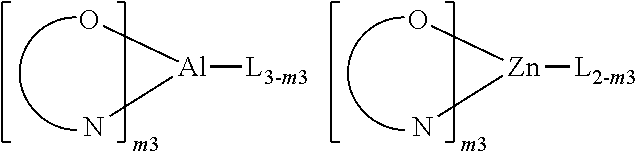


 |
 |
 |
 |
 |
 |
 |
 |
 |
 |
 |
 |
 |
 |
 |
 |
 |
 |
 |
 |
 |
 |
 |
 |
 |
 |
 |
 |
 |
 |
 |
 |
 |
 |
 |
 |
 |
 |
 |
 |
 |
 |
 |


HOMO(eV)=((HOMO(Gaussian)×27.212)−0.9899)/1.1206
LUMO(eV)=((LUMO(Gaussian)×27.212)−2.0041)/1.385
| TABLE 1 | ||||
| Materials | HOMO [eV] | LUMO [eV] | T1 [eV] | S1 [eV] |
| Ir-1 | −4.92 | −2.58 | 2.04 | 2.36 |
| Ir-49 | −4.93 | −2.59 | 2.05 | 2.36 |
| Ir-61 | −4.89 | −2.55 | 2.02 | 2.32 |
| c-Ir-1 | −4.96 | −2.59 | 2.07 | 2.40 |
| c-Ir-2 | −4.90 | −2.58 | 2.04 | 2.30 |
| c-Ir-3 | −4.94 | −2.60 | 2.06 | 2.38 |


| TABLE 1 | ||||
| Materials | λMAX/nm | FWHM/nm | ||
| Ir-1 | 608 | 39 | ||
| Ir-49 | 618 | 50 | ||
| Ir-61 | 606 | 44 | ||
| c-Ir-1 | 616 | 47 | ||
| c-Ir-2 | 609 | 39 | ||
| TABLE 2 |
| Relative external quantum efficiency data |
| OLED devices doping | Relative external quantum efficiency | ||
| Ir-1 | 105% | ||
| Ir-49 | 106% | ||
| Ir-61 | 103% | ||
| c-Ir-1 | 100% | ||
| c-Ir-2 | 100% | ||
| c-Ir-3 | 103% | ||
| TABLE 3 |
| Relative lifetime parameters of devices |
| OLED devices doping | Relative lifetime of devices | ||
| Ir-1 | 108% | ||
| Ir-49 | 119% | ||
| Ir-61 | 115% | ||
| c-Ir-1 | 100% | ||
| c-Ir-2 | 105% | ||
| c-Ir-3 | 105% | ||
Claims (18)


Applications Claiming Priority (3)
| Application Number | Priority Date | Filing Date | Title |
|---|---|---|---|
| CN201711340362.5 | 2017-12-14 | ||
| CN201711340362 | 2017-12-14 | ||
| PCT/CN2018/120131 WO2019114668A1 (en) | 2017-12-14 | 2018-12-10 | Transition metal complex material and application thereof in electronic devices |
Publications (2)
| Publication Number | Publication Date |
|---|---|
| US20210083203A1 US20210083203A1 (en) | 2021-03-18 |
| US11404651B2 true US11404651B2 (en) | 2022-08-02 |
Family
ID=66818986
Family Applications (1)
| Application Number | Title | Priority Date | Filing Date |
|---|---|---|---|
| US16/772,651 Active 2039-04-07 US11404651B2 (en) | 2017-12-14 | 2018-12-10 | Transition metal complex material and application thereof in electronic devices |
Country Status (3)
| Country | Link |
|---|---|
| US (1) | US11404651B2 (en) |
| CN (1) | CN111247159A (en) |
| WO (1) | WO2019114668A1 (en) |
Families Citing this family (9)
| Publication number | Priority date | Publication date | Assignee | Title |
|---|---|---|---|---|
| US11459348B2 (en) * | 2018-04-02 | 2022-10-04 | Samsung Electronics Co., Ltd. | Organometallic compound, organic light-emitting device including the same, and diagnostic composition including the organometallic compound |
| US12453279B2 (en) * | 2018-08-22 | 2025-10-21 | Universal Display Corporation | Organic electroluminescent materials and devices |
| CN110746429B (en) * | 2018-12-10 | 2022-11-25 | 广州华睿光电材料有限公司 | Adamantane-containing compound, polymer, mixture, composition, and electronic device |
| KR102965235B1 (en) * | 2019-03-26 | 2026-05-14 | 삼성디스플레이 주식회사 | Organic light emitting device and electronic apparatus |
| CN111808143A (en) * | 2020-07-09 | 2020-10-23 | 奥来德(长春)光电材料科技有限公司 | Metal complex containing adamantane structure, preparation method thereof and photoelectric device |
| CN111777645A (en) * | 2020-07-15 | 2020-10-16 | 奥来德(长春)光电材料科技有限公司 | Metal complex for red light electroluminescent material and preparation method and device thereof |
| CN111825724B (en) * | 2020-07-28 | 2023-04-28 | 奥来德(长春)光电材料科技有限公司 | Phosphorescent iridium complex, preparation method thereof and electroluminescent device |
| CN113258240B (en) * | 2021-05-19 | 2021-12-28 | 东南大学 | Nonlinear artificial SPP waveguide for parametric amplification of multi-frequency signal waves and calculation method |
| CN114634419B (en) * | 2022-04-06 | 2023-04-18 | 长春海谱润斯科技股份有限公司 | Aromatic amine compound and organic electroluminescent device thereof |
Citations (59)
| Publication number | Priority date | Publication date | Assignee | Title |
|---|---|---|---|---|
| WO2000070655A2 (en) | 1999-05-13 | 2000-11-23 | The Trustees Of Princeton University | Very high efficiency organic light emitting devices based on electrophosphorescence |
| WO2001041512A1 (en) | 1999-12-01 | 2001-06-07 | The Trustees Of Princeton University | Complexes of form l2mx as phosphorescent dopants for organic leds |
| US20010053462A1 (en) | 2000-05-02 | 2001-12-20 | Masayuki Mishima | Light-emitting device |
| WO2002002714A2 (en) | 2000-06-30 | 2002-01-10 | E.I. Du Pont De Nemours And Company | Electroluminescent iridium compounds with fluorinated phenylpyridines, phenylpyrimidines, and phenylquinolines and devices made with such compounds |
| WO2002015645A1 (en) | 2000-08-11 | 2002-02-21 | The Trustees Of Princeton University | Organometallic compounds and emission-shifting organic electrophosphorescence |
| US6824895B1 (en) | 2003-12-05 | 2004-11-30 | Eastman Kodak Company | Electroluminescent device containing organometallic compound with tridentate ligand |
| US6830828B2 (en) | 1998-09-14 | 2004-12-14 | The Trustees Of Princeton University | Organometallic complexes as phosphorescent emitters in organic LEDs |
| US6835469B2 (en) | 2001-10-17 | 2004-12-28 | The University Of Southern California | Phosphorescent compounds and devices comprising the same |
| WO2005019373A2 (en) | 2003-08-19 | 2005-03-03 | Basf Aktiengesellschaft | Transition metal complexes comprising carbene ligands serving as emitters for organic light-emitting diodes (oled's) |
| WO2005033244A1 (en) | 2003-09-29 | 2005-04-14 | Covion Organic Semiconductors Gmbh | Metal complexes |
| US20050258742A1 (en) | 2004-05-18 | 2005-11-24 | Yui-Yi Tsai | Carbene containing metal complexes as OLEDs |
| EP1191613B1 (en) | 2000-09-26 | 2006-03-29 | Canon Kabushiki Kaisha | Luminescence device, display apparatus and metal coordination compound |
| US7029766B2 (en) | 2003-12-05 | 2006-04-18 | Eastman Kodak Company | Organic element for electroluminescent devices |
| US20070087219A1 (en) | 2005-10-19 | 2007-04-19 | Eastman Kodak Company | Electroluminescent device |
| WO2007095118A2 (en) | 2006-02-10 | 2007-08-23 | Universal Display Corporation | METAL COMPLEXES OF CYCLOMETALLATED IMIDAZO[1,2-f]PHENANTHRIDINE AND DIIMIDAZO[1,2-A:1',2'-C]QUINAZOLINE LIGANDS AND ISOELECTRONIC AND BENZANNULATED ANALOGS THEREOF |
| US20080027220A1 (en) | 2004-07-16 | 2008-01-31 | Merck Patent Gmbh | Metal Complexes |
| US20080093616A1 (en) * | 2004-11-25 | 2008-04-24 | Showa Denko K.K. | Light-Emitting Diode Illumination Source |
| US20090061681A1 (en) | 2007-09-05 | 2009-03-05 | Mcmunigal Tom | Electrical receptacle assembly |
| EP1191614B1 (en) | 2000-09-26 | 2009-05-06 | Canon Kabushiki Kaisha | Luminescence device and metal coordination compound therefor |
| US20090134784A1 (en) | 2004-10-21 | 2009-05-28 | Universal Display Corporation | Carbazole-containing materials in phosphorescent light emitting diodes |
| EP1191612B1 (en) | 2000-09-26 | 2009-09-09 | Canon Kabushiki Kaisha | Luminescence device and display apparatus |
| WO2009118087A1 (en) | 2008-03-25 | 2009-10-01 | Merck Patent Gmbh | Metal complexes |
| WO2009146770A2 (en) | 2008-06-05 | 2009-12-10 | Merck Patent Gmbh | Electronic device comprising metal complexes |
| WO2010015307A1 (en) | 2008-08-04 | 2010-02-11 | Merck Patent Gmbh | Electronic devices comprising metal complexes having isonitrile ligands |
| WO2010031485A1 (en) | 2008-09-22 | 2010-03-25 | Merck Patent Gmbh | Materials for organic electroluminescence devices |
| WO2010054731A1 (en) | 2008-11-13 | 2010-05-20 | Merck Patent Gmbh | Materials for organic electroluminescent devices |
| WO2010054728A1 (en) | 2008-11-13 | 2010-05-20 | Merck Patent Gmbh | Materials for organic electroluminescent devices |
| WO2010086089A1 (en) | 2009-02-02 | 2010-08-05 | Merck Patent Gmbh | Metal complexes |
| WO2010099852A1 (en) | 2009-03-02 | 2010-09-10 | Merck Patent Gmbh | Metal complexes having azaborol ligands and electronic device having the same |
| WO2010102709A1 (en) | 2009-03-13 | 2010-09-16 | Merck Patent Gmbh | Materials for organic electroluminescence devices |
| WO2010135519A1 (en) | 2009-05-20 | 2010-11-25 | Universal Display Corporation | Metal complexes with boron-nitrogen heterocycle containing ligands for use in organic light emitting devices |
| WO2011110277A1 (en) | 2010-03-11 | 2011-09-15 | Merck Patent Gmbh | Fibers in therapy and cosmetics |
| WO2011141110A2 (en) | 2010-05-12 | 2011-11-17 | Merck Patent Gmbh | Photo-stabilizing agents |
| WO2011157339A1 (en) | 2010-06-15 | 2011-12-22 | Merck Patent Gmbh | Metal complexes |
| WO2012007088A1 (en) | 2010-07-16 | 2012-01-19 | Merck Patent Gmbh | Metal complexes |
| WO2012007086A1 (en) | 2010-07-16 | 2012-01-19 | Merck Patent Gmbh | Metal complexes |
| WO2012007087A1 (en) | 2010-07-16 | 2012-01-19 | Merck Patent Gmbh | Metal complexes |
| US20120217869A1 (en) | 2011-02-28 | 2012-08-30 | Kyushu University National University Corporation | Delayed fluorescence material and organic electroluminescence device |
| TW201309778A (en) | 2011-07-15 | 2013-03-01 | Univ Kyushu Nat Univ Corp | Organic electroluminescence element and compound used therefor |
| TW201309696A (en) | 2011-07-15 | 2013-03-01 | Univ Kyushu Nat Univ Corp | Delayed fluorescent material and organic electroluminescence element using same |
| CN103130835A (en) | 2011-11-21 | 2013-06-05 | 通用显示公司 | organic luminescent material |
| WO2013094620A1 (en) | 2011-12-23 | 2013-06-27 | Semiconductor Energy Laboratory Co., Ltd. | Organometallic complex, light-emitting element, light-emitting device, electronic device, and lighting device |
| WO2013107487A1 (en) | 2012-01-16 | 2013-07-25 | Merck Patent Gmbh | Organic metal complexes |
| WO2013133359A1 (en) | 2012-03-09 | 2013-09-12 | 国立大学法人九州大学 | Light-emitting material, and organic light-emitting element |
| WO2013154064A1 (en) | 2012-04-09 | 2013-10-17 | 国立大学法人九州大学 | Organic light emitting element, and light emitting material and compound used in same |
| TW201343874A (en) | 2012-04-25 | 2013-11-01 | Univ Kyushu Nat Univ Corp | Luminescence material and organic luminescence device |
| US20130299795A1 (en) | 2011-01-13 | 2013-11-14 | Universal Display Corporation | Materials for organic light emitting diode |
| WO2013174471A1 (en) | 2012-05-24 | 2013-11-28 | Merck Patent Gmbh | Metal complexes comprising condensed heteroaromatic rings |
| TW201350558A (en) | 2012-05-17 | 2013-12-16 | Univ Kyushu Nat Univ Corp | Compound, luminescence material and organic luminescence device |
| CN103483332A (en) | 2013-09-11 | 2014-01-01 | 中山大学 | Novel piezoluminescence material with thermal activation delayed fluorescence and aggregation-induced emission properties and synthetic method and application of novel piezoluminescence material |
| WO2014007565A1 (en) | 2012-07-04 | 2014-01-09 | 제일모직 주식회사 | Compound for organic optoelectric device, organic optoelectric device comprising same, and display apparatus comprising organic optoelectric device |
| WO2014008982A1 (en) | 2012-07-13 | 2014-01-16 | Merck Patent Gmbh | Metal complexes |
| WO2014024131A1 (en) | 2012-08-09 | 2014-02-13 | Basf Se | Transition metal complexes with carbene ligands and use thereof in oleds |
| WO2014023377A2 (en) | 2012-08-07 | 2014-02-13 | Merck Patent Gmbh | Metal complexes |
| WO2014031977A1 (en) | 2012-08-24 | 2014-02-27 | Arizona Board Of Regents For And On Behalf Of Arizona State University | Metal compounds and methods and uses thereof |
| WO2014038456A1 (en) | 2012-09-04 | 2014-03-13 | コニカミノルタ株式会社 | Organic electroluminescent element, lighting device and display device |
| WO2014112450A1 (en) | 2013-01-17 | 2014-07-24 | Canon Kabushiki Kaisha | Organic light-emitting element |
| CN104277075A (en) | 2013-07-01 | 2015-01-14 | 环球展览公司 | Ancillary ligands for organometallic complexes and devices and formulations comprising same |
| CN104974166A (en) | 2014-04-02 | 2015-10-14 | 环球展览公司 | Organic Electroluminescent Materials and Devices |
Family Cites Families (8)
| Publication number | Priority date | Publication date | Assignee | Title |
|---|---|---|---|---|
| US9130177B2 (en) * | 2011-01-13 | 2015-09-08 | Universal Display Corporation | 5-substituted 2 phenylquinoline complexes materials for light emitting diode |
| US9512355B2 (en) * | 2011-12-09 | 2016-12-06 | Universal Display Corporation | Organic light emitting materials |
| US10074806B2 (en) * | 2013-08-20 | 2018-09-11 | Universal Display Corporation | Organic electroluminescent materials and devices |
| US9331299B2 (en) * | 2014-04-11 | 2016-05-03 | Universal Display Corporation | Efficient white organic light emitting diodes with high color quality |
| US9450198B2 (en) * | 2014-04-15 | 2016-09-20 | Universal Display Corporation | Organic electroluminescent materials and devices |
| US10749113B2 (en) * | 2014-09-29 | 2020-08-18 | Universal Display Corporation | Organic electroluminescent materials and devices |
| KR102343146B1 (en) * | 2014-12-16 | 2021-12-27 | 삼성디스플레이 주식회사 | Organometallic compound and organic light emitting device comprising the same |
| CN107459535A (en) * | 2017-09-21 | 2017-12-12 | 南京工业大学 | Polysubstituted quinoline coordinated iridium hybrid compound and preparation method and application thereof |
-
2018
- 2018-12-10 US US16/772,651 patent/US11404651B2/en active Active
- 2018-12-10 CN CN201880068583.8A patent/CN111247159A/en active Pending
- 2018-12-10 WO PCT/CN2018/120131 patent/WO2019114668A1/en not_active Ceased
Patent Citations (61)
| Publication number | Priority date | Publication date | Assignee | Title |
|---|---|---|---|---|
| US6830828B2 (en) | 1998-09-14 | 2004-12-14 | The Trustees Of Princeton University | Organometallic complexes as phosphorescent emitters in organic LEDs |
| WO2000070655A2 (en) | 1999-05-13 | 2000-11-23 | The Trustees Of Princeton University | Very high efficiency organic light emitting devices based on electrophosphorescence |
| WO2001041512A1 (en) | 1999-12-01 | 2001-06-07 | The Trustees Of Princeton University | Complexes of form l2mx as phosphorescent dopants for organic leds |
| US20010053462A1 (en) | 2000-05-02 | 2001-12-20 | Masayuki Mishima | Light-emitting device |
| WO2002002714A2 (en) | 2000-06-30 | 2002-01-10 | E.I. Du Pont De Nemours And Company | Electroluminescent iridium compounds with fluorinated phenylpyridines, phenylpyrimidines, and phenylquinolines and devices made with such compounds |
| WO2002015645A1 (en) | 2000-08-11 | 2002-02-21 | The Trustees Of Princeton University | Organometallic compounds and emission-shifting organic electrophosphorescence |
| EP1191613B1 (en) | 2000-09-26 | 2006-03-29 | Canon Kabushiki Kaisha | Luminescence device, display apparatus and metal coordination compound |
| EP1191612B1 (en) | 2000-09-26 | 2009-09-09 | Canon Kabushiki Kaisha | Luminescence device and display apparatus |
| EP1191614B1 (en) | 2000-09-26 | 2009-05-06 | Canon Kabushiki Kaisha | Luminescence device and metal coordination compound therefor |
| US6835469B2 (en) | 2001-10-17 | 2004-12-28 | The University Of Southern California | Phosphorescent compounds and devices comprising the same |
| WO2005019373A2 (en) | 2003-08-19 | 2005-03-03 | Basf Aktiengesellschaft | Transition metal complexes comprising carbene ligands serving as emitters for organic light-emitting diodes (oled's) |
| WO2005033244A1 (en) | 2003-09-29 | 2005-04-14 | Covion Organic Semiconductors Gmbh | Metal complexes |
| US7029766B2 (en) | 2003-12-05 | 2006-04-18 | Eastman Kodak Company | Organic element for electroluminescent devices |
| US6824895B1 (en) | 2003-12-05 | 2004-11-30 | Eastman Kodak Company | Electroluminescent device containing organometallic compound with tridentate ligand |
| US20050258742A1 (en) | 2004-05-18 | 2005-11-24 | Yui-Yi Tsai | Carbene containing metal complexes as OLEDs |
| US20080027220A1 (en) | 2004-07-16 | 2008-01-31 | Merck Patent Gmbh | Metal Complexes |
| US20090134784A1 (en) | 2004-10-21 | 2009-05-28 | Universal Display Corporation | Carbazole-containing materials in phosphorescent light emitting diodes |
| US20080093616A1 (en) * | 2004-11-25 | 2008-04-24 | Showa Denko K.K. | Light-Emitting Diode Illumination Source |
| US20070087219A1 (en) | 2005-10-19 | 2007-04-19 | Eastman Kodak Company | Electroluminescent device |
| WO2007095118A2 (en) | 2006-02-10 | 2007-08-23 | Universal Display Corporation | METAL COMPLEXES OF CYCLOMETALLATED IMIDAZO[1,2-f]PHENANTHRIDINE AND DIIMIDAZO[1,2-A:1',2'-C]QUINAZOLINE LIGANDS AND ISOELECTRONIC AND BENZANNULATED ANALOGS THEREOF |
| US20090061681A1 (en) | 2007-09-05 | 2009-03-05 | Mcmunigal Tom | Electrical receptacle assembly |
| WO2009118087A1 (en) | 2008-03-25 | 2009-10-01 | Merck Patent Gmbh | Metal complexes |
| WO2009146770A2 (en) | 2008-06-05 | 2009-12-10 | Merck Patent Gmbh | Electronic device comprising metal complexes |
| WO2010015307A1 (en) | 2008-08-04 | 2010-02-11 | Merck Patent Gmbh | Electronic devices comprising metal complexes having isonitrile ligands |
| WO2010031485A1 (en) | 2008-09-22 | 2010-03-25 | Merck Patent Gmbh | Materials for organic electroluminescence devices |
| WO2010054731A1 (en) | 2008-11-13 | 2010-05-20 | Merck Patent Gmbh | Materials for organic electroluminescent devices |
| WO2010054728A1 (en) | 2008-11-13 | 2010-05-20 | Merck Patent Gmbh | Materials for organic electroluminescent devices |
| WO2010086089A1 (en) | 2009-02-02 | 2010-08-05 | Merck Patent Gmbh | Metal complexes |
| CN102282150A (en) | 2009-02-02 | 2011-12-14 | 默克专利有限公司 | Metal complexes |
| WO2010099852A1 (en) | 2009-03-02 | 2010-09-10 | Merck Patent Gmbh | Metal complexes having azaborol ligands and electronic device having the same |
| US20120004407A1 (en) | 2009-03-02 | 2012-01-05 | Merck Patent Gmbh | Metal complexes having azaborol ligands and electronic device having the same |
| WO2010102709A1 (en) | 2009-03-13 | 2010-09-16 | Merck Patent Gmbh | Materials for organic electroluminescence devices |
| WO2010135519A1 (en) | 2009-05-20 | 2010-11-25 | Universal Display Corporation | Metal complexes with boron-nitrogen heterocycle containing ligands for use in organic light emitting devices |
| WO2011110277A1 (en) | 2010-03-11 | 2011-09-15 | Merck Patent Gmbh | Fibers in therapy and cosmetics |
| WO2011141110A2 (en) | 2010-05-12 | 2011-11-17 | Merck Patent Gmbh | Photo-stabilizing agents |
| WO2011157339A1 (en) | 2010-06-15 | 2011-12-22 | Merck Patent Gmbh | Metal complexes |
| WO2012007088A1 (en) | 2010-07-16 | 2012-01-19 | Merck Patent Gmbh | Metal complexes |
| WO2012007086A1 (en) | 2010-07-16 | 2012-01-19 | Merck Patent Gmbh | Metal complexes |
| WO2012007087A1 (en) | 2010-07-16 | 2012-01-19 | Merck Patent Gmbh | Metal complexes |
| US20130299795A1 (en) | 2011-01-13 | 2013-11-14 | Universal Display Corporation | Materials for organic light emitting diode |
| US20120217869A1 (en) | 2011-02-28 | 2012-08-30 | Kyushu University National University Corporation | Delayed fluorescence material and organic electroluminescence device |
| TW201309696A (en) | 2011-07-15 | 2013-03-01 | Univ Kyushu Nat Univ Corp | Delayed fluorescent material and organic electroluminescence element using same |
| TW201309778A (en) | 2011-07-15 | 2013-03-01 | Univ Kyushu Nat Univ Corp | Organic electroluminescence element and compound used therefor |
| CN103130835A (en) | 2011-11-21 | 2013-06-05 | 通用显示公司 | organic luminescent material |
| WO2013094620A1 (en) | 2011-12-23 | 2013-06-27 | Semiconductor Energy Laboratory Co., Ltd. | Organometallic complex, light-emitting element, light-emitting device, electronic device, and lighting device |
| WO2013107487A1 (en) | 2012-01-16 | 2013-07-25 | Merck Patent Gmbh | Organic metal complexes |
| WO2013133359A1 (en) | 2012-03-09 | 2013-09-12 | 国立大学法人九州大学 | Light-emitting material, and organic light-emitting element |
| WO2013154064A1 (en) | 2012-04-09 | 2013-10-17 | 国立大学法人九州大学 | Organic light emitting element, and light emitting material and compound used in same |
| TW201343874A (en) | 2012-04-25 | 2013-11-01 | Univ Kyushu Nat Univ Corp | Luminescence material and organic luminescence device |
| TW201350558A (en) | 2012-05-17 | 2013-12-16 | Univ Kyushu Nat Univ Corp | Compound, luminescence material and organic luminescence device |
| WO2013174471A1 (en) | 2012-05-24 | 2013-11-28 | Merck Patent Gmbh | Metal complexes comprising condensed heteroaromatic rings |
| WO2014007565A1 (en) | 2012-07-04 | 2014-01-09 | 제일모직 주식회사 | Compound for organic optoelectric device, organic optoelectric device comprising same, and display apparatus comprising organic optoelectric device |
| WO2014008982A1 (en) | 2012-07-13 | 2014-01-16 | Merck Patent Gmbh | Metal complexes |
| WO2014023377A2 (en) | 2012-08-07 | 2014-02-13 | Merck Patent Gmbh | Metal complexes |
| WO2014024131A1 (en) | 2012-08-09 | 2014-02-13 | Basf Se | Transition metal complexes with carbene ligands and use thereof in oleds |
| WO2014031977A1 (en) | 2012-08-24 | 2014-02-27 | Arizona Board Of Regents For And On Behalf Of Arizona State University | Metal compounds and methods and uses thereof |
| WO2014038456A1 (en) | 2012-09-04 | 2014-03-13 | コニカミノルタ株式会社 | Organic electroluminescent element, lighting device and display device |
| WO2014112450A1 (en) | 2013-01-17 | 2014-07-24 | Canon Kabushiki Kaisha | Organic light-emitting element |
| CN104277075A (en) | 2013-07-01 | 2015-01-14 | 环球展览公司 | Ancillary ligands for organometallic complexes and devices and formulations comprising same |
| CN103483332A (en) | 2013-09-11 | 2014-01-01 | 中山大学 | Novel piezoluminescence material with thermal activation delayed fluorescence and aggregation-induced emission properties and synthetic method and application of novel piezoluminescence material |
| CN104974166A (en) | 2014-04-02 | 2015-10-14 | 环球展览公司 | Organic Electroluminescent Materials and Devices |
Non-Patent Citations (25)
Also Published As
| Publication number | Publication date |
|---|---|
| CN111247159A (en) | 2020-06-05 |
| WO2019114668A1 (en) | 2019-06-20 |
| US20210083203A1 (en) | 2021-03-18 |
Similar Documents
| Publication | Publication Date | Title |
|---|---|---|
| US11239428B2 (en) | Boron-containing organic compound and applications thereof, organic mixture, and organic electronic device | |
| US20190214577A1 (en) | Thermally activated delayed fluorescence material, polymer, mixture, formulation, and organic electronic device | |
| CN111278838B (en) | Boron-containing heterocyclic compound, polymer, mixture, composition and use thereof | |
| US20210083203A1 (en) | Transition metal complex material and application thereof in electronic devices | |
| CN109638171B (en) | Organic mixtures, polymers, compositions and uses thereof | |
| US20190334099A1 (en) | Transition metal complex and application thereof, mixture and organic electronic device | |
| CN108137622B (en) | Silicon-containing organic compounds and their applications | |
| CN107922359A (en) | Material for organic electroluminescence device | |
| CN109705100B (en) | Naphthalenecarbazole-containing organic photochemical compound, mixture, composition and application thereof | |
| EP3547385A1 (en) | Organic mixture, composition, and organic electronic component | |
| CN110760056B (en) | Polymer containing condensed ring aromatic hydrocarbon group and application thereof in organic electronic device | |
| US11674080B2 (en) | Transition metal complex, polymer, mixture, formulation and use thereof | |
| WO2018108110A1 (en) | Metal organic complex and use thereof, mixture, and organic electronic device | |
| US11634444B2 (en) | Metal organic complex, high polymer, composition, and organic electronic component | |
| CN109608481A (en) | Metal organic complex and its application in organic electronic device | |
| CN113004336B (en) | Transition metal complexes, polymers, mixtures, compositions and organic electronic devices | |
| DE102010033080A1 (en) | Polymers with structural units that have electron transport properties | |
| US10804470B2 (en) | Organic compound | |
| CN116635365A (en) | Materials for Electronic Devices | |
| CN108137610B (en) | Organic photoelectric material and application thereof | |
| US12240864B2 (en) | Phosphine oxide group-contained transition metal complex, and polymer, mixture, composition, and organic electronic device thereof | |
| CN113045606B (en) | Transition metal complexes, polymers, mixtures, compositions and organic electronic devices | |
| CN111278836B (en) | Metal organic complex and application thereof in organic electronic device | |
| CN112940016B (en) | Transition metal complexes, mixtures, compositions and organic electronic devices |
Legal Events
| Date | Code | Title | Description |
|---|---|---|---|
| FEPP | Fee payment procedure |
Free format text: ENTITY STATUS SET TO UNDISCOUNTED (ORIGINAL EVENT CODE: BIG.); ENTITY STATUS OF PATENT OWNER: LARGE ENTITY |
|
| AS | Assignment |
Owner name: GUANGZHOU CHINARAY OPTOELECTRONIC MATERIALS LTD., CHINA Free format text: ASSIGNMENT OF ASSIGNORS INTEREST;ASSIGNORS:LEUNG, CHI MING;HUANG, HONG;PAN, JUNYOU;REEL/FRAME:052936/0919 Effective date: 20200610 |
|
| STPP | Information on status: patent application and granting procedure in general |
Free format text: APPLICATION DISPATCHED FROM PREEXAM, NOT YET DOCKETED |
|
| STPP | Information on status: patent application and granting procedure in general |
Free format text: DOCKETED NEW CASE - READY FOR EXAMINATION |
|
| STPP | Information on status: patent application and granting procedure in general |
Free format text: NON FINAL ACTION MAILED |
|
| STPP | Information on status: patent application and granting procedure in general |
Free format text: RESPONSE TO NON-FINAL OFFICE ACTION ENTERED AND FORWARDED TO EXAMINER |
|
| STPP | Information on status: patent application and granting procedure in general |
Free format text: NOTICE OF ALLOWANCE MAILED -- APPLICATION RECEIVED IN OFFICE OF PUBLICATIONS |
|
| STPP | Information on status: patent application and granting procedure in general |
Free format text: AWAITING TC RESP., ISSUE FEE NOT PAID |
|
| STPP | Information on status: patent application and granting procedure in general |
Free format text: NOTICE OF ALLOWANCE MAILED -- APPLICATION RECEIVED IN OFFICE OF PUBLICATIONS |
|
| STPP | Information on status: patent application and granting procedure in general |
Free format text: PUBLICATIONS -- ISSUE FEE PAYMENT RECEIVED |
|
| STCF | Information on status: patent grant |
Free format text: PATENTED CASE |
|
| FEPP | Fee payment procedure |
Free format text: MAINTENANCE FEE REMINDER MAILED (ORIGINAL EVENT CODE: REM.); ENTITY STATUS OF PATENT OWNER: LARGE ENTITY |
|
| FEPP | Fee payment procedure |
Free format text: SURCHARGE FOR LATE PAYMENT, LARGE ENTITY (ORIGINAL EVENT CODE: M1554); ENTITY STATUS OF PATENT OWNER: LARGE ENTITY |
|
| MAFP | Maintenance fee payment |
Free format text: PAYMENT OF MAINTENANCE FEE, 4TH YEAR, LARGE ENTITY (ORIGINAL EVENT CODE: M1551); ENTITY STATUS OF PATENT OWNER: LARGE ENTITY Year of fee payment: 4 |