US11403949B2 - System for predicting vehicle behavior - Google Patents
System for predicting vehicle behavior Download PDFInfo
- Publication number
- US11403949B2 US11403949B2 US16/408,257 US201916408257A US11403949B2 US 11403949 B2 US11403949 B2 US 11403949B2 US 201916408257 A US201916408257 A US 201916408257A US 11403949 B2 US11403949 B2 US 11403949B2
- Authority
- US
- United States
- Prior art keywords
- vehicle
- target vehicle
- location
- target
- state
- Prior art date
- Legal status (The legal status is an assumption and is not a legal conclusion. Google has not performed a legal analysis and makes no representation as to the accuracy of the status listed.)
- Active, expires
Links
Images




Classifications
-
- B—PERFORMING OPERATIONS; TRANSPORTING
- B60—VEHICLES IN GENERAL
- B60W—CONJOINT CONTROL OF VEHICLE SUB-UNITS OF DIFFERENT TYPE OR DIFFERENT FUNCTION; CONTROL SYSTEMS SPECIALLY ADAPTED FOR HYBRID VEHICLES; ROAD VEHICLE DRIVE CONTROL SYSTEMS FOR PURPOSES NOT RELATED TO THE CONTROL OF A PARTICULAR SUB-UNIT
- B60W60/00—Drive control systems specially adapted for autonomous road vehicles
- B60W60/001—Planning or execution of driving tasks
- B60W60/0027—Planning or execution of driving tasks using trajectory prediction for other traffic participants
- B60W60/00274—Planning or execution of driving tasks using trajectory prediction for other traffic participants considering possible movement changes
-
- G—PHYSICS
- G08—SIGNALLING
- G08G—TRAFFIC CONTROL SYSTEMS
- G08G1/00—Traffic control systems for road vehicles
- G08G1/16—Anti-collision systems
- G08G1/166—Anti-collision systems for active traffic, e.g. moving vehicles, pedestrians, bikes
-
- B—PERFORMING OPERATIONS; TRANSPORTING
- B60—VEHICLES IN GENERAL
- B60W—CONJOINT CONTROL OF VEHICLE SUB-UNITS OF DIFFERENT TYPE OR DIFFERENT FUNCTION; CONTROL SYSTEMS SPECIALLY ADAPTED FOR HYBRID VEHICLES; ROAD VEHICLE DRIVE CONTROL SYSTEMS FOR PURPOSES NOT RELATED TO THE CONTROL OF A PARTICULAR SUB-UNIT
- B60W30/00—Purposes of road vehicle drive control systems not related to the control of a particular sub-unit, e.g. of systems using conjoint control of vehicle sub-units
- B60W30/08—Active safety systems predicting or avoiding probable or impending collision or attempting to minimise its consequences
-
- B—PERFORMING OPERATIONS; TRANSPORTING
- B60—VEHICLES IN GENERAL
- B60W—CONJOINT CONTROL OF VEHICLE SUB-UNITS OF DIFFERENT TYPE OR DIFFERENT FUNCTION; CONTROL SYSTEMS SPECIALLY ADAPTED FOR HYBRID VEHICLES; ROAD VEHICLE DRIVE CONTROL SYSTEMS FOR PURPOSES NOT RELATED TO THE CONTROL OF A PARTICULAR SUB-UNIT
- B60W50/00—Details of control systems for road vehicle drive control not related to the control of a particular sub-unit, e.g. process diagnostic or vehicle driver interfaces
- B60W50/0097—Predicting future conditions
-
- B—PERFORMING OPERATIONS; TRANSPORTING
- B60—VEHICLES IN GENERAL
- B60W—CONJOINT CONTROL OF VEHICLE SUB-UNITS OF DIFFERENT TYPE OR DIFFERENT FUNCTION; CONTROL SYSTEMS SPECIALLY ADAPTED FOR HYBRID VEHICLES; ROAD VEHICLE DRIVE CONTROL SYSTEMS FOR PURPOSES NOT RELATED TO THE CONTROL OF A PARTICULAR SUB-UNIT
- B60W50/00—Details of control systems for road vehicle drive control not related to the control of a particular sub-unit, e.g. process diagnostic or vehicle driver interfaces
- B60W50/08—Interaction between the driver and the control system
- B60W50/14—Means for informing the driver, warning the driver or prompting a driver intervention
-
- G—PHYSICS
- G08—SIGNALLING
- G08G—TRAFFIC CONTROL SYSTEMS
- G08G1/00—Traffic control systems for road vehicles
- G08G1/01—Detecting movement of traffic to be counted or controlled
- G08G1/0104—Measuring and analyzing of parameters relative to traffic conditions
- G08G1/0125—Traffic data processing
-
- G—PHYSICS
- G08—SIGNALLING
- G08G—TRAFFIC CONTROL SYSTEMS
- G08G1/00—Traffic control systems for road vehicles
- G08G1/01—Detecting movement of traffic to be counted or controlled
- G08G1/0104—Measuring and analyzing of parameters relative to traffic conditions
- G08G1/0125—Traffic data processing
- G08G1/0129—Traffic data processing for creating historical data or processing based on historical data
-
- B—PERFORMING OPERATIONS; TRANSPORTING
- B60—VEHICLES IN GENERAL
- B60W—CONJOINT CONTROL OF VEHICLE SUB-UNITS OF DIFFERENT TYPE OR DIFFERENT FUNCTION; CONTROL SYSTEMS SPECIALLY ADAPTED FOR HYBRID VEHICLES; ROAD VEHICLE DRIVE CONTROL SYSTEMS FOR PURPOSES NOT RELATED TO THE CONTROL OF A PARTICULAR SUB-UNIT
- B60W50/00—Details of control systems for road vehicle drive control not related to the control of a particular sub-unit, e.g. process diagnostic or vehicle driver interfaces
- B60W2050/0062—Adapting control system settings
- B60W2050/0075—Automatic parameter input, automatic initialising or calibrating means
-
- B—PERFORMING OPERATIONS; TRANSPORTING
- B60—VEHICLES IN GENERAL
- B60W—CONJOINT CONTROL OF VEHICLE SUB-UNITS OF DIFFERENT TYPE OR DIFFERENT FUNCTION; CONTROL SYSTEMS SPECIALLY ADAPTED FOR HYBRID VEHICLES; ROAD VEHICLE DRIVE CONTROL SYSTEMS FOR PURPOSES NOT RELATED TO THE CONTROL OF A PARTICULAR SUB-UNIT
- B60W2552/00—Input parameters relating to infrastructure
- B60W2552/05—Type of road, e.g. motorways, local streets, paved or unpaved roads
-
- B—PERFORMING OPERATIONS; TRANSPORTING
- B60—VEHICLES IN GENERAL
- B60W—CONJOINT CONTROL OF VEHICLE SUB-UNITS OF DIFFERENT TYPE OR DIFFERENT FUNCTION; CONTROL SYSTEMS SPECIALLY ADAPTED FOR HYBRID VEHICLES; ROAD VEHICLE DRIVE CONTROL SYSTEMS FOR PURPOSES NOT RELATED TO THE CONTROL OF A PARTICULAR SUB-UNIT
- B60W2554/00—Input parameters relating to objects
- B60W2554/40—Dynamic objects, e.g. animals, windblown objects
- B60W2554/404—Characteristics
- B60W2554/4041—Position
-
- B—PERFORMING OPERATIONS; TRANSPORTING
- B60—VEHICLES IN GENERAL
- B60W—CONJOINT CONTROL OF VEHICLE SUB-UNITS OF DIFFERENT TYPE OR DIFFERENT FUNCTION; CONTROL SYSTEMS SPECIALLY ADAPTED FOR HYBRID VEHICLES; ROAD VEHICLE DRIVE CONTROL SYSTEMS FOR PURPOSES NOT RELATED TO THE CONTROL OF A PARTICULAR SUB-UNIT
- B60W2554/00—Input parameters relating to objects
- B60W2554/40—Dynamic objects, e.g. animals, windblown objects
- B60W2554/404—Characteristics
- B60W2554/4042—Longitudinal speed
-
- B—PERFORMING OPERATIONS; TRANSPORTING
- B60—VEHICLES IN GENERAL
- B60W—CONJOINT CONTROL OF VEHICLE SUB-UNITS OF DIFFERENT TYPE OR DIFFERENT FUNCTION; CONTROL SYSTEMS SPECIALLY ADAPTED FOR HYBRID VEHICLES; ROAD VEHICLE DRIVE CONTROL SYSTEMS FOR PURPOSES NOT RELATED TO THE CONTROL OF A PARTICULAR SUB-UNIT
- B60W2554/00—Input parameters relating to objects
- B60W2554/40—Dynamic objects, e.g. animals, windblown objects
- B60W2554/404—Characteristics
- B60W2554/4045—Intention, e.g. lane change or imminent movement
-
- B—PERFORMING OPERATIONS; TRANSPORTING
- B60—VEHICLES IN GENERAL
- B60W—CONJOINT CONTROL OF VEHICLE SUB-UNITS OF DIFFERENT TYPE OR DIFFERENT FUNCTION; CONTROL SYSTEMS SPECIALLY ADAPTED FOR HYBRID VEHICLES; ROAD VEHICLE DRIVE CONTROL SYSTEMS FOR PURPOSES NOT RELATED TO THE CONTROL OF A PARTICULAR SUB-UNIT
- B60W2554/00—Input parameters relating to objects
- B60W2554/40—Dynamic objects, e.g. animals, windblown objects
- B60W2554/406—Traffic density
-
- B—PERFORMING OPERATIONS; TRANSPORTING
- B60—VEHICLES IN GENERAL
- B60W—CONJOINT CONTROL OF VEHICLE SUB-UNITS OF DIFFERENT TYPE OR DIFFERENT FUNCTION; CONTROL SYSTEMS SPECIALLY ADAPTED FOR HYBRID VEHICLES; ROAD VEHICLE DRIVE CONTROL SYSTEMS FOR PURPOSES NOT RELATED TO THE CONTROL OF A PARTICULAR SUB-UNIT
- B60W2554/00—Input parameters relating to objects
- B60W2554/80—Spatial relation or speed relative to objects
- B60W2554/801—Lateral distance
-
- B—PERFORMING OPERATIONS; TRANSPORTING
- B60—VEHICLES IN GENERAL
- B60W—CONJOINT CONTROL OF VEHICLE SUB-UNITS OF DIFFERENT TYPE OR DIFFERENT FUNCTION; CONTROL SYSTEMS SPECIALLY ADAPTED FOR HYBRID VEHICLES; ROAD VEHICLE DRIVE CONTROL SYSTEMS FOR PURPOSES NOT RELATED TO THE CONTROL OF A PARTICULAR SUB-UNIT
- B60W2556/00—Input parameters relating to data
- B60W2556/10—Historical data
-
- B—PERFORMING OPERATIONS; TRANSPORTING
- B60—VEHICLES IN GENERAL
- B60W—CONJOINT CONTROL OF VEHICLE SUB-UNITS OF DIFFERENT TYPE OR DIFFERENT FUNCTION; CONTROL SYSTEMS SPECIALLY ADAPTED FOR HYBRID VEHICLES; ROAD VEHICLE DRIVE CONTROL SYSTEMS FOR PURPOSES NOT RELATED TO THE CONTROL OF A PARTICULAR SUB-UNIT
- B60W2720/00—Output or target parameters relating to overall vehicle dynamics
- B60W2720/10—Longitudinal speed
-
- B—PERFORMING OPERATIONS; TRANSPORTING
- B60—VEHICLES IN GENERAL
- B60W—CONJOINT CONTROL OF VEHICLE SUB-UNITS OF DIFFERENT TYPE OR DIFFERENT FUNCTION; CONTROL SYSTEMS SPECIALLY ADAPTED FOR HYBRID VEHICLES; ROAD VEHICLE DRIVE CONTROL SYSTEMS FOR PURPOSES NOT RELATED TO THE CONTROL OF A PARTICULAR SUB-UNIT
- B60W2720/00—Output or target parameters relating to overall vehicle dynamics
- B60W2720/10—Longitudinal speed
- B60W2720/106—Longitudinal acceleration
Definitions
- the present disclosure generally relates to vehicle systems, and more specifically, to systems and methods for predicting vehicle behavior.
- ADAS advanced driver assistance systems
- AD autonomous driving system
- One of the related art solutions for this demand is a system which predicts future vehicle behavior by utilizing a vehicle behavior model such as an artificial intelligence (AI) model and a stochastic model.
- a vehicle behavior model such as an artificial intelligence (AI) model and a stochastic model.
- AI artificial intelligence
- a stochastic model predicts the likely behavior by calculating probability of vehicle behavior based on the dataset.
- Such related art implementations facilitate a function which predicts future vehicle behavior from the past driving data and the current situation, so that the control response of ADAS/AD is improved in terms of fuel efficiency, comfortability, and safety.
- FIG. 2 is an example related art prediction system for calculating the likely behavior of a vehicle, which consists of a training dataset 1100 , a training module 1110 , a state sensor 100 , and factor sensors 1120 , a prediction module 1130 , and motion control module 150 .
- the training dataset 1100 consists of past driving data, which include a vehicle state, behavior factors, and a state change.
- the vehicle state consists of speed and acceleration of a vehicle.
- the behavior factors consist of values of road width, road curvature, a speed limit, distance to an intersection, distance to a stop sign, etc., which influence behavior of the vehicle.
- the training module 1110 calculates a model parameter set 1210 based on the training data set 1100 .
- the model parameter set is trained so that the prediction module 1130 outputs a close response to the past driving data in a similar situation.
- the model parameter set 1210 is memorized in the prediction module 1130 before an execution phase.
- the state sensor 100 measures a vehicle state of a target vehicle, whose behavior is predicted, based on camera images, and then the state sensor 100 transmits a state signal 200 to the storage to the prediction module 1130 at a constant frequency.
- the state signal 200 consists of the measured speed and acceleration of the target vehicle.
- the factor sensors 1120 measures behavior factors based on camera images, and then the factor sensors 1120 transmit factor signals 1220 to the prediction module 1130 at a constant frequency.
- the factor signals 1220 consist of measured values of behavior factors, such as road width, road curvature, a speed limit, distance to an intersection, distance to a stop sign, etc., which are factors influencing behavior of the target vehicle and included in the training dataset 1100 .
- the prediction module 1130 predicts likely behavior of the target vehicle, and then the prediction module 1130 transmits a likely behavior signal 1230 to the motion control module 150 .
- the prediction module 1130 predicts a likely state change based on values of the state signal 200 and the factor signals 1220 , as the model parameter set 1210 is trained so as to output a close value to the past driving data in a similar situation.
- the likely behavior signal 1230 is calculated by integrating the likely state change.
- the motion control module 150 calculates a control command signal 250 based on the likely behavior signal 1230 so as to improve fuel efficiency, comfortability, and safety.
- FIG. 3 is an example related art prediction system for calculating likely behavior of a vehicle, which consists of a state sensor 100 , and factor sensors 1120 , a storage device 1140 , a prediction module 1150 , and motion control module 150 .
- the state sensor 100 measures a vehicle state of a target vehicle, whose behavior is predicted, based on camera images, and then the state sensor 100 transmits a state signal 200 to the storage to the prediction module 1150 at a constant frequency.
- the state signal 200 consists of the measured speed and acceleration of the target vehicle.
- the factor sensors 1120 measures behavior factors based on camera images, and then the factor sensors 1120 transmit factor signals 1220 to the prediction module 1150 at a constant frequency.
- the factor signals 1220 consist of measured values of behavior factors, such as road width, road curvature, a speed limit, distance to an intersection, distance to a stop sign, etc., which are factors influencing behavior of the target vehicle.
- the storage device 1140 records a dataset of past driving. The dataset consists of a vehicle state, behavior factors which are the same types of factors as ones measured by the factor sensors 1120 , and a state change.
- the storage device 1140 transmits recorded data 1240 to the prediction module 1150 .
- the prediction module 1150 predicts likely behavior of the target vehicle, and the prediction module 1150 transmits a likely behavior signal 1250 to the motion control module 150 .
- the prediction module 140 finds close data points to the current situation in terms of the vehicle state and the behavior factors, and predicts a likely state change based on values of the state changes in the close data points.
- a likely behavior signal 1250 is calculated by integrating the likely state change.
- the motion control module 150 calculates a control command signal 250 based on the likely behavior signal 1250 so as to improve fuel efficiency, comfortability, and safety.
- the prediction module must be driven by the dataset which consists of a significant amount of behavior factors, which can result in several disadvantages.
- the vehicle behavior prediction system must measure all behavior factors which are included in the dataset, even if the number of sensors becomes overly large.
- engineers must acquire large amounts of driving data to fill the higher dimensional space with extra dimensions for additional behavior factors.
- vehicle behavior is affected by various factors such as road width, road curvature, speed limits, distance to an intersection, distance to a stop sign, and so on.
- factors such as road width, road curvature, speed limits, distance to an intersection, distance to a stop sign, and so on.
- engineers in order to provide highly accurate predictions to facilitate ADAS/AD, engineers must include a significant amount of behavior factors in the dataset. Otherwise the vehicle behavior model cannot predict what would otherwise be typical behavior, such as deceleration at a narrow road, acceleration for a speed limit change, and so on that would be affected by these factors.
- the related art systems can be inefficient in several areas, such as having an insufficient number of sensors because the in-vehicle sensors must measure all values of the behavior factors for control inputs as well as the dataset, or such as an amount of data required to fill the data space uniformly because extra dimensions for additional behavior factors increase the data requirements exponentially due to dimensionality.
- Example implementations described herein address the above mentioned problems by introducing a new system for such vehicle behavior predictions that can have more efficiency with respect to the number of sensors and the amount of data required.
- a system which involve a location sensor which measures a vehicle location, a state sensor which measures a vehicle state, a storage device which records each value of the vehicle state correlating with the vehicle location, a retrieval method which retrieves values of the vehicle states recorded near the vehicle location, a prediction module which predicts a likely behavior of the vehicle based on each value retrieved by the retrieval method, a motion control module which calculates a control command based on the predicted likely behavior.
- aspects of the present disclosure can involve a method, involving obtaining state sensor information and location sensor information of a target vehicle, the state sensor information indicative of a vehicle state of the target vehicle, the location sensor information indicative of a location of the target vehicle; determining a behavior prediction of the target vehicle through determining potential state changes of the target vehicle based on comparing the vehicle state of the target vehicle and the location of the target vehicle to one or more historical data points of vehicle state and vehicle location pairs; and controlling a vehicle system based on the behavior prediction of the target vehicle.
- aspects of the present disclosure can involve a computer program having instructions involving obtaining state sensor information and location sensor information of a target vehicle, the state sensor information indicative of a vehicle state of the target vehicle, the location sensor information indicative of a location of the target vehicle; determining a behavior prediction of the target vehicle through determining potential state changes of the target vehicle based on comparing the vehicle state of the target vehicle and the location of the target vehicle to one or more historical data points of vehicle state and vehicle location pairs; and controlling a vehicle system based on the behavior prediction of the target vehicle.
- the computer program may be stored in a non-transitory computer readable medium configured to be executed by one or more processors.
- aspects of the present disclosure can involve a system, involving means for obtaining state sensor information and location sensor information of a target vehicle, the state sensor information indicative of a vehicle state of the target vehicle, the location sensor information indicative of a location of the target vehicle; means for determining a behavior prediction of the target vehicle through determining potential state changes of the target vehicle based on comparing the vehicle state of the target vehicle and the location of the target vehicle to one or more historical data points of vehicle state and vehicle location pairs; and means for controlling a vehicle system based on the behavior prediction of the target vehicle.
- FIG. 1 illustrates an example of a prediction system for calculating likely behavior of a vehicle, in accordance with an example implementation.
- FIGS. 2 and 3 illustrate an example related art prediction system for calculating the likely behavior of a vehicle.
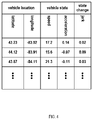
- FIG. 4 illustrates an example of a database in accordance with an example implementation.
- FIG. 5 illustrates an example of the recorded data points managed on the map geographically, in accordance with an example implementation.
- FIG. 6 illustrates an example of the data points recorded near the target vehicle location in accordance with an example implementation.
- FIG. 7 illustrates an example of the data points recorded near the target vehicle location, in accordance with an example implementation.
- FIGS. 8( a ), 8( b ) , and 9 illustrate more examples of a prediction system for calculating likely behavior of a vehicle, in accordance with an example implementation.
- FIG. 10 illustrates another example of the prediction module selection, in accordance with an example implementation.
- FIG. 11 illustrates another example of a prediction system for calculating the likely behavior of a vehicle, in accordance with an example implementation.
- FIG. 12 illustrates another example of the storage device, which can be configured to select a database to be referred depending on day of the week and the time, in accordance with an example implementation.
- FIG. 13 illustrates an example of the database, which records the vehicle location, the vehicle states, and the state change, in the storage device, in accordance with an example implementation.
- FIGS. 14 and 15 illustrate more examples of a prediction system for calculating the likely behavior of a vehicle, in accordance with an example implementation.
- FIG. 16 illustrates an example of data point prioritization, in accordance with an example implementation.
- FIG. 17 illustrates a vehicle system, in accordance with an example implementation.
- FIG. 18 illustrates a plurality of vehicle systems and a management apparatus, in accordance with an example implementation.
- FIG. 19 illustrates an example computing environment with an example computer device suitable for use in some example implementations.
- FIG. 1 illustrates an example of a prediction system for calculating likely behavior of a vehicle, in accordance with an example implementation.
- the system of FIG. 1 can include a state sensor 100 , a location sensor 110 , a storage device 120 , a retrieval method 130 , a prediction module 140 , and a motion control module 150 .
- the state sensor 100 measures a vehicle state of a target vehicle, whose behavior is predicted based on camera images, and then the state sensor 100 transmits a state signal 200 to the storage to the storage device 120 and the prediction module 140 at a constant frequency in accordance with the desired implementation.
- the state signal 200 can involve the measured speed and acceleration of the target vehicle.
- the location sensor 110 measures the location of the target vehicle using camera images and Global Positioning System (GPS), wherein the location sensor 110 transmits a location signal 210 to the storage device 120 , the retrieval method 130 , and the prediction module 140 at a constant frequency in accordance with the desired implementation.
- GPS Global Positioning System
- the location signal 210 can involve the measured longitude and latitude of the target vehicle.
- the storage device 120 records driving data.
- a state change can be calculated from several steps of vehicle states transmitted through the state signal 200 (e.g., jerk), and then the storage device 120 records the vehicle state and the state change after correlating the state change with the vehicle location transmitted through the location signal 210 as shown in FIG. 4 , which illustrates an example of a database in accordance with an example implementation.
- example of data that can be recorded in the database can include the vehicle location (e.g., latitude/longitude), the vehicle state (e.g., speed/acceleration) and the state change (e.g., jerk).
- FIG. 5 illustrates an example of the recorded data points managed on the map geographically, in accordance with an example implementation.
- the recorded data points are managed on a map geographically as shown in FIG. 5 .
- the retrieval method 130 retrieves the data points recorded near the target vehicle location from the storage device 120 , and then the retrieval method 130 transmits a retrieved data 230 to the prediction module 140 .
- the retrieval data 230 includes retrieved values such as a vehicle location, a vehicle state, and a state change.
- the retrieval method 130 retrieves the data points by comparing the vehicle location recorded in the storage device 120 and the location signal 210 as shown in FIG. 6 , which illustrates an example of the data points recorded near the target vehicle location in accordance with an example implementation.
- the retrieval method 130 picks up data points within a predetermined distance from the target vehicle.
- the prediction module 140 predicts likely behavior of the target vehicle, and then the prediction module 140 transmits a likely behavior signal 240 to the motion control module 150 .
- the prediction module 140 finds close data points to the current situation in terms of the vehicle state and the vehicle location, and predicts a likely state change based on values of the state changes in the close data points.
- the likely behavior signal 250 is calculated by integrating the predicted likely state change.
- the close data points represent a tendency of vehicle behavior near the target vehicle.
- FIG. 7 illustrates an example of the data points recorded near the target vehicle location, in accordance with an example implementation. For example, if the target vehicle is on a narrow road, on which vehicles decelerate frequently, as shown in FIG. 7 , the close data points often include deceleration, thus the prediction module 140 predicts deceleration without the road width.
- the motion control module 150 calculates a control command signal 250 based on the likely behavior signal 240 so as to improve fuel efficiency, comfortability, and safety.
- the prediction module 140 predicts the likely behavior of a preceding vehicle and the motion control module 150 calculates a control command of longitudinal motion based on the predicted likely behavior.
- the motion control module 150 for example, slows down the ego vehicle when the prediction module 140 predicts deceleration of the preceding vehicle, even if the preceding vehicle has not decelerated yet, in order to improve fuel efficiency, comfortability, and safety.
- FIG. 8( a ) illustrates another example of a prediction system for calculating the likely behavior of a vehicle, in accordance with an example implementation.
- FIG. 8( a ) illustrates a prediction system incorporating traffic sensor 8100 .
- the traffic sensor 8100 transmits a traffic density signal 8200 to the retrieval method 130 .
- the traffic sensor 8100 measures traffic density near the target vehicle.
- the retrieval method 130 retrieves the data points based on the state signal 200 , the location signal 210 , and the traffic density signal 8200 .
- the retrieval method 130 picks up data points within a predetermined distance from the target vehicle.
- the predetermined distance is changed based on the state signal 200 and the traffic density 8200 .
- the predetermined distance is extended with higher vehicle speed or higher traffic density, in order to refer a wider range of data points.
- FIG. 8( b ) is another example of a prediction system for calculating the likely behavior of a vehicle, in accordance with an example implementation.
- FIG. 8( b ) includes a notification judgment module 2100 and a notification method 2110 .
- the notification judgment module 2100 transmits a notification signal 2200 to the notification method 2110 .
- the notification method 2110 notifies a driver (e.g., by sound and/or by message display), when the notification judgment module 2100 requests notification.
- the notification judgment module 2100 requests notification when the motion control module 150 is instructed to slow down the ego vehicle before the preceding vehicle actually decelerates, so that the driver is not surprised when the ego vehicle begins to decelerate.
- FIG. 9 illustrates another example of a prediction system for calculating the likely behavior of a vehicle, in accordance with an example implementation.
- FIG. 9 involves a simple prediction module 3100 and a switching module 3110 .
- the simple prediction module 3100 calculates a likely behavior of the target vehicle with a simple algorithm, such as a constant velocity model, and then the simple prediction module 3100 transmits a simple likely behavior signal 3200 to the switching module 3110 .
- the switching module 3110 selects likely behavior to be used in the motion control module 150 , and then the switching module 3110 transmits a selected likely behavior signal 3210 to the motion control module 150 .
- FIG. 10 illustrates another example of the prediction module selection, in accordance with an example implementation. If the retrieval data 230 contains enough data points as the section Si shown in FIG. 10 , then the switching module 3110 selects the likely behavior signal 230 to transmit. Otherwise, the switching module 3110 selects the simple likely behavior signal 3200 , in order to prevent degradation of the prediction performance. Examples of selecting the simple likely behavior signal 3200 can involve but is not limited to no/few data on the travel route, no/few close data points to the current situation, a transmission failure of the retrieval data 230 .
- FIG. 11 illustrates another example of a prediction system for calculating the likely behavior of a vehicle, in accordance with an example implementation.
- FIG. 11 involves a matching module 4100 .
- the matching module 4100 finds an ID of the road on which the target vehicle is driving based on several steps of the location signal 210 , and then the matching module 4100 transmits a road ID signal 4110 to the retrieval method 130 .
- the retrieval method 130 retrieves values of the vehicle locations, the vehicle states, and the vehicle state changes recorded near the target vehicle based on the road ID signal 4110 as well as the location signal 210 .
- the road ID is correlated with each road path on a digital map, thus a specific road is identified from the road ID signal 4110 even if the road crosses another road.
- FIG. 12 illustrates another example of the storage device 120 , which can be configured to select a database to be referred depending on day of the week and the time, in accordance with an example implementation.
- multiple databases can be utilized to sort out the data for a given road based on the road type (e.g., major road, vs. minor road) and/or the day of the week.
- FIG. 13 illustrates an example of the database, which records the vehicle location, the vehicle states, and the state change, in the storage device 120 , in accordance with an example implementation.
- the storage device 120 switches the database to be referred based on day of the week and time.
- vehicle behavior can depend strongly on the day of the week and the time. Thus vehicle behavior is predicted more accurately by switching the database based on day of the week and time in accordance with the example implementations herein.
- the database may be switched based on weather or a vehicle type, such as a compact car, a standard size car, a large size car, a truck, and an emergency vehicle.
- the storage device 120 refers to a designated database without switching. Thus, vehicle behavior is predicted without lowering the prediction accuracy, even if the amount of accumulated data is small due to little traffic being recorded in the database.
- FIG. 14 illustrates another example of a prediction system for calculating the likely behavior of a vehicle, in accordance with an example implementation.
- FIG. 14 illustrates an implementation involving an information acquisition part 4100 .
- the information acquisition part involves a state acquisition part 4110 and a location acquisition part 4120 .
- the information acquisition part acquires driving data, and then the information acquisition part 4120 transmits an acquired state signal 4210 and an acquired location signal 4220 to the storage device 120 .
- the information acquisition part 4120 acquires driving data by, for example, measuring an ego vehicle motion, detecting a preceding vehicle, accessing a roadside infrastructure, and calculating a simulation. By measuring an ego vehicle motion, the information acquisition part 4120 acquires high precision data.
- the information acquisition part 4120 By detecting a preceding vehicle, the information acquisition part 4120 acquires less biased data. By accessing a roadside infrastructure, the information acquisition part 4120 acquires data focusing on a specific area. By calculating a simulation, the information acquisition part 4120 acquires data without observing actual vehicles.
- FIG. 15 illustrates an example of a prediction system for calculating the likely behavior of a vehicle, in accordance with an example implementation.
- the external server 5100 can include the storage device 120 , the retrieval method 130 , and a priority judgment module 5140 .
- the vehicle controller 5120 can involve the prediction module 140 and the motion control module 150 .
- the priority judgment module 5140 creates priorities to transmit the retrieval data 230 through the communication means 5130 , and then the priority judgment module 5140 transmits a prioritized data 5240 .
- the communication means 5130 transmits the location signal 210 to the retrieval method 130 and the priority judgment module 5140 , and the prioritized data 5240 to the prediction module 140 .
- FIG. 16 illustrates an example of data point prioritization, in accordance with an example implementation.
- the priority judgment module 5140 assigns a higher priority to data points closer to the target vehicle because the closer data points are used in early timing.
- the likely vehicle behavior is predicted from the vehicle location, the vehicle state, and the state change.
- Such example implementations can facilitate several advantages over the related art implementation. For example, from a sensing point of view, fewer sensors are needed because the prediction module predicts the likely behavior based on each value of a vehicle state correlated with a vehicle location, which replaces all behavior factors whose location is fixed. Further, from a data acquisition point of view, the amount of necessary data is reduced because the dataset without additional behavior factors reduces the dimensions of the data space.
- FIG. 17 illustrates a vehicle system, in accordance with an example implementation.
- FIG. 17 illustrates an example human operated vehicle system configured to operate in a human operated mode and an autonomous mode.
- the ECU 1 is connected to a map positioning unit 6 to receive signals from the map positioning unit 6 .
- Those signals represent a set route, map data, the position of the vehicle on a map, the direction of the vehicle, lane information, such as the number of lanes, speed limit, types of roads/vehicle locations (e.g., highways and general motorways, branch roads, toll booths, parking lots or garages, etc.), and as applicable, major roads/minor roads differentiation and other information for a given roadway as received from a cloud system or other vehicles.
- roads/vehicle locations e.g., highways and general motorways, branch roads, toll booths, parking lots or garages, etc.
- the vehicle is provided with an operation parameter measuring unit for measuring values of parameters indicating the operating condition of the vehicle, which can include wheel speed measuring device 7 , and vehicle behavior measuring device 8 . Signals provided by those devices are sent to the ECU 1 .
- the vehicle behavior measuring device 8 measures longitudinal acceleration, lateral acceleration and yaw rate.
- the vehicle is provided with environmental condition measuring devices for measuring conditions of the environment around the vehicle, including a front camera 10 f , a front radar 11 f , a rear camera 10 r , a rear radar 11 r , a left front camera 12 L, a right front camera 12 R, a left rear camera 13 L and a right rear camera 13 R.
- Those environmental condition measuring devices send information about lane marks, obstacles, and asymmetrical markers around the vehicle to the ECU 1 .
- the cameras of the vehicle can be in the form of surround eye cameras, a stereo camera system, or other cameras depending on the desired implementation.
- the front camera 10 f is provided with an image pickup unit for obtaining an image the roadway, and an output unit that provides the images received of the roadway.
- the front radar 11 f detects and locates other vehicles and pedestrians and provides signals representing positional relation between the vehicle and those objects.
- the rear camera 10 r , the left front camera 12 L, the right front camera 12 R, the left rear camera 13 L and the right rear camera 13 R are similar in functionality to the front camera 10 f , and the front radar 11 f and the rear radar 11 r.
- the state sensor 100 can be in the form of the vehicle behavior measuring device 8 if the target vehicle as described in the example implementations is the vehicle system itself.
- State sensor 100 can also involve specific hardware (e.g., programmable chips) that is configured to process images from the camera system of the vehicle system to determine the vehicle state of the target vehicle (e.g., for the target vehicle being a vehicle in proximity to the vehicle system or directly in front of the vehicle system).
- the location sensor 110 can be in the form of the map positioning unit 6 if the target vehicle as described in the example implementations if the target vehicle is the vehicle system itself.
- Location sensor 110 can also involve specific hardware (e.g., programmable chips) that is configured to process images from the camera system and a GPS device to determine the location of a target vehicle (e.g., for the target vehicle being a vehicle in proximity to the vehicle system or directly in front of the vehicle system).
- the vehicle is provided with an engine 21 , an electronically controlled brake system 22 , an electronically controlled differential mechanism 23 , and an electronically controlled steering system 24 .
- the ECU 1 gives drive signals to actuators included in those systems 22 , 23 and 24 on the basis of values of manipulated variables given by the driver and/or environmental conditions such as the detection of various types of depressions or engagement of various autonomous modes for the vehicle system as described herein, or based on instructions received from an on board computer.
- the controller 1 gives an acceleration signal to the engine 21 .
- the controller gives a deceleration signal to the electronically controlled brake system 22 .
- the ECU 1 When the vehicle needs to be turned, the ECU 1 gives a turn signal to at least one of the electronically controlled brake system 22 , the electronically controlled differential mechanism 23 and the electronically controlled steering system 24 . ECU 1 may also similarly configure the spring coefficient or other parameters of the suspension, as well as steering in accordance with the desired implementation.
- the electronically controlled brake system 22 is a hydraulic brake system capable of controlling individual braking forces respectively applied to the wheels.
- the electronically controlled brake system applies braking forces to either the right wheels or the left wheels in response to a turning request to apply a yawing moment to the vehicle.
- the electronically controlled differential mechanism 23 drives an electric motor or a clutch to generate a torque difference between the right axle and the left axle in response to a turning request to apply a yawing moment to the vehicle.
- the electronically controlled steering system 24 is, for example, a steer-by-wire steering system capable of correcting the steering angle independently of the turning angle of the steering wheel in response to a turning request to apply a yawing moment to the vehicle.
- the vehicle is provided with an information output unit 26 .
- the information output unit 26 displays images, generates sounds and turns on warning lights representing information about supporting operations according to the type of the driving support operation.
- the information output unit 26 is, for example, a monitor provided with a built-in loud speaker. Plural information output units may be installed in the vehicle.
- FIG. 18 illustrates a plurality of vehicle systems and a management apparatus, in accordance with an example implementation.
- One or more vehicle systems 1801 - 1 , 1801 - 2 , 1801 - 3 , and 1801 - 4 as described with respect to FIG. 17 are communicatively coupled to a network 1800 which is connected to a management apparatus 1802 .
- the management apparatus 1802 manages a database 1803 and facilitates the function of an external server (e.g., as illustrated in FIG. 15 ).
- Database 1803 facilitates the functionality of the one or more databases described herein in example implementations, which contains data feedback aggregated from the vehicle systems in the network 1800 .
- the data feedback from the vehicle systems 1801 - 1 , 1801 - 2 , 1801 - 3 , and 1801 - 4 can be aggregated to a central repository or central database such as proprietary databases that aggregate data from systems such as enterprise resource planning systems, and the management apparatus 1802 can access or retrieve the data from the central repository or central database.
- vehicle systems can include human operated vehicles such as cars, trucks, tractors, vans, and so on depending on the desired implementation.
- vehicle systems can communicate with each other to transmit their respective data points over a communication systems such as vehicle to vehicle (V2V) and can be conducted based on proximity or other factors in accordance with the desired implementation.
- V2V vehicle to vehicle
- FIG. 19 illustrates an example computing environment with an example computer device suitable for use in some example implementations, such as for facilitating functionality for an on-board computer of a vehicle system to interact with an ECU 1 and map positioning unit 6 of a vehicle system as illustrated in FIG. 17 , or a management apparatus 1802 as illustrated in FIG. 18 to facilitate the architectures and implementations described from FIGS. 1-16 . All functions described herein can be implemented at the management apparatus 1802 , at the vehicle system, or through a system based on some combination of such elements, depending on the desired implementation.
- Computer device 1905 in computing environment 1900 can include one or more processing units, cores, or processors 1910 , memory 1915 (e.g., RAM, ROM, and/or the like), internal storage 1920 (e.g., magnetic, optical, solid state storage, and/or organic), and/or I/O interface 1925 , any of which can be coupled on a communication mechanism or bus 1930 for communicating information or embedded in the computer device 1905 .
- I/O interface 1925 is also configured to receive images from cameras or provide images to projectors or displays, depending on the desired implementation.
- Computer device 1905 can be communicatively coupled to input/user interface 1935 and output device/interface 1940 .
- Either one or both of input/user interface 1935 and output device/interface 1940 can be a wired or wireless interface and can be detachable.
- Input/user interface 1935 may include any device, component, sensor, or interface, physical or virtual, that can be used to provide input (e.g., buttons, touch-screen interface, keyboard, a pointing/cursor control, microphone, camera, braille, motion sensor, optical reader, and/or the like).
- Output device/interface 1940 may include a display, television, monitor, printer, speaker, braille, or the like.
- input/user interface 1935 and output device/interface 1940 can be embedded with or physically coupled to the computer device 1905 .
- other computer devices may function as or provide the functions of input/user interface 1935 and output device/interface 1940 for a computer device 1905 .
- Examples of computer device 1905 may include, but are not limited to, highly mobile devices (e.g., smartphones, devices in vehicles and other machines, devices carried by humans and animals, and the like), mobile devices (e.g., tablets, notebooks, laptops, personal computers, portable televisions, radios, and the like), and devices not designed for mobility (e.g., desktop computers, other computers, information kiosks, televisions with one or more processors embedded therein and/or coupled thereto, radios, and the like).
- highly mobile devices e.g., smartphones, devices in vehicles and other machines, devices carried by humans and animals, and the like
- mobile devices e.g., tablets, notebooks, laptops, personal computers, portable televisions, radios, and the like
- devices not designed for mobility e.g., desktop computers, other computers, information kiosks, televisions with one or more processors embedded therein and/or coupled thereto, radios, and the like.
- Computer device 1905 can be communicatively coupled (e.g., via I/O interface 1925 ) to external storage 1945 and network 1950 for communicating with any number of networked components, devices, and systems, including one or more computer devices of the same or different configuration.
- Computer device 1905 or any connected computer device can be functioning as, providing services of, or referred to as a server, client, thin server, general machine, special-purpose machine, or another label.
- I/O interface 1925 can include, but is not limited to, wired and/or wireless interfaces using any communication or I/O protocols or standards (e.g., Ethernet, 802.11x, Universal System Bus, WiMax, modem, a cellular network protocol, and the like) for communicating information to and/or from at least all the connected components, devices, and network in computing environment 1900 .
- Network 1950 can be any network or combination of networks (e.g., the Internet, local area network, wide area network, a telephonic network, a cellular network, satellite network, and the like).
- Computer device 1905 can use and/or communicate using computer-usable or computer-readable media, including transitory media and non-transitory media.
- Transitory media include transmission media (e.g., metal cables, fiber optics), signals, carrier waves, and the like.
- Non-transitory media include magnetic media (e.g., disks and tapes), optical media (e.g., CD ROM, digital video disks, Blu-ray disks), solid state media (e.g., RAM, ROM, flash memory, solid-state storage), and other non-volatile storage or memory.
- Computer device 1905 can be used to implement techniques, methods, applications, processes, or computer-executable instructions in some example computing environments.
- Computer-executable instructions can be retrieved from transitory media and stored on and retrieved from non-transitory media.
- the executable instructions can originate from one or more of any programming, scripting, and machine languages (e.g., C, C++, C#, Java, Visual Basic, Python, Perl, JavaScript, and others).
- Processor(s) 1910 can execute under any operating system (OS) (not shown), in a native or virtual environment.
- OS operating system
- One or more applications can be deployed that include logic unit 1960 , application programming interface (API) unit 1965 , input unit 1970 , output unit 1975 , and inter-unit communication mechanism 1995 for the different units to communicate with each other, with the OS, and with other applications (not shown).
- API application programming interface
- the described units and elements can be varied in design, function, configuration, or implementation and are not limited to the descriptions provided.
- API unit 1965 when information or an execution instruction is received by API unit 1965 , it may be communicated to one or more other units (e.g., logic unit 1960 , input unit 1970 , output unit 1975 ).
- logic unit 1960 may be configured to control the information flow among the units and direct the services provided by API unit 1965 , input unit 1970 , output unit 1975 , in some example implementations described above.
- the flow of one or more processes or implementations may be controlled by logic unit 1960 alone or in conjunction with API unit 1965 .
- the input unit 1970 may be configured to obtain input for the calculations described in the example implementations
- the output unit 1975 may be configured to provide output based on the calculations described in example implementations.
- memory 1915 and/or external storage 1945 can facilitate the functionality of the storage device as described herein to store one or more historical data points of vehicle state and vehicle location pairs.
- Processor(s) 1910 can be configured to obtain state sensor information and location sensor information of a target vehicle, the state sensor information indicative of a vehicle state of the target vehicle, the location sensor information indicative of a location of the target vehicle as illustrated, for example in FIG. 4 and FIG. 13 .
- State sensor information and location sensor information can be obtained from the state sensor and the location sensor as described in FIG. 17 , from other vehicles directly as described in FIG. 18 , or from an external server as described in FIG. 19 .
- Processor(s) 1910 can be configured to determine a behavior prediction of the target vehicle through determining potential state changes of the target vehicle based on comparing the vehicle state of the target vehicle and the location of the target vehicle to the one or more historical data points of vehicle state and vehicle location pairs as illustrated in FIGS. 6, 7 and 16 , which illustrates the example data points pairing location with vehicle state in bold.
- processor(s) 1910 can be configured to control the vehicle system based on the behavior prediction of the target vehicle by sending instructions to ECU 1 to control the vehicle based on the predicted behavior as described in the implementations of FIG. 1-16 .
- processor(s) 1910 can be configured to obtain traffic sensor information indicative of a traffic density in proximity to the target vehicle from a traffic system; and store the one or more historical data points of vehicle state and vehicle location pairs into the storage device based on a selection from historical data points within a distance of the target vehicle, the distance determined based on the traffic density and the vehicle state of the target vehicle as described in FIG. 8( a ) .
- processor(s) 1910 can be configured to obtain the one or more historical data points of the vehicle state and vehicle location pairs from a database, the database selected based on one or more of: a designation of a road type associated with the target vehicle being a major road type or minor road type, a vehicle type of the target vehicle, and a time of day in a week as illustrated in FIG. 12 .
- processor(s) 1910 can be configured to control the vehicle system based on the behavior prediction by instructing an electronics control unit (ECU) to reduce a speed of the vehicle system for the behavior prediction being indicative of deceleration of the target vehicle as illustrated in FIG. 7 , FIG. 8( b ) , and FIG. 14 .
- ECU electronics control unit
- processor(s) 1910 can be configured to control the vehicle system based on the behavior prediction of the target vehicle, for the behavior prediction indicative of the vehicle system heading towards a portion of a travel route in which speed is reduced, reducing the speed of the vehicle system based on the location of the target vehicle as illustrated in FIGS. 1-16 .
- the vehicle system may approach a road with a narrowing width during the travel route (e.g., an exit off of a freeway), wherein the prediction system would compare with other historical data points of vehicle location and vehicle state pairs to determine that vehicles decelerate when exiting a freeway.
- Other similar determinations can be made depending on the desired implementation based on the retrieved historical data points.
- processor(s) 1910 can be configured to control the vehicle system based on the behavior prediction of the target vehicle by, for the behavior prediction indicative of the vehicle system heading towards a portion of a travel route in which speed is reduced, instructing an electronics control unit (ECU) to reduce/increase the speed of the vehicle system based on the location of the target vehicle as described in FIGS. 1-15 .
- the predefined distance can include vehicles that are laterally adjacent to the vehicle system (e.g., one lane over), behind the vehicle system, or otherwise depending on the desired implementation.
- the vehicle system may thereby be instructed to reduce or increase the speed of the vehicle system depending on which lane the vehicle system is in and the position of the vehicle system in comparison to the target vehicle in the adjacent lane.
- processor(s) 1910 can be configured to provide a notification indicative of control being initiated before instructing an electronics control unit (ECU) to control the vehicle system as illustrated in FIG. 8( b ) .
- ECU electronics control unit
- Example implementations may also relate to an apparatus for performing the operations herein.
- This apparatus may be specially constructed for the required purposes, or it may include one or more general-purpose computers selectively activated or reconfigured by one or more computer programs.
- Such computer programs may be stored in a computer readable medium, such as a computer-readable storage medium or a computer-readable signal medium.
- a computer-readable storage medium may involve tangible mediums such as, but not limited to optical disks, magnetic disks, read-only memories, random access memories, solid state devices and drives, or any other types of tangible or non-transitory media suitable for storing electronic information.
- a computer readable signal medium may include mediums such as carrier waves.
- the algorithms and displays presented herein are not inherently related to any particular computer or other apparatus.
- Computer programs can involve pure software implementations that involve instructions that perform the operations of the desired implementation.
- the operations described above can be performed by hardware, software, or some combination of software and hardware.
- Various aspects of the example implementations may be implemented using circuits and logic devices (hardware), while other aspects may be implemented using instructions stored on a machine-readable medium (software), which if executed by a processor, would cause the processor to perform a method to carry out implementations of the present application.
- some example implementations of the present application may be performed solely in hardware, whereas other example implementations may be performed solely in software.
- the various functions described can be performed in a single unit, or can be spread across a number of components in any number of ways.
- the methods may be executed by a processor, such as a general purpose computer, based on instructions stored on a computer-readable medium. If desired, the instructions can be stored on the medium in a compressed and/or encrypted format.
Landscapes
- Engineering & Computer Science (AREA)
- Automation & Control Theory (AREA)
- Transportation (AREA)
- Mechanical Engineering (AREA)
- Physics & Mathematics (AREA)
- General Physics & Mathematics (AREA)
- Human Computer Interaction (AREA)
- Chemical & Material Sciences (AREA)
- Analytical Chemistry (AREA)
- Traffic Control Systems (AREA)
- Control Of Driving Devices And Active Controlling Of Vehicle (AREA)
Abstract
Description
Claims (16)
Priority Applications (3)
| Application Number | Priority Date | Filing Date | Title |
|---|---|---|---|
| US16/408,257 US11403949B2 (en) | 2019-05-09 | 2019-05-09 | System for predicting vehicle behavior |
| JP2021560032A JP2022526666A (en) | 2019-05-09 | 2020-04-14 | A system that predicts vehicle behavior |
| PCT/JP2020/016409 WO2020226033A1 (en) | 2019-05-09 | 2020-04-14 | System for predicting vehicle behavior |
Applications Claiming Priority (1)
| Application Number | Priority Date | Filing Date | Title |
|---|---|---|---|
| US16/408,257 US11403949B2 (en) | 2019-05-09 | 2019-05-09 | System for predicting vehicle behavior |
Publications (2)
| Publication Number | Publication Date |
|---|---|
| US20200357282A1 US20200357282A1 (en) | 2020-11-12 |
| US11403949B2 true US11403949B2 (en) | 2022-08-02 |
Family
ID=73047548
Family Applications (1)
| Application Number | Title | Priority Date | Filing Date |
|---|---|---|---|
| US16/408,257 Active 2039-11-06 US11403949B2 (en) | 2019-05-09 | 2019-05-09 | System for predicting vehicle behavior |
Country Status (3)
| Country | Link |
|---|---|
| US (1) | US11403949B2 (en) |
| JP (1) | JP2022526666A (en) |
| WO (1) | WO2020226033A1 (en) |
Cited By (2)
| Publication number | Priority date | Publication date | Assignee | Title |
|---|---|---|---|---|
| US20220198107A1 (en) * | 2020-12-23 | 2022-06-23 | Waymo Llc | Simulations for evaluating driving behaviors of autonomous vehicles |
| US20230169373A1 (en) * | 2020-05-18 | 2023-06-01 | Bayerische Motoren Werke Aktiengesellschaft | Predicting a Behavior of a Road User |
Families Citing this family (7)
| Publication number | Priority date | Publication date | Assignee | Title |
|---|---|---|---|---|
| WO2020014122A1 (en) * | 2018-07-09 | 2020-01-16 | Noblis, Inc. | Systems and methods for optimizing cooperative actions among heterogeneous autonomous connected machines |
| JP7256141B2 (en) * | 2020-03-30 | 2023-04-11 | 日立Astemo株式会社 | VEHICLE CONTROL DEVICE AND VEHICLE CONTROL METHOD |
| JP7521462B2 (en) * | 2021-03-10 | 2024-07-24 | 株式会社デンソー | Driving support control device, driving support control method, and driving support control program |
| CN113470410B (en) * | 2021-06-29 | 2022-11-08 | 山东旗帜信息有限公司 | Drainage cargo allocation method and system for expressway |
| CN113788031B (en) * | 2021-10-19 | 2023-08-25 | 广州小鹏自动驾驶科技有限公司 | Vehicle speed prediction method and device, electronic equipment and storage medium |
| US20250065921A1 (en) * | 2023-08-23 | 2025-02-27 | Waymo Llc | Intervention behavior prediction with continuous confounders |
| CN118609401A (en) * | 2024-06-07 | 2024-09-06 | 中国第一汽车股份有限公司 | Vehicle driving information display method, device, equipment, medium and product |
Citations (5)
| Publication number | Priority date | Publication date | Assignee | Title |
|---|---|---|---|---|
| US20170197549A1 (en) * | 2016-01-12 | 2017-07-13 | Toyota Motor Engineering & Manufacturing North America, Inc. | Apparatus and method for providing an extended forward collision warning |
| US20180154895A1 (en) * | 2016-12-01 | 2018-06-07 | Hanwha Land Systems Co., Ltd. | Following cruise control method and following cruise control device |
| US20180225963A1 (en) * | 2015-09-18 | 2018-08-09 | Sony Corporation | Information processing apparatus, information processing method, and program |
| US20190232960A1 (en) * | 2018-01-26 | 2019-08-01 | Toyota Jidosha Kabushiki Kaisha | Vehicle control apparatus |
| US20200272160A1 (en) * | 2019-02-22 | 2020-08-27 | Uber Technologies, Inc. | Motion Prediction for Autonomous Devices |
Family Cites Families (6)
| Publication number | Priority date | Publication date | Assignee | Title |
|---|---|---|---|---|
| JP4849000B2 (en) * | 2007-04-09 | 2011-12-28 | トヨタ自動車株式会社 | Traffic environment prediction device |
| JP2016143240A (en) * | 2015-02-02 | 2016-08-08 | 株式会社豊田中央研究所 | Lane change optimization device and program |
| JP6500724B2 (en) * | 2015-09-24 | 2019-04-17 | 株式会社デンソー | Danger information notification system, server and computer program |
| US10303176B2 (en) * | 2015-10-15 | 2019-05-28 | Ford Global Technologies, Llc | Determining variance factors for complex road segments |
| WO2018123014A1 (en) * | 2016-12-28 | 2018-07-05 | 本田技研工業株式会社 | Vehicle control system, vehicle control method, and vehicle control program |
| JP6689337B2 (en) * | 2018-09-12 | 2020-04-28 | 三菱電機株式会社 | Automatic operation control device and automatic operation control method |
-
2019
- 2019-05-09 US US16/408,257 patent/US11403949B2/en active Active
-
2020
- 2020-04-14 JP JP2021560032A patent/JP2022526666A/en active Pending
- 2020-04-14 WO PCT/JP2020/016409 patent/WO2020226033A1/en not_active Ceased
Patent Citations (5)
| Publication number | Priority date | Publication date | Assignee | Title |
|---|---|---|---|---|
| US20180225963A1 (en) * | 2015-09-18 | 2018-08-09 | Sony Corporation | Information processing apparatus, information processing method, and program |
| US20170197549A1 (en) * | 2016-01-12 | 2017-07-13 | Toyota Motor Engineering & Manufacturing North America, Inc. | Apparatus and method for providing an extended forward collision warning |
| US20180154895A1 (en) * | 2016-12-01 | 2018-06-07 | Hanwha Land Systems Co., Ltd. | Following cruise control method and following cruise control device |
| US20190232960A1 (en) * | 2018-01-26 | 2019-08-01 | Toyota Jidosha Kabushiki Kaisha | Vehicle control apparatus |
| US20200272160A1 (en) * | 2019-02-22 | 2020-08-27 | Uber Technologies, Inc. | Motion Prediction for Autonomous Devices |
Cited By (2)
| Publication number | Priority date | Publication date | Assignee | Title |
|---|---|---|---|---|
| US20230169373A1 (en) * | 2020-05-18 | 2023-06-01 | Bayerische Motoren Werke Aktiengesellschaft | Predicting a Behavior of a Road User |
| US20220198107A1 (en) * | 2020-12-23 | 2022-06-23 | Waymo Llc | Simulations for evaluating driving behaviors of autonomous vehicles |
Also Published As
| Publication number | Publication date |
|---|---|
| US20200357282A1 (en) | 2020-11-12 |
| WO2020226033A1 (en) | 2020-11-12 |
| JP2022526666A (en) | 2022-05-25 |
Similar Documents
| Publication | Publication Date | Title |
|---|---|---|
| US11403949B2 (en) | System for predicting vehicle behavior | |
| US11462022B2 (en) | Traffic signal analysis system | |
| US10479376B2 (en) | Dynamic sensor selection for self-driving vehicles | |
| US11740628B2 (en) | Scenario based control of autonomous driving vehicle | |
| US20190257661A1 (en) | Dynamic routing for self-driving vehicles | |
| US11485360B2 (en) | Dynamic speed limit adjustment system based on perception results | |
| US12254700B2 (en) | Method and systems for detection accuracy ranking and vehicle instructions | |
| JP2018203250A (en) | System and method for dynamic vehicle control in response to traffic | |
| US10909377B2 (en) | Tracking objects with multiple cues | |
| US11880201B2 (en) | Fastest lane determination algorithm under traffic jam | |
| CN113302109A (en) | System for implementing rollback behavior of autonomous vehicle | |
| EP4147936B1 (en) | Drive with caution under uncertainty for an autonomous driving vehicle | |
| US20200377092A1 (en) | Tracking vanished objects for autonomous vehicles | |
| US11663913B2 (en) | Neural network with lane aggregation for lane selection prediction of moving objects during autonomous driving | |
| US11429115B2 (en) | Vehicle-platoons implementation under autonomous driving system designed for single vehicle | |
| US20230073038A1 (en) | Hierarchical processing of traffic signal face states | |
| US11260875B2 (en) | Systems and methods for road surface dependent motion planning | |
| US12085945B2 (en) | Random shift based path centering system for autonomous vehicles | |
| KR20220135722A (en) | Driving environment scenario generator for autonomous driving testing using digital twin technology | |
| JP2023066389A (en) | Monitoring of traffic condition of stopped or slow moving vehicles | |
| US11868755B2 (en) | Updating software installed on an electronic unit on a vehicle | |
| JP7598978B2 (en) | Systems, methods and computing devices for vehicle navigation - Patents.com | |
| US20250002056A1 (en) | Dynamic risk adaptation in a vehicle | |
| US12130142B2 (en) | Dynamic parameter server for autonomous driving vehicles | |
| WO2021229671A1 (en) | Travel assistance device and travel assistance method |
Legal Events
| Date | Code | Title | Description |
|---|---|---|---|
| AS | Assignment |
Owner name: HITACHI AUTOMOTIVE SYSTEMS, LTD., JAPAN Free format text: ASSIGNMENT OF ASSIGNORS INTEREST;ASSIGNORS:IMANISHI, YUTO;KUNDU, SUBRATA KUMAR;IIHOSHI, YOICHI;AND OTHERS;REEL/FRAME:049134/0044 Effective date: 20190417 |
|
| FEPP | Fee payment procedure |
Free format text: ENTITY STATUS SET TO UNDISCOUNTED (ORIGINAL EVENT CODE: BIG.); ENTITY STATUS OF PATENT OWNER: LARGE ENTITY |
|
| STPP | Information on status: patent application and granting procedure in general |
Free format text: NON FINAL ACTION MAILED |
|
| STPP | Information on status: patent application and granting procedure in general |
Free format text: RESPONSE TO NON-FINAL OFFICE ACTION ENTERED AND FORWARDED TO EXAMINER |
|
| STPP | Information on status: patent application and granting procedure in general |
Free format text: NON FINAL ACTION MAILED |
|
| AS | Assignment |
Owner name: HITACHI ASTEMO, LTD., JAPAN Free format text: CHANGE OF NAME;ASSIGNOR:HITACHI AUTOMOTIVE SYSTEMS, LTD.;REEL/FRAME:057490/0092 Effective date: 20210101 |
|
| STPP | Information on status: patent application and granting procedure in general |
Free format text: RESPONSE TO NON-FINAL OFFICE ACTION ENTERED AND FORWARDED TO EXAMINER |
|
| STPP | Information on status: patent application and granting procedure in general |
Free format text: NOTICE OF ALLOWANCE MAILED -- APPLICATION RECEIVED IN OFFICE OF PUBLICATIONS |
|
| STPP | Information on status: patent application and granting procedure in general |
Free format text: DOCKETED NEW CASE - READY FOR EXAMINATION |
|
| STPP | Information on status: patent application and granting procedure in general |
Free format text: NOTICE OF ALLOWANCE MAILED -- APPLICATION RECEIVED IN OFFICE OF PUBLICATIONS |
|
| STPP | Information on status: patent application and granting procedure in general |
Free format text: PUBLICATIONS -- ISSUE FEE PAYMENT VERIFIED |
|
| STCF | Information on status: patent grant |
Free format text: PATENTED CASE |
|
| MAFP | Maintenance fee payment |
Free format text: PAYMENT OF MAINTENANCE FEE, 4TH YEAR, LARGE ENTITY (ORIGINAL EVENT CODE: M1551); ENTITY STATUS OF PATENT OWNER: LARGE ENTITY Year of fee payment: 4 |