US11403159B2 - Device carrier assemblies - Google Patents

Device carrier assemblies Download PDF

Info

Publication number
US11403159B2
US11403159B2 US16/775,987 US202016775987A US11403159B2 US 11403159 B2 US11403159 B2 US 11403159B2 US 202016775987 A US202016775987 A US 202016775987A US 11403159 B2 US11403159 B2 US 11403159B2
Authority
US
United States
Prior art keywords
dca
energy storage
storage device
server
computing device
Prior art date
Legal status (The legal status is an assumption and is not a legal conclusion. Google has not performed a legal analysis and makes no representation as to the accuracy of the status listed.)
Active, expires
Application number
US16/775,987
Other versions
US20200167219A1 (en
Inventor
John Norton
James Jeffery Schulze
Reza M. Bacchus
Robert C. Elliott
Troy A. Della Fiora
Keith Sauer
Darrel G. Gaston
Current Assignee (The listed assignees may be inaccurate. Google has not performed a legal analysis and makes no representation or warranty as to the accuracy of the list.)
Hewlett Packard Enterprise Development LP
Original Assignee
Hewlett Packard Enterprise Development LP
Priority date (The priority date is an assumption and is not a legal conclusion. Google has not performed a legal analysis and makes no representation as to the accuracy of the date listed.)
Filing date
Publication date
Priority claimed from US15/884,723 external-priority patent/US11132042B2/en
Application filed by Hewlett Packard Enterprise Development LP filed Critical Hewlett Packard Enterprise Development LP
Priority to US16/775,987 priority Critical patent/US11403159B2/en
Assigned to HEWLETT PACKARD ENTERPRISE DEVELOPMENT LP reassignment HEWLETT PACKARD ENTERPRISE DEVELOPMENT LP ASSIGNMENT OF ASSIGNORS INTEREST (SEE DOCUMENT FOR DETAILS). Assignors: DELLA FIORA, TROY ANTHONY, ELLIOTT, ROBERT C., SCHULZE, James Jeffery, GASTON, DARREL G., NORTON, JOHN, BACCHUS, REZA M., SAUER, KEITH
Publication of US20200167219A1 publication Critical patent/US20200167219A1/en
Application granted granted Critical
Publication of US11403159B2 publication Critical patent/US11403159B2/en
Active legal-status Critical Current
Adjusted expiration legal-status Critical

Links

Images

Classifications

    • GPHYSICS
    • G06COMPUTING OR CALCULATING; COUNTING
    • G06FELECTRIC DIGITAL DATA PROCESSING
    • G06F11/00Error detection; Error correction; Monitoring
    • G06F11/07Responding to the occurrence of a fault, e.g. fault tolerance
    • G06F11/0703Error or fault processing not based on redundancy, i.e. by taking additional measures to deal with the error or fault not making use of redundancy in operation, in hardware, or in data representation
    • G06F11/0751Error or fault detection not based on redundancy
    • GPHYSICS
    • G06COMPUTING OR CALCULATING; COUNTING
    • G06FELECTRIC DIGITAL DATA PROCESSING
    • G06F11/00Error detection; Error correction; Monitoring
    • G06F11/07Responding to the occurrence of a fault, e.g. fault tolerance
    • G06F11/14Error detection or correction of the data by redundancy in operation
    • G06F11/1402Saving, restoring, recovering or retrying
    • G06F11/1415Saving, restoring, recovering or retrying at system level
    • G06F11/1441Resetting or repowering
    • GPHYSICS
    • G06COMPUTING OR CALCULATING; COUNTING
    • G06FELECTRIC DIGITAL DATA PROCESSING
    • G06F1/00Details not covered by groups G06F3/00 - G06F13/00 and G06F21/00
    • G06F1/16Constructional details or arrangements
    • G06F1/18Packaging or power distribution
    • G06F1/183Internal mounting support structures, e.g. for printed circuit boards, internal connecting means
    • G06F1/187Mounting of fixed and removable disk drives
    • GPHYSICS
    • G06COMPUTING OR CALCULATING; COUNTING
    • G06FELECTRIC DIGITAL DATA PROCESSING
    • G06F1/00Details not covered by groups G06F3/00 - G06F13/00 and G06F21/00
    • G06F1/16Constructional details or arrangements
    • G06F1/18Packaging or power distribution
    • G06F1/183Internal mounting support structures, e.g. for printed circuit boards, internal connecting means
    • G06F1/188Mounting of power supply units
    • GPHYSICS
    • G06COMPUTING OR CALCULATING; COUNTING
    • G06FELECTRIC DIGITAL DATA PROCESSING
    • G06F1/00Details not covered by groups G06F3/00 - G06F13/00 and G06F21/00
    • G06F1/26Power supply means, e.g. regulation thereof
    • G06F1/263Arrangements for using multiple switchable power supplies, e.g. battery and AC
    • GPHYSICS
    • G06COMPUTING OR CALCULATING; COUNTING
    • G06FELECTRIC DIGITAL DATA PROCESSING
    • G06F1/00Details not covered by groups G06F3/00 - G06F13/00 and G06F21/00
    • G06F1/26Power supply means, e.g. regulation thereof
    • G06F1/30Means for acting in the event of power-supply failure or interruption, e.g. power-supply fluctuations
    • GPHYSICS
    • G06COMPUTING OR CALCULATING; COUNTING
    • G06FELECTRIC DIGITAL DATA PROCESSING
    • G06F11/00Error detection; Error correction; Monitoring
    • G06F11/07Responding to the occurrence of a fault, e.g. fault tolerance
    • G06F11/0703Error or fault processing not based on redundancy, i.e. by taking additional measures to deal with the error or fault not making use of redundancy in operation, in hardware, or in data representation
    • G06F11/0706Error or fault processing not based on redundancy, i.e. by taking additional measures to deal with the error or fault not making use of redundancy in operation, in hardware, or in data representation the processing taking place on a specific hardware platform or in a specific software environment

Definitions

  • Devices may be connected to a computing device to provide additional memory and/or energy storage to the computing device. Some devices may be hot-plugged or hot-swapped into the computing device while the computing device is in an operational state.
  • FIG. 1 is a schematic view of an apparatus including an energy storage device, according to an example
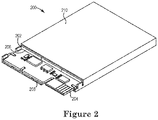
  • FIG. 2 is another schematic view of an apparatus including an energy storage device, according to an example
  • FIG. 3 is another schematic view of an apparatus including a memory device co-packaged with an energy storage device, according to an example
  • FIG. 4 is another schematic view of an apparatus including a printed circuit assembly, according to an example
  • FIG. 5 is a block diagram of a system including a drive carrier assembly, according to an example
  • FIG. 6 is another schematic view of an apparatus including an energy storage device, according to an example
  • FIGS. 7A and 7B are schematic views of two apparatus in two different configurations, according to an example
  • FIGS. 8A and 8B are schematic views of a system with two apparatus in two different configurations, according to an example.
  • FIG. 9 is another block diagram of a system including a drive carrier assembly, according to an example.
  • a device may be connected to a computing device to provide additional memory and/or energy storage to the computing device.
  • a device such as a drive carrier assembly (DCA), which can include back-up energy devices and/or back-up memory devices and may be connected to a computing device to provide additional energy storage, and/or additional memory, display adapters, audio chipsets, graphics processing units, data storage, and/or memory card readers, among other functionalities to the computing device.
  • DCA drive carrier assembly
  • a “drive carrier assembly” is a device that may be utilized to package or co-package auxiliary electronic devices to connect to a computing device.
  • a drive carrier assembly may be a structure that is designed to contain electronic devices connected to a computing device (e.g., a host computing device).
  • Examples of drive carrier assemblies include frames, carriers, modified drive bays, and/or chassis to mount docking stations, batteries, and/or other energy storage devices, hard drives and/or other memory devices, etc., which may be inserted into and/or removed from a computing device.
  • the drive carrier assembly may co-package the electronic devices to be connected to a computing device such as a laptop computer, desktop computer, tablet, phablet, convertible laptop, smartphone, server (e.g., blade server), etc.
  • the drive carrier assembly may be a small form factor carrier (for example, a 2.5 inch form factor carrier), a large form factor carrier (for example, a 3.5 inch form factor carrier), a carrier half the width of a small form factor carrier, a carrier half the width of a large form factor carrier, or some other size carrier.
  • the drive carrier assembly may co-package multiple devices.
  • co-package means that one or more devices may be packaged together into one drive carrier assembly (DCA).
  • DCA may be co-packaged to include two electronic devices such as an energy storage device and a memory device to connect to a host computing device via a drive bay.
  • the battery and the memory device may be co-packaged such that they may connect to the host computing device through individual connectors and/or ports.
  • the battery may connect to the computing device through a port (e.g. a first port) and the memory device will connect to the host computing device through a different port (e.g. a second port).
  • the DCA may include one device, such as the energy storage device.
  • back-up energy cells may be located in internal portions of the computing device and/or in high-temperature areas of the computing device.
  • a blade server may have back-up power that is located internally such that the server may have to be dismantled to service the back-up energy cells thus involving the system to be shut down and/or be powered off. After the shut down/power off, the energy device may be replaced, serviced, and/or installed, and the computing device may be powered back to an operational state.
  • back-up energy cells within removable battery devices may not be hot plugged into the computing system (e.g., removable battery devices that may not be connected to the computing system during runtime of the computing system) in part due to the location of the removable battery device (for example, located on a motherboard and/or closer towards the rear of a computing system), thus the runtime of the host computing device may be interrupted to replace and/or service a back-up memory device and/or a back-up energy storage device.
  • examples herein may allow for replacement, service, and/or installation of back-up memory device, and/or back-up energy storage device during runtime of the computing device.
  • This may allow for back-up memory, and/or back-up energy storage devices to be hot pluggable or hot swappable devices to be installed, removed and/or serviced without having to reboot or shut down the computing device, which may allow for less computing device downtime, less power consumption due to a reduced number of reboot operations to the computing device, and/or a more streamlined end user computing experience as opposed to some previous approaches.
  • the back-up memory device and/or back-up energy storage device may be packaged or co-packaged in a DCA to be accessible from a front portion of a host computing device.
  • “front portion” refers to a portion of the computing device that is reachable to service, install, insert, and/or remove electrical components without having to dismantle the computing device to access said components.
  • the front portion of the host computing device may be an area of the host computing device that is reachable from an externally accessible vantage point.
  • the external accessibility at the front portion of the host computing device may be a low-temperature thermal environment for the co-packaged back-up memory device and/or back-up energy storage device. In some examples, the low-temperature thermal environment may increase efficiency and operability of the back-up memory device and/or back-up energy storage device packaged or co-packaged in the drive carrier assembly.
  • a back-up memory device and/or back-up energy storage device may be package or co-packaged in a drive carrier assembly to be accessible from the front portion of a host computing device.
  • the accessibility from the front portion of the host computing device positions the drive carrier assembly in an area of the host computing device that is a low-temperature when compared to the previously mentioned internal portions of the host computing device.
  • the terms “low-temperature” and “high-temperature” as used herein are intended to describe thermal temperatures of portions of the host computing device relative to a different portion of the host computing device, and should not be taken in a limiting sense.
  • FIG. 1 is a schematic view of an apparatus including an energy storage device, according to an example.
  • the apparatus 100 may include an energy storage device 102 , a printed circuit assembly 104 having a first portion 106 and a second portion 108 .
  • the energy storage device 102 in some examples may be a battery, capacitor, or super capacitor.
  • the energy storage device 102 may be an electric battery.
  • the term “battery” may refer to a device used to power, or store energy to power a different electrical or mechanical device.
  • the energy storage device 102 may comprise a plurality of cells and/or capacitors.
  • the plurality of cells may be electrochemical cells with connections to power other electronic devices.
  • the term “cell” refer to a battery cell of the plurality of cells within the battery and may be that of a wet cell, a reserve cell, and/or a dry cell, other types of battery cell may be used, and these examples should not be taken in a limiting sense.
  • the printed circuit assembly 104 of the apparatus 100 is communicatively coupled to the energy storage device 102 by a first portion 106 and may commutatively couple to a port of a host computing device utilizing a second portion 108 .
  • the term “printed circuit assembly” refers to a device to mechanically support and electronically connect electronic components and/or electric components. In some examples, the printed circuit assembly may be soldered to the components.
  • the printed circuit assembly 104 may be a circuit board including circuitry to regulate the plurality of cells within the energy storage device 102 .
  • the printed circuit assembly 104 may connect to a backplane and/or a port of the host computing device by the second portion 108 (discussed further in conjunction with FIG. 5 ) and connect to the energy storage device 102 by the first portion 106 .
  • the host computing device may be a server.
  • the printed circuit assembly 104 may detect a power failure of the host computing device and regulate the plurality of cells of the energy storage device 102 in response to the detected power failure.
  • the printed circuit assembly 104 may regulate charging of the energy storage device 102 while the host computing device is powered on.
  • FIG. 2 is another schematic view of an apparatus including an energy storage device, according to an example.
  • the apparatus 200 may include the energy storage device 202 , the printed circuit assembly 204 having the first portion 206 and the second portion 208 , and a housing 210 .
  • the energy storage device 202 in some examples, may be a battery, capacitor, or super capacitor, where at least a portion of the battery, capacitor, or super capacitor is encased by housing 210 .
  • the housing 210 may encase at least a portion of energy storage device 202 .
  • the housing 210 may be designed to protect the energy storage device 202 from damage.
  • the housing 210 may be made of various suitable materials.
  • the housing 210 may be made of metal, metal alloys, polymers, thermoplastics, and/or other suitable materials.
  • the housing 210 may be substantially of dimensions suitable to encase the energy storage device 202 such that the housing 210 may co-package with a second device into a drive carrier assembly, discussed further in conjunction with FIGS. 3 and 4 .
  • the term “substantially” intends that the characteristic is close enough to an ideal characteristic so as to achieve the value of the characteristic.
  • the dimensions of the housing 210 may be different than that of the energy storage device 202 , but close enough to allow for the intended function of co-packaging the energy storage device 202 with a second device to be achieved.
  • the housing 210 of the apparatus 200 may encase at least a portion of energy storage device 202 .
  • the term “encase” means a cover to wrap the exterior portion of the energy storage device 202
  • the housing 210 may be made of a material intended to protect and/or provide a uniform structure to facilitate the co-packaging of the energy storage device within a DCA, such as DCA 312 illustrated and described in conjunction with FIG. 3 .
  • the housing 210 may also provide an attachment and/or a fastener to couple the energy storage device 202 to a second device.
  • a “fastener” is a mechanism to secure an apparatus, device and/or other structure to a different structure.
  • a fastener may be a clip, a pin, a snap or any equivalent mechanism to achieve securely fastening one structure to another structure.
  • the housing 210 may partially encase at least a portion of the energy storage device 202 while the printed circuit assembly 204 remains exposed, and the housing 210 may further couple to the top portion of the DCA to allow space for a second device, such as a memory device, thus co-packaging both devices into a single unit DCA. In some examples, this may allow the second portion 208 to commutatively couple to a backplane of a host computing device.
  • FIG. 3 is another schematic view of an apparatus including a memory device co-packaged with an energy storage device, according to an example.
  • the apparatus 300 may include the energy storage device 302 , the printed circuit assembly 304 having the first portion 306 and the second portion 308 , the housing 310 , a DCA 312 , a memory device 314 , a first end of the DCA 316 , and a second end of the DCA 318 .
  • the memory device 314 may include volatile memory (e.g., RAM, DRAM, SRAM, EPROM, EEPROM, etc.) and/or non-volatile memory (e.g., a HDD, a storage volume, data storage, etc.) In some examples, the memory device 314 may be used as a back-up memory device in the event of a power loss experienced by the host computing device.
  • volatile memory e.g., RAM, DRAM, SRAM, EPROM, EEPROM, etc.
  • non-volatile memory e.g., a HDD, a storage volume, data storage, etc.
  • the memory device 314 may be used as a back-up memory device in the event of a power loss experienced by the host computing device.
  • the memory device 314 co-packages the energy storage device 302 and the housing 310 into the DCA 312 such that the DCA 312 is moveable as a single unit.
  • the energy storage device 302 , housing 310 , and memory device 314 are co-packaged together into the DCA 312 such that all of the components may be inserted into a bay of a host computing device as a single unit.
  • the first end of the DCA 316 may facilitate the memory device 314 coupling to a port and/or a backplane of the host computing device and the second portion 308 of the printed circuit assembly to communicatively couple to a separate port and/or backplane of the host computing device.
  • the second portion 308 of the printed circuit assembly 304 may communicate with the energy storage device 302 to regulate a plurality of cells within the energy storage device 302 to power a host computing device and/or memory device 314 .
  • the host computing device may facilitate the transfer of data stored in volatile memory associated with the host computing device to non-volatile memory associated with the memory device 314 in response to detection of the power loss.
  • the memory device 314 co-packages the energy storage device 302 and the housing 310 into the DCA 312 .
  • the co-packaged DCA 312 may be hot pluggable when inserted into a bay of a host computing when the computing device is in an operational state (e.g. device during runtime of a host computing device.)
  • the co-packaged DCA 312 may be coupled to a backplane of the host computing device while the host computing device is running such that the memory device 314 and the energy storage device 302 are operable without rebooting the computing device.
  • the DCA 312 may be connected to the host computing device during runtime of the host computing device, but may not be connected to the host computing device prior to runtime of the host computing device.
  • FIG. 4 is another schematic view of an apparatus including a printed circuit assembly.
  • the apparatus 400 may include the printed circuit assembly 404 having the first portion 406 and the second portion 408 , the housing 410 , the DCA 412 , the first end of the DCA 416 , and the second end of the DCA 418 .
  • the second end 418 of the DCA 412 is accessible from a front portion and/or an exterior of the host computing device.
  • a user and/or a machine may wish to install, service, and/or remove the DCA 412 from the host computing device.
  • the second end 418 of the DCA 412 may be accessed from the exterior of the host computing device such that the DCA 412 may be installed and/or removed without disassembling the host computing device to gain access to an interior portion.
  • the second end 418 of the DCA 412 may be secured to the host computing device by at least one snap and/or an equivalent removable fastener (not explicitly shown in FIG. 4 ).
  • a user and/or a machine may couple (e.g. to install the DCA 412 ) and/or decouple (e.g. to remove the DCA 412 ) utilizing the at least one snap, fastener, or button.
  • the user and/or the machine may remove the DCA 412 by removing the at least one snap or equivalent fastener securing the second end 418 of the DCA 412 such that the DCA 412 may be removed from the host computing device.
  • At least one snap and/or fastener may be coupled to the second end 418 of the DCA 412 to install the DCA 412 to into the computing device, in the same fashion as the preceding example.
  • the button may be located at one side of the second end 418 . A user may depress the button, actuating a lever (In other words, a lever may pop-out from the second end). Further, a user may install or couple the DCA 412 by pushing the second end 418 into the server.
  • the installation and removal utilizing the at least one snap and/or fastener may be accomplished without the use of tools.
  • the second end 418 of the DCA 412 may include an indication mechanism.
  • a mechanism may provide an indication that the second portion 408 of the printed circuit assembly 404 and an energy storage device such as 302 shown in FIG. 3 are communicatively coupled to the backplane.
  • the indicator mechanism may be an LED and/or a light (not explicitly shown). For example, the LED and/or light may be illuminated the DCA 412 is coupled to the host computing device and/or is in operation.
  • the second end 418 of the DCA 412 may include one or more fasteners to secure the DCA 412 in place.
  • the DCA 412 may be inserted into a bay of a host computing device during a runtime of a host computing device without interrupting the runtime, once inserted the DCA 412 may be secured in place by at least one fastener (not explicitly shown).
  • the DCA 412 may be removed and/or ejected in this described manner utilizing fasteners coupled to second end 418 .
  • DCA 412 may be decoupled from the backplane of a host computing device during runtime of the host computing device without interrupting the runtime.
  • FIG. 5 is a block diagram of a system including a drive carrier assembly, according to an example.
  • System 501 illustrates a server 520 , a bay 522 , a backplane 524 , the DCA 512 , the energy storage device 502 , the printed circuit assembly 504 , and the memory device 514 .
  • the server 520 may be a host computing device similar to those described in the preceding examples.
  • the server 520 includes the bay 522 to receive the DCA 512 and communicatively couple the DCA 512 to the backplane 524 of the server 520 .
  • the DCA 512 is co-packaged to include the memory device 514 , the energy storage device 502 , which may be partially encased by a housing that may be coupled to a portion of the DCA 512 , and the printed circuit assembly 504 , which may be coupled to the energy storage device 502 to regulate the use of the energy storage device 502 in response to receiving a signal from the server 520 that the system 501 has experienced a power failure.
  • the energy storage device 502 may be co-packaged in the DCA 512 such that the memory device 514 is positioned below the energy storage device 502 relative to the DCA 512 and the bay 522 .
  • the co-packaged DCA 512 is inserted into the backplane 524 within the bay 522 such that the memory device 514 and the printed circuit assembly 504 of the energy storage device 502 commutatively couple to separate ports of the backplane 524 , and the port that may communicatively couple to the printed circuit assembly 504 of the energy storage device 502 (e.g. a first port) is positioned above a different port (e.g. a second port) that may communicatively couple to the memory device 514 .
  • a first port e.g. a first port
  • a different port e.g. a second port
  • the bay 522 of the server 520 may be located on a front portion of the server 520 .
  • the external accessibility at the front portion of the server 520 may be a low-temperature thermal environment for the co-packaged memory device 514 and energy storage device 502 of the DCA 512 .
  • the location of the bay 522 of the front portion of the server 520 allows for easy accessibility of the DCA 512 .
  • the DCA 512 may be serviced (as in, removed or added to the server 520 ) while the server 520 may be powered off or dismantled.
  • the memory device 514 , the printed circuit assembly 504 , and/or the energy storage device 502 may be serviced when the DCA 512 is removed.
  • the DCA 512 may be hot-plugged or hot swapped into the bay 522 , from an exterior portion of the server 520 while the server is operating.
  • the server 520 may be operating during runtime and the DCA 512 co-packaged with the energy storage device 502 , the printed circuit assembly 504 , and the memory device 514 may be operational when they are inserted into respective ports of the backplane 524 of server 520 .
  • the server 520 would remain operational during the insertion of the DCA 512 and would not involve powering down and/or interruption of the server 520 runtime.
  • the DCA 512 may be decoupled, removed, and/or ejected from the backplane 524 during runtime of the server 520 .
  • the server 520 may be operating during runtime and the DCA 512 co-packaged with the energy storage device 502 , the printed circuit assembly 504 , and the memory device 514 , may be removed from respective ports of the backplane 524 of server 520 .
  • the server 520 would remain operational during the decoupling, removal, and/or ejection of the DCA 512 and would not involve powering down and/or interruption of the server 520 runtime.
  • the printed circuit assembly 504 regulates a plurality of cells within the energy storage device 502 in response to a power failure experienced by the server 520 .
  • the printed circuit assembly 504 may detect a power failure of server 520 , and in response to the detected power failure of the server 520 the printed circuit assembly 504 , may regulate the usage of the plurality of cells contained in the energy storage device 502 and instruct the energy storage device 502 to power the memory device 514 and/or the server 520 .
  • the DCA 512 may facilitate the transfer of data stored in volatile memory associated with the server 520 to non-volatile memory associated with the memory device 514 .
  • the printed circuit assembly 504 may regulate charging of the energy storage device 502 .
  • the server 520 may utilize multiple devices similar to the DCA 512 .
  • a server 520 or equivalent host computing device may utilize more than one device similar to the DCA 512 as described herein.
  • the server 520 may utilize the energy storage devices similar to 502 contained in multiple drive carrier assemblies similar to the DCA 512 to power the server 520 in the event that the server 520 experiences a power loss.
  • FIG. 6 is another schematic view of an apparatus including an energy storage device, according to an example.
  • apparatus 600 may include a DCA 606 that includes a front portion 604 of the DCA 606 .
  • the DCA 606 may include a printed circuit assembly 610 .
  • the printed circuit assembly 610 may detect a power failure in a system or computing device.
  • the printed circuit assembly 610 may include pins or fingers located at the rear 608 of the printed circuit assembly 610 .
  • the pins or fingers located at the rear 608 of the printed circuit assembly 610 may be insertable into a socket situated on a backplane.
  • the printed circuit assembly 610 may charge an energy storage device 602 via power from the backplane.
  • the printed circuit assembly 610 may control the amount and/or rate of charging of the energy storage device 602 . The amount and/or rate of charging may be based on the current power level, age, and/or maximum power level of the energy storage device 602 .
  • the DCA 606 may include an energy storage device 602 .
  • the energy storage device may be connected to the printed circuit assembly 610 .
  • an energy storage device holder 603 may connect physically and/or electrically to the printed circuit assembly 610 .
  • the energy storage device holder 603 may retain or hold the energy storage device 602 .
  • the energy storage device 602 may physically and/electrically connect to the energy storage device holder 603 .
  • the energy storage device 602 may connect to the printed circuit assembly 610 .
  • the energy storage device 602 may be a battery, capacitor, or super capacitor.
  • the DCA 606 may include more than one energy storage device 602 .
  • the energy storage device 602 may include multiple cells.
  • the DCA 606 may be half the width of a storage device. In other words, the DCA 606 may be half the width of a small form factor drive or a large form factor drive. In such examples, two DCA's 606 may fit into a storage device slot side-by-side. In another example, the DCA may be the same height as the storage device (such as a small form factor drive or large form factor drive). In another examples, two DCA's 606 may fit into a storage device slot in an over-under configuration (in other words, one DCA 606 in a slot positioned above another DCA 606 , located in a slot below the other DCA 606 ).
  • the DCA 606 may include a storage device (not pictured).
  • the DCA 606 may be half the width of a storage device (such as a small form factor drive or a large form factor drive).
  • the DCA 606 may include a memory device.
  • the memory device may be smaller than a memory device included in, for example, a small form factor drive or large form factor drive.
  • the memory device may be a smaller non-volatile memory device (for example, a M.2 drive memory/storage device) to fit in the DCA 606 that is half the width of a larger storage device.
  • the DCA 606 may provide power to the computing device. Further, the DCA 606 may provide power for a sufficient length of time to allow for data transfer from a volatile memory to a non-volatile memory (whether located on or off the DCA 606 ).
  • the DCA 606 may be insertable into an operating computing device.
  • the DCA 606 may be hot-pluggable or hot-swappable.
  • the DCA 606 may be insertable into the front and/or rear of a computing device (such as a server).
  • the pins or fingers located at the rear 608 of the DCA 606 may be formed or configured in such a way as to fit into a standard connection on a computing devices backplane.
  • a computing devices backplane may include additional connections for the DCA 606 .
  • FIGS. 7A and 7B are schematic views of two apparatus in two different configurations, according to an example.
  • FIG. 7A depicts a first configuration 700 A of DCA's 702 , 703 .
  • FIG. 7B depicts a second configuration 700 B of DCA's 704 , 705 .
  • a DCA 606 may be situated in a computing device (such as a server) in a variety of ways.
  • DCA 702 may be inserted in an upper slot of a bay of a computing device (e.g., server). Below that slot, in another slot, a second DCA 703 may be inserted (stated another way, in an over-under configuration).
  • the DCA's 702 , 703 may be half the width of a storage device (such as a small form factor drive, a large form factor drive, or some other sized storage device).
  • the computing devices backplane may be configured with the connectors to allow for insertion of DCA's 606 and storage devices.
  • the DCA's 606 may be inserted into a computing device (e.g., a server) in a side-by-side configuration.
  • the DCA 606 may be half the width of a storage device (such as a small form factor drive, a large form factor drive, or some other sized storage device).
  • two DCA's 704 , 705 may fit side-by-side into one slot arc bay located at the front and/or rear side of a computing device (e.g., a server).
  • the computing devices backplane may be configured with the connectors to allow for insertion of DCA's 606 and storage devices.
  • the backplane may include two connectors, one for a storage device and the other for a DCA 606 (or two side-by-side connectors for the DCA 606 ).
  • the connectors may be located one on top of the other.
  • the connector for DCA's 606 may be located at a lower portion or higher portion of the backplane for a slot, while the connector for the storage devices may be located at a higher portion or lower portion (respectively) of the backplane.
  • the rear 608 may line up with a connector on the backplane, while if a storage device is inserted into a slot, the storage devices connection may line up with another connector on the backplane.
  • FIGS. 8A and 8B are schematic views of a system with two apparatus in two different configurations, according to an example.
  • one DCA 802 may be inserted into a slot of a system 800 A or computing device (e.g., a server).
  • DCA 803 may be inserted into a slot of a system 800 A located beneath the slot which DCA 802 may be inserted into.
  • FIG. 8A also illustrates several storage devices 806 .
  • the storage devices 806 may be small form factor drives, large form factor drives, or a drive of some other size.
  • the DCA' 802 , 803 may be half the size of the storage devices 806 .
  • a system 800 A may include slots configured for DCAs 802 , 803 .
  • the backplane of such a section may include connectors for the DCAs 802 , 803 , while not including connections for storage devices 806 (in other words, a portion of the front of the system 800 A may be reserved for DCA's or storage devices of a similar form factor).
  • a DCA 804 may be inserted side-by-side next to another DCA 805 in a system 800 B.
  • the size of the DCA's 804 , 805 may allow for two DCA's 804 , 805 to be inserted into one slot.
  • a blank may be inserted next to the DCA 804 .
  • a piece of plastic with the same or a similar form factor as a DCA (e.g., 804 ) may be inserted into a blank slot to ensure proper airflow throughout the system 800 B.
  • FIG. 9 is another block diagram 900 of a system including a drive carrier assembly, according to an example.
  • a server 902 may include a bay 904 .
  • the bay 904 may include a plurality of smaller bays or slots.
  • the plurality of smaller bays or slots may be divided by partitions.
  • a backplane 906 may be positioned at the back of the bay 904 .
  • one side of the backplane 906 facing the front of the server 902 may include a plurality of connections corresponding to the plurality of smaller bays or slots.
  • the other side of the backplane 906 may include a connection to a motherboard or other circuit board to provide access to DCA's 908 and storage devices.
  • the backplane 906 may include connections for DCA 908 .
  • the DCA 908 may include an energy storage device 910 disposed on a printed circuit assembly 912 .

Landscapes

  • Engineering & Computer Science (AREA)
  • Theoretical Computer Science (AREA)
  • Physics & Mathematics (AREA)
  • General Engineering & Computer Science (AREA)
  • General Physics & Mathematics (AREA)
  • Quality & Reliability (AREA)
  • Power Engineering (AREA)
  • Computer Hardware Design (AREA)
  • Human Computer Interaction (AREA)
  • Power Sources (AREA)

Abstract

An apparatus comprising: a drive carrier assembly (DCA) including; an energy storage device having at least a portion thereof encased by a housing; and a printed circuit assembly to detect a power failure of a host computing device, wherein the printed circuit assembly has a first portion coupled to the energy storage device and a second portion coupled to a backplane of the host computing device.

Description

BACKGROUND
Devices may be connected to a computing device to provide additional memory and/or energy storage to the computing device. Some devices may be hot-plugged or hot-swapped into the computing device while the computing device is in an operational state.
BRIEF DESCRIPTION OF THE DRAWINGS
FIG. 1 is a schematic view of an apparatus including an energy storage device, according to an example;
FIG. 2 is another schematic view of an apparatus including an energy storage device, according to an example;
FIG. 3 is another schematic view of an apparatus including a memory device co-packaged with an energy storage device, according to an example;
FIG. 4 is another schematic view of an apparatus including a printed circuit assembly, according to an example;
FIG. 5 is a block diagram of a system including a drive carrier assembly, according to an example;
FIG. 6 is another schematic view of an apparatus including an energy storage device, according to an example;
FIGS. 7A and 7B are schematic views of two apparatus in two different configurations, according to an example;
FIGS. 8A and 8B are schematic views of a system with two apparatus in two different configurations, according to an example; and
FIG. 9 is another block diagram of a system including a drive carrier assembly, according to an example.
DETAILED DESCRIPTION
A device may be connected to a computing device to provide additional memory and/or energy storage to the computing device. For example, a device such as a drive carrier assembly (DCA), which can include back-up energy devices and/or back-up memory devices and may be connected to a computing device to provide additional energy storage, and/or additional memory, display adapters, audio chipsets, graphics processing units, data storage, and/or memory card readers, among other functionalities to the computing device.
As used herein, a “drive carrier assembly” is a device that may be utilized to package or co-package auxiliary electronic devices to connect to a computing device. For example, a drive carrier assembly may be a structure that is designed to contain electronic devices connected to a computing device (e.g., a host computing device). Examples of drive carrier assemblies include frames, carriers, modified drive bays, and/or chassis to mount docking stations, batteries, and/or other energy storage devices, hard drives and/or other memory devices, etc., which may be inserted into and/or removed from a computing device. For example, the drive carrier assembly may co-package the electronic devices to be connected to a computing device such as a laptop computer, desktop computer, tablet, phablet, convertible laptop, smartphone, server (e.g., blade server), etc. In another example, the drive carrier assembly may be a small form factor carrier (for example, a 2.5 inch form factor carrier), a large form factor carrier (for example, a 3.5 inch form factor carrier), a carrier half the width of a small form factor carrier, a carrier half the width of a large form factor carrier, or some other size carrier.
The drive carrier assembly may co-package multiple devices. As used herein, “co-package” means that one or more devices may be packaged together into one drive carrier assembly (DCA). For example, a DCA may be co-packaged to include two electronic devices such as an energy storage device and a memory device to connect to a host computing device via a drive bay. In the preceding example, the battery and the memory device may be co-packaged such that they may connect to the host computing device through individual connectors and/or ports. For example, when the battery and the memory device are co-packaged in the drive carrier assembly and subsequently inserted into a bay of the host computing device, the battery may connect to the computing device through a port (e.g. a first port) and the memory device will connect to the host computing device through a different port (e.g. a second port). In another example, the DCA may include one device, such as the energy storage device.
In some approaches, back-up energy cells may be located in internal portions of the computing device and/or in high-temperature areas of the computing device. For example, a blade server may have back-up power that is located internally such that the server may have to be dismantled to service the back-up energy cells thus involving the system to be shut down and/or be powered off. After the shut down/power off, the energy device may be replaced, serviced, and/or installed, and the computing device may be powered back to an operational state.
In some approaches, back-up energy cells within removable battery devices may not be hot plugged into the computing system (e.g., removable battery devices that may not be connected to the computing system during runtime of the computing system) in part due to the location of the removable battery device (for example, located on a motherboard and/or closer towards the rear of a computing system), thus the runtime of the host computing device may be interrupted to replace and/or service a back-up memory device and/or a back-up energy storage device.
In contrast, examples herein may allow for replacement, service, and/or installation of back-up memory device, and/or back-up energy storage device during runtime of the computing device. This may allow for back-up memory, and/or back-up energy storage devices to be hot pluggable or hot swappable devices to be installed, removed and/or serviced without having to reboot or shut down the computing device, which may allow for less computing device downtime, less power consumption due to a reduced number of reboot operations to the computing device, and/or a more streamlined end user computing experience as opposed to some previous approaches.
For example, the back-up memory device and/or back-up energy storage device may be packaged or co-packaged in a DCA to be accessible from a front portion of a host computing device. As used herein, “front portion” refers to a portion of the computing device that is reachable to service, install, insert, and/or remove electrical components without having to dismantle the computing device to access said components. For example, the front portion of the host computing device may be an area of the host computing device that is reachable from an externally accessible vantage point. Additionally, in this example, the external accessibility at the front portion of the host computing device may be a low-temperature thermal environment for the co-packaged back-up memory device and/or back-up energy storage device. In some examples, the low-temperature thermal environment may increase efficiency and operability of the back-up memory device and/or back-up energy storage device packaged or co-packaged in the drive carrier assembly.
For example, a back-up memory device and/or back-up energy storage device may be package or co-packaged in a drive carrier assembly to be accessible from the front portion of a host computing device. In this example, the accessibility from the front portion of the host computing device positions the drive carrier assembly in an area of the host computing device that is a low-temperature when compared to the previously mentioned internal portions of the host computing device. In addition, the terms “low-temperature” and “high-temperature” as used herein are intended to describe thermal temperatures of portions of the host computing device relative to a different portion of the host computing device, and should not be taken in a limiting sense.
The figures herein follow a numbering convention in which the first digit corresponds to the drawing figure number and the remaining digits identify an element or component in the drawing. For example, reference numeral 100 may refer to element “00” in FIG. 1 and an analogous element may be identified by reference numeral 200 in FIG. 2. Elements shown in the various figures herein can be added, exchanged, and/or eliminated so as to provide a number of additional examples of the disclosure. In addition, the proportion and the relative scale of the elements provided in the figures are intended to illustrate the examples of the disclosure, and should not be taken in a limiting sense.
FIG. 1 is a schematic view of an apparatus including an energy storage device, according to an example. The apparatus 100 may include an energy storage device 102, a printed circuit assembly 104 having a first portion 106 and a second portion 108. The energy storage device 102 in some examples may be a battery, capacitor, or super capacitor.
In an example, the energy storage device 102 may be an electric battery. As used herein, the term “battery” may refer to a device used to power, or store energy to power a different electrical or mechanical device. The energy storage device 102 may comprise a plurality of cells and/or capacitors. For example, the plurality of cells may be electrochemical cells with connections to power other electronic devices. As used herein, the term “cell” refer to a battery cell of the plurality of cells within the battery and may be that of a wet cell, a reserve cell, and/or a dry cell, other types of battery cell may be used, and these examples should not be taken in a limiting sense.
The printed circuit assembly 104, of the apparatus 100 is communicatively coupled to the energy storage device 102 by a first portion 106 and may commutatively couple to a port of a host computing device utilizing a second portion 108. As used herein, the term “printed circuit assembly” refers to a device to mechanically support and electronically connect electronic components and/or electric components. In some examples, the printed circuit assembly may be soldered to the components.
For example, the printed circuit assembly 104 may be a circuit board including circuitry to regulate the plurality of cells within the energy storage device 102. In some examples, the printed circuit assembly 104 may connect to a backplane and/or a port of the host computing device by the second portion 108 (discussed further in conjunction with FIG. 5) and connect to the energy storage device 102 by the first portion 106. In some examples the host computing device may be a server. The printed circuit assembly 104 may detect a power failure of the host computing device and regulate the plurality of cells of the energy storage device 102 in response to the detected power failure. In another example, the printed circuit assembly 104 may regulate charging of the energy storage device 102 while the host computing device is powered on.
FIG. 2 is another schematic view of an apparatus including an energy storage device, according to an example. The apparatus 200 may include the energy storage device 202, the printed circuit assembly 204 having the first portion 206 and the second portion 208, and a housing 210. The energy storage device 202, in some examples, may be a battery, capacitor, or super capacitor, where at least a portion of the battery, capacitor, or super capacitor is encased by housing 210.
As shown in FIG. 2, the housing 210, may encase at least a portion of energy storage device 202. The housing 210 may be designed to protect the energy storage device 202 from damage. The housing 210 may be made of various suitable materials. For example, the housing 210 may be made of metal, metal alloys, polymers, thermoplastics, and/or other suitable materials. In some examples, the housing 210 may be substantially of dimensions suitable to encase the energy storage device 202 such that the housing 210 may co-package with a second device into a drive carrier assembly, discussed further in conjunction with FIGS. 3 and 4.
As used herein, the term “substantially” intends that the characteristic is close enough to an ideal characteristic so as to achieve the value of the characteristic. For example, the dimensions of the housing 210 may be different than that of the energy storage device 202, but close enough to allow for the intended function of co-packaging the energy storage device 202 with a second device to be achieved.
As illustrated in FIG. 2, the housing 210 of the apparatus 200 may encase at least a portion of energy storage device 202. As used herein, the term “encase” means a cover to wrap the exterior portion of the energy storage device 202, the housing 210 may be made of a material intended to protect and/or provide a uniform structure to facilitate the co-packaging of the energy storage device within a DCA, such as DCA 312 illustrated and described in conjunction with FIG. 3.
The housing 210, illustrated in FIG. 2 may also provide an attachment and/or a fastener to couple the energy storage device 202 to a second device. As used herein, a “fastener” is a mechanism to secure an apparatus, device and/or other structure to a different structure. A fastener may be a clip, a pin, a snap or any equivalent mechanism to achieve securely fastening one structure to another structure. For example, the housing 210 may partially encase at least a portion of the energy storage device 202 while the printed circuit assembly 204 remains exposed, and the housing 210 may further couple to the top portion of the DCA to allow space for a second device, such as a memory device, thus co-packaging both devices into a single unit DCA. In some examples, this may allow the second portion 208 to commutatively couple to a backplane of a host computing device.
FIG. 3 is another schematic view of an apparatus including a memory device co-packaged with an energy storage device, according to an example. The apparatus 300 may include the energy storage device 302, the printed circuit assembly 304 having the first portion 306 and the second portion 308, the housing 310, a DCA 312, a memory device 314, a first end of the DCA 316, and a second end of the DCA 318.
The memory device 314 may include volatile memory (e.g., RAM, DRAM, SRAM, EPROM, EEPROM, etc.) and/or non-volatile memory (e.g., a HDD, a storage volume, data storage, etc.) In some examples, the memory device 314 may be used as a back-up memory device in the event of a power loss experienced by the host computing device.
As illustrated in FIG. 3, the memory device 314 co-packages the energy storage device 302 and the housing 310 into the DCA 312 such that the DCA 312 is moveable as a single unit. For example, as discussed further in conjunction with FIG. 5, the energy storage device 302, housing 310, and memory device 314 are co-packaged together into the DCA 312 such that all of the components may be inserted into a bay of a host computing device as a single unit. Continuing with the previous example, the first end of the DCA 316 may facilitate the memory device 314 coupling to a port and/or a backplane of the host computing device and the second portion 308 of the printed circuit assembly to communicatively couple to a separate port and/or backplane of the host computing device.
For example, when a host computing device is communicatively coupled to the DCA 312, and experiences a loss of power, the second portion 308 of the printed circuit assembly 304 may communicate with the energy storage device 302 to regulate a plurality of cells within the energy storage device 302 to power a host computing device and/or memory device 314. Continuing with this example, the host computing device may facilitate the transfer of data stored in volatile memory associated with the host computing device to non-volatile memory associated with the memory device 314 in response to detection of the power loss.
As illustrated in FIG. 3, the memory device 314 co-packages the energy storage device 302 and the housing 310 into the DCA 312. As described herein, the co-packaged DCA 312 may be hot pluggable when inserted into a bay of a host computing when the computing device is in an operational state (e.g. device during runtime of a host computing device.) For example, the co-packaged DCA 312 may be coupled to a backplane of the host computing device while the host computing device is running such that the memory device 314 and the energy storage device 302 are operable without rebooting the computing device. In some examples, the DCA 312 may be connected to the host computing device during runtime of the host computing device, but may not be connected to the host computing device prior to runtime of the host computing device. These features are discussed further in conjunction with FIG. 5.
FIG. 4 is another schematic view of an apparatus including a printed circuit assembly. The apparatus 400 may include the printed circuit assembly 404 having the first portion 406 and the second portion 408, the housing 410, the DCA 412, the first end of the DCA 416, and the second end of the DCA 418.
In some examples, the second end 418 of the DCA 412 is accessible from a front portion and/or an exterior of the host computing device. For example, a user and/or a machine may wish to install, service, and/or remove the DCA 412 from the host computing device. Continuing with this example, the second end 418 of the DCA 412 may be accessed from the exterior of the host computing device such that the DCA 412 may be installed and/or removed without disassembling the host computing device to gain access to an interior portion.
In some examples, the second end 418 of the DCA 412 may be secured to the host computing device by at least one snap and/or an equivalent removable fastener (not explicitly shown in FIG. 4). For example, a user and/or a machine may couple (e.g. to install the DCA 412) and/or decouple (e.g. to remove the DCA 412) utilizing the at least one snap, fastener, or button. In this example, the user and/or the machine may remove the DCA 412 by removing the at least one snap or equivalent fastener securing the second end 418 of the DCA 412 such that the DCA 412 may be removed from the host computing device. Accordingly, at least one snap and/or fastener may be coupled to the second end 418 of the DCA 412 to install the DCA 412 to into the computing device, in the same fashion as the preceding example. In another example, the button may be located at one side of the second end 418. A user may depress the button, actuating a lever (In other words, a lever may pop-out from the second end). Further, a user may install or couple the DCA 412 by pushing the second end 418 into the server. In the preceding examples, the installation and removal utilizing the at least one snap and/or fastener may be accomplished without the use of tools.
In some examples, the second end 418 of the DCA 412 may include an indication mechanism. For example, when the first end 416 of the DCA 412 is inserted into the backplane of a host computing device, a mechanism may provide an indication that the second portion 408 of the printed circuit assembly 404 and an energy storage device such as 302 shown in FIG. 3 are communicatively coupled to the backplane. In some examples, the indicator mechanism may be an LED and/or a light (not explicitly shown). For example, the LED and/or light may be illuminated the DCA 412 is coupled to the host computing device and/or is in operation.
In some examples, the second end 418 of the DCA 412 may include one or more fasteners to secure the DCA 412 in place. For example, the DCA 412 may be inserted into a bay of a host computing device during a runtime of a host computing device without interrupting the runtime, once inserted the DCA 412 may be secured in place by at least one fastener (not explicitly shown). The DCA 412 may be removed and/or ejected in this described manner utilizing fasteners coupled to second end 418. For example, DCA 412 may be decoupled from the backplane of a host computing device during runtime of the host computing device without interrupting the runtime.
FIG. 5 is a block diagram of a system including a drive carrier assembly, according to an example. System 501 illustrates a server 520, a bay 522, a backplane 524, the DCA 512, the energy storage device 502, the printed circuit assembly 504, and the memory device 514. In some examples, the server 520 may be a host computing device similar to those described in the preceding examples.
The server 520 includes the bay 522 to receive the DCA 512 and communicatively couple the DCA 512 to the backplane 524 of the server 520. The DCA 512 is co-packaged to include the memory device 514, the energy storage device 502, which may be partially encased by a housing that may be coupled to a portion of the DCA 512, and the printed circuit assembly 504, which may be coupled to the energy storage device 502 to regulate the use of the energy storage device 502 in response to receiving a signal from the server 520 that the system 501 has experienced a power failure.
In some examples, the energy storage device 502 may be co-packaged in the DCA 512 such that the memory device 514 is positioned below the energy storage device 502 relative to the DCA 512 and the bay 522. For example, the co-packaged DCA 512 is inserted into the backplane 524 within the bay 522 such that the memory device 514 and the printed circuit assembly 504 of the energy storage device 502 commutatively couple to separate ports of the backplane 524, and the port that may communicatively couple to the printed circuit assembly 504 of the energy storage device 502 (e.g. a first port) is positioned above a different port (e.g. a second port) that may communicatively couple to the memory device 514.
In some examples, the bay 522 of the server 520 may be located on a front portion of the server 520. For example, the external accessibility at the front portion of the server 520 may be a low-temperature thermal environment for the co-packaged memory device 514 and energy storage device 502 of the DCA 512. In the preceding example, the location of the bay 522 of the front portion of the server 520 allows for easy accessibility of the DCA 512. Further, the DCA 512 may be serviced (as in, removed or added to the server 520) while the server 520 may be powered off or dismantled. In such examples, the memory device 514, the printed circuit assembly 504, and/or the energy storage device 502 may be serviced when the DCA 512 is removed.
In some examples, the DCA 512 may be hot-plugged or hot swapped into the bay 522, from an exterior portion of the server 520 while the server is operating. For example, the server 520 may be operating during runtime and the DCA 512 co-packaged with the energy storage device 502, the printed circuit assembly 504, and the memory device 514 may be operational when they are inserted into respective ports of the backplane 524 of server 520. In the preceding example, the server 520 would remain operational during the insertion of the DCA 512 and would not involve powering down and/or interruption of the server 520 runtime.
In some examples the DCA 512 may be decoupled, removed, and/or ejected from the backplane 524 during runtime of the server 520. For example, the server 520 may be operating during runtime and the DCA 512 co-packaged with the energy storage device 502, the printed circuit assembly 504, and the memory device 514, may be removed from respective ports of the backplane 524 of server 520. In the preceding example, the server 520 would remain operational during the decoupling, removal, and/or ejection of the DCA 512 and would not involve powering down and/or interruption of the server 520 runtime.
In some examples, the printed circuit assembly 504 regulates a plurality of cells within the energy storage device 502 in response to a power failure experienced by the server 520. For example, the printed circuit assembly 504 may detect a power failure of server 520, and in response to the detected power failure of the server 520 the printed circuit assembly 504, may regulate the usage of the plurality of cells contained in the energy storage device 502 and instruct the energy storage device 502 to power the memory device 514 and/or the server 520. In some examples, the DCA 512 may facilitate the transfer of data stored in volatile memory associated with the server 520 to non-volatile memory associated with the memory device 514. In another example, the printed circuit assembly 504 may regulate charging of the energy storage device 502.
In some examples, the server 520 may utilize multiple devices similar to the DCA 512. For example, a server 520 or equivalent host computing device may utilize more than one device similar to the DCA 512 as described herein. In this example, the server 520 may utilize the energy storage devices similar to 502 contained in multiple drive carrier assemblies similar to the DCA 512 to power the server 520 in the event that the server 520 experiences a power loss.
FIG. 6 is another schematic view of an apparatus including an energy storage device, according to an example. In an example, apparatus 600 may include a DCA 606 that includes a front portion 604 of the DCA 606. In another example, the DCA 606 may include a printed circuit assembly 610. In such examples, the printed circuit assembly 610 may detect a power failure in a system or computing device. In another example, the printed circuit assembly 610 may include pins or fingers located at the rear 608 of the printed circuit assembly 610. In a further example, the pins or fingers located at the rear 608 of the printed circuit assembly 610 may be insertable into a socket situated on a backplane. In another example, the printed circuit assembly 610 may charge an energy storage device 602 via power from the backplane. Further, the printed circuit assembly 610 may control the amount and/or rate of charging of the energy storage device 602. The amount and/or rate of charging may be based on the current power level, age, and/or maximum power level of the energy storage device 602.
In another example, the DCA 606 may include an energy storage device 602. In another example, the energy storage device may be connected to the printed circuit assembly 610. In another example, an energy storage device holder 603 may connect physically and/or electrically to the printed circuit assembly 610. In such examples, the energy storage device holder 603 may retain or hold the energy storage device 602. Further, the energy storage device 602 may physically and/electrically connect to the energy storage device holder 603. Thus, through the energy storage device holder 603, the energy storage device 602 may connect to the printed circuit assembly 610. In another example, the energy storage device 602 may be a battery, capacitor, or super capacitor. In another example, the DCA 606 may include more than one energy storage device 602. In another example, the energy storage device 602 may include multiple cells.
In another example, the DCA 606 may be half the width of a storage device. In other words, the DCA 606 may be half the width of a small form factor drive or a large form factor drive. In such examples, two DCA's 606 may fit into a storage device slot side-by-side. In another example, the DCA may be the same height as the storage device (such as a small form factor drive or large form factor drive). In another examples, two DCA's 606 may fit into a storage device slot in an over-under configuration (in other words, one DCA 606 in a slot positioned above another DCA 606, located in a slot below the other DCA 606).
In another example, the DCA 606 may include a storage device (not pictured). In an example and as mentioned above, the DCA 606 may be half the width of a storage device (such as a small form factor drive or a large form factor drive). In such examples, the DCA 606 may include a memory device. In such examples, the memory device may be smaller than a memory device included in, for example, a small form factor drive or large form factor drive. In such examples, the memory device may be a smaller non-volatile memory device (for example, a M.2 drive memory/storage device) to fit in the DCA 606 that is half the width of a larger storage device. In an example, in the event that a computing device loses power, the DCA 606 may provide power to the computing device. Further, the DCA 606 may provide power for a sufficient length of time to allow for data transfer from a volatile memory to a non-volatile memory (whether located on or off the DCA 606).
In another example, the DCA 606 may be insertable into an operating computing device. In other words, the DCA 606 may be hot-pluggable or hot-swappable. In another example, the DCA 606 may be insertable into the front and/or rear of a computing device (such as a server). In a further example, the pins or fingers located at the rear 608 of the DCA 606 may be formed or configured in such a way as to fit into a standard connection on a computing devices backplane. In another example, a computing devices backplane may include additional connections for the DCA 606.
FIGS. 7A and 7B are schematic views of two apparatus in two different configurations, according to an example. FIG. 7A depicts a first configuration 700A of DCA's 702, 703. FIG. 7B depicts a second configuration 700B of DCA's 704, 705. As noted above, a DCA 606 may be situated in a computing device (such as a server) in a variety of ways. For example, and as shown in FIG. 7A, DCA 702 may be inserted in an upper slot of a bay of a computing device (e.g., server). Below that slot, in another slot, a second DCA 703 may be inserted (stated another way, in an over-under configuration). In such examples, the DCA's 702, 703 may be half the width of a storage device (such as a small form factor drive, a large form factor drive, or some other sized storage device). In such examples, the computing devices backplane may be configured with the connectors to allow for insertion of DCA's 606 and storage devices.
In another example, the DCA's 606 may be inserted into a computing device (e.g., a server) in a side-by-side configuration. As noted above the DCA 606 may be half the width of a storage device (such as a small form factor drive, a large form factor drive, or some other sized storage device). In such examples, two DCA's 704, 705 may fit side-by-side into one slot arc bay located at the front and/or rear side of a computing device (e.g., a server). In such examples, the computing devices backplane may be configured with the connectors to allow for insertion of DCA's 606 and storage devices. For example, the backplane may include two connectors, one for a storage device and the other for a DCA 606 (or two side-by-side connectors for the DCA 606). In such examples, the connectors may be located one on top of the other. In such examples, the connector for DCA's 606 may be located at a lower portion or higher portion of the backplane for a slot, while the connector for the storage devices may be located at a higher portion or lower portion (respectively) of the backplane. Thus, if a DCA 606 is inserted into a slot, the rear 608 may line up with a connector on the backplane, while if a storage device is inserted into a slot, the storage devices connection may line up with another connector on the backplane.
FIGS. 8A and 8B are schematic views of a system with two apparatus in two different configurations, according to an example. In FIG. 8A, one DCA 802 may be inserted into a slot of a system 800A or computing device (e.g., a server). Further, DCA 803 may be inserted into a slot of a system 800A located beneath the slot which DCA 802 may be inserted into. FIG. 8A also illustrates several storage devices 806. The storage devices 806 may be small form factor drives, large form factor drives, or a drive of some other size. Further, the DCA' 802, 803 may be half the size of the storage devices 806. In another example, a system 800A may include slots configured for DCAs 802, 803. In such examples, the backplane of such a section may include connectors for the DCAs 802, 803, while not including connections for storage devices 806 (in other words, a portion of the front of the system 800A may be reserved for DCA's or storage devices of a similar form factor).
In another example and as illustrated in FIG. 8B, a DCA 804 may be inserted side-by-side next to another DCA 805 in a system 800B. In such examples, the size of the DCA's 804, 805 may allow for two DCA's 804, 805 to be inserted into one slot. In another example, when one DCA, for example DCA 804, is inserted into a slot, but the other slot is left empty, a blank may be inserted next to the DCA 804. In other words, a piece of plastic with the same or a similar form factor as a DCA (e.g., 804) may be inserted into a blank slot to ensure proper airflow throughout the system 800B.
FIG. 9 is another block diagram 900 of a system including a drive carrier assembly, according to an example. In an example, a server 902 may include a bay 904. In such examples, the bay 904 may include a plurality of smaller bays or slots. In another example, the plurality of smaller bays or slots may be divided by partitions. In another example, a backplane 906 may be positioned at the back of the bay 904. In such examples, one side of the backplane 906 facing the front of the server 902 may include a plurality of connections corresponding to the plurality of smaller bays or slots. Further, the other side of the backplane 906 may include a connection to a motherboard or other circuit board to provide access to DCA's 908 and storage devices. In another example, the backplane 906 may include connections for DCA 908. The DCA 908 may include an energy storage device 910 disposed on a printed circuit assembly 912.
In the foregoing detailed description of the disclosure, reference is made to the accompanying drawings that form a part hereof, and in which is shown by way of illustration how examples of the disclosure may be practiced. These examples are described in sufficient detail to enable those of ordinary skill in the art to practice the examples of this disclosure, and it is to be understood that other examples may be utilized and that process, electrical, and/or structural changes may be made without departing from the scope of the disclosure. As used herein, designators such as “N”, etc., particularly with respect to reference numerals in the drawings, indicate that a number of the particular feature so designated can be included. A “plurality of” is intended to refer to more than one of such things.

Claims (9)

What is claimed:
1. An apparatus comprising:
a drive carrier assembly (DCA) including:
an energy storage device having at least a portion thereof encased by a housing; and
a printed circuit assembly to detect a power failure of a host computing device, wherein the printed circuit assembly has a first portion coupled to the energy storage device and a second portion coupled to a backplane of the host computing device, the printed circuit assembly controls an amount and/or a rate of charging of the energy storage device based on a current power level, an age, and a maximum power level of the energy storage device;
wherein:
the energy storage device and the printed circuit assembly are copackaged within the DCA, the DCA being a single unit that is insertable into a bay of a server,
wherein during runtime of the server, the DCA is coupleable or de-coupleable from a backplane of the server without interrupting the runtime;
the DCA includes a memory device and the energy storage device provides power to the memory device to facilitate a transfer of data stored in volatile memory associated with the host computing device to non-volatile memory associated with the memory device; and the energy storage device, in response to detecting the power failure, provides back-up power to the host computing device and the energy storage device powers the memory device to facilitate transfer of data stored in volatile memory associated with the host computing device to non-volatile memory associated with the memory device.
2. The apparatus of claim 1, wherein the DCA is half the width of a small form factor drive.
3. The apparatus of claim 1, wherein the DCA is half the width of a large form factor drive.
4. The apparatus of claim 1, wherein the DCA is received by a bay of the host computing device.
5. The apparatus of claim 1, wherein the printed circuit assembly regulates operation of a cell within the energy storage device in response to detecting the power failure.
6. A system comprising:
a server with a bay to carriers and drive carrier assemblies (DCAs);
at least one DCA, the at least one DCA comprising:
a memory device;
an energy storage device encased in a housing; and
a printed circuit assembly communicatively coupled to the energy storage device, the printed circuit assembly controls an amount and/or a rate of charging of the energy storage device based on a current power level, an age, and a maximum power level of the energy storage device;
wherein during runtime of the server, the at least one DCA is coupleable to or decoupable from a backplane of the server without interrupting the runtime; and
wherein in response to receiving a signal that the system has experienced a power failure, the printed circuit assembly is to regulate a use of the energy storage device and the energy storage device is to provide back-up power to the system and to power the memory device to facilitate transfer of data stored in volatile memory associated with the server to non-volatile memory associated with the memory device.
7. The system of claim 6, wherein the DCA is inserted into the bay from an exterior portion of the server while the server is operating.
8. The system of claim 6, wherein the DCA is secured to a front portion of the server by one or more fasteners.
9. The system of claim 6, wherein the DCA is accessible from a front portion of the server such that the DCA is removable via the front portion of the server.
US16/775,987 2018-01-31 2020-01-29 Device carrier assemblies Active 2038-02-01 US11403159B2 (en)

Priority Applications (1)

Application Number Priority Date Filing Date Title
US16/775,987 US11403159B2 (en) 2018-01-31 2020-01-29 Device carrier assemblies

Applications Claiming Priority (2)

Application Number Priority Date Filing Date Title
US15/884,723 US11132042B2 (en) 2018-01-31 2018-01-31 Drive carrier assemblies
US16/775,987 US11403159B2 (en) 2018-01-31 2020-01-29 Device carrier assemblies

Related Parent Applications (1)

Application Number Title Priority Date Filing Date
US15/884,723 Continuation-In-Part US11132042B2 (en) 2018-01-31 2018-01-31 Drive carrier assemblies

Publications (2)

Publication Number Publication Date
US20200167219A1 US20200167219A1 (en) 2020-05-28
US11403159B2 true US11403159B2 (en) 2022-08-02

Family

ID=70770722

Family Applications (1)

Application Number Title Priority Date Filing Date
US16/775,987 Active 2038-02-01 US11403159B2 (en) 2018-01-31 2020-01-29 Device carrier assemblies

Country Status (1)

Country Link
US (1) US11403159B2 (en)

Citations (32)

* Cited by examiner, † Cited by third party
Publication number Priority date Publication date Assignee Title
US5535399A (en) 1993-09-30 1996-07-09 Quantum Corporation Solid state disk drive unit having on-board backup non-volatile memory
US5553246A (en) 1992-10-30 1996-09-03 Nec Corporation Shared bus mediation system for multiprocessor system
US5828823A (en) * 1995-03-01 1998-10-27 Unisys Corporation Method and apparatus for storing computer data after a power failure
US20020080541A1 (en) * 2000-09-08 2002-06-27 Bunker M. Scott Removable battery pack for a cache card
US6510050B1 (en) 2000-11-21 2003-01-21 Sun Microsystems, Inc. High density packaging for multi-disk systems
US20040057203A1 (en) * 2002-09-23 2004-03-25 Josef Rabinovitz Modular data storage device assembly
US20040194154A1 (en) * 2003-03-26 2004-09-30 Meadors Michael J. Removable storage device media player
US20050099766A1 (en) 2003-03-20 2005-05-12 Fraley Peter D. Transportable mass data storage system
US7161495B1 (en) 2004-04-30 2007-01-09 Network Applicance, Inc. Alert for indicating validity of removable memory media
US7397671B2 (en) * 2005-09-29 2008-07-08 International Business Machines Corporation Low profile autodocking multi-battery pack system and in place service PCI storage controller card with redundant cache and concurrently maintainable redundant battery backup
US7420802B2 (en) 2004-05-19 2008-09-02 Hitachi, Ltd. Disk array device
CN101339800A (en) 2007-07-04 2009-01-07 英业达股份有限公司 CD-ROM module with standby power supply module
US7589436B2 (en) 2004-09-10 2009-09-15 Hitachi Computer Peripherals Co., Ltd. Data processing unit and DC backup power supply
US20090231798A1 (en) * 2008-02-19 2009-09-17 Brian Skinner Method and housing for memory module including battery backup
US20090249008A1 (en) * 2008-03-27 2009-10-01 Hitachi, Ltd. Disk array device
US20090292887A1 (en) 2008-05-22 2009-11-26 Sun Microsystems, Inc. Method and apparatus for preserving memory contents during a power outage
US20100271365A1 (en) 2009-03-01 2010-10-28 Facecake Marketing Technologies, Inc. Image Transformation Systems and Methods
US8074112B1 (en) * 2007-12-27 2011-12-06 Marvell International Ltd. Memory backup used in a raid system
US20130007477A1 (en) * 2011-06-29 2013-01-03 Hon Hai Precision Industry Co., Ltd. Server
US20140331009A1 (en) 2013-05-01 2014-11-06 International Business Machines Corporation Selectively securing a hot-swappable data storage device to prevent data corruption
US20150057964A1 (en) * 2013-08-26 2015-02-26 EveryFit, Inc. Systems and methods for a power efficient method for detecting wear and non-wear of a sensor
US20150160706A1 (en) * 2013-12-06 2015-06-11 Sandisk Technologies Inc. Multiple power supply delivery for a data storage device
US20160109920A1 (en) * 2013-12-16 2016-04-21 Seagate Technology Llc Power loss mitigation
US20160202930A1 (en) 2015-01-11 2016-07-14 Storone Ltd. Method of controlling volatile memory and system thereof
US20170063108A1 (en) 2015-08-28 2017-03-02 Dell Products L.P. Systems and methods for hidden battery cell charging and conditioning
US20170140825A1 (en) 2015-11-16 2017-05-18 Samsung Electronics Co., Ltd. Solid state drive devices and storage systems having the same
US9690664B2 (en) 2014-03-13 2017-06-27 Hitachi, Ltd. Storage system and method for controlling the same
US20170322611A1 (en) * 2016-05-03 2017-11-09 Samsung Electronics Co., Ltd. Host memory protection via powered persistent store
US20190034669A1 (en) 2017-07-25 2019-01-31 The United States Of America As Represented By The Secretary Of The Navy Volatile Memory-Based Data-Transfer Device with Automatic and User-Initiated Anti-Tamper Penalties
US20190157889A1 (en) 2018-12-27 2019-05-23 Intel Corporation Module memory and battery device
US20190243568A1 (en) * 2018-02-08 2019-08-08 Micron Technology, Inc. Status management in storage backed memory package
US10660228B2 (en) * 2018-08-03 2020-05-19 Liqid Inc. Peripheral storage card with offset slot alignment

Patent Citations (32)

* Cited by examiner, † Cited by third party
Publication number Priority date Publication date Assignee Title
US5553246A (en) 1992-10-30 1996-09-03 Nec Corporation Shared bus mediation system for multiprocessor system
US5535399A (en) 1993-09-30 1996-07-09 Quantum Corporation Solid state disk drive unit having on-board backup non-volatile memory
US5828823A (en) * 1995-03-01 1998-10-27 Unisys Corporation Method and apparatus for storing computer data after a power failure
US20020080541A1 (en) * 2000-09-08 2002-06-27 Bunker M. Scott Removable battery pack for a cache card
US6510050B1 (en) 2000-11-21 2003-01-21 Sun Microsystems, Inc. High density packaging for multi-disk systems
US20040057203A1 (en) * 2002-09-23 2004-03-25 Josef Rabinovitz Modular data storage device assembly
US20050099766A1 (en) 2003-03-20 2005-05-12 Fraley Peter D. Transportable mass data storage system
US20040194154A1 (en) * 2003-03-26 2004-09-30 Meadors Michael J. Removable storage device media player
US7161495B1 (en) 2004-04-30 2007-01-09 Network Applicance, Inc. Alert for indicating validity of removable memory media
US7420802B2 (en) 2004-05-19 2008-09-02 Hitachi, Ltd. Disk array device
US7589436B2 (en) 2004-09-10 2009-09-15 Hitachi Computer Peripherals Co., Ltd. Data processing unit and DC backup power supply
US7397671B2 (en) * 2005-09-29 2008-07-08 International Business Machines Corporation Low profile autodocking multi-battery pack system and in place service PCI storage controller card with redundant cache and concurrently maintainable redundant battery backup
CN101339800A (en) 2007-07-04 2009-01-07 英业达股份有限公司 CD-ROM module with standby power supply module
US8074112B1 (en) * 2007-12-27 2011-12-06 Marvell International Ltd. Memory backup used in a raid system
US20090231798A1 (en) * 2008-02-19 2009-09-17 Brian Skinner Method and housing for memory module including battery backup
US20090249008A1 (en) * 2008-03-27 2009-10-01 Hitachi, Ltd. Disk array device
US20090292887A1 (en) 2008-05-22 2009-11-26 Sun Microsystems, Inc. Method and apparatus for preserving memory contents during a power outage
US20100271365A1 (en) 2009-03-01 2010-10-28 Facecake Marketing Technologies, Inc. Image Transformation Systems and Methods
US20130007477A1 (en) * 2011-06-29 2013-01-03 Hon Hai Precision Industry Co., Ltd. Server
US20140331009A1 (en) 2013-05-01 2014-11-06 International Business Machines Corporation Selectively securing a hot-swappable data storage device to prevent data corruption
US20150057964A1 (en) * 2013-08-26 2015-02-26 EveryFit, Inc. Systems and methods for a power efficient method for detecting wear and non-wear of a sensor
US20150160706A1 (en) * 2013-12-06 2015-06-11 Sandisk Technologies Inc. Multiple power supply delivery for a data storage device
US20160109920A1 (en) * 2013-12-16 2016-04-21 Seagate Technology Llc Power loss mitigation
US9690664B2 (en) 2014-03-13 2017-06-27 Hitachi, Ltd. Storage system and method for controlling the same
US20160202930A1 (en) 2015-01-11 2016-07-14 Storone Ltd. Method of controlling volatile memory and system thereof
US20170063108A1 (en) 2015-08-28 2017-03-02 Dell Products L.P. Systems and methods for hidden battery cell charging and conditioning
US20170140825A1 (en) 2015-11-16 2017-05-18 Samsung Electronics Co., Ltd. Solid state drive devices and storage systems having the same
US20170322611A1 (en) * 2016-05-03 2017-11-09 Samsung Electronics Co., Ltd. Host memory protection via powered persistent store
US20190034669A1 (en) 2017-07-25 2019-01-31 The United States Of America As Represented By The Secretary Of The Navy Volatile Memory-Based Data-Transfer Device with Automatic and User-Initiated Anti-Tamper Penalties
US20190243568A1 (en) * 2018-02-08 2019-08-08 Micron Technology, Inc. Status management in storage backed memory package
US10660228B2 (en) * 2018-08-03 2020-05-19 Liqid Inc. Peripheral storage card with offset slot alignment
US20190157889A1 (en) 2018-12-27 2019-05-23 Intel Corporation Module memory and battery device

Non-Patent Citations (1)

* Cited by examiner, † Cited by third party
Title
IBM System x3200 M2; Feb. 2008; 15 pages.

Also Published As

Publication number Publication date
US20200167219A1 (en) 2020-05-28

Similar Documents

Publication Publication Date Title
US11687480B2 (en) Modular unit network interface card
US10983941B2 (en) Stacked storage drives in storage apparatuses
US10993345B2 (en) Peripheral storage card with offset slot alignment
US8266418B2 (en) Computer system and method of booting the same
US10255215B2 (en) Enhanced PCIe storage device form factors
US7934124B2 (en) Self-contained densely packed solid-state storage subsystem
US7280354B2 (en) Disk array device
US6045398A (en) Battery accepting unit and battery pack
KR101587453B1 (en) Method and apparatus of reconfiguring pci express switch interface for the device installed and the structure of extendable multi-device bay
US20150309951A1 (en) Power handling in a scalable storage system
EP3893289B1 (en) Energy storage system
US8154257B2 (en) Storage system including a plurality of battery modules
JPWO1997003473A1 (en) Battery pack storage device and battery pack
CN102841635A (en) Server cabinet system
US20130007477A1 (en) Server
CN203658929U (en) Server storage device of pseudo controllerframework
US7397671B2 (en) Low profile autodocking multi-battery pack system and in place service PCI storage controller card with redundant cache and concurrently maintainable redundant battery backup
US8375249B1 (en) Method for testing battery backup units
US11403159B2 (en) Device carrier assemblies
US11132042B2 (en) Drive carrier assemblies
GB2385996A (en) Component access for hot-swapping circuits in modules
CN117355812A (en) Uninterruptible power supply with integrated docking station
CN103853304A (en) Computer and its external power supply module
US20170212570A1 (en) Backup Power Assembly Having Blind Mate Connector
CN223156747U (en) Support portable power source of SSD

Legal Events

Date Code Title Description
FEPP Fee payment procedure

Free format text: ENTITY STATUS SET TO UNDISCOUNTED (ORIGINAL EVENT CODE: BIG.); ENTITY STATUS OF PATENT OWNER: LARGE ENTITY

AS Assignment

Owner name: HEWLETT PACKARD ENTERPRISE DEVELOPMENT LP, TEXAS

Free format text: ASSIGNMENT OF ASSIGNORS INTEREST;ASSIGNORS:NORTON, JOHN;SCHULZE, JAMES JEFFERY;BACCHUS, REZA M.;AND OTHERS;SIGNING DATES FROM 20200121 TO 20200203;REEL/FRAME:051710/0044

STPP Information on status: patent application and granting procedure in general

Free format text: RESPONSE TO NON-FINAL OFFICE ACTION ENTERED AND FORWARDED TO EXAMINER

STPP Information on status: patent application and granting procedure in general

Free format text: FINAL REJECTION MAILED

STPP Information on status: patent application and granting procedure in general

Free format text: DOCKETED NEW CASE - READY FOR EXAMINATION

STPP Information on status: patent application and granting procedure in general

Free format text: NON FINAL ACTION MAILED

STPP Information on status: patent application and granting procedure in general

Free format text: RESPONSE TO NON-FINAL OFFICE ACTION ENTERED AND FORWARDED TO EXAMINER

STPP Information on status: patent application and granting procedure in general

Free format text: NOTICE OF ALLOWANCE MAILED -- APPLICATION RECEIVED IN OFFICE OF PUBLICATIONS

STCF Information on status: patent grant

Free format text: PATENTED CASE