US11401251B2 - Membrane separation system, and uses thereof - Google Patents
Membrane separation system, and uses thereof Download PDFInfo
- Publication number
- US11401251B2 US11401251B2 US17/437,206 US202017437206A US11401251B2 US 11401251 B2 US11401251 B2 US 11401251B2 US 202017437206 A US202017437206 A US 202017437206A US 11401251 B2 US11401251 B2 US 11401251B2
- Authority
- US
- United States
- Prior art keywords
- stream
- membrane
- sweep
- separation system
- membrane separation
- Prior art date
- Legal status (The legal status is an assumption and is not a legal conclusion. Google has not performed a legal analysis and makes no representation as to the accuracy of the status listed.)
- Active
Links
- 0 *N(*)C(=O)CCC1CO1 Chemical compound *N(*)C(=O)CCC1CO1 0.000 description 11
- GSCLMSFRWBPUSK-UHFFFAOYSA-N CC1CC(=O)O1 Chemical compound CC1CC(=O)O1 GSCLMSFRWBPUSK-UHFFFAOYSA-N 0.000 description 3
- GOOHAUXETOMSMM-UHFFFAOYSA-N CC1CO1 Chemical compound CC1CO1 GOOHAUXETOMSMM-UHFFFAOYSA-N 0.000 description 3
- ILSLNOWZSKKNJQ-UHFFFAOYSA-N C1=CC2OC2CC1 Chemical compound C1=CC2OC2CC1 ILSLNOWZSKKNJQ-UHFFFAOYSA-N 0.000 description 2
- CRSOQBOWXPBRES-UHFFFAOYSA-N CC(C)(C)C Chemical compound CC(C)(C)C CRSOQBOWXPBRES-UHFFFAOYSA-N 0.000 description 2
- WUKHWLIEBSRTRH-UHFFFAOYSA-N FC(F)(F)C(F)(F)C(F)(F)C(F)(F)CC1CO1 Chemical compound FC(F)(F)C(F)(F)C(F)(F)C(F)(F)CC1CO1 WUKHWLIEBSRTRH-UHFFFAOYSA-N 0.000 description 2
- OPRZNQYDVOFTCE-UHFFFAOYSA-N O=C1CC(CC(F)(F)C(F)(F)C(F)(F)C(F)(F)F)O1 Chemical compound O=C1CC(CC(F)(F)C(F)(F)C(F)(F)C(F)(F)F)O1 OPRZNQYDVOFTCE-UHFFFAOYSA-N 0.000 description 2
- MMTSMKBHBNYDDO-UHFFFAOYSA-N C(=C1CCCCC1)C1CO1 Chemical compound C(=C1CCCCC1)C1CO1 MMTSMKBHBNYDDO-UHFFFAOYSA-N 0.000 description 1
- ZZPFFGYBXIGFFA-UHFFFAOYSA-N C(CC1CO1)CC1OCCO1 Chemical compound C(CC1CO1)CC1OCCO1 ZZPFFGYBXIGFFA-UHFFFAOYSA-N 0.000 description 1
- LFKLPJRVSHJZPL-UHFFFAOYSA-N C(CCC1CO1)CC1CO1 Chemical compound C(CCC1CO1)CC1CO1 LFKLPJRVSHJZPL-UHFFFAOYSA-N 0.000 description 1
- GYZLOYUZLJXAJU-UHFFFAOYSA-N C(OCC1CO1)C1CO1 Chemical compound C(OCC1CO1)C1CO1 GYZLOYUZLJXAJU-UHFFFAOYSA-N 0.000 description 1
- JODJMKDOQNHDOO-VVMFGURESA-N C1=C/C2=C(\c3ccccc3)c3ccc4n3Cn3/c(cc/c3=C(\c3ccccc3)C3=N/C(=C\4c4ccccc4)C=C3)=C(/c3ccccc3)C1=N2.CC.CC.CC.CC.CC.CC.CC.CC Chemical compound C1=C/C2=C(\c3ccccc3)c3ccc4n3Cn3/c(cc/c3=C(\c3ccccc3)C3=N/C(=C\4c4ccccc4)C=C3)=C(/c3ccccc3)C1=N2.CC.CC.CC.CC.CC.CC.CC.CC JODJMKDOQNHDOO-VVMFGURESA-N 0.000 description 1
- OWUVDWLTQIPNLN-GGWOSOGESA-N C1=C/CCC2OC2CC/C=C/CC/1 Chemical compound C1=C/CCC2OC2CC/C=C/CC/1 OWUVDWLTQIPNLN-GGWOSOGESA-N 0.000 description 1
- OWUVDWLTQIPNLN-HPWUHRQSSA-N C1=C/CC[C@H]2O[C@@H]2CC/C=C/CC/1 Chemical compound C1=C/CC[C@H]2O[C@@H]2CC/C=C/CC/1 OWUVDWLTQIPNLN-HPWUHRQSSA-N 0.000 description 1
- YWFPXWMSGJXUFS-UPHRSURJSA-N C1=C\CCC2OC2CC/1 Chemical compound C1=C\CCC2OC2CC/1 YWFPXWMSGJXUFS-UPHRSURJSA-N 0.000 description 1
- YWFPXWMSGJXUFS-VMPVEFHESA-N C1=C\CC[C@H]2O[C@H]2CC/1 Chemical compound C1=C\CC[C@H]2O[C@H]2CC/1 YWFPXWMSGJXUFS-VMPVEFHESA-N 0.000 description 1
- NPRYHWFMGPYJIY-UHFFFAOYSA-N C1CCC(C2CO2)CC1 Chemical compound C1CCC(C2CO2)CC1 NPRYHWFMGPYJIY-UHFFFAOYSA-N 0.000 description 1
- ZWAJLVLEBYIOTI-UHFFFAOYSA-N C1CCC2OC2C1 Chemical compound C1CCC2OC2C1 ZWAJLVLEBYIOTI-UHFFFAOYSA-N 0.000 description 1
- MELPJGOMEMRMPL-UHFFFAOYSA-N C1CCCC2OC2CC1 Chemical compound C1CCCC2OC2CC1 MELPJGOMEMRMPL-UHFFFAOYSA-N 0.000 description 1
- VLJLXEKIAALSJE-UHFFFAOYSA-N C1CCCCCC2OC2CCCC1 Chemical compound C1CCCCCC2OC2CCCC1 VLJLXEKIAALSJE-UHFFFAOYSA-N 0.000 description 1
- VLJLXEKIAALSJE-TXEJJXNPSA-N C1CCCCC[C@H]2O[C@H]2CCCC1 Chemical compound C1CCCCC[C@H]2O[C@H]2CCCC1 VLJLXEKIAALSJE-TXEJJXNPSA-N 0.000 description 1
- MELPJGOMEMRMPL-OCAPTIKFSA-N C1CCC[C@H]2O[C@H]2CC1 Chemical compound C1CCC[C@H]2O[C@H]2CC1 MELPJGOMEMRMPL-OCAPTIKFSA-N 0.000 description 1
- IAYPIBMASNFSPL-UHFFFAOYSA-N C1CO1 Chemical compound C1CO1 IAYPIBMASNFSPL-UHFFFAOYSA-N 0.000 description 1
- GJEZBVHHZQAEDB-SYDPRGILSA-N C1C[C@@H]2O[C@@H]2C1 Chemical compound C1C[C@@H]2O[C@@H]2C1 GJEZBVHHZQAEDB-SYDPRGILSA-N 0.000 description 1
- JPYFSQGRZAVZRF-UHFFFAOYSA-N C=C(C)C(=O)OCC1CC(=O)O1 Chemical compound C=C(C)C(=O)OCC1CC(=O)O1 JPYFSQGRZAVZRF-UHFFFAOYSA-N 0.000 description 1
- VOZRXNHHFUQHIL-UHFFFAOYSA-N C=C(C)C(=O)OCC1CO1 Chemical compound C=C(C)C(=O)OCC1CO1 VOZRXNHHFUQHIL-UHFFFAOYSA-N 0.000 description 1
- PFMOZGXOYLJJAO-UHFFFAOYSA-N C=C(C)C1(C)CO1 Chemical compound C=C(C)C1(C)CO1 PFMOZGXOYLJJAO-UHFFFAOYSA-N 0.000 description 1
- LYJKPFGPHYQRMF-UHFFFAOYSA-N C=C(C)C1(C)COC1=O Chemical compound C=C(C)C1(C)COC1=O LYJKPFGPHYQRMF-UHFFFAOYSA-N 0.000 description 1
- DMJPVPGCFJHZAK-UHFFFAOYSA-N C=C1CCCCC12CO2 Chemical compound C=C1CCCCC12CO2 DMJPVPGCFJHZAK-UHFFFAOYSA-N 0.000 description 1
- CMTDQQMDTPMXCT-UHFFFAOYSA-N C=C1CCCCC12COC2=O Chemical compound C=C1CCCCC12COC2=O CMTDQQMDTPMXCT-UHFFFAOYSA-N 0.000 description 1
- AAIKVJNVKVXSKJ-UHFFFAOYSA-N C=CCCC1CC(=O)O1 Chemical compound C=CCCC1CC(=O)O1 AAIKVJNVKVXSKJ-UHFFFAOYSA-N 0.000 description 1
- MUUOUUYKIVSIAR-UHFFFAOYSA-N C=CCCC1CO1 Chemical compound C=CCCC1CO1 MUUOUUYKIVSIAR-UHFFFAOYSA-N 0.000 description 1
- NVNJTKLIGYRZDM-UHFFFAOYSA-N C=CCCCCC1CC(=O)O1 Chemical compound C=CCCCCC1CC(=O)O1 NVNJTKLIGYRZDM-UHFFFAOYSA-N 0.000 description 1
- UKTHULMXFLCNAV-UHFFFAOYSA-N C=CCCCCC1CO1 Chemical compound C=CCCCCC1CO1 UKTHULMXFLCNAV-UHFFFAOYSA-N 0.000 description 1
- LJGWCBXPHFKHGC-UHFFFAOYSA-N C=CCOCC1CC(=O)O1 Chemical compound C=CCOCC1CC(=O)O1 LJGWCBXPHFKHGC-UHFFFAOYSA-N 0.000 description 1
- LSWYGACWGAICNM-UHFFFAOYSA-N C=CCOCC1CO1 Chemical compound C=CCOCC1CO1 LSWYGACWGAICNM-UHFFFAOYSA-N 0.000 description 1
- WVPPRORGICHSFL-UHFFFAOYSA-N CC(=O)OCC1CC(=O)O1 Chemical compound CC(=O)OCC1CC(=O)O1 WVPPRORGICHSFL-UHFFFAOYSA-N 0.000 description 1
- JKXONPYJVWEAEL-UHFFFAOYSA-N CC(=O)OCC1CO1 Chemical compound CC(=O)OCC1CO1 JKXONPYJVWEAEL-UHFFFAOYSA-N 0.000 description 1
- SJXFITPHLHUWTF-UHFFFAOYSA-N CC(C)(C)C1CC(=O)O1 Chemical compound CC(C)(C)C1CC(=O)O1 SJXFITPHLHUWTF-UHFFFAOYSA-N 0.000 description 1
- HEAYDCIZOFDHRM-UHFFFAOYSA-N CC(C)(C)C1CO1 Chemical compound CC(C)(C)C1CO1 HEAYDCIZOFDHRM-UHFFFAOYSA-N 0.000 description 1
- ILZULEZGLISUPE-UHFFFAOYSA-N CC(C)(C)[Si](C)(C)OCC1CC(=O)O1 Chemical compound CC(C)(C)[Si](C)(C)OCC1CC(=O)O1 ILZULEZGLISUPE-UHFFFAOYSA-N 0.000 description 1
- YANSSVVGZPNSKD-UHFFFAOYSA-N CC(C)(C)[Si](C)(C)OCC1CO1 Chemical compound CC(C)(C)[Si](C)(C)OCC1CO1 YANSSVVGZPNSKD-UHFFFAOYSA-N 0.000 description 1
- YKMVYAGOCQKHDR-GJZGRUSLSA-N CC(C)(C)[Si](C)(C)OC[C@@H]1OC(=O)[C@H]1COC(=O)c1ccccc1 Chemical compound CC(C)(C)[Si](C)(C)OC[C@@H]1OC(=O)[C@H]1COC(=O)c1ccccc1 YKMVYAGOCQKHDR-GJZGRUSLSA-N 0.000 description 1
- CHCQDZCDGGHJFE-CABCVRRESA-N CC(C)(C)[Si](C)(C)OC[C@@H]1O[C@@H]1COC(=O)c1ccccc1 Chemical compound CC(C)(C)[Si](C)(C)OC[C@@H]1O[C@@H]1COC(=O)c1ccccc1 CHCQDZCDGGHJFE-CABCVRRESA-N 0.000 description 1
- GHVIQBZCDZQLOF-HUUCEWRRSA-N CC(C)(C)[Si](C)(C)OC[C@H]1C(=O)O[C@@H]1COC(=O)c1ccccc1 Chemical compound CC(C)(C)[Si](C)(C)OC[C@H]1C(=O)O[C@@H]1COC(=O)c1ccccc1 GHVIQBZCDZQLOF-HUUCEWRRSA-N 0.000 description 1
- SXZHCGJVWJRYIL-UHFFFAOYSA-N CC(C)OCC1CC(=O)O1 Chemical compound CC(C)OCC1CC(=O)O1 SXZHCGJVWJRYIL-UHFFFAOYSA-N 0.000 description 1
- NWLUZGJDEZBBRH-UHFFFAOYSA-N CC(C)OCC1CO1 Chemical compound CC(C)OCC1CO1 NWLUZGJDEZBBRH-UHFFFAOYSA-N 0.000 description 1
- VKMAJMSPGIOXPQ-UHFFFAOYSA-N CC.CC.CC(C)(C)C(C)(C)C(C)(C)C(C)(C)C.CC(C)(C)C(C)(C)[Y]C(C)(C)C(C)(C)C.CC(C)(C)C1CCC1C(C)(C)C.CC(C)(C)c1ccccc1C(C)(C)C Chemical compound CC.CC.CC(C)(C)C(C)(C)C(C)(C)C(C)(C)C.CC(C)(C)C(C)(C)[Y]C(C)(C)C(C)(C)C.CC(C)(C)C1CCC1C(C)(C)C.CC(C)(C)c1ccccc1C(C)(C)C VKMAJMSPGIOXPQ-UHFFFAOYSA-N 0.000 description 1
- VBBXQZKNKQTKTI-UHFFFAOYSA-N CC.CC.CC.CC.CCC.CCC Chemical compound CC.CC.CC.CC.CCC.CCC VBBXQZKNKQTKTI-UHFFFAOYSA-N 0.000 description 1
- VLGZQBMHJKJUCW-WQJDKCHPSA-N CC.CC.CC.CC.c1ccc2c(c1)C1=N/C2=N\c2c3ccccc3c3n2Cn2/c(c4ccccc4/c2=N/C2=N/C(=N\3)c3ccccc32)=N\1 Chemical compound CC.CC.CC.CC.c1ccc2c(c1)C1=N/C2=N\c2c3ccccc3c3n2Cn2/c(c4ccccc4/c2=N/C2=N/C(=N\3)c3ccccc32)=N\1 VLGZQBMHJKJUCW-WQJDKCHPSA-N 0.000 description 1
- RKFYWDSTLPYZRG-UHFFFAOYSA-N CC.CC.CC.O=C(c1ccccn1)N1CN(C(=O)c2ccccn2)C2CCCCC21 Chemical compound CC.CC.CC.O=C(c1ccccn1)N1CN(C(=O)c2ccccn2)C2CCCCC21 RKFYWDSTLPYZRG-UHFFFAOYSA-N 0.000 description 1
- RIYUFUKDLVXGER-UHFFFAOYSA-N CC.CC.N=Cc1ccccc1OCOc1ccccc1C=N Chemical compound CC.CC.N=Cc1ccccc1OCOc1ccccc1C=N RIYUFUKDLVXGER-UHFFFAOYSA-N 0.000 description 1
- WHBGXDGQNOAWLX-UHFFFAOYSA-N CC1(C)CC(=O)O1 Chemical compound CC1(C)CC(=O)O1 WHBGXDGQNOAWLX-UHFFFAOYSA-N 0.000 description 1
- VIJZZJKGTNSBLL-UHFFFAOYSA-N CC1(C)CC(C)(C)C1 Chemical compound CC1(C)CC(C)(C)C1 VIJZZJKGTNSBLL-UHFFFAOYSA-N 0.000 description 1
- GELKGHVAFRCJNA-UHFFFAOYSA-N CC1(C)CO1 Chemical compound CC1(C)CO1 GELKGHVAFRCJNA-UHFFFAOYSA-N 0.000 description 1
- ULKFLOVGORAZDI-UHFFFAOYSA-N CC1(C)COC1=O Chemical compound CC1(C)COC1=O ULKFLOVGORAZDI-UHFFFAOYSA-N 0.000 description 1
- NYBXFCLDEATPCM-UHFFFAOYSA-N CC1COC1=O Chemical compound CC1COC1=O NYBXFCLDEATPCM-UHFFFAOYSA-N 0.000 description 1
- IABBAPSDOJPBAF-UHFFFAOYSA-N CC1OC(=O)C1C Chemical compound CC1OC(=O)C1C IABBAPSDOJPBAF-UHFFFAOYSA-N 0.000 description 1
- PQXKWPLDPFFDJP-UHFFFAOYSA-N CC1OC1C Chemical compound CC1OC1C PQXKWPLDPFFDJP-UHFFFAOYSA-N 0.000 description 1
- IEPLZERHBODFST-UHFFFAOYSA-N CCC1C(=O)OC1CC(=O)OC Chemical compound CCC1C(=O)OC1CC(=O)OC IEPLZERHBODFST-UHFFFAOYSA-N 0.000 description 1
- BNVVXVVLJHXGSD-UHFFFAOYSA-N CCC1C(=O)OC1CO[Si](C)(C)C(C)(C)C Chemical compound CCC1C(=O)OC1CO[Si](C)(C)C(C)(C)C BNVVXVVLJHXGSD-UHFFFAOYSA-N 0.000 description 1
- QTWLQDVFHKLZRA-UHFFFAOYSA-N CCC1CC(=O)O1 Chemical compound CCC1CC(=O)O1 QTWLQDVFHKLZRA-UHFFFAOYSA-N 0.000 description 1
- RBACIKXCRWGCBB-UHFFFAOYSA-N CCC1CO1 Chemical compound CCC1CO1 RBACIKXCRWGCBB-UHFFFAOYSA-N 0.000 description 1
- LWMLAFXOJZZZII-UHFFFAOYSA-N CCC1OC(=O)C1CC Chemical compound CCC1OC(=O)C1CC LWMLAFXOJZZZII-UHFFFAOYSA-N 0.000 description 1
- ICXUGJWYCUMVMP-UHFFFAOYSA-N CCC1OC(=O)C1CC(=O)OC Chemical compound CCC1OC(=O)C1CC(=O)OC ICXUGJWYCUMVMP-UHFFFAOYSA-N 0.000 description 1
- UAJBMNUNSRLHEY-UHFFFAOYSA-N CCC1OC(=O)C1CO[Si](C)(C)C(C)(C)C Chemical compound CCC1OC(=O)C1CO[Si](C)(C)C(C)(C)C UAJBMNUNSRLHEY-UHFFFAOYSA-N 0.000 description 1
- PCGTXZMDZGOMJG-UHFFFAOYSA-N CCC1OC1CC Chemical compound CCC1OC1CC PCGTXZMDZGOMJG-UHFFFAOYSA-N 0.000 description 1
- BMHZOKGXDUEIST-UHFFFAOYSA-N CCC1OC1CC(=O)OC Chemical compound CCC1OC1CC(=O)OC BMHZOKGXDUEIST-UHFFFAOYSA-N 0.000 description 1
- BLMVITRHFVHSFN-UHFFFAOYSA-N CCC1OC1CO[Si](C)(C)C(C)(C)C Chemical compound CCC1OC1CO[Si](C)(C)C(C)(C)C BLMVITRHFVHSFN-UHFFFAOYSA-N 0.000 description 1
- ORPQVELEKMNVTO-UHFFFAOYSA-N CCCC(=O)OCC1CC(=O)O1 Chemical compound CCCC(=O)OCC1CC(=O)O1 ORPQVELEKMNVTO-UHFFFAOYSA-N 0.000 description 1
- YLNSNVGRSIOCEU-UHFFFAOYSA-N CCCC(=O)OCC1CO1 Chemical compound CCCC(=O)OCC1CO1 YLNSNVGRSIOCEU-UHFFFAOYSA-N 0.000 description 1
- YBAXCVORAWDHIX-UHFFFAOYSA-N CCCC(=O)OCCC1CC(=O)O1 Chemical compound CCCC(=O)OCCC1CC(=O)O1 YBAXCVORAWDHIX-UHFFFAOYSA-N 0.000 description 1
- NADVUUFYVUHPDA-UHFFFAOYSA-N CCCC(=O)OCCC1CO1 Chemical compound CCCC(=O)OCCC1CO1 NADVUUFYVUHPDA-UHFFFAOYSA-N 0.000 description 1
- HEMQKDDVQLKFRC-UHFFFAOYSA-N CCCC(=O)OCCCC1CC(=O)O1 Chemical compound CCCC(=O)OCCCC1CC(=O)O1 HEMQKDDVQLKFRC-UHFFFAOYSA-N 0.000 description 1
- VZMXXWCOVZOZOD-UHFFFAOYSA-N CCCC(=O)OCCCC1CO1 Chemical compound CCCC(=O)OCCCC1CO1 VZMXXWCOVZOZOD-UHFFFAOYSA-N 0.000 description 1
- VQCFPYBYDCFTQC-PKNBQFBNSA-N CCCC/C=C/C1C(=O)OC1CC(O)CCCCC Chemical compound CCCC/C=C/C1C(=O)OC1CC(O)CCCCC VQCFPYBYDCFTQC-PKNBQFBNSA-N 0.000 description 1
- USOOOOPMNYNWNM-PKNBQFBNSA-N CCCC/C=C/C1OC1CC(O)CCCCC Chemical compound CCCC/C=C/C1OC1CC(O)CCCCC USOOOOPMNYNWNM-PKNBQFBNSA-N 0.000 description 1
- VQCFPYBYDCFTQC-SNSYNLEUSA-N CCCC/C=C/[C@@H]1C(=O)O[C@H]1C[C@@H](O)CCCCC Chemical compound CCCC/C=C/[C@@H]1C(=O)O[C@H]1C[C@@H](O)CCCCC VQCFPYBYDCFTQC-SNSYNLEUSA-N 0.000 description 1
- USOOOOPMNYNWNM-WBYGEDABSA-N CCCC/C=C/[C@H]1O[C@H]1C[C@@H](O)CCCCC Chemical compound CCCC/C=C/[C@H]1O[C@H]1C[C@@H](O)CCCCC USOOOOPMNYNWNM-WBYGEDABSA-N 0.000 description 1
- GDNXVYSZGHBVNK-UHFFFAOYSA-N CCCCC1CC(=O)O1 Chemical compound CCCCC1CC(=O)O1 GDNXVYSZGHBVNK-UHFFFAOYSA-N 0.000 description 1
- WHNBDXQTMPYBAT-UHFFFAOYSA-N CCCCC1CO1 Chemical compound CCCCC1CO1 WHNBDXQTMPYBAT-UHFFFAOYSA-N 0.000 description 1
- DNHQVZHSMLVIGQ-UHFFFAOYSA-N CCCCCC(O)CC1CC(=O)O1 Chemical compound CCCCCC(O)CC1CC(=O)O1 DNHQVZHSMLVIGQ-UHFFFAOYSA-N 0.000 description 1
- ZCRWZHCZPMNQEJ-UHFFFAOYSA-N CCCCCC(O)CC1CO1 Chemical compound CCCCCC(O)CC1CO1 ZCRWZHCZPMNQEJ-UHFFFAOYSA-N 0.000 description 1
- WHTXSXOACWRZBE-UHFFFAOYSA-N CCCCCC1C(=O)OC1C Chemical compound CCCCCC1C(=O)OC1C WHTXSXOACWRZBE-UHFFFAOYSA-N 0.000 description 1
- DJBHAQHDDDBJCA-UHFFFAOYSA-N CCCCCC1CC(=O)O1 Chemical compound CCCCCC1CC(=O)O1 DJBHAQHDDDBJCA-UHFFFAOYSA-N 0.000 description 1
- NMOFYYYCFRVWBK-UHFFFAOYSA-N CCCCCC1CO1 Chemical compound CCCCCC1CO1 NMOFYYYCFRVWBK-UHFFFAOYSA-N 0.000 description 1
- WMEBJFFWTPYATF-UHFFFAOYSA-N CCCCCC1OC(=O)C1C Chemical compound CCCCCC1OC(=O)C1C WMEBJFFWTPYATF-UHFFFAOYSA-N 0.000 description 1
- SNAUWGUVQBOHMZ-UHFFFAOYSA-N CCCCCC1OC1C Chemical compound CCCCCC1OC1C SNAUWGUVQBOHMZ-UHFFFAOYSA-N 0.000 description 1
- WHTXSXOACWRZBE-SFYZADRCSA-N CCCCC[C@@H]1C(=O)O[C@@H]1C Chemical compound CCCCC[C@@H]1C(=O)O[C@@H]1C WHTXSXOACWRZBE-SFYZADRCSA-N 0.000 description 1
- SSVIRINIJMZEHE-IUCAKERBSA-N CCCCC[C@H]1C[C@@H]1C Chemical compound CCCCC[C@H]1C[C@@H]1C SSVIRINIJMZEHE-IUCAKERBSA-N 0.000 description 1
- WMEBJFFWTPYATF-JGVFFNPUSA-N CCCCC[C@H]1OC(=O)[C@H]1C Chemical compound CCCCC[C@H]1OC(=O)[C@H]1C WMEBJFFWTPYATF-JGVFFNPUSA-N 0.000 description 1
- TVKAZUMAUBFYLC-UHFFFAOYSA-N CCCCOCC1CC(=O)O1 Chemical compound CCCCOCC1CC(=O)O1 TVKAZUMAUBFYLC-UHFFFAOYSA-N 0.000 description 1
- YSUQLAYJZDEMOT-UHFFFAOYSA-N CCCCOCC1CO1 Chemical compound CCCCOCC1CO1 YSUQLAYJZDEMOT-UHFFFAOYSA-N 0.000 description 1
- XAILHWWZJHWISL-UHFFFAOYSA-N CCCOC(=O)CCC1CC(=O)O1 Chemical compound CCCOC(=O)CCC1CC(=O)O1 XAILHWWZJHWISL-UHFFFAOYSA-N 0.000 description 1
- LBVCPUITNDZLRC-UHFFFAOYSA-N CCCOC(=O)CCC1CO1 Chemical compound CCCOC(=O)CCC1CO1 LBVCPUITNDZLRC-UHFFFAOYSA-N 0.000 description 1
- ROYZTFWRTZRWNL-UHFFFAOYSA-N CCOCC1CC(=O)O1 Chemical compound CCOCC1CC(=O)O1 ROYZTFWRTZRWNL-UHFFFAOYSA-N 0.000 description 1
- HQCSZRIVJVOYSU-UHFFFAOYSA-N CCOCC1CO1 Chemical compound CCOCC1CO1 HQCSZRIVJVOYSU-UHFFFAOYSA-N 0.000 description 1
- LWMLAFXOJZZZII-NTSWFWBYSA-N CC[C@@H]1C(=O)O[C@@H]1CC Chemical compound CC[C@@H]1C(=O)O[C@@H]1CC LWMLAFXOJZZZII-NTSWFWBYSA-N 0.000 description 1
- IEPLZERHBODFST-WDSKDSINSA-N CC[C@@H]1C(=O)O[C@H]1CC(=O)OC Chemical compound CC[C@@H]1C(=O)O[C@H]1CC(=O)OC IEPLZERHBODFST-WDSKDSINSA-N 0.000 description 1
- ICXUGJWYCUMVMP-PHDIDXHHSA-N CC[C@H]1OC(=O)[C@@H]1CC(=O)OC Chemical compound CC[C@H]1OC(=O)[C@@H]1CC(=O)OC ICXUGJWYCUMVMP-PHDIDXHHSA-N 0.000 description 1
- PCGTXZMDZGOMJG-PHDIDXHHSA-N CC[C@H]1O[C@@H]1CC Chemical compound CC[C@H]1O[C@@H]1CC PCGTXZMDZGOMJG-PHDIDXHHSA-N 0.000 description 1
- BMHZOKGXDUEIST-RITPCOANSA-N CC[C@H]1O[C@H]1CC(=O)OC Chemical compound CC[C@H]1O[C@H]1CC(=O)OC BMHZOKGXDUEIST-RITPCOANSA-N 0.000 description 1
- OWAKKVWPEGNANE-UHFFFAOYSA-N CN(C)C(=O)CCC1CC(=O)O1 Chemical compound CN(C)C(=O)CCC1CC(=O)O1 OWAKKVWPEGNANE-UHFFFAOYSA-N 0.000 description 1
- YWTJYSOTBGHKEL-UHFFFAOYSA-N CN(C)C(=O)CCC1CO1 Chemical compound CN(C)C(=O)CCC1CO1 YWTJYSOTBGHKEL-UHFFFAOYSA-N 0.000 description 1
- RIHGENDMHXYQPT-UHFFFAOYSA-N COCC1CC(=O)O1 Chemical compound COCC1CC(=O)O1 RIHGENDMHXYQPT-UHFFFAOYSA-N 0.000 description 1
- LKMJVFRMDSNFRT-UHFFFAOYSA-N COCC1CO1 Chemical compound COCC1CO1 LKMJVFRMDSNFRT-UHFFFAOYSA-N 0.000 description 1
- AIHCXQXXTMOMNC-DHZHZOJOSA-N COCOC/C(C)=C/C1C(=O)OC1c1ccccc1 Chemical compound COCOC/C(C)=C/C1C(=O)OC1c1ccccc1 AIHCXQXXTMOMNC-DHZHZOJOSA-N 0.000 description 1
- DUWMPOHIANLJBB-DHZHZOJOSA-N COCOC/C(C)=C/C1OC1c1ccccc1 Chemical compound COCOC/C(C)=C/C1OC1c1ccccc1 DUWMPOHIANLJBB-DHZHZOJOSA-N 0.000 description 1
- DUWMPOHIANLJBB-KOMLVPGASA-N COCOC/C(C)=C/C1O[C@@H]1c1ccccc1 Chemical compound COCOC/C(C)=C/C1O[C@@H]1c1ccccc1 DUWMPOHIANLJBB-KOMLVPGASA-N 0.000 description 1
- AIHCXQXXTMOMNC-PMGKTQQESA-N COCOC/C(C)=C/[C@@H]1C(=O)O[C@@H]1c1ccccc1 Chemical compound COCOC/C(C)=C/[C@@H]1C(=O)O[C@@H]1c1ccccc1 AIHCXQXXTMOMNC-PMGKTQQESA-N 0.000 description 1
- FSTAPBOTXMHZHO-VMPITWQZSA-N COCOC/C=C/C1C(=O)OC1c1ccccc1 Chemical compound COCOC/C=C/C1C(=O)OC1c1ccccc1 FSTAPBOTXMHZHO-VMPITWQZSA-N 0.000 description 1
- JATXFPUZSQLFGE-VMPITWQZSA-N COCOC/C=C/C1OC1c1ccccc1 Chemical compound COCOC/C=C/C1OC1c1ccccc1 JATXFPUZSQLFGE-VMPITWQZSA-N 0.000 description 1
- FSTAPBOTXMHZHO-DGYDABPTSA-N COCOC/C=C/[C@@H]1C(=O)O[C@@H]1c1ccccc1 Chemical compound COCOC/C=C/[C@@H]1C(=O)O[C@@H]1c1ccccc1 FSTAPBOTXMHZHO-DGYDABPTSA-N 0.000 description 1
- JATXFPUZSQLFGE-IURQOMBCSA-N COCOC/C=C/[C@H]1O[C@@H]1c1ccccc1 Chemical compound COCOC/C=C/[C@H]1O[C@@H]1c1ccccc1 JATXFPUZSQLFGE-IURQOMBCSA-N 0.000 description 1
- UOWOZUHMENFIFA-UHFFFAOYSA-N COc1ccc(CC2CC(=O)O2)cc1 Chemical compound COc1ccc(CC2CC(=O)O2)cc1 UOWOZUHMENFIFA-UHFFFAOYSA-N 0.000 description 1
- CLOGCPPDCZMWGQ-UHFFFAOYSA-N COc1ccc(CC2CO2)cc1 Chemical compound COc1ccc(CC2CO2)cc1 CLOGCPPDCZMWGQ-UHFFFAOYSA-N 0.000 description 1
- AHWUNVONCYKMLQ-UHFFFAOYSA-N CS(=O)(=O)OCC1CC(=O)O1 Chemical compound CS(=O)(=O)OCC1CC(=O)O1 AHWUNVONCYKMLQ-UHFFFAOYSA-N 0.000 description 1
- NCGARFWFKHNMJK-UHFFFAOYSA-N CS(=O)(=O)OCC1CO1 Chemical compound CS(=O)(=O)OCC1CO1 NCGARFWFKHNMJK-UHFFFAOYSA-N 0.000 description 1
- IABBAPSDOJPBAF-IUYQGCFVSA-N C[C@@H]1C(=O)O[C@@H]1C Chemical compound C[C@@H]1C(=O)O[C@@H]1C IABBAPSDOJPBAF-IUYQGCFVSA-N 0.000 description 1
- GSCLMSFRWBPUSK-GSVOUGTGSA-N C[C@@H]1CC(=O)O1 Chemical compound C[C@@H]1CC(=O)O1 GSCLMSFRWBPUSK-GSVOUGTGSA-N 0.000 description 1
- GOOHAUXETOMSMM-GSVOUGTGSA-N C[C@@H]1CO1 Chemical compound C[C@@H]1CO1 GOOHAUXETOMSMM-GSVOUGTGSA-N 0.000 description 1
- IABBAPSDOJPBAF-IMJSIDKUSA-N C[C@@H]1OC(=O)[C@H]1C Chemical compound C[C@@H]1OC(=O)[C@H]1C IABBAPSDOJPBAF-IMJSIDKUSA-N 0.000 description 1
- PQXKWPLDPFFDJP-ZXZARUISSA-N C[C@@H]1O[C@@H]1C Chemical compound C[C@@H]1O[C@@H]1C PQXKWPLDPFFDJP-ZXZARUISSA-N 0.000 description 1
- PQXKWPLDPFFDJP-QWWZWVQMSA-N C[C@H]1O[C@@H]1C Chemical compound C[C@H]1O[C@@H]1C PQXKWPLDPFFDJP-QWWZWVQMSA-N 0.000 description 1
- BRLQWZUYTZBJKN-UHFFFAOYSA-N ClCC1CO1 Chemical compound ClCC1CO1 BRLQWZUYTZBJKN-UHFFFAOYSA-N 0.000 description 1
- ZCSHSWXXDMBWOP-UHFFFAOYSA-N FC(F)(F)C(F)(CC1CO1)C(F)(F)F Chemical compound FC(F)(F)C(F)(CC1CO1)C(F)(F)F ZCSHSWXXDMBWOP-UHFFFAOYSA-N 0.000 description 1
- HMXSIEIEXLGIET-UHFFFAOYSA-N FC(F)(F)C(F)(F)C(F)(F)C(F)(F)C(F)(F)C(F)(F)C(F)(F)C(F)(F)CC1CO1 Chemical compound FC(F)(F)C(F)(F)C(F)(F)C(F)(F)C(F)(F)C(F)(F)C(F)(F)C(F)(F)CC1CO1 HMXSIEIEXLGIET-UHFFFAOYSA-N 0.000 description 1
- WUKHWLIEBSRTRH-VKHMYHEASA-N FC(F)(F)C(F)(F)C(F)(F)C(F)(F)C[C@H]1CO1 Chemical compound FC(F)(F)C(F)(F)C(F)(F)C(F)(F)C[C@H]1CO1 WUKHWLIEBSRTRH-VKHMYHEASA-N 0.000 description 1
- AQZRARFZZMGLHL-UHFFFAOYSA-N FC(F)(F)C1CO1 Chemical compound FC(F)(F)C1CO1 AQZRARFZZMGLHL-UHFFFAOYSA-N 0.000 description 1
- KSAGWVJHDZAMEZ-UHFFFAOYSA-N FC(F)(F)CC1CO1 Chemical compound FC(F)(F)CC1CO1 KSAGWVJHDZAMEZ-UHFFFAOYSA-N 0.000 description 1
- HFNPKDDYCOMYLN-UHFFFAOYSA-N FC(F)C(F)(F)OCC1CO1 Chemical compound FC(F)C(F)(F)OCC1CO1 HFNPKDDYCOMYLN-UHFFFAOYSA-N 0.000 description 1
- XHYZQFHWNNSAMZ-UHFFFAOYSA-N Fc1c(F)c(F)c(CC2CO2)c(F)c1F Chemical compound Fc1c(F)c(F)c(CC2CO2)c(F)c1F XHYZQFHWNNSAMZ-UHFFFAOYSA-N 0.000 description 1
- YBMAKGWPWSNGQG-UHFFFAOYSA-N N#CCCCC1CC(=O)O1 Chemical compound N#CCCCC1CC(=O)O1 YBMAKGWPWSNGQG-UHFFFAOYSA-N 0.000 description 1
- YBLGVWROEYBQBC-UHFFFAOYSA-N N#CCCCC1CO1 Chemical compound N#CCCCC1CO1 YBLGVWROEYBQBC-UHFFFAOYSA-N 0.000 description 1
- XRQKARZTFMEBBY-UHFFFAOYSA-N O=C(OCC1CO1)c1ccccc1 Chemical compound O=C(OCC1CO1)c1ccccc1 XRQKARZTFMEBBY-UHFFFAOYSA-N 0.000 description 1
- YPMKFZXZRPOEEI-UHFFFAOYSA-N O=C1CC(C(F)(F)F)O1 Chemical compound O=C1CC(C(F)(F)F)O1 YPMKFZXZRPOEEI-UHFFFAOYSA-N 0.000 description 1
- YYBSHPWHDZVUPV-UHFFFAOYSA-N O=C1CC(C2CCCCC2)O1 Chemical compound O=C1CC(C2CCCCC2)O1 YYBSHPWHDZVUPV-UHFFFAOYSA-N 0.000 description 1
- VAFAHNGNQVTKJL-UHFFFAOYSA-N O=C1CC(CC(F)(C(F)(F)F)C(F)(F)F)O1 Chemical compound O=C1CC(CC(F)(C(F)(F)F)C(F)(F)F)O1 VAFAHNGNQVTKJL-UHFFFAOYSA-N 0.000 description 1
- KTRPWGHBWXOUHS-UHFFFAOYSA-N O=C1CC(CC(F)(F)C(F)(F)C(F)(F)C(F)(F)C(F)(F)C(F)(F)C(F)(F)C(F)(F)F)O1 Chemical compound O=C1CC(CC(F)(F)C(F)(F)C(F)(F)C(F)(F)C(F)(F)C(F)(F)C(F)(F)C(F)(F)F)O1 KTRPWGHBWXOUHS-UHFFFAOYSA-N 0.000 description 1
- CVCKXYWJMPIEJW-UHFFFAOYSA-N O=C1CC(CC(F)(F)F)O1 Chemical compound O=C1CC(CC(F)(F)F)O1 CVCKXYWJMPIEJW-UHFFFAOYSA-N 0.000 description 1
- PACQTZKNHKZEPH-UHFFFAOYSA-N O=C1CC(CCCC2OCCO2)O1 Chemical compound O=C1CC(CCCC2OCCO2)O1 PACQTZKNHKZEPH-UHFFFAOYSA-N 0.000 description 1
- RNIXSIXBMOGXIJ-UHFFFAOYSA-N O=C1CC(CCCCC2CC(=O)O2)O1 Chemical compound O=C1CC(CCCCC2CC(=O)O2)O1 RNIXSIXBMOGXIJ-UHFFFAOYSA-N 0.000 description 1
- NUXKLOXJGRVTIL-UHFFFAOYSA-N O=C1CC(CCCCOCc2ccccc2)O1 Chemical compound O=C1CC(CCCCOCc2ccccc2)O1 NUXKLOXJGRVTIL-UHFFFAOYSA-N 0.000 description 1
- RAOAZXMTYYACAW-UHFFFAOYSA-N O=C1CC(CCO)O1 Chemical compound O=C1CC(CCO)O1 RAOAZXMTYYACAW-UHFFFAOYSA-N 0.000 description 1
- ILJZFCGJGZWMQI-UHFFFAOYSA-N O=C1CC(CCOCc2ccccc2)O1 Chemical compound O=C1CC(CCOCc2ccccc2)O1 ILJZFCGJGZWMQI-UHFFFAOYSA-N 0.000 description 1
- JQYKEHCFSSGQTL-UHFFFAOYSA-N O=C1CC(CCl)O1 Chemical compound O=C1CC(CCl)O1 JQYKEHCFSSGQTL-UHFFFAOYSA-N 0.000 description 1
- AKOCEYFZOKYBJF-UHFFFAOYSA-N O=C1CC(COC(=O)c2ccccc2)O1 Chemical compound O=C1CC(COC(=O)c2ccccc2)O1 AKOCEYFZOKYBJF-UHFFFAOYSA-N 0.000 description 1
- PYORFXSAODRMQD-UHFFFAOYSA-N O=C1CC(COC(F)(F)C(F)F)O1 Chemical compound O=C1CC(COC(F)(F)C(F)F)O1 PYORFXSAODRMQD-UHFFFAOYSA-N 0.000 description 1
- VTQQKXLPXPEIGS-UHFFFAOYSA-N O=C1CC(COCC(O)COCC2CC(=O)O2)O1 Chemical compound O=C1CC(COCC(O)COCC2CC(=O)O2)O1 VTQQKXLPXPEIGS-UHFFFAOYSA-N 0.000 description 1
- RNCOWWMXWWOVRC-UHFFFAOYSA-N O=C1CC(COCC2CC(=O)O2)O1 Chemical compound O=C1CC(COCC2CC(=O)O2)O1 RNCOWWMXWWOVRC-UHFFFAOYSA-N 0.000 description 1
- FFZUPFGJEQVPCK-UHFFFAOYSA-N O=C1CC(COCc2ccccc2)O1 Chemical compound O=C1CC(COCc2ccccc2)O1 FFZUPFGJEQVPCK-UHFFFAOYSA-N 0.000 description 1
- IABQVQUIDSJYGZ-UHFFFAOYSA-N O=C1CC(COCc2ccco2)O1 Chemical compound O=C1CC(COCc2ccco2)O1 IABQVQUIDSJYGZ-UHFFFAOYSA-N 0.000 description 1
- PTTOCFPCBPORCI-UHFFFAOYSA-N O=C1CC(COc2ccccc2)O1 Chemical compound O=C1CC(COc2ccccc2)O1 PTTOCFPCBPORCI-UHFFFAOYSA-N 0.000 description 1
- PEGNXGKFOQPKIM-UHFFFAOYSA-N O=C1CC(Cc2c(F)c(F)c(F)c(F)c2F)O1 Chemical compound O=C1CC(Cc2c(F)c(F)c(F)c(F)c2F)O1 PEGNXGKFOQPKIM-UHFFFAOYSA-N 0.000 description 1
- DGCNEGXKOCERKR-UHFFFAOYSA-N O=C1CC(Cc2ccccc2)O1 Chemical compound O=C1CC(Cc2ccccc2)O1 DGCNEGXKOCERKR-UHFFFAOYSA-N 0.000 description 1
- VEZXCJBBBCKRPI-UHFFFAOYSA-N O=C1CCO1 Chemical compound O=C1CCO1 VEZXCJBBBCKRPI-UHFFFAOYSA-N 0.000 description 1
- OPRZNQYDVOFTCE-GSVOUGTGSA-N O=C1C[C@H](CC(F)(F)C(F)(F)C(F)(F)C(F)(F)F)O1 Chemical compound O=C1C[C@H](CC(F)(F)C(F)(F)C(F)(F)C(F)(F)F)O1 OPRZNQYDVOFTCE-GSVOUGTGSA-N 0.000 description 1
- UOJXPLCKRITXPK-GGWOSOGESA-N O=C1OC2CC/C=C/CC/C=C/CCC12 Chemical compound O=C1OC2CC/C=C/CC/C=C/CCC12 UOJXPLCKRITXPK-GGWOSOGESA-N 0.000 description 1
- RDOOEDKHUYFYPZ-UPHRSURJSA-N O=C1OC2CC/C=C\CCC12 Chemical compound O=C1OC2CC/C=C\CCC12 RDOOEDKHUYFYPZ-UPHRSURJSA-N 0.000 description 1
- QWNNORORNKLPEF-UHFFFAOYSA-N O=C1OC2CCC=CC12 Chemical compound O=C1OC2CCC=CC12 QWNNORORNKLPEF-UHFFFAOYSA-N 0.000 description 1
- ZYWOPJYLAMIZCK-UHFFFAOYSA-N O=C1OC2CCCCC12 Chemical compound O=C1OC2CCCCC12 ZYWOPJYLAMIZCK-UHFFFAOYSA-N 0.000 description 1
- LPYWUOKFXMGVJU-UHFFFAOYSA-N O=C1OC2CCCCCCC12 Chemical compound O=C1OC2CCCCCCC12 LPYWUOKFXMGVJU-UHFFFAOYSA-N 0.000 description 1
- NNIYUGOOQGEBJH-UHFFFAOYSA-N O=C1OC2CCCCCCCCCCC12 Chemical compound O=C1OC2CCCCCCCCCCC12 NNIYUGOOQGEBJH-UHFFFAOYSA-N 0.000 description 1
- WTDPJOBWTBGLCG-UHFFFAOYSA-N O=C1OCC1C=C1CCCCC1 Chemical compound O=C1OCC1C=C1CCCCC1 WTDPJOBWTBGLCG-UHFFFAOYSA-N 0.000 description 1
- NITVYFHGUACTJP-UHFFFAOYSA-N O=C1OCC1c1ccccc1 Chemical compound O=C1OCC1c1ccccc1 NITVYFHGUACTJP-UHFFFAOYSA-N 0.000 description 1
- UOJXPLCKRITXPK-HPWUHRQSSA-N O=C1O[C@@H]2CC/C=C/CC/C=C/CC[C@@H]12 Chemical compound O=C1O[C@@H]2CC/C=C/CC/C=C/CC[C@@H]12 UOJXPLCKRITXPK-HPWUHRQSSA-N 0.000 description 1
- UOJXPLCKRITXPK-IJTQZBNCSA-N O=C1O[C@@H]2CC/C=C/CC/C=C/CC[C@H]12 Chemical compound O=C1O[C@@H]2CC/C=C/CC/C=C/CC[C@H]12 UOJXPLCKRITXPK-IJTQZBNCSA-N 0.000 description 1
- RDOOEDKHUYFYPZ-BNPBDYDZSA-N O=C1O[C@H]2CC/C=C\CC[C@H]12 Chemical compound O=C1O[C@H]2CC/C=C\CC[C@H]12 RDOOEDKHUYFYPZ-BNPBDYDZSA-N 0.000 description 1
- QWNNORORNKLPEF-RITPCOANSA-N O=C1O[C@H]2CCC=C[C@@H]12 Chemical compound O=C1O[C@H]2CCC=C[C@@H]12 QWNNORORNKLPEF-RITPCOANSA-N 0.000 description 1
- NNIYUGOOQGEBJH-RYUDHWBXSA-N O=C1O[C@H]2CCCCCCCCCC[C@H]12 Chemical compound O=C1O[C@H]2CCCCCCCCCC[C@H]12 NNIYUGOOQGEBJH-RYUDHWBXSA-N 0.000 description 1
- LPYWUOKFXMGVJU-YUMQZZPRSA-N O=C1O[C@H]2CCCCCC[C@H]12 Chemical compound O=C1O[C@H]2CCCCCC[C@H]12 LPYWUOKFXMGVJU-YUMQZZPRSA-N 0.000 description 1
- JMXRBVILBUXYIU-UHNVWZDZSA-N O=C1O[C@H]2CCC[C@@H]12 Chemical compound O=C1O[C@H]2CCC[C@@H]12 JMXRBVILBUXYIU-UHNVWZDZSA-N 0.000 description 1
- KATAXDCYPGGJNJ-UHFFFAOYSA-N OC(COCC1CO1)COCC1CO1 Chemical compound OC(COCC1CO1)COCC1CO1 KATAXDCYPGGJNJ-UHFFFAOYSA-N 0.000 description 1
- AVSUMWIDHQEMPD-UHFFFAOYSA-N OCCC1CO1 Chemical compound OCCC1CO1 AVSUMWIDHQEMPD-UHFFFAOYSA-N 0.000 description 1
- AWMVMTVKBNGEAK-UHFFFAOYSA-N c1ccc(C2CO2)cc1 Chemical compound c1ccc(C2CO2)cc1 AWMVMTVKBNGEAK-UHFFFAOYSA-N 0.000 description 1
- JFDMLXYWGLECEY-UHFFFAOYSA-N c1ccc(CC2CO2)cc1 Chemical compound c1ccc(CC2CO2)cc1 JFDMLXYWGLECEY-UHFFFAOYSA-N 0.000 description 1
- QNYBOILAKBSWFG-UHFFFAOYSA-N c1ccc(COCC2CO2)cc1 Chemical compound c1ccc(COCC2CO2)cc1 QNYBOILAKBSWFG-UHFFFAOYSA-N 0.000 description 1
- WEEINLJFNLBGTR-UHFFFAOYSA-N c1ccc(COCCC2CO2)cc1 Chemical compound c1ccc(COCCC2CO2)cc1 WEEINLJFNLBGTR-UHFFFAOYSA-N 0.000 description 1
- YQJNAANKVUNKKC-UHFFFAOYSA-N c1ccc(COCCCCC2CO2)cc1 Chemical compound c1ccc(COCCCCC2CO2)cc1 YQJNAANKVUNKKC-UHFFFAOYSA-N 0.000 description 1
- FQYUMYWMJTYZTK-UHFFFAOYSA-N c1ccc(OCC2CO2)cc1 Chemical compound c1ccc(OCC2CO2)cc1 FQYUMYWMJTYZTK-UHFFFAOYSA-N 0.000 description 1
- RUGWIVARLJMKDM-UHFFFAOYSA-N c1coc(COCC2CO2)c1 Chemical compound c1coc(COCC2CO2)c1 RUGWIVARLJMKDM-UHFFFAOYSA-N 0.000 description 1
Images


Classifications
-
- C—CHEMISTRY; METALLURGY
- C07—ORGANIC CHEMISTRY
- C07D—HETEROCYCLIC COMPOUNDS
- C07D305/00—Heterocyclic compounds containing four-membered rings having one oxygen atom as the only ring hetero atoms
- C07D305/02—Heterocyclic compounds containing four-membered rings having one oxygen atom as the only ring hetero atoms not condensed with other rings
- C07D305/10—Heterocyclic compounds containing four-membered rings having one oxygen atom as the only ring hetero atoms not condensed with other rings having one or more double bonds between ring members or between ring members and non-ring members
- C07D305/12—Beta-lactones
-
- B—PERFORMING OPERATIONS; TRANSPORTING
- B01—PHYSICAL OR CHEMICAL PROCESSES OR APPARATUS IN GENERAL
- B01D—SEPARATION
- B01D61/00—Processes of separation using semi-permeable membranes, e.g. dialysis, osmosis or ultrafiltration; Apparatus, accessories or auxiliary operations specially adapted therefor
- B01D61/24—Dialysis ; Membrane extraction
- B01D61/246—Membrane extraction
-
- B—PERFORMING OPERATIONS; TRANSPORTING
- B01—PHYSICAL OR CHEMICAL PROCESSES OR APPARATUS IN GENERAL
- B01D—SEPARATION
- B01D61/00—Processes of separation using semi-permeable membranes, e.g. dialysis, osmosis or ultrafiltration; Apparatus, accessories or auxiliary operations specially adapted therefor
- B01D61/24—Dialysis ; Membrane extraction
- B01D61/28—Apparatus therefor
-
- B—PERFORMING OPERATIONS; TRANSPORTING
- B01—PHYSICAL OR CHEMICAL PROCESSES OR APPARATUS IN GENERAL
- B01D—SEPARATION
- B01D61/00—Processes of separation using semi-permeable membranes, e.g. dialysis, osmosis or ultrafiltration; Apparatus, accessories or auxiliary operations specially adapted therefor
- B01D61/24—Dialysis ; Membrane extraction
- B01D61/32—Controlling or regulating
-
- B—PERFORMING OPERATIONS; TRANSPORTING
- B01—PHYSICAL OR CHEMICAL PROCESSES OR APPARATUS IN GENERAL
- B01D—SEPARATION
- B01D63/00—Apparatus in general for separation processes using semi-permeable membranes
- B01D63/08—Flat membrane modules
- B01D63/082—Flat membrane modules comprising a stack of flat membranes
- B01D63/0822—Plate-and-frame devices
-
- B—PERFORMING OPERATIONS; TRANSPORTING
- B01—PHYSICAL OR CHEMICAL PROCESSES OR APPARATUS IN GENERAL
- B01D—SEPARATION
- B01D63/00—Apparatus in general for separation processes using semi-permeable membranes
- B01D63/10—Spiral-wound membrane modules
-
- B—PERFORMING OPERATIONS; TRANSPORTING
- B01—PHYSICAL OR CHEMICAL PROCESSES OR APPARATUS IN GENERAL
- B01D—SEPARATION
- B01D2311/00—Details relating to membrane separation process operations and control
- B01D2311/13—Use of sweep gas
-
- B—PERFORMING OPERATIONS; TRANSPORTING
- B01—PHYSICAL OR CHEMICAL PROCESSES OR APPARATUS IN GENERAL
- B01D—SEPARATION
- B01D2311/00—Details relating to membrane separation process operations and control
- B01D2311/16—Flow or flux control
-
- B—PERFORMING OPERATIONS; TRANSPORTING
- B01—PHYSICAL OR CHEMICAL PROCESSES OR APPARATUS IN GENERAL
- B01D—SEPARATION
- B01D2311/00—Details relating to membrane separation process operations and control
- B01D2311/24—Quality control
- B01D2311/246—Concentration control
-
- B—PERFORMING OPERATIONS; TRANSPORTING
- B01—PHYSICAL OR CHEMICAL PROCESSES OR APPARATUS IN GENERAL
- B01D—SEPARATION
- B01D63/00—Apparatus in general for separation processes using semi-permeable membranes
- B01D63/02—Hollow fibre modules
-
- B—PERFORMING OPERATIONS; TRANSPORTING
- B01—PHYSICAL OR CHEMICAL PROCESSES OR APPARATUS IN GENERAL
- B01D—SEPARATION
- B01D63/00—Apparatus in general for separation processes using semi-permeable membranes
- B01D63/08—Flat membrane modules
- B01D63/082—Flat membrane modules comprising a stack of flat membranes
Definitions
- the present disclosure relates generally to membrane separation systems and methods, and more specifically to membrane separation systems and methods that are suitable for use in separating beta-lactone from carbonylation catalyst present in a product stream obtained from carbonylation of epoxide.
- Beta-lactones may be produced by combining epoxides and carbon monoxide in the presence of carbonylation catalyst. See e.g., U.S. Pat. Nos. 9,156,803; 9,096,510; and 9,403,788.
- membranes can be used to separate the carbonylation catalyst from the beta-lactone product stream.
- the current membrane technology generally treats the separation as a filter. Small solutes and particulates from the feed stream are extracted.
- the permeate typically includes solvent from the feed and solutes/particles small enough to pass through the membrane.
- the retentate typically includes materials too large to pass through the membrane, which includes the carbonylation catalyst.
- carbon monoxide can present several challenges for such membranes when used on a commercial scale.
- carbon monoxide can affect the quality of the membrane over time.
- the carbonylation catalysts in the feed stream and retentate stream can also become unstable and deactivated at low partial pressures of carbon monoxide, which may occur if carbon monoxide crosses the membrane and moves into the permeate stream.
- membrane separation systems and methods that introduce as a sweep stream to minimize flux across the membrane of one or more components from a feed stream.
- the sweep stream is saturated with such one or more components in order to control flux across the membrane.
- such systems and methods are suitable for use in separating a carbonylation catalyst from a beta-lactone product stream obtained from the carbonylation of epoxides.
- the separation systems and methods described herein allow for the separation of the carbonylation catalyst in such a way as to maximize membrane reusability, stabilize catalyst and/or product, and maintain the viscosity of the retentate as it passes along the membrane.
- the latter benefit can further help reduce or avoid high rates of pump-head loss and of membrane fouling, which can be costly and time-consuming in commercial production.
- a membrane separation system to separate one or more components of feed stream.
- the feed stream comprises beta-lactone, epoxide, carbon monoxide, carbonylation catalyst, and solvent.
- the feed stream is provided from a carbonylation reaction vessel, where epoxide undergoes carbonylation in the presence of carbonylation catalyst and reaction solvent to produce beta-lactone.
- the product stream of the carbonylation reaction is the feed stream that is contacted with the membrane separation system.
- the membrane separation system comprises a membrane, which has a permeate side and a retentate side. In some embodiments, the membrane separation system receives a feed stream on the retentate side of the membrane, and receives a sweep stream on the permeate side of the membrane.
- the sweep stream is saturated with one or more components of the feed stream, and serves to minimize flux of the one or more components across the membrane.
- the one or more component is carbon monoxide.
- the sweep stream is saturated with carbon monoxide, and serves to minimize flux of carbon monoxide across the membrane.
- the membrane separation system also outputs a permeate stream on the permeate side of the membrane.
- the permeate stream is formed when at least a portion of the feed stream crosses the membrane and joins with the sweep stream.
- the permeate stream comprises beta-lactone.
- the membrane separation system also retains a retentate stream on the retentate side of the membrane, wherein the retentate stream is formed from the remaining feed stream after at least a portion of the feed stream crosses the membrane, wherein the retentate stream comprises carbonylation catalyst, carbon monoxide, or both.
- the retentate stream may be directed to a carbonylation reaction vessel, or recycled into the carbonylation reaction vessel from which the feed stream was provided.
- a beta-lactone production system comprising: a carbonylation system; and any of the membrane separation systems described herein.
- the carbonylation system comprises: an epoxide source, configured to output epoxide; a carbon monoxide source, configured to output carbon monoxide; a carbonylation reaction vessel that (i) receives epoxide from the epoxide source, and carbon monoxide from the carbon monoxide source; (ii) produces a product stream in the presence of carbonylation catalyst and reaction solvent, wherein the product stream comprises beta-lactone, residual epoxide, residual carbon monoxide, carbonylation catalyst, and the reaction solvent; and (iii) outputs the product stream.
- the method comprises: contacting the membrane separation system with the feed stream on the retentate side of the membrane; contacting the membrane separation system with a sweep stream on the permeate side of the membrane, wherein the sweep stream is saturated with one or more components of the feed stream, whereby the sweep stream minimizes flux of the one or more components across the membrane; outputting a permeate stream on the permeate side of the membrane, wherein the permeate stream is formed when at least a portion of the feed stream crosses the membrane and joins with the sweep stream, wherein the permeate stream comprises beta-lactone; and retaining a retentate stream on the retentate side of the membrane, wherein the retentate stream is formed from the remaining feed stream after at least a portion of the feed stream crosses the membrane, wherein the retentate stream comprises carbonylation catalyst, carbon monoxide, or both.
- a carbonylation method to produce beta-lactone from epoxide in which the method also includes separating one or more components of the product stream from the carbonylation reaction. In one aspect, the method also includes separating beta-lactone from carbonylation catalyst in the product stream from the carbonylation reaction.
- the membrane separation system is a plate-and-frame membrane system, a hollow fiber membrane system, or a spiral membrane system.
- FIGS. 1, 2 and 3 depict exemplary membrane separation systems.
- FIG. 4 depicts an exemplary plate-and-frame membrane separation system.
- FIG. 5 depicts an exemplary hollow fiber membrane separation system.
- FIG. 6 depicts an exemplary beta-lactone production system that includes the use of a membrane separation system.
- FIG. 7 depicts an exemplary membrane separation system used to separate a carbonylation catalyst from a feed stream.
- FIG. 8 depicts the variation in solubility of carbon monoxide in tetrahydrofuran (THF) as a function of temperature and pressure.
- membrane separation systems and methods that can be used to separate a specific solute or solutes from a mixture of compounds, including catalyst, raw materials and products.
- Such membrane separation systems and methods introduce a sweep stream saturated with one or more components of a feed stream, and such sweep stream minimizes flux of the one or more components across the membrane.
- the membrane separation systems and methods provided herein may be used to separate beta-lactone from carbonylation catalyst, while minimizing the flux of carbon monoxide across the membrane.
- the carbon monoxide may be substantially prevented or minimized from crossing the membrane (e.g., about 5 percent or less, or about 1 percent or less by weight may cross the membrane).
- the membrane separation system introduces a sweep stream saturated with carbon monoxide at a pressure that is approximately the same, or slightly lower, the pressure of the feed stream (e.g., the partial pressure of the carbon monoxide).
- the species permeating the membrane include beta-lactone, as well as solvent and other small molecule raw materials, such as the epoxide from the carbonylation reaction.
- the driving force across the membrane is pressure/concentration driven diffusion.
- Such a membrane separation system may be used in place of flash-membrane systems used to remove carbon monoxide from the feed stream, prior to contact with the membrane.
- Such membrane separation systems have the advantage of maintaining catalyst activity and system temperature, as well as reducing capital expenditures by eliminating the flash step with the associated condenser used to separate condensables from the flash stream.
- the membrane separation systems described herein use a cross flow separation technique.
- This technique involves passing a feed stream tangentially along the surface of a membrane, on the retentate side of the membrane.
- the sweep stream may be a counter-current stream and the feed stream may pass tangentially along the surface of the membrane.
- the existence of a concentration gradient between the permeate and retentate sides of the membrane can drive certain components that are smaller than the membrane pores from the feed stream (on the retentate side) through the membrane and onto the permeate side of the membrane.
- Certain components that are larger than the membrane pores are retained on the retentate side and pass along the membrane surface to form the retentate stream.
- the carbonylation catalyst, the carbon monoxide, or both may be retained on the retentate side of the membrane.
- membrane separation systems and components therein, including the membrane, as well as the streams in contact with and output from the membrane are described in further detail below. Moreover, the uses of such membrane separation systems in beta-lactone production systems are also described below.
- the membrane separation systems comprise a membrane, or a plurality of sheets of membrane.
- the membrane(s) may be held in place using a membrane holder.
- a membrane has a permeate side, which is the side of the membrane where the material that passes through the membrane goes.
- the membrane also has a retentate side, which is the side of the membrane where the material that does not pass through the membrane remains.
- the membrane separation system receives a feed stream on the retentate side of the membrane, and a sweep stream on the permeate side of the membrane.
- the sweep stream is saturated with one or more components of the feed stream, and helps to minimize flux (e.g., movement) of the one or more components across the membrane.
- the membrane separation system outputs a permeate stream on the permeate side of the membrane.
- the permeate stream is formed when at least a portion of the feed stream crosses the membrane and joins with the sweep stream.
- the membrane separation system retains a retentate stream on the retentate side of the membrane.
- the retentate stream is formed from the remaining feed stream after at least a portion of the feed stream crosses the membrane.
- the membrane separation system is used in the context of a beta-lactone production system, to separate beta-lactone from carbonylation catalyst.
- the feed stream comprises beta-lactone, epoxide, carbon monoxide, carbonylation catalyst, and solvent.
- the sweep stream is saturated with carbon monoxide.
- the permeate stream comprises at least beta-lactone; and the retentate stream comprises at least carbonylation catalyst.
- system 100 is an exemplary a membrane separation system.
- Membrane 110 is held in place by membrane holder 118 .
- Membrane 110 has permeate side 112 and retentate side 114 .
- Membrane 110 receives feed stream 102 on retentate side 114 , and receives sweep stream 104 on permeate side 112 .
- System 100 may be used, in one variation, to separate components from a carbonylation product stream. It should be understood that, in such variation, the carbonylation product stream becomes the feed stream that comes in contact with the membrane separation system.
- the feed stream may include beta-lactone, carbonylation catalyst, epoxide, carbon monoxide and carbonylation reaction solvent.
- System 100 may be configured to separate carbonylation catalyst from beta-lactone, while minimizing the flux of carbon monoxide across the membrane.
- membrane 110 receives feed stream 102 at a feed stream pressure and sweep stream 104 at a sweep stream pressure, such that the sweep stream pressure is equal to or lower than the feed stream pressure.
- the partial pressure of the carbon monoxide on the feed side e.g., retentate side
- the partial pressure of the carbon monoxide on the sweep side e.g., permeate side
- This can create a pressure gradient that drives molecules (smaller than the membrane pores) across the membrane.
- the transmembrane pressure is the pressure difference between the pressure of the retentate stream (high) and pressure of the permeate stream (low).
- the transmembrane pressure is between 30 bar and 40 bar.
- the transmembrane pressure may be between 45 bar and 60 bar.
- the concentration of beta-lactone in feed stream 102 is higher than the concentration of beta-lactone in sweep stream 104 .
- a concentration of beta-lactone in a feed stream relative to a sweep stream may drive flex of beta-lactone from the feed stream to the permeate stream.
- the concentration of beta-lactone in sweep stream 104 is zero (e.g., at start up there may be no beta-lactone in the sweep stream).
- the concentration of beta-lactone in the sweep stream is greater than zero. In either case, the concentration gradient between retentate side 114 and permeate side 112 drives flux of beta-lactone from the feed stream to the permeate stream.
- Components of feed stream 102 that are larger than the membrane pores will not cross membrane 110 (e.g., a molecular weight cut-off or MWCO).
- Components of feed stream 102 that are smaller than the membrane pores may cross membrane 110 by pressure/concentration driven diffusion.
- carbonylation catalyst may be larger than the membrane pores, and thus will remain on the retentate side of the membrane, and be part of the retentate stream.
- Beta-lactone may be smaller than the membrane pores, and may cross the membrane by pressure/concentration driven diffusion, and will be part of the permeate stream.
- Permeate stream 106 forms when at least a portion of feed stream 102 crosses membrane 110 , and joins with sweep stream 104 . Permeate stream exits on permeate side 112 . Retentate stream 108 forms from remaining feed stream 102 after at least a portion of feed stream 102 crosses membrane 110 . Retentate stream 108 exits on retentate side 114 of the membrane.
- retentate stream 108 returns to feed reservoir 116 .
- retentate stream 108 is continuously fed back through the membrane such that it passes over membrane 110 multiple times (e.g., in a nanofiltration system).
- feed reservoir 116 is a carbonylation reaction vessel.
- feed reservoir 116 is a tank that holds retentate stream 108 until it is passed along membrane 110 again.
- system 100 one or more components of the system may be omitted, or additional components may be added.
- no feed reservoir is connected to the membrane separation system, and the membrane separation system is used in a batch process.
- system 200 is another exemplary a membrane separation system, and is a variation of system 100 discussed above.
- System 200 shares some of the same basic features and streams as system 100 , including membrane 110 , membrane holder 118 , as well as feed stream 102 , sweep stream 104 , permeate stream 106 , and retentate stream 108 .
- system 200 also separates components in the feed stream by pressure/concentration driven diffusion.
- System 200 may be used in batch processes.
- permeate stream 106 and retentate stream 108 may be stored and/or directed to the next processing unit.
- permeate stream 106 comprises at least beta-lactone, and may be directed to a polypropiolactone production system or an acrylic acid production system.
- permeate stream 106 may comprise beta-lactone, as well as epoxide and carbonylation reaction solvent, and may be directed to a further processing unit to remove the epoxide and/or carbonylation reaction solvent.
- the permeate stream may include reaction solvent, carbon monoxide, epoxide, or a combination thereof.
- the retentate stream may comprise reaction solvent, carbon monoxide, epoxide, beta-lactone, or a combination thereof.
- retentate stream 108 comprises at least carbonylation catalyst, and may be stored or directed to a further processing system.
- retentate stream 108 may comprise carbonylation catalyst, carbon monoxide, or both, as well as carbonylation reaction solvent, and may be directed to a further processing unit to remove carbonylation reaction solvent.
- FIG. 3 yet another exemplary a membrane separation system is depicted, showing variations in the relative position of how the feed and sweep streams come in contact with the membrane, and how the permeate and retentate streams are output from the membrane.
- the sweep stream is a counter-current stream.
- a counter-current stream (i) enters the membrane separation system at the same end from which the retentate stream exits; and (ii) leaves the membrane separation system from the same end at which the feed stream enters.
- FIGS. 1, 2 and 3 depict the use of counter-current stream in the exemplary systems.
- the sweep stream may be a co-current stream.
- a co-current stream (i) enters the membrane separation system at the same end at which the feed stream enters; and (ii) leaves the membrane separation system from the same end at which the retentate stream leaves.
- counter-current and co-current refer to how the streams exchange mass.
- the permeate stream in a counter-current system, enters with lower beta-lactone concentration (or no beta-lactone) near where the feed/retentate stream leaves with lower beta-lactone concentration.
- the permeate stream in a co-current system, enters with lower beta-lactone concentration (or no beta-lactone) near where the feed/retentate stream leaves with higher beta-lactone concentration.
- the counter-current system is more efficient at exchanging mass than the co-current system.
- the sweep stream is saturated with one or more components from the feed stream in order to control flux across the membrane.
- the sweep stream comprises solvent saturated with such one or more components.
- the sweep stream comprises solvent saturated with carbon monoxide.
- the solvent is saturated when the maximum possible volume of carbon monoxide that can be dissolved in a given volume of solvent at a particular temperature and pressure has been reached.
- FIG. 8 shows how the solubility of carbon monoxide in tetrahydrofuran varies as a function of temperature at a number of different pressures. In general, with reference to FIG. 8 , the solubility of carbon monoxide in tetrahydrofuran increases at higher temperatures and higher pressures, meaning that more carbon monoxide can be dissolved in the solvent before it becomes saturated.
- the sweep stream has a carbon monoxide content of up to about 3.5% by weight, when the process is operated at a pressure of up to 100 bar, and a constant average temperature.
- Any suitable membranes may be used in the systems and methods described here to separate carbonylation catalyst from a beta-lactone product stream. See e.g., WO 2015/085295.
- the membrane comprises polyester, polyether, or mixed polyether/polyester chains growing on or within the membrane. In other variations, the membrane comprises a polymer and one or more co-polymers.
- the membrane is a polyamide-based membrane. In other embodiments, the membrane is a polysiloxane-based membrane. In still other embodiments, the membrane is a polyimide-based membrane. In other variations, the membrane comprises cellulose acetate, cellulose triacetate, cellulose nitrate, regenerated cellulose, polyether ether ketones, aromatic polyamides, polyamidimides, polybenzimidazoles, polybenzimidazolones, polyacrylonitrile, polyaryl ether sulfones, polyesters, polycarbonates, polytetrafluoroethylene, polyvinylidene fluoride, polyether imide, polypropylene, polydimethylsiloxane (PDMS), polyether ether ketone (PEEK), acrylonitrile/glycidyl methacrylate (PANGMA), silane-hydrophobicized ceramic membranes, and polymers having intrinsic microporosity (PIM).
- PIM intrinsic microporosity
- the membrane comprises polydimethylsiloxane (PDMS), polyimide (PI), polyamidimide (PAI), acrylonitrile/glycidyl methacrylate (PANGMA), polyamide (PA), polyether ether ketone (PEEK), or polymers with intrinsic microporosity (PIM).
- PDMS polydimethylsiloxane
- PI polyimide
- PAI polyamidimide
- PANGMA acrylonitrile/glycidyl methacrylate
- PA polyamide
- PEEK polyether ether ketone
- PIM polymers with intrinsic microporosity
- the membranes can have support or carrier materials onto which the separation-active layer is applied (see details regarding plate-and-frame systems below). In the case of such composite membranes, a support material is present in addition to the actual membrane.
- reinforcing materials such as particles of inorganic oxides or inorganic fibers (e.g., ceramic or glass fibers, which increase the stability of the membranes, in particular to pressure fluctuations or high pressure differences), can be present in the membrane separation system.
- the membrane separation system may operate at a constant average temperature.
- membrane configurations may be in the systems described herein.
- a plate-and-frame membrane, a hollow fiber membrane, a spiral wound membrane, or a combination thereof may be used.
- a plate-and-frame membrane is used in the separation systems described herein.
- system 400 is an exemplary plate-and-frame membrane system.
- Support screens 414 separate several sheets of membrane 410 , which are all positioned within membrane holder 412 .
- Feed stream 402 comes in contact with sheets of membrane 410 on retentate side 418 , and circulates along the surface of sheets of membrane 410 .
- Sweep stream 404 enters system 400 on the permeate side of the membrane.
- Permeate stream 406 forms when at least a portion of feed stream 402 crosses the sheets of membrane 410 , and joins with sweep stream 404 .
- Retentate stream 408 forms from remaining feed stream 402 after at least a portion of feed stream 402 crosses the sheets of membrane 410 .
- Permeate stream 406 exits on permeate side 416
- retentate stream 408 exits on retentate side 418 .
- a hollow fiber membrane is used in the separation systems described herein.
- system 500 is an exemplary hollow fiber membrane separation system.
- Membrane 510 takes the form of a hollow fiber or tube that is held in place by membrane holder 512 .
- Membrane 510 has permeate side 514 and retentate side 516 .
- Feed stream 502 enters membrane 510 on retentate side 516 , and circulates along the surface of membrane 510 .
- Sweep stream 504 enters system 500 on the permeate side of the membrane.
- Permeate stream 506 forms when at least a portion of feed stream 502 crosses membrane 510 to the outside of the fiber, and joins with sweep stream 504 .
- Retentate stream 508 forms from remaining feed stream 502 after at least a portion of feed stream 502 crosses membrane 510 .
- Permeate stream 506 exits on permeate side 514
- retentate stream 508 exits on retentate side 516 .
- systems 400 and 500 may be used, in certain variations, to separate components from a carbonylation product stream.
- systems 400 and 500 may be configured to separate carbonylation catalyst from beta-lactone by pressure/concentration driven diffusion, while minimizing the flux of carbon monoxide across the membrane.
- sweep streams 404 and 504 are counter-current streams. It should be understood, however, that, in other embodiments of systems 400 and 500 , sweep streams 404 and 504 , respectively, may be co-current streams.
- the flow path length, channel height/lumen diameter, and membrane pore size may impact the performance of the membrane. For example, in some variations, as flow path length increases, the transfer of molecule across the membrane can increase. In other variations, smaller channel height/lumen diameters may reduce the diffusion path, and enhance transfer of molecules across the membrane. However, the pressure drop across the device (feed inlet to retentate outlet/sweep inlet to permeate outlet) may increase. Note that such pressure drop is not the same as the transmembrane pressure. In yet other variations, as membrane pore size increases, more material may cross the membrane at a given pressure. In one variation, the membrane selected for use in the systems herein has pores large enough to reject the larger molecules (such as carbonylation catalyst) at high efficiency, but to allow the desired products (such as beta-lactone) to easily pass.
- the larger molecules such as carbonylation catalyst
- the membrane separation systems described herein may be used to separate one or more components in a product stream, such as a carbonylation product stream produced from carbonylation of epoxides.
- a product stream such as a carbonylation product stream produced from carbonylation of epoxides.
- Such carbonylation product stream becomes the feed stream for the membrane separation systems described herein, and may include, for example, beta-lactone, epoxide, carbon monoxide, carbonylation catalyst, and carbonylation reaction solvent.
- system 600 depicts an exemplary beta-lactone production system, which includes a carbonylation system connected to a membrane separation system as described herein.
- the carbonylation system includes an epoxide source that outputs epoxide stream 602 , as well as a carbon monoxide source that outputs carbon monoxide stream 604 .
- the epoxide and carbon monoxide are directed into carbonylation reaction vessel 606 .
- the epoxide undergoes carbonylation in the presence of carbonylation catalyst and reaction solvent in carbonylation reaction vessel 606 to produce carbonylation product stream 608 , comprising beta-lactone, epoxide, carbon monoxide, carbonylation catalyst, and reaction solvent.
- Carbonylation product stream 608 is then directed to come into contact with membrane separation system 610 , which separates beta-lactone from carbonylation catalyst, while minimizing the flux of carbon monoxide across the membrane.
- the carbonylation system may further include a carbonylation catalyst source that feeds carbonylation catalyst into reaction vessel 606 .
- the carbonylation catalyst is heterogeneous, and may be provided as a fixed bed inside reaction vessel 606 .
- the carbonylation system may further include a solvent source that feeds carbonylation reaction solvent into reaction vessel 606 .
- the membrane separation systems described herein receive a feed stream that includes beta-lactone, and output a permeate stream that also contains beta-lactone.
- the beta-lactone may be obtained from carbonylation of epoxides. Any suitable epoxides may be used. For example, as shown in Table A, the beta-lactones in Column B may be produced from the corresponding epoxide from Column A of the table.
- the membrane separation systems described herein receive a feed stream that have a biobased content of greater than 0%, and less than 100%.
- the compounds present in the feed stream have a biobased content of 10% or more, 20% or more, 30% or more, 40% or more, 50% or more, 60% or more, 70% or more, 80% or more, 90% or more, 95% or more, or 99% or more.
- the biobased content of the beta-lactone in the feed stream may depend on, for example, the biobased content of the epoxide and carbon monoxide used to make the beta-lactone in a carbonylation reaction vessel. In some variations, both the epoxide and carbon monoxide are derived from renewable sources.
- the membrane separation systems described herein are contacted with a feed stream that includes solvent.
- the solvent is the reaction solvent from the carbonylation reaction that provides the feed stream for the membrane separation systems.
- the permeate stream, the counter-current stream, and/or the retentate stream also include(s) the solvent.
- the feed stream comprises a single solvent.
- the feed stream comprises a mixture of solvents.
- Suitable solvents are ethers, hydrocarbons, and non-protic polar solvents, including, for example, tetrahydrofuran, sulfolane, N-methyl pyrrolidone, 1,3 dimethyl-2-imidazolidinone, diglyme, triglyme, tetraglyme, diethylene glycol dibutyl ether, isosorbide ethers, methyl tertbutyl ether, diethylether, diphenyl ether, 1,4-dioxane, ethylene carbonate, propylene carbonate, butylene carbonate, dibasic esters, diethyl ether, acetonitrile, ethyl acetate, dimethoxy ethane, acetone, and methylethyl ketone.
- the solvent comprises tetrahydrofuran.
- the solvent comprises tetra
- the membrane separation systems described herein are contacted with a feed stream that includes catalyst.
- the catalyst is carbonylation catalyst from the carbonylation reaction.
- the catalyst comprises a metal carbonyl compound.
- a single metal carbonyl compound is present in the feed stream.
- mixtures of two or more metal carbonyl compounds are present.
- a metal carbonyl compound “comprises”, e.g., a neutral metal carbonyl compound it is understood that the metal carbonyl compound present can be a single neutral metal carbonyl compound, or a neutral metal carbonyl compound in combination with one or more metal carbonyl compounds.
- the metal carbonyl comprises an anionic metal carbonyl moiety. In other embodiments, the metal carbonyl compound comprises a neutral metal carbonyl compound. In some embodiments, the metal carbonyl compound comprises a metal carbonyl hydride or a hydrido metal carbonyl compound.
- the hydrido metal carbonyl comprises one or more of HCo(CO)4, HCoQ(CO)3, HMn(CO)5, HMn(CO)4Q, HW(CO)3Q, HRe(CO)5, HMo(CO)3Q, HOs(CO)2Q, HMo(CO)2Q2, HFe(CO2)Q, HW(CO)2Q2, HRuCOQ2, H2Fe(CO)4 or H2Ru(CO)4, where each Q is independently as defined above and in the classes and subclasses herein.
- the metal carbonyl hydride comprises HCo(CO)4; HCo(CO)3PR3, where each R is independently an optionally substituted aryl group, an optionally substituted C1-20 aliphatic group, an optionally substituted C1-10 alkoxy group, or an optionally substituted phenoxy group; HCo(CO)3cp, where cp represents an optionally substituted pentadienyl ligand; HMn(CO)5; or H2Fe(CO)4.
- the metal carbonyl compound comprises an anionic metal carbonyl species.
- anionic metal carbonyl species have the general formula [QdM′e(CO)w]y-, where Q is any ligand and need not be present, M′ is a metal atom, d is an integer between 0 and 8 inclusive, e is an integer between 1 and 6 inclusive, w is a number such as to provide the stable anionic metal carbonyl complex, and y is the charge of the anionic metal carbonyl species.
- the anionic metal carbonyl has the general formula [QM′ (CO)w]y-, where Q is any ligand and need not be present, M′ is a metal atom, w is a number such as to provide the stable anionic metal carbonyl, and y is the charge of the anionic metal carbonyl.
- the anionic metal carbonyl species includes monoanionic carbonyl complexes of metals from groups 5, 7 or 9 of the periodic table or dianionic carbonyl complexes of metals from groups 4 or 8 of the periodic table.
- the anionic metal carbonyl compound contains cobalt or manganese.
- the anionic metal carbonyl compound contains rhodium.
- Suitable anionic metal carbonyl compounds include, for example, [Co(CO)4]-, [Ti(CO)6]2-, [V(CO)6]-, [Rh(CO)4]-, [Fe(CO)4]2-, [Ru(CO)4]2-, [Os(CO)4]2-, [Cr2(CO)10]2-, [Fe2(CO)8]2-, [Tc(CO)5]-, [Re(CO)5]-, and [Mn(CO)5]-.
- the anionic metal carbonyl comprises [Co(CO)4]-.
- a mixture of two or more anionic metal carbonyl complexes may be present in the carbonylation catalysts used in the methods.
- the metal carbonyl compound is an anionic species
- one or more cations must also necessarily be present.
- the cation associated with an anionic metal carbonyl compound comprises a reaction component of another category described herein.
- the metal carbonyl anion is associated with a cationic Lewis acid.
- a cation associated with an anionic metal carbonyl compound is a simple metal cation such as those from Groups 1 or 2 of the periodic table (e.g., Na+, Li+, K+, and Mg2+).
- a cation associated with the anionic metal carbonyl compound is a bulky non electrophilic cation such as an ‘onium salt’ (e.g., Bu4N+, PPN+, Ph4P+, and Ph4As+).
- the metal carbonyl anion is associated with a protonated nitrogen compound (e.g., a cation may comprise a compound such as MeTBD-H+, DMAP-H+, DABCO-H+, and DBU-H+).
- the catalyst comprises a neutral metal carbonyl compound.
- such neutral metal carbonyl compound has the general formula QdM′e(CO)w′, where Q is any ligand and need not be present, M′ is a metal atom, d is an integer between 0 and 8 inclusive, e is an integer between 1 and 6 inclusive, and w′ is a number such as to provide the stable neutral metal carbonyl complex.
- the neutral metal carbonyl has the general formula QM′(CO)w′.
- the neutral metal carbonyl has the general formula M′(CO)w′.
- the neutral metal carbonyl has the general formula QM′2(CO)w′.
- the neutral metal carbonyl has the general formula M′2(CO)w′.
- the metal carbonyl compounds may include, for example, Ti(CO)7, V2(CO)12, Cr(CO)6, Mo(CO)6, W(CO)6, Mn2(CO)10, Tc2(CO)10, Re2(CO)10, Fe(CO)5, Ru(CO)5, Os(CO)5, Ru3(CO)12, Os3(CO)12 Fe3(CO)12, Fe2(CO)9, Co4(CO)12, Rh4(CO)12, Rh6(CO)16, Ir4(CO)12, Co2(CO)8, and Ni(CO)4.
- the metal carbonyl compound has no ligands Q. In other embodiments, one or more ligands Q are present on the metal carbonyl compound. In some embodiments, where Q is present, each occurrence of Q is selected from the group consisting of phosphine ligands, amine ligands, cyclopentadienyl ligands, heterocyclic ligands, nitriles, phenols, and combinations of two or more of these. In some embodiments, one or more of the CO ligands of any of the metal carbonyl compounds and described above is replaced with a ligand Q.
- Q is a phosphine ligand, a triaryl phosphine ligand, trialkyl phosphine ligand, a phosphite ligand, an optionally substituted cyclopentadienyl ligand, cp, cp*, an amine, or a heterocycle.
- the carbonylation catalyst further includes a Lewis acidic component.
- the carbonylation catalyst includes an anionic metal carbonyl complex and a cationic Lewis acidic component.
- the metal carbonyl complex includes a carbonyl cobaltate and the Lewis acidic co-catalyst includes a metal-centered cationic Lewis acid.
- an included Lewis acid comprises a boron compound.
- M′ comprises a transition metal. In certain embodiments, for any of the metal carbonyl compounds described above, M′ is selected from Groups 5 (Ti) to 10 (Ni) of the periodic table. In certain embodiments, M′ is a Group 9 metal. In certain embodiments, M′ is Co. In certain embodiments, M′ is Rh. In certain embodiments, M′ is Ir. In certain embodiments, M′ is Fe. In certain embodiments, M′ is Mn.
- the Lewis acid in the carbonylation catalyst comprises a boron compound
- the boron compound comprises a trialkyl boron compound or a triaryl boron compound.
- an included boron compound comprises one or more boron-halogen bonds.
- an included boron compound comprises one or more boron-halogen bonds
- the compound is a dialkyl halo boron compound (e.g., R2BX), a dihalo monoalkyl compound (e.g., RBX2), an aryl halo boron compound (e.g., Ar2BX or ArBX2), or a trihalo boron compound (e.g., BCl3 or BBr3), wherein each R is an alkyl group; each X is a halogen; and each Ar is an aromatic group.
- R2BX dialkyl halo boron compound
- a dihalo monoalkyl compound e.g., RBX2
- an aryl halo boron compound e.g., Ar2BX or ArBX2
- a trihalo boron compound e.g., BCl3 or BBr3
- the Lewis acid is a cationic metal complex.
- the cationic metal complex has its charge balanced either in part, or wholly by one or more anionic metal carbonyl moieties. Suitable anionic metal carbonyl compounds include those described above. In some embodiments, there are 1 to 17 such anionic metal carbonyls balancing the charge of the metal complex. In some embodiments, there are 1 to 9 such anionic metal carbonyls balancing the charge of the metal complex. In some embodiments, there are 1 to 5 such anionic metal carbonyls balancing the charge of the metal complex. In some embodiments, there are 1 to 3 such anionic metal carbonyls balancing the charge of the metal complex.
- the carbonylation catalysts includes a cationic metal complex.
- the metal complex has the formula [(Lc)vMb]z+, wherein:
- Lc is a ligand where, when two or more Lc are present, each may be the same or different;
- M is a metal atom where, when two M are present, each may be the same or different;
- v is an integer from 1 to 4 inclusive
- b is an integer from 1 to 2 inclusive.
- z is an integer greater than 0 that represents the cationic charge on the metal complex.
- the Lewis acids conform to structure I:
- M is a metal atom coordinated to the multidentate ligand
- a is the charge of the metal atom and ranges from 0 to 2.
- the metal complexes conform to structure II:
- a is as defined above (each a may be the same or different), and
- M1 is a first metal atom
- M2 is a second metal atom
- the charge (a+) shown on the metal atom in complexes I and II above represents the net charge on the metal atom after it has satisfied any anionic sites of the multidentate ligand.
- the chromium atom would have a net charge of +1, and a would be 1.
- Suitable multidentate ligands include, for example, porphyrin derivatives 1, salen ligands 2, dibenzotetramethyltetraaza[14]annulene (tmtaa) ligands 3, phthalocyaninate ligands 4, the Trost ligand 5, tetraphenylporphyrin ligands 6, and corrole ligands 7.
- the multidentate ligand is a salen ligand.
- the multidentate ligand is a porphyrin ligand.
- the multidentate ligand is a tetraphenylporphyrin ligand.
- the multidentate ligand is a corrole ligand. Any of the foregoing ligands can be unsubstituted or can be substituted. Numerous variously substituted analogs of these ligands are known in the art and will be apparent to the skilled artisan.
- Rc, Rd, R1a, R2a, R3a, R4a, R1a′, R2a′, R3a′, and M is as defined and described in the classes and subclasses herein.
- the carbonylation catalysts comprise metal-porphinato complexes. In some embodiments, the moiety
- each of M and a is as defined above and described in the classes and subclasses herein, and
- Rd at each occurrence is independently hydrogen, halogen, —OR4, —NRy2, —SRy, —CN, —NO2, —SO2Ry, —SORy, —SO2NRy2; —CNO, —NRySO2Ry, —NCO, —N3, —SiRy3; or an optionally substituted group selected from the group consisting of C1-20 aliphatic; C1-20 heteroaliphatic having 1-4 heteroatoms independently selected from the group consisting of nitrogen, oxygen, and sulfur; 6- to 10-membered aryl; 5- to 10-membered heteroaryl having 1-4 heteroatoms independently selected from nitrogen, oxygen, and sulfur; and 4- to 7-membered heterocyclic having 1-2 heteroatoms independently selected from the group consisting of nitrogen, oxygen, and sulfur, where two or more Rd groups may be taken together to form one or more optionally substituted rings;
- each Ry is independently hydrogen, an optionally substituted group selected the group consisting of acyl; carbamoyl, arylalkyl; 6- to 10-membered aryl; C1-12 aliphatic; C1-12 heteroaliphatic having 1-2 heteroatoms independently selected from the group consisting of nitrogen, oxygen, and sulfur; 5- to 10-membered heteroaryl having 1-4 heteroatoms independently selected from the group consisting of nitrogen, oxygen, and sulfur; 4- to 7-membered heterocyclic having 1-2 heteroatoms independently selected from the group consisting of nitrogen, oxygen, and sulfur; an oxygen protecting group; and a nitrogen protecting group; two Ry on the same nitrogen atom are taken with the nitrogen atom to form an optionally substituted 4- to 7-membered heterocyclic ring having 0-2 additional heteroatoms independently selected from the group consisting of nitrogen, oxygen, and sulfur; and
- each R4 is independently is a hydroxyl protecting group or Ry.
- the moiety has the structure:
- M, a and Rd are as defined above and in the classes and subclasses herein.
- the moiety has the structure:
- M, a and Rd are as defined above and in the classes and subclasses herein.
- the carbonylation catalysts include Lewis acids comprising metallo salenate complexes. In some embodiments, the moiety
- the Lewis acid comprises a metallo salen compound, as shown in formula Ia:
- each of M, Rd, and a is as defined above and in the classes and subclasses herein, represents is an optionally substituted moiety linking the two nitrogen atoms of the diamine portion of the salen ligand, where is selected from the group consisting of a C3-C14 carbocycle, a C6-C10 aryl group, a C3-C14 heterocycle, and a C5-C10 heteroaryl group; or an optionally substituted C2-20 aliphatic group, wherein one or more methylene units are optionally and independently replaced by —NRy-, —N(Ry)C(O)—, —C(O)N(Ry)-, —OC(O)N(Ry)-, —N(Ry)C(O)O—, —OC(O)O—, —O—, —C(O)—, —OC(O)—, —C(O)O—, —S—, —SO—, —SO—,
- At least one of the phenyl rings comprising the salicylaldehyde-derived portion of the metal complex is independently selected from the group consisting of:
- the Lewis acid comprises a metallo salen compound, conforming to one of formulae Va or Vb:
- M, a, Rd, R1a, R3a, R1a′, R3a′, and , are as defined above and in the classes and subclasses herein.
- the metal complexes have formulae Va or Vb, where each R1a and R3a is, independently, optionally substituted C1-C20 aliphatic.
- the moiety comprises an optionally substituted 1,2-phenyl moiety.
- Lewis acids included in carbonylation catalysts described herein comprise metal-tmtaa complexes. In some embodiments, the moiety
- M, a and Rd are as defined above and in the classes and subclasses herein, and
- Re at each occurrence is independently hydrogen, halogen, —OR, —NRy2, —SRy, —CN, —NO2, —SO2Ry, —SORy, —SO2NRy2; —CNO, —NRySO2Ry, —NCO, —N3, —SiRy3; or an optionally substituted group selected from the group consisting of C1-20 aliphatic; C1-20 heteroaliphatic having 1-4 heteroatoms independently selected from the group consisting of nitrogen, oxygen, and sulfur; 6- to 10-membered aryl; 5- to 10-membered heteroaryl having 1-4 heteroatoms independently selected from nitrogen, oxygen, and sulfur; and 4- to 7-membered heterocyclic having 1-2 heteroatoms independently selected from the group consisting of nitrogen, oxygen, and sulfur.
- the moiety is N-(2-aminoethyl)-2-aminoethyl-N-(2-aminoethyl)-2-aminoethyl-N-(2-aminoethyl)-2-aminoethyl-N-(2-aminoethyl)-2-aminoethyl-N-(2-aminoethyl)-2-aminoethyl-N-(2-aminoethyl)-2-aminoethyl-N-(2-aminoethyl)-2-aminoethyl-N-(2-aminoethyl)-2-aminoethyl-N-(2-aminoethyl)-2-aminoethyl-N-(2-aminoethyl)-2-aminoethyl-N-(2-aminoethyl)-2-aminoethyl-N
- the metal atom is selected from the periodic table groups 2-13, inclusive.
- M is a transition metal selected from the periodic table groups 4, 6, 11, 12 and 13.
- M is aluminum, chromium, titanium, indium, gallium, zinc cobalt, or copper.
- M is aluminum.
- M is chromium.
- M has an oxidation state of +2.
- M is Zn(II), Cu(II), Mn(II), Co(II), Ru(II), Fe(II), Co(II), Rh(II), Ni(II), Pd(II) or Mg(II).
- M is Zn(II).
- M is Cu(II).
- M has an oxidation state of +3.
- M is Al(III), Cr(III), Fe(III), Co(III), Ti(III) In(III), Ga(III) or Mn(III).
- M is Al(III).
- M is Cr(III).
- M has an oxidation state of +4. In some embodiments, M is Ti(IV) or Cr(IV).
- M1 and M2 are each independently a metal atom selected from the periodic table groups 2-13, inclusive. In some embodiments, M is a transition metal selected from the periodic table groups 4, 6, 11, 12 and 13. In some embodiments, M is aluminum, chromium, titanium, indium, gallium, zinc cobalt, or copper. In some embodiments, M is aluminum. In other embodiments, M is chromium. In some embodiments, M1 and M2 are the same. In some embodiments, M1 and M2 are the same metal, but have different oxidation states. In some embodiments, M1 and M2 are different metals.
- M1 and M2 has an oxidation state of +2.
- M1 is Zn(II), Cu(II), Mn(II), Co(II), Ru(II), Fe(II), Co(II), Rh(II), Ni(II), Pd(II) or Mg(II).
- M1 is Zn(II).
- M1 is Cu(II).
- M2 is Zn(II), Cu(II), Mn(II), Co(II), Ru(II), Fe(II), Co(II), Rh(II), Ni(II), Pd(II) or Mg(II).
- M2 is Zn(II).
- M2 is Cu(II).
- M1 and M2 has an oxidation state of +3.
- M1 is Al(III), Cr(III), Fe(III), Co(III), Ti(III) In(III), Ga(III) or Mn(III).
- M1 is Al(III).
- M1 is Cr(III).
- M2 is Al(III), Cr(III), Fe(III), Co(III), Ti(III) In(III), Ga(III) or Mn(III).
- M2 is Al(III).
- M2 is Cr(III).
- M1 and M2 has an oxidation state of +4.
- M1 is Ti(IV) or Cr(IV).
- M2 is Ti(IV) or Cr(IV).
- the metal-centered Lewis-acidic component of the catalyst includes a dianionic tetradentate ligand.
- the dianionic tetradentate ligand is selected from the group consisting of: porphyrin ligands; salen ligands; dibenzotetramethyltetraaza[14]annulene (tmtaa) ligands; phthalocyaninate ligands; and the Trost ligand.
- the carbonylation catalyst includes a carbonyl cobaltate in combination with an aluminum porphyrin compound.
- the carbonylation catalyst is [(TPP)Al(THF)2][Co(CO)4], where TPP stands for tetraphenylporphyrin and THF stands for tetrahydrofuran.
- the carbonylation catalyst includes a carbonyl cobaltate in combination with a chromium porphyrin compound.
- the carbonylation catalyst includes a carbonyl cobaltate in combination with a chromium salen compound. In some embodiments, the carbonylation catalyst includes a carbonyl cobaltate in combination with a chromium salophen compound.
- the carbonylation catalyst includes a carbonyl cobaltate in combination with an aluminum salen compound. In some embodiments, the carbonylation catalyst includes a carbonyl cobaltate in combination with an aluminum salophen compound.
- one or more neutral two electron donors coordinate to M M1 or M2 and fill the coordination valence of the metal atom.
- the neutral two electron donor is a solvent molecule.
- the neutral two electron donor is an ether.
- the neutral two electron donor is tetrahydrofuran, diethyl ether, acetonitrile, carbon disulfide, or pyridine.
- the neutral two electron donor is tetrahydrofuran.
- the neutral two electron donor is an epoxide.
- the neutral two electron donor is an ester or a lactone.
- This examples describes a general membrane process flow to separate components in a feed stream (F) that is made up of a solvent (S, a small molecule), product (P, a small molecule), byproduct (B, a small molecule), catalyst (C, a large molecule), and a saturated, dissolved gas (G, a small molecule).
- F feed stream
- S solvent
- P product
- B byproduct
- C catalyst
- G saturated, dissolved gas
- Feed stream (F) is introduced under pressure (P1) to the retentate side of the membrane cell.
- an extracting fluid (E) consisting of solvent (S) and a saturated, dissolved gas (G) is introduced either co-currently or counter-currently under pressure (P2) to the permeate side of the membrane cell.
- An example of the setup for this example is depicted in FIG. 7 .
- the small molecules in this example have a formula weight of less than or equal to 150 Da, and the large molecules have a formula weight greater than 500 Da.
- the membrane composition and structure are selected such that S, P, B, and G can transverse the membrane; C is unable to transverse the membrane due to its molecular size.
- Fluid leaving the retentate side of the cell is depleted of P and B, with substantially the same amounts of S, C, and G as in the feed fluid is returned to the reactor or retentate tank for additional processing.
- Fluid leaving the permeate side of the cell is enriched in P and B, with substantially the same amounts of S and G in the extracting fluid is sent to further processing or a permeate tank. Stated another way, concentrations on the permeate side and the retentate side are nearly equal for every component (S, P, B, G) except for the large molecular weight species (C) which are concentrated on the retentate side of the membrane.
- both P and B are transferred through the membrane due to the partial pressure gradient between the feed and extracting fluids.
- both P1 and P2 can range from 0-70 barg (0-1029 psig), and the absolute difference between P1 and P2 does not exceed 15 barg (220 psig), so as to avoid or minimize damage to the membrane.
- a small amount of S and/or G may transfer through the membrane from the retentate to the permeate side due to pressure gradient.
- the flow rate of the extracting fluid (FE) rate is greater than the flow rate of feed (FF), or FE ⁇ FF, and preferably FE/FF ⁇ 1.5.
- the retentate return to the reactor may be replaced by a retentate tank, and the permeate feed to downstream processing may be replaced by a permeate tank.
Landscapes
- Chemical & Material Sciences (AREA)
- Chemical Kinetics & Catalysis (AREA)
- Organic Chemistry (AREA)
- Health & Medical Sciences (AREA)
- Urology & Nephrology (AREA)
- Engineering & Computer Science (AREA)
- Water Supply & Treatment (AREA)
- Separation Using Semi-Permeable Membranes (AREA)
- Organic Low-Molecular-Weight Compounds And Preparation Thereof (AREA)
- Epoxy Compounds (AREA)
Abstract
Description
| TABLE A | |
| Column A | Column B |
 |
 |
 |
  |
 |
 |
 |
 |
 |
 |
 |
 |
 |
 |
 |
 |
 |
 |
 |
 |
 |
 |
 |
 |
 |
 |
 |
 |
 |
 |
 |
 |
 |
 |
 |
 |
 |
 |
 |
 |
 |
 |
 |
 |
 |
 |
 |
 |
 |
 |
 |
 |
 |
 |
 |
 |
 |
 |
 |
 |
 |
 |
 |
 |
 |
 |
 |
 |
 |
 |
 |
 |
 |
 |
 |
 |
 |
 |
 |
 |
 |
 |
 |
 |
 |
 |
 |
 |
 |
 |
 |
 |
 |
 |
 |
 |
 |
  |
 |
 |
 |
 |
 |
 |
 |
 |
 |
 |
 |
 |
 |
 |
 |
 |
 |
 |
 |
 |
 |
 |
 |
 |
 |
  |
 |
  |
 |
 |
 |
 |
 |
 |
 |
 |
 |
 |
 |
 |
 |
  |
 |
  |
 |
 |
 |
 |
 |
 |
 |
 |
 |
 |
 |
 |
 |
 |
 |
 |
 |
 |
 |
 |
 |
 |
 |
  |
 |
 |
 |
 |
 |
  |
 |
  |
 |
 |
 |
 |
 |
 |


wherein a is as defined above (each a may be the same or different), and

comprises a multidentate ligand system capable of coordinating both metal atoms.


wherein each of Rc, Rd, R1a, R2a, R3a, R4a, R1a′, R2a′, R3a′, and M, is as defined and described in the classes and subclasses herein.

has the structure:

wherein:


where M, a and Rd are as defined above and in the classes and subclasses herein.


where M, a and Rd are as defined above and in the classes and subclasses herein.

has the structure:

wherein:
-
- M, and a are as defined above and in the classes and subclasses herein.
- R1a, R1a′, R2a, R2a′, R3a, and R3a′ are independently hydrogen, halogen, —OR4, —NRy2, —SRy, —CN, —NO2, —SO2Ry, —SORy, —SO2NRy2; —CNO, —NRySO2Ry, —NCO, —N3, —SiRy3; or an optionally substituted group selected from the group consisting of C1-20 aliphatic; C1-20 heteroaliphatic having 1-4 heteroatoms independently selected from the group consisting of nitrogen, oxygen, and sulfur; 6- to 10-membered aryl; 5- to 10-membered heteroaryl having 1-4 heteroatoms independently selected from nitrogen, oxygen, and sulfur; and 4- to 7-membered heterocyclic having 1-2 heteroatoms independently selected from the group consisting of nitrogen, oxygen, and sulfur; wherein each R4, and Ry is independently as defined above and described in classes and subclasses herein,
- wherein any of (R2a′ and R3a′), (R2a and R3a), (R1a and R2a), and (R1a′ and R2a′) may optionally be taken together with the carbon atoms to which they are attached to form one or more rings which may in turn be substituted with one or more Ry groups;
- and
- R4a is selected from the group consisting of:

where
-
- Rc at each occurrence is independently hydrogen, halogen, —OR4, —NRy2, —SRy, —CN, —NO2, —SO2Ry, —SORy, —SO2NRy2; —CNO, —NRySO2Ry, —NCO, —N3, —SiRy3; or an optionally substituted group selected from the group consisting of C1-20 aliphatic; C1-20 heteroaliphatic having 1-4 heteroatoms independently selected from the group consisting of nitrogen, oxygen, and sulfur; 6- to 10-membered aryl; 5- to 10-membered heteroaryl having 1-4 heteroatoms independently selected from nitrogen, oxygen, and sulfur; and 4- to 7-membered heterocyclic having 1-2 heteroatoms independently selected from the group consisting of nitrogen, oxygen, and sulfur;
where: - two or more Rc groups may be taken together with the carbon atoms to which they are attached and any intervening atoms to form one or more rings;
- when two Rc groups are attached to the same carbon atom, they may be taken together along with the carbon atom to which they are attached to form a moiety selected from the group consisting of: a 3- to 8-membered spirocyclic ring, a carbonyl, an oxime, a hydrazone, an imine; and an optionally substituted alkene;
- where R4 and Ry are as defined above and in classes and subclasses herein;
- Y is a divalent linker selected from the group consisting of: —NRy-, —N(Ry)C(O)—, —C(O)NRy-, —O—, —C(O)—, —OC(O)—, —C(O)O—, —S—, —SO—, —SO2-, —C(═S)—, —C(═NRy)-, —N═N—; a polyether; a C3 to C8 substituted or unsubstituted carbocycle; and a C1 to C8 substituted or unsubstituted heterocycle;
- m′ is 0 or an integer from 1 to 4, inclusive;
- q is 0 or an integer from 1 to 4, inclusive; and
- x is 0, 1, or 2.
- Rc at each occurrence is independently hydrogen, halogen, —OR4, —NRy2, —SRy, —CN, —NO2, —SO2Ry, —SORy, —SO2NRy2; —CNO, —NRySO2Ry, —NCO, —N3, —SiRy3; or an optionally substituted group selected from the group consisting of C1-20 aliphatic; C1-20 heteroaliphatic having 1-4 heteroatoms independently selected from the group consisting of nitrogen, oxygen, and sulfur; 6- to 10-membered aryl; 5- to 10-membered heteroaryl having 1-4 heteroatoms independently selected from nitrogen, oxygen, and sulfur; and 4- to 7-membered heterocyclic having 1-2 heteroatoms independently selected from the group consisting of nitrogen, oxygen, and sulfur;


or
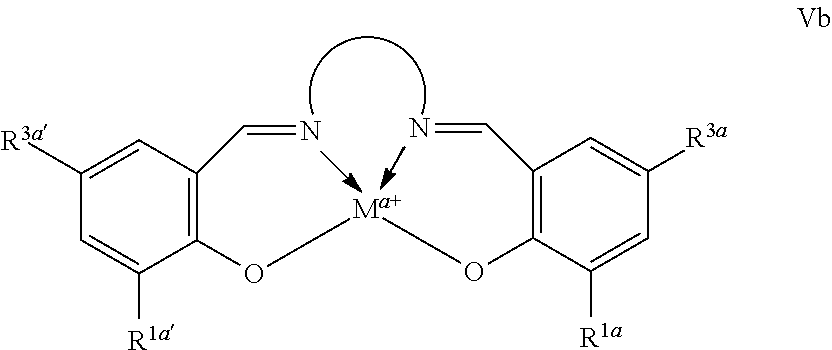


has the structure:

where M, a and Rd are as defined above and in the classes and subclasses herein, and

has the structure:

where each of M, a, Rc and Rd is as defined above and in the classes and subclasses herein.
Claims (11)
Priority Applications (1)
| Application Number | Priority Date | Filing Date | Title |
|---|---|---|---|
| US17/437,206 US11401251B2 (en) | 2019-03-18 | 2020-03-09 | Membrane separation system, and uses thereof |
Applications Claiming Priority (3)
| Application Number | Priority Date | Filing Date | Title |
|---|---|---|---|
| US201962819828P | 2019-03-18 | 2019-03-18 | |
| PCT/US2020/021700 WO2020190556A1 (en) | 2019-03-18 | 2020-03-09 | Membrane separation system, and uses thereof |
| US17/437,206 US11401251B2 (en) | 2019-03-18 | 2020-03-09 | Membrane separation system, and uses thereof |
Publications (2)
| Publication Number | Publication Date |
|---|---|
| US20220089556A1 US20220089556A1 (en) | 2022-03-24 |
| US11401251B2 true US11401251B2 (en) | 2022-08-02 |
Family
ID=70155365
Family Applications (1)
| Application Number | Title | Priority Date | Filing Date |
|---|---|---|---|
| US17/437,206 Active US11401251B2 (en) | 2019-03-18 | 2020-03-09 | Membrane separation system, and uses thereof |
Country Status (6)
| Country | Link |
|---|---|
| US (1) | US11401251B2 (en) |
| EP (1) | EP3941613A1 (en) |
| JP (1) | JP2022525475A (en) |
| KR (1) | KR20210134914A (en) |
| CN (1) | CN113573798A (en) |
| WO (1) | WO2020190556A1 (en) |
Citations (14)
| Publication number | Priority date | Publication date | Assignee | Title |
|---|---|---|---|---|
| US4581236A (en) | 1979-06-15 | 1986-04-08 | Akzo N.V. | Process and apparatus for reduction of alcohol by dialysis in fermented beverages |
| US5484881A (en) * | 1992-10-02 | 1996-01-16 | Cargill, Inc. | Melt-stable amorphous lactide polymer film and process for manufacturing thereof |
| US6005068A (en) * | 1992-10-02 | 1999-12-21 | Cargill Incorporated | Melt-stable amorphous lactide polymer film and process for manufacture thereof |
| US20050215713A1 (en) * | 2004-03-26 | 2005-09-29 | Hessell Edward T | Method of producing a crosslinked coating in the manufacture of integrated circuits |
| US20060141156A1 (en) * | 2003-02-17 | 2006-06-29 | Commissariat A L'energie Atomique | Surface-coating method |
| US20110046422A1 (en) * | 2009-06-17 | 2011-02-24 | Mcauliffe Joseph C | Fuel compositions comprising isoprene derivatives |
| US20110102528A1 (en) * | 2009-10-30 | 2011-05-05 | Fujifilm Corporation | Composition, resist film, pattern forming method, and inkjet recording method |
| US20110262347A1 (en) * | 2010-04-08 | 2011-10-27 | The Salk Institute For Biological Studies | Methods and compositions for enhanced delivery of compounds |
| US20140275684A1 (en) * | 2011-05-27 | 2014-09-18 | Graphea, Inc. | Hydrocarbon transformations using carbocatalysts |
| US20160060386A1 (en) * | 2013-04-26 | 2016-03-03 | Xyleco, Inc. | Processing hydroxy-carboxylic acids to polymers |
| US20170027168A1 (en) * | 2015-07-27 | 2017-02-02 | Stephan HEATH | Methods, products, and systems relating to making, providing, and using nanocrystalline (nc) products comprising nanocrystalline cellulose (ncc), nanocrystalline (nc) polymers and/or nanocrystalline (nc) plastics or other nanocrystals of cellulose composites or structures, in combination with other materials |
| US20180030015A1 (en) * | 2015-02-13 | 2018-02-01 | Novomer, Inc. | Continuous carbonylation processes |
| US20180340174A1 (en) * | 2014-11-11 | 2018-11-29 | Nanocore Aps | Method for identification of molecules with desired characteristics |
| US20200190142A1 (en) * | 2017-05-02 | 2020-06-18 | Stanford Burnham Prebys Medical Discovery Institute | Tumor associated monocyte/macrophage binding peptide and methods of use thereof |
Family Cites Families (8)
| Publication number | Priority date | Publication date | Assignee | Title |
|---|---|---|---|---|
| CA2124842C (en) * | 1992-10-02 | 2003-07-15 | Patrick R. Gruber | A melt-stable lactide polymer fabric and process for manufacture thereof |
| DE102005046250B4 (en) | 2005-09-27 | 2020-10-08 | Evonik Operations Gmbh | Plant for the separation of organic transition metal complex catalysts |
| EP2609090A4 (en) | 2010-08-28 | 2013-12-25 | Novomer Inc | Succinic anhydride from ethylene oxide |
| PL2771307T3 (en) | 2011-10-26 | 2019-06-28 | Novomer, Inc. | Production process of epoxide acrylates |
| CN104245659B (en) | 2012-02-13 | 2016-08-24 | 诺沃梅尔公司 | The method being produced acid anhydrides by epoxides |
| WO2015085295A2 (en) | 2013-12-07 | 2015-06-11 | Novomer, Inc. | Nanofiltration membranes and methods of use |
| WO2017023820A1 (en) * | 2015-07-31 | 2017-02-09 | Novomer, Inc. | Production system/production process for acrylic acid and precursors thereof |
| JP2019512585A (en) * | 2016-03-21 | 2019-05-16 | ノボマー, インコーポレイテッド | Systems and methods for producing superabsorbent polymers |
-
2020
- 2020-03-09 WO PCT/US2020/021700 patent/WO2020190556A1/en not_active Ceased
- 2020-03-09 US US17/437,206 patent/US11401251B2/en active Active
- 2020-03-09 KR KR1020217030024A patent/KR20210134914A/en not_active Ceased
- 2020-03-09 JP JP2021556459A patent/JP2022525475A/en active Pending
- 2020-03-09 CN CN202080021740.7A patent/CN113573798A/en active Pending
- 2020-03-09 EP EP20716645.5A patent/EP3941613A1/en not_active Withdrawn
Patent Citations (14)
| Publication number | Priority date | Publication date | Assignee | Title |
|---|---|---|---|---|
| US4581236A (en) | 1979-06-15 | 1986-04-08 | Akzo N.V. | Process and apparatus for reduction of alcohol by dialysis in fermented beverages |
| US5484881A (en) * | 1992-10-02 | 1996-01-16 | Cargill, Inc. | Melt-stable amorphous lactide polymer film and process for manufacturing thereof |
| US6005068A (en) * | 1992-10-02 | 1999-12-21 | Cargill Incorporated | Melt-stable amorphous lactide polymer film and process for manufacture thereof |
| US20060141156A1 (en) * | 2003-02-17 | 2006-06-29 | Commissariat A L'energie Atomique | Surface-coating method |
| US20050215713A1 (en) * | 2004-03-26 | 2005-09-29 | Hessell Edward T | Method of producing a crosslinked coating in the manufacture of integrated circuits |
| US20110046422A1 (en) * | 2009-06-17 | 2011-02-24 | Mcauliffe Joseph C | Fuel compositions comprising isoprene derivatives |
| US20110102528A1 (en) * | 2009-10-30 | 2011-05-05 | Fujifilm Corporation | Composition, resist film, pattern forming method, and inkjet recording method |
| US20110262347A1 (en) * | 2010-04-08 | 2011-10-27 | The Salk Institute For Biological Studies | Methods and compositions for enhanced delivery of compounds |
| US20140275684A1 (en) * | 2011-05-27 | 2014-09-18 | Graphea, Inc. | Hydrocarbon transformations using carbocatalysts |
| US20160060386A1 (en) * | 2013-04-26 | 2016-03-03 | Xyleco, Inc. | Processing hydroxy-carboxylic acids to polymers |
| US20180340174A1 (en) * | 2014-11-11 | 2018-11-29 | Nanocore Aps | Method for identification of molecules with desired characteristics |
| US20180030015A1 (en) * | 2015-02-13 | 2018-02-01 | Novomer, Inc. | Continuous carbonylation processes |
| US20170027168A1 (en) * | 2015-07-27 | 2017-02-02 | Stephan HEATH | Methods, products, and systems relating to making, providing, and using nanocrystalline (nc) products comprising nanocrystalline cellulose (ncc), nanocrystalline (nc) polymers and/or nanocrystalline (nc) plastics or other nanocrystals of cellulose composites or structures, in combination with other materials |
| US20200190142A1 (en) * | 2017-05-02 | 2020-06-18 | Stanford Burnham Prebys Medical Discovery Institute | Tumor associated monocyte/macrophage binding peptide and methods of use thereof |
Non-Patent Citations (1)
| Title |
|---|
| International Search Report for Application No. PCT/US2020/021700, dated May 29, 2020. |
Also Published As
| Publication number | Publication date |
|---|---|
| WO2020190556A1 (en) | 2020-09-24 |
| KR20210134914A (en) | 2021-11-11 |
| US20220089556A1 (en) | 2022-03-24 |
| CN113573798A (en) | 2021-10-29 |
| EP3941613A1 (en) | 2022-01-26 |
| JP2022525475A (en) | 2022-05-16 |
Similar Documents
| Publication | Publication Date | Title |
|---|---|---|
| Xiao et al. | Organic solvent nanofiltration in pharmaceutical applications | |
| US20220251018A1 (en) | Production system/production process for acrylic acid and precursors thereof | |
| KR101593259B1 (en) | Method for enriching a homogenous catalyst from a process flow | |
| US7410525B1 (en) | Mixed matrix membranes incorporating microporous polymers as fillers | |
| CN103288610B (en) | For commercial hydroformylation iso-butylene and the method for separated product mixture and device | |
| CN104245096B (en) | Improved dilute chemical reaction process with membrane separation step | |
| US9987588B2 (en) | Sterically hindered amines and associated methods | |
| EP1372829B1 (en) | Membrane for solvent exchange process | |
| EP3194064B1 (en) | Reaction process with membrane separation | |
| CN108884009A (en) | The system and method for manufacturing super absorbent polymer | |
| TW201536409A (en) | Jet loop reactor with nanofiltration and gas separator | |
| US20200010618A1 (en) | A process for purification of polyether block copolymers | |
| JP4985874B2 (en) | Method for producing butanol | |
| WO2013107902A1 (en) | Process for the separation of a dissolved catalyst system from an alkoxycarbonylation reaction mixture | |
| US20220089556A1 (en) | Membrane separation system, and uses thereof | |
| JP2010150248A (en) | Method for producing diol or triol | |
| JP2009034030A5 (en) | ||
| CN101965340B (en) | Membrane separation method for separating high boiler during the production of 1,3-dioxolane-2-ones | |
| Singh et al. | Optical resolution of α-amino acids by reverse osmosis using enantioselective polymer membrane containing chiral metal-schiff base complex | |
| Yuan et al. | Octa-ion pair-functionalized POSS bridging homogeneous catalysis and heterogeneous recycle for fixation of CO2 | |
| US20230182090A1 (en) | Membranes containing crown ether-containing polymers | |
| BR112016012491B1 (en) | METHOD TO SEPARATE AND PURIFY A FERMENTATION PRODUCT FROM A RESIDUAL FERMENTER GAS | |
| CA2735637C (en) | Method of producing diol or triol |
Legal Events
| Date | Code | Title | Description |
|---|---|---|---|
| AS | Assignment |
Owner name: NOVOMER, INC., NEW YORK Free format text: ASSIGNMENT OF ASSIGNORS INTEREST;ASSIGNOR:DACKSON, KEITH;REEL/FRAME:057414/0091 Effective date: 20210818 |
|
| FEPP | Fee payment procedure |
Free format text: ENTITY STATUS SET TO UNDISCOUNTED (ORIGINAL EVENT CODE: BIG.); ENTITY STATUS OF PATENT OWNER: LARGE ENTITY |
|
| STPP | Information on status: patent application and granting procedure in general |
Free format text: NOTICE OF ALLOWANCE MAILED -- APPLICATION RECEIVED IN OFFICE OF PUBLICATIONS |
|
| STPP | Information on status: patent application and granting procedure in general |
Free format text: PUBLICATIONS -- ISSUE FEE PAYMENT VERIFIED |
|
| STCF | Information on status: patent grant |
Free format text: PATENTED CASE |
|
| MAFP | Maintenance fee payment |
Free format text: PAYMENT OF MAINTENANCE FEE, 4TH YEAR, LARGE ENTITY (ORIGINAL EVENT CODE: M1551); ENTITY STATUS OF PATENT OWNER: LARGE ENTITY Year of fee payment: 4 |
|
| AS | Assignment |
Owner name: NOVOMER LLC, GEORGIA Free format text: CHANGE OF NAME;ASSIGNOR:NMER WINDDOWN, INC.;REEL/FRAME:075187/0876 Effective date: 20260204 |