US11401246B2 - Triazole glycolate oxidase inhibitors - Google Patents
Triazole glycolate oxidase inhibitors Download PDFInfo
- Publication number
- US11401246B2 US11401246B2 US17/255,600 US201917255600A US11401246B2 US 11401246 B2 US11401246 B2 US 11401246B2 US 201917255600 A US201917255600 A US 201917255600A US 11401246 B2 US11401246 B2 US 11401246B2
- Authority
- US
- United States
- Prior art keywords
- triazole
- compound
- alkyl
- group
- pharmaceutically acceptable
- Prior art date
- Legal status (The legal status is an assumption and is not a legal conclusion. Google has not performed a legal analysis and makes no representation as to the accuracy of the status listed.)
- Active
Links
- 0 [1*]OC(=O)C1=C(*c2ccccc2)CNC1 Chemical compound [1*]OC(=O)C1=C(*c2ccccc2)CNC1 0.000 description 19
- HEYUBFZOJQZQNH-UHFFFAOYSA-N CC(=O)c1nn[nH]c1Oc1ccc(-c2ccc(C3CC(F)(F)C3)cc2)cc1 Chemical compound CC(=O)c1nn[nH]c1Oc1ccc(-c2ccc(C3CC(F)(F)C3)cc2)cc1 HEYUBFZOJQZQNH-UHFFFAOYSA-N 0.000 description 3
- WJEIGIIBBPQAIQ-UHFFFAOYSA-N Cc1ccc(Oc2[nH]nnc2C(=O)O)cc1 Chemical compound Cc1ccc(Oc2[nH]nnc2C(=O)O)cc1 WJEIGIIBBPQAIQ-UHFFFAOYSA-N 0.000 description 3
- TZJBBMZDRJBRGD-UHFFFAOYSA-N Cc1cc(Oc2[nH]nnc2C(=O)O)ccc1Br Chemical compound Cc1cc(Oc2[nH]nnc2C(=O)O)ccc1Br TZJBBMZDRJBRGD-UHFFFAOYSA-N 0.000 description 2
- GBFOPIGDIZQJFA-UHFFFAOYSA-N Cc1ccc(-c2ccc(Oc3[nH]nnc3C(=O)O)cc2)cc1 Chemical compound Cc1ccc(-c2ccc(Oc3[nH]nnc3C(=O)O)cc2)cc1 GBFOPIGDIZQJFA-UHFFFAOYSA-N 0.000 description 2
- VDENADCWSHDRPB-UHFFFAOYSA-N C.C.C.C.C.C.C.C.C.CC(C)OC(=O)OCCl.CC(C)OC(=O)OCOC(=O)c1nn[nH]c1Oc1ccc(-c2ccc(C(C)C)cc2)cc1.COC(=O)c1nnn(Cc2ccc(OC)cc2)c1Oc1ccc(-c2ccc(C(C)C)cc2)cc1.COc1ccc(Cn2nnc(C(=O)O)c2Oc2ccc(-c3ccc(C(C)C)cc3)cc2)cc1.COc1ccc(Cn2nnc(C(=O)OCOC(=O)OC(C)C)c2Oc2ccc(-c3ccc(C(C)C)cc3)cc2)cc1 Chemical compound C.C.C.C.C.C.C.C.C.CC(C)OC(=O)OCCl.CC(C)OC(=O)OCOC(=O)c1nn[nH]c1Oc1ccc(-c2ccc(C(C)C)cc2)cc1.COC(=O)c1nnn(Cc2ccc(OC)cc2)c1Oc1ccc(-c2ccc(C(C)C)cc2)cc1.COc1ccc(Cn2nnc(C(=O)O)c2Oc2ccc(-c3ccc(C(C)C)cc3)cc2)cc1.COc1ccc(Cn2nnc(C(=O)OCOC(=O)OC(C)C)c2Oc2ccc(-c3ccc(C(C)C)cc3)cc2)cc1 VDENADCWSHDRPB-UHFFFAOYSA-N 0.000 description 1
- RPAGDHGIFLKWEB-UHFFFAOYSA-N C.C.C.C.C.C.C.C.C1CCOC1.CCOCC[Si](C)(C)C.COC(=O)c1c(Oc2ccc(Br)cc2)nnn1COCC[Si](C)(C)C.COC(=O)c1nn[nH]c1Oc1ccc(Br)cc1.COC(=O)c1nnn(COCC[Si](C)(C)C)c1Oc1ccc(-c2ccc(C3CC3)cc2)cc1.COC(=O)c1nnn(COCC[Si](C)(C)C)c1Oc1ccc(Br)cc1.COC(=O)c1nnn(Cc2ccc(OC)cc2)c1Oc1ccc(Br)cc1.OB(O)c1ccc(C2CC2)cc1 Chemical compound C.C.C.C.C.C.C.C.C1CCOC1.CCOCC[Si](C)(C)C.COC(=O)c1c(Oc2ccc(Br)cc2)nnn1COCC[Si](C)(C)C.COC(=O)c1nn[nH]c1Oc1ccc(Br)cc1.COC(=O)c1nnn(COCC[Si](C)(C)C)c1Oc1ccc(-c2ccc(C3CC3)cc2)cc1.COC(=O)c1nnn(COCC[Si](C)(C)C)c1Oc1ccc(Br)cc1.COC(=O)c1nnn(Cc2ccc(OC)cc2)c1Oc1ccc(Br)cc1.OB(O)c1ccc(C2CC2)cc1 RPAGDHGIFLKWEB-UHFFFAOYSA-N 0.000 description 1
- MCPTXTGLYXCIEX-UHFFFAOYSA-N C.C.C.C.C.C.C.CC1(C)OB(B2OC(C)(C)C(C)(C)O2)OC1(C)C.CC1(C)OB(c2ccc(C3CC(F)(F)C3)cc2)OC1(C)C.COC(=O)c1nn[nH]c1Oc1ccc(-c2ccc(C3CC(F)(F)C3)cc2)cc1.COC(=O)c1nnn(Cc2ccc(OC)cc2)c1Oc1ccc(-c2ccc(C3CC(F)(F)C3)cc2)cc1.FC1(F)CC(c2ccc(Br)cc2)C1.O=C(O)c1nn[nH]c1Oc1ccc(-c2ccc(C3CC(F)(F)C3)cc2)cc1 Chemical compound C.C.C.C.C.C.C.CC1(C)OB(B2OC(C)(C)C(C)(C)O2)OC1(C)C.CC1(C)OB(c2ccc(C3CC(F)(F)C3)cc2)OC1(C)C.COC(=O)c1nn[nH]c1Oc1ccc(-c2ccc(C3CC(F)(F)C3)cc2)cc1.COC(=O)c1nnn(Cc2ccc(OC)cc2)c1Oc1ccc(-c2ccc(C3CC(F)(F)C3)cc2)cc1.FC1(F)CC(c2ccc(Br)cc2)C1.O=C(O)c1nn[nH]c1Oc1ccc(-c2ccc(C3CC(F)(F)C3)cc2)cc1 MCPTXTGLYXCIEX-UHFFFAOYSA-N 0.000 description 1
- HSTXVIWPLMDXEC-UHFFFAOYSA-N C.C.C.C.C.C.C.COC(=O)c1c(Oc2ccc(-c3ccc(C4CC4)cc3)cc2)nnn1COCC[Si](C)(C)C.COC(=O)c1nn[nH]c1Oc1ccc(-c2ccc(C3CC3)cc2)cc1.O=C(O)c1nn[nH]c1Oc1ccc(-c2ccc(C3CC3)cc2)cc1 Chemical compound C.C.C.C.C.C.C.COC(=O)c1c(Oc2ccc(-c3ccc(C4CC4)cc3)cc2)nnn1COCC[Si](C)(C)C.COC(=O)c1nn[nH]c1Oc1ccc(-c2ccc(C3CC3)cc2)cc1.O=C(O)c1nn[nH]c1Oc1ccc(-c2ccc(C3CC3)cc2)cc1 HSTXVIWPLMDXEC-UHFFFAOYSA-N 0.000 description 1
- JTLQGCZZXLNWNQ-UHFFFAOYSA-M C.C.C.C.C.C.CC(=O)c1nn[nH]c1Oc1ccc(N2CCOCC2)cc1.COc1ccc(Cn2nnc(C(C)=O)c2Oc2ccc(N3CCOCC3)cc2)cc1.O=C(O)c1nn[nH]c1Oc1ccc(N2CCOCC2)cc1.O=CC(F)(F)F.O[Na].Oc1ccc(N2CCOCC2)cc1.[NaH] Chemical compound C.C.C.C.C.C.CC(=O)c1nn[nH]c1Oc1ccc(N2CCOCC2)cc1.COc1ccc(Cn2nnc(C(C)=O)c2Oc2ccc(N3CCOCC3)cc2)cc1.O=C(O)c1nn[nH]c1Oc1ccc(N2CCOCC2)cc1.O=CC(F)(F)F.O[Na].Oc1ccc(N2CCOCC2)cc1.[NaH] JTLQGCZZXLNWNQ-UHFFFAOYSA-M 0.000 description 1
- DMUATSIUKPCLFX-UHFFFAOYSA-N C.C.C.C.C.C.COc1ccc(Cn2nnc(C(=O)O)c2Oc2ccc(-c3ccc(C(C)C)cc3)cc2)cc1.COc1ccc(Cn2nnc(C(=O)OCc3oc(=O)oc3C)c2Oc2ccc(-c3ccc(C(C)C)cc3)cc2)cc1.Cc1oc(=O)oc1CCl.Cc1oc(=O)oc1COC(=O)c1nn[nH]c1Oc1ccc(-c2ccc(C(C)C)cc2)cc1 Chemical compound C.C.C.C.C.C.COc1ccc(Cn2nnc(C(=O)O)c2Oc2ccc(-c3ccc(C(C)C)cc3)cc2)cc1.COc1ccc(Cn2nnc(C(=O)OCc3oc(=O)oc3C)c2Oc2ccc(-c3ccc(C(C)C)cc3)cc2)cc1.Cc1oc(=O)oc1CCl.Cc1oc(=O)oc1COC(=O)c1nn[nH]c1Oc1ccc(-c2ccc(C(C)C)cc2)cc1 DMUATSIUKPCLFX-UHFFFAOYSA-N 0.000 description 1
- UUPAAQDXEZCNLU-UHFFFAOYSA-N C.O=C(O)c1nn[nH]c1Oc1ccc(-c2cncnc2)cc1 Chemical compound C.O=C(O)c1nn[nH]c1Oc1ccc(-c2cncnc2)cc1 UUPAAQDXEZCNLU-UHFFFAOYSA-N 0.000 description 1
- AGXHWLWCYIKELO-UHFFFAOYSA-N C.O=C1CCC(c2ccc(O)cc2)C1.Oc1ccc(C2CCC(F)(F)C2)cc1 Chemical compound C.O=C1CCC(c2ccc(O)cc2)C1.Oc1ccc(C2CCC(F)(F)C2)cc1 AGXHWLWCYIKELO-UHFFFAOYSA-N 0.000 description 1
- HJRXISAHBBZAPC-UHFFFAOYSA-N C=C(O)c1nn[nH]c1Oc1ccc(C2CC2(F)F)cc1.C=C(O)c1nn[nH]c1Oc1ccc(C2CCC(F)(F)C2)cc1.C=C1OC(C)=C(COC(=O)c2nn[nH]c2Oc2ccc(-c3ccc(C(C)C)cc3)cc2)O1.CC(=O)C1=C(Oc2ccc(-c3ccc(C(C)C)cc3)cc2)[Na]N=N1.CC(=O)C1=C(Oc2ccc(-c3ccc(C)cc3)cc2)[Na]N=N1.CC(=O)C1=C(Oc2ccc(-c3cccnc3F)cc2)[Na]N=N1.CC(=O)C1=C(Oc2ccc(C3CCC(F)(F)CC3)cc2)[Na]N=N1.CC(=O)c1nn[nH]c1Oc1ccc(-c2ccc(-c3cccnc3)cc2)cc1.CC(=O)c1nn[nH]c1Oc1ccc(-c2ccc(-c3ccnc(C)c3)cc2)cc1.CC(=O)c1nn[nH]c1Oc1ccc(-c2ccc(C3(C)CC3)cc2)cc1.CC(=O)c1nn[nH]c1Oc1ccc(-c2ccc(C3CC(F)(F)C3)cc2)cc1.CC(=O)c1nn[nH]c1Oc1ccc(-c2ccc(C3CC3(F)F)cc2)cc1.CC(=O)c1nn[nH]c1Oc1ccc(-c2ccc(C3CC3)cc2)cc1.CC(=O)c1nn[nH]c1Oc1ccc(-c2cccc(C)c2)cc1.CC(=O)c1nn[nH]c1Oc1ccc(C2CCC3(CC2)CC3(F)F)cc1.CC(=O)c1nn[nH]c1Oc1cccc(-c2ccc(C(C)C)cc2)c1.CC(=O)c1nn[nH]c1Oc1cccc(-c2ccc(C)cc2)c1.CC(=O)c1nn[nH]c1Sc1ccc(-c2ccc(C(C)C)cc2)cc1.CC(=O)c1nn[nH]c1Sc1ccc(-c2ccc(C)cc2)cc1.CC(C)OC(=O)OCOC(=O)c1c(Oc2ccc(-c3ccc(C(C)C)cc3)cc2)nnn1COC(=O)OC(C)C.CC(C)OC(=O)OCOC(=O)c1nn[nH]c1Oc1ccc(-c2ccc(C(C)C)cc2)cc1.CC(C)OC(=O)OCOC(=O)c1nnn(COC(=O)OC(C)C)c1Oc1ccc(-c2ccc(C(C)C)cc2)cc1.N.N.N.N Chemical compound C=C(O)c1nn[nH]c1Oc1ccc(C2CC2(F)F)cc1.C=C(O)c1nn[nH]c1Oc1ccc(C2CCC(F)(F)C2)cc1.C=C1OC(C)=C(COC(=O)c2nn[nH]c2Oc2ccc(-c3ccc(C(C)C)cc3)cc2)O1.CC(=O)C1=C(Oc2ccc(-c3ccc(C(C)C)cc3)cc2)[Na]N=N1.CC(=O)C1=C(Oc2ccc(-c3ccc(C)cc3)cc2)[Na]N=N1.CC(=O)C1=C(Oc2ccc(-c3cccnc3F)cc2)[Na]N=N1.CC(=O)C1=C(Oc2ccc(C3CCC(F)(F)CC3)cc2)[Na]N=N1.CC(=O)c1nn[nH]c1Oc1ccc(-c2ccc(-c3cccnc3)cc2)cc1.CC(=O)c1nn[nH]c1Oc1ccc(-c2ccc(-c3ccnc(C)c3)cc2)cc1.CC(=O)c1nn[nH]c1Oc1ccc(-c2ccc(C3(C)CC3)cc2)cc1.CC(=O)c1nn[nH]c1Oc1ccc(-c2ccc(C3CC(F)(F)C3)cc2)cc1.CC(=O)c1nn[nH]c1Oc1ccc(-c2ccc(C3CC3(F)F)cc2)cc1.CC(=O)c1nn[nH]c1Oc1ccc(-c2ccc(C3CC3)cc2)cc1.CC(=O)c1nn[nH]c1Oc1ccc(-c2cccc(C)c2)cc1.CC(=O)c1nn[nH]c1Oc1ccc(C2CCC3(CC2)CC3(F)F)cc1.CC(=O)c1nn[nH]c1Oc1cccc(-c2ccc(C(C)C)cc2)c1.CC(=O)c1nn[nH]c1Oc1cccc(-c2ccc(C)cc2)c1.CC(=O)c1nn[nH]c1Sc1ccc(-c2ccc(C(C)C)cc2)cc1.CC(=O)c1nn[nH]c1Sc1ccc(-c2ccc(C)cc2)cc1.CC(C)OC(=O)OCOC(=O)c1c(Oc2ccc(-c3ccc(C(C)C)cc3)cc2)nnn1COC(=O)OC(C)C.CC(C)OC(=O)OCOC(=O)c1nn[nH]c1Oc1ccc(-c2ccc(C(C)C)cc2)cc1.CC(C)OC(=O)OCOC(=O)c1nnn(COC(=O)OC(C)C)c1Oc1ccc(-c2ccc(C(C)C)cc2)cc1.N.N.N.N HJRXISAHBBZAPC-UHFFFAOYSA-N 0.000 description 1
- AJDZDXSZELEOKQ-UHFFFAOYSA-N C=C(O)c1nn[nH]c1Oc1ccc(C2CC2(F)F)cc1.C=C(O)c1nn[nH]c1Oc1ccc(C2CCC(F)(F)C2)cc1.CC(=O)c1nn[nH]c1Oc1ccc(-c2ccc(-c3ccnc(C)c3)cc2)cc1.CC(=O)c1nn[nH]c1Oc1ccc(C)cc1.CC(=O)c1nn[nH]c1Oc1ccc(F)cc1.CC(=O)c1nn[nH]c1Oc1ccccc1.COc1ccc(Oc2[nH]nnc2C(C)=O)cc1 Chemical compound C=C(O)c1nn[nH]c1Oc1ccc(C2CC2(F)F)cc1.C=C(O)c1nn[nH]c1Oc1ccc(C2CCC(F)(F)C2)cc1.CC(=O)c1nn[nH]c1Oc1ccc(-c2ccc(-c3ccnc(C)c3)cc2)cc1.CC(=O)c1nn[nH]c1Oc1ccc(C)cc1.CC(=O)c1nn[nH]c1Oc1ccc(F)cc1.CC(=O)c1nn[nH]c1Oc1ccccc1.COc1ccc(Oc2[nH]nnc2C(C)=O)cc1 AJDZDXSZELEOKQ-UHFFFAOYSA-N 0.000 description 1
- PZAIPFXVOIWPJM-UHFFFAOYSA-N C=C1OC(C)=C(COC(=O)c2nn[nH]c2Oc2ccc(-c3ccc(C(C)C)cc3)cc2)O1.CC(=O)c1nn[nH]c1Oc1ccc(-c2ccc(C3(C)CC3)cc2)cc1.CC(=O)c1nn[nH]c1Oc1ccc(-c2ccc(C3CC(F)(F)C3)cc2)cc1.CC(=O)c1nn[nH]c1Oc1ccc(-c2ccc(C3CC3(F)F)cc2)cc1.CC(=O)c1nn[nH]c1Oc1ccc(C2CCC3(CC2)CC3(F)F)cc1.CC(C)OC(=O)OCOC(=O)c1c(Oc2ccc(-c3ccc(C(C)C)cc3)cc2)nnn1COC(=O)OC(C)C.CC(C)OC(=O)OCOC(=O)c1nn[nH]c1Oc1ccc(-c2ccc(C(C)C)cc2)cc1.CC(C)OC(=O)OCOC(=O)c1nnn(COC(=O)OC(C)C)c1Oc1ccc(-c2ccc(C(C)C)cc2)cc1 Chemical compound C=C1OC(C)=C(COC(=O)c2nn[nH]c2Oc2ccc(-c3ccc(C(C)C)cc3)cc2)O1.CC(=O)c1nn[nH]c1Oc1ccc(-c2ccc(C3(C)CC3)cc2)cc1.CC(=O)c1nn[nH]c1Oc1ccc(-c2ccc(C3CC(F)(F)C3)cc2)cc1.CC(=O)c1nn[nH]c1Oc1ccc(-c2ccc(C3CC3(F)F)cc2)cc1.CC(=O)c1nn[nH]c1Oc1ccc(C2CCC3(CC2)CC3(F)F)cc1.CC(C)OC(=O)OCOC(=O)c1c(Oc2ccc(-c3ccc(C(C)C)cc3)cc2)nnn1COC(=O)OC(C)C.CC(C)OC(=O)OCOC(=O)c1nn[nH]c1Oc1ccc(-c2ccc(C(C)C)cc2)cc1.CC(C)OC(=O)OCOC(=O)c1nnn(COC(=O)OC(C)C)c1Oc1ccc(-c2ccc(C(C)C)cc2)cc1 PZAIPFXVOIWPJM-UHFFFAOYSA-N 0.000 description 1
- NRODJRZBYYBBDY-UHFFFAOYSA-M CC(=O)C1=C(Oc2ccc(-c3ccc(C(C)C)cc3)cc2)[Na]N=N1.CC(=O)C1=C(Oc2ccc(-c3ccc(C(F)(F)F)cc3)cc2)[Na]N=N1.CC(=O)C1=C(Oc2ccc(-c3cccnc3F)cc2)[Na]N=N1.CC(=O)c1nn[nH]c1Oc1ccc(-c2ccc(-c3cccnc3)cc2)cc1.CC(=O)c1nn[nH]c1Oc1ccc(-c2ccc(C3CC3)cc2)cc1.CC(=O)c1nn[nH]c1Oc1cccc(-c2ccc(C(F)(F)F)cc2)c1.CC(=O)c1nn[nH]c1Sc1ccc(-c2ccc(C(C)C)cc2)cc1.CC(=O)c1nn[nH]c1Sc1ccc(-c2ccc(C(F)(F)F)cc2)cc1.CC(=O)c1nnn([Na])c1Oc1ccc(C2CCC(F)(F)CC2)cc1.N.N.N Chemical compound CC(=O)C1=C(Oc2ccc(-c3ccc(C(C)C)cc3)cc2)[Na]N=N1.CC(=O)C1=C(Oc2ccc(-c3ccc(C(F)(F)F)cc3)cc2)[Na]N=N1.CC(=O)C1=C(Oc2ccc(-c3cccnc3F)cc2)[Na]N=N1.CC(=O)c1nn[nH]c1Oc1ccc(-c2ccc(-c3cccnc3)cc2)cc1.CC(=O)c1nn[nH]c1Oc1ccc(-c2ccc(C3CC3)cc2)cc1.CC(=O)c1nn[nH]c1Oc1cccc(-c2ccc(C(F)(F)F)cc2)c1.CC(=O)c1nn[nH]c1Sc1ccc(-c2ccc(C(C)C)cc2)cc1.CC(=O)c1nn[nH]c1Sc1ccc(-c2ccc(C(F)(F)F)cc2)cc1.CC(=O)c1nnn([Na])c1Oc1ccc(C2CCC(F)(F)CC2)cc1.N.N.N NRODJRZBYYBBDY-UHFFFAOYSA-M 0.000 description 1
- CGSVGVBQDXBIAS-UHFFFAOYSA-N CC(=O)N1CCN(c2ccc(Oc3[nH]nnc3C(=O)O)cc2)CC1 Chemical compound CC(=O)N1CCN(c2ccc(Oc3[nH]nnc3C(=O)O)cc2)CC1 CGSVGVBQDXBIAS-UHFFFAOYSA-N 0.000 description 1
- QBEGYRRDXZMBSZ-UHFFFAOYSA-N CC(=O)c1nn[nH]c1Oc1ccc(-c2cc(C)cc(F)n2)cc1.CC(=O)c1nn[nH]c1Oc1ccc(-c2ccc(C)nc2)cc1.CC(=O)c1nn[nH]c1Oc1ccc(-c2ccc(C)nc2F)c(C)c1.CC(=O)c1nn[nH]c1Oc1ccc(-c2ccc(C)nc2F)cc1.CC(=O)c1nn[nH]c1Oc1ccc(-c2ccc(F)nc2C)c(C)c1.CC(=O)c1nn[nH]c1Oc1ccc(-c2ccc(F)nc2C)cc1.CC(=O)c1nn[nH]c1Oc1ccc(-c2cccnc2F)c(C)c1.CC(=O)c1nn[nH]c1Oc1ccc(-c2ccnc(C)c2)cc1.CC(=O)c1nn[nH]c1Oc1ccc(-c2ccnc(F)c2C)cc1.CC(=O)c1nn[nH]c1Oc1ccc(-c2ccnc3ccccc23)cc1.CC(=O)c1nn[nH]c1Oc1ccc(-c2cnc(F)c(C)c2)cc1.CC(=O)c1nn[nH]c1Oc1ccc(-c2cncc(C)c2)cc1.CC(=O)c1nn[nH]c1Oc1ccc(Br)c(C)c1.CC(=O)c1nn[nH]c1Oc1ccc(C(C)(C)C)cc1.CC(=O)c1nn[nH]c1Oc1ccc(C)cc1.CC(=O)c1nn[nH]c1Oc1ccc(C)nc1C.CC(=O)c1nn[nH]c1Oc1ccc(C23CC(C2)C3)cc1.CC(=O)c1nn[nH]c1Oc1ccc(C2CCC(=O)CC2)cc1.CC(=O)c1nn[nH]c1Oc1ccc(C2CCCC2)cc1.CC(=O)c1nn[nH]c1Oc1ccc(N2CCN(C)CC2)cc1.CC(=O)c1nn[nH]c1Oc1cccc(-c2ccc(C(N)=O)cc2)c1.CC(=O)c1nn[nH]c1Oc1cccc(-c2cccnc2F)c1.CC(=O)c1nn[nH]c1Oc1cccnc1Br.CC(=O)c1nn[nH]c1Sc1ccc(-c2cccnc2F)cc1.COc1ccc(Oc2[nH]nnc2C(C)=O)cn1.[C-]#[N+]c1ccc(-c2cccc(Oc3[nH]nnc3C(C)=O)c2)cc1 Chemical compound CC(=O)c1nn[nH]c1Oc1ccc(-c2cc(C)cc(F)n2)cc1.CC(=O)c1nn[nH]c1Oc1ccc(-c2ccc(C)nc2)cc1.CC(=O)c1nn[nH]c1Oc1ccc(-c2ccc(C)nc2F)c(C)c1.CC(=O)c1nn[nH]c1Oc1ccc(-c2ccc(C)nc2F)cc1.CC(=O)c1nn[nH]c1Oc1ccc(-c2ccc(F)nc2C)c(C)c1.CC(=O)c1nn[nH]c1Oc1ccc(-c2ccc(F)nc2C)cc1.CC(=O)c1nn[nH]c1Oc1ccc(-c2cccnc2F)c(C)c1.CC(=O)c1nn[nH]c1Oc1ccc(-c2ccnc(C)c2)cc1.CC(=O)c1nn[nH]c1Oc1ccc(-c2ccnc(F)c2C)cc1.CC(=O)c1nn[nH]c1Oc1ccc(-c2ccnc3ccccc23)cc1.CC(=O)c1nn[nH]c1Oc1ccc(-c2cnc(F)c(C)c2)cc1.CC(=O)c1nn[nH]c1Oc1ccc(-c2cncc(C)c2)cc1.CC(=O)c1nn[nH]c1Oc1ccc(Br)c(C)c1.CC(=O)c1nn[nH]c1Oc1ccc(C(C)(C)C)cc1.CC(=O)c1nn[nH]c1Oc1ccc(C)cc1.CC(=O)c1nn[nH]c1Oc1ccc(C)nc1C.CC(=O)c1nn[nH]c1Oc1ccc(C23CC(C2)C3)cc1.CC(=O)c1nn[nH]c1Oc1ccc(C2CCC(=O)CC2)cc1.CC(=O)c1nn[nH]c1Oc1ccc(C2CCCC2)cc1.CC(=O)c1nn[nH]c1Oc1ccc(N2CCN(C)CC2)cc1.CC(=O)c1nn[nH]c1Oc1cccc(-c2ccc(C(N)=O)cc2)c1.CC(=O)c1nn[nH]c1Oc1cccc(-c2cccnc2F)c1.CC(=O)c1nn[nH]c1Oc1cccnc1Br.CC(=O)c1nn[nH]c1Sc1ccc(-c2cccnc2F)cc1.COc1ccc(Oc2[nH]nnc2C(C)=O)cn1.[C-]#[N+]c1ccc(-c2cccc(Oc3[nH]nnc3C(C)=O)c2)cc1 QBEGYRRDXZMBSZ-UHFFFAOYSA-N 0.000 description 1
- LCHZGOKMMOFQQP-UHFFFAOYSA-N CC(=O)c1nn[nH]c1Oc1ccc(-c2cc(C)cc(F)n2)cc1.CC(=O)c1nn[nH]c1Oc1ccc(-c2ccc(F)nc2C)cc1.CC(=O)c1nn[nH]c1Oc1ccc(-c2cccnc2F)c(C)c1.CC(=O)c1nn[nH]c1Oc1ccc(Br)c(C)c1.CC(=O)c1nn[nH]c1Oc1ccc(C(C)(C)C)cc1.CC(=O)c1nn[nH]c1Oc1ccc(C)nc1C.CC(=O)c1nn[nH]c1Oc1ccc(C2CCCC2)cc1.CC(=O)c1nn[nH]c1Oc1ccc(N2CCN(C)CC2)cc1.CC(=O)c1nn[nH]c1Oc1cccnc1Br.COc1ccc(Oc2[nH]nnc2C(C)=O)cn1 Chemical compound CC(=O)c1nn[nH]c1Oc1ccc(-c2cc(C)cc(F)n2)cc1.CC(=O)c1nn[nH]c1Oc1ccc(-c2ccc(F)nc2C)cc1.CC(=O)c1nn[nH]c1Oc1ccc(-c2cccnc2F)c(C)c1.CC(=O)c1nn[nH]c1Oc1ccc(Br)c(C)c1.CC(=O)c1nn[nH]c1Oc1ccc(C(C)(C)C)cc1.CC(=O)c1nn[nH]c1Oc1ccc(C)nc1C.CC(=O)c1nn[nH]c1Oc1ccc(C2CCCC2)cc1.CC(=O)c1nn[nH]c1Oc1ccc(N2CCN(C)CC2)cc1.CC(=O)c1nn[nH]c1Oc1cccnc1Br.COc1ccc(Oc2[nH]nnc2C(C)=O)cn1 LCHZGOKMMOFQQP-UHFFFAOYSA-N 0.000 description 1
- XNWAYMQHOKHUIP-UHFFFAOYSA-N CC(=O)c1nn[nH]c1Oc1ccc(-c2cc(F)c(F)c(F)c2)cc1.CC(=O)c1nn[nH]c1Oc1ccc(-c2cc(F)cnc2Cl)cc1.CC(=O)c1nn[nH]c1Oc1ccc(-c2ccc(C(C)(C)C)cc2)cc1F.CC(=O)c1nn[nH]c1Oc1ccc(-c2ccc(C(C)C)cc2)cc1F.CC(=O)c1nn[nH]c1Oc1ccc(-c2ccc(C)cc2)cc1F.CC(=O)c1nn[nH]c1Oc1ccc(-c2ccc(CC(C)C)cc2)cc1.CC(=O)c1nn[nH]c1Oc1ccc(-c2ccc(NS(C)(=O)=O)cc2)cc1.CC(=O)c1nn[nH]c1Oc1ccc(-c2ccc(S(C)(=O)=O)cc2)cc1.CC(=O)c1nn[nH]c1Oc1ccc(-c2ccc(S(C)(=O)=O)cc2)cc1F.CC(=O)c1nn[nH]c1Oc1ccc(-c2cccc(C(C)C)c2)cc1.CC(=O)c1nn[nH]c1Oc1ccc(-c2cccc3ccccc23)cc1.CC(=O)c1nn[nH]c1Oc1ccc(-c2cccnc2Cl)cc1.CC(=O)c1nn[nH]c1Oc1ccc(-c2cccnc2F)cc1F.CC(=O)c1nn[nH]c1Oc1ccc(-c2ccnc(F)c2)cc1.CC(=O)c1nn[nH]c1Oc1ccc(-c2cnc(F)c(C)c2)c(C)c1.CC(=O)c1nn[nH]c1Oc1ccc(-c2cncc3ccccc23)cc1.CC(=O)c1nn[nH]c1Oc1ccc(Br)c(C)c1.CC(=O)c1nn[nH]c1Oc1ccc(C2CCC(F)(F)CC2)cc1.CC(=O)c1nn[nH]c1Oc1ccc(C2CCOCC2)cc1.CC(=O)c1nn[nH]c1Oc1ccc(C2CCSCC2)cc1.COc1cc(Oc2[nH]nnc2C(C)=O)ccc1Br.COc1ccc(-c2ccc(Oc3[nH]nnc3C(C)=O)cc2)c(OC)n1.COc1ccc(-c2ccc(Oc3[nH]nnc3C(C)=O)cc2)cn1.COc1ccc(-c2ccc(Oc3[nH]nnc3C(C)=O)cc2OC)c(OC)n1.COc1ccc(-c2ccc(Oc3[nH]nnc3C(C)=O)cc2OC)cn1 Chemical compound CC(=O)c1nn[nH]c1Oc1ccc(-c2cc(F)c(F)c(F)c2)cc1.CC(=O)c1nn[nH]c1Oc1ccc(-c2cc(F)cnc2Cl)cc1.CC(=O)c1nn[nH]c1Oc1ccc(-c2ccc(C(C)(C)C)cc2)cc1F.CC(=O)c1nn[nH]c1Oc1ccc(-c2ccc(C(C)C)cc2)cc1F.CC(=O)c1nn[nH]c1Oc1ccc(-c2ccc(C)cc2)cc1F.CC(=O)c1nn[nH]c1Oc1ccc(-c2ccc(CC(C)C)cc2)cc1.CC(=O)c1nn[nH]c1Oc1ccc(-c2ccc(NS(C)(=O)=O)cc2)cc1.CC(=O)c1nn[nH]c1Oc1ccc(-c2ccc(S(C)(=O)=O)cc2)cc1.CC(=O)c1nn[nH]c1Oc1ccc(-c2ccc(S(C)(=O)=O)cc2)cc1F.CC(=O)c1nn[nH]c1Oc1ccc(-c2cccc(C(C)C)c2)cc1.CC(=O)c1nn[nH]c1Oc1ccc(-c2cccc3ccccc23)cc1.CC(=O)c1nn[nH]c1Oc1ccc(-c2cccnc2Cl)cc1.CC(=O)c1nn[nH]c1Oc1ccc(-c2cccnc2F)cc1F.CC(=O)c1nn[nH]c1Oc1ccc(-c2ccnc(F)c2)cc1.CC(=O)c1nn[nH]c1Oc1ccc(-c2cnc(F)c(C)c2)c(C)c1.CC(=O)c1nn[nH]c1Oc1ccc(-c2cncc3ccccc23)cc1.CC(=O)c1nn[nH]c1Oc1ccc(Br)c(C)c1.CC(=O)c1nn[nH]c1Oc1ccc(C2CCC(F)(F)CC2)cc1.CC(=O)c1nn[nH]c1Oc1ccc(C2CCOCC2)cc1.CC(=O)c1nn[nH]c1Oc1ccc(C2CCSCC2)cc1.COc1cc(Oc2[nH]nnc2C(C)=O)ccc1Br.COc1ccc(-c2ccc(Oc3[nH]nnc3C(C)=O)cc2)c(OC)n1.COc1ccc(-c2ccc(Oc3[nH]nnc3C(C)=O)cc2)cn1.COc1ccc(-c2ccc(Oc3[nH]nnc3C(C)=O)cc2OC)c(OC)n1.COc1ccc(-c2ccc(Oc3[nH]nnc3C(C)=O)cc2OC)cn1 XNWAYMQHOKHUIP-UHFFFAOYSA-N 0.000 description 1
- KCXDOTUKLHHDLZ-UHFFFAOYSA-N CC(=O)c1nn[nH]c1Oc1ccc(-c2cc(F)c(F)c(F)c2)cc1.CC(=O)c1nn[nH]c1Oc1ccc(-c2ccc(C(C)(C)C)cc2)cc1F.CC(=O)c1nn[nH]c1Oc1ccc(-c2ccc(C(C)C)cc2)cc1F.CC(=O)c1nn[nH]c1Oc1ccc(-c2ccc(C(F)(F)F)cc2)cc1F.CC(=O)c1nn[nH]c1Oc1ccc(-c2ccc(CC(C)C)cc2)cc1.CC(=O)c1nn[nH]c1Oc1ccc(-c2ccc(S(C)(=O)=O)cc2)cc1F.CC(=O)c1nn[nH]c1Oc1ccc(-c2cccc(C(C)C)c2)cc1.CC(=O)c1nn[nH]c1Oc1ccc(-c2cccc(C(F)(F)F)c2)cc1.CC(=O)c1nn[nH]c1Oc1cccc(-c2ccc(C(C)C)cc2)c1 Chemical compound CC(=O)c1nn[nH]c1Oc1ccc(-c2cc(F)c(F)c(F)c2)cc1.CC(=O)c1nn[nH]c1Oc1ccc(-c2ccc(C(C)(C)C)cc2)cc1F.CC(=O)c1nn[nH]c1Oc1ccc(-c2ccc(C(C)C)cc2)cc1F.CC(=O)c1nn[nH]c1Oc1ccc(-c2ccc(C(F)(F)F)cc2)cc1F.CC(=O)c1nn[nH]c1Oc1ccc(-c2ccc(CC(C)C)cc2)cc1.CC(=O)c1nn[nH]c1Oc1ccc(-c2ccc(S(C)(=O)=O)cc2)cc1F.CC(=O)c1nn[nH]c1Oc1ccc(-c2cccc(C(C)C)c2)cc1.CC(=O)c1nn[nH]c1Oc1ccc(-c2cccc(C(F)(F)F)c2)cc1.CC(=O)c1nn[nH]c1Oc1cccc(-c2ccc(C(C)C)cc2)c1 KCXDOTUKLHHDLZ-UHFFFAOYSA-N 0.000 description 1
- KZAVVUJVGVFBOW-UHFFFAOYSA-N CC(=O)c1nn[nH]c1Oc1ccc(-c2cc(F)cnc2Cl)cc1.CC(=O)c1nn[nH]c1Oc1ccc(-c2ccc(NS(C)(=O)=O)cc2)cc1.CC(=O)c1nn[nH]c1Oc1ccc(-c2ccc(S(C)(=O)=O)cc2)cc1.CC(=O)c1nn[nH]c1Oc1ccc(-c2cccc3ccccc23)cc1.CC(=O)c1nn[nH]c1Oc1ccc(-c2cccnc2F)cc1F.CC(=O)c1nn[nH]c1Oc1ccc(-c2cncc3ccccc23)cc1.CC(=O)c1nn[nH]c1Oc1ccc(Br)c(C(F)(F)F)c1.CC(=O)c1nn[nH]c1Oc1ccc(C2CCSCC2)cc1.COc1ccc(-c2ccc(Oc3[nH]nnc3C(C)=O)cc2)c(OC)n1.COc1ccc(-c2ccc(Oc3[nH]nnc3C(C)=O)cc2)cn1 Chemical compound CC(=O)c1nn[nH]c1Oc1ccc(-c2cc(F)cnc2Cl)cc1.CC(=O)c1nn[nH]c1Oc1ccc(-c2ccc(NS(C)(=O)=O)cc2)cc1.CC(=O)c1nn[nH]c1Oc1ccc(-c2ccc(S(C)(=O)=O)cc2)cc1.CC(=O)c1nn[nH]c1Oc1ccc(-c2cccc3ccccc23)cc1.CC(=O)c1nn[nH]c1Oc1ccc(-c2cccnc2F)cc1F.CC(=O)c1nn[nH]c1Oc1ccc(-c2cncc3ccccc23)cc1.CC(=O)c1nn[nH]c1Oc1ccc(Br)c(C(F)(F)F)c1.CC(=O)c1nn[nH]c1Oc1ccc(C2CCSCC2)cc1.COc1ccc(-c2ccc(Oc3[nH]nnc3C(C)=O)cc2)c(OC)n1.COc1ccc(-c2ccc(Oc3[nH]nnc3C(C)=O)cc2)cn1 KZAVVUJVGVFBOW-UHFFFAOYSA-N 0.000 description 1
- USPHAFYGPKPNMI-UHFFFAOYSA-N CC(=O)c1nn[nH]c1Oc1ccc(-c2ccc(-c3ccc(OC(F)F)cc3)cc2)cc1.CC(=O)c1nn[nH]c1Oc1ccc(-c2ccc(-c3cccc(OC(F)F)c3)cc2)cc1.CC(=O)c1nn[nH]c1Oc1ccc(-c2ccc(-c3ccncc3)cc2)cc1.CC(=O)c1nn[nH]c1Oc1ccc(-c2ccc(Br)cc2)cc1.CC(=O)c1nn[nH]c1Oc1ccc(-c2ccc(C)cc2)cc1.CC(=O)c1nn[nH]c1Oc1ccc(-c2ccc3nccn3c2)cc1.CC(=O)c1nn[nH]c1Oc1ccc(-c2ccccc2OC(F)F)cc1.CC(=O)c1nn[nH]c1Oc1ccc(-c2cccnc2)cc1.CC(=O)c1nn[nH]c1Oc1ccc(-c2cccnc2F)cc1.CC(=O)c1nn[nH]c1Oc1ccc(-c2ccn[nH]2)cc1.CC(=O)c1nn[nH]c1Oc1ccc(-c2ccncc2)cc1.CC(=O)c1nn[nH]c1Oc1ccc(-c2ccsc2)cc1.CC(=O)c1nn[nH]c1Oc1ccc(-c2cn[nH]c2)cc1.CC(=O)c1nn[nH]c1Oc1ccc(-c2cnc(C)nc2)cc1.CC(=O)c1nn[nH]c1Oc1ccc(-c2cncnc2)cc1.CC(=O)c1nn[nH]c1Oc1ccc(-c2cnn(C3CCC3)c2)cc1.CC(=O)c1nn[nH]c1Oc1ccc(-c2ncco2)cc1.CC(=O)c1nn[nH]c1Oc1ccc(-c2nccs2)cc1.CC(=O)c1nn[nH]c1Oc1ccc(-n2cccn2)cc1.CC(=O)c1nn[nH]c1Oc1ccc(Br)cc1.CC(=O)c1nn[nH]c1Oc1ccc(Cl)c(F)c1.CC(=O)c1nn[nH]c1Oc1ccc(N2CCN(C(C)=O)CC2)cc1.CC(=O)c1nn[nH]c1Oc1ccc(N2CCNCC2)cc1.CC(=O)c1nn[nH]c1Oc1ccc(N2CCOCC2)cc1.CC(=O)c1nn[nH]c1Oc1cccc(Br)c1.CC(=O)c1nn[nH]c1Oc1ccccc1Br.[C-]#[N+]c1ccc(-c2ccc(Oc3[nH]nnc3C(C)=O)cc2)cc1.[C-]#[N+]c1cccc(-c2ccc(Oc3[nH]nnc3C(C)=O)cc2)c1 Chemical compound CC(=O)c1nn[nH]c1Oc1ccc(-c2ccc(-c3ccc(OC(F)F)cc3)cc2)cc1.CC(=O)c1nn[nH]c1Oc1ccc(-c2ccc(-c3cccc(OC(F)F)c3)cc2)cc1.CC(=O)c1nn[nH]c1Oc1ccc(-c2ccc(-c3ccncc3)cc2)cc1.CC(=O)c1nn[nH]c1Oc1ccc(-c2ccc(Br)cc2)cc1.CC(=O)c1nn[nH]c1Oc1ccc(-c2ccc(C)cc2)cc1.CC(=O)c1nn[nH]c1Oc1ccc(-c2ccc3nccn3c2)cc1.CC(=O)c1nn[nH]c1Oc1ccc(-c2ccccc2OC(F)F)cc1.CC(=O)c1nn[nH]c1Oc1ccc(-c2cccnc2)cc1.CC(=O)c1nn[nH]c1Oc1ccc(-c2cccnc2F)cc1.CC(=O)c1nn[nH]c1Oc1ccc(-c2ccn[nH]2)cc1.CC(=O)c1nn[nH]c1Oc1ccc(-c2ccncc2)cc1.CC(=O)c1nn[nH]c1Oc1ccc(-c2ccsc2)cc1.CC(=O)c1nn[nH]c1Oc1ccc(-c2cn[nH]c2)cc1.CC(=O)c1nn[nH]c1Oc1ccc(-c2cnc(C)nc2)cc1.CC(=O)c1nn[nH]c1Oc1ccc(-c2cncnc2)cc1.CC(=O)c1nn[nH]c1Oc1ccc(-c2cnn(C3CCC3)c2)cc1.CC(=O)c1nn[nH]c1Oc1ccc(-c2ncco2)cc1.CC(=O)c1nn[nH]c1Oc1ccc(-c2nccs2)cc1.CC(=O)c1nn[nH]c1Oc1ccc(-n2cccn2)cc1.CC(=O)c1nn[nH]c1Oc1ccc(Br)cc1.CC(=O)c1nn[nH]c1Oc1ccc(Cl)c(F)c1.CC(=O)c1nn[nH]c1Oc1ccc(N2CCN(C(C)=O)CC2)cc1.CC(=O)c1nn[nH]c1Oc1ccc(N2CCNCC2)cc1.CC(=O)c1nn[nH]c1Oc1ccc(N2CCOCC2)cc1.CC(=O)c1nn[nH]c1Oc1cccc(Br)c1.CC(=O)c1nn[nH]c1Oc1ccccc1Br.[C-]#[N+]c1ccc(-c2ccc(Oc3[nH]nnc3C(C)=O)cc2)cc1.[C-]#[N+]c1cccc(-c2ccc(Oc3[nH]nnc3C(C)=O)cc2)c1 USPHAFYGPKPNMI-UHFFFAOYSA-N 0.000 description 1
- AONNLTCUOZITGQ-UHFFFAOYSA-N CC(=O)c1nn[nH]c1Oc1ccc(-c2ccc(-c3ccc(OC(F)F)cc3)cc2)cc1.CC(=O)c1nn[nH]c1Oc1ccc(-c2ccc(-c3cccc(OC(F)F)c3)cc2)cc1.CC(=O)c1nn[nH]c1Oc1ccc(-c2ccc(-c3ccncc3)cc2)cc1.CC(=O)c1nn[nH]c1Oc1ccc(-c2cccc(C#N)c2)cc1.CC(=O)c1nn[nH]c1Oc1ccc(-c2cccnc2)cc1.CC(=O)c1nn[nH]c1Oc1ccc(-c2cccnc2F)cc1.CC(=O)c1nn[nH]c1Oc1ccc(-c2ccncc2)cc1.CC(=O)c1nn[nH]c1Oc1ccc(-c2ccsc2)cc1.CC(=O)c1nn[nH]c1Oc1ccc(-c2cnc(C)nc2)cc1.CC(=O)c1nn[nH]c1Oc1ccc(-c2cnn(C3CCC3)c2)cc1.COc1ccc(-c2ccc(Oc3[nH]nnc3C(C)=O)cc2)cc1 Chemical compound CC(=O)c1nn[nH]c1Oc1ccc(-c2ccc(-c3ccc(OC(F)F)cc3)cc2)cc1.CC(=O)c1nn[nH]c1Oc1ccc(-c2ccc(-c3cccc(OC(F)F)c3)cc2)cc1.CC(=O)c1nn[nH]c1Oc1ccc(-c2ccc(-c3ccncc3)cc2)cc1.CC(=O)c1nn[nH]c1Oc1ccc(-c2cccc(C#N)c2)cc1.CC(=O)c1nn[nH]c1Oc1ccc(-c2cccnc2)cc1.CC(=O)c1nn[nH]c1Oc1ccc(-c2cccnc2F)cc1.CC(=O)c1nn[nH]c1Oc1ccc(-c2ccncc2)cc1.CC(=O)c1nn[nH]c1Oc1ccc(-c2ccsc2)cc1.CC(=O)c1nn[nH]c1Oc1ccc(-c2cnc(C)nc2)cc1.CC(=O)c1nn[nH]c1Oc1ccc(-c2cnn(C3CCC3)c2)cc1.COc1ccc(-c2ccc(Oc3[nH]nnc3C(C)=O)cc2)cc1 AONNLTCUOZITGQ-UHFFFAOYSA-N 0.000 description 1
- GKORODKYMMWOEV-UHFFFAOYSA-N CC(=O)c1nn[nH]c1Oc1ccc(-c2ccc(Br)cc2)cc1.CC(=O)c1nn[nH]c1Oc1ccc(-c2ccn[nH]2)cc1.CC(=O)c1nn[nH]c1Oc1ccc(-c2cn[nH]c2)cc1.CC(=O)c1nn[nH]c1Oc1ccc(-n2cccn2)cc1.CC(=O)c1nn[nH]c1Oc1ccc(Br)cc1.CC(=O)c1nn[nH]c1Oc1ccc(Cl)c(F)c1.CC(=O)c1nn[nH]c1Oc1ccc(N2CCN(C(C)=O)CC2)cc1.CC(=O)c1nn[nH]c1Oc1ccc(N2CCNCC2)cc1.CC(=O)c1nn[nH]c1Oc1ccc(N2CCOCC2)cc1.CC(=O)c1nn[nH]c1Oc1cccc(Br)c1.CC(=O)c1nn[nH]c1Oc1ccccc1Br Chemical compound CC(=O)c1nn[nH]c1Oc1ccc(-c2ccc(Br)cc2)cc1.CC(=O)c1nn[nH]c1Oc1ccc(-c2ccn[nH]2)cc1.CC(=O)c1nn[nH]c1Oc1ccc(-c2cn[nH]c2)cc1.CC(=O)c1nn[nH]c1Oc1ccc(-n2cccn2)cc1.CC(=O)c1nn[nH]c1Oc1ccc(Br)cc1.CC(=O)c1nn[nH]c1Oc1ccc(Cl)c(F)c1.CC(=O)c1nn[nH]c1Oc1ccc(N2CCN(C(C)=O)CC2)cc1.CC(=O)c1nn[nH]c1Oc1ccc(N2CCNCC2)cc1.CC(=O)c1nn[nH]c1Oc1ccc(N2CCOCC2)cc1.CC(=O)c1nn[nH]c1Oc1cccc(Br)c1.CC(=O)c1nn[nH]c1Oc1ccccc1Br GKORODKYMMWOEV-UHFFFAOYSA-N 0.000 description 1
- OXBVLZNJTUXPCQ-UHFFFAOYSA-N CC(=O)c1nn[nH]c1Oc1ccc(-c2ccc(C#N)cc2)cc1.CC(=O)c1nn[nH]c1Oc1ccc(-c2ccc(C(C)C)cc2)cc1.CC(=O)c1nn[nH]c1Oc1ccc(-c2ccc(C(N)=O)cc2)cc1.CC(=O)c1nn[nH]c1Oc1ccc(-c2ccc(C)cc2)cc1.CC(=O)c1nn[nH]c1Oc1ccc(-c2ccc(F)c(Cl)c2)cc1.CC(=O)c1nn[nH]c1Oc1ccc(-c2ccc3nccn3c2)cc1.CC(=O)c1nn[nH]c1Oc1ccc(-c2ccccc2OC(F)F)cc1.CC(=O)c1nn[nH]c1Oc1ccc(-c2cncnc2)cc1.CC(=O)c1nn[nH]c1Oc1ccc(-c2ncco2)cc1.CC(=O)c1nn[nH]c1Oc1ccc(-c2nccs2)cc1 Chemical compound CC(=O)c1nn[nH]c1Oc1ccc(-c2ccc(C#N)cc2)cc1.CC(=O)c1nn[nH]c1Oc1ccc(-c2ccc(C(C)C)cc2)cc1.CC(=O)c1nn[nH]c1Oc1ccc(-c2ccc(C(N)=O)cc2)cc1.CC(=O)c1nn[nH]c1Oc1ccc(-c2ccc(C)cc2)cc1.CC(=O)c1nn[nH]c1Oc1ccc(-c2ccc(F)c(Cl)c2)cc1.CC(=O)c1nn[nH]c1Oc1ccc(-c2ccc3nccn3c2)cc1.CC(=O)c1nn[nH]c1Oc1ccc(-c2ccccc2OC(F)F)cc1.CC(=O)c1nn[nH]c1Oc1ccc(-c2cncnc2)cc1.CC(=O)c1nn[nH]c1Oc1ccc(-c2ncco2)cc1.CC(=O)c1nn[nH]c1Oc1ccc(-c2nccs2)cc1 OXBVLZNJTUXPCQ-UHFFFAOYSA-N 0.000 description 1
- BQWCFSJXEKJMAV-UHFFFAOYSA-N CC(=O)c1nn[nH]c1Oc1ccc(-c2ccc(C#N)cc2)nc1.CC(=O)c1nn[nH]c1Oc1ccc(Br)c(Cl)c1.CC(=O)c1nn[nH]c1Oc1ccc(Br)cc1F.CC(=O)c1nn[nH]c1Oc1ccc(C#N)cc1.CC(=O)c1nn[nH]c1Oc1ccc(C(N)=O)cc1.CC(=O)c1nn[nH]c1Oc1ccc(C)nc1.CC(=O)c1nn[nH]c1Oc1ccc(Cl)nc1.CC(=O)c1nn[nH]c1Sc1ccc(-c2ccc(C#N)cc2)cc1.CC(=O)c1nn[nH]c1Sc1ccc(Br)cc1.CC(=O)c1nn[nH]c1Sc1ccc(F)cc1 Chemical compound CC(=O)c1nn[nH]c1Oc1ccc(-c2ccc(C#N)cc2)nc1.CC(=O)c1nn[nH]c1Oc1ccc(Br)c(Cl)c1.CC(=O)c1nn[nH]c1Oc1ccc(Br)cc1F.CC(=O)c1nn[nH]c1Oc1ccc(C#N)cc1.CC(=O)c1nn[nH]c1Oc1ccc(C(N)=O)cc1.CC(=O)c1nn[nH]c1Oc1ccc(C)nc1.CC(=O)c1nn[nH]c1Oc1ccc(Cl)nc1.CC(=O)c1nn[nH]c1Sc1ccc(-c2ccc(C#N)cc2)cc1.CC(=O)c1nn[nH]c1Sc1ccc(Br)cc1.CC(=O)c1nn[nH]c1Sc1ccc(F)cc1 BQWCFSJXEKJMAV-UHFFFAOYSA-N 0.000 description 1
- ABNUPUUCTBBZLE-UHFFFAOYSA-N CC(=O)c1nn[nH]c1Oc1ccc(-c2ccc(C(C)(C)C)cc2)cc1.CC(=O)c1nn[nH]c1Oc1ccc(-c2ccc(C(C)C)cc2)cc1.CC(=O)c1nn[nH]c1Oc1ccc(-c2ccc(C(F)(F)F)cc2)cc1.CC(=O)c1nn[nH]c1Oc1ccc(-c2ccc(C(N)=O)cc2)cc1.CC(=O)c1nn[nH]c1Oc1ccc(-c2ccc(C)cc2)cc1.CC(=O)c1nn[nH]c1Oc1ccc(-c2ccc(F)c(Cl)c2)cc1.CC(=O)c1nn[nH]c1Oc1ccc(-c2ccc(OC(F)F)cc2)cc1.CC(=O)c1nn[nH]c1Oc1ccc(-c2cccc(F)c2F)cc1.CC(=O)c1nn[nH]c1Oc1ccc(-c2cccc(OC(F)F)c2)cc1.CC(=O)c1nn[nH]c1Oc1ccc(-c2cccc(OC(F)F)c2)cc1.CC(=O)c1nn[nH]c1Oc1ccc(-c2ccccc2)cc1.CC(=O)c1nn[nH]c1Oc1ccc(-c2ccoc2)cc1.CC(=O)c1nn[nH]c1Oc1ccc(-c2cnccn2)cc1.CC(=O)c1nn[nH]c1Oc1ccc(Br)c(Cl)c1.CC(=O)c1nn[nH]c1Oc1ccc(Br)cc1F.CC(=O)c1nn[nH]c1Oc1ccc(C(N)=O)cc1.CC(=O)c1nn[nH]c1Oc1ccc(C)nc1.CC(=O)c1nn[nH]c1Oc1ccc(Cl)cc1.CC(=O)c1nn[nH]c1Oc1ccc(Cl)nc1.CC(=O)c1nn[nH]c1Oc1cccc(-c2cnc(C)nc2)c1.CC(=O)c1nn[nH]c1Oc1cccc(N(C)C)c1.CC(=O)c1nn[nH]c1Oc1cccnc1F.CC(=O)c1nn[nH]c1Sc1ccc(Br)cc1.CC(=O)c1nn[nH]c1Sc1ccc(F)cc1.[C-]#[N+]c1ccc(-c2ccc(Oc3[nH]nnc3C(C)=O)cn2)cc1.[C-]#[N+]c1ccc(-c2ccc(Sc3[nH]nnc3C(C)=O)cc2)cc1.[C-]#[N+]c1ccc(Oc2[nH]nnc2C(C)=O)cc1 Chemical compound CC(=O)c1nn[nH]c1Oc1ccc(-c2ccc(C(C)(C)C)cc2)cc1.CC(=O)c1nn[nH]c1Oc1ccc(-c2ccc(C(C)C)cc2)cc1.CC(=O)c1nn[nH]c1Oc1ccc(-c2ccc(C(F)(F)F)cc2)cc1.CC(=O)c1nn[nH]c1Oc1ccc(-c2ccc(C(N)=O)cc2)cc1.CC(=O)c1nn[nH]c1Oc1ccc(-c2ccc(C)cc2)cc1.CC(=O)c1nn[nH]c1Oc1ccc(-c2ccc(F)c(Cl)c2)cc1.CC(=O)c1nn[nH]c1Oc1ccc(-c2ccc(OC(F)F)cc2)cc1.CC(=O)c1nn[nH]c1Oc1ccc(-c2cccc(F)c2F)cc1.CC(=O)c1nn[nH]c1Oc1ccc(-c2cccc(OC(F)F)c2)cc1.CC(=O)c1nn[nH]c1Oc1ccc(-c2cccc(OC(F)F)c2)cc1.CC(=O)c1nn[nH]c1Oc1ccc(-c2ccccc2)cc1.CC(=O)c1nn[nH]c1Oc1ccc(-c2ccoc2)cc1.CC(=O)c1nn[nH]c1Oc1ccc(-c2cnccn2)cc1.CC(=O)c1nn[nH]c1Oc1ccc(Br)c(Cl)c1.CC(=O)c1nn[nH]c1Oc1ccc(Br)cc1F.CC(=O)c1nn[nH]c1Oc1ccc(C(N)=O)cc1.CC(=O)c1nn[nH]c1Oc1ccc(C)nc1.CC(=O)c1nn[nH]c1Oc1ccc(Cl)cc1.CC(=O)c1nn[nH]c1Oc1ccc(Cl)nc1.CC(=O)c1nn[nH]c1Oc1cccc(-c2cnc(C)nc2)c1.CC(=O)c1nn[nH]c1Oc1cccc(N(C)C)c1.CC(=O)c1nn[nH]c1Oc1cccnc1F.CC(=O)c1nn[nH]c1Sc1ccc(Br)cc1.CC(=O)c1nn[nH]c1Sc1ccc(F)cc1.[C-]#[N+]c1ccc(-c2ccc(Oc3[nH]nnc3C(C)=O)cn2)cc1.[C-]#[N+]c1ccc(-c2ccc(Sc3[nH]nnc3C(C)=O)cc2)cc1.[C-]#[N+]c1ccc(Oc2[nH]nnc2C(C)=O)cc1 ABNUPUUCTBBZLE-UHFFFAOYSA-N 0.000 description 1
- ZPWKMXAPXGOSJJ-UHFFFAOYSA-N CC(=O)c1nn[nH]c1Oc1ccc(-c2ccc(C(C)(C)C)cc2)cc1.CC(=O)c1nn[nH]c1Oc1ccc(-c2ccc(C(F)(F)F)cc2)cc1.CC(=O)c1nn[nH]c1Oc1ccc(-c2ccc(OC(F)F)cc2)cc1.CC(=O)c1nn[nH]c1Oc1ccc(-c2cccc(F)c2F)cc1.CC(=O)c1nn[nH]c1Oc1ccc(-c2cccc(OC(F)F)c2)cc1.CC(=O)c1nn[nH]c1Oc1ccc(-c2cccc(OC(F)F)c2)nc1.CC(=O)c1nn[nH]c1Oc1ccc(-c2ccccc2)cc1.CC(=O)c1nn[nH]c1Oc1ccc(-c2ccoc2)cc1.CC(=O)c1nn[nH]c1Oc1ccc(-c2cnccn2)cc1.CC(=O)c1nn[nH]c1Oc1ccc(Cl)cc1 Chemical compound CC(=O)c1nn[nH]c1Oc1ccc(-c2ccc(C(C)(C)C)cc2)cc1.CC(=O)c1nn[nH]c1Oc1ccc(-c2ccc(C(F)(F)F)cc2)cc1.CC(=O)c1nn[nH]c1Oc1ccc(-c2ccc(OC(F)F)cc2)cc1.CC(=O)c1nn[nH]c1Oc1ccc(-c2cccc(F)c2F)cc1.CC(=O)c1nn[nH]c1Oc1ccc(-c2cccc(OC(F)F)c2)cc1.CC(=O)c1nn[nH]c1Oc1ccc(-c2cccc(OC(F)F)c2)nc1.CC(=O)c1nn[nH]c1Oc1ccc(-c2ccccc2)cc1.CC(=O)c1nn[nH]c1Oc1ccc(-c2ccoc2)cc1.CC(=O)c1nn[nH]c1Oc1ccc(-c2cnccn2)cc1.CC(=O)c1nn[nH]c1Oc1ccc(Cl)cc1 ZPWKMXAPXGOSJJ-UHFFFAOYSA-N 0.000 description 1
- UCDDXCNLXXZUGR-UHFFFAOYSA-N CC(=O)c1nn[nH]c1Oc1ccc(-c2ccc(C)nc2)cc1.CC(=O)c1nn[nH]c1Oc1ccc(-c2ccc(C)nc2F)c(C)c1.CC(=O)c1nn[nH]c1Oc1ccc(-c2ccc(C)nc2F)cc1.CC(=O)c1nn[nH]c1Oc1ccc(-c2ccnc(C)c2)cc1.CC(=O)c1nn[nH]c1Oc1ccc(-c2ccnc(F)c2C)cc1.CC(=O)c1nn[nH]c1Oc1ccc(-c2ccnc3ccccc23)cc1.CC(=O)c1nn[nH]c1Oc1ccc(-c2cnc(F)c(C)c2)cc1.CC(=O)c1nn[nH]c1Oc1ccc(-c2cncc(C)c2)cc1.CC(=O)c1nn[nH]c1Oc1ccc(C23CC(C2)C3)cc1.CC(=O)c1nn[nH]c1Oc1ccc(C2CCC(=O)CC2)cc1 Chemical compound CC(=O)c1nn[nH]c1Oc1ccc(-c2ccc(C)nc2)cc1.CC(=O)c1nn[nH]c1Oc1ccc(-c2ccc(C)nc2F)c(C)c1.CC(=O)c1nn[nH]c1Oc1ccc(-c2ccc(C)nc2F)cc1.CC(=O)c1nn[nH]c1Oc1ccc(-c2ccnc(C)c2)cc1.CC(=O)c1nn[nH]c1Oc1ccc(-c2ccnc(F)c2C)cc1.CC(=O)c1nn[nH]c1Oc1ccc(-c2ccnc3ccccc23)cc1.CC(=O)c1nn[nH]c1Oc1ccc(-c2cnc(F)c(C)c2)cc1.CC(=O)c1nn[nH]c1Oc1ccc(-c2cncc(C)c2)cc1.CC(=O)c1nn[nH]c1Oc1ccc(C23CC(C2)C3)cc1.CC(=O)c1nn[nH]c1Oc1ccc(C2CCC(=O)CC2)cc1 UCDDXCNLXXZUGR-UHFFFAOYSA-N 0.000 description 1
- BXSQPHYJCODMSW-UHFFFAOYSA-N CC(=O)c1nn[nH]c1Oc1ccc(-c2ccc(C3CC(F)(F)C3)cc2)cc1.CC(=O)c1nn[nH]c1Oc1ccc(-c2ccc(C3CC3(F)F)cc2)cc1 Chemical compound CC(=O)c1nn[nH]c1Oc1ccc(-c2ccc(C3CC(F)(F)C3)cc2)cc1.CC(=O)c1nn[nH]c1Oc1ccc(-c2ccc(C3CC3(F)F)cc2)cc1 BXSQPHYJCODMSW-UHFFFAOYSA-N 0.000 description 1
- JZMDSYSZMIWOEQ-UHFFFAOYSA-N CC(=O)c1nn[nH]c1Oc1ccc(-c2ccc(F)nc2C)c(C)c1.CC(=O)c1nn[nH]c1Oc1ccc(-c2cccnc2Cl)cc1.CC(=O)c1nn[nH]c1Oc1ccc(-c2ccnc(F)c2)cc1.CC(=O)c1nn[nH]c1Oc1ccc(-c2cnc(F)c(C)c2)c(C)c1.CC(=O)c1nn[nH]c1Oc1ccc(C2CCC(F)(F)CC2)cc1.CC(=O)c1nn[nH]c1Oc1ccc(C2CCOCC2)cc1.COc1cc(Oc2[nH]nnc2C(C)=O)ccc1Br.COc1ccc(-c2ccc(Oc3[nH]nnc3C(C)=O)cc2OC)c(OC)n1.COc1ccc(-c2ccc(Oc3[nH]nnc3C(C)=O)cc2OC)cn1 Chemical compound CC(=O)c1nn[nH]c1Oc1ccc(-c2ccc(F)nc2C)c(C)c1.CC(=O)c1nn[nH]c1Oc1ccc(-c2cccnc2Cl)cc1.CC(=O)c1nn[nH]c1Oc1ccc(-c2ccnc(F)c2)cc1.CC(=O)c1nn[nH]c1Oc1ccc(-c2cnc(F)c(C)c2)c(C)c1.CC(=O)c1nn[nH]c1Oc1ccc(C2CCC(F)(F)CC2)cc1.CC(=O)c1nn[nH]c1Oc1ccc(C2CCOCC2)cc1.COc1cc(Oc2[nH]nnc2C(C)=O)ccc1Br.COc1ccc(-c2ccc(Oc3[nH]nnc3C(C)=O)cc2OC)c(OC)n1.COc1ccc(-c2ccc(Oc3[nH]nnc3C(C)=O)cc2OC)cn1 JZMDSYSZMIWOEQ-UHFFFAOYSA-N 0.000 description 1
- NUQKVNJFJBJAOT-UHFFFAOYSA-N CC(=O)c1nn[nH]c1Oc1ccc(C(F)(F)F)cc1.CC(=O)c1nn[nH]c1Oc1cccc(-c2ccc(C#N)cc2)c1.CC(=O)c1nn[nH]c1Oc1cccc(-c2ccc(C(N)=O)cc2)c1.CC(=O)c1nn[nH]c1Oc1cccc(-c2cccnc2F)c1.CC(=O)c1nn[nH]c1Oc1cccc(-c2cnc(C)nc2)c1.CC(=O)c1nn[nH]c1Oc1cccc(N(C)C)c1.CC(=O)c1nn[nH]c1Oc1cccnc1F.CC(=O)c1nn[nH]c1Sc1ccc(-c2cccnc2F)cc1 Chemical compound CC(=O)c1nn[nH]c1Oc1ccc(C(F)(F)F)cc1.CC(=O)c1nn[nH]c1Oc1cccc(-c2ccc(C#N)cc2)c1.CC(=O)c1nn[nH]c1Oc1cccc(-c2ccc(C(N)=O)cc2)c1.CC(=O)c1nn[nH]c1Oc1cccc(-c2cccnc2F)c1.CC(=O)c1nn[nH]c1Oc1cccc(-c2cnc(C)nc2)c1.CC(=O)c1nn[nH]c1Oc1cccc(N(C)C)c1.CC(=O)c1nn[nH]c1Oc1cccnc1F.CC(=O)c1nn[nH]c1Sc1ccc(-c2cccnc2F)cc1 NUQKVNJFJBJAOT-UHFFFAOYSA-N 0.000 description 1
- VBKHWVCMICGWRC-UHFFFAOYSA-N CC(C)(C)c1ccc(-c2ccc(Oc3[nH]nnc3C(=O)O)c(F)c2)cc1 Chemical compound CC(C)(C)c1ccc(-c2ccc(Oc3[nH]nnc3C(=O)O)c(F)c2)cc1 VBKHWVCMICGWRC-UHFFFAOYSA-N 0.000 description 1
- DDEUAOIGGCYADT-UHFFFAOYSA-N CC(C)(C)c1ccc(-c2ccc(Oc3[nH]nnc3C(=O)O)cc2)cc1 Chemical compound CC(C)(C)c1ccc(-c2ccc(Oc3[nH]nnc3C(=O)O)cc2)cc1 DDEUAOIGGCYADT-UHFFFAOYSA-N 0.000 description 1
- GOAIOKDRUTWOMV-UHFFFAOYSA-N CC(C)(C)c1ccc(Oc2[nH]nnc2C(=O)O)cc1 Chemical compound CC(C)(C)c1ccc(Oc2[nH]nnc2C(=O)O)cc1 GOAIOKDRUTWOMV-UHFFFAOYSA-N 0.000 description 1
- VSNMQFQSBROYQA-UHFFFAOYSA-N CC(C)Cc1ccc(-c2ccc(Oc3[nH]nnc3C(=O)O)cc2)cc1 Chemical compound CC(C)Cc1ccc(-c2ccc(Oc3[nH]nnc3C(=O)O)cc2)cc1 VSNMQFQSBROYQA-UHFFFAOYSA-N 0.000 description 1
- WTLRJXCXESQAHJ-UHFFFAOYSA-N CC(C)OC(=O)OCOC(=O)c1c(Oc2ccc(-c3ccc(C(C)C)cc3)cc2)nnn1COC(=O)OC(C)C.CC(C)OC(=O)OCOC(=O)c1nnn(COC(=O)OC(C)C)c1Oc1ccc(-c2ccc(C(C)C)cc2)cc1 Chemical compound CC(C)OC(=O)OCOC(=O)c1c(Oc2ccc(-c3ccc(C(C)C)cc3)cc2)nnn1COC(=O)OC(C)C.CC(C)OC(=O)OCOC(=O)c1nnn(COC(=O)OC(C)C)c1Oc1ccc(-c2ccc(C(C)C)cc2)cc1 WTLRJXCXESQAHJ-UHFFFAOYSA-N 0.000 description 1
- FTSGERHLHGPCID-UHFFFAOYSA-M CC(C)c1ccc(-c2ccc(OC3=C(C(=O)O[Na])N=N[Na]3)cc2)cc1.N Chemical compound CC(C)c1ccc(-c2ccc(OC3=C(C(=O)O[Na])N=N[Na]3)cc2)cc1.N FTSGERHLHGPCID-UHFFFAOYSA-M 0.000 description 1
- CFJJBABMEHENDZ-UHFFFAOYSA-N CC(C)c1ccc(-c2ccc(Oc3[nH]nnc3C(=O)O)c(F)c2)cc1 Chemical compound CC(C)c1ccc(-c2ccc(Oc3[nH]nnc3C(=O)O)c(F)c2)cc1 CFJJBABMEHENDZ-UHFFFAOYSA-N 0.000 description 1
- PFNUBYYRFXVDFN-UHFFFAOYSA-N CC(C)c1ccc(-c2ccc(Oc3[nH]nnc3C(=O)O)cc2)cc1 Chemical compound CC(C)c1ccc(-c2ccc(Oc3[nH]nnc3C(=O)O)cc2)cc1 PFNUBYYRFXVDFN-UHFFFAOYSA-N 0.000 description 1
- UADGZLYEJOGGPD-UHFFFAOYSA-N CC(C)c1ccc(-c2ccc(Sc3[nH]nnc3C(=O)O)cc2)cc1 Chemical compound CC(C)c1ccc(-c2ccc(Sc3[nH]nnc3C(=O)O)cc2)cc1 UADGZLYEJOGGPD-UHFFFAOYSA-N 0.000 description 1
- QDQCFPXCPKSAPT-UHFFFAOYSA-N CC(C)c1ccc(-c2cccc(Oc3[nH]nnc3C(=O)O)c2)cc1 Chemical compound CC(C)c1ccc(-c2cccc(Oc3[nH]nnc3C(=O)O)c2)cc1 QDQCFPXCPKSAPT-UHFFFAOYSA-N 0.000 description 1
- ANZAVZXESVGYNP-UHFFFAOYSA-N CC(C)c1cccc(-c2ccc(Oc3[nH]nnc3C(=O)O)cc2)c1 Chemical compound CC(C)c1cccc(-c2ccc(Oc3[nH]nnc3C(=O)O)cc2)c1 ANZAVZXESVGYNP-UHFFFAOYSA-N 0.000 description 1
- GMDSWTZPDCJFKW-UHFFFAOYSA-N CC1(c2ccc(-c3ccc(Oc4[nH]nnc4C(=O)O)cc3)cc2)CC1 Chemical compound CC1(c2ccc(-c3ccc(Oc4[nH]nnc4C(=O)O)cc3)cc2)CC1 GMDSWTZPDCJFKW-UHFFFAOYSA-N 0.000 description 1
- IMZBYAQKCHBAJI-UHFFFAOYSA-N CN(C)c1cccc(Oc2[nH]nnc2C(=O)O)c1 Chemical compound CN(C)c1cccc(Oc2[nH]nnc2C(=O)O)c1 IMZBYAQKCHBAJI-UHFFFAOYSA-N 0.000 description 1
- AOFHBKDEGAVOKM-UHFFFAOYSA-N CN1CCN(c2ccc(Oc3[nH]nnc3C(=O)O)cc2)CC1 Chemical compound CN1CCN(c2ccc(Oc3[nH]nnc3C(=O)O)cc2)CC1 AOFHBKDEGAVOKM-UHFFFAOYSA-N 0.000 description 1
- JKTDIWJOIDDNIH-UHFFFAOYSA-N COc1cc(Oc2[nH]nnc2C(=O)O)ccc1Br Chemical compound COc1cc(Oc2[nH]nnc2C(=O)O)ccc1Br JKTDIWJOIDDNIH-UHFFFAOYSA-N 0.000 description 1
- BEIAIXNJOPIPCH-UHFFFAOYSA-N COc1ccc(-c2ccc(Oc3[nH]nnc3C(=O)O)cc2)c(OC)n1 Chemical compound COc1ccc(-c2ccc(Oc3[nH]nnc3C(=O)O)cc2)c(OC)n1 BEIAIXNJOPIPCH-UHFFFAOYSA-N 0.000 description 1
- YZZKPBVVFIBHBW-UHFFFAOYSA-N COc1ccc(-c2ccc(Oc3[nH]nnc3C(=O)O)cc2)cn1 Chemical compound COc1ccc(-c2ccc(Oc3[nH]nnc3C(=O)O)cc2)cn1 YZZKPBVVFIBHBW-UHFFFAOYSA-N 0.000 description 1
- UNQBONFUPFWDMD-UHFFFAOYSA-N COc1ccc(-c2ccc(Oc3[nH]nnc3C(=O)O)cc2OC)c(OC)n1 Chemical compound COc1ccc(-c2ccc(Oc3[nH]nnc3C(=O)O)cc2OC)c(OC)n1 UNQBONFUPFWDMD-UHFFFAOYSA-N 0.000 description 1
- XDUJXNWQTVVIMH-UHFFFAOYSA-N COc1ccc(-c2ccc(Oc3[nH]nnc3C(=O)O)cc2OC)cn1 Chemical compound COc1ccc(-c2ccc(Oc3[nH]nnc3C(=O)O)cc2OC)cn1 XDUJXNWQTVVIMH-UHFFFAOYSA-N 0.000 description 1
- VCCFXPVJAMNLIL-UHFFFAOYSA-N COc1ccc(Oc2[nH]nnc2C(=O)O)cn1 Chemical compound COc1ccc(Oc2[nH]nnc2C(=O)O)cn1 VCCFXPVJAMNLIL-UHFFFAOYSA-N 0.000 description 1
- BCGACLQUWVKDTO-UHFFFAOYSA-N CS(=O)(=O)Nc1ccc(-c2ccc(Oc3[nH]nnc3C(=O)O)cc2)cc1 Chemical compound CS(=O)(=O)Nc1ccc(-c2ccc(Oc3[nH]nnc3C(=O)O)cc2)cc1 BCGACLQUWVKDTO-UHFFFAOYSA-N 0.000 description 1
- GAGMNZBYXQITNN-UHFFFAOYSA-N CS(=O)(=O)c1ccc(-c2ccc(Oc3[nH]nnc3C(=O)O)c(F)c2)cc1 Chemical compound CS(=O)(=O)c1ccc(-c2ccc(Oc3[nH]nnc3C(=O)O)c(F)c2)cc1 GAGMNZBYXQITNN-UHFFFAOYSA-N 0.000 description 1
- YRWHABLSGLCETE-UHFFFAOYSA-N CS(=O)(=O)c1ccc(-c2ccc(Oc3[nH]nnc3C(=O)O)cc2)cc1 Chemical compound CS(=O)(=O)c1ccc(-c2ccc(Oc3[nH]nnc3C(=O)O)cc2)cc1 YRWHABLSGLCETE-UHFFFAOYSA-N 0.000 description 1
- USNDGCLVDDIFKG-UHFFFAOYSA-N Cc1c(-c2ccc(Oc3[nH]nnc3C(=O)O)cc2)ccnc1F Chemical compound Cc1c(-c2ccc(Oc3[nH]nnc3C(=O)O)cc2)ccnc1F USNDGCLVDDIFKG-UHFFFAOYSA-N 0.000 description 1
- LEXVBKWHYHZURU-UHFFFAOYSA-N Cc1cc(-c2ccc(-c3ccc(Oc4[nH]nnc4C(=O)O)cc3)cc2)ccn1 Chemical compound Cc1cc(-c2ccc(-c3ccc(Oc4[nH]nnc4C(=O)O)cc3)cc2)ccn1 LEXVBKWHYHZURU-UHFFFAOYSA-N 0.000 description 1
- XUKNXJUXOKSTCH-UHFFFAOYSA-N Cc1cc(-c2ccc(Oc3[nH]nnc3C(=O)O)cc2)ccn1 Chemical compound Cc1cc(-c2ccc(Oc3[nH]nnc3C(=O)O)cc2)ccn1 XUKNXJUXOKSTCH-UHFFFAOYSA-N 0.000 description 1
- IUBPPEOQAXYCCE-UHFFFAOYSA-N Cc1cc(-c2ccc(Oc3[nH]nnc3C(=O)O)cc2)cnc1F Chemical compound Cc1cc(-c2ccc(Oc3[nH]nnc3C(=O)O)cc2)cnc1F IUBPPEOQAXYCCE-UHFFFAOYSA-N 0.000 description 1
- RFRFWOCQTDSCAK-UHFFFAOYSA-N Cc1cc(F)nc(-c2ccc(Oc3[nH]nnc3C(=O)O)cc2)c1 Chemical compound Cc1cc(F)nc(-c2ccc(Oc3[nH]nnc3C(=O)O)cc2)c1 RFRFWOCQTDSCAK-UHFFFAOYSA-N 0.000 description 1
- GBDMZMVTDGRYPA-UHFFFAOYSA-N Cc1cc(Oc2[nH]nnc2C(=O)O)ccc1-c1ccc(F)nc1C Chemical compound Cc1cc(Oc2[nH]nnc2C(=O)O)ccc1-c1ccc(F)nc1C GBDMZMVTDGRYPA-UHFFFAOYSA-N 0.000 description 1
- BMKNRKQPGCFXFK-UHFFFAOYSA-N Cc1cc(Oc2[nH]nnc2C(=O)O)ccc1-c1cccnc1F Chemical compound Cc1cc(Oc2[nH]nnc2C(=O)O)ccc1-c1cccnc1F BMKNRKQPGCFXFK-UHFFFAOYSA-N 0.000 description 1
- IGULFWRYNSUVIW-UHFFFAOYSA-N Cc1cc(Oc2[nH]nnc2C(=O)O)ccc1-c1cnc(F)c(C)c1 Chemical compound Cc1cc(Oc2[nH]nnc2C(=O)O)ccc1-c1cnc(F)c(C)c1 IGULFWRYNSUVIW-UHFFFAOYSA-N 0.000 description 1
- LUTJEGKPZKWCDS-UHFFFAOYSA-N Cc1ccc(-c2ccc(Oc3[nH]nnc3C(=O)O)cc2)c(F)n1 Chemical compound Cc1ccc(-c2ccc(Oc3[nH]nnc3C(=O)O)cc2)c(F)n1 LUTJEGKPZKWCDS-UHFFFAOYSA-N 0.000 description 1
- LMPCZBHTQSJBGB-UHFFFAOYSA-N Cc1ccc(-c2ccc(Oc3[nH]nnc3C(=O)O)cc2)cn1 Chemical compound Cc1ccc(-c2ccc(Oc3[nH]nnc3C(=O)O)cc2)cn1 LMPCZBHTQSJBGB-UHFFFAOYSA-N 0.000 description 1
- XZGYOBNWCMRZGQ-UHFFFAOYSA-N Cc1ccc(-c2ccc(Oc3[nH]nnc3C(=O)O)cc2C)c(F)n1 Chemical compound Cc1ccc(-c2ccc(Oc3[nH]nnc3C(=O)O)cc2C)c(F)n1 XZGYOBNWCMRZGQ-UHFFFAOYSA-N 0.000 description 1
- DGINPIUFCHFSSU-UHFFFAOYSA-N Cc1ccc(-c2cccc(Oc3[nH]nnc3C(=O)O)c2)cc1 Chemical compound Cc1ccc(-c2cccc(Oc3[nH]nnc3C(=O)O)c2)cc1 DGINPIUFCHFSSU-UHFFFAOYSA-N 0.000 description 1
- VRAUZJWFIGRQHC-UHFFFAOYSA-N Cc1ccc(Oc2[nH]nnc2C(=O)O)c(C)n1 Chemical compound Cc1ccc(Oc2[nH]nnc2C(=O)O)c(C)n1 VRAUZJWFIGRQHC-UHFFFAOYSA-N 0.000 description 1
- FTTJABRROVAONG-UHFFFAOYSA-N Cc1ccc(Oc2[nH]nnc2C(=O)O)cn1 Chemical compound Cc1ccc(Oc2[nH]nnc2C(=O)O)cn1 FTTJABRROVAONG-UHFFFAOYSA-N 0.000 description 1
- PTINCHIYEOYYEZ-UHFFFAOYSA-N Cc1cccc(-c2ccc(Oc3[nH]nnc3C(=O)O)cc2)c1 Chemical compound Cc1cccc(-c2ccc(Oc3[nH]nnc3C(=O)O)cc2)c1 PTINCHIYEOYYEZ-UHFFFAOYSA-N 0.000 description 1
- NZXZKSLCMJAOFI-UHFFFAOYSA-N Cc1cncc(-c2ccc(Oc3[nH]nnc3C(=O)O)cc2)c1 Chemical compound Cc1cncc(-c2ccc(Oc3[nH]nnc3C(=O)O)cc2)c1 NZXZKSLCMJAOFI-UHFFFAOYSA-N 0.000 description 1
- GGAINONRJSHDFW-UHFFFAOYSA-N Cc1nc(F)ccc1-c1ccc(Oc2[nH]nnc2C(=O)O)cc1 Chemical compound Cc1nc(F)ccc1-c1ccc(Oc2[nH]nnc2C(=O)O)cc1 GGAINONRJSHDFW-UHFFFAOYSA-N 0.000 description 1
- PQCQPXJULRHMTN-UHFFFAOYSA-N Cc1ncc(-c2ccc(Oc3[nH]nnc3C(=O)O)cc2)cn1 Chemical compound Cc1ncc(-c2ccc(Oc3[nH]nnc3C(=O)O)cc2)cn1 PQCQPXJULRHMTN-UHFFFAOYSA-N 0.000 description 1
- XZVGAALMSKGMHR-UHFFFAOYSA-N Cc1ncc(-c2cccc(Oc3[nH]nnc3C(=O)O)c2)cn1 Chemical compound Cc1ncc(-c2cccc(Oc3[nH]nnc3C(=O)O)c2)cn1 XZVGAALMSKGMHR-UHFFFAOYSA-N 0.000 description 1
- WCLFVJDYLYHERK-UHFFFAOYSA-M N.O=C(O[Na])C1=C(Oc2ccc(-c3ccc(C(F)(F)F)cc3)cc2)[Na]N=N1 Chemical compound N.O=C(O[Na])C1=C(Oc2ccc(-c3ccc(C(F)(F)F)cc3)cc2)[Na]N=N1 WCLFVJDYLYHERK-UHFFFAOYSA-M 0.000 description 1
- UMSFXKNGMJJGCS-UHFFFAOYSA-M N.O=C(O[Na])C1=C(Oc2ccc(-c3cccnc3F)cc2)[Na]N=N1 Chemical compound N.O=C(O[Na])C1=C(Oc2ccc(-c3cccnc3F)cc2)[Na]N=N1 UMSFXKNGMJJGCS-UHFFFAOYSA-M 0.000 description 1
- ORKVVQAXMIQFAB-UHFFFAOYSA-M N.O=C(O[Na])C1=C(Oc2ccc(C3CCC(F)(F)CC3)cc2)[Na]N=N1 Chemical compound N.O=C(O[Na])C1=C(Oc2ccc(C3CCC(F)(F)CC3)cc2)[Na]N=N1 ORKVVQAXMIQFAB-UHFFFAOYSA-M 0.000 description 1
- JQTCXTYFHNSPJL-UHFFFAOYSA-N NC(=O)c1ccc(-c2ccc(Oc3[nH]nnc3C(=O)O)cc2)cc1 Chemical compound NC(=O)c1ccc(-c2ccc(Oc3[nH]nnc3C(=O)O)cc2)cc1 JQTCXTYFHNSPJL-UHFFFAOYSA-N 0.000 description 1
- RSCOCJIJFNPFFH-UHFFFAOYSA-N NC(=O)c1ccc(-c2cccc(Oc3[nH]nnc3C(=O)O)c2)cc1 Chemical compound NC(=O)c1ccc(-c2cccc(Oc3[nH]nnc3C(=O)O)c2)cc1 RSCOCJIJFNPFFH-UHFFFAOYSA-N 0.000 description 1
- ZVFYGCVCFDADQF-UHFFFAOYSA-N NC(=O)c1ccc(Oc2[nH]nnc2C(=O)O)cc1 Chemical compound NC(=O)c1ccc(Oc2[nH]nnc2C(=O)O)cc1 ZVFYGCVCFDADQF-UHFFFAOYSA-N 0.000 description 1
- GUNJFOYVZLHKRR-UHFFFAOYSA-N O=C(O)c1nn[nH]c1Oc1ccc(-c2cc(F)c(F)c(F)c2)cc1 Chemical compound O=C(O)c1nn[nH]c1Oc1ccc(-c2cc(F)c(F)c(F)c2)cc1 GUNJFOYVZLHKRR-UHFFFAOYSA-N 0.000 description 1
- ZFMYOVMOZBPJHE-UHFFFAOYSA-N O=C(O)c1nn[nH]c1Oc1ccc(-c2cc(F)cnc2Cl)cc1 Chemical compound O=C(O)c1nn[nH]c1Oc1ccc(-c2cc(F)cnc2Cl)cc1 ZFMYOVMOZBPJHE-UHFFFAOYSA-N 0.000 description 1
- PBNFPPMEDARQQB-UHFFFAOYSA-N O=C(O)c1nn[nH]c1Oc1ccc(-c2ccc(-c3ccc(OC(F)F)cc3)cc2)cc1 Chemical compound O=C(O)c1nn[nH]c1Oc1ccc(-c2ccc(-c3ccc(OC(F)F)cc3)cc2)cc1 PBNFPPMEDARQQB-UHFFFAOYSA-N 0.000 description 1
- LEWPILSSQYNGTK-UHFFFAOYSA-N O=C(O)c1nn[nH]c1Oc1ccc(-c2ccc(-c3cccc(OC(F)F)c3)cc2)cc1 Chemical compound O=C(O)c1nn[nH]c1Oc1ccc(-c2ccc(-c3cccc(OC(F)F)c3)cc2)cc1 LEWPILSSQYNGTK-UHFFFAOYSA-N 0.000 description 1
- YQCKTYAPWXUWQQ-UHFFFAOYSA-N O=C(O)c1nn[nH]c1Oc1ccc(-c2ccc(-c3cccnc3)cc2)cc1 Chemical compound O=C(O)c1nn[nH]c1Oc1ccc(-c2ccc(-c3cccnc3)cc2)cc1 YQCKTYAPWXUWQQ-UHFFFAOYSA-N 0.000 description 1
- VYIRHCPCFOFWFT-UHFFFAOYSA-N O=C(O)c1nn[nH]c1Oc1ccc(-c2ccc(-c3ccncc3)cc2)cc1 Chemical compound O=C(O)c1nn[nH]c1Oc1ccc(-c2ccc(-c3ccncc3)cc2)cc1 VYIRHCPCFOFWFT-UHFFFAOYSA-N 0.000 description 1
- FFHJGLCSXXZMNR-UHFFFAOYSA-N O=C(O)c1nn[nH]c1Oc1ccc(-c2ccc(Br)cc2)cc1 Chemical compound O=C(O)c1nn[nH]c1Oc1ccc(-c2ccc(Br)cc2)cc1 FFHJGLCSXXZMNR-UHFFFAOYSA-N 0.000 description 1
- FVLHJQZUBQDORU-UHFFFAOYSA-N O=C(O)c1nn[nH]c1Oc1ccc(-c2ccc(C(F)(F)F)cc2)cc1 Chemical compound O=C(O)c1nn[nH]c1Oc1ccc(-c2ccc(C(F)(F)F)cc2)cc1 FVLHJQZUBQDORU-UHFFFAOYSA-N 0.000 description 1
- BNKFNIHOMMLKAI-UHFFFAOYSA-N O=C(O)c1nn[nH]c1Oc1ccc(-c2ccc(C(F)(F)F)cc2)cc1F Chemical compound O=C(O)c1nn[nH]c1Oc1ccc(-c2ccc(C(F)(F)F)cc2)cc1F BNKFNIHOMMLKAI-UHFFFAOYSA-N 0.000 description 1
- AZUOKLKXVRMBPY-UHFFFAOYSA-N O=C(O)c1nn[nH]c1Oc1ccc(-c2ccc(C3CC3(F)F)cc2)cc1 Chemical compound O=C(O)c1nn[nH]c1Oc1ccc(-c2ccc(C3CC3(F)F)cc2)cc1 AZUOKLKXVRMBPY-UHFFFAOYSA-N 0.000 description 1
- IJXPACHSPKCQFZ-UHFFFAOYSA-N O=C(O)c1nn[nH]c1Oc1ccc(-c2ccc(F)c(Cl)c2)cc1 Chemical compound O=C(O)c1nn[nH]c1Oc1ccc(-c2ccc(F)c(Cl)c2)cc1 IJXPACHSPKCQFZ-UHFFFAOYSA-N 0.000 description 1
- NISYTNQRXYILCC-UHFFFAOYSA-N O=C(O)c1nn[nH]c1Oc1ccc(-c2ccc(OC(F)F)cc2)cc1 Chemical compound O=C(O)c1nn[nH]c1Oc1ccc(-c2ccc(OC(F)F)cc2)cc1 NISYTNQRXYILCC-UHFFFAOYSA-N 0.000 description 1
- JHCYFWVOHXUIHX-UHFFFAOYSA-N O=C(O)c1nn[nH]c1Oc1ccc(-c2ccc3nccn3c2)cc1 Chemical compound O=C(O)c1nn[nH]c1Oc1ccc(-c2ccc3nccn3c2)cc1 JHCYFWVOHXUIHX-UHFFFAOYSA-N 0.000 description 1
- CGQNJZRQCXVUMW-UHFFFAOYSA-N O=C(O)c1nn[nH]c1Oc1ccc(-c2cccc(F)c2F)cc1 Chemical compound O=C(O)c1nn[nH]c1Oc1ccc(-c2cccc(F)c2F)cc1 CGQNJZRQCXVUMW-UHFFFAOYSA-N 0.000 description 1
- GMLAJCSNYPLBBH-UHFFFAOYSA-N O=C(O)c1nn[nH]c1Oc1ccc(-c2cccc(OC(F)F)c2)cc1 Chemical compound O=C(O)c1nn[nH]c1Oc1ccc(-c2cccc(OC(F)F)c2)cc1 GMLAJCSNYPLBBH-UHFFFAOYSA-N 0.000 description 1
- LLIIWXWOLQDTIC-UHFFFAOYSA-N O=C(O)c1nn[nH]c1Oc1ccc(-c2cccc(OC(F)F)c2)nc1 Chemical compound O=C(O)c1nn[nH]c1Oc1ccc(-c2cccc(OC(F)F)c2)nc1 LLIIWXWOLQDTIC-UHFFFAOYSA-N 0.000 description 1
- PVUUKSQAFRIJBK-UHFFFAOYSA-N O=C(O)c1nn[nH]c1Oc1ccc(-c2cccc3ccccc23)cc1 Chemical compound O=C(O)c1nn[nH]c1Oc1ccc(-c2cccc3ccccc23)cc1 PVUUKSQAFRIJBK-UHFFFAOYSA-N 0.000 description 1
- FEYFQZDLUGNRBJ-UHFFFAOYSA-N O=C(O)c1nn[nH]c1Oc1ccc(-c2ccccc2)cc1 Chemical compound O=C(O)c1nn[nH]c1Oc1ccc(-c2ccccc2)cc1 FEYFQZDLUGNRBJ-UHFFFAOYSA-N 0.000 description 1
- OKEVZKXKPPTZBS-UHFFFAOYSA-N O=C(O)c1nn[nH]c1Oc1ccc(-c2ccccc2OC(F)F)cc1 Chemical compound O=C(O)c1nn[nH]c1Oc1ccc(-c2ccccc2OC(F)F)cc1 OKEVZKXKPPTZBS-UHFFFAOYSA-N 0.000 description 1
- LGKUMBBNESKMHR-UHFFFAOYSA-N O=C(O)c1nn[nH]c1Oc1ccc(-c2cccnc2)cc1 Chemical compound O=C(O)c1nn[nH]c1Oc1ccc(-c2cccnc2)cc1 LGKUMBBNESKMHR-UHFFFAOYSA-N 0.000 description 1
- AQVUNFCBKWUIOF-UHFFFAOYSA-N O=C(O)c1nn[nH]c1Oc1ccc(-c2cccnc2Cl)cc1 Chemical compound O=C(O)c1nn[nH]c1Oc1ccc(-c2cccnc2Cl)cc1 AQVUNFCBKWUIOF-UHFFFAOYSA-N 0.000 description 1
- TUZZNELTIIHGCE-UHFFFAOYSA-N O=C(O)c1nn[nH]c1Oc1ccc(-c2cccnc2F)cc1 Chemical compound O=C(O)c1nn[nH]c1Oc1ccc(-c2cccnc2F)cc1 TUZZNELTIIHGCE-UHFFFAOYSA-N 0.000 description 1
- HUJPMYXWVOVYPL-UHFFFAOYSA-N O=C(O)c1nn[nH]c1Oc1ccc(-c2cccnc2F)cc1F Chemical compound O=C(O)c1nn[nH]c1Oc1ccc(-c2cccnc2F)cc1F HUJPMYXWVOVYPL-UHFFFAOYSA-N 0.000 description 1
- DVDUUKMIZDVJKF-UHFFFAOYSA-N O=C(O)c1nn[nH]c1Oc1ccc(-c2ccn[nH]2)cc1 Chemical compound O=C(O)c1nn[nH]c1Oc1ccc(-c2ccn[nH]2)cc1 DVDUUKMIZDVJKF-UHFFFAOYSA-N 0.000 description 1
- FCWZOPLEKRODIO-UHFFFAOYSA-N O=C(O)c1nn[nH]c1Oc1ccc(-c2ccnc(F)c2)cc1 Chemical compound O=C(O)c1nn[nH]c1Oc1ccc(-c2ccnc(F)c2)cc1 FCWZOPLEKRODIO-UHFFFAOYSA-N 0.000 description 1
- KYTKYABEHIRMGQ-UHFFFAOYSA-N O=C(O)c1nn[nH]c1Oc1ccc(-c2ccnc3ccccc23)cc1 Chemical compound O=C(O)c1nn[nH]c1Oc1ccc(-c2ccnc3ccccc23)cc1 KYTKYABEHIRMGQ-UHFFFAOYSA-N 0.000 description 1
- QADDQVSPRLCNST-UHFFFAOYSA-N O=C(O)c1nn[nH]c1Oc1ccc(-c2ccncc2)cc1 Chemical compound O=C(O)c1nn[nH]c1Oc1ccc(-c2ccncc2)cc1 QADDQVSPRLCNST-UHFFFAOYSA-N 0.000 description 1
- QGQDKQLSONBLGJ-UHFFFAOYSA-N O=C(O)c1nn[nH]c1Oc1ccc(-c2ccoc2)cc1 Chemical compound O=C(O)c1nn[nH]c1Oc1ccc(-c2ccoc2)cc1 QGQDKQLSONBLGJ-UHFFFAOYSA-N 0.000 description 1
- JBONRLSYIPOLFY-UHFFFAOYSA-N O=C(O)c1nn[nH]c1Oc1ccc(-c2ccsc2)cc1 Chemical compound O=C(O)c1nn[nH]c1Oc1ccc(-c2ccsc2)cc1 JBONRLSYIPOLFY-UHFFFAOYSA-N 0.000 description 1
- JUPLKTJYSOIQLI-UHFFFAOYSA-N O=C(O)c1nn[nH]c1Oc1ccc(-c2cncc3ccccc23)cc1 Chemical compound O=C(O)c1nn[nH]c1Oc1ccc(-c2cncc3ccccc23)cc1 JUPLKTJYSOIQLI-UHFFFAOYSA-N 0.000 description 1
- UVZMPDXGPGTMMC-UHFFFAOYSA-N O=C(O)c1nn[nH]c1Oc1ccc(-c2cnccn2)cc1 Chemical compound O=C(O)c1nn[nH]c1Oc1ccc(-c2cnccn2)cc1 UVZMPDXGPGTMMC-UHFFFAOYSA-N 0.000 description 1
- STYFYNXLUWFXNY-UHFFFAOYSA-N O=C(O)c1nn[nH]c1Oc1ccc(-c2cnn(C3CCC3)c2)cc1 Chemical compound O=C(O)c1nn[nH]c1Oc1ccc(-c2cnn(C3CCC3)c2)cc1 STYFYNXLUWFXNY-UHFFFAOYSA-N 0.000 description 1
- ZFRHATNGPUCYCQ-UHFFFAOYSA-N O=C(O)c1nn[nH]c1Oc1ccc(-c2ncco2)cc1 Chemical compound O=C(O)c1nn[nH]c1Oc1ccc(-c2ncco2)cc1 ZFRHATNGPUCYCQ-UHFFFAOYSA-N 0.000 description 1
- HVEIEQISASNYKJ-UHFFFAOYSA-N O=C(O)c1nn[nH]c1Oc1ccc(-c2nccs2)cc1 Chemical compound O=C(O)c1nn[nH]c1Oc1ccc(-c2nccs2)cc1 HVEIEQISASNYKJ-UHFFFAOYSA-N 0.000 description 1
- ZAUFBAGUFKJMBX-UHFFFAOYSA-N O=C(O)c1nn[nH]c1Oc1ccc(-n2cccn2)cc1 Chemical compound O=C(O)c1nn[nH]c1Oc1ccc(-n2cccn2)cc1 ZAUFBAGUFKJMBX-UHFFFAOYSA-N 0.000 description 1
- WHAMKEKWOVAXLB-UHFFFAOYSA-N O=C(O)c1nn[nH]c1Oc1ccc(Br)c(Cl)c1 Chemical compound O=C(O)c1nn[nH]c1Oc1ccc(Br)c(Cl)c1 WHAMKEKWOVAXLB-UHFFFAOYSA-N 0.000 description 1
- NUPKCMXDZZZWNM-UHFFFAOYSA-N O=C(O)c1nn[nH]c1Oc1ccc(Br)cc1 Chemical compound O=C(O)c1nn[nH]c1Oc1ccc(Br)cc1 NUPKCMXDZZZWNM-UHFFFAOYSA-N 0.000 description 1
- FESPUVLRNOGGMP-UHFFFAOYSA-N O=C(O)c1nn[nH]c1Oc1ccc(Br)cc1F Chemical compound O=C(O)c1nn[nH]c1Oc1ccc(Br)cc1F FESPUVLRNOGGMP-UHFFFAOYSA-N 0.000 description 1
- KHEVHIRCEQSMSA-UHFFFAOYSA-N O=C(O)c1nn[nH]c1Oc1ccc(C23CC(C2)C3)cc1 Chemical compound O=C(O)c1nn[nH]c1Oc1ccc(C23CC(C2)C3)cc1 KHEVHIRCEQSMSA-UHFFFAOYSA-N 0.000 description 1
- CREHDHZBNSPIMK-UHFFFAOYSA-N O=C(O)c1nn[nH]c1Oc1ccc(C2CC2(F)F)cc1 Chemical compound O=C(O)c1nn[nH]c1Oc1ccc(C2CC2(F)F)cc1 CREHDHZBNSPIMK-UHFFFAOYSA-N 0.000 description 1
- LBDUVMCEUIYZNM-UHFFFAOYSA-N O=C(O)c1nn[nH]c1Oc1ccc(C2CCC(F)(F)C2)cc1 Chemical compound O=C(O)c1nn[nH]c1Oc1ccc(C2CCC(F)(F)C2)cc1 LBDUVMCEUIYZNM-UHFFFAOYSA-N 0.000 description 1
- LTUBTPUXWSTDQS-UHFFFAOYSA-N O=C(O)c1nn[nH]c1Oc1ccc(C2CCC(F)(F)CC2)cc1 Chemical compound O=C(O)c1nn[nH]c1Oc1ccc(C2CCC(F)(F)CC2)cc1 LTUBTPUXWSTDQS-UHFFFAOYSA-N 0.000 description 1
- UOPOPVGNKHBFFP-UHFFFAOYSA-N O=C(O)c1nn[nH]c1Oc1ccc(C2CCCC2)cc1 Chemical compound O=C(O)c1nn[nH]c1Oc1ccc(C2CCCC2)cc1 UOPOPVGNKHBFFP-UHFFFAOYSA-N 0.000 description 1
- ODRKJTMXNBGLBB-UHFFFAOYSA-N O=C(O)c1nn[nH]c1Oc1ccc(C2CCOCC2)cc1 Chemical compound O=C(O)c1nn[nH]c1Oc1ccc(C2CCOCC2)cc1 ODRKJTMXNBGLBB-UHFFFAOYSA-N 0.000 description 1
- BBGXQLAGJKVIKN-UHFFFAOYSA-N O=C(O)c1nn[nH]c1Oc1ccc(C2CCSCC2)cc1 Chemical compound O=C(O)c1nn[nH]c1Oc1ccc(C2CCSCC2)cc1 BBGXQLAGJKVIKN-UHFFFAOYSA-N 0.000 description 1
- JFHJDTAGUGHBBY-UHFFFAOYSA-N O=C(O)c1nn[nH]c1Oc1ccc(Cl)c(F)c1 Chemical compound O=C(O)c1nn[nH]c1Oc1ccc(Cl)c(F)c1 JFHJDTAGUGHBBY-UHFFFAOYSA-N 0.000 description 1
- XOUYZULVVRGGRB-UHFFFAOYSA-N O=C(O)c1nn[nH]c1Oc1ccc(Cl)cc1 Chemical compound O=C(O)c1nn[nH]c1Oc1ccc(Cl)cc1 XOUYZULVVRGGRB-UHFFFAOYSA-N 0.000 description 1
- XYLRFFFWQDRHTL-UHFFFAOYSA-N O=C(O)c1nn[nH]c1Oc1ccc(Cl)nc1 Chemical compound O=C(O)c1nn[nH]c1Oc1ccc(Cl)nc1 XYLRFFFWQDRHTL-UHFFFAOYSA-N 0.000 description 1
- WMDHKQPVWUUTOX-UHFFFAOYSA-N O=C(O)c1nn[nH]c1Oc1ccc(N2CCNCC2)cc1 Chemical compound O=C(O)c1nn[nH]c1Oc1ccc(N2CCNCC2)cc1 WMDHKQPVWUUTOX-UHFFFAOYSA-N 0.000 description 1
- WQMFMTWTZDEQFQ-UHFFFAOYSA-N O=C(O)c1nn[nH]c1Oc1cccc(-c2cccnc2F)c1 Chemical compound O=C(O)c1nn[nH]c1Oc1cccc(-c2cccnc2F)c1 WQMFMTWTZDEQFQ-UHFFFAOYSA-N 0.000 description 1
- NBXOMLIARBTFRB-UHFFFAOYSA-N O=C(O)c1nn[nH]c1Oc1cccc(Br)c1 Chemical compound O=C(O)c1nn[nH]c1Oc1cccc(Br)c1 NBXOMLIARBTFRB-UHFFFAOYSA-N 0.000 description 1
- GPPLEUOOWDKMKA-UHFFFAOYSA-N O=C(O)c1nn[nH]c1Oc1ccccc1 Chemical compound O=C(O)c1nn[nH]c1Oc1ccccc1 GPPLEUOOWDKMKA-UHFFFAOYSA-N 0.000 description 1
- HYENAFBRLMQYMD-UHFFFAOYSA-N O=C(O)c1nn[nH]c1Oc1ccccc1Br Chemical compound O=C(O)c1nn[nH]c1Oc1ccccc1Br HYENAFBRLMQYMD-UHFFFAOYSA-N 0.000 description 1
- XYOCYQVTPINTMV-UHFFFAOYSA-N O=C(O)c1nn[nH]c1Oc1cccnc1Br Chemical compound O=C(O)c1nn[nH]c1Oc1cccnc1Br XYOCYQVTPINTMV-UHFFFAOYSA-N 0.000 description 1
- OVINMDVIWPCGBC-UHFFFAOYSA-N O=C(O)c1nn[nH]c1Oc1cccnc1F Chemical compound O=C(O)c1nn[nH]c1Oc1cccnc1F OVINMDVIWPCGBC-UHFFFAOYSA-N 0.000 description 1
- DWFPKSKKNSIVIF-UHFFFAOYSA-N O=C(O)c1nn[nH]c1Sc1ccc(-c2ccc(C(F)(F)F)cc2)cc1 Chemical compound O=C(O)c1nn[nH]c1Sc1ccc(-c2ccc(C(F)(F)F)cc2)cc1 DWFPKSKKNSIVIF-UHFFFAOYSA-N 0.000 description 1
- VZQFNOJCMHHTBV-UHFFFAOYSA-N O=C(O)c1nn[nH]c1Sc1ccc(-c2cccnc2F)cc1 Chemical compound O=C(O)c1nn[nH]c1Sc1ccc(-c2cccnc2F)cc1 VZQFNOJCMHHTBV-UHFFFAOYSA-N 0.000 description 1
- GPXLHZXTXCJCKG-UHFFFAOYSA-N O=C(O)c1nn[nH]c1Sc1ccc(Br)cc1 Chemical compound O=C(O)c1nn[nH]c1Sc1ccc(Br)cc1 GPXLHZXTXCJCKG-UHFFFAOYSA-N 0.000 description 1
- OWYQIMCSYVHMES-UHFFFAOYSA-N O=C(O)c1nn[nH]c1Sc1ccc(F)cc1 Chemical compound O=C(O)c1nn[nH]c1Sc1ccc(F)cc1 OWYQIMCSYVHMES-UHFFFAOYSA-N 0.000 description 1
- GXQGOINWUWSILA-UHFFFAOYSA-M O=C([O-])c1nn[nH]c1Oc1ccc(F)cc1.[Na+] Chemical compound O=C([O-])c1nn[nH]c1Oc1ccc(F)cc1.[Na+] GXQGOINWUWSILA-UHFFFAOYSA-M 0.000 description 1
- CTOCMSNOTWDSHR-UHFFFAOYSA-N O=C1CCC(c2ccc(Oc3[nH]nnc3C(=O)O)cc2)CC1 Chemical compound O=C1CCC(c2ccc(Oc3[nH]nnc3C(=O)O)cc2)CC1 CTOCMSNOTWDSHR-UHFFFAOYSA-N 0.000 description 1
- ABKUCIJKEPPXTM-UHFFFAOYSA-N [C-]#[N+]c1ccc(-c2ccc(Oc3[nH]nnc3C(=O)O)cc2)cc1 Chemical compound [C-]#[N+]c1ccc(-c2ccc(Oc3[nH]nnc3C(=O)O)cc2)cc1 ABKUCIJKEPPXTM-UHFFFAOYSA-N 0.000 description 1
- DBMFUQKYQIHJKJ-UHFFFAOYSA-N [C-]#[N+]c1ccc(-c2ccc(Oc3[nH]nnc3C(=O)O)cn2)cc1 Chemical compound [C-]#[N+]c1ccc(-c2ccc(Oc3[nH]nnc3C(=O)O)cn2)cc1 DBMFUQKYQIHJKJ-UHFFFAOYSA-N 0.000 description 1
- FGXIAAIBCDOJEH-UHFFFAOYSA-N [C-]#[N+]c1ccc(-c2ccc(Sc3[nH]nnc3C(=O)O)cc2)cc1 Chemical compound [C-]#[N+]c1ccc(-c2ccc(Sc3[nH]nnc3C(=O)O)cc2)cc1 FGXIAAIBCDOJEH-UHFFFAOYSA-N 0.000 description 1
- HTADPQBIWSJRHN-UHFFFAOYSA-N [C-]#[N+]c1ccc(-c2cccc(Oc3[nH]nnc3C(=O)O)c2)cc1 Chemical compound [C-]#[N+]c1ccc(-c2cccc(Oc3[nH]nnc3C(=O)O)c2)cc1 HTADPQBIWSJRHN-UHFFFAOYSA-N 0.000 description 1
- PVTMLUIUWRFXLF-UHFFFAOYSA-N [C-]#[N+]c1ccc(Oc2[nH]nnc2C(=O)O)cc1 Chemical compound [C-]#[N+]c1ccc(Oc2[nH]nnc2C(=O)O)cc1 PVTMLUIUWRFXLF-UHFFFAOYSA-N 0.000 description 1
- OQLRMDCAZBVGPI-UHFFFAOYSA-N [C-]#[N+]c1cccc(-c2ccc(Oc3[nH]nnc3C(=O)O)cc2)c1 Chemical compound [C-]#[N+]c1cccc(-c2ccc(Oc3[nH]nnc3C(=O)O)cc2)c1 OQLRMDCAZBVGPI-UHFFFAOYSA-N 0.000 description 1
Images

Classifications
-
- C—CHEMISTRY; METALLURGY
- C07—ORGANIC CHEMISTRY
- C07D—HETEROCYCLIC COMPOUNDS
- C07D249/00—Heterocyclic compounds containing five-membered rings having three nitrogen atoms as the only ring hetero atoms
- C07D249/02—Heterocyclic compounds containing five-membered rings having three nitrogen atoms as the only ring hetero atoms not condensed with other rings
- C07D249/04—1,2,3-Triazoles; Hydrogenated 1,2,3-triazoles
-
- A—HUMAN NECESSITIES
- A61—MEDICAL OR VETERINARY SCIENCE; HYGIENE
- A61K—PREPARATIONS FOR MEDICAL, DENTAL OR TOILETRY PURPOSES
- A61K31/00—Medicinal preparations containing organic active ingredients
- A61K31/33—Heterocyclic compounds
- A61K31/395—Heterocyclic compounds having nitrogen as a ring hetero atom, e.g. guanethidine or rifamycins
- A61K31/41—Heterocyclic compounds having nitrogen as a ring hetero atom, e.g. guanethidine or rifamycins having five-membered rings with two or more ring hetero atoms, at least one of which being nitrogen, e.g. tetrazole
- A61K31/4192—1,2,3-Triazoles
-
- A—HUMAN NECESSITIES
- A61—MEDICAL OR VETERINARY SCIENCE; HYGIENE
- A61K—PREPARATIONS FOR MEDICAL, DENTAL OR TOILETRY PURPOSES
- A61K31/00—Medicinal preparations containing organic active ingredients
- A61K31/33—Heterocyclic compounds
- A61K31/395—Heterocyclic compounds having nitrogen as a ring hetero atom, e.g. guanethidine or rifamycins
- A61K31/495—Heterocyclic compounds having nitrogen as a ring hetero atom, e.g. guanethidine or rifamycins having six-membered rings with two or more nitrogen atoms as the only ring heteroatoms, e.g. piperazine or tetrazines
- A61K31/496—Non-condensed piperazines containing further heterocyclic rings, e.g. rifampin, thiothixene or sparfloxacin
-
- A—HUMAN NECESSITIES
- A61—MEDICAL OR VETERINARY SCIENCE; HYGIENE
- A61K—PREPARATIONS FOR MEDICAL, DENTAL OR TOILETRY PURPOSES
- A61K31/00—Medicinal preparations containing organic active ingredients
- A61K31/33—Heterocyclic compounds
- A61K31/395—Heterocyclic compounds having nitrogen as a ring hetero atom, e.g. guanethidine or rifamycins
- A61K31/495—Heterocyclic compounds having nitrogen as a ring hetero atom, e.g. guanethidine or rifamycins having six-membered rings with two or more nitrogen atoms as the only ring heteroatoms, e.g. piperazine or tetrazines
- A61K31/505—Pyrimidines; Hydrogenated pyrimidines, e.g. trimethoprim
- A61K31/506—Pyrimidines; Hydrogenated pyrimidines, e.g. trimethoprim not condensed and containing further heterocyclic rings
-
- A—HUMAN NECESSITIES
- A61—MEDICAL OR VETERINARY SCIENCE; HYGIENE
- A61K—PREPARATIONS FOR MEDICAL, DENTAL OR TOILETRY PURPOSES
- A61K31/00—Medicinal preparations containing organic active ingredients
- A61K31/33—Heterocyclic compounds
- A61K31/395—Heterocyclic compounds having nitrogen as a ring hetero atom, e.g. guanethidine or rifamycins
- A61K31/535—Heterocyclic compounds having nitrogen as a ring hetero atom, e.g. guanethidine or rifamycins having six-membered rings with at least one nitrogen and one oxygen as the ring hetero atoms, e.g. 1,2-oxazines
- A61K31/5375—1,4-Oxazines, e.g. morpholine
- A61K31/5377—1,4-Oxazines, e.g. morpholine not condensed and containing further heterocyclic rings, e.g. timolol
-
- A—HUMAN NECESSITIES
- A61—MEDICAL OR VETERINARY SCIENCE; HYGIENE
- A61P—SPECIFIC THERAPEUTIC ACTIVITY OF CHEMICAL COMPOUNDS OR MEDICINAL PREPARATIONS
- A61P13/00—Drugs for disorders of the urinary system
- A61P13/12—Drugs for disorders of the urinary system of the kidneys
-
- C—CHEMISTRY; METALLURGY
- C07—ORGANIC CHEMISTRY
- C07D—HETEROCYCLIC COMPOUNDS
- C07D401/00—Heterocyclic compounds containing two or more hetero rings, having nitrogen atoms as the only ring hetero atoms, at least one ring being a six-membered ring with only one nitrogen atom
- C07D401/02—Heterocyclic compounds containing two or more hetero rings, having nitrogen atoms as the only ring hetero atoms, at least one ring being a six-membered ring with only one nitrogen atom containing two hetero rings
- C07D401/12—Heterocyclic compounds containing two or more hetero rings, having nitrogen atoms as the only ring hetero atoms, at least one ring being a six-membered ring with only one nitrogen atom containing two hetero rings linked by a chain containing hetero atoms as chain links
-
- C—CHEMISTRY; METALLURGY
- C07—ORGANIC CHEMISTRY
- C07D—HETEROCYCLIC COMPOUNDS
- C07D403/00—Heterocyclic compounds containing two or more hetero rings, having nitrogen atoms as the only ring hetero atoms, not provided for by group C07D401/00
- C07D403/02—Heterocyclic compounds containing two or more hetero rings, having nitrogen atoms as the only ring hetero atoms, not provided for by group C07D401/00 containing two hetero rings
- C07D403/12—Heterocyclic compounds containing two or more hetero rings, having nitrogen atoms as the only ring hetero atoms, not provided for by group C07D401/00 containing two hetero rings linked by a chain containing hetero atoms as chain links
-
- C—CHEMISTRY; METALLURGY
- C07—ORGANIC CHEMISTRY
- C07D—HETEROCYCLIC COMPOUNDS
- C07D405/00—Heterocyclic compounds containing both one or more hetero rings having oxygen atoms as the only ring hetero atoms, and one or more rings having nitrogen as the only ring hetero atom
- C07D405/02—Heterocyclic compounds containing both one or more hetero rings having oxygen atoms as the only ring hetero atoms, and one or more rings having nitrogen as the only ring hetero atom containing two hetero rings
- C07D405/12—Heterocyclic compounds containing both one or more hetero rings having oxygen atoms as the only ring hetero atoms, and one or more rings having nitrogen as the only ring hetero atom containing two hetero rings linked by a chain containing hetero atoms as chain links
-
- C—CHEMISTRY; METALLURGY
- C07—ORGANIC CHEMISTRY
- C07D—HETEROCYCLIC COMPOUNDS
- C07D409/00—Heterocyclic compounds containing two or more hetero rings, at least one ring having sulfur atoms as the only ring hetero atoms
- C07D409/02—Heterocyclic compounds containing two or more hetero rings, at least one ring having sulfur atoms as the only ring hetero atoms containing two hetero rings
- C07D409/12—Heterocyclic compounds containing two or more hetero rings, at least one ring having sulfur atoms as the only ring hetero atoms containing two hetero rings linked by a chain containing hetero atoms as chain links
-
- C—CHEMISTRY; METALLURGY
- C07—ORGANIC CHEMISTRY
- C07D—HETEROCYCLIC COMPOUNDS
- C07D413/00—Heterocyclic compounds containing two or more hetero rings, at least one ring having nitrogen and oxygen atoms as the only ring hetero atoms
- C07D413/02—Heterocyclic compounds containing two or more hetero rings, at least one ring having nitrogen and oxygen atoms as the only ring hetero atoms containing two hetero rings
- C07D413/12—Heterocyclic compounds containing two or more hetero rings, at least one ring having nitrogen and oxygen atoms as the only ring hetero atoms containing two hetero rings linked by a chain containing hetero atoms as chain links
-
- C—CHEMISTRY; METALLURGY
- C07—ORGANIC CHEMISTRY
- C07D—HETEROCYCLIC COMPOUNDS
- C07D417/00—Heterocyclic compounds containing two or more hetero rings, at least one ring having nitrogen and sulfur atoms as the only ring hetero atoms, not provided for by group C07D415/00
- C07D417/02—Heterocyclic compounds containing two or more hetero rings, at least one ring having nitrogen and sulfur atoms as the only ring hetero atoms, not provided for by group C07D415/00 containing two hetero rings
- C07D417/12—Heterocyclic compounds containing two or more hetero rings, at least one ring having nitrogen and sulfur atoms as the only ring hetero atoms, not provided for by group C07D415/00 containing two hetero rings linked by a chain containing hetero atoms as chain links
-
- C—CHEMISTRY; METALLURGY
- C07—ORGANIC CHEMISTRY
- C07D—HETEROCYCLIC COMPOUNDS
- C07D471/00—Heterocyclic compounds containing nitrogen atoms as the only ring hetero atoms in the condensed system, at least one ring being a six-membered ring with one nitrogen atom, not provided for by groups C07D451/00 - C07D463/00
- C07D471/02—Heterocyclic compounds containing nitrogen atoms as the only ring hetero atoms in the condensed system, at least one ring being a six-membered ring with one nitrogen atom, not provided for by groups C07D451/00 - C07D463/00 in which the condensed system contains two hetero rings
- C07D471/04—Ortho-condensed systems
Definitions
- Kidney stone disease has a prevalence of approximately 10% in developed countries with lifetime recurrence rates of up to 50% [Johri, et al. (2010) Nephron Clin Pract. 116: c159], KSD patients present with hematuria and renal colic and medical treatment is essentially symptomatic.
- the administration of drugs to facilitate stone passage is effective for small stones ( ⁇ 5 mm).
- extracorporeal sound waves or minimally invasive surgery are used to break the stone into small pieces that can more easily pass the urinary tract [Coe et al. (2005) J. Clin. Invest. 115: 2598].
- kidney stones Approximately 75% of kidney stones contain primarily calcium oxalate and elevated levels of urinary oxalate are found in up to 50% of KSD patients. Furthermore, increased levels of urinary oxalate increase the risk of forming kidney stones [Moe (2006) Lancet 367: 333; Sakhaee (2009) Kidney Int. 75: 585; Kaufman et al. (2008) J Am Soc Nephrol. 19: 1197], In mammals, calcium has vital physiological roles in so many processes that its levels are tightly regulated. Oxalate, however, is a metabolic end-product with no known physiological role. Oxalate is a divalent anion that must be eliminated with the urine and tends to precipitate as tissue-damaging insoluble calcium oxalate crystals.
- Primary hyperoxalurias are a group of rare metabolic diseases, with autosomal recessive inheritance, affecting the glyoxylate or the hydroxyproline pathways. All of them have in common an overproduction of oxalate. So far, three forms of primary hyperoxaluria have been identified. They are referred as primary hyperoxaluria types 1, 2, and 3.
- Primary hyperoxaluria type 1 (PH1) is caused by mutation of liver-specific enzyme alanine-glyoxylate aminotransferase (AGT).
- Primary hyperoxaluria type 2 (PH2) is caused by mutation of glyoxylate reductase-hydroxypyruvate reductase (GRHPR).
- PH3 Primary hyperoxaluria type 3 (PH3) is caused by mutation of 4-hydroxy-2-oxoglutarate aldolase (HOGA1). PH1 eventually leads to renal failure after several years. PH2 and PH3 have a less severe course. Approximately 80% of PH patients suffer PH1, the most severe PH type. Considering its statistical predominance, most studies on PH essentially refer to PH1 [Salido et al. (2012) Biochim Biophys Acta. 1822: 1453].
- dietary oxalate contributes only 10-50% to the amount of excreted urinary oxalate [Holmes, et al. (2001) Kidney Int. 59: 270], Most urinary oxalate is derived from the endogenous metabolism, mainly in liver. In humans, the major precursor of oxalate is glyoxylate. Therefore, approaches to reduce the production of oxalate must block the conversion of glyoxylate into oxalate, or block the production of glyoxylate from its precursors.
- glycolate oxidase also termed hydroxyacid oxidase 1.
- GO peroxisomal liver enzyme glycolate oxidase
- Pharmacological inhibition of GO activity with small molecules will diminish endogenous oxalate production and lead to a reduction of calcium oxalate levels in the urine, thus providing a specific approach for prophylaxis and treatment of calcium oxalate deposition and related conditions.
- GO is a safe therapeutic target in humans.
- a report describes a finding where a defective splice variant of human GO in an individual simply causes isolated asymptomatic glycolic aciduria with no apparent ill effects [Frishberg, et al. (2014) J Med Genet. 51: 526].
- compositions containing one or more triazole compounds as described herein e.g., a compound of Formula I, Formula Ia, Formula Ib, Formula Ic, or Formula II
- a pharmaceutically acceptable excipient e.g., a compound of Formula I, Formula Ia, Formula Ib, Formula Ic, or Formula II
- the methods include administering to a subject in need thereof a therapeutically effective amount of a compound described herein (e.g., a compound of Formula I, Formula Ia, Formula Ib, Formula Ic, or Formula II).
- a compound described herein e.g., a compound of Formula I, Formula Ia, Formula Ib, Formula Ic, or Formula II.
- kidney stones are also provided.
- the methods include administering to a subject in need thereof a therapeutically effective amount of a compound described herein (e.g., a compound of Formula I, Formula Ia, Formula Ib, Formula Ic, or Formula II).
- a compound described herein e.g., a compound of Formula I, Formula Ia, Formula Ib, Formula Ic, or Formula II.
- FIG. 1 shows the structure of exemplary glycolate oxidase inhibitors provided herein.
- FIG. 2 shows the catalytic reactions used for assaying glycolate oxidase activity.
- the present invention provides effective therapeutic approaches for inhibiting biosynthetic formation of oxalate and for treating PH1 and other conditions related to deposition of calcium oxalate.
- New triazole compounds which are useful as glycolate oxidase inhibitors are provided, as well as methods for making and using the triazole compounds.
- alkyl refers to a straight or branched, saturated, aliphatic radical having the number of carbon atoms indicated.
- Alkyl can include any number of carbons, such as C 1-2 , C 1-3 , C 1-4 , C 1-5 , C 1-6 , C 1-7 , C 1-8 , C 1-9 , C 1-10 , C 2-3 , C 2-4 , C 2-5 , C 2-6 , C 3-4 , C 3-5 , C 3-6 , C 4-5 , C 4-6 and C 5-6 .
- C 1-6 alkyl includes, but is not limited to, methyl, ethyl, propyl, isopropyl, butyl, isobutyl, sec-butyl, tert-butyl, pentyl, isopentyl, hexyl, etc.
- Alkyl can also refer to alkyl groups having up to 20 carbons atoms, such as, but not limited to heptyl, octyl, nonyl, decyl, etc. Alkyl groups can be substituted or unsubstituted. “Substituted alkyl” groups can be substituted with one or more groups selected from halo, hydroxy, amino, alkylamino, amido, acyl, nitro, cyano, and alkoxy.
- alkylene refers to an alkyl group, as defined above, linking at least two other groups (i.e., a divalent alkyl radical).
- the two moieties linked to the alkylene group can be linked to the same carbon atom or different carbon atoms of the alkylene group.
- alkoxy by itself or as part of another substituent, refers to a moiety having the formula —OR, wherein R is an alkyl group as defined herein.
- alkoxy groups include, but are not limited to, methoxy, ethoxy, and isopropyloxy.
- cycloalkyl refers to a saturated or partially unsaturated, monocyclic, fused bicyclic or bridged polycyclic ring assembly containing from 3 to 12 ring atoms, or the number of atoms indicated.
- Cycloalkyl can include any number of carbons, such as C 3-6 , C 4-6 , C 5-6 , C 3-8 , C 4-8 , C 5-8 , C 6-8 , C 3-9 , C 3-10 , C 3-11 , and C 3-12 .
- Saturated monocyclic cycloalkyl rings include, for example, cyclopropyl, cyclobutyl, cyclopentyl, cyclohexyl, and cyclooctyl.
- Saturated bicyclic and polycyclic cycloalkyl rings include, for example, norbornane, [2.2.2] bicyclooctane, decahydronaphthalene and adamantane. Cycloalkyl groups can also be partially unsaturated, having one or more double or triple bonds in the ring.
- Representative cycloalkyl groups that are partially unsaturated include, but are not limited to, cyclobutene, cyclopentene, cyclohexene, cyclohexadiene (1,3- and 1,4-isomers), cycloheptene, cycloheptadiene, cyclooctene, cyclooctadiene (1,3-, 1,4- and 1,5-isomers), norbornene, and norbornadiene.
- exemplary groups include, but are not limited to cyclopropyl, cyclobutyl, cyclopentyl, cyclohexyl, cycloheptyl and cyclooctyl.
- exemplary groups include, but are not limited to cyclopropyl, cyclobutyl, cyclopentyl, and cyclohexyl. Cycloalkyl groups can be substituted or unsubstituted.
- “Substituted cycloalkyl” groups can be substituted with one or more groups selected from halo, hydroxy, amino, alkylamino, amido, acyl, nitro, cyano, and alkoxy.
- the term “lower cycloalkyl” refers to a cycloalkyl radical having from three to seven carbons including, for example, cyclopropyl, cyclobutyl, cyclopentyl, cyclohexyl, and cycloheptyl.
- heteroalkyl refers to an alkyl group of any suitable length and having from 1 to 3 heteroatoms such as N, O and S.
- heteroalkyl can include ethers, thioethers and alkyl-amines. Additional heteroatoms can also be useful, including, but not limited to, B, Al, Si and P.
- the heteroatoms can be oxidized to form moieties such as, but not limited to, —S(O)— and —S(O) 2 —.
- the heteroatom portion of the heteroalkyl can replace a hydrogen of the alkyl group to form a hydroxy, thio, or amino group.
- the heteroatom portion can be the connecting atom, or be inserted between two carbon atoms.
- heteroalkylene refers to a heteroalkyl group, as defined above, linking at least two other groups (i.e., a divalent heteroalkyl radical).
- the two moieties linked to the heteroalkylene group can be linked to the same atom or different atoms of the heteroalkylene group.
- heterocyclyl refers to a saturated ring system having from 3 to 12 ring members and from 1 to 4 heteroatoms of N, O and S. Additional heteroatoms can also be useful, including, but not limited to, B, Al, Si and P. The heteroatoms can be oxidized to form moieties such as, but not limited to, —S(O)— and —S(O) 2 —. Heterocyclyl groups can include any number of ring atoms, such as, 3 to 6, 4 to 6, 5 to 6, 3 to 8, 4 to 8, 5 to 8, 6 to 8, 3 to 9, 3 to 10, 3 to 11, or 3 to 12 ring members.
- heterocyclyl groups can include groups such as aziridine, azetidine, pyrrolidine, piperidine, azepane, azocane, quinuclidine, pyrazolidine, imidazolidine, piperazine (1,2-, 1,3- and 1,4-isomers), oxirane, oxetane, tetrahydrofuran, oxane (tetrahydropyran), oxepane, thiirane, thietane, thiolane (tetrahydrothiophene), thiane (tetrahydrothiopyran), oxazolidine, isoxazolidine, thiazolidine, isothiazolidine, dioxolane, dithiolane, morpholine, thio
- heterocyclyl groups can also be fused to aromatic or non-aromatic ring systems to form members including, but not limited to, indoline.
- Heterocyclic groups can be saturated (e.g., azetidinyl, pyrrolidinyl, piperidinyl, morpholine, oxetanyl, tetrahydrofuranyl, or tetrahydropyranyl) or unsaturated (e.g., 2,3-dihydrofuranyl, 2,5-dihydrofuranyl, 3,4-dihydropyranyl, 3,6-dihydropyranyl, or 1,4-dihydropyridinyl).
- Heterocyclyl groups can be unsubstituted or substituted. “Substituted heterocyclyl” groups can be substituted with one or more groups selected from halo, hydroxy, amino, oxo ( ⁇ O), alkylamino, amido, acyl, nitro, cyano, and alkoxy.
- the heterocyclyl groups can be linked via any position on the ring.
- aziridine can be 1- or 2-aziridine
- azetidine can be 1- or 2-azetidine
- pyrrolidine can be 1-, 2- or 3-pyrrolidine
- piperidine can be 1-, 2-, 3- or 4-piperidine
- pyrazolidine can be 1-, 2-, 3-, or 4-pyrazolidine
- imidazolidine can be 1-, 2-, 3- or 4-imidazolidine
- piperazine can be 1-, 2-, 3- or 4-piperazine
- tetrahydrofuran can be 1- or 2-tetrahydrofuran
- oxazolidine can be 2-, 3-, 4- or 5-oxazolidine
- isoxazolidine can be 2-, 3-, 4- or 5-isoxazolidine
- thiazolidine can be 2-, 3-, 4- or 5-thiazolidine
- isothiazolidine can be 2-, 3-, 4- or 5-isothiazolidine
- heterocyclyl includes 3 to 8 ring members and 1 to 3 heteroatoms
- representative members include, but are not limited to, pyrrolidine, piperidine, tetrahydrofuran, oxane, tetrahydrothiophene, thiane, pyrazolidine, imidazolidine, piperazine, oxazolidine, isoxazolidine, thiazolidine, isothiazolidine, morpholine, thiomorpholine, dioxane and dithiane.
- Heterocyclyl can also form a ring having 5 to 6 ring members and 1 to 2 heteroatoms, with representative members including, but not limited to, pyrrolidine, piperidine, tetrahydrofuran, tetrahydrothiophene, pyrazolidine, imidazolidine, piperazine, oxazolidine, isoxazolidine, thiazolidine, isothiazolidine, and morpholine.
- aryl refers to an aromatic ring system having any suitable number of ring atoms and any suitable number of rings.
- Aryl groups can include any suitable number of ring atoms, such as 6, 7, 8, 9, 10, 11, 12, 13, 14, 15 or 16 ring atoms, as well as from 6 to 10, 6 to 12, or 6 to 14 ring members.
- Aryl groups can be monocyclic, fused to form bicyclic (e.g., benzocyclohexyl) or tricyclic groups, or linked by a bond to form a biaryl group.
- Representative aryl groups include phenyl, naphthyl and biphenyl.
- aryl groups include benzyl, having a methylene linking group. Some aryl groups have from 6 to 12 ring members, such as phenyl, naphthyl or biphenyl. Other aryl groups have from 6 to 10 ring members, such as phenyl or naphthyl. Some other aryl groups have 6 ring members, such as phenyl.
- Aryl groups can be substituted or unsubstituted. “Substituted aryl” groups can be substituted with one or more groups selected from halo, hydroxy, amino, alkylamino, amido, acyl, nitro, cyano, and alkoxy.
- arylalkyl refers to an aryl group that is bonded to a compound via an alkylene group as described herein.
- arylalkyl groups include, but are not limited to, benzyl and phenethyl.
- heteroaryl refers to a monocyclic or fused bicyclic or tricyclic aromatic ring assembly containing 5 to 16 ring atoms, where from 1 to 5 of the ring atoms are a heteroatom such as N, O or S. Additional heteroatoms can also be useful, including, but not limited to, B, Al, Si and P. The heteroatoms can be oxidized to form moieties such as, but not limited to, —S(O)— and —S(O) 2 —.
- Heteroaryl groups can include any number of ring atoms, such as 3 to 6, 4 to 6, 5 to 6, 3 to 8, 4 to 8, 5 to 8, 6 to 8, 3 to 9, 3 to 10, 3 to 11, or 3 to 12 ring members. Any suitable number of heteroatoms can be included in the heteroaryl groups, such as 1, 2, 3, 4, or 5, or 1 to 2, 1 to 3, 1 to 4, 1 to 5, 2 to 3, 2 to 4, 2 to 5, 3 to 4, or 3 to 5. Heteroaryl groups can have from 5 to 8 ring members and from 1 to 4 heteroatoms, or from 5 to 8 ring members and from 1 to 3 heteroatoms, or from 5 to 6 ring members and from 1 to 4 heteroatoms, or from 5 to 6 ring members and from 1 to 3 heteroatoms.
- the heteroaryl group can include groups such as pyrrole, pyridine, imidazole, pyrazole, triazole, tetrazole, pyrazine, pyrimidine, pyridazine, triazine (1,2,3-, 1,2,4- and 1,3,5-isomers), thiophene, furan, thiazole, isothiazole, oxazole, and isoxazole.
- heteroaryl groups can also be fused to aromatic ring systems, such as a phenyl ring, to form members including, but not limited to, benzopyrroles such as indole and isoindole, benzopyridines such as quinoline and isoquinoline, benzopyrazine (quinoxaline), benzopyrimidine (quinazoline), benzopyridazines such as phthalazine and cinnoline, benzothiophene, and benzofuran.
- Other heteroaryl groups include heteroaryl rings linked by a bond, such as bipyridine.
- Heteroaryl groups can be substituted or unsubstituted. “Substituted heteroaryl” groups can be substituted with one or more groups selected from halo, hydroxy, amino, alkylamino, amido, acyl, nitro, cyano, and alkoxy.
- the heteroaryl groups can be linked via any position on the ring.
- pyrrole includes 1-, 2- and 3-pyrrole
- pyridine includes 2-, 3- and 4-pyridine
- imidazole includes 1-, 2-, 4- and 5-imidazole
- pyrazole includes 1-, 3-, 4- and 5-pyrazole
- triazole includes 1-, 4- and 5-triazole
- tetrazole includes 1- and 5-tetrazole
- pyrimidine includes 2-, 4-, 5- and 6-pyrimidine
- pyridazine includes 3- and 4-pyridazine
- 1,2,3-triazine includes 4- and 5-triazine
- 1,2,4-triazine includes 3-, 5- and 6-triazine
- 1,3,5-triazine includes 2-triazine
- thiophene includes 2- and 3-thiophene
- furan includes 2- and 3-furan
- thiazole includes 2-, 4- and 5-thiazole
- isothiazole includes 3-, 4- and 5-is
- heteroaryl groups include those having from 5 to 10 ring members and from 1 to 3 ring atoms including N, O or S, such as pyrrole, pyridine, imidazole, pyrazole, triazole, pyrazine, pyrimidine, pyridazine, triazine (1,2,3-, 1,2,4- and 1,3,5-isomers), thiophene, furan, thiazole, isothiazole, oxazole, isoxazole, indole, isoindole, quinoline, isoquinoline, quinoxaline, quinazoline, phthalazine, cinnoline, benzothiophene, and benzofuran.
- N, O or S such as pyrrole, pyridine, imidazole, pyrazole, triazole, pyrazine, pyrimidine, pyridazine, triazine (1,2,3-, 1,2,4- and 1,
- heteroaryl groups include those having from 5 to 8 ring members and from 1 to 3 heteroatoms, such as pyrrole, pyridine, imidazole, pyrazole, triazole, pyrazine, pyrimidine, pyridazine, triazine (1,2,3-, 1,2,4- and 1,3,5-isomers), thiophene, furan, thiazole, isothiazole, oxazole, and isoxazole.
- heteroatoms such as pyrrole, pyridine, imidazole, pyrazole, triazole, pyrazine, pyrimidine, pyridazine, triazine (1,2,3-, 1,2,4- and 1,3,5-isomers), thiophene, furan, thiazole, isothiazole, oxazole, and isoxazole.
- heteroaryl groups include those having from 9 to 12 ring members and from 1 to 3 heteroatoms, such as indole, isoindole, quinoline, isoquinoline, quinoxaline, quinazoline, phthalazine, cinnoline, benzothiophene, benzofuran and bipyridine.
- heteroaryl groups include those having from 5 to 6 ring members and from 1 to 2 ring atoms including N, O or S, such as pyrrole, pyridine, imidazole, pyrazole, pyrazine, pyrimidine, pyridazine, thiophene, furan, thiazole, isothiazole, oxazole, and isoxazole.
- heteroaryl groups include from 5 to 10 ring members and only nitrogen heteroatoms, such as pyrrole, pyridine, imidazole, pyrazole, triazole, pyrazine, pyrimidine, pyridazine, triazine (1,2,3-, 1,2,4- and 1,3,5-isomers), indole, isoindole, quinoline, isoquinoline, quinoxaline, quinazoline, phthalazine, and cinnoline.
- Other heteroaryl groups include from 5 to 10 ring members and only oxygen heteroatoms, such as furan and benzofuran.
- heteroaryl groups include from 5 to 10 ring members and only sulfur heteroatoms, such as thiophene and benzothiophene. Still other heteroaryl groups include from 5 to 10 ring members and at least two heteroatoms, such as imidazole, pyrazole, triazole, pyrazine, pyrimidine, pyridazine, triazine (1,2,3-, 1,2,4- and 1,3,5-isomers), thiazole, isothiazole, oxazole, isoxazole, quinoxaline, quinazoline, phthalazine, and cinnoline.
- halo and “halogen,” by themselves or as part of another substituent, refer to a fluorine, chlorine, bromine, or iodine atom.
- cyano by itself or as part of another substituent, refers to a carbon atom triple-bonded to a nitrogen atom (i.e., the moiety —C ⁇ N).
- carbonyl by itself or as part of another substituent, refers to —C(O)—, i.e., a carbon atom double-bonded to oxygen and bound to two other groups in the moiety having the carbonyl.
- amino by itself or as part of another substituent, refers to a moiety —NR 3 , wherein each R group is H or alkyl. An amino moiety can be ionized to form the corresponding ammonium cation.
- hydroxy refers to the moiety —OH.
- carboxy by itself or as part of another substituent, refers to the moiety —C(O)OH.
- a carboxy moiety can be ionized to form the corresponding carboxylate anion.
- the term “amido,” by itself or as part of another substituent, refers to a moiety —NRC(O)R or —C(O)NR 2 , wherein each R group is H or alkyl.
- nitro by itself or as part of another substituent, refers to the moiety —NO 2 .
- oxo refers to an oxygen atom that is double-bonded to a compound (i.e., O ⁇ ).
- salt refers to acid or base salts of the compounds of the invention.
- pharmaceutically acceptable salts are mineral acid (hydrochloric acid, hydrobromic acid, phosphoric acid, and the like) salts, organic acid (acetic acid, propionic acid, glutamic acid, citric acid, fumaric acid, and the like) salts, quaternary ammonium (methyl iodide, ethyl iodide, and the like) salts. It is understood that the pharmaceutically acceptable salts are non-toxic.
- salts of the acidic compounds of the present invention are salts formed with bases, namely cationic salts such as alkali and alkaline earth metal salts, such as sodium, lithium, potassium, calcium, magnesium, as well as ammonium salts, such as ammonium, trimethyl-ammonium, diethylammonium, and tris-(hydroxymethyl)-methyl-ammonium salts.
- bases namely cationic salts such as alkali and alkaline earth metal salts, such as sodium, lithium, potassium, calcium, magnesium, as well as ammonium salts, such as ammonium, trimethyl-ammonium, diethylammonium, and tris-(hydroxymethyl)-methyl-ammonium salts.
- acid addition salts such as of mineral acids, organic carboxylic and organic sulfonic acids, e.g., hydrochloric acid, methanesulfonic acid, maleic acid, are also possible provided a basic group, such as pyridyl, constitutes part of the structure.
- the neutral forms of the compounds can be regenerated by contacting the salt with a base or acid and isolating the parent compound in the conventional manner.
- the parent form of the compound differs from the various salt forms in certain physical properties, such as solubility in polar solvents, but otherwise the salts are equivalent to the parent form of the compound for the purposes of the present invention.
- excipient refers to a substance that aids the administration of an active agent to a subject.
- pharmaceutically acceptable it is meant that the excipient is compatible with the other ingredients of the formulation and is not deleterious to the recipient thereof.
- Pharmaceutical excipients useful in the present invention include, but are not limited to, binders, fillers, disintegrants, lubricants, glidants, coatings, sweeteners, flavors and colors.
- the terms “treat,” “treatment,” and “treating” refer to any indicia of success in the treatment or amelioration of an injury, pathology, condition, or symptom (e.g., pain), including any objective or subjective parameter such as abatement; remission; diminishing of symptoms or making the symptom, injury, pathology or condition more tolerable to the patient; reduction in the rate of symptom progression; decreasing the frequency or duration of the symptom or condition.
- treating can including preventing the onset of the injury, pathology, condition, or symptom.
- the treatment or amelioration of symptoms can be based on any objective or subjective parameter; including, e.g., the result of a physical examination.
- primary hyperoxaluria, type I and “PH1” are interchangeable and refer to a condition caused by the deficiency of alanine:glyoxylate aminotransferase (AGT), a liver enzyme.
- AGT glyoxylate aminotransferase
- This deficiency causes impaired glyoxylate metabolism in the liver and an ultimate increase in oxalate synthesis, contributing to the formation of calcium oxalate kidney stones.
- kidney stone refers to a small, solid particle that occur in the kidneys, renal pelvis, ureter, urinary bladder, and/or urethra.
- kidney stones contain or consist of calcium salt particles including, but not limited to, calcium oxalate particles and calcium phosphate particles (e.g., apatite particles or brushite particles).
- Kidney stones can also contain or consist of uric acid, struvite (i.e., NH 4 MgPO 4 .6H 2 O particles), and cystine (i.e., particles containing oxidized cysteine disulfide dimer).
- Kidney stones typically range in size from less than a millimeter in their largest dimension to 5 or more centimeters in their largest dimension. Kidney stones often form in the kidney or renal pelvis and, when they are small enough (e.g., less than 5 mm), they can pass through the ureter, bladder, and urethra to be eliminated from the body via urination. Kidney stones often cause severe pain in the side and back, below the ribs, and severe pain in the lower abdomen and groin. Other symptoms of kidney stones include, but are not limited to, pain upon urination, abnormally colored urine (e.g., pink, red, or brown), cloudy urine, foul-smelling urine, nausea and vomiting, a persistent need to urinate, low urine volume, fever, and chills. The presence of kidney stones in the urinary system can be confirmed using imaging techniques such as abdominal X-ray, CT scan, and ultrasound.
- imaging techniques such as abdominal X-ray, CT scan, and ultrasound.
- glycolate oxidase and “GO” are used interchangeably to refer to the liver peroxisomal enzyme glycolate oxidase 1 (GO1), also known as hydroxyacid oxidase 1 (HAO1).
- GO1 liver peroxisomal enzyme glycolate oxidase 1
- HAO1 hydroxyacid oxidase 1
- the human enzyme is cataloged under NCBI Accession No. NP_060015.1 and UniProtKB Reference No. Q9UJM8.
- the mouse enzyme is cataloged under GenBank Accession No. EDL28373.1 and UniProtKB Reference No. Q9WU19.
- the enzyme catalyzes the conversion of glycolic acid to glyoxylic acid, an oxalic acid precursor.
- administering refers to oral, topical, parenteral, intravenous, intraperitoneal, intramuscular, intralesional, intranasal, subcutaneous, or intrathecal administration to a subject, as well administration as a suppository or the implantation of a slow-release device, e.g., a mini-osmotic pump, in the subject.
- a slow-release device e.g., a mini-osmotic pump
- the term “subject” refers to a person or other animal to whom a compound or composition as described herein is administered.
- the subject is human.
- the subject is a human having a mutation in the AGXT gene encoding alanine-glyoxylate amino transferase (AGT).
- the terms “effective amount” and “therapeutically effective amount” refer to a dose of a compound such as a glycolate oxidation inhibitor that produces therapeutic effects for which it is administered.
- the exact dose will depend on the purpose of the treatment, and will be ascertainable by one skilled in the art using known techniques (see, e.g., Lieberman, Pharmaceutical Dosage Forms (vols.
- the terms “about” and “around” indicate a close range around a numerical value when used to modify that specific value. If “X” were the value, for example, “about X” or “around X” would indicate a value from 0.9X to 1.1X, e.g., a value from 0.95X to 1.05X, or a value from 0.98X to 1.02X, or a value from 0.99X to 1.01X.
- any reference to “about X” or “around X” specifically indicates at least the values X, 0.9X, 0.91X, 0.92X, 0.93X, 0.94X, 0.95X, 0.96X, 0.97X, 0.98X, 0.99X, 1.01X, 1.02X, 1.03X, 1.04X, 1.05X, 1.06X, 1.07X, 1.08X, 1.09X, and 1.1X, and values within this range.
- tautomer refers to compounds produced by the phenomenon wherein a proton of one atom of a molecule shifts to another atom. See March, Advanced Organic Chemistry: Reactions, Mechanisms and Structures, 4th Ed., John Wiley & Sons, pp. 69-74 (1992).
- the depiction of any particular triazole is intended to encompass both tautomeric forms of the triazole, generalized by the Z 1 —N—Z 2 grouping in Formula I.
- L is O in compounds according to Formula I and Formula Ia. In some embodiments, L is S in compounds according to Formula I and Formula Ia.
- R 2 and R 3 are independently selected from H and halogen.
- R 2 is halogen and R 3 is H. In some such embodiments, R 4 is H.
- R 2 is H and R 3 is halogen. In some such embodiments, R 4 is H.
- R 2 is H and R 3 and R 4 are halogen.
- R 4 is substituted with one or more R 4a selected from C 1-12 alkyl, C 1-12 alkoxy, C 1-12 haloalkyl, C 1-12 haloalkoxy, halogen, —OH, —CO 2 H, —SO 3 , —CN, —NO 2 , —N 3 , C 2-12 alkenyl, C 2-12 alkynyl, C 3-8 cycloalkyl, C 3-8 halocycloalkyl, C 6-12 aryl, C 7-18 arylalkyl, 3- to 12-membered heterocyclyl, 5- to 12-membered heteroaryl, —N(R a ) 2 , —C(O)N(R a ) 2 , —OC(O)N(R a ) 2 , —S(O) 2 N(R a ) 2 , —NR a C(O)R b , —C(O)R b , and —
- two R 4a groups on the same carbon atom of R 4 are taken together to form a cycloalkyl group (i.e., a spirocycloalkyl group such a spirocyclopropyl) or a halocycloalkyl group (i.e., a spirohalocycloalkyl group such as 1,1-difluorospirocycloprop-2-yl).
- a cycloalkyl group i.e., a spirocycloalkyl group such a spirocyclopropyl
- a halocycloalkyl group i.e., a spirohalocycloalkyl group such as 1,1-difluorospirocycloprop-2-yl
- R 2 and R 3 are H in compounds of Formula Ia.
- R 4 is selected from halogen, C 1-12 alkyl, C 6-12 aryl, 3- to 12-membered heterocyclyl, and 5- to 12-membered heteroaryl, each of which is optionally substituted with one or more R 4a .
- R 4 in compounds of Formula I and Formula Ia is chloro, bromo, or iodo.
- R 4 in Compounds of Formula I and Formula Ia is 3- to 12-membered heterocyclyl, which can be unsubstituted or substituted with R 4a .
- R 4 can be unsubstituted or substituted aziridinyl, unsubstituted or substituted azetidinyl, unsubstituted or substituted pyrrolidinyl, unsubstituted or substituted piperidinyl, unsubstituted or substituted azepanyl, unsubstituted or substituted imidazolidinyl, unsubstituted or substituted piperazinyl, unsubstituted or substituted tetrahydrofuranyl, unsubstituted or substituted tetrahydropyranyl, unsubstituted or substituted oxazolidinyl, isoxazolidinyl, unsubstituted or substituted thiazolidinyl, or unsubstituted or substituted morpholine.
- R 4 is selected from morpholino (i.e., morpholin-4-yl), morpholin-2-yl, morpholin-3-yl, piperazin-1-yl, piperazine-2-yl, and piperazine-3-yl.
- Heterocyclyl groups can be substituted with one or more R 4a groups.
- a nitrogen atom in a piperazinyl group can be substituted with acetyl, as in the case of 4-acetylpiperazin-1-yl for example.
- R 4 in compounds of Formula I and Formula Ia is 5- to 12-membered heteroaryl, which is optionally substituted with one or more R 4a .
- R 4 can be, for example unsubstituted or substituted pyrrolyl, unsubstituted or substituted pyridinyl, unsubstituted or substituted imidazolyl, unsubstituted or substituted pyrazolyl, unsubstituted or substituted triazolyl, unsubstituted or substituted tetrazolyl, unsubstituted or substituted pyrazinyl, unsubstituted or substituted triazinyl, unsubstituted or substituted indolyl, unsubstituted or substituted isoindolyl, unsubstituted or substituted quinolinyl, unsubstituted or substituted thiophenyl, unsubstituted or substituted furanyl, unsubstituted or
- R 4 is selected from pyrazolyl, pyridinyl, thiophenyl, furanyl, pyrazinyl, thiazolyl, oxazolyl, and imidazopyridinyl, each of which is optionally substituted with one or more R 4a .
- R 4a is selected from halogen, C 1-12 alkyl, and C 3-8 cycloalkyl.
- R 4a can be, for example, fluoro, chloro, bromo, methyl, ethyl, n-propyl, isopropyl, n-butyl, isobutyl, sec-butyl, tert-butyl, n-pentyl, branched pentyl, n-hexyl, branched hexyl, n-heptyl, branched heptyl, n-octyl, or branched octyl cyclopropyl, cyclobutyl, cyclopentyl, cyclohexyl, or cyclooctyl.
- R 4 in compounds of Formula I and Formula Ia is selected from phenyl and biphenyl, each of which is optionally substituted with one or more R 4a .
- R 4a is selected from C 1-12 alkyl, C 1-12 alkoxy, C 1-12 haloalkyl, C 1-12 haloalkoxy, halogen, —CN, 5- to 12-membered heteroaryl, and —C(O)N(R a ) 2 .
- R 4 is unsubstituted phenyl in compounds of Formula Ia.
- R 4 is phenyl substituted with —CN or halogen.
- R 4a in such instances can be, for example, —CN, bromo, or chloro.
- R 4 is phenyl substituted with C 1-12 alkyl, C 1-12 haloalkyl, or C 1-12 haloalkoxy.
- R 4a in such instances can be, for example, methyl, ethyl, n-propyl, isopropyl, n-butyl, isobutyl, sec-butyl, tert-butyl, n-pentyl, branched pentyl, n-hexyl, branched hexyl, n-heptyl, branched heptyl, n-octyl, branched octyl, n-nonyl, branched nonyl, n-decyl, branched decyl, n-undecyl, branched undecyl, n-dodecyl, or branched dodecyl.
- R 4a can be chloromethyl, dichloromethyl, trichloromethyl, fluoromethyl, difluoromethyl, trifluoromethyl, 2,2,2-trichloroethyl, 2,2,2-trifluoroethyl, pentachloroethyl, pentafluoroethyl, 1,1,1,3,3,3-hexachloropropyl, 1,1,1,3,3,3-hexafluoropropyl, or the like.
- R 4a can be chloromethoxy, dichloromethoxy, trichloromethoxy, fluoromethoxy, difluoromethoxy, trifluoromethoxy, 2,2,2-trichloroethoxy, 2,2,2-trifluoroethoxy, pentachloroethoxy, pentafluoroethoxy, 1,1,1,3,3,3-hexachloropropoxy, 1,1,1,3,3,3-hexafluoropropoxy, or the like.
- the R 4a group can be bonded to the 2-position, the 3-position, or the 4-position of the R 4 phenyl group.
- R 4 is phenyl substituted with —C(O)N(R a ) 2 .
- R 4a in such instances can be, for example, carbamoyl (i.e., —C(O)NH 2 ) bonded to the 2-position, 3-position, or 4-position of the R 4 phenyl group.
- R 4 is phenyl substituted with 5- to 12-membered heteroaryl.
- R 4a in such instances can be, for example, isoxazolyl, oxazolyl, imidazolyl, pyrazolyl, pyridinyl, oxazinyl, pyrimidinyl, pyrazinyl, pyridazinyl, each of which can be bonded to the 2-position, 3-position, or 4-position of the R 4 phenyl group.
- R 4a is 4-(pyridinyl), e.g., 4-(pyridin-4-yl).
- R 4 is biphenyl substituted with C 1-12 alkyl, C 1-12 haloalkyl, or C 1-12 haloalkoxy.
- R 4 can be, for example, [1,1′-biphenyl]-4-yl substituted with R 4a at the 2′-position, 3′-position, or 4′-position.
- R 4a in such instances can be, for example, chloromethoxy, dichloromethoxy, trichloromethoxy, fluoromethoxy, difluoromethoxy, trifluoromethoxy, 2,2,2-trichloroethoxy, 2,2,2-trifluoroethoxy, pentachloroethoxy, pentafluoroethoxy, 1,1,1,3,3,3-hexachloropropoxy, 1,1,1,3,3,3-hexafluoropropoxy, or the like.
- Compounds of Formula I or Formula Ia where L is O can include any of the R 4 /R 4a combinations set forth above.
- compounds of Formula I or Formula Ia where L is S can include any of the R 4 /R 4a combinations set forth above.
- R 4 in compounds of Formula I and Formula Ia is halogen and L is O.
- R 4 in compounds of Formula I and Formula Ia is halogen and L is S.
- R 4 in Compounds of Formula I and Formula Ia is 3- to 12-membered heterocyclyl and L is O.
- R 4 in Compounds of Formula I and Formula Ia is 3- to 12-membered heterocyclyl and L is S.
- R 4 in Compounds of Formula I and Formula Ia is 5- to 12-membered heteroaryl and L is O. In some embodiments, R 4 in Compounds of Formula I and Formula Ia is 5- to 12-membered heteroaryl and L is S.
- R 4 is unsubstituted phenyl and L is O in compounds of Formula Ia. In some embodiments, R 4 is unsubstituted phenyl and L is S in compounds of Formula Ia. In some embodiments, R 4 is phenyl substituted with —CN or halogen and L is O. In some embodiments, R 4 is phenyl substituted with —CN or halogen and L is S. In some embodiments, R 4 is phenyl substituted with C 1-12 alkyl, C 1-12 haloalkyl, or C 1-12 haloalkoxy and L is O.
- R 4 is phenyl substituted with C 1-12 alkyl, C 1-12 haloalkyl, or C 1-12 haloalkoxy and L is S. In some embodiments, R 4 is phenyl substituted with —C(O)N(R a ) 2 and L is O. In some embodiments, R 4 is phenyl substituted with —C(O)N(R a ) 2 and L is S. In some embodiments, R 4 is phenyl substituted with 5- to 12-membered heteroaryl and L is O. In some embodiments, R 4 is phenyl substituted with 5- to 12-membered heteroaryl and L is S.
- R 4 is biphenyl substituted with C 1-12 alkyl, C 1-12 haloalkyl, or C 1-12 haloalkoxy and L is O. In some embodiments, R 4 is biphenyl substituted with C 1-12 alkyl, C 1-12 haloalkyl, or C 1-12 haloalkoxy and L is S.
- the ring containing A 2 , A 3 , A 4 , A 5 , and A 6 in compounds of Formula I can be any one of a number of nitrogen-containing heterocycles including, for example, pyridinyl, pyridazinyl, pyrimidinyl, pyrazinyl, 1,2,3-triazinyl, 1,2,4-triazinyl, and 1,3,5-triazinyl.
- a 3 is N.
- a 2 is CR 2
- a 4 is CR 4
- a 5 is CH
- a 6 is CH
- the ring containing A 2 , A 3 , A 4 , A 5 , and A 6 is a pyridin-3-yl group.
- R 2 is H.
- the ring containing A 2 , A 3 , A 4 , A 5 , and A 6 is a 4-substituted pyridin-3-yl group, i.e., A 3 is N; A 2 , A 5 , and A 6 are CH; and A 4 is CR 4 .
- R 4 is selected from halogen, unsubstituted or substituted C 1-12 alkyl, unsubstituted or substituted C 6-12 aryl, and unsubstituted or substituted C 3-8 cycloalkyl.
- R 4 is fluoro, chloro, bromo, unsubstituted phenyl, and R 4a -substituted phenyl.
- R 4a can be, for example, C 1-12 alkyl, C 1-12 alkoxy, C 1-12 haloalkyl, or C 1-12 haloalkoxy.
- R 4 is phenyl and R 4a is chloromethyl, dichloromethyl, trichloromethyl, fluoromethyl, difluoromethyl, trifluoromethyl, chloromethoxy, dichloromethoxy, trichloromethoxy, fluoromethoxy, difluoromethoxy, or trifluoromethoxy.
- the R 4a group can be bonded to the 2-position, the 3-position, or the 4-position of the R 4 phenyl group.
- the ring containing A 2 , A 3 , A 4 , A 5 , and A 6 in compounds of Formula I is a nitrogen-containing heterocycle (e.g., an optionally substituted pyridinyl-3-yl moiety) as described above, wherein L is O.
- the ring containing A 2 , A 3 , A 4 , A 5 , and A 6 in compounds of Formula I is a nitrogen-containing heterocycle as described above, wherein L is S.
- R 1 is H
- the ester is a compound wherein R 1 is unsubstituted C 1-6 alkyl, substituted C 1-6 alkyl.
- R 1 can be, for example, methyl, ethyl, n-propyl, isopropyl, n-butyl, isobutyl, sec-butyl, tert-butyl, n-pentyl, branched pentyl, n-hexyl, branched hexyl, benzyl, phenethyl, or the like.
- R 1 is unsubstituted methyl or methyl substituted with a heterocyclic moiety such as a 5-methyl-2-oxo-1,3-dioxol-4-yl group.
- the ester is an (acyloxy)alkyl ester wherein R 1 is —(C 1-6 alkylene)-OC(O)—(C 1-6 alkyl).
- the ester is an [(alkoxycarbonyl)oxy]alkyl ester wherein R 1 is —(C 1-6 alkylene)-OC(O)—(C 1-6 alkoxy) (e.g., ((isopropoxycarbonyl)oxy)methyl).
- Acids and esters according to Formula I can have any combination of A 2 , A 3 , A 4 , A 5 , A 6 , L, R 1 , R 2 , R 3 , and R 4 as set forth above.
- an ester wherein R 1 is unsubstituted C 1-6 alkyl, substituted C 1-6 alkyl, —(C 1-6 alkylene)-OC(O)—(C 1-6 alkyl), or —(C 1-6 alkylene)-OC(O)—(C 1-6 alkoxy), can act as prodrug.
- an active compound in which R 1 is H is generated upon ester hydrolysis following administration to a subject.
- R 1 and R 5 can include further prodrug moieties in the compounds of the present disclosure including, but not limited to, cleavable carbonate, carbamate, anhydride, and disulfide moieties.
- the compounds provided herein may be further substituted.
- substituted whether preceded by the term “optionally” or not, means that one or more hydrogens of the designated moiety are replaced with a suitable substituent.
- an “optionally substituted” group may have a suitable substituent at each substitutable position of the group, and when more than one position in any given structure may be substituted with more than one substituent selected from a specified group, the substituent may be either the same or different at every position. Combinations of substituents are generally those that result in the formation of stable or chemically feasible compounds.
- stable refers to compounds that are not substantially altered when subjected to conditions to allow for their production, detection, and, in certain embodiments, their recovery, purification, and use for one or more of the purposes disclosed herein.
- Suitable monovalent substituents on a substitutable carbon atom of an “optionally substituted” group are independently halogen; —(CH 2 ) 0-4 R ⁇ ; —(CH 2 ) 0-4 OR ⁇ ; —O(CH 2 ) 0-4 R ⁇ , —O—(CH 2 ) 0-4 C(O)OR ⁇ ; —(CH 2 ) 0-4 CH(OR ⁇ ) 2 ; —(CH 2 ) 0-4 SR ⁇ ; —(CH 2 ) 0-4 phenyl, which phenyl may be substituted with R ⁇ ; —(CH 2 ) 0-4 O(CH 2 ) 0-1 phenyl, which phenyl may be substituted with R ⁇ ; —CH ⁇ CH-phenyl, which phenyl may be substituted with R ⁇ ; —(CH 2 ) 0-4 O(CH 2 ) 0-1 -pyridyl,
- Each R ⁇ is independently hydrogen; C 1-6 alkyl; —CH 2 Ph, —O(CH 2 ) 0-1 Ph; —CH 2 -(5- to 6-membered heteroaryl); C 3-8 cycloalkyl; C 6-10 aryl; 4- to 10-membered heterocyclyl; or 6- to 10-membered heteroaryl; and each R ⁇ may be further substituted as described below.
- Suitable monovalent substituents on R ⁇ are independently halogen, —(CH 2 ) 0-2 R ⁇ ; —(CH 2 ) 0-2 OH; —(CH 2 ) 0-2 OR ⁇ ; —(CH 2 ) 0-2 CH(OR ⁇ ) 2 ; —CN; —N 3 ; —(CH 2 ) 0-2 C(O)R ⁇ ; —(CH 2 ) 0-2 C(O)OH; —(CH 2 ) 0-2 C(O)OR ⁇ ; —(CH 2 ) 0-2 SR ⁇ ; —(CH 2 ) 0-2 SH; —(CH 2 ) 0-2 NH 2 ; —(CH 2 ) 0-2 NHR ⁇ ; —(CH 2 ) 0-2 NR ⁇ 2 ; —NO 2 ; SiR ⁇ 3 ; —OSiR ⁇ 3 ; —C(O)SR ⁇ ;
- Suitable divalent substituents on a saturated carbon atom of an “optionally substituted” group include the following: ⁇ O; ⁇ S; ⁇ NNR ⁇ 2 ; ⁇ NNHC(O)R ⁇ ; ⁇ NNHC(O)OR ⁇ ; ⁇ NNHS(O) 2 R ⁇ ; ⁇ NR ⁇ ; ⁇ NOR ⁇ ; —O(C(R ⁇ 2 )) 2-3 O—; or —S(C(R ⁇ 2 )) 2-3 S—; wherein each independent occurrence of R 7 is selected from hydrogen; C 1-6 alkyl, which may be substituted as defined below; C 3-8 cycloalkyl; C 6-10 aryl; 4- to 10-membered heterocyclyl; or 6- to 10-membered heteroaryl.
- Suitable divalent substituents that are bound to vicinal substitutable carbons of an “optionally substituted” group include: —O(CR ⁇ 2 ) 2-3 O—; wherein each independent occurrence of R ⁇ is selected from hydrogen; C 1-6 alkyl which may be substituted as defined below; C 3-8 cycloalkyl; C 6-10 aryl; 4- to 10-membered heterocyclyl; or 6- to 10-membered heteroaryl.
- Suitable substituents on the alkyl group of R ⁇ include halogen; —R ⁇ ; —OH; —OR ⁇ ; —CN; —C(O)OH; —C(O)OR ⁇ ; —NH 2 ; —NHR ⁇ ; —NR ⁇ 2 ; or —NO 2 ; wherein each R ⁇ is independently C 1-4 alkyl; —CH 2 Ph; —O(CH 2 ) 0-1 Ph; 4- to 10-membered heterocyclyl; or 6- to 10-membered heteroaryl.
- Suitable substituents on a substitutable nitrogen of an “optionally substituted” group include —R ⁇ ; —NR ⁇ 2 ; —C(O)R ⁇ ; —C(O)OR ⁇ ; —C(O)C(O)R ⁇ ; —C(O)CH 2 C(O)R ⁇ ; —S(O) 2 R ⁇ ; —S(O) 2 NR ⁇ 2 ; —C(S)NR ⁇ 2 ; —C(NH)NR ⁇ 2 ; or —N(R ⁇ )S(O) 2 R ⁇ ; wherein each R ⁇ is independently hydrogen; C 1-6 alkyl which may be substituted as defined below; C 3-8 cycloalkyl; C 6-10 aryl; 4- to 10-membered heterocyclyl; or 6- to 10-membered heteroaryl.
- Suitable substituents on the alkyl group of R ⁇ are independently halogen; —R ⁇ ; —OH; —OR ⁇ ; —CN; —C(O)OH; —C(O)OR ⁇ ; —NH 2 ; —NHR ⁇ ; —NR ⁇ 2 ; or —NO 2 ; wherein each R ⁇ is independently C 1-4 alkyl; —CH 2 Ph; —O(CH 2 ) 0-1 Ph; C 6-10 aryl; 4- to 10-membered heterocyclyl; or 6- to 10-membered heteroaryl.
- substituted may refer to replacement of a hydrogen atom with a substituent as described herein.
- substituted does not encompass replacement and/or alteration of a key functional group by which a molecule is identified, e.g., such that the “substituted” functional group becomes, through substitution, a different functional group.
- a “substituted phenyl” group must still comprise the phenyl moiety and cannot be modified by substitution, in this definition, to become, e.g., a cyclohexyl group.
- the compound is selected from:
- the compounds may be prepared using the methods disclosed herein and routine modifications thereof, which will be apparent given the disclosure herein and methods well known in the art. Conventional and well-known synthetic methods may be used in addition to the routes described below.
- the synthesis of typical compounds described herein may be accomplished as described in the following examples. If available, reagents may be purchased commercially, e.g., from Sigma Aldrich or other chemical suppliers. It will be appreciated that where typical or preferred process conditions (i.e., reaction temperatures, times, mole ratios of reactants, solvents, pressures, etc.) are given, other process conditions can also be used unless otherwise stated. Optimum reaction conditions may vary with the particular reactants or solvent used, but such conditions can be determined by one skilled in the art by routine optimization procedures.
- protecting groups may be necessary to prevent certain functional groups from undergoing undesired reactions.
- Suitable protecting groups for various functional groups as well as suitable conditions for protecting and deprotecting particular functional groups are well known in the art. For example, numerous protecting groups are described in Wuts, P. G. M., Greene, T. W., & Greene, T. W. (2006). Greene's protective groups in organic synthesis. Hoboken, N.J., Wiley-Interscience, and references cited therein.
- the starting materials for the following reactions are generally known compounds or can be prepared by known procedures including modifications thereof.
- many of the starting materials are available from commercial suppliers such as Aldrich Chemical Co. (Milwaukee, Wis., USA), Bachem (Torrance, Calif., USA), Emka-Chemie or Sigma (St. Louis, Mo., USA).
- dicarboxylic ester (A) can be reacted with an alkyl azide (B) to form hydroxy-substituted triazole (B).
- B alkyl azide
- D halide-substituted triazole
- E displacement with phenol or thiophenol
- F protected triazole
- the triazole can be deprotected to provide ester product (G), e.g., wherein R 1 is an alkyl group or arylalkyl group, which can then be hydrolyzed to form the corresponding acid product, wherein R 1 is H.
- a haloaryl-substituted triazole (J) can be reacted with an R 4 -substituted boronic acid (K) in the presence of a organometallic catalyst (e.g., a palladium catalyst such as [1,1′-bis-(diphenylphosphino)ferrocene]dichloropalladium(II)) under Suzuki-type reaction conditions to provide protected triazole (M).
- a organometallic catalyst e.g., a palladium catalyst such as [1,1′-bis-(diphenylphosphino)ferrocene]dichloropalladium(II)
- the triazole can be deprotected to provide ester product (Q), e.g., wherein R 1 is an alkyl group or arylalkyl group, which can then be hydrolyzed to form the corresponding acid product, wherein R 1 is H.
- ester product (Q) e.g., wherein R 1 is an alkyl group or arylalkyl group
- haloaryl-substituted triazole (J) can be converted to the corresponding pinacolborane (U) as shown in Scheme 3. Coupling with an R 4 -substituted halide (V) can then be conducted using a palladium catalyst or other suitable catalyst to provide protected triazole (Y).
- the triazole can be deprotected to provide ester product (Z), e.g., wherein R 1 is an alkyl group or arylalkyl group, which can then be hydrolyzed to form the corresponding acid product, wherein R 1 is H.
- compositions containing compounds as described herein (e.g., a compound of Formula I, Formula Ia, Formula Ib, Formula Ic, or Formula II) and one or more pharmaceutically acceptable excipients.
- the pharmaceutical compositions can be prepared by any of the methods well known in the art of pharmacy and drug delivery. In general, methods of preparing the compositions include the step of bringing the active ingredient into association with a carrier containing one or more accessory ingredients.
- the pharmaceutical compositions are typically prepared by uniformly and intimately bringing the active ingredient into association with a liquid carrier or a finely divided solid carrier or both, and then, if necessary, shaping the product into the desired formulation.
- the compositions can be conveniently prepared and/or packaged in unit dosage form.
- the pharmaceutical compositions can be in the form of a sterile injectable aqueous or oleaginous solutions and suspensions.
- Sterile injectable preparations can be formulated using non-toxic parenterally-acceptable vehicles including water, Ringer's solution, and isotonic sodium chloride solution, and acceptable solvents such as 1,3-butane diol.
- sterile, fixed oils are conventionally employed as a solvent or suspending medium.
- any bland fixed oil can be employed including synthetic mono- or diglycerides.
- fatty acids such as oleic acid find use in the preparation of injectables.
- Aqueous suspensions contain the active ingredient in admixture with excipients suitable for the manufacture of aqueous suspensions.
- excipients include, but are not limited to: suspending agents such as sodium carboxymethylcellulose, methylcellulose, oleagino-propylmethylcellulose, sodium alginate, polyvinyl-pyrrolidone, gum tragacanth and gum acacia; dispersing or wetting agents such as lecithin, polyoxyethylene stearate, and polyethylene sorbitan monooleate; and preservatives such as ethyl, n-propyl, and p-hydroxybenzoate.
- Oily suspensions can be formulated by suspending the active ingredient in a vegetable oil, for example, arachis oil, olive oil, sesame oil or coconut oil, or in a mineral oil such as liquid paraffin.
- the oily suspensions can contain a thickening agent, for example beeswax, hard paraffin or cetyl alcohol. These compositions can be preserved by the addition of an anti-oxidant such as ascorbic acid.
- Dispersible powders and granules can contain the active ingredient in admixture with a dispersing agent, wetting agent, suspending agent, or combinations thereof. Additional excipients can also be present.
- the pharmaceutical compositions of the invention can also be in the form of oil-in-water emulsions.
- the oily phase can be a vegetable oil, for example olive oil or arachis oil, or a mineral oil, for example liquid paraffin or mixtures of these.
- Suitable emulsifying agents can be naturally-occurring gums, such as gum acacia or gum tragacanth; naturally-occurring phospholipids, such as soy lecithin; esters or partial esters derived from fatty acids and hexitol anhydrides, such as sorbitan monooleate; and condensation products of said partial esters with ethylene oxide, such as polyoxyethylene sorbitan monooleate.
- compositions containing GO inhibitors can also be in a form suitable for oral use.
- suitable compositions for oral administration include, but are not limited to, tablets, troches, lozenges, aqueous or oily suspensions, dispersible powders or granules, emulsions, hard or soft capsules, syrups, elixirs, solutions, buccal patches, oral gels, chewing gums, chewable tablets, effervescent powders, and effervescent tablets.
- Compositions for oral administration can be formulated according to any method known to those of skill in the art. Such compositions can contain one or more agents selected from sweetening agents, flavoring agents, coloring agents, antioxidants, and preserving agents in order to provide pharmaceutically elegant and palatable preparations.
- Tablets generally contain the active ingredient in admixture with non-toxic pharmaceutically acceptable excipients, including: inert diluents, such as cellulose, silicon dioxide, aluminum oxide, calcium carbonate, sodium carbonate, glucose, mannitol, sorbitol, lactose, calcium phosphate, and sodium phosphate; granulating and disintegrating agents, such as corn starch and alginic acid; binding agents, such as polyvinylpyrrolidone (PVP), cellulose, polyethylene glycol (PEG), starch, gelatin, and acacia; and lubricating agents such as magnesium stearate, stearic acid, and talc.
- inert diluents such as cellulose, silicon dioxide, aluminum oxide, calcium carbonate, sodium carbonate, glucose, mannitol, sorbitol, lactose, calcium phosphate, and sodium phosphate
- granulating and disintegrating agents such as corn starch and alginic acid
- the tablets can be uncoated or coated, enterically or otherwise, by known techniques to delay disintegration and absorption in the gastrointestinal tract and thereby provide a sustained action over a longer period.
- a time delay material such as glyceryl monostearate or glyceryl distearate can be employed.
- Tablets can also be coated with a semi-permeable membrane and optional polymeric osmogents according to known techniques to form osmotic pump compositions for controlled release.
- compositions for oral administration can be formulated as hard gelatin capsules wherein the active ingredient is mixed with an inert solid diluent (such as calcium carbonate, calcium phosphate, or kaolin), or as soft gelatin capsules wherein the active ingredient is mixed with water or an oil medium (such as peanut oil, liquid paraffin, or olive oil).
- an inert solid diluent such as calcium carbonate, calcium phosphate, or kaolin
- an oil medium such as peanut oil, liquid paraffin, or olive oil
- Transdermal delivery of GO inhibitors can be accomplished by means of iontophoretic patches and the like.
- the compound can also be administered in the form of suppositories for rectal administration of the drug.
- These compositions can be prepared by mixing the drug with a suitable non-irritating excipient which is solid at ordinary temperatures but liquid at the rectal temperature and will therefore melt in the rectum to release the drug.
- suitable non-irritating excipient include cocoa butter and polyethylene glycols.
- the pharmaceutical composition includes a GO inhibitor as described herein and one or more additional active agents for treating kidney stones.
- active agents include, but are not limited to, thiazides (e.g., bendroflumethiazide, chlorothiazide, chlorthalidone, hydrochlorothiazide, indapamide, methyclothiazide, metolazone, polythiazide, and the like); citrate salts (e.g., sodium citrate, potassium citrate, and the like); phosphate salts (e.g, monopotassium phosphate, dipotassium phosphate, and the like); vitamin B 6 compounds (e.g., pyridoxine, pyridoxal, pyridoxamine, and the like); cystine-binding thiol compounds (e.g., ⁇ -mercaptopropionylglycine, D-penicillamine, captopril, and the like); purine analog xanthine oxide, oxide
- Compounds of Formula I are useful as glycolate oxidase inhibitors, and methods for inhibiting glycolate oxidase are also provided herein.
- the methods include contacting glycolate oxidase with a compound according to Formula I (e.g., a compound of Formula Ia) or Formula II to a subject in need thereof.
- Inhibiting glycolate oxidase generally includes contacting the glycolate oxidase with an amount of the compound sufficient to reduce the activity of the glycolate oxidase as compared to the glycolate oxidase activity in the absence of the compound.
- contacting glycolate oxidase with a compound according to Formula I, Formula Ia, Formula Ib, Formula Ic, or Formula II can result in from about 1% to about 99% glycolate oxidase inhibition (i.e., the activity of the inhibited glycolate oxidase ranges from 99% to 1% of the glycolate oxidase activity in the absence of the compound).
- the level of glycolate oxidase inhibition can range from about 1% to about 10%, or from about 10% to about 20%, or from about 20% to about 30%, or from about 30% to about 40%, or from about 40% to about 50%, or from about 50% to about 60%, or from about 60% to about 70%, or from about 70% to about 80%, or from about 80% to about 90%, or from about 90% to about 99%.
- the level of glycolate oxidase inhibition can range from about 5% to about 95%, or from about 10% to about 90%, or from about 20% to about 80%, or from about 30% to about 70%, or from about 40% to about 60%. In some embodiments, contacting glycolate oxidase with a compound as described herein will result in complete (i.e., 100%) glycolate oxidase inhibition.
- Glycolate oxidase is a peroxisomal hepatic enzyme which catalyzes the oxidation of glycolate to glyoxylate, the AGT substrate. As such, GO plays a pivotal role in glyoxylate production while AGT plays a pivotal role in glyoxylate detoxification.
- the present invention provides compounds and methods for treating PH1 by targeting GO, the source of the AGT substrate.
- GO inhibitors as described herein can reduce glyoxylate levels in PH1 patients, thus compensating for the inability of mutant AGT—located downstream of GO in the glyoxylate detoxification pathway—to metabolize glyoxylate and preventing the harmful build-up of oxalate.
- PH1 has a prevalence of 1-3 per million individuals and an incidence of 1-9: 100,000 live births per year in Europe [Salido, supra].
- PH1 is caused by mutations of the gene encoding peroxisomal enzyme AGT, which fails to detoxify glyoxylate and leads to a marked increase in oxalate synthesis by the liver.
- excreted urinary oxalate (UOx) is elevated leading to the production of insoluble calcium oxalate (CaOx) crystals which tend to precipitate primarily in the kidney, forming kidney stones and diffuse nephrocalcinosis [Kaufman, supra].
- ESRD end-stage renal disease
- GFR glomerular filtration rate
- AGT activity assessment in a liver biopsy and/or DNA analysis is required to confirm a PH1 diagnosis and to initiate conservative treatment (high fluid intake, pyridoxine, CaOx crystallization inhibitors), aimed at maintaining renal function.
- the most effective treatment for PH1 is liver transplantation (LTx), alone (pre-emptive) or combined with kidney transplantation [Cochat, et al. (2012) Nephrol Dial Transplant. 27: 1729].
- the methods for treating PH1 include administering a compound according to Formula I as described above (e.g., a compound of Formula Ia), a pharmaceutically acceptable salt thereof, or a pharmaceutical composition containing the compound or salt to a subject in need thereof.
- the methods include administering a compound according to Formula II:
- the methods include administering a compound of Formula II wherein L is O, or a pharmaceutically acceptable salt thereof. In some embodiments, the methods include administering a compound selected from:
- Methods for treating kidney stones are also provided herein.
- the methods include administering a compound according to Formula I, Formula Ia, Formula Ib, Formula Ic, or Formula II as described above to a subject in need thereof.
- GO inhibitors can be administered at any suitable dose in the methods of the invention.
- a GO inhibitor will be administered at a dose ranging from about 0.1 milligrams to about 1000 milligrams per kilogram of a subject's body weight (i.e., about 0.1-1000 mg/kg).
- the dose of the GO inhibitor can be, for example, about 0.1-1000 mg/kg, or about 1-500 mg/kg, or about 25-250 mg/kg, or about 50-125 mg/kg.
- the dose of the GO inhibitor can be about 0.1-1 mg/kg, or about 1-50 mg/kg, or about 50-100 mg/kg, or about 100-150 mg/kg, or about 150-200 mg/kg, or about 200-250 mg/kg, or about 250-300 mg/kg, or about 350-400 mg/kg, or about 450-500 mg/kg, or about 500-550 mg/kg, or about 550-600 mg/kg, or about 600-650 mg/kg, or about 650-700 mg/kg, or about 700-750 mg/kg, or about 750-800 mg/kg, or about 800-850 mg/kg, or about 850-900 mg/kg, or about 900-950 mg/kg, or about 950-1000 mg/kg.
- the dose of the GO inhibitor can be about 1, 2, 3, 4, 5, 10, 15, 20, 25, 30, 35, 40, 45, 50, 55, 60, 65, 70, 75, 80, 85, 90, 95, 100, 150, 200, 250, 300, 350, 400, 450, 500, 550, 600, 650, 700, 750, 800, 850, 900, 950 or 1000 mg/kg.
- the GO inhibitor can be administered, orally, topically, parenterally, intravenously, intraperitoneally, intramuscularly, intralesionally, intranasally, subcutaneously, or intrathecally using a suitable vehicle, including any of the compositions described above.
- the GO inhibitor can be administered via a suppository or via implantation of a slow-release device, e.g., a mini-osmotic pump.
- the dosages can be varied depending upon the requirements of the patient, the severity of the kidney stones and/or PH1 being treated, and the particular formulation being administered.
- the dose administered to a patient should be sufficient to result in a beneficial therapeutic response in the patient.
- the size of the dose will also be determined by the existence, nature, and extent of any adverse side-effects that accompany the administration of the drug in a particular patient. Determination of the proper dosage for a particular situation is within the skill of the typical practitioner.
- the total dosage can be divided and administered in portions over a period of time suitable to treat to the kidney stones and/or PH1.
- Administration of the GO inhibitor can be conducted for a period of time which will vary depending upon the nature of the particular disorder, its severity and the overall condition of the patient. Administration can be conducted, for example, hourly, every 2 hours, three hours, four hours, six hours, eight hours, or twice daily including every 12 hours, or any intervening interval thereof. Administration can be conducted once daily, or once every 36 hours or 48 hours, or once every month or several months. Following treatment, a patient can be monitored for changes in his or her condition and for alleviation of the symptoms of the disorder.
- the dosage of the GO-inhibitor can either be increased in the event the patient does not respond significantly to a particular dosage level, or the dose can be decreased if an alleviation of the symptoms is observed, or if unacceptable side effects are seen with a particular dosage.
- the dosage regimen can consist of two or more different interval sets. For example, a first part of the dosage regimen can be administered to a subject multiple times daily, daily, every other day, or every third day.
- the dosing regimen can start with dosing the subject every other day, every third day, weekly, biweekly, or monthly.
- the first part of the dosing regimen can be conducted, for example, for up to 30 days, such as 7, 14, 21, or 30 days.
- a subsequent second part of the dosing regimen with a different interval administration administered weekly, every 14 days, or monthly can optionally follow, continuing for 4 weeks up to two years or longer, such as 4, 6, 8, 12, 16, 26, 32, 40, 52, 63, 68, 78, or 104 weeks.
- the dosage may be maintained or kept at lower than maximum amount. If kidney stones reappear or PH1 symptoms worsen, the first dosage regimen can be resumed until an improvement is seen, and the second dosing regimen can be implemented again. This cycle can be repeated multiple times as necessary.
- the compounds of this invention may be prepared in light of the specification using steps generally known to those of ordinary skill in the art. Those compounds may be analyzed by known methods, including but not limited to LC-MS (liquid chromatography mass spectrometry), HPLC (high performance liquid chromatography) and NMR (nuclear magnetic resonance). It should be understood that the specific conditions shown below are only examples, and are not meant to limit the scope of the conditions that can be used for making compounds of this invention. Instead, this invention also includes conditions that would be apparent to those skilled in the art in light of this specification for making the compounds of this invention. Unless otherwise indicated, all variables in the following Examples are as defined herein.
- LRMS values were recorded on Waters micromass ZQ using direct injection of the samples in either methanol or acetonitrile.
- Analytical HPLC was carried out on Waters alliance using Agilent, Zorbax-SB-CN, 3.5 ⁇ m, 4.6 ⁇ 150 mm, mobile phase, acetonitrile in water (0 to 100%) contains ammonium acetate buffer; flow rate, 1.5 mL/min, run time, 20 min].
- Step 1 Methyl 5-hydroxy-1-(4-methoxybenzyl)-1H-1,2,3-triazole-4-carboxylate (3a).
- the title compound 3a was prepared as described for the ethyl ester analog 3b see: D. R. Buckle et al. J. Chem. Soc., Perkin Trans, I, 627 (1982).
- MeOH 26 mL
- portionwise sodium 0.348 g, 15.1 mmol
- dimethyl malonate 1a (2 g, 15.1 mmol)
- a solution of PMB-azide 2 (2.47 g, 15.1 mmol) in MeOH (3 mL) was added drop wise to the previous mixture.
- the mixture was gently heated at 75° C. for 18 hrs (light yellow-brown coloration). After the methanol was evaporated, 20 mL of water was added to the mixture and cooled with water ice bath and the pH set around 2 using 1 M HCl (15 mL). A solid was formed plus some waxy solid and the mixture was stirred in an ice bath. The mixture was sonicated for one hour then stirred again in ice bath to give a mixture at the bottom of the flask. The water was decanted and more water added to the mixture followed by decantation.
- Step 2 Methyl 5-chloro-1-(4-methoxybenzyl)-1H-1,2,3-triazole-4-carboxylate (4a).
- the title compound 4a was prepared as described for the ethyl ester analog 4b. See: D. R. Buckle et al. J. Chem. Soc., Perkin Trans, I, 627 (1982).
- Step 3 Methyl 1-(4-methoxybenzyl)-5-(4-morpholinophenoxy)-1H-1,2,3-triazole-4-carboxylate (6a).
- Sodium hydride 60% (102 mg, 2.56 mmol) was added to 4-morpholin-4-yl-phenol 5 (458 mg, 2.56 mmol) in DMF (6 mL).
- DMF 6 mL
- a solution of methyl 5-chloro-1-(4-methoxybenzyl)-1H-1,2,3-triazole-4-carboxylate 4a from step 2 (720 mg, 2.56 mmol) in DMF.
- the resulting mixture was heated at 70° C.
- Step 4 Methyl 5-(4-morpholinophenoxy)-1H-1,2,3-triazole-4-carboxylate 7a.
- methyl 1-(4-methoxybenzyl)-5-(4-morpholinophenoxy)-1H-1,2,3-triazole-4-carboxylate 6a from step 3 240 mg, 0.566 mmol
- TFA 5 mL
- Step 5 5-(4-Morpholinophenoxy)-1H-1,2,3-triazole-4-carboxylic acid 8a.
- a solution of methyl 5-(4-morpholinophenoxy)-1H-1,2,3-triazole-4-carboxylate 7a from step 4 160 mg, 0.52 mmol) in THF (4 mL) was added 1 M sodium hydroxide (1.57 mL, 1.57 mmol). The reaction was heated at 50° C. for one day. The reaction mixture was extracted with EtOAc-THF and 1 M HCl, the organic phase was collected, dried over sodium sulfate, filtered and evaporated.
- Step 1 tert-Butyl 4-(4-((l-(4-methoxybenzyl)-4-(methoxycarbonyl)-1H-1,2,3-triazol-5-yl)oxy)phenyl)piperazine-1-carboxylate (6b).
- Sodium hydride 60% 142 mg, 3.55 mmol
- 1-Boc-4-(4-hydroxy-phenyl)-piperazine 988 mg, 3.55 mmol
- Step 2 Methyl 5-(4-(piperazin-1-yl)phenoxy)-1H-1,2,3-triazole-4-carboxylate (7b).
- tert-butyl 4-(4-((l-(4-methoxybenzyl)-4-(methoxycarbonyl)-1H-1,2,3-triazol-5-yl)oxy)phenyl)piperazine-1-carboxylate 6b from step 1 160 mg, 0.305 mmol
- TFA 5 mL
- the mixture was evaporated and extracted with EtOAc-saturated sodium bicarbonate, dried over sodium sulfate, filtered and evaporated.
- Step 3 5-(4-(Piperazin-1-yl)phenoxy)-1H-1,2,3-triazole-4-carboxylic acid (8b).
- a solution of methyl 5-(4-(piperazin-1-yl)phenoxy)-1H-1,2,3-triazole-4-carboxylate 7b (30 mg, 0.10 mmol) in THF (4 mL) was added 1 M sodium hydroxide (0.3 mL, 0.3 mmol). The reaction was heated at 55° C. for 18 hrs. The THF was evaporated and the reaction mixture was acidified with 1 M HCl until pH 7. A solid was formed and filtered. The filtrate was treated with warm EtOAc and warm water.
- the title compound was prepared as described in previous example land 2 except it was purified first on a 40 g C 1-8 silica gel reverse phase column isocratic 1% TFA in water to 100% ACN (compound elutes in 15% ACN) followed by purification on a 12 g silica gel with 100% EtOAc to 20% MeOH (containing 1% formic acid) in EtOAc.
- 1 H NMR 400 MHz, CD 3 OD
- Step 1 Ethyl 5-(4-(1H-pyrazol-1-yl)phenoxy)-1-(4-methoxybenzyl)-1H-1,2,3-triazole-4-carboxylate (6d).
- cesium carbonate (220 mg, 675 umol) was added to a stirred mixture of 4-(1H-pyrazol-1-yl)phenol (100 mg, 0.624 mmol) in DMSO (1.0 mL) at room temperature and under an argon atmosphere.
- Step 2 Ethyl 5-(4-(1H-pyrazol-1-yl)phenoxy)-1H-1,2,3-triazole-4-carboxylate (7d).
- the title compound was prepared from ethyl 5-(4-(1H-pyrazol-1-yl)phenoxy)-1-(4-methoxybenzyl)-1H-1,2,3-triazole-4-carboxylate 6d as described in previous example 1 and 2.
- Step 3 5-(4-(1H-Pyrazol-1-yl)phenoxy)-1H-1,2,3-triazole-4-carboxylic acid (8d).
- the title compound was prepared from ethyl 5-(4-(1H-pyrazol-1-yl)phenoxy)-1H-1,2,3-triazole-4-carboxylate 7d as described in previous example 1 and 2.
- Step 1 Methyl 5-(4-fluorophenoxy)-1-(4-methoxybenzyl)-1H-1,2,3-triazole-4-carboxylate.
- methyl 5-chloro-1-(4-methoxybenzyl)-1H-1,2,3-triazole-4-carboxylate (4a, 0.16 g, 0.569 mmol) in THF (5 ml) were added Cs 2 CO 3 (0.556 g, 1.707 mmol) and 4-fluorophenol (0.095 g, 0.853 mmol) at ambient temperature.
- the reaction mixture was heated at 70° C. for 16 h and then allowed to cool to ambient temperature.
- Step 2 Methyl 5-(4-fluorophenoxy)-1H-1,2,3-triazole-4-carboxylate. Deprotection was carried out as for Example 1, step 4, yielding methyl 5-(4-fluorophenoxy)-1H-1,2,3-triazole-4-carboxylate.
- Step 3 5-(4-Fluorophenoxy)-1H-1,2,3-triazole-4-carboxylic acid Na salt 8i.
- methyl 5-(4-fluorophenoxy)-1H-1,2,3-triazole-4-carboxylate 0.045 g, 0.189 mmol
- NaOH 0.009 g, 0.208 mmol
- the reaction mixture was stirred at ambient temperature for 24 h.
- the reaction mixture was concentrated under reduced pressure and obtained material was triturated with dichloromethane:n-pentane (1:9, 2 ml).
- Step 1 Methyl 5-(4-(1-(tert-butoxycarbonyl)-1H-pyrazol-4-yl)phenoxy)-1-(4-methoxybenzyl)-1H-1,2,3-triazole-4-carboxylate (10a).
- Step 2 Methyl 5-(4-(1H-pyrazol-4-yl)phenoxy)-1H-1,2,3-triazole-4-carboxylate (11a).
- Step 3 5-(4-(1H-Pyrazol-4-yl)phenoxy)-1H-1,2,3-triazole-4-carboxylic acid 12a.
- a solution of methyl 4-(4-(1H-pyrazol-4-yl)phenoxy)-1H-1,2,3-triazole-5-carboxylate 11a step 2 39 mg, 0.136 mmol
- 1 M sodium hydroxide 0.3 mL, 0.41 mmol
- the reaction mixture was partitioned between water and EtOAc followed by the addition of 1 M HCl 1 M. The compound remains in water therefore the water was evaporated to provide a white solid.
- Step 1 Ethyl 1-(4-methoxybenzyl)-5-(4-(4,4,5,5-tetramethyl-1,3,2-dioxaborolan-2-yl)phenoxy)-1H-1,2,3-triazole-4-carboxylate (13b).
- Step 2 Ethyl 1-(4-methoxybenzyl)-5-(4-(pyrimidin-5-yl)phenoxy)-1H-1,2,3-triazole-4-carboxylate (14b).
- the title compound was prepared as described in Example 11 step 1 except K 3 PO 4 was used as a base.
- Step 3 5-(4-(pyrimidin-5-yl)phenoxy)-1H-1,2,3-triazole-4-carboxylic acid (16a).
- the title compound was prepared from ethyl 1-(4-methoxybenzyl)-5-(4-(pyrimidin-5-yl)phenoxy)-1H-1,2,3-triazole-4-carboxylate 14b as described in Example 11 step 2 and step 3 except the TFA reaction was run at rt.
- the title compound was prepared as described in Example 11 except using ethyl 5-((6-chloropyridin-3-yl)oxy)-1-(4-methoxybenzyl)-1H-1,2,3-triazole-4-carboxylate for the cross coupling reaction.
- the ethyl 5-((6-chloropyridin-3-yl)oxy)-1-(4-methoxybenzyl)-1H-1,2,3-triazole-4-carboxylate was prepared as described in Example 6 from ethyl 5-chloro-1-(4-methoxybenzyl)-1H-1,2,3-triazole-4-carboxylate 4b and 6-chloropyridin-3-ol.
- Step 1 Methyl 5-(4-bromophenoxy)-1H-1,2,3-triazole-4-carboxylate (17).
- methyl 5-(4-bromophenoxy)-1-(4-methoxybenzyl)-1H-1,2,3-triazole-4-carboxylate 9a (2 g, 4.78 mmol) and anisole (2.08 mL, 19.1 mmol) in DCM (2 mL) was added TFA (10 mL).
- the reaction mixture heated at 50° C. for 5 h.
- the mixture was then concentrated and the residue was suspended in ether-hexane (2 ml-10 mL). The suspension was allowed to stir at rt overnight.
- Step 2 Methyl 5-(4-bromophenoxy)-1-((2-(trimethylsilyl)ethoxy)methyl)-1H-1,2,3-triazole-4-carboxylate and methyl 4-(4-bromophenoxy)-1-((2-(trimethylsilyl)ethoxy)methyl)-1H-1,2,3-triazole-5-carboxylate (18a and 18 b).
- methyl 5-(4-bromophenoxy)-1H-1,2,3-triazole-4-carboxylate 17 270 mg, 0.906 mmol
- NaH 60%, 43.5 mg, 1.09 mmol
- the crude product was purified on silica gel cartridge (24 g) using 0 to 40% EtOAc-Hexanes) to provide a mixture of methyl 5-(4-bromophenoxy)-1-((2-(trimethylsilyl)ethoxy)methyl)-1H-1,2,3-triazole-4-carboxylate 18a and methyl 4-(4-bromophenoxy)-1-((2-(trimethylsilyl)ethoxy)methyl)-1H-1,2,3-triazole-5-carboxylate 18b (220 mg, 57%) as a transparent color oil which was used as such for the next step: one isomer is major and the regioselectivity was not established.
- Step 3 Methyl 5-((4′-cyclopropyl-[1,1′-biphenyl]-4-yl)oxy)-1-((2-(trimethylsilyl)ethoxy)methyl)-1H-1,2,3-triazole-4-carboxylate or methyl 4-((4′-cyclopropyl-[1,1′-biphenyl]-4-yl)oxy)-1-((2-(trimethylsilyl)ethoxy)methyl)-1H-1,2,3-triazole-5-carboxylate (19a or 19b).
- Step 4 Methyl 5-((4′-cyclopropyl-[1,1′-biphenyl]-4-yl)oxy)-1H-1,2,3-triazole-4-carboxylate (20). Methyl 5-((4′-cyclopropyl-[1,1′-biphenyl]-4-yl)oxy)-1-((2-(trimethylsilyl)ethoxy)methyl)-1H-1,2,3-triazole-4-carboxylate 19a or methyl 4-((4′-cyclopropyl-[1,1′-biphenyl]-4-yl)oxy)-1-((2-(trimethylsilyl)ethoxy)methyl)-1H-1,2,3-tri azole-5-carboxylate 19b (33 mg, 0.07 mmol) was dissolved in a solution of HCl 3N in MeOH (1 mL).
- Step 5 5-((4′-Cyclopropyl-[1,1′-biphenyl]-4-yl)oxy)-1H-1,2,3-triazole-4-carboxylic acid (12 bw).
- Example 124 Preparation of ((isopropoxycarbonyl)oxy)methyl 1-(((isopropoxy-carbonyl)oxy)methyl)-5-((4′-isopropyl-[1,1′-biphenyl]-4-yl)oxy)-1H-1,2,3-triazole-4-carboxylate (21a) and ((isopropoxycarbonyl)oxy)methyl 1-(((isopropoxycarbonyl)-oxy)methyl)-4-((4′-isopropyl-[1,1′-biphenyl]-4-yl)oxy)-1H-1,2,3-triazole-5-carboxylate (21b)
- Step 1 5-((4′-Isopropyl-[1,1′-biphenyl]-4-yl)oxy)-1-(4-methoxybenzyl)-1H-1,2,3-triazole-4-carboxylic acid (23).
- Step 2 ((Isopropoxycarbonyl)oxy)methyl 5-((4′-isopropyl-[1,1′-biphenyl]-4-yl)oxy)-1-(4-methoxybenzyl)-1H-1,2,3-triazole-4-carboxylate (24).
- Step 3 ((Isopropoxycarbonyl)oxy)methyl 5-((4′-isopropyl-[1,1′-biphenyl]-4-yl)oxy)-1H-1,2,3-triazole-4-carboxylate (25).
- Step 1 tert-butyl(4-(1,1-difluorospiro[2.5]octan-6-yl)phenoxy)dimethylsilane (27).
- tert-butyldimethyl(4-(4-methylenecyclohexyl)phenoxy)silane 26 (3 g, 9.92 mmol) were added dry THF (60 mL), and sodium iodide (438 mg, 2.93 mmol).
- the reaction mixture was degassed and under argon was added neat trimethyl(trifluoromethyl)silane (7.37 mL, 49.8 mmol). The mixture was heated at 100° C.
- Step 2 4-(1,1-difluorospiro[2.5]octan-6-yl)phenol (28).
- tert-butyl(4-(1,1-difluorospiro[2.5]octan-6-yl)phenoxy)dimethylsilane 27 (2 g, 5.67 mmol) in THF (20 mL) was added tetrabutylammonium fluoride 1M (17 mL, 17 mmol). After a period of 2 hr, the reaction mixture was concentrated and purified on combiflash using hexane/ethylacetate 0-30% to afford the title compound 28 (1.2 g).
- Step 3 Methyl 5-(4-(1,1-difluorospiro[2.5]octan-6-yl)phenoxy)-1-(4-methoxy-benzyl)-1H-1,2,3-triazole-4-carboxylate (29).
- Step 4 Methyl 5-(4-(1,1-difluorospiro[2.5]octan-6-yl)phenoxy)-1H-1,2,3-triazole-4-carboxylate (30).
- Step 5 5-(4-(1,1-Difluorospiro[2.5]octan-6-yl)phenoxy)-1H-1,2,3-triazole-4-carboxylic acid (31).
- methyl 5-(4-(1,1-difluorospiro[2.5]octan-6-yl)phenoxy)-1H-1,2,3-triazole-4-carboxylate 30 140 mg, 0.385 mmol
- the reaction was stirred at 50° C. for 18 hrs.
- the THF was evaporated and the aqueous layer washed three times with ethyl acetate.
- Step 1 2-(4-(3,3-Difluorocyclobutyl)phenyl)-4,4,5,5-tetramethyl-1,3,2-dioxaborolane (33).
- 1-bromo-4-(3,3-difluorocyclobutyl)benzene 32 1.7 g, 6.88 mmol
- 3-(4-(4,4,5,5-tetramethyl-1,3,2-dioxaborolan-2-yl)phenyl)cyclobutanone (2.27 mg, 8.94 mmol)
- potassium acetate 2.03 g, 20.6 mmol
- Step 2 Methyl 5-((4′-(3,3-difluorocyclobutyl)-[1,1′-biphenyl]-4-yl)oxy)-1-(4-methoxybenzyl)-1H-1,2,3-triazole-4-carboxylate (34).
- Step 3 Methyl 5-((4′-(3,3-difluorocyclobutyl)-[1,1′-biphenyl]-4-yl)oxy)-1H-1,2,3-triazole-4-carboxylate (35).
- the title compound 35 was prepared as described for the preparation of compound 31.
- Step 4 5-((4′-(3,3-Difluorocyclobutyl)-[1,1′-biphenyl]-4-yl)oxy)-1H-1,2,3-triazole-4-carboxylic acid (36).
- the title compound was prepared as described for the synthesis of compound 31.
- Step 1 (5-Methyl-2-oxo-1,3-dioxol-4-yl)methyl 5-((4′-isopropyl-[1,1′-biphenyl]-4-yl)oxy)-1-(4-methoxybenzyl)-1H-1,2,3-triazole-4-carboxylate (37).
- Step 2 (5-Methyl-2-oxo-1,3-dioxol-4-yl)methyl 5-((4′-isopropyl-[1,1′-biphenyl]-4-yl)oxy)-1H-1,2,3-triazole-4-carboxylate (38).
- the title compound was prepared as described in step 3 of Example 125.
- FIG. 2 The catalytic reactions used for assaying glycolate oxidase activity in the presence of compounds according to the present disclosure are outlined in FIG. 2 .
- the Trinder reaction (bottom reaction), in which horseradish peroxidase (HRP) uses hydrogen peroxide, 4-aminoantipyrine and a phenol derivative (sulphonated DCIP) to generate a quinoneimine dye that is spectrophotometrically measured.
- HRP horseradish peroxidase
- 4-aminoantipyrine 4-aminoantipyrine
- a phenol derivative sulphonated DCIP
- BL21 (DE3) E. coli transformed with recombinant pET-15b expression vector with the N-terminal His-tag human Hao1 cDNA was grown in LB medium in the presence of 0.1 mg/ml ampicillin. For purification of recombinant human glycolate oxidase (hGO) expressed in BL21 E.
- bacteria pellets were thawed and re-suspended in 2 ml lysis buffer (50 mM NaH 2 PO 4 , 300 mM NaCl, 10 mM imidazole, 50 ⁇ M FMN, pH 7.5), and then treated for 30 minutes with 1 mM PMSF for protease inhibition, 0.1% Triton X-100 and 0.2 mg/ml lysozyme to break cellular membranes. After sonication, cells were centrifuged and the supernatant containing the total cellular extract (pre-column fraction) was loaded into a Ni-NTA agarose column and incubated for 30 minutes at 4° C.
- 2 ml lysis buffer 50 mM NaH 2 PO 4 , 300 mM NaCl, 10 mM imidazole, 50 ⁇ M FMN, pH 7.5
- 1 mM PMSF for protease inhibition
- 0.1% Triton X-100 0.1% Triton X-100 and
- Enzymatic assays Enzymatic activity of hGO was determined in the presence of glycolate as substrate (40 mM glycolic acid) and phosphate buffer (50 mM KPO 4 , 0.1 mM EDTA, pH 7). The production of glyoxylate was indirectly measured by the quantification of hydrogen peroxide formed during the first oxidation reaction. This hydrogen peroxide reacted with 4.9 mM 4-aminoantipyrine and 0.1 mM sulphonated 2,4-dichlorophenolindophenol in a coupled horseradish peroxidase (HRP) reaction that yields a quinoneimine dye ( FIG. 1 ) measured at 515 nm (Trinder reaction). Enzymatic activity was calculated at 1 minute after initiation of the Trinder reaction. Results of the enzymatic assay for the compounds of this invention are shown in Table 1.
- Example Compound No. % Inhibition 1 1 8a + 2 8b +++ 3 8c + 4 8d +++ 5 8e + 6 8f +++ 7 8g ++ 8 8h ++ 9 8i + 10 8j +++ 11 12a ++ 12 12b +++ 13 12c +++ 14 12d ++ 15 12e +++ 16 12f +++ 17 12g + 18 12h +++ 19 12i +++ 20 12j ++ 21 12k +++ 22 12l ++ 23 12m +++ 24 16a +++ 25 16b ++ 26 16c ++ 27 16d ++ 28 16e ++ 29 12n ++ 30 12o +++ 31 12p +++ 32 12q +++ 33 12r +++ 34 12s ++ 35 12t ++ 36 8k +++ 37 16f +++ 38 12u +++ 39 12v ++ 40 16g +++ 41 12x ++ 42 8l ++ 43 8m ++ 44 12y ++ 45 8n + 46 8o
Landscapes
- Chemical & Material Sciences (AREA)
- Organic Chemistry (AREA)
- Health & Medical Sciences (AREA)
- Veterinary Medicine (AREA)
- Pharmacology & Pharmacy (AREA)
- Public Health (AREA)
- General Health & Medical Sciences (AREA)
- Medicinal Chemistry (AREA)
- Animal Behavior & Ethology (AREA)
- Life Sciences & Earth Sciences (AREA)
- Epidemiology (AREA)
- Bioinformatics & Cheminformatics (AREA)
- Nuclear Medicine, Radiotherapy & Molecular Imaging (AREA)
- General Chemical & Material Sciences (AREA)
- Chemical Kinetics & Catalysis (AREA)
- Engineering & Computer Science (AREA)
- Urology & Nephrology (AREA)
- Pharmaceuticals Containing Other Organic And Inorganic Compounds (AREA)
- Plural Heterocyclic Compounds (AREA)
- Nitrogen Condensed Heterocyclic Rings (AREA)
Abstract
Description

-
- and pharmaceutically acceptable salts thereof, wherein:
- L is selected from O and S;
- A2 is selected from CR2 and N;
- A3 is selected from CR3 and N;
- A4 is selected from CR4 and N;
- A5 and A6 are independently selected from CH and N;
- the dashed line connected to Z1 is a double bond, Z1 is N, the dashed line connected to Z2 is a single bond, and Z2 is NR5; or
- the dashed line connected to Z1 is a single bond, Z1 is NR5, the dashed line connected to Z2 is a double bond, and Z2 is N;
- R1 is selected from H, unsubstituted C1-6 alkyl, substituted C1-6 alkyl, —(C1-6 alkylene)-OC(O)—(C1-6 alkyl), and —(C1-6 alkylene)-OC(O)—(C1-6 alkoxy);
- R2 is selected from H and halogen;
- R3 and R4 are independently selected from H, halogen, C1-12 alkyl, C1-12 alkoxy, C6-12 aryl, C3-8 cycloalkyl, 3- to 12-membered heterocyclyl, and 5- to 12-membered heteroaryl;
- R3 is optionally substituted with one or more R3a;
- R4 is optionally substituted with one or more R4a; and
- each R3a and R4a is independently selected from C1-12 alkyl, C1-12 alkoxy, C1-12 haloalkyl, C1-12 haloalkoxy, halogen, —OH, —CO2H, —SO3, —CN, —NO2, —N3, C2-12 alkenyl, C2-12 alkynyl, C3-8 cycloalkyl, C3-8 halocycloalkyl, (C6-12 aryl)-M-, 3- to 12-membered heterocyclyl, 5- to 12-membered heteroaryl, —N(Ra)2, —C(O)N(Ra)2, —OC(O)N(Ra)2, —S(O)2N(Ra)2, —NRaC(O)Rb, —C(O)Rb, and —OC(O)Rb;
- R5 is selected from H, unsubstituted C1-6 alkyl, substituted C1-6 alkyl, C2-7 acyl, —(C1-6 alkylene)-OC(O)—(C1-6 alkyl), and —(C1-6 alkylene)-OC(O)—(C1-6 alkoxy);
- each M is independently selected from a covalent bond, NRa, O, S, C1-6 alkylene, and 2- to 6-membered heteroalkylene;
- each Ra is independently selected from H and C1-6 alkyl; and
- each Rb is independently selected from C1-6 alkyl and C1-6 alkoxy;
- provided that if L is O, A2 is CR2, A3 is CR3, A4 is CR4, and A5 and A6 are CH, then:
- at least one of R2, R3, and R4 is other than H,
- R2 is other than chloro or fluoro when R3 and R4 are H,
- R3 is other than chloro, fluoro, methyl, methoxy, trifluoromethyl, or —OH when R2 and R4 are H,
- R4 is other than methyl, ethyl, isopropyl, tert-butyl, methoxy, ethoxy, acetoxy, fluoro, or hydroxy when R2 and R3 are H, and
- R4 is other than fluoro when R2 is fluoro and R3 is H;
- provided that if L is O, A2 is CR2, A3 is N, A4 is CR4, and A5 and A6 are CH, then at least one of R2 and R4 is other than H; and
- provided that if L is S, A2 is CR2, A3 is CR3, A4 is CR4, and A5 and A6 are CH, then:
- R4 is other than methoxy, 4-bromophenyl, or 4-fluorophenyl when R2 and R3 are H, and
- R3 is other than 4-bromophenyl or 4-fluorophenyl when R2 and R4 are H.

-
- and pharmaceutically acceptable salts thereof, wherein:
- L is selected from O and S;
- A2 is selected from CR2 and N;
- A3 is selected from CR3 and N;
- A4 is selected from CR4 and N;
- A5 and A6 are independently selected from CH and N;
- the dashed line connected to Z1 is a double bond, Z1 is N, the dashed line connected to Z2 is a single bond, and Z2 is NR5; or
- the dashed line connected to Z1 is a single bond, Z1 is NR5, the dashed line connected to Z2 is a double bond, and Z2 is N;
- R1 is selected from H, unsubstituted C1-6 alkyl, substituted C1-6 alkyl, —(C1-6 alkylene)-OC(O)—(C1-6 alkyl), and —(C1-6 alkylene)-OC(O)—(C1-6 alkoxy);
- R2 is selected from H and halogen;
- R3 and R4 are independently selected from H, halogen, C1-12 alkyl, C1-12 alkoxy, C6-12 aryl, C3-8 cycloalkyl, 3- to 12-membered heterocyclyl, and 5- to 12-membered heteroaryl;
- R3 is optionally substituted with one or more R3a;
- R4 is optionally substituted with one or more R4a; and
- each R3a and R4a is independently selected from C1-12 alkyl, C1-12 alkoxy, C1-12 haloalkyl, C1-12 haloalkoxy, halogen, —OH, —CO2H, —SO3, —CN, —NO2, —N3, C2-12 alkenyl, C2-12 alkynyl, C3-8 cycloalkyl, C3-8 halocycloalkyl, (C6-12 aryl)-M-, 3- to 12-membered heterocyclyl, 5- to 12-membered heteroaryl, —N(Ra)2, —C(O)N(Ra)2, —OC(O)N(Ra)2, —S(O)2N(Ra)2, —NRaC(O)Rb, —C(O)Rb, and —OC(O)Rb;
- R5 is selected from H, unsubstituted C1-6 alkyl, substituted C1-6 alkyl, C2-7 acyl, —(C1-6 alkylene)-OC(O)—(C1-6 alkyl), and —(C1-6 alkylene)-OC(O)—(C1-6 alkoxy);
- each M is independently selected from a covalent bond, NRa, O, S, C1-6 alkylene, and 2- to 6-membered heteroalkylene;
- each Ra is independently selected from H and C1-6 alkyl; and
- each Rb is independently selected from C1-6 alkyl and C1-6 alkoxy;
- provided that if L is O, A2 is CR2, A3 is CR3, A4 is CR4, and A5 and A6 are CH, then:
- at least one of R2, R3, and R4 is other than H,
- R2 is other than chloro or fluoro when R3 and R4 are H,
- R3 is other than chloro, fluoro, methyl, methoxy, trifluoromethyl, or —OH when R2 and R4 are H,
- R4 is other than methyl, ethyl, isopropyl, tert-butyl, methoxy, ethoxy, acetoxy, fluoro, or hydroxy when R2 and R3 are H, and
- R4 is other than fluoro when R2 is fluoro and R3 is H;
- provided that if L is O, A2 is CR2, A3 is N, A4 is CR4, and A5 and A6 are CH, then at least one of R2 and R4 is other than H; and
- provided that if L is S, A2 is CR2, A3 is CR3, A4 is CR4, and A5 and A6 are CH, then:
- R4 is other than methoxy, 4-bromophenyl, or 4-fluorophenyl when R2 and R3 are H, and
- R3 is other than 4-bromophenyl or 4-fluorophenyl when R2 and R4 are H.


and pharmaceutical acceptable salts thereof.


-
- or a pharmaceutically acceptable salt thereof, wherein:
- L is selected from O and S;
- A2 is selected from CR2 and N;
- A3 is selected from CR3 and N;
- A4 is selected from CR4 and N;
- A5 and A6 are independently selected from CH and N;
- the dashed line connected to Z1 is a double bond, Z1 is N, the dashed line connected to Z2 is a single bond, and Z2 is NRδ; or
- the dashed line connected to Z1 is a single bond, Z1 is NRδ, the dashed line connected to Z2 is a double bond, and Z2 is N;
- R1 is selected from H, unsubstituted C1-6 alkyl, substituted C1-6 alkyl, —(C1-6 alkylene)-OC(O)—(C1-6 alkyl), and —(C1-6 alkylene)-OC(O)—(C1-6 alkoxy);
- R2 and R3 are independently selected from H and halogen;
- R4 is selected from H, halogen, C1-12 alkyl, C1-12 alkoxy, C6-12 aryl, C3-8 cycloalkyl, 3- to 12-membered heterocyclyl, and 5- to 12-membered heteroaryl;
- R4 is optionally substituted with one or more R4a; and
- each R4a is independently selected from C1-12 alkyl, C1-12 alkoxy, C1-12 haloalkyl, C1-12 haloalkoxy, halogen, —OH, —CO2H, —SO3, —CN, —NO2, —N3, C2-12 alkenyl, C2-12 alkynyl, C3-8 cycloalkyl, C3-8 halocycloalkyl, C6-12 aryl, C7-18 arylalkyl, 3- to 12-membered heterocyclyl, 5- to 12-membered heteroaryl, —N(Ra)2, —C(O)N(Ra)2, —OC(O)N(Ra)2, —S(O)2N(Ra)2, —NRaC(O)Rb, —C(O)Rb, and —OC(O)Rb;
- each Ra is independently selected from H and C1-6 alkyl; and
- each Rb is independently selected from C1-6 alkyl and C1-6 alkoxy;
- R5 is selected from H, unsubstituted C1-6 alkyl, substituted C1-6 alkyl, C2-7 acyl, —(C1-6 alkylene)-OC(O)—(C1-6 alkyl), and —(C1-6 alkylene)-OC(O)—(C1-6 alkoxy);
- provided that if L is S, A2 is CR2, A3 is CR3, A4 is CR4, and A5 and A6 are CH, then:
- R4 is other than methoxy, 4-bromophenyl, or 4-fluorophenyl when R2 and R3 are H, and
- R3 is other than 4-bromophenyl or 4-fluorophenyl when R2 and R4 are H.


tautomers thereof, and pharmaceutically acceptable salts thereof.
- aq aqueous
- bs broad singlet
- CD3OD methanol-d4
- CDCl3 chloroform-d
- cone. concentrated
- CuSO4 copper(II) sulfate
- CV cartridge volume
- DCM dichloromethane
- DIPEA diisopropylethyl amine
- DMF dimethylformamide
- DMSO dimethylsulfoxide
- Eq. equivalent
- Et2O diethylether
- EA ethyl acetate
- EtOAc ethyl acetate
- h hour(s)
- Hex hexanes
- HPLC high performance liquid chromatography
- LRMS low resolution mass spec
- M molar
- MeOH methanol
- min minute(s)
- NaCl sodium chloride
- Na2SO4 sodium sulfate
- PMB paramethoxybenzyl
- RBF round bottom flask
- rt room temperature
- tR retention time
- satd. saturated
- SiO2 silica gel
- THF tetrahydrofuran
- TLC thin layer chromatography.


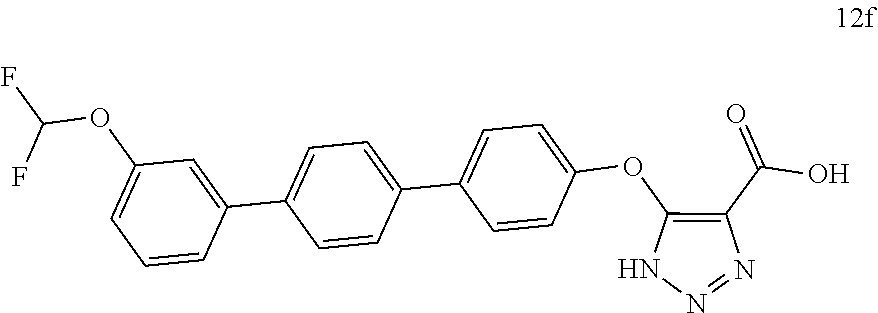


yl)phenoxy)-1H-1,2,3-triazole-4-carboxylate 13b (2.50 g, 5.21 mmol) (75%). 1H NMR (400 MHz, CDCl3) δ 7.71 (d, J=8.7 Hz, 2H), 7.18 (d, J=8.7 Hz, 2H), 6.75 (m, 4H), 5.29 (s, 2H), 4.15 (m, 2H), 3.76 (m, 3H), 1.35 (m, 12H), 1.14 (m, 3H).


| TABLE 1 |
| In vitro inhibition of human glycolate |
| oxidase by compounds of the invention. |
| Example | Compound No. | % Inhibition1 |
| 1 | 8a | + |
| 2 | 8b | +++ |
| 3 | 8c | + |
| 4 | 8d | +++ |
| 5 | 8e | + |
| 6 | 8f | +++ |
| 7 | 8g | ++ |
| 8 | 8h | ++ |
| 9 | 8i | + |
| 10 | 8j | +++ |
| 11 | 12a | ++ |
| 12 | 12b | +++ |
| 13 | 12c | +++ |
| 14 | 12d | ++ |
| 15 | 12e | +++ |
| 16 | 12f | +++ |
| 17 | 12g | + |
| 18 | 12h | +++ |
| 19 | 12i | +++ |
| 20 | 12j | ++ |
| 21 | 12k | +++ |
| 22 | 12l | ++ |
| 23 | 12m | +++ |
| 24 | 16a | +++ |
| 25 | 16b | ++ |
| 26 | 16c | ++ |
| 27 | 16d | ++ |
| 28 | 16e | ++ |
| 29 | 12n | ++ |
| 30 | 12o | +++ |
| 31 | 12p | +++ |
| 32 | 12q | +++ |
| 33 | 12r | +++ |
| 34 | 12s | ++ |
| 35 | 12t | ++ |
| 36 | 8k | +++ |
| 37 | 16f | +++ |
| 38 | 12u | +++ |
| 39 | 12v | ++ |
| 40 | 16g | +++ |
| 41 | 12x | ++ |
| 42 | 8l | ++ |
| 43 | 8m | ++ |
| 44 | 12y | ++ |
| 45 | 8n | + |
| 46 | 8o | +++ |
| 47 | 8p | ++ |
| 48 | 8q | +++ |
| 49 | 8r | +++ |
| 50 | 8s | +++ |
| 51 | 8t | +++ |
| 52 | 8u | ++ |
| 53 | 8v | +++ |
| 54 | 8x | + |
| 55 | 12z | +++ |
| 56 | 8y | + |
| 57 | 8z | + |
| 58 | 8aa | +++ |
| 59 | 12aa | +++ |
| 60 | 8ab | +++ |
| 61 | 12ab | +++ |
| 62 | 12ac | ++ |
| 63 | 12ad | ++ |
| 64 | 12ae | ++ |
| 65 | 8ac | + |
| 66 | 8ad | + |
| 67 | 8ae | + |
| 68 | 8af | + |
| 69 | 8ag | ++ |
| 70 | 8ah | + |
| 71 | 8ai | +++ |
| 72 | 12af | +++ |
| 73 | 12ag | +++ |
| 74 | 12ah | +++ |
| 75 | 12ai | +++ |
| 76 | 8aj | +++ |
| 77 | 8ak | ++ |
| 78 | 12aj | +++ |
| 79 | 12ak | +++ |
| 80 | 12al | +++ |
| 81 | 12am | +++ |
| 82 | 12an | +++ |
| 83 | 12ao | +++ |
| 84 | 12ap | ++ |
| 85 | 12aq | ++ |
| 86 | 12ar | ++ |
| 87 | 8al | ++ |
| 88 | 12as | +++ |
| 89 | 8am | +++ |
| 90 | 12at | +++ |
| 91 | 12au | +++ |
| 92 | 12av | +++ |
| 93 | 12aw | +++ |
| 94 | 12ax | +++ |
| 95 | 8an | + |
| 96 | 12ay | ++ |
| 97 | 12az | ++ |
| 98 | 12ba | +++ |
| 99 | 12bb | +++ |
| 100 | 12bc | +++ |
| 101 | 12bd | +++ |
| 102 | 12be | +++ |
| 103 | 12bf | +++ |
| 104 | 12bg | ++ |
| 105 | 12bh | ++ |
| 106 | 12bi | ++ |
| 107 | 12bj | ++ |
| 108 | 12bk | + |
| 109 | 12bl | + |
| 110 | 12bm | ++ |
| 111 | 12bn | ++ |
| 112 | 12bo | ++ |
| 113 | 12bp | ++ |
| 114 | 12bq | ++ |
| 115 | 12br | ++ |
| 120 | 12bv | ++ |
| 121 | 12bw | +++ |
| 122 | 12bx | ++ |
| 123 | 12by | ++ |
| 126 | 31 | + |
| 127 | 36 | ++ |
| 129 | 12bz | ++ |
| 130 | 8ao | + |
| 131 | 8ap | ++ |
| + = IC50 ≥ 200 nM | ||
| ++ = 100 nM ≥ IC50 ≤ 200 nM | ||
| +++ = IC50 < 100 nM | ||
-
- 1. A compound according to Formula I:

-
- or a pharmaceutically acceptable salt thereof, wherein:
- L is selected from the group consisting of O and S;
- A2 is selected from the group consisting of CR2 and N;
- A3 is selected from the group consisting of CR3 and N;
- A4 is selected from the group consisting of CR4 and N;
- A5 and A6 are independently selected from the group consisting of CH and N;
- the dashed line connected to Z1 is a double bond, Z1 is N, the dashed line connected to Z2 is a single bond, and Z2 is NRδ; or
- the dashed line connected to Z1 is a single bond, Z1 is NRδ, the dashed line connected to Z2 is a double bond, and Z2 is N;
- R1 is selected from Ft, unsubstituted C1-6 alkyl, substituted C1-6 alkyl, —(C1-6 alkylene)-OC(O)—(C1-6 alkyl), and —(C1-6 alkylene)-OC(O)—(C1-6 alkoxy);
- R2 is selected from the group consisting of H and halogen;
- R3 and R4 are independently selected from the group consisting of H, halogen, C1-12 alkyl, C1-12 alkoxy, C6-12 aryl, C3-8 cycloalkyl, 3- to 12-membered heterocyclyl, and 5- to 12-membered heteroaryl;
- R3 is optionally substituted with one or more R3a;
- R4 is optionally substituted with one or more R4a;
- each R3a and R4a is independently selected from the group consisting of C1-12 alkyl, C1-12 alkoxy, C1-12 haloalkyl, C1-12 haloalkoxy, halogen, —OH, —CO2H, —SO3, —CN, —NO2, —N3, C2-12 alkenyl, C2-12 alkynyl, C3-8 cycloalkyl, C3-8 halocycloalkyl, (C6-12 aryl)-M-, 3- to 12-membered heterocyclyl, 5- to 12-membered heteroaryl, —N(Ra)2, —C(O)N(Ra)2, —OC(O)N(Ra)2, —S(O)2N(Ra)2, —NRaC(O)Rb, —C(O)Rb, and —OC(O)Rb;
- R5 is selected from the group consisting of H, unsubstituted C1-6 alkyl, substituted C1-6 alkyl, C2-7 acyl, —(C1-6 alkylene)-OC(O)—(C1-6 alkyl), and —(C1-6 alkylene)-OC(O)—(C1-6 alkoxy);
- each M is independently selected from the group consisting of a covalent bond, NRα, O, S, C1-6 alkylene, and 2- to 6-membered heteroalkylene;
- each Ra is independently selected from the group consisting of H and C1-6 alkyl; and
- each Rb is independently selected from the group consisting of C1-6 alkyl and C1-6 alkoxy;
- provided that if L is O, A2 is CR2, A3 is CR3, A4 is CR4, and A5 and A6 are CH, then:
- at least one of R2, R3, and R4 is other than H,
- R2 is other than chloro or fluoro when R3 and R4 are H,
- R3 is other than chloro, fluoro, methyl, methoxy, trifluoromethyl, or —OH when R2 and R4 are H,
- R4 is other than methyl, ethyl, isopropyl, tert-butyl, methoxy, ethoxy, acetoxy, fluoro, or hydroxy when R2 and R3 are H, and
- R4 is other than fluoro when R2 is fluoro and R3 is H;
- provided that if L is O, A2 is CR2, A3 is N, A4 is CR4, and A5 and A6 are CH, then at least one of R2 and R4 is other than H; and
- provided that if L is S, A2 is CR2, A3 is CR3, A4 is CR4, and A5 and A6 are CH, then:
- R4 is other than methoxy, 4-bromophenyl, or 4-fluorophenyl when R2 and R3 are H, and
- R3 is other than 4-bromophenyl or 4-fluorophenyl when R2 and R4 are H.
- 2. The compound of embodiment 1, or a pharmaceutically acceptable salt thereof, wherein the dashed line connected to Z1 is a double bond, Z1 is N, the dashed line connected to Z2 is a single bond, and Z2 is NRδ.
- 3. The compound of embodiment 1, or a pharmaceutically acceptable salt thereof, wherein the dashed line connected to Z1 is a single bond, Z1 is NRδ, the dashed line connected to Z2 is a double bond, and Z2 is N.
- 4. The compound of any one of embodiments 1-3, or a pharmaceutically acceptable salt thereof, wherein Rδ is H.
- 5. The compound of any one of embodiments 1-3, or a pharmaceutically acceptable salt thereof, wherein Rδ is selected from the group consisting of C2-7 acyl, —(C1-6 alkylene)-OC(O)—(C1-6 alkyl), and —(C1-6 alkylene)-OC(O)—(C1-6 alkoxy).
- 6. The compound of embodiment 1, or a pharmaceutically acceptable salt thereof, having a structure according to Formula Ia:

-
- 7. The compound of embodiment 1 or embodiment 6, or a pharmaceutically acceptable salt thereof, wherein L is O.
- 8. The compound of embodiment 1 or embodiment 6, or a pharmaceutically acceptable salt thereof, wherein L is S.
- 9. The compound of any one of embodiments 1-8, or a pharmaceutically acceptable salt thereof, wherein R2 and R3 are independently selected from the group consisting of H and halogen.
- 10. The compound of any one of embodiments 1-9, or a pharmaceutically acceptable salt thereof, wherein R2 is halogen and R3 is H.
- 11. The compound of embodiment 10, or a pharmaceutically acceptable salt thereof, wherein R4 is H.
- 12. The compound of any one of embodiments 1-9, or a pharmaceutically acceptable salt thereof, wherein R2 is H and R3 is halogen.
- 13. The compound of embodiment 12, or a pharmaceutically acceptable salt thereof, wherein R4 is H.
- 14. The compound of embodiment 12, or a pharmaceutically acceptable salt thereof, wherein R4 is halogen.
- 15. The compound of any one of embodiments 1-9, or a pharmaceutically acceptable salt thereof, wherein R2 and R3 are H.
- 16. The compound of embodiment 15, or a pharmaceutically acceptable salt thereof, wherein R4 is selected from the group consisting of halogen, C1-12 alkyl, C6-12 aryl, 3- to 12-membered heterocyclyl, and 5- to 12-membered heteroaryl, each of which is optionally substituted with one or more R4a.
- 17. The compound of embodiment 16, or a pharmaceutically acceptable salt thereof, wherein R4 is selected from the group consisting of phenyl and biphenyl, each of which is optionally substituted with one or more R4a.
- 18. The compound of embodiment 17, or a pharmaceutically acceptable salt thereof, wherein R4a is selected from the group consisting of C1-12 alkyl, C1-12 alkoxy, C1-12 haloalkyl, C1-12 haloalkoxy, halogen, —CN, 5- to 12-membered heteroaryl, and —C(O)N(Ra)2.
- 19. The compound of embodiment 1, or a pharmaceutically acceptable salt thereof, wherein A3 is N.
- 20. The compound of embodiment 19, or a pharmaceutically acceptable salt thereof, wherein A2 is CR2, A4 is CR4, A5 is CH, and A6 is CH.
- 21. The compound of embodiment 19 or embodiment 20, or a pharmaceutically acceptable salt thereof, wherein R2 is H.
- 22. The compound of any one of embodiments 19-21, or a pharmaceutically acceptable salt thereof, wherein R4 is halogen.
- 23. The compound of any one of embodiments 1-22, or a pharmaceutically acceptable salt thereof, wherein R1 is H.
- 24. The compound of any one of embodiments 1-22, or a pharmaceutically acceptable salt thereof, wherein R1 is selected from the group consisting of unsubstituted C1-6 alkyl and substituted C1-6 alkyl.
- 25. The compound of any one of embodiments 1-22, or a pharmaceutically acceptable salt thereof, wherein R1 is selected from the group consisting of —(C1-6 alkylene)-OC(O)—(C1-6 alkyl) and —(C1-6 alkylene)-OC(O)—(C1-6 alkoxy).
- 26. The compound of embodiment 25, or a pharmaceutically acceptable salt thereof, wherein R1 is —(C1-6 alkylene)-OC(O)—(C1-6 alkoxy).
- 27. The compound of embodiment 1, which is a triazole as described herein, a tautomer thereof, or a pharmaceutically acceptable salt thereof.
- 28. A pharmaceutical composition comprising a compound according to any one of embodiments 1-27, or a pharmaceutically acceptable salt thereof, and a pharmaceutically acceptable excipient.
- 29. A method for treating primary hyperoxaluria, type I (PH1) comprising administering to a subject in need thereof a therapeutically effective amount of a compound according to any one of embodiments 1-27, or a pharmaceutically acceptable salt thereof, or a pharmaceutical composition according to embodiment 28.
- 30. A method for treating kidney stones comprising administering to a subject in need thereof a therapeutically effective amount of a compound according to any one of embodiments 1-27, or a pharmaceutically acceptable salt thereof, or a pharmaceutical composition according to embodiment 28.
- 31. A method for treating primary hyperoxaluria, type I (PH1) comprising administering to a subject in need thereof a therapeutically effective amount of a compound according to Formula II:

-
- or a pharmaceutically acceptable salt thereof, wherein:
- L is selected from the group consisting of O and S;
- A2 is selected from the group consisting of CR2 and N;
- A3 is selected from the group consisting of CR3 and N;
- A4 is selected from the group consisting of CR4 and N;
- A5 and A6 are independently selected from the group consisting of CH and N;
- the dashed line connected to Z1 is a double bond, Z1 is N, the dashed line connected to Z2 is a single bond, and Z2 is NRδ; or
- the dashed line connected to Z1 is a single bond, Z1 is NRδ, the dashed line connected to Z2 is a double bond, and Z2 is N;
- R1 is selected from the group consisting of H, unsubstituted C1-6 alkyl, substituted C1-6 alkyl, —(C1-6 alkylene)-OC(O)—(C1-6 alkyl), and —(C1-6 alkylene)-OC(O)—(C1-6 alkoxy);
- R2 is selected from the group consisting of H and halogen;
- R3 and R4 are independently selected from the group consisting of H, halogen, C1-12 alkyl, C1-12 alkoxy, C6-12 aryl, C3-8 cycloalkyl, 3- to 12-membered heterocyclyl, and 5- to 12-membered heteroaryl;
- R3 is optionally substituted with one or more R3a; and
- R4 is optionally substituted with one or more R4a; and
- each R3a and R4a is independently selected from the group consisting of C1-12 alkyl, C1-12 alkoxy, C1-12 haloalkyl, C1-12 haloalkoxy, halogen, —OH, —CO2H, —SO3, —CN, —NO2, —N3, C2-12 alkenyl, C2-12 alkynyl, C3-8 cycloalkyl, C3-8 halocycloalkyl, (C6-12 aryl)-M-, 3- to 12-membered heterocyclyl, 5- to 12-membered heteroaryl, —N(Ra)2, —C(O)N(Ra)2, —OC(O)N(Ra)2, —S(O)2N(Ra)2, —NRaC(O)Rb, —C(O)Rb, and —OC(O)Rb;
- R5 is selected from the group consisting of H, unsubstituted C1-6 alkyl, substituted C1-6 alkyl, C2-7 acyl, —(C1-6 alkylene)-OC(O)—(C1-6 alkyl), and —(C1-6 alkylene)-OC(O)—(C1-6 alkoxy);
- each M is independently selected from a covalent bond, NRα, O, S, C1-6 alkylene, and 2- to 6-membered heteroalkylene;
- each Ra is independently selected from the group consisting of H and C1-6 alkyl; and
- each Rb is independently selected from the group consisting of C1-6 alkyl and C1-6 alkoxy;
- provided that if L is S, A2 is CR2, A3 is CR3, A4 is CR4, and A5 and A6 are CH, then:
- R4 is other than methoxy, 4-bromophenyl, or 4-fluorophenyl when R2 and R3 are H, and
- R3 is other than 4-bromophenyl or 4-fluorophenyl when R2 and R4 are H.
- 32. A method for treating kidney stones comprising administering to a subject in need thereof a therapeutically effective amount of a compound according to Formula II:

-
- or a pharmaceutically acceptable salt thereof, wherein:
- L is selected from the group consisting of O and S;
- A2 is selected from the group consisting of CR2 and N;
- A3 is selected from the group consisting of CR3 and N;
- A4 is selected from the group consisting of CR4 and N;
- A5 and A6 are independently selected from the group consisting of CH and N;
- the dashed line connected to Z1 is a double bond, Z1 is N, the dashed line connected to Z2 is a single bond, and Z2 is NR5; or
- the dashed line connected to Z1 is a single bond, Z1 is NRδ, the dashed line connected to Z2 is a double bond, and Z2 is N;
- R1 is selected from the group consisting of H, unsubstituted C1-6 alkyl, substituted C1-6 alkyl, —(C1-6 alkylene)-OC(O)—(C1-6 alkyl), and —(C1-6 alkylene)-OC(O)—(C1-6 alkoxy);
- R2 is selected from the group consisting of H and halogen;
- R3 and R4 are independently selected from the group consisting of H, halogen, C1-12 alkyl, C1-12 alkoxy, C6-12 aryl, C3-8 cycloalkyl, 3- to 12-membered heterocyclyl, and 5- to 12-membered heteroaryl;
- R3 is optionally substituted with one or more R3a; and
- R4 is optionally substituted with one or more R4a; and
- each R3a and R4a is independently selected from the group consisting of C1-12 alkyl, C1-12 alkoxy, C1-12 haloalkyl, C1-12 haloalkoxy, halogen, —OH, —CO2H, —SO3, —CN, —NO2, —N3, C2-12 alkenyl, C2-12 alkynyl, C3-8 cycloalkyl, C3-8 halocycloalkyl, (C6-12 aryl)-M−, 3- to 12-membered heterocyclyl, 5- to 12-membered heteroaryl, —N(Ra)2, —C(O)N(Ra)2, —OC(O)N(Ra)2, —S(O)2N(Ra)2, —NRaC(O)Rb, —C(O)Rb, and —OC(O)Rb;
- Rδ is selected from the group consisting of H, unsubstituted C1-6 alkyl, substituted C1-6 alkyl, C2-7 acyl, —(C1-6 alkylene)-OC(O)—(C1-6 alkyl), and —(C1-6 alkylene)-OC(O)—(C1-6 alkoxy);
- each M is independently selected from a covalent bond, NRa, O, S, C1-6 alkylene, and 2- to 6-membered heteroalkylene;
- each Ra is independently selected from the group consisting of H and C1-6 alkyl; and
- each Rb is independently selected from the group consisting of C1-6 alkyl and C1-6 alkoxy;
- provided that if L is S, A2 is CR2, A3 is CR3, A4 is CR4, and A5 and A6 are CH, then:
- R4 is other than methoxy, 4-bromophenyl, or 4-fluorophenyl when R2 and R3 are H, and
- R3 is other than 4-bromophenyl or 4-fluorophenyl when R2 and R4 are H.
- 33. The method of embodiment 31 or embodiment 32, wherein R2 and R3 are independently selected from the group consisting of H and halogen
- 34. The method of any one of embodiments 31-33, wherein L is O.
- 35. The method of embodiment 31 or embodiment 32, wherein the compound is a triazole compound as described herein, a tautomer thereof, or a pharmaceutically acceptable salt thereof.
- 36. A method for inhibiting glycolate oxidase comprising contacting glycolate oxidase with an effective amount of a compound as recited in any one of embodiments 1-27 and 32-35.
Claims (23)


Priority Applications (1)
| Application Number | Priority Date | Filing Date | Title |
|---|---|---|---|
| US17/255,600 US11401246B2 (en) | 2018-07-06 | 2019-07-05 | Triazole glycolate oxidase inhibitors |
Applications Claiming Priority (4)
| Application Number | Priority Date | Filing Date | Title |
|---|---|---|---|
| US201862694918P | 2018-07-06 | 2018-07-06 | |
| US201962827573P | 2019-04-01 | 2019-04-01 | |
| PCT/US2019/040690 WO2020010309A1 (en) | 2018-07-06 | 2019-07-05 | Triazole glycolate oxidase inhibitors |
| US17/255,600 US11401246B2 (en) | 2018-07-06 | 2019-07-05 | Triazole glycolate oxidase inhibitors |
Related Parent Applications (1)
| Application Number | Title | Priority Date | Filing Date |
|---|---|---|---|
| PCT/US2019/040690 A-371-Of-International WO2020010309A1 (en) | 2018-07-06 | 2019-07-05 | Triazole glycolate oxidase inhibitors |
Related Child Applications (1)
| Application Number | Title | Priority Date | Filing Date |
|---|---|---|---|
| US17/843,455 Continuation US20230143491A1 (en) | 2018-07-06 | 2022-06-17 | Triazole glycolate oxidase inhibitors |
Publications (2)
| Publication Number | Publication Date |
|---|---|
| US20210403439A1 US20210403439A1 (en) | 2021-12-30 |
| US11401246B2 true US11401246B2 (en) | 2022-08-02 |
Family
ID=67441692
Family Applications (2)
| Application Number | Title | Priority Date | Filing Date |
|---|---|---|---|
| US17/255,600 Active US11401246B2 (en) | 2018-07-06 | 2019-07-05 | Triazole glycolate oxidase inhibitors |
| US17/843,455 Abandoned US20230143491A1 (en) | 2018-07-06 | 2022-06-17 | Triazole glycolate oxidase inhibitors |
Family Applications After (1)
| Application Number | Title | Priority Date | Filing Date |
|---|---|---|---|
| US17/843,455 Abandoned US20230143491A1 (en) | 2018-07-06 | 2022-06-17 | Triazole glycolate oxidase inhibitors |
Country Status (14)
| Country | Link |
|---|---|
| US (2) | US11401246B2 (en) |
| EP (1) | EP3817816A1 (en) |
| JP (1) | JP7348705B2 (en) |
| KR (1) | KR102865323B1 (en) |
| CN (1) | CN112399873B (en) |
| AU (1) | AU2019297523B2 (en) |
| BR (1) | BR112021000050A2 (en) |
| CO (1) | CO2021001277A2 (en) |
| IL (1) | IL279952B2 (en) |
| MX (1) | MX2021000051A (en) |
| PE (1) | PE20210859A1 (en) |
| SA (1) | SA521420951B1 (en) |
| SG (1) | SG11202012930RA (en) |
| WO (1) | WO2020010309A1 (en) |
Families Citing this family (7)
| Publication number | Priority date | Publication date | Assignee | Title |
|---|---|---|---|---|
| PE20210859A1 (en) | 2018-07-06 | 2021-05-18 | Orfan Biotech Inc | TRIAZOL GLYCOLATE OXIDASE INHIBITORS |
| CN120381447A (en) | 2019-11-01 | 2025-07-29 | 紫丁香疗法有限公司 | Heterocyclic carboxylate compounds as glycolate oxidase inhibitors |
| ES3049309T3 (en) * | 2020-01-08 | 2025-12-16 | Cantero Therapeutics Inc | Processes for preparing triazole glycolate oxidase inhibitors |
| WO2022066933A1 (en) * | 2020-09-24 | 2022-03-31 | Chinook Therapeutics Canada, Inc. | Pentafluoro-sulfanyl -substituted triazolyl compounds and methods of use thereof |
| TW202339727A (en) * | 2021-10-11 | 2023-10-16 | 美商坎特羅治療股份有限公司 | Treatment methods with 1h-1,2,3-triazole-4-carboxylic acids |
| WO2024109917A1 (en) * | 2022-11-25 | 2024-05-30 | 西藏海思科制药有限公司 | Triazole derivative and application thereof in medicine |
| WO2024212137A1 (en) * | 2023-04-12 | 2024-10-17 | Cantero Therapeutics, Inc. | Crystalline forms of a 1h-1, 2, 3-triazole-4-carboxylic acid compound |
Citations (18)
| Publication number | Priority date | Publication date | Assignee | Title |
|---|---|---|---|---|
| JPS63215680A (en) | 1987-03-02 | 1988-09-08 | Dai Ichi Seiyaku Co Ltd | Benzopyranotriazole derivative |
| US7022702B2 (en) | 2000-04-07 | 2006-04-04 | Qlt Inc. | Antiproliferative 1,2,3-thiadiazole compounds |
| US20080207587A1 (en) | 2004-09-20 | 2008-08-28 | Xenon Pharmaceuticals Inc. | Pyridazine Derivatives for Inhibiting Human Stearoyl-Coa-Desaturase |
| US8431574B2 (en) | 2003-11-19 | 2013-04-30 | Array Biopharma Inc. | Heterocyclic inhibitors of MEK and methods of use thereof |
| WO2013104573A1 (en) | 2012-01-10 | 2013-07-18 | F. Hoffmann-La Roche Ag | Pyridazine amide compounds and their use as syk inhibitors |
| US20140030369A1 (en) | 1998-12-29 | 2014-01-30 | Thomas T. Yamashita | Soil Amendment Compositions and Methods for Using the Same |
| WO2014064802A1 (en) | 2012-10-25 | 2014-05-01 | アサヒグループホールディングス株式会社 | Method for increasing production of latex |
| WO2014113485A1 (en) | 2013-01-15 | 2014-07-24 | Intermune, Inc. | Lysophosphatidic acid receptor antagonists |
| WO2015185717A1 (en) | 2014-06-06 | 2015-12-10 | Lesaffre Et Compagnie | Method and composition for improving the productivity of non-leguminous plants |
| WO2016110885A1 (en) | 2015-01-08 | 2016-07-14 | アサヒグループホールディングス株式会社 | Effective tilling promoter and effective tilling promoting method |
| US20160262402A1 (en) | 2013-03-15 | 2016-09-15 | Spogen Biotech Inc. | Plant growth-promoting bacteria and methods of use |
| WO2016148193A1 (en) | 2015-03-19 | 2016-09-22 | 興人ライフサイエンス株式会社 | Yeast extract having effect of promoting growth of plant and elongation of root and effect of improving added values of plant |
| WO2017100266A1 (en) | 2015-12-07 | 2017-06-15 | Wake Forest University Health Sciences | Glycolate oxidase inhibitors and methods of use for the treatment of kidney stones |
| WO2019133813A1 (en) | 2017-12-29 | 2019-07-04 | Orfan Biotech Inc. | Glycolate oxidase inhibitors and use thereof |
| WO2019133770A2 (en) | 2017-12-29 | 2019-07-04 | Biomarin Pharmaceutical Inc. | Glycolate oxidase inhibitors for the treatment of disease |
| WO2019165159A1 (en) | 2018-02-23 | 2019-08-29 | Oxalurx, Inc. | Compounds and methods for treating oxalate-related diseases |
| WO2020010309A1 (en) | 2018-07-06 | 2020-01-09 | Orfan Biotech Inc. | Triazole glycolate oxidase inhibitors |
| WO2020257487A1 (en) | 2019-06-19 | 2020-12-24 | Biomarin Pharmaceutical Inc. | Glycolate oxidase inhibitors for the treatment of disease |
Family Cites Families (1)
| Publication number | Priority date | Publication date | Assignee | Title |
|---|---|---|---|---|
| CN101307307A (en) * | 2008-07-11 | 2008-11-19 | 华东理工大学 | A kind of glycolic acid oxidase preparation, preparation method and application |
-
2019
- 2019-07-05 PE PE2021000011A patent/PE20210859A1/en unknown
- 2019-07-05 EP EP19745452.3A patent/EP3817816A1/en active Pending
- 2019-07-05 MX MX2021000051A patent/MX2021000051A/en unknown
- 2019-07-05 JP JP2021521945A patent/JP7348705B2/en active Active
- 2019-07-05 US US17/255,600 patent/US11401246B2/en active Active
- 2019-07-05 IL IL279952A patent/IL279952B2/en unknown
- 2019-07-05 SG SG11202012930RA patent/SG11202012930RA/en unknown
- 2019-07-05 AU AU2019297523A patent/AU2019297523B2/en active Active
- 2019-07-05 WO PCT/US2019/040690 patent/WO2020010309A1/en not_active Ceased
- 2019-07-05 BR BR112021000050-0A patent/BR112021000050A2/en unknown
- 2019-07-05 CN CN201980045610.4A patent/CN112399873B/en active Active
- 2019-07-05 KR KR1020217003486A patent/KR102865323B1/en active Active
-
2021
- 2021-01-03 SA SA521420951A patent/SA521420951B1/en unknown
- 2021-02-05 CO CONC2021/0001277A patent/CO2021001277A2/en unknown
-
2022
- 2022-06-17 US US17/843,455 patent/US20230143491A1/en not_active Abandoned
Patent Citations (21)
| Publication number | Priority date | Publication date | Assignee | Title |
|---|---|---|---|---|
| JPS63215680A (en) | 1987-03-02 | 1988-09-08 | Dai Ichi Seiyaku Co Ltd | Benzopyranotriazole derivative |
| US20140030369A1 (en) | 1998-12-29 | 2014-01-30 | Thomas T. Yamashita | Soil Amendment Compositions and Methods for Using the Same |
| US7022702B2 (en) | 2000-04-07 | 2006-04-04 | Qlt Inc. | Antiproliferative 1,2,3-thiadiazole compounds |
| US7288556B2 (en) | 2000-04-07 | 2007-10-30 | Qlt Inc. | Antiproliferative 1,2,3-thiadiazole compounds |
| US8431574B2 (en) | 2003-11-19 | 2013-04-30 | Array Biopharma Inc. | Heterocyclic inhibitors of MEK and methods of use thereof |
| US20080207587A1 (en) | 2004-09-20 | 2008-08-28 | Xenon Pharmaceuticals Inc. | Pyridazine Derivatives for Inhibiting Human Stearoyl-Coa-Desaturase |
| WO2013104573A1 (en) | 2012-01-10 | 2013-07-18 | F. Hoffmann-La Roche Ag | Pyridazine amide compounds and their use as syk inhibitors |
| WO2014064802A1 (en) | 2012-10-25 | 2014-05-01 | アサヒグループホールディングス株式会社 | Method for increasing production of latex |
| WO2014113485A1 (en) | 2013-01-15 | 2014-07-24 | Intermune, Inc. | Lysophosphatidic acid receptor antagonists |
| US20160262402A1 (en) | 2013-03-15 | 2016-09-15 | Spogen Biotech Inc. | Plant growth-promoting bacteria and methods of use |
| WO2015185717A1 (en) | 2014-06-06 | 2015-12-10 | Lesaffre Et Compagnie | Method and composition for improving the productivity of non-leguminous plants |
| WO2016110885A1 (en) | 2015-01-08 | 2016-07-14 | アサヒグループホールディングス株式会社 | Effective tilling promoter and effective tilling promoting method |
| WO2016148193A1 (en) | 2015-03-19 | 2016-09-22 | 興人ライフサイエンス株式会社 | Yeast extract having effect of promoting growth of plant and elongation of root and effect of improving added values of plant |
| WO2017100266A1 (en) | 2015-12-07 | 2017-06-15 | Wake Forest University Health Sciences | Glycolate oxidase inhibitors and methods of use for the treatment of kidney stones |
| WO2019133813A1 (en) | 2017-12-29 | 2019-07-04 | Orfan Biotech Inc. | Glycolate oxidase inhibitors and use thereof |
| WO2019133770A2 (en) | 2017-12-29 | 2019-07-04 | Biomarin Pharmaceutical Inc. | Glycolate oxidase inhibitors for the treatment of disease |
| US20210171474A1 (en) * | 2017-12-29 | 2021-06-10 | Biomarin Pharmaceutical Inc. | Glycolate oxidase inhibitors for the treatment of disease |
| US20210171503A1 (en) | 2017-12-29 | 2021-06-10 | Orfan Biotech Inc. | Glycolate oxidase inhibitors and use thereof |
| WO2019165159A1 (en) | 2018-02-23 | 2019-08-29 | Oxalurx, Inc. | Compounds and methods for treating oxalate-related diseases |
| WO2020010309A1 (en) | 2018-07-06 | 2020-01-09 | Orfan Biotech Inc. | Triazole glycolate oxidase inhibitors |
| WO2020257487A1 (en) | 2019-06-19 | 2020-12-24 | Biomarin Pharmaceutical Inc. | Glycolate oxidase inhibitors for the treatment of disease |
Non-Patent Citations (34)
| Title |
|---|
| Bourhis et al., Structure of human glycolate oxidase in complex with the inhibitor 4-carboxy-5-[4-chlorophenyl)-sulfanyl]-1,2,3-thiadiazole, Acta Crystallographica, 2009, F65, pp. 1246-1253. |
| Buckle et al., Studies on v-triazoles. 7. Antiallergic 9-oxo-1H,9H-benzopyrano[2,3-d]-v-triazoles, Journal of Medicinal chemistry, Feb. 1, 1983, vol. 26, No. 2,pp. 251-254. |
| Coe et al., Kidney Stone Disease, The Journal of Clinical Investigation, 2005, vol. 115, No. 10, pp. 2598-2608. |
| Database Registry, Database accession No. 2104463-72-9, Chemical Abstracts Service, Columbus, Ohio, US, Jul. 28, 2017. |
| Database Registry, Database accession No. 2117454-53-0, Chemical Abstracts Service, Columbus, Ohio, US, Aug. 21, 2017. |
| Database Registry, Database accession No. 2122068-03-3, Chemical Abstracts Service, Columbus, Ohio, US, Aug. 29, 2017. |
| Database Registry, Database accession No. RN 2091856-74-3, Chemical Abstracts Service, Columbus, Ohio, Apr. 18, 2017. |
| Database Registry, Database accession No. RN 678541-52-1, Chemical Abstracts Service, Columbus, Ohio, May 2, 2004. |
| European Patent Office, Partial European Search Report for European Patent Application No. 18895918.3, dated May 14, 2021, 11 pages. |
| Frishberg et al., Mutations in HA01 encoding glycolate oxidase cause isolated glycolic aciduria, J Med Genet., Jul. 15, 2014, pp. 1-4. |
| Holmes et al., Contribution of dietary oxalate to urinary oxalate excretion, Kidney International, 2001, vol. 59, pp. 270-276. |
| International Search Report for PCT/US2018/067863, dated May 9, 2019, 4 pages. |
| International Search Report for PCT/US2019/040690, dated Jan. 2, 2020, 8 pages. |
| Johri et al., An Update and practical guide to Renal Stone Management, Nephron Clinical Practice, Jul. 2, 2010, c115-c171. |
| Kaufman et al., Oxalobacter formigenes May Reduce the Risk of Calcium Oxalate Kidney Stones, Journal of the American Society of Nephrology, 2008, vol. 19, pp. 1197-1203. |
| Leeson et al., The influence of drug-like concepts on decision-making in medicinal chemistry. Nature Reviews Drug Discovery, Nov. 2007, vol. 6, pp. 881-890. |
| Leonardi et al., Coenzyme A: back in action, Progress in Lipid Research, 2005, vol. 44 pp. 125-153. |
| Marengo et al., Oxalate in renal stone disease: The terminal metabolite that just won't go away, Nature Clinical Practice Nephrology, Jul. 2008, vol. 4, No. 7, pp. 368-377. |
| Moe, Kidney stones: pathophysiology and medical management, Lancet, Jan. 28, 2006, vol. 367, pp. 333-344. |
| Pak et al., Relative effect of urinary calcium and oxalate on saturation of calcium oxalate, Kidney International, 2004, vol. 66, pp. 2032-2037. |
| Pubchem CID 22219773, created Dec. 5, 2017, 9 pages. |
| Pubchem CID 59519495, created Aug. 20, 2012, 6 pages. |
| Randall et al., Quantitative Structure-Activity Relationships Involving the Inhibition of Glycolic Acid Oxidase by Derivatives of Glycolic and Blyoxylic Acids, Journal of Medicinal Chemistry, 1979, vol. 22, pp. 608-614. |
| Rock et al., The murine pantothenate kinase (Pank1) gene encodes two differentially regulated pantothenate kinase isozymes, Gene, 2002, vol. 291, pp. 35-43. |
| Rooney et al., Inhibitors of Glycolic Acid Oxidase. 4-Substituted 3-Hydroxy-1H-pyrrole-2,5-diione Derivatives,Journal of Medicinal Chemistry, 1983, vol. 26, pp. 700-714. |
| Sakhaee, Recent advance in the pathophysiology of nephrolithiasis, Kidney International, 2009, vol. 75, pp. 585-595. |
| Salido et al., Primary hyperoxalurias: disorders of glyoxylae detoxification, Biochimica et Biophysica Acta, 2012, 1822, pp. 1453-1464. |
| Shultz, Setting expectations in molecular optimizations: Strengths and limitations of commonly used composite parameters, Bioorganic & Medicinal chemistry Letters, 2013, vol. 23, pp. 5980-5991. |
| Stenberg et al., Three-dimensional structures of glycolate oxidase with bound active-site inhibitors, Protein Science, 1997, vol. 6, pp. 1009-1015. |
| Williams et al., Inhibitors of Glycolic Acid Oxidase. 4-Substituted 2,4-Dioxobutanoic Acid Derivative, Journal of Medicinal chemistry, 1983, vol. 26, pp. 1196-1200. |
| Written Opinion of the International Searching Authority (ISA/US) for PCT/US2018/067863, dated May 9, 2019, 6 pages. |
| Written Opinion of the International Searching Authority (ISA/US) for PCT/US2019/040690, dated Jan. 2, 2020, 10 pages. |
| Zhang et al., Feedback Regulation of Murine Pantothenate Kinase 3 by Coenzyme A and Coenzyme A thioesteers, the Journal of Biological Chemistry, Sep. 23, 2005, vol. 280, No. 38, pp. 32594-32601. |
| Zhang et al., Feedback Regulation of Murine Pantothenate Kinase 3 by Coenzyme A and Coenzyme A Thioesters, the Journal of biological Chemistry, Sep. 23, 2005, vol. 280, pp. 32594-32601. |
Also Published As
| Publication number | Publication date |
|---|---|
| WO2020010309A9 (en) | 2020-01-30 |
| CA3104529A1 (en) | 2020-01-09 |
| JP2021530560A (en) | 2021-11-11 |
| US20230143491A1 (en) | 2023-05-11 |
| US20210403439A1 (en) | 2021-12-30 |
| IL279952A (en) | 2021-03-01 |
| PE20210859A1 (en) | 2021-05-18 |
| KR102865323B1 (en) | 2025-09-26 |
| BR112021000050A2 (en) | 2021-04-06 |
| SA521420951B1 (en) | 2024-03-24 |
| MX2021000051A (en) | 2021-03-25 |
| SG11202012930RA (en) | 2021-01-28 |
| WO2020010309A1 (en) | 2020-01-09 |
| CN112399873B (en) | 2024-10-25 |
| CN112399873A (en) | 2021-02-23 |
| EP3817816A1 (en) | 2021-05-12 |
| IL279952B1 (en) | 2024-07-01 |
| AU2019297523A1 (en) | 2021-02-25 |
| IL279952B2 (en) | 2024-11-01 |
| CO2021001277A2 (en) | 2021-04-30 |
| JP7348705B2 (en) | 2023-09-21 |
| AU2019297523B2 (en) | 2025-04-17 |
| KR20210041564A (en) | 2021-04-15 |
Similar Documents
| Publication | Publication Date | Title |
|---|---|---|
| US20230143491A1 (en) | Triazole glycolate oxidase inhibitors | |
| US12083118B2 (en) | Substituted 1,1′-biphenyl compounds, analogues thereof, and methods using same | |
| US20240207300A1 (en) | Combination therapies including myt1 inhibitors | |
| US9023882B2 (en) | 5-membered nitrogen containing heterocyclic derivatives and pharmaceutical compositions comprising the same | |
| US7998987B2 (en) | Inhibitors of c-Met and uses thereof | |
| US8829040B2 (en) | (aza)indole derivative and use thereof for medical purposes | |
| US20210171503A1 (en) | Glycolate oxidase inhibitors and use thereof | |
| EP2886534A1 (en) | Benzene or thiophene derivative and use thereof as VAP-1 inhibitor | |
| US20230078764A1 (en) | Compounds and uses thereof | |
| US11028054B2 (en) | 1, 4, 6-trisubstituted-2-alkyl-1H-benzo[d]imidazole derivatives as dihydroorotate oxygenase inhibitors | |
| US10919869B2 (en) | Thiazole derivative and applications | |
| US11103511B2 (en) | Substituted indolo[2,1-b]quinazolines as inhibitors of tryptophan dioxygenase and indoleamine 2,3-dioxygenase 1 | |
| US20230129160A1 (en) | Processes for preparing triazole glycolate oxidase inhibitors | |
| US20240228491A1 (en) | Methionine adenosyltransferase inhibitor, preparation method therefor and application thereof | |
| CA3104529C (en) | Triazole glycolate oxidase inhibitors | |
| US20240262803A1 (en) | Compounds, compositions and methods of treating disorders | |
| US20230295110A1 (en) | Phd inhibitor compounds, compositions, and methods of use | |
| US7875615B2 (en) | Substituted triazole derivatives as oxytocin antagonists |
Legal Events
| Date | Code | Title | Description |
|---|---|---|---|
| FEPP | Fee payment procedure |
Free format text: ENTITY STATUS SET TO UNDISCOUNTED (ORIGINAL EVENT CODE: BIG.); ENTITY STATUS OF PATENT OWNER: LARGE ENTITY |
|
| FEPP | Fee payment procedure |
Free format text: ENTITY STATUS SET TO SMALL (ORIGINAL EVENT CODE: SMAL); ENTITY STATUS OF PATENT OWNER: LARGE ENTITY |
|
| STPP | Information on status: patent application and granting procedure in general |
Free format text: NON FINAL ACTION MAILED |
|
| STPP | Information on status: patent application and granting procedure in general |
Free format text: RESPONSE TO NON-FINAL OFFICE ACTION ENTERED AND FORWARDED TO EXAMINER |
|
| STPP | Information on status: patent application and granting procedure in general |
Free format text: NOTICE OF ALLOWANCE MAILED -- APPLICATION RECEIVED IN OFFICE OF PUBLICATIONS |
|
| FEPP | Fee payment procedure |
Free format text: ENTITY STATUS SET TO UNDISCOUNTED (ORIGINAL EVENT CODE: BIG.); ENTITY STATUS OF PATENT OWNER: LARGE ENTITY |
|
| STPP | Information on status: patent application and granting procedure in general |
Free format text: PUBLICATIONS -- ISSUE FEE PAYMENT VERIFIED |
|
| STCF | Information on status: patent grant |
Free format text: PATENTED CASE |
|
| AS | Assignment |
Owner name: BLUE OWL CAPITAL CORPORATION, AS ADMINISTRATIVE AGENT, NEW YORK Free format text: SECURITY INTEREST;ASSIGNORS:CALCILYTIX THERAPEUTICS INC.;ADRENAS THERAPEUTICS INC.;PHOENIX TISSUE REPAIR, INC.;AND OTHERS;REEL/FRAME:066342/0154 Effective date: 20240117 |
|
| AS | Assignment |
Owner name: BLUE OWL CAPITAL CORPORATION, AS ADMINISTRATIVE AGENT, NEW YORK Free format text: SECURITY INTEREST;ASSIGNORS:BRIDGEBIO PHARMA, INC.;QED THERAPEUTICS, INC.;EIDOS THERAPEUTICS, INC.;AND OTHERS;REEL/FRAME:066355/0126 Effective date: 20240117 |
|
| AS | Assignment |
Owner name: FERRO THERAPEUTICS, INC., CALIFORNIA Free format text: RELEASE OF SECURITY INTEREST IN PATENT COLLATERAL;ASSIGNOR:BLUE OWL CAPITAL CORPORATION, AS ADMINISTRATIVE AGENT;REEL/FRAME:070551/0095 Effective date: 20250228 Owner name: BRIDGEBIO GENE THERAPY RESEARCH, INC., CALIFORNIA Free format text: RELEASE OF SECURITY INTEREST IN PATENT COLLATERAL;ASSIGNOR:BLUE OWL CAPITAL CORPORATION, AS ADMINISTRATIVE AGENT;REEL/FRAME:070551/0095 Effective date: 20250228 Owner name: PORTAL THERAPEUTICS, INC., CALIFORNIA Free format text: RELEASE OF SECURITY INTEREST IN PATENT COLLATERAL;ASSIGNOR:BLUE OWL CAPITAL CORPORATION, AS ADMINISTRATIVE AGENT;REEL/FRAME:070551/0095 Effective date: 20250228 Owner name: COA THERAPEUTICS, INC., CALIFORNIA Free format text: RELEASE OF SECURITY INTEREST IN PATENT COLLATERAL;ASSIGNOR:BLUE OWL CAPITAL CORPORATION, AS ADMINISTRATIVE AGENT;REEL/FRAME:070551/0095 Effective date: 20250228 Owner name: CANTERO THERAPEUTICS, INC., CALIFORNIA Free format text: RELEASE OF SECURITY INTEREST IN PATENT COLLATERAL;ASSIGNOR:BLUE OWL CAPITAL CORPORATION, AS ADMINISTRATIVE AGENT;REEL/FRAME:070551/0095 Effective date: 20250228 Owner name: MOLECULAR SKIN THERAPEUTICS, INC., CALIFORNIA Free format text: RELEASE OF SECURITY INTEREST IN PATENT COLLATERAL;ASSIGNOR:BLUE OWL CAPITAL CORPORATION, AS ADMINISTRATIVE AGENT;REEL/FRAME:070551/0095 Effective date: 20250228 Owner name: VENTHERA, INC., CALIFORNIA Free format text: RELEASE OF SECURITY INTEREST IN PATENT COLLATERAL;ASSIGNOR:BLUE OWL CAPITAL CORPORATION, AS ADMINISTRATIVE AGENT;REEL/FRAME:070551/0095 Effective date: 20250228 Owner name: NAVIRE PHARMA, INC., CALIFORNIA Free format text: RELEASE OF SECURITY INTEREST IN PATENT COLLATERAL;ASSIGNOR:BLUE OWL CAPITAL CORPORATION, AS ADMINISTRATIVE AGENT;REEL/FRAME:070551/0095 Effective date: 20250228 Owner name: PHOENIX TISSUE REPAIR, INC., CALIFORNIA Free format text: RELEASE OF SECURITY INTEREST IN PATENT COLLATERAL;ASSIGNOR:BLUE OWL CAPITAL CORPORATION, AS ADMINISTRATIVE AGENT;REEL/FRAME:070551/0095 Effective date: 20250228 Owner name: ADRENAS THERAPEUTICS INC., CALIFORNIA Free format text: RELEASE OF SECURITY INTEREST IN PATENT COLLATERAL;ASSIGNOR:BLUE OWL CAPITAL CORPORATION, AS ADMINISTRATIVE AGENT;REEL/FRAME:070551/0095 Effective date: 20250228 Owner name: CALCILYTIX THERAPEUTICS INC., CALIFORNIA Free format text: RELEASE OF SECURITY INTEREST IN PATENT COLLATERAL;ASSIGNOR:BLUE OWL CAPITAL CORPORATION, AS ADMINISTRATIVE AGENT;REEL/FRAME:070551/0095 Effective date: 20250228 Owner name: ML BIO SOLUTIONS INC., CALIFORNIA Free format text: RELEASE OF SECURITY INTEREST IN PATENT COLLATERAL;ASSIGNOR:BLUE OWL CAPITAL CORPORATION, AS ADMINISTRATIVE AGENT;REEL/FRAME:070551/0095 Effective date: 20250228 Owner name: EIDOS THERAPEUTICS, INC., CALIFORNIA Free format text: RELEASE OF SECURITY INTEREST IN PATENT COLLATERAL;ASSIGNOR:BLUE OWL CAPITAL CORPORATION, AS ADMINISTRATIVE AGENT;REEL/FRAME:070551/0095 Effective date: 20250228 Owner name: QED THERAPEUTICS, INC., CALIFORNIA Free format text: RELEASE OF SECURITY INTEREST IN PATENT COLLATERAL;ASSIGNOR:BLUE OWL CAPITAL CORPORATION, AS ADMINISTRATIVE AGENT;REEL/FRAME:070551/0095 Effective date: 20250228 Owner name: BRIDGEBIO PHARMA, INC., CALIFORNIA Free format text: RELEASE OF SECURITY INTEREST IN PATENT COLLATERAL;ASSIGNOR:BLUE OWL CAPITAL CORPORATION, AS ADMINISTRATIVE AGENT;REEL/FRAME:070551/0095 Effective date: 20250228 |
|
| MAFP | Maintenance fee payment |
Free format text: PAYMENT OF MAINTENANCE FEE, 4TH YEAR, LARGE ENTITY (ORIGINAL EVENT CODE: M1551); ENTITY STATUS OF PATENT OWNER: LARGE ENTITY Year of fee payment: 4 |