US11400438B2 - Synthesis and immobilization of a ferrous sulfite catalyst and method of degrading fluorinated organic chemicals in aqueous media - Google Patents
Synthesis and immobilization of a ferrous sulfite catalyst and method of degrading fluorinated organic chemicals in aqueous media Download PDFInfo
- Publication number
- US11400438B2 US11400438B2 US16/703,193 US201916703193A US11400438B2 US 11400438 B2 US11400438 B2 US 11400438B2 US 201916703193 A US201916703193 A US 201916703193A US 11400438 B2 US11400438 B2 US 11400438B2
- Authority
- US
- United States
- Prior art keywords
- perfluoro
- acid
- sulfite
- source
- reaction product
- Prior art date
- Legal status (The legal status is an assumption and is not a legal conclusion. Google has not performed a legal analysis and makes no representation as to the accuracy of the status listed.)
- Active, expires
Links
- VXVLVKVMHBSEQO-UHFFFAOYSA-N CC(F)(F)C(F)(F)C(F)(F)C(F)(F)C(F)(F)C(F)(F)C(=O)O Chemical compound CC(F)(F)C(F)(F)C(F)(F)C(F)(F)C(F)(F)C(F)(F)C(=O)O VXVLVKVMHBSEQO-UHFFFAOYSA-N 0.000 description 1
Images


Classifications
-
- B—PERFORMING OPERATIONS; TRANSPORTING
- B01—PHYSICAL OR CHEMICAL PROCESSES OR APPARATUS IN GENERAL
- B01J—CHEMICAL OR PHYSICAL PROCESSES, e.g. CATALYSIS OR COLLOID CHEMISTRY; THEIR RELEVANT APPARATUS
- B01J27/00—Catalysts comprising the elements or compounds of halogens, sulfur, selenium, tellurium, phosphorus or nitrogen; Catalysts comprising carbon compounds
- B01J27/02—Sulfur, selenium or tellurium; Compounds thereof
-
- C—CHEMISTRY; METALLURGY
- C02—TREATMENT OF WATER, WASTE WATER, SEWAGE, OR SLUDGE
- C02F—TREATMENT OF WATER, WASTE WATER, SEWAGE, OR SLUDGE
- C02F1/00—Treatment of water, waste water, or sewage
- C02F1/70—Treatment of water, waste water, or sewage by reduction
-
- B—PERFORMING OPERATIONS; TRANSPORTING
- B01—PHYSICAL OR CHEMICAL PROCESSES OR APPARATUS IN GENERAL
- B01J—CHEMICAL OR PHYSICAL PROCESSES, e.g. CATALYSIS OR COLLOID CHEMISTRY; THEIR RELEVANT APPARATUS
- B01J27/00—Catalysts comprising the elements or compounds of halogens, sulfur, selenium, tellurium, phosphorus or nitrogen; Catalysts comprising carbon compounds
- B01J27/02—Sulfur, selenium or tellurium; Compounds thereof
- B01J27/053—Sulfates
-
- B—PERFORMING OPERATIONS; TRANSPORTING
- B01—PHYSICAL OR CHEMICAL PROCESSES OR APPARATUS IN GENERAL
- B01J—CHEMICAL OR PHYSICAL PROCESSES, e.g. CATALYSIS OR COLLOID CHEMISTRY; THEIR RELEVANT APPARATUS
- B01J35/00—Catalysts, in general, characterised by their form or physical properties
- B01J35/70—Catalysts, in general, characterised by their form or physical properties characterised by their crystalline properties, e.g. semi-crystalline
-
- B—PERFORMING OPERATIONS; TRANSPORTING
- B01—PHYSICAL OR CHEMICAL PROCESSES OR APPARATUS IN GENERAL
- B01J—CHEMICAL OR PHYSICAL PROCESSES, e.g. CATALYSIS OR COLLOID CHEMISTRY; THEIR RELEVANT APPARATUS
- B01J21/00—Catalysts comprising the elements, oxides, or hydroxides of magnesium, boron, aluminium, carbon, silicon, titanium, zirconium, or hafnium
- B01J21/18—Carbon
-
- B—PERFORMING OPERATIONS; TRANSPORTING
- B01—PHYSICAL OR CHEMICAL PROCESSES OR APPARATUS IN GENERAL
- B01J—CHEMICAL OR PHYSICAL PROCESSES, e.g. CATALYSIS OR COLLOID CHEMISTRY; THEIR RELEVANT APPARATUS
- B01J2235/00—Indexing scheme associated with group B01J35/00, related to the analysis techniques used to determine the catalysts form or properties
-
- B—PERFORMING OPERATIONS; TRANSPORTING
- B01—PHYSICAL OR CHEMICAL PROCESSES OR APPARATUS IN GENERAL
- B01J—CHEMICAL OR PHYSICAL PROCESSES, e.g. CATALYSIS OR COLLOID CHEMISTRY; THEIR RELEVANT APPARATUS
- B01J2235/00—Indexing scheme associated with group B01J35/00, related to the analysis techniques used to determine the catalysts form or properties
- B01J2235/15—X-ray diffraction
-
- B—PERFORMING OPERATIONS; TRANSPORTING
- B01—PHYSICAL OR CHEMICAL PROCESSES OR APPARATUS IN GENERAL
- B01J—CHEMICAL OR PHYSICAL PROCESSES, e.g. CATALYSIS OR COLLOID CHEMISTRY; THEIR RELEVANT APPARATUS
- B01J2235/00—Indexing scheme associated with group B01J35/00, related to the analysis techniques used to determine the catalysts form or properties
- B01J2235/30—Scanning electron microscopy; Transmission electron microscopy
-
- C—CHEMISTRY; METALLURGY
- C02—TREATMENT OF WATER, WASTE WATER, SEWAGE, OR SLUDGE
- C02F—TREATMENT OF WATER, WASTE WATER, SEWAGE, OR SLUDGE
- C02F2101/00—Nature of the contaminant
- C02F2101/30—Organic compounds
- C02F2101/36—Organic compounds containing halogen
Definitions
- the present specification generally relates to ferrous sulfite catalysts and, more particularly, to ferrous sulfite catalysts used in the degradation of fluorinated organic chemicals in aqueous media.
- PFAS Per- and polyfluoroalkyl substances
- PFAS may be remediated through redox-based treatment methods (i.e., oxidative, reductive, and nucleophilic processes).
- oxidative, reductive, and nucleophilic processes i.e., oxidative, reductive, and nucleophilic processes.
- C—C bonds carbon-carbon bonds
- Solvated electrons may be generated under conditions requiring high energy input, including the ultraviolet irradiation of iodide or sulfite ions under anaerobic conditions.
- Other methods include laser-flash photolysis of ruthenium-tris-bipyridyl dication as a catalyst with ascorbate dianion as a sacrificial donor.
- reductive decomposition of PFAS in water is performed in the presence of strong reducing agents, under conditions of high energy consumption, and/or under conditions requiring highly sophisticated techniques, all of which limit the practical application of reductive decomposition in the field.
- a composition comprises an aqueous solution comprising at least one fluorinated organic compound; and a reaction product of a source of iron(II) and a source of sulfite in the presence of water and molecular hydrogen.
- a method for degrading fluorinated organic chemicals in aqueous media includes contacting the fluorinated organic chemicals with a reaction product of a source of iron(II) and a source of sulfite in the presence of water and molecular hydrogen.
- the reaction product is present in a concentration of from 0.25 g/l to 1 g/l.
- the reaction product is present in a concentration of from 0.4 g/l to 0.6 g/l.
- the at least one fluorinated organic compound is selected from the group consisting of perfluoro-n-butanoic acid, perfluoro-n-pentanoic acid, perfluoro-n-hexanoic acid, perfluoro-n-heptanoic acid, perfluoro-n-octanoic acid, perfluoro-n-nonanoic acid, perfluoro-n-decanoic acid, perfluoro-n-undecanoic acid, perfluoro-n-dodecanoic acid, perfluoro-n-tridecanoic acid, perfluoro-n-tetradecanoic acid, perfluoro-n-hexadecanoic acid, perfluoro-n-octadecanoic acid, potassium perfluoro-1-butanesulfonate. sodium perfluoro-1-hexanesulfonate, sodium perfluoro-1-octanes
- the at least one fluorinated organic compound comprises perfluoro-n-octanoic acid.
- the source of sulfite comprises sodium sulfite
- the source of iron(II) comprises iron(II) sulfate heptahydrate
- the reaction product comprises ferrous sulfite
- the reaction product is a catalyst, the catalyst being immobilized on a solid support.
- the solid support is selected from the group consisting of granulated activated carbon, a porous ceramic material, a porous carbon sheet, and a combination thereof.
- the water comprises less than or equal to 0.25 weight percent dissolved molecular oxygen.
- the water is essentially free of dissolved molecular oxygen.
- the source of sulfite of the above method comprises sodium sulfite
- the source of iron(II) comprises iron(II) sulfate heptahydrate
- the catalyst comprises ferrous sulfite
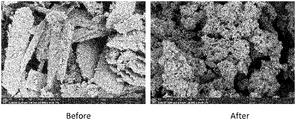
- FIG. 1 shows Scanning Electron Microscopy results for the ferrous sulfite catalyst before and after use in the degradation process
- FIG. 2 shows X-Ray Diffraction analysis for FeSO 4 , Na 2 SO 3 , and the ferrous sulfite catalyst before and after use in degradation;
- FIG. 4 shows X-ray photoelectron spectroscopy of the ferrous sulfite catalyst pertaining to carbon
- FIG. 5 shows X-ray photoelectron spectroscopy of the ferrous sulfite catalyst pertaining to iron
- FIG. 6 shows X-ray photoelectron spectroscopy of the ferrous sulfite catalyst pertaining to oxygen
- FIG. 7 shows X-ray photoelectron spectroscopy of the ferrous sulfite catalyst pertaining to sulfur
- FIG. 8 shows a chromatogram of concentration of perfluoro-n-octanoic acid over time
- FIG. 9 shows mass spectroscopy data for perfluoro-n-octanoic acid
- FIG. 10 shows mass spectroscopy data for 2,3,4,5,6,7,8,8,8-nonafluorooctanoic acid
- FIG. 11 shows mass spectroscopy data for 2,3,4,5,6,6-hexafluorohexanoic acid
- FIG. 12 shows mass spectroscopy data for 2,3,4-trifluorobutanic acid
- FIG. 13 a chromatogram of concentration of a mixture of PFAS over time.
- a composition includes an aqueous solution comprising at least one fluorinated organic compound; and a reaction product of a source of iron(II) and a source of sulfite in the presence of water and molecular hydrogen.
- the aqueous solution may include one or more of deionized, tap, distilled, or fresh waters; natural, brackish, or saturated salt waters; natural, salt dome, hydrocarbon formation produced, or synthetic brines; filtered or untreated seawaters; mineral waters; or other potable or non-potable waters containing one or more dissolved salts, minerals, or organic materials.
- the aqueous solution may comprise at least 80 wt. %, at least 90 wt. %, at least 95 wt. %, at least 99 wt. %, or even at least 99.9 wt. % of water.
- At least 90 wt. %, at least 95 wt. %, or even at least 99 wt. % of the aqueous mixture by mass may be a brine solution.
- the term “brine” may refer to a saturated solution of one or more alkali metal chlorides.
- “brine” may refer to a saturated solution of NaCl, KCl, or mixtures thereof.
- the term “brine” may refer to naturally derived saltwater, for example, seawater or salt lake water, used in its natural state or after having undergone processing, such as filtration, to remove contaminants and large particles.
- the aqueous solution may consist of brine.
- the composition described herein includes at least one fluorinated organic compound.
- Fluorinated organic compounds may also be referred to as PFAS.
- PFAS fluorinated organic compounds
- per- and polyfluoroalkyl substances which may be used interchangeably, refer to synthetic organofluorine compounds that have multiple fluorine atoms.
- PFAS may contain only carbon atoms and fluorine atoms.
- PFAS may contain carbon atoms, fluorine atoms, and hydrogen atoms, i.e. “fluorinated hydrocarbons.”
- PFAS may contain carbon atoms, fluorine atoms, and optionally hydrogen atoms, as well as other heteroatoms, such as sulfur, oxygen, nitrogen, and the like.
- the fluorinated organic compound is not particularly limited.
- the at least one fluorinated organic compound is selected from the group consisting of perfluoro-n-butanoic acid, perfluoro-n-pentanoic acid, perfluoro-n-hexanoic acid, perfluoro-n-heptanoic acid, perfluoro-n-octanoic acid, perfluoro-n-nonanoic acid, perfluoro-n-decanoic acid, perfluoro-n-undecanoic acid, perfluoro-n-dodecanoic acid, perfluoro-n-tridecanoic acid, perfluoro-n-tetradecanoic acid, perfluoro-n-hexadecanoic acid, perfluoro-n-octadecanoic acid, potassium perfluoro-1-butanesulfonate, sodium perfluoro-1-hexanesulfonate, sodium perflu
- the fluorinated organic compound may be present in an environmentally relevant concentration found in sources such as surface water, wastewater, ground water, and leachate waste.
- the fluorinated organic compound may be present in a range of from 5 ⁇ 10 ⁇ 7 g/l to 2 ⁇ 10 3 g/l or from 10 ⁇ 6 g/l to 10 2 g/l or from 10 ⁇ 5 g/1 to 10 g/l or from 10 ⁇ 4 g/l to 0.1 g/l or from 0.001 g/l to 0.01 g/l.
- the concentration of fluorinated organic compound in the compositions may be within a range formed from any one of the lower bounds for the fluorinated organic compound and any one of the upper bounds of the fluorinated organic compound described herein. In other embodiments, the concentration of fluorinated organic compound may be much higher than the ranges set forth herein when present in conjunction with elevated concentrations of the ferrous sulfite catalyst.
- the composition disclosed herein includes a reaction product of a source of iron(II) and a source of sulfite in the presence of water and molecular hydrogen.
- the term “ferrous sulfite catalyst” refers to this reaction product.
- the ferrous sulfite catalyst may comprise, consist essentially of, or consist of ferrous sulfite, which is also referred to as “iron(II)sulfite.”
- the source of sulfite may comprise any salt or compound that results in the presence or formation of sulfite group in the synthesis solution.
- the source of sulfite may comprise lithium sulfite, sodium sulfite, potassium sulfite, ammonium sulfite, sodium bisulfate, magnesium sulfite, sulfurous acid (sulfur dioxide in water), or a mixture of two or more of these.
- the source of iron(II) may comprise any salt or compound that results in the presence or formation of Fe(II) in the synthesis solution.
- the source of iron(II) may comprise iron sulfate, iron nitrate, iron chloride, iron acetate, iron sulfide, iron ammonium sulfate, lithium iron phosphate, iron iodide, iron bromide, iron phosphide, the hydrated form of all previous salts, or a mixture of two or more of these.
- the composition may include the ferrous sulfite catalyst in a concentration of from 0.25 g/l to 1 g/l.
- the composition may include from 0.4 g/l to 0.6 g/l ferrous sulfite catalyst. It should be understood that the concentration of ferrous sulfite catalyst in the compositions may be within a range formed from any one of the lower bounds for the ferrous sulfite catalyst and any one of the upper bounds of the ferrous sulfite catalyst described herein.
- the ferrous sulfite catalyst may be dissolved in the aqueous solution.
- the ferrous sulfite catalyst may be immobilized on a solid support.
- the ferrous sulfite catalyst may be immobilized on one or more of granulated activated carbon, a porous ceramic material, a porous carbon sheet, and/or a combination thereof.
- a method of making a ferrous sulfite catalyst includes reacting a source of iron(II) and a source of sulfite in the presence of water and molecular hydrogen.
- the water comprises less than or equal to 1 weight percent dissolved molecular oxygen. In embodiments, the water may comprise less than or equal to 0.75 weight percent dissolved molecular oxygen. In embodiments, the water may comprise less than or equal to 0.5 weight percent dissolved molecular oxygen. In embodiments, the water may comprise less than or equal to 0.25 weight percent dissolved molecular oxygen. In embodiments, the water may be substantially free of dissolved molecular oxygen. As used herein, “substantially free of dissolved molecular oxygen” refers to amounts of dissolved molecular oxygen less than or equal to 100 parts per million (ppm) by weight of the water.
- a method of degrading fluorinated organic chemicals includes contacting the fluorinated organic chemicals with a reaction product of a source of iron(II) and a source of sulfite in the presence of water and molecular hydrogen.
- Ferrous sulfate heptahydrate (FeSO 4 ⁇ 7H 2 O), sodium sulfite (NaSO 3 ), hydrochloric acid (HCl), and zinc metal (Zn) were purchased from Sigma Aldrich, St. Louis, Mo. Milli-Q water, having a resistivity of 18.2 M ⁇ cm at 25° C., was used for all aqueous solution preparations. Oxygen-free water was prepared by passing H 2 gas through Milli-Q water for 30 minutes in a conical flask. The H 2 gas was generated by mixing pellets of Zn metal with HCl in a flask with an outlet tube connected to the conical flask containing the Milli-Q water through a delivery tube.
- iron(II)sulfate heptahydrate (FeSO 4 ⁇ 7H 2 O) were dissolved in 200 ml oxygen-free water and stirred while passing H 2 gas into the solution.
- FeSO 4 ⁇ 7H 2 O a 50 ml solution of 3.4 g NaSO 4 in water was added dropwise to the FeSO 4 ⁇ 7H 2 O solution via a burette at a rate of 15 drops per minute while vigorously stirring the solution.
- NaSO 4 solution was added, particles with a color ranging from creamy-brown to greenish-brown began to appear in the solution. The stirring was stopped, and the suspension was allowed to settle for 24 hours.
- the precipitate was separated from the supernatant by decantation. The separated precipitate was then washed with ethyl alcohol and centrifuged at 6000 rpm. Again, the resulting precipitate was separated from the supernatant and then washed with oxygen-free water. The solid thus obtained, the ferrous sulfite catalyst, was dried under vacuum for 12 h and then stored in a sealed amber vial.
- C, Fe, S and O are the major elemental components of the ferrous sulfite catalyst, as seen in FIGS. 3-7 .
- carbon may be introduced as an impurity from the atmosphere during either synthesis or characterization of the ferrous sulfite catalyst.
- the iron component existed in two forms, as shown in FIG. 5 , i.e., Fe 2+ (2p peaks 711.2 and 724.9 eV) and Fe 3+ (2p peaks 713.7 and 727.7 eV), in addition to the satellite peak at 719.0 eV that was assigned to surface oxidized iron (i.e., ⁇ -Fe 2 O 3 ).
- the ferrous sulfite catalyst showed an excellent ability to completely remove initial 2.5 ⁇ M (equivalent to 1.03 mg/l) and 25 ⁇ M (equivalent to 8.3 mg/l) PFOA in 1 and 5 min, respectively.
- the ferrous sulfite catalyst showed a similar removal efficiency for 2.5 ⁇ M initial PFOA in a biologically treated wastewater sample collected from the Metropolitan Sewer District of Greater Cincinnati, (Cincinnati, Ohio), as shown in FIG. 8 , in which the two trend lines of 2.5 ⁇ M PFOA degradation in Milli-Q water and in wastewater overlap one another.
- compound (2) may be rationalized by direct chemical reduction/de-fluorination of PFOA (i.e., loss of six F ⁇ ) by electrons generated from the ferrous sulfite catalyst.
- Compound (2) was then expected to undergo oxidative degradation by free radical species (i.e., advanced oxidation process; AOP) generated from the interaction between the transformed species from the ferrous sulfite catalyst.
- AOP advanced oxidation process
- compound (2) may have more affinity to oxidation than compound (1), PFOA, due to the presence of carbon atoms that can be easily oxidized because of the pendant ⁇ -hydrogen atoms. Further reduction/oxidation of compound (2) was confirmed by the formation of compounds (3) and (4) in the solution. Through consecutive reduction (i.e., removal of three F ⁇ ) and oxidation (i.e., loss of “C 2 H”) of compound (2), compound (3) was formed. In a similar way, successive reduction and oxidation of compound (3) resulted in loss of “C 2 HF 3 ” and generation of compound (4).
- FIG. 13 shows the degradation profiles for the different PFAS during the 20 min reaction time. All tested PFAS were degraded but exhibited differing degradation kinetics. The C 2 and C 7 PFAS were degraded more slowly than the remaining compounds.
Landscapes
- Chemical & Material Sciences (AREA)
- Engineering & Computer Science (AREA)
- Organic Chemistry (AREA)
- Materials Engineering (AREA)
- Chemical Kinetics & Catalysis (AREA)
- Life Sciences & Earth Sciences (AREA)
- Hydrology & Water Resources (AREA)
- Environmental & Geological Engineering (AREA)
- Water Supply & Treatment (AREA)
- Catalysts (AREA)
- Organic Low-Molecular-Weight Compounds And Preparation Thereof (AREA)
Abstract
Description


Claims (16)
Priority Applications (1)
| Application Number | Priority Date | Filing Date | Title |
|---|---|---|---|
| US16/703,193 US11400438B2 (en) | 2018-12-05 | 2019-12-04 | Synthesis and immobilization of a ferrous sulfite catalyst and method of degrading fluorinated organic chemicals in aqueous media |
Applications Claiming Priority (2)
| Application Number | Priority Date | Filing Date | Title |
|---|---|---|---|
| US201862775582P | 2018-12-05 | 2018-12-05 | |
| US16/703,193 US11400438B2 (en) | 2018-12-05 | 2019-12-04 | Synthesis and immobilization of a ferrous sulfite catalyst and method of degrading fluorinated organic chemicals in aqueous media |
Publications (2)
| Publication Number | Publication Date |
|---|---|
| US20200179909A1 US20200179909A1 (en) | 2020-06-11 |
| US11400438B2 true US11400438B2 (en) | 2022-08-02 |
Family
ID=70972225
Family Applications (1)
| Application Number | Title | Priority Date | Filing Date |
|---|---|---|---|
| US16/703,193 Active 2040-09-14 US11400438B2 (en) | 2018-12-05 | 2019-12-04 | Synthesis and immobilization of a ferrous sulfite catalyst and method of degrading fluorinated organic chemicals in aqueous media |
Country Status (1)
| Country | Link |
|---|---|
| US (1) | US11400438B2 (en) |
Citations (1)
| Publication number | Priority date | Publication date | Assignee | Title |
|---|---|---|---|---|
| US4349650A (en) * | 1979-03-14 | 1982-09-14 | E. I. Du Pont De Nemours And Company | Polyfluoroallyloxy compounds, their preparation and copolymers therefrom |
-
2019
- 2019-12-04 US US16/703,193 patent/US11400438B2/en active Active
Patent Citations (1)
| Publication number | Priority date | Publication date | Assignee | Title |
|---|---|---|---|---|
| US4349650A (en) * | 1979-03-14 | 1982-09-14 | E. I. Du Pont De Nemours And Company | Polyfluoroallyloxy compounds, their preparation and copolymers therefrom |
Non-Patent Citations (8)
| Title |
|---|
| Bagatur, T. et al. (2018) El-Cezeri Journal of Science and Engineering, 5(3) 724-733. * |
| Johnson, et al., The Adsorption of Perfluorooctane Sulfonate onto Sand, Clay, and Iron Oxide Surfaces; https://doi.org/10.1021/je060285g, 2007, 52, 1165-70. |
| Naumann, et al., Laboratory-scale photoredox catalysis usinghydrated electrons sustainably generated with a single green laser, https://doi.org/10.1039/c7sc03514d, 2017, 8, 7510-20. |
| Pound, J.R. (1948) Journal of Physical Chemistry, 52(6), 1103-1105. * |
| Pound, Oxidation of Ferrous Sulfite in Air, https;//doi.org/10.1021/j150462a020, 1948, 1103-05. |
| Silva-Rackov, et al., Degradation of PFOA by hydrogen peroxide and persulfate activated by iron-modified diatomite; https://dx.doi.org/10.1016/j.apcatb.2016.03.067, 2016, 192, 253-59. |
| Song, Z. (2013) Journal of Hazardous Materials, 262, 332-338. * |
| Tian, et al., Complete Defluorination of Perfluorinated Compounds by Hydrated Electrons Generated from 3-Indole-acetic-acid in Organomodified Montmorillonite, https://doi.org/10.1038/srep32949, 2016, 6, 32949 (9 pages). |
Also Published As
| Publication number | Publication date |
|---|---|
| US20200179909A1 (en) | 2020-06-11 |
Similar Documents
| Publication | Publication Date | Title |
|---|---|---|
| Mortazavian et al. | Activated carbon impregnated by zero-valent iron nanoparticles (AC/nZVI) optimized for simultaneous adsorption and reduction of aqueous hexavalent chromium: Material characterizations and kinetic studies | |
| Li et al. | Stabilization of biosolids with nanoscale zero-valent iron (nZVI) | |
| Monser et al. | Modified activated carbon for the removal of copper, zinc, chromium and cyanide from wastewater | |
| Wu et al. | Enhanced As (III) sequestration using sulfide-modified nano-scale zero-valent iron with a characteristic core–shell structure: sulfidation and as distribution | |
| Li et al. | Reduction and immobilization of hexavalent chromium in chromite ore processing residue using amorphous FeS2 | |
| Karthikeyan et al. | Hydrothermal synthesis of hydroxyapatite-reduced graphene oxide (1D–2D) hybrids with enhanced selective adsorption properties for methyl orange and hexavalent chromium from aqueous solutions | |
| Zhang et al. | Highly efficient phosphate sequestration in aqueous solutions using nanomagnesium hydroxide modified polystyrene materials | |
| Pham et al. | Graphitic carbon nitride metal-free photocatalyst for the simultaneous removal of emerging pharmaceutical pollutants in wastewater | |
| Chen et al. | Catalytic degradation of chlorpheniramine over GO-Fe3O4 in the presence of H2O2 in water: The synergistic effect of adsorption | |
| Yaping et al. | Photo-Fenton degradation of 17β-estradiol in presence of α-FeOOHR and H2O2 | |
| Rahim et al. | Conversion of coconut waste into cost effective adsorbent for Cu (II) and Ni (II) removal from aqueous solutions | |
| WO2014094130A1 (en) | Graphene oxide for use in removing heavy metal from water | |
| EP3829788A1 (en) | Compositions and methods for removing chlorinated hydrocarbons | |
| Khang et al. | Role of photochemical reactions in the treatment of water used in the high-tech agriculture | |
| Muhammad et al. | Coupled physicochemical and bacterial reduction mechanisms for passive remediation of sulfate-and metal-rich acid mine drainage | |
| Shakya et al. | Fungal-based nanotechnology for heavy metal removal | |
| Montes-Atenas et al. | Wastewater treatment through low cost adsorption technologies | |
| Xie et al. | The performance and mechanism of sulfidated nano-zero-valent iron for the simultaneous stabilization of arsenic and cadmium | |
| Keselytė et al. | Application of Ni-Fe catalyst from fluidized-bed crystallisation reactor for treatment of RB5 azo dye using a Fenton-like system | |
| Li et al. | Combining biochar with schwertmannite-based solid to enhance co-removal of ciprofloxacin and roxarsone as well as to improve regenerative capacity | |
| Do et al. | Synthesis of iron composites on nano-pore substrates: Identification and its application to removal of cyanide | |
| Sibiya-Dlomo et al. | Reduction of Pb (II) and Cu (II) ions from synthetic wastewater utilizing magnetic adsorbent derived from banana peels: Kinetic and Isotherm analyses | |
| US20200179909A1 (en) | Synthesis and immobilization of a ferrous sulfite catalyst and method of degrading fluorinated organic chemicals in aqueous media | |
| Tchakounte et al. | Calcareous-support nanoscale zero-valent iron: New findings on adsorption of cr (VI) in aqueous solution | |
| KR101927288B1 (en) | Manufacturing method of surface modified activated carbon and the surface modified activated carbon manufacturing by the method |
Legal Events
| Date | Code | Title | Description |
|---|---|---|---|
| AS | Assignment |
Owner name: UNIVERSITY OF CINCINNATI, OHIO Free format text: ASSIGNMENT OF ASSIGNORS INTEREST;ASSIGNORS:DIONYSIOU, DIONYSIOS D.;ABDELRAHEEM, WAEL H.M.;NADAGOUDA, MALLIKARJUNA N.;REEL/FRAME:051178/0387 Effective date: 20190222 |
|
| FEPP | Fee payment procedure |
Free format text: ENTITY STATUS SET TO UNDISCOUNTED (ORIGINAL EVENT CODE: BIG.); ENTITY STATUS OF PATENT OWNER: SMALL ENTITY |
|
| FEPP | Fee payment procedure |
Free format text: ENTITY STATUS SET TO SMALL (ORIGINAL EVENT CODE: SMAL); ENTITY STATUS OF PATENT OWNER: SMALL ENTITY |
|
| STPP | Information on status: patent application and granting procedure in general |
Free format text: DOCKETED NEW CASE - READY FOR EXAMINATION |
|
| STPP | Information on status: patent application and granting procedure in general |
Free format text: NON FINAL ACTION MAILED |
|
| STPP | Information on status: patent application and granting procedure in general |
Free format text: RESPONSE TO NON-FINAL OFFICE ACTION ENTERED AND FORWARDED TO EXAMINER |
|
| STPP | Information on status: patent application and granting procedure in general |
Free format text: NOTICE OF ALLOWANCE MAILED -- APPLICATION RECEIVED IN OFFICE OF PUBLICATIONS |
|
| STPP | Information on status: patent application and granting procedure in general |
Free format text: AWAITING TC RESP., ISSUE FEE NOT PAID |
|
| STPP | Information on status: patent application and granting procedure in general |
Free format text: NOTICE OF ALLOWANCE MAILED -- APPLICATION RECEIVED IN OFFICE OF PUBLICATIONS |
|
| AS | Assignment |
Owner name: THE UNITED STATES OF AMERICA AS REPRESENTED BY THE ADMINISTRATOR OF THE U.S. ENVIRONMENTAL PROTECTION AGENCY, DISTRICT OF COLUMBIA Free format text: ASSIGNMENT OF ASSIGNORS INTEREST;ASSIGNOR:UNIVERSITY OF CINCINNATI;REEL/FRAME:060322/0794 Effective date: 20220624 |
|
| STCF | Information on status: patent grant |
Free format text: PATENTED CASE |
|
| FEPP | Fee payment procedure |
Free format text: MAINTENANCE FEE REMINDER MAILED (ORIGINAL EVENT CODE: REM.); ENTITY STATUS OF PATENT OWNER: SMALL ENTITY |
|
| FEPP | Fee payment procedure |
Free format text: SURCHARGE FOR LATE PAYMENT, SMALL ENTITY (ORIGINAL EVENT CODE: M2554); ENTITY STATUS OF PATENT OWNER: SMALL ENTITY |
|
| MAFP | Maintenance fee payment |
Free format text: PAYMENT OF MAINTENANCE FEE, 4TH YR, SMALL ENTITY (ORIGINAL EVENT CODE: M2551); ENTITY STATUS OF PATENT OWNER: SMALL ENTITY Year of fee payment: 4 |