US11400084B2 - Aminoamide compounds - Google Patents
Aminoamide compounds Download PDFInfo
- Publication number
- US11400084B2 US11400084B2 US17/163,802 US202117163802A US11400084B2 US 11400084 B2 US11400084 B2 US 11400084B2 US 202117163802 A US202117163802 A US 202117163802A US 11400084 B2 US11400084 B2 US 11400084B2
- Authority
- US
- United States
- Prior art keywords
- alkyl
- optionally substituted
- independently
- alkoxy
- cycloalkyl
- Prior art date
- Legal status (The legal status is an assumption and is not a legal conclusion. Google has not performed a legal analysis and makes no representation as to the accuracy of the status listed.)
- Active
Links
- 0 *.B.C*C.[1*]N1C(=C)CCC([2*])(N2CCCC2=O)C1=O Chemical compound *.B.C*C.[1*]N1C(=C)CCC([2*])(N2CCCC2=O)C1=O 0.000 description 32
- SZURZHQMGVKJLV-UHFFFAOYSA-N CC(C)(C)c1ccccc1C(C)(C)C Chemical compound CC(C)(C)c1ccccc1C(C)(C)C SZURZHQMGVKJLV-UHFFFAOYSA-N 0.000 description 4
- PWCWAKJKJULMLC-UHFFFAOYSA-N CC(C)(C)c1ccccc1C(C)(C)C.CC(C)(C)c1ccsc1C(C)(C)C.CC(C)(C)c1ccsc1C(C)(C)C.CC(C)(C)c1cscc1C(C)(C)C Chemical compound CC(C)(C)c1ccccc1C(C)(C)C.CC(C)(C)c1ccsc1C(C)(C)C.CC(C)(C)c1ccsc1C(C)(C)C.CC(C)(C)c1cscc1C(C)(C)C PWCWAKJKJULMLC-UHFFFAOYSA-N 0.000 description 4
- XUIVDWYEDXWAHD-UHFFFAOYSA-N CC(C)(C)C1(C(F)(F)F)CC1.CC(C)(C)CC1(C(F)(F)F)CC1.CC(C)(C)N1CCCCC1.CC(C)CN1C(C)CCCC1C.CC(C)CN1CC(C)OC(C)C1.CC(C)CN1CCCC1.CC(C)CN1CCCCC1.CC(C)CN1CCCCC1.CC(C)CN1CCCCC1.CC(C)CN1CCN(C)CC1.CC(C)N1CCCC1.CC(C)N1CCOCC1 Chemical compound CC(C)(C)C1(C(F)(F)F)CC1.CC(C)(C)CC1(C(F)(F)F)CC1.CC(C)(C)N1CCCCC1.CC(C)CN1C(C)CCCC1C.CC(C)CN1CC(C)OC(C)C1.CC(C)CN1CCCC1.CC(C)CN1CCCCC1.CC(C)CN1CCCCC1.CC(C)CN1CCCCC1.CC(C)CN1CCN(C)CC1.CC(C)N1CCCC1.CC(C)N1CCOCC1 XUIVDWYEDXWAHD-UHFFFAOYSA-N 0.000 description 2
- JFMJGPHZVATVFH-UHFFFAOYSA-N CC(C)(C)C1(C(F)(F)F)CC1.CC(C)(C)CC1(C(F)(F)F)CC1.CC(C)(C)N1CCCCC1.CC(C)CN1CCCC1.CC(C)CN1CCCCC1.CC(C)CN1CCCCC1.CC(C)N1CCCC1.CC(C)N1CCOCC1 Chemical compound CC(C)(C)C1(C(F)(F)F)CC1.CC(C)(C)CC1(C(F)(F)F)CC1.CC(C)(C)N1CCCCC1.CC(C)CN1CCCC1.CC(C)CN1CCCCC1.CC(C)CN1CCCCC1.CC(C)N1CCCC1.CC(C)N1CCOCC1 JFMJGPHZVATVFH-UHFFFAOYSA-N 0.000 description 2
- UQELJFPIVRDIPW-UHFFFAOYSA-N CC(C)(C)C1CC1.CC(C)(C)C1CCC1.CC(C)(C)C1CCCC1.CC(C)(C)C1CCCCC1.CC(C)CC1CC1.CC(C)CC1CCC1.CC(C)CC1CCCC1.CC(C)CC1CCCCC1 Chemical compound CC(C)(C)C1CC1.CC(C)(C)C1CCC1.CC(C)(C)C1CCCC1.CC(C)(C)C1CCCCC1.CC(C)CC1CC1.CC(C)CC1CCC1.CC(C)CC1CCCC1.CC(C)CC1CCCCC1 UQELJFPIVRDIPW-UHFFFAOYSA-N 0.000 description 2
- AGKMNCPYIFCPFK-UHFFFAOYSA-N CC(C)(C)c1ccc(NCC(=O)NCc2ccc3c(c2)CN(C2CCC(=O)CC2=O)C3=O)cc1 Chemical compound CC(C)(C)c1ccc(NCC(=O)NCc2ccc3c(c2)CN(C2CCC(=O)CC2=O)C3=O)cc1 AGKMNCPYIFCPFK-UHFFFAOYSA-N 0.000 description 2
- XYOOEDBUSUUVQV-UHFFFAOYSA-N CC(C)(C)c1ccsc1C(C)(C)C.CC(C)(C)c1ccsc1C(C)(C)C.CC(C)(C)c1cscc1C(C)(C)C Chemical compound CC(C)(C)c1ccsc1C(C)(C)C.CC(C)(C)c1ccsc1C(C)(C)C.CC(C)(C)c1cscc1C(C)(C)C XYOOEDBUSUUVQV-UHFFFAOYSA-N 0.000 description 2
- NOJAZVYCWJIUOV-UHFFFAOYSA-N CN(C)Cc1ccc(NCC(=O)NCc2ccc3c(c2)CN(C2CCC(=O)CC2=O)C3=O)cc1Cl Chemical compound CN(C)Cc1ccc(NCC(=O)NCc2ccc3c(c2)CN(C2CCC(=O)CC2=O)C3=O)cc1Cl NOJAZVYCWJIUOV-UHFFFAOYSA-N 0.000 description 2
- JQIKLVFCSVUNRO-UHFFFAOYSA-N CN(C)c1ccc(CCC(=O)CCc2scc3c2CN(C2CCC(=O)CC2=O)C3=O)cc1Cl Chemical compound CN(C)c1ccc(CCC(=O)CCc2scc3c2CN(C2CCC(=O)CC2=O)C3=O)cc1Cl JQIKLVFCSVUNRO-UHFFFAOYSA-N 0.000 description 2
- CMHJYOVZJFIJAA-UHFFFAOYSA-N Cc1cc(CCC(=O)CCc2scc3c2CN(C2CCC(=O)CC2=O)C3=O)ccc1N(C)C Chemical compound Cc1cc(CCC(=O)CCc2scc3c2CN(C2CCC(=O)CC2=O)C3=O)ccc1N(C)C CMHJYOVZJFIJAA-UHFFFAOYSA-N 0.000 description 2
- WEKRQOGRZGISAX-UHFFFAOYSA-N Cc1cc(NCC(=O)NCc2ccc3c(c2)CN(C2CCC(=O)CC2=O)C3=O)ccc1N(C)C Chemical compound Cc1cc(NCC(=O)NCc2ccc3c(c2)CN(C2CCC(=O)CC2=O)C3=O)ccc1N(C)C WEKRQOGRZGISAX-UHFFFAOYSA-N 0.000 description 2
- WYLFEVOCGYGMNI-UHFFFAOYSA-N Cc1cc(NCC(=O)NCc2ccc3c(c2)CN(C2CCC(=O)CC2=O)C3=O)ccc1N1CCCC1 Chemical compound Cc1cc(NCC(=O)NCc2ccc3c(c2)CN(C2CCC(=O)CC2=O)C3=O)ccc1N1CCCC1 WYLFEVOCGYGMNI-UHFFFAOYSA-N 0.000 description 2
- PXUMHAHIERGAQB-UHFFFAOYSA-N Cc1cc(NCC(=O)NCc2ccc3c(c2)CN(C2CCC(=O)CC2=O)C3=O)ccc1N1CCOCC1 Chemical compound Cc1cc(NCC(=O)NCc2ccc3c(c2)CN(C2CCC(=O)CC2=O)C3=O)ccc1N1CCOCC1 PXUMHAHIERGAQB-UHFFFAOYSA-N 0.000 description 2
- WMWMXCJPTVVSRG-UHFFFAOYSA-N Cc1ccc(CC(C)C(=O)CCc2scc3c2CN(C2CCC(=O)CC2=O)C3=O)cc1Cl Chemical compound Cc1ccc(CC(C)C(=O)CCc2scc3c2CN(C2CCC(=O)CC2=O)C3=O)cc1Cl WMWMXCJPTVVSRG-UHFFFAOYSA-N 0.000 description 2
- FUGQWPLNWGXYNY-UHFFFAOYSA-N Cc1ccc(CCC(=O)CCc2csc3c2CN(C2CCC(=O)CC2=O)C3=O)cc1Cl Chemical compound Cc1ccc(CCC(=O)CCc2csc3c2CN(C2CCC(=O)CC2=O)C3=O)cc1Cl FUGQWPLNWGXYNY-UHFFFAOYSA-N 0.000 description 2
- FZHTUHTXLBYXHH-UHFFFAOYSA-N Cc1ccc(CCC(=O)CCc2scc3c2CN(C2CCC(=O)CC2=O)C3=O)cc1N(C)C Chemical compound Cc1ccc(CCC(=O)CCc2scc3c2CN(C2CCC(=O)CC2=O)C3=O)cc1N(C)C FZHTUHTXLBYXHH-UHFFFAOYSA-N 0.000 description 2
- GEPVIHCDWUHPAE-UHFFFAOYSA-N Cc1ccc(CCC(=O)NCc2cccc3c2CN(C2CCC(=O)CC2=O)C3=O)cc1Cl Chemical compound Cc1ccc(CCC(=O)NCc2cccc3c2CN(C2CCC(=O)CC2=O)C3=O)cc1Cl GEPVIHCDWUHPAE-UHFFFAOYSA-N 0.000 description 2
- LNGLNLRFXHUKOA-UHFFFAOYSA-N Cc1ccc(NC(C)C(=O)NCc2ccc3c(c2)CN(C2CCC(=O)CC2=O)C3=O)cc1Cl Chemical compound Cc1ccc(NC(C)C(=O)NCc2ccc3c(c2)CN(C2CCC(=O)CC2=O)C3=O)cc1Cl LNGLNLRFXHUKOA-UHFFFAOYSA-N 0.000 description 2
- KKFUVWKPUOHSKM-UHFFFAOYSA-N Cc1ccc(NCC(=O)NCc2cc3c(s2)C(=O)N(C2CCC(=O)CC2=O)C3)cc1Cl Chemical compound Cc1ccc(NCC(=O)NCc2cc3c(s2)C(=O)N(C2CCC(=O)CC2=O)C3)cc1Cl KKFUVWKPUOHSKM-UHFFFAOYSA-N 0.000 description 2
- CVOOLZLOYSARCM-UHFFFAOYSA-N Cc1ccc(NCC(=O)NCc2cc3c(s2)CN(C2CCC(=O)CC2=O)C3=O)cc1Cl Chemical compound Cc1ccc(NCC(=O)NCc2cc3c(s2)CN(C2CCC(=O)CC2=O)C3=O)cc1Cl CVOOLZLOYSARCM-UHFFFAOYSA-N 0.000 description 2
- BCRNBYCJCMWHKU-UHFFFAOYSA-N Cc1ccc(NCC(=O)NCc2ccc3c(c2)C(=O)N(C2CCC(=O)CC2=O)C3)cc1Cl Chemical compound Cc1ccc(NCC(=O)NCc2ccc3c(c2)C(=O)N(C2CCC(=O)CC2=O)C3)cc1Cl BCRNBYCJCMWHKU-UHFFFAOYSA-N 0.000 description 2
- ANODTUHXZWMKBM-UHFFFAOYSA-N Cc1ccc(NCC(=O)NCc2ccc3c(c2)C(=O)N(C2CCC(=O)CC2=O)C3=O)cc1Cl Chemical compound Cc1ccc(NCC(=O)NCc2ccc3c(c2)C(=O)N(C2CCC(=O)CC2=O)C3=O)cc1Cl ANODTUHXZWMKBM-UHFFFAOYSA-N 0.000 description 2
- GGUHKXXYQAFSGO-UHFFFAOYSA-N Cc1ccc(NCC(=O)NCc2ccc3c(c2)CN(C2CCC(=O)CC2=O)C3=O)cc1N(C)C Chemical compound Cc1ccc(NCC(=O)NCc2ccc3c(c2)CN(C2CCC(=O)CC2=O)C3=O)cc1N(C)C GGUHKXXYQAFSGO-UHFFFAOYSA-N 0.000 description 2
- VTNDMKDPTPZNOE-UHFFFAOYSA-N Cc1ccc(NCC(=O)NCc2ccc3c(c2)CN(C2CCC(=O)CC2=O)C3=O)cc1N1CCCC1 Chemical compound Cc1ccc(NCC(=O)NCc2ccc3c(c2)CN(C2CCC(=O)CC2=O)C3=O)cc1N1CCCC1 VTNDMKDPTPZNOE-UHFFFAOYSA-N 0.000 description 2
- YRRMVLZBRDCJRC-UHFFFAOYSA-N Cc1ccc(NCC(=O)NCc2ccc3c(c2)CN(C2CCC(=O)CC2=O)C3=O)nc1Cl Chemical compound Cc1ccc(NCC(=O)NCc2ccc3c(c2)CN(C2CCC(=O)CC2=O)C3=O)nc1Cl YRRMVLZBRDCJRC-UHFFFAOYSA-N 0.000 description 2
- QVDMJXCGTVCHFV-QFIPXVFZSA-N Cc1ccc(NCC(=O)NCc2ccc3c(c2)CN([C@H]2CCCC(=O)CC2=O)C3=O)cc1Cl Chemical compound Cc1ccc(NCC(=O)NCc2ccc3c(c2)CN([C@H]2CCCC(=O)CC2=O)C3=O)cc1Cl QVDMJXCGTVCHFV-QFIPXVFZSA-N 0.000 description 2
- NBCFCCZGJWOXFC-UHFFFAOYSA-N O=C(CCc1ccc(CN2CCOCC2)cc1)CCc1scc2c1CN(C1CCC(=O)CC1=O)C2=O Chemical compound O=C(CCc1ccc(CN2CCOCC2)cc1)CCc1scc2c1CN(C1CCC(=O)CC1=O)C2=O NBCFCCZGJWOXFC-UHFFFAOYSA-N 0.000 description 2
- YCVQBABCELKTCC-UHFFFAOYSA-N O=C(CCc1cccc(CN2CCOCC2)c1)CCc1scc2c1CN(C1CCC(=O)CC1=O)C2=O Chemical compound O=C(CCc1cccc(CN2CCOCC2)c1)CCc1scc2c1CN(C1CCC(=O)CC1=O)C2=O YCVQBABCELKTCC-UHFFFAOYSA-N 0.000 description 2
- KQDQHAHUKGEKDV-UHFFFAOYSA-N O=C1CCC(N2Cc3cc(CNC(=O)CNc4ccc(N5CCOCC5)c(Cl)c4)ccc3C2=O)C(=O)C1 Chemical compound O=C1CCC(N2Cc3cc(CNC(=O)CNc4ccc(N5CCOCC5)c(Cl)c4)ccc3C2=O)C(=O)C1 KQDQHAHUKGEKDV-UHFFFAOYSA-N 0.000 description 2
- UQHGMGLAAKCFDZ-UHFFFAOYSA-N O=C1CCC(N2Cc3cc(CNC(=O)CNc4ccccc4)ccc3C2=O)C(=O)C1 Chemical compound O=C1CCC(N2Cc3cc(CNC(=O)CNc4ccccc4)ccc3C2=O)C(=O)C1 UQHGMGLAAKCFDZ-UHFFFAOYSA-N 0.000 description 2
- OBAGIKSESXECPF-WBMJSBHTSA-N C.C=C1CC[C@H](N2Cc3c(CNC(=O)CCc4ccc(C(C)(C)C)cc4)cccc3C2=O)C(=O)C1.C=C1CC[C@H](N2Cc3c(CNC(=O)CCc4ccc(C5(C(F)(F)F)CC5)cc4)cccc3C2=O)C(=O)C1.C=C1CC[C@H](N2Cc3c(CNC(=O)CCc4ccc(N5CCCC5)c(C)c4)cccc3C2=O)C(=O)C1 Chemical compound C.C=C1CC[C@H](N2Cc3c(CNC(=O)CCc4ccc(C(C)(C)C)cc4)cccc3C2=O)C(=O)C1.C=C1CC[C@H](N2Cc3c(CNC(=O)CCc4ccc(C5(C(F)(F)F)CC5)cc4)cccc3C2=O)C(=O)C1.C=C1CC[C@H](N2Cc3c(CNC(=O)CCc4ccc(N5CCCC5)c(C)c4)cccc3C2=O)C(=O)C1 OBAGIKSESXECPF-WBMJSBHTSA-N 0.000 description 1
- CJIGWWKCMXCKQX-UHFFFAOYSA-N C.CC(C)(C)CN1CCCCC1.CC(C)(C)CN1CCNCC1.CC(C)(C)N1CCCCC1.CC(C)(C)N1CCCCC1.CC(C)CN1CCCC1.CC(C)CN1CCCCC1.CC(C)N1CCCC1.CC(C)N1CCOCC1 Chemical compound C.CC(C)(C)CN1CCCCC1.CC(C)(C)CN1CCNCC1.CC(C)(C)N1CCCCC1.CC(C)(C)N1CCCCC1.CC(C)CN1CCCC1.CC(C)CN1CCCCC1.CC(C)N1CCCC1.CC(C)N1CCOCC1 CJIGWWKCMXCKQX-UHFFFAOYSA-N 0.000 description 1
- JRLCBHKGWGSXQD-UHFFFAOYSA-N C.CC(C)(C)N1CCCC1.CC(C)(C)N1CCCCC1.CC(C)(C)N1CCCCC1.CC(C)(C)N1CCCCC1 Chemical compound C.CC(C)(C)N1CCCC1.CC(C)(C)N1CCCCC1.CC(C)(C)N1CCCCC1.CC(C)(C)N1CCCCC1 JRLCBHKGWGSXQD-UHFFFAOYSA-N 0.000 description 1
- FRYMXPQNKHALRF-UHFFFAOYSA-N C.CC(C)(C)N1CCCC1.CC(C)(C)N1CCCCC1.CC(C)(C)N1CCCCC1.CC(C)(C)N1CCCCC1.CC(C)CN1CCCC1.CC(C)CN1CCCCC1.CC(C)CN1CCCCC1.CC(C)CN1CCCCC1 Chemical compound C.CC(C)(C)N1CCCC1.CC(C)(C)N1CCCCC1.CC(C)(C)N1CCCCC1.CC(C)(C)N1CCCCC1.CC(C)CN1CCCC1.CC(C)CN1CCCCC1.CC(C)CN1CCCCC1.CC(C)CN1CCCCC1 FRYMXPQNKHALRF-UHFFFAOYSA-N 0.000 description 1
- GGTACAQGJLYTKK-UHFFFAOYSA-N C.CC(C)(C)c1ccccc1C(C)(C)C.CC(C)(C)c1ccsc1C(C)(C)C.CC(C)(C)c1ccsc1C(C)(C)C.CC(C)(C)c1cscc1C(C)(C)C Chemical compound C.CC(C)(C)c1ccccc1C(C)(C)C.CC(C)(C)c1ccsc1C(C)(C)C.CC(C)(C)c1ccsc1C(C)(C)C.CC(C)(C)c1cscc1C(C)(C)C GGTACAQGJLYTKK-UHFFFAOYSA-N 0.000 description 1
- UGZXPSVXEMCGRX-UHFFFAOYSA-N C.CC(C)(C)c1ccsc1C(C)(C)C.CC(C)(C)c1ccsc1C(C)(C)C.CC(C)(C)c1cscc1C(C)(C)C Chemical compound C.CC(C)(C)c1ccsc1C(C)(C)C.CC(C)(C)c1ccsc1C(C)(C)C.CC(C)(C)c1cscc1C(C)(C)C UGZXPSVXEMCGRX-UHFFFAOYSA-N 0.000 description 1
- AHUVMBDITYGLJN-UHFFFAOYSA-N C.CC(C)CN1CCCC1.CC(C)CN1CCCCC1.CC(C)CN1CCCCC1.CC(C)CN1CCCCC1 Chemical compound C.CC(C)CN1CCCC1.CC(C)CN1CCCCC1.CC(C)CN1CCCCC1.CC(C)CN1CCCCC1 AHUVMBDITYGLJN-UHFFFAOYSA-N 0.000 description 1
- BZSZQAPPQJXXQE-UHFFFAOYSA-N C=C1CCC(N2C(=O)c3ccc(CNC(=O)CNc4ccc(C)c(Cl)c4)cc3C2=O)C(=O)C1.C=C1CCC(N2Cc3cc(CNC(=O)CNc4ccc(C(C)(C)C)cc4)ccc3C2=O)C(=O)C1.C=C1CCC(N2Cc3cc(CNC(=O)CNc4ccc(C)c(Cl)n4)ccc3C2=O)C(=O)C1.C=C1CCC(N2Cc3cc(CNC(=O)CNc4ccc(C)c(N(C)C)c4)ccc3C2=O)C(=O)C1 Chemical compound C=C1CCC(N2C(=O)c3ccc(CNC(=O)CNc4ccc(C)c(Cl)c4)cc3C2=O)C(=O)C1.C=C1CCC(N2Cc3cc(CNC(=O)CNc4ccc(C(C)(C)C)cc4)ccc3C2=O)C(=O)C1.C=C1CCC(N2Cc3cc(CNC(=O)CNc4ccc(C)c(Cl)n4)ccc3C2=O)C(=O)C1.C=C1CCC(N2Cc3cc(CNC(=O)CNc4ccc(C)c(N(C)C)c4)ccc3C2=O)C(=O)C1 BZSZQAPPQJXXQE-UHFFFAOYSA-N 0.000 description 1
- NCMPRDYNPXDKBE-UHFFFAOYSA-N C=C1CCC(N2Cc3c(CCC(=O)CCc4ccc(C)c(Cl)c4)csc3C2=O)C(=O)C1.C=C1CCC(N2Cc3c(csc3CCC(=O)CCc3ccc(C)c(Cl)c3)C2=O)C(=O)C1.C=C1CCC(N2Cc3c(csc3CCC(=O)CCc3ccc(C)c(N(C)C)c3)C2=O)C(=O)C1.C=C1CCC(N2Cc3cc(CNC(=O)CNc4ccc(C)c(Cl)c4)sc3C2=O)C(=O)C1 Chemical compound C=C1CCC(N2Cc3c(CCC(=O)CCc4ccc(C)c(Cl)c4)csc3C2=O)C(=O)C1.C=C1CCC(N2Cc3c(csc3CCC(=O)CCc3ccc(C)c(Cl)c3)C2=O)C(=O)C1.C=C1CCC(N2Cc3c(csc3CCC(=O)CCc3ccc(C)c(N(C)C)c3)C2=O)C(=O)C1.C=C1CCC(N2Cc3cc(CNC(=O)CNc4ccc(C)c(Cl)c4)sc3C2=O)C(=O)C1 NCMPRDYNPXDKBE-UHFFFAOYSA-N 0.000 description 1
- SNUQXGLDEHYHIJ-UHFFFAOYSA-N C=C1CCC(N2Cc3c(CNC(=O)CCc4ccc(C)c(Cl)c4)cccc3C2=O)C(=O)C1.C=C1CCC(N2Cc3cc(CNC(=O)C(C)Nc4ccc(C)c(Cl)c4)ccc3C2=O)C(=O)C1.C=C1CCC(N2Cc3cc(CNC(=O)CNc4ccc(C)c(Cl)c4)ccc3C2=O)C(=O)C1.C=C1CCC(N2Cc3cc(CNC(=O)CNc4ccccc4)ccc3C2=O)C(=O)C1 Chemical compound C=C1CCC(N2Cc3c(CNC(=O)CCc4ccc(C)c(Cl)c4)cccc3C2=O)C(=O)C1.C=C1CCC(N2Cc3cc(CNC(=O)C(C)Nc4ccc(C)c(Cl)c4)ccc3C2=O)C(=O)C1.C=C1CCC(N2Cc3cc(CNC(=O)CNc4ccc(C)c(Cl)c4)ccc3C2=O)C(=O)C1.C=C1CCC(N2Cc3cc(CNC(=O)CNc4ccccc4)ccc3C2=O)C(=O)C1 SNUQXGLDEHYHIJ-UHFFFAOYSA-N 0.000 description 1
- SIYLXAQCYMEPGZ-UHFFFAOYSA-N C=C1CCC(N2Cc3c(csc3CCC(=O)C(C)Cc3ccc(C)c(Cl)c3)C2=O)C(=O)C1.C=C1CCC(N2Cc3c(csc3CCC(=O)CCc3ccc(CN4CCOCC4)cc3)C2=O)C(=O)C1.C=C1CCC(N2Cc3c(csc3CCC(=O)CCc3ccc(N(C)C)c(Cl)c3)C2=O)C(=O)C1.C=C1CCC(N2Cc3sc(CNC(=O)CNc4ccc(C)c(Cl)c4)cc3C2=O)C(=O)C1 Chemical compound C=C1CCC(N2Cc3c(csc3CCC(=O)C(C)Cc3ccc(C)c(Cl)c3)C2=O)C(=O)C1.C=C1CCC(N2Cc3c(csc3CCC(=O)CCc3ccc(CN4CCOCC4)cc3)C2=O)C(=O)C1.C=C1CCC(N2Cc3c(csc3CCC(=O)CCc3ccc(N(C)C)c(Cl)c3)C2=O)C(=O)C1.C=C1CCC(N2Cc3sc(CNC(=O)CNc4ccc(C)c(Cl)c4)cc3C2=O)C(=O)C1 SIYLXAQCYMEPGZ-UHFFFAOYSA-N 0.000 description 1
- ABWNCRBYJCWVPW-HWAUWHQLSA-N C=C1CCC(N2Cc3c(csc3CCC(=O)CCc3ccc(N(C)C)c(C)c3)C2=O)C(=O)C1.C=C1CCC(N2Cc3c(csc3CCC(=O)CCc3cccc(CN4CCOCC4)c3)C2=O)C(=O)C1.C=C1CCC(N2Cc3ccc(CNC(=O)CNc4ccc(C)c(Cl)c4)cc3C2=O)C(=O)C1.C=C1CCC[C@H](N2Cc3cc(CNC(=O)CNc4ccc(C)c(Cl)c4)ccc3C2=O)C(=O)C1 Chemical compound C=C1CCC(N2Cc3c(csc3CCC(=O)CCc3ccc(N(C)C)c(C)c3)C2=O)C(=O)C1.C=C1CCC(N2Cc3c(csc3CCC(=O)CCc3cccc(CN4CCOCC4)c3)C2=O)C(=O)C1.C=C1CCC(N2Cc3ccc(CNC(=O)CNc4ccc(C)c(Cl)c4)cc3C2=O)C(=O)C1.C=C1CCC[C@H](N2Cc3cc(CNC(=O)CNc4ccc(C)c(Cl)c4)ccc3C2=O)C(=O)C1 ABWNCRBYJCWVPW-HWAUWHQLSA-N 0.000 description 1
- MDHKQEXIJNXVCJ-UHFFFAOYSA-N C=C1CCC(N2Cc3cc(CNC(=O)CNc4ccc(C)c(N5CCCC5)c4)ccc3C2=O)C(=O)C1.C=C1CCC(N2Cc3cc(CNC(=O)CNc4ccc(N5CCCC5)c(C)c4)ccc3C2=O)C(=O)C1.C=C1CCC(N2Cc3cc(CNC(=O)CNc4ccc(N5CCOCC5)c(C)c4)ccc3C2=O)C(=O)C1.C=C1CCC(N2Cc3cc(CNC(=O)CNc4ccc(N5CCOCC5)c(Cl)c4)ccc3C2=O)C(=O)C1 Chemical compound C=C1CCC(N2Cc3cc(CNC(=O)CNc4ccc(C)c(N5CCCC5)c4)ccc3C2=O)C(=O)C1.C=C1CCC(N2Cc3cc(CNC(=O)CNc4ccc(N5CCCC5)c(C)c4)ccc3C2=O)C(=O)C1.C=C1CCC(N2Cc3cc(CNC(=O)CNc4ccc(N5CCOCC5)c(C)c4)ccc3C2=O)C(=O)C1.C=C1CCC(N2Cc3cc(CNC(=O)CNc4ccc(N5CCOCC5)c(Cl)c4)ccc3C2=O)C(=O)C1 MDHKQEXIJNXVCJ-UHFFFAOYSA-N 0.000 description 1
- XWJDBBXWZIKZIO-DIYDTZFBSA-N C=C1CCC(N2Cc3cc(CNC(=O)CNc4ccc(CN(C)C)c(Cl)c4)ccc3C2=O)C(=O)C1.C=C1CCC(N2Cc3cc(CNC(=O)CNc4ccc(N(C)C)c(C)c4)ccc3C2=O)C(=O)C1.C=C1CC[C@H](N2Cc3c(CCC(=O)CCc4ccc(C(C)(C)C)cc4)csc3C2=O)C(=O)C1.C=C1CC[C@H](N2Cc3c(CCC(=O)CCc4ccc(C5(C)CC5)cc4)csc3C2=O)C(=O)C1 Chemical compound C=C1CCC(N2Cc3cc(CNC(=O)CNc4ccc(CN(C)C)c(Cl)c4)ccc3C2=O)C(=O)C1.C=C1CCC(N2Cc3cc(CNC(=O)CNc4ccc(N(C)C)c(C)c4)ccc3C2=O)C(=O)C1.C=C1CC[C@H](N2Cc3c(CCC(=O)CCc4ccc(C(C)(C)C)cc4)csc3C2=O)C(=O)C1.C=C1CC[C@H](N2Cc3c(CCC(=O)CCc4ccc(C5(C)CC5)cc4)csc3C2=O)C(=O)C1 XWJDBBXWZIKZIO-DIYDTZFBSA-N 0.000 description 1
- XCIJUACCRWEELX-DIVNZFICSA-N C=C1CC[C@H](N2Cc3c(csc3CCC(=O)CCc3ccc(C(C)(C)C)cc3)C2=O)C(=O)C1.C=C1CC[C@H](N2Cc3c(csc3CCC(=O)CCc3ccc(C4(C)CC4)cc3)C2=O)C(=O)C1.C=C1CC[C@H](N2Cc3cc(CNC(=O)CNc4ccc(C(C)(C)C)cc4)ccc3C2=O)C(=O)C1.C=C1CC[C@H](N2Cc3cc(CNC(=O)CNc4ccc(C5(C(F)(F)F)CC5)cc4)ccc3C2=O)C(=O)C1 Chemical compound C=C1CC[C@H](N2Cc3c(csc3CCC(=O)CCc3ccc(C(C)(C)C)cc3)C2=O)C(=O)C1.C=C1CC[C@H](N2Cc3c(csc3CCC(=O)CCc3ccc(C4(C)CC4)cc3)C2=O)C(=O)C1.C=C1CC[C@H](N2Cc3cc(CNC(=O)CNc4ccc(C(C)(C)C)cc4)ccc3C2=O)C(=O)C1.C=C1CC[C@H](N2Cc3cc(CNC(=O)CNc4ccc(C5(C(F)(F)F)CC5)cc4)ccc3C2=O)C(=O)C1 XCIJUACCRWEELX-DIVNZFICSA-N 0.000 description 1
- UGAAHPUUCWVNOV-UHFFFAOYSA-N CC(C)(C)C1(C(F)(F)F)CC1.CC(C)(C)CC1(C(F)(F)F)CC1 Chemical compound CC(C)(C)C1(C(F)(F)F)CC1.CC(C)(C)CC1(C(F)(F)F)CC1 UGAAHPUUCWVNOV-UHFFFAOYSA-N 0.000 description 1
- WBEIRTFTJQMAER-UHFFFAOYSA-N CC(C)(C)C1(C(F)(F)F)CC1.CC(C)(C)CC1(C(F)(F)F)CC1.CC(C)(C)N1CCCCC1.CC(C)(C)N1CCCCC1.CC(C)CN(C)C.CC(C)CN1CCCC1.CC(C)CN1CCCCC1.CC(C)CN1CCCCC1.CC(C)CN1CCCCC1.CC(C)CN1CCN(C)CC1.CC(C)N1CCCC1.CC(C)N1CCOCC1.CCN(CC)CC(C)C Chemical compound CC(C)(C)C1(C(F)(F)F)CC1.CC(C)(C)CC1(C(F)(F)F)CC1.CC(C)(C)N1CCCCC1.CC(C)(C)N1CCCCC1.CC(C)CN(C)C.CC(C)CN1CCCC1.CC(C)CN1CCCCC1.CC(C)CN1CCCCC1.CC(C)CN1CCCCC1.CC(C)CN1CCN(C)CC1.CC(C)N1CCCC1.CC(C)N1CCOCC1.CCN(CC)CC(C)C WBEIRTFTJQMAER-UHFFFAOYSA-N 0.000 description 1
- WGURXIATUUMORU-UHFFFAOYSA-N CC(C)(C)C1(C(F)(F)F)CC1.CC(C)(C)CC1(C(F)(F)F)CC1.CC(C)(C)N1CCCCC1.CC(C)(C)N1CCCCC1.CC(C)CN1CCCC1.CC(C)CN1CCCCC1.CC(C)CN1CCCCC1.CC(C)CN1CCCCC1.CC(C)CN1CCN(C)CC1.CC(C)N1CCCC1.CC(C)N1CCOCC1.CN1CCN(C(C)(C)C)CC1 Chemical compound CC(C)(C)C1(C(F)(F)F)CC1.CC(C)(C)CC1(C(F)(F)F)CC1.CC(C)(C)N1CCCCC1.CC(C)(C)N1CCCCC1.CC(C)CN1CCCC1.CC(C)CN1CCCCC1.CC(C)CN1CCCCC1.CC(C)CN1CCCCC1.CC(C)CN1CCN(C)CC1.CC(C)N1CCCC1.CC(C)N1CCOCC1.CN1CCN(C(C)(C)C)CC1 WGURXIATUUMORU-UHFFFAOYSA-N 0.000 description 1
- MHTHACNSBCFEEH-UHFFFAOYSA-N CC(C)(C)C1(C(F)(F)F)CC1.CC(C)CN1CCCCC1 Chemical compound CC(C)(C)C1(C(F)(F)F)CC1.CC(C)CN1CCCCC1 MHTHACNSBCFEEH-UHFFFAOYSA-N 0.000 description 1
- XHAAFHLYPJSTQH-UHFFFAOYSA-N CC(C)(C)CCC1CC1.CC(C)CC1CC1.CC(C)CC1CCCC1 Chemical compound CC(C)(C)CCC1CC1.CC(C)CC1CC1.CC(C)CC1CCCC1 XHAAFHLYPJSTQH-UHFFFAOYSA-N 0.000 description 1
- VJUYMUFQTPWWJS-UHFFFAOYSA-N CC(C)(C)OC(=O)c1scc(Br)c1CCC1CCNC1=O.NC1CCNC1=O.O=C(O)c1scc(Br)c1CBr.O=C1CC(N2Cc3c(Br)csc3C2=O)C(=O)N1 Chemical compound CC(C)(C)OC(=O)c1scc(Br)c1CCC1CCNC1=O.NC1CCNC1=O.O=C(O)c1scc(Br)c1CBr.O=C1CC(N2Cc3c(Br)csc3C2=O)C(=O)N1 VJUYMUFQTPWWJS-UHFFFAOYSA-N 0.000 description 1
- FAPGGGXGYLWQJU-QHCPKHFHSA-N CC(C)(C)c1ccc(CCC(=O)CCc2csc3c2CN([C@H]2CCC(=O)CC2=O)C3=O)cc1 Chemical compound CC(C)(C)c1ccc(CCC(=O)CCc2csc3c2CN([C@H]2CCC(=O)CC2=O)C3=O)cc1 FAPGGGXGYLWQJU-QHCPKHFHSA-N 0.000 description 1
- BMSYWLGGKCQION-QHCPKHFHSA-N CC(C)(C)c1ccc(CCC(=O)CCc2scc3c2CN([C@H]2CCC(=O)CC2=O)C3=O)cc1 Chemical compound CC(C)(C)c1ccc(CCC(=O)CCc2scc3c2CN([C@H]2CCC(=O)CC2=O)C3=O)cc1 BMSYWLGGKCQION-QHCPKHFHSA-N 0.000 description 1
- QQVAVJLXJXTHEQ-DEOSSOPVSA-N CC(C)(C)c1ccc(CCC(=O)NCc2cccc3c2CN([C@H]2CCC(=O)CC2=O)C3=O)cc1 Chemical compound CC(C)(C)c1ccc(CCC(=O)NCc2cccc3c2CN([C@H]2CCC(=O)CC2=O)C3=O)cc1 QQVAVJLXJXTHEQ-DEOSSOPVSA-N 0.000 description 1
- FCXRXLYIBIMXDI-UHFFFAOYSA-N CC(C)(C)c1ccc(F)cc1C(C)(C)C.CC(C)(C)c1ccc(F)cc1C(C)(C)C Chemical compound CC(C)(C)c1ccc(F)cc1C(C)(C)C.CC(C)(C)c1ccc(F)cc1C(C)(C)C FCXRXLYIBIMXDI-UHFFFAOYSA-N 0.000 description 1
- AGKMNCPYIFCPFK-QHCPKHFHSA-N CC(C)(C)c1ccc(NCC(=O)NCc2ccc3c(c2)CN([C@H]2CCC(=O)CC2=O)C3=O)cc1 Chemical compound CC(C)(C)c1ccc(NCC(=O)NCc2ccc3c(c2)CN([C@H]2CCC(=O)CC2=O)C3=O)cc1 AGKMNCPYIFCPFK-QHCPKHFHSA-N 0.000 description 1
- QCNRRMZYJFCTAU-UHFFFAOYSA-N CC(C)CN(C)C.CCN(CC)CC(C)C Chemical compound CC(C)CN(C)C.CCN(CC)CC(C)C QCNRRMZYJFCTAU-UHFFFAOYSA-N 0.000 description 1
- UIECXQGTGTWDLU-QHCPKHFHSA-N CC1(c2ccc(CCC(=O)CCc3csc4c3CN([C@H]3CCC(=O)CC3=O)C4=O)cc2)CC1 Chemical compound CC1(c2ccc(CCC(=O)CCc3csc4c3CN([C@H]3CCC(=O)CC3=O)C4=O)cc2)CC1 UIECXQGTGTWDLU-QHCPKHFHSA-N 0.000 description 1
- QNDYVTKWEDFJQH-QHCPKHFHSA-N CC1(c2ccc(CCC(=O)CCc3scc4c3CN([C@H]3CCC(=O)CC3=O)C4=O)cc2)CC1 Chemical compound CC1(c2ccc(CCC(=O)CCc3scc4c3CN([C@H]3CCC(=O)CC3=O)C4=O)cc2)CC1 QNDYVTKWEDFJQH-QHCPKHFHSA-N 0.000 description 1
- XLJQPXVBQNJNLW-UHFFFAOYSA-N CN1CC1 Chemical compound CN1CC1 XLJQPXVBQNJNLW-UHFFFAOYSA-N 0.000 description 1
- WAKNQQVWPGKEKU-UHFFFAOYSA-N CN1CCN(C(C)(C)C)CC1 Chemical compound CN1CCN(C(C)(C)C)CC1 WAKNQQVWPGKEKU-UHFFFAOYSA-N 0.000 description 1
- UUHADUWVBMEEDK-SANMLTNESA-N Cc1cc(CCC(=O)NCc2cccc3c2CN([C@H]2CCC(=O)CC2=O)C3=O)ccc1N1CCCC1 Chemical compound Cc1cc(CCC(=O)NCc2cccc3c2CN([C@H]2CCC(=O)CC2=O)C3=O)ccc1N1CCCC1 UUHADUWVBMEEDK-SANMLTNESA-N 0.000 description 1
- ABGPSCMSEBMLTL-UHFFFAOYSA-N Cc1ccc(CCC(=O)CCc2scc3c2CN(C2CCC(=O)CC2=O)C3=O)cc1Cl Chemical compound Cc1ccc(CCC(=O)CCc2scc3c2CN(C2CCC(=O)CC2=O)C3=O)cc1Cl ABGPSCMSEBMLTL-UHFFFAOYSA-N 0.000 description 1
- MCWYMRMOUZZXKO-UHFFFAOYSA-N Cc1ccc(CCC(=O)NCc2scc3c2CN(C2CCC(=O)NC2=O)C3=O)cc1Cl Chemical compound Cc1ccc(CCC(=O)NCc2scc3c2CN(C2CCC(=O)NC2=O)C3=O)cc1Cl MCWYMRMOUZZXKO-UHFFFAOYSA-N 0.000 description 1
- DOEVCIHTTTYVCC-UHFFFAOYSA-N Cc1ccc(NC(=O)NCc2ccc3c(c2)CN(C2CCC(=O)NC2=O)C3=O)cc1Cl Chemical compound Cc1ccc(NC(=O)NCc2ccc3c(c2)CN(C2CCC(=O)NC2=O)C3=O)cc1Cl DOEVCIHTTTYVCC-UHFFFAOYSA-N 0.000 description 1
- AQIVWYGONXMMCH-UHFFFAOYSA-N Cc1ccc(NC(C)C(=O)NCc2ccc3c(c2)CN(C2CCC(=O)NC2=O)C3=O)cc1Cl.[HH] Chemical compound Cc1ccc(NC(C)C(=O)NCc2ccc3c(c2)CN(C2CCC(=O)NC2=O)C3=O)cc1Cl.[HH] AQIVWYGONXMMCH-UHFFFAOYSA-N 0.000 description 1
- KMHVILATUFVZMM-UHFFFAOYSA-N Cc1ccc(NCC(=O)NCc2ccc3c(c2)C(=O)N(C2CCC(=O)NC2=O)C3)cc1Cl.[HH] Chemical compound Cc1ccc(NCC(=O)NCc2ccc3c(c2)C(=O)N(C2CCC(=O)NC2=O)C3)cc1Cl.[HH] KMHVILATUFVZMM-UHFFFAOYSA-N 0.000 description 1
- BUSSMRKLVPVHLE-UHFFFAOYSA-N Cc1ccc(NCC(=O)NCc2ccc3c(c2)CN(C2CCC(=O)CC2=O)C3=O)cc1Cl Chemical compound Cc1ccc(NCC(=O)NCc2ccc3c(c2)CN(C2CCC(=O)CC2=O)C3=O)cc1Cl BUSSMRKLVPVHLE-UHFFFAOYSA-N 0.000 description 1
- OIALYOYTLAHEPG-UHFFFAOYSA-N Cc1ccc(NCC(=O)NCc2ccc3c(c2)CN(C2CCC(=O)NC2=O)C3=O)cc1Cl Chemical compound Cc1ccc(NCC(=O)NCc2ccc3c(c2)CN(C2CCC(=O)NC2=O)C3=O)cc1Cl OIALYOYTLAHEPG-UHFFFAOYSA-N 0.000 description 1
- OIWFTWUUQGIATK-UHFFFAOYSA-N Cc1ccc(NCC(=O)NCc2ccc3c(c2)CN(C2CCC(=O)NC2=O)C3=O)cc1Cl.[HH] Chemical compound Cc1ccc(NCC(=O)NCc2ccc3c(c2)CN(C2CCC(=O)NC2=O)C3=O)cc1Cl.[HH] OIWFTWUUQGIATK-UHFFFAOYSA-N 0.000 description 1
- WOXQWHGLCLEDCP-UHFFFAOYSA-N Cc1ccc(NCC(=O)NCc2cccc3c2CN(C2CCC(=O)NC2=O)C3=O)cc1Cl.[HH] Chemical compound Cc1ccc(NCC(=O)NCc2cccc3c2CN(C2CCC(=O)NC2=O)C3=O)cc1Cl.[HH] WOXQWHGLCLEDCP-UHFFFAOYSA-N 0.000 description 1
- LKWBPCJJMJHRQR-QHCPKHFHSA-N O=C1CC[C@H](N2Cc3c(CNC(=O)CCc4ccc(C5(C(F)(F)F)CC5)cc4)cccc3C2=O)C(=O)C1 Chemical compound O=C1CC[C@H](N2Cc3c(CNC(=O)CCc4ccc(C5(C(F)(F)F)CC5)cc4)cccc3C2=O)C(=O)C1 LKWBPCJJMJHRQR-QHCPKHFHSA-N 0.000 description 1
- CJGPCPPHRFUGGJ-QFIPXVFZSA-N O=C1CC[C@H](N2Cc3cc(CNC(=O)CNc4ccc(C5(C(F)(F)F)CC5)cc4)ccc3C2=O)C(=O)C1 Chemical compound O=C1CC[C@H](N2Cc3cc(CNC(=O)CNc4ccc(C5(C(F)(F)F)CC5)cc4)ccc3C2=O)C(=O)C1 CJGPCPPHRFUGGJ-QFIPXVFZSA-N 0.000 description 1
Classifications
-
- A—HUMAN NECESSITIES
- A61—MEDICAL OR VETERINARY SCIENCE; HYGIENE
- A61K—PREPARATIONS FOR MEDICAL, DENTAL OR TOILETRY PURPOSES
- A61K31/00—Medicinal preparations containing organic active ingredients
- A61K31/33—Heterocyclic compounds
- A61K31/395—Heterocyclic compounds having nitrogen as a ring hetero atom, e.g. guanethidine or rifamycins
- A61K31/435—Heterocyclic compounds having nitrogen as a ring hetero atom, e.g. guanethidine or rifamycins having six-membered rings with one nitrogen as the only ring hetero atom
- A61K31/44—Non condensed pyridines; Hydrogenated derivatives thereof
- A61K31/4427—Non condensed pyridines; Hydrogenated derivatives thereof containing further heterocyclic ring systems
- A61K31/4439—Non condensed pyridines; Hydrogenated derivatives thereof containing further heterocyclic ring systems containing a five-membered ring with nitrogen as a ring hetero atom, e.g. omeprazole
-
- C—CHEMISTRY; METALLURGY
- C07—ORGANIC CHEMISTRY
- C07D—HETEROCYCLIC COMPOUNDS
- C07D495/00—Heterocyclic compounds containing in the condensed system at least one hetero ring having sulfur atoms as the only ring hetero atoms
- C07D495/02—Heterocyclic compounds containing in the condensed system at least one hetero ring having sulfur atoms as the only ring hetero atoms in which the condensed system contains two hetero rings
- C07D495/04—Ortho-condensed systems
-
- A—HUMAN NECESSITIES
- A61—MEDICAL OR VETERINARY SCIENCE; HYGIENE
- A61K—PREPARATIONS FOR MEDICAL, DENTAL OR TOILETRY PURPOSES
- A61K31/00—Medicinal preparations containing organic active ingredients
- A61K31/33—Heterocyclic compounds
- A61K31/395—Heterocyclic compounds having nitrogen as a ring hetero atom, e.g. guanethidine or rifamycins
- A61K31/435—Heterocyclic compounds having nitrogen as a ring hetero atom, e.g. guanethidine or rifamycins having six-membered rings with one nitrogen as the only ring hetero atom
- A61K31/44—Non condensed pyridines; Hydrogenated derivatives thereof
- A61K31/445—Non condensed piperidines, e.g. piperocaine
- A61K31/4523—Non condensed piperidines, e.g. piperocaine containing further heterocyclic ring systems
- A61K31/454—Non condensed piperidines, e.g. piperocaine containing further heterocyclic ring systems containing a five-membered ring with nitrogen as a ring hetero atom, e.g. pimozide, domperidone
-
- A—HUMAN NECESSITIES
- A61—MEDICAL OR VETERINARY SCIENCE; HYGIENE
- A61K—PREPARATIONS FOR MEDICAL, DENTAL OR TOILETRY PURPOSES
- A61K31/00—Medicinal preparations containing organic active ingredients
- A61K31/33—Heterocyclic compounds
- A61K31/395—Heterocyclic compounds having nitrogen as a ring hetero atom, e.g. guanethidine or rifamycins
- A61K31/435—Heterocyclic compounds having nitrogen as a ring hetero atom, e.g. guanethidine or rifamycins having six-membered rings with one nitrogen as the only ring hetero atom
- A61K31/44—Non condensed pyridines; Hydrogenated derivatives thereof
- A61K31/445—Non condensed piperidines, e.g. piperocaine
- A61K31/4523—Non condensed piperidines, e.g. piperocaine containing further heterocyclic ring systems
- A61K31/4545—Non condensed piperidines, e.g. piperocaine containing further heterocyclic ring systems containing a six-membered ring with nitrogen as a ring hetero atom, e.g. pipamperone, anabasine
-
- A—HUMAN NECESSITIES
- A61—MEDICAL OR VETERINARY SCIENCE; HYGIENE
- A61K—PREPARATIONS FOR MEDICAL, DENTAL OR TOILETRY PURPOSES
- A61K31/00—Medicinal preparations containing organic active ingredients
- A61K31/33—Heterocyclic compounds
- A61K31/395—Heterocyclic compounds having nitrogen as a ring hetero atom, e.g. guanethidine or rifamycins
- A61K31/535—Heterocyclic compounds having nitrogen as a ring hetero atom, e.g. guanethidine or rifamycins having six-membered rings with at least one nitrogen and one oxygen as the ring hetero atoms, e.g. 1,2-oxazines
- A61K31/5375—1,4-Oxazines, e.g. morpholine
- A61K31/5377—1,4-Oxazines, e.g. morpholine not condensed and containing further heterocyclic rings, e.g. timolol
-
- A—HUMAN NECESSITIES
- A61—MEDICAL OR VETERINARY SCIENCE; HYGIENE
- A61K—PREPARATIONS FOR MEDICAL, DENTAL OR TOILETRY PURPOSES
- A61K31/00—Medicinal preparations containing organic active ingredients
- A61K31/33—Heterocyclic compounds
- A61K31/395—Heterocyclic compounds having nitrogen as a ring hetero atom, e.g. guanethidine or rifamycins
- A61K31/55—Heterocyclic compounds having nitrogen as a ring hetero atom, e.g. guanethidine or rifamycins having seven-membered rings, e.g. azelastine, pentylenetetrazole
-
- A—HUMAN NECESSITIES
- A61—MEDICAL OR VETERINARY SCIENCE; HYGIENE
- A61P—SPECIFIC THERAPEUTIC ACTIVITY OF CHEMICAL COMPOUNDS OR MEDICINAL PREPARATIONS
- A61P35/00—Antineoplastic agents
-
- C—CHEMISTRY; METALLURGY
- C07—ORGANIC CHEMISTRY
- C07D—HETEROCYCLIC COMPOUNDS
- C07D401/00—Heterocyclic compounds containing two or more hetero rings, having nitrogen atoms as the only ring hetero atoms, at least one ring being a six-membered ring with only one nitrogen atom
- C07D401/02—Heterocyclic compounds containing two or more hetero rings, having nitrogen atoms as the only ring hetero atoms, at least one ring being a six-membered ring with only one nitrogen atom containing two hetero rings
- C07D401/04—Heterocyclic compounds containing two or more hetero rings, having nitrogen atoms as the only ring hetero atoms, at least one ring being a six-membered ring with only one nitrogen atom containing two hetero rings directly linked by a ring-member-to-ring-member bond
-
- C—CHEMISTRY; METALLURGY
- C07—ORGANIC CHEMISTRY
- C07D—HETEROCYCLIC COMPOUNDS
- C07D403/00—Heterocyclic compounds containing two or more hetero rings, having nitrogen atoms as the only ring hetero atoms, not provided for by group C07D401/00
- C07D403/02—Heterocyclic compounds containing two or more hetero rings, having nitrogen atoms as the only ring hetero atoms, not provided for by group C07D401/00 containing two hetero rings
- C07D403/04—Heterocyclic compounds containing two or more hetero rings, having nitrogen atoms as the only ring hetero atoms, not provided for by group C07D401/00 containing two hetero rings directly linked by a ring-member-to-ring-member bond
-
- C—CHEMISTRY; METALLURGY
- C07—ORGANIC CHEMISTRY
- C07D—HETEROCYCLIC COMPOUNDS
- C07D413/00—Heterocyclic compounds containing two or more hetero rings, at least one ring having nitrogen and oxygen atoms as the only ring hetero atoms
- C07D413/14—Heterocyclic compounds containing two or more hetero rings, at least one ring having nitrogen and oxygen atoms as the only ring hetero atoms containing three or more hetero rings
Definitions
- cytokines Aberrant protein function, and/or protein imbalance is a hallmark of many disease states.
- the functioning of the immune system is finely balanced by the activities of pro-inflammatory and anti-inflammatory mediators or cytokines.
- Some cytokines promote inflammation (pro-inflammatory cytokines), whereas other cytokines suppress the activity of the pro-inflammatory cytokines (anti-inflammatory cytokines).
- IL-4, IL-10, and IL-13 are potent activators of B lymphocytes, and also act as anti-inflammatory agents. They are anti-inflammatory cytokines by virtue of their ability to suppress genes for pro-inflammatory cytokines such as IL-1, TNF, and chemokines.
- lymphocytes immune system cells
- macrophages lymphocytes, macrophages
- a misdirection of the system toward the body's own tissues may happen in response to still unexplained triggers.
- lymphocytes recognize an antigen which mimics the “self” and a cascade of activation of different components of the immune system takes place, ultimately leading to tissue destruction.
- Genetic predisposition has also been postulated to be responsible for autoimmune disorders.
- TNF-alpha Tumor necrosis factor-alpha
- IL-1 interleukin-1
- RA rheumatoid arthritis
- Crohn's disease inflammatory bowel disease
- endotoxin shock osteoporosis
- neurodegenerative diseases such as multiple sclerosis, Alzheimer's disease, Parkinson's disease
- congestive heart failure and psoriasis among others.
- cytokines for example soluble TNF- ⁇ receptor fusion protein (etanercept) or the monoclonal TNF- ⁇ antibody (infliximab), for the treatment of rheumatoid arthritis, Crohn's disease, juvenile chronic arthritis and psoriatic arthritis.
- cytokines for example soluble TNF- ⁇ receptor fusion protein (etanercept) or the monoclonal TNF- ⁇ antibody (infliximab)
- etanercept soluble TNF- ⁇ receptor fusion protein
- infliximab monoclonal TNF- ⁇ antibody
- IL-2 is now FDA approved for the treatment of renal cancer and melanoma patients, with durable, complete remissions achieved with IL-2 up to 148 months.
- the short half-life of IL-2 in serum requires that large amounts of IL-2 be injected to achieve therapeutic levels.
- Many attempts have been made to minimize side effects of systemic IL-2 treatment, for example, introducing IL-2 directly into the tumor, though this complicates treatment, and has largely been unsuccessful.
- cytokines are appealing compared to systemic delivery for a variety of reasons. It takes advantage of the natural biology of cytokines that have evolved to act locally in a paracrine or autocrine fashion. Local expression also dramatically minimizes many of the side effects of systemic delivery of cytokines. Thus, compounds and methods to increase local expression of IL-2 would be better tolerated than high dose IL-2 treatment, which would expand therapeutic utility of strategies that increase IL-2.
- Additional targets include several candidate genes involved in apoptosis and cell survival, including the translation termination factor GSPT1 (eRF3a), casein kinase 1 ⁇ (CK1 ⁇ ), and the zinc-finger transcription factors aiolos, helios, and ikaros.
- GSPT1 translation termination factor
- CK1 ⁇ casein kinase 1 ⁇
- aiolos, helios, and ikaros are transcription factors whose expression is restricted to lymphoid lineages.
- aiolos binds to the Bcl-2 promoter, and also interacts with the Bcl-2 and Bcl-XL proteins to promote cell survival. Upregulation of aiolos expression, for example, can reduce apoptosis of HIV-1 infected cells.
- Aiolos decreases expression of a large set of adhesion-related genes, disrupting cell-cell and cell-matrix interactions, facilitating metastasis.
- Aiolos may also function as an epigenetic driver of lymphocyte mimicry in certain metastatic epithelial cancers.
- aberrant ikaros and helios expression may promote Bcl-XL expression, driving the development of hematopoietic malignancies.
- down-regulation of aiolos, ikaros, and/or helios may reduce or eliminate metastasis.
- GSPT1 mediates stop codon recognition and facilitates release of a nascent peptide from the ribosome and is also involved in several other critical cellular processes, such as cell cycle regulation, cytoskeleton organization and apoptosis. Accordingly, decreased levels of GSPT1 may impair control of cell proliferation and facilitate cell migration and scar formation. Indeed, GSPT1 has been implicated as an oncogenic driver of several different cancer types, including breast cancer, hepatocellular carcinoma, gastric cancer, and prostate cancer. See, e.g., Brito, et al., Carcinogenesis , Vol. 26, No. 12, pp. 2046-49 (2005); Brito, et al., Canc. Geneti. Cytogen ., Vol.
- GSPT1 also contributes to glial scar formation and astrogliosis after a central nervous system (CNS) injury. See, e.g., Ishii et al., J. Biol. Chem ., Vol. 292, No. 4, pp. 1240-50 (2017).
- Casein kinase 1 ⁇ (CK1 ⁇ ) is a component of the ⁇ -catenin-degradation complex and a critical regulator of the Wnt signaling pathway, and its ablation induces both Wnt and p53 activation.
- Schittek and Sinnberg Mol. Cancer. 2014, 13, 231; Cheong and Virshup, J. Biochem. Cell Biol. 2011, 43, 465-469; Elyada et al., Nature 2011, 470, 409-413.
- CK1a phosphorylates ⁇ -catenin, which is subsequently further phosphorylated by GSK-3 ⁇ . This destabilizes ⁇ -catenin and marks the protein for ubiquitination and proteasomal degradation.
- CK11a functions as a molecular switch for the Wnt pathway.
- CK1 ⁇ is critical for embryogenesis and plays an important role in tissue development and response to DNA damage, at least partly coordinated with p53.
- CK1 ⁇ also phosphorylates p53, which inhibits binding to MDM2 (a p53 inhibitor) and stabilizes p53's binding interactions with the transcriptional machinery.
- MDM2 a p53 inhibitor
- inhibiting CK1 ⁇ activity increases cellular levels of p53. This is of particular importance for skin cancer, which has killed more people since 1980 than all other types of cancer combined. Stern, Arch Dermatol. 2010, 146, 279-282.
- proteolytic degradation of cellular proteins is essential to normal cell function. Hijacking this process, by targeting specific disease-related proteins, presents a novel mechanism for the treatment of disease.
- the irreversible nature of proteolysis makes it well-suited to serve as a regulatory switch for controlling unidirectional processes.
- Ubiquitin-mediated proteolysis begins with ligation of one or more ubiquitin molecules to a particular protein substrate. Ubiquitination occurs through the activity of ubiquitin-activating enzymes (E1), ubiquitin-conjugating enzymes (E2), and ubiquitin-protein ligases (E3), acting sequentially to attach ubiquitin to lysine residues of substrate proteins.
- E1 ubiquitin-activating enzymes
- E2 ubiquitin-conjugating enzymes
- E3 ubiquitin-protein ligases
- the compounds disclosed in the present application have been discovered to exert surprising and unexpected biological effects.
- the compounds disclosed in the present application modulate protein function and/or modulate protein levels to restore protein homeostasis.
- Some embodiments provide a compound of Formula (I):
- n 0, 1, or 2;
- R 1 is H, deuterium, C 1 -C 6 alkyl
- R 2 is H, deuterium, fluoro, or C 1 -C 6 alkyl
- Q is C ⁇ O or CR 4a R 4b ;
- Ring A is optionally substituted with one or more R A ;
- Ring B is C 6 -C 10 aryl, 5 to 10 membered heteroaryl, C 3 to C 8 carbocyclyl, or 3 to 10 membered heterocyclyl, each optionally substituted with one or more R B ;
- each X 1 and X 2 is independently O, S, or NH;
- Z 1 is a bond or —(CR 8a R 8b ) m1 —;
- Z 2 is —(CR 8c R 8d ) m2 —;
- Z 3 is a bond or —(CR 8e R 8f ) m3 —;
- each R 3a , R 3b , R 3c , R 3d , R 4a , and R 4b is independently H, deuterium, or C 1 -C 6 alkyl;
- each R 5a , R 5b , R 6a , R 6b , R 7a , and R 7b is independently H, optionally substituted C 1 -C 6 alkyl or optionally substituted C 3 -C 6 cycloalkyl; or R 6a and R 6b together with the nitrogen atom to which they are attached form an optionally substituted 5 or 6 membered heterocyclyl;
- each R 8a , R 8b , R 8c , R 8d , R 8e and R 8f is independently H, deuterium, halogen, hydroxy, C 1 -C 6 alkyl, C 1 -C 6 haloalkyl, C 1 -C 6 alkoxy, C 1 -C 6 haloalkoxy, or optionally substituted C 3 -C 6 cycloalkyl;
- each R A is independently deuterium, hydroxyl, halogen, cyano, nitro, optionally substituted C 1 -C 6 alkyl, C 2 -C 6 alkenyl, C 2 -C 6 alkynyl, C 1 -C 6 alkoxy, C 1 -C 6 haloalkyl, C 1 -C 6 haloalkoxy, optionally substituted amino, C 1 -C 6 alkylamino, amino(C 1 -C 6 alkyl), —(C ⁇ O)NR 10a R 10b , (C 1 -C 6 alkoxy)C 1 -C 6 alkyl, —O—(C 1 -C 6 alkoxy)C 1 -C 6 alkyl, or optionally substituted C 3 -C 7 cycloalkyl;
- each R B is independently halogen, hydroxyl, cyano, nitro, acyl, optionally substituted C 1 -C 6 alkyl, C 1 -C 6 haloalkyl, C 1 -C 6 alkoxy, C 1 -C 6 haloalkoxy, C 1 -C 6 alkylamino, amino(C 1 -C 6 alkyl), —(C ⁇ O)NR 10a R 10b , (C 1 -C 6 alkoxy)C 1 -C 6 alkyl, —O—(C 1 -C 6 alkoxy)C 1 -C 6 alkyl, optionally substituted C 3 -C 7 cycloalkyl, optionally substituted C 3 -C 7 cycloalkyl(C 1 -C 6 alkyl), optionally substituted C 6 -C 10 aryl, optionally substituted C 6 -C 10 aryl(C 1 -C 6 alkyl), optionally substituted 5 to 10 membered heteroaryl
- each R 10a and R 10b is independently H or C 1 -C 6 alkyl, or R 10a and R 10b together with the nitrogen atom to which they are attached form an optionally substituted 5 or 6 membered heterocyclyl optionally substituted with one or more R 9 ;
- each R 9 is independently C 1 -C 6 alkyl, C 1 -C 6 alkoxy, C 1 -C 6 haloalkyl, C 1 -C 6 haloalkoxy, (C 1 -C 6 alkoxy)C 1 -C 6 alkyl, —O—(C 1 -C 6 alkoxy)C 1 -C 6 alkyl, halogen, or cyano; or two geminal R 9 form oxo ( ⁇ O); and
- each of m1, m2, and m3 is independently 1, 2, 3, 4, or 5.
- each R B is independently halogen, hydroxyl, cyano, nitro, acyl, optionally substituted C 1 -C 6 alkyl, C 1 -C 6 haloalkyl, C 1 -C 6 alkoxy, C 1 -C 6 haloalkoxy, C 1 -C 6 alkylamino, amino(C 1 -C 6 alkyl), —(C ⁇ O)NR 10a R 10b , (C 1 -C 6 alkoxy)C 1 -C 6 alkyl, —O—(C 1 -C 6 alkoxy)C 1 -C 6 alkyl, C 3 -C 7 cycloalkyl optionally substituted with one or more R 9 , C 3 -C 7 cycloalkyl(C 1 -C 6 alkyl) optionally substituted with one or more R 9 , C 6 -C 10 aryl optionally substitute
- the compound of Formula (I) is also represented by Formula (Ia), (Ib), (Ic), (Id), (Ie), (If), (Ig), (Ih), or (Ii):
- Some embodiments of the present disclosure provide a pharmaceutical composition, comprising a compound of Formula (I), (Ia), (Ib), (Ic), (Id), (le), (If), (Ig), (Ih), or (Ii), or a pharmaceutically acceptable salt thereof, and at least one pharmaceutically acceptable carrier.
- Some embodiments of the present disclosure provide a method of modulating the activity of a protein in a biological sample, comprising contacting the biological sample with a compound of Formula (I), (Ia), (Ib), (Ic), (Id), (le), (If), (Ig), (Ih), or (Ii), or a pharmaceutically acceptable salt thereof, or a pharmaceutical composition thereof; wherein the protein is IL-1 ⁇ , IL-2, IL-6, TNF ⁇ , CK1 ⁇ , GSPT1, aiolos, ikaros, or helios.
- the method inhibits the activity of the protein.
- the step of contacting comprises contacting the biological sample with an effective amount of the compound of Formula (I), (Ia), (Ib), (Ic), (Id), (e), (If), (Ig), (Ih), or (Ii), or a pharmaceutically acceptable salt thereof, or a pharmaceutical composition thereof.
- Some embodiments of the present disclosure provide a method of treating, ameliorating, or preventing a hematological malignancy or a solid tumor in a subject, the method comprising administering a therapeutically effective amount of a compound of Formula (I), (Ia), (Ib), (Ic), (Id), (Ie), (If), (Ig), (Ih), or (Ii), or a pharmaceutically acceptable salt thereof, or a pharmaceutical composition thereof to the subject in need thereof.
- the hematological malignancy or the solid tumor is associated with one or more proteins selected from a IL-1 ⁇ , IL-2, IL-6, TNF ⁇ , CK1 ⁇ , GSPT1, aiolos, ikaros, and helios, and combinations of any of the foregoing.
- the hematological malignancy is leukemia, lymphoma, or multiple myeloma.
- Some embodiments of the present disclosure provide a method of treating, ameliorating, or preventing a disease, disorder, or condition, the method comprising administering a therapeutically effective amount of a compound of Formula (I), (Ia), (Ib), (Ic), (Id), (Ie), (If), (Ig), (Ih), or (Ii), or a pharmaceutically acceptable salt thereof, or a pharmaceutical composition thereof to the subject in need thereof; wherein the disease, disorder, or condition is a neurodegenerative disease, fibrosis, lupus, fibromyalgia, rheumatoid arthritis, osteoarthritis, ankylosing spondylitis, psoriasis, psoriatic arthritis, inflammatory bowel disease, Crohn's disease, ulcerative colitis, uveitis, and chronic obstructive pulmonary disease.
- the disease, disorder or condition is associated with one or more proteins selected from the group consisting of IL-1 ⁇ , IL-2, IL-6, TNF ⁇ , CK1 ⁇ , GSPT1, aiolos, ikaros, helios, and any combinations thereof.
- these compounds are modulators of various protein activities, for example, a cytokine (such as IL-1 ⁇ , IL-2, and IL-6), TNF ⁇ , aiolos, ikaros, helios, CK1 ⁇ , or GSPT1.
- these compounds are inhibitors of the protein activities.
- certain compounds described herein may induce protein activities (e.g., IL-2).
- an “effective amount” and “therapeutically effective amount” are broad terms, and are to be given their ordinary and customary meaning to a person of ordinary skill in the art (and are not to be limited to a special or customized meaning), and refer without limitation to a sufficient amount of an agent or a compound being administered which will relieve to some extent one or more of the symptoms of the disease or condition being treated. The result can be reduction and/or alleviation of the signs, symptoms, or causes of a disease, or any other desired alteration of a biological system.
- an “effective amount” for therapeutic uses is the amount of the composition comprising a compound as disclosed herein required to provide a clinically significant decrease in disease symptoms.
- an appropriate “effective” amount in any individual case may be determined using techniques, such as a dose escalation study.
- a “therapeutically effective amount” optionally refers to the dosage approved by the FDA or its counterpart foreign agency for treatment of the identified disease or condition.
- Treatment refers to administering a compound or pharmaceutical composition to a subject for prophylactic and/or therapeutic purposes.
- prophylactic treatment refers to treating a subject who does not yet exhibit symptoms of a disease or condition, but who is susceptible to, or otherwise at risk of, a particular disease or condition, whereby the treatment reduces the likelihood that the patient will develop the disease or condition.
- therapeutic treatment refers to administering treatment to a subject already suffering from a disease or condition.
- co-administration and similar terms as used herein are broad terms, and are to be given their ordinary and customary meaning to a person of ordinary skill in the art (and are not to be limited to a special or customized meaning), and refer without limitation to administration of the selected therapeutic agents to a single patient, and are intended to include treatment regimens in which the agents are administered by the same or different route of administration or at the same or different time.
- any “R” group(s) represent substituents that can be attached to the indicated atom.
- An R group may be substituted or unsubstituted. If two “R” groups are described as being “taken together” the R groups and the atoms they are attached to can form a cycloalkyl, aryl, heteroaryl, or heterocycle. For example, without limitation, if R a and R b , and the atom to which it is attached, are indicated to be “taken together” or “joined together” it means that they are covalently bonded to one another to form a ring:
- the indicated “optionally substituted” or “substituted” group may be individually and independently substituted with one or more group(s) individually and independently selected from alkyl, cycloalkyl, aryl, heteroaryl, heterocyclyl, aralkyl, heteroaralkyl, heterocyclyl(alkyl), hydroxy, alkoxy, cycloalkoxy, aryloxy, acyl, mercapto, alkylthio, arylthio, cyano, halogen, C-amido, N-amido, C-carboxy, O-carboxy, isocyanato, thiocyanato, isothiocyanato, nitro, haloalkyl, haloalkoxy, amino, and alkylamino.
- a group is not described as “optionally substituted,” “unsubstituted” or “substituted,” such group is unsubstituted unless the
- C a to C b in which “a” and “b” are integers refer to the number of carbon atoms in an alkyl group, or the number of ring atoms of a cycloalkyl, aryl, heteroaryl or heterocyclyl group. That is, the alkyl, ring of the cycloalkyl, and ring of the aryl, can contain from “a” to “b”, inclusive, carbon atoms. Likewise, the ring of the heteroaryl and ring of the heterocyclyl can contain from “a” to “b”, inclusive, total ring atoms.
- a “C 1 to C 4 alkyl” group refers to all alkyl groups having from 1 to 4 carbons, that is, CH 3 —, CH 3 CH 2 —, CH 3 CH 2 CH 2 —, (CH 3 ) 2 CH—, CH 3 CH 2 CH 2 CH 2 —, CH 3 CH 2 CH(CH 3 )— and (CH 3 ) 3 C—;
- a C 3 to C 4 cycloalkyl group refers to all cycloalkyl groups having from 3 to 4 carbon atoms, that is, cyclopropyl and cyclobutyl.
- a “4 to 6 membered heterocyclyl” group refers to all heterocyclyl groups with 4 to 6 total ring atoms, for example, azetidine, oxetane, oxazoline, pyrrolidine, piperidine, piperazine, morpholine, and the like. If no “a” and “b” are designated with regard to an alkyl, cycloalkyl aryl, heteroaryl or heterocyclyl group, the broadest range described in these definitions is to be assumed.
- the term “C 1 -C 6 ” includes C 1 , C 2 , C 3 , C 4 , C 5 and C 6 , and a range defined by any of the two numbers.
- C 1 -C 6 alkyl includes C 1 , C 2 , C 3 , C 4 , C 5 and C 6 alkyl, C 2 -C 6 alkyl, C 1 -C 3 alkyl, etc.
- C 3 -C 8 carbocyclyl or cycloalkyl each includes hydrocarbon ring containing 3, 4, 5, 6, 7 and 8 carbon atoms, or a range defined by any of the two numbers, such as C 3 -C 7 cycloalkyl or C 5 -C 6 cycloalkyl.
- alkyl refers to a straight or branched hydrocarbon chain that comprises a fully saturated (no double or triple bonds) hydrocarbon group.
- the alkyl group may have 1 to 20 carbon atoms (whenever it appears herein, a numerical range such as “1 to 20” refers to each integer in the given range; e.g., “1 to 20 carbon atoms” means that the alkyl group may consist of 1 carbon atom, 2 carbon atoms, 3 carbon atoms, etc., up to and including 20 carbon atoms, although the present definition also covers the occurrence of the term “alkyl” where no numerical range is designated).
- the alkyl group may also be a medium size alkyl having 1 to 10 carbon atoms.
- the alkyl group could also be a lower alkyl having 1 to 6 carbon atoms.
- the alkyl group of the compounds may be designated as “C 1 -C 4 alkyl” or similar designations.
- “C 1 -C 4 alkyl” indicates that there are one to four carbon atoms in the alkyl chain, i.e., the alkyl chain is selected from methyl, ethyl, propyl, iso-propyl, n-butyl, iso-butyl, sec-butyl, and t-butyl.
- Typical alkyl groups include, but are in no way limited to, methyl, ethyl, n-propyl, isopropyl, butyl, isobutyl, tertiary butyl, pentyl (straight chain or branched), and hexyl (straight chain or branched).
- the alkyl group may be substituted or unsubstituted.
- alkenyl used herein refers to a monovalent straight or branched chain radical of from two to twenty carbon atoms containing a carbon double bond(s) including, but not limited to, 1-propenyl, 2-propenyl, 2-methyl-1-propenyl, 1-butenyl, 2-butenyl and the like.
- An alkenyl group may be unsubstituted or substituted.
- alkynyl used herein refers to a monovalent straight or branched chain radical of from two to twenty carbon atoms containing a carbon triple bond(s) including, but not limited to, 1-propynyl, 1-butynyl, 2-butynyl and the like.
- An alkynyl group may be unsubstituted or substituted.
- cycloalkyl refers to a completely saturated (no double or triple bonds) mono- or multi-cyclic hydrocarbon ring system. When composed of two or more rings, the rings may be joined together in a fused, bridged or spiro fashion. As used herein, the term “fused” refers to two rings which have two atoms and one bond in common. As used herein, the term “bridged cycloalkyl” refers to compounds wherein the cycloalkyl contains a linkage of one or more atoms connecting non-adjacent atoms. As used herein, the term “spiro” refers to two rings which have one atom in common and the two rings are not linked by a bridge.
- Cycloalkyl groups can contain 3 to 30 atoms in the ring(s), 3 to 20 atoms in the ring(s), 3 to 10 atoms in the ring(s), 3 to 8 atoms in the ring(s) or 3 to 6 atoms in the ring(s).
- a cycloalkyl group may be unsubstituted or substituted.
- monocyclic cycloalkyl groups include, but are in no way limited to, cyclopropyl, cyclobutyl, cyclopentyl, cyclohexyl, cycloheptyl and cyclooctyl.
- bicyclic fused cycloalkyl groups are decahydronaphthalenyl, dodecahydro-1H-phenalenyl and tetradecahydroanthracenyl; examples of bicyclic bridged cycloalkyl groups are bicyclo[1.1.1]pentyl, adamantanyl and norbornanyl; and examples of bicyclic spiro cycloalkyl groups include spiro[3.3]heptane and spiro[4.5]decane.
- Carbocyclyl refers to a non-aromatic a mono- or multi-cyclic hydrocarbon ring system. When composed of two or more rings, the rings may be joined together in a fused, bridged or spiro fashion, as described herein.
- Carbocyclyl groups can contain 3 to 30 atoms in the ring(s), 3 to 20 atoms in the ring(s), 3 to 10 atoms in the ring(s), 3 to 8 atoms in the ring(s) or 3 to 6 atoms in the ring(s).
- a carbocyclyl group may be unsubstituted or substituted.
- carbocyclyl groups include, but are in no way limited to, cycloalkyl groups, as defined herein, and the non-aromatic portions of 1,2,3,4-tetrahydronaphthalene, 2,3-dihydro-1H-indene, 5,6,7,8-tetrahydroquinoline and 6,7-dihydro-5H-cyclopenta[b]pyridine.
- aryl refers to a carbocyclic (all carbon) monocyclic or multicyclic aromatic ring system (including fused ring systems where two carbocyclic rings share a chemical bond) that has a fully delocalized pi-electron system throughout all the rings.
- the number of carbon atoms in an aryl group can vary.
- the aryl group can be a C 6 -C 14 aryl group, a C 6 -C 10 aryl group or a C 6 aryl group.
- Examples of aryl groups include, but are not limited to, benzene, naphthalene and azulene.
- An aryl group may be substituted or unsubstituted.
- heteroaryl refers to a monocyclic or multicyclic aromatic ring system (a ring system with fully delocalized pi-electron system) that contain(s) one or more heteroatoms (for example, 1, 2 or 3 heteroatoms), that is, an element other than carbon, including but not limited to, nitrogen, oxygen and sulfur.
- heteroatoms for example, 1, 2 or 3 heteroatoms
- the number of atoms in the ring(s) of a heteroaryl group can vary.
- the heteroaryl group can contain 4 to 14 atoms in the ring(s), 5 to 10 atoms in the ring(s) or 5 to 6 atoms in the ring(s), such as nine carbon atoms and one heteroatom; eight carbon atoms and two heteroatoms; seven carbon atoms and three heteroatoms; eight carbon atoms and one heteroatom; seven carbon atoms and two heteroatoms; six carbon atoms and three heteroatoms; five carbon atoms and four heteroatoms; five carbon atoms and one heteroatom; four carbon atoms and two heteroatoms; three carbon atoms and three heteroatoms; four carbon atoms and one heteroatom; three carbon atoms and two heteroatoms; or two carbon atoms and three heteroatoms.
- heteroaryl includes fused ring systems where two rings, such as at least one aryl ring and at least one heteroaryl ring or at least two heteroaryl rings, share at least one chemical bond.
- heteroaryl rings include, but are not limited to, furan, furazan, thiophene, benzothiophene, phthalazine, pyrrole, oxazole, benzoxazole, 1,2,3-oxadiazole, 1,2,4-oxadiazole, thiazole, 1,2,3-thiadiazole, 1,2,4-thiadiazole, benzothiazole, imidazole, benzimidazole, indole, indazole, pyrazole, benzopyrazole, isoxazole, benzoisoxazole, isothiazole, triazole, benzotriazole, thiadiazole, tetrazole, pyridine, pyridazine, pyrimidine,
- heterocyclyl refers to three-, four-, five-, six-, seven-, eight-, nine-, ten-, up to 18-membered monocyclic, bicyclic and tricyclic ring system wherein carbon atoms together with from 1 to 5 heteroatoms constitute said ring system.
- a heterocycle may optionally contain one or more unsaturated bonds situated in such a way, however, that a fully delocalized pi-electron system does not occur throughout all the rings (i.e., heterocyclyl groups are not aromatic).
- the heteroatom(s) is an element other than carbon including, but not limited to, oxygen, sulfur and nitrogen.
- a heterocycle may further contain one or more carbonyl functionalities, so as to make the definition include oxo-systems such as lactams, lactones, and cyclic carbamates.
- the rings When composed of two or more rings, the rings may be joined together in a fused, bridged or spiro fashion.
- fused refers to two rings which have two atoms and one bond in common.
- bridged heterocyclyl refers to compounds wherein the heterocyclyl contains a linkage of one or more atoms connecting non-adjacent atoms.
- spiro refers to two rings which have one atom in common and the two rings are not linked by a bridge.
- Heterocyclyl groups can contain 3 to 30 atoms in the ring(s), 3 to 20 atoms in the ring(s), 3 to 10 atoms in the ring(s), 3 to 8 atoms in the ring(s) or 3 to 6 atoms in the ring(s). For example, five carbon atoms and one heteroatom; four carbon atoms and two heteroatoms; three carbon atoms and three heteroatoms; four carbon atoms and one heteroatom; three carbon atoms and two heteroatoms; two carbon atoms and three heteroatoms; one carbon atom and four heteroatoms; three carbon atoms and one heteroatom; or two carbon atoms and one heteroatom. Additionally, any nitrogen in a heterocyclyl group may be quaternized.
- Heterocyclyl groups can be linked to the rest of the molecule via a carbon atom in the heterocyclyl group (C-linked) or by a heteroatom in the heterocyclyl group, such as a nitrogen atom (N-linked). Heterocyclyl groups may be unsubstituted or substituted.
- heterocyclyl groups include but are not limited to, aziridine, oxirane, thiirane, azetidine, oxetane, 1,3-dioxin, 1,3-dioxane, 1,4-dioxane, 1,2-dioxolane, 1,3-dioxolane, 1,4-dioxolane, 1,3-oxathiane, 1,4-oxathiin, 1,3-oxathiolane, 1,3-dithiole, 1,3-dithiolane, 1,4-oxathiane, tetrahydro-1,4-thiazine, 2H-1,2-oxazine, maleimide, succinimide, barbituric acid, thiobarbituric acid, dioxopiperazine, hydantoin, dihydrouracil, trioxane, hexahydro-1,3,5-triazine, imidazo
- spiro heterocyclyl groups examples include 2-azaspiro[3.3]heptane, 2-oxaspiro[3.3]heptane, 2-oxa-6-azaspiro[3.3]heptane, 2,6-diazaspiro[3.3]heptane, 2-oxaspiro[3.4]octane and 2-azaspiro[3.4]octane.
- Alkylene groups are straight-chained —CH 2 — tethering groups, forming bonds to connect molecular fragments via their terminal carbon atoms. Alkylene groups contain from 1 to 10 carbon atoms. Examples include but are not limited to methylene (—CH 2 —), ethylene (—CH 2 CH 2 —), propylene (—CH 2 CH 2 CH 2 —), and butylene (—CH 2 CH 2 CH 2 CH 2 —). An alkylene group can be substituted by replacing one or more hydrogen of the alkylene group with a substituent(s) listed under the definition of “substituted.”
- aralkyl and “aryl(alkyl)” refer to an aryl group, as defined above, connected, as a substituent, via an alkylene group, as described above.
- the alkylene and aryl group of an aralkyl may be substituted or unsubstituted. Examples include but are not limited to benzyl, 2-phenylalkyl, 3-phenylalkyl, and naphthylalkyl.
- heteroarylkyl and “heteroaryl(alkyl)” refer to a heteroaryl group, as defined above, connected, as a substituent, via an alkylene group, as defined above.
- the alkylene and heteroaryl group of heteroaralkyl may be substituted or unsubstituted. Examples include but are not limited to 2-thienylalkyl, 3-thienylalkyl, furylalkyl, thienylalkyl, pyrrolylalkyl, pyridylalkyl, isoxazolylalkyl, and imidazolylalkyl, and their benzo-fused analogs.
- heterocyclyl(alkyl) or “heterocyclylalkyl” refers to a heterocyclic or a heterocyclyl group, as defined above, connected, as a substituent, via an alkylene group, as defined above.
- the alkylene and heterocyclyl groups of a heterocyclyl(alkyl) may be substituted or unsubstituted. Examples include but are not limited to tetrahydrofuranylmethyl, piperazinylmethyl, and morpholinylethyl.
- the alkyl portion of the heterocyclylalkyl may replace the hydrogen on the nitrogen in the heterocyclyl ring, such that the heterocyclyl ring is linked to the alkyl portion of the heterocyclylalkyl group via the nitrogen atom.
- N—(C 1 -C 6 alkyl) unsubstituted heterocyclyl refers to a heterocyclyl group, as defined herein, substituted on one nitrogen atom with an alkyl group, as defined herein.
- the heterocyclyl portion of the N—(C 1 -C 6 alkyl) unsubstituted heterocyclyl and the alkyl portion of the N—(C 1 -C 6 alkyl) unsubstituted heterocyclyl are otherwise unsubstituted (i.e., the alkyl group is the sole substitution on the heterocyclyl group).
- N—(C 1 -C 6 alkyl) unsubstituted heterocyclyl examples include but are not limited to, N-methyl-isoxazolidine, N-isopropyl-morpholine, N-methyl-piperidine, N-ethyl-piperazine, N-methyl-pyrrolidine, N-methyl-pyrrolidone, and N-propyl-pyrrolidione.
- a “cycloalkyl(alkyl)” refers to a cycloalkyl group, as defined above, connected, as a substituent, via an alkylene group, as defined above.
- the alkylene and cycloalkyl portion of a cycloalkyl(alkyl) may be substituted or unsubstituted. Examples include but are not limited to
- alkoxy refers to the formula —OR wherein R is an alkyl group, as defined herein.
- R is an alkyl group, as defined herein.
- a non-limiting list of alkoxys is methoxy, ethoxy, n-propoxy, 1-methylethoxy (isopropoxy), n-butoxy, iso-butoxy, sec-butoxy, and tert-butoxy.
- An alkoxy may be substituted or unsubstituted.
- cycloalkoxy refers to the formula —OR wherein R is a cycloalkyl group, as defined herein.
- R is a cycloalkyl group, as defined herein.
- a non-limiting list of cycloalkoxys is cyclopropoxy, cyclobutoxy, cyclopentoxy, and cyclohexoxy.
- a cycloalkoxy may be substituted or unsubstituted.
- acyl refers to a hydrogen, alkyl, aryl, heteroaryl, or heterocyclyl group, as defined above, connected, as substituents, via a carbonyl group. Examples include formyl, acetyl, propanoyl, and benzoyl. An acyl may be substituted or unsubstituted.
- a “carbonyl” group refers to a C ⁇ O group.
- hydroxyalkyl refers to an alkyl group in which one or more of the hydrogen atoms are replaced by a hydroxy group.
- exemplary hydroxyalkyl groups include but are not limited to, 2-hydroxyethyl, 3-hydroxypropyl, 2-hydroxypropyl, and 2,2-dihydroxyethyl.
- a hydroxyalkyl may be substituted or unsubstituted.
- haloalkyl refers to an alkyl group in which one or more of the hydrogen atoms are replaced by a halogen (e.g., mono-haloalkyl, di-haloalkyl, and tri-haloalkyl).
- a halogen e.g., mono-haloalkyl, di-haloalkyl, and tri-haloalkyl.
- groups include but are not limited to, chloromethyl, fluoromethyl, difluoromethyl, trifluoromethyl, 1-chloro-2-fluoromethyl, and 2-fluoroisobutyl.
- a haloalkyl may be substituted or unsubstituted.
- haloalkoxy refers to an alkoxy group in which one or more of the hydrogen atoms are replaced by a halogen (e.g., mono-haloalkoxy, di-haloalkoxy and tri-haloalkoxy).
- a halogen e.g., mono-haloalkoxy, di-haloalkoxy and tri-haloalkoxy.
- groups include but are not limited to, chloromethoxy, fluoromethoxy, difluoromethoxy, trifluoromethoxy, 1-chloro-2-fluoromethoxy, and 2-fluoroisobutoxy.
- a haloalkoxy may be substituted or unsubstituted.
- alkoxyalkyl or “(alkoxy)alkyl” refers to an alkoxy group connected via an lower alkylene group, such as C 2 -C 8 alkoxyalkyl, or (C 1 -C 6 alkoxy)C 1 -C 6 alkyl, for example, —(CH 2 ) 1-3 —OCH 3 .
- —O-alkoxyalkyl or “—O-(alkoxy)alkyl” refers to an alkoxy group connected via an —O-(lower alkylene) group, such as —O—(C 1 -C 6 alkoxy)C 1 -C 6 alkyl, for example, —O—(CH 2 ) 1-3 —OCH 3 .
- aryloxy and arylthio refers to RO— and RS—, in which R is an aryl, as defined above, such as but not limited to phenyl. Both an aryloxy and arylthio may be substituted or unsubstituted.
- an “O-carboxy” group refers to a “RC( ⁇ O)O—*” group in which R can be hydrogen, alkyl, cycloalkyl, aryl, heteroaryl, heterocyclyl, aralkyl, or heterocyclyl(alkyl), as defined herein, and wherein “*” denotes the connect of the O-carboxy group to the rest of the molecule.
- An O-carboxy may be substituted or unsubstituted.
- esters and C-carboxy refer to a “*—C( ⁇ O)OR” group in which R can be hydrogen, alkyl, cycloalkyl, aryl, heteroaryl, heterocyclyl, aralkyl, or heterocyclyl(alkyl), as defined herein, and wherein “*” denotes the connect of the C-carboxy (or ester) group to the rest of the molecule.
- a C-carboxy or ester group may be substituted or unsubstituted.
- amino or “optionally substituted amino,” as used herein refer to —NR A R B where R A and R B are independently hydrogen, alkyl, cycloalkyl, aryl, heteroaryl, heterocyclyl, aralkyl, or heterocyclyl(alkyl), as defined herein.
- An unsubstituted amino is —NH 2 .
- alkylamino refers to a —NR A R B group where R A and R B are hydrogen or alkyl as defined above, and at least one of R A and R B is alkyl.
- the alkyl portion of the (alkyl)amine includes, for example, C 1 -C 6 alkyl groups.
- alkylamino groups include, but are not limited to methylamino (—NHMe), ethylamino (—NHEt), dimethylamino (—N(Me) 2 , methylethylamino (—N(Me)(Et)), and isopropylamino (—NHiPr).
- aminoalkyl or “amino(alkyl)” refers to an alkyl group in which one or more of the hydrogen atoms are replaced by an amino group or “—NR A R B ” group as defined herein.
- the alkyl portion of the amino(alkyl) includes, for example, C 1 -C 6 alkyl.
- aminoalkyl groups include, but are not limited to —(CH 2 ) 1-4 NH 2 , —(CH 2 ) 1-4 —NHCH 3 , —(CH 2 ) 1-4 —NHC 2 H 5 , —(CH 2 ) 1-4 —N(CH 3 ) 2 , —(CH 2 ) 1-4 —N(C 2 H) 2 , —(CH 2 ) 1-4 —NH—CH(CH 3 ) 2 , —(CH 2 ) 1-4 N(CH 3 )C 2 H 5 , and —CH(NH 2 )CH 3 .
- hydroxy refers to a —OH group.
- a “cyano” group refers to a “—CN” group.
- azido refers to a —N 3 group.
- An “isocyanato” group refers to a “—NCO” group.
- a “thiocyanato” group refers to a “—CNS” group.
- An “isothiocyanato” group refers to an “—NCS” group.
- a “mercapto” group refers to an “—SH” group.
- a “C-amido” group refers to a “*—C( ⁇ O)N(R A R B )” group in which R and R A can be independently hydrogen, alkyl, cycloalkyl, aryl, heteroaryl, heterocyclyl, aralkyl, or heterocyclyl(alkyl), as defined above, and wherein “*” denotes the connect of the C-amido group to the rest of the molecule.
- a C-amido may be substituted or unsubstituted.
- N-amido refers to a “RC( ⁇ O)N(R A )—*” group in which R and R A can be independently hydrogen, alkyl, cycloalkyl, aryl, heteroaryl, heterocyclyl, aralkyl, or heterocyclyl(alkyl), as defined above, and wherein “*” denotes the connect of the N-amido group to the rest of the molecule.
- An N-amido may be substituted or unsubstituted.
- a “urea” group refers to a “—N(R A R B )—C( ⁇ O)—N(R A R B )—” group in which R A and R B can be independently hydrogen, alkyl, cycloalkyl, aryl, heteroaryl, heterocyclyl, aralkyl, or heterocyclyl(alkyl), as defined above.
- R A and R B can be independently hydrogen, alkyl, cycloalkyl, aryl, heteroaryl, heterocyclyl, aralkyl, or heterocyclyl(alkyl), as defined above.
- a urea group may be substituted or unsubstituted.
- a “thiourea” group refers to a “—N(R A R B )—C( ⁇ S)—N(R A R B )—” group in which R A and R B can be independently hydrogen, alkyl, cycloalkyl, aryl, heteroaryl, heterocyclyl, aralkyl, or heterocyclyl(alkyl), as defined above.
- R A and R B can be independently hydrogen, alkyl, cycloalkyl, aryl, heteroaryl, heterocyclyl, aralkyl, or heterocyclyl(alkyl), as defined above.
- a thiourea group may be substituted or unsubstituted.
- halogen atom or “halogen” as used herein, means any one of the radio-stable atoms of column 7 of the Periodic Table of the Elements, such as, fluorine, chlorine, bromine, and iodine.
- substituents there may be one or more substituents present.
- haloalkyl may include one or more of the same or different halogens.
- C 1 -C 3 alkoxyphenyl may include one or more of the same or different alkoxy groups containing one, two, or three atoms.
- protecting group and “protecting groups” as used herein refer to any atom or group of atoms that is added to a molecule in order to prevent existing groups in the molecule from undergoing unwanted chemical reactions.
- Examples of protecting group moieties are described in T. W. Greene and P. G. M. Wuts, Protective Groups in Organic Synthesis, 3. Ed. John Wiley & Sons, 1999, and in J. F. W. McOmie, Protective Groups in Organic Chemistry Plenum Press, 1973, both of which are hereby incorporated by reference for the limited purpose of disclosing suitable protecting groups.
- the protecting group moiety may be chosen in such a way, that they are stable to certain reaction conditions and readily removed at a convenient stage using methodology known from the art.
- a non-limiting list of protecting groups include benzyl; substituted benzyl; alkylcarbonyls (e.g., t-butoxycarbonyl (BOC), acetyl, or isobutyryl); arylalkylcarbonyls (e.g., benzyloxycarbonyl or benzoyl); substituted methyl ether (e.g., methoxymethyl ether); substituted ethyl ether; a substituted benzyl ether; tetrahydropyranyl ether; silyl ethers (e.g., trimethylsilyl, triethylsilyl, triisopropylsilyl, t-butyldimethylsilyl, or t-butyldiphenylsilyl); esters (e.g., benzoate ester); carbonates (e.g., methoxymethylcarbonate); sulfonates (e.g., tosylate or mes
- leaving group refers to any atom or moiety that is capable of being displaced by another atom or moiety in a chemical reaction. More specifically, in some embodiments, “leaving group” refers to the atom or moiety that is displaced in a nucleophilic substitution reaction. In some embodiments, “leaving groups” are any atoms or moieties that are conjugate bases of strong acids. Examples of suitable leaving groups include, but are not limited to, tosylates and halogens.
- Non-limiting characteristics and examples of leaving groups can be found, for example in Organic Chemistry, 2d ed., Francis Carey (1992), pages 328-331 ; Introduction to Organic Chemistry, 2d ed., Andrew Streitwieser and Clayton Heathcock (1981), pages 169-171; and Organic Chemistry, 5′ ed., John McMurry (2000), pages 398 and 408; all of which are incorporated herein by reference for the limited purpose of disclosing characteristics and examples of leaving groups.
- salt is a broad term, and is to be given its ordinary and customary meaning to a person of ordinary skill in the art (and is not to be limited to a special or customized meaning), and refers without limitation to a salt of a compound that does not cause significant irritation to an organism to which it is administered and does not abrogate the biological activity and properties of the compound.
- the salt is an acid addition salt of the compound.
- Pharmaceutical salts can be obtained by reacting a compound with inorganic acids such as hydrohalic acid (e.g., hydrochloric acid or hydrobromic acid), sulfuric acid, nitric acid, and phosphoric acid.
- Pharmaceutical salts can also be obtained by reacting a compound with an organic acid such as aliphatic or aromatic carboxylic or sulfonic acids, for example formic acid, acetic acid (AcOH), propionic acid, glycolic acid, pyruvic acid, malonic acid, maleic acid, fumaric acid, trifluoroacetic acid (TFA), benzoic acid, cinnamic acid, mandelic acid, succinic acid, lactic acid, malic acid, tartaric acid, citric acid, ascorbic acid, nicotinic acid, methanesulfonic acid, ethanesulfonic acid, p-toluensulfonic acid, salicylic acid, stearic acid, muconic acid, butyric acid, phenylacetic acid, phenylbutyric acid, valproic acid, 1,2-ethanedisulfonic acid, 2-hydroxyethanesulfonic acid, benzenesulfonic acid, 2-na
- Pharmaceutical salts can also be obtained by reacting a compound with a base to form a salt such as an ammonium salt, an alkali metal salt, such as a lithium, sodium or a potassium salt, an alkaline earth metal salt, such as a calcium, magnesium or aluminum salt, a salt of organic bases such as dicyclohexylamine, N-methyl-D-glucamine, tris(hydroxymethyl)methylamine, (C 1 -C 7 alkyl)amine, cyclohexylamine, dicyclohexylamine, triethanolamine, ethylenediamine, ethanolamine, diethanolamine, triethanolamine, tromethamine, and salts with amino acids such as arginine and lysine; or a salt of an inorganic base, such as aluminum hydroxide, calcium hydroxide, potassium hydroxide, sodium carbonate, sodium hydroxide, or the like.
- a salt of organic bases such as dicyclohexylamine, N-methyl-D-glucamine, tris
- prodrug as used herein is a broad term, and is to be given its ordinary and customary meaning to a person of ordinary skill in the art (and is not to be limited to a special or customized meaning), and refers without limitation to a compound or a pharmaceutical composition that can be administered to a patient in a less active or inactive form, which can then be metabolized in vivo into a more active metabolite.
- a prodrug upon in vivo administration, a prodrug is chemically converted to the biologically, pharmaceutically, or therapeutically active form of the compound.
- a prodrug is enzymatically metabolized by one or more steps or processes to the biologically, pharmaceutically, or therapeutically active form of the compound.
- Certain compounds described herein are prodrugs.
- each center may independently be of R-configuration or S-configuration or a mixture thereof.
- the compounds provided herein may be enantiomerically pure, enantiomerically enriched, or may be stereoisomeric mixtures, and include all diastereomeric, and enantiomeric forms.
- each double bond may independently be E or Z a mixture thereof.
- Stereoisomers are obtained, if desired, by methods such as, stereoselective synthesis and/or the separation of stereoisomers by chiral chromatographic columns.
- a substituent is depicted as a di-radical (i.e., has two points of attachment to the rest of the molecule), it is to be understood that the substituent can be attached in any directional configuration unless otherwise indicated.
- valencies are to be filled with hydrogens and/or deuteriums.
- the compounds described herein can be labeled isotopically or by another other means, including, but not limited to, the use of chromophores or fluorescent moieties, bioluminescent labels, or chemiluminescent labels. Substitution with isotopes such as deuterium may afford certain therapeutic advantages resulting from greater metabolic stability, such as, for example, increased in vivo half-life or reduced dosage requirements.
- Each chemical element as represented in a compound structure may include any isotope of said element.
- a hydrogen atom may be explicitly disclosed or understood to be present in the compound.
- the hydrogen atom can be any isotope of hydrogen, including but not limited to hydrogen-1 (protium), hydrogen-2 (deuterium), and hydrogen-3 (tritium).
- hydrogen-1 protium
- hydrogen-2 deuterium
- hydrogen-3 tritium
- a conformer is a structure that is a conformational isomer.
- Conformational isomerism is the phenomenon of molecules with the same structural formula but different conformations (conformers) of atoms about a rotating bond.
- the compounds described herein include the compound in any of the forms described herein (e.g., pharmaceutically acceptable salts, prodrugs, enantiomeric forms, tautomeric forms, and the like).
- Some embodiments provide a compound of Formula (I):
- Ring A is
- each R 3a and R 3c is H; each R 8a and R 8b is H; each R 8c , R 8d , R 8e and R 8f is independently H, deuterium, fluoro or C 1 to C 6 alkyl; and Ring B is phenyl or naphthyl, each substituted with one, two or three substituents selected from the group consisting of halogen, C 1 -C 6 alkyl, C 1 -C 6 haloalkyl, C 1 -C 6 alkylamino, an unsubstituted heterocyclyl, a heterocyclyl substituted with C 1 -C 6 alkyl, an unsub
- Ring A is N-(2-aminoethyl)-2-aminoethyl-N-(2-aminoethyl)-2-aminoethyl-N-(2-aminoethyl)-2-aminoethyl-N-(2-aminoethyl)-2-aminoethyl-N-(2-aminoethyl)-2-aminoethyl
- Ring A is not substituted with any R A ;
- Q is CH 2 ;
- R 1 is H;
- R 2 is H, deuterium, fluoro, or methyl;
- L is
- each R 3a and R 3b is H; X 1 is O; Z 1 is —(CH 2 ) m1 —; Z 2 is —(CH 2 ) m2 —; Z 3 is a bond; each m1 and m2 is independently 1, 2, 3 or 4; and Ring B is phenyl, naphthyl, C 4 -C 6 cycloalkyl, 4 to 6 membered heterocyclyl, or 5 to 6 membered heteroaryl, each optionally substituted with one, two, three or four substituents selected from the group consisting of fluoro, chloro, amino, —CH 2 N(CH 3 ) 2 , di(C 1 -C 6 alkyl)amino, C 1 -C 6 alkyl, C 1 -C 6 alkoxy, C 1 -C 6 haloalkyl, C 1 -C 6 haloalkoxy, acyl, 4 to 6 membered heterocyclyl, or N—(C 1 -C
- the compound of Formula (I) is represented by Formula (Ia)-(Ii):
- Ring A is N-(2-aminoethyl)-2-aminoethyl-N-(2-aminoethyl)-2-aminoethyl-N-(2-aminoethyl)-2-aminoethyl-N-(2-aminoethyl)-2-aminoethyl-N-(2-aminoethyl)-2-aminoethyl
- each R A is independently deuterium, hydroxyl, halogen, cyano, nitro, optionally substituted C 1 -C 6 alkyl, C 2 -C 6 alkenyl, C 2 -C 6 alkynyl, C 1 -C 6 alkoxy, C 1 -C 6 haloalkyl, C 1 -C 6 haloalkoxy, optionally substituted amino, C 1 -C 6 alkylamino, amino(C 1 -C 6 alkyl), —(C ⁇ O)NR 10a R 10b , (C 1 -C 6 alkoxy)C 1 -C 6 alkyl, —O—(C 1 -C 6 alkoxy)C 1 -C 6 alkyl, or optionally substituted C 3 -C 7 cycloalkyl.
- Ring A is not substituted with any R A .
- each R A is independently deuterium, hydroxyl, halogen, cyano, nitro, optionally substituted C 1 -
- Ring A is
- each R A is independently deuterium, hydroxyl, halogen, cyano, nitro, optionally substituted amino (e.g., —NH 2 , or an amino substituted with one or two substituents selected from the group consisting of C 1 -C 6 alkyl, C 3 -C 6 cycloalkyl, C 6 aryl, 3- to 6-membered heterocyclyl, and 5- to 6-membered heteroaryl), C 1 -C 6 alkoxy (e.g., methoxy, ethoxy, n-propoxy, isopropoxy, n-butoxy, sec-butoxy, t-butoxy, pentoxy (straight chain or branched), or hexoxy (straight chain or branched)), optionally substituted C 1 -C 6 alkyl (such as those described herein), C 1 -
- each R A is independently deuterium, hydroxyl, halogen, cyano, nitro, optionally substituted amino (such as those described herein), C 1 -C 6 alkoxy, C 1 -C 6 alkyl, C 1 -C 6 alkylamino, or C 1 -C 6 haloalkyl.
- R A is halogen, —NH 2 , —NH(C 1 -C 4 alkyl), —N(C 1 -C 4 alkyl) 2 , C 1 -C 6 alkyl, or C 1 -C 6 alkoxy.
- R A is fluoro, for example, Ring A is
- n is 0, 1, or 2. In some further embodiments, n is 1. In some further embodiments, n is 2. In some other embodiments, n is 0.
- R 1 is H, deuterium, or C 1 -C 6 alkyl. In some embodiments, R 1 is H. In some embodiments, R 1 is deuterium. In some embodiments, R 1 is C 1 -C 6 alkyl (for example, methyl, ethyl, n-propyl, isopropyl, n-butyl, sec-butyl, t-butyl, pentyl (straight chain or branched), or hexyl (straight chain or branched)). In some embodiments, R 1 is methyl. In some embodiments, R 1 is
- each of R 5a , R 5b , R 6a , and R 6b is independently H, optionally substituted C 1 -C 6 alkyl (such as those described herein), optionally substituted C 3 -C 6 cycloalkyl (such as those described herein), or R 6a and R 6b , together with the nitrogen atom to which they are attached, form an optionally substituted 5- or 6-membered heterocyclyl containing zero or one additional heteroatom that is oxygen or nitrogen.
- each of R 5a , R 5b , R 6a , and R 6b is independently H, C 1 -C 6 alkyl, or C 3 -C 6 cycloalkyl (such as cyclopropyl, cyclobutyl, cyclopentyl, and cyclohexyl), or R 6a and R 6b , together with the nitrogen atom to which they are attached, form a 5- or 6-membered monocyclic heterocyclyl containing no more than one additional nitrogen or oxygen (such as a pyrrolidinyl, piperidinyl, piperazinyl, or morpholinyl).
- one of R 5a and R 8b is H, and the other of R 5a and R 8b is C 1 -C 6 alkyl (such as isopropyl or t-butyl). In some embodiments, both R 5a and R 8b are H. In some embodiments, both R 6a and R 6b are H. In some embodiments, one of R 6a and R 6b is H, and the other of R 6a and R 6b is C 1 -C 6 alkyl (such as isopropyl or t-butyl). In some other embodiments, R 1 is
- each R 7a and R 7b is independently H, optionally substituted C 1 -C 6 alkyl (such as those described herein), or optionally substituted C 3 -C 6 cycloalkyl (such as those described herein).
- each R 7a and R 7b is independently H, C 1 -C 6 alkyl, C 3 -C 6 cycloalkyl.
- at least one of R 7a and R 7b is C 1 -C 6 alkyl.
- R 7a and R 7b are identical C 1 -C 6 alkyl (such as isopropyl or t-butyl).
- R 7a and R 7b are different C 1 -C 6 alkyl.
- R 2 is H, deuterium, fluoro, or C 1 -C 6 alkyl (such as those described herein). In some embodiments, R 2 is H, deuterium, fluoro, or methyl. In some embodiments, R 2 is H.
- Q is C ⁇ O or CR 4a R 4b , wherein each R 4a and R 4b is H, deuterium, or C 1 -C 6 alkyl (for example, methyl, ethyl, n-propyl, isopropyl, n-butyl, sec-butyl, t-butyl, pentyl (straight chain or branched), or hexyl (straight chain or branched)).
- R 4a and R 4b is H, deuterium, or C 1 -C 6 alkyl (for example, methyl, ethyl, n-propyl, isopropyl, n-butyl, sec-butyl, t-butyl, pentyl (straight chain or branched), or hexyl (straight chain or branched)).
- Q is C ⁇ O, CH 2 , or CHCH 3 .
- Q is C ⁇ O. In some embodiments, Q is CH 2 . In some embodiments, Q is CHCH 3 . In some embodiments, Q is CHD. In some embodiments, Q is CR 4a R 4b , wherein one of R 4a and R 4b is H or D, and the other of R 4a and R 4b is C 1 -C 6 alkyl. In some embodiments, Q is CR 4a R 4b , wherein R 4a and R 4b are identical or different C 1 -C 6 alkyl.
- L is N
- Z 1 is a bond or —(CR 8a R 8b ) m1 —, where one or both of R 8a and R 8b is H.
- m1 is 1 or 2.
- R 3a is H.
- R 3c is H.
- X 1 is O, NH, or S.
- X 1 is O.
- X 1 is NH.
- X 1 is S.
- X 2 is O, NH, or S.
- X 2 is O.
- X 2 is NH.
- X 2 is S.
- R 3b is H, deuterium or C 1 to C 6 alkyl. In some embodiments, R 3b is H. In some embodiments, R 3b is methyl. In some embodiments, R 3b is isopropyl. In some embodiments, R 3d is H, deuterium, or a C 1 to C 6 alkyl. In some embodiments, R 3d is H, methyl or isopropyl. In some embodiments, Z 2 is —(CR 8e R 8d ) m2 —, where each R 8c and R 8d is independently H, deuterium, halogen or C 1 to C 6 alkyl. In some further embodiments, one or both of R 8c and R 8d is H.
- m2 is 1 or 2. In some embodiments, m2 is 1; and one of R 8c and R 8d is H, and the other of R 8c and R 8d is C 1 -C 3 alkyl or halogen (e.g., methyl or fluoro).
- Z 2 is —CH 2 —. In another embodiment, Z 2 is —CHCH 3 —. In another embodiment, Z 2 is —CF 2 —. In some embodiments, Z 3 is a bond or —(CR 8e R 8f ) m3 —. In some embodiments, Z 3 is a bond.
- Z 3 is —(CR 8e R 8f ) m3 — where each R 8e and R 8f is independently H, deuterium, halogen, or C 1 to C 6 alkyl. In some embodiments, m3 is 1 or 2. In some further embodiments, one or both of R 8e and R 8f is H. In some embodiments, m3 is 1; and one of R 8e and R 8f is H, and the other of R 8e and R 8f is C 1 -C 3 alkyl or halogen (e.g., methyl or fluoro). In some embodiments, each Z 1 and Z 3 is a bond.
- Z 1 is a bond and Z 3 is —(CR 8e R 8f ) m3 —. In some other embodiments, Z 1 is —(CR 8a R 8b ) m1 — and Z 3 is a bond. In some embodiments, Z is —(CR 8a R 8b ) m1 — and Z 3 is —(CR 8e R 8f ) m3 —. In some such embodiments, Z 1 is —(CH 2 ) m1 —; and each of R 8c , R 8d , R 8e and R 8f is independently H, deuterium, halogen or C 1 to C 6 alkyl.
- Z 1 is —(CH 2 ) m1 —; Z 3 is —(CH 2 ) m3 —; and each of of R 8c and R 8d is H or at least one of R 8c and R 8d is halogen or C 1 -C 6 alkyl (e.g., fluoro or methyl).
- each m1, m2 and m3 is independently 1 or 2.
- Z 1 is —CH 2 —; Z 2 is —(CHR 8c ) m2 —; and Z 3 is a bond.
- Z 1 is CH 2 ; Z 2 is CH 2 or CHCH 3 ; and Z 3 is a bond.
- Z 1 is a bond; Z 2 is CH 2 or CHCH 3 ; and Z 3 is CH 2 .
- Ring A is
- Z 3 is a bond or —(CR 8e R 8f ) m3 —; each of R 3a , R 3b , R 8a , and R 8b is H; and each of R 8c , R 8d , R 8e , and R 8f is independently H, deuterium, fluoro, or C 1 to C 6 alkyl.
- Z 3 is a bond. In some other such embodiments, Z 3 is —CH 2 —.
- Ring A is
- each R 3a and R 3b is H; X 1 is O; Z 1 is —(CH 2 ) m1 —; Z 2 is —(CH 2 ) m2 —; Z 3 is a bond; and each m1 and m2 is independently 1, 2, 3 or 4.
- Ring B is C 6 -C 10 aryl (e.g., phenyl, or naphthyl), 5 to 10 membered heteroaryl (e.g., five or six-membered heteroaryl containing one, two or three heteroatoms selected from O, N or S; including but not limited to pyridyl, pyrimidyl, thienyl, furyl, pyrrolyl, pyrazolyl, imidazolyl, thiazolyl, isothiazolyl, diathiazolyl, oxazolyl, and isoxazolyl), C 3 to C 8 carbocyclyl (e.g., cyclopropyl, cyclobutyl, cyclopentyl, or cyclohexyl), or 3 to 10 membered
- aryl e.g., phenyl, or naphthyl
- 5 to 10 membered heteroaryl e.g., five or six-membered hetero
- each R B is independently halogen, hydroxyl, cyano, nitro, acyl, optionally substituted C 1 -C 6 alkyl, C 1 -C 6 haloalkyl, C 1 -C 6 alkoxy, C 1 -C 6 haloalkoxy, C 1 -C 6 alkylamino, amino(C 1 -C 6 alkyl), —(C ⁇ O)NR 10a R 10b , (C 1 -C 6 alkoxy)C 1 -C 6 alkyl, —O—(C 1 -C 6 alkoxy)C 1 -C 6 alkyl, C 3 -C 7 cycloalkyl optionally substituted with one or more R 9 , C 3 -C 7 cycloalkyl(C 1 -C 6 alkyl) optionally substituted with one or more R 9 , C 6 -C 10 aryl optionally substituted with one or more R 9 , C 6 -C 10 aryl(C
- each R 9 is independently C 1 -C 6 alkyl, C 1 -C 6 alkoxy, C 1 -C 6 haloalkyl, C 1 -C 6 haloalkoxy, (C 1 -C 6 alkoxy)C 1 -C 6 alkyl, —O—(C 1 -C 6 alkoxy)C 1 -C 6 alkyl, optionally substituted amino, halogen, or cyano; or two geminal R 9 form oxo ( ⁇ O).
- Ring B is unsubstituted with any R B .
- Ring B is substituted with one, two or three R B described herein.
- Non-limiting embodiments of the heterocyclyl or heterocyclyl(C 1 -C 6 alkyl) of the R B substituent include
- Non-limiting embodiments of the C 3 -C 7 cycloalkyl and C 3 -C 7 cycloalkyl(C 1 -C 6 alkyl) of the R B substituent include
- Non-limiting embodiments of C 6 -C 10 aryl and C 6 -C 10 aryl(C 1 -C 6 alkyl) of the R B substituent include phenyl and benzyl, each optionally substituted with one or more R 9 .
- Non-limiting embodiments of 5 or 6 heteroaryl and 5 or 6 heteroaryl (C 1 -C 6 alkyl) of the R B substituent include pyridyl, pyrimidyl, thienyl, furyl, pyrrolyl, pyrazolyl, imidazolyl, thiazolyl, isothiazolyl, diathiazolyl, oxazolyl, isoxazolyl, —(CH 2 ) 1-3 -pyridyl, —(CH 2 ) 1-3 -pyrimidyl, —(CH 2 ) 1-3 -thienyl, —(CH 2 ) 1-3 -furyl, —(CH 2 ) 1-3 -pyrrolyl, —(CH 2 ) 1-3 -pyrazolyl, —(CH 2 ) 1-3 -imidazolyl, —(CH 2 ) 1-3 -thiazolyl, —(CH 2 ) 1-3 -is
- Ring B is phenyl, naphthyl, C 4 -C 6 cycloalkyl, 4 to 6 membered heterocyclyl, or 5 to 6 membered heteroaryl (e.g., pyridyl), each optionally substituted with one, two, three or four R B described herein.
- Ring B is phenyl or pyridyl, optionally substituted with one, two or three R B .
- Ring B is phenyl or pyridyl not substituted with any R B .
- each R B is independently halogen, C 1 -C 6 alkyl, C 1 -C 6 haloalkyl, C 1 -C 6 alkoxy, C 1 -C 6 haloalkoxy, —NH 2 , C 1 -C 6 alkylamino, amino(C 1 -C 6 alkyl), acyl, C 3 -C 7 cycloalkyl optionally substituted with one or more R 9 , C 3 -C 7 cycloalkyl(C 1 -C 6 alkyl) optionally substituted with one or more R 9 , heterocyclyl optionally substituted with one or more R 9 (e.g., optionally substituted with C 1 -C 6 alkyl or halogen), or heterocyclyl(C 1 -C 6 alkyl) optionally substituted with one or more R 9 (e.g., optionally substituted with C 1 -C 6 alkyl or halogen).
- R B is chloro, fluoro, C 1 -C 6 alkyl, C 1 -C 6 haloalkyl, —NH 2 , C 1 -C 6 alkylamino, amino(C 1 -C 6 alkyl), unsubstituted C 3 -C 7 cycloalkyl, C 3 -C 7 cycloalkyl substituted with C 1 -C 6 alkyl, unsubstituted C 3 -C 7 cycloalkyl(C 1 -C 6 alkyl), C 3 -C 7 cycloalkyl(C 1 -C 6 alkyl) substituted with R 9 (e.g., C 1 -C 6 alkyl), unsubstituted 4 to 6 membered heterocyclyl, 4 to 6 membered heterocyclyl substituted with R 9 (e.g., C 1 -C 6 alkyl), unsubstituted 4 to 6 membered heterocyclyl(C 1 -C 6 alkyl
- R B is halogen (e.g., fluoro or chloro). In some further embodiments, R B is C 1 -C 6 alkyl (e.g., methyl, ethyl, n-propyl, or isopropyl). In some further embodiments, R B is C 1 -C 6 haloalkyl (such as —CH 2 F, —CHF 2 , —CF 3 , —CH 2 CF 3 , and —CF 2 Cl).
- R B is C 1 -C 6 alkylamino (e.g., —NH(C 1 -C 4 alkyl) and —N(C 1 -C 4 alkyl) 2 such as methylamino, dimethylamino, ethylamino, diethylamino, n-propylamino, di-n-propylamino, isopropylamino, diisopropylamino, methylethylamino, or methyl-isopropylamino).
- C 1 -C 6 alkylamino e.g., —NH(C 1 -C 4 alkyl) and —N(C 1 -C 4 alkyl) 2 such as methylamino, dimethylamino, ethylamino, diethylamino, n-propylamino, di-n-propylamino, isopropylamino, diisopropylamino, methyleth
- R B is optionally substituted amino(C 1 -C 6 alkyl) (e.g., —(CH 2 ) 1-3 —NH(C 1 -C 4 alkyl) or —(CH 2 ) 1-3 —N(C 1 -C 4 alkyl) 2 ).
- R B is a heterocyclyl optionally substituted with one or more R 9 (e.g., a four, five or six-membered monocyclic heterocyclyl group containing one or two heteroatoms (e.g., N, O or S), optionally substituted with one or more R 9 ).
- the heterocyclyl is a 5 or 6 membered monocyclic heterocyclyl group, such as pyrrolidine, piperidine, piperazine, or morpholine, for example,
- R B is N—(C 1 -C 6 alkyl)heterocyclyl, such as
- R B is heterocyclyl(C 1 -C 6 alkyl) optionally substituted with one or more R 9 (e.g., the heterocyclyl portion may be a four, five or six-membered monocyclic heterocyclyl group containing one or two heteroatoms (e.g., N, O, or S), optionally substituted with one or more R 9 ).
- R 9 is heterocyclyl(C 1 -C 6 alkyl) optionally substituted with one or more R 9
- the heterocyclyl(C 1 -C 6 alkyl) of the R substituent includes
- R 9 such as methyl, ethyl, and isopropyl.
- R 9 such as methyl, ethyl, and isopropyl.
- Ring B is a phenyl substituted with C 3 -C 7 cycloalkyl or C 3 -C 7 cycloalkyl(C 1 -C 6 alkyl).
- Non-limiting examples of the of the C 3 -C 7 cycloalkyl or C 3 -C 7 cycloalkyl(C 1 -C 6 alkyl) of the R B substituent include
- each R B is independently fluoro, chloro, methyl, ethyl, n-propyl, isopropyl, tert-butyl, trifluoromethyl, trifluoromethoxy, —NH(C 1 -C 4 alkyl) (such as —NH(Me) and —NH(Et)), —N(C 1 -C 4 alkyl) 2 (such as
- Ring B is a phenyl or pyridyl substituted with one R B , wherein R B is C 1 -C 6 alkyl,
- Ring B is a phenyl or pyridyl substituted with two R B , wherein one R B is C 1 -C 6 alkyl or halogen; and the other R B is halogen, —NH(C 1 -C 4 alkyl), —N(C 1 -C 4 alkyl) 2 , —(CH 2 )—NH(C 1 -C 4 alkyl), —(CH 2 )—N(C 1 -C 4 alkyl) 2 ,
- Ring B is a phenyl substituted with one R B described herein; R B is at the para position
- Ring B is a phenyl substituted with two R B described herein; one of the R B substituent is at the para position; and the other R B substituent is at the ortho
- Ring B is naphthyl substituted with one, two or three R B described herein.
- each R B is independently halogen, optionally substituted C 1 -C 6 alkyl, C 1 -C 6 haloalkyl, C 1 -C 6 alkylamino, amino(C 1 -C 6 alkyl), C 3 -C 7 cycloalkyl optionally substituted with one or more R 9 , C 3 -C 7 cycloalkyl(C 1 -C 6 alkyl) optionally substituted with one or more R 9 , heterocyclyl optionally substituted with one or more R 9 (e.g., optionally substituted with C 1 -C 6 alkyl or halogen), or heterocyclyl(C 1 -C 6 alkyl) optionally substituted with one or more R 9 (e.g., optionally substituted with C 1 -C 6 alkyl or halogen).
- R B is halogen, C 1 -C 6 alkyl, C 1 -C 6 haloalkyl, C 1 -C 6 alkylamino, unsubstituted heterocyclyl, heterocyclyl substituted with C 1 -C 6 alkyl, unsubstituted heterocyclyl(C 1 -C 6 alkyl), or heterocyclyl(C 1 -C 6 alkyl) substituted with C 1 -C 6 alkyl.
- Ring B is substituted with one, two, or three substituents independently selected from the group consisting of fluoro, chloro, methyl, ethyl, n-propyl, isopropyl, trifluoromethyl, —NH(Me), —NH(Et), —N(Me) 2 , —N(Et) 2
- Some additional embodiments are compounds of Formula (Ia) through (Ii) as described herein, or a pharmaceutically acceptable salt of any of the foregoing.
- Q is C ⁇ O.
- Q is CH 2 .
- R 1 is H.
- R 2 is H.
- n is 1 or 2.
- Ring A is not substituted with any R A .
- L is —(CH 2 ) 1-3 —NH—C( ⁇ O)—(CH 2 ) 1-2 —NH—*, —NH—C( ⁇ O)—(CH 2 ) 1-2 —NH—(CH 2 ) 1-3 —* or —(CH 2 ) 1-3 —NH—C( ⁇ O)—(CH 2 ) 1-2 —NH—(CH 2 ) 1-3 —*, wherein * indicates the attachment point to Ring B.
- L is —CH 2 —NH—C( ⁇ O)—CH 2 —NH—*.
- Ring B is phenyl or pyridyl each substituted with one or two R B .
- R B when Ring B is substituted with one R B , R B is fluoro, chloro, methyl, ethyl, isopropyl, or t-butyl. In some such embodiments, when Ring B is substituted with one R B , such R B is —N(Me) 2 , —N(Et) 2 , —(CH 2 ) 1-2 —N(Me) 2 , or —(CH 2 ) 1-2 N(Et) 2 . In some such embodiments, when Ring B is substituted with one R B , such R B is fluoro, chloro, methyl, ethyl, isopropyl, or t-butyl. In some such embodiments, when Ring B is substituted with one R B , such R B is —N(Me) 2 , —N(Et) 2 , —(CH 2 ) 1-2 —N(Me) 2 , or —(CH 2 ) 1-2 N(Et)
- R 9 each optionally substituted with one or more R 9 , for example, C 1 -C 6 alkyl.
- R B when Ring B is substituted with one R B , such R B is
- Ring B when Ring B is substituted with two R B , such R B are independently fluoro, chloro, methyl, trifluoromethyl, ethyl, isopropyl or t-butyl.
- one such substituent when Ring B is substituted with two substituents, one such substituent is —N(Me) 2 , —N(Et) 2 , —(CH 2 ) 1-2 —N(Me) 2 , or —(CH 2 ) 1-2 N(Et) 2 ; and the other such substituent is fluoro, chloro, methyl, trifluoromethyl, ethyl, isopropyl or t-butyl. In some such embodiments, when Ring B is substituted with two R B , one such R B is
- R 9 for example, C 1 -C 6 alkyl
- R B is fluoro, chloro, methyl, trifluoromethyl, ethyl, isopropyl, t-butyl, —N(Me) 2 , —N(Et) 2 , —(CH 2 ) 1-2 —N(Me) 2 , or —(CH 2 ) 1-2 N(Et) 2 .
- the compound of Formula (I) is selected from Compounds 1-35 of Table A, and pharmaceutically acceptable salts thereof.
- Some embodiments provide a pharmaceutical composition, comprising a compound of Formula (I), (Ia), (Ib), (Ic), (Id), (Je), (If), (Ig), (Ih), or (Ii), or a pharmaceutically acceptable salt thereof, and at least one pharmaceutically acceptable carrier or excipient.
- the carbocyclyl when a substituent is selected from a carbocyclyl (e.g., C 3 -C 8 carbocyclyl), the carbocyclyl includes C 3 -C 8 cycloalkyl.
- the heterocyclyl when a substituent is select from 3 to 7 membered heterocyclyl, the heterocyclyl includes 3 to 7 membered monocyclic heterocycle rings with no double or triple bond within the ring structure.
- the compound of Formula (I) (including Formulae (a)-(Ii)) is formed as a pharmaceutically acceptable salt.
- the pharmaceutically acceptable salt is a trifluoroacetic acid salt.
- the compound of Formula (I) (including Formulae (Ia)-(Ii)), or a pharmaceutically acceptable salt thereof is racemic.
- the compound of Formula (I) (including Formulae (a)-(Ii)), or a pharmaceutically acceptable salt thereof has an S-configuration or a R-configuration (for example, at the carbon atom with an asterisk:
- the compound of Formula (I) (including Formulae (Ia)-(Ii)), or a pharmaceutically acceptable salt thereof, is enriched in one enantiomer over another enantiomer, for example, enriched by about 10%, 20%, 30%, 40%, 50%, 60%, 70%, 80%, 90%, 95%, or 99%, or a range defined by any two preceding values.
- the compound of Formula (I) (including Formulae (Ia)-(Ii)) or a pharmaceutically acceptable salt thereof, is enriched in one diastereomer over another diastereomer for example, enriched by about 10%, 20%, 30%, 40%, 50%, 60%, 70%, 80%, 90%, 95%, or 99%, or a range defined by any two preceding values.
- the compound of Formula (I) (including Formulae (Ia)-(Ii))) is a pharmaceutically acceptable solvate.
- Some embodiments provide a method of modulating the activity of a protein in a biological sample, comprising contacting the biological sample with a compound of Formula (I) (including (Ia), (Ib), (Ic), (Id), (Ie), (If), (Ig), (Ih), or (Ii)), or a pharmaceutically acceptable salt thereof; wherein the protein is IL-1 ⁇ , IL-2, IL-6, TNF ⁇ , CK1 ⁇ , GSPT1, aiolos, ikaros, or helios, or combinations thereof.
- a compound of Formula (I) including (Ia), (Ib), (Ic), (Id), (Ie), (If), (Ig), (Ih), or (Ii)
- the protein is IL-1 ⁇ , IL-2, IL-6, TNF ⁇ , CK1 ⁇ , GSPT1, aiolos, ikaros, or helios, or combinations thereof.
- Some embodiments provide the use of a compound of Formula (I) (including (Ia), (Ib), (Ic), (Id), (Ie), (If), (Ig), (Ih), or (Ii)), or a pharmaceutically acceptable salt thereof, for modulating the activity of a protein in a biological sample, comprising contacting the biological sample with a compound of Formula (I) (including (Ia), (Ib), (Ic), (Id), (Ie), (If), (Ig), (Ih), or (Ii)) or a pharmaceutically acceptable salt thereof; wherein the protein is IL-1 ⁇ , IL-2, IL-6, TNF ⁇ , CK1 ⁇ , GSPT1, aiolos, ikaros, or helios, or combinations thereof.
- the protein is wild-type. In other embodiments, the protein is a mutant form of the protein. In some embodiments, the protein is overexpressed. In some aspect, the method or use inhibits the activity of the protein. In another aspect, the method of use induce the activity of the protein, for example, IL-2. In some embodiments, the biological sample contains one or more cancer cells.
- the cells are small cell lung cancer cells, non-small cell lung cancer cells, breast cancer cells, prostate cancer cells, head and neck cancer cells, pancreatic cancer cells, colon cancer cells, rectal cancer cells, teratoma cells, gastric cancer cells, ovarian cancer cells, endometrial cancer cells, brain cancer cells, retinoblastoma cells, leukemia cells, skin cancer cells, melanoma cells, squamous cell carcinoma cells, liposarcoma cells, lymphoma cells, multiple myeloma cells, testicular cancer cells, liver cancer cells, esophageal cancer cells, kidney carcinoma cells, astrogliosis cells, relapsed/refractory multiple myeloma cells, or neuroblastoma cells.
- Some embodiments provide a method of treating, ameliorating, or preventing a disease, disorder, or condition associated with a protein in a subject, the protein is IL-1 ⁇ , IL-2, IL-6, TNF ⁇ , CK1 ⁇ , GSPT1, aiolos, ikaros, or helios, or combinations of any of the foregoing; the method comprising administering a therapeutically effective amount of a compound of Formula (I) (including (Ia), (Ib), (Ic), (Id), (Ie), (If), (Ig), (Ih), or (i)), or a pharmaceutically acceptable salt thereof, or a pharmaceutical composition thereof to the subject; wherein the disease, disorder, or condition is a hematological malignancy or a solid tumor.
- a compound of Formula (I) including (Ia), (Ib), (Ic), (Id), (Ie), (If), (Ig), (Ih), or (i)
- the disease, disorder, or condition is a hematological mal
- Some embodiments provide the use of a compound of Formula (I) (i including (Ia), (Ib), (Ic), (Id), (Ie), (If), (Ig), (Ih), or (Ii)), or a pharmaceutically acceptable salt thereof, or a pharmaceutical composition thereof for treating, ameliorating, or preventing a disease, disorder, or condition associated with a protein; wherein the protein is IL-1 ⁇ , IL-2, IL-6, TNF ⁇ , CK1 ⁇ , GSPT1, aiolos, ikaros, or helios, combinations of any of the foregoing; and wherein the disease, disorder, or condition is a hematological malignancy or a solid tumor.
- the protein is wild-type.
- the protein is a mutant form of the protein.
- the protein is overexpressed.
- Some other embodiments provide a method of treating, ameliorating, or preventing a hematological malignancy or a solid tumor in a subject, comprising administering a therapeutically effective amount of a compound of Formula (I) (including (Ia), (Ib), (Ic), (Id), (Ie), (If), (Ig), (Ih), or (Ii)), or a pharmaceutically acceptable salt thereof, or a pharmaceutical composition thereof to the subject.
- a compound of Formula (I) including (Ia), (Ib), (Ic), (Id), (Ie), (If), (Ig), (Ih), or (Ii)
- Some embodiments provide the use of a compound of Formula (I) (including (Ia), (Ib), (Ic), (Id), (Ie), (If), (Ig), (Ih), or (Ii)), or a pharmaceutically acceptable salt thereof, or a pharmaceutical composition thereof for treating, ameliorating, or preventing a hematological malignancy or a solid tumor.
- the hematological malignancy or the solid tumor is associated with a protein, wherein the protein is IL-1 ⁇ , IL-2, IL-6, TNF ⁇ , CK1 ⁇ , GSPT1, aiolos, ikaros, or helios, combinations of any of the foregoing.
- the protein is wild-type.
- the protein is a mutant form of the protein.
- the protein is overexpressed.
- the hematological malignancy or a solid tumor is small cell lung cancer, non-small cell lung cancer, breast cancer, prostate cancer, head and neck cancer, pancreatic cancer, colon cancer, rectal cancer, teratoma, gastric cancer, ovarian cancer, endometrial cancer, brain cancer, retinoblastoma, leukemia, skin cancer, melanoma, squamous cell carcinoma, liposarcoma, lymphoma, multiple myeloma, testicular cancer, liver cancer, esophageal cancer, kidney carcinoma, astrogliosis, relapsed/refractory multiple myeloma, or neuroblastoma.
- the hematological malignancy is leukemia, lymphoma, or multiple myeloma.
- Some additional embodiments provide a method of treating, ameliorating, or preventing a disease, disorder, or condition associated with a protein in a subject, the protein is IL-1 ⁇ , IL-2, IL-6, TNF ⁇ , CK1 ⁇ , GSPT1, aiolos, ikaros, or helios, or combinations of any of the foregoing; the method comprising administering a therapeutically effective amount of a compound of Formula (I) (including (Ia), (Ib), (Ic), (Id), (Ie), (If), (Ig), (Ih), or (Ii)), or a pharmaceutically acceptable salt thereof, or a pharmaceutical composition thereof to the subject; wherein the disease, disorder, or condition is a neurodegenerative disease, fibrosis, lupus, fibromyalgia, rheumatoid arthritis, osteoarthritis, ankylosing spondylitis, psoriasis, psoriatic arthritis, inflammatory bowel disease, Crohn's disease
- the neurodegenerative disease may include multiple sclerosis, Alzheimer's disease, Parkinson's disease and other chronic inflammatory diseases of the central nervous system.
- fibrosis may include renal fibrosis, pulmonary fibrosis, and hepatic fibrosis.
- Some embodiments provide the use of a compound of Formula (I) (including (Ia), (Ib), (Ic), (Id), (Ie), (If), (Ig), (Ih), or (Ii)), or a pharmaceutically acceptable salt thereof, or a pharmaceutical composition thereof for treating, ameliorating, or preventing a disease, disorder, or condition associated with a protein; wherein the protein is IL-1 ⁇ , IL-2, IL-6, TNF ⁇ , CK1 ⁇ , GSPT1, aiolos, ikaros, or helios, or combinations of any of the foregoing; and wherein the disease, disorder, or condition is a neurodegenerative disease, fibrosis, lupus, fibromyalgia, rheumatoid arthritis, osteoarthritis, ankylosing spondylitis, psoriasis, psoriatic arthritis, inflammatory bowel disease, Crohn's disease, ulcerative colitis, uveitis, or chronic obstructive
- the disease, disorder, or condition is multiple sclerosis, Alzheimer's disease, Parkinson's disease, lupus, fibromyalgia, rheumatoid arthritis, osteoarthritis, ankylosing spondylitis, psoriasis, psoriatic arthritis, Crohn's disease, or ulcerative colitis.
- the protein is wild-type. In other embodiments, the protein is a mutant form of the protein. In some embodiments, the protein is overexpressed.
- Some embodiments provide a method of treating, ameliorating, or preventing an inflammatory disease, disorder or condition in a subject, comprising administering a therapeutically effective amount of a compound of Formula (I) (including (Ia), (Ib), (Ic), (Id), (Ie), (If), (Ig), (Ih), or (Ii)), or a pharmaceutically acceptable salt thereof, or a pharmaceutical composition thereof to the subject.
- a compound of Formula (I) including (Ia), (Ib), (Ic), (Id), (Ie), (If), (Ig), (Ih), or (Ii)
- a pharmaceutically acceptable salt thereof including (Ia), (Ib), (Ic), (Id), (Ie), (If), (Ig), (Ih), or (Ii)
- Some embodiments provide the use of a compound of Formula (I) (including (Ia), (Ib), (Ic), (Id), (Ie), (If), (Ig), (Ih), or (Ii)), or a pharmaceutically acceptable salt thereof, or a pharmaceutical composition thereof for treating, ameliorating, or preventing an inflammatory disease, disorder or condition.
- a compound of Formula (I) including (Ia), (Ib), (Ic), (Id), (Ie), (If), (Ig), (Ih), or (Ii)
- a pharmaceutically acceptable salt thereof or a pharmaceutical composition thereof for treating, ameliorating, or preventing an inflammatory disease, disorder or condition.
- the inflammatory disease, disorder or condition is a neurodegenerative disease (such as multiple sclerosis, Alzheimer's disease, Parkinson's disease), fibrosis (such as pulmonary fibrosis), lupus, fibromyalgia, rheumatoid arthritis, osteoarthritis, ankylosing spondylitis, psoriasis, psoriatic arthritis, inflammatory bowel disease, Crohn's disease, ulcerative colitis, uveitis, or chronic obstructive pulmonary disease.
- a neurodegenerative disease such as multiple sclerosis, Alzheimer's disease, Parkinson's disease
- fibrosis such as pulmonary fibrosis
- lupus such as multiple sclerosis, Alzheimer's disease, Parkinson's disease
- fibrosis such as pulmonary fibrosis
- lupus such as multiple sclerosis, Alzheimer's disease, Parkinson's disease
- fibrosis such as pulmonary fibrosis
- lupus such as multiple
- the inflammatory disease, disorder or condition is associated with a protein, wherein the protein is IL-1 ⁇ , IL-2, IL-6, TNF ⁇ , CK1 ⁇ , GSPT1, aiolos, ikaros, or helios, combinations of any of the foregoing.
- the protein is wild-type.
- the protein is a mutant form of the protein.
- the protein is overexpressed.
- compositions comprising a compound of Formula (I) (including (Ia), (Ib), (Ic), (Id), (Ie), (If), (Ig), (Ih), or (Ii)) or a pharmaceutically acceptable salt of any of the foregoing and a second therapeutic agent.
- the second therapeutic agent is an anti-inflammatory agent.
- the second therapeutic agent is a non-steroidal anti-inflammatory agent.
- the second therapeutic agent is an anti-cancer agent.
- the second therapeutic agent is an immunostimulatory agent.
- the second therapeutic agent is an immunosuppressive agent.
- the second therapeutic agent is an antibody.
- the second therapeutic agent is selected from aspirin; diflunisal; salsalate; acetaminophen; ibuprofen; dexibuprofen; naproxen; fenoprofen; ketoprofen; dexketoprofen; flurbiprofen; oxaprozin; loxoprofen; indomethacin; tolmetin; sulindac; etodolac; ketorolac; diclofenac; aceclofenac; nabumetone; enolic acid; piroxicam; meloxicam; tenoxicam; droxicam; lornoxicam; isoxicam; mefenamic acid; meclofenamic acid; flufenamic acid; tolfenamic acid; sulfonanilides; clonixin; licofelone; dexamethasone; and prednisone.
- the second therapeutic agent is mechlorethamine; cyclophosphamide; melphalan; chlorambucil; ifosfamide; busulfan; N-nitroso-N-methylurea (MNU); carmustine (BCNU); lomustine (CCNU); semustine (MeCCNU); fotemustine; streptozotocin; dacarbazine; mitozolomide; temozolomide; thiotepa; mytomycin; diaziquone (AZQ); cisplatin; carboplatin; or oxaliplatin.
- MNU N-nitroso-N-methylurea
- BCNU carmustine
- CCNU lomustine
- Semustine MeCCNU
- fotemustine streptozotocin
- dacarbazine mitozolomide
- temozolomide temozolomide
- thiotepa mytomycin
- cisplatin
- the second therapeutic agent is vincristine; vinblastine; vinorelbine; vindesine; vinflunine; paclitaxel; docetaxel; etoposide; teniposide; tofacitinib; ixabepilone; irinotecan; topotecan; camptothecin; doxorubicin; mitoxantrone; or teniposide.
- the second therapeutic agent is actinomycin; bleomycin; plicamycin; mitomycin; daunorubicin; epirubicin; idarubicin; pirarubicin; aclarubicin; mitoxantrone; cyclophosphamide; methotrexate; 5-fluorouracil; prednisolone; folinic acid; methotrexate; melphalan; capecitabine; mechlorethamine; uramustine; melphalan; chlorambucil; ifosfamide; bendamustine; 6-mercaptopurine; or procarbazine.
- the second therapeutic agent is cladribine; pemetrexed; fludarabine; gemcitabine; hydroxyurea; nelarabine; cladribine; clofarabine; ytarabine; decitabine; cytarabine; cytarabine liposomal; pralatrexate; floxuridine; fludarabine; colchicine; thioguanine; cabazitaxel; larotaxel; ortataxel; tesetaxel; aminopterin; pemetrexed; pralatrexate; raltitrexed; pemetrexed; carmofur; or floxuridine.
- the second therapeutic agent is azacitidine; decitabine; hydroxycarbamide; topotecan; irinotecan; belotecan; teniposide; aclarubicin; epirubicin; idarubicin; amrubicin; pirarubicin; valrubicin; zorubicin; mitoxantrone; pixantrone; mechlorethamine; chlorambucil; prednimustine; uramustine; estramustine; carmustine; lomustine; fotemustine; nimustine; ranimustine; carboquone; thioTEPA; triaziquone; or triethylenemelamine.
- the second therapeutic agent is nedaplatin; satraplatin; procarbazine; dacarbazine; temozolomide; altretamine; mitobronitol; pipobroman; actinomycin; bleomycin; plicamycin; aminolevulinic acid; methyl aminolevulinate; efaproxiral; talaporfin; temoporfin; verteporfin; alvocidib; seliciclib; palbociclib; bortezomib; carfilzomib; anagrelide; masoprocol; olaparib; belinostat; panobinostat; romidepsin; vorinosta; idelalisib; atrasentan; bexarotene; testolactone; amsacrine; trabectedin; alitretinoin; tretinoin; demecolcine; elsamit
- the second therapeutic agent is azathioprine; mycophenolic acid; leflunomide; teriflunomide; tacrolimus; cyclosporin; pimecrolimus; abetimus; gusperimus; lenalidomide; pomalidomide; thalidomide; anakinra; sirolimus; everolimus; ridaforolimus; temsirolimus; umirolimus; zotarolimus; eculizumab; adalimumab; afelimomab; certolizumab pegol; golimumab; infliximab; nerelimomab; mepolizumab; omalizumab; faralimomab; elsilimomab; lebrikizumab; ustekinumab; etanercept; otelixizumab; teplizumab; visilizumab; cle
- the second therapeutic agent is pascolizumab; gomiliximab; lumiliximab; teneliximab; toralizumab; aselizumab; galiximab; gavilimomab; ruplizumab; belimumab; blisibimod; ipilimumab; tremelimumab; bertilimumab; lerdelimumab; metelimumab; natalizumab; tocilizumab; odulimomab; basiliximab; daclizumab; inolimomab; zolimoma; atorolimumab; cedelizumab; fontolizumab; maslimomab; morolimumab; pexelizumab; reslizumab; rovelizumab; siplizumab; talizumab; telimomab;
- a compound of Formula (I) including (Ia), (Ib), (Ic), (Id), (e), (If), (Ig), (Ih), or (Ii)), or a pharmaceutically acceptable salt of any of the foregoing is administered each day, each week, or each cycle of treatment.
- a compound of Formula (I) (including (Ia), (Ib), (Ic), (Id), (Je), (If), (Ig), (Ih), or (Ii)), or a pharmaceutically acceptable salt of any of the foregoing is administered once per day, twice per day, three times per day, four times per day, or more than four times per day.
- a compound of Formula (I) (including (Ia), (Ib), (Ic), (Id), (e), (If), (Ig), (Ih), or (Ii)), or a pharmaceutically acceptable salt of any of the foregoing is administered once per day, twice per day, three times per day, four times per day, or more than four times per cycle of treatment.
- each cycle of treatment lasts from 1 day to 14 days, or any value in between. In some embodiments, each cycle of treatment has from at least one day up to fourteen days, or any value in between, between administration. In some embodiments, each cycle of treatment includes one or more additional therapeutic agents, as described herein. In some embodiments, a compound of Formula (I) (including (Ia), (Ib), (Ic), (Id), (le), (If), (Ig), (Ih), or (Ii)), or a pharmaceutically acceptable salt of any of the foregoing is provided intravenously over about 10 minutes to over about 4 hours, or any value in between.
- compositions that can include an effective amount of one or more compounds described herein (for example, a compound of Formula (I) (including (Ia), (Ib), (Ic), (Id), (le), (If), (Ig), (Ih), or (Ii)), or a pharmaceutically acceptable salt thereof) and at least one pharmaceutically acceptable excipient or carrier.
- a compound of Formula (I) including (Ia), (Ib), (Ic), (Id), (le), (If), (Ig), (Ih), or (Ii)
- a pharmaceutically acceptable salt thereof for example, a compound of Formula (I) (including (Ia), (Ib), (Ic), (Id), (le), (If), (Ig), (Ih), or (Ii)
- a pharmaceutically acceptable salt thereof for example, a compound of Formula (I) (including (Ia), (Ib), (Ic), (Id), (le), (If), (Ig), (Ih), or (Ii)
- composition refers to a mixture of one or more compounds and/or salts disclosed herein with other chemical components, such as one or more excipients.
- the pharmaceutical composition facilitates administration of the compound to an organism.
- Pharmaceutical compositions can also be obtained by reacting compounds with inorganic or organic acids such as hydrochloric acid, hydrobromic acid, sulfuric acid, nitric acid, phosphoric acid, methanesulfonic acid, ethanesulfonic acid, p-toluenesulfonic acid, and salicylic acid.
- Pharmaceutical compositions will generally be tailored to the specific intended route of administration.
- an “excipient” refers to essentially inert substances that are added to a pharmaceutical composition to provide, without limitation, bulk, consistency, stability, binding ability, lubrication, disintegrating ability etc., to the composition.
- stabilizers such as anti-oxidants and metal-chelating agents are excipients.
- Excipients also include ingredients in a pharmaceutical composition that lack appreciable pharmacological activity but may be pharmaceutically necessary or desirable. For example, to increase the bulk of a potent drug whose mass is too small for manufacture and/or administration. It may also be a liquid for the dissolution of a drug to be administered by injection, ingestion or inhalation.
- a buffered aqueous solution such as, without limitation, phosphate buffered saline that mimics the pH and isotonicity of human blood.
- compositions described herein can be administered to a human patient per se, or in pharmaceutical compositions where they are mixed with other active ingredients, as in combination therapy, or excipients, or combinations thereof. Proper formulation is dependent upon the route of administration chosen. Techniques for formulation and administration of the compounds described herein are known to those skilled in the art.
- compositions disclosed herein may be manufactured in a manner that is itself known, e.g., by means of conventional mixing, dissolving, granulating, dragee-making, levigating, emulsifying, encapsulating, entrapping or tableting processes. Additionally, the active ingredients are contained in an amount effective to achieve its intended purpose. Many of the compounds used in the pharmaceutical combinations disclosed herein may be provided as salts with pharmaceutically compatible counterions.
- One or more of the compounds of preferred embodiments can be provided in the form of pharmaceutically acceptable salts, active metabolites, tautomers, or prodrugs thereof. Some embodiments can be provided in pharmaceutical compositions comprising a therapeutically effective amount of the compound. In some embodiments, the pharmaceutical composition also contains at least one pharmaceutically acceptable inactive ingredient.
- the pharmaceutical composition can be formulated for intravenous injection, subcutaneous injection, oral administration, buccal administration, inhalation, nasal administration, topical administration, transdermal administration, ophthalmic administration, or otic administration.
- the pharmaceutical composition can be in the form of a tablet, a pill, a capsule, a liquid, an inhalant, a nasal spray solution, a suppository, a suspension, a gel, a colloid, a dispersion, a solution, an emulsion, an ointment, a lotion, an eye drop, or an ear drop.
- a compound, salt and/or composition include, but not limited to, oral, rectal, pulmonary, topical, aerosol, injection, infusion and parenteral delivery, including intramuscular, subcutaneous, intravenous, intramedullary injections, intrathecal, direct intraventricular, intraperitoneal, intranasal and intraocular injections.
- a compound of Formula (I), or a pharmaceutically acceptable salt thereof can be administered orally.
- the liposomes will be targeted to and taken up selectively by the organ. For example, intranasal or pulmonary delivery to target a respiratory disease or condition may be desirable.
- compositions may, if desired, be presented in a pack or dispenser device which may contain one or more unit dosage forms containing the active ingredient.
- the pack may for example comprise metal or plastic foil, such as a blister pack.
- the pack or dispenser device may be accompanied by instructions for administration.
- the pack or dispenser may also be accompanied with a notice associated with the container in form prescribed by a governmental agency regulating the manufacture, use, or sale of pharmaceuticals, which notice is reflective of approval by the agency of the form of the drug for human or veterinary administration. Such notice, for example, may be the labeling approved by the U.S. Food and Drug Administration for prescription drugs, or the approved product insert.
- Compositions that can include a compound and/or salt described herein formulated in a compatible pharmaceutical excipient may also be prepared, placed in an appropriate container, and labeled for treatment of an indicated condition.
- Characterization of the compounds disclosed herein is performed with Bruker AV-500 and Bruker DRX-500 NMR spectrometers and a Perkin Elmer PE-SCIEX API-150 mass spectrometer.
- N 1 ,N 1 ,6-trimethylbenzene-1,3-diamine (424 mg, 2.82 mmol) in acetone (10 mL) was added tert-butyl 2-bromoacetate (604 mg, 3.10 mmol), K 2 CO 3 (778.3 mg 5.64 mol) and KI (468.1 mg, 2.82 mmol). After 3 h at 60° C., water was added, and the mixture was extracted with DCM. The combined organic layers were dried over Na 2 SO 4 , filtered, and concentrated.
- Compound 25 2-((4-(dimethylamino)-3-methylphenyl)amino)-N-((2-(2,6-dioxopiperidin-3-yl)-1-oxoisoindolin-5-yl)methyl)acetamide
- MV-4-11 cells were grown in RPMI 1640 media supplemented with 10% fetal bovine serum, streptomycin and penicillin.
- Cells were cultured at approximately 106 cells per mL and incubated in DMSO or the indicated compound for 6-8 hours.
- Whole cell extracts were prepared using RIPA buffer according to manufacturer's protocol (Pierce). Briefly, 3 ⁇ 106 cells were washed once in PBS, the cell pellets were resuspended in RIPA buffer and allowed to incubate for 15 minutes on ice. Cells debris was removed by centrifugation and the cleared whole cell lysates were transferred to new tubes for further analysis.
- Anti-eRF3/GSPT1 Abcam, ab126090 (Cambridge, Mass.); Anti-Ikaros: Abcam, ab191394 (Cambridge, Mass.); Anti-CK1 ⁇ : Abcam, ab108296 (Cambridge, Mass.); ⁇ -actin (8H10D10) mouse monoclonal antibody: Cell Signaling Technology, #3700 (Danvers, Mass.); IRDye 680RD Goat anti-rabbit antibody: LI-COR, 926-68071 (Lincoln, Nebr.); IRDye 800CW Goat anti-mouse antibody: LI-COR, 926-32210 (Lincoln, Nebr.).
- IKAROS activity is shown in Table 1.
- CK-1 ⁇ activity is shown in Table 2.
- GSPT1 activity is shown in Table 3.
- the % degradation values are reported as “A”, “B”, “C”, or “D.” “A” represents a % degradation value of less than 25% (value ⁇ 25%); “B” represents a % degradation value of equal to or more than 25% and less than 50% (25% ⁇ value ⁇ 50%); “C” represents a % degradation value of equal to or more than 50% and less than 75% (50% ⁇ value ⁇ 75%); and “D” represents a % degradation value of equal to or more than 75% (value ⁇ 75%).
- PBMCs frozen primary blood mononuclear cells
- PB003F Normal Peripheral Blood MNC (Alameda, Calif.)
- RPMI-1640 10% FBS/1% Pen-Strep
- DMSO fetal sulfate
- LPS lipopolysaccharide
- IL-2 activity is measured as fold difference from the DMSO control.
- IL-1 ⁇ activity is shown in Table 4.
- IL-6 activity is shown in Table 5.
- TNF ⁇ activity is shown in Table 6.
- IL-2 activity is shown in Table 7.
- % inhibition values are reported as “A”, “B”, “C”, or “D.” “A” represents a % inhibition value of less than 30% (value ⁇ 30%); “B” represents a % inhibition value of equal to or more than 30% and less than 50% (30% ⁇ value ⁇ 50%); “C” represents a % inhibition value of equal to or more than 50% and less than 75% (50% ⁇ value ⁇ 75%); and “D” represents a % inhibition value of equal or more than 75% (value ⁇ 75%).
- the fold-change values are reported as “A”, “B”, “C”, or “D”.
- “A” represents a fold-change value of equal to or less than 1 (value ⁇ 1);
- “B” represents a fold-change value of more than 1 and equal to or less than 2 (1 ⁇ value ⁇ 2);
- “C” represents a fold-change value of more than 2 and equal to or less than 3 (2 ⁇ value ⁇ 3);
- “D” represents a fold-change value of more than 3 (value>3).
- TNF- ⁇ inhibition assay Activity of compounds in TNF- ⁇ inhibition assay. Compounds tested at 1 ⁇ M. TNF- ⁇ % Inhibition Compound No. at 1 ⁇ M 2 C 4 C 5 D 6 A 7 D 8 D 9 C 11 B 12 A 14 C 18 B 19 B 20 B 21 B 22 C 23 B 25 B
- MOLM-13 cells were cultured in RPMI 1640 media supplemented with 10% fetal bovine serum, streptomycin and penicillin, and were plated in white walled 96-well plates at 2500 cells/well. Cells were incubated in DMSO (control) or the indicated compound for 3 days at 37° C. and 5% CO2. Following the incubation period, 100 ⁇ L of CellTiterGlow2 (CTG2) reagent (CellTiter-Glo®2 Luminescent Cell Viability Assay, Promega (Madison, Wis.)) was added to each well. Following a 10 minutes incubation with shaking, luminescence was measured using the EnVision Multimode plate reader.
- CCG2 CellTiterGlow2
- Antiproliferative activity of compounds in MOLM-13 cell viability assay is shown in Table 8.
- the MOLM-13 cell viability values, measured as percentages of the DMSO control, are reported in Table 8 as “A”, “B”, “C”, or “D.”
- “A” represents a % viability value of less than 40% (value ⁇ 40%).
- “B” represents a % viability value of equal to or more than 40% and less than 60% (40% ⁇ value ⁇ 60%).
- C represents a % viability value of equal to or more than 60% and less than 90% (60% ⁇ value ⁇ 90%).
- D represents a % viability value of equal or more than 90% (value ⁇ 90%).
- Molm-13 and MV-4-11 cells (both leukemia cell lines) were cultured in RPMI 1640 media supplemented with 10% fetal bovine serum, streptomycin and penicillin, and were plated in white walled 96-well plates at 20,000 cells/well.
- THLE-2 cells T-antigen immortalized human liver epithelial cells
- BEGM Bullet kit Longza CC-3170
- NHLF normal human lung fibroblast cells were cultured in DMEM media supplemented with 10% fetal bovine serum, streptomycin and penicillin, and were plated in white walled 96-well plates at 5000 cells/well. Cells were incubated in DMSO (control) or the indicated compounds for 3 days at 37° C. and 5% CO 2 . Following the incubation period, 100 ⁇ L of CellTiterGlow2 (CTG2) reagent (CellTiter-Glo®2 Luminescent Cell Viability Assay, Promega (Madison, Wis.)) was added to each well. Following a 10 minutes incubation with shaking, luminescence was measured using the Victor Wallac Luminometer or the Envision 2105 multimode plate reader.
- CCG2 CellTiterGlow2
- PBMCs Frozen primary blood mononuclear cells
- Compound 1 reduced cell viability in Molm-13 cells at an IC 50 concentration of 74.8 nM; in MV-4-11 cells at an IC 50 concentration of 19.6 nM; in THLE-2 cells at an IC 50 concentration>10,000 nM; in NHLF cells at an IC 50 concentration>10,000 nM; and in PBMCs at an IC 50 concentration>10,000 nM.
- Compound A (structure shown above) reduced cell viability in Molm-13 cells at an IC 50 concentration of 0.65 nM; in MV-4-11 cells at an IC 50 concentration of 1.87 nM; in THLE-2 cells at an IC 50 concentration of 6.11 nM; in NHLF cells at an IC 50 concentration of 31.68 nM; and in PBMCs at an IC 50 concentration of 6.00 nM. Accordingly, in contrast to the generally cytotoxic Compound A, Compound 1 surprisingly selectively reduces cellular viability in cancer cells, while having no detectable effect on the viability of normal cells.
- Compounds 16, 17 and 18 have also demonstrated reduced cell viability in MV-4-11 cells at an IC 50 concentration of over 2-fold, about 1-fold, or about 0.5-fold of the IC 50 concentration of Compound 1 respectively; in THLE-2 cells at an IC 50 concentration of over 3-fold, about 1.5-fold or about 1-fold of the IC 50 concentration of Compound 1 respectively.
- these compounds also showed selectivity reduction of cancer cell viability while comparable or improved safety profiles in normal cells.
Landscapes
- Chemical & Material Sciences (AREA)
- Organic Chemistry (AREA)
- Health & Medical Sciences (AREA)
- Life Sciences & Earth Sciences (AREA)
- Pharmacology & Pharmacy (AREA)
- Medicinal Chemistry (AREA)
- Animal Behavior & Ethology (AREA)
- General Health & Medical Sciences (AREA)
- Public Health (AREA)
- Veterinary Medicine (AREA)
- Epidemiology (AREA)
- Chemical Kinetics & Catalysis (AREA)
- General Chemical & Material Sciences (AREA)
- Nuclear Medicine, Radiotherapy & Molecular Imaging (AREA)
- Pharmaceuticals Containing Other Organic And Inorganic Compounds (AREA)
Abstract
Description


wherein Ring A is optionally substituted with one or more RA;

wherein the asterisk * indicates the point of connection to ring B;


or a pharmaceutically acceptable salt thereof.
-
- ACN acetonitrile
- AcOH acetic acid
- CCl4 carbon tetrachloride
- CDI 1,1′-carbonyldiimidazole, N,N′-carbonyldiimidazole
- d day, days
- DCM dichloromethane, methylene chloride
- DEAD diethyl azodicarboxylate
- DIEA N,N-diisopropylethylamine
- DMA N,N-dimethylamide
- DMF N,N-dimethylformamide
- DMSO dimethylsulfoxide
- EDAC.HCl 1-(3-dimethylaminopropyl)-3-ethylcarbodiimide hydrochloride
- EDCI 1-ethyl-3-(3-dimethylaminopropyl)carbodiimide
- Ether diethyl ether
- EA ethyl acetate
- EtOH ethanol
- K2CO3 potassium carbonate
- LiAH lithium aluminium hydride
- LiCl lithium chloride
- LiOH lithium hydroxide
- h hour, hours
- H2 hydrogen
- HCl hydrochloric acid, hydrochloride
- HOBt 1-hydroxybenzotriazole
- MeOH MeOH
- m minute, minutes
- NaHCO3 sodium bicarbonate
- Na2SO4 sodium sulfate
- NBS N-bromosuccinimide
- N2 nitrogen
- Pd/C palladium on activated carbon
- PE petroleum ether
- RT room temperature
- T3P propylphosphonic anhydride
- TEA triethylamine
- TFA trifluoroacetic acid
- THF tetrahydrofuran
- quant quantitative yield


includes the substituent being oriented such that the A is attached at the leftmost attachment point of the molecule as well as the case in which A is attached at the rightmost attachment point of the molecule.


each optionally substituted with one substituent selected from the group consisting of deuterium, hydroxyl, halogen, cyano, nitro, optionally substituted amino, C1-C6 alkoxy, C1-C6 alkyl, C1-C6 alkylamino, and C1-C6 haloalkyl; each R3a and R3c is H; each R8a and R8b is H; each R8c, R8d, R8e and R8f is independently H, deuterium, fluoro or C1 to C6 alkyl; and Ring B is phenyl or naphthyl, each substituted with one, two or three substituents selected from the group consisting of halogen, C1-C6 alkyl, C1-C6 haloalkyl, C1-C6 alkylamino, an unsubstituted heterocyclyl, a heterocyclyl substituted with C1-C6 alkyl, an unsubstituted heterocyclyl(C1-C6 alkyl), and a heterocyclyl(C1-C6 alkyl) substituted with C1-C6 alkyl.

and Ring A is not substituted with any RA; Q is CH2; R1 is H; R2 is H, deuterium, fluoro, or methyl; L is

wherein each R3a and R3b is H; X1 is O; Z1 is —(CH2)m1—; Z2 is —(CH2)m2—; Z3 is a bond; each m1 and m2 is independently 1, 2, 3 or 4; and Ring B is phenyl, naphthyl, C4-C6 cycloalkyl, 4 to 6 membered heterocyclyl, or 5 to 6 membered heteroaryl, each optionally substituted with one, two, three or four substituents selected from the group consisting of fluoro, chloro, amino, —CH2N(CH3)2, di(C1-C6 alkyl)amino, C1-C6 alkyl, C1-C6 alkoxy, C1-C6 haloalkyl, C1-C6 haloalkoxy, acyl, 4 to 6 membered heterocyclyl, or N—(C1-C6 alkyl)heterocyclyl.


or a pharmaceutically acceptable salt thereof.

each optionally substituted with one or more RA. In some other embodiments, Ring A is not substituted with any RA. In some embodiments, each RA is independently deuterium, hydroxyl, halogen, cyano, nitro, optionally substituted C1-C6 alkyl, C2-C6 alkenyl, C2-C6 alkynyl, C1-C6 alkoxy, C1-C6 haloalkyl, C1-C6 haloalkoxy, optionally substituted amino, C1-C6 alkylamino, amino(C1-C6 alkyl), —(C═O)NR10aR10b, (C1-C6 alkoxy)C1-C6 alkyl, —O—(C1-C6 alkoxy)C1-C6 alkyl, or optionally substituted C3-C7 cycloalkyl. In some embodiments of the compounds of Formula (I), Ring A is

(for example, compounds with Formula (Ia)-(If)), each unsubstituted or substituted with one RA. In some other embodiments of the compounds of Formula (I), Ring A is

(for example, compounds with Formula (Ig)-(Ii)), unsubstituted or substituted with one or more RA. In some such embodiments, each RA is independently deuterium, hydroxyl, halogen, cyano, nitro, optionally substituted amino (e.g., —NH2, or an amino substituted with one or two substituents selected from the group consisting of C1-C6 alkyl, C3-C6 cycloalkyl, C6 aryl, 3- to 6-membered heterocyclyl, and 5- to 6-membered heteroaryl), C1-C6 alkoxy (e.g., methoxy, ethoxy, n-propoxy, isopropoxy, n-butoxy, sec-butoxy, t-butoxy, pentoxy (straight chain or branched), or hexoxy (straight chain or branched)), optionally substituted C1-C6 alkyl (such as those described herein), C1-C6 alkylamino, or C1-C6 haloalkyl. In some further embodiments, each RA is independently deuterium, hydroxyl, halogen, cyano, nitro, optionally substituted amino (such as those described herein), C1-C6 alkoxy, C1-C6 alkyl, C1-C6 alkylamino, or C1-C6 haloalkyl. In some further embodiments, RA is halogen, —NH2, —NH(C1-C4 alkyl), —N(C1-C4 alkyl)2, C1-C6 alkyl, or C1-C6 alkoxy. In one embodiment, RA is fluoro, for example, Ring A is

where the arrow indicate the attachment position of L.

wherein each of R5a, R5b, R6a, and R6b is independently H, optionally substituted C1-C6 alkyl (such as those described herein), optionally substituted C3-C6 cycloalkyl (such as those described herein), or R6a and R6b, together with the nitrogen atom to which they are attached, form an optionally substituted 5- or 6-membered heterocyclyl containing zero or one additional heteroatom that is oxygen or nitrogen. In some further embodiments, each of R5a, R5b, R6a, and R6b is independently H, C1-C6 alkyl, or C3-C6 cycloalkyl (such as cyclopropyl, cyclobutyl, cyclopentyl, and cyclohexyl), or R6a and R6b, together with the nitrogen atom to which they are attached, form a 5- or 6-membered monocyclic heterocyclyl containing no more than one additional nitrogen or oxygen (such as a pyrrolidinyl, piperidinyl, piperazinyl, or morpholinyl). In some embodiments, one of R5a and R8b is H, and the other of R5a and R8b is C1-C6 alkyl (such as isopropyl or t-butyl). In some embodiments, both R5a and R8b are H. In some embodiments, both R6a and R6b are H. In some embodiments, one of R6a and R6b is H, and the other of R6a and R6b is C1-C6 alkyl (such as isopropyl or t-butyl). In some other embodiments, R1 is

wherein each R7a and R7b is independently H, optionally substituted C1-C6 alkyl (such as those described herein), or optionally substituted C3-C6 cycloalkyl (such as those described herein). In some such embodiments, each R7a and R7b is independently H, C1-C6alkyl, C3-C6 cycloalkyl. In some such embodiments, at least one of R7a and R7b is C1-C6 alkyl. In one embodiment, R7a and R7b are identical C1-C6 alkyl (such as isopropyl or t-butyl). In another embodiment, R7a and R7b are different C1-C6 alkyl.

wherein the asterisk * indicates the point of connection to Ring B. In some embodiments, L is

In some embodiments, L is

In some such embodiments, Z1 is a bond or —(CR8aR8b)m1—, where one or both of R8a and R8b is H. In some embodiments, m1 is 1 or 2. In some embodiments, R3a is H. In some embodiments, R3c is H. In some embodiments, X1 is O, NH, or S. In some embodiments, X1 is O. In some embodiments, X1 is NH. In some embodiments, X1 is S. In some embodiments, X2 is O, NH, or S. In some embodiments, X2 is O. In some embodiments, X2 is NH. In some embodiments, X2 is S. In some embodiments, R3b is H, deuterium or C1 to C6 alkyl. In some embodiments, R3b is H. In some embodiments, R3b is methyl. In some embodiments, R3b is isopropyl. In some embodiments, R3d is H, deuterium, or a C1 to C6 alkyl. In some embodiments, R3d is H, methyl or isopropyl. In some embodiments, Z2 is —(CR8eR8d)m2—, where each R8c and R8d is independently H, deuterium, halogen or C1 to C6 alkyl. In some further embodiments, one or both of R8c and R8d is H. In some embodiments, m2 is 1 or 2. In some embodiments, m2 is 1; and one of R8c and R8d is H, and the other of R8c and R8d is C1-C3 alkyl or halogen (e.g., methyl or fluoro). In one embodiment, Z2 is —CH2—. In another embodiment, Z2 is —CHCH3—. In another embodiment, Z2 is —CF2—. In some embodiments, Z3 is a bond or —(CR8eR8f)m3—. In some embodiments, Z3 is a bond. In some embodiments, Z3 is —(CR8eR8f)m3— where each R8e and R8f is independently H, deuterium, halogen, or C1 to C6 alkyl. In some embodiments, m3 is 1 or 2. In some further embodiments, one or both of R8e and R8f is H. In some embodiments, m3 is 1; and one of R8e and R8f is H, and the other of R8e and R8f is C1-C3 alkyl or halogen (e.g., methyl or fluoro). In some embodiments, each Z1 and Z3 is a bond. In some such embodiments, Z1 is a bond and Z3 is —(CR8eR8f)m3—. In some other embodiments, Z1 is —(CR8aR8b)m1— and Z3 is a bond. In some embodiments, Z is —(CR8aR8b)m1— and Z3 is —(CR8eR8f)m3—. In some such embodiments, Z1 is —(CH2)m1—; and each of R8c, R8d, R8e and R8f is independently H, deuterium, halogen or C1 to C6 alkyl. In some embodiments, Z1 is —(CH2)m1—; Z3 is —(CH2)m3—; and each of of R8c and R8d is H or at least one of R8c and R8d is halogen or C1-C6 alkyl (e.g., fluoro or methyl). In some embodiments, each m1, m2 and m3 is independently 1 or 2. In some embodiments, Z1 is —CH2—; Z2 is —(CHR8c)m2—; and Z3 is a bond. In some embodiments, Z1 is CH2; Z2 is CH2 or CHCH3; and Z3 is a bond. In some embodiments, Z1 is a bond; Z2 is CH2 or CHCH3; and Z3 is CH2.

Z3 is a bond or —(CR8eR8f)m3—; each of R3a, R3b, R8a, and R8b is H; and each of R8c, R8d, R8e, and R8f is independently H, deuterium, fluoro, or C1 to C6 alkyl. In some such embodiments, Z3 is a bond. In some other such embodiments, Z3 is —CH2—.

L is

each R3a and R3b is H; X1 is O; Z1 is —(CH2)m1—; Z2 is —(CH2)m2—; Z3 is a bond; and each m1 and m2 is independently 1, 2, 3 or 4.

each optionally substituted with one or more R9. Non-limiting embodiments of the C3-C7 cycloalkyl and C3-C7 cycloalkyl(C1-C6 alkyl) of the RB substituent include

each optionally substituted with one or more R9. Non-limiting embodiments of C6-C10 aryl and C6-C10 aryl(C1-C6 alkyl) of the RB substituent include phenyl and benzyl, each optionally substituted with one or more R9. Non-limiting embodiments of 5 or 6 heteroaryl and 5 or 6 heteroaryl (C1-C6 alkyl) of the RB substituent include pyridyl, pyrimidyl, thienyl, furyl, pyrrolyl, pyrazolyl, imidazolyl, thiazolyl, isothiazolyl, diathiazolyl, oxazolyl, isoxazolyl, —(CH2)1-3-pyridyl, —(CH2)1-3-pyrimidyl, —(CH2)1-3-thienyl, —(CH2)1-3-furyl, —(CH2)1-3-pyrrolyl, —(CH2)1-3-pyrazolyl, —(CH2)1-3-imidazolyl, —(CH2)1-3-thiazolyl, —(CH2)1-3-isothiazolyl, —(CH2)1-3-diathiazolyl, —(CH2)1-3-oxazolyl, and —(CH2)1-3-isoxazolyl, each optionally substituted with one or more R9. In some embodiments, R9 is halogen, C1-C6 alkyl, or C1-C6 haloalkyl (e.g., trifluoromethyl).

each optionally substituted with one or two R9 (such as methyl, ethyl, and isopropyl). In some further embodiments, the heterocyclyl of RB is N—(C1-C6 alkyl)heterocyclyl, such as

In some further embodiments, RB is heterocyclyl(C1-C6 alkyl) optionally substituted with one or more R9 (e.g., the heterocyclyl portion may be a four, five or six-membered monocyclic heterocyclyl group containing one or two heteroatoms (e.g., N, O, or S), optionally substituted with one or more R9). Non-limiting examples of the heterocyclyl(C1-C6 alkyl) of the R substituent includes

each optionally substituted with one or two R9 (such as methyl, ethyl, and isopropyl). When the heterocyclyl or the heterocyclyl portion of the heterocyclyl(C1-C6 alkyl) contains a secondary amine moiety, the nitrogen atom of such amine moiety may be substituted with R9 (e.g.,

where R9 is C1-C6 alkyl such as methyl, ethyl, or isopropyl). In some further embodiments, Ring B is a phenyl substituted with C3-C7 cycloalkyl or C3-C7 cycloalkyl(C1-C6 alkyl). Non-limiting examples of the of the C3-C7 cycloalkyl or C3-C7 cycloalkyl(C1-C6 alkyl) of the RB substituent include

each optionally substituted with one or more R9 (where R9 is halogen, C1-C6 alkyl, or C1-C6 haloalkyl (e.g., trifluoromethyl)). In some further embodiments, each RB is independently fluoro, chloro, methyl, ethyl, n-propyl, isopropyl, tert-butyl, trifluoromethyl, trifluoromethoxy, —NH(C1-C4 alkyl) (such as —NH(Me) and —NH(Et)), —N(C1-C4 alkyl)2 (such as

—(CH2)1-3—NH(C1-C4 alkyl), —(CH2)1-3—N(C1-C4 alkyl)2,

In some embodiments, Ring B is a phenyl or pyridyl substituted with one RB, wherein RB is C1-C6 alkyl,

In some embodiments, Ring B is a phenyl or pyridyl substituted with two RB, wherein one RB is C1-C6 alkyl or halogen; and the other RB is halogen, —NH(C1-C4 alkyl), —N(C1-C4 alkyl)2, —(CH2)—NH(C1-C4 alkyl), —(CH2)—N(C1-C4 alkyl)2,


or at a meta position

In some embodiments, when Ring B is a phenyl substituted with two RB described herein; one of the RB substituent is at the para position; and the other RB substituent is at the ortho

or meta position


each optionally substituted with one or more R9, for example, C1-C6 alkyl. In some such embodiments, when Ring B is substituted with one RB, such RB is

In some such embodiments, when Ring B is substituted with two RB, such RB are independently fluoro, chloro, methyl, trifluoromethyl, ethyl, isopropyl or t-butyl. In some such embodiments, when Ring B is substituted with two substituents, one such substituent is —N(Me)2, —N(Et)2, —(CH2)1-2—N(Me)2, or —(CH2)1-2N(Et)2; and the other such substituent is fluoro, chloro, methyl, trifluoromethyl, ethyl, isopropyl or t-butyl. In some such embodiments, when Ring B is substituted with two RB, one such RB is

each optionally substituted with one or more R9 (for example, C1-C6alkyl); and the other such RB is fluoro, chloro, methyl, trifluoromethyl, ethyl, isopropyl, t-butyl, —N(Me)2, —N(Et)2, —(CH2)1-2—N(Me)2, or —(CH2)1-2N(Et)2.
| TABLE A |
| Exemplary Compounds of Formula (I) |
| COMPD | |||
| No. | Structure | ||
| 1 |
 |
||
| 2 |
 |
||
| 3 |
 |
||
| 4 |
 |
||
| 5 |
 |
||
| 6 |
 |
||
| 7 |
 |
||
| 8 |
 |
||
| 9 |
 |
||
| 10 |
 |
||
| 11 |
 |
||
| 12 |
 |
||
| 13 |
 |
||
| 14 |
 |
||
| 15 |
 |
||
| 16 |
 |
||
| 17 |
 |
||
| 18 |
 |
||
| 19 |
 |
||
| 20 |
 |
||
| 21 |
 |
||
| 22 |
 |
||
| 23 |
 |
||
| 24 |
 |
||
| 25 |
 |
||
| 26 |
 |
||
| 27 |
 |
||
| 28 |
 |
||
| 29 |
 |
||
| 30 |
 |
||
| 31 |
 |
||
| 32 |
 |
||
| 33 |
 |
||
| 34 |
 |
||
| 35 |
 |
||

In some embodiments, the compound of Formula (I) (including Formulae (Ia)-(Ii)), or a pharmaceutically acceptable salt thereof, is enriched in one enantiomer over another enantiomer, for example, enriched by about 10%, 20%, 30%, 40%, 50%, 60%, 70%, 80%, 90%, 95%, or 99%, or a range defined by any two preceding values. In some embodiments, the compound of Formula (I) (including Formulae (Ia)-(Ii)) or a pharmaceutically acceptable salt thereof, is enriched in one diastereomer over another diastereomer for example, enriched by about 10%, 20%, 30%, 40%, 50%, 60%, 70%, 80%, 90%, 95%, or 99%, or a range defined by any two preceding values. In some embodiments, the compound of Formula (I) (including Formulae (Ia)-(Ii)) is a pharmaceutically acceptable solvate.
Methods of Treatment/Uses


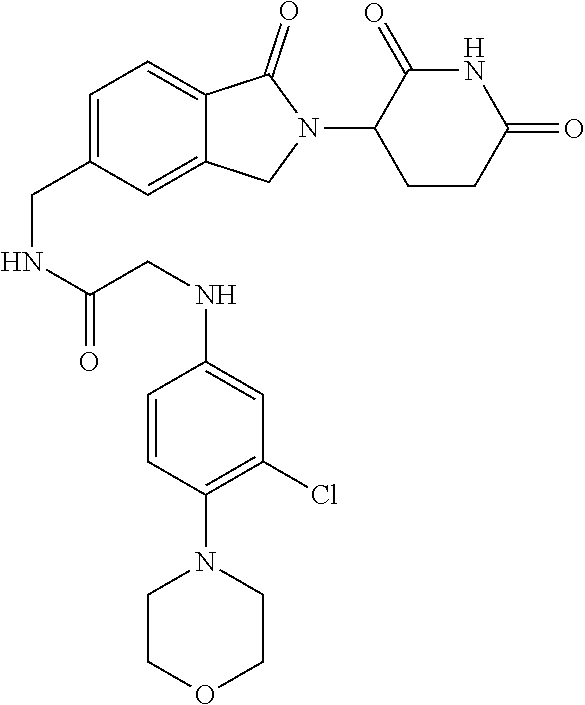


| TABLE 1 |
| Activity of compounds in IKAROS degradation |
| assay. Compounds tested at 1 μM. |
| IKAROS % Degradation | |||
| Compound No. | at 1 μM | ||
| 1 | D | ||
| 2 | D | ||
| 4 | B | ||
| 5 | D | ||
| 10 | A | ||
| 11 | B | ||
| 14 | D | ||
| 17 | C | ||
| 19 | B | ||
| 20 | B | ||
| 21 | C | ||
| 23 | C | ||
| 24 | D | ||
| TABLE 2 |
| Activity of compounds in CK1α degradation |
| assay. Compounds tested at 1 μM. |
| CK1α % Degradation | |||
| Compound No. | at 1 μM | ||
| 1 | B | ||
| 5 | D | ||
| 10 | B | ||
| 14 | C | ||
| 17 | C | ||
| 18 | B | ||
| 20 | B | ||
| 21 | A | ||
| 24 | B | ||
| 25 | B | ||
| 26 | C | ||
| TABLE 3 |
| Activity of compounds in GSPT1 degradation |
| assay. Compounds tested at 1 μM. |
| GSPT1 % Degradation | |||
| Compound No. | at 1 μM | ||
| 1 | D | ||
| 2 | C | ||
| 4 | B | ||
| 10 | D | ||
| 11 | B | ||
| 12 | C | ||
| 14 | C | ||
| 16 | B | ||
| 17 | D | ||
| 18 | D | ||
| 19 | D | ||
| 20 | B | ||
| 21 | C | ||
| 23 | B | ||
| 24 | D | ||
| 25 | C | ||
| 26 | C | ||

Cell-Based Assay
| TABLE 4 |
| Activity of compounds in IL-1β inhibition |
| assay. Compounds tested at 1 μM. |
| IL-1β % Inhibition | |||
| Compound No. | at 1 μM | ||
| 2 | D | ||
| 4 | C | ||
| 5 | D | ||
| 6 | A | ||
| 7 | D | ||
| 8 | D | ||
| 9 | C | ||
| 11 | B | ||
| 12 | A | ||
| 14 | D | ||
| 18 | B | ||
| 20 | A | ||
| 21 | A | ||
| 22 | C | ||
| 23 | B | ||
| 25 | A | ||
| TABLE 5 |
| Activity of compounds in IL-6 inhibition |
| assay. Compounds tested at 1 μM. |
| IL-6 % Inhibition | |||
| Compound No. | at 1 μM | ||
| 513 | C | ||
| 541 | C | ||
| 688 | B | ||
| 576 | D | ||
| 996 | B | ||
| TABLE 6 |
| Activity of compounds in TNF-α inhibition |
| assay. Compounds tested at 1 μM. |
| TNF-α % Inhibition | |||
| Compound No. | at 1 μM | ||
| 2 | C | ||
| 4 | C | ||
| 5 | D | ||
| 6 | A | ||
| 7 | D | ||
| 8 | D | ||
| 9 | C | ||
| 11 | B | ||
| 12 | A | ||
| 14 | C | ||
| 18 | B | ||
| 19 | B | ||
| 20 | B | ||
| 21 | B | ||
| 22 | C | ||
| 23 | B | ||
| 25 | B | ||
| TABLE 7 |
| Activity of compounds in IL-2 fold-change |
| assay. Compounds tested at 1 μM. |
| IL-2 Fold-Change | |||
| Compound No | at 1 μM | ||
| 2 | B | ||
| 4 | C | ||
| 5 | D | ||
| 7 | C | ||
| 8 | B | ||
| 9 | B | ||
| 11 | B | ||
| 12 | B | ||
| 14 | C | ||
| 15 | B | ||
| 18 | A | ||
| 19 | A | ||
| 21 | B | ||
| 22 | C | ||
| 23 | B | ||
| 25 | B | ||
Cell Viability Assay
| TABLE 8 |
| Activity of compounds in MOLM-13 cell viability |
| assays. Compounds tested at 1 μM. |
| MOLM-13 Cell Viability | |||
| Compound No. | % DMSO at 1 μM | ||
| 1 | D | ||
| 2 | D | ||
| 4 | D | ||
| 5 | A | ||
| 10 | D | ||
| 11 | A | ||
| 14 | B | ||
| 16 | C | ||
| 17 | C | ||
| 18 | D | ||
| 19 | C | ||
| 20 | D | ||
| 21 | A | ||
| 23 | B | ||
| 24 | D | ||
Claims (21)


Priority Applications (1)
| Application Number | Priority Date | Filing Date | Title |
|---|---|---|---|
| US17/163,802 US11400084B2 (en) | 2018-06-13 | 2021-02-01 | Aminoamide compounds |
Applications Claiming Priority (4)
| Application Number | Priority Date | Filing Date | Title |
|---|---|---|---|
| US201862684541P | 2018-06-13 | 2018-06-13 | |
| US201862731596P | 2018-09-14 | 2018-09-14 | |
| US16/438,185 US10905684B2 (en) | 2018-06-13 | 2019-06-11 | Aminoamide compounds |
| US17/163,802 US11400084B2 (en) | 2018-06-13 | 2021-02-01 | Aminoamide compounds |
Related Parent Applications (1)
| Application Number | Title | Priority Date | Filing Date |
|---|---|---|---|
| US16/438,185 Division US10905684B2 (en) | 2018-06-13 | 2019-06-11 | Aminoamide compounds |
Publications (2)
| Publication Number | Publication Date |
|---|---|
| US20210145812A1 US20210145812A1 (en) | 2021-05-20 |
| US11400084B2 true US11400084B2 (en) | 2022-08-02 |
Family
ID=67263035
Family Applications (2)
| Application Number | Title | Priority Date | Filing Date |
|---|---|---|---|
| US16/438,185 Active US10905684B2 (en) | 2018-06-13 | 2019-06-11 | Aminoamide compounds |
| US17/163,802 Active US11400084B2 (en) | 2018-06-13 | 2021-02-01 | Aminoamide compounds |
Family Applications Before (1)
| Application Number | Title | Priority Date | Filing Date |
|---|---|---|---|
| US16/438,185 Active US10905684B2 (en) | 2018-06-13 | 2019-06-11 | Aminoamide compounds |
Country Status (5)
| Country | Link |
|---|---|
| US (2) | US10905684B2 (en) |
| AU (1) | AU2019284608A1 (en) |
| CA (1) | CA3101338A1 (en) |
| TW (1) | TW202000656A (en) |
| WO (1) | WO2019241274A1 (en) |
Families Citing this family (33)
| Publication number | Priority date | Publication date | Assignee | Title |
|---|---|---|---|---|
| AU2019294835B2 (en) | 2018-06-29 | 2025-04-17 | Dana-Farber Cancer Institute, Inc. | Ligands to cereblon (CRBN) |
| KR102947433B1 (en) | 2019-04-12 | 2026-04-06 | 씨4 테라퓨틱스, 인코포레이티드 | Tricyclic Decomposer of Icarus and Aeolus |
| CN114502543A (en) | 2019-05-24 | 2022-05-13 | 拜欧斯瑞克斯公司 | Targeted protein compounds, pharmaceutical compositions and therapeutic applications thereof |
| IL293481A (en) * | 2019-12-06 | 2022-08-01 | Celgene Corp | Processes for preparing 2-(4-chlorophenyl)-n-((2-(2,6-dioxopiperidin-3-yl)-1-oxoisoindolin-5-yl)methyl)-2,2-difluoroacetamide |
| AU2021319847A1 (en) * | 2020-08-03 | 2023-03-02 | Captor Therapeutics S.A. | Low molecular weight protein degraders and their applications |
| AU2021322285B2 (en) * | 2020-08-07 | 2026-08-13 | C4 Therapeutics, Inc. | Advantageous therapies for disorders mediated by Ikaros or Aiolos |
| CN122562781A (en) * | 2020-10-07 | 2026-08-14 | 上海睿跃生物科技有限公司 | Compounds and methods for treating cancer |
| CA3194351A1 (en) * | 2020-10-14 | 2022-04-21 | Christopher G. Nasveschuk | Tricyclic compounds to degrade neosubstrates for medical therapy |
| CN117242060B (en) | 2021-01-13 | 2026-07-17 | 蒙特罗莎治疗股份有限公司 | Isoindolinone compounds |
| WO2022219412A1 (en) * | 2021-04-14 | 2022-10-20 | Monte Rosa Therapeutics Ag | Isoindolinone amide compounds useful to treat diseases associated with gspt1 |
| AU2022289605B2 (en) * | 2021-06-08 | 2024-12-19 | Hangzhou Glubio Pharmaceutical Co., Ltd. | Isoindolinone compounds, and uses thereof |
| CN115504963A (en) * | 2021-06-22 | 2022-12-23 | 苏州开拓药业股份有限公司 | A c-Myc protein degradation agent |
| CN117440948A (en) * | 2021-06-28 | 2024-01-23 | 成都分迪药业有限公司 | Amide compounds and their uses |
| WO2023069700A1 (en) * | 2021-10-22 | 2023-04-27 | Monte Rosa Therapeutics, Inc. | Compounds that mediate protein degradation and methods of use thereof |
| WO2023069731A1 (en) * | 2021-10-22 | 2023-04-27 | Monte Rosa Therapeutics, Inc. | Compounds that mediate protein degradation and methods of use thereof |
| WO2023070120A1 (en) * | 2021-10-22 | 2023-04-27 | Biotheryx, Inc. | Ketoamides for treating malignancy |
| WO2023069720A1 (en) * | 2021-10-22 | 2023-04-27 | Monte Rosa Therapeutics, Inc. | Compounds that mediate protein degradation and methods of use thereof |
| EP4426687A4 (en) * | 2021-11-04 | 2025-12-10 | Brigham & Womens Hospital Inc | Targeted Degron molecules and applications thereof |
| CN116082301A (en) * | 2021-11-05 | 2023-05-09 | 上海美志医药科技有限公司 | Compounds with activity of degrading GSPT1 and applications thereof |
| WO2023085785A1 (en) | 2021-11-09 | 2023-05-19 | 한국화학연구원 | Isoindolinone derivative having glutarimide mother nucleus, and use thereof |
| US20240124412A1 (en) * | 2021-12-22 | 2024-04-18 | Gilead Sciences, Inc. | Ikaros zinc finger family degraders and uses thereof |
| CN118488948A (en) | 2021-12-22 | 2024-08-13 | 吉利德科学公司 | IKAROS zinc finger family degraders and their uses |
| PL4245756T3 (en) | 2022-03-17 | 2025-02-17 | Gilead Sciences, Inc. | Ikaros zinc finger family degraders and uses thereof |
| US12662467B2 (en) | 2022-04-18 | 2026-06-23 | BioThery X, Inc. | Isoindolinones, pharmaceutical compositions, and therapeutic applications |
| CN114835680A (en) * | 2022-04-29 | 2022-08-02 | 成都分迪药业有限公司 | Halogen substituted isoindoline compound and application thereof |
| EP4536651A4 (en) * | 2022-06-10 | 2026-08-05 | Guangzhou Yufan Nantu Biotechnologies Co Ltd | PROTEIN DECORATORS AND USES OF THEM |
| EP4540241A1 (en) * | 2022-06-16 | 2025-04-23 | Monte Rosa Therapeutics AG | Substituted piperidines as ck1a degraders |
| JP2025522795A (en) * | 2022-06-27 | 2025-07-17 | ピン セラピューティクス、インコーポレイテッド | Compounds and methods for degrading casein kinase 1 alpha - Patents.com |
| KR20240066904A (en) | 2022-11-08 | 2024-05-16 | 주식회사 온코드바이오 | Isoindolinone compounds with arylcycloalkyl amide and use thereof |
| KR20240066906A (en) | 2022-11-08 | 2024-05-16 | 주식회사 온코드바이오 | Isoindolinone compounds with substituted quinoline amide and use thereof |
| WO2024125437A1 (en) * | 2022-12-13 | 2024-06-20 | 南京圣和药业股份有限公司 | Gspt1 degradation agent and use thereof |
| WO2024167423A1 (en) * | 2023-02-07 | 2024-08-15 | Captor Therapeutics S.A. | Gspt1 degrader compounds |
| WO2025129172A1 (en) * | 2023-12-14 | 2025-06-19 | The Board Of Trustees Of The Leland Stanford Junior University | Crbn molecular glue degraders and uses thereof |
Citations (3)
| Publication number | Priority date | Publication date | Assignee | Title |
|---|---|---|---|---|
| US20110223611A1 (en) | 2010-03-12 | 2011-09-15 | Salamone Salvatore J | Lenalidomide and thalidomide immunoassays |
| CN103396397A (en) | 2013-08-14 | 2013-11-20 | 中国人民解放军军事医学科学院毒物药物研究所 | Lenalidomide derivatives and their use as medicines |
| US20140314752A1 (en) | 2013-04-17 | 2014-10-23 | Signal Pharmaceuticals, Llc | Methods for treating cancer using tor kinase inhibitor combination therapy |
-
2019
- 2019-06-11 US US16/438,185 patent/US10905684B2/en active Active
- 2019-06-11 CA CA3101338A patent/CA3101338A1/en not_active Abandoned
- 2019-06-11 AU AU2019284608A patent/AU2019284608A1/en not_active Abandoned
- 2019-06-11 WO PCT/US2019/036586 patent/WO2019241274A1/en not_active Ceased
- 2019-06-13 TW TW108120528A patent/TW202000656A/en unknown
-
2021
- 2021-02-01 US US17/163,802 patent/US11400084B2/en active Active
Patent Citations (3)
| Publication number | Priority date | Publication date | Assignee | Title |
|---|---|---|---|---|
| US20110223611A1 (en) | 2010-03-12 | 2011-09-15 | Salamone Salvatore J | Lenalidomide and thalidomide immunoassays |
| US20140314752A1 (en) | 2013-04-17 | 2014-10-23 | Signal Pharmaceuticals, Llc | Methods for treating cancer using tor kinase inhibitor combination therapy |
| CN103396397A (en) | 2013-08-14 | 2013-11-20 | 中国人民解放军军事医学科学院毒物药物研究所 | Lenalidomide derivatives and their use as medicines |
Non-Patent Citations (23)
Also Published As
| Publication number | Publication date |
|---|---|
| AU2019284608A1 (en) | 2020-12-17 |
| US20200009120A1 (en) | 2020-01-09 |
| US20210145812A1 (en) | 2021-05-20 |
| CA3101338A1 (en) | 2019-12-19 |
| WO2019241274A1 (en) | 2019-12-19 |
| US10905684B2 (en) | 2021-02-02 |
| TW202000656A (en) | 2020-01-01 |
Similar Documents
| Publication | Publication Date | Title |
|---|---|---|
| US10905684B2 (en) | Aminoamide compounds | |
| US11191769B2 (en) | Fused thiophene compounds | |
| US11236103B2 (en) | Bifunctional compounds | |
| US11345714B2 (en) | Compounds targeting proteins, compositions, methods, and uses thereof | |
| US11352338B2 (en) | Substituted isoindolinones | |
| US10562917B2 (en) | Chimeric compounds targeting proteins, compositions, methods, and uses thereof | |
| US10584133B2 (en) | Thienopyrimidinone compounds | |
| IL255589A (en) | Compounds targeting proteins, compositions, methods, and uses thereof | |
| WO2019173224A1 (en) | Deuterated compounds and chimeras and uses thereof | |
| CA3140078A1 (en) | Compounds targeting proteins and pharmaceutical compositions thereof, and their therapeutic applications |
Legal Events
| Date | Code | Title | Description |
|---|---|---|---|
| FEPP | Fee payment procedure |
Free format text: ENTITY STATUS SET TO UNDISCOUNTED (ORIGINAL EVENT CODE: BIG.); ENTITY STATUS OF PATENT OWNER: SMALL ENTITY |
|
| FEPP | Fee payment procedure |
Free format text: ENTITY STATUS SET TO SMALL (ORIGINAL EVENT CODE: SMAL); ENTITY STATUS OF PATENT OWNER: SMALL ENTITY |
|
| STPP | Information on status: patent application and granting procedure in general |
Free format text: APPLICATION DISPATCHED FROM PREEXAM, NOT YET DOCKETED |
|
| AS | Assignment |
Owner name: BIOTHERYX, INC., NEW YORK Free format text: ASSIGNMENT OF ASSIGNORS INTEREST;ASSIGNORS:CHAN, KYLE W.H.;CHOURASIA, APARAJITA HOSKOTE;ERDMAN, PAUL E.;AND OTHERS;SIGNING DATES FROM 20190702 TO 20190705;REEL/FRAME:055346/0693 |
|
| STPP | Information on status: patent application and granting procedure in general |
Free format text: DOCKETED NEW CASE - READY FOR EXAMINATION |
|
| STPP | Information on status: patent application and granting procedure in general |
Free format text: NON FINAL ACTION MAILED |
|
| STPP | Information on status: patent application and granting procedure in general |
Free format text: RESPONSE TO NON-FINAL OFFICE ACTION ENTERED AND FORWARDED TO EXAMINER |
|
| STPP | Information on status: patent application and granting procedure in general |
Free format text: NOTICE OF ALLOWANCE MAILED -- APPLICATION RECEIVED IN OFFICE OF PUBLICATIONS |
|
| STCF | Information on status: patent grant |
Free format text: PATENTED CASE |
|
| MAFP | Maintenance fee payment |
Free format text: PAYMENT OF MAINTENANCE FEE, 4TH YR, SMALL ENTITY (ORIGINAL EVENT CODE: M2551); ENTITY STATUS OF PATENT OWNER: SMALL ENTITY Year of fee payment: 4 |