US11400083B2 - CXCR4 antagonists with amino acid skeleton, preparation therefor and biomedical use thereof - Google Patents
CXCR4 antagonists with amino acid skeleton, preparation therefor and biomedical use thereof Download PDFInfo
- Publication number
- US11400083B2 US11400083B2 US16/650,924 US201716650924A US11400083B2 US 11400083 B2 US11400083 B2 US 11400083B2 US 201716650924 A US201716650924 A US 201716650924A US 11400083 B2 US11400083 B2 US 11400083B2
- Authority
- US
- United States
- Prior art keywords
- compound
- amino acid
- cxcr4
- pharmaceutical composition
- present disclosure
- Prior art date
- Legal status (The legal status is an assumption and is not a legal conclusion. Google has not performed a legal analysis and makes no representation as to the accuracy of the status listed.)
- Active, expires
Links
- 0 *C(CC[Y]CCCC[1*])NB Chemical compound *C(CC[Y]CCCC[1*])NB 0.000 description 17
- FHYQICUXZWOYLZ-AARKOHAPSA-N N=C(N)CCCC[C@H](N)C(=O)C[C@@H](Cc1ccc2ccccc2c1)C(=O)NCc1ccc(CCCCCCC2CCCCC2)cc1 Chemical compound N=C(N)CCCC[C@H](N)C(=O)C[C@@H](Cc1ccc2ccccc2c1)C(=O)NCc1ccc(CCCCCCC2CCCCC2)cc1 FHYQICUXZWOYLZ-AARKOHAPSA-N 0.000 description 3
- JJTHQYKQSKQQGV-UHFFFAOYSA-N CC(=O)C(C)(C)C.CCC(C)(C)C Chemical compound CC(=O)C(C)(C)C.CCC(C)(C)C JJTHQYKQSKQQGV-UHFFFAOYSA-N 0.000 description 2
- YTRBCSKNPMYUDU-PYPLXARGSA-N CC(C)CCCCC[C@H](NCc1ccccn1)C(=O)NCc1ccc(CCCCCCC2CCCCC2)cc1.N=C(N)NCCC[C@H](NC1CCCCC1)C(=O)NCc1ccc(CCCCCCC2CCCCC2)cc1.N=C(N)NCCC[C@H](NCC1CCCCC1)C(=O)NCc1ccc(CCCCCCC2CCCCC2)cc1.NCCCC[C@H](NCc1ccccn1)C(=O)NCc1ccc(CCCCCCC2CCCCC2)cc1 Chemical compound CC(C)CCCCC[C@H](NCc1ccccn1)C(=O)NCc1ccc(CCCCCCC2CCCCC2)cc1.N=C(N)NCCC[C@H](NC1CCCCC1)C(=O)NCc1ccc(CCCCCCC2CCCCC2)cc1.N=C(N)NCCC[C@H](NCC1CCCCC1)C(=O)NCc1ccc(CCCCCCC2CCCCC2)cc1.NCCCC[C@H](NCc1ccccn1)C(=O)NCc1ccc(CCCCCCC2CCCCC2)cc1 YTRBCSKNPMYUDU-PYPLXARGSA-N 0.000 description 2
- FYCOPHCTSRHKHM-JWLLRRAQSA-N CC(C)C[C@H](NCc1ccccn1)C(=O)NCc1ccc(CCCCCCC2CCCCC2)cc1.N=C(N)NCCC[C@H](CC(=O)[C@@H](N)Cc1ccc(O)cc1)C(=O)NCc1ccc(CCCCCCC2CCCCC2)cc1.O=C(NCc1ccc(CCCCCCC2CCCCC2)cc1)[C@@H]1CCCN1Cc1ccccn1.O=C(NCc1ccc(CCCCCCC2CCCCC2)cc1)[C@@H]1Cc2ccccc2CN1Cc1ccccn1.O=C(NCc1ccc(CCCCCCC2CCCCC2)cc1)[C@H](Cc1c[nH]c2ccccc12)NCc1ccccn1.O=C(NCc1ccc(CCCCCCC2CCCCC2)cc1)[C@H](Cc1ccc(O)cc1)NCc1ccccn1.O=C(NCc1ccc(CCCCCCC2CCCCC2)cc1)[C@H](Cc1ccc2ccccc2c1)NCc1ccccn1 Chemical compound CC(C)C[C@H](NCc1ccccn1)C(=O)NCc1ccc(CCCCCCC2CCCCC2)cc1.N=C(N)NCCC[C@H](CC(=O)[C@@H](N)Cc1ccc(O)cc1)C(=O)NCc1ccc(CCCCCCC2CCCCC2)cc1.O=C(NCc1ccc(CCCCCCC2CCCCC2)cc1)[C@@H]1CCCN1Cc1ccccn1.O=C(NCc1ccc(CCCCCCC2CCCCC2)cc1)[C@@H]1Cc2ccccc2CN1Cc1ccccn1.O=C(NCc1ccc(CCCCCCC2CCCCC2)cc1)[C@H](Cc1c[nH]c2ccccc12)NCc1ccccn1.O=C(NCc1ccc(CCCCCCC2CCCCC2)cc1)[C@H](Cc1ccc(O)cc1)NCc1ccccn1.O=C(NCc1ccc(CCCCCCC2CCCCC2)cc1)[C@H](Cc1ccc2ccccc2c1)NCc1ccccn1 FYCOPHCTSRHKHM-JWLLRRAQSA-N 0.000 description 2
- OUWBWTFANSGYKN-GERZYQRGSA-N CN(C)c1ccc(CN[C@@H](CCCNC(=N)N)C(=O)NCc2ccc(CCCCCCC3CCCCC3)cc2)cc1.N=C(N)NCCC[C@H](NC(=O)C1CCC(F)(F)CC1)C(=O)NCc1ccc(CCCCCCC2CCCCC2)cc1.N=C(N)NCCC[C@H](NCc1ccc(F)cc1)C(=O)NCc1ccc(CCCCCCC2CCCCC2)cc1.N=C(N)NCCC[C@H](NCc1cccc2ccccc12)C(=O)NCc1ccc(CCCCCCC2CCCCC2)cc1 Chemical compound CN(C)c1ccc(CN[C@@H](CCCNC(=N)N)C(=O)NCc2ccc(CCCCCCC3CCCCC3)cc2)cc1.N=C(N)NCCC[C@H](NC(=O)C1CCC(F)(F)CC1)C(=O)NCc1ccc(CCCCCCC2CCCCC2)cc1.N=C(N)NCCC[C@H](NCc1ccc(F)cc1)C(=O)NCc1ccc(CCCCCCC2CCCCC2)cc1.N=C(N)NCCC[C@H](NCc1cccc2ccccc12)C(=O)NCc1ccc(CCCCCCC2CCCCC2)cc1 OUWBWTFANSGYKN-GERZYQRGSA-N 0.000 description 2
- IQBIJTDRWSGOHX-YILJCETJSA-N C[C@H](NCc1ccccn1)C(=O)NCc1ccc(CCCCCCC2CCCCC2)cc1.O=C(NCc1ccc(CCCCCCC2CCCCC2)cc1)[C@H](CCCCCC1CCCCC1)NCc1ccccn1.O=C(NCc1ccc(CCCCCCC2CCCCC2)cc1)[C@H](CCCNC1CCCCC1)NCc1ccccn1.O=C(NCc1ccc(CCCCCCC2CCCCC2)cc1)[C@H](CO)NCc1ccccn1.O=C(NCc1ccc(CCCCCCC2CCCCC2)cc1)[C@H](Cc1c[nH]cn1)NCc1ccccn1.O=C(O)C[C@H](NCc1ccccn1)C(=O)NCc1ccc(CCCCCCC2CCCCC2)cc1 Chemical compound C[C@H](NCc1ccccn1)C(=O)NCc1ccc(CCCCCCC2CCCCC2)cc1.O=C(NCc1ccc(CCCCCCC2CCCCC2)cc1)[C@H](CCCCCC1CCCCC1)NCc1ccccn1.O=C(NCc1ccc(CCCCCCC2CCCCC2)cc1)[C@H](CCCNC1CCCCC1)NCc1ccccn1.O=C(NCc1ccc(CCCCCCC2CCCCC2)cc1)[C@H](CO)NCc1ccccn1.O=C(NCc1ccc(CCCCCCC2CCCCC2)cc1)[C@H](Cc1c[nH]cn1)NCc1ccccn1.O=C(O)C[C@H](NCc1ccccn1)C(=O)NCc1ccc(CCCCCCC2CCCCC2)cc1 IQBIJTDRWSGOHX-YILJCETJSA-N 0.000 description 2
- CKJMMMJSNAYFIG-WJZSASCRSA-N Cc1cc(CN[C@@H](CCCNC(=N)N)C(=O)NCc2ccc(CCCCCCC3CCCCC3)cc2)cc(C(F)(F)F)c1.N=C(N)NCCC[C@H](NC1CCCc2cccnc21)C(=O)NCc1ccc(CCCCCCC2CCCCC2)cc1.N=C(N)NCCC[C@H](NCc1ccc(-c2ccccc2)cc1)C(=O)NCc1ccc(CCCCCCC2CCCCC2)cc1.N=C(N)NCCC[C@H](NCc1ncc[nH]1)C(=O)NCc1ccc(CCCCCCC2CCCCC2)cc1 Chemical compound Cc1cc(CN[C@@H](CCCNC(=N)N)C(=O)NCc2ccc(CCCCCCC3CCCCC3)cc2)cc(C(F)(F)F)c1.N=C(N)NCCC[C@H](NC1CCCc2cccnc21)C(=O)NCc1ccc(CCCCCCC2CCCCC2)cc1.N=C(N)NCCC[C@H](NCc1ccc(-c2ccccc2)cc1)C(=O)NCc1ccc(CCCCCCC2CCCCC2)cc1.N=C(N)NCCC[C@H](NCc1ncc[nH]1)C(=O)NCc1ccc(CCCCCCC2CCCCC2)cc1 CKJMMMJSNAYFIG-WJZSASCRSA-N 0.000 description 2
- CMFABAFPSQJKLK-UHFFFAOYSA-N CC(=O)C(N)Cc1ccc(O)cc1.CC(C)(C)C(=O)C(N)CCCCC(=N)N.CC(C)(C)C(=O)C1CCC(F)(F)CC1.CC(C)(C)C(=O)c1ccc(F)cc1.CC(C)(C)C1CCCc2ccccc21.CC(C)(C)CC1CCCCC1.CC(C)(C)Cc1ccc(-c2ccccc2)cc1.CC(C)(C)Cc1ccc(F)cc1.CC(C)(C)Cc1cccc2ccccc12.CC(C)(C)Cc1ccccn1.CC(C)(C)Cc1ncc[nH]1.CN(C)c1ccc(CC(C)(C)C)cc1.Cc1cc(CC(C)(C)C)cc(C(F)(F)F)c1 Chemical compound CC(=O)C(N)Cc1ccc(O)cc1.CC(C)(C)C(=O)C(N)CCCCC(=N)N.CC(C)(C)C(=O)C1CCC(F)(F)CC1.CC(C)(C)C(=O)c1ccc(F)cc1.CC(C)(C)C1CCCc2ccccc21.CC(C)(C)CC1CCCCC1.CC(C)(C)Cc1ccc(-c2ccccc2)cc1.CC(C)(C)Cc1ccc(F)cc1.CC(C)(C)Cc1cccc2ccccc12.CC(C)(C)Cc1ccccn1.CC(C)(C)Cc1ncc[nH]1.CN(C)c1ccc(CC(C)(C)C)cc1.Cc1cc(CC(C)(C)C)cc(C(F)(F)F)c1 CMFABAFPSQJKLK-UHFFFAOYSA-N 0.000 description 1
- OTPPXJZZXHPANJ-UHFFFAOYSA-N CC(=O)CC(C)(C)C.CCC(C)(C)C Chemical compound CC(=O)CC(C)(C)C.CCC(C)(C)C OTPPXJZZXHPANJ-UHFFFAOYSA-N 0.000 description 1
- SDKBIKIXEMKBMB-UHFFFAOYSA-N CC(C)(C)C1CCCCC1.CC(C)(C)CC(=O)O.CC(C)(C)CC(N)=O.CC(C)(C)CC1CCCCC1.CC(C)(C)CCCCCC1CCCCC1.CC(C)(C)CCCCCN.CC(C)(C)CCCNC(=N)N.CC(C)(C)CO.CC(C)(C)Cc1c[nH]c2ccccc12.CC(C)(C)Cc1c[nH]cn1.CC(C)(C)Cc1ccc(-c2ccccc2)cc1.CC(C)(C)Cc1ccc(O)cc1.CC(C)(C)Cc1ccc2ccccc2c1.CC(C)(C)Cc1cccnc1.CC(C)(C)c1ccccc1.CC(C)CC(C)(C)C.CC(C)CCCCCC(C)(C)C Chemical compound CC(C)(C)C1CCCCC1.CC(C)(C)CC(=O)O.CC(C)(C)CC(N)=O.CC(C)(C)CC1CCCCC1.CC(C)(C)CCCCCC1CCCCC1.CC(C)(C)CCCCCN.CC(C)(C)CCCNC(=N)N.CC(C)(C)CO.CC(C)(C)Cc1c[nH]c2ccccc12.CC(C)(C)Cc1c[nH]cn1.CC(C)(C)Cc1ccc(-c2ccccc2)cc1.CC(C)(C)Cc1ccc(O)cc1.CC(C)(C)Cc1ccc2ccccc2c1.CC(C)(C)Cc1cccnc1.CC(C)(C)c1ccccc1.CC(C)CC(C)(C)C.CC(C)CCCCCC(C)(C)C SDKBIKIXEMKBMB-UHFFFAOYSA-N 0.000 description 1
- MXZUFQOFZKBXPO-UHFFFAOYSA-N CC(C)(C)CC(N)=O.CC(C)(C)CCCCCC1CCCCC1.CC(C)(C)CCCCCN.CC(C)(C)CCCNC(=N)N.CC(C)(C)CO.CC(C)(C)Cc1c[nH]c2ccccc12.CC(C)(C)Cc1c[nH]cn1.CC(C)(C)Cc1ccc(O)cc1.CC(C)(C)Cc1ccc2ccccc2c1.CC(C)CC(C)(C)C.CC(C)CCCCCC(C)(C)C Chemical compound CC(C)(C)CC(N)=O.CC(C)(C)CCCCCC1CCCCC1.CC(C)(C)CCCCCN.CC(C)(C)CCCNC(=N)N.CC(C)(C)CO.CC(C)(C)Cc1c[nH]c2ccccc12.CC(C)(C)Cc1c[nH]cn1.CC(C)(C)Cc1ccc(O)cc1.CC(C)(C)Cc1ccc2ccccc2c1.CC(C)CC(C)(C)C.CC(C)CCCCCC(C)(C)C MXZUFQOFZKBXPO-UHFFFAOYSA-N 0.000 description 1
- XCIGBAIKNNPFDZ-UHFFFAOYSA-N CC(C)(C)CC1CCC(CCCCCCC2CCCCC2)CC1.CC(C)(C)Cc1ccc(CCC2CCCCC2)cc1.CC(C)(C)Cc1ccc(CCCCCCC2CCCCC2)cc1.CC(C)(C)Cc1ccc(CCCCCCC2CCCCC2)cn1 Chemical compound CC(C)(C)CC1CCC(CCCCCCC2CCCCC2)CC1.CC(C)(C)Cc1ccc(CCC2CCCCC2)cc1.CC(C)(C)Cc1ccc(CCCCCCC2CCCCC2)cc1.CC(C)(C)Cc1ccc(CCCCCCC2CCCCC2)cn1 XCIGBAIKNNPFDZ-UHFFFAOYSA-N 0.000 description 1
- MDNKSBRLHXXWNR-UHFFFAOYSA-N CC(C)(C)OC(=O)N(CCCN(C(=O)OC(C)(C)C)C1CCCCC1)Cc1ccc(C#N)cc1.CC(C)(C)OC(=O)N(CCCN(C(=O)OC(C)(C)C)C1CCCCC1)Cc1ccc(CN)cc1.CC(C)(C)OC(=O)N(Cc1ccc(C#N)cc1)C1CCCCC1.CC(C)(C)OC(=O)N(Cc1ccc(CN)cc1)C1CCCCC1.N#Cc1ccc(C=O)cc1.N#Cc1ccc(CCC2CCCCC2)cc1.N#Cc1ccc(CCCCCCC2CCCCC2)cc1 Chemical compound CC(C)(C)OC(=O)N(CCCN(C(=O)OC(C)(C)C)C1CCCCC1)Cc1ccc(C#N)cc1.CC(C)(C)OC(=O)N(CCCN(C(=O)OC(C)(C)C)C1CCCCC1)Cc1ccc(CN)cc1.CC(C)(C)OC(=O)N(Cc1ccc(C#N)cc1)C1CCCCC1.CC(C)(C)OC(=O)N(Cc1ccc(CN)cc1)C1CCCCC1.N#Cc1ccc(C=O)cc1.N#Cc1ccc(CCC2CCCCC2)cc1.N#Cc1ccc(CCCCCCC2CCCCC2)cc1 MDNKSBRLHXXWNR-UHFFFAOYSA-N 0.000 description 1
- VWQCNPMHYSERMW-UMSFTDKQSA-N CC(C)CCCCC[C@H](NCc1ccccn1)C(=O)NCc1ccc(CCCCCCC2CCCCC2)cc1 Chemical compound CC(C)CCCCC[C@H](NCc1ccccn1)C(=O)NCc1ccc(CCCCCCC2CCCCC2)cc1 VWQCNPMHYSERMW-UMSFTDKQSA-N 0.000 description 1
- GANQWDJVLBYIML-PMERELPUSA-N CC(C)C[C@H](NCc1ccccn1)C(=O)NCc1ccc(CCCCCCC2CCCCC2)cc1 Chemical compound CC(C)C[C@H](NCc1ccccn1)C(=O)NCc1ccc(CCCCCCC2CCCCC2)cc1 GANQWDJVLBYIML-PMERELPUSA-N 0.000 description 1
- ZJOWBHXTBZUBDG-YTTGMZPUSA-N CN(C)c1ccc(CN[C@@H](CCCNC(=N)N)C(=O)NCc2ccc(CCCCCCC3CCCCC3)cc2)cc1 Chemical compound CN(C)c1ccc(CN[C@@H](CCCNC(=N)N)C(=O)NCc2ccc(CCCCCCC3CCCCC3)cc2)cc1 ZJOWBHXTBZUBDG-YTTGMZPUSA-N 0.000 description 1
- SMFHKCITERXTID-QHCPKHFHSA-N C[C@H](NCc1ccccn1)C(=O)NCc1ccc(CCCCCCC2CCCCC2)cc1 Chemical compound C[C@H](NCc1ccccn1)C(=O)NCc1ccc(CCCCCCC2CCCCC2)cc1 SMFHKCITERXTID-QHCPKHFHSA-N 0.000 description 1
- YAGQGAPJPVRXCA-HKBQPEDESA-N Cc1cc(CN[C@@H](CCCNC(=N)N)C(=O)NCc2ccc(CCCCCCC3CCCCC3)cc2)cc(C(F)(F)F)c1 Chemical compound Cc1cc(CN[C@@H](CCCNC(=N)N)C(=O)NCc2ccc(CCCCCCC3CCCCC3)cc2)cc(C(F)(F)F)c1 YAGQGAPJPVRXCA-HKBQPEDESA-N 0.000 description 1
- IDUMJINZNSMUGK-GDLZYMKVSA-N N=C(N)NCCC[C@@H](NCc1ccccn1)C(=O)NCc1ccc(CCCCCCC2CCCCC2)cc1 Chemical compound N=C(N)NCCC[C@@H](NCc1ccccn1)C(=O)NCc1ccc(CCCCCCC2CCCCC2)cc1 IDUMJINZNSMUGK-GDLZYMKVSA-N 0.000 description 1
- VNALSMGBFWUOGH-ISZFZGENSA-N N=C(N)NCCC[C@@H](NCc1ccccn1)C(=O)NCc1ccc(CCCCCCC2CCCCC2)cc1.N=C(N)NCCC[C@H](N)C(=O)NCc1ccc(CCCCCCC2CCCCC2)cc1.N=C(N)NCCC[C@H](NC(=O)c1ccc(F)cc1)C(=O)NCc1ccc(CCCCCCC2CCCCC2)cc1.N=C(N)NCCC[C@H](NCc1ccccn1)C(=O)NCc1ccc(CCC2CCCCC2)cc1.N=C(N)NCCC[C@H](NCc1ccccn1)C(=O)NCc1ccc(CCCCCCC2CCCCC2)cc1.N=C(N)NCCC[C@H](NCc1ccccn1)C(=O)NCc1ccccc1 Chemical compound N=C(N)NCCC[C@@H](NCc1ccccn1)C(=O)NCc1ccc(CCCCCCC2CCCCC2)cc1.N=C(N)NCCC[C@H](N)C(=O)NCc1ccc(CCCCCCC2CCCCC2)cc1.N=C(N)NCCC[C@H](NC(=O)c1ccc(F)cc1)C(=O)NCc1ccc(CCCCCCC2CCCCC2)cc1.N=C(N)NCCC[C@H](NCc1ccccn1)C(=O)NCc1ccc(CCC2CCCCC2)cc1.N=C(N)NCCC[C@H](NCc1ccccn1)C(=O)NCc1ccc(CCCCCCC2CCCCC2)cc1.N=C(N)NCCC[C@H](NCc1ccccn1)C(=O)NCc1ccccc1 VNALSMGBFWUOGH-ISZFZGENSA-N 0.000 description 1
- XOHNMSXXNVIBEP-OIPLGRNTSA-N N=C(N)NCCC[C@@H](NCc1ccccn1)C(=O)NCc1ccc(CCCCCCC2CCCCC2)cc1.N=C(N)NCCC[C@H](N)C(=O)NCc1ccc(CCCCCCC2CCCCC2)cc1.N=C(N)NCCC[C@H](NC(=O)c1ccc(F)cc1)C(=O)NCc1ccc(CCCCCCC2CCCCC2)cc1.N=C(N)NCCC[C@H](NCc1ccccn1)C(=O)NCc1ccc(CCCCCCC2CCCCC2)cc1 Chemical compound N=C(N)NCCC[C@@H](NCc1ccccn1)C(=O)NCc1ccc(CCCCCCC2CCCCC2)cc1.N=C(N)NCCC[C@H](N)C(=O)NCc1ccc(CCCCCCC2CCCCC2)cc1.N=C(N)NCCC[C@H](NC(=O)c1ccc(F)cc1)C(=O)NCc1ccc(CCCCCCC2CCCCC2)cc1.N=C(N)NCCC[C@H](NCc1ccccn1)C(=O)NCc1ccc(CCCCCCC2CCCCC2)cc1 XOHNMSXXNVIBEP-OIPLGRNTSA-N 0.000 description 1
- OAYRCIGWHDHPNU-BHYZAODMSA-N N=C(N)NCCC[C@H](CC(=O)[C@@H](N)Cc1ccc(O)cc1)C(=O)NCc1ccc(CCCCCCC2CCCCC2)cc1 Chemical compound N=C(N)NCCC[C@H](CC(=O)[C@@H](N)Cc1ccc(O)cc1)C(=O)NCc1ccc(CCCCCCC2CCCCC2)cc1 OAYRCIGWHDHPNU-BHYZAODMSA-N 0.000 description 1
- VPLIXUKAAAESEK-QHCPKHFHSA-N N=C(N)NCCC[C@H](N)C(=O)NCc1ccc(CCCCCCC2CCCCC2)cc1 Chemical compound N=C(N)NCCC[C@H](N)C(=O)NCc1ccc(CCCCCCC2CCCCC2)cc1 VPLIXUKAAAESEK-QHCPKHFHSA-N 0.000 description 1
- JLIAPBMOPDVQGL-NDEPHWFRSA-N N=C(N)NCCC[C@H](NC(=O)C1CCC(F)(F)CC1)C(=O)NCc1ccc(CCCCCCC2CCCCC2)cc1 Chemical compound N=C(N)NCCC[C@H](NC(=O)C1CCC(F)(F)CC1)C(=O)NCc1ccc(CCCCCCC2CCCCC2)cc1 JLIAPBMOPDVQGL-NDEPHWFRSA-N 0.000 description 1
- GKHWIFPGIPLDKS-LJAQVGFWSA-N N=C(N)NCCC[C@H](NC(=O)c1ccc(F)cc1)C(=O)NCc1ccc(CCCCCCC2CCCCC2)cc1 Chemical compound N=C(N)NCCC[C@H](NC(=O)c1ccc(F)cc1)C(=O)NCc1ccc(CCCCCCC2CCCCC2)cc1 GKHWIFPGIPLDKS-LJAQVGFWSA-N 0.000 description 1
- XOMNOUZHPNRDSM-LJAQVGFWSA-N N=C(N)NCCC[C@H](NC1CCCCC1)C(=O)NCc1ccc(CCCCCCC2CCCCC2)cc1 Chemical compound N=C(N)NCCC[C@H](NC1CCCCC1)C(=O)NCc1ccc(CCCCCCC2CCCCC2)cc1 XOMNOUZHPNRDSM-LJAQVGFWSA-N 0.000 description 1
- GGAXFGQOABKFMZ-FLDQDSGZSA-N N=C(N)NCCC[C@H](NC1CCCc2cccnc21)C(=O)NCc1ccc(CCCCCCC2CCCCC2)cc1 Chemical compound N=C(N)NCCC[C@H](NC1CCCc2cccnc21)C(=O)NCc1ccc(CCCCCCC2CCCCC2)cc1 GGAXFGQOABKFMZ-FLDQDSGZSA-N 0.000 description 1
- QBAZSUAOXLDLOJ-PMERELPUSA-N N=C(N)NCCC[C@H](NCC1CCCCC1)C(=O)NCc1ccc(CCCCCCC2CCCCC2)cc1 Chemical compound N=C(N)NCCC[C@H](NCC1CCCCC1)C(=O)NCc1ccc(CCCCCCC2CCCCC2)cc1 QBAZSUAOXLDLOJ-PMERELPUSA-N 0.000 description 1
- DGHVZSROXKUENX-BHVANESWSA-N N=C(N)NCCC[C@H](NCc1ccc(-c2ccccc2)cc1)C(=O)NCc1ccc(CCCCCCC2CCCCC2)cc1 Chemical compound N=C(N)NCCC[C@H](NCc1ccc(-c2ccccc2)cc1)C(=O)NCc1ccc(CCCCCCC2CCCCC2)cc1 DGHVZSROXKUENX-BHVANESWSA-N 0.000 description 1
- PENUNTARPJACGL-PMERELPUSA-N N=C(N)NCCC[C@H](NCc1ccc(F)cc1)C(=O)NCc1ccc(CCCCCCC2CCCCC2)cc1 Chemical compound N=C(N)NCCC[C@H](NCc1ccc(F)cc1)C(=O)NCc1ccc(CCCCCCC2CCCCC2)cc1 PENUNTARPJACGL-PMERELPUSA-N 0.000 description 1
- LJYQMVYLFZWRNT-UMSFTDKQSA-N N=C(N)NCCC[C@H](NCc1cccc2ccccc12)C(=O)NCc1ccc(CCCCCCC2CCCCC2)cc1 Chemical compound N=C(N)NCCC[C@H](NCc1cccc2ccccc12)C(=O)NCc1ccc(CCCCCCC2CCCCC2)cc1 LJYQMVYLFZWRNT-UMSFTDKQSA-N 0.000 description 1
- FGVAFIVDPAHCRZ-VWLOTQADSA-N N=C(N)NCCC[C@H](NCc1ccccn1)C(=O)NCc1ccc(CCC2CCCCC2)cc1 Chemical compound N=C(N)NCCC[C@H](NCc1ccccn1)C(=O)NCc1ccc(CCC2CCCCC2)cc1 FGVAFIVDPAHCRZ-VWLOTQADSA-N 0.000 description 1
- IDUMJINZNSMUGK-LJAQVGFWSA-N N=C(N)NCCC[C@H](NCc1ccccn1)C(=O)NCc1ccc(CCCCCCC2CCCCC2)cc1 Chemical compound N=C(N)NCCC[C@H](NCc1ccccn1)C(=O)NCc1ccc(CCCCCCC2CCCCC2)cc1 IDUMJINZNSMUGK-LJAQVGFWSA-N 0.000 description 1
- OXQUCVQLGGUXPW-KRWDZBQOSA-N N=C(N)NCCC[C@H](NCc1ccccn1)C(=O)NCc1ccccc1 Chemical compound N=C(N)NCCC[C@H](NCc1ccccn1)C(=O)NCc1ccccc1 OXQUCVQLGGUXPW-KRWDZBQOSA-N 0.000 description 1
- HQFZNUCJEGNEJJ-SANMLTNESA-N N=C(N)NCCC[C@H](NCc1ncc[nH]1)C(=O)NCc1ccc(CCCCCCC2CCCCC2)cc1 Chemical compound N=C(N)NCCC[C@H](NCc1ncc[nH]1)C(=O)NCc1ccc(CCCCCCC2CCCCC2)cc1 HQFZNUCJEGNEJJ-SANMLTNESA-N 0.000 description 1
- SQGNYIDQULSPKX-PMERELPUSA-N NCCCC[C@H](NCc1ccccn1)C(=O)NCc1ccc(CCCCCCC2CCCCC2)cc1 Chemical compound NCCCC[C@H](NCc1ccccn1)C(=O)NCc1ccc(CCCCCCC2CCCCC2)cc1 SQGNYIDQULSPKX-PMERELPUSA-N 0.000 description 1
- IHTLLWNDMVWPOM-LJAQVGFWSA-N O=C(NCc1ccc(CCCCCCC2CCCCC2)cc1)[C@@H]1CCCN1Cc1ccccn1 Chemical compound O=C(NCc1ccc(CCCCCCC2CCCCC2)cc1)[C@@H]1CCCN1Cc1ccccn1 IHTLLWNDMVWPOM-LJAQVGFWSA-N 0.000 description 1
- UWIHXQIALVTYLH-UMSFTDKQSA-N O=C(NCc1ccc(CCCCCCC2CCCCC2)cc1)[C@@H]1Cc2ccccc2CN1Cc1ccccn1 Chemical compound O=C(NCc1ccc(CCCCCCC2CCCCC2)cc1)[C@@H]1Cc2ccccc2CN1Cc1ccccn1 UWIHXQIALVTYLH-UMSFTDKQSA-N 0.000 description 1
- JWNIXSJICZAREH-QNGWXLTQSA-N O=C(NCc1ccc(CCCCCCC2CCCCC2)cc1)[C@H](CCCCCC1CCCCC1)NCc1ccccn1 Chemical compound O=C(NCc1ccc(CCCCCCC2CCCCC2)cc1)[C@H](CCCCCC1CCCCC1)NCc1ccccn1 JWNIXSJICZAREH-QNGWXLTQSA-N 0.000 description 1
- KTYAXGJCKCOLFG-DHUJRADRSA-N O=C(NCc1ccc(CCCCCCC2CCCCC2)cc1)[C@H](CCCNC1CCCCC1)NCc1ccccn1 Chemical compound O=C(NCc1ccc(CCCCCCC2CCCCC2)cc1)[C@H](CCCNC1CCCCC1)NCc1ccccn1 KTYAXGJCKCOLFG-DHUJRADRSA-N 0.000 description 1
- FTDFFWLHXRSHST-MHZLTWQESA-N O=C(NCc1ccc(CCCCCCC2CCCCC2)cc1)[C@H](CO)NCc1ccccn1 Chemical compound O=C(NCc1ccc(CCCCCCC2CCCCC2)cc1)[C@H](CO)NCc1ccccn1 FTDFFWLHXRSHST-MHZLTWQESA-N 0.000 description 1
- QCTLRTDMYXZNFZ-DHUJRADRSA-N O=C(NCc1ccc(CCCCCCC2CCCCC2)cc1)[C@H](Cc1c[nH]c2ccccc12)NCc1ccccn1 Chemical compound O=C(NCc1ccc(CCCCCCC2CCCCC2)cc1)[C@H](Cc1c[nH]c2ccccc12)NCc1ccccn1 QCTLRTDMYXZNFZ-DHUJRADRSA-N 0.000 description 1
- ODBFWJNRVCHYJI-PMERELPUSA-N O=C(NCc1ccc(CCCCCCC2CCCCC2)cc1)[C@H](Cc1c[nH]cn1)NCc1ccccn1 Chemical compound O=C(NCc1ccc(CCCCCCC2CCCCC2)cc1)[C@H](Cc1c[nH]cn1)NCc1ccccn1 ODBFWJNRVCHYJI-PMERELPUSA-N 0.000 description 1
- USHMBYKLZDUSQJ-XIFFEERXSA-N O=C(NCc1ccc(CCCCCCC2CCCCC2)cc1)[C@H](Cc1ccc(O)cc1)NCc1ccccn1 Chemical compound O=C(NCc1ccc(CCCCCCC2CCCCC2)cc1)[C@H](Cc1ccc(O)cc1)NCc1ccccn1 USHMBYKLZDUSQJ-XIFFEERXSA-N 0.000 description 1
- WGEIJGTXIZJNCO-QNGWXLTQSA-N O=C(NCc1ccc(CCCCCCC2CCCCC2)cc1)[C@H](Cc1ccc2ccccc2c1)NCc1ccccn1 Chemical compound O=C(NCc1ccc(CCCCCCC2CCCCC2)cc1)[C@H](Cc1ccc2ccccc2c1)NCc1ccccn1 WGEIJGTXIZJNCO-QNGWXLTQSA-N 0.000 description 1
- GNKOXTIMEFLPJT-MHZLTWQESA-N O=C(O)C[C@H](NCc1ccccn1)C(=O)NCc1ccc(CCCCCCC2CCCCC2)cc1 Chemical compound O=C(O)C[C@H](NCc1ccccn1)C(=O)NCc1ccc(CCCCCCC2CCCCC2)cc1 GNKOXTIMEFLPJT-MHZLTWQESA-N 0.000 description 1
Images


Classifications
-
- A—HUMAN NECESSITIES
- A61—MEDICAL OR VETERINARY SCIENCE; HYGIENE
- A61K—PREPARATIONS FOR MEDICAL, DENTAL OR TOILETRY PURPOSES
- A61K31/00—Medicinal preparations containing organic active ingredients
- A61K31/33—Heterocyclic compounds
- A61K31/395—Heterocyclic compounds having nitrogen as a ring hetero atom, e.g. guanethidine or rifamycins
- A61K31/435—Heterocyclic compounds having nitrogen as a ring hetero atom, e.g. guanethidine or rifamycins having six-membered rings with one nitrogen as the only ring hetero atom
- A61K31/44—Non condensed pyridines; Hydrogenated derivatives thereof
- A61K31/4427—Non condensed pyridines; Hydrogenated derivatives thereof containing further heterocyclic ring systems
- A61K31/4439—Non condensed pyridines; Hydrogenated derivatives thereof containing further heterocyclic ring systems containing a five-membered ring with nitrogen as a ring hetero atom, e.g. omeprazole
-
- C—CHEMISTRY; METALLURGY
- C07—ORGANIC CHEMISTRY
- C07D—HETEROCYCLIC COMPOUNDS
- C07D213/00—Heterocyclic compounds containing six-membered rings, not condensed with other rings, with one nitrogen atom as the only ring hetero atom and three or more double bonds between ring members or between ring members and non-ring members
- C07D213/02—Heterocyclic compounds containing six-membered rings, not condensed with other rings, with one nitrogen atom as the only ring hetero atom and three or more double bonds between ring members or between ring members and non-ring members having three double bonds between ring members or between ring members and non-ring members
- C07D213/04—Heterocyclic compounds containing six-membered rings, not condensed with other rings, with one nitrogen atom as the only ring hetero atom and three or more double bonds between ring members or between ring members and non-ring members having three double bonds between ring members or between ring members and non-ring members having no bond between the ring nitrogen atom and a non-ring member or having only hydrogen or carbon atoms directly attached to the ring nitrogen atom
- C07D213/24—Heterocyclic compounds containing six-membered rings, not condensed with other rings, with one nitrogen atom as the only ring hetero atom and three or more double bonds between ring members or between ring members and non-ring members having three double bonds between ring members or between ring members and non-ring members having no bond between the ring nitrogen atom and a non-ring member or having only hydrogen or carbon atoms directly attached to the ring nitrogen atom with substituted hydrocarbon radicals attached to ring carbon atoms
- C07D213/54—Radicals substituted by carbon atoms having three bonds to hetero atoms with at the most one bond to halogen, e.g. ester or nitrile radicals
- C07D213/56—Amides
-
- A—HUMAN NECESSITIES
- A61—MEDICAL OR VETERINARY SCIENCE; HYGIENE
- A61K—PREPARATIONS FOR MEDICAL, DENTAL OR TOILETRY PURPOSES
- A61K31/00—Medicinal preparations containing organic active ingredients
- A61K31/16—Amides, e.g. hydroxamic acids
- A61K31/165—Amides, e.g. hydroxamic acids having aromatic rings, e.g. colchicine, atenolol, progabide
-
- A—HUMAN NECESSITIES
- A61—MEDICAL OR VETERINARY SCIENCE; HYGIENE
- A61K—PREPARATIONS FOR MEDICAL, DENTAL OR TOILETRY PURPOSES
- A61K31/00—Medicinal preparations containing organic active ingredients
- A61K31/33—Heterocyclic compounds
- A61K31/395—Heterocyclic compounds having nitrogen as a ring hetero atom, e.g. guanethidine or rifamycins
- A61K31/41—Heterocyclic compounds having nitrogen as a ring hetero atom, e.g. guanethidine or rifamycins having five-membered rings with two or more ring hetero atoms, at least one of which being nitrogen, e.g. tetrazole
- A61K31/4164—1,3-Diazoles
- A61K31/417—Imidazole-alkylamines, e.g. histamine, phentolamine
-
- A—HUMAN NECESSITIES
- A61—MEDICAL OR VETERINARY SCIENCE; HYGIENE
- A61K—PREPARATIONS FOR MEDICAL, DENTAL OR TOILETRY PURPOSES
- A61K31/00—Medicinal preparations containing organic active ingredients
- A61K31/33—Heterocyclic compounds
- A61K31/395—Heterocyclic compounds having nitrogen as a ring hetero atom, e.g. guanethidine or rifamycins
- A61K31/435—Heterocyclic compounds having nitrogen as a ring hetero atom, e.g. guanethidine or rifamycins having six-membered rings with one nitrogen as the only ring hetero atom
- A61K31/44—Non condensed pyridines; Hydrogenated derivatives thereof
- A61K31/4402—Non condensed pyridines; Hydrogenated derivatives thereof only substituted in position 2, e.g. pheniramine, bisacodyl
-
- A—HUMAN NECESSITIES
- A61—MEDICAL OR VETERINARY SCIENCE; HYGIENE
- A61K—PREPARATIONS FOR MEDICAL, DENTAL OR TOILETRY PURPOSES
- A61K31/00—Medicinal preparations containing organic active ingredients
- A61K31/33—Heterocyclic compounds
- A61K31/395—Heterocyclic compounds having nitrogen as a ring hetero atom, e.g. guanethidine or rifamycins
- A61K31/435—Heterocyclic compounds having nitrogen as a ring hetero atom, e.g. guanethidine or rifamycins having six-membered rings with one nitrogen as the only ring hetero atom
- A61K31/47—Quinolines; Isoquinolines
-
- A—HUMAN NECESSITIES
- A61—MEDICAL OR VETERINARY SCIENCE; HYGIENE
- A61K—PREPARATIONS FOR MEDICAL, DENTAL OR TOILETRY PURPOSES
- A61K38/00—Medicinal preparations containing peptides
- A61K38/04—Peptides having up to 20 amino acids in a fully defined sequence; Derivatives thereof
- A61K38/05—Dipeptides
-
- A—HUMAN NECESSITIES
- A61—MEDICAL OR VETERINARY SCIENCE; HYGIENE
- A61K—PREPARATIONS FOR MEDICAL, DENTAL OR TOILETRY PURPOSES
- A61K45/00—Medicinal preparations containing active ingredients not provided for in groups A61K31/00 - A61K41/00
- A61K45/06—Mixtures of active ingredients without chemical characterisation, e.g. antiphlogistics and cardiaca
-
- A—HUMAN NECESSITIES
- A61—MEDICAL OR VETERINARY SCIENCE; HYGIENE
- A61P—SPECIFIC THERAPEUTIC ACTIVITY OF CHEMICAL COMPOUNDS OR MEDICINAL PREPARATIONS
- A61P29/00—Non-central analgesic, antipyretic or antiinflammatory agents, e.g. antirheumatic agents; Non-steroidal antiinflammatory drugs [NSAID]
-
- A—HUMAN NECESSITIES
- A61—MEDICAL OR VETERINARY SCIENCE; HYGIENE
- A61P—SPECIFIC THERAPEUTIC ACTIVITY OF CHEMICAL COMPOUNDS OR MEDICINAL PREPARATIONS
- A61P31/00—Antiinfectives, i.e. antibiotics, antiseptics, chemotherapeutics
- A61P31/12—Antivirals
- A61P31/14—Antivirals for RNA viruses
- A61P31/18—Antivirals for RNA viruses for HIV
-
- A—HUMAN NECESSITIES
- A61—MEDICAL OR VETERINARY SCIENCE; HYGIENE
- A61P—SPECIFIC THERAPEUTIC ACTIVITY OF CHEMICAL COMPOUNDS OR MEDICINAL PREPARATIONS
- A61P35/00—Antineoplastic agents
-
- A—HUMAN NECESSITIES
- A61—MEDICAL OR VETERINARY SCIENCE; HYGIENE
- A61P—SPECIFIC THERAPEUTIC ACTIVITY OF CHEMICAL COMPOUNDS OR MEDICINAL PREPARATIONS
- A61P35/00—Antineoplastic agents
- A61P35/02—Antineoplastic agents specific for leukemia
-
- A—HUMAN NECESSITIES
- A61—MEDICAL OR VETERINARY SCIENCE; HYGIENE
- A61P—SPECIFIC THERAPEUTIC ACTIVITY OF CHEMICAL COMPOUNDS OR MEDICINAL PREPARATIONS
- A61P35/00—Antineoplastic agents
- A61P35/04—Antineoplastic agents specific for metastasis
-
- A—HUMAN NECESSITIES
- A61—MEDICAL OR VETERINARY SCIENCE; HYGIENE
- A61P—SPECIFIC THERAPEUTIC ACTIVITY OF CHEMICAL COMPOUNDS OR MEDICINAL PREPARATIONS
- A61P37/00—Drugs for immunological or allergic disorders
- A61P37/02—Immunomodulators
- A61P37/06—Immunosuppressants, e.g. drugs for graft rejection
-
- C—CHEMISTRY; METALLURGY
- C07—ORGANIC CHEMISTRY
- C07C—ACYCLIC OR CARBOCYCLIC COMPOUNDS
- C07C279/00—Derivatives of guanidine, i.e. compounds containing the group, the singly-bound nitrogen atoms not being part of nitro or nitroso groups
- C07C279/04—Derivatives of guanidine, i.e. compounds containing the group, the singly-bound nitrogen atoms not being part of nitro or nitroso groups having nitrogen atoms of guanidine groups bound to acyclic carbon atoms of a carbon skeleton
- C07C279/14—Derivatives of guanidine, i.e. compounds containing the group, the singly-bound nitrogen atoms not being part of nitro or nitroso groups having nitrogen atoms of guanidine groups bound to acyclic carbon atoms of a carbon skeleton being further substituted by carboxyl groups
-
- C—CHEMISTRY; METALLURGY
- C07—ORGANIC CHEMISTRY
- C07D—HETEROCYCLIC COMPOUNDS
- C07D213/00—Heterocyclic compounds containing six-membered rings, not condensed with other rings, with one nitrogen atom as the only ring hetero atom and three or more double bonds between ring members or between ring members and non-ring members
- C07D213/02—Heterocyclic compounds containing six-membered rings, not condensed with other rings, with one nitrogen atom as the only ring hetero atom and three or more double bonds between ring members or between ring members and non-ring members having three double bonds between ring members or between ring members and non-ring members
- C07D213/04—Heterocyclic compounds containing six-membered rings, not condensed with other rings, with one nitrogen atom as the only ring hetero atom and three or more double bonds between ring members or between ring members and non-ring members having three double bonds between ring members or between ring members and non-ring members having no bond between the ring nitrogen atom and a non-ring member or having only hydrogen or carbon atoms directly attached to the ring nitrogen atom
- C07D213/24—Heterocyclic compounds containing six-membered rings, not condensed with other rings, with one nitrogen atom as the only ring hetero atom and three or more double bonds between ring members or between ring members and non-ring members having three double bonds between ring members or between ring members and non-ring members having no bond between the ring nitrogen atom and a non-ring member or having only hydrogen or carbon atoms directly attached to the ring nitrogen atom with substituted hydrocarbon radicals attached to ring carbon atoms
- C07D213/36—Radicals substituted by singly-bound nitrogen atoms
- C07D213/38—Radicals substituted by singly-bound nitrogen atoms having only hydrogen or hydrocarbon radicals attached to the substituent nitrogen atom
-
- C—CHEMISTRY; METALLURGY
- C07—ORGANIC CHEMISTRY
- C07D—HETEROCYCLIC COMPOUNDS
- C07D215/00—Heterocyclic compounds containing quinoline or hydrogenated quinoline ring systems
- C07D215/02—Heterocyclic compounds containing quinoline or hydrogenated quinoline ring systems having no bond between the ring nitrogen atom and a non-ring member or having only hydrogen atoms or carbon atoms directly attached to the ring nitrogen atom
- C07D215/16—Heterocyclic compounds containing quinoline or hydrogenated quinoline ring systems having no bond between the ring nitrogen atom and a non-ring member or having only hydrogen atoms or carbon atoms directly attached to the ring nitrogen atom with hetero atoms or with carbon atoms having three bonds to hetero atoms with at the most one bond to halogen, e.g. ester or nitrile radicals, directly attached to ring carbon atoms
- C07D215/38—Nitrogen atoms
- C07D215/40—Nitrogen atoms attached in position 8
-
- C—CHEMISTRY; METALLURGY
- C07—ORGANIC CHEMISTRY
- C07D—HETEROCYCLIC COMPOUNDS
- C07D233/00—Heterocyclic compounds containing 1,3-diazole or hydrogenated 1,3-diazole rings, not condensed with other rings
- C07D233/04—Heterocyclic compounds containing 1,3-diazole or hydrogenated 1,3-diazole rings, not condensed with other rings having one double bond between ring members or between a ring member and a non-ring member
- C07D233/20—Heterocyclic compounds containing 1,3-diazole or hydrogenated 1,3-diazole rings, not condensed with other rings having one double bond between ring members or between a ring member and a non-ring member with substituted hydrocarbon radicals, directly attached to ring carbon atoms
- C07D233/24—Radicals substituted by nitrogen atoms not forming part of a nitro radical
-
- C—CHEMISTRY; METALLURGY
- C07—ORGANIC CHEMISTRY
- C07D—HETEROCYCLIC COMPOUNDS
- C07D233/00—Heterocyclic compounds containing 1,3-diazole or hydrogenated 1,3-diazole rings, not condensed with other rings
- C07D233/54—Heterocyclic compounds containing 1,3-diazole or hydrogenated 1,3-diazole rings, not condensed with other rings having two double bonds between ring members or between ring members and non-ring members
- C07D233/64—Heterocyclic compounds containing 1,3-diazole or hydrogenated 1,3-diazole rings, not condensed with other rings having two double bonds between ring members or between ring members and non-ring members with substituted hydrocarbon radicals attached to ring carbon atoms, e.g. histidine
-
- C—CHEMISTRY; METALLURGY
- C07—ORGANIC CHEMISTRY
- C07D—HETEROCYCLIC COMPOUNDS
- C07D401/00—Heterocyclic compounds containing two or more hetero rings, having nitrogen atoms as the only ring hetero atoms, at least one ring being a six-membered ring with only one nitrogen atom
- C07D401/02—Heterocyclic compounds containing two or more hetero rings, having nitrogen atoms as the only ring hetero atoms, at least one ring being a six-membered ring with only one nitrogen atom containing two hetero rings
- C07D401/06—Heterocyclic compounds containing two or more hetero rings, having nitrogen atoms as the only ring hetero atoms, at least one ring being a six-membered ring with only one nitrogen atom containing two hetero rings linked by a carbon chain containing only aliphatic carbon atoms
-
- C—CHEMISTRY; METALLURGY
- C07—ORGANIC CHEMISTRY
- C07D—HETEROCYCLIC COMPOUNDS
- C07D401/00—Heterocyclic compounds containing two or more hetero rings, having nitrogen atoms as the only ring hetero atoms, at least one ring being a six-membered ring with only one nitrogen atom
- C07D401/02—Heterocyclic compounds containing two or more hetero rings, having nitrogen atoms as the only ring hetero atoms, at least one ring being a six-membered ring with only one nitrogen atom containing two hetero rings
- C07D401/12—Heterocyclic compounds containing two or more hetero rings, having nitrogen atoms as the only ring hetero atoms, at least one ring being a six-membered ring with only one nitrogen atom containing two hetero rings linked by a chain containing hetero atoms as chain links
Definitions
- the present disclosure relates to the field of pharmaceutical chemistry, and more particularly to novel CXCR4 antagonists with amino acid skeleton and to the preparation and biomedical application thereof.
- Chemokine receptors are a superfamily of G protein-coupled receptors (GPCRs) having seven transmembrane structures, which are usually expressed on cell membranes of various types of cells including immune cells, epithelial cells, vascular endothelial cells and nerve cells.
- GPCRs G protein-coupled receptors
- CXCR4 one of CXC chemokine receptors, and its natural ligand chemokine CXCL12 (stromal cell-derived factor-1, SDF-1) are widely expressed in a variety of cells and tissues, they play an important role in regulating the immune system, circulatory system and nervous system of the human body.
- CXCR4 and CXCR12/SDF-1 interaction and the signal transduction mediated by them are closely related to various diseases, such as viral infection, tumor progress and metastasis, inflammation and autoimmune diseases.
- CXCR4 chemokine receptors
- CCR5 chemokine receptors
- the HIV virus may be classified into three categories: (1) macrophage virus mainly utilizing CCR5 receptor, namely R5 virus strain; (2) T-cell phagocytic virus mainly utilizing CXCR4 receptor, namely X4 virus strain; (3) dual phagocytic virus utilizing both CCR5 and CXCR4, namely R5X4 virus strain.
- Co-receptors have become one of the important targets for anti-HIV, and the development of new anti-HIV agent towards CXCR4 or CCR5 antagonist has been widely concerned.
- maraviroc is the only one CCR5 antagonist approved by FDA in 2007, which is used in combination with other antiretroviral agents to treat R5-type HIV-1 infected adults who have previously received therapy, there is no CXCR4 antagonist against HIV on the market.
- the clinical use of maraviroc requires virus detection and it cannot be used to treat HIV-1 infections caused by X4 and R5X4 virus strains. Therefore, although developing novel CXCR4 antagonists for the treatment of HIV faces great challenges, there are great prospects. This may not only overcome the shortcomings of the current single co-receptor inhibitor, but also provide more combinations of agents for the treatment of HIV.
- CXCR4 is highly expressed on many solid tumors including breast cancer, lung cancer, prostate cancer, colon cancer, ovarian cancer, pancreatic cancer, and glioma.
- CXCL12-CXCR4 axis mediates the proliferation of tumor cells and the neovascularization by regulating its downstream signal pathway, which plays important roles in tumor microenvironment and tumor cell invasion and metastasis.
- CXCR4 is widely expressed on hematopoietic cells, and CXCL12-CXCR4 interaction regulates the homing of hematopoietic stem cells to the bone marrow.
- CXCR4-overexpressing leukemia cells and multiple myelomacells can migrate to the bone marrow stroma by the CXCL12-CXCR4 axis, thereby obtaining the ability for survival, proliferation and drug resistance. Meanwhile, the migration mediated by the CXCL12-CXCR4 axis will also cause the infiltration of leukemia cells into extramedullary tissues, such as liver, spleen, lung, brain and lymphoid tissues that highly express CXCL12. Therefore, the combined utilization of CXCR4 antagonists and chemotherapeutic agents has become a new hotspot in the research of anti-tumor proliferation and metastasis.
- CXCR4 antagonists to interfere with or block CXCL12-CXCR4 interaction not only provide new therapeutics for anti-tumor metastasis, but also destroy the protection of bone marrow microenvironment, inhibit the migration and infiltration of leukemia cells into and out of the bone marrow, mobilize leukemia cells into the peripheral blood, so as to improve the sensitivity of leukemia cells to the chemotherapeutics.
- plerixafor ALD3100
- G-CSF granulocyte colony stimulating factor
- CXCR4 antagonists with novel and diverse structures bearing high efficiency and low toxicity may provide more potential lead molecules and candidates for mobilizing stem cells and treating acute or chronic leukemia, multiple myeloma, and HIV.
- Maraviroc is the only one CCR5 antagonist approved by FDA in combination with other antiretroviral agents to treat R5-type HIV-1 infected adults who have previously received therapy, there is no CXCR4 antagonist against HIV on the market. Moreover, there is only one CXCR4 antagonist, plerixafor (AMD3100), has been approved by FDA as a hematopoietic stem cell mobilizer in combination with granulocyte colony stimulating factor (G-CSF) for the treatment of patients with multiple myeloma and non-hodgkin lymphoma. Thus, the clinical needs are far from being met.
- G-CSF granulocyte colony stimulating factor
- CXCR4 antagonistic activity which are able to block HIV from invading and infecting human target cells, or treat or prevent AIDS, or mobilize human bone marrow hematopoietic cells, mesenchymal stem cells and stem cells, or interfere with cell migration and adhesion mediated by CXCL12/CXCR4, or prevent or treat tumor metastasis, invasion and growth mediated by CXCR4, or block autoimmune and inflammatory responses mediated by CXCL12/CXCR4.
- such compounds may be used as an active ingredient of a pharmaceutical composition for preventing or treating HIV in combination with other anti-HIV agents, or preventing or treating tumors in combination with other agents used for the treatment or prevention of leukemia, lymphoma, myeloma and solid tumor.
- the inventors also provide design approaches, synthesis schemes, and preparation methods of such compounds.
- the present disclosure provides a compound of formula (I), or a pharmaceutically acceptable salt or prodrug thereof:
- X represents —C( ⁇ O)NR 2 —, —CH 2 C( ⁇ O)NR 2 —, —CH 2 CH 2 C( ⁇ O)NR 2 —, —CH 2 NR 2 — and —CH 2 CH 2 NR 2 —, wherein R 2 represents hydrogen, methyl, or a linear or branched alkyl having two or more carbon atoms;
- Y represents an optionally substituted 6-15 membered aromatic ring, an optionally substituted 5-15 membered heteroaromatic ring, or an optionally substituted 3-15 membered saturated carbocyclic ring;
- A represents hydrogen, methyl, a linear or branched alkyl having two or more carbon atoms, a linear or branched alkyl substituted with a nitrogen, oxygen or sulfur atom, an optionally substituted 5-15 membered aryl or heteroaryl, an optionally substituted 3-15 membered saturated carbocyclic or heterocyclic alkyl, or a group of formula (i) or (ii):
- the compounds according to embodiments of the present disclosure have a novel structure, are highly efficient and low-toxic, have excellent CXCR4 antagonistic activity, and are able to block HIV from invading and infecting human target cells, or treat or prevent AIDS, or mobilize human bone marrow hematopoietic cells, mesenchymal stem cells and stem cells, or interfere with cell migration and adhesion mediated by CXCL12/CXCR4, or prevent or treat tumor metastasis, invasion and growth mediated by CXCR4, or block autoimmune and inflammatory responses mediated by CXCL12/CXCR4.
- such compounds may be used as an active ingredient of a pharmaceutical composition for preventing or treating HIV in combination with other anti-HIV agents or for preventing or treating tumors in combination with other agents used for the treatment or prevention of leukemia, lymphoma, myeloma and solid tumor.
- the compound further includes at least one of the following additional technical features.
- B in the compound of formula (I) includes the following cases: (1) when B is the cycloalkyl, B is preferably cyclopentyl, cyclohexyl, mono- or poly-substituted cyclohexyl methyl, pyridine-fused cyclohexyl; (2) when B is the aryl, B is preferably phenyl, biphenyl, or naphthyl; (3) when B is the heteroaryl, B is preferably imidazolyl, unsubstituted pyridyl, mono- or poly-substituted pyridyl; (4) when B is the amino acid substituent, B is preferably an L- or D- ⁇ -amino acid; (5) when B is aryl-, heteroaryl-, saturated carbocyclic or heterocyclic ring-substituted alkyl or formyl, B is preferably
- R 1 in the compound of formula (I) includes the following cases: (1) when R 1 is a C 1-3 alkyl, R 1 is preferably methyl, ethyl, propyl or isopropyl; (2) when R 1 is an optionally substituted saturated carbocyclic alkyl or an alkyl substituted with a saturated carbocyclic alkyl, the saturated carbocyclic alkyl is preferably cyclopropyl, cyclopentyl, or cyclohexyl.
- Y in the compound of formula (I) is of a ring structure connected preferably at para-positions, and the ring structure is selected from a group including pyrrole, benzene, pyridine, cyclopropane, cyclobutane, cyclopentane, and cyclohexane.
- amino acid is an amino acid, and the amino acid is a natural or non-natural amino acid.
- the amino acid includes an ⁇ -amino acid, a ⁇ -amino acid, or a ⁇ -amino acid.
- the ⁇ -amino acid has a linear or cyclic structure depending on whether a side chain of the ⁇ -amino acid is cyclized with an —NH 2 terminal, and the amino acid includes an L- or D-amino acid.
- the ⁇ -amino acid includes at least one selected from a group including arginine, lysine, citrulline, ornithine, histidine, aspartic acid, glutamic acid, glutamine, asparagine, serine, threonine, cysteine, phenylalanine, 3-(2-naphthyl) alanine, cyclohexylalanine, tryptophan, 5-hydroxytryptophan, tyrosine, glycine, phenylglycine, cyclohexylglycine, alanine, valine, leucine, isoleucine, methionine, proline, 4-hydroxyproline, 1-amino-1-cyclohexanecarboxylic acid and 1,2,3,4-tetrahydroisoquinolyl-3-carboxylic acid.
- a in the compound of formula (I) is N-(2-aminoethyl)-2-aminoethyl
- a in the compound of formula (I) forms a monocyclic ring together with , and the compound of formula (I) has the following structures:
- a in the compound of formula (I) forms a bicyclic ring together with , and the compound of formula (I) has the following structures:
- the pharmaceutically acceptable salt of the compound of formula (I) includes at least one selected from a group including trifluoroacetate, hydrochloride, acetate, sulfate, mesylate, tosylate, citrate, tartrate, fumarate, maleate and malate.
- the present disclosure provides a compound.
- the compound includes one of the following structures, or a pharmaceutically acceptable salt or prodrug thereof:
- the compounds according to embodiments of the present disclosure have novel structure, are highly efficient and low-toxic, have excellent CXCR4 antagonistic activity, and are able to block HIV from invading and infecting human target cells, or treat or prevent AIDS, or mobilize human bone marrow hematopoietic cells, mesenchymal stem cells and stem cells, or interfere with cell migration and adhesion mediated by CXCL12/CXCR4, or prevent or treat tumor metastasis, invasion and growth mediated by CXCR4, or block autoimmune and inflammatory responses mediated by CXCL12/CXCR4.
- the compounds according to embodiments of the present disclosure may be used as an active ingredient of a pharmaceutical composition for preventing or treating HIV in combination with other anti-HIV agents or for preventing or treating tumors in combination with other agents used for the treatment or prevention of leukemia, lymphoma, myeloma and solid tumor.
- the present disclosure provides use of a compound of formula (I) in preparation of a medicine.
- the medicine is used to inhibit interaction of a chemokine CXCL12 with a CXCR4 receptor or to inhibit the CXCR4 receptor.
- the compounds according to embodiments of the present disclosure are highly efficient and low-toxic, have excellent CXCR4 antagonistic activity, and are able to block HIV from invading and infecting human target cells, or treat or prevent AIDS, or mobilize human bone marrow hematopoietic cells, mesenchymal stem cells and stem cells, or interfere with cell migration and adhesion mediated by CXCL12/CXCR4, or prevent or treat tumor metastasis, invasion and growth mediated by CXCR4, or block autoimmune and inflammatory responses mediated by CXCL12/CXCR4.
- the above-described use further includes at least one of the following additional technical features.
- inhibiting the CXCR4 receptor is realized by antagonizing the CXCR4 receptor.
- the medicine is used to block HIV from invading and infecting human target cells or to treat or prevent AIDS.
- the compound according to embodiments of the present disclosure or a salt or prodrug thereof can antagonize the CXCR4 receptor, block HIV from invading and infecting the human target cells, and may be used to the related research on anti-HIV lead pharmaceutical molecules and candidates.
- the medicine is used to mobilize human bone marrow hematopoietic cells, mesenchymal stem cells or stem cells.
- the compound according to embodiments of the present disclosure or a salt or prodrug thereof can mobilize the human bone marrow hematopoietic cells and the mesenchymal stem cells, and may be used to the development and research of lead molecules of a stem cell mobilizer and candidates.
- the medicine is used to interfere with CXCL12/CXCR4-mediated cell migration and adhesion.
- the medicine is used to prevent or treat CXCR4-mediated tumor metastasis, invasion or growth.
- the compound according to embodiments of the present disclosure or a salt or prodrug thereof can interfere with CXCL12/CXCR4-mediated cell migration and adhesion, and may be used to prevent or treat CXCR4-mediated tumor metastasis, invasion or growth.
- the medicine is used to block CXCL12/CXCR4-mediated autoimmune and inflammatory responses.
- the medicine is used to prevent or treat an autoimmune or inflammatory disease.
- the compound according to embodiments of the present disclosure or a salt or prodrug thereof can block CXCL12/CXCR4-mediated autoimmune and inflammatory responses, and be used to prevent or treat the autoimmune and inflammatory diseases, as well as other diseases associated with the CXCR4 receptor.
- the present disclosure provides a pharmaceutical composition.
- the pharmaceutical composition includes the compound as described hereinbefore as an active ingredient.
- the pharmaceutical composition according to embodiments of the present disclosure is highly efficient and low-toxic, has excellent CXCR4 antagonistic activity, and can block HIV from invading and infecting human target cells, or treat or prevent AIDS, or mobilize human bone marrow hematopoietic cells, mesenchymal stem cells and stem cells, or interfere with cell migration and adhesion mediated by CXCL12/CXCR4, or prevent or treat tumor metastasis, invasion and growth mediated by CXCR4, or block autoimmune and inflammatory responses mediated by CXCL12/CXCR4, as well as can prevent or treat HIV, or prevent and treat leukemia, lymphoma, myeloma and other solid tumors.
- the pharmaceutical composition further includes at least one of the following additional technical features.
- the pharmaceutical composition further includes a pharmaceutically acceptable auxiliary.
- the auxiliary includes a pharmaceutically acceptable excipient, lubricant, filler, diluent, disintegrant, stabilizer, preservative, emulsifier, cosolvent, colorant, sweetener well known in the formulation art for formulating the pharmaceutical composition into different dosage forms including tablets, pills, capsules, injections and the like.
- the pharmaceutical composition further includes one or more other anti-HIV agents.
- the one or more other anti-HIV agents include at least one selected form a group including maraviroc, enfuvirtide, zidovudine, zalcitabine, stavudine, lamivudine, nevirapine, delavirdine, abacavir, efavirenz, tenofovir, emtricitabine, etravirine, and rilpivirine.
- the compound according to embodiments of the present disclosure or a salt or prodrug thereof may be used in combination with at least one of the anti-HIV agents in different ratios for the prevention and treatment of AIDS.
- the pharmaceutical composition further includes one or more other agents for the treatment or prevention of leukemia, lymphoma, myeloma and a solid tumor.
- the one or more other agents for the treatment or prevention of leukemia, lymphoma, myeloma and the solid tumor include at least one selected form a group including cisplatin, cyclophosphamide, cytarabine, 5-fluorouracil, gemcitabine, taxol, docetaxel, adriamycin, glivec, tarceva, sorafenib, dasatinib, lapatinib, sunitinib, erlotinib, gefitinib, cetuximab, herceptin of trastuzumab.
- the compound according to embodiments of the present disclosure or a salt or prodrug thereof may be used in combination with at least one chemotherapeutic agent for the treatment of leukemia, lymphoma, myeloma and other solid tumors.
- the present disclosure provides a pharmaceutical nanocarrier.
- the pharmaceutical nanocarrier carries the compound as described hereinbefore and at least one other chemotherapeutic agent for treating cancer or anti-HIV agent.
- the nanocarrier includes a biodegradable material well known in the field of medical delivery, such as liposome, solid lipid, albumin, gelatin, dextran, chitosan, hydrogel, polymeric micelles, polyalkylcyanoacrylate, polylactic acid-polyglycolic acid copolymer.
- the pharmaceutical nanocarrier according to embodiments of the present disclosure is highly efficient and low-toxic, has excellent CXCR4 antagonistic activity, and can block HIV from invading and infecting human target cells, or treat or prevent AIDS, or mobilize human bone marrow hematopoietic cells, mesenchymal stem cells and stem cells, or interfere with cell migration and adhesion mediated by CXCL12/CXCR4, or prevent or treat tumor metastasis, invasion and growth mediated by CXCR4, or block autoimmune and inflammatory responses mediated by CXCL12/CXCR4, as well as can prevent or treat HIV, or prevent and treat leukemia, lymphoma, myeloma and other solid tumors.
- the present disclosure provides a method for treating an autoimmune disease, an inflammatory disease, cancer or HIV.
- the method includes: administering to a patient the compound or the pharmaceutical composition as described hereinbefore.
- the method further includes at least one of the following additional technical features.
- the cancer includes leukemia, lymphoma, myeloma and a solid tumor.
- administering/administration to a patient the compound or the pharmaceutical composition as described hereinbefore” as used herein refers to introducing a predetermined amount of a substance into the patient in a suitable manner.
- the compound of formula (I) or the pharmaceutical composition according to embodiments of the present disclosure may be administered via any conventional route as long as it can reach a desired tissue.
- routes of administration are contemplated, including but not limited to peritoneal, intravenous, muscular, subcutaneous, cortical, oral, local, nasal, pulmonary and rectal administrations.
- the composition should be coated or formulated to prevent its active component from degrading in the stomach.
- the compound of formula (I) or the pharmaceutical composition of the present disclosure may be administered in an injectable preparation.
- the compound of formula (I) or the pharmaceutical composition of the present disclosure may be administrated using a specific device for delivering the active ingredient to target cells.
- the frequency and amount of administration of the pharmaceutical composition of the present disclosure may be determined according to several relevant factors, including the type of the disease to be treated, the route of administration, the age, sex, and weight of a patient, the severity of the disease, as well as the type of the medicine as the active ingredient.
- the daily dosage may be divided into 1, 2 or multiple doses in an appropriate form for administration once, twice or several times in the whole time period, provided that a therapeutically effective amount is reached.
- terapéuticaally effective amount refers to an amount of a compound that is enough to significantly ameliorate certain symptoms associated with a disease or disorder, i.e., an amount that provides a therapeutic effect for a given disorder and dosage regimen.
- a medicine or compound that reduces, prevents, delays, inhibits or blocks any symptoms of the disease or disorder should be considered as effective.
- a therapeutically effective amount of medicine or compound is not required to cure a disease or disorder, but will provide treatment for the disease or disorder, such that the onset of the disease or disorder of an individual is delayed, stopped or prevented, or the symptoms of the disease or disorder are alleviated, or the duration of the disease or disorder is altered, or for example, the disease or disorder becomes less serious, or the recovery is accelerated.
- treating refers to achievement of desired pharmacological and/or physiological effects.
- the effects may be prophylactic in terms of the complete or partial prevention of the disease or its symptoms, and/or may be therapeutic in terms of the partial or complete cure of the disease and/or adverse effects caused by the disease.
- treating covers the treatment of diseases (mainly including an autoimmune or inflammatory disease, cancer or HIV) in mammals, especially in humans, including: (a) prevention the occurrence of diseases (such as autoimmune or inflammatory diseases, leukemia, lymphoma, myeloma or solid tumor) or disorders in individuals who are susceptible to diseases but have not yet been diagnosed; (b) inhibition the development of diseases such as autoimmune or inflammatory disease, leukemia, lymphoma, myeloma, solid tumor or HIV; or (c) alleviation of diseases or symptoms associated therewith.
- diseases mainly including an autoimmune or inflammatory disease, cancer or HIV
- treating covers any administration of a medicine or compound to an individual to treat, cure, alleviate, ameliorate, relieve or inhibit a disease in the individual, including but not limited to administration of an agent containing the compound of formula (I) or the pharmaceutical composition as described herein to an individual in need.
- the present disclosure further provides design approaches, synthesis schemes, and preparation methods of the compound of formula (I).
- the design approaches are to assemble the structural segments to different amino acid skeletons as described above at a C-terminal or a N-terminal of the amino acids. Through different synthesis schemes, a series of hybrid peptide molecules with different amino acid skeletons are obtained.
- the exemplified compounds provided herein (their chemical structural formulas are shown in Table 1) are explanatory, and shall not be construed to limit the present disclosure. According to some embodiments of the present disclosure, the exemplified compounds provided herein may be prepared in accordance with the following synthesis schemes (1), (2) and (3).
- the synthesis scheme (1) of intermediates is as follows: as a starting material, p-cyanobenzaldehyde is firstly subjected to reductive amination with N-(3-aminopropyl) cyclohexylamine to obtain an intermediate 1-1a or 1-1b, which is then subjected to Boc protection to give an intermediate 1-2a or 1-2b, finally, the intermediate 1-2a or 1-2b is reduced to obtain a critical intermediate 1-3a or 1-3b.
- the synthesis scheme (2) of non-natural amino acids is as follows: an amino acid which is commercially available as the raw material is successively subjected to Boc deprotection and reductive amination to obtain an intermediate 2-2a, 2-2b or 2-2c, which is then subjected to Boc protection to obtain a corresponding non-natural amino acid intermediate 2-3a, 2-3b or 2-3c.
- the synthesis scheme (3) of target compounds is as follows: an amino acid which is synthesized or commercially available as the raw material is subjected to a condensation reaction with the intermediate 1-3a or 1-3b to obtain an intermediate 3-1, which is then subjected to Fmo deprotection to obtain a critical intermediate 3-2.
- the intermediate 3-2 may be subjected to reductive amination with a raw material or intermediate containing an aldehyde group or a ketone group to obtain an intermediate 3-3, which is then subjected to Boc deprotection to obtain the target compound; on the other hand, the intermediate 3-2 may be subjected to a condensation reaction with a raw material or intermediate containing a carboxyl group or with any amino acid to obtain an intermediate 3-4, which is then subjected to Boc deprotection to obtain the target compound.
- the preparation of the compounds according to embodiments of the present disclosure is not limited to the above synthesis schemes, and the organic synthesis reactions involved therein are basic chemical reactions which are well known to and may be mastered after learning by those skilled in the art. It is further to be understood that the compounds according to the present disclosure may be prepared in accordance with other synthesis schemes by changing reaction materials and reaction types.
- a series of in vitro bioactive assays were performed, such as cytotoxicity assay, binding affinity assay of CXCR4, chemotaxis assay, and intracellular calcium mobilization assay, which confirm the low toxicity and excellent CXCR4 antagonistic activity of the exemplified compounds.
- the compound according to embodiments of the present disclosure is in a free form or in a form of a salt or prodrug thereof, which can inhibit the interaction of the chemokine CXCL12 with the CXCR4 receptor, exhibit the CXCR4 receptor antagonistic activity, and may be used as an effective ingredient of the CXCR4 antagonist.
- prodrug forms of the compounds of formula (I) include derivatives selected from carboxylates, phosphates, and borates, which are metabolized in vivo to original forms of the above compounds to exert pharmacological effects.
- FIG. 1 is a graph showing experimental results of the inhibition of CXCR4 induced cell migration by compound 1 according to an embodiment of the present disclosure
- FIG. 2 is a graph showing experimental results of an activity of compound 1 to inhibit intracellular calcium mobilization according to an embodiment of the present disclosure.
- FIG. 3 is a graph showing experimental results of an activity of a positive agent AMD3100 to inhibit intracellular calcium mobilization according to an embodiment of the present disclosure.
- the synthetic processes and conditions for the preparation of the intermediate 1-3b are similar to that of the intermediate 1-3a.
- the intermediate 3-1 Preparation of the intermediate 3-1: the intermediate 1-3a (3.20 g) and an amino acid raw material Fmoc-Arg(Pbf)-OH (4.58 g) were weighted and dissolved in DMF (50 ml), followed by addition of HATU (3.84 g), HOBt (0.91 g), and DIPEA (2.22 mL) successively. The resulted solution was stirred overnight at room temperature, and then added dropwise to water to form precipitates, which were collected and dried in vacuum to obtain a solid product (i.e., the intermediate 3-1) for use in the next reaction directly.
- DMF 50 ml
- HATU 3.84 g
- HOBt 0.91 g
- DIPEA DIPEA
- the reaction solution after removal of solvents therefrom, was precipitated and washed with ice diethyl ether.
- the collected solid was purified by reversed-phase medium pressure preparative chromatography to obtain trifluoroacetate of the compound 1 (45 mg).
- the reaction solution after removal of solvents therefrom, was precipitated and washed with ice diethyl ether.
- the collected solid was purified by reversed-phase medium pressure preparative chromatography to obtain trifluoroacetate of the compound 2 (145 mg).
- the reaction solution after removal of solvents therefrom, was precipitated and washed with ice diethyl ether.
- the collected solid was purified by reversed-phase medium pressure preparative chromatography to obtain trifluoroacetate of the compound 5 (145 mg).
- the intermediate 1-3a (3.20 g) was condensed with a first amino acid raw material Fmoc-Arg(Pbf)-OH to obtain an intermediate, which was deprotected to remove the Fmoc protective group and then condensed with a second amino acid raw material Fmoc-Tyr(tBu)-OH, followed by removal of Fmoc, Pbf, tBu and Boc protective groups.
- the synthetic conditions were similar to that of compound 2.
- the intermediate 1-3a (3.20 g) was condensed with a first amino acid raw material Fmoc-2-Nal-OH to obtain an intermediate, which was deprotected to remove the Fmoc protective group and then condensed with a second amino acid raw material Fmoc-Arg(Pbf)-OH, followed by removal of Fmoc, Pbf, tBu and Boc protective groups.
- the synthetic conditions were similar to that of compound 2.
- Experimental method the experiment was carried out using HEK293 cell line.
- the HEK293 cells cultured in DMEM medium (containing 10% fetal bovine serum, 100 IU penicillin and 0.1 mg/ml streptomycin) were trypsinized, counted, and plated in a 96-well plate with each well containing 100 ⁇ l suspension and including 3 ⁇ 10 3 cells in total. After culturation in a constant-temperature incubator containing 5% CO 2 at 37° C. overnight, different concentrations of the compound were added. After 72 hours of incubation in total, 20 ⁇ l CellTiter 96 was added to further incubate for 1 to 4 hours, and then an absorption value at 490 nm was measured on a microplate reader.
- the cell line used for the affinity activity assay of the CXCR4 was a CHO cell line constructed in vitro and stably transfected with CXCR4.
- the CHO cell line cultured in DMEM medium containing 10% fetal bovine serum, 100 IU penicillin, 0.1 mg/ml streptomycin and 0.2 mg/ml G418) was trypsinized, washed, counted, and then suspended in an FACS buffer (PBS containing 0.5% BSA and 0.05% NaN 3 ), followed by being plated in a 96-well plate.
- Each cell contains 100 ⁇ l of the reaction system, which includes 5 ⁇ 10 5 cells, 250 ng/ml 12G5 monoclonal antibody and different concentrations of compound for detection.
- the exemplified compound 1 in the CXCR4 induced cell migration inhibiting experiments, has a significant inhibiting ability to the cell migration, which exhibits a good concentration-dependent relationship, indicating that the compounds according to embodiments of the present disclosure have a significant inhibiting ability to the cell migration, and such inhibiting ability is concentration-dependent.
- the cell line used in this assay was SupT1. Prior to the experiment, the cells were collected and washed with an experimental buffer (an HBSS buffer containing 20 mM HEPES), and then incubated with a buffer containing 4 ⁇ M Fluo-4 and 1 mM probenecid sodium for 30 min at 37° C., after which the residual dye was washed away, and the cells were suspended to a concentration of 2 ⁇ 10 6 cells/ml. Afterwards, 200 ⁇ l of the cell suspension was taken and added to a black 96-well plate, and absorption values of the cells at 494 nmEX/516 nmEM were recorded. Subsequently, different concentrations of compound were added and mixed uniformly, and the baseline was recorded.
- an experimental buffer an HBSS buffer containing 20 mM HEPES
Landscapes
- Chemical & Material Sciences (AREA)
- Health & Medical Sciences (AREA)
- Organic Chemistry (AREA)
- Life Sciences & Earth Sciences (AREA)
- General Health & Medical Sciences (AREA)
- Public Health (AREA)
- Veterinary Medicine (AREA)
- Animal Behavior & Ethology (AREA)
- Pharmacology & Pharmacy (AREA)
- Medicinal Chemistry (AREA)
- Epidemiology (AREA)
- Chemical Kinetics & Catalysis (AREA)
- Nuclear Medicine, Radiotherapy & Molecular Imaging (AREA)
- General Chemical & Material Sciences (AREA)
- Immunology (AREA)
- Bioinformatics & Cheminformatics (AREA)
- Oncology (AREA)
- Engineering & Computer Science (AREA)
- Virology (AREA)
- Hematology (AREA)
- Communicable Diseases (AREA)
- Gastroenterology & Hepatology (AREA)
- AIDS & HIV (AREA)
- Molecular Biology (AREA)
- Tropical Medicine & Parasitology (AREA)
- Proteomics, Peptides & Aminoacids (AREA)
- Pain & Pain Management (AREA)
- Rheumatology (AREA)
- Transplantation (AREA)
- Pharmaceuticals Containing Other Organic And Inorganic Compounds (AREA)
- Medicines That Contain Protein Lipid Enzymes And Other Medicines (AREA)
- Acyclic And Carbocyclic Compounds In Medicinal Compositions (AREA)
Abstract

Description

-
- wherein n1, n2 and n3 are each independently an integer of 0 to 3;
- R1 represents hydrogen, methyl, a linear or branched alkyl having two or more carbon atoms, a 5-7 membered cycloalkyl or optionally substituted cycloalkyl;

-
- wherein n4 is an integer of 1 to 4, A1 represents hydrogen, hydroxyl, sulfydryl, amino, alkoxy, alkylthio, aryl alkoxy, heteroaryl alkoxy, saturated cyclic hydrocarbyl alkoxy, alkyl substituted amino, aryl substituted amino, or heteroaryl substituted amino;
- n5 is an integer of 1 to 4, A2 represents an optionally substituted 5-20 membered aromatic ring, 5-20 membered heteroaromatic ring, 5-20 unsaturated or partially saturated heterocyclic ring, 5-20 partially saturated carbocyclic ring, 3-15 membered saturated carbocyclic ring, 3-15 membered saturated heterocyclic ring, or a group of formula (iii) or (iv):

-
- wherein R3, R4, R5, R6, R7, R8 are each independently hydrogen, methyl, an optionally substituted alkyl, an optionally substituted carbonyl, an optionally substituted thiocarbonyl, an optionally substituted sulfonyl, an optionally substituted 5-15 membered aryl, an optionally substituted heteroaryl, an optionally substituted 3-15 membered saturated carbocyclic ring, or an optionally substituted heterocyclic ring;
- Z represents a nitrogen, oxygen, or sulfur atom;
- A can form a monocyclic or bicyclic ring together with ;

- B represents hydrogen, alkyl, cycloalkyl, aryl, heteroaryl, an amino acid substituent, or a group of formula (v) or (vi):

-
- wherein B1, B2 are each independently an optionally substituted cycloalkyl, aryl or heteroaryl.


in the compound of formula (I) includes:


is an amino acid, and the amino acid is a natural or non-natural amino acid.


2. Experimental results: as shown in Table 1, the compounds have no cytotoxic effect and do not have inhibitory activity on cytogenesis at a concentration of 50 μM.
4. Experimental results: as shown in Table 1, most of the compounds show a strong inhibitory activity at the concentration of 0.1 μM. The inhibition ratio of the compounds is divided into the following intervals: 75% to 100% for A, 50% to 74% for B, 25% to 49% for C, and 0 to 24% for D.
| TABLE 1 | |||
| Inhibition | |||
| ratio | |||
| interval of | Cytotoxicity | ||
| Compound | compounds | assay | |
| No. | Chemical structural formula | at 0.1 μM | (IC50, μM) |
| 1 |
 |
A | >50 |
| 2 |
 |
B | >50 |
| 3 |
 |
D | NT |
| 4 |
 |
D | >50 |
| 5 |
 |
C | >50 |
| 6 |
 |
B | >50 |
| 7 |
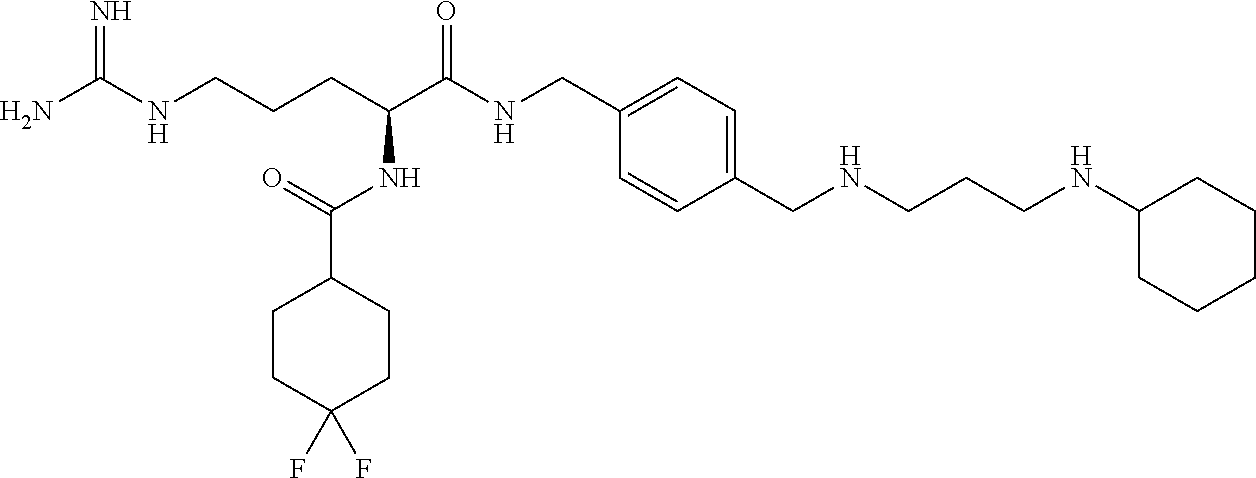 |
B | >50 |
| 8 |
 |
B | >50 |
| 9 |
 |
A | >50 |
| 10 |
 |
B | >50 |
| 11 |
 |
B | >50 |
| 12 |
 |
D | >50 |
| 13 |
 |
B | >50 |
| 14 |
 |
D | NT |
| 15 |
 |
B | >20 |
| 16 |
 |
A | >50 |
| 17 |
 |
A | >50 |
| 18 |
 |
A | >50 |
| 19 |
 |
A | >50 |
| 20 |
 |
B | >50 |
| 21 |
 |
A | >50 |
| 22 |
 |
B | >50 |
| 23 |
 |
A | >50 |
| 24 |
 |
A | >50 |
| 25 |
 |
B | >10 |
| 26 |
 |
A | >50 |
| 27 |
 |
B | >50 |
| 28 |
 |
C | >50 |
| 29 |
 |
A | >50 |
| 30 |
 |
A | >20 |
| 31 |
 |
A | >50 |
| 32 |
 |
A | >50 |
| Note: | |||
| “−” indicates no inhibitory activity, and “NT” indicates without detection. | |||
2. Experimental results: as shown in
4. Experimental results: as shown in
Claims (12)


Applications Claiming Priority (3)
| Application Number | Priority Date | Filing Date | Title |
|---|---|---|---|
| CN201710901067.6 | 2017-09-28 | ||
| CN201710901067.6A CN107602450B (en) | 2017-09-28 | 2017-09-28 | Novel CXCR4 antagonists based on amino acid backbone and their preparation and biomedical applications |
| PCT/CN2017/114318 WO2019061812A1 (en) | 2017-09-28 | 2017-12-01 | Novel cxcr4 antagonist of amino acid backbone type, preparation therefor and biomedical use thereof |
Publications (2)
| Publication Number | Publication Date |
|---|---|
| US20200268729A1 US20200268729A1 (en) | 2020-08-27 |
| US11400083B2 true US11400083B2 (en) | 2022-08-02 |
Family
ID=61059236
Family Applications (1)
| Application Number | Title | Priority Date | Filing Date |
|---|---|---|---|
| US16/650,924 Active 2037-12-10 US11400083B2 (en) | 2017-09-28 | 2017-12-01 | CXCR4 antagonists with amino acid skeleton, preparation therefor and biomedical use thereof |
Country Status (3)
| Country | Link |
|---|---|
| US (1) | US11400083B2 (en) |
| CN (1) | CN107602450B (en) |
| WO (1) | WO2019061812A1 (en) |
Families Citing this family (2)
| Publication number | Priority date | Publication date | Assignee | Title |
|---|---|---|---|---|
| CN111377854B (en) * | 2018-12-28 | 2022-03-29 | 珠海诺贝尔国际生物医药研究院有限公司 | CXCR4 inhibitors and uses thereof |
| CN120172881B (en) * | 2025-03-12 | 2025-10-28 | 苏州天马医药集团天吉生物制药有限公司 | Fmoc-Lys (iPr, boc) -OH preparation method |
Family Cites Families (7)
| Publication number | Priority date | Publication date | Assignee | Title |
|---|---|---|---|---|
| US20040157818A1 (en) * | 2001-05-24 | 2004-08-12 | Mikiro Yanaka | Cxcr4-antagonistic drugs composed of nitrogen-containing compound |
| US20050192272A1 (en) * | 2003-12-22 | 2005-09-01 | Garland Marshall | Substituted benzodiazepines as inhibitors of the chemokine receptor CXCR4 |
| CN101137379B (en) * | 2005-01-07 | 2015-02-11 | 埃莫里大学 | Cxcr4 antagonists for the treatment of HIV infection |
| CN101242848B (en) * | 2005-06-14 | 2011-12-21 | 太景生物科技股份有限公司 | pyrimidine compounds |
| CN102675305B (en) * | 2011-03-08 | 2014-11-12 | 中国科学院上海药物研究所 | Imidazopyridine compounds, as well as preparation method and application thereof |
| US9266828B2 (en) * | 2012-03-16 | 2016-02-23 | Sanford-Burnham Medical Research Institute | Inhibitors of Furin and other pro-protein convertases |
| US20150051138A1 (en) * | 2012-03-16 | 2015-02-19 | Sanford-Burnham Medical Research Institute | Inhibitors of furin and other pro-protein convertases |
-
2017
- 2017-09-28 CN CN201710901067.6A patent/CN107602450B/en active Active
- 2017-12-01 WO PCT/CN2017/114318 patent/WO2019061812A1/en not_active Ceased
- 2017-12-01 US US16/650,924 patent/US11400083B2/en active Active
Non-Patent Citations (3)
| Title |
|---|
| Chemical Abstracts Service, retrieved from the internet Aug. 2020: <https://www.chemeurope.com/en/encyclopedia/Chemical_Abstracts_Service.html>. |
| SIPO, Second Office Action for CN Application No. 201710901067.6, dated May 14, 2020. |
| WIPO, ISR for PCT/CN2017/114318, dated Jun. 21, 2018. |
Also Published As
| Publication number | Publication date |
|---|---|
| CN107602450A (en) | 2018-01-19 |
| US20200268729A1 (en) | 2020-08-27 |
| WO2019061812A1 (en) | 2019-04-04 |
| CN107602450B (en) | 2021-01-22 |
Similar Documents
| Publication | Publication Date | Title |
|---|---|---|
| JP6474412B2 (en) | Cyclic peptidomimetic compounds as immunomodulators | |
| KR101921761B1 (en) | Melanocortin-1 receptor-specific cyclic peptides | |
| TWI230155B (en) | Substituted imidazolidine derivatives, their preparation, their use and pharmaceutical preparations comprising them | |
| TW580501B (en) | Heterocycles as inhibitors of leucocyte adhesion and as VLA-4 antagonists | |
| EP2621508B1 (en) | N-carboxyalkyl auristatins and the use thereof | |
| EP2686336B1 (en) | N-carboxyalkyl-auristatins and use thereof | |
| CA3226492A1 (en) | Bicyclic peptide inhibitors of interleukin-23 receptor | |
| KR20100014596A (en) | Template-fixed peptidomimetics | |
| TW202132332A (en) | IL-2RβγC BINDING COMPOUNDS | |
| US20210024578A1 (en) | Angiotensin-(1-7) analogs and methods relating thereto | |
| JPH02212434A (en) | Use of peptide isostere as retrovirus protease inhibitor | |
| US11400083B2 (en) | CXCR4 antagonists with amino acid skeleton, preparation therefor and biomedical use thereof | |
| US7705012B2 (en) | Camptothecins conjugated in position 7 to cyclic peptides as cytostatic agents | |
| KR20220137043A (en) | Diamine-linked receptor-specific cyclic peptide | |
| EP1572726B1 (en) | 4-methylhexanoic kahalalide f compound | |
| RU2356908C2 (en) | Novel antitumor compounds | |
| JP4604161B2 (en) | Phenylalanine derivative | |
| US10059743B2 (en) | Peptide derivative for regulating thymic stromal lymphoid protein-mediated signaling and pharmaceutical composition for preventing and treating allergy and asthma diseases comprising same | |
| JP2008500971A (en) | Cyclopeptide derivatives having anti-integrin activity | |
| DE69420044T2 (en) | BLOOD REGULATING PEPTIDES | |
| US20170081328A1 (en) | Aza-ellipticine analogs, methods of synthesis and methods of treatment | |
| CA3238247C (en) | Exatecan derivatives, linker-payloads, and conjugates and thereof | |
| CA2501089C (en) | 4-methylhexanoic kahalaide f compound | |
| WO2023085402A1 (en) | Peptide having inhibitory activity on formation of leukocyte extracellular traps | |
| CA3238247A1 (en) | Exatecan derivatives, linker-payloads, and conjugates and thereof |
Legal Events
| Date | Code | Title | Description |
|---|---|---|---|
| FEPP | Fee payment procedure |
Free format text: ENTITY STATUS SET TO UNDISCOUNTED (ORIGINAL EVENT CODE: BIG.); ENTITY STATUS OF PATENT OWNER: SMALL ENTITY |
|
| FEPP | Fee payment procedure |
Free format text: ENTITY STATUS SET TO SMALL (ORIGINAL EVENT CODE: SMAL); ENTITY STATUS OF PATENT OWNER: SMALL ENTITY |
|
| STPP | Information on status: patent application and granting procedure in general |
Free format text: APPLICATION DISPATCHED FROM PREEXAM, NOT YET DOCKETED |
|
| AS | Assignment |
Owner name: TSINGHUA UNIVERSITY, CHINA Free format text: ASSIGNMENT OF ASSIGNORS INTEREST;ASSIGNORS:HUANG, ZIWEI;FANG, XIONG;MENG, QIAN;AND OTHERS;REEL/FRAME:054388/0577 Effective date: 20201113 |
|
| STPP | Information on status: patent application and granting procedure in general |
Free format text: DOCKETED NEW CASE - READY FOR EXAMINATION |
|
| STPP | Information on status: patent application and granting procedure in general |
Free format text: NON FINAL ACTION MAILED |
|
| STPP | Information on status: patent application and granting procedure in general |
Free format text: RESPONSE TO NON-FINAL OFFICE ACTION ENTERED AND FORWARDED TO EXAMINER |
|
| STPP | Information on status: patent application and granting procedure in general |
Free format text: NON FINAL ACTION MAILED |
|
| STPP | Information on status: patent application and granting procedure in general |
Free format text: RESPONSE TO NON-FINAL OFFICE ACTION ENTERED AND FORWARDED TO EXAMINER |
|
| STPP | Information on status: patent application and granting procedure in general |
Free format text: NOTICE OF ALLOWANCE MAILED -- APPLICATION RECEIVED IN OFFICE OF PUBLICATIONS |
|
| STCF | Information on status: patent grant |
Free format text: PATENTED CASE |
|
| FEPP | Fee payment procedure |
Free format text: MAINTENANCE FEE REMINDER MAILED (ORIGINAL EVENT CODE: REM.); ENTITY STATUS OF PATENT OWNER: SMALL ENTITY |