US11397006B2 - Gas turbine combustor - Google Patents
Gas turbine combustor Download PDFInfo
- Publication number
- US11397006B2 US11397006B2 US16/145,692 US201816145692A US11397006B2 US 11397006 B2 US11397006 B2 US 11397006B2 US 201816145692 A US201816145692 A US 201816145692A US 11397006 B2 US11397006 B2 US 11397006B2
- Authority
- US
- United States
- Prior art keywords
- water vapor
- injection portion
- diameter
- air
- fuel injection
- Prior art date
- Legal status (The legal status is an assumption and is not a legal conclusion. Google has not performed a legal analysis and makes no representation as to the accuracy of the status listed.)
- Active, expires
Links
Images




Classifications
-
- F—MECHANICAL ENGINEERING; LIGHTING; HEATING; WEAPONS; BLASTING
- F23—COMBUSTION APPARATUS; COMBUSTION PROCESSES
- F23L—SUPPLYING AIR OR NON-COMBUSTIBLE LIQUIDS OR GASES TO COMBUSTION APPARATUS IN GENERAL ; VALVES OR DAMPERS SPECIALLY ADAPTED FOR CONTROLLING AIR SUPPLY OR DRAUGHT IN COMBUSTION APPARATUS; INDUCING DRAUGHT IN COMBUSTION APPARATUS; TOPS FOR CHIMNEYS OR VENTILATING SHAFTS; TERMINALS FOR FLUES
- F23L7/00—Supplying non-combustible liquids or gases, other than air, to the fire, e.g. oxygen, steam
- F23L7/002—Supplying water
-
- F—MECHANICAL ENGINEERING; LIGHTING; HEATING; WEAPONS; BLASTING
- F23—COMBUSTION APPARATUS; COMBUSTION PROCESSES
- F23R—GENERATING COMBUSTION PRODUCTS OF HIGH PRESSURE OR HIGH VELOCITY, e.g. GAS-TURBINE COMBUSTION CHAMBERS
- F23R3/00—Continuous combustion chambers using liquid or gaseous fuel
- F23R3/28—Continuous combustion chambers using liquid or gaseous fuel characterised by the fuel supply
- F23R3/30—Continuous combustion chambers using liquid or gaseous fuel characterised by the fuel supply comprising fuel prevapourising devices
-
- F—MECHANICAL ENGINEERING; LIGHTING; HEATING; WEAPONS; BLASTING
- F02—COMBUSTION ENGINES; HOT-GAS OR COMBUSTION-PRODUCT ENGINE PLANTS
- F02C—GAS-TURBINE PLANTS; AIR INTAKES FOR JET-PROPULSION PLANTS; CONTROLLING FUEL SUPPLY IN AIR-BREATHING JET-PROPULSION PLANTS
- F02C3/00—Gas-turbine plants characterised by the use of combustion products as the working fluid
- F02C3/20—Gas-turbine plants characterised by the use of combustion products as the working fluid using a special fuel, oxidant, or dilution fluid to generate the combustion products
- F02C3/30—Adding water, steam or other fluids for influencing combustion, e.g. to obtain cleaner exhaust gases
-
- F—MECHANICAL ENGINEERING; LIGHTING; HEATING; WEAPONS; BLASTING
- F02—COMBUSTION ENGINES; HOT-GAS OR COMBUSTION-PRODUCT ENGINE PLANTS
- F02C—GAS-TURBINE PLANTS; AIR INTAKES FOR JET-PROPULSION PLANTS; CONTROLLING FUEL SUPPLY IN AIR-BREATHING JET-PROPULSION PLANTS
- F02C7/00—Features, components parts, details or accessories, not provided for in, or of interest apart form groups F02C1/00 - F02C6/00; Air intakes for jet-propulsion plants
- F02C7/22—Fuel supply systems
-
- F—MECHANICAL ENGINEERING; LIGHTING; HEATING; WEAPONS; BLASTING
- F23—COMBUSTION APPARATUS; COMBUSTION PROCESSES
- F23D—BURNERS
- F23D11/00—Burners using a direct spraying action of liquid droplets or vaporised liquid into the combustion space
- F23D11/10—Burners using a direct spraying action of liquid droplets or vaporised liquid into the combustion space the spraying being induced by a gaseous medium, e.g. water vapour
-
- F—MECHANICAL ENGINEERING; LIGHTING; HEATING; WEAPONS; BLASTING
- F23—COMBUSTION APPARATUS; COMBUSTION PROCESSES
- F23R—GENERATING COMBUSTION PRODUCTS OF HIGH PRESSURE OR HIGH VELOCITY, e.g. GAS-TURBINE COMBUSTION CHAMBERS
- F23R3/00—Continuous combustion chambers using liquid or gaseous fuel
-
- F—MECHANICAL ENGINEERING; LIGHTING; HEATING; WEAPONS; BLASTING
- F23—COMBUSTION APPARATUS; COMBUSTION PROCESSES
- F23R—GENERATING COMBUSTION PRODUCTS OF HIGH PRESSURE OR HIGH VELOCITY, e.g. GAS-TURBINE COMBUSTION CHAMBERS
- F23R3/00—Continuous combustion chambers using liquid or gaseous fuel
- F23R3/002—Wall structures
-
- F—MECHANICAL ENGINEERING; LIGHTING; HEATING; WEAPONS; BLASTING
- F23—COMBUSTION APPARATUS; COMBUSTION PROCESSES
- F23R—GENERATING COMBUSTION PRODUCTS OF HIGH PRESSURE OR HIGH VELOCITY, e.g. GAS-TURBINE COMBUSTION CHAMBERS
- F23R3/00—Continuous combustion chambers using liquid or gaseous fuel
- F23R3/02—Continuous combustion chambers using liquid or gaseous fuel characterised by the air-flow or gas-flow configuration
- F23R3/04—Air inlet arrangements
- F23R3/10—Air inlet arrangements for primary air
-
- F—MECHANICAL ENGINEERING; LIGHTING; HEATING; WEAPONS; BLASTING
- F23—COMBUSTION APPARATUS; COMBUSTION PROCESSES
- F23R—GENERATING COMBUSTION PRODUCTS OF HIGH PRESSURE OR HIGH VELOCITY, e.g. GAS-TURBINE COMBUSTION CHAMBERS
- F23R3/00—Continuous combustion chambers using liquid or gaseous fuel
- F23R3/28—Continuous combustion chambers using liquid or gaseous fuel characterised by the fuel supply
-
- F—MECHANICAL ENGINEERING; LIGHTING; HEATING; WEAPONS; BLASTING
- F23—COMBUSTION APPARATUS; COMBUSTION PROCESSES
- F23R—GENERATING COMBUSTION PRODUCTS OF HIGH PRESSURE OR HIGH VELOCITY, e.g. GAS-TURBINE COMBUSTION CHAMBERS
- F23R3/00—Continuous combustion chambers using liquid or gaseous fuel
- F23R3/28—Continuous combustion chambers using liquid or gaseous fuel characterised by the fuel supply
- F23R3/286—Continuous combustion chambers using liquid or gaseous fuel characterised by the fuel supply having fuel-air premixing devices
-
- F—MECHANICAL ENGINEERING; LIGHTING; HEATING; WEAPONS; BLASTING
- F23—COMBUSTION APPARATUS; COMBUSTION PROCESSES
- F23R—GENERATING COMBUSTION PRODUCTS OF HIGH PRESSURE OR HIGH VELOCITY, e.g. GAS-TURBINE COMBUSTION CHAMBERS
- F23R3/00—Continuous combustion chambers using liquid or gaseous fuel
- F23R3/28—Continuous combustion chambers using liquid or gaseous fuel characterised by the fuel supply
- F23R3/34—Feeding into different combustion zones
- F23R3/346—Feeding into different combustion zones for staged combustion
-
- F—MECHANICAL ENGINEERING; LIGHTING; HEATING; WEAPONS; BLASTING
- F23—COMBUSTION APPARATUS; COMBUSTION PROCESSES
- F23R—GENERATING COMBUSTION PRODUCTS OF HIGH PRESSURE OR HIGH VELOCITY, e.g. GAS-TURBINE COMBUSTION CHAMBERS
- F23R3/00—Continuous combustion chambers using liquid or gaseous fuel
- F23R3/28—Continuous combustion chambers using liquid or gaseous fuel characterised by the fuel supply
- F23R3/36—Supply of different fuels
-
- F—MECHANICAL ENGINEERING; LIGHTING; HEATING; WEAPONS; BLASTING
- F05—INDEXING SCHEMES RELATING TO ENGINES OR PUMPS IN VARIOUS SUBCLASSES OF CLASSES F01-F04
- F05D—INDEXING SCHEME FOR ASPECTS RELATING TO NON-POSITIVE-DISPLACEMENT MACHINES OR ENGINES, GAS-TURBINES OR JET-PROPULSION PLANTS
- F05D2220/00—Application
- F05D2220/30—Application in turbines
- F05D2220/32—Application in turbines in gas turbines
-
- F—MECHANICAL ENGINEERING; LIGHTING; HEATING; WEAPONS; BLASTING
- F05—INDEXING SCHEMES RELATING TO ENGINES OR PUMPS IN VARIOUS SUBCLASSES OF CLASSES F01-F04
- F05D—INDEXING SCHEME FOR ASPECTS RELATING TO NON-POSITIVE-DISPLACEMENT MACHINES OR ENGINES, GAS-TURBINES OR JET-PROPULSION PLANTS
- F05D2240/00—Components
- F05D2240/35—Combustors or associated equipment
-
- F—MECHANICAL ENGINEERING; LIGHTING; HEATING; WEAPONS; BLASTING
- F23—COMBUSTION APPARATUS; COMBUSTION PROCESSES
- F23R—GENERATING COMBUSTION PRODUCTS OF HIGH PRESSURE OR HIGH VELOCITY, e.g. GAS-TURBINE COMBUSTION CHAMBERS
- F23R2900/00—Special features of, or arrangements for continuous combustion chambers; Combustion processes therefor
- F23R2900/00002—Gas turbine combustors adapted for fuels having low heating value [LHV]
Definitions
- the present invention relates to a combustor, used in a gas turbine engine, which mixes and burns fuel gas such as hydrogen gas, water vapor, and air.
- Patent Document 1 JP Laid-open Patent Publication No. H06-66156
- Patent Document 2 JP Laid-open Patent Publication No. 2015-75314
- a water vapor nozzle and a gas fuel injection nozzle are disposed apart from each other, and water vapor and gas fuel are mixed in a combustion chamber only after having been injected into the combustor. Therefore, distribution in concentration of the fuel and the water vapor in the combustion chamber becomes non-uniform, and reduction of NOx contained in exhaust gas after combustion is insufficient.
- the combustor disclosed in Patent Document 2 since fuel gas and water vapor are premixed and then the mixture gas is injected into a combustion chamber, distribution in concentration of the fuel and the water vapor becomes uniform. However, since the water vapor and the fuel gas, between which the temperature difference is large, are brought into direct contact with each other in a fuel injection device, the water vapor condenses to be drain water.
- An object of the present invention is to provide a gas turbine combustor capable of preventing water vapor from condensing to be drain water, and capable of achieving effective reduction in generation of NOx by uniformly mixing fuel and water vapor.
- a gas turbine combustor according to the present invention is a gas turbine combustor which is a combustor used in a gas turbine for mixing and burning a fuel gas, a water vapor, and an air.
- the gas turbine combustor includes:
- a fuel injection device including a fuel injection portion configured to directly inject the fuel gas into a combustion chamber, and a water vapor injection portion provided on at least one of a position radially outward of the fuel injection portion and a position radially inward of the fuel injection portion;
- an air supply chamber provided on at least one of a position radially outward of the water vapor injection portion provided radially outward of the fuel injection portion, and a position radially inward of the water vapor injection portion provided radially inward of the fuel injection portion, the air supply chamber being configured to supply the air to be mixed with the water vapor injected from the water vapor injection portion.
- the water vapor injection portion and the air supply chamber are adjacent to each other in the radial direction, the water vapor, which has been brought into contact with the high-temperature air and diluted by the air, can be brought into contact with the fuel gas, thereby preventing the water vapor from condensing to be drain water. Further, since the water vapor injection portion is interposed between the fuel injection portion and the air supply chamber, the vapor can be appropriately injected to a combustion reaction interface between the fuel gas and the air.
- the gas turbine combustor may include: an outer-diameter-side water vapor injection portion provided radially outward of the fuel injection portion; an inner-diameter-side water vapor injection portion provided radially inward of the fuel injection portion; an outer air supply chamber provided radially outward of the outer-diameter-side water vapor injection portion; and an inner air supply chamber provided radially inward of the inner-diameter-side water vapor injection portion.
- the gas turbine combustor may further include an inner mixing promotion member configured to promote mixing of the water vapor supplied from the inner-diameter-side water vapor injection portion and the air supplied from the inner air supply chamber.
- an inner mixing promotion member configured to promote mixing of the water vapor supplied from the inner-diameter-side water vapor injection portion and the air supplied from the inner air supply chamber.
- the fuel injection device may include an air introduction passage configured to introduce an air from the outer air supply chamber into the inner air supply chamber. According to this configuration, the air can be introduced into the inner-diameter-side air supply chamber, with a compact and simple structure.
- the outer-diameter-side water vapor injection portion may be opened in the outer air supply chamber.
- the gas turbine combustor may further include an outer mixing promotion member configured to mix the water vapor supplied from the outer-diameter-side water vapor injection portion and the air supplied from the outer air supply chamber, and to inject the mixture into the combustion chamber.
- the fuel injection portion may be formed with a fuel injection hole that is inclined in the circumferential direction. According to this configuration, the fuel gas to be injected into the combustion chamber can be swirled by the simple structure, without the necessity of additionally providing a member for swirling the fuel gas.
- a plurality of the fuel injection holes may be arranged in the radial direction. According to this configuration, the area near the opening of each fuel injection hole is reduced, thereby preventing the fuel gas injected in the inclined direction from being burnt on an end surface.
- a combustion liner forming the combustion chamber may have air introduction holes in multiple stages in the axial direction, and the air introduction hole in an upstream-side stage may have a diameter greater than that of the air introduction hole in a downstream-side stage. According to this configuration, a larger amount of air is supplied to an upstream portion of the combustion chamber to dilute the primary combustion zone, thereby realizing uniform combustion.
- FIG. 1 is a schematic diagram showing a gas turbine system to which a combustor according to one embodiment of the present invention is applied;
- FIG. 2 is a longitudinal cross-sectional view of the combustor shown in FIG. 1 ;
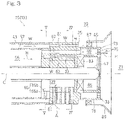
- FIG. 3 is a longitudinal cross-sectional view showing a peripheral portion of a fuel injection portion of the combustor shown in FIG. 2 in an enlarged manner;
- FIG. 4 is a cross-sectional view taken along a IV-IV line in FIG. 3 ;
- FIG. 5 is a cross-sectional view taken along a V-V line in FIG. 3 ;
- FIG. 6 is a front view of the fuel injection portion of the combustor shown in FIG. 2 ;
- FIG. 7 is a cross-sectional view taken along a VII-VII line in FIG. 6 ;
- FIG. 8 is a longitudinal cross-sectional view of a combustor according to another embodiment of the present invention.
- FIG. 1 shows an example of a gas turbine system to which a combustor according to one embodiment of the present invention is applied.
- a gas turbine system GT shown in FIG. 1 includes: a compressor 1 configured to compress an air A; a combustor 3 ; a turbine 5 ; and a boiler 11 .
- the boiler 11 generates water vapor W by using an exhaust gas EG from the turbine 5 as a heat source.
- a fuel injection device 13 is provided at a top portion (most upstream portion) of the combustor 3 .
- the fuel injection device 13 includes a fuel injection nozzle 15 connected with a first introduction passage 17 and a second introduction passage 19 .
- the first introduction passage 17 introduces fuel gas H, such as hydrogen gas, from a fuel supply (not shown) into the fuel injection nozzle 15 .
- the second introduction passage 19 introduces water vapor W, supplied from the boiler 11 , into the fuel injection nozzle 15 .
- the water vapor W is supplied in order to reduce a flame temperature in a combustion chamber 21 of the combustor 3 , thereby suppressing generation of NOx.
- hydrogen gas is used as the fuel gas H.
- other fuel—such as natural gas may be used as the fuel gas H.
- Combustion of the compressed air A supplied from the compressor 1 , the fuel gas H supplied from the fuel injection device 13 , and the water vapor W is caused in the combustion chamber 21 to generate a high-temperature high-pressure combustion gas CG.
- the generated combustion gas CG is supplied to the turbine 5 to drive the turbine 5 .
- the turbine 5 drives the compressor 1 through a rotation shaft R, and drives a load such as a generator PU.
- the boiler 11 which generates the water vapor W is disposed on an exhaust passage 23 extending from the turbine 5 . Waste heat recovered from the exhaust gas EG is utilized as a heat source for generating vapor in the boiler 11 .
- the exhaust gas EG having passed through the boiler 11 passes through a silencer (not shown), and is then discharged to the outside.
- the boiler 11 is supplied with a water from an external water supply (not shown).
- FIG. 2 shows the combustor 3 according to the present embodiment.
- the combustor 3 is of a single-can type, and is erected such that an axis C thereof is positioned within a vertical surface orthogonal to the rotation shaft R ( FIG. 1 ).
- a combustion liner 27 forming the combustion chamber 21 is disposed inside a tubular housing 25 .
- An air introduction passage 29 through which the air A compressed in the compressor 1 ( FIG. 1 ) is introduced into the combustion chamber 21 of the combustor 3 and into the fuel injection device 13 , is formed on the outer periphery of the combustion liner 27 .
- a high-temperature air A as high as 300° C. to 500° C.
- a tubular wall 31 which is concentric with the combustion liner 27 , is connected to the front side (fuel injection device 13 side) of the combustion liner 27 .
- a space on the outer periphery side of the tubular wall 31 forms a downstream portion of the air introduction passage 29 .
- the fuel injection nozzle 15 of the fuel injection device 13 includes a fuel injection portion 33 configured to inject the fuel gas H supplied from the first introduction passage 17 directly into the combustion chamber 21 .
- the fuel injection nozzle 15 further includes: an outer-diameter-side water vapor injection portion 35 which is provided radially outward of the fuel injection portion 33 ; and an inner-diameter-side water vapor injection portion 37 which is provided radially inward of the fuel injection portion 33 .
- the outer-diameter-side water vapor injection portion 35 and the inner-diameter-side water vapor injection portion 37 respectively inject the water vapor W supplied from the second introduction passage 19 into the combustion chamber 21 .
- an inner air supply chamber 39 which supplies the air A to be mixed with the water vapor W injected from the inner-diameter-side water vapor injection portion 37 , is provided radially inward of the inner-diameter-side water vapor injection portion 37 .
- the fuel injection nozzle 15 is a member having a generally substantially cylindrical shape.
- the fuel injection nozzle 15 includes: a lid portion 41 located on the most upstream side; a body portion 43 of a double cylindrical structure connected to the downstream side of the lid portion 41 ; a header portion 45 which is located on the most downstream side and is connected to the downstream side of the body portion 43 ; and a pin member 47 of a round-bar shape which is disposed at the axial position and supports the lid portion 41 , the body portion 43 , and the header portion 45 .
- a first introduction tube 49 forming the first introduction passage 17 is connected to the lid portion 41 (in the illustrated example, the peripheral wall of the lid portion 41 ).
- a cylindrical partition wall 53 is disposed inward of an outer peripheral wall 51 of the body portion 43 so as to be concentric with the outer peripheral wall 51 .
- the space inside the partition wall 53 communicates with the inner space of the lid portion 41 , thereby forming a fuel supply passage 55 .
- an annular space which is formed between the partition wall 53 and the outer peripheral wall 51 and is isolated from the fuel supply passage 55 , forms a water vapor supply passage 57 .
- a second introduction tube 59 which forms the second introduction passage 19 communicating with the water vapor supply passage 57 , is connected to the outer peripheral wall 51 of the body portion 43 .
- the header portion 45 is provided with the fuel injection portion 33 , the outer-diameter-side water vapor injection portion 35 , and the inner-diameter-side water vapor injection portion 37 .
- the outer-diameter-side water vapor injection portion 35 has an outer-diameter-side water vapor injection hole 61 formed as a through-hole extending in the axial direction, at an outer-diameter-side portion of the header portion 45 .
- the outer-diameter-side water vapor injection hole 61 directly communicates with the water vapor supply passage 57 .
- the inner-diameter-side water vapor injection portion 37 has an inner-diameter-side water vapor injection hole 63 extending in the axial direction, at an inner-diameter-side portion of the header portion 45 .
- the inner-diameter-side water vapor injection hole 63 communicates with a water vapor communication passage 65 formed upstream thereof.
- the water vapor communication passage 65 includes: a first water vapor communication passage portion 65 a which is a hole extending radially inward of the header portion 45 from a downstream portion of the water vapor supply passage 57 ; and a second water vapor communication passage portion 65 b which allows therethrough a downstream end of the first water vapor communication passage portion 65 a to communicate with an upstream end of the inner-diameter-side water vapor injection hole 63 .
- a plurality of (in the illustrated example, eighteen) outer-diameter-side water vapor injection holes 61 are provided at equal intervals in the circumferential direction of the header portion 45 .
- a plurality of (in the illustrated example, eighteen) inner-diameter-side water vapor injection holes 63 are provided at equal intervals in the circumferential direction of the header portion 45 .
- a plurality of (in the illustrated example, eighteen) first water vapor communication passage portions 65 a are provided at equal intervals in the circumferential direction of the header portion 45 .
- the second water vapor communication passage portion 65 b is formed as an annular space.
- a fuel communication passage 67 communicating with the fuel supply passage 55 is formed at a radial position between an outer-diameter-side water vapor injection hole 61 and an inner-diameter-side water vapor injection hole 63 .
- the fuel communication passage 67 is formed as a hole extending in the axial direction.
- a fuel header chamber 69 formed as an annular space communicates with a downstream end of the fuel communication passage 67 .
- the fuel header chamber 69 is formed inside a hollow peripheral wall 71 .
- the peripheral wall 71 has an end wall 73 that faces the combustion chamber 21 and is formed with a fuel injection hole 75 of the fuel injection portion 33 .
- a plurality of (in the illustrated example, eighteen) fuel communication passages 67 are provided at equal intervals in the circumferential direction of the header portion 45 .
- each fuel injection hole 75 is formed so as to be inclined in the circumferential direction, in the end wall 73 of the fuel injection nozzle 15 .
- the terms “inclined in the circumferential direction” means “inclined in the circumferential direction with respect to the axial direction, within a plane orthogonal to the radial direction of the fuel injection nozzle 15 ”.
- the fuel injection holes 75 may be formed parallel with the axial direction. However, by inclining the fuel injection holes 75 in the circumferential direction, the fuel gas H to be injected into the combustion chamber 21 can be swirled by the simple structure, without the necessity of additionally providing a member for swirling the fuel gas H.
- the angle of inclination of the fuel injection holes 75 may be set as appropriate. However, the range of the angle of inclination with respect to the axial direction is preferably 20° to 70°, more preferably, 30° to 60°.
- the tubular wall 31 has a plurality of air introduction openings 77 arranged at equal intervals in the circumferential direction.
- the air A flowing through the air introduction passage 29 flows into the inner space of the tubular wall 31 through the air introduction openings 77 .
- a downstream portion of the fuel injection nozzle 15 including the header portion 45 , is disposed.
- the inner space of the tubular wall 31 i.e., the space radially outward of the outer-diameter-side water vapor injection portion 35 , forms an outer air supply chamber 79 which supplies the air A to be mixed with the water vapor W injected from the outer-diameter-side water vapor injection portion 35 .
- the fuel injection nozzle 15 of the fuel injection device 13 includes an air supply passage 81 which supplies the air A from the outer air supply chamber 79 to the inner air supply chamber 39 .
- the air supply passage 81 is provided as a through-hole extending in the radial direction of the header portion 45 of the fuel injection nozzle 15 .
- a plurality of air introduction passages 81 are provided side by side in the axial direction, and a plurality of (in the illustrated example, eighteen) air introduction passages 81 are provided at equal intervals in the circumferential direction as shown in FIG. 4 .
- the outer-diameter-side water vapor injection holes 61 , the fuel communication passages 67 , and the inner-diameter-side water vapor injection holes 63 which are equal in number, are disposed at the same circumferential positions in the header portion 45 , and the air supply passages 81 , which number the same as the fuel communication passages 67 , are disposed at circumferential positions between the respective fuel communication passages 67 .
- the numbers and arrangement of these are not limited to those in the illustrated example, and may be set as appropriate as long as the air supply passages 81 do not interfere with the outer-diameter-side water vapor injection holes 61 , the fuel communication passages 67 , and the inner-diameter-side water vapor injection holes 63 .
- an inner mixing promotion member 83 is provided for promoting mixing of the water vapor W supplied from the inner-diameter-side water vapor injection portion 37 with the air A supplied from the inner air supply chamber 39 .
- a swirler fixed swirl vane
- any other member such as a porous plate having many through-holes formed therein may be used.
- the inner-diameter-side water vapor injection portion 37 is formed so as to inject the water vapor W directly to the inner mixing promotion member 83 which is a swirler.
- the inner mixing promotion member 83 is disposed at an axial position upstream of the end wall 73 of the header portion 45 where the fuel injection holes 75 are formed (in the illustrated example, a position corresponding to a contact portion of the fuel communication passage 67 and the fuel header chamber 69 ). Therefore, a space radially inward of the peripheral wall 71 , which forms the fuel header chamber 69 , forms a premixing passage 85 in which the air A and the water vapor W, both having passed through the inner mixing promotion member 83 , are premixed with each other.
- the inner-diameter-side water vapor injection portion 37 and the inner air supply chamber 39 are provided in the radially inward portion of the fuel injection device 13 , the mixture of the water vapor W and the air A is injected from near the radially center portion into the combustion chamber 21 , whereby a primary combustion zone is diluted, and uniform combustion can be achieved.
- the air supply passages 81 as through-holes extending in the radial direction are provided to supply the air A from the outer air supply chamber 79 to the inner-diameter-side water vapor injection portion 37 , the air A can be introduced into the inner air supply chamber 39 by a compact and simple structure.
- the inner-diameter-side water vapor injection portion 37 and the inner air supply chamber 39 are disposed adjacent to each other in the radial direction, and the water vapor W, which has been diluted by the air A, comes into contact with the fuel gas H. Therefore, the water vapor W can be prevented from condensing to be drain water even if the inner mixing promotion member 83 is omitted.
- the inner mixing promotion member 83 when mixing of the water vapor W supplied from the inner-diameter-side water vapor injection portion 37 with the high-temperature air A supplied from the inner air supply chamber 39 is promoted by the inner mixing promotion member 83 , the water vapor W can be more assuredly prevented from condensing to be drain water.
- the inner mixing promotion member 83 as a swirler is provided around the bar-shaped pin member 47 provided at the axial position, whereby a swirl flow of the water vapor W and the air A can be efficiently generated around the pin member 47 .
- the outer-diameter-side water vapor injection hole 61 is opened in the outer air supply chamber 79 .
- the outer-diameter-side water vapor injection hole 61 is opened at an axial position that is upstream of the end wall 73 of the header portion 45 where the fuel injection holes 75 are formed.
- An outer swirler as an outer mixing promotion member 87 is provided at a position apart in the axial direction from the outer-diameter-side water vapor injection hole 61 .
- the water vapor W supplied from the outer-diameter-side water vapor injection portion 35 and the high-temperature air A supplied from the outer air supply chamber 79 are mixed through the outer mixing promotion member 87 , and the mixture is injected as a swirl flow into the combustion chamber 21 .
- the outer swirler as the outer mixing promotion member 87 is provided on an annular nozzle member 89 which fits to an outer peripheral surface of the peripheral wall 71 of the header portion 45 .
- the outer-diameter-side water vapor injection portion 61 and the outer air supply chamber 79 are adjacent to each other in the radial direction, and the water vapor W, which has been diluted by the air A, comes into contact with the fuel gas H. Therefore, even when the outer-diameter-side water vapor injection hole 61 is opened in the combustion chamber 21 and the water vapor W is injected directly into the combustion chamber 21 , the water vapor W can be prevented from condensing to be drain water.
- the outer-diameter-side water vapor injection hole 61 is opened in the outer air supply chamber 79 , and the water vapor W supplied from the outer-diameter-side water vapor injection portion 35 and the high-temperature air A in the outer air supply chamber 79 , which have been mixed by the outer mixing promotion member 87 , are injected as a swirl flow into the combustion chamber 21 , whereby the water vapor W can be more reliably prevented from condensing to be drain water.
- An air introduction hole 89 is formed penetrating the combustion liner 27 shown in FIG. 2 .
- the air A flowing through the air introduction passage 29 is introduced into the combustion chamber 21 through the air introduction hole 89 .
- a plurality of air introduction holes 89 are formed at equal intervals in the circumferential direction, at the same axial position in the combustion liner 27 .
- the plurality of air introduction holes 89 at the same axial position are formed in multiple stages (two stages in this example) in the axial direction. Both the two stages of air introduction holes 89 are provided at axial positions corresponding to the primary combustion zone in an upstream portion of the combustion chamber 21 .
- the diameter of each of air introduction holes 89 A in the upstream-side stage is formed to be larger than the diameter of each of air introduction holes 89 B in the downstream-side stage.
- the larger diameter of each air introduction hole 89 A in the upstream-side stage allows a large amount of air to be supplied to the upstream portion of the combustion chamber 21 , and the primary combustion zone is diluted by the air. As a result, uniform combustion is realized.
- the outer-diameter-side water vapor injection portion 35 and the inner-diameter-side water vapor injection portion 37 are provided as water vapor injection portions for projecting the water vapor, and the outer air supply chamber 79 and the inner air supply chamber 39 are provided as air supply chambers corresponding to the respective water vapor injection portions 35 and 37 .
- the water vapor injection portion at least one of the outer-diameter-side water vapor injection portion 35 and the inner-diameter-side water vapor injection portion 37 may be provided, and the air supply chamber corresponding to the water vapor injection portion may be provided at a radial position on the opposite side to the fuel injection portion 33 with respect to the water vapor injection portion.
- only the outer-diameter-side water vapor injection portion 35 is provided as the water vapor injection portion, and only the outer air supply chamber 79 is provided as the air supply chamber, which is located radially outward of the outer-diameter-side water vapor injection portion 35 .
- the opening position, in the axial direction, of the outer-diameter-side water vapor injection hole 61 of the outer-diameter-side water vapor injection portion 35 is the same as the opening position, in the axial direction, of the fuel injection hole 75 of the fuel injection portion 33 , so that the water vapor W is directly injected from the outer-diameter-side water vapor injection hole 61 into the combustion chamber 21 .
- a swirler SW which causes the air A from the outer air supply chamber 79 to be mixed with the water vapor W in the combustion chamber 21 , is provided at the outer diameter side of the outer-diameter-side water vapor injection hole 61 .
- annular cooling passage 91 is formed between the header portion 45 and the pin member 47 of the fuel injection nozzle 15 .
- a coolant supply passage 93 which supplies cooling air from the outer air supply chamber 79 to the cooling passage 91 , is formed penetrating the header portion 45 . Part of the compressed air A taken from the outer air supply chamber 79 into the cooling passage 91 through the coolant supply passage 93 cools the surface of the pin member 47 . The air A after having cooled the pin member 47 is discharged from an air injection hole 95 to the combustion chamber 21 .
- the water vapor injection portion 35 , 37 and the air supply chamber 79 , 39 are adjacent to each other in the radial direction, the water vapor W, which has been brought into contact with the high-temperature air A and diluted by the air A, can be brought into contact with the fuel gas H, thereby preventing the water vapor W from condensing to be drain water. Further, since the water vapor injection portion 35 , 37 and the fuel injection portion 33 are adjacent to each other in the radial direction, the vapor W can be appropriately injected to a combustion reaction interface between the fuel gas H and the air A in the primary combustion zone in the combustion chamber 21 .
Landscapes
- Engineering & Computer Science (AREA)
- Chemical & Material Sciences (AREA)
- Combustion & Propulsion (AREA)
- Mechanical Engineering (AREA)
- General Engineering & Computer Science (AREA)
- Nozzles For Spraying Of Liquid Fuel (AREA)
Abstract
Description
-
- 3 . . . Combustor
- 13 . . . Fuel injection device
- 33 . . . Fuel injection portion
- 35 . . . Outer-diameter-side water vapor injection portion (water vapor injection portion)
- 37 . . . Inner-diameter-side water vapor injection portion (water vapor injection portion)
- 39 . . . Inner air supply chamber (air supply chamber)
- 79 . . . Outer air supply chamber (air supply chamber)
- A . . . Air
- GT . . . Gas turbine system
- H . . . Fuel gas
- W . . . Water vapor
Claims (12)
Applications Claiming Priority (4)
| Application Number | Priority Date | Filing Date | Title |
|---|---|---|---|
| JP2016-074349 | 2016-04-01 | ||
| JPJP2016-074349 | 2016-04-01 | ||
| JP2016074349A JP6722491B2 (en) | 2016-04-01 | 2016-04-01 | Gas turbine combustor |
| PCT/JP2017/013089 WO2017170784A1 (en) | 2016-04-01 | 2017-03-29 | Gas turbine combustor |
Related Parent Applications (1)
| Application Number | Title | Priority Date | Filing Date |
|---|---|---|---|
| PCT/JP2017/013089 Continuation WO2017170784A1 (en) | 2016-04-01 | 2017-03-29 | Gas turbine combustor |
Publications (2)
| Publication Number | Publication Date |
|---|---|
| US20190032919A1 US20190032919A1 (en) | 2019-01-31 |
| US11397006B2 true US11397006B2 (en) | 2022-07-26 |
Family
ID=59964729
Family Applications (1)
| Application Number | Title | Priority Date | Filing Date |
|---|---|---|---|
| US16/145,692 Active 2037-08-31 US11397006B2 (en) | 2016-04-01 | 2018-09-28 | Gas turbine combustor |
Country Status (5)
| Country | Link |
|---|---|
| US (1) | US11397006B2 (en) |
| JP (1) | JP6722491B2 (en) |
| CN (1) | CN108885001B (en) |
| DE (1) | DE112017001755B4 (en) |
| WO (1) | WO2017170784A1 (en) |
Cited By (2)
| Publication number | Priority date | Publication date | Assignee | Title |
|---|---|---|---|---|
| US20240418127A1 (en) * | 2023-06-16 | 2024-12-19 | Raytheon Technologies Corporation | Gaseous fuel and liquid water injection for turbine engine |
| US12546469B1 (en) * | 2022-09-23 | 2026-02-10 | Rtx Corporation | Gas turbine engine fuel injector with multiple fuel circuits |
Families Citing this family (6)
| Publication number | Priority date | Publication date | Assignee | Title |
|---|---|---|---|---|
| JP7489759B2 (en) * | 2018-11-20 | 2024-05-24 | 三菱重工業株式会社 | Combustor and gas turbine |
| JP7696453B2 (en) * | 2022-01-21 | 2025-06-20 | 三菱重工業株式会社 | Combustor and gas turbine |
| US11920792B1 (en) * | 2023-03-13 | 2024-03-05 | Rtx Corporation | Cooling turbine engine fuel-air mixer with steam |
| US12163466B2 (en) | 2023-03-14 | 2024-12-10 | Rtx Corporation | Injecting steam into hood cavity of turbine engine combustor |
| DE102023106528A1 (en) * | 2023-03-15 | 2024-09-19 | Gottfried Wilhelm Leibniz Universität Hannover, Körperschaft des öffentlichen Rechts | Multi-fuel injector for the combustion of hydrogen |
| US12410746B1 (en) * | 2024-07-08 | 2025-09-09 | General Electric Company | Gas turbine and fuel nozzle assembly for mixing hydrogen fuel and steam to control flame speed |
Citations (14)
| Publication number | Priority date | Publication date | Assignee | Title |
|---|---|---|---|---|
| JPH0666156A (en) | 1992-08-11 | 1994-03-08 | Mitsubishi Heavy Ind Ltd | Fuel injector for gas turbine |
| WO1995004244A1 (en) | 1993-07-29 | 1995-02-09 | United Technologies Corporation | Fuel injector and method of operating the fuel injector |
| JPH07293826A (en) | 1994-04-28 | 1995-11-10 | Mitsubishi Heavy Ind Ltd | Method and device for supplying vapor to burner |
| US6101814A (en) | 1999-04-15 | 2000-08-15 | United Technologies Corporation | Low emissions can combustor with dilution hole arrangement for a turbine engine |
| US20030141383A1 (en) * | 2002-01-21 | 2003-07-31 | National Aerospace Laboratory Of Japan | Liquid atomizing nozzle |
| US20070003897A1 (en) * | 2005-06-24 | 2007-01-04 | Hiromi Koizumi | Burner, gas turbine combustor, burner cooling method, and burner modifying method |
| US20080010992A1 (en) * | 2006-07-14 | 2008-01-17 | General Electric Company | Method and apparatus to facilitate reducing NOx emissions in turbine engines |
| CN102901125A (en) | 2011-07-27 | 2013-01-30 | 株式会社日立制作所 | Combustor, burner, and gas turbine |
| US20130055698A1 (en) * | 2011-09-01 | 2013-03-07 | Rolls-Royce Plc | Steam injected gas turbine engine |
| US20140283498A1 (en) * | 2011-11-02 | 2014-09-25 | Kawasaki Jukogyo Kabushiki Kaisha | Gas turbine system |
| JP2015075314A (en) | 2013-10-11 | 2015-04-20 | 川崎重工業株式会社 | Gas turbine fuel injection device |
| US20150354823A1 (en) | 2014-06-04 | 2015-12-10 | Mitsubishi Hitachi Power Systems, Ltd. | Gas Turbine Combustor |
| US20170159561A1 (en) * | 2014-04-04 | 2017-06-08 | Borys Borysovych Shershnyov | Pre-Film Liquid Fuel Cartridge |
| US20170350598A1 (en) * | 2016-06-03 | 2017-12-07 | General Electric Company | Contoured shroud swirling pre-mix fuel injector assembly |
Family Cites Families (4)
| Publication number | Priority date | Publication date | Assignee | Title |
|---|---|---|---|---|
| JP2929409B2 (en) * | 1993-12-20 | 1999-08-03 | 三井造船株式会社 | Supply structure of scavenging air in gas turbine combustor |
| JP4906689B2 (en) * | 2007-11-29 | 2012-03-28 | 株式会社日立製作所 | Burner, combustion device, and method for modifying combustion device |
| JP5075900B2 (en) * | 2009-09-30 | 2012-11-21 | 株式会社日立製作所 | Hydrogen-containing fuel compatible combustor and its low NOx operation method |
| JP5452634B2 (en) * | 2012-01-06 | 2014-03-26 | 株式会社日立製作所 | Fuel control method and fuel control apparatus for gas turbine combustor installed in gas turbine using high humidity air |
-
2016
- 2016-04-01 JP JP2016074349A patent/JP6722491B2/en active Active
-
2017
- 2017-03-29 CN CN201780021816.4A patent/CN108885001B/en active Active
- 2017-03-29 WO PCT/JP2017/013089 patent/WO2017170784A1/en not_active Ceased
- 2017-03-29 DE DE112017001755.6T patent/DE112017001755B4/en active Active
-
2018
- 2018-09-28 US US16/145,692 patent/US11397006B2/en active Active
Patent Citations (20)
| Publication number | Priority date | Publication date | Assignee | Title |
|---|---|---|---|---|
| JPH0666156A (en) | 1992-08-11 | 1994-03-08 | Mitsubishi Heavy Ind Ltd | Fuel injector for gas turbine |
| WO1995004244A1 (en) | 1993-07-29 | 1995-02-09 | United Technologies Corporation | Fuel injector and method of operating the fuel injector |
| US5423173A (en) | 1993-07-29 | 1995-06-13 | United Technologies Corporation | Fuel injector and method of operating the fuel injector |
| JPH09501486A (en) | 1993-07-29 | 1997-02-10 | ユナイテッド テクノロジーズ コーポレイション | Fuel injection device and method of operating the fuel injection device |
| JPH07293826A (en) | 1994-04-28 | 1995-11-10 | Mitsubishi Heavy Ind Ltd | Method and device for supplying vapor to burner |
| US6101814A (en) | 1999-04-15 | 2000-08-15 | United Technologies Corporation | Low emissions can combustor with dilution hole arrangement for a turbine engine |
| US20030141383A1 (en) * | 2002-01-21 | 2003-07-31 | National Aerospace Laboratory Of Japan | Liquid atomizing nozzle |
| US20070003897A1 (en) * | 2005-06-24 | 2007-01-04 | Hiromi Koizumi | Burner, gas turbine combustor, burner cooling method, and burner modifying method |
| US20080010992A1 (en) * | 2006-07-14 | 2008-01-17 | General Electric Company | Method and apparatus to facilitate reducing NOx emissions in turbine engines |
| US20130029277A1 (en) | 2011-07-27 | 2013-01-31 | Hitachi, Ltd. | Combustor, Burner, and Gas Turbine |
| CN102901125A (en) | 2011-07-27 | 2013-01-30 | 株式会社日立制作所 | Combustor, burner, and gas turbine |
| US9121611B2 (en) | 2011-07-27 | 2015-09-01 | Mitsubishi Hitachi Power Systems, Ltd. | Combustor, burner, and gas turbine |
| US20130055698A1 (en) * | 2011-09-01 | 2013-03-07 | Rolls-Royce Plc | Steam injected gas turbine engine |
| US20140283498A1 (en) * | 2011-11-02 | 2014-09-25 | Kawasaki Jukogyo Kabushiki Kaisha | Gas turbine system |
| JP2015075314A (en) | 2013-10-11 | 2015-04-20 | 川崎重工業株式会社 | Gas turbine fuel injection device |
| US20160169160A1 (en) | 2013-10-11 | 2016-06-16 | Kawasaki Jukogyo Kabushiki Kaisha | Fuel injection device for gas turbine |
| US20170159561A1 (en) * | 2014-04-04 | 2017-06-08 | Borys Borysovych Shershnyov | Pre-Film Liquid Fuel Cartridge |
| US20150354823A1 (en) | 2014-06-04 | 2015-12-10 | Mitsubishi Hitachi Power Systems, Ltd. | Gas Turbine Combustor |
| JP2015230120A (en) | 2014-06-04 | 2015-12-21 | 三菱日立パワーシステムズ株式会社 | Gas turbine combustor |
| US20170350598A1 (en) * | 2016-06-03 | 2017-12-07 | General Electric Company | Contoured shroud swirling pre-mix fuel injector assembly |
Non-Patent Citations (1)
| Title |
|---|
| International Search Report for PCT/JP2017/013089 dated, Jun. 27, 2017 (PCT/ISA/210). |
Cited By (2)
| Publication number | Priority date | Publication date | Assignee | Title |
|---|---|---|---|---|
| US12546469B1 (en) * | 2022-09-23 | 2026-02-10 | Rtx Corporation | Gas turbine engine fuel injector with multiple fuel circuits |
| US20240418127A1 (en) * | 2023-06-16 | 2024-12-19 | Raytheon Technologies Corporation | Gaseous fuel and liquid water injection for turbine engine |
Also Published As
| Publication number | Publication date |
|---|---|
| CN108885001B (en) | 2021-06-01 |
| DE112017001755T5 (en) | 2018-12-13 |
| JP6722491B2 (en) | 2020-07-15 |
| DE112017001755B4 (en) | 2025-09-18 |
| US20190032919A1 (en) | 2019-01-31 |
| JP2017187186A (en) | 2017-10-12 |
| CN108885001A (en) | 2018-11-23 |
| WO2017170784A1 (en) | 2017-10-05 |
Similar Documents
| Publication | Publication Date | Title |
|---|---|---|
| US11397006B2 (en) | Gas turbine combustor | |
| JP5528756B2 (en) | Tubular fuel injector for secondary fuel nozzle | |
| US9140454B2 (en) | Bundled multi-tube nozzle for a turbomachine | |
| CN103776061B (en) | For reducing the muffler assembly of combustor pulsation | |
| US10072848B2 (en) | Fuel injector with premix pilot nozzle | |
| CN101793408B (en) | Combustor nozzle | |
| US8875516B2 (en) | Turbine combustor configured for high-frequency dynamics mitigation and related method | |
| US9109553B2 (en) | Fuel injector | |
| US8857739B2 (en) | Air-cooled swirlerhead | |
| US10330050B2 (en) | Fuel injection device for gas turbine | |
| US9212822B2 (en) | Fuel injection assembly for use in turbine engines and method of assembling same | |
| JP5172468B2 (en) | Combustion device and control method of combustion device | |
| US20170074521A1 (en) | Combustion device for gas turbine engine | |
| US9297534B2 (en) | Combustor portion for a turbomachine and method of operating a turbomachine | |
| US10443853B2 (en) | Fuel injection device for gas turbine | |
| EP2515041B1 (en) | Fuel Nozzle And Method For Operating A Combustor | |
| CN105570930B (en) | Combustor arrangement for a gas turbine | |
| RU2755240C2 (en) | Burner for combustion chamber of gas turbine power plant, combustion chamber of gas turbine power plant containing such burner, and gas turbine power plant containing such combustion chamber | |
| JP5460846B2 (en) | Combustion device and control method of combustion device | |
| JP7165545B2 (en) | Combustor for gas turbine | |
| KR20240119286A (en) | Combustors and Gas Turbines |
Legal Events
| Date | Code | Title | Description |
|---|---|---|---|
| AS | Assignment |
Owner name: KAWASAKI JUKOGYO KABUSHIKI KAISHA, JAPAN Free format text: ASSIGNMENT OF ASSIGNORS INTEREST;ASSIGNORS:OKADA, KUNIO;HORIKAWA, ATSUSHI;REEL/FRAME:047007/0206 Effective date: 20180824 |
|
| FEPP | Fee payment procedure |
Free format text: ENTITY STATUS SET TO UNDISCOUNTED (ORIGINAL EVENT CODE: BIG.); ENTITY STATUS OF PATENT OWNER: LARGE ENTITY |
|
| STPP | Information on status: patent application and granting procedure in general |
Free format text: DOCKETED NEW CASE - READY FOR EXAMINATION |
|
| STPP | Information on status: patent application and granting procedure in general |
Free format text: NON FINAL ACTION MAILED |
|
| STPP | Information on status: patent application and granting procedure in general |
Free format text: RESPONSE TO NON-FINAL OFFICE ACTION ENTERED AND FORWARDED TO EXAMINER |
|
| STPP | Information on status: patent application and granting procedure in general |
Free format text: FINAL REJECTION MAILED |
|
| STPP | Information on status: patent application and granting procedure in general |
Free format text: DOCKETED NEW CASE - READY FOR EXAMINATION |
|
| STPP | Information on status: patent application and granting procedure in general |
Free format text: NON FINAL ACTION MAILED |
|
| STPP | Information on status: patent application and granting procedure in general |
Free format text: RESPONSE TO NON-FINAL OFFICE ACTION ENTERED AND FORWARDED TO EXAMINER |
|
| STPP | Information on status: patent application and granting procedure in general |
Free format text: FINAL REJECTION MAILED |
|
| STPP | Information on status: patent application and granting procedure in general |
Free format text: RESPONSE AFTER FINAL ACTION FORWARDED TO EXAMINER |
|
| STPP | Information on status: patent application and granting procedure in general |
Free format text: NOTICE OF ALLOWANCE MAILED -- APPLICATION RECEIVED IN OFFICE OF PUBLICATIONS |
|
| STPP | Information on status: patent application and granting procedure in general |
Free format text: PUBLICATIONS -- ISSUE FEE PAYMENT VERIFIED |
|
| STCF | Information on status: patent grant |
Free format text: PATENTED CASE |
|
| MAFP | Maintenance fee payment |
Free format text: PAYMENT OF MAINTENANCE FEE, 4TH YEAR, LARGE ENTITY (ORIGINAL EVENT CODE: M1551); ENTITY STATUS OF PATENT OWNER: LARGE ENTITY Year of fee payment: 4 |