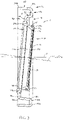
US11391375B2 - Angled radial lip seal assembly - Google Patents

Angled radial lip seal assembly Download PDF

Info

Publication number
US11391375B2
US11391375B2 US16/878,971 US202016878971A US11391375B2 US 11391375 B2 US11391375 B2 US 11391375B2 US 202016878971 A US202016878971 A US 202016878971A US 11391375 B2 US11391375 B2 US 11391375B2
Authority
US
United States
Prior art keywords
shaft
axial
seal assembly
centerline
housing
Prior art date
Legal status (The legal status is an assumption and is not a legal conclusion. Google has not performed a legal analysis and makes no representation as to the accuracy of the status listed.)
Active, expires
Application number
US16/878,971
Other versions
US20210364088A1 (en
Inventor
Robert D. Pecak
Daniel J. Levy
Current Assignee (The listed assignees may be inaccurate. Google has not performed a legal analysis and makes no representation or warranty as to the accuracy of the list.)
SKF AB
Original Assignee
SKF AB
Priority date (The priority date is an assumption and is not a legal conclusion. Google has not performed a legal analysis and makes no representation as to the accuracy of the date listed.)
Filing date
Publication date
Application filed by SKF AB filed Critical SKF AB
Priority to US16/878,971 priority Critical patent/US11391375B2/en
Assigned to AKTIEBOLAGET SKF reassignment AKTIEBOLAGET SKF ASSIGNMENT OF ASSIGNORS INTEREST (SEE DOCUMENT FOR DETAILS). Assignors: Levy, Daniel J., PECAK, ROBERT D.
Priority to CN202110243743.1A priority patent/CN113719613A/en
Priority to DE102021204783.1A priority patent/DE102021204783A1/en
Publication of US20210364088A1 publication Critical patent/US20210364088A1/en
Application granted granted Critical
Publication of US11391375B2 publication Critical patent/US11391375B2/en
Active legal-status Critical Current
Adjusted expiration legal-status Critical

Links

Images

Classifications

    • FMECHANICAL ENGINEERING; LIGHTING; HEATING; WEAPONS; BLASTING
    • F16ENGINEERING ELEMENTS AND UNITS; GENERAL MEASURES FOR PRODUCING AND MAINTAINING EFFECTIVE FUNCTIONING OF MACHINES OR INSTALLATIONS; THERMAL INSULATION IN GENERAL
    • F16JPISTONS; CYLINDERS; SEALINGS
    • F16J15/00Sealings
    • F16J15/16Sealings between relatively-moving surfaces
    • F16J15/32Sealings between relatively-moving surfaces with elastic sealings, e.g. O-rings
    • F16J15/3204Sealings between relatively-moving surfaces with elastic sealings, e.g. O-rings with at least one lip
    • F16J15/3208Sealings between relatively-moving surfaces with elastic sealings, e.g. O-rings with at least one lip provided with tension elements, e.g. elastic rings
    • FMECHANICAL ENGINEERING; LIGHTING; HEATING; WEAPONS; BLASTING
    • F16ENGINEERING ELEMENTS AND UNITS; GENERAL MEASURES FOR PRODUCING AND MAINTAINING EFFECTIVE FUNCTIONING OF MACHINES OR INSTALLATIONS; THERMAL INSULATION IN GENERAL
    • F16JPISTONS; CYLINDERS; SEALINGS
    • F16J15/00Sealings
    • F16J15/16Sealings between relatively-moving surfaces
    • F16J15/32Sealings between relatively-moving surfaces with elastic sealings, e.g. O-rings
    • F16J15/3204Sealings between relatively-moving surfaces with elastic sealings, e.g. O-rings with at least one lip
    • FMECHANICAL ENGINEERING; LIGHTING; HEATING; WEAPONS; BLASTING
    • F16ENGINEERING ELEMENTS AND UNITS; GENERAL MEASURES FOR PRODUCING AND MAINTAINING EFFECTIVE FUNCTIONING OF MACHINES OR INSTALLATIONS; THERMAL INSULATION IN GENERAL
    • F16JPISTONS; CYLINDERS; SEALINGS
    • F16J15/00Sealings
    • F16J15/16Sealings between relatively-moving surfaces
    • F16J15/32Sealings between relatively-moving surfaces with elastic sealings, e.g. O-rings
    • F16J15/324Arrangements for lubrication or cooling of the sealing itself
    • FMECHANICAL ENGINEERING; LIGHTING; HEATING; WEAPONS; BLASTING
    • F16ENGINEERING ELEMENTS AND UNITS; GENERAL MEASURES FOR PRODUCING AND MAINTAINING EFFECTIVE FUNCTIONING OF MACHINES OR INSTALLATIONS; THERMAL INSULATION IN GENERAL
    • F16JPISTONS; CYLINDERS; SEALINGS
    • F16J15/00Sealings
    • F16J15/16Sealings between relatively-moving surfaces
    • F16J15/32Sealings between relatively-moving surfaces with elastic sealings, e.g. O-rings
    • F16J15/3248Sealings between relatively-moving surfaces with elastic sealings, e.g. O-rings provided with casings or supports
    • F16J15/3252Sealings between relatively-moving surfaces with elastic sealings, e.g. O-rings provided with casings or supports with rigid casings or supports
    • FMECHANICAL ENGINEERING; LIGHTING; HEATING; WEAPONS; BLASTING
    • F16ENGINEERING ELEMENTS AND UNITS; GENERAL MEASURES FOR PRODUCING AND MAINTAINING EFFECTIVE FUNCTIONING OF MACHINES OR INSTALLATIONS; THERMAL INSULATION IN GENERAL
    • F16JPISTONS; CYLINDERS; SEALINGS
    • F16J15/00Sealings
    • F16J15/16Sealings between relatively-moving surfaces
    • F16J15/32Sealings between relatively-moving surfaces with elastic sealings, e.g. O-rings
    • F16J15/3268Mounting of sealing rings
    • FMECHANICAL ENGINEERING; LIGHTING; HEATING; WEAPONS; BLASTING
    • F16ENGINEERING ELEMENTS AND UNITS; GENERAL MEASURES FOR PRODUCING AND MAINTAINING EFFECTIVE FUNCTIONING OF MACHINES OR INSTALLATIONS; THERMAL INSULATION IN GENERAL
    • F16JPISTONS; CYLINDERS; SEALINGS
    • F16J15/00Sealings
    • F16J15/16Sealings between relatively-moving surfaces
    • F16J15/32Sealings between relatively-moving surfaces with elastic sealings, e.g. O-rings
    • F16J15/3284Sealings between relatively-moving surfaces with elastic sealings, e.g. O-rings characterised by their structure; Selection of materials

Definitions

  • the present invention relates to is seal assemblies, and more particularly to radial lip seal assemblies.
  • Radial lip seal assemblies also referred to as “oil seals”, basically include an annular rigid case and an annular elastomeric seal member connected with the case and providing a circular sealing lip. Such seal assemblies are installed about a shaft and function to seal an annular space between the shaft and an outer housing member, and may seal inwardly against the shaft or outwardly against the housing. Although known radial lip seals provide adequate sealing in most applications, it is desirable to optimize sealing efficiency and increase seal product life.
  • the present invention is a seal assembly for sealing an annular space between a shaft and a housing, the shaft or the housing being rotatable about a central axis extending through the shaft, the shaft having an outer circumferential surface and the housing having an inner circumferential surface.
  • the seal assembly comprises an annular case coupleable with the housing or with the shaft and an annular seal member coupled with the case and having a circular sealing surface with a centerline.
  • the sealing surface is engageable with the shaft outer surface or with the housing inner surface such that the centerline of the sealing surface is angled or skew with respect to the central axis when the seal assembly is installed about the shaft.
  • the present invention is again a seal assembly for sealing an annular space between a shaft and a housing, the shaft being rotatable about a central axis.
  • the seal assembly comprises an outer annular case coupleable with the housing and an inner annular seal member having a centerline and a circular, inner circumferential sealing surface centered about the centerline.
  • a means positions the seal member such that the centerline of the seal member intersects or is skew with respect to the central axis when the seal assembly is installed about the shaft, preferably a coupler or a housing bore.
  • the centerline of the seal member defines an angle with respect to the central axis, the angle having a value of at least one degree, and the sealing surface engages the shaft outer surface so as to define a generally elliptical sealing interface extending circumferentially about the central axis.
  • the present invention is once again a seal assembly for sealing an annular space between a shaft and a housing, the shaft or the housing being rotatable about a central axis extending through the shaft.
  • the seal assembly comprises an annular case coupleable with the housing or with the shaft and an annular seal member having a centerline and a circular circumferential sealing surface centered about the centerline.
  • a coupler is configured to connect the seal member with the case or with the shaft or to connect the case with the housing such that the seal member is positioned with the centerline of the seal member intersecting or skew with respect to the central axis when the seal assembly is installed about the shaft.
  • the centerline of the seal member defines an angle with respect to the central axis, the angle having a value of at least one degree, and the sealing surface engages the shaft outer surface so as to define a generally elliptical sealing interface extending circumferentially about the central axis.
  • the present invention is yet again a seal assembly for sealing an annular space between a shaft and a housing, the shaft or the housing being rotatable about a central axis extending through the shaft.
  • the seal assembly comprises an annular case coupleable with the housing or with the shaft and an annular seal member with a centerline and having an inner axial end connected with the case, an outer axial end providing a circular sealing surface and a central portion extending between the inner axial end and the outer axial end.
  • the seal member central portion has an axial length varying from a greatest value at a first angular position about the centerline to a least value at a second angular position about the centerline spaced one hundred eighty degrees from the first angular position.
  • the sealing surface is disposed within an angled plane, the body centerline and the central axis extending non-perpendicularly to the angled plane when the seal assembly is disposed about the shaft.
  • FIG. 1 is an axial cross-sectional view of a first, inwardly-sealing construction of a seal assembly in accordance with the present invention, shown installed about a shaft and within a housing;
  • FIG. 2 is an enlarged view of an upper portion of FIG. 1 ;
  • FIG. 3 is an axial cross-sectional view of the first construction seal assembly
  • FIG. 4 is an axial cross-sectional view of a combined case and coupler of the first construction seal assembly
  • FIG. 5 is an axial cross-sectional view of a second, outwardly-sealing construction of the seal assembly, shown installed about a shaft and within a housing;
  • FIG. 6 is an axial cross-sectional view of a combined case and coupler of the second construction seal assembly
  • FIG. 7 is an axial cross-sectional view of a third construction of the seal assembly, shown installed about a shaft and within a housing;
  • FIG. 8 is an enlarged view of an upper portion of FIG. 5 ;
  • FIG. 9 is an axial cross-sectional view of a coupler of the third construction seal assembly.
  • FIG. 10 is an axial cross-sectional view of a fourth, inwardly-sealing construction of the seal assembly, shown installed about a shaft and within a housing;
  • FIG. 11 is an axial cross-sectional view of the seal member of the fourth construction seal assembly.
  • FIG. 12 is an axial cross-sectional view of a fifth construction of the seal assembly, shown installed about a shaft and within a housing.
  • FIGS. 1-12 a seal assembly 10 for sealing an annular space between a shaft 1 and a housing 2 .
  • the shaft 1 has an outer circumferential surface 1 a and the housing 2 has an inner circumferential surface 2 a defining a bore 3 .
  • Either the shaft 1 is rotatable within the housing 2 about a central axis A C extending through the rotatable shaft 1 or the housing 2 is rotatable about the central axis A C extending through a fixed shaft 1 .
  • the seal assembly 10 comprises an annular case 12 with a centerline 13 and an annular seal member 14 coupled with the case 12 and having a circular sealing surface 15 with a centerline CL S .
  • the sealing surface 15 is engageable with the shaft outer surface 1 a or with the housing inner surface 2 a such that the centerline CL S of the sealing surface 15 is angled or skew with respect to the central axis A C when the seal assembly 10 is installed about the shaft 1 ; i.e., the centerline CL S is not coaxial with or parallel to the axis A C .
  • the seal member 14 is preferably “fixed” on or to a non-rotatable housing 2 or shaft 1 and seals against a rotating member 1 or 2 , but may also be fixed on/to a rotatable shaft 1 or housing 2 and seal against a fixed house 2 or shaft 1 , respectively.
  • the seal assembly 10 includes a means or device 16 for positioning a generally conventional annular seal member 14 such that the centerline CL S intersects or is skew with respect to the central axis A C , preferably a coupler 18 as described below.
  • the seal assembly 10 is formed with a generally standard case 12 and the seal member 14 includes an annular body 60 having an angled outer end 60 a providing the circular sealing surface 15 , which is oriented with the surface centerline CL S angled/skew with respect to the central axis A C .
  • the centerline CL S of the sealing surface 15 defines an angle ⁇ S with respect to the central axis A C , the angle ⁇ S having a value of at least one degree (1°) and preferably between two and a half degrees (2.5°) and five degrees (5°) or even greater (e.g., >5°), for reasons described below.
  • the case 12 is formed of a rigid material, preferably a metallic material (e.g., aluminum, low carbon steel, etc.) but may be formed of a rigid polymer, a ceramic, etc., and is coupleable with the housing 2 , either directly or through the coupler 18 or another intermediate component (none shown), or is mounted on the shaft 1 .
  • the case 12 has a centerline 13 and includes an axial portion 20 with opposing axial ends 20 a , 20 b and a radial flange 22 extending from the axial portion 20 .
  • the annular seal member 14 is preferably formed of an elastomeric material, such as natural or synthetic rubber, a thermoplastic, etc., and is connected with the case flange 22 .
  • the seal member 14 either has a circular, inner circumferential surface 17 , as depicted in FIGS. 1-4 and 7-12 , or a circular outer circumferential surface 19 , as shown in FIGS. 5 and 6 , each surface 17 , 19 being centered about the centerline CL S and providing the sealing surface 15 .
  • the sealing surface 15 is sealingly engageable with the shaft outer surface 1 a (or the outer surface of a component, e.g., a sleeve, disposed about the shaft 1 ) or with the housing inner surface 2 a (or the inner surface of a component disposed within the housing bore 3 ), as described in detail below.
  • the annular seal member 14 is formed as a radial lip seal having a “cantilever” body 24 with a fixed inner axial end 24 a connected with the case 12 , an opposing, free outer axial end 24 b , and a wedge-shaped section 24 c adjacent to the free end 24 b providing the sealing surface 15 .
  • the wedge-shaped section 24 c of the seal body 24 includes an annular lip 26 , on which is formed the sealing surface 15 and having a front face 27 A and an opposing rear face 27 B.
  • the front and rear faces 27 A, 27 B intersect at the sealing surface 15 so as to establish front and rear contact angles ⁇ F , ⁇ R , respectively, between each face 27 A, 27 B and the shaft 1 or housing 2 , as indicated in FIG. 2 .
  • the seal assembly 10 is utilized such that the front face 27 A is located on a higher pressure or “oil side” OS of the seal assembly 10 and a rear face 27 B located on a lower pressure or “air side” AS of the assembly 10 .
  • the cantilever body 24 preferably also includes an annular groove 25 and a garter spring 29 is disposed within the groove 25 and configured to bias the seal body 24 radially-inwardly ( FIGS.
  • seal member 14 may be formed or/and employed in any other appropriate manner.
  • the sealing surface 15 engages the shaft outer surface 1 a or the housing inner surface 2 a so as to define a generally elliptical sealing interface SI extending circumferentially about the central axis A C , as shown in FIGS. 1, 5, 7, 10 and 12 .
  • the sealing interface SI has two axial end points P 1 , P 2 spaced circumferentially apart about the central axis A C by about one hundred eighty degrees (180°) and axially apart by an axial distance D A along the central axis A C .
  • the two end points P 1 , P 2 axially bound a contact band BC of the shaft outer surface 1 a having a width equal to the axial distance D A , the width of the contact band BC preferably being at least one millimeter (1 mm) and most preferably at least four millimeters (4 mm).
  • the shaft surface contacted by a seal lip is a narrow circular band directly under the compressed lip, typically with a width of between about one tenth millimeter (0.1 mm) and about five tenths of a millimeter (0.5 mm), the entirety of which remains constantly engaged by the lip during rotation of the shaft.
  • 0.1 mm tenth millimeter
  • 0.5 mm millimeter
  • the seal member 14 is oriented such that one of the two axial end points P 1 , P 2 of the sealing interface SI is a “front” end point P 1 , at which the seal front face 27 A is located furthest into the oil side OS, and the other one of the two axial end points P 1 , P 2 is a “rear” end point P 2 , at which the seal front face 27 A is located at a lesser distance into (or greater distance from) the oil side OS.
  • the sealing lip 26 engages the shaft 1 or the housing 2 with a contact pressure which varies between a greatest value at one of the two axial end points P 1 or P 2 , preferably the front end point P 1 , and a least value at the other one of the two axial end points P 2 , P 1 , preferably the rear end point P 2 , due to a distortion of the contact angles ⁇ F , ⁇ R between the seal faces 27 A, 27 B and the shaft 1 or the housing 2 .
  • the inclined seal member 14 provides a “pumping effect” to assist in preventing fluid on the oil side OS of the seal assembly 10 from leaking past the seal lip 26 , due to “pushing” the fluid away from the lip 26 , and in certain applications, to circulate fluid back towards a device being lubricated, such as a bearing.
  • the seal member 14 is formed with a generally conventional circular cylindrical body having a body centerline CL B that is coaxial with the sealing surface centerline CL S
  • the seal assembly 10 further comprises a coupler 18 .
  • the coupler 18 is configured to connect the seal member 14 with the case 12 , or to connect the case 12 with the housing 1 , such that the seal member 14 is positioned with both the centerline CL B of the seal member 14 and the centerline CL S of the sealing surface 15 intersecting or skew with respect to the central axis A C when the seal assembly 10 is installed about the shaft 1 .
  • the coupler 18 may be integrally formed with the case 12 or may be provided by a discrete component attached to the case 12 , as described in detail below.
  • the case 12 is coupled with the housing 2 and the seal member 14 is configured to seal radially inwardly against the shaft outer surface 1 a .
  • the case axial portion 20 is disposed against the housing inner surface 2 a and the coupler 18 is formed as the radial flange 22 integral with the axial portion 20 and includes an outer radial portion 30 , a central axial portion 32 and an inner radial portion 34 .
  • the outer radial portion 30 extends inwardly from an axial end 20 a of the case axial portion 20 and has outer radial end 30 a and an inner radial end 30 b .
  • the central axial portion 32 of the flange 22 has a first end 32 a integrally formed with the inner end 30 b of the outer radial portion 30 and an opposing second axial end 32 b , and extends axially inwardly toward an opposing end 20 b of the case axial portion 20 .
  • the flange inner radial portion 34 extends inwardly from the second axial end 32 b of the central axial portion 32 and has an outer radial end 34 a and an inner end 34 b defining a circular bore 35 with a centerline 37 , as shown in FIG. 4 .
  • the inner end 24 a of the seal member body 24 is coupled with the inner radial portion 34 of the flange 22 , and is preferably molded thereto.
  • the central axial portion 32 of the flange 22 has an axial length L F defined between the first and second ends 32 a , 32 b .
  • the axial length L F of the flange axial portion 32 varies from a greatest value L FG at a first angular position F 1 about a centerline 13 of the case 12 to a least value L FL at a second angular position F 2 about the case centerline 13 spaced about one hundred eighty degrees (180°) from the first position F 1 .
  • the inner radial portion 34 of the flange 22 and the inner end 24 a of the seal body 24 are each disposed within an angled plane AP 1 , the central axis A C extending non-perpendicularly to the angled plane AP 1 when the seal assembly 10 is disposed about the shaft 1 .
  • the structure of the central axial portion 32 having a varying axial length L F and the angled inner radial portion 34 of the case flange 22 provides an integral coupler 18 that positions the seal member 14 in the desired angular orientation described in detail above.
  • the case 12 is disposeable upon the shaft 1 and the seal member 14 is configured to seal radially outwardly against the housing inner surface 2 a .
  • a seal assembly 10 is particularly suited for a wheel end assembly in which the housing 2 is a rotatable outer hub (not depicted) and the shaft 1 is fixed with respect to the central axis A C .
  • the case axial portion 20 has an inner circumferential surface 21 B defining a central bore 23 which receives the shaft 1 and the coupler 18 is again formed as the radial flange 22 integral with the axial portion 20 of the case 12 .
  • the radial flange 22 includes an inner radial portion 40 , a central axial portion 42 and an outer radial portion 44 .
  • the inner radial portion 40 extends outwardly from an axial end 20 a of the case axial portion 20 and has an inner radial end 40 a and an outer radial end 40 b .
  • the central axial portion 42 of the flange 22 has a first axial end 42 a integrally formed with the outer end 40 b of the inner radial portion 40 and an opposing, second axial end 42 b , extends axially toward the opposing end 20 b of the case axial portion 20 and has a varying length L F , as discussed below.
  • the flange outer radial portion 44 is generally S-shaped and extends outwardly from the second axial end 42 a of the central axial portion 42 so as to be angled with respect to the case axis 13 , and has an inner radial end 44 a and an outer end 44 b .
  • the flange outer radial portion 44 has a first radial section 45 a extending radially from the central axial portion 42 and providing the inner end 44 a , an axial section 45 b and a second radial section 45 c extending outwardly from the central section 45 b and providing the outer end 44 b .
  • the inner axial end 24 a of the seal member body 24 is coupled with the outer radial portion 44 of the flange 22 , and is preferably molded thereto.
  • the central axial portion 42 of the flange 22 has an axial length L F defined between the first and second ends 42 a , 42 b .
  • the axial length L F of the flange axial portion 42 varies from a greatest value L FG at a first angular position F 1 about the centerline 13 of the case 12 to a least value L FL at a second angular position F 2 about the case centerline 13 spaced about one hundred eighty degrees (180°) from the first position F 1 .
  • the second radial section 45 c of the outer radial portion 44 of the flange 22 and the inner end 24 a of the seal body 24 are each disposed within an angled plane AP 2 , the central axis A C extending non-perpendicularly to the angled plane AP 2 when the seal assembly 10 is disposed about the shaft 1 .
  • the structure of the central axial portion 42 having a varying axial length L F and the angled outer radial portion 44 of the case flange 22 provides an integral coupler 18 that positions the seal member 14 in the desired angular orientation described in detail above.
  • the coupler 18 is formed as a separate component configured to couple the case 12 with the housing 2 and to position the seal member 14 in the angled orientation as described above.
  • the coupler 18 includes an annular body 50 having a centerline 51 , which is collinear with the central axis A C when the seal assembly 10 is installed about the shaft 1 , a circular cylindrical outer circumferential surface 52 A and a circular cylindrical inner surface 52 B.
  • the outer circumferential surface 52 A of the coupler 18 is engageable with the housing inner surface 2 a , preferably frictionally to axially retain the coupler 18 and the seal assembly 10 within the housing 2 , and is centered about the body centerline 51 .
  • the inner circumferential surface 52 B of the coupler 18 defines a circular bore 54 and is centered about an axis 55 intersecting or skew with respect to the body centerline 51 .
  • the coupler 18 is configured to position the case 12 and the seal member 14 such that the centerline CL S of the sealing surface 15 is collinear with the coupler bore axis 55 .
  • the sealing surface centerline CL S is thereby also intersecting or skew with respect to the coupler body centerline 51 , and thus also the central axis A C when the seal assembly 10 is installed about the shaft 1 .
  • the annular body 50 of the third construction coupler 18 includes a radially outer cylindrical portion 56 and a radially inner cylindrical portion 58 disposed within and connected with the outer cylindrical portion 56 .
  • the outer cylindrical portion 56 has opposing axial ends 56 a , 56 b and an outer surface 56 c providing the coupler outer surface 52 A.
  • Each axial end 56 a , 56 b of the outer portion 56 has a radial end surface 57 A, 57 B, respectively, disposed within a separate plane OCP 1 , OCP 2 , respectively.
  • the two end surfaces 57 A, 57 B are substantially parallel to each other and the body centerline 51 extends at least substantially perpendicular to each of the two planes OCP 1 and OCP 2 .
  • the inner cylindrical portion 58 is preferably integrally formed with the outer cylindrical portion 56 and has opposing axial ends 58 a , 58 b and an inner circumferential surface 48 c providing the coupler inner circumferential surface 52 B and the bore 54 .
  • Each axial end 58 a , 58 b of the inner portion 58 has a radial end surface 59 A, 59 B, respectively, disposed within a separate plane ICP 1 , ICP 2 , respectively.
  • the two end surfaces 59 A, 59 B of the body inner portion 58 are parallel to each other and the body centerline 51 extends non-perpendicularly to each one of the two planes ICP 1 , ICP 2 , such that the end surfaces 59 A, 59 B are each tilted or angled with respect to the end surfaces 57 A, 57 B of the body outer portion 56 .
  • assembly of the seal case 12 (and attached seal member 14 ) into the coupler bore 54 is accomplished by positioning one axial end 20 a or 20 b of the case axial portion 20 aligned with one of the end surfaces 59 B or 59 A, respectively, of the coupler inner portion 58 . Then, the case 12 is inserted into the bore 54 such that the circular outer circumferential surface 21 of the case 12 slides against the circular inner circumferential surface 52 B of the coupler body 50 and is displaced along the bore axis 55 until fully disposed therein.
  • the centerline CL S of the sealing surface 15 is at least parallel to and preferably collinear with the bore axis 55 , such that the sealing surface 15 and the seal member 14 are oriented in the desired angular relationship to the central axis A C as described above.
  • the annular body 50 may alternatively be formed in any other appropriate manner that provides an outer circumferential surface 52 A engageable with the housing inner surface 2 a and centered about the central axis A C and an inner circumferential surface 52 B engageable with a seal case 12 and centered about an axis 55 intersecting or skew with respect to the central axis A C .
  • the separate coupler 18 may be formed as generally annular inner body (not shown) having a cylindrical inner circumferential surface disposeable about the shaft 1 and an angled outer circumferential surface for receiving a standard inner case member with a standard, outwardly-sealing circular lip engageable with the housing inner surface 2 a so as to form the elliptical sealing interface SI.
  • the seal assembly 10 is formed without any coupler or means to position a generally standard seal member 14 in the desired angled orientation, but rather includes a seal member 14 with a “non-conventional” cantilever annular body 60 having an angled outer end 60 a with an angled circular lip 62 providing the sealing surface 15 , as discussed above.
  • the case 12 includes the axial portion 20 with opposing axial ends 20 a , 20 b and the radial flange 22 extends radially inwardly (as depicted) or outwardly from the axial portion 20 .
  • the radial flange 22 is circumferentially uniform or symmetrical about the case centerline 13 and includes the inner end 22 a for receiving the seal member 14 .
  • the seal member annular body 60 has a centerline 61 and includes an inner axial end 60 b connected with the inner end 22 a of the case flange portion 22 , the opposing outer end 60 a providing the sealing surface 15 , and a central portion 60 c .
  • the body inner axial end 60 b is circular and is disposed in a plane (not indicated) that is substantially perpendicular to any plane containing the body centerline 61 , and thus also the central axis A C when installed on the shaft 1 .
  • the body central portion 60 c extends axially between the inner end 60 b and the outer end 60 a and has an axial length BL, which varies from a greatest value BL G at a first angular position PA 1 about the body centerline 61 to a least value BL L at a second angular position PA 2 about the centerline spaced one hundred eighty degrees (180°) from the first angular position PA 1 .
  • the outer end 60 a is positioned in an angled orientation, such that the circular sealing lip 62 , and thus the sealing surface 15 , are disposed within an angled plane AP 3 and the sealing surface 15 has a centerline CL S perpendicular to the plane AP 3 .
  • the body centerline 61 extends non-perpendicularly to the angled plane AP 3 , such that the central axis A C is likewise non-perpendicular to the plane AP 3 when the seal assembly 10 is disposed about the shaft 1 .
  • the sealing surface 15 is located in the angled orientation, i.e., the sealing surface centerline CL S is skew or intersecting the central axis A C , that provides the elliptical sealing interface SI when engaged with the shaft outer surface 1 a (as depicted) or the housing inner surface 2 a (not shown) as described in detail above.
  • a coupler 18 is a preferred means 16 for positioning the seal member 14 with respect to the central axis A C as described above
  • another possible structure or device for angling the seal member 14 is providing an angled bore 70 in the housing 2 .
  • the angled bore 70 is defined by an inner circumferential surface 72 and has a centerline 74 that is angled, i.e., skew or intersecting, with respect to the central axis A C of any shaft 1 installed therein.
  • the installation of any generally conventional seal assembly 10 within the bore 70 will position the seal member 14 in the angled orientation as described in detail above.

Landscapes

  • Engineering & Computer Science (AREA)
  • General Engineering & Computer Science (AREA)
  • Mechanical Engineering (AREA)
  • Sealing Devices (AREA)
  • Sealing With Elastic Sealing Lips (AREA)

Abstract

A seal assembly for sealing an annular space between a shaft and a housing includes an annular case coupleable with the housing or the shaft and an annular seal member having a sealing surface centered about a centerline. In certain constructions, a coupler is configured to connect the seal member with the case or to connect the case with the housing such that the seal member is positioned with the sealing surface centerline intersecting or skew with respect to a central axis when the seal assembly is installed about the shaft. In other constructions, the seal member has an angled end providing the angled sealing surface. Thereby, the centerline of the sealing surface defines an angle to the central axis having a value of at least one degree, and the sealing surface engages the shaft outer surface to define an elliptical sealing interface extending circumferentially about the central axis.

Description

BACKGROUND OF THE INVENTION
The present invention relates to is seal assemblies, and more particularly to radial lip seal assemblies.
Radial lip seal assemblies, also referred to as “oil seals”, basically include an annular rigid case and an annular elastomeric seal member connected with the case and providing a circular sealing lip. Such seal assemblies are installed about a shaft and function to seal an annular space between the shaft and an outer housing member, and may seal inwardly against the shaft or outwardly against the housing. Although known radial lip seals provide adequate sealing in most applications, it is desirable to optimize sealing efficiency and increase seal product life.
SUMMARY OF THE INVENTION
In one aspect, the present invention is a seal assembly for sealing an annular space between a shaft and a housing, the shaft or the housing being rotatable about a central axis extending through the shaft, the shaft having an outer circumferential surface and the housing having an inner circumferential surface. The seal assembly comprises an annular case coupleable with the housing or with the shaft and an annular seal member coupled with the case and having a circular sealing surface with a centerline. The sealing surface is engageable with the shaft outer surface or with the housing inner surface such that the centerline of the sealing surface is angled or skew with respect to the central axis when the seal assembly is installed about the shaft.
In another aspect, the present invention is again a seal assembly for sealing an annular space between a shaft and a housing, the shaft being rotatable about a central axis. The seal assembly comprises an outer annular case coupleable with the housing and an inner annular seal member having a centerline and a circular, inner circumferential sealing surface centered about the centerline. A means positions the seal member such that the centerline of the seal member intersects or is skew with respect to the central axis when the seal assembly is installed about the shaft, preferably a coupler or a housing bore. As such, the centerline of the seal member defines an angle with respect to the central axis, the angle having a value of at least one degree, and the sealing surface engages the shaft outer surface so as to define a generally elliptical sealing interface extending circumferentially about the central axis.
In a further aspect, the present invention is once again a seal assembly for sealing an annular space between a shaft and a housing, the shaft or the housing being rotatable about a central axis extending through the shaft. The seal assembly comprises an annular case coupleable with the housing or with the shaft and an annular seal member having a centerline and a circular circumferential sealing surface centered about the centerline. A coupler is configured to connect the seal member with the case or with the shaft or to connect the case with the housing such that the seal member is positioned with the centerline of the seal member intersecting or skew with respect to the central axis when the seal assembly is installed about the shaft. As such, the centerline of the seal member defines an angle with respect to the central axis, the angle having a value of at least one degree, and the sealing surface engages the shaft outer surface so as to define a generally elliptical sealing interface extending circumferentially about the central axis.
In an even further aspect, the present invention is yet again a seal assembly for sealing an annular space between a shaft and a housing, the shaft or the housing being rotatable about a central axis extending through the shaft. The seal assembly comprises an annular case coupleable with the housing or with the shaft and an annular seal member with a centerline and having an inner axial end connected with the case, an outer axial end providing a circular sealing surface and a central portion extending between the inner axial end and the outer axial end. The seal member central portion has an axial length varying from a greatest value at a first angular position about the centerline to a least value at a second angular position about the centerline spaced one hundred eighty degrees from the first angular position. As such, the sealing surface is disposed within an angled plane, the body centerline and the central axis extending non-perpendicularly to the angled plane when the seal assembly is disposed about the shaft.
BRIEF DESCRIPTION OF THE SEVERAL VIEWS OF THE DRAWINGS
The foregoing summary, as well as the detailed description of the preferred embodiments of the present invention, will be better understood when read in conjunction with the appended drawings. For the purpose of illustrating the invention, there is shown in the drawings, which are diagrammatic, embodiments that are presently preferred. It should be understood, however, that the present invention is not limited to the precise arrangements and instrumentalities shown. In the drawings:
FIG. 1 is an axial cross-sectional view of a first, inwardly-sealing construction of a seal assembly in accordance with the present invention, shown installed about a shaft and within a housing;
FIG. 2 is an enlarged view of an upper portion of FIG. 1;
FIG. 3 is an axial cross-sectional view of the first construction seal assembly;
FIG. 4 is an axial cross-sectional view of a combined case and coupler of the first construction seal assembly;
FIG. 5 is an axial cross-sectional view of a second, outwardly-sealing construction of the seal assembly, shown installed about a shaft and within a housing;
FIG. 6 is an axial cross-sectional view of a combined case and coupler of the second construction seal assembly;
FIG. 7 is an axial cross-sectional view of a third construction of the seal assembly, shown installed about a shaft and within a housing;
FIG. 8 is an enlarged view of an upper portion of FIG. 5;
FIG. 9 is an axial cross-sectional view of a coupler of the third construction seal assembly;
FIG. 10 is an axial cross-sectional view of a fourth, inwardly-sealing construction of the seal assembly, shown installed about a shaft and within a housing;
FIG. 11 is an axial cross-sectional view of the seal member of the fourth construction seal assembly; and
FIG. 12 is an axial cross-sectional view of a fifth construction of the seal assembly, shown installed about a shaft and within a housing.
DETAILED DESCRIPTION OF THE INVENTION
Certain terminology is used in the following description for convenience only and is not limiting. The words “inner”, “inwardly” and “outer”, “outwardly” refer to directions toward and away from, respectively, a designated centerline or a geometric center of an element being described, the particular meaning being readily apparent from the context of the description. Further, as used herein, the words “connected” and “coupled” are each intended to include direct connections between two members without any other members interposed therebetween and indirect connections between members in which one or more other members are interposed therebetween. The terminology includes the words specifically mentioned above, derivatives thereof, and words of similar import.
Referring now to the drawings in detail, wherein like numbers are used to indicate like elements throughout, there is shown in FIGS. 1-12 a seal assembly 10 for sealing an annular space between a shaft 1 and a housing 2. The shaft 1 has an outer circumferential surface 1 a and the housing 2 has an inner circumferential surface 2 a defining a bore 3. Either the shaft 1 is rotatable within the housing 2 about a central axis AC extending through the rotatable shaft 1 or the housing 2 is rotatable about the central axis AC extending through a fixed shaft 1. Basically, the seal assembly 10 comprises an annular case 12 with a centerline 13 and an annular seal member 14 coupled with the case 12 and having a circular sealing surface 15 with a centerline CLS. The sealing surface 15 is engageable with the shaft outer surface 1 a or with the housing inner surface 2 a such that the centerline CLS of the sealing surface 15 is angled or skew with respect to the central axis AC when the seal assembly 10 is installed about the shaft 1; i.e., the centerline CLS is not coaxial with or parallel to the axis AC. The seal member 14 is preferably “fixed” on or to a non-rotatable housing 2 or shaft 1 and seals against a rotating member 1 or 2, but may also be fixed on/to a rotatable shaft 1 or housing 2 and seal against a fixed house 2 or shaft 1, respectively.
In certain constructions depicted in FIGS. 1-9 and 12, the seal assembly 10 includes a means or device 16 for positioning a generally conventional annular seal member 14 such that the centerline CLS intersects or is skew with respect to the central axis AC, preferably a coupler 18 as described below. In other constructions as shown in FIGS. 10 and 11, the seal assembly 10 is formed with a generally standard case 12 and the seal member 14 includes an annular body 60 having an angled outer end 60 a providing the circular sealing surface 15, which is oriented with the surface centerline CLS angled/skew with respect to the central axis AC. In any case, the centerline CLS of the sealing surface 15 defines an angle θS with respect to the central axis AC, the angle θS having a value of at least one degree (1°) and preferably between two and a half degrees (2.5°) and five degrees (5°) or even greater (e.g., >5°), for reasons described below.
Further, the case 12 is formed of a rigid material, preferably a metallic material (e.g., aluminum, low carbon steel, etc.) but may be formed of a rigid polymer, a ceramic, etc., and is coupleable with the housing 2, either directly or through the coupler 18 or another intermediate component (none shown), or is mounted on the shaft 1. The case 12 has a centerline 13 and includes an axial portion 20 with opposing axial ends 20 a, 20 b and a radial flange 22 extending from the axial portion 20. The annular seal member 14 is preferably formed of an elastomeric material, such as natural or synthetic rubber, a thermoplastic, etc., and is connected with the case flange 22. The seal member 14 either has a circular, inner circumferential surface 17, as depicted in FIGS. 1-4 and 7-12, or a circular outer circumferential surface 19, as shown in FIGS. 5 and 6, each surface 17, 19 being centered about the centerline CLS and providing the sealing surface 15. The sealing surface 15 is sealingly engageable with the shaft outer surface 1 a (or the outer surface of a component, e.g., a sleeve, disposed about the shaft 1) or with the housing inner surface 2 a (or the inner surface of a component disposed within the housing bore 3), as described in detail below.
Preferably, the annular seal member 14 is formed as a radial lip seal having a “cantilever” body 24 with a fixed inner axial end 24 a connected with the case 12, an opposing, free outer axial end 24 b, and a wedge-shaped section 24 c adjacent to the free end 24 b providing the sealing surface 15. As best shown in FIGS. 3 and 11, the wedge-shaped section 24 c of the seal body 24 includes an annular lip 26, on which is formed the sealing surface 15 and having a front face 27A and an opposing rear face 27B. The front and rear faces 27A, 27B intersect at the sealing surface 15 so as to establish front and rear contact angles αF, αR, respectively, between each face 27A, 27B and the shaft 1 or housing 2, as indicated in FIG. 2. Preferably, the seal assembly 10 is utilized such that the front face 27A is located on a higher pressure or “oil side” OS of the seal assembly 10 and a rear face 27B located on a lower pressure or “air side” AS of the assembly 10. Further, the cantilever body 24 preferably also includes an annular groove 25 and a garter spring 29 is disposed within the groove 25 and configured to bias the seal body 24 radially-inwardly (FIGS. 1-3, 7, 8 and 10-12) or radially-outwardly (FIG. 5) so as to establish contact pressure between the lip 26 and the shaft outer surface 1 a or the housing inner surface 2 a. However, the seal member 14 may be formed or/and employed in any other appropriate manner.
With the above-described orientation of the sealing surface centerline CLS with respect to the central axis AC, the sealing surface 15 engages the shaft outer surface 1 a or the housing inner surface 2 a so as to define a generally elliptical sealing interface SI extending circumferentially about the central axis AC, as shown in FIGS. 1, 5, 7, 10 and 12. The sealing interface SI has two axial end points P1, P2 spaced circumferentially apart about the central axis AC by about one hundred eighty degrees (180°) and axially apart by an axial distance DA along the central axis AC. Further, the two end points P1, P2 axially bound a contact band BC of the shaft outer surface 1 a having a width equal to the axial distance DA, the width of the contact band BC preferably being at least one millimeter (1 mm) and most preferably at least four millimeters (4 mm).
With prior known seal assemblies, the shaft surface contacted by a seal lip is a narrow circular band directly under the compressed lip, typically with a width of between about one tenth millimeter (0.1 mm) and about five tenths of a millimeter (0.5 mm), the entirety of which remains constantly engaged by the lip during rotation of the shaft. However, by increasing the contact area of the sealing surface 15 due to angling the seal interface SI axially across the shaft outer surface 1 a, only a portion of the shaft surface area within the contact band BC is in engagement with the sealing lip 26 at any instant during the rotation of the shaft 1. That is, as the shaft 1 rotates, sections of the shaft contact band BC pass under the sealing surface 15 of the lip 26, while remaining contact band sections are exposed to either air or oil (or other fluid being retained, e.g., grease, water, etc.). As such, heat dissipation, by convection or/and conduction, from the uncovered sections of the contact band BC is increased, thereby reducing the amount of heat transferred through the elastomeric seal member 14. Thus, the material degradation rate of the seal member 14 is substantially reduced in comparison with previously known seal assemblies, with a corresponding increased life of the seal assembly 10. Likewise, although typically formed of relatively harder materials than the sealing member 14, the shaft 1 or the housing 2 (i.e., whichever is being sealed against) also has a reduction in material degradation due to the increased size of the contact band BC.
Further, the seal member 14 is oriented such that one of the two axial end points P1, P2 of the sealing interface SI is a “front” end point P1, at which the seal front face 27A is located furthest into the oil side OS, and the other one of the two axial end points P1, P2 is a “rear” end point P2, at which the seal front face 27A is located at a lesser distance into (or greater distance from) the oil side OS. With this arrangement, the sealing lip 26 engages the shaft 1 or the housing 2 with a contact pressure which varies between a greatest value at one of the two axial end points P1 or P2, preferably the front end point P1, and a least value at the other one of the two axial end points P2, P1, preferably the rear end point P2, due to a distortion of the contact angles αF, αR between the seal faces 27A, 27B and the shaft 1 or the housing 2. With the varying contact pressure, the inclined seal member 14 provides a “pumping effect” to assist in preventing fluid on the oil side OS of the seal assembly 10 from leaking past the seal lip 26, due to “pushing” the fluid away from the lip 26, and in certain applications, to circulate fluid back towards a device being lubricated, such as a bearing. Having described the basic structure and functioning above, these and other elements of the present seal assembly 10 are described in further detail below.
Referring to FIGS. 1-9, in certain constructions as stated above, the seal member 14 is formed with a generally conventional circular cylindrical body having a body centerline CLB that is coaxial with the sealing surface centerline CLS, and the seal assembly 10 further comprises a coupler 18. The coupler 18 is configured to connect the seal member 14 with the case 12, or to connect the case 12 with the housing 1, such that the seal member 14 is positioned with both the centerline CLB of the seal member 14 and the centerline CLS of the sealing surface 15 intersecting or skew with respect to the central axis AC when the seal assembly 10 is installed about the shaft 1. Further, the coupler 18 may be integrally formed with the case 12 or may be provided by a discrete component attached to the case 12, as described in detail below.
Referring now to FIGS. 1-4, in a first construction, the case 12 is coupled with the housing 2 and the seal member 14 is configured to seal radially inwardly against the shaft outer surface 1 a. Specifically, the case axial portion 20 is disposed against the housing inner surface 2 a and the coupler 18 is formed as the radial flange 22 integral with the axial portion 20 and includes an outer radial portion 30, a central axial portion 32 and an inner radial portion 34. The outer radial portion 30 extends inwardly from an axial end 20 a of the case axial portion 20 and has outer radial end 30 a and an inner radial end 30 b. The central axial portion 32 of the flange 22 has a first end 32 a integrally formed with the inner end 30 b of the outer radial portion 30 and an opposing second axial end 32 b, and extends axially inwardly toward an opposing end 20 b of the case axial portion 20. Further, the flange inner radial portion 34 extends inwardly from the second axial end 32 b of the central axial portion 32 and has an outer radial end 34 a and an inner end 34 b defining a circular bore 35 with a centerline 37, as shown in FIG. 4. The inner end 24 a of the seal member body 24 is coupled with the inner radial portion 34 of the flange 22, and is preferably molded thereto.
As indicated in FIG. 4, the central axial portion 32 of the flange 22 has an axial length LF defined between the first and second ends 32 a, 32 b. The axial length LF of the flange axial portion 32 varies from a greatest value LFG at a first angular position F1 about a centerline 13 of the case 12 to a least value LFL at a second angular position F2 about the case centerline 13 spaced about one hundred eighty degrees (180°) from the first position F1. As such, the inner radial portion 34 of the flange 22 and the inner end 24 a of the seal body 24 are each disposed within an angled plane AP1, the central axis AC extending non-perpendicularly to the angled plane AP1 when the seal assembly 10 is disposed about the shaft 1. Thus, the structure of the central axial portion 32 having a varying axial length LF and the angled inner radial portion 34 of the case flange 22 provides an integral coupler 18 that positions the seal member 14 in the desired angular orientation described in detail above.
Referring to FIGS. 5 and 6, in a second construction, the case 12 is disposeable upon the shaft 1 and the seal member 14 is configured to seal radially outwardly against the housing inner surface 2 a. Such a seal assembly 10 is particularly suited for a wheel end assembly in which the housing 2 is a rotatable outer hub (not depicted) and the shaft 1 is fixed with respect to the central axis AC. In such an application, the case axial portion 20 has an inner circumferential surface 21B defining a central bore 23 which receives the shaft 1 and the coupler 18 is again formed as the radial flange 22 integral with the axial portion 20 of the case 12. The radial flange 22 includes an inner radial portion 40, a central axial portion 42 and an outer radial portion 44. The inner radial portion 40 extends outwardly from an axial end 20 a of the case axial portion 20 and has an inner radial end 40 a and an outer radial end 40 b. The central axial portion 42 of the flange 22 has a first axial end 42 a integrally formed with the outer end 40 b of the inner radial portion 40 and an opposing, second axial end 42 b, extends axially toward the opposing end 20 b of the case axial portion 20 and has a varying length LF, as discussed below.
Further, the flange outer radial portion 44 is generally S-shaped and extends outwardly from the second axial end 42 a of the central axial portion 42 so as to be angled with respect to the case axis 13, and has an inner radial end 44 a and an outer end 44 b. Specifically, the flange outer radial portion 44 has a first radial section 45 a extending radially from the central axial portion 42 and providing the inner end 44 a, an axial section 45 b and a second radial section 45 c extending outwardly from the central section 45 b and providing the outer end 44 b. Furthermore, the inner axial end 24 a of the seal member body 24 is coupled with the outer radial portion 44 of the flange 22, and is preferably molded thereto.
As indicated in FIG. 6, the central axial portion 42 of the flange 22 has an axial length LF defined between the first and second ends 42 a, 42 b. The axial length LF of the flange axial portion 42 varies from a greatest value LFG at a first angular position F1 about the centerline 13 of the case 12 to a least value LFL at a second angular position F2 about the case centerline 13 spaced about one hundred eighty degrees (180°) from the first position F1. As such, at least the second radial section 45 c of the outer radial portion 44 of the flange 22 and the inner end 24 a of the seal body 24 are each disposed within an angled plane AP2, the central axis AC extending non-perpendicularly to the angled plane AP2 when the seal assembly 10 is disposed about the shaft 1. Thus, the structure of the central axial portion 42 having a varying axial length LF and the angled outer radial portion 44 of the case flange 22 provides an integral coupler 18 that positions the seal member 14 in the desired angular orientation described in detail above.
Referring now to FIGS. 7-9, in a third construction, the coupler 18 is formed as a separate component configured to couple the case 12 with the housing 2 and to position the seal member 14 in the angled orientation as described above. Specifically, the coupler 18 includes an annular body 50 having a centerline 51, which is collinear with the central axis AC when the seal assembly 10 is installed about the shaft 1, a circular cylindrical outer circumferential surface 52A and a circular cylindrical inner surface 52B. The outer circumferential surface 52A of the coupler 18 is engageable with the housing inner surface 2 a, preferably frictionally to axially retain the coupler 18 and the seal assembly 10 within the housing 2, and is centered about the body centerline 51. Further, the inner circumferential surface 52B of the coupler 18 defines a circular bore 54 and is centered about an axis 55 intersecting or skew with respect to the body centerline 51.
With this structure, when the case 12 of the seal assembly 10 is disposed within the bore 54 of the annular body 50, the coupler 18 is configured to position the case 12 and the seal member 14 such that the centerline CLS of the sealing surface 15 is collinear with the coupler bore axis 55. As such, the sealing surface centerline CLS is thereby also intersecting or skew with respect to the coupler body centerline 51, and thus also the central axis AC when the seal assembly 10 is installed about the shaft 1. Preferably, the annular body 50 of the third construction coupler 18 includes a radially outer cylindrical portion 56 and a radially inner cylindrical portion 58 disposed within and connected with the outer cylindrical portion 56.
Specifically, the outer cylindrical portion 56 has opposing axial ends 56 a, 56 b and an outer surface 56 c providing the coupler outer surface 52A. Each axial end 56 a, 56 b of the outer portion 56 has a radial end surface 57A, 57B, respectively, disposed within a separate plane OCP1, OCP2, respectively. The two end surfaces 57A, 57B are substantially parallel to each other and the body centerline 51 extends at least substantially perpendicular to each of the two planes OCP1 and OCP2.
Further, the inner cylindrical portion 58 is preferably integrally formed with the outer cylindrical portion 56 and has opposing axial ends 58 a, 58 b and an inner circumferential surface 48 c providing the coupler inner circumferential surface 52B and the bore 54. Each axial end 58 a, 58 b of the inner portion 58 has a radial end surface 59A, 59B, respectively, disposed within a separate plane ICP1, ICP2, respectively. The two end surfaces 59A, 59B of the body inner portion 58 are parallel to each other and the body centerline 51 extends non-perpendicularly to each one of the two planes ICP1, ICP2, such that the end surfaces 59A, 59B are each tilted or angled with respect to the end surfaces 57A, 57B of the body outer portion 56.
With the angled end surfaces 59A, 59B of the inner cylindrical portion 58, assembly of the seal case 12 (and attached seal member 14) into the coupler bore 54 is accomplished by positioning one axial end 20 a or 20 b of the case axial portion 20 aligned with one of the end surfaces 59B or 59A, respectively, of the coupler inner portion 58. Then, the case 12 is inserted into the bore 54 such that the circular outer circumferential surface 21 of the case 12 slides against the circular inner circumferential surface 52B of the coupler body 50 and is displaced along the bore axis 55 until fully disposed therein. Thereafter, the centerline CLS of the sealing surface 15 is at least parallel to and preferably collinear with the bore axis 55, such that the sealing surface 15 and the seal member 14 are oriented in the desired angular relationship to the central axis AC as described above.
Although the above-described structure provides a separate coupler 18 that positions a standard seal in the desired angled orientation, the annular body 50 may alternatively be formed in any other appropriate manner that provides an outer circumferential surface 52A engageable with the housing inner surface 2 a and centered about the central axis AC and an inner circumferential surface 52B engageable with a seal case 12 and centered about an axis 55 intersecting or skew with respect to the central axis AC. Alternatively, the separate coupler 18 may be formed as generally annular inner body (not shown) having a cylindrical inner circumferential surface disposeable about the shaft 1 and an angled outer circumferential surface for receiving a standard inner case member with a standard, outwardly-sealing circular lip engageable with the housing inner surface 2 a so as to form the elliptical sealing interface SI.
Referring now to FIGS. 10-11, in a fourth construction, the seal assembly 10 is formed without any coupler or means to position a generally standard seal member 14 in the desired angled orientation, but rather includes a seal member 14 with a “non-conventional” cantilever annular body 60 having an angled outer end 60 a with an angled circular lip 62 providing the sealing surface 15, as discussed above. More specifically, the case 12 includes the axial portion 20 with opposing axial ends 20 a, 20 b and the radial flange 22 extends radially inwardly (as depicted) or outwardly from the axial portion 20. The radial flange 22 is circumferentially uniform or symmetrical about the case centerline 13 and includes the inner end 22 a for receiving the seal member 14. The seal member annular body 60 has a centerline 61 and includes an inner axial end 60 b connected with the inner end 22 a of the case flange portion 22, the opposing outer end 60 a providing the sealing surface 15, and a central portion 60 c. The body inner axial end 60 b is circular and is disposed in a plane (not indicated) that is substantially perpendicular to any plane containing the body centerline 61, and thus also the central axis AC when installed on the shaft 1.
Further, the body central portion 60 c extends axially between the inner end 60 b and the outer end 60 a and has an axial length BL, which varies from a greatest value BLG at a first angular position PA1 about the body centerline 61 to a least value BLL at a second angular position PA2 about the centerline spaced one hundred eighty degrees (180°) from the first angular position PA1. With a central portion 61 c having such a varying axial length BL, the outer end 60 a is positioned in an angled orientation, such that the circular sealing lip 62, and thus the sealing surface 15, are disposed within an angled plane AP3 and the sealing surface 15 has a centerline CLS perpendicular to the plane AP3. The body centerline 61 extends non-perpendicularly to the angled plane AP3, such that the central axis AC is likewise non-perpendicular to the plane AP3 when the seal assembly 10 is disposed about the shaft 1. Therefore, the sealing surface 15 is located in the angled orientation, i.e., the sealing surface centerline CLS is skew or intersecting the central axis AC, that provides the elliptical sealing interface SI when engaged with the shaft outer surface 1 a (as depicted) or the housing inner surface 2 a (not shown) as described in detail above.
Referring specifically to FIG. 12, although a coupler 18 is a preferred means 16 for positioning the seal member 14 with respect to the central axis AC as described above, another possible structure or device for angling the seal member 14 is providing an angled bore 70 in the housing 2. The angled bore 70 is defined by an inner circumferential surface 72 and has a centerline 74 that is angled, i.e., skew or intersecting, with respect to the central axis AC of any shaft 1 installed therein. As such, the installation of any generally conventional seal assembly 10 within the bore 70 will position the seal member 14 in the angled orientation as described in detail above.
Representative, non-limiting examples of the present invention were described above in detail with reference to the attached drawings. This detailed description is merely intended to teach a person of skill in the art further details for practicing preferred aspects of the present teachings and is not intended to limit the scope of the invention. Furthermore, each of the additional features and teachings disclosed above may be utilized separately or in conjunction with other features and teachings to provide improved seal assemblies.
Moreover, combinations of features and steps disclosed in the above detailed description may not be necessary to practice the invention in the broadest sense, and are instead taught merely to particularly describe representative examples of the invention. Furthermore, various features of the above-described representative examples, as well as the various independent and dependent claims below, may be combined in ways that are not specifically and explicitly enumerated in order to provide additional useful embodiments of the present teachings.
All features disclosed in the description and/or the claims are intended to be disclosed separately and independently from each other for the purpose of original written disclosure, as well as for the purpose of restricting the claimed subject matter, independent of the compositions of the features in the embodiments and/or the claims. In addition, all value ranges or indications of groups of entities are intended to disclose every possible intermediate value or intermediate entity for the purpose of original written disclosure, as well as for the purpose of restricting the claimed subject matter.

Claims (17)

We claim:
1. A seal assembly for sealing an annular space between a shaft and a housing, the shaft or the housing being rotatable about a central axis extending through the shaft, the shaft having an outer circumferential surface and the housing having an inner circumferential surface, the seal assembly comprising:
an annular case coupleable with the housing or with the shaft; and
an annular seal member coupled with the annular case and having a circular sealing surface with a centerline, the circular sealing surface being engageable with the shaft outer circumferential surface or with the housing inner circumferential surface such that the centerline of the sealing surface is angled or skew with respect to the central axis when the seal assembly is installed about the shaft,
wherein a central portion of the annular seal member having a varying axial length.
2. The seal assembly as recited in claim 1 wherein the centerline of the circular sealing surface defines an angle with respect to the central axis, the angle having a value of at least one degree.
3. The seal assembly as recited in claim 1 wherein the circular sealing surface engages the shaft outer circumferential surface or the housing inner circumferential surface so as to define a generally elliptical sealing interface extending circumferentially about the central axis.
4. The seal assembly as recited in claim 3 wherein the elliptical sealing interface has two axial end points spaced circumferentially apart about the central axis by about one hundred eighty degrees and axially apart by an axial distance along the central axis, the two axial end points axially bounding a contact band of the shaft outer circumferential surface or of the housing inner circumferential surface, the contact band having a width equal to the axial distance.
5. The seal assembly as recited in claim 4 wherein the width of the contact band is at least one millimeter.
6. The seal assembly as recited in claim 4 wherein the seal member includes an annular lip providing the circular sealing surface and having a front face and a rear face, the front and rear faces intersecting at the sealing surface, the sealing lip engaging the shaft or the housing with a contact pressure, the contact pressure varying between a greatest value at one of the two axial end points and a least value at the other one of the two axial end points.
7. The seal assembly as recited in claim 1 wherein one of:
the seal member has a centerline coaxial with the centerline of the sealing surface and the seal assembly further comprises a coupler configured to connect the seal member with the case or to connect the case with the housing such that the seal member is positioned with the centerline of the sealing surface intersecting or skew with respect to the central axis when the seal assembly is installed about the shaft; and
the seal member has an inner end connected with the case, an outer end providing the sealing surface and a central portion extending between the inner end and the outer end and having an axial length, the axial length of the central portion varying from a greatest value at a first angular position about the centerline to a least value at a second angular position about the centerline spaced one hundred eighty degrees from the first angular position such that the sealing surface is disposed within an angled plane, the central axis extending non-perpendicularly to the angled plane when the seal assembly is disposed about the shaft.
8. The seal assembly as recited in claim 7 wherein the coupler is integrally formed with the case or is a discrete component attached to the case.
9. The seal assembly as recited in claim 7 wherein the case has an outer axial portion and the coupler is formed as an integral flange of the case and includes:
an outer radial portion extending inwardly from the case axial portion and having an inner end;
a central axial portion having a first axial end integrally formed with the inner end of the outer radial portion and an opposing second axial end; and
an inner radial portion extending inwardly from the second axial end of the central portion and having an inner end defining a circular bore, an inner end of the seal member being coupled with the inner radial portion;
wherein the central axial portion of the flange has an axial length between the first and second axial ends, the axial length varying from a greatest value at a first angular position about the centerline to a least value at a second angular position about the centerline spaced one hundred eighty degrees from the first position such that the inner radial portion of the flange and the inner end of the seal member are each disposed within an angled plane, the central axis extending non-perpendicularly to the angled plane when the seal assembly is disposed about the shaft.
10. The seal assembly as recited in claim 7 wherein the case has an inner axial portion disposeable upon the shaft and the coupler is formed as an integral flange of the case and includes:
an inner radial portion extending outwardly from the case axial portion and having an outer end;
a central axial portion having a first axial end integrally formed with the outer end of the inner radial portion and an opposing second axial end; and
an outer radial portion extending outwardly from the second axial end of the central portion and having a circular outer end, the inner end of the seal member being coupled with the outer radial portion;
wherein the central axial portion of the flange has an axial length between the first and second axial ends, the axial length varying from a greatest value at a first angular position about the centerline to a least value at a second angular position about the centerline spaced one hundred eighty degrees from the first position such that at least a section of the outer radial portion of the flange and the inner end of the seal member are each disposed within an angled plane, the central axis extending non-perpendicularly to the angled plane when the seal assembly is disposed about the shaft.
11. The seal assembly as recited in claim 7 wherein the coupler includes an annular body having a centerline, the centerline being collinear with the central axis when the seal assembly is installed about the shaft, a circular cylindrical outer circumferential surface engageable with the housing inner surface and centered about the body centerline, and a circular cylindrical inner circumferential surface defining a bore and being centered about an axis intersecting or skew with respect to the body centerline, the case being disposed within the bore of the annular body such that the seal member centerline is collinear with the bore axis.
12. The seal assembly as recited in claim 11 wherein the annular body of the coupler includes:
a radially outer cylindrical portion having opposing axial ends, each axial end having a radial end surface disposed within a separate plane, the two end surfaces being parallel and the body centerline extending perpendicular to each of the two planes; and
a radially inner cylindrical portion disposed within and connected with the outer cylindrical portion, the inner cylindrical portion having opposing axial ends, each axial end of the inner cylindrical portion having a radial end surface disposed within a separate plane, the two end surfaces of the inner cylindrical portion being parallel and the body centerline extending non-perpendicularly to each plane containing one of the end surfaces of the inner cylindrical portion.
13. The seal assembly as recited in claim 1 wherein the annular seal member has an inner end connected with the annular case, an opposing, free outer end, and an inner wedge-shaped portion adjacent to the free end and providing the circular sealing surface.
14. A seal assembly for sealing an annular space between a shaft and a housing, the shaft being rotatable about a central axis, the seal assembly comprising:
an outer annular case coupleable with the housing;
an inner annular seal member having a circular, inner circumferential sealing surface, and a central portion with a varying axial length such that a centerline of the sealing surface intersects or is skew with respect to the central axis when the seal assembly is installed about the shaft.
15. The seal assembly as recited in claim 14 wherein the means for positioning the seal member includes one of:
a coupler configured to connect the seal member with the case or to connect the case with the housing;
an angled bore extending through the housing.
16. A seal assembly for sealing an annular space between a shaft and a housing, the shaft or the housing being rotatable about a central axis extending through the shaft, the seal assembly comprising:
an annular case coupleable with the housing or with the shaft; and
an annular seal member with a cantilever annular body having a centerline, an inner axial end connected with the annular case, an angled outer axial end including a wedge-shaped section with a front face, a rear face and a lip providing a circular sealing surface, the front face and the rear face intersecting at the circular sealing surface, and a central portion extending axially between the inner axial end and the outer axial end and having an axial length, the axial length of the central portion varying from a greatest value at a first angular position about the centerline to a least value at a second angular position about the centerline spaced one hundred eighty degrees from the first angular position such that the circular sealing surface is disposed within an angled plane when the seal assembly is separate from the shaft and the housing, the central axis extending non-perpendicularly to the angled plane when the seal assembly is disposed about the shaft.
17. The seal assembly as recited in claim 16 wherein the circular sealing surface engages the shaft outer circumferential surface or the housing inner circumferential surface so as to define a generally elliptical sealing interface extending circumferentially about the central axis, the elliptical sealing interface having two axial end points spaced circumferentially apart about the central axis by about one hundred eighty degrees and axially apart by an axial distance along the central axis, the two axial end points axially bounding a contact band of the shaft outer surface or of the housing inner surface, the contact band having a width equal to the axial distance.
US16/878,971 2020-05-20 2020-05-20 Angled radial lip seal assembly Active 2040-06-27 US11391375B2 (en)

Priority Applications (3)

Application Number Priority Date Filing Date Title
US16/878,971 US11391375B2 (en) 2020-05-20 2020-05-20 Angled radial lip seal assembly
CN202110243743.1A CN113719613A (en) 2020-05-20 2021-03-05 Inclined radial lip seal assembly
DE102021204783.1A DE102021204783A1 (en) 2020-05-20 2021-05-11 Angular radial lip seal arrangement

Applications Claiming Priority (1)

Application Number Priority Date Filing Date Title
US16/878,971 US11391375B2 (en) 2020-05-20 2020-05-20 Angled radial lip seal assembly

Publications (2)

Publication Number Publication Date
US20210364088A1 US20210364088A1 (en) 2021-11-25
US11391375B2 true US11391375B2 (en) 2022-07-19

Family

ID=78408731

Family Applications (1)

Application Number Title Priority Date Filing Date
US16/878,971 Active 2040-06-27 US11391375B2 (en) 2020-05-20 2020-05-20 Angled radial lip seal assembly

Country Status (3)

Country Link
US (1) US11391375B2 (en)
CN (1) CN113719613A (en)
DE (1) DE102021204783A1 (en)

Families Citing this family (1)

* Cited by examiner, † Cited by third party
Publication number Priority date Publication date Assignee Title
US12110966B2 (en) * 2023-02-14 2024-10-08 Aktiebolaget Skf Self-retaining lip seal

Citations (5)

* Cited by examiner, † Cited by third party
Publication number Priority date Publication date Assignee Title
US3929340A (en) 1972-04-24 1975-12-30 Chicago Rawhide Mfg Co Seal with pumping action
US4739998A (en) * 1986-11-21 1988-04-26 Federal-Mogul Corporation Bidirectional seal with elliptical sealing barriers
US8328201B2 (en) * 2010-06-23 2012-12-11 Aktiebolaget Skf Pumping seal assembly with angled spring
US8720903B2 (en) 2010-05-18 2014-05-13 Aktiebolaget Skf Fluid seal assembly
US9228658B2 (en) * 2011-12-21 2016-01-05 Aktiebolaget Skf Pumping seal with aligned spring

Family Cites Families (2)

* Cited by examiner, † Cited by third party
Publication number Priority date Publication date Assignee Title
US7419165B2 (en) * 2004-08-18 2008-09-02 Federal-Mogul World Wide, Inc. Seal assembly and method of manufacturing the same
DE102014115985A1 (en) * 2014-11-03 2016-05-19 Karl Storz Gmbh & Co. Kg Sealing device for sealing a passage for a medical instrument

Patent Citations (5)

* Cited by examiner, † Cited by third party
Publication number Priority date Publication date Assignee Title
US3929340A (en) 1972-04-24 1975-12-30 Chicago Rawhide Mfg Co Seal with pumping action
US4739998A (en) * 1986-11-21 1988-04-26 Federal-Mogul Corporation Bidirectional seal with elliptical sealing barriers
US8720903B2 (en) 2010-05-18 2014-05-13 Aktiebolaget Skf Fluid seal assembly
US8328201B2 (en) * 2010-06-23 2012-12-11 Aktiebolaget Skf Pumping seal assembly with angled spring
US9228658B2 (en) * 2011-12-21 2016-01-05 Aktiebolaget Skf Pumping seal with aligned spring

Also Published As

Publication number Publication date
US20210364088A1 (en) 2021-11-25
CN113719613A (en) 2021-11-30
DE102021204783A1 (en) 2021-11-25

Similar Documents

Publication Publication Date Title
US6109617A (en) Gas seal assembly and method of sealing
US10267422B2 (en) Sealing device
US8534674B2 (en) Unitized radial fluid seal
CN104220769B (en) Rotary chuck seal with internal face sealing surface
US10550941B2 (en) Radial fluid seal
US20070201782A1 (en) Seal device and rolling bearing unit with seal device
JP2013130296A (en) Sealing device
US9995396B1 (en) Outwardly sealing pumping seal assembly
US6186510B1 (en) Mechanical contact bearing seal
US8955849B2 (en) Radial shaft seal and assembly therewith
CN102439324A (en) Bearing seal assemblies especially for agricultural applications
US5039112A (en) Multi-layer lip seal assembly
US20190107204A1 (en) Seal Assembly with Eccentricity Tracking
US11391375B2 (en) Angled radial lip seal assembly
US10697546B2 (en) Dynamic seal
US8328201B2 (en) Pumping seal assembly with angled spring
CN114151545A (en) Cassette seal for use in extreme environments
US20130223782A1 (en) Mechanical face seal assembly for bearings
US20220307604A1 (en) Seal assembly with labyrinth channel
CN115614393A (en) Sealing assembly for a truck hub with radial labyrinth
US11761541B2 (en) Unitized seal assembly with axial positioner
CN115614392A (en) Low friction seal assemblies for truck hubs
JP3138507U (en) Sealing device
US20250257799A1 (en) Radial shaft seal arrangement
US20230250878A1 (en) Seal assembly with deflectable coupler for centering a sealing member

Legal Events

Date Code Title Description
FEPP Fee payment procedure

Free format text: ENTITY STATUS SET TO UNDISCOUNTED (ORIGINAL EVENT CODE: BIG.); ENTITY STATUS OF PATENT OWNER: LARGE ENTITY

AS Assignment

Owner name: AKTIEBOLAGET SKF, SWEDEN

Free format text: ASSIGNMENT OF ASSIGNORS INTEREST;ASSIGNORS:PECAK, ROBERT D.;LEVY, DANIEL J.;REEL/FRAME:053034/0826

Effective date: 20200623

STPP Information on status: patent application and granting procedure in general

Free format text: RESPONSE TO NON-FINAL OFFICE ACTION ENTERED AND FORWARDED TO EXAMINER

STPP Information on status: patent application and granting procedure in general

Free format text: NON FINAL ACTION MAILED

STPP Information on status: patent application and granting procedure in general

Free format text: RESPONSE TO NON-FINAL OFFICE ACTION ENTERED AND FORWARDED TO EXAMINER

STPP Information on status: patent application and granting procedure in general

Free format text: NOTICE OF ALLOWANCE MAILED -- APPLICATION RECEIVED IN OFFICE OF PUBLICATIONS

STPP Information on status: patent application and granting procedure in general

Free format text: PUBLICATIONS -- ISSUE FEE PAYMENT VERIFIED

STCF Information on status: patent grant

Free format text: PATENTED CASE

MAFP Maintenance fee payment

Free format text: PAYMENT OF MAINTENANCE FEE, 4TH YEAR, LARGE ENTITY (ORIGINAL EVENT CODE: M1551); ENTITY STATUS OF PATENT OWNER: LARGE ENTITY

Year of fee payment: 4