US11384150B2 - Antibody-drug conjugates and uses thereof - Google Patents
Antibody-drug conjugates and uses thereof Download PDFInfo
- Publication number
- US11384150B2 US11384150B2 US16/467,655 US201716467655A US11384150B2 US 11384150 B2 US11384150 B2 US 11384150B2 US 201716467655 A US201716467655 A US 201716467655A US 11384150 B2 US11384150 B2 US 11384150B2
- Authority
- US
- United States
- Prior art keywords
- cancer
- rex
- immunoconjugate
- egfr
- antibody
- Prior art date
- Legal status (The legal status is an assumption and is not a legal conclusion. Google has not performed a legal analysis and makes no representation as to the accuracy of the status listed.)
- Active, expires
Links
- 0 *C(C)C Chemical compound *C(C)C 0.000 description 15
- HXVNBWAKAOHACI-UHFFFAOYSA-N CC(C)C(=O)C(C)C Chemical compound CC(C)C(=O)C(C)C HXVNBWAKAOHACI-UHFFFAOYSA-N 0.000 description 4
- VTQNSOVVLZMYNC-YKPYSPFQSA-N CNC(=O)C[Y]N(C)[C@@H]1C[C@H]2O[C@@](C)([C@@H]1OC)n1c3ccccc3c3c4c(c5c6ccccc6n2c5c31)C(=O)NC4 Chemical compound CNC(=O)C[Y]N(C)[C@@H]1C[C@H]2O[C@@](C)([C@@H]1OC)n1c3ccccc3c3c4c(c5c6ccccc6n2c5c31)C(=O)NC4 VTQNSOVVLZMYNC-YKPYSPFQSA-N 0.000 description 2
- NRLGMMCBRYLIQM-DXEVXBFHSA-N CNC(=O)c1ccc(CN(CCN2CCN(c3cc(Nc4ncc(C(=O)Cc5c(C)cccc5Cl)s4)nc(C)n3)CC2)Cc2ccc(C(=O)ON3C(=O)CCC3=O)cc2)cc1.CNC(=S)NCCN1CCN(c2cc(Nc3ncc(C(=O)Cc4c(C)cccc4Cl)s3)nc(C)n2)CC1.CSC1CC(=O)N(CCCCCC(=O)N[C@H](C(=O)C[C@@H](CCCNC(N)=O)C(=O)Nc2ccc(COC(=O)NCCN3CCN(c4cc(Nc5ncc(C(=O)Cc6c(C)cccc6Cl)s5)nc(C)n4)CC3)cc2)C(C)C)C1=O Chemical compound CNC(=O)c1ccc(CN(CCN2CCN(c3cc(Nc4ncc(C(=O)Cc5c(C)cccc5Cl)s4)nc(C)n3)CC2)Cc2ccc(C(=O)ON3C(=O)CCC3=O)cc2)cc1.CNC(=S)NCCN1CCN(c2cc(Nc3ncc(C(=O)Cc4c(C)cccc4Cl)s3)nc(C)n2)CC1.CSC1CC(=O)N(CCCCCC(=O)N[C@H](C(=O)C[C@@H](CCCNC(N)=O)C(=O)Nc2ccc(COC(=O)NCCN3CCN(c4cc(Nc5ncc(C(=O)Cc6c(C)cccc6Cl)s5)nc(C)n4)CC3)cc2)C(C)C)C1=O NRLGMMCBRYLIQM-DXEVXBFHSA-N 0.000 description 2
- STVHDGCIWDNTLA-WLXLVPOFSA-N [H][C@]12C[C@@H](N(C)C(=O)CCC(=O)ON3C(=O)CCC3=O)[C@@H](OC)[C@](C)(O1)n1c3ccccc3c3c4c(c5c6ccccc6n2c5c31)C(=O)CC4.[H][C@]12C[C@@H](N(C)Cc3ccc(C(=O)ON4C(=O)CCC4=O)cc3)[C@@H](OC)[C@](C)(O1)n1c3ccccc3c3c4c(c5c6ccccc6n2c5c31)C(=O)CC4 Chemical compound [H][C@]12C[C@@H](N(C)C(=O)CCC(=O)ON3C(=O)CCC3=O)[C@@H](OC)[C@](C)(O1)n1c3ccccc3c3c4c(c5c6ccccc6n2c5c31)C(=O)CC4.[H][C@]12C[C@@H](N(C)Cc3ccc(C(=O)ON4C(=O)CCC4=O)cc3)[C@@H](OC)[C@](C)(O1)n1c3ccccc3c3c4c(c5c6ccccc6n2c5c31)C(=O)CC4 STVHDGCIWDNTLA-WLXLVPOFSA-N 0.000 description 2
- QPTKHHCQDPCGGI-GILBTVJFSA-N C.O=Cc1ccc(C(=O)ON2C(=O)CCC2=O)cc1.[2H]CF.[H][C@]12C[C@@H](N(C)Cc3ccc(C(=O)ON4C(=O)CCC4=O)cc3)[C@@H](OC)[C@](C)(O1)n1c3ccccc3c3c4c(c5c6ccccc6n2c5c31)C(=O)CC4.[H][C@]12C[C@@H](NC)[C@@H](OC)[C@](C)(O1)n1c3ccccc3c3c4c(c5c6ccccc6n2c5c31)C(=O)CC4 Chemical compound C.O=Cc1ccc(C(=O)ON2C(=O)CCC2=O)cc1.[2H]CF.[H][C@]12C[C@@H](N(C)Cc3ccc(C(=O)ON4C(=O)CCC4=O)cc3)[C@@H](OC)[C@](C)(O1)n1c3ccccc3c3c4c(c5c6ccccc6n2c5c31)C(=O)CC4.[H][C@]12C[C@@H](NC)[C@@H](OC)[C@](C)(O1)n1c3ccccc3c3c4c(c5c6ccccc6n2c5c31)C(=O)CC4 QPTKHHCQDPCGGI-GILBTVJFSA-N 0.000 description 1
- JUINPFWAKJXYMH-UHFFFAOYSA-N C1CCOC1.Cc1nc(Nc2ncc(C(=O)Cc3c(C)cccc3Cl)s2)cc(N2CCN(CCN(Cc3ccc(C(=O)O)cc3)Cc3ccc(C(=O)O)cc3)CC2)n1.Cc1nc(Nc2ncc(C(=O)Cc3c(C)cccc3Cl)s2)cc(N2CCN(CCN(Cc3ccc(C(=O)ON4C(=O)CCC4=O)cc3)Cc3ccc(C(=O)ON4C(=O)CCC4=O)cc3)CC2)n1.Cc1nc(Nc2ncc(C(=O)Cc3c(C)cccc3Cl)s2)cc(N2CCN(CCN)CC2)n1.[H]C(=O)c1ccc(C(=O)O)cc1 Chemical compound C1CCOC1.Cc1nc(Nc2ncc(C(=O)Cc3c(C)cccc3Cl)s2)cc(N2CCN(CCN(Cc3ccc(C(=O)O)cc3)Cc3ccc(C(=O)O)cc3)CC2)n1.Cc1nc(Nc2ncc(C(=O)Cc3c(C)cccc3Cl)s2)cc(N2CCN(CCN(Cc3ccc(C(=O)ON4C(=O)CCC4=O)cc3)Cc3ccc(C(=O)ON4C(=O)CCC4=O)cc3)CC2)n1.Cc1nc(Nc2ncc(C(=O)Cc3c(C)cccc3Cl)s2)cc(N2CCN(CCN)CC2)n1.[H]C(=O)c1ccc(C(=O)O)cc1 JUINPFWAKJXYMH-UHFFFAOYSA-N 0.000 description 1
- BNVZQDMGEGKJON-PAEPZWPKSA-N CNC(=O)CCC(=O)N(C)[C@@H]1C[C@H]2O[C@@](C)([C@@H]1OC)n1c3ccccc3c3c4c(c5c6ccccc6n2c5c31)C(=O)NC4.[HH] Chemical compound CNC(=O)CCC(=O)N(C)[C@@H]1C[C@H]2O[C@@](C)([C@@H]1OC)n1c3ccccc3c3c4c(c5c6ccccc6n2c5c31)C(=O)NC4.[HH] BNVZQDMGEGKJON-PAEPZWPKSA-N 0.000 description 1
- USDRVQKWUAXQOG-VTSCVNJUSA-N CNC(=O)CCC(=O)N(C)[C@@H]1C[C@H]2O[C@@](C)([C@@H]1OC)n1c3ccccc3c3c4c(c5c6ccccc6n2c5c31)C(=O)NC4.[HH].[H][C@]12C[C@@H](N(C)Cc3ccc(C(=O)NC)cc3)[C@@H](OC)[C@](C)(O1)n1c3ccccc3c3c4c(c5c6ccccc6n2c5c31)C(=O)CC4 Chemical compound CNC(=O)CCC(=O)N(C)[C@@H]1C[C@H]2O[C@@](C)([C@@H]1OC)n1c3ccccc3c3c4c(c5c6ccccc6n2c5c31)C(=O)NC4.[HH].[H][C@]12C[C@@H](N(C)Cc3ccc(C(=O)NC)cc3)[C@@H](OC)[C@](C)(O1)n1c3ccccc3c3c4c(c5c6ccccc6n2c5c31)C(=O)CC4 USDRVQKWUAXQOG-VTSCVNJUSA-N 0.000 description 1
- JRWSPAVOEVLLAR-DTGHHTMZSA-N CNC(=O)CCC(=O)N(C)[C@@H]1C[C@H]2O[C@@](C)([C@@H]1OC)n1c3ccccc3c3c4c(c5c6ccccc6n2c5c31)C(=O)NC4.[H][C@]12C[C@@H](N(C)Cc3ccc(C(=O)NC)cc3)[C@@H](OC)[C@](C)(O1)n1c3ccccc3c3c4c(c5c6ccccc6n2c5c31)C(=O)CC4 Chemical compound CNC(=O)CCC(=O)N(C)[C@@H]1C[C@H]2O[C@@](C)([C@@H]1OC)n1c3ccccc3c3c4c(c5c6ccccc6n2c5c31)C(=O)NC4.[H][C@]12C[C@@H](N(C)Cc3ccc(C(=O)NC)cc3)[C@@H](OC)[C@](C)(O1)n1c3ccccc3c3c4c(c5c6ccccc6n2c5c31)C(=O)CC4 JRWSPAVOEVLLAR-DTGHHTMZSA-N 0.000 description 1
- GZRJNNNNDPXFJV-OGFLXIATSA-N Cc1nc(Nc2ncc(C(=O)Cc3c(C)cccc3Cl)s2)cc(N2CCN(CCN(Cc3ccc(C(=O)O)cc3)Cc3ccc(C(=O)ON4C(=O)CCC4=O)cc3)CC2)n1.Cc1nc(Nc2ncc(C(=O)Cc3c(C)cccc3Cl)s2)cc(N2CCN(CCSC#N)CC2)n1.Cc1nc(Nc2ncc(C(=O)Cc3c(C)cccc3Cl)s2)nc(N2CCN(CCNC(=O)OCc3ccc(NC(=O)[C@H](CCCNC(N)=O)CC(=O)[C@@H](NC(=O)CCCCCN4C(=O)C=CC4=O)C(C)C)cc3)CC2)n1.O=C1CCC(=O)N1 Chemical compound Cc1nc(Nc2ncc(C(=O)Cc3c(C)cccc3Cl)s2)cc(N2CCN(CCN(Cc3ccc(C(=O)O)cc3)Cc3ccc(C(=O)ON4C(=O)CCC4=O)cc3)CC2)n1.Cc1nc(Nc2ncc(C(=O)Cc3c(C)cccc3Cl)s2)cc(N2CCN(CCSC#N)CC2)n1.Cc1nc(Nc2ncc(C(=O)Cc3c(C)cccc3Cl)s2)nc(N2CCN(CCNC(=O)OCc3ccc(NC(=O)[C@H](CCCNC(N)=O)CC(=O)[C@@H](NC(=O)CCCCCN4C(=O)C=CC4=O)C(C)C)cc3)CC2)n1.O=C1CCC(=O)N1 GZRJNNNNDPXFJV-OGFLXIATSA-N 0.000 description 1
- KJKOTTWZBYKTEB-WBWGWWKYSA-N Cc1nc(Nc2ncc(C(=O)Cc3c(C)cccc3Cl)s2)cc(N2CCN(CCN(Cc3ccc(C(=O)ON4C(=O)CCC4=O)cc3)Cc3ccc(C(=O)ON4C(=O)CCC4=O)cc3)CC2)n1.Cc1nc(Nc2ncc(C(=O)Cc3c(C)cccc3Cl)s2)cc(N2CCN(CCNC(=O)OCc3ccc(NC(=O)[C@H](CCCNC(N)=O)CC(=O)[C@@H](NC(=O)CCCCCN4C(=O)C=CC4=O)C(C)C)cc3)CC2)n1.Cc1nc(Nc2ncc(C(=O)Cc3c(C)cccc3Cl)s2)cc(N2CCN(CCSC#N)CC2)n1 Chemical compound Cc1nc(Nc2ncc(C(=O)Cc3c(C)cccc3Cl)s2)cc(N2CCN(CCN(Cc3ccc(C(=O)ON4C(=O)CCC4=O)cc3)Cc3ccc(C(=O)ON4C(=O)CCC4=O)cc3)CC2)n1.Cc1nc(Nc2ncc(C(=O)Cc3c(C)cccc3Cl)s2)cc(N2CCN(CCNC(=O)OCc3ccc(NC(=O)[C@H](CCCNC(N)=O)CC(=O)[C@@H](NC(=O)CCCCCN4C(=O)C=CC4=O)C(C)C)cc3)CC2)n1.Cc1nc(Nc2ncc(C(=O)Cc3c(C)cccc3Cl)s2)cc(N2CCN(CCSC#N)CC2)n1 KJKOTTWZBYKTEB-WBWGWWKYSA-N 0.000 description 1
- IMBMOYIXRVDHBZ-UHFFFAOYSA-N Cc1nc(Nc2ncc(C(=O)Cc3c(C)cccc3Cl)s2)cc(N2CCN(CCN)CC2)n1.Cc1nc(Nc2ncc(C(=O)Cc3c(C)cccc3Cl)s2)cc(N2CCN(CCN=C=S)CC2)n1 Chemical compound Cc1nc(Nc2ncc(C(=O)Cc3c(C)cccc3Cl)s2)cc(N2CCN(CCN)CC2)n1.Cc1nc(Nc2ncc(C(=O)Cc3c(C)cccc3Cl)s2)cc(N2CCN(CCN=C=S)CC2)n1 IMBMOYIXRVDHBZ-UHFFFAOYSA-N 0.000 description 1
- CSQMCQYCFPITSI-JUQQCWCNSA-N [H][C@]12C[C@@H](N(C)C(=O)CCC(=O)O)[C@@H](OC)[C@](C)(O1)n1c3ccccc3c3c4c(c5c6ccccc6n2c5c31)C(=O)CC4.[H][C@]12C[C@@H](N(C)C(=O)CCC(=O)ON3C(=O)CCC3=O)[C@@H](OC)[C@](C)(O1)n1c3ccccc3c3c4c(c5c6ccccc6n2c5c31)C(=O)CC4.[H][C@]12C[C@@H](NC)[C@@H](OC)[C@](C)(O1)n1c3ccccc3c3c4c(c5c6ccccc6n2c5c31)C(=O)CC4 Chemical compound [H][C@]12C[C@@H](N(C)C(=O)CCC(=O)O)[C@@H](OC)[C@](C)(O1)n1c3ccccc3c3c4c(c5c6ccccc6n2c5c31)C(=O)CC4.[H][C@]12C[C@@H](N(C)C(=O)CCC(=O)ON3C(=O)CCC3=O)[C@@H](OC)[C@](C)(O1)n1c3ccccc3c3c4c(c5c6ccccc6n2c5c31)C(=O)CC4.[H][C@]12C[C@@H](NC)[C@@H](OC)[C@](C)(O1)n1c3ccccc3c3c4c(c5c6ccccc6n2c5c31)C(=O)CC4 CSQMCQYCFPITSI-JUQQCWCNSA-N 0.000 description 1
Images


Classifications
-
- A—HUMAN NECESSITIES
- A61—MEDICAL OR VETERINARY SCIENCE; HYGIENE
- A61K—PREPARATIONS FOR MEDICAL, DENTAL OR TOILETRY PURPOSES
- A61K31/00—Medicinal preparations containing organic active ingredients
- A61K31/33—Heterocyclic compounds
- A61K31/395—Heterocyclic compounds having nitrogen as a ring hetero atom, e.g. guanethidine or rifamycins
- A61K31/55—Heterocyclic compounds having nitrogen as a ring hetero atom, e.g. guanethidine or rifamycins having seven-membered rings, e.g. azelastine, pentylenetetrazole
- A61K31/553—Heterocyclic compounds having nitrogen as a ring hetero atom, e.g. guanethidine or rifamycins having seven-membered rings, e.g. azelastine, pentylenetetrazole having at least one nitrogen and one oxygen as ring hetero atoms, e.g. loxapine, staurosporine
-
- A—HUMAN NECESSITIES
- A61—MEDICAL OR VETERINARY SCIENCE; HYGIENE
- A61K—PREPARATIONS FOR MEDICAL, DENTAL OR TOILETRY PURPOSES
- A61K39/00—Medicinal preparations containing antigens or antibodies
- A61K39/395—Antibodies; Immunoglobulins; Immune serum, e.g. antilymphocytic serum
- A61K39/39533—Antibodies; Immunoglobulins; Immune serum, e.g. antilymphocytic serum against materials from animals
- A61K39/3955—Antibodies; Immunoglobulins; Immune serum, e.g. antilymphocytic serum against materials from animals against proteinaceous materials, e.g. enzymes, hormones, lymphokines
-
- A—HUMAN NECESSITIES
- A61—MEDICAL OR VETERINARY SCIENCE; HYGIENE
- A61K—PREPARATIONS FOR MEDICAL, DENTAL OR TOILETRY PURPOSES
- A61K47/00—Medicinal preparations characterised by the non-active ingredients used, e.g. carriers or inert additives; Targeting or modifying agents chemically bound to the active ingredient
- A61K47/50—Medicinal preparations characterised by the non-active ingredients used, e.g. carriers or inert additives; Targeting or modifying agents chemically bound to the active ingredient the non-active ingredient being chemically bound to the active ingredient, e.g. polymer-drug conjugates
- A61K47/51—Medicinal preparations characterised by the non-active ingredients used, e.g. carriers or inert additives; Targeting or modifying agents chemically bound to the active ingredient the non-active ingredient being chemically bound to the active ingredient, e.g. polymer-drug conjugates the non-active ingredient being a modifying agent
- A61K47/68—Medicinal preparations characterised by the non-active ingredients used, e.g. carriers or inert additives; Targeting or modifying agents chemically bound to the active ingredient the non-active ingredient being chemically bound to the active ingredient, e.g. polymer-drug conjugates the non-active ingredient being a modifying agent the modifying agent being an antibody, an immunoglobulin or a fragment thereof, e.g. an Fc-fragment
- A61K47/6801—Drug-antibody or immunoglobulin conjugates defined by the pharmacologically or therapeutically active agent
- A61K47/6803—Drugs conjugated to an antibody or immunoglobulin, e.g. cisplatin-antibody conjugates
-
- A—HUMAN NECESSITIES
- A61—MEDICAL OR VETERINARY SCIENCE; HYGIENE
- A61K—PREPARATIONS FOR MEDICAL, DENTAL OR TOILETRY PURPOSES
- A61K47/00—Medicinal preparations characterised by the non-active ingredients used, e.g. carriers or inert additives; Targeting or modifying agents chemically bound to the active ingredient
- A61K47/50—Medicinal preparations characterised by the non-active ingredients used, e.g. carriers or inert additives; Targeting or modifying agents chemically bound to the active ingredient the non-active ingredient being chemically bound to the active ingredient, e.g. polymer-drug conjugates
- A61K47/51—Medicinal preparations characterised by the non-active ingredients used, e.g. carriers or inert additives; Targeting or modifying agents chemically bound to the active ingredient the non-active ingredient being chemically bound to the active ingredient, e.g. polymer-drug conjugates the non-active ingredient being a modifying agent
- A61K47/68—Medicinal preparations characterised by the non-active ingredients used, e.g. carriers or inert additives; Targeting or modifying agents chemically bound to the active ingredient the non-active ingredient being chemically bound to the active ingredient, e.g. polymer-drug conjugates the non-active ingredient being a modifying agent the modifying agent being an antibody, an immunoglobulin or a fragment thereof, e.g. an Fc-fragment
- A61K47/6835—Medicinal preparations characterised by the non-active ingredients used, e.g. carriers or inert additives; Targeting or modifying agents chemically bound to the active ingredient the non-active ingredient being chemically bound to the active ingredient, e.g. polymer-drug conjugates the non-active ingredient being a modifying agent the modifying agent being an antibody, an immunoglobulin or a fragment thereof, e.g. an Fc-fragment the modifying agent being an antibody or an immunoglobulin bearing at least one antigen-binding site
- A61K47/6849—Medicinal preparations characterised by the non-active ingredients used, e.g. carriers or inert additives; Targeting or modifying agents chemically bound to the active ingredient the non-active ingredient being chemically bound to the active ingredient, e.g. polymer-drug conjugates the non-active ingredient being a modifying agent the modifying agent being an antibody, an immunoglobulin or a fragment thereof, e.g. an Fc-fragment the modifying agent being an antibody or an immunoglobulin bearing at least one antigen-binding site the antibody targeting a receptor, a cell surface antigen or a cell surface determinant
-
- A—HUMAN NECESSITIES
- A61—MEDICAL OR VETERINARY SCIENCE; HYGIENE
- A61K—PREPARATIONS FOR MEDICAL, DENTAL OR TOILETRY PURPOSES
- A61K47/00—Medicinal preparations characterised by the non-active ingredients used, e.g. carriers or inert additives; Targeting or modifying agents chemically bound to the active ingredient
- A61K47/50—Medicinal preparations characterised by the non-active ingredients used, e.g. carriers or inert additives; Targeting or modifying agents chemically bound to the active ingredient the non-active ingredient being chemically bound to the active ingredient, e.g. polymer-drug conjugates
- A61K47/51—Medicinal preparations characterised by the non-active ingredients used, e.g. carriers or inert additives; Targeting or modifying agents chemically bound to the active ingredient the non-active ingredient being chemically bound to the active ingredient, e.g. polymer-drug conjugates the non-active ingredient being a modifying agent
- A61K47/68—Medicinal preparations characterised by the non-active ingredients used, e.g. carriers or inert additives; Targeting or modifying agents chemically bound to the active ingredient the non-active ingredient being chemically bound to the active ingredient, e.g. polymer-drug conjugates the non-active ingredient being a modifying agent the modifying agent being an antibody, an immunoglobulin or a fragment thereof, e.g. an Fc-fragment
- A61K47/6835—Medicinal preparations characterised by the non-active ingredients used, e.g. carriers or inert additives; Targeting or modifying agents chemically bound to the active ingredient the non-active ingredient being chemically bound to the active ingredient, e.g. polymer-drug conjugates the non-active ingredient being a modifying agent the modifying agent being an antibody, an immunoglobulin or a fragment thereof, e.g. an Fc-fragment the modifying agent being an antibody or an immunoglobulin bearing at least one antigen-binding site
- A61K47/6851—Medicinal preparations characterised by the non-active ingredients used, e.g. carriers or inert additives; Targeting or modifying agents chemically bound to the active ingredient the non-active ingredient being chemically bound to the active ingredient, e.g. polymer-drug conjugates the non-active ingredient being a modifying agent the modifying agent being an antibody, an immunoglobulin or a fragment thereof, e.g. an Fc-fragment the modifying agent being an antibody or an immunoglobulin bearing at least one antigen-binding site the antibody targeting a determinant of a tumour cell
-
- A—HUMAN NECESSITIES
- A61—MEDICAL OR VETERINARY SCIENCE; HYGIENE
- A61P—SPECIFIC THERAPEUTIC ACTIVITY OF CHEMICAL COMPOUNDS OR MEDICINAL PREPARATIONS
- A61P35/00—Antineoplastic agents
-
- C—CHEMISTRY; METALLURGY
- C07—ORGANIC CHEMISTRY
- C07K—PEPTIDES
- C07K16/00—Immunoglobulins [IG], e.g. monoclonal or polyclonal antibodies
- C07K16/18—Immunoglobulins [IG], e.g. monoclonal or polyclonal antibodies against material from animals or humans
- C07K16/28—Immunoglobulins [IG], e.g. monoclonal or polyclonal antibodies against material from animals or humans against receptors, cell surface antigens or cell surface determinants
- C07K16/2863—Immunoglobulins [IG], e.g. monoclonal or polyclonal antibodies against material from animals or humans against receptors, cell surface antigens or cell surface determinants against receptors for growth factors, growth regulators
-
- C—CHEMISTRY; METALLURGY
- C07—ORGANIC CHEMISTRY
- C07K—PEPTIDES
- C07K16/00—Immunoglobulins [IG], e.g. monoclonal or polyclonal antibodies
- C07K16/18—Immunoglobulins [IG], e.g. monoclonal or polyclonal antibodies against material from animals or humans
- C07K16/28—Immunoglobulins [IG], e.g. monoclonal or polyclonal antibodies against material from animals or humans against receptors, cell surface antigens or cell surface determinants
- C07K16/30—Immunoglobulins [IG], e.g. monoclonal or polyclonal antibodies against material from animals or humans against receptors, cell surface antigens or cell surface determinants from tumour cells
-
- A—HUMAN NECESSITIES
- A61—MEDICAL OR VETERINARY SCIENCE; HYGIENE
- A61K—PREPARATIONS FOR MEDICAL, DENTAL OR TOILETRY PURPOSES
- A61K39/00—Medicinal preparations containing antigens or antibodies
- A61K2039/505—Medicinal preparations containing antigens or antibodies comprising antibodies
-
- A—HUMAN NECESSITIES
- A61—MEDICAL OR VETERINARY SCIENCE; HYGIENE
- A61K—PREPARATIONS FOR MEDICAL, DENTAL OR TOILETRY PURPOSES
- A61K38/00—Medicinal preparations containing peptides
-
- A—HUMAN NECESSITIES
- A61—MEDICAL OR VETERINARY SCIENCE; HYGIENE
- A61K—PREPARATIONS FOR MEDICAL, DENTAL OR TOILETRY PURPOSES
- A61K45/00—Medicinal preparations containing active ingredients not provided for in groups A61K31/00 - A61K41/00
- A61K45/06—Mixtures of active ingredients without chemical characterisation, e.g. antiphlogistics and cardiaca
-
- C—CHEMISTRY; METALLURGY
- C07—ORGANIC CHEMISTRY
- C07K—PEPTIDES
- C07K2317/00—Immunoglobulins specific features
- C07K2317/20—Immunoglobulins specific features characterized by taxonomic origin
- C07K2317/24—Immunoglobulins specific features characterized by taxonomic origin containing regions, domains or residues from different species, e.g. chimeric, humanized or veneered
Definitions
- Cetuximab which is a chimeric mouse-human monoclonal antibody that specifically binds to epidermal growth factor receptor (EGFR), is approved for the treatment of colorectal cancer and head and neck cancer. Cetuximab is not effective against cancers that harbor certain mutations, such as mutations in KRAS, BRAF, PIK3CA, and PTEN. It has been shown that MET and SRC activation by cetuximab may be a mechanism for the drug resistance. See, Song et al., Int. J. Mol. Sci., 15:5838-5851 (2014).
- ADCs Antibody-drug conjugates
- an immunoconjugate that contains an anti-EGFR antibody or a binding fragment thereof, and a kinase inhibitor.
- the kinase inhibitor is an SRC inhibitor.
- SRC SRC inhibitor
- it can be selected from the group consisting of 1-Naphthyl PP1, A 419259 trihydrochloride, AGL 2263, alternativeusin, ansatrienin A, AP 24534, AZM 475271, Bcr-abl inhibitor II, NVP-BHG712, bosutinib, calphostin C, damnacanthal, dasatinib, geldanamycin, staurosporine, herbimycin A, indirubin-3′-(2,3-dihydroxypropyl)shyoximether, KB SRC 4, KX2-391, lavendustin A, LCB 03-0110 dihydrochloride, luteolin, MNS, neratinib, PD 166285 dihydrochloride, PD 180970, JNJ-10198409, pelitinib, piceatannol, PKC-412, PKI 166 hydroch
- the anti-EGFR antibody is selected from the group consisting of cetuximab, panitumumab, necitumumab, zalutumumab, matuzumab, nimotuzumab, trastuzumab, ior-egf/r3, futuximab, depatuxizumab, duligotuzumab, or tomuzotuximab.
- any of the immunoconjugates described herein can have the formula Ab-(L-D)m, Ab being the anti-EGFR antibody or a binding fragment thereof, L being a linker, D being the kinase inhibitor, and m being a number from 1-20 (e.g., 1, 2, 3, 4, 5, 6, 7, 8, 9, 10, 11, 12, 13, 14, 15, 16, 17, 18, 19, 20, 1-10, 1-15, 5-15, 5-20, 2-15, or 2-8).
- the immunoconjugate has the following formula:
- R is hydrogen or an alkyl
- Ar is
- R 1 is hydrogen, halogen, or an alkyl; n is an integer of 1-10; Y is
- the immunoconjugate can be any suitable immunoconjugate.
- the immunoconjugate can be any suitable immunoconjugate.
- the immunoconjugate has the following formula:
- R 2 is hydrogen or
- n is an integer of 1-20;
- Q is -peptide-, -L-phenylalanine-L-lysine-, or -L-valine-L-citrulline-;
- R 3 is hydrogen, halogen, or an alkyl;
- A is —CH 2 ) n —,
- B is —(CH 2 ) n — or
- R is hydrogen or an alkyl
- Ar is
- R 1 is hydrogen, halogen, or an alkyl; and n is an integer of 1-10.
- the immunoconjugate is
- a pharmaceutical composition that contains any of the immunoconjugates described herein and a pharmaceutically acceptable carrier.
- the pharmaceutical composition can contain another therapeutic agent.
- provided herein is a method of inhibiting a cancer cell that includes contacting the cancer cell with an effective amount of any of the immunoconjugates described herein.
- a method of treating a cancer in a subject includes administering an effective amount of any of the immunoconjugates described herein to the subject.
- the cancer in the subject is resistant to an anti-EGFR antibody or a binding fragment thereof, or an EGFR tyrosine kinase inhibitor.
- the cancer has a mutation in KRAS, BRAF, PIK3CA, PTEN, EGFR, P53, or SRC.
- the method can include determining whether the cancer has the mutation.
- the method can further administering another therapeutic agent to the subject.
- the cancer is a colorectal cancer, head and neck cancer, gastrointestinal cancer, lung cancer, breast cancer, pancreatic cancer, ovarian cancer, cervical cancer, prostate cancer, kidney cancer, brain cancer, renal carcinoma, glioma, bladder cancer, oral cancer, or EGFR-positive cancer.
- a staurosporine derivative wherein the derivative is
- a method of preparing an immunoconjugate includes coupling an antibody or a binding fragment thereof to the staurosporine derivative or dasatinib derivative described herein.
- the antibody is cetuximab.
- FIG. 1 shows that staurosporine and cetuximab combined inhibited Src activation in SW480 colon cells.
- C cetuximab; S: staurosporine; p-Src: phosphorylated Src (activated). *significant difference (p ⁇ 0.05). Quantification values were from western blot analysis of protein expression.
- FIG. 2 shows exemplary antibody-drug conjugates.
- FIG. 3 shows efficacy of cetuximab (1 ug/ml), staurosporine (10 nM), cetuximab (C) and staurosporine (S) combined, and Rex-1 (1 ug/ml) on SW48 (WT), HT-29 (BRAF), and SW480 (KRAS) colon cancer cell lines.
- FIG. 4 shows efficacy of different lots of Rex-1 on SW48 and HT-29 (BRAF) cells lines.
- C cetuximab; S: staurosporine.
- an immunoconjugate containing an anti-EGFR antibody and a kinase inhibitor e.g., a SRC inhibitor
- a kinase inhibitor e.g., a SRC inhibitor
- the kinase inhibitor can be one that inhibits a kinase selected from the group consisting of AATK, ABL, ABL2, ALK, AXL, BLK, BMX, BTK, CSF1R, CSK, DDR1, DDR2, EGFR, EPHA1, EPHA2, EPHA3, EPHA4, EPHA5, EPHA6, EPHA7, EPHA8, EPHA10, EPHB1, EPHB2, EPHB3, EPHB4, EPHB6, ERBB2, ERBB3, ERBB4, FER, FES, FGFR1, FGFR2, FGFR3, FGFR4, FGR, FLT1, FLT3, FLT4, FRK, FYN, GSG2, HCK, IGF1R, ILK, INSR, INSRR, IRAK4, ITK, JAK1, JAK2, JAK3, KDR, KIT, KSR1, LCK, LMTK2, LMTK3, LTK, LYN, MATK, MERTK, MET, MLTK, MSTIR, MU
- the kinase inhibitor is an SRC inhibitor.
- SRC inhibitors include, but are not limited to, 1-Naphthyl PP1, A 419259 trihydrochloride, AGL 2263, alternativeusin, ansatrienin A, AP 24534, AZM 475271, Bcr-abl inhibitor II, NVP-BHG712, bosutinib, calphostin C, damnacanthal, dasatinib, geldanamycin, staurosporine, herbimycin A, indirubin-3′-(2,3-dihydroxypropyl)shyoximether, KB SRC 4, KX2-391, lavendustin A, LCB 03-0110 dihydrochloride, luteolin, MNS, neratinib, PD 166285 dihydrochloride, PD 180970, JNJ-10198409, pelitinib, piceatannol, PKC-412, PKI 166 hydrochloride,
- antibody as used herein includes various antibody structures that have an antigen-binding activity, including but not limited to monoclonal antibodies, polyclonal antibodies, full-length antibodies or fragments thereof, antibodies that contain an Fc region, Fab fragments, Fab′ fragments, F(ab′) 2 fragments, single-chain antibodies, scFV multimers, monovalent antibodies, multivalent antibodies, humanized antibodies and chimeric antibodies.
- anti-EGFR antibodies are known in the art or commercially available. Such antibodies can also be generated using methods known in the art, e.g., recombinant methods.
- the antibody is selected from the group consisting of cetuximab, panitumumab, necitumumab, zalutumumab, matuzumab, nimotuzumab, trastuzumab, ior-egf/r3, futuximab, depatuxizumab, duligotuzumab, and tomuzotuximab.
- the immunoconjugate described herein can have the formula Ab-(L-D)m, in which Ab is an anti-EGFR antibody, L is a linker, D is a kinase inhibitor, and m is a number (e.g., an integer) from 1 to 20.
- the linker can be a cleavable or non-cleavable linker.
- exemplary linkers include, but are not limited to, maleimidocaproyl linker, maleimidocaproyl-p-aminobenzylcarbamate, maleimidocaproyl-peptide-aminobenzylcarbamate, maleimidocaproyl-L-phenylalanine-L-lysine-p-aminobenzylcarbamate, maleimidocaproyl-L-valine-L-citrulline-p-aminobenzylcarbamate, N-succinimidyl 3-(2-pyridyldithio)proprionate, 4-succinimidyl-oxycarbonyl-2-methyl-2-(2-pyridyldithio)-toluene, N-succinimidyl 3-(2-pyridyldithio)propionate, N-succinimidyl 4-(2-
- the immunoconjugate contains staurosporine and has the following formula:
- R is hydrogen or an alkyl
- Ar is
- R 1 is hydrogen, halogen, or an alkyl; n is an integer of 1-10; Y is
- m is an integer of 1-20 (e.g., 1, 2, 3, 4, 5, 6, 7, 8, 9, 10, 11, 12, 13, 14, 15, 16, 17, 18, 19, 20, 1-10, 1-15, 5-15, 5-20, 2-15, or 2-8).
- Two exemplary conjugates are:
- the immunoconjugate contains dasatinib and has the following formula:
- R 2 is hydrogen or
- n is an integer of 1-20;
- Q is -peptide-, -L-phenylalanine-L-lysine-, or -L-valine-L-citrulline-;
- R 3 is hydrogen, halogen, or an alkyl;
- A is —(CH 2 ) n —,
- B is —(CH 2 ) n — or
- R is hydrogen or an alkyl
- Ar is
- R 1 is hydrogen, halogen, or an alkyl; and n is an integer of 1-10.
- Three exemplary immunoconjugates are:
- a derivative of the compound containing a linker can be generated first and then conjugated to an antibody.
- two staurosporine linker derivatives that can each be conjugated to an anti-EGFR antibody (e.g., cetuximab) to prepare an immunoconjugate.
- an anti-EGFR antibody e.g., cetuximab
- dasatinib linker derivatives Three exemplary dasatinib linker derivatives are shown below. Each of them can be conjugated to an anti-EGFR antibody (e.g., cetuximab) to prepare an immunoconjugate.
- an anti-EGFR antibody e.g., cetuximab
- the immunoconjugate described herein can be used to treat a cancer or tumor in a subject, e.g., an EGFR-positive cancer or tumor.
- the cancer or tumor can be a colorectal cancer, head and neck cancer, gastrointestinal cancer, lung cancer, breast cancer, pancreatic cancer, ovarian cancer, cervical cancer, prostate cancer, kidney cancer, brain cancer, renal carcinoma, glioma, bladder cancer, or oral cancer.
- it can be determined whether the cancer or tumor in the subject expresses EGFR using methods known in the art.
- the cancer or tumor is resistant to an EGFR-targeted therapy, e.g., an anti-EGFR antibody or EGFR tyrosine kinase inhibitor.
- the mechanism of the drug resistance may or may not be known.
- the cancer or tumor has a mutation that is associated or correlated with resistance to an EGFR-targeted therapy, e.g., a mutation in KRAS, BRAF, PIK3CA, PTEN, EGFR, P53, or SRC.
- a subject who has previously shown resistance to an EGFR-targeted therapy may also be a candidate to be treated with the immunoconjugate described herein.
- any of the immunoconjugates described herein can be formulated as a pharmaceutical composition suitable for various routes of administration, e.g., intravenous, intraarticular, conjunctival, intracranial, intraperitoneal, intrapleural, intramuscular, intrathecal, or subcutaneous route of administration.
- the pharmaceutical composition can be an aqueous solution or lyophilized formulation. It can contain a pharmaceutically acceptable carrier, e.g., a buffer, excipient, stabilizer, or preservative.
- the pharmaceutical composition can include other active ingredients that work together with the immunoconjugate, e.g., another therapeutic agent.
- the pharmaceutical composition can be used to treat a cancer or tumor in a subject.
- a “subject” refers to a human or a non-human animal. “Treating” or “treatment” refers to administration of a compound or composition to a subject, who has a disorder, with the purpose to cure, alleviate, relieve, remedy, delay the onset of, or ameliorate the disorder, the symptom of the disorder, the disease state secondary to the disorder, or the predisposition toward the disorder.
- An “effective amount” refers to an amount of the compound or composition that is capable of producing a medically desirable result in a treated subject.
- Staurosporine 1 linker derivative shows synthesis of staurosporine 1 linker derivative.
- Staurosporine could react with succinic anhydride by the secondary amine.
- Staurosporine carboxylic acid 1 was converted to an N-Hydroxysuccinimide (NHS) group via N-hydroxysuccinimide (HOSu) and 1-ethyl-3-(3-dimethylaminopropyl)carbodiimide (EDCI) treatment.
- Staurosporine 1 can then be conjugated with an antibody via the NHS group.
- Staurosporine 2 linker derivatives shows synthesis of staurosporine 2 linker derivatives. Staurosporine was reacted with N-succinimidyl-4-formylbenzamide and sodium cyanoborohydride to convert the amino group to an NHS group. Staurosporine 2 can then be conjugated with an antibody via the NHS group.
- N-succinimidyl-4-formylbenzamide (127 mg, 0.51 mmol), sodium cyanoborohydride (24 mg, 0.38 mmol), and acetic acid (0.196 mL) were added to a solution of staurosporine (80 mg, 0.17 mmol) in dimethylformamide (DMF) (5 ml).
- the reaction mixture was stirred at room temperature for 16 hours.
- DMF and acetic acid were removed by rotary evaporator.
- the residue was extracted with DCM.
- the organic layer was washed with brine, dried over MgSO 4(s) , and concentrated under reduced pressure.
- N,N′-Dicyclohexylcarbodiimide (50.3 mg, 0.244 mmol) in CH 2 Cl 2 (3 ml) and CS 2 (244.3 uL, 4.06 mmol) were added to a solution of dasatinib-NH 2 (100 mg, 0.203 mmol) under argon.
- the mixture was stirred for 5 min at low temperature.
- the ice bath was removed, and then the mixture was stirred at room temperature until the reaction was complete.
- the reaction was concentrated under reduced pressure to remove the solvent, and then purified by silica gel column chromatography to obtain dasatinib-2 (16.9 mg) as a white solid.
- Scheme 5 shows the synthetic scheme of dasatinib-3 the derivatives with non-cleavable NHS linker.
- the amine group of dasatinib-NH 2 could be converted to carboxylic acid group by reductive amination with 4-formylbenzoic acid.
- the acid group could be converted to NHS group by N-Hydroxysuccinimide (HOSu) and 1-Ethyl-3-(3-dimethylaminopropyl)carbodiimide (EDCI) treatment.
- HOSu N-Hydroxysuccinimide
- EDCI 1-Ethyl-3-(3-dimethylaminopropyl)carbodiimide
- the product dasatinib-3 could conjugate with the lysine of the antibody through amide bond formation.
- Staurosporine 1, staurosporine 2, dasatinib-1, dasatinib-2, and dasatinib-3 were each conjugated to cetuximab as shown in FIG. 2 .
- Conjugates Rex-1, Rex-2, Rex-3, Rex-4, and Rex-5 were generated.
- Rex-1, Rex-2, Rex-3, and Rex-5 were prepared by conjugating the linker-payload to lysine residues in cetuximab.
- a 333 ⁇ L solution of cetuximab (3.0 mg/mL) in buffer 50 mM potassium phosphate, 50 mM sodium chloride, 2 mM EDTA; pH 6.5
- 20 equivalent of linker-kinase inhibitor 5 mM in DMSO
- the reaction mixture was stirred under argon under 37° C. for 4 hours.
- the antibody preparation was desalted and concentrated using the Amicon Ultra-15 centrifugal filter device with 30 kDa NMWL in pH 7.4 PBS buffer to yield the antibody-drug conjugate.
- HRMS was used to determine the average drug-to-antibody ratio (DAR).
- DAR drug-to-antibody ratio
- the linker-payload was conjugated to cetuximab via its cysteine residues.
- 1 mg of cetuximab (5 mM) was treated with 5.5 ⁇ L of 10 mM TCEP (8 molar equivalent) in 25 mM Na-borate, 25 mM NaCl, 1 mM DTPA, pH 8 buffer (with 20% glycerol) for 2 h at 37° C.
- the excess TCEP was purified away using Amicon (Millipore) Ultra-15 30K centrifugal filter. Partially reduced Cetuximab was then cooled to 0-4° C. and alkylated with 10 molar equivalents of dasatinib-1 for 30 min.
- conjugates i.e., Rex-1-04, -1-05, -1-06, -1-07, -1-09, -1-10, -1-15, -1-16, -1-17, -1-18, -4-01, -4-02, -4-03, -4-04, and -4-05
- SDS-PAGE e.g., 4-12% non-reducing and reducing SDS-PAGE gels, to confirm whether they retained the property antibody structure. All of the conjugates were analyzed by LC-MS as described below.
- the conjugated antibody was reacted with PNGase F (enzyme:protein ratio of 1:100) at 37° C. for 3 h to remove N-glycans before analysis.
- the resulting solution was dried and re-dissolved in 0.2% (v/v) formic acid with a final concentration of 0.1 ⁇ g/ ⁇ L. 9.8 ⁇ L of the solution was injected onto Waters ACQUITY UPLC system equipped with MassPREP micro desalting column (20 um, 2.1 ⁇ 5 mm Waters Corporation, Milford, Mass., USA) which was online-coupled to a XevoTM G2S QTof instrument (Waters Corporation, Milford, Mass., USA).
- Mobile phase A was 0.1% FA in water, while mobile phase B was 0.1% FA in CAN.
- the elution gradient consisted of an isocratic elution at 10% B for 0.5 min, followed by a linear gradient from 10% to 90% B over 2.9 min, and then to 10% B over 1 min, and finally an isocratic elution at 10% B for 1 min.
- the flow rate was maintained at 0.2 mL/min throughout the elution.
- the column temperature was maintained at 60° C.
- the desolvation gas and source temperature of mass spectrometric analysis were set to 450° C. and 150° C., respectively.
- the capillary and cone voltages were set at 3 kV and 40 V, respectively.
- the m/z scan range was set to 1500-3800.
- the data were collected by MassLynx 4.1 software.
- the acquired multiple charge profiles were deconvoluted by using MaxEnt 1 algorithm.
- the m/z range from 2,000-3,500 (Intact protein) was used with the mass range from 140,000 to 160,000 Da; minimum intensity ratio left and right, 40%; simulated isotope pattern spectrometer blur width of 1.6 Da; and number of iterations, 20.
- LC-MS analysis a volume of 1 ⁇ L of the resulting solution was injected onto Waters nanoACQUITY UPLC system equipped with a precolumn (Waters, 0.180 mm ⁇ 20 mm, 5 ⁇ m C18) followed by a nanocolumn (Waters, 75 ⁇ m ⁇ 25 cm, 1.7 ⁇ m C18) in series coupled online to an LTQ-Orbitrap XL mass spectrometer (Thermo Fisher Scientific, San Jose, Calif., U.S.A.). Mobile phase A was 0.1% FA in water, whereas mobile phase B was 0.1% FA in CAN.
- the elution program consisted of an isocratic elution at 5% B for 5 min, a linear gradient from 5% to 40% B over 35 min followed by another linear gradient from 40% to 90% B over 5 min, and finally an isocratic elution at 90% B for 5 min.
- the flow rate was maintained at 0.3 ⁇ L/min.
- the LTQ-Orbitrap XL mass spectrometer was operated as the following: survey full-scan MS spectra (m/z 300-2000) were acquired in the Orbitrap with a mass resolution of 60 000 at m/z 400 (with an ion target value of 5 ⁇ 10 5 ions).
- the target value was 1 ⁇ 10 4 .
- the ion selection threshold was 5000 counts, and the maximum allowed ion accumulation times were 500 ms for full scans and 30 ms for CID.
- SW48 colon cancer cells (carrying wild-type BRAF and KRAS), HT-29 colon cancer cells (carrying a BRAF mutation), and SW480 colon cancer cells (carrying a KRAS mutation) were individually treated with cetuximab, staurosporine, cetuximab and staurosporine combined, and Rex-1.
- FIG. 3 SW48 cells, but not HT-29 cells or SW480 cells, were sensitive to cetuximab.
- Rex-1 reduced the viability of SW48 cells by two folds as compared to cetuximab.
- Rex-1 showed efficacy against HT-29 cells and SW480 cells, resulting in about 50% viability in both cells.
- Rex-1 was significantly more effective than the combination of cetuximab and staurosporine in all three cell lines.
- Rex-1 Different lots of Rex-1 (shown in Table 1 above) were analyzed. While they demonstrated varied efficacy against HT-29 cells or SW480 cells, they were all significantly more effective than the combination of cetuximab and staurosporine with respect to SW48 cells. See FIG. 4 and Table 3.
Landscapes
- Health & Medical Sciences (AREA)
- Chemical & Material Sciences (AREA)
- Life Sciences & Earth Sciences (AREA)
- Medicinal Chemistry (AREA)
- General Health & Medical Sciences (AREA)
- Immunology (AREA)
- Veterinary Medicine (AREA)
- Public Health (AREA)
- Pharmacology & Pharmacy (AREA)
- Animal Behavior & Ethology (AREA)
- Engineering & Computer Science (AREA)
- Bioinformatics & Cheminformatics (AREA)
- Epidemiology (AREA)
- Organic Chemistry (AREA)
- Cell Biology (AREA)
- Biochemistry (AREA)
- Proteomics, Peptides & Aminoacids (AREA)
- Molecular Biology (AREA)
- Genetics & Genomics (AREA)
- Biophysics (AREA)
- Chemical Kinetics & Catalysis (AREA)
- General Chemical & Material Sciences (AREA)
- Nuclear Medicine, Radiotherapy & Molecular Imaging (AREA)
- Mycology (AREA)
- Microbiology (AREA)
- Endocrinology (AREA)
- Pharmaceuticals Containing Other Organic And Inorganic Compounds (AREA)
- Medicines Containing Antibodies Or Antigens For Use As Internal Diagnostic Agents (AREA)
- Peptides Or Proteins (AREA)
- Plural Heterocyclic Compounds (AREA)
- Nitrogen And Oxygen Or Sulfur-Condensed Heterocyclic Ring Systems (AREA)
- Medicinal Preparation (AREA)
- Medicines That Contain Protein Lipid Enzymes And Other Medicines (AREA)
Abstract
Description

in which
X is —(CH2)n—,

or —Ar—; R is hydrogen or an alkyl; Ar is

R1 is hydrogen, halogen, or an alkyl; n is an integer of 1-10; Y is

or —CH2—; and m is an integer of 1-20. For example, the immunoconjugate can be


in which
Z is NH or S; M is

R2 is hydrogen or

m is an integer of 1-20; Q is -peptide-, -L-phenylalanine-L-lysine-, or -L-valine-L-citrulline-; R3 is hydrogen, halogen, or an alkyl; A is —CH2)n—,

or —Ar—; B is —(CH2)n— or

R is hydrogen or an alkyl; Ar is

R1 is hydrogen, halogen, or an alkyl; and n is an integer of 1-10. In some embodiments, the immunoconjugate is


in which
X is —(CH2)n—,

or —Ar—; R is hydrogen or an alkyl; Ar is

R1 is hydrogen, halogen, or an alkyl; n is an integer of 1-10; Y is

or —CH2—; and m is an integer of 1-20 (e.g., 1, 2, 3, 4, 5, 6, 7, 8, 9, 10, 11, 12, 13, 14, 15, 16, 17, 18, 19, 20, 1-10, 1-15, 5-15, 5-20, 2-15, or 2-8). Two exemplary conjugates are:

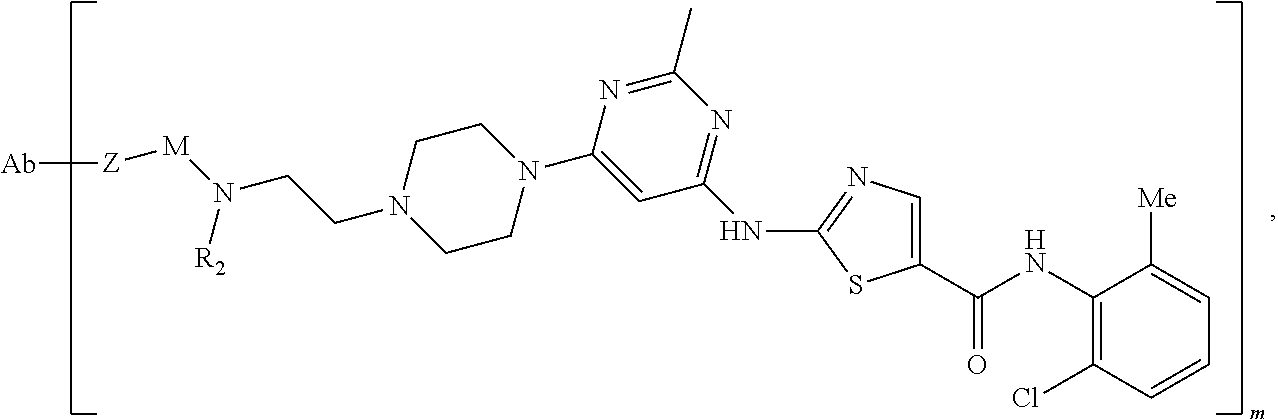
in which
Z is NH or S;
M is

R2 is hydrogen or

m is an integer of 1-20; Q is -peptide-, -L-phenylalanine-L-lysine-, or -L-valine-L-citrulline-; R3 is hydrogen, halogen, or an alkyl; A is —(CH2)n—,

or —Ar—; B is —(CH2)n— or

R is hydrogen or an alkyl; Ar is

R1 is hydrogen, halogen, or an alkyl; and n is an integer of 1-10. Three exemplary immunoconjugates are:


| TABLE 1 |
| Conjugation conditions |
| Linker-Payload | % of | Temperature | Time | |||
| Conjugate | (eq) | pH | Glycerol | (° C.) | (hr) | DAR |
| Rex-1-01 | 10 | 7.4 | 20 | 4 | 1.09 | |
| Rex-1-02 | 10 | 6.5 | 37 | 4 | 4.96 | |
| Rex-1-03* | 20 | 6.5 | 37 | 4 | 2.67 | |
| Rex-1-04* | 20 | 6.5 | 37 | 4 | 3.11 | |
| Rex-1-05 | 10 | 7.4 | 37 | 4 | ≈1 | |
| Rex-1-06 | 20 | 7.4 | 37 | 4 | 2.76 | |
| Rex-1-07 | 10 | 8.0 | 37 | 4 | 3.43 | |
| Rex-1-08* | 10 | 8.0 | 37 | 4 | 1.98 | |
| Rex-1-09 | 10 | 8.0 | 37 | 2 | 3.11 | |
| Rex-1-10 | 5 | 8.0 | 37 | 4 | 2.18 | |
| Rex-1-11 | 20 | 8.0 | 37 | 4 | 1.77 | |
| Rex-1-12* | 10 | 8.0 | 10% | 37 | 4 | 5.40 |
| Rex-1-13* | 10 | 8.0 | 20% | 37 | 4 | 5.48 |
| Rex-1-14* | 10 | 8.0 | 30% | 37 | 4 | 4.30 |
| Rex-1-15 | 10 | 6.5 | 10% | 37 | 4 | 1.12 |
| Rex-1-16 | 10 | 6.5 | 30% | 37 | 4 | 1.96 |
| Rex-1-17 | 10 | 6.5 | 20% | 37 | 16 | 1.04 |
| Rex-1-18 | 10 | 8.0 | 20% | 37 | 16 | 3.68 |
| Rex-2-01 | 10 | 6.5 | 25 | 20 | <1 | |
| Rex-4-01 | 10 | 8.0 | 20% | 37 | 16 | <1 |
| Rex-4-02 | 10 | 8.0 | 20% | 37 | 4 | <1 |
| Rex-4-03 | 10** | 8.0 | 20% | 37 | 4 | <1 |
| Rex-4-04 | 10 | 6.5 | 20% | 37 | 4 | <1 |
| Rex-4-05 | 10 | 7.4 | 20% | 37 | 4 | <1 |
| Rex-5-01 | 7.7 | 8.0 | 10% | 37 | 16 | <1 |
| *Proper DAR and sufficient quantity for drug efficacy measurement. | ||||||
| **Linker-Payload dissolved in dimethylacetamide. | ||||||
| TABLE 2 |
| Conjugation conditions |
| Temperature | ||||||
| Equivalent of | % of | (° C.) | Time | |||
| Conjugate | TCEP/dasatinib-1 | pH | Glycerol | reduction/conjugation | (hr) | DAR |
| Rex-3-01 | 8/10 | 8.0 | 37/4 | 2/0.5 | <1 | |
| Rex-3-02* | 8/10 | 8.0 | 20% | 37/4 | 2/0.5 | 3.08 |
| Rex-3-03 | 8/6.3 | 7.4 | 20% | 37/4 | 2/0.5 | 1.67 |
| Rex-3-04 | 8/10 | 8.0 | 20% | 37/37 | 2/0.5 | 2.40 |
| Rex-3-05 | 15/10 | 8.0 | 20% | 37/4 | 2/0.5 | 1.14 |
| *Proper DAR and sufficient quantity for drug efficacy measurement. | ||||||
| TABLE 3 |
| Efficacy of different lots of Rex-1 |
| Cells | Rex-1-03 | Rex-1-04 | Rex-1-08 | Rex-1-12 | Rex-1-13 | Rex-1-14 |
| SW48 | +++++ | +++++ | +++++ | ++++ | ++++ | ++++ |
| HT-29 | +++ | +++++ | ++ | ++++ | +++ | N.A. |
| SW480 | ++ | +++++ | ++ | ++++ | +++ | ++ |
| N.A.: not available | ||||||
Claims (10)

Priority Applications (1)
| Application Number | Priority Date | Filing Date | Title |
|---|---|---|---|
| US16/467,655 US11384150B2 (en) | 2016-12-14 | 2017-12-13 | Antibody-drug conjugates and uses thereof |
Applications Claiming Priority (3)
| Application Number | Priority Date | Filing Date | Title |
|---|---|---|---|
| US201662434035P | 2016-12-14 | 2016-12-14 | |
| PCT/US2017/066074 WO2018112027A1 (en) | 2016-12-14 | 2017-12-13 | Antibody-drug conjugates and uses thereof |
| US16/467,655 US11384150B2 (en) | 2016-12-14 | 2017-12-13 | Antibody-drug conjugates and uses thereof |
Publications (2)
| Publication Number | Publication Date |
|---|---|
| US20200190199A1 US20200190199A1 (en) | 2020-06-18 |
| US11384150B2 true US11384150B2 (en) | 2022-07-12 |
Family
ID=62559574
Family Applications (1)
| Application Number | Title | Priority Date | Filing Date |
|---|---|---|---|
| US16/467,655 Active 2038-02-26 US11384150B2 (en) | 2016-12-14 | 2017-12-13 | Antibody-drug conjugates and uses thereof |
Country Status (5)
| Country | Link |
|---|---|
| US (1) | US11384150B2 (en) |
| EP (1) | EP3555137A1 (en) |
| JP (1) | JP2020533269A (en) |
| TW (1) | TWI685350B (en) |
| WO (1) | WO2018112027A1 (en) |
Families Citing this family (10)
| Publication number | Priority date | Publication date | Assignee | Title |
|---|---|---|---|---|
| ES2933350T3 (en) | 2014-01-24 | 2023-02-06 | Turning Point Therapeutics Inc | Diaryl macrocycles as modulators of protein kinases |
| AU2016287568B2 (en) | 2015-07-02 | 2020-08-20 | Turning Point Therapeutics, Inc. | Chiral diaryl macrocycles as modulators of protein kinases |
| RU2765181C2 (en) | 2015-07-06 | 2022-01-26 | Тёрнинг Поинт Терапьютикс, Инк. | Polymorphic form of diaryl macrocycle |
| CN109212214B (en) * | 2018-09-25 | 2019-08-06 | 四川大学华西医院 | A lung cancer screening kit |
| JP7631193B2 (en) | 2018-10-22 | 2025-02-18 | アルミス インコーポレイテッド | TYK2 INHIBITORS AND USES THEREOF |
| JP7590354B2 (en) * | 2019-06-10 | 2024-11-26 | ストロ バイオファーマ インコーポレーテッド | Immunomodulator antibody drug conjugates and uses thereof |
| JP7706210B2 (en) | 2019-06-10 | 2025-07-11 | ストロ バイオファーマ インコーポレーテッド | 5H-Pyrrolo[3,2-d]pyrimidine-2,4-diamino compounds and antibody conjugates thereof |
| CA3148611A1 (en) | 2019-08-12 | 2021-02-18 | Regeneron Pharmaceuticals, Inc. | Macrophage stimulating 1 receptor (mst1r) variants and uses thereof |
| US20250136712A1 (en) * | 2021-08-13 | 2025-05-01 | Hummingbird Bioscience Pte. Ltd. | Treatment and prevention of cancer using her3 antigen-binding molecules |
| CN114014867B (en) * | 2021-11-01 | 2023-07-14 | 中国人民解放军海军军医大学 | A kind of ANSA triene compound and its preparation method and application |
Citations (4)
| Publication number | Priority date | Publication date | Assignee | Title |
|---|---|---|---|---|
| WO2015000062A1 (en) | 2013-07-05 | 2015-01-08 | Avidbiologics Inc. | Egfr antibody conjugates |
| US20150337042A1 (en) | 2014-03-21 | 2015-11-26 | Abbvie Inc. | Anti-egfr antibodies and antibody drug conjugates |
| WO2015177279A1 (en) * | 2014-05-21 | 2015-11-26 | Ic Discovery Gmbh | Therapeutic conjugates with sulfated dendrimers for intracellular targeting |
| WO2016115218A1 (en) | 2015-01-14 | 2016-07-21 | The California Institute For Biomedical Research | Antibody drug conjugates for the treatment of immune conditions |
-
2017
- 2017-12-13 JP JP2019531775A patent/JP2020533269A/en active Pending
- 2017-12-13 WO PCT/US2017/066074 patent/WO2018112027A1/en not_active Ceased
- 2017-12-13 EP EP17881836.5A patent/EP3555137A1/en not_active Withdrawn
- 2017-12-13 US US16/467,655 patent/US11384150B2/en active Active
- 2017-12-14 TW TW106144004A patent/TWI685350B/en active
Patent Citations (4)
| Publication number | Priority date | Publication date | Assignee | Title |
|---|---|---|---|---|
| WO2015000062A1 (en) | 2013-07-05 | 2015-01-08 | Avidbiologics Inc. | Egfr antibody conjugates |
| US20150337042A1 (en) | 2014-03-21 | 2015-11-26 | Abbvie Inc. | Anti-egfr antibodies and antibody drug conjugates |
| WO2015177279A1 (en) * | 2014-05-21 | 2015-11-26 | Ic Discovery Gmbh | Therapeutic conjugates with sulfated dendrimers for intracellular targeting |
| WO2016115218A1 (en) | 2015-01-14 | 2016-07-21 | The California Institute For Biomedical Research | Antibody drug conjugates for the treatment of immune conditions |
Non-Patent Citations (5)
| Title |
|---|
| Akinaga S, Gomi K, Morimoto M, Tamaoki T, Okabe M. Antitumor activity of UCN-01, a selective inhibitor of protein kinase C, in murine and human tumor models. Cancer Res. Sep. 15, 1991;51(18):4888-92. PMID: 1893379. (Year: 1991). * |
| Hwang et al "Structure-Based Prediction of Ligand-Protein Interactions on a Genome-Wide Scale" PNAS vol. 114, pp. 13685-13690, 2017. |
| Kannaiyan R, Mahadevan D. A comprehensive review of protein kinase inhibitors for cancer therapy. Expert Rev Anticancer Ther. 2018;18(12):1249-1270. doi:10.1080/14737140.2018.1527688 (Year: 2018). * |
| Kiflemariam et al "Tumor Vessel Up-Regulation of INSR Revealed by Single-Cell Expression Analysis of the Tyrosine Kinome and Phosphatome in Human Cancers" The American Journal of Pathology vol. 185, pp. 1600-1609, 2015. |
| Tsuchida E, Tsuchida M, Urano M. Synergistic cytotoxicity between a protein kinase C inhibitor, UCN-01, and monoclonal antibody to the epidermal growth factor receptor on MDA-468 cells. Cancer Biother Radiopharm. Apr. 1997;12(2):117-21. doi: 10.1089/cbr.1997.12.117. PMID: 10851455. (Year: 1997). * |
Also Published As
| Publication number | Publication date |
|---|---|
| WO2018112027A1 (en) | 2018-06-21 |
| TWI685350B (en) | 2020-02-21 |
| TW201828990A (en) | 2018-08-16 |
| JP2020533269A (en) | 2020-11-19 |
| EP3555137A1 (en) | 2019-10-23 |
| US20200190199A1 (en) | 2020-06-18 |
Similar Documents
| Publication | Publication Date | Title |
|---|---|---|
| US11384150B2 (en) | Antibody-drug conjugates and uses thereof | |
| KR102253480B1 (en) | Pyrrolobenzodiazepine conjugate | |
| US10561739B2 (en) | Targeted pyrrolobenzodiazapine conjugates | |
| JP5116686B2 (en) | Methods for preparing CC-1065 analogs and compounds for preparation | |
| US9388187B2 (en) | Pyrrolobenzodiazepines | |
| TWI412367B (en) | Chemical linker and cleavable substrate and conjugate thereof | |
| US10328084B2 (en) | Pyrrolobenzodiazepines and targeted conjugates | |
| US9399641B2 (en) | Pyrrolobenzodiazepines as unsymmetrical dimeric PBD compounds for inclusion in targeted conjugates | |
| US9399073B2 (en) | Pyrrolobenzodiazepines | |
| US9732084B2 (en) | Pyrrolobenzodiazepines used to treat proliferative diseases | |
| KR101413955B1 (en) | Aziridinyl-epothilone compounds | |
| ES2982012T3 (en) | Biological materials and their uses | |
| KR101428112B1 (en) | Cytotoxic agents comprising new tomaymycin derivatives and their therapeutic use | |
| US12583857B2 (en) | Anti-liferative agents comprising substituted benzo[e]pyrido[1,2-a][1,4]diazepines | |
| KR102189731B1 (en) | Pyrrolobenzodiazepine conjugate | |
| BRPI0617546A2 (en) | drug-antibody conjugate, pharmaceutical formulation, method for killing a tumor cell, method for retarding or arresting tumor growth in a mammalian subject and compound | |
| TW200900059A (en) | Chemical linkers with single amino acids and conjugates thereof | |
| KR20210035905A (en) | Pyrrolobenzodiazepine conjugates | |
| US20250018051A1 (en) | Anthracycline derivative linker reagents, antibody-drug conjugates and methods | |
| CN109641911B (en) | seco-cyclopyrroloindole compounds and antibody-drug conjugates thereof and methods of making and using them | |
| US12377164B2 (en) | Linkers and conjugates | |
| GB2574913A (en) | Small molecule modulators of human STING, conjugates and therapeutic applications | |
| WO2026062219A1 (en) | Antibody-drug conjugates of vincristine, processes for preparing the same and uses thereof | |
| TW202308697A (en) | Pyrrolobenzodiazepine conjugates |
Legal Events
| Date | Code | Title | Description |
|---|---|---|---|
| AS | Assignment |
Owner name: DCB-USA LLC, DELAWARE Free format text: ASSIGNMENT OF ASSIGNORS INTEREST;ASSIGNORS:CHUANG, SHIH-HSIEN;CHAO, WEI-TING;SUN, WEI-TING;AND OTHERS;REEL/FRAME:049404/0422 Effective date: 20190514 Owner name: TUNGHAI UNIVERSITY, TAIWAN Free format text: ASSIGNMENT OF ASSIGNORS INTEREST;ASSIGNORS:CHUANG, SHIH-HSIEN;CHAO, WEI-TING;SUN, WEI-TING;AND OTHERS;REEL/FRAME:049404/0422 Effective date: 20190514 Owner name: DEVELOPMENT CENTER FOR BIOTECHNOLOGY, TAIWAN Free format text: ASSIGNMENT OF ASSIGNORS INTEREST;ASSIGNORS:CHUANG, SHIH-HSIEN;CHAO, WEI-TING;SUN, WEI-TING;AND OTHERS;REEL/FRAME:049404/0422 Effective date: 20190514 |
|
| FEPP | Fee payment procedure |
Free format text: ENTITY STATUS SET TO UNDISCOUNTED (ORIGINAL EVENT CODE: BIG.); ENTITY STATUS OF PATENT OWNER: SMALL ENTITY |
|
| FEPP | Fee payment procedure |
Free format text: ENTITY STATUS SET TO SMALL (ORIGINAL EVENT CODE: SMAL); ENTITY STATUS OF PATENT OWNER: SMALL ENTITY |
|
| AS | Assignment |
Owner name: TUNGHAI UNIVERSITY, TAIWAN Free format text: ASSIGNMENT OF ASSIGNORS INTEREST;ASSIGNOR:DCB-USA LLC;REEL/FRAME:055495/0020 Effective date: 20190522 Owner name: DEVELOPMENT CENTER FOR BIOTECHNOLOGY, TAIWAN Free format text: ASSIGNMENT OF ASSIGNORS INTEREST;ASSIGNOR:DCB-USA LLC;REEL/FRAME:055495/0020 Effective date: 20190522 |
|
| STPP | Information on status: patent application and granting procedure in general |
Free format text: RESPONSE TO NON-FINAL OFFICE ACTION ENTERED AND FORWARDED TO EXAMINER |
|
| STPP | Information on status: patent application and granting procedure in general |
Free format text: NON FINAL ACTION MAILED |
|
| STPP | Information on status: patent application and granting procedure in general |
Free format text: FINAL REJECTION MAILED |
|
| STPP | Information on status: patent application and granting procedure in general |
Free format text: RESPONSE AFTER FINAL ACTION FORWARDED TO EXAMINER |
|
| STPP | Information on status: patent application and granting procedure in general |
Free format text: NOTICE OF ALLOWANCE MAILED -- APPLICATION RECEIVED IN OFFICE OF PUBLICATIONS |
|
| STPP | Information on status: patent application and granting procedure in general |
Free format text: AWAITING TC RESP., ISSUE FEE NOT PAID |
|
| STPP | Information on status: patent application and granting procedure in general |
Free format text: PUBLICATIONS -- ISSUE FEE PAYMENT VERIFIED |
|
| STCF | Information on status: patent grant |
Free format text: PATENTED CASE |
|
| MAFP | Maintenance fee payment |
Free format text: PAYMENT OF MAINTENANCE FEE, 4TH YR, SMALL ENTITY (ORIGINAL EVENT CODE: M2551); ENTITY STATUS OF PATENT OWNER: SMALL ENTITY Year of fee payment: 4 |