US11377464B2 - Galactoside inhibitor of galectins - Google Patents
Galactoside inhibitor of galectins Download PDFInfo
- Publication number
- US11377464B2 US11377464B2 US17/018,713 US202017018713A US11377464B2 US 11377464 B2 US11377464 B2 US 11377464B2 US 202017018713 A US202017018713 A US 202017018713A US 11377464 B2 US11377464 B2 US 11377464B2
- Authority
- US
- United States
- Prior art keywords
- deoxy
- galactopyranoside
- triazol
- thio
- trifluorophenyl
- Prior art date
- Legal status (The legal status is an assumption and is not a legal conclusion. Google has not performed a legal analysis and makes no representation as to the accuracy of the status listed.)
- Active
Links
- 0 *[V](=O)C1[C@H](C[C@@H]2OC(*(C)I)C(O*[V])C(C*(I)*I)[C@H]2[V](*)=O)CC(CO)[C@H](O)[C@@H]1[Y]*(I)*I Chemical compound *[V](=O)C1[C@H](C[C@@H]2OC(*(C)I)C(O*[V])C(C*(I)*I)[C@H]2[V](*)=O)CC(CO)[C@H](O)[C@@H]1[Y]*(I)*I 0.000 description 27
- IOAIBUSJDFUFDE-JYACULSFSA-N CC(=O)Nc1ccc(S[C@H]2OC(CO)[C@H](O)C(n3cc(-c4cc(F)c(F)c(F)c4)nn3)[C@@H]2O)cc1 Chemical compound CC(=O)Nc1ccc(S[C@H]2OC(CO)[C@H](O)C(n3cc(-c4cc(F)c(F)c(F)c4)nn3)[C@@H]2O)cc1 IOAIBUSJDFUFDE-JYACULSFSA-N 0.000 description 2
- GJUAAVWGFZWHCS-MUVKAJBYSA-N CC(=O)OCC1O[C@@H](Cl)C(OC(C)=O)[C@@H](N=[N+]=[N-])[C@H]1OC(C)=O Chemical compound CC(=O)OCC1O[C@@H](Cl)C(OC(C)=O)[C@@H](N=[N+]=[N-])[C@H]1OC(C)=O GJUAAVWGFZWHCS-MUVKAJBYSA-N 0.000 description 2
- RYVTYDFASQLSIV-JYACULSFSA-N CCOc1cccc(S[C@H]2OC(CO)[C@H](O)C(n3cc(-c4cc(F)c(F)c(F)c4)nn3)[C@@H]2O)c1 Chemical compound CCOc1cccc(S[C@H]2OC(CO)[C@H](O)C(n3cc(-c4cc(F)c(F)c(F)c4)nn3)[C@@H]2O)c1 RYVTYDFASQLSIV-JYACULSFSA-N 0.000 description 2
- QRHFMKMREGWXHY-ZRTAOYRGSA-N COc1ccc(S[C@H]2OC(CO)[C@H](O)C(n3cc(-c4cc(F)c(F)c(F)c4)nn3)[C@@H]2O)cc1 Chemical compound COc1ccc(S[C@H]2OC(CO)[C@H](O)C(n3cc(-c4cc(F)c(F)c(F)c4)nn3)[C@@H]2O)cc1 QRHFMKMREGWXHY-ZRTAOYRGSA-N 0.000 description 2
- JWZKZJAACJKGHX-ZRTAOYRGSA-N COc1cccc(S[C@H]2OC(CO)[C@H](O)C(n3cc(-c4cc(F)c(F)c(F)c4)nn3)[C@@H]2O)c1 Chemical compound COc1cccc(S[C@H]2OC(CO)[C@H](O)C(n3cc(-c4cc(F)c(F)c(F)c4)nn3)[C@@H]2O)c1 JWZKZJAACJKGHX-ZRTAOYRGSA-N 0.000 description 2
- BMBJZBLEQHHVKU-JYACULSFSA-N Cc1ccc(S[C@H]2OC(CO)[C@H](O)C(n3cc(-c4cc(F)c(F)c(F)c4)nn3)[C@@H]2O)cc1C Chemical compound Cc1ccc(S[C@H]2OC(CO)[C@H](O)C(n3cc(-c4cc(F)c(F)c(F)c4)nn3)[C@@H]2O)cc1C BMBJZBLEQHHVKU-JYACULSFSA-N 0.000 description 2
- BUTQSWNVRKAYQB-UHFFFAOYSA-N N#Cc1ncc(S)cc1Cl Chemical compound N#Cc1ncc(S)cc1Cl BUTQSWNVRKAYQB-UHFFFAOYSA-N 0.000 description 2
- ZSDKWYCUUBQLNX-BDAJPOSXSA-N O=C(c1cncc(Br)c1)[C@H]1OC(CO)[C@H](O)C(n2cc(-c3cc(F)c(F)c(F)c3)nn2)[C@@H]1O Chemical compound O=C(c1cncc(Br)c1)[C@H]1OC(CO)[C@H](O)C(n2cc(-c3cc(F)c(F)c(F)c3)nn2)[C@@H]1O ZSDKWYCUUBQLNX-BDAJPOSXSA-N 0.000 description 2
- ZSDKWYCUUBQLNX-KCPIMLJZSA-N O=C(c1cncc(Br)c1)[C@H]1OC(CO)[C@H](O)[C@H](n2cc(-c3cc(F)c(F)c(F)c3)nn2)C1O Chemical compound O=C(c1cncc(Br)c1)[C@H]1OC(CO)[C@H](O)[C@H](n2cc(-c3cc(F)c(F)c(F)c3)nn2)C1O ZSDKWYCUUBQLNX-KCPIMLJZSA-N 0.000 description 2
- NSBACFPJXZETFZ-BDAJPOSXSA-N O=C(c1cncc(Cl)c1)[C@H]1OC(CO)[C@H](O)C(n2cc(-c3cc(F)c(F)c(F)c3)nn2)[C@@H]1O Chemical compound O=C(c1cncc(Cl)c1)[C@H]1OC(CO)[C@H](O)C(n2cc(-c3cc(F)c(F)c(F)c3)nn2)[C@@H]1O NSBACFPJXZETFZ-BDAJPOSXSA-N 0.000 description 2
- NSBACFPJXZETFZ-KCPIMLJZSA-N O=C(c1cncc(Cl)c1)[C@H]1OC(CO)[C@H](O)[C@H](n2cc(-c3cc(F)c(F)c(F)c3)nn2)C1O Chemical compound O=C(c1cncc(Cl)c1)[C@H]1OC(CO)[C@H](O)[C@H](n2cc(-c3cc(F)c(F)c(F)c3)nn2)C1O NSBACFPJXZETFZ-KCPIMLJZSA-N 0.000 description 2
- JYWBHVBYLJJJKW-ZRTAOYRGSA-N OCC1O[C@H](SCc2ccccc2)[C@@H](O)C(n2cc(-c3cc(F)c(F)c(F)c3)nn2)[C@H]1O Chemical compound OCC1O[C@H](SCc2ccccc2)[C@@H](O)C(n2cc(-c3cc(F)c(F)c(F)c3)nn2)[C@H]1O JYWBHVBYLJJJKW-ZRTAOYRGSA-N 0.000 description 2
- CSGJIUAIYDKFPC-GETYWBHSSA-N OCC1O[C@H](Sc2ccc(Cl)c(Cl)c2)[C@@H](O)C(n2cc(-c3cc(F)c(F)c(F)c3)nn2)[C@H]1O Chemical compound OCC1O[C@H](Sc2ccc(Cl)c(Cl)c2)[C@@H](O)C(n2cc(-c3cc(F)c(F)c(F)c3)nn2)[C@H]1O CSGJIUAIYDKFPC-GETYWBHSSA-N 0.000 description 2
- PDIZHZLALAJOCC-XFNNJMDJSA-N OCC1O[C@H](Sc2ccc(Cl)cc2Cl)[C@@H](O)C(n2cc(-c3cc(F)c(F)c(F)c3)nn2)[C@H]1O Chemical compound OCC1O[C@H](Sc2ccc(Cl)cc2Cl)[C@@H](O)C(n2cc(-c3cc(F)c(F)c(F)c3)nn2)[C@H]1O PDIZHZLALAJOCC-XFNNJMDJSA-N 0.000 description 2
- SPFBQIPGOIBLKZ-GETYWBHSSA-N OCC1O[C@H](Sc2cccc(Br)c2)[C@@H](O)C(n2cc(-c3cc(F)c(F)c(F)c3)nn2)[C@H]1O Chemical compound OCC1O[C@H](Sc2cccc(Br)c2)[C@@H](O)C(n2cc(-c3cc(F)c(F)c(F)c3)nn2)[C@H]1O SPFBQIPGOIBLKZ-GETYWBHSSA-N 0.000 description 2
- SAXHOTMHFPXEBT-CTSFYJMRSA-N OCC1O[C@H](Sc2cccc(Cl)c2Cl)[C@@H](O)C(n2cc(-c3cc(F)c(F)c(F)c3)nn2)[C@H]1O Chemical compound OCC1O[C@H](Sc2cccc(Cl)c2Cl)[C@@H](O)C(n2cc(-c3cc(F)c(F)c(F)c3)nn2)[C@H]1O SAXHOTMHFPXEBT-CTSFYJMRSA-N 0.000 description 2
- OYFKIWDHSXZVEG-DWKQHGKHSA-N OCC1O[C@H](Sc2ccncc2)[C@@H](O)C(n2cc(-c3cc(F)c(F)c(F)c3)nn2)[C@H]1O Chemical compound OCC1O[C@H](Sc2ccncc2)[C@@H](O)C(n2cc(-c3cc(F)c(F)c(F)c3)nn2)[C@H]1O OYFKIWDHSXZVEG-DWKQHGKHSA-N 0.000 description 2
- FXMMOEXZCASFOE-CJGQTUNWSA-I B/C=C1\OC(CO)[C@H](O)[C@H](O)C1O.BC(O)[C@H]1OC(CO)[C@H](O)[C@H](O)C1O.BC[C@H]1OC(CO)[C@H](O)[C@H](N=[N+]=[N-])C1O.BC[C@H]1OC(CO)[C@H](O)[C@H](O)C1O.BC[C@H]1OC(CO)[C@H](O)[C@H](O)C1O.CC.CC(I)I.CCI.CCI.C[V](I)(I)I.C[V](I)I.O=C[C@H]1OC(CO)[C@H](O)[C@H](O)C1O Chemical compound B/C=C1\OC(CO)[C@H](O)[C@H](O)C1O.BC(O)[C@H]1OC(CO)[C@H](O)[C@H](O)C1O.BC[C@H]1OC(CO)[C@H](O)[C@H](N=[N+]=[N-])C1O.BC[C@H]1OC(CO)[C@H](O)[C@H](O)C1O.BC[C@H]1OC(CO)[C@H](O)[C@H](O)C1O.CC.CC(I)I.CCI.CCI.C[V](I)(I)I.C[V](I)I.O=C[C@H]1OC(CO)[C@H](O)[C@H](O)C1O FXMMOEXZCASFOE-CJGQTUNWSA-I 0.000 description 1
- OHTWSMPDAXVFFD-UXWPPRQCSA-K BC(C)(C)[C@H]1OC(CO)[C@H](O)[C@H](N=[N+]=[N-])C1O.BC(C)(C)[C@H]1OC(CO)[C@H](O)[C@H](O)C1O.BC(C)(C)[C@H]1OC(CO)[C@H](O)[C@H](O)C1O.BC(O)[C@H]1OC(CO)[C@H](O)[C@H](O)C1O.CC(I)(I)I.CC([V])I.CC[V].C[V](I)(I)I Chemical compound BC(C)(C)[C@H]1OC(CO)[C@H](O)[C@H](N=[N+]=[N-])C1O.BC(C)(C)[C@H]1OC(CO)[C@H](O)[C@H](O)C1O.BC(C)(C)[C@H]1OC(CO)[C@H](O)[C@H](O)C1O.BC(O)[C@H]1OC(CO)[C@H](O)[C@H](O)C1O.CC(I)(I)I.CC([V])I.CC[V].C[V](I)(I)I OHTWSMPDAXVFFD-UXWPPRQCSA-K 0.000 description 1
- RCLADGYFIYUJDH-ILZJGXLFSA-K BC.BC[C@H]1OC(CO)[C@H](O)[C@H](N=[N+]=[N-])C1O.C[V](I)I.C[V]I.I.[N-]=[N+]=N[C@@H]1C(O)[C@H](Cl)OC(CO)[C@@H]1O.[N-]=[N+]=N[C@@H]1C(O)[C@H](O)OC(CO)[C@@H]1O Chemical compound BC.BC[C@H]1OC(CO)[C@H](O)[C@H](N=[N+]=[N-])C1O.C[V](I)I.C[V]I.I.[N-]=[N+]=N[C@@H]1C(O)[C@H](Cl)OC(CO)[C@@H]1O.[N-]=[N+]=N[C@@H]1C(O)[C@H](O)OC(CO)[C@@H]1O RCLADGYFIYUJDH-ILZJGXLFSA-K 0.000 description 1
- WULDAKKQKZEBRD-BMAFIYFOSA-N BC.BC[C@H]1OC(COC(C)=O)[C@H](OC(C)=O)[C@H](N=[N+]=[N-])C1C.C.C.CC(=O)OCC1O[C@@H](OC(C)=O)C(OC(C)=O)[C@@H](N=[N+]=[N-])[C@H]1OC(C)=O Chemical compound BC.BC[C@H]1OC(COC(C)=O)[C@H](OC(C)=O)[C@H](N=[N+]=[N-])C1C.C.C.CC(=O)OCC1O[C@@H](OC(C)=O)C(OC(C)=O)[C@@H](N=[N+]=[N-])[C@H]1OC(C)=O WULDAKKQKZEBRD-BMAFIYFOSA-N 0.000 description 1
- CUUQVIMMVSOCPH-KYBKSWBSSA-K BC[C@H]1OC(CO)[C@H](O)[C@H](O)C1O.BC[C@H]1OC(CO)[C@H](O)[C@H](OCC#C)C1O.CC[V].CC[V](I)I.CC[V]I.OCC1O[C@@H](Cl)C(O)[C@@H](O)[C@H]1O Chemical compound BC[C@H]1OC(CO)[C@H](O)[C@H](O)C1O.BC[C@H]1OC(CO)[C@H](O)[C@H](OCC#C)C1O.CC[V].CC[V](I)I.CC[V]I.OCC1O[C@@H](Cl)C(O)[C@@H](O)[C@H]1O CUUQVIMMVSOCPH-KYBKSWBSSA-K 0.000 description 1
- OETGQBTYAODZHO-UHFFFAOYSA-N BF.BS.C.C Chemical compound BF.BS.C.C OETGQBTYAODZHO-UHFFFAOYSA-N 0.000 description 1
- JHWMXEGIGGJXGU-UHFFFAOYSA-K BN.BS.BSC=C.CCC[V].CCC[V](I)I.CCC[V]I Chemical compound BN.BS.BSC=C.CCC[V].CCC[V](I)I.CCC[V]I JHWMXEGIGGJXGU-UHFFFAOYSA-K 0.000 description 1
- ZYMMPNIIMCEDIE-UHFFFAOYSA-M BN.B[N+](=O)[O-].C.CCC[V]I Chemical compound BN.B[N+](=O)[O-].C.CCC[V]I ZYMMPNIIMCEDIE-UHFFFAOYSA-M 0.000 description 1
- IOACCFXHCAYCFO-UHFFFAOYSA-N BO.BOC=C.BS.BSC=C.CCC(I)(I)I.CCC(I)I.CCC([V])I.CCC[V] Chemical compound BO.BOC=C.BS.BSC=C.CCC(I)(I)I.CCC(I)I.CCC([V])I.CCC[V] IOACCFXHCAYCFO-UHFFFAOYSA-N 0.000 description 1
- FJBQYMPFSHZSBU-UHFFFAOYSA-N BS.BS(=O)(=O)Cl.C.C Chemical compound BS.BS(=O)(=O)Cl.C.C FJBQYMPFSHZSBU-UHFFFAOYSA-N 0.000 description 1
- HWUKNSQVICPRPW-NNVWEFMASA-N C#CCO[C@@H]1C(O)[C@@H](Sc2ccc(Cl)c(Cl)c2)OC(CO)[C@@H]1O Chemical compound C#CCO[C@@H]1C(O)[C@@H](Sc2ccc(Cl)c(Cl)c2)OC(CO)[C@@H]1O HWUKNSQVICPRPW-NNVWEFMASA-N 0.000 description 1
- PKBHUUCWCQINEE-QQVZOVBDSA-N C#CCO[C@@H]1C(OC(C)=O)[C@@H](Sc2ccc(Cl)c(Cl)c2)OC(COC(C)=O)[C@@H]1OC(C)=O Chemical compound C#CCO[C@@H]1C(OC(C)=O)[C@@H](Sc2ccc(Cl)c(Cl)c2)OC(COC(C)=O)[C@@H]1OC(C)=O PKBHUUCWCQINEE-QQVZOVBDSA-N 0.000 description 1
- QFWHSRUYRFUVIF-UHFFFAOYSA-N C.C.C.Clc1cnc(Br)c(Cl)c1.Clc1cnc(I)c(Cl)c1.FC(F)(F)c1ncc(Cl)cc1Cl Chemical compound C.C.C.Clc1cnc(Br)c(Cl)c1.Clc1cnc(I)c(Cl)c1.FC(F)(F)c1ncc(Cl)cc1Cl QFWHSRUYRFUVIF-UHFFFAOYSA-N 0.000 description 1
- PEVCVVOEGXXQJG-RQHHWPAKSA-N C.C.CC(=O)OCC1O[C@H](Sc2ccnc(N)c2)C(C)[C@@H](n2cc(-c3cc(F)c(F)c(F)c3)nn2)[C@H]1OC(C)=O.CC(=O)OCC1O[C@H](Sc2ccnc([N+](=O)[O-])c2)C(C)[C@@H](n2cc(-c3cc(F)c(F)c(F)c3)nn2)[C@H]1OC(C)=O Chemical compound C.C.CC(=O)OCC1O[C@H](Sc2ccnc(N)c2)C(C)[C@@H](n2cc(-c3cc(F)c(F)c(F)c3)nn2)[C@H]1OC(C)=O.CC(=O)OCC1O[C@H](Sc2ccnc([N+](=O)[O-])c2)C(C)[C@@H](n2cc(-c3cc(F)c(F)c(F)c3)nn2)[C@H]1OC(C)=O PEVCVVOEGXXQJG-RQHHWPAKSA-N 0.000 description 1
- QXBCIRHIHGZJAL-NBDUMXPISA-N C.C.COC(=O)c1cccc(S[C@H]2OC(COC(C)=O)[C@H](OC(C)=O)[C@H](N=[N+]=[N-])C2C)c1.COC(=O)c1cccc(S[C@H]2OC(COC(C)=O)[C@H](OC(C)=O)[C@H](n3cc(-c4cc(F)c(F)c(F)c4)nn3)C2C)c1.C[Si](C)(C)C#Cc1cc(F)c(F)c(F)c1 Chemical compound C.C.COC(=O)c1cccc(S[C@H]2OC(COC(C)=O)[C@H](OC(C)=O)[C@H](N=[N+]=[N-])C2C)c1.COC(=O)c1cccc(S[C@H]2OC(COC(C)=O)[C@H](OC(C)=O)[C@H](n3cc(-c4cc(F)c(F)c(F)c4)nn3)C2C)c1.C[Si](C)(C)C#Cc1cc(F)c(F)c(F)c1 QXBCIRHIHGZJAL-NBDUMXPISA-N 0.000 description 1
- AZICNQKITUAEII-GQPCEICGSA-N C.CC(=O)OCC1O[C@@H](Cl)C(C)[C@@H](N=[N+]=[N-])[C@H]1OC(C)=O.COC(=O)c1cccc(S)c1.COC(=O)c1cccc(S[C@H]2OC(COC(C)=O)[C@H](OC(C)=O)[C@H](N=[N+]=[N-])C2C)c1 Chemical compound C.CC(=O)OCC1O[C@@H](Cl)C(C)[C@@H](N=[N+]=[N-])[C@H]1OC(C)=O.COC(=O)c1cccc(S)c1.COC(=O)c1cccc(S[C@H]2OC(COC(C)=O)[C@H](OC(C)=O)[C@H](N=[N+]=[N-])C2C)c1 AZICNQKITUAEII-GQPCEICGSA-N 0.000 description 1
- KPNMMOJLDFLADC-YODPDHEQSA-N CC(=O)Nc1ccc(S[C@H]2OC(COC(C)=O)[C@H](OC(C)=O)[C@H](N=[N+]=[N-])C2OC(C)=O)cc1 Chemical compound CC(=O)Nc1ccc(S[C@H]2OC(COC(C)=O)[C@H](OC(C)=O)[C@H](N=[N+]=[N-])C2OC(C)=O)cc1 KPNMMOJLDFLADC-YODPDHEQSA-N 0.000 description 1
- QDRBTMZVGHBTLH-ZZUHRXETSA-N CC(=O)OCC1O[C@@H](Cl)C(C)[C@@H](n2cc(-c3cc(F)c(F)c(F)c3)nn2)[C@H]1OC(C)=O Chemical compound CC(=O)OCC1O[C@@H](Cl)C(C)[C@@H](n2cc(-c3cc(F)c(F)c(F)c3)nn2)[C@H]1OC(C)=O QDRBTMZVGHBTLH-ZZUHRXETSA-N 0.000 description 1
- BYWPSIUIJNAJDV-BMYFTYEUSA-N CC(=O)OCC1O[C@@H](Cl)C(OC(C)=O)[C@@H](OC(C)=O)[C@H]1OC(C)=O Chemical compound CC(=O)OCC1O[C@@H](Cl)C(OC(C)=O)[C@@H](OC(C)=O)[C@H]1OC(C)=O BYWPSIUIJNAJDV-BMYFTYEUSA-N 0.000 description 1
- VUQVHNGSKSRGJT-LOVNCYQGSA-N CC(=O)OCC1O[C@@H](Cl)C(OC(C)=O)[C@@H](n2cc(-c3cc(F)c(F)c(F)c3)nn2)[C@H]1OC(C)=O Chemical compound CC(=O)OCC1O[C@@H](Cl)C(OC(C)=O)[C@@H](n2cc(-c3cc(F)c(F)c(F)c3)nn2)[C@H]1OC(C)=O VUQVHNGSKSRGJT-LOVNCYQGSA-N 0.000 description 1
- GCFFGGPQOXPVSF-HQJUKCBESA-N CC(=O)OCC1O[C@@H](OC(C)=O)C(C)[C@@H](n2cc(-c3cc(F)c(F)c(F)c3)nn2)[C@H]1OC(C)=O Chemical compound CC(=O)OCC1O[C@@H](OC(C)=O)C(C)[C@@H](n2cc(-c3cc(F)c(F)c(F)c3)nn2)[C@H]1OC(C)=O GCFFGGPQOXPVSF-HQJUKCBESA-N 0.000 description 1
- LPTITAGPBXDDGR-BEBHXBEKSA-N CC(=O)OCC1O[C@@H](OC(C)=O)C(OC(C)=O)[C@@H](OC(C)=O)[C@H]1OC(C)=O Chemical compound CC(=O)OCC1O[C@@H](OC(C)=O)C(OC(C)=O)[C@@H](OC(C)=O)[C@H]1OC(C)=O LPTITAGPBXDDGR-BEBHXBEKSA-N 0.000 description 1
- LPYAEVPJOIFQFJ-YSZROVPYSA-N CC(=O)OCC1O[C@@H](OC(C)=O)C(OC(C)=O)[C@@H](n2cc(-c3cc(F)c(F)c(F)c3)nn2)[C@H]1OC(C)=O Chemical compound CC(=O)OCC1O[C@@H](OC(C)=O)C(OC(C)=O)[C@@H](n2cc(-c3cc(F)c(F)c(F)c3)nn2)[C@H]1OC(C)=O LPYAEVPJOIFQFJ-YSZROVPYSA-N 0.000 description 1
- UZIKGKGYLPNIBW-MJRJBPBPSA-N CC(=O)OCC1O[C@H](C(=O)c2cncc(Br)c2)C(C)[C@@H](n2cc(-c3cc(F)c(F)c(F)c3)nn2)[C@H]1OC(C)=O Chemical compound CC(=O)OCC1O[C@H](C(=O)c2cncc(Br)c2)C(C)[C@@H](n2cc(-c3cc(F)c(F)c(F)c3)nn2)[C@H]1OC(C)=O UZIKGKGYLPNIBW-MJRJBPBPSA-N 0.000 description 1
- OVJKDHFQEITMKC-MJRJBPBPSA-N CC(=O)OCC1O[C@H](C(=O)c2cncc(Cl)c2)C(C)[C@@H](n2cc(-c3cc(F)c(F)c(F)c3)nn2)[C@H]1OC(C)=O Chemical compound CC(=O)OCC1O[C@H](C(=O)c2cncc(Cl)c2)C(C)[C@@H](n2cc(-c3cc(F)c(F)c(F)c3)nn2)[C@H]1OC(C)=O OVJKDHFQEITMKC-MJRJBPBPSA-N 0.000 description 1
- RAVCVHXFXQRKLQ-LZJIOBQVSA-N CC(=O)OCC1O[C@H](Oc2ccc(Cl)c(Cl)c2)C(OC(C)=O)[C@@H](N=[N+]=[N-])[C@H]1OC(C)=O Chemical compound CC(=O)OCC1O[C@H](Oc2ccc(Cl)c(Cl)c2)C(OC(C)=O)[C@@H](N=[N+]=[N-])[C@H]1OC(C)=O RAVCVHXFXQRKLQ-LZJIOBQVSA-N 0.000 description 1
- IUGVRDBIOUADEC-LZJIOBQVSA-N CC(=O)OCC1O[C@H](Oc2ccc(Cl)cc2)C(OC(C)=O)[C@@H](N=[N+]=[N-])[C@H]1OC(C)=O Chemical compound CC(=O)OCC1O[C@H](Oc2ccc(Cl)cc2)C(OC(C)=O)[C@@H](N=[N+]=[N-])[C@H]1OC(C)=O IUGVRDBIOUADEC-LZJIOBQVSA-N 0.000 description 1
- INNBPEPBQAWKJQ-LZJIOBQVSA-N CC(=O)OCC1O[C@H](Oc2cccc(Cl)c2)C(OC(C)=O)[C@@H](N=[N+]=[N-])[C@H]1OC(C)=O Chemical compound CC(=O)OCC1O[C@H](Oc2cccc(Cl)c2)C(OC(C)=O)[C@@H](N=[N+]=[N-])[C@H]1OC(C)=O INNBPEPBQAWKJQ-LZJIOBQVSA-N 0.000 description 1
- GNZOXEFRPWCNCR-LZJIOBQVSA-N CC(=O)OCC1O[C@H](Oc2ccccc2)C(OC(C)=O)[C@@H](N=[N+]=[N-])[C@H]1OC(C)=O Chemical compound CC(=O)OCC1O[C@H](Oc2ccccc2)C(OC(C)=O)[C@@H](N=[N+]=[N-])[C@H]1OC(C)=O GNZOXEFRPWCNCR-LZJIOBQVSA-N 0.000 description 1
- WUGXULRYIZVFSP-KPQXANJXSA-N CC(=O)OCC1O[C@H](S(=O)(=O)c2ccc3c(N(C)C)cccc3c2)C(C)[C@@H](n2cc(-c3cc(F)c(F)c(F)c3)nn2)[C@H]1OC(C)=O Chemical compound CC(=O)OCC1O[C@H](S(=O)(=O)c2ccc3c(N(C)C)cccc3c2)C(C)[C@@H](n2cc(-c3cc(F)c(F)c(F)c3)nn2)[C@H]1OC(C)=O WUGXULRYIZVFSP-KPQXANJXSA-N 0.000 description 1
- LYDIAANTSWYLAN-LOVNCYQGSA-N CC(=O)OCC1O[C@H](S)C(OC(C)=O)[C@@H](n2cc(-c3cc(F)c(F)c(F)c3)nn2)[C@H]1OC(C)=O Chemical compound CC(=O)OCC1O[C@H](S)C(OC(C)=O)[C@@H](n2cc(-c3cc(F)c(F)c(F)c3)nn2)[C@H]1OC(C)=O LYDIAANTSWYLAN-LOVNCYQGSA-N 0.000 description 1
- UKYGHXXJITWDIT-HQJUKCBESA-N CC(=O)OCC1O[C@H](SC(C)=O)C(C)[C@@H](n2cc(-c3cc(F)c(F)c(F)c3)nn2)[C@H]1OC(C)=O Chemical compound CC(=O)OCC1O[C@H](SC(C)=O)C(C)[C@@H](n2cc(-c3cc(F)c(F)c(F)c3)nn2)[C@H]1OC(C)=O UKYGHXXJITWDIT-HQJUKCBESA-N 0.000 description 1
- IFPCBRXOOWPJFV-YSZROVPYSA-N CC(=O)OCC1O[C@H](SC(C)=O)C(OC(C)=O)[C@@H](n2cc(-c3cc(F)c(F)c(F)c3)nn2)[C@H]1OC(C)=O Chemical compound CC(=O)OCC1O[C@H](SC(C)=O)C(OC(C)=O)[C@@H](n2cc(-c3cc(F)c(F)c(F)c3)nn2)[C@H]1OC(C)=O IFPCBRXOOWPJFV-YSZROVPYSA-N 0.000 description 1
- ULRQIRQLVRTEOR-DMTXQYTPSA-N CC(=O)OCC1O[C@H](SC(C)=O)[C@@H](OC(C)=O)C(N=[N+]=[N-])[C@H]1OC(C)=O Chemical compound CC(=O)OCC1O[C@H](SC(C)=O)[C@@H](OC(C)=O)C(N=[N+]=[N-])[C@H]1OC(C)=O ULRQIRQLVRTEOR-DMTXQYTPSA-N 0.000 description 1
- IZDGHYMPTJUXJK-SQJFVBBYSA-N CC(=O)OCC1O[C@H](SC2CCCC(=O)C2)C(C)[C@@H](n2cc(-c3cc(F)c(F)c(F)c3)nn2)[C@H]1OC(C)=O Chemical compound CC(=O)OCC1O[C@H](SC2CCCC(=O)C2)C(C)[C@@H](n2cc(-c3cc(F)c(F)c(F)c3)nn2)[C@H]1OC(C)=O IZDGHYMPTJUXJK-SQJFVBBYSA-N 0.000 description 1
- NRGIGOAZRRJGRD-VJIHISNCSA-N CC(=O)OCC1O[C@H](SC2CCCC(F)(F)C2)C(C)[C@@H](n2cc(-c3cc(F)c(F)c(F)c3)nn2)[C@H]1OC(C)=O Chemical compound CC(=O)OCC1O[C@H](SC2CCCC(F)(F)C2)C(C)[C@@H](n2cc(-c3cc(F)c(F)c(F)c3)nn2)[C@H]1OC(C)=O NRGIGOAZRRJGRD-VJIHISNCSA-N 0.000 description 1
- FHXPBWYPNAEJSK-HBWZYELFSA-N CC(=O)OCC1O[C@H](SC2CCCCC2)C(OC(C)=O)[C@@H](N=[N+]=[N-])[C@H]1OC(C)=O Chemical compound CC(=O)OCC1O[C@H](SC2CCCCC2)C(OC(C)=O)[C@@H](N=[N+]=[N-])[C@H]1OC(C)=O FHXPBWYPNAEJSK-HBWZYELFSA-N 0.000 description 1
- HHLTZTXXPVAYCB-RNUBBMKBSA-N CC(=O)OCC1O[C@H](SCCc2ccc(Cl)cc2)[C@@H](OC(C)=O)C(N=[N+]=[N-])[C@H]1OC(C)=O Chemical compound CC(=O)OCC1O[C@H](SCCc2ccc(Cl)cc2)[C@@H](OC(C)=O)C(N=[N+]=[N-])[C@H]1OC(C)=O HHLTZTXXPVAYCB-RNUBBMKBSA-N 0.000 description 1
- FLKDORLEGUMMHM-IFDCXDHDSA-N CC(=O)OCC1O[C@H](SCCc2ccc(Cl)cc2)[C@@H](OC(C)=O)C(n2cc(-c3cc(F)c(F)c(F)c3)nn2)[C@H]1OC(C)=O Chemical compound CC(=O)OCC1O[C@H](SCCc2ccc(Cl)cc2)[C@@H](OC(C)=O)C(n2cc(-c3cc(F)c(F)c(F)c3)nn2)[C@H]1OC(C)=O FLKDORLEGUMMHM-IFDCXDHDSA-N 0.000 description 1
- QPXUTARCWZVUKD-RNUBBMKBSA-N CC(=O)OCC1O[C@H](SCCc2cccc(Cl)c2)[C@@H](OC(C)=O)C(N=[N+]=[N-])[C@H]1OC(C)=O Chemical compound CC(=O)OCC1O[C@H](SCCc2cccc(Cl)c2)[C@@H](OC(C)=O)C(N=[N+]=[N-])[C@H]1OC(C)=O QPXUTARCWZVUKD-RNUBBMKBSA-N 0.000 description 1
- SRJKMCPWIRLWCV-IFDCXDHDSA-N CC(=O)OCC1O[C@H](SCCc2cccc(Cl)c2)[C@@H](OC(C)=O)C(n2cc(-c3cc(F)c(F)c(F)c3)nn2)[C@H]1OC(C)=O Chemical compound CC(=O)OCC1O[C@H](SCCc2cccc(Cl)c2)[C@@H](OC(C)=O)C(n2cc(-c3cc(F)c(F)c(F)c3)nn2)[C@H]1OC(C)=O SRJKMCPWIRLWCV-IFDCXDHDSA-N 0.000 description 1
- GQQJGBKCMBZXNS-YODPDHEQSA-N CC(=O)OCC1O[C@H](SCCc2ccccc2)C(OC(C)=O)[C@@H](N=[N+]=[N-])[C@H]1OC(C)=O Chemical compound CC(=O)OCC1O[C@H](SCCc2ccccc2)C(OC(C)=O)[C@@H](N=[N+]=[N-])[C@H]1OC(C)=O GQQJGBKCMBZXNS-YODPDHEQSA-N 0.000 description 1
- SOZSXEDKEMVLBN-RNUBBMKBSA-N CC(=O)OCC1O[C@H](SCCc2ccccc2Cl)[C@@H](OC(C)=O)C(N=[N+]=[N-])[C@H]1OC(C)=O Chemical compound CC(=O)OCC1O[C@H](SCCc2ccccc2Cl)[C@@H](OC(C)=O)C(N=[N+]=[N-])[C@H]1OC(C)=O SOZSXEDKEMVLBN-RNUBBMKBSA-N 0.000 description 1
- XOFGXLMSOYNVGV-KFPRQRBHSA-N CC(=O)OCC1O[C@H](SCc2ccc(Cl)c(Cl)c2)[C@@H](OC(C)=O)C(N=[N+]=[N-])[C@H]1OC(C)=O Chemical compound CC(=O)OCC1O[C@H](SCc2ccc(Cl)c(Cl)c2)[C@@H](OC(C)=O)C(N=[N+]=[N-])[C@H]1OC(C)=O XOFGXLMSOYNVGV-KFPRQRBHSA-N 0.000 description 1
- IPEFCAMUIBQORR-NRFZJUAFSA-N CC(=O)OCC1O[C@H](SCc2ccc(Cl)cc2)[C@@H](OC(C)=O)C(n2cc(-c3cc(F)c(F)c(F)c3)nn2)[C@H]1OC(C)=O Chemical compound CC(=O)OCC1O[C@H](SCc2ccc(Cl)cc2)[C@@H](OC(C)=O)C(n2cc(-c3cc(F)c(F)c(F)c3)nn2)[C@H]1OC(C)=O IPEFCAMUIBQORR-NRFZJUAFSA-N 0.000 description 1
- IXKGSPLIFJNBRS-XMMCJJCJSA-N CC(=O)OCC1O[C@H](SCc2ccccc2)C(OC(C)=O)[C@@H](N=[N+]=[N-])[C@H]1OC(C)=O Chemical compound CC(=O)OCC1O[C@H](SCc2ccccc2)C(OC(C)=O)[C@@H](N=[N+]=[N-])[C@H]1OC(C)=O IXKGSPLIFJNBRS-XMMCJJCJSA-N 0.000 description 1
- QPCGNQISRKIGPA-KFPRQRBHSA-N CC(=O)OCC1O[C@H](SCc2ccccc2Cl)[C@@H](OC(C)=O)C(N=[N+]=[N-])[C@H]1OC(C)=O Chemical compound CC(=O)OCC1O[C@H](SCc2ccccc2Cl)[C@@H](OC(C)=O)C(N=[N+]=[N-])[C@H]1OC(C)=O QPCGNQISRKIGPA-KFPRQRBHSA-N 0.000 description 1
- FLRQQAPVGFOYGD-UDRFUFFISA-N CC(=O)OCC1O[C@H](Sc2cc(Br)ccc2F)C(C)[C@@H](N=[N+]=[N-])[C@H]1OC(C)=O Chemical compound CC(=O)OCC1O[C@H](Sc2cc(Br)ccc2F)C(C)[C@@H](N=[N+]=[N-])[C@H]1OC(C)=O FLRQQAPVGFOYGD-UDRFUFFISA-N 0.000 description 1
- FYNAURVFBKKRHW-GFIGCAEVSA-N CC(=O)OCC1O[C@H](Sc2cc(Br)ccc2F)C(C)[C@@H](n2cc(-c3cc(F)c(F)c(F)c3)nn2)[C@H]1OC(C)=O Chemical compound CC(=O)OCC1O[C@H](Sc2cc(Br)ccc2F)C(C)[C@@H](n2cc(-c3cc(F)c(F)c(F)c3)nn2)[C@H]1OC(C)=O FYNAURVFBKKRHW-GFIGCAEVSA-N 0.000 description 1
- XSTDYMGJEPNVAO-FLYLVDQASA-N CC(=O)OCC1O[C@H](Sc2cc(Cl)c(C#N)cc2F)C(OC(C)=O)[C@@H](N=[N+]=[N-])[C@H]1OC(C)=O Chemical compound CC(=O)OCC1O[C@H](Sc2cc(Cl)c(C#N)cc2F)C(OC(C)=O)[C@@H](N=[N+]=[N-])[C@H]1OC(C)=O XSTDYMGJEPNVAO-FLYLVDQASA-N 0.000 description 1
- RBPXLIZYYXGAAM-BZPPDCNLSA-N CC(=O)OCC1O[C@H](Sc2cc(Cl)c(C#N)cc2F)C(OC(C)=O)[C@@H](n2cc(-c3cc(F)c(F)c(F)c3)nn2)[C@H]1OC(C)=O Chemical compound CC(=O)OCC1O[C@H](Sc2cc(Cl)c(C#N)cc2F)C(OC(C)=O)[C@@H](n2cc(-c3cc(F)c(F)c(F)c3)nn2)[C@H]1OC(C)=O RBPXLIZYYXGAAM-BZPPDCNLSA-N 0.000 description 1
- KIMVKYWHKUFVLU-QWZXZEGESA-N CC(=O)OCC1O[C@H](Sc2cc(Cl)c(C#N)nn2)C(OC(C)=O)[C@@H](n2cc(-c3cc(F)c(F)c(F)c3)nn2)[C@H]1OC(C)=O Chemical compound CC(=O)OCC1O[C@H](Sc2cc(Cl)c(C#N)nn2)C(OC(C)=O)[C@@H](n2cc(-c3cc(F)c(F)c(F)c3)nn2)[C@H]1OC(C)=O KIMVKYWHKUFVLU-QWZXZEGESA-N 0.000 description 1
- QAMAHKAVFDPPMB-DMUSXDMLSA-N CC(=O)OCC1O[C@H](Sc2cc(Cl)c(Cl)c(Cl)c2)C(C)[C@@H](N=[N+]=[N-])[C@H]1OC(C)=O Chemical compound CC(=O)OCC1O[C@H](Sc2cc(Cl)c(Cl)c(Cl)c2)C(C)[C@@H](N=[N+]=[N-])[C@H]1OC(C)=O QAMAHKAVFDPPMB-DMUSXDMLSA-N 0.000 description 1
- URMXHOYHAIHBPH-NYLKEFILSA-N CC(=O)OCC1O[C@H](Sc2cc(Cl)c(Cl)cc2Cl)C(OC(C)=O)[C@@H](N=[N+]=[N-])[C@H]1OC(C)=O Chemical compound CC(=O)OCC1O[C@H](Sc2cc(Cl)c(Cl)cc2Cl)C(OC(C)=O)[C@@H](N=[N+]=[N-])[C@H]1OC(C)=O URMXHOYHAIHBPH-NYLKEFILSA-N 0.000 description 1
- HVGDFGNVBKAXGV-DMUSXDMLSA-N CC(=O)OCC1O[C@H](Sc2cc(Cl)c(Cl)cc2F)C(C)[C@@H](N=[N+]=[N-])[C@H]1OC(C)=O Chemical compound CC(=O)OCC1O[C@H](Sc2cc(Cl)c(Cl)cc2F)C(C)[C@@H](N=[N+]=[N-])[C@H]1OC(C)=O HVGDFGNVBKAXGV-DMUSXDMLSA-N 0.000 description 1
- VJDKTIITCYDRGT-DUQWQOCASA-N CC(=O)OCC1O[C@H](Sc2cc(Cl)c(Cl)cc2F)C(C)[C@@H](n2cc(-c3cc(F)c(F)c(F)c3)nn2)[C@H]1OC(C)=O Chemical compound CC(=O)OCC1O[C@H](Sc2cc(Cl)c(Cl)cc2F)C(C)[C@@H](n2cc(-c3cc(F)c(F)c(F)c3)nn2)[C@H]1OC(C)=O VJDKTIITCYDRGT-DUQWQOCASA-N 0.000 description 1
- KPYDMXFDJOKMNB-DMUSXDMLSA-N CC(=O)OCC1O[C@H](Sc2cc(Cl)c(F)c(Cl)c2)C(C)[C@@H](N=[N+]=[N-])[C@H]1OC(C)=O Chemical compound CC(=O)OCC1O[C@H](Sc2cc(Cl)c(F)c(Cl)c2)C(C)[C@@H](N=[N+]=[N-])[C@H]1OC(C)=O KPYDMXFDJOKMNB-DMUSXDMLSA-N 0.000 description 1
- NCOQYGYVJRRJAU-XMMCJJCJSA-N CC(=O)OCC1O[C@H](Sc2cc(Cl)cc(C#N)c2)C(OC(C)=O)[C@@H](N=[N+]=[N-])[C@H]1OC(C)=O Chemical compound CC(=O)OCC1O[C@H](Sc2cc(Cl)cc(C#N)c2)C(OC(C)=O)[C@@H](N=[N+]=[N-])[C@H]1OC(C)=O NCOQYGYVJRRJAU-XMMCJJCJSA-N 0.000 description 1
- FOHZYLJWLDXZFN-JUWUWGQTSA-N CC(=O)OCC1O[C@H](Sc2cc(Cl)cc(C#N)c2)C(OC(C)=O)[C@@H](n2cc(-c3cc(F)c(F)c(F)c3)nn2)[C@H]1OC(C)=O Chemical compound CC(=O)OCC1O[C@H](Sc2cc(Cl)cc(C#N)c2)C(OC(C)=O)[C@@H](n2cc(-c3cc(F)c(F)c(F)c3)nn2)[C@H]1OC(C)=O FOHZYLJWLDXZFN-JUWUWGQTSA-N 0.000 description 1
- LGFPTGSTEQHMKL-HBWZYELFSA-N CC(=O)OCC1O[C@H](Sc2cc(Cl)cc(Cl)c2)C(OC(C)=O)[C@@H](N=[N+]=[N-])[C@H]1OC(C)=O Chemical compound CC(=O)OCC1O[C@H](Sc2cc(Cl)cc(Cl)c2)C(OC(C)=O)[C@@H](N=[N+]=[N-])[C@H]1OC(C)=O LGFPTGSTEQHMKL-HBWZYELFSA-N 0.000 description 1
- XLSAJUHZGBYLJY-ATXCSLJDSA-N CC(=O)OCC1O[C@H](Sc2cc(Cl)ccc2CO)C(C)[C@@H](N=[N+]=[N-])[C@H]1OC(C)=O Chemical compound CC(=O)OCC1O[C@H](Sc2cc(Cl)ccc2CO)C(C)[C@@H](N=[N+]=[N-])[C@H]1OC(C)=O XLSAJUHZGBYLJY-ATXCSLJDSA-N 0.000 description 1
- CDHDDYVDXJDZKN-NYLKEFILSA-N CC(=O)OCC1O[C@H](Sc2cc(Cl)ccc2Cl)C(OC(C)=O)[C@@H](N=[N+]=[N-])[C@H]1OC(C)=O Chemical compound CC(=O)OCC1O[C@H](Sc2cc(Cl)ccc2Cl)C(OC(C)=O)[C@@H](N=[N+]=[N-])[C@H]1OC(C)=O CDHDDYVDXJDZKN-NYLKEFILSA-N 0.000 description 1
- LTQAEGGAFOWUPP-KJOXPKICSA-N CC(=O)OCC1O[C@H](Sc2cc(Cl)cs2)C(C)[C@@H](N=[N+]=[N-])[C@H]1OC(C)=O Chemical compound CC(=O)OCC1O[C@H](Sc2cc(Cl)cs2)C(C)[C@@H](N=[N+]=[N-])[C@H]1OC(C)=O LTQAEGGAFOWUPP-KJOXPKICSA-N 0.000 description 1
- OJXHYKSGTRCUDO-QILIRGRUSA-N CC(=O)OCC1O[C@H](Sc2cc(Cl)cs2)C(C)[C@@H](n2cc(-c3cc(F)c(F)c(F)c3)nn2)[C@H]1OC(C)=O Chemical compound CC(=O)OCC1O[C@H](Sc2cc(Cl)cs2)C(C)[C@@H](n2cc(-c3cc(F)c(F)c(F)c3)nn2)[C@H]1OC(C)=O OJXHYKSGTRCUDO-QILIRGRUSA-N 0.000 description 1
- TZOCDPHOQRHYIA-SGYKDTCTSA-N CC(=O)OCC1O[C@H](Sc2cc[nH]c(=O)c2)[C@@H](OC(C)=O)C(n2cc(-c3cc(F)c(F)c(F)c3)nn2)[C@H]1OC(C)=O Chemical compound CC(=O)OCC1O[C@H](Sc2cc[nH]c(=O)c2)[C@@H](OC(C)=O)C(n2cc(-c3cc(F)c(F)c(F)c3)nn2)[C@H]1OC(C)=O TZOCDPHOQRHYIA-SGYKDTCTSA-N 0.000 description 1
- XMKHIGPXGZGXMM-HBWZYELFSA-N CC(=O)OCC1O[C@H](Sc2ccc(Br)cc2)C(OC(C)=O)[C@@H](N=[N+]=[N-])[C@H]1OC(C)=O Chemical compound CC(=O)OCC1O[C@H](Sc2ccc(Br)cc2)C(OC(C)=O)[C@@H](N=[N+]=[N-])[C@H]1OC(C)=O XMKHIGPXGZGXMM-HBWZYELFSA-N 0.000 description 1
- PNODVFCYJWLJBX-XMMCJJCJSA-N CC(=O)OCC1O[C@H](Sc2ccc(C#N)c(Br)c2)C(OC(C)=O)[C@@H](N=[N+]=[N-])[C@H]1OC(C)=O Chemical compound CC(=O)OCC1O[C@H](Sc2ccc(C#N)c(Br)c2)C(OC(C)=O)[C@@H](N=[N+]=[N-])[C@H]1OC(C)=O PNODVFCYJWLJBX-XMMCJJCJSA-N 0.000 description 1
- OYYMAUSHTQEAMQ-JUWUWGQTSA-N CC(=O)OCC1O[C@H](Sc2ccc(C#N)c(Br)c2)C(OC(C)=O)[C@@H](n2cc(-c3cc(F)c(F)c(F)c3)nn2)[C@H]1OC(C)=O Chemical compound CC(=O)OCC1O[C@H](Sc2ccc(C#N)c(Br)c2)C(OC(C)=O)[C@@H](n2cc(-c3cc(F)c(F)c(F)c3)nn2)[C@H]1OC(C)=O OYYMAUSHTQEAMQ-JUWUWGQTSA-N 0.000 description 1
- JWYTXYOSYYUGHC-ICJBMGCHSA-N CC(=O)OCC1O[C@H](Sc2ccc(C#N)c(Cl)c2)C(C)[C@@H](N=[N+]=[N-])[C@H]1OC(C)=O Chemical compound CC(=O)OCC1O[C@H](Sc2ccc(C#N)c(Cl)c2)C(C)[C@@H](N=[N+]=[N-])[C@H]1OC(C)=O JWYTXYOSYYUGHC-ICJBMGCHSA-N 0.000 description 1
- VSEJMYSWZUSUDP-SHQSNSOESA-N CC(=O)OCC1O[C@H](Sc2ccc(C#N)c(Cl)c2)C(C)[C@@H](n2cc(-c3ccc(F)c(F)c3)nn2)[C@H]1OC(C)=O Chemical compound CC(=O)OCC1O[C@H](Sc2ccc(C#N)c(Cl)c2)C(C)[C@@H](n2cc(-c3ccc(F)c(F)c3)nn2)[C@H]1OC(C)=O VSEJMYSWZUSUDP-SHQSNSOESA-N 0.000 description 1
- WNKMDPXEBDHFQN-XMMCJJCJSA-N CC(=O)OCC1O[C@H](Sc2ccc(C#N)c(Cl)c2)C(OC(C)=O)[C@@H](N=[N+]=[N-])[C@H]1OC(C)=O Chemical compound CC(=O)OCC1O[C@H](Sc2ccc(C#N)c(Cl)c2)C(OC(C)=O)[C@@H](N=[N+]=[N-])[C@H]1OC(C)=O WNKMDPXEBDHFQN-XMMCJJCJSA-N 0.000 description 1
- LMLWQOXCYRMHPO-ZRTNSYEVSA-N CC(=O)OCC1O[C@H](Sc2ccc(C#N)nc2)C(C)[C@@H](N=[N+]=[N-])[C@H]1OC(C)=O Chemical compound CC(=O)OCC1O[C@H](Sc2ccc(C#N)nc2)C(C)[C@@H](N=[N+]=[N-])[C@H]1OC(C)=O LMLWQOXCYRMHPO-ZRTNSYEVSA-N 0.000 description 1
- RJLJJPNZHAYFPY-CSHJHQKXSA-N CC(=O)OCC1O[C@H](Sc2ccc(C#N)nc2)C(C)[C@@H](n2cc(-c3cc(F)c(F)c(F)c3)nn2)[C@H]1OC(C)=O Chemical compound CC(=O)OCC1O[C@H](Sc2ccc(C#N)nc2)C(C)[C@@H](n2cc(-c3cc(F)c(F)c(F)c3)nn2)[C@H]1OC(C)=O RJLJJPNZHAYFPY-CSHJHQKXSA-N 0.000 description 1
- TVSVZSZBLGKNOX-YUSGPYHJSA-N CC(=O)OCC1O[C@H](Sc2ccc(C(F)(F)F)c(Cl)c2)C(C)[C@@H](N=[N+]=[N-])[C@H]1OC(C)=O Chemical compound CC(=O)OCC1O[C@H](Sc2ccc(C(F)(F)F)c(Cl)c2)C(C)[C@@H](N=[N+]=[N-])[C@H]1OC(C)=O TVSVZSZBLGKNOX-YUSGPYHJSA-N 0.000 description 1
- VRUMJAWWFJUQKZ-YODPDHEQSA-N CC(=O)OCC1O[C@H](Sc2ccc(C)c(C)c2)C(OC(C)=O)[C@@H](N=[N+]=[N-])[C@H]1OC(C)=O Chemical compound CC(=O)OCC1O[C@H](Sc2ccc(C)c(C)c2)C(OC(C)=O)[C@@H](N=[N+]=[N-])[C@H]1OC(C)=O VRUMJAWWFJUQKZ-YODPDHEQSA-N 0.000 description 1
- WDAIMPBZEFJQCT-XMMCJJCJSA-N CC(=O)OCC1O[C@H](Sc2ccc(C)cc2)C(OC(C)=O)[C@@H](N=[N+]=[N-])[C@H]1OC(C)=O Chemical compound CC(=O)OCC1O[C@H](Sc2ccc(C)cc2)C(OC(C)=O)[C@@H](N=[N+]=[N-])[C@H]1OC(C)=O WDAIMPBZEFJQCT-XMMCJJCJSA-N 0.000 description 1
- RDSCHRXOTODOTQ-JUWUWGQTSA-N CC(=O)OCC1O[C@H](Sc2ccc(C)cc2)C(OC(C)=O)[C@@H](n2cc(-c3cc(F)c(F)c(F)c3)nn2)[C@H]1OC(C)=O Chemical compound CC(=O)OCC1O[C@H](Sc2ccc(C)cc2)C(OC(C)=O)[C@@H](n2cc(-c3cc(F)c(F)c(F)c3)nn2)[C@H]1OC(C)=O RDSCHRXOTODOTQ-JUWUWGQTSA-N 0.000 description 1
- TVRYJPMUNPIATF-NGLWJXFOSA-N CC(=O)OCC1O[C@H](Sc2ccc(Cl)c(Cl)c2)C(C)[C@@H](CC(=O)c2cc(F)c(F)c(F)c2)[C@H]1OC(C)=O Chemical compound CC(=O)OCC1O[C@H](Sc2ccc(Cl)c(Cl)c2)C(C)[C@@H](CC(=O)c2cc(F)c(F)c(F)c2)[C@H]1OC(C)=O TVRYJPMUNPIATF-NGLWJXFOSA-N 0.000 description 1
- KZSOUSAFUYSDGV-YUSGPYHJSA-N CC(=O)OCC1O[C@H](Sc2ccc(Cl)c(Cl)c2)C(C)[C@@H](N)[C@H]1OC(C)=O Chemical compound CC(=O)OCC1O[C@H](Sc2ccc(Cl)c(Cl)c2)C(C)[C@@H](N)[C@H]1OC(C)=O KZSOUSAFUYSDGV-YUSGPYHJSA-N 0.000 description 1
- XSMASUOPBSSHLE-YUSGPYHJSA-N CC(=O)OCC1O[C@H](Sc2ccc(Cl)c(Cl)c2)C(C)[C@@H](N=[N+]=[N-])[C@H]1OC(C)=O Chemical compound CC(=O)OCC1O[C@H](Sc2ccc(Cl)c(Cl)c2)C(C)[C@@H](N=[N+]=[N-])[C@H]1OC(C)=O XSMASUOPBSSHLE-YUSGPYHJSA-N 0.000 description 1
- VWKDCRVINVQLEI-NXTPOHSMSA-N CC(=O)OCC1O[C@H](Sc2ccc(Cl)c(Cl)c2)C(C)[C@@H](n2cc(-c3cc(F)cc(F)c3)nn2)[C@H]1OC(C)=O Chemical compound CC(=O)OCC1O[C@H](Sc2ccc(Cl)c(Cl)c2)C(C)[C@@H](n2cc(-c3cc(F)cc(F)c3)nn2)[C@H]1OC(C)=O VWKDCRVINVQLEI-NXTPOHSMSA-N 0.000 description 1
- RAPOAASPRWGEGD-NXTPOHSMSA-N CC(=O)OCC1O[C@H](Sc2ccc(Cl)c(Cl)c2)C(C)[C@@H](n2cc(-c3ccc(F)c(F)c3)nn2)[C@H]1OC(C)=O Chemical compound CC(=O)OCC1O[C@H](Sc2ccc(Cl)c(Cl)c2)C(C)[C@@H](n2cc(-c3ccc(F)c(F)c3)nn2)[C@H]1OC(C)=O RAPOAASPRWGEGD-NXTPOHSMSA-N 0.000 description 1
- XBLQLGSCQUXNCP-FGAQEXGYSA-N CC(=O)OCC1O[C@H](Sc2ccc(Cl)c(Cl)c2)C(C)[C@@H](n2cc(-c3cccc(F)c3)nn2)[C@H]1OC(C)=O Chemical compound CC(=O)OCC1O[C@H](Sc2ccc(Cl)c(Cl)c2)C(C)[C@@H](n2cc(-c3cccc(F)c3)nn2)[C@H]1OC(C)=O XBLQLGSCQUXNCP-FGAQEXGYSA-N 0.000 description 1
- OWDSIXXFTMEUQJ-CJNOETNESA-N CC(=O)OCC1O[C@H](Sc2ccc(Cl)c(Cl)c2)C(C)[C@@H](n2cc(-c3ccccc3)nn2)[C@H]1OC(C)=O Chemical compound CC(=O)OCC1O[C@H](Sc2ccc(Cl)c(Cl)c2)C(C)[C@@H](n2cc(-c3ccccc3)nn2)[C@H]1OC(C)=O OWDSIXXFTMEUQJ-CJNOETNESA-N 0.000 description 1
- FKSYMFNDZAPQKF-HBWZYELFSA-N CC(=O)OCC1O[C@H](Sc2ccc(Cl)c(Cl)c2)C(OC(C)=O)[C@@H](N=[N+]=[N-])[C@H]1OC(C)=O Chemical compound CC(=O)OCC1O[C@H](Sc2ccc(Cl)c(Cl)c2)C(OC(C)=O)[C@@H](N=[N+]=[N-])[C@H]1OC(C)=O FKSYMFNDZAPQKF-HBWZYELFSA-N 0.000 description 1
- DKDOLUAXGMULOF-YODPDHEQSA-N CC(=O)OCC1O[C@H](Sc2ccc(Cl)c(Cl)c2)C(OC(C)=O)[C@@H](OC(C)=O)[C@H]1OC(C)=O Chemical compound CC(=O)OCC1O[C@H](Sc2ccc(Cl)c(Cl)c2)C(OC(C)=O)[C@@H](OC(C)=O)[C@H]1OC(C)=O DKDOLUAXGMULOF-YODPDHEQSA-N 0.000 description 1
- OXEKVLOTTNOUID-NHZZSZMNSA-N CC(=O)OCC1O[C@H](Sc2ccc(Cl)c(Cl)c2)C(OC(C)=O)[C@@H](OCC#CC(=O)c2ccc(Cl)cc2)[C@H]1OC(C)=O Chemical compound CC(=O)OCC1O[C@H](Sc2ccc(Cl)c(Cl)c2)C(OC(C)=O)[C@@H](OCC#CC(=O)c2ccc(Cl)cc2)[C@H]1OC(C)=O OXEKVLOTTNOUID-NHZZSZMNSA-N 0.000 description 1
- NBUCKTZDMWGSEO-CNYUADNOSA-N CC(=O)OCC1O[C@H](Sc2ccc(Cl)c(Cl)c2)[C@@H](OC(C)=O)C(n2cc(-c3cc(F)c(C)c(F)c3)nn2)[C@H]1OC(C)=O Chemical compound CC(=O)OCC1O[C@H](Sc2ccc(Cl)c(Cl)c2)[C@@H](OC(C)=O)C(n2cc(-c3cc(F)c(C)c(F)c3)nn2)[C@H]1OC(C)=O NBUCKTZDMWGSEO-CNYUADNOSA-N 0.000 description 1
- LGBNXOXIYRCCFZ-HBWZYELFSA-N CC(=O)OCC1O[C@H](Sc2ccc(Cl)cc2)C(OC(C)=O)[C@@H](N=[N+]=[N-])[C@H]1OC(C)=O Chemical compound CC(=O)OCC1O[C@H](Sc2ccc(Cl)cc2)C(OC(C)=O)[C@@H](N=[N+]=[N-])[C@H]1OC(C)=O LGBNXOXIYRCCFZ-HBWZYELFSA-N 0.000 description 1
- QKULRHGBXSAQRH-NYLKEFILSA-N CC(=O)OCC1O[C@H](Sc2ccc(Cl)cc2Cl)C(OC(C)=O)[C@@H](N=[N+]=[N-])[C@H]1OC(C)=O Chemical compound CC(=O)OCC1O[C@H](Sc2ccc(Cl)cc2Cl)C(OC(C)=O)[C@@H](N=[N+]=[N-])[C@H]1OC(C)=O QKULRHGBXSAQRH-NYLKEFILSA-N 0.000 description 1
- OPYRYJKTTUKVLI-YUSGPYHJSA-N CC(=O)OCC1O[C@H](Sc2ccc(F)c(Br)c2)C(C)[C@@H](N=[N+]=[N-])[C@H]1OC(C)=O Chemical compound CC(=O)OCC1O[C@H](Sc2ccc(F)c(Br)c2)C(C)[C@@H](N=[N+]=[N-])[C@H]1OC(C)=O OPYRYJKTTUKVLI-YUSGPYHJSA-N 0.000 description 1
- KBXAAOBSFYXASZ-HHUWWAIISA-N CC(=O)OCC1O[C@H](Sc2ccc(F)c(Br)c2)C(C)[C@@H](n2cc(-c3cc(F)c(F)c(F)c3)nn2)[C@H]1OC(C)=O Chemical compound CC(=O)OCC1O[C@H](Sc2ccc(F)c(Br)c2)C(C)[C@@H](n2cc(-c3cc(F)c(F)c(F)c3)nn2)[C@H]1OC(C)=O KBXAAOBSFYXASZ-HHUWWAIISA-N 0.000 description 1
- WWMOYHYRVRGFFH-HBWZYELFSA-N CC(=O)OCC1O[C@H](Sc2ccc(F)c(Cl)c2)C(OC(C)=O)[C@@H](N=[N+]=[N-])[C@H]1OC(C)=O Chemical compound CC(=O)OCC1O[C@H](Sc2ccc(F)c(Cl)c2)C(OC(C)=O)[C@@H](N=[N+]=[N-])[C@H]1OC(C)=O WWMOYHYRVRGFFH-HBWZYELFSA-N 0.000 description 1
- YDZNVUBQCIYXCC-HBWZYELFSA-N CC(=O)OCC1O[C@H](Sc2ccc(F)cc2)C(OC(C)=O)[C@@H](N=[N+]=[N-])[C@H]1OC(C)=O Chemical compound CC(=O)OCC1O[C@H](Sc2ccc(F)cc2)C(OC(C)=O)[C@@H](N=[N+]=[N-])[C@H]1OC(C)=O YDZNVUBQCIYXCC-HBWZYELFSA-N 0.000 description 1
- OSQFMSCQSCIKAC-NFLCOVOMSA-N CC(=O)OCC1O[C@H](Sc2ccc(F)cc2)C(OC(C)=O)[C@@H](n2cc(-c3cc(F)c(F)c(F)c3)nn2)[C@H]1OC(C)=O Chemical compound CC(=O)OCC1O[C@H](Sc2ccc(F)cc2)C(OC(C)=O)[C@@H](n2cc(-c3cc(F)c(F)c(F)c3)nn2)[C@H]1OC(C)=O OSQFMSCQSCIKAC-NFLCOVOMSA-N 0.000 description 1
- UONUTMCEKKPDRG-HBWZYELFSA-N CC(=O)OCC1O[C@H](Sc2ccc(OC(F)(F)F)cc2)C(OC(C)=O)[C@@H](N=[N+]=[N-])[C@H]1OC(C)=O Chemical compound CC(=O)OCC1O[C@H](Sc2ccc(OC(F)(F)F)cc2)C(OC(C)=O)[C@@H](N=[N+]=[N-])[C@H]1OC(C)=O UONUTMCEKKPDRG-HBWZYELFSA-N 0.000 description 1
- BMLOQUJQGIQIHU-NFLCOVOMSA-N CC(=O)OCC1O[C@H](Sc2ccc(OC(F)(F)F)cc2)C(OC(C)=O)[C@@H](n2cc(-c3cc(F)c(F)c(F)c3)nn2)[C@H]1OC(C)=O Chemical compound CC(=O)OCC1O[C@H](Sc2ccc(OC(F)(F)F)cc2)C(OC(C)=O)[C@@H](n2cc(-c3cc(F)c(F)c(F)c3)nn2)[C@H]1OC(C)=O BMLOQUJQGIQIHU-NFLCOVOMSA-N 0.000 description 1
- QGRGFKOQVJLVRZ-YBTIMHAESA-N CC(=O)OCC1O[C@H](Sc2ccc3c(N(C)C)cccc3c2)C(C)[C@@H](N=[N+]=[N-])[C@H]1OC(C)=O Chemical compound CC(=O)OCC1O[C@H](Sc2ccc3c(N(C)C)cccc3c2)C(C)[C@@H](N=[N+]=[N-])[C@H]1OC(C)=O QGRGFKOQVJLVRZ-YBTIMHAESA-N 0.000 description 1
- PHOJQASMHYGONY-KPQXANJXSA-N CC(=O)OCC1O[C@H](Sc2ccc3c(N(C)C)cccc3c2)C(C)[C@@H](n2cc(-c3cc(F)c(F)c(F)c3)nn2)[C@H]1OC(C)=O Chemical compound CC(=O)OCC1O[C@H](Sc2ccc3c(N(C)C)cccc3c2)C(C)[C@@H](n2cc(-c3cc(F)c(F)c(F)c3)nn2)[C@H]1OC(C)=O PHOJQASMHYGONY-KPQXANJXSA-N 0.000 description 1
- JJGPKUCJGVISAQ-ZHGPVEJGSA-N CC(=O)OCC1O[C@H](Sc2ccc3ccccc3c2)C(OC(C)=O)[C@@H](N=[N+]=[N-])[C@H]1OC(C)=O Chemical compound CC(=O)OCC1O[C@H](Sc2ccc3ccccc3c2)C(OC(C)=O)[C@@H](N=[N+]=[N-])[C@H]1OC(C)=O JJGPKUCJGVISAQ-ZHGPVEJGSA-N 0.000 description 1
- HGGWPGFDIJSOHT-HBWZYELFSA-N CC(=O)OCC1O[C@H](Sc2cccc(Br)c2)C(OC(C)=O)[C@@H](N=[N+]=[N-])[C@H]1OC(C)=O Chemical compound CC(=O)OCC1O[C@H](Sc2cccc(Br)c2)C(OC(C)=O)[C@@H](N=[N+]=[N-])[C@H]1OC(C)=O HGGWPGFDIJSOHT-HBWZYELFSA-N 0.000 description 1
- JLWDHWYXXVVDOI-BGQVSKGASA-N CC(=O)OCC1O[C@H](Sc2cccc(C#N)c2)C(C)[C@@H](N=[N+]=[N-])[C@H]1OC(C)=O Chemical compound CC(=O)OCC1O[C@H](Sc2cccc(C#N)c2)C(C)[C@@H](N=[N+]=[N-])[C@H]1OC(C)=O JLWDHWYXXVVDOI-BGQVSKGASA-N 0.000 description 1
- GBAHQLYQWUASFA-KMOZQHCOSA-N CC(=O)OCC1O[C@H](Sc2cccc(C#N)c2)C(C)[C@@H](n2cc(-c3cc(F)c(F)c(F)c3)nn2)[C@H]1OC(C)=O Chemical compound CC(=O)OCC1O[C@H](Sc2cccc(C#N)c2)C(C)[C@@H](n2cc(-c3cc(F)c(F)c(F)c3)nn2)[C@H]1OC(C)=O GBAHQLYQWUASFA-KMOZQHCOSA-N 0.000 description 1
- MSIJQZLYISLOIQ-HBWZYELFSA-N CC(=O)OCC1O[C@H](Sc2cccc(C(F)(F)F)c2)C(OC(C)=O)[C@@H](N=[N+]=[N-])[C@H]1OC(C)=O Chemical compound CC(=O)OCC1O[C@H](Sc2cccc(C(F)(F)F)c2)C(OC(C)=O)[C@@H](N=[N+]=[N-])[C@H]1OC(C)=O MSIJQZLYISLOIQ-HBWZYELFSA-N 0.000 description 1
- WTMWVUUUZWWHJI-XMMCJJCJSA-N CC(=O)OCC1O[C@H](Sc2cccc(C)c2)C(OC(C)=O)[C@@H](N=[N+]=[N-])[C@H]1OC(C)=O Chemical compound CC(=O)OCC1O[C@H](Sc2cccc(C)c2)C(OC(C)=O)[C@@H](N=[N+]=[N-])[C@H]1OC(C)=O WTMWVUUUZWWHJI-XMMCJJCJSA-N 0.000 description 1
- XGJABOKIPPRLHK-FCYAAWOSSA-N CC(=O)OCC1O[C@H](Sc2cccc(Cl)c2Cl)C(OC(C)=O)[C@@H](N=[N+]=[N-])[C@H]1OC(C)=O Chemical compound CC(=O)OCC1O[C@H](Sc2cccc(Cl)c2Cl)C(OC(C)=O)[C@@H](N=[N+]=[N-])[C@H]1OC(C)=O XGJABOKIPPRLHK-FCYAAWOSSA-N 0.000 description 1
- OANORQCZFGLGGE-ZRTNSYEVSA-N CC(=O)OCC1O[C@H](Sc2cccc(I)c2)C(C)[C@@H](N=[N+]=[N-])[C@H]1OC(C)=O Chemical compound CC(=O)OCC1O[C@H](Sc2cccc(I)c2)C(C)[C@@H](N=[N+]=[N-])[C@H]1OC(C)=O OANORQCZFGLGGE-ZRTNSYEVSA-N 0.000 description 1
- KNLLGWXXZLDNRD-HBWZYELFSA-N CC(=O)OCC1O[C@H](Sc2cccc(O)c2)C(OC(C)=O)[C@@H](N=[N+]=[N-])[C@H]1OC(C)=O Chemical compound CC(=O)OCC1O[C@H](Sc2cccc(O)c2)C(OC(C)=O)[C@@H](N=[N+]=[N-])[C@H]1OC(C)=O KNLLGWXXZLDNRD-HBWZYELFSA-N 0.000 description 1
- FAJCZRPFIDKVMI-HBWZYELFSA-N CC(=O)OCC1O[C@H](Sc2ccccc2)C(OC(C)=O)[C@@H](N=[N+]=[N-])[C@H]1OC(C)=O Chemical compound CC(=O)OCC1O[C@H](Sc2ccccc2)C(OC(C)=O)[C@@H](N=[N+]=[N-])[C@H]1OC(C)=O FAJCZRPFIDKVMI-HBWZYELFSA-N 0.000 description 1
- CMEACILSWAJFJW-JAYGVADXSA-N CC(=O)OCC1O[C@H](Sc2ccccc2Cl)[C@@H](OC(C)=O)C(n2cc(-c3cc(F)c(F)c(F)c3)nn2)[C@H]1OC(C)=O Chemical compound CC(=O)OCC1O[C@H](Sc2ccccc2Cl)[C@@H](OC(C)=O)C(n2cc(-c3cc(F)c(F)c(F)c3)nn2)[C@H]1OC(C)=O CMEACILSWAJFJW-JAYGVADXSA-N 0.000 description 1
- HXUDPIGPLRTQHB-SUUOEQEQSA-N CC(=O)OCC1O[C@H](Sc2ccnc([N+](=O)[O-])c2)[C@@H](OC(C)=O)C(N=[N+]=[N-])[C@H]1OC(C)=O Chemical compound CC(=O)OCC1O[C@H](Sc2ccnc([N+](=O)[O-])c2)[C@@H](OC(C)=O)C(N=[N+]=[N-])[C@H]1OC(C)=O HXUDPIGPLRTQHB-SUUOEQEQSA-N 0.000 description 1
- XQIGMJGUNNXDOL-SGYKDTCTSA-N CC(=O)OCC1O[C@H](Sc2ccnc([N+](=O)[O-])c2)[C@@H](OC(C)=O)C(n2cc(-c3cc(F)c(F)c(F)c3)nn2)[C@H]1OC(C)=O Chemical compound CC(=O)OCC1O[C@H](Sc2ccnc([N+](=O)[O-])c2)[C@@H](OC(C)=O)C(n2cc(-c3cc(F)c(F)c(F)c3)nn2)[C@H]1OC(C)=O XQIGMJGUNNXDOL-SGYKDTCTSA-N 0.000 description 1
- SAWPKYVURFVXLG-LAYQYYCJSA-N CC(=O)OCC1O[C@H](Sc2ccncc2)C(OC(C)=O)[C@@H](N=[N+]=[N-])[C@H]1OC(C)=O Chemical compound CC(=O)OCC1O[C@H](Sc2ccncc2)C(OC(C)=O)[C@@H](N=[N+]=[N-])[C@H]1OC(C)=O SAWPKYVURFVXLG-LAYQYYCJSA-N 0.000 description 1
- JWXWNPPLZJCELQ-YUSGPYHJSA-N CC(=O)OCC1O[C@H](Sc2cnc(C#N)c(Cl)c2)C(C)[C@@H](N=[N+]=[N-])[C@H]1OC(C)=O Chemical compound CC(=O)OCC1O[C@H](Sc2cnc(C#N)c(Cl)c2)C(C)[C@@H](N=[N+]=[N-])[C@H]1OC(C)=O JWXWNPPLZJCELQ-YUSGPYHJSA-N 0.000 description 1
- MRUMCCKGOPDKHU-NXTPOHSMSA-N CC(=O)OCC1O[C@H](Sc2cnc(C#N)c(Cl)c2)C(C)[C@@H](n2cc(-c3ccc(F)c(F)c3)nn2)[C@H]1OC(C)=O Chemical compound CC(=O)OCC1O[C@H](Sc2cnc(C#N)c(Cl)c2)C(C)[C@@H](n2cc(-c3ccc(F)c(F)c3)nn2)[C@H]1OC(C)=O MRUMCCKGOPDKHU-NXTPOHSMSA-N 0.000 description 1
- OZAURFMVSBCKKG-HBWZYELFSA-N CC(=O)OCC1O[C@H](Sc2cnc(C#N)c(Cl)c2)C(OC(C)=O)[C@@H](N=[N+]=[N-])[C@H]1OC(C)=O Chemical compound CC(=O)OCC1O[C@H](Sc2cnc(C#N)c(Cl)c2)C(OC(C)=O)[C@@H](N=[N+]=[N-])[C@H]1OC(C)=O OZAURFMVSBCKKG-HBWZYELFSA-N 0.000 description 1
- SHWNOUQMCKFUPG-NFLCOVOMSA-N CC(=O)OCC1O[C@H](Sc2cnc(C#N)c(Cl)c2)C(OC(C)=O)[C@@H](n2cc(-c3cc(F)c(F)c(F)c3)nn2)[C@H]1OC(C)=O Chemical compound CC(=O)OCC1O[C@H](Sc2cnc(C#N)c(Cl)c2)C(OC(C)=O)[C@@H](n2cc(-c3cc(F)c(F)c(F)c3)nn2)[C@H]1OC(C)=O SHWNOUQMCKFUPG-NFLCOVOMSA-N 0.000 description 1
- RRTNSFCABQXYQQ-YQDVBHNYSA-N CC(=O)OCC1O[C@H](Sc2cnc(C(F)(F)F)c(Br)c2)C(OC(C)=O)[C@@H](N=[N+]=[N-])[C@H]1OC(C)=O Chemical compound CC(=O)OCC1O[C@H](Sc2cnc(C(F)(F)F)c(Br)c2)C(OC(C)=O)[C@@H](N=[N+]=[N-])[C@H]1OC(C)=O RRTNSFCABQXYQQ-YQDVBHNYSA-N 0.000 description 1
- ZKAJJXGHZZKCPJ-WINXDYJBSA-N CC(=O)OCC1O[C@H](Sc2cnc(C(F)(F)F)c(Br)c2)C(OC(C)=O)[C@@H](n2cc(-c3cc(F)c(F)c(F)c3)nn2)[C@H]1OC(C)=O Chemical compound CC(=O)OCC1O[C@H](Sc2cnc(C(F)(F)F)c(Br)c2)C(OC(C)=O)[C@@H](n2cc(-c3cc(F)c(F)c(F)c3)nn2)[C@H]1OC(C)=O ZKAJJXGHZZKCPJ-WINXDYJBSA-N 0.000 description 1
- UMDKSHKXOAATDK-JAVMLVSZSA-N CC(=O)OCC1O[C@H](Sc2cnc(C(F)(F)F)c(Cl)c2)C(C)[C@@H](N=[N+]=[N-])[C@H]1OC(C)=O Chemical compound CC(=O)OCC1O[C@H](Sc2cnc(C(F)(F)F)c(Cl)c2)C(C)[C@@H](N=[N+]=[N-])[C@H]1OC(C)=O UMDKSHKXOAATDK-JAVMLVSZSA-N 0.000 description 1
- ITKVSCAYKWKIRJ-XOUCGMCBSA-N CC(=O)OCC1O[C@H](Sc2cncc(Br)c2)C(C)[C@@H](n2cc(-c3ccc(F)c(F)c3)nn2)[C@H]1OC(C)=O Chemical compound CC(=O)OCC1O[C@H](Sc2cncc(Br)c2)C(C)[C@@H](n2cc(-c3ccc(F)c(F)c3)nn2)[C@H]1OC(C)=O ITKVSCAYKWKIRJ-XOUCGMCBSA-N 0.000 description 1
- DBXMNAKGZKAKNP-LAYQYYCJSA-N CC(=O)OCC1O[C@H](Sc2cncc(Br)c2)C(OC(C)=O)[C@@H](N=[N+]=[N-])[C@H]1OC(C)=O Chemical compound CC(=O)OCC1O[C@H](Sc2cncc(Br)c2)C(OC(C)=O)[C@@H](N=[N+]=[N-])[C@H]1OC(C)=O DBXMNAKGZKAKNP-LAYQYYCJSA-N 0.000 description 1
- MKYTYWDNJQAQSU-FCAJGDHXSA-N CC(=O)OCC1O[C@H](Sc2cncc(Br)c2)C(OC(C)=O)[C@@H](n2cc(-c3cc(F)c(F)c(F)c3)nn2)[C@H]1OC(C)=O Chemical compound CC(=O)OCC1O[C@H](Sc2cncc(Br)c2)C(OC(C)=O)[C@@H](n2cc(-c3cc(F)c(F)c(F)c3)nn2)[C@H]1OC(C)=O MKYTYWDNJQAQSU-FCAJGDHXSA-N 0.000 description 1
- YYTHKXZLCVFOIL-XOUCGMCBSA-N CC(=O)OCC1O[C@H](Sc2cncc(Cl)c2)C(C)[C@@H](n2cc(-c3ccc(F)c(F)c3)nn2)[C@H]1OC(C)=O Chemical compound CC(=O)OCC1O[C@H](Sc2cncc(Cl)c2)C(C)[C@@H](n2cc(-c3ccc(F)c(F)c3)nn2)[C@H]1OC(C)=O YYTHKXZLCVFOIL-XOUCGMCBSA-N 0.000 description 1
- HSWBBLAZXVJHGF-LAYQYYCJSA-N CC(=O)OCC1O[C@H](Sc2cncc(Cl)c2)C(OC(C)=O)[C@@H](N=[N+]=[N-])[C@H]1OC(C)=O Chemical compound CC(=O)OCC1O[C@H](Sc2cncc(Cl)c2)C(OC(C)=O)[C@@H](N=[N+]=[N-])[C@H]1OC(C)=O HSWBBLAZXVJHGF-LAYQYYCJSA-N 0.000 description 1
- DHHVJXVEWTVGEF-FCAJGDHXSA-N CC(=O)OCC1O[C@H](Sc2cncc(Cl)c2)C(OC(C)=O)[C@@H](n2cc(-c3cc(F)c(F)c(F)c3)nn2)[C@H]1OC(C)=O Chemical compound CC(=O)OCC1O[C@H](Sc2cncc(Cl)c2)C(OC(C)=O)[C@@H](n2cc(-c3cc(F)c(F)c(F)c3)nn2)[C@H]1OC(C)=O DHHVJXVEWTVGEF-FCAJGDHXSA-N 0.000 description 1
- USOUDURCILSYRH-UHFFFAOYSA-N CC(C)(C)[Si](C)(C)Oc1ccc2c(N)cccc2c1 Chemical compound CC(C)(C)[Si](C)(C)Oc1ccc2c(N)cccc2c1 USOUDURCILSYRH-UHFFFAOYSA-N 0.000 description 1
- ACPSSLXGBWTVRI-NUUXYWTLSA-N CCCC(=O)c1cn(C2[C@H](O)[C@@H](Sc3ccc(Cl)c(Cl)c3)OC(CO)[C@@H]2O)nn1 Chemical compound CCCC(=O)c1cn(C2[C@H](O)[C@@H](Sc3ccc(Cl)c(Cl)c3)OC(CO)[C@@H]2O)nn1 ACPSSLXGBWTVRI-NUUXYWTLSA-N 0.000 description 1
- CYFJMKHYBFZAEN-JJWDWLEWSA-N CCCC(=O)c1cn([C@@H]2C(C)[C@@H](Sc3ccc(Cl)c(Cl)c3)OC(COC(C)=O)[C@@H]2OC(C)=O)nn1 Chemical compound CCCC(=O)c1cn([C@@H]2C(C)[C@@H](Sc3ccc(Cl)c(Cl)c3)OC(COC(C)=O)[C@@H]2OC(C)=O)nn1 CYFJMKHYBFZAEN-JJWDWLEWSA-N 0.000 description 1
- ACPSSLXGBWTVRI-HBWZYELFSA-N CCCC(=O)c1cn([C@@H]2C(O)[C@@H](Sc3ccc(Cl)c(Cl)c3)OC(CO)[C@@H]2O)nn1 Chemical compound CCCC(=O)c1cn([C@@H]2C(O)[C@@H](Sc3ccc(Cl)c(Cl)c3)OC(CO)[C@@H]2O)nn1 ACPSSLXGBWTVRI-HBWZYELFSA-N 0.000 description 1
- AZKCBGAOIDCDAN-JSRXCLRMSA-N CCCC(O)c1cn([C@@H]2C(C)[C@@H](Sc3ccc(Cl)c(Cl)c3)OC(COC(C)=O)[C@@H]2OC(C)=O)nn1 Chemical compound CCCC(O)c1cn([C@@H]2C(C)[C@@H](Sc3ccc(Cl)c(Cl)c3)OC(COC(C)=O)[C@@H]2OC(C)=O)nn1 AZKCBGAOIDCDAN-JSRXCLRMSA-N 0.000 description 1
- BADMWMVWCSARMQ-QSRQOKPUSA-N CCCCS[C@H]1OC(CO)[C@H](O)C(n2cc(-c3cc(F)c(F)c(F)c3)nn2)[C@@H]1O Chemical compound CCCCS[C@H]1OC(CO)[C@H](O)C(n2cc(-c3cc(F)c(F)c(F)c3)nn2)[C@@H]1O BADMWMVWCSARMQ-QSRQOKPUSA-N 0.000 description 1
- BADMWMVWCSARMQ-NYLKEFILSA-N CCCCS[C@H]1OC(CO)[C@H](O)[C@H](n2cc(-c3cc(F)c(F)c(F)c3)nn2)C1O Chemical compound CCCCS[C@H]1OC(CO)[C@H](O)[C@H](n2cc(-c3cc(F)c(F)c(F)c3)nn2)C1O BADMWMVWCSARMQ-NYLKEFILSA-N 0.000 description 1
- FUNPAGXCNSUOBY-WBXXEFLLSA-N CCCCS[C@H]1OC(COC(C)=O)[C@H](OC(C)=O)C(n2cc(-c3cc(F)c(F)c(F)c3)nn2)[C@@H]1OC(C)=O Chemical compound CCCCS[C@H]1OC(COC(C)=O)[C@H](OC(C)=O)C(n2cc(-c3cc(F)c(F)c(F)c3)nn2)[C@@H]1OC(C)=O FUNPAGXCNSUOBY-WBXXEFLLSA-N 0.000 description 1
- LCPWCIJQNJAENS-SKSMEALZSA-N CCCCS[C@H]1OC(COC(C)=O)[C@H](OC(C)=O)[C@H](N=[N+]=[N-])C1C Chemical compound CCCCS[C@H]1OC(COC(C)=O)[C@H](OC(C)=O)[C@H](N=[N+]=[N-])C1C LCPWCIJQNJAENS-SKSMEALZSA-N 0.000 description 1
- VCKPYMZYEOWSOG-SUUOEQEQSA-N CCCS[C@H]1OC(CO)[C@H](O)C(n2cc(-c3cc(F)c(F)c(F)c3)nn2)[C@@H]1O Chemical compound CCCS[C@H]1OC(CO)[C@H](O)C(n2cc(-c3cc(F)c(F)c(F)c3)nn2)[C@@H]1O VCKPYMZYEOWSOG-SUUOEQEQSA-N 0.000 description 1
- VCKPYMZYEOWSOG-JQSLPKACSA-N CCCS[C@H]1OC(CO)[C@H](O)[C@H](n2cc(-c3cc(F)c(F)c(F)c3)nn2)C1O Chemical compound CCCS[C@H]1OC(CO)[C@H](O)[C@H](n2cc(-c3cc(F)c(F)c(F)c3)nn2)C1O VCKPYMZYEOWSOG-JQSLPKACSA-N 0.000 description 1
- XZAHYXABGSZUAO-QXRZNBQRSA-N CCCS[C@H]1OC(COC(C)=O)[C@H](OC(C)=O)C(N=[N+]=[N-])[C@@H]1OC(C)=O Chemical compound CCCS[C@H]1OC(COC(C)=O)[C@H](OC(C)=O)C(N=[N+]=[N-])[C@@H]1OC(C)=O XZAHYXABGSZUAO-QXRZNBQRSA-N 0.000 description 1
- SYCSCQAXNDQOOG-RUHVESDASA-N CCCS[C@H]1OC(COC(C)=O)[C@H](OC(C)=O)C(n2cc(-c3cc(F)c(F)c(F)c3)nn2)[C@@H]1OC(C)=O Chemical compound CCCS[C@H]1OC(COC(C)=O)[C@H](OC(C)=O)C(n2cc(-c3cc(F)c(F)c(F)c3)nn2)[C@@H]1OC(C)=O SYCSCQAXNDQOOG-RUHVESDASA-N 0.000 description 1
- AOEGIFBRLFKRAP-YQDVBHNYSA-N CCNC(=O)c1cn([C@@H]2C(O)[C@@H](Sc3ccc(Cl)c(Cl)c3)OC(CO)[C@@H]2O)nn1 Chemical compound CCNC(=O)c1cn([C@@H]2C(O)[C@@H](Sc3ccc(Cl)c(Cl)c3)OC(CO)[C@@H]2O)nn1 AOEGIFBRLFKRAP-YQDVBHNYSA-N 0.000 description 1
- NUAMUTBGKXDGQZ-UHFFFAOYSA-N CCOC(=O)CC(=O)C(=[N+]=[N-])C(=O)OCC Chemical compound CCOC(=O)CC(=O)C(=[N+]=[N-])C(=O)OCC NUAMUTBGKXDGQZ-UHFFFAOYSA-N 0.000 description 1
- AXPJABVIVQOYBM-XRLSCXDPSA-N CCOC(=O)c1cn(C2[C@H](O)[C@@H](Sc3ccc(Cl)c(Cl)c3)OC(CO)[C@@H]2O)nn1 Chemical compound CCOC(=O)c1cn(C2[C@H](O)[C@@H](Sc3ccc(Cl)c(Cl)c3)OC(CO)[C@@H]2O)nn1 AXPJABVIVQOYBM-XRLSCXDPSA-N 0.000 description 1
- DQSFDTNQCLEVOO-HSHOHENZSA-N CCOC(=O)c1cn([C@@H]2C(C)[C@@H](Sc3ccc(Cl)c(Cl)c3)OC(COC(C)=O)[C@@H]2OC(C)=O)nn1 Chemical compound CCOC(=O)c1cn([C@@H]2C(C)[C@@H](Sc3ccc(Cl)c(Cl)c3)OC(COC(C)=O)[C@@H]2OC(C)=O)nn1 DQSFDTNQCLEVOO-HSHOHENZSA-N 0.000 description 1
- AXPJABVIVQOYBM-YQDVBHNYSA-N CCOC(=O)c1cn([C@@H]2C(O)[C@@H](Sc3ccc(Cl)c(Cl)c3)OC(CO)[C@@H]2O)nn1 Chemical compound CCOC(=O)c1cn([C@@H]2C(O)[C@@H](Sc3ccc(Cl)c(Cl)c3)OC(CO)[C@@H]2O)nn1 AXPJABVIVQOYBM-YQDVBHNYSA-N 0.000 description 1
- QHSUCVJSGHLDIA-UHFFFAOYSA-N CCOC(=O)c1nnc(O)cc1O Chemical compound CCOC(=O)c1nnc(O)cc1O QHSUCVJSGHLDIA-UHFFFAOYSA-N 0.000 description 1
- WEPHTHOMUUJIJV-UHFFFAOYSA-N CCOC(=S)Sc1cc(Cl)c(C#N)cc1F Chemical compound CCOC(=S)Sc1cc(Cl)c(C#N)cc1F WEPHTHOMUUJIJV-UHFFFAOYSA-N 0.000 description 1
- LDTQVJUCXLBRBM-UHFFFAOYSA-N CCOC(=S)Sc1cc(Cl)c(Cl)cc1F Chemical compound CCOC(=S)Sc1cc(Cl)c(Cl)cc1F LDTQVJUCXLBRBM-UHFFFAOYSA-N 0.000 description 1
- RAYIWAZPWKJTHX-YODPDHEQSA-N CCOc1cccc(S[C@H]2OC(COC(C)=O)[C@H](OC(C)=O)[C@H](N=[N+]=[N-])C2OC(C)=O)c1 Chemical compound CCOc1cccc(S[C@H]2OC(COC(C)=O)[C@H](OC(C)=O)[C@H](N=[N+]=[N-])C2OC(C)=O)c1 RAYIWAZPWKJTHX-YODPDHEQSA-N 0.000 description 1
- QLDBYGAKGDVVPK-JBFQPRDMSA-N CCS[C@H]1OC(CO)[C@H](O)C(n2cc(-c3cc(F)c(F)c(F)c3)nn2)[C@@H]1O Chemical compound CCS[C@H]1OC(CO)[C@H](O)C(n2cc(-c3cc(F)c(F)c(F)c3)nn2)[C@@H]1O QLDBYGAKGDVVPK-JBFQPRDMSA-N 0.000 description 1
- QLDBYGAKGDVVPK-UKTBERIZSA-N CCS[C@H]1OC(CO)[C@H](O)[C@H](n2cc(-c3cc(F)c(F)c(F)c3)nn2)C1O Chemical compound CCS[C@H]1OC(CO)[C@H](O)[C@H](n2cc(-c3cc(F)c(F)c(F)c3)nn2)C1O QLDBYGAKGDVVPK-UKTBERIZSA-N 0.000 description 1
- GYGKZUKBUCFQIU-GVRIYMOMSA-N CCS[C@H]1OC(COC(C)=O)[C@H](OC(C)=O)[C@H](N=[N+]=[N-])C1C Chemical compound CCS[C@H]1OC(COC(C)=O)[C@H](OC(C)=O)[C@H](N=[N+]=[N-])C1C GYGKZUKBUCFQIU-GVRIYMOMSA-N 0.000 description 1
- NTDXGJKCDHTYLR-PEIBGDJKSA-N CC[C@H]1OC(S[C@@H]2OC(CO)[C@H](O)[C@H](n3cc(-c4cccc(F)c4)nn3)C2O)[C@H](O)C(n2cc(-c3cccc(F)c3)nn2)C1O Chemical compound CC[C@H]1OC(S[C@@H]2OC(CO)[C@H](O)[C@H](n3cc(-c4cccc(F)c4)nn3)C2O)[C@H](O)C(n2cc(-c3cccc(F)c3)nn2)C1O NTDXGJKCDHTYLR-PEIBGDJKSA-N 0.000 description 1
- CAZUGJKKUDCOSY-UHFFFAOYSA-N CN(C)C(=O)Sc1cc(Br)ccc1F Chemical compound CN(C)C(=O)Sc1cc(Br)ccc1F CAZUGJKKUDCOSY-UHFFFAOYSA-N 0.000 description 1
- SDCVXLRPELRZIA-UHFFFAOYSA-N CN(C)C(=O)Sc1cc(Cl)cc(C#N)c1 Chemical compound CN(C)C(=O)Sc1cc(Cl)cc(C#N)c1 SDCVXLRPELRZIA-UHFFFAOYSA-N 0.000 description 1
- LBOZLKZDTDQQHY-UHFFFAOYSA-N CN(C)C(=O)Sc1ccc(F)c(Br)c1 Chemical compound CN(C)C(=O)Sc1ccc(F)c(Br)c1 LBOZLKZDTDQQHY-UHFFFAOYSA-N 0.000 description 1
- CRDITNHNSBCZTF-UHFFFAOYSA-N CN(C)C(=O)Sc1ccc2c(N(C)C)cccc2c1 Chemical compound CN(C)C(=O)Sc1ccc2c(N(C)C)cccc2c1 CRDITNHNSBCZTF-UHFFFAOYSA-N 0.000 description 1
- IATOEULRRVJPGV-UHFFFAOYSA-N CN(C)C(=O)Sc1cccc(C#N)c1 Chemical compound CN(C)C(=O)Sc1cccc(C#N)c1 IATOEULRRVJPGV-UHFFFAOYSA-N 0.000 description 1
- OFGMKYFIRMCNCH-UHFFFAOYSA-N CN(C)C(=O)Sc1cccc(I)c1 Chemical compound CN(C)C(=O)Sc1cccc(I)c1 OFGMKYFIRMCNCH-UHFFFAOYSA-N 0.000 description 1
- DFSKETZJFLUTIP-UHFFFAOYSA-N CN(C)C(=O)Sc1cncc(Br)c1 Chemical compound CN(C)C(=O)Sc1cncc(Br)c1 DFSKETZJFLUTIP-UHFFFAOYSA-N 0.000 description 1
- RXDGEZODWBBPDV-UHFFFAOYSA-N CN(C)C(=O)Sc1cncc(Cl)c1 Chemical compound CN(C)C(=O)Sc1cncc(Cl)c1 RXDGEZODWBBPDV-UHFFFAOYSA-N 0.000 description 1
- MJQCHOMIMQTYLJ-UHFFFAOYSA-N CN(C)C(=S)Oc1cc(Br)ccc1F Chemical compound CN(C)C(=S)Oc1cc(Br)ccc1F MJQCHOMIMQTYLJ-UHFFFAOYSA-N 0.000 description 1
- DKPOQYRTYNBDLW-UHFFFAOYSA-N CN(C)C(=S)Oc1cc(Cl)cc(C#N)c1 Chemical compound CN(C)C(=S)Oc1cc(Cl)cc(C#N)c1 DKPOQYRTYNBDLW-UHFFFAOYSA-N 0.000 description 1
- LAUDAHIUCXTWKY-UHFFFAOYSA-N CN(C)C(=S)Oc1cc[nH]c(=O)c1 Chemical compound CN(C)C(=S)Oc1cc[nH]c(=O)c1 LAUDAHIUCXTWKY-UHFFFAOYSA-N 0.000 description 1
- BLJSFPAZCIVTJV-UHFFFAOYSA-N CN(C)C(=S)Oc1ccc(F)c(Br)c1 Chemical compound CN(C)C(=S)Oc1ccc(F)c(Br)c1 BLJSFPAZCIVTJV-UHFFFAOYSA-N 0.000 description 1
- COYYOIBLNQOVDU-UHFFFAOYSA-N CN(C)C(=S)Oc1ccc2c(N(C)C)cccc2c1 Chemical compound CN(C)C(=S)Oc1ccc2c(N(C)C)cccc2c1 COYYOIBLNQOVDU-UHFFFAOYSA-N 0.000 description 1
- NOLRYPVPBMLDDA-UHFFFAOYSA-N CN(C)C(=S)Oc1cccc(C#N)c1 Chemical compound CN(C)C(=S)Oc1cccc(C#N)c1 NOLRYPVPBMLDDA-UHFFFAOYSA-N 0.000 description 1
- IUKVPTMHSYBABQ-UHFFFAOYSA-N CN(C)C(=S)Oc1cccc(I)c1 Chemical compound CN(C)C(=S)Oc1cccc(I)c1 IUKVPTMHSYBABQ-UHFFFAOYSA-N 0.000 description 1
- QFYLIIDNTFHXSD-UHFFFAOYSA-N CN(C)C(=S)Oc1cncc(Br)c1 Chemical compound CN(C)C(=S)Oc1cncc(Br)c1 QFYLIIDNTFHXSD-UHFFFAOYSA-N 0.000 description 1
- GQUAWDPQYKQBRN-UHFFFAOYSA-N CN(C)C(=S)Oc1cncc(Cl)c1 Chemical compound CN(C)C(=S)Oc1cncc(Cl)c1 GQUAWDPQYKQBRN-UHFFFAOYSA-N 0.000 description 1
- NCJHYTCIGZETMQ-UHFFFAOYSA-N CN(C)c1cccc2cc(O)ccc12 Chemical compound CN(C)c1cccc2cc(O)ccc12 NCJHYTCIGZETMQ-UHFFFAOYSA-N 0.000 description 1
- BSTIIMLQSSWXOJ-UHFFFAOYSA-N CN(C)c1cccc2cc(O)ccc12.Nc1cccc2cc(O)ccc12 Chemical compound CN(C)c1cccc2cc(O)ccc12.Nc1cccc2cc(O)ccc12 BSTIIMLQSSWXOJ-UHFFFAOYSA-N 0.000 description 1
- NNLHPRFWJNNHOK-UHFFFAOYSA-N CN(C)c1cccc2cc(O[Si](C)(C)C(C)(C)C)ccc12 Chemical compound CN(C)c1cccc2cc(O[Si](C)(C)C(C)(C)C)ccc12 NNLHPRFWJNNHOK-UHFFFAOYSA-N 0.000 description 1
- SEWXANCFUWWJSI-CERWPVKCSA-N CN(C)c1cccc2cc(S(=O)(=O)[C@H]3OC(CO)[C@H](O)C(n4cc(-c5cc(F)c(F)c(F)c5)nn4)[C@@H]3O)ccc12 Chemical compound CN(C)c1cccc2cc(S(=O)(=O)[C@H]3OC(CO)[C@H](O)C(n4cc(-c5cc(F)c(F)c(F)c5)nn4)[C@@H]3O)ccc12 SEWXANCFUWWJSI-CERWPVKCSA-N 0.000 description 1
- SEWXANCFUWWJSI-NFLCOVOMSA-N CN(C)c1cccc2cc(S(=O)(=O)[C@H]3OC(CO)[C@H](O)[C@H](n4cc(-c5cc(F)c(F)c(F)c5)nn4)C3O)ccc12 Chemical compound CN(C)c1cccc2cc(S(=O)(=O)[C@H]3OC(CO)[C@H](O)[C@H](n4cc(-c5cc(F)c(F)c(F)c5)nn4)C3O)ccc12 SEWXANCFUWWJSI-NFLCOVOMSA-N 0.000 description 1
- QMGCURJJEHXJPC-UHFFFAOYSA-N CN(C)c1cccc2cc(S)ccc12 Chemical compound CN(C)c1cccc2cc(S)ccc12 QMGCURJJEHXJPC-UHFFFAOYSA-N 0.000 description 1
- CHKDXRLHCBIPKD-CERWPVKCSA-N CN(C)c1cccc2cc(S[C@H]3OC(CO)[C@H](O)C(n4cc(-c5cc(F)c(F)c(F)c5)nn4)[C@@H]3O)ccc12 Chemical compound CN(C)c1cccc2cc(S[C@H]3OC(CO)[C@H](O)C(n4cc(-c5cc(F)c(F)c(F)c5)nn4)[C@@H]3O)ccc12 CHKDXRLHCBIPKD-CERWPVKCSA-N 0.000 description 1
- CHKDXRLHCBIPKD-NFLCOVOMSA-N CN(C)c1cccc2cc(S[C@H]3OC(CO)[C@H](O)[C@H](n4cc(-c5cc(F)c(F)c(F)c5)nn4)C3O)ccc12 Chemical compound CN(C)c1cccc2cc(S[C@H]3OC(CO)[C@H](O)[C@H](n4cc(-c5cc(F)c(F)c(F)c5)nn4)C3O)ccc12 CHKDXRLHCBIPKD-NFLCOVOMSA-N 0.000 description 1
- CKYUBSKRBUQJBN-UHFFFAOYSA-N COC(=O)c1cccc(S)c1.O=C(O)c1cccc(S)c1 Chemical compound COC(=O)c1cccc(S)c1.O=C(O)c1cccc(S)c1 CKYUBSKRBUQJBN-UHFFFAOYSA-N 0.000 description 1
- LEFCDPYLVNCTOY-XFNNJMDJSA-N COc1cc(S[C@H]2OC(CO)[C@H](O)C(n3cc(-c4cc(F)c(F)c(F)c4)nn3)[C@@H]2O)nnc1C#N Chemical compound COc1cc(S[C@H]2OC(CO)[C@H](O)C(n3cc(-c4cc(F)c(F)c(F)c4)nn3)[C@@H]2O)nnc1C#N LEFCDPYLVNCTOY-XFNNJMDJSA-N 0.000 description 1
- LEFCDPYLVNCTOY-MKZLOUGKSA-N COc1cc(S[C@H]2OC(CO)[C@H](O)[C@H](n3cc(-c4cc(F)c(F)c(F)c4)nn3)C2O)nnc1C#N Chemical compound COc1cc(S[C@H]2OC(CO)[C@H](O)[C@H](n3cc(-c4cc(F)c(F)c(F)c4)nn3)C2O)nnc1C#N LEFCDPYLVNCTOY-MKZLOUGKSA-N 0.000 description 1
- URCNFLWUHDICFW-UHFFFAOYSA-N COc1ccc(Cn2ccc(OC(=S)N(C)C)cc2=O)cc1 Chemical compound COc1ccc(Cn2ccc(OC(=S)N(C)C)cc2=O)cc1 URCNFLWUHDICFW-UHFFFAOYSA-N 0.000 description 1
- LVTJVMZSCJORDX-UHFFFAOYSA-N COc1ccc(Cn2ccc(S)cc2=O)cc1 Chemical compound COc1ccc(Cn2ccc(S)cc2=O)cc1 LVTJVMZSCJORDX-UHFFFAOYSA-N 0.000 description 1
- RBMKUSLQDRAZQA-UHFFFAOYSA-N COc1ccc(Cn2ccc(SC(=O)N(C)C)cc2=O)cc1 Chemical compound COc1ccc(Cn2ccc(SC(=O)N(C)C)cc2=O)cc1 RBMKUSLQDRAZQA-UHFFFAOYSA-N 0.000 description 1
- PLUIWDZGQFXXMH-DOBUONBHSA-N COc1ccc(Cn2ccc(S[C@H]3OC(COC(C)=O)[C@H](OC(C)=O)C(N=[N+]=[N-])[C@@H]3OC(C)=O)cc2=O)cc1 Chemical compound COc1ccc(Cn2ccc(S[C@H]3OC(COC(C)=O)[C@H](OC(C)=O)C(N=[N+]=[N-])[C@@H]3OC(C)=O)cc2=O)cc1 PLUIWDZGQFXXMH-DOBUONBHSA-N 0.000 description 1
- OHYBEVVPKVOUII-HQEQDNHISA-N COc1ccc(OC2C=CC(S[C@H]3OC(COC(C)=O)[C@H](OC(C)=O)C(n4cc(-c5cc(F)c(F)c(F)c5)nn4)[C@@H]3OC(C)=O)=CC2=O)cc1 Chemical compound COc1ccc(OC2C=CC(S[C@H]3OC(COC(C)=O)[C@H](OC(C)=O)C(n4cc(-c5cc(F)c(F)c(F)c5)nn4)[C@@H]3OC(C)=O)=CC2=O)cc1 OHYBEVVPKVOUII-HQEQDNHISA-N 0.000 description 1
- FPXVKLVYKGDGTK-XMMCJJCJSA-N COc1ccc(S[C@H]2OC(COC(C)=O)[C@H](OC(C)=O)[C@H](N=[N+]=[N-])C2OC(C)=O)cc1 Chemical compound COc1ccc(S[C@H]2OC(COC(C)=O)[C@H](OC(C)=O)[C@H](N=[N+]=[N-])C2OC(C)=O)cc1 FPXVKLVYKGDGTK-XMMCJJCJSA-N 0.000 description 1
- NPPDCSRMJSRYAS-XMMCJJCJSA-N COc1cccc(S[C@H]2OC(COC(C)=O)[C@H](OC(C)=O)[C@H](N=[N+]=[N-])C2OC(C)=O)c1 Chemical compound COc1cccc(S[C@H]2OC(COC(C)=O)[C@H](OC(C)=O)[C@H](N=[N+]=[N-])C2OC(C)=O)c1 NPPDCSRMJSRYAS-XMMCJJCJSA-N 0.000 description 1
- NTYPQTJKROFKMA-UHFFFAOYSA-N C[Si](C)(C)C#Cc1ccc(F)c(F)c1 Chemical compound C[Si](C)(C)C#Cc1ccc(F)c(F)c1 NTYPQTJKROFKMA-UHFFFAOYSA-N 0.000 description 1
- HNJFLXXMWMWCKD-VKNHOLBOSA-N Cc1c(F)cc(-c2cn(C3[C@H](O)[C@@H](Sc4ccc(Cl)c(Cl)c4)OC(CO)[C@@H]3O)nn2)cc1F Chemical compound Cc1c(F)cc(-c2cn(C3[C@H](O)[C@@H](Sc4ccc(Cl)c(Cl)c4)OC(CO)[C@@H]3O)nn2)cc1F HNJFLXXMWMWCKD-VKNHOLBOSA-N 0.000 description 1
- HNJFLXXMWMWCKD-QQVZOVBDSA-N Cc1c(F)cc(-c2cn([C@@H]3C(O)[C@@H](Sc4ccc(Cl)c(Cl)c4)OC(CO)[C@@H]3O)nn2)cc1F Chemical compound Cc1c(F)cc(-c2cn([C@@H]3C(O)[C@@H](Sc4ccc(Cl)c(Cl)c4)OC(CO)[C@@H]3O)nn2)cc1F HNJFLXXMWMWCKD-QQVZOVBDSA-N 0.000 description 1
- BOTQKHYXZUDZII-UHFFFAOYSA-N Cc1c(F)cc(C#C[Si](C)(C)C)cc1F Chemical compound Cc1c(F)cc(C#C[Si](C)(C)C)cc1F BOTQKHYXZUDZII-UHFFFAOYSA-N 0.000 description 1
- IDISAVBLLXAAEA-ZUIINWKUSA-N Cc1ccc(S[C@H]2OC(CO)[C@H](O)C(OCc3cc(-c4ccc(Cl)cc4)nc(N)n3)[C@@H]2O)cc1Cl Chemical compound Cc1ccc(S[C@H]2OC(CO)[C@H](O)C(OCc3cc(-c4ccc(Cl)cc4)nc(N)n3)[C@@H]2O)cc1Cl IDISAVBLLXAAEA-ZUIINWKUSA-N 0.000 description 1
- QNVXTRRKWGDVAN-ZRTAOYRGSA-N Cc1ccc(S[C@H]2OC(CO)[C@H](O)C(n3cc(-c4cc(F)c(F)c(F)c4)nn3)[C@@H]2O)cc1 Chemical compound Cc1ccc(S[C@H]2OC(CO)[C@H](O)C(n3cc(-c4cc(F)c(F)c(F)c4)nn3)[C@@H]2O)cc1 QNVXTRRKWGDVAN-ZRTAOYRGSA-N 0.000 description 1
- QNVXTRRKWGDVAN-BVPMPBNFSA-N Cc1ccc(S[C@H]2OC(CO)[C@H](O)[C@H](n3cc(-c4cc(F)c(F)c(F)c4)nn3)C2O)cc1 Chemical compound Cc1ccc(S[C@H]2OC(CO)[C@H](O)[C@H](n3cc(-c4cc(F)c(F)c(F)c4)nn3)C2O)cc1 QNVXTRRKWGDVAN-BVPMPBNFSA-N 0.000 description 1
- XBBIZQZQFXGPRU-YIBUINCSSA-N Cc1cccc(C)c1S[C@H]1OC(CO)[C@H](O)C(n2cc(-c3cc(F)c(F)c(F)c3)nn2)[C@@H]1O Chemical compound Cc1cccc(C)c1S[C@H]1OC(CO)[C@H](O)C(n2cc(-c3cc(F)c(F)c(F)c3)nn2)[C@@H]1O XBBIZQZQFXGPRU-YIBUINCSSA-N 0.000 description 1
- XBBIZQZQFXGPRU-ZIPWIOMCSA-N Cc1cccc(C)c1S[C@H]1OC(CO)[C@H](O)[C@H](n2cc(-c3cc(F)c(F)c(F)c3)nn2)C1O Chemical compound Cc1cccc(C)c1S[C@H]1OC(CO)[C@H](O)[C@H](n2cc(-c3cc(F)c(F)c(F)c3)nn2)C1O XBBIZQZQFXGPRU-ZIPWIOMCSA-N 0.000 description 1
- SRPFFYLNGAROFX-ZRTAOYRGSA-N Cc1cccc(S[C@H]2OC(CO)[C@H](O)C(n3cc(-c4cc(F)c(F)c(F)c4)nn3)[C@@H]2O)c1 Chemical compound Cc1cccc(S[C@H]2OC(CO)[C@H](O)C(n3cc(-c4cc(F)c(F)c(F)c4)nn3)[C@@H]2O)c1 SRPFFYLNGAROFX-ZRTAOYRGSA-N 0.000 description 1
- SRPFFYLNGAROFX-BVPMPBNFSA-N Cc1cccc(S[C@H]2OC(CO)[C@H](O)[C@H](n3cc(-c4cc(F)c(F)c(F)c4)nn3)C2O)c1 Chemical compound Cc1cccc(S[C@H]2OC(CO)[C@H](O)[C@H](n3cc(-c4cc(F)c(F)c(F)c4)nn3)C2O)c1 SRPFFYLNGAROFX-BVPMPBNFSA-N 0.000 description 1
- RYQVKPFBMDWCFI-XFNNJMDJSA-N Cc1ncc(Cl)cc1S[C@H]1OC(CO)[C@H](O)C(n2cc(-c3cc(F)c(F)c(F)c3)nn2)[C@@H]1O Chemical compound Cc1ncc(Cl)cc1S[C@H]1OC(CO)[C@H](O)C(n2cc(-c3cc(F)c(F)c(F)c3)nn2)[C@@H]1O RYQVKPFBMDWCFI-XFNNJMDJSA-N 0.000 description 1
- RYQVKPFBMDWCFI-MKZLOUGKSA-N Cc1ncc(Cl)cc1S[C@H]1OC(CO)[C@H](O)[C@H](n2cc(-c3cc(F)c(F)c(F)c3)nn2)C1O Chemical compound Cc1ncc(Cl)cc1S[C@H]1OC(CO)[C@H](O)[C@H](n2cc(-c3cc(F)c(F)c(F)c3)nn2)C1O RYQVKPFBMDWCFI-MKZLOUGKSA-N 0.000 description 1
- FDHLQIBHWGBOBT-UHFFFAOYSA-N Clc1cnc(I)c(Cl)c1 Chemical compound Clc1cnc(I)c(Cl)c1 FDHLQIBHWGBOBT-UHFFFAOYSA-N 0.000 description 1
- HAWHARXIKMVJGR-UHFFFAOYSA-N FC(F)(F)c1ccc(S)cc1Cl Chemical compound FC(F)(F)c1ccc(S)cc1Cl HAWHARXIKMVJGR-UHFFFAOYSA-N 0.000 description 1
- WSALYASKYGIWGP-UHFFFAOYSA-N FC(F)(F)c1ncc(Cl)cc1Cl Chemical compound FC(F)(F)c1ncc(Cl)cc1Cl WSALYASKYGIWGP-UHFFFAOYSA-N 0.000 description 1
- DUYRUTZIIQKXDY-UHFFFAOYSA-N FC(F)(F)c1ncc(S)cc1Cl Chemical compound FC(F)(F)c1ncc(S)cc1Cl DUYRUTZIIQKXDY-UHFFFAOYSA-N 0.000 description 1
- UYBOCFWGSBKUEP-UHFFFAOYSA-N Fc1cc(Cl)c(Cl)cc1S Chemical compound Fc1cc(Cl)c(Cl)cc1S UYBOCFWGSBKUEP-UHFFFAOYSA-N 0.000 description 1
- SHSYFORYQKPNSF-UHFFFAOYSA-N Fc1ccc(Br)cc1S Chemical compound Fc1ccc(Br)cc1S SHSYFORYQKPNSF-UHFFFAOYSA-N 0.000 description 1
- JXSXSIGAYPVFSM-UHFFFAOYSA-N Fc1ccc(Cl)cc1S Chemical compound Fc1ccc(Cl)cc1S JXSXSIGAYPVFSM-UHFFFAOYSA-N 0.000 description 1
- HXQRAQKAGXRFEM-UHFFFAOYSA-N Fc1ccc(S)cc1Br Chemical compound Fc1ccc(S)cc1Br HXQRAQKAGXRFEM-UHFFFAOYSA-N 0.000 description 1
- XUJFEYKIGBIYGY-ZRTAOYRGSA-N N#Cc1cc(Cl)cc(S[C@H]2OC(CO)[C@H](O)C(n3cc(-c4cc(F)c(F)c(F)c4)nn3)[C@@H]2O)c1 Chemical compound N#Cc1cc(Cl)cc(S[C@H]2OC(CO)[C@H](O)C(n3cc(-c4cc(F)c(F)c(F)c4)nn3)[C@@H]2O)c1 XUJFEYKIGBIYGY-ZRTAOYRGSA-N 0.000 description 1
- XUJFEYKIGBIYGY-BVPMPBNFSA-N N#Cc1cc(Cl)cc(S[C@H]2OC(CO)[C@H](O)[C@H](n3cc(-c4cc(F)c(F)c(F)c4)nn3)C2O)c1 Chemical compound N#Cc1cc(Cl)cc(S[C@H]2OC(CO)[C@H](O)[C@H](n3cc(-c4cc(F)c(F)c(F)c4)nn3)C2O)c1 XUJFEYKIGBIYGY-BVPMPBNFSA-N 0.000 description 1
- DKTMWGKUVQCIGO-UHFFFAOYSA-N N#Cc1cc(F)c(S)cc1Cl Chemical compound N#Cc1cc(F)c(S)cc1Cl DKTMWGKUVQCIGO-UHFFFAOYSA-N 0.000 description 1
- ISRZJDPKYGIWSM-RIYHAROBSA-N N#Cc1cc(F)c(S[C@H]2OC(CO)[C@H](O)C(n3cc(-c4cc(F)c(F)c(F)c4)nn3)[C@@H]2O)cc1Cl Chemical compound N#Cc1cc(F)c(S[C@H]2OC(CO)[C@H](O)C(n3cc(-c4cc(F)c(F)c(F)c4)nn3)[C@@H]2O)cc1Cl ISRZJDPKYGIWSM-RIYHAROBSA-N 0.000 description 1
- ISRZJDPKYGIWSM-RZTPSRECSA-N N#Cc1cc(F)c(S[C@H]2OC(CO)[C@H](O)[C@H](n3cc(-c4cc(F)c(F)c(F)c4)nn3)C2O)cc1Cl Chemical compound N#Cc1cc(F)c(S[C@H]2OC(CO)[C@H](O)[C@H](n3cc(-c4cc(F)c(F)c(F)c4)nn3)C2O)cc1Cl ISRZJDPKYGIWSM-RZTPSRECSA-N 0.000 description 1
- SZCQFGBXBRVLOZ-UHFFFAOYSA-N N#Cc1cc(S)cc(Cl)c1 Chemical compound N#Cc1cc(S)cc(Cl)c1 SZCQFGBXBRVLOZ-UHFFFAOYSA-N 0.000 description 1
- ZUYRGLAEUQNRSZ-UHFFFAOYSA-N N#Cc1ccc(S)cc1Br Chemical compound N#Cc1ccc(S)cc1Br ZUYRGLAEUQNRSZ-UHFFFAOYSA-N 0.000 description 1
- YPFZXRIMRNJRBE-UHFFFAOYSA-N N#Cc1ccc(S)cc1Cl Chemical compound N#Cc1ccc(S)cc1Cl YPFZXRIMRNJRBE-UHFFFAOYSA-N 0.000 description 1
- KCYZZGIYDOTPDJ-UHFFFAOYSA-N N#Cc1ccc(S)cn1 Chemical compound N#Cc1ccc(S)cn1 KCYZZGIYDOTPDJ-UHFFFAOYSA-N 0.000 description 1
- RURGRQCFIOUCNI-ZRTAOYRGSA-N N#Cc1ccc(S[C@H]2OC(CO)[C@H](O)C(n3cc(-c4cc(F)c(F)c(F)c4)nn3)[C@@H]2O)cc1Br Chemical compound N#Cc1ccc(S[C@H]2OC(CO)[C@H](O)C(n3cc(-c4cc(F)c(F)c(F)c4)nn3)[C@@H]2O)cc1Br RURGRQCFIOUCNI-ZRTAOYRGSA-N 0.000 description 1
- RXISTOYAZFSXTN-ZRTAOYRGSA-N N#Cc1ccc(S[C@H]2OC(CO)[C@H](O)C(n3cc(-c4cc(F)c(F)c(F)c4)nn3)[C@@H]2O)cc1Cl Chemical compound N#Cc1ccc(S[C@H]2OC(CO)[C@H](O)C(n3cc(-c4cc(F)c(F)c(F)c4)nn3)[C@@H]2O)cc1Cl RXISTOYAZFSXTN-ZRTAOYRGSA-N 0.000 description 1
- JSWHZEVYGMZUGM-GETYWBHSSA-N N#Cc1ccc(S[C@H]2OC(CO)[C@H](O)C(n3cc(-c4cc(F)c(F)c(F)c4)nn3)[C@@H]2O)cn1 Chemical compound N#Cc1ccc(S[C@H]2OC(CO)[C@H](O)C(n3cc(-c4cc(F)c(F)c(F)c4)nn3)[C@@H]2O)cn1 JSWHZEVYGMZUGM-GETYWBHSSA-N 0.000 description 1
- XXTJLOICUURUNS-VKNHOLBOSA-N N#Cc1ccc(S[C@H]2OC(CO)[C@H](O)C(n3cc(-c4ccc(F)c(F)c4)nn3)[C@@H]2O)cc1Cl Chemical compound N#Cc1ccc(S[C@H]2OC(CO)[C@H](O)C(n3cc(-c4ccc(F)c(F)c4)nn3)[C@@H]2O)cc1Cl XXTJLOICUURUNS-VKNHOLBOSA-N 0.000 description 1
- RURGRQCFIOUCNI-BVPMPBNFSA-N N#Cc1ccc(S[C@H]2OC(CO)[C@H](O)[C@H](n3cc(-c4cc(F)c(F)c(F)c4)nn3)C2O)cc1Br Chemical compound N#Cc1ccc(S[C@H]2OC(CO)[C@H](O)[C@H](n3cc(-c4cc(F)c(F)c(F)c4)nn3)C2O)cc1Br RURGRQCFIOUCNI-BVPMPBNFSA-N 0.000 description 1
- RXISTOYAZFSXTN-BVPMPBNFSA-N N#Cc1ccc(S[C@H]2OC(CO)[C@H](O)[C@H](n3cc(-c4cc(F)c(F)c(F)c4)nn3)C2O)cc1Cl Chemical compound N#Cc1ccc(S[C@H]2OC(CO)[C@H](O)[C@H](n3cc(-c4cc(F)c(F)c(F)c4)nn3)C2O)cc1Cl RXISTOYAZFSXTN-BVPMPBNFSA-N 0.000 description 1
- JSWHZEVYGMZUGM-LOVNCYQGSA-N N#Cc1ccc(S[C@H]2OC(CO)[C@H](O)[C@H](n3cc(-c4cc(F)c(F)c(F)c4)nn3)C2O)cn1 Chemical compound N#Cc1ccc(S[C@H]2OC(CO)[C@H](O)[C@H](n3cc(-c4cc(F)c(F)c(F)c4)nn3)C2O)cn1 JSWHZEVYGMZUGM-LOVNCYQGSA-N 0.000 description 1
- XXTJLOICUURUNS-QQVZOVBDSA-N N#Cc1ccc(S[C@H]2OC(CO)[C@H](O)[C@H](n3cc(-c4ccc(F)c(F)c4)nn3)C2O)cc1Cl Chemical compound N#Cc1ccc(S[C@H]2OC(CO)[C@H](O)[C@H](n3cc(-c4ccc(F)c(F)c4)nn3)C2O)cc1Cl XXTJLOICUURUNS-QQVZOVBDSA-N 0.000 description 1
- QXUOTIAFDYTLHW-UHFFFAOYSA-N N#Cc1cccc(S)c1 Chemical compound N#Cc1cccc(S)c1 QXUOTIAFDYTLHW-UHFFFAOYSA-N 0.000 description 1
- CXZOWBLLCNSSTR-ZRTAOYRGSA-N N#Cc1cccc(S[C@H]2OC(CO)[C@H](O)C(n3cc(-c4cc(F)c(F)c(F)c4)nn3)[C@@H]2O)c1 Chemical compound N#Cc1cccc(S[C@H]2OC(CO)[C@H](O)C(n3cc(-c4cc(F)c(F)c(F)c4)nn3)[C@@H]2O)c1 CXZOWBLLCNSSTR-ZRTAOYRGSA-N 0.000 description 1
- CXZOWBLLCNSSTR-BVPMPBNFSA-N N#Cc1cccc(S[C@H]2OC(CO)[C@H](O)[C@H](n3cc(-c4cc(F)c(F)c(F)c4)nn3)C2O)c1 Chemical compound N#Cc1cccc(S[C@H]2OC(CO)[C@H](O)[C@H](n3cc(-c4cc(F)c(F)c(F)c4)nn3)C2O)c1 CXZOWBLLCNSSTR-BVPMPBNFSA-N 0.000 description 1
- SIOZZOVNMVZIFX-GETYWBHSSA-N N#Cc1ncc(S[C@H]2OC(CO)[C@H](O)C(n3cc(-c4cc(F)c(F)c(F)c4)nn3)[C@@H]2O)cc1Cl Chemical compound N#Cc1ncc(S[C@H]2OC(CO)[C@H](O)C(n3cc(-c4cc(F)c(F)c(F)c4)nn3)[C@@H]2O)cc1Cl SIOZZOVNMVZIFX-GETYWBHSSA-N 0.000 description 1
- SHRZQWOHLHXBML-RNUBBMKBSA-N N#Cc1ncc(S[C@H]2OC(CO)[C@H](O)C(n3cc(-c4ccc(F)c(F)c4)nn3)[C@@H]2O)cc1Cl Chemical compound N#Cc1ncc(S[C@H]2OC(CO)[C@H](O)C(n3cc(-c4ccc(F)c(F)c4)nn3)[C@@H]2O)cc1Cl SHRZQWOHLHXBML-RNUBBMKBSA-N 0.000 description 1
- SIOZZOVNMVZIFX-LOVNCYQGSA-N N#Cc1ncc(S[C@H]2OC(CO)[C@H](O)[C@H](n3cc(-c4cc(F)c(F)c(F)c4)nn3)C2O)cc1Cl Chemical compound N#Cc1ncc(S[C@H]2OC(CO)[C@H](O)[C@H](n3cc(-c4cc(F)c(F)c(F)c4)nn3)C2O)cc1Cl SIOZZOVNMVZIFX-LOVNCYQGSA-N 0.000 description 1
- SHRZQWOHLHXBML-YODPDHEQSA-N N#Cc1ncc(S[C@H]2OC(CO)[C@H](O)[C@H](n3cc(-c4ccc(F)c(F)c4)nn3)C2O)cc1Cl Chemical compound N#Cc1ncc(S[C@H]2OC(CO)[C@H](O)[C@H](n3cc(-c4ccc(F)c(F)c4)nn3)C2O)cc1Cl SHRZQWOHLHXBML-YODPDHEQSA-N 0.000 description 1
- GTGDUTWKGCHAED-UHFFFAOYSA-N N#Cc1nnc(Cl)cc1Cl Chemical compound N#Cc1nnc(Cl)cc1Cl GTGDUTWKGCHAED-UHFFFAOYSA-N 0.000 description 1
- DUIMCKKBNPOHQK-INKPSCNESA-N N#Cc1nnc(S[C@H]2OC(CO)[C@H](O)C(n3cc(-c4cc(F)c(F)c(F)c4)nn3)[C@@H]2O)cc1Cl Chemical compound N#Cc1nnc(S[C@H]2OC(CO)[C@H](O)C(n3cc(-c4cc(F)c(F)c(F)c4)nn3)[C@@H]2O)cc1Cl DUIMCKKBNPOHQK-INKPSCNESA-N 0.000 description 1
- CPOQQDWSBICXEX-INKPSCNESA-N N#Cc1nnc(S[C@H]2OC(CO)[C@H](O)C(n3cc(-c4cc(F)c(F)c(F)c4)nn3)[C@@H]2O)cc1O Chemical compound N#Cc1nnc(S[C@H]2OC(CO)[C@H](O)C(n3cc(-c4cc(F)c(F)c(F)c4)nn3)[C@@H]2O)cc1O CPOQQDWSBICXEX-INKPSCNESA-N 0.000 description 1
- DUIMCKKBNPOHQK-DMEOBCPMSA-N N#Cc1nnc(S[C@H]2OC(CO)[C@H](O)[C@H](n3cc(-c4cc(F)c(F)c(F)c4)nn3)C2O)cc1Cl Chemical compound N#Cc1nnc(S[C@H]2OC(CO)[C@H](O)[C@H](n3cc(-c4cc(F)c(F)c(F)c4)nn3)C2O)cc1Cl DUIMCKKBNPOHQK-DMEOBCPMSA-N 0.000 description 1
- CPOQQDWSBICXEX-DMEOBCPMSA-N N#Cc1nnc(S[C@H]2OC(CO)[C@H](O)[C@H](n3cc(-c4cc(F)c(F)c(F)c4)nn3)C2O)cc1O Chemical compound N#Cc1nnc(S[C@H]2OC(CO)[C@H](O)[C@H](n3cc(-c4cc(F)c(F)c(F)c4)nn3)C2O)cc1O CPOQQDWSBICXEX-DMEOBCPMSA-N 0.000 description 1
- HJGKFPDIVJCQPV-IBVQPKKKSA-N NC(=O)c1ccc(S[C@H]2OC(CO)[C@H](O)C(n3cc(-c4cc(F)c(F)c(F)c4)nn3)[C@@H]2O)cn1 Chemical compound NC(=O)c1ccc(S[C@H]2OC(CO)[C@H](O)C(n3cc(-c4cc(F)c(F)c(F)c4)nn3)[C@@H]2O)cn1 HJGKFPDIVJCQPV-IBVQPKKKSA-N 0.000 description 1
- HJGKFPDIVJCQPV-HUVWXIPXSA-N NC(=O)c1ccc(S[C@H]2OC(CO)[C@H](O)[C@H](n3cc(-c4cc(F)c(F)c(F)c4)nn3)C2O)cn1 Chemical compound NC(=O)c1ccc(S[C@H]2OC(CO)[C@H](O)[C@H](n3cc(-c4cc(F)c(F)c(F)c4)nn3)C2O)cn1 HJGKFPDIVJCQPV-HUVWXIPXSA-N 0.000 description 1
- UKJYBOXDCNTVNT-SWGGERRBSA-N NC(=O)c1cccc(S[C@H]2OC(CO)[C@H](O)C(n3cc(-c4cc(F)c(F)c(F)c4)nn3)[C@@H]2O)c1 Chemical compound NC(=O)c1cccc(S[C@H]2OC(CO)[C@H](O)C(n3cc(-c4cc(F)c(F)c(F)c4)nn3)[C@@H]2O)c1 UKJYBOXDCNTVNT-SWGGERRBSA-N 0.000 description 1
- UKJYBOXDCNTVNT-PVKHWRBGSA-N NC(=O)c1cccc(S[C@H]2OC(CO)[C@H](O)[C@H](n3cc(-c4cc(F)c(F)c(F)c4)nn3)C2O)c1 Chemical compound NC(=O)c1cccc(S[C@H]2OC(CO)[C@H](O)[C@H](n3cc(-c4cc(F)c(F)c(F)c4)nn3)C2O)c1 UKJYBOXDCNTVNT-PVKHWRBGSA-N 0.000 description 1
- QVFGNFXEVNLXKA-UHFFFAOYSA-N NC(=O)c1nnc(O)cc1O Chemical compound NC(=O)c1nnc(O)cc1O QVFGNFXEVNLXKA-UHFFFAOYSA-N 0.000 description 1
- FHJVHVKVTUTGTA-UHFFFAOYSA-N Nc1cc(Cl)c(Cl)cc1F Chemical compound Nc1cc(Cl)c(Cl)cc1F FHJVHVKVTUTGTA-UHFFFAOYSA-N 0.000 description 1
- CNCPFBXBHYHDIE-INKPSCNESA-N Nc1cc(S[C@H]2OC(CO)[C@H](O)C(n3cc(-c4cc(F)c(F)c(F)c4)nn3)[C@@H]2O)ccn1 Chemical compound Nc1cc(S[C@H]2OC(CO)[C@H](O)C(n3cc(-c4cc(F)c(F)c(F)c4)nn3)[C@@H]2O)ccn1 CNCPFBXBHYHDIE-INKPSCNESA-N 0.000 description 1
- CNCPFBXBHYHDIE-DMEOBCPMSA-N Nc1cc(S[C@H]2OC(CO)[C@H](O)[C@H](n3cc(-c4cc(F)c(F)c(F)c4)nn3)C2O)ccn1 Chemical compound Nc1cc(S[C@H]2OC(CO)[C@H](O)[C@H](n3cc(-c4cc(F)c(F)c(F)c4)nn3)C2O)ccn1 CNCPFBXBHYHDIE-DMEOBCPMSA-N 0.000 description 1
- PUWMLEPKSKBESX-RYTOZCKSSA-N Nc1nc(CO[C@@H]2C(O)[C@@H](Sc3ccc(Cl)c(Cl)c3)OC(CO)[C@@H]2O)cc(-c2ccc(Cl)cc2)n1 Chemical compound Nc1nc(CO[C@@H]2C(O)[C@@H](Sc3ccc(Cl)c(Cl)c3)OC(CO)[C@@H]2O)cc(-c2ccc(Cl)cc2)n1 PUWMLEPKSKBESX-RYTOZCKSSA-N 0.000 description 1
- YHWMMOAMUCFXJA-LJYODIRCSA-N O=C(C[C@@H]1C(O)[C@@H](Sc2ccc(Cl)c(Cl)c2)OC(CO)[C@@H]1O)c1cc(F)c(F)c(F)c1 Chemical compound O=C(C[C@@H]1C(O)[C@@H](Sc2ccc(Cl)c(Cl)c2)OC(CO)[C@@H]1O)c1cc(F)c(F)c(F)c1 YHWMMOAMUCFXJA-LJYODIRCSA-N 0.000 description 1
- KNLPDROGOSKGJV-WPVWRXFQSA-N O=C(NC1[C@H](O)[C@@H](Sc2ccc(Cl)c(Cl)c2)OC(CO)[C@@H]1O)c1cc(F)c(F)c(F)c1 Chemical compound O=C(NC1[C@H](O)[C@@H](Sc2ccc(Cl)c(Cl)c2)OC(CO)[C@@H]1O)c1cc(F)c(F)c(F)c1 KNLPDROGOSKGJV-WPVWRXFQSA-N 0.000 description 1
- DYFNSMZGBQCNGQ-PRMSLIBYSA-N O=C(NCC(F)(F)F)c1cn(C2[C@H](O)[C@@H](Sc3ccc(Cl)c(Cl)c3)OC(CO)[C@@H]2O)nn1 Chemical compound O=C(NCC(F)(F)F)c1cn(C2[C@H](O)[C@@H](Sc3ccc(Cl)c(Cl)c3)OC(CO)[C@@H]2O)nn1 DYFNSMZGBQCNGQ-PRMSLIBYSA-N 0.000 description 1
- AMNYZMMQJMQUNE-SWGGERRBSA-N O=C(O)c1cccc(S[C@H]2OC(CO)[C@H](O)C(n3cc(-c4cc(F)c(F)c(F)c4)nn3)[C@@H]2O)c1 Chemical compound O=C(O)c1cccc(S[C@H]2OC(CO)[C@H](O)C(n3cc(-c4cc(F)c(F)c(F)c4)nn3)[C@@H]2O)c1 AMNYZMMQJMQUNE-SWGGERRBSA-N 0.000 description 1
- AMNYZMMQJMQUNE-PVKHWRBGSA-N O=C(O)c1cccc(S[C@H]2OC(CO)[C@H](O)[C@H](n3cc(-c4cc(F)c(F)c(F)c4)nn3)C2O)c1 Chemical compound O=C(O)c1cccc(S[C@H]2OC(CO)[C@H](O)[C@H](n3cc(-c4cc(F)c(F)c(F)c4)nn3)C2O)c1 AMNYZMMQJMQUNE-PVKHWRBGSA-N 0.000 description 1
- OIKZVQXWPCMDHO-UNYRHXCVSA-N O=C(O)c1cn([C@@H]2C(O)[C@@H](Sc3ccc(Cl)c(Cl)c3)OC(CO)[C@@H]2O)nn1 Chemical compound O=C(O)c1cn([C@@H]2C(O)[C@@H](Sc3ccc(Cl)c(Cl)c3)OC(CO)[C@@H]2O)nn1 OIKZVQXWPCMDHO-UNYRHXCVSA-N 0.000 description 1
- PRTKTWOMZOTLQT-LRNDVEQRSA-N O=COc1cc(C(=O)NCc2nnn(C3C(O)[C@@H](CO)OC(S[C@@H]4OC(CO)[C@H](O)C(n5cc(-c6cccc(F)c6)nn5)[C@@H]4O)[C@@H]3O)n2)ccc1C1c2ccc(O)cc2OC2=CC(=O)C=CC21 Chemical compound O=COc1cc(C(=O)NCc2nnn(C3C(O)[C@@H](CO)OC(S[C@@H]4OC(CO)[C@H](O)C(n5cc(-c6cccc(F)c6)nn5)[C@@H]4O)[C@@H]3O)n2)ccc1C1c2ccc(O)cc2OC2=CC(=O)C=CC21 PRTKTWOMZOTLQT-LRNDVEQRSA-N 0.000 description 1
- TZJZUFMUIWDBLV-XWUJYUFRSA-N O=S(=O)(c1ccc(Cl)c(Cl)c1)[C@H]1OC(CO)[C@H](O)C(n2cc(-c3c(F)c(F)c(F)c(F)c3F)nn2)[C@@H]1O Chemical compound O=S(=O)(c1ccc(Cl)c(Cl)c1)[C@H]1OC(CO)[C@H](O)C(n2cc(-c3c(F)c(F)c(F)c(F)c3F)nn2)[C@@H]1O TZJZUFMUIWDBLV-XWUJYUFRSA-N 0.000 description 1
- UCOFQZRZIHFESU-GETYWBHSSA-N O=S(=O)(c1ccc(Cl)c(Cl)c1)[C@H]1OC(CO)[C@H](O)C(n2cc(-c3cc(F)c(F)c(F)c3)nn2)[C@@H]1O Chemical compound O=S(=O)(c1ccc(Cl)c(Cl)c1)[C@H]1OC(CO)[C@H](O)C(n2cc(-c3cc(F)c(F)c(F)c3)nn2)[C@@H]1O UCOFQZRZIHFESU-GETYWBHSSA-N 0.000 description 1
- TZJZUFMUIWDBLV-GVXQZEEJSA-N O=S(=O)(c1ccc(Cl)c(Cl)c1)[C@H]1OC(CO)[C@H](O)[C@H](n2cc(-c3c(F)c(F)c(F)c(F)c3F)nn2)C1O Chemical compound O=S(=O)(c1ccc(Cl)c(Cl)c1)[C@H]1OC(CO)[C@H](O)[C@H](n2cc(-c3c(F)c(F)c(F)c(F)c3F)nn2)C1O TZJZUFMUIWDBLV-GVXQZEEJSA-N 0.000 description 1
- UCOFQZRZIHFESU-LOVNCYQGSA-N O=S(=O)(c1ccc(Cl)c(Cl)c1)[C@H]1OC(CO)[C@H](O)[C@H](n2cc(-c3cc(F)c(F)c(F)c3)nn2)C1O Chemical compound O=S(=O)(c1ccc(Cl)c(Cl)c1)[C@H]1OC(CO)[C@H](O)[C@H](n2cc(-c3cc(F)c(F)c(F)c3)nn2)C1O UCOFQZRZIHFESU-LOVNCYQGSA-N 0.000 description 1
- QENIUGSIIVERBB-DWKQHGKHSA-N O=S(=O)(c1cncc(Br)c1)[C@H]1OC(CO)[C@H](O)C(n2cc(-c3cc(F)c(F)c(F)c3)nn2)[C@@H]1O Chemical compound O=S(=O)(c1cncc(Br)c1)[C@H]1OC(CO)[C@H](O)C(n2cc(-c3cc(F)c(F)c(F)c3)nn2)[C@@H]1O QENIUGSIIVERBB-DWKQHGKHSA-N 0.000 description 1
- QENIUGSIIVERBB-FLYLVDQASA-N O=S(=O)(c1cncc(Br)c1)[C@H]1OC(CO)[C@H](O)[C@H](n2cc(-c3cc(F)c(F)c(F)c3)nn2)C1O Chemical compound O=S(=O)(c1cncc(Br)c1)[C@H]1OC(CO)[C@H](O)[C@H](n2cc(-c3cc(F)c(F)c(F)c3)nn2)C1O QENIUGSIIVERBB-FLYLVDQASA-N 0.000 description 1
- SJEIXTICQWBBFJ-JCJRYQDPSA-N O=S(c1ccc(Cl)c(Cl)c1)[C@H]1OC(CO)[C@H](O)C(n2cc(-c3c(F)c(F)c(F)c(F)c3F)nn2)[C@@H]1O Chemical compound O=S(c1ccc(Cl)c(Cl)c1)[C@H]1OC(CO)[C@H](O)C(n2cc(-c3c(F)c(F)c(F)c(F)c3F)nn2)[C@@H]1O SJEIXTICQWBBFJ-JCJRYQDPSA-N 0.000 description 1
- UOMXVCAZLNHYES-DVSPJLRWSA-N O=S(c1ccc(Cl)c(Cl)c1)[C@H]1OC(CO)[C@H](O)C(n2cc(-c3cc(F)c(F)c(F)c3)nn2)[C@@H]1O Chemical compound O=S(c1ccc(Cl)c(Cl)c1)[C@H]1OC(CO)[C@H](O)C(n2cc(-c3cc(F)c(F)c(F)c3)nn2)[C@@H]1O UOMXVCAZLNHYES-DVSPJLRWSA-N 0.000 description 1
- SJEIXTICQWBBFJ-DVYOSRGVSA-N O=S(c1ccc(Cl)c(Cl)c1)[C@H]1OC(CO)[C@H](O)[C@H](n2cc(-c3c(F)c(F)c(F)c(F)c3F)nn2)C1O Chemical compound O=S(c1ccc(Cl)c(Cl)c1)[C@H]1OC(CO)[C@H](O)[C@H](n2cc(-c3c(F)c(F)c(F)c(F)c3F)nn2)C1O SJEIXTICQWBBFJ-DVYOSRGVSA-N 0.000 description 1
- UOMXVCAZLNHYES-VBAPZIPESA-N O=S(c1ccc(Cl)c(Cl)c1)[C@H]1OC(CO)[C@H](O)[C@H](n2cc(-c3cc(F)c(F)c(F)c3)nn2)C1O Chemical compound O=S(c1ccc(Cl)c(Cl)c1)[C@H]1OC(CO)[C@H](O)[C@H](n2cc(-c3cc(F)c(F)c(F)c3)nn2)C1O UOMXVCAZLNHYES-VBAPZIPESA-N 0.000 description 1
- DOYLFEGCZBIXHN-ADOULPSASA-N O=S(c1ccc(Cl)cc1)[C@H]1OC(CO)[C@H](O)C(n2cc(-c3cc(F)c(F)c(F)c3)nn2)[C@@H]1O Chemical compound O=S(c1ccc(Cl)cc1)[C@H]1OC(CO)[C@H](O)C(n2cc(-c3cc(F)c(F)c(F)c3)nn2)[C@@H]1O DOYLFEGCZBIXHN-ADOULPSASA-N 0.000 description 1
- DOYLFEGCZBIXHN-MPFKXFRZSA-N O=S(c1ccc(Cl)cc1)[C@H]1OC(CO)[C@H](O)[C@H](n2cc(-c3cc(F)c(F)c(F)c3)nn2)C1O Chemical compound O=S(c1ccc(Cl)cc1)[C@H]1OC(CO)[C@H](O)[C@H](n2cc(-c3cc(F)c(F)c(F)c3)nn2)C1O DOYLFEGCZBIXHN-MPFKXFRZSA-N 0.000 description 1
- ZIAMCRUGEAGZRK-ADOULPSASA-N O=S(c1cccc(Br)c1)[C@H]1OC(CO)[C@H](O)C(n2cc(-c3cc(F)c(F)c(F)c3)nn2)[C@@H]1O Chemical compound O=S(c1cccc(Br)c1)[C@H]1OC(CO)[C@H](O)C(n2cc(-c3cc(F)c(F)c(F)c3)nn2)[C@@H]1O ZIAMCRUGEAGZRK-ADOULPSASA-N 0.000 description 1
- ZIAMCRUGEAGZRK-MPFKXFRZSA-N O=S(c1cccc(Br)c1)[C@H]1OC(CO)[C@H](O)[C@H](n2cc(-c3cc(F)c(F)c(F)c3)nn2)C1O Chemical compound O=S(c1cccc(Br)c1)[C@H]1OC(CO)[C@H](O)[C@H](n2cc(-c3cc(F)c(F)c(F)c3)nn2)C1O ZIAMCRUGEAGZRK-MPFKXFRZSA-N 0.000 description 1
- MBUKLDYZZRFLDB-UHFFFAOYSA-N O=[N+]([O-])c1cc(S)ccn1 Chemical compound O=[N+]([O-])c1cc(S)ccn1 MBUKLDYZZRFLDB-UHFFFAOYSA-N 0.000 description 1
- PPCXSQNKCINLRN-INKPSCNESA-N O=c1cc(S[C@H]2OC(CO)[C@H](O)C(n3cc(-c4cc(F)c(F)c(F)c4)nn3)[C@@H]2O)cc[nH]1 Chemical compound O=c1cc(S[C@H]2OC(CO)[C@H](O)C(n3cc(-c4cc(F)c(F)c(F)c4)nn3)[C@@H]2O)cc[nH]1 PPCXSQNKCINLRN-INKPSCNESA-N 0.000 description 1
- PPCXSQNKCINLRN-DMEOBCPMSA-N O=c1cc(S[C@H]2OC(CO)[C@H](O)[C@H](n3cc(-c4cc(F)c(F)c(F)c4)nn3)C2O)cc[nH]1 Chemical compound O=c1cc(S[C@H]2OC(CO)[C@H](O)[C@H](n3cc(-c4cc(F)c(F)c(F)c4)nn3)C2O)cc[nH]1 PPCXSQNKCINLRN-DMEOBCPMSA-N 0.000 description 1
- OCYGPNXMEDPBEA-ZIPWIOMCSA-N O=c1oc2ccc(F)c(F)c2cc1COC1[C@@H](O)C(CO)O[C@H](Sc2ccc(Cl)c(Cl)c2)[C@H]1O Chemical compound O=c1oc2ccc(F)c(F)c2cc1COC1[C@@H](O)C(CO)O[C@H](Sc2ccc(Cl)c(Cl)c2)[C@H]1O OCYGPNXMEDPBEA-ZIPWIOMCSA-N 0.000 description 1
- OCYGPNXMEDPBEA-MERSSZTESA-N O=c1oc2ccc(F)c(F)c2cc1CO[C@@H]1C(O)[C@@H](Sc2ccc(Cl)c(Cl)c2)OC(CO)[C@@H]1O Chemical compound O=c1oc2ccc(F)c(F)c2cc1CO[C@@H]1C(O)[C@@H](Sc2ccc(Cl)c(Cl)c2)OC(CO)[C@@H]1O OCYGPNXMEDPBEA-MERSSZTESA-N 0.000 description 1
- PZXUCJAZGFKVQF-ZROFJQIQSA-N OCC1O[C@H](Oc2ccc(Cl)c(Cl)c2)C(O)[C@@H](n2cc(-c3cc(F)c(F)c(F)c3)nn2)[C@H]1O Chemical compound OCC1O[C@H](Oc2ccc(Cl)c(Cl)c2)C(O)[C@@H](n2cc(-c3cc(F)c(F)c(F)c3)nn2)[C@H]1O PZXUCJAZGFKVQF-ZROFJQIQSA-N 0.000 description 1
- PZXUCJAZGFKVQF-SAETXWKOSA-N OCC1O[C@H](Oc2ccc(Cl)c(Cl)c2)[C@@H](O)C(n2cc(-c3cc(F)c(F)c(F)c3)nn2)[C@H]1O Chemical compound OCC1O[C@H](Oc2ccc(Cl)c(Cl)c2)[C@@H](O)C(n2cc(-c3cc(F)c(F)c(F)c3)nn2)[C@H]1O PZXUCJAZGFKVQF-SAETXWKOSA-N 0.000 description 1
- VRXLFFDCOBVGGB-ZROFJQIQSA-N OCC1O[C@H](Oc2ccc(Cl)cc2)C(O)[C@@H](n2cc(-c3cc(F)c(F)c(F)c3)nn2)[C@H]1O Chemical compound OCC1O[C@H](Oc2ccc(Cl)cc2)C(O)[C@@H](n2cc(-c3cc(F)c(F)c(F)c3)nn2)[C@H]1O VRXLFFDCOBVGGB-ZROFJQIQSA-N 0.000 description 1
- VRXLFFDCOBVGGB-SAETXWKOSA-N OCC1O[C@H](Oc2ccc(Cl)cc2)[C@@H](O)C(n2cc(-c3cc(F)c(F)c(F)c3)nn2)[C@H]1O Chemical compound OCC1O[C@H](Oc2ccc(Cl)cc2)[C@@H](O)C(n2cc(-c3cc(F)c(F)c(F)c3)nn2)[C@H]1O VRXLFFDCOBVGGB-SAETXWKOSA-N 0.000 description 1
- OXGYGBVCFHZYNI-ZROFJQIQSA-N OCC1O[C@H](Oc2cccc(Cl)c2)C(O)[C@@H](n2cc(-c3cc(F)c(F)c(F)c3)nn2)[C@H]1O Chemical compound OCC1O[C@H](Oc2cccc(Cl)c2)C(O)[C@@H](n2cc(-c3cc(F)c(F)c(F)c3)nn2)[C@H]1O OXGYGBVCFHZYNI-ZROFJQIQSA-N 0.000 description 1
- OXGYGBVCFHZYNI-SAETXWKOSA-N OCC1O[C@H](Oc2cccc(Cl)c2)[C@@H](O)C(n2cc(-c3cc(F)c(F)c(F)c3)nn2)[C@H]1O Chemical compound OCC1O[C@H](Oc2cccc(Cl)c2)[C@@H](O)C(n2cc(-c3cc(F)c(F)c(F)c3)nn2)[C@H]1O OXGYGBVCFHZYNI-SAETXWKOSA-N 0.000 description 1
- IDQTYKYSZWUPIX-ZROFJQIQSA-N OCC1O[C@H](Oc2ccccc2)C(O)[C@@H](n2cc(-c3cc(F)c(F)c(F)c3)nn2)[C@H]1O Chemical compound OCC1O[C@H](Oc2ccccc2)C(O)[C@@H](n2cc(-c3cc(F)c(F)c(F)c3)nn2)[C@H]1O IDQTYKYSZWUPIX-ZROFJQIQSA-N 0.000 description 1
- IDQTYKYSZWUPIX-SAETXWKOSA-N OCC1O[C@H](Oc2ccccc2)[C@@H](O)C(n2cc(-c3cc(F)c(F)c(F)c3)nn2)[C@H]1O Chemical compound OCC1O[C@H](Oc2ccccc2)[C@@H](O)C(n2cc(-c3cc(F)c(F)c(F)c3)nn2)[C@H]1O IDQTYKYSZWUPIX-SAETXWKOSA-N 0.000 description 1
- MDZAPALRCWXPFZ-KIYXKYIDSA-N OCC1O[C@H](SC2CCCC(F)(F)C2)C(O)[C@@H](n2cc(-c3cc(F)c(F)c(F)c3)nn2)[C@H]1O Chemical compound OCC1O[C@H](SC2CCCC(F)(F)C2)C(O)[C@@H](n2cc(-c3cc(F)c(F)c(F)c3)nn2)[C@H]1O MDZAPALRCWXPFZ-KIYXKYIDSA-N 0.000 description 1
- MDZAPALRCWXPFZ-XFKVOWDESA-N OCC1O[C@H](SC2CCCC(F)(F)C2)[C@@H](O)C(n2cc(-c3cc(F)c(F)c(F)c3)nn2)[C@H]1O Chemical compound OCC1O[C@H](SC2CCCC(F)(F)C2)[C@@H](O)C(n2cc(-c3cc(F)c(F)c(F)c3)nn2)[C@H]1O MDZAPALRCWXPFZ-XFKVOWDESA-N 0.000 description 1
- LHHWAGZJHDBIKC-LOVNCYQGSA-N OCC1O[C@H](SC2CCCCC2)C(O)[C@@H](n2cc(-c3cc(F)c(F)c(F)c3)nn2)[C@H]1O Chemical compound OCC1O[C@H](SC2CCCCC2)C(O)[C@@H](n2cc(-c3cc(F)c(F)c(F)c3)nn2)[C@H]1O LHHWAGZJHDBIKC-LOVNCYQGSA-N 0.000 description 1
- LHHWAGZJHDBIKC-GETYWBHSSA-N OCC1O[C@H](SC2CCCCC2)[C@@H](O)C(n2cc(-c3cc(F)c(F)c(F)c3)nn2)[C@H]1O Chemical compound OCC1O[C@H](SC2CCCCC2)[C@@H](O)C(n2cc(-c3cc(F)c(F)c(F)c3)nn2)[C@H]1O LHHWAGZJHDBIKC-GETYWBHSSA-N 0.000 description 1
- BPHKJHCHXXEDCZ-YSZROVPYSA-N OCC1O[C@H](SCCc2ccc(Cl)cc2)C(O)[C@@H](n2cc(-c3cc(F)c(F)c(F)c3)nn2)[C@H]1O Chemical compound OCC1O[C@H](SCCc2ccc(Cl)cc2)C(O)[C@@H](n2cc(-c3cc(F)c(F)c(F)c3)nn2)[C@H]1O BPHKJHCHXXEDCZ-YSZROVPYSA-N 0.000 description 1
- BPHKJHCHXXEDCZ-JYACULSFSA-N OCC1O[C@H](SCCc2ccc(Cl)cc2)[C@@H](O)C(n2cc(-c3cc(F)c(F)c(F)c3)nn2)[C@H]1O Chemical compound OCC1O[C@H](SCCc2ccc(Cl)cc2)[C@@H](O)C(n2cc(-c3cc(F)c(F)c(F)c3)nn2)[C@H]1O BPHKJHCHXXEDCZ-JYACULSFSA-N 0.000 description 1
- CEZSORNABQQROG-YSZROVPYSA-N OCC1O[C@H](SCCc2cccc(Cl)c2)C(O)[C@@H](n2cc(-c3cc(F)c(F)c(F)c3)nn2)[C@H]1O Chemical compound OCC1O[C@H](SCCc2cccc(Cl)c2)C(O)[C@@H](n2cc(-c3cc(F)c(F)c(F)c3)nn2)[C@H]1O CEZSORNABQQROG-YSZROVPYSA-N 0.000 description 1
- CEZSORNABQQROG-JYACULSFSA-N OCC1O[C@H](SCCc2cccc(Cl)c2)[C@@H](O)C(n2cc(-c3cc(F)c(F)c(F)c3)nn2)[C@H]1O Chemical compound OCC1O[C@H](SCCc2cccc(Cl)c2)[C@@H](O)C(n2cc(-c3cc(F)c(F)c(F)c3)nn2)[C@H]1O CEZSORNABQQROG-JYACULSFSA-N 0.000 description 1
- ZELJSPUTDXDRJU-YSZROVPYSA-N OCC1O[C@H](SCCc2ccccc2)C(O)[C@@H](n2cc(-c3cc(F)c(F)c(F)c3)nn2)[C@H]1O Chemical compound OCC1O[C@H](SCCc2ccccc2)C(O)[C@@H](n2cc(-c3cc(F)c(F)c(F)c3)nn2)[C@H]1O ZELJSPUTDXDRJU-YSZROVPYSA-N 0.000 description 1
- ZELJSPUTDXDRJU-JYACULSFSA-N OCC1O[C@H](SCCc2ccccc2)[C@@H](O)C(n2cc(-c3cc(F)c(F)c(F)c3)nn2)[C@H]1O Chemical compound OCC1O[C@H](SCCc2ccccc2)[C@@H](O)C(n2cc(-c3cc(F)c(F)c(F)c3)nn2)[C@H]1O ZELJSPUTDXDRJU-JYACULSFSA-N 0.000 description 1
- YPNPHJJIXTXGQV-YSZROVPYSA-N OCC1O[C@H](SCCc2ccccc2Cl)C(O)[C@@H](n2cc(-c3cc(F)c(F)c(F)c3)nn2)[C@H]1O Chemical compound OCC1O[C@H](SCCc2ccccc2Cl)C(O)[C@@H](n2cc(-c3cc(F)c(F)c(F)c3)nn2)[C@H]1O YPNPHJJIXTXGQV-YSZROVPYSA-N 0.000 description 1
- YPNPHJJIXTXGQV-JYACULSFSA-N OCC1O[C@H](SCCc2ccccc2Cl)[C@@H](O)C(n2cc(-c3cc(F)c(F)c(F)c3)nn2)[C@H]1O Chemical compound OCC1O[C@H](SCCc2ccccc2Cl)[C@@H](O)C(n2cc(-c3cc(F)c(F)c(F)c3)nn2)[C@H]1O YPNPHJJIXTXGQV-JYACULSFSA-N 0.000 description 1
- MNGUUJXHFACEIO-BVPMPBNFSA-N OCC1O[C@H](SCc2ccc(Cl)c(Cl)c2)C(O)[C@@H](n2cc(-c3cc(F)c(F)c(F)c3)nn2)[C@H]1O Chemical compound OCC1O[C@H](SCc2ccc(Cl)c(Cl)c2)C(O)[C@@H](n2cc(-c3cc(F)c(F)c(F)c3)nn2)[C@H]1O MNGUUJXHFACEIO-BVPMPBNFSA-N 0.000 description 1
- MNGUUJXHFACEIO-ZRTAOYRGSA-N OCC1O[C@H](SCc2ccc(Cl)c(Cl)c2)[C@@H](O)C(n2cc(-c3cc(F)c(F)c(F)c3)nn2)[C@H]1O Chemical compound OCC1O[C@H](SCc2ccc(Cl)c(Cl)c2)[C@@H](O)C(n2cc(-c3cc(F)c(F)c(F)c3)nn2)[C@H]1O MNGUUJXHFACEIO-ZRTAOYRGSA-N 0.000 description 1
- NSQMFHFDQQSOJS-BVPMPBNFSA-N OCC1O[C@H](SCc2ccc(Cl)cc2)C(O)[C@@H](n2cc(-c3cc(F)c(F)c(F)c3)nn2)[C@H]1O Chemical compound OCC1O[C@H](SCc2ccc(Cl)cc2)C(O)[C@@H](n2cc(-c3cc(F)c(F)c(F)c3)nn2)[C@H]1O NSQMFHFDQQSOJS-BVPMPBNFSA-N 0.000 description 1
- NSQMFHFDQQSOJS-ZRTAOYRGSA-N OCC1O[C@H](SCc2ccc(Cl)cc2)[C@@H](O)C(n2cc(-c3cc(F)c(F)c(F)c3)nn2)[C@H]1O Chemical compound OCC1O[C@H](SCc2ccc(Cl)cc2)[C@@H](O)C(n2cc(-c3cc(F)c(F)c(F)c3)nn2)[C@H]1O NSQMFHFDQQSOJS-ZRTAOYRGSA-N 0.000 description 1
- UMBDIFPSARLARB-BVPMPBNFSA-N OCC1O[C@H](SCc2ccccc2Cl)C(O)[C@@H](n2cc(-c3cc(F)c(F)c(F)c3)nn2)[C@H]1O Chemical compound OCC1O[C@H](SCc2ccccc2Cl)C(O)[C@@H](n2cc(-c3cc(F)c(F)c(F)c3)nn2)[C@H]1O UMBDIFPSARLARB-BVPMPBNFSA-N 0.000 description 1
- UMBDIFPSARLARB-ZRTAOYRGSA-N OCC1O[C@H](SCc2ccccc2Cl)[C@@H](O)C(n2cc(-c3cc(F)c(F)c(F)c3)nn2)[C@H]1O Chemical compound OCC1O[C@H](SCc2ccccc2Cl)[C@@H](O)C(n2cc(-c3cc(F)c(F)c(F)c3)nn2)[C@H]1O UMBDIFPSARLARB-ZRTAOYRGSA-N 0.000 description 1
- HGHLDITZQZILFP-MKZLOUGKSA-N OCC1O[C@H](Sc2cc(Br)ccc2F)C(O)[C@@H](n2cc(-c3cc(F)c(F)c(F)c3)nn2)[C@H]1O Chemical compound OCC1O[C@H](Sc2cc(Br)ccc2F)C(O)[C@@H](n2cc(-c3cc(F)c(F)c(F)c3)nn2)[C@H]1O HGHLDITZQZILFP-MKZLOUGKSA-N 0.000 description 1
- HGHLDITZQZILFP-XFNNJMDJSA-N OCC1O[C@H](Sc2cc(Br)ccc2F)[C@@H](O)C(n2cc(-c3cc(F)c(F)c(F)c3)nn2)[C@H]1O Chemical compound OCC1O[C@H](Sc2cc(Br)ccc2F)[C@@H](O)C(n2cc(-c3cc(F)c(F)c(F)c3)nn2)[C@H]1O HGHLDITZQZILFP-XFNNJMDJSA-N 0.000 description 1
- YOVQWGGGDCTFKS-MKZLOUGKSA-N OCC1O[C@H](Sc2cc(Cl)c(Cl)c(Cl)c2)C(O)[C@@H](n2cc(-c3cc(F)c(F)c(F)c3)nn2)[C@H]1O Chemical compound OCC1O[C@H](Sc2cc(Cl)c(Cl)c(Cl)c2)C(O)[C@@H](n2cc(-c3cc(F)c(F)c(F)c3)nn2)[C@H]1O YOVQWGGGDCTFKS-MKZLOUGKSA-N 0.000 description 1
- YOVQWGGGDCTFKS-XFNNJMDJSA-N OCC1O[C@H](Sc2cc(Cl)c(Cl)c(Cl)c2)[C@@H](O)C(n2cc(-c3cc(F)c(F)c(F)c3)nn2)[C@H]1O Chemical compound OCC1O[C@H](Sc2cc(Cl)c(Cl)c(Cl)c2)[C@@H](O)C(n2cc(-c3cc(F)c(F)c(F)c3)nn2)[C@H]1O YOVQWGGGDCTFKS-XFNNJMDJSA-N 0.000 description 1
- YHDMSWQNZQFZEU-MKZLOUGKSA-N OCC1O[C@H](Sc2cc(Cl)c(Cl)cc2Cl)C(O)[C@@H](n2cc(-c3cc(F)c(F)c(F)c3)nn2)[C@H]1O Chemical compound OCC1O[C@H](Sc2cc(Cl)c(Cl)cc2Cl)C(O)[C@@H](n2cc(-c3cc(F)c(F)c(F)c3)nn2)[C@H]1O YHDMSWQNZQFZEU-MKZLOUGKSA-N 0.000 description 1
- YHDMSWQNZQFZEU-XFNNJMDJSA-N OCC1O[C@H](Sc2cc(Cl)c(Cl)cc2Cl)[C@@H](O)C(n2cc(-c3cc(F)c(F)c(F)c3)nn2)[C@H]1O Chemical compound OCC1O[C@H](Sc2cc(Cl)c(Cl)cc2Cl)[C@@H](O)C(n2cc(-c3cc(F)c(F)c(F)c3)nn2)[C@H]1O YHDMSWQNZQFZEU-XFNNJMDJSA-N 0.000 description 1
- NBCHHWOWCJDVBP-MKZLOUGKSA-N OCC1O[C@H](Sc2cc(Cl)c(Cl)cc2F)C(O)[C@@H](n2cc(-c3cc(F)c(F)c(F)c3)nn2)[C@H]1O Chemical compound OCC1O[C@H](Sc2cc(Cl)c(Cl)cc2F)C(O)[C@@H](n2cc(-c3cc(F)c(F)c(F)c3)nn2)[C@H]1O NBCHHWOWCJDVBP-MKZLOUGKSA-N 0.000 description 1
- NBCHHWOWCJDVBP-XFNNJMDJSA-N OCC1O[C@H](Sc2cc(Cl)c(Cl)cc2F)[C@@H](O)C(n2cc(-c3cc(F)c(F)c(F)c3)nn2)[C@H]1O Chemical compound OCC1O[C@H](Sc2cc(Cl)c(Cl)cc2F)[C@@H](O)C(n2cc(-c3cc(F)c(F)c(F)c3)nn2)[C@H]1O NBCHHWOWCJDVBP-XFNNJMDJSA-N 0.000 description 1
- JWTUABBFNHGNDG-MKZLOUGKSA-N OCC1O[C@H](Sc2cc(Cl)c(F)c(Cl)c2)C(O)[C@@H](n2cc(-c3cc(F)c(F)c(F)c3)nn2)[C@H]1O Chemical compound OCC1O[C@H](Sc2cc(Cl)c(F)c(Cl)c2)C(O)[C@@H](n2cc(-c3cc(F)c(F)c(F)c3)nn2)[C@H]1O JWTUABBFNHGNDG-MKZLOUGKSA-N 0.000 description 1
- JWTUABBFNHGNDG-XFNNJMDJSA-N OCC1O[C@H](Sc2cc(Cl)c(F)c(Cl)c2)[C@@H](O)C(n2cc(-c3cc(F)c(F)c(F)c3)nn2)[C@H]1O Chemical compound OCC1O[C@H](Sc2cc(Cl)c(F)c(Cl)c2)[C@@H](O)C(n2cc(-c3cc(F)c(F)c(F)c3)nn2)[C@H]1O JWTUABBFNHGNDG-XFNNJMDJSA-N 0.000 description 1
- QHAKHYPWPQZGSF-LOVNCYQGSA-N OCC1O[C@H](Sc2cc(Cl)cc(Cl)c2)C(O)[C@@H](n2cc(-c3cc(F)c(F)c(F)c3)nn2)[C@H]1O Chemical compound OCC1O[C@H](Sc2cc(Cl)cc(Cl)c2)C(O)[C@@H](n2cc(-c3cc(F)c(F)c(F)c3)nn2)[C@H]1O QHAKHYPWPQZGSF-LOVNCYQGSA-N 0.000 description 1
- QHAKHYPWPQZGSF-GETYWBHSSA-N OCC1O[C@H](Sc2cc(Cl)cc(Cl)c2)[C@@H](O)C(n2cc(-c3cc(F)c(F)c(F)c3)nn2)[C@H]1O Chemical compound OCC1O[C@H](Sc2cc(Cl)cc(Cl)c2)[C@@H](O)C(n2cc(-c3cc(F)c(F)c(F)c3)nn2)[C@H]1O QHAKHYPWPQZGSF-GETYWBHSSA-N 0.000 description 1
- PFKACLPVUCUOHD-MKZLOUGKSA-N OCC1O[C@H](Sc2cc(Cl)ccc2Cl)C(O)[C@@H](n2cc(-c3cc(F)c(F)c(F)c3)nn2)[C@H]1O Chemical compound OCC1O[C@H](Sc2cc(Cl)ccc2Cl)C(O)[C@@H](n2cc(-c3cc(F)c(F)c(F)c3)nn2)[C@H]1O PFKACLPVUCUOHD-MKZLOUGKSA-N 0.000 description 1
- PFKACLPVUCUOHD-XFNNJMDJSA-N OCC1O[C@H](Sc2cc(Cl)ccc2Cl)[C@@H](O)C(n2cc(-c3cc(F)c(F)c(F)c3)nn2)[C@H]1O Chemical compound OCC1O[C@H](Sc2cc(Cl)ccc2Cl)[C@@H](O)C(n2cc(-c3cc(F)c(F)c(F)c3)nn2)[C@H]1O PFKACLPVUCUOHD-XFNNJMDJSA-N 0.000 description 1
- CBRNAYMAUVRFSI-MKZLOUGKSA-N OCC1O[C@H](Sc2cc(Cl)ccc2F)C(O)[C@@H](n2cc(-c3cc(F)c(F)c(F)c3)nn2)[C@H]1O Chemical compound OCC1O[C@H](Sc2cc(Cl)ccc2F)C(O)[C@@H](n2cc(-c3cc(F)c(F)c(F)c3)nn2)[C@H]1O CBRNAYMAUVRFSI-MKZLOUGKSA-N 0.000 description 1
- CBRNAYMAUVRFSI-XFNNJMDJSA-N OCC1O[C@H](Sc2cc(Cl)ccc2F)[C@@H](O)C(n2cc(-c3cc(F)c(F)c(F)c3)nn2)[C@H]1O Chemical compound OCC1O[C@H](Sc2cc(Cl)ccc2F)[C@@H](O)C(n2cc(-c3cc(F)c(F)c(F)c3)nn2)[C@H]1O CBRNAYMAUVRFSI-XFNNJMDJSA-N 0.000 description 1
- HFWDNBSXBZHQAG-FCYAAWOSSA-N OCC1O[C@H](Sc2cc(Cl)cs2)C(O)[C@@H](n2cc(-c3cc(F)c(F)c(F)c3)nn2)[C@H]1O Chemical compound OCC1O[C@H](Sc2cc(Cl)cs2)C(O)[C@@H](n2cc(-c3cc(F)c(F)c(F)c3)nn2)[C@H]1O HFWDNBSXBZHQAG-FCYAAWOSSA-N 0.000 description 1
- HFWDNBSXBZHQAG-DNGQIYITSA-N OCC1O[C@H](Sc2cc(Cl)cs2)[C@@H](O)C(n2cc(-c3cc(F)c(F)c(F)c3)nn2)[C@H]1O Chemical compound OCC1O[C@H](Sc2cc(Cl)cs2)[C@@H](O)C(n2cc(-c3cc(F)c(F)c(F)c3)nn2)[C@H]1O HFWDNBSXBZHQAG-DNGQIYITSA-N 0.000 description 1
- FBMHIZOBKYIGQM-LOVNCYQGSA-N OCC1O[C@H](Sc2ccc(Br)cc2)C(O)[C@@H](n2cc(-c3cc(F)c(F)c(F)c3)nn2)[C@H]1O Chemical compound OCC1O[C@H](Sc2ccc(Br)cc2)C(O)[C@@H](n2cc(-c3cc(F)c(F)c(F)c3)nn2)[C@H]1O FBMHIZOBKYIGQM-LOVNCYQGSA-N 0.000 description 1
- FBMHIZOBKYIGQM-GETYWBHSSA-N OCC1O[C@H](Sc2ccc(Br)cc2)[C@@H](O)C(n2cc(-c3cc(F)c(F)c(F)c3)nn2)[C@H]1O Chemical compound OCC1O[C@H](Sc2ccc(Br)cc2)[C@@H](O)C(n2cc(-c3cc(F)c(F)c(F)c3)nn2)[C@H]1O FBMHIZOBKYIGQM-GETYWBHSSA-N 0.000 description 1
- MHBFRHDSEPEMDT-LOVNCYQGSA-N OCC1O[C@H](Sc2ccc(C(F)(F)F)c(Cl)c2)C(O)[C@@H](n2cc(-c3cc(F)c(F)c(F)c3)nn2)[C@H]1O Chemical compound OCC1O[C@H](Sc2ccc(C(F)(F)F)c(Cl)c2)C(O)[C@@H](n2cc(-c3cc(F)c(F)c(F)c3)nn2)[C@H]1O MHBFRHDSEPEMDT-LOVNCYQGSA-N 0.000 description 1
- MHBFRHDSEPEMDT-GETYWBHSSA-N OCC1O[C@H](Sc2ccc(C(F)(F)F)c(Cl)c2)[C@@H](O)C(n2cc(-c3cc(F)c(F)c(F)c3)nn2)[C@H]1O Chemical compound OCC1O[C@H](Sc2ccc(C(F)(F)F)c(Cl)c2)[C@@H](O)C(n2cc(-c3cc(F)c(F)c(F)c3)nn2)[C@H]1O MHBFRHDSEPEMDT-GETYWBHSSA-N 0.000 description 1
- PQKMQRSOTGORLG-LOVNCYQGSA-N OCC1O[C@H](Sc2ccc(Cl)c(Br)c2)C(O)[C@@H](n2cc(-c3cc(F)c(F)c(F)c3)nn2)[C@H]1O Chemical compound OCC1O[C@H](Sc2ccc(Cl)c(Br)c2)C(O)[C@@H](n2cc(-c3cc(F)c(F)c(F)c3)nn2)[C@H]1O PQKMQRSOTGORLG-LOVNCYQGSA-N 0.000 description 1
- HNDJTFXPEWQFDC-MUVKAJBYSA-N OCC1O[C@H](Sc2ccc(Cl)c(Cl)c2)C(O)[C@@H](O)[C@H]1O Chemical compound OCC1O[C@H](Sc2ccc(Cl)c(Cl)c2)C(O)[C@@H](O)[C@H]1O HNDJTFXPEWQFDC-MUVKAJBYSA-N 0.000 description 1
- GOBLBSRTDOEUOR-GVXQZEEJSA-N OCC1O[C@H](Sc2ccc(Cl)c(Cl)c2)C(O)[C@@H](n2cc(-c3c(F)c(F)c(F)c(F)c3F)nn2)[C@H]1O Chemical compound OCC1O[C@H](Sc2ccc(Cl)c(Cl)c2)C(O)[C@@H](n2cc(-c3c(F)c(F)c(F)c(F)c3F)nn2)[C@H]1O GOBLBSRTDOEUOR-GVXQZEEJSA-N 0.000 description 1
- XOHQNQPKIQNORT-YODPDHEQSA-N OCC1O[C@H](Sc2ccc(Cl)c(Cl)c2)C(O)[C@@H](n2cc(-c3cc(F)cc(F)c3)nn2)[C@H]1O Chemical compound OCC1O[C@H](Sc2ccc(Cl)c(Cl)c2)C(O)[C@@H](n2cc(-c3cc(F)cc(F)c3)nn2)[C@H]1O XOHQNQPKIQNORT-YODPDHEQSA-N 0.000 description 1
- BELXZOGIJUNUMZ-YODPDHEQSA-N OCC1O[C@H](Sc2ccc(Cl)c(Cl)c2)C(O)[C@@H](n2cc(-c3ccc(F)c(F)c3)nn2)[C@H]1O Chemical compound OCC1O[C@H](Sc2ccc(Cl)c(Cl)c2)C(O)[C@@H](n2cc(-c3ccc(F)c(F)c3)nn2)[C@H]1O BELXZOGIJUNUMZ-YODPDHEQSA-N 0.000 description 1
- GEBVDEQXCZSUPK-YODPDHEQSA-N OCC1O[C@H](Sc2ccc(Cl)c(Cl)c2)C(O)[C@@H](n2cc(-c3cccc(F)c3)nn2)[C@H]1O Chemical compound OCC1O[C@H](Sc2ccc(Cl)c(Cl)c2)C(O)[C@@H](n2cc(-c3cccc(F)c3)nn2)[C@H]1O GEBVDEQXCZSUPK-YODPDHEQSA-N 0.000 description 1
- KVGXMDYYWWRDDJ-YODPDHEQSA-N OCC1O[C@H](Sc2ccc(Cl)c(Cl)c2)C(O)[C@@H](n2cc(-c3ccccc3)nn2)[C@H]1O Chemical compound OCC1O[C@H](Sc2ccc(Cl)c(Cl)c2)C(O)[C@@H](n2cc(-c3ccccc3)nn2)[C@H]1O KVGXMDYYWWRDDJ-YODPDHEQSA-N 0.000 description 1
- GOBLBSRTDOEUOR-XWUJYUFRSA-N OCC1O[C@H](Sc2ccc(Cl)c(Cl)c2)[C@@H](O)C(n2cc(-c3c(F)c(F)c(F)c(F)c3F)nn2)[C@H]1O Chemical compound OCC1O[C@H](Sc2ccc(Cl)c(Cl)c2)[C@@H](O)C(n2cc(-c3c(F)c(F)c(F)c(F)c3F)nn2)[C@H]1O GOBLBSRTDOEUOR-XWUJYUFRSA-N 0.000 description 1
- XOHQNQPKIQNORT-RNUBBMKBSA-N OCC1O[C@H](Sc2ccc(Cl)c(Cl)c2)[C@@H](O)C(n2cc(-c3cc(F)cc(F)c3)nn2)[C@H]1O Chemical compound OCC1O[C@H](Sc2ccc(Cl)c(Cl)c2)[C@@H](O)C(n2cc(-c3cc(F)cc(F)c3)nn2)[C@H]1O XOHQNQPKIQNORT-RNUBBMKBSA-N 0.000 description 1
- BELXZOGIJUNUMZ-RNUBBMKBSA-N OCC1O[C@H](Sc2ccc(Cl)c(Cl)c2)[C@@H](O)C(n2cc(-c3ccc(F)c(F)c3)nn2)[C@H]1O Chemical compound OCC1O[C@H](Sc2ccc(Cl)c(Cl)c2)[C@@H](O)C(n2cc(-c3ccc(F)c(F)c3)nn2)[C@H]1O BELXZOGIJUNUMZ-RNUBBMKBSA-N 0.000 description 1
- GEBVDEQXCZSUPK-RNUBBMKBSA-N OCC1O[C@H](Sc2ccc(Cl)c(Cl)c2)[C@@H](O)C(n2cc(-c3cccc(F)c3)nn2)[C@H]1O Chemical compound OCC1O[C@H](Sc2ccc(Cl)c(Cl)c2)[C@@H](O)C(n2cc(-c3cccc(F)c3)nn2)[C@H]1O GEBVDEQXCZSUPK-RNUBBMKBSA-N 0.000 description 1
- KVGXMDYYWWRDDJ-RNUBBMKBSA-N OCC1O[C@H](Sc2ccc(Cl)c(Cl)c2)[C@@H](O)C(n2cc(-c3ccccc3)nn2)[C@H]1O Chemical compound OCC1O[C@H](Sc2ccc(Cl)c(Cl)c2)[C@@H](O)C(n2cc(-c3ccccc3)nn2)[C@H]1O KVGXMDYYWWRDDJ-RNUBBMKBSA-N 0.000 description 1
- TYGUMGWNQISQTK-LOVNCYQGSA-N OCC1O[C@H](Sc2ccc(Cl)cc2)C(O)[C@@H](n2cc(-c3cc(F)c(F)c(F)c3)nn2)[C@H]1O Chemical compound OCC1O[C@H](Sc2ccc(Cl)cc2)C(O)[C@@H](n2cc(-c3cc(F)c(F)c(F)c3)nn2)[C@H]1O TYGUMGWNQISQTK-LOVNCYQGSA-N 0.000 description 1
- TYGUMGWNQISQTK-GETYWBHSSA-N OCC1O[C@H](Sc2ccc(Cl)cc2)[C@@H](O)C(n2cc(-c3cc(F)c(F)c(F)c3)nn2)[C@H]1O Chemical compound OCC1O[C@H](Sc2ccc(Cl)cc2)[C@@H](O)C(n2cc(-c3cc(F)c(F)c(F)c3)nn2)[C@H]1O TYGUMGWNQISQTK-GETYWBHSSA-N 0.000 description 1
- SNRPSZAXMIJWMX-GETYWBHSSA-N OCC1O[C@H](Sc2ccc(F)c(Br)c2)[C@@H](O)C(n2cc(-c3cc(F)c(F)c(F)c3)nn2)[C@H]1O Chemical compound OCC1O[C@H](Sc2ccc(F)c(Br)c2)[C@@H](O)C(n2cc(-c3cc(F)c(F)c(F)c3)nn2)[C@H]1O SNRPSZAXMIJWMX-GETYWBHSSA-N 0.000 description 1
- RYOFNCATNOSRTI-LOVNCYQGSA-N OCC1O[C@H](Sc2ccc(F)c(Cl)c2)C(O)[C@@H](n2cc(-c3cc(F)c(F)c(F)c3)nn2)[C@H]1O Chemical compound OCC1O[C@H](Sc2ccc(F)c(Cl)c2)C(O)[C@@H](n2cc(-c3cc(F)c(F)c(F)c3)nn2)[C@H]1O RYOFNCATNOSRTI-LOVNCYQGSA-N 0.000 description 1
- RYOFNCATNOSRTI-GETYWBHSSA-N OCC1O[C@H](Sc2ccc(F)c(Cl)c2)[C@@H](O)C(n2cc(-c3cc(F)c(F)c(F)c3)nn2)[C@H]1O Chemical compound OCC1O[C@H](Sc2ccc(F)c(Cl)c2)[C@@H](O)C(n2cc(-c3cc(F)c(F)c(F)c3)nn2)[C@H]1O RYOFNCATNOSRTI-GETYWBHSSA-N 0.000 description 1
- HDNKFWJTNOEOHG-NKCBFDODSA-N OCC1O[C@H](Sc2ccc(F)c(Cl)c2F)C(O)[C@@H](n2cc(-c3cc(F)c(F)c(F)c3)nn2)[C@H]1O Chemical compound OCC1O[C@H](Sc2ccc(F)c(Cl)c2F)C(O)[C@@H](n2cc(-c3cc(F)c(F)c(F)c3)nn2)[C@H]1O HDNKFWJTNOEOHG-NKCBFDODSA-N 0.000 description 1
- HDNKFWJTNOEOHG-XZUDRKPHSA-N OCC1O[C@H](Sc2ccc(F)c(Cl)c2F)[C@@H](O)C(n2cc(-c3cc(F)c(F)c(F)c3)nn2)[C@H]1O Chemical compound OCC1O[C@H](Sc2ccc(F)c(Cl)c2F)[C@@H](O)C(n2cc(-c3cc(F)c(F)c(F)c3)nn2)[C@H]1O HDNKFWJTNOEOHG-XZUDRKPHSA-N 0.000 description 1
- KETHDIZLBXYVQR-LOVNCYQGSA-N OCC1O[C@H](Sc2ccc(F)cc2)C(O)[C@@H](n2cc(-c3cc(F)c(F)c(F)c3)nn2)[C@H]1O Chemical compound OCC1O[C@H](Sc2ccc(F)cc2)C(O)[C@@H](n2cc(-c3cc(F)c(F)c(F)c3)nn2)[C@H]1O KETHDIZLBXYVQR-LOVNCYQGSA-N 0.000 description 1
- KETHDIZLBXYVQR-GETYWBHSSA-N OCC1O[C@H](Sc2ccc(F)cc2)[C@@H](O)C(n2cc(-c3cc(F)c(F)c(F)c3)nn2)[C@H]1O Chemical compound OCC1O[C@H](Sc2ccc(F)cc2)[C@@H](O)C(n2cc(-c3cc(F)c(F)c(F)c3)nn2)[C@H]1O KETHDIZLBXYVQR-GETYWBHSSA-N 0.000 description 1
- HJHLYRQWYVDZMS-LOVNCYQGSA-N OCC1O[C@H](Sc2ccc(OC(F)(F)F)cc2)C(O)[C@@H](n2cc(-c3cc(F)c(F)c(F)c3)nn2)[C@H]1O Chemical compound OCC1O[C@H](Sc2ccc(OC(F)(F)F)cc2)C(O)[C@@H](n2cc(-c3cc(F)c(F)c(F)c3)nn2)[C@H]1O HJHLYRQWYVDZMS-LOVNCYQGSA-N 0.000 description 1
- HJHLYRQWYVDZMS-GETYWBHSSA-N OCC1O[C@H](Sc2ccc(OC(F)(F)F)cc2)[C@@H](O)C(n2cc(-c3cc(F)c(F)c(F)c3)nn2)[C@H]1O Chemical compound OCC1O[C@H](Sc2ccc(OC(F)(F)F)cc2)[C@@H](O)C(n2cc(-c3cc(F)c(F)c(F)c3)nn2)[C@H]1O HJHLYRQWYVDZMS-GETYWBHSSA-N 0.000 description 1
- JILRMRJOVPOITB-XQFOLANCSA-N OCC1O[C@H](Sc2ccc3ccccc3c2)C(O)[C@@H](n2cc(-c3cc(F)c(F)c(F)c3)nn2)[C@H]1O Chemical compound OCC1O[C@H](Sc2ccc3ccccc3c2)C(O)[C@@H](n2cc(-c3cc(F)c(F)c(F)c3)nn2)[C@H]1O JILRMRJOVPOITB-XQFOLANCSA-N 0.000 description 1
- JILRMRJOVPOITB-WBXXEFLLSA-N OCC1O[C@H](Sc2ccc3ccccc3c2)[C@@H](O)C(n2cc(-c3cc(F)c(F)c(F)c3)nn2)[C@H]1O Chemical compound OCC1O[C@H](Sc2ccc3ccccc3c2)[C@@H](O)C(n2cc(-c3cc(F)c(F)c(F)c3)nn2)[C@H]1O JILRMRJOVPOITB-WBXXEFLLSA-N 0.000 description 1
- HQZQRHQKUVVDSJ-LOVNCYQGSA-N OCC1O[C@H](Sc2cccc(C(F)(F)F)c2)C(O)[C@@H](n2cc(-c3cc(F)c(F)c(F)c3)nn2)[C@H]1O Chemical compound OCC1O[C@H](Sc2cccc(C(F)(F)F)c2)C(O)[C@@H](n2cc(-c3cc(F)c(F)c(F)c3)nn2)[C@H]1O HQZQRHQKUVVDSJ-LOVNCYQGSA-N 0.000 description 1
- HQZQRHQKUVVDSJ-GETYWBHSSA-N OCC1O[C@H](Sc2cccc(C(F)(F)F)c2)[C@@H](O)C(n2cc(-c3cc(F)c(F)c(F)c3)nn2)[C@H]1O Chemical compound OCC1O[C@H](Sc2cccc(C(F)(F)F)c2)[C@@H](O)C(n2cc(-c3cc(F)c(F)c(F)c3)nn2)[C@H]1O HQZQRHQKUVVDSJ-GETYWBHSSA-N 0.000 description 1
- MJHCQQXAUYYTBY-LOVNCYQGSA-N OCC1O[C@H](Sc2cccc(Cl)c2)C(O)[C@@H](n2cc(-c3cc(F)c(F)c(F)c3)nn2)[C@H]1O Chemical compound OCC1O[C@H](Sc2cccc(Cl)c2)C(O)[C@@H](n2cc(-c3cc(F)c(F)c(F)c3)nn2)[C@H]1O MJHCQQXAUYYTBY-LOVNCYQGSA-N 0.000 description 1
- MJHCQQXAUYYTBY-GETYWBHSSA-N OCC1O[C@H](Sc2cccc(Cl)c2)[C@@H](O)C(n2cc(-c3cc(F)c(F)c(F)c3)nn2)[C@H]1O Chemical compound OCC1O[C@H](Sc2cccc(Cl)c2)[C@@H](O)C(n2cc(-c3cc(F)c(F)c(F)c3)nn2)[C@H]1O MJHCQQXAUYYTBY-GETYWBHSSA-N 0.000 description 1
- IJLSMJUIROKJFU-LOVNCYQGSA-N OCC1O[C@H](Sc2cccc(I)c2)C(O)[C@@H](n2cc(-c3cc(F)c(F)c(F)c3)nn2)[C@H]1O Chemical compound OCC1O[C@H](Sc2cccc(I)c2)C(O)[C@@H](n2cc(-c3cc(F)c(F)c(F)c3)nn2)[C@H]1O IJLSMJUIROKJFU-LOVNCYQGSA-N 0.000 description 1
- IJLSMJUIROKJFU-GETYWBHSSA-N OCC1O[C@H](Sc2cccc(I)c2)[C@@H](O)C(n2cc(-c3cc(F)c(F)c(F)c3)nn2)[C@H]1O Chemical compound OCC1O[C@H](Sc2cccc(I)c2)[C@@H](O)C(n2cc(-c3cc(F)c(F)c(F)c3)nn2)[C@H]1O IJLSMJUIROKJFU-GETYWBHSSA-N 0.000 description 1
- ZKRHOEJSAYHAJM-LOVNCYQGSA-N OCC1O[C@H](Sc2cccc(O)c2)C(O)[C@@H](n2cc(-c3cc(F)c(F)c(F)c3)nn2)[C@H]1O Chemical compound OCC1O[C@H](Sc2cccc(O)c2)C(O)[C@@H](n2cc(-c3cc(F)c(F)c(F)c3)nn2)[C@H]1O ZKRHOEJSAYHAJM-LOVNCYQGSA-N 0.000 description 1
- ZKRHOEJSAYHAJM-GETYWBHSSA-N OCC1O[C@H](Sc2cccc(O)c2)[C@@H](O)C(n2cc(-c3cc(F)c(F)c(F)c3)nn2)[C@H]1O Chemical compound OCC1O[C@H](Sc2cccc(O)c2)[C@@H](O)C(n2cc(-c3cc(F)c(F)c(F)c3)nn2)[C@H]1O ZKRHOEJSAYHAJM-GETYWBHSSA-N 0.000 description 1
- KAXIWYDLBASFRY-LOVNCYQGSA-N OCC1O[C@H](Sc2cccc(OC(F)(F)F)c2)C(O)[C@@H](n2cc(-c3cc(F)c(F)c(F)c3)nn2)[C@H]1O Chemical compound OCC1O[C@H](Sc2cccc(OC(F)(F)F)c2)C(O)[C@@H](n2cc(-c3cc(F)c(F)c(F)c3)nn2)[C@H]1O KAXIWYDLBASFRY-LOVNCYQGSA-N 0.000 description 1
- KAXIWYDLBASFRY-GETYWBHSSA-N OCC1O[C@H](Sc2cccc(OC(F)(F)F)c2)[C@@H](O)C(n2cc(-c3cc(F)c(F)c(F)c3)nn2)[C@H]1O Chemical compound OCC1O[C@H](Sc2cccc(OC(F)(F)F)c2)[C@@H](O)C(n2cc(-c3cc(F)c(F)c(F)c3)nn2)[C@H]1O KAXIWYDLBASFRY-GETYWBHSSA-N 0.000 description 1
- SLFDIYHIXWDBBQ-OVOMZGJTSA-N OCC1O[C@H](Sc2cccc3ccccc23)C(O)[C@@H](n2cc(-c3cc(F)c(F)c(F)c3)nn2)[C@H]1O Chemical compound OCC1O[C@H](Sc2cccc3ccccc23)C(O)[C@@H](n2cc(-c3cc(F)c(F)c(F)c3)nn2)[C@H]1O SLFDIYHIXWDBBQ-OVOMZGJTSA-N 0.000 description 1
- SLFDIYHIXWDBBQ-AXNGQORHSA-N OCC1O[C@H](Sc2cccc3ccccc23)[C@@H](O)C(n2cc(-c3cc(F)c(F)c(F)c3)nn2)[C@H]1O Chemical compound OCC1O[C@H](Sc2cccc3ccccc23)[C@@H](O)C(n2cc(-c3cc(F)c(F)c(F)c3)nn2)[C@H]1O SLFDIYHIXWDBBQ-AXNGQORHSA-N 0.000 description 1
- QOSVQZAABZLGFI-LOVNCYQGSA-N OCC1O[C@H](Sc2ccccc2)C(O)[C@@H](n2cc(-c3cc(F)c(F)c(F)c3)nn2)[C@H]1O Chemical compound OCC1O[C@H](Sc2ccccc2)C(O)[C@@H](n2cc(-c3cc(F)c(F)c(F)c3)nn2)[C@H]1O QOSVQZAABZLGFI-LOVNCYQGSA-N 0.000 description 1
- QOSVQZAABZLGFI-GETYWBHSSA-N OCC1O[C@H](Sc2ccccc2)[C@@H](O)C(n2cc(-c3cc(F)c(F)c(F)c3)nn2)[C@H]1O Chemical compound OCC1O[C@H](Sc2ccccc2)[C@@H](O)C(n2cc(-c3cc(F)c(F)c(F)c3)nn2)[C@H]1O QOSVQZAABZLGFI-GETYWBHSSA-N 0.000 description 1
- ROYPNMZBKXWYMF-DMEOBCPMSA-N OCC1O[C@H](Sc2ccccn2)C(O)[C@@H](n2cc(-c3cc(F)c(F)c(F)c3)nn2)[C@H]1O Chemical compound OCC1O[C@H](Sc2ccccn2)C(O)[C@@H](n2cc(-c3cc(F)c(F)c(F)c3)nn2)[C@H]1O ROYPNMZBKXWYMF-DMEOBCPMSA-N 0.000 description 1
- ROYPNMZBKXWYMF-INKPSCNESA-N OCC1O[C@H](Sc2ccccn2)[C@@H](O)C(n2cc(-c3cc(F)c(F)c(F)c3)nn2)[C@H]1O Chemical compound OCC1O[C@H](Sc2ccccn2)[C@@H](O)C(n2cc(-c3cc(F)c(F)c(F)c3)nn2)[C@H]1O ROYPNMZBKXWYMF-INKPSCNESA-N 0.000 description 1
- QTJVBNJMWATIRF-VFAFTYBQSA-N OCC1O[C@H](Sc2cnc(C(F)(F)F)c(Br)c2)C(O)[C@@H](n2cc(-c3cc(F)c(F)c(F)c3)nn2)[C@H]1O Chemical compound OCC1O[C@H](Sc2cnc(C(F)(F)F)c(Br)c2)C(O)[C@@H](n2cc(-c3cc(F)c(F)c(F)c3)nn2)[C@H]1O QTJVBNJMWATIRF-VFAFTYBQSA-N 0.000 description 1
- QTJVBNJMWATIRF-WPVWRXFQSA-N OCC1O[C@H](Sc2cnc(C(F)(F)F)c(Br)c2)[C@@H](O)C(n2cc(-c3cc(F)c(F)c(F)c3)nn2)[C@H]1O Chemical compound OCC1O[C@H](Sc2cnc(C(F)(F)F)c(Br)c2)[C@@H](O)C(n2cc(-c3cc(F)c(F)c(F)c3)nn2)[C@H]1O QTJVBNJMWATIRF-WPVWRXFQSA-N 0.000 description 1
- INSNUTYURXNESB-VFAFTYBQSA-N OCC1O[C@H](Sc2cnc(C(F)(F)F)c(Cl)c2)C(O)[C@@H](n2cc(-c3cc(F)c(F)c(F)c3)nn2)[C@H]1O Chemical compound OCC1O[C@H](Sc2cnc(C(F)(F)F)c(Cl)c2)C(O)[C@@H](n2cc(-c3cc(F)c(F)c(F)c3)nn2)[C@H]1O INSNUTYURXNESB-VFAFTYBQSA-N 0.000 description 1
- INSNUTYURXNESB-WPVWRXFQSA-N OCC1O[C@H](Sc2cnc(C(F)(F)F)c(Cl)c2)[C@@H](O)C(n2cc(-c3cc(F)c(F)c(F)c3)nn2)[C@H]1O Chemical compound OCC1O[C@H](Sc2cnc(C(F)(F)F)c(Cl)c2)[C@@H](O)C(n2cc(-c3cc(F)c(F)c(F)c3)nn2)[C@H]1O INSNUTYURXNESB-WPVWRXFQSA-N 0.000 description 1
- FNCLKJPMEFPXOR-FLYLVDQASA-N OCC1O[C@H](Sc2cncc(Br)c2)C(O)[C@@H](n2cc(-c3cc(F)c(F)c(F)c3)nn2)[C@H]1O Chemical compound OCC1O[C@H](Sc2cncc(Br)c2)C(O)[C@@H](n2cc(-c3cc(F)c(F)c(F)c3)nn2)[C@H]1O FNCLKJPMEFPXOR-FLYLVDQASA-N 0.000 description 1
- MXKWGIAURDSVGX-XMMCJJCJSA-N OCC1O[C@H](Sc2cncc(Br)c2)C(O)[C@@H](n2cc(-c3ccc(F)c(F)c3)nn2)[C@H]1O Chemical compound OCC1O[C@H](Sc2cncc(Br)c2)C(O)[C@@H](n2cc(-c3ccc(F)c(F)c3)nn2)[C@H]1O MXKWGIAURDSVGX-XMMCJJCJSA-N 0.000 description 1
- FNCLKJPMEFPXOR-DWKQHGKHSA-N OCC1O[C@H](Sc2cncc(Br)c2)[C@@H](O)C(n2cc(-c3cc(F)c(F)c(F)c3)nn2)[C@H]1O Chemical compound OCC1O[C@H](Sc2cncc(Br)c2)[C@@H](O)C(n2cc(-c3cc(F)c(F)c(F)c3)nn2)[C@H]1O FNCLKJPMEFPXOR-DWKQHGKHSA-N 0.000 description 1
- MXKWGIAURDSVGX-KFPRQRBHSA-N OCC1O[C@H](Sc2cncc(Br)c2)[C@@H](O)C(n2cc(-c3ccc(F)c(F)c3)nn2)[C@H]1O Chemical compound OCC1O[C@H](Sc2cncc(Br)c2)[C@@H](O)C(n2cc(-c3ccc(F)c(F)c3)nn2)[C@H]1O MXKWGIAURDSVGX-KFPRQRBHSA-N 0.000 description 1
- MGCMGHGPZWHRLR-FLYLVDQASA-N OCC1O[C@H](Sc2cncc(Cl)c2)C(O)[C@@H](n2cc(-c3cc(F)c(F)c(F)c3)nn2)[C@H]1O Chemical compound OCC1O[C@H](Sc2cncc(Cl)c2)C(O)[C@@H](n2cc(-c3cc(F)c(F)c(F)c3)nn2)[C@H]1O MGCMGHGPZWHRLR-FLYLVDQASA-N 0.000 description 1
- UUXPUSVGKOTCOZ-XMMCJJCJSA-N OCC1O[C@H](Sc2cncc(Cl)c2)C(O)[C@@H](n2cc(-c3ccc(F)c(F)c3)nn2)[C@H]1O Chemical compound OCC1O[C@H](Sc2cncc(Cl)c2)C(O)[C@@H](n2cc(-c3ccc(F)c(F)c3)nn2)[C@H]1O UUXPUSVGKOTCOZ-XMMCJJCJSA-N 0.000 description 1
- MGCMGHGPZWHRLR-DWKQHGKHSA-N OCC1O[C@H](Sc2cncc(Cl)c2)[C@@H](O)C(n2cc(-c3cc(F)c(F)c(F)c3)nn2)[C@H]1O Chemical compound OCC1O[C@H](Sc2cncc(Cl)c2)[C@@H](O)C(n2cc(-c3cc(F)c(F)c(F)c3)nn2)[C@H]1O MGCMGHGPZWHRLR-DWKQHGKHSA-N 0.000 description 1
- UUXPUSVGKOTCOZ-KFPRQRBHSA-N OCC1O[C@H](Sc2cncc(Cl)c2)[C@@H](O)C(n2cc(-c3ccc(F)c(F)c3)nn2)[C@H]1O Chemical compound OCC1O[C@H](Sc2cncc(Cl)c2)[C@@H](O)C(n2cc(-c3ccc(F)c(F)c3)nn2)[C@H]1O UUXPUSVGKOTCOZ-KFPRQRBHSA-N 0.000 description 1
- RUKIJTBKGDBDNP-UHFFFAOYSA-N OCc1ccc(Cl)cc1S Chemical compound OCc1ccc(Cl)cc1S RUKIJTBKGDBDNP-UHFFFAOYSA-N 0.000 description 1
- QLUKWDJRBBFDDL-RIYHAROBSA-N OCc1ccc(Cl)cc1S[C@H]1OC(CO)[C@H](O)C(n2cc(-c3cc(F)c(F)c(F)c3)nn2)[C@@H]1O Chemical compound OCc1ccc(Cl)cc1S[C@H]1OC(CO)[C@H](O)C(n2cc(-c3cc(F)c(F)c(F)c3)nn2)[C@@H]1O QLUKWDJRBBFDDL-RIYHAROBSA-N 0.000 description 1
- QLUKWDJRBBFDDL-RZTPSRECSA-N OCc1ccc(Cl)cc1S[C@H]1OC(CO)[C@H](O)[C@H](n2cc(-c3cc(F)c(F)c(F)c3)nn2)C1O Chemical compound OCc1ccc(Cl)cc1S[C@H]1OC(CO)[C@H](O)[C@H](n2cc(-c3cc(F)c(F)c(F)c3)nn2)C1O QLUKWDJRBBFDDL-RZTPSRECSA-N 0.000 description 1
- VHUYFTLLFNDZPS-UHFFFAOYSA-N Sc1cc(Cl)c(Cl)c(Cl)c1 Chemical compound Sc1cc(Cl)c(Cl)c(Cl)c1 VHUYFTLLFNDZPS-UHFFFAOYSA-N 0.000 description 1
- JIMPAMDPGIXAKW-UHFFFAOYSA-N Sc1cc(Cl)cs1 Chemical compound Sc1cc(Cl)cs1 JIMPAMDPGIXAKW-UHFFFAOYSA-N 0.000 description 1
- WVAWSDHHTJXNNA-UHFFFAOYSA-N Sc1cccc(I)c1 Chemical compound Sc1cccc(I)c1 WVAWSDHHTJXNNA-UHFFFAOYSA-N 0.000 description 1
- WTGUVGABIUXMIS-UHFFFAOYSA-N Sc1cncc(Br)c1 Chemical compound Sc1cncc(Br)c1 WTGUVGABIUXMIS-UHFFFAOYSA-N 0.000 description 1
- UJCHMLGLJPCYHU-UHFFFAOYSA-N Sc1cncc(Cl)c1 Chemical compound Sc1cncc(Cl)c1 UJCHMLGLJPCYHU-UHFFFAOYSA-N 0.000 description 1
- RBPVJMIRDALHSA-SCBPDFROSA-N [N-]=[N+]=N[C@@H]1C(O)[C@@H](Sc2cc(Cl)ccc2F)OC(CO)[C@@H]1O Chemical compound [N-]=[N+]=N[C@@H]1C(O)[C@@H](Sc2cc(Cl)ccc2F)OC(CO)[C@@H]1O RBPVJMIRDALHSA-SCBPDFROSA-N 0.000 description 1
Classifications
-
- C—CHEMISTRY; METALLURGY
- C07—ORGANIC CHEMISTRY
- C07H—SUGARS; DERIVATIVES THEREOF; NUCLEOSIDES; NUCLEOTIDES; NUCLEIC ACIDS
- C07H15/00—Compounds containing hydrocarbon or substituted hydrocarbon radicals directly attached to hetero atoms of saccharide radicals
- C07H15/20—Carbocyclic rings
- C07H15/203—Monocyclic carbocyclic rings other than cyclohexane rings; Bicyclic carbocyclic ring systems
-
- A—HUMAN NECESSITIES
- A61—MEDICAL OR VETERINARY SCIENCE; HYGIENE
- A61K—PREPARATIONS FOR MEDICAL, DENTAL OR TOILETRY PURPOSES
- A61K31/00—Medicinal preparations containing organic active ingredients
- A61K31/70—Carbohydrates; Sugars; Derivatives thereof
- A61K31/7042—Compounds having saccharide radicals and heterocyclic rings
- A61K31/7052—Compounds having saccharide radicals and heterocyclic rings having nitrogen as a ring hetero atom, e.g. nucleosides, nucleotides
- A61K31/7056—Compounds having saccharide radicals and heterocyclic rings having nitrogen as a ring hetero atom, e.g. nucleosides, nucleotides containing five-membered rings with nitrogen as a ring hetero atom
-
- A—HUMAN NECESSITIES
- A61—MEDICAL OR VETERINARY SCIENCE; HYGIENE
- A61K—PREPARATIONS FOR MEDICAL, DENTAL OR TOILETRY PURPOSES
- A61K31/00—Medicinal preparations containing organic active ingredients
- A61K31/70—Carbohydrates; Sugars; Derivatives thereof
- A61K31/7042—Compounds having saccharide radicals and heterocyclic rings
- A61K31/7052—Compounds having saccharide radicals and heterocyclic rings having nitrogen as a ring hetero atom, e.g. nucleosides, nucleotides
- A61K31/706—Compounds having saccharide radicals and heterocyclic rings having nitrogen as a ring hetero atom, e.g. nucleosides, nucleotides containing six-membered rings with nitrogen as a ring hetero atom
-
- A—HUMAN NECESSITIES
- A61—MEDICAL OR VETERINARY SCIENCE; HYGIENE
- A61P—SPECIFIC THERAPEUTIC ACTIVITY OF CHEMICAL COMPOUNDS OR MEDICINAL PREPARATIONS
- A61P1/00—Drugs for disorders of the alimentary tract or the digestive system
- A61P1/04—Drugs for disorders of the alimentary tract or the digestive system for ulcers, gastritis or reflux esophagitis, e.g. antacids, inhibitors of acid secretion, mucosal protectants
-
- A—HUMAN NECESSITIES
- A61—MEDICAL OR VETERINARY SCIENCE; HYGIENE
- A61P—SPECIFIC THERAPEUTIC ACTIVITY OF CHEMICAL COMPOUNDS OR MEDICINAL PREPARATIONS
- A61P1/00—Drugs for disorders of the alimentary tract or the digestive system
- A61P1/16—Drugs for disorders of the alimentary tract or the digestive system for liver or gallbladder disorders, e.g. hepatoprotective agents, cholagogues, litholytics
-
- A—HUMAN NECESSITIES
- A61—MEDICAL OR VETERINARY SCIENCE; HYGIENE
- A61P—SPECIFIC THERAPEUTIC ACTIVITY OF CHEMICAL COMPOUNDS OR MEDICINAL PREPARATIONS
- A61P11/00—Drugs for disorders of the respiratory system
-
- A—HUMAN NECESSITIES
- A61—MEDICAL OR VETERINARY SCIENCE; HYGIENE
- A61P—SPECIFIC THERAPEUTIC ACTIVITY OF CHEMICAL COMPOUNDS OR MEDICINAL PREPARATIONS
- A61P11/00—Drugs for disorders of the respiratory system
- A61P11/06—Antiasthmatics
-
- A—HUMAN NECESSITIES
- A61—MEDICAL OR VETERINARY SCIENCE; HYGIENE
- A61P—SPECIFIC THERAPEUTIC ACTIVITY OF CHEMICAL COMPOUNDS OR MEDICINAL PREPARATIONS
- A61P13/00—Drugs for disorders of the urinary system
- A61P13/12—Drugs for disorders of the urinary system of the kidneys
-
- A—HUMAN NECESSITIES
- A61—MEDICAL OR VETERINARY SCIENCE; HYGIENE
- A61P—SPECIFIC THERAPEUTIC ACTIVITY OF CHEMICAL COMPOUNDS OR MEDICINAL PREPARATIONS
- A61P17/00—Drugs for dermatological disorders
-
- A—HUMAN NECESSITIES
- A61—MEDICAL OR VETERINARY SCIENCE; HYGIENE
- A61P—SPECIFIC THERAPEUTIC ACTIVITY OF CHEMICAL COMPOUNDS OR MEDICINAL PREPARATIONS
- A61P17/00—Drugs for dermatological disorders
- A61P17/02—Drugs for dermatological disorders for treating wounds, ulcers, burns, scars, keloids, or the like
-
- A—HUMAN NECESSITIES
- A61—MEDICAL OR VETERINARY SCIENCE; HYGIENE
- A61P—SPECIFIC THERAPEUTIC ACTIVITY OF CHEMICAL COMPOUNDS OR MEDICINAL PREPARATIONS
- A61P17/00—Drugs for dermatological disorders
- A61P17/06—Antipsoriatics
-
- A—HUMAN NECESSITIES
- A61—MEDICAL OR VETERINARY SCIENCE; HYGIENE
- A61P—SPECIFIC THERAPEUTIC ACTIVITY OF CHEMICAL COMPOUNDS OR MEDICINAL PREPARATIONS
- A61P21/00—Drugs for disorders of the muscular or neuromuscular system
-
- A—HUMAN NECESSITIES
- A61—MEDICAL OR VETERINARY SCIENCE; HYGIENE
- A61P—SPECIFIC THERAPEUTIC ACTIVITY OF CHEMICAL COMPOUNDS OR MEDICINAL PREPARATIONS
- A61P25/00—Drugs for disorders of the nervous system
-
- A—HUMAN NECESSITIES
- A61—MEDICAL OR VETERINARY SCIENCE; HYGIENE
- A61P—SPECIFIC THERAPEUTIC ACTIVITY OF CHEMICAL COMPOUNDS OR MEDICINAL PREPARATIONS
- A61P27/00—Drugs for disorders of the senses
- A61P27/02—Ophthalmic agents
-
- A—HUMAN NECESSITIES
- A61—MEDICAL OR VETERINARY SCIENCE; HYGIENE
- A61P—SPECIFIC THERAPEUTIC ACTIVITY OF CHEMICAL COMPOUNDS OR MEDICINAL PREPARATIONS
- A61P29/00—Non-central analgesic, antipyretic or antiinflammatory agents, e.g. antirheumatic agents; Non-steroidal antiinflammatory drugs [NSAID]
-
- A—HUMAN NECESSITIES
- A61—MEDICAL OR VETERINARY SCIENCE; HYGIENE
- A61P—SPECIFIC THERAPEUTIC ACTIVITY OF CHEMICAL COMPOUNDS OR MEDICINAL PREPARATIONS
- A61P3/00—Drugs for disorders of the metabolism
-
- A—HUMAN NECESSITIES
- A61—MEDICAL OR VETERINARY SCIENCE; HYGIENE
- A61P—SPECIFIC THERAPEUTIC ACTIVITY OF CHEMICAL COMPOUNDS OR MEDICINAL PREPARATIONS
- A61P3/00—Drugs for disorders of the metabolism
- A61P3/08—Drugs for disorders of the metabolism for glucose homeostasis
- A61P3/10—Drugs for disorders of the metabolism for glucose homeostasis for hyperglycaemia, e.g. antidiabetics
-
- A—HUMAN NECESSITIES
- A61—MEDICAL OR VETERINARY SCIENCE; HYGIENE
- A61P—SPECIFIC THERAPEUTIC ACTIVITY OF CHEMICAL COMPOUNDS OR MEDICINAL PREPARATIONS
- A61P31/00—Antiinfectives, i.e. antibiotics, antiseptics, chemotherapeutics
-
- A—HUMAN NECESSITIES
- A61—MEDICAL OR VETERINARY SCIENCE; HYGIENE
- A61P—SPECIFIC THERAPEUTIC ACTIVITY OF CHEMICAL COMPOUNDS OR MEDICINAL PREPARATIONS
- A61P35/00—Antineoplastic agents
-
- A—HUMAN NECESSITIES
- A61—MEDICAL OR VETERINARY SCIENCE; HYGIENE
- A61P—SPECIFIC THERAPEUTIC ACTIVITY OF CHEMICAL COMPOUNDS OR MEDICINAL PREPARATIONS
- A61P35/00—Antineoplastic agents
- A61P35/02—Antineoplastic agents specific for leukemia
-
- A—HUMAN NECESSITIES
- A61—MEDICAL OR VETERINARY SCIENCE; HYGIENE
- A61P—SPECIFIC THERAPEUTIC ACTIVITY OF CHEMICAL COMPOUNDS OR MEDICINAL PREPARATIONS
- A61P35/00—Antineoplastic agents
- A61P35/04—Antineoplastic agents specific for metastasis
-
- A—HUMAN NECESSITIES
- A61—MEDICAL OR VETERINARY SCIENCE; HYGIENE
- A61P—SPECIFIC THERAPEUTIC ACTIVITY OF CHEMICAL COMPOUNDS OR MEDICINAL PREPARATIONS
- A61P37/00—Drugs for immunological or allergic disorders
- A61P37/02—Immunomodulators
- A61P37/06—Immunosuppressants, e.g. drugs for graft rejection
-
- A—HUMAN NECESSITIES
- A61—MEDICAL OR VETERINARY SCIENCE; HYGIENE
- A61P—SPECIFIC THERAPEUTIC ACTIVITY OF CHEMICAL COMPOUNDS OR MEDICINAL PREPARATIONS
- A61P43/00—Drugs for specific purposes, not provided for in groups A61P1/00-A61P41/00
-
- A—HUMAN NECESSITIES
- A61—MEDICAL OR VETERINARY SCIENCE; HYGIENE
- A61P—SPECIFIC THERAPEUTIC ACTIVITY OF CHEMICAL COMPOUNDS OR MEDICINAL PREPARATIONS
- A61P9/00—Drugs for disorders of the cardiovascular system
-
- A—HUMAN NECESSITIES
- A61—MEDICAL OR VETERINARY SCIENCE; HYGIENE
- A61P—SPECIFIC THERAPEUTIC ACTIVITY OF CHEMICAL COMPOUNDS OR MEDICINAL PREPARATIONS
- A61P9/00—Drugs for disorders of the cardiovascular system
- A61P9/10—Drugs for disorders of the cardiovascular system for treating ischaemic or atherosclerotic diseases, e.g. antianginal drugs, coronary vasodilators, drugs for myocardial infarction, retinopathy, cerebrovascula insufficiency, renal arteriosclerosis
-
- C—CHEMISTRY; METALLURGY
- C07—ORGANIC CHEMISTRY
- C07H—SUGARS; DERIVATIVES THEREOF; NUCLEOSIDES; NUCLEOTIDES; NUCLEIC ACIDS
- C07H13/00—Compounds containing saccharide radicals esterified by carbonic acid or derivatives thereof, or by organic acids, e.g. phosphonic acids
- C07H13/02—Compounds containing saccharide radicals esterified by carbonic acid or derivatives thereof, or by organic acids, e.g. phosphonic acids by carboxylic acids
- C07H13/08—Compounds containing saccharide radicals esterified by carbonic acid or derivatives thereof, or by organic acids, e.g. phosphonic acids by carboxylic acids having the esterifying carboxyl radicals directly attached to carbocyclic rings
-
- C—CHEMISTRY; METALLURGY
- C07—ORGANIC CHEMISTRY
- C07H—SUGARS; DERIVATIVES THEREOF; NUCLEOSIDES; NUCLEOTIDES; NUCLEIC ACIDS
- C07H13/00—Compounds containing saccharide radicals esterified by carbonic acid or derivatives thereof, or by organic acids, e.g. phosphonic acids
- C07H13/02—Compounds containing saccharide radicals esterified by carbonic acid or derivatives thereof, or by organic acids, e.g. phosphonic acids by carboxylic acids
- C07H13/10—Compounds containing saccharide radicals esterified by carbonic acid or derivatives thereof, or by organic acids, e.g. phosphonic acids by carboxylic acids having the esterifying carboxyl radicals directly attached to heterocyclic rings
-
- C—CHEMISTRY; METALLURGY
- C07—ORGANIC CHEMISTRY
- C07H—SUGARS; DERIVATIVES THEREOF; NUCLEOSIDES; NUCLEOTIDES; NUCLEIC ACIDS
- C07H15/00—Compounds containing hydrocarbon or substituted hydrocarbon radicals directly attached to hetero atoms of saccharide radicals
- C07H15/20—Carbocyclic rings
- C07H15/207—Cyclohexane rings not substituted by nitrogen atoms, e.g. kasugamycins
-
- C—CHEMISTRY; METALLURGY
- C07—ORGANIC CHEMISTRY
- C07H—SUGARS; DERIVATIVES THEREOF; NUCLEOSIDES; NUCLEOTIDES; NUCLEIC ACIDS
- C07H15/00—Compounds containing hydrocarbon or substituted hydrocarbon radicals directly attached to hetero atoms of saccharide radicals
- C07H15/26—Acyclic or carbocyclic radicals, substituted by hetero rings
-
- C—CHEMISTRY; METALLURGY
- C07—ORGANIC CHEMISTRY
- C07H—SUGARS; DERIVATIVES THEREOF; NUCLEOSIDES; NUCLEOTIDES; NUCLEIC ACIDS
- C07H17/00—Compounds containing heterocyclic radicals directly attached to hetero atoms of saccharide radicals
- C07H17/02—Heterocyclic radicals containing only nitrogen as ring hetero atoms
-
- C—CHEMISTRY; METALLURGY
- C07—ORGANIC CHEMISTRY
- C07H—SUGARS; DERIVATIVES THEREOF; NUCLEOSIDES; NUCLEOTIDES; NUCLEIC ACIDS
- C07H19/00—Compounds containing a hetero ring sharing one ring hetero atom with a saccharide radical; Nucleosides; Mononucleotides; Anhydro-derivatives thereof
- C07H19/02—Compounds containing a hetero ring sharing one ring hetero atom with a saccharide radical; Nucleosides; Mononucleotides; Anhydro-derivatives thereof sharing nitrogen
- C07H19/04—Heterocyclic radicals containing only nitrogen atoms as ring hetero atom
- C07H19/056—Triazole or tetrazole radicals
Definitions
- the present invention relates to novel compounds, the use of said compounds as medicament and for the manufacture of a medicament for the treatment of inflammation; fibrosis; scarring; keloid formation; aberrant scar formation; surgical adhesions; septic shock; cancers; autoimmune diseases; metabolic disorders; heart disease; heart failure; pathological angiogenesis; eye diseases; atherosclerosis; metabolic diseases; asthma and other interstitial lung diseases; and liver disorders in mammals.
- the invention also relates to pharmaceutical compositions comprising said novel compounds.
- Galectins are proteins with a characteristic carbohydrate recognition domain (CRD) (Barondes et al., 1994; Leffler et al., 2004). This is a tightly folded ⁇ -sandwich of about 130 amino acids (about 15 kDa) with the two defining features 1) a ⁇ -galactose binding site and 2) sufficient similarity in a sequence motif of about seven amino acids, most of which (about six residues) make up the ⁇ -galactose binding site. However, sites adjacent to the ⁇ -galactose site are required for tight binding of natural saccharides and different preferences of these give galectins different fine specificity for natural saccharides.
- CCD carbohydrate recognition domain
- Galectin subunits can contain either one or two CRDs within a single peptide chain.
- the first category, mono-CRDs galectins can occur as monomers or dimers (two types) in vertebrates.
- the by far best studied galectins are the dimeric galectin-1, and galectin-3 that is a monomer in solution but may aggregate and become multimeric upon encounter with ligands (Leffler et al., 2004). These were the first discovered galectins and are abundant in many tissues.
- galectins-1 >900
- -3 >1600
- Strong evidence suggests roles for galectins in e.g. inflammation and cancer, and development recently reviewed in a special issue (Leffler (editor), 2004b).
- Galectins are synthesized as cytosolic proteins, without a signal peptide on free ribosomes. Their N-terminus is acetylated, a typical modification of cytosolic proteins, and they reside in the cytosol for a long time (not typical of secreted proteins). From there they can be targeted to the nucleus, specific cytososlic sites, or secreted (induced or constitutively) by a non-classical (non-ER-Golgi) pathway, as yet unknown, but possibly similar to the export of e.g. IL-1 (Leffler et al., 2004).
- Galectin-7 and -12 also act in the cytosol by enhancing apoptosis and regulating the cell cycle and differentiation in certain cells (Hsu and Liu in Leffler (editor), 2004b).
- galectins act also extracellularly by cross-linking glycoproteins (e g laminin, integrins, and IgE receptors) possibly forming supramolecular ordered arrays (Brewer et al., 2002) and may thereby modulate cell adhesion and induce intracellular signals.
- glycoproteins e g laminin, integrins, and IgE receptors
- IgE receptors e g laminin, integrins, and IgE receptors
- a molecular mechanism of these galectin functions involving a formation of microdomains (lattices) within membranes, (Dam et al., 2008; Garner et al., 2008) which in turn affects intracellular trafficking and cell surface presentation of glycoprotein receptors.
- Galectin-3 has been implicated in diverse phenomena and, hence, inhibitors may have multiple uses. It is easy to perceive this as a lack of specificity or lack of scientific focus. Therefore, the analogy with aspirin and the cyclooxygenases (COX-I and II) is useful.
- the COXs produce the precursor of a wide variety of prostaglandins and, hence, are involved in a diverse array of biological mechanisms.
- Their inhibitors, aspirin and other NSAIDs non-steroid anti-inflammatory drugs
- these inhibitors are very useful medically, and they have several different specific utilities.
- galectins like COXs, are part of some basic biological regulatory mechanism (as yet unknown), they are likely to be ‘used by nature’ for different purpose in different contexts.
- Galectin inhibitors like NSAIDs, are not expected to wipe out the whole system, but to tilt the balance a bit.
- galectin-3 A pro-inflammatory role of galectin-3 is indicated by its induction in cells at inflammatory sites, a variety of effects on immune cells (e.g. oxidative burst in neutrophils and chemotaxis in monocytes), and decrease of the inflammatory response, mainly in neutrophils and macrophages, in null mutant mice (in Leffler (editor), 2004b). Moreover, knock-out mice of Mac-2BP, a galectin-3 ligand, have increased inflammatory responses (Trahey et al., 1999).
- galectin-3 as a key rate-limiting factor in macrophage M2 differentiation and myofibroblast activation, which influences the development of fibrosis (Mackinnon et al., 2008; Mackinnon et al., 2012).
- Inflammation is a protective response of the body to invading organisms and tissue injury. However, if unbalanced, frequently it is also destructive and occurs as part of the pathology in many diseases. Because of this, there is great medical interest in pharmacological modulation of inflammation.
- a galectin-3 inhibitor is expected to provide an important addition to the arsenal available for this.
- Galectin-3 has been shown to prolong cell surface residence and thus enhance responsiveness of the TGF- ⁇ receptor (Partridge et al., 2004), which in turn regulates alternative macrophage differentiation into M2 macrophages and myofibroblast activation.
- galectin-3 inhibitors may be very useful in treating fibrosis and adverse tissue remodeling.
- galectin-3 is now an established histochemical marker of thyroid cancer.
- the direct evidence for a role of galectin-3 in cancer comes from mouse models, mainly by Raz et al, but also others (in Leffler (editor), 2004b).
- the induction of galectin-3 gives more tumors and metastasis and suppression of galectin-3 gives less tumors and metastasis.
- Galectin-3 has been proposed to enhance tumor growth by being anti-apoptotic, promote angiogenesis, or to promote metastasis by affecting cell adhesion. Further, recent evidence have shown that galectin-3 plays a critical role in the tumor microenvironment reviewed in Ruvolo, 2015. Galectin-3 is also believed to regulate the interaction between the tumor cells and immune cells, such as T-lymphocytes (T-cells), and inhibition of galectin-3 has been shown to restore T-cell activity (Demotte et al. 2010, Kouo et al. 2015, Menero et al. 2015). From the above it is clear that inhibitors of galectin-3 might have valuable anti-cancer effects.
- galectin-3 has been reported to have anti-cancer effects.
- a fragment of galectin-3 containing the CRD inhibited breast cancer in a mouse model by acting as a dominant negative inhibitor John et al., 2003.
- inhibition of galectin-3 with small molecules have been demonstrated to indeed greatly enhance tumor cell sensitivity towards radiation and standard pro-apoptotic drugs in cell assays and ex vivo (Lin et al., 2009), as well as in vivo (Glinsky et al., 2009).
- galectin-1 is frequently over-expressed in low differentiated cancer cells, and galectin-9 or its relatives galectin-4 and galectin-8 may be induced in specific cancer types (Huflejt and Leffler, 2004; Leffler (editor), 2004b). Galectin-1 induces apoptosis in activated T-cells and has a remarkable immunosuppressive effect on autoimmune disease in vivo (Rabinovich et al; and Pace et al. in Leffler (editor), 2004b). Therefore, the over-expression of these galectins in cancers might help the tumor to defend itself against the T-cell response raised by the host.
- Null mutant mice for galectins-1 and -3 have been established many years ago (Poirier, 2002). These are healthy and reproduce apparently normally in animal house conditions. However, recent studies have revealed subtle phenotypes in function of neutrophils and macrophages (as described above) and in bone formation for galectin-3 null mutants, and in nerve and muscle cell regeneration/differentiation for the galectin-1 null mutants (Leffler et al., 2004; Poirier, 2002; Watt in Leffler (editor), 2004b). Recently galectin-7 and galectin-9 null mutant mice have been generated and are also grossly healthy in animal house conditions, but have not yet been analyzed in detail.
- VEGFs Vascular endothelial growth factors
- VEGFR-2 VEGF receptor-2
- TDX vascular endothelial growth factors
- Solid phase binding assays and inhibition assays have identified a number of saccharides and glycoconjugates with the ability to bind galectins (reviewed by Leffler, 2001 and Leffler et al., 2004). All galectins bind lactose with a K d of 0.5-1 mM. The affinity of D-galactose is 50-100 times lower. N-Acetyllactosamine and related disaccharides bind about as well as lactose, but for certain galectins, they can bind either worse or up to 10 times better.
- galectin-3 The best small saccharide ligands for galectin-3 were those carrying blood group A-determinants attached to lactose or LacNAc-residues and were found to bind up to about 50 times better than lactose. Galectin-1 shows no preference for these saccharides.
- natural saccharides that have been identified as galectin-3 ligands are not suitable for use as active components in pharmaceutical compositions, because they are susceptible to acidic hydrolysis in the stomach and to enzymatic degradation.
- natural saccharides are hydrophilic in nature, and are not readily absorbed from the gastrointestinal tract following oral administration.
- Saccharides coupled to amino acids with anti-cancer activity were first identified as natural compounds in serum, but subsequently, synthetic analogues have been made (Glinsky et al., 1996). Among them, those with lactose or galactose coupled to the amino acid inhibit galectins, but only with about the same potency as the corresponding underivatized sugar.
- a chemically modified form of citrus pectin (Platt and Raz, 1992) that inhibits galectin-3 shows anti-tumor activity in vivo (Pienta et al., 1995; Nangia-Makker et al., 2002).
- Cluster molecules having up to four lactose moieties showed a strong multivalency effect when binding to galectin-3, but not to galectin-1 and galectin-5 (Vrasidas et al., 2003).
- Cyclodextrin-based glycoclusters with seven galactose, lactose, or N-acetyllactosamine residues also showed a strong multivalency effect against galectin-3, but less so against galectins-1 and -7 (André et al., 2004).
- Natural oligosaccharides, glycoclusters, glycodendrimers, and glycopolymers described above are too polar and too large to be absorbed and in some cases are large enough to produce immune responses in patients. Furthermore, they are susceptible to acidic hydrolysis in the stomach and to enzymatic hydrolysis. Thus, there is a need for small synthetic molecules.
- Thiodigalactoside is known to be a synthetic and hydrolytically stable, yet polar inhibitor, approximately as efficient as N-acetyllactosamine (Leffler and Barondes, 1986).
- N-Acetyllactosamine derivatives carrying aromatic amides or substituted benzyl ethers at C-3′ have been demonstrated to be highly efficient inhibitors of galectin-3, with unprecedented IC 50 values as low as 4.8 ⁇ M, which is a 20-fold improvement in comparison with the natural N-acetyllactosamine disaccharide (Sörme et al., 2002; Sörme et al., 2003b).
- C3-triazolyl galactosides have been demonstrated to be as potent inhibitors as the corresponding C3-amides of some galectins.
- any properly structured galactose C3-substituent may confer enhanced galectin affinity.
- the C3-amido- and C3-triazolyl-derivatised compounds are still susceptible to hydrolytic degradation in vivo, due to the presence of a glycosidic bond in the galactose and N-acetyllactosamine saccharide moiety and, although they are potent small molecule inhibitors of galectin-3, even further improved affinity and stability is desirable.
- inhibitors based on 3,3′-diamido- or 3,3′-ditriazolyl-derivatization of thiodigalactoside have been developed, (Cumpstey et al., 2005b; Cumpstey et al., 2008; Salameh et al., 2010; WO/2005/113569 and US2007185041; WO/2005/113568, U.S. Pat. No. 7,638,623 B2) which lack O-glycosidic hydrolytically and enzymatically labile linkages.
- These inhibitors also displayed superior affinity for several galectins (down to Kd in the low nM range).
- the 3,3′-derivatized thiodigalactosides still comprise a disadvantage in their multistep synthesis involving double inversion reaction to reach at 3-N-derivatized galactose building blocks.
- cyclohexane replacement of one galactose ring in thiodigalactoside has been evidenced to mimic the galactose ring and hence to provide galectin-1 and -3 inhibitors with efficiency approaching those of the diamido- and ditriazolyl-thiodigalactoside derivatives (WO/2010/126435).
- Replacement of a D-galactopyranose unit with a substituted cyclohexane decreases polarity and most likely also metabolic susceptibility, thus improving drug-like properties.
- R 1 can be a D-galactose.
- the compounds of the present invention are novel ⁇ -D-galactopyranose compounds that unexpectedly have shown very high affinity for galectin-3, and are considered novel potent drug candidates. Some of these compounds have very good PK properties for e.g. oral administration, such as low clearance and high bioavailability.
- the present invention concerns a D-galactopyranose compound of formula (1)
- pyranose ring is ⁇ -D-galactopyranose, A is selected from
- Het 1 is selected from a five or six membered heteroaromatic ring, optionally substituted with a group selected from Br; F; Cl; CN; NR 19 R 20 , wherein R 19 and R 20 are independently selected from H, C 1-3 alkyl, cyclopropyl, iso-propyl, —C( ⁇ O)—R 21 , wherein R 21 is selected from H and C 1-3 alkyl; C 1-3 alkyl, optionally substituted with a F; cyclopropyl, optionally substituted with a F; iso-propyl, optionally substituted with a F; O-cyclopropyl optionally substituted with a F; O-isopropyl optionally substituted with a F; and OC 1-3 alkyl optionally substituted with a F;
- R 1 -R 5 are independently selected from H, CN, NH 2 , F, methyl optionally substituted with a fluorine (F), and OCH 3 optionally substituted with a F;
- R 6 is selected from C 1-6 alkyl optionally substituted with a halogen, branched C 3-6 alkyl and C 3-7 cycloalkyl;
- R 7 is selected from a five or six membered heteroaromatic ring, optionally substituted with a group selected from Br, F, Cl, methyl optionally substituted with a F, and OCH 3 optionally substituted with a F, and a phenyl optionally substituted with a group selected from Br, F, Cl, methyl optionally substituted with a F, and OCH 3 optionally substituted with a F;
- R 8 -R 12 are independently selected from H, F, methyl optionally substituted with a fluorine (F), and OCH 3 optionally substituted with a F;
- R 13 is a five or six membered heteroaromatic ring optionally substituted with a group selected from H, OH, F, methyl optionally substituted with a fluorine (F), and OCH 3 optionally substituted with a F, or an aryl, such as phenyl or naphthyl, optionally substituted with a group selected from H, OH, F, methyl optionally substituted with a fluorine (F), and OCH 3 optionally substituted with a F;
- X is selected from S, SO, SO 2 , O, C ⁇ O, and CR 7 R 8 wherein R 7 and R 8 are independently selected from hydrogen, OH, or halogen (e.g. F, Cl, Br);
- R 27 is selected from a C 1-6 alkyl, branched C 3-6 alkyl, C 1-6 alkoxy and branched C 3-6 alkoxy;
- B is selected from a) a C 1-6 alkyl or branched C 3-6 alkyl substituted with a five or six membered heteroaromatic ring, optionally substituted with a substituent selected from CN, a halogen (e.g. Cl, F, Br, I), methyl optionally substituted with a F, OCH 3 optionally substituted with a F, OCH 2 CH 3 optionally substituted with a F, OH, and R 14 —CONH— wherein R 14 is selected from C 1-3 alkyl and cyclopropyl; or a C 1-6 alkyl substituted with a phenyl, optionally substituted with a substituent selected from CN, a halogen (e.g.
- R 15 is selected from C 1-3 alkyl and cyclopropyl; b) an aryl, such as phenyl or naphthyl, optionally substituted with a group selected from a halogen (e.g.
- R 22 and R 23 are independently selected from H, C 1-3 alkyl, cyclopropyl, and iso-propyl; C 1-3 alkyl, optionally substituted with a F; cyclopropyl, optionally substituted with a F; isopropyl, optionally substituted with a F; OC 1-3 alkyl, optionally substituted with a F; O-cyclopropyl, optionally substituted with a F; O-isopropyl, optionally substituted with a F; NR 28 R 29 , wherein R 28 and R 29 are independently selected from H, C 1-3 alkyl and isopropyl; OH; and R 16 —CONH— wherein R 16 is selected from C 1-3 alkyl and cyclopropyl; c) a C 5-7 cycloalkyl, optionally substituted with a substituent selected from a halogen (
- R 17 is selected from C 1-3 alkyl and cyclopropyl; and d) a heterocycle, such as heteroaryl or heterocycloalkyl, optionally substituted with a group selected from a halogen (e.g.
- R 24 and R 25 are independently selected from H, C 1-3 alkyl, cyclopropyl, and iso-propyl; C 1-3 alkyl, optionally substituted with a F; cyclopropyl, optionally substituted with a F; isopropyl, optionally substituted with a F; OC 1-3 alkyl, optionally substituted with a F; O-cyclopropyl, optionally substituted with a F; O-isopropyl, optionally substituted with a F; NR 30 R 31 , wherein R 30 and R 31 are independently selected from H, C 1-3 alkyl and isopropyl; OH; and R 18 —CONH— wherein R 18 is selected from C 1-3 alkyl and cyclopropyl; e) a C 1-6 alkyl or branched C 3-6 alkyl; or a pharmaceutically acceptable salt or solv
- the present invention relates to a D-galactopyranose compound of formula (1)
- pyranose ring is ⁇ -D-galactopyranose, A is selected from
- Het 1 is selected from a five or six membered heteroaromatic ring, optionally substituted with a group selected from Br; F; Cl; CN; NR 19 R 20 , wherein R 19 and R 20 are independently selected from H, C 1-3 alkyl, cyclopropyl, iso-propyl, —C( ⁇ O)—R 21 , wherein R 21 is selected from H and C 1-3 alkyl; C 1-3 alkyl, optionally substituted with a F; cyclopropyl, optionally substituted with a F; iso-propyl, optionally substituted with a F; O-cyclopropyl optionally substituted with a F; O-isopropyl optionally substituted with a F; and OC 1-3 alkyl optionally substituted with a F;
- R 1 -R 5 are independently selected from H, CN, NH 2 , F, methyl optionally substituted with a fluorine (F), and OCH 3 optionally substituted with a F;
- R 6 is selected from C 1-6 alkyl, branched C 3-6 alkyl and C 3-7 cycloalkyl
- R 7 is selected from a five or six membered heteroaromatic ring, optionally substituted with a group selected from Br, F, Cl, methyl optionally substituted with a F, and OCH 3 optionally substituted with a F, and a phenyl optionally substituted with a group selected from Br, F, Cl, methyl optionally substituted with a F, and OCH 3 optionally substituted with a F;
- R 8 -R 12 are independently selected from H, F, methyl optionally substituted with a fluorine (F), and OCH 3 optionally substituted with a F;
- R 13 is a five or six membered heteroaromatic ring optionally substituted with a group selected from H, OH, F, methyl optionally substituted with a fluorine (F), and OCH 3 optionally substituted with a F, or an aryl, such as phenyl or naphthyl, optionally substituted with a group selected from H, OH, F, methyl optionally substituted with a fluorine (F), and OCH 3 optionally substituted with a F;
- X is selected from S, SO, SO 2 , O, C ⁇ O, and CR 7 R 8 wherein R 7 and R 8 are independently selected from hydrogen, OH, or halogen (e.g.
- B is selected from a) a C 1-6 alkyl or branched C 3-6 alkyl substituted with a five or six membered heteroaromatic ring, optionally substituted with a substituent selected from CN, a halogen (e.g. Cl, F, Br, I), methyl optionally substituted with a F, OCH 3 optionally substituted with a F, OCH 2 CH 3 optionally substituted with a F, OH, and R 14 —CONH— wherein R 14 is selected from C 1-3 alkyl and cyclopropyl or a C 1-6 alkyl substituted with a phenyl, optionally substituted with a substituent selected from CN, a halogen (e.g.
- R 15 is selected from C 1-3 alkyl and cyclopropyl; b) an aryl, such as phenyl or naphthyl, optionally substituted with a group selected from a halogen (e.g.
- R 22 and R 23 are independently selected from H, C 1-3 alkyl, cyclopropyl, and iso-propyl; C 1-3 alkyl, optionally substituted with a F; cyclopropyl, optionally substituted with a F; isopropyl, optionally substituted with a F; OC 1-3 alkyl, optionally substituted with a F; O-cyclopropyl, optionally substituted with a F; O-isopropyl, optionally substituted with a F; OH; and R 16 —CONH— wherein R 16 is selected from C 1-3 alkyl and cyclopropyl; c) a C 5-7 cycloalkyl, optionally substituted with a substituent selected from a halogen (e.g.
- R 17 is selected from C 1-3 alkyl and cyclopropyl; and d) a heterocycle, such as heteroaryl or heterocycloalkyl, optionally substituted with a group selected from a halogen (e.g.
- R 24 and R 25 are independently selected from H, C 1-3 alkyl, cyclopropyl, and iso-propyl; C 1-3 alkyl, optionally substituted with a F; cyclopropyl, optionally substituted with a F; isopropyl, optionally substituted with a F; OC 1-3 alkyl, optionally substituted with a F; O-cyclopropyl, optionally substituted with a F; O-isopropyl, optionally substituted with a F; OH; and R 18 —CONH— wherein R 18 is selected from C 1-3 alkyl and cyclopropyl; or
- the present invention relates to a D-galactopyranose compound of formula (1)
- pyranose ring is ⁇ -D-galactopyranose, A is selected from
- Het 1 is selected from a five or six membered heteroaromatic ring, optionally substituted with a group selected from Br, F, Cl, methyl optionally substituted with a F, and OCH 3 optionally substituted with a F;
- R 1 -R 5 are independently selected from H, CN, NH 2 , F, methyl optionally substituted with a F, and OCH 3 optionally substituted with a F;
- R 6 is selected from C 1-6 alkyl, branched C 3-6 alkyl and C 3-7 cycloalkyl
- R 7 is selected from a five or six membered heteroaromatic ring, optionally substituted with a group selected from Br, F, Cl, methyl optionally substituted with a F, and OCH 3 optionally substituted with a F, and a phenyl optionally substituted with a group selected from Br, F, Cl, methyl optionally substituted with a F, and OCH 3 optionally substituted with a F;
- R 8 -R 12 are independently selected from H, F, methyl optionally substituted with a fluorine (F), and OCH 3 optionally substituted with a F;
- R 13 is a five or six membered heteroaromatic ring optionally substituted with a group selected from H, OH, F, methyl optionally substituted with a fluorine (F), and OCH 3 optionally substituted with a F, or an aryl, such as phenyl or naphthyl, optionally substituted with a group selected from H, OH, F, methyl optionally substituted with a fluorine (F), and OCH 3 optionally substituted with a F;
- X is selected from S, SO, SO 2 , O, C ⁇ O, and CR 7 R 8 wherein R 7 and R 8 are independently selected from hydrogen, OH, or halogen (e.g. F, Cl, Br);
- B is selected from a) a C 1-6 alkyl or branched C 3-6 alkyl substituted with a five or six membered heteroaromatic ring, optionally substituted with a substituent selected from CN, a halogen (e.g. Cl, F, Br, I), methyl optionally substituted with a F, OCH 3 optionally substituted with a F, OCH 2 CH 3 optionally substituted with a F, OH, and R 14 —CONH— wherein R 14 is selected from C 1-3 alkyl and cyclopropyl or a C 1-6 alkyl substituted with a phenyl, optionally substituted with a substituent selected from CN, a halogen (e.g.
- R 15 is selected from C 1-3 alkyl and cyclopropyl; b) an aryl, such as phenyl or naphthyl, optionally substituted with a substituent selected from a halogen (e.g.
- R 1 is selected from C 1-3 alkyl and cyclopropyl; c) a C 5-7 cycloalkyl, optionally substituted with a substituent selected from CN, a halogen (e.g.
- R 1 is selected from C 1-3 alkyl and cyclopropyl; and d) a heterocycle, such as heteroaryl or heterocycloalkyl, optionally substituted with a substituent selected from a halogen (e.g.
- R 1 is selected from C 1-3 alkyl and cyclopropyl; or a pharmaceutically acceptable salt or solvate thereof.
- A is selected from formula 2 wherein R 1 -R 5 are independently selected from H, F, methyl optionally substituted with a fluorine (F), and OCH 3 optionally substituted with a F.
- A is selected from formula 2 wherein R 1 and R 5 are selected from H and R 2 -R 4 are selected from F.
- A is selected from formula 2 wherein R 2 and R 3 are F and R 1 , R 4 and R 5 are H, or wherein R 2 and R 4 are F and R 1 , R 3 and R 5 are H, or wherein R 2 is F and R 1 , R 3 -R 5 are H, or wherein R 2 and R 4 are F, R 3 is OCH 3 , and R 1 and R 5 are H.
- A is selected from formula 2 wherein R 1 -R 5 are independently selected from H and F, provided that at least one of R 1 -R 5 is F. Preferably from one to five, such as three or five, of R 1 -R 5 are independently selected from F.
- A is selected from formula 3 wherein Het 1 is selected from a six membered heteroaromatic ring, optionally substituted with a group selected from Br, F, and Cl. Typically, Het 1 is selected from a pyridinyl substituted with a F, such as 3 F.
- A is selected from formula 4 wherein R 6 is selected from C 1-6 alkyl and branched C3-6 alkyl. Typically, R 6 is C 1-6 alkyl, such as CH 3 , CH 2 CH 3 , CH 2 CH 2 CH 3 and isopropyl, e.g. CH 3 , or isopropyl. In a further embodiment of the present invention A is selected from formula 4 wherein R 6 is selected from C 1-6 alkyl substituted with a halogen, such as one, two or three F, e.g. CH 2 CF 3 .
- A is selected from formula 5 wherein R 7 is selected from phenyl optionally substituted with a group selected from Br, F, Cl, methyl optionally substituted with a F, and OCH 3 optionally substituted with a F.
- A is selected from formula 5 wherein R 7 is selected from phenyl substituted with a Cl.
- A is selected from formula 6 wherein R 8 -R 12 are independently selected from H and F. Typically, R 8 -R 12 are all H, or R 19 -R 11 are F and R 8 , R 9 , and R 12 are H.
- A is selected from formula 7 wherein R 13 is an aryl, such as phenyl or naphthyl, optionally substituted with a group selected from F. Typically, R 13 is phenyl, optionally substituted with one, two or three F.
- A is selected from formula 8 wherein R 27 is selected from a C 1-6 alkyl, branched C 3-6 alkyl, C 1-6 alkoxy and branched C 3-6 alkoxy. Typically, R 27 is selected from a C 1-6 alkyl and C 1-6 alkoxy.
- X is selected from S, SO, SO 2 , and O.
- X is selected from S, SO, and SO 2 .
- X is selected from S and SO 2 , such as S.
- B is selected from a C 1-6 alkyl substituted with a phenyl, optionally substituted with a group selected from Br, F, Cl, methyl optionally substituted with a F, and OCH 3 optionally substituted with a F.
- B is selected from a C 1-6 alkyl substituted with a phenyl, such as benzyl or CH 2 —CH 2 -phenyl.
- B is selected from a C 1-6 alkyl substituted with a phenyl, said phenyl substituted with a group selected from Cl, such as benzyl substituted with one or two Cl, or —CH 2 —CH 2 -phenyl substituted with one Cl.
- B is selected from a C 1-6 alkyl.
- B is selected from an aryl, such as phenyl or naphthyl, optionally substituted with one or more substituents selected from a halogen (e.g. Cl, F, Br, I), methyl optionally substituted with a F, OCH 3 optionally substituted with a F, OCH 2 CH 3 optionally substituted with a F, OH, and R 16 —CONH— wherein R 16 is selected from C 1-3 alkyl and cyclopropyl.
- a halogen e.g. Cl, F, Br, I
- B is selected from an aryl, such as phenyl or naphthyl, optionally substituted with one or more substituents selected from I, COOH and CONH 2 .
- B is selected from an aryl, such as phenyl or naphthyl, optionally substituted with one or more substituents selected from NR 28 R 29 , wherein R 28 and R 29 are independently selected from H, C 1-3 alkyl and isopropyl.
- B is selected from an aryl, such as phenyl or naphthyl, optionally substituted with one or more substituents selected from CN.
- B is selected from an unsubstituted phenyl.
- B is selected from an unsubstituted naphthyl.
- B is selected from a phenyl substituted with one, two or three substituents selected from Cl, F, Br, CN, methyl, OH, CF3, OCH 2 CH 3 , OCH 3 , OCF 3 , R 16 —CONH— wherein R 16 is selected from C 1-3 alkyl, such as methyl.
- a phenyl substituted with two substituents selected from Cl, F, Br, CN Such as a phenyl substituted with three substituents selected from Cl, F, and CN.
- B is selected from a phenyl substituted with one, two or three substituents selected from Cl, F, Br, I CN, methyl, OH, CF 3 , OCH 2 CH 3 , OCH 3 , OCF 3 , COOH, CONH 2 , and R 16 —CONH— wherein R 16 is selected from C 1-3 alkyl, such as methyl.
- R 16 is selected from C 1-3 alkyl, such as methyl.
- B is selected from a heterocycle, such as heteroaryl or heterocycloalkyl, optionally substituted with one or more substituents selected from a halogen (e.g. Cl, F, Br, I); methyl optionally substituted with a F; OCH 3 optionally substituted with a F; OCH 2 CH 3 optionally substituted with a F; CONH 2 ; OH; NR 30 R 31 , wherein R 30 and R 31 are independently selected from H, C 1-3 alkyl and isopropyl; and R 18 —CONH— wherein R 18 is selected from C 1-3 alkyl and cyclopropyl.
- a halogen e.g. Cl, F, Br, I
- methyl optionally substituted with a F
- OCH 3 optionally substituted with a F
- OCH 2 CH 3 optionally substituted with a F
- CONH 2 ; OH; NR 30 R 31 wherein R 30 and R 31 are independently selected from H, C 1-3 alkyl and
- B is selected from a heterocycle, such as heteroaryl or heterocycloalkyl, optionally substituted with one or more substituents selected from a halogen (e.g. Cl, F, Br, I); methyl optionally substituted with a F; OCH 3 optionally substituted with a F; OCH 2 CH 3 optionally substituted with a F; OH; and R 18 —CONH— wherein R 18 is selected from C 1-3 alkyl and cyclopropyl.
- a halogen e.g. Cl, F, Br, I
- B is selected from a heterocycle, such as heteroaryl or heterocycloalkyl, optionally substituted with one or more substituents selected from CONH 2 ; OH; Cl; Br; and CF 3 .
- B is selected from a heterocycle, such as heteroaryl or heterocycloalkyl, optionally substituted with one or more substituents selected from CN.
- B is selected from a heterocycle, such as heteroaryl or heterocycloalkyl, optionally substituted with one to three substituents selected from CONH 2 ; OH; CN; Cl; Br; and CF 3 .
- B is selected from an unsubstituted pyridinyl.
- B is selected from a pyridinyl substituted with one to three, such as two, substituents selected from Cl, Br, CF 3 and CN.
- B is selected from a pyridinyl substituted with one to three, such as one or two, substituents selected from CONH 2 , and OH.
- B is selected from a pyridinyl substituted with one to three, such as one, substituents selected from NR 30 R 31 , wherein R 30 and R 31 are independently selected from H, C 1-3 alkyl and isopropyl.
- B is selected from a pyridazinyl substituted with one to three, such as two, substituents selected from Cl, OH, OCH 3 , and CN.
- B is selected from a thiophenyl substituted with one to three, such as one, substituents selected from halogen, such as Cl.
- B is selected from a C 5-7 cycloalkyl, optionally substituted with one or more substituents selected from a halogen (e.g. Cl, F, Br, I), methyl optionally substituted with a F, OCH 3 optionally substituted with a F, OCH 2 CH 3 optionally substituted with a F, OH, and R 17 —CONH— wherein R 17 is selected from C 1-3 alkyl and cyclopropyl.
- a halogen e.g. Cl, F, Br, I
- B is a cyclohexyl optionally substituted with one or more substituents selected from a halogen.
- B is a cyclohexyl
- B is a cyclohexyl substituted with one or two substituents selected from a halogen, such as 2 F.
- A is selected from formula 2 wherein R 1 -R 5 are independently selected from H, F, methyl optionally substituted with a F, and OCH 3 optionally substituted with a F, typically R 1 -R 5 are selected from H, F, Br, and Cl, such as R 2 -R 4 are selected from F, Br, and Cl, and R 1 and R 5 are H or R 1 -R 5 are all selected from F, Br, and Cl; preferably, R 1 -R 5 are selected from H and F, such as R 2 -R 4 are selected from F, and R 1 and R 5 are H or R 1 -R 5 are all selected from F; wherein X is selected from S and SO 2 , and wherein B is selected from a phenyl substituted with one, two or three substituent
- the compound is selected from any one of examples 1-42:
- the compound is selected from any one of examples 43-55:
- the compound is selected from any one of examples 56-106:
- the present invention relates to a compound of formula (1) for use as a medicine.
- the present invention relates to a pharmaceutical composition
- a pharmaceutical composition comprising the compound of any one of the previous claims and optionally a pharmaceutically acceptable additive, such as a carrier and/or excipient.
- the present invention relates to a compound of formula (1) of the present invention for use in a method for treating a disorder relating to the binding of a galectin-3 to a ligand in a mammal, such as a human.
- the disorder is selected from the group consisting of inflammation; fibrosis, such as pulmonary fibrosis, liver fibrosis, kidney fibrosis, ophthalmological fibrosis and fibrosis of the skin and heart; scarring; keloid formation; aberrant scar formation; surgical adhesions; septic shock; cancer, such as carcinomas, sarcomas, leukemias and lymphomas, such as T-cell lymphomas; metastasising cancers; autoimmune diseases, such as psoriasis, rheumatoid arthritis, Crohn's disease, ulcerative colitis, ankylosing spondylitis, systemic lupus erythematosus; metabolic disorders; heart disease; heart
- neovascularization related to cancer and eye diseases, such as age-related macular degeneration and corneal neovascularization; atherosclerosis; metabolic diseases such as diabetes; asthma and other interstitial lung diseases, including Hermansky-Pudlak syndrome, mesothelioma; liver disorders, such as non-alcoholic steatohepatitis.
- the present invention relates to a method for treatment of a disorder relating to the binding of a galectin-3 to a ligand in a mammal, such as a human, wherein a therapeutically effective amount of at least one compound of formula (1) of the present invention is administered to a mammal in need of said treatment.
- the disorder is selected from the group consisting of inflammation; fibrosis, such as pulmonary fibrosis, liver fibrosis, kidney fibrosis, ophthalmological fibrosis and fibrosis of the skin and heart; scarring; keloid formation; aberrant scar formation; surgical adhesions; septic shock; cancer, such as carcinomas, sarcomas, leukemias and lymphomas, such as T-cell lymphomas; metastasising cancers; autoimmune diseases, such as psoriasis, rheumatoid arthritis, Crohn's disease, ulcerative colitis, ankylosing spondylitis, systemic lupus erythematosus; metabolic disorders; heart disease; heart failure; pathological angiogenesis, such as ocular angiogenesis or a disease or condition associated with ocular angiogenesis, e.g.
- fibrosis such as pulmonary fibrosis, liver fibrosis, kidney fibrosis, ophthalm
- neovascularization related to cancer and eye diseases, such as age-related macular degeneration and corneal neovascularization; atherosclerosis; metabolic diseases such as diabetes; asthma and other interstitial lung diseases, including Hermansky-Pudlak syndrome, mesothelioma; liver disorders, such as non-alcoholic steatohepatitis.
- Another aspect of the present invention concerns combination therapy involving administering a compound of formula (1) of the present invention together with a therapeutically active compound different from the compound of formula (1) (interchangeable with “a different therapeutically active compound”).
- the present invention relates to a combination of a compound of formula (1) and a different therapeutically active compound for use in treatment of a disorder relating to the binding of a galectin-3 to a ligand in a mammal. Such disorders are disclosed below.
- a therapeutically effective amount of at least one compound of formula (1) of the present invention is administered to a mammal in need thereof in combination with a different therapeutically active compound.
- said combination of a compound of formula (1) together with a different therapeutically active compound is administered to a mammal suffering from a disorder selected from the group consisting of inflammation; fibrosis, such as pulmonary fibrosis, liver fibrosis, kidney fibrosis, ophthalmological fibrosis and fibrosis of the skin and heart; scarring; keloid formation; aberrant scar formation; surgical adhesions; septic shock; cancer, such as carcinomas, sarcomas, leukemias and lymphomas, such as T-cell lymphomas; metastasising cancers; autoimmune diseases, such as psoriasis, rheumatoid arthritis, Crohn's disease, ulcerative colitis, ankylosing spondylitis, systemic lupus
- neovascularization related to cancer and eye diseases, such as age-related macular degeneration and corneal neovascularization; atherosclerosis; metabolic diseases such as diabetes; asthma and other interstitial lung diseases, including Hermansky-Pudlak syndrome, mesothelioma; liver disorders, such as non-alcoholic steatohepatitis.
- a non-limiting group of cancers given as examples of cancers that may be treated, managed and/or prevented by administration of a compound of formula (1) in combination with a different therapeutically active compound is selected from: colon carcinoma, breast cancer, pancreatic cancer, ovarian cancer, prostate cancer, fibrosarcoma, myxosarcoma, liposarcoma, chondrosarcoma, osteogenic sarcoma, chordoma, angiosarcoma, endotheliosarcoma, lymphangeosarcoma, lymphangeoendothelia sarcoma, synovioma, mesothelioma, Ewing's sarcoma, leiomyosarcoma, rhabdomyosarcoma, squamous cell carcinoma, basal cell carcinoma, adenocarcinoma, sweat gland carcinoma, sebaceous gland carcinoma, papillary carcinoma, papillary adenocarcinomas, cystandeocarcinoma, medullary
- the administration of at least one compound of formula (1) of the present invention and at least one additional therapeutic agent demonstrate therapeutic synergy.
- a measurement of response to treatment observed after administering both at least one compound of formula (1) of the present invention and the additional therapeutic agent is improved over the same measurement of response to treatment observed after administering either the at least one compound of formula (1) of the present invention or the additional therapeutic agent alone.
- a further aspect of the present invention concerns combination therapy involving administering a compound of formula (1) of the present invention together with an anti-fibrotic compound different form the compound of formula (1) to a mammal in need thereof.
- an anti-fibrotic compound may be selected from the following non-limiting group of anti-fibrotic compounds: pirfenidone, nintedanib, pumpuzumab (GS-6624, AB0024), B G00011 (STX100), PRM-151, PRM-167, PEG-FGF21, BMS-986020, FG-3019, MN-001, IWO01, SAR156597, GSK2126458, and PBI-4050.
- a still further aspect of the present invention concerns combination therapy involving administering a compound of formula (1) in combination with a further conventional cancer treatment such as chemotherapy or radiotherapy, or treatment with immunostimulating substances, gene therapy, treatment with antibodies and treatment using dendritic cells, to a mammal in need thereof.
- a further conventional cancer treatment such as chemotherapy or radiotherapy, or treatment with immunostimulating substances, gene therapy, treatment with antibodies and treatment using dendritic cells
- the compound of formula (1) is administered together with at least one additional therapeutic agent selected from an antineoplastic chemotherapy agent.
- the antineoplastic chemotherapeutic agent is selected from: all-trans retinoic acid, Actimide, Azacitidine, Azathioprine, Bleomycin, Carboplatin, Capecitabine, Cisplatin, Chlorambucil, Cyclophosphamide, Cytarabine, Daunorubicin, Docetaxel, Doxifluridine, Doxorubicin, Epirubicin, Etoposide, Fludarabine, Fluorouracil, Gemcitabine, Hydroxyurea, Idarubicin, Irinotecan, Lenalidomide, Leucovorin, Mechlorethamine, Melphalan, Mercaptopurine, Methotrexate, Mitoxantrone, Oxaliplatin, Paclitaxel, Pemetrexed, Revlimid, Temozolomide, Teniposide, Thi
- a chemotherapeutic agent for use in the combination of the present agent may, itself, be a combination of different chemotherapeutic agents.
- Suitable combinations include FOLFOX and IFL.
- FOLFOX is a combination which includes 5-fluorouracil (5-FU), leucovorin, and oxaliplatin.
- IFL treatment includes irinotecan, 5-FU, and leucovorin.
- the further conventional cancer treatment includes radiation therapy.
- radiation therapy includes localized radiation therapy delivered to the tumor.
- radiation therapy includes total body irradiation.
- the further cancer treatment is selected from the group of immunostimulating substances e.g. cytokines and antibodies.
- immunostimulating substances e.g. cytokines and antibodies.
- cytokines may be selected from the group consisting of, but not limited to: GM-CSF, type I IFN, interleukin 21, interleukin 2, interleukin 12 and interleukin 15.
- the antibody is preferably an immunostimulating antibody such as anti-CD40 or anti-CTLA-4 antibodies.
- the immunostimulatory substance may also be a substance capable of depletion of immune inhibitory cells (e.g. regulatory T-cells) or factors, said substance may for example be E3 ubiquitin ligases.
- E3 ubiquitin ligases have emerged as key molecular regulators of immune cell function, and each may be involved in the regulation of immune responses during infection by targeting specific inhibitory molecules for proteolytic destruction.
- HECT and RING E3 proteins have now also been linked to the induction and maintenance of immune self-tolerance: c-Cbl, Cbl-b, GRAIL, Itch and Nedd4 each negatively regulate T cell growth factor production and proliferation.
- the compound of formula (1) is administered together with at least one additional therapeutic agent selected from a checkpoint inhibitor.
- the checkpoint inhibitor is acting on one or more of the following, non-limiting group of targets: CEACAM1, galectin-9, TIM3, CD80, CTLA4, PD-1, PD-L1, HVEM, BTLA, CD160, VISTA, B7-H4, B7-2, CD155, CD226, TIGIT, CD96, LAG3, GITF, OX40, CD137, CD40, IDO, and TDO.
- targets are known targets and some of these targets are described in Melero et al., Nature Reviews Cancer (2015).
- the compound of formula (1) is administered together with at least one additional therapeutic agent selected from an inhibitor of indoleamine-2,3-dioxygenase (IDO).
- IDO indoleamine-2,3-dioxygenase
- the compound of formula (1) is administered together with at least one additional therapeutic agent selected from one or more inhibitors of the CTLA4 pathway.
- the inhibitor of the CTLA4 pathway is selected from one or more antibodies against CTLA4.
- the compound of formula (1) is administered together with at least one additional therapeutic agent selected from one or more inhibitors of the PD-1/PD-L pathway.
- the one or more inhibitors of the PD-1/PD-L pathway are selected from one or more antibodies against PD-1, PD-L1, and/or PD-L2.
- the present invention relates to a process of preparing a compound of formula III or a pharmaceutically acceptable salt or solvate thereof comprising the step a1;
- the present invention relates to a process of preparing a compound of formula V or a pharmaceutically acceptable salt or solvate thereof comprising the step a2;
- the present invention relates to a process of preparing a compound of formula VII and/or VIII or a pharmaceutically acceptable salt or solvate thereof comprising the step a3;
- the present invention relates to a process of preparing a compound of formula X wherein R 7 is as defined above under formula (1), or a pharmaceutically acceptable salt or solvate thereof comprising the step a4;
- the present invention relates to a process of preparing a compound of formula XII or a pharmaceutically acceptable salt or solvate thereof comprising the step a5;
- the present invention relates to a process of preparing a compound of formula XV or a pharmaceutically acceptable salt or solvate thereof comprising the steps a6;
- the present invention relates to a process of preparing a compound of formula I wherein X is defined as oxygen or sulfur or a pharmaceutically acceptable salt or solvate thereof comprising the steps a7 and a8;
- the present invention relates to a process of preparing a compound of formula I wherein X is defined as CH 2 or a pharmaceutically acceptable salt or solvate thereof comprising the steps a9-a13;
- a Compound XVII which can be prepared using the methods described in Chem. Eur. J. 2009, 15, 2861-2873 can be reacted with a nucleophile such as the Grignard reagent B—MgBr in an inert solvent such as ether to give a compound of formula XVIII.
- a nucleophile such as the Grignard reagent B—MgBr
- an inert solvent such as ether
- a compound of the formula XVIII could be transformed into a compound of the formula XIX using a reagent such as (ClCH 2 O) 2 in the presence of a base such as pyridine.
- a compound of the formula XIX could be transformed to a compound of formula XX using hydrogen gas in the presence of a catalyst such as palladium on carbon in an inert solvent such as methanol.
- a compound of the formula XX could be selectively alkylated at the 3-hydroxy position by treatment of dibutyltinoxide followed by benzylbromide. The remaining hydroxy groups could then be protected using other protective groups which are stable under conditions for removing the benzyl, these include acetoxy, silyl and orthesters. The benzyl group is then selectively removed and the free hydroxy group in the 3 position is inverted using e.g.
- the present invention relates to a process of preparing a compound of formula XXV wherein X is as defined above under formula (1), or a pharmaceutically acceptable salt or solvate thereof comprising the steps a14-16;
- a compound of the formula XVIII could be treated with a halide formation reagent such as DAST (fluorine), PCl 5 (chlorine), PBr 5 (Bromine) to give a compound XXIII wherein W 1 is the corresponding halide F, Cl or Br and W 2 is hydrogen.
- a halide formation reagent such as DAST (fluorine), PCl 5 (chlorine), PBr 5 (Bromine
- XVIII could be treated with an oxidising reagent such as PCC to give a compound XXIII where W 1 and W 2 together form a bond to oxygen.
- a compound of the formula XXIII could be selectively alkylated at the 3-hydroxy position by treatment of dibutyltinoxide followed by benzylbromide. The remaining hydroxy groups could then be protected using other protective groups which are stable under conditions for removing the benzyl, these include acetoxy, silyl and orthesters. The benzyl group is then selectively removed and the free hydroxy group in the 3 position is inverted using e.g. triflic anhydride in the presence of pyridine followed by Bu 2 NNO 2 in an inert solvent such as DMF to give compound XXIV.
- a compound of the formula XXIV could be reacted with a reagent such as tosylchloride in the presence of a base such as pyridine to give a compound which could be reacted with sodium azide in an inert solvent such as DMF to give a compound of the formula XXV.
- the present invention relates to a process of preparing a compound of formula XI wherein R 8 , R 9 , R 10 , R 11 , R 12 , X and B are defined as in formula (1) above, or a pharmaceutically acceptable salt or solvate thereof comprising the steps a17;
- the present invention relates to a process of preparing a compound of formula IX wherein R 7 , X and B are defined as in formula (1) above, or a pharmaceutically acceptable salt or solvate thereof comprising the step a18;
- a compound of formula XXVII could be reacted with a compound of formula R 7 —COCl in the presence of CuI, PdCl 2 (PPh 3 ) 2 Cl 2 and triethylamine in an inert solvent such as THF to give a compound of formula IX.
- the present invention relates to a process of preparing a compound of formula XXVII, wherein X are defined as oxygen or sulfur and B is defined as above in formula (1), or a pharmaceutically acceptable salt or solvate thereof comprising the steps a19-a20;
- the present invention relates to a process of preparing a compound of formula II comprising the step a21:
- the present invention relates to a process of preparing a compound of the formula XXIX comprising step a22)
- the present invention relates to a process of preparing a compound of the formula XXIIX comprising step a23-a25)
- the present invention relates to a process of preparing a compound of the formula XXXV comprising step a26-a28
- the present invention relates to a process of preparing a compound of the formula XXXV comprising step a29-a30
- a compound of the formula XXXVI could upon treatment with sodium nitrite form the corresponding diazocompound. This compound could be further reacted with a sulfurus source such as potassium Ethyl xantogenate to form the compound XXXVII. a30) Reacting a compound of formula XXXVII with a base such as potassium hydroxide to give a compound of formula XXXV.
- the present invention relates to a process of preparing a compound of the formula XLI comprising step a31-a34
- a31) Reacting a compound of formula XXXVIII wherein P 2 is defined an C 1-6 alkyl with a diazotizing agent such as N-(4-azidosulfonylphenyl)acetamide in an inert solvent such as acetonitrile, optionally in the presence of a base such as triethyl amine to give XXXIIX.
- a32) Reacting a Compound of the formula XXXIIX with triphenylphosphine, followed by subsequent reaction with acetic acid to give a compound of formula XXXIX.
- a33 Reacting a compound of the formula XXXIX with a solution of ammonia in an alcohol such as methanol to give compound XL.
- a34 Reacting a compound of formula XL with a reagent such a POCl 3 or POBr 3 to give a compound of the formula XLI, wherein L is defined as a halide such as chlorine or bromine.
- the present invention relates to a process of preparing a compound of the formula XLIV comprising step a35-a36
- a35 Reacting a compound of the formula XXIIX alfabeta unsaturated ketone such as XLII, a so-called conjugate addition, to form a compound of the formula XLIII, in an inert solvent such as DCM using a base such as diethylamine.
- a36 Reacting a compound of the formula XLIII to form a compound of the formula XLIV, using a fluorination reagens such as DAST in ann inerst solvent such as DCM.
- the present invention relates to a process of preparing a compound of the formula XLVI comprising step a37
- the present invention relates to a process of preparing a compound of the formula XLVIII comprising step a38
- the present invention relates to a process of preparing a compound of the formula XLIX comprising step a39
- the present invention relates to a process of preparing a compound of the formula LIII comprising steps a40-a41
- a40 Reacting a compound of formula LI with hydrogen gas to form a compound of formula LII, using a reagent such as Pd/C in an inert solvent such as methanol.
- a reagent such as Pd/C
- DCM inert solvent
- An alternative approach would be to react LI with triphenylphosphine to form LII in an inert solvent such as DCM.
- a41 Reacting a compound of formula LII with a compound of the formula R 13 —COOH to give a compound of formula LIII, using a coupling reagent such as HATU in an inert solvent such as DMF.
- an organic base such as diisopropylethylamine.
- the present invention relates to a process of preparing a compound of the formula LVII comprising step a42-a44
- a42 Reacting a compound of the formula LIV with ethyl propiolate to give a compound of formula LV using CuI in an inert solvent such as DMF or acetonitrile, using a base, such as diisopropylethylamine.
- a43 Reacting a compound of formula LV with a base such as potassium hydroxide to give a compound of formula LVI.
- a44 Reacting a compound of formula LVI with a compound of formula R 6 —NH 2 Using a coupling reagent such as HATU in an inert solvent such as DMF.
- an organic base such as diisopropylethyl amine.
- the present invention relates to a process of preparing a compound of the formula LIX comprising step a45-a47
- a45 Reacting a compound of formula LI with a compound of formula R 27 —CHOH—CC—H to give a compound of formula LVIII, using CuI in an inert solvent such as DMF or acetonitrile, using a base, such as diisopropylethylamine.
- a46 Reacting a compound of formula LVIII with an oxidizing reagent such as Dess-Martin periodinane in an inert solvent such as DCM to give a compound of formula LIX.
- the present invention relates to a process of preparing a compound of the formula LXI comprising step a47.
- the present invention relates to a process of preparing a compound of the formula LXIII comprising step a48
- the present invention relates to a process of preparing a compound of the formula LXV comprising step a49
- the present invention relates to a process of preparing a compound of the formula LXVII comprising step a50
- the present invention relates to a process of preparing a compound of the formula LXVII comprising step a51
- the present invention relates to a process of preparing a compound of the formula LXX comprising step a52
- the present invention relates to a process of preparing a compound of the formula XXXVI comprising step a53.
- the present invention relates to a process of preparing a compound of the formula LXXIV comprising step a54-a55
- the present compounds of formula (1) differ from prior art compounds in particular in that the pyranose ring is ⁇ -D-galactopyranose. It is important to emphasize that alpha and beta anomers are very different isomers and it is by no means considered to be obvious to the skilled person to expect same or similar activity of both anomers. Consequently alpha and beta anomers do not in general posses the same activity, and this is common knowledge to the skilled person. In general the compounds of formula (1) are >10 fold better with respect to galectin-3 affinity compared to the corresponding beta-anomers.
- the present invention relates to a
- pyranose ring is ⁇ -D-galactopyranose, A is selected from
- Het 1 is selected from a five or six membered heteroaromatic ring, optionally substituted with a group selected from Br; F; Cl; CN; NR 19 R 20 , wherein R 19 and R 20 are independently selected from H, C 1-3 alkyl, cyclopropyl, iso-propyl, —C( ⁇ O)—R 21 , wherein R 21 is selected from H and C 1-3 alkyl; C 1-3 alkyl, optionally substituted with a F; cyclopropyl, optionally substituted with a F; iso-propyl, optionally substituted with a F; O-cyclopropyl optionally substituted with a F; O-isopropyl optionally substituted with a F; and OC 1-3 alkyl optionally substituted with a F;
- R 1 -R 5 are independently selected from H, CN, NH 2 , F, methyl optionally substituted with a fluorine (F), and OCH 3 optionally substituted with a F;
- R 6 is selected from C 1-6 alkyl optionally substituted with a halogen, branched C 3-6 alkyl and C 3-7 cycloalkyl;
- R 7 is selected from a five or six membered heteroaromatic ring, optionally substituted with a group selected from Br, F, Cl, methyl optionally substituted with a F, and OCH 3 optionally substituted with a F, and a phenyl optionally substituted with a group selected from Br, F, Cl, methyl optionally substituted with a F, and OCH 3 optionally substituted with a F;
- R 8 -R 12 are independently selected from H, F, methyl optionally substituted with a fluorine (F), and OCH 3 optionally substituted with a F;
- R 13 is a five or six membered heteroaromatic ring optionally substituted with a group selected from H, OH, F, methyl optionally substituted with a fluorine (F), and OCH 3 optionally substituted with a F, or an aryl, such as phenyl or naphthyl, optionally substituted with a group selected from H, OH, F, methyl optionally substituted with a fluorine (F), and OCH 3 optionally substituted with a F;
- X is selected from S, SO, SO 2 , O, C ⁇ O, and CR 7 R 8 wherein R 7 and R 8 are independently selected from hydrogen, OH, or halogen (e.g. F, Cl, Br);
- R 27 is selected from a C 1-6 alkyl, branched C 3-6 alkyl, C 1-6 alkoxy and branched C 3-6 alkoxy;
- B is selected from a) a C 1-6 alkyl or branched C 3-6 alkyl substituted with a five or six membered heteroaromatic ring, optionally substituted with a substituent selected from CN, a halogen (e.g. Cl, F, Br, I), methyl optionally substituted with a F, OCH 3 optionally substituted with a F, OCH 2 CH 3 optionally substituted with a F, OH, and R 14 —CONH— wherein R 14 is selected from C 1-3 alkyl and cyclopropyl; or a C 1-6 alkyl substituted with a phenyl, optionally substituted with a substituent selected from CN, a halogen (e.g.
- R 15 is selected from C 1-3 alkyl and cyclopropyl; b) an aryl, such as phenyl or naphthyl, optionally substituted with a group selected from a halogen (e.g.
- R 22 and R 23 are independently selected from H, C 1-3 alkyl, cyclopropyl, and iso-propyl; C 1-3 alkyl, optionally substituted with a F; cyclopropyl, optionally substituted with a F; isopropyl, optionally substituted with a F; OC 1-3 alkyl, optionally substituted with a F; O-cyclopropyl, optionally substituted with a F; O-isopropyl, optionally substituted with a F; NR 28 R 29 , wherein R 28 and R 29 are independently selected from H, C 1-3 alkyl and isopropyl; OH; and R 16 —CONH— wherein R 16 is selected from C 1-3 alkyl and cyclopropyl; c) a C 5-7 cycloalkyl, optionally substituted with a substituent selected from a halogen (
- R 17 is selected from C 1-3 alkyl and cyclopropyl; and d) a heterocycle, such as heteroaryl or heterocycloalkyl, optionally substituted with a group selected from a halogen (e.g.
- R 24 and R 25 are independently selected from H, C 1-3 alkyl, cyclopropyl, and iso-propyl; C 1-3 alkyl, optionally substituted with a F; cyclopropyl, optionally substituted with a F; isopropyl, optionally substituted with a F; OC 1-3 alkyl, optionally substituted with a F; O-cyclopropyl, optionally substituted with a F; O-isopropyl, optionally substituted with a F; NR 30 R 31 , wherein R 30 and R 31 are independently selected from H, C 1-3 alkyl and isopropyl; OH; and R 18 —CONH— wherein R 18 is selected from C 1-3 alkyl and cyclopropyl; e) a C 1-6 alkyl or branched C 3-6 alkyl; or a pharmaceutically acceptable salt or solv
- the compounds of formula (1) are 15-80 fold better with respect to galectin-3 affinity compared to the corresponding beta-anomers, wherein
- A is selected from formula (2) wherein R 1 -R 5 are independently selected from H and F, provided that at least one of R 1 -R 5 is F, typically 2 or 3 F;
- X is selected from S, SO or SO 2 ;
- A is selected from formula (2) wherein R 1 -R 5 are independently selected from H, CN, NH 2 , F, methyl optionally substituted with a fluorine (F), and OCH 3 optionally substituted with a F.
- R 1 is selected from H, CN, NH 2 , F, methyl optionally substituted with a fluorine (F), and OCH 3 optionally substituted with a F, such as H, CN, NH 2 , F, methyl, CF 3 , OCH 3 and OCF 3 .
- R 1 is selected from H and F.
- R 2 is selected from H, CN, NH 2 , F, methyl optionally substituted with a fluorine (F), and OCH 3 optionally substituted with a F, such as H, CN, NH 2 , F, methyl, CF 3 , OCH 3 and OCF 3 .
- R 2 is selected from F.
- R 3 is selected from H, CN, NH 2 , F, methyl optionally substituted with a fluorine (F), and OCH 3 optionally substituted with a F, such as H, CN, NH 2 , F, methyl, CF 3 , OCH 3 and OCF 3 .
- R 3 is selected from H, OCH 3 and F.
- R 4 is selected from H, CN, NH 2 , F, methyl optionally substituted with a fluorine (F), and OCH 3 optionally substituted with a F, such as H, CN, NH 2 , F, methyl, CF 3 , OCH 3 and OCF 3 .
- R 4 is selected from H and F.
- R 5 is selected from H, CN, NH 2 , F, methyl optionally substituted with a fluorine (F), and OCH 3 optionally substituted with a F, such as H, CN, NH 2 , F, methyl, CF 3 , OCH 3 and OCF 3 .
- R 5 is selected from H and F.
- A is selected from formula (3) wherein Het 1 is selected from a five or six membered heteroaromatic ring, optionally substituted with a group selected from Br; F; Cl; CN; NR 19 R 20 , wherein R 19 and R 20 are independently selected from H, C 1-3 alkyl, cyclopropyl, iso-propyl, —C( ⁇ O)—R 21 , wherein R 21 is selected from H and C 1-3 alkyl; methyl optionally substituted with a F; and OCH 3 optionally substituted with a F.
- A is selected from formula (3) wherein Het 1 is selected from a five or six membered heteroaromatic ring, optionally substituted with a group selected from Br, F, Cl, methyl optionally substituted with a F, and OCH 3 optionally substituted with a F.
- Het 1 is selected from a five membered heteroaromatic ring.
- Het 1 is selected from a five membered heteroaromatic ring substituted with a group selected from Br, F, Cl, methyl, CF 3 , OCH 3 and OCF 3 .
- Het 1 is selected from a six membered heteroaromatic ring.
- Het 1 is selected from a six membered heteroaromatic ring substituted with a group selected from Br, F, Cl, methyl, CF 3 , OCH 3 and OCF 3 . In a further embodiment Het 1 is selected from a six membered heteroaromatic ring substituted with a group selected from Br, F, and Cl.
- Het 1 is selected from pyridinyl, pyrimidinyl, pyrazinyl, pyridazyl, oxazoyl, thiazoyl, thiadiazoly, oxadiazoyl, thiophenyl, and imidazolyl optionally substituted with a group selected from Br, F, Cl, methyl, CF 3 , OCH 3 and OCF 3 .
- Het 1 is selected from pyridinyl substituted with a group selected from Br, F, and Cl.
- Het 1 is selected from pyridinyl substituted with a group selected from F, such as one, two or three F, typically 3 F.
- A is selected from formula (4) wherein R 6 is selected from C 1-6 alkyl, branched C 3-6 alkyl and C 3-7 cycloalkyl.
- R 6 is a C 1-6 alkyl, such as methyl or ethyl.
- R 6 is a cyclopropyl, cyclopentyl or cyclohexyl.
- A is selected from formula (4) wherein R 6 is selected from C 1-6 alkyl substituted with a halogen.
- R 6 is a C 1-3 alkyl substituted with one, two or three halogens, such as one, two or three F, e.g. CH 2 CF 3 .
- A is selected from formula (5) wherein R 7 is selected from a five or six membered heteroaromatic ring, optionally substituted with a group selected from Br, F, Cl, methyl optionally substituted with a F, and OCH 3 optionally substituted with a F, and a phenyl optionally substituted with a group selected from Br, F, Cl, methyl optionally substituted with a F, and OCH 3 optionally substituted with a F.
- R 7 is selected from a five membered heteroaromatic ring.
- R 7 is selected from a five membered heteroaromatic ring substituted with a group selected from Br, F, Cl, methyl, CF 3 , OCF 3 and OCH 3 .
- R 7 is selected from a six membered heteroaromatic ring.
- R 7 is selected from a six membered heteroaromatic ring substituted with a group selected from Br, F, Cl, methyl, CF 3 , OCF 3 and OCH 3 , such as 1, 2 or 3 selected from Br, F, Cl, methyl, CF 3 , OCF 3 and OCH 3 .
- R 7 is selected from a phenyl.
- R 7 is selected from a phenyl substituted with a group selected from Br, F, Cl, methyl, CF 3 , OCF 3 and OCH 3 , such as 1, 2 or 3 selected from Br, F, Cl, methyl, CF 3 , OCF 3 and OCH 3 .
- R 7 is selected from a phenyl substituted with a group selected from Cl.
- A is selected from formula (6) wherein R 8 -R 12 are independently selected from H, F, methyl optionally substituted with a fluorine (F), and OCH 3 optionally substituted with a F.
- R 8 -R 12 are independently selected from H and F.
- R 8 -R 12 are H.
- R 8 -R 12 are independently selected from H and F, provided that at least two of R 8 -R 12 are F.
- R 10 -R 11 are F and R 8 , R 9 and R 12 are H.
- R 8 is selected from H, F, methyl optionally substituted with a fluorine (F), and OCH 3 optionally substituted with a F, such as H, F, methyl, CF 3 , OCF 3 and OCH 3 .
- R 9 is selected from H, F, methyl optionally substituted with a fluorine (F), and OCH 3 optionally substituted with a F, such as H, F, methyl, CF 3 , OCF 3 and OCH 3 .
- R 19 is selected from H, F, methyl optionally substituted with a fluorine (F), and OCH 3 optionally substituted with a F, such as H, F, methyl, CF 3 , OCF 3 and OCH 3 .
- R H is selected from H, F, methyl optionally substituted with a fluorine (F), and OCH 3 optionally substituted with a F, such as H, F, methyl, CF 3 , OCF 3 and OCH 3 .
- R 12 is selected from H, F, methyl optionally substituted with a fluorine (F), and OCH 3 optionally substituted with a F, such as H, F, methyl, CF 3 , OCF 3 and OCH 3 , typically H or methyl.
- A is selected from formula (7) wherein R 13 is a five or six membered heteroaromatic ring optionally substituted with a group selected from H, OH, F, methyl optionally substituted with a fluorine (F), and OCH 3 optionally substituted with a F, or an aryl, such as phenyl or naphthyl, optionally substituted with a group selected from H, OH, F, methyl optionally substituted with a fluorine (F), and OCH 3 optionally substituted with a F.
- R 13 is a five membered heteroaromatic ring.
- R 13 is a five membered heteroaromatic ring substituted with a group selected from H, OH, F, methyl, CF 3 , OCF 3 and OCH 3 , such as 1, 2 or 3 selected from OH, F, methyl, CF 3 , OCF 3 and OCH 3 .
- R 13 is a six membered heteroaromatic ring.
- R 13 is a six membered heteroaromatic ring substituted with a group selected from H, OH, F, methyl, CF 3 , OCF 3 and OCH 3 , such as 1, 2 or 3 selected from OH, F, methyl, CF 3 , OCF 3 and OCH 3 .
- R 13 is a phenyl or naphthyl.
- R 13 is a phenyl substituted with a group selected from H, OH, F, CF 3 , OCF 3 and OCH 3 , such as 1, 2 or 3 selected from OH, F, methyl, CF 3 , OCF 3 and OCH 3 .
- R 13 is a phenyl substituted with a group selected from F, such as one, two or three F.
- R 13 is a naphthyl substituted with a group selected from H, OH, F, CF 3 , OCF 3 and OCH 3 , such as 1, 2 or 3 selected from OH, F, methyl, CF 3 , OCF 3 and OCH 3 .
- A is selected from formula (8) wherein R 27 is selected from a C 1-6 alkyl, branched C 3-6 alkyl, C 1-6 alkoxy and branched C 3-6 alkoxy.
- R 27 is selected from a C 1-6 alkyl, such as C 1-4 alkyl, e.g. methyl, ethyl, propyl.
- R 27 is selected from a C 1-6 alkoxy, such as C 1-4 alkoxy, e.g. methoxy, ethoxy, propoxy.
- X is selected from S, SO, SO 2 , O, C ⁇ O, and CR 7 R 8 wherein R 7 and R 8 are independently selected from hydrogen, OH, or halogen (e.g. F, Cl, Br).
- X is selected from S.
- X is selected from SO.
- X is selected from SO 2 .
- X is selected from O.
- X is selected from C ⁇ O.
- X is selected from CR 7 R 8 wherein R 7 and R 8 are independently selected from hydrogen, OH, F, Cl, and Br, such as CH 2 , CHF, CHCl, CHBr, CHOH, CF 2 , CCl 2 and CBr 2 .
- B is selected from a C 1-6 alkyl or branched C 3-6 alkyl substituted with a five or six membered heteroaromatic ring, optionally substituted with a substituent selected from a halogen (e.g. Cl, F, Br, I), CN, methyl optionally substituted with a F, OCH 3 optionally substituted with a F, OCH 2 CH 3 optionally substituted with a F, OH, and R 14 —CONH— wherein R 14 is selected from C 1-3 alkyl and cyclopropyl.
- B is selected from a C 1-6 alkyl substituted with a five membered heteroaromatic ring.
- B is selected from a branched C 3-6 alkyl substituted with a five membered heteroaromatic ring.
- B is selected from a C 1-6 alkyl substituted with a five membered heteroaromatic ring substituted with a substituent selected from CN, Cl, F, Br, I, methyl optionally substituted with a F, OCH 3 optionally substituted with a F, OCH 2 CH 3 optionally substituted with a F, OH, and R 14 —CONH— wherein R 14 is selected from C 1-3 alkyl and cyclopropyl.
- B is selected from a C 1-6 alkyl substituted with a five membered heteroaromatic ring substituted with a substituent selected from CN, Cl, F, Br, I, methyl, CF 3 , OCH 3 , OCF 3 , OCH 2 CH 3 , OCF 2 CF 3 , OH, and R 14 —CONH— wherein R 14 is selected from methyl.
- B is selected from a branched C 3-6 alkyl substituted with a five membered heteroaromatic ring substituted with a substituent selected from CN, Cl, F, Br, I, methyl optionally substituted with a F, OCH 3 optionally substituted with a F, OCH 2 CH 3 optionally substituted with a F, OH, and R 14 —CONH— wherein R 14 is selected from C 1-3 alkyl and cyclopropyl.
- B is selected from a branched C 3-6 alkyl substituted with a five membered heteroaromatic ring substituted with a substituent, such as 1, 2 or 3, selected from CN, Cl, F, Br, I, methyl, CF 3 , OCH 3 , OCF 3 , OCH 2 CH 3 , OCF 2 CF 3 , OH, and R 14 —CONH— wherein R 14 is selected from methyl.
- B is selected from a C 1-6 alkyl substituted with a phenyl, such as benzyl or CH 2 CH 2 -phenyl.
- B is selected from a C 1-6 alkyl substituted with a phenyl substituted with a substituent, such as 1, 2 or 3, selected from CN, Cl, F, Br, I, methyl, CF 3 , OCH 3 , OCF 3 , OCH 2 CH 3 , OCF 2 CF 3 , OH, and R 15 —CONH— wherein R 15 is selected from methyl.
- a substituent such as 1, 2 or 3, selected from CN, Cl, F, Br, I, methyl, CF 3 , OCH 3 , OCF 3 , OCH 2 CH 3 , OCF 2 CF 3 , OH, and R 15 —CONH— wherein R 15 is selected from methyl.
- B is selected from a C 1-6 alkyl substituted with a phenyl substituted with a group selected from Cl, F, Br, methyl, CF 3 , OCH 3 , OCF 3 , such as benzyl substituted with one or two Cl, or CH 2 CH 2 -phenyl substituted with one Cl.
- B is selected from a phenyl.
- B is selected from a naphthyl.
- B is selected from a naphthyl substituted with a group selected from NR 28 R 29 , wherein R 28 and R 29 are independently selected from H and C 1-3 alkyl.
- B is selected from a naphthyl substituted with a group selected from NR 28 R 29 , wherein R 28 and R 29 are independently selected from H and CH 3 .
- B is selected from a naphthyl substituted with a group selected from NR 28 R 29 , wherein R 28 and R 29 selected from CH 3 .
- B is selected from a phenyl substituted with a group, such as 1, 2 or 3, selected from Cl, F, Br, I, methyl, CF 3 , OCH 3 , OCF 3 , OCH 2 CH 3 , OCF 2 CF 3 , OH, and R 16 —CONH— wherein R 16 is selected from methyl.
- B is selected from a phenyl substituted with a group, such as 1, 2 or 3, selected from Cl, F, Br, I, CN, methyl, CF 3 , OCH 3 , OCF 3 , OCH 2 CH 3 , OCF 2 CF 3 , OH, and R 16 —CONH— wherein R 16 is selected from methyl.
- B is selected from a phenyl substituted with a group, such as 1, 2 or 3, selected from COOH and CONH 2 .
- B is selected from a naphthyl substituted with a group, such as 1, 2 or 3, selected from Cl, F, Br, I, methyl, CF 3 , OCH 3 , OCF 3 , OCH 2 CH 3 , OCF 2 CF 3 , OH, and R 16 —CONH— wherein R 16 is selected from methyl.
- B is selected from a naphthyl.
- B is selected from a naphthyl substituted with a NR 28 R 29 , wherein R 28 and R 29 are independently selected from H, C 1-3 alkyl and isopropyl, such as naphthyl substituted with a N(CH 3 ) 2 .
- B is selected from a C 5-7 cycloalkyl, such as cyclopentyl or cyclohexyl. In a further embodiment B is selected from cyclohexyl. In a still further embodiment B is selected from a C 5-7 cycloalkyl, such as cyclohexyl, substituted with a group, such as 1, 2 or 3, selected from CN, Cl, F, Br, I, methyl, CF 3 , OCH 3 , OCF 3 , OCH 2 CH 3 , OCF 2 CF 3 , OH, and R 17 —CONH— wherein R 17 is selected from methyl. In a still further embodiment B is selected from a cyclohexyl, substituted with a halogen, such as one or two halogens, typically F.
- a halogen such as one or two halogens
- B is selected from a C 1-4 alkyl.
- B is selected from ethyl, propyl and butyl.
- B is selected from a heterocycle, such as heteroaryl or heterocycloalkyl.
- B is selected from a heteroaryl substituted with a group, such as 1, 2 or 3, selected from Cl, F, Br, I, methyl CF 3 , OCH 3 , OCF 3 , OCH 2 CH 3 , OCF 2 CF 3 , OH, and R 18 —CONH— wherein R 18 is selected from methyl.
- B is selected from a heteroaryl substituted with a group, such as 1, 2 or 3, selected from Cl, F, Br, I, CN, methyl, CF 3 , OCH 3 , OCF 3 , OCH 2 CH 3 , OCF 2 CF 3 , OH, and R 18 —CONH— wherein R 18 is selected from methyl.
- B is selected from a heterocycloalkyl substituted with a group, such as 1, 2 or 3, selected from Cl, F, Br, I, methyl CF 3 , OCH 3 , OCF 3 , OCH 2 CH 3 , OCF 2 CF 3 , OH, and R 18 —CONH— wherein R 18 is selected from methyl.
- B is selected from a heteroaryl substituted with a group, such as 1, 2 or 3, selected from NR 30 R 31 , wherein R 30 and R 31 are independently selected from H, C 1-3 alkyl and isopropyl.
- B is selected from a pyridinyl substituted with a group, such as 1, 2 or 3, selected from NH 2 , such as one NH 2 .
- B is selected from a thiophenyl substituted with a halogen, such as one Cl.
- B is selected from a pyridazinyl.
- B is selected from a pyridazinyl substituted with one, two or three, substituents selected from OCH 3 , CN, OH and Cl.
- the present invention relates to a compound of formula (1) of the present invention for use as a medicine.
- the present invention relates to a pharmaceutical composition
- a pharmaceutical composition comprising a compound of formula (1) of the present invention and optionally a pharmaceutically acceptable additive, such as a carrier and/or excipient.
- the present invention relates to a compound of formula (1) of the present invention for use in a method for treating a disorder relating to the binding of a galectin-3 to a ligand in a mammal, such as a human.
- the disorder is selected from the group consisting of inflammation; fibrosis, such as pulmonary fibrosis, liver fibrosis, kidney fibrosis, ophthalmological fibrosis and fibrosis of the skin and heart; scarring; keloid formation; aberrant scar formation; surgical adhesions; septic shock; cancer, such as carcinomas, sarcomas, leukemias and lymphomas, such as T-cell lymphomas; metastasising cancers; autoimmune diseases, such as psoriasis, rheumatoid arthritis, Crohn's disease, ulcerative colitis, ankylosing spondylitis, systemic lupus erythematosus; metabolic disorders; heart disease; heart failure;
- neovascularization related to cancer and eye diseases, such as age-related macular degeneration and corneal neovascularization; atherosclerosis; metabolic diseases such as diabetes; asthma and other interstitial lung diseases, including Hermansky-Pudlak syndrome, mesothelioma; liver disorders, such as non-alcoholic steatohepatitis.
- a non-limiting group of cancers given as examples of cancers that may be treated, managed and/or prevented by administration of a compound of formula (1) include: colon carcinoma, breast cancer, pancreatic cancer, ovarian cancer, prostate cancer, fibrosarcoma, myxosarcoma, liposarcoma, chondrosarcoma, osteogenic sarcoma, chordoma, angiosarcoma, endotheliosarcoma, lymphangeosarcoma, lymphangeoendothelia sarcoma, synovioma, mesothelioma, Ewing's sarcoma, leiomyosarcoma, rhabdomyosarcoma, squamous cell carcinoma, basal cell carcinoma, adenocarcinoma, sweat gland carcinoma, sebaceous gland carcinoma, papillary carcinoma, papillary adenocarcinomas, cystandeocarcinoma, medullary carcinoma, bronchogenic carcinoma, renal cell carcinoma,
- the present invention relates to a method for treatment of a disorder relating to the binding of a galectin-3 to a ligand in a mammal, such as a human, wherein a therapeutically effective amount of at least one compound of formula (1) of the present invention is administered to a mammal in need of said treatment.
- the disorder is selected from the group consisting of inflammation; fibrosis, such as pulmonary fibrosis, liver fibrosis, kidney fibrosis, ophthalmological fibrosis and fibrosis of the skin and heart; scarring; keloid formation; aberrant scar formation; surgical adhesions; septic shock; cancer, such as carcinomas, sarcomas, leukemias and lymphomas, such as T-cell lymphomas; metastasising cancers; autoimmune diseases, such as psoriasis, rheumatoid arthritis, Crohn's disease, ulcerative colitis, ankylosing spondylitis, systemic lupus erythematosus; metabolic disorders; heart disease; heart failure; pathological angiogenesis, such as ocular angiogenesis or a disease or condition associated with ocular angiogenesis, e.g.
- fibrosis such as pulmonary fibrosis, liver fibrosis, kidney fibrosis, ophthalm
- neovascularization related to cancer and eye diseases, such as age-related macular degeneration and corneal neovascularization; atherosclerosis; metabolic diseases such as diabetes; asthma and other interstitial lung diseases, including Hermansky-Pudlak syndrome, mesothelioma; liver disorders, such as non-alcoholic steatohepatitis.
- eye diseases such as age-related macular degeneration and corneal neovascularization
- atherosclerosis such as diabetes
- asthma and other interstitial lung diseases including Hermansky-Pudlak syndrome, mesothelioma
- liver disorders such as non-alcoholic steatohepatitis.
- Functional groups that it is desirable to protect include hydroxy, amino and carboxylic acid.
- Suitable protecting groups for hydroxy include optionally substituted and/or unsaturated alkyl groups (e.g. methyl, allyl, benzyl or tert-butyl), trialkyl silyl or diarylalkylsilyl groups (e.g. t-butyldimethylsilyl, t-butyldipheylsilyl or trimethylsilyl), AcO (acetoxy), TBS (t-butyldimethylsilyl), TMS (trimethylsilyl), PMB (p-methoxybensyl), and tetrahydropyranyl.
- alkyl groups e.g. methyl, allyl, benzyl or tert-butyl
- trialkyl silyl or diarylalkylsilyl groups e.g. t-butyldimethylsilyl, t-butyldipheylsily
- Suitable proteting groups for carboxylic acid include (C 1-6 )-alkyl or benzyl esters.
- Suitable protecting groups for amino include t-butyloxycarbonyl, benzyloxycarbonyl, 2-(trimethylsilyl)-ethoxy-methyl or 2-trimethylsilylethoxycarbonyl (Teoc).
- Suitable protecting groups for S include 5-C( ⁇ N)NH 2 , TIPS.
- the protection and deprotection of functional groups may take place before or after any reaction in the above mentioned processes.
- the compound (1) is on free form.
- “On free form” as used herein means a compound of formula (1), either an acid form or base form, or as a neutral compound, depending on the substitutents.
- the free form does not have any acid salt or base salt in addition.
- the free form is an anhydrate.
- the free form is a solvate, such as a hydrate.
- the compound (1) is a crystalline form.
- the skilled person may carry out tests in order to find polymorphs, and such polymorphs are intended to be encompassed by the term “crystalline form” as used herein.
- a therapeutically effective amount of at least one compound is administered to a mammal in need of said treatment.
- C 1-x alkyl as used herein means an alkyl group containing 1-x carbon atoms, e.g. C 1-5 or C 1-6 , such as methyl, ethyl, propyl, butyl, pentyl or hexyl.
- branched C 3-6 alkyl as used herein means a branched alkyl group containing 3-6 carbon atoms, such as isopropyl, isobutyl, tert-butyl, isopentyl, 3-methylbutyl, 2,2-dimethylpropyl, n-hexyl, 2-methylpentyl, 2,2-dimethylbutyl, 2,3-dimethylbutyl.
- C 3-7 cycloalkyl as used herein means a cyclic alkyl group containing 3-7 carbon atoms, such as cyclopropyl, cyclobutyl, cyclopentyl, cyclohexyl, cycloheptyl, and 1-methylcyclopropyl.
- C 5-7 cycloalkyl as used herein means a cyclic alkyl group containing 5-7 carbon atoms, such as cyclopentyl, cyclohexyl, or cycloheptyl.
- Oxo as used herein means an oxygen atom with double bonds, also indicated as ⁇ O.
- CN as used herein means a nitril
- a five or six membered heteroaromatic ring as used herein means one five membered heteroaromatic ring or one six membered heteroaromatic ring.
- the five membered heteroaromatic ring contains 5 ring atoms of which one to four are heteroatoms selected from N, O, and S.
- the six membered heteroaromatic ring contains 6 ring atoms of which one to five are heteroatoms selected from N, O and S. Examples include thiophene, furan, pyran, pyrrole, imidazole, pyrazole, isothiazole, isoxazole, pyridine, pyrazine, pyrimidine and pyridazine.
- heteroaromatic rings When such heteroaromatic rings are substituents they are termed thiophenyl, furanyl, pyranyl, pyrrolyl, imidazolyl, pyrazolyl, isothiazolyl, isooxazolyl, pyridinyl, pyrazinyl, pyrimidinyl and pyridazinyl. Also included are oxazoyl, thiazoyl, thiadiazoly, oxadiazoyl, and pyridonyl.
- heterocycle such as heteroaryl or heterocycloalkyl
- a heterocycle consisting of one or more 3-7 membered ring systems containing one or more heteroatoms and wherein such ring systems may optionally be aromatic.
- a heteroaryl as used herein means a mono or bicyclic aromatic ringsystem containing one or more heteroatoms, such as 1-10, e.g.
- 1-6 selected from O, S, and N, including but not limited to oxazolyl, oxadiazolyl, thiophenyl, thiadiazolyl, thiazolyl, pyridyl, pyrimidinyl, pyridonyl, pyrimidonyl, quinolinyl, azaquionolyl, isoquinolinyl, azaisoquinolyl, quinazolinyl, azaquinazolinyl, bensozazoyl, azabensoxazoyl, bensothiazoyl, or azabensothiazoyl.
- a heterocycloalkyl as used herein means a mono or bicyclic 3-7 membered alifatic heterocycle containing one or more heteroatoms, such as 1-7, e.g. 1-5, selected from O, S, and N, including but not limited to piperidinyl, tetrahydropyranyl, tetrahydrothipyranyl, or piperidonyl.
- treatment means the management and care of a patient for the purpose of combating a condition, such as a disease or a disorder.
- the term is intended to include the full spectrum of treatments for a given condition from which the patient is suffering, such as administration of the active compound to alleviate the symptoms or complications, to delay the progression of the disease, disorder or condition, to alleviate or relief the symptoms and complications, and/or to cure or eliminate the disease, disorder or condition as well as to prevent the condition, wherein prevention is to be understood as the management and care of a patient for the purpose of combating the disease, condition, or disorder and includes the administration of the active compounds to prevent the onset of the symptoms or complications.
- the treatment may either be performed in an acute or in a chronic way.
- the patient to be treated is preferably a mammal; in particular a human being, but it may also include animals, such as dogs, cats, cows, sheep and pigs.
- a therapeutically effective amount of a compound of formula (1) of the present invention as used herein means an amount sufficient to cure, alleviate or partially arrest the clinical manifestations of a given disease and its complications. An amount adequate to accomplish this is defined as “therapeutically effective amount”. Effective amounts for each purpose will depend on the severity of the disease or injury as well as the weight and general state of the subject. It will be understood that determining an appropriate dosage may be achieved using routine experimentation, by constructing a matrix of values and testing different points in the matrix, which is all within the ordinary skills of a trained physician or veterinary.
- the present invention relates to a pharmaceutical composition
- a pharmaceutical composition comprising the compound of formula (1) and optionally a pharmaceutically acceptable additive, such as a carrier or an excipient.
- pharmaceutically acceptable additive is intended without limitation to include carriers, excipients, diluents, adjuvant, colorings, aroma, preservatives etc. that the skilled person would consider using when formulating a compound of the present invention in order to make a pharmaceutical composition.
- the adjuvants, diluents, excipients and/or carriers that may be used in the composition of the invention must be pharmaceutically acceptable in the sense of being compatible with the compound of formula (1) and the other ingredients of the pharmaceutical composition, and not deleterious to the recipient thereof. It is preferred that the compositions shall not contain any material that may cause an adverse reaction, such as an allergic reaction.
- the adjuvants, diluents, excipients and carriers that may be used in the pharmaceutical composition of the invention are well known to a person skilled within the art.
- compositions and particularly pharmaceutical compositions as herein disclosed may, in addition to the compounds herein disclosed, further comprise at least one pharmaceutically acceptable adjuvant, diluent, excipient and/or carrier.
- the pharmaceutical compositions comprise from 1 to 99 weight % of said at least one pharmaceutically acceptable adjuvant, diluent, excipient and/or carrier and from 1 to 99 weight % of a compound as herein disclosed.
- the combined amount of the active ingredient and of the pharmaceutically acceptable adjuvant, diluent, excipient and/or carrier may not constitute more than 100% by weight of the composition, particularly the pharmaceutical composition.
- two or more of the compounds as herein disclosed are used in combination for the purposes discussed above.
- composition particularly pharmaceutical composition comprising a compound set forth herein may be adapted for oral, intravenous, topical, intraperitoneal, nasal, buccal, sublingual, or subcutaneous administration, or for administration via the respiratory tract in the form of, for example, an aerosol or an air-suspended fine powder. Therefore, the pharmaceutical composition may be in the form of, for example, tablets, capsules, powders, nanoparticles, crystals, amorphous substances, solutions, transdermal patches or suppositories.
- Galectin-3 Example Name structure Kd ( ⁇ M) 1 3,4-Dimethylphenyl 3- deoxy-3-[4-(3,4,5- trifluorophenyl)-1H- 1,2,3-triazol-1-yl]-1-thio- ⁇ -D-galactopyranoside 0.150 2 3-Bromophenyl 3-deoxy- 3-[4-(3,4,5- trifluorophenyl)-1H- 1,2,3-triazol-1-yl]-1-thio- ⁇ -D-galactopyranoside 0.037 3 3-Ethoxyphenyl 3- deoxy-3-[4-(3,4,5- trifluorophenyl)-1H- 1,2,3-triazol-1-yl]-1-thio- ⁇ -D-galactopyranoside 0.420 4 4-Pyridyl 3-deoxy-3-[4- (3,4,5-trifluorophenyl)- 1H-1,2,3-triazol-1-yl]-1- thio- ⁇ -D
- Example 1-106 The affinity of Example 1-106 for galectins were determined by a fluorescence anisotropy assay where the compound was used as an inhibitor of the interaction between galectin and a fluorescein tagged saccharide probe as described Sörme, P., Kahl-Knutsson, B., Huflejt, M., Nilsson, U. J., and Leffler H. (2004) Fluorescence polarization as an analytical tool to evaluate galectin-ligand interactions. Anal. Biochem.
- the assay was also adapted to be able to measure the high affinity of compounds for galectin-3 by using the below probe constructed to have high affinity for galectin-3 which made it possible to use a low concentration of galectin-3 (50 nM). 100 nM albumin was included as a carrier to prevent protein loss at such low concentration of galectin.
- NMR Nuclear Magnetic Resonance
- spectra were recorded on a 400 MHz Varian or a 500 MHz Bruker AVANCE LII 500 instrument, at 25° C. Chemical shifts are reported in ppm ( ⁇ ) using the residual solvent as internal standard. Peak multiplicities are expressed as follow: s, singlet; d, doublet; dd, doublet of doublets; t, triplet; dt, doublet of triplet; q, quartet; m, multiplet; br s, broad singlet.
- LC-MS were acquired on an Agilent 1100 or Agilent 1200 HPLC coupled with an Agilent MSD mass spectrometer operating in ES (+) ionization mode.
- Columns Waters symmetry 2.1 ⁇ 30 mm C18, Chromolith RP-18 2 ⁇ 50 mm or XBridge C18 (4.6 ⁇ 50 mm, 3.5 ⁇ m) or SunFire C18 (4.6 ⁇ 50 mm, 3.5 ⁇ m).
- Solvent A water+0.1% TFA and solvent B Acetonitrile+0.1% TFA. Wavelength: 254 nM
- Preparative HPLC was performed on a Gilson system.
- A) Flow: 10 ml/min Column kromasil 100-5-C18 column Wavelength: 254 nM. Solvent A water+0.1% TFA and solvent B Acetonitrile+0.1% TFA.
- Flash chromatography was performed on a Biotage SP1 automated system, using Biotage Snap KP-Sil 25 g or 50 g cartridges.
- Example 2-16 were made from their corresponding intermediate i2-i16 using a similar procedure as Example 1.
- Example 18-21 were made from their corresponding thiol using a similar procedure as Example 17;
- Examples 22-23 were made from their corresponding intermediate i22-i23 using a similar procedure as Example 1;
- Example 24 From the purification described for Example 24 was also isolated the title compound (1 mg, 3%).
- 2,4,6-tri-O-acetyl-3-azido-1-chloro-3-deoxy- ⁇ -D-galactopyranoside was synthesized from 1,2,4,6-tetra-O-acetyl-3-azido-3-deoxy- ⁇ -D-galactopyranoside according to a known literature procedure (Farkas et al, 1976). However, the product was used without purification in the next step.
- 1,2,4,6-tetra-O-acetyl-3-azido-3-deoxy- ⁇ -D-galactopyranoside (155 mg, 0.42 mmol) was dissolved in 1,2-dichloroethane (5 mL) and 3,4-dichlorophenol (131 mg, 0.80 mmol) was added followed by BF 3 .0Et 2 (0.155 mL, 1.26 mmol). The mixture was heated to 60° C. and after eighteen hours 3,4-dichlorophenol (138 mg, 0.85 mmol) and BF 3 .OEt 2 (0.155 mL, 1.26 mmol) was added.
- Example i32-i34 were Made Using a Similar Procedure as i22 from the Corresponding Nucleophile
- Example i35-i38 were Made Using a Similar Procedure as it from the Corresponding Nucleophile
- Acetic anhydride (1.4 g, 13.7 mmol) was added dropwise to a solution of 3,4-dichlorophenyl-3-O-propargyl-1-thio- ⁇ -D-galactopyranoside (520 mg, 1.37 mmol) in anhydrous pyridine (10 mL). The reaction was stirred under nitrogen for 20 h at 10° C. The mixture was concentrated under reduced pressure, and the residue was co-evaporated with toluene.
- Et 3 N (40 mg, 0.4 mmol) was added via syringe to the reaction. Then the mixture was continued to stir at 10° C. for 20 h. The reaction was quenched with water (20 mL), extracted with dichloromethane (3 ⁇ 50 mL) and the aqueous phase was discarded. The extract was washed with brine (20 mL), dried over Na 2 SO 4 , filtered, and concentrated.
- Example 42-53 were Made from the Intermediates i42-i53
- Example 52 (60 mg) was dissolved in CH 2 Cl 2 (30 mL) and cooled with an ice/water bath. m-Chloroperbenzoic acid (30 mg) was dissolved in CH 2 Cl 2 (5 mL) and added to the first solution. The cooling bath was removed. This mixture was stirred 30 min. Water 30 mL and sat. aq. NaHCO 3 (5 mL) was added. The mixture was separated and the organic phase was concentrated in vacuo.
- the aqueous phase was extracted with DCM (10 mL*2), and the combined organic phase was washed with water (20 mL), brine (20 mL), dried over anhydrous sodium sulphate and the solvents were removed in vacuo.
- the aqueous phase was extracted with DCM (40 mL*2), and the combined organic phase was washed with water (50 mL) and brine (50 mL), dried over anhydrous sodium sulphate and evaporated to dryness.
- the aqueous phase was extracted with DCM (20 mL*2), the combined organic phase was washed with water (40 mL) and brine (40 mL), dried over anhydrous sodium sulphate and the solvents were removed in vacuo.
Landscapes
- Health & Medical Sciences (AREA)
- Chemical & Material Sciences (AREA)
- Organic Chemistry (AREA)
- Life Sciences & Earth Sciences (AREA)
- General Health & Medical Sciences (AREA)
- Engineering & Computer Science (AREA)
- Veterinary Medicine (AREA)
- Animal Behavior & Ethology (AREA)
- Public Health (AREA)
- Pharmacology & Pharmacy (AREA)
- Medicinal Chemistry (AREA)
- Chemical Kinetics & Catalysis (AREA)
- General Chemical & Material Sciences (AREA)
- Nuclear Medicine, Radiotherapy & Molecular Imaging (AREA)
- Molecular Biology (AREA)
- Bioinformatics & Cheminformatics (AREA)
- Biotechnology (AREA)
- Biochemistry (AREA)
- Genetics & Genomics (AREA)
- Diabetes (AREA)
- Pulmonology (AREA)
- Hematology (AREA)
- Dermatology (AREA)
- Immunology (AREA)
- Oncology (AREA)
- Epidemiology (AREA)
- Heart & Thoracic Surgery (AREA)
- Obesity (AREA)
- Urology & Nephrology (AREA)
- Cardiology (AREA)
- Neurology (AREA)
- Gastroenterology & Hepatology (AREA)
- Transplantation (AREA)
- Physical Education & Sports Medicine (AREA)
- Rheumatology (AREA)
- Communicable Diseases (AREA)
- Orthopedic Medicine & Surgery (AREA)
- Pain & Pain Management (AREA)
- Biomedical Technology (AREA)
- Ophthalmology & Optometry (AREA)
Abstract
Description

as described in WO/2005/113568,
and

as described in WO/2005/113569, in which R1 can be a D-galactose.

having fluorine (F) in the meta position on both the phenyl rings in relation to the triazole rings. This compound has been shown to be a promising drug candidate for lung fibrosis, and in particular is very selective on galectin-3 with high affinity.

wherein
the pyranose ring is α-D-galactopyranose,
A is selected from


wherein
the pyranose ring is α-D-galactopyranose,
A is selected from

wherein Het1 is selected from a five or six membered heteroaromatic ring, optionally substituted with a group selected from Br; F; Cl; CN; NR19R20, wherein R19 and R20 are independently selected from H, C1-3 alkyl, cyclopropyl, iso-propyl, —C(═O)—R21, wherein R21 is selected from H and C1-3 alkyl; C1-3 alkyl, optionally substituted with a F; cyclopropyl, optionally substituted with a F; iso-propyl, optionally substituted with a F; O-cyclopropyl optionally substituted with a F; O-isopropyl optionally substituted with a F; and OC1-3 alkyl optionally substituted with a F;

wherein
the pyranose ring is α-D-galactopyranose,
A is selected from

a pharmaceutically acceptable salt or solvate thereof.
- 3,4-Dimethylphenyl 3-deoxy-3-[4-(3,4,5-trifluorophenyl)-1H-1,2,3-triazol-1-yl]-1-thio-α-D-galactopyranoside,
- 3-Bromophenyl 3-deoxy-3-[4-(3,4,5-trifluorophenyl)-1H-1,2,3-triazol-1-yl]-1-thio-α-D-galactopyranoside,
- 3-Ethoxyphenyl 3-deoxy-3-[4-(3,4,5-trifluorophenyl)-1H-1,2,3-triazol-1-yl]-1-thio-α-D-galactopyranoside,
- 4-Pyridyl 3-deoxy-3-[4-(3,4,5-trifluorophenyl)-1H-1,2,3-triazol-1-yl]-1-thio-α-D-galactopyranoside,
- 2,4-Dichlorophenyl 3-deoxy-3-[4-(3,4,5-trifluorophenyl)-1H-1,2,3-triazol-1-yl]-1-thio-α-D-galactopyranoside,
- 4-Acetanilidyl 3-deoxy-3-[4-(3,4,5-trifluorophenyl)-1H-1,2,3-triazol-1-yl]-1-thio-α-D-galactopyranoside,
- 4-Methoxyphenyl 3-deoxy-3-[4-(3,4,5-trifluorophenyl)-1H-1,2,3-triazol-1-yl]-1-thio α-D-galactopyranoside,
- 2,3-Dichlorophenyl 3-deoxy-3-[4-(3,4,5-trifluorophenyl)-1H-1,2,3-triazol-1-yl]-1-thio-α-D-galactopyranoside,
- 3,4-Dichlorophenyl 3-deoxy-3-[4-(3,4,5-trifluorophenyl)-1H-1,2,3-triazol-1-yl]-1-thio-α-D-galactopyranoside,
- Benzyl 3-deoxy-1-thio-3-[4-(3,4,5-trifluorophenyl)-1H-1,2,3-triazol-1-yl]-1-thio-α-D-galactopyranoside,
- 3-Methoxyphenyl 3-deoxy-3-[4-(3,4,5-trifluorophenyl)-1H-1,2,3-triazol-1-yl]-1-thio-α-D-galactopyranoside,
- 2-Naphtyl 3-deoxy-3-[4-(3,4,5-trifluorophenyl)-1H-1,2,3-triazol-1-yl]-1-thio-α-D-galactopyranoside,
- 3-Methylphenyl 3-deoxy-3-[4-(3,4,5-trifluorophenyl)-1H-1,2,3-triazol-1-yl]-1-thio-α-D-galactopyranoside,
- 3-(Trifluoromethyl)phenyl 3-deoxy-3-[4-(3,4,5-trifluorophenyl)-1H-1,2,3-triazol-1-yl]-1-thio-α-D-galactopyranoside,
- 4-Bromophenyl 3-deoxy-3-[4-(3,4,5-trifluorophenyl)-1H-1,2,3-triazol-1-yl]-1-thio-α-D-galactopyranoside,
- 3,5-Dichlorophenyl 3-deoxy-3-[4-(3,4,5-trifluorophenyl)-1H-1,2,3-triazol-1-yl]-1-thio-α-D-galactopyranoside,
- 2,6-Dimethylphenyl 3-deoxy-3-[4-(3,4,5-trifluorophenyl)-1H-1,2,3-triazol-1-yl]-1-thio-α-D-galactopyranoside,
- 1-Naphthyl 3-deoxy-1-thio-3-[4-(3,4,5-trifluorophenyl)-1H-1,2,3-triazol-1-yl]-1-thio-α-D-galactopyranoside,
- 3-Chlorophenyl 3-deoxy-3-[4-(3,4,5-trifluorophenyl)-1H-1,2,3-triazol-1-yl]-1-thio-α-D-galactopyranoside,
- 3-(Trifluoromethoxy)phenyl 3-deoxy-3-[4-(3,4,5-trifluorophenyl)-1H-1,2,3-triazol-1-yl]-1-thio-α-D-galactopyranoside,
- 2-Pyridyl 3-deoxy-3-[4-(3,4,5-trifluorophenyl-1H-1,2,3-triazol-1-yl]-)-1-thio-α-D-galactopyranoside,
- 3,4-Dichlorophenyl 3-deoxy-3-[4-(3,4,5-trifluorophenyl)-1H-1,2,3-triazol-1-yl]-α-D-galactopyranoside,
- 4-Chlorophenyl 3-deoxy-3-[4-(3,4,5-trifluorophenyl)-1H-1,2,3-triazol-1-yl]-1-thio-α-D-galactopyranoside,
- 3,4-Dichlorophenyl 3-deoxy-3-[4-(3,4,5-trifluorophenyl)-1H-1,2,3-triazol-1-yl]-α-D-galactopyranosyl sulfoxide,
- 3,4-Dichlorophenyl 3-deoxy-3-[4-(3,4,5-trifluorophenyl)-1H-1,2,3-triazol-1-yl]-α-D-galactopyranosyl sulfone,
- 4-Chlorophenyl 3-deoxy-3-[4-(3,4,5-trifluorophenyl)-1H-1,2,3-triazol-1-yl]-α-D-galactopyranosyl sulfoxide,
- Phenyl 3-deoxy-3-[4-(3,4,5-trifluorophenyl)-1H-1,2,3-triazol-1-yl]-1-thio-α-D-galactopyranoside,
- 3-Chloro-4-fluorophenyl 3-deoxy-3-[4-(3,4,5-trifluorophenyl)-1H-1,2,3-triazol-1-yl]-1-thio-α-D-galactopyranoside,
- 4-Tolyl 3-deoxy-3-[4-(3,4,5-trifluorophenyl)-1H-1,2,3-triazol-1-yl]-1-thio-α-D-galactopyranoside,
- 4-Fluorophenyl 3-deoxy-3-[4-(3,4,5-trifluorophenyl)-1H-1,2,3-triazol-1-yl]-1-thio-α-D-galactopyranoside,
- 4-Trifluoromethoxyphenyl 3-deoxy-3-[4-(3,4,5-trifluorophenyl)-1H-1,2,3-triazol-1-yl]-1-thio-α-D-galactopyranoside,
- Phenyl 3-deoxy-3-[4-(3,4,5-trifluorophenyl)-1H-1,2,3-triazol-1-yl]-α-D-galactopyranoside,
- 3-Chlorophenyl 3-deoxy-3-[4-(3,4,5-trifluorophenyl)-1H-1,2,3-triazol-1-yl]-α-D-galactopyranoside,
- 4-Chlorophenyl 3-deoxy-3-[4-(3,4,5-trifluorophenyl)-1H-1,2,3-triazol-1-yl]-α-D-galactopyranoside,
- Cyclohexyl 3-deoxy-3-[4-(3,4,5-trifluorophenyl)-1H-1,2,3-triazol-1-yl]-1-thio-α-D-galactopyranoside,
- 2,4,5-Trichlorophenyl 3-deoxy-3-[4-(3,4,5-trifluorophenyl)-1H-1,2,3-triazol-1-yl]-1-thio-α-D-galactopyranoside,
- 2,5-Dichlorophenyl 3-deoxy-3-[4-(3,4,5-trifluorophenyl)-1H-1,2,3-triazol-1-yl]-1-thio-α-D-galactopyranoside,
- 3-Hydroxy-phenyl 3-deoxy-3-[4-(3,4,5-trifluorophenyl)-1H-1,2,3-triazol-1-yl]-1-thio-α-D-galactopyranoside,
- 3-Bromophenyl 3-deoxy-3-[4-(3,4,5-trifluorophenyl)-1H-1,2,3-triazol-1-yl]-α-D-galactopyranosyl sulfoxide,
- 2-Phenetyl 3-deoxy-3-[4-(3,4,5-trifluorophenyl)-1H-1,2,3-triazol-1-yl]-1-thio-α-D-galactopyranoside,
- 3,4-Dichlorophenyl 3-O-[(2-amino-(4-chlorophenyl) pyrimidin-6-yl) methylene]-1-thio-α-D-galactopyranoside, and
- 3,4-Dichlorophenyl 3-deoxy-3-[4-(2,3,4,5,6-pentafluorophenyl)-1H-1,2,3-triazol-1-yl]-α-D-galactopyranosyl sulfoxide.
- 5-Chloropyridin-3-yl 3-deoxy-3-[4-(3,4,5-trifluorophenyl)-1H-1,2,3-triazol-1-yl]-1-thio-α-D-galactopyranoside,
- 5-Bromopyridin-3-yl 3-deoxy-3-[4-(3,4,5-trifluorophenyl)-1H-1,2,3-triazol-1-yl]-1-thio-α-D-galactopyranoside,
- 3-Chloro-5-cyanophenyl 3-deoxy-3-[4-(3,4,5-trifluorophenyl)-1H-1,2,3-triazol-1-yl]-1-thio-α-D-galactopyranoside,
- 3-Chloro-4-cyanophenyl 3-deoxy-3-[4-(3,4,5-trifluorophenyl)-1H-1,2,3-triazol-1-yl]-1-thio-α-D-galactopyranoside,
- 3-Chloro-6-fluoro-4-cyanophenyl 3-deoxy-3-[4-(3,4,5-trifluorophenyl)-1H-1,2,3-triazol-1-yl]-1-thio-α-D-galactopyranoside,
- 3-Bromo-4-cyanophenyl 3-deoxy-3-[4-(3,4,5-trifluorophenyl)-1H-1,2,3-triazol-1-yl]-1-thio-α-D-galactopyranoside,
- 5-Bromo-6-trifluoromethyl-pyridin-3-yl 3-deoxy-3-[4-(3,4,5-trifluorophenyl)-1H-1,2,3-triazol-1-yl]-1-thio-α-D-galactopyranoside,
- 5-Chloro-6-cyano-pyridin-3-yl 3-deoxy-3-[4-(3,4,5-trifluorophenyl)-1H-1,2,3-triazol-1-yl]-1-thio-α-D-galactopyranoside,
- 5-Chloro-6-cyano-pyridazin-3-yl 3-deoxy-3-[4-(3,4,5-trifluorophenyl)-1H-1,2,3-triazol-1-yl]-1-thio-α-D-galactopyranoside,
- 3,4-Dichlorophenyl 3-deoxy-3-[4-(2,3,4,5,6-pentafluorophenyl)-1H-1,2,3-triazol-1-yl]-1-thio-α-D-galactopyranoside,
- 3,4-Dichlorophenyl 3-deoxy-3-[4-(2,3,4,5,6-pentafluorophenyl)-1H-1,2,3-triazol-1-yl]-α-D-galactopyranosyl sulfone,
- 5-Methoxy-6-cyano-pyridazin-3-yl 3-deoxy-3-[4-(3,4,5-trifluorophenyl)-1H-1,2,3-triazol-1-yl]-1-thio-α-D-galactopyranoside, and
- 5-Hydroxy-6-cyano-pyridazin-3-yl 3-deoxy-3-[4-(3,4,5-trifluorophenyl)-1H-1,2,3-triazol-1-yl]-1-thio-α-D-galactopyranoside,
- 3-Chloro-2,4-difluorophenyl 3-deoxy-1-thio-3-[4-(3,4,5-trifluorophenyl)-1H-1,2,3-triazol-1-yl]-α-D-galactopyranoside,
- 3,4-Dichlorophenyl 3-deoxy-3-[4-(phenyl)-1H-1,2,3-triazol-1-yl]-1-thio-α-D-galactopyranoside,
- 3,5-Dichloro-4-fluorophenyl 3-deoxy-3-[4-(3,4,5-trifluorophenyl)-1H-1,2,3-triazol-1-yl]-1-thio-α-D-galactopyranoside,
- 3,4-Dichloro-6-fluorophenyl 3-deoxy-3-[4-(3,4,5-trifluorophenyl)-1H-1,2,3-triazol-1-yl]-1-thio-α-D-galactopyranoside,
- 3-Bromo-4-fluorophenyl 3-deoxy-3-[4-(3,4,5-trifluorophenyl)-1H-1,2,3-triazol-1-yl]-1-thio-α-D-galactopyranoside,
- 3-Chloro-4-(trifluoromethyl)phenyl 3-deoxy-1-thio-3-[4-(3,4,5-trifluorophenyl)-1H-1,2,3-triazol-1-yl]-α-D-galactopyranoside,
- 3,4,5-Trichlorophenyl 3-deoxy-1-thio-3-[4-(3,4,5-trifluorophenyl)-1H-1,2,3-triazol-1-yl]-α-D-galactopyranoside,
- 5-Chloro-2-fluorophenyl 3-deoxy-1-thio-3-[4-(3,4,5-trifluorophenyl)-1H-1,2,3-triazol-1-yl]-α-D-galactopyranoside,
- 5-Bromo-2-fluorophenyl 3-deoxy-1-thio-3-[4-(3,4,5-trifluorophenyl)-1H-1,2,3-triazol-1-yl]-α-D-galactopyranoside,
- 5-Chloro-2-methoxyphenyl 3-deoxy-1-thio-3-[4-(3,4,5-trifluorophenyl)-1H-1,2,3-triazol-1-yl]-α-D-galactopyranoside,
- 3-Iodophenyl 3-deoxy-1-thio-3-[4-(3,4,5-trifluorophenyl)-1H-1,2,3-triazol-1-yl]-α-D-galactopyranoside,
- Picolinamide-5-yl 3-deoxy-3-[4-(3,4,5-trifluorophenyl)-1H-1,2,3-triazol-1-yl]-1-thio-α-D-galactopyranoside,
- 3-Cyanophenyl 3-deoxy-1-thio-3-[4-(3,4,5-trifluorophenyl)-1H-1,2,3-triazol-1-yl]-α-D-galactopyranoside,
- 2-Cyanopyridine-5-yl 3-deoxy-3-[4-(3,4,5-trifluorophenyl)-1H-1,2,3-triazol-1-yl]-1-thio-α-D-galactopyranoside,
- 4-Chloro-2-thienyl 3-deoxy-3-[4-(3,4,5-trifluorophenyl)-1H-1,2,3-triazol-1-yl]-1-thio-α-D-galactopyranoside,
- 3-Carboxyphenyl 3-deoxy-3-[4-(3,4,5-trifluorophenyl)-1H-1,2,3-triazol-1-yl]-1-thio-α-D-galactopyranoside,
- Benzamide-3-yl 3-deoxy-3-[4-(3,4,5-trifluorophenyl)-1H-1,2,3-triazol-1-yl]-1-thio-α-D-galactopyranoside,
- 3,4-Dichlorophenyl 3-deoxy-3-[4-(3,4-difluorophenyl)-1H-1,2,3-triazol-1-yl]-1-thio-α-D-galactopyranoside,
- 3,4-Dichlorophenyl 3-deoxy-3-[4-(3,4-difluorophenyl)-1H-1,2,3-triazol-1-yl]-1-thio-α-D-galactopyranoside,
- 3,4-Dichlorophenyl 3-deoxy-3-[4-(3-fluorophenyl)-1H-1,2,3-triazol-1-yl]-1-thio-α-D-galactopyranoside,
- 3,3′-difluoro-cyklohexyl 3-deoxy-3-[4-(3,4,5-trifluorophenyl)-1H-1,2,3-triazol-1-yl]-1-thio-α-D-galactopyranoside,
- n-Butyl 3-deoxy-3-[4-(3,4,5-trifluorophenyl)-1H-1,2,3-triazol-1-yl]-1-thio-α-D-galactopyranoside,
- 3,4-Dichlorophenyl 3-deoxy-3-[4-(3,5-difluoro-4-methoxyphenyl)-1H-1,2,3-triazol-1-yl]-1-thio-α-D-galactopyranoside,
- 2-Hydroxy-pyridin-4-yl 3-deoxy-3-[4-(3,4,5-trifluorophenyl)-1H-1,2,3-triazol-1-yl]-1-thio-α-D-galactopyranoside,
- 2-Chlorophenetyl 3-deoxy-3-[4-(3,4,5-trifluorophenyl)-1H-1,2,3-triazol-1-yl]-1-thio-α-D-galactopyranoside,
- 4-Chlorophenetyl 3-deoxy-3-[4-(3,4,5-trifluorophenyl)-1H-1,2,3-triazol-1-yl]-1-thio-α-D-galactopyranoside,
- 2-Chlorobenzyl 3-deoxy-1-thio-3-[4-(3,4,5-trifluorophenyl)-1H-1,2,3-triazol-1-yl]-α-D-galactopyranoside,
- 3,4-Dichlorobenzyl 3-deoxy-1-thio-3-[4-(3,4,5-trifluorophenyl)-1H-1,2,3-triazol-1-yl]-α-D-galactopyranoside,
- 3-Chlorophenetyl 3-deoxy-3-[4-(3,4,5-trifluorophenyl)-1H-1,2,3-triazol-1-yl]-1-thio-α-D-galactopyranoside,
- 4-Chlorobenzyl 3-deoxy-1-thio-3-[4-(3,4,5-trifluorophenyl)-1H-1,2,3-triazol-1-yl]-α-D-galactopyranoside,
- Propyl 3-deoxy-3-[4-(3,4,5-trifluorophenyl)-1H-1,2,3-triazol-1-yl]-1-thio-α-D-galactopyranoside,
- 2-Aminopyridin-4-yl 3-deoxy-3-[4-(3,4,5-trifluorophenyl)-1H-1,2,3-triazol-1-yl]-1-thio-α-D-galactopyranoside,
- 5-dimethylamino-naphatlen-2-yl 3-deoxy-3-[4-(3,4,5-trifluorophenyl)-1H-1,2,3-triazol-1-yl]-1-thio-α-D-galactopyranoside,
- Ethyl 3-deoxy-1-thio-3-[4-(3,4,5-trifluorophenyl)-1H-1,2,3-triazol-1-yl]-α-D-galactopyranoside,
- S-5-Bromopyridin-3-yl 3-deoxy-3-[4-(3,4,5-trifluorophenyl)-1H-1,2,3-triazol-1-yl]-α-D-galactopyranosyl sulfoxide,
- R-5-Bromopyridin-3-yl 3-deoxy-3-[4-(3,4,5-trifluorophenyl)-1H-1,2,3-triazol-1-yl]-α-D-galactopyranosyl sulfoxide,
- 5-Bromopyridin-3-yl 3-deoxy-3-[4-(3,4,5-trifluorophenyl)-1H-1,2,3-triazol-1-yl]-α-D-galactopyranosyl sulfone,
- S-Chloropyridin-3-yl 3-deoxy-3-[4-(3,4,5-trifluorophenyl)-1H-1,2,3-triazol-1-yl]-α-D-galactopyranosyl sulfoxide,
- R-Chloropyridin-3-yl 3-deoxy-3-[4-(3,4,5-trifluorophenyl)-1H-1,2,3-triazol-1-yl]-α-D-galactopyranosyl sulfoxide,
- 5-Dimethylamino-naphtalen-2-yl 3-deoxy-3-[4-(3,4,5-trifluorophenyl)-1H-1,2,3-triazol-1-yl]-α-D-galactopyranosyl sulfone,
- 3,4-dichlorophenyl-3-deoxy-3-(3,4,5-trifluorobenzamido)-1-thio-α-D-galactopyranoside,
- 3,4-Dichlorophenyl 3-deoxy-3-[4-(ethoxycarbonyl)-1H-1,2,3-triazol-1-yl]-1-thio-α-D-galactopyranoside,
- 3,4-Dichlorophenyl 3-deoxy-3-[4-(ethylaminocarbonyl)-1H-1,2,3-triazol-1-yl]-1-thio-α-D-galactopyranoside,
- 3,4-Dichlorophenyl 3-O-[(5,6-Difluoro-2-oxo-3-chromenyl)methyl]-1-thio-α-D-galactopyranoside,
- 5-Chloropyridin-3-yl 3-deoxy-3-[4-(3,4-difluorophenyl)-1H-1,2,3-triazol-1-yl]-1-thio-α-D-galactopyranoside,
- 5-Bromopyridin-3-yl 3-deoxy-3-[4-(3,4-difluorophenyl)-1H-1,2,3-triazol-1-yl]-1-thio-α-D-galactopyranoside,
- 3,4-Dichlorophenyl 3-deoxy-3-[4-(propyl-carbonyl)-1H-1,2,3-triazol-1-yl]-1-thio-α-D-galactopyranoside,
- 5-Chloro-6-trifluoromethyl-pyridine-3-yl 3-deoxy-3-[4-(3,4,5-trifluorophenyl)-1H-1,2,3-triazol-1-yl]-1-thio-α-D-galactopyranoside,
- 5-Chloro-2-trifluoromethyl-pyridine-3-yl 3-deoxy-3-[4-(3,4,5-trifluorophenyl)-1H-1,2,3-triazol-1-yl]-1-thio-α-D-galactopyranoside,
- 5-Chloro-6-cyano-pyridine-3-yl 3-deoxy-3-[4-(3,4-difluorophenyl)-1H-1,2,3-triazol-1-yl]-1-thio-α-D-galactopyranoside, and
- 3-Chloro-4-cyanophenyl 3-deoxy-3-[4-(3,4-difluorophenyl)-1H-1,2,3-triazol-1-yl]-1-thio-α-D-galactopyranoside.

a1) Reacting the compound of formula I wherein X and B are as defined above under formula (1), with a compound of formula II in an inert solvent, such as DMF or acetonitrile, using a base, such as diisopropylethylamine, catalyzed by CuI to provide the compound of the formula III.

a2) reacting I with IV, wherein P1 is selected from a C1-5 alkyl group, in an inert solvent, such as DMF or acetonitrile, using a base, such as diisopropyletylamine, catalyzed by CuI to give a compound which upon treatment with a aliphatic base, such as R6—NH2 yields a compound of formula V.

a3) reacting a compound of formula VI with an oxidant such as hydrogen peroxide in a solvent such as acetic acid, alternatively 3-chloroperoxybenzoic acid in an inert solvent such as dichloromethane to give a compound of formula VII and/or VIII.

a4) Reacting a compound of the formula IX with guanidine hydrochloride in the presence of potassium carbonate in an inert solvent such as tetrahydrofuran, to give a compound of formula X.

a5) Reacting a compound of formula XI with a reagent such as sodium methoxide in methanol give a compound of formula XII.

a6) Reacting a compound of the formula XIII with a compound of the formula XIV using a reagents such as HATU in the presence of a base such as didisopropylethylamine (DIPEA) in an inert solvent such as DMF to give a compound of formula XV.

a7) Reacting a compound XVI with a chlorinating reagent such as dichloromethylmethylether or PCl5 in the presence of a lewis acid such as BF3 Et2O in an inert solvent as dichloromethane or chloroform to give a compound of formula XVII.
a8) Reacting a compound of the formula XVII with a nucleophile like B-XH, wherein X is defined as sulfur or oxygen, in the presence of a base like sodium hydride in an inert solvent such as DMF.

a9) A Compound XVII which can be prepared using the methods described in Chem. Eur. J. 2009, 15, 2861-2873 can be reacted with a nucleophile such as the Grignard reagent B—MgBr in an inert solvent such as ether to give a compound of formula XVIII.
a10) A compound of the formula XVIII could be transformed into a compound of the formula XIX using a reagent such as (ClCH2O)2 in the presence of a base such as pyridine.
a11) A compound of the formula XIX could be transformed to a compound of formula XX using hydrogen gas in the presence of a catalyst such as palladium on carbon in an inert solvent such as methanol.
a12) A compound of the formula XX could be selectively alkylated at the 3-hydroxy position by treatment of dibutyltinoxide followed by benzylbromide. The remaining hydroxy groups could then be protected using other protective groups which are stable under conditions for removing the benzyl, these include acetoxy, silyl and orthesters. The benzyl group is then selectively removed and the free hydroxy group in the 3 position is inverted using e.g. triflic anhydride in the presence of pyridine followed by Bu2NNO2 in an inert solvent such as DMF to give compound XXI
a13) A compound of the formula XXI could be reacted with a reagent such as tosylchloride in the presence of a base such as pyridine to give a compound which could be reacted with sodium azide in an inert solvent such as DMF to give a compound of the formula XXII.

a14) A compound of the formula XVIII could be treated with a halide formation reagent such as DAST (fluorine), PCl5 (chlorine), PBr5 (Bromine) to give a compound XXIII wherein W1 is the corresponding halide F, Cl or Br and W2 is hydrogen.
a16) A compound of the formula XXIV could be reacted with a reagent such as tosylchloride in the presence of a base such as pyridine to give a compound which could be reacted with sodium azide in an inert solvent such as DMF to give a compound of the formula XXV.

a17) A compound of the formula XXVII could be reacted with a compound of XXVII in the presence of toluenesulfoneazide, cupper iodide, triethyl amine in a solvent such as THF to give a compound of formula XI wherein R12 is defined as H.

a18) A compound of formula XXVII could be reacted with a compound of formula R7—COCl in the presence of CuI, PdCl2(PPh3)2Cl2 and triethylamine in an inert solvent such as THF to give a compound of formula IX.

a19) Reacting a compound of the formula XXV, prepared in according to Farkas, I.; Szabó, I. F.; Bognár, R.; Anderle, D. Carbohydr. Res. 1976, 48, 136-138 or Ibatullin, F. M.; Selivanov, S. I. Tetrahedron Letters 2002, 43, 9577-9580, with a nucleophile such as B-XH, wherein X is defined as sulfur or oxygen, in the presence of a base like sodium hydride in an inert solvent such as DMF to give a compound of formula XXVI.
a20) Reacting a compound of the formula XXVI with dibutyltin oxide in an inert solvent such as methanol to give a compound which is further reacted with a 3-bromoprop-1-yne in the presence of tetrabutylammonium iodide in an inert solvent such as tetrahydrofuran to give a compound of formula XXVII.

a21) Reacting a compound of formula XXVIII wherein P1 is defined as a C1-5 alkyl group, such as methyl and L is defined as a leaving group such as bromine, with trimethylsilane-acetylene using a palladium catalyst such as bis(triphenylphosphine)palladium-(II)-chloride, copper iodide and a base like diisopropylethylamine in an inert solvent, such as THF, to give a compound of formula II.

Reacting a compound of the formula XXIIX with a compound of the formula B-L, wherein L is defined as a leaving group such as Chlorine, in an inert solvent as DMF using a base such as sodium hydride to give a compound of the formula XXIX.

a23) Reacting the compound of formula XVI, with a compound of formula II in an inert solvent, such as DMF or acetonitrile, using a base, such as diisopropylethylamine, catalyzed by CuI to provide the compound of the formula XXX.
a24) Reacting a compound XXX with a chlorinating reagent such as dichloromethylmethylether or PCl5 in the presence of a lewis acid such as BF3 Et2O in an inert solvent as dichloromethane or chloroform to give a compound of formula XXXI.
a25) Reacting a compound of formula XXXI with a sulfurous nucleophile such as thioacetate followed by deprotection using a base such as sodium methoxide, to give XXIIX.

a26) Reacting a compound of the formula XXXII with an activated thioamide such as dimethylcarbamoyl chloride using a base such as sodium hydride in an inert solvent such as DMF to give a compound of formula XXXIII.
a27) Heating a compound of the formula XXXIII at elevated temperatures to form compound XXXIV.
a28) Reacting a compound of formula XXXIV with a base such as potassium hydroxide to give a compound of the formula XXXV.

a29) A compound of the formula XXXVI could upon treatment with sodium nitrite form the corresponding diazocompound. This compound could be further reacted with a sulfurus source such as potassium Ethyl xantogenate to form the compound XXXVII.
a30) Reacting a compound of formula XXXVII with a base such as potassium hydroxide to give a compound of formula XXXV.

a31) Reacting a compound of formula XXXVIII wherein P2 is defined an C1-6 alkyl with a diazotizing agent such as N-(4-azidosulfonylphenyl)acetamide in an inert solvent such as acetonitrile, optionally in the presence of a base such as triethyl amine to give XXXIIX.
a32) Reacting a Compound of the formula XXXIIX with triphenylphosphine, followed by subsequent reaction with acetic acid to give a compound of formula XXXIX.
a33) Reacting a compound of the formula XXXIX with a solution of ammonia in an alcohol such as methanol to give compound XL.
a34) Reacting a compound of formula XL with a reagent such a POCl3 or POBr3 to give a compound of the formula XLI, wherein L is defined as a halide such as chlorine or bromine.
In a still further aspect the present invention relates to a process of preparing a compound of the formula XLIV comprising step a35-a36

a35) Reacting a compound of the formula XXIIX alfabeta unsaturated ketone such as XLII, a so-called conjugate addition, to form a compound of the formula XLIII, in an inert solvent such as DCM using a base such as diethylamine.
a36) Reacting a compound of the formula XLIII to form a compound of the formula XLIV, using a fluorination reagens such as DAST in ann inerst solvent such as DCM.
In a still further aspect the present invention relates to a process of preparing a compound of the formula XLVI comprising step a37

a37) Reacting a compound of formula XLV to form a compound of formula XLVI, using a lewis acid such as BF3. OEt2 in an inert solvent such as CHCl3.
In a still further aspect the present invention relates to a process of preparing a compound of the formula XLVIII comprising step a38

a38) Reacting a compound of formula XLVII with ammonium chloride to form a compound of formula XLVIII, using a reagent such as HATU, a base such as TEA in an inert solvent such as DMF.
In a still further aspect the present invention relates to a process of preparing a compound of the formula XLIX comprising step a39

a39) Reacting a compound of formula XLIX with hydrogen gas to form a compound of formula L, using a reagent such as Pd/C in an inert solvent such as methanol.
In a still further aspect the present invention relates to a process of preparing a compound of the formula LIII comprising steps a40-a41

a40) Reacting a compound of formula LI with hydrogen gas to form a compound of formula LII, using a reagent such as Pd/C in an inert solvent such as methanol. Optionally with the addition of DCM. An alternative approach would be to react LI with triphenylphosphine to form LII in an inert solvent such as DCM.
a41) Reacting a compound of formula LII with a compound of the formula R13—COOH to give a compound of formula LIII, using a coupling reagent such as HATU in an inert solvent such as DMF. Optionally with the addition of an organic base such as diisopropylethylamine.
In a still further aspect the present invention relates to a process of preparing a compound of the formula LVII comprising step a42-a44

a42) Reacting a compound of the formula LIV with ethyl propiolate to give a compound of formula LV using CuI in an inert solvent such as DMF or acetonitrile, using a base, such as diisopropylethylamine.
a43) Reacting a compound of formula LV with a base such as potassium hydroxide to give a compound of formula LVI.
a44) Reacting a compound of formula LVI with a compound of formula R6—NH2 Using a coupling reagent such as HATU in an inert solvent such as DMF. Optionally in the presence of an organic base such as diisopropylethyl amine.
In a still further aspect the present invention relates to a process of preparing a compound of the formula LIX comprising step a45-a47

a45) Reacting a compound of formula LI with a compound of formula R27—CHOH—CC—H to give a compound of formula LVIII, using CuI in an inert solvent such as DMF or acetonitrile, using a base, such as diisopropylethylamine.
a46) Reacting a compound of formula LVIII with an oxidizing reagent such as Dess-Martin periodinane in an inert solvent such as DCM to give a compound of formula LIX.
In a still further aspect the present invention relates to a process of preparing a compound of the formula LXI comprising step a47.

a47) Reacting a compound of the formula LX with a reducing agent such as SnCl2, in an inert solvent such as EtOAc to give a compound of formula LXI.
In a still further aspect the present invention relates to a process of preparing a compound of the formula LXIII comprising step a48

a48) Reacting a compound of the formula LXII with Na2S.10H2O in the presence of a base such as NaOH in an inert solvent such as DMF to give a compound of formula LXIII.
In a still further aspect the present invention relates to a process of preparing a compound of the formula LXV comprising step a49

a49) Reacting a compound of the formula LXIV with triethylamine in an in methanol and water to give a compound of formula LXV.
In a still further aspect the present invention relates to a process of preparing a compound of the formula LXVII comprising step a50

a50) Reacting a compound of formula LXVI with a reducing agent such as triphenylphosphine in an inert solvent such as toluene to give a compound of formula LXIII
In a still further aspect the present invention relates to a process of preparing a compound of the formula LXVII comprising step a51

a51) Reacting a compound of formula LXVII with a reducing agent such as triphenylphosphine in an inert solvent such as toluene to give a compound of formula LXVIII
In a still further aspect the present invention relates to a process of preparing a compound of the formula LXX comprising step a52

a52) Reacting a compound of formula LXIX with methyl iodide using a base such as potassium carbonate in an inert solvent such as acetone to give a compound of formula LXX.
In a still further aspect the present invention relates to a process of preparing a compound of the formula XXXVI comprising step a53.

a53) Reacting a compound of formula LXXI with a reducing agent such as Fe, in the presence of ammonium chloride in a solvent mixture of ethanol and water to give a compound of formula XXXVI.
In a still further aspect the present invention relates to a process of preparing a compound of the formula LXXIV comprising step a54-a55

a54) Reacting a compound of formula XXII with sodium iodide, in the presence of trimethylsilyl chloride in an inert solvent such as acetonitrile to give a compound of formula LXXIII.
a55) Reacting a compound of formula LXXII with trimethyl(trifluoromethyl)silane in a solvent such as NMP the presence of a preheated mixture of CuI and potassium fluoride to give a compound of formula LXXIV.

wherein
the pyranose ring is α-D-galactopyranose,
A is selected from

| Galectin-3 | |||
| Example | Name | structure | Kd (μM) |
| 1 | 3,4-Dimethylphenyl 3- deoxy-3-[4-(3,4,5- trifluorophenyl)-1H- 1,2,3-triazol-1-yl]-1-thio- α-D-galactopyranoside |  | 0.150 |
| 2 | 3-Bromophenyl 3-deoxy- 3-[4-(3,4,5- trifluorophenyl)-1H- 1,2,3-triazol-1-yl]-1-thio- α-D-galactopyranoside |  | 0.037 |
| 3 | 3-Ethoxyphenyl 3- deoxy-3-[4-(3,4,5- trifluorophenyl)-1H- 1,2,3-triazol-1-yl]-1-thio- α-D-galactopyranoside |  | 0.420 |
| 4 | 4-Pyridyl 3-deoxy-3-[4- (3,4,5-trifluorophenyl)- 1H-1,2,3-triazol-1-yl]-1- thio-α-D- galactopyranoside |  | 0.190 |
| 5 | 2,4-Dichlorophenyl 3- deoxy-3-[4-(3,4,5- trifluorophenyl)-1H- 1,2,3-triazol-1-yl]-1-thio- α-D-galactopyranoside |  | 0.650 |
| 6 | 4-Acetanilidyl 3-deoxy- 3-[4-(3,4,5- trifluorophenyl)-1H- 1,2,3-triazol-1-yl]-1-thio- α-D-galactopyranoside |  | 0.313 |
| 7 | 4-Methoxyphenyl 3- deoxy-3-[4-(3,4,5- trifluorophenyl)-1H- 1,2,3-triazol-1-yl]-1-thio- α-D-galactopyranoside |  | 0.410 |
| 8 | 2,3-Dichlorophenyl 3- deoxy-3-[4-(3,4,5- trifluorophenyl)-1H- 1,2,3-triazol-1-yl]-1-thio α-D-galactopyranoside |  | 0.530 |
| 9 | 3,4-Dichlorophenyl 3- deoxy-3-[4-(3,4,5- trifluorophenyl)-1H- 1,2,3-triazol-1-yl]-1-thio- α-D-galactopyranoside |  | 0.017 |
| 10 | Benzyl 3-deoxy-1-thio- 3-[4-(3,4,5- trifluorophenyl)-1H- 1,2,3-triazol-1-yl]-1-thio- α-D-galactopyranoside |  | 1.130 |
| 11 | 3-Methoxyphenyl 3- deoxy-3-[4-(3,4,5- trifluorophenyl)-1H- 1,2,3-triazol-1-yl]-1-thio- α-D-galactopyranoside |  | 0.270 |
| 12 | 2-Naphtyl 3-deoxy-3-[4- (3,4,5-trifluorophenyl)- 1H-1,2,3-triazol-1-yl]-1- thio-α-D- galactopyranoside |  | 0.180 |
| 13 | 3-Methylphenyl 3- deoxy-3-[4-(3,4,5- trifluorophenyl)-1H- 1,2,3-triazol-1-yl]-1-thio- α-D-galactopyranoside |  | 0.240 |
| 14 | 3-(Trifluoromethyl)- phenyl 3-deoxy-3-[4- (3,4,5-trifluorophenyl)- 1H-1,2,3-triazol-1-yl]-1- thio-α-D- galactopyranoside |  | 0.130 |
| 15 | 4-Bromophenyl 3-deoxy- 3[4-(3,4,5- trifluorophenyl)-1H- 1,2,3-triazol-1-yl]-1-thio- α-D-galactopyranoside |  | 0.520 |
| 16 | 3,5-Dichlorophenyl 3- deoxy-3-[4-(3,4,5- trifluorophenyl)-1H- 1,2,3-triazol-1-yl]-1-thio α-D-galactopyranoside |  | 0.080 |
| 17 | 2,6-Dimethylphenyl 3- deoxy-3-[4-(3,4,5- trifluorophenyl)-1H- 1,2,3-triazol-1-yl]-1-thio- α-D-galactopyranoside |  | 1.580 |
| 18 | 1-Naphthyl 3-deoxy-1- thio-3-[4-(3,4,5- trifluorophenyl)-1H- 1,2,3-triazol-1-yl]-1-thio- α-D-galactopyranoside |  | 0.960 |
| 19 | 3-Chlorophenyl 3-deoxy- 3-[4-(3,4,5- trifluorophenyl)-1H- 1,2,3-triazol-1-yl]-1-thio- α-D-galactopyranoside |  | 0.049 |
| 20 | 3- (Trifluoromethoxy) phenyl 3-deoxy-3-[4-(3,4,5- trifluorophenyl)-1H- 1,2,3-triazol-1-yl]-1-thio- α-D-galactopyranoside |  | 0.500 |
| 21 | 2-Pyridyl 3-deoxy-3-[4- (3,4,5-trifluorophenyl- 1H-1,2,3-triazol-1-yl]-)- 1-thio-α-D- galactopyranoside |  | 0.510 |
| 22 | 3,4-Dichlorophenyl 3- deoxy-3-[4-(3,4,5- trifluorophenyl)-1H- 1,2,3-triazol-1-yl]-α-D- galactopyranoside |  | 0.49 |
| 23 | 4-Chlorophenyl 3-deoxy- 3-[4-(3,4,5- trifluorophenyl)-1H- 1,2,3-triazol-1-yl]-1-thio- α-D-galactopyranoside |  | 0.200 |
| 24 | 3,4-Dichlorophenyl 3- deoxy-3-[4-(3,4,5- trifluorophenyl)-1H- 1,2,3-triazol-1-yl]-α-D- galactopyranosyl sulfoxide |  | 0.010 |
| 25 | 3,4-Dichlorophenyl 3- deoxy-3-[4-(3,4,5- trifluorophenyl)-1H- 1,2,3-triazol-1-yl]-α-D- galactopyranosyl sulfone |  | 0.062 |
| 26 | 4-Chlorophenyl 3-deoxy- 3-[4-(3,4,5- trifluorophenyl)-1H- 1,2,3-triazol-1-yl]-α-D- galactopyranosyl sulfoxide |  | 0.770 |
| 27 | Phenyl 3-deoxy-3-[4- (3,4,5-trifluorophenyl)- 1H-1,2,3-triazol-1-yl]-1- thio-α-D- galactopyranoside |  | 0.400 |
| 28 | 3-Chloro-4-fluorophenyl 3-deoxy-3-[4-(3,4,5- trifluorophenyl)-1H- 1,2,3-triazol-1-yl]-1-thio- α-D-galactopyranoside |  | 0.048 |
| 29 | 4-Tolyl 3-deoxy-3-[4- (3,4,5-trifluorophenyl)- 1H-1,2,3-triazol-1-yl]-1- thio-α-D- galactopyranoside |  | 0.460 |
| 30 | 4-Fluorophenyl 3-deoxy- 3-[4-(3,4,5- trifluorophenyl)-1H- 1,2,3-triazol-1-yl]-1-thio- α-D-galactopyranoside |  | 0.270 |
| 31 | 4- Trifluoromethoxyphenyl 3-deoxy-3-[4-(3,4,5- trifluorophenyl)-1H- 1,2,3-triazol-1-yl]-1-thio- α-D-galactopyranoside |  | 0.280 |
| 32 | Phenyl 3-deoxy-3-[4- (3,4,5-trifluorophenyl)- 1H-1,2,3-triazol-1-yl]-α- D-galactopyranoside |  | 1.000 |
| 33 | 3-Chlorophenyl 3-deoxy- 3-[4-(3,4,5- trifluorophenyl)-1H- 1,2,3-triazol-1-yl]-α-D- galactopyranoside |  | 0.250 |
| 34 | 4-Chlorophenyl 3-deoxy- 3-[4-(3,4,5- trifluorophenyl)-1H- 1,2,3-triazol-1-yl]-α-D- galactopyranoside |  | 0.570 |
| 35 | Cyclohexyl 3-deoxy-3- [4-(3,4,5- trifluorophenyl)-1H- 1,2,3-triazol-1-yl]-1-thio- α-D-galactopyranoside |  | 0.440 |
| 36 | 2,4,5-Trichlorophenyl 3- deoxy-3-[4-(3,4,5- trifluorophenyl)-1H- 1,2,3-triazol-1-yl]-1-thio- α-D-galactopyranoside | 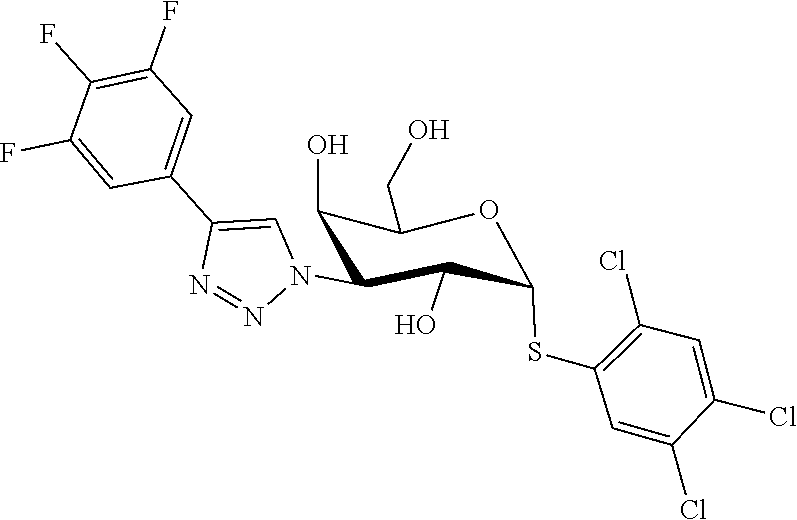 | 0.060 |
| 37 | 2,5-Dichlorophenyl 3- deoxy-3-[4-(3,4,5- trifluorophenyl)-1H- 1,2,3-triazol-1-yl]-1-thio- α-D-galactopyranoside |  | 0.084 |
| 38 | 3-Hydroxy-phenyl 3- deoxy-3-[4-(3,4,5- trifluorophenyl)-1H- 1,2,3-triazol-1-yl]-1-thio- α-D-galactopyranoside |  | 0.490 |
| 39 | 3-Bromophenyl 3-deoxy- 3-[4-(3,4,5- trifluorophenyl)-1H- 1,2,3-triazol-1-yl]-α-D- galactopyranosyl sulfoxide |  | 0.023 |
| 40 | 2-Phenetyl 3-deoxy-3-[4- (3,4,5-trifluorophenyl)- 1H-1,2,3-triazol-1-yl]-1- thio-α-D- galactopyranoside |  | 0.480 |
| 41 | 3,4-Dichlorophenyl 3-O- [(2-amino-(4- chlorophenyl) pyrimidin- 6-yl) methylene]-1-thio- α-D-galactopyranoside |  | 1.300 |
| 42 | 3,4-Dichlorophenyl 3- deoxy-3-[4-(2,3,4,5,6- pentafluorophenyl)-1H- 1,2,3-triazol-1-yl]-α-D- galactopyranosyl sulfoxide |  | 0.002 |
| 43 | 5-Chloropyridin-3-yl 3- deoxy-3-[4-(3,4,5- trifluorophenyl)-1H- 1,2,3-triazol-1-yl]-1-thio- α-D-galactopyranoside |  | 0.035 |
| 44 | 5-Bromopyridin-3-yl 3- deoxy-3-[4-(3,4,5- trifluorophenyl)-1H- 1,2,3-triazol-1-yl]-1-thio- α-D-galactopyranoside |  | 0.023 |
| 45 | 3-Chloro-5-cyanophenyl 3-deoxy-3-[4-(3,4,5- trifluorophenyl)-1H- 1,2,3-triazol-1-yl]-1-thio- α-D-galactopyranoside |  | 0.041 |
| 46 | 3-Chloro-4-cyanophenyl 3-deoxy-3-[4-(3,4,5- trifluorophenyl)-1H- 1,2,3-triazol-1-yl]-1-thio- α-D-galactopyranoside |  | 0.031 |
| 47 | 3-Chloro-6-fluoro-4- cyanophenyl 3-deoxy-3- [4-(3,4,5- trifluorophenyl)-1H- 1,2,3-triazol-1-yl]-1-thio- α-D-galactopyranoside |  | 0.029 |
| 48 | 3-Bromo-4-cyanophenyl 3-deoxy-3-[4-(3,4,5- trifluorophenyl)-1H- 1,2,3-triazol-1-yl]-1-thio- α-D-galactopyranoside |  | 0.043 |
| 49 | 5-Bromo-6- trifluoromethyl-pyridin- 3-yl 3-deoxy-3-[4-(3,4,5- trifluorophenyl)-1H- 1,2,3-triazol-1-yl]-1-thio- α-D-galactopyranoside |  | 0.023 |
| 50 | 5-Chloro-6-cyano- pyridin-3-yl 3-deoxy-3- [4-(3,4,5- trifluorophenyl)-1H- 1,2,3-triazol-1-yl]-1-thio- α-D-galactopyranoside |  | 0.039 |
| 51 | 5-Chloro-6-cyano- pyridazin-3-yl 3-deoxy- 3-[4-(3,4,5- trifluorophenyl)-1H- 1,2,3-triazol-1-yl]-1-thio- α-D-galactopyranoside |  | 0.054 |
| 52 | 3,4-Dichlorophenyl 3- deoxy-3-[4-(2,3,4,5,6- pentafluorophenyl)-1H- 1,2,3-triazol-1-yl]-1-thio- α-D-galactopyranoside |  | 0.037 |
| 53 | 3,4-Dichlorophenyl 3- deoxy-3-[4-(2,3,4,5,6- pentafluorophenyl)-1H- 1,2,3-triazol-1-yl]-α-D- galactopyranosyl sulfone |  | 0.013 |
| 54 | 5-Methoxy-6-cyano- pyridazin-3-yl 3-deoxy- 3-[4-(3,4,5- trifluorophenyl)-1H- 1,2,3-triazol-1-yl]-1-thio- α-D-galactopyranoside |  | 0.25 |
| 55 | 5-Hydroxy-6-cyano- pyridazin-3-yl 3-deoxy- 3-[4-(3,4,5- trifluorophenyl)-1H- 1,2,3-triazol-1-yl]-1-thio- α-D-galactopyranoside |  | 0.94 |
| 56 | 3-Chloro-2,4- difluorophenyl 3-deoxy- 1-thio-3-[4-(3,4,5- trifluorophenyl)-1H- 1,2,3-triazol-1-yl]-α-D- galactopyranoside |  | 0.15 |
| 57 | 3,4-Dichlorophenyl 3- deoxy-3-[4-(phenyl)- 1H-1,2,3-triazol-l-yl]-1- thio-α-D- galactopyranoside |  | 1.45 |
| 58 | 3,5-Dichloro-4- fluorophenyl 3-deoxy-3- [4-(3,4,5-trifluorophenyl)- 1H-1,2,3-triazol-1-yl]- 1-thio-α-D- galactopyranoside |  | 0.018 |
| 59 | 3,4-Dichloro-6- fluorophenyl 3-deoxy-3- [4-(3,4,5-trifluorophenyl)- 1H-1,2,3-triazol-1-yl]- 1-thio-α-D- galactopyranoside |  | 0.027 |
| 60 | 3-Bromo-4-fluorophenyl 3-deoxy-3-[4-(3,4,5- trifluorophenyl)-1H- 1,2,3-triazol-1-yl]-1-thio- α-D-galactopyranoside |  | 0.024 |
| 61 | 3-Chloro-4- (trifluoromethyl)phenyl 3-deoxy-1-thio-3-[4- (3,4,5-trifluorophenyl)- 1H-1,2,3-triazol-1-yl]-α- D-galactopyranoside |  | 0.031 |
| 62 | 3,4,5-Trichlorophenyl 3- deoxy-1-thio-3-[4-(3,4,5- trifluorophenyl)-1H- 1,2,3-triazol-1-yl]-α-D- galactopyranoside |  | 0.034 |
| 63 | 5-Chloro-2-fluorophenyl 3-deoxy-1-thio-3-[4- (3,4,5-trifluorophenyl)- 1H-1,2,3-triazol-1-yl]-α- D-galactopyranoside |  | 0.046 |
| 64 | 5-Bromo-2-fluorophenyl 3-deoxy-1-thio-3-[4- (3,4,5-trifluorophenyl)- 1H-1,2,3-triazol-1-yl]-α- D-galactopyranoside |  | 0.047 |
| 65 | 5-Chloro-2- methoxyphenyl 3-deoxy- 1-thio-3-[4-(3,4,5- trifluorophenyl)-1H- 1,2,3-triazol-1-yl]-α-D- galactopyranoside |  | 0.084 |
| 66 | 3-Iodophenyl 3-deoxy-1- thio-3-[4-(3,4,5- trifluorophenyl)-1H- 1,2,3-triazol-1-yl]-α-D- galactopyranoside |  | 0.090 |
| 67 | Picolinamide-5-yl 3- deoxy-3-[4-(3,4,5- trifluorophenyl)-1H- 1,2,3-triazol-1-yl]-1-thio- α-D-galactopyranoside |  | 0.180 |
| 68 | 3-Cyanophenyl 3-deoxy- 1-thio-3-[4-(3,4,5- trifluorophenyl)-1H- 1,2,3-triazol-1-yl]-α-D- galactopyranoside |  | 0.192 |
| 69 | 2-Cyanopyridine-5-yl 3- deoxy-3-[4-(3,4,5- trifluorophenyl)-1H- 1,2,3-triazol-1-yl]-1-thio- α-D-galactopyranoside |  | 0.26 |
| 70 | 4-Chloro-2-thienyl 3- deoxy-3-[4-(3,4,5- trifluorophenyl)-1H- 1,2,3-triazol-1-yl]-1-thio- α-D-galactopyranoside |  | 0.33 |
| 71 | 3-Carboxyphenyl 3- deoxy-3-[4-(3,4,5- trifluorophenyl)-1H- 1,2,3-triazol-1-yl]-1-thio- α-D-galactopyranoside |  | 0.35 |
| 72 | Benzamide-3-yl 3-deoxy- 3-[4-(3,4,5- trifluorophenyl)-1H- 1,2,3-triazol-1-yl]-1-thio- α-D-galactopyranoside |  | 0.38 |
| 73 | 3,4-Dichlorophenyl 3- deoxy-3-[4-(3,4- difluorophenyl)-1H- 1,2,3-triazol-1-yl]-1-thio- α-D-galactopyranoside |  | 0.11 |
| 74 | 3,4-Dichlorophenyl 3- deoxy-3-[4-(3,4- difluorophenyl)-1H- 1,2,3-triazol-1-yl]-1-thio- α-D-galactopyranoside |  | 0.11 |
| 75 | 3,4-Dichlorophenyl 3- deoxy-3-[4-(3- fluorophenyl)-1H-1,2,3- triazol-1-yl]-1-thio-α-D- galactopyranoside |  | 0.14 |
| 76 | 3,3′-difluoro-cyklohexyl 3-deoxy-3-[4-(3,4,5- trifluorophenyl)-1H- 1,2,3-triazol-1-yl]-1-thio- α-D-galactopyranoside |  | 0.24 |
| 77 | n-Butyl 3-deoxy-3-[4- (3,4,5-trifluorophenyl)- 1H-1,2,3-triazol-1-yl]-1- thio-α-D- galactopyranoside |  | 0.45 |
| 78 | 3,4-Dichlorophenyl 3- deoxy-3-[4-(3,5- difluoro-4- methoxyphenyl)-1H- 1,2,3-triazol-1-yl]-1-thio- α-D-galactopyranoside |  | 0.47 |
| 79 | 2-Hydroxy-pyridin-4-yl 3-deoxy-3-[4-(3,4,5- trifluorophenyl)-1H- 1,2,3-triazol-1-yl]-1-thio- α-D-galactopyranoside |  | 0.51 |
| 80 | 2-Chlorophenetyl 3- deoxy-3-[4-(3,4,5- trifluorophenyl)-1H- 1,2,3-triazol-1-yl]-1-thio- α-D-galactopyranoside |  | 0.75 |
| 81 | 4-Chlorophenetyl 3- deoxy-3-[4-(3,4,5- trifluorophenyl)-1H- 1,2,3-triazol-1-yl]-1-thio- α-D-galactopyranoside |  | 0.76 |
| 82 | 2-Chlorobenzyl 3-deoxy- 1-thio-3-[4-(3,4,5- trifluorophenyl)-1H- 1,2,3-triazo1-1-yl]-α-D- galactopyranoside |  | 0.77 |
| 83 | 3,4-Dichlorobenzyl 3- deoxy-1-thio-3-[4-(3,4,5- trifluorophenyl)-1H- 1,2,3-triazol-1-yl]-α-D- galactopyranoside |  | 0.79 |
| 84 | 3-Chlorophenetyl 3- deoxy-3-[4-(3,4,5- trifluorophenyl)-1H- 1,2,3-triazol-1-yl]-1-thio- α-D-galactopyranoside |  | 0.82 |
| 85 | 4-Chlorobenzyl 3-deoxy- 1-thio-3-[4-(3,4,5- trifluorophenyl)-1H- 1,2,3-triazol-1-yl]-α-D- galactopyranoside |  | 0.95 |
| 86 | Propyl 3-deoxy-3-[4- (3,4,5-trifluorophenyl)- 1H-1,2,3-triazol-1-yl]-1- thio-α-D- galactopyranoside |  | 0.98 |
| 87 | 2-Aminopyridin-4-yl 3- deoxy-3-[4-(3,4,5- trifluorophenyl)-1H- 1,2,3-triazol-1-yl]-1-thio- α-D-galactopyranoside |  | 0.99 |
| 88 | 5-dimethylamino- naphatlen-2-yl 3-deoxy- 3-[4-(3,4,5- trifluorophenyl)-1H- 1,2,3-triazol-1-yl]-1-thio- α-D-galactopyranoside |  | 1.06 |
| 89 | Ethyl 3-deoxy-1-thio-3- [4-(3,4,5- trifluorophenyl)-1H- 1,2,3-triazol-1-yl]-α-D- galactopyranoside |  | 1.1 |
| 90 | 5-Bromopyridin-3-yl 3- deoxy-3-[4-(3,4,5- trifluorophenyl)-1H- 1,2,3-triazol-1-yl]-α-D- galactopyranosyl sulfoxide, isomer 1 |  | 0.028 |
| 91 | 5-Bromopyridin-3-yl 3- deoxy-3-[4-(3,4,5- trifluorophenyl)-1H- 1,2,3-triazol-1-yl]-α-D- galactopyranosyl sulfoxide, isomer 2 |  | 0.130 |
| 92 | 5-Bromopyridin-3-yl 3- deoxy-3-[4-(3,4,5- trifluorophenyl)-1H- 1,2,3-triazol-1-yl]-α-D- galactopyranosyl sulfone |  | 0.031 |
| 93 | 5-Chloropyridin-3-yl 3- deoxy-3-[4-(3,4,5- trifluorophenyl)-1H- 1,2,3-triazol-1-yl]-α-D- galactopyranosyl sulfoxide, isomer 1 |  | 0.106 |
| 94 | 5-Chloropyridin-3-yl 3- deoxy-3-[4-(3,4,5- trifluorophenyl)-1H- 1,2,3-triazol-1-yl]-α-D- galactopyranosyl sulfoxide, isomer 2 |  | 0.041 |
| 95 | 5-Dimethylamino- naphtalen-2-yl 3-deoxy- 3-[4-(3,4,5- trifluorophenyl)-1H- 1,2,3-triazol-1-yl]-α-D- galactopyranosyl sulfone |  | 0.96 |
| 96 | 3,4-dichlorophenyl-3- deoxy-3-(3,4,5- trifluorobenzamido)-1- thio-α-D- galactopyranoside |  | 3.5 |
| 97 | 3,4-Dichlorophenyl 3- deoxy-3-[4- (ethoxycarbonyl)-1H- 1,2,3-triazol-1-yl]-1-thio- α-D-galactopyranoside |  | 3.5 |
| 98 | 3,4-Dichlorophenyl 3- deoxy-3-[4- (ethylaminocarbonyl)- 1H-1,2,3-triazol-1-yl]-1- thio-α-D- galactopyranoside |  | 0.56 |
| 99 | 3,4-Dichlorophenyl 3-O- [(5,6-Difluoro-2-oxo-3- chromenyl)methyl]- 1-thio-α-D- galactopyranoside |  | 0.92 |
| 100 | 5-Chloropyridin-3-yl 3- deoxy-3-[4-(3,4- difluorophenyl)-1H- 1,2,3-triazol-1-yl]-1-thio- α-D-galactopyranoside |  | 0.100 |
| 101 | 5-Bromopyridin-3-yl 3- deoxy-3-[4-(3,4- difluorophenyl)-1H- 1,2,3-triazol-1-yl]-1-thio- α-D-galactopyranoside |  | 0.047 |
| 102 | 3,4-Dichlorophenyl 3- deoxy-3-[4-(propyl- carbonyl)-1H-1,2,3- triazol-1-yl]-1-thio-α-D- galactopyranoside |  | 1.01 |
| 103 | 5-Chloro-6- trifluoromethyl-pyridine- 3-yl 3-deoxy-3-[4-(3,4,5- trifluorophenyl)-1H- 1,2,3-triazol-1-yl]-1-thio- α-D-galactopyranoside |  | 0. 026 |
| 104 | 5-Chloro-2- trifluoromethyl-pyridine- 3-yl 3-deoxy-3-[4-(3,4,5- trifluorophenyl)-1H- 1,2,3-triazol-1-yl]-1-thio- α-D-galactopyranoside |  | 0.093 |
| 105 | 5-Chloro-6-cyano- pyridine-3-yl 3-deoxy-3- [4-(3,4-difluorophenyl)- 1H-1,2,3-triazol-1-yl]-1- thio-α-D- galactopyranoside |  | 0. 074 |
| 106 | 3-Chloro-4-cyanophenyl 3-deoxy-3-[4-(3,4- difluorophenyl)-1H- 1,2,3-triazol-1-yl]-1-thio- α-D-galactopyranoside |  | 0.083 |
Evaluation of Kd Values

PK Experiments
| Clearance | Halflife | Bioavailability | Cmax p.o. | ||
| (CL) | (t½) | (F) | Dose 10 mg/kg | ||
| (ml/min/kg) | (h) | (%) | (μM) | ||
| Example 9 | 1.2 | 4.5 | 75 | 16 |
- DIEA: N,N-Diisopropylethylamine
- PE: petroleum ether
- NEt3: Triethylamine
- DMF: N,N-dimethylformamide
- BF3.OEt2: Borontrifuoride etherate
- ESI-MS: Electrospray ionization mass spectrometry
- Calcd: Calculated
- TFA: trifluoroacetic acid
- Rt: Room temperature
- UV: Ultraviolet
- PMA: polymolybdenic acid
- DAST: Diethylaminosulfur trifluoride
- TBDMS: tert-Butyldimethylsilyl
- TBAF: teirabuiylammonium Fluoride
- MTBE: tert-butyl methyl ether
- HATU: 1-[Bis(dimethylamino)methylene]-1H-1,2,3-triazolo[4,5-b]pyridinium 3-oxid hexafluorophosphate


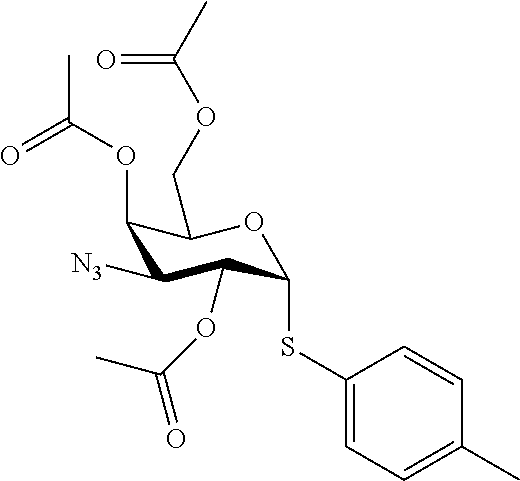


- Almkvist, J., Fáldt, J., Dahlgren, C., Leffler, H., and Karlsson, A. (2001) Lipopolysaccharide-induced gelatinase granule mobilization primes neutrophils for activation by galectin-3 and f-Met-Leu-Phe. Infect. Immun. Vol. 69: 832-837.
- Barondes, S. H., Cooper, D. N. W., Gitt, M. A., and Leffler, H. (1994). Galectins. Structure and function of a large family of animal lectins. J. Biol. Chem. 269:20807-20810.
- Blois, S. M., Ilarregui, J. M., Tometten, M., Garcia, M., Orsal, A. S., Cordo-Russo, R., Toscano, M. A., Bianco, G. A., Kobelt, P., Handjiski, B., et al. (2007). A pivotal role for galectin-1 in fetomaternal tolerance. Nat Med 13: 1450-1457.
- Chen, W.-S., Leffler H., Nilsson, U. J., Panjwani, N. (2012). Targeting Galectin-1 and Galectin-3 Attenuates VEGF-A-induced Angiogenesis; Mol. Biol. Cell (suppl), Abstract No. 2695.
- Cumpstey, I., Carlsson, S., Leffler, H. and Nilsson, U. J. (2005) Synthesis of a phenyl thio-β-D-galactopyranoside library from 1,5-difluoro-2,4-dinitrobenzene: discovery of efficient and selective monosaccharide inhibitors of galectin-7. Org. Biomol. Chem. 3: 1922-1932.
- Cumpstey, I., Sundin, A., Leffler, H. and Nilsson, U. J. (2005) C2-Symmetrical thiodigalactoside bis-benzamido derivatives as high-affinity inhibitors of galectin-3: Efficient lectin inhibition through double arginine-arene interactions. Angew. Chem. Int. Ed. 44: 5110-5112.
- Cumpstey, I., Salomonsson, E., Sundin, A., Leffler, H. and Nilsson, U. J. (2008) Double affinity amplification of galectin-ligand interactions through arginine-arene interactions: Synthetic, thermodynamic, and computational studies with aromatic diamido-thiodigalactosides. Chem. Eur. J. 14: 4233-4245.
- Dam, T. K., and Brewer, C. F. (2008). Effects of clustered epitopes in multivalent ligand-receptor interactions. Biochemistry 47: 8470-8476.
- Delacour, D., Greb, C., Koch, A., Salomonsson, E., Leffler, H., Le Bivic, A., and Jacob, R. (2007). Apical Sorting by Galectin-3-Dependent Glycoprotein Clustering. Traffic 8: 379-388.
- Delaine, T., Cumpstey, I., Ingrassia, L., Le Mercier, M., Okechukwu, P., Leffler, H., Kiss, R., and Nilsson, U. J. (2008). Galectin-Inhibitory Thiodigalactoside Ester Derivatives Have Anti-Migratory Effects in Cultured Lung and Prostate Cancer Cells. J Med Chem 51; 8109-8114.
- Demotte, N., Wieers, G., van der Smissen, P., Moser, M., Schmidt, C., Thielemans, K., et al., (2010). Cancer Res. 70; 7476-7488.
- Farkas, I.; Szabó, I. F.; Bognár, R.; Anderle, D. Carbohydr. Res. 1976, 48, 136-138. Garner, O. B., and Baum, L. G. (2008). Galectin-glycan lattices regulate cell-surface glycoprotein organization and signalling. Biochem Soc Trans 36: 1472-1477.
- Giguere, D., Patnam, R., Bellefleur, M.-A., St.-Pierre, C., Sato, S., and Roy, R. (2006). Carbohydrate triazoles and isoxazoles as inhibitors of galectins-1 and -3. Chem Commun: 2379-2381.
- Glinsky, G. V., Price, J. E., Glinsky, V. V., Mossine, V. V., Kiriakova, G., and Metcalf, J. B. (1996). Cancer Res 56: 5319-5324.
- Glinsky, V. V., Kiriakova, G., Glinskii, O. V., Mossine, V. V., Mawhinney, T. P., Turk, J. R., Glinskii, A. B., Huxley, V. H., Price, J. E., and Glinsky, G. V. (2009). Synthetic Galectin-3 Inhibitor Increases Metastatic Cancer Cell Sensitivity to Taxol-Induced Apoptosis In Vitro and In Vivo. Neoplasia 11; 901-909.
- Huflejt, M. E. and Leffler, H. (2004) Galectin-4 in normal tissues and cancer. Glycoconj. J. 20: 247-255.
- Ingrassia et al. (2006) A Lactosylated Steroid Contributes in Vivo Therapeutic Benefits in Experimental Models of Mouse Lymphoma and Human Glioblastoma. J. Med. CHem. 49: 1800-1807.
- John, C. M., Leffler, H., Kahl-Knutsson, B., Svensson, I., and Jarvis, G. A. (2003) Truncated Galectin-3 Inhibits Tumor Growth and Metastasis in Orthotopic Nude Mouse Model of Human Breast Cancer. Clin. Cancer Res. 9: 2374-2383.
- Kouo, T., Huang, L., Pucsek, A. B., Cao, M., Solt, S., Armstrong, T., Jaffee, E. (2015) Cancer Immonol. Res. 3: 412-23
- Lau, K. S., and Dennis, J. W. (2008). N-Glycans in cancer progression. Glycobiology 18: 750-760.
- Lau, K. S., Partridge, E. A., Grigorian, A., Silvescu, C. I., Reinhold, V. N., Demetriou, M., and Dennis, J. W. (2007). Complex N-glycan number and degree of branching cooperate to regulate cell proliferation and differentiation. Cell 129: 123-134.
- Leffler, H. and Barondes, S. H. (1986) Specificity of binding of three soluble rat lung lectins to substituted and unsubstituted mammalian beta-galactosides. J. Biol. Chem. 261:10119-10126.
- Leffler, H. Galectins Structure and Function—A Synopsis in Mammalian Carbohydrate Recognition Systems (Crocker, P. ed.) Springer Verlag, Heidelberg, 2001 pp. 57-83.
- Leffler, H., Carlsson, S., Hedlund, M., Qian, Y. and Poirier, F. (2004) Introduction to galectins. Glycoconj. J. 19: 433-440.
- Leffler, H., editor, (2004b) Special Issue on Galectins. Glycoconj. J. 19: 433-638.
- Lin, C.-I., Whang, E. E., Donner, D. B., Jiang, X., Price, B. D., Carothers, A. M., Delaine, T., Leffler, H., Nilsson, U. J., Nose, V., et al. (2009). Galectin-3 Targeted Therapy with a Small Molecule Inhibitor Activates Apoptosis and Enhances Both Chemosensitivity and Radiosensitivity in Papillary Thyroid Cancer. Mol Cancer Res 7: 1655-1662.
- MacKinnon, A. C., Farnworth, S. L., Henderson, N. C., Hodkinson, P. S., Kipari, T., Leffler, H., Nilsson, U. J., Haslett, C., Hughes, J., and Sethi T. (2008). Regulation of alternative macrophage activation by Galectin-3. J. Immun. 180; 2650-2658.
- Mackinnon, A., Gibbons, M., Farnworth, S., Leffler, H., Nilsson, U. J., Delaine, T., Simpson, A., Forbes, S., Hirani, N., Gauldie, J., and Sethi T. (2012). Regulation of TGF-β1 driven lung fibrosis by Galectin-3. Am. J. Resp. Crit. Care Med., in press.
- Massa, S. M., Cooper, D. N. W., Leffler, H., Barondes, S. H. (1993) L-29, an endogenous lectin, binds to glycoconjugate ligands with positive cooperativity. Biochemistry 32: 260-267.
- Melero, I., Berman, D. M., Aznar, M. A., Korman, A. J., Gracia, J. L. P., Haanen, J. (2015) Nature Reviews Cancer, 15: 457-472
- Partridge, E. A., Le Roy, C., Di Guglielmo, G. M., Pawling, J., Cheung, P., Granovsky, M., Nabi, I. R., Wrana, J. L., and Dennis, J. W. (2004). Regulation of cytokine receptors by Golgi N-glycan processing and endocytosis. Science 306: 120-124.
- Perone, M. J., Bertera, S., Shufesky, W. J., Divito, S. J., Montecalvo, A., Mathers, A. R., Larregina, A. T., Pang, M., Seth, N., Wucherpfennig, K. W., et al. (2009). Suppression of autoimmune diabetes by soluble galectin-1. J Immunol 182: 2641-2653.
- Pienta, K. J., Naik, H., Akhtar, A., Yamazaki, K., Reploge, T. S., Lehr, J., Donat, T. L., Tait, L., Hogan, V., and Raz, A. (1995). Inhibition of spontaneous metastasis in a rat prostate cancer model by oral administration of modified citrus pectin. J Natl Cancer Inst 87, 348-353.
- Ramos-Soriano, J.; Niss, U.; Angulo, J.; Angulo, M.; Moreno-Vargas, A. J.; Carmona, A. T.; Ohlson, S.; Robina, I. Chem. Eur. J. 2013, 19, 17989-18003.
- Ruvolo, P. P. Biochim. Biophys Acta. Molecular cell research (2015) E-pub ahead of print, title: Galectin-3 as a guardian of the tumor microenvironment, published on-line 8 Apr. 2015: (http://www.sciencedirect.com/science/article/pii/S016748891500270 0),
- Saegusa, J., Hsu, D. K., Chen, H. Y., Yu, L., Fermin, A., Fung, M. A., and Liu, F. T. (2009). Galectin-3 is critical for the development of the allergic inflammatory response in a mouse model of atopic dermatitis. Am J Pathol 174: 922-931.
- Salameh, B. A., Leffler, H. and Nilsson, U. J. (2005) Bioorg. Med. Chem. Lett. 15: 3344-3346.
- Salameh, B. A., Cumpstey, I., Sundin, A., Leffler, H., and Nilsson, U. J. (2010). 1H-1,2,3-Triazol-1-yl thiodigalactoside derivatives as high affinity galectin-3 inhibitors. Bioorg Med Chem 18: 5367-5378.
- Salomonsson, E., Larumbe, A., Tejler, J., Tullberg, E., Rydberg, H., Sundin, A., Khabut, A., Frejd, T., Lobsanov, Y. D., Rini, J. M., Nilsson, U. J., and Leffler, H (2010). Monovalent interactions of galectin-1. Biochemistry 49: 9518-9532.
- Sörme, P., Qian, Y., Nyholm, P.-G., Leffler, H., Nilsson, U. J. (2002) Low micromolar inhibitors of galectin-3 based on 3′-derivatization of N-acetyllactosamine ChemBioChem 3:183-189.
- Sörme, P., Kahl-Knutsson, B., Wellmar, U., Nilsson, U. J., and Leffler H. (2003a) Fluorescence polarization to study galectin-ligand interactions. Meth. Enzymol. 362: 504-512.
- Sörme, P., Kahl-Knutsson, B., Wellmar, U., Magnusson, B.-G., Leffler H., and Nilsson, U. J. (2003b) Design and synthesis of galectin inhibitors. Meth. Enzymol. 363: 157-169.
- Sörme, P., Kahl-Knutsson, B., Huflejt, M., Nilsson, U. J., and Leffler H. (2004) Fluorescence polarization as an analytical tool to evaluate galectin-ligand interactions. Anal. Biochem. 334: 36-47.
- Thijssen, V. L., Poirer, F., Baum, L. G., and Griffioen, A. W. (2007). Galectins in the tumor endothelium: opportunities for combined cancer therapy. Blood 110: 2819-2827.
- Toscano, M. A., Bianco, G. A., Ilarregui, J. M., Croci, D. O., Correale, J., Hernandez, J. D., Zwirner, N. W., Poirier, F., Riley, E. M., Baum, L. G., et al. (2007). Differential glycosylation of TH1, TH2 and TH-17 effector cells selectively regulates susceptibility to cell death. Nat Immunol 8: 825-834.
Claims (27)


Priority Applications (2)
| Application Number | Priority Date | Filing Date | Title |
|---|---|---|---|
| US17/018,713 US11377464B2 (en) | 2015-01-30 | 2020-09-11 | Galactoside inhibitor of galectins |
| US17/748,338 US11919921B2 (en) | 2015-01-30 | 2022-05-19 | Galactoside inhibitor of galectins |
Applications Claiming Priority (9)
| Application Number | Priority Date | Filing Date | Title |
|---|---|---|---|
| EP15153316.3 | 2015-01-30 | ||
| EP15153316 | 2015-01-30 | ||
| EP15153316 | 2015-01-30 | ||
| EP15192291 | 2015-10-30 | ||
| EP15192291.1 | 2015-10-30 | ||
| EP15192291 | 2015-10-30 | ||
| PCT/EP2016/051836 WO2016120403A1 (en) | 2015-01-30 | 2016-01-28 | Alpha-d-galactoside inhibitors of galectins |
| US201715535829A | 2017-06-14 | 2017-06-14 | |
| US17/018,713 US11377464B2 (en) | 2015-01-30 | 2020-09-11 | Galactoside inhibitor of galectins |
Related Parent Applications (2)
| Application Number | Title | Priority Date | Filing Date |
|---|---|---|---|
| US15/535,829 Continuation US10774102B2 (en) | 2015-01-30 | 2016-01-28 | Galactoside inhibitor of galectins |
| PCT/EP2016/051836 Continuation WO2016120403A1 (en) | 2015-01-30 | 2016-01-28 | Alpha-d-galactoside inhibitors of galectins |
Related Child Applications (1)
| Application Number | Title | Priority Date | Filing Date |
|---|---|---|---|
| US17/748,338 Continuation US11919921B2 (en) | 2015-01-30 | 2022-05-19 | Galactoside inhibitor of galectins |
Publications (2)
| Publication Number | Publication Date |
|---|---|
| US20200407391A1 US20200407391A1 (en) | 2020-12-31 |
| US11377464B2 true US11377464B2 (en) | 2022-07-05 |
Family
ID=55262803
Family Applications (4)
| Application Number | Title | Priority Date | Filing Date |
|---|---|---|---|
| US15/535,829 Active 2036-10-15 US10774102B2 (en) | 2015-01-30 | 2016-01-28 | Galactoside inhibitor of galectins |
| US16/539,078 Active US10526360B2 (en) | 2015-01-30 | 2019-08-13 | Galactoside inhibitor of galectins |
| US17/018,713 Active US11377464B2 (en) | 2015-01-30 | 2020-09-11 | Galactoside inhibitor of galectins |
| US17/748,338 Active 2036-01-28 US11919921B2 (en) | 2015-01-30 | 2022-05-19 | Galactoside inhibitor of galectins |
Family Applications Before (2)
| Application Number | Title | Priority Date | Filing Date |
|---|---|---|---|
| US15/535,829 Active 2036-10-15 US10774102B2 (en) | 2015-01-30 | 2016-01-28 | Galactoside inhibitor of galectins |
| US16/539,078 Active US10526360B2 (en) | 2015-01-30 | 2019-08-13 | Galactoside inhibitor of galectins |
Family Applications After (1)
| Application Number | Title | Priority Date | Filing Date |
|---|---|---|---|
| US17/748,338 Active 2036-01-28 US11919921B2 (en) | 2015-01-30 | 2022-05-19 | Galactoside inhibitor of galectins |
Country Status (7)
| Country | Link |
|---|---|
| US (4) | US10774102B2 (en) |
| EP (2) | EP3250581B1 (en) |
| JP (2) | JP6904906B2 (en) |
| CN (2) | CN107406478B (en) |
| CA (1) | CA2970062C (en) |
| ES (1) | ES2858729T3 (en) |
| WO (1) | WO2016120403A1 (en) |
Cited By (3)
| Publication number | Priority date | Publication date | Assignee | Title |
|---|---|---|---|---|
| US20210380624A1 (en) * | 2018-10-15 | 2021-12-09 | Galecto Biotech Ab | Galactoside inhibitor of galectins |
| US20220289783A1 (en) * | 2015-01-30 | 2022-09-15 | Galecto Biotech Ab | Novel galactoside inhibitor of galectins |
| US20230014870A1 (en) * | 2019-07-03 | 2023-01-19 | Galecto Biotech Ab | Novel galactoside inhibitor of galectins |
Families Citing this family (51)
| Publication number | Priority date | Publication date | Assignee | Title |
|---|---|---|---|---|
| EP3374368B1 (en) | 2015-11-09 | 2022-06-01 | Galecto Biotech AB | 1,1'-sulfanediyl-di-beta-d-galactopyranosides as inhibitors of galectins |
| CN109563120B (en) * | 2016-07-12 | 2022-12-02 | 格莱克特生物技术公司 | Alpha-D-galactoside inhibitors of galectins |
| US10889610B2 (en) * | 2016-07-12 | 2021-01-12 | Galecto Biotech Ab | Alpha-D-galactoside inhibitors of galectins |
| CN107417742A (en) * | 2016-10-26 | 2017-12-01 | 郑州大学 | A kind of new aryl pyrimidine C nucleoside analogs and its synthetic method |
| CN111032670A (en) * | 2017-05-12 | 2020-04-17 | 卡莱克汀科学有限责任公司 | Compounds for treating systemic insulin resistance disorders and uses thereof |
| AU2018265571B2 (en) * | 2017-05-12 | 2022-09-29 | Galectin Sciences, Llc | Compounds for the prevention and treatment of diseases and the use thereof |
| WO2019028357A1 (en) | 2017-08-03 | 2019-02-07 | Galectin Sciences, Llc | Compounds for the prevention and treatment of medical disorders and uses thereof |
| WO2019067702A1 (en) | 2017-09-27 | 2019-04-04 | Bristol-Myers Squibb Company | Small molecule inhibitors of galectin-3 |
| US11072626B2 (en) | 2017-10-11 | 2021-07-27 | Bristol-Myers Squibb Company | Small molecule inhibitors of Galectin-3 |
| JP2021501180A (en) * | 2017-10-31 | 2021-01-14 | ガレクティン・サイエンシーズ・リミテッド・ライアビリティ・カンパニーGalectin Sciences, LLC | Serenogalactoside compounds and their use for the treatment of systemic insulin resistance disorders |
| EP3732186A1 (en) * | 2017-12-29 | 2020-11-04 | GlycoMimetics, Inc. | Heterobifunctional inhibitors of e-selectin and galectin-3 |
| MX2020007391A (en) * | 2018-01-10 | 2020-09-03 | Galecto Biotech Ab | Novel galactoside inhibitor of galectins. |
| CA3088736A1 (en) * | 2018-01-21 | 2019-07-25 | Rensselaer Polytechnic Institute | Method of treating galectin-3 dependent disorders |
| JP7190513B2 (en) | 2018-06-15 | 2022-12-15 | ブリストル-マイヤーズ スクイブ カンパニー | Tetrahydropyran-based thiodisaccharides mimicking galectin-3 inhibitors |
| CA3114055A1 (en) * | 2018-10-15 | 2020-04-23 | Galecto Biotech Ab | Prodrug of galactoside inhibitors of galectins |
| CA3116515A1 (en) | 2018-11-21 | 2020-05-28 | Galecto Biotech Ab | Alpha-d-galactoside inhibitors of galectins |
| WO2020117883A1 (en) | 2018-12-06 | 2020-06-11 | Bristol-Myers Squibb Company | Small molecule inhibitors of galectin-3 |
| MX2021007335A (en) * | 2018-12-19 | 2021-07-15 | Galecto Biotech Ab | Amorphous form of 5-bromopyridin-3-yl 3-deoxy-3-[4-(3,4,5-trifluo rophenyl)-1h-1,2,3-triazol-1-yl]-1-thio-alpha-d-galactopyranosid e. |
| CA3122321A1 (en) | 2018-12-27 | 2020-07-02 | Glycomimetics, Inc. | Galectin-3 inhibiting c-glycosides |
| US11845771B2 (en) | 2018-12-27 | 2023-12-19 | Glycomimetics, Inc. | Heterobifunctional inhibitors of E-selectin and galectin-3 |
| US12275719B2 (en) | 2019-03-26 | 2025-04-15 | Bristol-Myers Squibb Company | Small molecule inhibitors of galectin-3 |
| WO2020210308A1 (en) | 2019-04-10 | 2020-10-15 | Bristol-Myers Squibb Company | Small molecule inhibitors of galectin-3 |
| CA3138668A1 (en) | 2019-06-14 | 2020-12-17 | Denis Giguere | Synthesis of 3-azido-3-deoxy-d-galactopyranose |
| US12410207B2 (en) | 2019-07-03 | 2025-09-09 | Galecto Biotech Ab | Galactoside inhibitor of galectins |
| US12441755B2 (en) * | 2019-07-05 | 2025-10-14 | Galecto Biotech Ab | Galactoside inhibitor of galectins |
| ES2974680T3 (en) | 2019-08-09 | 2024-07-01 | Idorsia Pharmaceuticals Ltd | Derivatives of (2-acetamidyl)thio-beta-D-galactopyranosides |
| US12404295B2 (en) | 2019-08-09 | 2025-09-02 | Idorsia Pharmaceuticals Ltd | (Hetero)aryl-methyl-thio-beta-D-galactopyranoside derivatives |
| UA128909C2 (en) * | 2019-08-15 | 2024-11-20 | Ідорсія Фармасьютікалз Лтд | 2-HYDROXYCYCLOALKANE-1-CARBAMOYL DERIVATIVES |
| PH12022550436A1 (en) * | 2019-08-29 | 2022-12-19 | Idorsia Pharmaceuticals Ltd | Alpha-d-galactopyranoside derivatives |
| WO2021086816A1 (en) * | 2019-10-29 | 2021-05-06 | Glycomimetics, Inc. | Galectin-3 inhibiting c-glycosides |
| EP3838909A1 (en) | 2019-12-16 | 2021-06-23 | Galecto Biotech AB | Large scale process for the preparation of 5-bromopyridin-3-yl-3-deoxy-3-[4-(3,4,5-trifluorophenyl)-1h-1,2,3-triazol-1-yl]- 1-thio-alpha-d-galactopyranoside |
| WO2021204589A1 (en) | 2020-04-07 | 2021-10-14 | Bayer Aktiengesellschaft | Substituted thiazolopyridines, salts thereof and their use as herbicidally active substances |
| CN115551855A (en) | 2020-05-05 | 2022-12-30 | 百时美施贵宝公司 | Small molecule inhibitors of galectin-3 |
| US12286424B2 (en) | 2020-05-11 | 2025-04-29 | Bristol-Myers Squibb Company | Small molecule inhibitors of galectin-3 |
| CN115768768A (en) | 2020-05-28 | 2023-03-07 | 百时美施贵宝公司 | Galectin-3 inhibitors |
| US20230273213A1 (en) * | 2020-07-31 | 2023-08-31 | City Of Hope | Peptide design and galectin-3 inhibitors |
| AU2021356076A1 (en) * | 2020-10-06 | 2023-06-08 | Idorsia Pharmaceuticals Ltd | Spiro derivatives of alpha-d-galactopyranosides |
| IL302421A (en) | 2020-11-02 | 2023-06-01 | Idorsia Pharmaceuticals Ltd | 2-Hydroxycycloalkane-1-carbamoyl compounds inhibit galectin-3 |
| JP7844491B2 (en) | 2021-02-09 | 2026-04-13 | イドルシア・ファーマシューティカルズ・リミテッド | Hydroxyheterocycloalkane-carbamoyl derivatives |
| EP4301748B1 (en) | 2021-03-03 | 2025-05-07 | Idorsia Pharmaceuticals Ltd | Triazolyl-methyl substituted alpha-d-galactopyranoside derivatives |
| EP4337694A1 (en) | 2021-05-12 | 2024-03-20 | Dana-Farber Cancer Institute, Inc. | Lag3 and gal3 inhibitory agents, xbp1, cs1, and cd138 peptides, and methods of use thereof |
| CA3225756A1 (en) | 2021-06-30 | 2023-01-05 | Tiumbio Co., Ltd. | Galactoside derivative as galectin-3 inhibitor |
| TW202328151A (en) | 2021-09-07 | 2023-07-16 | 德商拜耳廠股份有限公司 | Substituted 2,3-dihydro[1,3]thiazolo[4,5-b]pyridines, salts thereof and their use as herbicidally active substances |
| TW202328150A (en) | 2021-09-07 | 2023-07-16 | 德商拜耳廠股份有限公司 | Substituted thiazolopyridines, salts thereof and their use as herbicidally active substances |
| CN115417902B (en) * | 2022-08-31 | 2025-02-14 | 福州大学 | A method for preparing glycosyl (sulfinic) salt |
| CN117924233A (en) * | 2022-10-17 | 2024-04-26 | 深圳有为技术控股集团有限公司 | Novel preparation method of vinylene carbonate |
| CN117946061A (en) * | 2022-10-18 | 2024-04-30 | 深圳有为技术控股集团有限公司 | A novel method for preparing vinylene carbonate |
| WO2025252743A1 (en) * | 2024-06-05 | 2025-12-11 | Galecto Biotech Ab | Novel galactoside inhibitor of galectins |
| WO2025252741A1 (en) * | 2024-06-05 | 2025-12-11 | Galecto Biotech Ab | Novel galactoside inhibitor of galectins |
| CN120943872B (en) * | 2025-10-17 | 2026-01-23 | 济南山目生物医药科技有限公司 | A method for synthesizing epililacose |
| CN120965785B (en) * | 2025-10-20 | 2026-01-23 | 济南山目生物医药科技有限公司 | Preparation method of L-mannose |
Citations (4)
| Publication number | Priority date | Publication date | Assignee | Title |
|---|---|---|---|---|
| US10526360B2 (en) * | 2015-01-30 | 2020-01-07 | Galecto Biotech Ab | Galactoside inhibitor of galectins |
| US10889610B2 (en) * | 2016-07-12 | 2021-01-12 | Galecto Biotech Ab | Alpha-D-galactoside inhibitors of galectins |
| US10988502B2 (en) * | 2016-07-12 | 2021-04-27 | Galecto Biotech Ab | Alpha-D-galactoside inhibitors of galectins |
| US11046725B2 (en) * | 2018-01-10 | 2021-06-29 | Galecto Biotech Ab | Galactoside inhibitor of galectins |
Family Cites Families (10)
| Publication number | Priority date | Publication date | Assignee | Title |
|---|---|---|---|---|
| SE0401300D0 (en) | 2004-05-21 | 2004-05-21 | Forskarpatent I Syd Ab | Novel Galactoside Inhibitors of Galectins |
| SE0401301D0 (en) | 2004-05-21 | 2004-05-21 | Forskarpatent I Syd Ab | Novel 3-triazolyl-galactoside inhibitors or galectins |
| EP2679595B1 (en) * | 2008-05-16 | 2016-12-28 | Galecto Biotech AB | Di-(3-deoxy-3-1H-1,2,3-triazol-1-yl)-beta-D-galacto-pyranosyl)sulfane derivatives as galectin-3 inhibitors |
| US8703720B2 (en) * | 2009-04-28 | 2014-04-22 | Galecto Biotech Ab | Galactoside inhibitors of galectins |
| EP2620443A1 (en) * | 2012-01-25 | 2013-07-31 | Galecto Biotech AB | Novel galactoside inhibitors of galectins |
| ES2698101T3 (en) | 2012-10-10 | 2019-01-31 | Galectin Therapeutics Inc | Compounds of carbohydrate with galactose residues for the treatment of diabetic nephropathy and associated disorders |
| EP2914269B1 (en) * | 2012-10-31 | 2020-07-29 | Galecto Biotech AB | Galactoside inhibitor of galectin-3 and its use for treating pulmonary fibrosis |
| WO2014078655A1 (en) * | 2012-11-15 | 2014-05-22 | Tufts University | Methods, compositions and kits for treating, modulating, or preventing ocular angiogenesis or fibrosis in a subject using a galectin protein inhibitor |
| CN106536537B (en) * | 2014-07-09 | 2020-07-07 | 卡雷多生物技术公司 | Novel heterozygosis galactoside inhibitor of galectins |
| ES2776255T3 (en) * | 2015-01-16 | 2020-07-29 | Galecto Biotech Ab | Novel galectin galactoside inhibitor |
-
2016
- 2016-01-28 EP EP16701941.3A patent/EP3250581B1/en active Active
- 2016-01-28 CN CN201680007946.8A patent/CN107406478B/en active Active
- 2016-01-28 US US15/535,829 patent/US10774102B2/en active Active
- 2016-01-28 EP EP21152219.8A patent/EP3828191A3/en not_active Withdrawn
- 2016-01-28 WO PCT/EP2016/051836 patent/WO2016120403A1/en not_active Ceased
- 2016-01-28 CA CA2970062A patent/CA2970062C/en active Active
- 2016-01-28 CN CN202110818964.7A patent/CN113621005B/en active Active
- 2016-01-28 ES ES16701941T patent/ES2858729T3/en active Active
- 2016-01-28 JP JP2017540173A patent/JP6904906B2/en active Active
-
2019
- 2019-08-13 US US16/539,078 patent/US10526360B2/en active Active
-
2020
- 2020-09-11 US US17/018,713 patent/US11377464B2/en active Active
-
2021
- 2021-06-24 JP JP2021104692A patent/JP2021152069A/en active Pending
-
2022
- 2022-05-19 US US17/748,338 patent/US11919921B2/en active Active
Patent Citations (5)
| Publication number | Priority date | Publication date | Assignee | Title |
|---|---|---|---|---|
| US10526360B2 (en) * | 2015-01-30 | 2020-01-07 | Galecto Biotech Ab | Galactoside inhibitor of galectins |
| US10774102B2 (en) * | 2015-01-30 | 2020-09-15 | Galecto Biotech Ab | Galactoside inhibitor of galectins |
| US10889610B2 (en) * | 2016-07-12 | 2021-01-12 | Galecto Biotech Ab | Alpha-D-galactoside inhibitors of galectins |
| US10988502B2 (en) * | 2016-07-12 | 2021-04-27 | Galecto Biotech Ab | Alpha-D-galactoside inhibitors of galectins |
| US11046725B2 (en) * | 2018-01-10 | 2021-06-29 | Galecto Biotech Ab | Galactoside inhibitor of galectins |
Non-Patent Citations (69)
| Title |
|---|
| A. C. MacKinnon, et al., "Regulation of Alternative Macrophage Activation by Galectin-3", in The Journal of Immunology, vol. 180, 2008, pp. 2650-2658 (9 pgs.). |
| A. C. MacKinnon, et al., "Regulation of Transforming Growth Factor-β1-driven Lung Fibrosis by Galectin-3", in Am. J. Resp. Crit. Care Med., vol. 185, 2012, pp. 1-11 (11 pgs.). |
| Anna R. Young, et al., "Galectins in parasite infection and allergic inflammation", in Glycoconjugate Journal 19, 2004, pp. 601-606 (6 pgs.). |
| Antonino Grassadonia, et al., "90K (Mac-2 BP) and galectins in tumor progression and metastasis", in Glycoconjugate Journal 19, 2004, pp. 551-556 (6 pgs.). |
| C. Fred Brewer, "Thermodynamic binding studies of galectin-1, -3 and -7", in Glycoconjugate Journal 19, 2004, pp. 459-465 (7 pgs.). |
| C. M. John, et al., "Truncated Galectin-3 Inhibits Tumor Growth and Metastasis in Orthotopic Nude Mouse Model of Human Breast Cancer", in Clinical Cancer Research, vol. 9, Jun. 2003, pp. 2374-2383 (10 pgs.). |
| Chi-lou Lin, et al., "Galectin-3 Targeted Therapy with a Small Molecule Inhibitor Activates Apoptosis and Enhances Both Chemosensitivity and Radiosensitivity in Papillary Thyroid Cancer", in Mol. Cancer Res., vol. 7, No. 10, Oct. 2009, pp. 1655-1662 (8 pgs.). |
| D. Delacour, et al., "Apical Sorting by Galectin-3-Dependent Glycoprotein Clustering", in Traffic, vol. 8, 2007, pp. 379-388 (10 pgs.). |
| D. Giguère, et al., "Carbohydrate triazoles and isoxazoles as inhibitors of galectine-1 and -3", in Chem. Commun., 2006, pp. 2379-2381 (3 pgs.). |
| Daniel K. Hsu, et al., "Regulation of cellular homeostasis by galectins", in Glycoconjugate Journal 19, 2004, pp. 507-515 (9 pgs.). |
| Diana J. Watt, et al., "The involvement of galectin-1 in skeletal muscle determination, differentiation and regeneration", in Glycoconjugate Journal 19, 2004, pp. 615-619 (5 pgs.). |
| E. A. Partridge, et al., "Regulation of Cytokine Receptors by Golgi N-Glycan Processing and Endocytosis", in Science, vol. 306, Oct. 1, 2004, pp. 120-124 (6 pgs.). |
| Frèdèric van den Brüle, et al., "Expression of galectins in cancer: A critical review", in Glycoconjugate Journal 19, 2004, pp. 537-542 (6 pgs.). |
| G. V. Glinsky, et al., "Inhibitation of Human Breast Cancer Metastasis in Nude Mice by Synthetic Glycoamines", in Cancer Research, vol. 56, Dec. 1, 1996, pp. 5319-5324 (6 pgs.). |
| Gabriel A. Rabinovich, et al., "Shedding light on the immunomodulatory properties of galectins: Novel regulators of innate and adaptive immune responses", in Glycoconjugate Journal 19, 2004, pp. 565-573 (9 pgs.). |
| H. Leffler, "Galectins Structure and Function—A Synopsis", in Results and Problems in Cell Differentiation, vol. 33, 2001, pp. 57-83 (27 pgs.). |
| H. Leffler, et al., "Introduction to galectins", in Glycoconjugate Journal 19, 2004, pp. 433-440 (8 pgs.). |
| H. Leffler, et al., "Specificity of Binding of Three Soluble Rat Lung Lectins to Substituted and Unsubstituted Mammalian β-Galactosides", in The Journal of Biological Chemistry, vol. 261, No. 22, Aug. 5, 1986, pp. 10119-10126 (8 pgs.). |
| Hidenori Horie, et al., "Galectin-1 plays essential roles in adult mammalian nervous tissues. Roles of oxidized galectin-1", in Glycoconjugate Journal 19, 2004, pp. 479-489 (11 pgs.). |
| I. Farkas, et al., "Synthesis of 1,2-trans-glycopyranosyl chlorides using the dichloromethyl methyl ether-boron trifluoride etherate reagent", in Carbohydrate Research, vol. 48, 1976, pp. 136-138 (3 pgs.). |
| I. Melero, et al., "Evolving synergistic combinations of targeted immunotherapies to combat cancer", in Nature Reviews, vol. 15, Aug. 2015, pp. 457-472 (16 pgs.). |
| Ian Cumpstey, et al., "C2-Symmetrical thiodigalactoside bis-benzamido derivatives as high-affinity inhibitors of galectin-3: Efficient lectin inhibition through double arginine-arene interactions", in Angew. Chem. Int., Ed. 44, 2005, pp. 5110-5112 (3 pgs.). |
| Ian Cumpstey, et al., "Double Affinity Amplification of Galectin-Ligand Interactions through Arginine-Arene Interactions: Synthetic, Thermodynamic, and Computational Studies with Aromatic Diamido Thiodigalactosides", in Chem. Eur. J., vol. 14, 2008, pp. 4233-4245 (13 pgs.). |
| Ian Cumpstey, et al., "Synthesis of a phenyl thio-β-D-galactopyranoside library from 1,5-difluoro-2,4-dinitrobenzene: discovery of efficient and selective monosaccharide inhibitors of galectin-7", in Org. Biomol. Chem., vol. 3, 2005, pp. 1922-1932 (11 pgs.). |
| Jenny Almkvist, et al., "Galectins as inflammatory mediators", in Glycoconjugate Journal 19, 2004, pp. 575-581 (7 pgs.). |
| Jenny Almkvist, et al., "Lipopolysaccharide-Induced Gelatinase Granule Mobilization Primes Neutrophils for Activation by Galectin-3 and Formnylmethionyl-Leu-Phe", in Infection and Immunity, vol. 69, No. 2, Feb. 2001, pp. 832-837 (6 pgs.). |
| Josiah Ochieng, et al., "Extracellular functions of galectin-3", in Glycoconjugate Journal 19, 2004, pp. 527-535 (9 pgs.). |
| K. J. Pienta, et al., "Inhibition of Spontaneous Metastasis in a Rat Prostate Cancer Model by Oral Administration of Modified Citrus Pectin", in J. Natl. Cancer Inst., vol. 87, No. 5, Mar. 1, 1995, pp. 348-353 (6 pgs.). |
| K. S. Lau, et al., "Complex N-Glycan Number and Degree of Branching Cooperate to Regulate Cell Proliferation and Differentiation", in Cell 129, Apr. 6, 2007, pp. 123-134 (12 pgs.). |
| K. S. Lau, et al., "N-Glycans in cancer progression", in Glycobiology, vol. 18, No. 10, 2008, pp. 750-760 (11 pgs.). |
| Karen E. Pace, et al., "Insect galectins: Roles in immunity and development", in Glycoconjugate Journal 19, 2004, pp. 607-614 (8 pgs.). |
| Ken Scott, et al., "Galectin-1: A bifunctional regulator of cellular proliferation", in Glycoconjugate Journal 19, 2004, pp. 467-477 (11 pgs). |
| L. Ingrassia, et al., "A Lactosylated Steroid Contributes in Vivo Therapeutic Benefits in Experimental Models of Mouse Lymphoma and Human Glioblastoma", in J. Med. Chem., vol. 49, 2006, pp. 1800-1807 (8 pgs.). |
| Lorenzo Chiariotti, et al., "Galectin genes: Regulation of expression", in Glycoconjugate Journal 19, 2004, pp. 441-449 (9 pgs.). |
| M. E. Huflejt et al., "Galectin-4 in normal tissues and cancer", in Glycoconjugate Journal 20, 2004, pp. 247-255 (9 pgs.). |
| M. J. Perone, et al., "Suppression of Autoimmune Diabetes by Soluble Galectin-1", in The Journal of Immunology, vol. 182, Sep. 15, 2017, pp. 2641-2653 (14 pgs.). |
| Michael S. Lipkowitz, et al., "Galectin 9 is the sugar-regulated urate transporter/channel UAT", in Glycoconjugate Journal 19, 2004, pp. 491-498 (8 pgs.). |
| Mitsuomi Hirashima, et al., "Galectin-9 in physiological and pathological conditions", in Glycoconjugate Journal 19, 2004, pp. 593-600 (8 pgs.). |
| N. Demotte, et al., "A Galectin-3 Ligand Corrects the Impaired Function of Human CD4 and CD8 Tumor-Infiltrating Lymphocytes and Favors Tumor Rejection in Mice", in Cancer Research, vol. 70, 2010, pp. 7476-7488 (14 pgs.). |
| Nathalie Bidon-Wagner, et al., "Human galectin-8 isoforms and cancer", in Glycoconjugate Journal 19, 2004, pp. 557-563 (7 pgs.). |
| O. B. Garner, et al., "Galectin-glycan lattices regulate cell-surface glycoprotein organization and signalling", in Biochemical Society Transactions, vol. 36, Part 6, 2008, pp. 1472-1477 (6 pgs.). |
| Office Action dated Sep. 19, 2019, in corresponding U.S. Appl. No. 16/539,078; 6 pages. |
| Peter P. Ruvolo, "Galectin 3 as a guardian of the tumor microenvironment", in Biochimica et Biophysica Acta, Apr. 8, 2015, pp. 1-11: http://dx.doi.org/10.1016/j.bbamcr.2015.08.008 (11 pgs.). |
| R. Colin Hughes, "Galectins in kidney development", in Glycoconjugate Journal 19, 2004, pp. 621-629 (9 pgs.). |
| Rajput et al., Bioorganic and Medicinal Chemistry Letters, 2014, 24(15), pp. 3516-3520. (Year: 2014). * |
| Ramos-Soriano, J., et al., "Synthesis, Biological Evaluation, WAC and NMR Studies of S-Galactosides and Non-Carbohydrate Ligands of Cholera Toxin Based on Polyhydroxyalkylfuroate Moieties", in Chem. Eur. J., vol. 19, 2013, pp. 17989-18003 (15 pgs.). |
| Ronald J. Patterson, et al., "Understanding the biochemical activities of galectin-1 and galectin-3 in the nucleus", in Glycoconjugate Journal 19, 2004, pp. 499-506 (8 pgs.). |
| S. M. Massa, et al., "L-29, an Endogenous Lectin, Binds to Glycoconjugate Ligands with Positive Cooperativity", in Biochemistry, vol. 32, 1993, pp. 260-267 (8 pgs.). |
| Sachiko Sato, et al., "Seeing strangers or announcing "danger": Galectin-3 in two models of innate immunity", in Glycoconjugate Journal 19, 2004, pp. 583-591 (9 pgs.). |
| Saegusa, J., et al., "Galectin-3 is critical for the development of the allergic inflammatory response in a mouse model of atopic dermatitis", in Am J Pathol, vol. 174, No. 3, Mar. 2009, pp. 922-931 (10 pgs.). |
| Salameh, B. A., et al., "3-(1,2,3-Triazol-1-yl)-1-thio-galactosides as small, efficient, and hydrolytically stable inhibitors of galectin-3", in Bioorg. Med. Chem. Lett., vol. 15, 2005, pp. 3344-3346 (3 pgs.). |
| Salameh, B.A., et al., "1H-1,2,3-Triazol-1-yl thiodigalactoside derivatives as high affinity galectin-3 inhibitors", in Bioorg Med Chem, vol. 18, 2010, pp. 5367-5378 (13 pgs.). |
| Salomonsson, E., et al., "Monovalent interactions of galectin-1", in Biochemistry, vol. 49, 2010, pp. 9518-9532 (15 pgs.). |
| Samuel H. Barondes, et al., "Galectins", in The Journal of Biological Chemistry, vol. 269, No. 33, Aug. 19, 1994, pp. 20807-20810 (4 pgs.). |
| Sandra M. Blois, et al., "A pivotal role for galectin-1 in fetomaternal tolerance", in Nature Medicine, vol. 13, No. 12, Dec. 2007, pp. 1450-1457 (8 pgs.). |
| Sörme, P., et al., "Design and synthesis of galectin inhibitors", in Meth. Enzymol., vol. 363, 2003b, pp. 157-169 (13 pgs.). |
| Sörme, P., et al., "Fluorescence polarization as an analytical tool to evaluate galectin-ligand interactions", in Anal. Biochem., vol. 334, 2004, pp. 36-47 (12 pgs.). |
| Sörme, P., et al., "Fluorescence polarization to study galectin-ligand interactions", in Meth. Enzymol., vol. 362, 2003a, pp. 504-512 (9 pgs.). |
| Sörme, P., et al., "Low micromolar inhibitors of galectin-3 based on 3′-derivatization of N-acetyllactosamine", in ChemBioChem, vol. 3, 2002, pp. 183-189 (7 pgs.). |
| T. Delaine, et al., "Galectin-Inhibitory Thiodigalactoside Ester Derivatives Have Antimigratory Effects in Cultured Lung and Prostate Cancer Cells", in J. Med. Chem., vol. 51, 2008, pp. 8109-8114 (6 pgs.). |
| T. K. Dam, et al., "Effects of Clustered Epitopes in Multivalent Ligand-Receptor Interactions", in Biochemistry, vol. 47, 2008, pp. 8470-8476 (7 pgs.). |
| T. Kouo, et al., "Galectin-3 Shapes Antitumor Immune Responses by Suppressing CD8 T Cells via LAG-3 and Inhibiting Expansion of Plasmacytoid Dendritic Cells", in Cancer Immunology Research, vol. 3, No. 4, Apr. 2015, pp. 412-423 (13 pgs.). |
| Thijssen, V.L. J. L., et al., "Galectins in the tumor endothelium: opportunities for combined cancer therapy", in Blood, vol. 110, 2007, pp. 2819-2827 (10 pgs.). |
| Tomohisa Ogawa, et al., "The speciation of conger eel galectins by rapid adaptive evolution", in Glycoconjugate Journal 19, 2004, pp. 451-458 (8 pgs.). |
| Toscano, M.A., et al., "Differential glycosylation of TH1, TH2 and TH-17 effector cells selectively regulates susceptibility to cell death", in Nat Immunol, vol. 8, No. 8, Aug. 2007, pp. 825-834 (10 pgs.). |
| V. V. Glinsky, et al., "Synthetic Galectin-3 Inhibitor Increases Metastatic Cancer Cell Sensitivity to Taxol-Induced Apoptosis In Vitro and In Vivo", in Neoplasia, vol. 11, No. 9, Sep. 2009, pp. 901-909 (9 pgs.). |
| W-S. Chen, et al., "Targeting Galectin-1 and Galectin-3 Attenuates VEGF-A-induced Angiogenesis", in Molecular Biology Cell (suppl), Abstract, No. 2695, 2012, (1 pg.). |
| Yehiel Zick, et al., "Role of galectin-8 as a modulator of cell adhesion and cell growth", in Glycoconjugate Journal 19, 2004, pp. 517-526 (10 pgs.). |
| Yukinori Takenaka, et al., "Galectin-3 and metastasis", in Glycoconjugate Journal 19, 2004, pp. 543-549 (7 pgs.). |
Cited By (6)
| Publication number | Priority date | Publication date | Assignee | Title |
|---|---|---|---|---|
| US20220289783A1 (en) * | 2015-01-30 | 2022-09-15 | Galecto Biotech Ab | Novel galactoside inhibitor of galectins |
| US11919921B2 (en) * | 2015-01-30 | 2024-03-05 | Galecto Biotech Ab | Galactoside inhibitor of galectins |
| US20210380624A1 (en) * | 2018-10-15 | 2021-12-09 | Galecto Biotech Ab | Galactoside inhibitor of galectins |
| US12497428B2 (en) * | 2018-10-15 | 2025-12-16 | Galecto Biotech Ab | Galactoside inhibitor of galectins |
| US20230014870A1 (en) * | 2019-07-03 | 2023-01-19 | Galecto Biotech Ab | Novel galactoside inhibitor of galectins |
| US12441754B2 (en) * | 2019-07-03 | 2025-10-14 | Galecto Biotech Ab | Galactoside inhibitor of galectins |
Also Published As
| Publication number | Publication date |
|---|---|
| JP2018503660A (en) | 2018-02-08 |
| CN113621005B (en) | 2025-07-04 |
| US10774102B2 (en) | 2020-09-15 |
| EP3828191A3 (en) | 2021-08-18 |
| CN113621005A (en) | 2021-11-09 |
| US20220289783A1 (en) | 2022-09-15 |
| WO2016120403A1 (en) | 2016-08-04 |
| US10526360B2 (en) | 2020-01-07 |
| CA2970062C (en) | 2023-02-28 |
| US20170349619A1 (en) | 2017-12-07 |
| CA2970062A1 (en) | 2016-08-04 |
| EP3250581B1 (en) | 2021-01-20 |
| US20200407391A1 (en) | 2020-12-31 |
| US20190359643A1 (en) | 2019-11-28 |
| US11919921B2 (en) | 2024-03-05 |
| CN107406478B (en) | 2021-07-27 |
| EP3250581A1 (en) | 2017-12-06 |
| EP3828191A2 (en) | 2021-06-02 |
| JP2021152069A (en) | 2021-09-30 |
| ES2858729T3 (en) | 2021-09-30 |
| JP6904906B2 (en) | 2021-07-21 |
| CN107406478A (en) | 2017-11-28 |
Similar Documents
| Publication | Publication Date | Title |
|---|---|---|
| US11919921B2 (en) | Galactoside inhibitor of galectins | |
| US11939349B2 (en) | Galactoside inhibitor of galectins | |
| US10889610B2 (en) | Alpha-D-galactoside inhibitors of galectins | |
| US10988502B2 (en) | Alpha-D-galactoside inhibitors of galectins | |
| US12441754B2 (en) | Galactoside inhibitor of galectins | |
| EP3245216B1 (en) | Novel galactoside inhibitor of galectins | |
| US11827666B2 (en) | Galactoside inhibitor of galectins | |
| US12410207B2 (en) | Galactoside inhibitor of galectins |
Legal Events
| Date | Code | Title | Description |
|---|---|---|---|
| FEPP | Fee payment procedure |
Free format text: ENTITY STATUS SET TO UNDISCOUNTED (ORIGINAL EVENT CODE: BIG.); ENTITY STATUS OF PATENT OWNER: SMALL ENTITY |
|
| AS | Assignment |
Owner name: GALECTO BIOTECH AB, DENMARK Free format text: ASSIGNMENT OF ASSIGNORS INTEREST;ASSIGNORS:BRIMERT, THOMAS;JOHNSSON, RICHARD;LEFFLER, HAKON;AND OTHERS;SIGNING DATES FROM 20170607 TO 20170610;REEL/FRAME:053767/0118 |
|
| FEPP | Fee payment procedure |
Free format text: ENTITY STATUS SET TO SMALL (ORIGINAL EVENT CODE: SMAL); ENTITY STATUS OF PATENT OWNER: SMALL ENTITY |
|
| STPP | Information on status: patent application and granting procedure in general |
Free format text: APPLICATION DISPATCHED FROM PREEXAM, NOT YET DOCKETED |
|
| STPP | Information on status: patent application and granting procedure in general |
Free format text: DOCKETED NEW CASE - READY FOR EXAMINATION |
|
| STPP | Information on status: patent application and granting procedure in general |
Free format text: NON FINAL ACTION MAILED |
|
| STPP | Information on status: patent application and granting procedure in general |
Free format text: NOTICE OF ALLOWANCE MAILED -- APPLICATION RECEIVED IN OFFICE OF PUBLICATIONS |
|
| STPP | Information on status: patent application and granting procedure in general |
Free format text: PUBLICATIONS -- ISSUE FEE PAYMENT VERIFIED |
|
| STCF | Information on status: patent grant |
Free format text: PATENTED CASE |
|
| MAFP | Maintenance fee payment |
Free format text: PAYMENT OF MAINTENANCE FEE, 4TH YR, SMALL ENTITY (ORIGINAL EVENT CODE: M2551); ENTITY STATUS OF PATENT OWNER: SMALL ENTITY Year of fee payment: 4 |