US11370688B2 - Method of molding optical element and optical element molding die - Google Patents
Method of molding optical element and optical element molding die Download PDFInfo
- Publication number
- US11370688B2 US11370688B2 US16/820,797 US202016820797A US11370688B2 US 11370688 B2 US11370688 B2 US 11370688B2 US 202016820797 A US202016820797 A US 202016820797A US 11370688 B2 US11370688 B2 US 11370688B2
- Authority
- US
- United States
- Prior art keywords
- die
- molding
- optical element
- side die
- hole
- Prior art date
- Legal status (The legal status is an assumption and is not a legal conclusion. Google has not performed a legal analysis and makes no representation as to the accuracy of the status listed.)
- Active, expires
Links
Images



Classifications
-
- C—CHEMISTRY; METALLURGY
- C03—GLASS; MINERAL OR SLAG WOOL
- C03B—MANUFACTURE, SHAPING, OR SUPPLEMENTARY PROCESSES
- C03B11/00—Pressing molten glass or performed glass reheated to equivalent low viscosity without blowing
- C03B11/06—Construction of plunger or mould
- C03B11/08—Construction of plunger or mould for making solid articles, e.g. lenses
-
- C—CHEMISTRY; METALLURGY
- C03—GLASS; MINERAL OR SLAG WOOL
- C03B—MANUFACTURE, SHAPING, OR SUPPLEMENTARY PROCESSES
- C03B11/00—Pressing molten glass or performed glass reheated to equivalent low viscosity without blowing
- C03B11/12—Cooling, heating, or insulating the plunger, the mould, or the glass-pressing machine; cooling or heating of the glass in the mould
- C03B11/122—Heating
-
- G—PHYSICS
- G02—OPTICS
- G02B—OPTICAL ELEMENTS, SYSTEMS OR APPARATUS
- G02B3/00—Simple or compound lenses
-
- B—PERFORMING OPERATIONS; TRANSPORTING
- B29—WORKING OF PLASTICS; WORKING OF SUBSTANCES IN A PLASTIC STATE IN GENERAL
- B29C—SHAPING OR JOINING OF PLASTICS; SHAPING OF MATERIAL IN A PLASTIC STATE, NOT OTHERWISE PROVIDED FOR; AFTER-TREATMENT OF THE SHAPED PRODUCTS, e.g. REPAIRING
- B29C43/00—Compression moulding, i.e. applying external pressure to flow the moulding material; Apparatus therefor
- B29C43/32—Component parts, details or accessories; Auxiliary operations
- B29C43/36—Moulds for making articles of definite length, i.e. discrete articles
- B29C43/361—Moulds for making articles of definite length, i.e. discrete articles with pressing members independently movable of the parts for opening or closing the mould, e.g. movable pistons
-
- C—CHEMISTRY; METALLURGY
- C03—GLASS; MINERAL OR SLAG WOOL
- C03B—MANUFACTURE, SHAPING, OR SUPPLEMENTARY PROCESSES
- C03B2215/00—Press-moulding glass
- C03B2215/40—Product characteristics
- C03B2215/46—Lenses, e.g. bi-convex
-
- C—CHEMISTRY; METALLURGY
- C03—GLASS; MINERAL OR SLAG WOOL
- C03B—MANUFACTURE, SHAPING, OR SUPPLEMENTARY PROCESSES
- C03B2215/00—Press-moulding glass
- C03B2215/50—Structural details of the press-mould assembly
-
- C—CHEMISTRY; METALLURGY
- C03—GLASS; MINERAL OR SLAG WOOL
- C03B—MANUFACTURE, SHAPING, OR SUPPLEMENTARY PROCESSES
- C03B2215/00—Press-moulding glass
- C03B2215/65—Means for releasing gas trapped between glass and press die
-
- C—CHEMISTRY; METALLURGY
- C03—GLASS; MINERAL OR SLAG WOOL
- C03B—MANUFACTURE, SHAPING, OR SUPPLEMENTARY PROCESSES
- C03B2215/00—Press-moulding glass
- C03B2215/66—Means for providing special atmospheres, e.g. reduced pressure, inert gas, reducing gas, clean room
Definitions
- This disclosure relates to a method of molding an optical element and an optical element molding die.
- JP 2004-339039 A As one of methods for molding an optical element such as a glass lens, for example, as disclosed in JP 2004-339039 A, there is known a molding method in which the shape of a die is transferred to a glass material by heating and pressing the glass material (mold material) with the die.
- the cost including also the cost of post-steps can be reduced by molding also a side surface together with functional optical surfaces to be provided in upper and lower surfaces of an optical element.
- an optical element is molded with a die including an upper die 61 having an upper molding surface 61 a , a lower die 62 having a lower molding surface 62 a , and a side die 63 having a side molding surface 63 a .
- a mold material M is disposed on the lower die 62 inserted into the side die 63 having a tubular shape as illustrated in the same drawing and heating is performed, the upper die 61 moves with respect to the lower die 62 as illustrated in FIG. 21 ; and thereby, the mold material M is press molded.
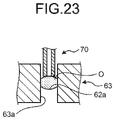
- an optical element O is taken out of the die, as illustrated in FIG. 23 , by suctioning an upper surface of the optical element O with a suctioning tool 70 .
- the optical element O with a diameter of less than 1 mm which is very small is molded, for example, as illustrated in FIG. 24
- a diameter D 1 of the optical element O is smaller than a width W of the suctioning tool 70
- FIG. 25 after the optical element O after molding is pushed upward from the side die 63 by moving the lower die 62 with respect to the side die 63 , the optical element O is taken out of the die by the suctioning tool 70 .
- a method of molding an optical element to obtain the molded optical element includes: preparing a die set including an upper die having an upper molding surface, a lower die having a lower molding surface, a side die in which a through hole serving as a side molding surface is formed, and a sleeve configured to accommodate the upper die, the lower die, and the side die; disposing a mold material on the lower molding surface after inserting the lower die into the through hole of the side die in order for the lower molding surface to be positioned in the through hole of the side die; heating the mold material disposed in the through hole of the side die; press molding the mold material with the upper die and the lower die by pushing the side die upward using the lower die to integrally move the side die and the lower die with respect to the upper die and the sleeve in a state where a position of the lower molding surface in the through hole of the side die is maintained at a predetermined position; and pushing the optical element upward by raising the lower die with respect to the side die and the
- an optical element molding die configured to mold an optical element.
- the die includes: an upper die having an upper molding surface; a side die in which a through hole serving as a side molding surface is formed; a lower die having a lower molding surface to be disposed in the through hole of the side die; and a sleeve configured to accommodate the upper die, the lower die, and the side die.
- the lower die is configured to come into a state where the lower die pushes the side die upward to move integrally with the side die with respect to the upper die and the sleeve in a state where a position of the lower molding surface in the through hole of the side die is maintained at a predetermined position, and a state where the lower die is raised with respect to the side die and the sleeve to move with respect to the upper die in order for the position of the lower molding surface in the through hole of the side die to reach a position which is higher than the predetermined position and which is in a vicinity of an upper surface of the side die.
- FIG. 1 is a cross-sectional view illustrating the configuration of main parts of a molding device including an optical element molding die according to a first embodiment of this disclosure
- FIG. 2 is a perspective view illustrating a lower die and a side die of the optical element molding die according to the first embodiment of this disclosure, and is a view in which facing surfaces of the lower die and the side die can be seen;
- FIG. 3 is a cross-sectional view illustrating a state where in the lower die and the side die of the optical element molding die according to the first embodiment of this disclosure, a protrusion portion of the lower die is not fitted into a recess portion of the side die;
- FIG. 4 is a cross-sectional view illustrating a state where in the lower die and the side die of the optical element molding die according to the first embodiment of this disclosure, the protrusion portion of the lower die is fitted into the recess portion of the side die;
- FIG. 5 is a cross-sectional view illustrating the mode of a disposition step in a method of molding an optical element using the optical element molding die according to the first embodiment of this disclosure
- FIG. 6 is a cross-sectional view illustrating the mode of a press molding step in the method of molding an optical element using the optical element molding die according to the first embodiment of this disclosure
- FIG. 7 is a cross-sectional view illustrating the mode of a push-up step and a take-out step in the method of molding an optical element using the optical element molding die according to the first embodiment of this disclosure
- FIG. 8 is a perspective view illustrating a lower die and a side die of an optical element molding die according to a modification example of the first embodiment of this disclosure, and is a view in which facing surfaces of the lower die and the side die can be seen;
- FIG. 9 is a cross-sectional view illustrating a state where in the lower die and the side die of the optical element molding die according to the modification example of the first embodiment of this disclosure, a protrusion portion of the side die is not fitted into a recess portion of the lower die;
- FIG. 10 is a cross-sectional view illustrating a state where in the lower die and the side die of the optical element molding die according to the modification example of the first embodiment of this disclosure, the protrusion portion of the side die is fitted into the recess portion of the lower die;
- FIG. 11 is a perspective view illustrating the configuration of a lower die and a side die of an optical element molding die according to a second embodiment of this disclosure
- FIG. 12 is a cross-sectional view illustrating the mode of the disposition step in a method of molding an optical element using the optical element molding die according to the second embodiment of this disclosure
- FIG. 13 is a cross-sectional view illustrating the mode of the press molding step in the method of molding an optical element using the optical element molding die according to the second embodiment of this disclosure
- FIG. 14 is a cross-sectional view illustrating the mode of the push-up step and the take-out step in the method of molding an optical element using the optical element molding die according to the second embodiment of this disclosure;
- FIG. 15 is a perspective view illustrating the configuration of the lower die and the side die of an optical element molding die according to a modification example of the second embodiment of this disclosure
- FIG. 16 is a perspective view illustrating a lower die, the side die, and an elastic member of an optical element molding die according to a third embodiment of this disclosure, and is a view in which facing surfaces of the lower die and the side die can be seen;
- FIG. 17 is a cross-sectional view illustrating the mode of the disposition step in a method of molding an optical element using the optical element molding die according to the third embodiment of this disclosure.
- FIG. 18 is a cross-sectional view illustrating the mode of the press molding step in the method of molding an optical element using the optical element molding die according to the third embodiment of this disclosure
- FIG. 19 is a cross-sectional view illustrating the mode of the push-up step and the take-out step in the method of molding an optical element using the optical element molding die according to the third embodiment of this disclosure
- FIG. 20 is a cross-sectional view illustrating the mode of a disposition step in a method of molding an optical element using an optical element molding die according to the related art
- FIG. 21 is a cross-sectional view illustrating the mode of a press molding step in the method of molding an optical element using the optical element molding die according to the related art
- FIG. 22 is a cross-sectional view illustrating a mode where an upper die is raised after the press molding step in the method of molding an optical element using the optical element molding die according to the related art
- FIG. 23 is a cross-sectional view illustrating the mode of a take-out step in the method of molding an optical element using the optical element molding die according to the related art
- FIG. 24 is a cross-sectional view illustrating an example of the diameter of an optical element after molding and the width of a suctioning tool in the method of molding an optical element using the optical element molding die according to the related art.
- FIG. 25 is a cross-sectional view illustrating the mode of a push-up step and a take-out step in the method of molding an optical element using the optical element molding die according to the related art.
- a molding device 1 molds an optical element (for example, a glass lens) by press molding a mold material (for example, a glass material) M that is heated and softened.
- the molding device 1 includes mainly a die set (optical element molding die) 10 , a gas replacement chamber 20 , and a molding chamber 30 .
- the gas replacement chamber 20 air inside the die set 10 which is transported by a transport arm (not illustrated) or the like is replaced with an inert gas such as nitrogen.
- the die set 10 after subjected to the gas replacement is transported to the molding chamber 30 by the transport arm (not illustrated).
- the molding chamber 30 includes an upper plate 31 and a lower plate 32 that heat, press mold, and cool the transported die set 10 in a state where the die set 10 is interposed therebetween.
- the lower plate 32 includes a push pin 33 .
- the push pin 33 pushes a lower die 12 toward the direction of an upper die 11 when press molding is performed, and is connected to a push mechanism (not illustrated).
- the die set 10 includes the upper die 11 , the lower die 12 , a side die 13 , and a sleeve 14 .
- the upper die 11 has an upper molding surface 11 a for molding a functional upper optical surface of the optical element.
- the upper die 11 includes a protrusion portion 111 having a cylindrical shape, and a distal end surface of the protrusion portion 111 forms the upper molding surface 11 a .
- the upper die 11 is mounted on an upper end portion of the sleeve 14 .
- the lower die 12 has a lower molding surface 12 a for molding a functional lower optical surface of the optical element.
- the lower molding surface 12 a is disposed in a through hole 133 of the side die 13 .
- the side die 13 has a side molding surface 13 a for forming a side surface of the optical element.
- the upper die 11 and the lower die 12 are disposed such that the molding surfaces of the upper die 11 and the lower die 12 face each other in a state where the side die 13 is interposed therebetween.
- the lower die 12 includes a main body portion 121 having a cylindrical shape, a protrusion portion 122 which protrudes from an upper surface 121 a of the main body portion 121 , and a protrusion portion 123 having a cylindrical shape which protrudes from an upper surface 122 a of the protrusion portion 122 .
- a distal end surface of the protrusion portion 123 forms the lower molding surface 12 a of the lower die 12 .
- the lower die 12 is configured to be able to come into a state where the lower die 12 moves integrally with the side die 13 with respect to the upper die 11 in a state where the position of the lower molding surface 12 a in the through hole 133 of the side die 13 is maintained at a predetermined position, and a state where the lower die 12 moves with respect to the upper die 11 such that the position of the lower molding surface 12 a in the through hole 133 of the side die 13 reaches a position which is higher than the above-described predetermined position and in the vicinity of an upper surface 131 a of the side die 13 , which will be described later.
- the side die 13 includes a main body portion 131 having a cylindrical shape and a recess portion 132 with a predetermined depth which is formed in a lower surface 131 b of the main body portion 131 .
- the recess portion 132 is formed into a shape corresponding to that of the protrusion portion 122 of the lower die 12 .
- a through hole 133 penetrating through the main body portion 131 is formed in a bottom surface 132 a of the recess portion 132 .
- An inner peripheral surface of the through hole 133 forms the side molding surface 13 a of the side die 13 .
- the through hole 133 is configured such that the protrusion portion 111 of the upper die 11 and the protrusion portion 123 of the lower die 12 which are described above can be inserted thereinto.
- stepped shapes which can be fitted into each other are formed in the facing surfaces of the lower die 12 and the side die 13 , namely, in the upper surface 121 a of the main body portion 121 of the lower die 12 and the lower surface 131 b of the main body portion 131 of the side die 13 .
- the protrusion portion 122 is formed on the upper surface 121 a of the lower die 12
- the recess portion 132 having the shape corresponding to that of the protrusion portion 122 is formed on the lower surface 131 b of the side die 13 .
- the lower die 12 comes into the state where the position of the lower molding surface 12 a in the through hole 133 of the side die 13 is maintained at a predetermined position A.
- a disposition step, a gas replacement step, a heating step, a press molding step, and a cooling step are performed in a state where the lower die 12 and the side die 13 are disposed as illustrated in the same drawing.
- the lower die 12 comes into the state where the position of the lower molding surface 12 a in the through hole 133 of the side die 13 reaches a position higher than the predetermined position A, namely, a position B in the vicinity of the upper surface 131 a of the side die 13 .
- a push-up step and a take-out step are performed in a state where the lower die 12 and the side die 13 are disposed as illustrated in the same drawing.
- the state where the recess portion 132 of the side die 13 is in contact with the protrusion portion 122 of the lower die 12 includes also states other than the state illustrated in FIG. 4 . Namely, in the same drawing, since the height of the protrusion portion 122 of the lower die 12 is the same as the depth of the recess portion 132 of the side die 13 , the bottom surface 132 a of the recess portion 132 of the side die 13 comes into a state of contact with the upper surface 122 a of the protrusion portion 122 of the lower die 12 , and the lower surface 131 b of the main body portion 131 of the side die 13 comes into a state of contact with the upper surface 121 a of the main body portion 121 of the lower die 12 .
- the bottom surface 132 a of the recess portion 132 of the side die 13 comes into a state of contact only with the upper surface 122 a of the protrusion portion 122 of the lower die 12 , but the lower surface 131 b of the main body portion 131 of the side die 13 does not come into a state of contact with the upper surface 121 a of the main body portion 121 of the lower die 12 .
- the lower surface 131 b of the main body portion 131 of the side die 13 comes into a state of contact only with the upper surface 121 a of the main body portion 121 of the lower die 12 , but the bottom surface 132 a of the recess portion 132 of the side die 13 does not come into a state of contact with the upper surface 122 a of the protrusion portion 122 of the lower die 12 .
- the state where the recess portion 132 of the side die 13 is in contact with the protrusion portion 122 of the lower die 12 includes also a state where only either the upper surface 122 a is in contact with the bottom surface 132 a or the upper surface 121 a is in contact with the lower surface 131 b.
- the sleeve 14 is formed into a tubular shape, and a through hole 14 a through which an inert gas is introduced into the die set 10 in the gas replacement step of the method of molding an optical element which is will be described later is formed in the sleeve 14 .
- the disposition step, the gas replacement step, the heating step, the press molding step, the cooling step, the push-up step, and the take-out step are performed in order.
- the lower die 12 and the side die 13 are disposed inside the sleeve 14 such that similarly to FIG. 3 described above, the lower surface 131 b of the main body portion 131 of the side die 13 is in contact with the upper surface 122 a of the protrusion portion 122 of the lower die 12 .
- the protrusion portion 123 of the lower die 12 is inserted into the through hole 133 of the side die 13 such that the lower molding surface 12 a is positioned in the through hole 133 of the side die 13 .
- a mold material M having a regulated volume is disposed on the lower molding surface 12 a of the lower die 12 .
- the shape of the mold material M is not limited to a ball shape, and may be a circular disk shape or the shape of a lens that is processed into an approximately spherical shape in advance.
- the upper die 11 is mounted on an upper end surface of the sleeve 14 . Incidentally, when the upper die 11 is mounted on the upper end surface of the sleeve 14 , the height of each member of the die set 10 is adjusted such that a predetermined distance D 2 is formed between the upper molding surface 11 a of the upper die 11 and the upper surface 131 a of the main body portion 131 of the side die 13 .
- the die set 10 in which the upper die 11 , the lower die 12 , the side die 13 , and the mold material M are disposed inside the sleeve 14 is transported to the gas replacement chamber 20 of the molding device 1 illustrated in FIG. 1 .
- the entire air of the gas replacement chamber 20 is replaced with an inert gas (for example, a nitrogen gas) in a state where, as illustrated in FIG. 5 , the upper molding surface 11 a of the upper die 11 is positioned out of the through hole 133 of the side die 13 . Therefore, the nitrogen gas is introduced into the die set 10 from the through hole 14 a of the sleeve 14 , and air in the through hole 133 of the side die 13 in which the mold material M is disposed is replaced with the nitrogen gas.
- an inert gas for example, a nitrogen gas
- the nitrogen replacement in order to make sure a reliable nitrogen replacement, the nitrogen replacement may be performed by filling the gas replacement chamber 20 with the nitrogen gas after depressurizing the gas replacement chamber 20 at atmospheric pressure using a vacuum pump (not illustrated) before the nitrogen replacement.
- the mold material M flies out of the through hole 133 of the side die 13 depending on the shape or the mass of the mold material M. Therefore, in order to prevent the mold material M from flying out thereof as described above, it is preferable that the distance D 2 between the upper molding surface 11 a of the upper die 11 and the upper surface 131 a of the main body portion 131 of the side die 13 is smaller than the thickness of the mold material M.
- the die set 10 after subjected to the nitrogen replacement is transported to the molding chamber 30 of the molding device 1 which is illustrated in FIG. 1 . Then, the die set 10 transported to the molding chamber 30 is interposed between the upper plate 31 and the lower plate 32 , and the die set 10 and the mold material M that is disposed in the through hole 133 of the side die 13 are heated to the yield point temperature of the mold material M or greater.
- the press molding step the push pin 33 (refer to FIG. 1 ) is raised by the push mechanism (not illustrated); and thereby, the side die 13 and the lower die 12 are raised.
- the press molding step is performed, as illustrated in FIG. 6 , in a state where the lower surface 131 b of the main body portion 131 of the side die 13 is in contact with the upper surface 122 a of the protrusion portion 122 of the lower die 12 . Therefore, the side die 13 and the lower die 12 move integrally with respect to the upper die 11 in a state where the position of the lower molding surface 12 a in the through hole 133 of the side die 13 is maintained at the predetermined position; and thereby, the mold material M is press molded with the upper die 11 and the lower die 12 .
- the side die 13 and the lower die 12 are integrally raised inside the sleeve 14 in a state where the height of the lower molding surface 12 a in the through hole 133 of the side die 13 is maintained.
- the upper molding surface 11 a of the upper die 11 is inserted into the through hole 133 of the side die 13 .
- the mold material M is pressed in the through hole 133 to be molded into a lens shape by the upper molding surface 11 a and the lower molding surface 12 a.
- the die set 10 is transported out of the molding device 1 . Then, the die set 10 outside the molding device 1 is further cooled close to a room temperature.
- the upper die 11 is removed from the die set 10 .
- the lower molding surface 12 a of the lower die 12 in the through hole 133 of the side die 13 moves to a position which is higher relative to the position in the press molding step and at which at least a part of the optical element O after molding protrudes from the upper surface 131 a of the main body portion 131 of the side die 13 .
- the orientation of the stepped shape of the side die 13 with respect to that of the stepped shape of the lower die 12 in the press molding step is switched to an orientation where the stepped shapes are fitted into each other; and thereby, the lower molding surface 12 a moves in the through hole 133 of the side die 13 .
- the above-described “orientation of the stepped shape” indicates the orientation of the boundary line between the upper surface 121 a of the main body portion 121 and the protrusion portion 122
- the above-described “orientation of the stepped shape” indicates the orientation of the boundary line between the lower surface 131 b of the main body portion 131 and the recess portion 132 .
- the orientation of the stepped shape of the side die 13 is aligned with that of the stepped shape of the lower die 12 , for example, by rotating the side die 13 in the above-described state (refer to FIG. 6 ) in the press molding step by 90° around the axis of the through hole 133 . Then, the bottom surface 132 a of the recess portion 132 of the side die 13 comes into contact with the upper surface 122 a of the protrusion portion 122 of the lower die 12 , and the protrusion portion 122 and the recess portion 132 are fitted into each other. Therefore, the side die 13 is lowered with respect to the lower die 12 , and the lower molding surface 12 a is raised in the through hole 133 of the side die 13 relatively. Then, the optical element O is pushed upward out of the through hole 133 .
- the side die 13 is lowered and the protrusion portion 122 and the recess portion 132 are fitted into each other by rotating the side die 13 by 90° around the axis of the through hole 133 in a state where the lower die 12 is fixed; however, on the contrary, the lower die 12 may be raised and the protrusion portion 122 and the recess portion 132 may be fitted into each other by rotating the lower die 12 by 90° around the axis of the through hole 133 in a state where the side die 13 is fixed.
- the optical element O which is pushed out of the through hole 133 of the side die 13 is taken out of the die set 10 by a suctioning tool 70 .
- the method of molding the optical element O using the die set 10 when the mold material M is molded, since press molding can be performed by integrally moving the side die 13 and the lower die 12 without moving the upper die 11 , it is not necessary to independently drive the upper die 11 , and it is possible to simplify the configuration of the molding device 1 .
- the method of molding the optical element O when the optical element O after molding is taken out from the die set 10 , it is possible to push the optical element O out from the through hole 133 of the side die 13 , and thus, also in a case where the optical element O with a very small diameter is molded, it is possible to easily take out the optical element O.
- the upper molding surface 11 a of the upper die 11 is positioned above the upper surface 131 a of the main body portion 131 of the side die 13 when nitrogen replacement is performed (refer to FIG. 5 ), it is possible to perform the nitrogen replacement in a state where the through hole 133 of the side die 13 is released. Therefore, also when the nitrogen replacement is performed, it is not necessary to independently drive the upper die 11 , and it is possible to simplify the configuration of the molding device 1 .
- FIGS. 8 to 10 The configuration of a die set according to a modification example of the first embodiment of this disclosure will be described with reference to FIGS. 8 to 10 .
- the configuration of the die set according to this modification example is same as that of the die set 10 (refer to FIG. 5 ) described above. Therefore, hereinafter, the illustration and description of the configuration other than the lower die 12 A and the side die 13 A will be omitted.
- the molding device 1 similarly to the case of the die set 10 , the molding device 1 (refer to FIG. 1 ) described above is used.
- the lower die 12 A includes a main body portion 121 A having a cylindrical shape, a recess portion 124 with a predetermined depth which is formed in the upper surface 121 a of the main body portion 121 A, and the protrusion portion 123 having a cylindrical shape which protrudes from a bottom surface 124 a of the recess portion 124 .
- the distal end surface of the protrusion portion 123 forms the lower molding surface 12 a of the lower die 12 A.
- the side die 13 A includes a main body portion 131 A having a cylindrical shape and a protrusion portion 134 that protrudes from the lower surface 131 b of the main body portion 131 A.
- the protrusion portion 134 is formed into a shape corresponding to that of the recess portion 124 of the lower die 12 A.
- the through hole 133 penetrating through the protrusion portion 134 and the main body portion 131 A is formed in a lower surface 134 a of the protrusion portion 134 .
- the inner peripheral surface of the through hole 133 forms the side molding surface 13 a of the side die 13 A.
- the stepped shapes of the lower die 12 A and the side die 13 A are reversed compared to those of the lower die 12 and the side die 13 of the die set 10 described above.
- the recess portion 124 is formed in the upper surface 121 a of the lower die 12 A
- the protrusion portion 134 having a shape corresponding to that of the recess portion 124 is formed on the lower surface 131 b of the side die 13 A.
- the lower die 12 A comes into a state where the position of the lower molding surface 12 a in the through hole 133 of the side die 13 A is maintained at the predetermined position A.
- the disposition step, the gas replacement step, the heating step, the press molding step, and the cooling step are performed in a state where the lower die 12 A and the side die 13 A are disposed as illustrated in the same drawing.
- the lower die 12 A comes into a state where the position of the lower molding surface 12 a in the through hole 133 of the side die 13 A reaches a position higher than the predetermined position A, namely, the position B in the vicinity of the upper surface 131 a of the side die 13 A.
- the push-up step and the take-out step are performed in a state where the lower die 12 A and the side die 13 A are disposed as illustrated in the same drawing.
- the die set with the above-described configuration according to this modification example is used in molding the optical element O
- the die set 10 described above it is possible to perform press molding by integrally moving the side die 13 A and the lower die 12 A; and thereby, it is possible to simplify the configuration of the molding device 1 .
- FIG. 12 illustrates the cross-sectional shape of the die set 10 A as cut along a direction X-X illustrated in FIG. 11 .
- the die set 10 A includes the upper die 11 , a lower die 12 B, a side die 13 B, a sleeve 14 A, and a spacer 15 .
- the lower die 12 B includes a main body portion 121 B having a cylindrical shape and the protrusion portion 123 having a cylindrical shape which protrudes from the upper surface 121 a of the main body portion 121 B.
- the distal end surface of the protrusion portion 123 forms the lower molding surface 12 a of the lower die 12 B.
- the side die 13 B is formed into a tubular shape, and the through hole 133 is formed at the center of the side die 13 B.
- the inner peripheral surface of the through hole 133 forms the side molding surface 13 a of the side die 13 B.
- the through hole 133 is configured such that the protrusion portion 111 of the upper die 11 and the protrusion portion 123 of the lower die 12 B can be inserted thereinto.
- the sleeve 14 A is formed into a tubular shape.
- the through hole 14 a through which an inert gas is introduced into the die set 10 A in the gas replacement step of a method of molding the optical element O which will be described later, and a through hole 14 b through which the spacer 15 is inserted into the sleeve 14 A are formed in the sleeve 14 A.
- the spacer 15 is formed into a U shape, and a notch 151 having such a width that the protrusion portion 123 of the lower die 12 B can be fitted into the notch 151 is formed in the spacer 15 .
- the spacer 15 is inserted into the sleeve 14 A through the through hole 14 b of the sleeve 14 A, and is detachably disposed between the side die 13 B and the lower die 12 B.
- the lower die 12 B comes into a state where the position of the lower molding surface 12 a of the lower die 12 B in the through hole 133 of the side die 13 B is maintained at a predetermined position.
- the disposition step, the gas replacement step, the heating step, the press molding step, and the cooling step are performed in a state where the spacer 15 is installed as illustrated in the same drawings.
- the lower die 12 B comes into a state where the position of the lower molding surface 12 a of the lower die 12 B in the through hole 133 of the side die 13 B reaches a position higher than the above-described predetermined position, namely, a position in the vicinity of the upper surface 131 a of the side die 13 B.
- the push-up step and the take-out step are performed in a state where the spacer 15 is not installed as illustrated in the same drawing.
- the disposition step, the gas replacement step, the heating step, the press molding step, the cooling step, the push-up step, and the take-out step are performed in order.
- the gas replacement step, the heating step, the cooling step, and the take-out step are the same as those in the method of molding the optical element O according to the first embodiment, and thus, the description thereof will be omitted.
- the method of molding the optical element O according to this embodiment is performed using the molding device 1 (refer to FIG. 1 ).
- the spacer 15 is installed between the side die 13 B and the lower die 12 B. Then, the protrusion portion 123 of the lower die 12 B is inserted into the through hole 133 of the side die 13 B such that the lower molding surface 12 a is positioned in the through hole 133 of the side die 13 B.
- the mold material M having a regulated volume is disposed on the lower molding surface 12 a of the lower die 12 B.
- the shape of the mold material M is not limited to a ball shape, and may be a circular disk shape or the shape of a lens that is processed into an approximately spherical shape in advance.
- the upper die 11 is mounted on an upper end surface of the sleeve 14 A. Incidentally, when the upper die 11 is mounted on the upper end surface of the sleeve 14 A, the height of each member of the die set 10 A is adjusted such that the predetermined distance D 2 is formed between the upper molding surface 11 a of the upper die 11 and the upper surface 131 a of the side die 13 B.
- the press molding step the push pin 33 (refer to FIG. 1 ) is raised by the push mechanism (not illustrated); and thereby, the side die 13 B, the spacer 15 , and the lower die 12 B are raised.
- the press molding step is performed in a state where, as illustrated in FIG. 13 , the spacer 15 is installed between the side die 13 B and the lower die 12 B. Therefore, the side die 13 B, the spacer 15 , and the lower die 12 B move integrally with respect to the upper die 11 in a state where the position of the lower molding surface 12 a in the through hole 133 of the side die 13 B is maintained at the predetermined position; and thereby, the mold material M is press molded with the upper die 11 and the lower die 12 B.
- the side die 13 B, the spacer 15 , and the lower die 12 B are integrally raised inside the sleeve 14 A in a state where the height of the lower molding surface 12 a in the through hole 133 of the side die 13 B is maintained.
- the upper molding surface 11 a of the upper die 11 is inserted into the through hole 133 of the side die 13 B.
- the mold material M is pressed in the through hole 133 to be molded into a lens shape by the upper molding surface 11 a and the lower molding surface 12 a.
- the upper die 11 is removed from the die set 10 A.
- the spacer 15 installed between the side die 13 B and the lower die 12 B is removed; and thereby, the lower molding surface 12 a of the lower die 12 B in the through hole 133 of the side die 13 B moves to a position which is higher relative to the position in the press molding step and at which at least a part of the optical element O after molding protrudes from the upper surface 131 a of the side die 13 B.
- the spacer 15 which is installed in the press molding step is removed; and thereby, the side die 13 B is lowered by the height of the spacer 15 with respect to the lower die 12 B, and relatively, the lower molding surface 12 a is raised in the through hole 133 of the side die 13 B. Then, the optical element O is pushed upward out of the through hole 133 .
- the spacer 15 is removed, the removal is preferably performed while the side die 13 B is pushed.
- the method of molding the optical element O using the die set 10 A similarly to the first embodiment, it is possible to perform press molding by integrally moving the side die 13 B and the lower die 12 B; and thereby, it is possible to simplify the configuration of the molding device 1 .
- the method of molding the optical element O owing to the simple operation of attaching and detaching the spacer 15 that is disposed between the side die 13 B and the lower die 12 B, it is possible to easily switch the height of the lower molding surface 12 a of the lower die 12 B in the through hole 133 of the side die 13 B between the position when the mold material M is press molded and the position when the optical element O after molding is taken out from the die set 10 A. Therefore, also in a case where the optical element O with a very small diameter is molded, it is possible to easily take out the optical element O by using the suctioning tool 70 after pushing the optical element O out from the through hole 133 of the side die 13 B.
- FIG. 15 The configuration of a die set according to a modification example of the second embodiment of this disclosure will be described with reference to FIG. 15 .
- the configuration of the die set according to this modification example is same as that of the die set 10 A (refer to FIG. 12 ) described above. Therefore, hereinafter, the illustration and description of the configuration other than the spacer 15 A will be omitted.
- the molding device 1 similarly to the case of the die set 10 A, the molding device 1 (refer to FIG. 1 ) described above is used.
- the spacer 15 A is formed of two spacer pieces 152 and 153 , each of which has a semicircular arc shape, and a through hole 154 is formed by assembling together the spacer pieces 152 and 153 .
- the spacer 15 A is detachably disposed between the side die 13 B and the lower die 12 B.
- the steps up to the press molding step are performed similarly to the second embodiment.
- the spacer 15 A is removed by raising the lower die 12 B until the spacer 15 A is pushed out above the sleeve 14 A; and thereby, the side die 13 B is lowered by the height of the spacer 15 A with respect to the lower die 12 B. Therefore, relatively, the lower molding surface 12 a is raised in the through hole 133 of the side die 13 B; and thereby, the optical element O is pushed upward out of the through hole 133 .
- the die set with the above-described configuration according to this modification example is used in molding the optical element O, similarly to the die set 10 A described above, it is possible to perform press molding by integrally moving the side die 13 B and the lower die 12 B; and thereby, it is possible to simplify the configuration of the molding device 1 .
- the die set 10 B includes the upper die 11 , a lower die 12 C, the side die 13 B, the sleeve 14 , and an elastic member 16 .
- the configuration of the die set 10 B is same as those of the die sets 10 and 10 A (refer to FIGS. 5 and 12 ) described above. Therefore, hereinafter, the illustration and description of the configuration other than the lower die 12 C and the elastic member 16 will be omitted.
- the lower die 12 C includes a main body portion 121 C having a cylindrical shape, a protrusion portion 122 C having a cylindrical shape which protrudes from the upper surface 121 a of the main body portion 121 C, and the protrusion portion 123 having a cylindrical shape which protrudes from the upper surface 122 a of the protrusion portion 122 C.
- the distal end surface of the protrusion portion 123 forms the lower molding surface 12 a of the lower die 12 C.
- the elastic member 16 is a coil spring. As illustrated in FIG. 17 , the elastic member 16 is disposed between the side die 13 B and the lower die 12 C.
- the lower die 12 C comes into a state where the position of the lower molding surface 12 a of the lower die 12 C in the through hole 133 of the side die 13 B is maintained at the above-described predetermined position.
- the disposition step, the gas replacement step, the heating step, the press molding step, and the cooling step are performed in a state where the side die 13 B is pushed upward via the elastic member 16 as illustrated in the same drawings.
- the lower die 12 C comes into a state where the position of the lower molding surface 12 a of the lower die 12 C in the through hole 133 of the side die 13 B reaches a position higher than the above-described predetermined position, namely, a position in the vicinity of the upper surface 131 a of the side die 13 B.
- the push-up step and the take-out step are performed in a state where the elastic member 16 is compressed as illustrated in the same drawing.
- the elastic member 16 is disposed between the side die 13 B and the lower die 12 C. Then, the protrusion portion 123 of the lower die 12 C is inserted into the through hole 133 of the side die 13 B such that the lower molding surface 12 a is positioned in the through hole 133 of the side die 13 B. Namely, the elastic member 16 is designed in advance such that the elastic member 16 disposed on the lower die 12 C comes into a state of compression due to the weight of the side die 13 B, but at the time, the lower molding surface 12 a of the lower die 12 C is positioned in the through hole 133 .
- the mold material M having a regulated volume is disposed on the lower molding surface 12 a of the lower die 12 C.
- the shape of the mold material M is not limited to a ball shape, and may be a circular disk shape or the shape of a lens that is processed into an approximately spherical shape in advance.
- the upper die 11 is mounted on an upper end surface of the sleeve 14 . Incidentally, when the upper die 11 is mounted on the upper end surface of the sleeve 14 , the height of each member of the die set 10 B is adjusted such that the predetermined distance D 2 is formed between the upper molding surface 11 a of the upper die 11 and the upper surface 131 a of the side die 13 B.
- the press molding step the push pin 33 (refer to FIG. 1 ) is raised by the push mechanism (not illustrated); and thereby, the side die 13 B, the elastic member 16 , and the lower die 12 C are raised.
- the press molding step is performed in a state where, as illustrated in FIG. 18 , the elastic member 16 is disposed between the side die 13 B and the lower die 12 C. Therefore, the side die 13 B, the elastic member 16 , and the lower die 12 C move integrally with respect to the upper die 11 in a state where the position of the lower molding surface 12 a in the through hole 133 of the side die 13 B is maintained at the predetermined position; and thereby, the mold material M is press molded with the upper die 11 and the lower die 12 C.
- the side die 13 B is pushed upward via the elastic member 16 by the lower die 12 C; and thereby, the side die 13 B, the elastic member 16 , and the lower die 12 C move integrally in the sleeve 14 in a state where a predetermined gap is formed between the side die 13 B and the lower die 12 C due to the elastic force of the elastic member 16 and the height of the lower molding surface 12 a in the through hole 133 of the side die 13 B is maintained.
- the upper molding surface 11 a of the upper die 11 is inserted into the through hole 133 of the side die 13 B.
- the mold material M is pressed in the through hole 133 to be molded into a lens shape by the upper molding surface 11 a and the lower molding surface 12 a.
- the push-up step as illustrated in FIG. 19 , firstly, the upper die 11 is removed from the die set 10 B. Subsequently, the side die 13 B is pushed downward to compress the elastic member 16 ; and thereby, the lower molding surface 12 a of the lower die 12 C in the through hole 133 of the side die 13 B moves to a position which is higher relative to the position in the press molding step and at which a part of the optical element O after molding protrudes from the upper surface 131 a of the side die 13 B.
- the elastic member 16 below the side die 13 B is compressed; and thereby, the side die 13 B is lowered by the amount of compression of the elastic member 16 with respect to the lower die 12 C, and relatively, the lower molding surface 12 a is raised in the through hole 133 of the side die 13 B. Then, the optical element O is pushed upward out of the through hole 133 .
- the method of molding the optical element O using the die set 10 B similarly to the first and second embodiments, it is possible to perform press molding by integrally moving the side die 13 B and the lower die 12 C; and thereby, it is possible to simplify the configuration of the molding device 1 .
Landscapes
- Engineering & Computer Science (AREA)
- Chemical & Material Sciences (AREA)
- Manufacturing & Machinery (AREA)
- Materials Engineering (AREA)
- Organic Chemistry (AREA)
- Physics & Mathematics (AREA)
- General Physics & Mathematics (AREA)
- Optics & Photonics (AREA)
- Moulds For Moulding Plastics Or The Like (AREA)
- Casting Or Compression Moulding Of Plastics Or The Like (AREA)
Abstract
Description
Claims (3)
Applications Claiming Priority (4)
| Application Number | Priority Date | Filing Date | Title |
|---|---|---|---|
| JP2017-183873 | 2017-09-25 | ||
| JPJP2017-183873 | 2017-09-25 | ||
| JP2017183873A JP6884080B2 (en) | 2017-09-25 | 2017-09-25 | Optical element molding method and optical element molding mold |
| PCT/JP2018/031236 WO2019058862A1 (en) | 2017-09-25 | 2018-08-23 | Optical element forming method and optical element forming mold |
Related Parent Applications (1)
| Application Number | Title | Priority Date | Filing Date |
|---|---|---|---|
| PCT/JP2018/031236 Continuation WO2019058862A1 (en) | 2017-09-25 | 2018-08-23 | Optical element forming method and optical element forming mold |
Publications (2)
| Publication Number | Publication Date |
|---|---|
| US20200216347A1 US20200216347A1 (en) | 2020-07-09 |
| US11370688B2 true US11370688B2 (en) | 2022-06-28 |
Family
ID=65811397
Family Applications (1)
| Application Number | Title | Priority Date | Filing Date |
|---|---|---|---|
| US16/820,797 Active 2039-01-05 US11370688B2 (en) | 2017-09-25 | 2020-03-17 | Method of molding optical element and optical element molding die |
Country Status (4)
| Country | Link |
|---|---|
| US (1) | US11370688B2 (en) |
| JP (1) | JP6884080B2 (en) |
| CN (1) | CN111108071B (en) |
| WO (1) | WO2019058862A1 (en) |
Families Citing this family (1)
| Publication number | Priority date | Publication date | Assignee | Title |
|---|---|---|---|---|
| WO2023026446A1 (en) * | 2021-08-26 | 2023-03-02 | オリンパス株式会社 | Method for forming optical element and molds for forming optical element |
Citations (5)
| Publication number | Priority date | Publication date | Assignee | Title |
|---|---|---|---|---|
| JP2002326824A (en) | 2001-02-28 | 2002-11-12 | Toshiba Mach Co Ltd | Apparatus for press molding of glass |
| US20030029332A1 (en) | 2001-06-15 | 2003-02-13 | Isao Matsuzuki | Press-forming machine for glass |
| JP2004339039A (en) | 2003-05-19 | 2004-12-02 | Minolta Co Ltd | Optical element manufacturing method |
| JP2005200284A (en) | 2004-01-19 | 2005-07-28 | Matsushita Electric Ind Co Ltd | Optical element molding equipment |
| US20070092592A1 (en) * | 2005-10-21 | 2007-04-26 | Hon Hai Precision Industry Co., Ltd. | Molding apparatus for optical elements |
Family Cites Families (6)
| Publication number | Priority date | Publication date | Assignee | Title |
|---|---|---|---|---|
| JP3674910B2 (en) * | 1999-11-01 | 2005-07-27 | Hoya株式会社 | Method and apparatus for producing glass molded body |
| CN1772668B (en) * | 2004-09-30 | 2010-08-18 | Hoya株式会社 | Moulding apparatus and method for producing optical component |
| TWI285191B (en) * | 2005-09-05 | 2007-08-11 | Asia Optical Co Inc | Non-centering glass molding apparatus |
| CN101028735B (en) * | 2006-03-03 | 2010-09-29 | 鸿富锦精密工业(深圳)有限公司 | Mold structure |
| JP5114261B2 (en) * | 2008-03-25 | 2013-01-09 | オリンパス株式会社 | Optical element manufacturing method |
| JP2012180252A (en) * | 2011-03-02 | 2012-09-20 | Olympus Corp | Method for producing optical element, mold set for molding the optical element, and apparatus for producing the optical element |
-
2017
- 2017-09-25 JP JP2017183873A patent/JP6884080B2/en active Active
-
2018
- 2018-08-23 WO PCT/JP2018/031236 patent/WO2019058862A1/en not_active Ceased
- 2018-08-23 CN CN201880060213.XA patent/CN111108071B/en active Active
-
2020
- 2020-03-17 US US16/820,797 patent/US11370688B2/en active Active
Patent Citations (6)
| Publication number | Priority date | Publication date | Assignee | Title |
|---|---|---|---|---|
| JP2002326824A (en) | 2001-02-28 | 2002-11-12 | Toshiba Mach Co Ltd | Apparatus for press molding of glass |
| US20030029332A1 (en) | 2001-06-15 | 2003-02-13 | Isao Matsuzuki | Press-forming machine for glass |
| JP2004339039A (en) | 2003-05-19 | 2004-12-02 | Minolta Co Ltd | Optical element manufacturing method |
| US7559214B2 (en) | 2003-05-19 | 2009-07-14 | Minolta Co., Ltd. | Method of manufacturing optical element made of glass |
| JP2005200284A (en) | 2004-01-19 | 2005-07-28 | Matsushita Electric Ind Co Ltd | Optical element molding equipment |
| US20070092592A1 (en) * | 2005-10-21 | 2007-04-26 | Hon Hai Precision Industry Co., Ltd. | Molding apparatus for optical elements |
Non-Patent Citations (2)
| Title |
|---|
| International Search Report (ISR) (and English translation thereof) dated Nov. 6, 2018 issued in International Application No. PCT/JP2018/031236. |
| Written Opinion dated Nov. 6, 2018 issued in International Application No. PCT/JP2018/031236. |
Also Published As
| Publication number | Publication date |
|---|---|
| JP6884080B2 (en) | 2021-06-09 |
| JP2019059635A (en) | 2019-04-18 |
| US20200216347A1 (en) | 2020-07-09 |
| WO2019058862A1 (en) | 2019-03-28 |
| CN111108071A (en) | 2020-05-05 |
| CN111108071B (en) | 2022-05-31 |
Similar Documents
| Publication | Publication Date | Title |
|---|---|---|
| JP4686929B2 (en) | Press forming equipment | |
| US11370688B2 (en) | Method of molding optical element and optical element molding die | |
| US9067358B2 (en) | Molding apparatus for glass molded product | |
| JP4124239B2 (en) | Optical element molding apparatus and molding method | |
| JP2006021417A (en) | Method for manufacturing optical component with holder | |
| CN112351958A (en) | Disassembling and assembling device for forming die | |
| CN111646675A (en) | Press molding device | |
| JPWO2009131168A1 (en) | Optical element press molding equipment | |
| JP2008247671A (en) | Optical element molding apparatus | |
| US20210002161A1 (en) | Method of molding optical element and optical element molding mold | |
| US12552698B2 (en) | Method of molding optical element and mold for molding optical element | |
| CN104661801B (en) | The manufacturing process of optical element and forming device | |
| JP5087470B2 (en) | Optical element manufacturing method and manufacturing apparatus thereof | |
| CN113891862B (en) | Glass lens forming die | |
| CN220618749U (en) | Mould | |
| JP2006036592A (en) | Mold assembly apparatus, mold press molding apparatus, mold assembly method, and molded body manufacturing method | |
| CN100999374B (en) | A method of demoulding | |
| JP6333517B2 (en) | Molded product manufacturing equipment | |
| JPH10259028A (en) | Glass press forming equipment | |
| US20130004708A1 (en) | Molding apparatus, method of forming molded product, and molded product | |
| JP4366179B2 (en) | Glass forming apparatus and method | |
| JP2007191360A (en) | Mold, molding apparatus and manufacturing method using the same | |
| JP2001039722A (en) | Optical device manufacturing equipment | |
| JP2019048385A (en) | Mold for insert molding | |
| JP2007153677A (en) | Molding die for optical glass element, and method for molding optical glass element |
Legal Events
| Date | Code | Title | Description |
|---|---|---|---|
| AS | Assignment |
Owner name: OLYMPUS CORPORATION, JAPAN Free format text: ASSIGNMENT OF ASSIGNORS INTEREST;ASSIGNOR:KIKUCHI, KENJI;REEL/FRAME:052133/0574 Effective date: 20200226 |
|
| FEPP | Fee payment procedure |
Free format text: ENTITY STATUS SET TO UNDISCOUNTED (ORIGINAL EVENT CODE: BIG.); ENTITY STATUS OF PATENT OWNER: LARGE ENTITY |
|
| STPP | Information on status: patent application and granting procedure in general |
Free format text: DOCKETED NEW CASE - READY FOR EXAMINATION |
|
| STPP | Information on status: patent application and granting procedure in general |
Free format text: NON FINAL ACTION MAILED |
|
| STPP | Information on status: patent application and granting procedure in general |
Free format text: RESPONSE TO NON-FINAL OFFICE ACTION ENTERED AND FORWARDED TO EXAMINER |
|
| STPP | Information on status: patent application and granting procedure in general |
Free format text: NON FINAL ACTION MAILED |
|
| STPP | Information on status: patent application and granting procedure in general |
Free format text: RESPONSE TO NON-FINAL OFFICE ACTION ENTERED AND FORWARDED TO EXAMINER |
|
| STPP | Information on status: patent application and granting procedure in general |
Free format text: NOTICE OF ALLOWANCE MAILED -- APPLICATION RECEIVED IN OFFICE OF PUBLICATIONS |
|
| STPP | Information on status: patent application and granting procedure in general |
Free format text: PUBLICATIONS -- ISSUE FEE PAYMENT VERIFIED |
|
| STCF | Information on status: patent grant |
Free format text: PATENTED CASE |
|
| MAFP | Maintenance fee payment |
Free format text: PAYMENT OF MAINTENANCE FEE, 4TH YEAR, LARGE ENTITY (ORIGINAL EVENT CODE: M1551); ENTITY STATUS OF PATENT OWNER: LARGE ENTITY Year of fee payment: 4 |