US11360535B2 - Management of a pre-charge circuit of a battery management system - Google Patents
Management of a pre-charge circuit of a battery management system Download PDFInfo
- Publication number
- US11360535B2 US11360535B2 US16/586,027 US201916586027A US11360535B2 US 11360535 B2 US11360535 B2 US 11360535B2 US 201916586027 A US201916586027 A US 201916586027A US 11360535 B2 US11360535 B2 US 11360535B2
- Authority
- US
- United States
- Prior art keywords
- total
- energy
- charge
- threshold
- time
- Prior art date
- Legal status (The legal status is an assumption and is not a legal conclusion. Google has not performed a legal analysis and makes no representation as to the accuracy of the status listed.)
- Active, expires
Links
Images


Classifications
-
- H—ELECTRICITY
- H02—GENERATION; CONVERSION OR DISTRIBUTION OF ELECTRIC POWER
- H02J—ELECTRIC POWER NETWORKS; CIRCUIT ARRANGEMENTS OR SYSTEMS FOR SUPPLYING OR DISTRIBUTING ELECTRIC POWER; SYSTEMS FOR STORING ELECTRIC ENERGY
- H02J7/00—Circuit arrangements for charging or discharging batteries or for supplying loads from batteries
- H02J7/60—Circuit arrangements for charging or discharging batteries or for supplying loads from batteries including safety or protection arrangements
- H02J7/62—Circuit arrangements for charging or discharging batteries or for supplying loads from batteries including safety or protection arrangements against overcurrent
-
- G—PHYSICS
- G06—COMPUTING OR CALCULATING; COUNTING
- G06F—ELECTRIC DIGITAL DATA PROCESSING
- G06F1/00—Details not covered by groups G06F3/00 - G06F13/00 and G06F21/00
- G06F1/26—Power supply means, e.g. regulation thereof
- G06F1/28—Supervision thereof, e.g. detecting power-supply failure by out of limits supervision
-
- H02J7/0072—
-
- H—ELECTRICITY
- H02—GENERATION; CONVERSION OR DISTRIBUTION OF ELECTRIC POWER
- H02J—ELECTRIC POWER NETWORKS; CIRCUIT ARRANGEMENTS OR SYSTEMS FOR SUPPLYING OR DISTRIBUTING ELECTRIC POWER; SYSTEMS FOR STORING ELECTRIC ENERGY
- H02J7/00—Circuit arrangements for charging or discharging batteries or for supplying loads from batteries
- H02J7/34—Parallel operation in networks using both storage and other DC sources, e.g. providing buffering
- H02J7/345—Parallel operation in networks using both storage and other DC sources, e.g. providing buffering using capacitors as storage or buffering devices
-
- H—ELECTRICITY
- H02—GENERATION; CONVERSION OR DISTRIBUTION OF ELECTRIC POWER
- H02J—ELECTRIC POWER NETWORKS; CIRCUIT ARRANGEMENTS OR SYSTEMS FOR SUPPLYING OR DISTRIBUTING ELECTRIC POWER; SYSTEMS FOR STORING ELECTRIC ENERGY
- H02J7/00—Circuit arrangements for charging or discharging batteries or for supplying loads from batteries
- H02J7/60—Circuit arrangements for charging or discharging batteries or for supplying loads from batteries including safety or protection arrangements
-
- H—ELECTRICITY
- H02—GENERATION; CONVERSION OR DISTRIBUTION OF ELECTRIC POWER
- H02J—ELECTRIC POWER NETWORKS; CIRCUIT ARRANGEMENTS OR SYSTEMS FOR SUPPLYING OR DISTRIBUTING ELECTRIC POWER; SYSTEMS FOR STORING ELECTRIC ENERGY
- H02J7/00—Circuit arrangements for charging or discharging batteries or for supplying loads from batteries
- H02J7/60—Circuit arrangements for charging or discharging batteries or for supplying loads from batteries including safety or protection arrangements
- H02J7/663—Circuit arrangements for charging or discharging batteries or for supplying loads from batteries including safety or protection arrangements using battery or load disconnect circuits
-
- H—ELECTRICITY
- H02—GENERATION; CONVERSION OR DISTRIBUTION OF ELECTRIC POWER
- H02J—ELECTRIC POWER NETWORKS; CIRCUIT ARRANGEMENTS OR SYSTEMS FOR SUPPLYING OR DISTRIBUTING ELECTRIC POWER; SYSTEMS FOR STORING ELECTRIC ENERGY
- H02J7/00—Circuit arrangements for charging or discharging batteries or for supplying loads from batteries
- H02J7/90—Regulation of charging or discharging current or voltage
- H02J7/92—Regulation of charging or discharging current or voltage with prioritisation of loads or sources
-
- B—PERFORMING OPERATIONS; TRANSPORTING
- B60—VEHICLES IN GENERAL
- B60L—PROPULSION OF ELECTRICALLY-PROPELLED VEHICLES; SUPPLYING ELECTRIC POWER FOR AUXILIARY EQUIPMENT OF ELECTRICALLY-PROPELLED VEHICLES; ELECTRODYNAMIC BRAKE SYSTEMS FOR VEHICLES IN GENERAL; MAGNETIC SUSPENSION OR LEVITATION FOR VEHICLES; MONITORING OPERATING VARIABLES OF ELECTRICALLY-PROPELLED VEHICLES; ELECTRIC SAFETY DEVICES FOR ELECTRICALLY-PROPELLED VEHICLES
- B60L2270/00—Problem solutions or means not otherwise provided for
- B60L2270/20—Inrush current reduction, i.e. avoiding high currents when connecting the battery
Definitions
- the invention relates in general to the field of Energy Storage System and more specifically to the monitoring for unsafe operating conditions of a pre-charge circuit.
- a Battery Management System is an electronic control system that has multiple functions for example in an Energy Storage System (ESS). These functions include but are not limited to monitoring the battery state, (State of Charge, State of Health, temperature, current flow, etc), controlling the battery connection with the application load, and performing battery safety monitoring and functions such as inhibiting overcharge, over discharge, and so on.
- the BMS notably comprises a Battery Management Module (BMM).
- a typical Energy Storage System is comprised of energy storage modules and a battery management system.
- One of the primary BMS functions is to control the connection of the battery modules to the application.
- the BMS typically comprises one or more devices to control the connection of the battery to the application and is able to monitor the current flowing through the system.
- This function is typically provided by electromechanical devices capable of conducting the energy in the system and interrupting that current as required.
- the inrush current is the instantaneous high input current drawn by a power supply or electrical equipment at turn-on.
- the inrush current is due to the high initial currents required to charge the capacitors.
- the inrush current can cause damage to the contactors by exceeding the rated capacities of the devices and causing premature aging or failure of the devices in question.
- the BMM implements an inrush current limiting device, known or commonly referred to as a pre-charge circuit.
- the pre-charge circuit is used to regulate the current to levels that will not cause undue wear on the contactors of the BMM.
- the pre-charge circuit is used to charge the capacitive elements of the system before closing the primary current path.
- the pre-charge circuit is generally comprised of two primary functional elements: an electromechanical relay (also referred to as pre-charge contactor) to connect or disconnect the circuit and high energy resistor (also referred to a pre-charge resistor) to limit the current. These two elements are selected to be compatible with the conditions present in the application.
- the pre-charge resistor is selected to provide a level of current that will charge the capacity elements in the application load to a level that will permit the primary current switching elements to be connected to the load without damage.
- the pre-charge contactor is selected to be compatible with the voltage and current levels permitted by the current limiting device.
- the pre-charge resistor While performing the inrush current limiting function, the pre-charge resistor may be required to dissipate significant amounts of energy depending on the amount of energy required to charge the capacitance present in the application. However, there is a risk of overheating of the pre-charge resistor.
- the pre-charge resistor is a core component of a pre-charge circuit of a BMS which functions to reduce the risk of contactor welding which may be present when closing the contactors on capacitive component of an application load without limiting the current flowing the system.
- the present invention is embodied as a method for managing a pre-charge circuit of a battery management system (BMS), the pre-charge circuit comprising a dissipative energy component.
- BMS battery management system
- Such method comprises:
- the method may further comprise one or more of the following:
- E AJ_N ⁇ 1 is a latest known value of the energy accumulated by the dissipative energy component
- I 2 is a square value of a current I in ampere that is measured in the resistor for the period of time t N ;
- r is a resistance of the resistor in ohms
- t is the time in seconds of the period of time t N ;
- the invention is embodied as a battery management system (BMS).
- BMS battery management system
- an input connector connectable to an energy storage module
- pre-charge circuit comprising a dissipative energy component
- a processing circuitry operatively coupled to a data storage memory, the data storage memory comprising instructions to configure the processor to:
- E AJ_Total_N E AJ_N ⁇ E C_N ;
- E AJ_Total_N determines whether the computed E AJ_Total_N exceeds a first threshold representing a first value of E AJ_Total_N .
- the system may further comprise one or more of the following:
- the dissipative energy component is a resistor
- E AJ_N ⁇ 1 is a latest known value of the energy accumulated by the dissipative energy component
- I 2 is a square value of a current I in ampere that is measured in the resistor for the period of time t N ;
- r is a resistance of the resistor in ohms
- t is the time in seconds of the period of time t N ;
- a current sensor for measuring the current I in the resistor, the current sensor being communicatively coupled to the processing circuitry;
- the pre-charge circuit is connected in parallel to main power contactor on a line connecting an input connector with an output connector, and wherein the pre-charge circuit further comprises a pre-charge contactor and a dissipative energy component, and further comprising instructions to configure the processor to open and/or close the contactor on the line and/or the pre-charge contactor; and/or
- the invention can be embodied as a computer program product having program instructions that cause a computerized system to perform the above methods.
- the computer program can be stored on the data storage memory of the BMS system for causing the processing circuitry to perform the above methods.
- non-transitory computer-readable data storage medium comprising the computer program.
- FIG. 1 illustrates an example of an Energy Storage System
- FIG. 2 shows an example of a pre-charge current and system voltage as function of time
- FIG. 3 shows an example of a pre-charge peak impulse energy and pre-charge current as function of time
- FIG. 4 shows an example of a simulation of an Energy Storage System where the BMS does not respect Alarm Resistor Warm and permit a cool down period of a pre-charge circuit
- FIG. 5 shows an example of a simulation of an Energy Storage System where the BMS does respect Alarm Resistor Warm and permit a cool down period of a pre-charge circuit
- FIG. 6 is an example of a method for managing a pre-charge circuit
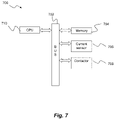
- FIG. 7 is an example of a BMS.
- FIG. 2 illustrates this with a curve 200 that represents the pre-charge current flowing through the pre-charge circuit and the curve 202 that represents the voltage of the Energy Storage System.
- the current is maximum at the start of the pre-charge process and the voltage increases at the same time the current decreases.
- the pre-charge resistor will typically accumulate energy faster than it can be dissipated. This accumulated energy can be calculated as a function of time, current, and resistance.
- FIG. 3 illustrates the relation between the pre-charge current 300 and the accumulation of energy 302 of the resistor of the pre-charge circuit.
- the energy accumulated in the resistor is stable even after the exponential decay down to the steady state of the pre-charge circuit: indeed, heat dissipation of the accumulated energy is a process that is much slower than energy accumulation.
- the amount of energy that can be safely absorbed by the pre-charge resistor without damage or degradation of the component is defined by the material characteristics of the specific component of the resistor used.
- the value of the amount of energy that can be safely absorbed is specified as a maximum impulse energy, which is primarily a function of time, voltage, and resistance. This maximum impulse energy is typically given in Joules.
- Energy is accumulated in the pre-charge resistor in the form of heat whenever it is conducting current, this energy can be calculated as a function of current and time and is stored in the pre-charge resistor as heat.
- the heat dissipation of the pre-charge resistor determines how frequently it can perform a pre-charge process, as in some situations a system may perform multiple pre-charge processes that could overwhelm the energy carrying capacity of the resistor.
- the pre-charge circuit comprises at least one dissipative energy component.
- BMS Battery Management System and refers to both a design and components that comprise that design.
- the BMM is a Battery Management Module, which implements the components of a BMS in a specific form.
- BMM and BMS are synonymous.
- the method starts with computing 600 the energy accumulated E AJ_N by the dissipative energy component for a period of time t N .
- E AJ_N may be given in Joules of energy.
- the accumulated energy in the pre-charge resistor may depend on one or more parameters. These parameters are, but not limited to, the current flowing through the resistor, and/or the voltage across the resistor, and/or the resistance of the resistor, and/or the period of time t N the current flows through the resistor.
- the value of the resistance is known and should be the same during the execution of the method. In practice, the value of the resistance may be considered to be the same if the energy carrying capacity of the pre-charge resistor has never been overwhelmed.
- the latest known value E AJ_N ⁇ 1 of the energy accumulated by the dissipative energy component may be computed the same manner using the formula eq. 1: the computation of E AJ_N ⁇ 1 may rely on the parameters used for computing E AJ_N ; the parameters values are those previously measured for a period of time t N ⁇ 1 . For each computation of E AJ_N , the result is added to a total accumulated energy variable which represents the total impulse energy absorbed by the pre-charge resistor.
- the latest known value E AJ_N ⁇ 1 may equal to zero. For instance, this may be the case if a sufficiently long period of time elapsed between two inrush currents so that the dissipative energy component evacuated all the accumulated energy.
- At least the latest known value E AJ_N ⁇ 1 may be stored in a memory for being used for the next computation.
- the latest known value E AJ_N ⁇ 1 stored in the memory is deleted and replaced by the latest value E AJ_N once computed.
- the value E AJ_N becomes the latest known value E AJ_N ⁇ 1 .
- E AJ_N ⁇ 1 E AJ_N .
- the next operation 610 comprises computing the energy evacuated E C_N by the dissipative energy component for the same period of time t N .
- the energy evacuated mainly depends on the heat dissipation of the dissipative energy component, e.g. a pre-charge resistor.
- the dissipative energy component may evacuate energy at the same time the dissipative energy component absorbs energy.
- the quantity of energy that is evacuated by the dissipative energy component may depends on one or more parameters such as, but not limited to, the temperature condition, the materials of the component. For instance, a cooling system for the dissipative energy component might be used for increasing the quantity of energy evacuated by the component.
- the computation 610 may be based on the data given by the manufacturer for typical energy dissipation of the dissipative energy component at ambient temperature conditions and for a given period of time.
- the computing may be performed by identifying a value of evacuated energy for the period of time t N , e.g. a table associates a respective value of quantities of evacuated energy for different periods of time at a given temperature.
- the next operation 620 comprises computing the remaining energy E AJ_Total_N stored on the dissipative energy component at the end of the period of time t N .
- the remaining energy is the difference between the value E AJ_N of the quantity of energy that has been accumulated during the period of time t N and the value E C_N of the quantity of energy that has been evacuated for this same period of time t N .
- the value E AJ_Total_N for a period of time t N may be positive or negative depending on the quantity of energy evacuated by the dissipative energy component and/or on the quantity of energy brought by the inrush current. In practice, after an inrush current, the quantity of accumulated energy E AJ_N is much higher that the quantity of evacuated energy E C_N .
- the next operation 630 comprises a comparison of the result of the computing of the operation 620 with a first known value E AJ_Total_T1 of remaining energy.
- This first known value is predetermined and is a first threshold of remaining energy in the dissipative energy component.
- This comparison aims at determining whether the quantity of energy stored on the dissipative energy component exceeds or not the first threshold that represents a state of the dissipative energy component for which the dissipative energy component has exceeded a maximum of remaining energy at which a pre-charge sequence can occur.
- the first threshold is chosen to be a buffer to energy accumulation associated with permanent damage of the dissipative energy component.
- the first threshold may depend on the type dissipative energy component (e.g. the materials of the component . . . ) and on the operating conditions of the dissipative energy component (e.g. average ambient temperature . . . )
- the process can restart at 600 for a new period of time t N+1 .
- the process can restart at 600 . If on the contrary the first alarm is activated, the first alarm may be reset ( 634 ) as the dissipative energy component evacuated enough heat and is again able to safely absorb energy brought by an inrush current. The process may then be restarted ( 600 ).
- the operation 640 comprises a comparison of the result of the computing of the operation 620 with a second known value E AJ_Total_T2 of remaining energy.
- This second known value is predetermined and is a second threshold. This comparison aims at determining whether the quantity of energy stored on the dissipative energy component excess or not the second threshold that represents a state of the dissipative energy component for which a permanent damage of the dissipative energy component is to be expected.
- Exceeding the first threshold may be interpreted as meaning that the value of the E AJ_Total_N is greater than or equal to E AJ_Total_T1 (the value of the first threshold), or is greater than E AJ_Total_T1 .
- Exceeding the second threshold may be interpreted as meaning that the value of E AJ_Total_N is greater than or equal to E AJ_Total_T2 (the value of the second threshold), or is greater than E AJ_Total_T2 .
- a first alarm is issued ( 638 ).
- the first alarm informs a user and/or a BMS and/or any system able to handle the first alarm that the dissipative energy component should not be used until the quantity of energy stored thereon has significantly decreased, or at least sufficiently decreased so that the dissipative energy component is able to absorb the energy of a future inrush current.
- the process may restart at 600 .
- a further operation 638 of checking whether the first alarm is already issued may be carried out. This allows not to issue a new first alarm while the first alarm is already activated; said otherwise, the first alarm is kept in an active state. If no first alarm is already activated, the first alarm is issued ( 636 ) and the process can then be restarted ( 600 ). If the first alarm is already activated, no further first alarm is issued, and the process can be restarted ( 600 ).
- a second alarm is issued ( 642 ).
- the user and/or the BMS and/or any system able to handle the second alarm is(are) informed that a damage of the dissipative energy component will occur or that the dissipative energy component reached an accumulated energy limit for which damage to the pre-charge resistor is considered to have occurred.
- the BMS or the BMM or the system able to handle the second alarm may automatically decide to prevent any further pre-charge operation in order to avoid an irremediable damage of the ESS.
- the process may restart at 600 .
- the second alarm may be only reset upon user's acknowledgement for improving the safety of the ESS.
- the process may restart at 600 , e.g. after the dissipative energy component has been replaced.
- the operations 630 and 640 are successively performed in the example of FIG. 6 . Alternatively, they might be performed in parallel, as depicted by the dashed arrows. In this alternative, if it is detected that the remaining energy is in excess of the second threshold, whatever is the result of the operation 630 , the next step is to issue the second alarm. Still in this alternative, if it is detected that the remaining energy is exceeding the first threshold only, then the first alarm is issued. It is to be understood that the further operation 638 of checking whether the first alarm is already issued may be carried out, as already explained.
- the period of time t N that is used for evaluating of the operations 600 , 610 , 620 and at least the operation 630 .
- These operations may be evaluated for one or more periods of time t N , each new evaluation being based on the current state of the system (that is, on the last evaluation). In practice, they are repeated for several consecutive periods of time t N , e.g. the method is repeated while the ESS is in use—an operation of charge or discharge of the battery is performed—.
- the computations of energies 600 , 610 , 620 and of at least one determination 630 are iterated for P periods of time t N+M , where M is incremented at each iteration by 1 and comprised between 1 and P.
- each period of time of the succession of periods of time comprises at least the computations of the operations 600 , 610 , 620 based on the current state of the system.
- the computing 620 and the following determination(s) may be performed after the period of time t N for which the operations 600 and 610 have been carried out, typically t N+1 .
- the method according to the invention permits the BMS to warn the user or the application control system to be notified if it is unsafe to attempt a further pre-charge cycle, based on configured limits (the thresholds).
- the method can also indicate if a damaging amount of energy has been accumulated in the pre-charge resistor and inform the application that the pre-charge resistor may be damaged and should be replaced. This is to prevent failure of the pre-charge circuit and subsequent damage to the primary current channel of the BMS, which would result in a loss of functionality and availability of the ESS.
- FIG. 4 A simulated sequence of pre-charge and rest events for a hypothetical system is illustrated on FIG. 4 .
- the zone 404 is referred as “nominal zone” which is a safe zone of functioning for the pre-charge circuit.
- the zone 406 is called “alarm resistor warm activation zone” and is comprised between the first and the second thresholds.
- the zone 406 corresponds to a situation it may be unsafe to perform a pre-charge sequence.
- the zone 408 corresponds to the second alarm that is indicating that the pre-charge resistor may be damaged due to excessive heating.
- the inrush current 400 f is the one that triggers the second alarm, that is, the inrush current that may have definitively damaged the dissipative energy component, e.g. the pre-charge resistor.
- the application is abusing the pre-charge circuit by performing many pre-charge operations without allowing sufficient time for the pre-charge circuit to dissipate the energy that is being accumulated and the energy quickly exceeds the safety limits.
- the BMS has more time between pre-charge sequences and does not request pre-charge to occur back to back without a cool-down period. The second alarm is thus not activated in FIG. 5 .
- the BMS comprises at least one input connector that is connectable to an energy storage module, e.g. a battery.
- the BMS also comprises at least one output connector that is connectable to an application load.
- the application may cause an inrush current due to its capacitors and inductors.
- the BMS also comprises a pre-charge circuit.
- the pre-charge circuit may comprise a contactor and a dissipative energy component.
- the dissipative energy component may be a resistor, being understood that any component being able to absorb an inrush current might be used.
- the BMS also comprises a processing circuitry (also referred as processing unit) operatively coupled to a data storage memory.
- the data storage memory comprises instructions to configure the processor to perform the examples of the method discussed hereinbefore.
- FIG. 1 is an example of an ESS that comprises a battery comprising energy storage modules, a battery management system including a BMS, and an application load.
- the BMS is connected to positive and negative connectors of the battery, and it comprises a pre-charge circuit with a contactor and a dissipative energy component.
- the BMS further comprises two outputs connectors, a positive and a negative one.
- An application load is connected on these two outputs connectors.
- the BMS may also comprises one or more fusible elements that can act to protect the system from overcurrent fault conditions.
- the one or more fusible elements fuses may be located on the battery positive and negative lines, thus protecting the battery and/or the application.
- the purpose of the positive line on the BMM is to connect the positive battery terminal to the positive terminal of the application.
- the BMS further comprises two contractors, one being on the positive line of the BMS and the other one on the negative line.
- the BMS also comprises a processing unit (referred as micro Processor on FIG. 1 ) communicatively coupled to a memory that stores instructions to perform at least one example previously discussed.
- the BMS may be communicatively coupled with the fuses of the positive and negative lines, e.g. the processing unit may be informed of the current flowing through these lines. Still in the example of FIG.
- the contactors on the positive and negative lines are also communicatively coupled with the processing unit that is able to open or close these positive and negative contactors; the charge process of the load by the battery can be controlled with these contactors.
- the BMS is also communicatively coupled with the pre-charge contactor of the pre-charge circuit, and can control the pre-charge process with this contactor.
- the BMS also comprises a probe for measuring the current flowing though one of the lines of the BMS (here the negative line).
- the probe can be also referred as current sensor.
- the probe thus provides the computing unit with the information relative to the quantity of current I seen in the pre-charge circuit, e.g.
- the instructions stored on the memory configure the processor to open and/or close the contactor on the positive and/or negative lines, and/or the pre-charge contactor. It is to be understood that the opening and closing of these contactors is performed as known in the art for performing a pre-charge or a charge operation.
- the BMS is a computerized device suitably designed for implementing examples of the present invention as described herein.
- the methods described herein are largely non-interactive and automated.
- the methods described herein may be implemented either in an interactive, partly-interactive or non-interactive system.
- the methods described herein may be implemented in software (e.g., firmware), hardware, or a combination thereof.
- the methods described herein are implemented in software, as an executable program, the latter executed by suitable digital processing devices.
- at least one step or all steps of the methods of FIG. 1 may be implemented in software, as an executable program, the latter executed by suitable digital processing devices.
- embodiments of the present invention may be implemented wherein general-purpose digital computers, such as personal computers, workstations, etc., are used.
- the BMS/BMM system depicted in FIG. 1 schematically represents a computerized unit, e.g., a general-purpose computer.
- the unit 700 includes a processor 710 , memory 704 coupled to a input/output controller 702 (referred as BUS on FIG. 7 ), and one or more input and/or output (I/O) devices 706 , 708 (a current sensor, a contactor . . . ) that are communicatively coupled via a local input/output bus 702 .
- the input/output controller 702 may be, but is not limited to, one or more buses or other wired or wireless connections, as is known in the art.
- the input/output controller 702 may have additional elements, which are omitted for simplicity, such as controllers, buffers (caches), drivers, repeaters, and receivers, to enable communications. Further, the local interface may include address, control, and/or data connections to enable appropriate communications among the aforementioned components.
- the processor 710 is a hardware device for executing software, particularly that stored in memory 704 .
- the processor 710 may be any custom made or commercially available processor, a central processing unit (CPU), an auxiliary processor among several processors associated with the system 700 , a semiconductor based microprocessor (in the form of a microchip or chip set), or generally any device for executing software instructions.
- the memory 704 may include any one or combination of volatile memory elements (e.g., random access memory) and nonvolatile memory elements. Moreover, the memory 704 may incorporate electronic, magnetic, optical, and/or other types of storage media. Note that the memory 704 may have a distributed architecture, where various components are situated remote from one another, but may be accessed by the processor 710 .
- the software in memory 704 may include one or more separate programs, each of which comprises an ordered listing of executable instructions for implementing logical functions.
- the software in the memory 704 includes a method described herein in accordance with examples and a suitable operating system (OS).
- OS essentially controls the execution of other computer programs, it being noted that methods described herein (e.g., FIG. 1 ) may be partly implemented as application program, and provides scheduling, input-output control, file and data management, memory management, and communication control and related services.
- the methods described herein may be in the form of a source program, executable program (object code), script, or any other entity comprising a set of instructions to be performed.
- object code executable program
- script any other entity comprising a set of instructions to be performed.
- the program needs to be translated via a compiler, assembler, interpreter, or the like, as known per se, which may or may not be included within the memory 704 , so as to operate properly in connection with the OS.
- the methods may be written as an object-oriented programming language, which has classes of data and methods, or a procedure programming language, which has routines, subroutines, and/or functions.
- a conventional keyboard and mouse may be coupled to the input/output controller.
- Other I/O devices may include sensors (especially in the case of network elements), i.e., hardware devices that produce a measurable response to a change in a physical condition like temperature or pressure (physical data to be monitored).
- the analog signal produced by the sensors is digitized by an analog-to-digital converter and sent to controllers 702 for further processing.
- Sensor nodes are ideally small, consume low energy, are autonomous and operate unattended.
- the I/O devices may further include devices that communicate both inputs and outputs.
- the system 700 may further include a display controller coupled to a display.
- the system may further include a network interface or transceiver for coupling to a network.
- the network transmits and receives data between the unit 700 and external systems.
- the network is possibly implemented in a wireless fashion, e.g., using wireless protocols and technologies, such as WiFi, WiMax, etc.
- the network may be a fixed wireless network, a wireless local area network (LAN), a wireless wide area network (WAN) a personal area network (PAN), a virtual private network (VPN), intranet or other suitable network system and includes equipment for receiving and transmitting signals.
- LAN wireless local area network
- WAN wireless wide area network
- PAN personal area network
- VPN virtual private network
- the network may also be an IP-based network for communication between the unit 700 and any external server, client and the like via a broadband connection.
- network may be a managed IP network administered by a service provider.
- the network may be a packet-switched network such as a LAN, WAN, Internet network, etc.
- the processor 710 When the unit 700 is in operation, the processor 710 is configured to execute software stored within the memory 704 , to communicate data to and from the memory 704 , and to generally control operations of the computer 700 pursuant to the software.
- the method described herein and the OS, in whole or in part are read by the processor 710 , typically buffered within the processor 704 , and then executed.
- the methods described herein e.g. with reference to FIG. 1
- the methods may be stored on any computer readable medium for use by or in connection with any computer related system or method.
- aspects of the present invention may be embodied as a system, method or computer program product. Accordingly, aspects of the present invention may take the form of an entirely hardware embodiment, an entirely software embodiment (including firmware, resident software, micro-code, etc.) or an embodiment combining software and hardware aspects. Furthermore, aspects of the present invention may take the form of a computer program product embodied in one or more computer readable medium(s) having computer readable program code embodied thereon. Any combination of one or more computer readable medium(s) may be utilized.
- the computer readable medium may be a computer readable signal medium or a computer readable storage medium.
- a computer readable storage medium may be, for example, but not limited to, an electronic, magnetic, optical, electromagnetic, infrared, or semiconductor system, apparatus, or device, or any suitable combination of the foregoing. More specific examples (a non-exhaustive list) of the computer readable storage medium would include the following: an electrical connection having one or more wires, a hard disk, a random access memory (RAM), a read-only memory (ROM), an erasable programmable read-only memory (EPROM or Flash memory), an optical fiber, a portable compact disc read-only memory (CD-ROM), an optical storage device, a magnetic storage device, or any suitable combination of the foregoing.
- a computer readable storage medium may be any tangible medium that may contain, or store a program for use by or in connection with an instruction execution system, apparatus, or device.
- a computer readable signal medium may include a propagated data signal with computer readable program code embodied therein, for example, in baseband or as part of a carrier wave. Such a propagated signal may take any of a variety of forms, including, but not limited to, electro-magnetic, optical, or any suitable combination thereof.
- a computer readable signal medium may be any computer readable medium that is not a computer readable storage medium and that may communicate, propagate, or transport a program for use by or in connection with an instruction execution system, apparatus, or device.
- Program code embodied on a computer readable medium may be transmitted using any appropriate medium, including but not limited to wireless, wireline, optical fiber cable, RF, etc., or any suitable combination of the foregoing.
- Computer program code for carrying out operations for aspects of the present invention may be written in any combination of one or more programming languages, including an object oriented programming language such as Java, Smalltalk, C++ or the like and conventional procedural programming languages, such as the “C” programming language or similar programming languages.
- the program code may execute entirely on the unit 700 , partly thereon, partly on a unit 700 and another unit 700 , similar or not.
- the computer program instructions may also be loaded onto a computer, other programmable data processing apparatus, or other devices to cause a series of operational steps to be performed on the computer, other programmable apparatus or other devices to produce a computer implemented process such that the instructions which execute on the computer or other programmable apparatus provide processes for implementing the functions/acts specified in the flowchart and/or block diagram block or blocks.
- each block in the flowchart or block diagrams may represent a module, segment, or portion of code, which comprises one or more executable instructions for implementing the specified logical function(s).
- the functions noted in the blocks may occur out of the order noted in the figures. For example, two blocks shown in succession may, in fact, be executed substantially concurrently, or the blocks may sometimes be executed in the reverse order, depending upon the functionality involved and algorithm optimization.
Landscapes
- Engineering & Computer Science (AREA)
- Power Engineering (AREA)
- Theoretical Computer Science (AREA)
- Physics & Mathematics (AREA)
- General Engineering & Computer Science (AREA)
- General Physics & Mathematics (AREA)
- Charge And Discharge Circuits For Batteries Or The Like (AREA)
Abstract
Description
E AJ_N =E AJ_N−1 +I 2 r*t (eq. 1)
with
EAJ_N−1 that is a latest known value of the energy accumulated by the dissipative energy component;
I2 is a square value of a current I in ampere that is measured in the resistor for the period of time tN;
r is a resistance of the resistor in ohms; and
t is the time in seconds of the period of time tN.
E AJ_Total_N =E AJ_N −E C_N (eq. 2)
Claims (16)
Priority Applications (3)
| Application Number | Priority Date | Filing Date | Title |
|---|---|---|---|
| US16/586,027 US11360535B2 (en) | 2019-09-27 | 2019-09-27 | Management of a pre-charge circuit of a battery management system |
| EP20786668.2A EP4035249A1 (en) | 2019-09-27 | 2020-09-23 | Management of a pre-charge circuit of a battery management system |
| PCT/US2020/052156 WO2021061729A1 (en) | 2019-09-27 | 2020-09-23 | Management of a pre-charge circuit of a battery management system |
Applications Claiming Priority (1)
| Application Number | Priority Date | Filing Date | Title |
|---|---|---|---|
| US16/586,027 US11360535B2 (en) | 2019-09-27 | 2019-09-27 | Management of a pre-charge circuit of a battery management system |
Publications (2)
| Publication Number | Publication Date |
|---|---|
| US20210096628A1 US20210096628A1 (en) | 2021-04-01 |
| US11360535B2 true US11360535B2 (en) | 2022-06-14 |
Family
ID=72753017
Family Applications (1)
| Application Number | Title | Priority Date | Filing Date |
|---|---|---|---|
| US16/586,027 Active 2040-09-25 US11360535B2 (en) | 2019-09-27 | 2019-09-27 | Management of a pre-charge circuit of a battery management system |
Country Status (3)
| Country | Link |
|---|---|
| US (1) | US11360535B2 (en) |
| EP (1) | EP4035249A1 (en) |
| WO (1) | WO2021061729A1 (en) |
Families Citing this family (6)
| Publication number | Priority date | Publication date | Assignee | Title |
|---|---|---|---|---|
| US11360144B2 (en) * | 2019-09-27 | 2022-06-14 | Saft America, Inc. | Direct current contactor wear tracking |
| CN114039399B (en) * | 2022-01-10 | 2022-03-25 | 苏州贝克微电子股份有限公司 | A low-power battery management system |
| FR3133158B1 (en) * | 2022-03-04 | 2026-02-20 | Psa Automobiles Sa | METHOD FOR ENERGY MANAGEMENT OF AN ACCESSORY POWER OUTLET IN A STATIONARY MOTOR VEHICLE |
| US20240332994A1 (en) * | 2023-03-27 | 2024-10-03 | Samsung Sdi Co., Ltd. | Battery pack |
| US20240388078A1 (en) * | 2023-05-16 | 2024-11-21 | Delta Electronics (Shanghai) Co.,Ltd. | Power supply device and overcurrent alarm method |
| CN119209441B (en) * | 2024-09-05 | 2025-11-25 | 东风汽车集团股份有限公司 | Current limiting unit selection method, device, equipment and computer-readable storage medium |
Citations (22)
| Publication number | Priority date | Publication date | Assignee | Title |
|---|---|---|---|---|
| US5576609A (en) | 1995-04-20 | 1996-11-19 | Dell Usa, L.P. | Constant power dissipation control of a linear pass element used for battery charging |
| US5600575A (en) | 1994-10-05 | 1997-02-04 | Anticole; Robert B. | Drive protection monitor for motor and amplifier |
| US20090033294A1 (en) * | 2005-11-10 | 2009-02-05 | Matsushita Electric Industrial Co., Ltd. | Vehicle source device |
| US20110111268A1 (en) * | 2009-11-11 | 2011-05-12 | Sam Weng | Interlock Mechanism for a Multiple Battery Pack |
| US20130241427A1 (en) | 2012-03-13 | 2013-09-19 | Iwatt Inc. | Power dissipation monitor for current sink function of power switching transistor |
| US20140028088A1 (en) * | 2012-07-25 | 2014-01-30 | Samsung Sdi Co., Ltd. | Method for Controlling a Battery System, a Battery System, and Motor Vehicle |
| US20160272076A1 (en) * | 2015-03-17 | 2016-09-22 | GM Global Technology Operations LLC | Method and system for control of contactor |
| US20170166075A1 (en) * | 2015-12-15 | 2017-06-15 | Faraday&Future Inc. | Systems and methods for connecting battery strings to a dc bus |
| US20180033224A1 (en) * | 2016-08-01 | 2018-02-01 | Lear Corporation | Alternating current (ac) load pre-charge protection |
| CN207098682U (en) | 2017-07-26 | 2018-03-13 | 比亚迪股份有限公司 | A kind of preliminary filling loop protection device and there is its power supply system of train |
| US20180083438A1 (en) * | 2016-09-21 | 2018-03-22 | Express Imaging Systems, Llc | Inrush current limiter circuit |
| US20180186248A1 (en) * | 2017-01-04 | 2018-07-05 | Volkswagen Aktiengesellschaft | Connection module for an electrical energy storage device, and power supply system |
| US20180226824A1 (en) * | 2015-07-02 | 2018-08-09 | Hitachi Automotive Systems, Ltd. | Battery control device |
| US10056774B2 (en) * | 2014-02-06 | 2018-08-21 | Mitsubishi Electric Corporation | Discharge device |
| US20180272870A1 (en) * | 2017-03-24 | 2018-09-27 | Ford Global Technologies, Llc | Dual-bus battery precharge circuit |
| US20180345813A1 (en) * | 2017-05-30 | 2018-12-06 | Audi Ag | Method for controlling a precharging circuit of an intermediate circuit in a motor vehicle as well as high-voltage battery having the precharging circuit and motor vehicle |
| CN108964569A (en) | 2018-06-27 | 2018-12-07 | 上海汽车集团股份有限公司 | The control method of electric vehicle pre-charging state |
| US20190033390A1 (en) * | 2016-03-22 | 2019-01-31 | Ntn Corporation | Deterioration suppression device for secondary battery and individual deterioration suppression device |
| US20190064907A1 (en) * | 2017-08-22 | 2019-02-28 | Intel Corporation | Early pre-charge enablement for peak power application in netzero energy devices |
| US20190229521A1 (en) * | 2018-01-22 | 2019-07-25 | Rockwell Automation Technologies, Inc. | Scr based ac precharge protection |
| US20210075341A1 (en) * | 2017-11-17 | 2021-03-11 | Honda Motor Co., Ltd. | Power supply device |
| US20210091763A1 (en) * | 2017-07-19 | 2021-03-25 | Hitachi Automotive Systems, Ltd. | Load Control Device |
-
2019
- 2019-09-27 US US16/586,027 patent/US11360535B2/en active Active
-
2020
- 2020-09-23 EP EP20786668.2A patent/EP4035249A1/en active Pending
- 2020-09-23 WO PCT/US2020/052156 patent/WO2021061729A1/en not_active Ceased
Patent Citations (22)
| Publication number | Priority date | Publication date | Assignee | Title |
|---|---|---|---|---|
| US5600575A (en) | 1994-10-05 | 1997-02-04 | Anticole; Robert B. | Drive protection monitor for motor and amplifier |
| US5576609A (en) | 1995-04-20 | 1996-11-19 | Dell Usa, L.P. | Constant power dissipation control of a linear pass element used for battery charging |
| US20090033294A1 (en) * | 2005-11-10 | 2009-02-05 | Matsushita Electric Industrial Co., Ltd. | Vehicle source device |
| US20110111268A1 (en) * | 2009-11-11 | 2011-05-12 | Sam Weng | Interlock Mechanism for a Multiple Battery Pack |
| US20130241427A1 (en) | 2012-03-13 | 2013-09-19 | Iwatt Inc. | Power dissipation monitor for current sink function of power switching transistor |
| US20140028088A1 (en) * | 2012-07-25 | 2014-01-30 | Samsung Sdi Co., Ltd. | Method for Controlling a Battery System, a Battery System, and Motor Vehicle |
| US10056774B2 (en) * | 2014-02-06 | 2018-08-21 | Mitsubishi Electric Corporation | Discharge device |
| US20160272076A1 (en) * | 2015-03-17 | 2016-09-22 | GM Global Technology Operations LLC | Method and system for control of contactor |
| US20180226824A1 (en) * | 2015-07-02 | 2018-08-09 | Hitachi Automotive Systems, Ltd. | Battery control device |
| US20170166075A1 (en) * | 2015-12-15 | 2017-06-15 | Faraday&Future Inc. | Systems and methods for connecting battery strings to a dc bus |
| US20190033390A1 (en) * | 2016-03-22 | 2019-01-31 | Ntn Corporation | Deterioration suppression device for secondary battery and individual deterioration suppression device |
| US20180033224A1 (en) * | 2016-08-01 | 2018-02-01 | Lear Corporation | Alternating current (ac) load pre-charge protection |
| US20180083438A1 (en) * | 2016-09-21 | 2018-03-22 | Express Imaging Systems, Llc | Inrush current limiter circuit |
| US20180186248A1 (en) * | 2017-01-04 | 2018-07-05 | Volkswagen Aktiengesellschaft | Connection module for an electrical energy storage device, and power supply system |
| US20180272870A1 (en) * | 2017-03-24 | 2018-09-27 | Ford Global Technologies, Llc | Dual-bus battery precharge circuit |
| US20180345813A1 (en) * | 2017-05-30 | 2018-12-06 | Audi Ag | Method for controlling a precharging circuit of an intermediate circuit in a motor vehicle as well as high-voltage battery having the precharging circuit and motor vehicle |
| US20210091763A1 (en) * | 2017-07-19 | 2021-03-25 | Hitachi Automotive Systems, Ltd. | Load Control Device |
| CN207098682U (en) | 2017-07-26 | 2018-03-13 | 比亚迪股份有限公司 | A kind of preliminary filling loop protection device and there is its power supply system of train |
| US20190064907A1 (en) * | 2017-08-22 | 2019-02-28 | Intel Corporation | Early pre-charge enablement for peak power application in netzero energy devices |
| US20210075341A1 (en) * | 2017-11-17 | 2021-03-11 | Honda Motor Co., Ltd. | Power supply device |
| US20190229521A1 (en) * | 2018-01-22 | 2019-07-25 | Rockwell Automation Technologies, Inc. | Scr based ac precharge protection |
| CN108964569A (en) | 2018-06-27 | 2018-12-07 | 上海汽车集团股份有限公司 | The control method of electric vehicle pre-charging state |
Non-Patent Citations (1)
| Title |
|---|
| International Searching Authority—International Search Report—International Application No. PCT/US2020/052156, dated Nov. 25, 2020, together with the Written Opinion of the International Searching Authority, 14 pages. |
Also Published As
| Publication number | Publication date |
|---|---|
| WO2021061729A1 (en) | 2021-04-01 |
| US20210096628A1 (en) | 2021-04-01 |
| EP4035249A1 (en) | 2022-08-03 |
Similar Documents
| Publication | Publication Date | Title |
|---|---|---|
| US20210096628A1 (en) | Management of a Pre-Charge Circuit of a Battery Management System | |
| US11360144B2 (en) | Direct current contactor wear tracking | |
| CN103597687B (en) | Fast breaker fault detection for HVDC breakers | |
| US7839617B2 (en) | Electronic trip unit for circuit breakers | |
| CN109034424B (en) | A method, device and terminal equipment for maintenance and management of substation equipment | |
| CN109932592B (en) | Method and apparatus for fault determination of electrical devices | |
| KR102032114B1 (en) | Method and apparatus for the protection of dc distribution systems | |
| CN102684139B (en) | circuit breaker trip unit | |
| CN110703096B (en) | Motor working state detection method, device, equipment and storage medium | |
| US20190369165A1 (en) | Management device, management method, and non-transitory storage medium | |
| US9722414B2 (en) | Power distribution and information handling | |
| CN110949359B (en) | Brake resistor overheating protection method and device, readable storage medium and controller | |
| KR20200133116A (en) | System and method of diagnosing fuse for vehicle | |
| CN108270201A (en) | Overload long delay protection methods, devices and systems | |
| JP6921593B2 (en) | Control devices, control methods, and control programs | |
| CN112600486A (en) | Load power supply current protection circuit and method | |
| JP2007323193A (en) | System, method and program for detecting abnormality of performance load | |
| KR20220001921A (en) | Apparatus for managing battery of vehicle and method thereof | |
| KR102339324B1 (en) | Temperature prediction and management method of electric circuit | |
| KR102152080B1 (en) | Monitoring apparatus for a cooling apparatus | |
| CN117836639A (en) | Method, device and system for monitoring switchgear | |
| CN119172279B (en) | A communication status monitoring management method and system for power communication | |
| KR20210121081A (en) | Apparatus and method for monitoring a loaded circuit using a circuit breaker | |
| JP7747802B2 (en) | Overcurrent detection device, overcurrent detection method, and overcurrent detection program | |
| CN121710122A (en) | Control method for preventing overload of parking motor and related equipment |
Legal Events
| Date | Code | Title | Description |
|---|---|---|---|
| FEPP | Fee payment procedure |
Free format text: ENTITY STATUS SET TO UNDISCOUNTED (ORIGINAL EVENT CODE: BIG.); ENTITY STATUS OF PATENT OWNER: LARGE ENTITY |
|
| AS | Assignment |
Owner name: SAFT AMERICA, INC., MARYLAND Free format text: ASSIGNMENT OF ASSIGNORS INTEREST;ASSIGNORS:ZENATI, ALI;THORPE, CHRISTOPHER;BROWN, THEODORE;SIGNING DATES FROM 20190910 TO 20190920;REEL/FRAME:050751/0166 |
|
| STPP | Information on status: patent application and granting procedure in general |
Free format text: DOCKETED NEW CASE - READY FOR EXAMINATION |
|
| STPP | Information on status: patent application and granting procedure in general |
Free format text: NON FINAL ACTION MAILED |
|
| STPP | Information on status: patent application and granting procedure in general |
Free format text: RESPONSE TO NON-FINAL OFFICE ACTION ENTERED AND FORWARDED TO EXAMINER |
|
| STPP | Information on status: patent application and granting procedure in general |
Free format text: NOTICE OF ALLOWANCE MAILED -- APPLICATION RECEIVED IN OFFICE OF PUBLICATIONS |
|
| STPP | Information on status: patent application and granting procedure in general |
Free format text: PUBLICATIONS -- ISSUE FEE PAYMENT VERIFIED |
|
| STCF | Information on status: patent grant |
Free format text: PATENTED CASE |
|
| MAFP | Maintenance fee payment |
Free format text: PAYMENT OF MAINTENANCE FEE, 4TH YEAR, LARGE ENTITY (ORIGINAL EVENT CODE: M1551); ENTITY STATUS OF PATENT OWNER: LARGE ENTITY Year of fee payment: 4 |