US11357913B2 - Medication delivery system with control valve - Google Patents

Medication delivery system with control valve Download PDF

Info

Publication number
US11357913B2
US11357913B2 US16/403,403 US201916403403A US11357913B2 US 11357913 B2 US11357913 B2 US 11357913B2 US 201916403403 A US201916403403 A US 201916403403A US 11357913 B2 US11357913 B2 US 11357913B2
Authority
US
United States
Prior art keywords
flow path
medication
syringe
valve
chamber
Prior art date
Legal status (The legal status is an assumption and is not a legal conclusion. Google has not performed a legal analysis and makes no representation as to the accuracy of the status listed.)
Active, expires
Application number
US16/403,403
Other versions
US20200345932A1 (en
Inventor
Todd Oda
George Mansour
Eugene Mason
Dylan Beyhl
Current Assignee (The listed assignees may be inaccurate. Google has not performed a legal analysis and makes no representation or warranty as to the accuracy of the list.)
CareFusion 303 Inc
Original Assignee
CareFusion 303 Inc
Priority date (The priority date is an assumption and is not a legal conclusion. Google has not performed a legal analysis and makes no representation as to the accuracy of the date listed.)
Filing date
Publication date
Application filed by CareFusion 303 Inc filed Critical CareFusion 303 Inc
Priority to US16/403,403 priority Critical patent/US11357913B2/en
Assigned to CAREFUSION 303, INC. reassignment CAREFUSION 303, INC. ASSIGNMENT OF ASSIGNORS INTEREST (SEE DOCUMENT FOR DETAILS). Assignors: ODA, TODD, MASON, EUGENE, BEYHL, Dylan, MANSOUR, George
Priority to PCT/US2020/031069 priority patent/WO2020227111A1/en
Priority to EP20727096.8A priority patent/EP3962553A1/en
Priority to CA3138749A priority patent/CA3138749A1/en
Priority to AU2020269369A priority patent/AU2020269369B2/en
Priority to JP2021565050A priority patent/JP7626712B2/en
Priority to CN202080047119.8A priority patent/CN114126685B/en
Publication of US20200345932A1 publication Critical patent/US20200345932A1/en
Priority to US17/747,512 priority patent/US20220273869A1/en
Publication of US11357913B2 publication Critical patent/US11357913B2/en
Application granted granted Critical
Active legal-status Critical Current
Adjusted expiration legal-status Critical

Links

Images

Classifications

    • AHUMAN NECESSITIES
    • A61MEDICAL OR VETERINARY SCIENCE; HYGIENE
    • A61MDEVICES FOR INTRODUCING MEDIA INTO, OR ONTO, THE BODY; DEVICES FOR TRANSDUCING BODY MEDIA OR FOR TAKING MEDIA FROM THE BODY; DEVICES FOR PRODUCING OR ENDING SLEEP OR STUPOR
    • A61M39/00Tubes, tube connectors, tube couplings, valves, access sites or the like, specially adapted for medical use
    • A61M39/22Valves or arrangement of valves
    • A61M39/223Multiway valves
    • AHUMAN NECESSITIES
    • A61MEDICAL OR VETERINARY SCIENCE; HYGIENE
    • A61MDEVICES FOR INTRODUCING MEDIA INTO, OR ONTO, THE BODY; DEVICES FOR TRANSDUCING BODY MEDIA OR FOR TAKING MEDIA FROM THE BODY; DEVICES FOR PRODUCING OR ENDING SLEEP OR STUPOR
    • A61M5/00Devices for bringing media into the body in a subcutaneous, intra-vascular or intramuscular way; Accessories therefor, e.g. filling or cleaning devices, arm-rests
    • A61M5/14Infusion devices, e.g. infusing by gravity; Blood infusion; Accessories therefor
    • A61M5/168Means for controlling media flow to the body or for metering media to the body, e.g. drip meters, counters ; Monitoring media flow to the body
    • A61M5/16804Flow controllers
    • A61M5/16827Flow controllers controlling delivery of multiple fluids, e.g. sequencing, mixing or via separate flow-paths
    • AHUMAN NECESSITIES
    • A61MEDICAL OR VETERINARY SCIENCE; HYGIENE
    • A61MDEVICES FOR INTRODUCING MEDIA INTO, OR ONTO, THE BODY; DEVICES FOR TRANSDUCING BODY MEDIA OR FOR TAKING MEDIA FROM THE BODY; DEVICES FOR PRODUCING OR ENDING SLEEP OR STUPOR
    • A61M39/00Tubes, tube connectors, tube couplings, valves, access sites or the like, specially adapted for medical use
    • A61M39/10Tube connectors; Tube couplings
    • A61M39/105Multi-channel connectors or couplings, e.g. for connecting multi-lumen tubes
    • AHUMAN NECESSITIES
    • A61MEDICAL OR VETERINARY SCIENCE; HYGIENE
    • A61MDEVICES FOR INTRODUCING MEDIA INTO, OR ONTO, THE BODY; DEVICES FOR TRANSDUCING BODY MEDIA OR FOR TAKING MEDIA FROM THE BODY; DEVICES FOR PRODUCING OR ENDING SLEEP OR STUPOR
    • A61M39/00Tubes, tube connectors, tube couplings, valves, access sites or the like, specially adapted for medical use
    • A61M39/22Valves or arrangement of valves
    • AHUMAN NECESSITIES
    • A61MEDICAL OR VETERINARY SCIENCE; HYGIENE
    • A61MDEVICES FOR INTRODUCING MEDIA INTO, OR ONTO, THE BODY; DEVICES FOR TRANSDUCING BODY MEDIA OR FOR TAKING MEDIA FROM THE BODY; DEVICES FOR PRODUCING OR ENDING SLEEP OR STUPOR
    • A61M5/00Devices for bringing media into the body in a subcutaneous, intra-vascular or intramuscular way; Accessories therefor, e.g. filling or cleaning devices, arm-rests
    • A61M5/14Infusion devices, e.g. infusing by gravity; Blood infusion; Accessories therefor
    • A61M5/168Means for controlling media flow to the body or for metering media to the body, e.g. drip meters, counters ; Monitoring media flow to the body
    • A61M5/16877Adjusting flow; Devices for setting a flow rate
    • A61M5/16881Regulating valves
    • AHUMAN NECESSITIES
    • A61MEDICAL OR VETERINARY SCIENCE; HYGIENE
    • A61MDEVICES FOR INTRODUCING MEDIA INTO, OR ONTO, THE BODY; DEVICES FOR TRANSDUCING BODY MEDIA OR FOR TAKING MEDIA FROM THE BODY; DEVICES FOR PRODUCING OR ENDING SLEEP OR STUPOR
    • A61M5/00Devices for bringing media into the body in a subcutaneous, intra-vascular or intramuscular way; Accessories therefor, e.g. filling or cleaning devices, arm-rests
    • A61M5/178Syringes
    • A61M5/19Syringes having more than one chamber, e.g. including a manifold coupling two parallelly aligned syringes through separate channels to a common discharge assembly
    • AHUMAN NECESSITIES
    • A61MEDICAL OR VETERINARY SCIENCE; HYGIENE
    • A61MDEVICES FOR INTRODUCING MEDIA INTO, OR ONTO, THE BODY; DEVICES FOR TRANSDUCING BODY MEDIA OR FOR TAKING MEDIA FROM THE BODY; DEVICES FOR PRODUCING OR ENDING SLEEP OR STUPOR
    • A61M5/00Devices for bringing media into the body in a subcutaneous, intra-vascular or intramuscular way; Accessories therefor, e.g. filling or cleaning devices, arm-rests
    • A61M5/178Syringes
    • A61M5/31Details
    • A61M5/3146Priming, e.g. purging, reducing backlash or clearance
    • AHUMAN NECESSITIES
    • A61MEDICAL OR VETERINARY SCIENCE; HYGIENE
    • A61MDEVICES FOR INTRODUCING MEDIA INTO, OR ONTO, THE BODY; DEVICES FOR TRANSDUCING BODY MEDIA OR FOR TAKING MEDIA FROM THE BODY; DEVICES FOR PRODUCING OR ENDING SLEEP OR STUPOR
    • A61M5/00Devices for bringing media into the body in a subcutaneous, intra-vascular or intramuscular way; Accessories therefor, e.g. filling or cleaning devices, arm-rests
    • A61M5/178Syringes
    • A61M5/31Details
    • A61M5/3148Means for causing or aiding aspiration or plunger retraction
    • AHUMAN NECESSITIES
    • A61MEDICAL OR VETERINARY SCIENCE; HYGIENE
    • A61MDEVICES FOR INTRODUCING MEDIA INTO, OR ONTO, THE BODY; DEVICES FOR TRANSDUCING BODY MEDIA OR FOR TAKING MEDIA FROM THE BODY; DEVICES FOR PRODUCING OR ENDING SLEEP OR STUPOR
    • A61M5/00Devices for bringing media into the body in a subcutaneous, intra-vascular or intramuscular way; Accessories therefor, e.g. filling or cleaning devices, arm-rests
    • A61M5/178Syringes
    • A61M2005/1787Syringes for sequential delivery of fluids, e.g. first medicament and then flushing liquid
    • AHUMAN NECESSITIES
    • A61MEDICAL OR VETERINARY SCIENCE; HYGIENE
    • A61MDEVICES FOR INTRODUCING MEDIA INTO, OR ONTO, THE BODY; DEVICES FOR TRANSDUCING BODY MEDIA OR FOR TAKING MEDIA FROM THE BODY; DEVICES FOR PRODUCING OR ENDING SLEEP OR STUPOR
    • A61M39/00Tubes, tube connectors, tube couplings, valves, access sites or the like, specially adapted for medical use
    • A61M2039/0009Assemblies therefor designed for particular applications, e.g. contrast or saline injection, suction or irrigation
    • A61M2039/0018Assemblies therefor designed for particular applications, e.g. contrast or saline injection, suction or irrigation designed for flushing a line, e.g. by a by-pass
    • AHUMAN NECESSITIES
    • A61MEDICAL OR VETERINARY SCIENCE; HYGIENE
    • A61MDEVICES FOR INTRODUCING MEDIA INTO, OR ONTO, THE BODY; DEVICES FOR TRANSDUCING BODY MEDIA OR FOR TAKING MEDIA FROM THE BODY; DEVICES FOR PRODUCING OR ENDING SLEEP OR STUPOR
    • A61M25/00Catheters; Hollow probes
    • A61M25/01Introducing, guiding, advancing, emplacing or holding catheters
    • A61M25/06Body-piercing guide needles or the like
    • A61M25/0606"Over-the-needle" catheter assemblies, e.g. I.V. catheters

Definitions

  • the present disclosure generally relates to medication delivery systems, and, in particular, to valves.
  • Medical treatments often include the infusion of a medical fluid (e.g., a saline solution or a liquid medication) to patients using an intravenous (IV) catheter that is connected though an arrangement of flexible tubing and fittings, commonly referred to as an “IV set,” to a source of fluid, for example, a syringe.
  • IV intravenous
  • Certain configurations of IV sets may have extended lengths of tubing, for example, in excess of 6 feet. Additionally, tubing may be primed with saline prior to the infusion of a liquid medication.
  • saline from the priming process may be delivered to patient before the liquid medication is delivered to the patient.
  • a valve in certain embodiments, comprises a valve body defining a first flow path, a second flow path, and a catheter flow path; and a valve element disposed within the valve body, wherein the valve element is configured to permit fluid communication between the first flow path and the second flow path in a priming position, and is configured to permit fluid communication between the first flow path and the catheter flow path in a dispensing position.
  • a medication delivery system comprising a syringe, comprising: a syringe body defining a syringe cavity; a first plunger disposed within the syringe cavity and defining a first chamber in the syringe cavity; a second plunger disposed within the syringe cavity, the second plunger defining a second chamber in the syringe cavity; and a valve, comprising: a valve body defining a first valve flow path in fluid communication with the first chamber, a second valve flow path in fluid communication with the second chamber, and a catheter flow path in fluid communication with a catheter; and a valve element disposed within the valve body, wherein the valve element is configured to permit fluid communication between the first chamber and the second chamber in a priming position, and is configured to permit fluid communication between the first chamber and the catheter flow path in a dispensing position.
  • a method to deliver medication comprises introducing saline into a medication flow path; and directing saline from the medication flow path to a return flow path via a valve element; and introducing medication into the medication flow path; actuating the valve element to permit fluid communication between the medication flow path and a catheter; and directing medication from the medication flow path into the catheter.
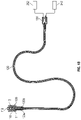
  • FIGS. 1, 1A and 1B are a perspective view of a medication delivery system 100 and a cross-sectional view of a portion of the medication delivery system 100 , in accordance with various aspects of the present disclosure.
  • FIG. 2 is a perspective view of the medication delivery system of FIG. 1 with the priming trigger removed, in accordance with various aspects of the present disclosure.
  • FIG. 3 is a perspective view of the medication delivery system of FIG. 1 with the syringe actuated, in accordance with various aspects of the present disclosure.
  • FIG. 4 is a perspective view of the medication delivery system of FIG. 1 with the syringe actuated, in accordance with various aspects of the present disclosure.
  • FIG. 5 is an elevation view of a syringe with the syringe body hidden, in accordance with various aspects of the present disclosure.
  • FIG. 6 is an elevation view of the syringe of FIG. 5 with the syringe body hidden and the priming trigger removed, in accordance with various aspects of the present disclosure.
  • FIG. 7 is an elevation view of the syringe of FIG. 5 with the syringe body hidden and the priming mechanism actuated, in accordance with various aspects of the present disclosure.
  • FIG. 8 is an elevation view of the syringe of FIG. 5 with the syringe body hidden and the syringe actuated, in accordance with various aspects of the present disclosure.
  • the disclosed valve incorporates a valve element to direct flow for priming and dispensing medical fluids. Fluid can flow from the first flow path to a second flow path in a priming configuration and from a first flow path to a catheter flow path in a dispensing position. By controlling fluid flow through the valve, medication can be administered without dispensing excess medical fluids.
  • the disclosed valve overcomes several challenges discovered with respect to certain conventional medication delivery systems.
  • One challenge with certain conventional delivery systems is that systems may deliver excess medical fluid, such as saline, to patients. Because excess medical fluid may delay the delivery of medical fluids and may not be tolerated by fluid restricted patients, such as premature babies the use conventional medication delivery systems is undesirable.
  • valve as described herein that eliminates or substantially reduces delivering excess medical fluid to a patient.
  • the disclosed valve provides a valve element that permits dispensing medical fluids while minimizing excess fluid delivered to a patient.
  • FIGS. 1 and 1A are a perspective view of a medication delivery system 100 and a cross-sectional view of a portion of the medication delivery system 100 , in accordance with various aspects of the present disclosure.
  • the medication delivery system 100 delivers medication from the syringe 130 to the patient via a catheter 112 without delivering excess fluid, such as saline, used to prime the medication delivery system 100 .
  • a medication flow path within a dual lumen tubing 120 can be primed with saline to remove any air or trapped gasses within the medication flow path of the dual lumen tubing 120 .
  • Saline can be advanced from a proximal end 132 of the syringe 130 , through the medication flow path of the dual lumen tubing 120 and to the valve 110 .
  • the saline from the medication flow path 120 a of the dual lumen tubing 120 can be received by the medication flow path 111 of the valve 110 .
  • a valve element 113 can prevent saline from the medication flow path 111 from entering the patient catheter 112 and can instead direct the saline toward the return flow path 109 of the valve 110 to allow primed saline to be returned to the syringe 130 via the return flow path 120 b of the dual lumen tubing 120 .
  • FIG. 2 is a perspective view of the medication delivery system 100 of FIG. 1 with the priming trigger 180 removed, in accordance with various aspects of the present disclosure.
  • the syringe 130 advances medication within the medication flow path of the dual lumen tubing 120 to prime the medication flow path of the dual lumen tubing 120 .
  • the medication can be delivered to the patient via the catheter 112 proximal to the patient with less delay and without delivering the saline used to prime the medication flow path of the dual lumen tubing 120 .
  • the medication plunger within the syringe 130 can be advanced or otherwise displaced to introduce a volume of medication into the medication flow path of the dual lumen tubing 120 .
  • the medication plunger of the syringe 130 can be configured to be advanced or displaced a desired amount to dispense a volume of medication into the medication flow path of the dual lumen tubing 120 that is equivalent to the volume of the medication flow path of the dual lumen tubing 120 .
  • medication plunger of the syringe 130 can be advanced to fill the volume of the medication flow path of the dual lumen tubing 120 up to the valve element 113 to prime the medication for administration via the catheter 112 .
  • the priming of medication into the medication flow path of the dual lumen tubing 120 can be automated or otherwise simplified.
  • the medication plunger can be biased to be advanced to introduce medication into the medication flow path of the dual lumen tubing 120 .
  • the biasing member of the priming mechanism within the syringe 130 can be released by removing the priming trigger 180 .
  • the priming member can advance the medication plunger to prime the medication within the medication delivery system 100 .
  • the priming travel of the medication plunger can be stopped or limited by a priming stop 182 . By limiting the travel of the medication plunger during priming, a desired volume of medication can be introduced into the medication flow path of the dual lumen tubing 120 , for example, sufficient medication volume to fill the medication flow path of the dual lumen tubing 120 .
  • the saline previously primed through the dual lumen tubing 120 is displaced.
  • the displaced saline is directed by the valve element 113 through the return flow path 109 of the valve 110 and into the return flow path of the dual lumen tubing 120 .
  • Medical fluid from the return flow path of the dual lumen tubing 120 can be returned into the syringe 130 .
  • Returned medical fluid such as saline can be introduced into a return or saline chamber of the syringe 130 .
  • FIG. 3 is a perspective view of the medication delivery system 100 of FIG. 1 with the syringe 130 actuated, in accordance with various aspects of the present disclosure.
  • the syringe 130 is actuated to dispense medication to the patient through the catheter 112 .
  • the distal end 134 of the syringe 130 can be advanced toward the proximal end 132 of the syringe 130 to actuate the medication plunger within the syringe 130 .
  • the medication plunger can be advanced to deliver medication from the syringe 130 into the medication flow path of the dual lumen tubing 120 .
  • the syringe 130 can be actuated by a syringe pump to control the flow of medication to the patient.
  • the valve 110 is actuated to permit the flow of medication from the medication flow path 111 of the valve 110 to the patient via the catheter 112 .
  • the valve element 113 is actuated to permit fluid communication between the medication flow path 111 and the catheter 112 to allow medication to flow to the patient (as shown in FIG. 1B ).
  • the valve 110 can be located proximal to the patient to minimize the length of the catheter 112 , reduce the amount of saline administered to the patient, and reduce the delivery time for the medication.
  • the position of the valve element 113 can be actuated between directing flow between the medication flow path 111 and the return flow path 109 (priming position, FIG. 1A ) and directing flow between the medication flow path 111 and the catheter 112 (dispensing position, FIG. 1B ) by physically manipulating the valve 110 .
  • the valve 110 can be actuated or manipulated to actuate the valve element 113 by twisting, pushing, displacing, or otherwise actuating the valve 110 .
  • the valve element 113 can be actuated by pressure signals or impulses received by the valve element 113 from within the medication flow path 111 and/or the return flow path 109 .
  • the valve element 113 can be actuated from a priming position to a dispensing position by receiving a pressure impulse in the medication flow path 111 and/or the return flow path 109 .
  • the valve 110 can be an anti-siphon valve.
  • the valve 110 may have a high “cracking pressure” wherein if sufficient pressure is applied to the valve element 113 , the valve element 113 can move from a priming position to the dispensing position.
  • the valve element 113 can be actuated from a priming position to a dispensing position by receiving an equalized pressure in both the medication flow path 111 and the return flow path 109 .
  • the syringe 130 may provide a suitable pressure signal.
  • FIG. 4 is a perspective view of the medication delivery system 100 of FIG. 1 with the syringe 130 actuated, in accordance with various aspects of the present disclosure.
  • the syringe 130 advances saline through the medication flow path of the dual lumen tubing 120 to advance the remaining medication to the patient via the catheter 112 .
  • medication may remain in the volume of the medication flow path of the dual lumen tubing 120 .
  • the syringe 130 can be utilized to administer a saline “push” to continue to advance the medication through the medication flow path of the dual lumen tubing 120 after the medication within the syringe 130 is exhausted.
  • saline can be administered through the medication flow path until the medication is fully administered to the patient.
  • FIG. 5 is an elevation view of a syringe 230 with the syringe body hidden, in accordance with various aspects of the present disclosure.
  • the syringe 230 can be utilized to dispense medication and/or saline through a tubing coupled to the syringe port 229 of the syringe 230 .
  • the syringe 230 can receive, store, and/or dispense medication and/or saline in chambers defined therein.
  • the proximal syringe portion 231 of the syringe 230 can store medical fluids such as medication and saline in a syringe cavity 236 .
  • the medication plunger 240 is movable within the syringe cavity 236 to define a medication chamber 242 within the proximal syringe portion 231 .
  • the volume of the medication chamber 242 is defined by the position of the medication plunger 240 relative to the proximal end 232 of the syringe 230 .
  • the medication chamber 242 can store medication.
  • the medication chamber 242 is in fluid communication with the syringe port 229 of the syringe 230 .
  • the medication plunger 240 can include one or more seals 244 to seal against the walls of the syringe cavity 236 to prevent unintended fluid migration or mixing.
  • the medication plunger 240 can be moved by the medication plunger shaft 246 .
  • the medication plunger 240 can be drawn distally to expand the medication chamber 242 and draw in more medication or medical fluid through the syringe port 229 .
  • the medication plunger 240 can be advanced proximally to contract the medication chamber 242 and expel medication or medical fluid from the medication chamber 242 through the syringe port 229 .
  • the saline plunger 250 is movable within the syringe cavity 236 to define a saline chamber 252 within the proximal syringe portion 231 .
  • the saline plunger 250 and the medication plunger 240 cooperatively define the saline chamber 252 within the syringe cavity 236 .
  • the volume of the saline chamber 252 is defined by the position of the medication plunger 240 and the saline plunger 250 .
  • the saline chamber 252 can store saline or other medical fluids.
  • the saline plunger 250 can include one or more seals 254 to seal against the walls of the syringe cavity 236 to prevent unintended fluid migration or mixing.
  • the saline plunger 250 can be moved by the saline plunger shaft 256 .
  • the saline plunger 250 can be drawn distally to expand the saline chamber 252 and draw in more saline or medical fluid.
  • the saline plunger 250 can be advanced proximally to contract the saline chamber 252 and expel saline or medical fluid from the saline chamber 252 .
  • medication can be dispensed from the medication chamber 242 and then saline can be dispensed from the saline chamber 252 to advance the medication remaining in the tubing.
  • medication can be dispensed from the syringe 230 by advancing the medication plunger 240 within the syringe cavity 236 .
  • medication can be delivered from the syringe 230 through the syringe port 229 .
  • the syringe 230 can include a priming mechanism or actuation mechanism 270 to automate, control, or otherwise simplify advancement of the medication plunger 240 to facilitate the priming of medication into an IV tubing.
  • the actuation mechanism 270 can be configured to introduce a sufficient volume of medication from the medication chamber 242 into the IV tubing to fully fill or prime the IV line prior to administration of the medication to the patient.
  • the actuation mechanism 270 can utilize a biasing member such as a tension spring 274 to advance the medication plunger 240 within the syringe cavity 236 .
  • the tension spring 274 can be coupled to the proximal syringe portion 231 at the proximal end 276 of the tension spring 274 and coupled to the actuation mechanism 270 at the distal end 275 of the tension spring 274 .
  • the actuation mechanism 270 extends from, or is generally coupled to the medication plunger shaft 246 .
  • the tension spring 274 can be disposed around the medication plunger shaft 246 .
  • the tension spring 274 can be preloaded or biased to facilitate advancement of the medication plunger 240 upon release or activation of the tension spring 274 .
  • the tension spring 274 can be extended or biased from a resting length to an elongated tensioned length.
  • a biasing member can be compressed from a resting length to a shortened compressed length.
  • the tension spring 274 can be preloaded or elongated by retracting the actuation mechanism 270 , which extends the tension spring 274 .
  • the actuation mechanism 270 can be locked or retained in place, preventing the medication plunger 240 from being advanced prior to priming by a retention mechanism.
  • the retention mechanism includes a priming trigger 280 with a shaft 282 that extends through the distal syringe portion 233 and through the through hole 272 of the actuation mechanism 270 , releasably coupling the actuation mechanism 270 to the distal syringe portion 233 .
  • the priming trigger 280 can extend through slot 284 of the distal syringe portion 233 .
  • the tension applied to the tension spring 274 can be adjusted by altering the position of the actuation mechanism 270 relative to the distal syringe portion 233 and inserting the priming trigger 280 through a slot 284 aligned with the through hole 272 of the actuation mechanism 270 .
  • FIG. 6 is an elevation view of the syringe 230 of FIG. 5 with the syringe body hidden and the priming trigger 280 removed, in accordance with various aspects of the present disclosure.
  • the priming mechanism of the syringe 230 can be activated by removing the priming trigger 280 from the syringe 230 .
  • the tension spring 274 is allowed to contract to advance the medication plunger shaft 246 and in turn, the medication plunger 240 .
  • medication within the medication chamber 242 can advance through the IV tubing and prime the IV tubing.
  • the medication plunger 240 can be advanced by a desired or predetermined amount corresponding to the IV tubing volume during the priming process.
  • FIG. 7 is an elevation view of the syringe 230 of FIG. 5 with the syringe body hidden and the priming mechanism actuated, in accordance with various aspects of the present disclosure.
  • the medication plunger 240 can be further actuated to administer any remaining medication in the medication chamber 242 into the IV tubing and to the patient.
  • the medication plunger shaft 246 can be actuated to advance the medication plunger 240 .
  • the distal end 234 of the distal syringe portion 233 can be advanced toward the proximal end 232 to advance the medication plunger 240 .
  • the extensions 238 of the proximal syringe portion 231 can allow a clinician or a syringe pump to advance the distal syringe portion 233 relative to the proximal syringe portion 231 .
  • FIG. 8 is an elevation view of the syringe 230 of FIG. 5 with the syringe body hidden and the syringe actuated, in accordance with various aspects of the present disclosure.
  • the saline plunger 250 can be actuated to administer saline from the saline chamber 252 into the IV tubing to “push” or deliver any remaining medication in the IV tubing to the patient.
  • the saline plunger shaft 256 can be actuated to advance the saline plunger 250 .
  • the same actuation method for the medication plunger 240 can be utilized for actuating the saline plunger 250 .
  • the distal end 234 of the distal syringe portion 233 can be advanced toward the proximal end 232 to advance the saline plunger 250 .
  • the extensions 238 of the proximal syringe portion 231 can allow a clinician or a syringe pump to advance the distal syringe portion 233 relative to the proximal syringe portion 231 .
  • saline from the saline chamber 252 can be advanced through or around the medication chamber 242 to exit the syringe 230 via the syringe port 229 .
  • a phrase such as an “aspect” does not imply that such aspect is essential to the subject technology or that such aspect applies to all configurations of the subject technology.
  • a disclosure relating to an aspect may apply to all configurations, or one or more configurations.
  • An aspect may provide one or more examples.
  • a phrase such as an aspect may refer to one or more aspects and vice versa.
  • a phrase such as an “embodiment” does not imply that such embodiment is essential to the subject technology or that such embodiment applies to all configurations of the subject technology.
  • a disclosure relating to an embodiment may apply to all embodiments, or one or more embodiments.
  • An embodiment may provide one or more examples.
  • a phrase such an embodiment may refer to one or more embodiments and vice versa.
  • a phrase such as a “configuration” does not imply that such configuration is essential to the subject technology or that such configuration applies to all configurations of the subject technology.
  • a disclosure relating to a configuration may apply to all configurations, or one or more configurations.
  • a configuration may provide one or more examples.
  • a phrase such a configuration may refer to one or more configurations and vice versa.
  • Coupled may refer to being directly coupled. In another aspect, the term “coupled” or the like may refer to being indirectly coupled.
  • top should be understood as referring to an arbitrary frame of reference, rather than to the ordinary gravitational frame of reference.
  • a top surface, a bottom surface, a front surface, and a rear surface may extend upwardly, downwardly, diagonally, or horizontally in a gravitational frame of reference.

Landscapes

  • Health & Medical Sciences (AREA)
  • Heart & Thoracic Surgery (AREA)
  • Animal Behavior & Ethology (AREA)
  • General Health & Medical Sciences (AREA)
  • Anesthesiology (AREA)
  • Biomedical Technology (AREA)
  • Hematology (AREA)
  • Life Sciences & Earth Sciences (AREA)
  • Veterinary Medicine (AREA)
  • Engineering & Computer Science (AREA)
  • Public Health (AREA)
  • Vascular Medicine (AREA)
  • Pulmonology (AREA)
  • Physics & Mathematics (AREA)
  • Fluid Mechanics (AREA)
  • Infusion, Injection, And Reservoir Apparatuses (AREA)

Abstract

Valves and medication delivery systems including valves are described herein. A valve includes a valve body and a valve element. The valve body defines a first flow path, a second flow path, and a catheter flow path. The valve element is disposed within the valve body, wherein the valve element is configured to permit fluid communication between the first flow path and the second flow path in a priming position, and is configured to permit fluid communication between the first flow path and the catheter flow path in a dispensing position.

Description

FIELD OF THE INVENTION
The present disclosure generally relates to medication delivery systems, and, in particular, to valves.
BACKGROUND
Medical treatments often include the infusion of a medical fluid (e.g., a saline solution or a liquid medication) to patients using an intravenous (IV) catheter that is connected though an arrangement of flexible tubing and fittings, commonly referred to as an “IV set,” to a source of fluid, for example, a syringe. Certain configurations of IV sets may have extended lengths of tubing, for example, in excess of 6 feet. Additionally, tubing may be primed with saline prior to the infusion of a liquid medication.
In some applications, during the use of IV catheters, saline from the priming process may be delivered to patient before the liquid medication is delivered to the patient.
SUMMARY
The disclosed subject matter relates to valve. In certain embodiments, a valve is disclosed that comprises a valve body defining a first flow path, a second flow path, and a catheter flow path; and a valve element disposed within the valve body, wherein the valve element is configured to permit fluid communication between the first flow path and the second flow path in a priming position, and is configured to permit fluid communication between the first flow path and the catheter flow path in a dispensing position.
In certain embodiments, a medication delivery system is disclosed that comprises a syringe, comprising: a syringe body defining a syringe cavity; a first plunger disposed within the syringe cavity and defining a first chamber in the syringe cavity; a second plunger disposed within the syringe cavity, the second plunger defining a second chamber in the syringe cavity; and a valve, comprising: a valve body defining a first valve flow path in fluid communication with the first chamber, a second valve flow path in fluid communication with the second chamber, and a catheter flow path in fluid communication with a catheter; and a valve element disposed within the valve body, wherein the valve element is configured to permit fluid communication between the first chamber and the second chamber in a priming position, and is configured to permit fluid communication between the first chamber and the catheter flow path in a dispensing position.
In certain embodiments, a method to deliver medication is disclosed that comprises introducing saline into a medication flow path; and directing saline from the medication flow path to a return flow path via a valve element; and introducing medication into the medication flow path; actuating the valve element to permit fluid communication between the medication flow path and a catheter; and directing medication from the medication flow path into the catheter.
It is understood that various configurations of the subject technology will become readily apparent to those skilled in the art from the disclosure, wherein various configurations of the subject technology are shown and described by way of illustration. As will be realized, the subject technology is capable of other and different configurations and its several details are capable of modification in various other respects, all without departing from the scope of the subject technology. Accordingly, the summary, drawings and detailed description are to be regarded as illustrative in nature and not as restrictive.
BRIEF DESCRIPTION OF THE DRAWINGS
The accompanying drawings, which are included to provide further understanding and are incorporated in and constitute a part of this specification, illustrate disclosed embodiments and together with the description serve to explain the principles of the disclosed embodiments. In the drawings:
FIGS. 1, 1A and 1B are a perspective view of a medication delivery system 100 and a cross-sectional view of a portion of the medication delivery system 100, in accordance with various aspects of the present disclosure.
FIG. 2 is a perspective view of the medication delivery system of FIG. 1 with the priming trigger removed, in accordance with various aspects of the present disclosure.
FIG. 3 is a perspective view of the medication delivery system of FIG. 1 with the syringe actuated, in accordance with various aspects of the present disclosure.
FIG. 4 is a perspective view of the medication delivery system of FIG. 1 with the syringe actuated, in accordance with various aspects of the present disclosure.
FIG. 5 is an elevation view of a syringe with the syringe body hidden, in accordance with various aspects of the present disclosure.
FIG. 6 is an elevation view of the syringe of FIG. 5 with the syringe body hidden and the priming trigger removed, in accordance with various aspects of the present disclosure.
FIG. 7 is an elevation view of the syringe of FIG. 5 with the syringe body hidden and the priming mechanism actuated, in accordance with various aspects of the present disclosure.
FIG. 8 is an elevation view of the syringe of FIG. 5 with the syringe body hidden and the syringe actuated, in accordance with various aspects of the present disclosure.
DETAILED DESCRIPTION
The disclosed valve incorporates a valve element to direct flow for priming and dispensing medical fluids. Fluid can flow from the first flow path to a second flow path in a priming configuration and from a first flow path to a catheter flow path in a dispensing position. By controlling fluid flow through the valve, medication can be administered without dispensing excess medical fluids.
The detailed description set forth below is intended as a description of various configurations of the subject technology and is not intended to represent the only configurations in which the subject technology may be practiced. The detailed description includes specific details for the purpose of providing a thorough understanding of the subject technology. However, it will be apparent to those skilled in the art that the subject technology may be practiced without these specific details. In some instances, well-known structures and components are shown in block diagram form in order to avoid obscuring the concepts of the subject technology. Like components are labeled with identical element numbers for ease of understanding. Reference numbers may have letter suffixes appended to indicate separate instances of a common element while being referred to generically by the same number without a suffix letter.
While the following description is directed to the administration of medical fluid using the disclosed valve, it is to be understood that this description is only an example of usage and does not limit the scope of the claims. Various aspects of the disclosed valve may be used in any application where it is desirable to control the flow of medical fluids.
The disclosed valve overcomes several challenges discovered with respect to certain conventional medication delivery systems. One challenge with certain conventional delivery systems is that systems may deliver excess medical fluid, such as saline, to patients. Because excess medical fluid may delay the delivery of medical fluids and may not be tolerated by fluid restricted patients, such as premature babies the use conventional medication delivery systems is undesirable.
Therefore, in accordance with the present disclosure, it is advantageous to provide a valve as described herein that eliminates or substantially reduces delivering excess medical fluid to a patient. The disclosed valve provides a valve element that permits dispensing medical fluids while minimizing excess fluid delivered to a patient.
An example of a valve that prevents delivery of excess medical fluid is now described.
FIGS. 1 and 1A are a perspective view of a medication delivery system 100 and a cross-sectional view of a portion of the medication delivery system 100, in accordance with various aspects of the present disclosure. In the illustrated example, the medication delivery system 100 delivers medication from the syringe 130 to the patient via a catheter 112 without delivering excess fluid, such as saline, used to prime the medication delivery system 100.
In some embodiments, a medication flow path within a dual lumen tubing 120 can be primed with saline to remove any air or trapped gasses within the medication flow path of the dual lumen tubing 120. Saline can be advanced from a proximal end 132 of the syringe 130, through the medication flow path of the dual lumen tubing 120 and to the valve 110.
The saline from the medication flow path 120 a of the dual lumen tubing 120 can be received by the medication flow path 111 of the valve 110. As shown in FIG. 1A in a priming configuration, a valve element 113 can prevent saline from the medication flow path 111 from entering the patient catheter 112 and can instead direct the saline toward the return flow path 109 of the valve 110 to allow primed saline to be returned to the syringe 130 via the return flow path 120 b of the dual lumen tubing 120.
FIG. 2 is a perspective view of the medication delivery system 100 of FIG. 1 with the priming trigger 180 removed, in accordance with various aspects of the present disclosure. In the illustrated example, the syringe 130 advances medication within the medication flow path of the dual lumen tubing 120 to prime the medication flow path of the dual lumen tubing 120. Advantageously, by priming the medication flow path with medication, the medication can be delivered to the patient via the catheter 112 proximal to the patient with less delay and without delivering the saline used to prime the medication flow path of the dual lumen tubing 120.
To introduce medication into the medication flow path of the dual lumen tubing 120, the medication plunger within the syringe 130 can be advanced or otherwise displaced to introduce a volume of medication into the medication flow path of the dual lumen tubing 120. Optionally, the medication plunger of the syringe 130 can be configured to be advanced or displaced a desired amount to dispense a volume of medication into the medication flow path of the dual lumen tubing 120 that is equivalent to the volume of the medication flow path of the dual lumen tubing 120. In other words, medication plunger of the syringe 130 can be advanced to fill the volume of the medication flow path of the dual lumen tubing 120 up to the valve element 113 to prime the medication for administration via the catheter 112.
In some embodiments, the priming of medication into the medication flow path of the dual lumen tubing 120 can be automated or otherwise simplified. For example, the medication plunger can be biased to be advanced to introduce medication into the medication flow path of the dual lumen tubing 120. The biasing member of the priming mechanism within the syringe 130 can be released by removing the priming trigger 180. By removing the priming trigger 180, the biasing member can advance the medication plunger to prime the medication within the medication delivery system 100. Optionally, the priming travel of the medication plunger can be stopped or limited by a priming stop 182. By limiting the travel of the medication plunger during priming, a desired volume of medication can be introduced into the medication flow path of the dual lumen tubing 120, for example, sufficient medication volume to fill the medication flow path of the dual lumen tubing 120.
As illustrated, as the medication is introduced into the medication flow path of the dual lumen tubing 120, the saline previously primed through the dual lumen tubing 120 is displaced. The displaced saline is directed by the valve element 113 through the return flow path 109 of the valve 110 and into the return flow path of the dual lumen tubing 120.
Medical fluid from the return flow path of the dual lumen tubing 120 can be returned into the syringe 130. Returned medical fluid such as saline can be introduced into a return or saline chamber of the syringe 130.
FIG. 3 is a perspective view of the medication delivery system 100 of FIG. 1 with the syringe 130 actuated, in accordance with various aspects of the present disclosure. In the illustrated example, the syringe 130 is actuated to dispense medication to the patient through the catheter 112.
As illustrated, the distal end 134 of the syringe 130 can be advanced toward the proximal end 132 of the syringe 130 to actuate the medication plunger within the syringe 130. By actuating the syringe 130, the medication plunger can be advanced to deliver medication from the syringe 130 into the medication flow path of the dual lumen tubing 120. In some embodiments, the syringe 130 can be actuated by a syringe pump to control the flow of medication to the patient.
During operation, the valve 110 is actuated to permit the flow of medication from the medication flow path 111 of the valve 110 to the patient via the catheter 112. In some embodiments, the valve element 113 is actuated to permit fluid communication between the medication flow path 111 and the catheter 112 to allow medication to flow to the patient (as shown in FIG. 1B). Optionally, the valve 110 can be located proximal to the patient to minimize the length of the catheter 112, reduce the amount of saline administered to the patient, and reduce the delivery time for the medication.
In some embodiments, the position of the valve element 113 can be actuated between directing flow between the medication flow path 111 and the return flow path 109 (priming position, FIG. 1A) and directing flow between the medication flow path 111 and the catheter 112 (dispensing position, FIG. 1B) by physically manipulating the valve 110. For example, the valve 110 can be actuated or manipulated to actuate the valve element 113 by twisting, pushing, displacing, or otherwise actuating the valve 110. In some embodiments, the valve element 113 can be actuated by pressure signals or impulses received by the valve element 113 from within the medication flow path 111 and/or the return flow path 109. For example, the valve element 113 can be actuated from a priming position to a dispensing position by receiving a pressure impulse in the medication flow path 111 and/or the return flow path 109.
In some embodiments, the valve 110 can be an anti-siphon valve. Optionally, the valve 110 may have a high “cracking pressure” wherein if sufficient pressure is applied to the valve element 113, the valve element 113 can move from a priming position to the dispensing position. For example, the valve element 113 can be actuated from a priming position to a dispensing position by receiving an equalized pressure in both the medication flow path 111 and the return flow path 109. The syringe 130 may provide a suitable pressure signal.
FIG. 4 is a perspective view of the medication delivery system 100 of FIG. 1 with the syringe 130 actuated, in accordance with various aspects of the present disclosure. In the illustrated example, the syringe 130 advances saline through the medication flow path of the dual lumen tubing 120 to advance the remaining medication to the patient via the catheter 112.
As illustrated, after the medication is expelled from the syringe 130, medication may remain in the volume of the medication flow path of the dual lumen tubing 120. To ensure that the medication is fully delivered to the patient, the syringe 130 can be utilized to administer a saline “push” to continue to advance the medication through the medication flow path of the dual lumen tubing 120 after the medication within the syringe 130 is exhausted. Optionally, saline can be administered through the medication flow path until the medication is fully administered to the patient.
FIG. 5 is an elevation view of a syringe 230 with the syringe body hidden, in accordance with various aspects of the present disclosure. In the figures, similar features may be referred to with similar reference numerals. In the depicted example, the syringe 230 can be utilized to dispense medication and/or saline through a tubing coupled to the syringe port 229 of the syringe 230. As illustrated, the syringe 230 can receive, store, and/or dispense medication and/or saline in chambers defined therein.
As illustrated, the proximal syringe portion 231 of the syringe 230 can store medical fluids such as medication and saline in a syringe cavity 236. In the illustrated embodiment, the medication plunger 240 is movable within the syringe cavity 236 to define a medication chamber 242 within the proximal syringe portion 231. Optionally, the volume of the medication chamber 242 is defined by the position of the medication plunger 240 relative to the proximal end 232 of the syringe 230. In the depicted example, the medication chamber 242 can store medication.
In some embodiments, the medication chamber 242 is in fluid communication with the syringe port 229 of the syringe 230. Optionally, the medication plunger 240 can include one or more seals 244 to seal against the walls of the syringe cavity 236 to prevent unintended fluid migration or mixing.
Further, the medication plunger 240 can be moved by the medication plunger shaft 246. In some embodiments, the medication plunger 240 can be drawn distally to expand the medication chamber 242 and draw in more medication or medical fluid through the syringe port 229. In some embodiments, the medication plunger 240 can be advanced proximally to contract the medication chamber 242 and expel medication or medical fluid from the medication chamber 242 through the syringe port 229.
In the illustrated embodiment, the saline plunger 250 is movable within the syringe cavity 236 to define a saline chamber 252 within the proximal syringe portion 231. In some embodiments, the saline plunger 250 and the medication plunger 240 cooperatively define the saline chamber 252 within the syringe cavity 236. Optionally, the volume of the saline chamber 252 is defined by the position of the medication plunger 240 and the saline plunger 250. In the depicted example, the saline chamber 252 can store saline or other medical fluids.
Optionally, the saline plunger 250 can include one or more seals 254 to seal against the walls of the syringe cavity 236 to prevent unintended fluid migration or mixing.
Further, the saline plunger 250 can be moved by the saline plunger shaft 256. In some embodiments, the saline plunger 250 can be drawn distally to expand the saline chamber 252 and draw in more saline or medical fluid. In some embodiments, the saline plunger 250 can be advanced proximally to contract the saline chamber 252 and expel saline or medical fluid from the saline chamber 252.
As previously described, during the administration of medication to patients, for example, fluid restricted patients, medication can be dispensed from the medication chamber 242 and then saline can be dispensed from the saline chamber 252 to advance the medication remaining in the tubing.
In the depicted example, medication can be dispensed from the syringe 230 by advancing the medication plunger 240 within the syringe cavity 236. As a result, medication can be delivered from the syringe 230 through the syringe port 229.
In some embodiments, the syringe 230 can include a priming mechanism or actuation mechanism 270 to automate, control, or otherwise simplify advancement of the medication plunger 240 to facilitate the priming of medication into an IV tubing. Optionally, the actuation mechanism 270 can be configured to introduce a sufficient volume of medication from the medication chamber 242 into the IV tubing to fully fill or prime the IV line prior to administration of the medication to the patient.
In the illustrated embodiment, the actuation mechanism 270 can utilize a biasing member such as a tension spring 274 to advance the medication plunger 240 within the syringe cavity 236.
Optionally, the tension spring 274 can be coupled to the proximal syringe portion 231 at the proximal end 276 of the tension spring 274 and coupled to the actuation mechanism 270 at the distal end 275 of the tension spring 274. In some embodiments, the actuation mechanism 270 extends from, or is generally coupled to the medication plunger shaft 246. Further, the tension spring 274 can be disposed around the medication plunger shaft 246.
As illustrated, the tension spring 274 can be preloaded or biased to facilitate advancement of the medication plunger 240 upon release or activation of the tension spring 274. In the depicted example, the tension spring 274 can be extended or biased from a resting length to an elongated tensioned length. In some embodiments, a biasing member can be compressed from a resting length to a shortened compressed length.
As illustrated, the tension spring 274 can be preloaded or elongated by retracting the actuation mechanism 270, which extends the tension spring 274. In some embodiments, the actuation mechanism 270 can be locked or retained in place, preventing the medication plunger 240 from being advanced prior to priming by a retention mechanism. In the illustrated embodiment, the retention mechanism includes a priming trigger 280 with a shaft 282 that extends through the distal syringe portion 233 and through the through hole 272 of the actuation mechanism 270, releasably coupling the actuation mechanism 270 to the distal syringe portion 233. The priming trigger 280 can extend through slot 284 of the distal syringe portion 233.
Optionally, the tension applied to the tension spring 274 can be adjusted by altering the position of the actuation mechanism 270 relative to the distal syringe portion 233 and inserting the priming trigger 280 through a slot 284 aligned with the through hole 272 of the actuation mechanism 270.
FIG. 6 is an elevation view of the syringe 230 of FIG. 5 with the syringe body hidden and the priming trigger 280 removed, in accordance with various aspects of the present disclosure. As illustrated, the priming mechanism of the syringe 230 can be activated by removing the priming trigger 280 from the syringe 230.
By removing the priming trigger 280, the tension spring 274 is allowed to contract to advance the medication plunger shaft 246 and in turn, the medication plunger 240. By advancing the medication plunger 240, medication within the medication chamber 242 can advance through the IV tubing and prime the IV tubing. As described herein, the medication plunger 240 can be advanced by a desired or predetermined amount corresponding to the IV tubing volume during the priming process.
FIG. 7 is an elevation view of the syringe 230 of FIG. 5 with the syringe body hidden and the priming mechanism actuated, in accordance with various aspects of the present disclosure. In the illustrated embodiment, the medication plunger 240 can be further actuated to administer any remaining medication in the medication chamber 242 into the IV tubing and to the patient. In some embodiments, the medication plunger shaft 246 can be actuated to advance the medication plunger 240. For example, the distal end 234 of the distal syringe portion 233 can be advanced toward the proximal end 232 to advance the medication plunger 240. In some embodiments, the extensions 238 of the proximal syringe portion 231 can allow a clinician or a syringe pump to advance the distal syringe portion 233 relative to the proximal syringe portion 231.
FIG. 8 is an elevation view of the syringe 230 of FIG. 5 with the syringe body hidden and the syringe actuated, in accordance with various aspects of the present disclosure. In the illustrated embodiment, the saline plunger 250 can be actuated to administer saline from the saline chamber 252 into the IV tubing to “push” or deliver any remaining medication in the IV tubing to the patient. In some embodiments, the saline plunger shaft 256 can be actuated to advance the saline plunger 250. In some embodiments, the same actuation method for the medication plunger 240 can be utilized for actuating the saline plunger 250.
For example, the distal end 234 of the distal syringe portion 233 can be advanced toward the proximal end 232 to advance the saline plunger 250. In some embodiments, the extensions 238 of the proximal syringe portion 231 can allow a clinician or a syringe pump to advance the distal syringe portion 233 relative to the proximal syringe portion 231.
In some embodiments, saline from the saline chamber 252 can be advanced through or around the medication chamber 242 to exit the syringe 230 via the syringe port 229.
The present disclosure is provided to enable any person skilled in the art to practice the various aspects described herein. The disclosure provides various examples of the subject technology, and the subject technology is not limited to these examples. Various modifications to these aspects will be readily apparent to those skilled in the art, and the generic principles defined herein may be applied to other aspects.
A reference to an element in the singular is not intended to mean “one and only one” unless specifically so stated, but rather “one or more.” Unless specifically stated otherwise, the term “some” refers to one or more. Pronouns in the masculine (e.g., his) include the feminine and neuter gender (e.g., her and its) and vice versa. Headings and subheadings, if any, are used for convenience only and do not limit the invention.
The word “exemplary” is used herein to mean “serving as an example or illustration.” Any aspect or design described herein as “exemplary” is not necessarily to be construed as preferred or advantageous over other aspects or designs. In one aspect, various alternative configurations and operations described herein may be considered to be at least equivalent.
A phrase such as an “aspect” does not imply that such aspect is essential to the subject technology or that such aspect applies to all configurations of the subject technology. A disclosure relating to an aspect may apply to all configurations, or one or more configurations. An aspect may provide one or more examples. A phrase such as an aspect may refer to one or more aspects and vice versa. A phrase such as an “embodiment” does not imply that such embodiment is essential to the subject technology or that such embodiment applies to all configurations of the subject technology. A disclosure relating to an embodiment may apply to all embodiments, or one or more embodiments. An embodiment may provide one or more examples. A phrase such an embodiment may refer to one or more embodiments and vice versa. A phrase such as a “configuration” does not imply that such configuration is essential to the subject technology or that such configuration applies to all configurations of the subject technology. A disclosure relating to a configuration may apply to all configurations, or one or more configurations. A configuration may provide one or more examples. A phrase such a configuration may refer to one or more configurations and vice versa.
In one aspect, unless otherwise stated, all measurements, values, ratings, positions, magnitudes, sizes, and other specifications that are set forth in this specification, including in the claims that follow, are approximate, not exact. In one aspect, they are intended to have a reasonable range that is consistent with the functions to which they relate and with what is customary in the art to which they pertain.
In one aspect, the term “coupled” or the like may refer to being directly coupled. In another aspect, the term “coupled” or the like may refer to being indirectly coupled.
Terms such as “top,” “bottom,” “front,” “rear” and the like if used in this disclosure should be understood as referring to an arbitrary frame of reference, rather than to the ordinary gravitational frame of reference. Thus, a top surface, a bottom surface, a front surface, and a rear surface may extend upwardly, downwardly, diagonally, or horizontally in a gravitational frame of reference.
Various items may be arranged differently (e.g., arranged in a different order, or partitioned in a different way) all without departing from the scope of the subject technology. All structural and functional equivalents to the elements of the various aspects described throughout this disclosure that are known or later come to be known to those of ordinary skill in the art are expressly incorporated herein by reference and are intended to be encompassed by the claims. Moreover, nothing disclosed herein is intended to be dedicated to the public regardless of whether such disclosure is explicitly recited in the claims. No claim element is to be construed under the provisions of 35 U.S.C. § 112, sixth paragraph, unless the element is expressly recited using the phrase “means for” or, in the case of a method claim, the element is recited using the phrase “step for.” Furthermore, to the extent that the term “include,” “have,” or the like is used, such term is intended to be inclusive in a manner similar to the term “comprise” as “comprise” is interpreted when employed as a transitional word in a claim.
The Title, Background, Summary, Brief Description of the Drawings and Abstract of the disclosure are hereby incorporated into the disclosure and are provided as illustrative examples of the disclosure, not as restrictive descriptions. It is submitted with the understanding that they will not be used to limit the scope or meaning of the claims. In addition, in the Detailed Description, it can be seen that the description provides illustrative examples and the various features are grouped together in various embodiments for the purpose of streamlining the disclosure. This method of disclosure is not to be interpreted as reflecting an intention that the claimed subject matter requires more features than are expressly recited in each claim. Rather, as the following claims reflect, inventive subject matter lies in less than all features of a single disclosed configuration or operation. The following claims are hereby incorporated into the Detailed Description, with each claim standing on its own as a separately claimed subject matter.
The claims are not intended to be limited to the aspects described herein, but is to be accorded the full scope consistent with the language claims and to encompass all legal equivalents. Notwithstanding, none of the claims are intended to embrace subject matter that fails to satisfy the requirement of 35 U.S.C. § 101, 102, or 103, nor should they be interpreted in such a way.

Claims (10)

What is claimed is:
1. A standalone valve, comprising:
a valve body defining a first flow path, a second flow path, and a catheter flow path; and
a valve element disposed within the valve body, wherein the valve element is configured to permit fluid communication between the first flow path and the second flow path in a priming position, is configured to permit fluid communication between the first flow path and the catheter flow path in a dispensing position and the valve element is actuated to the dispensing position by pressurizing the first flow path and the second flow path to a first pressure,
wherein the standalone valve is configured to be coupled to a first end of a flexible tubing having a syringe coupled to a second end of the flexible tubing.
2. A medication delivery system, comprising:
a flexible tubing;
a syringe coupled to a first end of the flexible tubing, comprising:
a syringe body defining a syringe cavity;
a first plunger disposed within the syringe cavity and defining a first chamber in the syringe cavity; and
a second plunger disposed within the syringe cavity, the second plunger defining a second chamber in the syringe cavity; and
a valve coupled to a second end of the flexible tubing, comprising:
a valve body defining a first valve flow path in fluid communication with the first chamber, a second valve flow path in fluid communication with the second chamber, and a catheter flow path in fluid communication with a catheter; and
a valve element disposed within the valve body, wherein the valve element is configured to permit fluid communication between the first chamber and the second chamber in a priming position, and is configured to permit fluid communication between the first chamber and the catheter flow path in a dispensing position.
3. The medication delivery system of claim 2, wherein the flexible tubing is a dual lumen tubing defining a first tubing flow path and a second tubing flow path, wherein the first tubing flow path permits fluid communication between the first chamber and the first valve flow path and the second tubing flow path permits fluid communication between the second chamber and the second valve flow path.
4. The medication delivery system of claim 3, wherein the flexible tubing is longer than the catheter.
5. The medication delivery system of claim 2, wherein the valve element is actuated to the dispensing position by pressurizing the first chamber and the second chamber to a first pressure.
6. The medication delivery system of claim 2, wherein the valve element is actuated to the dispensing position by actuating a portion of the valve body.
7. The medication delivery system of claim 2, wherein the valve element is actuated to the dispensing position by receiving a pressure impulse from the first chamber.
8. The medication delivery system of claim 2, wherein the valve element is actuated to the dispensing position by receiving a pressure impulse from the second chamber.
9. A standalone valve, comprising:
a valve body defining a first flow path, a second flow path, and a catheter flow path; and
a valve element disposed within the valve body, wherein the valve element is configured to permit fluid communication between the first flow path and the second flow path in a priming position, is configured to permit fluid communication between the first flow path and the catheter flow path in a dispensing position, and the valve element is actuated to the dispensing position by receiving a pressure impulse in the first flow path,
wherein the standalone valve is configured to be coupled to a first end of a flexible tubing having a syringe coupled to a second end of the flexible tubing.
10. A standalone valve, comprising:
a valve body defining a first flow path, a second flow path, and a catheter flow path; and
a valve element disposed within the valve body, wherein the valve element is configured to permit fluid communication between the first flow path and the second flow path in a priming position, is configured to permit fluid communication between the first flow path and the catheter flow path in a dispensing position, and the valve element is actuated to the dispensing position by receiving a pressure impulse in the second flow path,
wherein the standalone valve is configured to be coupled to a first end of a flexible tubing having a syringe coupled to a second end of the flexible tubing.
US16/403,403 2019-05-03 2019-05-03 Medication delivery system with control valve Active 2040-01-13 US11357913B2 (en)

Priority Applications (8)

Application Number Priority Date Filing Date Title
US16/403,403 US11357913B2 (en) 2019-05-03 2019-05-03 Medication delivery system with control valve
AU2020269369A AU2020269369B2 (en) 2019-05-03 2020-05-01 Medication delivery system with control valve
EP20727096.8A EP3962553A1 (en) 2019-05-03 2020-05-01 Medication delivery system with control valve
CA3138749A CA3138749A1 (en) 2019-05-03 2020-05-01 Medication delivery system with control valve
PCT/US2020/031069 WO2020227111A1 (en) 2019-05-03 2020-05-01 Medication delivery system with control valve
JP2021565050A JP7626712B2 (en) 2019-05-03 2020-05-01 Drug delivery system with controlled valve
CN202080047119.8A CN114126685B (en) 2019-05-03 2020-05-01 Drug delivery system with control valve
US17/747,512 US20220273869A1 (en) 2019-05-03 2022-05-18 Medication delivery system with control valve

Applications Claiming Priority (1)

Application Number Priority Date Filing Date Title
US16/403,403 US11357913B2 (en) 2019-05-03 2019-05-03 Medication delivery system with control valve

Related Child Applications (1)

Application Number Title Priority Date Filing Date
US17/747,512 Division US20220273869A1 (en) 2019-05-03 2022-05-18 Medication delivery system with control valve

Publications (2)

Publication Number Publication Date
US20200345932A1 US20200345932A1 (en) 2020-11-05
US11357913B2 true US11357913B2 (en) 2022-06-14

Family

ID=70775577

Family Applications (2)

Application Number Title Priority Date Filing Date
US16/403,403 Active 2040-01-13 US11357913B2 (en) 2019-05-03 2019-05-03 Medication delivery system with control valve
US17/747,512 Pending US20220273869A1 (en) 2019-05-03 2022-05-18 Medication delivery system with control valve

Family Applications After (1)

Application Number Title Priority Date Filing Date
US17/747,512 Pending US20220273869A1 (en) 2019-05-03 2022-05-18 Medication delivery system with control valve

Country Status (7)

Country Link
US (2) US11357913B2 (en)
EP (1) EP3962553A1 (en)
JP (1) JP7626712B2 (en)
CN (1) CN114126685B (en)
AU (1) AU2020269369B2 (en)
CA (1) CA3138749A1 (en)
WO (1) WO2020227111A1 (en)

Citations (4)

* Cited by examiner, † Cited by third party
Publication number Priority date Publication date Assignee Title
US5439022A (en) * 1994-02-14 1995-08-08 Summers; Daniel A. Lavage valve
US20070088282A1 (en) 2005-10-03 2007-04-19 Joseph Ranalletta Apparatus, method and system for administration of IV liquid medication and IV flush solutions
US20080066810A1 (en) * 2006-09-07 2008-03-20 Casearea Medical Electronics, Ltd. Anti-siphon control valve
US20150250952A1 (en) 2012-10-15 2015-09-10 Elcam Medical Agricultural Cooperative Association Ltd. Multi-chamber syringe

Family Cites Families (15)

* Cited by examiner, † Cited by third party
Publication number Priority date Publication date Assignee Title
JP2580661Y2 (en) * 1993-09-10 1998-09-10 川澄化学工業株式会社 Kit for cleaning catheter
FR2848859B1 (en) * 2002-12-20 2005-11-04 Sedat DISPENSING DEVICE FOR A NETWORK FOR DELIVERING MEDICAL FLUIDS TO A PATIENT
JP4492916B2 (en) 2003-04-15 2010-06-30 テルモ株式会社 Syringe pump
US20080208137A1 (en) 2005-05-16 2008-08-28 Fago Frank M Multi-Stage Sryinge and Methods of Using the Same
US20080167621A1 (en) * 2005-05-16 2008-07-10 Wagner Gary S Multi-Barrel Syringe Having Integral Manifold
US7896859B2 (en) * 2005-10-20 2011-03-01 Tyco Healthcare Group Lp Enteral feeding set
CN103550836B (en) * 2005-11-21 2018-02-06 阿西斯特医疗系统有限公司 Medical fluid injection system
US9050401B2 (en) * 2010-05-19 2015-06-09 Angioadvancements, Llc System for controlled delivery of medical fluids
CN104394904A (en) * 2012-01-23 2015-03-04 十字技术有限公司 Methods and devices for autoflush syringes
WO2014122759A1 (en) 2013-02-07 2014-08-14 テルモ・クリニカルサプライ株式会社 Balloon catheter priming method
US9114215B2 (en) 2013-03-13 2015-08-25 Bayer Medical Care Inc. Multiple compartment syringe
JP6864838B2 (en) 2016-03-02 2021-04-28 ニプロ株式会社 Medical stopcock
JP6823672B2 (en) * 2016-06-15 2021-02-03 ホプキンズ、マイケル Syringe system and method for multi-stage fluid delivery
JP7181198B2 (en) 2017-06-29 2022-11-30 テルモ株式会社 diagnostic imaging catheter
WO2019009898A1 (en) 2017-07-06 2019-01-10 Avent, Inc. Priming system for infusion devices

Patent Citations (4)

* Cited by examiner, † Cited by third party
Publication number Priority date Publication date Assignee Title
US5439022A (en) * 1994-02-14 1995-08-08 Summers; Daniel A. Lavage valve
US20070088282A1 (en) 2005-10-03 2007-04-19 Joseph Ranalletta Apparatus, method and system for administration of IV liquid medication and IV flush solutions
US20080066810A1 (en) * 2006-09-07 2008-03-20 Casearea Medical Electronics, Ltd. Anti-siphon control valve
US20150250952A1 (en) 2012-10-15 2015-09-10 Elcam Medical Agricultural Cooperative Association Ltd. Multi-chamber syringe

Non-Patent Citations (1)

* Cited by examiner, † Cited by third party
Title
International Search Report and Written Opinion for Application No. PCT/US2020/031069, dated Jul. 29, 2020, 16 pages.

Also Published As

Publication number Publication date
EP3962553A1 (en) 2022-03-09
US20220273869A1 (en) 2022-09-01
CN114126685A (en) 2022-03-01
WO2020227111A1 (en) 2020-11-12
AU2020269369A1 (en) 2021-11-25
AU2020269369B2 (en) 2025-01-02
JP7626712B2 (en) 2025-02-04
CA3138749A1 (en) 2020-11-12
CN114126685B (en) 2024-11-12
JP2022531000A (en) 2022-07-05
US20200345932A1 (en) 2020-11-05

Similar Documents

Publication Publication Date Title
US20250170336A1 (en) Syringe with priming mechanism
US20220096753A1 (en) Syringe with priming indicator
US12168117B2 (en) Sequenced syringe assembly
US20220273869A1 (en) Medication delivery system with control valve
US12280242B2 (en) Multi-chamber syringe
CA3138299C (en) Syringe with priming indicator

Legal Events

Date Code Title Description
FEPP Fee payment procedure

Free format text: ENTITY STATUS SET TO UNDISCOUNTED (ORIGINAL EVENT CODE: BIG.); ENTITY STATUS OF PATENT OWNER: LARGE ENTITY

AS Assignment

Owner name: CAREFUSION 303, INC., CALIFORNIA

Free format text: ASSIGNMENT OF ASSIGNORS INTEREST;ASSIGNORS:ODA, TODD;MANSOUR, GEORGE;MASON, EUGENE;AND OTHERS;SIGNING DATES FROM 20200416 TO 20200428;REEL/FRAME:052543/0254

STPP Information on status: patent application and granting procedure in general

Free format text: NON FINAL ACTION MAILED

STPP Information on status: patent application and granting procedure in general

Free format text: RESPONSE TO NON-FINAL OFFICE ACTION ENTERED AND FORWARDED TO EXAMINER

STPP Information on status: patent application and granting procedure in general

Free format text: NON FINAL ACTION MAILED

STPP Information on status: patent application and granting procedure in general

Free format text: RESPONSE TO NON-FINAL OFFICE ACTION ENTERED AND FORWARDED TO EXAMINER

STPP Information on status: patent application and granting procedure in general

Free format text: FINAL REJECTION MAILED

STPP Information on status: patent application and granting procedure in general

Free format text: NOTICE OF ALLOWANCE MAILED -- APPLICATION RECEIVED IN OFFICE OF PUBLICATIONS

STPP Information on status: patent application and granting procedure in general

Free format text: PUBLICATIONS -- ISSUE FEE PAYMENT VERIFIED

STCF Information on status: patent grant

Free format text: PATENTED CASE

MAFP Maintenance fee payment

Free format text: PAYMENT OF MAINTENANCE FEE, 4TH YEAR, LARGE ENTITY (ORIGINAL EVENT CODE: M1551); ENTITY STATUS OF PATENT OWNER: LARGE ENTITY

Year of fee payment: 4