US11353461B2 - Methods of enhancing MS detection of tagged glycans - Google Patents
Methods of enhancing MS detection of tagged glycans Download PDFInfo
- Publication number
- US11353461B2 US11353461B2 US16/312,800 US201716312800A US11353461B2 US 11353461 B2 US11353461 B2 US 11353461B2 US 201716312800 A US201716312800 A US 201716312800A US 11353461 B2 US11353461 B2 US 11353461B2
- Authority
- US
- United States
- Prior art keywords
- glycan
- glycans
- compounds
- acid
- tagging
- Prior art date
- Legal status (The legal status is an assumption and is not a legal conclusion. Google has not performed a legal analysis and makes no representation as to the accuracy of the status listed.)
- Active, expires
Links
- 0 CN.[3*]C Chemical compound CN.[3*]C 0.000 description 44
- NCRGVLRJIMDNIW-UHFFFAOYSA-N C.CC(C)N(C)C.COC(C)C Chemical compound C.CC(C)N(C)C.COC(C)C NCRGVLRJIMDNIW-UHFFFAOYSA-N 0.000 description 4
- WRZKOALEDCMZNG-UHFFFAOYSA-N CC(C)N(C)C.COC(C)C Chemical compound CC(C)N(C)C.COC(C)C WRZKOALEDCMZNG-UHFFFAOYSA-N 0.000 description 3
- XMNGSPOWUCNRMO-UHFFFAOYSA-N CNC(=O)ON1C(=O)CCC1=O Chemical compound CNC(=O)ON1C(=O)CCC1=O XMNGSPOWUCNRMO-UHFFFAOYSA-N 0.000 description 3
- YKSNHWBWIZWIMF-UHFFFAOYSA-N CCCCCN(CC)CC.CN.c1ccccc1 Chemical compound CCCCCN(CC)CC.CN.c1ccccc1 YKSNHWBWIZWIMF-UHFFFAOYSA-N 0.000 description 2
- YGCUAEKLRSJIIA-UHFFFAOYSA-N CCCCCP(=O)(O)O.CN.c1ccc2ccccc2c1 Chemical compound CCCCCP(=O)(O)O.CN.c1ccc2ccccc2c1 YGCUAEKLRSJIIA-UHFFFAOYSA-N 0.000 description 2
- MERWBSBCSAQQSU-UHFFFAOYSA-N CCCCCP(=O)(O)O.CN.c1ccc2ncccc2c1 Chemical compound CCCCCP(=O)(O)O.CN.c1ccc2ncccc2c1 MERWBSBCSAQQSU-UHFFFAOYSA-N 0.000 description 2
- FZYQBBWMDMPTJI-UHFFFAOYSA-N CCCCCP(=O)(O)O.CN.c1ccccc1 Chemical compound CCCCCP(=O)(O)O.CN.c1ccccc1 FZYQBBWMDMPTJI-UHFFFAOYSA-N 0.000 description 2
- BIDWDJQZXFPKIP-UHFFFAOYSA-N CCCCCS(=O)(=O)O.CN.c1ccc2ccccc2c1 Chemical compound CCCCCS(=O)(=O)O.CN.c1ccc2ccccc2c1 BIDWDJQZXFPKIP-UHFFFAOYSA-N 0.000 description 2
- CDIHAYDXRLUZTE-UHFFFAOYSA-N CCCCCS(=O)(=O)O.CN.c1ccc2ncccc2c1 Chemical compound CCCCCS(=O)(=O)O.CN.c1ccc2ncccc2c1 CDIHAYDXRLUZTE-UHFFFAOYSA-N 0.000 description 2
- SUEIMDVPPBGRHQ-UHFFFAOYSA-N CCCCCS(=O)(=O)O.CN.c1ccccc1 Chemical compound CCCCCS(=O)(=O)O.CN.c1ccccc1 SUEIMDVPPBGRHQ-UHFFFAOYSA-N 0.000 description 2
- MWXINAOBTOZGNQ-UHFFFAOYSA-N CCCCNC(=N)N.CN.c1ccc2ccccc2c1 Chemical compound CCCCNC(=N)N.CN.c1ccc2ccccc2c1 MWXINAOBTOZGNQ-UHFFFAOYSA-N 0.000 description 2
- VHBCXSHIDYHIKO-UHFFFAOYSA-N CCCCNC(=N)N.CN.c1ccc2ncccc2c1 Chemical compound CCCCNC(=N)N.CN.c1ccc2ncccc2c1 VHBCXSHIDYHIKO-UHFFFAOYSA-N 0.000 description 2
- CJNOJWAOYKHAHL-UHFFFAOYSA-N CCCCNC(=N)N.CN.c1ccccc1 Chemical compound CCCCNC(=N)N.CN.c1ccccc1 CJNOJWAOYKHAHL-UHFFFAOYSA-N 0.000 description 2
- JXGDJACLSCOAOA-UHFFFAOYSA-N CCCCOP(=O)(O)O.CN.c1ccc2ccccc2c1 Chemical compound CCCCOP(=O)(O)O.CN.c1ccc2ccccc2c1 JXGDJACLSCOAOA-UHFFFAOYSA-N 0.000 description 2
- MZQMBINMEWZCID-UHFFFAOYSA-N CCCCOP(=O)(O)O.CN.c1ccc2ncccc2c1 Chemical compound CCCCOP(=O)(O)O.CN.c1ccc2ncccc2c1 MZQMBINMEWZCID-UHFFFAOYSA-N 0.000 description 2
- QRTNILXLDHUTSW-UHFFFAOYSA-N CCCCOP(=O)(O)O.CN.c1ccccc1 Chemical compound CCCCOP(=O)(O)O.CN.c1ccccc1 QRTNILXLDHUTSW-UHFFFAOYSA-N 0.000 description 2
- HREYBMGUISUQKE-UHFFFAOYSA-N CCN(CC)CCNC(=O)c1ccc2cc(N)ccc2n1 Chemical compound CCN(CC)CCNC(=O)c1ccc2cc(N)ccc2n1 HREYBMGUISUQKE-UHFFFAOYSA-N 0.000 description 2
- BMQVVXZGDNDLEQ-MXGYIUITSA-N *.B.C.CC(C)(C)OC(=O)Nc1ccc2nc(C(=O)O)ccc2c1.CCN(CC)CCN.CCN(CC)CCNC(=O)c1ccc2cc(N)ccc2n1.CCN(CC)CCNC(=O)c1ccc2cc(NC(=O)OC(C)(C)C)ccc2n1.Nc1ccc2nc(C(=O)O)ccc2c1.[2HH] Chemical compound *.B.C.CC(C)(C)OC(=O)Nc1ccc2nc(C(=O)O)ccc2c1.CCN(CC)CCN.CCN(CC)CCNC(=O)c1ccc2cc(N)ccc2n1.CCN(CC)CCNC(=O)c1ccc2cc(NC(=O)OC(C)(C)C)ccc2n1.Nc1ccc2nc(C(=O)O)ccc2c1.[2HH] BMQVVXZGDNDLEQ-MXGYIUITSA-N 0.000 description 1
- IHZWIZLRGYYWKA-UHFFFAOYSA-N CC(=O)CCCCC(=N)N.CCN(CC)c1ccc2c(-c3ccccc3)c3ccc(=[N+](CC)CC)cc-3oc2c1.CN Chemical compound CC(=O)CCCCC(=N)N.CCN(CC)c1ccc2c(-c3ccccc3)c3ccc(=[N+](CC)CC)cc-3oc2c1.CN IHZWIZLRGYYWKA-UHFFFAOYSA-N 0.000 description 1
- FFTQTGOFGFNLCQ-UHFFFAOYSA-N CC(=O)CCCCC(=N)N.CN.c1ccc2ccccc2c1 Chemical compound CC(=O)CCCCC(=N)N.CN.c1ccc2ccccc2c1 FFTQTGOFGFNLCQ-UHFFFAOYSA-N 0.000 description 1
- IWWSKIIBOXFRAJ-UHFFFAOYSA-N CC(=O)CCCCC(=N)N.CN.c1ccc2ncccc2c1 Chemical compound CC(=O)CCCCC(=N)N.CN.c1ccc2ncccc2c1 IWWSKIIBOXFRAJ-UHFFFAOYSA-N 0.000 description 1
- WWDQSSBYQCBQBQ-UHFFFAOYSA-N CC(=O)CCCCC(=N)N.CN.c1ccccc1 Chemical compound CC(=O)CCCCC(=N)N.CN.c1ccccc1 WWDQSSBYQCBQBQ-UHFFFAOYSA-N 0.000 description 1
- JIXXCYHUOHNZNW-UHFFFAOYSA-N CC(=O)CCCCCC(=N)N.CN.O=c1ccc2ccccc2o1 Chemical compound CC(=O)CCCCCC(=N)N.CN.O=c1ccc2ccccc2o1 JIXXCYHUOHNZNW-UHFFFAOYSA-N 0.000 description 1
- FCVMXIQBPKFMBU-UHFFFAOYSA-N CC(=O)CCCCP(=O)(O)O.CN.O=c1ccc2ccccc2o1 Chemical compound CC(=O)CCCCP(=O)(O)O.CN.O=c1ccc2ccccc2o1 FCVMXIQBPKFMBU-UHFFFAOYSA-N 0.000 description 1
- BDTQXGBXOGCIJK-UHFFFAOYSA-N CC(=O)CCCOP(=O)(O)O.CN.O=c1ccc2ccccc2o1 Chemical compound CC(=O)CCCOP(=O)(O)O.CN.O=c1ccc2ccccc2o1 BDTQXGBXOGCIJK-UHFFFAOYSA-N 0.000 description 1
- PIHWDPOJSBWDBX-UHFFFAOYSA-N CC(=O)CCCOP(=O)(O)O.CN.c1ccc2ccccc2c1 Chemical compound CC(=O)CCCOP(=O)(O)O.CN.c1ccc2ccccc2c1 PIHWDPOJSBWDBX-UHFFFAOYSA-N 0.000 description 1
- RZRONRQNZRHXBL-UHFFFAOYSA-N CC(=O)CCCOP(=O)(O)O.CN.c1ccc2ncccc2c1 Chemical compound CC(=O)CCCOP(=O)(O)O.CN.c1ccc2ncccc2c1 RZRONRQNZRHXBL-UHFFFAOYSA-N 0.000 description 1
- ORWTUKRJEPUTCR-UHFFFAOYSA-N CC(=O)CCCP(=O)(O)O.CCN(CC)c1ccc2c(-c3ccccc3)c3ccc(=[N+](CC)CC)cc-3oc2c1.CN Chemical compound CC(=O)CCCP(=O)(O)O.CCN(CC)c1ccc2c(-c3ccccc3)c3ccc(=[N+](CC)CC)cc-3oc2c1.CN ORWTUKRJEPUTCR-UHFFFAOYSA-N 0.000 description 1
- RDPHVEMQOUVLMH-UHFFFAOYSA-N CC(=O)CCCP(=O)(O)O.CN.O=c1ccc2ccccc2o1 Chemical compound CC(=O)CCCP(=O)(O)O.CN.O=c1ccc2ccccc2o1 RDPHVEMQOUVLMH-UHFFFAOYSA-N 0.000 description 1
- GAGRDILOBQJXCW-UHFFFAOYSA-N CC(=O)CCCP(=O)(O)O.CN.c1ccccc1 Chemical compound CC(=O)CCCP(=O)(O)O.CN.c1ccccc1 GAGRDILOBQJXCW-UHFFFAOYSA-N 0.000 description 1
- CIVUCCSEJWNGQF-UHFFFAOYSA-N CC(=O)CCCS(=O)(=O)O.CN.O=c1ccc2ccccc2o1 Chemical compound CC(=O)CCCS(=O)(=O)O.CN.O=c1ccc2ccccc2o1 CIVUCCSEJWNGQF-UHFFFAOYSA-N 0.000 description 1
- FHRVLHWLVJIMMD-UHFFFAOYSA-N CC(=O)CCCS(=O)(=O)O.CN.c1ccc2ccccc2c1 Chemical compound CC(=O)CCCS(=O)(=O)O.CN.c1ccc2ccccc2c1 FHRVLHWLVJIMMD-UHFFFAOYSA-N 0.000 description 1
- GUXICLUXJJQACO-UHFFFAOYSA-N CC(=O)CCCS(=O)(=O)O.CN.c1ccc2ncccc2c1 Chemical compound CC(=O)CCCS(=O)(=O)O.CN.c1ccc2ncccc2c1 GUXICLUXJJQACO-UHFFFAOYSA-N 0.000 description 1
- YXTJNDCFVDRSQV-UHFFFAOYSA-N CC(=O)CCNC(=N)N.CN.O=c1ccc2ccccc2o1 Chemical compound CC(=O)CCNC(=N)N.CN.O=c1ccc2ccccc2o1 YXTJNDCFVDRSQV-UHFFFAOYSA-N 0.000 description 1
- RRQCWEXFUWWQIN-UHFFFAOYSA-N CC(=O)CCOP(=O)(O)O.CCN(CC)c1ccc2c(-c3ccccc3)c3ccc(=[N+](CC)CC)cc-3oc2c1.CN Chemical compound CC(=O)CCOP(=O)(O)O.CCN(CC)c1ccc2c(-c3ccccc3)c3ccc(=[N+](CC)CC)cc-3oc2c1.CN RRQCWEXFUWWQIN-UHFFFAOYSA-N 0.000 description 1
- SLGFJNTYYPKIQV-UHFFFAOYSA-N CC(=O)CCOP(=O)(O)O.CN.O=c1ccc2ccccc2o1 Chemical compound CC(=O)CCOP(=O)(O)O.CN.O=c1ccc2ccccc2o1 SLGFJNTYYPKIQV-UHFFFAOYSA-N 0.000 description 1
- PUPCHKSZPPOOHH-UHFFFAOYSA-N CC(=O)CCOP(=O)(O)O.CN.c1ccccc1 Chemical compound CC(=O)CCOP(=O)(O)O.CN.c1ccccc1 PUPCHKSZPPOOHH-UHFFFAOYSA-N 0.000 description 1
- HHUOJHQXSFIWQW-UHFFFAOYSA-N CC(=O)CCS(=O)(=O)O.CCN(CC)c1ccc2c(-c3ccccc3)c3ccc(=[N+](CC)CC)cc-3oc2c1.CN Chemical compound CC(=O)CCS(=O)(=O)O.CCN(CC)c1ccc2c(-c3ccccc3)c3ccc(=[N+](CC)CC)cc-3oc2c1.CN HHUOJHQXSFIWQW-UHFFFAOYSA-N 0.000 description 1
- ZVSVIEZZWMHXDI-UHFFFAOYSA-N CC(=O)CCS(=O)(=O)O.CN.O=c1ccc2ccccc2o1 Chemical compound CC(=O)CCS(=O)(=O)O.CN.O=c1ccc2ccccc2o1 ZVSVIEZZWMHXDI-UHFFFAOYSA-N 0.000 description 1
- AZDGYWXFIGCEJB-UHFFFAOYSA-N CC(=O)CCS(=O)(=O)O.CN.c1ccccc1 Chemical compound CC(=O)CCS(=O)(=O)O.CN.c1ccccc1 AZDGYWXFIGCEJB-UHFFFAOYSA-N 0.000 description 1
- OJLDCUIRBOQUFG-UHFFFAOYSA-N CC(=O)NCCCC(=N)N.CCN(CC)c1ccc2c(-c3ccccc3)c3ccc(=[N+](CC)CC)cc-3oc2c1.CN Chemical compound CC(=O)NCCCC(=N)N.CCN(CC)c1ccc2c(-c3ccccc3)c3ccc(=[N+](CC)CC)cc-3oc2c1.CN OJLDCUIRBOQUFG-UHFFFAOYSA-N 0.000 description 1
- CRWHYFVCUXADHE-UHFFFAOYSA-N CC(=O)NCCCC(=N)N.CN.c1ccc2ccccc2c1 Chemical compound CC(=O)NCCCC(=N)N.CN.c1ccc2ccccc2c1 CRWHYFVCUXADHE-UHFFFAOYSA-N 0.000 description 1
- YYYNEIBVIDQTNP-UHFFFAOYSA-N CC(=O)NCCCC(=N)N.CN.c1ccc2ncccc2c1 Chemical compound CC(=O)NCCCC(=N)N.CN.c1ccc2ncccc2c1 YYYNEIBVIDQTNP-UHFFFAOYSA-N 0.000 description 1
- HHHQIJMIJRFVQG-UHFFFAOYSA-N CC(=O)NCCCC(=N)N.CN.c1ccccc1 Chemical compound CC(=O)NCCCC(=N)N.CN.c1ccccc1 HHHQIJMIJRFVQG-UHFFFAOYSA-N 0.000 description 1
- IGPXNEQAANOJQN-UHFFFAOYSA-N CC(=O)NCCCP(=O)(O)O.CCN(CC)c1ccc2c(-c3ccccc3)c3ccc(=[N+](CC)CC)cc-3oc2c1.CN Chemical compound CC(=O)NCCCP(=O)(O)O.CCN(CC)c1ccc2c(-c3ccccc3)c3ccc(=[N+](CC)CC)cc-3oc2c1.CN IGPXNEQAANOJQN-UHFFFAOYSA-N 0.000 description 1
- GJSCJELKOGKIRS-UHFFFAOYSA-N CC(=O)NCCCP(=O)(O)O.CN.c1ccc2ccccc2c1 Chemical compound CC(=O)NCCCP(=O)(O)O.CN.c1ccc2ccccc2c1 GJSCJELKOGKIRS-UHFFFAOYSA-N 0.000 description 1
- JQIOFVBRDZIMAH-UHFFFAOYSA-N CC(=O)NCCCP(=O)(O)O.CN.c1ccc2ncccc2c1 Chemical compound CC(=O)NCCCP(=O)(O)O.CN.c1ccc2ncccc2c1 JQIOFVBRDZIMAH-UHFFFAOYSA-N 0.000 description 1
- RFKRDEAFJLXAHO-UHFFFAOYSA-N CC(=O)NCCCP(=O)(O)O.CN.c1ccccc1 Chemical compound CC(=O)NCCCP(=O)(O)O.CN.c1ccccc1 RFKRDEAFJLXAHO-UHFFFAOYSA-N 0.000 description 1
- VDEBICQCYDRTRX-UHFFFAOYSA-N CC(=O)NCCOP(=O)(O)O.CCN(CC)c1ccc2c(-c3ccccc3)c3ccc(=[N+](CC)CC)cc-3oc2c1.CN Chemical compound CC(=O)NCCOP(=O)(O)O.CCN(CC)c1ccc2c(-c3ccccc3)c3ccc(=[N+](CC)CC)cc-3oc2c1.CN VDEBICQCYDRTRX-UHFFFAOYSA-N 0.000 description 1
- YKEDITVIJADLAV-UHFFFAOYSA-N CC(=O)NCCOP(=O)(O)O.CN.c1ccc2ccccc2c1 Chemical compound CC(=O)NCCOP(=O)(O)O.CN.c1ccc2ccccc2c1 YKEDITVIJADLAV-UHFFFAOYSA-N 0.000 description 1
- KQUALGGUCAEXAN-UHFFFAOYSA-N CC(=O)NCCOP(=O)(O)O.CN.c1ccc2ncccc2c1 Chemical compound CC(=O)NCCOP(=O)(O)O.CN.c1ccc2ncccc2c1 KQUALGGUCAEXAN-UHFFFAOYSA-N 0.000 description 1
- MFNYMNBIVPGDJT-UHFFFAOYSA-N CC(=O)NCCOP(=O)(O)O.CN.c1ccccc1 Chemical compound CC(=O)NCCOP(=O)(O)O.CN.c1ccccc1 MFNYMNBIVPGDJT-UHFFFAOYSA-N 0.000 description 1
- QLZLXWBUPMPXIY-UHFFFAOYSA-N CC(=O)NCCS(=O)(=O)O.CCN(CC)c1ccc2c(-c3ccccc3)c3ccc(=[N+](CC)CC)cc-3oc2c1.CN Chemical compound CC(=O)NCCS(=O)(=O)O.CCN(CC)c1ccc2c(-c3ccccc3)c3ccc(=[N+](CC)CC)cc-3oc2c1.CN QLZLXWBUPMPXIY-UHFFFAOYSA-N 0.000 description 1
- WZIJUZJYYDWROI-UHFFFAOYSA-N CC(=O)NCCS(=O)(=O)O.CN.c1ccc2ccccc2c1 Chemical compound CC(=O)NCCS(=O)(=O)O.CN.c1ccc2ccccc2c1 WZIJUZJYYDWROI-UHFFFAOYSA-N 0.000 description 1
- GCUSHVGJDRUWDI-UHFFFAOYSA-N CC(=O)NCCS(=O)(=O)O.CN.c1ccc2ncccc2c1 Chemical compound CC(=O)NCCS(=O)(=O)O.CN.c1ccc2ncccc2c1 GCUSHVGJDRUWDI-UHFFFAOYSA-N 0.000 description 1
- CFWIMAUNZIANAQ-UHFFFAOYSA-N CC(=O)NCCS(=O)(=O)O.CN.c1ccccc1 Chemical compound CC(=O)NCCS(=O)(=O)O.CN.c1ccccc1 CFWIMAUNZIANAQ-UHFFFAOYSA-N 0.000 description 1
- XHWIBTSJIFCCDN-UHFFFAOYSA-N CC(=O)OCCCC(=N)N.CCN(CC)c1ccc2c(-c3ccccc3)c3ccc(=[N+](CC)CC)cc-3oc2c1.CN Chemical compound CC(=O)OCCCC(=N)N.CCN(CC)c1ccc2c(-c3ccccc3)c3ccc(=[N+](CC)CC)cc-3oc2c1.CN XHWIBTSJIFCCDN-UHFFFAOYSA-N 0.000 description 1
- NVWNVTKHEPACMZ-UHFFFAOYSA-N CC(=O)OCCCC(=N)N.CN.c1ccc2ccccc2c1 Chemical compound CC(=O)OCCCC(=N)N.CN.c1ccc2ccccc2c1 NVWNVTKHEPACMZ-UHFFFAOYSA-N 0.000 description 1
- AIENPMDPRNPTMX-UHFFFAOYSA-N CC(=O)OCCCC(=N)N.CN.c1ccc2ncccc2c1 Chemical compound CC(=O)OCCCC(=N)N.CN.c1ccc2ncccc2c1 AIENPMDPRNPTMX-UHFFFAOYSA-N 0.000 description 1
- KDRQABQFTAAPRQ-UHFFFAOYSA-N CC(=O)OCCCC(=N)N.CN.c1ccccc1 Chemical compound CC(=O)OCCCC(=N)N.CN.c1ccccc1 KDRQABQFTAAPRQ-UHFFFAOYSA-N 0.000 description 1
- SJLIYUJIVAEDLN-UHFFFAOYSA-N CC(=O)OCCCP(=O)(O)O.CCN(CC)c1ccc2c(-c3ccccc3)c3ccc(=[N+](CC)CC)cc-3oc2c1.CN Chemical compound CC(=O)OCCCP(=O)(O)O.CCN(CC)c1ccc2c(-c3ccccc3)c3ccc(=[N+](CC)CC)cc-3oc2c1.CN SJLIYUJIVAEDLN-UHFFFAOYSA-N 0.000 description 1
- YCHPYJXEFQWLEQ-UHFFFAOYSA-N CC(=O)OCCCP(=O)(O)O.CN.O=c1ccc2ccccc2o1 Chemical compound CC(=O)OCCCP(=O)(O)O.CN.O=c1ccc2ccccc2o1 YCHPYJXEFQWLEQ-UHFFFAOYSA-N 0.000 description 1
- DWDKOMBSSXMLPS-UHFFFAOYSA-N CC(=O)OCCCP(=O)(O)O.CN.c1ccc2ccccc2c1 Chemical compound CC(=O)OCCCP(=O)(O)O.CN.c1ccc2ccccc2c1 DWDKOMBSSXMLPS-UHFFFAOYSA-N 0.000 description 1
- YKGQWEKGYWCMQN-UHFFFAOYSA-N CC(=O)OCCCP(=O)(O)O.CN.c1ccc2ncccc2c1 Chemical compound CC(=O)OCCCP(=O)(O)O.CN.c1ccc2ncccc2c1 YKGQWEKGYWCMQN-UHFFFAOYSA-N 0.000 description 1
- BDRACCQXIIYVQC-UHFFFAOYSA-N CC(=O)OCCCP(=O)(O)O.CN.c1ccccc1 Chemical compound CC(=O)OCCCP(=O)(O)O.CN.c1ccccc1 BDRACCQXIIYVQC-UHFFFAOYSA-N 0.000 description 1
- XOCHNWLDJKQUSV-UHFFFAOYSA-N CC(=O)OCCNC(=N)N.CN.O=c1ccc2ccccc2o1 Chemical compound CC(=O)OCCNC(=N)N.CN.O=c1ccc2ccccc2o1 XOCHNWLDJKQUSV-UHFFFAOYSA-N 0.000 description 1
- WLDOOTMEDVOOQM-UHFFFAOYSA-N CC(=O)OCCOP(=O)(O)O.CCN(CC)c1ccc2c(-c3ccccc3)c3ccc(=[N+](CC)CC)cc-3oc2c1.CN Chemical compound CC(=O)OCCOP(=O)(O)O.CCN(CC)c1ccc2c(-c3ccccc3)c3ccc(=[N+](CC)CC)cc-3oc2c1.CN WLDOOTMEDVOOQM-UHFFFAOYSA-N 0.000 description 1
- HBQLIKLZQCNVBA-UHFFFAOYSA-N CC(=O)OCCOP(=O)(O)O.CN.O=c1ccc2ccccc2o1 Chemical compound CC(=O)OCCOP(=O)(O)O.CN.O=c1ccc2ccccc2o1 HBQLIKLZQCNVBA-UHFFFAOYSA-N 0.000 description 1
- WNEDICCILQZVBI-UHFFFAOYSA-N CC(=O)OCCOP(=O)(O)O.CN.c1ccc2ccccc2c1 Chemical compound CC(=O)OCCOP(=O)(O)O.CN.c1ccc2ccccc2c1 WNEDICCILQZVBI-UHFFFAOYSA-N 0.000 description 1
- IMUNKAQMIFMARF-UHFFFAOYSA-N CC(=O)OCCOP(=O)(O)O.CN.c1ccc2ncccc2c1 Chemical compound CC(=O)OCCOP(=O)(O)O.CN.c1ccc2ncccc2c1 IMUNKAQMIFMARF-UHFFFAOYSA-N 0.000 description 1
- ABJJLDVILVDCPR-UHFFFAOYSA-N CC(=O)OCCOP(=O)(O)O.CN.c1ccccc1 Chemical compound CC(=O)OCCOP(=O)(O)O.CN.c1ccccc1 ABJJLDVILVDCPR-UHFFFAOYSA-N 0.000 description 1
- YXAHDDMYPMZVSS-UHFFFAOYSA-N CC(=O)OCCS(=O)(=O)O.CCN(CC)c1ccc2c(-c3ccccc3)c3ccc(=[N+](CC)CC)cc-3oc2c1.CN Chemical compound CC(=O)OCCS(=O)(=O)O.CCN(CC)c1ccc2c(-c3ccccc3)c3ccc(=[N+](CC)CC)cc-3oc2c1.CN YXAHDDMYPMZVSS-UHFFFAOYSA-N 0.000 description 1
- JBTHKNXRRLGOOT-UHFFFAOYSA-N CC(=O)OCCS(=O)(=O)O.CN.O=c1ccc2ccccc2o1 Chemical compound CC(=O)OCCS(=O)(=O)O.CN.O=c1ccc2ccccc2o1 JBTHKNXRRLGOOT-UHFFFAOYSA-N 0.000 description 1
- STDVBLZMMVYSIC-UHFFFAOYSA-N CC(=O)OCCS(=O)(=O)O.CN.c1ccc2ccccc2c1 Chemical compound CC(=O)OCCS(=O)(=O)O.CN.c1ccc2ccccc2c1 STDVBLZMMVYSIC-UHFFFAOYSA-N 0.000 description 1
- PAERGRRIRNAIPV-UHFFFAOYSA-N CC(=O)OCCS(=O)(=O)O.CN.c1ccc2ncccc2c1 Chemical compound CC(=O)OCCS(=O)(=O)O.CN.c1ccc2ncccc2c1 PAERGRRIRNAIPV-UHFFFAOYSA-N 0.000 description 1
- PEKFSLQWOISZHN-UHFFFAOYSA-N CC(=O)OCCS(=O)(=O)O.CN.c1ccccc1 Chemical compound CC(=O)OCCS(=O)(=O)O.CN.c1ccccc1 PEKFSLQWOISZHN-UHFFFAOYSA-N 0.000 description 1
- KSMNZQVPQSEHFX-UHFFFAOYSA-N CCC(=O)CCCCCC(=N)N.CCN(CC)c1ccc2c(-c3ccccc3)c3ccc(=[N+](CC)CC)cc-3oc2c1.CN Chemical compound CCC(=O)CCCCCC(=N)N.CCN(CC)c1ccc2c(-c3ccccc3)c3ccc(=[N+](CC)CC)cc-3oc2c1.CN KSMNZQVPQSEHFX-UHFFFAOYSA-N 0.000 description 1
- XPXMDKRORDLOGW-UHFFFAOYSA-N CCC(=O)CCCCCP(=O)(O)O.CCN(CC)c1ccc2c(-c3ccccc3)c3ccc(=[N+](CC)CC)cc-3oc2c1.CN Chemical compound CCC(=O)CCCCCP(=O)(O)O.CCN(CC)c1ccc2c(-c3ccccc3)c3ccc(=[N+](CC)CC)cc-3oc2c1.CN XPXMDKRORDLOGW-UHFFFAOYSA-N 0.000 description 1
- RMMOLFGFXKPBQY-UHFFFAOYSA-N CCC(=O)CCCCOP(=O)(O)O.CCN(CC)c1ccc2c(-c3ccccc3)c3ccc(=[N+](CC)CC)cc-3oc2c1.CN Chemical compound CCC(=O)CCCCOP(=O)(O)O.CCN(CC)c1ccc2c(-c3ccccc3)c3ccc(=[N+](CC)CC)cc-3oc2c1.CN RMMOLFGFXKPBQY-UHFFFAOYSA-N 0.000 description 1
- KIWZDXPAAAWLNW-UHFFFAOYSA-N CCC(=O)CCCCP(=O)(O)O.CN.c1ccc2ccccc2c1 Chemical compound CCC(=O)CCCCP(=O)(O)O.CN.c1ccc2ccccc2c1 KIWZDXPAAAWLNW-UHFFFAOYSA-N 0.000 description 1
- YHLGIQLHOCGUPA-UHFFFAOYSA-N CCC(=O)CCCCP(=O)(O)O.CN.c1ccc2ncccc2c1 Chemical compound CCC(=O)CCCCP(=O)(O)O.CN.c1ccc2ncccc2c1 YHLGIQLHOCGUPA-UHFFFAOYSA-N 0.000 description 1
- QYODWBJSRLIKKA-UHFFFAOYSA-N CCC(=O)CCCCP(=O)(O)O.CN.c1ccccc1 Chemical compound CCC(=O)CCCCP(=O)(O)O.CN.c1ccccc1 QYODWBJSRLIKKA-UHFFFAOYSA-N 0.000 description 1
- CTOAIZQMYFIAKF-UHFFFAOYSA-N CCC(=O)CCCCS(=O)(=O)O.CN.c1ccc2ccccc2c1 Chemical compound CCC(=O)CCCCS(=O)(=O)O.CN.c1ccc2ccccc2c1 CTOAIZQMYFIAKF-UHFFFAOYSA-N 0.000 description 1
- WXYIFZDTNZYSMY-UHFFFAOYSA-N CCC(=O)CCCCS(=O)(=O)O.CN.c1ccc2ncccc2c1 Chemical compound CCC(=O)CCCCS(=O)(=O)O.CN.c1ccc2ncccc2c1 WXYIFZDTNZYSMY-UHFFFAOYSA-N 0.000 description 1
- UXFTZXFCRXISNH-UHFFFAOYSA-N CCC(=O)CCCCS(=O)(=O)O.CN.c1ccccc1 Chemical compound CCC(=O)CCCCS(=O)(=O)O.CN.c1ccccc1 UXFTZXFCRXISNH-UHFFFAOYSA-N 0.000 description 1
- SZAXMXCWIORXOL-UHFFFAOYSA-N CCC(=O)CCCN(CC)CC.CCN(CC)c1ccc2c(-c3ccccc3)c3ccc(=[N+](CC)CC)cc-3oc2c1.CN Chemical compound CCC(=O)CCCN(CC)CC.CCN(CC)c1ccc2c(-c3ccccc3)c3ccc(=[N+](CC)CC)cc-3oc2c1.CN SZAXMXCWIORXOL-UHFFFAOYSA-N 0.000 description 1
- GXKGODDTAIKOGA-UHFFFAOYSA-N CCC(=O)CCCN(CC)CC.CN.c1ccc2ccccc2c1 Chemical compound CCC(=O)CCCN(CC)CC.CN.c1ccc2ccccc2c1 GXKGODDTAIKOGA-UHFFFAOYSA-N 0.000 description 1
- KPILNNYKXXFZJR-UHFFFAOYSA-N CCC(=O)CCCN(CC)CC.CN.c1ccc2ncccc2c1 Chemical compound CCC(=O)CCCN(CC)CC.CN.c1ccc2ncccc2c1 KPILNNYKXXFZJR-UHFFFAOYSA-N 0.000 description 1
- RTHJBNHGFLNXMZ-UHFFFAOYSA-N CCC(=O)CCCN(CC)CC.CN.c1ccccc1 Chemical compound CCC(=O)CCCN(CC)CC.CN.c1ccccc1 RTHJBNHGFLNXMZ-UHFFFAOYSA-N 0.000 description 1
- WVACBJAIJOXTLX-UHFFFAOYSA-N CCC(=O)CCCNC(=N)N.CN.c1ccc2ccccc2c1 Chemical compound CCC(=O)CCCNC(=N)N.CN.c1ccc2ccccc2c1 WVACBJAIJOXTLX-UHFFFAOYSA-N 0.000 description 1
- RCIKITAVIYFWGF-UHFFFAOYSA-N CCC(=O)CCCNC(=N)N.CN.c1ccc2ncccc2c1 Chemical compound CCC(=O)CCCNC(=N)N.CN.c1ccc2ncccc2c1 RCIKITAVIYFWGF-UHFFFAOYSA-N 0.000 description 1
- RETGXVFVOQRFIR-UHFFFAOYSA-N CCC(=O)CCCNC(=N)N.CN.c1ccccc1 Chemical compound CCC(=O)CCCNC(=N)N.CN.c1ccccc1 RETGXVFVOQRFIR-UHFFFAOYSA-N 0.000 description 1
- YDEIQRWRVZFFEM-UHFFFAOYSA-N CCC(=O)CCCOP(=O)(O)O.CN.c1ccc2ccccc2c1 Chemical compound CCC(=O)CCCOP(=O)(O)O.CN.c1ccc2ccccc2c1 YDEIQRWRVZFFEM-UHFFFAOYSA-N 0.000 description 1
- YTXPRSRRDKNIQD-UHFFFAOYSA-N CCC(=O)CCCOP(=O)(O)O.CN.c1ccc2ncccc2c1 Chemical compound CCC(=O)CCCOP(=O)(O)O.CN.c1ccc2ncccc2c1 YTXPRSRRDKNIQD-UHFFFAOYSA-N 0.000 description 1
- HJZZJFOAJATZSY-UHFFFAOYSA-N CCC(=O)CCCOP(=O)(O)O.CN.c1ccccc1 Chemical compound CCC(=O)CCCOP(=O)(O)O.CN.c1ccccc1 HJZZJFOAJATZSY-UHFFFAOYSA-N 0.000 description 1
- APZMBJVFJSAXSC-UHFFFAOYSA-N CCC(=O)CCCS(=O)(=O)O.CCN(CC)c1ccc2c(-c3ccccc3)c3ccc(=[N+](CC)CC)cc-3oc2c1.CN Chemical compound CCC(=O)CCCS(=O)(=O)O.CCN(CC)c1ccc2c(-c3ccccc3)c3ccc(=[N+](CC)CC)cc-3oc2c1.CN APZMBJVFJSAXSC-UHFFFAOYSA-N 0.000 description 1
- IDSCAHQDRAZJQC-UHFFFAOYSA-N CCC(=S)CCCCCC(=N)N.CCN(CC)c1ccc2c(-c3ccccc3)c3ccc(=[N+](CC)CC)cc-3oc2c1.CN Chemical compound CCC(=S)CCCCCC(=N)N.CCN(CC)c1ccc2c(-c3ccccc3)c3ccc(=[N+](CC)CC)cc-3oc2c1.CN IDSCAHQDRAZJQC-UHFFFAOYSA-N 0.000 description 1
- WPBRZTJIONJNIW-UHFFFAOYSA-N CCC(=S)CCCCCP(=O)(O)O.CN.c1ccc2ccccc2c1 Chemical compound CCC(=S)CCCCCP(=O)(O)O.CN.c1ccc2ccccc2c1 WPBRZTJIONJNIW-UHFFFAOYSA-N 0.000 description 1
- LEXUESHCSMECMN-UHFFFAOYSA-N CCC(=S)CCCCCP(=O)(O)O.CN.c1ccc2ncccc2c1 Chemical compound CCC(=S)CCCCCP(=O)(O)O.CN.c1ccc2ncccc2c1 LEXUESHCSMECMN-UHFFFAOYSA-N 0.000 description 1
- CVJZSODOHLVKBK-UHFFFAOYSA-N CCC(=S)CCCCOP(=O)(O)O.CN.c1ccc2ccccc2c1 Chemical compound CCC(=S)CCCCOP(=O)(O)O.CN.c1ccc2ccccc2c1 CVJZSODOHLVKBK-UHFFFAOYSA-N 0.000 description 1
- AINWDKVVLVQFAB-UHFFFAOYSA-N CCC(=S)CCCCOP(=O)(O)O.CN.c1ccc2ncccc2c1 Chemical compound CCC(=S)CCCCOP(=O)(O)O.CN.c1ccc2ncccc2c1 AINWDKVVLVQFAB-UHFFFAOYSA-N 0.000 description 1
- LUEVTVMHAMPDCL-UHFFFAOYSA-N CCC(=S)CCCCP(=O)(O)O.CCN(CC)c1ccc2c(-c3ccccc3)c3ccc(=[N+](CC)CC)cc-3oc2c1.CN Chemical compound CCC(=S)CCCCP(=O)(O)O.CCN(CC)c1ccc2c(-c3ccccc3)c3ccc(=[N+](CC)CC)cc-3oc2c1.CN LUEVTVMHAMPDCL-UHFFFAOYSA-N 0.000 description 1
- LTYJCMXVLNMOGF-UHFFFAOYSA-N CCC(=S)CCCCP(=O)(O)O.CN.c1ccccc1 Chemical compound CCC(=S)CCCCP(=O)(O)O.CN.c1ccccc1 LTYJCMXVLNMOGF-UHFFFAOYSA-N 0.000 description 1
- QERMKGOGIHEVBR-UHFFFAOYSA-N CCC(=S)CCCN(CC)CC.CCN(CC)c1ccc2c(-c3ccccc3)c3ccc(=[N+](CC)CC)cc-3oc2c1.CN Chemical compound CCC(=S)CCCN(CC)CC.CCN(CC)c1ccc2c(-c3ccccc3)c3ccc(=[N+](CC)CC)cc-3oc2c1.CN QERMKGOGIHEVBR-UHFFFAOYSA-N 0.000 description 1
- FTPCHSURQXQUTQ-UHFFFAOYSA-N CCC(=S)CCCN(CC)CC.CN.c1ccc2ccccc2c1 Chemical compound CCC(=S)CCCN(CC)CC.CN.c1ccc2ccccc2c1 FTPCHSURQXQUTQ-UHFFFAOYSA-N 0.000 description 1
- IAFWEFDEZGMEGL-UHFFFAOYSA-N CCC(=S)CCCN(CC)CC.CN.c1ccc2ncccc2c1 Chemical compound CCC(=S)CCCN(CC)CC.CN.c1ccc2ncccc2c1 IAFWEFDEZGMEGL-UHFFFAOYSA-N 0.000 description 1
- FEONGORVKRVFJB-UHFFFAOYSA-N CCC(=S)CCCN(CC)CC.CN.c1ccccc1 Chemical compound CCC(=S)CCCN(CC)CC.CN.c1ccccc1 FEONGORVKRVFJB-UHFFFAOYSA-N 0.000 description 1
- NETPJRDLUPPKQZ-UHFFFAOYSA-N CCC(=S)CCCNC(=N)N.CN.c1ccc2ccccc2c1 Chemical compound CCC(=S)CCCNC(=N)N.CN.c1ccc2ccccc2c1 NETPJRDLUPPKQZ-UHFFFAOYSA-N 0.000 description 1
- SZPWMIORERVWLW-UHFFFAOYSA-N CCC(=S)CCCNC(=N)N.CN.c1ccc2ncccc2c1 Chemical compound CCC(=S)CCCNC(=N)N.CN.c1ccc2ncccc2c1 SZPWMIORERVWLW-UHFFFAOYSA-N 0.000 description 1
- YKTHNKDYCPBAHW-UHFFFAOYSA-N CCC(=S)CCCOP(=O)(O)O.CCN(CC)c1ccc2c(-c3ccccc3)c3ccc(=[N+](CC)CC)cc-3oc2c1.CN Chemical compound CCC(=S)CCCOP(=O)(O)O.CCN(CC)c1ccc2c(-c3ccccc3)c3ccc(=[N+](CC)CC)cc-3oc2c1.CN YKTHNKDYCPBAHW-UHFFFAOYSA-N 0.000 description 1
- AMKIOIIQQOGYRC-UHFFFAOYSA-N CCC(=S)CCCOP(=O)(O)O.CN.c1ccccc1 Chemical compound CCC(=S)CCCOP(=O)(O)O.CN.c1ccccc1 AMKIOIIQQOGYRC-UHFFFAOYSA-N 0.000 description 1
- ZDOXCZHOPBUMLT-UHFFFAOYSA-N CCC(=S)CCCS(=O)(=O)O.CCN(CC)c1ccc2c(-c3ccccc3)c3ccc(=[N+](CC)CC)cc-3oc2c1.CN Chemical compound CCC(=S)CCCS(=O)(=O)O.CCN(CC)c1ccc2c(-c3ccccc3)c3ccc(=[N+](CC)CC)cc-3oc2c1.CN ZDOXCZHOPBUMLT-UHFFFAOYSA-N 0.000 description 1
- VEOLWYRCZFLMQP-UHFFFAOYSA-N CCC(=S)CCCS(=O)(=O)O.CN.c1ccc2ccccc2c1 Chemical compound CCC(=S)CCCS(=O)(=O)O.CN.c1ccc2ccccc2c1 VEOLWYRCZFLMQP-UHFFFAOYSA-N 0.000 description 1
- GMFQQBONKXLGMK-UHFFFAOYSA-N CCC(=S)CCCS(=O)(=O)O.CN.c1ccc2ncccc2c1 Chemical compound CCC(=S)CCCS(=O)(=O)O.CN.c1ccc2ncccc2c1 GMFQQBONKXLGMK-UHFFFAOYSA-N 0.000 description 1
- OVJFUIDMIVRKEY-UHFFFAOYSA-N CCC(=S)CCCS(=O)(=O)O.CN.c1ccccc1 Chemical compound CCC(=S)CCCS(=O)(=O)O.CN.c1ccccc1 OVJFUIDMIVRKEY-UHFFFAOYSA-N 0.000 description 1
- HTTPJNZPCAIUHV-UHFFFAOYSA-N CCCCCC(=N)N.CCN(CC)c1ccc2c(-c3ccccc3)c3ccc(=[N+](CC)CC)cc-3oc2c1.CN Chemical compound CCCCCC(=N)N.CCN(CC)c1ccc2c(-c3ccccc3)c3ccc(=[N+](CC)CC)cc-3oc2c1.CN HTTPJNZPCAIUHV-UHFFFAOYSA-N 0.000 description 1
- CJQPUNUGGFPXIX-UHFFFAOYSA-N CCCCCCC(=N)N.CCN(CC)c1ccc2c(-c3ccccc3)c3ccc(=[N+](CC)CC)cc-3oc2c1.CN Chemical compound CCCCCCC(=N)N.CCN(CC)c1ccc2c(-c3ccccc3)c3ccc(=[N+](CC)CC)cc-3oc2c1.CN CJQPUNUGGFPXIX-UHFFFAOYSA-N 0.000 description 1
- RHGNFWMZLYWAMS-UHFFFAOYSA-N CCCCCN(CC)CC.CCN(CC)c1ccc2c(-c3ccccc3)c3ccc(=[N+](CC)CC)cc-3oc2c1.CN Chemical compound CCCCCN(CC)CC.CCN(CC)c1ccc2c(-c3ccccc3)c3ccc(=[N+](CC)CC)cc-3oc2c1.CN RHGNFWMZLYWAMS-UHFFFAOYSA-N 0.000 description 1
- WNVXIYFQFAOSFQ-UHFFFAOYSA-N CCCCCN(CC)CC.CN.c1ccc2ccccc2c1 Chemical compound CCCCCN(CC)CC.CN.c1ccc2ccccc2c1 WNVXIYFQFAOSFQ-UHFFFAOYSA-N 0.000 description 1
- SSZQAXNYEBNBAY-UHFFFAOYSA-N CCCCCN(CC)CC.CN.c1ccc2ncccc2c1 Chemical compound CCCCCN(CC)CC.CN.c1ccc2ncccc2c1 SSZQAXNYEBNBAY-UHFFFAOYSA-N 0.000 description 1
- KENHJDJVBRHNEM-UHFFFAOYSA-N CCCCCP(=O)(O)O.CCN(CC)c1ccc2c(-c3ccccc3)c3ccc(=[N+](CC)CC)cc-3oc2c1.CN Chemical compound CCCCCP(=O)(O)O.CCN(CC)c1ccc2c(-c3ccccc3)c3ccc(=[N+](CC)CC)cc-3oc2c1.CN KENHJDJVBRHNEM-UHFFFAOYSA-N 0.000 description 1
- CMNDKRKAPHKHSO-UHFFFAOYSA-N CCCCCS(=O)(=O)O.CCN(CC)c1ccc2c(-c3ccccc3)c3ccc(=[N+](CC)CC)cc-3oc2c1.CN Chemical compound CCCCCS(=O)(=O)O.CCN(CC)c1ccc2c(-c3ccccc3)c3ccc(=[N+](CC)CC)cc-3oc2c1.CN CMNDKRKAPHKHSO-UHFFFAOYSA-N 0.000 description 1
- MNXJQPJFPWGAQH-UHFFFAOYSA-N CCCCN(CC)CC.CCN(CC)c1ccc2c(-c3ccccc3)c3ccc(=[N+](CC)CC)cc-3oc2c1.CN Chemical compound CCCCN(CC)CC.CCN(CC)c1ccc2c(-c3ccccc3)c3ccc(=[N+](CC)CC)cc-3oc2c1.CN MNXJQPJFPWGAQH-UHFFFAOYSA-N 0.000 description 1
- PDDBYWCBFLMCGE-UHFFFAOYSA-N CCCCOP(=O)(O)O.CCN(CC)c1ccc2c(-c3ccccc3)c3ccc(=[N+](CC)CC)cc-3oc2c1.CN Chemical compound CCCCOP(=O)(O)O.CCN(CC)c1ccc2c(-c3ccccc3)c3ccc(=[N+](CC)CC)cc-3oc2c1.CN PDDBYWCBFLMCGE-UHFFFAOYSA-N 0.000 description 1
- HIRHDMOOSABLET-UHFFFAOYSA-N CCCCP(=O)(O)O.CCN(CC)c1ccc2c(-c3ccccc3)c3ccc(=[N+](CC)CC)cc-3oc2c1.CN Chemical compound CCCCP(=O)(O)O.CCN(CC)c1ccc2c(-c3ccccc3)c3ccc(=[N+](CC)CC)cc-3oc2c1.CN HIRHDMOOSABLET-UHFFFAOYSA-N 0.000 description 1
- OGFFUWNYBZVENH-UHFFFAOYSA-N CCCCP(=O)(O)O.CN.O=c1ccc2ccccc2o1 Chemical compound CCCCP(=O)(O)O.CN.O=c1ccc2ccccc2o1 OGFFUWNYBZVENH-UHFFFAOYSA-N 0.000 description 1
- GDQJINLWMNRBIB-UHFFFAOYSA-N CCCCS(=O)(=O)O.CCN(CC)c1ccc2c(-c3ccccc3)c3ccc(=[N+](CC)CC)cc-3oc2c1.CN Chemical compound CCCCS(=O)(=O)O.CCN(CC)c1ccc2c(-c3ccccc3)c3ccc(=[N+](CC)CC)cc-3oc2c1.CN GDQJINLWMNRBIB-UHFFFAOYSA-N 0.000 description 1
- QPUNMKXZRIAIRT-UHFFFAOYSA-N CCCN(CC)CC.CN.O=c1ccc2ccccc2o1 Chemical compound CCCN(CC)CC.CN.O=c1ccc2ccccc2o1 QPUNMKXZRIAIRT-UHFFFAOYSA-N 0.000 description 1
- QEVRLKRIDJMLTI-UHFFFAOYSA-N CCCNC(=N)N.CN.O=c1ccc2ccccc2o1 Chemical compound CCCNC(=N)N.CN.O=c1ccc2ccccc2o1 QEVRLKRIDJMLTI-UHFFFAOYSA-N 0.000 description 1
- FMCZVXXYXFPJCG-UHFFFAOYSA-N CCCOP(=O)(O)O.CCN(CC)c1ccc2c(-c3ccccc3)c3ccc(=[N+](CC)CC)cc-3oc2c1.CN Chemical compound CCCOP(=O)(O)O.CCN(CC)c1ccc2c(-c3ccccc3)c3ccc(=[N+](CC)CC)cc-3oc2c1.CN FMCZVXXYXFPJCG-UHFFFAOYSA-N 0.000 description 1
- NOLSSGDCEDUIKO-UHFFFAOYSA-N CCCOP(=O)(O)O.CN.O=c1ccc2ccccc2o1 Chemical compound CCCOP(=O)(O)O.CN.O=c1ccc2ccccc2o1 NOLSSGDCEDUIKO-UHFFFAOYSA-N 0.000 description 1
- NJEAMNRVBBYAJG-UHFFFAOYSA-N CCCS(=O)(=O)O.CN.O=c1ccc2ccccc2o1 Chemical compound CCCS(=O)(=O)O.CN.O=c1ccc2ccccc2o1 NJEAMNRVBBYAJG-UHFFFAOYSA-N 0.000 description 1
- QLCNFHSIUGFPAN-UHFFFAOYSA-N CCN(CC)CCC(C)=O.CCN(CC)c1ccc2c(-c3ccccc3)c3ccc(=[N+](CC)CC)cc-3oc2c1.CN Chemical compound CCN(CC)CCC(C)=O.CCN(CC)c1ccc2c(-c3ccccc3)c3ccc(=[N+](CC)CC)cc-3oc2c1.CN QLCNFHSIUGFPAN-UHFFFAOYSA-N 0.000 description 1
- AOFILRQORHDSKJ-UHFFFAOYSA-N CCN(CC)CCC(C)=O.CN.O=c1ccc2ccccc2o1 Chemical compound CCN(CC)CCC(C)=O.CN.O=c1ccc2ccccc2o1 AOFILRQORHDSKJ-UHFFFAOYSA-N 0.000 description 1
- DKDDZIJKGBIUPY-UHFFFAOYSA-N CCN(CC)CCC(C)=O.CN.c1ccccc1 Chemical compound CCN(CC)CCC(C)=O.CN.c1ccccc1 DKDDZIJKGBIUPY-UHFFFAOYSA-N 0.000 description 1
- LMYKNBLSAGADFH-UHFFFAOYSA-N CCN(CC)CCCC(=O)NC.CN.O=c1ccc2ccccc2o1 Chemical compound CCN(CC)CCCC(=O)NC.CN.O=c1ccc2ccccc2o1 LMYKNBLSAGADFH-UHFFFAOYSA-N 0.000 description 1
- MNFRCMPSXVSXIE-UHFFFAOYSA-N CCN(CC)CCCC(=O)OC.CCN(CC)c1ccc2c(-c3ccccc3)c3ccc(=[N+](CC)CC)cc-3oc2c1.CN Chemical compound CCN(CC)CCCC(=O)OC.CCN(CC)c1ccc2c(-c3ccccc3)c3ccc(=[N+](CC)CC)cc-3oc2c1.CN MNFRCMPSXVSXIE-UHFFFAOYSA-N 0.000 description 1
- YWPTWANJFIGIAT-UHFFFAOYSA-N CCN(CC)CCCC(=O)OC.CN.O=c1ccc2ccccc2o1 Chemical compound CCN(CC)CCCC(=O)OC.CN.O=c1ccc2ccccc2o1 YWPTWANJFIGIAT-UHFFFAOYSA-N 0.000 description 1
- FQKMFYDCGBUCCM-UHFFFAOYSA-N CCN(CC)CCCC(=S)OC.CCN(CC)c1ccc2c(-c3ccccc3)c3ccc(=[N+](CC)CC)cc-3oc2c1.CN Chemical compound CCN(CC)CCCC(=S)OC.CCN(CC)c1ccc2c(-c3ccccc3)c3ccc(=[N+](CC)CC)cc-3oc2c1.CN FQKMFYDCGBUCCM-UHFFFAOYSA-N 0.000 description 1
- VJXOKGJQEQWIQQ-UHFFFAOYSA-N CCN(CC)CCCC(=S)OC.CN.O=c1ccc2ccccc2o1 Chemical compound CCN(CC)CCCC(=S)OC.CN.O=c1ccc2ccccc2o1 VJXOKGJQEQWIQQ-UHFFFAOYSA-N 0.000 description 1
- NBPJNBDVMUFOKB-UHFFFAOYSA-N CCN(CC)CCCC(C)=O.CN.O=c1ccc2ccccc2o1 Chemical compound CCN(CC)CCCC(C)=O.CN.O=c1ccc2ccccc2o1 NBPJNBDVMUFOKB-UHFFFAOYSA-N 0.000 description 1
- PUCBLRBGBHSMPN-UHFFFAOYSA-N CCN(CC)CCCC(C)=O.CN.c1ccc2ccccc2c1 Chemical compound CCN(CC)CCCC(C)=O.CN.c1ccc2ccccc2c1 PUCBLRBGBHSMPN-UHFFFAOYSA-N 0.000 description 1
- HKQQANDRWVXKQD-UHFFFAOYSA-N CCN(CC)CCCC(C)=O.CN.c1ccc2ncccc2c1 Chemical compound CCN(CC)CCCC(C)=O.CN.c1ccc2ncccc2c1 HKQQANDRWVXKQD-UHFFFAOYSA-N 0.000 description 1
- JZWOGNSXOAQSBJ-UHFFFAOYSA-N CCN(CC)CCCCC(=O)OC.CN.c1ccc2ccccc2c1 Chemical compound CCN(CC)CCCCC(=O)OC.CN.c1ccc2ccccc2c1 JZWOGNSXOAQSBJ-UHFFFAOYSA-N 0.000 description 1
- WSPSZZIYWYQJJD-UHFFFAOYSA-N CCN(CC)CCCCC(=O)OC.CN.c1ccc2ncccc2c1 Chemical compound CCN(CC)CCCCC(=O)OC.CN.c1ccc2ncccc2c1 WSPSZZIYWYQJJD-UHFFFAOYSA-N 0.000 description 1
- BCMVHFPEIODAOE-UHFFFAOYSA-N CCN(CC)CCCCC(=O)OC.CN.c1ccccc1 Chemical compound CCN(CC)CCCCC(=O)OC.CN.c1ccccc1 BCMVHFPEIODAOE-UHFFFAOYSA-N 0.000 description 1
- FJYXWYWIIWVKMV-UHFFFAOYSA-N CCN(CC)CCCCC(=S)OC.CN.c1ccc2ccccc2c1 Chemical compound CCN(CC)CCCCC(=S)OC.CN.c1ccc2ccccc2c1 FJYXWYWIIWVKMV-UHFFFAOYSA-N 0.000 description 1
- ZIYJSUDAYVCTMA-UHFFFAOYSA-N CCN(CC)CCCCC(=S)OC.CN.c1ccc2ncccc2c1 Chemical compound CCN(CC)CCCCC(=S)OC.CN.c1ccc2ncccc2c1 ZIYJSUDAYVCTMA-UHFFFAOYSA-N 0.000 description 1
- ICTKYGTUJNGLMH-UHFFFAOYSA-N CCN(CC)CCCCC(=S)OC.CN.c1ccccc1 Chemical compound CCN(CC)CCCCC(=S)OC.CN.c1ccccc1 ICTKYGTUJNGLMH-UHFFFAOYSA-N 0.000 description 1
- HBHLWIFNYHRCKD-UHFFFAOYSA-N CCN(CC)CCCOC(=O)OC.CN.c1ccc2ccccc2c1 Chemical compound CCN(CC)CCCOC(=O)OC.CN.c1ccc2ccccc2c1 HBHLWIFNYHRCKD-UHFFFAOYSA-N 0.000 description 1
- DEHLPSQPFDJNLA-UHFFFAOYSA-N CCN(CC)CCCOC(=O)OC.CN.c1ccc2ncccc2c1 Chemical compound CCN(CC)CCCOC(=O)OC.CN.c1ccc2ncccc2c1 DEHLPSQPFDJNLA-UHFFFAOYSA-N 0.000 description 1
- IBOZKQVSZGVKPT-UHFFFAOYSA-N CCN(CC)CCCOC(=O)OC.CN.c1ccccc1 Chemical compound CCN(CC)CCCOC(=O)OC.CN.c1ccccc1 IBOZKQVSZGVKPT-UHFFFAOYSA-N 0.000 description 1
- VZYAFQOREWSJRZ-UHFFFAOYSA-N CCN(CC)CCCOC.CCN(CC)c1ccc2c(-c3ccccc3)c3ccc(=[N+](CC)CC)cc-3oc2c1.CN Chemical compound CCN(CC)CCCOC.CCN(CC)c1ccc2c(-c3ccccc3)c3ccc(=[N+](CC)CC)cc-3oc2c1.CN VZYAFQOREWSJRZ-UHFFFAOYSA-N 0.000 description 1
- YBFMNNIEJPYAAC-UHFFFAOYSA-N CCN(CC)CCCOC.CN.c1ccc2ccccc2c1 Chemical compound CCN(CC)CCCOC.CN.c1ccc2ccccc2c1 YBFMNNIEJPYAAC-UHFFFAOYSA-N 0.000 description 1
- DSMXYCNSRVIGGG-UHFFFAOYSA-N CCN(CC)CCCOC.CN.c1ccc2ncccc2c1 Chemical compound CCN(CC)CCCOC.CN.c1ccc2ncccc2c1 DSMXYCNSRVIGGG-UHFFFAOYSA-N 0.000 description 1
- NEKIPUKRQJANQX-UHFFFAOYSA-N CCN(CC)CCCOC.CN.c1ccccc1 Chemical compound CCN(CC)CCCOC.CN.c1ccccc1 NEKIPUKRQJANQX-UHFFFAOYSA-N 0.000 description 1
- BTSCPIUQTYVXOE-UHFFFAOYSA-N CCN(CC)CCCSC.CCN(CC)c1ccc2c(-c3ccccc3)c3ccc(=[N+](CC)CC)cc-3oc2c1.CN Chemical compound CCN(CC)CCCSC.CCN(CC)c1ccc2c(-c3ccccc3)c3ccc(=[N+](CC)CC)cc-3oc2c1.CN BTSCPIUQTYVXOE-UHFFFAOYSA-N 0.000 description 1
- REQCZEXYDRLIBE-UHFFFAOYSA-N CCN(CC)CCNC(=O)c1ccc(N)cc1 Chemical compound CCN(CC)CCNC(=O)c1ccc(N)cc1 REQCZEXYDRLIBE-UHFFFAOYSA-N 0.000 description 1
- BWBDAEIIXBEFSS-UHFFFAOYSA-N CCN(CC)CCNC(=O)c1ccc2cc(NC(=O)ON3C(=O)CCC3=O)ccc2n1 Chemical compound CCN(CC)CCNC(=O)c1ccc2cc(NC(=O)ON3C(=O)CCC3=O)ccc2n1 BWBDAEIIXBEFSS-UHFFFAOYSA-N 0.000 description 1
- SXZSAEDKPOXTKP-UHFFFAOYSA-N CCN(CC)CCNC(C)=O.CCN(CC)c1ccc2c(-c3ccccc3)c3ccc(=[N+](CC)CC)cc-3oc2c1.CN Chemical compound CCN(CC)CCNC(C)=O.CCN(CC)c1ccc2c(-c3ccccc3)c3ccc(=[N+](CC)CC)cc-3oc2c1.CN SXZSAEDKPOXTKP-UHFFFAOYSA-N 0.000 description 1
- FTGIFCLHCFBESK-UHFFFAOYSA-N CCN(CC)CCNC(C)=O.CN.c1ccc2ccccc2c1 Chemical compound CCN(CC)CCNC(C)=O.CN.c1ccc2ccccc2c1 FTGIFCLHCFBESK-UHFFFAOYSA-N 0.000 description 1
- CPNFZMWTJYKQGH-UHFFFAOYSA-N CCN(CC)CCNC(C)=O.CN.c1ccc2ncccc2c1 Chemical compound CCN(CC)CCNC(C)=O.CN.c1ccc2ncccc2c1 CPNFZMWTJYKQGH-UHFFFAOYSA-N 0.000 description 1
- MXQFOQDFLXFRFJ-UHFFFAOYSA-N CCN(CC)CCNC(C)=O.CN.c1ccccc1 Chemical compound CCN(CC)CCNC(C)=O.CN.c1ccccc1 MXQFOQDFLXFRFJ-UHFFFAOYSA-N 0.000 description 1
- KQALOARTPARUEO-UHFFFAOYSA-N CCN(CC)CCNC.CN.O=c1ccc2ccccc2o1 Chemical compound CCN(CC)CCNC.CN.O=c1ccc2ccccc2o1 KQALOARTPARUEO-UHFFFAOYSA-N 0.000 description 1
- ZLVIYEHMGGRZFF-UHFFFAOYSA-N CCN(CC)CCOC(=O)OC.CCN(CC)c1ccc2c(-c3ccccc3)c3ccc(=[N+](CC)CC)cc-3oc2c1.CN Chemical compound CCN(CC)CCOC(=O)OC.CCN(CC)c1ccc2c(-c3ccccc3)c3ccc(=[N+](CC)CC)cc-3oc2c1.CN ZLVIYEHMGGRZFF-UHFFFAOYSA-N 0.000 description 1
- CZSFCOILZREXHR-UHFFFAOYSA-N CCN(CC)CCOC(=O)OC.CN.O=c1ccc2ccccc2o1 Chemical compound CCN(CC)CCOC(=O)OC.CN.O=c1ccc2ccccc2o1 CZSFCOILZREXHR-UHFFFAOYSA-N 0.000 description 1
- GCRUDUHWQFLPEX-UHFFFAOYSA-N CCN(CC)CCOC(=S)NC.CN.O=c1ccc2ccccc2o1 Chemical compound CCN(CC)CCOC(=S)NC.CN.O=c1ccc2ccccc2o1 GCRUDUHWQFLPEX-UHFFFAOYSA-N 0.000 description 1
- JDBGPHYSTGORET-UHFFFAOYSA-N CCN(CC)CCOC(C)=O.CCN(CC)c1ccc2c(-c3ccccc3)c3ccc(=[N+](CC)CC)cc-3oc2c1.CN Chemical compound CCN(CC)CCOC(C)=O.CCN(CC)c1ccc2c(-c3ccccc3)c3ccc(=[N+](CC)CC)cc-3oc2c1.CN JDBGPHYSTGORET-UHFFFAOYSA-N 0.000 description 1
- IDDZEQBZGHCTDG-UHFFFAOYSA-N CCN(CC)CCOC(C)=O.CN.O=c1ccc2ccccc2o1 Chemical compound CCN(CC)CCOC(C)=O.CN.O=c1ccc2ccccc2o1 IDDZEQBZGHCTDG-UHFFFAOYSA-N 0.000 description 1
- CVAYNTNRZUPUAP-UHFFFAOYSA-N CCN(CC)CCOC(C)=O.CN.c1ccc2ccccc2c1 Chemical compound CCN(CC)CCOC(C)=O.CN.c1ccc2ccccc2c1 CVAYNTNRZUPUAP-UHFFFAOYSA-N 0.000 description 1
- NVILDZQBNCDZIB-UHFFFAOYSA-N CCN(CC)CCOC(C)=O.CN.c1ccc2ncccc2c1 Chemical compound CCN(CC)CCOC(C)=O.CN.c1ccc2ncccc2c1 NVILDZQBNCDZIB-UHFFFAOYSA-N 0.000 description 1
- QGZSBRBBTKHKBK-UHFFFAOYSA-N CCN(CC)CCOC(C)=O.CN.c1ccccc1 Chemical compound CCN(CC)CCOC(C)=O.CN.c1ccccc1 QGZSBRBBTKHKBK-UHFFFAOYSA-N 0.000 description 1
- BGKLPKUCCLBEHU-UHFFFAOYSA-N CCN(CC)CCOC.CN.O=c1ccc2ccccc2o1 Chemical compound CCN(CC)CCOC.CN.O=c1ccc2ccccc2o1 BGKLPKUCCLBEHU-UHFFFAOYSA-N 0.000 description 1
- IRIYTLCUTLITCQ-UHFFFAOYSA-N CCN(CC)CCSC.CN.O=c1ccc2ccccc2o1 Chemical compound CCN(CC)CCSC.CN.O=c1ccc2ccccc2o1 IRIYTLCUTLITCQ-UHFFFAOYSA-N 0.000 description 1
- FNFOISHVWOFFLL-UHFFFAOYSA-N CCN(CC)CCSC.CN.c1ccc2ccccc2c1 Chemical compound CCN(CC)CCSC.CN.c1ccc2ccccc2c1 FNFOISHVWOFFLL-UHFFFAOYSA-N 0.000 description 1
- BPMCKGUUJGYDAU-UHFFFAOYSA-N CCN(CC)CCSC.CN.c1ccc2ncccc2c1 Chemical compound CCN(CC)CCSC.CN.c1ccc2ncccc2c1 BPMCKGUUJGYDAU-UHFFFAOYSA-N 0.000 description 1
- VSPJGHMGPDMNJN-UHFFFAOYSA-N CCN(CC)CCSC.CN.c1ccccc1 Chemical compound CCN(CC)CCSC.CN.c1ccccc1 VSPJGHMGPDMNJN-UHFFFAOYSA-N 0.000 description 1
- WBQRIHZCGHLGEQ-UHFFFAOYSA-N CCN(CC)c1ccc2c(-c3ccccc3)c3ccc(=[N+](CC)CC)cc-3oc2c1.CN.COC(=O)CCCCCC(=N)N Chemical compound CCN(CC)c1ccc2c(-c3ccccc3)c3ccc(=[N+](CC)CC)cc-3oc2c1.CN.COC(=O)CCCCCC(=N)N WBQRIHZCGHLGEQ-UHFFFAOYSA-N 0.000 description 1
- HEUFQOIZXMFWHJ-UHFFFAOYSA-N CCN(CC)c1ccc2c(-c3ccccc3)c3ccc(=[N+](CC)CC)cc-3oc2c1.CN.COC(=O)CCCCCP(=O)(O)O Chemical compound CCN(CC)c1ccc2c(-c3ccccc3)c3ccc(=[N+](CC)CC)cc-3oc2c1.CN.COC(=O)CCCCCP(=O)(O)O HEUFQOIZXMFWHJ-UHFFFAOYSA-N 0.000 description 1
- YUKRWEOZDQMZOD-UHFFFAOYSA-N CCN(CC)c1ccc2c(-c3ccccc3)c3ccc(=[N+](CC)CC)cc-3oc2c1.CN.COC(=O)CCCCOP(=O)(O)O Chemical compound CCN(CC)c1ccc2c(-c3ccccc3)c3ccc(=[N+](CC)CC)cc-3oc2c1.CN.COC(=O)CCCCOP(=O)(O)O YUKRWEOZDQMZOD-UHFFFAOYSA-N 0.000 description 1
- FDMPGSHAJZESGB-UHFFFAOYSA-N CCN(CC)c1ccc2c(-c3ccccc3)c3ccc(=[N+](CC)CC)cc-3oc2c1.CN.COC(=O)CCCS(=O)(=O)O Chemical compound CCN(CC)c1ccc2c(-c3ccccc3)c3ccc(=[N+](CC)CC)cc-3oc2c1.CN.COC(=O)CCCS(=O)(=O)O FDMPGSHAJZESGB-UHFFFAOYSA-N 0.000 description 1
- LROHXBDOVKRSHM-UHFFFAOYSA-N CCN(CC)c1ccc2c(-c3ccccc3)c3ccc(=[N+](CC)CC)cc-3oc2c1.CN.COC(=O)OCCCCC(=N)N Chemical compound CCN(CC)c1ccc2c(-c3ccccc3)c3ccc(=[N+](CC)CC)cc-3oc2c1.CN.COC(=O)OCCCCC(=N)N LROHXBDOVKRSHM-UHFFFAOYSA-N 0.000 description 1
- HHEPKZXOKIQXJS-UHFFFAOYSA-N CCN(CC)c1ccc2c(-c3ccccc3)c3ccc(=[N+](CC)CC)cc-3oc2c1.CN.COC(=O)OCCCCP(=O)(O)O Chemical compound CCN(CC)c1ccc2c(-c3ccccc3)c3ccc(=[N+](CC)CC)cc-3oc2c1.CN.COC(=O)OCCCCP(=O)(O)O HHEPKZXOKIQXJS-UHFFFAOYSA-N 0.000 description 1
- GEJYOEOWTSQHQF-UHFFFAOYSA-N CCN(CC)c1ccc2c(-c3ccccc3)c3ccc(=[N+](CC)CC)cc-3oc2c1.CN.COC(=O)OCCCOP(=O)(O)O Chemical compound CCN(CC)c1ccc2c(-c3ccccc3)c3ccc(=[N+](CC)CC)cc-3oc2c1.CN.COC(=O)OCCCOP(=O)(O)O GEJYOEOWTSQHQF-UHFFFAOYSA-N 0.000 description 1
- ZLXNEJQDYPWBFF-UHFFFAOYSA-N CCN(CC)c1ccc2c(-c3ccccc3)c3ccc(=[N+](CC)CC)cc-3oc2c1.CN.COC(=O)OCCS(=O)(=O)O Chemical compound CCN(CC)c1ccc2c(-c3ccccc3)c3ccc(=[N+](CC)CC)cc-3oc2c1.CN.COC(=O)OCCS(=O)(=O)O ZLXNEJQDYPWBFF-UHFFFAOYSA-N 0.000 description 1
- CPEAWHDMVHOQCC-UHFFFAOYSA-N CCN(CC)c1ccc2c(-c3ccccc3)c3ccc(=[N+](CC)CC)cc-3oc2c1.CN.COC(=S)CCCCCC(=N)N Chemical compound CCN(CC)c1ccc2c(-c3ccccc3)c3ccc(=[N+](CC)CC)cc-3oc2c1.CN.COC(=S)CCCCCC(=N)N CPEAWHDMVHOQCC-UHFFFAOYSA-N 0.000 description 1
- VNMKYQYLEMPDDB-UHFFFAOYSA-N CCN(CC)c1ccc2c(-c3ccccc3)c3ccc(=[N+](CC)CC)cc-3oc2c1.CN.COC(=S)CCCCP(=O)(O)O Chemical compound CCN(CC)c1ccc2c(-c3ccccc3)c3ccc(=[N+](CC)CC)cc-3oc2c1.CN.COC(=S)CCCCP(=O)(O)O VNMKYQYLEMPDDB-UHFFFAOYSA-N 0.000 description 1
- NYMRRFRBIJDWHZ-UHFFFAOYSA-N CCN(CC)c1ccc2c(-c3ccccc3)c3ccc(=[N+](CC)CC)cc-3oc2c1.CN.COC(=S)CCCOP(=O)(O)O Chemical compound CCN(CC)c1ccc2c(-c3ccccc3)c3ccc(=[N+](CC)CC)cc-3oc2c1.CN.COC(=S)CCCOP(=O)(O)O NYMRRFRBIJDWHZ-UHFFFAOYSA-N 0.000 description 1
- LWDDRHBWHPBNJP-UHFFFAOYSA-N CCN(CC)c1ccc2c(-c3ccccc3)c3ccc(=[N+](CC)CC)cc-3oc2c1.CN.COC(=S)CCCS(=O)(=O)O Chemical compound CCN(CC)c1ccc2c(-c3ccccc3)c3ccc(=[N+](CC)CC)cc-3oc2c1.CN.COC(=S)CCCS(=O)(=O)O LWDDRHBWHPBNJP-UHFFFAOYSA-N 0.000 description 1
- OVTLARUQRRKUMR-UHFFFAOYSA-N CCN(CC)c1ccc2c(-c3ccccc3)c3ccc(=[N+](CC)CC)cc-3oc2c1.CN.COCCCCC(=N)N Chemical compound CCN(CC)c1ccc2c(-c3ccccc3)c3ccc(=[N+](CC)CC)cc-3oc2c1.CN.COCCCCC(=N)N OVTLARUQRRKUMR-UHFFFAOYSA-N 0.000 description 1
- WCMDPZDIVCSUAJ-UHFFFAOYSA-N CCN(CC)c1ccc2c(-c3ccccc3)c3ccc(=[N+](CC)CC)cc-3oc2c1.CN.COCCCP(=O)(O)O Chemical compound CCN(CC)c1ccc2c(-c3ccccc3)c3ccc(=[N+](CC)CC)cc-3oc2c1.CN.COCCCP(=O)(O)O WCMDPZDIVCSUAJ-UHFFFAOYSA-N 0.000 description 1
- PSINULKPIBNRGE-UHFFFAOYSA-N CCN(CC)c1ccc2c(-c3ccccc3)c3ccc(=[N+](CC)CC)cc-3oc2c1.CN.COCCCS(=O)(=O)O Chemical compound CCN(CC)c1ccc2c(-c3ccccc3)c3ccc(=[N+](CC)CC)cc-3oc2c1.CN.COCCCS(=O)(=O)O PSINULKPIBNRGE-UHFFFAOYSA-N 0.000 description 1
- QMNDIMNTDUYUDM-UHFFFAOYSA-N CCN(CC)c1ccc2c(-c3ccccc3)c3ccc(=[N+](CC)CC)cc-3oc2c1.CN.COCCOP(=O)(O)O Chemical compound CCN(CC)c1ccc2c(-c3ccccc3)c3ccc(=[N+](CC)CC)cc-3oc2c1.CN.COCCOP(=O)(O)O QMNDIMNTDUYUDM-UHFFFAOYSA-N 0.000 description 1
- PSGKANRGCYCGCF-UHFFFAOYSA-N CCN(CC)c1ccc2c(-c3ccccc3)c3ccc(=[N+](CC)CC)cc-3oc2c1.CN.CSCCCCC(=N)N Chemical compound CCN(CC)c1ccc2c(-c3ccccc3)c3ccc(=[N+](CC)CC)cc-3oc2c1.CN.CSCCCCC(=N)N PSGKANRGCYCGCF-UHFFFAOYSA-N 0.000 description 1
- SVFBVOGKLVQRFK-UHFFFAOYSA-N CCN(CC)c1ccc2c(-c3ccccc3)c3ccc(=[N+](CC)CC)cc-3oc2c1.CN.CSCCCP(=O)(O)O Chemical compound CCN(CC)c1ccc2c(-c3ccccc3)c3ccc(=[N+](CC)CC)cc-3oc2c1.CN.CSCCCP(=O)(O)O SVFBVOGKLVQRFK-UHFFFAOYSA-N 0.000 description 1
- UOIJYIONUJGHOT-UHFFFAOYSA-N CCN(CC)c1ccc2c(-c3ccccc3)c3ccc(=[N+](CC)CC)cc-3oc2c1.CN.CSCCCS(=O)(=O)O Chemical compound CCN(CC)c1ccc2c(-c3ccccc3)c3ccc(=[N+](CC)CC)cc-3oc2c1.CN.CSCCCS(=O)(=O)O UOIJYIONUJGHOT-UHFFFAOYSA-N 0.000 description 1
- ORRRFDOFNGAFIF-UHFFFAOYSA-N CCN(CC)c1ccc2c(-c3ccccc3)c3ccc(=[N+](CC)CC)cc-3oc2c1.CN.CSCCOP(=O)(O)O Chemical compound CCN(CC)c1ccc2c(-c3ccccc3)c3ccc(=[N+](CC)CC)cc-3oc2c1.CN.CSCCOP(=O)(O)O ORRRFDOFNGAFIF-UHFFFAOYSA-N 0.000 description 1
- BVTSJSZPMDBVCZ-UHFFFAOYSA-N CCOCCN(CC)CC.CN.c1ccc2ccccc2c1 Chemical compound CCOCCN(CC)CC.CN.c1ccc2ccccc2c1 BVTSJSZPMDBVCZ-UHFFFAOYSA-N 0.000 description 1
- BGYVQZHGQAIWHN-UHFFFAOYSA-N CCOCCN(CC)CC.CN.c1ccc2ncccc2c1 Chemical compound CCOCCN(CC)CC.CN.c1ccc2ncccc2c1 BGYVQZHGQAIWHN-UHFFFAOYSA-N 0.000 description 1
- SFUMAMCNSRFYMU-UHFFFAOYSA-N CN.CNC(=O)CCCCCC(=N)N.O=c1ccc2ccccc2o1 Chemical compound CN.CNC(=O)CCCCCC(=N)N.O=c1ccc2ccccc2o1 SFUMAMCNSRFYMU-UHFFFAOYSA-N 0.000 description 1
- RHMFSQPIBUTSTF-UHFFFAOYSA-N CN.CNC(=O)CCCCP(=O)(O)O.O=c1ccc2ccccc2o1 Chemical compound CN.CNC(=O)CCCCP(=O)(O)O.O=c1ccc2ccccc2o1 RHMFSQPIBUTSTF-UHFFFAOYSA-N 0.000 description 1
- SIEFWPDYFLLYAT-UHFFFAOYSA-N CN.CNC(=O)CCCOP(=O)(O)O.O=c1ccc2ccccc2o1 Chemical compound CN.CNC(=O)CCCOP(=O)(O)O.O=c1ccc2ccccc2o1 SIEFWPDYFLLYAT-UHFFFAOYSA-N 0.000 description 1
- XEFZSKGOYUFNRM-UHFFFAOYSA-N CN.CNC(=O)CCCS(=O)(=O)O.O=c1ccc2ccccc2o1 Chemical compound CN.CNC(=O)CCCS(=O)(=O)O.O=c1ccc2ccccc2o1 XEFZSKGOYUFNRM-UHFFFAOYSA-N 0.000 description 1
- JZVPBHKHAUIXTE-UHFFFAOYSA-N CN.CNC(=S)CCCCCC(=N)N.O=c1ccc2ccccc2o1 Chemical compound CN.CNC(=S)CCCCCC(=N)N.O=c1ccc2ccccc2o1 JZVPBHKHAUIXTE-UHFFFAOYSA-N 0.000 description 1
- MXXUNYLLIFNKIQ-UHFFFAOYSA-N CN.CNC(=S)CCCCP(=O)(O)O.O=c1ccc2ccccc2o1 Chemical compound CN.CNC(=S)CCCCP(=O)(O)O.O=c1ccc2ccccc2o1 MXXUNYLLIFNKIQ-UHFFFAOYSA-N 0.000 description 1
- BEBLCHDPUOHLHZ-UHFFFAOYSA-N CN.CNC(=S)CCCOP(=O)(O)O.O=c1ccc2ccccc2o1 Chemical compound CN.CNC(=S)CCCOP(=O)(O)O.O=c1ccc2ccccc2o1 BEBLCHDPUOHLHZ-UHFFFAOYSA-N 0.000 description 1
- NACSCJXUSZHPPW-UHFFFAOYSA-N CN.CNC(=S)CCCS(=O)(=O)O.O=c1ccc2ccccc2o1 Chemical compound CN.CNC(=S)CCCS(=O)(=O)O.O=c1ccc2ccccc2o1 NACSCJXUSZHPPW-UHFFFAOYSA-N 0.000 description 1
- ABDZDZBMZIOVDW-UHFFFAOYSA-N CN.CNCCCNC(=N)N.O=c1ccc2ccccc2o1 Chemical compound CN.CNCCCNC(=N)N.O=c1ccc2ccccc2o1 ABDZDZBMZIOVDW-UHFFFAOYSA-N 0.000 description 1
- PMXODXYVQUEKLV-UHFFFAOYSA-N CN.CNCCCP(=O)(O)O.O=c1ccc2ccccc2o1 Chemical compound CN.CNCCCP(=O)(O)O.O=c1ccc2ccccc2o1 PMXODXYVQUEKLV-UHFFFAOYSA-N 0.000 description 1
- UNWCGMJRKOBEKQ-UHFFFAOYSA-N CN.CNCCOP(=O)(O)O.O=c1ccc2ccccc2o1 Chemical compound CN.CNCCOP(=O)(O)O.O=c1ccc2ccccc2o1 UNWCGMJRKOBEKQ-UHFFFAOYSA-N 0.000 description 1
- WJINTKYYWAOCMZ-UHFFFAOYSA-N CN.CNCCS(=O)(=O)O.O=c1ccc2ccccc2o1 Chemical compound CN.CNCCS(=O)(=O)O.O=c1ccc2ccccc2o1 WJINTKYYWAOCMZ-UHFFFAOYSA-N 0.000 description 1
- NJXIDXKQMDVUAL-UHFFFAOYSA-N CN.COC(=O)CCCCCC(=N)N.O=c1ccc2ccccc2o1 Chemical compound CN.COC(=O)CCCCCC(=N)N.O=c1ccc2ccccc2o1 NJXIDXKQMDVUAL-UHFFFAOYSA-N 0.000 description 1
- FCMSEGDIDDZPNB-UHFFFAOYSA-N CN.COC(=O)CCCCCNC(=N)N.c1ccccc1 Chemical compound CN.COC(=O)CCCCCNC(=N)N.c1ccccc1 FCMSEGDIDDZPNB-UHFFFAOYSA-N 0.000 description 1
- ZKIAUDCWHLENDA-UHFFFAOYSA-N CN.COC(=O)CCCCP(=O)(O)O.O=c1ccc2ccccc2o1 Chemical compound CN.COC(=O)CCCCP(=O)(O)O.O=c1ccc2ccccc2o1 ZKIAUDCWHLENDA-UHFFFAOYSA-N 0.000 description 1
- XJAKMCDBHQPUDX-UHFFFAOYSA-N CN.COC(=O)CCCCP(=O)(O)O.c1ccc2ccccc2c1 Chemical compound CN.COC(=O)CCCCP(=O)(O)O.c1ccc2ccccc2c1 XJAKMCDBHQPUDX-UHFFFAOYSA-N 0.000 description 1
- RIDHOEDWPQBCGZ-UHFFFAOYSA-N CN.COC(=O)CCCCP(=O)(O)O.c1ccc2ncccc2c1 Chemical compound CN.COC(=O)CCCCP(=O)(O)O.c1ccc2ncccc2c1 RIDHOEDWPQBCGZ-UHFFFAOYSA-N 0.000 description 1
- BCEAKHOVDBDUEC-UHFFFAOYSA-N CN.COC(=O)CCCCP(=O)(O)O.c1ccccc1 Chemical compound CN.COC(=O)CCCCP(=O)(O)O.c1ccccc1 BCEAKHOVDBDUEC-UHFFFAOYSA-N 0.000 description 1
- NHRFXZWVJRNNDM-UHFFFAOYSA-N CN.COC(=O)CCCNC(=N)N.c1ccc2ccccc2c1 Chemical compound CN.COC(=O)CCCNC(=N)N.c1ccc2ccccc2c1 NHRFXZWVJRNNDM-UHFFFAOYSA-N 0.000 description 1
- CPNVXQFCBPLLSH-UHFFFAOYSA-N CN.COC(=O)CCCNC(=N)N.c1ccc2ncccc2c1 Chemical compound CN.COC(=O)CCCNC(=N)N.c1ccc2ncccc2c1 CPNVXQFCBPLLSH-UHFFFAOYSA-N 0.000 description 1
- ZSQKOMRUQYTJAK-UHFFFAOYSA-N CN.COC(=O)CCCOP(=O)(O)O.O=c1ccc2ccccc2o1 Chemical compound CN.COC(=O)CCCOP(=O)(O)O.O=c1ccc2ccccc2o1 ZSQKOMRUQYTJAK-UHFFFAOYSA-N 0.000 description 1
- FTLRNXQYDCBGHH-UHFFFAOYSA-N CN.COC(=O)CCCOP(=O)(O)O.c1ccc2ccccc2c1 Chemical compound CN.COC(=O)CCCOP(=O)(O)O.c1ccc2ccccc2c1 FTLRNXQYDCBGHH-UHFFFAOYSA-N 0.000 description 1
- MRUDRXIWHIBATB-UHFFFAOYSA-N CN.COC(=O)CCCOP(=O)(O)O.c1ccc2ncccc2c1 Chemical compound CN.COC(=O)CCCOP(=O)(O)O.c1ccc2ncccc2c1 MRUDRXIWHIBATB-UHFFFAOYSA-N 0.000 description 1
- IADZXLXLAZDKCZ-UHFFFAOYSA-N CN.COC(=O)CCCOP(=O)(O)O.c1ccccc1 Chemical compound CN.COC(=O)CCCOP(=O)(O)O.c1ccccc1 IADZXLXLAZDKCZ-UHFFFAOYSA-N 0.000 description 1
- YPIILMLRCXBLPC-UHFFFAOYSA-N CN.COC(=O)CCCS(=O)(=O)O.O=c1ccc2ccccc2o1 Chemical compound CN.COC(=O)CCCS(=O)(=O)O.O=c1ccc2ccccc2o1 YPIILMLRCXBLPC-UHFFFAOYSA-N 0.000 description 1
- VUQAGPQVNKPKAT-UHFFFAOYSA-N CN.COC(=O)CCCS(=O)(=O)O.c1ccc2ccccc2c1 Chemical compound CN.COC(=O)CCCS(=O)(=O)O.c1ccc2ccccc2c1 VUQAGPQVNKPKAT-UHFFFAOYSA-N 0.000 description 1
- HQIRXBDJQCMLTI-UHFFFAOYSA-N CN.COC(=O)CCCS(=O)(=O)O.c1ccc2ncccc2c1 Chemical compound CN.COC(=O)CCCS(=O)(=O)O.c1ccc2ncccc2c1 HQIRXBDJQCMLTI-UHFFFAOYSA-N 0.000 description 1
- BYHYVXZJESYMLH-UHFFFAOYSA-N CN.COC(=O)CCCS(=O)(=O)O.c1ccccc1 Chemical compound CN.COC(=O)CCCS(=O)(=O)O.c1ccccc1 BYHYVXZJESYMLH-UHFFFAOYSA-N 0.000 description 1
- KSSPQTZFQVBCFN-UHFFFAOYSA-N CN.COC(=O)OCCCCC(=N)N.O=c1ccc2ccccc2o1 Chemical compound CN.COC(=O)OCCCCC(=N)N.O=c1ccc2ccccc2o1 KSSPQTZFQVBCFN-UHFFFAOYSA-N 0.000 description 1
- HXGMUJSWIGSGLG-UHFFFAOYSA-N CN.COC(=O)OCCCCC(=N)N.c1ccc2ccccc2c1 Chemical compound CN.COC(=O)OCCCCC(=N)N.c1ccc2ccccc2c1 HXGMUJSWIGSGLG-UHFFFAOYSA-N 0.000 description 1
- MXMXIZUOVZYJDB-UHFFFAOYSA-N CN.COC(=O)OCCCCC(=N)N.c1ccc2ncccc2c1 Chemical compound CN.COC(=O)OCCCCC(=N)N.c1ccc2ncccc2c1 MXMXIZUOVZYJDB-UHFFFAOYSA-N 0.000 description 1
- URTNCQWDACXFCT-UHFFFAOYSA-N CN.COC(=O)OCCCCC(=N)N.c1ccccc1 Chemical compound CN.COC(=O)OCCCCC(=N)N.c1ccccc1 URTNCQWDACXFCT-UHFFFAOYSA-N 0.000 description 1
- QSUKEXCYUPGYDN-UHFFFAOYSA-N CN.COC(=O)OCCCP(=O)(O)O.O=c1ccc2ccccc2o1 Chemical compound CN.COC(=O)OCCCP(=O)(O)O.O=c1ccc2ccccc2o1 QSUKEXCYUPGYDN-UHFFFAOYSA-N 0.000 description 1
- SZOWQEAXBCACOB-UHFFFAOYSA-N CN.COC(=O)OCCCP(=O)(O)O.c1ccc2ccccc2c1 Chemical compound CN.COC(=O)OCCCP(=O)(O)O.c1ccc2ccccc2c1 SZOWQEAXBCACOB-UHFFFAOYSA-N 0.000 description 1
- PEVQEMSVZWXLBF-UHFFFAOYSA-N CN.COC(=O)OCCCP(=O)(O)O.c1ccc2ncccc2c1 Chemical compound CN.COC(=O)OCCCP(=O)(O)O.c1ccc2ncccc2c1 PEVQEMSVZWXLBF-UHFFFAOYSA-N 0.000 description 1
- UCPAIIRORGOYAO-UHFFFAOYSA-N CN.COC(=O)OCCCP(=O)(O)O.c1ccccc1 Chemical compound CN.COC(=O)OCCCP(=O)(O)O.c1ccccc1 UCPAIIRORGOYAO-UHFFFAOYSA-N 0.000 description 1
- WLHKYABMZRPOLY-UHFFFAOYSA-N CN.COC(=O)OCCOP(=O)(O)O.O=c1ccc2ccccc2o1 Chemical compound CN.COC(=O)OCCOP(=O)(O)O.O=c1ccc2ccccc2o1 WLHKYABMZRPOLY-UHFFFAOYSA-N 0.000 description 1
- XYPQDQSDHSVJNF-UHFFFAOYSA-N CN.COC(=O)OCCOP(=O)(O)O.c1ccc2ccccc2c1 Chemical compound CN.COC(=O)OCCOP(=O)(O)O.c1ccc2ccccc2c1 XYPQDQSDHSVJNF-UHFFFAOYSA-N 0.000 description 1
- KQLCFGDKSNUALO-UHFFFAOYSA-N CN.COC(=O)OCCOP(=O)(O)O.c1ccc2ncccc2c1 Chemical compound CN.COC(=O)OCCOP(=O)(O)O.c1ccc2ncccc2c1 KQLCFGDKSNUALO-UHFFFAOYSA-N 0.000 description 1
- LHAVUEIGCIQLAO-UHFFFAOYSA-N CN.COC(=O)OCCOP(=O)(O)O.c1ccccc1 Chemical compound CN.COC(=O)OCCOP(=O)(O)O.c1ccccc1 LHAVUEIGCIQLAO-UHFFFAOYSA-N 0.000 description 1
- BUVUNMZUNCAZLR-UHFFFAOYSA-N CN.COC(=O)OCCS(=O)(=O)O.O=c1ccc2ccccc2o1 Chemical compound CN.COC(=O)OCCS(=O)(=O)O.O=c1ccc2ccccc2o1 BUVUNMZUNCAZLR-UHFFFAOYSA-N 0.000 description 1
- AEFQIZYOUDUVCJ-UHFFFAOYSA-N CN.COC(=O)OCCS(=O)(=O)O.c1ccc2ccccc2c1 Chemical compound CN.COC(=O)OCCS(=O)(=O)O.c1ccc2ccccc2c1 AEFQIZYOUDUVCJ-UHFFFAOYSA-N 0.000 description 1
- VRQUQDZJWCANLV-UHFFFAOYSA-N CN.COC(=O)OCCS(=O)(=O)O.c1ccc2ncccc2c1 Chemical compound CN.COC(=O)OCCS(=O)(=O)O.c1ccc2ncccc2c1 VRQUQDZJWCANLV-UHFFFAOYSA-N 0.000 description 1
- JMSYBDXMBOHDAH-UHFFFAOYSA-N CN.COC(=O)OCCS(=O)(=O)O.c1ccccc1 Chemical compound CN.COC(=O)OCCS(=O)(=O)O.c1ccccc1 JMSYBDXMBOHDAH-UHFFFAOYSA-N 0.000 description 1
- NZLXLCUEVMSGSJ-UHFFFAOYSA-N CN.COC(=S)CCCCCC(=N)N.c1ccccc1 Chemical compound CN.COC(=S)CCCCCC(=N)N.c1ccccc1 NZLXLCUEVMSGSJ-UHFFFAOYSA-N 0.000 description 1
- MQWGIYGSMXBQBN-UHFFFAOYSA-N CN.COC(=S)CCCCCP(=O)(O)O.c1ccc2ccccc2c1 Chemical compound CN.COC(=S)CCCCCP(=O)(O)O.c1ccc2ccccc2c1 MQWGIYGSMXBQBN-UHFFFAOYSA-N 0.000 description 1
- YIJOVWLXKXIJBX-UHFFFAOYSA-N CN.COC(=S)CCCCCP(=O)(O)O.c1ccc2ncccc2c1 Chemical compound CN.COC(=S)CCCCCP(=O)(O)O.c1ccc2ncccc2c1 YIJOVWLXKXIJBX-UHFFFAOYSA-N 0.000 description 1
- DZUGAGLCJMVBBC-UHFFFAOYSA-N CN.COC(=S)CCCCOP(=O)(O)O.c1ccc2ccccc2c1 Chemical compound CN.COC(=S)CCCCOP(=O)(O)O.c1ccc2ccccc2c1 DZUGAGLCJMVBBC-UHFFFAOYSA-N 0.000 description 1
- FAPUELUDTYBRIX-UHFFFAOYSA-N CN.COC(=S)CCCCOP(=O)(O)O.c1ccc2ncccc2c1 Chemical compound CN.COC(=S)CCCCOP(=O)(O)O.c1ccc2ncccc2c1 FAPUELUDTYBRIX-UHFFFAOYSA-N 0.000 description 1
- SHJOYOLQFOZHMO-UHFFFAOYSA-N CN.COC(=S)CCCCP(=O)(O)O.O=c1ccc2ccccc2o1 Chemical compound CN.COC(=S)CCCCP(=O)(O)O.O=c1ccc2ccccc2o1 SHJOYOLQFOZHMO-UHFFFAOYSA-N 0.000 description 1
- OGAIOVJJSBLQHB-UHFFFAOYSA-N CN.COC(=S)CCCCP(=O)(O)O.c1ccccc1 Chemical compound CN.COC(=S)CCCCP(=O)(O)O.c1ccccc1 OGAIOVJJSBLQHB-UHFFFAOYSA-N 0.000 description 1
- UPFWMRQTTSKYOS-UHFFFAOYSA-N CN.COC(=S)CCCNC(=N)N.O=c1ccc2ccccc2o1 Chemical compound CN.COC(=S)CCCNC(=N)N.O=c1ccc2ccccc2o1 UPFWMRQTTSKYOS-UHFFFAOYSA-N 0.000 description 1
- WSNINAIFRVSZPL-UHFFFAOYSA-N CN.COC(=S)CCCNC(=N)N.c1ccc2ccccc2c1 Chemical compound CN.COC(=S)CCCNC(=N)N.c1ccc2ccccc2c1 WSNINAIFRVSZPL-UHFFFAOYSA-N 0.000 description 1
- VISZTUCMBSJVHJ-UHFFFAOYSA-N CN.COC(=S)CCCNC(=N)N.c1ccc2ncccc2c1 Chemical compound CN.COC(=S)CCCNC(=N)N.c1ccc2ncccc2c1 VISZTUCMBSJVHJ-UHFFFAOYSA-N 0.000 description 1
- BDLZGNQOZZSLAS-UHFFFAOYSA-N CN.COC(=S)CCCOP(=O)(O)O.O=c1ccc2ccccc2o1 Chemical compound CN.COC(=S)CCCOP(=O)(O)O.O=c1ccc2ccccc2o1 BDLZGNQOZZSLAS-UHFFFAOYSA-N 0.000 description 1
- SUHGGLBZETZFQG-UHFFFAOYSA-N CN.COC(=S)CCCOP(=O)(O)O.c1ccccc1 Chemical compound CN.COC(=S)CCCOP(=O)(O)O.c1ccccc1 SUHGGLBZETZFQG-UHFFFAOYSA-N 0.000 description 1
- ASYWJZAEYQTEHL-UHFFFAOYSA-N CN.COC(=S)CCCS(=O)(=O)O.O=c1ccc2ccccc2o1 Chemical compound CN.COC(=S)CCCS(=O)(=O)O.O=c1ccc2ccccc2o1 ASYWJZAEYQTEHL-UHFFFAOYSA-N 0.000 description 1
- LXSDXKNESDFSMC-UHFFFAOYSA-N CN.COC(=S)CCCS(=O)(=O)O.c1ccc2ccccc2c1 Chemical compound CN.COC(=S)CCCS(=O)(=O)O.c1ccc2ccccc2c1 LXSDXKNESDFSMC-UHFFFAOYSA-N 0.000 description 1
- NATZSZMRWOORLG-UHFFFAOYSA-N CN.COC(=S)CCCS(=O)(=O)O.c1ccc2ncccc2c1 Chemical compound CN.COC(=S)CCCS(=O)(=O)O.c1ccc2ncccc2c1 NATZSZMRWOORLG-UHFFFAOYSA-N 0.000 description 1
- FDYPFPWYNLOBTQ-UHFFFAOYSA-N CN.COC(=S)CCCS(=O)(=O)O.c1ccccc1 Chemical compound CN.COC(=S)CCCS(=O)(=O)O.c1ccccc1 FDYPFPWYNLOBTQ-UHFFFAOYSA-N 0.000 description 1
- JVZSKDRZNFOYLJ-UHFFFAOYSA-N CN.COCCCNC(=N)N.O=c1ccc2ccccc2o1 Chemical compound CN.COCCCNC(=N)N.O=c1ccc2ccccc2o1 JVZSKDRZNFOYLJ-UHFFFAOYSA-N 0.000 description 1
- WXGYFCSHQPSYTG-UHFFFAOYSA-N CN.COCCCP(=O)(O)O.O=c1ccc2ccccc2o1 Chemical compound CN.COCCCP(=O)(O)O.O=c1ccc2ccccc2o1 WXGYFCSHQPSYTG-UHFFFAOYSA-N 0.000 description 1
- ODYBQTZYZOIWCK-UHFFFAOYSA-N CN.COCCCP(=O)(O)O.c1ccc2ccccc2c1 Chemical compound CN.COCCCP(=O)(O)O.c1ccc2ccccc2c1 ODYBQTZYZOIWCK-UHFFFAOYSA-N 0.000 description 1
- QYEGVSQQLVTELC-UHFFFAOYSA-N CN.COCCCP(=O)(O)O.c1ccc2ncccc2c1 Chemical compound CN.COCCCP(=O)(O)O.c1ccc2ncccc2c1 QYEGVSQQLVTELC-UHFFFAOYSA-N 0.000 description 1
- GWBUNSSLJXZDDI-UHFFFAOYSA-N CN.COCCCP(=O)(O)O.c1ccccc1 Chemical compound CN.COCCCP(=O)(O)O.c1ccccc1 GWBUNSSLJXZDDI-UHFFFAOYSA-N 0.000 description 1
- BMPWJZOATZSKJU-UHFFFAOYSA-N CN.COCCCS(=O)(=O)O.c1ccc2ccccc2c1 Chemical compound CN.COCCCS(=O)(=O)O.c1ccc2ccccc2c1 BMPWJZOATZSKJU-UHFFFAOYSA-N 0.000 description 1
- INHCAAKLTOWDOT-UHFFFAOYSA-N CN.COCCCS(=O)(=O)O.c1ccc2ncccc2c1 Chemical compound CN.COCCCS(=O)(=O)O.c1ccc2ncccc2c1 INHCAAKLTOWDOT-UHFFFAOYSA-N 0.000 description 1
- WEPIRXXDAXMWGE-UHFFFAOYSA-N CN.COCCCS(=O)(=O)O.c1ccccc1 Chemical compound CN.COCCCS(=O)(=O)O.c1ccccc1 WEPIRXXDAXMWGE-UHFFFAOYSA-N 0.000 description 1
- GURGEEMDRKWDDA-UHFFFAOYSA-N CN.COCCNC(=N)N.c1ccc2ccccc2c1 Chemical compound CN.COCCNC(=N)N.c1ccc2ccccc2c1 GURGEEMDRKWDDA-UHFFFAOYSA-N 0.000 description 1
- ICCHPYKXTLJYER-UHFFFAOYSA-N CN.COCCNC(=N)N.c1ccc2ncccc2c1 Chemical compound CN.COCCNC(=N)N.c1ccc2ncccc2c1 ICCHPYKXTLJYER-UHFFFAOYSA-N 0.000 description 1
- RYXRNDZUUCMAEC-UHFFFAOYSA-N CN.COCCNC(=N)N.c1ccccc1 Chemical compound CN.COCCNC(=N)N.c1ccccc1 RYXRNDZUUCMAEC-UHFFFAOYSA-N 0.000 description 1
- OGHUFNJFSKJBAG-UHFFFAOYSA-N CN.COCCOP(=O)(O)O.O=c1ccc2ccccc2o1 Chemical compound CN.COCCOP(=O)(O)O.O=c1ccc2ccccc2o1 OGHUFNJFSKJBAG-UHFFFAOYSA-N 0.000 description 1
- ZUAQTOANDBFLLC-UHFFFAOYSA-N CN.COCCOP(=O)(O)O.c1ccc2ccccc2c1 Chemical compound CN.COCCOP(=O)(O)O.c1ccc2ccccc2c1 ZUAQTOANDBFLLC-UHFFFAOYSA-N 0.000 description 1
- RHWYPCNWPZREGZ-UHFFFAOYSA-N CN.COCCOP(=O)(O)O.c1ccc2ncccc2c1 Chemical compound CN.COCCOP(=O)(O)O.c1ccc2ncccc2c1 RHWYPCNWPZREGZ-UHFFFAOYSA-N 0.000 description 1
- OGXHGIHQMMJTDC-UHFFFAOYSA-N CN.COCCOP(=O)(O)O.c1ccccc1 Chemical compound CN.COCCOP(=O)(O)O.c1ccccc1 OGXHGIHQMMJTDC-UHFFFAOYSA-N 0.000 description 1
- PBGXJVLKGXVKIX-UHFFFAOYSA-N CN.COCCS(=O)(=O)O.O=c1ccc2ccccc2o1 Chemical compound CN.COCCS(=O)(=O)O.O=c1ccc2ccccc2o1 PBGXJVLKGXVKIX-UHFFFAOYSA-N 0.000 description 1
- QNVODJCNIQPXFN-UHFFFAOYSA-N CN.CSCCCCC(=N)N.c1ccc2ccccc2c1 Chemical compound CN.CSCCCCC(=N)N.c1ccc2ccccc2c1 QNVODJCNIQPXFN-UHFFFAOYSA-N 0.000 description 1
- IIUAIFBWXMWHOD-UHFFFAOYSA-N CN.CSCCCCC(=N)N.c1ccc2ncccc2c1 Chemical compound CN.CSCCCCC(=N)N.c1ccc2ncccc2c1 IIUAIFBWXMWHOD-UHFFFAOYSA-N 0.000 description 1
- XOVIJBCGFMUUGH-UHFFFAOYSA-N CN.CSCCCCC(=N)N.c1ccccc1 Chemical compound CN.CSCCCCC(=N)N.c1ccccc1 XOVIJBCGFMUUGH-UHFFFAOYSA-N 0.000 description 1
- VXBPZZYLSWILIN-UHFFFAOYSA-N CN.CSCCCP(=O)(O)O.O=c1ccc2ccccc2o1 Chemical compound CN.CSCCCP(=O)(O)O.O=c1ccc2ccccc2o1 VXBPZZYLSWILIN-UHFFFAOYSA-N 0.000 description 1
- ZERRCJSMDYWKEU-UHFFFAOYSA-N CN.CSCCCP(=O)(O)O.c1ccc2ccccc2c1 Chemical compound CN.CSCCCP(=O)(O)O.c1ccc2ccccc2c1 ZERRCJSMDYWKEU-UHFFFAOYSA-N 0.000 description 1
- NNCCHZZYQNAIIA-UHFFFAOYSA-N CN.CSCCCP(=O)(O)O.c1ccc2ncccc2c1 Chemical compound CN.CSCCCP(=O)(O)O.c1ccc2ncccc2c1 NNCCHZZYQNAIIA-UHFFFAOYSA-N 0.000 description 1
- NJHFWGNCGJCDOR-UHFFFAOYSA-N CN.CSCCCP(=O)(O)O.c1ccccc1 Chemical compound CN.CSCCCP(=O)(O)O.c1ccccc1 NJHFWGNCGJCDOR-UHFFFAOYSA-N 0.000 description 1
- BFJQGCRDPMZLKB-UHFFFAOYSA-N CN.CSCCNC(=N)N.O=c1ccc2ccccc2o1 Chemical compound CN.CSCCNC(=N)N.O=c1ccc2ccccc2o1 BFJQGCRDPMZLKB-UHFFFAOYSA-N 0.000 description 1
- MTWPKZYJPRMMFJ-UHFFFAOYSA-N CN.CSCCOP(=O)(O)O.O=c1ccc2ccccc2o1 Chemical compound CN.CSCCOP(=O)(O)O.O=c1ccc2ccccc2o1 MTWPKZYJPRMMFJ-UHFFFAOYSA-N 0.000 description 1
- QGAIHKLYUFEXDS-UHFFFAOYSA-N CN.CSCCOP(=O)(O)O.c1ccc2ccccc2c1 Chemical compound CN.CSCCOP(=O)(O)O.c1ccc2ccccc2c1 QGAIHKLYUFEXDS-UHFFFAOYSA-N 0.000 description 1
- CFOLBYKTFYOGET-UHFFFAOYSA-N CN.CSCCOP(=O)(O)O.c1ccc2ncccc2c1 Chemical compound CN.CSCCOP(=O)(O)O.c1ccc2ncccc2c1 CFOLBYKTFYOGET-UHFFFAOYSA-N 0.000 description 1
- JDADZRYPUBCLJW-UHFFFAOYSA-N CN.CSCCOP(=O)(O)O.c1ccccc1 Chemical compound CN.CSCCOP(=O)(O)O.c1ccccc1 JDADZRYPUBCLJW-UHFFFAOYSA-N 0.000 description 1
- VVYPTCDRKXSUNH-UHFFFAOYSA-N CN.CSCCS(=O)(=O)O.O=c1ccc2ccccc2o1 Chemical compound CN.CSCCS(=O)(=O)O.O=c1ccc2ccccc2o1 VVYPTCDRKXSUNH-UHFFFAOYSA-N 0.000 description 1
- GXYSPEWZKIPFDR-UHFFFAOYSA-N CN.CSCCS(=O)(=O)O.c1ccc2ccccc2c1 Chemical compound CN.CSCCS(=O)(=O)O.c1ccc2ccccc2c1 GXYSPEWZKIPFDR-UHFFFAOYSA-N 0.000 description 1
- VPUWSOICQIJEGL-UHFFFAOYSA-N CN.CSCCS(=O)(=O)O.c1ccc2ncccc2c1 Chemical compound CN.CSCCS(=O)(=O)O.c1ccc2ncccc2c1 VPUWSOICQIJEGL-UHFFFAOYSA-N 0.000 description 1
- ZETUOYIRJZNITE-UHFFFAOYSA-N CN.CSCCS(=O)(=O)O.c1ccccc1 Chemical compound CN.CSCCS(=O)(=O)O.c1ccccc1 ZETUOYIRJZNITE-UHFFFAOYSA-N 0.000 description 1
Images


Classifications
-
- G—PHYSICS
- G01—MEASURING; TESTING
- G01N—INVESTIGATING OR ANALYSING MATERIALS BY DETERMINING THEIR CHEMICAL OR PHYSICAL PROPERTIES
- G01N33/00—Investigating or analysing materials by specific methods not covered by groups G01N1/00 - G01N31/00
- G01N33/48—Biological material, e.g. blood, urine; Haemocytometers
- G01N33/50—Chemical analysis of biological material, e.g. blood, urine; Testing involving biospecific ligand binding methods; Immunological testing
- G01N33/58—Chemical analysis of biological material, e.g. blood, urine; Testing involving biospecific ligand binding methods; Immunological testing involving labelled substances
- G01N33/582—Chemical analysis of biological material, e.g. blood, urine; Testing involving biospecific ligand binding methods; Immunological testing involving labelled substances with fluorescent label
-
- G—PHYSICS
- G01—MEASURING; TESTING
- G01N—INVESTIGATING OR ANALYSING MATERIALS BY DETERMINING THEIR CHEMICAL OR PHYSICAL PROPERTIES
- G01N33/00—Investigating or analysing materials by specific methods not covered by groups G01N1/00 - G01N31/00
- G01N33/48—Biological material, e.g. blood, urine; Haemocytometers
- G01N33/50—Chemical analysis of biological material, e.g. blood, urine; Testing involving biospecific ligand binding methods; Immunological testing
-
- G—PHYSICS
- G01—MEASURING; TESTING
- G01N—INVESTIGATING OR ANALYSING MATERIALS BY DETERMINING THEIR CHEMICAL OR PHYSICAL PROPERTIES
- G01N2400/00—Assays, e.g. immunoassays or enzyme assays, involving carbohydrates
-
- G—PHYSICS
- G01—MEASURING; TESTING
- G01N—INVESTIGATING OR ANALYSING MATERIALS BY DETERMINING THEIR CHEMICAL OR PHYSICAL PROPERTIES
- G01N2400/00—Assays, e.g. immunoassays or enzyme assays, involving carbohydrates
- G01N2400/10—Polysaccharides, i.e. having more than five saccharide radicals attached to each other by glycosidic linkages; Derivatives thereof, e.g. ethers, esters
-
- G—PHYSICS
- G01—MEASURING; TESTING
- G01N—INVESTIGATING OR ANALYSING MATERIALS BY DETERMINING THEIR CHEMICAL OR PHYSICAL PROPERTIES
- G01N2560/00—Chemical aspects of mass spectrometric analysis of biological material
-
- G—PHYSICS
- G01—MEASURING; TESTING
- G01N—INVESTIGATING OR ANALYSING MATERIALS BY DETERMINING THEIR CHEMICAL OR PHYSICAL PROPERTIES
- G01N33/00—Investigating or analysing materials by specific methods not covered by groups G01N1/00 - G01N31/00
- G01N33/48—Biological material, e.g. blood, urine; Haemocytometers
- G01N33/50—Chemical analysis of biological material, e.g. blood, urine; Testing involving biospecific ligand binding methods; Immunological testing
- G01N33/68—Chemical analysis of biological material, e.g. blood, urine; Testing involving biospecific ligand binding methods; Immunological testing involving proteins, peptides or amino acids
- G01N33/6803—General methods of protein analysis not limited to specific proteins or families of proteins
- G01N33/6848—Methods of protein analysis involving mass spectrometry
Definitions
- glycans Analysis of glycans is used for protein research and can be important to clinical chemists and pharmaceutical manufacturers, especially where glycosylation profiling of proteins is monitored to ensure consistency of a therapeutic product. Therefore, fluorescent labeling of glycans is beneficial because the sensitivity and selectivity of glycan detection can be improved as well as the chromatographic behavior.
- MS Mass spectrometry
- glycans via mass spectroscopy as well as fluorescence and ultraviolet (“UV”) by tagging glycans, particularly N-linked glycan and O-linked glycans, using compounds of the various formulas are described herein.
- the methods described herein include derivatization of other biomolecules including proteins, peptides and/or biopolymers containing an aldehyde or ketone group, with one or more fluorescent, MS active compounds by reductive amination or rapid tagging to produce derivatized glycan having a pKa>7 and between about 200 ⁇ 2 and about 1000 ⁇ 2 of nonpolar surface area.
- the non-polar surface area can be used to estimate the hydrophobicity of a reagent.
- nonpolar surface area can be estimated as in the procedure described by Walker et. al., Hydrophobic Derivatization of N - linked Glycans for Increased Ion Abundance in Electrospray Ionization Mass Spectrometry, 22 J. AM. SOC. MASS SPECTROM. 1309 (2011). As the non-polar surface area or hydrophobicity of the reagent is increased, the signal of the derivatized glycan is increased.
- the present methods use labeling moieties for reductive amination of glycans that are constructed to combine a high pKa (>7) basic residue with a functional group that affords comparatively significant non-polar surface area.
- a high pKa >7 basic residue
- a functional group that affords comparatively significant non-polar surface area.
- the combination of nonpolar surface area and high pKa is not restricted to compounds that are fluorescently active.
- nonpolar surface area can be combined advantageously with low pKa acidic moieties to enhance negative ion mode electrospray ionization mass spectrometry.
- glycans such as oligosaccharides, N-linked glycans, O-linked glycans and other biomolecules
- the present methods provide for the analysis of tagged glycans via two different analytical methods, fluorescent and/or mass spectroscopic analysis.
- the analytical methods include: (a) tagging a glycan with a reagent to provide improved fluorescent signal in liquid chromatography, and (b) analyzing glycans tagged with a fluorescent and MS active compounds through reductive amination.
- this methodology can be extended to capillary electrophoresis combined with fluorescence and MS detection.
- the methods of tagging can use compounds of formulas described herein.
- Each compound can be the reagent for fluorescence and enhanced MS signaling.
- the MS active, fluorescence tagging compounds can be of the structural Formula I:
- FL is a fluorophore such as a phenyl, quinoline, napthalene, coumarin or rhodamine compound.
- compounds of Formula I can be of any of the following structural formula, and salts or solvates thereof:
- each R 1 and R 2 is independently selected from hydrogen, halogen, lower alkyl, lower alkenyl, lower alkynyl, lower alkanoyl, lower haloalkyl, lower haloalkenyl, lower haloalkynyl, lower cycloalkyl, lower acyloxy, hydroxy, amino, lower alkylamino, amido, nitro, lower alkylthio, lower alkylsulfinyl, lower alkylsulfonyl, sulfonate, sulfonic acid, N 3 , SH, SCH 3 , C(O)CH 3 , CO 2 CH 3 and CO 2 H; R 3 is
- R 3a is selected from ester, amide, amine, oxygen, urea, carbamate, carbonate, sulfur, thiourea, thiocarbamate, alkyl or carbonyl; R 3b is
- R b is oxo or
- R c , R d , R e , R f and R g are independently selected from hydrogen and optionally substituted alkyl; and each of R 4 , R 5 , R 6 and R 7 is independently selected from hydrogen, halogen, lower alkyl, lower alkenyl, lower alkynyl, lower alkanoyl, lower haloalkyl, lower haloalkenyl, lower haloalkynyl, lower cycloalkyl, lower acyloxy, hydroxy, amino, lower alkylamino, amido, nitro, lower alkylthio, lower alkylsulfinyl, lower alkylsulfonyl, sulfonate, sulfonic acid, N 3 , SH, SCH 3 , C(O)CH 3 , CO 2 CH 3 and CO 2 H.
- the compounds described herein can have optical centers. Therefore, the compounds can occur in different enantiomeric and disastereomeric configurations. Stereoisomers of such compounds of each formula, as well as racemic compounds and racemic mixtures and other mixtures of stereoisomers thereof can occur.
- FIG. 1 shows chemical structure of a compound referred to as 6-ADEQ and a schematic for its use in reductive amination of an oligosaccharide.
- FIGS. 2A, 2B, 2C and 2D show a comparison of signal provided by 6-ADEQ versus 2-AB labeled Man 5 oligosaccharide.
- FIG. 2A shows HILIC fluorescence by 6-ADEQ and
- FIG. 2B shows base peak intensity MS chromatograms obtained for 6 pmoles of each type of labeled Man5 oligosaccharide with 6-ADEQ.
- FIG. 2C shows HILIC fluorescence by 2-AB and
- FIG. 2D shows base peak intensity MS chromatograms obtained for 6 pmoles of each type of labeled Man5 oligosaccharide with 2-AB.
- FIG. 3 depicts certain rapid tagging glycosylamine reagents and the corresponding derivatized glycan product.
- FIG. 4 shows a comparison of HILIC-MS Base Peak Intensity Chromatograms obtained for N-Glycans Labeled with Compounds 1, 2, and 3 of FIG. 3 using an Ion Mobility Capable of Mass Spectrometer (Waters Synapt G2-S, Milford, Mass.). N-glycans from 0.4 ⁇ g of anti-citrinin IgG1 monoclonal antibody were analyzed in each analysis.
- FIG. 5 shows a comparison of MS response factors as obtained for an FA2 Glycan Labeled with Compounds 1, 4, and 5 of FIG. 3 using an Ion Mobility Capable QT of Mass Spectrometer (Waters Synapt G2-S, Milford, Mass.).
- FIG. 6 shows a comparison of HILIC-MS base peak intensity chromatograms obtained for N-glycans labeled with compounds 1, 4, and 5 of FIG. 3 using a QT of Mass Spectrometer (Waters Xevo G2-XS, Milford, Mass.). N-glycans from 0.1 ⁇ g of anti-citrinin IgG1 monoclonal antibody were analyzed in each analysis.
- FIG. 7 shows a comparison of MS response factors as obtained for an FA2 Glycan Labeled with Compounds 1, 4, and 5 of FIG. 3 using a QT of Mass Spectrometer (Waters Xevo G2-XS, Milford, Mass.).
- FIG. 8 shows a comparison of Mass Spectra obtained for a FA2Ga1Sg1 N-Glycan Labeled with Compounds 1, 4, and 5 of FIG. 3 using a QT of Mass Spectrometer (Waters Xevo G2-XS, Milford, Mass.).
- FIG. 9 shows estimated non-polar surface area and pKa values of various tagging moieties.
- FIG. 10 shows an ESI mass spectrum of a derivatized bovine ribonuclease B tryptic glycopeptide tagged with a compound presented herein where generated ions were 2+ and 3+.
- FIG. 11 shows an ESI mass spectrum of a native (underivatized) bovine ribonuclease B tryptic glycopeptide where generated ions were 1+ and 2+.
- FIG. 12 provides a comparison of the ESI extracted ion chromatograms for two RFMS-labelled and native bovine ribonuclease B tryptic glycopeptides where ESI of the RFMS-labelled bovine ribonuclease B tryptic glycopeptides generated more intense ion signals than the native bovine ribonuclease B tryptic glycopeptides.
- FIG. 13 shows an ESI mass spectrum of a native tryptic glycopeptide from bovine fetuin presented herein where generated ions were 4+, 5+, and 6+.
- FIG. 14 shows an ESI mass spectrum a derivatized bovine fetuin tryptic glycopeptide tagged with a compound provided herein and ESI generated large amounts of 4+ and 5+ ions as well as 6+, 7+ and 8+ ions.
- Glycans play a significant role in physiological and pathological processes. Tagging glycans (otherwise sometimes referred to herein as “labeling glycans”) with MS fluorescent active compounds can improve detection via chromatographic methods including mass spectrum detection and allow for versatile analysis of glycans. Yang et. al., Glycan Analysis by Isobaric Aldehyde Reactive Tags and Mass Spectrometry, 85 ANAL CHEM. 8188 (2013).
- Quantitative analysis of glycans from normal and disease specimens can provide insight into disease onset and progression.
- Relative glycan quantification can be accomplished through modification of the glycans with either chromogenic or fluorogenic tags for optical measurement or isotopic tags for mass spectrometric analysis.
- the ion abundance of N-linked glycans in electrospray ionization mass spectrometry (ESI MS) can be increased by derivatizing the glycans with neutral, hydrophobic reagents.
- glycopeptides of biological and pharmaceutical interest are post-translationally modified and/or present at low abundance levels.
- Such analytes include N- and O-linked glycopeptides.
- Glycopeptide site microheterogeneity analysis by LC/MS is designed to characterize and quantify each glycoform of a peptide.
- glycopeptides lack appropriate chromophores on the glycan moiety and they ionize poorly by electrospray ionization (“ESI”) in comparison with peptides of similar molecular weight. This deficiency leads to low signals in both MS and optical detection.
- ESI electrospray ionization
- the microheterogeneity of the glycopeptides causes the glycopeptides to be present in proteolytic digestion at very low relative abundances.
- the glycan can be labeled (also referred to herein as “tagged” or “derivatized”) with one of the compounds described herein in a sample, and then subjected to liquid chromatography, mass spectrometry, and fluorescence detection.
- the methods provide the use of a labeling moiety for reductive amination of saccharides that is constructed to combine a high pKa (>7) basic residue with a functional group that affords a significant non-polar surface area in the labeled glycan.
- proteins including glycoproteins
- a tagging reagent is then added to the peptide mixture.
- Compounds described herein can be used to label (tag) peptides, or analogous tags can be used.
- To derivatize the glycan general conditions for the reductive amination reaction can be applied for tagging as described below.
- rapid tagging can proceed via nucleophilic attack and substitution.
- a nucleophile from a peptide attacks an NHS carbamate reactive group.
- the peptide is thereby derivatized via a urea linkage to be labeled with a tag containing a hydrophobic quinolone fluorescent group and tertiary amine charge tag.
- the moieties on a peptide that are targeted for derivatization include any residues containing primary or secondary amines.
- Peptides contain at least one such reside, namely an amino (N) terminus.
- a given peptide can contain one or more primary or secondary amines residues, most typically from containing one more lysine residues. Reactions can be optimized to minimize labeling of other potential, albeit significantly weaker, nucleophiles, including but not limited to hydroxyl and imidazole groups.
- the reaction can be completed in minutes at room temperature. Yet, as described herein, molar excesses of reagent, pH, ionic strength, and buffer identity/composition can be selected. More specifically, conditions of the labeling reaction, including temperature, organic solvent composition, organic solvent concentration, buffer composition, pH, ionic strength, molar excess of reagent, and time are selected and controlled such that desired reaction selectivity between primary/secondary amines and hydroxyl groups is achieved. In turn, the yield of labeled reaction product is optimized and the generation of “over-labeled” species is minimized. In other words, the reaction product is optimized and the generation of species modified by any number of labels greater than the number of primary/secondary amines in minimized. However, sometimes over-labeling cannot be avoided.
- a SepPak aminopropyl SPE sorbent in the form of a Elution plate can be conditioned with 200 ⁇ L of water.
- the wells can be equilibrated with 200 ⁇ L of 15:85 water/acetonitrile.
- Acetonitrile diluted samples can be then loaded.
- the well can be washed with two (2) 600 ⁇ L volumes of 1:9:90 (v/v/v) formic acid/water/acetonitrile.
- the labeled glycopeptides can then be eluted with three (3) 30 ⁇ L volumes of SPE Elution Buffer (200 mM ammonium acetate in 5% CAN).
- SPE Elution Buffer 200 mM ammonium acetate in 5% CAN.
- a diol bonded or hydrophilic-lipophilic balanced sorbent containing a sufficiently hydrophilic moiety
- ion pairing wash solvents can be used in the SPE cleanup of labeled glycopeptides to improve selectivity between retention of glycopeptides versus non-glycopeptides.
- solid phase extraction is an optional step.
- analyses can be directly performed on the labeling reaction mixture.
- tagged glycopeptides resulting from the above sample preparation are then subjected to LC/optical/MS analysis for structural characterization and glycan site microheterogeneity analysis.
- the labeled glycopeptides show higher optical and mass spectral signals.
- the gain in the enhanced signals offers higher confidence in peptide characterization and quantification.
- MSMS fragmentation coverage is optimized in a way that benefits mass spectrometric structural investigations.
- a multitude of separations can be performed for the analysis, including but not limited to hydrophilic interaction chromatography (HILIC), reversed phase chromatography and mixed mode chromatography (i.e. anion exchange reversed phase).
- Labeled glycopeptides can be separated by HILIC using the materials and methods outlined in US Published Patent Application No. US2015/0316515, at ⁇ [452] to [479], incorporated herein by reference.
- the labeled glycopeptides can be separated using the charge surface reversed phase chromatographic materials described in US Patent Pub. No. 2013/0319086, ⁇ [0008] to [0084], and [0347] to [0352], incorporated herein by reference.
- the chromatographic materials and glycan separation techniques described in U.S. Patent Application No. 62/326,783 filed Apr. 24, 2016 (unpublished) are also applicable. While the present methods are described for glycopeptide analyses, these methods can be applied generally to obtain any labeled peptides with enhanced detection properties.
- labeling and “tagging” are used interchangeably through this specification.
- a “derivatized biomolecule refers to a molecule that has been labeled or tagged with the MS active, fluorescent compound.
- alkoxy refers to an alkyl ether radical and the term alkyl is as defined herein.
- suitable alkyl ether radicals include methoxy, ethoxy, n-propoxy, iso-propoxy, n-butoxy, iso-butoxy, sec-butoxy, tert-butoxy, and the like.
- alkyl refers to a straight-chain or branched-chain alkyl radical containing from 1 to and including 20, preferably 1 to 10, and more preferably 1 to 6, carbon atoms. Alkyl groups can be optionally substituted as defined herein without changing or affecting the fluorescent or mass spec properties of the molecule.
- alkyl radicals include methyl, ethyl, n-propyl, iso-propyl, n-butyl, iso-butyl, sec-butyl, tert-butyl, pentyl, iso-amyl, hexyl, octyl, nonyl and the like.
- alkylene refers to a saturated aliphatic group derived from a straight or branched chain saturated hydrocarbon attached at two or more positions, such as methylene (—CH 2 —).
- alkylamino can be a mono- or dialkylated groups (also referred to “dialkylamino”) such as, for example, N-methylamino, N-ethylamino, N,N-dimethylamino, N,N-ethylmethylamino and the like and combination, refers to —NRR′, wherein R is independently selected from the group consisting of hydrogen and alkyl, and R′ is alkyl, any of which can themselves be optionally substituted and the dialkyamino group can further comprise a spacer (sometimes referred to as a linker or linker group).
- a molecular spacer or simply a “spacer” in chemistry is any flexible part of a molecule that provides a connection between two other parts of a molecule
- parent molecular moiety means and includes phenyl, quinoline, coumarin or rhodamine.
- amino refers to —NRR′, wherein R and R′ are independently selected from the group consisting of hydrogen, alkyl, acyl, heteroalkyl, aryl, cycloalkyl, heteroaryl, and heterocycloalkyl, any of which can themselves be optionally substituted.
- aryl as used herein, alone or in combination, means a carbocyclic aromatic system containing one, two or three rings wherein such rings can be attached together in a pendent manner or can be fused.
- aryl embraces aromatic radicals such as benzyl, phenyl, naphthyl, anthracenyl, phenanthryl, indanyl, indenyl, annulenyl, azulenyl, tetrahydronaphthyl, and biphenyl.
- carbamate refers to an ester of carbamic acid (—NHCOO—) which can be attached to the parent molecular moiety from either the nitrogen or acid end, and which can be optionally substituted as defined herein.
- O-carbamyl as used herein, alone or in combination, refers to a —OC(O)NRR′, group-with R and R′ as defined herein.
- N-carbamyl as used herein, alone or in combination, refers to a ROC(O)NR′-group, with R and R′ as defined herein.
- carbonyl when alone includes formyl [—C(O)H] and in combination is a —C(O)— group.
- carboxy refers to —C(O)OH or the corresponding “carboxylate” anion, such as is in a carboxylic acid salt.
- An “O-carboxy” group refers to a RC(O)O— group, where R is as defined herein.
- a “C-carboxy” group refers to a —C(O)OR groups where R is as defined herein.
- cycloalkyl refers to a carbocyclic substituent obtained by removing a hydrogen from a saturated carbocyclic molecule and having three to fourteen carbon atoms. In one embodiment, a cycloalkyl substituent has three to ten carbon atoms. Examples of cycloalkyl include cyclopropyl, cyclobutyl, cyclopentyl and cyclohexyl.
- halo or halogen, as used herein, alone or in combination, refers to fluorine, chlorine, bromine, or iodine.
- haloalkoxy refers to a haloalkyl group attached to the parent molecular moiety through an oxygen atom.
- haloalkyl refers to an alkyl radical having the meaning as defined above wherein one or more hydrogens are replaced with a halogen. Specifically embraced are monohaloalkyl, dihaloalkyl and polyhaloalkyl radicals.
- a monohaloalkyl radical for one example, can have an iodo, bromo, chloro or fluoro atom within the radical.
- Dihalo and polyhaloalkyl radicals can have two or more of the same halo atoms or a combination of different halo radicals.
- haloalkyl radicals include fluoromethyl, difluoromethyl, trifluoromethyl, chloromethyl, dichloromethyl, trichloromethyl, pentafluoroethyl, heptafluoropropyl, difluorochloromethyl, dichlorofluoromethyl, difluoroethyl, difluoropropyl, dichloroethyl and dichloropropyl.
- Haloalkylene refers to a haloalkyl group attached at two or more positions. Examples include fluoromethylene (—CFH—), difluoromethylene (—CF 2 —), chloromethylene (—CHCl—) and the like.
- heteroalkyl refers to a stable straight or branched chain, or cyclic hydrocarbon radical, or combinations thereof, fully saturated or containing from 1 to 3 degrees of unsaturation, consisting of the stated number of carbon atoms and from one to three heteroatoms selected from the group consisting of O, N, and S, and wherein the nitrogen and sulfur atoms can optionally be oxidized and the nitrogen heteroatom can optionally be quaternized.
- the heteroatom(s) O, N and S can be placed at any interior position of the heteroalkyl group. Up to two heteroatoms can be consecutive, such as, for example, —CH 2 —NH—OCH 3 .
- heterocycloalkyl and, interchangeably, “heterocycle,” as used herein, alone or in combination, each refer to a saturated, partially unsaturated, or fully unsaturated monocyclic, bicyclic, or tricyclic heterocyclic radical containing at least one, preferably 1 to 4, and more preferably 1 to 2 heteroatoms as ring members, wherein each said heteroatom can be independently selected from the group consisting of nitrogen, oxygen, and sulfur, and wherein there are preferably 3 to 8 ring members in each ring, more preferably 3 to 7 ring members in each ring, and most preferably 5 to 6 ring members in each ring.
- Heterocycloalkyl and “heterocycle” are intended to include sulfones, sulfoxides, N-oxides of tertiary nitrogen ring members, and carbocyclic fused and benzo fused ring systems; additionally, both terms also include systems where a heterocycle ring is fused to an aryl group, as defined herein, or an additional heterocycle group.
- Heterocycle groups of the compounds are exemplified by aziridinyl, azetidinyl, 1,3-benzodioxolyl, dihydroisoindolyl, dihydroisoquinolinyl, dihydrocinnolinyl, dihydrobenzodioxinyl, dihydro[1,3]oxazolo[4,5-b]pyridinyl, benzothiazolyl, dihydroindolyl, dihy-dropyridinyl, 1,3-dioxanyl, 1,4-dioxanyl, 1,3-dioxolanyl, isoindolinyl, morpholinyl, piperazinyl, pyrrolidinyl, tetrahydropyridinyl, piperidinyl, thiomorpholinyl, and the like.
- the heterocycle groups can be optionally substituted unless specifically prohibited.
- the term “optionally substituted” means the anteceding group can be substituted or unsubstituted.
- the substituents of an “optionally substituted” group can include, without limitation, one or more substituents independently selected from the following groups or a specific designated set of groups, alone or in combination: lower alkyl, lower alkenyl, lower alkynyl, lower alkanoyl, lower heteroalkyl, lower heterocycloalkyl, lower haloalkyl, lower haloalkenyl, lower haloalkynyl, lower perhaloalkyl, lower perhaloalkoxy, lower cycloalkyl, phenyl, aryl, aryloxy, lower alkoxy, lower haloalkoxy, oxo, lower acyloxy, carbonyl, carboxyl, lower alkylcarbonyl, lower carboxyester, lower carboxamido, cyano, hydrogen, halogen, hydroxy, amino, lower alkylamino
- Two substituents can be joined together to form a fused five-, six-, or seven-membered carbocyclic or heterocyclic ring consisting of zero to three heteroatoms, for example forming methylenedioxy or ethylenedioxy.
- An optionally substituted group can be unsubstituted (e.g., —CH 2 CH 3 ), fully substituted (e.g., —CF 2 CF 3 ), monosubstituted (e.g., —CH 2 CH 2 F) or substituted at a level anywhere in-between fully substituted and monosubstituted (e.g., —CH 2 CF 3 ).
- R or the term R′ refers to a moiety selected from the group consisting of hydrogen, alkyl, cycloalkyl, heteroalkyl, aryl, heteroaryl and heterocycloalkyl, any of which can be optionally substituted.
- aryl, heterocycle, R, etc. occur more than one time in a formula or generic structure, its definition at each occurrence is independent of the definition at every other occurrence.
- certain groups can be attached to a parent molecular moiety or can occupy a position in a chain of elements from either end as written.
- an unsymmetrical group such as —C(O)N(R)— can be attached to the parent molecular moiety at either the carbon or the nitrogen.
- bond refers to a covalent linkage between two atoms, or two moieties when the atoms joined by the bond are considered to be part of larger substructure.
- a bond can be single, double, or triple unless otherwise specified.
- a dashed line between two atoms in a drawing of a molecule indicates that an additional bond can be present or absent at that position.
- PTMs Post Translational Modifications
- a hydrogen bond is an electromagnetic attractive interaction between polar molecules, where hydrogen is bonded to an electronegative atom such as nitrogen or oxygen.
- the hydrogen bond represents a strong dipole-dipole attraction. These hydrogen-bond attractions can occur between molecules (intermolecular) or within different parts of a single molecule (intramolecular).
- a hydrogen atom is attached to an electronegative atom, it is considered a hydrogen bond donor.
- the electronegative atom is considered a hydrogen bond acceptor, whether it is bonded to a hydrogen atom or not.
- the compounds described herein can also be in the form of a salt or solvate, or acid addition salts.
- a salt for example, in acid-base neutralization, an acid and a base react to form water and a salt. Basically, to react together, there must be the transfer of protons between acids and bases.
- different acids can produce different ions. For example, an Arrhenius acid produces hydronium ions when it dissociates in water.
- a Bronsted-Lowry acid is a proton donor that donates hydrogen ions to the base.
- proton acceptors and proton donors are the basis for the reaction and are referred to sometimes as a conjugate base or a conjugate acid.
- a conjugate pair refers to acids and bases with common features, where there is an equal loss/gain of protons between the pairs.
- NH 4 + is the conjugate acid to the base NH 3 because NH 3 gains a hydrogen ion to form NH 4 + as H 2 O donates a hydrogen ion to form OH ⁇ , the conjugate base.
- a Lewis acid accepts an electron pair and a Lewis base donates an electron pair donor.
- the proton H + can be an electron pair acceptor.
- a compound can be both, a Lewis acid and a Lewis base, depending on the reaction.
- methyl iodide can behave as both, a Lewis acid and a Lewis base, where the methyl group is donated to form a salt.
- the compounds of the formulas described herein can have quaternary nitrogens.
- the quaternary nitrogens will have a positive charge on the nitrogen and can be associated with a counterion and include all quaternary amine-counterion complexes of compounds when a compound includes a quaternary amine group.
- acids which can be employed to form a salt of any of the compounds provided herein include inorganic acids and organic acids as well known to those skilled in the art such as, but not limited to, N-hydroxysuccinimide, hydrochloric, hydrofluoric, hydroiodic, hydrobromic, sulfuric, hydrosulfuric, thiosulfuric, hydrocyanic, phosphoric, phosphorous, hydrochlorous, chlorous, nitrous, nitric, chloric, perchloric, sulfurous, oxalic, maleic, succinic, and citric. Salts can also be formed by coordination of the compounds with an alkali metal or alkaline earth ion.
- acids can form a salt including, but not limited to, 1-hydroxy-2-naphthoic acid, 2,2-dichloroacetic acid, 2-hydroxyethanesulfonic acid, 2-oxoglutaric acid, 4-acetamidobenzoic acid, 4-aminosalicylic acid, acetic acid, adipic acid, ascorbic acid (L), aspartic acid (L), benzenesulfonic acid, benzoic acid, camphoric acid (+),camphor-10-sulfonic a cid (+), capric acid (decanoic acid), caproic acid (hexanoic acid), caprylic acid (octanoic acid), carbonic acid, cinnamic acid, citric acid, cyclamic acid, dodecylsulfuric acid, ethane-1,2-disulfonic acid, ethanesulfonic acid, ethanesulfonic acid, formic acid, fumaric acid, galactaric acid
- the counterion can be the conjugate base formed after reacting a compound or groups of compounds with an acid. In other words, counterion holds the opposite charge to that of the compound or compounds it is associated with.
- the counterion represents the anionic part of the salt.
- counterions of a salt compound described herein can include, but are not limited to, any of the following common anions and oxoanions: N-hydroxysuccinimidyl, hydride (H ⁇ ), fluoride (F ⁇ ), chloride (Cl ⁇ ), bromide (Br ⁇ ), iodide (I ⁇ ), oxide (O 2 ⁇ ), hydroxide (OH ⁇ ), peroxide (O 2 2 ⁇ ), sulfide (S 2 ⁇ ), hydrogen sulfide (HS ⁇ ), selenide (Se 2 ⁇ ), nitride (N 3 ⁇ ), azide (N 3 ⁇ ), phosphide (P 3 ⁇ ), arsinide (As 3 ⁇ ), carbide (C 4 ⁇ ), cyanide (CN ⁇ ), hypochlorite (ClO 1 ⁇ ), chlorite (ClO 2 ⁇ ), chlorate (ClO 3 ⁇ ), perchlorate
- glycans including N-linked glycans and O-linked glycans, with MS active fluorescent compounds of Formula I, as well as conjugates resulting therefrom are provided.
- the glycan is tagged, derivatized or conjugated through an aldehyde or ketone with the amine of a compound provided herein via reductive amination.
- New compounds also referred herein to as “reagents” and/or “molecules”) specific for N-linked and O-linked glycans amino acids and peptides, are provided for enhanced MS detection and fluorescence tagging of glycans and other biomolecules with enhanced MS signals.
- the reaction times necessary to carry out the tagging process (or otherwise sometimes referred to herein as “labeling”) can be performed efficiently and applied to a wider group of biopolymers.
- the described compounds are useful in a wide variety of processes that rely on glycan and amino acid/peptide analysis for essential information of a product, process, or protein.
- the molecules described herein can be used in processes such as protein characterization, cell culture monitoring, synthetic peptide manufacturing, and food analysis.
- N-linked glycans are attached to asparagines via an N-acetylglucosamine (“GlcNAc”) residue in an Asn-Xxx-(Ser, Thr) motif where Xxx can be any amino acid except proline.
- GlcNAc N-acetylglucosamine
- O-linked glycans are attached to either Serine or Threonine. N-linked glycans can be removed from the glycoprotein chemically or enzymatically.
- N-linked glycans include, but are not limited to, mannobiose (Man2), mannotriose (Man3), mannotetraose (Man4), mannopentaose (Man5), mannohexaose (Man6) and mannoheptaose (Man7).
- Other glycans include A2, FA2, M5, FA1G1, A2G1, FA2G1, FA2G2, FA2G1Ga1, FA2G2Ga1, FA2G2Sg1, FA2G1Ga2, FA2G2GaSg1
- the reaction can be conducted in the presence of reducing agents such as sodium cyanoborohydride, sodium triacetoxyborohydride, picoline borane.
- the reductive amination is conducted in aqueous media.
- the reductive amination reaction of aldehyde containing compounds can be conducted in non-aqueous solvents.
- Reagents that can facilitate reductive amination include LiAlH 4 , ZnCl 2 —Zn(BH 4 ) 2 ; NiCl 2 —NaBH 4 ; Ti(iPrO) 4 -polymethylhydrosiloxane; Ti(i-PrO) 4 —NaBH 4 ; Bu 3 SnH; Bu 2 SnClH and Bu 2 SnIH; decaborane; silica gel-Zn(BH 4 ) 2 ; Et 3 SiH-trifluoroacetic acid; pyridine-BH 3 ; phenylsilane-dibutyltin dichloride. Basu et. al., 4 SYNLETT 555 (2003).
- the reaction can be conducted in a mixture of citric acid and/or acetic acid with an organic solvent such as dimethylsulfoxide dimethylformamide, formamide, hexamethylphosphoramide, hexamethylphosphorus triamide, 1,3-dimethyl-3,4,5,6-tetrahydro-2(1H)-pyrimidinone or dimethylacetamide.
- the reaction can also be conducted in a solvent selected from tetrahydrofuran, dichloromethane, 1,2-dichloroethane, ethanol, methanol or isopropanol, toluene and xylene, and mixtures thereof.
- Methods for tagging and analyzing glycans can be accomplished by fluorescence and mass spectroscopy following reductive amination of glycans with MS active, fluorescence tagging quinoline derivatives of the structural Formula II:
- each of R 1 and R 2 is independently selected from hydrogen, halogen, lower alkyl, lower alkenyl, lower alkynyl, lower alkanoyl, lower haloalkyl, lower haloalkenyl, lower haloalkynyl, lower cycloalkyl, lower acyloxy, hydroxy, amino, lower alkylamino, amido, nitro, lower alkylthio, lower alkylsulfinyl, lower alkylsulfonyl, sulfonate, sulfonic acid, N 3 , SH, SCH 3 , C(O)CH 3 , CO 2 CH 3 and CO 2 H; R 3 is
- R 3a is selected from ester, amide, amine, oxygen, urea, carbamate, carbonate, sulfur, thiourea, thiocarbamate, alkyl or carbonyl; R 3b is
- methods include tagging glycans and other biomolecules with compounds of Formula IIA:
- each of R 1 and R 2 is independently selected from hydrogen, halogen, lower alkyl, lower alkenyl, lower alkynyl, lower alkanoyl, lower haloalkyl, lower haloalkenyl, lower haloalkynyl, lower cycloalkyl, lower acyloxy, hydroxy, amino, lower alkylamino, amido, nitro, lower alkylthio, lower alkylsulfinyl, lower alkylsulfonyl, sulfonate, sulfonic acid, N 3 , SH, SCH 3 , C(O)CH 3 , CO 2 CH 3 and CO 2 H; R 3b is
- each of R 1 and R 2 is independently selected from hydrogen, halogen, lower alkyl, lower alkenyl, lower alkynyl, lower alkanoyl, lower haloalkyl, lower haloalkenyl, lower haloalkynyl, lower cycloalkyl, lower acyloxy, hydroxy, amino, lower alkylamino, amido, nitro, lower alkylthio, lower alkylsulfinyl, lower alkylsulfonyl, sulfonate, sulfonic acid, N 3 , SH, SCH 3 , C(O)CH 3 , CO 2 CH 3 and CO 2 H; R 3b is
- each R 1 and R 2 is independently selected from hydrogen, halogen, lower alkyl, lower alkenyl, lower alkynyl, lower alkanoyl, lower haloalkyl, lower haloalkenyl, lower haloalkynyl, lower cycloalkyl, lower acyloxy, hydroxy, amino, lower alkylamino, amido, nitro, lower alkylthio, lower alkylsulfinyl, lower alkylsulfonyl, sulfonate, sulfonic acid, N 3 , SH, SCH 3 , C(O)CH 3 , CO 2 CH 3 and CO 2 H; R 3b is
- each R 1 and R 2 is independently selected from hydrogen, halogen, lower alkyl, lower alkenyl, lower alkynyl, lower alkanoyl, lower haloalkyl, lower haloalkenyl, lower haloalkynyl, lower cycloalkyl, lower acyloxy, hydroxy, amino, lower alkylamino, amido, nitro, lower alkylthio, lower alkylsulfinyl, lower alkylsulfonyl, sulfonate, sulfonic acid, N 3 , SH, SCH 3 , C(O)CH 3 , CO 2 CH 3 and CO 2 H; R 3b is
- each R 1 and R 2 is independently selected from hydrogen, halogen, lower alkyl, lower alkenyl, lower alkynyl, lower alkanoyl, lower haloalkyl, lower haloalkenyl, lower haloalkynyl, lower cycloalkyl, lower acyloxy, hydroxy, amino, lower alkylamino, amido, nitro, lower alkylthio, lower alkylsulfinyl, lower alkylsulfonyl, sulfonate, sulfonic acid, N 3 , SH, SCH 3 , C(O)CH 3 , CO 2 CH 3 and CO 2 H; R 3b is
- each R 1 and R 2 is independently selected from hydrogen, halogen, lower alkyl, lower alkenyl, lower alkynyl, lower alkanoyl, lower haloalkyl, lower haloalkenyl, lower haloalkynyl, lower cycloalkyl, lower acyloxy, hydroxy, amino, lower alkylamino, amido, nitro, lower alkylthio, lower alkylsulfinyl, lower alkylsulfonyl, sulfonate, sulfonic acid, N 3 , SH, SCH 3 , C(O)CH 3 , CO 2 CH 3 and CO 2 H; R 3b is
- each of R 1 and R 2 is independently selected from hydrogen, halogen, lower alkyl, lower alkenyl, lower alkynyl, lower alkanoyl, lower haloalkyl, lower haloalkenyl, lower haloalkynyl, lower cycloalkyl, lower acyloxy, hydroxy, amino, lower alkylamino, amido, nitro, lower alkylthio, lower alkylsulfinyl, lower alkylsulfonyl, sulfonate, sulfonic acid, N 3 , SH, SCH 3 , C(O)CH 3 , CO 2 CH 3 and CO 2 H; R 3b is
- compositions are of Formula II, IIA, IIB, IIC, IID, IIE, IIF or IIG wherein R 1 is hydrogen.
- methods wherein compounds are of Formula II, IIA, IIB, IIC, IID, IIE, IIF or IIG wherein R 2 is hydrogen.
- compounds are of Formula II, IIA, IIB, IIC, IID, IIE, IIF or IIG wherein R 1 and R 2 are hydrogen.
- exemplary compounds Table A of the structural Formulas II, IIA, IIB, IIC, IID, IIE, IIF or IIG which can be used in the methods described herein for fluorescent labeling of glycans and for subsequent analysis by means of liquid chromatography and mass spectrometry.
- the compounds of structural Formulas II, IIA, IIB, IIC, IID, IIE, IIF or IIG could be optionally substituted with any group that does not substantially reduce the fluorescence of the compound.
- Methods for tagging, derivatizing or conjugating glycans containing at least one ketone group or an aldehyde group with a compound of Formula II, IIA, JIB, IIC, IID, IIE, IIF or IIG, or a compound of Table A by reductive amination reaction are further provided.
- This reaction between any one or more of the compounds and the glycan can be conducted under conditions that facilitate reductive amination in the presence of a reducing agent, such as from sodium cyanoborohydride or sodium triacetoxyborohydride.
- the reaction can be carried out in a solution or suspension of a compound of Formula II, IIA, IIB, IIC, IID, IIE, IIF or IIG, or a compound of Table A in an acidic media, for example in citric acid or acetic acid, and by mixing with a solution or suspension of a reducing agent such as cyanoborohydride or sodium triacetoxyborohydride in an organic solvent, for example, tetrohydrofuran or dimethylsulfoxide.
- a reducing agent such as cyanoborohydride or sodium triacetoxyborohydride
- organic solvent for example, tetrohydrofuran or dimethylsulfoxide.
- Methods for analyzing a glycan and other biomolecules containing an aldehyde group in a sample by means of liquid chromatography and mass spectrometry comprise the step of labeling the glycan in a sample by reacting with one or more of the compounds of Formula II, IIA, IIB, IIC, IID, IIE, IIF or IIG, or compound of Table A for a time and under conditions suitable to facilitate the labeling through reductive amination; and subjecting the labeled conjugate to liquid chromatography and mass spectrometry.
- Glycans and other biomolecules can be conjugated to MS active fluorescent compounds of Formula II and salts or solvates thereof.
- the following schematic shows the tagging of a glycan using a compound of Formula II through reductive amination:
- Methods for tagging and analyzing glycans can be accomplished by fluorescence and mass spectroscopy following reductive amination of glycans with compounds of the structural Formula III:
- each of R 1 and R 2 is independently selected from hydrogen, halogen, lower alkyl, lower alkenyl, lower alkynyl, lower alkanoyl, lower haloalkyl, lower haloalkenyl, lower haloalkynyl, lower cycloalkyl, lower acyloxy, hydroxy, amino, lower alkylamino, amido, nitro, lower alkylthio, lower alkylsulfinyl, lower alkylsulfonyl, sulfonate, sulfonic acid, N 3 , SH, SCH 3 , C(O)CH 3 , CO 2 CH 3 and CO 2 H;
- R 3a is selected from ester, amide, amine, oxygen, urea, carbamate, carbonate, sulfur, thiourea, thiocarbamate, alkyl or carbonyl; R 3b is
- each of R 1 and R 2 is independently selected from hydrogen, halogen, lower alkyl, lower alkenyl, lower alkynyl, lower alkanoyl, lower haloalkyl, lower haloalkenyl, lower haloalkynyl, lower cycloalkyl, lower acyloxy, hydroxy, amino, lower alkylamino, amido, nitro, lower alkylthio, lower alkylsulfinyl, lower alkylsulfonyl, sulfonate, sulfonic acid, N 3 , SH, SCH 3 , C(O)CH 3 , CO 2 CH 3 and CO 2 H; R 3b is
- each of R 1 and R 2 is independently selected from hydrogen, halogen, lower alkyl, lower alkenyl, lower alkynyl, lower alkanoyl, lower haloalkyl, lower haloalkenyl, lower haloalkynyl, lower cycloalkyl, lower acyloxy, hydroxy, amino, lower alkylamino, amido, nitro, lower alkylthio, lower alkylsulfinyl, lower alkylsulfonyl, sulfonate, sulfonic acid, N 3 , SH, SCH 3 , C(O)CH 3 , CO 2 CH 3 and CO 2 H; R 3b is
- each of R 1 and R 2 is independently selected from hydrogen, halogen, lower alkyl, lower alkenyl, lower alkynyl, lower alkanoyl, lower haloalkyl, lower haloalkenyl, lower haloalkynyl, lower cycloalkyl, lower acyloxy, hydroxy, amino, lower alkylamino, amido, nitro, lower alkylthio, lower alkylsulfinyl, lower alkylsulfonyl, sulfonate, sulfonic acid, N 3 , SH, SCH 3 , C(O)CH 3 , CO 2 CH 3 and CO 2 H; R 3b is
- each of R 1 and R 2 is independently selected from hydrogen, halogen, lower alkyl, lower alkenyl, lower alkynyl, lower alkanoyl, lower haloalkyl, lower haloalkenyl, lower haloalkynyl, lower cycloalkyl, lower acyloxy, hydroxy, amino, lower alkylamino, amido, nitro, lower alkylthio, lower alkylsulfinyl, lower alkylsulfonyl, sulfonate, sulfonic acid, N 3 , SH, SCH 3 , C(O)CH 3 , CO 2 CH 3 and CO 2 H; R 3b is
- each of R 1 and R 2 is independently selected from hydrogen, halogen, lower alkyl, lower alkenyl, lower alkynyl, lower alkanoyl, lower haloalkyl, lower haloalkenyl, lower haloalkynyl, lower cycloalkyl, lower acyloxy, hydroxy, amino, lower alkylamino, amido, nitro, lower alkylthio, lower alkylsulfinyl, lower alkylsulfonyl, sulfonate, sulfonic acid, N 3 , SH, SCH 3 , C(O)CH 3 , CO 2 CH 3 and CO 2 H; R 3b is
- each of R 1 and R 2 is independently selected from hydrogen, halogen, lower alkyl, lower alkenyl, lower alkynyl, lower alkanoyl, lower haloalkyl, lower haloalkenyl, lower haloalkynyl, lower cycloalkyl, lower acyloxy, hydroxy, amino, lower alkylamino, amido, nitro, lower alkylthio, lower alkylsulfinyl, lower alkylsulfonyl, sulfonate, sulfonic acid, N 3 , SH, SCH 3 , C(O)CH 3 , CO 2 CH 3 and CO 2 H; R 3b is
- each of R 1 and R 2 is independently selected from hydrogen, halogen, lower alkyl, lower alkenyl, lower alkynyl, lower alkanoyl, lower haloalkyl, lower haloalkenyl, lower haloalkynyl, lower cycloalkyl, lower acyloxy, hydroxy, amino, lower alkylamino, amido, nitro, lower alkylthio, lower alkylsulfinyl, lower alkylsulfonyl, sulfonate, sulfonic acid, N 3 , SH, SCH 3 , C(O)CH 3 , CO 2 CH 3 and CO 2 H; R 3b is
- compounds of Formula III, IIIA, IIIB, IIIC, IIID, IIIE, IIIF or IIIG wherein R 1 is hydrogen.
- the compounds of Formula III, IIIA, IIIB, IIIC, IIID, IIIE, IIIF or IIIG include compounds wherein R 2 is hydrogen.
- the compounds of Formula III, IIIA, IIIB, IIIC, IIID, IIIE, IIIF or IIIG include compounds wherein R 1 and R 2 are hydrogen.
- exemplary compounds (Table B) of the structural Formulas III, IIIA, IIB, IIIC, IIID, IIIE, IIIF or IIIG which can be useful for labeling glycans and subsequent analysis by means of liquid chromatography and mass spectrometry.
- the compounds of structural Formulas III, IIIA, IIIB, IIIC, IIID, IIIE, IIIF or IIIG could be optionally substituted with any group that does not substantially reduce the fluorescence of the compound.
- the methods for tagging, derivatizing or conjugating glycans containing at least one ketone group or an aldehyde group with a compound of Formula III, IIIA, IIIB, IIIC, IIID, IIIE, IIIF or IIIG or a compound of Table B by reductive amination reaction are provided.
- the reaction between a compound of Formula III and an aldehyde containing biopolymer, such as a glycan can be conducted under conditions that facilitate reductive amination in the presence of a reducing agent selected from sodium cyanoborohydride or sodium triacetoxyborohydride.
- the reaction can be carried out in a solution or suspension of a compound of Formula III, IIIA, IIIB, IIIC, IIID, IIIE, IIIF or IIIG or a compound of Table B in an acidic media, for example in citric acid or acetic acid, and mixing with a solution or suspension of a reducing agent such as cyanoborohydride or sodium triacetoxyborohydride in an organic solvent, for example, tetrohydrofuran or dimethylsulfoxide.
- a reducing agent such as cyanoborohydride or sodium triacetoxyborohydride
- organic solvent for example, tetrohydrofuran or dimethylsulfoxide.
- the analytical method comprises the steps of labeling the glycan in the sample by reacting with a compound of Formula III, IIIA, IIIB, IIIC, IIID, IIIE, IIIF or IIIG or a compound of Table B for a time and under conditions suitable to facilitate the labeling through reductive amination; and subjecting the labeled conjugate to liquid chromatography and mass spectrometry.
- Glycans can be conjugated to MS active fluorescent compounds of Formula III and salts or solvates thereof.
- the following general schematic shows the tagging of a glycan using a compound of Formula III through reductive amination:
- Methods for tagging and analyzing glycans can be accomplished by fluorescence and mass spectroscopy following reductive amination of glycans with MS active, fluorescence tagging reagents of the structural Formula IV:
- each of R 1 and R 2 is independently selected from hydrogen, halogen, lower alkyl, lower alkenyl, lower alkynyl, lower alkanoyl, lower haloalkyl, lower haloalkenyl, lower haloalkynyl, lower cycloalkyl, lower acyloxy, hydroxy, amino, lower alkylamino, amido, nitro, lower alkylthio, lower alkylsulfinyl, lower alkylsulfonyl, sulfonate, sulfonic acid, N 3 , SH, SCH 3 , C(O)CH 3 , CO 2 CH 3 and CO 2 H; R 3 is
- R 3a is selected from ester, amide, amine, oxygen, urea, carbamate, carbonate, sulfur, thiourea, thiocarbamate, alkyl or carbonyl; R 3b is
- each of R 1 and R 2 is independently selected from hydrogen, halogen, lower alkyl, lower alkenyl, lower alkynyl, lower alkanoyl, lower haloalkyl, lower haloalkenyl, lower haloalkynyl, lower cycloalkyl, lower acyloxy, hydroxy, amino, lower alkylamino, amido, nitro, lower alkylthio, lower alkylsulfinyl, lower alkylsulfonyl, sulfonate, sulfonic acid, N 3 , SH, SCH 3 , C(O)CH 3 , CO 2 CH 3 and CO 2 H; R 3b is
- each of R 1 and R 2 is independently selected from hydrogen, halogen, lower alkyl, lower alkenyl, lower alkynyl, lower alkanoyl, lower haloalkyl, lower haloalkenyl, lower haloalkynyl, lower cycloalkyl, lower acyloxy, hydroxy, amino, lower alkylamino, amido, nitro, lower alkylthio, lower alkylsulfinyl, lower alkylsulfonyl, sulfonate, sulfonic acid, N 3 , SH, SCH 3 , C(O)CH 3 , CO 2 CH 3 and CO 2 H; R 3b is
- each of R 1 and R 2 is independently selected from hydrogen, halogen, lower alkyl, lower alkenyl, lower alkynyl, lower alkanoyl, lower haloalkyl, lower haloalkenyl, lower haloalkynyl, lower cycloalkyl, lower acyloxy, hydroxy, amino, lower alkylamino, amido, nitro, lower alkylthio, lower alkylsulfinyl, lower alkylsulfonyl, sulfonate, sulfonic acid, N 3 , SH, SCH 3 , C(O)CH 3 , CO 2 CH 3 and CO 2 H; R 3b is
- each of R 1 and R 2 is independently selected from hydrogen, halogen, lower alkyl, lower alkenyl, lower alkynyl, lower alkanoyl, lower haloalkyl, lower haloalkenyl, lower haloalkynyl, lower cycloalkyl, lower acyloxy, hydroxy, amino, lower alkylamino, amido, nitro, lower alkylthio, lower alkylsulfinyl, lower alkylsulfonyl, sulfonate, sulfonic acid, N 3 , SH, SCH 3 , C(O)CH 3 , CO 2 CH 3 and CO 2 H; R 3b is
- each of R 1 and R 2 is independently selected from hydrogen, halogen, lower alkyl, lower alkenyl, lower alkynyl, lower alkanoyl, lower haloalkyl, lower haloalkenyl, lower haloalkynyl, lower cycloalkyl, lower acyloxy, hydroxy, amino, lower alkylamino, amido, nitro, lower alkylthio, lower alkylsulfinyl, lower alkylsulfonyl, sulfonate, sulfonic acid, N 3 , SH, SCH 3 , C(O)CH 3 , CO 2 CH 3 and CO 2 H; R 3b is
- each of R 1 and R 2 is independently selected from hydrogen, halogen, lower alkyl, lower alkenyl, lower alkynyl, lower alkanoyl, lower haloalkyl, lower haloalkenyl, lower haloalkynyl, lower cycloalkyl, lower acyloxy, hydroxy, amino, lower alkylamino, amido, nitro, lower alkylthio, lower alkylsulfinyl, lower alkylsulfonyl, sulfonate, sulfonic acid, N 3 , SH, SCH 3 , C(O)CH 3 , CO 2 CH 3 and CO 2 H; R 3b is
- each of R 1 and R 2 is independently selected from hydrogen, halogen, lower alkyl, lower alkenyl, lower alkynyl, lower alkanoyl, lower haloalkyl, lower haloalkenyl, lower haloalkynyl, lower cycloalkyl, lower acyloxy, hydroxy, amino, lower alkylamino, amido, nitro, lower alkylthio, lower alkylsulfinyl, lower alkylsulfonyl, sulfonate, sulfonic acid, N 3 , SH, SCH 3 , C(O)CH 3 , CO 2 CH 3 and CO 2 H; R 3b is
- exemplary compounds (Table C) of the structural Formulas IV, IVA, IVB, IVC, IVD, IVE, IVF or IVG which can be useful for fluorescent labeling of glycans and subsequent analysis by means of liquid chromatography and mass spectrometry.
- the compounds of structural Formulas IV, IVA, IVB, IVC, IVD, IVE, IVF or IVG could be optionally substituted with any group that does not substantially reduce the fluorescence of the compound.
- the compounds of Formula IV, IVA, IVB, IVC, IVD, IVE, IVF or IVG include compounds wherein R 1 is hydrogen. In an embodiment, further provided are compounds of Formula IV, IVA, IVB, IVC, IVD, IVE, IVF or IVG including compounds wherein R 2 is hydrogen. In an embodiment, compounds of Formula IV, IVA, IVB, IVC, IVD, IVE, IVF or IVG include compounds wherein R 1 and R 2 are hydrogen.
- Methods for tagging, derivatizing or conjugating glycans and other biopolymers containing at least one ketone group or an aldehyde group with a compound of Formula IV, IVA, IVB, IVC, IVD, IVE, IVF or IVG or a compound of Table C by reductive amination reaction are further provided.
- the reaction between a compound of Formula II and an aldehyde containing biopolymer, such as a glycan can be conducted under conditions that facilitate reductive amination in the presence of a reducing agent, such as from sodium cyanoborohydride or sodium triacetoxyborohydride.
- the reaction can be carried out in a solution or suspension of a compound of Formula IV, IVA, IVB, IVC, IVD, IVE, IVF or IVG or a compound of Table B in an acidic media, for example in citric acid or acetic acid, and by mixing with a solution or suspension of a reducing agent such as cyanoborohydride or sodium triacetoxyborohydride in an organic solvent, for example, tetrohydrofuran or dimethylsulfoxide.
- a reducing agent such as cyanoborohydride or sodium triacetoxyborohydride
- organic solvent for example, tetrohydrofuran or dimethylsulfoxide.
- the analytical method comprises the steps of labeling the biomolecule, such as a glycan, in the sample by reacting with a compound of Formula IV, IVA, IVB, IVC, IVD, IVE, IVF or IVG for a time and under conditions suitable to facilitate the labeling through reductive amination; and subjecting the labeled conjugate to liquid chromatography and mass spectrometry.
- Glycans can be conjugated to MS active fluorescent compounds of Formula IV and salts or solvates thereof.
- the following general schematic shows the tagging of a glycan using a compound of Formula IV through reductive amination:
- Methods for labeling (tagging) and analyzing glycans can be accomplished by fluorescence and mass spectroscopy following reductive amination of glycans with compounds of the structural Formula V, VI, VII, VIII or IX:
- each of R 1 and R 2 is independently selected from hydrogen, halogen, lower alkyl, lower alkenyl, lower alkynyl, lower alkanoyl, lower haloalkyl, lower haloalkenyl, lower haloalkynyl, lower cycloalkyl, lower acyloxy, hydroxy, amino, lower alkylamino, amido, nitro, lower alkylthio, lower alkylsulfinyl, lower alkylsulfonyl, sulfonate, sulfonic acid, N 3 , SH, SCH 3 , C(O)CH 3 , CO 2 CH 3 and CO 2 H; R 3 is
- R 3a is selected from ester, amide, amine, oxygen, urea, carbamate, carbonate, sulfur, thiourea, thiocarbamate, alkyl or carbonyl; R 3b is
- R b is oxo or
- R c , R d , R e , R f and R g are independently selected from hydrogen and optionally substituted alkyl; and salts or solvates thereof.
- methods for tagging glycans and other biomolecules with compounds of Formula VA, VIA, VIIA, VIIIA or IXA, and salts or solvates thereof are provided.
- each of R 1 and R 2 is independently selected from hydrogen, halogen, lower alkyl, lower alkenyl, lower alkynyl, lower alkanoyl, lower haloalkyl, lower haloalkenyl, lower haloalkynyl, lower cycloalkyl, lower acyloxy, hydroxy, amino, lower alkylamino, amido, nitro, lower alkylthio, lower alkylsulfinyl, lower alkylsulfonyl, sulfonate, sulfonic acid, N 3 , SH, SCH 3 , C(O)CH 3 , CO 2 CH 3 and CO 2 H; R 3b is
- R a is selected from
- R b is oxo or
- R c , R d , R e , R f and R g are independently selected from hydrogen and optionally substituted alkyl.
- each of R 1 and R 2 is independently selected from hydrogen, halogen, lower alkyl, lower alkenyl, lower alkynyl, lower alkanoyl, lower haloalkyl, lower haloalkenyl, lower haloalkynyl, lower cycloalkyl, lower acyloxy, hydroxy, amino, lower alkylamino, amido, nitro, lower alkylthio, lower alkylsulfinyl, lower alkylsulfonyl, sulfonate, sulfonic acid, N 3 , SH, SCH 3 , C(O)CH 3 , CO 2 CH 3 and CO 2 H;
- R a is selected from
- R b is oxo or
- R c , R d , R e , R f and R g are independently selected from hydrogen and optionally substituted alkyl; and salts or solvates thereof.
- methods for tagging glycans and other biomolecules with compounds of Formula VC, VIC, VIIC, VIIIC or IXC, or salts and solvates thereof are provided:
- each of R 1 and R 2 is independently selected from hydrogen, halogen, lower alkyl, lower alkenyl, lower alkynyl, lower alkanoyl, lower haloalkyl, lower haloalkenyl, lower haloalkynyl, lower cycloalkyl, lower acyloxy, hydroxy, amino, lower alkylamino, amido, nitro, lower alkylthio, lower alkylsulfinyl, lower alkylsulfonyl, sulfonate, sulfonic acid, N 3 , SH, SCH 3 , C(O)CH 3 , R 3b is
- R a is selected from
- R b is oxo or
- R c , R d , R e , R f and R g are independently selected from hydrogen and optionally substituted alkyl; and salts or solvates thereof.
- methods for tagging glycans and other biomolecules with compounds of Formula VD, VID, VIID, VIIID or IXD, or salts or solvates are provided.
- each of R 1 and R 2 is independently selected from hydrogen, halogen, lower alkyl, lower alkenyl, lower alkynyl, lower alkanoyl, lower haloalkyl, lower haloalkenyl, lower haloalkynyl, lower cycloalkyl, lower acyloxy, hydroxy, amino, lower alkylamino, amido, nitro, lower alkylthio, lower alkylsulfinyl, lower alkylsulfonyl, sulfonate, sulfonic acid, N 3 , SH, SCH 3 , C(O)CH 3 , CO 2 CH 3 and CO 2 H;
- R a is selected from
- R b is oxo or
- R c , R d , R e , R f and R g are independently selected from hydrogen and optionally substituted alkyl; and salts or solvates thereof.
- methods for tagging glycans and other biomolecules with compounds of Formula VE, VIE, VIIE, VIIIE or IXE are provided:
- each of R 1 and R 2 is independently selected from hydrogen, halogen, lower alkyl, lower alkenyl, lower alkynyl, lower alkanoyl, lower haloalkyl, lower haloalkenyl, lower haloalkynyl, lower cycloalkyl, lower acyloxy, hydroxy, amino, lower alkylamino, amido, nitro, lower alkylthio, lower alkylsulfinyl, lower alkylsulfonyl, sulfonate, sulfonic acid, N 3 , SH, SCH 3 , C(O)CH 3 , CO 2 CH 3 and CO 2 H; R 3b is
- R a is selected from
- R b is oxo or
- R c , R d , R e , R f and R g are independently selected from hydrogen and optionally substituted alkyl; and salts or solvates thereof.
- compounds of V, VI, VII, VIII or IX wherein R 1 is hydrogen.
- compounds of Formula V, VI, VII, VIII or IX wherein R 2 is hydrogen.
- compounds of Formula V, VI, VII, VIII or IX include compounds wherein R 1 and R 2 are hydrogen.
- Methods for tagging, derivatizing or conjugating glycans and other biopolymers containing at least one ketone group or an aldehyde group, with a compound of Formula V, VI, VII, VIII, IX or a compound of Table D by reductive amination reaction are further provided.
- the reaction between a compound of Formula V, VI, VII, VIII or IX and an aldehyde containing biopolymer, such as a glycan can be conducted under conditions that facilitate reductive amination in the presence of a reducing agent, such as from sodium cyanoborohydride or sodium triacetoxyborohydride.
- the reaction can be carried out in a solution or suspension of a compound of Formula V, VI, VII, VIII or IX or a compound of Table D in an acidic media, for example in citric acid or acetic acid, and by mixing with a solution or suspension of a reducing agent such as cyanoborohydride or sodium triacetoxyborohydride in an organic solvent, for example, tetrohydrofuran or dimethylsulfoxide.
- a reducing agent such as cyanoborohydride or sodium triacetoxyborohydride in an organic solvent, for example, tetrohydrofuran or dimethylsulfoxide.
- the analytical method comprises the steps of labeling the biomolecule, such as a glycan, in the sample by reacting with a compound of Formula V, VI, VII, VIII or IX or a compound of Table D for a time and under conditions suitable to facilitate the labeling through reductive amination; and subjecting the labeled conjugate to liquid chromatography and mass spectrometry.
- Methods for tagging glycans can be accomplished by reductive amination of glycans with MS active, fluorescence tagging phenyl derivatives of Formula X:
- R 1 is selected from hydrogen, halogen, lower alkyl, lower alkenyl, lower alkynyl, lower alkanoyl, lower haloalkyl, lower haloalkenyl, lower haloalkynyl, lower cycloalkyl, lower acyloxy, hydroxy, amino, lower alkylamino, amido, nitro, lower alkylthio, lower alkylsulfinyl, lower alkylsulfonyl, sulfonate, sulfonic acid, N 3 , SH, SCH 3 , C(O)CH 3 , CO 2 CH 3 and CO 2 H; R 3 is selected from hydrogen, halogen, lower alkyl, lower alkenyl, lower alkynyl, lower alkanoyl, lower haloalkyl, lower haloalkenyl, lower haloalkynyl, lower cycloalkyl, lower acyloxy, hydroxy, amino, lower alkylamino
- R 3a is selected from ester, amide, amine, oxygen, urea, carbamate, carbonate, sulfur, thiourea, thiocarbamate alkyl or carbonyl;
- R 3b is
- R 1 is selected from hydrogen, halogen, lower alkyl, lower alkenyl, lower alkynyl, lower alkanoyl, lower haloalkyl, lower haloalkenyl, lower haloalkynyl, lower cycloalkyl, lower acyloxy, hydroxy, amino, lower alkylamino, amido, nitro, lower alkylthio, lower alkylsulfinyl, lower alkylsulfonyl, sulfonate, sulfonic acid, N 3 , SH, SCH 3 , C(O)CH 3 , CO 2 CH 3 and CO 2 H; R 3b is
- R 1 is selected from hydrogen, halogen, lower alkyl, lower alkenyl, lower alkynyl, lower alkanoyl, lower haloalkyl, lower haloalkenyl, lower haloalkynyl, lower cycloalkyl, lower acyloxy, hydroxy, amino, lower alkylamino, amido, nitro, lower alkylthio, lower alkylsulfinyl, lower alkylsulfonyl, sulfonate, sulfonic acid, N 3 , SH, SCH 3 , C(O)CH 3 , CO 2 CH 3 and CO 2 H; R 3b is
- methods for tagging biomolecules, such as glycans, with a compound of Formula XC is provided as follows:
- R 1 is selected from hydrogen, halogen, lower alkyl, lower alkenyl, lower alkynyl, lower alkanoyl, lower haloalkyl, lower haloalkenyl, lower haloalkynyl, lower cycloalkyl, lower acyloxy, hydroxy, amino, lower alkylamino, amido, nitro, lower alkylthio, lower alkylsulfinyl, lower alkylsulfonyl, sulfonate, sulfonic acid, N 3 , SH, SCH 3 , C(O)CH 3 , CO 2 CH 3 and CO 2 H; R 3b is
- R 1 is selected from hydrogen, halogen, lower alkyl, lower alkenyl, lower alkynyl, lower alkanoyl, lower haloalkyl, lower haloalkenyl, lower haloalkynyl, lower cycloalkyl, lower acyloxy, hydroxy, amino, lower alkylamino, amido, nitro, lower alkylthio, lower alkylsulfinyl, lower alkylsulfonyl, sulfonate, sulfonic acid, N 3 , SH, SCH 3 , C(O)CH 3 , CO 2 CH 3 and CO 2 H; R 3b is
- R 1 is selected from hydrogen, halogen, lower alkyl, lower alkenyl, lower alkynyl, lower alkanoyl, lower haloalkyl, lower haloalkenyl, lower haloalkynyl, lower cycloalkyl, lower acyloxy, hydroxy, amino, lower alkylamino, amido, nitro, lower alkylthio, lower alkylsulfinyl, lower alkylsulfonyl, sulfonate, sulfonic acid, N 3 , SH, SCH 3 , C(O)CH 3 , CO 2 CH 3 and CO 2 H; R 3b is
- R 1 is selected from hydrogen, halogen, lower alkyl, lower alkenyl, lower alkynyl, lower alkanoyl, lower haloalkyl, lower haloalkenyl, lower haloalkynyl, lower cycloalkyl, lower acyloxy, hydroxy, amino, lower alkylamino, amido, nitro, lower alkylthio, lower alkylsulfinyl, lower alkylsulfonyl, sulfonate, sulfonic acid, N 3 , SH, SCH 3 , C(O)CH 3 , CO 2 CH 3 and CO 2 H; R 3b is
- R 1 is selected from hydrogen, halogen, lower alkyl, lower alkenyl, lower alkynyl, lower alkanoyl, lower haloalkyl, lower haloalkenyl, lower haloalkynyl, lower cycloalkyl, lower acyloxy, hydroxy, amino, lower alkylamino, amido, nitro, lower alkylthio, lower alkylsulfinyl, lower alkylsulfonyl, sulfonate, sulfonic acid, N 3 , SH, SCH 3 , C(O)CH 3 , CO 2 CH 3 and CO 2 H; R 3b is
- exemplary compounds (Table E) of the structural Formulas X, XA, XB, XC, XD, XE, XF or XG which can be useful for fluorescent labeling of glycans and subsequent analysis by means of liquid chromatography and mass spectrometry.
- the compounds of structural Formulas X, XA, XB, XC, XD, XE, XF or XG could be optionally substituted with any group that does not substantially reduce the fluorescence of the compound.
- compounds of X, XA, XB, XC, XD, XE, XF or XG wherein R 1 is hydrogen.
- compounds of Formula X, XA, XB, XC, XD, XE, XF or XG wherein R 2 is hydrogen.
- compounds of Formula X, XA, XB, XC, XD, XE, XF or XG include compounds wherein R 1 and R 2 are hydrogen.
- Methods for tagging, derivatizing or conjugating glycans and other biopolymers containing at least one ketone group or an aldehyde group with a compound of Formula X, XA, XB, XC, XD, XE, XF or XG or a compound of Table E by reductive amination reaction are further provided.
- reaction between a compound of Formula X, XA, XB, XC, XD, XE, XF or XG and an aldehyde containing biopolymer, such as a glycan can be conducted under conditions that facilitate reductive amination in the presence of a reducing agent, such as from sodium cyanoborohydride or sodium triacetoxyborohydride.
- a reducing agent such as from sodium cyanoborohydride or sodium triacetoxyborohydride.
- the reaction can be carried out in a solution or suspension of a compound of Formula X, XA, XB, XC, XD, XE, XF or XG or a compound of Table D in an acidic media, for example in citric acid or acetic acid, and by mixing with a solution or suspension of a reducing agent such as cyanoborohydride or sodium triacetoxyborohydride in an organic solvent, for example, tetrohydrofuran or dimethylsulfoxide.
- a reducing agent such as cyanoborohydride or sodium triacetoxyborohydride
- organic solvent for example, tetrohydrofuran or dimethylsulfoxide.
- Methods for analyzing a glycan and other biomolecules containing an aldehyde group in a sample by means of liquid chromatography and mass spectrometry include the step of labeling the biomolecule, such as a glycan, in the sample by reacting with a compound of Formula X, XA, XB, XC, XD, XE, XF or XG for a time and under conditions suitable to facilitate the labeling through reductive amination; and subjecting the labeled conjugate to liquid chromatography and mass spectrometry.
- glycans can be conjugated to MS active fluorescent compounds of Formula X and salts or solvates thereof.
- the following general schematic shows the tagging of a glycan using a compound of Formula X through reductive amination:
- the organic layer was separated and the aqueous layer was extracted with 2 mL of dichloromethane.
- the organic phases were combined, dried, and then evaporated to dryness to provide the crude material. This was subjected to standard organic chemistry purification techniques to provide the desired material C in >95% purity.
- OPA o-phthalaldehyde
- mercaptan The o-phthalaldehyde procedure can detect amino acids with a typical detectable level in the order of about 100 femtomole (fmol).
- an adduct can be unstable and, therefore, should be prepared shortly before the detection step.
- the reagent may not form a derivative with secondary amino acids.
- FMOC 9-fluorenylmethylchloroformate
- PITC phenylisothiocyanate
- the dansyl chloride method provides stable derivatives with a minimum detectability in the order of about 1.5 pmol. It is able to detect secondary amines and cysteine, but it results in multiple derivatives.
- Fluorescent succinimidocarbamates are useful as derivatizing agents for amines, amino acids, peptides, phosphates and other classes of compounds.
- succinimidocarbamate reagent When the succinimidocarbamate reagent is used to tag a compound with a fluorescent group, a detection limit of about 1 pmol can be achieved.
- These reagents can be used in conjunction with modern separation techniques such as high performance liquid chromatography, thin layer chromatography or capillary electrophoresis.
- the present methods are not restricted to any specific linkage chemistry or attachment mechanism.
- the following determinations can be performed separately: (1) the glycosylated sites; (2) the glycosylated site occupancy; (3) the structure and amount of each glycan at each site: and (4) the number of glycoforms.
- Harvey, D. J. Identification of Protein - Bound Carbohydrates by Mass Spectrometry, 1 PROTEOMICS 311-319 (2001) at 312, incorporated herein by reference.
- MS can provide the answers to each of these steps. Hence the need for enhanced MS signals. Because of the branched nature of the glycan, however, structural determination of the glycan is complicated.
- the monosaccharide unit, the anomericity and ring size of each monosaccharide, the monosaccharide sequence and ring conformation together with identification of other groups must be determined.
- MS can be used directly or indirectly to make these determinations using MALDI and/or ESI as the preferred MS technique. Id. at 313-316, incorporated herein by reference.
- Compounds described herein are useful for derivatizing glycans because they can form stable, highly fluorescent MS derivative compounds and conjugate glycans.
- the general methodology for an analysis of a glycan or amino acid derivatized by these compounds include three closely related processes: (1) formation of derivatives in the sample; (2) separation of the derivatives; and (3) detection of the separated derivatives.
- the first step is generally performed by reacting a mixture with one of the present compounds as a reagent to yield a derivatized compound.
- the derivatives provide a fluorescent signal which can then be detected in the detection stage of the analysis.
- the separation step is based upon the differences in the chemical structure of the derivatives.
- the derivatized compounds can differ from each other in the same way that the chemical structures of the precursor compounds differ.
- the derivatives must be separated so that the detector signal can be correctly related to the concentration of each derivative.
- the derivatized glycans can be separated and detected by chromatography, e.g., by high performance liquid chromatography (“HPLC”) or capillary zone electrophoresis (“CZE”).
- the detection step is generally carried out using either an absorbance or fluorescence detector. As each derivative is eluted from the chromatographic column after separation, its presence and quantity is detected by a mass spectrometer and/or by the absorbance or emission of light. The sensitivity of the assay depends upon the strength of the signal produced.
- LC liquid chromatography
- Fluorescent measurements are sensitive and quantitative; the low detection limit is in the low femtomoles.
- mass spectrometry instrumentation With recent advancements in mass spectrometry instrumentation, the combination of liquid chromatography, fluorescence and MS has gained more popularity as an analytical instrument platform for routine characterization of fluorescently labeled N-linked glycans. Therefore, relative quantitation and molecular weight measurements can be done in a single analysis. Shigeo Suzuki et al., Comparison of the Sensitivities of Various Derivatives of Oligosaccharides in LC/MS with Fast Atom Bombardment and Electrospray Ionization Interfaces, 1006 A NAL C HEM 2073 (1996). However, a challenge has been that glycans do not ionize efficiently via electro-spray-ionization (“ESI”).
- EI electro-spray-ionization
- Absorbance detection is generally used in protein mapping work. Two different detection processes which are often used for this purpose are: a) detection at 210-215 nm using a single wavelength detector; and b) broadband spectral detection using a photodiode array (PDA) detector.
- PDA photodiode array
- all peptides absorb at that wavelength, thus the user can ensure that all peptides eluted from the column are detected.
- One difficulty with this technique is that a wide variety of compounds absorb in this region of the spectrum, and extreme care must be taken to ensure that all reagents, eluents, glassware, etc. are scrupulously clean to ensure that the observed signal is solely from the peptides.
- the PDA detector collects the spectra of the eluent at specific time intervals (e.g. a spectrum between 200 and 350 nm is collected every second). This provides more information than a single wavelength and thus can assist in distinguishing between peptides which can elute with similar retention times.
- the condition of the sample is important.
- Compounds other than analyte will generally have an adverse effect on ion yield and are preferably removed.
- carbohydrates are particularly susceptible to the effects of salts.
- many carbohydrates occur as mixtures. Therefore, it is important to ensure that isolation and purification techniques do not cause fractionation of the sample with a loss of quantitative information.
- the compounds described herein can enhance ionization efficiency of the reductively aminated saccharides, particularly O-linked glycans, when the tagged glycan is subsequently electrosprayed in positive ion mode to create protonated ions.
- This phenomenon can be attributed to two attributes of the reagent: its high gas phase basicity and hydrophobicity that produces non-polar surface area.
- 6-ADEQ a compound referred to herein as 6-ADEQ is shown structurally below.
- 6-ADEQ can be used to enhance the fluorescence and ionization efficiency of aldehyde containing molecules, such as saccharides or oligosaccharides. As described below, in comparison with oligosaccharides labeled with 2-aminobenzamide (“2-AB”),
- the 6-ADEQ labeled oligosaccharide has been found to yield six (6) times greater fluorescence signal and approximately 250 times greater positive ion mode MS signal when analyzed by hydrophilic interaction liquid chromatography. (Example 1, FIG. 2 ).
- the 6-ADEQ label has a unique ability to enhance the ionization efficiency of reductively aminated saccharides when they are electrosprayed in positive ion mode to create protonated ions. This can be attributed to two attributes of the 6-ADEQ label: its high gas phase basicity and its hydrophobicity.
- procainamide While labeling compounds bearing high pKa, basic residues have previously been used for reductive amination of saccharides, previous studies showed procainamide to be most effective at improving MS response. See e.g., Klapoetke, S. et al., The Evaluation of a Novel Approach for the Profiling and Identification of N - linked Glycan With a Procainamide Tag by HPLC With Fluorescent and Mass Spectrometric Detection . J Pharm Biomed Anal, 53 (3), 315-24 (2010). While procainamide has a tertiary amine side chain that is identical to 6-ADEQ, it has a non-polar surface area of only 181 ⁇ 2 . The larger non-polar surface area of 207 ⁇ 2 contributes to the ability of 6-ADEQ to more effectively increase MS response factors.
- the present methods combine the benefits of non-polar surface area with a pKa greater than 7 to provide enhanced MS signaling.
- the pKa is between about 7 to 10 or between about 10 to 13.
- the non-polar surface areas of these labeling compounds are, at a minimum, 10% greater than procainamide as shown and described herein.
- the reagents described herein can enhance positive ion mode MS analyses of peptides and/or glycopeptides.
- amine residues are modified by the introduction of a tag (label) having high non-polar surface area combined with a high pkA basic residue.
- label a tag having high non-polar surface area combined with a high pkA basic residue.
- this combination improves the ionization of peptides during positive ion mode MS analyses.
- Peptides are routinely separated by chromatography under acidic conditions where acidic groups present on a peptide or glycopeptide (aspartic and glutamic amino acids and the groups of monosaccharides known as sialic acids) are protonated.
- the peptide or glycopeptide once modified adopts higher charge states because of the enhanced basicity.
- a sulfonate anion is added to the fluorescent group for detection in UHPLC and to improve the sensitivity of matrix-assisted laser desorption/ionization (“MALDI”) measurements made in the negative ion mode.
- MALDI matrix-assisted laser desorption/ionization
- the reagent is designed to convert the N-terminus or the side chains of lysine residues into an acidic functionality containing the label that is linked to the peptide through a neutral urea bond to improve the analysis sensitivity in the negative ion mode of MALDI.
- the change in chemical properties of the reagent can compromise an analytical technique for peptides in measured in the positive ion mode MS.
- MALDI is a soft ionization technique used in mass spectrometry, allowing the analysis of biomolecules (biopolymers such as DNA, proteins, peptides/glycopeptides, and glycans) and large organic molecules including polymers, dendrimers, and other macromolecules which tend to be fragile and fragment when ionized by more conventional ionization methods.
- MALDI is similar in character to electrospray ionization (“ESI”) in that both techniques are relatively soft ways of obtaining intact ions of large molecules in the gas phase, though MALDI produces far fewer multiple charged ions.
- MALDI methodologies are typically a three-step processes. First, the sample is mixed with a suitable matrix material and applied to a metal plate. Second, a pulsed laser irradiates the sample, triggering ablation and desorption of the sample and matrix material. Finally, analyte molecules are ionized by being protonated or deprotonated in the hot plume of ablated gases, and can then be accelerated into a mass analyzer.
- LC-MS analysis is an analytical chemistry technique that combines the physical separation capabilities of liquid chromatography and the mass analysis capabilities of mass spectrometry (“MS”).
- MS mass spectrometry
- LC-MS is a powerful technique that has a very high measurement sensitivity, making it useful in many applications. Its application is oriented towards the separation, general detection, and potential identification of analytes having a specific mass in the presence of other compounds (i.e., in complex mixtures), e.g., natural products from natural-products extracts and pure substances from mixtures of chemical intermediates.
- Preparative LC-MS systems can be used for rapid mass-directed purification of specific substances from such mixtures that are important in basic research, and pharmaceutical, agrochemical, food, and other industries. Like gas chromatography-mass spectrometry, it allows analysis and detection even of minute amounts of a substance.
- ETD electron transfer dissociation
- CID collision-induced dissociation
- m/z effective mass-to-charge range
- HILIC hydrophilic interaction chromatography
- CID of negatively charged ions generally produces abundant levels of neutral losses and internal fragments which are difficult to interpret.
- Brinkworth, C. S., et al. Negative Ion Fragmentations of Deprotonated Peptides: Backbone Cleavages Directed Through Both Asp and Glu , Rapid Communications in Mass Spectrometry 2001; 15: 1965-1973; See also, Steinborner, S. T., et al., The Negative Ion Mass Spectra of [ M - H ] ⁇ Ions Derived From Caeridin and Dynastin Peptides, Internal Backbone Cleavages Directed Through Asp and Asn Residues , Rapid Communications in Mass Spectrometry 1997; 11: 253-258.
- Mannose 5 (Man5) oligosaccharide was reductively aminated in high yield with either one of two different reagents, 2-aminobenzamide (“2-AB”) and 6-ADEQ ( FIG. 1 ).
- 2-AB 2-aminobenzamide
- 6-ADEQ FIG. 1
- the resulting labeled mannose 5 species were then separated at equivalent mass loads using hydrophilic interaction liquid chromatography (“HILIC”) and subsequently detected by fluorescence and electrospray ionization (“ESI”) mass spectrometry (“MS”).
- HILIC hydrophilic interaction liquid chromatography
- ESI fluorescence and electrospray ionization
- MS mass spectrometry
- a procedure for reductive amination was adapted from Szabo et al to prepare 6-ADEQ labeled Man 5 oligosaccharide.
- Szabo et. al. Improved Sample Preparation Method for Glycan Analysis of Glycoproteins by CE - LIF and CE - MS , ELECTROPHORESIS 31, 1389 (2010).
- 800 pmol of dried Man 5 was reconstituted in 10 ⁇ L of 350 mM 6-ADEQ in 1.2M citric acid.
- 10 ⁇ L of 1M sodium cyanoborohydride in tetrahydrofuran was subsequently mixed. The resulting mixture was incubated at 55° C. After 1 hour, the reaction was quenched via addition of 120 ⁇ L water.
- 2-AB labeled Man 5 was prepared using a similar reductive amination procedure, specifically a protocol adapted from work by Bigge et al. Nonselective and Efficient Fluorescent Labeling of Glycans Using 2- Amino Benzamide and Anthranilic Acid , Anal Biochem, 230(2), 229 (1995).
- 800 pmol of dried Man 5 was reconstituted in 20 ⁇ L of 350 mM 2-AB and 1M sodium cyanoborohydride in 30:70 acetic acid/dimethylsulfoxide. The resulting mixture was incubated at 55° C. After three hours, the reaction was quenched via addition of 120 ⁇ L water.
- Man 5 oligosaccharides were analyzed by HILIC chromatography with an ACQUITY UPLC Glycan BEH Amide column. As they eluted from the column, the different labeled forms of Man 5 were serially detected by fluorescence and ESI-MS per the experimental conditions listed below.
- methods for tagging a glycan or another biopolymer for enhanced mass spectroscopy signal and fluorescence comprising the steps of providing a glycan or another biopolymer containing an aldehyde group and reacting the glycan or biopolymer with an amphipathic compound having a non-polar surface area of more than about 200 ⁇ 2 and having a primary amine group under conditions that can facilitate reductive amination wherein a conjugate of said amphipathic compound and said glycan is formed.
- the non-polar surface area is between about 200 ⁇ 2 and about 1000 ⁇ 2 or between about 200 ⁇ 2 and about 600 ⁇ 2 or between about 200 ⁇ 2 and about 500 ⁇ 2 or between about 200 ⁇ 2 and about 500 ⁇ 2 .
- reagents such as RapiFluor-MS
- RapiFluor-MS that can be used to prepare labeled glycosylamines for hydrophilic interaction chromatography in as little as 30 minutes.
- RapiFluor-MS While facilitating fast preparations, RapiFluor-MS also yields inordinate gains in mass spectrometric (MS) sensitivity when glycans are analyzed by positive ion mode electrospray ionization mass spectrometry (ESI+MS).
- MS mass spectrometric
- ESI+MS positive ion mode electrospray ionization mass spectrometry
- the mass spectrometric (MS) response factors of RapiFluor-MS labeled glycans have been benchmarked against other rapid tagging, glycosylamine reagents and their corresponding label moieties, including those that produce benzamide, quinoline, procainamide and procaine derivatives ( FIG. 3 ).
- the results of these experiments show that the RapiFluor-MS label (from Compound 1) gives a ⁇ 600 ⁇ increase in MS response versus a benzamide label (from Compound 2) and a ⁇ 200 ⁇ increase in MS response versus a quinoline label (from Compound 3) ( FIG. 4 and FIG. 5 ).
- RapiFluor-MS label gives a ⁇ 2 ⁇ increase in MS response versus procainamide and procaine-based labels (from Compounds 4 and 5, respectively) ( FIG. 6 and FIG. 7 ). Additionally, it has been observed that RapiFluor-MS labeled glycans adopt comparatively higher average charge states ( FIG. 8 ).
- the RapiFluor-MS reagent incorporates an amphipathic label onto glycans that concomitantly increases their hydrophobicity and basicity. As has now been discovered, these characteristics define a unique type of labeled glycan structure that exhibits unprecedented gas phase proton affinity. Importantly, this methodology is not restricted to any one linkage chemistry and can be achieved with various rapid tagging glycosylamine labeling reagents. See e.g., U.S. patent application Ser. No. 14/458,760 (published as US2014/0350263) at [0008]-[0022], [0054]-[182] and [0191] and Ser. No. 15/005,619 (unpublished), incorporated by reference. Instead, this methodology encompasses two chemical aspects that can be imparted by a rapid tagging glycosylamine reagent: hydrophobicity and basicity. Two exemplary formula of rapid tagging glycosylamine labeling reagents include:
- R 5 is independently selected from —H, —C 1 -C 8 alkyl, —C 1 -C 8 cycloalkyl, halo, dialkylamino, CH 2 -dialkylamino, aminocarbonyl, alkoxycarbonyl, or alkoxy, but not Cl when R 1 is O ⁇ C ⁇ N—, and when R 1 is S ⁇ C ⁇ N, R 5 is H.
- the RapiFluor-MS label is unique in that it combines a high pKa ionizable group with a large non-polar surface area ( FIG. 9 ). Not surprisingly, the RapiFluor-MS label exhibits the highest non-polar surface area, as is consistent with it also exhibiting the highest ESI+MS response factors.
- the present methods use a rapid tagging glycosylamine reagent that yields a labeling moiety having both a high pKa (>7) ionizable group and a functionality that affords a comparatively large non-polar surface area.
- a rapid tagging glycosylamine reagent that yields a labeling moiety having both a high pKa (>7) ionizable group and a functionality that affords a comparatively large non-polar surface area.
- Such rapid tagging glycosylamines reagents are taught in U.S. patent application Ser. No. 14/458,760 (published as US2014/0350263) at [0008]-[0022], [0054]-[182] and [0191] and Ser. No. 15/005,619 (unpublished), incorporated by reference.
- the non-polar surface areas of these label moieties are, at a minimum, 10% greater than an analogous procainamide-based label.
- N-glycans (glycosylamines) labeled with Compounds 1, 2 and 3 were evaluated via HILIC separations obtained with a UHPLC chromatograph (ACQUITY UPLC H-Class Bio, Waters, Milford, Mass.). Labeled glycans from 0.4 ⁇ g glycoprotein were separated using a 2.1 ⁇ 50 mm column packed with 1.7 ⁇ m amide bonded organosilica (130 ⁇ ) stationary phase (ACQUITY UPLC Glycan BEH Amide 130 ⁇ , Waters, Milford, Mass.) along with an aqueous mobile phase comprised of 50 mM ammonium formate (pH 4.4) and another of ACN.
- FIG. 4 shows the HILIC-MS base peak intensity chromatograms for N-glycans from anti-citrinin murine IgG1 as labeled with Compounds 1, 2, and 3, respectively. MS (base peak intensity) response factors were calculated from these analyses and are shown in FIG. 5 .
- N-glycans (glycosylamines) labeled with Compounds 1, 4 and 5 were evaluated via HILIC separations obtained with a UHPLC chromatograph (ACQUITY UPLC H-Class Bio, Waters, Milford, Mass.). Labeled glycans from 0.1 ⁇ g glycoprotein were separated using a 2.1 ⁇ 50 mm column packed with 1.7 ⁇ m amide bonded organosilica (130 ⁇ ) stationary phase (ACQUITY UPLC Glycan BEH Amide 130 ⁇ , Waters, Milford, Mass.) along with an aqueous mobile phase comprised of 50 mM ammonium formate (pH 4.4) and another of ACN.
- FIG. 6 shows the HILIC-MS base peak intensity chromatograms for N-glycans from anti-citrinin murine IgG1 as labeled with Compounds 1, 4, and 5, respectively.
- MS (base peak intensity) response factors were calculated from these analyses and are shown in FIG. 7 .
- glycopeptides provide a wealth of data, including site-specific glycan information.
- glycans are difficult to characterize by routine LC-MS/MS approaches. Their collision-induced dissociation patterns show extensive glycan fragmentation, while the peptide backbone is unaffected. This can be useful for determining the glycan's composition, but hinders a definitive answer regarding its amino acid sequence.
- electron-transfer dissociation can be used for glycopeptide backbone fragmentation, when derivatized to allow higher charge states to be generated shifting their m/z values towards the effective region for ETD.
- FLR fluorescent
- MS mass spectrometry
- Glycoproteins were resuspended at 5 ⁇ g/ ⁇ L in phosphate-buffered saline containing 0.1% Rapigest surfactant and 10 mM TCEP. Proteins were denatured at 60° C. for 1 hour (“hr.”) and alkylated for 1 hr. with 25 mM iodoacetamide. Trypsin was added at 1:20 ratio and the proteins were digested for 18 hrs.
- the derivatization reagent was solubilized in DFM at 100 mg/mL and a 6.5- ⁇ L aliquot was added to a 5- ⁇ L aliquot of the digest (diluted with 20 ⁇ L of 100 mM, pH 8 phosphate buffer and 6.5 ⁇ L of DMF). After 5 minutes, a second 6.5 ⁇ L aliquot of the reagent was added. After quenching the reaction with TRIS, the samples were analyzed by optimized hydrophilic interaction liquid chromatography (HILIC)/UPLC-MS.
- HILIC hydrophilic interaction liquid chromatography
- HILIC separation of glycopeptides requires the use of TFA, frequently at 0.1% (v/v) so that the separation is driven more by the glycans than the peptide backbone, therefore, the TFA spiked mobile phase in HILIC mode separates glycopeptide glycoforms more efficiently than reversed phase chromatography.
- TFA as a modifier leads to decreased MS responses and generates ions with lower charges.
- the minimum amount of TFA required should be used and the optimized mobile phase conditions were determined to be 0.01% TFA/0.1% formic acid (v/v).
- the N-termini and lysine side chains were derivatized with a rapid glycan labelling molecule with a tertiary amino group in a simple one-step reaction.
- the reagent was directly added to an aliquot of the digest with no sample cleanup.
- ESI generated glycopeptides with additional higher charge states.
- native glycopeptides of ribonuclease B were observed in the 1+ and 2+ charge states due to the short peptide length, while the derivatized analogues were detected as 2+ and 3+ ions. ( FIG. 10 & FIG. 11 ).
- the CID spectra of the more highly charged derivatized species were very similar to those of the native analytes.
- the ETD spectra of the native glycopeptides largely failed to produce significant peptide backbone fragmentation, as the m/z values were beyond the most effective ETD region.
- the ETD spectra appear to show enhanced fragmentation and allowed site-specific information to be obtained.
- positive-mode ESI produced a 2+ ion for the native analyte, while the derivatized version produced significant amounts of the 3+ ion.
- charge-state enhancements for larger glycopeptides. Increasing the charge state of glycopeptides will significantly enhance their ETD fragmentation efficiency, allowing scientists to effectively fragment the peptide backbone, while leaving the glycan intact and attached to the peptide.
Landscapes
- Life Sciences & Earth Sciences (AREA)
- Health & Medical Sciences (AREA)
- Engineering & Computer Science (AREA)
- Molecular Biology (AREA)
- Biomedical Technology (AREA)
- Chemical & Material Sciences (AREA)
- Hematology (AREA)
- Immunology (AREA)
- Urology & Nephrology (AREA)
- Cell Biology (AREA)
- Microbiology (AREA)
- Biotechnology (AREA)
- Food Science & Technology (AREA)
- Medicinal Chemistry (AREA)
- Physics & Mathematics (AREA)
- Analytical Chemistry (AREA)
- Biochemistry (AREA)
- General Health & Medical Sciences (AREA)
- General Physics & Mathematics (AREA)
- Pathology (AREA)
- Peptides Or Proteins (AREA)
- Other Investigation Or Analysis Of Materials By Electrical Means (AREA)
Abstract
Description

wherein
FL is a fluorophore such as a phenyl, quinoline, napthalene, coumarin or rhodamine compound.


wherein each R1 and R2 is independently selected from hydrogen, halogen, lower alkyl, lower alkenyl, lower alkynyl, lower alkanoyl, lower haloalkyl, lower haloalkenyl, lower haloalkynyl, lower cycloalkyl, lower acyloxy, hydroxy, amino, lower alkylamino, amido, nitro, lower alkylthio, lower alkylsulfinyl, lower alkylsulfonyl, sulfonate, sulfonic acid, N3, SH, SCH3, C(O)CH3, CO2CH3 and CO2H;
R3 is

R3a is selected from ester, amide, amine, oxygen, urea, carbamate, carbonate, sulfur, thiourea, thiocarbamate, alkyl or carbonyl;
R3b is

y=0-12;
z=1-12;
Ra is selected from

Rb is oxo or

and
Rc, Rd, Re, Rf and Rg are independently selected from hydrogen and optionally substituted alkyl; and
each of R4, R5, R6 and R7 is independently selected from hydrogen, halogen, lower alkyl, lower alkenyl, lower alkynyl, lower alkanoyl, lower haloalkyl, lower haloalkenyl, lower haloalkynyl, lower cycloalkyl, lower acyloxy, hydroxy, amino, lower alkylamino, amido, nitro, lower alkylthio, lower alkylsulfinyl, lower alkylsulfonyl, sulfonate, sulfonic acid, N3, SH, SCH3, C(O)CH3, CO2CH3 and CO2H.

where FL and R3 are as described above.
Quinoline Based MS Active Fluorescence Tagging Compounds

wherein
each of R1 and R2 is independently selected from hydrogen, halogen, lower alkyl, lower alkenyl, lower alkynyl, lower alkanoyl, lower haloalkyl, lower haloalkenyl, lower haloalkynyl, lower cycloalkyl, lower acyloxy, hydroxy, amino, lower alkylamino, amido, nitro, lower alkylthio, lower alkylsulfinyl, lower alkylsulfonyl, sulfonate, sulfonic acid, N3, SH, SCH3, C(O)CH3, CO2CH3 and CO2H;
R3 is

R3a is selected from ester, amide, amine, oxygen, urea, carbamate, carbonate, sulfur, thiourea, thiocarbamate, alkyl or carbonyl;
R3b is

y=0-12;
z=1-12;
and salts or solvates thereof.

wherein
each of R1 and R2 is independently selected from hydrogen, halogen, lower alkyl, lower alkenyl, lower alkynyl, lower alkanoyl, lower haloalkyl, lower haloalkenyl, lower haloalkynyl, lower cycloalkyl, lower acyloxy, hydroxy, amino, lower alkylamino, amido, nitro, lower alkylthio, lower alkylsulfinyl, lower alkylsulfonyl, sulfonate, sulfonic acid, N3, SH, SCH3, C(O)CH3, CO2CH3 and CO2H;
R3b is

z=1-12;
and salts or solvates thereof.

wherein
each of R1 and R2 is independently selected from hydrogen, halogen, lower alkyl, lower alkenyl, lower alkynyl, lower alkanoyl, lower haloalkyl, lower haloalkenyl, lower haloalkynyl, lower cycloalkyl, lower acyloxy, hydroxy, amino, lower alkylamino, amido, nitro, lower alkylthio, lower alkylsulfinyl, lower alkylsulfonyl, sulfonate, sulfonic acid, N3, SH, SCH3, C(O)CH3, CO2CH3 and CO2H;
R3b is

z=1-12; and salts or solvates thereof.

wherein
each R1 and R2 is independently selected from hydrogen, halogen, lower alkyl, lower alkenyl, lower alkynyl, lower alkanoyl, lower haloalkyl, lower haloalkenyl, lower haloalkynyl, lower cycloalkyl, lower acyloxy, hydroxy, amino, lower alkylamino, amido, nitro, lower alkylthio, lower alkylsulfinyl, lower alkylsulfonyl, sulfonate, sulfonic acid, N3, SH, SCH3, C(O)CH3, CO2CH3 and CO2H;
R3b is

z=1-12;
and salts or solvates thereof.

wherein
each R1 and R2 is independently selected from hydrogen, halogen, lower alkyl, lower alkenyl, lower alkynyl, lower alkanoyl, lower haloalkyl, lower haloalkenyl, lower haloalkynyl, lower cycloalkyl, lower acyloxy, hydroxy, amino, lower alkylamino, amido, nitro, lower alkylthio, lower alkylsulfinyl, lower alkylsulfonyl, sulfonate, sulfonic acid, N3, SH, SCH3, C(O)CH3, CO2CH3 and CO2H;
R3b is

z=1-12;
and salts or solvates thereof.

wherein
each R1 and R2 is independently selected from hydrogen, halogen, lower alkyl, lower alkenyl, lower alkynyl, lower alkanoyl, lower haloalkyl, lower haloalkenyl, lower haloalkynyl, lower cycloalkyl, lower acyloxy, hydroxy, amino, lower alkylamino, amido, nitro, lower alkylthio, lower alkylsulfinyl, lower alkylsulfonyl, sulfonate, sulfonic acid, N3, SH, SCH3, C(O)CH3, CO2CH3 and CO2H;
R3b is

z=1-12;
and salts or solvates thereof.

wherein
each R1 and R2 is independently selected from hydrogen, halogen, lower alkyl, lower alkenyl, lower alkynyl, lower alkanoyl, lower haloalkyl, lower haloalkenyl, lower haloalkynyl, lower cycloalkyl, lower acyloxy, hydroxy, amino, lower alkylamino, amido, nitro, lower alkylthio, lower alkylsulfinyl, lower alkylsulfonyl, sulfonate, sulfonic acid, N3, SH, SCH3, C(O)CH3, CO2CH3 and CO2H;
R3b is

z=1-12;
and salts or solvates thereof.

wherein
each of R1 and R2 is independently selected from hydrogen, halogen, lower alkyl, lower alkenyl, lower alkynyl, lower alkanoyl, lower haloalkyl, lower haloalkenyl, lower haloalkynyl, lower cycloalkyl, lower acyloxy, hydroxy, amino, lower alkylamino, amido, nitro, lower alkylthio, lower alkylsulfinyl, lower alkylsulfonyl, sulfonate, sulfonic acid, N3, SH, SCH3, C(O)CH3, CO2CH3 and CO2H;
R3b is

z=1-12;
and salts or solvates thereof.
| TABLE A |
 |
 |
 |
 |
 |
 |
 |
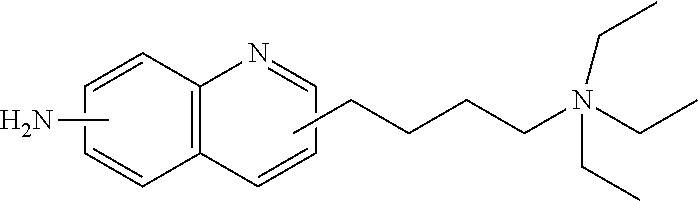 |
 |
 |
 |
 |
 |
 |
 |
 |
 |
 |
 |
 |
 |
 |
 |
 |
 |
 |
 |
 |
 |
 |
 |
 |
 |
 |
 |
 |
 |
 |
 |
 |
 |
 |
 |
 |
 |
 |
 |
 |
 |
 |
 |
 |
 |
 |
 |
 |
 |
 |
 |
 |
 |
 |
 |
 |
 |
 |
 |
 |
 |
 |


wherein
each of R1 and R2 is independently selected from hydrogen, halogen, lower alkyl, lower alkenyl, lower alkynyl, lower alkanoyl, lower haloalkyl, lower haloalkenyl, lower haloalkynyl, lower cycloalkyl, lower acyloxy, hydroxy, amino, lower alkylamino, amido, nitro, lower alkylthio, lower alkylsulfinyl, lower alkylsulfonyl, sulfonate, sulfonic acid, N3, SH, SCH3, C(O)CH3, CO2CH3 and CO2H;

R3a is selected from ester, amide, amine, oxygen, urea, carbamate, carbonate, sulfur, thiourea, thiocarbamate, alkyl or carbonyl;
R3b is

y=0-12;
z=1-12;
and salts or solvates thereof.

wherein
each of R1 and R2 is independently selected from hydrogen, halogen, lower alkyl, lower alkenyl, lower alkynyl, lower alkanoyl, lower haloalkyl, lower haloalkenyl, lower haloalkynyl, lower cycloalkyl, lower acyloxy, hydroxy, amino, lower alkylamino, amido, nitro, lower alkylthio, lower alkylsulfinyl, lower alkylsulfonyl, sulfonate, sulfonic acid, N3, SH, SCH3, C(O)CH3, CO2CH3 and CO2H;
R3b is

z=1-12;
and salts or solvates thereof.

wherein
each of R1 and R2 is independently selected from hydrogen, halogen, lower alkyl, lower alkenyl, lower alkynyl, lower alkanoyl, lower haloalkyl, lower haloalkenyl, lower haloalkynyl, lower cycloalkyl, lower acyloxy, hydroxy, amino, lower alkylamino, amido, nitro, lower alkylthio, lower alkylsulfinyl, lower alkylsulfonyl, sulfonate, sulfonic acid, N3, SH, SCH3, C(O)CH3, CO2CH3 and CO2H;
R3b is

z=1-12;
and salts or solvates thereof.

wherein
each of R1 and R2 is independently selected from hydrogen, halogen, lower alkyl, lower alkenyl, lower alkynyl, lower alkanoyl, lower haloalkyl, lower haloalkenyl, lower haloalkynyl, lower cycloalkyl, lower acyloxy, hydroxy, amino, lower alkylamino, amido, nitro, lower alkylthio, lower alkylsulfinyl, lower alkylsulfonyl, sulfonate, sulfonic acid, N3, SH, SCH3, C(O)CH3, CO2CH3 and CO2H;
R3b is

z=1-12;
and salts or solvates thereof.

wherein
each of R1 and R2 is independently selected from hydrogen, halogen, lower alkyl, lower alkenyl, lower alkynyl, lower alkanoyl, lower haloalkyl, lower haloalkenyl, lower haloalkynyl, lower cycloalkyl, lower acyloxy, hydroxy, amino, lower alkylamino, amido, nitro, lower alkylthio, lower alkylsulfinyl, lower alkylsulfonyl, sulfonate, sulfonic acid, N3, SH, SCH3, C(O)CH3, CO2CH3 and CO2H;
R3b is

z=1-12;
and salts or solvates thereof.

wherein
each of R1 and R2 is independently selected from hydrogen, halogen, lower alkyl, lower alkenyl, lower alkynyl, lower alkanoyl, lower haloalkyl, lower haloalkenyl, lower haloalkynyl, lower cycloalkyl, lower acyloxy, hydroxy, amino, lower alkylamino, amido, nitro, lower alkylthio, lower alkylsulfinyl, lower alkylsulfonyl, sulfonate, sulfonic acid, N3, SH, SCH3, C(O)CH3, CO2CH3 and CO2H;
R3b is

z=1-12;
and salts or solvates thereof.

wherein
each of R1 and R2 is independently selected from hydrogen, halogen, lower alkyl, lower alkenyl, lower alkynyl, lower alkanoyl, lower haloalkyl, lower haloalkenyl, lower haloalkynyl, lower cycloalkyl, lower acyloxy, hydroxy, amino, lower alkylamino, amido, nitro, lower alkylthio, lower alkylsulfinyl, lower alkylsulfonyl, sulfonate, sulfonic acid, N3, SH, SCH3, C(O)CH3, CO2CH3 and CO2H;
R3b is

z=1-12;
and salts or solvates thereof.

wherein
each of R1 and R2 is independently selected from hydrogen, halogen, lower alkyl, lower alkenyl, lower alkynyl, lower alkanoyl, lower haloalkyl, lower haloalkenyl, lower haloalkynyl, lower cycloalkyl, lower acyloxy, hydroxy, amino, lower alkylamino, amido, nitro, lower alkylthio, lower alkylsulfinyl, lower alkylsulfonyl, sulfonate, sulfonic acid, N3, SH, SCH3, C(O)CH3, CO2CH3 and CO2H;
R3b is

z=1-12;
and salts or solvates thereof.
| TABLE B |
 |
 |
 |
 |
 |
 |
 |
 |
 |
 |
 |
 |
 |
 |
 |
 |
 |
 |
 |
 |
 |
 |
 |
 |
 |
 |
 |
 |
 |
 |
 |
 |
 |
 |
 |
 |
 |
 |
 |
 |
 |
 |
 |
 |
 |
 |
 |
 |
 |
 |
 |
 |
 |
 |
 |
 |
 |
 |
 |
 |
 |
 |
 |
 |
 |
 |
 |
 |
 |
 |
 |
 |

wherein FL R1, R2 and R3 are as described above.
Naphthalene Based MS Active Fluorescence Tagging Compounds

wherein
each of R1 and R2 is independently selected from hydrogen, halogen, lower alkyl, lower alkenyl, lower alkynyl, lower alkanoyl, lower haloalkyl, lower haloalkenyl, lower haloalkynyl, lower cycloalkyl, lower acyloxy, hydroxy, amino, lower alkylamino, amido, nitro, lower alkylthio, lower alkylsulfinyl, lower alkylsulfonyl, sulfonate, sulfonic acid, N3, SH, SCH3, C(O)CH3, CO2CH3 and CO2H;
R3 is

R3a is selected from ester, amide, amine, oxygen, urea, carbamate, carbonate, sulfur, thiourea, thiocarbamate, alkyl or carbonyl;
R3b is

y=0-12;
z=1-12;
and salts or solvates thereof.

wherein
each of R1 and R2 is independently selected from hydrogen, halogen, lower alkyl, lower alkenyl, lower alkynyl, lower alkanoyl, lower haloalkyl, lower haloalkenyl, lower haloalkynyl, lower cycloalkyl, lower acyloxy, hydroxy, amino, lower alkylamino, amido, nitro, lower alkylthio, lower alkylsulfinyl, lower alkylsulfonyl, sulfonate, sulfonic acid, N3, SH, SCH3, C(O)CH3, CO2CH3 and CO2H;
R3b is

z=1-12; and salts or solvates thereof.
In an embodiment, methods for tagging glycans and other biomolecules with compounds of Formula IVB are provided:

wherein
each of R1 and R2 is independently selected from hydrogen, halogen, lower alkyl, lower alkenyl, lower alkynyl, lower alkanoyl, lower haloalkyl, lower haloalkenyl, lower haloalkynyl, lower cycloalkyl, lower acyloxy, hydroxy, amino, lower alkylamino, amido, nitro, lower alkylthio, lower alkylsulfinyl, lower alkylsulfonyl, sulfonate, sulfonic acid, N3, SH, SCH3, C(O)CH3, CO2CH3 and CO2H;
R3b is

z=1-12; and salts or solvates thereof.

wherein
each of R1 and R2 is independently selected from hydrogen, halogen, lower alkyl, lower alkenyl, lower alkynyl, lower alkanoyl, lower haloalkyl, lower haloalkenyl, lower haloalkynyl, lower cycloalkyl, lower acyloxy, hydroxy, amino, lower alkylamino, amido, nitro, lower alkylthio, lower alkylsulfinyl, lower alkylsulfonyl, sulfonate, sulfonic acid, N3, SH, SCH3, C(O)CH3, CO2CH3 and CO2H;
R3b is

z=1-12;
and salts or solvates thereof.

wherein
each of R1 and R2 is independently selected from hydrogen, halogen, lower alkyl, lower alkenyl, lower alkynyl, lower alkanoyl, lower haloalkyl, lower haloalkenyl, lower haloalkynyl, lower cycloalkyl, lower acyloxy, hydroxy, amino, lower alkylamino, amido, nitro, lower alkylthio, lower alkylsulfinyl, lower alkylsulfonyl, sulfonate, sulfonic acid, N3, SH, SCH3, C(O)CH3, CO2CH3 and CO2H;
R3b is

z=1-12;
and salts or solvates thereof.

wherein
each of R1 and R2 is independently selected from hydrogen, halogen, lower alkyl, lower alkenyl, lower alkynyl, lower alkanoyl, lower haloalkyl, lower haloalkenyl, lower haloalkynyl, lower cycloalkyl, lower acyloxy, hydroxy, amino, lower alkylamino, amido, nitro, lower alkylthio, lower alkylsulfinyl, lower alkylsulfonyl, sulfonate, sulfonic acid, N3, SH, SCH3, C(O)CH3, CO2CH3 and CO2H;
R3b is

z=1-12;
and salts or solvates thereof.

wherein
each of R1 and R2 is independently selected from hydrogen, halogen, lower alkyl, lower alkenyl, lower alkynyl, lower alkanoyl, lower haloalkyl, lower haloalkenyl, lower haloalkynyl, lower cycloalkyl, lower acyloxy, hydroxy, amino, lower alkylamino, amido, nitro, lower alkylthio, lower alkylsulfinyl, lower alkylsulfonyl, sulfonate, sulfonic acid, N3, SH, SCH3, C(O)CH3, CO2CH3 and CO2H;
R3b is

z=1-12;
and salts or solvates thereof.

wherein
each of R1 and R2 is independently selected from hydrogen, halogen, lower alkyl, lower alkenyl, lower alkynyl, lower alkanoyl, lower haloalkyl, lower haloalkenyl, lower haloalkynyl, lower cycloalkyl, lower acyloxy, hydroxy, amino, lower alkylamino, amido, nitro, lower alkylthio, lower alkylsulfinyl, lower alkylsulfonyl, sulfonate, sulfonic acid, N3, SH, SCH3, C(O)CH3, CO2CH3 and CO2H;
R3b is

z=1-12;
and salts or solvates thereof.
| TABLE C |
 |
 |
 |
 |
 |
 |
 |
 |
 |
 |
 |
 |
 |
 |
 |
 |
 |
 |
 |
 |
 |
 |
 |
 |
 |
 |
 |
 |
 |
 |
 |
 |
 |
 |
 |
 |
 |
 |
 |
 |
 |
 |
 |
 |
 |
 |
 |
 |
 |
 |
 |
 |
 |
 |
 |
 |
 |
 |
 |
 |
 |
 |
 |
 |
 |
 |
 |
 |
 |
 |

wherein FL R1, R2 and R3 are as described above.
Rhodamine Based MS Active Fluorescence Tagging Compounds

wherein
each of R1 and R2 is independently selected from hydrogen, halogen, lower alkyl, lower alkenyl, lower alkynyl, lower alkanoyl, lower haloalkyl, lower haloalkenyl, lower haloalkynyl, lower cycloalkyl, lower acyloxy, hydroxy, amino, lower alkylamino, amido, nitro, lower alkylthio, lower alkylsulfinyl, lower alkylsulfonyl, sulfonate, sulfonic acid, N3, SH, SCH3, C(O)CH3, CO2CH3 and CO2H;
R3 is

R3a is selected from ester, amide, amine, oxygen, urea, carbamate, carbonate, sulfur, thiourea, thiocarbamate, alkyl or carbonyl;
R3b is

y=0-12;
z=1-12;
Ra is selected from

Rb is oxo or

Rc, Rd, Re, Rf and Rg are independently selected from hydrogen and optionally substituted alkyl; and salts or solvates thereof.

wherein
each of R1 and R2 is independently selected from hydrogen, halogen, lower alkyl, lower alkenyl, lower alkynyl, lower alkanoyl, lower haloalkyl, lower haloalkenyl, lower haloalkynyl, lower cycloalkyl, lower acyloxy, hydroxy, amino, lower alkylamino, amido, nitro, lower alkylthio, lower alkylsulfinyl, lower alkylsulfonyl, sulfonate, sulfonic acid, N3, SH, SCH3, C(O)CH3, CO2CH3 and CO2H;
R3b is

z=1-12;
Ra is selected from

Rb is oxo or

and
Rc, Rd, Re, Rf and Rg are independently selected from hydrogen and optionally substituted alkyl.

z=1-12;
Ra is selected from

Rb is oxo or

Rc, Rd, Re, Rf and Rg are independently selected from hydrogen and optionally substituted alkyl; and salts or solvates thereof.

wherein
each of R1 and R2 is independently selected from hydrogen, halogen, lower alkyl, lower alkenyl, lower alkynyl, lower alkanoyl, lower haloalkyl, lower haloalkenyl, lower haloalkynyl, lower cycloalkyl, lower acyloxy, hydroxy, amino, lower alkylamino, amido, nitro, lower alkylthio, lower alkylsulfinyl, lower alkylsulfonyl, sulfonate, sulfonic acid, N3, SH, SCH3, C(O)CH3,
R3b is

Ra is selected from

Rb is oxo or

Rc, Rd, Re, Rf and Rg are independently selected from hydrogen and optionally substituted alkyl; and salts or solvates thereof.

wherein
each of R1 and R2 is independently selected from hydrogen, halogen, lower alkyl, lower alkenyl, lower alkynyl, lower alkanoyl, lower haloalkyl, lower haloalkenyl, lower haloalkynyl, lower cycloalkyl, lower acyloxy, hydroxy, amino, lower alkylamino, amido, nitro, lower alkylthio, lower alkylsulfinyl, lower alkylsulfonyl, sulfonate, sulfonic acid, N3, SH, SCH3, C(O)CH3, CO2CH3 and CO2H;


Rb is oxo or;

Rc, Rd, Re, Rf and Rg are independently selected from hydrogen and optionally substituted alkyl; and salts or solvates thereof.

wherein
each of R1 and R2 is independently selected from hydrogen, halogen, lower alkyl, lower alkenyl, lower alkynyl, lower alkanoyl, lower haloalkyl, lower haloalkenyl, lower haloalkynyl, lower cycloalkyl, lower acyloxy, hydroxy, amino, lower alkylamino, amido, nitro, lower alkylthio, lower alkylsulfinyl, lower alkylsulfonyl, sulfonate, sulfonic acid, N3, SH, SCH3, C(O)CH3, CO2CH3 and CO2H;
R3b is

z=1-12;
Ra is selected from

Rb is oxo or;

Rc, Rd, Re, Rf and Rg are independently selected from hydrogen and optionally substituted alkyl; and salts or solvates thereof.
| TABLE D |
 |
 |
 |
 |
 |
 |
 |
 |
 |
 |
 |
 |
 |
 |
 |
 |
 |
 |
 |
 |
 |
 |
 |
 |
 |
 |
 |
 |
 |
 |
 |
 |
 |
 |
 |
 |
 |
 |
 |
 |
 |
 |
 |
 |
 |
 |
 |
 |
 |
 |
 |
 |
 |
 |
 |
 |
 |
 |
 |
 |
 |
 |
 |
 |
 |
 |
 |
 |
 |
 |
 |
 |

wherein
R1 is selected from hydrogen, halogen, lower alkyl, lower alkenyl, lower alkynyl, lower alkanoyl, lower haloalkyl, lower haloalkenyl, lower haloalkynyl, lower cycloalkyl, lower acyloxy, hydroxy, amino, lower alkylamino, amido, nitro, lower alkylthio, lower alkylsulfinyl, lower alkylsulfonyl, sulfonate, sulfonic acid, N3, SH, SCH3, C(O)CH3, CO2CH3 and CO2H;
R3 is

R3a is selected from ester, amide, amine, oxygen, urea, carbamate, carbonate, sulfur, thiourea, thiocarbamate alkyl or carbonyl;
R3b is

y=0-12;
z=1-12;
and salts or solvates thereof.

wherein
R1 is selected from hydrogen, halogen, lower alkyl, lower alkenyl, lower alkynyl, lower alkanoyl, lower haloalkyl, lower haloalkenyl, lower haloalkynyl, lower cycloalkyl, lower acyloxy, hydroxy, amino, lower alkylamino, amido, nitro, lower alkylthio, lower alkylsulfinyl, lower alkylsulfonyl, sulfonate, sulfonic acid, N3, SH, SCH3, C(O)CH3, CO2CH3 and CO2H;
R3b is

z=1-12;
and salts or solvates thereof.

wherein
R1 is selected from hydrogen, halogen, lower alkyl, lower alkenyl, lower alkynyl, lower alkanoyl, lower haloalkyl, lower haloalkenyl, lower haloalkynyl, lower cycloalkyl, lower acyloxy, hydroxy, amino, lower alkylamino, amido, nitro, lower alkylthio, lower alkylsulfinyl, lower alkylsulfonyl, sulfonate, sulfonic acid, N3, SH, SCH3, C(O)CH3, CO2CH3 and CO2H;
R3b is

z=1-12;
and salts or solvates thereof.

wherein
R1 is selected from hydrogen, halogen, lower alkyl, lower alkenyl, lower alkynyl, lower alkanoyl, lower haloalkyl, lower haloalkenyl, lower haloalkynyl, lower cycloalkyl, lower acyloxy, hydroxy, amino, lower alkylamino, amido, nitro, lower alkylthio, lower alkylsulfinyl, lower alkylsulfonyl, sulfonate, sulfonic acid, N3, SH, SCH3, C(O)CH3, CO2CH3 and CO2H;
R3b is

z=1-12;
and salts or solvates thereof.

wherein
R1 is selected from hydrogen, halogen, lower alkyl, lower alkenyl, lower alkynyl, lower alkanoyl, lower haloalkyl, lower haloalkenyl, lower haloalkynyl, lower cycloalkyl, lower acyloxy, hydroxy, amino, lower alkylamino, amido, nitro, lower alkylthio, lower alkylsulfinyl, lower alkylsulfonyl, sulfonate, sulfonic acid, N3, SH, SCH3, C(O)CH3, CO2CH3 and CO2H;
R3b is

z=1-12;
and salts or solvates thereof.

wherein
R1 is selected from hydrogen, halogen, lower alkyl, lower alkenyl, lower alkynyl, lower alkanoyl, lower haloalkyl, lower haloalkenyl, lower haloalkynyl, lower cycloalkyl, lower acyloxy, hydroxy, amino, lower alkylamino, amido, nitro, lower alkylthio, lower alkylsulfinyl, lower alkylsulfonyl, sulfonate, sulfonic acid, N3, SH, SCH3, C(O)CH3, CO2CH3 and CO2H;
R3b is

z=1-12;
and salts or solvates thereof.

wherein
R1 is selected from hydrogen, halogen, lower alkyl, lower alkenyl, lower alkynyl, lower alkanoyl, lower haloalkyl, lower haloalkenyl, lower haloalkynyl, lower cycloalkyl, lower acyloxy, hydroxy, amino, lower alkylamino, amido, nitro, lower alkylthio, lower alkylsulfinyl, lower alkylsulfonyl, sulfonate, sulfonic acid, N3, SH, SCH3, C(O)CH3, CO2CH3 and CO2H;
R3b is

z=1-12;
and salts or solvates thereof.

wherein
R1 is selected from hydrogen, halogen, lower alkyl, lower alkenyl, lower alkynyl, lower alkanoyl, lower haloalkyl, lower haloalkenyl, lower haloalkynyl, lower cycloalkyl, lower acyloxy, hydroxy, amino, lower alkylamino, amido, nitro, lower alkylthio, lower alkylsulfinyl, lower alkylsulfonyl, sulfonate, sulfonic acid, N3, SH, SCH3, C(O)CH3, CO2CH3 and CO2H;
R3b is

z=1-12;
and salts or solvates thereof.
| TABLE E |
 |
 |
 |
 |
 |
 |
 |
 |
 |
 |
 |
 |
 |
 |
 |
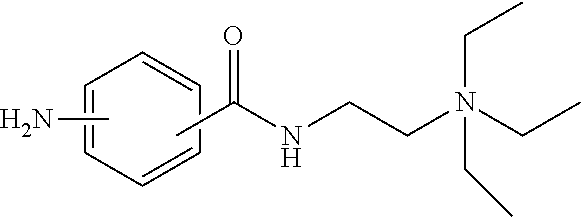 |
 |
 |
 |
 |
 |
 |
 |
 |
 |
 |
 |
 |
 |
 |
 |
 |
 |
 |
 |
 |
 |
 |
 |
 |
 |
 |
 |
 |
 |
 |
 |
 |
 |
 |
 |
 |
 |
 |
 |
 |
 |
 |
 |
 |
 |
 |
 |
 |
 |
 |
 |
 |
 |
 |
 |

wherein FL R1, R2 and R3 are as described above.


The method used for Scheme I is applicable to Scheme II for making the compounds presented herein.
Other Derivatization Methods

See, WO2013/049622 A1 at page 32. 6-ADEQ can be used to enhance the fluorescence and ionization efficiency of aldehyde containing molecules, such as saccharides or oligosaccharides. As described below, in comparison with oligosaccharides labeled with 2-aminobenzamide (“2-AB”),

the 6-ADEQ labeled oligosaccharide has been found to yield six (6) times greater fluorescence signal and approximately 250 times greater positive ion mode MS signal when analyzed by hydrophilic interaction liquid chromatography. (Example 1,
| LC CONDITIONS |
| Column | Waters ACQUITY UPLC Glycan BEH Amide |
| 130 Å 1.7 μm 2.1 × 50 mm | |
| |
50 mM Ammonium Formate Buffer, pH 4.4 |
| Mobile Phase B | Acetonitrile |
| Column Temperature | 60° |
| Injection Volume | |
| 1 | |
| Sample Concentration | |
| 6 pmol/μL | |
| Fluorescence | 6-ADEQ Labeled - Ex 370 nm/Em 480 nm (5 Hz) |
| Detection | 2-AB Labeled - Ex 330 nm/Em 420 nm (5 Hz) |
| Gradient Table |
| Flow | ||||
| Time(min) | Rate(mL/min) | % A | % B | Curve |
| Initial | 0.500 | 20.0 | 80.0 | Initial |
| 16.00 | 0.500 | 45.0 | 55.0 | 6 |
| 16.30 | 0.500 | 100.0 | 0.0 | 6 |
| 17.30 | 0.500 | 100.0 | 0.0 | 6 |
| 17.60 | 0.500 | 20.0 | 80.0 | 6 |
| 20.00 | 0.500 | 100.0 | 0.0 | 6 |
| MS Conditions |
| Polarity | ES+ | ||
| Acquisition: | 500-2000 m/z (1 Hz) | ||
| Capillary (kV) | 2.5 | ||
| Source Temperature (° C.) | 120 | ||
| Sampling Cone | 70 | ||
| Source Offset | 50 | ||
| Desolvation Temperature (° C.) | 350 | ||
| Desolvation Gas Flow (L/Hr) | 500 | ||
| Nebulizer Gas Flow (Bar) | 6.0 | ||
Data corresponding to this comparison example are portrayed in

-
- wherein
- X═C or N;
- R1 is O═C═N— or

-
- R2 is independently selected from —H, —C1-C8 alkyl, —C1-C8 cycloalkyl, halo, dialkylamino, CH2-dialkylamino, aminocarbonyl, alkoxycarbonyl, or alkoxy, but not Cl or O═C═N—; and
- R3 and R4 are independently selected from —H, alkyl, alkyl amino, alkylsulfonic acid, alkyl phosphonic acid, wherein either R3 or R4 is alkylamino, alkyl phosphonic acid, or alkylsulfonic acid.

-
- wherein
- m=0-9;
- n=0-9;
- X═C or N
- R1 is O═C═N—, S═C═N—, or

-
- R2 is independently selected from methylene, substituted nitrogen, oxygen, carbonyl, amide, ester, sulfur, sulfoxide, or sulfone;
- R3 and R4 are independently selected from —H, alkyl, alkyl amino, alkylsulfonic acid, alkyl phosphonic acid, wherein either R3 or R4 is alkylamino, alkyl phosphonic acid, or alkylsulfonic acid; and
Claims (14)


Priority Applications (1)
| Application Number | Priority Date | Filing Date | Title |
|---|---|---|---|
| US16/312,800 US11353461B2 (en) | 2016-06-21 | 2017-06-19 | Methods of enhancing MS detection of tagged glycans |
Applications Claiming Priority (4)
| Application Number | Priority Date | Filing Date | Title |
|---|---|---|---|
| US201662352734P | 2016-06-21 | 2016-06-21 | |
| US201762483015P | 2017-04-07 | 2017-04-07 | |
| US16/312,800 US11353461B2 (en) | 2016-06-21 | 2017-06-19 | Methods of enhancing MS detection of tagged glycans |
| PCT/US2017/038119 WO2017222975A1 (en) | 2016-06-21 | 2017-06-19 | Methods of enhancing ms detection of tagged glycans |
Related Parent Applications (1)
| Application Number | Title | Priority Date | Filing Date |
|---|---|---|---|
| PCT/US2017/038119 A-371-Of-International WO2017222975A1 (en) | 2016-06-21 | 2017-06-19 | Methods of enhancing ms detection of tagged glycans |
Related Child Applications (1)
| Application Number | Title | Priority Date | Filing Date |
|---|---|---|---|
| US17/734,690 Continuation US20220381788A1 (en) | 2016-06-21 | 2022-05-02 | Methods of enhancing ms detection of tagged glycans |
Publications (2)
| Publication Number | Publication Date |
|---|---|
| US20190219587A1 US20190219587A1 (en) | 2019-07-18 |
| US11353461B2 true US11353461B2 (en) | 2022-06-07 |
Family
ID=60784923
Family Applications (2)
| Application Number | Title | Priority Date | Filing Date |
|---|---|---|---|
| US16/312,800 Active 2037-10-30 US11353461B2 (en) | 2016-06-21 | 2017-06-19 | Methods of enhancing MS detection of tagged glycans |
| US17/734,690 Abandoned US20220381788A1 (en) | 2016-06-21 | 2022-05-02 | Methods of enhancing ms detection of tagged glycans |
Family Applications After (1)
| Application Number | Title | Priority Date | Filing Date |
|---|---|---|---|
| US17/734,690 Abandoned US20220381788A1 (en) | 2016-06-21 | 2022-05-02 | Methods of enhancing ms detection of tagged glycans |
Country Status (4)
| Country | Link |
|---|---|
| US (2) | US11353461B2 (en) |
| EP (1) | EP3471728A4 (en) |
| CN (1) | CN109640994A (en) |
| WO (1) | WO2017222975A1 (en) |
Cited By (1)
| Publication number | Priority date | Publication date | Assignee | Title |
|---|---|---|---|---|
| WO2025027479A1 (en) * | 2023-07-28 | 2025-02-06 | Waters Technologies Corporation | Methods of multiplexed analyte characterization |
Families Citing this family (1)
| Publication number | Priority date | Publication date | Assignee | Title |
|---|---|---|---|---|
| CN109541115B (en) * | 2018-11-28 | 2021-04-20 | 西北大学 | High-resolution sequential separation and accurate quantitative analysis method for sialylated sugar chain isomers |
Citations (5)
| Publication number | Priority date | Publication date | Assignee | Title |
|---|---|---|---|---|
| US20100261275A1 (en) * | 2007-12-10 | 2010-10-14 | Yves Durocher | Production of Recombinant Interferon Proteins |
| US20140179011A1 (en) * | 2011-09-28 | 2014-06-26 | Waters Technologies Corporation | Rapid fluorescence tagging of glycans and other biomolecules with enhanced ms signals |
| CN105418586A (en) | 2014-08-13 | 2016-03-23 | 沃特世科技公司 | Rapid fluorescent labeling of glycans and other biomolecules with enhanced MS signal |
| WO2016069764A1 (en) | 2014-10-30 | 2016-05-06 | Waters Technologies Corporation | Methods for the rapid preparation of labeled glycosylamines and for the analysis of glycosylated biomolecules producing the same |
| US20160139136A1 (en) | 2011-09-28 | 2016-05-19 | Waters Technologies Corporation | Rapid fluorescence tagging of glycans and other biomolecules with enhanced ms signals |
Family Cites Families (1)
| Publication number | Priority date | Publication date | Assignee | Title |
|---|---|---|---|---|
| EP2252584B1 (en) * | 2008-02-04 | 2016-12-07 | Prozyme, Inc. | Compounds and methods for rapid labeling of n-glycans |
-
2017
- 2017-06-19 EP EP17816001.6A patent/EP3471728A4/en not_active Ceased
- 2017-06-19 CN CN201780051071.6A patent/CN109640994A/en active Pending
- 2017-06-19 WO PCT/US2017/038119 patent/WO2017222975A1/en not_active Ceased
- 2017-06-19 US US16/312,800 patent/US11353461B2/en active Active
-
2022
- 2022-05-02 US US17/734,690 patent/US20220381788A1/en not_active Abandoned
Patent Citations (6)
| Publication number | Priority date | Publication date | Assignee | Title |
|---|---|---|---|---|
| US20100261275A1 (en) * | 2007-12-10 | 2010-10-14 | Yves Durocher | Production of Recombinant Interferon Proteins |
| US20140179011A1 (en) * | 2011-09-28 | 2014-06-26 | Waters Technologies Corporation | Rapid fluorescence tagging of glycans and other biomolecules with enhanced ms signals |
| US20140242709A1 (en) * | 2011-09-28 | 2014-08-28 | Waters Technologies Corporation | Rapid fluorescence tagging of glycans and other biomolecules with enhanced ms signals |
| US20160139136A1 (en) | 2011-09-28 | 2016-05-19 | Waters Technologies Corporation | Rapid fluorescence tagging of glycans and other biomolecules with enhanced ms signals |
| CN105418586A (en) | 2014-08-13 | 2016-03-23 | 沃特世科技公司 | Rapid fluorescent labeling of glycans and other biomolecules with enhanced MS signal |
| WO2016069764A1 (en) | 2014-10-30 | 2016-05-06 | Waters Technologies Corporation | Methods for the rapid preparation of labeled glycosylamines and for the analysis of glycosylated biomolecules producing the same |
Non-Patent Citations (8)
| Title |
|---|
| Author unknown, "Benzene" Molfield [online] Last updated, Feb. 21, 2014 [retrieved on Apr. 24, 2020]. Retrieved from Internet URL: http://asd.molfield.org/php/view_details.php?id=59, 2 pages. |
| Author unknown, "Compound Summary—Triethylamine" PubChem [online] Mar. 2005 [retrieved on Apr. 24, 2020]. Retrieved from Internet URL: https://pubchem.ncbi.nlm.nih.gov/compound/triethylamine#section=Top, 72 pages. |
| Extended European Search Report for Application No. EP1781600.1, dated Jan. 24, 2020, 8 pages. |
| Gustafsson, O.J. R., et al., "MALDI imaging mass spectrometry of N-linked glycans on formalin-fixed paraffin-embedded murine kidney," Analytical and Bioanalytical Chemistry, 407:2127-2139 (2015). |
| International Search Report and Written Opinion for International application No. PCT/US17/38119, dated Sep. 11, 2017, 7 pages. |
| Klapoetke, S., et al., "The evaluation of a novel approach for the profiling and identification of N-linked glycan with a procainamide tag by HPLC with fluorescent and mass spectrometric detection," Journal of Pharmaceutical and Biochemcial Analysis 53(3):315-324 (2010). |
| Lauber et al. "Rapid Preparation of Released N-Glycans for HILIC Analysis Using a Labeling Reagent that Facilitates Sensitive Fluorescence and ESI-MS Detection" Anal. Chem. 2015, 87, 5401-5409; plus Supporting Information (Year: 2015). * |
| Walker, S., et al., "Hydrophobic Derivatization of N-linked Glycans for Increased Ion Abundance in Electrospray Ionization Mass Spectrometry," Journal of the American Society for Mass Spectrometry, 22(8):1309-1317 (2011). |
Cited By (1)
| Publication number | Priority date | Publication date | Assignee | Title |
|---|---|---|---|---|
| WO2025027479A1 (en) * | 2023-07-28 | 2025-02-06 | Waters Technologies Corporation | Methods of multiplexed analyte characterization |
Also Published As
| Publication number | Publication date |
|---|---|
| US20190219587A1 (en) | 2019-07-18 |
| WO2017222975A1 (en) | 2017-12-28 |
| EP3471728A1 (en) | 2019-04-24 |
| CN109640994A (en) | 2019-04-16 |
| US20220381788A1 (en) | 2022-12-01 |
| EP3471728A4 (en) | 2020-02-26 |
Similar Documents
| Publication | Publication Date | Title |
|---|---|---|
| US11352325B2 (en) | Rapid fluorescence tagging of glycans and other biomolecules with enhanced MS signals | |
| US11448652B2 (en) | Rapid fluorescence tagging of glycans and other biomolecules with enhanced MS signals | |
| EP3309549B1 (en) | Rapid fluorescence tagging of glycans and other biomolecules with enhanced ms signals | |
| Holčapek et al. | High-performance liquid chromatography–tandem mass spectrometry in the identification and determination of phase I and phase II drug metabolites | |
| JP7055634B2 (en) | Rapid Preparation of Labeled Glycosylamines and Analytical Methods for Glycosylated Biomolecules Producing It | |
| EP2990401A1 (en) | Rapid fluorescence tagging of glycans and other biomolecules with enhanced mass spectrometry signals | |
| US20220381788A1 (en) | Methods of enhancing ms detection of tagged glycans | |
| US20250085275A1 (en) | Fluorescence tagging of glycans and other biomolecules through reductive amination for enhanced ms signals | |
| Smolkova et al. | Synthesis and application of BODIPY-based fluorescent labeling tag for oligosaccharide and N-linked glycan analysis by high-performance liquid chromatography with fluorescence detection | |
| US20230096494A1 (en) | Isobaric Multiplex Reagents for Carbonyl Containing Compound High-Throughput Quantitative Analysis | |
| Zheng et al. | Combination of β-elimination and liquid chromatography/quadrupole time-of-flight mass spectrometry for the determination of O-glycosylation sites | |
| US20250326736A1 (en) | Fluorescently-active free radical tags for simultaneous glycan quantitation and characterization | |
| WO2017132177A1 (en) | Rapid fluorescence tagging of glycans and other biomolecules with enhanced ms signals | |
| Wu et al. | Characterization of protein therapeutics by mass spectrometry | |
| Smolková | of Thesis: Highly sensitive analysis of glycoproteins by new labels for capillary | |
| Dalpathado | Analysis of glycans and glycoproteins by mass spectrometry | |
| HK1197690B (en) | Rapid fluorescence tagging of glycans and other biomolecules with enhanced ms signals | |
| HK1197690A (en) | Rapid fluorescence tagging of glycans and other biomolecules with enhanced ms signals |
Legal Events
| Date | Code | Title | Description |
|---|---|---|---|
| FEPP | Fee payment procedure |
Free format text: ENTITY STATUS SET TO UNDISCOUNTED (ORIGINAL EVENT CODE: BIG.); ENTITY STATUS OF PATENT OWNER: LARGE ENTITY |
|
| STPP | Information on status: patent application and granting procedure in general |
Free format text: DOCKETED NEW CASE - READY FOR EXAMINATION |
|
| STPP | Information on status: patent application and granting procedure in general |
Free format text: NON FINAL ACTION MAILED |
|
| STPP | Information on status: patent application and granting procedure in general |
Free format text: RESPONSE TO NON-FINAL OFFICE ACTION ENTERED AND FORWARDED TO EXAMINER |
|
| STPP | Information on status: patent application and granting procedure in general |
Free format text: FINAL REJECTION MAILED |
|
| STPP | Information on status: patent application and granting procedure in general |
Free format text: RESPONSE AFTER FINAL ACTION FORWARDED TO EXAMINER |
|
| STPP | Information on status: patent application and granting procedure in general |
Free format text: ADVISORY ACTION MAILED |
|
| STPP | Information on status: patent application and granting procedure in general |
Free format text: DOCKETED NEW CASE - READY FOR EXAMINATION |
|
| AS | Assignment |
Owner name: WATERS TECHNOLOGIES CORPORATION, MASSACHUSETTS Free format text: ASSIGNMENT OF ASSIGNORS INTEREST;ASSIGNORS:BROUSMICHE, DARRYL W.;LAUBER, MATTHEW A.;REEL/FRAME:057270/0232 Effective date: 20210210 |
|
| STPP | Information on status: patent application and granting procedure in general |
Free format text: NON FINAL ACTION MAILED |
|
| STPP | Information on status: patent application and granting procedure in general |
Free format text: NOTICE OF ALLOWANCE MAILED -- APPLICATION RECEIVED IN OFFICE OF PUBLICATIONS |
|
| STPP | Information on status: patent application and granting procedure in general |
Free format text: AWAITING TC RESP., ISSUE FEE NOT PAID |
|
| STPP | Information on status: patent application and granting procedure in general |
Free format text: NOTICE OF ALLOWANCE MAILED -- APPLICATION RECEIVED IN OFFICE OF PUBLICATIONS |
|
| STPP | Information on status: patent application and granting procedure in general |
Free format text: PUBLICATIONS -- ISSUE FEE PAYMENT VERIFIED |
|
| STCF | Information on status: patent grant |
Free format text: PATENTED CASE |
|
| MAFP | Maintenance fee payment |
Free format text: PAYMENT OF MAINTENANCE FEE, 4TH YEAR, LARGE ENTITY (ORIGINAL EVENT CODE: M1551); ENTITY STATUS OF PATENT OWNER: LARGE ENTITY Year of fee payment: 4 |