US11339328B2 - Liquid crystal composition containing polymerizable compound and display device thereof - Google Patents
Liquid crystal composition containing polymerizable compound and display device thereof Download PDFInfo
- Publication number
- US11339328B2 US11339328B2 US17/184,045 US202117184045A US11339328B2 US 11339328 B2 US11339328 B2 US 11339328B2 US 202117184045 A US202117184045 A US 202117184045A US 11339328 B2 US11339328 B2 US 11339328B2
- Authority
- US
- United States
- Prior art keywords
- liquid crystal
- crystal composition
- compound
- ring
- general formula
- Prior art date
- Legal status (The legal status is an assumption and is not a legal conclusion. Google has not performed a legal analysis and makes no representation as to the accuracy of the status listed.)
- Active
Links
- 0 *CC1CCC(CC2CCC(CC3CCC(*C)CC3)CC2)CC1.*c1c(C)c(C)c(Cc2c(C)c(C)c(Cc3c(C)c(C)c(CC)c(C)c3C)c(C)c2C)c(C)c1C.C.C.C.C.C.[1*]C1CCC(c2ccc(-c3c(C)c(C)c([2*])c(C)c3C)cc2)CC1 Chemical compound *CC1CCC(CC2CCC(CC3CCC(*C)CC3)CC2)CC1.*c1c(C)c(C)c(Cc2c(C)c(C)c(Cc3c(C)c(C)c(CC)c(C)c3C)c(C)c2C)c(C)c1C.C.C.C.C.C.[1*]C1CCC(c2ccc(-c3c(C)c(C)c([2*])c(C)c3C)cc2)CC1 0.000 description 21
- MGZLMMAUHYNJTC-UHFFFAOYSA-N C.CC1CCC(C)CC1 Chemical compound C.CC1CCC(C)CC1 MGZLMMAUHYNJTC-UHFFFAOYSA-N 0.000 description 12
- URLKBWYHVLBVBO-UHFFFAOYSA-N Cc1ccc(C)cc1 Chemical compound Cc1ccc(C)cc1 URLKBWYHVLBVBO-UHFFFAOYSA-N 0.000 description 9
- ZQQZKTVIEHSEEX-UHFFFAOYSA-N B.CC1CCC(C)CC1 Chemical compound B.CC1CCC(C)CC1 ZQQZKTVIEHSEEX-UHFFFAOYSA-N 0.000 description 6
- QRMPKOFEUHIBNM-UHFFFAOYSA-N CC1CCC(C)CC1 Chemical compound CC1CCC(C)CC1 QRMPKOFEUHIBNM-UHFFFAOYSA-N 0.000 description 5
- JVDDEQOPAVWZBQ-UHFFFAOYSA-N CC1CC1.CC1CCC1.CC1CCCC1 Chemical compound CC1CC1.CC1CCC1.CC1CCCC1 JVDDEQOPAVWZBQ-UHFFFAOYSA-N 0.000 description 4
- HWAAIMZZPSBQLB-UHFFFAOYSA-N CC1CCC(C)C1.CC1CCC(C)CC1 Chemical compound CC1CCC(C)C1.CC1CCC(C)CC1 HWAAIMZZPSBQLB-UHFFFAOYSA-N 0.000 description 4
- AGOJXFGQMWCRLK-UHFFFAOYSA-N CC1CCC(C)CC1.Cc1ccc(C)cc1 Chemical compound CC1CCC(C)CC1.Cc1ccc(C)cc1 AGOJXFGQMWCRLK-UHFFFAOYSA-N 0.000 description 4
- JDOMFRXJCHBJNQ-UHFFFAOYSA-N BB.CC1CCC(C)CC1 Chemical compound BB.CC1CCC(C)CC1 JDOMFRXJCHBJNQ-UHFFFAOYSA-N 0.000 description 2
- MKZWZQPXBBQMIY-UHFFFAOYSA-N BBB.CC1CCC(C)CC1 Chemical compound BBB.CC1CCC(C)CC1 MKZWZQPXBBQMIY-UHFFFAOYSA-N 0.000 description 2
- TZACHQGGKIKDRC-UHFFFAOYSA-N C.CCc1ccc(Cc2ccc(Cc3cc(C)c(CC)c(Cl)c3)c(C)c2)cc1.CCc1ccc(Cc2ccc(Cc3ccc(CC)c(C)c3)c(Cl)c2)c(C)c1.CCc1ccc(Cc2ccc(Cc3ccc(CC)c(C)c3)c(Cl)c2)cc1C.CCc1ccc(Cc2ccc(Cc3ccc(CC)c(C)c3)cc2Cl)c(C)c1.CCc1ccc(Cc2ccc(Cc3ccc(CC)c(C)c3C)c(Cl)c2)cc1.CCc1ccc(Cc2ccc(Cc3ccc(CC)c(Cl)c3)c(C)c2)c(C)c1.CCc1ccc(Cc2ccc(Cc3ccc(CC)c(Cl)c3)c(C)c2)cc1.CCc1ccc(Cc2ccc(Cc3ccc(CC)c(Cl)c3)cc2)cc1.CCc1ccc(Cc2ccc(Cc3ccc(CC)cc3C)c(Cl)c2)c(C)c1.CCc1ccc(Cc2ccc(Cc3ccc(CC)cc3Cl)cc2)cc1 Chemical compound C.CCc1ccc(Cc2ccc(Cc3cc(C)c(CC)c(Cl)c3)c(C)c2)cc1.CCc1ccc(Cc2ccc(Cc3ccc(CC)c(C)c3)c(Cl)c2)c(C)c1.CCc1ccc(Cc2ccc(Cc3ccc(CC)c(C)c3)c(Cl)c2)cc1C.CCc1ccc(Cc2ccc(Cc3ccc(CC)c(C)c3)cc2Cl)c(C)c1.CCc1ccc(Cc2ccc(Cc3ccc(CC)c(C)c3C)c(Cl)c2)cc1.CCc1ccc(Cc2ccc(Cc3ccc(CC)c(Cl)c3)c(C)c2)c(C)c1.CCc1ccc(Cc2ccc(Cc3ccc(CC)c(Cl)c3)c(C)c2)cc1.CCc1ccc(Cc2ccc(Cc3ccc(CC)c(Cl)c3)cc2)cc1.CCc1ccc(Cc2ccc(Cc3ccc(CC)cc3C)c(Cl)c2)c(C)c1.CCc1ccc(Cc2ccc(Cc3ccc(CC)cc3Cl)cc2)cc1 TZACHQGGKIKDRC-UHFFFAOYSA-N 0.000 description 2
- ZCEXZOHAQIOOBH-UHFFFAOYSA-N CCc1c(C)c(C)c(Cc2c(C)c(C)c(Cc3c(C)c(C)c(C)c(C)c3C)c(C)c2C)c(C)c1C Chemical compound CCc1c(C)c(C)c(Cc2c(C)c(C)c(Cc3c(C)c(C)c(C)c(C)c3C)c(C)c2C)c(C)c1C ZCEXZOHAQIOOBH-UHFFFAOYSA-N 0.000 description 2
- YUUCDYPONZOURJ-UHFFFAOYSA-N CCc1c(C)cc(Cc2cc(C)c(CC)c(Cl)c2)cc1C.CCc1cc(C)c(Cc2ccc(CC)cc2Cl)c(C)c1.CCc1ccc(Cc2c(C)cc(CC)cc2Cl)cc1.CCc1ccc(Cc2cc(C)c(CC)c(C)c2)c(Cl)c1.CCc1ccc(Cc2cc(C)c(CC)c(Cl)c2)cc1C.CCc1ccc(Cc2cc(C)c(CC)cc2C)c(Cl)c1.CCc1ccc(Cc2ccc(CC)cc2Cl)c(C)c1.CCc1ccc(Cc2ccc(CC)cc2Cl)cc1 Chemical compound CCc1c(C)cc(Cc2cc(C)c(CC)c(Cl)c2)cc1C.CCc1cc(C)c(Cc2ccc(CC)cc2Cl)c(C)c1.CCc1ccc(Cc2c(C)cc(CC)cc2Cl)cc1.CCc1ccc(Cc2cc(C)c(CC)c(C)c2)c(Cl)c1.CCc1ccc(Cc2cc(C)c(CC)c(Cl)c2)cc1C.CCc1ccc(Cc2cc(C)c(CC)cc2C)c(Cl)c1.CCc1ccc(Cc2ccc(CC)cc2Cl)c(C)c1.CCc1ccc(Cc2ccc(CC)cc2Cl)cc1 YUUCDYPONZOURJ-UHFFFAOYSA-N 0.000 description 2
- BRAXXNRYIFUWHW-UHFFFAOYSA-N CCc1cc(C)c(Cc2ccc(Cc3ccc(CC)c(C)c3)c(Cl)c2)c(C)c1.CCc1ccc(Cc2ccc(Cc3c(C)cc(CC)cc3C)cc2Cl)c(C)c1.CCc1ccc(Cc2ccc(Cc3c(C)cc(CC)cc3C)cc2Cl)cc1.CCc1ccc(Cc2ccc(Cc3cc(C)c(CC)c(C)c3)c(Cl)c2)cc1.CCc1ccc(Cc2ccc(Cc3ccc(CC)c(C)c3)c(Cl)c2)cc1.CCc1ccc(Cc2ccc(Cc3ccc(CC)c(C)c3)cc2Cl)cc1.CCc1ccc(Cc2ccc(Cc3ccc(CC)c(C)c3C)cc2Cl)cc1.CCc1ccc(Cc2ccc(Cc3ccc(CC)cc3)c(Cl)c2)cc1.CCc1ccc(Cc2ccc(Cc3ccc(CC)cc3C)c(Cl)c2)cc1.CCc1ccc(Cc2ccc(Cc3ccc(CC)cc3C)cc2Cl)cc1 Chemical compound CCc1cc(C)c(Cc2ccc(Cc3ccc(CC)c(C)c3)c(Cl)c2)c(C)c1.CCc1ccc(Cc2ccc(Cc3c(C)cc(CC)cc3C)cc2Cl)c(C)c1.CCc1ccc(Cc2ccc(Cc3c(C)cc(CC)cc3C)cc2Cl)cc1.CCc1ccc(Cc2ccc(Cc3cc(C)c(CC)c(C)c3)c(Cl)c2)cc1.CCc1ccc(Cc2ccc(Cc3ccc(CC)c(C)c3)c(Cl)c2)cc1.CCc1ccc(Cc2ccc(Cc3ccc(CC)c(C)c3)cc2Cl)cc1.CCc1ccc(Cc2ccc(Cc3ccc(CC)c(C)c3C)cc2Cl)cc1.CCc1ccc(Cc2ccc(Cc3ccc(CC)cc3)c(Cl)c2)cc1.CCc1ccc(Cc2ccc(Cc3ccc(CC)cc3C)c(Cl)c2)cc1.CCc1ccc(Cc2ccc(Cc3ccc(CC)cc3C)cc2Cl)cc1 BRAXXNRYIFUWHW-UHFFFAOYSA-N 0.000 description 2
- XAZDBXMBKCIVII-UHFFFAOYSA-N CCc1ccc(Cc2cc(C)c(CC)c(Cl)c2)cc1.CCc1ccc(Cc2cc(Cl)c(CC)cc2C)cc1.CCc1ccc(Cc2cc(Cl)c(CC)cc2C)cc1C.CCc1ccc(Cc2ccc(CC)c(Cl)c2)c(C)c1.CCc1ccc(Cc2ccc(CC)c(Cl)c2)cc1.CCc1ccc(Cc2ccc(CC)c(Cl)c2)cc1C.CCc1ccc(Cc2ccc(CC)c(Cl)c2C)c(C)c1.CCc1ccc(Cc2ccc(CC)c(Cl)c2C)cc1.CCc1ccc(Cc2ccc(CC)c(Cl)c2C)cc1C Chemical compound CCc1ccc(Cc2cc(C)c(CC)c(Cl)c2)cc1.CCc1ccc(Cc2cc(Cl)c(CC)cc2C)cc1.CCc1ccc(Cc2cc(Cl)c(CC)cc2C)cc1C.CCc1ccc(Cc2ccc(CC)c(Cl)c2)c(C)c1.CCc1ccc(Cc2ccc(CC)c(Cl)c2)cc1.CCc1ccc(Cc2ccc(CC)c(Cl)c2)cc1C.CCc1ccc(Cc2ccc(CC)c(Cl)c2C)c(C)c1.CCc1ccc(Cc2ccc(CC)c(Cl)c2C)cc1.CCc1ccc(Cc2ccc(CC)c(Cl)c2C)cc1C XAZDBXMBKCIVII-UHFFFAOYSA-N 0.000 description 2
- YUWFEBAXEOLKSG-UHFFFAOYSA-N Cc1c(C)c(C)c(C)c(C)c1C Chemical compound Cc1c(C)c(C)c(C)c(C)c1C YUWFEBAXEOLKSG-UHFFFAOYSA-N 0.000 description 2
- NJXCXLMTPPBOFZ-CDOBYQHPSA-N C#CC(CCCCC)Cc1ccc(C2CCC(C3CCC(CCC)CC3)CC2)c(F)c1F.CC1CCC(C2COc3ccc4ccccc4c3-c3c(ccc4ccccc34)OC2)CC1.CCC(C)COc1ccc(-c2ccc(C)cc2)cc1.CCC(C)Cc1ccc(-c2ccc(C)cc2)cc1.CCC(C)Cc1ccc(C2CCC(C3CCC(C)CC3)CC2)cc1.CCC(OC(=O)c1ccc(-c2ccc(C)cc2)cc1)c1ccccc1.CCCC12CCC(C3CCC(c4cc(F)c(OC(C)C)c(F)c4)CC3)(CC1)CC2.CCCC1CCC(C2CCC(c3cc(F)c(OC(C)C)c(F)c3)CC2)CC1.CCCCCC1CCC(c2ccc(C(=O)OCC(OOCc3ccc(C4CCC(C)CC4)cc3)c3ccccc3)cc2)CC1.CCCCCCC(C)Cc1ccc(C(=O)Oc2ccc(C)cc2)cc1.CCCCCCC(C)Cc1ccc(OC(=O)c2ccc(C)cc2)cc1.CCCCCc1ccc(-c2ccc(C(=O)OC(CC)c3ccccc3)cc2)cc1.[H][C@]12CC[C@]3(C)[C@@H]([C@H](C)CCCC(C)C)CC[C@@]3([H])[C@]1([H])CCC1C[C@@H](OCCCCCCCCC)CC[C@@]12C Chemical compound C#CC(CCCCC)Cc1ccc(C2CCC(C3CCC(CCC)CC3)CC2)c(F)c1F.CC1CCC(C2COc3ccc4ccccc4c3-c3c(ccc4ccccc34)OC2)CC1.CCC(C)COc1ccc(-c2ccc(C)cc2)cc1.CCC(C)Cc1ccc(-c2ccc(C)cc2)cc1.CCC(C)Cc1ccc(C2CCC(C3CCC(C)CC3)CC2)cc1.CCC(OC(=O)c1ccc(-c2ccc(C)cc2)cc1)c1ccccc1.CCCC12CCC(C3CCC(c4cc(F)c(OC(C)C)c(F)c4)CC3)(CC1)CC2.CCCC1CCC(C2CCC(c3cc(F)c(OC(C)C)c(F)c3)CC2)CC1.CCCCCC1CCC(c2ccc(C(=O)OCC(OOCc3ccc(C4CCC(C)CC4)cc3)c3ccccc3)cc2)CC1.CCCCCCC(C)Cc1ccc(C(=O)Oc2ccc(C)cc2)cc1.CCCCCCC(C)Cc1ccc(OC(=O)c2ccc(C)cc2)cc1.CCCCCc1ccc(-c2ccc(C(=O)OC(CC)c3ccccc3)cc2)cc1.[H][C@]12CC[C@]3(C)[C@@H]([C@H](C)CCCC(C)C)CC[C@@]3([H])[C@]1([H])CCC1C[C@@H](OCCCCCCCCC)CC[C@@]12C NJXCXLMTPPBOFZ-CDOBYQHPSA-N 0.000 description 1
- NIFOZQTUDUVEBH-UHFFFAOYSA-N C.C.CC(C)(C)c1cc(CCC(=O)NCCCCCCNC(=O)CCc2cc(C(C)(C)C)c(O)c(C(C)(C)C)c2)cc(C(C)(C)C)c1O.CC(C)(C)c1cc(CCC(=O)NNC(=O)CCc2cc(C(C)(C)C)c(O)c(C(C)(C)C)c2)cc(C(C)(C)C)c1O.CC(C)(C)c1cc(CCC(=O)OC(OC(=O)CCc2cc(C(C)(C)C)c(O)c(C(C)(C)C)c2)(OC(=O)CCc2cc(C(C)(C)C)c(O)c(C(C)(C)C)c2)OC(=O)CCc2cc(C(C)(C)C)c(O)c(C(C)(C)C)c2)cc(C(C)(C)C)c1O.CC(C)(C)c1cc(CCC(=O)OCCCCCCOC(=O)CCc2cc(C(C)(C)C)c(O)c(C(C)(C)C)c2)cc(C(C)(C)C)c1O.CCCCCCCCSc1nc(Nc2cc(C(C)(C)C)c(O)c(C(C)(C)C)c2)nc(SCCCCCCCC)n1 Chemical compound C.C.CC(C)(C)c1cc(CCC(=O)NCCCCCCNC(=O)CCc2cc(C(C)(C)C)c(O)c(C(C)(C)C)c2)cc(C(C)(C)C)c1O.CC(C)(C)c1cc(CCC(=O)NNC(=O)CCc2cc(C(C)(C)C)c(O)c(C(C)(C)C)c2)cc(C(C)(C)C)c1O.CC(C)(C)c1cc(CCC(=O)OC(OC(=O)CCc2cc(C(C)(C)C)c(O)c(C(C)(C)C)c2)(OC(=O)CCc2cc(C(C)(C)C)c(O)c(C(C)(C)C)c2)OC(=O)CCc2cc(C(C)(C)C)c(O)c(C(C)(C)C)c2)cc(C(C)(C)C)c1O.CC(C)(C)c1cc(CCC(=O)OCCCCCCOC(=O)CCc2cc(C(C)(C)C)c(O)c(C(C)(C)C)c2)cc(C(C)(C)C)c1O.CCCCCCCCSc1nc(Nc2cc(C(C)(C)C)c(O)c(C(C)(C)C)c2)nc(SCCCCCCCC)n1 NIFOZQTUDUVEBH-UHFFFAOYSA-N 0.000 description 1
- ASKNNZGRIJPHFO-UHFFFAOYSA-N C=C(C(=O)OC)C(F)(F)F.C=C(C)C(=O)OC.C=CC(=O)CC.C=CC(=O)OC.C=CCOC.C=COC.CC1CO1.CCCC1(C)COC1.CN1C(=O)C=CC1=O.COCC1(C)CO1.COCC1(C)COC1.COCC1CCC2OC2C1.COCC1CO1 Chemical compound C=C(C(=O)OC)C(F)(F)F.C=C(C)C(=O)OC.C=CC(=O)CC.C=CC(=O)OC.C=CCOC.C=COC.CC1CO1.CCCC1(C)COC1.CN1C(=O)C=CC1=O.COCC1(C)CO1.COCC1(C)COC1.COCC1CCC2OC2C1.COCC1CO1 ASKNNZGRIJPHFO-UHFFFAOYSA-N 0.000 description 1
- YUGPSALMUKAMQU-UHFFFAOYSA-N C=C(C(=O)OC)C(F)(F)F.C=C(C)C(=O)OC.C=CC(=O)CC.C=CC(=O)OC.C=CCOC.C=COC.CC1CO1.CN1C(=O)C=CC1=O.COCC1CCC2OC2C1 Chemical compound C=C(C(=O)OC)C(F)(F)F.C=C(C)C(=O)OC.C=CC(=O)CC.C=CC(=O)OC.C=CCOC.C=COC.CC1CO1.CN1C(=O)C=CC1=O.COCC1CCC2OC2C1 YUGPSALMUKAMQU-UHFFFAOYSA-N 0.000 description 1
- NXMXPVQZFYYPGD-UHFFFAOYSA-N C=C(C)C(=O)OC.C=CC(=O)OC Chemical compound C=C(C)C(=O)OC.C=CC(=O)OC NXMXPVQZFYYPGD-UHFFFAOYSA-N 0.000 description 1
- VEXJMUUHNYNQJO-UHFFFAOYSA-N C=C(C)C(=O)OCC(C)(C)c1ccc(-c2ccc(OC(=O)C(=C)C)c(Cl)c2)cc1 Chemical compound C=C(C)C(=O)OCC(C)(C)c1ccc(-c2ccc(OC(=O)C(=C)C)c(Cl)c2)cc1 VEXJMUUHNYNQJO-UHFFFAOYSA-N 0.000 description 1
- UQHZAUVNOUATOA-UHFFFAOYSA-N C=C(C)C(=O)Oc1ccc(-c2ccc(-c3ccc(OC(=O)C(=C)C)cc3)c(Cl)c2)cc1 Chemical compound C=C(C)C(=O)Oc1ccc(-c2ccc(-c3ccc(OC(=O)C(=C)C)cc3)c(Cl)c2)cc1 UQHZAUVNOUATOA-UHFFFAOYSA-N 0.000 description 1
- QMZWQOSUOMNGCF-UHFFFAOYSA-N C=C(C)C(=O)Oc1ccc(-c2ccc(-c3ccc(OC(=O)C(=C)C)cc3)c(F)c2)cc1 Chemical compound C=C(C)C(=O)Oc1ccc(-c2ccc(-c3ccc(OC(=O)C(=C)C)cc3)c(F)c2)cc1 QMZWQOSUOMNGCF-UHFFFAOYSA-N 0.000 description 1
- BDYPFAVWJLGWSL-UHFFFAOYSA-N C=C(C)C(=O)Oc1ccc(-c2ccc(OC(=O)C(=C)C)c(Cl)c2)c(C)c1 Chemical compound C=C(C)C(=O)Oc1ccc(-c2ccc(OC(=O)C(=C)C)c(Cl)c2)c(C)c1 BDYPFAVWJLGWSL-UHFFFAOYSA-N 0.000 description 1
- JUXDVLXTRFOCGZ-UHFFFAOYSA-N C=C(C)C(=O)Oc1ccc(-c2ccc(OC(=O)C(=C)C)c(Cl)c2)cc1 Chemical compound C=C(C)C(=O)Oc1ccc(-c2ccc(OC(=O)C(=C)C)c(Cl)c2)cc1 JUXDVLXTRFOCGZ-UHFFFAOYSA-N 0.000 description 1
- ZWJMKDWSBGLFEL-UHFFFAOYSA-N C=C(C)C(=O)Oc1ccc(-c2ccc(OC(=O)C(=C)C)c(F)c2)cc1 Chemical compound C=C(C)C(=O)Oc1ccc(-c2ccc(OC(=O)C(=C)C)c(F)c2)cc1 ZWJMKDWSBGLFEL-UHFFFAOYSA-N 0.000 description 1
- HVTJQICZTQZLSK-UHFFFAOYSA-N C=C(C)C(=O)Oc1ccc(-c2ccc(OC(=O)C(=C)C)cc2)cc1 Chemical compound C=C(C)C(=O)Oc1ccc(-c2ccc(OC(=O)C(=C)C)cc2)cc1 HVTJQICZTQZLSK-UHFFFAOYSA-N 0.000 description 1
- LVEBDGZBGMRNPD-UHFFFAOYSA-N C=C(C)C(=O)Oc1ccc(-c2ccc(OC(=O)C(=C)C)cc2Cl)cc1 Chemical compound C=C(C)C(=O)Oc1ccc(-c2ccc(OC(=O)C(=C)C)cc2Cl)cc1 LVEBDGZBGMRNPD-UHFFFAOYSA-N 0.000 description 1
- IDOQJWJYHPVMFH-UHFFFAOYSA-N C=C(C)C(=O)Oc1ccc(OCc2ccc(-c3ccc(OC(=O)C(=C)C)cc3)c(Cl)c2)cc1 Chemical compound C=C(C)C(=O)Oc1ccc(OCc2ccc(-c3ccc(OC(=O)C(=C)C)cc3)c(Cl)c2)cc1 IDOQJWJYHPVMFH-UHFFFAOYSA-N 0.000 description 1
- VJTDXABZPPMSFS-UHFFFAOYSA-N C=C(C)C(=O)Oc1ccc(OCc2ccc(OC(=O)C(=C)C)c(Cl)c2)cc1 Chemical compound C=C(C)C(=O)Oc1ccc(OCc2ccc(OC(=O)C(=C)C)c(Cl)c2)cc1 VJTDXABZPPMSFS-UHFFFAOYSA-N 0.000 description 1
- FKOFRBBTHJCOBK-UHFFFAOYSA-N CC(C)(C)CC(C)(C)c1ccc(O)c(Cn2nc3ccccc3n2)c1.CC(C)(C)c1cc(-n2nc3ccc(Cl)cc3n2)c(O)c(C(C)(C)C)c1.CC(C)(C)c1cc(-n2nc3ccccc3n2)c(O)c(C(C)(C)C)c1.CC(C)(C)c1cc(Cn2c(=O)n(Cc3cc(C(C)(C)C)c(O)c(C(C)(C)C)c3)c(=O)n(Cc3cc(C(C)(C)C)c(O)c(C(C)(C)C)c3)c2=O)cc(C(C)(C)C)c1O.CC(C)(c1ccccc1)c1cc(-n2nc3ccccc3n2)c(O)c(C(C)(C)c2ccccc2)c1.CCCCCCCCOC(=O)CCc1cc(-n2nc3ccccc3n2)c(O)c(C(C)(C)C)c1.CCOC(=O)CCc1cc(C(C)(C)C)c(O)c(C(C)(C)C)c1.COC(=O)CCc1cc(-n2nc3ccccc3n2)c(O)c(C(C)(C)C)c1.COC(=O)CCc1cc(C(C)(C)C)c(O)c(C(C)(C)C)c1.Cc1cc(-n2nc3ccc(Cl)cc3n2)c(O)c(C(C)(C)C)c1.Cc1cc(O)c(Cn2nc3ccccc3n2)c(O)c1 Chemical compound CC(C)(C)CC(C)(C)c1ccc(O)c(Cn2nc3ccccc3n2)c1.CC(C)(C)c1cc(-n2nc3ccc(Cl)cc3n2)c(O)c(C(C)(C)C)c1.CC(C)(C)c1cc(-n2nc3ccccc3n2)c(O)c(C(C)(C)C)c1.CC(C)(C)c1cc(Cn2c(=O)n(Cc3cc(C(C)(C)C)c(O)c(C(C)(C)C)c3)c(=O)n(Cc3cc(C(C)(C)C)c(O)c(C(C)(C)C)c3)c2=O)cc(C(C)(C)C)c1O.CC(C)(c1ccccc1)c1cc(-n2nc3ccccc3n2)c(O)c(C(C)(C)c2ccccc2)c1.CCCCCCCCOC(=O)CCc1cc(-n2nc3ccccc3n2)c(O)c(C(C)(C)C)c1.CCOC(=O)CCc1cc(C(C)(C)C)c(O)c(C(C)(C)C)c1.COC(=O)CCc1cc(-n2nc3ccccc3n2)c(O)c(C(C)(C)C)c1.COC(=O)CCc1cc(C(C)(C)C)c(O)c(C(C)(C)C)c1.Cc1cc(-n2nc3ccc(Cl)cc3n2)c(O)c(C(C)(C)C)c1.Cc1cc(O)c(Cn2nc3ccccc3n2)c(O)c1 FKOFRBBTHJCOBK-UHFFFAOYSA-N 0.000 description 1
- BLQDVPSFLWNFJV-UHFFFAOYSA-N CC(C)(C)c1cc(-c2cc(C(C)(C)C)c(O)c(C(C)(C)C)c2)cc(C(C)(C)C)c1O.CC(C)(C)c1cc(C(C)(C)C)c(O)c(C(C)(C)C)c1.CC(C)(C)c1cc(CCC(=O)OCCSCCOC(=O)CCc2cc(C(C)(C)C)c(O)c(C(C)(C)C)c2)cc(C(C)(C)C)c1O.CC(C)(C)c1cc(Cc2cc(C(C)(C)C)c(O)c(C(C)(C)C)c2)cc(C(C)(C)C)c1O.CC1CCC(c2cc(C(C)(C)C)c(O)c(C(C)(C)C)c2)CC1.CCCCCCCCCCCCCCCCCCC(=O)OCCc1cc(C(C)(C)C)c(O)c(C(C)(C)C)c1.COC(=O)c1cc(C(C)(C)C)c(O)c(C(C)(C)C)c1.Cc1cc(C(C)(C)C)c(O)c(C(C)(C)C)c1.Cc1cc(C(C)(C)C)c(O)c(C(C)(C)C)c1.Cc1cc(O)c(C(C)(C)C)cc1C(c1cc(C(C)(C)C)c(O)cc1C)C(C)C.Cc1cc(O)c(C(C)(C)C)cc1Cc1cc(C(C)(C)C)c(O)cc1C.Cc1cc(O)c(C(C)(C)C)cc1Sc1cc(C(C)(C)C)c(O)cc1C Chemical compound CC(C)(C)c1cc(-c2cc(C(C)(C)C)c(O)c(C(C)(C)C)c2)cc(C(C)(C)C)c1O.CC(C)(C)c1cc(C(C)(C)C)c(O)c(C(C)(C)C)c1.CC(C)(C)c1cc(CCC(=O)OCCSCCOC(=O)CCc2cc(C(C)(C)C)c(O)c(C(C)(C)C)c2)cc(C(C)(C)C)c1O.CC(C)(C)c1cc(Cc2cc(C(C)(C)C)c(O)c(C(C)(C)C)c2)cc(C(C)(C)C)c1O.CC1CCC(c2cc(C(C)(C)C)c(O)c(C(C)(C)C)c2)CC1.CCCCCCCCCCCCCCCCCCC(=O)OCCc1cc(C(C)(C)C)c(O)c(C(C)(C)C)c1.COC(=O)c1cc(C(C)(C)C)c(O)c(C(C)(C)C)c1.Cc1cc(C(C)(C)C)c(O)c(C(C)(C)C)c1.Cc1cc(C(C)(C)C)c(O)c(C(C)(C)C)c1.Cc1cc(O)c(C(C)(C)C)cc1C(c1cc(C(C)(C)C)c(O)cc1C)C(C)C.Cc1cc(O)c(C(C)(C)C)cc1Cc1cc(C(C)(C)C)c(O)cc1C.Cc1cc(O)c(C(C)(C)C)cc1Sc1cc(C(C)(C)C)c(O)cc1C BLQDVPSFLWNFJV-UHFFFAOYSA-N 0.000 description 1
- FBESLISNNVOKGC-UHFFFAOYSA-N CC1(C)CC(OC(=O)CCCCCCCCC(=O)OC2CC(C)(C)NC(C)(C)C2)CC(C)(C)N1.CCCCCCCCCCCCCOCC(O)COc1ccc(-c2nc(-c3ccc(C)cc3C)nc(-c3ccc(C)cc3C)n2)c(O)c1.CCCCCCCCCCCCOCC(O)COc1ccc(-c2nc(-c3ccc(C)cc3C)nc(-c3ccc(C)cc3C)n2)c(O)c1.CN1C(C)(C)CC(OC(=O)CCCCCCCCC(=O)OC2CC(C)(C)N(C)C(C)(C)C2)CC1(C)C Chemical compound CC1(C)CC(OC(=O)CCCCCCCCC(=O)OC2CC(C)(C)NC(C)(C)C2)CC(C)(C)N1.CCCCCCCCCCCCCOCC(O)COc1ccc(-c2nc(-c3ccc(C)cc3C)nc(-c3ccc(C)cc3C)n2)c(O)c1.CCCCCCCCCCCCOCC(O)COc1ccc(-c2nc(-c3ccc(C)cc3C)nc(-c3ccc(C)cc3C)n2)c(O)c1.CN1C(C)(C)CC(OC(=O)CCCCCCCCC(=O)OC2CC(C)(C)N(C)C(C)(C)C2)CC1(C)C FBESLISNNVOKGC-UHFFFAOYSA-N 0.000 description 1
- PGXNQWRWIFMVDP-UHFFFAOYSA-N CC1CCC(C2CCC(c3ccc(F)c(F)c3)CC2)CC1 Chemical compound CC1CCC(C2CCC(c3ccc(F)c(F)c3)CC2)CC1 PGXNQWRWIFMVDP-UHFFFAOYSA-N 0.000 description 1
- UCYLZOPMJAROQH-UHFFFAOYSA-N CC1CCC(c2cc(C(C)(C)C)c(O)c(C(C)(C)C)c2)CC1.Cc1cc(C(C)(C)C)c(O)c(C(C)(C)C)c1.Cc1cc(C(C)(C)C)c(O)c(C(C)(C)C)c1 Chemical compound CC1CCC(c2cc(C(C)(C)C)c(O)c(C(C)(C)C)c2)CC1.Cc1cc(C(C)(C)C)c(O)c(C(C)(C)C)c1.Cc1cc(C(C)(C)C)c(O)c(C(C)(C)C)c1 UCYLZOPMJAROQH-UHFFFAOYSA-N 0.000 description 1
- KXJKVXPCLHYFFJ-UHFFFAOYSA-N COC(C)(F)F Chemical compound COC(C)(F)F KXJKVXPCLHYFFJ-UHFFFAOYSA-N 0.000 description 1
- HBXFIXSFKULBOG-UHFFFAOYSA-N Cc1cc(F)c(C)c(F)c1 Chemical compound Cc1cc(F)c(C)c(F)c1 HBXFIXSFKULBOG-UHFFFAOYSA-N 0.000 description 1
- IFABGGMBOHMBHA-UHFFFAOYSA-N Cc1ccc(-c2ccc(PP)cc2)c(F)c1.Cc1ccc(-c2ccc(PP)cc2)cc1 Chemical compound Cc1ccc(-c2ccc(PP)cc2)c(F)c1.Cc1ccc(-c2ccc(PP)cc2)cc1 IFABGGMBOHMBHA-UHFFFAOYSA-N 0.000 description 1
- WJAVYWPXOXAOBS-UHFFFAOYSA-N Cc1ccc(C)c(F)c1 Chemical compound Cc1ccc(C)c(F)c1 WJAVYWPXOXAOBS-UHFFFAOYSA-N 0.000 description 1
- DYSJQUQJVBYIOT-UHFFFAOYSA-N Cc1ccc(C)c(F)c1F Chemical compound Cc1ccc(C)c(F)c1F DYSJQUQJVBYIOT-UHFFFAOYSA-N 0.000 description 1
Classifications
-
- C—CHEMISTRY; METALLURGY
- C09—DYES; PAINTS; POLISHES; NATURAL RESINS; ADHESIVES; COMPOSITIONS NOT OTHERWISE PROVIDED FOR; APPLICATIONS OF MATERIALS NOT OTHERWISE PROVIDED FOR
- C09K—MATERIALS FOR MISCELLANEOUS APPLICATIONS, NOT PROVIDED FOR ELSEWHERE
- C09K19/00—Liquid crystal materials
- C09K19/04—Liquid crystal materials characterised by the chemical structure of the liquid crystal components, e.g. by a specific unit
- C09K19/42—Mixtures of liquid crystal compounds covered by two or more of the preceding groups C09K19/06 - C09K19/40
- C09K19/44—Mixtures of liquid crystal compounds covered by two or more of the preceding groups C09K19/06 - C09K19/40 containing compounds with benzene rings directly linked
-
- C—CHEMISTRY; METALLURGY
- C09—DYES; PAINTS; POLISHES; NATURAL RESINS; ADHESIVES; COMPOSITIONS NOT OTHERWISE PROVIDED FOR; APPLICATIONS OF MATERIALS NOT OTHERWISE PROVIDED FOR
- C09K—MATERIALS FOR MISCELLANEOUS APPLICATIONS, NOT PROVIDED FOR ELSEWHERE
- C09K19/00—Liquid crystal materials
- C09K19/04—Liquid crystal materials characterised by the chemical structure of the liquid crystal components, e.g. by a specific unit
- C09K19/0403—Liquid crystal materials characterised by the chemical structure of the liquid crystal components, e.g. by a specific unit the structure containing one or more specific, optionally substituted ring or ring systems
-
- C—CHEMISTRY; METALLURGY
- C09—DYES; PAINTS; POLISHES; NATURAL RESINS; ADHESIVES; COMPOSITIONS NOT OTHERWISE PROVIDED FOR; APPLICATIONS OF MATERIALS NOT OTHERWISE PROVIDED FOR
- C09K—MATERIALS FOR MISCELLANEOUS APPLICATIONS, NOT PROVIDED FOR ELSEWHERE
- C09K19/00—Liquid crystal materials
- C09K19/04—Liquid crystal materials characterised by the chemical structure of the liquid crystal components, e.g. by a specific unit
- C09K19/06—Non-steroidal liquid crystal compounds
- C09K19/08—Non-steroidal liquid crystal compounds containing at least two non-condensed rings
- C09K19/10—Non-steroidal liquid crystal compounds containing at least two non-condensed rings containing at least two benzene rings
- C09K19/12—Non-steroidal liquid crystal compounds containing at least two non-condensed rings containing at least two benzene rings at least two benzene rings directly linked, e.g. biphenyls
-
- C—CHEMISTRY; METALLURGY
- C09—DYES; PAINTS; POLISHES; NATURAL RESINS; ADHESIVES; COMPOSITIONS NOT OTHERWISE PROVIDED FOR; APPLICATIONS OF MATERIALS NOT OTHERWISE PROVIDED FOR
- C09K—MATERIALS FOR MISCELLANEOUS APPLICATIONS, NOT PROVIDED FOR ELSEWHERE
- C09K19/00—Liquid crystal materials
- C09K19/04—Liquid crystal materials characterised by the chemical structure of the liquid crystal components, e.g. by a specific unit
- C09K19/06—Non-steroidal liquid crystal compounds
- C09K19/08—Non-steroidal liquid crystal compounds containing at least two non-condensed rings
- C09K19/10—Non-steroidal liquid crystal compounds containing at least two non-condensed rings containing at least two benzene rings
- C09K19/14—Non-steroidal liquid crystal compounds containing at least two non-condensed rings containing at least two benzene rings linked by a carbon chain
-
- C—CHEMISTRY; METALLURGY
- C09—DYES; PAINTS; POLISHES; NATURAL RESINS; ADHESIVES; COMPOSITIONS NOT OTHERWISE PROVIDED FOR; APPLICATIONS OF MATERIALS NOT OTHERWISE PROVIDED FOR
- C09K—MATERIALS FOR MISCELLANEOUS APPLICATIONS, NOT PROVIDED FOR ELSEWHERE
- C09K19/00—Liquid crystal materials
- C09K19/04—Liquid crystal materials characterised by the chemical structure of the liquid crystal components, e.g. by a specific unit
- C09K19/06—Non-steroidal liquid crystal compounds
- C09K19/08—Non-steroidal liquid crystal compounds containing at least two non-condensed rings
- C09K19/10—Non-steroidal liquid crystal compounds containing at least two non-condensed rings containing at least two benzene rings
- C09K19/14—Non-steroidal liquid crystal compounds containing at least two non-condensed rings containing at least two benzene rings linked by a carbon chain
- C09K19/18—Non-steroidal liquid crystal compounds containing at least two non-condensed rings containing at least two benzene rings linked by a carbon chain the chain containing carbon-to-carbon triple bonds, e.g. tolans
-
- C—CHEMISTRY; METALLURGY
- C09—DYES; PAINTS; POLISHES; NATURAL RESINS; ADHESIVES; COMPOSITIONS NOT OTHERWISE PROVIDED FOR; APPLICATIONS OF MATERIALS NOT OTHERWISE PROVIDED FOR
- C09K—MATERIALS FOR MISCELLANEOUS APPLICATIONS, NOT PROVIDED FOR ELSEWHERE
- C09K19/00—Liquid crystal materials
- C09K19/04—Liquid crystal materials characterised by the chemical structure of the liquid crystal components, e.g. by a specific unit
- C09K19/06—Non-steroidal liquid crystal compounds
- C09K19/08—Non-steroidal liquid crystal compounds containing at least two non-condensed rings
- C09K19/10—Non-steroidal liquid crystal compounds containing at least two non-condensed rings containing at least two benzene rings
- C09K19/20—Non-steroidal liquid crystal compounds containing at least two non-condensed rings containing at least two benzene rings linked by a chain containing carbon and oxygen atoms as chain links, e.g. esters or ethers
-
- C—CHEMISTRY; METALLURGY
- C09—DYES; PAINTS; POLISHES; NATURAL RESINS; ADHESIVES; COMPOSITIONS NOT OTHERWISE PROVIDED FOR; APPLICATIONS OF MATERIALS NOT OTHERWISE PROVIDED FOR
- C09K—MATERIALS FOR MISCELLANEOUS APPLICATIONS, NOT PROVIDED FOR ELSEWHERE
- C09K19/00—Liquid crystal materials
- C09K19/04—Liquid crystal materials characterised by the chemical structure of the liquid crystal components, e.g. by a specific unit
- C09K19/06—Non-steroidal liquid crystal compounds
- C09K19/08—Non-steroidal liquid crystal compounds containing at least two non-condensed rings
- C09K19/10—Non-steroidal liquid crystal compounds containing at least two non-condensed rings containing at least two benzene rings
- C09K19/20—Non-steroidal liquid crystal compounds containing at least two non-condensed rings containing at least two benzene rings linked by a chain containing carbon and oxygen atoms as chain links, e.g. esters or ethers
- C09K19/2007—Non-steroidal liquid crystal compounds containing at least two non-condensed rings containing at least two benzene rings linked by a chain containing carbon and oxygen atoms as chain links, e.g. esters or ethers the chain containing -COO- or -OCO- groups
- C09K19/2021—Compounds containing at least one asymmetric carbon atom
- C09K19/2028—Compounds containing at least one asymmetric carbon atom containing additionally a linking group other than -COO- or -OCO-, e.g. -CH2-CH2-, -CH=CH-, -C=C-; containing at least one additional carbon atom in the chain containing -COO- or -OCO- groups, e.g. -COO-CH*-CH3
-
- C—CHEMISTRY; METALLURGY
- C09—DYES; PAINTS; POLISHES; NATURAL RESINS; ADHESIVES; COMPOSITIONS NOT OTHERWISE PROVIDED FOR; APPLICATIONS OF MATERIALS NOT OTHERWISE PROVIDED FOR
- C09K—MATERIALS FOR MISCELLANEOUS APPLICATIONS, NOT PROVIDED FOR ELSEWHERE
- C09K19/00—Liquid crystal materials
- C09K19/04—Liquid crystal materials characterised by the chemical structure of the liquid crystal components, e.g. by a specific unit
- C09K19/06—Non-steroidal liquid crystal compounds
- C09K19/08—Non-steroidal liquid crystal compounds containing at least two non-condensed rings
- C09K19/30—Non-steroidal liquid crystal compounds containing at least two non-condensed rings containing saturated or unsaturated non-aromatic rings, e.g. cyclohexane rings
- C09K19/3001—Cyclohexane rings
- C09K19/3003—Compounds containing at least two rings in which the different rings are directly linked (covalent bond)
-
- C—CHEMISTRY; METALLURGY
- C09—DYES; PAINTS; POLISHES; NATURAL RESINS; ADHESIVES; COMPOSITIONS NOT OTHERWISE PROVIDED FOR; APPLICATIONS OF MATERIALS NOT OTHERWISE PROVIDED FOR
- C09K—MATERIALS FOR MISCELLANEOUS APPLICATIONS, NOT PROVIDED FOR ELSEWHERE
- C09K19/00—Liquid crystal materials
- C09K19/04—Liquid crystal materials characterised by the chemical structure of the liquid crystal components, e.g. by a specific unit
- C09K19/06—Non-steroidal liquid crystal compounds
- C09K19/08—Non-steroidal liquid crystal compounds containing at least two non-condensed rings
- C09K19/30—Non-steroidal liquid crystal compounds containing at least two non-condensed rings containing saturated or unsaturated non-aromatic rings, e.g. cyclohexane rings
- C09K19/3001—Cyclohexane rings
- C09K19/3028—Cyclohexane rings in which at least two rings are linked by a carbon chain containing carbon to carbon single bonds
-
- C—CHEMISTRY; METALLURGY
- C09—DYES; PAINTS; POLISHES; NATURAL RESINS; ADHESIVES; COMPOSITIONS NOT OTHERWISE PROVIDED FOR; APPLICATIONS OF MATERIALS NOT OTHERWISE PROVIDED FOR
- C09K—MATERIALS FOR MISCELLANEOUS APPLICATIONS, NOT PROVIDED FOR ELSEWHERE
- C09K19/00—Liquid crystal materials
- C09K19/04—Liquid crystal materials characterised by the chemical structure of the liquid crystal components, e.g. by a specific unit
- C09K19/06—Non-steroidal liquid crystal compounds
- C09K19/08—Non-steroidal liquid crystal compounds containing at least two non-condensed rings
- C09K19/30—Non-steroidal liquid crystal compounds containing at least two non-condensed rings containing saturated or unsaturated non-aromatic rings, e.g. cyclohexane rings
- C09K19/3001—Cyclohexane rings
- C09K19/3048—Cyclohexane rings in which at least two rings are linked by a carbon chain containing carbon to carbon double bonds
-
- C—CHEMISTRY; METALLURGY
- C09—DYES; PAINTS; POLISHES; NATURAL RESINS; ADHESIVES; COMPOSITIONS NOT OTHERWISE PROVIDED FOR; APPLICATIONS OF MATERIALS NOT OTHERWISE PROVIDED FOR
- C09K—MATERIALS FOR MISCELLANEOUS APPLICATIONS, NOT PROVIDED FOR ELSEWHERE
- C09K19/00—Liquid crystal materials
- C09K19/04—Liquid crystal materials characterised by the chemical structure of the liquid crystal components, e.g. by a specific unit
- C09K19/06—Non-steroidal liquid crystal compounds
- C09K19/08—Non-steroidal liquid crystal compounds containing at least two non-condensed rings
- C09K19/30—Non-steroidal liquid crystal compounds containing at least two non-condensed rings containing saturated or unsaturated non-aromatic rings, e.g. cyclohexane rings
- C09K19/3001—Cyclohexane rings
- C09K19/3066—Cyclohexane rings in which the rings are linked by a chain containing carbon and oxygen atoms, e.g. esters or ethers
-
- C—CHEMISTRY; METALLURGY
- C09—DYES; PAINTS; POLISHES; NATURAL RESINS; ADHESIVES; COMPOSITIONS NOT OTHERWISE PROVIDED FOR; APPLICATIONS OF MATERIALS NOT OTHERWISE PROVIDED FOR
- C09K—MATERIALS FOR MISCELLANEOUS APPLICATIONS, NOT PROVIDED FOR ELSEWHERE
- C09K19/00—Liquid crystal materials
- C09K19/04—Liquid crystal materials characterised by the chemical structure of the liquid crystal components, e.g. by a specific unit
- C09K19/06—Non-steroidal liquid crystal compounds
- C09K19/08—Non-steroidal liquid crystal compounds containing at least two non-condensed rings
- C09K19/30—Non-steroidal liquid crystal compounds containing at least two non-condensed rings containing saturated or unsaturated non-aromatic rings, e.g. cyclohexane rings
- C09K19/3001—Cyclohexane rings
- C09K19/3066—Cyclohexane rings in which the rings are linked by a chain containing carbon and oxygen atoms, e.g. esters or ethers
- C09K19/3068—Cyclohexane rings in which the rings are linked by a chain containing carbon and oxygen atoms, e.g. esters or ethers chain containing -COO- or -OCO- groups
-
- C—CHEMISTRY; METALLURGY
- C09—DYES; PAINTS; POLISHES; NATURAL RESINS; ADHESIVES; COMPOSITIONS NOT OTHERWISE PROVIDED FOR; APPLICATIONS OF MATERIALS NOT OTHERWISE PROVIDED FOR
- C09K—MATERIALS FOR MISCELLANEOUS APPLICATIONS, NOT PROVIDED FOR ELSEWHERE
- C09K19/00—Liquid crystal materials
- C09K19/04—Liquid crystal materials characterised by the chemical structure of the liquid crystal components, e.g. by a specific unit
- C09K19/06—Non-steroidal liquid crystal compounds
- C09K19/08—Non-steroidal liquid crystal compounds containing at least two non-condensed rings
- C09K19/30—Non-steroidal liquid crystal compounds containing at least two non-condensed rings containing saturated or unsaturated non-aromatic rings, e.g. cyclohexane rings
- C09K19/3001—Cyclohexane rings
- C09K19/3087—Cyclohexane rings in which at least two rings are linked by a chain containing sulfur atoms
-
- C—CHEMISTRY; METALLURGY
- C09—DYES; PAINTS; POLISHES; NATURAL RESINS; ADHESIVES; COMPOSITIONS NOT OTHERWISE PROVIDED FOR; APPLICATIONS OF MATERIALS NOT OTHERWISE PROVIDED FOR
- C09K—MATERIALS FOR MISCELLANEOUS APPLICATIONS, NOT PROVIDED FOR ELSEWHERE
- C09K19/00—Liquid crystal materials
- C09K19/04—Liquid crystal materials characterised by the chemical structure of the liquid crystal components, e.g. by a specific unit
- C09K19/06—Non-steroidal liquid crystal compounds
- C09K19/08—Non-steroidal liquid crystal compounds containing at least two non-condensed rings
- C09K19/30—Non-steroidal liquid crystal compounds containing at least two non-condensed rings containing saturated or unsaturated non-aromatic rings, e.g. cyclohexane rings
- C09K19/3098—Unsaturated non-aromatic rings, e.g. cyclohexene rings
-
- C—CHEMISTRY; METALLURGY
- C09—DYES; PAINTS; POLISHES; NATURAL RESINS; ADHESIVES; COMPOSITIONS NOT OTHERWISE PROVIDED FOR; APPLICATIONS OF MATERIALS NOT OTHERWISE PROVIDED FOR
- C09K—MATERIALS FOR MISCELLANEOUS APPLICATIONS, NOT PROVIDED FOR ELSEWHERE
- C09K19/00—Liquid crystal materials
- C09K19/04—Liquid crystal materials characterised by the chemical structure of the liquid crystal components, e.g. by a specific unit
- C09K19/42—Mixtures of liquid crystal compounds covered by two or more of the preceding groups C09K19/06 - C09K19/40
- C09K19/46—Mixtures of liquid crystal compounds covered by two or more of the preceding groups C09K19/06 - C09K19/40 containing esters
-
- C—CHEMISTRY; METALLURGY
- C09—DYES; PAINTS; POLISHES; NATURAL RESINS; ADHESIVES; COMPOSITIONS NOT OTHERWISE PROVIDED FOR; APPLICATIONS OF MATERIALS NOT OTHERWISE PROVIDED FOR
- C09K—MATERIALS FOR MISCELLANEOUS APPLICATIONS, NOT PROVIDED FOR ELSEWHERE
- C09K19/00—Liquid crystal materials
- C09K19/52—Liquid crystal materials characterised by components which are not liquid crystals, e.g. additives with special physical aspect: solvents, solid particles
- C09K19/54—Additives having no specific mesophase characterised by their chemical composition
-
- G—PHYSICS
- G02—OPTICS
- G02F—OPTICAL DEVICES OR ARRANGEMENTS FOR THE CONTROL OF LIGHT BY MODIFICATION OF THE OPTICAL PROPERTIES OF THE MEDIA OF THE ELEMENTS INVOLVED THEREIN; NON-LINEAR OPTICS; FREQUENCY-CHANGING OF LIGHT; OPTICAL LOGIC ELEMENTS; OPTICAL ANALOGUE/DIGITAL CONVERTERS
- G02F1/00—Devices or arrangements for the control of the intensity, colour, phase, polarisation or direction of light arriving from an independent light source, e.g. switching, gating or modulating; Non-linear optics
- G02F1/01—Devices or arrangements for the control of the intensity, colour, phase, polarisation or direction of light arriving from an independent light source, e.g. switching, gating or modulating; Non-linear optics for the control of the intensity, phase, polarisation or colour
- G02F1/13—Devices or arrangements for the control of the intensity, colour, phase, polarisation or direction of light arriving from an independent light source, e.g. switching, gating or modulating; Non-linear optics for the control of the intensity, phase, polarisation or colour based on liquid crystals, e.g. single liquid crystal display cells
- G02F1/133—Constructional arrangements; Operation of liquid crystal cells; Circuit arrangements
- G02F1/1333—Constructional arrangements; Manufacturing methods
- G02F1/1334—Constructional arrangements; Manufacturing methods based on polymer dispersed liquid crystals, e.g. microencapsulated liquid crystals
-
- C—CHEMISTRY; METALLURGY
- C09—DYES; PAINTS; POLISHES; NATURAL RESINS; ADHESIVES; COMPOSITIONS NOT OTHERWISE PROVIDED FOR; APPLICATIONS OF MATERIALS NOT OTHERWISE PROVIDED FOR
- C09K—MATERIALS FOR MISCELLANEOUS APPLICATIONS, NOT PROVIDED FOR ELSEWHERE
- C09K19/00—Liquid crystal materials
- C09K19/04—Liquid crystal materials characterised by the chemical structure of the liquid crystal components, e.g. by a specific unit
- C09K2019/0444—Liquid crystal materials characterised by the chemical structure of the liquid crystal components, e.g. by a specific unit characterized by a linking chain between rings or ring systems, a bridging chain between extensive mesogenic moieties or an end chain group
- C09K2019/0448—Liquid crystal materials characterised by the chemical structure of the liquid crystal components, e.g. by a specific unit characterized by a linking chain between rings or ring systems, a bridging chain between extensive mesogenic moieties or an end chain group the end chain group being a polymerizable end group, e.g. -Sp-P or acrylate
-
- C—CHEMISTRY; METALLURGY
- C09—DYES; PAINTS; POLISHES; NATURAL RESINS; ADHESIVES; COMPOSITIONS NOT OTHERWISE PROVIDED FOR; APPLICATIONS OF MATERIALS NOT OTHERWISE PROVIDED FOR
- C09K—MATERIALS FOR MISCELLANEOUS APPLICATIONS, NOT PROVIDED FOR ELSEWHERE
- C09K19/00—Liquid crystal materials
- C09K19/04—Liquid crystal materials characterised by the chemical structure of the liquid crystal components, e.g. by a specific unit
- C09K19/06—Non-steroidal liquid crystal compounds
- C09K19/08—Non-steroidal liquid crystal compounds containing at least two non-condensed rings
- C09K19/10—Non-steroidal liquid crystal compounds containing at least two non-condensed rings containing at least two benzene rings
- C09K19/12—Non-steroidal liquid crystal compounds containing at least two non-condensed rings containing at least two benzene rings at least two benzene rings directly linked, e.g. biphenyls
- C09K2019/121—Compounds containing phenylene-1,4-diyl (-Ph-)
- C09K2019/122—Ph-Ph
-
- C—CHEMISTRY; METALLURGY
- C09—DYES; PAINTS; POLISHES; NATURAL RESINS; ADHESIVES; COMPOSITIONS NOT OTHERWISE PROVIDED FOR; APPLICATIONS OF MATERIALS NOT OTHERWISE PROVIDED FOR
- C09K—MATERIALS FOR MISCELLANEOUS APPLICATIONS, NOT PROVIDED FOR ELSEWHERE
- C09K19/00—Liquid crystal materials
- C09K19/04—Liquid crystal materials characterised by the chemical structure of the liquid crystal components, e.g. by a specific unit
- C09K19/06—Non-steroidal liquid crystal compounds
- C09K19/08—Non-steroidal liquid crystal compounds containing at least two non-condensed rings
- C09K19/10—Non-steroidal liquid crystal compounds containing at least two non-condensed rings containing at least two benzene rings
- C09K19/12—Non-steroidal liquid crystal compounds containing at least two non-condensed rings containing at least two benzene rings at least two benzene rings directly linked, e.g. biphenyls
- C09K2019/121—Compounds containing phenylene-1,4-diyl (-Ph-)
- C09K2019/123—Ph-Ph-Ph
-
- C—CHEMISTRY; METALLURGY
- C09—DYES; PAINTS; POLISHES; NATURAL RESINS; ADHESIVES; COMPOSITIONS NOT OTHERWISE PROVIDED FOR; APPLICATIONS OF MATERIALS NOT OTHERWISE PROVIDED FOR
- C09K—MATERIALS FOR MISCELLANEOUS APPLICATIONS, NOT PROVIDED FOR ELSEWHERE
- C09K19/00—Liquid crystal materials
- C09K19/04—Liquid crystal materials characterised by the chemical structure of the liquid crystal components, e.g. by a specific unit
- C09K19/06—Non-steroidal liquid crystal compounds
- C09K19/08—Non-steroidal liquid crystal compounds containing at least two non-condensed rings
- C09K19/10—Non-steroidal liquid crystal compounds containing at least two non-condensed rings containing at least two benzene rings
- C09K19/14—Non-steroidal liquid crystal compounds containing at least two non-condensed rings containing at least two benzene rings linked by a carbon chain
- C09K19/18—Non-steroidal liquid crystal compounds containing at least two non-condensed rings containing at least two benzene rings linked by a carbon chain the chain containing carbon-to-carbon triple bonds, e.g. tolans
- C09K2019/181—Ph-C≡C-Ph
-
- C—CHEMISTRY; METALLURGY
- C09—DYES; PAINTS; POLISHES; NATURAL RESINS; ADHESIVES; COMPOSITIONS NOT OTHERWISE PROVIDED FOR; APPLICATIONS OF MATERIALS NOT OTHERWISE PROVIDED FOR
- C09K—MATERIALS FOR MISCELLANEOUS APPLICATIONS, NOT PROVIDED FOR ELSEWHERE
- C09K19/00—Liquid crystal materials
- C09K19/04—Liquid crystal materials characterised by the chemical structure of the liquid crystal components, e.g. by a specific unit
- C09K19/06—Non-steroidal liquid crystal compounds
- C09K19/08—Non-steroidal liquid crystal compounds containing at least two non-condensed rings
- C09K19/10—Non-steroidal liquid crystal compounds containing at least two non-condensed rings containing at least two benzene rings
- C09K19/14—Non-steroidal liquid crystal compounds containing at least two non-condensed rings containing at least two benzene rings linked by a carbon chain
- C09K19/18—Non-steroidal liquid crystal compounds containing at least two non-condensed rings containing at least two benzene rings linked by a carbon chain the chain containing carbon-to-carbon triple bonds, e.g. tolans
- C09K2019/183—Ph-Ph-C≡C-Ph
-
- C—CHEMISTRY; METALLURGY
- C09—DYES; PAINTS; POLISHES; NATURAL RESINS; ADHESIVES; COMPOSITIONS NOT OTHERWISE PROVIDED FOR; APPLICATIONS OF MATERIALS NOT OTHERWISE PROVIDED FOR
- C09K—MATERIALS FOR MISCELLANEOUS APPLICATIONS, NOT PROVIDED FOR ELSEWHERE
- C09K19/00—Liquid crystal materials
- C09K19/04—Liquid crystal materials characterised by the chemical structure of the liquid crystal components, e.g. by a specific unit
- C09K19/06—Non-steroidal liquid crystal compounds
- C09K19/08—Non-steroidal liquid crystal compounds containing at least two non-condensed rings
- C09K19/10—Non-steroidal liquid crystal compounds containing at least two non-condensed rings containing at least two benzene rings
- C09K19/14—Non-steroidal liquid crystal compounds containing at least two non-condensed rings containing at least two benzene rings linked by a carbon chain
- C09K19/18—Non-steroidal liquid crystal compounds containing at least two non-condensed rings containing at least two benzene rings linked by a carbon chain the chain containing carbon-to-carbon triple bonds, e.g. tolans
- C09K2019/185—Ph-Ph-C≡C-Ph-Ph
-
- C—CHEMISTRY; METALLURGY
- C09—DYES; PAINTS; POLISHES; NATURAL RESINS; ADHESIVES; COMPOSITIONS NOT OTHERWISE PROVIDED FOR; APPLICATIONS OF MATERIALS NOT OTHERWISE PROVIDED FOR
- C09K—MATERIALS FOR MISCELLANEOUS APPLICATIONS, NOT PROVIDED FOR ELSEWHERE
- C09K19/00—Liquid crystal materials
- C09K19/04—Liquid crystal materials characterised by the chemical structure of the liquid crystal components, e.g. by a specific unit
- C09K19/06—Non-steroidal liquid crystal compounds
- C09K19/08—Non-steroidal liquid crystal compounds containing at least two non-condensed rings
- C09K19/10—Non-steroidal liquid crystal compounds containing at least two non-condensed rings containing at least two benzene rings
- C09K19/14—Non-steroidal liquid crystal compounds containing at least two non-condensed rings containing at least two benzene rings linked by a carbon chain
- C09K19/18—Non-steroidal liquid crystal compounds containing at least two non-condensed rings containing at least two benzene rings linked by a carbon chain the chain containing carbon-to-carbon triple bonds, e.g. tolans
- C09K2019/186—Ph-C≡C-C≡C-Ph
-
- C—CHEMISTRY; METALLURGY
- C09—DYES; PAINTS; POLISHES; NATURAL RESINS; ADHESIVES; COMPOSITIONS NOT OTHERWISE PROVIDED FOR; APPLICATIONS OF MATERIALS NOT OTHERWISE PROVIDED FOR
- C09K—MATERIALS FOR MISCELLANEOUS APPLICATIONS, NOT PROVIDED FOR ELSEWHERE
- C09K19/00—Liquid crystal materials
- C09K19/04—Liquid crystal materials characterised by the chemical structure of the liquid crystal components, e.g. by a specific unit
- C09K19/06—Non-steroidal liquid crystal compounds
- C09K19/08—Non-steroidal liquid crystal compounds containing at least two non-condensed rings
- C09K19/10—Non-steroidal liquid crystal compounds containing at least two non-condensed rings containing at least two benzene rings
- C09K19/14—Non-steroidal liquid crystal compounds containing at least two non-condensed rings containing at least two benzene rings linked by a carbon chain
- C09K19/18—Non-steroidal liquid crystal compounds containing at least two non-condensed rings containing at least two benzene rings linked by a carbon chain the chain containing carbon-to-carbon triple bonds, e.g. tolans
- C09K2019/188—Ph-C≡C-Ph-C≡C-Ph
-
- C—CHEMISTRY; METALLURGY
- C09—DYES; PAINTS; POLISHES; NATURAL RESINS; ADHESIVES; COMPOSITIONS NOT OTHERWISE PROVIDED FOR; APPLICATIONS OF MATERIALS NOT OTHERWISE PROVIDED FOR
- C09K—MATERIALS FOR MISCELLANEOUS APPLICATIONS, NOT PROVIDED FOR ELSEWHERE
- C09K19/00—Liquid crystal materials
- C09K19/04—Liquid crystal materials characterised by the chemical structure of the liquid crystal components, e.g. by a specific unit
- C09K19/06—Non-steroidal liquid crystal compounds
- C09K19/08—Non-steroidal liquid crystal compounds containing at least two non-condensed rings
- C09K19/10—Non-steroidal liquid crystal compounds containing at least two non-condensed rings containing at least two benzene rings
- C09K19/20—Non-steroidal liquid crystal compounds containing at least two non-condensed rings containing at least two benzene rings linked by a chain containing carbon and oxygen atoms as chain links, e.g. esters or ethers
- C09K19/2007—Non-steroidal liquid crystal compounds containing at least two non-condensed rings containing at least two benzene rings linked by a chain containing carbon and oxygen atoms as chain links, e.g. esters or ethers the chain containing -COO- or -OCO- groups
- C09K2019/2042—Ph-Ph-COO-Ph
-
- C—CHEMISTRY; METALLURGY
- C09—DYES; PAINTS; POLISHES; NATURAL RESINS; ADHESIVES; COMPOSITIONS NOT OTHERWISE PROVIDED FOR; APPLICATIONS OF MATERIALS NOT OTHERWISE PROVIDED FOR
- C09K—MATERIALS FOR MISCELLANEOUS APPLICATIONS, NOT PROVIDED FOR ELSEWHERE
- C09K19/00—Liquid crystal materials
- C09K19/04—Liquid crystal materials characterised by the chemical structure of the liquid crystal components, e.g. by a specific unit
- C09K19/06—Non-steroidal liquid crystal compounds
- C09K19/08—Non-steroidal liquid crystal compounds containing at least two non-condensed rings
- C09K19/10—Non-steroidal liquid crystal compounds containing at least two non-condensed rings containing at least two benzene rings
- C09K19/20—Non-steroidal liquid crystal compounds containing at least two non-condensed rings containing at least two benzene rings linked by a chain containing carbon and oxygen atoms as chain links, e.g. esters or ethers
- C09K19/2007—Non-steroidal liquid crystal compounds containing at least two non-condensed rings containing at least two benzene rings linked by a chain containing carbon and oxygen atoms as chain links, e.g. esters or ethers the chain containing -COO- or -OCO- groups
- C09K2019/2078—Ph-COO-Ph-COO-Ph
-
- C—CHEMISTRY; METALLURGY
- C09—DYES; PAINTS; POLISHES; NATURAL RESINS; ADHESIVES; COMPOSITIONS NOT OTHERWISE PROVIDED FOR; APPLICATIONS OF MATERIALS NOT OTHERWISE PROVIDED FOR
- C09K—MATERIALS FOR MISCELLANEOUS APPLICATIONS, NOT PROVIDED FOR ELSEWHERE
- C09K19/00—Liquid crystal materials
- C09K19/04—Liquid crystal materials characterised by the chemical structure of the liquid crystal components, e.g. by a specific unit
- C09K19/06—Non-steroidal liquid crystal compounds
- C09K19/08—Non-steroidal liquid crystal compounds containing at least two non-condensed rings
- C09K19/10—Non-steroidal liquid crystal compounds containing at least two non-condensed rings containing at least two benzene rings
- C09K19/20—Non-steroidal liquid crystal compounds containing at least two non-condensed rings containing at least two benzene rings linked by a chain containing carbon and oxygen atoms as chain links, e.g. esters or ethers
- C09K19/2007—Non-steroidal liquid crystal compounds containing at least two non-condensed rings containing at least two benzene rings linked by a chain containing carbon and oxygen atoms as chain links, e.g. esters or ethers the chain containing -COO- or -OCO- groups
- C09K2019/2085—Ph-CH=CH-Ph-COO-Ph
-
- C—CHEMISTRY; METALLURGY
- C09—DYES; PAINTS; POLISHES; NATURAL RESINS; ADHESIVES; COMPOSITIONS NOT OTHERWISE PROVIDED FOR; APPLICATIONS OF MATERIALS NOT OTHERWISE PROVIDED FOR
- C09K—MATERIALS FOR MISCELLANEOUS APPLICATIONS, NOT PROVIDED FOR ELSEWHERE
- C09K19/00—Liquid crystal materials
- C09K19/04—Liquid crystal materials characterised by the chemical structure of the liquid crystal components, e.g. by a specific unit
- C09K19/06—Non-steroidal liquid crystal compounds
- C09K19/08—Non-steroidal liquid crystal compounds containing at least two non-condensed rings
- C09K19/10—Non-steroidal liquid crystal compounds containing at least two non-condensed rings containing at least two benzene rings
- C09K19/20—Non-steroidal liquid crystal compounds containing at least two non-condensed rings containing at least two benzene rings linked by a chain containing carbon and oxygen atoms as chain links, e.g. esters or ethers
- C09K19/2007—Non-steroidal liquid crystal compounds containing at least two non-condensed rings containing at least two benzene rings linked by a chain containing carbon and oxygen atoms as chain links, e.g. esters or ethers the chain containing -COO- or -OCO- groups
- C09K2019/2092—Ph-C≡C-Ph-COO-Ph
-
- C—CHEMISTRY; METALLURGY
- C09—DYES; PAINTS; POLISHES; NATURAL RESINS; ADHESIVES; COMPOSITIONS NOT OTHERWISE PROVIDED FOR; APPLICATIONS OF MATERIALS NOT OTHERWISE PROVIDED FOR
- C09K—MATERIALS FOR MISCELLANEOUS APPLICATIONS, NOT PROVIDED FOR ELSEWHERE
- C09K19/00—Liquid crystal materials
- C09K19/04—Liquid crystal materials characterised by the chemical structure of the liquid crystal components, e.g. by a specific unit
- C09K19/06—Non-steroidal liquid crystal compounds
- C09K19/08—Non-steroidal liquid crystal compounds containing at least two non-condensed rings
- C09K19/30—Non-steroidal liquid crystal compounds containing at least two non-condensed rings containing saturated or unsaturated non-aromatic rings, e.g. cyclohexane rings
- C09K19/3001—Cyclohexane rings
- C09K19/3003—Compounds containing at least two rings in which the different rings are directly linked (covalent bond)
- C09K2019/3004—Cy-Cy
-
- C—CHEMISTRY; METALLURGY
- C09—DYES; PAINTS; POLISHES; NATURAL RESINS; ADHESIVES; COMPOSITIONS NOT OTHERWISE PROVIDED FOR; APPLICATIONS OF MATERIALS NOT OTHERWISE PROVIDED FOR
- C09K—MATERIALS FOR MISCELLANEOUS APPLICATIONS, NOT PROVIDED FOR ELSEWHERE
- C09K19/00—Liquid crystal materials
- C09K19/04—Liquid crystal materials characterised by the chemical structure of the liquid crystal components, e.g. by a specific unit
- C09K19/06—Non-steroidal liquid crystal compounds
- C09K19/08—Non-steroidal liquid crystal compounds containing at least two non-condensed rings
- C09K19/30—Non-steroidal liquid crystal compounds containing at least two non-condensed rings containing saturated or unsaturated non-aromatic rings, e.g. cyclohexane rings
- C09K19/3001—Cyclohexane rings
- C09K19/3003—Compounds containing at least two rings in which the different rings are directly linked (covalent bond)
- C09K2019/3006—Cy-Cy-Cy
-
- C—CHEMISTRY; METALLURGY
- C09—DYES; PAINTS; POLISHES; NATURAL RESINS; ADHESIVES; COMPOSITIONS NOT OTHERWISE PROVIDED FOR; APPLICATIONS OF MATERIALS NOT OTHERWISE PROVIDED FOR
- C09K—MATERIALS FOR MISCELLANEOUS APPLICATIONS, NOT PROVIDED FOR ELSEWHERE
- C09K19/00—Liquid crystal materials
- C09K19/04—Liquid crystal materials characterised by the chemical structure of the liquid crystal components, e.g. by a specific unit
- C09K19/06—Non-steroidal liquid crystal compounds
- C09K19/08—Non-steroidal liquid crystal compounds containing at least two non-condensed rings
- C09K19/30—Non-steroidal liquid crystal compounds containing at least two non-condensed rings containing saturated or unsaturated non-aromatic rings, e.g. cyclohexane rings
- C09K19/3001—Cyclohexane rings
- C09K19/3003—Compounds containing at least two rings in which the different rings are directly linked (covalent bond)
- C09K2019/3009—Cy-Ph
-
- C—CHEMISTRY; METALLURGY
- C09—DYES; PAINTS; POLISHES; NATURAL RESINS; ADHESIVES; COMPOSITIONS NOT OTHERWISE PROVIDED FOR; APPLICATIONS OF MATERIALS NOT OTHERWISE PROVIDED FOR
- C09K—MATERIALS FOR MISCELLANEOUS APPLICATIONS, NOT PROVIDED FOR ELSEWHERE
- C09K19/00—Liquid crystal materials
- C09K19/04—Liquid crystal materials characterised by the chemical structure of the liquid crystal components, e.g. by a specific unit
- C09K19/06—Non-steroidal liquid crystal compounds
- C09K19/08—Non-steroidal liquid crystal compounds containing at least two non-condensed rings
- C09K19/30—Non-steroidal liquid crystal compounds containing at least two non-condensed rings containing saturated or unsaturated non-aromatic rings, e.g. cyclohexane rings
- C09K19/3001—Cyclohexane rings
- C09K19/3003—Compounds containing at least two rings in which the different rings are directly linked (covalent bond)
- C09K2019/301—Cy-Cy-Ph
-
- C—CHEMISTRY; METALLURGY
- C09—DYES; PAINTS; POLISHES; NATURAL RESINS; ADHESIVES; COMPOSITIONS NOT OTHERWISE PROVIDED FOR; APPLICATIONS OF MATERIALS NOT OTHERWISE PROVIDED FOR
- C09K—MATERIALS FOR MISCELLANEOUS APPLICATIONS, NOT PROVIDED FOR ELSEWHERE
- C09K19/00—Liquid crystal materials
- C09K19/04—Liquid crystal materials characterised by the chemical structure of the liquid crystal components, e.g. by a specific unit
- C09K19/06—Non-steroidal liquid crystal compounds
- C09K19/08—Non-steroidal liquid crystal compounds containing at least two non-condensed rings
- C09K19/30—Non-steroidal liquid crystal compounds containing at least two non-condensed rings containing saturated or unsaturated non-aromatic rings, e.g. cyclohexane rings
- C09K19/3001—Cyclohexane rings
- C09K19/3003—Compounds containing at least two rings in which the different rings are directly linked (covalent bond)
- C09K2019/3013—Cy-Ph-Cy
-
- C—CHEMISTRY; METALLURGY
- C09—DYES; PAINTS; POLISHES; NATURAL RESINS; ADHESIVES; COMPOSITIONS NOT OTHERWISE PROVIDED FOR; APPLICATIONS OF MATERIALS NOT OTHERWISE PROVIDED FOR
- C09K—MATERIALS FOR MISCELLANEOUS APPLICATIONS, NOT PROVIDED FOR ELSEWHERE
- C09K19/00—Liquid crystal materials
- C09K19/04—Liquid crystal materials characterised by the chemical structure of the liquid crystal components, e.g. by a specific unit
- C09K19/06—Non-steroidal liquid crystal compounds
- C09K19/08—Non-steroidal liquid crystal compounds containing at least two non-condensed rings
- C09K19/30—Non-steroidal liquid crystal compounds containing at least two non-condensed rings containing saturated or unsaturated non-aromatic rings, e.g. cyclohexane rings
- C09K19/3001—Cyclohexane rings
- C09K19/3003—Compounds containing at least two rings in which the different rings are directly linked (covalent bond)
- C09K2019/3016—Cy-Ph-Ph
-
- C—CHEMISTRY; METALLURGY
- C09—DYES; PAINTS; POLISHES; NATURAL RESINS; ADHESIVES; COMPOSITIONS NOT OTHERWISE PROVIDED FOR; APPLICATIONS OF MATERIALS NOT OTHERWISE PROVIDED FOR
- C09K—MATERIALS FOR MISCELLANEOUS APPLICATIONS, NOT PROVIDED FOR ELSEWHERE
- C09K19/00—Liquid crystal materials
- C09K19/04—Liquid crystal materials characterised by the chemical structure of the liquid crystal components, e.g. by a specific unit
- C09K19/06—Non-steroidal liquid crystal compounds
- C09K19/08—Non-steroidal liquid crystal compounds containing at least two non-condensed rings
- C09K19/30—Non-steroidal liquid crystal compounds containing at least two non-condensed rings containing saturated or unsaturated non-aromatic rings, e.g. cyclohexane rings
- C09K19/3001—Cyclohexane rings
- C09K19/3003—Compounds containing at least two rings in which the different rings are directly linked (covalent bond)
- C09K2019/3018—Ph-Cy-Ph
-
- C—CHEMISTRY; METALLURGY
- C09—DYES; PAINTS; POLISHES; NATURAL RESINS; ADHESIVES; COMPOSITIONS NOT OTHERWISE PROVIDED FOR; APPLICATIONS OF MATERIALS NOT OTHERWISE PROVIDED FOR
- C09K—MATERIALS FOR MISCELLANEOUS APPLICATIONS, NOT PROVIDED FOR ELSEWHERE
- C09K19/00—Liquid crystal materials
- C09K19/04—Liquid crystal materials characterised by the chemical structure of the liquid crystal components, e.g. by a specific unit
- C09K19/06—Non-steroidal liquid crystal compounds
- C09K19/08—Non-steroidal liquid crystal compounds containing at least two non-condensed rings
- C09K19/30—Non-steroidal liquid crystal compounds containing at least two non-condensed rings containing saturated or unsaturated non-aromatic rings, e.g. cyclohexane rings
- C09K19/3001—Cyclohexane rings
- C09K19/3003—Compounds containing at least two rings in which the different rings are directly linked (covalent bond)
- C09K2019/3021—Cy-Ph-Ph-Cy
-
- C—CHEMISTRY; METALLURGY
- C09—DYES; PAINTS; POLISHES; NATURAL RESINS; ADHESIVES; COMPOSITIONS NOT OTHERWISE PROVIDED FOR; APPLICATIONS OF MATERIALS NOT OTHERWISE PROVIDED FOR
- C09K—MATERIALS FOR MISCELLANEOUS APPLICATIONS, NOT PROVIDED FOR ELSEWHERE
- C09K19/00—Liquid crystal materials
- C09K19/04—Liquid crystal materials characterised by the chemical structure of the liquid crystal components, e.g. by a specific unit
- C09K19/06—Non-steroidal liquid crystal compounds
- C09K19/08—Non-steroidal liquid crystal compounds containing at least two non-condensed rings
- C09K19/30—Non-steroidal liquid crystal compounds containing at least two non-condensed rings containing saturated or unsaturated non-aromatic rings, e.g. cyclohexane rings
- C09K19/3001—Cyclohexane rings
- C09K19/3003—Compounds containing at least two rings in which the different rings are directly linked (covalent bond)
- C09K2019/3025—Cy-Ph-Ph-Ph
-
- C—CHEMISTRY; METALLURGY
- C09—DYES; PAINTS; POLISHES; NATURAL RESINS; ADHESIVES; COMPOSITIONS NOT OTHERWISE PROVIDED FOR; APPLICATIONS OF MATERIALS NOT OTHERWISE PROVIDED FOR
- C09K—MATERIALS FOR MISCELLANEOUS APPLICATIONS, NOT PROVIDED FOR ELSEWHERE
- C09K19/00—Liquid crystal materials
- C09K19/04—Liquid crystal materials characterised by the chemical structure of the liquid crystal components, e.g. by a specific unit
- C09K19/06—Non-steroidal liquid crystal compounds
- C09K19/08—Non-steroidal liquid crystal compounds containing at least two non-condensed rings
- C09K19/30—Non-steroidal liquid crystal compounds containing at least two non-condensed rings containing saturated or unsaturated non-aromatic rings, e.g. cyclohexane rings
- C09K19/3001—Cyclohexane rings
- C09K19/3003—Compounds containing at least two rings in which the different rings are directly linked (covalent bond)
- C09K2019/3027—Compounds comprising 1,4-cyclohexylene and 2,3-difluoro-1,4-phenylene
-
- C—CHEMISTRY; METALLURGY
- C09—DYES; PAINTS; POLISHES; NATURAL RESINS; ADHESIVES; COMPOSITIONS NOT OTHERWISE PROVIDED FOR; APPLICATIONS OF MATERIALS NOT OTHERWISE PROVIDED FOR
- C09K—MATERIALS FOR MISCELLANEOUS APPLICATIONS, NOT PROVIDED FOR ELSEWHERE
- C09K19/00—Liquid crystal materials
- C09K19/04—Liquid crystal materials characterised by the chemical structure of the liquid crystal components, e.g. by a specific unit
- C09K19/06—Non-steroidal liquid crystal compounds
- C09K19/08—Non-steroidal liquid crystal compounds containing at least two non-condensed rings
- C09K19/30—Non-steroidal liquid crystal compounds containing at least two non-condensed rings containing saturated or unsaturated non-aromatic rings, e.g. cyclohexane rings
- C09K19/3001—Cyclohexane rings
- C09K19/3028—Cyclohexane rings in which at least two rings are linked by a carbon chain containing carbon to carbon single bonds
- C09K2019/303—Cy-C2H4-Cy
-
- C—CHEMISTRY; METALLURGY
- C09—DYES; PAINTS; POLISHES; NATURAL RESINS; ADHESIVES; COMPOSITIONS NOT OTHERWISE PROVIDED FOR; APPLICATIONS OF MATERIALS NOT OTHERWISE PROVIDED FOR
- C09K—MATERIALS FOR MISCELLANEOUS APPLICATIONS, NOT PROVIDED FOR ELSEWHERE
- C09K19/00—Liquid crystal materials
- C09K19/04—Liquid crystal materials characterised by the chemical structure of the liquid crystal components, e.g. by a specific unit
- C09K19/06—Non-steroidal liquid crystal compounds
- C09K19/08—Non-steroidal liquid crystal compounds containing at least two non-condensed rings
- C09K19/30—Non-steroidal liquid crystal compounds containing at least two non-condensed rings containing saturated or unsaturated non-aromatic rings, e.g. cyclohexane rings
- C09K19/3001—Cyclohexane rings
- C09K19/3028—Cyclohexane rings in which at least two rings are linked by a carbon chain containing carbon to carbon single bonds
- C09K2019/3031—Cy-Cy-C2H4-Cy
-
- C—CHEMISTRY; METALLURGY
- C09—DYES; PAINTS; POLISHES; NATURAL RESINS; ADHESIVES; COMPOSITIONS NOT OTHERWISE PROVIDED FOR; APPLICATIONS OF MATERIALS NOT OTHERWISE PROVIDED FOR
- C09K—MATERIALS FOR MISCELLANEOUS APPLICATIONS, NOT PROVIDED FOR ELSEWHERE
- C09K19/00—Liquid crystal materials
- C09K19/04—Liquid crystal materials characterised by the chemical structure of the liquid crystal components, e.g. by a specific unit
- C09K19/06—Non-steroidal liquid crystal compounds
- C09K19/08—Non-steroidal liquid crystal compounds containing at least two non-condensed rings
- C09K19/30—Non-steroidal liquid crystal compounds containing at least two non-condensed rings containing saturated or unsaturated non-aromatic rings, e.g. cyclohexane rings
- C09K19/3001—Cyclohexane rings
- C09K19/3028—Cyclohexane rings in which at least two rings are linked by a carbon chain containing carbon to carbon single bonds
- C09K2019/3037—Cy-Cy-C2H4-Ph
-
- C—CHEMISTRY; METALLURGY
- C09—DYES; PAINTS; POLISHES; NATURAL RESINS; ADHESIVES; COMPOSITIONS NOT OTHERWISE PROVIDED FOR; APPLICATIONS OF MATERIALS NOT OTHERWISE PROVIDED FOR
- C09K—MATERIALS FOR MISCELLANEOUS APPLICATIONS, NOT PROVIDED FOR ELSEWHERE
- C09K19/00—Liquid crystal materials
- C09K19/04—Liquid crystal materials characterised by the chemical structure of the liquid crystal components, e.g. by a specific unit
- C09K19/06—Non-steroidal liquid crystal compounds
- C09K19/08—Non-steroidal liquid crystal compounds containing at least two non-condensed rings
- C09K19/30—Non-steroidal liquid crystal compounds containing at least two non-condensed rings containing saturated or unsaturated non-aromatic rings, e.g. cyclohexane rings
- C09K19/3001—Cyclohexane rings
- C09K19/3048—Cyclohexane rings in which at least two rings are linked by a carbon chain containing carbon to carbon double bonds
- C09K2019/305—Cy-CH=CH-Cy
-
- C—CHEMISTRY; METALLURGY
- C09—DYES; PAINTS; POLISHES; NATURAL RESINS; ADHESIVES; COMPOSITIONS NOT OTHERWISE PROVIDED FOR; APPLICATIONS OF MATERIALS NOT OTHERWISE PROVIDED FOR
- C09K—MATERIALS FOR MISCELLANEOUS APPLICATIONS, NOT PROVIDED FOR ELSEWHERE
- C09K19/00—Liquid crystal materials
- C09K19/04—Liquid crystal materials characterised by the chemical structure of the liquid crystal components, e.g. by a specific unit
- C09K19/06—Non-steroidal liquid crystal compounds
- C09K19/08—Non-steroidal liquid crystal compounds containing at least two non-condensed rings
- C09K19/30—Non-steroidal liquid crystal compounds containing at least two non-condensed rings containing saturated or unsaturated non-aromatic rings, e.g. cyclohexane rings
- C09K19/3001—Cyclohexane rings
- C09K19/3048—Cyclohexane rings in which at least two rings are linked by a carbon chain containing carbon to carbon double bonds
- C09K2019/3051—Cy-CH=CH-Cy-Ph
-
- C—CHEMISTRY; METALLURGY
- C09—DYES; PAINTS; POLISHES; NATURAL RESINS; ADHESIVES; COMPOSITIONS NOT OTHERWISE PROVIDED FOR; APPLICATIONS OF MATERIALS NOT OTHERWISE PROVIDED FOR
- C09K—MATERIALS FOR MISCELLANEOUS APPLICATIONS, NOT PROVIDED FOR ELSEWHERE
- C09K19/00—Liquid crystal materials
- C09K19/04—Liquid crystal materials characterised by the chemical structure of the liquid crystal components, e.g. by a specific unit
- C09K19/06—Non-steroidal liquid crystal compounds
- C09K19/08—Non-steroidal liquid crystal compounds containing at least two non-condensed rings
- C09K19/30—Non-steroidal liquid crystal compounds containing at least two non-condensed rings containing saturated or unsaturated non-aromatic rings, e.g. cyclohexane rings
- C09K19/3001—Cyclohexane rings
- C09K19/3048—Cyclohexane rings in which at least two rings are linked by a carbon chain containing carbon to carbon double bonds
- C09K2019/3054—Cy-Cy-CH=CH-Ph
-
- C—CHEMISTRY; METALLURGY
- C09—DYES; PAINTS; POLISHES; NATURAL RESINS; ADHESIVES; COMPOSITIONS NOT OTHERWISE PROVIDED FOR; APPLICATIONS OF MATERIALS NOT OTHERWISE PROVIDED FOR
- C09K—MATERIALS FOR MISCELLANEOUS APPLICATIONS, NOT PROVIDED FOR ELSEWHERE
- C09K19/00—Liquid crystal materials
- C09K19/04—Liquid crystal materials characterised by the chemical structure of the liquid crystal components, e.g. by a specific unit
- C09K19/06—Non-steroidal liquid crystal compounds
- C09K19/08—Non-steroidal liquid crystal compounds containing at least two non-condensed rings
- C09K19/30—Non-steroidal liquid crystal compounds containing at least two non-condensed rings containing saturated or unsaturated non-aromatic rings, e.g. cyclohexane rings
- C09K19/3001—Cyclohexane rings
- C09K19/3048—Cyclohexane rings in which at least two rings are linked by a carbon chain containing carbon to carbon double bonds
- C09K2019/3056—Cy-Ph-CH=CH-Ph
-
- C—CHEMISTRY; METALLURGY
- C09—DYES; PAINTS; POLISHES; NATURAL RESINS; ADHESIVES; COMPOSITIONS NOT OTHERWISE PROVIDED FOR; APPLICATIONS OF MATERIALS NOT OTHERWISE PROVIDED FOR
- C09K—MATERIALS FOR MISCELLANEOUS APPLICATIONS, NOT PROVIDED FOR ELSEWHERE
- C09K19/00—Liquid crystal materials
- C09K19/04—Liquid crystal materials characterised by the chemical structure of the liquid crystal components, e.g. by a specific unit
- C09K19/06—Non-steroidal liquid crystal compounds
- C09K19/08—Non-steroidal liquid crystal compounds containing at least two non-condensed rings
- C09K19/30—Non-steroidal liquid crystal compounds containing at least two non-condensed rings containing saturated or unsaturated non-aromatic rings, e.g. cyclohexane rings
- C09K19/3001—Cyclohexane rings
- C09K19/3066—Cyclohexane rings in which the rings are linked by a chain containing carbon and oxygen atoms, e.g. esters or ethers
- C09K19/3068—Cyclohexane rings in which the rings are linked by a chain containing carbon and oxygen atoms, e.g. esters or ethers chain containing -COO- or -OCO- groups
- C09K2019/3071—Cy-Cy-COO-Cy
-
- C—CHEMISTRY; METALLURGY
- C09—DYES; PAINTS; POLISHES; NATURAL RESINS; ADHESIVES; COMPOSITIONS NOT OTHERWISE PROVIDED FOR; APPLICATIONS OF MATERIALS NOT OTHERWISE PROVIDED FOR
- C09K—MATERIALS FOR MISCELLANEOUS APPLICATIONS, NOT PROVIDED FOR ELSEWHERE
- C09K19/00—Liquid crystal materials
- C09K19/04—Liquid crystal materials characterised by the chemical structure of the liquid crystal components, e.g. by a specific unit
- C09K19/06—Non-steroidal liquid crystal compounds
- C09K19/08—Non-steroidal liquid crystal compounds containing at least two non-condensed rings
- C09K19/30—Non-steroidal liquid crystal compounds containing at least two non-condensed rings containing saturated or unsaturated non-aromatic rings, e.g. cyclohexane rings
- C09K19/3001—Cyclohexane rings
- C09K19/3066—Cyclohexane rings in which the rings are linked by a chain containing carbon and oxygen atoms, e.g. esters or ethers
- C09K19/3068—Cyclohexane rings in which the rings are linked by a chain containing carbon and oxygen atoms, e.g. esters or ethers chain containing -COO- or -OCO- groups
- C09K2019/3075—Cy-COO-Ph
-
- C—CHEMISTRY; METALLURGY
- C09—DYES; PAINTS; POLISHES; NATURAL RESINS; ADHESIVES; COMPOSITIONS NOT OTHERWISE PROVIDED FOR; APPLICATIONS OF MATERIALS NOT OTHERWISE PROVIDED FOR
- C09K—MATERIALS FOR MISCELLANEOUS APPLICATIONS, NOT PROVIDED FOR ELSEWHERE
- C09K19/00—Liquid crystal materials
- C09K19/04—Liquid crystal materials characterised by the chemical structure of the liquid crystal components, e.g. by a specific unit
- C09K19/06—Non-steroidal liquid crystal compounds
- C09K19/08—Non-steroidal liquid crystal compounds containing at least two non-condensed rings
- C09K19/30—Non-steroidal liquid crystal compounds containing at least two non-condensed rings containing saturated or unsaturated non-aromatic rings, e.g. cyclohexane rings
- C09K19/3001—Cyclohexane rings
- C09K19/3066—Cyclohexane rings in which the rings are linked by a chain containing carbon and oxygen atoms, e.g. esters or ethers
- C09K19/3068—Cyclohexane rings in which the rings are linked by a chain containing carbon and oxygen atoms, e.g. esters or ethers chain containing -COO- or -OCO- groups
- C09K2019/3077—Cy-Cy-COO-Ph
-
- C—CHEMISTRY; METALLURGY
- C09—DYES; PAINTS; POLISHES; NATURAL RESINS; ADHESIVES; COMPOSITIONS NOT OTHERWISE PROVIDED FOR; APPLICATIONS OF MATERIALS NOT OTHERWISE PROVIDED FOR
- C09K—MATERIALS FOR MISCELLANEOUS APPLICATIONS, NOT PROVIDED FOR ELSEWHERE
- C09K19/00—Liquid crystal materials
- C09K19/04—Liquid crystal materials characterised by the chemical structure of the liquid crystal components, e.g. by a specific unit
- C09K19/06—Non-steroidal liquid crystal compounds
- C09K19/08—Non-steroidal liquid crystal compounds containing at least two non-condensed rings
- C09K19/30—Non-steroidal liquid crystal compounds containing at least two non-condensed rings containing saturated or unsaturated non-aromatic rings, e.g. cyclohexane rings
- C09K19/3001—Cyclohexane rings
- C09K19/3066—Cyclohexane rings in which the rings are linked by a chain containing carbon and oxygen atoms, e.g. esters or ethers
- C09K19/3068—Cyclohexane rings in which the rings are linked by a chain containing carbon and oxygen atoms, e.g. esters or ethers chain containing -COO- or -OCO- groups
- C09K2019/3078—Cy-Cy-COO-Ph-Cy
-
- C—CHEMISTRY; METALLURGY
- C09—DYES; PAINTS; POLISHES; NATURAL RESINS; ADHESIVES; COMPOSITIONS NOT OTHERWISE PROVIDED FOR; APPLICATIONS OF MATERIALS NOT OTHERWISE PROVIDED FOR
- C09K—MATERIALS FOR MISCELLANEOUS APPLICATIONS, NOT PROVIDED FOR ELSEWHERE
- C09K19/00—Liquid crystal materials
- C09K19/04—Liquid crystal materials characterised by the chemical structure of the liquid crystal components, e.g. by a specific unit
- C09K19/06—Non-steroidal liquid crystal compounds
- C09K19/08—Non-steroidal liquid crystal compounds containing at least two non-condensed rings
- C09K19/30—Non-steroidal liquid crystal compounds containing at least two non-condensed rings containing saturated or unsaturated non-aromatic rings, e.g. cyclohexane rings
- C09K19/3001—Cyclohexane rings
- C09K19/3066—Cyclohexane rings in which the rings are linked by a chain containing carbon and oxygen atoms, e.g. esters or ethers
- C09K19/3068—Cyclohexane rings in which the rings are linked by a chain containing carbon and oxygen atoms, e.g. esters or ethers chain containing -COO- or -OCO- groups
- C09K2019/3081—Cy-Ph-COO-Cy
-
- C—CHEMISTRY; METALLURGY
- C09—DYES; PAINTS; POLISHES; NATURAL RESINS; ADHESIVES; COMPOSITIONS NOT OTHERWISE PROVIDED FOR; APPLICATIONS OF MATERIALS NOT OTHERWISE PROVIDED FOR
- C09K—MATERIALS FOR MISCELLANEOUS APPLICATIONS, NOT PROVIDED FOR ELSEWHERE
- C09K19/00—Liquid crystal materials
- C09K19/04—Liquid crystal materials characterised by the chemical structure of the liquid crystal components, e.g. by a specific unit
- C09K19/06—Non-steroidal liquid crystal compounds
- C09K19/08—Non-steroidal liquid crystal compounds containing at least two non-condensed rings
- C09K19/30—Non-steroidal liquid crystal compounds containing at least two non-condensed rings containing saturated or unsaturated non-aromatic rings, e.g. cyclohexane rings
- C09K19/3001—Cyclohexane rings
- C09K19/3066—Cyclohexane rings in which the rings are linked by a chain containing carbon and oxygen atoms, e.g. esters or ethers
- C09K19/3068—Cyclohexane rings in which the rings are linked by a chain containing carbon and oxygen atoms, e.g. esters or ethers chain containing -COO- or -OCO- groups
- C09K2019/3083—Cy-Ph-COO-Ph
-
- C—CHEMISTRY; METALLURGY
- C09—DYES; PAINTS; POLISHES; NATURAL RESINS; ADHESIVES; COMPOSITIONS NOT OTHERWISE PROVIDED FOR; APPLICATIONS OF MATERIALS NOT OTHERWISE PROVIDED FOR
- C09K—MATERIALS FOR MISCELLANEOUS APPLICATIONS, NOT PROVIDED FOR ELSEWHERE
- C09K19/00—Liquid crystal materials
- C09K19/04—Liquid crystal materials characterised by the chemical structure of the liquid crystal components, e.g. by a specific unit
- C09K19/06—Non-steroidal liquid crystal compounds
- C09K19/08—Non-steroidal liquid crystal compounds containing at least two non-condensed rings
- C09K19/30—Non-steroidal liquid crystal compounds containing at least two non-condensed rings containing saturated or unsaturated non-aromatic rings, e.g. cyclohexane rings
- C09K19/3001—Cyclohexane rings
- C09K19/3087—Cyclohexane rings in which at least two rings are linked by a chain containing sulfur atoms
- C09K2019/3092—Cy-S-Ph-Ph
-
- C—CHEMISTRY; METALLURGY
- C09—DYES; PAINTS; POLISHES; NATURAL RESINS; ADHESIVES; COMPOSITIONS NOT OTHERWISE PROVIDED FOR; APPLICATIONS OF MATERIALS NOT OTHERWISE PROVIDED FOR
- C09K—MATERIALS FOR MISCELLANEOUS APPLICATIONS, NOT PROVIDED FOR ELSEWHERE
- C09K19/00—Liquid crystal materials
- C09K19/04—Liquid crystal materials characterised by the chemical structure of the liquid crystal components, e.g. by a specific unit
- C09K19/06—Non-steroidal liquid crystal compounds
- C09K19/08—Non-steroidal liquid crystal compounds containing at least two non-condensed rings
- C09K19/30—Non-steroidal liquid crystal compounds containing at least two non-condensed rings containing saturated or unsaturated non-aromatic rings, e.g. cyclohexane rings
- C09K19/3001—Cyclohexane rings
- C09K19/3087—Cyclohexane rings in which at least two rings are linked by a chain containing sulfur atoms
- C09K2019/3093—Cy-Ph-S-Ph
-
- C—CHEMISTRY; METALLURGY
- C09—DYES; PAINTS; POLISHES; NATURAL RESINS; ADHESIVES; COMPOSITIONS NOT OTHERWISE PROVIDED FOR; APPLICATIONS OF MATERIALS NOT OTHERWISE PROVIDED FOR
- C09K—MATERIALS FOR MISCELLANEOUS APPLICATIONS, NOT PROVIDED FOR ELSEWHERE
- C09K19/00—Liquid crystal materials
- C09K19/04—Liquid crystal materials characterised by the chemical structure of the liquid crystal components, e.g. by a specific unit
- C09K19/06—Non-steroidal liquid crystal compounds
- C09K19/34—Non-steroidal liquid crystal compounds containing at least one heterocyclic ring
- C09K19/3402—Non-steroidal liquid crystal compounds containing at least one heterocyclic ring having oxygen as hetero atom
- C09K2019/3422—Non-steroidal liquid crystal compounds containing at least one heterocyclic ring having oxygen as hetero atom the heterocyclic ring being a six-membered ring
Definitions
- the present invention relates to the field of liquid crystal material, particularly to a liquid crystal composition containing polymerizable compound and a liquid crystal display device comprising the same.
- Liquid crystal displays have gained rapid development due to their small size, light weight, low power consumption and excellent display quality, and in particular, have been widely used in portable electronic information products. Based on the displaying mode, liquid crystal displays can be classified into the types of PC (phase change), TN (twisted nematic), STN (super twisted nematic), ECB (electrically controlled birefringence), OCB (optically compensated bend), IPS (in-plane switching), FFS (fringe field switching), VA (vertical alignment), PSA (polymer stable alignment), and the like.
- PC phase change
- TN twisted nematic
- STN super twisted nematic
- ECB electrically controlled birefringence
- OCB optical compensated bend
- IPS in-plane switching
- FFS far-plane field switching
- VA vertical alignment
- PSA polymer stable alignment
- a PSA-type liquid crystal display device is manufactured by adding a small amount (such as 0.3 wt. %, typically, ⁇ 1 wt. %) of one or more polymerizable compounds into a liquid crystal composition, filling the same into a liquid crystal cell, and polymerizing, usually via a UV photopolymerization, or crosslinking the polymerizable compounds in suit under a condition where liquid crystal molecules are initially aligned with or without a voltage applied between electrodes, thereby fixing the alignment of the liquid crystal molecules.
- the polymerization is carried out at a temperature where the liquid crystal composition exhibits a liquid crystal phase, usually at room temperature.
- PSA-type liquid crystal display device is being continuously developed, and the PSA principle is also being used in diverse classical liquid crystal displays, such as the known PSA-VA, PSA-OCB, PSA-IPS, PSA-FFS, and PSA-TN displays.
- the liquid crystal composition containing the polymerizable compound(s) is contained between two substrates.
- Each substrate is equipped with an electrode structure, or alternatively two electrode structures are provided on only one of the substrates.
- one or both substrates may contain an alignment layer which is provided on the substrate or the electrode structure (if present) such that it is in contact with the liquid crystal composition, to induce initial alignment of the liquid crystal composition.
- PSA liquid crystal displays can be operated as active-matrix or passive-matrix displays.
- active-matrix displays individual pixels are usually addressed by integrated, non-linear active elements, such as transistors, while in the case of passive-matrix displays, individual pixels are usually addressed by the multiplex method, as known from the prior art.
- the polymerizable compounds contained in the liquid crystal composition are polymerized or crosslinked in situ, usually by UV photopolymerisation, which is achieved by exposing the liquid crystal composition to UV radiation, preferably while a voltage is applied to the electrode structures.
- UV photopolymerisation is achieved by exposing the liquid crystal composition to UV radiation, preferably while a voltage is applied to the electrode structures.
- the polymerized or crosslinked polymerizable compounds phase-separate from other compounds in the liquid crystal composition and form a polymer layer on the substrate surfaces, where they induce a pretilt angle of the liquid crystal molecules relative to the substrates.
- Polymerization of the polymerizable compounds preferably takes place with an applied voltage in case of PSA-VA, PSA-OCB, PSA-FFS and PSA-TN liquid crystal displays, and with or without, preferably without, an applied voltage in case of PSA-IPS liquid crystal displays.
- UV photopolymerisation in the PSA liquid crystal display production process is carried out in two steps.
- a first step hereinafter also referred to as “UV1 step”
- the liquid crystal composition is exposed to UV radiation emitted by a radiation source (hereinafter also referred to as “light source”), while applying a voltage to the electrode structures, to generate a pretilt angle.
- UV2 step the liquid crystal composition is exposed to UV irradiation without a voltage, in order to ensure complete polymerization of any residual polymerizable compounds that did not polymerize in UV1 step.
- a complete polymerization is important because residual unreacted polymerizable compounds may lead to undesired effects like reduced reliability, reduced tilt angle stability or image sticking in the display. Also, it is important to ensure that the polymerization in UV2 step is completed in an acceptable time, so that the tact time is preferably clearly shorter than 2 h. Also, the UV radiation intensity in UV2 step should be reduced compared to UV1 step, to avoid or reduce negative effects like reduced reliability or image sticking.
- P1 and P2 represent polymerizable group, usually an acrylate or methacrylate group.
- the liquid crystal display industry has more stringent requirements for the display quality of liquid crystal display, especially in the TV industry, with the general increase of the size of TVs, the LCD generation line has been increased.
- the difficulty of manufacturing the large-size LCD panels has also been significantly increased. Therefore, how to ensure the display quality is an urgent problem to be solved.
- the continuous development of liquid crystal materials is also one of the solutions.
- improving the performances in various aspects of polymerizable compounds is a hot spot of the research.
- Preferred polymerizable compounds are those which, compared to existing reactive monomers (RMs), can generate a lower pretilt angle after the same exposure time, or can generate the same pretilt angle after a shorter exposure time.
- RMs reactive monomers
- a further important index problem that has been observed in the operation of PSA liquid crystal displays is the stability of the pretilt angle. If the generated pretilt angle is not stable, it will change significantly during the use of display. This will cause problems, such as uneven display and gamma shift. The greater the change of pretilt angle, the more serious the uneven display of the PAS liquid crystal display.
- Another common problem of PSA liquid crystal displays is easy occurrence of “Zara Particle”, which is caused by the excessively large polymer particles formed during the polymerization of the polymerizable compounds.
- the uneven particle sizes of the polymer lead to the uneven polymer distribution, which in turn causes the problem of uneven display. Therefore, it is desirable that the polymerizable compounds can form polymer particles with small size and uniform distribution, so as to improve the problems, such as “Zara Particle” and uneven display.
- VHR voltage holding ration
- the polymerizable liquid crystal composition should have a higher VHR value, so as to reduce the occurrences of problems, such as “burn-in” and electrical voltage fluctuation, of the liquid crystal displays.
- Existing liquid crystal display devices are often exposed to ultraviolet rays in various environments.
- the polymerizable liquid crystal compositions inevitably needs to have higher VHR values after irradiation with UV light, because UV exposure does not only occur as normal exposure during operation of the finished display, but is also a necessary part of the display production process.
- the polymerizable compounds of prior art do often have high melting points, and do only show limited solubility in many commonly used liquid crystal compositions, and therefore frequently tend to spontaneously crystallise out of the liquid crystal compositions.
- the solubility of the polymerizable compound in liquid crystal compositions is further aggravated by the risk of spontaneous polymerization thereof. Therefore, the liquid crystal composition in which polymerizable compounds are dissolved are usually introduced in the display at low temperatures in order to reduce the risk of spontaneous polymerization. This puts higher requirements on the solubility of the polymerizable compound in the liquid crystal composition, especially the solubility at low temperature.
- one objective of the present invention is to provide a liquid crystal composition containing polymerizable compound(s), which has a higher VHR (both the initial VHR and the VHR after UV irradiation), a lower surface roughness of the polymer layer, a lower residual amount of polymerizable compound(s), a faster polymerization rate and a better pretilt angle stability.
- Another objective of the present invention is to provide a liquid crystal display device comprising the liquid crystal composition of the present invention.
- liquid crystal composition containing polymerizable compound(s) which comprises:
- R and X 1 -X 12 each independently represents —H, halogen, —CN, -Sp 2 -P 2 or C 1-12 linear, branched or cyclic alkyl, wherein one or more nonadjacent —CH 2 — in the C 1-12 linear, branched or cyclic alkyl can each be independently replaced by —CH ⁇ CH—, —C ⁇ C—, —O—, —CO—, —CO—O— or —O—CO—, and one or more —H in the C 1-12 linear, branched or cyclic alkyl can each be independently substituted by —F or —Cl, wherein at least one of X 1 -X 12 represents —Cl;
- P 1 and P 2 each independently represents a polymerizable group
- Sp 1 and Sp 2 each independently represents spacer group or single bond
- R 1 , R 2 , R M1 and R M2 each independently represents C 1-12 linear or branched alkyl
- one or more nonadjacent —CH 2 — in the C 1-12 linear or branched alkyl can each be independently replaced by —CH ⁇ CH—, —C ⁇ C—, —O—, —CO—, —CO—O— or —O—CO—;
- Z 1 and Z 2 each independently represents —O—, —S—, —CO—, —CO—O—, —O—CO—, —O—CO—O—, —CH 2 O—, —OCH 2 —, —CH 2 S—, —SCH 2 —, —CF 2 O—, —OCF 2 —, —CF 2 S—, —SCF 2 —, —(CH 2 ) n —, —CF 2 CH 2 —, —CH 2 CF 2 —, —(CF 2 ) n —, —CH ⁇ CH—, —CF ⁇ CF—, —CH ⁇ CF—, —CF ⁇ CH—, —C ⁇ C—, —CH ⁇ CH—CO—O—, —O—CO—CH ⁇ CH—, —CH 2 CH 2 —CO—O—, —O—CO—CH 2 CH 2 —, —CR 1 R 2 — or single bond, wherein R 1 and R 2 each independently represents
- Z M1 and Z M2 each independently represents single bond, —CO—O—, —O—CO—, —CH 2 O—, —OCH 2 —, —C ⁇ C—, —CH ⁇ CH— —CH 2 CH 2 — or —(CH 2 ) 4 —;
- L N1 and L N2 each independently represents —F or —Cl
- L N3 and L N4 each independently represents —H, C 1-3 alkyl or halogen
- a 0, 1 or 2
- Z 2 can be same or different
- Z M2 can be same or different.
- R preferably represents -Sp 2 -P 2 .
- a is preferably 0 or 1.
- the compound of general Formula I is selected from a group consisting of the following compounds:
- X 1 -X 12 each independently represents —F, —Cl, -Sp 2 -P 2 , or C 1-5 linear, branched or cyclic alkyl or alkoxy.
- At least one of Z 1 and Z 2 represents single bond; further preferably, both Z 1 and Z 2 represent single bond.
- the lower limit of the weight percentage of the compound of general Formula I is 0.001%, 0.005%, 0.01%, 0.04%, 0.08%, 0.1%, 0.2%, 0.25%, 0.28%, 0.29%, 0.3%, 0.32%, 0.33%, 0.35%, 0.5%, 0.8%, 1%, 1.5%, 2%, 2.5%, 3% or 3.5%, relative to the total weight of the liquid crystal composition of the present invention;
- the upper limit of the weight percentage of the compound of general Formula I is 5%, 4%, 3.5%, 3%, 2.5%, 2%, 1.5%, 1%, 0.8%, 0.5%, 0.35%, 0.33%, 0.32%, 0.3%, 0.29%, 0.28%, 0.25%, 0.2%, 0.15% or 0.1%, relative to the total weight of the liquid crystal composition of the present invention.
- the compound of general Formula I provides 0.001%-5% by weight of the total weight of the liquid crystal composition, preferably 0.01%-2% by weight of the total weight of the liquid crystal composition, and more preferably 0.01%-1% by weight of the total weight of the liquid crystal composition.
- the polymerizable groups involved in the present invention are groups suitable for polymerization reactions (for example, radical or ionic bond polymerization, addition polymerization or condensation polymerization), or groups suitable for addition or condensation on the polymer backbone.
- a polymerizable group containing —C ⁇ C— or —C ⁇ C— is particularly preferred, and for ring-opening polymerization, for example, an oxetane or epoxy group is particularly preferred.
- P 1 and P 2 each independently represents
- P 1 and P 2 each independently represents
- P 1 and P 2 each independently represents
- spacer group as used herein, is known to the person skilled in the art and is described in the literature, see, for example, Pure Appl. Chem. 2001, 73(5), 888 and C. Tschierske, G. Pelzl, S. Diele, Angew. Chem. 2004, 1 16, 6340-6368.
- spacer group means a flexible group which connects the mesogenic group and the polymerizable group(s) in a polymerizable compound.
- Representative spacer group for example includes —(CH 2 )p 1 -, —(CH 2 CH 2 O)q 1 -CH 2 CH 2 —, —(CH 2 CH 2 S)q 1 -CH 2 CH 2 —, —(CH 2 CH 2 NH)q 1 -CH 2 CH 2 —, —CR 0 R 00 —(CH 2 ) p1 — or —(SiR 0 R 00 —O)p 1 -, wherein p 1 represents a integer from 1 to 12, q 1 represents a integer from 1 to 3, R 0 and R 00 each independently represents —H or C 1-12 linear, branched or cyclic alkyl.
- the spacer group is preferably —(CH 2 )p 1 -, —(CH 2 )p 1 -O—, —(CH 2 )p 1 -O—CO—, —(CH 2 )p 1 -CO—O—, —(CH 2 )p 1 -O—CO—O— or —CR 0 R 00 —(CH 2 )p 1 -.
- the lower limit of the weight percentage of the compound of general Formula II is 1%, 2%, 4%, 5%, 5.5%, 6%, 8%, 10%, 12%, 14%, 16%, 18%, 20%, 21.5%, 22%, 24%, 26%, 28%, 30%, 35%, 40% or 45%, relative to the total weight of the liquid crystal composition of the present invention;
- the upper limit of the weight percentage of the compound of general Formula II is 45%, 44%, 42%, 40%, 38%, 36%, 34%, 32%, 30%, 28%, 26%, 24%, 22%, 21.5%, 20%, 18%, 16% or 15%, relative to the total weight of the liquid crystal composition of the present invention.
- the compound of general Formula II provides 1%-45% by weight of the total weight of the liquid crystal composition, preferably 5%-45% by weight of the total weight of the liquid crystal composition, and more preferably 5%-35% by weight of the total weight of the liquid crystal composition.
- the compound of general Formula II is selected from a group consisting of the following compounds:
- R 1 and R 2 each independently represents C 1-10 linear or branched alkyl, C 1-9 linear or branched alkoxy, or C 2-10 linear or branched alkenyl, further preferably C 1-8 linear or branched alkyl, C 1-7 linear or branched alkoxy, or C 2-8 linear or branched alkenyl; still further preferably C 1-5 linear or branched alkyl, C 1-4 linear or branched alkoxy, or C 2-5 linear or branched alkenyl.
- the compound of general Formula M is selected from a group consisting of the following compounds:
- the lower limit of the weight percentage of the compound of general Formula M is 1%, 2%, 4%, 6%, 8%, 10%, 15%, 20%, 22%, 24%, 26%, 28%, 30%, 35%, 38.5%, 40%, 45% or 50%, relative to the total weight of the liquid crystal composition of the present invention
- the upper limit of the weight percentage of the compound of general Formula M is 80%, 75%, 70%, 65%, 60%, 58%, 56%, 55.5%, 54%, 52%, 50%, 45%, 40%, 38.5%, 35%, 30%, 28%, 25.5%, 25%, 24%, 22% or 20%, relative to the total weight of the liquid crystal composition of the present invention.
- the compound of general Formula M provides 1%-80% by weight of the total weight of the liquid crystal composition, preferably 20%-60% by weight of the total weight of the liquid crystal composition, and more preferably 30%-50% by weight of the total weight of the liquid crystal composition.
- the lower limit and the upper limit of the content of the compound of general Formula M are preferably higher when it is desired to maintain the liquid crystal composition of the present invention with a lower viscosity and a shorter response time. Further, the lower limit and the upper limit of the content of the compound of general Formula M are preferably higher when it is desired to maintain the liquid crystal composition of the present invention with a higher clearing point and a good temperature stability. In addition, the lower limit and the upper limit of the content of the compound of general Formula M are preferably decreased in order to maintain the driving voltage lower and make the absolute value of the dielectric anisotropy larger.
- R M1 and R M2 each independently represents C 1-10 linear or branched alkyl, C 1-9 linear or branched alkoxy, or C 2-10 linear or branched alkenyl; further preferably C 1-8 linear or branched alkyl, C 1-7 linear or branched alkoxy, or C 2-8 linear or branched alkenyl; still further preferably C 1-5 linear or branched alkyl, C 1-4 linear or branched alkoxy, or C 2-5 linear or branched alkenyl.
- R M1 and R M2 each independently represents C 2-8 linear alkenyl; further preferably C 2-5 linear alkenyl.
- one of R M1 and R M2 is C 2-5 linear alkenyl, while the other is C 1-5 linear alkyl.
- R M1 and R M2 each independently represents C 1-8 linear alkyl, or C 1-7 linear alkoxy; further preferably, C 1-5 linear alkyl, or C 1-4 linear alkoxy.
- R M1 and R M2 are C 1-5 linear alkyl, while the other is C 1-5 linear alkyl, or C 1-4 linear alkoxy; further preferably, both R M1 and R M2 are each independently C 1-5 linear alkyl.
- both R M1 and R M2 are preferably each independently alkyl; with emphasis in reducing the volatility of the compound, both R M1 and R M2 are preferably each independently alkoxy; and with emphasis in reducing the viscosity, at least one of R M1 and R M2 is preferably alkenyl.
- the alkenyl group in the present invention is preferably selected from the groups represented by any one of formula (V1) to formula (V9), particularly formula (V1), formula (V2), formula (V8) or formula (V9).
- the groups represented by formula (V1) to formula (V9) are as follows:
- the alkenoxy group in the present invention is preferably selected from the groups represented by any one of formula (OV1) to formula (OV9), particularly formula (OV1), formula (OV2), formula (OV8) or formula (OV9).
- the groups represented by formula (OV1) to formula (OV9) are as follows:
- the liquid crystal composition further comprises at least one compound of general Formula III and at least one compound of general Formula IV:
- R 3 , R 4 , R 5 and R 6 each independently represents C 1-12 linear or branched alkyl
- one or more nonadjacent —CH 2 — in the C 1-12 linear or branched alkyl can each be independently replaced by —CH ⁇ CH—, —C ⁇ C—, —O—, —CO—, —CO—O— or —O—CO—;
- L 1 and L 2 each independently represents —F or —Cl
- L 3 and L 4 each independently represents —H, C 1-3 alkyl or halogen
- L 5 , L 6 , L 7 and L 8 each independently represents —H, —F or —Cl, wherein at least two of L 5 , L 6 , L 7 and L 8 represents —F or —Cl, and when only two of L 5 , L 6 , L 7 and L 8 represents —F or —Cl, —F and —Cl are on the same benzene ring;
- Z 3 and Z 4 each independently represents single bond, —CO—O—, —O—CO—, —CH 2 O—, —OCH 2 —, CH ⁇ CH—. —C ⁇ C—, —CH 2 CH 2 —, —CF 2 CF 2 —, —(CH 2 ) 4 —, —CF 2 O— or —OCF 2 —, wherein ring
- n 1 1 or 2
- n 2 represents 0 or 1.
- the lower limit of the weight percentage of the compound of general Formula III is 1%, 2%, 4%, 6%, 8%, 10%, 15%, 16%, 18%, 20%, 22%, 24%, 26%, 28%, 28.5%, 30%, 34%, 36%, 38%, 39.5% or 40%, relative to the total weight of the liquid crystal composition of the present invention
- the upper limit of the weight percentage of the compound of general Formula III is 50%, 48%, 46%, 44%, 42%, 40%, 39.5%, 38%, 36%, 34%, 32%, 30%, 28.5%, 28%, 26%, 24%, 22% or 20%, relative to the total weight of the liquid crystal composition of the present invention.
- the compound of general Formula III provides 1%-50% by weight of the total weight of the liquid crystal composition, preferably 15%-50% by weight of the total weight of the liquid crystal composition, and more preferably 20%-45% by weight of the total weight of the liquid crystal composition.
- the compound of general Formula III is selected from a group consisting of the following compounds:
- the lower limit of the weight percentage of the compound of general Formula IV is 1%, 2%, 4%, 5%, 6%, 8%, 12%, 14%, 15% or 16%, relative to the total weight of the liquid crystal composition of the present invention; the upper limit of the weight percentage of the compound of general Formula IV is 20%, 18%, 16%, 14%, 12%, 10%, 8%, 6% or 5%, relative to the total weight of the liquid crystal composition of the present invention.
- the compound of general Formula IV provides 1%-20% by weight of the total weight of the liquid crystal composition, preferably 1%-15% by weight of the total weight of the liquid crystal composition.
- the compound of general Formula IV is selected from a group consisting of the following compounds:
- liquid crystal composition of the present invention may also contain normal nematic liquid crystal compound, smectic liquid crystal compound, cholesteric liquid crystal compound, dopants, antioxidant, ultraviolet absorber, infrared absorber, polymerizable monomer or light stabilizer, etc.
- Dopants which can be preferably added to the liquid crystal composition according to the present invention are shown below.
- the dopant provides 0-5% by weight of the total weight of the liquid crystal composition; preferably, 0.01-1% by weight of the total weight of the liquid crystal composition.
- additives used in the liquid crystal composition of the present invention are preferably selected from the following substances.
- n represents a positive integer of 1-12.
- the light stabilizer is selected from a group consisting of the light stabilizers as shown below.
- the light stabilizer provides 0-5% by weight of the total weight of the liquid crystal composition; preferably, 0.01-1% by weight of the total weight of the liquid crystal composition; more preferably, 0.01-0.1% by weight of the total weight of the liquid crystal composition.
- the liquid crystal composition containing polymerizable compound of the present invention can be polymerized even in the absence of a polymerization initiator.
- polymerization initiator(s) may be added therein to promote polymerization.
- the polymerization initiators employed in the present invention include benzoin ethers, benzophenones, acetophenones, benzyl ketals, acylphosphine oxides, and the like.
- the polymerization of the polymerizable compounds in the liquid crystal composition endows the liquid crystal composition of the present invention with the alignment ability, and controls the amount of transmitted light in the liquid crystal display device through the birefringence in the liquid crystal composition.
- Preferred polymerization methods for the polymerizable compounds are polymerization with the irradiation of active energy rays, such as ultraviolet rays or electron beams since the polymerization is expected to proceed quickly.
- active energy rays such as ultraviolet rays or electron beams since the polymerization is expected to proceed quickly.
- active energy rays such as ultraviolet rays or electron beams
- either a polarized light source or an unpolarized light source can be used.
- the polymerization is carried out by sandwiching the liquid crystal composition between two substrates, at least one substrate on the irradiation-receiving side must have an appropriate transparency to the active energy rays.
- the polymerizable compounds are preferably polymerized by irradiation with UV light, with a voltage simultaneously being applied to the liquid crystal composition in the display.
- the temperature during the irradiation with active energy ray is preferably within a range where the liquid crystal compositions of the present invention maintain liquid crystal phase, usually.
- the polymerization is preferably carried out at a temperature close to room temperature (i.e., 15° C. to 35° C.).
- the ultraviolet ray generation apparatuses for example include metal halide lamp, high-pressure mercury lamp, and super-high-pressure mercury lamp, etc.
- the wavelength of the ultraviolet rays for irradiation is preferably outside the absorption wavelength ranges of the non-liquid crystal compositions, and it is preferable to block undesired wavelengths as necessary.
- the intensity of the ultraviolet rays is preferably 0.1 mW/cm 2 -50 mW/cm 2 .
- the intensity of the UV ray is not limited to above and can be changed.
- Irradiation time of the ultraviolet rays can be properly selected according to its intensity, and is preferably 10-600 seconds.
- the (pre)tilt angle here denotes the average angle ( ⁇ 90°) between the longitudinal molecular axes of the liquid crystal molecules (liquid crystal director) and the surface of the plane-parallel outer plates of the liquid crystal cell.
- a low (pre)tilt angle value i.e. a large deviation from 90° corresponds to a large (pre)tilt.
- the present invention also provides a liquid crystal display device comprising the compound of the general formula I of the present invention, preferably a PSA liquid crystal display device, more preferably a liquid crystal display device of PS-VA, PS-OCB, PS-IPS, PS-FFS, PS-UB-FFS, PS-positive-VA or PS-TN.
- a PSA liquid crystal display device preferably a liquid crystal display device of PS-VA, PS-OCB, PS-IPS, PS-FFS, PS-UB-FFS, PS-positive-VA or PS-TN.
- the present invention also provides a liquid crystal display device comprising the liquid crystal composition according to the present invention, preferably a PSA liquid crystal display device, more preferably a liquid crystal display device of PS-VA, PS-OCB, PS-IPS, PS-FFS, PS-UB-FFS, PS-positive-VA or PS-TN.
- a PSA liquid crystal display device preferably a liquid crystal display device of PS-VA, PS-OCB, PS-IPS, PS-FFS, PS-UB-FFS, PS-positive-VA or PS-TN.
- the polymerizable liquid crystal composition provided herein has a higher VHR (especially an excellent VHR after UV irradiation), a lower surface roughness of the polymer layer, a lower residual amount of the polymerizable compound, a faster polymerization rate and a better pretilt angle stability, enables the production of a liquid crystal display device with a better voltage stability and a faster response speed, and can effectively reduce or prevent the occurrences of problems such as “burn-in”, “image sticking”, “Zara Particle” and “uneven display” in the liquid crystal display device. Therefore, the liquid crystal composition and the liquid crystal display device provided herein have high practical values.
- nCCGF Represented by the codes listed in Table 1, this structural formula can be expressed as nCCGF, in which, n in the code represents the number of the carbon atoms of the alkyl group on the left, for example, n is “3”, meaning that the alkyl is —C 3 H 7 ; C in the code represents “cyclohexyl”, G represent 2-fluoro-1,4-phenylene, F represents fluorine substituent.
- Cp is measured with melting point apparatus.
- ⁇ n is measured with an Abbe refractometer under sodium lamp (589 nm) light source at 25° C.
- ⁇ ⁇ // ⁇ ⁇ , in which, ⁇ // is the dielectric constant parallel to the molecular axis, ⁇ ⁇ is the dielectric constant perpendicular to the molecular axis, with the test conditions: 25° C., 1 KHz, VA type test cell with a cell gap of 6 ⁇ m.
- ⁇ 1 is measured using a LCM-2 type liquid crystal physical property evaluation system at 25° C. with a test cell having a cell gap of 20 m and a test voltage of 240 V.
- Tc samples each having a nematic phase are put in glass vials and kept in freezers at temperatures of 0° C., ⁇ 10° C., ⁇ 20° C., ⁇ 30° C. and ⁇ 40° C. for 10 days respectively, and then liquid crystal phases are observed.
- Tc is expressed as Tc ⁇ 20° C.
- Ra after UV photopolymerization of the polymerizable compound contained in the liquid crystal composition, the liquid crystal molecules are rinsed and then the morphological roughness of the polymerized polymer layer is tested with an atomic force microscope (AFM).
- AFM atomic force microscope
- the pretilt angle is measured by crystal rotation method. Liquid crystals are filled into VA type test cell having a cell gap of 3.5 ⁇ m. The test cells are exposed to UV irradiation as described in UV1 step with the application of a voltage (16 V, 60 Hz), causing polymerization of the polymerizable compound and generation of pretilt angle PTA1. The test cells are subsequently exposed to UV irradiation as described in UV2 step to remove residual polymerizable compounds and pretilt angle PTA2 is then generated.
- the polymerization rate of polymerizable compound are investigated through the comparation of the pretilt angles formed after the same exposure time of UV1 irradiation (the smaller the pretilt angle, the faster the polymerization rate) or the times for generating the same pretilt angle (the shorter the time for generating the same pretilt angle, the fast the polymerization rate).
- the liquid crystal is rinsed out of the liquid crystal test cell and the concentration of unreacted polymerizable compound in the liquid crystal is measured by HPLC to evaluate the residual amount of the polymerizable compound.
- VHR (initial) is measured using a TOYO6254 type liquid crystal physical property evaluation system; the test temperature is 60° C., the test voltage is 5 V, and the test frequency is 6 Hz.
- VHR (UV) is measured using a TOYO6254 liquid crystal physical property evaluation system; the test temperature is close to room temperature (i.e., 15-35° C.), the UV-irradiation intensity is 0.1 mW/cm 2 -50 mW/cm 2 and the UV-irradiation time is 2 h.
- the components used in the following Examples can either be synthesized by method known in the art or be obtained commercially.
- the synthetic techniques are conventional, and each of the obtained liquid crystal compounds is tested to meet the standards of electronic compound.
- liquid crystal compositions are prepared in accordance with the ratios specified in the following Examples through conventional methods in the art, such as heating, ultrasonic wave, or suspension.
- the liquid crystal host mixture Host-1 is prepared according to each compound and weight percentage listed in Table 3 as follows.
- Polymerizable compounds RM-01, RM-02 and RM-03 are added into 100 parts by weight of Host-1 to form the compositions of comparative Examples 1-4, and polymerizable compounds RM-1, RM-2, RM-3, RM-4, RM-5, RM-6 and RM-7 are added into 100 parts by weight of Host-1 to form the compositions of Examples 1-8.
- the specific parts by weight of the polymerizable compounds and the test results of the relevant performance parameters are shown as follows in Table 4.
- the liquid crystal compositions of the present invention have a higher voltage holding ratio (especially an excellent voltage holding ratio after UV irradiation), and a higher reliability; the polymer layer formed by the polymerizable compounds in the liquid crystal composition of the present invention has a lower surface roughness, and a higher uniformity.
- the liquid crystal composition of the present invention has a faster polymerization rate and a faster response speed; according to the test results of polymer residue, the liquid crystal composition of the present invention can achieve a lower residual polymer content and a faster response speed; according to the pretilt angle stability test results, after the generation of pretilt angel, the liquid crystal composition of the present invention shows a smaller change in the pretilt angle under the driving of voltage and thus has a better pretilt angle stability.
- the liquid crystal host mixture Host-2 is prepared according to each compound and weight percentage listed in Table 5 as follows.
- Polymerizable compounds RM-01, RM-02 and RM-03 are added into 100 parts by weight of Host-2 to form the compositions of Comparative Examples 5-7, and polymerizable compounds RM-1, RM-2, RM-3, RM-4, RM-5, RM-6 and RM-7 are added into 100 parts by weight of Host-2 to form the compositions of Examples 9-16.
- the specific parts by weight of the polymerizable compounds and the test results of the relevant performance parameters are shown as follows in Table 6.
- the liquid crystal compositions of the present invention have a higher voltage holding ratio (especially an excellent voltage holding ratio after UV irradiation), and a higher reliability; the polymer layer formed by the polymerizable compounds in the liquid crystal composition of the present invention has a lower surface roughness, and a higher uniformity.
- the liquid crystal composition of the present invention has a faster polymerization rate and a faster response speed; according to the test results of polymer residue, the liquid crystal composition of the present invention can achieve a lower residual polymer content and a faster response speed; according to the pretilt angle stability test results, after the generation of pretilt angel, the liquid crystal composition of the present invention shows a smaller change in the pretilt angle under the driving of voltage and thus has a better pretilt angle stability.
- the liquid crystal host mixture Host-3 is prepared according to each compound and weight percentage listed in Table 7 as follows.
- Polymerizable compounds RM-01, RM-02 and RM-03 are added into 100 parts by weight of Host-3 to form the compositions of Comparative Examples 8-10, and polymerizable compounds RM-1, RM-2, RM-3, RM-4, RM-5, RM-6 and RM-7 are added into 100 parts by weight of Host-3 to form the compositions of Examples 17-24.
- the specific parts by weight of the polymerizable compounds and the test results of the relevant performance parameters are shown as follows in Table 8.
- the liquid crystal compositions of the present invention have a higher voltage holding ratio (especially an excellent voltage holding ratio after UV irradiation), and a higher reliability; the polymer layer formed by the polymerizable compounds in the liquid crystal composition of the present invention has a lower surface roughness, and a higher uniformity.
- the liquid crystal composition of the present invention has a faster polymerization rate and a faster response speed; according to the test results of polymer residue, the liquid crystal composition of the present invention can achieve a lower residual polymer content and a faster response speed; according to the pretilt angle stability test results, after the generation of pretilt angel, the liquid crystal composition of the present invention shows a smaller change in the pretilt angle under the driving of voltage and thus has a better pretilt angle stability.
- the liquid crystal composition containing polymerizable compound provided herein has a higher VHR (especially an excellent VHR after UV irradiation), a lower surface roughness of the polymer layer, a faster polymerization rate, a lower residual amount of the polymerizable compound and a better pretilt angle stability, enables the production of a liquid crystal display device with a better voltage stability and a faster response speed, and can effectively reduce or prevent the occurrences of problems such as “burn-in”, “image sticking”, “Zara Particle” and “uneven display” in the liquid crystal display device. Therefore, the liquid crystal composition and the liquid crystal display device provided herein have high practical values.
Landscapes
- Chemical & Material Sciences (AREA)
- Crystallography & Structural Chemistry (AREA)
- Engineering & Computer Science (AREA)
- Materials Engineering (AREA)
- Organic Chemistry (AREA)
- Physics & Mathematics (AREA)
- Nonlinear Science (AREA)
- Dispersion Chemistry (AREA)
- Mathematical Physics (AREA)
- General Physics & Mathematics (AREA)
- Optics & Photonics (AREA)
- Liquid Crystal Substances (AREA)
Abstract
Description


and


wherein one or more nonadjacent —CH2— in the C1-12 linear or branched alkyl can each be independently replaced by —CH═CH—, —C≡C—, —O—, —CO—, —CO—O— or —O—CO—;

represents

wherein one or more —CH2— in

can be replaced by —O—, and one or more single bonds in the ring can be replaced by double bond;

ring

and ring

each independently represents

wherein one or more —CH2— in

can be replaced by —O—, and one or more single bonds in the ring can be replaced by double bond; at most one —H on

can be substituted by halogen;

can be same or different, Z2 can be same or different;

can be same or different; and

can be same or different, ZM2 can be same or different.


or —SH; preferably, P1 and P2 each independently represents

or —SH; more preferably, P1 and P2 each independently represents


wherein one or more nonadjacent —CH2— in the C1-12 linear or branched alkyl can each be independently replaced by —CH═CH—, —C≡C—, —O—, —CO—, —CO—O— or —O—CO—;

and ring

each independently represents

wherein one or more —CH2— in

can be replaced by —O—, and one or more single bonds in the ring can be replaced by double bond; one or more —H on

can be substituted by —F, —Cl or —CN, and one or more —CH═ in the ring can be replaced by —N═;

represents

wherein one or more —H on

can be substituted by —F, —Cl or —CN, and one or more —CH═ in the ring can be replaced by —N═;

is non-aromatic ring when Z3 represents single bond;

can be same or different; and


| TABLE 1 |
| Codes of the group structures of the liquid crystal compounds |
| Unit structure of group | Code | Name of the group |
 |
C | 1,4-cyclohexylidene |
 |
P | 1,4-phenylene |
 |
G | 2-fluoro-1,4-phenylene |
 |
U | 2,6-difluoro-1,4-phenylene |
 |
W | 2,3-difluoro-1,4-phenylene |
| —F | F | fluorine substituent |
| —O— | O | oxygen substituent |
| —CH═CH— or | V | ethenyl |
| —CH═CH2 | ||
| —CH2O— | 1O | methyleneoxy |
| —OCF3 | OCF3 | trifluoromethoxy |
| —CF3 | CF3 | trifluoromethyl |
 |
Q | difluoromethoxy |
| —CH2CH2— | 2 | ethyl bridge bond |
| —CnH2n+1 or | n (n represents | alkyl or alkylene |
| —CnH2n— | a positive | |
| integer of 1-12) | ||

-
- Cp clearing point (nematic-isotropic phases transition temperature, ° C.)
- Δn optical anisotropy (589 nm, 25° C.)
- Δε dielectric anisotropy (1 KHz, 25° C.)
- γ1 rotational viscosity (mPa·s, 25° C.)
- K11 splay elastic constant
- K33 bend elastic constant
- Tc low temperature phase transition point (minimum temperature of a nematic phase) (° C.)
- Ra roughness (nm)
- ΔPTA stability of pretilt angle (change in pretilt angle after applying voltage for 120 h) (°)
- PTA pretilt angle (°)
- VHR (initial) initial voltage holding ratio (%)
- VHR (UV) voltage holding ratio after UV-irradiation (%)
| TABLE 2 |
| Structures and codes of polymerizable compounds |
| Code of | Formula | |
| component | Structure of polymerizable compound | Code |
| RM-01 |
 |
|
| RM-02 |
 |
|
| RM-03 |
 |
|
| RM-1 |
 |
I-12 |
| RM-2 |
 |
I-1 |
| RM-3 |
 |
I-18 |
| RM-4 |
 |
I-1 |
| RM-5 |
 |
I-1 |
| RM-6 |
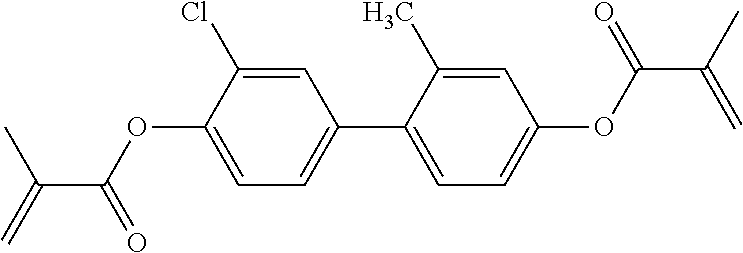 |
I-5 |
| RM-7 |
 |
I-18 |
| TABLE 3 |
| Formulation of the liquid crystal host mixture |
| Host-1 and its test performances |
| Code of | Weight | Formula | Test results for the |
| component | percentage | Code | performance parameters |
| 2CPWO2 | 8 | II-2 | Cp | 74.2 |
| 3CPWO2 | 9.5 | II-2 | Δn | 0.1095 |
| 3PWO2 | 11 | II-1 | Δε | −3.28 |
| 3C1OWO2 | 11 | III-6 | γ1 | 77 |
| 3CC1OWO2 | 15.5 | III-7 | Tc | −30 |
| 3CPO2 | 4 | M-2 | ||
| 3CPP2 | 10.5 | M-13 | ||
| 3CC2 | 18 | M-1 | ||
| 5CC2 | 4 | M-1 | ||
| 4CC3 | 4 | M-1 | ||
| 5PP1 | 4.5 | M-3 | ||
| Total | 100 | |||
| TABLE 4 |
| Formulation of the liquid crystal compositions of Comparative Examples 1-4 and Examples 1-8 and the test performances |
| Comparative Example No. | Example No. |
| 1 | 2 | 3 | 4 | 1 | 2 | 3 | 4 | 5 | 6 | 7 | 8 | |
| Polymerizable | RM-01 | 0.28 | 0.32 | ||||||||||
| compound and its | RM-02 | 0.28 | 0.28 | ||||||||||
| content | RM-03 | 0.01 | |||||||||||
| RM-1 | 0.28 | 0.32 | |||||||||||
| RM-2 | 0.28 | 0.28 | |||||||||||
| RM-3 | 0.01 | 0.01 | |||||||||||
| RM-4 | 0.28 | ||||||||||||
| RM-5 | 0.28 | 0.28 | |||||||||||
| RM-6 | 0.28 | ||||||||||||
| RM-7 | 0.01 |
| VHR (initial) (%) | 93.24 | 93.94 | 94.24 | 93.76 | 94.42 | 95.13 | 95.53 | 94.42 | 94.36 | 95.1 | 95.53 | 94.52 |
| VHR (UV) (%) | 95.45 | 95.85 | 96.15 | 95.69 | 96.76 | 96.83 | 96.95 | 96.96 | 96.66 | 96.85 | 96.85 | 96.96 |
| Ra (nm) | 14.8 | 14.7 | 14.9 | 14.5 | 11.7 | 11.7 | 11.5 | 11.6 | 11.9 | 11.8 | 11.4 | 11.6 |
| PTA1 (°) formed | 100 s | 88.88 | 88.83 | 88.78 | 88.72 | 88.44 | 88.42 | 88.35 | 88.3 | 88.42 | 88.41 | 88.42 | 88.36 |
| after UV1 step for | 120 s | 87.85 | 87.74 | 87.65 | 87.56 | 87.4 | 87.4 | 87.37 | 87.3 | 87.4 | 87.5 | 87.4 | 87.37 |
| different times | 150 s | 86.97 | 86.92 | 86.78 | 86.76 | 86.5 | 86.6 | 86.4 | 86.3 | 86.5 | 86.5 | 86.5 | 86.4 |
| Residual content of polymerizable | 208 | 210 | 227 | 198 | 148 | 139 | 114 | 148 | 157 | 141 | 147 | 124 |
| compound after UV2 step for 90 | ||||||||||||
| min (ppm) |
| Pretilt angle | PTA (initial) | 88.06 | 88.05 | 88.09 | 88.03 | 87.95 | 88.05 | 87.98 | 87.96 | 88.11 | 88.06 | 88.14 | 87.91 |
| stability test | PTA (24 h) | 87.91 | 87.90 | 87.98 | 87.91 | 87.86 | 87.95 | 87.90 | 87.80 | 88.02 | 87.94 | 88.05 | 87.83 |
| (°) | PTA (72 h) | 87.81 | 87.79 | 87.87 | 87.80 | 87.78 | 87.87 | 87.82 | 87.69 | 87.94 | 87.87 | 87.97 | 87.75 |
| PTA (120 h) | 87.67 | 87.68 | 87.67 | 87.69 | 87.71 | 87.81 | 87.75 | 87.68 | 87.87 | 87.82 | 87.90 | 87.69 | |
| PTA (168 h) | 87.60 | 87.58 | 87.59 | 87.61 | 87.65 | 87.77 | 87.68 | 87.64 | 87.81 | 87.77 | 87.84 | 87.64 | |
| ΔPTA (168 h) | 0.46 | 0.47 | 0.5 | 0.42 | 0.3 | 0.28 | 0.3 | 0.32 | 0.3 | 0.29 | 0.3 | 0.27 | |
| TABLE 5 |
| Formulation of the liquid crystal host mixture |
| Host-2 and its test performances |
| Code of | Weight | Formula | Test results for the |
| component | percentage | Code | performance parameters |
| 3PWO1 | 5.5 | II-1 | Cp | 76.1 |
| 3PWO2 | 9.5 | II-1 | Δn | 0.094 |
| 3CPWO2 | 6.5 | II-2 | Δε | −3.3 |
| 3CWO2 | 14.5 | III-1 | K11 | 13.2 |
| 3CCWO2 | 9 | III-2 | K33 | 14.8 |
| 3CCWO3 | 7 | III-2 | γ1 | 91 |
| 2CCWO2 | 8 | III-2 | ||
| 3CC2 | 10 | M-1 | ||
| 4CC3 | 6 | M-1 | ||
| 5CC3 | 6 | M-1 | ||
| 3CCP1 | 10 | M-12 | ||
| 3CCV1 | 8 | M-1 | ||
| Total | 100 | |||
| TABLE 6 |
| Formulation of the liquid crystal compositions of Comparative Examples 5-7 and Examples 9-16 and the test performances |
| Comparative Example No. | Example No. |
| 5 | 6 | 7 | 9 | 10 | 11 | 12 | 13 | 14 | 15 | 16 | |
| Polymerizable | RM-01 | 0.3 | ||||||||||
| compound and its | RM-02 | 0.3 | 0.28 | |||||||||
| content | RM-03 | 0.02 | ||||||||||
| RM-1 | 0.3 | |||||||||||
| RM-2 | 0.3 | 0.35 | 0.28 | |||||||||
| RM-3 | 0.02 | |||||||||||
| RM-4 | 0.3 | |||||||||||
| RM-5 | 0.3 | |||||||||||
| RM-6 | 0.3 | 0.28 | ||||||||||
| RM-7 | 0.02 |
| VHR (initial) (%) | 93.95 | 93.34 | 93.76 | 94.43 | 95.14 | 95.53 | 94.42 | 94.4 | 95.15 | 95.57 | 94.5 |
| VHR (UV) (%) | 95.86 | 95.48 | 95.69 | 96.77 | 96.85 | 96.95 | 96.95 | 96.78 | 96.84 | 96.87 | 96.89 |
| Ra (nm) | 14.1 | 14.7 | 14.6 | 11.9 | 11.8 | 11.5 | 11.6 | 11.6 | 11.4 | 11.5 | 11.5 |
| PTA1 (°) formed after | 100 s | 88.7 | 88.9 | 88.6 | 88.3 | 88.4 | 88.2 | 88.0 | 88.3 | 88.4 | 88.3 | 88.1 |
| UV1 step for different | 120 s | 88.3 | 88.4 | 88.2 | 87.7 | 87.8 | 87.7 | 87.6 | 87.8 | 87.7 | 87.8 | 87.8 |
| times | 150 s | 87.6 | 87.8 | 87.5 | 87.1 | 87.2 | 87.2 | 86.7 | 87.0 | 87.1 | 87.2 | 86.9 |
| Residual content of polymerizable | 185 | 234 | 179 | 137 | 134 | 164 | 111 | 139 | 145 | 136 | 117 |
| compound after UV2 step for 90 min | |||||||||||
| (ppm) |
| Pretilt angle | PTA (initial) | 88.02 | 88.07 | 88.11 | 88.03 | 87.96 | 88.01 | 88.04 | 88.08 | 88.05 | 88.03 | 88.13 |
| stability test (°) | PTA (24 h) | 87.88 | 87.96 | 88.04 | 87.95 | 87.88 | 87.94 | 87.97 | 88.03 | 88.00 | 87.95 | 88.09 |
| PTA (72 h) | 87.76 | 87.85 | 87.96 | 87.89 | 87.81 | 87.86 | 87.91 | 87.96 | 88.94 | 87.87 | 88.05 | |
| PTA (120 h) | 87.66 | 87.70 | 87.76 | 87.83 | 87.73 | 87.82 | 87.84 | 87.87 | 87.86 | 87.82 | 88.02 | |
| PTA (168 h) | 87.6 | 87.63 | 87.71 | 87.76 | 87.71 | 87.77 | 87.81 | 87.82 | 87.78 | 87.78 | 87.9 | |
| ΔPTA (168 h) | 0.42 | 0.44 | 0.40 | 0.27 | 0.25 | 0.24 | 0.23 | 0.26 | 0.27 | 0.25 | 0.23 | |
| TABLE 7 |
| Formulation of the liquid crystal host mixture |
| Host-3 and its test performances |
| Code of | Weight | Formula | Test results for the |
| component | percentage | Code | performance parameters |
| 3C1OWO2 | 14 | III-6 | Cp | 77 |
| 4C1OWO2 | 6 | III-6 | Δn | 0.095 |
| 2CC1OWO2 | 4.5 | III-7 | Δε | −3.1 |
| 3CC1OWO2 | 9.5 | III-7 | K11 | 14 |
| 3CCWO2 | 3.5 | III-2 | K33 | 14.4 |
| 3CPWO2 | 7 | II-2 | γ1 | 91 |
| 3CPO2 | 9 | M-2 | ||
| 3CPP2 | 10.5 | M-13 | ||
| 3CPPC3 | 1.5 | M-22 | ||
| 3CC2 | 20 | M-1 | ||
| 5CC2 | 3 | M-1 | ||
| 4CC3 | 5 | M-1 | ||
| 5PP1 | 4.5 | M-3 | ||
| 3CGPC2 | 2 | M-23 | ||
| Total | 100 | |||
| TABLE 8 |
| Formulation of the liquid crystal compositions of Comparative Examples 8-10 and Examples 17-24 and the test performances |
| Comparative Example No. | Example No. |
| 8 | 9 | 10 | 17 | 18 | 19 | 20 | 21 | 22 | 23 | 24 | |
| Polymerizable | RM-01 | 0.3 | ||||||||||
| compound and its | RM-02 | 0.3 | 0.28 | |||||||||
| content | RM-03 | 0.02 | ||||||||||
| RM-1 | 0.3 | |||||||||||
| RM-2 | 0.3 | 0.35 | 0.28 | |||||||||
| RM-3 | 0.02 | |||||||||||
| RM-4 | 0.3 | |||||||||||
| RM-5 | 0.3 | |||||||||||
| RM-6 | 0.3 | 0.28 | ||||||||||
| RM-7 | 0.02 |
| VHR (initial) (%) | 93.85 | 93.34 | 93.65 | 94.48 | 95.16 | 95.54 | 94.42 | 94.58 | 95.26 | 95.44 | 94.68 |
| VHR (UV) (%) | 95.66 | 95.48 | 95.57 | 96.76 | 96.83 | 96.95 | 96.56 | 96.76 | 96.73 | 96.75 | 96.96 |
| Ra (nm) | 14.7 | 14.6 | 14.8 | 12.5 | 11.7 | 11.6 | 12.4 | 11.5 | 11.9 | 11.8 | 12.4 |
| PTA1 (°) formed | 100 s | 88.82 | 88.86 | 88.77 | 88.46 | 88.45 | 88.40 | 88.35 | 88.4 | 88.42 | 88.41 | 88.36 |
| after UV1 step for | 120 s | 87.74 | 87.84 | 87.68 | 87.41 | 87.4 | 87.36 | 87.32 | 87.42 | 87.4 | 87.38 | 87.34 |
| different times | 150 s | 86.92 | 86.98 | 86.86 | 86.52 | 86.5 | 86.47 | 86.4 | 86.49 | 86.5 | 86.49 | 86.43 |
| Residual content of polymerizable | 218 | 220 | 237 | 158 | 159 | 168 | 126 | 157 | 148 | 152 | 130 |
| compound after UV2 step for 90 min | |||||||||||
| (ppm) |
| Pretilt angle | PTA (initial) | 88.05 | 88.06 | 88.03 | 87.98 | 88.05 | 87.98 | 87.96 | 88.01 | 88.06 | 88.04 | 87.97 |
| stability test (°) | PTA (24 h) | 87.90 | 87.91 | 87.91 | 87.86 | 87.95 | 87.87 | 87.82 | 88.90 | 87.94 | 88.93 | 87.87 |
| PTA (72 h) | 87.79 | 87.81 | 87.80 | 87.78 | 87.86 | 87.80 | 87.74 | 87.82 | 87.87 | 87.82 | 87.78 | |
| PTA (120 h) | 87.68 | 87.67 | 87.69 | 87.71 | 87.79 | 87.74 | 87.70 | 87.74 | 87.79 | 87.76 | 87.73 | |
| PTA (168 h) | 87.6 | 87.59 | 87.6 | 87.67 | 87.73 | 87.69 | 87.68 | 87.69 | 87.75 | 87.72 | 87.7 | |
| ΔPTA (168 h) | 0.45 | 0.47 | 0.43 | 0.31 | 0.32 | 0.29 | 0.28 | 0.32 | 0.31 | 0.32 | 0.27 | |
Claims (10)


Applications Claiming Priority (2)
| Application Number | Priority Date | Filing Date | Title |
|---|---|---|---|
| CN202010158210.9A CN113372926B (en) | 2020-03-09 | 2020-03-09 | Liquid crystal composition containing polymerizable compound and liquid crystal display device |
| CN202010158210.9 | 2020-03-09 |
Publications (2)
| Publication Number | Publication Date |
|---|---|
| US20210284910A1 US20210284910A1 (en) | 2021-09-16 |
| US11339328B2 true US11339328B2 (en) | 2022-05-24 |
Family
ID=77568535
Family Applications (1)
| Application Number | Title | Priority Date | Filing Date |
|---|---|---|---|
| US17/184,045 Active US11339328B2 (en) | 2020-03-09 | 2021-02-24 | Liquid crystal composition containing polymerizable compound and display device thereof |
Country Status (3)
| Country | Link |
|---|---|
| US (1) | US11339328B2 (en) |
| CN (1) | CN113372926B (en) |
| TW (1) | TWI838613B (en) |
Families Citing this family (2)
| Publication number | Priority date | Publication date | Assignee | Title |
|---|---|---|---|---|
| CN113372926B (en) * | 2020-03-09 | 2022-12-16 | 江苏和成显示科技有限公司 | Liquid crystal composition containing polymerizable compound and liquid crystal display device |
| CN115926809B (en) * | 2023-02-23 | 2023-06-16 | 北京灵犀微光科技有限公司 | Holographic polymer dispersed liquid crystal material and application thereof |
Citations (3)
| Publication number | Priority date | Publication date | Assignee | Title |
|---|---|---|---|---|
| JPH0643641A (en) * | 1992-07-24 | 1994-02-18 | Mitsubishi Kasei Corp | Photopolymerizable composition |
| TW202009236A (en) | 2018-08-30 | 2020-03-01 | 日商捷恩智股份有限公司 | Liquid crystal composition, liquid crystal display device and use for liquid crystal display device |
| US20210284910A1 (en) * | 2020-03-09 | 2021-09-16 | Jiangsu Hecheng Display Technology Co., Ltd. | Liquid crystal composition containing polymerizable compound and display device thereof |
Family Cites Families (8)
| Publication number | Priority date | Publication date | Assignee | Title |
|---|---|---|---|---|
| NL283387A (en) * | 1961-09-20 | |||
| DE2612843B2 (en) * | 1976-03-26 | 1979-10-31 | Dynamit Nobel Ag, 5210 Troisdorf | Bis-acrylic esters and bis-methacrylic esters, processes for the preparation of these compounds and their use |
| JP3838366B2 (en) * | 1993-02-15 | 2006-10-25 | セイコーエプソン株式会社 | Liquid crystal element |
| JP2004123829A (en) * | 2002-09-30 | 2004-04-22 | Seiko Epson Corp | Liquid crystal composition, liquid crystal element, and projection display device |
| TWI586645B (en) * | 2011-10-12 | 2017-06-11 | Jnc Corp | Polymerizable compound, liquid crystal composition, and liquid crystal display element |
| CN118085889A (en) * | 2016-11-16 | 2024-05-28 | 江苏和成显示科技有限公司 | Liquid crystal composition having high refractive index and display device thereof |
| CN108531197A (en) * | 2018-05-31 | 2018-09-14 | 烟台显华化工科技有限公司 | A kind of liquid-crystal composition and its application |
| JP2020002210A (en) * | 2018-06-26 | 2020-01-09 | Jnc株式会社 | Liquid crystal composition and liquid crystal display element |
-
2020
- 2020-03-09 CN CN202010158210.9A patent/CN113372926B/en active Active
-
2021
- 2021-02-24 US US17/184,045 patent/US11339328B2/en active Active
- 2021-03-04 TW TW110107736A patent/TWI838613B/en active
Patent Citations (3)
| Publication number | Priority date | Publication date | Assignee | Title |
|---|---|---|---|---|
| JPH0643641A (en) * | 1992-07-24 | 1994-02-18 | Mitsubishi Kasei Corp | Photopolymerizable composition |
| TW202009236A (en) | 2018-08-30 | 2020-03-01 | 日商捷恩智股份有限公司 | Liquid crystal composition, liquid crystal display device and use for liquid crystal display device |
| US20210284910A1 (en) * | 2020-03-09 | 2021-09-16 | Jiangsu Hecheng Display Technology Co., Ltd. | Liquid crystal composition containing polymerizable compound and display device thereof |
Also Published As
| Publication number | Publication date |
|---|---|
| TWI838613B (en) | 2024-04-11 |
| CN113372926A (en) | 2021-09-10 |
| CN113372926B (en) | 2022-12-16 |
| US20210284910A1 (en) | 2021-09-16 |
| TW202134411A (en) | 2021-09-16 |
Similar Documents
| Publication | Publication Date | Title |
|---|---|---|
| US12497564B2 (en) | Liquid crystal composition and liquid crystal display device thereof | |
| JP5699518B2 (en) | Liquid crystal composition containing polymerizable compound and liquid crystal display device using the same | |
| CN102786937A (en) | Liquid crystal composition containing polymerizable compound and liquid crystal display element manufactured using the same | |
| JPWO2013187373A1 (en) | Nematic liquid crystal composition and liquid crystal display device using the same | |
| JP5761469B2 (en) | Liquid crystal display element | |
| KR101988816B1 (en) | Liquid crystal composition and liquid crystal display element | |
| KR20180134851A (en) | Nematic liquid crystal composition and liquid crystal display element using same | |
| US11339328B2 (en) | Liquid crystal composition containing polymerizable compound and display device thereof | |
| CN115216306A (en) | Liquid crystal composition and liquid crystal display device thereof | |
| CN114133938B (en) | Liquid crystal composition comprising polymerizable compound and liquid crystal display device | |
| WO2014118937A1 (en) | Liquid crystal composition and liquid crystal display element manufactured using same | |
| CN120536144A (en) | Liquid crystal composition and liquid crystal display device thereof | |
| CN116064045A (en) | Liquid crystal composition and liquid crystal display device comprising same | |
| CN115216308A (en) | Liquid crystal composition and liquid crystal display device thereof | |
| CN116064052A (en) | Liquid crystal composition and liquid crystal display device thereof | |
| CN114133937B (en) | Liquid crystal composition comprising polymerizable compound and liquid crystal display device | |
| CN114149810B (en) | Liquid crystal composition comprising polymerizable compound and liquid crystal display device | |
| CN114133936B (en) | Liquid crystal composition comprising polymerizable compound and liquid crystal display device | |
| CN113372928B (en) | Liquid crystal composition containing polymerizable compound and liquid crystal display device | |
| CN114574221B (en) | Liquid crystal composition and liquid crystal display device thereof | |
| CN113372927B (en) | Liquid crystal composition containing polymerizable compound and liquid crystal display device | |
| CN115477951B (en) | Liquid crystal composition and liquid crystal display device | |
| CN116179216B (en) | Liquid crystal composition and liquid crystal display device containing the same | |
| CN113372925B (en) | Liquid crystal composition and liquid crystal display device thereof | |
| CN114196421A (en) | Liquid crystal composition and liquid crystal display device thereof |
Legal Events
| Date | Code | Title | Description |
|---|---|---|---|
| FEPP | Fee payment procedure |
Free format text: ENTITY STATUS SET TO UNDISCOUNTED (ORIGINAL EVENT CODE: BIG.); ENTITY STATUS OF PATENT OWNER: LARGE ENTITY |
|
| AS | Assignment |
Owner name: JIANGSU HECHENG DISPLAY TECHNOLOGY CO., LTD., CHINA Free format text: ASSIGNMENT OF ASSIGNORS INTEREST;ASSIGNORS:SUN, CHENGLONG;DING, WENQUAN;XU, HAIBIN;AND OTHERS;REEL/FRAME:055403/0543 Effective date: 20210207 |
|
| STPP | Information on status: patent application and granting procedure in general |
Free format text: DOCKETED NEW CASE - READY FOR EXAMINATION |
|
| STPP | Information on status: patent application and granting procedure in general |
Free format text: NOTICE OF ALLOWANCE MAILED -- APPLICATION RECEIVED IN OFFICE OF PUBLICATIONS |
|
| STPP | Information on status: patent application and granting procedure in general |
Free format text: PUBLICATIONS -- ISSUE FEE PAYMENT VERIFIED |
|
| STCF | Information on status: patent grant |
Free format text: PATENTED CASE |
|
| AS | Assignment |
Owner name: JIANGSU HECHENG DISPLAY TECHNOLOGY CO., LTD., CHINA Free format text: DECLARATION ON CHANGE OF ADDRESS;ASSIGNOR:JIANGSU HECHENG DISPLAY TECHNOLOGY CO., LTD.;REEL/FRAME:061896/0854 Effective date: 20221108 |
|
| MAFP | Maintenance fee payment |
Free format text: PAYMENT OF MAINTENANCE FEE, 4TH YEAR, LARGE ENTITY (ORIGINAL EVENT CODE: M1551); ENTITY STATUS OF PATENT OWNER: LARGE ENTITY Year of fee payment: 4 |