US11330056B2 - Storage system and controller location method - Google Patents

Storage system and controller location method Download PDF

Info

Publication number
US11330056B2
US11330056B2 US17/018,649 US202017018649A US11330056B2 US 11330056 B2 US11330056 B2 US 11330056B2 US 202017018649 A US202017018649 A US 202017018649A US 11330056 B2 US11330056 B2 US 11330056B2
Authority
US
United States
Prior art keywords
amount
node
data transfer
controller
nodes
Prior art date
Legal status (The legal status is an assumption and is not a legal conclusion. Google has not performed a legal analysis and makes no representation as to the accuracy of the status listed.)
Active
Application number
US17/018,649
Other versions
US20210194959A1 (en
Inventor
Shugo Ogawa
Ryosuke Tatsumi
Yoshinori Ohira
Koji Hosogi
Current Assignee (The listed assignees may be inaccurate. Google has not performed a legal analysis and makes no representation or warranty as to the accuracy of the list.)
Hitachi Ltd
Original Assignee
Hitachi Ltd
Priority date (The priority date is an assumption and is not a legal conclusion. Google has not performed a legal analysis and makes no representation as to the accuracy of the date listed.)
Filing date
Publication date
Application filed by Hitachi Ltd filed Critical Hitachi Ltd
Assigned to HITACHI, LTD. reassignment HITACHI, LTD. ASSIGNMENT OF ASSIGNORS INTEREST (SEE DOCUMENT FOR DETAILS). Assignors: OGAWA, SHUGO, TATSUMI, Ryosuke, HOSOGI, KOJI, OHIRA, YOSHINORI
Publication of US20210194959A1 publication Critical patent/US20210194959A1/en
Application granted granted Critical
Publication of US11330056B2 publication Critical patent/US11330056B2/en
Assigned to HITACHI VANTARA, LTD. reassignment HITACHI VANTARA, LTD. COMPANY SPLIT Assignors: HITACHI, LTD.
Active legal-status Critical Current
Anticipated expiration legal-status Critical

Links

Images

Classifications

    • HELECTRICITY
    • H04ELECTRIC COMMUNICATION TECHNIQUE
    • H04LTRANSMISSION OF DIGITAL INFORMATION, e.g. TELEGRAPHIC COMMUNICATION
    • H04L67/00Network arrangements or protocols for supporting network services or applications
    • H04L67/01Protocols
    • H04L67/10Protocols in which an application is distributed across nodes in the network
    • H04L67/1097Protocols in which an application is distributed across nodes in the network for distributed storage of data in networks, e.g. transport arrangements for network file system [NFS], storage area networks [SAN] or network attached storage [NAS]
    • GPHYSICS
    • G06COMPUTING OR CALCULATING; COUNTING
    • G06FELECTRIC DIGITAL DATA PROCESSING
    • G06F12/00Accessing, addressing or allocating within memory systems or architectures
    • G06F12/02Addressing or allocation; Relocation
    • G06F12/08Addressing or allocation; Relocation in hierarchically structured memory systems, e.g. virtual memory systems
    • G06F12/0802Addressing of a memory level in which the access to the desired data or data block requires associative addressing means, e.g. caches
    • G06F12/0866Addressing of a memory level in which the access to the desired data or data block requires associative addressing means, e.g. caches for peripheral storage systems, e.g. disk cache
    • G06F12/0868Data transfer between cache memory and other subsystems, e.g. storage devices or host systems
    • GPHYSICS
    • G06COMPUTING OR CALCULATING; COUNTING
    • G06FELECTRIC DIGITAL DATA PROCESSING
    • G06F3/00Input arrangements for transferring data to be processed into a form capable of being handled by the computer; Output arrangements for transferring data from processing unit to output unit, e.g. interface arrangements
    • G06F3/06Digital input from, or digital output to, record carriers, e.g. RAID, emulated record carriers or networked record carriers
    • G06F3/0601Interfaces specially adapted for storage systems
    • G06F3/0602Interfaces specially adapted for storage systems specifically adapted to achieve a particular effect
    • G06F3/061Improving I/O performance
    • GPHYSICS
    • G06COMPUTING OR CALCULATING; COUNTING
    • G06FELECTRIC DIGITAL DATA PROCESSING
    • G06F3/00Input arrangements for transferring data to be processed into a form capable of being handled by the computer; Output arrangements for transferring data from processing unit to output unit, e.g. interface arrangements
    • G06F3/06Digital input from, or digital output to, record carriers, e.g. RAID, emulated record carriers or networked record carriers
    • G06F3/0601Interfaces specially adapted for storage systems
    • G06F3/0628Interfaces specially adapted for storage systems making use of a particular technique
    • G06F3/0629Configuration or reconfiguration of storage systems
    • G06F3/0635Configuration or reconfiguration of storage systems by changing the path, e.g. traffic rerouting, path reconfiguration
    • GPHYSICS
    • G06COMPUTING OR CALCULATING; COUNTING
    • G06FELECTRIC DIGITAL DATA PROCESSING
    • G06F3/00Input arrangements for transferring data to be processed into a form capable of being handled by the computer; Output arrangements for transferring data from processing unit to output unit, e.g. interface arrangements
    • G06F3/06Digital input from, or digital output to, record carriers, e.g. RAID, emulated record carriers or networked record carriers
    • G06F3/0601Interfaces specially adapted for storage systems
    • G06F3/0628Interfaces specially adapted for storage systems making use of a particular technique
    • G06F3/0646Horizontal data movement in storage systems, i.e. moving data in between storage devices or systems
    • G06F3/0647Migration mechanisms
    • G06F3/0649Lifecycle management
    • GPHYSICS
    • G06COMPUTING OR CALCULATING; COUNTING
    • G06FELECTRIC DIGITAL DATA PROCESSING
    • G06F3/00Input arrangements for transferring data to be processed into a form capable of being handled by the computer; Output arrangements for transferring data from processing unit to output unit, e.g. interface arrangements
    • G06F3/06Digital input from, or digital output to, record carriers, e.g. RAID, emulated record carriers or networked record carriers
    • G06F3/0601Interfaces specially adapted for storage systems
    • G06F3/0628Interfaces specially adapted for storage systems making use of a particular technique
    • G06F3/0655Vertical data movement, i.e. input-output transfer; data movement between one or more hosts and one or more storage devices
    • G06F3/0656Data buffering arrangements
    • GPHYSICS
    • G06COMPUTING OR CALCULATING; COUNTING
    • G06FELECTRIC DIGITAL DATA PROCESSING
    • G06F3/00Input arrangements for transferring data to be processed into a form capable of being handled by the computer; Output arrangements for transferring data from processing unit to output unit, e.g. interface arrangements
    • G06F3/06Digital input from, or digital output to, record carriers, e.g. RAID, emulated record carriers or networked record carriers
    • G06F3/0601Interfaces specially adapted for storage systems
    • G06F3/0628Interfaces specially adapted for storage systems making use of a particular technique
    • G06F3/0655Vertical data movement, i.e. input-output transfer; data movement between one or more hosts and one or more storage devices
    • G06F3/0658Controller construction arrangements
    • GPHYSICS
    • G06COMPUTING OR CALCULATING; COUNTING
    • G06FELECTRIC DIGITAL DATA PROCESSING
    • G06F3/00Input arrangements for transferring data to be processed into a form capable of being handled by the computer; Output arrangements for transferring data from processing unit to output unit, e.g. interface arrangements
    • G06F3/06Digital input from, or digital output to, record carriers, e.g. RAID, emulated record carriers or networked record carriers
    • G06F3/0601Interfaces specially adapted for storage systems
    • G06F3/0668Interfaces specially adapted for storage systems adopting a particular infrastructure
    • G06F3/067Distributed or networked storage systems, e.g. storage area networks [SAN], network attached storage [NAS]
    • H04L67/325
    • H04L67/327
    • HELECTRICITY
    • H04ELECTRIC COMMUNICATION TECHNIQUE
    • H04LTRANSMISSION OF DIGITAL INFORMATION, e.g. TELEGRAPHIC COMMUNICATION
    • H04L67/00Network arrangements or protocols for supporting network services or applications
    • H04L67/50Network services
    • H04L67/60Scheduling or organising the servicing of application requests, e.g. requests for application data transmissions using the analysis and optimisation of the required network resources
    • H04L67/62Establishing a time schedule for servicing the requests
    • HELECTRICITY
    • H04ELECTRIC COMMUNICATION TECHNIQUE
    • H04LTRANSMISSION OF DIGITAL INFORMATION, e.g. TELEGRAPHIC COMMUNICATION
    • H04L67/00Network arrangements or protocols for supporting network services or applications
    • H04L67/50Network services
    • H04L67/60Scheduling or organising the servicing of application requests, e.g. requests for application data transmissions using the analysis and optimisation of the required network resources
    • H04L67/63Routing a service request depending on the request content or context
    • GPHYSICS
    • G06COMPUTING OR CALCULATING; COUNTING
    • G06FELECTRIC DIGITAL DATA PROCESSING
    • G06F2212/00Indexing scheme relating to accessing, addressing or allocation within memory systems or architectures
    • G06F2212/26Using a specific storage system architecture
    • G06F2212/261Storage comprising a plurality of storage devices
    • G06F2212/262Storage comprising a plurality of storage devices configured as RAID

Definitions

  • the present invention relates to a storage system including nodes connected together by a network and determining assignment of a node with a controller function and a controller assignment method.
  • the amount of data transfer between the nodes needs to be reduced to mitigate a bottleneck caused by insufficient network bands.
  • An example of means for reducing the amount of data transfer in access processing includes caching by the controller. Caching storage data in a storage medium allows the amount of data transfer between the controller node and the storage medium node.
  • An example of a method for controlling assignment of the controller function to a plurality of nodes connected by a network includes a method described in PCT Patent Publication No. WO2016/203629.
  • a cache-destination storage apparatus is determined on the basis of at least one of a target I/O pattern and a target connection form to reduce the number of times that I/O data is transferred from a cache memory area toward a host.
  • the storage system is connected to an access requesting host via a network.
  • data transfer associated with an access request from a host takes place not only between a node with the controller function and a node with a storage medium (controller-storage medium) but also between the host and the node with the controller function (host-controller).
  • the data transfer between the host and the controller includes a path connecting the two switches.
  • a network connecting switches shares bands with communications using other hosts and other controllers.
  • a storage system using the above-described architecture has had a challenge for minimization of the amount of data transfer for connections including a network with the narrowest band, including the connection between the host and the controller.
  • an object of the present invention is to propose a storage system in which a network is used to connect a node with a controller function processing access requests and a node storing a storage medium, the storage system mitigating a possible performance bottleneck associated with insufficient network bands to allow improvement of access performance of the storage system, and to also propose a controller assignment method.
  • an aspect of the present invention provides a storage system including a first node with a storage medium of storage and a plurality of second nodes each with a controller function for the storage, the storage system being communicatively connected to a host providing an access request to the storage, in which one of the plurality of second nodes is determined to be anode to which a controller function executing access processing on the storage is assigned on a basis of a first amount of data transfer between the second node and the host and a second amount of data transfer between the second node and the first node.
  • an aspect of the present invention provides a controller assignment method for a storage system including a first node with a storage medium of storage and a plurality of second nodes each with a controller function the storage, the storage system being communicatively connected to a host providing an access request to the storage, the controller assignment method including determining a node to which a controller function executing access processing on the storage is assigned on a basis of a first amount of data transfer between the second node and the host and a second amount of data transfer between the second node and the first node.
  • a possible performance bottleneck associated with insufficient network bands is mitigated to allow improvement of access performance of the storage system.
  • FIG. 1 is a diagram illustrating a configuration example of nodes in a storage system according to a first embodiment
  • FIG. 2 is a diagram illustrating a configuration example of hardware of a controller node according to the first embodiment
  • FIG. 3 is a diagram illustrating a configuration example of a data storage area of a memory according to the first embodiment
  • FIG. 4 is a diagram illustrating a configuration example of a program area according to the first embodiment
  • FIG. 5 is a diagram illustrating a configuration example of a metadata area according to the first embodiment
  • FIG. 6 is a flowchart illustrating a processing procedure example of Read processing according to the first embodiment
  • FIG. 7 is a flowchart illustrating a processing procedure example of Write processing according to the first embodiment
  • FIG. 8 is a flowchart illustrating a processing procedure example of controller assignment processing according to the first embodiment
  • FIG. 9 is a diagram illustrating a configuration example of a metadata area according to the second embodiment.
  • FIG. 10 is a flowchart illustrating a processing procedure example of controller assignment processing according to the second embodiment.
  • an assignment destination node to which a controller function executing access processing is assigned is determined and controlled on the basis of the amount of data transfer between a node with the controller function and a host (amount of to-and-from-host data transfer) and the amount of data transfer between the node with the controller function and a node with a storage medium (amount of to-and-from-storage-medium-node data transfer).
  • the node to which the controller function executing access processing is assigned corresponds to a controller with an ownership for the access processing (owner controller). Note that the present embodiment is not intended to limit the scope of the present invention and that not all elements described in the present embodiment are needed to accomplish the object of the present invention.
  • FIG. 1 is a diagram illustrating a configuration example of nodes in a computer system including a storage system according to the first embodiment.
  • the computer system illustrated in FIG. 1 includes a host 101 , a plurality of controller nodes 102 (individually designated as 102 a and 102 b ), one or more storage medium nodes 103 , local networks 104 (individually designated as 104 a and 104 b ) connecting the nodes together, and a wide area network 105 connecting the local networks.
  • a storage system 100 according to the first embodiment includes at least a plurality of controller nodes 102 and one or more storage medium nodes 103 .
  • the host 101 make an access request for access to a storage area to the controller nodes 102 a and 102 b included in the storage system.
  • the controller nodes 102 are nodes with the controller function for the storage.
  • the controller function includes a controller function executing access processing in response to an access request for access to a storage area.
  • the controller node 102 owner controller
  • the controller node 102 with the controller function executing access processing on the storage area provides the host 101 with access to the storage area.
  • the storage area is provided to the host 101 in form of, for example, a logical unit (LU) mapped to a memory area of a storage medium 106 stored in the storage medium node 103 .
  • the controller node 102 may provide a plurality of LUs to the host 101 . Additionally, access to each LU is provided by only one of the controller nodes 102 (that is, the controller node 102 a or the controller node 102 b ).
  • the storage medium node 103 includes the storage medium 106 to which the memory area of the LU is mapped, and provides access to the controller nodes 102 a and 102 b .
  • the controller nodes 102 a and 102 b share the storage medium 106 of the storage medium node 103 , and can both access the respective storage media 106 .
  • the local networks 104 include wide bands compared to the wide area network 105 .
  • the wide area network 105 is a network path with the narrowest band.
  • the local networks 104 correspond to networks including switches (SW) for connecting nodes in a server rack
  • the wide area network 105 corresponds to a network for connecting SWs in racks.
  • the local networks 104 a and 104 b correspond to paths through which nodes connected to the same SW communicate with each other, and are insusceptible to the adverse effect, on available bandwidth, of data transfer between other nodes.
  • the wide area network 105 corresponds to a path used in a case where communication goes beyond the SW for each rack and through which nodes in different racks communicate with one another, and is susceptible to the adverse effect, on available bandwidth, of data transfer between other nodes.
  • a plurality of the hosts 101 and a plurality of the storage medium nodes 103 may be present.
  • the controller node 102 a and the host 101 correspond to the same node or the controller node 102 b and the storage medium node 103 correspond to the same node.
  • the storage medium node 103 may provide simultaneous access to a plurality of the storage media 106 .
  • the configurations (the number of networks, the connection relationship, and the like) of the local network 104 and the wide area network 105 in the storage system. 100 are not limited to the configurations illustrated in FIG. 1 .
  • FIG. 2 is a diagram illustrating a configuration example of hardware of a controller node according to the first embodiment.
  • FIG. 2 illustrates a configuration example of hardware of the controller node 102 a illustrated in FIG. 1 .
  • the controller node 102 b may be assumed to have a similar configuration.
  • the controller node 102 a includes one or more processors 201 , one or more memories 202 , and one or more communication I/Fs 203 .
  • the processor 201 executes a program using the memory 202 to implement the controller function, providing the host 101 with access to an LU.
  • the communication I/F 203 is connected to the local network 104 a to receive, from the host 101 , an access request for access to an LU, transmit a response, and transfer, to and from the host 101 , Read/Write data associated with processing of the access request. Additionally, the communication I/F 203 transmits an access request for access to the storage medium 106 stored in the storage medium node 103 , receives a response, and perform data transfer to and from the storage medium node 103 , which is associated with processing of an access request from the host 101 .
  • communication standards for connection between the communication I/F 203 and the local network 104 a are not particularly limited as long as the access request, the transmission and reception of a response, and the data transfer as described above are enabled. Likewise, no limitation is imposed on a protocol used in processing (access request, response, and data transmission and reception) executed between the controller node 102 a and the host 101 and the storage medium node 103 .
  • FIG. 3 is a diagram illustrating a configuration example of data storage areas in the memory according to the first embodiment.
  • the memory 202 of the controller node 102 a (which may be replaced with 102 b ) includes a program area 301 , a cache area 302 , and a metadata area 303 as data storage areas corresponding to types.
  • the program area 301 stores various programs for implementing the controller function of the storage system 100 , and the stored programs are executed by the processor 201 .
  • the cache area 302 temporarily stores data read from the storage medium 106 of the storage medium node 103 or Write data for the storage medium 106 .
  • the metadata area 303 stores management information associated with processing of each LU for which the controller node 102 a provides access to the host 101 .
  • FIG. 4 is a diagram illustrating a configuration example of the program area according to the first embodiment.
  • the following are stored as the various programs executed by the processor 201 : a command processing program 401 , a cache control program 402 , a redundant array of independent disks (RAID) control program 403 , an I/O control program 404 , a controller assignment determination program 405 , and a controller assignment change program 406 .
  • a command processing program 401 a cache control program 402 , a redundant array of independent disks (RAID) control program 403 , an I/O control program 404 , a controller assignment determination program 405 , and a controller assignment change program 406 .
  • RAID redundant array of independent disks
  • the command processing program 401 receives, from the host 101 , a Read/Write request to an LU and responds with a result, via the communication I/F 203 . Additionally, the command processing program 401 starts processing corresponding to the above-described Read/Write request and performs data transfer corresponding to the Read/Write request to and from the host 101 via the communication I/F 203 .
  • the cache control program 402 reserves a portion of the cache area 302 in which data corresponding to the address of an access requesting side is stored, and performs Read/Write of the stored data.
  • the RAID control program 403 uses memory areas in a plurality of storage media 106 included in the storage medium node 103 to provide a virtual volume with consecutive memory areas. Additionally, in a case where the virtual volume provided has redundancy among the plurality of storage media 106 , the RAID control program 403 generate redundant data such as parities for the stored data.
  • the I/O control program 404 executes a Read/Write request via the communication I/F 203 to the plurality of storage media 106 included in the storage medium node 103 .
  • a protocol used for access from the I/O control program 404 to the storage medium 106 is not particularly limited as long as Read/Write access to a specified address is enabled.
  • the controller assignment determination program 405 determines one of the plurality of controller nodes 102 a and 102 b to provide access to each LU on the basis of the amount of data transfer between the controller node 102 and the host 101 (amount of to-and-from-host data transfer) and the amount of data transfer between the controller node 102 and the storage medium node 103 (amount of to-and-from-storage-medium-node data transfer). As described below in detail with reference to FIG.
  • the controller assignment determination program 405 compares, in access processing for each LU, the amount of to-and-from-host data transfer with the amount of to-and-from-storage-medium-node data transfer to determine one of the plurality of controller nodes 102 to provide access to the LU such that a data transfer path with a large amount of data transfer does not include a network with narrow bands (the wide area network 105 ). Furthermore, the controller assignment determination program 405 notifies the host 101 of change of node providing access to the LU. Note that the “node providing access to the LU” is synonymous with the “node with the controller function executing access processing on the LU” and the “controller with the ownership for the access processing (owner controller).”
  • the controller assignment change program 406 changes the node providing access to each LU on the basis of a result determined by the controller assignment determination program 405 .
  • the controller assignment change program 406 transfers, to the change destination node (the controller node 102 b ), management information used for access processing for the LU.
  • the controller assignment change program 406 receives, from the change source node (for example, the controller node 102 b ), the management information used for access processing for the LU.
  • FIG. 5 is a diagram illustrating a configuration example of the metadata area according to the first embodiment.
  • management information 500 required for processing for each LU is stored in the metadata area 303 for the LU.
  • the management information 500 includes control metadata 501 related to each LU providing access and an inter-node transfer amount 502 representing the amount of data transfer between the node in which the metadata area 303 operates (the controller node 102 ) and the host 101 or the storage medium node 103 .
  • the control metadata 501 is control information required to process an access request, from the host 101 , for access to each LU.
  • the control metadata 501 includes information representing a correspondence relationship between the address of each LU and the memory area of a virtual volume provided by the RAID control program 403 .
  • the amount of data transfer between the controller node 102 and the host 101 is recorded in the first row of record
  • the amount of data transfer between the controller node 102 and the storage medium node 103 is recorded in the second row of record. Note that, for each of the amounts of data transfer recorded in the inter-node transfer amount 502 , each time transfer of Read data or Write data to or from the corresponding node takes place, the corresponding amount of data transfer is added.
  • each amount of data transfer recorded in the inter-node transfer amount 502 may be periodically reset or refreshed or may be subjected to predetermined processing corresponding to the passage of time such as division of the amount in predetermined units of time for recording.
  • the amount of Read data transfer and the amount of Write data transfer are separately recorded.
  • a total value may be pre-calculated and recorded in the inter-node transfer amount 502 .
  • FIG. 6 is a flowchart illustrating a processing procedure example of Read processing according to the first embodiment.
  • the Read processing illustrated in FIG. 6 is executed by the controller node 102 in response to a Read request to an LU from the host 101 , and the processor 201 executes each of the programs stored in the program area 301 of the memory 202 as follows.
  • the command processing program 401 inquires of the cache control program 402 as to a storage destination of the Read target data in the cache area 302 (step S 601 ).
  • the cache control program 402 having received the inquiry in step S 601 , determines whether or not Read target data is present in the cache area 302 (step S 602 ). Ina case where Read target data is present in the cache area 302 , the cache control program 402 executes processing in step S 608 . In a case where Read target data is not present in the cache area 302 , the cache control program 402 executes processing in step S 603 .
  • step S 603 the cache control program 402 uses any method to select a storage destination area for the Read target data from the cache area 302 , and determines whether or not data already stored in the selected storage destination area (cache data) is already stored in the corresponding memory area in the storage medium 106 .
  • the cache control program 402 determines, on the basis of the determination in step S 603 , that the data in the selected storage destination area is already stored in the corresponding memory area in the storage medium 106 .
  • the cache control program 402 executes processing in step S 606 .
  • the cache control program 402 determines that the data in the selected storage destination area is not stored in the corresponding memory area in the storage medium 106 yet, the cache control program 402 executes processing in step S 604 .
  • step S 604 the cache control program 402 generates, through the RAID control program 403 , redundant data for the data stored in the storage destination area selected in step S 603 (original data), and identifies the corresponding storage medium node 103 , storage medium 106 , and address for the original data and the redundant data, and proceeds to processing in step S 605 .
  • step S 605 the cache control program 402 writes the data stored in the storage destination area selected in step S 603 (original data) and the redundant data generated in step S 604 , to the address in the storage medium 106 identified in step S 605 (Write). Furthermore, the cache control program 402 uses the total value of the size of the original data on the cache and the size of the redundant data, the original data and the redundant data having been written to the storage medium 106 , to update the inter-node transfer amount 502 in the management information 500 corresponding to the LU storing the original data and the redundant data.
  • the cache control program 402 adds the total value to the amount of Write data transfer in the amount of to-and-from-storage-medium-node data transfer in the corresponding inter-node transfer amount 502 . Then, when the processing in step S 605 is ended, the cache control program 402 proceeds to the processing in step S 606 .
  • step S 606 the cache control program 402 identifies, through the RAID control program 403 , the corresponding storage medium node 103 , the storage medium 106 , and address for the Read target data as to which the inquiry has been received from the command processing program 401 in step S 601 , and proceeds to processing in step S 607 .
  • step S 607 the cache control program. 402 performs Read on the address in the storage medium 106 identified in step S 606 , and stores Read result data in the storage destination area selected in step S 603 . Furthermore, the cache control program 402 uses the size of the data read from the storage medium 106 to update the inter-node transfer amount 502 in the management information 500 corresponding to the LU storing the data. Specifically, the cache control program 402 adds the size of the read data to the amount of Read data transfer in the amount of to-and-from-storage-medium-node data transfer in the corresponding inter-node transfer amount 502 . Then, when the processing in step S 607 is ended, the cache control program 402 proceeds to the processing in step S 608 .
  • step S 608 on the basis of the processing result in step S 602 (in a case where the determination result is YES) or the processing result in step S 607 , the cache control program 402 notifies the command processing program 401 of the storage destination address, in the cache area 302 , of the Read target data as to which the inquiry has been received in step S 601 .
  • the command processing program 401 transfers the Read target data stored at the address notified in step S 608 , to the host 101 via the communication I/F 203 as the result of the Read request. Furthermore, the command processing program 401 uses the size of the Read data transferred to the host 101 , to update the inter-node transfer amount 502 in the management information 500 corresponding to the LU storing the Read data. Specifically, the command processing program 401 adds the size of the Read data to the amount of Read data transfer in the amount of to-and-from-host data transfer in the corresponding inter-node transfer amount 502 (step S 609 ). Then, the processing in step S 609 is completed to end the series of steps of Read processing.
  • the above-described series of steps of Read processing is executed to allow the data to be sent to the storage medium 106 and to allow the Read target data to be transferred from the cache area 302 to host 101 .
  • FIG. 7 is a flowchart illustrating a processing procedure example of Write processing according to the first embodiment.
  • the Write processing illustrated in FIG. 7 is executed by the controller node 102 in response to a Write request to an LU from the host 101 , and the processor 201 executes each of the programs stored in the program area 301 of the memory 202 as follows.
  • the command processing program 401 inquires of the cache control program 402 as to the storage destination, in the cache area 302 , of Write target data (step S 701 ).
  • the cache control program 402 having received the inquiry in step S 701 , determines whether or not data stored at a Write destination address is present in the cache area 302 (step S 702 ). In a case where Write target data is present in the cache area 302 , the cache control program 402 executes processing in step S 706 . In a case where Write target data is not present in the cache area 302 , the cache control program 402 executes processing in step S 703 .
  • step S 703 the cache control program 402 uses any method to select a storage destination area for the Read target data from the cache area 302 , and determines whether or not data already stored in the selected storage destination area (cache data) is already stored in the corresponding memory area in the storage medium 106 .
  • the cache control program 402 determines, on the basis of the determination in step S 703 , that the data in the selected storage destination area is already stored in the corresponding memory area in the storage medium 106 .
  • the cache control program 402 executes processing in step S 706 .
  • the cache control program 402 determines that the data in the selected storage destination area is not stored in the corresponding memory area in the storage medium 106 yet, the cache control program 402 executes processing in step S 704 .
  • step S 704 the cache control program 402 generates, through the RAID control program 403 , redundant data for the data stored in the storage destination area selected in step S 703 (original data), and identifies the corresponding storage medium node 103 , storage medium 106 , and address for the original data and the redundant data, and proceeds to processing in step S 705 .
  • step S 705 the cache control program 402 writes the data stored in the storage destination area selected in step S 703 (original data) and the redundant data generated in step S 704 , to the address in the storage medium 106 identified in step S 705 (Write). Furthermore, the cache control program 402 uses the total value of the size of the original data on the cache and the size of the redundant data, the original data and the redundant data having been written to the storage medium 106 , to update the inter-node transfer amount 502 in the management information 500 corresponding to the LU storing the original data and the redundant data.
  • the cache control program 402 adds the total value to the amount of Write data transfer in the amount of to-and-from-storage-medium-node data transfer in the corresponding inter-node transfer amount 502 . Then, when the processing in step S 705 is ended, the cache control program 402 proceeds to the processing in step S 706 .
  • step S 706 on the basis of the processing result in step S 702 (in a case where the determination result is YES) or the processing result in step S 705 , the cache control program 402 notifies the command processing program 401 of the storage destination address, in the cache area 302 , of the Write target data as to which the inquiry has been received in step S 701 .
  • the command processing program 401 receives the Write target data from the host 101 via the communication I/F 203 , and stores the Write target address at the address notified in step S 706 . Furthermore, the command processing program 401 uses the size of the Write data transferred from the host 101 , to update the inter-node transfer amount 502 in the management information 500 corresponding to the LU storing the Write data. Specifically, the command processing program 401 adds the size of the Write data to the amount of Write data transfer in the amount of to-and-from-host data transfer in the corresponding inter-node transfer amount 502 (step S 707 ). Then, the processing in step S 707 is completed to end the series of steps of Write processing.
  • the above-described series of steps of Write processing is executed to allow the data to be sent to the storage medium 106 and to allow the Write target data to be written to the cache area 302 .
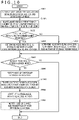
  • FIG. 8 is a flowchart illustrating a processing procedure example of controller assignment processing according to the first embodiment.
  • the controller assignment processing illustrated in FIG. 8 involves determining and changing controller assignment for each LU providing access.
  • the processing is started by the controller node 102 a or 102 b starting to execute the controller assignment determination program 405 with an optional period.
  • the controller assignment determination program 405 references the inter-node transfer amount 502 in the management information 500 corresponding to the LU for which the controller assignment is to be determined, and computes the total amount of data transfer for each of the amount of data transfer between the subject node and the host 101 (amount of to-and-from-host data transfer) and the amount of data transfer between the subject node and the storage medium node 103 (amount of to-and-from-storage-medium-node data transfer) (step S 801 ). Each total amount of data transfer is computed by adding the amount of Read data transfer and the amount of Write data transfer in the corresponding inter-node transfer amount.
  • the subject node corresponds to the node executing the controller assignment determination program 405 , that is, the controller node 102 a or the controller node 102 b.
  • the controller assignment determination program 405 compares the two total amounts of data transfer calculated in step S 801 (step S 802 ). Then, in a case where the total amount of data transfer for the inter-node transfer amount is larger than the total amount of data transfer for the amount of to-and-from-storage-medium-node data transfer (YES in step S 802 ), the controller assignment determination program 405 executes processing in step S 803 . In a case where the total amount of data transfer for the inter-node transfer amount is equal to or smaller than the total amount of data transfer for the amount of to-and-from-storage-medium-node data transfer (NO in step S 802 ), the controller assignment determination program 405 executes processing in step S 804 .
  • step S 803 for the LU for which the controller assignment is to be determined, the controller assignment determination program 405 determines the controller node 102 a connected to the same local network 104 a to which the host 101 is connected to be the node providing access to the LU, and proceeds to processing in step S 805 .
  • step S 804 for the LU for which the controller assignment is to be determined, the controller assignment determination program 405 determines the controller node 102 b connected to the same local network 104 b to which the storage medium node 103 is connected to be the node providing access to the LU, and proceeds to processing in step S 805 .
  • step S 805 the controller assignment determination program 405 determines whether or not the node determined in step S 803 or step S 804 (the node providing access to the LU) matches the subject node (the node executing the controller assignment determination program 405 ).
  • step S 805 in a case where the two nodes do not match, that is, in a case where the node providing access to the LU is changed from the subject node to another node (YES in step S 805 ), the controller assignment determination program 405 proceeds to processing in step S 605 .
  • the controller assignment processing is ended.
  • step s 806 the controller assignment change program 406 notifies the host 101 of temporary access stoppage related to the LU for which the controller assignment is changed (that is, the LU for which the node providing access is to be changed by the processing in step S 803 or step S 804 ).
  • the controller assignment change program 406 transfers the control metadata 501 held by the subject node (for example, the controller node 102 a ) and related to the LU for which the controller assignment is to be changed, to “another node (for example, the controller node 102 b ).” Additionally, through the cache control program 402 , the controller assignment change program 406 writes, to the storage medium 106 , all of the data in the cache area 302 of the subject node (for example, the controller node 102 a ) that is not stored in the storage medium 106 (step S 807 ).
  • the controller assignment change program 406 instructs another node to which the control metadata 501 is transferred in step S 807 , in other words, the controller assignment change destination node (for example, the controller node 102 b ) to start providing access to the LU.
  • the controller assignment change program 406 operating in the change destination node starts providing access to the LU and subsequently notifies the controller assignment change source node (for example, the controller node 102 a ) that the start of access provision is completed (step S 808 ).
  • step S 808 the controller assignment change program 406 in the change source node (for example, the controller node 102 a ) notified that the start of access provision is completed in step S 808 notifies the host 101 of change of the access destination node and resumption of access related to the LU for which temporary stoppage of access is notified in step S 806 (step S 809 ). Then, the processing in step S 809 is completed to end the series of steps of controller assignment processing.
  • the notification, in step S 809 , of change of the access destination node and resumption of access related to the LU may be provided from the change destination node to the host 101 . Furthermore, in this case, the notification of completion of access provision start provided from the change destination node to the change source node in step S 808 may be omitted.
  • the total amounts of data transfer are calculated by adding the amount of Read data transfer and the amount of Write data transfer together and are used to compare the amount of to-and-from-host data transfer with the amount of to-and-from-storage-medium-node data transfer.
  • the controller assignment processing according to the present embodiment is not limited to the comparison method.
  • Another comparison method may, for example, individually use the amount of Read data transfer and the amount of Write data transfer for comparison or use only one of the amount of Read data transfer or the amount of Write data transfer for comparison.
  • the total values of the amounts of data transfer may be used that are computed by weighting Read/Write according to application or configuration for comparison.
  • Execution of the above-described series of steps of controller assignment processing allows the storage system 100 according to the first embodiment to determine one of the controller nodes 102 a and 102 b to be the assignment destination of the node with the controller function executing the access processing (owner controller) and to change the assignment destination, on the basis of the amount of to-and-from-host data transfer between the node with the controller function and the host 101 and the amount of to-and-from-storage-medium-node data transfer between the node with the controller function and the node with the storage medium 106 (the storage medium node 103 ).
  • the controller assignment processing involves comparing the amount of to-and-from-host data transfer with the amount of to-and-from-storage-medium-node data transfer to determine the assignment destination of the controller function executing the access processing such that the data transfer path with a larger amount of data transfer does not include a network with narrow bands available (the wide area network 105 ).
  • an LU with a high cache hit rate has a reduced frequency of access to the storage medium 106 , leading to an increase in amount of data transfer to and from the host 101 relative to the amount of data transfer to and from the storage medium node 103 .
  • the amount of to-and-from-host data transfer is larger than the amount of to-and-from-storage-medium-node data transfer.
  • the controller assignment processing determines the controller node 102 a , connected to the same local network 104 a to which the host 101 is connected, to be the assignment destination of the controller function executing the access processing (step S 803 ).
  • the controller node 102 a provides access to the LU, and the wide area network 105 with narrow bands is used as a data transfer path of transfer to and from the storage medium node 103 . This enables bottlenecks to be mitigated.
  • an LU with a low cache hit rate and many data writes has an increased amount of data transfer to and from the storage medium 106 due to storage of redundant data in RAID compared to data read and written by the host 101 .
  • the amount of to-and-from-storage-medium-node data transfer is larger than the amount of to-and-from-host data transfer.
  • the controller assignment processing determines the controller node 102 b , connected to the same local network 104 b to which the storage medium node 103 is connected, to be the assignment destination of the controller function executing the access processing (step S 804 ).
  • the controller node 102 b provides access to the LU, and the wide area network 105 with narrow bands is used as a data transfer path of transfer to and from the host 101 . This enables bottlenecks to be mitigated.
  • the storage system 100 determines the assignment destination of the node with the controller function executing the access processing such that, of the two types of inter-node communication centered at the node with the controller function, the network path for the inter-node communication with a larger amount of data transfer does not include a network with the narrowest band available.
  • the assignment destination of the node with the controller function executing the access processing may be determined such that the network path for the inter-node communication with a smaller amount of data transfer includes a network with the narrowest band available.
  • Such controller assignment enables, in the access processing corresponding to an access request for access to the storage system 100 from the host 101 , a reduction in the amount of data transfer in the network path with the narrowest band available (for example, the wide area network 105 ). As a result, a possible performance bottleneck associated with insufficient network bands can be mitigated, allowing the access performance of the storage system to be improved.
  • an assignment destination node of the controller function executing the access processing is determined and controlled on the basis of the amount of data transfer involved in access to a storage medium associated not only with processing resulting from to an access request from the host but also with internal processing scheduled to be implemented by the node with the controller function.
  • the present embodiment is not intended to limit the scope of the present invention and that not all the elements described in the present embodiment are needed to achieve the object of the present invention.
  • FIG. 9 is a diagram illustrating a configuration example of the metadata area according to the second embodiment.
  • management information 900 needed for processing for each LU is stored for the LU.
  • the management information 900 includes internal processing schedule information 903 for each LU.
  • the internal processing schedule information 903 the type of the internal processing for the LU such as backup and data integrity check, and the start scheduled time of the internal processing.
  • predicted Read access to the storage medium 106 in the processing has a capacity obtained by subtracting, from the capacity of the LU, the data size of the LU stored in the cache.
  • a backup destination is the storage medium 106 in the storage medium node 103 .
  • Write access of the same capacity as that of the Read is predicted to take place.
  • FIG. 10 is a flowchart illustrating a processing procedure example of controller assignment processing according to the second embodiment.
  • the controller assignment processing illustrated in FIG. 10 includes determining and changing the controller assignment for each LU for which access is provided and is started by the controller node 102 a or 102 b starting to execute the controller assignment determination program 405 with an optional period.
  • the controller assignment determination program 405 references the inter-node transfer amount 502 in the management information 900 corresponding to the LU for which the controller assignment is to be determined, and computes the total amount of data transfer for each of the amount of data transfer between the subject node and the host 101 (amount of to-and-from-host data transfer) and the amount of data transfer between the subject node and the storage medium node 103 (amount of to-and-from-storage-medium-node data transfer) (step S 801 ).
  • the controller assignment determination program 405 references the internal processing schedule information 903 in the management information 900 corresponding to the LU for which the controller assignment is to be determined, and in a case where, in the lapse of the execution period, the internal processing is to take place before the next execution of the controller assignment determination program 405 is started (the internal processing schedule information 903 indicates a start scheduled time prior to the next execution start time), the controller assignment determination program 405 adds the amount of data transfer in access to the storage medium 106 scheduled in the internal processing to the total amount of data transfer for the amount of to-and-from-storage-medium-node data transfer computed in step S 801 (step S 1001 ).
  • step S 1001 adds the estimated amount of data communication to the total amount of data transfer for the amount of to-and-from-storage-medium-node data transfer. Then, by using the total amount of data transfer resulting from the addition, the amount of to-and-from-host data transfer is compared with the amount of to-and-from-storage-medium-node data transfer (step S 802 ), and in accordance with a comparison result, the node providing access to the LU is determined (steps S 803 and S 804 ).
  • the first embodiment compares the current values (history) of the amounts of data communication to determine the assignment destination of the controller function executing the access processing
  • the second embodiment allows the amounts of data communication obtained on the basis of estimation to be compared to determine the assignment destination of the controller function executing the access processing.
  • step S 805 and subsequent steps processing needed in response to change of the node providing access to the LU is executed as is the case with the controller assignment processing according to the first embodiment ( FIG. 8 ) (steps S 805 to S 809 ).
  • step S 807 in FIG. 8 is replaced with step S 1002 .
  • step S 1002 the controller assignment change program 406 transfers, to “another node (for example, the controller node 102 b )” providing access to the LU, the control metadata 501 and the internal processing schedule information 903 related to the LU for which the controller assignment is to be changed, the control metadata 501 and the internal processing schedule information 903 being held by the subject node (for example, the controller node 102 a ). Additionally, through the cache control program 402 , the controller assignment change program 406 writes, to the storage medium 106 , all of the data in the cache area 302 of the subject node (for example, the controller node 102 a ) that is not stored in the storage medium 106 . Subsequently, the processing in step S 808 is executed.
  • step S 1002 differs from step S 807 in FIG. 8 only in that, in addition to the control metadata 501 , the internal processing schedule information 903 is transferred from the change source node to the change destination node.
  • Execution of the above-described series of steps of controller assignment processing allows the storage system 100 according to the second embodiment to determine one of the plurality of controller nodes 102 a and 102 b to be the assignment destination of the node with the controller function executing the access processing and to change the assignment destination, on the basis of the amount of to-and-from-host data transfer between the node with the controller function and the host 101 and the amount of to-and-from-storage-medium-node data transfer between the node with the controller function and the node with the storage medium 106 (storage medium node 103 ).
  • the controller assignment processing according to the second embodiment is similar to the controller assignment processing according to the first embodiment in that the assignment destination node of the controller function executing the access processing is determined on the basis of the result of comparison of the amount of to-and-from-host data transfer and the amount of to-and-from-storage-medium-node data transfer, but allows the amount of data transfer in the network to be estimated more accurately than in the first embodiment by considering the internal processing schedule for the controller node 102 a or 102 b , for the amount of data transfer to be compared. Then, by accurately estimating the amount of data transfer to determine the assignment destination node of the controller function executing the access processing, a possible performance bottleneck in the storage system 100 associated with insufficient network bands is reliably mitigated, allowing the access performance to be improved.
  • step S 1001 in FIG. 10 at least one of the following can be used: the cache hit rate, RAID or Erasure Coding configuration information, a reduction rate for the amount of data transfer based on data compression and decompression, a data duplication rate, the ratio between Read and Write in access, and an access size.
  • the present invention has been described. However, the present invention is not limited to the above-described embodiments and includes various derivatives. For example, the above-described embodiments have been described in detail to facilitate understanding of the present invention, and are not limited to the embodiments including all of the above-described components. Additionally, a part of configuration of a certain embodiment can be replaced with the configuration of another embodiment, and to the configuration of a certain embodiment, the configuration of another embodiment can be added. In addition, deletion, or replacement of another configuration can be made.
  • the cache area 302 , the cache control program 402 , and the RAID control program 403 included in the controller nodes 102 a and 102 b are presented in order to describe a change in the amount of data transfer between the controller node 102 and the host 101 and between the controller node 102 and the storage medium node 103 .
  • the storage system according to the present invention need not necessarily include the cache area 302 , the cache control program 402 , and the RAID control program 403 . It is sufficient that, in a configuration to which the present invention is suitably applied, for example, there is a difference in the amount of data communication between the host side and the storage (storage medium 106 ).
  • the controller function executing the access processing for the storage includes at least one of a cache function, a data reduction function (compression and decompression or deduplication function), and a redundancy function.
  • the network is shared by the entirety of the connection between the host 101 and the controller nodes 102 a and 102 b , corresponding to an external connection of the storage system 100 , and the connection between the storage medium node 103 and the controller nodes 102 a and 102 b , corresponding to an internal connection of the storage system 100 .
  • the present invention is not limited to such a configuration.
  • the connection of the controller node 102 a , the connection between the controller nodes 102 b and the host 101 , and the connection of the storage medium node 103 may utilize different networks, and the local networks 104 and 104 b and the wide area network 105 may be present for each of the connections.
  • the inter-node transfer amount 502 stored in the metadata area 303 is referenced for the determination, in the controller assignment processing, of the assignment destination of the node provided with the controller function executing the access processing.
  • the information may be used instead of the inter-node transfer amount 502 .
  • the controller assignment processing may be executed using the information recorded by the function instead of the inter-node transfer amount 502 , and in this case, the storage system 100 does not store the inter-node transfer amount 502 in the metadata area 303 .
  • the functions of the controller nodes 102 a and 102 b are assumed to include software executed in the processor 201 . However, some or all of the functions may be implemented by hardware.

Landscapes

  • Engineering & Computer Science (AREA)
  • Theoretical Computer Science (AREA)
  • Physics & Mathematics (AREA)
  • General Engineering & Computer Science (AREA)
  • General Physics & Mathematics (AREA)
  • Human Computer Interaction (AREA)
  • Computer Networks & Wireless Communication (AREA)
  • Signal Processing (AREA)
  • Information Retrieval, Db Structures And Fs Structures Therefor (AREA)

Abstract

A possible performance bottleneck associated with insufficient network bands is mitigated to allow improvement of access performance of a storage system.A storage system includes a first node with a storage medium of storage and a plurality of second nodes each with a controller function for the storage, and is communicatively connected to a host providing an access request to the storage. One of the plurality of second nodes is determined to be a node to which a controller function executing access processing on the storage is assigned on the basis of a first amount of data transfer between the second node and the host and a second amount of data transfer between the second node and the first node.

Description

BACKGROUND OF THE INVENTION 1. Field of the Invention
The present invention relates to a storage system including nodes connected together by a network and determining assignment of a node with a controller function and a controller assignment method.
2. Description of the Related Art
In order to satisfy wide-range requests for access performance and storage capacity, storage systems used in recent computer environments use an architecture in which a network is used to connect a node with a controller function processing access requests to storage and a node storing a storage medium. In such a storage system, the processing performance and the storage capacity can be adjusted and added by connecting, to the network, a required number of nodes each with a controller function (controllers) and a required number of nodes each with a storage medium (storage medium nodes). Among the controllers, each node with a controller function executing access processing transfers, to and from a storage medium node or another controller, data stored in the storage medium. At this time, in a case where nodes transferring data have insufficient network bands, a performance bottleneck occurs.
Thus, in a storage system using the above-described architecture, the amount of data transfer between the nodes needs to be reduced to mitigate a bottleneck caused by insufficient network bands. An example of means for reducing the amount of data transfer in access processing includes caching by the controller. Caching storage data in a storage medium allows the amount of data transfer between the controller node and the storage medium node.
However, in a storage system including a plurality of nodes each with the controller function, even in a case where data is present on a cache, data transfer takes place in a case where the controller function executing the access processing is present in a node different from the cache. Accordingly, to mitigate degraded performance in a storage system including a plurality of nodes each with the controller function, it is important to optimize assignment of the controller function to a plurality of nodes connected by the network.
An example of a method for controlling assignment of the controller function to a plurality of nodes connected by a network includes a method described in PCT Patent Publication No. WO2016/203629. In the cache controlling method described in PCT Patent Publication No. WO2016/203629, a cache-destination storage apparatus is determined on the basis of at least one of a target I/O pattern and a target connection form to reduce the number of times that I/O data is transferred from a cache memory area toward a host.
SUMMARY OF THE INVENTION
Typically, the storage system is connected to an access requesting host via a network. In other words, in a storage system including a plurality of nodes connected by the network, data transfer associated with an access request from a host takes place not only between a node with the controller function and a node with a storage medium (controller-storage medium) but also between the host and the node with the controller function (host-controller).
However, the cache controlling method in PCT Patent Publication No. WO2016/203629 holds promise for reduction in the amount of data transfer between the controller and the storage medium but does not take into account the data transfer between the host and the controller. Thus, there is a problem in that the data transfer between the host and the controller may be a bottleneck associated with insufficient bands in the network.
Additionally, in the above-described two data transfers, data transfer paths with narrow bands are likely to include insufficient bands, and thus avoidance of degraded performance of the storage system requires minimization of the amount of data transfer using a data transfer path with a narrow band.
For example, in a case where a storage system in which a node with the controller function (controller) and a storage medium node are connected to the same network switch is accessed by a host connected to a different network switch, the data transfer between the host and the controller includes a path connecting the two switches. Typically, unlike connections within the same switch, a network connecting switches shares bands with communications using other hosts and other controllers. Thus, access from each host can use only narrow bands, leading to a stronger need for a reduction in the amount of data transfer.
In other words, a storage system using the above-described architecture has had a challenge for minimization of the amount of data transfer for connections including a network with the narrowest band, including the connection between the host and the controller.
In view of the above-described circumstances, an object of the present invention is to propose a storage system in which a network is used to connect a node with a controller function processing access requests and a node storing a storage medium, the storage system mitigating a possible performance bottleneck associated with insufficient network bands to allow improvement of access performance of the storage system, and to also propose a controller assignment method.
To accomplish the object, an aspect of the present invention provides a storage system including a first node with a storage medium of storage and a plurality of second nodes each with a controller function for the storage, the storage system being communicatively connected to a host providing an access request to the storage, in which one of the plurality of second nodes is determined to be anode to which a controller function executing access processing on the storage is assigned on a basis of a first amount of data transfer between the second node and the host and a second amount of data transfer between the second node and the first node.
Additionally, to accomplish the object, an aspect of the present invention provides a controller assignment method for a storage system including a first node with a storage medium of storage and a plurality of second nodes each with a controller function the storage, the storage system being communicatively connected to a host providing an access request to the storage, the controller assignment method including determining a node to which a controller function executing access processing on the storage is assigned on a basis of a first amount of data transfer between the second node and the host and a second amount of data transfer between the second node and the first node.
According to an aspect of the present invention, a possible performance bottleneck associated with insufficient network bands is mitigated to allow improvement of access performance of the storage system.
Note that objects, configurations, and effects other than those described above will be clear from description of embodiments below.
BRIEF DESCRIPTION OF THE DRAWINGS
FIG. 1 is a diagram illustrating a configuration example of nodes in a storage system according to a first embodiment;
FIG. 2 is a diagram illustrating a configuration example of hardware of a controller node according to the first embodiment;
FIG. 3 is a diagram illustrating a configuration example of a data storage area of a memory according to the first embodiment
FIG. 4 is a diagram illustrating a configuration example of a program area according to the first embodiment;
FIG. 5 is a diagram illustrating a configuration example of a metadata area according to the first embodiment;
FIG. 6 is a flowchart illustrating a processing procedure example of Read processing according to the first embodiment;
FIG. 7 is a flowchart illustrating a processing procedure example of Write processing according to the first embodiment;
FIG. 8 is a flowchart illustrating a processing procedure example of controller assignment processing according to the first embodiment;
FIG. 9 is a diagram illustrating a configuration example of a metadata area according to the second embodiment; and
FIG. 10 is a flowchart illustrating a processing procedure example of controller assignment processing according to the second embodiment.
DESCRIPTION OF THE PREFERRED EMBODIMENTS
Embodiments of the present invention will be described below on the basis of the drawings.
(1) First Embodiment
In a first embodiment of the present invention, an example of a storage system will be described. In the example, an assignment destination node to which a controller function executing access processing is assigned is determined and controlled on the basis of the amount of data transfer between a node with the controller function and a host (amount of to-and-from-host data transfer) and the amount of data transfer between the node with the controller function and a node with a storage medium (amount of to-and-from-storage-medium-node data transfer). The node to which the controller function executing access processing is assigned corresponds to a controller with an ownership for the access processing (owner controller). Note that the present embodiment is not intended to limit the scope of the present invention and that not all elements described in the present embodiment are needed to accomplish the object of the present invention.
FIG. 1 is a diagram illustrating a configuration example of nodes in a computer system including a storage system according to the first embodiment.
The computer system illustrated in FIG. 1 includes a host 101, a plurality of controller nodes 102 (individually designated as 102 a and 102 b), one or more storage medium nodes 103, local networks 104 (individually designated as 104 a and 104 b) connecting the nodes together, and a wide area network 105 connecting the local networks. In the computer system, a storage system 100 according to the first embodiment includes at least a plurality of controller nodes 102 and one or more storage medium nodes 103.
The host 101 make an access request for access to a storage area to the controller nodes 102 a and 102 b included in the storage system.
The controller nodes 102 (102 a and 102 b) are nodes with the controller function for the storage. The controller function includes a controller function executing access processing in response to an access request for access to a storage area. In a case where the host 101 makes an access request for access to a certain storage area, the controller node 102 (owner controller) with the controller function executing access processing on the storage area provides the host 101 with access to the storage area. The storage area is provided to the host 101 in form of, for example, a logical unit (LU) mapped to a memory area of a storage medium 106 stored in the storage medium node 103. Note that the controller node 102 may provide a plurality of LUs to the host 101. Additionally, access to each LU is provided by only one of the controller nodes 102 (that is, the controller node 102 a or the controller node 102 b).
The storage medium node 103 includes the storage medium 106 to which the memory area of the LU is mapped, and provides access to the controller nodes 102 a and 102 b. The controller nodes 102 a and 102 b share the storage medium 106 of the storage medium node 103, and can both access the respective storage media 106.
The local networks 104 (104 a and 104 b) include wide bands compared to the wide area network 105. In other words, in a case where data is transferred between the node (the host 101 or the controller node 102 a) connected to the local network 104 a and the node (the controller node 102 b or the storage medium node 103) connected to the local network 104 b, the wide area network 105 is a network path with the narrowest band.
The relationship between the networks is illustrated. The local networks 104 correspond to networks including switches (SW) for connecting nodes in a server rack, and the wide area network 105 corresponds to a network for connecting SWs in racks. In other words, the local networks 104 a and 104 b correspond to paths through which nodes connected to the same SW communicate with each other, and are insusceptible to the adverse effect, on available bandwidth, of data transfer between other nodes. On the other hand, the wide area network 105 corresponds to a path used in a case where communication goes beyond the SW for each rack and through which nodes in different racks communicate with one another, and is susceptible to the adverse effect, on available bandwidth, of data transfer between other nodes.
Note that, like the plurality of controller nodes 102 a and 102 b illustrated in FIG. 1, a plurality of the hosts 101 and a plurality of the storage medium nodes 103 may be present. Additionally, in another configuration example of the storage system 100, the controller node 102 a and the host 101 correspond to the same node or the controller node 102 b and the storage medium node 103 correspond to the same node. Additionally, the storage medium node 103 may provide simultaneous access to a plurality of the storage media 106. In addition, the configurations (the number of networks, the connection relationship, and the like) of the local network 104 and the wide area network 105 in the storage system. 100 are not limited to the configurations illustrated in FIG. 1.
FIG. 2 is a diagram illustrating a configuration example of hardware of a controller node according to the first embodiment. FIG. 2 illustrates a configuration example of hardware of the controller node 102 a illustrated in FIG. 1. However, the controller node 102 b may be assumed to have a similar configuration.
As illustrated in FIG. 2, the controller node 102 a includes one or more processors 201, one or more memories 202, and one or more communication I/Fs 203.
The processor 201 executes a program using the memory 202 to implement the controller function, providing the host 101 with access to an LU. The communication I/F 203 is connected to the local network 104 a to receive, from the host 101, an access request for access to an LU, transmit a response, and transfer, to and from the host 101, Read/Write data associated with processing of the access request. Additionally, the communication I/F 203 transmits an access request for access to the storage medium 106 stored in the storage medium node 103, receives a response, and perform data transfer to and from the storage medium node 103, which is associated with processing of an access request from the host 101.
Note that communication standards for connection between the communication I/F 203 and the local network 104 a are not particularly limited as long as the access request, the transmission and reception of a response, and the data transfer as described above are enabled. Likewise, no limitation is imposed on a protocol used in processing (access request, response, and data transmission and reception) executed between the controller node 102 a and the host 101 and the storage medium node 103.
FIG. 3 is a diagram illustrating a configuration example of data storage areas in the memory according to the first embodiment. As illustrated in FIG. 3, the memory 202 of the controller node 102 a (which may be replaced with 102 b) includes a program area 301, a cache area 302, and a metadata area 303 as data storage areas corresponding to types.
The program area 301 stores various programs for implementing the controller function of the storage system 100, and the stored programs are executed by the processor 201.
The cache area 302 temporarily stores data read from the storage medium 106 of the storage medium node 103 or Write data for the storage medium 106.
The metadata area 303 stores management information associated with processing of each LU for which the controller node 102 a provides access to the host 101.
FIG. 4 is a diagram illustrating a configuration example of the program area according to the first embodiment. As illustrated in FIG. 4, in the program area 301, the following are stored as the various programs executed by the processor 201: a command processing program 401, a cache control program 402, a redundant array of independent disks (RAID) control program 403, an I/O control program 404, a controller assignment determination program 405, and a controller assignment change program 406.
The command processing program 401 receives, from the host 101, a Read/Write request to an LU and responds with a result, via the communication I/F 203. Additionally, the command processing program 401 starts processing corresponding to the above-described Read/Write request and performs data transfer corresponding to the Read/Write request to and from the host 101 via the communication I/F 203.
The cache control program 402 reserves a portion of the cache area 302 in which data corresponding to the address of an access requesting side is stored, and performs Read/Write of the stored data.
The RAID control program 403 uses memory areas in a plurality of storage media 106 included in the storage medium node 103 to provide a virtual volume with consecutive memory areas. Additionally, in a case where the virtual volume provided has redundancy among the plurality of storage media 106, the RAID control program 403 generate redundant data such as parities for the stored data.
The I/O control program 404 executes a Read/Write request via the communication I/F 203 to the plurality of storage media 106 included in the storage medium node 103. A protocol used for access from the I/O control program 404 to the storage medium 106 is not particularly limited as long as Read/Write access to a specified address is enabled.
The controller assignment determination program 405 determines one of the plurality of controller nodes 102 a and 102 b to provide access to each LU on the basis of the amount of data transfer between the controller node 102 and the host 101 (amount of to-and-from-host data transfer) and the amount of data transfer between the controller node 102 and the storage medium node 103 (amount of to-and-from-storage-medium-node data transfer). As described below in detail with reference to FIG. 8, the controller assignment determination program 405 compares, in access processing for each LU, the amount of to-and-from-host data transfer with the amount of to-and-from-storage-medium-node data transfer to determine one of the plurality of controller nodes 102 to provide access to the LU such that a data transfer path with a large amount of data transfer does not include a network with narrow bands (the wide area network 105). Furthermore, the controller assignment determination program 405 notifies the host 101 of change of node providing access to the LU. Note that the “node providing access to the LU” is synonymous with the “node with the controller function executing access processing on the LU” and the “controller with the ownership for the access processing (owner controller).”
The controller assignment change program 406 changes the node providing access to each LU on the basis of a result determined by the controller assignment determination program 405. In a case where the node providing access to the LU is changed from the subject node (for example, the controller node 102 a) to another node (for example, the controller node 102 b), the controller assignment change program 406 transfers, to the change destination node (the controller node 102 b), management information used for access processing for the LU. In contrast, in a case where the node providing access to the LU is changed to the subject node (for example, the controller node 102 a), the controller assignment change program 406 receives, from the change source node (for example, the controller node 102 b), the management information used for access processing for the LU.
FIG. 5 is a diagram illustrating a configuration example of the metadata area according to the first embodiment. As illustrated in FIG. 5, management information 500 required for processing for each LU is stored in the metadata area 303 for the LU. The management information 500 includes control metadata 501 related to each LU providing access and an inter-node transfer amount 502 representing the amount of data transfer between the node in which the metadata area 303 operates (the controller node 102) and the host 101 or the storage medium node 103.
The control metadata 501 is control information required to process an access request, from the host 101, for access to each LU. Specifically, for example, the control metadata 501 includes information representing a correspondence relationship between the address of each LU and the memory area of a virtual volume provided by the RAID control program 403.
The following are recorded in the inter-node transfer amount 502: the amount of data transfer involving data that the node in which the metadata area 303 operates (the controller node 102) reads from the other nodes (the host 101 and the storage medium node 103) (amount of Read data transfer) and the amount of data transfer involving data that the other nodes write to the controller node 102 (amount of Write data transfer). With the inter-node transfer amount 502 illustrated in FIG. 9, the amount of data transfer between the controller node 102 and the host 101 (amount of to-and-from-host data transfer) is recorded in the first row of record, and the amount of data transfer between the controller node 102 and the storage medium node 103 is recorded in the second row of record. Note that, for each of the amounts of data transfer recorded in the inter-node transfer amount 502, each time transfer of Read data or Write data to or from the corresponding node takes place, the corresponding amount of data transfer is added.
Note that each amount of data transfer recorded in the inter-node transfer amount 502 may be periodically reset or refreshed or may be subjected to predetermined processing corresponding to the passage of time such as division of the amount in predetermined units of time for recording.
Additionally, in the inter-node transfer amount 502 in FIG. 5, the amount of Read data transfer and the amount of Write data transfer are separately recorded. However, in a case where the controller node 102 uses the total of the amount of Read data transfer and the amount of Write data transfer in processing of comparing the inter-node transfer amounts with each other (see step S802 in FIG. 8 described below), a total value may be pre-calculated and recorded in the inter-node transfer amount 502.
FIG. 6 is a flowchart illustrating a processing procedure example of Read processing according to the first embodiment. The Read processing illustrated in FIG. 6 is executed by the controller node 102 in response to a Read request to an LU from the host 101, and the processor 201 executes each of the programs stored in the program area 301 of the memory 202 as follows.
As illustrated in FIG. 6, first, when receiving LU Read request from the host 101, the command processing program 401 inquires of the cache control program 402 as to a storage destination of the Read target data in the cache area 302 (step S601).
Then, the cache control program 402, having received the inquiry in step S601, determines whether or not Read target data is present in the cache area 302 (step S602). Ina case where Read target data is present in the cache area 302, the cache control program 402 executes processing in step S608. In a case where Read target data is not present in the cache area 302, the cache control program 402 executes processing in step S603.
In step S603, the cache control program 402 uses any method to select a storage destination area for the Read target data from the cache area 302, and determines whether or not data already stored in the selected storage destination area (cache data) is already stored in the corresponding memory area in the storage medium 106. In a case where the cache control program. 402 determines, on the basis of the determination in step S603, that the data in the selected storage destination area is already stored in the corresponding memory area in the storage medium 106, the cache control program 402 executes processing in step S606. In a case where the cache control program 402 determines that the data in the selected storage destination area is not stored in the corresponding memory area in the storage medium 106 yet, the cache control program 402 executes processing in step S604.
In step S604, the cache control program 402 generates, through the RAID control program 403, redundant data for the data stored in the storage destination area selected in step S603 (original data), and identifies the corresponding storage medium node 103, storage medium 106, and address for the original data and the redundant data, and proceeds to processing in step S605.
In step S605, the cache control program 402 writes the data stored in the storage destination area selected in step S603 (original data) and the redundant data generated in step S604, to the address in the storage medium 106 identified in step S605 (Write). Furthermore, the cache control program 402 uses the total value of the size of the original data on the cache and the size of the redundant data, the original data and the redundant data having been written to the storage medium 106, to update the inter-node transfer amount 502 in the management information 500 corresponding to the LU storing the original data and the redundant data. Specifically, the cache control program 402 adds the total value to the amount of Write data transfer in the amount of to-and-from-storage-medium-node data transfer in the corresponding inter-node transfer amount 502. Then, when the processing in step S605 is ended, the cache control program 402 proceeds to the processing in step S606.
In step S606, the cache control program 402 identifies, through the RAID control program 403, the corresponding storage medium node 103, the storage medium 106, and address for the Read target data as to which the inquiry has been received from the command processing program 401 in step S601, and proceeds to processing in step S607.
In step S607, the cache control program. 402 performs Read on the address in the storage medium 106 identified in step S606, and stores Read result data in the storage destination area selected in step S603. Furthermore, the cache control program 402 uses the size of the data read from the storage medium 106 to update the inter-node transfer amount 502 in the management information 500 corresponding to the LU storing the data. Specifically, the cache control program 402 adds the size of the read data to the amount of Read data transfer in the amount of to-and-from-storage-medium-node data transfer in the corresponding inter-node transfer amount 502. Then, when the processing in step S607 is ended, the cache control program 402 proceeds to the processing in step S608.
In step S608, on the basis of the processing result in step S602 (in a case where the determination result is YES) or the processing result in step S607, the cache control program 402 notifies the command processing program 401 of the storage destination address, in the cache area 302, of the Read target data as to which the inquiry has been received in step S601.
Then, the command processing program 401 transfers the Read target data stored at the address notified in step S608, to the host 101 via the communication I/F 203 as the result of the Read request. Furthermore, the command processing program 401 uses the size of the Read data transferred to the host 101, to update the inter-node transfer amount 502 in the management information 500 corresponding to the LU storing the Read data. Specifically, the command processing program 401 adds the size of the Read data to the amount of Read data transfer in the amount of to-and-from-host data transfer in the corresponding inter-node transfer amount 502 (step S609). Then, the processing in step S609 is completed to end the series of steps of Read processing.
In the storage system 100, in a case where unwritten data is present that is driven out from the cache area 302 when the host 101 makes a Read request to the LU, the above-described series of steps of Read processing is executed to allow the data to be sent to the storage medium 106 and to allow the Read target data to be transferred from the cache area 302 to host 101.
FIG. 7 is a flowchart illustrating a processing procedure example of Write processing according to the first embodiment. The Write processing illustrated in FIG. 7 is executed by the controller node 102 in response to a Write request to an LU from the host 101, and the processor 201 executes each of the programs stored in the program area 301 of the memory 202 as follows.
As illustrated in FIG. 7, first, when receiving the LU Write request from the host 101, the command processing program 401 inquires of the cache control program 402 as to the storage destination, in the cache area 302, of Write target data (step S701).
Then, the cache control program 402, having received the inquiry in step S701, determines whether or not data stored at a Write destination address is present in the cache area 302 (step S702). In a case where Write target data is present in the cache area 302, the cache control program 402 executes processing in step S706. In a case where Write target data is not present in the cache area 302, the cache control program 402 executes processing in step S703.
In step S703, the cache control program 402 uses any method to select a storage destination area for the Read target data from the cache area 302, and determines whether or not data already stored in the selected storage destination area (cache data) is already stored in the corresponding memory area in the storage medium 106. In a case where the cache control program. 402 determines, on the basis of the determination in step S703, that the data in the selected storage destination area is already stored in the corresponding memory area in the storage medium 106, the cache control program 402 executes processing in step S706. In a case where the cache control program 402 determines that the data in the selected storage destination area is not stored in the corresponding memory area in the storage medium 106 yet, the cache control program 402 executes processing in step S704.
In step S704, the cache control program 402 generates, through the RAID control program 403, redundant data for the data stored in the storage destination area selected in step S703 (original data), and identifies the corresponding storage medium node 103, storage medium 106, and address for the original data and the redundant data, and proceeds to processing in step S705.
In step S705, the cache control program 402 writes the data stored in the storage destination area selected in step S703 (original data) and the redundant data generated in step S704, to the address in the storage medium 106 identified in step S705 (Write). Furthermore, the cache control program 402 uses the total value of the size of the original data on the cache and the size of the redundant data, the original data and the redundant data having been written to the storage medium 106, to update the inter-node transfer amount 502 in the management information 500 corresponding to the LU storing the original data and the redundant data. Specifically, the cache control program 402 adds the total value to the amount of Write data transfer in the amount of to-and-from-storage-medium-node data transfer in the corresponding inter-node transfer amount 502. Then, when the processing in step S705 is ended, the cache control program 402 proceeds to the processing in step S706.
In step S706, on the basis of the processing result in step S702 (in a case where the determination result is YES) or the processing result in step S705, the cache control program 402 notifies the command processing program 401 of the storage destination address, in the cache area 302, of the Write target data as to which the inquiry has been received in step S701.
Then, the command processing program 401 receives the Write target data from the host 101 via the communication I/F 203, and stores the Write target address at the address notified in step S706. Furthermore, the command processing program 401 uses the size of the Write data transferred from the host 101, to update the inter-node transfer amount 502 in the management information 500 corresponding to the LU storing the Write data. Specifically, the command processing program 401 adds the size of the Write data to the amount of Write data transfer in the amount of to-and-from-host data transfer in the corresponding inter-node transfer amount 502 (step S707). Then, the processing in step S707 is completed to end the series of steps of Write processing.
In the storage system 100, in a case where unwritten data is present that is driven out from the cache area 302 when the host 101 makes a Write request to the LU, the above-described series of steps of Write processing is executed to allow the data to be sent to the storage medium 106 and to allow the Write target data to be written to the cache area 302.
FIG. 8 is a flowchart illustrating a processing procedure example of controller assignment processing according to the first embodiment. The controller assignment processing illustrated in FIG. 8 involves determining and changing controller assignment for each LU providing access. The processing is started by the controller node 102 a or 102 b starting to execute the controller assignment determination program 405 with an optional period.
When the controller assignment processing is started, first, the controller assignment determination program 405 references the inter-node transfer amount 502 in the management information 500 corresponding to the LU for which the controller assignment is to be determined, and computes the total amount of data transfer for each of the amount of data transfer between the subject node and the host 101 (amount of to-and-from-host data transfer) and the amount of data transfer between the subject node and the storage medium node 103 (amount of to-and-from-storage-medium-node data transfer) (step S801). Each total amount of data transfer is computed by adding the amount of Read data transfer and the amount of Write data transfer in the corresponding inter-node transfer amount. Note that the subject node corresponds to the node executing the controller assignment determination program 405, that is, the controller node 102 a or the controller node 102 b.
Then, the controller assignment determination program 405 compares the two total amounts of data transfer calculated in step S801 (step S802). Then, in a case where the total amount of data transfer for the inter-node transfer amount is larger than the total amount of data transfer for the amount of to-and-from-storage-medium-node data transfer (YES in step S802), the controller assignment determination program 405 executes processing in step S803. In a case where the total amount of data transfer for the inter-node transfer amount is equal to or smaller than the total amount of data transfer for the amount of to-and-from-storage-medium-node data transfer (NO in step S802), the controller assignment determination program 405 executes processing in step S804.
In step S803, for the LU for which the controller assignment is to be determined, the controller assignment determination program 405 determines the controller node 102 a connected to the same local network 104 a to which the host 101 is connected to be the node providing access to the LU, and proceeds to processing in step S805.
On the other hand, in step S804, for the LU for which the controller assignment is to be determined, the controller assignment determination program 405 determines the controller node 102 b connected to the same local network 104 b to which the storage medium node 103 is connected to be the node providing access to the LU, and proceeds to processing in step S805.
In step S805, the controller assignment determination program 405 determines whether or not the node determined in step S803 or step S804 (the node providing access to the LU) matches the subject node (the node executing the controller assignment determination program 405). In step S805, in a case where the two nodes do not match, that is, in a case where the node providing access to the LU is changed from the subject node to another node (YES in step S805), the controller assignment determination program 405 proceeds to processing in step S605. On the other hand, in a case where the two nodes match, that is, in a case where the node providing access to the LU remains the subject node (NO in step S805), the controller assignment processing is ended.
In step s806, the controller assignment change program 406 notifies the host 101 of temporary access stoppage related to the LU for which the controller assignment is changed (that is, the LU for which the node providing access is to be changed by the processing in step S803 or step S804).
Then, the controller assignment change program 406 transfers the control metadata 501 held by the subject node (for example, the controller node 102 a) and related to the LU for which the controller assignment is to be changed, to “another node (for example, the controller node 102 b).” Additionally, through the cache control program 402, the controller assignment change program 406 writes, to the storage medium 106, all of the data in the cache area 302 of the subject node (for example, the controller node 102 a) that is not stored in the storage medium 106 (step S807).
Then, the controller assignment change program 406 instructs another node to which the control metadata 501 is transferred in step S807, in other words, the controller assignment change destination node (for example, the controller node 102 b) to start providing access to the LU. In response to the instruction, the controller assignment change program 406 operating in the change destination node starts providing access to the LU and subsequently notifies the controller assignment change source node (for example, the controller node 102 a) that the start of access provision is completed (step S808).
Then, the controller assignment change program 406 in the change source node (for example, the controller node 102 a) notified that the start of access provision is completed in step S808 notifies the host 101 of change of the access destination node and resumption of access related to the LU for which temporary stoppage of access is notified in step S806 (step S809). Then, the processing in step S809 is completed to end the series of steps of controller assignment processing.
Note that, instead of being provided from the change source node to the host 101, the notification, in step S809, of change of the access destination node and resumption of access related to the LU may be provided from the change destination node to the host 101. Furthermore, in this case, the notification of completion of access provision start provided from the change destination node to the change source node in step S808 may be omitted.
Additionally, in steps S801 and S802 described above, for the amount of to-and-from-host data transfer and the amount of to-and-from-storage-medium-node data transfer, the total amounts of data transfer are calculated by adding the amount of Read data transfer and the amount of Write data transfer together and are used to compare the amount of to-and-from-host data transfer with the amount of to-and-from-storage-medium-node data transfer. However, the controller assignment processing according to the present embodiment is not limited to the comparison method. Another comparison method may, for example, individually use the amount of Read data transfer and the amount of Write data transfer for comparison or use only one of the amount of Read data transfer or the amount of Write data transfer for comparison. Additionally, instead of the simple total values of the amount of Read data transfer and the amount of Write data transfer, for example, the total values of the amounts of data transfer may be used that are computed by weighting Read/Write according to application or configuration for comparison.
Execution of the above-described series of steps of controller assignment processing allows the storage system 100 according to the first embodiment to determine one of the controller nodes 102 a and 102 b to be the assignment destination of the node with the controller function executing the access processing (owner controller) and to change the assignment destination, on the basis of the amount of to-and-from-host data transfer between the node with the controller function and the host 101 and the amount of to-and-from-storage-medium-node data transfer between the node with the controller function and the node with the storage medium 106 (the storage medium node 103).
The controller assignment processing involves comparing the amount of to-and-from-host data transfer with the amount of to-and-from-storage-medium-node data transfer to determine the assignment destination of the controller function executing the access processing such that the data transfer path with a larger amount of data transfer does not include a network with narrow bands available (the wide area network 105).
In a specific case, for example, an LU with a high cache hit rate has a reduced frequency of access to the storage medium 106, leading to an increase in amount of data transfer to and from the host 101 relative to the amount of data transfer to and from the storage medium node 103. In other words, the amount of to-and-from-host data transfer is larger than the amount of to-and-from-storage-medium-node data transfer. In this case, the controller assignment processing determines the controller node 102 a, connected to the same local network 104 a to which the host 101 is connected, to be the assignment destination of the controller function executing the access processing (step S803). The controller node 102 a provides access to the LU, and the wide area network 105 with narrow bands is used as a data transfer path of transfer to and from the storage medium node 103. This enables bottlenecks to be mitigated.
Additionally, for example, in contrast to the above-described case, an LU with a low cache hit rate and many data writes has an increased amount of data transfer to and from the storage medium 106 due to storage of redundant data in RAID compared to data read and written by the host 101. In other words, the amount of to-and-from-storage-medium-node data transfer is larger than the amount of to-and-from-host data transfer. In this case, the controller assignment processing determines the controller node 102 b, connected to the same local network 104 b to which the storage medium node 103 is connected, to be the assignment destination of the controller function executing the access processing (step S804). The controller node 102 b provides access to the LU, and the wide area network 105 with narrow bands is used as a data transfer path of transfer to and from the host 101. This enables bottlenecks to be mitigated.
As described above, the storage system 100 according to the present embodiment determines the assignment destination of the node with the controller function executing the access processing such that, of the two types of inter-node communication centered at the node with the controller function, the network path for the inter-node communication with a larger amount of data transfer does not include a network with the narrowest band available. The assignment destination of the node with the controller function executing the access processing may be determined such that the network path for the inter-node communication with a smaller amount of data transfer includes a network with the narrowest band available. Such controller assignment enables, in the access processing corresponding to an access request for access to the storage system 100 from the host 101, a reduction in the amount of data transfer in the network path with the narrowest band available (for example, the wide area network 105). As a result, a possible performance bottleneck associated with insufficient network bands can be mitigated, allowing the access performance of the storage system to be improved.
(2) Second Embodiment
In a second embodiment of the present invention, an example of a storage system will be described. In the example, an assignment destination node of the controller function executing the access processing is determined and controlled on the basis of the amount of data transfer involved in access to a storage medium associated not only with processing resulting from to an access request from the host but also with internal processing scheduled to be implemented by the node with the controller function. Note that the present embodiment is not intended to limit the scope of the present invention and that not all the elements described in the present embodiment are needed to achieve the object of the present invention. Additionally, the description of the present embodiment focuses on differences from the configurations and the operations in the first embodiment, and components, reference signs, operations, and the like that will not be described below are assumed to be identical to the corresponding components, reference signs, operations, and the like in the first embodiment.
FIG. 9 is a diagram illustrating a configuration example of the metadata area according to the second embodiment. As illustrated in FIG. 9, in the metadata area 303 in the second embodiment, management information 900 needed for processing for each LU is stored for the LU. In addition to the control metadata 501 and the inter-node transfer amount 502 as described in the first embodiment (see FIG. 5), the management information 900 includes internal processing schedule information 903 for each LU.
The following are recorded in the internal processing schedule information 903, the type of the internal processing for the LU such as backup and data integrity check, and the start scheduled time of the internal processing. In a case where the internal processing includes backup for the LU, predicted Read access to the storage medium 106 in the processing has a capacity obtained by subtracting, from the capacity of the LU, the data size of the LU stored in the cache. Additionally, in a case where a backup destination is the storage medium 106 in the storage medium node 103, Write access of the same capacity as that of the Read is predicted to take place.
FIG. 10 is a flowchart illustrating a processing procedure example of controller assignment processing according to the second embodiment. Like the controller assignment processing according to the first embodiment (see FIG. 8), the controller assignment processing illustrated in FIG. 10 includes determining and changing the controller assignment for each LU for which access is provided and is started by the controller node 102 a or 102 b starting to execute the controller assignment determination program 405 with an optional period.
When the controller assignment processing is started, first, the controller assignment determination program 405 references the inter-node transfer amount 502 in the management information 900 corresponding to the LU for which the controller assignment is to be determined, and computes the total amount of data transfer for each of the amount of data transfer between the subject node and the host 101 (amount of to-and-from-host data transfer) and the amount of data transfer between the subject node and the storage medium node 103 (amount of to-and-from-storage-medium-node data transfer) (step S801).
Then, the controller assignment determination program 405 references the internal processing schedule information 903 in the management information 900 corresponding to the LU for which the controller assignment is to be determined, and in a case where, in the lapse of the execution period, the internal processing is to take place before the next execution of the controller assignment determination program 405 is started (the internal processing schedule information 903 indicates a start scheduled time prior to the next execution start time), the controller assignment determination program 405 adds the amount of data transfer in access to the storage medium 106 scheduled in the internal processing to the total amount of data transfer for the amount of to-and-from-storage-medium-node data transfer computed in step S801 (step S1001).
In the controller assignment processing in the second embodiment, the processing in step S1001 adds the estimated amount of data communication to the total amount of data transfer for the amount of to-and-from-storage-medium-node data transfer. Then, by using the total amount of data transfer resulting from the addition, the amount of to-and-from-host data transfer is compared with the amount of to-and-from-storage-medium-node data transfer (step S802), and in accordance with a comparison result, the node providing access to the LU is determined (steps S803 and S804). As a result, the first embodiment compares the current values (history) of the amounts of data communication to determine the assignment destination of the controller function executing the access processing, whereas the second embodiment allows the amounts of data communication obtained on the basis of estimation to be compared to determine the assignment destination of the controller function executing the access processing.
Then, in step S805 and subsequent steps, processing needed in response to change of the node providing access to the LU is executed as is the case with the controller assignment processing according to the first embodiment (FIG. 8) (steps S805 to S809). However, in the controller assignment processing in FIG. 10, step S807 in FIG. 8 is replaced with step S1002.
In step S1002, the controller assignment change program 406 transfers, to “another node (for example, the controller node 102 b)” providing access to the LU, the control metadata 501 and the internal processing schedule information 903 related to the LU for which the controller assignment is to be changed, the control metadata 501 and the internal processing schedule information 903 being held by the subject node (for example, the controller node 102 a). Additionally, through the cache control program 402, the controller assignment change program 406 writes, to the storage medium 106, all of the data in the cache area 302 of the subject node (for example, the controller node 102 a) that is not stored in the storage medium 106. Subsequently, the processing in step S808 is executed.
The processing in step S1002 differs from step S807 in FIG. 8 only in that, in addition to the control metadata 501, the internal processing schedule information 903 is transferred from the change source node to the change destination node.
Execution of the above-described series of steps of controller assignment processing allows the storage system 100 according to the second embodiment to determine one of the plurality of controller nodes 102 a and 102 b to be the assignment destination of the node with the controller function executing the access processing and to change the assignment destination, on the basis of the amount of to-and-from-host data transfer between the node with the controller function and the host 101 and the amount of to-and-from-storage-medium-node data transfer between the node with the controller function and the node with the storage medium 106 (storage medium node 103).
The controller assignment processing according to the second embodiment is similar to the controller assignment processing according to the first embodiment in that the assignment destination node of the controller function executing the access processing is determined on the basis of the result of comparison of the amount of to-and-from-host data transfer and the amount of to-and-from-storage-medium-node data transfer, but allows the amount of data transfer in the network to be estimated more accurately than in the first embodiment by considering the internal processing schedule for the controller node 102 a or 102 b, for the amount of data transfer to be compared. Then, by accurately estimating the amount of data transfer to determine the assignment destination node of the controller function executing the access processing, a possible performance bottleneck in the storage system 100 associated with insufficient network bands is reliably mitigated, allowing the access performance to be improved.
Note that, in the estimation of the amount of data communication in the controller assignment processing according to the second embodiment (step S1001 in FIG. 10), at least one of the following can be used: the cache hit rate, RAID or Erasure Coding configuration information, a reduction rate for the amount of data transfer based on data compression and decompression, a data duplication rate, the ratio between Read and Write in access, and an access size.
The embodiments of the present invention have been described. However, the present invention is not limited to the above-described embodiments and includes various derivatives. For example, the above-described embodiments have been described in detail to facilitate understanding of the present invention, and are not limited to the embodiments including all of the above-described components. Additionally, a part of configuration of a certain embodiment can be replaced with the configuration of another embodiment, and to the configuration of a certain embodiment, the configuration of another embodiment can be added. In addition, to a part of configuration of each embodiment, addition, deletion, or replacement of another configuration can be made.
Specifically, for example, the cache area 302, the cache control program 402, and the RAID control program 403 included in the controller nodes 102 a and 102 b are presented in order to describe a change in the amount of data transfer between the controller node 102 and the host 101 and between the controller node 102 and the storage medium node 103. The storage system according to the present invention need not necessarily include the cache area 302, the cache control program 402, and the RAID control program 403. It is sufficient that, in a configuration to which the present invention is suitably applied, for example, there is a difference in the amount of data communication between the host side and the storage (storage medium 106).
In other words, preferably, in the configuration to which the present invention is applied, for a request for the access processing to the storage (the storage medium 106), the amount of data communication (or the amount of data transfer) between the controller node 102 and the host 101 differs from the amount of data communication (or the amount of data transfer) between the controller node 102 and the storage medium node 103. Additionally, the controller function executing the access processing for the storage includes at least one of a cache function, a data reduction function (compression and decompression or deduplication function), and a redundancy function.
Additionally, for example, in the first and second embodiments, the network is shared by the entirety of the connection between the host 101 and the controller nodes 102 a and 102 b, corresponding to an external connection of the storage system 100, and the connection between the storage medium node 103 and the controller nodes 102 a and 102 b, corresponding to an internal connection of the storage system 100. However, the present invention is not limited to such a configuration. For example, the connection of the controller node 102 a, the connection between the controller nodes 102 b and the host 101, and the connection of the storage medium node 103 may utilize different networks, and the local networks 104 and 104 b and the wide area network 105 may be present for each of the connections.
Additionally, for example, in the first and second embodiments, the inter-node transfer amount 502 stored in the metadata area 303 is referenced for the determination, in the controller assignment processing, of the assignment destination of the node provided with the controller function executing the access processing. However, in a case where information similar to the inter-node transfer amount 502 is stored in an optional location in the storage system 100, the information may be used instead of the inter-node transfer amount 502. Specifically, for example, in a case where a computer system including the storage system 100 includes, as a network function, a function recording the amount of transfer in a Read/Write direction, the controller assignment processing may be executed using the information recorded by the function instead of the inter-node transfer amount 502, and in this case, the storage system 100 does not store the inter-node transfer amount 502 in the metadata area 303.
Additionally, for example, in the first and second embodiments, the functions of the controller nodes 102 a and 102 b are assumed to include software executed in the processor 201. However, some or all of the functions may be implemented by hardware.
In addition, the drawings illustrate control lines and information lines considered to be necessary and do not illustrate all of the control lines and information lines in the product. In implementation, substantially all the components may be assumed to be connected together.

Claims (13)

What is claimed is:
1. A storage system comprising:
a first node comprising a storage medium of storage; and
a plurality of second nodes each comprising a controller function for the storage,
the storage system being communicatively connected to a host providing an access request to access the storage, wherein
each of the plurality of second nodes configured to:
receive, from the host, the access request;
determine a first amount of data transfer between a subject second node of the plurality of second nodes and the host;
determine a second amount of data transfer between the subject second node and the first node; and
assign a controller function, for executing processing of the access request, to one of the plurality of second nodes based on a comparison between the first amount of data transfer and the second amount of data transfer, wherein
the host and the first node are connected using a communication area including a low-speed communication area with low data communication performance,
in a case where the second amount of data transfer is increased larger than the first amount of data transfer, the controller function determines an assignment destination of the controller function to be the one of the plurality of second nodes connected to the first node using a high-speed communication area, and
in a case where the second amount of data transfer is reduced smaller than the first amount of data transfer, the controller function determines the assignment destination of the controller function to be the one of the plurality of second nodes connected to the host using a high-speed communication area.
2. The storage system according to claim 1, wherein
the controller function includes at least one of a cache function, a data reduction function, and a redundancy function, and
for the access request, the first amount of data transfer differs from the second amount of data transfer.
3. The storage system according to claim 1, wherein
the first node, the plurality of second nodes, and the host are connected together by a network.
4. The storage system according to claim 1, wherein
connections between the host and the first node and at least one of the second nodes are made with narrower frequency bands than connections between other nodes,
the first amount of data transfer is compared with the second amount of data transfer,
in a case where the first amount of data transfer is larger than the second amount of data transfer, a node with the controller function executing the access processing is determined such that the connection between the host and the determined node does not include the connection with narrower network bands, and
in a case where the second amount of data transfer is larger than the first amount of data transfer, the node with the controller function executing the access processing is determined such that the connection between the host and the determined node includes the connection with narrower network bands.
5. The storage system according to claim 1, wherein
in determination of an assignment destination of the node with the controller function executing the access processing on the storage,
on a basis of a difference of the first amount of data transfer from network bands available between the one of the plurality of second nodes and the host and a difference of the second amount of data transfer from network bands available between the one of the plurality of second nodes and the first node,
the assignment destination of the node with the controller function is determined so to increase a difference of the amount of data transfer from the available network bands.
6. The storage system according to claim 1, wherein
the first amount of data transfer and the second amount of data transfer are actual performance.
7. The storage system according to claim 1, wherein
an amount of data transfer is estimated on a basis of a schedule of internal processing executed by each of the plurality of second nodes through communication with the first node, the data transfer being expected to be performed between each of the plurality of second nodes and the first node for the internal processing until a predetermined future time,
the estimated amount of data transfer is included in the second amount of data transfer, and
on a basis of the first amount of data transfer and the second amount of data transfer, the one of the plurality of second nodes is assigned to be a node to which the controller function executing the access processing.
8. The storage system according to claim 7, wherein
the estimated the amount of data transfer is based on at least one of a cache hit rate, configuration information of Redundant Array of Independent Disks or Erasure Coding, a reduction rate for the amount of transfer based on compression and decompression of data, a data duplication rate, a ratio between Read and Write in access, and an access size.
9. A controller assignment method for a storage system including a first node comprising a storage medium of storage and a plurality of second nodes each comprising a controller function for the storage, the storage system being communicatively connected to a host providing an access request to access the storage, the controller assignment method comprising:
receiving, from the host, the access request;
determining a first amount of data transfer between a subject second node of the plurality of second nodes and the host;
determining a second amount of data transfer between the subject second node and the first node; and
assigning a controller function, for executing processing of the access request, to one of the plurality of second nodes based on a comparison between the first amount of data transfer and the second amount of data transfer,
wherein
the host and the first node are connected using a communication area including a low-speed communication area with low data communication performance,
in a case where the second amount of data transfer is increased larger than the first amount of data transfer, the controller function determines an assignment destination of the controller function to be the one of the plurality of second nodes connected to the first node using a high-speed communication area, and
in a case where the second amount of data transfer is reduced smaller than the first amount of data transfer, the controller function determines the assignment destination of the controller function to be the one of the plurality of second nodes connected to the host using a high-speed communication area.
10. The controller assignment method according to claim 9, wherein
the controller function includes at least one of a cache function, a data reduction function, and a redundancy function, and
for the access request, the first amount of data transfer differs from the second amount of data transfer.
11. The controller assignment method according to claim 9, wherein
connections between the host and the first node and at least one of the second nodes are made with narrower network bands than connections between other nodes,
the first amount of data transfer is compared with the second amount of data transfer,
in a case where the first amount of data transfer is larger than the second amount of data transfer, a node with the controller function executing the access processing is determined such that the connection between the host and the determined node does not include the connection with narrower network bands, and
in a case where the second amount of data transfer is larger than the first amount of data transfer, the node with the controller function executing the access processing is determined such that the connection between the host and the determined node includes the connection with narrower network bands.
12. The controller assignment method according to claim 9, wherein
in determination of an assignment destination of the node with the controller function executing the access processing on the storage,
on a basis of a difference of the first amount of data transfer from network bands available between the one of the plurality of second nodes and the host and a difference of the second amount of data transfer from the network bands available between the one of the plurality of second nodes and the first node,
the assignment destination of the node with the controller function is determined so to increase a difference of the amount of data transfer from the available network bands.
13. The controller assignment method according to claim 9, wherein
an amount of data transfer is estimated on a basis of a schedule of internal processing executed by each of the plurality of second nodes through communication with the first node, the data transfer being expected to be performed between each of the plurality of second nodes and the first node for the internal processing until a predetermined future time,
the estimated amount of data transfer is included in the second amount of data transfer, and
on a basis of the first amount of data transfer and the second amount of data transfer, the one of the plurality of second nodes is assigned to be a node to which the controller function executing the access processing.
US17/018,649 2019-12-19 2020-09-11 Storage system and controller location method Active US11330056B2 (en)

Applications Claiming Priority (3)

Application Number Priority Date Filing Date Title
JP2019229819A JP2021099555A (en) 2019-12-19 2019-12-19 Storage system and controller arrangement method
JPJP2019-229819 2019-12-19
JP2019-229819 2019-12-19

Publications (2)

Publication Number Publication Date
US20210194959A1 US20210194959A1 (en) 2021-06-24
US11330056B2 true US11330056B2 (en) 2022-05-10

Family

ID=76438617

Family Applications (1)

Application Number Title Priority Date Filing Date
US17/018,649 Active US11330056B2 (en) 2019-12-19 2020-09-11 Storage system and controller location method

Country Status (2)

Country Link
US (1) US11330056B2 (en)
JP (1) JP2021099555A (en)

Families Citing this family (1)

* Cited by examiner, † Cited by third party
Publication number Priority date Publication date Assignee Title
JP7738603B2 (en) * 2023-06-19 2025-09-12 キヤノン株式会社 CONTROL DEVICE, CONTROL METHOD, PROGRAM, CONTROL SYSTEM, LITHOGRAPHIC APPARATUS, AND ARTICLE MANUFACTURING METHOD

Citations (12)

* Cited by examiner, † Cited by third party
Publication number Priority date Publication date Assignee Title
US20060023574A1 (en) * 2004-02-18 2006-02-02 Pirmin Weisser Interface system
US20080155215A1 (en) * 2005-01-21 2008-06-26 Natsume Matsuzaki Backup System, Relay Device, Information Terminal, and Backup Device
US20100312967A1 (en) * 2009-06-09 2010-12-09 Hitachi, Ltd. Cache control apparatus and method
US20120023292A1 (en) * 2010-07-22 2012-01-26 Hitachi, Ltd. Storage apparatus and storage control method for the same
US20130018987A1 (en) * 2011-07-15 2013-01-17 Syntergy, Inc. Adaptive replication
US20150281352A1 (en) * 2014-03-27 2015-10-01 Fujitsu Limited Communication control device, storage device, and communication control method
US20160044072A1 (en) * 2013-04-11 2016-02-11 Nec Corporation Information processing apparatus, data processing method thereof, and program
US20160226975A1 (en) * 2015-02-02 2016-08-04 Fujitsu Limited Data transfer controlling method, information processing apparatus, and storage medium
WO2016203629A1 (en) 2015-06-19 2016-12-22 株式会社日立製作所 Storage system and method for controlling cache
US20170289003A1 (en) * 2016-03-29 2017-10-05 Fujitsu Limited Method and apparatus for analyzing communication quality, and non-transitory computer-readable storage medium
US20180267922A1 (en) * 2017-03-17 2018-09-20 Kabushiki Kaisha Toshiba Data storage device
US20210014932A1 (en) * 2019-07-08 2021-01-14 Apple Inc. Communications Network

Patent Citations (13)

* Cited by examiner, † Cited by third party
Publication number Priority date Publication date Assignee Title
US20060023574A1 (en) * 2004-02-18 2006-02-02 Pirmin Weisser Interface system
US20080155215A1 (en) * 2005-01-21 2008-06-26 Natsume Matsuzaki Backup System, Relay Device, Information Terminal, and Backup Device
US20100312967A1 (en) * 2009-06-09 2010-12-09 Hitachi, Ltd. Cache control apparatus and method
US20120023292A1 (en) * 2010-07-22 2012-01-26 Hitachi, Ltd. Storage apparatus and storage control method for the same
US20130018987A1 (en) * 2011-07-15 2013-01-17 Syntergy, Inc. Adaptive replication
US20160044072A1 (en) * 2013-04-11 2016-02-11 Nec Corporation Information processing apparatus, data processing method thereof, and program
US20150281352A1 (en) * 2014-03-27 2015-10-01 Fujitsu Limited Communication control device, storage device, and communication control method
US20160226975A1 (en) * 2015-02-02 2016-08-04 Fujitsu Limited Data transfer controlling method, information processing apparatus, and storage medium
WO2016203629A1 (en) 2015-06-19 2016-12-22 株式会社日立製作所 Storage system and method for controlling cache
US20170357589A1 (en) * 2015-06-19 2017-12-14 Hitachi, Ltd. Storage system and method for controlling cache
US20170289003A1 (en) * 2016-03-29 2017-10-05 Fujitsu Limited Method and apparatus for analyzing communication quality, and non-transitory computer-readable storage medium
US20180267922A1 (en) * 2017-03-17 2018-09-20 Kabushiki Kaisha Toshiba Data storage device
US20210014932A1 (en) * 2019-07-08 2021-01-14 Apple Inc. Communications Network

Also Published As

Publication number Publication date
US20210194959A1 (en) 2021-06-24
JP2021099555A (en) 2021-07-01

Similar Documents

Publication Publication Date Title
US8255562B2 (en) Adaptive data throttling for storage controllers
US6654831B1 (en) Using multiple controllers together to create data spans
US6820172B2 (en) Method, system, and program for processing input/output (I/O) requests to a storage space having a plurality of storage devices
US9195403B2 (en) Replicating tracks from a first storage site to a second and third storage sites
US20140181035A1 (en) Data management method and information processing apparatus
US20100185813A1 (en) Virtual tape device, virtual library system, and virtual tape control method
US20100299491A1 (en) Storage apparatus and data copy method
JP2008181382A (en) Storage apparatus and load balancing method
US10838628B2 (en) Storage system and control method of maintaining reliability of a mounted flash storage
JPH09146842A (en) Storage subsystem
CN120560594B (en) Storage cluster, system, data processing method, equipment, medium and product
US20140289489A1 (en) Information processing apparatus, information processing method, storage system and non-transitory computer readable storage media
US11330056B2 (en) Storage system and controller location method
US20040128453A1 (en) Storage system
US9959079B2 (en) Writing data into redundant array of independent disks (RAID) of storage system
US10191690B2 (en) Storage system, control device, memory device, data access method, and program recording medium
JP4884721B2 (en) Storage system and storage control method that do not require storage device format
CN112083886B (en) Storage management method, system and device of NAS (network attached storage) equipment
KR102610996B1 (en) Data management system and method for distributed data processing
US7574529B2 (en) Addressing logical subsystems in a data storage system
EP4152163B1 (en) Method for processing metadata in storage device and related device
US8972613B2 (en) System and method for increasing input/output throughput in a data storage system
JP3559016B2 (en) Disk array system, takeover method of logical unit in disk array system, and cooperative controller
US20260023699A1 (en) Information processing system and method
JP2003050675A (en) Data multiplexing system

Legal Events

Date Code Title Description
AS Assignment

Owner name: HITACHI, LTD., JAPAN

Free format text: ASSIGNMENT OF ASSIGNORS INTEREST;ASSIGNORS:OGAWA, SHUGO;TATSUMI, RYOSUKE;OHIRA, YOSHINORI;AND OTHERS;SIGNING DATES FROM 20200821 TO 20200907;REEL/FRAME:053751/0460

FEPP Fee payment procedure

Free format text: ENTITY STATUS SET TO UNDISCOUNTED (ORIGINAL EVENT CODE: BIG.); ENTITY STATUS OF PATENT OWNER: LARGE ENTITY

STPP Information on status: patent application and granting procedure in general

Free format text: DOCKETED NEW CASE - READY FOR EXAMINATION

STPP Information on status: patent application and granting procedure in general

Free format text: NON FINAL ACTION MAILED

STPP Information on status: patent application and granting procedure in general

Free format text: RESPONSE TO NON-FINAL OFFICE ACTION ENTERED AND FORWARDED TO EXAMINER

STPP Information on status: patent application and granting procedure in general

Free format text: NOTICE OF ALLOWANCE MAILED -- APPLICATION RECEIVED IN OFFICE OF PUBLICATIONS

STPP Information on status: patent application and granting procedure in general

Free format text: PUBLICATIONS -- ISSUE FEE PAYMENT VERIFIED

STCF Information on status: patent grant

Free format text: PATENTED CASE

AS Assignment

Owner name: HITACHI VANTARA, LTD., JAPAN

Free format text: COMPANY SPLIT;ASSIGNOR:HITACHI, LTD.;REEL/FRAME:069518/0761

Effective date: 20240401

FEPP Fee payment procedure

Free format text: MAINTENANCE FEE REMINDER MAILED (ORIGINAL EVENT CODE: REM.); ENTITY STATUS OF PATENT OWNER: LARGE ENTITY