US11325884B2 - Ketone inhibitors of lysine gingipain - Google Patents
Ketone inhibitors of lysine gingipain Download PDFInfo
- Publication number
- US11325884B2 US11325884B2 US16/899,376 US202016899376A US11325884B2 US 11325884 B2 US11325884 B2 US 11325884B2 US 202016899376 A US202016899376 A US 202016899376A US 11325884 B2 US11325884 B2 US 11325884B2
- Authority
- US
- United States
- Prior art keywords
- compound
- halogen
- alkyl
- mixture
- mmol
- Prior art date
- Legal status (The legal status is an assumption and is not a legal conclusion. Google has not performed a legal analysis and makes no representation as to the accuracy of the status listed.)
- Active
Links
- 0 *N(*)CC(*)(*)*CC([4*])(NC([3*])=O)C([5*])=O Chemical compound *N(*)CC(*)(*)*CC([4*])(NC([3*])=O)C([5*])=O 0.000 description 12
- SWAQQPGMOHVQJL-MEAFHCEDSA-N C.CO.COC(=O)/C=C/C1=CC=CC1.COC(=O)CCC1=CC=CC1 Chemical compound C.CO.COC(=O)/C=C/C1=CC=CC1.COC(=O)CCC1=CC=CC1 SWAQQPGMOHVQJL-MEAFHCEDSA-N 0.000 description 2
- DDAHSECYPBZFNN-UHFFFAOYSA-O C=S(C)(C)=CC(=O)C(CCCCN)NC(=O)C1CCCC1.COC(C)(C)C(=O)NC(CCCCN)C(=O)COc1ccon1.C[N+](C)(C)c1ccc(C(=O)NC(CCCCN)C(=O)COc2ccon2)cn1.NCCCCC(NC(=O)c1ccc(F)nc1)C(=O)COc1ccon1.NCCCCC(NC(=O)c1ccc(F)nc1)C(=O)Cn1nccn1.NCCCCC(NC(=O)c1cccnc1F)C(=O)Cn1ncnn1.[Cl-] Chemical compound C=S(C)(C)=CC(=O)C(CCCCN)NC(=O)C1CCCC1.COC(C)(C)C(=O)NC(CCCCN)C(=O)COc1ccon1.C[N+](C)(C)c1ccc(C(=O)NC(CCCCN)C(=O)COc2ccon2)cn1.NCCCCC(NC(=O)c1ccc(F)nc1)C(=O)COc1ccon1.NCCCCC(NC(=O)c1ccc(F)nc1)C(=O)Cn1nccn1.NCCCCC(NC(=O)c1cccnc1F)C(=O)Cn1ncnn1.[Cl-] DDAHSECYPBZFNN-UHFFFAOYSA-O 0.000 description 2
- DDAHSECYPBZFNN-UUKQALPSSA-O C=S(C)(C)=CC(=O)[C@H](CCCCN)NC(=O)C1CCCC1.COC(C)(C)C(=O)N[C@@H](CCCCN)C(=O)COc1ccon1.C[N+](C)(C)c1ccc(C(=O)N[C@@H](CCCCN)C(=O)COc2ccon2)cn1.NCCCC[C@H](NC(=O)c1ccc(F)nc1)C(=O)COc1ccon1.NCCCC[C@H](NC(=O)c1ccc(F)nc1)C(=O)Cn1nccn1.NCCCC[C@H](NC(=O)c1cccnc1F)C(=O)Cn1ncnn1.[Cl-] Chemical compound C=S(C)(C)=CC(=O)[C@H](CCCCN)NC(=O)C1CCCC1.COC(C)(C)C(=O)N[C@@H](CCCCN)C(=O)COc1ccon1.C[N+](C)(C)c1ccc(C(=O)N[C@@H](CCCCN)C(=O)COc2ccon2)cn1.NCCCC[C@H](NC(=O)c1ccc(F)nc1)C(=O)COc1ccon1.NCCCC[C@H](NC(=O)c1ccc(F)nc1)C(=O)Cn1nccn1.NCCCC[C@H](NC(=O)c1cccnc1F)C(=O)Cn1ncnn1.[Cl-] DDAHSECYPBZFNN-UUKQALPSSA-O 0.000 description 2
- WDRRJQOWKBSWOC-UHFFFAOYSA-N CC(C)(C)Cc1cn(C(C)(C)C)nn1 Chemical compound CC(C)(C)Cc1cn(C(C)(C)C)nn1 WDRRJQOWKBSWOC-UHFFFAOYSA-N 0.000 description 2
- FHYSPMXVFNPQBP-ALKXEWLGSA-N CC(C)(C)OC(=O)NCCCC[C@H](NC(=O)C1CCCC1)C(=O)C=[N+]=[N-].CC(C)(C)OC(=O)NCCCC[C@H](NC(=O)C1CCCC1)C(=O)O Chemical compound CC(C)(C)OC(=O)NCCCC[C@H](NC(=O)C1CCCC1)C(=O)C=[N+]=[N-].CC(C)(C)OC(=O)NCCCC[C@H](NC(=O)C1CCCC1)C(=O)O FHYSPMXVFNPQBP-ALKXEWLGSA-N 0.000 description 2
- FIHDMJRHOMOHSF-WMISSQJSSA-N CC(C)(C)OC(=O)NCCCC[C@H](NC(=O)C1CCCC1)C(=O)CBr.CSCC(=O)[C@H](CCCCNC(=O)OC(C)(C)C)NC(=O)C1CCCC1 Chemical compound CC(C)(C)OC(=O)NCCCC[C@H](NC(=O)C1CCCC1)C(=O)CBr.CSCC(=O)[C@H](CCCCNC(=O)OC(C)(C)C)NC(=O)C1CCCC1 FIHDMJRHOMOHSF-WMISSQJSSA-N 0.000 description 2
- RZZULAULVHTFRK-DRFSBVRXSA-N CC(C)(C)OC(=O)NCCCC[C@H](NC(=O)c1cccc(N=[N+]=[N-])c1)C(=O)CCl.CC(C)(C)OC(=O)NCCCC[C@H](NC(=O)c1cccc(N=[N+]=[N-])c1)C(=O)COc1c(F)cccc1F.Oc1c(F)cccc1F Chemical compound CC(C)(C)OC(=O)NCCCC[C@H](NC(=O)c1cccc(N=[N+]=[N-])c1)C(=O)CCl.CC(C)(C)OC(=O)NCCCC[C@H](NC(=O)c1cccc(N=[N+]=[N-])c1)C(=O)COc1c(F)cccc1F.Oc1c(F)cccc1F RZZULAULVHTFRK-DRFSBVRXSA-N 0.000 description 2
- GISPKGWGWPHYGL-IGEPXSOLSA-N CC(C)(C)OC(=O)NCCCC[C@H](NC(=O)c1cccc(N=[N+]=[N-])c1)C(=O)COc1c(F)cccc1F.[N-]=[N+]=Nc1cccc(C(=O)N[C@@H](CCCCN)C(=O)COc2c(F)cccc2F)c1 Chemical compound CC(C)(C)OC(=O)NCCCC[C@H](NC(=O)c1cccc(N=[N+]=[N-])c1)C(=O)COc1c(F)cccc1F.[N-]=[N+]=Nc1cccc(C(=O)N[C@@H](CCCCN)C(=O)COc2c(F)cccc2F)c1 GISPKGWGWPHYGL-IGEPXSOLSA-N 0.000 description 2
- LRWLSMUCSLZWBO-PWBFJKQBSA-N CCCCC[C@H](N)C(=O)OC.CCCCC[C@H](NC(=O)c1cccnc1)C(=O)OC.O=C(O)c1cccnc1 Chemical compound CCCCC[C@H](N)C(=O)OC.CCCCC[C@H](NC(=O)c1cccnc1)C(=O)OC.O=C(O)c1cccnc1 LRWLSMUCSLZWBO-PWBFJKQBSA-N 0.000 description 2
- KCPJZCTXMYZELR-NMFAMCKASA-N CCCCC[C@H](NC(=O)c1cccnc1)C(=O)CCl.CCCCC[C@H](NC(=O)c1cccnc1)C(=O)OC.ClCI Chemical compound CCCCC[C@H](NC(=O)c1cccnc1)C(=O)CCl.CCCCC[C@H](NC(=O)c1cccnc1)C(=O)OC.ClCI KCPJZCTXMYZELR-NMFAMCKASA-N 0.000 description 2
- IGPUITMGCZKDLL-KMXZHCNGSA-N COC(=O)/C=C/C1=CC=CC1.COC(=O)CP(=O)(OC)OC.O=CC1=CC=CC1 Chemical compound COC(=O)/C=C/C1=CC=CC1.COC(=O)CP(=O)(OC)OC.O=CC1=CC=CC1 IGPUITMGCZKDLL-KMXZHCNGSA-N 0.000 description 2
- LLMBDOAZOZJSCI-AWEZNQCLSA-N COC(C)(C)C(=O)N[C@@H](CCCCN)C(=O)COc1cccnc1 Chemical compound COC(C)(C)C(=O)N[C@@H](CCCCN)C(=O)COc1cccnc1 LLMBDOAZOZJSCI-AWEZNQCLSA-N 0.000 description 2
- GIYHQFQOWHTAAC-AWEZNQCLSA-N COC(C)(C)C(=O)N[C@@H](CCCCN)C(=O)COc1cnc(C)nc1 Chemical compound COC(C)(C)C(=O)N[C@@H](CCCCN)C(=O)COc1cnc(C)nc1 GIYHQFQOWHTAAC-AWEZNQCLSA-N 0.000 description 2
- WWYFPIDHDJCSKF-AWEZNQCLSA-N COC(C)(C)C(=O)N[C@@H](CCCCN)C(=O)CSc1cnc(C)nc1 Chemical compound COC(C)(C)C(=O)N[C@@H](CCCCN)C(=O)CSc1cnc(C)nc1 WWYFPIDHDJCSKF-AWEZNQCLSA-N 0.000 description 2
- YQHZLGFMUFWCMB-UHFFFAOYSA-N NCCCCC(NC(=O)c1ccccc1)C(=O)C(F)(F)F Chemical compound NCCCCC(NC(=O)c1ccccc1)C(=O)C(F)(F)F YQHZLGFMUFWCMB-UHFFFAOYSA-N 0.000 description 2
- GHJYTGRJHFYHNA-UHFFFAOYSA-N [N-]=[N+]=Nc1cccc(C(=O)NC(CCCCN)C(=O)COc2c(F)cccc2F)c1 Chemical compound [N-]=[N+]=Nc1cccc(C(=O)NC(CCCCN)C(=O)COc2c(F)cccc2F)c1 GHJYTGRJHFYHNA-UHFFFAOYSA-N 0.000 description 2
- GHJYTGRJHFYHNA-KRWDZBQOSA-N [N-]=[N+]=Nc1cccc(C(=O)N[C@@H](CCCCN)C(=O)COc2c(F)cccc2F)c1 Chemical compound [N-]=[N+]=Nc1cccc(C(=O)N[C@@H](CCCCN)C(=O)COc2c(F)cccc2F)c1 GHJYTGRJHFYHNA-KRWDZBQOSA-N 0.000 description 2
- IGXAUBFURZZPTJ-BOCNSDDNSA-N *.*.C.CC(C)(C)OC(=O)NCCCC[C@@H](NC(=O)C1CCCC1)C(=O)COc1c(F)cccc1F.Cl.NCCCC[C@@H](NC(=O)C1CCCC1)C(=O)COc1c(F)cccc1F Chemical compound *.*.C.CC(C)(C)OC(=O)NCCCC[C@@H](NC(=O)C1CCCC1)C(=O)COc1c(F)cccc1F.Cl.NCCCC[C@@H](NC(=O)C1CCCC1)C(=O)COc1c(F)cccc1F IGXAUBFURZZPTJ-BOCNSDDNSA-N 0.000 description 1
- VXEFWJKXDQMWDG-HRZNLOCRSA-N *.*.CC(C)(C)OC(=O)NCCCC[C@@H](N)C(=O)O.CC(C)(C)OC(=O)NCCCC[C@@H](NC(=O)C1CCCC1)C(=O)O.O=C(Cl)C1CCCC1 Chemical compound *.*.CC(C)(C)OC(=O)NCCCC[C@@H](N)C(=O)O.CC(C)(C)OC(=O)NCCCC[C@@H](NC(=O)C1CCCC1)C(=O)O.O=C(Cl)C1CCCC1 VXEFWJKXDQMWDG-HRZNLOCRSA-N 0.000 description 1
- FHYSPMXVFNPQBP-YHDDXKOVSA-N *.*.CC(C)(C)OC(=O)NCCCC[C@@H](NC(=O)C1CCCC1)C(=O)C=[N+]=[N-].CC(C)(C)OC(=O)NCCCC[C@@H](NC(=O)C1CCCC1)C(=O)O Chemical compound *.*.CC(C)(C)OC(=O)NCCCC[C@@H](NC(=O)C1CCCC1)C(=O)C=[N+]=[N-].CC(C)(C)OC(=O)NCCCC[C@@H](NC(=O)C1CCCC1)C(=O)O FHYSPMXVFNPQBP-YHDDXKOVSA-N 0.000 description 1
- UJIFHVRSSHYQBI-XKSMCDGQSA-M *.*.CC(C)(C)OC(=O)NCCCC[C@@H](NC(=O)C1CCCC1)C(=O)CBr.CC(C)(C)OC(=O)NCCCC[C@@H](NC(=O)C1CCCC1)C(=O)COc1c(F)cccc1F.F[K].Oc1c(F)cccc1F Chemical compound *.*.CC(C)(C)OC(=O)NCCCC[C@@H](NC(=O)C1CCCC1)C(=O)CBr.CC(C)(C)OC(=O)NCCCC[C@@H](NC(=O)C1CCCC1)C(=O)COc1c(F)cccc1F.F[K].Oc1c(F)cccc1F UJIFHVRSSHYQBI-XKSMCDGQSA-M 0.000 description 1
- VBHLHSLZZGSTPW-UHFFFAOYSA-N B.C1CCOC1.NCc1cc(F)c(O)c(F)c1.[C-]#[N+]c1cc(F)c(O)c(F)c1 Chemical compound B.C1CCOC1.NCc1cc(F)c(O)c(F)c1.[C-]#[N+]c1cc(F)c(O)c(F)c1 VBHLHSLZZGSTPW-UHFFFAOYSA-N 0.000 description 1
- UIEVHWRJGSTTFM-UHFFFAOYSA-N Brc1cccnc1.CCCCC(CC)COC(=O)CCS.CCCCC(CC)COC(=O)CCSc1cccnc1 Chemical compound Brc1cccnc1.CCCCC(CC)COC(=O)CCS.CCCCC(CC)COC(=O)CCSc1cccnc1 UIEVHWRJGSTTFM-UHFFFAOYSA-N 0.000 description 1
- QCIHPNUJWVUTJR-UHFFFAOYSA-N C#CC(=O)OCC.Cl.NO.Oc1ccon1 Chemical compound C#CC(=O)OCC.Cl.NO.Oc1ccon1 QCIHPNUJWVUTJR-UHFFFAOYSA-N 0.000 description 1
- GXAAXGXERAWLRS-ZXMHYBDCSA-P C#CCN.C#CCNC(=O)CCCCCN1/C(=C\C=C\C=C\C2=[N+](C)c3ccc(S(=O)(=O)O)cc3C2(C)C)C(C)(C)c2cc(S(=O)(=O)O)ccc21.CCCCC[C@H](NC(=O)c1cccc(N=[N+]=[N-])c1)C(=O)COc1c(F)cccc1F.C[N+]1=C(/C=C/C=C/C=C2\N(CCCCCC(=O)O)c3ccc(S(=O)(=O)O)cc3C2(C)C)C(C)(C)c2cc(S(=O)(=O)O)ccc21 Chemical compound C#CCN.C#CCNC(=O)CCCCCN1/C(=C\C=C\C=C\C2=[N+](C)c3ccc(S(=O)(=O)O)cc3C2(C)C)C(C)(C)c2cc(S(=O)(=O)O)ccc21.CCCCC[C@H](NC(=O)c1cccc(N=[N+]=[N-])c1)C(=O)COc1c(F)cccc1F.C[N+]1=C(/C=C/C=C/C=C2\N(CCCCCC(=O)O)c3ccc(S(=O)(=O)O)cc3C2(C)C)C(C)(C)c2cc(S(=O)(=O)O)ccc21 GXAAXGXERAWLRS-ZXMHYBDCSA-P 0.000 description 1
- YDMSSNFILVKHGJ-SVMNOAKXSA-N C#CCN.CCCCC[C@H](NC(=O)c1cccc(-n2cc(CN)nn2)c1)C(=O)COc1c(F)cccc1F.CCCCC[C@H](NC(=O)c1cccc(N=[N+]=[N-])c1)C(=O)COc1c(F)cccc1F Chemical compound C#CCN.CCCCC[C@H](NC(=O)c1cccc(-n2cc(CN)nn2)c1)C(=O)COc1c(F)cccc1F.CCCCC[C@H](NC(=O)c1cccc(N=[N+]=[N-])c1)C(=O)COc1c(F)cccc1F YDMSSNFILVKHGJ-SVMNOAKXSA-N 0.000 description 1
- RFQLUEHCTDCJPQ-WKHIDIACSA-N C#CCN.CN(C)c1ccc(/N=N/c2ccc(C(=O)NCCc3cc(F)c(OCC(=O)[C@H](CCCCNC(=O)OC(C)(C)C)NC(=O)c4cccc(-n5cc(CN)nn5)c4)c(F)c3)cc2)cc1.CN(C)c1ccc(/N=N/c2ccc(C(=O)NCCc3cc(F)c(OCC(=O)[C@H](CCCCNC(=O)OC(C)(C)C)NC(=O)c4cccc(N=[N+]=[N-])c4)c(F)c3)cc2)cc1 Chemical compound C#CCN.CN(C)c1ccc(/N=N/c2ccc(C(=O)NCCc3cc(F)c(OCC(=O)[C@H](CCCCNC(=O)OC(C)(C)C)NC(=O)c4cccc(-n5cc(CN)nn5)c4)c(F)c3)cc2)cc1.CN(C)c1ccc(/N=N/c2ccc(C(=O)NCCc3cc(F)c(OCC(=O)[C@H](CCCCNC(=O)OC(C)(C)C)NC(=O)c4cccc(N=[N+]=[N-])c4)c(F)c3)cc2)cc1 RFQLUEHCTDCJPQ-WKHIDIACSA-N 0.000 description 1
- WMNORZDLGRFKRP-FSBMHCAJSA-S C#CCNC(=O)CCCCCN1/C(=C\C=C\C=C\C2=[N+](C)c3ccc(S(=O)(=O)O)cc3C2(C)C)C(C)(C)c2cc(S(=O)(=O)O)ccc21.C[N+]1=C(/C=C/C=C/C=C2\N(CCCCCC(=O)NCc3cn(-c4cccc(C(=O)N[C@@H](CCCCN)C(=O)COc5c(F)cc(CCC(=O)C6CCN(S(=O)(=O)c7ccccc7-c7c8cc/c(=[N+]9\CCc%10cc(S(=O)(=O)O)ccc%109)cc-8oc8cc(N9CCc%10cc(S(=O)(=O)O)ccc%109)ccc78)CC6)cc5F)c4)nn3)c3ccc(S(=O)(=O)O)cc3C2(C)C)C(C)(C)c2cc(S(=O)(=O)O)ccc21.C[N+]1=C(/C=C/C=C/C=C2\N(CCCCCC(=O)NCc3cn(-c4cccc(C(=O)N[C@@H](CCCCNC(=O)OC(C)(C)C)C(=O)COc5c(F)cc(CCC(=O)C6CCN(S(=O)(=O)c7ccccc7-c7c8cc/c(=[N+]9\CCc%10cc(S(=O)(=O)O)ccc%109)cc-8oc8cc(N9CCc%10cc(S(=O)(=O)O)ccc%109)ccc78)CC6)cc5F)c4)nn3)c3ccc(S(=O)(=O)O)cc3C2(C)C)C(C)(C)c2cc(S(=O)(=O)O)ccc21 Chemical compound C#CCNC(=O)CCCCCN1/C(=C\C=C\C=C\C2=[N+](C)c3ccc(S(=O)(=O)O)cc3C2(C)C)C(C)(C)c2cc(S(=O)(=O)O)ccc21.C[N+]1=C(/C=C/C=C/C=C2\N(CCCCCC(=O)NCc3cn(-c4cccc(C(=O)N[C@@H](CCCCN)C(=O)COc5c(F)cc(CCC(=O)C6CCN(S(=O)(=O)c7ccccc7-c7c8cc/c(=[N+]9\CCc%10cc(S(=O)(=O)O)ccc%109)cc-8oc8cc(N9CCc%10cc(S(=O)(=O)O)ccc%109)ccc78)CC6)cc5F)c4)nn3)c3ccc(S(=O)(=O)O)cc3C2(C)C)C(C)(C)c2cc(S(=O)(=O)O)ccc21.C[N+]1=C(/C=C/C=C/C=C2\N(CCCCCC(=O)NCc3cn(-c4cccc(C(=O)N[C@@H](CCCCNC(=O)OC(C)(C)C)C(=O)COc5c(F)cc(CCC(=O)C6CCN(S(=O)(=O)c7ccccc7-c7c8cc/c(=[N+]9\CCc%10cc(S(=O)(=O)O)ccc%109)cc-8oc8cc(N9CCc%10cc(S(=O)(=O)O)ccc%109)ccc78)CC6)cc5F)c4)nn3)c3ccc(S(=O)(=O)O)cc3C2(C)C)C(C)(C)c2cc(S(=O)(=O)O)ccc21 WMNORZDLGRFKRP-FSBMHCAJSA-S 0.000 description 1
- DGNDMFRQXIYCGB-CEWOETELSA-S C#CCNC(=O)CCCCCN1/C(=C\C=C\C=C\C2=[N+](C)c3ccc(S(=O)(=O)O)cc3C2(C)C)C(C)(C)c2cc(S(=O)(=O)O)ccc21.C[N+]1=C(/C=C/C=C/C=C2\N(CCCCCC(=O)NCc3cn(-c4cccc(C(=O)N[C@@H](CCCCN)C(=O)COc5c(F)cc(CCCC(=O)C6CCN(S(=O)(=O)c7ccccc7-c7c8cc/c(=[N+]9\CCc%10cc(S(=O)(=O)O)ccc%109)cc-8oc8cc(N9CCc%10cc(S(=O)(=O)O)ccc%109)ccc78)CC6)cc5F)c4)nn3)c3ccc(S(=O)(=O)O)cc3C2(C)C)C(C)(C)c2cc(S(=O)(=O)O)ccc21.C[N+]1=C(/C=C/C=C/C=C2\N(CCCCCC(=O)NCc3cn(-c4cccc(C(=O)N[C@@H](CCCCNC(=O)OC(C)(C)C)C(=O)COc5c(F)cc(CCCC(=O)C6CCN(S(=O)(=O)c7ccccc7-c7c8cc/c(=[N+]9\CCc%10cc(S(=O)(=O)O)ccc%109)cc-8oc8cc(N9CCc%10cc(S(=O)(=O)O)ccc%109)ccc78)CC6)cc5F)c4)nn3)c3ccc(S(=O)(=O)O)cc3C2(C)C)C(C)(C)c2cc(S(=O)(=O)O)ccc21 Chemical compound C#CCNC(=O)CCCCCN1/C(=C\C=C\C=C\C2=[N+](C)c3ccc(S(=O)(=O)O)cc3C2(C)C)C(C)(C)c2cc(S(=O)(=O)O)ccc21.C[N+]1=C(/C=C/C=C/C=C2\N(CCCCCC(=O)NCc3cn(-c4cccc(C(=O)N[C@@H](CCCCN)C(=O)COc5c(F)cc(CCCC(=O)C6CCN(S(=O)(=O)c7ccccc7-c7c8cc/c(=[N+]9\CCc%10cc(S(=O)(=O)O)ccc%109)cc-8oc8cc(N9CCc%10cc(S(=O)(=O)O)ccc%109)ccc78)CC6)cc5F)c4)nn3)c3ccc(S(=O)(=O)O)cc3C2(C)C)C(C)(C)c2cc(S(=O)(=O)O)ccc21.C[N+]1=C(/C=C/C=C/C=C2\N(CCCCCC(=O)NCc3cn(-c4cccc(C(=O)N[C@@H](CCCCNC(=O)OC(C)(C)C)C(=O)COc5c(F)cc(CCCC(=O)C6CCN(S(=O)(=O)c7ccccc7-c7c8cc/c(=[N+]9\CCc%10cc(S(=O)(=O)O)ccc%109)cc-8oc8cc(N9CCc%10cc(S(=O)(=O)O)ccc%109)ccc78)CC6)cc5F)c4)nn3)c3ccc(S(=O)(=O)O)cc3C2(C)C)C(C)(C)c2cc(S(=O)(=O)O)ccc21 DGNDMFRQXIYCGB-CEWOETELSA-S 0.000 description 1
- OOODRUFIIKYVOZ-YUYWYCADSA-N C.C#CCN.CC(C)(C)OC(=O)NCCCC[C@H](NC(=O)c1cccc(-n2cc(CN)nn2)c1)C(=O)COc1c(F)cccc1F.CC(C)(C)OC(=O)NCCCC[C@H](NC(=O)c1cccc(N=[N+]=[N-])c1)C(=O)COc1c(F)cccc1F Chemical compound C.C#CCN.CC(C)(C)OC(=O)NCCCC[C@H](NC(=O)c1cccc(-n2cc(CN)nn2)c1)C(=O)COc1c(F)cccc1F.CC(C)(C)OC(=O)NCCCC[C@H](NC(=O)c1cccc(N=[N+]=[N-])c1)C(=O)COc1c(F)cccc1F OOODRUFIIKYVOZ-YUYWYCADSA-N 0.000 description 1
- CEHJPOUFGNXJRG-FBGYOBPMSA-N C.C#CCN.CN(C)c1ccc(/N=N/c2ccc(C(=O)NCc3cc(F)c(OCC(=O)[C@H](CCCCNC(=O)OC(C)(C)C)NC(=O)c4cccc(-n5cc(CN)nn5)c4)c(F)c3)cc2)cc1.CN(C)c1ccc(/N=N/c2ccc(C(=O)NCc3cc(F)c(OCC(=O)[C@H](CCCCNC(=O)OC(C)(C)C)NC(=O)c4cccc(N=[N+]=[N-])c4)c(F)c3)cc2)cc1.[2H]C[SH]=O Chemical compound C.C#CCN.CN(C)c1ccc(/N=N/c2ccc(C(=O)NCc3cc(F)c(OCC(=O)[C@H](CCCCNC(=O)OC(C)(C)C)NC(=O)c4cccc(-n5cc(CN)nn5)c4)c(F)c3)cc2)cc1.CN(C)c1ccc(/N=N/c2ccc(C(=O)NCc3cc(F)c(OCC(=O)[C@H](CCCCNC(=O)OC(C)(C)C)NC(=O)c4cccc(N=[N+]=[N-])c4)c(F)c3)cc2)cc1.[2H]C[SH]=O CEHJPOUFGNXJRG-FBGYOBPMSA-N 0.000 description 1
- ALYKEQUCIGZUNI-VCEIEKTKSA-N C.C#CCOCCOCCOCCOCCCC(=O)CCCC[C@@H]1SC[C@@H]2NC(=O)N[C@H]12.C#CCOCCOCCOCCOCCN.O=C1N[C@@H]2[C@H](CCCCC(=O)n3ccnc3)SC[C@@H]2N1 Chemical compound C.C#CCOCCOCCOCCOCCCC(=O)CCCC[C@@H]1SC[C@@H]2NC(=O)N[C@H]12.C#CCOCCOCCOCCOCCN.O=C1N[C@@H]2[C@H](CCCCC(=O)n3ccnc3)SC[C@@H]2N1 ALYKEQUCIGZUNI-VCEIEKTKSA-N 0.000 description 1
- IARAAMCONSBNNW-ZMQPSODZSA-N C.C#CCOCCOCCOCCOCCCC(=O)CCCC[C@@H]1SC[C@@H]2NC(=O)N[C@H]12.CC(C)(C)OC(=O)NCCCC[C@H](NC(=O)c1cccc(N=[N+]=[N-])c1)C(=O)COc1c(F)cccc1F.CCCCC[C@H](NC(=O)c1cccc(-n2cc(COCCOCCOCCOCCCC(=O)CCCC[C@@H]3SC[C@@H]4NCN[C@H]34)nn2)c1)C(=O)COc1c(F)cccc1F Chemical compound C.C#CCOCCOCCOCCOCCCC(=O)CCCC[C@@H]1SC[C@@H]2NC(=O)N[C@H]12.CC(C)(C)OC(=O)NCCCC[C@H](NC(=O)c1cccc(N=[N+]=[N-])c1)C(=O)COc1c(F)cccc1F.CCCCC[C@H](NC(=O)c1cccc(-n2cc(COCCOCCOCCOCCCC(=O)CCCC[C@@H]3SC[C@@H]4NCN[C@H]34)nn2)c1)C(=O)COc1c(F)cccc1F IARAAMCONSBNNW-ZMQPSODZSA-N 0.000 description 1
- DWZOIECTMKDOFO-ZFVGBDEVSA-N C.C.C#CCNC(=O)CCc1ccc2n1[B-](F)(F)[N+]1=C(C)C=C(C)C1=C2.CC1=CC(C)=[N+]2C1=Cc1ccc(CCC(=O)NCc3cn(-c4cccc(C(=O)N[C@@H](CCCCN)C(=O)COc5c(F)cccc5F)c4)nn3)n1[B-]2(F)F Chemical compound C.C.C#CCNC(=O)CCc1ccc2n1[B-](F)(F)[N+]1=C(C)C=C(C)C1=C2.CC1=CC(C)=[N+]2C1=Cc1ccc(CCC(=O)NCc3cn(-c4cccc(C(=O)N[C@@H](CCCCN)C(=O)COc5c(F)cccc5F)c4)nn3)n1[B-]2(F)F DWZOIECTMKDOFO-ZFVGBDEVSA-N 0.000 description 1
- UORJPRNCBIDSST-PGZZRBOISA-N C.C.CC(C)(C)OC(=O)NCCCC[C@H](NC(=O)c1cccc(-n2cc(CCC(=O)CCOCCOCCOCCOCCOCCOCCOCCOCCOCCOCCOCCOCCCC(=O)CCCC[C@@H]3SC[C@@H]4NC(=O)N[C@H]34)nn2)c1)C(=O)COc1c(F)cccc1F.O=C(O)CCOCCOCCOCCOCCOCCOCCOCCOCCOCCOCCOCCOCCCC(=O)CCCC[C@@H]1SC[C@@H]2NC(=O)N[C@H]12 Chemical compound C.C.CC(C)(C)OC(=O)NCCCC[C@H](NC(=O)c1cccc(-n2cc(CCC(=O)CCOCCOCCOCCOCCOCCOCCOCCOCCOCCOCCOCCOCCCC(=O)CCCC[C@@H]3SC[C@@H]4NC(=O)N[C@H]34)nn2)c1)C(=O)COc1c(F)cccc1F.O=C(O)CCOCCOCCOCCOCCOCCOCCOCCOCCOCCOCCOCCOCCCC(=O)CCCC[C@@H]1SC[C@@H]2NC(=O)N[C@H]12 UORJPRNCBIDSST-PGZZRBOISA-N 0.000 description 1
- OGZMTLSPVUGKBM-OUEVRSCPSA-N C.C.CN(C)c1ccc(/N=N/c2ccc(C(=O)NCc3cc(F)c(O)c(F)c3)cc2)cc1.CN(C)c1ccc(/N=N/c2ccc(C(=O)NCc3cc(F)c(OCC(=O)[C@H](CCCCNC(=O)OC(C)(C)C)NC(=O)c4cccc(N=[N+]=[N-])c4)c(F)c3)cc2)cc1 Chemical compound C.C.CN(C)c1ccc(/N=N/c2ccc(C(=O)NCc3cc(F)c(O)c(F)c3)cc2)cc1.CN(C)c1ccc(/N=N/c2ccc(C(=O)NCc3cc(F)c(OCC(=O)[C@H](CCCCNC(=O)OC(C)(C)C)NC(=O)c4cccc(N=[N+]=[N-])c4)c(F)c3)cc2)cc1 OGZMTLSPVUGKBM-OUEVRSCPSA-N 0.000 description 1
- PNWDODODDWRIKG-QJOWLGEGSA-N C.CC(C)(C)OC(=O)NCCCC[C@@H](NC(=O)C1CCCC1)C(=O)COc1c(F)ccc(F)c1F.Cl.NCCCC[C@@H](NC(=O)C1CCCC1)C(=O)COc1c(F)ccc(F)c1F Chemical compound C.CC(C)(C)OC(=O)NCCCC[C@@H](NC(=O)C1CCCC1)C(=O)COc1c(F)ccc(F)c1F.Cl.NCCCC[C@@H](NC(=O)C1CCCC1)C(=O)COc1c(F)ccc(F)c1F PNWDODODDWRIKG-QJOWLGEGSA-N 0.000 description 1
- PRQWBJXQVTVXLI-SVLZSBBLSA-P C.CC(C)(C)OC(=O)NCCCC[C@H](NC(=O)c1ccc([N+](C)(C)C)nc1)C(=O)COc1ccon1.C[N+](C)(C)c1ccc(C(=O)N[C@@H](CCCCN)C(=O)COc2ccon2)cn1.Cl Chemical compound C.CC(C)(C)OC(=O)NCCCC[C@H](NC(=O)c1ccc([N+](C)(C)C)nc1)C(=O)COc1ccon1.C[N+](C)(C)c1ccc(C(=O)N[C@@H](CCCCN)C(=O)COc2ccon2)cn1.Cl PRQWBJXQVTVXLI-SVLZSBBLSA-P 0.000 description 1
- XAPYBYWYBMIASO-ICTVDRSISA-P C.CC(C)(C)OC(=O)NCCCC[C@H](NC(=O)c1cccc(N=[N+]=[N-])c1)C(=O)CCl.CC(C)(C)OC(=O)NCCCC[C@H](NC(=O)c1cccc(N=[N+]=[N-])c1)C(=O)COc1c(F)cc(CCCC(=O)C2CCN(S(=O)(=O)c3ccccc3-c3c4cc/c(=[N+]5\CCc6cc(S(=O)(=O)O)ccc65)cc-4oc4cc(N5CCc6cc(S(=O)(=O)O)ccc65)ccc34)CC2)cc1F.NCCc1cc(F)c(O)c(F)c1.O=C(CCCc1cc(F)c(O)c(F)c1)C1CCN(S(=O)(=O)c2ccccc2-c2c3cc/c(=[N+]4\CCc5cc(S(=O)(=O)O)ccc54)cc-3oc3cc(N4CCc5cc(S(=O)(=O)O)ccc54)ccc23)CC1.O=C(O)C1CCN(S(=O)(=O)c2ccccc2-c2c3cc/c(=[N+]4\CCc5cc(S(=O)(=O)O)ccc54)cc-3oc3cc(N4CCc5cc(S(=O)(=O)O)ccc54)ccc23)CC1.O=COO[K].[2H]CF.[2H]CF.[KH] Chemical compound C.CC(C)(C)OC(=O)NCCCC[C@H](NC(=O)c1cccc(N=[N+]=[N-])c1)C(=O)CCl.CC(C)(C)OC(=O)NCCCC[C@H](NC(=O)c1cccc(N=[N+]=[N-])c1)C(=O)COc1c(F)cc(CCCC(=O)C2CCN(S(=O)(=O)c3ccccc3-c3c4cc/c(=[N+]5\CCc6cc(S(=O)(=O)O)ccc65)cc-4oc4cc(N5CCc6cc(S(=O)(=O)O)ccc65)ccc34)CC2)cc1F.NCCc1cc(F)c(O)c(F)c1.O=C(CCCc1cc(F)c(O)c(F)c1)C1CCN(S(=O)(=O)c2ccccc2-c2c3cc/c(=[N+]4\CCc5cc(S(=O)(=O)O)ccc54)cc-3oc3cc(N4CCc5cc(S(=O)(=O)O)ccc54)ccc23)CC1.O=C(O)C1CCN(S(=O)(=O)c2ccccc2-c2c3cc/c(=[N+]4\CCc5cc(S(=O)(=O)O)ccc54)cc-3oc3cc(N4CCc5cc(S(=O)(=O)O)ccc54)ccc23)CC1.O=COO[K].[2H]CF.[2H]CF.[KH] XAPYBYWYBMIASO-ICTVDRSISA-P 0.000 description 1
- QLBXGKDYFKGSHZ-URTBVJOTSA-N C.CCCCC[C@H](NC(=O)c1ccc(F)cc1)C(=O)COc1c(F)cccc1F.NCCCC[C@H](NC(=O)c1ccc(F)cc1)C(=O)COc1c(F)cccc1F Chemical compound C.CCCCC[C@H](NC(=O)c1ccc(F)cc1)C(=O)COc1c(F)cccc1F.NCCCC[C@H](NC(=O)c1ccc(F)cc1)C(=O)COc1c(F)cccc1F QLBXGKDYFKGSHZ-URTBVJOTSA-N 0.000 description 1
- BUOZYGWYBUQTJL-URTBVJOTSA-N C.CCCCC[C@H](NC(=O)c1cccc(F)c1)C(=O)COc1c(F)cccc1F.NCCCC[C@H](NC(=O)c1cccc(F)c1)C(=O)COc1c(F)cccc1F Chemical compound C.CCCCC[C@H](NC(=O)c1cccc(F)c1)C(=O)COc1c(F)cccc1F.NCCCC[C@H](NC(=O)c1cccc(F)c1)C(=O)COc1c(F)cccc1F BUOZYGWYBUQTJL-URTBVJOTSA-N 0.000 description 1
- NGGNVPIALYNMAH-GMGSLMFDSA-N C.CCCCC[C@H](NC(=O)c1cccc(OCCCF)c1)C(=O)COc1c(F)cccc1F.NCCCC[C@H](NC(=O)c1cccc(OCCCF)c1)C(=O)COc1c(F)cccc1F Chemical compound C.CCCCC[C@H](NC(=O)c1cccc(OCCCF)c1)C(=O)COc1c(F)cccc1F.NCCCC[C@H](NC(=O)c1cccc(OCCCF)c1)C(=O)COc1c(F)cccc1F NGGNVPIALYNMAH-GMGSLMFDSA-N 0.000 description 1
- QQFSPRNDGZKERD-DPLATRMDSA-N C.CCCCC[C@H](NC(=O)c1cccc(OCCF)c1)C(=O)COc1c(F)cccc1F.NCCCC[C@H](NC(=O)c1cccc(OCCF)c1)C(=O)COc1c(F)cccc1F Chemical compound C.CCCCC[C@H](NC(=O)c1cccc(OCCF)c1)C(=O)COc1c(F)cccc1F.NCCCC[C@H](NC(=O)c1cccc(OCCF)c1)C(=O)COc1c(F)cccc1F QQFSPRNDGZKERD-DPLATRMDSA-N 0.000 description 1
- OUEDBEKOJMLBNY-KEZIFKPUSA-N C.CN(C)c1ccc(/N=N/c2ccc(C(=O)NCCc3cc(F)c(OCC(=O)[C@H](CCCCN)NC(=O)c4cccc(N=[N+]=[N-])c4)c(F)c3)cc2)cc1.CN(C)c1ccc(/N=N/c2ccc(C(=O)NCCc3cc(F)c(OCC(=O)[C@H](CCCCNC(=O)OC(C)(C)C)NC(=O)c4cccc(N=[N+]=[N-])c4)c(F)c3)cc2)cc1 Chemical compound C.CN(C)c1ccc(/N=N/c2ccc(C(=O)NCCc3cc(F)c(OCC(=O)[C@H](CCCCN)NC(=O)c4cccc(N=[N+]=[N-])c4)c(F)c3)cc2)cc1.CN(C)c1ccc(/N=N/c2ccc(C(=O)NCCc3cc(F)c(OCC(=O)[C@H](CCCCNC(=O)OC(C)(C)C)NC(=O)c4cccc(N=[N+]=[N-])c4)c(F)c3)cc2)cc1 OUEDBEKOJMLBNY-KEZIFKPUSA-N 0.000 description 1
- FTXYTIUZXRYTBL-ZKQKECBLSA-N C.CN(C)c1ccc(/N=N/c2ccc(C(=O)NCc3cc(F)c(O)c(F)c3)cc2)cc1.CN(C)c1ccc(/N=N/c2ccc(C(=O)O)cc2)cc1.NCc1cc(F)c(O)c(F)c1 Chemical compound C.CN(C)c1ccc(/N=N/c2ccc(C(=O)NCc3cc(F)c(O)c(F)c3)cc2)cc1.CN(C)c1ccc(/N=N/c2ccc(C(=O)O)cc2)cc1.NCc1cc(F)c(O)c(F)c1 FTXYTIUZXRYTBL-ZKQKECBLSA-N 0.000 description 1
- BXGKJTGAPCLPES-NLNGKRTRSA-N C.COC(=O)[C@@H](N)CCCCNC(=O)OC(C)(C)C.COC(=O)[C@H](CCCCNC(=O)OC(C)(C)C)NC(=O)c1cccc(N=[N+]=[N-])c1 Chemical compound C.COC(=O)[C@@H](N)CCCCNC(=O)OC(C)(C)C.COC(=O)[C@H](CCCCNC(=O)OC(C)(C)C)NC(=O)c1cccc(N=[N+]=[N-])c1 BXGKJTGAPCLPES-NLNGKRTRSA-N 0.000 description 1
- KQIKKXQLYFKDPG-UHFFFAOYSA-N C.NCCCCC(NC(=O)c1ccccc1)C(=O)C(F)F.O=C(NCCCCC(NC(=O)c1ccccc1)C(=O)C(F)F)OCc1ccccc1 Chemical compound C.NCCCCC(NC(=O)c1ccccc1)C(=O)C(F)F.O=C(NCCCCC(NC(=O)c1ccccc1)C(=O)C(F)F)OCc1ccccc1 KQIKKXQLYFKDPG-UHFFFAOYSA-N 0.000 description 1
- ADQFSVLGUGHXDG-SEPHDYHBSA-N C.NCCc1cc(F)c(O)c(F)c1.O=[N+]([O-])/C=C/c1cc(F)c(O)c(F)c1 Chemical compound C.NCCc1cc(F)c(O)c(F)c1.O=[N+]([O-])/C=C/c1cc(F)c(O)c(F)c1 ADQFSVLGUGHXDG-SEPHDYHBSA-N 0.000 description 1
- FICUNIVGQMAECJ-UHFFFAOYSA-N C.Nc1cccc(C(=O)O)c1.[N-]=[N+]=Nc1cccc(C(=O)O)c1 Chemical compound C.Nc1cccc(C(=O)O)c1.[N-]=[N+]=Nc1cccc(C(=O)O)c1 FICUNIVGQMAECJ-UHFFFAOYSA-N 0.000 description 1
- RBSFVMJXGFWJQA-UHFFFAOYSA-N C.O=C(NCCCCC(NC(=O)c1ccccc1)C(=O)C(F)F)OCc1ccccc1.O=C(NCCCCC1(C(=O)C(F)F)N=C(c2ccccc2)OC1=O)OCc1ccccc1.O=C(O)C(=O)O Chemical compound C.O=C(NCCCCC(NC(=O)c1ccccc1)C(=O)C(F)F)OCc1ccccc1.O=C(NCCCCC1(C(=O)C(F)F)N=C(c2ccccc2)OC1=O)OCc1ccccc1.O=C(O)C(=O)O RBSFVMJXGFWJQA-UHFFFAOYSA-N 0.000 description 1
- UTONEMXYPMJXGN-LXZAMIFBSA-N C.O=C(O)CCCC[C@@H]1SC[C@@H]2NC(=O)N[C@H]12.O=C1N[C@@H]2[C@H](CCCCC(=O)n3ccnc3)SC[C@@H]2N1 Chemical compound C.O=C(O)CCCC[C@@H]1SC[C@@H]2NC(=O)N[C@H]12.O=C1N[C@@H]2[C@H](CCCCC(=O)n3ccnc3)SC[C@@H]2N1 UTONEMXYPMJXGN-LXZAMIFBSA-N 0.000 description 1
- PXLWGBHRUXYIPP-KIYGZCQKSA-O C1CCOC1.CC(C)(C)OC(=O)NCCCC[C@H](NC(=O)c1ccc(F)nc1)C(=O)COc1ccon1.CC(C)(C)OC(=O)NCCCC[C@H](NC(=O)c1ccc([N+](C)(C)C)nc1)C(=O)COc1ccon1.CN(C)C.CN(C)c1ccc(C(=O)N[C@@H](CCCCNC(=O)OC(C)(C)C)C(=O)COc2ccon2)cn1 Chemical compound C1CCOC1.CC(C)(C)OC(=O)NCCCC[C@H](NC(=O)c1ccc(F)nc1)C(=O)COc1ccon1.CC(C)(C)OC(=O)NCCCC[C@H](NC(=O)c1ccc([N+](C)(C)C)nc1)C(=O)COc1ccon1.CN(C)C.CN(C)c1ccc(C(=O)N[C@@H](CCCCNC(=O)OC(C)(C)C)C(=O)COc2ccon2)cn1 PXLWGBHRUXYIPP-KIYGZCQKSA-O 0.000 description 1
- KUPXSEYTXSHJBB-UHFFFAOYSA-N C=C1C=CN(CC(=O)C(CCCCN)NC(=O)C2CCCC2)C=N1.COC(C)(C)C(=O)NC(CCCCN)C(=O)COc1c(F)cccc1F.Cc1ccc(F)c(OCC(=O)C(CCCCN)NC(=O)c2ccccn2)c1F.Cc1ccc(F)c(OCC(=O)C(CCCCN)NC(=O)c2ccncc2)c1F.NCCCCC(NC(=O)C1CCCC1)C(=O)COc1ccon1.NCCCCC(NC(=O)c1cccnc1F)C(=O)COc1ccon1 Chemical compound C=C1C=CN(CC(=O)C(CCCCN)NC(=O)C2CCCC2)C=N1.COC(C)(C)C(=O)NC(CCCCN)C(=O)COc1c(F)cccc1F.Cc1ccc(F)c(OCC(=O)C(CCCCN)NC(=O)c2ccccn2)c1F.Cc1ccc(F)c(OCC(=O)C(CCCCN)NC(=O)c2ccncc2)c1F.NCCCCC(NC(=O)C1CCCC1)C(=O)COc1ccon1.NCCCCC(NC(=O)c1cccnc1F)C(=O)COc1ccon1 KUPXSEYTXSHJBB-UHFFFAOYSA-N 0.000 description 1
- GRKHHHKLRKMJIE-UHFFFAOYSA-N C=C1C=CN(CC(=O)C(CCCCN)NC(=O)C2CCCC2)C=N1.CS(=O)(=O)CC(=O)C(CCCCN)NC(=O)C1CCCC1.Cc1nccn(CC(=O)C(CCCCN)NC(=O)C2CCCC2)c1=O.NCCCCC(NC(=O)C1CCCC1)C(=O)COc1ccon1.NCCCCC(NC(=O)C1CCCC1)C(=O)Cn1ccccc1=O.NCCCCC(NC(=O)c1cccnc1F)C(=O)COc1ccon1 Chemical compound C=C1C=CN(CC(=O)C(CCCCN)NC(=O)C2CCCC2)C=N1.CS(=O)(=O)CC(=O)C(CCCCN)NC(=O)C1CCCC1.Cc1nccn(CC(=O)C(CCCCN)NC(=O)C2CCCC2)c1=O.NCCCCC(NC(=O)C1CCCC1)C(=O)COc1ccon1.NCCCCC(NC(=O)C1CCCC1)C(=O)Cn1ccccc1=O.NCCCCC(NC(=O)c1cccnc1F)C(=O)COc1ccon1 GRKHHHKLRKMJIE-UHFFFAOYSA-N 0.000 description 1
- KUPXSEYTXSHJBB-XMDWFFGUSA-N C=C1C=CN(CC(=O)[C@H](CCCCN)NC(=O)C2CCCC2)C=N1.COC(C)(C)C(=O)N[C@@H](CCCCN)C(=O)COc1c(F)cccc1F.Cc1ccc(F)c(OCC(=O)[C@H](CCCCN)NC(=O)c2ccccn2)c1F.Cc1ccc(F)c(OCC(=O)[C@H](CCCCN)NC(=O)c2ccncc2)c1F.NCCCC[C@H](NC(=O)C1CCCC1)C(=O)COc1ccon1.NCCCC[C@H](NC(=O)c1cccnc1F)C(=O)COc1ccon1 Chemical compound C=C1C=CN(CC(=O)[C@H](CCCCN)NC(=O)C2CCCC2)C=N1.COC(C)(C)C(=O)N[C@@H](CCCCN)C(=O)COc1c(F)cccc1F.Cc1ccc(F)c(OCC(=O)[C@H](CCCCN)NC(=O)c2ccccn2)c1F.Cc1ccc(F)c(OCC(=O)[C@H](CCCCN)NC(=O)c2ccncc2)c1F.NCCCC[C@H](NC(=O)C1CCCC1)C(=O)COc1ccon1.NCCCC[C@H](NC(=O)c1cccnc1F)C(=O)COc1ccon1 KUPXSEYTXSHJBB-XMDWFFGUSA-N 0.000 description 1
- GRKHHHKLRKMJIE-DGXRKYFESA-N C=C1C=CN(CC(=O)[C@H](CCCCN)NC(=O)C2CCCC2)C=N1.CS(=O)(=O)CC(=O)[C@H](CCCCN)NC(=O)C1CCCC1.Cc1nccn(CC(=O)[C@H](CCCCN)NC(=O)C2CCCC2)c1=O.NCCCC[C@H](NC(=O)C1CCCC1)C(=O)COc1ccon1.NCCCC[C@H](NC(=O)C1CCCC1)C(=O)Cn1ccccc1=O.NCCCC[C@H](NC(=O)c1cccnc1F)C(=O)COc1ccon1 Chemical compound C=C1C=CN(CC(=O)[C@H](CCCCN)NC(=O)C2CCCC2)C=N1.CS(=O)(=O)CC(=O)[C@H](CCCCN)NC(=O)C1CCCC1.Cc1nccn(CC(=O)[C@H](CCCCN)NC(=O)C2CCCC2)c1=O.NCCCC[C@H](NC(=O)C1CCCC1)C(=O)COc1ccon1.NCCCC[C@H](NC(=O)C1CCCC1)C(=O)Cn1ccccc1=O.NCCCC[C@H](NC(=O)c1cccnc1F)C(=O)COc1ccon1 GRKHHHKLRKMJIE-DGXRKYFESA-N 0.000 description 1
- FCODNSIVCPNJPZ-UHFFFAOYSA-N CC(=O)Cc1cccc(C(=O)NC(CCCCN)C(=O)COc2c(F)cccc2F)c1 Chemical compound CC(=O)Cc1cccc(C(=O)NC(CCCCN)C(=O)COc2c(F)cccc2F)c1 FCODNSIVCPNJPZ-UHFFFAOYSA-N 0.000 description 1
- CESZHEBJKQOBIA-QWDFIQIRSA-N CC(=O)Cc1cccc(C(=O)NC(CCCCN)C(=O)COc2c(F)cccc2F)c1.Cc1cc(F)cc(OCC(=O)C(CCCCN)NC(=O)C2CCCC2)c1.NCCCCC(NC(=O)C1CCCC1)C(=O)COc1cccc(F)c1.NCCCCC(NC(=O)c1cccc(F)c1)C(=O)COc1c(F)cccc1F.NCCCCC(NC(=O)c1cccc(OCCF)c1)C(=O)COc1c(F)cccc1F.[2H]C([2H])([2H])C(=O)Cc1cccc(C(=O)NC(CCCCN)C(=O)COc2c(F)cccc2F)c1 Chemical compound CC(=O)Cc1cccc(C(=O)NC(CCCCN)C(=O)COc2c(F)cccc2F)c1.Cc1cc(F)cc(OCC(=O)C(CCCCN)NC(=O)C2CCCC2)c1.NCCCCC(NC(=O)C1CCCC1)C(=O)COc1cccc(F)c1.NCCCCC(NC(=O)c1cccc(F)c1)C(=O)COc1c(F)cccc1F.NCCCCC(NC(=O)c1cccc(OCCF)c1)C(=O)COc1c(F)cccc1F.[2H]C([2H])([2H])C(=O)Cc1cccc(C(=O)NC(CCCCN)C(=O)COc2c(F)cccc2F)c1 CESZHEBJKQOBIA-QWDFIQIRSA-N 0.000 description 1
- FCODNSIVCPNJPZ-FQEVSTJZSA-N CC(=O)Cc1cccc(C(=O)N[C@@H](CCCCN)C(=O)COc2c(F)cccc2F)c1 Chemical compound CC(=O)Cc1cccc(C(=O)N[C@@H](CCCCN)C(=O)COc2c(F)cccc2F)c1 FCODNSIVCPNJPZ-FQEVSTJZSA-N 0.000 description 1
- MBJWBUGEOCLMDO-VUEUVMKPSA-N CC(=O)Cc1cccc(C(=O)N[C@@H](CCCCN)C(=O)COc2c(F)cccc2F)c1.Cc1cc(F)cc(OCC(=O)[C@H](CCCCN)NC(=O)C2CCCC2)c1.NCCCC[C@H](NC(=O)C1CCCC1)C(=O)COc1cccc(F)c1.NCCCC[C@H](NC(=O)C1CCCC1)C(=O)Cn1ccnn1.[2H]C([2H])([2H])C(=O)Cc1cccc(C(=O)N[C@@H](CCCCN)C(=O)COc2c(F)cccc2F)c1.[N-]=[N+]=Nc1cccc(C(=O)N[C@@H](CCCCN)C(=O)COc2c(F)cccc2F)c1 Chemical compound CC(=O)Cc1cccc(C(=O)N[C@@H](CCCCN)C(=O)COc2c(F)cccc2F)c1.Cc1cc(F)cc(OCC(=O)[C@H](CCCCN)NC(=O)C2CCCC2)c1.NCCCC[C@H](NC(=O)C1CCCC1)C(=O)COc1cccc(F)c1.NCCCC[C@H](NC(=O)C1CCCC1)C(=O)Cn1ccnn1.[2H]C([2H])([2H])C(=O)Cc1cccc(C(=O)N[C@@H](CCCCN)C(=O)COc2c(F)cccc2F)c1.[N-]=[N+]=Nc1cccc(C(=O)N[C@@H](CCCCN)C(=O)COc2c(F)cccc2F)c1 MBJWBUGEOCLMDO-VUEUVMKPSA-N 0.000 description 1
- FOGACLMOYQWFGH-ZARCDBHQSA-N CC(=O)Nc1cccc(C(=O)N[C@@H](CCCCN)C(=O)COc2c(F)cccc2F)c1.CCCCC[C@H](NC(=O)c1cccc(NC(C)=O)c1)C(=O)COc1c(F)cccc1F.O=CC(F)(F)F.[2H]CC Chemical compound CC(=O)Nc1cccc(C(=O)N[C@@H](CCCCN)C(=O)COc2c(F)cccc2F)c1.CCCCC[C@H](NC(=O)c1cccc(NC(C)=O)c1)C(=O)COc1c(F)cccc1F.O=CC(F)(F)F.[2H]CC FOGACLMOYQWFGH-ZARCDBHQSA-N 0.000 description 1
- GNJWCRXKMCCJIT-ZIVMPBDLSA-N CC(=O)Nc1cccc(C(=O)O)c1.CCCCC[C@H](N)C(=O)OC.CCCCC[C@H](NC(=O)c1cccc(NC(C)=O)c1)C(=O)OC.Cl Chemical compound CC(=O)Nc1cccc(C(=O)O)c1.CCCCC[C@H](N)C(=O)OC.CCCCC[C@H](NC(=O)c1cccc(NC(C)=O)c1)C(=O)OC.Cl GNJWCRXKMCCJIT-ZIVMPBDLSA-N 0.000 description 1
- JIJRDSYWNHZYEC-XZPBZCASSA-N CC(C)(C)OC(=O)NCCCC[C@@H](NC(=O)C1CCCC1)C(=O)C=[N+]=[N-].CC(C)(C)OC(=O)NCCCC[C@@H](NC(=O)C1CCCC1)C(=O)CBr.CCOC(C)=O Chemical compound CC(C)(C)OC(=O)NCCCC[C@@H](NC(=O)C1CCCC1)C(=O)C=[N+]=[N-].CC(C)(C)OC(=O)NCCCC[C@@H](NC(=O)C1CCCC1)C(=O)CBr.CCOC(C)=O JIJRDSYWNHZYEC-XZPBZCASSA-N 0.000 description 1
- VGKCVMLGVAMGPN-HVMALMPFSA-M CC(C)(C)OC(=O)NCCCC[C@@H](NC(=O)C1CCCC1)C(=O)CBr.CC(C)(C)OC(=O)NCCCC[C@@H](NC(=O)C1CCCC1)C(=O)COc1c(F)ccc(F)c1F.F[K].Oc1c(F)ccc(F)c1F Chemical compound CC(C)(C)OC(=O)NCCCC[C@@H](NC(=O)C1CCCC1)C(=O)CBr.CC(C)(C)OC(=O)NCCCC[C@@H](NC(=O)C1CCCC1)C(=O)COc1c(F)ccc(F)c1F.F[K].Oc1c(F)ccc(F)c1F VGKCVMLGVAMGPN-HVMALMPFSA-M 0.000 description 1
- VQSGIVYBVBIHPP-VEVJWQEJSA-N CC(C)(C)OC(=O)NCCCC[C@@H](NC(=O)c1cccc(-n2cc(CCC(=O)CCOCCOCCOCCOCCCC(=O)CCCC[C@H]3C[C@@H]4NC(=O)C[C@@H]4S3)nn2)c1)C(=O)COc1c(F)cccc1F.CC(C)(C)OC(=O)NCCCC[C@@H](NC(=O)c1cccc(-n2cc(CN)nn2)c1)C(=O)COc1c(F)cccc1F Chemical compound CC(C)(C)OC(=O)NCCCC[C@@H](NC(=O)c1cccc(-n2cc(CCC(=O)CCOCCOCCOCCOCCCC(=O)CCCC[C@H]3C[C@@H]4NC(=O)C[C@@H]4S3)nn2)c1)C(=O)COc1c(F)cccc1F.CC(C)(C)OC(=O)NCCCC[C@@H](NC(=O)c1cccc(-n2cc(CN)nn2)c1)C(=O)COc1c(F)cccc1F VQSGIVYBVBIHPP-VEVJWQEJSA-N 0.000 description 1
- JJMKLJQJOYWVJO-XXNFVOBHSA-N CC(C)(C)OC(=O)NCCCC[C@@H](NC(=O)c1cccc(-n2cc(CCC(=O)CCOCCOCCOCCOCCCC(=O)CCCC[C@H]3C[C@@H]4NC(=O)C[C@@H]4S3)nn2)c1)C(=O)COc1c(F)cccc1F.NCCCC[C@@H](NC(=O)c1cccc(-n2cc(CCC(=O)CCOCCOCCOCCOCCCC(=O)CCCC[C@H]3C[C@@H]4NC(=O)C[C@@H]4S3)nn2)c1)C(=O)COc1c(F)cccc1F Chemical compound CC(C)(C)OC(=O)NCCCC[C@@H](NC(=O)c1cccc(-n2cc(CCC(=O)CCOCCOCCOCCOCCCC(=O)CCCC[C@H]3C[C@@H]4NC(=O)C[C@@H]4S3)nn2)c1)C(=O)COc1c(F)cccc1F.NCCCC[C@@H](NC(=O)c1cccc(-n2cc(CCC(=O)CCOCCOCCOCCOCCCC(=O)CCCC[C@H]3C[C@@H]4NC(=O)C[C@@H]4S3)nn2)c1)C(=O)COc1c(F)cccc1F JJMKLJQJOYWVJO-XXNFVOBHSA-N 0.000 description 1
- KSFVLLQPSGSSEY-DAGFEUIFSA-O CC(C)(C)OC(=O)NCCCC[C@@H](NC(=O)c1cccc(-n2cc(CN)nn2)c1)C(=O)COc1c(F)cccc1F.CC(C)(C)OC(=O)NCCCC[C@@H](NC(=O)c1cccc(N=[N+]=N)c1)C(=O)COc1c(F)cccc1F Chemical compound CC(C)(C)OC(=O)NCCCC[C@@H](NC(=O)c1cccc(-n2cc(CN)nn2)c1)C(=O)COc1c(F)cccc1F.CC(C)(C)OC(=O)NCCCC[C@@H](NC(=O)c1cccc(N=[N+]=N)c1)C(=O)COc1c(F)cccc1F KSFVLLQPSGSSEY-DAGFEUIFSA-O 0.000 description 1
- UKWYANRWJXMDMM-CGVHDIKCSA-P CC(C)(C)OC(=O)NCCCC[C@@H](NC(=O)c1cccc(N=[N+]=N)c1)C(=O)CCl.CC(C)(C)OC(=O)NCCCC[C@@H](NC(=O)c1cccc(N=[N+]=N)c1)C(=O)COc1c(F)cccc1F Chemical compound CC(C)(C)OC(=O)NCCCC[C@@H](NC(=O)c1cccc(N=[N+]=N)c1)C(=O)CCl.CC(C)(C)OC(=O)NCCCC[C@@H](NC(=O)c1cccc(N=[N+]=N)c1)C(=O)COc1c(F)cccc1F UKWYANRWJXMDMM-CGVHDIKCSA-P 0.000 description 1
- MSZAFWXZNSSFPN-PZYGRECOSA-P CC(C)(C)OC(=O)NCCCC[C@@H](NC(=O)c1cccc(N=[N+]=N)c1)C(=O)CCl.COC(=O)[C@@H](CCCCNC(=O)OC(C)(C)C)NC(=O)c1cccc(N=[N+]=N)c1 Chemical compound CC(C)(C)OC(=O)NCCCC[C@@H](NC(=O)c1cccc(N=[N+]=N)c1)C(=O)CCl.COC(=O)[C@@H](CCCCNC(=O)OC(C)(C)C)NC(=O)c1cccc(N=[N+]=N)c1 MSZAFWXZNSSFPN-PZYGRECOSA-P 0.000 description 1
- XEQDZJLLXJCUGU-GIZSYDTJSA-N CC(C)(C)OC(=O)NCCCC[C@H](N)C(=O)O.CC(C)(C)OC(=O)NCCCC[C@H](NC(=O)C1CCCC1)C(=O)O Chemical compound CC(C)(C)OC(=O)NCCCC[C@H](N)C(=O)O.CC(C)(C)OC(=O)NCCCC[C@H](NC(=O)C1CCCC1)C(=O)O XEQDZJLLXJCUGU-GIZSYDTJSA-N 0.000 description 1
- LHCYOSJXUHNYKR-WJNUGGBXSA-N CC(C)(C)OC(=O)NCCCC[C@H](NC(=O)C1CCCC1)C(=O)C=S(C)(C)=O.COC(=O)[C@H](CCCCNC(=O)OC(C)(C)C)NC(=O)C1CCCC1 Chemical compound CC(C)(C)OC(=O)NCCCC[C@H](NC(=O)C1CCCC1)C(=O)C=S(C)(C)=O.COC(=O)[C@H](CCCCNC(=O)OC(C)(C)C)NC(=O)C1CCCC1 LHCYOSJXUHNYKR-WJNUGGBXSA-N 0.000 description 1
- OLTTXPMFFQPBHS-HCBTTZDRSA-N CC(C)(C)OC(=O)NCCCC[C@H](NC(=O)C1CCCC1)C(=O)C=S(C)(C)=O.CS(C)(=O)=CC(=O)[C@H](CCCCN)NC(=O)C1CCCC1.O=CC(F)(F)F.[2H]CC Chemical compound CC(C)(C)OC(=O)NCCCC[C@H](NC(=O)C1CCCC1)C(=O)C=S(C)(C)=O.CS(C)(=O)=CC(=O)[C@H](CCCCN)NC(=O)C1CCCC1.O=CC(F)(F)F.[2H]CC OLTTXPMFFQPBHS-HCBTTZDRSA-N 0.000 description 1
- OQGBLYVTGNZZQW-DXZWIFNPSA-N CC(C)(C)OC(=O)NCCCC[C@H](NC(=O)C1CCCC1)C(=O)C=[N+]=[N-].CC(C)(C)OC(=O)NCCCC[C@H](NC(=O)C1CCCC1)C(=O)CBr Chemical compound CC(C)(C)OC(=O)NCCCC[C@H](NC(=O)C1CCCC1)C(=O)C=[N+]=[N-].CC(C)(C)OC(=O)NCCCC[C@H](NC(=O)C1CCCC1)C(=O)CBr OQGBLYVTGNZZQW-DXZWIFNPSA-N 0.000 description 1
- JIJRDSYWNHZYEC-VJOCCTOCSA-N CC(C)(C)OC(=O)NCCCC[C@H](NC(=O)C1CCCC1)C(=O)C=[N+]=[N-].CC(C)(C)OC(=O)NCCCC[C@H](NC(=O)C1CCCC1)C(=O)CBr.CCOC(C)=O Chemical compound CC(C)(C)OC(=O)NCCCC[C@H](NC(=O)C1CCCC1)C(=O)C=[N+]=[N-].CC(C)(C)OC(=O)NCCCC[C@H](NC(=O)C1CCCC1)C(=O)CBr.CCOC(C)=O JIJRDSYWNHZYEC-VJOCCTOCSA-N 0.000 description 1
- OWKKWSLCTKCNNI-VJOCCTOCSA-N CC(C)(C)OC(=O)NCCCC[C@H](NC(=O)C1CCCC1)C(=O)CBr.CC(C)(C)OC(=O)NCCCC[C@H](NC(=O)C1CCCC1)C(=O)COC(C(F)(F)F)C(F)(F)F.OC(C(F)(F)F)C(F)(F)F Chemical compound CC(C)(C)OC(=O)NCCCC[C@H](NC(=O)C1CCCC1)C(=O)CBr.CC(C)(C)OC(=O)NCCCC[C@H](NC(=O)C1CCCC1)C(=O)COC(C(F)(F)F)C(F)(F)F.OC(C(F)(F)F)C(F)(F)F OWKKWSLCTKCNNI-VJOCCTOCSA-N 0.000 description 1
- NRUHAZBSHMEHCC-DHUXJFKJSA-N CC(C)(C)OC(=O)NCCCC[C@H](NC(=O)C1CCCC1)C(=O)CBr.CC(C)(C)OC(=O)NCCCC[C@H](NC(=O)C1CCCC1)C(=O)COCC(F)(F)F.OCC(F)(F)F Chemical compound CC(C)(C)OC(=O)NCCCC[C@H](NC(=O)C1CCCC1)C(=O)CBr.CC(C)(C)OC(=O)NCCCC[C@H](NC(=O)C1CCCC1)C(=O)COCC(F)(F)F.OCC(F)(F)F NRUHAZBSHMEHCC-DHUXJFKJSA-N 0.000 description 1
- VGKCVMLGVAMGPN-INCPHHGCSA-M CC(C)(C)OC(=O)NCCCC[C@H](NC(=O)C1CCCC1)C(=O)CBr.CC(C)(C)OC(=O)NCCCC[C@H](NC(=O)C1CCCC1)C(=O)COc1c(F)ccc(F)c1F.F[K].Oc1c(F)ccc(F)c1F Chemical compound CC(C)(C)OC(=O)NCCCC[C@H](NC(=O)C1CCCC1)C(=O)CBr.CC(C)(C)OC(=O)NCCCC[C@H](NC(=O)C1CCCC1)C(=O)COc1c(F)ccc(F)c1F.F[K].Oc1c(F)ccc(F)c1F VGKCVMLGVAMGPN-INCPHHGCSA-M 0.000 description 1
- UJIFHVRSSHYQBI-CUPKJWGSSA-M CC(C)(C)OC(=O)NCCCC[C@H](NC(=O)C1CCCC1)C(=O)CBr.CC(C)(C)OC(=O)NCCCC[C@H](NC(=O)C1CCCC1)C(=O)COc1c(F)cccc1F.F[K].Oc1c(F)cccc1F Chemical compound CC(C)(C)OC(=O)NCCCC[C@H](NC(=O)C1CCCC1)C(=O)CBr.CC(C)(C)OC(=O)NCCCC[C@H](NC(=O)C1CCCC1)C(=O)COc1c(F)cccc1F.F[K].Oc1c(F)cccc1F UJIFHVRSSHYQBI-CUPKJWGSSA-M 0.000 description 1
- MDNFDMJLHSHVSC-QUJONECCSA-N CC(C)(C)OC(=O)NCCCC[C@H](NC(=O)C1CCCC1)C(=O)CBr.CC(C)(C)OC(=O)NCCCC[C@H](NC(=O)C1CCCC1)C(=O)COc1cc(F)cc(F)c1 Chemical compound CC(C)(C)OC(=O)NCCCC[C@H](NC(=O)C1CCCC1)C(=O)CBr.CC(C)(C)OC(=O)NCCCC[C@H](NC(=O)C1CCCC1)C(=O)COc1cc(F)cc(F)c1 MDNFDMJLHSHVSC-QUJONECCSA-N 0.000 description 1
- XSRXBANRLPGKDV-WSHPSQHPSA-N CC(C)(C)OC(=O)NCCCC[C@H](NC(=O)C1CCCC1)C(=O)CBr.CC(C)(C)OC(=O)NCCCC[C@H](NC(=O)C1CCCC1)C(=O)COc1cc(F)cc(F)c1F Chemical compound CC(C)(C)OC(=O)NCCCC[C@H](NC(=O)C1CCCC1)C(=O)CBr.CC(C)(C)OC(=O)NCCCC[C@H](NC(=O)C1CCCC1)C(=O)COc1cc(F)cc(F)c1F XSRXBANRLPGKDV-WSHPSQHPSA-N 0.000 description 1
- OLJVZKFOKGLWKF-HABASXSXSA-N CC(C)(C)OC(=O)NCCCC[C@H](NC(=O)C1CCCC1)C(=O)CBr.CC(C)(C)OC(=O)NCCCC[C@H](NC(=O)C1CCCC1)C(=O)COc1cc(F)ccc1F Chemical compound CC(C)(C)OC(=O)NCCCC[C@H](NC(=O)C1CCCC1)C(=O)CBr.CC(C)(C)OC(=O)NCCCC[C@H](NC(=O)C1CCCC1)C(=O)COc1cc(F)ccc1F OLJVZKFOKGLWKF-HABASXSXSA-N 0.000 description 1
- WFWUECVXLXCVMJ-QUJONECCSA-N CC(C)(C)OC(=O)NCCCC[C@H](NC(=O)C1CCCC1)C(=O)CBr.CC(C)(C)OC(=O)NCCCC[C@H](NC(=O)C1CCCC1)C(=O)COc1cccc(F)c1 Chemical compound CC(C)(C)OC(=O)NCCCC[C@H](NC(=O)C1CCCC1)C(=O)CBr.CC(C)(C)OC(=O)NCCCC[C@H](NC(=O)C1CCCC1)C(=O)COc1cccc(F)c1 WFWUECVXLXCVMJ-QUJONECCSA-N 0.000 description 1
- ZFQKGMBSMRPYHU-WSHPSQHPSA-N CC(C)(C)OC(=O)NCCCC[C@H](NC(=O)C1CCCC1)C(=O)CBr.CC(C)(C)OC(=O)NCCCC[C@H](NC(=O)C1CCCC1)C(=O)COc1cccc(F)c1F Chemical compound CC(C)(C)OC(=O)NCCCC[C@H](NC(=O)C1CCCC1)C(=O)CBr.CC(C)(C)OC(=O)NCCCC[C@H](NC(=O)C1CCCC1)C(=O)COc1cccc(F)c1F ZFQKGMBSMRPYHU-WSHPSQHPSA-N 0.000 description 1
- PAVSDLFQJXFYAW-HABASXSXSA-N CC(C)(C)OC(=O)NCCCC[C@H](NC(=O)C1CCCC1)C(=O)CBr.CC(C)(C)OC(=O)NCCCC[C@H](NC(=O)C1CCCC1)C(=O)COc1ccccc1F Chemical compound CC(C)(C)OC(=O)NCCCC[C@H](NC(=O)C1CCCC1)C(=O)CBr.CC(C)(C)OC(=O)NCCCC[C@H](NC(=O)C1CCCC1)C(=O)COc1ccccc1F PAVSDLFQJXFYAW-HABASXSXSA-N 0.000 description 1
- HEGAOFSDTRAHIP-DGEWZZJWSA-N CC(C)(C)OC(=O)NCCCC[C@H](NC(=O)C1CCCC1)C(=O)CBr.CC(C)(C)OC(=O)NCCCC[C@H](NC(=O)C1CCCC1)C(=O)Cn1cnnn1.CC(C)(C)OC(=O)NCCCC[C@H](NC(=O)C1CCCC1)C(=O)Cn1ncnn1.c1nn[nH]n1 Chemical compound CC(C)(C)OC(=O)NCCCC[C@H](NC(=O)C1CCCC1)C(=O)CBr.CC(C)(C)OC(=O)NCCCC[C@H](NC(=O)C1CCCC1)C(=O)Cn1cnnn1.CC(C)(C)OC(=O)NCCCC[C@H](NC(=O)C1CCCC1)C(=O)Cn1ncnn1.c1nn[nH]n1 HEGAOFSDTRAHIP-DGEWZZJWSA-N 0.000 description 1
- HCEOZSSZOVPVAV-WJNUGGBXSA-N CC(C)(C)OC(=O)NCCCC[C@H](NC(=O)C1CCCC1)C(=O)CBr.CN(C)CC(=O)[C@H](CCCCNC(=O)OC(C)(C)C)NC(=O)C1CCCC1 Chemical compound CC(C)(C)OC(=O)NCCCC[C@H](NC(=O)C1CCCC1)C(=O)CBr.CN(C)CC(=O)[C@H](CCCCNC(=O)OC(C)(C)C)NC(=O)C1CCCC1 HCEOZSSZOVPVAV-WJNUGGBXSA-N 0.000 description 1
- BGTVVSVOMJEEHY-YLLOQBOYSA-N CC(C)(C)OC(=O)NCCCC[C@H](NC(=O)C1CCCC1)C(=O)COC(C(F)(F)F)C(F)(F)F.NCCCC[C@H](NC(=O)C1CCCC1)C(=O)COC(C(F)(F)F)C(F)(F)F Chemical compound CC(C)(C)OC(=O)NCCCC[C@H](NC(=O)C1CCCC1)C(=O)COC(C(F)(F)F)C(F)(F)F.NCCCC[C@H](NC(=O)C1CCCC1)C(=O)COC(C(F)(F)F)C(F)(F)F BGTVVSVOMJEEHY-YLLOQBOYSA-N 0.000 description 1
- ZGFIVIGEDQVIKB-AYKMAULUSA-N CC(C)(C)OC(=O)NCCCC[C@H](NC(=O)C1CCCC1)C(=O)COCC(F)(F)F.NCCCC[C@H](NC(=O)C1CCCC1)C(=O)COCC(F)(F)F Chemical compound CC(C)(C)OC(=O)NCCCC[C@H](NC(=O)C1CCCC1)C(=O)COCC(F)(F)F.NCCCC[C@H](NC(=O)C1CCCC1)C(=O)COCC(F)(F)F ZGFIVIGEDQVIKB-AYKMAULUSA-N 0.000 description 1
- NKGMFDKEYBWYDD-OSTUKCPISA-N CC(C)(C)OC(=O)NCCCC[C@H](NC(=O)C1CCCC1)C(=O)COc1c(F)ccc(F)c1F.Cl.NCCCC[C@H](NC(=O)C1CCCC1)C(=O)COc1c(F)ccc(F)c1F Chemical compound CC(C)(C)OC(=O)NCCCC[C@H](NC(=O)C1CCCC1)C(=O)COc1c(F)ccc(F)c1F.Cl.NCCCC[C@H](NC(=O)C1CCCC1)C(=O)COc1c(F)ccc(F)c1F NKGMFDKEYBWYDD-OSTUKCPISA-N 0.000 description 1
- WIMHMWMZHRSZKL-NFHJCDCDSA-N CC(C)(C)OC(=O)NCCCC[C@H](NC(=O)C1CCCC1)C(=O)COc1c(F)cccc1F.Cl.NCCCC[C@H](NC(=O)C1CCCC1)C(=O)COc1c(F)cccc1F Chemical compound CC(C)(C)OC(=O)NCCCC[C@H](NC(=O)C1CCCC1)C(=O)COc1c(F)cccc1F.Cl.NCCCC[C@H](NC(=O)C1CCCC1)C(=O)COc1c(F)cccc1F WIMHMWMZHRSZKL-NFHJCDCDSA-N 0.000 description 1
- WRUVHUWXGAUVII-IGEPXSOLSA-N CC(C)(C)OC(=O)NCCCC[C@H](NC(=O)C1CCCC1)C(=O)COc1cc(F)cc(F)c1.NCCCC[C@H](NC(=O)C1CCCC1)C(=O)COc1cc(F)cc(F)c1 Chemical compound CC(C)(C)OC(=O)NCCCC[C@H](NC(=O)C1CCCC1)C(=O)COc1cc(F)cc(F)c1.NCCCC[C@H](NC(=O)C1CCCC1)C(=O)COc1cc(F)cc(F)c1 WRUVHUWXGAUVII-IGEPXSOLSA-N 0.000 description 1
- HAOKCLMIKFVUCQ-OSTUKCPISA-N CC(C)(C)OC(=O)NCCCC[C@H](NC(=O)C1CCCC1)C(=O)COc1cc(F)cc(F)c1F.NCCCC[C@H](NC(=O)C1CCCC1)C(=O)COc1cc(F)cc(F)c1F Chemical compound CC(C)(C)OC(=O)NCCCC[C@H](NC(=O)C1CCCC1)C(=O)COc1cc(F)cc(F)c1F.NCCCC[C@H](NC(=O)C1CCCC1)C(=O)COc1cc(F)cc(F)c1F HAOKCLMIKFVUCQ-OSTUKCPISA-N 0.000 description 1
- ZODLJHVCYUSRGJ-NFHJCDCDSA-N CC(C)(C)OC(=O)NCCCC[C@H](NC(=O)C1CCCC1)C(=O)COc1cc(F)ccc1F.NCCCC[C@H](NC(=O)C1CCCC1)C(=O)COc1cc(F)ccc1F Chemical compound CC(C)(C)OC(=O)NCCCC[C@H](NC(=O)C1CCCC1)C(=O)COc1cc(F)ccc1F.NCCCC[C@H](NC(=O)C1CCCC1)C(=O)COc1cc(F)ccc1F ZODLJHVCYUSRGJ-NFHJCDCDSA-N 0.000 description 1
- JYHZZEUCHJTEQH-IGEPXSOLSA-N CC(C)(C)OC(=O)NCCCC[C@H](NC(=O)C1CCCC1)C(=O)COc1cccc(F)c1.NCCCC[C@H](NC(=O)C1CCCC1)C(=O)COc1cccc(F)c1 Chemical compound CC(C)(C)OC(=O)NCCCC[C@H](NC(=O)C1CCCC1)C(=O)COc1cccc(F)c1.NCCCC[C@H](NC(=O)C1CCCC1)C(=O)COc1cccc(F)c1 JYHZZEUCHJTEQH-IGEPXSOLSA-N 0.000 description 1
- OYTOJSWKPRFXBY-OSTUKCPISA-N CC(C)(C)OC(=O)NCCCC[C@H](NC(=O)C1CCCC1)C(=O)COc1cccc(F)c1F.NCCCC[C@H](NC(=O)C1CCCC1)C(=O)COc1cccc(F)c1F Chemical compound CC(C)(C)OC(=O)NCCCC[C@H](NC(=O)C1CCCC1)C(=O)COc1cccc(F)c1F.NCCCC[C@H](NC(=O)C1CCCC1)C(=O)COc1cccc(F)c1F OYTOJSWKPRFXBY-OSTUKCPISA-N 0.000 description 1
- DYIPIYZAUWUPGQ-NFHJCDCDSA-N CC(C)(C)OC(=O)NCCCC[C@H](NC(=O)C1CCCC1)C(=O)COc1ccccc1F.NCCCC[C@H](NC(=O)C1CCCC1)C(=O)COc1ccccc1F Chemical compound CC(C)(C)OC(=O)NCCCC[C@H](NC(=O)C1CCCC1)C(=O)COc1ccccc1F.NCCCC[C@H](NC(=O)C1CCCC1)C(=O)COc1ccccc1F DYIPIYZAUWUPGQ-NFHJCDCDSA-N 0.000 description 1
- VQMURICNMPTZDN-AYKMAULUSA-N CC(C)(C)OC(=O)NCCCC[C@H](NC(=O)C1CCCC1)C(=O)CS(C)(=O)=O.CS(=O)(=O)CC(=O)[C@H](CCCCN)NC(=O)C1CCCC1 Chemical compound CC(C)(C)OC(=O)NCCCC[C@H](NC(=O)C1CCCC1)C(=O)CS(C)(=O)=O.CS(=O)(=O)CC(=O)[C@H](CCCCN)NC(=O)C1CCCC1 VQMURICNMPTZDN-AYKMAULUSA-N 0.000 description 1
- CLBXEIMAWPNEIB-HJIBXMCBSA-N CC(C)(C)OC(=O)NCCCC[C@H](NC(=O)C1CCCC1)C(=O)CS(C)(=O)=O.CSCC(=O)[C@H](CCCCNC(=O)OC(C)(C)C)NC(=O)C1CCCC1 Chemical compound CC(C)(C)OC(=O)NCCCC[C@H](NC(=O)C1CCCC1)C(=O)CS(C)(=O)=O.CSCC(=O)[C@H](CCCCNC(=O)OC(C)(C)C)NC(=O)C1CCCC1 CLBXEIMAWPNEIB-HJIBXMCBSA-N 0.000 description 1
- NSCYOPIKAMCUNM-AYKMAULUSA-N CC(C)(C)OC(=O)NCCCC[C@H](NC(=O)C1CCCC1)C(=O)Cn1cnnn1.NCCCC[C@H](NC(=O)C1CCCC1)C(=O)Cn1cnnn1 Chemical compound CC(C)(C)OC(=O)NCCCC[C@H](NC(=O)C1CCCC1)C(=O)Cn1cnnn1.NCCCC[C@H](NC(=O)C1CCCC1)C(=O)Cn1cnnn1 NSCYOPIKAMCUNM-AYKMAULUSA-N 0.000 description 1
- NUJHOLIBAWZNSN-AYKMAULUSA-N CC(C)(C)OC(=O)NCCCC[C@H](NC(=O)C1CCCC1)C(=O)Cn1ncnn1.NCCCC[C@H](NC(=O)C1CCCC1)C(=O)Cn1ncnn1 Chemical compound CC(C)(C)OC(=O)NCCCC[C@H](NC(=O)C1CCCC1)C(=O)Cn1ncnn1.NCCCC[C@H](NC(=O)C1CCCC1)C(=O)Cn1ncnn1 NUJHOLIBAWZNSN-AYKMAULUSA-N 0.000 description 1
- BCQYFBSHJTVMSF-MKWOVLMJSA-N CC(C)(C)OC(=O)NCCCC[C@H](NC(=O)c1ccc(F)nc1)C(=O)CCl.CC(C)(C)OC(=O)NCCCC[C@H](NC(=O)c1ccc(F)nc1)C(=O)Cn1ncnn1.c1nnn[nH]1 Chemical compound CC(C)(C)OC(=O)NCCCC[C@H](NC(=O)c1ccc(F)nc1)C(=O)CCl.CC(C)(C)OC(=O)NCCCC[C@H](NC(=O)c1ccc(F)nc1)C(=O)Cn1ncnn1.c1nnn[nH]1 BCQYFBSHJTVMSF-MKWOVLMJSA-N 0.000 description 1
- HOERZKIVRZIJTK-DHHADUQMSA-N CC(C)(C)OC(=O)NCCCC[C@H](NC(=O)c1ccc(F)nc1)C(=O)CCl.CCCCC[C@H](NC(=O)c1ccc(F)nc1)C(=O)COc1ccon1.Oc1ccon1 Chemical compound CC(C)(C)OC(=O)NCCCC[C@H](NC(=O)c1ccc(F)nc1)C(=O)CCl.CCCCC[C@H](NC(=O)c1ccc(F)nc1)C(=O)COc1ccon1.Oc1ccon1 HOERZKIVRZIJTK-DHHADUQMSA-N 0.000 description 1
- GKTNTPMXOOZYGM-YLLOQBOYSA-N CC(C)(C)OC(=O)NCCCC[C@H](NC(=O)c1ccc(F)nc1)C(=O)Cn1ncnn1.NCCCC[C@H](NC(=O)c1ccc(F)nc1)C(=O)Cn1ncnn1 Chemical compound CC(C)(C)OC(=O)NCCCC[C@H](NC(=O)c1ccc(F)nc1)C(=O)Cn1ncnn1.NCCCC[C@H](NC(=O)c1ccc(F)nc1)C(=O)Cn1ncnn1 GKTNTPMXOOZYGM-YLLOQBOYSA-N 0.000 description 1
- JHYAMZPWARXMSN-KJFHKLOYSA-Q CC(C)(C)OC(=O)NCCCC[C@H](NC(=O)c1cccc(N=[N+]=[N-])c1)C(=O)CCl.CC(C)(C)OC(=O)NCCCC[C@H](NC(=O)c1cccc(N=[N+]=[N-])c1)C(=O)COc1c(F)cc(CNC(=O)C2CCN(S(=O)(=O)c3ccccc3-c3c4cc/c(=[N+]5\CCc6cc(S(=O)(=O)O)ccc65)cc-4oc4cc(N5CCc6cc(S(=O)(=O)O)ccc65)ccc34)CC2)cc1F.NCc1cc(F)c(O)c(F)c1.O=C(CCc1cc(F)c(O)c(F)c1)C1CCN(S(=O)(=O)c2ccccc2-c2c3cc/c(=[N+]4\CCc5cc(S(=O)(=O)O)ccc54)cc-3oc3cc(N4CCc5cc(S(=O)(=O)O)ccc54)ccc23)CC1.O=C(O)C1CCN(S(=O)(=O)c2ccccc2-c2c3cc/c(=[N+]4\CCc5cc(S(=O)(=O)O)ccc54)cc-3oc3cc(N4CCc5cc(S(=O)(=O)O)ccc54)ccc23)CC1.[2H]CF.[2H]CF Chemical compound CC(C)(C)OC(=O)NCCCC[C@H](NC(=O)c1cccc(N=[N+]=[N-])c1)C(=O)CCl.CC(C)(C)OC(=O)NCCCC[C@H](NC(=O)c1cccc(N=[N+]=[N-])c1)C(=O)COc1c(F)cc(CNC(=O)C2CCN(S(=O)(=O)c3ccccc3-c3c4cc/c(=[N+]5\CCc6cc(S(=O)(=O)O)ccc65)cc-4oc4cc(N5CCc6cc(S(=O)(=O)O)ccc65)ccc34)CC2)cc1F.NCc1cc(F)c(O)c(F)c1.O=C(CCc1cc(F)c(O)c(F)c1)C1CCN(S(=O)(=O)c2ccccc2-c2c3cc/c(=[N+]4\CCc5cc(S(=O)(=O)O)ccc54)cc-3oc3cc(N4CCc5cc(S(=O)(=O)O)ccc54)ccc23)CC1.O=C(O)C1CCN(S(=O)(=O)c2ccccc2-c2c3cc/c(=[N+]4\CCc5cc(S(=O)(=O)O)ccc54)cc-3oc3cc(N4CCc5cc(S(=O)(=O)O)ccc54)ccc23)CC1.[2H]CF.[2H]CF JHYAMZPWARXMSN-KJFHKLOYSA-Q 0.000 description 1
- KSEUEQSLPFICKN-ZFQYHYQMSA-N CC(C)(C)OC(=O)NCCCC[C@H](NC(=O)c1cccc(N=[N+]=[N-])c1)C(=O)CCl.COC(=O)[C@H](CCCCNC(=O)OC(C)(C)C)NC(=O)c1cccc(N=[N+]=[N-])c1.ClCI Chemical compound CC(C)(C)OC(=O)NCCCC[C@H](NC(=O)c1cccc(N=[N+]=[N-])c1)C(=O)CCl.COC(=O)[C@H](CCCCNC(=O)OC(C)(C)C)NC(=O)c1cccc(N=[N+]=[N-])c1.ClCI KSEUEQSLPFICKN-ZFQYHYQMSA-N 0.000 description 1
- XCCRDNGFQVTDNH-MKWOVLMJSA-N CC(C)(C)OC(=O)NCCCC[C@H](NC(=O)c1cccnc1F)C(=O)CCl.CC(C)(C)OC(=O)NCCCC[C@H](NC(=O)c1cccnc1F)C(=O)Cn1ncnn1.c1nnn[nH]1 Chemical compound CC(C)(C)OC(=O)NCCCC[C@H](NC(=O)c1cccnc1F)C(=O)CCl.CC(C)(C)OC(=O)NCCCC[C@H](NC(=O)c1cccnc1F)C(=O)Cn1ncnn1.c1nnn[nH]1 XCCRDNGFQVTDNH-MKWOVLMJSA-N 0.000 description 1
- GFYVABOKESKWAQ-DHHADUQMSA-N CC(C)(C)OC(=O)NCCCC[C@H](NC(=O)c1cccnc1F)C(=O)CCl.CCCCC[C@H](NC(=O)c1cccnc1F)C(=O)COc1ccon1.Oc1ccon1 Chemical compound CC(C)(C)OC(=O)NCCCC[C@H](NC(=O)c1cccnc1F)C(=O)CCl.CCCCC[C@H](NC(=O)c1cccnc1F)C(=O)COc1ccon1.Oc1ccon1 GFYVABOKESKWAQ-DHHADUQMSA-N 0.000 description 1
- PWCQXSRTZVWLGC-YLLOQBOYSA-N CC(C)(C)OC(=O)NCCCC[C@H](NC(=O)c1cccnc1F)C(=O)Cn1ncnn1.NCCCC[C@H](NC(=O)c1cccnc1F)C(=O)Cn1ncnn1 Chemical compound CC(C)(C)OC(=O)NCCCC[C@H](NC(=O)c1cccnc1F)C(=O)Cn1ncnn1.NCCCC[C@H](NC(=O)c1cccnc1F)C(=O)Cn1ncnn1 PWCQXSRTZVWLGC-YLLOQBOYSA-N 0.000 description 1
- GWJSBUPJXQTVBQ-UHFFFAOYSA-N CC(F)(F)C(=O)C(CCCCN)NC(=O)c1ccccc1.CC(F)(F)C(OCC(=O)C(CCCCN)NC(=O)C1CCCC1)C(F)(F)F.CN(C)CC(=O)C(CCCCN)NC(=O)C1CCCC1.CS(=O)(=O)CC(=O)C(CCCCN)NC(=O)C1CCCC1.NCCCCC(NC(=O)c1ccc(F)cc1)C(=O)COc1c(F)cccc1F.NCCCCC(NC(=O)c1ccncc1Br)C(=O)COc1c(F)cccc1F Chemical compound CC(F)(F)C(=O)C(CCCCN)NC(=O)c1ccccc1.CC(F)(F)C(OCC(=O)C(CCCCN)NC(=O)C1CCCC1)C(F)(F)F.CN(C)CC(=O)C(CCCCN)NC(=O)C1CCCC1.CS(=O)(=O)CC(=O)C(CCCCN)NC(=O)C1CCCC1.NCCCCC(NC(=O)c1ccc(F)cc1)C(=O)COc1c(F)cccc1F.NCCCCC(NC(=O)c1ccncc1Br)C(=O)COc1c(F)cccc1F GWJSBUPJXQTVBQ-UHFFFAOYSA-N 0.000 description 1
- XOFXPDNSQQGMIY-BOISKOKUSA-N CC(F)(F)C(=O)C(CCCCN)NC(=O)c1ccccc1.CS(=O)(=O)CC(=O)[C@H](CCCCN)NC(=O)C1CCCC1.Cc1ccc(F)c(OCC(=O)[C@@H](CCCCN)NC(=O)C2CCCC2)c1F.NCCCC[C@H](NC(=O)c1ccc(F)cc1)C(=O)COc1c(F)cccc1F.NCCCC[C@H](NC(=O)c1cccnc1Br)C(=O)COc1c(F)cccc1F Chemical compound CC(F)(F)C(=O)C(CCCCN)NC(=O)c1ccccc1.CS(=O)(=O)CC(=O)[C@H](CCCCN)NC(=O)C1CCCC1.Cc1ccc(F)c(OCC(=O)[C@@H](CCCCN)NC(=O)C2CCCC2)c1F.NCCCC[C@H](NC(=O)c1ccc(F)cc1)C(=O)COc1c(F)cccc1F.NCCCC[C@H](NC(=O)c1cccnc1Br)C(=O)COc1c(F)cccc1F XOFXPDNSQQGMIY-BOISKOKUSA-N 0.000 description 1
- RRAPYZXYLBUXRZ-UHFFFAOYSA-N CC(F)(F)C(OCC(=O)C(CCCCN)NC(=O)C1CCCC1)C(F)(F)F.CC(F)(F)COCC(=O)C(CCCCN)NC(=O)C1CCCC1.CN(C)CC(=O)C(CCCCN)NC(=O)C1CCCC1.CSCC(=O)C(CCCCN)NC(=O)C1CCCC1.NCCCCC(NC(=O)C1CCCC1)C(=O)Cn1ccnn1.NCCCCC(NC(=O)C1CCCC1)C(=O)Cn1ncnn1 Chemical compound CC(F)(F)C(OCC(=O)C(CCCCN)NC(=O)C1CCCC1)C(F)(F)F.CC(F)(F)COCC(=O)C(CCCCN)NC(=O)C1CCCC1.CN(C)CC(=O)C(CCCCN)NC(=O)C1CCCC1.CSCC(=O)C(CCCCN)NC(=O)C1CCCC1.NCCCCC(NC(=O)C1CCCC1)C(=O)Cn1ccnn1.NCCCCC(NC(=O)C1CCCC1)C(=O)Cn1ncnn1 RRAPYZXYLBUXRZ-UHFFFAOYSA-N 0.000 description 1
- PSJVRJULHUPYFO-KRTSANOYSA-N CC(F)(F)C(OCC(=O)C(CCCCN)NC(=O)C1CCCC1)C(F)(F)F.CC(F)(F)COCC(=O)C(CCCCN)NC(=O)C1CCCC1.CN(C)CC(=O)[C@H](CCCCN)NC(=O)C1CCCC1.CSCC(=O)[C@H](CCCCN)NC(=O)C1CCCC1.NCCCC[C@H](NC(=O)C1CCCC1)C(=O)Cn1ncnn1 Chemical compound CC(F)(F)C(OCC(=O)C(CCCCN)NC(=O)C1CCCC1)C(F)(F)F.CC(F)(F)COCC(=O)C(CCCCN)NC(=O)C1CCCC1.CN(C)CC(=O)[C@H](CCCCN)NC(=O)C1CCCC1.CSCC(=O)[C@H](CCCCN)NC(=O)C1CCCC1.NCCCC[C@H](NC(=O)C1CCCC1)C(=O)Cn1ncnn1 PSJVRJULHUPYFO-KRTSANOYSA-N 0.000 description 1
- RRAPYZXYLBUXRZ-OEKYUJNISA-N CC(F)(F)C(OCC(=O)[C@H](CCCCN)NC(=O)C1CCCC1)C(F)(F)F.CC(F)(F)COCC(=O)[C@H](CCCCN)NC(=O)C1CCCC1.CN(C)CC(=O)[C@H](CCCCN)NC(=O)C1CCCC1.CSCC(=O)[C@H](CCCCN)NC(=O)C1CCCC1.NCCCC[C@H](NC(=O)C1CCCC1)C(=O)Cn1ccnn1.NCCCC[C@H](NC(=O)C1CCCC1)C(=O)Cn1ncnn1 Chemical compound CC(F)(F)C(OCC(=O)[C@H](CCCCN)NC(=O)C1CCCC1)C(F)(F)F.CC(F)(F)COCC(=O)[C@H](CCCCN)NC(=O)C1CCCC1.CN(C)CC(=O)[C@H](CCCCN)NC(=O)C1CCCC1.CSCC(=O)[C@H](CCCCN)NC(=O)C1CCCC1.NCCCC[C@H](NC(=O)C1CCCC1)C(=O)Cn1ccnn1.NCCCC[C@H](NC(=O)C1CCCC1)C(=O)Cn1ncnn1 RRAPYZXYLBUXRZ-OEKYUJNISA-N 0.000 description 1
- DVYUMBFVGYAOSS-UHFFFAOYSA-N CC(F)(F)COCC(=O)C(CCCCN)NC(=O)C1CCCC1.CSCC(=O)C(CCCCN)NC(=O)C1CCCC1.NCCCCC(NC(=O)C1CCCC1)C(=O)Cn1ccnn1.NCCCCC(NC(=O)C1CCCC1)C(=O)Cn1ncnn1.NCCCCC(NC(=O)c1cccc(OCCCF)c1)C(=O)COc1c(F)cccc1F.[N-]=[N+]=Nc1cccc(C(=O)NC(CCCCN)C(=O)COc2c(F)cccc2F)c1 Chemical compound CC(F)(F)COCC(=O)C(CCCCN)NC(=O)C1CCCC1.CSCC(=O)C(CCCCN)NC(=O)C1CCCC1.NCCCCC(NC(=O)C1CCCC1)C(=O)Cn1ccnn1.NCCCCC(NC(=O)C1CCCC1)C(=O)Cn1ncnn1.NCCCCC(NC(=O)c1cccc(OCCCF)c1)C(=O)COc1c(F)cccc1F.[N-]=[N+]=Nc1cccc(C(=O)NC(CCCCN)C(=O)COc2c(F)cccc2F)c1 DVYUMBFVGYAOSS-UHFFFAOYSA-N 0.000 description 1
- IIYVFWCBMVIBIC-UHFFFAOYSA-N CC(F)C(=O)C(CCCCN)NC(=O)c1ccccc1.COC(C)(C)C(=O)NC(CCCCN)C(=O)COc1c(F)ccc(F)c1F.Cc1ccc(F)c(OCC(=O)C(CCCCN)NC(=O)c2cccnc2)c1F.Cc1cncn(CC(=O)C(CCCCN)NC(=O)C2CCCC2)c1=O.NCCCCC(NC(=O)C1CCCC1)C(=O)Cn1ccccc1=O.NCCCCC(NC(=O)c1cccnc1)C(=O)COc1c(F)cccc1F Chemical compound CC(F)C(=O)C(CCCCN)NC(=O)c1ccccc1.COC(C)(C)C(=O)NC(CCCCN)C(=O)COc1c(F)ccc(F)c1F.Cc1ccc(F)c(OCC(=O)C(CCCCN)NC(=O)c2cccnc2)c1F.Cc1cncn(CC(=O)C(CCCCN)NC(=O)C2CCCC2)c1=O.NCCCCC(NC(=O)C1CCCC1)C(=O)Cn1ccccc1=O.NCCCCC(NC(=O)c1cccnc1)C(=O)COc1c(F)cccc1F IIYVFWCBMVIBIC-UHFFFAOYSA-N 0.000 description 1
- IIYVFWCBMVIBIC-KARUHGHPSA-N CC(F)C(=O)[C@H](CCCCN)NC(=O)c1ccccc1.COC(C)(C)C(=O)N[C@@H](CCCCN)C(=O)COc1c(F)ccc(F)c1F.Cc1ccc(F)c(OCC(=O)[C@H](CCCCN)NC(=O)c2cccnc2)c1F.Cc1cncn(CC(=O)[C@H](CCCCN)NC(=O)C2CCCC2)c1=O.NCCCC[C@H](NC(=O)C1CCCC1)C(=O)Cn1ccccc1=O.NCCCC[C@H](NC(=O)c1cccnc1)C(=O)COc1c(F)cccc1F Chemical compound CC(F)C(=O)[C@H](CCCCN)NC(=O)c1ccccc1.COC(C)(C)C(=O)N[C@@H](CCCCN)C(=O)COc1c(F)ccc(F)c1F.Cc1ccc(F)c(OCC(=O)[C@H](CCCCN)NC(=O)c2cccnc2)c1F.Cc1cncn(CC(=O)[C@H](CCCCN)NC(=O)C2CCCC2)c1=O.NCCCC[C@H](NC(=O)C1CCCC1)C(=O)Cn1ccccc1=O.NCCCC[C@H](NC(=O)c1cccnc1)C(=O)COc1c(F)cccc1F IIYVFWCBMVIBIC-KARUHGHPSA-N 0.000 description 1
- LZQDSTLHPSQRPD-UHFFFAOYSA-N CC1=CC(C)=[N+]2C1=Cc1ccc(CCC(=O)CCc3cn(-c4cccc(C(=O)CC(CCCCN)C(=O)COc5c(F)cccc5F)c4)nn3)n1[B-]2(F)F Chemical compound CC1=CC(C)=[N+]2C1=Cc1ccc(CCC(=O)CCc3cn(-c4cccc(C(=O)CC(CCCCN)C(=O)COc5c(F)cccc5F)c4)nn3)n1[B-]2(F)F LZQDSTLHPSQRPD-UHFFFAOYSA-N 0.000 description 1
- LZQDSTLHPSQRPD-MUUNZHRXSA-N CC1=CC(C)=[N+]2C1=Cc1ccc(CCC(=O)CCc3cn(-c4cccc(C(=O)C[C@@H](CCCCN)C(=O)COc5c(F)cccc5F)c4)nn3)n1[B-]2(F)F Chemical compound CC1=CC(C)=[N+]2C1=Cc1ccc(CCC(=O)CCc3cn(-c4cccc(C(=O)C[C@@H](CCCCN)C(=O)COc5c(F)cccc5F)c4)nn3)n1[B-]2(F)F LZQDSTLHPSQRPD-MUUNZHRXSA-N 0.000 description 1
- AWFZMBMWDIKHHJ-UHFFFAOYSA-N CCCCC(CC)COC(=O)CCSc1cccnc1.Sc1cccnc1 Chemical compound CCCCC(CC)COC(=O)CCSc1cccnc1.Sc1cccnc1 AWFZMBMWDIKHHJ-UHFFFAOYSA-N 0.000 description 1
- WMSVOBSJQRORBU-FERBBOLQSA-N CCCCCC1N=C(c2ccccc2)OC1=O.O=C(NCCCC[C@H](NC(=O)c1ccccc1)C(=O)O)OCc1ccccc1 Chemical compound CCCCCC1N=C(c2ccccc2)OC1=O.O=C(NCCCC[C@H](NC(=O)c1ccccc1)C(=O)O)OCc1ccccc1 WMSVOBSJQRORBU-FERBBOLQSA-N 0.000 description 1
- IAHRDUQIXUFOAQ-POYXRZEVSA-N CCCCC[C@H](N)C(=O)OC.CCCCC[C@H](NC(=O)c1ccc(F)cc1)C(=O)OC.O=C(O)c1ccc(F)cc1 Chemical compound CCCCC[C@H](N)C(=O)OC.CCCCC[C@H](NC(=O)c1ccc(F)cc1)C(=O)OC.O=C(O)c1ccc(F)cc1 IAHRDUQIXUFOAQ-POYXRZEVSA-N 0.000 description 1
- YHOFLEXTJGUPOC-AXBKXLAPSA-N CCCCC[C@H](N)C(=O)OC.CCCCC[C@H](NC(=O)c1ccc(F)nc1)C(=O)OC.O=C(O)c1ccc(F)nc1.S.S Chemical compound CCCCC[C@H](N)C(=O)OC.CCCCC[C@H](NC(=O)c1ccc(F)nc1)C(=O)OC.O=C(O)c1ccc(F)nc1.S.S YHOFLEXTJGUPOC-AXBKXLAPSA-N 0.000 description 1
- JACVXUWAAXOYEB-POYXRZEVSA-N CCCCC[C@H](N)C(=O)OC.CCCCC[C@H](NC(=O)c1cccc(F)c1)C(=O)OC.O=C(O)c1cccc(F)c1 Chemical compound CCCCC[C@H](N)C(=O)OC.CCCCC[C@H](NC(=O)c1cccc(F)c1)C(=O)OC.O=C(O)c1cccc(F)c1 JACVXUWAAXOYEB-POYXRZEVSA-N 0.000 description 1
- LTMVLCIGWIVBRJ-UHCUMEKESA-N CCCCC[C@H](N)C(=O)OC.CCCCC[C@H](NC(=O)c1cccc(F)n1)C(=O)OC.O=C(O)c1cccc(F)n1 Chemical compound CCCCC[C@H](N)C(=O)OC.CCCCC[C@H](NC(=O)c1cccc(F)n1)C(=O)OC.O=C(O)c1cccc(F)n1 LTMVLCIGWIVBRJ-UHCUMEKESA-N 0.000 description 1
- BYNBPZYCPATFND-PIUSWTIESA-N CCCCC[C@H](N)C(=O)OC.CCCCC[C@H](NC(=O)c1cccc(OCCCF)c1)C(=O)OC Chemical compound CCCCC[C@H](N)C(=O)OC.CCCCC[C@H](NC(=O)c1cccc(OCCCF)c1)C(=O)OC BYNBPZYCPATFND-PIUSWTIESA-N 0.000 description 1
- ADPRQAKDGQLIKH-ZIVMPBDLSA-N CCCCC[C@H](N)C(=O)OC.CCCCC[C@H](NC(=O)c1cccc(OCCF)c1)C(=O)OC.O=C(O)c1cccc(OCCF)c1 Chemical compound CCCCC[C@H](N)C(=O)OC.CCCCC[C@H](NC(=O)c1cccc(OCCF)c1)C(=O)OC.O=C(O)c1cccc(OCCF)c1 ADPRQAKDGQLIKH-ZIVMPBDLSA-N 0.000 description 1
- ZCBIHGSPRFFCTC-UHCUMEKESA-N CCCCC[C@H](N)C(=O)OC.CCCCC[C@H](NC(=O)c1cccnc1Br)C(=O)OC.O=C(O)c1cccnc1Br Chemical compound CCCCC[C@H](N)C(=O)OC.CCCCC[C@H](NC(=O)c1cccnc1Br)C(=O)OC.O=C(O)c1cccnc1Br ZCBIHGSPRFFCTC-UHCUMEKESA-N 0.000 description 1
- FEMJRKGKQPLKLL-UHCUMEKESA-N CCCCC[C@H](N)C(=O)OC.CCCCC[C@H](NC(=O)c1cccnc1F)C(=O)OC.O=C(O)c1cccnc1F Chemical compound CCCCC[C@H](N)C(=O)OC.CCCCC[C@H](NC(=O)c1cccnc1F)C(=O)OC.O=C(O)c1cccnc1F FEMJRKGKQPLKLL-UHCUMEKESA-N 0.000 description 1
- XTQUBCVFLWGXOW-UHCUMEKESA-N CCCCC[C@H](N)C(=O)OC.CCCCC[C@H](NC(=O)c1ccnc(F)c1)C(=O)OC.O=C(O)c1ccnc(F)c1 Chemical compound CCCCC[C@H](N)C(=O)OC.CCCCC[C@H](NC(=O)c1ccnc(F)c1)C(=O)OC.O=C(O)c1ccnc(F)c1 XTQUBCVFLWGXOW-UHCUMEKESA-N 0.000 description 1
- XGIALJJLKHGHFW-PWBFJKQBSA-N CCCCC[C@H](N)C(=O)OC.COC(=O)[C@H](CCCCNC(=O)OC(C)(C)C)NC(=O)C(C)(C)OC.COC(C)(C)C(=O)O.Cl Chemical compound CCCCC[C@H](N)C(=O)OC.COC(=O)[C@H](CCCCNC(=O)OC(C)(C)C)NC(=O)C(C)(C)OC.COC(C)(C)C(=O)O.Cl XGIALJJLKHGHFW-PWBFJKQBSA-N 0.000 description 1
- GWQQWSRQFLOYMB-JZGLDBNLSA-N CCCCC[C@H](NC(=O)C1CCCC1)C(=O)CBr.CCCCC[C@H](NC(=O)C1CCCC1)C(=O)COc1ccon1.Oc1ccon1 Chemical compound CCCCC[C@H](NC(=O)C1CCCC1)C(=O)CBr.CCCCC[C@H](NC(=O)C1CCCC1)C(=O)COc1ccon1.Oc1ccon1 GWQQWSRQFLOYMB-JZGLDBNLSA-N 0.000 description 1
- QVMFSLHXNADMSA-MNHBYHHDSA-N CCCCC[C@H](NC(=O)C1CCCC1)C(=O)CBr.CCCCC[C@H](NC(=O)C1CCCC1)C(=O)Cn1ccc(=O)nc1.Oc1ccncn1 Chemical compound CCCCC[C@H](NC(=O)C1CCCC1)C(=O)CBr.CCCCC[C@H](NC(=O)C1CCCC1)C(=O)Cn1ccc(=O)nc1.Oc1ccncn1 QVMFSLHXNADMSA-MNHBYHHDSA-N 0.000 description 1
- AYWQWIVRJGABJG-MNHBYHHDSA-N CCCCC[C@H](NC(=O)C1CCCC1)C(=O)CBr.CCCCC[C@H](NC(=O)C1CCCC1)C(=O)Cn1cncc(F)c1=O.Oc1ncncc1F Chemical compound CCCCC[C@H](NC(=O)C1CCCC1)C(=O)CBr.CCCCC[C@H](NC(=O)C1CCCC1)C(=O)Cn1cncc(F)c1=O.Oc1ncncc1F AYWQWIVRJGABJG-MNHBYHHDSA-N 0.000 description 1
- ADCKYDKFAXHVLA-MNHBYHHDSA-N CCCCC[C@H](NC(=O)C1CCCC1)C(=O)CBr.CCCCC[C@H](NC(=O)C1CCCC1)C(=O)Cn1cnccc1=O.Oc1ccncn1 Chemical compound CCCCC[C@H](NC(=O)C1CCCC1)C(=O)CBr.CCCCC[C@H](NC(=O)C1CCCC1)C(=O)Cn1cnccc1=O.Oc1ccncn1 ADCKYDKFAXHVLA-MNHBYHHDSA-N 0.000 description 1
- FHUKZAVZLHBMKI-ALKXEWLGSA-N CCCCC[C@H](NC(=O)C1CCCC1)C(=O)COc1ccon1.NCCCC[C@H](NC(=O)C1CCCC1)C(=O)COc1ccon1 Chemical compound CCCCC[C@H](NC(=O)C1CCCC1)C(=O)COc1ccon1.NCCCC[C@H](NC(=O)C1CCCC1)C(=O)COc1ccon1 FHUKZAVZLHBMKI-ALKXEWLGSA-N 0.000 description 1
- WXOJXJSRWORCAV-WMISSQJSSA-N CCCCC[C@H](NC(=O)C1CCCC1)C(=O)Cn1ccc(=O)nc1.NCCCC[C@H](NC(=O)C1CCCC1)C(=O)Cn1ccc(=O)nc1 Chemical compound CCCCC[C@H](NC(=O)C1CCCC1)C(=O)Cn1ccc(=O)nc1.NCCCC[C@H](NC(=O)C1CCCC1)C(=O)Cn1ccc(=O)nc1 WXOJXJSRWORCAV-WMISSQJSSA-N 0.000 description 1
- JJJIENCQWPKZIF-WMISSQJSSA-N CCCCC[C@H](NC(=O)C1CCCC1)C(=O)Cn1cncc(F)c1=O.NCCCC[C@H](NC(=O)C1CCCC1)C(=O)Cn1cncc(F)c1=O Chemical compound CCCCC[C@H](NC(=O)C1CCCC1)C(=O)Cn1cncc(F)c1=O.NCCCC[C@H](NC(=O)C1CCCC1)C(=O)Cn1cncc(F)c1=O JJJIENCQWPKZIF-WMISSQJSSA-N 0.000 description 1
- CWGHEVHNPPTGQK-WMISSQJSSA-N CCCCC[C@H](NC(=O)C1CCCC1)C(=O)Cn1cnccc1=O.NCCCC[C@H](NC(=O)C1CCCC1)C(=O)Cn1cnccc1=O Chemical compound CCCCC[C@H](NC(=O)C1CCCC1)C(=O)Cn1cnccc1=O.NCCCC[C@H](NC(=O)C1CCCC1)C(=O)Cn1cnccc1=O CWGHEVHNPPTGQK-WMISSQJSSA-N 0.000 description 1
- QPODRPQDEYXFQR-VGWWKTEFSA-N CCCCC[C@H](NC(=O)c1ccc(F)cc1)C(=O)CCl.CCCCC[C@H](NC(=O)c1ccc(F)cc1)C(=O)COc1c(F)cccc1F.Oc1c(F)cccc1F Chemical compound CCCCC[C@H](NC(=O)c1ccc(F)cc1)C(=O)CCl.CCCCC[C@H](NC(=O)c1ccc(F)cc1)C(=O)COc1c(F)cccc1F.Oc1c(F)cccc1F QPODRPQDEYXFQR-VGWWKTEFSA-N 0.000 description 1
- MERNSIUNRIGYQU-DHHADUQMSA-N CCCCC[C@H](NC(=O)c1ccc(F)cc1)C(=O)CCl.CCCCC[C@H](NC(=O)c1ccc(F)cc1)C(=O)OC.ClCI Chemical compound CCCCC[C@H](NC(=O)c1ccc(F)cc1)C(=O)CCl.CCCCC[C@H](NC(=O)c1ccc(F)cc1)C(=O)OC.ClCI MERNSIUNRIGYQU-DHHADUQMSA-N 0.000 description 1
- KJBYUGFSNFJUPO-GPQXLLAKSA-N CCCCC[C@H](NC(=O)c1ccc(F)nc1)C(=O)CCl.CCCCC[C@H](NC(=O)c1ccc(F)nc1)C(=O)COc1c(F)cccc1F.Oc1c(F)cccc1F.S.S Chemical compound CCCCC[C@H](NC(=O)c1ccc(F)nc1)C(=O)CCl.CCCCC[C@H](NC(=O)c1ccc(F)nc1)C(=O)COc1c(F)cccc1F.Oc1c(F)cccc1F.S.S KJBYUGFSNFJUPO-GPQXLLAKSA-N 0.000 description 1
- XBBSWQXPPKNRNX-BJEMNLSMSA-N CCCCC[C@H](NC(=O)c1ccc(F)nc1)C(=O)CCl.CCCCC[C@H](NC(=O)c1ccc(F)nc1)C(=O)OC.ClCI.S.S Chemical compound CCCCC[C@H](NC(=O)c1ccc(F)nc1)C(=O)CCl.CCCCC[C@H](NC(=O)c1ccc(F)nc1)C(=O)OC.ClCI.S.S XBBSWQXPPKNRNX-BJEMNLSMSA-N 0.000 description 1
- VWVRSEVQXAHGLT-IMECTCCJSA-N CCCCC[C@H](NC(=O)c1ccc(F)nc1)C(=O)COc1ccon1.NCCCC[C@H](NC(=O)c1ccc(F)nc1)C(=O)COc1ccon1 Chemical compound CCCCC[C@H](NC(=O)c1ccc(F)nc1)C(=O)COc1ccon1.NCCCC[C@H](NC(=O)c1ccc(F)nc1)C(=O)COc1ccon1 VWVRSEVQXAHGLT-IMECTCCJSA-N 0.000 description 1
- CHYJGVPBQAVGIL-IDOPNCOHSA-P CCCCC[C@H](NC(=O)c1cccc(-n2cc(CNC(=O)CCCCCN3/C(=C\C=C\C=C\C4=[N+](C)c5ccc(S(=O)(=O)O)cc5C4(C)C)C(C)(C)c4cc(S(=O)(=O)O)ccc43)nn2)c1)C(=O)COc1c(F)cccc1F.C[N+]1=C(/C=C/C=C/C=C2\N(CCCCCC(=O)NCc3cn(-c4cccc(C(=O)N[C@@H](CCCCN)C(=O)COc5c(F)cccc5F)c4)nn3)c3ccc(S(=O)(=O)O)cc3C2(C)C)C(C)(C)c2cc(S(=O)(=O)O)ccc21 Chemical compound CCCCC[C@H](NC(=O)c1cccc(-n2cc(CNC(=O)CCCCCN3/C(=C\C=C\C=C\C4=[N+](C)c5ccc(S(=O)(=O)O)cc5C4(C)C)C(C)(C)c4cc(S(=O)(=O)O)ccc43)nn2)c1)C(=O)COc1c(F)cccc1F.C[N+]1=C(/C=C/C=C/C=C2\N(CCCCCC(=O)NCc3cn(-c4cccc(C(=O)N[C@@H](CCCCN)C(=O)COc5c(F)cccc5F)c4)nn3)c3ccc(S(=O)(=O)O)cc3C2(C)C)C(C)(C)c2cc(S(=O)(=O)O)ccc21 CHYJGVPBQAVGIL-IDOPNCOHSA-P 0.000 description 1
- MIOLCRKOIJMABS-VQCQHRNUSA-N CCCCC[C@H](NC(=O)c1cccc(-n2cc(CNC(=O)CCCC[C@@H]3SC[C@@H]4NC(=O)N[C@H]34)nn2)c1)C(=O)COc1c(F)cccc1F.NCCCC[C@H](NC(=O)c1cccc(-n2cc(CNC(=O)CCCC[C@@H]3SC[C@@H]4NC(=O)N[C@H]34)nn2)c1)C(=O)COc1c(F)cccc1F Chemical compound CCCCC[C@H](NC(=O)c1cccc(-n2cc(CNC(=O)CCCC[C@@H]3SC[C@@H]4NC(=O)N[C@H]34)nn2)c1)C(=O)COc1c(F)cccc1F.NCCCC[C@H](NC(=O)c1cccc(-n2cc(CNC(=O)CCCC[C@@H]3SC[C@@H]4NC(=O)N[C@H]34)nn2)c1)C(=O)COc1c(F)cccc1F MIOLCRKOIJMABS-VQCQHRNUSA-N 0.000 description 1
- BZNPMFVEOWWAQH-VAJJLXTKSA-N CCCCC[C@H](NC(=O)c1cccc(-n2cc(CNC(=O)CCCC[C@@H]3SC[C@@H]4NC(=O)N[C@H]34)nn2)c1)C(=O)COc1c(F)cccc1F.O=C(O)CCCC[C@@H]1SC[C@@H]2NC(=O)N[C@H]12 Chemical compound CCCCC[C@H](NC(=O)c1cccc(-n2cc(CNC(=O)CCCC[C@@H]3SC[C@@H]4NC(=O)N[C@H]34)nn2)c1)C(=O)COc1c(F)cccc1F.O=C(O)CCCC[C@@H]1SC[C@@H]2NC(=O)N[C@H]12 BZNPMFVEOWWAQH-VAJJLXTKSA-N 0.000 description 1
- OTWIAUQSNZQRIE-LBCJDOATSA-N CCCCC[C@H](NC(=O)c1cccc(-n2cc(COCCOCCOCCOCCCC(=O)CCCC[C@@H]3SC[C@@H]4NC(=O)N[C@H]34)nn2)c1)C(=O)COc1c(F)cccc1F.NCCCC[C@H](NC(=O)c1cccc(-n2cc(COCCOCCOCCOCCCC(=O)CCCC[C@@H]3SC[C@@H]4NC(=O)N[C@H]34)nn2)c1)C(=O)COc1c(F)cccc1F.O=CC(F)(F)F.[2H]CC Chemical compound CCCCC[C@H](NC(=O)c1cccc(-n2cc(COCCOCCOCCOCCCC(=O)CCCC[C@@H]3SC[C@@H]4NC(=O)N[C@H]34)nn2)c1)C(=O)COc1c(F)cccc1F.NCCCC[C@H](NC(=O)c1cccc(-n2cc(COCCOCCOCCOCCCC(=O)CCCC[C@@H]3SC[C@@H]4NC(=O)N[C@H]34)nn2)c1)C(=O)COc1c(F)cccc1F.O=CC(F)(F)F.[2H]CC OTWIAUQSNZQRIE-LBCJDOATSA-N 0.000 description 1
- ZJFACQUOOMUTGF-VGWWKTEFSA-N CCCCC[C@H](NC(=O)c1cccc(F)c1)C(=O)CCl.CCCCC[C@H](NC(=O)c1cccc(F)c1)C(=O)COc1c(F)cccc1F.Oc1c(F)cccc1F Chemical compound CCCCC[C@H](NC(=O)c1cccc(F)c1)C(=O)CCl.CCCCC[C@H](NC(=O)c1cccc(F)c1)C(=O)COc1c(F)cccc1F.Oc1c(F)cccc1F ZJFACQUOOMUTGF-VGWWKTEFSA-N 0.000 description 1
- DJYIDKNLAMAWGV-DHHADUQMSA-N CCCCC[C@H](NC(=O)c1cccc(F)c1)C(=O)CCl.CCCCC[C@H](NC(=O)c1cccc(F)c1)C(=O)OC.ClCI Chemical compound CCCCC[C@H](NC(=O)c1cccc(F)c1)C(=O)CCl.CCCCC[C@H](NC(=O)c1cccc(F)c1)C(=O)OC.ClCI DJYIDKNLAMAWGV-DHHADUQMSA-N 0.000 description 1
- VUQMZZXJRNGPRM-UAHIAQOSSA-N CCCCC[C@H](NC(=O)c1cccc(F)n1)C(=O)CCl.CCCCC[C@H](NC(=O)c1cccc(F)n1)C(=O)COc1c(F)cccc1F.Oc1c(F)cccc1F Chemical compound CCCCC[C@H](NC(=O)c1cccc(F)n1)C(=O)CCl.CCCCC[C@H](NC(=O)c1cccc(F)n1)C(=O)COc1c(F)cccc1F.Oc1c(F)cccc1F VUQMZZXJRNGPRM-UAHIAQOSSA-N 0.000 description 1
- RZSUNTLFBSQPAS-XCPONSOVSA-N CCCCC[C@H](NC(=O)c1cccc(F)n1)C(=O)CCl.CCCCC[C@H](NC(=O)c1cccc(F)n1)C(=O)OC.ClCI Chemical compound CCCCC[C@H](NC(=O)c1cccc(F)n1)C(=O)CCl.CCCCC[C@H](NC(=O)c1cccc(F)n1)C(=O)OC.ClCI RZSUNTLFBSQPAS-XCPONSOVSA-N 0.000 description 1
- UIQJEMQNCZOVRB-VGWWKTEFSA-N CCCCC[C@H](NC(=O)c1cccc(N=[N+]=[N-])c1)C(=O)CCl.CCCCC[C@H](NC(=O)c1cccc(N=[N+]=[N-])c1)C(=O)COc1c(F)cccc1F.Oc1c(F)cccc1F Chemical compound CCCCC[C@H](NC(=O)c1cccc(N=[N+]=[N-])c1)C(=O)CCl.CCCCC[C@H](NC(=O)c1cccc(N=[N+]=[N-])c1)C(=O)COc1c(F)cccc1F.Oc1c(F)cccc1F UIQJEMQNCZOVRB-VGWWKTEFSA-N 0.000 description 1
- NLGDGZVVVWIVQX-YSLLJANASA-N CCCCC[C@H](NC(=O)c1cccc(N=[N+]=[N-])c1)C(=O)OC.COC(=O)[C@@H](N)CCCCNC(=O)OC(C)(C)C Chemical compound CCCCC[C@H](NC(=O)c1cccc(N=[N+]=[N-])c1)C(=O)OC.COC(=O)[C@@H](N)CCCCNC(=O)OC(C)(C)C NLGDGZVVVWIVQX-YSLLJANASA-N 0.000 description 1
- ZYPOYMJCTQIHRK-DRFSBVRXSA-N CCCCC[C@H](NC(=O)c1cccc(NC(C)=O)c1)C(=O)CCl.CCCCC[C@H](NC(=O)c1cccc(NC(C)=O)c1)C(=O)COc1c(F)cccc1F.Oc1c(F)cccc1F Chemical compound CCCCC[C@H](NC(=O)c1cccc(NC(C)=O)c1)C(=O)CCl.CCCCC[C@H](NC(=O)c1cccc(NC(C)=O)c1)C(=O)COc1c(F)cccc1F.Oc1c(F)cccc1F ZYPOYMJCTQIHRK-DRFSBVRXSA-N 0.000 description 1
- XHQWCJOJNYMKNR-ZFQYHYQMSA-N CCCCC[C@H](NC(=O)c1cccc(NC(C)=O)c1)C(=O)CCl.CCCCC[C@H](NC(=O)c1cccc(NC(C)=O)c1)C(=O)OC.ClCI Chemical compound CCCCC[C@H](NC(=O)c1cccc(NC(C)=O)c1)C(=O)CCl.CCCCC[C@H](NC(=O)c1cccc(NC(C)=O)c1)C(=O)OC.ClCI XHQWCJOJNYMKNR-ZFQYHYQMSA-N 0.000 description 1
- CQMHZUWZEIEMSF-DXBMHXTQSA-N CCCCC[C@H](NC(=O)c1cccc(OCCCF)c1)C(=O)CCl.CCCCC[C@H](NC(=O)c1cccc(OCCCF)c1)C(=O)COc1c(F)cccc1F.Oc1c(F)cccc1F Chemical compound CCCCC[C@H](NC(=O)c1cccc(OCCCF)c1)C(=O)CCl.CCCCC[C@H](NC(=O)c1cccc(OCCCF)c1)C(=O)COc1c(F)cccc1F.Oc1c(F)cccc1F CQMHZUWZEIEMSF-DXBMHXTQSA-N 0.000 description 1
- ZNCGWFNUDMDZAK-WUBQCMAVSA-N CCCCC[C@H](NC(=O)c1cccc(OCCCF)c1)C(=O)CCl.CCCCC[C@H](NC(=O)c1cccc(OCCCF)c1)C(=O)OC.ClCI Chemical compound CCCCC[C@H](NC(=O)c1cccc(OCCCF)c1)C(=O)CCl.CCCCC[C@H](NC(=O)c1cccc(OCCCF)c1)C(=O)OC.ClCI ZNCGWFNUDMDZAK-WUBQCMAVSA-N 0.000 description 1
- SOABBNJNCWKAJX-DRFSBVRXSA-N CCCCC[C@H](NC(=O)c1cccc(OCCF)c1)C(=O)CCl.CCCCC[C@H](NC(=O)c1cccc(OCCF)c1)C(=O)COc1c(F)cccc1F.Oc1c(F)cccc1F Chemical compound CCCCC[C@H](NC(=O)c1cccc(OCCF)c1)C(=O)CCl.CCCCC[C@H](NC(=O)c1cccc(OCCF)c1)C(=O)COc1c(F)cccc1F.Oc1c(F)cccc1F SOABBNJNCWKAJX-DRFSBVRXSA-N 0.000 description 1
- SGGIJQDYXZLBAA-ZFQYHYQMSA-N CCCCC[C@H](NC(=O)c1cccc(OCCF)c1)C(=O)CCl.CCCCC[C@H](NC(=O)c1cccc(OCCF)c1)C(=O)OC.ClCI Chemical compound CCCCC[C@H](NC(=O)c1cccc(OCCF)c1)C(=O)CCl.CCCCC[C@H](NC(=O)c1cccc(OCCF)c1)C(=O)OC.ClCI SGGIJQDYXZLBAA-ZFQYHYQMSA-N 0.000 description 1
- TXVXRLMAEHCFSM-IPTOZVTRSA-N CCCCC[C@H](NC(=O)c1ccccn1)C(=O)CCl.CCCCC[C@H](NC(=O)c1ccccn1)C(=O)COc1c(F)ccc(F)c1F.Oc1c(F)ccc(F)c1F Chemical compound CCCCC[C@H](NC(=O)c1ccccn1)C(=O)CCl.CCCCC[C@H](NC(=O)c1ccccn1)C(=O)COc1c(F)ccc(F)c1F.Oc1c(F)ccc(F)c1F TXVXRLMAEHCFSM-IPTOZVTRSA-N 0.000 description 1
- GBGSIKMZRIGMGZ-WMISSQJSSA-N CCCCC[C@H](NC(=O)c1ccccn1)C(=O)COc1c(F)ccc(F)c1F.NCCCC[C@H](NC(=O)c1ccccn1)C(=O)COc1c(F)ccc(F)c1F Chemical compound CCCCC[C@H](NC(=O)c1ccccn1)C(=O)COc1c(F)ccc(F)c1F.NCCCC[C@H](NC(=O)c1ccccn1)C(=O)COc1c(F)ccc(F)c1F GBGSIKMZRIGMGZ-WMISSQJSSA-N 0.000 description 1
- YWBXODWIIVLJMY-DLCSEWCFSA-N CCCCC[C@H](NC(=O)c1cccnc1)C(=O)CCl.CCCCC[C@H](NC(=O)c1cccnc1)C(=O)COc1c(F)ccc(F)c1F.Oc1c(F)ccc(F)c1F Chemical compound CCCCC[C@H](NC(=O)c1cccnc1)C(=O)CCl.CCCCC[C@H](NC(=O)c1cccnc1)C(=O)COc1c(F)ccc(F)c1F.Oc1c(F)ccc(F)c1F YWBXODWIIVLJMY-DLCSEWCFSA-N 0.000 description 1
- WBUDYTQVKFQDKO-RRYGSMOZSA-N CCCCC[C@H](NC(=O)c1cccnc1)C(=O)CCl.CCCCC[C@H](NC(=O)c1cccnc1)C(=O)COc1c(F)cccc1F.Oc1c(F)cccc1F Chemical compound CCCCC[C@H](NC(=O)c1cccnc1)C(=O)CCl.CCCCC[C@H](NC(=O)c1cccnc1)C(=O)COc1c(F)cccc1F.Oc1c(F)cccc1F WBUDYTQVKFQDKO-RRYGSMOZSA-N 0.000 description 1
- BZJDSRRKRVDGIY-HSFSLCHJSA-N CCCCC[C@H](NC(=O)c1cccnc1)C(=O)COc1c(F)ccc(F)c1F.NCCCC[C@H](NC(=O)c1cccnc1)C(=O)COc1c(F)ccc(F)c1F Chemical compound CCCCC[C@H](NC(=O)c1cccnc1)C(=O)COc1c(F)ccc(F)c1F.NCCCC[C@H](NC(=O)c1cccnc1)C(=O)COc1c(F)ccc(F)c1F BZJDSRRKRVDGIY-HSFSLCHJSA-N 0.000 description 1
- RLVKJTFCHCZDNE-KLTJRSTASA-N CCCCC[C@H](NC(=O)c1cccnc1)C(=O)COc1c(F)cccc1F.NCCCC[C@H](NC(=O)c1cccnc1)C(=O)COc1c(F)cccc1F Chemical compound CCCCC[C@H](NC(=O)c1cccnc1)C(=O)COc1c(F)cccc1F.NCCCC[C@H](NC(=O)c1cccnc1)C(=O)COc1c(F)cccc1F RLVKJTFCHCZDNE-KLTJRSTASA-N 0.000 description 1
- WBGMBINGOLXZJE-HHLILFFCSA-N CCCCC[C@H](NC(=O)c1cccnc1Br)C(=O)CCl.CCCCC[C@H](NC(=O)c1cccnc1Br)C(=O)COc1c(F)cccc1F.Oc1c(F)cccc1F Chemical compound CCCCC[C@H](NC(=O)c1cccnc1Br)C(=O)CCl.CCCCC[C@H](NC(=O)c1cccnc1Br)C(=O)COc1c(F)cccc1F.Oc1c(F)cccc1F WBGMBINGOLXZJE-HHLILFFCSA-N 0.000 description 1
- SPCYVGBCRWOLIU-ISAZSYCMSA-N CCCCC[C@H](NC(=O)c1cccnc1Br)C(=O)CCl.CCCCC[C@H](NC(=O)c1cccnc1Br)C(=O)OC.ClCI Chemical compound CCCCC[C@H](NC(=O)c1cccnc1Br)C(=O)CCl.CCCCC[C@H](NC(=O)c1cccnc1Br)C(=O)OC.ClCI SPCYVGBCRWOLIU-ISAZSYCMSA-N 0.000 description 1
- LMEBTBIDPRAVQR-HSFSLCHJSA-N CCCCC[C@H](NC(=O)c1cccnc1Br)C(=O)COc1c(F)cccc1F.NCCCC[C@H](NC(=O)c1cccnc1Br)C(=O)COc1c(F)cccc1F Chemical compound CCCCC[C@H](NC(=O)c1cccnc1Br)C(=O)COc1c(F)cccc1F.NCCCC[C@H](NC(=O)c1cccnc1Br)C(=O)COc1c(F)cccc1F LMEBTBIDPRAVQR-HSFSLCHJSA-N 0.000 description 1
- KLRWJWRBCXLJTI-HHLILFFCSA-N CCCCC[C@H](NC(=O)c1cccnc1F)C(=O)CCl.CCCCC[C@H](NC(=O)c1cccnc1F)C(=O)COc1c(F)cccc1F.Oc1c(F)cccc1F Chemical compound CCCCC[C@H](NC(=O)c1cccnc1F)C(=O)CCl.CCCCC[C@H](NC(=O)c1cccnc1F)C(=O)COc1c(F)cccc1F.Oc1c(F)cccc1F KLRWJWRBCXLJTI-HHLILFFCSA-N 0.000 description 1
- QNVZWPJSJAYLKE-ISAZSYCMSA-N CCCCC[C@H](NC(=O)c1cccnc1F)C(=O)CCl.CCCCC[C@H](NC(=O)c1cccnc1F)C(=O)OC.ClCI Chemical compound CCCCC[C@H](NC(=O)c1cccnc1F)C(=O)CCl.CCCCC[C@H](NC(=O)c1cccnc1F)C(=O)OC.ClCI QNVZWPJSJAYLKE-ISAZSYCMSA-N 0.000 description 1
- KRFXAYKIRLSOEM-HSFSLCHJSA-N CCCCC[C@H](NC(=O)c1cccnc1F)C(=O)COc1c(F)cccc1F.NCCCC[C@H](NC(=O)c1cccnc1F)C(=O)COc1c(F)cccc1F Chemical compound CCCCC[C@H](NC(=O)c1cccnc1F)C(=O)COc1c(F)cccc1F.NCCCC[C@H](NC(=O)c1cccnc1F)C(=O)COc1c(F)cccc1F KRFXAYKIRLSOEM-HSFSLCHJSA-N 0.000 description 1
- DBEPEAVLZFARPX-IMECTCCJSA-N CCCCC[C@H](NC(=O)c1cccnc1F)C(=O)COc1ccon1.NCCCC[C@H](NC(=O)c1cccnc1F)C(=O)COc1ccon1 Chemical compound CCCCC[C@H](NC(=O)c1cccnc1F)C(=O)COc1ccon1.NCCCC[C@H](NC(=O)c1cccnc1F)C(=O)COc1ccon1 DBEPEAVLZFARPX-IMECTCCJSA-N 0.000 description 1
- VCQRFPYILVFPJG-HHLILFFCSA-N CCCCC[C@H](NC(=O)c1ccnc(F)c1)C(=O)CCl.CCCCC[C@H](NC(=O)c1ccnc(F)c1)C(=O)COc1c(F)cccc1F.Oc1c(F)cccc1F Chemical compound CCCCC[C@H](NC(=O)c1ccnc(F)c1)C(=O)CCl.CCCCC[C@H](NC(=O)c1ccnc(F)c1)C(=O)COc1c(F)cccc1F.Oc1c(F)cccc1F VCQRFPYILVFPJG-HHLILFFCSA-N 0.000 description 1
- RLNNRQAGNPJBOQ-ISAZSYCMSA-N CCCCC[C@H](NC(=O)c1ccnc(F)c1)C(=O)CCl.CCCCC[C@H](NC(=O)c1ccnc(F)c1)C(=O)OC.ClCI Chemical compound CCCCC[C@H](NC(=O)c1ccnc(F)c1)C(=O)CCl.CCCCC[C@H](NC(=O)c1ccnc(F)c1)C(=O)OC.ClCI RLNNRQAGNPJBOQ-ISAZSYCMSA-N 0.000 description 1
- WXFNJBGCFQWUCU-HSFSLCHJSA-N CCCCC[C@H](NC(=O)c1ccnc(F)c1)C(=O)COc1c(F)cccc1F.NCCCC[C@H](NC(=O)c1ccnc(F)c1)C(=O)COc1c(F)cccc1F Chemical compound CCCCC[C@H](NC(=O)c1ccnc(F)c1)C(=O)COc1c(F)cccc1F.NCCCC[C@H](NC(=O)c1ccnc(F)c1)C(=O)COc1c(F)cccc1F WXFNJBGCFQWUCU-HSFSLCHJSA-N 0.000 description 1
- CRRICAJKMUMTHN-DLCSEWCFSA-N CCCCC[C@H](NC(=O)c1ccncc1)C(=O)CCl.CCCCC[C@H](NC(=O)c1ccncc1)C(=O)COc1c(F)ccc(F)c1F.Oc1c(F)ccc(F)c1F Chemical compound CCCCC[C@H](NC(=O)c1ccncc1)C(=O)CCl.CCCCC[C@H](NC(=O)c1ccncc1)C(=O)COc1c(F)ccc(F)c1F.Oc1c(F)ccc(F)c1F CRRICAJKMUMTHN-DLCSEWCFSA-N 0.000 description 1
- BZXMELAHPVSYQZ-HSFSLCHJSA-N CCCCC[C@H](NC(=O)c1ccncc1)C(=O)COc1c(F)ccc(F)c1F.NCCCC[C@H](NC(=O)c1ccncc1)C(=O)COc1c(F)ccc(F)c1F Chemical compound CCCCC[C@H](NC(=O)c1ccncc1)C(=O)COc1c(F)ccc(F)c1F.NCCCC[C@H](NC(=O)c1ccncc1)C(=O)COc1c(F)ccc(F)c1F BZXMELAHPVSYQZ-HSFSLCHJSA-N 0.000 description 1
- AYJOWLHZFSLYDA-JDMLHMMVSA-N CCOC(C)=O.COC(C)(C)C(=O)N[C@@H](CCCCN)C(=O)COC(C(F)(F)F)C(F)(F)F.COC(C)(C)C(=O)N[C@@H](CCCCNC(=O)OC(C)(C)C)C(=O)COC(C(F)(F)F)C(F)(F)F Chemical compound CCOC(C)=O.COC(C)(C)C(=O)N[C@@H](CCCCN)C(=O)COC(C(F)(F)F)C(F)(F)F.COC(C)(C)C(=O)N[C@@H](CCCCNC(=O)OC(C)(C)C)C(=O)COC(C(F)(F)F)C(F)(F)F AYJOWLHZFSLYDA-JDMLHMMVSA-N 0.000 description 1
- UAJPNXIVLSMVMB-UHFFFAOYSA-N CN(C)CC(=O)C(CCCCN)NC(=O)C1CCCC1 Chemical compound CN(C)CC(=O)C(CCCCN)NC(=O)C1CCCC1 UAJPNXIVLSMVMB-UHFFFAOYSA-N 0.000 description 1
- UAJPNXIVLSMVMB-ZDUSSCGKSA-N CN(C)CC(=O)[C@H](CCCCN)NC(=O)C1CCCC1 Chemical compound CN(C)CC(=O)[C@H](CCCCN)NC(=O)C1CCCC1 UAJPNXIVLSMVMB-ZDUSSCGKSA-N 0.000 description 1
- VUQFXOVDJGTOQL-HQUXEWOTSA-N CN(C)CC(=O)[C@H](CCCCN)NC(=O)C1CCCC1.CN(C)CC(=O)[C@H](CCCCNC(=O)OC(C)(C)C)NC(=O)C1CCCC1 Chemical compound CN(C)CC(=O)[C@H](CCCCN)NC(=O)C1CCCC1.CN(C)CC(=O)[C@H](CCCCNC(=O)OC(C)(C)C)NC(=O)C1CCCC1 VUQFXOVDJGTOQL-HQUXEWOTSA-N 0.000 description 1
- SFAVKZRASSEWOX-VGFSZAGXSA-N CN(C)c1ccc(/N=N/c2ccc(C(=O)CCc3cc(F)c(OCC(=O)C(CCCCN)NC(=O)c4cccc(N=[N+]=[N-])c4)c(F)c3)cc2)cc1 Chemical compound CN(C)c1ccc(/N=N/c2ccc(C(=O)CCc3cc(F)c(OCC(=O)C(CCCCN)NC(=O)c4cccc(N=[N+]=[N-])c4)c(F)c3)cc2)cc1 SFAVKZRASSEWOX-VGFSZAGXSA-N 0.000 description 1
- SFAVKZRASSEWOX-YGNXWSNASA-N CN(C)c1ccc(/N=N/c2ccc(C(=O)CCc3cc(F)c(OCC(=O)[C@H](CCCCN)NC(=O)c4cccc(N=[N+]=[N-])c4)c(F)c3)cc2)cc1 Chemical compound CN(C)c1ccc(/N=N/c2ccc(C(=O)CCc3cc(F)c(OCC(=O)[C@H](CCCCN)NC(=O)c4cccc(N=[N+]=[N-])c4)c(F)c3)cc2)cc1 SFAVKZRASSEWOX-YGNXWSNASA-N 0.000 description 1
- JCCBJKRDSKXKBA-UHWNHJRTSA-N CN(C)c1ccc(/N=N/c2ccc(C(=O)NCCc3cc(F)c(O)c(F)c3)cc2)cc1.CN(C)c1ccc(/N=N/c2ccc(C(=O)NCCc3cc(F)c(OCC(=O)[C@H](CCCCNC(=O)OC(C)(C)C)NC(=O)c4cccc(N=[N+]=[N-])c4)c(F)c3)cc2)cc1 Chemical compound CN(C)c1ccc(/N=N/c2ccc(C(=O)NCCc3cc(F)c(O)c(F)c3)cc2)cc1.CN(C)c1ccc(/N=N/c2ccc(C(=O)NCCc3cc(F)c(OCC(=O)[C@H](CCCCNC(=O)OC(C)(C)C)NC(=O)c4cccc(N=[N+]=[N-])c4)c(F)c3)cc2)cc1 JCCBJKRDSKXKBA-UHWNHJRTSA-N 0.000 description 1
- HSDHUVHYJZTVTM-IWVSOKAJSA-N CN(C)c1ccc(/N=N/c2ccc(C(=O)NCCc3cc(F)c(O)c(F)c3)cc2)cc1.CN(C)c1ccc(/N=N/c2ccc(C(=O)O)cc2)cc1.NCCc1cc(F)c(O)c(F)c1 Chemical compound CN(C)c1ccc(/N=N/c2ccc(C(=O)NCCc3cc(F)c(O)c(F)c3)cc2)cc1.CN(C)c1ccc(/N=N/c2ccc(C(=O)O)cc2)cc1.NCCc1cc(F)c(O)c(F)c1 HSDHUVHYJZTVTM-IWVSOKAJSA-N 0.000 description 1
- BEXVWOGSRQKTPW-JQOKOOLQSA-N CN(C)c1ccc(/N=N/c2ccc(C(=O)NCCc3cc(F)c(OCC(=O)C(CCCCN)NC(=O)c4cccc(N=[N+]=[N-])c4)c(F)c3)cc2)cc1 Chemical compound CN(C)c1ccc(/N=N/c2ccc(C(=O)NCCc3cc(F)c(OCC(=O)C(CCCCN)NC(=O)c4cccc(N=[N+]=[N-])c4)c(F)c3)cc2)cc1 BEXVWOGSRQKTPW-JQOKOOLQSA-N 0.000 description 1
- WELYCILMNQQNQK-KEVCVYOGSA-N CN(C)c1ccc(/N=N/c2ccc(C(=O)NCCc3cc(F)c(OCC(=O)C(CCCCN)NC(=O)c4cccc(N=[N+]=[N-])c4)c(F)c3)cc2)cc1.CN(C)c1ccc(/N=N/c2ccc(C(=O)NCCc3cc(F)c(OCC(=O)[C@H](CCCCN)NC(=O)c4cccc(N=[N+]=[N-])c4)c(F)c3)cc2)cc1.CN(C)c1ccc(/N=N/c2ccc(C(=O)NCc3cc(F)c(OCC(=O)C(CCCCN)NC(=O)c4cccc(N=[N+]=[N-])c4)c(F)c3)cc2)cc1.CN(C)c1ccc(/N=N/c2ccc(C(=O)NCc3cc(F)c(OCC(=O)[C@H](CCCCN)NC(=O)c4cccc(N=[N+]=[N-])c4)c(F)c3)cc2)cc1 Chemical compound CN(C)c1ccc(/N=N/c2ccc(C(=O)NCCc3cc(F)c(OCC(=O)C(CCCCN)NC(=O)c4cccc(N=[N+]=[N-])c4)c(F)c3)cc2)cc1.CN(C)c1ccc(/N=N/c2ccc(C(=O)NCCc3cc(F)c(OCC(=O)[C@H](CCCCN)NC(=O)c4cccc(N=[N+]=[N-])c4)c(F)c3)cc2)cc1.CN(C)c1ccc(/N=N/c2ccc(C(=O)NCc3cc(F)c(OCC(=O)C(CCCCN)NC(=O)c4cccc(N=[N+]=[N-])c4)c(F)c3)cc2)cc1.CN(C)c1ccc(/N=N/c2ccc(C(=O)NCc3cc(F)c(OCC(=O)[C@H](CCCCN)NC(=O)c4cccc(N=[N+]=[N-])c4)c(F)c3)cc2)cc1 WELYCILMNQQNQK-KEVCVYOGSA-N 0.000 description 1
- BEXVWOGSRQKTPW-BSZWXSMMSA-N CN(C)c1ccc(/N=N/c2ccc(C(=O)NCCc3cc(F)c(OCC(=O)[C@H](CCCCN)NC(=O)c4cccc(N=[N+]=[N-])c4)c(F)c3)cc2)cc1 Chemical compound CN(C)c1ccc(/N=N/c2ccc(C(=O)NCCc3cc(F)c(OCC(=O)[C@H](CCCCN)NC(=O)c4cccc(N=[N+]=[N-])c4)c(F)c3)cc2)cc1 BEXVWOGSRQKTPW-BSZWXSMMSA-N 0.000 description 1
- KCCXDGBKHVUOJK-KQVCOLJYSA-N CN(C)c1ccc(/N=N/c2ccc(C(=O)NCc3cc(F)c(OCC(=O)[C@H](CCCCN)NC(=O)c4cccc(N=[N+]=[N-])c4)c(F)c3)cc2)cc1.CN(C)c1ccc(/N=N/c2ccc(C(=O)NCc3cc(F)c(OCC(=O)[C@H](CCCCNC(=O)OC(C)(C)C)NC(=O)c4cccc(N=[N+]=[N-])c4)c(F)c3)cc2)cc1 Chemical compound CN(C)c1ccc(/N=N/c2ccc(C(=O)NCc3cc(F)c(OCC(=O)[C@H](CCCCN)NC(=O)c4cccc(N=[N+]=[N-])c4)c(F)c3)cc2)cc1.CN(C)c1ccc(/N=N/c2ccc(C(=O)NCc3cc(F)c(OCC(=O)[C@H](CCCCNC(=O)OC(C)(C)C)NC(=O)c4cccc(N=[N+]=[N-])c4)c(F)c3)cc2)cc1 KCCXDGBKHVUOJK-KQVCOLJYSA-N 0.000 description 1
- UTCCIHZPLJCNOY-UHFFFAOYSA-N CN(C)c1ccc(C(=O)NC(CCCCN)C(=O)COc2ccon2)cn1 Chemical compound CN(C)c1ccc(C(=O)NC(CCCCN)C(=O)COc2ccon2)cn1 UTCCIHZPLJCNOY-UHFFFAOYSA-N 0.000 description 1
- IFAVARGMEDGKGM-UHFFFAOYSA-N CN(C)c1ccc(C(=O)NC(CCCCN)C(=O)COc2ccon2)cn1.COC(C)(C)C(=O)NC(CCCCN)C(=O)COC(C(C)(F)F)C(F)(F)F.COC(C)(C)C(=O)NC(CCCCN)C(=O)COc1cc(C)nc(C)c1.COC(C)(C)C(=O)NC(CCCCN)C(=O)COc1cccnc1.COC(C)(C)C(=O)NC(CCCCN)C(=O)COc1cnc(C)nc1.COC(C)(C)C(=O)NC(CCCCN)C(=O)CSc1cccnc1 Chemical compound CN(C)c1ccc(C(=O)NC(CCCCN)C(=O)COc2ccon2)cn1.COC(C)(C)C(=O)NC(CCCCN)C(=O)COC(C(C)(F)F)C(F)(F)F.COC(C)(C)C(=O)NC(CCCCN)C(=O)COc1cc(C)nc(C)c1.COC(C)(C)C(=O)NC(CCCCN)C(=O)COc1cccnc1.COC(C)(C)C(=O)NC(CCCCN)C(=O)COc1cnc(C)nc1.COC(C)(C)C(=O)NC(CCCCN)C(=O)CSc1cccnc1 IFAVARGMEDGKGM-UHFFFAOYSA-N 0.000 description 1
- OBOWICMJPLCYMA-UHFFFAOYSA-N CN(C)c1ccc(C(=O)NC(CCCCN)C(=O)COc2ccon2)cn1.COC(C)(C)C(=O)NC(CCCCN)C(=O)COC(C(C)(F)F)C(F)(F)F.NCCCCC(NC(=O)c1ccc(F)nc1)C(=O)COc1c(F)cccc1F.NCCCCC(NC(=O)c1cccc(F)c1)C(=O)COc1c(F)cccc1F.NCCCCC(NC(=O)c1cccc(F)n1)C(=O)COc1c(F)cccc1F.NCCCCC(NC(=O)c1cccc(OCCF)c1)C(=O)COc1c(F)cccc1F Chemical compound CN(C)c1ccc(C(=O)NC(CCCCN)C(=O)COc2ccon2)cn1.COC(C)(C)C(=O)NC(CCCCN)C(=O)COC(C(C)(F)F)C(F)(F)F.NCCCCC(NC(=O)c1ccc(F)nc1)C(=O)COc1c(F)cccc1F.NCCCCC(NC(=O)c1cccc(F)c1)C(=O)COc1c(F)cccc1F.NCCCCC(NC(=O)c1cccc(F)n1)C(=O)COc1c(F)cccc1F.NCCCCC(NC(=O)c1cccc(OCCF)c1)C(=O)COc1c(F)cccc1F OBOWICMJPLCYMA-UHFFFAOYSA-N 0.000 description 1
- UTCCIHZPLJCNOY-AWEZNQCLSA-N CN(C)c1ccc(C(=O)N[C@@H](CCCCN)C(=O)COc2ccon2)cn1 Chemical compound CN(C)c1ccc(C(=O)N[C@@H](CCCCN)C(=O)COc2ccon2)cn1 UTCCIHZPLJCNOY-AWEZNQCLSA-N 0.000 description 1
- RBACDMPBVFTNTI-RHJCVVSCSA-N CN(C)c1ccc(C(=O)N[C@@H](CCCCN)C(=O)COc2ccon2)cn1.CN(C)c1ccc(C(=O)N[C@@H](CCCCNC(=O)OC(C)(C)C)C(=O)COc2ccon2)cn1 Chemical compound CN(C)c1ccc(C(=O)N[C@@H](CCCCN)C(=O)COc2ccon2)cn1.CN(C)c1ccc(C(=O)N[C@@H](CCCCNC(=O)OC(C)(C)C)C(=O)COc2ccon2)cn1 RBACDMPBVFTNTI-RHJCVVSCSA-N 0.000 description 1
- IFAVARGMEDGKGM-KWENIVPDSA-N CN(C)c1ccc(C(=O)N[C@@H](CCCCN)C(=O)COc2ccon2)cn1.COC(C)(C)C(=O)N[C@@H](CCCCN)C(=O)COC(C(C)(F)F)C(F)(F)F.COC(C)(C)C(=O)N[C@@H](CCCCN)C(=O)COc1cc(C)nc(C)c1.COC(C)(C)C(=O)N[C@@H](CCCCN)C(=O)COc1cccnc1.COC(C)(C)C(=O)N[C@@H](CCCCN)C(=O)COc1cnc(C)nc1.COC(C)(C)C(=O)N[C@@H](CCCCN)C(=O)CSc1cccnc1 Chemical compound CN(C)c1ccc(C(=O)N[C@@H](CCCCN)C(=O)COc2ccon2)cn1.COC(C)(C)C(=O)N[C@@H](CCCCN)C(=O)COC(C(C)(F)F)C(F)(F)F.COC(C)(C)C(=O)N[C@@H](CCCCN)C(=O)COc1cc(C)nc(C)c1.COC(C)(C)C(=O)N[C@@H](CCCCN)C(=O)COc1cccnc1.COC(C)(C)C(=O)N[C@@H](CCCCN)C(=O)COc1cnc(C)nc1.COC(C)(C)C(=O)N[C@@H](CCCCN)C(=O)CSc1cccnc1 IFAVARGMEDGKGM-KWENIVPDSA-N 0.000 description 1
- OBOWICMJPLCYMA-XGFXLUMXSA-N CN(C)c1ccc(C(=O)N[C@@H](CCCCN)C(=O)COc2ccon2)cn1.COC(C)(C)C(=O)N[C@@H](CCCCN)C(=O)COC(C(C)(F)F)C(F)(F)F.NCCCC[C@H](NC(=O)c1ccc(F)nc1)C(=O)COc1c(F)cccc1F.NCCCC[C@H](NC(=O)c1cccc(F)c1)C(=O)COc1c(F)cccc1F.NCCCC[C@H](NC(=O)c1cccc(F)n1)C(=O)COc1c(F)cccc1F.NCCCC[C@H](NC(=O)c1cccc(OCCF)c1)C(=O)COc1c(F)cccc1F Chemical compound CN(C)c1ccc(C(=O)N[C@@H](CCCCN)C(=O)COc2ccon2)cn1.COC(C)(C)C(=O)N[C@@H](CCCCN)C(=O)COC(C(C)(F)F)C(F)(F)F.NCCCC[C@H](NC(=O)c1ccc(F)nc1)C(=O)COc1c(F)cccc1F.NCCCC[C@H](NC(=O)c1cccc(F)c1)C(=O)COc1c(F)cccc1F.NCCCC[C@H](NC(=O)c1cccc(F)n1)C(=O)COc1c(F)cccc1F.NCCCC[C@H](NC(=O)c1cccc(OCCF)c1)C(=O)COc1c(F)cccc1F OBOWICMJPLCYMA-XGFXLUMXSA-N 0.000 description 1
- BLNCBCYNBWNJPZ-XFULWGLBSA-P COC(=O)[C@@H](CCCCNC(=O)OC(C)(C)C)NC(=O)c1cccc(N=[N+]=N)c1.N=[N+]=Nc1cccc(C(=O)O)c1 Chemical compound COC(=O)[C@@H](CCCCNC(=O)OC(C)(C)C)NC(=O)c1cccc(N=[N+]=N)c1.N=[N+]=Nc1cccc(C(=O)O)c1 BLNCBCYNBWNJPZ-XFULWGLBSA-P 0.000 description 1
- KFYULBCPAJBXSJ-NMFAMCKASA-N COC(=O)[C@H](CCCCNC(=O)OC(C)(C)C)NC(=O)C(C)(C)OC.COC(C)(C)C(=O)N[C@@H](CCCCNC(=O)OC(C)(C)C)C(=O)CCl.ClCI Chemical compound COC(=O)[C@H](CCCCNC(=O)OC(C)(C)C)NC(=O)C(C)(C)OC.COC(C)(C)C(=O)N[C@@H](CCCCNC(=O)OC(C)(C)C)C(=O)CCl.ClCI KFYULBCPAJBXSJ-NMFAMCKASA-N 0.000 description 1
- YGLLNHPBLQOEKS-UHFFFAOYSA-N COC(=O)c1cccc(N)c1.Nc1cccc(C(=O)O)c1 Chemical compound COC(=O)c1cccc(N)c1.Nc1cccc(C(=O)O)c1 YGLLNHPBLQOEKS-UHFFFAOYSA-N 0.000 description 1
- NUUKEGPHYOZXAT-NIIDSAIPSA-N COC(=O)c1cccc(N)c1.[2H]C([2H])([2H])C(=O)Nc1cccc(C(=O)OC)c1 Chemical compound COC(=O)c1cccc(N)c1.[2H]C([2H])([2H])C(=O)Nc1cccc(C(=O)OC)c1 NUUKEGPHYOZXAT-NIIDSAIPSA-N 0.000 description 1
- YGACIYYCYUPNCN-UHFFFAOYSA-N COC(=O)c1cccc(O)c1.COC(=O)c1cccc(OCCCF)c1.FCCCBr Chemical compound COC(=O)c1cccc(O)c1.COC(=O)c1cccc(OCCCF)c1.FCCCBr YGACIYYCYUPNCN-UHFFFAOYSA-N 0.000 description 1
- ZFGKTACYWHBCAN-UHFFFAOYSA-N COC(=O)c1cccc(O)c1.COC(=O)c1cccc(OCCF)c1.FCCBr Chemical compound COC(=O)c1cccc(O)c1.COC(=O)c1cccc(OCCF)c1.FCCBr ZFGKTACYWHBCAN-UHFFFAOYSA-N 0.000 description 1
- CVIMNTVPFXBWEJ-UHFFFAOYSA-N COC(=O)c1cccc(OCCCF)c1.O=C(O)c1cccc(OCCCF)c1 Chemical compound COC(=O)c1cccc(OCCCF)c1.O=C(O)c1cccc(OCCCF)c1 CVIMNTVPFXBWEJ-UHFFFAOYSA-N 0.000 description 1
- SNEXWCJKWQHHSR-UHFFFAOYSA-N COC(=O)c1cccc(OCCF)c1.O=C(O)c1cccc(OCCF)c1 Chemical compound COC(=O)c1cccc(OCCF)c1.O=C(O)c1cccc(OCCF)c1 SNEXWCJKWQHHSR-UHFFFAOYSA-N 0.000 description 1
- DHVCXUYNDGNFST-UHFFFAOYSA-N COC(C)(C)C(=O)NC(CCCCN)C(=O)COC(C(F)(F)F)C(F)(F)F Chemical compound COC(C)(C)C(=O)NC(CCCCN)C(=O)COC(C(F)(F)F)C(F)(F)F DHVCXUYNDGNFST-UHFFFAOYSA-N 0.000 description 1
- BLPZVGBHLNAXPG-UHFFFAOYSA-N COC(C)(C)C(=O)NC(CCCCN)C(=O)COc1c(F)ccc(F)c1F Chemical compound COC(C)(C)C(=O)NC(CCCCN)C(=O)COc1c(F)ccc(F)c1F BLPZVGBHLNAXPG-UHFFFAOYSA-N 0.000 description 1
- FSKZJVZVMRPTFL-UHFFFAOYSA-N COC(C)(C)C(=O)NC(CCCCN)C(=O)COc1c(F)cccc1F Chemical compound COC(C)(C)C(=O)NC(CCCCN)C(=O)COc1c(F)cccc1F FSKZJVZVMRPTFL-UHFFFAOYSA-N 0.000 description 1
- NXEVMKWEWYUKNA-UHFFFAOYSA-N COC(C)(C)C(=O)NC(CCCCN)C(=O)COc1cc(C)nc(C)c1 Chemical compound COC(C)(C)C(=O)NC(CCCCN)C(=O)COc1cc(C)nc(C)c1 NXEVMKWEWYUKNA-UHFFFAOYSA-N 0.000 description 1
- AWNSLDKZFVRTNN-UHFFFAOYSA-N COC(C)(C)C(=O)NC(CCCCN)C(=O)COc1cc(C)nc(C)c1.COC(C)(C)C(=O)NC(CCCCN)C(=O)COc1cccnc1.NCCCCC(NC(=O)c1cccc(OCCCF)c1)C(=O)COc1c(F)cccc1F.NCCCCC(NC(=O)c1cccnc1F)C(=O)COc1c(F)cccc1F.NCCCCC(NC(=O)c1ccnc(F)c1)C(=O)COc1c(F)cccc1F.[N-]=[N+]=Nc1cccc(C(=O)NC(CCCCN)C(=O)COc2c(F)cccc2F)c1 Chemical compound COC(C)(C)C(=O)NC(CCCCN)C(=O)COc1cc(C)nc(C)c1.COC(C)(C)C(=O)NC(CCCCN)C(=O)COc1cccnc1.NCCCCC(NC(=O)c1cccc(OCCCF)c1)C(=O)COc1c(F)cccc1F.NCCCCC(NC(=O)c1cccnc1F)C(=O)COc1c(F)cccc1F.NCCCCC(NC(=O)c1ccnc(F)c1)C(=O)COc1c(F)cccc1F.[N-]=[N+]=Nc1cccc(C(=O)NC(CCCCN)C(=O)COc2c(F)cccc2F)c1 AWNSLDKZFVRTNN-UHFFFAOYSA-N 0.000 description 1
- LLMBDOAZOZJSCI-UHFFFAOYSA-N COC(C)(C)C(=O)NC(CCCCN)C(=O)COc1cccnc1 Chemical compound COC(C)(C)C(=O)NC(CCCCN)C(=O)COc1cccnc1 LLMBDOAZOZJSCI-UHFFFAOYSA-N 0.000 description 1
- FDDIUJDBJNPLDQ-UHFFFAOYSA-N COC(C)(C)C(=O)NC(CCCCN)C(=O)COc1ccon1 Chemical compound COC(C)(C)C(=O)NC(CCCCN)C(=O)COc1ccon1 FDDIUJDBJNPLDQ-UHFFFAOYSA-N 0.000 description 1
- GIYHQFQOWHTAAC-UHFFFAOYSA-N COC(C)(C)C(=O)NC(CCCCN)C(=O)COc1cnc(C)nc1 Chemical compound COC(C)(C)C(=O)NC(CCCCN)C(=O)COc1cnc(C)nc1 GIYHQFQOWHTAAC-UHFFFAOYSA-N 0.000 description 1
- FPXFKXJUIQYPOZ-UHFFFAOYSA-N COC(C)(C)C(=O)NC(CCCCN)C(=O)COc1cnc(C)nc1.COC(C)(C)C(=O)NC(CCCCN)C(=O)CSc1cc(C)nc(C)c1.COC(C)(C)C(=O)NC(CCCCN)C(=O)CSc1cccnc1.COC(C)(C)C(=O)NC(CCCCN)C(=O)CSc1cnc(C)nc1 Chemical compound COC(C)(C)C(=O)NC(CCCCN)C(=O)COc1cnc(C)nc1.COC(C)(C)C(=O)NC(CCCCN)C(=O)CSc1cc(C)nc(C)c1.COC(C)(C)C(=O)NC(CCCCN)C(=O)CSc1cccnc1.COC(C)(C)C(=O)NC(CCCCN)C(=O)CSc1cnc(C)nc1 FPXFKXJUIQYPOZ-UHFFFAOYSA-N 0.000 description 1
- PNZSTPDDUWOHNY-UHFFFAOYSA-N COC(C)(C)C(=O)NC(CCCCN)C(=O)CSc1cc(C)nc(C)c1 Chemical compound COC(C)(C)C(=O)NC(CCCCN)C(=O)CSc1cc(C)nc(C)c1 PNZSTPDDUWOHNY-UHFFFAOYSA-N 0.000 description 1
- PAOHYTNMHLNZOX-UHFFFAOYSA-N COC(C)(C)C(=O)NC(CCCCN)C(=O)CSc1cc(C)nc(C)c1.COC(C)(C)C(=O)NC(CCCCN)C(=O)CSc1cnc(C)nc1 Chemical compound COC(C)(C)C(=O)NC(CCCCN)C(=O)CSc1cc(C)nc(C)c1.COC(C)(C)C(=O)NC(CCCCN)C(=O)CSc1cnc(C)nc1 PAOHYTNMHLNZOX-UHFFFAOYSA-N 0.000 description 1
- KTJNTRKSBNDUNC-UHFFFAOYSA-N COC(C)(C)C(=O)NC(CCCCN)C(=O)CSc1cccnc1 Chemical compound COC(C)(C)C(=O)NC(CCCCN)C(=O)CSc1cccnc1 KTJNTRKSBNDUNC-UHFFFAOYSA-N 0.000 description 1
- WWYFPIDHDJCSKF-UHFFFAOYSA-N COC(C)(C)C(=O)NC(CCCCN)C(=O)CSc1cnc(C)nc1 Chemical compound COC(C)(C)C(=O)NC(CCCCN)C(=O)CSc1cnc(C)nc1 WWYFPIDHDJCSKF-UHFFFAOYSA-N 0.000 description 1
- DHVCXUYNDGNFST-VIFPVBQESA-N COC(C)(C)C(=O)N[C@@H](CCCCN)C(=O)COC(C(F)(F)F)C(F)(F)F Chemical compound COC(C)(C)C(=O)N[C@@H](CCCCN)C(=O)COC(C(F)(F)F)C(F)(F)F DHVCXUYNDGNFST-VIFPVBQESA-N 0.000 description 1
- BLPZVGBHLNAXPG-ZDUSSCGKSA-N COC(C)(C)C(=O)N[C@@H](CCCCN)C(=O)COc1c(F)ccc(F)c1F Chemical compound COC(C)(C)C(=O)N[C@@H](CCCCN)C(=O)COc1c(F)ccc(F)c1F BLPZVGBHLNAXPG-ZDUSSCGKSA-N 0.000 description 1
- WRBZBCGWICYCPA-HQUXEWOTSA-N COC(C)(C)C(=O)N[C@@H](CCCCN)C(=O)COc1c(F)ccc(F)c1F.COC(C)(C)C(=O)N[C@@H](CCCCNC(=O)OC(C)(C)C)C(=O)COc1c(F)ccc(F)c1F Chemical compound COC(C)(C)C(=O)N[C@@H](CCCCN)C(=O)COc1c(F)ccc(F)c1F.COC(C)(C)C(=O)N[C@@H](CCCCNC(=O)OC(C)(C)C)C(=O)COc1c(F)ccc(F)c1F WRBZBCGWICYCPA-HQUXEWOTSA-N 0.000 description 1
- FSKZJVZVMRPTFL-AWEZNQCLSA-N COC(C)(C)C(=O)N[C@@H](CCCCN)C(=O)COc1c(F)cccc1F Chemical compound COC(C)(C)C(=O)N[C@@H](CCCCN)C(=O)COc1c(F)cccc1F FSKZJVZVMRPTFL-AWEZNQCLSA-N 0.000 description 1
- XNECFDPMXFDFBK-RHJCVVSCSA-N COC(C)(C)C(=O)N[C@@H](CCCCN)C(=O)COc1c(F)cccc1F.COC(C)(C)C(=O)N[C@@H](CCCCNC(=O)OC(C)(C)C)C(=O)COc1c(F)cccc1F Chemical compound COC(C)(C)C(=O)N[C@@H](CCCCN)C(=O)COc1c(F)cccc1F.COC(C)(C)C(=O)N[C@@H](CCCCNC(=O)OC(C)(C)C)C(=O)COc1c(F)cccc1F XNECFDPMXFDFBK-RHJCVVSCSA-N 0.000 description 1
- NXEVMKWEWYUKNA-INIZCTEOSA-N COC(C)(C)C(=O)N[C@@H](CCCCN)C(=O)COc1cc(C)nc(C)c1 Chemical compound COC(C)(C)C(=O)N[C@@H](CCCCN)C(=O)COc1cc(C)nc(C)c1 NXEVMKWEWYUKNA-INIZCTEOSA-N 0.000 description 1
- AWNSLDKZFVRTNN-PJMOVOLPSA-N COC(C)(C)C(=O)N[C@@H](CCCCN)C(=O)COc1cc(C)nc(C)c1.COC(C)(C)C(=O)N[C@@H](CCCCN)C(=O)COc1cccnc1.NCCCC[C@H](NC(=O)c1cccc(OCCCF)c1)C(=O)COc1c(F)cccc1F.NCCCC[C@H](NC(=O)c1cccnc1F)C(=O)COc1c(F)cccc1F.NCCCC[C@H](NC(=O)c1ccnc(F)c1)C(=O)COc1c(F)cccc1F.[N-]=[N+]=Nc1cccc(C(=O)N[C@@H](CCCCN)C(=O)COc2c(F)cccc2F)c1 Chemical compound COC(C)(C)C(=O)N[C@@H](CCCCN)C(=O)COc1cc(C)nc(C)c1.COC(C)(C)C(=O)N[C@@H](CCCCN)C(=O)COc1cccnc1.NCCCC[C@H](NC(=O)c1cccc(OCCCF)c1)C(=O)COc1c(F)cccc1F.NCCCC[C@H](NC(=O)c1cccnc1F)C(=O)COc1c(F)cccc1F.NCCCC[C@H](NC(=O)c1ccnc(F)c1)C(=O)COc1c(F)cccc1F.[N-]=[N+]=Nc1cccc(C(=O)N[C@@H](CCCCN)C(=O)COc2c(F)cccc2F)c1 AWNSLDKZFVRTNN-PJMOVOLPSA-N 0.000 description 1
- CGHLNGYNWKGPNO-NFHJCDCDSA-N COC(C)(C)C(=O)N[C@@H](CCCCN)C(=O)COc1cc(C)nc(C)c1.COC(C)(C)C(=O)N[C@@H](CCCCNC(=O)OC(C)(C)C)C(=O)COc1cc(C)nc(C)c1 Chemical compound COC(C)(C)C(=O)N[C@@H](CCCCN)C(=O)COc1cc(C)nc(C)c1.COC(C)(C)C(=O)N[C@@H](CCCCNC(=O)OC(C)(C)C)C(=O)COc1cc(C)nc(C)c1 CGHLNGYNWKGPNO-NFHJCDCDSA-N 0.000 description 1
- FDDIUJDBJNPLDQ-NSHDSACASA-N COC(C)(C)C(=O)N[C@@H](CCCCN)C(=O)COc1ccon1 Chemical compound COC(C)(C)C(=O)N[C@@H](CCCCN)C(=O)COc1ccon1 FDDIUJDBJNPLDQ-NSHDSACASA-N 0.000 description 1
- JLMMURKJSCYKQV-YLLOQBOYSA-N COC(C)(C)C(=O)N[C@@H](CCCCN)C(=O)COc1ccon1.COC(C)(C)C(=O)N[C@@H](CCCCNC(=O)OC(C)(C)C)C(=O)COc1ccon1 Chemical compound COC(C)(C)C(=O)N[C@@H](CCCCN)C(=O)COc1ccon1.COC(C)(C)C(=O)N[C@@H](CCCCNC(=O)OC(C)(C)C)C(=O)COc1ccon1 JLMMURKJSCYKQV-YLLOQBOYSA-N 0.000 description 1
- FPXFKXJUIQYPOZ-SGHLPYEKSA-N COC(C)(C)C(=O)N[C@@H](CCCCN)C(=O)COc1cnc(C)nc1.COC(C)(C)C(=O)N[C@@H](CCCCN)C(=O)CSc1cc(C)nc(C)c1.COC(C)(C)C(=O)N[C@@H](CCCCN)C(=O)CSc1cccnc1.COC(C)(C)C(=O)N[C@@H](CCCCN)C(=O)CSc1cnc(C)nc1 Chemical compound COC(C)(C)C(=O)N[C@@H](CCCCN)C(=O)COc1cnc(C)nc1.COC(C)(C)C(=O)N[C@@H](CCCCN)C(=O)CSc1cc(C)nc(C)c1.COC(C)(C)C(=O)N[C@@H](CCCCN)C(=O)CSc1cccnc1.COC(C)(C)C(=O)N[C@@H](CCCCN)C(=O)CSc1cnc(C)nc1 FPXFKXJUIQYPOZ-SGHLPYEKSA-N 0.000 description 1
- PNZSTPDDUWOHNY-INIZCTEOSA-N COC(C)(C)C(=O)N[C@@H](CCCCN)C(=O)CSc1cc(C)nc(C)c1 Chemical compound COC(C)(C)C(=O)N[C@@H](CCCCN)C(=O)CSc1cc(C)nc(C)c1 PNZSTPDDUWOHNY-INIZCTEOSA-N 0.000 description 1
- PAOHYTNMHLNZOX-WJNUGGBXSA-N COC(C)(C)C(=O)N[C@@H](CCCCN)C(=O)CSc1cc(C)nc(C)c1.COC(C)(C)C(=O)N[C@@H](CCCCN)C(=O)CSc1cnc(C)nc1 Chemical compound COC(C)(C)C(=O)N[C@@H](CCCCN)C(=O)CSc1cc(C)nc(C)c1.COC(C)(C)C(=O)N[C@@H](CCCCN)C(=O)CSc1cnc(C)nc1 PAOHYTNMHLNZOX-WJNUGGBXSA-N 0.000 description 1
- FAHJOVWWUWPZAQ-NFHJCDCDSA-N COC(C)(C)C(=O)N[C@@H](CCCCN)C(=O)CSc1cc(C)nc(C)c1.COC(C)(C)C(=O)N[C@@H](CCCCNC(=O)OC(C)(C)C)C(=O)CSc1cc(C)nc(C)c1 Chemical compound COC(C)(C)C(=O)N[C@@H](CCCCN)C(=O)CSc1cc(C)nc(C)c1.COC(C)(C)C(=O)N[C@@H](CCCCNC(=O)OC(C)(C)C)C(=O)CSc1cc(C)nc(C)c1 FAHJOVWWUWPZAQ-NFHJCDCDSA-N 0.000 description 1
- KTJNTRKSBNDUNC-AWEZNQCLSA-N COC(C)(C)C(=O)N[C@@H](CCCCN)C(=O)CSc1cccnc1 Chemical compound COC(C)(C)C(=O)N[C@@H](CCCCN)C(=O)CSc1cccnc1 KTJNTRKSBNDUNC-AWEZNQCLSA-N 0.000 description 1
- QAKHREOWAMZBDJ-RHJCVVSCSA-N COC(C)(C)C(=O)N[C@@H](CCCCN)C(=O)CSc1cccnc1.COC(C)(C)C(=O)N[C@@H](CCCCNC(=O)OC(C)(C)C)C(=O)CSc1cccnc1 Chemical compound COC(C)(C)C(=O)N[C@@H](CCCCN)C(=O)CSc1cccnc1.COC(C)(C)C(=O)N[C@@H](CCCCNC(=O)OC(C)(C)C)C(=O)CSc1cccnc1 QAKHREOWAMZBDJ-RHJCVVSCSA-N 0.000 description 1
- JQMQGXCZFGJZHO-NMFAMCKASA-N COC(C)(C)C(=O)N[C@@H](CCCCNC(=O)OC(C)(C)C)C(=O)CBr.COC(C)(C)C(=O)N[C@@H](CCCCNC(=O)OC(C)(C)C)C(=O)COC(C(F)(F)F)C(F)(F)F.OC(C(F)(F)F)C(F)(F)F Chemical compound COC(C)(C)C(=O)N[C@@H](CCCCNC(=O)OC(C)(C)C)C(=O)CBr.COC(C)(C)C(=O)N[C@@H](CCCCNC(=O)OC(C)(C)C)C(=O)COC(C(F)(F)F)C(F)(F)F.OC(C(F)(F)F)C(F)(F)F JQMQGXCZFGJZHO-NMFAMCKASA-N 0.000 description 1
- IAQBKENWCVFKRG-DLCSEWCFSA-N COC(C)(C)C(=O)N[C@@H](CCCCNC(=O)OC(C)(C)C)C(=O)CCl.COC(C)(C)C(=O)N[C@@H](CCCCNC(=O)OC(C)(C)C)C(=O)COc1c(F)ccc(F)c1F.Oc1c(F)ccc(F)c1F Chemical compound COC(C)(C)C(=O)N[C@@H](CCCCNC(=O)OC(C)(C)C)C(=O)CCl.COC(C)(C)C(=O)N[C@@H](CCCCNC(=O)OC(C)(C)C)C(=O)COc1c(F)ccc(F)c1F.Oc1c(F)ccc(F)c1F IAQBKENWCVFKRG-DLCSEWCFSA-N 0.000 description 1
- GOVICQQXJIVEBQ-RRYGSMOZSA-N COC(C)(C)C(=O)N[C@@H](CCCCNC(=O)OC(C)(C)C)C(=O)CCl.COC(C)(C)C(=O)N[C@@H](CCCCNC(=O)OC(C)(C)C)C(=O)COc1c(F)cccc1F.Oc1c(F)cccc1F Chemical compound COC(C)(C)C(=O)N[C@@H](CCCCNC(=O)OC(C)(C)C)C(=O)CCl.COC(C)(C)C(=O)N[C@@H](CCCCNC(=O)OC(C)(C)C)C(=O)COc1c(F)cccc1F.Oc1c(F)cccc1F GOVICQQXJIVEBQ-RRYGSMOZSA-N 0.000 description 1
- NTYUQUHQKGBHQU-JZGLDBNLSA-N COC(C)(C)C(=O)N[C@@H](CCCCNC(=O)OC(C)(C)C)C(=O)CCl.COC(C)(C)C(=O)N[C@@H](CCCCNC(=O)OC(C)(C)C)C(=O)COc1ccon1.Oc1ccon1 Chemical compound COC(C)(C)C(=O)N[C@@H](CCCCNC(=O)OC(C)(C)C)C(=O)CCl.COC(C)(C)C(=O)N[C@@H](CCCCNC(=O)OC(C)(C)C)C(=O)COc1ccon1.Oc1ccon1 NTYUQUHQKGBHQU-JZGLDBNLSA-N 0.000 description 1
- DYFHPKGEHMWWRB-XEICFRNYSA-N COC(C)(C)C(=O)N[C@@H](CCCCNC(=O)OC(C)(C)C)C(=O)CCl.COC(C)(C)C(=O)N[C@@H](CCCCNC(=O)OC(C)(C)C)C(=O)CSc1cc(C)nc(C)c1 Chemical compound COC(C)(C)C(=O)N[C@@H](CCCCNC(=O)OC(C)(C)C)C(=O)CCl.COC(C)(C)C(=O)N[C@@H](CCCCNC(=O)OC(C)(C)C)C(=O)CSc1cc(C)nc(C)c1 DYFHPKGEHMWWRB-XEICFRNYSA-N 0.000 description 1
- IDXZMLCOHVASLR-RRYGSMOZSA-N COC(C)(C)C(=O)N[C@@H](CCCCNC(=O)OC(C)(C)C)C(=O)CCl.COC(C)(C)C(=O)N[C@@H](CCCCNC(=O)OC(C)(C)C)C(=O)CSc1cccnc1.Sc1cccnc1 Chemical compound COC(C)(C)C(=O)N[C@@H](CCCCNC(=O)OC(C)(C)C)C(=O)CCl.COC(C)(C)C(=O)N[C@@H](CCCCNC(=O)OC(C)(C)C)C(=O)CSc1cccnc1.Sc1cccnc1 IDXZMLCOHVASLR-RRYGSMOZSA-N 0.000 description 1
- ARQQEFTWTHVMMS-RRVPGYHSSA-N COC(C)(C)C(=O)N[C@@H](CCCCNC(=O)OC(C)(C)C)C(=O)CCl.COC(C)C(=O)N[C@@H](CCCCNC(=O)OC(C)(C)C)C(=O)COc1cc(C)nc(C)c1.Cc1cc(O)cc(C)n1 Chemical compound COC(C)(C)C(=O)N[C@@H](CCCCNC(=O)OC(C)(C)C)C(=O)CCl.COC(C)C(=O)N[C@@H](CCCCNC(=O)OC(C)(C)C)C(=O)COc1cc(C)nc(C)c1.Cc1cc(O)cc(C)n1 ARQQEFTWTHVMMS-RRVPGYHSSA-N 0.000 description 1
- YXCZQVAOQZVZCT-UHFFFAOYSA-N CS(=O)(=O)CC(=O)C(CCCCN)NC(=O)C1CCCC1 Chemical compound CS(=O)(=O)CC(=O)C(CCCCN)NC(=O)C1CCCC1 YXCZQVAOQZVZCT-UHFFFAOYSA-N 0.000 description 1
- YXCZQVAOQZVZCT-LBPRGKRZSA-N CS(=O)(=O)CC(=O)[C@H](CCCCN)NC(=O)C1CCCC1 Chemical compound CS(=O)(=O)CC(=O)[C@H](CCCCN)NC(=O)C1CCCC1 YXCZQVAOQZVZCT-LBPRGKRZSA-N 0.000 description 1
- MTRAGSLYTXERPC-UHFFFAOYSA-N CS(C)(=O)=CC(=O)C(CCCCN)NC(=O)C1CCCC1 Chemical compound CS(C)(=O)=CC(=O)C(CCCCN)NC(=O)C1CCCC1 MTRAGSLYTXERPC-UHFFFAOYSA-N 0.000 description 1
- MTRAGSLYTXERPC-ZDUSSCGKSA-N CS(C)(=O)=CC(=O)[C@H](CCCCN)NC(=O)C1CCCC1 Chemical compound CS(C)(=O)=CC(=O)[C@H](CCCCN)NC(=O)C1CCCC1 MTRAGSLYTXERPC-ZDUSSCGKSA-N 0.000 description 1
- DLJCQQQOMXMRKB-UHFFFAOYSA-N CSCC(=O)C(CCCCN)NC(=O)C1CCCC1 Chemical compound CSCC(=O)C(CCCCN)NC(=O)C1CCCC1 DLJCQQQOMXMRKB-UHFFFAOYSA-N 0.000 description 1
- DLJCQQQOMXMRKB-LBPRGKRZSA-N CSCC(=O)[C@H](CCCCN)NC(=O)C1CCCC1 Chemical compound CSCC(=O)[C@H](CCCCN)NC(=O)C1CCCC1 DLJCQQQOMXMRKB-LBPRGKRZSA-N 0.000 description 1
- VHMMCIAPUUMFQO-AYKMAULUSA-N CSCC(=O)[C@H](CCCCN)NC(=O)C1CCCC1.CSCC(=O)[C@H](CCCCNC(=O)OC(C)(C)C)NC(=O)C1CCCC1 Chemical compound CSCC(=O)[C@H](CCCCN)NC(=O)C1CCCC1.CSCC(=O)[C@H](CCCCNC(=O)OC(C)(C)C)NC(=O)C1CCCC1 VHMMCIAPUUMFQO-AYKMAULUSA-N 0.000 description 1
- UHJMDNDBEXMOJQ-UHFFFAOYSA-O C[N+](C)(C)c1ccc(C(=O)NC(CCCCN)C(=O)COc2ccon2)cn1.[Cl-] Chemical compound C[N+](C)(C)c1ccc(C(=O)NC(CCCCN)C(=O)COc2ccon2)cn1.[Cl-] UHJMDNDBEXMOJQ-UHFFFAOYSA-O 0.000 description 1
- UHJMDNDBEXMOJQ-HNNXBMFYSA-O C[N+](C)(C)c1ccc(C(=O)N[C@@H](CCCCN)C(=O)COc2ccon2)cn1.[Cl-] Chemical compound C[N+](C)(C)c1ccc(C(=O)N[C@@H](CCCCN)C(=O)COc2ccon2)cn1.[Cl-] UHJMDNDBEXMOJQ-HNNXBMFYSA-O 0.000 description 1
- GSODYQGGCDAHJW-UHFFFAOYSA-P C[N+]1=C(/C=C/C=C/C=C2\N(CCCCCC(=O)NCc3cn(-c4cccc(C(=O)NC(CCCCN)C(=O)COc5c(F)cc(CCCC(=O)C6CCN(S(=O)(=O)c7ccccc7-c7c8cc/c(=[N+]9\CCc%10cc(S(=O)(=O)O)ccc%109)cc-8oc8cc(N9CCc%10cc(S(=O)(=O)O)ccc%109)ccc78)CC6)cc5F)c4)nn3)c3ccc(S(=O)(=O)O)cc3C2(C)C)C(C)(C)c2cc(S(=O)(=O)O)ccc21 Chemical compound C[N+]1=C(/C=C/C=C/C=C2\N(CCCCCC(=O)NCc3cn(-c4cccc(C(=O)NC(CCCCN)C(=O)COc5c(F)cc(CCCC(=O)C6CCN(S(=O)(=O)c7ccccc7-c7c8cc/c(=[N+]9\CCc%10cc(S(=O)(=O)O)ccc%109)cc-8oc8cc(N9CCc%10cc(S(=O)(=O)O)ccc%109)ccc78)CC6)cc5F)c4)nn3)c3ccc(S(=O)(=O)O)cc3C2(C)C)C(C)(C)c2cc(S(=O)(=O)O)ccc21 GSODYQGGCDAHJW-UHFFFAOYSA-P 0.000 description 1
- BSPOJRBBLSAYDZ-UHFFFAOYSA-P C[N+]1=C(/C=C/C=C/C=C2\N(CCCCCC(=O)NCc3cn(-c4cccc(C(=O)NC(CCCCN)C(=O)COc5c(F)cc(CCCC(=O)C6CCN(S(=O)(=O)c7ccccc7-c7c8cc/c(=[N+]9\CCc%10cc(S(=O)(=O)O)ccc%109)cc-8oc8cc(N9CCc%10cc(S(=O)(=O)O)ccc%109)ccc78)CC6)cc5F)c4)nn3)c3ccc(S(C)(=O)=O)cc3C2(C)C)C(C)(C)c2cc(S(=O)(=O)O)ccc21 Chemical compound C[N+]1=C(/C=C/C=C/C=C2\N(CCCCCC(=O)NCc3cn(-c4cccc(C(=O)NC(CCCCN)C(=O)COc5c(F)cc(CCCC(=O)C6CCN(S(=O)(=O)c7ccccc7-c7c8cc/c(=[N+]9\CCc%10cc(S(=O)(=O)O)ccc%109)cc-8oc8cc(N9CCc%10cc(S(=O)(=O)O)ccc%109)ccc78)CC6)cc5F)c4)nn3)c3ccc(S(C)(=O)=O)cc3C2(C)C)C(C)(C)c2cc(S(=O)(=O)O)ccc21 BSPOJRBBLSAYDZ-UHFFFAOYSA-P 0.000 description 1
- GMYYOYVCXKLMGJ-UHFFFAOYSA-O C[N+]1=C(/C=C/C=C/C=C2\N(CCCCCC(=O)NCc3cn(-c4cccc(C(=O)NC(CCCCN)C(=O)COc5c(F)cccc5F)c4)nn3)c3ccc(S(=O)(=O)O)cc3C2(C)C)C(C)(C)c2cc(S(=O)(=O)O)ccc21 Chemical compound C[N+]1=C(/C=C/C=C/C=C2\N(CCCCCC(=O)NCc3cn(-c4cccc(C(=O)NC(CCCCN)C(=O)COc5c(F)cccc5F)c4)nn3)c3ccc(S(=O)(=O)O)cc3C2(C)C)C(C)(C)c2cc(S(=O)(=O)O)ccc21 GMYYOYVCXKLMGJ-UHFFFAOYSA-O 0.000 description 1
- GSODYQGGCDAHJW-QZEIJYBZSA-P C[N+]1=C(/C=C/C=C/C=C2\N(CCCCCC(=O)NCc3cn(-c4cccc(C(=O)N[C@@H](CCCCN)C(=O)COc5c(F)cc(CCCC(=O)C6CCN(S(=O)(=O)c7ccccc7-c7c8cc/c(=[N+]9\CCc%10cc(S(=O)(=O)O)ccc%109)cc-8oc8cc(N9CCc%10cc(S(=O)(=O)O)ccc%109)ccc78)CC6)cc5F)c4)nn3)c3ccc(S(=O)(=O)O)cc3C2(C)C)C(C)(C)c2cc(S(=O)(=O)O)ccc21 Chemical compound C[N+]1=C(/C=C/C=C/C=C2\N(CCCCCC(=O)NCc3cn(-c4cccc(C(=O)N[C@@H](CCCCN)C(=O)COc5c(F)cc(CCCC(=O)C6CCN(S(=O)(=O)c7ccccc7-c7c8cc/c(=[N+]9\CCc%10cc(S(=O)(=O)O)ccc%109)cc-8oc8cc(N9CCc%10cc(S(=O)(=O)O)ccc%109)ccc78)CC6)cc5F)c4)nn3)c3ccc(S(=O)(=O)O)cc3C2(C)C)C(C)(C)c2cc(S(=O)(=O)O)ccc21 GSODYQGGCDAHJW-QZEIJYBZSA-P 0.000 description 1
- BSPOJRBBLSAYDZ-LAAYRCMPSA-P C[N+]1=C(/C=C/C=C/C=C2\N(CCCCCC(=O)NCc3cn(-c4cccc(C(=O)N[C@@H](CCCCN)C(=O)COc5c(F)cc(CCCC(=O)C6CCN(S(=O)(=O)c7ccccc7-c7c8cc/c(=[N+]9\CCc%10cc(S(=O)(=O)O)ccc%109)cc-8oc8cc(N9CCc%10cc(S(=O)(=O)O)ccc%109)ccc78)CC6)cc5F)c4)nn3)c3ccc(S(C)(=O)=O)cc3C2(C)C)C(C)(C)c2cc(S(=O)(=O)O)ccc21 Chemical compound C[N+]1=C(/C=C/C=C/C=C2\N(CCCCCC(=O)NCc3cn(-c4cccc(C(=O)N[C@@H](CCCCN)C(=O)COc5c(F)cc(CCCC(=O)C6CCN(S(=O)(=O)c7ccccc7-c7c8cc/c(=[N+]9\CCc%10cc(S(=O)(=O)O)ccc%109)cc-8oc8cc(N9CCc%10cc(S(=O)(=O)O)ccc%109)ccc78)CC6)cc5F)c4)nn3)c3ccc(S(C)(=O)=O)cc3C2(C)C)C(C)(C)c2cc(S(=O)(=O)O)ccc21 BSPOJRBBLSAYDZ-LAAYRCMPSA-P 0.000 description 1
- GMYYOYVCXKLMGJ-GWHBCOKCSA-O C[N+]1=C(/C=C/C=C/C=C2\N(CCCCCC(=O)NCc3cn(-c4cccc(C(=O)N[C@@H](CCCCN)C(=O)COc5c(F)cccc5F)c4)nn3)c3ccc(S(=O)(=O)O)cc3C2(C)C)C(C)(C)c2cc(S(=O)(=O)O)ccc21 Chemical compound C[N+]1=C(/C=C/C=C/C=C2\N(CCCCCC(=O)NCc3cn(-c4cccc(C(=O)N[C@@H](CCCCN)C(=O)COc5c(F)cccc5F)c4)nn3)c3ccc(S(=O)(=O)O)cc3C2(C)C)C(C)(C)c2cc(S(=O)(=O)O)ccc21 GMYYOYVCXKLMGJ-GWHBCOKCSA-O 0.000 description 1
- YAHYHENLSMKXPD-UHFFFAOYSA-N Cc1cc(Cl)cc(C)n1.Cc1cc(S)cc(C)n1 Chemical compound Cc1cc(Cl)cc(C)n1.Cc1cc(S)cc(C)n1 YAHYHENLSMKXPD-UHFFFAOYSA-N 0.000 description 1
- CCLGQLJZMMEZER-UHFFFAOYSA-N Cc1cc(F)cc(OCC(=O)C(CCCCN)NC(=O)C2CCCC2)c1F.Cc1ccc(F)c(OCC(=O)C(CCCCN)NC(=O)C2CCCC2)c1.Cc1ccc(F)c(OCC(=O)C(CCCCN)NC(=O)C2CCCC2)c1F.NCCCCC(NC(=O)C1CCCC1)C(=O)COc1c(F)cccc1F.NCCCCC(NC(=O)C1CCCC1)C(=O)COc1cccc(F)c1F.NCCCCC(NC(=O)C1CCCC1)C(=O)COc1ccccc1F Chemical compound Cc1cc(F)cc(OCC(=O)C(CCCCN)NC(=O)C2CCCC2)c1F.Cc1ccc(F)c(OCC(=O)C(CCCCN)NC(=O)C2CCCC2)c1.Cc1ccc(F)c(OCC(=O)C(CCCCN)NC(=O)C2CCCC2)c1F.NCCCCC(NC(=O)C1CCCC1)C(=O)COc1c(F)cccc1F.NCCCCC(NC(=O)C1CCCC1)C(=O)COc1cccc(F)c1F.NCCCCC(NC(=O)C1CCCC1)C(=O)COc1ccccc1F CCLGQLJZMMEZER-UHFFFAOYSA-N 0.000 description 1
- CCLGQLJZMMEZER-WKFAKDFFSA-N Cc1cc(F)cc(OCC(=O)[C@H](CCCCN)NC(=O)C2CCCC2)c1F.Cc1ccc(F)c(OCC(=O)[C@H](CCCCN)NC(=O)C2CCCC2)c1.Cc1ccc(F)c(OCC(=O)[C@H](CCCCN)NC(=O)C2CCCC2)c1F.NCCCC[C@H](NC(=O)C1CCCC1)C(=O)COc1c(F)cccc1F.NCCCC[C@H](NC(=O)C1CCCC1)C(=O)COc1cccc(F)c1F.NCCCC[C@H](NC(=O)C1CCCC1)C(=O)COc1ccccc1F Chemical compound Cc1cc(F)cc(OCC(=O)[C@H](CCCCN)NC(=O)C2CCCC2)c1F.Cc1ccc(F)c(OCC(=O)[C@H](CCCCN)NC(=O)C2CCCC2)c1.Cc1ccc(F)c(OCC(=O)[C@H](CCCCN)NC(=O)C2CCCC2)c1F.NCCCC[C@H](NC(=O)C1CCCC1)C(=O)COc1c(F)cccc1F.NCCCC[C@H](NC(=O)C1CCCC1)C(=O)COc1cccc(F)c1F.NCCCC[C@H](NC(=O)C1CCCC1)C(=O)COc1ccccc1F CCLGQLJZMMEZER-WKFAKDFFSA-N 0.000 description 1
- GFPMTCFCTXWGNV-UHFFFAOYSA-O N=[N+]=Nc1cccc(C(=O)O)c1.Nc1cccc(C(=O)O)c1 Chemical compound N=[N+]=Nc1cccc(C(=O)O)c1.Nc1cccc(C(=O)O)c1 GFPMTCFCTXWGNV-UHFFFAOYSA-O 0.000 description 1
- JMYIBZJMKVECHO-UHFFFAOYSA-N NCCCCC(NC(=O)C1CCCC1)C(=O)COC(C(F)(F)F)C(F)(F)F Chemical compound NCCCCC(NC(=O)C1CCCC1)C(=O)COC(C(F)(F)F)C(F)(F)F JMYIBZJMKVECHO-UHFFFAOYSA-N 0.000 description 1
- YXPAICFXNFXNHB-UHFFFAOYSA-N NCCCCC(NC(=O)C1CCCC1)C(=O)COCC(F)(F)F Chemical compound NCCCCC(NC(=O)C1CCCC1)C(=O)COCC(F)(F)F YXPAICFXNFXNHB-UHFFFAOYSA-N 0.000 description 1
- OLIMBXKACVCIMM-UHFFFAOYSA-N NCCCCC(NC(=O)C1CCCC1)C(=O)COc1c(F)ccc(F)c1F Chemical compound NCCCCC(NC(=O)C1CCCC1)C(=O)COc1c(F)ccc(F)c1F OLIMBXKACVCIMM-UHFFFAOYSA-N 0.000 description 1
- DOHXJAQSKHNDLH-UHFFFAOYSA-N NCCCCC(NC(=O)C1CCCC1)C(=O)COc1c(F)cccc1F Chemical compound NCCCCC(NC(=O)C1CCCC1)C(=O)COc1c(F)cccc1F DOHXJAQSKHNDLH-UHFFFAOYSA-N 0.000 description 1
- YVQMMISELLTZSJ-UHFFFAOYSA-N NCCCCC(NC(=O)C1CCCC1)C(=O)COc1cc(F)cc(F)c1 Chemical compound NCCCCC(NC(=O)C1CCCC1)C(=O)COc1cc(F)cc(F)c1 YVQMMISELLTZSJ-UHFFFAOYSA-N 0.000 description 1
- NBIIDGAHKKJKHI-UHFFFAOYSA-N NCCCCC(NC(=O)C1CCCC1)C(=O)COc1cc(F)cc(F)c1F Chemical compound NCCCCC(NC(=O)C1CCCC1)C(=O)COc1cc(F)cc(F)c1F NBIIDGAHKKJKHI-UHFFFAOYSA-N 0.000 description 1
- QELACSSOQYKKDW-UHFFFAOYSA-N NCCCCC(NC(=O)C1CCCC1)C(=O)COc1cc(F)ccc1F Chemical compound NCCCCC(NC(=O)C1CCCC1)C(=O)COc1cc(F)ccc1F QELACSSOQYKKDW-UHFFFAOYSA-N 0.000 description 1
- OXENNQILLFXVQW-UHFFFAOYSA-N NCCCCC(NC(=O)C1CCCC1)C(=O)COc1cccc(F)c1 Chemical compound NCCCCC(NC(=O)C1CCCC1)C(=O)COc1cccc(F)c1 OXENNQILLFXVQW-UHFFFAOYSA-N 0.000 description 1
- GMCCTVMKTMBEND-UHFFFAOYSA-N NCCCCC(NC(=O)C1CCCC1)C(=O)COc1cccc(F)c1F Chemical compound NCCCCC(NC(=O)C1CCCC1)C(=O)COc1cccc(F)c1F GMCCTVMKTMBEND-UHFFFAOYSA-N 0.000 description 1
- CJMLKFUQJAPXLR-UHFFFAOYSA-N NCCCCC(NC(=O)C1CCCC1)C(=O)COc1ccccc1F Chemical compound NCCCCC(NC(=O)C1CCCC1)C(=O)COc1ccccc1F CJMLKFUQJAPXLR-UHFFFAOYSA-N 0.000 description 1
- MSLOXCJJYLBFIL-UHFFFAOYSA-N NCCCCC(NC(=O)C1CCCC1)C(=O)COc1ccon1 Chemical compound NCCCCC(NC(=O)C1CCCC1)C(=O)COc1ccon1 MSLOXCJJYLBFIL-UHFFFAOYSA-N 0.000 description 1
- XMUGQMFKSTVLFC-UHFFFAOYSA-N NCCCCC(NC(=O)C1CCCC1)C(=O)Cn1ccc(=O)nc1 Chemical compound NCCCCC(NC(=O)C1CCCC1)C(=O)Cn1ccc(=O)nc1 XMUGQMFKSTVLFC-UHFFFAOYSA-N 0.000 description 1
- HGJPFFXPUBCNGY-UHFFFAOYSA-N NCCCCC(NC(=O)C1CCCC1)C(=O)Cn1cncc(F)c1=O Chemical compound NCCCCC(NC(=O)C1CCCC1)C(=O)Cn1cncc(F)c1=O HGJPFFXPUBCNGY-UHFFFAOYSA-N 0.000 description 1
- GGHWTGITZAMPEP-UHFFFAOYSA-N NCCCCC(NC(=O)C1CCCC1)C(=O)Cn1cnccc1=O Chemical compound NCCCCC(NC(=O)C1CCCC1)C(=O)Cn1cnccc1=O GGHWTGITZAMPEP-UHFFFAOYSA-N 0.000 description 1
- YVKNESIHDHGLKS-UHFFFAOYSA-N NCCCCC(NC(=O)C1CCCC1)C(=O)Cn1cnnn1 Chemical compound NCCCCC(NC(=O)C1CCCC1)C(=O)Cn1cnnn1 YVKNESIHDHGLKS-UHFFFAOYSA-N 0.000 description 1
- ATLZSJWAQPVELQ-UHFFFAOYSA-N NCCCCC(NC(=O)C1CCCC1)C(=O)Cn1ncnn1 Chemical compound NCCCCC(NC(=O)C1CCCC1)C(=O)Cn1ncnn1 ATLZSJWAQPVELQ-UHFFFAOYSA-N 0.000 description 1
- YBKRWJPZIXUVBF-UHFFFAOYSA-N NCCCCC(NC(=O)c1ccc(F)cc1)C(=O)COc1c(F)cccc1F Chemical compound NCCCCC(NC(=O)c1ccc(F)cc1)C(=O)COc1c(F)cccc1F YBKRWJPZIXUVBF-UHFFFAOYSA-N 0.000 description 1
- NKGWDPFGOLLIQZ-UHFFFAOYSA-N NCCCCC(NC(=O)c1ccc(F)nc1)C(=O)COc1c(F)cccc1F Chemical compound NCCCCC(NC(=O)c1ccc(F)nc1)C(=O)COc1c(F)cccc1F NKGWDPFGOLLIQZ-UHFFFAOYSA-N 0.000 description 1
- BQOGBOZVNFTTKQ-UHFFFAOYSA-N NCCCCC(NC(=O)c1ccc(F)nc1)C(=O)COc1ccon1 Chemical compound NCCCCC(NC(=O)c1ccc(F)nc1)C(=O)COc1ccon1 BQOGBOZVNFTTKQ-UHFFFAOYSA-N 0.000 description 1
- HQNFGMWBKRYCKE-UHFFFAOYSA-N NCCCCC(NC(=O)c1ccc(F)nc1)C(=O)Cn1ncnn1 Chemical compound NCCCCC(NC(=O)c1ccc(F)nc1)C(=O)Cn1ncnn1 HQNFGMWBKRYCKE-UHFFFAOYSA-N 0.000 description 1
- XQWBSMDMEQAICW-ZGSNVAHHSA-N NCCCCC(NC(=O)c1cccc(-n2cc(CCC(=O)CCOCCOCCOCCOCCOCCOCCOCCOCCOCCOCCOCCOCCNC(=O)CCCC[C@@H]3SC[C@@H]4NC(=O)N[C@H]34)nn2)c1)C(=O)COc1c(F)cccc1F Chemical compound NCCCCC(NC(=O)c1cccc(-n2cc(CCC(=O)CCOCCOCCOCCOCCOCCOCCOCCOCCOCCOCCOCCOCCNC(=O)CCCC[C@@H]3SC[C@@H]4NC(=O)N[C@H]34)nn2)c1)C(=O)COc1c(F)cccc1F XQWBSMDMEQAICW-ZGSNVAHHSA-N 0.000 description 1
- HZNKXLPJHVXVJC-PNVGJHFQSA-N NCCCCC(NC(=O)c1cccc(-n2cc(CNC(=O)CCCC[C@@H]3SC[C@@H]4NC(=O)N[C@H]34)nn2)c1)C(=O)COc1c(F)cccc1F Chemical compound NCCCCC(NC(=O)c1cccc(-n2cc(CNC(=O)CCCC[C@@H]3SC[C@@H]4NC(=O)N[C@H]34)nn2)c1)C(=O)COc1c(F)cccc1F HZNKXLPJHVXVJC-PNVGJHFQSA-N 0.000 description 1
- YKGQGANSKVPZNO-HYDQEJCLSA-N NCCCCC(NC(=O)c1cccc(-n2cc(CNC(=O)CCOCCOCCOCCOCCCC(=O)CCCC[C@@H]3SC[C@@H]4NC(=O)N[C@H]34)nn2)c1)C(=O)COc1c(F)cccc1F Chemical compound NCCCCC(NC(=O)c1cccc(-n2cc(CNC(=O)CCOCCOCCOCCOCCCC(=O)CCCC[C@@H]3SC[C@@H]4NC(=O)N[C@H]34)nn2)c1)C(=O)COc1c(F)cccc1F YKGQGANSKVPZNO-HYDQEJCLSA-N 0.000 description 1
- MFDXBGHEDPYKAC-DCLVEQBJSA-N NCCCCC(NC(=O)c1cccc(-n2cc(COCCOCCOCCOCCNC(=O)CCCC[C@@H]3SC[C@@H]4NC(=O)N[C@H]34)nn2)c1)C(=O)COc1c(F)cccc1F Chemical compound NCCCCC(NC(=O)c1cccc(-n2cc(COCCOCCOCCOCCNC(=O)CCCC[C@@H]3SC[C@@H]4NC(=O)N[C@H]34)nn2)c1)C(=O)COc1c(F)cccc1F MFDXBGHEDPYKAC-DCLVEQBJSA-N 0.000 description 1
- ULQATJMXPWLYNS-UHFFFAOYSA-N NCCCCC(NC(=O)c1cccc(F)c1)C(=O)COc1c(F)cccc1F Chemical compound NCCCCC(NC(=O)c1cccc(F)c1)C(=O)COc1c(F)cccc1F ULQATJMXPWLYNS-UHFFFAOYSA-N 0.000 description 1
- VPESGFRJNLERCR-UHFFFAOYSA-N NCCCCC(NC(=O)c1cccc(F)n1)C(=O)COc1c(F)cccc1F Chemical compound NCCCCC(NC(=O)c1cccc(F)n1)C(=O)COc1c(F)cccc1F VPESGFRJNLERCR-UHFFFAOYSA-N 0.000 description 1
- UYLPNMGAJISQKN-UHFFFAOYSA-N NCCCCC(NC(=O)c1cccc(OCCCF)c1)C(=O)COc1c(F)cccc1F Chemical compound NCCCCC(NC(=O)c1cccc(OCCCF)c1)C(=O)COc1c(F)cccc1F UYLPNMGAJISQKN-UHFFFAOYSA-N 0.000 description 1
- VIVVPWWJHVMCJO-UHFFFAOYSA-N NCCCCC(NC(=O)c1cccc(OCCF)c1)C(=O)COc1c(F)cccc1F Chemical compound NCCCCC(NC(=O)c1cccc(OCCF)c1)C(=O)COc1c(F)cccc1F VIVVPWWJHVMCJO-UHFFFAOYSA-N 0.000 description 1
- YDIUMACXOLZTPN-UHFFFAOYSA-N NCCCCC(NC(=O)c1ccccc1)C(=O)C(F)(F)F.O=C(NCCCCC(NC(=O)c1ccccc1)C(=O)C(F)(F)F)OCc1ccccc1 Chemical compound NCCCCC(NC(=O)c1ccccc1)C(=O)C(F)(F)F.O=C(NCCCCC(NC(=O)c1ccccc1)C(=O)C(F)(F)F)OCc1ccccc1 YDIUMACXOLZTPN-UHFFFAOYSA-N 0.000 description 1
- PFHDQQVJWRGWJE-UHFFFAOYSA-N NCCCCC(NC(=O)c1ccccc1)C(=O)C(F)F Chemical compound NCCCCC(NC(=O)c1ccccc1)C(=O)C(F)F PFHDQQVJWRGWJE-UHFFFAOYSA-N 0.000 description 1
- MOSGPRMYGBVECL-UHFFFAOYSA-N NCCCCC(NC(=O)c1ccccn1)C(=O)COc1c(F)ccc(F)c1F Chemical compound NCCCCC(NC(=O)c1ccccn1)C(=O)COc1c(F)ccc(F)c1F MOSGPRMYGBVECL-UHFFFAOYSA-N 0.000 description 1
- XKWDNMGWBAEXJS-UHFFFAOYSA-N NCCCCC(NC(=O)c1cccnc1)C(=O)COc1c(F)ccc(F)c1F Chemical compound NCCCCC(NC(=O)c1cccnc1)C(=O)COc1c(F)ccc(F)c1F XKWDNMGWBAEXJS-UHFFFAOYSA-N 0.000 description 1
- CAVMOPMUEYTETG-UHFFFAOYSA-N NCCCCC(NC(=O)c1cccnc1)C(=O)COc1c(F)cccc1F Chemical compound NCCCCC(NC(=O)c1cccnc1)C(=O)COc1c(F)cccc1F CAVMOPMUEYTETG-UHFFFAOYSA-N 0.000 description 1
- NOROPRGQKYUUNU-UHFFFAOYSA-N NCCCCC(NC(=O)c1cccnc1Br)C(=O)COc1c(F)cccc1F Chemical compound NCCCCC(NC(=O)c1cccnc1Br)C(=O)COc1c(F)cccc1F NOROPRGQKYUUNU-UHFFFAOYSA-N 0.000 description 1
- MRRBYKGTCZNVSV-UHFFFAOYSA-N NCCCCC(NC(=O)c1cccnc1F)C(=O)COc1c(F)cccc1F Chemical compound NCCCCC(NC(=O)c1cccnc1F)C(=O)COc1c(F)cccc1F MRRBYKGTCZNVSV-UHFFFAOYSA-N 0.000 description 1
- DYHAPVQJFQJIPB-UHFFFAOYSA-N NCCCCC(NC(=O)c1cccnc1F)C(=O)COc1ccon1 Chemical compound NCCCCC(NC(=O)c1cccnc1F)C(=O)COc1ccon1 DYHAPVQJFQJIPB-UHFFFAOYSA-N 0.000 description 1
- NWFBCLPNRCGJKP-UHFFFAOYSA-N NCCCCC(NC(=O)c1cccnc1F)C(=O)Cn1ncnn1 Chemical compound NCCCCC(NC(=O)c1cccnc1F)C(=O)Cn1ncnn1 NWFBCLPNRCGJKP-UHFFFAOYSA-N 0.000 description 1
- JGRIIZKTFRYVGJ-UHFFFAOYSA-N NCCCCC(NC(=O)c1ccnc(F)c1)C(=O)COc1c(F)cccc1F Chemical compound NCCCCC(NC(=O)c1ccnc(F)c1)C(=O)COc1c(F)cccc1F JGRIIZKTFRYVGJ-UHFFFAOYSA-N 0.000 description 1
- WICFVCZIPRPALK-UHFFFAOYSA-N NCCCCC(NC(=O)c1ccncc1)C(=O)COc1c(F)ccc(F)c1F Chemical compound NCCCCC(NC(=O)c1ccncc1)C(=O)COc1c(F)ccc(F)c1F WICFVCZIPRPALK-UHFFFAOYSA-N 0.000 description 1
- DRRLOKQBVIVNIT-CQSZACIVSA-N NCCCC[C@@H](NC(=O)C1CCCC1)C(=O)COc1c(F)c(F)cc(F)c1F Chemical compound NCCCC[C@@H](NC(=O)C1CCCC1)C(=O)COc1c(F)c(F)cc(F)c1F DRRLOKQBVIVNIT-CQSZACIVSA-N 0.000 description 1
- OLIMBXKACVCIMM-OAHLLOKOSA-N NCCCC[C@@H](NC(=O)C1CCCC1)C(=O)COc1c(F)ccc(F)c1F Chemical compound NCCCC[C@@H](NC(=O)C1CCCC1)C(=O)COc1c(F)ccc(F)c1F OLIMBXKACVCIMM-OAHLLOKOSA-N 0.000 description 1
- DOHXJAQSKHNDLH-MRXNPFEDSA-N NCCCC[C@@H](NC(=O)C1CCCC1)C(=O)COc1c(F)cccc1F Chemical compound NCCCC[C@@H](NC(=O)C1CCCC1)C(=O)COc1c(F)cccc1F DOHXJAQSKHNDLH-MRXNPFEDSA-N 0.000 description 1
- JMYIBZJMKVECHO-NSHDSACASA-N NCCCC[C@H](NC(=O)C1CCCC1)C(=O)COC(C(F)(F)F)C(F)(F)F Chemical compound NCCCC[C@H](NC(=O)C1CCCC1)C(=O)COC(C(F)(F)F)C(F)(F)F JMYIBZJMKVECHO-NSHDSACASA-N 0.000 description 1
- YXPAICFXNFXNHB-LBPRGKRZSA-N NCCCC[C@H](NC(=O)C1CCCC1)C(=O)COCC(F)(F)F Chemical compound NCCCC[C@H](NC(=O)C1CCCC1)C(=O)COCC(F)(F)F YXPAICFXNFXNHB-LBPRGKRZSA-N 0.000 description 1
- DRRLOKQBVIVNIT-AWEZNQCLSA-N NCCCC[C@H](NC(=O)C1CCCC1)C(=O)COc1c(F)c(F)cc(F)c1F Chemical compound NCCCC[C@H](NC(=O)C1CCCC1)C(=O)COc1c(F)c(F)cc(F)c1F DRRLOKQBVIVNIT-AWEZNQCLSA-N 0.000 description 1
- OLIMBXKACVCIMM-HNNXBMFYSA-N NCCCC[C@H](NC(=O)C1CCCC1)C(=O)COc1c(F)ccc(F)c1F Chemical compound NCCCC[C@H](NC(=O)C1CCCC1)C(=O)COc1c(F)ccc(F)c1F OLIMBXKACVCIMM-HNNXBMFYSA-N 0.000 description 1
- DOHXJAQSKHNDLH-INIZCTEOSA-N NCCCC[C@H](NC(=O)C1CCCC1)C(=O)COc1c(F)cccc1F Chemical compound NCCCC[C@H](NC(=O)C1CCCC1)C(=O)COc1c(F)cccc1F DOHXJAQSKHNDLH-INIZCTEOSA-N 0.000 description 1
- YVQMMISELLTZSJ-KRWDZBQOSA-N NCCCC[C@H](NC(=O)C1CCCC1)C(=O)COc1cc(F)cc(F)c1 Chemical compound NCCCC[C@H](NC(=O)C1CCCC1)C(=O)COc1cc(F)cc(F)c1 YVQMMISELLTZSJ-KRWDZBQOSA-N 0.000 description 1
- NBIIDGAHKKJKHI-HNNXBMFYSA-N NCCCC[C@H](NC(=O)C1CCCC1)C(=O)COc1cc(F)cc(F)c1F Chemical compound NCCCC[C@H](NC(=O)C1CCCC1)C(=O)COc1cc(F)cc(F)c1F NBIIDGAHKKJKHI-HNNXBMFYSA-N 0.000 description 1
- QELACSSOQYKKDW-INIZCTEOSA-N NCCCC[C@H](NC(=O)C1CCCC1)C(=O)COc1cc(F)ccc1F Chemical compound NCCCC[C@H](NC(=O)C1CCCC1)C(=O)COc1cc(F)ccc1F QELACSSOQYKKDW-INIZCTEOSA-N 0.000 description 1
- OXENNQILLFXVQW-KRWDZBQOSA-N NCCCC[C@H](NC(=O)C1CCCC1)C(=O)COc1cccc(F)c1 Chemical compound NCCCC[C@H](NC(=O)C1CCCC1)C(=O)COc1cccc(F)c1 OXENNQILLFXVQW-KRWDZBQOSA-N 0.000 description 1
- GMCCTVMKTMBEND-HNNXBMFYSA-N NCCCC[C@H](NC(=O)C1CCCC1)C(=O)COc1cccc(F)c1F Chemical compound NCCCC[C@H](NC(=O)C1CCCC1)C(=O)COc1cccc(F)c1F GMCCTVMKTMBEND-HNNXBMFYSA-N 0.000 description 1
- NJJXMRSMCWABOO-KRWDZBQOSA-N NCCCC[C@H](NC(=O)C1CCCC1)C(=O)COc1ccccc1 Chemical compound NCCCC[C@H](NC(=O)C1CCCC1)C(=O)COc1ccccc1 NJJXMRSMCWABOO-KRWDZBQOSA-N 0.000 description 1
- CJMLKFUQJAPXLR-INIZCTEOSA-N NCCCC[C@H](NC(=O)C1CCCC1)C(=O)COc1ccccc1F Chemical compound NCCCC[C@H](NC(=O)C1CCCC1)C(=O)COc1ccccc1F CJMLKFUQJAPXLR-INIZCTEOSA-N 0.000 description 1
- MSLOXCJJYLBFIL-ZDUSSCGKSA-N NCCCC[C@H](NC(=O)C1CCCC1)C(=O)COc1ccon1 Chemical compound NCCCC[C@H](NC(=O)C1CCCC1)C(=O)COc1ccon1 MSLOXCJJYLBFIL-ZDUSSCGKSA-N 0.000 description 1
- XMUGQMFKSTVLFC-AWEZNQCLSA-N NCCCC[C@H](NC(=O)C1CCCC1)C(=O)Cn1ccc(=O)nc1 Chemical compound NCCCC[C@H](NC(=O)C1CCCC1)C(=O)Cn1ccc(=O)nc1 XMUGQMFKSTVLFC-AWEZNQCLSA-N 0.000 description 1
- HGJPFFXPUBCNGY-AWEZNQCLSA-N NCCCC[C@H](NC(=O)C1CCCC1)C(=O)Cn1cncc(F)c1=O Chemical compound NCCCC[C@H](NC(=O)C1CCCC1)C(=O)Cn1cncc(F)c1=O HGJPFFXPUBCNGY-AWEZNQCLSA-N 0.000 description 1
- GGHWTGITZAMPEP-AWEZNQCLSA-N NCCCC[C@H](NC(=O)C1CCCC1)C(=O)Cn1cnccc1=O Chemical compound NCCCC[C@H](NC(=O)C1CCCC1)C(=O)Cn1cnccc1=O GGHWTGITZAMPEP-AWEZNQCLSA-N 0.000 description 1
- YVKNESIHDHGLKS-LBPRGKRZSA-N NCCCC[C@H](NC(=O)C1CCCC1)C(=O)Cn1cnnn1 Chemical compound NCCCC[C@H](NC(=O)C1CCCC1)C(=O)Cn1cnnn1 YVKNESIHDHGLKS-LBPRGKRZSA-N 0.000 description 1
- ATLZSJWAQPVELQ-LBPRGKRZSA-N NCCCC[C@H](NC(=O)C1CCCC1)C(=O)Cn1ncnn1 Chemical compound NCCCC[C@H](NC(=O)C1CCCC1)C(=O)Cn1ncnn1 ATLZSJWAQPVELQ-LBPRGKRZSA-N 0.000 description 1
- YBKRWJPZIXUVBF-KRWDZBQOSA-N NCCCC[C@H](NC(=O)c1ccc(F)cc1)C(=O)COc1c(F)cccc1F Chemical compound NCCCC[C@H](NC(=O)c1ccc(F)cc1)C(=O)COc1c(F)cccc1F YBKRWJPZIXUVBF-KRWDZBQOSA-N 0.000 description 1
- NKGWDPFGOLLIQZ-HNNXBMFYSA-N NCCCC[C@H](NC(=O)c1ccc(F)nc1)C(=O)COc1c(F)cccc1F Chemical compound NCCCC[C@H](NC(=O)c1ccc(F)nc1)C(=O)COc1c(F)cccc1F NKGWDPFGOLLIQZ-HNNXBMFYSA-N 0.000 description 1
- BQOGBOZVNFTTKQ-LBPRGKRZSA-N NCCCC[C@H](NC(=O)c1ccc(F)nc1)C(=O)COc1ccon1 Chemical compound NCCCC[C@H](NC(=O)c1ccc(F)nc1)C(=O)COc1ccon1 BQOGBOZVNFTTKQ-LBPRGKRZSA-N 0.000 description 1
- HQNFGMWBKRYCKE-NSHDSACASA-N NCCCC[C@H](NC(=O)c1ccc(F)nc1)C(=O)Cn1ncnn1 Chemical compound NCCCC[C@H](NC(=O)c1ccc(F)nc1)C(=O)Cn1ncnn1 HQNFGMWBKRYCKE-NSHDSACASA-N 0.000 description 1
- XQWBSMDMEQAICW-WNSWCOPXSA-N NCCCC[C@H](NC(=O)c1cccc(-n2cc(CCC(=O)CCOCCOCCOCCOCCOCCOCCOCCOCCOCCOCCOCCOCCNC(=O)CCCC[C@@H]3SC[C@@H]4NC(=O)N[C@H]34)nn2)c1)C(=O)COc1c(F)cccc1F Chemical compound NCCCC[C@H](NC(=O)c1cccc(-n2cc(CCC(=O)CCOCCOCCOCCOCCOCCOCCOCCOCCOCCOCCOCCOCCNC(=O)CCCC[C@@H]3SC[C@@H]4NC(=O)N[C@H]34)nn2)c1)C(=O)COc1c(F)cccc1F XQWBSMDMEQAICW-WNSWCOPXSA-N 0.000 description 1
- HZNKXLPJHVXVJC-UMSAYILPSA-N NCCCC[C@H](NC(=O)c1cccc(-n2cc(CNC(=O)CCCC[C@@H]3SC[C@@H]4NC(=O)N[C@H]34)nn2)c1)C(=O)COc1c(F)cccc1F Chemical compound NCCCC[C@H](NC(=O)c1cccc(-n2cc(CNC(=O)CCCC[C@@H]3SC[C@@H]4NC(=O)N[C@H]34)nn2)c1)C(=O)COc1c(F)cccc1F HZNKXLPJHVXVJC-UMSAYILPSA-N 0.000 description 1
- YKGQGANSKVPZNO-RZUTUZSPSA-N NCCCC[C@H](NC(=O)c1cccc(-n2cc(CNC(=O)CCOCCOCCOCCOCCCC(=O)CCCC[C@@H]3SC[C@@H]4NC(=O)N[C@H]34)nn2)c1)C(=O)COc1c(F)cccc1F Chemical compound NCCCC[C@H](NC(=O)c1cccc(-n2cc(CNC(=O)CCOCCOCCOCCOCCCC(=O)CCCC[C@@H]3SC[C@@H]4NC(=O)N[C@H]34)nn2)c1)C(=O)COc1c(F)cccc1F YKGQGANSKVPZNO-RZUTUZSPSA-N 0.000 description 1
- MFDXBGHEDPYKAC-NVHNRYBVSA-N NCCCC[C@H](NC(=O)c1cccc(-n2cc(COCCOCCOCCOCCNC(=O)CCCC[C@@H]3SC[C@@H]4NC(=O)N[C@H]34)nn2)c1)C(=O)COc1c(F)cccc1F Chemical compound NCCCC[C@H](NC(=O)c1cccc(-n2cc(COCCOCCOCCOCCNC(=O)CCCC[C@@H]3SC[C@@H]4NC(=O)N[C@H]34)nn2)c1)C(=O)COc1c(F)cccc1F MFDXBGHEDPYKAC-NVHNRYBVSA-N 0.000 description 1
- ULQATJMXPWLYNS-KRWDZBQOSA-N NCCCC[C@H](NC(=O)c1cccc(F)c1)C(=O)COc1c(F)cccc1F Chemical compound NCCCC[C@H](NC(=O)c1cccc(F)c1)C(=O)COc1c(F)cccc1F ULQATJMXPWLYNS-KRWDZBQOSA-N 0.000 description 1
- VPESGFRJNLERCR-AWEZNQCLSA-N NCCCC[C@H](NC(=O)c1cccc(F)n1)C(=O)COc1c(F)cccc1F Chemical compound NCCCC[C@H](NC(=O)c1cccc(F)n1)C(=O)COc1c(F)cccc1F VPESGFRJNLERCR-AWEZNQCLSA-N 0.000 description 1
- UYLPNMGAJISQKN-FQEVSTJZSA-N NCCCC[C@H](NC(=O)c1cccc(OCCCF)c1)C(=O)COc1c(F)cccc1F Chemical compound NCCCC[C@H](NC(=O)c1cccc(OCCCF)c1)C(=O)COc1c(F)cccc1F UYLPNMGAJISQKN-FQEVSTJZSA-N 0.000 description 1
- VIVVPWWJHVMCJO-IBGZPJMESA-N NCCCC[C@H](NC(=O)c1cccc(OCCF)c1)C(=O)COc1c(F)cccc1F Chemical compound NCCCC[C@H](NC(=O)c1cccc(OCCF)c1)C(=O)COc1c(F)cccc1F VIVVPWWJHVMCJO-IBGZPJMESA-N 0.000 description 1
- PFHDQQVJWRGWJE-NSHDSACASA-N NCCCC[C@H](NC(=O)c1ccccc1)C(=O)C(F)F Chemical compound NCCCC[C@H](NC(=O)c1ccccc1)C(=O)C(F)F PFHDQQVJWRGWJE-NSHDSACASA-N 0.000 description 1
- MOSGPRMYGBVECL-AWEZNQCLSA-N NCCCC[C@H](NC(=O)c1ccccn1)C(=O)COc1c(F)ccc(F)c1F Chemical compound NCCCC[C@H](NC(=O)c1ccccn1)C(=O)COc1c(F)ccc(F)c1F MOSGPRMYGBVECL-AWEZNQCLSA-N 0.000 description 1
- XKWDNMGWBAEXJS-HNNXBMFYSA-N NCCCC[C@H](NC(=O)c1cccnc1)C(=O)COc1c(F)ccc(F)c1F Chemical compound NCCCC[C@H](NC(=O)c1cccnc1)C(=O)COc1c(F)ccc(F)c1F XKWDNMGWBAEXJS-HNNXBMFYSA-N 0.000 description 1
- CAVMOPMUEYTETG-INIZCTEOSA-N NCCCC[C@H](NC(=O)c1cccnc1)C(=O)COc1c(F)cccc1F Chemical compound NCCCC[C@H](NC(=O)c1cccnc1)C(=O)COc1c(F)cccc1F CAVMOPMUEYTETG-INIZCTEOSA-N 0.000 description 1
- NOROPRGQKYUUNU-HNNXBMFYSA-N NCCCC[C@H](NC(=O)c1cccnc1Br)C(=O)COc1c(F)cccc1F Chemical compound NCCCC[C@H](NC(=O)c1cccnc1Br)C(=O)COc1c(F)cccc1F NOROPRGQKYUUNU-HNNXBMFYSA-N 0.000 description 1
- MRRBYKGTCZNVSV-HNNXBMFYSA-N NCCCC[C@H](NC(=O)c1cccnc1F)C(=O)COc1c(F)cccc1F Chemical compound NCCCC[C@H](NC(=O)c1cccnc1F)C(=O)COc1c(F)cccc1F MRRBYKGTCZNVSV-HNNXBMFYSA-N 0.000 description 1
- DYHAPVQJFQJIPB-LBPRGKRZSA-N NCCCC[C@H](NC(=O)c1cccnc1F)C(=O)COc1ccon1 Chemical compound NCCCC[C@H](NC(=O)c1cccnc1F)C(=O)COc1ccon1 DYHAPVQJFQJIPB-LBPRGKRZSA-N 0.000 description 1
- NWFBCLPNRCGJKP-NSHDSACASA-N NCCCC[C@H](NC(=O)c1cccnc1F)C(=O)Cn1ncnn1 Chemical compound NCCCC[C@H](NC(=O)c1cccnc1F)C(=O)Cn1ncnn1 NWFBCLPNRCGJKP-NSHDSACASA-N 0.000 description 1
- JGRIIZKTFRYVGJ-HNNXBMFYSA-N NCCCC[C@H](NC(=O)c1ccnc(F)c1)C(=O)COc1c(F)cccc1F Chemical compound NCCCC[C@H](NC(=O)c1ccnc(F)c1)C(=O)COc1c(F)cccc1F JGRIIZKTFRYVGJ-HNNXBMFYSA-N 0.000 description 1
- WICFVCZIPRPALK-HNNXBMFYSA-N NCCCC[C@H](NC(=O)c1ccncc1)C(=O)COc1c(F)ccc(F)c1F Chemical compound NCCCC[C@H](NC(=O)c1ccncc1)C(=O)COc1c(F)ccc(F)c1F WICFVCZIPRPALK-HNNXBMFYSA-N 0.000 description 1
- HCTXPLFQOXYBJP-WLEOJCQLSA-N N[C@@H](CCCCNC(=O)OCc1ccccc1)C(=O)O.O=C(Cl)c1ccccc1.O=C(NCCCC[C@H](NC(=O)c1ccccc1)C(=O)O)OCc1ccccc1 Chemical compound N[C@@H](CCCCNC(=O)OCc1ccccc1)C(=O)O.O=C(Cl)c1ccccc1.O=C(NCCCC[C@H](NC(=O)c1ccccc1)C(=O)O)OCc1ccccc1 HCTXPLFQOXYBJP-WLEOJCQLSA-N 0.000 description 1
- SUFLRDSQNVKFNE-UHFFFAOYSA-N Nc1cccc(C(=O)O)c1.[N-]=[N+]=Nc1cccc(C(=O)O)c1 Chemical compound Nc1cccc(C(=O)O)c1.[N-]=[N+]=Nc1cccc(C(=O)O)c1 SUFLRDSQNVKFNE-UHFFFAOYSA-N 0.000 description 1
- HGQALLNDQQRFHZ-UHFFFAOYSA-N O=C(NCCCCC(NC(=O)c1ccccc1)C(=O)C(F)(F)F)OCc1ccccc1.O=C(NCCCCC1(C(=O)C(F)(F)F)N=C(c2ccccc2)OC1=O)OCc1ccccc1.O=C(O)C(=O)O Chemical compound O=C(NCCCCC(NC(=O)c1ccccc1)C(=O)C(F)(F)F)OCc1ccccc1.O=C(NCCCCC1(C(=O)C(F)(F)F)N=C(c2ccccc2)OC1=O)OCc1ccccc1.O=C(O)C(=O)O HGQALLNDQQRFHZ-UHFFFAOYSA-N 0.000 description 1
- QCNAERMVODHYMS-UHFFFAOYSA-N O=C(NCCCCC1(C(=O)C(F)F)N=C(c2ccccc2)OC1=O)OCc1ccccc1.O=C(NCCCCC1N=C(c2ccccc2)OC1=O)OCc1ccccc1.O=C(OC(=O)C(F)F)C(F)F Chemical compound O=C(NCCCCC1(C(=O)C(F)F)N=C(c2ccccc2)OC1=O)OCc1ccccc1.O=C(NCCCCC1N=C(c2ccccc2)OC1=O)OCc1ccccc1.O=C(OC(=O)C(F)F)C(F)F QCNAERMVODHYMS-UHFFFAOYSA-N 0.000 description 1
- GPXSPEOTOXFOAS-TYYBGVCCSA-N O=Cc1cc(F)c(O)c(F)c1.O=[N+]([O-])/C=C/c1cc(F)c(O)c(F)c1 Chemical compound O=Cc1cc(F)c(O)c(F)c1.O=[N+]([O-])/C=C/c1cc(F)c(O)c(F)c1 GPXSPEOTOXFOAS-TYYBGVCCSA-N 0.000 description 1
- FCODNSIVCPNJPZ-FIBGUPNXSA-N [2H]C([2H])([2H])C(=O)Cc1cccc(C(=O)NC(CCCCN)C(=O)COc2c(F)cccc2F)c1 Chemical compound [2H]C([2H])([2H])C(=O)Cc1cccc(C(=O)NC(CCCCN)C(=O)COc2c(F)cccc2F)c1 FCODNSIVCPNJPZ-FIBGUPNXSA-N 0.000 description 1
- FCODNSIVCPNJPZ-ZNCSYKOHSA-N [2H]C([2H])([2H])C(=O)Cc1cccc(C(=O)N[C@@H](CCCCN)C(=O)COc2c(F)cccc2F)c1 Chemical compound [2H]C([2H])([2H])C(=O)Cc1cccc(C(=O)N[C@@H](CCCCN)C(=O)COc2c(F)cccc2F)c1 FCODNSIVCPNJPZ-ZNCSYKOHSA-N 0.000 description 1
- YHILKYODVQESNO-NFWJNGPYSA-N [2H]C([2H])([2H])C(=O)Nc1cccc(C(=O)N[C@H](CCCCN)C(=O)COc2c(F)cccc2F)c1.[2H]C([2H])([2H])C(=O)Nc1cccc(C(=O)N[C@H](CCCCNC(=O)OC(C)(C)C)C(=O)COc2c(F)cccc2F)c1 Chemical compound [2H]C([2H])([2H])C(=O)Nc1cccc(C(=O)N[C@H](CCCCN)C(=O)COc2c(F)cccc2F)c1.[2H]C([2H])([2H])C(=O)Nc1cccc(C(=O)N[C@H](CCCCNC(=O)OC(C)(C)C)C(=O)COc2c(F)cccc2F)c1 YHILKYODVQESNO-NFWJNGPYSA-N 0.000 description 1
- GIULRTVOVDYIRZ-AILMOYBISA-N [2H]C([2H])([2H])C(=O)Nc1cccc(C(=O)N[C@H](CCCCNC(=O)OC(C)(C)C)C(=O)CCl)c1.[2H]C([2H])([2H])C(=O)Nc1cccc(C(=O)N[C@H](CCCCNC(=O)OC(C)(C)C)C(=O)COc2c(F)cccc2F)c1 Chemical compound [2H]C([2H])([2H])C(=O)Nc1cccc(C(=O)N[C@H](CCCCNC(=O)OC(C)(C)C)C(=O)CCl)c1.[2H]C([2H])([2H])C(=O)Nc1cccc(C(=O)N[C@H](CCCCNC(=O)OC(C)(C)C)C(=O)COc2c(F)cccc2F)c1 GIULRTVOVDYIRZ-AILMOYBISA-N 0.000 description 1
- MILBOLUWSOAIOA-FWGLPTSZSA-N [2H]C([2H])([2H])C(=O)Nc1cccc(C(=O)N[C@H](CCCCNC(=O)OC(C)(C)C)C(=O)CCl)c1.[2H]C([2H])([2H])C(=O)Nc1cccc(C(=O)N[C@H](CCCCNC(=O)OC(C)(C)C)C(=O)OC)c1 Chemical compound [2H]C([2H])([2H])C(=O)Nc1cccc(C(=O)N[C@H](CCCCNC(=O)OC(C)(C)C)C(=O)CCl)c1.[2H]C([2H])([2H])C(=O)Nc1cccc(C(=O)N[C@H](CCCCNC(=O)OC(C)(C)C)C(=O)OC)c1 MILBOLUWSOAIOA-FWGLPTSZSA-N 0.000 description 1
- RWBISZSGUWHZNJ-BGJLMGMTSA-N [2H]C([2H])([2H])C(=O)Nc1cccc(C(=O)N[C@H](CCCCNC(=O)OC(C)(C)C)C(=O)OC)c1.[2H]C([2H])([2H])C(=O)Nc1cccc(C(=O)O)c1 Chemical compound [2H]C([2H])([2H])C(=O)Nc1cccc(C(=O)N[C@H](CCCCNC(=O)OC(C)(C)C)C(=O)OC)c1.[2H]C([2H])([2H])C(=O)Nc1cccc(C(=O)O)c1 RWBISZSGUWHZNJ-BGJLMGMTSA-N 0.000 description 1
- RUIAJPGGXXSRPL-RVWRRERJSA-N [2H]C([2H])([2H])C(=O)Nc1cccc(C(=O)O)c1.[2H]C([2H])([2H])C(=O)Nc1cccc(C(=O)OC)c1 Chemical compound [2H]C([2H])([2H])C(=O)Nc1cccc(C(=O)O)c1.[2H]C([2H])([2H])C(=O)Nc1cccc(C(=O)OC)c1 RUIAJPGGXXSRPL-RVWRRERJSA-N 0.000 description 1
Images


Classifications
-
- C—CHEMISTRY; METALLURGY
- C07—ORGANIC CHEMISTRY
- C07C—ACYCLIC OR CARBOCYCLIC COMPOUNDS
- C07C237/00—Carboxylic acid amides, the carbon skeleton of the acid part being further substituted by amino groups
- C07C237/24—Carboxylic acid amides, the carbon skeleton of the acid part being further substituted by amino groups having the carbon atom of at least one of the carboxamide groups bound to a carbon atom of a ring other than a six-membered aromatic ring of the carbon skeleton
-
- A—HUMAN NECESSITIES
- A61—MEDICAL OR VETERINARY SCIENCE; HYGIENE
- A61K—PREPARATIONS FOR MEDICAL, DENTAL OR TOILETRY PURPOSES
- A61K31/00—Medicinal preparations containing organic active ingredients
- A61K31/16—Amides, e.g. hydroxamic acids
- A61K31/165—Amides, e.g. hydroxamic acids having aromatic rings, e.g. colchicine, atenolol, progabide
-
- A—HUMAN NECESSITIES
- A61—MEDICAL OR VETERINARY SCIENCE; HYGIENE
- A61K—PREPARATIONS FOR MEDICAL, DENTAL OR TOILETRY PURPOSES
- A61K31/00—Medicinal preparations containing organic active ingredients
- A61K31/16—Amides, e.g. hydroxamic acids
-
- A—HUMAN NECESSITIES
- A61—MEDICAL OR VETERINARY SCIENCE; HYGIENE
- A61K—PREPARATIONS FOR MEDICAL, DENTAL OR TOILETRY PURPOSES
- A61K31/00—Medicinal preparations containing organic active ingredients
- A61K31/16—Amides, e.g. hydroxamic acids
- A61K31/165—Amides, e.g. hydroxamic acids having aromatic rings, e.g. colchicine, atenolol, progabide
- A61K31/167—Amides, e.g. hydroxamic acids having aromatic rings, e.g. colchicine, atenolol, progabide having the nitrogen of a carboxamide group directly attached to the aromatic ring, e.g. lidocaine, paracetamol
-
- A—HUMAN NECESSITIES
- A61—MEDICAL OR VETERINARY SCIENCE; HYGIENE
- A61K—PREPARATIONS FOR MEDICAL, DENTAL OR TOILETRY PURPOSES
- A61K31/00—Medicinal preparations containing organic active ingredients
- A61K31/33—Heterocyclic compounds
- A61K31/395—Heterocyclic compounds having nitrogen as a ring hetero atom, e.g. guanethidine or rifamycins
- A61K31/41—Heterocyclic compounds having nitrogen as a ring hetero atom, e.g. guanethidine or rifamycins having five-membered rings with two or more ring hetero atoms, at least one of which being nitrogen, e.g. tetrazole
-
- A—HUMAN NECESSITIES
- A61—MEDICAL OR VETERINARY SCIENCE; HYGIENE
- A61K—PREPARATIONS FOR MEDICAL, DENTAL OR TOILETRY PURPOSES
- A61K31/00—Medicinal preparations containing organic active ingredients
- A61K31/33—Heterocyclic compounds
- A61K31/395—Heterocyclic compounds having nitrogen as a ring hetero atom, e.g. guanethidine or rifamycins
- A61K31/41—Heterocyclic compounds having nitrogen as a ring hetero atom, e.g. guanethidine or rifamycins having five-membered rings with two or more ring hetero atoms, at least one of which being nitrogen, e.g. tetrazole
- A61K31/42—Oxazoles
-
- A—HUMAN NECESSITIES
- A61—MEDICAL OR VETERINARY SCIENCE; HYGIENE
- A61K—PREPARATIONS FOR MEDICAL, DENTAL OR TOILETRY PURPOSES
- A61K31/00—Medicinal preparations containing organic active ingredients
- A61K31/33—Heterocyclic compounds
- A61K31/395—Heterocyclic compounds having nitrogen as a ring hetero atom, e.g. guanethidine or rifamycins
- A61K31/435—Heterocyclic compounds having nitrogen as a ring hetero atom, e.g. guanethidine or rifamycins having six-membered rings with one nitrogen as the only ring hetero atom
- A61K31/44—Non condensed pyridines; Hydrogenated derivatives thereof
-
- A—HUMAN NECESSITIES
- A61—MEDICAL OR VETERINARY SCIENCE; HYGIENE
- A61K—PREPARATIONS FOR MEDICAL, DENTAL OR TOILETRY PURPOSES
- A61K31/00—Medicinal preparations containing organic active ingredients
- A61K31/33—Heterocyclic compounds
- A61K31/395—Heterocyclic compounds having nitrogen as a ring hetero atom, e.g. guanethidine or rifamycins
- A61K31/435—Heterocyclic compounds having nitrogen as a ring hetero atom, e.g. guanethidine or rifamycins having six-membered rings with one nitrogen as the only ring hetero atom
- A61K31/44—Non condensed pyridines; Hydrogenated derivatives thereof
- A61K31/4402—Non condensed pyridines; Hydrogenated derivatives thereof only substituted in position 2, e.g. pheniramine, bisacodyl
-
- A—HUMAN NECESSITIES
- A61—MEDICAL OR VETERINARY SCIENCE; HYGIENE
- A61K—PREPARATIONS FOR MEDICAL, DENTAL OR TOILETRY PURPOSES
- A61K31/00—Medicinal preparations containing organic active ingredients
- A61K31/33—Heterocyclic compounds
- A61K31/395—Heterocyclic compounds having nitrogen as a ring hetero atom, e.g. guanethidine or rifamycins
- A61K31/435—Heterocyclic compounds having nitrogen as a ring hetero atom, e.g. guanethidine or rifamycins having six-membered rings with one nitrogen as the only ring hetero atom
- A61K31/44—Non condensed pyridines; Hydrogenated derivatives thereof
- A61K31/4406—Non condensed pyridines; Hydrogenated derivatives thereof only substituted in position 3, e.g. zimeldine
-
- A—HUMAN NECESSITIES
- A61—MEDICAL OR VETERINARY SCIENCE; HYGIENE
- A61K—PREPARATIONS FOR MEDICAL, DENTAL OR TOILETRY PURPOSES
- A61K31/00—Medicinal preparations containing organic active ingredients
- A61K31/33—Heterocyclic compounds
- A61K31/395—Heterocyclic compounds having nitrogen as a ring hetero atom, e.g. guanethidine or rifamycins
- A61K31/435—Heterocyclic compounds having nitrogen as a ring hetero atom, e.g. guanethidine or rifamycins having six-membered rings with one nitrogen as the only ring hetero atom
- A61K31/44—Non condensed pyridines; Hydrogenated derivatives thereof
- A61K31/4409—Non condensed pyridines; Hydrogenated derivatives thereof only substituted in position 4, e.g. isoniazid, iproniazid
-
- A—HUMAN NECESSITIES
- A61—MEDICAL OR VETERINARY SCIENCE; HYGIENE
- A61K—PREPARATIONS FOR MEDICAL, DENTAL OR TOILETRY PURPOSES
- A61K31/00—Medicinal preparations containing organic active ingredients
- A61K31/33—Heterocyclic compounds
- A61K31/395—Heterocyclic compounds having nitrogen as a ring hetero atom, e.g. guanethidine or rifamycins
- A61K31/435—Heterocyclic compounds having nitrogen as a ring hetero atom, e.g. guanethidine or rifamycins having six-membered rings with one nitrogen as the only ring hetero atom
- A61K31/44—Non condensed pyridines; Hydrogenated derivatives thereof
- A61K31/4427—Non condensed pyridines; Hydrogenated derivatives thereof containing further heterocyclic ring systems
- A61K31/4439—Non condensed pyridines; Hydrogenated derivatives thereof containing further heterocyclic ring systems containing a five-membered ring with nitrogen as a ring hetero atom, e.g. omeprazole
-
- A—HUMAN NECESSITIES
- A61—MEDICAL OR VETERINARY SCIENCE; HYGIENE
- A61K—PREPARATIONS FOR MEDICAL, DENTAL OR TOILETRY PURPOSES
- A61K31/00—Medicinal preparations containing organic active ingredients
- A61K31/33—Heterocyclic compounds
- A61K31/395—Heterocyclic compounds having nitrogen as a ring hetero atom, e.g. guanethidine or rifamycins
- A61K31/495—Heterocyclic compounds having nitrogen as a ring hetero atom, e.g. guanethidine or rifamycins having six-membered rings with two or more nitrogen atoms as the only ring heteroatoms, e.g. piperazine or tetrazines
- A61K31/505—Pyrimidines; Hydrogenated pyrimidines, e.g. trimethoprim
-
- A—HUMAN NECESSITIES
- A61—MEDICAL OR VETERINARY SCIENCE; HYGIENE
- A61K—PREPARATIONS FOR MEDICAL, DENTAL OR TOILETRY PURPOSES
- A61K31/00—Medicinal preparations containing organic active ingredients
- A61K31/33—Heterocyclic compounds
- A61K31/395—Heterocyclic compounds having nitrogen as a ring hetero atom, e.g. guanethidine or rifamycins
- A61K31/495—Heterocyclic compounds having nitrogen as a ring hetero atom, e.g. guanethidine or rifamycins having six-membered rings with two or more nitrogen atoms as the only ring heteroatoms, e.g. piperazine or tetrazines
- A61K31/505—Pyrimidines; Hydrogenated pyrimidines, e.g. trimethoprim
- A61K31/513—Pyrimidines; Hydrogenated pyrimidines, e.g. trimethoprim having oxo groups directly attached to the heterocyclic ring, e.g. cytosine
-
- A—HUMAN NECESSITIES
- A61—MEDICAL OR VETERINARY SCIENCE; HYGIENE
- A61K—PREPARATIONS FOR MEDICAL, DENTAL OR TOILETRY PURPOSES
- A61K31/00—Medicinal preparations containing organic active ingredients
- A61K31/655—Azo (—N=N—), diazo (=N2), azoxy (>N—O—N< or N(=O)—N<), azido (—N3) or diazoamino (—N=N—N<) compounds
-
- A—HUMAN NECESSITIES
- A61—MEDICAL OR VETERINARY SCIENCE; HYGIENE
- A61K—PREPARATIONS FOR MEDICAL, DENTAL OR TOILETRY PURPOSES
- A61K45/00—Medicinal preparations containing active ingredients not provided for in groups A61K31/00 - A61K41/00
- A61K45/06—Mixtures of active ingredients without chemical characterisation, e.g. antiphlogistics and cardiaca
-
- A—HUMAN NECESSITIES
- A61—MEDICAL OR VETERINARY SCIENCE; HYGIENE
- A61P—SPECIFIC THERAPEUTIC ACTIVITY OF CHEMICAL COMPOUNDS OR MEDICINAL PREPARATIONS
- A61P19/00—Drugs for skeletal disorders
- A61P19/02—Drugs for skeletal disorders for joint disorders, e.g. arthritis, arthrosis
-
- A—HUMAN NECESSITIES
- A61—MEDICAL OR VETERINARY SCIENCE; HYGIENE
- A61P—SPECIFIC THERAPEUTIC ACTIVITY OF CHEMICAL COMPOUNDS OR MEDICINAL PREPARATIONS
- A61P25/00—Drugs for disorders of the nervous system
-
- A—HUMAN NECESSITIES
- A61—MEDICAL OR VETERINARY SCIENCE; HYGIENE
- A61P—SPECIFIC THERAPEUTIC ACTIVITY OF CHEMICAL COMPOUNDS OR MEDICINAL PREPARATIONS
- A61P25/00—Drugs for disorders of the nervous system
- A61P25/28—Drugs for disorders of the nervous system for treating neurodegenerative disorders of the central nervous system, e.g. nootropic agents, cognition enhancers, drugs for treating Alzheimer's disease or other forms of dementia
-
- A—HUMAN NECESSITIES
- A61—MEDICAL OR VETERINARY SCIENCE; HYGIENE
- A61P—SPECIFIC THERAPEUTIC ACTIVITY OF CHEMICAL COMPOUNDS OR MEDICINAL PREPARATIONS
- A61P3/00—Drugs for disorders of the metabolism
- A61P3/08—Drugs for disorders of the metabolism for glucose homeostasis
- A61P3/10—Drugs for disorders of the metabolism for glucose homeostasis for hyperglycaemia, e.g. antidiabetics
-
- A—HUMAN NECESSITIES
- A61—MEDICAL OR VETERINARY SCIENCE; HYGIENE
- A61P—SPECIFIC THERAPEUTIC ACTIVITY OF CHEMICAL COMPOUNDS OR MEDICINAL PREPARATIONS
- A61P31/00—Antiinfectives, i.e. antibiotics, antiseptics, chemotherapeutics
- A61P31/04—Antibacterial agents
-
- A—HUMAN NECESSITIES
- A61—MEDICAL OR VETERINARY SCIENCE; HYGIENE
- A61P—SPECIFIC THERAPEUTIC ACTIVITY OF CHEMICAL COMPOUNDS OR MEDICINAL PREPARATIONS
- A61P35/00—Antineoplastic agents
-
- C—CHEMISTRY; METALLURGY
- C07—ORGANIC CHEMISTRY
- C07B—GENERAL METHODS OF ORGANIC CHEMISTRY; APPARATUS THEREFOR
- C07B59/00—Introduction of isotopes of elements into organic compounds ; Labelled organic compounds per se
- C07B59/001—Acyclic or carbocyclic compounds
-
- C—CHEMISTRY; METALLURGY
- C07—ORGANIC CHEMISTRY
- C07C—ACYCLIC OR CARBOCYCLIC COMPOUNDS
- C07C233/00—Carboxylic acid amides
- C07C233/57—Carboxylic acid amides having carbon atoms of carboxamide groups bound to carbon atoms of rings other than six-membered aromatic rings
- C07C233/62—Carboxylic acid amides having carbon atoms of carboxamide groups bound to carbon atoms of rings other than six-membered aromatic rings having the nitrogen atom of at least one of the carboxamide groups bound to a carbon atom of a hydrocarbon radical substituted by amino groups
-
- C—CHEMISTRY; METALLURGY
- C07—ORGANIC CHEMISTRY
- C07C—ACYCLIC OR CARBOCYCLIC COMPOUNDS
- C07C233/00—Carboxylic acid amides
- C07C233/64—Carboxylic acid amides having carbon atoms of carboxamide groups bound to carbon atoms of six-membered aromatic rings
- C07C233/77—Carboxylic acid amides having carbon atoms of carboxamide groups bound to carbon atoms of six-membered aromatic rings having the nitrogen atom of at least one of the carboxamide groups bound to a carbon atom of a hydrocarbon radical substituted by amino groups
- C07C233/78—Carboxylic acid amides having carbon atoms of carboxamide groups bound to carbon atoms of six-membered aromatic rings having the nitrogen atom of at least one of the carboxamide groups bound to a carbon atom of a hydrocarbon radical substituted by amino groups with the substituted hydrocarbon radical bound to the nitrogen atom of the carboxamide group by an acyclic carbon atom
-
- C—CHEMISTRY; METALLURGY
- C07—ORGANIC CHEMISTRY
- C07C—ACYCLIC OR CARBOCYCLIC COMPOUNDS
- C07C235/00—Carboxylic acid amides, the carbon skeleton of the acid part being further substituted by oxygen atoms
- C07C235/02—Carboxylic acid amides, the carbon skeleton of the acid part being further substituted by oxygen atoms having carbon atoms of carboxamide groups bound to acyclic carbon atoms and singly-bound oxygen atoms bound to the same carbon skeleton
- C07C235/04—Carboxylic acid amides, the carbon skeleton of the acid part being further substituted by oxygen atoms having carbon atoms of carboxamide groups bound to acyclic carbon atoms and singly-bound oxygen atoms bound to the same carbon skeleton the carbon skeleton being acyclic and saturated
- C07C235/10—Carboxylic acid amides, the carbon skeleton of the acid part being further substituted by oxygen atoms having carbon atoms of carboxamide groups bound to acyclic carbon atoms and singly-bound oxygen atoms bound to the same carbon skeleton the carbon skeleton being acyclic and saturated having the nitrogen atom of at least one of the carboxamide groups bound to an acyclic carbon atom of a hydrocarbon radical substituted by nitrogen atoms not being part of nitro or nitroso groups
-
- C—CHEMISTRY; METALLURGY
- C07—ORGANIC CHEMISTRY
- C07C—ACYCLIC OR CARBOCYCLIC COMPOUNDS
- C07C235/00—Carboxylic acid amides, the carbon skeleton of the acid part being further substituted by oxygen atoms
- C07C235/42—Carboxylic acid amides, the carbon skeleton of the acid part being further substituted by oxygen atoms having carbon atoms of carboxamide groups bound to carbon atoms of six-membered aromatic rings and singly-bound oxygen atoms bound to the same carbon skeleton
- C07C235/44—Carboxylic acid amides, the carbon skeleton of the acid part being further substituted by oxygen atoms having carbon atoms of carboxamide groups bound to carbon atoms of six-membered aromatic rings and singly-bound oxygen atoms bound to the same carbon skeleton with carbon atoms of carboxamide groups and singly-bound oxygen atoms bound to carbon atoms of the same non-condensed six-membered aromatic ring
- C07C235/50—Carboxylic acid amides, the carbon skeleton of the acid part being further substituted by oxygen atoms having carbon atoms of carboxamide groups bound to carbon atoms of six-membered aromatic rings and singly-bound oxygen atoms bound to the same carbon skeleton with carbon atoms of carboxamide groups and singly-bound oxygen atoms bound to carbon atoms of the same non-condensed six-membered aromatic ring having the nitrogen atom of at least one of the carboxamide groups bound to an acyclic carbon atom of a hydrocarbon radical substituted by nitrogen atoms not being part of nitro or nitroso groups
-
- C—CHEMISTRY; METALLURGY
- C07—ORGANIC CHEMISTRY
- C07C—ACYCLIC OR CARBOCYCLIC COMPOUNDS
- C07C237/00—Carboxylic acid amides, the carbon skeleton of the acid part being further substituted by amino groups
- C07C237/28—Carboxylic acid amides, the carbon skeleton of the acid part being further substituted by amino groups having the carbon atom of at least one of the carboxamide groups bound to a carbon atom of a non-condensed six-membered aromatic ring of the carbon skeleton
- C07C237/42—Carboxylic acid amides, the carbon skeleton of the acid part being further substituted by amino groups having the carbon atom of at least one of the carboxamide groups bound to a carbon atom of a non-condensed six-membered aromatic ring of the carbon skeleton having nitrogen atoms of amino groups bound to the carbon skeleton of the acid part, further acylated
-
- C—CHEMISTRY; METALLURGY
- C07—ORGANIC CHEMISTRY
- C07C—ACYCLIC OR CARBOCYCLIC COMPOUNDS
- C07C245/00—Compounds containing chains of at least two nitrogen atoms with at least one nitrogen-to-nitrogen multiple bond
- C07C245/02—Azo compounds, i.e. compounds having the free valencies of —N=N— groups attached to different atoms, e.g. diazohydroxides
- C07C245/06—Azo compounds, i.e. compounds having the free valencies of —N=N— groups attached to different atoms, e.g. diazohydroxides with nitrogen atoms of azo groups bound to carbon atoms of six-membered aromatic rings
- C07C245/08—Azo compounds, i.e. compounds having the free valencies of —N=N— groups attached to different atoms, e.g. diazohydroxides with nitrogen atoms of azo groups bound to carbon atoms of six-membered aromatic rings with the two nitrogen atoms of azo groups bound to carbon atoms of six-membered aromatic rings, e.g. azobenzene
-
- C—CHEMISTRY; METALLURGY
- C07—ORGANIC CHEMISTRY
- C07C—ACYCLIC OR CARBOCYCLIC COMPOUNDS
- C07C247/00—Compounds containing azido groups
- C07C247/16—Compounds containing azido groups with azido groups bound to carbon atoms of six-membered aromatic rings of a carbon skeleton
-
- C—CHEMISTRY; METALLURGY
- C07—ORGANIC CHEMISTRY
- C07C—ACYCLIC OR CARBOCYCLIC COMPOUNDS
- C07C247/00—Compounds containing azido groups
- C07C247/16—Compounds containing azido groups with azido groups bound to carbon atoms of six-membered aromatic rings of a carbon skeleton
- C07C247/18—Compounds containing azido groups with azido groups bound to carbon atoms of six-membered aromatic rings of a carbon skeleton being further substituted by carboxyl groups
-
- C—CHEMISTRY; METALLURGY
- C07—ORGANIC CHEMISTRY
- C07C—ACYCLIC OR CARBOCYCLIC COMPOUNDS
- C07C317/00—Sulfones; Sulfoxides
- C07C317/26—Sulfones; Sulfoxides having sulfone or sulfoxide groups and nitrogen atoms, not being part of nitro or nitroso groups, bound to the same carbon skeleton
- C07C317/28—Sulfones; Sulfoxides having sulfone or sulfoxide groups and nitrogen atoms, not being part of nitro or nitroso groups, bound to the same carbon skeleton with sulfone or sulfoxide groups bound to acyclic carbon atoms of the carbon skeleton
-
- C—CHEMISTRY; METALLURGY
- C07—ORGANIC CHEMISTRY
- C07C—ACYCLIC OR CARBOCYCLIC COMPOUNDS
- C07C323/00—Thiols, sulfides, hydropolysulfides or polysulfides substituted by halogen, oxygen or nitrogen atoms, or by sulfur atoms not being part of thio groups
- C07C323/23—Thiols, sulfides, hydropolysulfides or polysulfides substituted by halogen, oxygen or nitrogen atoms, or by sulfur atoms not being part of thio groups containing thio groups and nitrogen atoms, not being part of nitro or nitroso groups, bound to the same carbon skeleton
- C07C323/39—Thiols, sulfides, hydropolysulfides or polysulfides substituted by halogen, oxygen or nitrogen atoms, or by sulfur atoms not being part of thio groups containing thio groups and nitrogen atoms, not being part of nitro or nitroso groups, bound to the same carbon skeleton at least one of the nitrogen atoms being part of any of the groups, X being a hetero atom, Y being any atom
- C07C323/40—Y being a hydrogen or a carbon atom
-
- C—CHEMISTRY; METALLURGY
- C07—ORGANIC CHEMISTRY
- C07C—ACYCLIC OR CARBOCYCLIC COMPOUNDS
- C07C323/00—Thiols, sulfides, hydropolysulfides or polysulfides substituted by halogen, oxygen or nitrogen atoms, or by sulfur atoms not being part of thio groups
- C07C323/23—Thiols, sulfides, hydropolysulfides or polysulfides substituted by halogen, oxygen or nitrogen atoms, or by sulfur atoms not being part of thio groups containing thio groups and nitrogen atoms, not being part of nitro or nitroso groups, bound to the same carbon skeleton
- C07C323/39—Thiols, sulfides, hydropolysulfides or polysulfides substituted by halogen, oxygen or nitrogen atoms, or by sulfur atoms not being part of thio groups containing thio groups and nitrogen atoms, not being part of nitro or nitroso groups, bound to the same carbon skeleton at least one of the nitrogen atoms being part of any of the groups, X being a hetero atom, Y being any atom
- C07C323/40—Y being a hydrogen or a carbon atom
- C07C323/42—Y being a carbon atom of a six-membered aromatic ring
-
- C—CHEMISTRY; METALLURGY
- C07—ORGANIC CHEMISTRY
- C07C—ACYCLIC OR CARBOCYCLIC COMPOUNDS
- C07C381/00—Compounds containing carbon and sulfur and having functional groups not covered by groups C07C301/00 - C07C337/00
-
- C—CHEMISTRY; METALLURGY
- C07—ORGANIC CHEMISTRY
- C07D—HETEROCYCLIC COMPOUNDS
- C07D213/00—Heterocyclic compounds containing six-membered rings, not condensed with other rings, with one nitrogen atom as the only ring hetero atom and three or more double bonds between ring members or between ring members and non-ring members
- C07D213/02—Heterocyclic compounds containing six-membered rings, not condensed with other rings, with one nitrogen atom as the only ring hetero atom and three or more double bonds between ring members or between ring members and non-ring members having three double bonds between ring members or between ring members and non-ring members
- C07D213/04—Heterocyclic compounds containing six-membered rings, not condensed with other rings, with one nitrogen atom as the only ring hetero atom and three or more double bonds between ring members or between ring members and non-ring members having three double bonds between ring members or between ring members and non-ring members having no bond between the ring nitrogen atom and a non-ring member or having only hydrogen or carbon atoms directly attached to the ring nitrogen atom
- C07D213/60—Heterocyclic compounds containing six-membered rings, not condensed with other rings, with one nitrogen atom as the only ring hetero atom and three or more double bonds between ring members or between ring members and non-ring members having three double bonds between ring members or between ring members and non-ring members having no bond between the ring nitrogen atom and a non-ring member or having only hydrogen or carbon atoms directly attached to the ring nitrogen atom with hetero atoms or with carbon atoms having three bonds to hetero atoms with at the most one bond to halogen, e.g. ester or nitrile radicals, directly attached to ring carbon atoms
- C07D213/62—Oxygen or sulfur atoms
- C07D213/63—One oxygen atom
- C07D213/65—One oxygen atom attached in position 3 or 5
-
- C—CHEMISTRY; METALLURGY
- C07—ORGANIC CHEMISTRY
- C07D—HETEROCYCLIC COMPOUNDS
- C07D213/00—Heterocyclic compounds containing six-membered rings, not condensed with other rings, with one nitrogen atom as the only ring hetero atom and three or more double bonds between ring members or between ring members and non-ring members
- C07D213/02—Heterocyclic compounds containing six-membered rings, not condensed with other rings, with one nitrogen atom as the only ring hetero atom and three or more double bonds between ring members or between ring members and non-ring members having three double bonds between ring members or between ring members and non-ring members
- C07D213/04—Heterocyclic compounds containing six-membered rings, not condensed with other rings, with one nitrogen atom as the only ring hetero atom and three or more double bonds between ring members or between ring members and non-ring members having three double bonds between ring members or between ring members and non-ring members having no bond between the ring nitrogen atom and a non-ring member or having only hydrogen or carbon atoms directly attached to the ring nitrogen atom
- C07D213/60—Heterocyclic compounds containing six-membered rings, not condensed with other rings, with one nitrogen atom as the only ring hetero atom and three or more double bonds between ring members or between ring members and non-ring members having three double bonds between ring members or between ring members and non-ring members having no bond between the ring nitrogen atom and a non-ring member or having only hydrogen or carbon atoms directly attached to the ring nitrogen atom with hetero atoms or with carbon atoms having three bonds to hetero atoms with at the most one bond to halogen, e.g. ester or nitrile radicals, directly attached to ring carbon atoms
- C07D213/62—Oxygen or sulfur atoms
- C07D213/63—One oxygen atom
- C07D213/68—One oxygen atom attached in position 4
-
- C—CHEMISTRY; METALLURGY
- C07—ORGANIC CHEMISTRY
- C07D—HETEROCYCLIC COMPOUNDS
- C07D213/00—Heterocyclic compounds containing six-membered rings, not condensed with other rings, with one nitrogen atom as the only ring hetero atom and three or more double bonds between ring members or between ring members and non-ring members
- C07D213/02—Heterocyclic compounds containing six-membered rings, not condensed with other rings, with one nitrogen atom as the only ring hetero atom and three or more double bonds between ring members or between ring members and non-ring members having three double bonds between ring members or between ring members and non-ring members
- C07D213/04—Heterocyclic compounds containing six-membered rings, not condensed with other rings, with one nitrogen atom as the only ring hetero atom and three or more double bonds between ring members or between ring members and non-ring members having three double bonds between ring members or between ring members and non-ring members having no bond between the ring nitrogen atom and a non-ring member or having only hydrogen or carbon atoms directly attached to the ring nitrogen atom
- C07D213/60—Heterocyclic compounds containing six-membered rings, not condensed with other rings, with one nitrogen atom as the only ring hetero atom and three or more double bonds between ring members or between ring members and non-ring members having three double bonds between ring members or between ring members and non-ring members having no bond between the ring nitrogen atom and a non-ring member or having only hydrogen or carbon atoms directly attached to the ring nitrogen atom with hetero atoms or with carbon atoms having three bonds to hetero atoms with at the most one bond to halogen, e.g. ester or nitrile radicals, directly attached to ring carbon atoms
- C07D213/62—Oxygen or sulfur atoms
- C07D213/70—Sulfur atoms
-
- C—CHEMISTRY; METALLURGY
- C07—ORGANIC CHEMISTRY
- C07D—HETEROCYCLIC COMPOUNDS
- C07D213/00—Heterocyclic compounds containing six-membered rings, not condensed with other rings, with one nitrogen atom as the only ring hetero atom and three or more double bonds between ring members or between ring members and non-ring members
- C07D213/02—Heterocyclic compounds containing six-membered rings, not condensed with other rings, with one nitrogen atom as the only ring hetero atom and three or more double bonds between ring members or between ring members and non-ring members having three double bonds between ring members or between ring members and non-ring members
- C07D213/04—Heterocyclic compounds containing six-membered rings, not condensed with other rings, with one nitrogen atom as the only ring hetero atom and three or more double bonds between ring members or between ring members and non-ring members having three double bonds between ring members or between ring members and non-ring members having no bond between the ring nitrogen atom and a non-ring member or having only hydrogen or carbon atoms directly attached to the ring nitrogen atom
- C07D213/60—Heterocyclic compounds containing six-membered rings, not condensed with other rings, with one nitrogen atom as the only ring hetero atom and three or more double bonds between ring members or between ring members and non-ring members having three double bonds between ring members or between ring members and non-ring members having no bond between the ring nitrogen atom and a non-ring member or having only hydrogen or carbon atoms directly attached to the ring nitrogen atom with hetero atoms or with carbon atoms having three bonds to hetero atoms with at the most one bond to halogen, e.g. ester or nitrile radicals, directly attached to ring carbon atoms
- C07D213/78—Carbon atoms having three bonds to hetero atoms, with at the most one bond to halogen, e.g. ester or nitrile radicals
- C07D213/81—Amides; Imides
-
- C—CHEMISTRY; METALLURGY
- C07—ORGANIC CHEMISTRY
- C07D—HETEROCYCLIC COMPOUNDS
- C07D213/00—Heterocyclic compounds containing six-membered rings, not condensed with other rings, with one nitrogen atom as the only ring hetero atom and three or more double bonds between ring members or between ring members and non-ring members
- C07D213/02—Heterocyclic compounds containing six-membered rings, not condensed with other rings, with one nitrogen atom as the only ring hetero atom and three or more double bonds between ring members or between ring members and non-ring members having three double bonds between ring members or between ring members and non-ring members
- C07D213/04—Heterocyclic compounds containing six-membered rings, not condensed with other rings, with one nitrogen atom as the only ring hetero atom and three or more double bonds between ring members or between ring members and non-ring members having three double bonds between ring members or between ring members and non-ring members having no bond between the ring nitrogen atom and a non-ring member or having only hydrogen or carbon atoms directly attached to the ring nitrogen atom
- C07D213/60—Heterocyclic compounds containing six-membered rings, not condensed with other rings, with one nitrogen atom as the only ring hetero atom and three or more double bonds between ring members or between ring members and non-ring members having three double bonds between ring members or between ring members and non-ring members having no bond between the ring nitrogen atom and a non-ring member or having only hydrogen or carbon atoms directly attached to the ring nitrogen atom with hetero atoms or with carbon atoms having three bonds to hetero atoms with at the most one bond to halogen, e.g. ester or nitrile radicals, directly attached to ring carbon atoms
- C07D213/78—Carbon atoms having three bonds to hetero atoms, with at the most one bond to halogen, e.g. ester or nitrile radicals
- C07D213/81—Amides; Imides
- C07D213/82—Amides; Imides in position 3
-
- C—CHEMISTRY; METALLURGY
- C07—ORGANIC CHEMISTRY
- C07D—HETEROCYCLIC COMPOUNDS
- C07D239/00—Heterocyclic compounds containing 1,3-diazine or hydrogenated 1,3-diazine rings
- C07D239/02—Heterocyclic compounds containing 1,3-diazine or hydrogenated 1,3-diazine rings not condensed with other rings
- C07D239/24—Heterocyclic compounds containing 1,3-diazine or hydrogenated 1,3-diazine rings not condensed with other rings having three or more double bonds between ring members or between ring members and non-ring members
- C07D239/28—Heterocyclic compounds containing 1,3-diazine or hydrogenated 1,3-diazine rings not condensed with other rings having three or more double bonds between ring members or between ring members and non-ring members with hetero atoms or with carbon atoms having three bonds to hetero atoms with at the most one bond to halogen, directly attached to ring carbon atoms
- C07D239/32—One oxygen, sulfur or nitrogen atom
- C07D239/34—One oxygen atom
-
- C—CHEMISTRY; METALLURGY
- C07—ORGANIC CHEMISTRY
- C07D—HETEROCYCLIC COMPOUNDS
- C07D239/00—Heterocyclic compounds containing 1,3-diazine or hydrogenated 1,3-diazine rings
- C07D239/02—Heterocyclic compounds containing 1,3-diazine or hydrogenated 1,3-diazine rings not condensed with other rings
- C07D239/24—Heterocyclic compounds containing 1,3-diazine or hydrogenated 1,3-diazine rings not condensed with other rings having three or more double bonds between ring members or between ring members and non-ring members
- C07D239/28—Heterocyclic compounds containing 1,3-diazine or hydrogenated 1,3-diazine rings not condensed with other rings having three or more double bonds between ring members or between ring members and non-ring members with hetero atoms or with carbon atoms having three bonds to hetero atoms with at the most one bond to halogen, directly attached to ring carbon atoms
- C07D239/32—One oxygen, sulfur or nitrogen atom
- C07D239/34—One oxygen atom
- C07D239/36—One oxygen atom as doubly bound oxygen atom or as unsubstituted hydroxy radical
-
- C—CHEMISTRY; METALLURGY
- C07—ORGANIC CHEMISTRY
- C07D—HETEROCYCLIC COMPOUNDS
- C07D239/00—Heterocyclic compounds containing 1,3-diazine or hydrogenated 1,3-diazine rings
- C07D239/02—Heterocyclic compounds containing 1,3-diazine or hydrogenated 1,3-diazine rings not condensed with other rings
- C07D239/24—Heterocyclic compounds containing 1,3-diazine or hydrogenated 1,3-diazine rings not condensed with other rings having three or more double bonds between ring members or between ring members and non-ring members
- C07D239/28—Heterocyclic compounds containing 1,3-diazine or hydrogenated 1,3-diazine rings not condensed with other rings having three or more double bonds between ring members or between ring members and non-ring members with hetero atoms or with carbon atoms having three bonds to hetero atoms with at the most one bond to halogen, directly attached to ring carbon atoms
- C07D239/32—One oxygen, sulfur or nitrogen atom
- C07D239/38—One sulfur atom
-
- C—CHEMISTRY; METALLURGY
- C07—ORGANIC CHEMISTRY
- C07D—HETEROCYCLIC COMPOUNDS
- C07D257/00—Heterocyclic compounds containing rings having four nitrogen atoms as the only ring hetero atoms
- C07D257/02—Heterocyclic compounds containing rings having four nitrogen atoms as the only ring hetero atoms not condensed with other rings
- C07D257/04—Five-membered rings
-
- C—CHEMISTRY; METALLURGY
- C07—ORGANIC CHEMISTRY
- C07D—HETEROCYCLIC COMPOUNDS
- C07D261/00—Heterocyclic compounds containing 1,2-oxazole or hydrogenated 1,2-oxazole rings
- C07D261/02—Heterocyclic compounds containing 1,2-oxazole or hydrogenated 1,2-oxazole rings not condensed with other rings
- C07D261/06—Heterocyclic compounds containing 1,2-oxazole or hydrogenated 1,2-oxazole rings not condensed with other rings having two or more double bonds between ring members or between ring members and non-ring members
- C07D261/10—Heterocyclic compounds containing 1,2-oxazole or hydrogenated 1,2-oxazole rings not condensed with other rings having two or more double bonds between ring members or between ring members and non-ring members with hetero atoms or with carbon atoms having three bonds to hetero atoms with at the most one bond to halogen, e.g. ester or nitrile radicals, directly attached to ring carbon atoms
- C07D261/12—Oxygen atoms
-
- C—CHEMISTRY; METALLURGY
- C07—ORGANIC CHEMISTRY
- C07D—HETEROCYCLIC COMPOUNDS
- C07D401/00—Heterocyclic compounds containing two or more hetero rings, having nitrogen atoms as the only ring hetero atoms, at least one ring being a six-membered ring with only one nitrogen atom
- C07D401/02—Heterocyclic compounds containing two or more hetero rings, having nitrogen atoms as the only ring hetero atoms, at least one ring being a six-membered ring with only one nitrogen atom containing two hetero rings
- C07D401/12—Heterocyclic compounds containing two or more hetero rings, having nitrogen atoms as the only ring hetero atoms, at least one ring being a six-membered ring with only one nitrogen atom containing two hetero rings linked by a chain containing hetero atoms as chain links
-
- C—CHEMISTRY; METALLURGY
- C07—ORGANIC CHEMISTRY
- C07D—HETEROCYCLIC COMPOUNDS
- C07D413/00—Heterocyclic compounds containing two or more hetero rings, at least one ring having nitrogen and oxygen atoms as the only ring hetero atoms
- C07D413/02—Heterocyclic compounds containing two or more hetero rings, at least one ring having nitrogen and oxygen atoms as the only ring hetero atoms containing two hetero rings
- C07D413/12—Heterocyclic compounds containing two or more hetero rings, at least one ring having nitrogen and oxygen atoms as the only ring hetero atoms containing two hetero rings linked by a chain containing hetero atoms as chain links
-
- C—CHEMISTRY; METALLURGY
- C07—ORGANIC CHEMISTRY
- C07F—ACYCLIC, CARBOCYCLIC OR HETEROCYCLIC COMPOUNDS CONTAINING ELEMENTS OTHER THAN CARBON, HYDROGEN, HALOGEN, OXYGEN, NITROGEN, SULFUR, SELENIUM OR TELLURIUM
- C07F5/00—Compounds containing elements of Groups 3 or 13 of the Periodic Table
- C07F5/02—Boron compounds
-
- C—CHEMISTRY; METALLURGY
- C07—ORGANIC CHEMISTRY
- C07B—GENERAL METHODS OF ORGANIC CHEMISTRY; APPARATUS THEREFOR
- C07B2200/00—Indexing scheme relating to specific properties of organic compounds
- C07B2200/05—Isotopically modified compounds, e.g. labelled
-
- C—CHEMISTRY; METALLURGY
- C07—ORGANIC CHEMISTRY
- C07C—ACYCLIC OR CARBOCYCLIC COMPOUNDS
- C07C2601/00—Systems containing only non-condensed rings
- C07C2601/06—Systems containing only non-condensed rings with a five-membered ring
- C07C2601/08—Systems containing only non-condensed rings with a five-membered ring the ring being saturated
Definitions
- gingivalis is an anaerobic asaccharolytic gram-negative rod bacterium that is known to infect the oral cavity and translocate systemically into coronary arteries, aorta, placental tissue, the brain, the kidneys, and the liver.
- the bacterium has also been identified in cancerous tissues and a mechanism has been proposed by which gingipains can trigger immortalization and metastasis. See: Vogelmadhi, et al. Journal of Indian Society of Periodontology.
- P. gingivalis produces proteases called gingipains, including Arginine Gingipain A (RgpA), Arginine Gingipain B (RgpB) and Lysine Gingipain (Kgp).
- Gingipains contribute to many functions of the organism including its survival and virulence. Gingipains can be secreted, transported to outer membrane surfaces of P. gingivalis , or released in outer membrane vesicles by the bacterium.
- Gingipains degrade a broad range of proteins (e.g., immunoglobulins, proteinase inhibitors, actin, and collagen) which can lead to cytoskeleton collapse and apoptosis in many types of cells, and inhibition of gingipains has been found to prevent P. gingivalis -induced cell death.
- proteins e.g., immunoglobulins, proteinase inhibitors, actin, and collagen
- inhibition of gingipains has been found to prevent P. gingivalis -induced cell death.
- New compounds for the inhibition of gingipain activity and the treatment of diseases associated with gingipain activity and P. gingivalis infection are needed.
- compounds for the detection and quantification of gingipain activity are needed in order to effectively diagnose subjects infected with P. gingivalis , to identify new therapeutic agents, and to develop new methods for treating gingipain-mediated diseases.
- the present invention addresses these needs.
- the invention provides compounds according to Formula I:
- the invention provides pharmaceutical compositions including one or more compounds of the invention and one or more pharmaceutically acceptable excipients.
- the invention provides methods for treating a disease or condition associated with P. gingivalis infection.
- the methods include administering an effective amount of a compound or a composition of the invention to a subject in need thereof.
- brain disorder e.g., Alzheimer's disease
- periodontal disease diabetes, a cardiovascular disease, arthritis, rheumatoid arthritis, osteoarthritis, infectious arthritis, psoriatic arthritis, elevated risk of preterm birth, pneumonia, cancer, a kidney disease, a liver disease, a retinal disorder, and glaucoma.
- the invention provides compounds comprising a reporter moiety and a gingipain-reactive moiety as well as method for detecting gingipain activity in a biological sample.
- the methods include: forming a mixture comprising the biological sample and a compound as described above under conditions sufficient for a gingipain to react with the gingipain reactive moiety of the compound; detecting the reporter moiety of the compound in the mixture; and determining that a gingipain is present in the biological sample when the reporter moiety is detected.
- FIG. 1 shows that Kgp inhibitors of the invention protect SH-SY5Y neuroblastoma cells from P. gingivalis -induced cell death.
- FIG. 2 shows that Kgp inhibitors of the invention prevent hemoglobin breakdown and acquisition of iron, a key survival-enhancing mechanism of P. gingivalis.
- FIG. 3 shows that compounds of the invention provide increased plasma concentrations in mice.
- FIG. 4 shows that compounds of the invention provide increased free brain concentrations in mice.
- FIG. 5A shows that activity probes of the invention are useful for characterization of bacterial smears.
- a bacterial smear of P. gingivalis exposed to activity probe 15a or 38a can be detected by fluorescence microscopy. The signal is dependent on the presence of Kgp and is not detected in a bacterial smear of P. gingivalis W83 strain with a knockout of the Kgp gene.
- FIG. 5B shows that activity probes of the invention are useful for characterization of tissue slices.
- a gingival tissue slice from a patient with periodontal disease is stained with immunofluorescence agent CAB102, a polyclonal antibody to Kgp.
- a separate sequential tissue section yields a fluorescence signal after incubation with the activity probe 15a.
- FIG. 6A shows a fluorescence image of an SDS-PAGE gel containing samples from human Jurkat cells with or without infection by P. gingivalis W83. Samples were reacted with fluorescent probe 15a or non-fluorescent Kgp inhibitor compound 73 (N-[7-amino-2-oxo-1-(2,3,5,6-tetrafluorophenoxy)heptan-3-yl]cyclopentanecarboxamide) prior to SDS-PAGE. Lane 1: cells only. Lane 2: cells+probe 15a. Lane 3: cells+probe 15a, P. gingivalis multiplicity of infection (MOI): 100. Lane 4: cells+pre-incubation with compound 73 followed by probe 15a, MOI: 100.
- fluorescent probe 15a or non-fluorescent Kgp inhibitor compound 73 N-[7-amino-2-oxo-1-(2,3,5,6-tetrafluorophenoxy)heptan-3-yl]cyclopentanecarboxamide
- Lane 5 cells+probe 15a, MOI: 10.
- Lane 6 cells+pre-incubation with compound 73 followed by probe 15a, MOI 10.
- Lane 7 purified Kgp+probe 15a.
- Lane 8 purified Kgp+lysis buffer without probe 15a.
- FIG. 6B shows a fluorescence image of an SDS-PAGE gel containing titrated amounts of P. gingivalis W83.
- Lane A 10 7 colony forming units (CFU); Lane B: 10 6 CFU; Lane C: 10 5 CFU; Lane D: 10 4 CFU; Lane E: 10 3 CFU; Lane F: 10 2 CFU: 10; Lane G: purified Kgp.
- the titrated fluorescence data can be used to quantify P. gingivalis infection in biological samples.
- FIG. 7 shows fluorescence microscope imaging of buccal cells, obtained from the oral cavity of human subjects, incubated with activity probe 15a and analyzed for activity probe binding. Punctate staining with activity probe 15a indicates the presence of Kgp in some cells. The left image shows this punctate staining whereas the cells in the right panel show cells that do not stain with the probe and are presumed to be uninfected with P. gingivalis .
- the blue dye is a DAPI stain for cell nuclei.
- FIG. 8 shows that biotin activity probe 51a can be used to covalently label Kgp in P. gingivalis lysates for subsequent binding of labeled Kgp to streptavidin beads.
- labeled Kgp was analyzed by SDS-PAGE and detected on a Western blot with the polyclonal Kgp antibody CAB102. Kgp was pulled-down via this method and detected from at least 10 6 CFU of P. gingivalis .
- Lane 1 purified Kgp.
- Lane 2 P. gingivalis W83, 10 2 CFU.
- Lane 3 W83, 10 4 CFU.
- Lane 4 W83, 10 6 CFU.
- Lane 5 Kgp knockout strain, 10 6 CFU.
- probe 51a only is provided.
- FIG. 9A shows the visualization of P. gingivalis W83 lysate and a P. gingivalis Kgp knockout strain lysate by SDS-PAGE following incubation with probe compound 71.
- FIG. 9B shows the visualization of P. gingivalis lysate by SDS-PAGE following incubation with probe compound 71 with or without pre-incubation with CAB102 antibody-conjugated beads.
- FIG. 9C shows the analysis of labeled P. gingivalis W83 lysate by SDS-PAGE and Cy5 signal visualization (top panel) or Western blot with detection by CAB102 primary antibody and chemiluminescent detection (bottom panel).
- FIG. 10 shows alveolar bone loss in mice infected with P. gingivalis , with or without treatment with Compound 1.
- FIG. 11 shows a reduction of P. gingivalis DNA in the brain tissue of infected mice upon treatment with Compound 1.
- FIG. 12 shows a reduction in hippocampal neuron loss in the brain tissue of infected mice upon treatment with Compound 1.
- the present invention provides potent compounds for inhibiting P. gingivalis lysine gingipain (Kgp).
- Kgp P. gingivalis lysine gingipain
- the invention is based in part on the surprising discovery that certain inhibitors exhibit increased selectivity for Kgp over endogenous proteases such as cathepsins, while also exhibiting activity that is comparable to previously known compounds.
- compounds of the invention provide improved pharmacokinetic properties when compared with previously known compounds.
- the compounds can be used to prevent cell death, inflammation, and other pathological processes in a variety of diseases associated with P. gingivalis infection, including aging-related conditions such as Alzheimer's disease.
- Porphyromonas gingivalis and P. gingivalis refer to the gram-negative asaccharolytic bacterium that is recognized as a key causative microbe in the pathogenesis of periodontitis and related conditions.
- P. gingivalis infection refers to the invasion and colonization of P. gingivalis in a bodily tissue such as the gums or the brain. P. gingivalis infection is frequently characterized by subsequent tissue injury and disease.
- gingipain refers to cysteine proteases expressed by P. gingivalis having trypsin-like specificity (i.e., Lys-Xaa and Arg-Xaa). Gingipains are recognized as the major virulence factors of P. gingivalis and contribute to bacterial attachment and colonization, nutrient acquisition, evasion of host defenses, and tissue invasion.
- arginine gingipain and Rgp are used interchangeably to refer to the P. gingivalis arginine-specific gingipains RgpA and RgpB, classified under EC number EC 3.4.22.37.
- RgpA the protease and immunoglobulin-like domains are followed by a large C-terminal extension containing hemagglutinin-adhesin domains.
- alkyl refers to a straight or branched, saturated, aliphatic radical having the number of carbon atoms indicated.
- Alkyl can include any number of carbons, such as C 1-2 , C 1-3 , C 1-4 , C 1-5 , C 1-6 , C 1-7 , C 1-8 , C 1-9 , C 1-10 , C 2-3 , C 2-4 , C 2-5 , C 2-6 , C 3-4 , C 3-5 , C 3-6 , C 4-5 , C 4-6 and C 5-6 .
- C 1-6 alkyl includes, but is not limited to, methyl, ethyl, propyl, isopropyl, butyl, isobutyl, sec-butyl, tert-butyl, pentyl, isopentyl, hexyl, etc.
- Alkyl can also refer to alkyl groups having up to 20 carbons atoms, such as, but not limited to heptyl, octyl, nonyl, decyl, etc. Alkyl groups can be substituted or unsubstituted. Unless otherwise specified, “substituted alkyl” groups can be substituted with one or more groups selected from halo, hydroxy, amino, alkylamino, amido, acyl, nitro, cyano, and alkoxy.
- alkoxy by itself or as part of another substituent, refers to a group having the formula —OR, wherein R is alkyl.
- cycloalkyl refers to a saturated or partially unsaturated, monocyclic, fused bicyclic or bridged polycyclic ring assembly containing from 3 to 12 ring atoms, or the number of atoms indicated.
- Cycloalkyl can include any number of carbons, such as C 3-6 , C 4-6 , C 5-6 , C 3-5 , C 4-5 , C 5-8 , C 6-8 , C 3-9 , C 3-10 , C 3-11 , and C 3-12 .
- Saturated monocyclic cycloalkyl rings include, for example, cyclopropyl, cyclobutyl, cyclopentyl, cyclohexyl, and cyclooctyl.
- Saturated bicyclic and polycyclic cycloalkyl rings include, for example, norbornane, [2.2.2] bicyclooctane, decahydronaphthalene and adamantane. Cycloalkyl groups can also be partially unsaturated, having one or more double or triple bonds in the ring.
- Representative cycloalkyl groups that are partially unsaturated include, but are not limited to, cyclobutene, cyclopentene, cyclohexene, cyclohexadiene (1,3- and 1,4-isomers), cycloheptene, cycloheptadiene, cyclooctene, cyclooctadiene (1,3-, 1,4- and 1,5-isomers), norbornene, and norbornadiene.
- exemplary groups include, but are not limited to cyclopropyl, cyclobutyl, cyclopentyl, cyclohexyl, cycloheptyl and cyclooctyl.
- exemplary groups include, but are not limited to cyclopropyl, cyclobutyl, cyclopentyl, and cyclohexyl. Cycloalkyl groups can be substituted or unsubstituted.
- substituted cycloalkyl groups can be substituted with one or more groups selected from halo, hydroxy, amino, alkylamino, amido, acyl, nitro, cyano, and alkoxy.
- lower cycloalkyl refers to a cycloalkyl radical having from three to seven carbons including, for example, cyclopropyl, cyclobutyl, cyclopentyl, cyclohexyl, and cycloheptyl.
- alkylene refers to an alkyl group, as defined above, linking at least two other groups (i.e., a divalent alkyl radical).
- the two moieties linked to the alkylene group can be linked to the same carbon atom or different carbon atoms of the alkylene group.
- cycloalkylene refers to a cycloalkyl group, as defined above, linking at least two other groups (i.e., a divalent cycloalkyl radical).
- the two moieties linked to the cycloalkylene group can be linked to the same carbon atom or different carbon atoms of the cycloalkylene group.
- alkylthio by itself or as part of another substituent, refers to a group having the formula —SR, wherein R is alkyl.
- heteroalkyl refers to an alkyl group of any suitable length and having from 1 to 3 heteroatoms such as N, O and S.
- heteroalkyl can include ethers, thioethers and alkyl-amines.
- heteroatoms can also be useful, including, but not limited to, B, Al, Si and P.
- the heteroatoms can be oxidized to form moieties such as, but not limited to, —S(O)— and —S(O) 2 —.
- the heteroatom portion of the heteroalkyl can replace a hydrogen atom of the alkyl group to form a hydroxy, thio or amino group.
- the heteroatom portion can be the connecting atom, or be inserted between two carbon atoms.
- heteroalkylene refers to a heteroalkyl group, as defined above, linking at least two other groups (i.e., a divalent heteroalkyl radical).
- the two moieties linked to the heteroalkylene group can be linked to the same atom or different atoms of the heteroalkylene group.
- heterocyclylene refers to a cycloalkyl group, as defined above, linking at least two other groups (i.e., a divalent heterocyclyl radical).
- the two moieties linked to the heterocyclylene group can be linked to the same atom or different atoms of the heterocyclylene group.
- halo and “halogen,” by themselves or as part of another substituent, refer to a fluorine, chlorine, bromine, or iodine atom.
- haloalkyl refers to an alkyl group where some or all of the hydrogen atoms are replaced with halogen atoms.
- alkyl groups can have any suitable number of carbon atoms, such as C 1-6 .
- haloalkyl includes trifluoromethyl, fluoromethyl, etc.
- perfluoro can be used to define a compound or radical where all the hydrogens are replaced with fluorine.
- perfluoromethyl refers to 1,1,1-trifluoromethyl.
- haloalkoxy by itself or as part of another substituent, refers to an alkoxy group where some or all of the hydrogen atoms are replaced with halogen atoms.
- halocycloalkyl by itself or as part of another substituent, refers to a cycloalkyl group where some or all of the hydrogen atoms are replaced with halogen atoms.
- deuteroalkyl refers to an alkyl group where some or all of the hydrogen atoms are replaced with deuterium atoms.
- deuteroalkyl groups can have any suitable number of carbon atoms, such as C 1-6 .
- perdeutero can be used to define a compound or radical where all the hydrogens are replaced with deuterium.
- aryl refers to an aromatic ring system having any suitable number of carbon ring atoms and any suitable number of rings.
- Aryl groups can include any suitable number of carbon ring atoms, such as C 6 , C 7 , C 8 , C 9 , C 10 , C 11 , C 12 , C 13 , C 14 , C 15 or C 16 , as well as C 6-10 , C 6-12 , or C 6-14 .
- Aryl groups can be monocyclic, fused to form bicyclic (e.g., benzocyclohexyl) or tricyclic groups, or linked by a bond to form a biaryl group.
- aryl groups include phenyl, naphthyl and biphenyl.
- Other aryl groups include benzyl, having a methylene linking group. Some aryl groups have from 6 to 12 ring members, such as phenyl, naphthyl or biphenyl. Other aryl groups have from 6 to 10 ring members, such as phenyl or naphthyl. Some other aryl groups have 6 ring members, such as phenyl.
- Aryl groups can be substituted or unsubstituted. Unless otherwise specified, “substituted aryl” groups can be substituted with one or more groups selected from halo, hydroxy, amino, alkylamino, amido, acyl, nitro, cyano, and alkoxy.
- arylene refers to an aryl group, as defined above, linking at least two other groups (i.e., a divalent aryl radical).
- heteroaryl refers to a monocyclic or fused bicyclic or tricyclic aromatic ring assembly containing 5 to 16 ring atoms, where from 1 to 5 of the ring atoms are a heteroatom such as N, O or S. Additional heteroatoms can also be useful, including, but not limited to, B, Al, Si and P. The heteroatoms can be oxidized to form moieties such as, but not limited to, —S(O)— and —S(O) 2 —.
- Heteroaryl groups can include any number of ring atoms, such as C 5-6 , C 3-8 , C 4-8 , C 5-8 , C 6-8 , C 3-9 , C 3-10 , C 3-11 , or C 3-12 , wherein at least one of the carbon atoms is replaced by a heteroatom. Any suitable number of heteroatoms can be included in the heteroaryl groups, such as 1, 2, 3, 4; or 5, or 1 to 2, 1 to 3, 1 to 4, 1 to 5, 2 to 3, 2 to 4, 2 to 5, 3 to 4, or 3 to 5.
- heteroaryl groups can be C 5-8 heteroaryl, wherein 1 to 4 carbon ring atoms are replaced with heteroatoms; or C 5-8 heteroaryl, wherein 1 to 3 carbon ring atoms are replaced with heteroatoms; or C 5-6 heteroaryl, wherein 1 to 4 carbon ring atoms are replaced with heteroatoms; or C 5-6 heteroaryl, wherein 1 to 3 carbon ring atoms are replaced with heteroatoms.
- the heteroaryl group can include groups such as pyrrole, pyridine, imidazole, pyrazole, triazole, tetrazole, pyrazine, pyrimidine, pyridazine, triazine (1,2,3-, 1,2,4- and 1,3,5-isomers), thiophene, furan, thiazole, isothiazole, oxazole, and isoxazole.
- heteroaryl groups can also be fused to aromatic ring systems, such as a phenyl ring, to form members including, but not limited to, benzopyrroles such as indole and isoindole, benzopyridines such as quinoline and isoquinoline, benzopyrazine (quinoxaline), benzopyrimidine (quinazoline), benzopyridazines such as phthalazine and cinnoline, benzothiophene, and benzofuran.
- Other heteroaryl groups include heteroaryl rings linked by a bond, such as bipyridine.
- Heteroaryl groups can be substituted or unsubstituted. Unless otherwise specified, “substituted heteroaryl” groups can be substituted with one or more groups selected from halo, hydroxy, amino, alkylamino, amido, acyl, nitro, cyano, and alkoxy.
- the heteroaryl groups can be linked via any position on the ring.
- pyrrole includes 1-, 2- and 3-pyrrole
- pyridine includes 2-, 3- and 4-pyridine
- imidazole includes 1-, 2-, 4- and 5-imidazole
- pyrazole includes 1-, 3-, 4- and 5-pyrazole
- triazole includes 1-, 4- and 5-triazole
- tetrazole includes 1- and 5-tetrazole
- pyrimidine includes 2-, 4-, 5- and 6-pyrimidine
- pyridazine includes 3- and 4-pyridazine
- 1,2,3-triazine includes 4- and 5-triazine
- 1,2,4-triazine includes 3-, 5- and 6-triazine
- 1,3,5-triazine includes 2-triazine
- thiophene includes 2- and 3-thiophene
- furan includes 2- and 3-furan
- thiazole includes 2-, 4- and 5-thiazole
- isothiazole includes 3-, 4- and 5-is
- heteroaryl groups include those having from 5 to 10 ring members and from 1 to 3 ring atoms including N, O or S, such as pyrrole, pyridine, imidazole, pyrazole, triazole, pyrazine, pyrimidine, pyridazine, triazine (1,2,3-, 1,2,4- and 1,3,5-isomers), thiophene, furan, thiazole, isothiazole, oxazole, isoxazole, indole, isoindole, quinoline, isoquinoline, quinoxaline, quinazoline, phthalazine, cinnoline, benzothiophene, and benzofuran.
- N, O or S such as pyrrole, pyridine, imidazole, pyrazole, triazole, pyrazine, pyrimidine, pyridazine, triazine (1,2,3-, 1,2,4- and 1,
- heteroaryl groups include those having from 5 to 8 ring members and from 1 to 3 heteroatoms, such as pyrrole, pyridine, imidazole, pyrazole, triazole, pyrazine, pyrimidine, pyridazine, triazine (1,2,3-, 1,2,4- and 1,3,5-isomers), thiophene, furan, thiazole, isothiazole, oxazole, and isoxazole.
- heteroatoms such as pyrrole, pyridine, imidazole, pyrazole, triazole, pyrazine, pyrimidine, pyridazine, triazine (1,2,3-, 1,2,4- and 1,3,5-isomers), thiophene, furan, thiazole, isothiazole, oxazole, and isoxazole.
- heteroaryl groups include those having from 9 to 12 ring members and from 1 to 3 heteroatoms, such as indole, isoindole, quinoline, isoquinoline, quinoxaline, quinazoline, phthalazine, cinnoline, benzothiophene, benzofuran and bipyridine.
- heteroaryl groups include those having from 5 to 6 ring members and from 1 to 2 ring atoms including N, O or S, such as pyrrole, pyridine, imidazole, pyrazole, pyrazine, pyrimidine, pyridazine, thiophene, furan, thiazole, isothiazole, oxazole, and isoxazole.
- heteroaryl groups include from 5 to 10 ring members and only nitrogen heteroatoms, such as pyrrole, pyridine, imidazole, pyrazole, triazole, pyrazine, pyrimidine, pyridazine, triazine (1,2,3-, 1,2,4- and 1,3,5-isomers), indole, isoindole, quinoline, isoquinoline, quinoxaline, quinazoline, phthalazine, and cinnoline.
- Other heteroaryl groups include from 5 to 10 ring members and only oxygen heteroatoms, such as furan and benzofuran.
- heteroaryl groups include from 5 to 10 ring members and only sulfur heteroatoms, such as thiophene and benzothiophene. Still other heteroaryl groups include from 5 to 10 ring members and at least two heteroatoms, such as imidazole, pyrazole, triazole, pyrazine, pyrimidine, pyridazine, triazine (1,2,3-,1,2,4- and 1,3,5-isomers), thiazole, isothiazole, oxazole, isoxazole, quinoxaline, quinazoline, phthalazine, and cinnoline.
- heteroarylene refers to a heteroaryl group, as defined above, linking at least two other groups (i.e., a divalent heteroaryl radical).
- heterocyclyl refers to a saturated ring system having from 3 to 12 ring members and from 1 to 4 heteroatoms of N, O and S. Additional heteroatoms can also be useful, including, but not limited to, B, Al, Si and P. The heteroatoms can be oxidized to form moieties such as, but not limited to, —S(O)— and —S(O) 2 —.
- Heterocyclyl groups can include any number of ring atoms, such as, C 3-6 , C 4-6 , C 5-6 , C 3-8 , C 4-8 , C 5-8 , C 6-8 , C 3-9 , C 3-10 , C 3-11 , or C 3-12 , wherein at least one of the carbon atoms is replaced by a heteroatom. Any suitable number of carbon ring atoms can be replaced with heteroatoms in the heterocyclyl groups, such as 1, 2, 3, or 4, or 1 to 2, 1 to 3, 1 to 4, 2 to 3, 2 to 4, or 3 to 4.
- the heterocyclyl group can include groups such as aziridine, azetidine, pyrrolidine, piperidine, azepane, azocane, quinuclidine, pyrazolidine, imidazolidine, piperazine (1,2-, 1,3- and 1,4-isomers), oxirane, oxetane, tetrahydrofuran, oxane (tetrahydropyran), oxepane, thiirane, thietane, thiolane (tetrahydrothiophene), thiane (tetrahydrothiopyran), oxazolidine, isoxazolidine, thiazolidine, isothiazolidine, dioxolane, dithiolane, morpholine, thiomorpholine, dioxane, or dithiane.
- groups such as aziridine, azetidine, pyrrolidine, piperidine, azepan
- heterocyclyl groups can also be fused to aromatic or non-aromatic ring systems to form members including, but not limited to, indoline.
- Heterocyclyl groups can be unsubstituted or substituted.
- substituted heterocyclyl groups can be substituted with one or more groups selected from halo, hydroxy, amino, oxo ( ⁇ O), alkylamino, amido, acyl, nitro, cyano, and alkoxy.
- the heterocyclyl groups can be linked via any position on the ring.
- aziridine can be 1- or 2-aziridine
- azetidine can be 1- or 2-azetidine
- pyrrolidine can be 1-, 2- or 3-pyrrolidine
- piperidine can be 1-, 2-, 3- or 4-piperidine
- pyrazolidine can be 1-, 2-, 3-, or 4-pyrazolidine
- imidazolidine can be 1-, 2-, 3- or 4-imidazolidine
- piperazine can be 1-, 2-, 3- or 4-piperazine
- tetrahydrofuran can be 1- or 2-tetrahydrofuran
- oxazolidine can be 2-, 3-, 4- or 5-oxazolidine
- isoxazolidine can be 2-, 3-, 4- or 5-isoxazolidine
- thiazolidine can be 2-, 3-, 4- or 5-thiazolidine
- isothiazolidine can be 2-, 3-, 4- or 5-isothiazolidine
- heterocyclyl includes 3 to 8 ring members and 1 to 3 heteroatoms
- representative members include, but are not limited to, pyrrolidine, piperidine, tetrahydrofuran, oxane, tetrahydrothiophene, thiane, pyrazolidine, imidazolidine, piperazine, oxazolidine, isoxazolidine, thiazolidine, isothiazolidine, morpholine, thiomorpholine, dioxane and dithiane.
- Heterocyclyl can also form a ring having 5 to 6 ring members and 1 to 2 heteroatoms, with representative members including, but not limited to, pyrrolidine, piperidine, tetrahydrofuran, tetrahydrothiophene, pyrazolidine, imidazolidine, piperazine, oxazolidine, isoxazolidine, thiazolidine, isothiazolidine, and morpholine.
- amine protecting group refers to a chemical moiety that renders an amino group unreactive, but is also removable so as to restore the amino group.
- examples of amine protecting groups include, but are not limited to, benzyloxycarbonyl; 9-fluorenylmethyloxycarbonyl (Fmoc); tert-butyloxycarbonyl (Boc); allyloxycarbonyl (Alloc); p-toluene sulfonyl (Tos); 2,2,5,7,8-pentamethylchroman-6-sulfonyl (Pmc); 2,2,4,6,7-pentamethyl-2,3-dihydrobenzofuran-5-sulfonyl (Pbf); mesityl-2-sulfonyl (Mts); 4-methoxy-2,3,6-trimethylphenylsulfonyl (Mtr); acetamido; phthalimido; and the like.
- Other amine protecting groups include, but
- carbonyl by itself or as part of another substituent, refers to —C(O)—, i.e., a carbon atom double-bonded to oxygen and bound to two other groups in the moiety having the carbonyl.
- amino refers to a moiety —NR 2 , wherein each R group is H or alkyl. An amino moiety can be ionized to form the corresponding ammonium cation. “Dialkylamino” refers to an amino moiety wherein each R group is alkyl.
- sulfonyl refers to a moiety —SO 2 R, wherein the R group is alkyl, haloalkyl, or aryl. An amino moiety can be ionized to form the corresponding ammonium cation. “Alkylsulfonyl” refers to an amino moiety wherein the R group is alkyl.
- hydroxy refers to the moiety —OH.
- cyano refers to a carbon atom triple-bonded to a nitrogen atom (i.e., the moiety —C ⁇ N).
- carboxy refers to the moiety —C(O)OH.
- a carboxy moiety can be ionized to form the corresponding carboxylate anion.
- amido refers to a moiety —NRC(O)R or —C(O)NR 2 , wherein each R group is H or alkyl.
- nitro refers to the moiety —NO 2 .
- oxo refers to an oxygen atom that is double-bonded to a compound (i.e., O ⁇ ).
- the term “pharmaceutically acceptable excipient” refers to a substance that aids the administration of an active agent to a subject.
- pharmaceutically acceptable it is meant that the excipient is compatible with the other ingredients of the formulation and is not deleterious to the recipient thereof.
- Pharmaceutical excipients useful in the present invention include, but are not limited to, binders, fillers, disintegrants, lubricants, glidants, coatings, sweeteners, flavors and colors.
- salt refers to acid or base salts of the compounds of the invention.
- pharmaceutically acceptable salts are mineral acid (hydrochloric acid, hydrobromic acid, phosphoric acid, and the like) salts, organic acid (acetic acid, propionic acid, glutamic acid, citric acid and the like) salts, quaternary ammonium (methyl iodide, ethyl iodide, and the like) salts. It is understood that the pharmaceutically acceptable salts are non-toxic.
- salts of the acidic compounds of the present invention are salts formed with bases, namely cationic salts such as alkali and alkaline earth metal salts, such as sodium, lithium, potassium, calcium, magnesium, as well as ammonium salts, such as ammonium, trimethyl-ammonium, diethylammonium, and tris-(hydroxymethyl)-methyl-ammonium salts.
- bases namely cationic salts such as alkali and alkaline earth metal salts, such as sodium, lithium, potassium, calcium, magnesium, as well as ammonium salts, such as ammonium, trimethyl-ammonium, diethylammonium, and tris-(hydroxymethyl)-methyl-ammonium salts.
- acid addition salts such as of mineral acids, organic carboxylic and organic sulfonic acids, e.g., hydrochloric acid, methanesulfonic acid, maleic acid, are also possible provided a basic group, such as pyridyl, constitutes part of the structure.
- the neutral forms of the compounds can be regenerated by contacting the salt with a base or acid and isolating the parent compound in the conventional manner.
- the parent form of the compound differs from the various salt forms in certain physical properties, such as solubility in polar solvents, but otherwise the salts are equivalent to the parent form of the compound for the purposes of the present invention.
- the present invention provides compounds which are in a prodrug form.
- Prodrugs of the compounds described herein are those compounds that readily undergo chemical changes under physiological conditions to provide the compounds of the present invention.
- prodrugs can be converted to the compounds of the present invention by chemical or biochemical methods in an ex vivo environment. For example, prodrugs can be slowly converted to the compounds of the present invention when placed in a transdermal patch reservoir with a suitable enzyme or chemical reagent.
- gingipain reactive moiety refers to a chemical functional group in a compound that reacts with a gingipain active site thiol so as to form a covalently modified gingipain, or to a chemical functional group in a compound that interacts with a gingipain so as to form a non-covalent gingipain/compound complex.
- examples of gingipain reactive moieties include, but are not limited to, haloacetamide groups (including chloroacetamides and iodoacetamides), maleimide groups, benzothiazolyl-carbonyl groups, and phenoxymethyl groups (including halogenated phenoxymethyl groups).
- reporter moiety refers to a chemical functional group in compound that can be detected using techniques including, but not limited to, optical methods (e.g., fluorescence or UV-vis absorbance) and biochemical methods (e.g., with immunochemical reagent such as an antibody).
- optical methods e.g., fluorescence or UV-vis absorbance
- biochemical methods e.g., with immunochemical reagent such as an antibody.
- the terms “treat,” “treatment,” and “treating” refer to any indicia of success in the treatment or amelioration of an injury, pathology, condition, or symptom (e.g., cognitive impairment), including any objective or subjective parameter such as abatement; remission; diminishing of symptoms or making the symptom, injury, pathology or condition more tolerable to the patient; reduction in the rate of symptom progression; decreasing the frequency or duration of the symptom or condition; or, in some situations, preventing the onset of the symptom.
- the treatment or amelioration of symptoms can be based on any objective or subjective parameter; including, e.g., the result of a physical examination.
- the terms “effective amount” and “therapeutically effective amount” refer to a dose of a compound such as a Kgp inhibitor that produces therapeutic effects for which it is administered. The exact dose will depend on the purpose of the treatment, and will be ascertainable by one skilled in the art using known techniques (see, e.g., Lieberman, Pharmaceutical Dosage Forms (vols.
- Alzheimer's disease refers to a progressive disease of the central nervous system in humans and other mammals. It is manifested by dementia (especially in the elderly); disorientation; loss of memory; difficulty with language, calculation, or visual-spatial skills; and psychiatric manifestations. Alzheimer's disease is associated with progressive neurodegeneration and characteristic pathology, namely beta amyloid plaques and tau tangles.
- osteoarthritis refers to a chronic degenerative joint disease that results from breakdown of joint cartilage, synovial tissue, and underlying bone.
- subject refers to animals such as mammals, including, but not limited to, primates (e.g., humans), cows, sheep, goats, horses, dogs, cats, rabbits, rats, mice and the like.
- the present invention provides compounds for inhibition of P. gingivalis .
- the invention provides compounds according to Formula I:
- R 1a and R 1b are amine protecting groups.
- suitable protecting groups as described, for example, by Green and Wuts ( Protective Groups in Organic Synthesis, 4 th Ed. 2007, Wiley-Interscience, New York)—can be used.
- R 1a is H and R 1b is selected from benzyloxycarbonyl; 9-fluorenylmethyl-oxycarbonyl; tert-butyloxycarbonyl; and allyloxycarbonyl.
- R 1a is H and R 1b is tert-butyloxycarbonyl.
- R 1a and R 1b can be, for example, methyl, ethyl, n-propyl, isopropyl, n-butyl, or t-butyl.
- R 1a and R 1b are H; R 2a and R 2b are independently selected from hydrogen and fluoro; and A is —CH 2 —.
- R 1a and R 1b are H; R 2a and R 2b are independently selected from hydrogen and fluoro; A is —CH 2 —; and R 4 is selected from hydrogen and C 1-4 alkyl. In some such embodiments, R 4 is selected from hydrogen and methyl. In some such embodiments, R 4 is hydrogen.
- A is —CH 2 —; R 2a is hydrogen; R 2b is hydrogen or fluoro; and R 1a and R 1b are H. In some embodiments, A is —CH 2 —; R 2a is hydrogen; R 2b is fluoro; and R 1a and R 1b are H.
- the invention provides compounds having a structure according to Formula Ia:
- the invention provides compound of Formula I or Formula Ia and pharmaceutically acceptable salts thereof, wherein R 3 is selected from C 3-8 cycloalkyl, C 3-8 alkyl, C 6-10 aryl, C 5-12 heteroaryl, and C 3-12 heterocyclyl, each of which is optionally substituted with one or more R 3a substituents.
- R 3 can be cyclopropyl, cyclobutyl, cyclopentyl, cyclohexyl, cycloheptyl, or cyclooctyl.
- R 3 can be n-propyl, isopropyl, n-butyl, isobutyl, sec-butyl, tert-butyl, n-pentyl, branched pentyl, n-hexyl, branched hexyl, n-heptyl, branched heptyl, n-octyl, or branched octyl.
- R 3 is selected from unsubstituted or substituted cyclobutyl, unsubstituted or substituted cyclopentyl, and unsubstituted or substituted cyclohexyl.
- R 3 is unsubstituted or substituted isopropyl.
- R 3 is selected from unsubstituted or substituted phenyl and unsubstituted or substituted naphthyl. In some embodiments, R 3 is selected from unsubstituted or substituted pyrrolyl, unsubstituted or substituted pyridinyl, unsubstituted or substituted imidazolyl, unsubstituted or substituted pyrazolyl, unsubstituted or substituted triazolyl, unsubstituted or substituted pyrazinyl, unsubstituted or substituted triazinyl, unsubstituted or substituted indolyl, unsubstituted or substituted isoindolyl, and unsubstituted or substituted quinolinyl.
- R 3 is selected from cyclopentyl and phenyl, each of which is optionally substituted with one or more R 3a substituents.
- each R 3a is independently selected from halogen, —N 3 , C 1-4 alkyl, C 1-4 haloalkyl, C 1-4 alkoxy, C 1-4 haloalkoxy, and —NR c C(O)R b .
- R 3 is cyclopentyl.
- the invention provides compound of Formula I or Formula Ia and pharmaceutically acceptable salts thereof, wherein R 3 is selected from C 3-8 alkyl, C 3-8 cycloalkyl, C 6-10 aryl, C 5-12 heteroaryl, and C 3-12 heterocyclyl, each of which is optionally substituted with one or more R 3a substituents.
- R 3 is selected from isopropyl, cyclopentyl, phenyl, pyridin-2-yl, pyridin-3-yl, and pyridin-4-yl, each of which is optionally substituted with one or more R 3a substituents.
- each R 3a is independently selected from halogen, —N 3 , C 1-4 alkyl, C 1-4 haloalkyl, C 1-4 alkoxy, C 1-4 haloalkoxy, C 1-4 alkoxy, C 1-4 haloalkoxy, —N(R c ) 2 , —N + (R b ) 3 , and —NR c C(O)R b .
- R 3 is cyclopentyl. In some embodiments, R 3 is cyclopentyl and R 5 is selected from the substituents in embodiments (A), embodiments (B), embodiments (C), embodiments (D), embodiments (E), embodiments (F), embodiments (G), embodiments (H), embodiments (J), or embodiments (K) as set forth below.
- R 3 is C 3-8 alkyl (e.g., n-propyl, isopropyl, n-butyl, isobutyl, sec-butyl, tert-butyl, n-pentyl, and the like) substituted with C 1-4 alkoxy (e.g., methoxy, ethoxy, isopropoxy, tert-butoxy, and the like).
- C 1-4 alkoxy e.g., methoxy, ethoxy, isopropoxy, tert-butoxy, and the like.
- R 3 is methoxypropyl.
- R 3 is (2-methoxy)-propan-2-yl.
- R 3 is (2-methoxy)propan-2-yl and R 5 is selected from the substituents in embodiments (A), embodiments (B), embodiments (C), embodiments (D), embodiments (E), embodiments (F), embodiments (G), embodiments (H), embodiments (J), or embodiments (K) as set forth below.
- R 3 is unsubstituted phenyl or R 3 is phenyl substituted with one or more halogen, —N 3 , C 1-4 haloalkoxy, and/or —NR c C(O)R b .
- R 5 is selected from the substituents in embodiments (A), embodiments (B), embodiments (C), embodiments (D), embodiments (E), embodiments (F), embodiments (G), embodiments (H), embodiments (J), or embodiments (K) as set forth below.
- R 3 is unsubstituted pyridinyl (i.e., pyridin-2-yl, pyridin-3-yl, or pyridin-4-yl) or pyridinyl substituted with one or more halogen, —N(R c ) 2 , and/or —N + (R b ) 3 .
- R 5 is selected from the substituents in embodiments (A), embodiments (B), embodiments (C), embodiments (D), embodiments (E), embodiments (F), embodiments (G), embodiments (H), embodiments (J), or embodiments (K) as set forth below.
- the linking moiety L 3 a has a structure -L 3b -L 3c , wherein L 3b and L 3c are independently selected from a bond, a divalent polymer moiety, and linear or branched, saturated or unsaturated C 1-30 alkyl;
- the functional group R 3c is selected from a chromophore, a fluorophore, and a binding moiety (e.g., biotin, glutathione, and the like), as described in more detail below.
- R 3 and the carbonyl to which it is bonded form a moiety other than a naturally-occurring amino acid residue (an L amino acid residue) or an isomer of a naturally-occurring amino acid residue (a D amino acid residue).
- R 3 and the carbonyl to which it is bonded form a moiety other than asparaginyl, substituted asparaginyl, glutaminyl (i.e., a glutamine residue), substituted glutaminyl (i.e., a substituted glutamine residue), glutamyl (i.e., a glutamic acid residue), substituted glutamyl (i.e., a substituted glutamic acid residue), isoleucinyl, substituted isoleucinyl, leucinyl, substituted leucinyl, lysinyl, substituted lysinyl, methioninyl, substituted methioninyl, prolinyl, substituted prolinyl, substituted prolinyl, threoninyl, substituted threoninyl, valinyl, or substituted valinyl.
- the substituted amino acid residues may be present in larger peptide groups having two or
- the invention provides compounds of Formula I or Formula Ia and pharmaceutically acceptable salts thereof, wherein R 4 is hydrogen or methyl.
- R 5 is —CH 2 R 5a and R 5a is selected from C 5-12 heteroaryl and —O—R 6 .
- R 5a is —O-phenyl wherein phenyl is substituted with 1-5 halogens.
- R 4 is hydrogen
- R 5a in compounds of Formula I or Formula Ia is selected from —S—R 7 , —SO—R 7 , —SO 2 —R 7 , C 5-12 heteroaryl, and —N—R 8 .
- R 5a is selected from —O—R 6 , C 5-12 heteroaryl, and —N—R 8 .
- R 5a is selected from —O—R 6 , —S—R 7 , —SO—R 7 , —SO 2 —R 7 , and —N—R 8 .
- R 5a is selected from —O—R 6 , —S—R 7 , —SO—R 7 , —SO 2 —R 7 , and C 5-12 heteroaryl.
- R 5a in compounds of Formula I or Formula Ia is selected from C 1-6 haloalkoxy (i.e., —O—R 6 wherein R 6 is C 1-6 haloalkyl), C 1-6 alkylthio (i.e., —S—R 7 wherein R 7 is C 1-6 alkyl), C 1-6 haloalkythio (i.e., —S—R 7 wherein R 7 is C 1-6 haloalkyl), C 1-6 alkylsufonyl (i.e., —SO 2 —R 7 wherein R 7 is C 1-6 alkyl), (C 1-6 dialkyl)amino (i.e., —NR 8 ), C 5-12 heteroaryl, 3- to 12-membered heterocyclyl, —O-phenyl wherein phenyl is substituted with 1-5 halogens, and —S-phenyl wherein phenyl is optionally substituted with 1-5 halogen
- R 5a in compounds of Formula I or Formula Ia is selected from C 1-6 alkoxy, C 1-6 alkylthio, C 1-6 haloalkythio, C 1-6 alkylsufonyl, (C 1-6 dialkyl)amino, C 5-12 heteroaryl, 3- to 12-membered heterocyclyl, —O-phenyl wherein phenyl is substituted with 1-5 halogens, and —S-phenyl wherein phenyl is optionally substituted with 1-5 halogens.
- R 3 can be any of the substituents or groups of substituents set forth above.
- R 5a in compounds of Formula I or Formula Ia is selected from C 1-6 alkoxy, C 1-6 haloalkoxy, C 1-6 haloalkythio, C 1-6 alkylsufonyl, (C 1-6 dialkyl)amino, C 5-12 heteroaryl, 3- to 12-membered heterocyclyl, —O-phenyl wherein phenyl is substituted with 1-5 halogens, and —S-phenyl wherein phenyl is optionally substituted with 1-5 halogens.
- R 3 can be any of the substituents or groups of substituents set forth above.
- R 5a in compounds of Formula I or Formula Ia is selected from C 1-6 alkoxy, C 1-6 haloalkoxy, C 1-6 alkylthio, C 1-6 alkylsufonyl, (C 1-6 dialkyl)amino, C 5-12 heteroaryl, 3- to 12-membered heterocyclyl, —O-phenyl wherein phenyl is substituted with 1-5 halogens, and —S-phenyl wherein phenyl is optionally substituted with 1-5 halogens.
- R 3 can be any of the substituents or groups of substituents set forth above.
- R 5a in compounds of Formula I or Formula Ia is selected from C 1-6 alkoxy, C 1-6 haloalkoxy, C 1-6 alkylthio, C 1-6 haloalkythio, (C 1-6 dialkyl)amino, C 5-12 heteroaryl, 3- to 12-membered heterocyclyl, —O-phenyl wherein phenyl is substituted with 1-5 halogens, and —S-phenyl wherein phenyl is optionally substituted with 1-5 halogens.
- R 3 can be any of the substituents or groups of substituents set forth above.
- R 5a in compounds of Formula I or Formula Ia is selected from C 1-6 alkoxy, C 1-6 haloalkoxy, C 1-6 alkylthio, C 1-6 haloalkythio, C 1-6 alkylsufonyl, C 5-12 heteroaryl, 3- to 12-membered heterocyclyl, —O-phenyl wherein phenyl is substituted with 1-5 halogens, and —S-phenyl wherein phenyl is optionally substituted with 1-5 halogens.
- R 3 can be any of the substituents or groups of substituents set forth above.
- R 5a in compounds of Formula I or Formula Ia is selected from C 1-6 alkoxy, C 1-6 haloalkoxy, C 1-6 alkylthio, C 1-6 haloalkythio, C 1-6 alkylsufonyl, (C 1-6 dialkyl)amino, 3- to 12-membered heterocyclyl, —O-phenyl wherein phenyl is substituted with 1-5 halogens, and —S-phenyl wherein phenyl is optionally substituted with 1-5 halogens.
- R 3 can be any of the substituents or groups of substituents set forth above.
- R 5a in compounds of Formula I or Formula Ia is selected from C 1-6 alkoxy, C 1-6 haloalkoxy, C 1-6 alkylthio, C 1-6 haloalkythio, C 1-6 alkylsufonyl, (C 1-6 dialkyl)amino, C 5-12 heteroaryl, 3- to 12-membered heterocyclyl, and —S-phenyl wherein phenyl is optionally substituted with 1-5 halogens.
- R 3 can be any of the substituents or groups of substituents set forth above.
- R 5a in compounds of Formula I or Formula Ia is selected from C 1-6 alkoxy, C 1-6 haloalkoxy, C 1-6 alkylthio, C 1-6 haloalkythio, C 1-6 alkylsufonyl, (C 1-6 dialkyl)amino, C 5-12 heteroaryl, 3- to 12-membered heterocyclyl, and —O-phenyl wherein phenyl is substituted with 1-5 halogens.
- R 3 can be any of the substituents or groups of substituents set forth above.
- R 5a in compounds of Formula I or Formula Ia is selected from C 1-6 alkoxy, C 1-6 haloalkoxy, C 1-6 alkylthio, C 1-6 haloalkythio, C 1-6 alkylsufonyl, (C 1-6 dialkyl)amino, C 5-12 heteroaryl, —O-phenyl wherein phenyl is substituted with 1-5 halogens, and —S-phenyl wherein phenyl is optionally substituted with 1-5 halogens.
- R 3 can be any of the substituents or groups of substituents set forth above.
- each halogen in R 5a is independently selected from F and Cl. In some embodiments, each halogen in R 5a is F.
- R 5a is a moiety having the structure:
- R 5a is not 2,3,5,6-tetrafluorophenoxy.
- the invention provides compound of Formula I and pharmaceutically acceptable salts thereof, wherein R 5a is selected from 2-fluorophenoxy; 3-fluorophenoxy; 4-fluorophenoxy; 2,3-difluorophenoxy; 2,4-difluorophenoxy; 2,5-difluorophenoxy; 2,6-difluorophenoxy; 3,4-difluorophenoxy; 3,5-difluorophenoxy; 2,3,6-trifluorophenoxy; and 2,3,5-trifluorophenoxy.
- R 5a is selected from 2-fluorophenoxy; 3-fluorophenoxy; 4-fluorophenoxy; 2,3-difluorophenoxy; 2,4-difluorophenoxy; 2,5-difluorophenoxy; 2,6-difluorophenoxy; 3,4-difluorophenoxy; 3,5-difluorophenoxy; 2,3,6-trifluorophenoxy; and 2,3,5-trifluorophenoxy.
- R 5a is selected from 2-fluorophenoxy; 3 fluorophenoxy; 2,3-difluorophenoxy; 2,5-difluorophenoxy; 2,6-difluorophenoxy; 3,5-difluorophenoxy; 2,3,6-trifluorophenoxy; and 2,3,5-trifluorophenoxy. In some such embodiments, R 5a is selected from 2,6-difluorophenoxy and 2,3,6-trifluorophenoxy.
- the invention provides compound of Formula Ia and pharmaceutically acceptable salts thereof, wherein R 5a is selected from 2-fluorophenoxy; 3-fluorophenoxy; 4-fluorophenoxy; 2,3-difluorophenoxy; 2,4-difluorophenoxy; 2,5-difluorophenoxy; 2,6-difluorophenoxy; 3,4-difluorophenoxy; 3,5-difluorophenoxy; 2,3,6-trifluorophenoxy; and 2,3,5-trifluorophenoxy.
- R 5a is selected from 2-fluorophenoxy; 3-fluorophenoxy; 4-fluorophenoxy; 2,3-difluorophenoxy; 2,4-difluorophenoxy; 2,5-difluorophenoxy; 2,6-difluorophenoxy; 3,4-difluorophenoxy; 3,5-difluorophenoxy; 2,3,6-trifluorophenoxy; and 2,3,5-trifluorophenoxy.
- R 5a is selected from 2-fluorophenoxy; 3 fluorophenoxy; 2,3-difluorophenoxy; 2,5-difluorophenoxy; 2,6-difluorophenoxy; 3,5-difluorophenoxy; 2,3,6-trifluorophenoxy; and 2,3,5-trifluorophenoxy. In some such embodiments, R 5a is selected from 2,6-difluorophenoxy and 2,3,6-trifluorophenoxy.
- the invention provides compounds of Formula I or Formula Ia and pharmaceutically acceptable salts thereof, wherein R 5a is selected from —N(R 8 ) 2 , 5- to 12-membered heteroaryl, and 3- to 12-membered heterocyclyl, wherein - to 12-membered heteroaryl is optionally substituted with one or more members independently selected from halogen, C 1-3 alkyl, and C 1-3 haloalkyl, and 3- to 12-membered heterocyclyl is optionally substituted with one or more members independently selected from oxo, halogen, C 1-3 alkyl, and C 1-3 haloalkyl.
- R 5a is 5- to 12-membered heteroaryl or 3- to 12-membered heterocyclyl.
- R 5a can be, for example, pyrrolyl, pyridinyl, imidazolyl, pyrazolyl, triazolyl, tetrazolyl, pyrazinyl, triazinyl, indolyl, isoindolyl, or quinolinyl.
- R 5a is tetrazolyl (e.g., 1H-tetrazol-1-yl or 2H-tetrazol-2-yl).
- R 5a is 6-oxopyrimidin-1(6H)-yl.
- R 5a is tetrazolyl or 6-oxopyrimidin-1(6H)-yl
- R 3 is selected from (2-methoxy)propan-2-yl, unsubstituted phenyl, phenyl substituted with one or more halogen, —N 3 , C 1-4 haloalkoxy, and/or —NR c C(O)R b , unsubstituted pyridinyl, and pyridinyl substituted with one or more halogen, —N(R c ) 2 , and/or —N + (R b ) 3 .
- R 5a is —N(R 8 ) 2 , wherein each R 8 is independently selected C 1-6 alkyl.
- each R 8 can independently be, e.g., methyl, ethyl, n-propyl, isopropyl, n-butyl, isobutyl, sec-butyl, tert-butyl, n-pentyl, isopentyl, or n-hexyl.
- R 5a is dimethylamino.
- R 5a is dimethylamino and R 3 is selected from (2-methoxy)propan-2-yl, unsubstituted phenyl, phenyl substituted with one or more halogen, —N 3 , C 1-4 haloalkoxy, and/or —NR c C(O)R b , unsubstituted pyridinyl, and pyridinyl substituted with one or more halogen, —N(R c ) 2 , and/or —N + (R b ) 3 .
- R 5a is —O—R 6 , wherein R 6 is C 1-6 haloalkyl.
- R 6 can be, e.g., chloromethyl, dichloromethyl, trichloromethyl, fluoromethyl, difluoromethyl, trifluoromethyl, 2,2,2-trichloroethyl, 2,2,2-trifluoroethyl, pentachloroethyl, pentafluoroethyl, 1,1,1,3,3,3-hexachloropropyl, 1,1,1,3,3,3-hexafluoropropyl, or the like.
- R 5a is selected from 2,2,2-trifluoroethoxy and 1,1,1,3,3,3-hexafluoroisopropoxy.
- R 3 is selected from (2-methoxy)propan-2-yl, unsubstituted phenyl, phenyl substituted with one or more halogen, —N 3 , C 1-4 haloalkoxy, and/or —NR c C(O)R b , unsubstituted pyridinyl, and pyridinyl substituted with one or more halogen, —N(R c ) 2 , and/or —N + (R b ) 3 .
- R 5a is —O—R 6
- R 6 is 5- to 12-membered heteroaryl, which is optionally substituted with one or more members independently selected from halogen, C 1-3 alkyl, and C 1-3 haloalkyl.
- R 5a is —O—R 6
- R 6 can be isoxazolyl, oxazolyl, imidazolyl, pyrazolyl, pyridinyl, oxazinyl, pyrimidinyl, pyrazinyl, pyridazinyl.
- R 5a is —O—R 6 and R 6 is selected from pyridin-2-yl, pyridin-3-yl, pyridin-4-yl, isoxazol-3-yl, isoxazol-4-yl, isoxazol-5-yl, pyrimidin-2-yl, pyrimidin-4-yl, pyrimidin-5-yl, and pyrimidin-6-yl.
- R 5a is —O—R 6 and R 6 is selected from isoxazol-3-yl, pyridin-3-yl, pyridin-4-yl, 2,6-dimethylpyridin-5-yl, and 2-methylpyrimidin-5-yl.
- R 5a is —O—R 6
- R 6 is selected from isoxazol-3-yl, pyridin-3-yl, pyridin-4-yl, 2,6-dimethylpyridin-5-yl, and 2-methylpyrimidin-5-yl
- R 3 is selected from (2-methoxy)propan-2-yl, unsubstituted phenyl, phenyl substituted with one or more halogen, —N 3 , C 1-4 haloalkoxy, and/or —NR c C(O)R b , unsubstituted pyridinyl, and pyridinyl substituted with one or more halogen, —N(R c ) 2 , and/or —N + (R b ) 3 .
- R 5 is selected from —CH 2 R 5a and —CHS(O)(R 5b ) 2 .
- R 5 is —CHS(O)(R 5b ) 2 (e.g., dimethyl(oxo)- ⁇ 6 -sulfanylidene).
- R 5 is —CH 2 R 5a
- R 5a is selected from —S—R 7 and —SO 2 —R 7
- R 7 is C 1-6 alkyl.
- R 7 can be, e.g., methyl, ethyl, n-propyl, isopropyl, n-butyl, isobutyl, sec-butyl, tert-butyl, n-pentyl, isopentyl, or n-hexyl.
- R 5a is methylthio.
- R a is methylsulfonyl.
- R 5a is methylthio or methylsulfonyl
- R 3 is selected from (2-methoxy)propan-2-yl, unsubstituted phenyl, phenyl substituted with one or more halogen, —N 3 , C 1-4 haloalkoxy, and/or —NR c C(O)R b , unsubstituted pyridinyl, and pyridinyl substituted with one or more halogen, —N(R c ) 2 , and/or —N + (R b ) 3 .
- R a is —S—R 7
- R 7 is 5- to 12-membered heteroaryl, which is optionally substituted with one or more members independently selected from halogen, C 1-3 alkyl, and C 1-3 haloalkyl.
- R 5a is —S—R 7
- R 7 can be isoxazolyl, oxazolyl, imidazolyl, pyrazolyl, pyridinyl, oxazinyl, pyrimidinyl, pyrazinyl, pyridazinyl.
- R 5a is —S—R 7 and R 7 is selected from pyridin-2-yl, pyridin-3-yl, pyridin-4-yl, isoxazol-3-yl, isoxazol-4-yl, isoxazol-5-yl, pyrimidin-2-yl, pyrimidin-4-yl, pyrimidin-5-yl, and pyrimidin-6-yl.
- R 5a is —S—R 7 and R 7 is selected from isoxazol-3-yl, pyridin-3-yl, pyridin-4-yl, 2,6-dimethylpyridin-5-yl, and 2-methylpyrimidin-5-yl.
- R 5a is —S—R 7
- R 7 is selected from pyridin-3-yl, pyridin-4-yl, 2,6-dimethylpyridin-5-yl, and 2-methylpyrimidin-5-yl
- R 3 is selected from (2-methoxy)propan-2-yl, unsubstituted phenyl, phenyl substituted with one or more halogen, —N 3 , C 1-4 haloalkoxy, and/or —NR c C(O)R b , unsubstituted pyridinyl, and pyridinyl substituted with one or more halogen, —N(R c ) 2 , and/or —N + (R b ) 3 .
- R 5 is C 1-6 haloalkyl.
- R 5 can be, e.g., chloromethyl, dichloromethyl, trichloromethyl, fluoromethyl, difluoromethyl, trifluoromethyl, 2,2,2-trichloroethyl, 2,2,2-trifluoroethyl, pentachloroethyl, pentafluoroethyl, 1,1,1,3,3,3-hexachloropropyl, 1,1,1,3,3,3-hexafluoropropyl, or the like.
- R 5 is difluoromethyl.
- R 5 is difluoromethyl and R 3 is selected from (2-methoxy)propan-2-yl, unsubstituted phenyl, phenyl substituted with one or more halogen, —N 3 , C 1-4 haloalkoxy, and/or —NR c C(O)R b , unsubstituted pyridinyl, and pyridinyl substituted with one or more halogen, —N(R c ) 2 , and/or —N + (R b ) 3 .
- the invention provides compounds of Formula I or Formula Ia and pharmaceutically acceptable salts thereof, wherein R 5 is haloalkyl.
- R 5 can be chloromethyl, dichloromethyl, trichloromethyl, difluoromethyl, or trifluoromethyl.
- the invention provides a compound as set forth in Table 1 below or a pharmaceutically acceptable salt thereof.
- the compound is selected from:
- the compound is selected from:
- the compounds described herein and methods of using them encompass the preparation and use of therapeutically active enantiomers or diastereomers of the described compounds. All such enantiomers and diastereomers of these compounds are included in the scope of the invention. Such compounds can be used as mixtures (e.g., racemic mixtures) or as isolated enantiomers or diastereomers.
- Compounds of the invention can be prepared so as to include radionuclides for use in diagnostic imaging application such as positron emission tomography (PET) and single-photon emission computed tomography (SPECT).
- PET positron emission tomography
- SPECT single-photon emission computed tomography
- Kgp inhibitors as described herein can be prepared so as to include one or more radionuclides selected from oxygen-15 ( 15 O), nitrogen-13 ( 13 N), carbon-11 ( 11 C), iodine-131 ( 131 I), and fluorine-18 ( 18 F).
- radiolabeled compounds can be used for PET imaging.
- Compounds of the invention can also be prepared in deuterated form (i.e., having one or more deuterium atoms, 2 H, in place of one more hydrogen atoms), tritiated form (i.e., having one or more tritium atoms, 3 H, in place of one more hydrogen atoms), or 14 C-labeled form (i.e., having one or more 14 C atoms in place of one more carbon atoms).
- deuterated form i.e., having one or more deuterium atoms, 2 H, in place of one more hydrogen atoms
- tritiated form i.e., having one or more tritium atoms, 3 H, in place of one more hydrogen atoms
- 14 C-labeled form i.e., having one or more 14 C atoms in place of one more carbon atoms.
- R 9 and R 1c groups can be manipulated using chemical conditions that do not affect the other.
- R 1c benzyl can be removed by hydrogen and a palladium-carbon catalyst, but R 1c is not affected by trifluoroacetic acid
- R 9 t-butyl can be removed by trifluoroacetic acid, but R 9 is not affected by hydrogen and a palladium-carbon catalyst.
- R 9 and R 1c and methods for their selective modification are known in the art.
- A1 can be treated with a carboxylic acid R 3 CO 2 H, and a racemization inhibitor (for example HOBt), and a dehydrating agent (for example EDAC), in an organic solvent (for example DMF), generating A2.
- A1 can be treated with R 3 COX, wherein X is a leaving group (for example chloride), and an organic base (for example Et 3 N), in an organic solvent (for example CH 2 Cl 2 ), generating A2.
- R 9 can be removed by appropriate chemical conditions generating A3.
- A3 can be reacted with a chloroformate (e.g., isobutyl chloroformate, ethyl chloroformate, and the like) followed by diazomethane to provide A4.
- A4 can be converted to A5 via treatment with a hydrohalic acid (i.e., HX wherein X is a halogen such as Cl, Br, or I).
- HX hydrohalic acid
- Displacement of the halide from A5 using a compound R 5a —H (e.g., a halogenated phenol or a heteroaromatic compound) in the presence of a base can provide protected compound A6, which can be deprotected provide the product of Formula I.
- carboxylic acid A3 can be N-acylated and cyclized to afford the corresponding 5(4H)-oxazolone.
- the oxazolone can be further reacted with an anhydride of an ⁇ -fluorinated carboxylic acid (e.g., trifluoroacetic anhydride) to provide a C-acylated 5(4H)-oxazolone which is decarbonylated using oxalic acid to form compounds of Formula I wherein R 5 is haloalkyl (see, Kolb, et al. Liebigs. Ann. Chem., 1990, pp. 1-6; Kolb, et al. Tet. Lett. 1986, (27): pp. 1579-1582 and pp. 4437-4440).
- a natural side-chain (R) is modified to form an unnatural side-chain (R′).
- the natural amino acids serine, glutamic acid, and methionine would be especially for preparation of certain examples of Formulas (I) and (II).
- a metalated glycine derivative is treated with an alkylating agent (R′X) to install the unnatural side-chain (R′).
- R′X alkylating agent
- the metalated glycine derivative is generated by treating a glycine derivative with a strongly basic metalating agent (for example lithium diisopropylamide or potassium t-butoxide).
- the starting glycine derivative is sufficiently acidic that a much
- the metalated glycine derivative may exist as a dissociated ion pair, rather than as the covalently bonded species illustrated in F2.
- a metalated alanine derivative is treated with an alkylating agent (R′X) to install the unnatural side-chain (R′).
- R′X alkylating agent
- the metalated alanine derivative is generated by treating a halogenated alanine derivative with a low valent metal (for example zinc dust).
- a soluble palladium catalyst is utilized to facilitate F3.
- an aldehyde (R′CHO) is reacted with a source of ammonia and a source of cyanide, to generate an amino-nitrile, which is subsequently hydrolyzed to generate an amino-acid featuring an unnatural sidechain (R′).
- a natural side-chain (R) is modified to form an unnatural side-chain (R′).
- the natural amino acids serine, glutamic acid, and methionine would be especially for preparation of certain examples of Formulas (I) and (II).
- a metalated glycine derivative is treated with an alkylating agent (R′X) to install the unnatural side-chain (R′).
- the metalated glycine derivative is generated by treating a glycine derivative with a strongly basic metalating agent (for example lithium diisopropylamide or potassium t-butoxide).
- the starting glycine derivative is sufficiently acidic that a much less basic metalating agent (for example potassium carbonate) is satisfactory.
- the metalated glycine derivative may exist as a dissociated ion pair, rather than as the covalently bonded species illustrated in F2.
- a metalated alanine derivative is treated with an alkylating agent (R′X) to install the unnatural side-chain (R′).
- R′X alkylating agent
- the metalated alanine derivative is generated by treating a halogenated alanine derivative with a low valent metal (for example zinc dust).
- a soluble palladium catalyst is utilized to facilitate F3.
- an aldehyde (R′CHO) is reacted with a source of ammonia and a source of cyanide, to generate an amino-nitrile, which is subsequently hydrolyzed to generate an amino-acid featuring an unnatural sidechain (R′).
- the invention provides a pharmaceutical composition comprising a compound of Formula I and a pharmaceutically acceptable excipient.
- compositions can be prepared by any of the methods well known in the art of pharmacy and drug delivery.
- methods of preparing the compositions include the step of bringing the active ingredient into association with a carrier containing one or more accessory ingredients.
- the pharmaceutical compositions are typically prepared by uniformly and intimately bringing the active ingredient into association with a liquid carrier or a finely divided solid carrier or both, and then, if necessary, shaping the product into the desired formulation.
- the compositions can be conveniently prepared and/or packaged in unit dosage form.
- compositions containing compounds of the invention can be formulated for oral use.
- suitable compositions for oral administration include, but are not limited to, tablets, troches, lozenges, aqueous or oily suspensions, dispersible powders or granules, emulsions, hard or soft capsules, syrups, elixirs, solutions, buccal patches, oral gels, chewing gums, chewable tablets, effervescent powders, and effervescent tablets.
- Compositions for oral administration can be formulated according to any method known to those of skill in the art. Such compositions can contain one or more agents selected from sweetening agents, flavoring agents, coloring agents, antioxidants, and preserving agents in order to provide pharmaceutically elegant and palatable preparations.
- Tablets generally contain the active ingredient in admixture with non-toxic pharmaceutically acceptable excipients, including: inert diluents, such as cellulose, silicon dioxide, aluminum oxide, calcium carbonate, sodium carbonate, glucose, mannitol, sorbitol, lactose, calcium phosphate, and sodium phosphate; granulating and disintegrating agents, such as corn starch and alginic acid; binding agents, such as polyvinylpyrrolidone (PVP), cellulose, polyethylene glycol (PEG), starch, gelatin, and acacia; and lubricating agents such as magnesium stearate, stearic acid, and talc.
- inert diluents such as cellulose, silicon dioxide, aluminum oxide, calcium carbonate, sodium carbonate, glucose, mannitol, sorbitol, lactose, calcium phosphate, and sodium phosphate
- granulating and disintegrating agents such as corn starch and alginic acid
- the tablets can be uncoated or coated, enterically or otherwise, by known techniques to delay disintegration and absorption in the gastrointestinal tract and thereby provide a sustained action over a longer period.
- a time delay material such as glyceryl monostearate or glyceryl distearate can be employed.
- Tablets can also be coated with a semi-permeable membrane and optional polymeric osmogents according to known techniques to form osmotic pump compositions for controlled release.
- compositions for oral administration can be formulated as hard gelatin capsules wherein the active ingredient is mixed with an inert solid diluent (such as calcium carbonate, calcium phosphate, or kaolin), or as soft gelatin capsules wherein the active ingredient is mixed with water or an oil medium (such as peanut oil, liquid paraffin, or olive oil).
- an inert solid diluent such as calcium carbonate, calcium phosphate, or kaolin
- an oil medium such as peanut oil, liquid paraffin, or olive oil
- Kgp inhibitors can also be administered topically as a solution, ointment, cream, gel, or suspension, as well as in mouth washes, eye-drops, and the like. Still further, transdermal delivery of Kgp inhibitors can be accomplished by means of iontophoretic patches and the like.
- compositions containing Kgp inhibitors can also be in the form of a sterile injectable aqueous or oleaginous solutions and suspensions.
- Sterile injectable preparations can be formulated using non-toxic parenterally-acceptable vehicles including water, Ringer's solution, and isotonic sodium chloride solution, and acceptable solvents such as 1,3-butane diol.
- sterile, fixed oils can be used as a solvent or suspending medium.
- any bland fixed oil can be employed including synthetic monoglycerides, diglycerides, or triglycerides.
- a Kgp inhibitor can be formulated with a polymer such as Pluronic F127 and delivered subcutaneously.
- Pluronic is a hydrogel that solidifies at body temperature and can provide extended drug delivery over periods of time lasting from days to weeks.
- Aqueous suspensions can contain one or more Kgp inhibitors in admixture with excipients including, but not limited to: suspending agents such as sodium carboxymethylcellulose, methylcellulose, oleagino-propylmethylcellulose, sodium alginate, polyvinyl-pyrrolidone, gum tragacanth and gum acacia; dispersing or wetting agents such as lecithin, polyoxyethylene stearate, and polyethylene sorbitan monooleate; and preservatives such as ethyl, n-propyl, and p-hydroxybenzoate.
- suspending agents such as sodium carboxymethylcellulose, methylcellulose, oleagino-propylmethylcellulose, sodium alginate, polyvinyl-pyrrolidone, gum tragacanth and gum acacia
- dispersing or wetting agents such as lecithin, polyoxyethylene stearate, and polyethylene sorbitan monooleate
- preservatives such as
- Dispersible powders and granules can contain one or more Kgp inhibitors in admixture with a dispersing agent, wetting agent, suspending agent, or combinations thereof.
- Oily suspensions can be formulated by suspending an Kgp inhibitor in a vegetable oil (e.g., arachis oil, olive oil, sesame oil or coconut oil), or in a mineral oil (e.g., liquid paraffin).
- Oily suspensions can contain one or more thickening agents, for example beeswax, hard paraffin, or cetyl alcohol. These compositions can be preserved by the addition of an anti-oxidant such as ascorbic acid.
- the pharmaceutical compositions of the invention can also be in the form of oil-in-water emulsions.
- the oily phase can be a vegetable oil, for example olive oil or arachis oil, or a mineral oil, for example liquid paraffin or mixtures of these.
- Suitable emulsifying agents can be naturally-occurring gums, such as gum acacia or gum tragacanth; naturally-occurring phospholipids, such as soy lecithin; esters or partial esters derived from fatty acids and hexitol anhydrides, such as sorbitan monooleate; and condensation products of said partial esters with ethylene oxide, such as polyoxyethylene sorbitan monooleate.
- hybrid molecules to promote active transport or nanoparticles can be used in certain embodiments to increase blood brain barrier transport.
- liposomes, proteins, engineered peptide compounds or antibodies that bind to the receptors that transport proteins across the blood brain barrier including LPR-1 receptor, transferrin receptor, EGF-like growth factor or glutathione transporter can be used to increase penetration into the brain.
- Physical techniques including osmotic opening, ultrasound, lasers, sphenopalantine ganglion stimulation, direct intracranial, intrathecal, or intraventricular delivery via a pump can be used.
- compositions according to the invention can also include one or more additional active agents useful in the treatment of conditions associated with P. gingivalis infection.
- the invention provides a pharmaceutical composition comprising one or more Kgp inhibitors as described herein in combination with one or more additional active agents for treatment of Alzheimer's disease.
- Therapeutics are in development and in clinical use for treatment of Alzheimer's disease. Therapeutic strategies include lowering circulating levels of ⁇ -amyloid and tau (as described in more detail below), stabilizing microtubules, removing atherosclerotic plaques, modulating autophagy, modulating neurotransmitter levels, and inhibiting GABA(A) ⁇ 5 receptors.
- Such therapeutics can maintain and/or restore cognitive function in subjects with Alzheimer's disease; slow the decline of cognitive function; and promote neuroplasticity and recovery of the brain.
- Active agents that can be combined with Kgp inhibitors in pharmaceutical compositions include, but are not limited to, antibiotics (i.e., bacteriocidal compounds and bacteriostatic compounds), cholinesterase inhibitors, alpha-7 nicotinic receptor modulators, serotonin modulators, NMDA modulators, A ⁇ -targeted therapies, ApoE-targeted therapies, microglia-targeted therapies, blood/brain barrier-targeted therapies, tau-targeted therapies, complement-targeted therapies, and anti-inflammatories.
- antibiotics i.e., bacteriocidal compounds and bacteriostatic compounds
- cholinesterase inhibitors i.e., alpha-7 nicotinic receptor modulators, serotonin modulators, NMDA modulators
- a ⁇ -targeted therapies ApoE-targeted therapies
- microglia-targeted therapies glia-targeted therapies
- blood/brain barrier-targeted therapies tau-targeted therapies
- the invention provides a pharmaceutical composition containing one more Kgp inhibitors and an antibiotic having a P. gingivalis MIC 50 of less than 25 ⁇ g/ml.
- the P. gingivalis MIC 50 of the antibiotic can be less than 20 ⁇ g/ml, less than 15 ⁇ g/ml, less than 10 ⁇ g/ml, less than 8 ⁇ g/ml, less than 6 ⁇ g/ml, or less than 5 ⁇ g/ml.
- the P. gingivalis MIC 50 of the antibiotic is less than 1 ⁇ g/ml. In some embodiments, the P. gingivalis MIC 50 of the antibiotic is less than 0.2 ⁇ g/ml.
- bacteriocidal and bacteriostatic compounds include, but are not limited to: quinolones (e.g., moxifloxacin, gemifloxacin, ciprofloxacin, oflaxacin, trovafloxacin, sitafloxacin, and the like), ⁇ -lactams (e.g., penicillins such as amoxicillin, amoxacilin-clavulanate, piperacillin-tazobactam, penicillin G, and the like; and cephalosporins such as ceftriaxone and the like), macrolides (e.g., erythromycin, azithromycin, clarithromycin, and the like), carbapenems (e.g., doripenem, imipenem, meropinem, ertapenem, and the like), thiazolides (e.g., tizoxanidine, nitazoxanidine, RM 4807, RM 4809, and the like), tetra
- Bacteriocidal and bacteriostatic compounds also include agents that inhibit or otherwise interfere with formation of biofilms by anaerobic, gram-negative bacteria; such agents include oxantel, morantel, thiabendazole, and the like.
- Compositions of the invention can contain one or more Kgp inhibitors with one or more (e.g., two, three, four, five, six, or more) bacteriocidal/bacteriostatic compounds.
- Compositions containing bacteriocidal/bacteriostatic compounds can further contain a chlorhexidine (e.g., chlorhexidine digluconate) alone or in combination with a zinc compound (e.g., zinc acetate), can also be used in combination with the administered antibiotics.
- a chlorhexidine e.g., chlorhexidine digluconate
- a zinc compound e.g., zinc acetate
- a combination of a penicillin (e.g., amoxicillin) and metronidazole or a combination of penicillin (e.g., amoxicillin), metronidazole and a tetracycline is used.
- the antibiotic is selected from minocycline, doxycycline, metronidazole, amoxicillin, clindamycin, augmentin, satranidazole, and combinations thereof.
- Suitable cholinesterase inhibitors include, but are not limited to, donepezil, donepezil/memantine, galantamine, rivastigmine, and tacrine, as well as pharmaceutically acceptable salts thereof.
- suitable serotonin modulators include, but are not limited to, idalopirdine, RVT-101, citalopram, escitalopram, fluoxetine, fluvoxamine, paroxetine, and sertraline, as well as pharmaceutically acceptable salts thereof.
- suitable alpha-7 nicotinic receptor modulators include, but are not limited to, alpha-7 agonists such as encenicline and APN1125.
- Suitable NMDA modulators include, but are not limited to, NMDA receptor antagonists such as memantine and derivatives thereof.
- compositions of the invention can also contain active agents that are directed to biomolecular targets associated with neurological diseases.
- targets include beta amyloid peptides (also referred to as beta amyloid, abeta, or A ⁇ ), apolipoprotein E (also referred to as ApoE), and microtubule-associated tau (also referred to as tau proteins, or simply as tau).
- a ⁇ -targeted therapies include inhibitors of A ⁇ production (such as beta-secretase inhibitors, gamma-secretase inhibitors, alpha-secretase activators), inhibitors of A ⁇ aggregation, inhibitors of A ⁇ oligomerization, and up-regulators of A ⁇ clearance, among others (see, e.g., Jia, et al. BioMed Research International, 2014. Article ID 837157, 22 pages).
- Examples of A ⁇ -targeted therapies include but are not limited to, antibodies, pioglitazone, begacestat, atorvastatin, simvastatin, etazolate, and tramiprosate, as well as pharmaceutically acceptable salts thereof.
- ApoE-targeted therapies include, but are not limited to retinoid X receptor agonists (see, Cramer, et al., Science 2012. 335(6075): 1503-1506) and others described by Liu et al. ( Nat Rev Neurol. 2013. 9(2): 106-118).
- Tau-targeted therapies include, but are not limited to, methylthioninium, leuco-methylthioninium, antibodies and those described by Lee, et al. ( Cold Spring Harb Perspect Med 2011; 1:a006437).
- compositions of the invention can also contain complement-targeted therapies.
- Such therapies target components of the complement system involved in the innate immune response.
- Complement targeted therapies include, but are not limited to, those described by Ricklin and Lambris ( Nat. Biotechnology 2007. 25(11): 1265-1275).
- Suitable anti-inflammatories include, but are not limited to, NSAIDs such as apazone, diclofenac, ibuprofen, indomethacin, ketoprofen, nabumetone, naproxen, piroxicam, and sulindac, as well as pharmaceutically acceptable salts thereof.
- NSAIDs such as apazone, diclofenac, ibuprofen, indomethacin, ketoprofen, nabumetone, naproxen, piroxicam, and sulindac, as well as pharmaceutically acceptable salts thereof.
- the invention provides a method of inhibiting a gingipain.
- the method includes contacting the gingipain with an effective amount of a compound as described herein.
- the gingipain is a lysine gingipain (i.e., Kgp or a variant containing one or more amino acid substitutions, deletions, and/or other peptide sequence variations).
- Inhibiting the gingipain generally includes contacting the gingipain with an amount of the compound sufficient to reduce the activity of the gingipain as compared to the gingipain activity in the absence of the compound.
- contacting the gingipain with the gingipain inhibitor can result in from about 1% to about 99% gingipain inhibition (i.e., the activity of the inhibited gingipain ranges from 99% to 1% of the gingipain activity in the absence of the compound).
- the level of gingipain inhibition can range from about 1% to about 10%, or from about 10% to about 20%, or from about 20% to about 30%, or from about 30% to about 40%, or from about 40% to about 50%, or from about 50% to about 60%, or from about 60% to about 70%, or from about 70% to about 80%, or from about 80% to about 90%, or from about 90% to about 99%.
- the level of gingipain inhibition can range from about 5% to about 95%, or from about 10% to about 90%, or from about 20% to about 80%, or from about 30% to about 70%, or from about 40% to about 60%. In some embodiments, contacting the gingipain with a compound as described herein will result in complete (i.e., 100%) gingipain inhibition.
- Extracellular proteases produced by P. gingivalis can also degrade a broad range of proteins in connective tissue and plasma (e.g., collagen, immunoglobulins, and proteinase inhibitors, etc.). Gingipains can enter systemic circulation and/or synoviocytes and chondrocytes, and they can also cause disruption to the kallikrein-kinin cascade, blood coagulation, and host defense systems. Patients with gingipains in their joints and circulatory system may be subject to gingipain-induced death of synovial cells and/or chondrocytes, contributing to osteoarthritis.
- RgpA Arginine Gingipain A
- RgpB Arginine Gingipain B
- Kgp Lysine Gingipain
- P. gingivalis and gingipains can infiltrate joint tissues via a number of routes. Gingipains can be secreted, transported to outer membrane surfaces of P. gingivalis , or released in outer membrane vesicles by the bacterium.
- P. gingivalis has previously been identified in periodontal tissues, coronary arteries, aorta, and recently, the liver—release of P. gingivalis and/or gingipains from any of these niches into the systemic circulation could result in translocation of P. gingivalis and/or gingipains to the joints.
- P. gingivalis and/or gingipains may also enter joints by degrading the endothelial cells protecting the blood/joint barrier, or by a traumatic event to the joint, such as a meniscus injury, which permanently or transiently reduces the integrity of the joint tissues.
- a disruption in traumatic joint injury for example, may contribute to the infiltration of P. gingivalis and/or gingipains in infected individuals and subsequent development of chronic osteoarthritis.
- P. gingivalis and gingipains may also reach the joint through other mechanisms including active transport, passive transport or macrophage delivery. Osteoarthritis resulting from any of these mechanisms can be limited to a single joint or present in multiple joints.
- P. gingivalis infection and periodontal disease is one of the most common infectious diseases affecting adult dogs and cats.
- Dogs and cats with P. gingivalis infection and gingipains in their joints and circulatory system may experience periodontal disease and osteoarthritis due to gingipain-induced cell death, which could be treated or prevented according to the methods of the invention.
- Aged dogs spontaneously develop many features of osteoarthritis, including a common inflammatory knee arthritis associated with degeneration of the anterior cruciate ligament (ACL).
- ACL anterior cruciate ligament
- Kgp inhibitors can therefore be used to treat diseases and conditions, such as brain disorders, caused by or otherwise affected by P. gingivalis .
- another aspect of the invention provides a method of treating a disease or condition associated with P. gingivalis infection. The method includes administering an effective amount of a compound or a composition of the invention, as described above, to a subject in need thereof.
- compounds of the invention inhibit active Kgp in the brain of a mammal, e.g., a human or an animal (e.g., a dog), and are cytoprotective or neuroprotective.
- cytoprotective it is meant that the compounds prevent aberrant changes to neurons or death of neurons.
- a brain disorder e.g., a neurodegenerative disease (e.g., Alzheimer's disease, Down's syndrome, epilepsy, autism, Parkinson's disease, essential tremor, fronto-temporal dementia, progressive supranuclear palsy, amyotrophic lateral sclerosis, Huntington's disease, multiple sclerosis, mild cognitive impairment, age associated memory impairment, chronic traumatic encephalopathy, stroke, cerebrovascular disease, Lewy Body disease, multiple system atrophy, schizophrenia and depression, etc.), diabetes, cardiovascular disease, arthritis, rheumatoid arthritis, osteoarthritis, infectious arthritis, psoriatic arthritis, retinal disorders (e.g., age related macular degeneration) and glaucoma.
- a neurodegenerative disease e.g., Alzheimer's disease, Down's syndrome, epilepsy, autism, Parkinson's disease, essential tremor, fronto-temporal dementia, progressive supranuclear palsy, amyotrophic lateral sclerosis, Huntington
- the disease or condition is selected from a brain disorder, periodontal disease, diabetes, a cardiovascular disease, arthritis, rheumatoid arthritis, osteoarthritis, preterm birth, pneumonia, cancer, a kidney disease, a liver disease, a retinal disorder, and glaucoma.
- the disease or condition is a brain disorder.
- the brain disorder is selected from Alzheimer's disease, Down's syndrome, epilepsy, autism, Parkinson's disease, essential tremor, fronto-temporal dementia, progressive supranuclear palsy, amyotrophic lateral sclerosis, Huntington's disease, multiple sclerosis, mild cognitive impairment, age associated memory impairment, chronic traumatic encephalopathy, stroke, cerebrovascular disease, Lewy Body disease, multiple system atrophy, schizophrenia, and depression.
- the brain disorder is Alzheimer's disease.
- the method further includes administering to the subject one or more active agents selected from a cholinesterase inhibitor, a serotonin modulator, an NMDA modulator, an A ⁇ targeted therapy, an ApoE targeted therapy, a microglia targeted therapy, a blood brain barrier targeted therapy, a tau targeted therapy, a complement targeted therapy, and an anti-inflammatory.
- active agents selected from a cholinesterase inhibitor, a serotonin modulator, an NMDA modulator, an A ⁇ targeted therapy, an ApoE targeted therapy, a microglia targeted therapy, a blood brain barrier targeted therapy, a tau targeted therapy, a complement targeted therapy, and an anti-inflammatory.
- the disease or condition is periodontal disease. In some embodiments, the disease or condition is a liver disease. In some embodiments, the liver disease is non-alcoholic steatohepatitis. In some embodiments, the disease or condition is a retinal disorder. In some embodiments, the retinal disorder is age-related macular degeneration.
- the disease or condition is cancer.
- the cancer is breast cancer, oral cancer, pancreatic cancer, or glioblastoma multiforme.
- Kgp inhibitors as described herein can be administered at any suitable dose in the methods of the invention.
- a Kgp inhibitor is administered at a dose ranging from about 0.1 milligrams to about 1000 milligrams per kilogram of a subject's body weight (i.e., about 0.1-1000 mg/kg).
- the dose of Kgp inhibitor can be, for example, about 0.1-1000 mg/kg, or about 1-500 mg/kg, or about 25-250 mg/kg, or about 50-100 mg/kg.
- the dose of Kgp inhibitor can be about 1, 2, 3, 4, 5, 10, 15, 20, 25, 30, 35, 40, 45, 50, 55, 60, 65, 70, 75, 85, 90, 95, 100, 150, 200, 250, 300, 350, 400, 450, 500, 550, 600, 650, 700, 750, 800, 850, 900, 950 or 1000 mg/kg.
- the dosages can be varied depending upon the requirements of the patient, the severity of the disorder being treated, and the particular formulation being administered.
- the dose administered to a patient should be sufficient to result in a beneficial therapeutic response in the patient.
- the size of the dose will also be determined by the existence, nature, and extent of any adverse side-effects that accompany the administration of the drug in a particular patient. Determination of the proper dosage for a particular situation is within the skill of the typical practitioner.
- the total dosage can be divided and administered in portions over a period of time suitable to treat to the seizure disorder.
- Kgp inhibitors can be administered for periods of time which will vary depending upon the nature of the particular disorder, its severity, and the overall condition of the subject to whom the Kgp inhibitor is administered. Administration can be conducted, for example, hourly, every 2 hours, three hours, four hours, six hours, eight hours, or twice daily including every 12 hours, or any intervening interval thereof. Administration can be conducted once daily, or once every 36 hours or 48 hours, or once every month or several months. Following treatment, a subject can be monitored for changes in his or her condition and for alleviation of the symptoms of the disorder.
- the dosage of the Kgp inhibitor can either be increased in the event the subject does not respond significantly to a particular dosage level, or the dose can be decreased if an alleviation of the symptoms of the disorder is observed, or if the disorder has been remedied, or if unacceptable side effects are seen with a particular dosage.
- a therapeutically effective amount of a Kgp inhibitor can be administered to the subject in a treatment regimen comprising intervals of at least 1 hour, or 6 hours, or 12 hours, or 24 hours, or 36 hours, or 48 hours between dosages. Administration can be conducted at intervals of at least 72, 96, 120, 144, 168, 192, 216, or 240 hours (i.e., 3, 4, 5, 6, 7, 8, 9, or 10 days). In certain embodiments, administration of one or more Kgp inhibitors is conducted in a chronic fashion over periods ranging from several months to several years. Accordingly, some embodiments of the invention provide a method of treating a disease or condition associated with P. gingivalis infection as described above, wherein the compound is administered to the subject for at least one year. In some embodiments, the compound is administered to the subject for at least 10 years. In some embodiments, the compound is administered to the subject for at least 60 years.
- Administration of Kgp inhibitors according to the methods of the invention typically results in the reduction of circulating levels of active Kgp in a subject and/or the reduction of active Kgp in the brain.
- administration of a Kgp inhibitor according to the methods of the invention results in at least a 20% reduction of circulating levels of active Kgp and/or at least a 20% reduction of active Kgp in the brain.
- the circulating levels of Kgp and/or the levels of Kgp in the brain are preferably reduced by from about 25% to about 95%, or from about 35% to about 95%, or from about 40% to about 85%, or from about 40% to about 80% as compared to the corresponding levels of Kgp 24 hours prior to the first administration of the Kgp inhibitor.
- Kgp inhibitors can be administered alone or in combination with one or more additional therapeutically active agents, as described above.
- the one or more additional therapeutically effective agents include, e.g.: (i) a pharmaceutically acceptable agent which inhibits RgpA, RgpB, and/or Kgp production, translocation of RgpA, RgpB, and/or Kgp into systemic circulation or brain, and/or pathological (e.g., neurotoxic effects) of RgpA, RgpB, and/or Kgp in a mammal; (ii) an antibacterial agent which is bacteriostatic or bacteriocidal with respect to P.
- gingivalis (iii) one or more antibodies which bind to RgpA, RgpB and/or Kgp (e.g., 18E6, which binds to the first half of the immunoglobulin domain of RgpB; Kgp-specific monoclonal antibody, 7B9, which recognizes an epitope within the Kgp catalytic domain; the RgpA antibody 61Bg 1.3, humanized versions of any of the foregoing, etc.); (iv) epitopes of antibodies which bind to RgpA, RgpB and/or Kgp or other proteins expressed by P. gingivalis ; and (v) combinations of any of the foregoing.
- RgpA, RgpB and/or Kgp e.g., 18E6, which binds to the first half of the immunoglobulin domain of RgpB; Kgp-specific monoclonal antibody, 7B9, which recognizes an epitope within the Kgp catalytic domain
- the additional therapeutically active agents also include A peptides level reducers, pathogenic level tau reducers, microtubule stabilizers, agents capable or removing atherosclerotic plaques, agents that lower circulating levels of 0-amyloid and tau, modulators of autophagy, neurotransmitter level regulators, GABA(A) a5 receptors inhibitors, and additional agents that help maintain and/or restore cognitive function and functional deficits of Alzheimer's disease, and/or slow down decline in cognitive functions and functional deficits in Alzheimer's disease.
- compositions of the invention can contain one or more Kgp inhibitors as described herein in combination with ritonavir (RTV), which can increase bioavailability and increase blood brain barrier penetration.
- RTV ritonavir
- ritonavir is commonly combined with oral peptidic HIV protease inhibitors to increase plasma levels by inhibiting the P450 3A4 enzyme and thus decreasing first-pass metabolism (see, Walmsley, et al., N Engl J Med, 2002. 346(26): 2039-46).
- RTV binds to P-glycoprotein, a transmembrane efflux pump that is found in many tissues, including the blood brain barrier, allowing co-administered compounds better access to the brain (see, Marzolini, et al., Mol Pharm, 2013. 10(6): 2340-9). Therefore, a combination of RTV and Kgp inhibitors can be used to increase plasma concentrations and brain levels of the gingipain inhibitors. As described in U.S. patent application Ser. No. 14/875,416, oral administration of RTV 15 minutes prior to the Kgp inhibitor Kyt-36 increases the half-life therefore it is expected that RTV will also increase the half-life of other Kgp inhibitors.
- compounds of the invention can be administered with natural gingipain inhibitors including melabaricone C, isolated from nutmeg or polyphenolic compounds derived from plants, such as cranberry, green tea, apple, and hops can be administered in conjunction for treatment or prevention of brain disorders.
- Naturally and unnaturally occurring antimicrobial peptides including: ⁇ -casein peptide (109-137) 34, histatin 5, and CL(14-25), CL(K25A) and CL(R24A, K25A), can also be administered in conjunction with the Kgp inhibitors of the invention. (see, e.g., Taniguchi et al., Biopolymers, 2014. 102(5): 379-89).
- Kgp inhibitors as described herein can be administered with antibodies targeting gingipains or other P. gingivalis proteins.
- Antibodies may rely on damage to the blood brain barrier for access to the brain or peripheral interference with gingipains and P. gingivalis propagation. Antibodies can also help to stimulate the efficacy of the immune system in clearing the bacteria.
- New or existing antibodies to RgpA, RgpB, or Kgp can be utilized including 18E6 and 7B9.
- An RgpA antibody 61BG 1.3 has previously demonstrated efficacy topically in prevention of recolonization by P. gingivalis after periodontal treatment. See, Booth et al., Infect Immun, 1996. 64(2): 422-7. Antibodies would preferably be humanized for use in humans.
- Methods known to those in the field for delivery of biologics to improve half-life and brain penetration can be used including, but not limited to, intravenous delivery, subcutaneous delivery, intranasal delivery, intrathecal delivery, intra-articular delivery, vector transport, and direct brain delivery.
- the methods of the invention also encompass administration of Kgp inhibitors as described herein with one or more of the following additional therapeutically active agents or pharmaceutically acceptable salts thereof an arginine derivative; histatin 5; baculovirus p35; a single point mutant of cowpox viral cytokine-response modifier (CrmA (Asp>Lys)); phenylalanyl-ureido-citrullinyl-valyl-cycloarginal (FA-70C1); (acycloxy)methyl ketone (Cbz-Phe-Lys-CH 2 OCO-2,4,6-Me 3 Ph); peptidyl chloro-methyl ketones (e.g., chloromethyl ketone derivatives of arginine, chloromethyl ketone derivatives of lysine, and the like); fluoro-methyl ketones; bromo-methyl ketones; ketopeptides; 1-(3-phenylpropionyl)piperidine-3(R,
- a Kgp inhibitor of the invention can be administered in the same composition as an additional therapeutically active agent.
- the additional therapeutically active agent can be administered separately before, concurrently with, or after administration of the Kgp inhibitor.
- the invention provides a compound comprising a reporter moiety and a gingipain-reactive moiety, or a pharmaceutically acceptable salt thereof.
- the gingipain-reactive moiety is a Kgp-reactive moiety.
- the gingipain-reactive moiety is an Rgp-reactive moiety.
- the gingipain-reactive moiety binds reversibly to a target gingipain. In some embodiments, the gingipain-reactive moiety binds irreversibly to a target gingipain.
- the Kgp-reactive moiety further comprises a quenching moiety.
- the reporter moiety is selected from a fluorophore, a fluorogenic moiety, a chromophore, a chromogenic moiety, a biotin, a digoxigenin, a peptide tag such as a FLAG peptide, an oligonucleotide, and a polynucleotide.
- digoxigenin refers to 3-[(3S,5R,8R,9S,10S,12R,13S,14S,17R)-3,12,14-trihydroxy-10,13-dimethyl-1,2,3,4,5,6,7,8,9,11,12,15,16,17-tetradecahydrocyclopenta[a]phenanthren-17-yl]-2H-furan-5-one (CAS Registry No. 1672-46-4) and substituted analogs thereof.
- biotin refers to 5-[(3aS,4S,6aR)-2-oxohexahydro-1H-thieno[3,4-d]imidazol-4-yl]pentanoic acid (CAS Registry No. 58-85-5) and substituted analogs thereof.
- the compound has a structure according to Formula I set forth above, wherein R 3 is a reporter moiety. In some embodiments, the compound has a structure according to Formula II:
- R 1a , R 1b , R 1c , R 1d , and R 1e is an amine protecting group.
- suitable protecting groups as described, for example, by Green and Wuts ( Protective Groups in Organic Synthesis, 4 th Ed. 2007, Wiley-Interscience, New York)—can be used.
- R 1a is H and R 1b is selected from benzyloxycarbonyl; 9-fluorenylmethyl-oxycarbonyl; tert-butyloxycarbonyl; and allyloxycarbonyl.
- R 1a is H and R 1b is tert-butyloxycarbonyl.
- Compounds can also be prepared in alkylated form (i.e., compounds wherein at least one of R 1a and R 1b is an alkyl group).
- R 1a and R 1b can be, for example, methyl, ethyl, n-propyl, isopropyl, n-butyl, or t-butyl.
- the compound has a structure according to Formula III:
- the gingipain reactive moiety R 5 is —CH 2 —O-phenyl, and phenyl is substituted with 1-5 halogens. In some embodiments, phenyl is optionally substituted with a quenching moiety R 9 . In some embodiments, the gingipain reactive moiety has the formula:
- the gingipain reactive moiety is not 2,3,5,6-tetrafluorophenoxymethyl.
- the compound has a structure according to Formula IIIa:
- the invention provides compounds with quenching moieties included in R 5 .
- Such compounds include, but are not limited to:
- the compound has a structure according to Formula IV:
- the reporter moiety R 3 is —R 3b -L 3 -R 3c , wherein:
- Reporting moieties containing a chromophore or a fluorophore can be useful for detecting labeled gingipains using UV-visible absorption spectroscopy or fluorimetry as described below.
- Any suitable chromophore or fluorophore can be used in the compounds of the invention.
- suitable chromophores and fluorophores have a reactive group (e.g., a carboxylate moiety, an amino moiety, a haloalkyl moiety, or the like) that can be covalently bonded to the compounds of Formula II directly or via one or more linking groups.
- suitable chromophores and fluorophores include, but are not limited to, those described in U.S. Pat. Nos.
- R 3c is a boron-dipyrromethene moiety having the structure:
- R 3d and R 3f are independently selected C 1-6 alkyl (e.g., methyl or ethyl), and one of R 3h , R 3i , and R 3j is the linking moiety -L 3 -. In some embodiments, R 3d and R 3f are methyl and R 3j is the linking moiety -L 3 -.
- R 3c is a cyanine moiety having the structure:
- R 3 is a coumarin moiety having the structure:
- R 3c is a xanthene moiety having the structure:
- R 3c is a fluorescein, wherein T and U are O; R 3x is OH, and R 3y is:
- the xanthene moiety is an eosin, wherein T and U are O; R 3x is OH, each R 3w is halogen (e.g., bromo), and R 3y is:
- the xanthene moiety is a rhodamine, wherein T is O; U is N(R 3z ) 2 (e.g., ⁇ NH 2 + ); R 3x is —N(R 3z ) 2 (e.g., —NH 2 ), and R 3y is:
- the xanthene moiety is a rhodamine having the structure:
- R 3aa is selected from
- one R 3ab is H, and the other R 3ab is linking moiety -L 3 -.
- the invention provides compounds according to Formula II wherein the reporter moiety R 3 is —R 3b -L 3 -R 3c , wherein:
- the reporter moiety R 3 is —R 3b -L 3 -R 3c , wherein:
- compounds containing azide groups can be modified with further functional groups via reaction with a complementary reaction partner such as an alkyne-bearing compound or a phosphine-bearing compound.
- a complementary reaction partner such as an alkyne-bearing compound or a phosphine-bearing compound.
- Reaction of azides and alkynes via [3+2] cycloaddition, commonly referred to as “click chemistry,” can be used to install a variety of substituted triazole groups in the compounds of the invention.
- click chemistry Click chemistry
- some embodiments of the invention provide compounds wherein linking moiety -L 3 - is an optionally substituted triazolyl moiety according to the formula:
- L 3a has a structure -L 3b -L 3c , wherein:
- the compound has a structure according to Formula V:
- R 5e is selected from H and —C(O)NH—(CH 2 ) x —R 9a ;
- subscript x is an integer ranging from 1 to 4.
- the compound is selected from:
- the compound is selected from:
- the invention provides a method of detecting gingipain activity in abiological sample.
- the method includes: forming a mixture comprising the biological sample and a compound as described above under conditions sufficient for a gingipain to react with the gingipain reactive moiety of the compound; detecting the reporter moiety of the compound in the mixture; and determining that a gingipain is present in the biological sample when the reporter moiety is detected.
- the method further includes removing unreacted compound from the mixture prior to detecting the reporter moiety of the compound in the mixture.
- suitable biological sample can be assayed using the methods of the invention.
- suitable biological samples include, but are not limited to, tissue samples (e.g., gingival tissue samples or brain tissue samples), cell samples (e.g., mammalian cells obtained via buccal swab in the mouth of a patient or bacterial cells cultured from a human sample), blood or serum samples, and saliva samples.
- a gingipain activity probe When gingipain activity is to be detected in a cell sample, for example, cells can be suspended in an aqueous buffer (e.g., phosphate-buffered saline, citrate-phosphate buffers, and the like) and combined in a mixture containing the gingipain activity probe and an optional co-solvent (e.g., dimethylsulfoxide, N,N-dimethylformamide, and the like) such that the activity probe reacts with gingipains present in the cell sample.
- an aqueous buffer e.g., phosphate-buffered saline, citrate-phosphate buffers, and the like
- an optional co-solvent e.g., dimethylsulfoxide, N,N-dimethylformamide, and the like
- the activity probe will typically be used in concentrations ranging from around 1 ⁇ M to around 5 mM, and the cells will be incubated at temperatures ranging from around 4° C. to around 40° C. for a period of time ranging from a few minutes to several hours, or longer.
- the cells can be collected from the mixture via centrifugation after the incubation period, and unreacted activity probe can be removed from the mixture by repeated resuspension and centrifugation of the cells in a suitable volume of buffer.
- the cells can then be examined with a light microscope or fluorescence microscope, and detection of a colorimetric or fluorescent reporter moiety can be used to determine the presence and/or localization of gingipains in the cells.
- the wavelength or wavelengths at which a colorimetric or fluorescent reporter moiety is detected will depend on factors including, but not limited to, the structure of the activity probe and the conditions under which the sample is analyzed.
- UV-visible absorption by reporter moieties can be measured, for example, at wavelengths ranging from about 190 nm to about 1100 nm (e.g., between 190 and 380 nm, or between 380 and 750 nm).
- Fluorescent reporter moieties can be excited at wavelengths ranging from about 300 nm to about 800 nm, and the resulting fluorescence emission can be detected as wavelengths ranging from about 350 nm to about 800 nm.
- the reporter moiety can be detected by means that include visible inspection, photographic film, or use of instrumentation such as fluorimeters, quantum counters, plate readers, microscopes and flow cytometers. Instrumentation for UV-vis absorption-based and fluorescence-based methods, as well as optical properties of colorimetric and fluorescent moieties, are known to those of skill in the art as described, for example, in The Molecular ProbesTM Handbook, 11 th Edition (2010).
- a gingipain activity probe contains a quenching moiety that prevents detection of an absorbance signal and/or a fluorescence signal from a reporter moiety on the probe prior to binding a gingipain.
- an activity probe with a fluorescein, rhodamine, or cyanine reporter moiety can contain a gingipain-reactive moiety comprising an aminobenzene quenching moiety such as dabcyl.
- the proximity of the reporter moiety and the quenching moiety prior to reaction with a target gingipain will prevent fluorescence detection, which can advantageously reduce background signal. Release of the quenching moiety upon reaction of the gingipain-reactive moiety with the target gingipain then allows for detection of the fluorescent reporter moiety.
- a biological sample obtained from a subject can be used to prepare a cell lysate or tissue lysate, and the lysate can be combined with an activity probe as described above such that gingipains in the lysate react with the probe.
- Unreacted activity probe may be removed from the lysate mixture via gel filtration, and gingipains can be identified in the mixture via detection of the reporter moiety via UV-vis absorption spectroscopy or fluorimetry.
- labeled gingipains can be separated from unreacted activity probe and other mixture components via electrophoresis (e.g., SDS-PAGE, capillary electrophoresis, isoelectric focusing, and the like).
- Labeled gingipains can be detected in a resolved sample such as a polyacrylamide gel by detecting a colorimetric or fluorescent activity probe. If a biotin, a FLAG peptide, or another affinity-based reporter moiety is used, the gel can be probed with a labeled binding partner such as streptavidin-fluorescein or a labeled antibody (or a primary/secondary antibody pair) to detect labeled gingipains in the resolved sample. If necessary, labeled gingipains can be transferred by electroblotting from a polyacrylamide gel or other resolved sample to a suitable support material such as nitrocellulose, polyvinylidene fluoride (PVDF), or the like prior to the detection step.
- a suitable support material such as nitrocellulose, polyvinylidene fluoride (PVDF), or the like prior to the detection step.
- a tissue sample can be obtained from a subject, sectioned, and mounted for treatment with a gingipain activity probe.
- the sample may be freshly frozen, and optionally fixed with ethanol, formalin, or another suitable fixative prior to treatment with the gingipain activity probe.
- Unreacted activity probe may be removed from the tissue sample by immersing the mounted sample in one or more portions of water or buffer prior to detection of the reporter moiety.
- probes with a quenching moiety can enable the detection of a signal in tissue samples without the necessity to remove any unreacted activity probe.
- Labeled gingipains can be detected using a light microscope or fluorescence microscope as described above in conjunction with one or more labeled binding partners if necessary.
- gingipains When gingipains are labeled with an activity probe having an affinity-based reporter moiety (e.g., a biotin, a digoxigenin, a FLAG peptide, or other epitope), labeled gingipains can be separated from complex mixtures (e.g., a cell lysate or tissue lysate) using a binding partner immobilized on a suitable support.
- an activity probe having an affinity-based reporter moiety e.g., a biotin, a digoxigenin, a FLAG peptide, or other epitope
- labeled gingipains can be separated from complex mixtures (e.g., a cell lysate or tissue lysate) using a binding partner immobilized on a suitable support.
- gingipains can be modified with a biotin activity probe and bound to streptavidin beads (e.g., crosslinked polysaccharides, porous silica gel, magnetic particles, or the like bearing
- the beads with bound gingipains can be isolated from the mixture via physical means such as centrifugation or filtration prior to detection of the reporter moiety in the activity probe.
- Surfaces bearing antibodies specific for a reporter moiety epitope e.g., a FLAG peptide
- ELISA sandwich ELISA and competitive ELISA
- BIOTIN-DPEG(4)-COOH 34.34 mg, 69.86 ⁇ mol, 1.00 eq
- HOBt 9.44 mg, 69.86 ⁇ mol, 1.00 eq
- EDCI 13.39 mg, 69.86 ⁇ mol, 1.00 eq
- DMF 1.00 mL
- compound 11.2 40.00 mg, 69.86 ⁇ mol, 1.00 eq
- DIEA 36.11 mg, 279.44 ⁇ mol, 48.80 ⁇ L, 4.00 eq
- Example 15 Preparation of a fluorescent gingipain activity probe: (S)—N-(7-amino-1-(2,6-difluorophenoxy)-2-oxoheptan-3-yl)-3-(4-((3-(5,5-difluoro-7,9-dimethyl-5H-514,614-dipyrrolo[1,2-c:2′,1′-f][1,3,2]diazaborinin-3-yl)propanamido)methyl)-1H-1,2,3-triazol-1-yl)benzamide (15)
- reaction mixture was quenched by addition saturated NH 4 Cl (20 ml) at 25° C. and extracted with ethyl acetate (15 mL ⁇ 3). The combined organic layers were washed with saturated Na 2 SO 3 (10 mL), saturated NaHCO 3 (10 mL) and brine (10 mL); then it was dried over anhydrous sodium sulfate, filtered and concentrated under reduced pressure to give 28.3 (500 mg, crude) as yellow oil.
- reaction mixture was quenched by the addition of saturated NH 4 Cl(20 ml) then extracted with ethyl acetate (15 mL ⁇ 3).
- the combined organic layers were washed with saturated Na 2 SO 3 (10 mL), saturated NaHCO 3 (10 mL) and brine (10 mL). This was dried over anhydrous sodium sulfate, filtered and concentrated under reduced pressure to give 29.2 (500 mg, crude) as yellow oil.
- HOBt 120 mg, 888 ⁇ mol, 1.1 equivalent
- DMF 2 mL
- DIEA 417.34 mg, 3.23 mmol, 563.97 ⁇ L, 4 equivalent
- reaction mixture was quenched by addition of saturated NH 4 Cl(20 ml) and extracted with ethyl acetate (15 mL ⁇ 3). The combined organic layers were washed with saturated Na 2 SO 3 (10 mL), saturated NaHCO 3 (10 mL) and brine (10 mL). This was dried over anhydrous sodium sulfate, filtered and concentrated under reduced pressure to give 31.2 (620 mg).
- reaction mixture was quenched by addition of NH 4 Cl(10 mL), and then extracted with EtOAc (15 mL ⁇ 3). The combined organic layers were washed with Na 2 SO 3 (20 mL), and brine (20 mL), dried over Na 2 SO 4 ; then filtered and concentrated to give 33.4 (2 g) which was used to next step.
- reaction mixture was quenched with NH 4 Cl (20 ml) at 25° C. and extracted with ethyl acetate (15 mL ⁇ 3). The combined organic layers were washed with saturated Na 2 SO 3 (10 mL), NaHCO 3 (10 mL) and brine (10 mL). This was dried over anhydrous sodium sulfate, filtered and concentrated under reduced pressure to give 34.2 (1.1 g).
- Example 34 Preparation of a Fluorescent Gingipain Activity Probe with Cleavable Quencher: (S,E)-N-(7-amino-1-(4-((4-((4-((4-(dimethylamino)phenyl)diazenyl)benzamido)-methyl)-2,6-difluorophenoxy)-2-oxoheptan-3-yl)-3-(4-((3-(5,5-difluoro-7,9-dimethyl-5H-514,614-dipyrrolo[1,2-c:2′,1′-f][1,3,2]diazaborinin-3-yl)propanamido)methyl)-1H-1,2,3-triazol-1-yl)benzamide (38)
- reaction mixture was quenched by addition NH 4 Cl solution 15 mL at 25° C., and extracted with EtOAc (15 mL ⁇ 3). The combined organic layers were washed with Na 2 SO 3 solution (15 mL), NaHCO 3 solution (15 mL) and brine (15 mL); then dried over Na 2 SO 4 , filtered and concentrated to give 43.2 (500 mg).
- Example 42 Preparation of a fluorescent gingipain activity probe with cleavable quencher: (S,E)-N-(7-amino-1-(4-(2-(4-((4-(dimethylamino)phenyl)diazenyl)benz-amido)ethyl)-2,6-difluorophenoxy)-2-oxoheptan-3-yl)-3-azidobenzamide (46)
- reaction mixture was diluted with H 2 O (20 mL) and extracted with EtOAc (20 mL ⁇ 3). The combined organic layers were washed with brine (20 mL), dried over Na 2 SO 4 , filtered and concentrated under reduced pressure to give a residue to give 47.2 (1.30 g, crude) as brown oil.
- 50.1 was prepared in the same fashion as 34.2, but with pyridine-2-carboxylic acid replacing 2-bromonicotinic acid.
- Example 47 Preparation of a biotinylated gingipain activity probe: N—((S)-7-amino-1-(2,6-difluorophenoxy)-2-oxoheptan-3-yl)-3-(4-((5-((3aS,4S,6aR)-2-oxohexahydro-1H-thieno[3,4-d]imidazol-4-yl)pentanamido)methyl)-1H-1,2,3-triazol-1-yl)benzamide (51)
- 52.1 was prepared in the same fashion as 34.2, but with pyridine-4-carboxylic acid replacing 2-bromonicotinic acid.
- Example 55 Preparation of N—((S)-7-amino-1-(2,6-difluorophenoxy)-2-oxoheptan-3-yl)-3-(4-(15-oxo-19-((3aS,4S,6aR)-2-oxohexahydro-1H-thieno[3,4-d]imidazol-4-yl)-2,5,8,11-tetraoxa-14-azanonadecyl)-1H-1,2,3-triazol-1-yl)benzamide (59)
- Example 56 Preparation of N—((S)-7-amino-1-(2,6-difluorophenoxy)-2-oxoheptan-3-yl)-3-(4-(3,43-dioxo-47-((3aS,4S,6aR)-2-oxohexahydro-1H-thieno[3,4-d]imidazol-4-yl)-6,9,12,15,18,21,24,27,30,33,36,39-dodecaoxa-2,42-diazaheptatetracontyl)-1H-1,2,3-triazol-1-yl)benzamide (60)
- Probe compound 70 was prepared according to the following scheme.
- Probe compound 71 was prepared according to the following scheme.
- Probe compound 72 was prepared according to the following scheme.
- Each compound 10 concentrations, starting at either 100 ⁇ M or 100 nM, with lower concentrations generated by serial 3-fold dilutions. By testing a range of concentrations for each compound, the concentration required to inhibit the activity of lysine gingipain by 50% (the “IC 50 ”) was determined. Under the described assay conditions, the signal-to-noise ratio was excellent, and the Z factor was greater than 0.6.
- Compounds in Table 1 were tested, as well as the compounds set forth in Table 2 below.
- Z-Phe-Arg-AMC (10 ⁇ M) in HEPES buffer (50 mM, pH 7.4) containing DTT (2.5 mM) and EDTA (1 mM) was used for the Cathepsin K assay.
- Z-Phe-Arg-AMC (20 ⁇ M) in sodium acetate buffer (50 mM, pH 5.5) containing DTT (1 mM) and EDTA (2 mM) was used for the Cathepsin L assay.
- the capacities of the compounds to inhibit the activity of cathepsins F, V, and Z were also measured. Compounds in Table 1 were tested, as well as the compounds set forth in Table 2 below.
- IC 50 values for inhibition of Kgp and cathepsins by compounds of the invention are set forth in Table 3.
- the results show that the compounds of the invention and reference compound 73 are comparable with respect to Kgp inhibition activity, having sub-nanomolar Kgp IC 50 values.
- the compounds of the invention exhibit superior selectivity for Kgp.
- the CatH and CatS IC 50 values for compound 2 are more than ten times higher than the IC 50 values for reference compound 73, indicating that compound 2 is a less effective cathepsin inhibitor than reference compound 73.
- the CatB IC 50 value for compound 2 is more than 20 times higher than the CatB IC 50 value for reference compound 73.
- the CatK and CatL IC 50 values for compound 2 are more than 100 times higher than the IC 50 values for reference compound 73.
- the decreased cathepsin inhibition activity of the compounds is advantageous because cathepsins are lysosomal proteases implicated in a number of important physiological processes including MHC-II-mediated antigen presentation, bone remodeling, keratinocyte differentiation, and prohormone activation.
- the compounds of the invention can therefore be used to selectively inhibit Kgp in a subject, resulting from invasive P. gingivalis , without perturbing endogenous cathepsin activity in the subject.
- Human neuroblastoma SH-SY5Y cells at thirteen passages were inoculated and cultured in complete medium, DMEM/F12 (Invitrogen 11330-032) supplemented with 2 mM L-glutamine (Invitrogen 25030164), 10% heat-inactivated fetal bovine serum (Invitrogen-10099141), and 1% penicillin-streptomycin (Pen/Strep; Invitrogen-15140122) in a 5% CO 2 incubator (Thermal Fisher 371).
- DMEM/F12 Invitrogen 11330-032
- 2 mM L-glutamine Invitrogen 25030164
- 10% heat-inactivated fetal bovine serum Invitrogen-10099141
- penicillin-streptomycin Pen/Strep; Invitrogen-15140122
- the cells were seeded at a density of 2-4 ⁇ 10 4 cells/well (200 ⁇ l of 1-2 ⁇ 10 5 cell/mL) in a 96-well black/flat bottom plates (Greiner-655090) manually coated with collagen type I.
- the plates were incubated in a CO 2 incubator at 37° C.
- the strain P. gingivalis ATCC BAA-308 was streaked out from ⁇ 80° C. stock onto a brain heart infusion agar (BHA) (BD-211065).
- BHA brain heart infusion agar
- the plate was incubated for 72 h at 37° C. in an anaerobic workstation (Shanghaiyuejin, YQX-II).
- the atmosphere was kept at 80% N 2 , 10% CO 2 , and 10% H 2 .
- the plates were taken out of the anaerobic work station and processed in ambient atmosphere.
- the bacteria were harvested and suspended in complete medium-Pen/Strep (without Pen/Strep).
- the turbidity of the suspension was adjusted to 0.5 by Siemens MicroScan® Turbidity Meter (Siemens), which is equivalent to ⁇ 6 ⁇ 10 8 cfu/mL.
- the bacterial suspension was diluted in complete medium-Pen/Strep to the final bacterial density of 6 ⁇ 10 8 cfu/ml (for MOI 1:1000) including one well with no bacteria as a negative control.
- the cells in testing plate were washed once with 200 ⁇ L complete medium-Pen/Strep. Then 100 ⁇ L of working solution was added. Immediately after this step, 100 ⁇ L of bacterial suspension was added. The final concentrations of the test compounds were 64, 32, 16, 8, 4, 2, 1, 0.5, 0.025 and 0 ⁇ g/mL with 1% DMSO. The testing plates were incubated at 37° C. in a 5% CO 2 incubator for 24 hrs.
- Kgp inhibitors of the invention protected SH-SY5Y neuroblastoma cells from P. gingivalis -induced cell death, as shown in FIG. 1 .
- bacterial strains were streaked out from ⁇ 80° C. glycerol stock onto Brain Heart Infusion Agar (BHA) (BD-211065) plates and incubated at 37° C. for 72 h in a YQX-II anaerobic workstation. The single colonies were picked using an inoculation loop (Greiner-731175) and suspended into 5 ml sterile saline. The turbidity of the suspension was adjusted to 0.2 (Siemens MicroScan turbidity meter), equal to ⁇ 2 ⁇ 10 cfu/mL. The bacterial suspension was then diluted 100 ⁇ in testing media. This was used for inoculating daughter plates.
- BHA Brain Heart Infusion Agar
- FIG. 2 shows that compounds of the present invention are approximately twice as effective in preventing hemoglobin breakdown and iron acquisition, a key survival mechanism of P. gingivalis , as compared to reference compound 73.
- mice Twenty grams, Harlan Laboratories, USA were anesthetized using isoflurane (2%, 800 mL/min 02). Bupivacaine/epinephrine was used for local analgesia and carprofen was used for pen-/post-operative analgesia. The animals were placed in a stereotaxic frame (Kopf instruments, USA). MetaQuant (MQ) microdialysis probes (regenerated cellulose membrane, 3 mm exposed surface, BrainLink, the Netherlands) were inserted into the hippocampus and a cannula was inserted into the jugular vein.
- MQ MetaQuant
- Compound 1 and reference compound 73 were prepared fresh in 2% DMSO and 98% Saline at 2 mg/mL and dosed p.o. at 5 mL/kg resulting in a final dosing concentration of 10 mg/kg.
- Microdialysis sampling was initiated one day after surgery. On the day of the experiment, the probes were connected with flexible PEEK tubing to a microperfusion pump (Harvard PHD 2000 Syringe pump, Holliston, Mass. or similar). Microdialysis probes were perfused with aCSF containing 147 mM NaCl, 3.0 mM KCl, 1.2 mM CaCl 2 ), 1.2 mM MgCl 2 , and 0.15% BSA, at a slow flow rate of 0.15 ⁇ L/min and a carrier flow (UP water, 0.04% ascorbic acid, and 0.15% BSA) at a rate of 0.8 ⁇ L/min.
- aCSF containing 147 mM NaCl, 3.0 mM KCl, 1.2 mM CaCl 2 ), 1.2 mM MgCl 2 , and 0.15% BSA
- Microdialysis samples were collected for 15- or 30-minute periods by an automated fraction collector (820 Microsampler, Univentor, Malta) into 300 ⁇ L. After stabilization, one baseline sample was collected and reference compound 73 (10 mg/kg; PO) was administered to all animals. Samples were collected for an additional 8 hours. Plasma was also collected via the tail vein at 15, 30, 60, 120, 240 360, 480 and 720 minutes after administration of reference compound 73. All the samples were stored at ⁇ 80° C. awaiting analysis by Brains On-Line. After the completion of the experiment, the mice were sacrificed, brains were collected for probe verification.
- Concentrations of drug in dialysate and plasma were determined by HPLC with tandem mass (MS/MS) detection. Microdialysis samples were injected without any sample pretreatment onto the LC system (LC20XR, Shimadzu, Japan) by an automated sample injector (Sil20ACHT, Shimadzu, Japan). Plasma samples were precipitated with a mixture containing 80% ACN. Samples were further diluted with water containing 0.1% formic acid.
- Chromatographic separation was performed on a reversed phase column (2.1 ⁇ 50 mm, particle size: 2.5 ⁇ m, Xbridge C8, Waters, USA). Components were separated using a linear gradient of acetonitrile containing 0.1% formic acid in ultrapurified H 2 O containing 0.1% formic acid (flow rate 0.2 mL/min).
- MS analyses were performed using an API 4000 triple-quadropole system consisting of an API 4000 triple-quadropole detector and a Turbo Ion Spray interface (both from Applied Biosystems, USA).
- the acquisitions were performed in positive ionization mode, with optimized settings for the analytes.
- the instrument was operated in multiple-reaction-monitoring (MRM) mode using a mass transition of 405.2-to-221.3.
- Data were calibrated and quantified using the AnalystTM data system (Applied Biosystem) using the response of the analyte versus the concentration.
- the compounds of the invention provide increased plasma concentrations and free brain concentrations in mice as shown in FIG. 3 and FIG. 4 , respectively.
- Example 66 Further assays to measure the inhibitory activity of compounds of the present invention against Kgp and cathepsins B, H, K, L, and S were conducted as described in Example 66. The capacities of the compounds to inhibit the activity of cathepsins F, V, and Z were also measured. Taken together, the results of Example 66 and Example 70 show that the compounds described herein are very effective inhibitors of Kgp exhibiting nanomolar and picomolar IC 50 values. Furthermore, as shown in Table 4, a number of compounds-including compounds 1, 2, 7, and 50—show increased selectivity for Kgp over endogenous cathepsin as compared to reference compound 73. Compounds 18, 47, 55, and 69, in particular, are far more selective for Kgp over endogenous cathepsins as compared to reference compound 73.
Landscapes
- Chemical & Material Sciences (AREA)
- Organic Chemistry (AREA)
- Health & Medical Sciences (AREA)
- General Health & Medical Sciences (AREA)
- Pharmacology & Pharmacy (AREA)
- Life Sciences & Earth Sciences (AREA)
- Animal Behavior & Ethology (AREA)
- Public Health (AREA)
- Veterinary Medicine (AREA)
- Medicinal Chemistry (AREA)
- Epidemiology (AREA)
- Chemical Kinetics & Catalysis (AREA)
- Nuclear Medicine, Radiotherapy & Molecular Imaging (AREA)
- General Chemical & Material Sciences (AREA)
- Engineering & Computer Science (AREA)
- Bioinformatics & Cheminformatics (AREA)
- Biomedical Technology (AREA)
- Neurology (AREA)
- Neurosurgery (AREA)
- Oncology (AREA)
- Communicable Diseases (AREA)
- Diabetes (AREA)
- Pain & Pain Management (AREA)
- Emergency Medicine (AREA)
- Obesity (AREA)
- Hospice & Palliative Care (AREA)
- Immunology (AREA)
- Orthopedic Medicine & Surgery (AREA)
- Rheumatology (AREA)
- Physical Education & Sports Medicine (AREA)
- Endocrinology (AREA)
- Hematology (AREA)
- Psychiatry (AREA)
- Pharmaceuticals Containing Other Organic And Inorganic Compounds (AREA)
- Acyclic And Carbocyclic Compounds In Medicinal Compositions (AREA)
- Medicines That Contain Protein Lipid Enzymes And Other Medicines (AREA)
- Heterocyclic Carbon Compounds Containing A Hetero Ring Having Oxygen Or Sulfur (AREA)
- Organic Low-Molecular-Weight Compounds And Preparation Thereof (AREA)
- Pyridine Compounds (AREA)
- Heterocyclic Carbon Compounds Containing A Hetero Ring Having Nitrogen And Oxygen As The Only Ring Hetero Atoms (AREA)
Abstract
Description

or a pharmaceutically acceptable salt thereof, wherein:
-
- A is selected from —CH2— and —O—;
- R1a and R1b are each independently selected from hydrogen, C1-4 alkyl, and an amine protecting group;
- R2a and R2b are each independently selected from hydrogen, halogen, C1-4 haloalkyl, and C1-4 haloalkoxy;
- R3 is selected from C3-s cycloalkyl, C3-s alkyl, 3- to 12-membered heterocyclyl, C6-10 aryl, 5- to 12-membered heteroaryl, and a reporter moiety wherein R3 is optionally substituted with one or more R3a substituents;
- each R3a is independently selected from halogen, —CN, —NO2, —N3, —OH, C1-4 alkyl, C1-4 haloalkyl, C1-4 alkoxy, C1-4 haloalkoxy, —N(Rc)2, —N+(Rb)3, —(CH2)kC(O)Rb, —NR(CH2)uC(O)Rb, —O(CH2)uC(O)Rb, —(CH2)kCONRcRc, —(CH2)kNRcC(O)Rb, —NRc(CH2)uCONRcRc, —NRc(CH2)uNRcC—(O)Rb, —O(CH2)uCONRcRc, and —O(CH2)uNRcC(O)Rb, and optionally substituted triazolyl;
- each Rb is independently selected from C1-4 alkyl, C1-4 haloalkyl, and C1-4 deuteroalkyl;
- each Rc is independently selected from hydrogen and C1-8 alkyl;
- each subscript k is independently selected from 0, 1, 2, 3, 4, 5, and 6;
- each subscript u is independently selected from 1, 2, 3, 4, 5, and 6;
- R4 is selected from hydrogen and C1-4 alkyl;
- R5 is selected from —CH2R5a, —CHS(O)(R5b)2, and C1-6 haloalkyl;
- R5a is selected from —O—R6, —S—R7, —SO—R7, —SO2—R7, —N(R8)2,
- 5- to 12-membered heteroaryl, and 3- to 12-membered heterocyclyl,
- wherein 5- to 12-membered heteroaryl is optionally substituted with one or more members independently selected from halogen, C1-3 alkyl, and C1-3 haloalkyl, and
- 3- to 12-membered heterocyclyl is optionally substituted with one or more members independently selected from oxo, halogen, C1-3 alkyl, and C1-3 haloalkyl;
- each R5b is independently selected C1-6 alkyl;
- R6 and R7 are selected from phenyl, C1-6 alkyl, C1-6 haloalkyl, and
- 5- to 12-membered heteroaryl,
- wherein phenyl is substituted with 1-5 halogens, and
- wherein 5- to 12-membered heteroaryl is optionally substituted with one or more halogen, C1-3 alkyl, or C1-3 haloalkyl;
- 5- to 12-membered heteroaryl,
- each R8 is independently selected C1-6 alkyl; and
- R5 optionally comprises a quenching moiety R9;
- provided that R5 is other than 2,3,5,6-tetrafluorophenoxymethyl.

or a pharmaceutically acceptable salt thereof, wherein:
-
- A is selected from —CH2— and —O—;
- R1a and R1b are each independently selected from hydrogen, C1-4 alkyl, and an amine protecting group;
- R2a and R2b are each independently selected from hydrogen, halogen, C1-4 haloalkyl, and C1-4 haloalkoxy;
- R3 is selected from C3-8 cycloalkyl, C3-8 alkyl, 3- to 12-membered heterocyclyl, C6-10 aryl, 5- to 12-membered heteroaryl, and a reporter moiety wherein R3 is optionally substituted with one or more R3a substituents;
- each R3a is independently selected from halogen, —CN, —NO2, —N3, —OH, C1-4 alkyl, C1-4 haloalkyl, C1-4 alkoxy,
- C1-4 haloalkoxy, —N(Rc)2, —N+(Rb)3, —(CH2)kC(O)Rb, —NR(CH2)uC(O)Rb, —O(CH2)uC(O)Rb, —(CH2)kCONRcRc, —(CH2)kNRcC(O)Rb, —NR(CH2)uCONRcRc, —NRc(CH2)uNRcC—(O)Rb, —O(CH2)uCONRcRc, and —O(CH2)uNRcC(O)Rb, and optionally substituted triazolyl;
- each Rb is independently selected from C1-4 alkyl, C1-4 haloalkyl, and
- C1-4 deuteroalkyl;
- each Rc is independently selected from hydrogen and C1-8 alkyl;
- each subscript k is independently selected from 0, 1, 2, 3, 4, 5, and 6;
- each subscript u is independently selected from 1, 2, 3, 4, 5, and 6;
- R4 is selected from hydrogen and C1-4 alkyl;
- R5 is selected from —CH2R5a, —CHS(O)(R5b)2, and C1-6 haloalkyl;
- R5a is selected from —O—R6, —S—R7, —SO—R7, —SO2—R7, —N(R8)2,
- 5- to 12-membered heteroaryl, and 3- to 12-membered heterocyclyl,
- wherein 5- to 12-membered heteroaryl is optionally substituted with one or more members independently selected from halogen, C1-3 alkyl, and C1-3 haloalkyl, and
- 3- to 12-membered heterocyclyl is optionally substituted with one or more members independently selected from oxo, halogen, C1-3 alkyl, and C1-3 haloalkyl;
- each R5b is independently selected C1-6 alkyl;
- R6 and R7 are selected from phenyl, C1-6 alkyl, C1-6 haloalkyl, and
- 5- to 12-membered heteroaryl,
- wherein phenyl is substituted with 1-5 halogens, and
- wherein 5- to 12-membered heteroaryl is optionally substituted with one or more halogen, C1-3 alkyl, or C1-3 haloalkyl;
- 5- to 12-membered heteroaryl,
- each R8 is independently selected C1-6 alkyl; and
- R5 optionally comprises a quenching moiety R9;
- provided that R5 is other than 2,3,5,6-tetrafluorophenoxymethyl.
-
- A is selected from —CH2— and —O—;
- R1a and R1b are each independently selected from hydrogen, C1-4 alkyl, and an amine protecting group;
- R2a and R2b are each independently selected from hydrogen, halogen, C1-4 haloalkyl, and C1-4 haloalkoxy;
- R3 is selected from C3-8 cycloalkyl, C3-8 alkyl, C6-10 aryl, C5-12 heteroaryl, and C3-12 heterocyclyl, wherein R3 is optionally substituted with one or more R3a substituents;
- each R3a is independently selected from halogen, —CN, —NO2, —N3, —OH, C1-4 alkyl, C1-4 haloalkyl, C1-4 alkoxy, C1-4 haloalkoxy, —N(Rc)2, —(CH2)kC(O)Rb, —NRc(CH2)uC(O)Rb, —O(CH2)uC(O)Rb, —(CH2)kCONRcRc, —(CH2)kNRcC(O)Rb, —NRc(CH2)uCONRcRc, —NRc(CH2)uNRcC(O)Rb, —O(CH2)uCONRcRc, and —O(CH2)uNRc(O)Rb, and optionally substituted triazolyl;
- each Rb is independently selected from C1-4 alkyl, C1-4 haloalkyl, and
- C1-4 deuteroalkyl;
- each Rc is independently selected from hydrogen and C1-8 alkyl;
- each subscript k is independently selected from 0, 1, 2, 3, 4, 5, and 6;
- each subscript u is independently selected from 1, 2, 3, 4, 5, and 6;
- R4 is selected from hydrogen and C1-4 alkyl;
- R5 is selected from C1-6 haloalkyl and —CH2R5a;
- R5a is selected from —O—R6, —S—R7, —SO—R7, —SO2—R7, —N(R8)2, and C5-12 heteroaryl;
- R6 is selected from phenyl, C1-6 alkyl, C1-6 haloalkyl, and C5-12 heteroaryl, wherein phenyl is substituted with 1-5 halogens, and wherein C5-12 heteroaryl is optionally substituted with halogen or C1-3 haloalkyl;
- R7 is selected from phenyl, C1-6 alkyl, C1-6 haloalkyl, and C5-12 heteroaryl, wherein phenyl is optionally substituted with 1-5 halogens, and wherein C5-12 heteroaryl is optionally substituted with halogen or C1-3 haloalkyl; and each R8 is independently selected C1-6 alkyl;
- provided that when R5 is other than 2,3,5,6-tetrafluorophenoxymethyl.

-
- and pharmaceutically acceptable salt thereof.

wherein the wavy line is point of connection to R3a and the dashed line is the point of connection to R3c.
-
- wherein one or more carbon atoms in the C1-30 alkyl are optionally and independently replaced by O, S, NRa;
- wherein two or more groupings of adjacent carbon atoms in the C1-30 alkyl are optionally and independently replaced by —NRa(CO)— or —(CO)NRa—; and
- wherein two or more groupings of adjacent carbon atoms in the C1-30 alkyl are optionally and independently replaced by a 4- to 8-membered, divalent carbocycle or a 4- to 8-membered, divalent heterocycle having one to four heteroatoms selected from O, S, and N;
- and wherein each Ra is independently selected from H and C1-6 alkyl.

-
- wherein R5b, R5c, R5d, R5e, and R5f are independently selected from hydrogen and halogen, and the wavy line represents the point of connection to the compound.
-
- R5c is halogen, R5d is H, R5e is H, R5f is H, and R5g is H; or
- R5c is H, R5d is halogen, R5e is H, R5f is H, and R5g is H; or
- R5c is H, R5d is H, R5e is halogen, R5f is H, and R5g is H; or
- R5c is H, R5d is H, R is H, R5f is halogen, and R5g is H; or
- R5c is H, R5d is H, R is H, R5f is H, and R5g is halogen; or
- R5c is halogen, R5d is halogen, R5e is H, R5f is H, and R5g is H; or
- R5c is halogen, R5d is H, R5e is halogen, R5f is H, and R5g is H; or
- R5c is halogen, R5d is H, R5e is H, R5f is halogen, and R5g is H; or
- R5c is halogen, R5d is H, R5e is H, R5f is H, and R5g is halogen; or
- R5c is H, R5d is halogen, R5e is halogen, R5f is H, and R5g is H; or
- R5c is H, R5d is halogen, R is H, R5f is halogen, and R5g is H; or
- R5c is H, R5d is halogen, R is H, R5f is H, and R5g is halogen; or
- R5c is H, R5d is H, R5e is halogen, R5f is halogen, and R5g is H; or
- R5c is H, R5d is H, R5e is halogen, R5f is H, and R5g is halogen; or
- R5c is H, R5d is H, R5e is H, R5f is halogen, and R5g is halogen; or
- R5c is halogen, R5d is halogen, R5e is halogen, R5f is H, and R5g is H; or
- R5c is halogen, R5d is halogen, R5e is H, R5f is halogen, and R5g is H; or
- R5c is halogen, R5d is halogen, R is H, R5f is H, and R5g is halogen; or
- R5c is halogen, R5d is H, R is halogen, R5f is halogen, and R5g is H; or
- R5c is halogen, R5d is H, R5e is halogen, R5f is H, and R5g is halogen; or
- R5c is halogen, R5d is H, R5e is H, R5f is halogen, and R5g is halogen; or
- R5c is H, R5d is halogen, R5e is halogen, R5f is halogen, and R5g is H; or
- R5c is H, R5d is halogen, R5e is halogen, R5f is H, and R5g is halogen; or
- R5c is H, R5d is halogen, R5e is H, R5f is halogen, and R5g is halogen; or
- R5c is H, R5d is H, R is halogen, R5f is halogen, and R5g is halogen; or
- R5c is H, R5d is halogen, R5e is halogen, R5f is halogen, and R5g is halogen; or
- R5c is halogen, R5d is H, R is halogen, R5f is halogen, and R5g is halogen; or
- R5c is halogen, R5d is halogen, R5e is halogen, R5f is H, and R5g is halogen; or
- R5c is halogen, R5d is halogen, R5e is halogen, R5f is halogen, and R5g is H.
-
- R5c is F or Cl, R5d is H, R5e is H, R5f is H, and R5g is H; or
- R5c is H, R5d is F or Cl, R5e is H, R5f is H, and R5g is H; or
- R5c is H, R5d is H, R5e is F or Cl, R5f is H, and R5g is H; or
- R5c is H, R5d is H, R5c is H, R5f is F or Cl, and R5g is H; or
- R5c is H, R5d is H, R is H, R5f is H, and R5c is F or Cl; or
- R5c is F or Cl, R5d is F or Cl, R5e is H, R5f is H, and R5g is H; or
- R5c is F or Cl, R5d is H, R5e is F or Cl, R5f is H, and R5g is H; or
- R5c is F or Cl, R5d is H, R5c is H, R5f is F or Cl, and R5g is H; or
- R5c is F or Cl, R5d is H, R5e is H, R5f is H, and R5g is F or Cl; or
- R5c is H, R5d is F or Cl, R5e is F or Cl, R5f is H, and R5g is H; or
- R5c is H, R5d is F or Cl, R5e is H, R5f is F or Cl, and R5g is H; or
- R5c is H, R5d is F or Cl, R5e is H, R5f is H, and R5g is F or Cl; or
- R5c is H, R5d is H, R5e is F or Cl, R5f is F or Cl, and R5g is H; or
- R5c is H, R5d is H, R5c is F or Cl, R5f is H, and R5c is F or Cl; or
- R5c is H, R5d is H, R5e is H, R5f is F or Cl, and R5g is F or Cl; or
- R5c is F or Cl, R5d is F or Cl, R5e is F or Cl, R5f is H, and R5g is H; or
- R5c is F or Cl, R5d is F or Cl, R5e is H, R5f is F or Cl, and R5g is H; or
- R5c is F or Cl, R5d is F or Cl, R5e is H, R5f is H, and R5g is F or Cl; or
- R5c is F or Cl, R5d is H, R5e is F or Cl, R5f is F or Cl, and R5g is H; or
- R5c is F or Cl, R5d is H, R5e is F or Cl, R5f is H, and R5g is F or Cl; or
- R5c is F or Cl, R5d is H, R5e is H, R5f is F or Cl, and R5g is F or Cl; or
- R5c is H, R5d is F or Cl, R5e is F or Cl, R5f is F or Cl, and R5g is H; or
- R5c is H, R5d is F or Cl, R5e is F or Cl, R5f is H, and R5g is F or Cl; or
- R5c is H, R5d is F or Cl, R5e is H, R5f is F or Cl, and R5g is F or Cl; or
- R5c is H, R5d is H, R5e is F or Cl, R5f is F or Cl, and R5g is F or Cl; or
- R5c is H, R5d is F or Cl, R5e is F or Cl, R5f is F or Cl, and R5g is F or Cl; or
- R5c is F or Cl, R5d is H, R5c is F or Cl, R5f is F or Cl, and R5g is F or Cl; or
- R5c is F or Cl, R5d is F or Cl, R5e is F or Cl, R5f is H, and R5g is F or Cl; or
- R5c is F or Cl, R5d is F or Cl, R5e is F or Cl, R5f is F or Cl, and R5g is H.
-
- R5c is F, R5d is H, R5e is H, R5f is H, and R5g is H; or
- R5c is H, R5d is F, R5e is H, R5f is H, and R5g is H; or
- R5c is H, R5d is H, R5e is F, R5f is H, and R5g is H; or
- R5c is H, R5d is H, R5e is H, R5f is F, and R5g is H; or
- R5c is H, R5d is H, R5e is H, R5f is H, and R5g is F; or
- R5c is F, R5d is F, R5e is H, R5f is H, and R5g is H; or
- R5c is F, R5d is H, R5e is F, R5f is H, and R5g is H; or
- R5c is F, R5d is H, R5c is H, R5f is F, and R5g is H; or
- R5c is F, R5d is H, R5e is H, R5f is H, and R5g is F; or
- R5c is H, R5d is F, R5e is F, R5f is H, and R5g is H; or
- R5c is H, R5d is F, R5e is H, R5f is F, and R5g is H; or
- R5c is H, R5d is F, R5e is H, R5f is H, and R5g is F; or
- R5c is H, R5d is H, R5e is F, R5f is F, and R5g is H; or
- R5c is H, R5d is H, R5e is F, R5f is H, and R5g is F; or
- R5c is H, R5d is H, R5e is H, R5f is F, and R5g is F; or
- R5c is F, R5d is F, R5e is F, R5f is H, and R5g is H; or
- R5c is F, R5d is F, R5e is H, R5f is F, and R5g is H; or
- R5c is F, R5d is F, R5e is H, R5f is H, and R5g is F; or
- R5c is F, R5d is H, R5c is F, R5f is F, and R5g is H; or
- R5c is F, R5d is H, R5e is F, R5f is H, and R5g is F; or
- R5c is F, R5d is H, R5e is H, R5f is F, and R5g is F; or
- R5c is H, R5d is F, R5e is F, R5f is F, and R5g is H; or
- R5c is H, R5d is F, R5e is F, R5f is H, and R5g is F; or
- R5c is H, R5d is F, R5e is H, R5f is F, and R5g is F; or
- R5c is H, R5d is H, R5e is F, R5f is F, and R5g is F; or
- R5c is H, R5d is F, R5e is F, R5f is F, and R5g is F; or
- R5c is F, R5d is H, R5e is F, R5f is F, and R5g is F; or
- R5c is F, R5d is F, R5e is F, R5f is H, and R5g is F; or
- R5c is F, R5d is F, R5e is F, R5f is F, and R5g is H.
| TABLE 1 |
| Lysine gingipain inhibitors. |
| Compound | |
| No. | |
| 1 |
 |
| 1a |
 |
| 2 |
 |
| 2a |
 |
| 2b |
 |
| 3 |
 |
| 3a |
 |
| 4 |
 |
| 4a |
 |
| 5 |
 |
| 5a |
 |
| 6 |
 |
| 6a |
 |
| 7 |
 |
| 7a |
 |
| 8 |
 |
| 8a |
 |
| 9 |
 |
| 9a |
 |
| 10 |
 |
| 10a |
 |
| 11 |
 |
| 11a |
 |
| 12 |
 |
| 12a |
 |
| 13 |
 |
| 13a |
 |
| 14 |
 |
| 14a |
 |
| 15 |
 |
| 15a |
 |
| 16 |
 |
| 16a |
 |
| 17 |
 |
| 17a |
 |
| 18 |
 |
| 18a |
 |
| 19 |
 |
| 19a |
 |
| 20 |
 |
| 20a |
 |
| 21 |
 |
| 26 |
 |
| 26a |
 |
| 27 |
 |
| 27a |
 |
| 28 |
 |
| 28a |
 |
| 29 |
 |
| 29a |
 |
| 30 |
 |
| 30a |
 |
| 31 |
 |
| 31a |
 |
| 32 |
 |
| 32a |
 |
| 33 |
 |
| 33a |
 |
| 34 |
 |
| 34a |
 |
| 35 |
 |
| 35a |
 |
| 36 |
 |
| 36a |
 |
| 37 |
 |
| 37a |
 |
| 38 |
 |
| 38a |
 |
| 39 |
 |
| 39a |
 |
| 40 |
 |
| 40a |
 |
| 41 |
 |
| 41a |
 |
| 42 |
 |
| 42a |
 |
| 43 |
 |
| 43a |
 |
| 44 |
 |
| 44a |
 |
| 45 |
 |
| 45a |
 |
| 46 |
 |
| 46a |
 |
| 47 |
 |
| 47a |
 |
| 48 |
 |
| 48a |
 |
| 49 |
 |
| 49a |
 |
| 50 |
 |
| 50a |
 |
| 51 |
 |
| 51a |
 |
| 52 |
 |
| 52a |
 |
| 53 |
 |
| 53a |
 |
| 54 |
 |
| 54a |
 |
| 55 |
 |
| 55a |
 |
| 56 |
 |
| 56a |
 |
| 57 |
 |
| 57a |
 |
| 58 |
 |
| 58a |
 |
| 59 |
 |
| 59a |
 |
| 60 |
 |
| 60a |
 |
| 61 |
 |
| 61a |
 |
| 62 |
 |
| 62a |
 |
| 63 |
 |
| 63a |
 |
| 64 |
 |
| 64a |
 |
| 65 |
 |
| 65a |
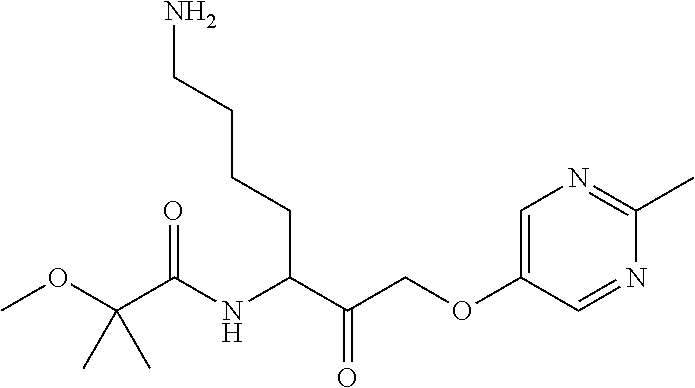 |
| 66 |
 |
| 66a |
 |
| 67 |
 |
| 67a |
 |
| 68 |
 |
| 68a |
 |
| 69 |
 |
| 69a |
 |
| 70 |
 |
| 70a |
 |
| 71 |
 |
| 71a |
 |
| 72 |
 |
| 72a |
 |


and pharmaceutically acceptable salts thereof.


and pharmaceutically acceptable salts thereof.


less basic metalating agent (for example potassium carbonate) is satisfactory. In the latter instances the metalated glycine derivative may exist as a dissociated ion pair, rather than as the covalently bonded species illustrated in F2. In F3, a metalated alanine derivative is treated with an alkylating agent (R′X) to install the unnatural side-chain (R′). In most instances, the metalated alanine derivative is generated by treating a halogenated alanine derivative with a low valent metal (for example zinc dust). In many instances, a soluble palladium catalyst is utilized to facilitate F3. In F4, an aldehyde (R′CHO) is reacted with a source of ammonia and a source of cyanide, to generate an amino-nitrile, which is subsequently hydrolyzed to generate an amino-acid featuring an unnatural sidechain (R′).

-
- or a pharmaceutically acceptable salt thereof, wherein:
- RA is a sidechain IIa:

-
-
- or a sidechain IIb:
-

-
-
- wherein the wavy line represents the point of connection to Formula II;
- A is selected from —CH2— and —O—;
- R1a, R1b, R1c, R1d, and R1e are each independently selected from hydrogen, C1-4 alkyl, and an amine protecting group;
- R2a and R2b are each independently selected from hydrogen, halogen, C1-4 haloalkyl, and C1-4 haloalkoxy;
- R3 is the reporter moiety;
- R4 is selected from hydrogen and C1-4 alkyl; and
- R5 is the gingipain-reactive moiety, wherein the gingipain-reactive moiety optionally comprises a quenching moiety R9.
-

-
- R5 is selected from C1-6 haloalkyl, —CH2—O—R6, —CH2—S—R7, —CH2—SO—R7, —CH2—SO2—R7, —CH2—N(R8)2, and —CH2—C5-12 heteroaryl;
- R6 and R6 are selected from phenyl, C1-6 alkyl, C1-6 haloalkyl, and C5-12 heteroaryl,
- wherein phenyl is substituted with 1-5 halogens, and
- wherein C5-12 heteroaryl is optionally substituted with halogen or C1-3 haloalkyl; and
- R8 is independently selected C1-6 alkyl.

-
- wherein the wavy line represents the point of connect to Formula II or Formula III.
-
- R5c is halogen, R5d is H, R5e is H, R5f is H, and R5g is H; or
- R5c is H, R5d is halogen, R5e is H, R5f is H, and R5g is H; or
- R5c is H, R5d is H, R5e is halogen, R5f is H, and R5g is H; or
- R5c is H, R5d is H, R5e is H, R5f is halogen, and R5g is H; or
- R5c is H, R5d is H, R5e is H, R5f is H, and R5g is halogen; or
- R5c is halogen, R5d is halogen, R5e is H, R5f is H, and R5g is H; or
- R5c is halogen, R5d is H, R5e is halogen, R5f is H, and R5g is H; or
- R5c is halogen, R5d is H, R5e is H, R5f is halogen, and R5g is H; or
- R5c is halogen, R5d is H, R5e is H, R5f is H, and R5g is halogen; or
- R5c is H, R5d is halogen, R5e is halogen, R5f is H, and R5g is H; or
- R5c is H, R5d is halogen, R5e is H, R5f is halogen, and R5g is H; or
- R5c is H, R5d is halogen, R5e is H, R5f is H, and R5g is halogen; or
- R5c is H, R5d is H, R5e is halogen, R5f is halogen, and R5g is H; or
- R5c is H, R5d is H, R5e is halogen, R5f is H, and R5g is halogen; or
- R5c is H, R5d is H, R5e is H, R5f is halogen, and R5g is halogen; or
- R5c is halogen, R5d is halogen, R5e is halogen, R5f is H, and R5g is H; or
- R5c is halogen, R5d is halogen, R5e is H, R5f is halogen, and R5g is H; or
- R5c is halogen, R5d is halogen, R5e is H, R5f is H, and R5g is halogen; or
- R5c is halogen, R5d is H, R5e is halogen, R5f is halogen, and R5g is H; or
- R5c is halogen, R5d is H, R5e is halogen, R5f is H, and R5g is halogen; or
- R5c is halogen, R5d is H, R5e is H, R5f is halogen, and R5g is halogen; or
- R5c is H, R5d is halogen, R5e is halogen, R5f is halogen, and R5g is H; or
- R5c is H, R5d is halogen, R5e is halogen, R5f is H, and R5g is halogen; or
- R5c is H, R5d is halogen, R5e is H, R5f is halogen, and R5g is halogen; or
- R5c is H, R5d is H, R5e is halogen, R5f is halogen, and R5g is halogen; or
- R5c is H, R5d is halogen, R5e is halogen, R5f is halogen, and R5g is halogen; or
- R5c is halogen, R5d is H, R5e is halogen, R5f is halogen, and R5g is halogen; or
- R5c is halogen, R5d is halogen, R5e is halogen, R5f is H, and R5g is halogen; or
- R5c is halogen, R5d is halogen, R5e is halogen, R5f is halogen, and R5g is H;
- wherein H or halogen in one of R5, R5d, R5e, R5f, and R5g is optionally replaced with a quenching moiety R9.
-
- R5c is F or Cl, R5d is H, R5e is H, R5f is H, and R5g is H; or
- R5c is H, R5d is F or Cl, R5e is H, R5f is H, and R5g is H; or
- R5c is H, R5d is H, R5e is F or Cl, R5f is H, and R5g is H; or
- R5c is H, R5d is H, R5e is H, R5f is F or Cl, and R5g is H; or
- R5c is H, R5d is H, R5e is H, R5f is H, and R5g is F or Cl; or
- R5c is F or Cl, R5d is F or Cl, R5e is H, R5f is H, and R5g is H; or
- R5c is F or Cl, R5d is H, R5e is F or Cl, R5f is H, and R5g is H; or
- R5c is F or Cl, R5d is H, R5e is H, R5f is F or Cl, and R5g is H; or
- R5c is F or Cl, R5d is H, R5e is H, R5f is H, and R5g is F or Cl; or
- R5c is H, R5d is F or Cl, R5e is F or Cl, R5f is H, and R5g is H; or
- R5c is H, R5d is F or Cl, R5e is H, R5f is F or Cl, and R5g is H; or
- R5c is H, R5d is F or Cl, R5e is H, R5f is H, and R5g is F or Cl; or
- R5c is H, R5d is H, R5e is F or Cl, R5f is F or Cl, and R5g is H; or
- R5c is H, R5d is H, R5e is F or Cl, R5f is H, and R5g is F or Cl; or
- R5c is H, R5d is H, R5e is H, R5f is F or Cl, and R5g is F or Cl; or
- R5c is F or Cl, R5d is F or Cl, R5e is F or Cl, R5f is H, and R5g is H; or
- R5c is F or Cl, Rd is F or Cl, R5e is H, R5f is F or Cl, and R5g is H; or
- R5c is F or Cl, R5d is F or Cl, R5e is H, R5f is H, and R5g is F or Cl; or
- R5c is F or Cl, R5d is H, R5e is F or Cl, R5f is F or Cl, and R5g is H; or
- R5c is F or Cl, R5d is H, R5e is F or Cl, R5f is H, and R5g is F or Cl; or
- R5c is F or Cl, R5d is H, R5e is H, R5f is F or Cl, and R5g is F or Cl; or
- R5c is H, R5d is F or Cl, R5e is F or Cl, R5f is F or Cl, and R5g is H; or
- R5c is H, R5d is F or Cl, R5e is F or Cl, R5f is H, and R5g is F or Cl; or
- R5c is H, R5d is F or Cl, R5e is H, R5f is F or Cl, and R5g is F or Cl; or
- R5c is H, R5d is H, R5e is F or Cl, R5f is F or Cl, and R5g is F or Cl; or
- R5c is H, R5d is F or Cl, R5e is F or Cl, R5f is F or Cl, and R5g is F or Cl; or
- R5c is F or Cl, R5d is H, R5e is F or Cl, R5f is F or Cl, and R5g is F or Cl; or
- R5c is F or Cl, Rd is F or Cl, R5e is F or Cl, R5f is H, and R5g is F or Cl; or
- R5c is F or Cl, R5d is F or Cl, Re is F or Cl, R5f is F or Cl, and R5g is H;
- wherein H, F, or Cl in one of R5c, R5d, R5e, R5f, and R5g is optionally replaced with a quenching moiety R9.
-
- R5c is F, R5d is H, R5e is H, R5f is H, and R5g is H; or
- R5c is H, R5d is F, R5e is H, R5f is H, and R5g is H; or
- R5c is H, R5d is H, R5e is F, R5f is H, and R5g is H; or
- R5c is H, R5d is H, R5e is H, R5f is F, and R5g is H; or
- R5c is H, R5d is H, R5e is H, R5f is H, and R5g is F; or
- R5c is F, R5d is F, R5e is H, R5f is H, and R5g is H; or
- R5c is F, R5d is H, R5e is F, R5f is H, and R5g is H; or
- R5c is F, R5d is H, R5e is H, R5f is F, and R5g is H; or
- R5c is F, R5d is H, R5e is H, R5f is H, and R5g is F; or
- R5c is H, R5d is F, R5e is F, R5f is H, and R5g is H; or
- R5c is H, R5d is F, R5e is H, R5f is F, and R5g is H; or
- R5c is H, R5d is F, R5e is H, R5f is H, and R5g is F; or
- R5c is H, R5d is H, R5e is F, R5f is F, and R5g is H; or
- R5c is H, R5d is H, R5e is F, R5f is H, and R5g is F; or
- R5c is H, R5d is H, R5e is H, R5f is F, and R5g is F; or
- R5c is F, R5d is F, R5e is F, R5f is H, and R5g is H; or
- R5c is F, R5d is F, R5e is H, R5f is F, and R5g is H; or
- R5c is F, R5d is F, R5e is H, R5f is H, and R5g is F; or
- R5c is F, R5d is H, R5e is F, R5f is F, and R5g is H; or
- R5c is F, R5d is H, R5e is F, R5f is H, and R5g is F; or
- R5c is F, R5d is H, R5e is H, R5f is F, and R5g is F; or
- R5c is H, R5d is F, R5e is F, R5f is F, and R5g is H; or
- R5c is H, R5d is F, R5e is F, R5f is H, and R5g is F; or
- R5c is H, R5d is F, R5e is H, R5f is F, and R5g is F; or
- R5c is H, R5d is H, R5e is F, R5f is F, and R5g is F; or
- R5c is H, R5d is F, R5e is F, R5f is F, and R5g is F; or
- R5c is F, R5d is H, R5e is F, R5f is F, and R5g is F; or
- R5c is F, R5d is F, R5e is F, R5f is H, and R5g is F; or
- R5c is F, R5d is F, R5e is F, R5f is F, and R5g is H;
- wherein H or F, or Cl in one of R5c, R5d, R5e, R5f, and R5g is optionally replaced with a quenching moiety R9.

-
- one of R5c, R5d, R5e, R5f, and R5g is selected from hydrogen, halogen, and a quenching moiety; and
- four of R5c, R5d, R5e, R5f and R5g are independently selected from hydrogen and halogen;
- provided that at least one of R5e, R5d, R5e, R5f, and R5g is halogen.

and pharmaceutically acceptable salts thereof.

-
- R5e is selected from H and a quenching moiety -L9-R9a;
- L9 is a linking moiety; and
- R9a is selected from an azobenzene, a xanthylium, an anthroquinone, and a viologen.
-
- R3b is selected from C3-8 alkylene, C3-12 cycloalkylene, C3-12 heterocyclylene, C6-10 arylene, and C5-12 heteroarylene;
- L3 is a linking moiety; and
- R3c is selected from a chromophore or a fluorophore.

-
- six of R3d, R3e, R3f, R3g, R3h, R3i, and R3j are independently selected from H, halogen, C1-6 alkyl, C3-8 cycloalkyl, C6-10 aryl, C7-16 arylalkyl, C1-6 acyl, and —SO3H; and wherein
- one of R3d, R3e, R3f, R3g, R3h, R3i, and R3j is the linking moiety -L3-.

wherein
-
- R3k and R3i are independently selected from H, C1-6 alkyl, (CH2)tCOOH, (CH2)tSO3H, and linking moiety L3;
- each subscript t is independently an integer from 1 to 10;
- R3m and R3n are independently selected from H, halogen, C1-6 alkyl, —SO3H, —PO3H2, —OPO3H2, —COOH, and linking moiety L3;
- each Y is independently selected from O, S, C(R3p)2, —CH═CH—, and NR3p, where each R3p is independently H or C1-6 alkyl; and
- subscript n is an integer from 1 to 6, provided that one and only one of R3k, R3l, R3m, and R3n is the linking moiety -L3-.

-
- W is N or CR3u.
- Z is O, S, or NR3v; and
- each of R3q, R3s, R3t, R3u is independently selected from H, halogen, C1-6 alkyl, —CN, —CF3, —COOR3v, —CON(R3v)2, —OR3v, and linking moiety -L3-;
- R3r is selected from —OR3v and —N(R3v)2
- each R3v is independently selected from H, C1-6 alkyl, and linking moiety -L3-;
- provided that one and only one of R3q, R3s, R3t, R3u, and R3v is the linking moiety -L3-.

-
- T is selected from O, S, C(R3)2, and NR3z;
- U is O or N(R3z)2;
- each R3w is independently selected from H, halogen, C1-6 alkyl, —SO3H, and linking moiety -L3-;
- R3x is selected from H, —OH, —OR3z, —N(R3z)2, and linking moiety -L3-;
- R3y is selected from H, C1-6 alkyl, R3aa, and linking moiety -L3-;
- each R3z is independently H or C1-6 alkyl; and
- R3aa is selected from

-
- wherein:
- each R3ab is independently selected from H and linking moiety -L3-;
- provided that one and only one of R3w, R3x, R3y, and R3ab is linking moiety -L3-.


-
- R3b is selected from C3-8 alkylene, C3-8 cycloalkylene, C3-12 heterocyclylene, C6-10 arylene, and C5-12 heteroarylene;
- L3 is a linking moiety; and
- R3c is selected from a biotin, a digoxigenin, and an antibody epitope.
-
- R3b is selected from C3-8 alkylene, C3-8 cycloalkylene, C3-12 heterocyclylene, C6-10 arylene, and C5-12 heteroarylene;
- L3 is a linking moiety; and
- R3c is selected from a fluorescein, a rhodamine, an eosin, a cyanine, a boron-dipyrromethene, a coumarin, a biotin, a digoxigenin, a FLAG peptide (or other peptide tag), an oligonucleotide, and a polynucleotide.

wherein the wavy line is point of connection to R3a and the dashed line is the point of connection to R3c.
-
- L3b and L3c are independently selected from a bond, a divalent polymer moiety, and linear or branched, saturated or unsaturated C1-30 alkyl;
- one or more carbon atoms in the C1-30 alkyl is optionally and independently replaced by O, S, NRa;
- two or more groupings of adjacent carbon atoms in the C1-30 alkyl are optionally and independently replaced by —NRa(CO)— or —(CO)NRa—;
- two or more groupings of adjacent carbon atoms in the C1-30 alkyl are optionally and independently replaced by a 4- to 8-membered, divalent carbocycle or a 4- to 8-membered, divalent heterocycle having one to four heteroatoms selected from O, S, and N; and
- each Ra is independently selected from H and C1-6 alkyl.


and pharmaceutically acceptable salts thereof.


and pharmaceutically acceptable salts thereof.


| TABLE 2 |
| Comparative Lysine gingipain inhibitors. |
| Com- | |
| pound | |
| No. | |
| 73 |
 |
| 74 |
 |
| 75 |
 |
| TABLE 3 |
| Inhibition of Lysine Gingipain and |
| Cathepsins by compounds of the invention. |
| Compound | IC50 (nM) |
| No. | Kgp | CatB | CatS | CatK | Cath | CatH |
| 1a-non- | ≤0.05 | 380 | 29,470 | 170 | 4680 | 560 |
| racemic | ||||||
| 1a-racemic | ≤0.05 | |||||
| 2a | ≤0.05 | >104 | >105 | 2290 | >105 | 1550 |
| 2a | 0.11 | |||||
| 3a | 0.64 | 52181 | >105 | >105 | >105 | |
| 4a | 0.07 | 2645 | >105 | >105 | >105 | |
| 5a | 0.15 | 21517 | >105 | >105 | >105 | |
| 6a | 0.19 | 20337 | 42763 | >105 | >105 | |
| 7a | 1.3 | 49578 | 24054 | 20239 | 5526 | |
| 8a | 0.34 | 68264 | >105 | >105 | >105 | |
| 9a | 0.08 | |||||
| 10a | 0.12 | |||||
| 11a | 3.39 | |||||
| 12a | 0.08 | |||||
| 13a | 2.56 | |||||
| 14a | 6.42 | |||||
| 15a | 3.89 | |||||
| 16a | >100 | |||||
| 17a | >100 | |||||
| 18a | 0.50 | |||||
| 19a | >100 | |||||
| 20a | >100 | |||||
| 73 | ≤0.05 | 485 | 9980 | 20 | 700 | 110 |
| 74 | ≤0.05 | |||||
| 75 | 2.29 | |||||
| TABLE 4 |
| Inhibition of Lysine Gingipain and |
| Cathepsins by compounds of the invention. |
| Cmpd. | IC50 (nM) |
| No. | Kgp | CatK | CatH | CatB | CatF | CatL | | CatS | CatZ | |
| 73 | <0.05 | 20 | 110 | 485 | 500 | 700 | 5720 | >104 | >104 |
| 1 | |||||||||
| 97% S | <0.05 | 117 | 560 | 380 | 6,100 | 4680 | >104 | >104 | >104 |
| enan- | |||||||||
| tiomer | |||||||||
| 21 | 0.09 | ||||||||
| 2a | <0.05 | 2290 | 1550 | >104 | >104 | >104 | >104 | ||
| 7a | 1.3 | >104 | >104 | >104 | >104 | ||||
| 18a | 0.5 | >104 | >104 | >104 | >104 | >104 | >104 | >104 | |
| 47a | 0.06 | 9000 | >104 | >104 | >104 | >104 | >104 | >104 | |
| 50a | 0.09 | 1,000 | >104 | >104 | >104 | >104 | >104 | >104 | |
| 55a | 0.12 | 1,000 | >104 | >104 | 6,380 | >104 | >104 | ||
| 69a | 0.21 | >104 | >104 | >104 | >104 | >104 | >104 | >104 | |
| 48a | 0.07 | ||||||||
| 49a | 0.23 | ||||||||
| 57a | 0.09 | ||||||||
| 26a | 0.09 | ||||||||
| 27a | 0.27 | ||||||||
| 28a | 0.34 | ||||||||
| 29a | 0.31 | ||||||||
| 30a | 0.21 | ||||||||
| 31a | 0.15 | ||||||||
| 32a | 0.08 | ||||||||
| 33a | 0.08 | ||||||||
| 34a | 0.13 | ||||||||
| 35a | 0.10 | ||||||||
| 36a | 71.36 | ||||||||
| 37a | >100 | ||||||||
| 38a | 12.09 | ||||||||
| 39a | >100 | ||||||||
| 40a | 30.3 | ||||||||
| 41a | >100 | ||||||||
| 42a | 0.06 | ||||||||
| 43a | 0.09 | ||||||||
| 44a | 3.04 | ||||||||
| 45a | 54.16 | ||||||||
| 46a | 13.12 | ||||||||
| 51a | 0.44 | ||||||||
| 52a | 0.06 | ||||||||
| 53a | 71.25 | ||||||||
| 54a | 49.02 | ||||||||
| 56a | 0.10 | ||||||||
| 58a | 4.66 | ||||||||
| 59a | 1.94 | ||||||||
| 60a | 4.41 | ||||||||
| 61a | 0.43 | ||||||||
| 62a | 0.14 | ||||||||
| 63a | 0.09 | ||||||||
| 64a | 0.40 | ||||||||
| 65a | 0.16 | ||||||||
| 66a | 359.6 | ||||||||
| 67a | 531.2 | ||||||||
| 68a | 258.4 | ||||||||
| TABLE 5 |
| Comparative Lysine gingipain inhibitors. |
| Kgp IC50 | |||
| Compound | (nM) | ||
| |
4 | ||
| |
12 | ||
| |
3 | ||
| 45a | 54 | ||
| 46a | 13 | ||
| 51a | 0.4 | ||
| 73 | <0.05 | ||
Claims (12)


Priority Applications (3)
| Application Number | Priority Date | Filing Date | Title |
|---|---|---|---|
| US16/899,376 US11325884B2 (en) | 2016-09-16 | 2020-06-11 | Ketone inhibitors of lysine gingipain |
| US17/740,260 US12110263B2 (en) | 2016-09-16 | 2022-05-09 | Ketone inhibitors of lysine gingipain |
| US18/905,445 US20250270162A1 (en) | 2016-09-16 | 2024-10-03 | Ketone inhibitors of lysine gingipain |
Applications Claiming Priority (5)
| Application Number | Priority Date | Filing Date | Title |
|---|---|---|---|
| US201662395938P | 2016-09-16 | 2016-09-16 | |
| US201762459456P | 2017-02-15 | 2017-02-15 | |
| PCT/US2017/051912 WO2018053353A1 (en) | 2016-09-16 | 2017-09-15 | Ketone inhibitors of lysine gingipain |
| US16/353,786 US10730826B2 (en) | 2016-09-16 | 2019-03-14 | Ketone inhibitors of lysine gingipain |
| US16/899,376 US11325884B2 (en) | 2016-09-16 | 2020-06-11 | Ketone inhibitors of lysine gingipain |
Related Parent Applications (1)
| Application Number | Title | Priority Date | Filing Date |
|---|---|---|---|
| US16/353,786 Division US10730826B2 (en) | 2016-09-16 | 2019-03-14 | Ketone inhibitors of lysine gingipain |
Related Child Applications (1)
| Application Number | Title | Priority Date | Filing Date |
|---|---|---|---|
| US17/740,260 Continuation US12110263B2 (en) | 2016-09-16 | 2022-05-09 | Ketone inhibitors of lysine gingipain |
Publications (2)
| Publication Number | Publication Date |
|---|---|
| US20210053908A1 US20210053908A1 (en) | 2021-02-25 |
| US11325884B2 true US11325884B2 (en) | 2022-05-10 |
Family
ID=61618978
Family Applications (4)
| Application Number | Title | Priority Date | Filing Date |
|---|---|---|---|
| US16/353,786 Active US10730826B2 (en) | 2016-09-16 | 2019-03-14 | Ketone inhibitors of lysine gingipain |
| US16/899,376 Active US11325884B2 (en) | 2016-09-16 | 2020-06-11 | Ketone inhibitors of lysine gingipain |
| US17/740,260 Active US12110263B2 (en) | 2016-09-16 | 2022-05-09 | Ketone inhibitors of lysine gingipain |
| US18/905,445 Pending US20250270162A1 (en) | 2016-09-16 | 2024-10-03 | Ketone inhibitors of lysine gingipain |
Family Applications Before (1)
| Application Number | Title | Priority Date | Filing Date |
|---|---|---|---|
| US16/353,786 Active US10730826B2 (en) | 2016-09-16 | 2019-03-14 | Ketone inhibitors of lysine gingipain |
Family Applications After (2)
| Application Number | Title | Priority Date | Filing Date |
|---|---|---|---|
| US17/740,260 Active US12110263B2 (en) | 2016-09-16 | 2022-05-09 | Ketone inhibitors of lysine gingipain |
| US18/905,445 Pending US20250270162A1 (en) | 2016-09-16 | 2024-10-03 | Ketone inhibitors of lysine gingipain |
Country Status (18)
| Country | Link |
|---|---|
| US (4) | US10730826B2 (en) |
| EP (2) | EP3512846B1 (en) |
| JP (1) | JP7113815B2 (en) |
| KR (1) | KR102780603B1 (en) |
| CN (1) | CN109983012B (en) |
| AU (2) | AU2017326466B2 (en) |
| CA (1) | CA3036862A1 (en) |
| CL (1) | CL2019000687A1 (en) |
| CO (1) | CO2019002950A2 (en) |
| DK (1) | DK3512846T3 (en) |
| ES (1) | ES2992410T3 (en) |
| IL (1) | IL265389A (en) |
| MX (1) | MX2019003087A (en) |
| PE (1) | PE20190473A1 (en) |
| PH (1) | PH12019500570A1 (en) |
| RU (1) | RU2019111188A (en) |
| TW (1) | TWI787202B (en) |
| WO (1) | WO2018053353A1 (en) |
Cited By (1)
| Publication number | Priority date | Publication date | Assignee | Title |
|---|---|---|---|---|
| US12110263B2 (en) | 2016-09-16 | 2024-10-08 | Lighthouse Pharmaceuticals, Inc. | Ketone inhibitors of lysine gingipain |
Families Citing this family (3)
| Publication number | Priority date | Publication date | Assignee | Title |
|---|---|---|---|---|
| US12318377B2 (en) | 2013-12-20 | 2025-06-03 | Seed Health, Inc. | Method and system for reducing the likelihood of a porphyromonas gingivalis infection in a human being |
| AU2018265397A1 (en) | 2017-05-10 | 2019-11-28 | Cortexyme, Inc. | Aminopyridine compounds and methods for the preparation and use thereof |
| WO2020130152A1 (en) * | 2018-12-20 | 2020-06-25 | Takeda Pharmaceutical Company Limited | Sulfoxonium ylide derivatives as probes for cysteine protease |
Citations (35)
| Publication number | Priority date | Publication date | Assignee | Title |
|---|---|---|---|---|
| EP0195212A2 (en) | 1985-02-04 | 1986-09-24 | Merrell Dow Pharmaceuticals Inc. | Novel peptidase inhibitors |
| EP0272671A2 (en) | 1986-12-22 | 1988-06-29 | Sandoz Ltd. | Aryloxy and arylacyloxy methyl ketones as thiol protease inhibitors |
| JPH01163162A (en) | 1987-12-18 | 1989-06-27 | Showa Denko Kk | Amino acid derivative and enzymic inhibitor |
| WO1992004371A1 (en) | 1990-09-07 | 1992-03-19 | Ferring Peptide Research Partnership Kb | Kininogenase inhibitors |
| WO1993000926A1 (en) | 1991-07-02 | 1993-01-21 | Children's Medical Center Corporation | Treatment of periodontal disease with protease inhibitors |
| EP0530167A1 (en) | 1991-08-28 | 1993-03-03 | Astra Aktiebolag | New isosteric peptides |
| WO1994004172A1 (en) | 1992-08-20 | 1994-03-03 | Prototek, Inc. | Peptidyl activated ketone inhibitors containing natural and unnatural peptide sequences |
| US5451410A (en) | 1993-04-22 | 1995-09-19 | Emisphere Technologies, Inc. | Modified amino acids for encapsulating active agents |
| US5523308A (en) | 1995-06-07 | 1996-06-04 | Costanzo; Michael J. | Peptidyl heterocycles useful in the treatment of thrombin related disorders |
| WO1996019483A1 (en) | 1994-12-22 | 1996-06-27 | Biochem Pharma Inc. | Low molecular weight bicyclic thrombin inhibitors |
| WO1996030396A1 (en) | 1995-03-24 | 1996-10-03 | Molecumetics Ltd. | β-SHEET MIMETICS AND USE THEREOF AS PROTEASE INHIBITORS |
| WO1996030035A1 (en) | 1995-03-24 | 1996-10-03 | Molecumetics Ltd. | β-SHEET MIMETICS AND USE THEREOF AS INHIBITORS OF BIOLOGICALLY ACTIVE PEPTIDES OR PROTEINS |
| WO1996037497A1 (en) | 1995-05-22 | 1996-11-28 | Biochem Pharma Inc. | Low molecular weight bicyclic-urea type thrombin inhibitors |
| WO1996040742A1 (en) | 1995-06-07 | 1996-12-19 | Ortho Pharmaceutical Corporation | Peptidyl heterocycles useful in the treatment of thrombin relateddisorders |
| WO1996040741A1 (en) | 1995-06-07 | 1996-12-19 | Ortho Pharmaceutical Corporation | Peptidyl heterocycles useful in the treatment of thrombin related disorders |
| WO1997017363A1 (en) | 1995-11-03 | 1997-05-15 | Akzo Nobel N.V. | Thrombin inhibitors |
| WO1998005333A1 (en) | 1996-08-05 | 1998-02-12 | Molecumetics Ltd. | Use of beta-sheet mimetics as protease and kinase inhibitors and as inhibitors of transcription factors |
| WO1998009987A1 (en) | 1996-09-06 | 1998-03-12 | Biochem Pharma, Inc. | Lactam inhibitors of thrombin |
| WO1999026925A1 (en) | 1997-11-26 | 1999-06-03 | Yoshitomi Pharmaceutical Industries, Ltd. | Tryptase inhibitors comprising heterocyclic amide compounds |
| WO1999041276A1 (en) | 1998-02-12 | 1999-08-19 | Molecumetics Ltd. | β-SHEET MIMETICS AND METHODS RELATING TO THE USE THEREOF |
| WO2000044733A1 (en) | 1999-01-27 | 2000-08-03 | Ortho-Mcneil Pharmaceutical, Inc. | Peptidyl heterocyclic ketones useful as tryptase inhibitors |
| WO2000055124A2 (en) | 1999-03-15 | 2000-09-21 | Axys Pharmaceuticals, Inc. | Novel compounds and compositions as protease inhibitors |
| US6323219B1 (en) | 1998-04-02 | 2001-11-27 | Ortho-Mcneil Pharmaceutical, Inc. | Methods for treating immunomediated inflammatory disorders |
| US20050059607A1 (en) | 2003-08-05 | 2005-03-17 | Michael Breslav | Process for preparing peptidyl heterocyclic ketone derivatives |
| US20060084613A1 (en) | 2000-01-13 | 2006-04-20 | Idun Pharmaceuticals, Inc. | Inhibitors of the ICE/ced-3 family of cysteine proteases |
| US7071184B2 (en) | 2000-03-21 | 2006-07-04 | Smithkline Beecham Corporation | Protease inhibitors |
| US7183260B2 (en) | 1998-07-02 | 2007-02-27 | Idun Pharmaceuticals, Inc. | C-terminal modified oxamyl dipeptides as inhibitors of the ICE/ced-3 family of cysteine proteases |
| AU2005334458A1 (en) | 2004-07-23 | 2007-03-01 | Smith, Judith | Furin inhibitors |
| WO2007137080A2 (en) | 2006-05-23 | 2007-11-29 | Irm Llc | Compounds and compositions as channel activating protease inhibitors |
| WO2009103432A2 (en) | 2008-02-21 | 2009-08-27 | Sanofi-Aventis | Covalently binding imaging probes |
| WO2014031784A1 (en) | 2012-08-23 | 2014-02-27 | Alios Biopharma, Inc. | Compounds for the treatment of paramoxyvirus viral infections |
| WO2014145257A2 (en) | 2013-03-15 | 2014-09-18 | The Board Of Trustees Of The Leland Stanford Junior University | Activity-based probe compounds, compositions, and methods of use |
| US20160096830A1 (en) | 2014-10-06 | 2016-04-07 | Cortexyme, Inc. | Inhibitors of lysine gingipain |
| WO2018053353A1 (en) | 2016-09-16 | 2018-03-22 | Cortexyme, Inc. | Ketone inhibitors of lysine gingipain |
| WO2018209132A1 (en) | 2017-05-10 | 2018-11-15 | Cortexyme, Inc. | Aminopyridine compounds and methods for the preparation and use thereof |
Family Cites Families (28)
| Publication number | Priority date | Publication date | Assignee | Title |
|---|---|---|---|---|
| US4703004A (en) | 1984-01-24 | 1987-10-27 | Immunex Corporation | Synthesis of protein with an identification peptide |
| US5326692B1 (en) | 1992-05-13 | 1996-04-30 | Molecular Probes Inc | Fluorescent microparticles with controllable enhanced stokes shift |
| US5723218A (en) | 1990-04-16 | 1998-03-03 | Molecular Probes, Inc. | Dipyrrometheneboron difluoride labeled flourescent microparticles |
| US5187288A (en) | 1991-05-22 | 1993-02-16 | Molecular Probes, Inc. | Ethenyl-substituted dipyrrometheneboron difluoride dyes and their synthesis |
| US5576424A (en) | 1991-08-23 | 1996-11-19 | Molecular Probes, Inc. | Haloalkyl derivatives of reporter molecules used to analyze metabolic activity in cells |
| CA2119126C (en) | 1991-09-16 | 1996-09-03 | Molecular Probes, Inc. | Dimers of unsymmetrical cyanine dyes |
| US5658751A (en) | 1993-04-13 | 1997-08-19 | Molecular Probes, Inc. | Substituted unsymmetrical cyanine dyes with selected permeability |
| US5656449A (en) | 1995-03-06 | 1997-08-12 | Molecular Probes, Inc. | Neutral unsymmetrical cyanine dyes |
| US6596522B2 (en) | 1997-05-08 | 2003-07-22 | The Regents Of The University Of California | Detection of transmembrane potentials by optical methods |
| US5798276A (en) | 1995-06-07 | 1998-08-25 | Molecular Probes, Inc. | Reactive derivatives of sulforhodamine 101 with enhanced hydrolytic stability |
| US6004536A (en) | 1995-11-14 | 1999-12-21 | Molecular Probes, Inc. | Lipophilic cyanine dyes with enchanced aqueous solubilty |
| US6162931A (en) | 1996-04-12 | 2000-12-19 | Molecular Probes, Inc. | Fluorinated xanthene derivatives |
| US6005113A (en) | 1996-05-15 | 1999-12-21 | Molecular Probes, Inc. | Long wavelength dyes for infrared tracing |
| US5846737A (en) | 1996-07-26 | 1998-12-08 | Molecular Probes, Inc. | Conjugates of sulforhodamine fluorophores with enhanced fluorescence |
| US5696157A (en) | 1996-11-15 | 1997-12-09 | Molecular Probes, Inc. | Sulfonated derivatives of 7-aminocoumarin |
| US6130101A (en) | 1997-09-23 | 2000-10-10 | Molecular Probes, Inc. | Sulfonated xanthene derivatives |
| ATE349700T1 (en) | 1998-10-27 | 2007-01-15 | Molecular Probes Inc | TRANSITION METAL COMPLEX CONTAINING LUMINESCENT PROTEIN COLORS |
| EP1090073B1 (en) | 1999-04-23 | 2003-03-05 | Molecular Probes Inc. | Xanthene dyes and their application as luminescence quenching compounds |
| US6579718B1 (en) | 2000-08-04 | 2003-06-17 | Molecular Probes, Inc. | Carbazolylvinyl dye protein stains |
| CA2417816A1 (en) | 2000-08-04 | 2002-02-14 | Molecular Probes, Inc. | Derivatives of 1,2-dihydro-7-hydroxyquinolines containing fused rings |
| ATE352586T2 (en) | 2000-09-29 | 2007-02-15 | Molecular Probes Inc | MODIFIED CARBOCYANINE DYES AND CONJUGATES THEREOF |
| US6972326B2 (en) | 2001-12-03 | 2005-12-06 | Molecular Probes, Inc. | Labeling of immobilized proteins using dipyrrometheneboron difluoride dyes |
| US7446202B2 (en) | 2003-12-05 | 2008-11-04 | Molecular Probes, Inc. | Cyanine dye compounds |
| CN101942410A (en) * | 2010-06-13 | 2011-01-12 | 浙江大学 | Clone recombination strain of porphyromonas gingialis procoagulant function structure domain HGP44 gene and building method |
| US8642622B2 (en) | 2010-06-16 | 2014-02-04 | Bristol-Myers Squibb Company | Piperidinyl compound as a modulator of chemokine receptor activity |
| CZ2014527A3 (en) | 2014-08-05 | 2016-02-17 | Ústav Organické Chemie A Biochemie Akademie Věd Čr, V.V.I. | Detection method of analyte active forms in a sample and determination of ability of other substance to bind in active spots of such analytes |
| SG10201912574WA (en) | 2016-09-28 | 2020-02-27 | Blade Therapeutics Inc | Calpain modulators and therapeutic uses thereof |
| ES2979245T3 (en) | 2017-02-15 | 2024-09-25 | Rqx Pharmaceuticals Inc | Broad spectrum macrocyclic antibiotics |
-
2017
- 2017-09-15 KR KR1020197010797A patent/KR102780603B1/en active Active
- 2017-09-15 MX MX2019003087A patent/MX2019003087A/en unknown
- 2017-09-15 CN CN201780068518.0A patent/CN109983012B/en active Active
- 2017-09-15 ES ES17851664T patent/ES2992410T3/en active Active
- 2017-09-15 EP EP17851664.7A patent/EP3512846B1/en active Active
- 2017-09-15 EP EP24187049.2A patent/EP4480541A3/en active Pending
- 2017-09-15 TW TW106131764A patent/TWI787202B/en active
- 2017-09-15 PE PE2019000533A patent/PE20190473A1/en unknown
- 2017-09-15 WO PCT/US2017/051912 patent/WO2018053353A1/en not_active Ceased
- 2017-09-15 CA CA3036862A patent/CA3036862A1/en active Pending
- 2017-09-15 AU AU2017326466A patent/AU2017326466B2/en active Active
- 2017-09-15 JP JP2019514780A patent/JP7113815B2/en active Active
- 2017-09-15 DK DK17851664.7T patent/DK3512846T3/en active
- 2017-09-15 RU RU2019111188A patent/RU2019111188A/en unknown
-
2019
- 2019-03-14 US US16/353,786 patent/US10730826B2/en active Active
- 2019-03-14 IL IL265389A patent/IL265389A/en unknown
- 2019-03-15 CL CL2019000687A patent/CL2019000687A1/en unknown
- 2019-03-15 PH PH12019500570A patent/PH12019500570A1/en unknown
- 2019-03-27 CO CONC2019/0002950A patent/CO2019002950A2/en unknown
-
2020
- 2020-06-11 US US16/899,376 patent/US11325884B2/en active Active
-
2022
- 2022-02-11 AU AU2022200927A patent/AU2022200927B2/en active Active
- 2022-05-09 US US17/740,260 patent/US12110263B2/en active Active
-
2024
- 2024-10-03 US US18/905,445 patent/US20250270162A1/en active Pending
Patent Citations (46)
| Publication number | Priority date | Publication date | Assignee | Title |
|---|---|---|---|---|
| EP0195212A2 (en) | 1985-02-04 | 1986-09-24 | Merrell Dow Pharmaceuticals Inc. | Novel peptidase inhibitors |
| EP0272671A2 (en) | 1986-12-22 | 1988-06-29 | Sandoz Ltd. | Aryloxy and arylacyloxy methyl ketones as thiol protease inhibitors |
| JPH01163162A (en) | 1987-12-18 | 1989-06-27 | Showa Denko Kk | Amino acid derivative and enzymic inhibitor |
| WO1992004371A1 (en) | 1990-09-07 | 1992-03-19 | Ferring Peptide Research Partnership Kb | Kininogenase inhibitors |
| WO1993000926A1 (en) | 1991-07-02 | 1993-01-21 | Children's Medical Center Corporation | Treatment of periodontal disease with protease inhibitors |
| EP0530167A1 (en) | 1991-08-28 | 1993-03-03 | Astra Aktiebolag | New isosteric peptides |
| WO1994004172A1 (en) | 1992-08-20 | 1994-03-03 | Prototek, Inc. | Peptidyl activated ketone inhibitors containing natural and unnatural peptide sequences |
| US5451410A (en) | 1993-04-22 | 1995-09-19 | Emisphere Technologies, Inc. | Modified amino acids for encapsulating active agents |
| WO1996019483A1 (en) | 1994-12-22 | 1996-06-27 | Biochem Pharma Inc. | Low molecular weight bicyclic thrombin inhibitors |
| WO1996030035A1 (en) | 1995-03-24 | 1996-10-03 | Molecumetics Ltd. | β-SHEET MIMETICS AND USE THEREOF AS INHIBITORS OF BIOLOGICALLY ACTIVE PEPTIDES OR PROTEINS |
| WO1996030396A1 (en) | 1995-03-24 | 1996-10-03 | Molecumetics Ltd. | β-SHEET MIMETICS AND USE THEREOF AS PROTEASE INHIBITORS |
| WO1996037497A1 (en) | 1995-05-22 | 1996-11-28 | Biochem Pharma Inc. | Low molecular weight bicyclic-urea type thrombin inhibitors |
| US5827866A (en) | 1995-06-07 | 1998-10-27 | Ortho Pharmaceutical Corporation | Peptidyl heterocycles useful in the treatment of thrombin related disorders |
| WO1996040742A1 (en) | 1995-06-07 | 1996-12-19 | Ortho Pharmaceutical Corporation | Peptidyl heterocycles useful in the treatment of thrombin relateddisorders |
| WO1996040741A1 (en) | 1995-06-07 | 1996-12-19 | Ortho Pharmaceutical Corporation | Peptidyl heterocycles useful in the treatment of thrombin related disorders |
| US5523308A (en) | 1995-06-07 | 1996-06-04 | Costanzo; Michael J. | Peptidyl heterocycles useful in the treatment of thrombin related disorders |
| WO1997017363A1 (en) | 1995-11-03 | 1997-05-15 | Akzo Nobel N.V. | Thrombin inhibitors |
| WO1998005333A1 (en) | 1996-08-05 | 1998-02-12 | Molecumetics Ltd. | Use of beta-sheet mimetics as protease and kinase inhibitors and as inhibitors of transcription factors |
| WO1998009987A1 (en) | 1996-09-06 | 1998-03-12 | Biochem Pharma, Inc. | Lactam inhibitors of thrombin |
| WO1999026925A1 (en) | 1997-11-26 | 1999-06-03 | Yoshitomi Pharmaceutical Industries, Ltd. | Tryptase inhibitors comprising heterocyclic amide compounds |
| WO1999041276A1 (en) | 1998-02-12 | 1999-08-19 | Molecumetics Ltd. | β-SHEET MIMETICS AND METHODS RELATING TO THE USE THEREOF |
| US6323219B1 (en) | 1998-04-02 | 2001-11-27 | Ortho-Mcneil Pharmaceutical, Inc. | Methods for treating immunomediated inflammatory disorders |
| US7183260B2 (en) | 1998-07-02 | 2007-02-27 | Idun Pharmaceuticals, Inc. | C-terminal modified oxamyl dipeptides as inhibitors of the ICE/ced-3 family of cysteine proteases |
| WO2000044733A1 (en) | 1999-01-27 | 2000-08-03 | Ortho-Mcneil Pharmaceutical, Inc. | Peptidyl heterocyclic ketones useful as tryptase inhibitors |
| US20030008829A1 (en) | 1999-01-27 | 2003-01-09 | Costanzo Michael J. | Peptidyl heterocyclic ketones useful as tryptase inhibitors |
| WO2000055124A2 (en) | 1999-03-15 | 2000-09-21 | Axys Pharmaceuticals, Inc. | Novel compounds and compositions as protease inhibitors |
| US20060084613A1 (en) | 2000-01-13 | 2006-04-20 | Idun Pharmaceuticals, Inc. | Inhibitors of the ICE/ced-3 family of cysteine proteases |
| US7071184B2 (en) | 2000-03-21 | 2006-07-04 | Smithkline Beecham Corporation | Protease inhibitors |
| US20050059607A1 (en) | 2003-08-05 | 2005-03-17 | Michael Breslav | Process for preparing peptidyl heterocyclic ketone derivatives |
| AU2005334458A1 (en) | 2004-07-23 | 2007-03-01 | Smith, Judith | Furin inhibitors |
| WO2007137080A2 (en) | 2006-05-23 | 2007-11-29 | Irm Llc | Compounds and compositions as channel activating protease inhibitors |
| RU2419626C2 (en) | 2006-05-23 | 2011-05-27 | Айрм Ллк | Compounds and compositions as canal activating protease inhibitors |
| WO2009103432A2 (en) | 2008-02-21 | 2009-08-27 | Sanofi-Aventis | Covalently binding imaging probes |
| WO2014031784A1 (en) | 2012-08-23 | 2014-02-27 | Alios Biopharma, Inc. | Compounds for the treatment of paramoxyvirus viral infections |
| WO2014145257A2 (en) | 2013-03-15 | 2014-09-18 | The Board Of Trustees Of The Leland Stanford Junior University | Activity-based probe compounds, compositions, and methods of use |
| WO2016057413A2 (en) | 2014-10-06 | 2016-04-14 | Cortexyme, Inc. | Inhibitors of lysine gingipain |
| US20160096830A1 (en) | 2014-10-06 | 2016-04-07 | Cortexyme, Inc. | Inhibitors of lysine gingipain |
| US9758473B2 (en) | 2014-10-06 | 2017-09-12 | Cortexyme, Inc. | Inhibitors of lysine gingipain |
| US20170349537A1 (en) | 2014-10-06 | 2017-12-07 | Cortexyme, Inc. | Inhibitors of lysine gingipain |
| US9988375B2 (en) | 2014-10-06 | 2018-06-05 | Cortexyme, Inc. | Inhibitors of lysine gingipain |
| US20180346460A1 (en) | 2014-10-06 | 2018-12-06 | Cortexyme, Inc. | Inhibitors of lysine gingipain |
| US10301301B2 (en) | 2014-10-06 | 2019-05-28 | Cortexyme, Inc. | Inhibitors of lysine gingipain |
| US20190322659A1 (en) | 2014-10-06 | 2019-10-24 | Cortexyme, Inc. | Inhibitors of lysine gingipain |
| WO2018053353A1 (en) | 2016-09-16 | 2018-03-22 | Cortexyme, Inc. | Ketone inhibitors of lysine gingipain |
| US10730826B2 (en) | 2016-09-16 | 2020-08-04 | Cortexyme, Inc. | Ketone inhibitors of lysine gingipain |
| WO2018209132A1 (en) | 2017-05-10 | 2018-11-15 | Cortexyme, Inc. | Aminopyridine compounds and methods for the preparation and use thereof |
Non-Patent Citations (27)
| Title |
|---|
| "Pubchem CID 11666347", Compound listed, Oct. 26, 2006, 9 pages. |
| Adang et al., "Unique Overlap in the Prerequisites for Thrombin Inhibition and Oral Bioavailability Resulting in Potent Oral Antithrombotics", Journal Medicinal Chemistry, vol. 45, No. 20, Sep. 26, 2002, pp. 4419-4432. |
| Application No. PCT/US2017/051912 , International Search Report and Written Opinion, dated Jan. 18, 2018, 11 pages. |
| Berg et al., "Design and Evaluation of Trypanosoma Brucei Metacaspase Inhibitors", Bioorganic & Medicinal Chemistry Letters, vol. 20, No. 6, Mar. 15, 2010, pp. 2001-2006. |
| Bialas et al., "Exploring the Sn Binding Pockets in Gingipains by Newly Developed Inhibitors: Structure-Based Design, Chemistry, and Activity", Journal of Medicinal Chemistry, vol. 49, No. 5, Mar. 2006, pp. 1744-1753. |
| Bland et al., "Reductive Cleavage of Acyl-Guanidines to Amines", Chemical Communications, No. 17, Jan. 1, 1971, pp. 1024-1025. |
| CAS Registry Entry for Registry No. 190903-94-7, which entered STN, Jul. 9, 1997, 1 page. |
| CAS Registry Entry for Registry No. 190904-52-0, which entered STN, Jul. 9, 1997, 1 page. |
| CAS Registry Entry for Registry No. 607393-00-0, which entered STN, Oct. 21, 2003, 1 page. |
| Chauhan , "Enantioselective Synthesis of (L)-Fmoc-a-Me-Lys(Boc)-OH Via Diastereoselective Alkylation of Oxazinone as a Chiral Auxiliary", Tetrahedron Letters, vol. 50, No. 49, Dec. 9, 2009, pp. 6913-6915. |
| Costanzo et al., "In-Depth Study of Tripeptide-Based Alpha-Ketoheterocycles as Inhibitors of Thrombin. Effective Utilization of the S1′ Subsite and its Implications to Structure-Based Drug Design", Journal of Medicinal Chemistry, vol. 48, No. 6, Mar. 1, 2005, pp. 1-2. |
| Costanzo et al., "Potent, Small-Molecule Inhibitors of Human Mast Cell Tryptase. Antiasthmatic Action of A Dipeptide-Based Transition-State Analogue Containing a Benzothiazole Ketone", Journal of Medicinal Chemistry, vol. 46, No. 18, Aug. 28, 2003, 8 pages. |
| Curtis et al., "Attenuation of the Virulence of Porphyromonas Gingivalis by Using a Specific Synthetic Kgp Protease Inhibitor", Infection and Immunity, vol. 70, No. 12, Dec. 2002, pp. 6968-6975. |
| Duchene et al., "Analysis of Subpocket Selectivity and Identification of Potent Selective Inhibitors for Matriptase and Matriptase-2", Journal of Medicinal Chemistry, vol. 57, No. 23, Nov. 11, 2014, pp. 10198-10204. |
| Kadowaki et al., "Suppression of Pathogenicity of Porphyromonas Gingivalis by Newly Developed Gingipain Inhibitors", Molecular Pharmacology, vol. 66, No. 6, Dec. 2004, pp. 1599-1606. |
| Karukurichi et al., "Examination of the New A-(2′z-Fluoro)vinyl Trigger With Lysine Decarboxylase: The Absolute Stereochemistry Dictates the Reaction Course", Journal of the American Chemical Society, vol. 129, No. 2, Jan. 17, 2007, pp. 258-259. |
| Kataoka et al., "A Novel, Potent Dual Inhibitor of Arg-Gingipains and Lys-Gingipain as a Promising Agent for Periodontal Disease Therapy", The FASEB Journal, vol. 28, No. 8, Aug. 2014, pp. 3564-3578. |
| Ko et al., "Universal Peptidomimetics", Journal of the American Chemical Society, vol. 133, No. 3, 2011, pp. 462-477. |
| Kolb et al., "Synthesis And Biochemical Properties of Chemically Stable Product Analogs of The Reaction Catalyzed by Sadenosyl-L-Methionine Decarboxylase," Journal of Medicinal Chemistry, vol. 25, No. 5, May 1, 1982, pp. 550-556. |
| Kolb et al., "Synthesis of Fluorinated A-Amino Ketones, III. Preparation of Fluorinated Ketone Analogues of Phenylalanine, Lysine, and P-(Guanidino)Phenylalanine", Liebigs Annalen der Chemie, vol. 1990, No. 1, Jan. 22, 1990, pp. 1-6. |
| Mcgrath et al., "Structure-Guided Design of Peptide-Based Tryptase Inhibotors", Biochemistry, vol. 45, No. 19, Apr. 2006, pp. 5964-5973. |
| Mogami et al., "Effect of Thrombin on Human Amnion Mesenchymal Cells Mouse Fetal Membranes, and Preterm Birth", The Journal of Biological Chemistry, vol. 289, No. 19, May 9, 2014, pp. 13295-13307. |
| Sengupta et al., "Synthesis and Biological Evaluation of Novel Oxalamido Derivatives as Caspase-3 Inhibitors", Indian Journal of Chemistry Section B, vol. 50B, Jul. 2011, pp. 901-905. |
| Singhrao et al., "Oral Inflammation, Tooth Loss, Risk Factors, and Association with Progression of Alzheimer's Disease", Journal of Alzheimer's Disease, vol. 42, No. 3, 2014, pp. 723-737. |
| Teno et al., "Development of Active Center-Directed Inhibitors against Plasmin", Chemical and Pharmaceutical Bulletin, vol. 39, No. 9, 1991, pp. 2340-2346. |
| Wang et al., "Solid-Phase Synthesis of Peptide Vinyl Sulfones as Potential Inhibitors and Activity-Based Probes of Cysteine Proteases", Organic Letters, vol. 5, No. 5, Feb. 12, 2003, pp. 737-740. |
| Wood et al., "Synthesis of a Diverse Library of Mechanism—Based Cysteine Protease Inhibitors," Journal of Combinatorial Chemistry, vol. 5, No. 6, 2003, pp. 869-880. |
Cited By (1)
| Publication number | Priority date | Publication date | Assignee | Title |
|---|---|---|---|---|
| US12110263B2 (en) | 2016-09-16 | 2024-10-08 | Lighthouse Pharmaceuticals, Inc. | Ketone inhibitors of lysine gingipain |
Also Published As
Similar Documents
| Publication | Publication Date | Title |
|---|---|---|
| US12110263B2 (en) | Ketone inhibitors of lysine gingipain | |
| US11332464B2 (en) | Inhibitors of lysine gingipain | |
| US10906881B2 (en) | Inhibitors of arginine gingipain | |
| EP3941586A1 (en) | Arginine gingipain inhibitors | |
| BR112019004864B1 (en) | GINGIPAIN LYSINE KETONE INHIBITORS, PHARMACEUTICAL COMPOSITION AND USE |
Legal Events
| Date | Code | Title | Description |
|---|---|---|---|
| FEPP | Fee payment procedure |
Free format text: ENTITY STATUS SET TO UNDISCOUNTED (ORIGINAL EVENT CODE: BIG.); ENTITY STATUS OF PATENT OWNER: SMALL ENTITY |
|
| FEPP | Fee payment procedure |
Free format text: ENTITY STATUS SET TO SMALL (ORIGINAL EVENT CODE: SMAL); ENTITY STATUS OF PATENT OWNER: SMALL ENTITY |
|
| STPP | Information on status: patent application and granting procedure in general |
Free format text: APPLICATION DISPATCHED FROM PREEXAM, NOT YET DOCKETED |
|
| STPP | Information on status: patent application and granting procedure in general |
Free format text: DOCKETED NEW CASE - READY FOR EXAMINATION |
|
| STPP | Information on status: patent application and granting procedure in general |
Free format text: NON FINAL ACTION MAILED |
|
| STPP | Information on status: patent application and granting procedure in general |
Free format text: RESPONSE TO NON-FINAL OFFICE ACTION ENTERED AND FORWARDED TO EXAMINER |
|
| STPP | Information on status: patent application and granting procedure in general |
Free format text: NON FINAL ACTION MAILED |
|
| STPP | Information on status: patent application and granting procedure in general |
Free format text: RESPONSE TO NON-FINAL OFFICE ACTION ENTERED AND FORWARDED TO EXAMINER |
|
| STPP | Information on status: patent application and granting procedure in general |
Free format text: NOTICE OF ALLOWANCE MAILED -- APPLICATION RECEIVED IN OFFICE OF PUBLICATIONS |
|
| STPP | Information on status: patent application and granting procedure in general |
Free format text: PUBLICATIONS -- ISSUE FEE PAYMENT VERIFIED |
|
| STCF | Information on status: patent grant |
Free format text: PATENTED CASE |
|
| AS | Assignment |
Owner name: QUINCE THERAPEUTICS, INC., CALIFORNIA Free format text: CHANGE OF NAME;ASSIGNOR:CORTEXYME, INC.;REEL/FRAME:061605/0147 Effective date: 20220729 Owner name: CORTEXYME, INC., CALIFORNIA Free format text: ASSIGNMENT OF ASSIGNORS INTEREST;ASSIGNORS:KONRADI, ANDREI W.;GALEMMO, ROBERT A.;DOMINY, STEPHEN S.;AND OTHERS;SIGNING DATES FROM 20171030 TO 20171101;REEL/FRAME:061308/0019 Owner name: CORTEXYME, INC., CALIFORNIA Free format text: ASSIGNMENT OF ASSIGNORS INTEREST;ASSIGNOR:WUXI APPTEC (HONG KONG) LIMITED;REEL/FRAME:061308/0332 Effective date: 20171113 Owner name: WUXI APPTEC (HONG KONG) LIMITED, HONG KONG Free format text: ASSIGNMENT OF ASSIGNORS INTEREST;ASSIGNOR:WUXI APPTEC (SHANGHAI) CO., LTD.;REEL/FRAME:061308/0248 Effective date: 20171113 Owner name: WUXI APPTEC (SHANGHAI) CO., LTD., CHINA Free format text: ASSIGNMENT OF ASSIGNORS INTEREST;ASSIGNOR:GALEMMO, ROBERT A.;REEL/FRAME:061308/0148 Effective date: 20171113 |
|
| AS | Assignment |
Owner name: LIGHTHOUSE PHARMACEUTICALS, INC., CALIFORNIA Free format text: ASSIGNMENT OF ASSIGNORS INTEREST;ASSIGNOR:QUINCE THERAPEUTICS, INC.;REEL/FRAME:063468/0206 Effective date: 20230127 |
|
| MAFP | Maintenance fee payment |
Free format text: PAYMENT OF MAINTENANCE FEE, 4TH YR, SMALL ENTITY (ORIGINAL EVENT CODE: M2551); ENTITY STATUS OF PATENT OWNER: SMALL ENTITY Year of fee payment: 4 |