US11323744B2 - Data encoding and decoding - Google Patents
Data encoding and decoding Download PDFInfo
- Publication number
- US11323744B2 US11323744B2 US14/909,686 US201414909686A US11323744B2 US 11323744 B2 US11323744 B2 US 11323744B2 US 201414909686 A US201414909686 A US 201414909686A US 11323744 B2 US11323744 B2 US 11323744B2
- Authority
- US
- United States
- Prior art keywords
- bit
- transform
- values
- frequency
- video data
- Prior art date
- Legal status (The legal status is an assumption and is not a legal conclusion. Google has not performed a legal analysis and makes no representation as to the accuracy of the status listed.)
- Active, expires
Links
Images




Classifications
-
- H—ELECTRICITY
- H04—ELECTRIC COMMUNICATION TECHNIQUE
- H04N—PICTORIAL COMMUNICATION, e.g. TELEVISION
- H04N19/00—Methods or arrangements for coding, decoding, compressing or decompressing digital video signals
- H04N19/60—Methods or arrangements for coding, decoding, compressing or decompressing digital video signals using transform coding
-
- H—ELECTRICITY
- H04—ELECTRIC COMMUNICATION TECHNIQUE
- H04N—PICTORIAL COMMUNICATION, e.g. TELEVISION
- H04N19/00—Methods or arrangements for coding, decoding, compressing or decompressing digital video signals
- H04N19/60—Methods or arrangements for coding, decoding, compressing or decompressing digital video signals using transform coding
- H04N19/625—Methods or arrangements for coding, decoding, compressing or decompressing digital video signals using transform coding using discrete cosine transform [DCT]
-
- G—PHYSICS
- G06—COMPUTING OR CALCULATING; COUNTING
- G06F—ELECTRIC DIGITAL DATA PROCESSING
- G06F17/00—Digital computing or data processing equipment or methods, specially adapted for specific functions
- G06F17/10—Complex mathematical operations
- G06F17/14—Fourier, Walsh or analogous domain transformations, e.g. Laplace, Hilbert, Karhunen-Loeve, transforms
- G06F17/147—Discrete orthonormal transforms, e.g. discrete cosine transform, discrete sine transform, and variations therefrom, e.g. modified discrete cosine transform, integer transforms approximating the discrete cosine transform
-
- H—ELECTRICITY
- H04—ELECTRIC COMMUNICATION TECHNIQUE
- H04N—PICTORIAL COMMUNICATION, e.g. TELEVISION
- H04N19/00—Methods or arrangements for coding, decoding, compressing or decompressing digital video signals
- H04N19/10—Methods or arrangements for coding, decoding, compressing or decompressing digital video signals using adaptive coding
- H04N19/102—Methods or arrangements for coding, decoding, compressing or decompressing digital video signals using adaptive coding characterised by the element, parameter or selection affected or controlled by the adaptive coding
- H04N19/12—Selection from among a plurality of transforms or standards, e.g. selection between discrete cosine transform [DCT] and sub-band transform or selection between H.263 and H.264
- H04N19/122—Selection of transform size, e.g. 8x8 or 2x4x8 DCT; Selection of sub-band transforms of varying structure or type
-
- H—ELECTRICITY
- H04—ELECTRIC COMMUNICATION TECHNIQUE
- H04N—PICTORIAL COMMUNICATION, e.g. TELEVISION
- H04N19/00—Methods or arrangements for coding, decoding, compressing or decompressing digital video signals
- H04N19/10—Methods or arrangements for coding, decoding, compressing or decompressing digital video signals using adaptive coding
- H04N19/134—Methods or arrangements for coding, decoding, compressing or decompressing digital video signals using adaptive coding characterised by the element, parameter or criterion affecting or controlling the adaptive coding
- H04N19/156—Availability of hardware or computational resources, e.g. encoding based on power-saving criteria
Definitions
- This disclosure relates to data encoding and decoding.
- Video data compression and decompression systems which involve transforming video data into a frequency domain representation, quantising the frequency domain coefficients and then applying some form of entropy encoding to the quantised coefficients.
- the transformation into the spatial frequency domain at the encoder side corresponds to an inverse transformation at the decoder side.
- Example transformations include the so-called discrete cosine transformation (DCT) and the so-called discrete sine transformation (DST).
- the transformations are carried out by matrix-multiplying an array of input samples (derived from the video data to be coded) by a matrix of transformation coefficients to generate frequency-transformed data.
- Frequency-transformed data is converted back to sample data, from which output video data can be derived, by matrix-multiplying an array of the frequency-transformed data by a matrix of inverse-transformation coefficients.
- Some standards and draft standards such as the so-called High Efficiency Video Coding (HEVC) standards, define the spatial frequency transformation by defining the matrix of inverse-transformation coefficients to be used as the decoding side.
- HEVC High Efficiency Video Coding
- This disclosure provides a data encoding method according to claim 1 .
- FIG. 1 schematically illustrates an audio/video (AN) data transmission and reception system using video data compression and decompression
- FIG. 2 schematically illustrates a video display system using video data decompression
- FIG. 3 schematically illustrates an audio/video storage system using video data compression and decompression
- FIG. 4 a schematically illustrates a video camera using video data compression
- FIG. 4 b schematically illustrates an example video camera in more detail
- FIG. 4 c schematically illustrates another example video camera
- FIGS. 4 d and 4 e schematically illustrate date carriers
- FIG. 5 provides a schematic overview of a video data compression and decompression apparatus
- FIG. 6 schematically illustrates the generation of predicted images
- FIG. 7 schematically illustrates a largest coding unit (LCU).
- FIG. 8 schematically illustrates a set of four coding units (CU).
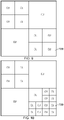
- FIGS. 9 and 10 schematically illustrate the coding units of FIG. 8 sub-divided into smaller coding units
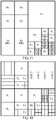
- FIG. 11 schematically illustrates an array of prediction units (PU);
- FIG. 12 schematically illustrates an array of transform units (TU);
- FIG. 13 schematically illustrates a 4 ⁇ 4 DST transform matrix
- FIG. 14 schematically illustrates coefficient values for an inverse transform according to the matrix of FIG. 13 ;
- FIG. 15 schematically illustrates a 32 ⁇ 32 combined DCT transform matrix
- FIG. 16 schematically illustrates coefficient values for an inverse transform according to the matrix of FIG. 13 ;
- FIGS. 17 a to 17 c schematically illustrate coefficient values for a forward transform according to the matrix of FIG. 13 ;
- FIGS. 18 a to 18 c schematically illustrate coefficient values for a forward transform according to the matrix of FIG. 15 ;
- FIGS. 19 to 21 schematically illustrate the subsampling of coefficient values from the matrix of FIG. 15 ;
- FIGS. 22 to 26 schematically illustrate empirical results obtained using techniques according to embodiments of the present technology.
- FIGS. 1-4 e are provided to give schematic illustrations of apparatus or systems making use of the compression and/or decompression apparatus to be described below in connection with embodiments.
- All of the data compression and/or decompression apparatus is to be described below may be implemented in hardware, in software running on a general-purpose data processing apparatus such as a general-purpose computer, as programmable hardware such as an application specific integrated circuit (ASIC) or field programmable gate array (FPGA) or as combinations of these.
- ASIC application specific integrated circuit
- FPGA field programmable gate array
- FIG. 1 schematically illustrates an audio/video data transmission and reception system using video data compression and decompression.
- An input audio/video signal 10 is supplied to a video data compression apparatus 20 which compresses at least the video component of the audio/video signal 10 for transmission along a transmission route 30 such as a cable, an optical fibre, a wireless link or the like.
- the compressed signal is processed by a decompression apparatus 40 to provide an output audio/video signal 50 .
- a compression apparatus 60 compresses an audio/video signal for transmission along the transmission route 30 to a decompression apparatus 70 .
- the compression apparatus 20 and decompression apparatus 70 can therefore form one node of a transmission link.
- the decompression apparatus 40 and decompression apparatus 60 can form another node of the transmission link.
- the transmission link is uni-directional, only one of the nodes would require a compression apparatus and the other node would only require a decompression apparatus.
- FIG. 2 schematically illustrates a video display system using video data decompression.
- a compressed audio/video signal 100 is processed by a decompression apparatus 110 to provide a decompressed signal which can be displayed on a display 120 .
- the decompression apparatus 110 could be implemented as an integral part of the display 120 , for example being provided within the same casing as the display device.
- the decompression apparatus 110 might be provided as (for example) a so-called set top box (STB), noting that the expression “set-top” does not imply a requirement for the box to be sited in any particular orientation or position with respect to the display 120 ; it is simply a term used in the art to indicate a device which is connectable to a display as a peripheral device.
- STB set top box
- FIG. 3 schematically illustrates an audio/video storage system using video data compression and decompression.
- An input audio/video signal 130 is supplied to a compression apparatus 140 which generates a compressed signal for storing by a store device 150 such as a magnetic disk device, an optical disk device, a magnetic tape device, a solid state storage device such as a semiconductor memory or other storage device.
- a store device 150 such as a magnetic disk device, an optical disk device, a magnetic tape device, a solid state storage device such as a semiconductor memory or other storage device.
- compressed data is read from the store device 150 and passed to a decompression apparatus 160 for decompression to provide an output audio/video signal 170 .
- FIG. 4 a schematically illustrates a video camera using video data compression.
- image capture device 180 such as a charge coupled device (CCD) image sensor and associated control and read-out electronics, generates a video signal which is passed to a compression apparatus 190 .
- a microphone (or plural microphones) 200 generates an audio signal to be passed to the compression apparatus 190 .
- the compression apparatus 190 generates a compressed audio/video signal 210 to be stored and/or transmitted (shown generically as a schematic stage 220 ).
- the techniques to be described below relate primarily to video data compression. It will be appreciated that many existing techniques may be used for audio data compression in conjunction with the video data compression techniques which will be described, to generate a compressed audio/video signal. Accordingly, a separate discussion of audio data compression will not be provided. It will also be appreciated that the data rate associated with video data, in particular broadcast quality video data, is generally very much higher than the data rate associated with audio data (whether compressed or uncompressed). It will therefore be appreciated that uncompressed audio data could accompany compressed video data to form a compressed audio/video signal. It will further be appreciated that although the present examples (shown in FIGS.
- FIG. 4 b schematically illustrates an example video camera apparatus 183 in more detail. Those features numbered in common with FIG. 4 a will not be described further.
- FIG. 4 b is an example of the camera of FIG. 4 a (in the case that the unit 220 of FIG. 4 a provides a storage capability) in which the compressed data are first buffered by a buffer 221 and then stored in a storage medium 222 such as a magnetic disk, an optical disk, flash memory, a so-called solid-state disk drive (SSD) or the like.
- SSD solid-state disk drive
- FIG. 4 c schematically illustrates another example video camera in which, in place of the storage arrangement of FIG. 4 b , a network interface 223 is provided in order to allow the compressed data to be transmitted to another unit (not shown).
- the network interface 223 can also allow for incoming data to be received by the video camera, such as control data. Note that the arrangement of FIG. 4 b can be implemented as a single (physical) unit 183 .
- FIGS. 4 d and 4 e schematically illustrate date carriers, for example for use as the storage medium 222 and carrying compressed data which has been compressed according to the compression techniques described in the present application.
- FIG. 4 d shows a schematic example of a removable non-volatile storage medium 225 implemented as solid state memory such as flash memory.
- FIG. 4 e shows a schematic example of a removable non-volatile storage medium 226 implemented as a disk medium such as an optical disk.
- FIG. 5 provides a schematic overview of a video data compression and decompression apparatus.
- Successive images of an input video signal 300 are supplied to an adder 310 and to an image predictor 320 .
- the image predictor 320 will be described below in more detail with reference to FIG. 6 .
- the adder 310 in fact performs a subtraction (negative addition) operation, in that it receives the input video signal 300 on a “+” input and the output of the image predictor 320 on a “-” input, so that the predicted image is subtracted from the input image. The result is to generate a so-called residual image signal 330 representing the difference between the actual and projected images.
- a residual image signal is generated.
- the data coding techniques to be described that is to say the techniques which will be applied to the residual image signal, tends to work more efficiently when there is less “energy” in the image to be encoded.
- the term “efficiently” refers to the generation of a small amount of encoded data; for a particular image quality level, it is desirable (and considered “efficient”) to generate as little data as is practicably possible.
- the reference to “energy” in the residual image relates to the amount of information contained in the residual image. If the predicted image were to be identical to the real image, the difference between the two (that is to say, the residual image) would contain zero information (zero energy) and would be very easy to encode into a small amount of encoded data. In general, if the prediction process can be made to work reasonably well, the expectation is that the residual image data will contain less information (less energy) than the input image and so will be easier to encode into a small amount of encoded data.
- the residual image data 330 is supplied to a transform unit 340 which generates a discrete cosine transform (DCT) representation of the residual image data.
- DCT discrete cosine transform
- a discrete sine transform (DST) is used instead of a DCT.
- no transform might be used. This can be done selectively, so that the transform stage is, in effect, bypassed, for example under the control of a “transform skip” command or mode.
- the output of the transform unit 340 which is to say, a set of transform coefficients for each transformed block of image data, is supplied to a quantiser 350 .
- Various quantisation techniques are known in the field of video data compression, ranging from a simple multiplication by a quantisation scaling factor through to the application of complicated lookup tables under the control of a quantisation parameter. The general aim is twofold. Firstly, the quantisation process reduces the number of possible values of the transformed data. Secondly, the quantisation process can increase the likelihood that values of the transformed data are zero. Both of these can make the entropy encoding process work more efficiently in generating small amounts of compressed video data.
- a data scanning process is applied by a scan unit 360 .
- the purpose of the scanning process is to reorder the quantised transformed data so as to gather as many as possible of the non-zero quantised transformed coefficients together, and of course therefore to gather as many as possible of the zero-valued coefficients together.
- These features can allow so-called run-length coding or similar techniques to be applied efficiently.
- the scanning process involves selecting coefficients from the quantised transformed data, and in particular from a block of coefficients corresponding to a block of image data which has been transformed and quantised, according to a “scanning order” so that (a) all of the coefficients are selected once as part of the scan, and (b) the scan tends to provide the desired reordering.
- zigzag scanning order One example scanning order which can tend to give useful results.
- CABAC Context Adaptive Binary Arithmetic Coding
- CAVLC Context Adaptive Variable-Length Coding
- the scanning process and the entropy encoding process are shown as separate processes, but in fact can be combined or treated together. That is to say, the reading of data into the entropy encoder can take place in the scan order.
- the respective inverse processes apply to the respective inverse processes.
- the output of the entropy encoder 370 along with additional data, for example defining the manner in which the predictor 320 generated the predicted image, provides a compressed output video signal 380 .
- a return path is also provided because the operation of the predictor 320 itself depends upon a decompressed version of the compressed output data.
- the reason for this feature is as follows. At the appropriate stage in the decompression process a decompressed version of the residual data is generated. This decompressed residual data has to be added to a predicted image to generate an output image (because the original residual data was the difference between the input image and a predicted image). In order that this process is comparable, as between the compression side and the decompression side, the predicted images generated by the predictor 320 should be the same during the compression process and during the decompression process. Of course, at decompression, the apparatus does not have access to the original input images, but only to the decompressed images. Therefore, at compression, the predictor 320 bases its prediction (at least, for inter-image encoding) on decompressed versions of the compressed images.
- the entropy encoding process carried out by the entropy encoder 370 is considered to be “lossless”, which is to say that it can be reversed to arrive at exactly the same data which was first supplied to the entropy encoder 370 . So, the return path can be implemented before the entropy encoding stage. Indeed, the scanning process carried out by the scan unit 360 is also considered lossless, but in the present embodiment the return path 390 is from the output of the quantiser 350 to the input of a complimentary inverse quantiser 420 .
- an entropy decoder 410 the reverse scan unit 400 , an inverse quantiser 420 and an inverse transform unit 430 provide the respective inverse functions of the entropy encoder 370 , the scan unit 360 , the quantiser 350 and the transform unit 340 .
- the discussion will continue through the compression process; the process to decompress an input compressed video signal corresponds to the return path of the compression process.
- the scanned coefficients are passed by the return path 390 from the quantiser 350 to the inverse quantiser 420 which carries out the inverse operation of the scan unit 360 .
- An inverse quantisation and inverse transformation process are carried out by the units 420 , 430 to generate a compressed-decompressed residual image signal 440 .
- the image signal 440 is added, at an adder 450 , to the output of the predictor 320 to generate a reconstructed output image 460 . This forms one input to the image predictor 320 .
- the signal is supplied to the entropy decoder 410 and from there to the chain of the reverse scan unit 400 , the inverse quantiser 420 and the inverse transform unit 430 before being added to the output of the image predictor 320 by the adder 450 .
- the output 460 of the adder 450 forms the output decompressed video signal 480 .
- further filtering may be applied before the signal is output.
- FIG. 6 schematically illustrates the generation of predicted images, and in particular the operation of the image predictor 320 .
- Intra-image prediction bases a prediction of the content of a block of the image on data from within the same image. This corresponds to so-called I-frame encoding in other video compression techniques.
- I-frame encoding where the whole image is intra-encoded
- the choice between intra- and inter-encoding can be made on a block-by-block basis, though in other embodiments the choice is still made on an image-by-image basis.
- Motion-compensated prediction makes use of motion information which attempts to define the source, in another adjacent or nearby image, of image detail to be encoded in the current image. Accordingly, in an ideal example, the contents of a block of image data in the predicted image can be encoded very simply as a reference (a motion vector) pointing to a corresponding block at the same or a slightly different position in an adjacent image.
- a reference a motion vector
- two image prediction arrangements (corresponding to intra- and inter-image prediction) are shown, the results of which are selected by a multiplexer 500 under the control of a mode signal 510 so as to provide blocks of the predicted image for supply to the adders 310 and 450 .
- the choice is made in dependence upon which selection gives the lowest “energy” (which, as discussed above, may be considered as information content requiring encoding), and the choice is signalled to the encoder within the encoded output datastream.
- Image energy in this context, can be detected, for example, by carrying out a trial subtraction of an area of the two versions of the predicted image from the input image, squaring each pixel value of the difference image, summing the squared values, and identifying which of the two versions gives rise to the lower mean squared value of the difference image relating to that image area.
- the actual prediction, in the intra-encoding system, is made on the basis of image blocks received as part of the signal 460 , which is to say, the prediction is based upon encoded-decoded image blocks in order that exactly the same prediction can be made at a decompression apparatus.
- data can be derived from the input video signal 300 by an intra-mode selector 520 to control the operation of the intra-image predictor 530 .
- a motion compensated (MC) predictor 540 uses motion information such as motion vectors derived by a motion estimator 550 from the input video signal 300 . Those motion vectors are applied to a processed version of the reconstructed image 460 by the motion compensated predictor 540 to generate blocks of the inter-image prediction.
- the signal is filtered by a filter unit 560 .
- an adaptive loop filter is applied using coefficients derived by processing the reconstructed signal 460 and the input video signal 300 .
- the adaptive loop filter is a type of filter which, using known techniques, applies adaptive filter coefficients to the data to be filtered. That is to say, the filter coefficients can vary in dependence upon various factors. Data defining which filter coefficients to use is included as part of the encoded output datastream.
- the filtered output from the filter unit 560 in fact forms the output video signal 480 . It is also buffered in one or more image stores 570 ; the storage of successive images is a requirement of motion compensated prediction processing, and in particular the generation of motion vectors. To save on storage requirements, the stored images in the image stores 570 may be held in a compressed form and then decompressed for use in generating motion vectors. For this particular purpose, any known compression/decompression system may be used.
- the stored images are passed to an interpolation filter 580 which generates a higher resolution version of the stored images; in this example, intermediate samples (sub-samples) are generated such that the resolution of the interpolated image is output by the interpolation filter 580 is 8 times (in each dimension) that of the images stored in the image stores 570 .
- the interpolated images are passed as an input to the motion estimator 550 and also to the motion compensated predictor 540 .
- a further optional stage is provided, which is to multiply the data values of the input video signal by a factor of four using a multiplier 600 (effectively just shifting the data values left by two bits), and to apply a corresponding divide operation (shift right by two bits) at the output of the apparatus using a divider or right-shifter 610 . So, the shifting left and shifting right changes the data purely for the internal operation of the apparatus. This measure can provide for higher calculation accuracy within the apparatus, as the effect of any data rounding errors is reduced.
- LCU 700 largest coding unit 700 ( FIG. 7 ), which represents a square array of 64 ⁇ 64 samples.
- LCU largest coding unit
- the discussion relates to luminance samples.
- chrominance mode such as 4:4:4, 4:2:2, 4:2:0 or 4:4:4:4 (GBR plus key data)
- coding units Three basic types of blocks will be described: coding units, prediction units and transform units.
- the recursive subdividing of the LCUs allows an input picture to be partitioned in such a way that both the block sizes and the block coding parameters (such as prediction or residual coding modes) can be set according to the specific characteristics of the image to be encoded.
- the LCU may be subdivided into so-called coding units (CU). Coding units are always square and have a size between 8 ⁇ 8 samples and the full size of the LCU 700 .
- the coding units can be arranged as a kind of tree structure, so that a first subdivision may take place as shown in FIG. 8 , giving coding units 710 of 32 ⁇ 32 samples; subsequent subdivisions may then take place on a selective basis so as to give some coding units 720 of 16 ⁇ 16 samples ( FIG. 9 ) and potentially some coding units 730 of 8 ⁇ 8 samples ( FIG. 10 ). Overall, this process can provide a content-adapting coding tree structure of CU blocks, each of which may be as large as the LCU or as small as 8 ⁇ 8 samples. Encoding of the output video data takes place on the basis of the coding unit structure.
- FIG. 11 schematically illustrates an array of prediction units (PU).
- a prediction unit is a basic unit for carrying information relating to the image prediction processes, or in other words the additional data added to the entropy encoded residual image data to form the output video signal from the apparatus of FIG. 5 .
- prediction units are not restricted to being square in shape. They can take other shapes, in particular rectangular shapes forming half of one of the square coding units, as long as the coding unit is greater than the minimum (8 ⁇ 8) size.
- the aim is to allow the boundary of adjacent prediction units to match (as closely as possible) the boundary of real objects in the picture, so that different prediction parameters can be applied to different real objects.
- Each coding unit may contain one or more prediction units.
- FIG. 12 schematically illustrates an array of transform units (TU).
- a transform unit is a basic unit of the transform and quantisation process. Transform units are always square and can take a size from 4 ⁇ 4 up to 32 ⁇ 32 samples. Each coding unit can contain one or more transform units.
- the acronym SDIP-P in FIG. 12 signifies a so-called short distance intra-prediction partition. In this arrangement only one dimensional transforms are used, so a 4 ⁇ N block is passed through N transforms with input data to the transforms being based upon the previously decoded neighbouring blocks and the previously decoded neighbouring lines within the current SDIP-P.
- the following discussion relates to aspects of the transform unit 340 and the inverse transform unit 430 .
- the transform unit is present in encoders.
- the inverse transform unit is present in the return decoding path of an encoder and in the decoding path of a decoder.
- the transform unit and the inverse transform unit are intended to provide complementary transformations to and from the spatial frequency domain. That is to say, the transform unit 340 acts on sets of video data (or data derived from video data, such as the difference or residual data discussed above) and generates corresponding sets of spatial frequency coefficients.
- the inverse transform unit 430 acts on sets of spatial frequency coefficients and generates corresponding sets of video data.
- the transformations are implemented as matrix calculations.
- the forward transform is defined by a transformation matrix and the transformation is implemented by matrix-multiplying the transformation matrix by an array of sample values to generate a corresponding array of spatial frequency coefficients.
- the array of samples, M is left-multiplied by the transformation matrix T, and then the result is right-multiplied by the transpose of the transformation matrix, T T . So the array of output coefficients is defined as T ⁇ M ⁇ T T T
- a property of the type of matrix which represents a spatial frequency transformation of this type is that the transpose of the matrix is the same as its inverse. So, in principle the forward and inverse transformation matrices are related by a simple transposition.
- the transformations are defined only as inverse transformation matrices used in the decoder function.
- the encoder transformation matrices are not defined as such.
- the decoder (inverse) transformations are defined to a six bit precision.
- a suitable set of forward (encoder) matrices could be obtained as the transposition of the inverse matrices.
- the relationship between the forward and inverse matrices applies only if the values are expressed to infinite precision. Expressing the values to a limited precision, such as six bits, means that the transposition is not necessarily an appropriate relationship between the forward and inverse matrices.
- the matrix coefficients to be discussed below are expressed as integers, scaled up from the actual values required to implement the transform by a number of bits (powers of 2) sufficient to allow for the required coefficient precision. If required, the scaling-up can be removed by a bit shift (division by a number of powers of 2) at another stage in the process. In other words, the actual transformation coefficients are proportional to the values to be discussed below.
- the transform matrix is of the form shown in FIG. 13 , where each of the letters indicates a respective coefficient value, and where the values in the grid are defined according to the table of FIG. 14 .
- N may be a power of two smaller than 32 such as 4, 8, or 16, depending on the size of the array of data to be transformed.
- the combined matrix M 32 is of the form shown in FIG. 15 , where once again the different letters refer to respective coefficient values. Note that the upper case versions and lower case versions of the same letter represent different coefficients—so “A” does not refer to the same value as “a”.
- the values in the grid are defined according to the table shown in FIG. 16 .
- the matrix values to be discussed below are applicable, for example, to frequency-transforming the video data values according to a frequency transform, to generate an array of frequency-transformed values by a matrix-multiplication process using a transform matrix having a data precision greater than six bits, the transform matrix having coefficients defined by at least a subset of the values discussed below, and to a frequency transform unit such as the unit 340 ) which performs such operations.
- the term “matched” implies that the forward matrix, when used to complement the standard inverse matrix, will give a lower error than other forward matrices expressed to that precision. In some instances, the error may be minimised; in others, it may at least be alleviated.
- error relates (in the context of a chain of forward and inverse transformations) to differences between data supplied as an input to the forward transformation and corresponding data generated as an output of the inverse transformation.
- the transform matrix is again of the form shown in FIG. 13 , where the values in the grid are defined by the matrix precision according to the tables of FIGS. 17 a to 17 c .
- the values shown are indicative of embodiments of the present technology (which is to say, values equal to those numbers may be used), each of these numbers may be varied by (for example) +/ ⁇ 2.
- each row relates to a different one of the letters defining the coefficients.
- Each column relates to a different precision or bit depth of the matrix coefficients.
- the combined matrix M 32 is again of the form shown schematically in FIG. 15 , but this time with the values in the grid defined by the matrix precision according to the tables of FIGS. 18 a to 18 c .
- the values shown are indicative of embodiments of the present technology, each of these numbers may be varied by +/ ⁇ 2. Accordingly, actual values which are substantially equal to the values in the table may be used, where the term “substantially equal” means “the table value+/ ⁇ 2”.
- the matrix M 4 is defined according to the equation set out above as the first 4 coefficients of every 8 th row of the combined matrix M 32 . These coefficients are shown in FIG. 19 .
- the matrix M 8 is defined according to the equation set out above as the first 8 coefficients of every 4 th row of the combined matrix M 32 . These coefficients are shown in FIG. 20 .
- the matrix M 16 is defined according to the equation set out above as the first 16 coefficients of every even row of the combined matrix M 32 . These coefficients are shown in FIG. 21 .
- coefficient values are selected according to the data precision from the values listed in the relevant tables shown in the accompanying drawings.
- an encoder that codes up to N-bit input data may use a forward transform bit depth of at least N ⁇ 3 bits, for example N ⁇ 2 bits (so as to provide an offset of 2 or 3 less than the bit depth of the video data values, for example).
- a forward transform bit depth of at least N ⁇ 3 bits, for example N ⁇ 2 bits (so as to provide an offset of 2 or 3 less than the bit depth of the video data values, for example).
- such an encoder may or may not use less accurate forward transform bit depths for lower input bit-depth systems (for example, it may be able to reduce the power, or utilise a faster software implementation).
- the forward transform unit 340 may be operable to stored data relating to the tables of (for example) FIGS. 18 a -18 c , and to select data from an appropriate column of these tables according to the internal video bit depth in use.
- the graphs described below illustrate (a) a reference performance using the standard 6-bit inverse transform as its own forward transform (the current standard HEVC C model method at the time of filing), along with results obtained by using a higher precision forward transform matched to the 6-bit inverse transform.
- the results are provided at different respective bit depths of the video data being processed, and indicate the system performance as a measure of signal to noise ratio (SNR) in decibels (dB) against bit rate in kilo-bits per second (kbps).
- SNR measure is obtained from the encoding and then decoding of a test sequence of video, according to the bit rate and bit depth specified, and is derived from errors as averaged over the test sequence.
- FIGS. 22 to 24 illustrate results obtained for a matrix precision of 14 (that is to say, using data in the columns headed “14 bits” in FIG. 18 a ), for an internal (within the processing operation) video bit depth of 12 ( FIG. 22 ), 14 ( FIG. 24 ) and 16 ( FIG. 26 ).
- FIGS. 25 and 26 illustrate results obtained for a matrix precision of ⁇ internal video bit-depth> ⁇ 2 , for an internal video bit depth of 12 ( FIG. 25 ) and 14 ( FIG. 26 ).
- Image data encoded or decoded using these techniques and a data carrier which carries such image data are considered to represent an embodiment of the present disclosure.
- a video data encoding method for encoding an array of video data values comprising the steps of:
- Computer software which, when executed by a computer, causes the computer to carry out the method of any one of the preceding clauses.
- Data encoding apparatus for encoding an array of video data values, the apparatus comprising:
- a frequency transform unit configured to frequency-transform the video data values according to a frequency transform, to generate an array of frequency-transformed values by a matrix-multiplication process using a transform matrix having a data precision greater than six bits, the transform matrix having coefficients defined by at least a subset of the following values:
Landscapes
- Engineering & Computer Science (AREA)
- Physics & Mathematics (AREA)
- General Physics & Mathematics (AREA)
- Multimedia (AREA)
- Signal Processing (AREA)
- Discrete Mathematics (AREA)
- Mathematical Physics (AREA)
- Theoretical Computer Science (AREA)
- Computational Mathematics (AREA)
- Mathematical Analysis (AREA)
- Mathematical Optimization (AREA)
- Pure & Applied Mathematics (AREA)
- Data Mining & Analysis (AREA)
- Algebra (AREA)
- Databases & Information Systems (AREA)
- Software Systems (AREA)
- General Engineering & Computer Science (AREA)
- Computing Systems (AREA)
- Compression Or Coding Systems Of Tv Signals (AREA)
Abstract
Description
T·M·T T
M N[x][y]=M 32[x][(2(5-log 2(N)))y] for x,y=0 . . . (N−1).
M N[x][y]=M 32[x][(2(5-log 2(N)))y] for x,y=0 . . . (N−1).

(b) for the case that the frequency transform is a discrete sine transform:
| 7-bit | 8-bit | 9-bit | 10-bit | 11-bit | 12-bit | 13-bit | 14-bit | ||
| a | 128 | 256 | 512 | 1024 | 2048 | 4096 | 8192 | 16384 |
| b | 166 | 332 | 665 | 1329 | 2658 | 5317 | 10633 | 21266 |
| c | 72 | 144 | 288 | 576 | 1153 | 2306 | 4612 | 9224 |
| d | 178 | 356 | 713 | 1426 | 2852 | 5703 | 11407 | 22813 |
| e | 150 | 301 | 601 | 1203 | 2406 | 4811 | 9622 | 19244 |
| f | 100 | 200 | 399 | 798 | 1596 | 3192 | 6385 | 12769 |
| g | 36 | 71 | 143 | 285 | 570 | 1141 | 2282 | 4563 |
| h | 181 | 361 | 722 | 1445 | 2890 | 5780 | 11560 | 23120 |
| i | 172 | 345 | 689 | 1379 | 2758 | 5516 | 11032 | 22063 |
| j | 160 | 320 | 639 | 1278 | 2556 | 5113 | 10225 | 20450 |
| k | 140 | 281 | 562 | 1123 | 2246 | 4493 | 8986 | 17972 |
| l | 114 | 229 | 458 | 915 | 1830 | 3660 | 7321 | 14642 |
| m | 87 | 174 | 347 | 694 | 1389 | 2777 | 5555 | 11109 |
| n | 50 | 101 | 201 | 403 | 806 | 1612 | 3223 | 6446 |
| o | 18 | 36 | 72 | 145 | 290 | 579 | 1158 | 2316 |
| p | 181 | 361 | 722 | 1444 | 2888 | 5777 | 11553 | 23106 |
| q | 179 | 357 | 714 | 1428 | 2856 | 5713 | 11426 | 22852 |
| r | 175 | 351 | 701 | 1403 | 2806 | 5611 | 11222 | 22445 |
| s | 171 | 341 | 683 | 1365 | 2731 | 5462 | 10924 | 21848 |
| t | 164 | 328 | 656 | 1312 | 2624 | 5249 | 10497 | 20995 |
| u | 155 | 310 | 619 | 1238 | 2476 | 4952 | 9905 | 19810 |
| v | 145 | 291 | 581 | 1163 | 2325 | 4650 | 9301 | 18601 |
| w | 134 | 268 | 536 | 1071 | 2143 | 4286 | 8571 | 17143 |
| x | 123 | 246 | 491 | 982 | 1965 | 3929 | 7859 | 15718 |
| y | 108 | 216 | 433 | 866 | 1732 | 3463 | 6927 | 13853 |
| z | 92 | 184 | 367 | 734 | 1469 | 2937 | 5875 | 11749 |
| A | 77 | 154 | 308 | 615 | 1231 | 2461 | 4923 | 9846 |
| B | 62 | 124 | 247 | 494 | 988 | 1977 | 3954 | 7908 |
| C | 44 | 87 | 174 | 348 | 697 | 1393 | 2787 | 5573 |
| D | 26 | 51 | 103 | 205 | 410 | 820 | 1641 | 3281 |
| E | 7 | 15 | 30 | 59 | 118 | 236 | 473 | 946 |
| 15-bit | 16-bit | 17-bit | 18-bit | 19-bit | ||
| a | 32768 | 65536 | 131072 | 262144 | 524288 | ||
| |
42532 | 85065 | 170129 | 340259 | 680517 | ||
| c | 18448 | 36896 | 73791 | 147582 | 295164 | ||
| |
45627 | 91253 | 182507 | 365014 | 730028 | ||
| |
38489 | 76977 | 153954 | 307909 | 615817 | ||
| |
25538 | 51077 | 102153 | 204306 | 408612 | ||
| |
9126 | 18252 | 36504 | 73009 | 146018 | ||
| |
46240 | 92479 | 184958 | 369917 | 739833 | ||
| i | 44126 | 88253 | 176506 | 353011 | 706022 | ||
| |
40901 | 81802 | 163603 | 327207 | 654413 | ||
| |
35944 | 71887 | 143775 | 287550 | 575099 | ||
| |
29283 | 58566 | 117132 | 234265 | 468530 | ||
| |
22219 | 44437 | 88874 | 177749 | 355498 | ||
| |
12892 | 25784 | 51569 | 103137 | 206275 | ||
| o | 4632 | 9264 | 18528 | 37057 | 74113 | ||
| |
46212 | 92424 | 184849 | 369697 | 739394 | ||
| |
45704 | 91407 | 182815 | 365630 | 731260 | ||
| |
44890 | 89779 | 179559 | 359118 | 718236 | ||
| s | 43695 | 87391 | 174781 | 349562 | 699125 | ||
| |
41990 | 83979 | 167959 | 335918 | 671836 | ||
| |
39619 | 79239 | 158477 | 316955 | 633909 | ||
| |
37202 | 74404 | 148808 | 297616 | 595233 | ||
| |
34285 | 68570 | 137140 | 274281 | 548561 | ||
| x | 31436 | 62871 | 125743 | 251486 | 502971 | ||
| |
27706 | 55412 | 110825 | 221650 | 443299 | ||
| |
23498 | 46997 | 93993 | 187986 | 375972 | ||
| |
19692 | 39384 | 78767 | 157535 | 315070 | ||
| |
15816 | 31631 | 63263 | 126525 | 253051 | ||
| |
11146 | 22292 | 44584 | 89168 | 178337 | ||
| |
6562 | 13124 | 26248 | 52497 | 104993 | ||
| |
1891 | 3782 | 7564 | 15129 | 30258 | ||
| 20-bit | 21-bit | 22-bit | 23-bit | 24-bit | ||
| a | 1048576 | 2097152 | 4194304 | 8388608 | 16777216 |
| | 1361035 | 2722070 | 5444140 | 10888280 | 21776560 |
| | 590328 | 1180657 | 2361314 | 4722627 | 9445255 |
| | 1460056 | 2920112 | 5840224 | 11680448 | 23360895 |
| | 1231635 | 2463269 | 4926539 | 9853077 | 19706155 |
| | 817225 | 1634450 | 3268899 | 6537799 | 13075597 |
| | 292035 | 584070 | 1168141 | 2336282 | 4672564 |
| | 1479667 | 2959333 | 5918667 | 11837334 | 23674667 |
| i | 1412045 | 2824090 | 5648179 | 11296358 | 22592717 |
| | 1308827 | 2617653 | 5235307 | 10470613 | 20941227 |
| | 1150199 | 2300397 | 4600795 | 9201590 | 18403179 |
| | 937060 | 1874119 | 3748238 | 7496477 | 14992954 |
| | 710995 | 1421991 | 2843981 | 5687962 | 11375925 |
| | 412549 | 825098 | 1650196 | 3300393 | 6600785 |
| | 148227 | 296454 | 592908 | 1185815 | 2371630 |
| | 1478788 | 2957576 | 5915152 | 11830305 | 23660609 |
| | 1462520 | 2925040 | 5850080 | 11700160 | 23400319 |
| | 1436472 | 2872944 | 5745888 | 11491775 | 22983550 |
| s | 1398249 | 2796498 | 5592996 | 11185992 | 22371984 |
| | 1343671 | 2687342 | 5374684 | 10749368 | 21498736 |
| | 1267818 | 2535636 | 5071272 | 10142545 | 20285089 |
| | 1190466 | 2380931 | 4761862 | 9523724 | 19047449 |
| | 1097123 | 2194246 | 4388491 | 8776982 | 17553965 |
| x | 1005942 | 2011884 | 4023769 | 8047537 | 16095074 |
| | 886598 | 1773197 | 3546394 | 7092787 | 14185574 |
| | 751944 | 1503889 | 3007778 | 6015555 | 12031111 |
| | 630139 | 1260278 | 2520556 | 5041112 | 10082224 |
| | 506101 | 1012202 | 2024405 | 4048809 | 8097618 |
| | 356674 | 713348 | 1426696 | 2853391 | 5706783 |
| | 209987 | 419973 | 839947 | 1679894 | 3359787 |
| | 60515 | 121030 | 242061 | 484122 | 968243 |
(b) for the case that the frequency transform is a discrete sine transform:
| 7-bit | 8-bit | 9-bit | 10-bit | 11-bit | 12-bit | 13-bit | 14-bit | ||
| a | 58 | 116 | 232 | 464 | 928 | 1856 | 3712 | 7424 |
| |
110 | 220 | 440 | 880 | 1760 | 3520 | 7040 | 14081 |
| c | 148 | 295 | 590 | 1181 | 2362 | 4723 | 9447 | 18893 |
| |
168 | 336 | 672 | 1344 | 2688 | 5376 | 10753 | 21505 |
| |
0 | 0 | 0 | 0 | 0 | 0 | 0 | 0 |
| 15-bit | 16-bit | 17-bit | 18-bit | 19-bit | ||
| a | 14849 | 29698 | 59396 | 118791 | 237583 | ||
| |
28162 | 56323 | 112647 | 225294 | 450588 | ||
| c | 37787 | 75573 | 151146 | 302292 | 604584 | ||
| |
43011 | 86021 | 172043 | 344085 | 688170 | ||
| |
0 | 0 | 0 | 0 | 0 | ||
| 20-bit | 21-bit | 22-bit | 23-bit | 24-bit | ||
| a | 475165 | 950330 | 1900660 | 3801320 | 7602640 |
| | 901175 | 1802350 | 3604700 | 7209400 | 14418800 |
| | 1209169 | 2418337 | 4836675 | 9673350 | 19346700 |
| | 1376340 | 2752680 | 5505360 | 11010720 | 22021440 |
| | 0 | 0 | 0 | 0 | 0 |
2. A method according to
3. A method according to
4. A method according to
M N[x][y]=M 32[x][(2(5-log 2(N)))y] for x,y=0 . . . (N−1).
7. A method according to
8. Image data encoded by the encoding method of any one of the preceding clauses.
9. A data carrier storing image data according to
10. Computer software which, when executed by a computer, causes the computer to carry out the method of any one of the preceding clauses.
11. A non-transitory machine-readable storage medium on which computer software according to
12. Data encoding apparatus for encoding an array of video data values, the apparatus comprising:

(b) for the case that the frequency transform is a discrete sine transform:
| 7-bit | 8-bit | 9-bit | 10-bit | 11-bit | 12-bit | 13-bit | 14-bit | ||
| a | 128 | 256 | 512 | 1024 | 2048 | 4096 | 8192 | 16384 |
| b | 166 | 332 | 665 | 1329 | 2658 | 5317 | 10633 | 21266 |
| c | 72 | 144 | 288 | 576 | 1153 | 2306 | 4612 | 9224 |
| d | 178 | 356 | 713 | 1426 | 2852 | 5703 | 11407 | 22813 |
| e | 150 | 301 | 601 | 1203 | 2406 | 4811 | 9622 | 19244 |
| f | 100 | 200 | 399 | 798 | 1596 | 3192 | 6385 | 12769 |
| g | 36 | 71 | 143 | 285 | 570 | 1141 | 2282 | 4563 |
| h | 181 | 361 | 722 | 1445 | 2890 | 5780 | 11560 | 23120 |
| i | 172 | 345 | 689 | 1379 | 2758 | 5516 | 11032 | 22063 |
| j | 160 | 320 | 639 | 1278 | 2556 | 5113 | 10225 | 20450 |
| k | 140 | 281 | 562 | 1123 | 2246 | 4493 | 8986 | 17972 |
| l | 114 | 229 | 458 | 915 | 1830 | 3660 | 7321 | 14642 |
| m | 87 | 174 | 347 | 694 | 1389 | 2111 | 5555 | 11109 |
| n | 50 | 101 | 201 | 403 | 806 | 1612 | 3223 | 6446 |
| o | 18 | 36 | 72 | 145 | 290 | 579 | 1158 | 2316 |
| p | 181 | 361 | 722 | 1444 | 2888 | 5777 | 11553 | 23106 |
| q | 179 | 357 | 714 | 1428 | 2856 | 5713 | 11426 | 22852 |
| r | 175 | 351 | 701 | 1403 | 2806 | 5611 | 11222 | 22445 |
| s | 171 | 341 | 683 | 1365 | 2731 | 5462 | 10924 | 21848 |
| t | 164 | 328 | 656 | 1312 | 2624 | 5249 | 10497 | 20995 |
| u | 155 | 310 | 619 | 1238 | 2476 | 4952 | 9905 | 19810 |
| v | 145 | 291 | 581 | 1163 | 2325 | 4650 | 9301 | 18601 |
| w | 134 | 268 | 536 | 1071 | 2143 | 4286 | 8571 | 17143 |
| x | 123 | 246 | 491 | 982 | 1965 | 3929 | 7859 | 15718 |
| y | 108 | 216 | 433 | 866 | 1732 | 3463 | 6927 | 13853 |
| z | 92 | 184 | 367 | 734 | 1469 | 2937 | 5875 | 11749 |
| A | 77 | 154 | 308 | 615 | 1231 | 2461 | 4923 | 9846 |
| B | 62 | 124 | 247 | 494 | 988 | 1977 | 3954 | 7908 |
| C | 44 | 87 | 174 | 348 | 697 | 1393 | 2787 | 5573 |
| D | 26 | 51 | 103 | 205 | 410 | 820 | 1641 | 3281 |
| E | 7 | 15 | 30 | 59 | 118 | 236 | 473 | 946 |
| 15-bit | 16-bit | 17-bit | 18-bit | 19-bit | ||
| a | 32768 | 65536 | 131072 | 262144 | 524288 | ||
| |
42532 | 85065 | 170129 | 340259 | 680517 | ||
| c | 18448 | 36896 | 73791 | 147582 | 295164 | ||
| |
45627 | 91253 | 182507 | 365014 | 730028 | ||
| |
38489 | 76977 | 153954 | 307909 | 615817 | ||
| |
25538 | 51077 | 102153 | 204306 | 408612 | ||
| |
9126 | 18252 | 36504 | 73009 | 146018 | ||
| |
46240 | 92479 | 184958 | 369917 | 739833 | ||
| i | 44126 | 88253 | 176506 | 353011 | 706022 | ||
| |
40901 | 81802 | 163603 | 327207 | 654413 | ||
| |
35944 | 71887 | 143775 | 287550 | 575099 | ||
| |
29283 | 58566 | 117132 | 234265 | 468530 | ||
| |
22219 | 44437 | 88874 | 177749 | 355498 | ||
| |
12892 | 25784 | 51569 | 103137 | 206275 | ||
| o | 4632 | 9264 | 18528 | 37057 | 74113 | ||
| |
46212 | 92424 | 184849 | 369697 | 739394 | ||
| |
45704 | 91407 | 182815 | 365630 | 731260 | ||
| |
44890 | 89779 | 179559 | 359118 | 718236 | ||
| s | 43695 | 87391 | 174781 | 349562 | 699125 | ||
| |
41990 | 83979 | 167959 | 335918 | 671836 | ||
| |
39619 | 79239 | 158477 | 316955 | 633909 | ||
| |
37202 | 74404 | 148808 | 297616 | 595233 | ||
| |
34285 | 68570 | 137140 | 274281 | 548561 | ||
| x | 31436 | 62871 | 125743 | 251486 | 502971 | ||
| |
27706 | 55412 | 110825 | 221650 | 443299 | ||
| |
23498 | 46997 | 93993 | 187986 | 375972 | ||
| |
19692 | 39384 | 78767 | 157535 | 315070 | ||
| |
15816 | 31631 | 63263 | 126525 | 253051 | ||
| |
11146 | 22292 | 44584 | 89168 | 178337 | ||
| |
6562 | 13124 | 26248 | 52497 | 104993 | ||
| |
1891 | 3782 | 7564 | 15129 | 30258 | ||
| 20-bit | 21-bit | 22-bit | 23-bit | 24-bit | ||
| a | 1048576 | 2097152 | 4194304 | 8388608 | 16777216 |
| | 1361035 | 2722070 | 5444140 | 10888280 | 21776560 |
| | 590328 | 1180657 | 2361314 | 4722627 | 9445255 |
| | 1460056 | 2920112 | 5840224 | 11680448 | 23360895 |
| | 1231635 | 2463269 | 4926539 | 9853077 | 19706155 |
| | 817225 | 1634450 | 3268899 | 6537799 | 13075597 |
| | 292035 | 584070 | 1168141 | 2336282 | 4672564 |
| | 1479667 | 2959333 | 5918667 | 11837334 | 23674667 |
| i | 1412045 | 2824090 | 5648179 | 11296358 | 22592717 |
| | 1308827 | 2617653 | 5235307 | 10470613 | 20941227 |
| | 1150199 | 2300397 | 4600795 | 9201590 | 18403179 |
| | 937060 | 1874119 | 3748238 | 7496477 | 14992954 |
| | 710995 | 1421991 | 2843981 | 5687962 | 11375925 |
| | 412549 | 825098 | 1650196 | 3300393 | 6600785 |
| | 148227 | 296454 | 592908 | 1185815 | 2371630 |
| | 1478788 | 2957576 | 5915152 | 11830305 | 23660609 |
| | 1462520 | 2925040 | 5850080 | 11700160 | 23400319 |
| | 1436472 | 2872944 | 5745888 | 11491775 | 22983550 |
| s | 1398249 | 2796498 | 5592996 | 11185992 | 22371984 |
| | 1343671 | 2687342 | 5374684 | 10749368 | 21498736 |
| | 1267818 | 2535636 | 5071272 | 10142545 | 20285089 |
| | 1190466 | 2380931 | 4761862 | 9523724 | 19047449 |
| | 1097123 | 2194246 | 4388491 | 8776982 | 17553965 |
| x | 1005942 | 2011884 | 4023769 | 8047537 | 16095074 |
| | 886598 | 1773197 | 3546394 | 7092787 | 14185574 |
| | 751944 | 1503889 | 3007778 | 6015555 | 12031111 |
| | 630139 | 1260278 | 2520556 | 5041112 | 10082224 |
| | 506101 | 1012202 | 2024405 | 4048809 | 8097618 |
| | 356674 | 713348 | 1426696 | 2853391 | 5706783 |
| | 209987 | 419973 | 839947 | 1679894 | 3359787 |
| | 60515 | 121030 | 242061 | 484122 | 968243 |
(b) for the case that the frequency transform is a discrete sine transform:
| 7-bit | 8-bit | 9-bit | 10-bit | 11-bit | 12-bit | 13-bit | 14-bit | ||
| a | 58 | 116 | 232 | 464 | 928 | 1856 | 3712 | 7424 |
| |
110 | 220 | 440 | 880 | 1760 | 3520 | 7040 | 14081 |
| c | 148 | 295 | 590 | 1181 | 2362 | 4723 | 9447 | 18893 |
| |
168 | 336 | 672 | 1344 | 2688 | 5376 | 10753 | 21505 |
| |
0 | 0 | 0 | 0 | 0 | 0 | 0 | 0 |
| 15-bit | 16-bit | 17-bit | 18-bit | 19-bit | ||
| a | 14849 | 29698 | 59396 | 118791 | 237583 | ||
| |
28162 | 56323 | 112647 | 225294 | 450588 | ||
| c | 37787 | 75573 | 151146 | 302292 | 604584 | ||
| |
43011 | 86021 | 172043 | 344085 | 688170 | ||
| |
0 | 0 | 0 | 0 | 0 | ||
| 20-bit | 21-bit | 22-bit | 23-bit | 24-bit | ||
| a | 475165 | 950330 | 1900660 | 3801320 | 7602640 |
| | 901175 | 1802350 | 3604700 | 7209400 | 14418800 |
| | 1209169 | 2418337 | 4836675 | 9673350 | 19346700 |
| | 1376340 | 2752680 | 5505360 | 11010720 | 22021440 |
| | 0 | 0 | 0 | 0 | 0 |
13. Apparatus according to
14. Apparatus according to
15. Apparatus according to
16. Apparatus according to
17. Apparatus according to any one of
M N[x][y]=M 32[x][(2(5-log 2(N)))y], for x,y=0 . . . (N−1).
18. Apparatus according to
19. Video data capture, transmission, display and/or storage apparatus comprising apparatus according to any one of
Claims (11)

M N[x][y]=M 32[x][(2(5-log 2(N)))y] for x,y=0 . . . (N−1).

M N[x][y]=M 32[x][(2(5-log 2(N)))y] for x,y=0 . . . (N−1).

Applications Claiming Priority (4)
| Application Number | Priority Date | Filing Date | Title |
|---|---|---|---|
| GB1314612.1A GB2517416A (en) | 2013-08-15 | 2013-08-15 | Data encoding and decoding |
| GB1314612.1 | 2013-08-15 | ||
| GB1314612 | 2013-08-15 | ||
| PCT/GB2014/052262 WO2015022488A1 (en) | 2013-08-15 | 2014-07-24 | Data encoding and decoding |
Related Parent Applications (1)
| Application Number | Title | Priority Date | Filing Date |
|---|---|---|---|
| PCT/GB2014/052262 A-371-Of-International WO2015022488A1 (en) | 2013-08-15 | 2014-07-24 | Data encoding and decoding |
Related Child Applications (1)
| Application Number | Title | Priority Date | Filing Date |
|---|---|---|---|
| US17/732,893 Continuation US20220256193A1 (en) | 2013-08-15 | 2022-04-29 | Data encoding and decoding |
Publications (2)
| Publication Number | Publication Date |
|---|---|
| US20160198194A1 US20160198194A1 (en) | 2016-07-07 |
| US11323744B2 true US11323744B2 (en) | 2022-05-03 |
Family
ID=49301754
Family Applications (2)
| Application Number | Title | Priority Date | Filing Date |
|---|---|---|---|
| US14/909,686 Active 2037-01-05 US11323744B2 (en) | 2013-08-15 | 2014-07-24 | Data encoding and decoding |
| US17/732,893 Abandoned US20220256193A1 (en) | 2013-08-15 | 2022-04-29 | Data encoding and decoding |
Family Applications After (1)
| Application Number | Title | Priority Date | Filing Date |
|---|---|---|---|
| US17/732,893 Abandoned US20220256193A1 (en) | 2013-08-15 | 2022-04-29 | Data encoding and decoding |
Country Status (6)
| Country | Link |
|---|---|
| US (2) | US11323744B2 (en) |
| EP (1) | EP3033885B1 (en) |
| JP (2) | JP6789114B2 (en) |
| CN (1) | CN105453566B (en) |
| GB (1) | GB2517416A (en) |
| WO (1) | WO2015022488A1 (en) |
Cited By (1)
| Publication number | Priority date | Publication date | Assignee | Title |
|---|---|---|---|---|
| US12301875B2 (en) | 2020-04-03 | 2025-05-13 | Sony Group Corporation | Video data encoding and decoding |
Families Citing this family (3)
| Publication number | Priority date | Publication date | Assignee | Title |
|---|---|---|---|---|
| JP2015061143A (en) * | 2013-09-18 | 2015-03-30 | 沖電気工業株式会社 | Video encoder and video encoding program |
| CN106303548B (en) * | 2015-05-22 | 2019-03-19 | 北大方正集团有限公司 | HEVC intra-frame predictive encoding method |
| US11405647B2 (en) * | 2020-02-18 | 2022-08-02 | Tencent America LLC | Primary transforms using 8-bit and 10-bit cores |
Citations (5)
| Publication number | Priority date | Publication date | Assignee | Title |
|---|---|---|---|---|
| US20120177102A1 (en) | 2011-01-10 | 2012-07-12 | Tandberg Telecom As | Integer transform video compression system, method and computer program product |
| US8374237B2 (en) * | 2001-03-02 | 2013-02-12 | Dolby Laboratories Licensing Corporation | High precision encoding and decoding of video images |
| US20130114732A1 (en) | 2011-11-07 | 2013-05-09 | Vid Scale, Inc. | Video and data processing using even-odd integer transforms |
| WO2014167297A1 (en) | 2013-04-08 | 2014-10-16 | Sony Corporation | Selection of the maximum dynamic range of transformed data and the data precision of transform matrices according to the bit depth of input data |
| US20150016542A1 (en) * | 2013-07-11 | 2015-01-15 | Canon Kabushiki Kaisha | Method, apparatus and system for encoding and decoding video data |
Family Cites Families (5)
| Publication number | Priority date | Publication date | Assignee | Title |
|---|---|---|---|---|
| US20030118097A1 (en) * | 2001-12-21 | 2003-06-26 | Koninklijke Philips Electronics N.V. | System for realization of complexity scalability in a layered video coding framework |
| KR101131880B1 (en) * | 2007-03-23 | 2012-04-03 | 삼성전자주식회사 | Method and apparatus for encoding audio signal, and method and apparatus for decoding audio signal |
| CN101766573B (en) * | 2010-02-05 | 2013-02-13 | 上海安必生制药技术有限公司 | Preparation process of clopidogrel bisulfate solid preparation |
| GB2496194A (en) * | 2011-11-07 | 2013-05-08 | Sony Corp | Entropy encoding video data using reordering patterns |
| JP2013147346A (en) * | 2012-01-23 | 2013-08-01 | Toshiba Elevator Co Ltd | Passenger conveyor, connector, and connection method |
-
2013
- 2013-08-15 GB GB1314612.1A patent/GB2517416A/en not_active Withdrawn
-
2014
- 2014-07-24 US US14/909,686 patent/US11323744B2/en active Active
- 2014-07-24 JP JP2016533946A patent/JP6789114B2/en active Active
- 2014-07-24 CN CN201480044705.1A patent/CN105453566B/en active Active
- 2014-07-24 EP EP14744920.1A patent/EP3033885B1/en active Active
- 2014-07-24 WO PCT/GB2014/052262 patent/WO2015022488A1/en not_active Ceased
-
2019
- 2019-02-18 JP JP2019026366A patent/JP6777780B2/en active Active
-
2022
- 2022-04-29 US US17/732,893 patent/US20220256193A1/en not_active Abandoned
Patent Citations (6)
| Publication number | Priority date | Publication date | Assignee | Title |
|---|---|---|---|---|
| US8374237B2 (en) * | 2001-03-02 | 2013-02-12 | Dolby Laboratories Licensing Corporation | High precision encoding and decoding of video images |
| US20120177102A1 (en) | 2011-01-10 | 2012-07-12 | Tandberg Telecom As | Integer transform video compression system, method and computer program product |
| US20130114732A1 (en) | 2011-11-07 | 2013-05-09 | Vid Scale, Inc. | Video and data processing using even-odd integer transforms |
| WO2013070605A2 (en) | 2011-11-07 | 2013-05-16 | Vid Scale, Inc. | Video and data processing using even-odd integer transforms background |
| WO2014167297A1 (en) | 2013-04-08 | 2014-10-16 | Sony Corporation | Selection of the maximum dynamic range of transformed data and the data precision of transform matrices according to the bit depth of input data |
| US20150016542A1 (en) * | 2013-07-11 | 2015-01-15 | Canon Kabushiki Kaisha | Method, apparatus and system for encoding and decoding video data |
Non-Patent Citations (21)
| Title |
|---|
| International Search Report dated Sep. 29, 2014, in PCT/GB2014/052262 Filed Jul. 24, 2014. |
| K. Sharman, et al., "AHG5: Range Extensions and High Bit Depths" Joint Collaborative Team on Video Coding (JCT-VC) of ITU-T SG 16 WP 3 and ISO/IEC JTC 1/SC 29/WG 11, JCTVC-M0178, 2013, pp. 1-21. |
| K. SHARMAN; N. SAUNDERS; J. GAMEI (SONY): "AHG 5 and 18: Internal Precision for High Bit Depths", 14. JCT-VC MEETING; 25-7-2013 - 2-8-2013; VIENNA; (JOINT COLLABORATIVE TEAM ON VIDEO CODING OF ISO/IEC JTC1/SC29/WG11 AND ITU-T SG.16 ); URL: HTTP://WFTP3.ITU.INT/AV-ARCH/JCTVC-SITE/, 29 July 2013 (2013-07-29), XP030114677 |
| Kerofsky, et al., "Dynamic Range Analysis of HEVC/H.265 Inverse Transform Operations," Joint Collaborative Team on Video Coding (JCT-VC) of ITU-T SG16 WP3 and ISO/IEC JTC1/SC29/WG11; Jan. 2013, XP030113820, 10 pages. |
| LOUIS KEROFSKY (SHARP); SHEVACH RIABTSEV (CSR);: "Dynamic Range Analysis of HEVC/H.265 Inverse Transform Operations", 12. JCT-VC MEETING; 103. MPEG MEETING; 14-1-2013 - 23-1-2013; GENEVA; (JOINT COLLABORATIVE TEAM ON VIDEO CODING OF ISO/IEC JTC1/SC29/WG11 AND ITU-T SG.16 ); URL: HTTP://WFTP3.ITU.INT/AV-ARCH/JCTVC-SITE/, 8 January 2013 (2013-01-08), XP030113820 |
| Sharman, et al., "AHG 5 and 18: Internal Precision for High Bit Depths," Joint Collaborative Team on Video Coding (JCT-VC) of ITU-T SG 16 WP 3 and ISO/IEC JTC 1/SC 29/WG 11, 2013, XP030114677, 24 pages. |
| Sullivan, et al. "Overview of the High Efficiency Video Coding Standard." IEEE Transactions on Circuits and Systems for Video Technology, vol. 22, No. 12, Dec. 2012. (Year: 2012). * |
| U.S. Appl. No. 14/315,498, filed Jun. 26, 2014, US2015/0382003, Gamei, et al. |
| U.S. Appl. No. 14/352,456, filed Apr. 17, 2014, US2014/0286417, Gamei, et al. |
| U.S. Appl. No. 14/355,143, filed Apr. 29, 2014, US2014/0307807, Gamei, et al. |
| U.S. Appl. No. 14/394,834, filed Oct. 16, 2014, US2015/0063460, Gamei, et al. |
| U.S. Appl. No. 14/396,127, filed Oct. 22, 2014, US2015/0078447, Gamei, et al. |
| U.S. Appl. No. 14/396,190, filed Oct. 22, 2014, US2015/0085924, Gamei, et al. |
| U.S. Appl. No. 14/396,979, filed Oct. 24, 2014, US2015/0172652, Gamei, et al. |
| U.S. Appl. No. 14/396,983, filed Oct. 24, 2014, US2015/0117527, Gamei, et al. |
| U.S. Appl. No. 14/523,637, filed Oct. 24, 2014, US2015/0043641, Gamei, et al. |
| U.S. Appl. No. 14/523,675, filed Oct. 24, 2014, US2015/0063457, Gamei, et al. |
| U.S. Appl. No. 14/778,394, filed Sep. 18, 2015, Gamei, et al. |
| U.S. Appl. No. 14/778,445, filed Sep. 18, 2015, Berry, et al. |
| U.S. Appl. No. 14/779,502, filed Sep. 23, 2015, Berry, et al. |
| U.S. Appl. No. 14/902,266, filed Dec. 30, 2015, Gamei, et al. |
Cited By (1)
| Publication number | Priority date | Publication date | Assignee | Title |
|---|---|---|---|---|
| US12301875B2 (en) | 2020-04-03 | 2025-05-13 | Sony Group Corporation | Video data encoding and decoding |
Also Published As
| Publication number | Publication date |
|---|---|
| EP3033885A1 (en) | 2016-06-22 |
| US20160198194A1 (en) | 2016-07-07 |
| CN105453566B (en) | 2019-07-09 |
| CN105453566A (en) | 2016-03-30 |
| WO2015022488A1 (en) | 2015-02-19 |
| GB201314612D0 (en) | 2013-10-02 |
| GB2517416A (en) | 2015-02-25 |
| US20220256193A1 (en) | 2022-08-11 |
| EP3033885B1 (en) | 2019-09-04 |
| JP2016532380A (en) | 2016-10-13 |
| JP6789114B2 (en) | 2020-11-25 |
| JP2019071697A (en) | 2019-05-09 |
| JP6777780B2 (en) | 2020-10-28 |
Similar Documents
| Publication | Publication Date | Title |
|---|---|---|
| US11671599B2 (en) | Data encoding and decoding | |
| US10958938B2 (en) | Data encoding and decoding | |
| US10136136B2 (en) | Encoding and decoding of significant coefficients in dependence upon a parameter of the significant coefficients | |
| US20220256193A1 (en) | Data encoding and decoding | |
| US20160373788A1 (en) | Data encoding and decoding | |
| GB2519094A (en) | Data encoding and decoding | |
| KR20160101925A (en) | Data encoding and decoding | |
| CN103650496A (en) | Pixel-based intra prediction for coding in HEVC | |
| US9544599B2 (en) | Context adaptive data encoding | |
| US12301875B2 (en) | Video data encoding and decoding | |
| GB2521349A (en) | Data encoding and decoding | |
| WO2013068732A1 (en) | Context adaptive data encoding |
Legal Events
| Date | Code | Title | Description |
|---|---|---|---|
| AS | Assignment |
Owner name: SONY CORPORATION, JAPAN Free format text: ASSIGNMENT OF ASSIGNORS INTEREST;ASSIGNORS:GAMEI, JAMES ALEXANDER;SHARMAN, KARL JAMES;SIGNING DATES FROM 20160115 TO 20160118;REEL/FRAME:037648/0816 |
|
| STPP | Information on status: patent application and granting procedure in general |
Free format text: NON FINAL ACTION MAILED |
|
| STPP | Information on status: patent application and granting procedure in general |
Free format text: RESPONSE TO NON-FINAL OFFICE ACTION ENTERED AND FORWARDED TO EXAMINER |
|
| STPP | Information on status: patent application and granting procedure in general |
Free format text: NON FINAL ACTION MAILED |
|
| STPP | Information on status: patent application and granting procedure in general |
Free format text: FINAL REJECTION MAILED |
|
| STPP | Information on status: patent application and granting procedure in general |
Free format text: NON FINAL ACTION MAILED |
|
| STPP | Information on status: patent application and granting procedure in general |
Free format text: FINAL REJECTION MAILED |
|
| STPP | Information on status: patent application and granting procedure in general |
Free format text: RESPONSE AFTER FINAL ACTION FORWARDED TO EXAMINER |
|
| STPP | Information on status: patent application and granting procedure in general |
Free format text: ADVISORY ACTION MAILED |
|
| STPP | Information on status: patent application and granting procedure in general |
Free format text: DOCKETED NEW CASE - READY FOR EXAMINATION |
|
| STPP | Information on status: patent application and granting procedure in general |
Free format text: NON FINAL ACTION MAILED |
|
| STPP | Information on status: patent application and granting procedure in general |
Free format text: RESPONSE TO NON-FINAL OFFICE ACTION ENTERED AND FORWARDED TO EXAMINER |
|
| STPP | Information on status: patent application and granting procedure in general |
Free format text: NOTICE OF ALLOWANCE MAILED -- APPLICATION RECEIVED IN OFFICE OF PUBLICATIONS |
|
| AS | Assignment |
Owner name: SONY GROUP CORPORATION, JAPAN Free format text: CHANGE OF NAME;ASSIGNOR:SONY CORPORATION;REEL/FRAME:058871/0507 Effective date: 20210401 |
|
| STPP | Information on status: patent application and granting procedure in general |
Free format text: PUBLICATIONS -- ISSUE FEE PAYMENT VERIFIED |
|
| STCF | Information on status: patent grant |
Free format text: PATENTED CASE |
|
| MAFP | Maintenance fee payment |
Free format text: PAYMENT OF MAINTENANCE FEE, 4TH YEAR, LARGE ENTITY (ORIGINAL EVENT CODE: M1551); ENTITY STATUS OF PATENT OWNER: LARGE ENTITY Year of fee payment: 4 |